/


Автор: Skorokhod A.V.
Теги: mathematics differential equations natural sciences problems in mathematics
ISBN: 0-8218-4531-4
Год: 1987
Текст
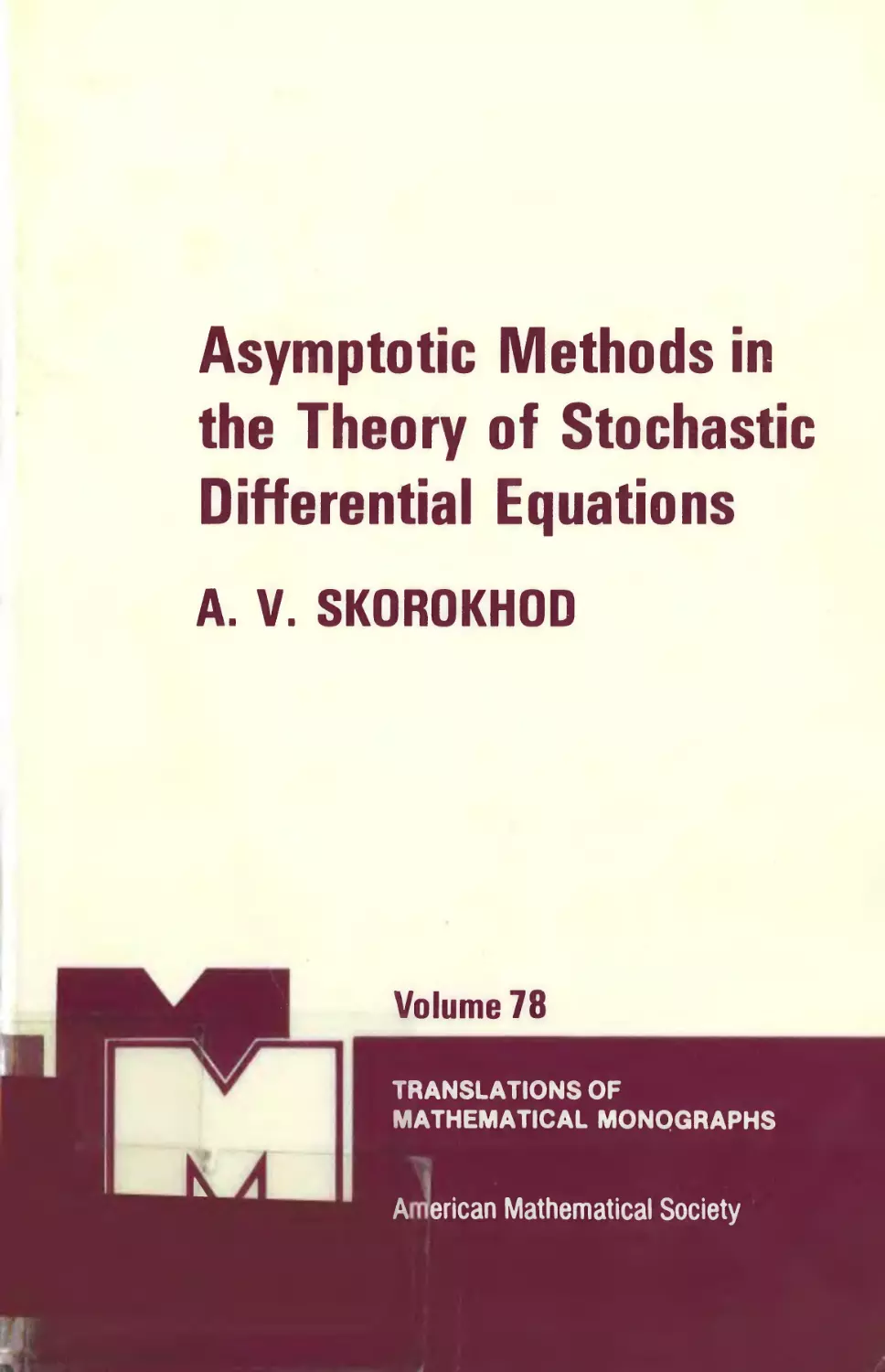
Asymptotic Methods in
the Theory of Stochastic
Differential Equations
A. V. SKOROKHOD
Volume 78
TRANSLATIONS OF
MATHEMATICAL MONOGRAPHS
-,
A erican Mathematical Society
Asymptotic Methods in
the Theory of Stochastic
Differential Equations
TRANSLATIONS OF MATHEMATICAL MONOGRAPHS
VOLUME 78
Asymptotic Methods in
the Theory of Stochastic
Differential Equations
A. v. SKOROKHOD
American Mathematical Society · Providence · Rhode Island
A. B. CKOPOXO
ACIIMIITOTlIqECIGIE
METO)J:LI TEOPIIII
CTOXACTlIqECKIIX
)J:1I fDfD EPEHQIIAJILHLIX
YP ABHEHIIR
«HAYKA», MOCKBA, 1987
Translated from the Russian by H. H. McFaden
Translation edited by Ben Silver
1980 Mathematics Subject Classification (1985 Revision). Primary 60-
02, 60HI0, 60J60; Secondary 60H15, 60J25, 28DI0, 34F05, 47D07, 47A35,
60J75, 35R60, 34K20.
ABSTRACT. The topics in this monograph are ergodic theory for Markov processes and
for solutions of stochastic differential equations, stochastic differential equations containing
a small parameter, and stability theory for solutions of systems of stochastic differential
equations. The main part of the material is presented for the first time. The book is intended
for specialists in the theory of random processes and its applications.
Bibliography: 66 titles.
Library of Congress Cataloging-in-Publication Data
Skorokhod, A. V. (Anatolii Vladimirovich), 1930-
Asymptotic methods in the theory of stochastic differential equations.
(Translations of mathematical monographs; v. 78)
Translation of: Asimptoticheskie metody teorii stokhasticheskikh differentsial' nykh urav-
nenii.
Includes bibliographical references.
1. Stochastic differential equations. 2. Asymptotic expansions. I. Title. II. Series.
QA274.23.S5313 1989 519.2 89-17698
ISBN 0-8218-4531-4
Copyright @ 1989 American Mathematical Society. All rights reserved.
Translation authorized by the
All-Union Agency for Authors' Rights, Moscow
The American Mathematical Society retains all rights
except those granted to the United States Government.
Printed in the United States of America
Information on Copying and Reprinting can be found at the back of this volume.
The paper used in this book is acid-free and falls within the guidelines
established to ensure permanence and durability. €9
This publication was typeset using AMS - TEX,
the American Mathematical Society's T}3X macro system.
Contents
Foreword IX
List of Notation XI
Introduction XIII
CHAPTER I. Ergodic theorems 1
1. General ergodic theorems 1
1.1. Ergodic theorems for semigroups of measure-preserving
transformations 1
1.2. Homogeneous Markov processes. Invariant measures
and ergodic theorems 6
1.3. Harris recurrence 15
2. Densities for transition probabilities and resolvents for
Markov solutions of stochastic differential equations 23
2.1. Nondegenerate diffusion processes 24
2.2. Diffusion processes with degenerate diffusion 27
2.3. Processes with jumps 35
3. Ergodic theorems for one-dimensional stochastic equations 41
3.1. Diffusion processes on the line 42
3.2. Diffusion processes on an interval 53
3.3. Processes with reflection at the boundary 55
4. Ergodic theorems for solutions of stochastic equations in Rd 57
4.1. Invariant measures for processes on compact spaces 58
4.2. Locally compact spaces 63
4.3. Solutions of stochastic equations in Rd 66
CHAPTER II. Asymptotic behavior of systems of stochastic
equations containing a small parameter 77
1. Equations with a small right-hand side 77
1.1. A general theorem on convergence to a diffusion process 77
v
VI
CONTENTS
1.2. Ordinary differential equations with a random
right-hand side 80
1.3. A theorem on integral continuity with respect to a
parameter for diffusion processes 97
1.4. Stochastic equations with small diffusion 99
2. Processes with rapid switching 102
2.1. Processes with a discrete component 103
2.2. An ergodic theorem for jump processes 106
2.3. An estimate for a process with a discrete component 110
2.4. A limit theorem for processes with rapidly varying
discrete component 114
2.5. Dynamical systems with rapid switching 117
3. Averaging over variables for systems of stochastic differential
equations 134
3.1. A general theorem on averaging 134
3.2. A diffusion process under the influence of a rapid
dynamical system in the presence of feedback 144
3.3. A dynamical system under the influence of a rapid
diffusion process. Neutral case 156
3.4. A dynamical system under the influence of a rapid
diffusion process. Neutral case, hirge times 163
CHAPTER III. Stability. Linear systems 183
1. Stability of sample paths of homogeneous Markov processes 183
1.1. Definition 183
1.2. A Feller process on a compact metric space 187
1.3. Stability aI)d instability of one-dimensional continuous
processes 1 96
1.4. Stability and instability of Feller processes in a locally
compact space 198
2. Linear equations in Rd and the stochastic semigroups
connected with them. Stability 205
2.1. Linear equations 205
2.2. Operator equations. Representation of solutions 211
2.3. Commutative case 222
2.4. Homogeneous case. Invariant subspaces 225
2.5. Mean square stability 231
2.6. Stability with probability 1 236
2.7. p-Stability 246
CONTENTS Vll
3. Stability of solutions of stochastic differential equations 251
3.1. Stability and instability in first approximation 251
3.2. Diffusion equations with homogeneous coefficients 259
CHAPTER IV. Linear stochastic equations in Hilbert space.
Stochastic semigroups. Stability 271
1. Linear equations with bounded coefficients 271
1.1. General equations in Hilbert space 271
1.2. Linear equations 279
1.3. Linear stochastic equations in Hilbert space 285
1.4. Stochastic Hilbert-Schmidt semigroups 291
2. Strong stochastic semigroups with second moments 296
2.1. Strong and weak random operators 296
2.2. Processes with independent increments that are
continuous in II . lis 300
2.3. A stochastic differential equation 305
2.4. Second-order stochastic semigroups of bounded
variation 309
2.5. Stochastic equations of diffusion type with constant
coefficients 318
3. Stability 322
3.1. Examples of stable and unstable infinite-dimensional
systems 322
3.2. Stability in the mean square 327
Bibliography 333
Foreword
The 1982 book on stochastic differential equations written jointly by
the author and Iosif Il'ich Gikhman did not include a number of areas
in this theory that are important for applications. Therefore, we decided
to write a book that would bring together material relating to applied ar-
eas in the theory of stochastic equations. We intended to treat equations
in infinite-dimensional spaces, in particular, infinite systems of stochastic
equations; the theory of linear equations in infinite-dimensional spaces and-
the semigroups connected with them, in particular, stochastic partial dif-
ferential equations of evolution type; equations for conditionally Markov
processes and the equations of nonlinear filtration connected with them;
and the asymptotic behavior of solutions of stochastic equations, including
ergodic theory, the method of averaging, and the theory of stability. The
plan of the book was discussed for a fairly long time, and we convinced
ourselves at last that it was impossible to present all these topics in a single
book. We then decided to treat the last topic. This choice was made under
the influence of the interests of Iosif Il'ich, who, as a student of Nikolai
Nikolaevich Bogolyubov, had directed much attention to the study of the
asymptotic behavior of systems undergoing random perturbations.
A serious illness did not permit Iosif Il'ich to work on this book. Now
he is no longer, but the book is published. It would certainly have been
different if he had taken part in its writing-he had a better feeling for
the "physical" aspects of mathematical theories and could convey this in
his expositions, thus giving them more substance. Moreover, he knew far
more than was written in his (and others') works.
While recognizing how far this book was from what we had envisioned,
I wrote it nevertheless, hoping at least by the choice of topic to pay homage
to the shining memory of my teacher and friend.
A. Skorokhod
IX
List of Notation
R-the real line.
R+-the set of nonnegative numbers.
a A b and a V b-the smaller and larger of the respective numbers
a, b E R.
Rd-the d-dimensional Euclidean space.
lxi-the absolute value of a number x E R or the norm of
a vector x E X, where X is a Euclidean space.
(x,y)-the inner product in a Euclidean space.
X x Y -the Cartesion product of sets X and Y.
(x,y)-an element of X x Y;x E X, Y E Y.
$x,$(X)-the a-algebra of Borel subsets of a metric space X.
(RQ)ms-Lebesgue measure on a set S.
-the product of a-algebras and .
v -the smallest a-algebra containing .
a (C;a, a E A)-the a-algebra generated by the variables {C;a, a E A}.
L(X, Y)-the linear space of linear operators from a linear space
X to a linear space Y.
IIAII-the norm of a linear operator A E L(X, Y).
A*-the operator adjoint to A (A* E L(Y,X)).
{ek }-an orthonormal basis in a Euclidean space X.
d
tr A = LI (Aek> ed.
x 0 y E L(X, X)-defined by (x 0 y)z = (x, z)y, where X is a Euclidean
space.
'(x)-the function in L(X, Y) defined for : X --+ Y by the
equality
tp'(x)y = :t tp(X + ty) 11=0, x,y E X, t E R.
II II = sup 1 (x)l.
C x-the space of continuous functions on X.
Xl
Introduction
Asymptotic problems for stochastic differential equations arose and
were solved simultaneously with the very beginnings of the theory of such
equations, because the founder of this theory, I. I. Gikhman, was consid-
ering first and foremost problems on asymptotic behavior, and he con-
structed the equations themselves partly in order to be able to pose and
solve these problems rigorously. In this he, as a student of N. N. Bo-
golyubov, was continuing the traditions of the new direction developed
in the 1930's by N. M. Krylov and Bogolyubov in investigations on non-
linear mechanics-the study of systems subject to the action of random
perturbations. A cycle of papers by Krylov and Bogolyubov [1]-[5] were
devoted to these investigations. They established, in particular, ergodic
theorems for Markov processes with a phase space of a very general form.
Special mention should be made of [1], in which a study was made of the
behavior of a system subject to the action of a rapidly variable random
force that becomes a "white noise" in the limit. It is this paper that served
as an impetus for the creation by Gikhman of the theory of stochastic dif-
ferential equations. In [1]-[5] various approaches were considered to the
rigorous definition of a dynamical system subject to the action of a ran-
dom force of "white noise" type, as well as the definition of a stochastic
differential equation in a random field of forces with independent values,
and results were obtained on the asymptotic behavior of the system when
the field varies (for example, when impulse actions become continuous
actions). (It6 used the convenient concept of a stochastic integral to con-
struct a stochastic equation in [1] and [2]; this form of the equation is
more accepted at present.)
We indicate two directions in the asymptotic investigation of systems
with random actions: 1) investigation of the behavior of systems as t --+ 00,
and 2) investigation of systems depending on a small parameter as this pa-
rameter tends to zero. The mixed problem also relates here-investigation
XUl
XIV
INTRODUCTION
of a system as a parameter tends to zero and t tends to infinity simul-
taneously.
The main systems considered are those describable by Markov proc-
esses that are, in turn, solutions of stochastic differential equations. How-
ever, many of the results are simpler to formulate and prove for Markov
processes, and even for processes of a more general form. It is often con-
siderations of convenience that dictate the choice of the form of a system.
We remark also that, in addition to problems on the behavior of a sys-
tem, new problems connected with the study of the asymptotic behavior
of distributions (transition probabilities) arise for stochastic systems.
In considering the asymptotic behavior of a system as t --+ 00 we are pri-
marily interested in a definite "stabilization" of the system. This term can
be used to characterize any regularity that manifests itself in the behav-
ior of the system. The crudest type of such stabilization is boundedness
in probability. Under fairly natural assumptions about the probabilistic
properties of the system, boundedness in probability implies ergodicity-
this property characterizes more precisely the behavior of the system on
the whole unbounded interval of variation. Even when the system is not
bounded in probability, it can fail to diverge to infinity but instead return
to a neighborhood of the original state with probability 1. Then it has an
infinite invariant measure, and we can judge the qualitative behavior of
the system on the basis of exact quantitative laws.
Although ergodic theory (including ergodic theory for Markov proc-
esses) is very weIr developed, some questions connected with this theory, as
well as some results relating specifically to solutions of stochastic equations,
are appearing here for the first time in a monograph. Shurenkov's book
[1] contains the most complete reflection of the state of ergodic theory for
Markov processes, along with a detailed bibliography.
Questions involving (asymptotic) stability of a system in a neighborhood
of an equilibrium state or involving instability of the system arise naturally
in the study of the behavior of systems on an infinite interval. Under very
general assumptions, stability implies asymptotic stability for stochastic
systems, and instability with positive probability implies instability with
probability 1. Linear systems for which the point 0 is the only equilibrium
point are of special interest. Such systems are either stable or unstable. In
the latter case the system either diverges to infinity, or oscillates and hence
has an invariant measure.
Gikhman founded the theory of stability for solutions of stochastic dif-
ferential equations in [6] and [7], and then Khas'minskii developed it fur-
ther in [1]-[5]. We note that the study of stability of linear systems is
INTRODUCTION
xv
closely connected with the study of products of independent identically
distributed matrices (about this see Bellman, Kesten, and Furstenberg (see
Furstenberg [1]), Tutubalin [1], and Sazonov and Tutubalin [1]).
We mention also results of Kulinich [1] that have not appeared in a
book: for recurrent processes he found conditions for the existence of a
limit distribution for a solution of a stochastic equation under a suitable
normalization.
Carrying results relating to stochastic equations in finite-dimensional
spaces over to the infinite-dimensional case is far from trivial. Although
the form of stochastic equation proposed by Gikhman is insensitive to a
change in the dimension of the space, the more natural form based on the
Ito integral needed a certain reinterpretation (Daletskii [1], [2]). The study
of linear systems led to the concept of a stochastic semigroup (Skorokhod
[1], [2], [4], and Butsan [1]). Mean-square stability of solutions of linear
equations involves stability of certain now nonrandom semigroups in the
Banach space of linear operators acting in a Hilbert space. There is a
fairly complete exposition of the theory of stability of such semigroups in
Daletskii and Krein's book [1]. A small parameter in the equation has the
effect that some terms in the equation become large in comparison with
others, and since a stochastic differential equation contains four different
terms (the differential of the unknown solution, the drift, the diffusion,
and the jumps), we obtain different problems with a small parameter by
placing the small parameter as a coefficient of different groups of terms.
Most natural is the problem when the system is determined by an ordinary
differential equation with a small random perturbation. Then under a
mixing condition for the process on the right-hand side it behaves like a
solution of a stochastic equation of diffusion type on large time intervals.
Another class of problems is connected with the presence of rapidly varying
components in the system. If these components have ergodic properties,
then their effect on the remaining components is "averaged", i.e., for the
latter a closed equation is obtained whose coefficients are the coefficients
of the original equation, averaged with respect to an ergodic distribution.
These kinds of theorems generalize the Bogolyubov method of averaging
to random systems. Gikhman and Khas'minskii occupied themselves with
the justification of the Bogolyubov method of averaging in various degrees
of generality in the case of stochastic equations (see also Stratonovich [1],
[2], V. V. Sarafyan [1], and Sarafyan and Skorokhod [1]).
We remark that for finite Markov chains and semi-Markov processes
such a method of averaging was developed by Korolyuk and Turbin [1]
(see also Turbin [1]) as a method of asymptotic phase amalgamation.
xvi
INTRODUCTION
A special place is occupied by the class of problems on the behavior
of a dynamical system under the influence of a small diffusion. They
have been investigated by Venttsel' and Freidlin [1] (see also Venttsel'
[1], and Sarafyan [1]), and relate to the determination of an asymptotic
expression for the probability of unlikely events (large deviations) such
as, for example, the system reaching the boundary of a domain whose
interior contains a point of stable equilibrium, due to a small diffusion or
a transition of the system from one stable state to another.
CHAPTER I
Ergodic Theorems
1. General ergodic theorems
Ergodic theorems combine two sorts of theorems: on the one hand,
theorems on the existence with probability 1 of limits of means of the
form
l i t
- f( (s)) ds
t 0
as t --+ 00, where (s) is a random process and f a measurable numerical
function on the phase space of the process, and, on the other hand, the-
orems on the existence of limits for transition probabilities P(t, x, A) of
homogeneous Markov processes or of their means
l i t
- P(s, x, A) ds
t 0
as t --+ 00, and the cases when these limits do not depend on the initial state
(O) = x of the process are of special interest. In this chapter we consider
ergodic theorems of both forms for homogeneous Markov processes that
are solutions of stochastic differential equations with time-independent
coefficients.
(1)
(2)
1.1. Ergodic theorems for semigroups of measure preserving transforma-
tions. General ergodic theorems are usually formulated according to the
following scheme. Some measurable space (X, ) is considered, and on
it are given a semigroup of measurable transformations StX, t > 0, and
a measure m on (a-finite in general), with the transformations of the
semigroup leaving m unchanged: for all t > 0 and A E
m(St-l(A)) = m(A). (3)
The last relation is equivalent to the following: if Ll (m) is the space of
-measurable m-integrable functions, then for all fELl (m)
f j(Stx)m(dx) = f j(x)m(dx). (4)
2
I. ERGODIC THEOREMS
Saying that StX is a semigroup of transformations means that St+sx =
StSsX (St need not be thought of as a linear operator). It is assumed that
StX is a measurable function with respect to R+ ( R+ is the Borel
a-algebra on R+).
Let us consider the asymptotic behavior of the quantity
10 1 j(Sux) du
(5)
as t -+ 00. We present one of the main ergodic theorems on the behavior
of quantities of the form (5).
THEOREM 1 (BIRKHOFF). Suppose that f, g E L l (m), g > 0, and
J o oo g(Sux) du = +00 almost everywhere with respect to the measure m.
Then the limit
I (10 1 j(Su x ) du / 10 1 g(Su x ) du ) (6)
exists with probability 1. If this limit is denoted by f;(X), then f;(Shx) =
f;(x) almost everywhere with respect to m for all h > o. Further,
/ f;(x)g(x)m(dx) = / j(x)m(dx).
(7)
A proof of this theorem will be given below. It is based on the ergodic
theorem for the case of discrete time. 'In this case we can consider a single
transformation S of (X, ) into (X, ) that preserves a a-finite measure
m.
THEOREM 1 * (BIRKHOFF). Suppose that f, g E L l (m), g > 0, and
E g(Sk x ) = +00 almost everywhere with respect to the measure m. Then
the limit
}i (t,j(SkX)/ g(SkX)) (8)
exists almost everywhere with respect to m. If this limit is equal to f;(x),
then f;(Sx) = f;(x) almost everywhere with respect to m, and
/ f;(x)g(x)m(dx) = / j(x)m(dx).
There is usually a proof of Theorem 1 * in probability texts, and we omit
it.
PROOF OF THEOREM 1. It can obviously be assumed that f > 0 and
f < g (otherwise, g + f can be taken as g). Let fi (x) = J O I f(Sux) du.
1. GENERAL ERGODIC THEOREMS
3
Since f(Sux) is measurable with respect to R+ fg) , while fi(x) is -
measurable and
10 1 f j(Sux)m(dx) du = 10 1 f j(x)m(dx) du = f j(x)m(dx),
it follows that
f fi (x)m(dx) = f 10 1 j(Su x ) du m(dx) = f j(x)m(dx).
Note that Sl preserves the measure m and Sf = Sn. Therefore,
n-l n-l 1 n
Lfi(S x) = L { j(Sk+ux)du = ( j(Sux)du.
k=O k=O 10 10
Similarly, if gl (x) = J O I g(Su x ) du, then gl (x) > 0, E gl (Sf x) = +00
for m-almost all x, and J gl (x)m(dx) < 00. On the basis of Theorem 1 *,
the limit
}i. (Ion j(Su x ) du / Ion g(Sux) du )
exists for almost all x. We observe that for nt < t < nt + 1
(9)
( {nt / (nt+l )
10 j(Su x ) du 10 g(Su x ) du
< (lot j(Su x ) du / lot g(Sux) du )
< (Io nl + 1 j(Sux) du / Ion g(Sux) dU) .
Therefore, it suffices to prove that
}i. (I n + 1 g(Su x ) du / Ion g(Su x ) dU) = 0 (10)
almost everywhere with respect to m. But, taking g(SIX) as f(x), we get
from (9) that
}i. ( n+1 g(Su x ) du / Ion g(Su x ) du )
exists almost everywhere with respect to m, and since
}i. (10 1 g(Su x ) du / Ion g(Su x ) dU) = 0
4
I. ERGODIC THEOREMS
almost everywhere with respect to m, the limit
nli. (Ion+1 g(Su x ) du / Ion g(Su x ) du )
also exists; hence also the limit on the left-hand side of (10). But
f I n + 1 g(Su x ) du m(dx) = f g(x)m(dx).
Thus, the sequence fnn+l g(Sux) du is bounded with respect to m, and
hence the ratio after the limit sign on the left-hand side converges to zero
in the measure m (the denominator converges to infinity). This implies
(10), and it is proved that the limit (6) exists. Therefore,
f;(Sh X ) = I (It+h j(Sux) du / It+h g(Sux) du )
= I (10 1 + h j(Su x ) du / Iot+h g(Su x ) dU) = f;(x)
almost everywhere with respect to m.
Since
f gl (x)f;(x)m(dx) = f {10 1 g(Su x ) du } f;(x)m(dx)
= 10 1 f g(Sux)f;(Sux)m(dx) du
= f g(x)f;(x)m(dx),
Theorem 1 * gives us that
f g(x)f;(x)m(dx) = f fi (x)m(dx) = f j(x)m(dx). 0
REMARK. If m(X) < 00, then the function g(x) = 1 can be taken as g.
Consequently, in this case we have, for all fELl (m) and m-almost all x,
the existence of the limit
1 In t
lim - f(Sux) du = j*(x),
t oo t 0
where j*(ShX) = f*(x) for all h > 0 and m-almost all x, and
f j*(x)m(dx) = f j(x)m(dx).
(11 )
( 12)
1. GENERAL ERGODIC THEOREMS
5
We prove that also
lim ! .!. fl f(Su x ) du - j*(x) m(dx) = O. (13)
t oo t 10
It obviously suffices to confine oneself to the case f > o. Let fN(x) =
f(x) 1\ N, fN (x) = f(x) - fN(X), and
(fN)*(X) = lim .!. t fN(SuX) du,
t oo t 10
(fN)*(x) = lim .!. t fN (Su X ) du
t-+oo t 10
(the limits in the sense of convergence almost everywhere with respect to
m). Then
10 1 fN(SuX) du < N,
and, by the Lebesgue theorem,
lim ! .!. t fN(Su X ) du - (fN)*(X) I m(dx) = 0,
t oo t 10 I
while in view of Fatou's lemma we can write
lim ! .!. t fN (Su x ) du - (fN)*(x) m(dx) < 2 ! fN (x)m(dx).
t oo t 10
The right-hand side of the last inequality c n be made arbitrarily small
by suitably choosing N. This proves (13). Accordingly, the variant of
Birkhoff's theorem for a finite measure m is established.
THEOREM 2. Suppose that m is a finite measure and fELl (m), and
let J be the smallest a-algebra of sets in with respect to which all the
junctions g(x) with g(x) = g(ShX) for m-almost all x and for any h > 0
are measurable. Then the limit (11) exists almost everywhere with respect
to m, f*(x) is J-measurable and belongs to L l (m), and the equalities (12)
and (13) hold.
REMARK. Let A E J. Then IA(Sux) = IA(x) almost everywhere with
respect to m, and hence
lim .!. t f(Sux)IA(Sux)du = IA(x) lim .!. t f(Sux)du = IA(x)j*(x).
t oo t 10 t oo t 10
On the basis of (12),
i j*(x)m(dx) = i f(x)m(dx). (14)
6
I. ERGODIC THEOREMS
The relation (14 L determines f* (x) uniquely to within sets of m-measure
zero. Indeed, if f(x) is J-measurable and for all A E J
i l(x)m(dx) = i J*(x)m(dx), (15)
.....,
then f = f* almost everywhere with respect to m.
DEFINITION. A semigroup of transformations Su of the space (X, £B)
preserving the measure m on £B is called a metrically transitive semigroup
if m(A) = 0 or m(X\A) = 0 for all A E J. The sets in J are said to
be invariant. Metric transitivity means that every invariant set coincides
either with the whole space or with the empty set (to within sets of m-
measure 0).
REMARK. If the transformation semigroup in Theorems 1, 1 *, and 2 is
metrically transitive, then the limits (6), (8), and (11) are constants.
1.2. Homogeneous Markov processes. Invariant measures and ergodic
theorems. Let (X,£B) be a measurable space, the phase space of the
process. We consider a space Q of measurable functions from R+ to X
that is translation invariant: if x(t) E Q, then Xh(t) = x(t + h) E Q for
all h > O. In Q we single out some a-algebra sr of subsets and a flow of
sub-a-algebras 5'; such that: 1) 5'; c S'; for t < s; 2) sr oo = V t 5'; = !T;
3) {x(.): x(t) E B} E for all B E £B; and 4) the subset {(s,x(.)): s E
A, x(s) E B} of [0, t] x Q is in O,t] (g)5'; for all A E O,t] and B E £B ( O,t]
is the a-algebra of Borel subsets of [0, t]). Let Px, x E X, be a family of
probability measures on Q satisfying the following conditions: a) Px(C) is
£B-measurable with respect to x for C E sr; b)
Px(x(t + h) E BI5';) = Px(t)(x(h) E B),
t,hER+,
( 16)
almost everywhere with respect to P x ; and c) Px(x(O) = x) = 1. The col-
lection of these objects is called a Markov process with phase space (X, £B),
space Q of sample paths, flow of a-algebras 5';, and family of probability
measures Px. We denote it by {Q,5';,P x }. The main characteristic of the
process is its transition probability
P(t,x,A) = Px(x(t) E A).
( 17)
The condition 4) means that a Markov process is progressively measurable.
Denote by 5';* the smallest a-algebra containing the sets {x(.): x(s) E B},
s < t, B E £B. Obviously, 5';* is also a flow of a-algebras, 5';* c 5';, and,
since the right-hand side of (16) is 5';* -measurable,
Px(x(t + h) E BI5';*) = px(t)(x(h) E B)
( 18)
1. GENERAL ERGODIC THEOREMS
7
almost everywhere with respect to Px. The measure Px on 3';* is uniquely
determined by the transition probability P(s, x, A) for s < t.
Let us consider the set
{x: x(t + hi) E B l ,... ,x(t + h k ) E B k },
( 19)
where B l ,..., Bk E £B and 0 < hi < ... < h k . Then, on the basis of (16),
Px(x(t + hi) E B l ,... ,x(t + h k ) E Bkl )
= E(P(x(t + hi) E B l ,. . ., x(t + h k ) E Bk 19;"+h k - 1 )I )
= E(Px(t+hk_d(x(h k ) E B)I B1 (x(t + hi))
... I Bk _ 1 (x(t + h k - l ))I9;)
= E(P(h k - h k - l , x(t + h k - l ), Bk)IBl (x(t + hi))
... I Bk _ 1 (x(t + h k - l ))I9;)
= ( P(h1,x(t),dYl) ( P(h 2 - hhYh d Y2)
JB 1 J
... ( P(h k -hk-hYk-hdYk)
JB k
= P x (t)(x(h l ) E B l ,... ,x(h k ) E B k )
with Px-probability 1. The last relation can be written as follows. We in-
troduce the operation 8 t : 8tx(s) = x(s + t) of translation of functions and
sets. If C E 7, then 8;-1 C = {x(.): 8 t x(.) E C}. If C = {x(.): x(h i ) E B i ,
i = 1, 2, . . . , k}, then (19) is 8;-1 C, and for the given C we have established
the equality
px(8;-ICI ) = px(t)(C) (20)
with probability 1. This relation clearly extends to all C E 7* = V 3';*
(here 8;-1 C E 7*), as well as to the completion of this a-algebra with
respect to PX. We shall assume the following condition.
CONDITION U. 8;-IC E 7 and relation (20) is valid for all C E 7 and
t > O.
The latter relation is fulfilled if 7 lies in the completion of 7* with
respect to P x.
If the condition 4) holds when is replaced by the completion of 3';*
with respect to Px, then 3';* can be taken as . Thus, Condition U can
be replaced by a condition expressible in terms of 5';*, s < t.
The following three semigroups are connected with a Markov process:
1) the semigroup of translations 8t on Q; 2) the semigroup defined by
1if(x) = f f(y)P(t,x,dy) = Exf(x(t))
(21 )
8
I. ERGODIC THEOREMS
in the space of all bounded £B-measurable functions f (the fact that this
is a semigroup follows from the equality
Exf(x(t + s)) = ExE(f(x(t + s))I9;) = ExEx(t)f(x(s))
= Ex Tsf(x(t)) = ItTsf(x);
here Ex is the expectation with respect to the measure P x); and 3) the
semigroup fJIt acting in the space of finite measures on £B,
p,1/(A) = / P(t,x, A)p,(dx) = E,JA(X(t)). (22)
If fJ is a probability distribution, then fJIt is the distribution of x(t) un-
der the condition that x(O) has distribution fJ; E,u is the expectation with
respect to the measure
PJl(C) = / Px(C)p,(dx) (23)
(we use this notation also in the case of measures that are not probability
measures). The measure fJIt is defined even when fJ is a-finite, but is itself
not necessarily a-finite.
DEFINITION. A a-finite measure fJ is said to be invariant if fJ1t = J.l for
all t > O.
LEMMA 1. Let fJ be an invariant measure. Then P,u (C) is a a-finite
measure, and the translation semigroup preserves this measure.
PROOF. Let t > 0 be arbitr3ry, and suppose that X = Uk B k , BknB j = 0,
k # j, and fJ(Bk) < 00. Then
P,u(C) = LP,u(Cn{x(.): x(t) E B k }),
k
and P,u( C n {x(.): x(t) E B k }) is a finite measure as a function of C, since
P,u(C n {x(.): x(t) E B k }) < fJ(It(B k )) = J.l(Bk) < 00.
Further,
PJl(S;IC) = / Px(S;IC)p,(dx) = /(E x Px(S;lqg;))P,(dX)
= / ExPx(l) (C)p,(dx) = / p,(dx) / P(t,x,dy)Py(C)
= / p,(dy)Py(C) = PJl(C). 0
If C;(x(.)) is an ST-measurable function on Q, then SuC; = C;(Sux(.)). By
Condition U, SuC; is also ST-measurable. We reformulate Theorems 1 and
2 for the case of a Markov process.
1. GENERAL ERGODIC THEOREMS
9
THEOREM 3. Suppose that fJ is an invariant a-finite measure for a
Markov process (Q, ,Px), C; and" are !T-measurable variables, " > 0,
E,u Ic; I < 00, E,u" < 00, and P ,u {Jooo Su'1 d u < oo} = O. Then the limit
1 (lleu'du/ lleurtdu)=[ (24)
-
exists almost everywhere with respect to the measure P,u, the variable C; has
- - -
the property that P ,u(SuC; # C;) = 0 for all u > 0, and E,uC;'1 = E,uC;.
If fJ is finite, then
lim .!. t eu' du = [ (24')
t oo t 10
-
almost everywhere with respect to P,u, and C; satisfies the additional condition
-
E,uC; = E,uC;. What is more, if J is the a-algebra of subsets C E!T with
P,u((C\S;IC) u (S;IC\C)) = 0
for all u > 0, then for all C E J
-
E,uC;Ic = E,uC;Ic. (25)
In particular, if P,u is trivial on J, then the limit in (24) is constant
(nonrandom ).
There is interest in the construction of the a-algebra J and in condi-
tions under which P,u is trivial on it, i.e., P,u(C) = 0 or P,u(Q\C) = 0 for
all C EJ.
-
It is natural to denote by E,u(c;IJ) an J -measurable variable C; for which
(25) holds for all C E J. The next theorem describes the a-algebra J.
-
THEOREM 4. Suppose that C; is an J -measurable bounded variable.
Then:
a) ExC; = g(x) is a £B-measurable function satisfying Itg(x) = g(x)
almost everywhere with respect to the measure fJ for all t > 0;
b) g(x(t)) is a martingale with respect to the flow S'; and the measure
P ,u;
-
c) C; = limt-+oo g(x(t)) almost everywhere with respect to P,u.
- -
PROOF. We have that P ,u(C; # StC;) = O. Hence,
o = EJlI[ - ell = / ,u(dx)Exl[ - ell > / ,u(dx)IE x [ - Exel
= / ,u(dx)lg(x) - ExE(el[I )1 = / ,u(dx)lg(x) - Ex EX(I)[I
= / ,u(dx)lg(x) - Exg(x(t))1 = / Ig(x) - 7/g(x)I,u(dx).
10
I. ERGODIC THEOREMS
Assertion a) is proved. It was shown in the chain of equalities that
-
g(x(t)) = E x (c;l9;)
almost everywhere with respect to P,u. This at once gives us b) and c). 0
We introduce invariant sets in the phase space of the process. Let fJ be
an invariant measure. A set B E £B is said to be fJ-invariant for the process
{Q, , P x} if P(t, x, B) = 1 for fJ-almost all x E B.
REMARK. A measurable set B is said to be invariant if P(t, x, B) = 1
forxEB.
Let us show that for every fJ-invariant set B there exists an invariant set
B' c B such that fJ(B\B') = O. For a given n we construct a sequence of
sets B m), m = 1, 2, . . . , as follows:
B m) = {x: x E B m-l), I n P(t, x, B m-l)) dt = n } .
Then fJ(B l)) = 1, and if fJn(B m-l)) = 1, then
B (I) - B
n - ,
1 = Jl(B m-l») = ( Jl(dx) r !P(t,x,B m-l»)dt
1 B(m) 10 n
n
1 t 1 i n
+ fJ(dx)- P(t,x,B m-I)) dt
B(m-I) \ B(IIl) n 0
n n
=Jl(B m»)+ ( Jl(dx)! rp(t,x,B m-l))dt,
1B(m-I) \ B(m) n 10
n n
0= ( [ 1 _! r P (t,X,B m-l»)dt ] fJ(dx).
1 B(IIl-I) \ B(m) n 10
n n
Since the expression in square brackets is positive, it follows that
fJ(B m-l)\B m)) = 0 and fJ(B m)) = 1.
Setting Bn = n m B m), we have that fJ(Bn) = 1 and
I i n
- P(t,x, Bn) dt = 1 for x E Bn.
n 0
If B' = n Bn, then fJ(B\B') = 0, and for all n
I i n
- P(t,x,B')dt=1 forxEB'.
n 0
1. GENERAL ERGODIC THEOREMS
11
Hence P(t, X, B') = 1 for almost all t with respect to Lebesgue measure,
for all x E B'. We show that B' is then invariant:
tP(t,x,X\B') = t f P(s,x,dy)P(t-s,y,X\B')ds
= t { P(s,x,dy)P(t-s,y,X\B')ds
10 1 X\B'
+ t ds ( P(s,x,dy)P(t-s,y,X\B')
10 1 B'
= t ds ( P(s, x, dy)P(t - s,y, X\B') = 0,
10 1 B'
since P(t-s,y, X\B') = 0 for almost all s with respect to Lebesgue measure.
THEOREM 5. If B is a J..l-invariant set of finite J..l-measure, then X\B is
also J..l-invariant. Further, IB(x(O)) is an J-measurable variable. IfC E J
and P.u (C) < 00, then there is a J..l-invariant set B such that
P.u{Ic # IB(x(O))} = o.
PROOF. Suppose that J..l(B) < 00 and B is invariant. Then
J..l(B) = f p,(dx)P(t, x, B) = ( p,(dx)P(t, x, B) + ( p,(dx)P(t, x, B)
1B 1x\B
= p,(B) + ( p,(dx)P(t, x, B).
1x\B
Hence, P(t, x, X\B) = I-P(t, x, B) = 1 for almos all x E X\B. Therefore,
P.u(IB(x(O)) # IB(x(t)))
= P.u(x(O) E B,x(t) E X\B) + P.u(x(O) E X\B,x(t) E B)
= ( p,(dx)P(t,x,X\B) + ( p,(dx)P(t,x,B) = O.
1 B 1x\B
This means that 8tIB(x(0)) = IB(x(t)) = IB(x(O)) almost everywhere with
respect to J..l, i.e., IB(x(O)) is J-measurable. If C E J and P,u(C) < 00,
we set tp(x) = Px(C). Then Ie = limt-+oo tp(x(t)) almost everywhere with
respect to P.u' by Theorem 4. For 0 < a < P < 1 let Ap = {x: a < tp(x) <
P}. Then lim P(t, x, A p ) = 0 for J..l-almost all x, because lAp (x(t)) --+ 0
almost everywhere with respect to P.u and is bounded by the function
tp(x(t))la, for which E.utp(x(t))la < 00, so that E.uIAp (x(t)) --+ O. Since
p,(A p ) = f p,(dx)P(t,x,A p ) - 0,
12
I. ERGODIC THEOREMS
it follows that fJ(Acp) = O. Thus, fJ({x: 0 < tp(x) < I}) = 0, and the
measure fJ is concentrated on the sets B l = {x: tp(x) = I} and Bo
{x: tp(x) = O}. Note that
p,(Bd = / p,(dx)tp(x) = / p,(dx)Px(C) = PJl(C) < 00.
Since the function tp(x) coincides with IBI (x) almost everywhere with re-
spect to fJ, we can use assertion a) in Theorem 4 to write
IBI (x) = tp(x) = Extp(x(t)) = ExIBI (x(t)) = P(t, x, B l )
for fJ-almost all x. This means that B l is a fJ-invariant set. If we set
B = B 1, then the second assertion of the theorem holds. 0
COROLLARY. Denote by the a-algebra generated by the fJ-invariant
sets. The measure P J.l is trivial on J if and only if fJ is trivial on , i.e.,
for every fJ-invariant set B either fJ(B) = 0 or fJ(B) = fJ(X).
REMARK. We give a condition for the measure P J.l to be nontrivial on
J: P J.l is nontrivial on J if and only if contains two disjoint sets of
positive fJ-measure. Indeed, in this case there exist C l and C 2 in J such
that PJ.l(C k ) > 0, k = 1,2. If tpk(X) = Px(C k ), then tpk(Xt) --+ IC k in the
measure P J.l. We see as in the proof of Theorem 5 that
fJ({x: a < tpk(X) < P}) = 0 for 0 < a < P < 1.
Therefore, tpk(x)-coincides with the indicator function of the set Ak with
respect to fJ, k = 1,2. The set Ak is fJ-invariant: since IAk (x) = ExIAk (Xt)
(for fJ-almost all x), it follows that P(t,x,A k ) = 1 for fJ-almost all x E Ak.
DEFINITION. A finite invariant measure fJ is said to be ergodic if it is
trivial on the a-algebra of fJ-invariant sets.
We consider ergodic theorems for transition probabilities:
THEOREM 6. Suppose that fJ is a finite invariant measure. Then for fJ-
almost all x and for A E £B the limit
lim.!. tp(u,x,A)du=Q(x,A)
t oo t 10
exists, the function Q(x, A) is -measurable with respect to x, and for all
BE
1 Q(x,A)p,(dx) = p,(A n B), (26)
i.e., Q(x, A) is the conditional probability of A with respect to fJ relative to
the a-algebra .
1. GENERAL ERGODIC THEOREMS
13
PROOF. Suppose that
I l t
lim - IA(x(u)) du = 17(A)
t oo t 0
almost everywhere with respect to P,u. By Theorem 4, 17(A) is an J-
measurable variable, and hence 17(A) = Q(x(.),A) by Theorem 5, where
Q(x,A) = E x 17(A). If B is ,u-invariant, then IB(x(O)) is J-measurable,
and this is true for all B E . Hence,
I l t
E,u lim - IA(x(u))IB(x(u)) du
t oo t 0
= lim .!. t ! P(u, x, A n B),u(dx) du
t oo t 10
= ,u(A n B)E,u17(A)I B (x(O)) = E,uIB(x(O))
= E p I B (x(O))E(l1(A)lx(')) = l Q(x,A)jl(dx).
The relation (26) is established. Finally, since
1 = P,u ( lim .!. t IA(x(u)) du = l1(A) )
t oo t 10
= ! Px ( lim .!. t IA(x(u))du = l1(A) ) ,u(dx),
t oo t 10
(27) holds for ,u-almost all x with P x-probability 1. If Ex is taken on both
sides of (27) and is carried under the limit sign on the left-hand side, then
we get a proof of the theorem. 0
RE ARK. If the invariant finite measure ,u is trivial on , then
. 1 I t ,u(A)
11m - P(u, x, A) du = (X)
t oo t 0 ,u
(27)
for ,u-almost all x.
THEOREM 7. Suppose that ,u is an invariant measure for the process
{Q, ,Px}, ,u is trivial on , f,g E L l (,u), g > 0, and J o oo Tug(x)du =
+00 for ,u-almost all x. Then
I (1 1 Tuf(x) du / 1 1 Tug(x) du )
= ! f(x)jl(dx) / ! g(x)jl(dx) (28)
for ,u-almost all x.
PROOF. We use the following result (see Neveu [1], Proposition V.6.4):
if T f(x) = J f(y)P(x, dy), where P(x, dy) is a transition probability in
14
I. ERGODIC THEOREMS
the phase space (X, ), p is invariant for P, f and g are as in the theorem,
and E Tk g(x) = +00 for p-almost all x, then
}i.. L T k f(x) / L T k g(x) = I f(x)p,(dx) / I g(x)p,(dx). (29)
k$,n k$,n
Applying this assertion to the functions fi (x) = J O I Tuf(x) du and gl (x) =
Jo l Tzlg(X) du, we get that
}i.. (Ion Tuf(x) du / Ion Tug(x) du )
= I fi (x)p,(dx) / I gl (x)p,(dx)
= II p,(dx) 10 1 P(u,x,dy)f(y) du / II p,(dx) 10 1 P(u,x, dy)g(y) du
= I f(x)p,(dx) / I g(x)p,(dx).
Further, it can be assumed without loss of generality that f > 0 and g > f.
For t E [n, n + 1 [
lot Tuf(x) du / lot Tug(x) du - Ion Tuf(x) du / Ion Tug(x) du
< i n + 1 Tug(x) du / Ion Tug(x) duo
The last expression tends to zero, since, by (29),
nli.. ( T k gl (x) / T k gl (X))
= }i.. ( Tk gl(x) / T k gl(X))
= nli.. (t.Tk(TgI(X))/ Tkgl(X))
= I Tg i (x)p,(dx) / I gl (x)p,(dx)
= I Tg(x)p,(dx) / I g(x)p,(dx) = 1,
and hence
}i. (rngl(X)/ Tkgl(X)) =0. 0
1. GENERAL ERGODIC THEOREMS
15
1.3. Hanis recurrence. We first consider a Markov chain with phase
space (X, ) and one-step transition probability P(x, B). The n-step tran-
sition probability is Pn(x, B). Denote by Px the measure
Px ( n{Xk E Bd ) = IBo(x) { P(x,dyJ)... ( P(Yn-hdYn)
k=O J
in the space Q of all sequences (xo, XI,. . . ), Xk E X. The chain is said to
be recurrent (in the Harris sense) with respect to a a-finite measure 1/ if
for every set C E with 1/(C) > 0 and all X EX
Px ( U{Xk E C} ) = 1,
k=O
which is equivalent to the following:
Px (LIc(Xk) = +00) = 1.
If the chain is recurrent, then it has a unique invariant measure J.l, and there
is a function g(x) such that J g(x)J.l(dx) < 00 and Px{E g(x n ) = +oo} = 1
for all x.
To prove this fact we need some auxiliary propositions.
LEMMA 2. For 0 < A < 1 let QA(X, A) = E;X> AkPk(x, A). Then there ex-
ist a probability measure n(A) on and a positive -measurable function
g(x) such that
QA(x,A) > g(x)n(A).
PROOF. Obviously, the equality QA(X, C) = 0 implies that Px{Ic(xk) =
O} = 1 for all k, which is impossible for 1/( C) > O. Hence, 1/ is absolutely
continuous with respect to QA(X, .). If f(x,y) is the density of 1/ with
respect to QA/2(X,.) (f(x,y) can be chosen to be BI-measurable for a
countably generated ), then
QA/2(X, A) > i f(:,y) v(dy).
Since
f QA/2(X,dy)QA/2(y,A) = f: ( ) k ( ) n Pk+n(x,A)
k,n= 1
k - 1 k
= L...J 2 k A. Pk(x, A) < QA(X, A),
k=2
it follows that
QA(x,A) > i [L f(:,y) f(:, Z) v(d y )] v(dz).
16
I. ERGODIC THEOREMS
The measure 1/ can be assumed to be a probability measure. If the mea-
surable functions k l (y) and k 2 (x) are chosen so that
1/ ( {x: f (x, y) > k 1 (y) }) < 1 14,
1/ ( {y: f (x, y) > k 2 (x) }) < 1 14,
then
1 11 1 1
1/(dy) > 1/(dy)
x f(x,y) f(y, z) - {y: f(x,y) kl(X),f(y,z) k2(Z)} k l (x)k 2 (z)
1
> 2k 1 (x)k 2 (z) '
Therefore,
1 ( 1
QA(x,A) > 2k 1 (x) J A k 2 (z) v(dz). 0
COROLLARY. There exists a -measurable function g(x,y) such
that
g(x)n(A) = i g(x,y)P*(x,dy), (30)
where (1 - A.)QA(x,A) = P*(x,A) is the transition probability for some
Markov chain in (X, ). We denote this chain by (x o ' x , x;, . . .), the
corresponding transition probabilities by P (x, A), and the measure on Q
by P .
LEMMA 3. The chain (x o ' x ,. . .) is representable in the form Xo, x lll '
x 1l2 ' . . . , where 111, 112 - 11., · · · , 11n - 11n 1 are mutually independent, indepen-
dent of Xk (k = 0, 1,...), and geometrically distributed with parameter A.:
P(11n - 11n-l = k) = (1-A.)A. k , k = 1,2,.... It is recurrent with respect to the
same measure 1/ as (xo, XI, . . . ); the invariant measures for the two chains
coincide.
PROOF. The first assertion follows from the form of P*(x,A). The
recurrence with respect to 1/ can be seen from the equality
LIA(x;) = L'nIA(X n ),
k n
and 'n = E:=o I{llm=n}. The variables 'n are independent and take the
values 0 with probability A. and 1 with probability I-A.. It is easy to see that
the series E 'nIA(x n ) and E IA(x n ) converge or diverge simultaneously.
The fact that every invariant measure for {Xk} is invariant also for {x;}
follows from the formula for P*(x,A). Using the equalities
P* ( A ) = ( I_A. ) n (m-l)(m-2)...(m-n+l) ).mp ( A )
n x, L...J ( n _ I ) ! m x, ,
m=n
1. GENERAL ERGODIC THEOREMS
17
we can see that the equalities J P (x, A)p(dx) = p(A) for all n imply
JPm(x,A)p(dx) = p(A). 0
We introduce the stopping time 1" as follows: let 8 1 , 8 2 , ... be inde-
pendent uniformly distributed variables on [0, 1] that are independent of
xo, xi, · . · , and let
1" = min{n > 1, g(X;_I'X;) > 8n}.
LEMMA 4.
P {1" < oo} = 1,
P {1" = n,x; E A} = n(A)P (1" = n),
PROOF. We have
P {1" = l,x; E A} = P {g(x,xi) > 8 1 ,xi E A}
= i g(x,ydP*(x, dyd = g(x)n(A),
P;{ 1" = 2,x; E A} = !! (1 - g(x,Yd)g(YhY2)P*(x,dYdP*(Yh dY2)
= ! (1- g(x,Yd)g(ydP*(x,dydn(A),
P;{ 1" = n, x; E A} = f...! (1 - g(x,yd)... (1 - g(x,Yn-d)g(Yn-d
x P*(x, dYl) X . . . x P*(x, dYn-l )n(A).
AE , n > 1, XEX.
In particular, the last relation implies that
P (1" = n) = E (I- g(x,xi))... g(X;-I) = E (I- g(x,xi))... g(X;_I'X;),
P (1" > n) = E (1 - g(x,xi))(1 - g(xi,x;))... (1 - g(X;_l'X;))
< E exp { - tg(X;-I'X;) } .
k=l
To prove the lemma it remains to show that for all x E X
Px { f g(Xk-l'X;) = +oo } = 1. (31)
k=l
It can be assumed without loss of generality that g(x,y) < c (otherwise,
consider the function g(x,y) A c). We take the sequence
n
Zn = L[g(xZ-l,xZ) - g(xZ- l )],
k=l
18
I. ERGODIC THEOREMS
where g(x) = J g(x,y)P*(x,dy); Zn is a martingale with respect to the
flow generated by the variables x k ' k < n.
For a > 0 and b > 0 let
t' = min[n: Zn ft [-a,b]] vmin [ n: tg(Xk) > a+b ] .
k=1
In view of recurrence, E;x' g(Xk) = +00; therefore, t' < 00. Since t' is a
stopping time, E ZT = O. Therefore,
o < (b + C)P {ZT' > b} - aP {zT' < -a}
+ bP { ZTI E [-a,b], t g(Xk) > a + b } ·
k=1
The events {ZT' > b} and {ZT' E [a,b]} n {E =1 g(Xk) > a + b} imply the
,
events {E =1 g(xk-l' x;) > b}. Therefore,
o < (b + c)P { t g(Xk-l,Xk) > b }
k=1
-a (l-P{ g(Xk-l,Xk) > b}),
P { t g(Xk_pXk) > b } > a +: + c '
k=l
and, passing to the limit as a --+ 00, we see that for all b > 0
P { f g(Xk-l,Xk) > b } = 1. 0
k=l
THEOREM 8. If a Markov chain {x n } is recurrent with respect to a (J-
finite measure v on the measurable space (X, ) with countably generated
a-algebra , then it has an invariant (J-finite measure J.l majorizing v, and
the chain is recurrent with respect to this measure.
PROOF. Let t be the stopping time constructed in Lemma 4, and let
00
J.l(A) = L P;{x k E A, 1" > k}.
k=O
1. GENERAL ERGODIC THEOREMS
19
Then j.l majorizes n:
#(A) = n(A) + L n(dx) / (1 - g(x,yd)P*(x,dyd
k
. . . / (1 - g(Yk-2, Yk- d)P* (Yk-2, dYk-l)
x L(1-g(Yk-I>Yk))P*(Yk-l>d Y k )+....
The fact that j.l is a-finite follows from the equality
/ g(x)#(dx) = / n(dx) [g(X) + /... /(1- g(x,Yd)
. . . (1 - g(y k- I> Y k )) g (y k ) ]
X P* (x, d y 1) . . . P* (y k - 1 , d Y k) + . . .
= / n(dx)P*(. < 00) = 1.
Further,
/ #(dx)P*(x, A) = L / P;{x; E dy,. > k}P*(y, A)
k O
= L P;(Xk+l E A, , > k)
k O
(we have used the fact that the event {, > k} is in 9k). Therefore,
/ #(dx)P*(x, A) = L P; (Xk+ 1 E A,. > k + 1)
k O
+ LP;(Xk+l EA,,=k+ 1).
k O
On the basis of Lemma 4,
L n(A)P;(, = k + 1) = n(A) = P;(xo E A" > 0).
k O
It is proved that j.l is invariant. We show that the chain x k is j.l-recurrent.
For this we construct a sequence of times 'k, where '1 = , and if 'k = m,
then
'k+l = min{n > m: g(X;_I'X;) > en}
20
I. ERGODIC THEOREMS
((In is the same as in the definition of ,). Then X;k has distribution n(A)
for k > 1, and the X;k are mutually independent. The events
{T l IA(x;) > 0 }
are mutually independent and have the same positive probability when
p(A) > O. Therefore, infinitely many of these events occur, i.e., {x;} is
p-recurrent. We conclude on the basis of Lemma 3 that the chain {xn} is
also p-recurrent, and p is its invariant measure. 0
REMARK 1. Since
00 'k+l-l ,-1
L IA(x;) = L L IA(x;) + L IA(x ),
n=O k n='k n=O
it follows that the condition p(A) = 0, which implies that all the events
(31) have Px-probability 0 for k > 1, gives us that E IA(x;) < 00. Thus,
f.J. is the maximal measure with respect to which the chain is recurrent.
REMARK 2. Suppose that {xn} is a Markov chain with transition proba-
bility P(x, A) and a-finite invariant measure p, A E , p(A) > 0, p(A) <
00, and Px(En IA(x n ) = +00) = 1. Denote by 'k the kth time the chain
hits the set A: '1 = inf[n > l,x n E A], and 'k = inf[n > 'k-bXn E A]. All
t
these times are finite. Then the sequence Yn = x'n' Yo = Xo E A, is a homo-
geneous Markov chain with transition probability Q(x, C) = Px{X('I) E
C} and invariant measure PA (C) = p(A n C).
In the proof we need only the invariance of the measure PA (C) for
QA(X, C). Since
00
QA(X,C) = LPx{Xk ft A, 1 < k < n,x n E CnA},
n=1
it follows that
f JlA(dx)QA(X, C) = f Jl(dy)Q(x, C) - f Jl(dy) t\A P(y, dx)
x P(Xk ft A, 1 < k < n, X n E C n A)
00
= f Jl(dY)LP y (xk EA ,l < k<n,xnECnA)
k=1
00
- L f Jl(dy)Py(Xk ft A, 1 < k < n,x n E C n A)
k=2
= f Jl(dy)Py{xn E C n A} = Jl(C n A) = JlA(C). 0
1. GENERAL ERGODIC THEOREMS
21
LEMMA 5. Under the conditions of Theorem 8 the following assertions
are valid:
1) An invariant measure is unique to within a factor.
2) Iff and g are measurable, J(lf(x)1 + g(x))J1.(dx) < 00, and g(x) > 0,
then for all x the limit
n / n
l(f,g) = nl.!. Lf(xk) Lg(Xk)
k=l k=1
exists with P x-probability 1.
PROOF. Suppose that the chain is recurrent with respect to J1. (the ex-
istence of such measures J1. follows from Theorem 8), and let L be the
set of x such that the limit I (f, g) exists with P x-probability 1. Then
J1.( L) > 0, and hence P x { 1" L < oo} = 1 for all x, where 1" L is the hitting
time for L. Therefore, assertion 2) is valid. Obviously, the a-algebra J
is trivial, and hence every invariant measure is ergodic. If v is such a
measure, and A and B are such that J1.(A) + J1.(B) + v(A) + v(B) < 00 and
J1.(A)J1.(B)v(A)v(B) > 0, then
J1.(A) v(A)
I(IA,IB) = Jl(B) = v(B)
with P x-probability 1 for all x. 0
The next theorem enables one to carry over the results from the discrete
case to the continuous case.
THEOREM 9. Suppose that {Q,9';, Px} is a homogeneous Markov process
with transition probability P(t, x, A) in a measurable phase space (X, )
with countably generated a-algebra . Let
Q.1.(x,A) =).1 00 e-.1.1P(t,x,A)dt.
[fa Markov chain in (X, ) with transition probability QA(x,A) is recur-
rent with respect to some measure v, then there exists an invariant a-finite
measure J1. for the Markov process majorizing it, and there exists a positive
function g(x) such that J g(x)J1.(dx) < 00 and Px(Jooo g(Xt) dt = +00) = 1
for all x. If J1. is finite, then the limit in (24') exists with P x-probability 1
for all x.
PROOF. Let J1. be the invariant measure constructed in Theorem 8 for
a chain with transition probability QA(x,A). As a Markov chain with
this transition probability we can take the sequence X n = x(en), where
en = c; 1 + . . . + c;n, and {c;k} is a sequence of random variables that are
22
I. ERGODIC THEOREMS
mutually independent, independent of the Markov process, and have the
exponent distribution P{ 'k > t} = e-;'t, Xo = x(O). Then
Px{XI E A} = P x {X('I) E A} = Q;.(x,A).
If Qf(x,A) denotes the n-step transition probability, then
A. n roo
Q1(x,A) = (n _ I)! 10 t n - l e-AtP(t,x,A)dt.
If for all n
I ,u(dx)Q1(x,A) = ,u(A),
then for every polynomial g(t) in t
1 00 e-)./ g(t) I ,u(dx)P(t, x, A) dt = ,u(A) 1 00 e-)./ g(t) dt.
From this,
I ,u(dx)P(t,x,A) = ,u(A) for almost all t > O.
Since is countably generated, this equality holds simultaneously for
almost all t and all A. But then
I ,u(dx)P(t,x,A) = 1/ ll,u(dX)P(s,x,dY)P(t-S,Y,A)dS
= 1/ ,u(dy)P(t - s,y,A) ds = ,u(A)
for any t > 0, i.e., p is an invariant measure for the Markov process.
Let g(x) be a positive function with J g(x)p(dx) < 00. We show that
Px {1 OO g(x(t)) dt = +00 } = 1.
The function g;.(x) = JX('n) g(y)Q;.(x, dy) is also positive, and, because the
chain is recurrent,
Px { g).(x((n)) = +00 } = 1.
Since
roo r'n+l
10 g(x(t)) dt > L 1r e-).(U-C') g(x(u)) du,
o n 'n
it suffices to prove that the series on the right-hand side diverges. Note
that the sequence
r'k+l
Zn = L). 1r e-).(U-C')g(x(u))du - g).(X((k))
k<n 'I..
2. DENSITIES FOR TRANSITION PROBABILITIES
23
is a martingale with respect to the flow 9Cn. It can be assumed that IIgll <
00. Then
1 ("+1 1 00
A. e-A(U-(k) g(x( u)) du < IIgllA. e- As ds = IIgli.
0
Therefore, as in the proof of Theorem 4, we find for the stopping time
" = min[n: Zn [-a, b]] V min [n: gA(X((k)) > a + b]
that
Px { t {Chi e-A(S-Ck)g(x(u))du > b } > a .
o J a+b+c
This inequality yields what was required. 0
2. Densities for transition probabilities and resolvents
for Markov solutions of stochastic differential equations
We consider Markov processes formed by solutions of homogeneous
stochastic differential equations of the following form:
dx(t) = a(x(t)) dt + B(x(t)) dw(t)
+ f fi (x(t), O)Jll (dt x dO) + f h(x(t), O)v2(dt x dO), (32)
where x(t) is a process with values in Rd, a(x): Rd --+ Rd, B(x): Rd --+
L(Rd), fi(x, 8): X x 8 --+ Rd, (8, ) is a measurable space, w(t) is a
Wiener process in Rd, v;(dt x d8) is a Poisson measure on + X ,
Ev;(dtxd8) = dt.m;(d8), ml is a a-finite measure on , PI = VI-Evl, and
m2 is a finite measure on . The coefficients a and B are locally bounded
Borel functions, the fi are Rd -measurable, and J Iii (x, 8)1 2m l (d8)
is locally bounded. It is assumed in addition that the coefficients in (32)
are such that the solution of the equation is weakly unique (see Gikhman-
Skorokhod [2], Chapter 6, 1). In this case x(t) is a Markov process with
transition probability P(t, x, A) dt = P(C;x(t) E A), where C;x(t) is the solu-
tion of (32) with initial condition C;x(O) = x. We remark that in the case
when the solution of (32) is strongly unique it can be constructed on the
probability space on which the Wiener process w(t) of the measure Vk is
given, and the a-algebras generated by {w(s)vk(ds x d8), k = 1,2, s < t}
appear as the a-algebras 9';.
As follows from 1.3, in investigating the ergodic properties for Markov
processes we must look for a measure v such that a chain with transition
24
I. ERGODIC THEOREMS
probability
Q.«x,A) = ).1 00 e-.<tP(t,x,A) dt
is recurrent with respect to v. If x(t) were a process with independent in-
crements, then Lebesgue measure would be invariant for it. The
process x(t) is locally spatially homogeneous, and though Lebesgue mea-
sure is no longer invariant, the process can be recurrent with respect to this
measure. To investigate recurrence with respect to Lebesgue measure we
study absolute continuity of Q with respect to this measure (if it is singu-
lar, then Lebesgue measure cannot supply recurrence to a chain with such
a transition probability). This question is also considered in the present
section.
2.1. Nondegenerate diffusion processes. We consider a process x(t)
solving the equation
dx(t) = a(x(t)) dt + B(x(t)) dw(t)
(33)
with measurable coefficients. The functions a(x), B(x), and B-1 (x) are
assumed to be locally integrable. In this case (33) has a weak solution that
is weakly unique and a Markov random process, and the function
Ttf(x) = f f(y)P(t,x,dy)
is continuous in x for every bounded continuous function f if the linear
boundedness condition
la(x)1 + liB (x) II < C(1 + Ixl)
(34)
holds with a constant C. These results are found, for example, in Gikh-
man-Skorokhod [2] (Chapter 6, 3).
It is known that the measure corresponding to the solution of equation
(33) with a given initial condition on some finite interval [0, T] is equiv-
alent to the same measure for the solution of the equation with a = O.
Therefore, the transition probability densities with respect to Lebesgue
measure exist simultaneously for a # 0 and a = 0, and we can restrict our
attention to the case a = O.
THEOREM 10. Suppose that B(x) and B- l (x) are locally bounded and
IIB(x)1I < C(1 + Ixl). Then for all A. > 0 and x E Rd the measure Ql(x,A)
is absolutely continuous with respect to Lebesgue measure. The measures
Ql(x,A) and Ql(y,A) are equivalent for any x,y E Rd.
PROOF. We use the following result of Krylov ([1], Chapter 2, 2,
Lemma 8). For r > 0 suppose that a r , Pr > 0 are such that for all
2. DENSITIES FOR TRANSITION PROBABILITIES
25
XES, = {X: Ix I < r}
a,Izl 2 < IB(x)zI2 < P,lzl 2 ,
and let " be the exit time of the process from the sphere S,. Then there
exists a constant qt depending on r, a" and P, such that for all x and every
measurable function f(s, x) on [0, t] x S, with
t { If(s,y)ld+1 dsdy < 00,
10 11YI '
we have the inequality
tl\1: ( t ) 1/(d+l)
Ex ( r f(s, x(s)) ds < qt ({ If(s,y)ld+1 ds dy . (35)
10 10 11YI '
Let g,(t, x, A) = f Px{X(S) E A, " > O} ds, and let f(y) be such that
YI ' If(Y)l d + l dy < 00. Then
( f(y)g,(t, x, dy) < q t ( ( If(Y)ld+1 d Y ) 1/(d+l) ,
11YI ' 11YI '
where q does not depend on f. Therefore,
( f(y)g,(t,x,dy)
11YI '
is a continuous functional on the space Ld+l (S,) of functions with (d + 1 )st
power integrable on S, (with respect to Lebesgue measure). It can be
represented in the form
( f(y) tp, (t, x,y) dy,
11YI '
where ,(t, x, .) E L(d+l)/d(S,), i.e., for Borel sets A c S,
g,(t,x,A) = i tp,(t,x,y)dy.
It is easy to see that g,(t, x, A) is an increasing function of r; therefore,
,(t,x,y) is also an increasing function of r almost everywhere. Thus, the
limit
lim ,(t, x, y) = (t, x, y)
, oo
exists, and
t Px(x(s) E A) ds = lim g,(t, x, A)
10 , oo
= lim { tp,(t,x,A)dy= { tp(t,x,y)dy.
, oo 1 A 1 A
26
I. ERGODIC THEOREMS
This implies that Ql(X, A) is absolutely continuous with respect to Le-
besgue measure.
Let A be a bounded Borel set, and fn a sequence of collectively bounded
continuous functions such that
lim f IIA(Y) - fn(y)1 dy = O.
n oo
Then
lot P(s,x,A)ds - lot f P(s,x,dy)j(y)ds
< Ex lot IIA(x(s)) - fn(x(s))1 ds
(tAT r ( )
< Ex 10 IIA(x(s)) - fn(x(s))1 ds + t 1 + s p IIfnll Px{'r, < t}
( ) Ij(d+l)
< qtt r IIA(y) - fn(Y)ld+l dy
JIYI r
+ t (1 + s p IIfnll) Px{., < t}.
Therefore, for all rl
i t ' i t
lim sup P(s,x,A)ds-" Tsfn(x)ds < CtSUpPx{tr<t}.
n oo Ixl rl 0 0 . Ixl r
But
{ } Exlx(t)12
Px{t r < t} = Px suplx(s)1 > r < 2 '
s t r
and the right-hand side tends to zero uniformly with respect to Ixl < rl
as r --+ 00. Thus, f P(s, x, A) ds is a locally uniform limit of continuous
functions, and hence also continuous.
Assume that Ql( x ,A) = 0 for some x . Then f P(s,x,A)ds = 0 for all
t > O. This implies that
f {t (t+h
P(h, x , dy) 10 P(y,s,A)ds = 1h P(s, x ,A)ds = 0
for all t > 0 and h > 0, and hence
{tl (t
10 P(u, x , dy) du 10 P(y,s, A) ds = 0
for all t > 0 and tl > O. Therefore,
fot l f P(u, x ,dy)Q;.(y,A)du = O.
(36)
2. DENSITIES FOR TRANSITION PROBABILITIES
27
We show that Ql(X, G) > 0 for all x for every open set G. Since
Q..(x, G) = 10 00 e-Atd lot P(s, X, G) ds =). 10 00 e-.. t lot pes, X, G) ds dt
is a continuous function of x, it follows that the set
F = {x: 10 00 P(u,x,G)du = o}
is closed. If G l = Rd\F, then P(t,x, G l ) = 0 for all x E F and t > 0,
because
o= j OOp(U,X,G)dU= roo ( P(t,x,dy) (OOp(u,y,G)du.
t 10 1G 1 10
Therefore, there exists an open ball S with boundary intersecting F such
that S c G l . Hence, P(t,xo,S) = 0 for all t > 0 and some Xo lying on the
boundary of S. Using the law of the iterated logarithm, we can get that
for some Cl, C2 > 0
P { - I . Ix(t) - xol } - 1
Xo 1m < Cl - ,
t O v 2t In In t
P {I . (x(t) - xo, a) > } - 1
Xo 1m C2 - ,
t O v 2tlnlnt -
where a = XI - Xo, XI being the center of S. Therefore, there is an infinite
sequence of points tk --+ 0 such that X(tk) E S with Pxo-probability 1.
This contradicts the assumption that there exist an open set G and a point
X such that Ql(X, G) = O. In particular, f Ql(X, dy) (y) > 0 for every
continuous function > O. If Ql(X, A) is not identically equal to zero,
then, since the set of X with Ql(x,A) > 0 is open,
loti f P(s, x , dy) ds Q..(y, A) > 0
for sufficiently large tl; but this contradicts (36). Hence, Ql(X, A) is either
positive for all x or identically equal to zero. The theorem is proved. 0
2.2. Diffusion processes with degenerate diffusion. We consider solu-
tions of the equation
dx(t) = a(t, x(t)) dt + B(t, x(t)) dw(t),
(37)
where a(t, x) and B(t, x) are continuous, locally bounded, and continu-
ously differentiable, and satisfy inequality (34) for some c > O. We are
interested in conditions for the existence of a density for the transition
probability. The following general fact will be used.
28
I. ERGODIC THEOREMS
LEMMA 6. Let X be a separable Hilbert space, L an m-dimensional sub-
space of X, and J.l a probability measure on X such that all a E L are
admissible translations for J.l, i.e., the measure J.la determined by the equal-
ity
f f(x)J.la(dx) = f f(x + a)J.l(dx)
is absolutely continuous with respect to J.l. The density of J.la with respect to
J.l is denoted by
d J.la ) (
dJ.l (x = p a, x).
Further, suppose that <I>(x) is a mapping of X to L that is continuous and
continuously differentiable in the directions of L in the measure J.l (the
derivative in the measure J.l in the direction a is defined as the limit
lim [cI>(x + ).a) - cI>(x)] = <I>' (x)a
A. o I\.
in the measure J.l), and let <l>'L(X) be the operator from L to L that is the
derivative of<l> along L. Denote by v the image of J.l on L under the mapping
<1>.
Assume the following conditions hold:
a) The set S(x,y) of gEL with <I>(x + g) = y is at most countable for
p,-almost all x and for all y E L.
b) I det <l>'L(X) I > 0 for p,-almost a l x.
c) fLP(u,x)du < 00 for p,-almost all x.
Then the measure v has a density with respect to the Lebesgue measure
dx on L. This density is given by
dv f 1
Pv(y) = dy (y) = L- I det (x + g) I f p(u x + g) du J.l(dx).
gES(x,y) L L'
(38)
See Skorokhod's book [5] ( 27, Theorem 1) for a proof in the case
m = 1; the proof in the general case is analogous.
REMARK. Suppose that the measure p, has a dense linear manifold Xo
of admissible translations in X, the mapping <I>(x) is differentiable along
directions in Xo in the measure p" and the derivative along any finite-
dimensional subspace of Xo is continuous in the measure p,. If <l>'xo(x),
which is a linear operator from Xo to L, maps Xo onto L for p,-almost
all x, and f N p( U, x) d u < 00 for p,-almost all x for any finite-dimensional
subspace N c Xo, then there exist a partition X = Uk Uk of X into finitely
many measurable parts and m-dimensional subspaces Lk c Xo such that
for all y E L the set {x: <I>(x) = y} n Uk projects in one-to-one fashion
2. DENSITIES FOR TRANSITION PROBABILITIES
29
on X e Lk (the orthogonal complement of L k ), and <l>'L k (x) is a nons in-
gular operator from Lk onto L. If gk(X,y), x E Uk, denotes the point in
{x: <I>(x) = y} n Uk with the same projection as x, then
!r 1
P v (y) = ,.., J.l ( d x),
Uk(Y) I det <l»'L/gk(X, y))1 ILk p(u, gk(X,y)) du
(39)
,..,
where Uk(y) is the set of those x whose projections on X e Lk coincide
with the projection of {x: <I>(x) = y} n Uk.
If J.l is a Gaussian measure on X with mean 0 and correlation operator
B (B is a trace-class operator), then the set Xo of admissible translations
coincides with Bl/2 X; if a E Xo, then
p(a,x) = exp{(B- l / 2 a,B- l / 2 x) - !IB- l / 2 aI 2 }.
Let N be an m-dimensional subspace with orthonormal basis al,. . ., am.
Then
p ( tkak> x ) = exp { tk( -B- 1 / 2 ak> B- 1 / 2 X)
1 m }
- 2 L tkt/(B-l/2ak>B-l/2a/) ·
k ,I = 1
It can be assumed without loss of generality that the ak are such that
(B- l / 2 ak,B-l/2 a /) = 0 for k # I. Then
I p ( tkak> X) dtl .0. dtm
= II eXP{ ) k(B-l/2ak>B-l/2X)
1 m }
- 2 Lt (B-l/2ak>B-l/2ak) dtloo.dtm
k=1
= rr m 2n ex { ! m (B-l/2ak,B-l/2X)2 }
(B-l/2ak>B-l/2ak) p 2 L l (B-l/2ak,B-l/2ak) .
k=l
A Wiener process w(t) with values in Rd, t E [0, T], can be regarded as
a Gaussian variable in the Hilbert space L 2 ([0, T], Rd) of functions a(t)
with values in Rd that are square-integrable on [0, T]. If J.l is the Gaussian
measure corresponding to this variable, then Xo consists of the functions
30
I. ERGODIC THEOREMS
a(t) with derivative a'(t) satisfying f{ la'(t)12 dt < 00, and
p(a, x) = exp {I T (a'(t), dx(t)) - 1 T la'(t)1 2 dt} .
The solution of (37) for a particular initial value Xo is a function of w(t),
and we can consider the mapping of L 2 ([0, T], Rd) to Rd given by the
equality <l>t(w(.)) = x(t). We find the derivative (w(.))a(.), where a(.)
is an admissible translation. We have that
<I> t ( W ( .) + A.a ( . )) = x;. ( t) ,
where x;.(t) is solution of the equation
dX;.(t) = a(t, x;.(t)) dt + B(t, x;.(t) )[dw (t) + A.a' (t) d t]
= [a( t, x;. (t)) + A.B(t, x;. (t)a' (t))] d t + B( t, x;. (t)) dw(t). (40)
The coefficients in (40) are differentiable with respect to x and A.; therefore
(see Gikhman-Skorokhod [2], p. 263), 8x;.(t)18A. exists and satisfies the
equation
d :). x;.(t) = [a (t, x;.(t)) : + )'B (t, x;. (t))a' (t) : + B(t, x;. (t))a' (t)] dt
+ B (t, x;.(t)) dw(t) : . .
Let <I> (w(.))a(.) y(t). Then y(t) satisfies
d y ( t) = [a ( t, x ( t) ) y ( t) + B ( t, x ( t) ) a' ( t)] d t + B ( t, x ( t)) d w ( t) y ( t). ( 41 )
Let
a (t, x(t)) = A(t), [B (t, x(t)) dw(t)] = dB(t), B(t, x(t))a' (t) = z(t).
Equation (41) can be rewritten in the form
dy(t) = A(t)y(t) dt + dB(t)y(t) + z(t) dt.
(42)
This is a nonhomogeneous linear equation (see Chapter III, 2). A solution
of it can be written as follows. Let Zt be an operator-valued process in
L(Rd) that is the solution of the equation
dZ t = A(t)Zt dt + dB(t)Z(t)
with initial condition Zo = I. Then (since y(O) = 0)
y(t) = z, l' Zs-IB(s,x(s))a'(s)ds.
2. DENSITIES FOR TRANSITION PROBABILITIES
31
The operator Zt is invertible. Therefore, the dimension of the space of
vectors y(t) as a'(s) runs through L 2 ([0, t], Rd) is the same as the dimension
of the space of vectors
I t Z5- 1 B(s, x(s))a' (s) ds. (43)
Assume that this dimension is less than d for some t > O. Denote the space
of vectors of the form (43) by Ht. Obviously, Ht is generated by the vectors
Zs-lB(s,x(s))a, where a E Rd and s < t, and Ht is an increasing function
that can have discontinuities only when the dimension of Ht changes, i.e.,
the number of discontinuities does not exceed d. Let '1 > 0 be the first
discontinuity of Ht after the point O. Then H o + = Ht for t < '1. Since
H o + is nonrandom, for H o + # Rd there is a nonrandom vector v E Rd
such that
(v, Zs-l B(s, x(s))a) = 0
for s < '1 for all a E Rd. But then
B*(s, x(s))Zs*-lV = 0,
s < '1.
(44)
Thus, the following general theorem is valid.
THEOREM 11. For the transition probability of a Markov process deter-
mined by the stochastic differential equation (37) to have a positive density
it suffices that the set {s > t: IB*(s,x(s))Zs*-I V I > O} have t as a limit
point with positive P x,t-probability for all x E Rd, t > 0, and v E Rd. Here
Px,u is the distribution of the solution x(s) of(37) on [u,oo[ with the initial
condition x(u) = x, and Zs is the solution of(42).
Let us consider in more detail the homogeneous case. We rewrite (37)
in the form
d
dx(t) = a(x(t)) dt + L bk(x(t)) dWk(t), (45)
1
where the Wk(t), k = 1,..., d, are one-dimensional Wiener processes, a(x)
and b l (x),...,b k (x) are continuously differentiable functions from Rd to
Rd, and
d
la(x)1 + L Ibk(x)1 < c(1 + Ix!).
1
The equation for Zs has the form
d
dZ = a'(x(s))Zs ds + L b (x(s))Zs dWk(S)
1
32
I. ERGODIC THEOREMS
(a' and b' denote the derivatives with respect to x). The equation for Zs*
is obtained by passing to the adjoint operators in the last equation:
d
dZ s * = Zs* a'* (x(s)) ds + L Zs* b * (x(s)) dWk (s).
1
Using the Ita formula, we get that
dZ s - l * = - (a'*(X(S))dS+ *bk*(X(S))dWk(S)) Zs-h
d
+ L[b *(x(S))]2Zs-1* ds.
1
Let Zs-l* = Us. Then Us satisfies the equation
dU s = { (*[bk*(X(S))f - a'*(X(S))) ds - * bk(x(s)) dWk(S) } Us.
(46)
The condition (44) is transformed as follows. Suppose that {ek, k =
1, . . . , d} is an orthonormal basis in Rd, and let the Wiener process W (t)
in Rd be given by w(t) = EWk(t)ek. In this case if B is the diffusion
operator in (37), then under the transformation of (37) to (45) we must
have b k = Bek. It follows from (44) that
( B* (x (s ) ) Us v, ek) = (Us v, b k (x (s ) )) = 0 for k = 1, 2, . . . d, s < '1. ( 4 7)
Using Theorem 11, we now establish sufficient conditions for the exis-
tence of a transition probability density for a solution of (45).
THEOREM 12. Suppose that for all x the functions bk(x) are twice con-
tinuously differentiable, and the subspace spanned by the vectors
{ b 1 (x), . . . , b d ( x), C 1 (x ), . . . , Cd ( x), C 12 ( x), . . . , Cd - 1 ,d ( x) } , ( 4 8 )
where
d
Ck(X) = L[(b (x))2bk(x) - b (x)b (x)br(x)]
r=l
+ .!.b (x)[b,(x), b,(x)] + bk(x)a(x) + a'(x)bk(x),
2
8 2
b" (x)[al, a2] = a a b(x + tal + sa2)\I=O,
t s s=o
Ckl = b (x)bl(X) - bi(x)bk(x),
2. DENSITIES FOR TRANSITION PROBABILITIES
33
coincides with Rd. Then the transition probability for a solution of(45) has
a positive density.
PROOF. A density does not exist if for some nonzero v E Rd and some
T > 0 we have that (Usv,bk(x(s))) = 0 for s < T, k = 1,...,d. Differ-
entiating the last relation with respect to s, we see from the Ita formula
that
( { [b:*(x(s))f - a'*(x(s)) } Usv, bk(X(S))) ds
d
- L(b * (x(s)) Us v , bk(x(s))) dw,(s) + (Usv, b,,(x(s))a(x(s))) ds
,=1
+ ( Usv, t. b (X(S))b,(X(S))) dw,(s)
1 d
+ 2 L(Usv, bf(x(s))[b,(x(s)), b,(x (s))]) ds
,=1
d
+ L(b *(x(s))UsV, b,,(x(s))b,(x(s))) ds = o.
,=1
This implies the equalities
( Usv, (b:(X(S)))2bk(X(S)) - b:(x(s))b (x(s))b,(x(s))
1
+ 2 bk'(x(s))[b,(x(s)), b,(x(s))] + b,,(x(s))a(x(s))
- a' (X(S))bk(X(S))) = 0, k = 1,2,..., d,
(Usv, b,,(x(s))b,(x(s)) - b (x(s))bk(x(s))) = 0 (49)
(we have used the fact that a(s) ds + E Pk(S) dWk(s) = 0 implies a(s) = 0
and Pk(S) = 0, k = 1,..., d, for almost all s). Passage to the limit as
s --+ 0 gives us that (v, Ck(X)) = 0 and (v, Ck,[(X)) = 0, k, I = 1,2,..., d.
And we find from (47) that (v,bk(x)) = 0, k = 1,...,d. But under the
assumptions of the theorem there is no nonzero vector v E Rd for which
all these equalities hold. 0
If the coefficients ak and b k are smoother, then a stronger result can be
obtained. It is based on the following lemma.
LEMMA 7. Let c(x) be a twice continuously differentiable function for
which there exists aT> 0 such that (Usv,c(x(s))) = 0 when s < T. Then
34
I. ERGODIC THEOREMS
the equalities
( Us v, r( x (s ) )) = 0, ( Us v, rk (x (s ) )) = 0,
hold for s < T, where
d .
r(x) = L[(b;(x))2 c (x) - b;(x)c' (x)bl(x) + !c"(x)[bl(x), bl(x)]]
1=1
- a' (x )c(x) + c' (x )a(x), (50)
rk(x) = c'(x)bk(x) - b,,(x)c(x).
PROOF. Applying the Ita formula to the equality (Usv, c(x(s))) = 0, we
get that
k = 1,...,d,
0= ([t.(b i *(X(s)))2-a'*(X(S))] UsV,C(X(S))) ds
d
- L(b;* (x(s))Usv, c(x(s))) dWI(S) + (Usv, c' (x(s))a(x(s))) ds
1=1
+ (USV,C'(X(S)) t.b/(X(S))dW/(S))
d
- L(b;*(x(s))Usv, c'(x(s))bi(x(s))) ds.
1=1
Gathering the coefficients of ds and dWI, I = 1,..., d, and equating them
to zero, we obtain a proof of the lemma. 0
THEOREM 13.(1) Suppose that the functions a(x) and b l (x),..., bd(x)
have continuous derivatives up to order m < 00. Denote by N (x) the smallest
subspace of Rd containing all the vectors b l (x), . .., bd(x) and, together with
c(x), where c(y) is any twice continuously differentiable function, the vectors
r(x) and rl (x),..., rd(x) defined b} (50). If N(x) = Rd for all x E Rd, then
a solution of (45) has positive transition probability.
PROOF. Denote by F the smallest class of functions from Rd to Rd con-
taining the functions b l (x),..., bd(x) and, together with any twice contin-
uously differentiable function c(x), the functions r(x) and rl (x),..., rd(x)
given by (50). We need to show that there is no nonzero v E Rd such that
for some! > 0 we have that (Usv, bk(x(s))) = 0 for s < !, k = 1,..., d.
If there were such a v, then for every function c(x) E F we would have
(1 )See Malliavin [1].
2. DENSITIES FOR TRANSITION PROBABILITIES
35
that (Usv,c(x(s))) = 0 for s < !, by Lemma 7. Passing to the limit as
s --+ 0, we get that (v, c(x)) = 0 for c(x) E F, i.e., (v, c) = 0 for c E N(x).
Therefore, v must be equal to zero. 0
2.3. Processes with jumps. We first consider solutions of the equation
dx(t) = a(t, x(t)) dt + B(t, x(t)) dw(t) + f h(t, x(t),f})v2(dt x dO) (51)
(this is an equation of the form (32) for fi = 0).
THEOREM 14. Suppose that a(t, x) and B(t, x) are such that equation
(33) has a weakly unique solution for which a transition probability density
exists. Then a solution of (51) also exists, is weakly unique, and is thus
a Markov process. The transition probability for this process also has a
density. If the transition probability density for (33) is positive, then the
same holds for (51).
PROOF. Denote by pO(s, x, t, A) the transition probability for the solu-
tion of (33), and by P(s, x, t, A) the transition probability for the solution
of (51) (the fact that this solution is weakly unique and hence a Markov
process follows from the construction of the solution (see Gikhman-
Skorokhod [2], p. 232). These probabilities are then connected by the
relation
P ( s x t A ) = e-(t-s)m 2 (8)p O (s x t A )
, , , , , ,
+ it f l P(s, x, t, dy)e-(t-u)m 2C 8)
x m2(dO) dupO(y + h(u, y, 0), u, t, A). (52)
To prove this we introduce the random variables {Ok, !k}, where Ok E e
and ! k E R+ are such that
v([s, t[xC) = L I{E>kE[s,t[}I{OnEC}.
n
The pairs {Ok, !k} are independent, and
P{Ok E C,!k > u} = exp{m2(8)u}m2(C).
Moreover, these variables do not depend on the process xO(t) that solves
(33). It obviously suffices to consider the case s = O. Using the facts that
x(t) and xO(t) coincide on [0, !1[, !1 is a stopping time, and
X(!I) = X(!l-) + f(!l,X(!l-),O),
36
I. ERGODIC THEOREMS
we get the relation
P(O,x, t,A) = Eo,xIA(x(t)) = Eo,xIA(x(t))I{'rl>t} + Eo,xIA(x(t))I{LI<t}
= Eo,xIA(x(t))I{LI>t} + Eo,xI{LI<t}E(IA(x(t))Ig;I)
= exp{ -tm2(8) }po(O, x, t, A)
+ i l IL exp{- um 2(6)}m2(dO)du
x po (0, x, u, d y ) P ( u, y + 12 ( u, y, 0), t, A).
Similarly,
P(s, x, t, A) = exp{ -(t - s)m2(8)}P o (s, x, t, A)
+ [I L exp{ -(u - s)m2(8)}Po(s,x, u, dy)m2(d8) du
x P(u,y + 12(u,y) + 12(u,y, 0), t,A). (53)
We introduce the kernel Q(s, x, u, dy, dO) with the help of the equality
I g(y,O)Q(s,x,u,dy,dO) = II g(y+12(u,y,O),O)p°(s,x,u,dy)
x exp{ -(u - s)m2(8)}m2(dO).
Then
P(s, x, t, A) = exp{ -(t - s)m (8) }po(s, x, t, A)
+ [I II Q(s,x,u,dy,dO)P(u,y,t,A)du. (54)
From (54) we obtain a representation ofP(s, x, t, A) in the form of a series:
P(s, x, t, A) = exp{ -(t - s)m2(8)}P o (s, x, t, A)
+ [I II Q(s,x,u,dy,dO)exp{-(t - u)m2(8)}po(u,y,t,A)du
+ ... + [<UI<U2<...<un<1 I I
... II Q(s,x, ul>dYl>d8dQ(ul>YI> u2,dY2,d0 2 )
... Q(Un-l,Yn-l, Un, dYn, dOn) exp{ -(t - u n )m2(8)}
X po ( Un, Y n, t, A) d U 1 . . . dUn + . . .; ( 5 5)
convergence of the series follows from the fact that the general term in the
preceding formula can be estimated by the quantity
(t - sr (m2( ))n exp{ -m2(8)(t - s)}.
n.
2. DENSITIES FOR TRANSITION PROBABILITIES
37
Rewriting the general term in (55) in the form
( fJ ... fJ exP{-(UI-S)m2(8)}pO(S,X,Ul,dYl)
ls<u, <...<un<t
X m2(dO) exp{ -(U2 - Ul)m2(8)}
x pO(Ul,Yl + J2(Ul,Yl, ( 1 ), U2, dY2)
... exp{ -(Un - U n -l)m2(8)}
X pO ( Un -1 , Y n - 1 + f ( Un -1 , Y n -1, On -1 ) , Un, d Y n )
x exp{ -(t - u n )m2(8)}pO(u n ,Yn + f(un,Yn, On), t, A)
X m2(dO l )... m2(dOn)dul ... dUn,
we obtain (52). The latter implies that P(s,x,t,A) = 0 if the Lebesgue
measure of A is equal to zero, since by assumption we then have that
pO(s,x,t,A) = 0 for all s < t and x E Rd. Moreover, (52) gives us an
equation for the densities: if pO and p are the respective densities for pO
and P, then
p(s,x, t,y) = exp{ -(t - s)m2(8)}po(s,x, t,y)
+ 1/11 p(s,x,u,z)exp{-(t-u)m2(6)}
x pO(u, z + J2(u, z, 0), t,y) dzm2(dO) du. (56)
This implies that p(s, x, t, y) is positive when pO(s, x, t, y) is. 0
Let us now consider a homogeneous equation of the form
d
dx(t) = a(x(t)) dt + L bk(x(t)) dwdt) + { II (x(t), O)f.ll (dt x dO). (57)
1 18
The same approach as used in 2.2 is applicable to it.
LEMMA 8. Assume the following conditions hold:
1) a' (x) and b k (x), k = 1,..., d, exist and are continuous.
2) fi (x, 0) is differentiable with respect to x in the mean square with
respect to the measure ml (dO), and if f{(x, 0) is this derivative, then
sup 11ft (x, 0) II < 1
x,8
and
lim I If{(x, 0) - f{(y, O)1 2 m(dO) = O.
y x
3) For some c > 0
d
la(x)1 2 + L Ib k (x)1 2 + I 1.Ii (x, OWm(dO) < c(l + IxI 2 ).
1
38
I. ERGODIC THEOREMS
In this case if x;.(t) is a solution of the equation
d
d x;. ( t) = a (x;. ( t) ) d t + L b k (x;. ( t) ) [d W k ( t) + A.ak ( t) d t]
1
+ L fi (x)(t), O)f.ll (dt X dO), (58)
where the al(t) are locally square-integrable numerical functions, then the
limit
y(t) = lim [x)(t) - x(t)]
;. oJl.,
exists in probability. Let Zt be a function with values in L(Rd) that satisfies
the stochastic equation
d
dZ t = a'(x(t))Zt dt + L b,,(x(t))Zt dWk(t)
1
+ L j{(x(t), 0) Ztf.l 1 (dt X dO) (59)
with the initial condition Zo = I. Then Zt is an invertible process, Zt- l is
locally bounded, and the following representation is valid:
In t d
y(t) = Zt Zs-l L ak(s)bk(x s ) ds.
o 1
(60)
PROOF. Under the conditions of the lemma (58) has a derivative with
respect to the parameter A., and 8 x;. ( t) 18 A. satisfies
d
d :). x)(t) = a' (x)(t)) :). x) (t) dt + L bk(x)(t)) :). x) (t) dWk(t)
1
+ t bk(x)(t))adt) dt + ( j{(x)(t), 0) :). X)(t)f.ll (dt x dO)
1 is
(see Gikhman-Skorokhod [2], p. 263). Since y(t) = 8x;.(t)18A.1;.=0, it
follows that
d
dy(t) = a'(x(t))y(t) dt + L b,,(x(t))y(t) dWk(t)
1
d
+ ( f{(x(t), O)y(t)f.ll (dt x dO) + L ak (t)b k (x(t)) dt.
is 1
2. DENSITIES FOR TRANSITION PROBABILITIES
39
The existence of a solution of (59) and its invertibility, as well as the local
boundedness of Zt- l , follow from 2 in Chapter III. We get a simple check
if we set y(t) = ZtUt; then
d
Ztdut = L ak(t)bk(x(t)) dt.
1
Therefore, (60) is valid. 0
THEOREM 15. Suppose that the conditions of Lemma 8 are valid and
the second derivative b;: (x) exists and is continuous. For the transition
probability of a solution of (57) to have a positive density it suffices that the
following conditions hold: for all x E Rd there is no nonzero v E Rd such
that
(v,bk(x)) = 0, (v,rk(x)) = 0, (v,rkl(x)) = 0,
f I( V, gk(X, O))lml (dO) = 0, k, I = 1,2,..., d,
where
rk(x) = - a'(x)bk(x) + b,,(x)a(x)
d
+ L([bi(x)]2b k (x) - bi(x)b,,(x)bl(x) + !b;:(x)[bl(x), bl(x)])
1
+ f [I + J{(x, 0)r 1 ((bk(x + f(x, 0)) - bk(x))
- b,,(x)fi (x, O))ml (dO),
rlk(x) = b,,(x)bl(x) - bi(x)bk(x),
gk(X, 0) = [I + f' (x, 0)]-1 (bk(x + fi (x, 0)) - bk(x)).
PROOF. It can be assumed without loss of generality that e = Rd and
ml (dO) = ml (dx) is a measure on Rd for which J Ixl 2 ml (dx) < 00. Let
{el, . . . , ed} be an orthonormal basis in Rd. We consider the process
(t) = LekWk(t) + I t L xf.ll(ds x dx)
in Rd, where x(t) is a function of (s), s < t. If (s) is regarded as a
random element in L 2 ([0, T], Rd), then the measure corresponding to it
has the same admissible directions as the measure corresponding to the
Wiener process, and the density po(a, x) has the same expression in terms
of the Wiener process. The process y(t) given by (60) is the derivative
40
I. ERGODIC THEOREMS
of the function <l>t( ) = x(t) along the direction a(t) = E J ak(s) ds eke
Therefore, as in the proof of Theorem 12 it suffices to establish that there
do not exist a stopping time ! > 0 and a nonzero v E Rd such that
( v, Z s-1 b k (x (s ) )) = 0,
k = 1,..., d, for s < !.
Using the Ito formula, we can write
dZ S - 1 = - Zs-I (a'(x(s)) ds + b/(x(s)) dw[(s) - [b/(X(s))f dS)
+ Zs-I 1[(1 + f{(x(s), 0))-1 - I]f.ll(ds x dO), (61)
dZS-1bk(x(s)) = - Zs-I (a'(X(s)) ds + b/(x(s)) dw[(s)
- [b/(X(s))f dS) bk(x(s))
+ Zs-I 1 ([1 + f{(x(s), O)r l - I)f.l(ds x dO)bk(x(s))
+ Zs-I (bk{X(S)) [a(x(s)) ds + t. b[(x(s)) dW[(S)]
1 d )
+ 2 bk'(x(s))[b[(x(s)), b[(x(s))] ds
d
- Z s-1 L [b; (x (s ) ) b" (x (s ) ) b I (x (s ) ) ]
1
+ Zs-I 1[(1 + j{(x(s), 0))-1 (bdx(s) + jj(x(s), 0))
- b k (x(s)))],ul(dO x ds)
+ Zs-I 1 ((I + j{(x(s), 0))-1 (bk(x(s) + jj(x(s), 0))
- bk(x(s)) - b,,(x(s))ji(x(s), O))m(dO))ds.
(62)
Suppose that there exist a stopping time ! and a v E Rd such that
( v, Zs-1 b k (x (s ) )) = 0 for s < !, k = 1,..., d.
3. ONE-DIMENSIONAL STOCHASTIC EQUATIONS
41
Gathering coefficients, we get that for S < !
o = (v, Zs-l rk(x(s))) ds + L(v, Zs-1 rkl(x(s))) dWI(S)
I
+ f Zs-I gk(X(S), O)J1.1 (dO x ds) = O.
If for all t < !
0= {(V, Zs-Irdx(s)))ds + t t(V,Zs-lrk/(x(s)))dw/(s)
... 0 1=1 10
+ it f (v, Zs-I gdx(s), O))J1.1 (dO x ds),
then
i T - I(v, Zs-I gk(X(S), O)WVI (dO x ds) = 0,
and from the last equality
i T - I(v, Zs-I gdx(s), O))12ml (dO) ds = o.
Therefore,
i T - I(v, Zs-I gk(X(S), O))lm(dO) ds = O.
Thus, the third integral in (62) is equal to zero. Then the first two integrals
are also equal to zero, and hence
( v, Zs rk (x (s ) )) = 0, ( v, Zs- 1 rk I (x (s ) )) = 0,
f I(v, Zs-I gk(X(S), O))lm(dO) = O.
Passing to the limit as s --+ 0 in (61) and the last equalities, we get that for
the given v E Rd
(v,bk(x)) =0, k= 1,...,d, (v,rk(x)) =0, k= 1,...,d,
(v,rkl(x)) =0, k,l= 1,...,d,
f I(v, gk(X, O))lm(dO) = 0, k = 1,..., d,
and this contradicts a condition of the theorem.
3. Ergodic theorems for one-dimensional stochastic equations
The phase space is ordered in the case of one-dimensional stochastic
equations. In this case the attainment of individual points can have pos-
itive probability for continuous processes, a circumstance which enables
42
I. ERGODIC THEOREMS
one to obtain ergodic theorems by a method simpler than those discussed
in 1. This method does not admit generalization to the multidimensional
case.
3.1. Diffusion processes on the line. We consider a homogeneous sto-
chastic equation of the form
dx(t) = a(x(t)) dt + b(x(t)) dw(t), (63)
where a(x) and b(x) are measurable functions from R to R. It will be
assumed that the functions a(x), b(x), and I/b(x) are locally bounded.
Let
{X { (Z a(y) }
h(x) = 10 exp -2 10 b 2 (y) dy dz,
h-l(x) = f(x), b l (x) = h'(f(x))b(f(x)),
{-OO { (Z a(y) }
'1 = 10 exp -2 10 b 2 (y) dy dz,
roo { (Z a(y) }
'2 = 10 exp -2 10 b 2 (y) dy dz,
o > rl > -00, 0 < r2 < +00.
LEMMA 9. Let x(t) be a solution of equation (63) on the interval [O,![,
where ! is a stopping time (in sI?eaking of a solution of an equation we
assume that there exists aflow (:7;)t O of a-algebras to which x(t) and w(t)
are adapted, where w(t) is a Wiener process with respect to (:7;)). Then the
process x(t) = h(x(t)) is a solution of the equation
-
dx(t) = b(x(t)) dw(t) on [O,![ and x E ]rl, r2[ for s < !. (65)
PROOF. It follows from the result of Krylov cited in the proof of The-
orem 10 that for every r and every Borel set A
(t/\7: r
E 10 IA(x(s)) ds,
where !, is the first exit time of a solution of (63) from the interval (-r, r),
is absolutely continuous with respect to Lebesgue measure. Choose a se-
quence of continuous functions an (x) and bn(x) such that an (x) --+ a(x),
bn(x) --+ b(x), and an(x)lb (x) --+ a(x)lb 2 (x) for almost all x, and the
quantities
(64)
an(x) a(x)
lan(x) - a(x)1 + Ibn(x) - b(x)1 + b (x) - b 2 (x)
are bounded. Then the function
{X { (Z an(y) }
hn(x) = 10 exp -2 10 b (y) dy dz
3. ONE-DIMENSIONAL STOCHASTIC EQUATIONS
43
is twice continuously differentiable. Using the Ito formula, we have that
dhn(x(t)) = h (x(t))[a(x(t)) dt + b(x(t)) dw(t)]
1
+ 2 h (x(t))b2(X(t)) dw(t)
= h (x(t)) [a(x(t)) - : n dt + h (x(t))b(x(t)) dw(t),
hn(x(t" T,)) = hn(x(O)) + i lATr h'(x(s)) [a(x(s)) - : b2(X(S))] ds
+ i lATr h (x(s))b(x(s)) dw(s).
Therefore,
rtA Lr
E hn(x(t" T,)) - h(xo) - 10 h (x(s))b(x(s)) dw(s)
< C E t ATr an(x(s)) _ an(x(s)) d ( 66 )
- 1 J o b (x(s)) b 2 (x(s)) s,
where C l = sUPlxl r h(x)lb(x)l. The right-hand side of (66) tends to zero.
Hence, for all r
rtA Lr
h(x(t" T,)) - h(x(O)) = 10 h'(x(s))b(x(s)) dw(s),
I.e.,
r tA Lr .-
x(t " T,) - x(O) = 10 b(x(s)) dw(s),
and this is equivalent to (65). We have that x(s) E ] - rl,r2[ for s < !,
since x(s) = rl for x(s) = -00, and x(s) = r2 for x(s) = +00. Therefore,
only solutions of (65) will be considered in what follows. 0
LEMMA 10. Let rl < a < p < r2. Denote by ![a, P] the first exit time of
x(t) from the interval (a, P). Then for x E ]a, P[
x - a J p 2(P - z) P - x r x 2(z - a)
ExT[<>,PI = P _ a x b 2 (z) dz + p - a 1<> b 2 (z) dz.
With the expression on the right-hand side of(67) denoted by v(x),
(67)
p-x 1 x-a
ExT[<>,PII{X(T(".PJ)=<>} = v(x) p _ a + p _ a <I>(x) - <I>(P) (P _ a)2 ' (68)
x-a x-a 1
EXT[<>,pj!{X(T(".PI)=P} = v(x) p _ a + <I>(P) (P _ a)2 - P _ a <I>(x), (69)
<I>(x) = 2 IX (x - z)b 2 (z)v'(z) dz.
44
I. ERGODIC THEOREMS
,..,
PROOF. Let bn(x) be a sequence of continuous functions such that for
allt>O
. l tAt [n. p ] 1 1
11m Ex ,.., - ,.., ds = 0
o b (x(s)) b 2 (x(s))
(the existence of such a sequence was established in Lemma 9). Define
l x ,.., ( l p ,.., ) x - a
un(x) = 2 0 (x - y)b;2(y) dy + 1 - 2 0 (P - y)b;2(y) dy P _ a ·
(70)
Then un(x) is a twice continuously differentiable function, un(a) = 0,
un(P) = 1, and u (y) = 2b;2(y). By the Ito formula,
du (.x(t)) = u (.x(t))b(x(t)) dw(t) + u (X(t))b2(X(t)) dt
,.., b 2 (x(t))
= u (x(t))b(x(t)) dw(t) + ,..,,.., dt.
b (x(t))
Therefore, under the assumption that x(O) = x E ]a, P[, we have that for
allt>O
r tA t[n.p] ,.., ,..,
un(x(t 1\ 'Io,PI)) - un(x) = 10 b 2 (x(s))b;2(X(S)) ds
+ 1 1AT (",{i] u (x(s))b(x(s)) dw(s).
.0
,..,
If u(x) is the function given by the right-hand side of (70) with b substi-
,..,
tuted for b n , then, passing to the limit as n --+ 00, we get that
r tA t[!t.P] ,..,
u(x(t 1\ 'Io,PI)) - u(x) = t 1\ 'Io,PI + 10 u'(x(s))b(x(s)) dw(s). (71)
Hence,
Ext 1\ 'l'[a,p] = Exu(x(t 1\ 'l'[a,p])) - u(x).
It is clear from this relation that the left-hand side is bounded uniformly
with respect to t, and hence Ex'l'[a,p] < 00. Passing to the limit as t --+ 00,
we get that
Ex'l'[a,p] = P{x( 'l'[a,p]) = P} - u(x).
Since x(t) is a martingale and x(t 1\ 'l'[a,p]) is a uniformly integrable mar-
tingale, it follows that
x = Exx( 'l'[a,p]) = PP{x( 'l'[a,p]) = P} + a( 1 - P{x( 'l'[a,p]) = P}),
so that
Px{x('Io,PI) = P} = ; =: .
3. ONE-DIMENSIONAL STOCHASTIC EQUATIONS
Therefore,
45
{X,.., x - a {p ,..,
EX'[a,PJ = 2 ia (x - y)b- 2 (y)dy - 2 P _ a ia (P - y)b- 2 (y)dy,
which implies (67). If the right-hand side of (67) is denoted by v(x), then
(71) gives us that
v(x) = '[a,PJ + laTI"'lil v'(x(s))b(x(s))dw(s).
Therefore,
(X(L[a,p]) - a)L[a,p] = v(X)(X(L[a,p]) - a) - (X(L[a,p]) - a)
x laTI"'lil v' (x(s ))b( x(s)) dw (s),
{'(H.P] ,..,
Ex(x('[a,PJ) - a)'[a,PJ = v(x)(x - a) - Ex io v'(x(s))b 2 (x(s)) ds.
Let
<I>(x) = 2 LX (x - z)b 2 (z)v'(z) dz.
Then /1(x) = 2b 2 (x)v'(x), and
<I> (x ( '[a,PJ)) - <I> (x ) = laTI".lil v' (x(s ))b 2 (x(s)) ds
+ laTI".lil <I>' (x(s))b(x(s)) dw (s).
From this we get
Ex laTI"'lil v'(x(s))b 2 (x(s))ds = Ex[<I>(x('[a,pJ)) -<I>(x)]
x-a
= -<I>(x) + <I>(P) P _ a '
(72)
We now find from (72) that
x-a x-a 1
E'[tt,P]l{X(T[",PJ)=P} = v(x) P _ a + <I>(P) (P _ a)2 - P _ a <I>(x).
Formula (68) is obtained from this; (69) follows from the preceding two
formulas. 0
COROLLARY. Denote by La the time when the process x(t) first hits the
.0""
pOint a. Let rl = -00 and J-oo b- 2 (z) d z < 00. Then for all x < P
{p,.., f x ,..,
Ex'p = 2 ix (P - z)b- 2 (z) dz + 2(P - x) -00 b- 2 (z) dz.
(73)
46
I. ERGODIC THEOREMS
Similarly, ifr2 = +00 and J o oo 'b- 2 (z) dz < 00, then for all x > a
EX'a = l x 2(z - a)j}-2(z) dz + (x - a) i oo 2j}-2(z) dz. (74)
These two formulas are obtained from (67) by passing to the limit as
a -+ -00 or P -+ +00.
THEOREM 16. Suppose that rl = -00, r2 = +00, and J oo 'b- 2 (z) dz <
00. Then the process x(t) is ergodic with ergodic distribution
n(A) = k i j}-2(z)dz,
k = (I j}-2(z) dZ) -1 .
PROOF. If rl = -00 and r2 = +00, then x(t) is a bounded process for
all t > O. For any x and y we have that Ex'l'y < 00 and Ey'l'x < 00. Suppose
that x(O) = x #- y. Denote by '1 the time of first return to x after hitting
y, and let '2 = 8(1 '1, i.e., '2 is the time interval between the first time x
is hit after y has been visited and the second such hit, 'n = 0E;-I l;k'l,
etc. The variables 'k are independent and identically distributed; they are
stopping times, and x(E7 'k) = x. Moreover, EX'l = Ex'l'y + Ey'l'x < 00.
Let f be a bounded measurable function. Then
r E; l;k n r E -I l;k
in f(x(s)) ds = .L h j_ f(x(s)) ds.
o j=l Ek=1 (k
The variables
t E -1 (k
Ylj = . - f(x(s)) ds
J-I (.
LJk= 1 It.
are mutually independent, since
P{Ylj < alg- /-I,. } = P{8 J-I,. Yll < alg- J-I,. } = P{Yll < a}.
LJI ':.k LJk=1 ':.k LJI ':.k
Moreover, EIYld < IlfllEx'l < 00. Therefore, by the strong law of large
numbers,
1 n
lim - "Ylj = EYll,
n oo n
1
1 n
lim - "'j = E'l
n oo n
j=l
with probability 1.
Let Vt be such that '1 + . . . + 'II( < t < '1 + . . . + '11(+ 1. Then for f > 0
( ) -1 . ( ) -1 ( )
II, 11(+1 1 t 11(+1 II,
f; 'j f; '1j > t 1 f(x(s)) ds > 'i '1j ·
3. ONE-DIMENSIONAL STOCHASTIC EQUATIONS
47
We have that Vt --+ 00 as t --+ 00. Hence, the extreme left-hand and right-
hand sides in the last inequalities tend to (Ex'l)-IExl1l with probability 1.
This establishes that for bounded nonnegative f
lim ! (f(x(s)) ds = Ex'lI/ExCI
t oo t 10
(75)
with P x-probability 1. If z is any point, then, since P z { 'l' x < oo} = 1,
P z { lim ! (f(x(s)) ds = a }
t oo t 10
= Pz t (i To . f(x(s)) ds + l tHx f(xs(s)) dS) = a}
x
= Pz { lim ! (Hx f(x(s))ds = a }
t oo t 1t x
= Px { lim ! (f(x(s))ds = a } .
t oo t 10
Hence, the limit on the left-hand side exists with P z-probability 1 for any
z, and it does not depend on z. This limit can obviously be represented in
the form J f(Y)1(,(dy), where 1(, is a probability measure (1(, is nonnegative
and 1(,(R) = 1).
Let g(x) be a twice continuously differentiable compactly supported
function. Then, by the It6 formula,
g(x(t)) - g(x(O)) = it g'(x(s))b(x(s)) dw(s) + it g" (x(s))b 2 (x(s)) ds.
Obviously,
lim ![g(x(t)) - g(x(O))] = 0
t oo t
,..,
for all w. Using the boundedness of g'(x)b(x), we see that
l i t ,..,
lim - g'(x(s))b(x(s)) dw(s) = o.
t oo t 0
Consequently, for every twice continuously differentiable compactly sup-
ported function g(x),
lim ! (g"(x(s))b 2 (x(s)) ds = O.
t-+oo t 10
From this we get
f b 2 (x)g"(x)7t(dx) = O.
48
I. ERGODIC THEOREMS
If P (d x) denotes the measure on the line defined by
p(A) = i b 2 (x)n(dx),
then J g"(x)p(dx) = 0 for every compactly supported twice continuously
differentiable function g(x).
A compactly supported continuous function (x) is the second deriva-
tive of a compactly supported function if and only if J (x) dx = 0 and
J x (x) dx = O. If l (x) and 2(X) are two arbitrary compactly supported
functions such that
f tpl(x)dx = 1, f xtpl(x)dx = 0,
f tp2(X) dx =F 0, f Xtp2(X) dx = 1,
then for every continuous compactly supported function (x) the function
ljI(x) = tp(x) - f tp(y) dYtpl (x) - f ytp(y) dytp2(X)
satisfies the conditions J tJI(x) dx = 0 and J tJI(x)x dx = O. Hence,
o = f ljI(x)p(x) dx = f (x)p(dx) - f (k + ly)tp(y) dy,
where k = J l (x)p(dx) and I = J 2(x)p(dx). Hence,
f tp(x)p(dx) = f (k + ly)tp(y) dy.
Therefore, the function p(dx) is absolutely continuous with respect to the
Lebesgue measure, with density k + Ix. Since it must be nonnegative, it
follows that I = 0, and p(dx) = kdx. Hence, n(dx) = kb- 2 (x) dx, and
the value of k is determined by the condition J n(dx) = 1. 0
THEOREM 17. Under the conditions of Theorem 16,
lim Exf(x(t)) = k f f(y)b-2(y) dy
t oo
(76)
for all x and all bounded continuous functions f(y).
PROOF. Let '1 be the same as in the proof of Theorem 16. Then
Exf(x(t)) = Ex/{c,>t}f(x) + EX/{C,<t}E(f(x(t))IS'i,)
= Ex/{c,>t}f(x(t)) + EX/{C,<t}Ex(cd(f(x(t - '1))).
3. ONE-DIMENSIONAL STOCHASTIC EQUATIONS
49
If Exf(x(t)) = g(t) and Ex/{c,>t}f(x(t)) = h(t), then g(t) satisfies the
renewal equation
g(t) = h(t) + I t Px{CI E ds}g(t - s).
(77)
It is easy to see that the distribution of Cl does not have atoms (if Px{ 'y =
s} > 0, then Px{x(s) = y} > 0; but x(s) has a continuous distribution).
Further,
L sup Ih(t)1 < L IIfIlP x {CI > n} < 00,
n n t n+ 1 n
since E x CI < 00. Let f be a twice continuously differentiable compactly
supported function. Then
Ih(t + h) - h(t)1
< IlfllP x {CI E [t, t + h]} + IEx[f(x(t + h)) - f(x(t))]/{CI>t} I
< IIfIlPx{CI E [t, t + h]} + Ex [t+h f"(x(s))b 2 (x(s)) dsIg,>t}
< IIfllPx{C1 E [t, t + h]} + Ex [t+h If" (x(s))b 2 (x(s)) I dsIg,>t}.
It follows from this inequality that
sup Ih(S2)-h(sl)1 < IlfllPx{Cl E[t,t+h]}
kh sl <s2 (k+l)h
l (k+l)h
+ Ex If" (x(s) )b 2 (x(s))1 dS/{CI >kh},
kh
so that
L sup Ih(s2) - h(Sl)1 < IIfll + IIl"b 2 I1 E x(Cl + h).
k kh sl<si (k+l)h
Hence, h(t) is directly Riemann integrable (see Feller [1], XI.l), and the
limit limt oo Ex(f(x(t))) exists and is finite for a solution of (77). It fol-
lows from Theorem 16 that this limit coincides with
lim I t Ex (f(x(s))) ds = f f(y)n(dy).
This is valid for every twice continuously differentiable compactly sup-
ported function f(x), which yields a proof of the theorem. 0
The next theorem refines Theorem 16. ·
50
I. ERGODIC THEOREMS
THEOREM 18. Suppose that rl = -00, r2 = +00, and b- 2 (y) is a locally
bounded function. Then P x { 'l' y < oo} = 1 for all x and y, and the measure
n(A) = i b- 2 (y) dy (78)
is the unique a-finite invariant measure.
PROOF. We note first that, by Lemma 10,
"'" c-x
Px{'r[y,c] < co} = 1 and Px{x(t'[y,c]) = y} = c _ y
for all y < x < c. Since 'l'y > 'l'[y,c] and 'l'y = 'l'[y,c] when x('l'[y,c]) = y, it
follows that
Px{'l'y < oo} > (c - x)/(c - y).
Passing to the limit as c --+ +00, we see that P x { 'l' y < oo} = 1 for y < x.
Similarly, considering 'l'[c,y], where c < x < y, we see that Px{'l'y < oo} = 1
also for x < y.
Let f(x) be a nonnegative continuous compactly supported function.
Then for all x and y
Ex Io T " o f(x(s)) ds < co.
Indeed, let
<I> n)(x) = i X 2(x - z)b;2(z)f(z) dz,
<l>y(x) = lX 2(x - z)b- 2 (z)f(z)dz,
"'"
where b n is a sequence of positive continuous functions such that
lim f Ib;2(y) - b- 2 (y)1 dy = O.
n oo
On the basis of the Ito formula,
<I> n)(x(t)) - <I> n)(x(O)) = lot b 2 (x(s))b;2(X(s))f(x(s)) ds
+ lot <I> n) (x(s ))b(x(s)) dw (s).
Passing to the limit as n -+ 00, we get that
cl»y(x(t)) - <l>y(x(O)) = lot f(x(s)) ds
[ "'" ]
t x(s) "'" "'"
+ 2 10 i b- 2 (z)f(z) dz b(x(s)) dw(s).
3. ONE-DIMENSIONAL STOCHASTIC EQUATIONS
51
We substitute '[y,c] in place of t in this relation (assume that y < x < c)
and take the expectation:
Ex<l>y (x( <[y,c])) - <l>y (c) = Ex 1'!J" C ] f(x (s)) ds.
Therefore,
Ex ['ll"('] f(x(s)) ds = x - Y <l>y(c) - <l>y(x)
J o c - y
= x - y r 2(c - z)b- 2 (z)f(z) dz
c - y J y
- i X 2(x - z)b- 2 (z)f(z)dz.
Passing to the limit as c --+ +00, we find that for y < x
Ex 1',1' f(x(s)) ds
= (x - y) i oo 2b- 2 (z)f(z) dz - i X 2(x - z)b- 2 (z)f(z) dz
= (x - y) L oo 2b- 2 (z)f(z) dz + i X 2(z - y)b- 2 (z)f(z) dz
= 2 i oo (x - y) 1\ (z - y)b- 2 (z)f(z) dz.
Similarly, for x < y
Ex [',I' f(x(s)) ds = 2 f Y (y - x) 1\ (y - z)b- 2 (z)f(z) dz.
J o -00
Let '1 be as in the proof of Theorem 16 (assume for definiteness that
x < y). Then
Ex 1(1 f(x(s)) ds = Ex 1,.1' f(x(s)) ds + Ey 1'x f(x(s)) ds
= 2 1:00 (y - x) 1\ (y - z)b- 2 (z)f(z) dz
+ 2 L oo (y - x) 1\ (z - x)b- 2 (z)f(z) dz
= 2(y - x) [: b- 2 (z)f(z) dz,
r'l f oo ,...,
Ex Jo f(x(s))ds=2(y-x) -00 b- 2 (z)f(z)dz.
(79)
52
I. ERGODIC THEOREMS
By passing to the limit this formula can be extended to any measurable
functions such that the right-hand side of (79) is defined.
If g(x) is an arbitrary positive measurable function with
f g(y)j}-2(y) dy < 00,
and f(y) is such that J If(y)lb- 2 (y) dy < 00, then with probability 1
t
lim f fCi(s)) ds = f f(y) -2(y) dy . (80)
t oo J o g(x(s)) ds J g(y)b- 2 (y) dy
Indeed, it suffices to consider the case when f > O. If Vt is the index such
that E t 'i < t < E t+l 'i, then since
E +I " E +I "
f(x(s)) ds and g(x(s)) ds
E " E "
are independent identically distributed variables with finite expectation,
we have that with probability 1
lit Ek+l,
lim ! L r I ' f(x(s)) ds = 2(y - x) f f(z)b-2(z) dz,
t oo Vt J k r
k= 1 LJI ':.,
lit Ek+1 ,
lim ! L r I I g(x(s)) ds . 2(y - x) f g(X)b-2(z) dz,
t oo Vt J k r
k= 1 LJI ':.,
lim(Vtl(Vt + 1)) = 1.
This gives us (80). Since there are no invariant subsets for the process,
every invariant measure is ergodic. It follows from (80) that the only
possible (to within proportionality) invariant measure is defined by (78).
Let
Q;.(x,A) = (1 -).) 1 00 ExIA(x(s))e-J.s ds.
We show that a Markov chain with the indicated transition probability
is recurrent (in the Harris sense) with respect to Lebesgue measure. Let
(}1, (}2, . .. be a sequence of independent identically distributed random
variables independent of the process x(t) and such that P((} > t) = e-;'t.
Then the sequence x(E7 (}k) is a Markov chain with transition probability
Q;.(x, A). We show that for all A of positive Lebesgue measure
LI A (x ( ek)) = +00
3. ONE-DIMENSIONAL STOCHASTIC EQUATIONS
53
with P x-probability 1. Let us write this sum as follows:
LIA (x ( Ok)) I{E 'i<E 8k<E +I'i}" (81)
The terms in the last sum are independent and identically distributed for
different k:
Px {LIA (x ( Ok)) I{E <',} > I}
> Px{x(Od E A,OI ::; Cd = Ex 10'1 e-A'IA(x(s))ds > O.
If the right-hand side were equal to zero, we would have
f'l f '"
Ex J o IA(x(s)) ds = 2(x - y) J A b- 2 (z) dz = O.
This implies that the series in (S'l) diverges. We can now use Theorem 8,
which mplies the existence and uniqueness of an invariant measure. 0
3.2. Diffusion processes on an interval. We consider equation (63) on
some interval ]Cl, C2[, with a(x) and b(x) measurable in the interval, b(x) >
0, and a(x), b(x), and b- l (x) bounded on [a, P] for any Cl < a < P < C2.
This condition can fail to hold in neighborhoods of Cl and C2. A solution
of the equation exists up to the time , = sUP[a,p]C]cl,C2[ '[a,p]. By the same
methods as in 3.1 we transform it to equation (65) on ]rl, r2[, where
'1 = lCI exp { -2l z a(y)b- 2 (y) dy } dz,
'2 = lC2 exp { -21 Z a(y)b- 2 (y) dy } dz,
h(x) = lX exp { -2 Io z a(y) - b- 2 (y) dy } dz,
where C is some point of ]Cl, C2[. If rl = -00 and r2 = +00, then we arrive
at the case considered in the preceding subsection. Therefore, we dwell
here on the case when ]rl, r2[ is a half-line or a finite interval.
We are only interested in the case when the time, for the existence of
a solution is +00. By passing to the limit it is easy to establish with the
help of Lemma 10 that Ext' is finite if and only if fr7 [;-2(y) dy < 00.
Let rl = -00 and r2 = +00. Then the solution of the equation can hit
the point rl in a finite amount of time. This will be the case, for instance,
54
I. ERGODIC THEOREMS
when J Z;-2(y) dy < 00 for some c > '\. Indeed, then 'l'[TI>C) is finite with
probability 1, and
c-x
P x{.x( 'r[rl, c]) = rl} = for rl < x < c.
c - rl
Therefore, if P x {'r = +oo} = 1, then fC b- 2 (y) d y = +00. In exactly the
Jrl
same way, if rl > -00, r2 < +00, and 'r is finite, then
l c 1 r,
b- 2 (y) dy = - b- 2 (y) dy = +00
rl C
THEOREM 19. Ifx(t) is a solution of(65) and -00 < rl < r2 < +00, then
a solution exists for all t if and only if
1 C "" 1 r2 ""
b- 2 (y) dy = +00, r2 + b- 2 (y) dy = +00
rl C
for c E ]rl, r2[. Under the latter conditions
(rl < c < r2).
Px { lim x(t) = r l } = 1
t oo
(82)
when r2 = +00, and
{ . "" ( ) } - x + r2
P x 11m x t = rl = ,
r2 t- rl
Px{limx(t) = r2} = x - rl
r2 - rl
when r2 < +00.
PROOF. Suppose that JT Z;-2(y) dy = +00. Assume that PX{X('l'[Th C )) =
rl, 'r[rl ,c] < t} > q > 0 for some x E ]rl, c[ and t > O. Then obviously
Py{x('r[rl'c]) = rl, 'r[rl,c] < t} > q
for all rl < Y < 00. Further,
'r[rl ,c] = 'r[x,c] + I{x(T[x.c))=c} OT[x.(.) 'r[rJ,c]
for x < y < c. Since
1
Py{ 'l'[x.c) < td > 1 - Ey'l'[x.c),
the probability on the left-hand side can be made arbitrarily close to 1,
uniformly with respect to y E [x, c]. Therefore, for some q > 0
Py{ 'r[rl'c] < t + tl} > q, y E ]rl, c[,
Py{'r[rJ,c] > t + tl} < 1 - q, Y E ]rl,c[.
3. ONE-DIMENSIONAL STOCHASTIC EQUATIONS
55
Then
Py{'l'[rt,c] > 2(t + tl)} = EyI{T[rt.c»t+tt}Ot+ttI{T[rt.c»t+tt}
= EyI{T[rt.c»t+tt}PX(t+td{'l'[rJ,c] > t + tl} < (1 - q)2,
Py{ 'l'[rt,c] > n(t + tl)} < (1 - q)n,
00
""" n t + tl
Ey'l'[rt,c] < L.J( 1 - q) (t + tl) = < +00,
n=O q
but this contradicts the divergence of the integral r C 'b- 2 (y) dy. Thus, the
Jrt
process does not hit the point rl in a finite amount of time. We establish
similarly that for r2 < +00 it is impossible to hit r2 in a finite amount of
time. Therefore, under the conditions of the theorem the process x(t) is
defined for all t > O. Obviously, x(t) is a martingale bounded below by
rl. Therefore, the limit lim t--+oo x(t) exists with probability 1. This limit
cannot be an interior point of ]rl, r2[, as follows from the fact that for
every closed bounded interval [a, P] interior to ]rl, r2[ the exit time from
[a, P] is finite. If r2 = +00, then for I > rl
p x { su p x(t)-r l >l-rl } < E -rd ,
t - rl
i.e., x(t) is bounded with probability 1, and limt--+oox(t) = rl. But if
r2 < 00, then x(t) is a uniformly integrable martingale, and
Ex lim x(t) = x = P { lim x(t) = r l } rl + P { lim x(t) = r 2 } r2.
t--+oo t--+oo t--+oo
This implies (82). 0
REMARK. As we see, under the conditions of Theorem 19 there does
not exist an invariant measure on ]rl, r2[ for the process x(t).
3.3. Processes with reflection at the boundary. We first consider a proc-
ess on the half-line R+ satisfying the equation (see Gikhman-Skorokhod
[2], Chapter 6, 3, (34))
dx(t) = a(x(t)) dt + b(x(t)) dw(t) + d'o(t), (83)
where a(x) and b(x) are bounded and measurable on R+, b(x) > 0, and
a(x), b(x), and b-l(x) are locally bounded. The process 'o(t) is contin-
uous, nondecreasing, and adapted to the flow on which x(t) and w(t) are
defined, and it has as points of increase only the set {t: x(t) = O}; we
assume that this set has Lebesgue measure 0, and x(t) > 0 for all t > O.
Using the same arguments as in Lemma 9, we can transform the equation
to the form
,..", ,..",
dx(t) = b(x(t)) dw(t) + d'o(t),
(84)
56
I. ERGODIC THEOREMS
- t -
where 'o(t) = J o h'(x(s)) d'o(s), x(t) = h(x(t)), and hand b are defined
by (64). We assume that r2 = +00.
- -
THEOREM 20. Suppose that b(x) and b- l (x) are locally bounded. The
unique invariant a-finite measure for x(t) is the measure
n(A) = i b- 2 (y) dy,
A E R+.
PROOF. Let XI (t) be a solution of the stochastic differential equation
-
dXl (t) = b(xl (t)) dWl (t),
- -
where b l (x) = b(lxl), b l (x) is defined on R+, and WI (t) is a Wiener process.
Then the process IXI (t)1 satisfies
-
d(lxl (t)1) = b l (I X I (t)1) sgn XI (t) dWI (t) + d '(t),
where '(t) is a nondecreasing process whose points of increase can only
be the zeros of the process x(t), and J SgnXl (s) dWI (s) = w(t) is also a
Wiener process. Hence, a solution of (84) can be written as IXI (t)l. If f(x)
is a symmetric continuous compactly supported function on R+, then for
XER
Exf(xl (t)) = Elxlf(x(t)),
i: b- 2 (x)J(x)dx = i: b,2(X)E x J(xI(t))dx
= i: ElxIJ(X(t))b,2(X) dx
= 21 00 ExJ(x(t))b- 2 (x) dx = 21 00 b- 2 (x)J(x) dx
(we have used Theorem 18). The same theorem gives us that the invariant
measure is unique. 0
REMARK. If J o oo j}-2(X) dx < 00, then it follows from Theorem 17 that
I ExJ(x(t)) = 1 b- 2 (y)J(y) dy (I b- 2 (y) dy ) -I
for every continuous bounded function f on R+.
We consider now an equation for a process on a finite interval with
instantaneous reflection at the endpoints. Assume from the start that a = 0
and the equation has the form
-
dx(t) = b(x(t)) dw(t) + d'l (t) - d'2(t),
(85)
4. SOLUTIONS OF STOCHASTIC EQUATIONS IN R d
57
where b(x) is bounded and measurable on [0, c], b(x) > 0, b- l (x) is also
bounded, and '1 (t) and '2(t) are increasing continuous processes adapted
to the flow of a-algebras on which the Wiener process w(t) and the con-
tinuous process x(t) are given. Further, x(t) E [0, c] for all t, and the sets
{t: x(t) = O} and {t: x(t) = c} have Lebesgue measure O.
,..",
A solution of (85) can be,..", constructed as follows. Le!., b l (x) b defined
for x E R by the e't,Ualities b l (xl., = b(x) for x E [O,c], b l (x) = b(2c - x)
for x E [c,2c], and b l (x + 2c) = b l (x) for all x. Let l(x) = x for x E [0, c]
and l(x) = c -Ic - xl for x E [c,2c], and extend it to l(x) for x ERas a
periodic function with period 2c. If XI (t) is a solution of the equation
,..",
dXl(t) = b l (Xl(t)) dw l(t),
then l(xl (t)) is a solution of an equation of the form (85) with
w(t) = I I' (XI (t)) dWI (t).
Then it follows from Theorems 1 7 and 18 that the only invariant measure
for x(t) is
n(A) = ( f}-2(y) dy.
1 An[O,c]
This measure is clearly finite. Therefore, the ergodic theorem is valid; in
particular,
lim Exf(x(t)) = t f(y)f}-2(y) dy ( t f}-2(y) dy ) -I . (86)
t oo 10 10
4. Ergodic theorems for solutions of stochastic equations in Rd
The ergodic behavior of a Markov process (see 1) is connected with the
set of invariant a-finite measures for this process. Ergodicity is equivalent
to uniqueness and finiteness for such a measure. In this section we study
invariant measures for solutions of stochastic differential equations in Rd.
Under the assumption that the equation has a weakly unique solution (see
Gikhman-Skorokhod [2], p. 571) the transition probability P(t,x,A) for
these solutions has the following property: for all f E CRd
1if(x) = f f(y)P(t,x, dy) E CRd.
(87)
Therefore, in the first place we study invariant measures for homogeneous
Markov processes satisfying the condition just formulated, i.e., Feller pro-
cesses, and we consider processes on compact spaces separately.
58
I. ERGODIC THEOREMS
4.1. Invariant measures for processes on compact spaces. Let X be a
compact metric space, and C x the space of continuous functions. We
consider a homogeneous Markov process in X with transition probability
P(t, x, A) such that (87) holds. Such Markov processes can arise as solu-
tions of stochastic differential equations whose solutions lie on bounded
closed surfaces, or for solutions of equations in a bounded region with
reflection at the boundary.
THEOREM 21. There exist finite invariant measures for a Markov process.
The collection M J of all invariant probability measures is a closed convex
set (in the weak convergence). If M J is the set of extremal points of M J ,
then it coincides with the set of ergodic measures, and every measure 1t E
M J can be represented as
n = '- all(da),
1M J
where a E M J and v is a probability measure on M J . For each measure
a E M J there is a measurable invariant set Ao c X such that a(Ao) = 1
and Ao n Ao' = 0 for a # a'.
PROOF. The set of probability measures on X is a compact metrizable
space in the topology of weak convergence. Let Jl(dx) be an arbitrary
probability measure on X, and let Tn --+ 00. The sequence of measures
1 (Tn I
J.ln (A) = Tn J 0 . J.l (d x) P(t, x, A) d t
is compact; therefore, it has a weakly convergent subsequence. We can
assume without loss of generality that Jln converges to some measure 1t.
Let us show that 1t is invariant. For every f E C x
I I n(dx)P(t,x, dy)f(y) = ;i. I I J.ln(dx)P(t, x, dy)f(y)
= lim ;. (Tn If Jln(dx)P(s + t, x, dy)f(y) ds
n oo .I. n 10
1 I t + Tn If
= lim T Jln(dx)P(s,x,dy)f(y) ds
n oo .I. n t
= nli. [ ;n 1 Tn II J.l(dx)P(s,x,dy)f(y)ds + 0 ( )]
= nli. 11 J.ln(dx)P(t,x,dy)f(y) = I n(dy)f(y).
Thus 1t is invariant. The convexity of the set of invariant measures is
obvious. Closedness follows from the Feller property of the transition
4. SOLUTIONS OF STOCHASTIC EQUATIONS IN R d
59
probability: if nn E MJ converges weakly to n, then, since Trf E C x for
f E C x , we have that
j f(x)n(dx) = lim j f(x)nn(dx) = lim j nn(dx) Trf(x)
n oo n oo
= j n(dx)1tf(x).
Recall that a measure n E M J is said to be extremal if there do not exist
o < A < 1 and nl,n2 E M J , nl # n2, such that n = Ani + (1 - A)n2. The
fact that a compact convex subset of a linear space has extremal points
and all the elements of this set are representable by integrals over the set
of such points follows from the Krein-Mil'man theorem.
Let a be an extremal measure in M J . If it were not ergodic, then
there would be an invariant set F such that 0 < a(F) < 1 and a( G) =
a(GnF) +a(G\F), and both measures on the right-hand side are nonzero
and invariant, so that, setting
a'(G) = a( ) a(G n F), a"(G) = 1 _ (Fat (G \ F),
we get two invariant probability measures such that a = a(F)a' +
(1 - a(F) )a", contradicting the assumption that a is extremal. The mea-
sure a is hence trivial on the a-algebra generated by the invariant sets;
therefore, it is ergodic.
Let fk(x) be a countable dense sequence in Cx. On the basis of Theorem
6,
lim ! (t j P(s,x, dy)fk(y) ds = j fk(y)a(dy)
t oo t 10
for almost all x with respect to the measure a E M J . Let
Aa = n {x: t 1 t j P(s,x,dy)fk(y) ds = j fk(y)a(d Y )}.
k
Then a(An) = 1, and Ao: n Ao:' = 0 for a # a' E M J , because for at least
one k
j fk(y)a(dy) =I- j fk(y)a'(dy). 0
REMARK 1. If an ergodic measure v is unique, then for all f E C x
limsup t- I t j f(y)P(S,X,dy)- j f(y)V(d Y ) =0,
t O x 10
since otherwise the family of measures t- l J P(s, x, .) d s would have a
limit point other than v as t --+ 00.
60
I. ERGODIC THEOREMS
Let a(dx) be a measure in M J , and F the smallest closed set with
a(F) = 1. We show that P(t,x,F) = 1 for all x E F. We have that
1 = a(F) = L a(dy)P(t,y,F),
i.e., P(t,y,F) = 1 for almost all y with respect to the measure a(dy). But
a( U) > 0 for every open set U with U n F # 0 (by the construction
of F). Hence, P(t,y,F) = 1 for a dense subset of F. If Yn --+ Y and
P(t,Yn,F) = 1, then, since the measures P(t,Yn,dx) converge weakly to
the measure P(t,y, dx),
! P(t,y,dX) (X) = l im ! p(t'Yn,dx) (x) > lim P(t,y,F) = 1,
n oo
for any E C x with > IF. Hence,
P(t,y,F) = inf ! P(t,y,dX) (X) > 1,
(i .I F
i.e., the set of x with P(t, x, F) = 1 is closed. This implies that P(t, x, F) =
1 forallxEF.
REMARK 2. Denote by S(x), x E X, the smallest closed set such that
P(t,x,S(x)) = 1 for all t > O. Obviously, x E S(x). If U is an open
sequence in the complement of S(x), then P(t,x, U) = 0 for all t > O.
Clearly, S(x) is an invariant set, and S(y) c S(x) for y E S(x).
DEFINITION. A process is said to. be topologically weakly recurrent if
S(y) = S(x) for y E S(x).
Topological weak recurrence has the following meaning: if x and y
are points in X and for every neighborhood U l of y there is a t with
P(t,x, U l ) > 0, then for each neighborhood U 2 of x there is an s with
P(s,y, U2) > O.
If a process is topologically weakly recurrent, then for any x and y there
are only two possibilities: either S(x) n S(y) = 0, or S(x) = S(y).
Suppose that a process is topologically weakly recurrent. Then each of
the sets S(x) can be regarded as the phase space of the process, and it no
longer contains closed invariant subsets.
DEFINITION. A Feller Markov process is said to be irreducible if it does
not have closed invariant subsets different from the whole space.
Let us consider the question of Harris recurrence for an irreducible
process on a compact. space. We need the following auxiliary assertion.
LEMMA 11. Let p(x,y) be a measurable function on X x X, and A(dy)
a finite measure on !JI, with
a) J p(x,Y)A(dy) = 1;
4. SOLUTIONS OF STOCHASTIC EQUATIONS IN R d
61
b) f p(x,Y) (Y)A(dy) E C x if E C x .
Then the following assertions are true.
1) Thefunction p(x,y) is integrable with respect to A(dy), uniformly with
respect to x.
2) f f/I (y )p (x, y )A( d y) E C x for all bounded measurable functions f/I.
PROOF. 1) It suffices to show that for every G > 0 there exists a J > 0
such that for any closed set F with A(F) < J
tp(X,y))'(d Y ) < 8 '<Ix E X.
Assume the opposite. Suppose that A(Fn) --+ 0 but f Fn p(xn,Y)A(dy) > G. It
can be assumed without loss of generality that Fn! and X n --+ x , and hence
( Pn(Xn,y))'(dy) > 8
lFm
for n > m. It follows from b) that for the closed set Fm
8 < lim ( p(xn,y))'(dy) < ( p( x ,y))'(dy),
n oolFm lFm
and hence the right-hand side does not tend to zero as m --+ 00, even
though A(Fm) --+ O. We have arrived at a contradiction.
2) Suppose that n(Y) is a sequence of functions in C x with sUPn lI nll <
00 such that
}i.. f Jtpn(Y) - ljI(y)I)'(dy) = O.
Then
f p(X,y)tpn(y))'(dy) - f p(x,Y)IjI(y))'(dy)
< 2 ( p(x,y))'(dy) + 8.
1 {y: 19'n(Y)-f/ln(y)l>t}
( 8)
Since
).( {y: Itpn(Y) - IjI(Y) 1 > 8}) < f Itpn (y) - ljI(y)J)'(dy) 0,
the first term on the right-hand side of (88) tends to zero uniformly with
respect to x, by part 1). Hence, f f/I(y)p(x,Y)A(dy) is a uniform limit of
continuous functions. 0
REMARK. If X is a locally compact space and the conditions of Lemma
11 hold, then p(x,y) is integrable, uniformly with respect to x in any
compact set K, and assertion 2) is also valid.
62
I. ERGODIC THEOREMS
THEOREM 22. Suppose that a continuous process has a probability mea-
sure 1t (d y) with support dense in X such that for some A. > 0 the transition
probability
Q;.(x,A) =).1 00 e-;'tp(t,x,A)dt
is absolutely continuous with respect to 1t(dy). Then a Markov chain with
transition probability Q;.(x, A) is Harris-recurrent with respect to some mea-
sure 1t' that is absolutely continuous with respect to 1t.
PROOF. Since J Q;.(x, dy) (y) E C x for E C x , Lemma 10 gives
us that Q;.(x,E) is continuous in x for all measurable sets E. The set
{x: Q;.(x,E) > oo} is open, and the set {x: Q;.(x,E) = O} is closed and
invariant. Therefore, either Q;.(x,E) = 0 for all x, or Q;.(x,E) > 0 for
all x. Let us take Q;.( x , A) as 1t', where x is a particular point. It follows
from what was proved above that Q;.(x, A) is equivalent to 1t' for all x E X.
Suppose that 1t'(E) > O. Then Q;.(x,E) > 0 for all x, and, since Q(x,E)
is continuous in x and X is compact,
inf Q;.(x, E) = P > O.
xEX
Let Y/k be a homogeneous Markov chain in X with transition probability
P (x, A) = Q;.(x, A), and let Px be the probability constructed from P(x, A).
Denote by v£ the first time Y/k hits the set E. To prove the theorem it
suffices to show that Px {v£ < oo} =.1 for all x E X. But
Px {v£ > n} = P x {Y/1 E,..., Y/n E}
= f p x {'11 ft E, · · . , tI n- 2 ft E, tin - lEd y } P (y , X\E)
lx\£
< (1 - P) Px {Y/1 E,..., Y/n-l E} < (1 - p)n.
This inequality proves the theorem. 0
REMARK. Under the conditions of the theorem
lim sup .!. t Tsf(x) ds - f f(x)Jl(dx) = 0
t oo x t 10
for every bounded measurable function f, where Jl is the unique invariant
measure for the process.
The existence of an invariant measure follows from Theorem 21; its
uniqueness follows from Theorem 8, the corollary to that theorem, and
the absolute continuity of every invariant measure with respect to 1t; and
Theorem 2 gives us that
lim f Iht(x)IJl(dx) = 0,
t oo
4. SOLUTIONS OF STOCHASTIC EQUATIONS IN R d
63
where
ht(x) = I t Tsf(x) ds - ! f(x)p(dx).
The functions ht(x) are bounded. Obviously, the invariant measure is ab-
solutely continuous with respect to n, and hence limt oo J Iht(x)ln(dx) =
O. It follows from Lemma 11 that
lim sup ! Iht(y)IQ;.(x,dy) = O.
t oo x
Hence,
lim sup ! QA(X, dy)! t Tsf(x) ds - ! f(x)Jl(dx) = O.
t oo x t 10
But
1 1 t ! 1 1 t
- Tsf(x) ds - Q;.(x, dy)- Tsf(y) ds
tot 0
_ ! t Tsf(x) ds -). {'X) e-AuT u du! t Tsf(y) ds
t 10 10 t 10
_ ! t Tsf(x) ds - ). roo e- AU du t Tu+sf(y) ds
t 10 t 10 10
_ ! t Tsf(x) ds _ ). roo Tvf(y) t Av e-A(V-S) dsdv
t 10 t 10 10
- I t Tsf(x) ds - 1 00 (eA(VAt) - l)e- AV T v f(y) dv
< IIfll ( I t e- AV dv + 1 00 (e- AV + e-A(V-t)) dv ) < 2 1I .
The assertion of the remark is a consequence of this estimate.
4.2. Locally compact spaces. We consider homogeneous processes in
a locally compact phase space X. Let C be the space of continuous
functions (x) such that limx oo (x) = O. It will be assumed that the
transition probability P(t, x, A) has the following regularity property: for
all EC
1/tp(x) = ! P(t,x,dy)tp(y) E C .
We say that a sequence of finite measures Jln on X is CO-convergent to a
measure Jl if for all f E C
!i. ! f(x)Pn(dx) = ! f(x)p(dx).
64
I. ERGODIC THEOREMS
If J1.n is CO-convergent to J1., then J1.(X) < lim J1.n (X), and a CO-limit of
probability measures is not necessarily a probability measure. For a CO-
limit of probability measures also to be a probability measure it is necessary
(and sufficient) for the sequence of measures J1.n to be weakly compact (in
X).
We consider measures of the form
pt(A) = I t f v(dx)P(s,x,A) ds.
Every CO-limit measure for J1.t is invariant for the process. Indeed, if J1. is
the CO-limit of a sequence J1.t n , then for f E C
f f(x)p(dx) = lim t n If v(dx) Tsf(x) ds
n oo t n 10
= lim t n v(dx) Ts+hf(x) ds = f Thf(x)J1.(dx).
n oo t n 10
DEFINITION. A Markov process with transition probability P(t,x,A) is
said to be bounded in probability if the family
{Vt(A) = f v(dx)P(t,x,A), t > o}
of measures is weakly compact for any finite measure v on X.
Obviously, boundedness in probability implies the compactness of the
family
{Pt = I t V s ds, t > 0 }
of measures, which, in turn, ensures the existence of invariant probability
measures, and hence ergodic measures.
We present a condition for Harris recurrence for Markov processes in
a locally compact space.
THEOREM 23. Suppose that a process {Q, 3';, P x} in a locally compact
space X satisfies the following conditions: a) it is irreducible; b) it is bounded
in probability; and c) there exists a probability measure 1C(dy) with closed
support X such that for some A. the transition probability Q;.(x, dy) is abso-
lutely continuous with respect to 1C. Then:
1) There exists an invariant measure 1C' absolutely continuous with re-
spect to 1C for which the process is Harris-recurrent.
2) For all x E X and all bounded E E!!I
I 1 t
lim - P(s,x,E)ds = 1C'(E).
t-+oo t 0
(89)
4. SOLUTIONS OF STOCHASTIC EQUATIONS IN R d
65
PROOF. Using Lemma 11 and the remark after it, we see that for every
bounded Borel set E the function Q;. (x, E) is continuous in x, and it
belongs to C . As in the proof of Theorem 22, we see that the measures
Q;.(x, E) are equivalent for different x. If v is a measure to which they
are all equivalent, then inf xEK Q;.(x, E) > 0 if E E !!I is a bounded set
with v(E) > 0, for any compact set K. We show that a Markov chain with
transition probability Q;.(x, E) is recurrent with respect to the measure
v. Denote by 'E the first time the chain hits E. It suffices to show that
PX {'E < oo} = 1 for all x. It follows from condition b) that for every
8 > 0 there is a compact set K such that
Px { n U {Xk E K} } > 1 - 8
n k>n
(here Xk is a Markov chain with transition probability Q;.(x,E), and Px is
the probability corresponding to it). Let k l ,k 2 ,... be a (finite or infinite)
sequence of stopping times such that Xk; E K. Since Px{Xk;+1 E Elxk;} >
P > 0, where p is a particular number, it follows that 'E < 00 if the
sequence {k i } is infinite. Hence,
PX {'E < oo} > 1-8,
and 8 is arbitrary (does not depend on E). Recurrence with respect to v is
proved. By construction, the transition probability is absolutely continuous
with respect to v, and hence the unique invariant measure is absolutely
continuous with respect to v. The chain is recurrent also with respect to
this measure, and condition b) implies that it is finite.
The proof of assertion 2) is contained in the remark after Theorem
22. 0
REMARK. Obviously, recurrence with respect to a measure with support
X implies irreducibility of the process. We show that under condition c)
the existence of a finite invariant measure with closed support X implies
also condition b). Note that P(t, x, E) is absolutely continuous with respect
to 1C' (E). Indeed, if 1C' (E) = 0, then
P(t, x, E) = 1 1 f P(t - s, x, dy)P(s,y,E) ds = 0,
because P(s,y,E) = 0 for all y, and J o OO e-lsP(y,s,E) ds = 0 for almost
all s. Denote the density of P(h,x,E) with respect to 1C'(E) by p(h,x,y).
66
I. ERGODIC THEOREMS
Then for t > h
P(t,x,E) = ! p(h,x,y)P(t - h,y,E)1C'(dy)
< f P(h,x,y)1C'(d Y )+C ! P(t-h,y,E)1C'(d y )
J {p(h,x,y»c}
= f p(h, x,y)1C'(dy) + c1C'(E).
J {p(h,x,y»c}
It follows from Lemma 11 (and the remark after it) that p(h,x,y) is inte-
grable uniformly for x in any compact set K. Therefore, for any compact
sets K and Ke,
sup P(t,x,X\K e ) < S U P ! I{p(h,x,y»c}P(h,x,y)1C'(d y ) + c1C'(X\K e ).
xEK,t>O xEK
Choosing c such that the first term on the right-hand side is less than el2
and then choosing the compact set Ke such that c1C'(X\K e ) < e12, we see
that for every e > 0 and every compact set K there exists a compact set Ke
such that P(t,x,X\K e ) < e for all x E K and t > O. This clearly implies
that the Markov process is bounded in probability.
4.3. Solutions of stochastic equations in Rd. We shall be interested in
conditions under which the conditions of Theorem 23 are valid for solu-
tions of time-homogeneous stochastic differential equations in Rd. In 2
we studied conditions under which the transition probability (or the time-
integrated transition probability) has a density with respect to Lebesgue
measure. Therefore, it remains for us to determine conditions under
which a Markov process solving an equation is irreducible or bounded
in probability. Sufficient conditions for the validity of these assertions are
presented below.
THEOREM 24. Suppose that x(t) is a solution of the equation
dx(t) = a(x(t)) dt + B(x(t)) dw(t) + ! fi (x(t), O)Jl.l (dt x dO), (90)
where the coefficients a(x) and B(x) are continuous, while fi (x, e) is con-
tinuous with respect to x in L 2 (ml (de)), and assume that conditionsfor the
existence and weak uniqueness of a solution are satisfied.
Denote by N(x) the linear subspace B(x)Rd, by S(x) the set of vectors
x such that ml ({ e: Iz - fi (x, e)1 < e}) > 0 for all e > 0, and by D(x)
the sma/lest set containing S(x) and, with each point y E D(x), the vectors
y + z for all z E S(y). Then the Markov process x(t) is irreducible if the
4. SOLUTIONS OF STOCHASTIC EQUATIONS IN R d
67
algebraic sum N(x) n V +S(x) n V of sets is dense in V for any point x E X
and any ball U about O.
PROOF. Let F(x) be the smallest closed set such that P(t,x,F(x)) = 1
for all t > 0; F(x) is an invariant set. To prove the theorem it is necessary
to show that F(x) = X for all x E X. If this is not so and S c X\F(x) is
an open ball whose boundary contains points of F(x), then P(t,y,S) = 0
for all t > 0 and y E F(x). Let Y ES' n F(x), where S' is the boundary of
S. It can be assumed without loss of generality that y = O. Let c denote
the center of S. We show that for any ball VI about ayE S(x) there exist
arbitrarily small t > 0 such that P{t,x,V l } = P{C;x(t) E VI} > 0, where
C;x(t) is the solution of the equation
C;x(t) = x + 1 1 a(C;x(t)) ds + 1 1 B(C;x(t)) dw(s)
+ 1 1 fi (C;x(S), O)Jl.l (ds x dO).
Suppose that there exists a > 0 such that P(t, x, VI) = 0 for t < . Let
r be the radius of VI. It follows from the conditions on fi that there exist
an e < r/2 and a subset C l , with m(C l ) < 00, such that
ml(C l n{8: Ifi(z,8)-yl < }) > !ml(C I n{8: Ifi(x,8)-yl < })
for Ix - zl < e. Let , be the first jump time of the process J1.1 ([0, t] X C l ),
and C; (t) the solution of the equation
C; (t) = x + 1 1 a(c; (s)) ds + 1 1 B(C; (s)) dw(s)
+ t f fi (c; (s), O)Jl.l (ds x dO) - t ! fi (c; (s), 8)ml (d8) ds;
hJ c h
C; (t) does not depend on the measure J1.1 ([0, t] X C l n d8), C; (t) = C;x(t) for
t < " and
C;x(') = C; (,) + f(c; (,), 8');
here 8' is a point such that
{L ! (8)J1.1 (ds x d8) = (8) - ,ml (C l ).
J o C 1
Denote by,' the first exit time of C; (t) from the ball {z: Ix - zl < r/2};
then
P{C;x(') E VI,' < }
> P{, < < ,'; If(c; (,), 8') - yl < }
> !ml(C I n {8: If(x,8) - yl < })P(, < )P(,' > ) > 0
68
I. ERGODIC THEOREMS
for any > O. But P(US<d{C;X(S) E VI}) = 0 under our assumption. We
have arrived at a contradIction.
It follows at once that for any x, any y E D(x), and any ball about y
there exist arbitrarily small t such that P(t, x, VI) > O. If P(t, 0, S) = 0 for
all t > 0, where S is the ball about c of radius Icl, then D(O) nS = 0. Since
c belongs to the closure of N(O) + D(O), we have that c E N(O). We now
observe that + J a(c;o(s)) ds --+ 0 in probability,
It f ii (C;o(s), 0)I{lf( o(s),8)I>e},u1 (dO x ds) -+ 0
in probability for any e > 0 because
f In/i( o(s),8)I>e}ml (dO) < f Iii (C;o (s), 0)IInfi( o(s),8)I>e}ml (dO)
< :2 f Iii (C;o (s), 0)1 2m l (dO) < 00,
and hence
It f ii (C;o(s), 0)In/i( o(s),8)1>e}VI (dO) = 0
for sufficiently small t, and
1 {I f d
o 10 Iii (C;o(s))II nfi ('o(s),8)1>e} m.1 (dO) ds = O( 0).
Further,
1 {lAd f
.n 10 ii (C;o (s), 0)In/i( o(s),8)I:::;e},u1 (dO x ds)
is a martingale with characteristic
ltA6 f Iii (C;o(s), 0) 1 2 I{lfi ( o(s),8)1:::;e} m 1 (d 0) ds,
which tends to zero as e --+ O. Hence, for every p > 0 and > 0,
lim sup P { t ii (C;o(s), O)I{lfi ( o(s),8)I:::;e},u1 (d 0 x ds) > P } = 0,
£-+0 I d u 10
and, therefore,
It f ii (C;o (s), O),ul (dO x ds) -+ 0
in probability as t --+ O.
I t is easy to see that
1 (I
o 10 B(c;o(s)) dw(s)
4. SOLUTIONS OF STOCHASTIC EQUATIONS IN R d
69
has a limiting normal distribution coinciding with that of B(O)w( 1).
Hence,
limP{c;o(t) E S} = limP { .!. o(t) E Sicl/v'i ( c ) }
t O t O t v t
= lim P { o(t) E {x: (c,x) > O} }
t oo v t
1
= P{(B(O)w(I),c) > O} = 2 '
since B(O)w(l) is a Gaussian variable with mean 0 that is not orthogonal
to c with probability 1 (here S,(z) is the sphere of radius r about z). We
have arrived at a contradiction. 0
Let us now consider conditions for boundedness in probability of a
Markov process. We first establish the following auxiliary fact.
LEMMA 12. Suppose that a process is irreducible and has a transition
probability density. Then it is bounded in probability if and only if there
exists a continuous function f//(x) > 0 such that f//(x) --+ 00 as Ixl--+ 00 and
sup ! P(t,x,dY)f//(y) < 00
t>O,lxl c
for all c > O.
PROOF. The sufficiency of the condition follows from the inequality
sup P(t,x,{y: Iyl > r}) < . f 1 () sup ! P(t,x,dY)f//(Y)
t>O,lxl C In lyl2:' f// Y t>O,lxl C
and the fact that the right-hand side of this inequality tends to zero as
r --+ 00.
To prove the necessity we choose a sequence r n i 00 such that
sup P(t, x, {y: Iyl > r n +l}) < 2- n .
t>O,lxl 'n
This is possible because the process is bounded in probability in view of
the remark after Theorem 23. Let f//(x) = g(lxl), where g(s), s E R+, is a
nonnegative continuous function such that g(r n ) = n. Then for Ixl < rk
00
! f//(y)P(t,x,dy) = L l P(t,x,dY)f//(Y)
n=k 'k lyl 'k+1
+ f P(t, x, dY)IfI(Y)
JIYI 'k
00 00 +1
< k + L g(rn+dP(t,x, {lyl > r n }) < k + L n 2 n · 0
n=k n=k
70
I. ERGODIC THEOREMS
We consider the processes that are solutions of equation (90). Denote by
A the operator defined on the twice continuously differentiable functions
by
A qJ (x) = (a (x), qJ' (x)) + ! tr B (x) B* (x) qJ /1 (x)
+ f [tp(x + f(x, 0)) - tp(x) - tp' (x)fi (x, O)]ml (dO).
THEOREM 25. Assume conditions for the existence and weak uniqueness
of a solution of(90). The solution of the equation is bounded in probability
if there exists a nonnegative twice continuously differentiable function qJ(x)
such that qJ(x) --+ 00 as Ixl --+ 00, ExqJ(x(t)) and ExIAqJ(x(t))1 are locally
bounded, and
AqJ(x) < b - cqJ(x)
(91 )
for some b > 0 and c > O.
PROOF. Using the It6 formula, we have that
tp(x(t /\ T)) - tp(x(O)) = tAT All' (x(s)) ds + t (B*(x(s))tp' (x(s)), dw(s))
+ t (tp(x(s) + f(x(s), 0)) - tp(x (s)))p I (ds x dO).
Let " be the first exit time of the process from the ball S,(O) of radius r
about O. Then
(lATf
Extp(x(t /\ Tr)) = Ex 10 All' (x(s)) ds + tp(x).
Passing to the limit as r --+ 00, we get that
Extp(x(t)) = t ExAtp(x(s)) ds + tp(x),
which implies that
d
dt Ex (x(t)) = ExA (x(t)) < b - cE (x(t)).
Hence,
d
d t e ct Ex tp (x(t)) < be ct ,
b
eCIEx (x(t)) - (x) < _(e CI - 1),
c
b _
Ex (x(t)) < - + (x)e Cl. 0
C
4. SOLUTIONS OF STOCHASTIC EQUATIONS IN R d
71
REMARK. Inequality (91) holds if A < g( ), where g is an upwards
convex function such that g(O) > 0 and lim{O oo g( ) < O. Indeed, g( ) <
b - c , where b = sUP{O>o g( ), e = -g'(m), and m is such that g(m) = O.
We give conditions for a Markov chain with transition probability
Q(x,A) = ).loo e-}.IP(t,x,A)dt
to be bounded in probability.
THEOREM 26. Suppose that there exists a continuous function > 0 such
that (x) --+ 00 as Ixl --+ 00, and
Qtp(x) = f Q(x, dy)tp(y) < b + ctp(x),
where b > 0 and c < 1. In this case if
QI(x,A) = Q(x,A),...,Qn(x,A) = f Qn-l(x,dy)Q(y,A),
then for all x
s p f Qn(x,dy)tp(y) < 00.
PROOF. We use induction to establish the inequality
Qntp(x) < f Qn(x,dy)tp(y) < b \__C; +cntp(x). (92)
Indeed, this is valid for n = 1 by assumption. If it holds for some n, then
l-c n l-c n + l
Qn+ltp(X) < b 1 _ c + cn(b + ctp(x)) = b 1 _ c + Cn+ltp(X). 0
REMARK. The condition of the theorem holds if
lim Q (x) < 1.
X oo (x)
We now investigate Harris recurrence for solutions of (90).
THEOREM 27. Suppose that the solution of (90) has a transition prob-
ability density and the process is irreducible. Then one of the following
statements holds:
a) Ex J o oo (x(t)) dt < 00 for all x and all compactly supported functions
, or
b) for all x and all compactly supported nonzero functions > 0
Px {lOO tp(x(t)) dt = +00 } = 1,
72
I. ERGODIC THEOREMS
and the process is Harris recurrent with respect to some measure majorized
by Lebesgue measure.
PROOF. Assume that for some compactly supported function > 0 and
some x
Px {lOO tp(x(t)) dt < 00 } > o.
Then on a set of positive Lebesgue measure the function
g(y) = Py {lOO tp(x(t))dt < oo}
is positive, since
g(x) = Px {lOO tp(x(t)) dt < 00 } = Px {1°O tp(x(t)) dt < 00 }
= ExI{j:oo Ip(x(t))dt<oo} = ExE{I{J:oo Ip(x(t))dt<oo} Ix(s))
= Exg(x(s)) = ! g(y)P(s,x,dy).
It follows from Lemma 11 that g(x) is continuous. Hence, the set {x: g(x)
= O} is closed. It is clearly invariant. By irreducibility of the process, either
this set is empty or it coincides with the whole space.
Assume that g(x) > 0 for all x. Denote by K the support of , and by
'K the hitting time for K.
We introduce the function
f(x) = Ex exp {-lOO tp(x(t)) dt} .
If
fh(x) = Ex exp {-lOO tp(x(t)) dt } ,
then
fh(x) = ExE (ex p {-lOO tp(x(t)) dt } IX(h)) = ! P(h, x, dy)f(y),
and fh(x) is continuous. Finally,
fh(x) > f(x) > e- hll91l1 fh(x),
and hence f(x) is continuous, being a uniform limit of continuous func-
tions. Further,
f(x) = Ex exp {-l tp(x(t)) dt} = EAf(x(TK))I{TK<oo} + I{TK=oo}];
4. SOLUTIONS OF STOCHASTIC EQUATIONS IN R d
73
therefore,
inf f(x) = inf f(x) = P > 0
x xEK
(since K is compact). For all x and sufficiently large c > 0
Px {10 00 tp(x(t)) dt > c} = Px {ex p {- 10 00 tp(x(t)) dt} < e- c }
= Px { 1 - exp { - 10 00 tp(x(t)) dt} > 1 - e- c }
< (l-e- C )- IE x (l-ex p {- 10 00 tp(X(t))dt})
< (1 - e- C )-I(1 - P) = p < 1.
Then for k > 1, with the notation 1" = inf{s: J; (x(t)) dt > (k - l)c}, we
get that
Px {10 00 tp(x(t)) dt > kC} = Px { L < 00, 1 00 tp(x(t)) dt > c}
= ExI{T<oo}PX(T) {10 00 tp(x(t))dt > c}
< pPx {10 00 tp(x(t)) dt > (k - I)C}.
Hence,
Px {10 00 tp(x(t))dt > kC} < pk,
and
Ex roo tp(x(t)) dt < f k Cp k-l < (1 )2 .
10 k= 1 P
We show that in this case
sup Ex roo tpl (x(t)) dt < 00
x 10
for every compactly supported function 1 (x). Indeed, Rl (X) is an ev-
erywhere positive continuous function. Therefore, it suffices to show that
sup Ex roo R;.tp(x(t)) dt < 00.
x 10
74
I. ERGODIC THEOREMS
However,
Ex loo R)..tp(x(t)) dt = Ex loo Ex loo e-J..stp(x(s)) ds dt
= Ex loo E ([00 e-)..(s-t) tp(x(s)) dSIX(t)) dt
= Ex loo dt [00 e-)..(S-t)tp(x(s)) ds
1 roo
= Ex ). 10 (1 - e-J..s)tp(x(s)) ds
1 roo
< ). Ex 10 tp(x(s)) ds.
Assertion a) is proved. If there do not exist a compactly supported pos-
itive function rp and a point x such that Px{IoOO rp(x(t)) dt = +oo} < 1,
then assertion b) holds. It is established similarly that one of the follow-
ing assertions holds for a Markov chain {Xk} with transition probability
Ql(X, A) = A fooo e-ltP(t, x, A) dt (the corresponding probability is denoted
by P x , and the expectation by Ex ):
a') Ex Er:l rp(Xk) < 00 for all x and all compactly supported functions
rp, or
b') for all x and every nonzero compactly supported function rp > 0
Px { tp(Xk) = +oo} = 1.
Note that
00 00
Ex L rp(Xk) = Ex L rp(X(Ol + ... + Ok)),
k= 1 k= 1
where 0 1 , O 2 , . .. are independent identically distributed variables that are
independent of x(t) and have probability density Ae- lt I{t>o}. We have
that
Ex loo tp(x(t)) dt = Ex I I{E = I O, t<E =1 O,} tp(x(t)) dt,
r(}1 roo
Ex 10 tp(x(t)) dt = Ex 10 I{t OI }tp(x(t)) dt
= Ex loo e -)..t tp (x (t) ) d t = R).. tp (x).
4. SOLUTIONS OF STOCHASTIC EQUATIONS IN R d
75
Hence,
E (I IE 181<I<E =,81}tp(x(t))lx(s),s < Oi) = R).tp (x ( Oi)) ,
Ex fooo tp(x(t)) dt = R).tp(x) + E R).tp (X ( Oi) ) ·
On the other hand,
Extp(x( 0d) =). fooo e-).IExtp(x(t)) dt = )'R).( tp(x));
hence
ExEtp(X(OI +...+Ok)) =)'R).tp(X)+)' R).tp (x ( Oi))
and
i oo 1 00
Ex tp(x(t)) dt = ). Ex L tp(Xk),
o 1
Px {foOO tp(x(t)) dt = +00 } = Px {E tp(Xk) = +00 }.
If b) holds, then b') holds; therefore, the sequence Xk hits any open set
infinitely many times with P x -probability 1. From this, as in the proof
of Theorem 23, we establish Harris recurrence of the Markov chain {Xk},
and hence of the process x(t). 0
CHAPTER II
Asymptotic Behavior
of Systems of Stochastic Equations
Containing a Small Parameter
1. Equations with a small right-hand side
We investigate equations of the form
dx = eAe(x,dt), (1)
where the right-hand side can be either an ordinary or a stochastic differ-
ential with random coefficients depending on the unknown function x(t).
Since the right-hand side is small, x(t) differs little from x(O) on finite time
intervals. We are interested in time intervals for which x(t) differs essen-
tially from the value at zero (for example, intervals of the order O( e- l ) or
0(e- 2 )), and in the asymptotic behavior of a solution on these intervals
as e --+ O.
1.1. A general theorem on convergence to a diffusion process. We use
a variant of a limit theorem on convergence of a sequence of processes to
a solution of a stochastic differential equation (see Gikhman-Skorokhod
[2], Chapter 5, 3, Theorem 9). Random processes n(t) on [0, T] with
values in Rd will be considered. The sequence n(t) is said to converge in
distribution to a process (t) if all the finite-dimensional distributions of
n(t) converge to the corresponding finite-dimensional distributions of (t).
Conditions are given below for convergence in distribution to a process
x(t) that is a solution of the stochastic differential equation
dx(t) = a(t, x(t)) dt + B(t, x(t)) dw(t), (2)
where a(t,x) is a continuous function from [0, T] x Rd to Rd, and B(t,x)
is a continuous function from [0, T] x Rd to L(Rd). It is assumed that
these functions are such that a solution of (2) exists and is weakly unique.
The latter condition holds if, for example,
la(t,x)1 + IIB(t,x)1I < k(1 + Ixl)
77
78
II. STOCHASTIC EQUATIONS WITH A SMALL PARAMETER
and B(t, x) is an invertible operator (see Gikhman-Skorokhod [2], Chapter
6, 3, Theorem 4).
THEOREM 1. Suppose that the following conditions hold for the sequence
of random processes n(t) :
a) The distributions of n(O) converge to the distribution of some random
variable .
b) There exists a set D of twice continuously differentiable compactly
supported functions from Rd to R that is dense in the space CO of functions
in C tending to zero at infinity and is such that for all 0 < tl < .. . < tm+l <
t < t + h < T and qJI, . . . , qJm+l E D
lim IEqJl ( n(tl)) . .. qJm( n(tm))[qJm+l ( n(t + h)) - qJm+l ( n(t))
n oo
- hLtqJm+l( n(t))]1 = o(h) (3)
uniformly with respect to t E [tm+l; T - h], where
LtqJ(x) = (qJ'(x),a(t,x)) + !trB*(t,x)qJ"(x)B(t,x). (4)
Then the sequence n(t) converges in distribution to the solution of (2)
with initial condition x(O) whose distribution coincides with that of .
PROOF. We use the theorem mentioned above. The proof of it gives
us that the following two assertions hold for the sequence n(t) under the
conditions a) and b):
1)
lim lim sup P{I n(t)1 > r} = O.
r oo n oo tE[O,T]
2) For every e > 0
lim lim sup P{I n(t2) - n(tl)1 > e} = O.
h O n oo O<tl <t2<t+h T
-
This means that the sequence n (t) is compact in distribution. Let (t)
be a process to whose distributions the finite-dimensional distributions
of some subsequence nk (t) converge. Then it follows from (3) that for
t 1 < . . . < t m < t m+ 1 < t < t + h < T and qJ 1 , . . . , qJ m+ 1 E D
- - - -
EqJl ( (tl))... qJm( (tm))[qJm+l ( (t + h)) - qJm+l ( (t))
-
- hLtqJm+l( (t))] = o(h) (5)
uniformly with respect to t E [tm+l, T].
-
It follows from assertion 2) that (s) is a stochastically continuous
-
process. Therefore, since LtqJm+l ( (t)) is stochastically continuous and
1. EQUATIONS WITH A SMALL RIGHT-HAND SIDE
79
bounded by a nonrandom constant,
lim h Ls+ kh tpm+l ([(s + kh)) = fU L l tpm+l ([(t)) dt (6)
h-+O L..J J_f\
k«u-s)/n s
for 0 < s < u < T (there is a proof of this fact in, for example, Gikhman-
Skorokhod [1], Vol. 1, Chapter V, 4). Therefore, it follows from (5) and
(6) that for any 'Pl,...,'Pm+l ED and 0 < tl < ... < t m < tm+l < t m +2
- -
E'Pl (c;(tl)) . .. 'Pm (c;(t m ))
x [ tpm+l ([(tm+2)) - tpm+l ([(tm+l)) - t m + 2 L s tpm+l ([(S)) dS ] = O. (7)
J tm + 1
Obviously, by passing to the limit the relation (7) can be extended to any
twice continuously differentiable compactly supported function 'Pm+l (x) =
h(x). If it is rewritten in the form
E<I>(cf(tl)' . . . , cf(t m )) [ h([(tm+2)) - h([(tm+l)) - jlm+2 Lsh([(s)) dS ] = 0,
tm+1
(8)
then this rewritten relation holds on the smallest linear space of functions
<I>(Xl, . . ., x m ) from (Rd)m to R that is closed under bounded pointwise
convergence and contains the functions of the form
<I>(Xl, . . · , x m ) = 'PI (XI) . . . 'Pm (x m ),
where 'Pk E D. Hence, this linear space contains all the functions of
the form fi(xl)...fm(x m ), where fk E C, and with them all continuous
functions. It follows from (8) that
h([(t)) -1 1 Lsh([(s)) ds
-
is a martingale with respect to the flow of a-algebras generated by c;(t) for
any twice continuously differentiable compactly supported function h. But
then Corollary 2 of Theorem 9 in Chapter 5, 3 of Gikhman-Skorokhod
-
[2] gives us that c;(t) is a solution of an equation of the form (2) with some
Wiener process w(t). By the assumptions about weak uniqueness of the
-
solution, the distributions of c;(t) are uniquely determined. Therefore, the
weakly compact family of finite-dimensional distributions of the processes
-
c;n (t) has a unique limit point. 0
REMARK. Instead of (3), in condition b) it is sometimes more con-
venient to use the following: there exists a sequence h n --+ 0 such that
- 1
lim sup hIE'Pl(c;n(t l ))... 'Pm(c;n(tm))('Pm+l(c;n(t + h n ))
n oo tE[tm+J,T] n
- 'Pm+l(c;n(t)) - hnLt'Pm+l(c;n(t)))\ = o. (9)
80
II. STOCHASTIC EQUATIONS WITH A SMALL PARAMETER
Indeed, if this holds, then there is a K such that for rp E D
IErp(c;n(t + h)) - Erp(c;n(t))1 < Kh n .
This implies that for every h
lim IErp(c;n(t + h)) - Erp(c;n(t))1 < Kh,
n oo
( 10)
and so assertions 1) and 2) of the proof of the theorem are valid. Moreover,
denoting the quantity after the lim on the left-hand side of (9) by en, we
have that
Etpl( n(td)... tpm( n(tm)) ((tpm+I( n(t + lh n ))
I-I )
- rpm+l(c;n(t)) - LhnLt+ihnrpm+l(c;n(t + ih n )) < enh n .
i=O
It is now easy to obtain (7) from this.
1.2. Ordinary differential equations with random right-hand side. We
consider equations of the form
d Xe / d t = e a e ( t, Xe ( t) ), ( 1 0')
where ae(t, x) is an Rd-valued random vector field on R+ x Rd for each
e > 0, and the field ae(t, x) remains bounded "on the average" as e --+ 0
(a more precise formulation of what this means is given below), and we
investigate the asymptotic behavior of a solution as e --+ 0 for large t. We
are interested in the case when ae(t,x) is asymptotically ergodic for fixed
x as e --+ 0 and xe(t) behaves like a diffusion process for large t.
To investigate the nature of the results possible here we consider what is
in a certain sense the simplest case, when in the random field the variables
t, w, and x separate: ae(t, x) = a(x)1je(t), where a(x) is no longer a random
function, and 17e(t) is a stationary (or asymptotically stationary) process.
In this case equation (10') takes the form
dXe/dt = ea(x e (t))17e(t). (11)
We solve this equation for a fixed initial condition xe(O) = Xo. The main
idea in the investigation of the asymptotic behavior of xe(t) for large t
can be described roughly as follows. We introduce a new process xe(t) =
Xe(Aet), where Ae -+ 00 as e --+ 0; Ae must be chosen below. Then
d ?) = e).£a(x£ (t) )'1£ ().£t) = (x£ (t) ) 17£ (t),
where ife(t) = eAe17e(Aet). Assume that ife(t) = 'Ye + 'e(t), where 'Ye is a
constant bounded as e --+ 0, and 'e(t) is a white noise process. Then it
1. EQUATIONS WITH A SMALL RIGHT-HAND SIDE
81
is natural to expect that xe(t) is close in distribution to the solution of
some stochastic equation. If it is assumed that (1/ Pe) f Ce(s) ds converges
in distributions to a Wiener process w(t), then we can use the following
considerations to write the approximate stochastic equation that must be
satisfied by xe(t). It will be assumed that a(x) is continuously differen-
tiable. Then for a twice continuously differentiable function rp
rp(xe(t + h)) - rp(xe(t))
= jt+h (tp' (xe(s)), a(x e (s)))1fe(s) ds
= (tp' (xe(t)), a(xe(t))) [Yeh + jt+h Ce(s) dS]
j t+h
+ t [( tp' (x e (s)), a(x e (s))) - (tp' (xe(t)), a(xe(t)))] 1fe(s) ds
= (tp' (xe(t)), a(xe(t))) (Ye h + jt+h Ce(s) ds )
+ jt+h jS ( [( tp (xe( u)), a(Xe(U)))] ' a(xe(u)) )1fe( u)1fe(s) du ds
= (tp' (xe(t)), a(xe(t))) [Ye h + jt+h Ce(s) dS]
+ ([( tp (xe(t)), a(Xe(t)))] ' a(xe(t))) jt+h jS 1fe( u)1fe(s) du ds + t5 n ,
where I n is a variable of higher order of smallness. Here [( rp , a)] denotes
the derivative with respect to x of the function (rp (x),a(x)). Since
jt+h jS 1fe(u)1fe(s) du ds = (jt+h 1fe(u) du ) 2 ,
the fact that f/+ h 17e(U) du is asymptotically independent of X e (tl),...,
xe(t m ) for tl < ... < t m < t gives us that for every bounded continuous
function <I>(Xl, . . . , x m )
EcI>( xe (t d, · · · , xe (t m)) { tp (x e (t + h)) - tp (x e (t) )
- h [Ye( tp' (xe(t)), a(xe(t)))
+ Pi ([( tp (Xe(t)), a(xe(t)) )] , a(x e (t)))] } = o( h): (12)
82
II. STOCHASTIC EQUATIONS WITH A SMALL PARAMETER
Using Theorem 1, we get that, as Ye --+ Y and Pe --+ P, the process xe(t)
converges in distribution to a process x(t) that solves the stochastic equa-
tion
dx(t) = al (x(t)) dt + pa(x(t)) dC(t),
( 13)
where C(t) is a one-dimensional Wiener process, and
a) (x) = ya(x) + 2 a'(x)a(x).
( 13')
For a rigorous justification of the result we have obtained we must esti-
mate I n . Moreover, it is desirable to formulate more precisely conditions
ensuring the possibility of getting a formula of the type (12). We now
consider in detail the case when the process 'f/e (t) in (11) does not depend
on e and is a stationary ergodic process. We need the following definition.
DEFINITION. Let 'f/(t), t E R, be a stationary process, and let g; and sr t
be the a-algebras generated by 'f/(s) (s < t) and 'f/(s) (s > t), respectively.
The process 'f/(t) satisfies the mixing condition if, for any t n < Sn with
Sn - t n --+ 00 and any events An E g;" and Bn E g-Sn,
lim (P(An n Bn) - P(An) P(Bn)) = O.
n oo
( 14)
LEMMA 1. Suppose that the process 'f/(t) satisfies the mixing condition,
Sn -t n --+ 00, n is a sequence ofbounded (jointly) g; -measurable variables,
. n
and 'f/n is a sequence ofg-sn-measurable and uniformly integrable variables.
Then
lim (E n'f/n - E nE'f/n) = o.
n oo
( 15)
PROOF. It follows from (14) that (15) is valid if n and 'f/n are indica-
tor functions. Therefore, (15) holds for linear combinations of indicator
functions, as well as for the variables that are uniform limits of such func-
tions. Thus, (15) is valid for jointly bounded variables n and 'f/n. Let
'f/ = 'f/n I {I17nl<c}. Then
lim IE n'f/n - E nE'f/nl < lim IE E'f/ - E nE'f/ 1
n oo n oo
+ lim I E n 'f/n - Ec;n 'f/ I
n oo
+ lim IE nE'f/n - E nE'f/ I.
n oo
The first term is equal to zero because n and 'f/ are uniformly bounded,
and the second two can be made arbitrarily small by suitably choosing c,
because the 'f/n are uniformly integrable. 0
1. EQUATIONS WITH A SMALL RIGHT-HAND SIDE
83
REMARK. If n and 17n are S';n- and srsn-measurable, Sn - t n --+ 00, and
sUPn(E + E17 ) < 00, then (15) holds. Indeed,
lim IE n17n - E nE17nl < lim IE 17 - E E17 1
n oo n oo
+ lim (IE n(17n - 17 )1 + IE17 ( n - )I + IE nE17n - E E17 I),
n oo
and all the terms on the right-hand side tend to zero as c --+ 00.
THEOREM 2. Assume the following conditions hold:
1) a(x) has continuous derivatives a'(x) and a"(x), and for some k
la(x)1 + la'(x)a(x)1 < k(1 + Ixl).
2) The process 17(t) is stationary with mean 0 and satisfies the mixing
condition and the conditions
a) EI17(t)1 4 < 00,
b) the correlation function r(t) of the process is such that f Ir(t)1 dt < 00,
c)
} ;2 E (iT 17(t) dt) 4 < 00,
d)
i 2T
lim E E(17(t)/5lO) dt = o.
T oo T
3) The equation (13) has a weakly unique solution.
In this case if xe(t) is a solution of (11) with 17e(t) = 17(t) and initial
condition Xo, then the process xe(t) = x e (tje 2 ) converges weakly in distri-
bution to the process x(t) that is the solution of (13) with initial condition
x(O) = Xo, whet:e al(x) is defined by (13') with y = 0 and p2 = fr(t)dt.
PROOF. If 17e(t) = e- l 17(e- 2 t), then the equation for xe(t) will have the
form
ft Xe(t) = a(x e (t))1;e(t).
Repeating the computations given before the theorem, we see that for a
thrice continuously differentiable compactly supported function rp(x)
j t+h
tp(xe(t + h)) - tp(xe(t)) = (tp' (x e (t)), a(x e (t))) t 1;e (s) ds
+ ([( rp (x e (t)), a(x e ( t)) )] , a(x e (t)))
j t+h j s
X t t 1;e(U)1;e(S) du ds + t5 ,
84
II. STOCHASTIC EQUATIONS WITH A SMALL PARAMETER
where
j t+h j s
c5 = I I [1fI(Xe(U)) - IfI(Xe (t))]i1e (u)i1e(s) du ds,
lfI(x) = ([( {O (x), a(x) )] , a(x)).
It will be assumed that h varies with e in such a way that hje 2 --+ 00
and hje --+ O. It follows from the conditions on a(x) and (O(x) that lfI(X)
is continuously differentiable. Therefore,
j t+h j s j u
c5 = I I I (1fI' (x e ( v)), a(x e ( v )))i1e( v) dv i1e( u)i1e (s) du ds
1 j t+h ( (t+h ) 2
= 2 I lv i1e(s) ds (1fI'(Xe(V)), a(x e (v)))i1e(v) dv.
If I( lfI'(x), a(x))1 < 2c, then
j t+h ( (t+h ) 2
1c5 1 < C I li1e(v)1 lv i1e(s)ds dv.
Suppose now that <I>(Xl,... ,x m ) is a bounded continuous function, and
o < tl < . . . < t m < t m +l < t < t + h. Then for some Cl and C2
IE<I>(xe(tl),... ,x e (t m ))l5 h l
j t+h ( (t+h ) 2
< clE I li1e(v)1 lv i1e(s)ds dv
h/e2 ( h/e2 ) 2
= CI8 3 E 1 117(V)1 1 17(s)ds dv
1. EQUATIONS WITH A SMALL RIGHT-HAND SIDE
85
hle 2
< Cl831 V E 'f/2(V)
h
< C3h- = o(h)
e
( h l e 2 ) 4
E 1 'f/(S) ds dv
(we have used condition 2c)).
Let 1fI1 (x) = ({O'(x), a(x)). Then
j t+h
'III (xe(t)) t fle(s) ds
j t+h
= 'III (xe(t - h)) t ife(s) ds
I t j t+h
+ lfI(xe(u))f1e(u) du r;e(s) ds
t-h t
j t+h
= 'III (xe(t - h)) t ife(s) ds
I t j t+h
+ lfI(xe(t - h)) r;e(u) du r;e(s) ds
t-h t
I t l u j t+h
+ (lfI'(xe(v)), a(xe(v)))r;e(v) dvr;e(u) du r;e(s) ds.
t-h t-h t
For t - h > t m
E<I»(xe(td,..., xe(tm)) 'III (xe(t - h)) [t+h ife(s) ds
C j t+h
< ; E t E(ife(s)/9(t-h)/e 2 ) ds
e j (t+h)le 2
= C4 h E E(f1(S)/9(r-h)le 2 ) ds
tle 2
e 1 2hle2
= h C4E E(f1(s)/c9Q)ds.
hle 2
86
II. STOCHASTIC EQUATIONS WITH A SMALL PARAMETER
For T < hje 2
h I E<I»(xe(td,..., xe(tm)) If/(xe(t - h)) t ife(u) du j t+h ife(s) ds
It-h t
_ _ _ 1 I t-h+e 2 T _ j t+h _
= E<I>(Xe(tl),... ,xe(tm))ljI(xe(t - h)) h 11e(U) du 11e(S) ds
t-h t
+ h I E<I»(xe(td,..., xe(tm)) If/(xe(t - h)) r ife(u) du j l+h ife(s) ds
J t - h +e 2 T t
- E<I»(xe(td,... , xe(tm))If/(xe(t - h)) loT 11 C 2 h + u) du
x 1;::e 2 E ( 11 (s + t 8 2 h ) / ) ds
+ E<I>( Xe ( t 1 ), . . . , Xe ( t m ) )
x If/(Xe(t-h)) i h / e211 C 2h +u) du 1;::e 2 11 C 2h +s) ds.
By the condition of the theorem, the variable
e2 j h/e 2 1 2h/e2
- h 11(S) ds 11(U) du
T h/e 2
< ; {(i h / e211 (S)dS)2 + (1;::e 2 11 (U}du)2}
is uniformly integrable. Therefore, if T --+ 00 as e --+ 0, then, by Lemma
1,
lim E<I>( xe ( t 1 ), . . . , Xe ( t m ) ) 'II (Xe (t - h))
e O
e 2 j h/e 2 ( t - h ) 1 2h/e2 ( t - h )
x - h 11 2 + u 11 2 + s ds
T e h / e2 e
= lim E<I>(Xe(tl),... ,Xe(tm))ljI(Xe(t - h))
e O
e 2 {h/e 2 ( t - h ) {2h/e2 ( t - h )
x Efl iT 11 8 2 +U du ih/e 2 11 8 2 +S ds
= lim E<I>(Xe(tl),... ,Xe(t m ))
e O
e 2 j h/e2 1 2h/e2
X ljI(Xe(t - h))- h r(s - u)dsdu = 0,
T h / e 2
1. EQUATIONS WITH A SMALL RIGHT-HAND SIDE
87
because
e 2 h/e2 1 2h/e2 e2 i 2h / e2
lim- h r(s-u)dsdu < lim- h vlr(v)ldv=O.
e O T h/e 2 e O 0
Moreover, on the basis of the remark after Lemma 1,
lim E<I>(Xe(tl), . .. , Xe(t m )) f//(Xe(t - h)) e h 2 {T rJ ( t -2 h + U ) du
e O J o e
1 2h / e2 ( t h )
x 'YJ 2 + s ds
h / e 2 e
= lim E<I>( Xe ( t 1 ), . . . , Xe ( t m ) ) f// (X e (t - h))
e O
1 (T ( t-h ) VTe2 {2h/e 2 ( t-h )
x VT J o rJ 82 + u du. E h J h / e 2 rJ 8 2 + s ds
= 0,
since VTe 2 jh < ejVh, and the required conditions are satisfied. Hence,
EcI>(xe(td, · · · , xe (tm)) [tp(Xe(t + h)) - tp (x e (t))
1 (! t+h ) 2 ]
- 2 V/(xe(t)) 1 ije(u) du = o(h).
We now consider
( t+h ) 2
EcI>(xe(td,.. ., xe(tm)) V/(xe(t)) 1 ij(u) du
( t/e2+h/e2 ) 2
= E <I>(Xe(tl),...,Xe(tm))f//(Xe(t))e2 ! 'YJ(u)du
t/e 2
[ (! t/e2+T ) 2
= EcI>(xe(td,. .., Xe(tm)) V/(Xe(t)) 8 2 l/e 2 rJ(U) du
t/e 2 +T t/e2+h/e2 ( t/e2+h/e2 ) 2 ]
+ 2e 2 ! 'YJ(U) du ! 'YJ(S) ds + e 2 ! 'YJ(S) ds .
t/e 2 t/e 2 +T t/e 2 +T
88 II. STOCHASTIC EQUATIONS WITH A SMALL PARAMETER
Let T --+ 00 and Te 2 I h --+ O. Then
e 2 (j t/e 2 +T ) 2
E7l 1/£2 '1(u) du
( ) 2
e2 T e 2 T T
= E h 1 '1(u)du = 7l 11 r(u-s)duds
e2 j T e2 J OO
= 7l -T (T -Iul)r(u) du < 7l T -00 Ir(t)1 dt 0,
e 2 j t/e 2 +T 1 j t/e2+h/e2
E7l f1(U) du f1(S) ds
t/e 2 t/e 2 +T
1 ( (T ) Te4 ( (h/e2-T )
< T E 10 '1(u) du 2 Ji2E 10 '1(u) du 2
= Iff ( E (1 T '1(u) du ) 2) E (1 h /£2_ T '1(s) ds ) 2
(i2T J OO
< V h -00 Ir(t)1 dt o.
Finally, as in the estimation of c5 h , we find that
E<I>(X e (tl),... ,xe(t m )) / t / 1 (V/'(xe(v)), a(x e (v)))'1e(v) dv
t-h t-h
X '1£(u) du [t+h fie(s) ds = o(h).
Thus, if hand T satisfy the indicated conditions, then
EcI>(X£(tI),. .., x£(tm)) [tp(X£(t + h)) - tp£(x£(t))
· - V/(x£(t)) ([t+h 11£(u) du rJ
1 2h / e2
= C3eE E(f1(s) 19'0) ds + o(h).
h/e 2
Let g(t) = EI Ir 2t E(f1(s) 19'0) dsl. By condition 2d) of the theorem, g(t) --+
o as t --+ 00. Let hie = (). Then
eE f2h/£2 E('1(s) 19'0) ds = h () 1 g ( () ) .
J'h/e2 G
1. EQUATIONS WITH A SMALL RIGHT-HAND SIDE
89
We show that it is possible to choose £J dependent on e in such a way
that £J --+ 0 and ! g( £J j e) --+ 0 as e --+ O. Let the sequence t n be such that
n 2 g(t n jn) < 1 and t n < t n +l. In this case if £J = Ijn for Ijt n +l < e < Ijt n ,
then (lj£J)g(£J je) < Ijn for Ijt n +l < e < Ijt n , and
EcI>(x£(td, · · · , x£(tm)) [tp(X£(t + h)) - tp (x£(t))
1 ( f t/e2+h/e2 ) 2 ]
- 2 lfI(x£(t)) 8 1/£2 11( u) du = o(h).
Since the variable
e 2 (f t/e2+h/e2 ) 2
h YJ(U) du
t / e 2 + T
is uniformly integrable, we get
. _ _ _ [ e 2 (f t/e2+h/e2 ) 2
11m E<I>(X e (tl), · · · , Xe(t m )) f//(Xe(t)) - h YJ( U) du
e O t/e 2 +T
e 2 (f t/e2+h/e2 ) 2 ]
-hE YJ(u) du = 0
t / e 2 + T
on the basis of Lemma 1. The relation
e 2 (f t/e2+h/e2 ) 2 1 00
lim - h E YJ(u) du = r(t) dt
t/e 2 +T -00
implies that
cI>(X£(tl), .. . , x£(tm)) [tp(X e (t + h)) - tp(xe(t)) - 2 IfI(X£(t))] = O.
It remains to use Theorem. 1 and the remark after it. 0
REMARK 1. The assertion of the theorem remains true for a solution
of (11) if a(x) satisfies condition 1) and the following conditions hold for
YJe(t) :
a) sUPe,t EIYJe(t)1 4 < 00;
b) uniformly with respect to t,
( t+T ) 2
E 1 l1£(S) ds = p;
c)
( t+T ) 4
lim T \ sup E f YJe(S) ds < 00;
T oo e,t t
90
II. STOCHASTIC EQUATIONS WITH A SMALL PARAMETER
3)
I t + 2T
lim sup E E(l1e(s)I9;"(e)) ds = 0,
T oo,e O t t+T
where 9;"(e) is the a-algebra generated by l1e(S), s < t; and
e) if g-S(e) is the a-algebra generated by l1e(U), U > s, then for At(e) E
9;"(e) and BS(e) E g-S(e)
lim (P(At(e) n Bs(s)) - P(At(e)) P(Bs(e))) = 0
e O,s-t oo
(the mixing condition is uniform with respect to e).
The proof is analogous to that of Theorem 2.
REMARK 2. Theorem 2 extends trivially to equations of the form
dXe(t)
dt = e L...J ak(x e (t))l1k(t),
k=l
Xe(O) = Xo,
( 16)
where the ak (x) are functions satisfying condition 1) of the theorem, and,
moreover, la (x)aj(x)1 < k(1 + lxI), i,j < I, while (111 (t),..., l1[(t)) is an
I-dimensional stationary process with mean 0 satisfying the mixing condi-
tion and with components l1k(t) each satisfying condition 2). Let
Pkj = IErJk (t)r/j (t) dt.
Then the process xe(t) = x e (tje 2 ) converges in distribution to the solution
of the stochastic differential equation
[ [
dx(t) = L a,,(x(t))aj{x(t))Pkjdt+ Lai(x(t))dwi(t) (17)
k ,j = 1 j = 1
with the initial condition x(O) = Xo, where WI (t),.. . , w[(t) are one-dimen-
sional Wiener processes with EWj(t)wj(t) = Put.
In Theorem 2 and Remark 2 after it we consider equations of the form
(10') when e enters as a factor on the right-hand side (Remark 1 shows
that this assumption is not fundamental), and the stationary process (the
random stationary dependence on t) is linear. A more general equation of
this form is given below (it can be regarded as a generalization of (16) to
the case I = 00).
Let <I> be a linear topological space, <1>* the space of linear functionals
on <1>, and <1>2 the space of bilinear functionals. We consider a process l1(t)
with values in <1>. Let X be a linear space. Denote by L(<I>, X) the space
of continuous linear mappings from <I> to X, and by L2(<I>, X) the space of
bilinear mappings from <1>2 to X.
1. EQUATIONS WITH A SMALL RIGHT-HAND SIDE
91
We consider the equation
dx (t)
elt = ea(x£(t))['1(t)],
( 18)
where a(x)[.] is an element of L(<I>, Rd) for each x. The arguments in <I>
of elements in L(<I>, Rd) and L2(<I>, Rd) will be written in square brackets
after the symbol for the element. If a(x)[.] is differentiable with respect
to x, then a'(x)a(x)[.,.] denotes the element in L2(<I>, Rd) with
a'(x)a(x)[{OI, {O2] = lim h I (a(x + ha(x)tp2)[tpd - a(x)[tpd).
h O
We define the correlation operator of a process 'YJ(t) with values in <1>:
Rs,t(C) = EC['YJ(s), 'YJ(t)],
C E <1>2.
If the process is stationary, then Rs,t( C) = Rt-s( C).
THEOREM 3. Let xe(t) be the solution of( 18) with initial condition xe(O)
= Xo, and suppose that a(x) and 'YJ(t) satisfy the following conditions:
1) a(x) is a function from Rd to L(<I>,Rd) that is continuous and twice
continuously differentiable with respect to x, and for Z E Rd
i: E(a'(x)a(x)['1(l1), '1(s)], z) ds < klzl(1 + lxI),
E(a(x)['YJ(O)], z)2 < k 2 1z1 2 (1 + Ix1)2,
where k is a constant.
2) 'YJ(t) is a stationary process satisfying the mixing condition and the
conditions
a) EI{o*('YJ(t))14 < 00 and E{O*('YJ(t)) = 0 for all {O* E <1>*, and for every
compact set F c <1>*
E sup 1{o*('YJ(t))1 2 < 00,
'P-EF
b) f IRt(C)1 dt < 00 for all C E <1>2'
c) for any compact set C* c <1>2'
1 l T l s 2
11m T 2 E sup 0 0 C['YJ(s), 'YJ(u)] du ds < 00,
T oo CEC-
d)
lim E sup
T oo 'P- EF
for every compact set F c <1>*.
(2T
iT E( tp* ('1(t)) 190) dt = 0
92
II. STOCHASTIC EQUATIONS WITH A SMALL PARAMETER
3) The solution of the stochastic differential equation
dx(t) = a(x(t)) dt + B(x(t))dw(t),
x(O) = Xo,
( 19)
where w(t) is a Wiener process in Rd, and where the coefficients a(x): Rd --+
Rd and B(x): Rd --+ L(Rd) satisfy for Z E Rd the relations
(a(x), z) = 1 00 E(a'(x)a(X)[17(O), 17(S)], z) ds,
(B(x)z, z) = I Rt(Cz(x)) dt
with C z (X)[{OI,<D2] = (a(x){OI, z)(a(x){02, z), is weakly unique. Then the
processes xe(t) = xe(tje 2 ) converge in distribution to the process x(t) as
e --+ O.
PROOF. The proof is analogous to that of Theorem 2; therefore we
sketch only its main points, dwelling in more detail on the places where
the particulars of the infinite-dimensional case enter. Setting 'YJ(sje 2 )je 2 =
r;e(s), we have for a twice continuously differentiable compactly supported
function g(x) that
g(xe(t + h)) - g(xe(t))
= i t + h (g' (x£(s)), a(x£ (s))[I1£ (s)]) ds
= (g'(X£(t)), a(x£(t)) [i t + h 11£(s) dS] )
+ it+h is (g' (x£(t)), a(x£(t)))' a(x e (t))[I1£(S), 11£ (u)] du ds + t5;:
(the prime denotes differentiation with respect to x), where the variable
c5 h is given by
t5;: = i t + h is i U ((g' (x£( v ))a(Xe( v )))'[I1£(S), 11£ (u)]
x a(xe(v))[r;e(V)]) dv du ds.
Let us show that Elc5hl = o(h) (as in Theorem 2, hje 2 --+ 00 and hje --+ 0).
We can assume that t = 0, and after a change of variables we get
h/e 2 ( h/e2 s )
E\t5;:1 < e 3 E 1 dv 1 ds 1 duB(v)[17(U), 17(S)], a(X£(V))[17(V)] ,
1. EQUATIONS WITH A SMALL RIGHT-HAND SIDE
93
where B(v) is a function with values in L2(<I>,L(Rd)). Hence,
{h/e 2 ( (h/e2 S 2 ) 1/2
EI t5 ZI < 8 3 10 dv E 1v ds 1 duB(v)[71(U),71(S)]
x (EII{g(x£(v)) O}a(xe( v) )[11( v) ]1 2 ) 1/2.
It is easy to see from the form of B(v) (recall that g has compact sup-
port) that the set of possible values (((g'(x)a(x))'a(x))') is compact in
L2(<I>, L(Rd)) as the continuous image of the support of g(x), and the set
I{g(x) O}a(x) is compact in L(<I>, Rd). Therefore, on the basis of 2a) and
2c),
d
EI{g(x£(V)) 0}a(xe(v))[11(V)]2 = E L I{g(x£(v)) O}(a(xe(v))[l1(V)], ek)2
k=l
< dE sup ({o*(11(V)))2 < Cf,
rp. EF
E 1 h / e2 ds 1 s duB(v)[71(U), 71(S)] 2
d ( {h/e2 (S ) 2
< k l E 1v ds 1v du(B(v)[71(U),71(S)],ek,e;)
,
(l h / e2 l s ) 2
< d 2 E sup ds dUC[l1(U),17(S)] < ci(hle 2 )2
CEC. v v
for some Cl and C2. Here {el, . . . , ed} is a basis in Rd, and F* and C* are
compact sets in <I> and <1>2. Therefore,
EIl5 h l = h 2 Ie = o(h).
(20)
To prove that for every function G(Xl,..., x m ) and for all tl < t2 < . . . <
t m < t
EG(xe(td,.. ., xe(tm)) ( g' (xe(t)), a(xe(t)) [[I+h 11e(S) dS] ) = o(h), (21)
it is necessary to use the following variant of Lemma 1: if {O is a sequence
of !7;n -measurable elements in <1>* with values in a particular compact space
F* C <1>*, then for Sn - t n --+ 00 and Tn --+ 00
( 1 f sn+Tn )
lim E{O IT l1(S) ds = O.
n oo V Tn Sn
(22)
94
II. STOCHASTIC EQUATIONS WITH A SMALL PARAMETER
A uniform approximation of by a finite-valued random variable can be
used in the proof of (22). It is possible to get (21) from (22) as in the
proof of Theorem 2. Finally, in the proof of the relation
i t + h i s
t t (g' (xe(t)), a(xe(t)))' a(x e (t))[l1e(S), l1e( u)] du ds
{h/e 2 {S
= £2 10 10 (g' (xe(t)), a(xe(t)))' a(Xe(t))[ (s), (u)] du ds
£2 {h/e 2 {S
= h]lE 10 10 (g'(x),a(x))'a(x)[ (s), (u)]duds +o(h)
o 0 x=xe(t)
we need the following variant of Lemma 1: if Cn(w)[.,.] is a sequence of
<l>2-valued.!Jl;n -measurable variables taking values in a compact set C* c <1>2
and if Sn - t n --+ 00 and Tn --+ 00, then
(23)
( {Sn+Tn {S
n E lsn ls n Cn(w)[ (s), (u)]duds
( l sn+Tn i s ) )
-E E C[l1(S), l1(U)] du ds = o.
Sn Sn C=Cn(W)
The proof of the theorem follows from (20), (22), and (23).
Finally, we consider a generalization of Theorem 2 to equations of the
form (10'). It will be more conveni nt for us to formulate this result for
a more special fQrm of equation, namely
d Xe (t) 0 2 1 )
dt = £a (t, xe(t)) + £ a e (t, xe(t) , xe(O) = Xo. (24)
The random field aO(t, x) can be regarded as a C(X)-valued function of
t (C(X) is the space of continuous functions from X to X).
THEOREM 4. Suppose that xe(t) is the solution of(24), whose coefficients
satisfy the following conditions:
1) aO(t, x) is a stationary C(X)-valued process (as a function of t) satis-
fying the mixing condition and such that
a) EaO(t,x) = 0, Ela O (t,x)1 4 < 00, and
E sup lao(t, x)1 2 < 00
xEK
for every compact set K C Rd,
b) for Xk E X and Yk E X, k = 1,2,
i: IE(a°(t,xd,Yd(a°(t+s,x2),Y2)lds < 00,
1. EQUATIONS WITH A SMALL RIGHT-HAND SIDE
95
c) for every compact set K C Rd and for Zl, Z2, Z3, Z4 E Rd
lim T \ ESUP {( {T t(a O (s,x),zd(a O (U,X),Z2)dUdS ) 2
T oo xEK 10 10
+ (I T l s ( :x aO(S,X) ZI,z2)(aO(U,X),Z3)dUdSr
+ (I T l s ( :x aO(u,X)Zl>Z2)(aO(S,X),Z3)dUdSr
+ (I T l s ( :x aO (U,X)Zl>Z2)
x ( :x aO (S,X)Z3,Z4) dUdS)2} < 00,
d) for every compact set K C Rd
lim E sup (2T E(a0(t, x) 1.90) dt = o.
T oo xEK 1T
2) Uniformly with respect to t E R and x in any compact subset K of Rd,
_ 1 j t+Tt
1im Te I a (s,x)ds=al(x),
where al (x) is a continuous function, whenever Te --+ 00 in such a way that
£2 Te --+ 0, and the quantities
1 j t+Tt
-sup t a (s,x)ds
Te xEK
are uniformly integrable.
3) For some k
lal(x)1 + lao(x)1 < k(1 + lxI),
IB(x)1 < k 2 (1 + Ix1)2,
where
1 00 a
ao(x) = E- a aO(s, x)ao(O, x) ds,
-00 x
and the symmetric nonnegative operator B(x) E L(Rd) is determined from
the equality
(B 2 (x)z, z) = 1 00 E(aO(O, x), z)(aO(t, x), z) dt.
4) The solution of the stochastic differential equation
dx(t) = [al (x(t)) + ao(x(t))] dt + B lj 2(X(t))dw(t), x(O) = Xo, (25)
96
II. STOCHASTIC EQUATIONS WITH A SMALL PARAMETER
where w(t) is a Wiener process in Rd, is weakly unique.
Then the process xe(t) = xe(tje 2 ) converges in distribution to the process
x( t).
PROOF. Let be a thrice continuously differentiable compactly sup-
ported function. Then
(x e (t + h)) - (x e ( t) )
1 f t+h
= e t (tpl(Xe(t)),aO ( :2 ,X e (t))) ds
+ e 12 1l+ h IS ( (Il'l (xe(t)), aO ( :2 ' Xe(t)) )' , aO ( e ' Xe(t)) ) du ds
tje 2 +hje 2
+ e 2 f ( '(Xe(e2s)), a l (s, Xe(e 2 s))) ds + J h ,
tje 2
where
tje 2 +hje 2 ( [
J h = f dv aO(v,xe(v)), ({ c((xe(v),ao(u,xe(v)),
tje 2 J J v u<s<tj£2+h2 je 2
aO(s, xe(v)))
( a 0 0 )
+ C2 Xe(v), ax a (U, xe(v)), a (s, xe(v))
( O' a 0 )
+C3 xe(v),a (U,Xe(V)), aX a (s,xe(v))
+ C4 (Xe( v), :X aO(u, Xe( v)), :X aO(s, Xe(V))) ] du dS),
and the Ck(X,.,.) (k = 1,2,3,4), which are bilinear functions from Rd x
Rd, L(Rd) X Rd, Rd X L(Rd), and L(Rd) x L(Rd), respectively, to Rd,
are continuous and compactly supported with respect to x. Using the
conditions la) and Ib), we see that EIJhl = o(h). In the proof of the
equalities
1 j t+h ( ( S ) )
E e t tpl(xe(t)),ao e 2 ,x e (t) ds = o(h),
E e 12 1l+ h IS ((tpl(xe(t)),aO ( :2 ,X e (t)))' ,ao( ,Xe(t))) duds
= L (xe(t))h + o(h),
where Lrp(x) = ! tr B(X)rp"(X) + ( '(x), ao(x)), we use the following con-
sequence of Lemma 1: if T l , T 2 --+ 00, t e is arbitrary, and Cl (x, ., .) and
1. EQUATIONS WITH A SMALL RIGHT-HAND SIDE
97
C2(X,.,.) are arbitrary linear or bilinear forms continuous with respect to
x, then
[ ( 1 j t t+ T l+ T 2 )]
lim E c xe(t e ), . rr: aO(xe(t e )) ds = 0,
e O V 2 +
[ 1 j t t+ T l+ T 2 j s
E T C2 (x e (te), aO(s, xe(te)), aO(u, xe(te))) du ds
2 tt+TI tt+Tl
1 j t t+ T 2+T2 j s ]
-E T2 EC2(x,ao(s,x),ao(u,x)) duds = o.
tt + Tl tt + T2 x=xe( tt)
Finally, it follows from condition 3) that
t/e 2 +h/e 2
e 2 j (qJ'(xe(e2s)), a l (s, xe(e 2 s))) ds = h( '(xe(t)), al (xe(t))) + o(h).
t/e 2
The rest of the proof of this theorem repeats that of Theorems 2 and 3.
1.3. A theorem on integral continuity with respect to a parameter for
diffusion processes. There is a general theorem on integral continuity with
respect to a parameter for solutions of stochastic differential equations
in the Gikhman-Skorokhod book [2] (Chapter 5, 94). A variant of this
theorem is given here for diffusion stochastic differential equations. Since
we do not impose on the coefficients the Lipschitz-type conditions imposed
in the theorem cited, the theorem formulated here does not follow from
the former theorem. Therefore, it is presented with a proof.
THEOREM 5. Suppose that 'e(t) is a solution of the stochastic differential
equation in Rd
d'e(t) = ae(t, 'e(t)) dt + Be(t, 'e(t)) dw(t), 'e(O) = '0 (26)
(w(t) is a Wiener process in Rd), with coefficients satisfying the following
conditions:
a) ae(t, x) and Be(t, x) are measurable functions from R+ x Rd to Rd
and L(Rd), respectively, are continuous in x uniformly with respect to e and
t < c for Ixl < c, where c is arbitrary, and for some k
lae(t, x)1 + IIBe(t, x)11 < k( 1 + Ixl). (27)
b) There exist a (t,x), B (t,x), and he --+ 0 as e --+ 0 such that, uniformly
on each compact set K c R+ x Rd,
j t+h t
t [ae(s, x) - a e (t, x)] ds = o(h e ),
j t+h t
t [Be(s,x)B;(s,x) - B (t,x) B *(t,x)]ds = o(h e ),
(t,x) E K.
98 II. STOCHASTIC EQUATIONS WITH A SMALL PARAMETER
c) The stochastic differential equation
d , (t) = a (t, , (t)) dt + B (t, , (t)) dw(t),
,(0) = '0,
(28)
has a weakly unique solution.
Then 'e(t) converges in distribution to , (t) as e --+ O.
PROOF. We again use Theorem 1 and the remark after it. On the basis
of the Ita formula, for every twice continuously differentiable compactly
supported function 91(x), tl < t2 < . . . < t m < t m +l < t, and any bounded
measurable (Xl, . . . , x m ) we have
E ('e(tl),... ,'e(tm))[ ('e(t + he)) - ('e(t))]
i t + ht [
= E<I»( e(t d, · : · , e (tm)) I (tp' ( e (s)), ae(s, e (s)))
+ trtpll( e(S))Be(S' e(S))B;(S' e(S))] ds
= E<I»( e (t 1), · · · , e (tm)) [ ( tp' ( e (t)), a( t, e (t)))
+ trtpll( e(t)) B *(t' e(t))] he + <51 + <51,
where
J e l = E ('e(tl),... ,'e(t m ))
X { (tp' ( e(tn, ll+h e [a (s, e(t)) - a (t, e(t))] ds )
1 i t +ht
+ 2 trtp"( e(t)) I [Be(s, e(t))B;(s, e(t))
- B (t, e(t)) B * (t, e(t))] ds },
J; = E ('e(tl),... ,'e(t m ))
{ i t+ht
X I [( tp' ( e(s)), ae(s, e (s))) - (tp' ( e(t)), a e (s, e(t)))] ds
1 i t +ht
+ 2 I tr[ tp" ( e (s) )Be (s, e (s ))B; (s, e (s))
- tr tp"( e(t))Be(s, e(t))B; (s, e(t))] ds }.
The fact that Ji = o(he) follows from condition b) of the theorem, because
91'( e(t)) is nonzero only on some compact set. Since the functions
( ' (x), ae(s, x)) and tr 91" (x)Be(s, x)B; (s, x)
1. EQUATIONS WITH A SMALL RIGHT-HAND SIDE
99
are continuous uniformly with respect to e > 0, s < t + he, and x, to
prove the equality J; = o(he) it suffices to prove that 'e(t) is stochastically
continuous, uniformly with respect to e > O. It follows from Remark
1, Chapter 5, 2 of the Gikhman-Skorokhod book [2] that there exists a
constant IT, depending only on k and T, such that
7E ( SUP l 'e(t)1 2 Ic9Qe ) < IT( 1 + 1'012).
t T
(Here g;e is the flow of a-algebras generated by 'e(t).) Then for t + h < T
E(I'e(t + h) - 'e(t)1 2 Ic9Qe)
< E (JI+h [2(a( e(s), e(s)) + tr Be(s, e(s))B;(s, e(s))] dS 1 c9Qe)
< hl}(1 + 1'012)
and I} also depends on k and T. The last inequality implies that the
stochastic continuity of 'e(t) is uniform with respect to e > 0, and hence
that
E<I>( e(tl), · · · , e (tm)) [tp( e(t + he)) - tp ( e(t))
- he { (tp' ( e(t)), a ( e(t))) + tr tp" ( e(t)) B ( e(t)) B * ( e(t)) }] = o(h e ).
It remains to use the remark after Theorem 1. 0
1.4. Stochastic equations with small diffusion. Let us first consider
stochastic equations that are easily transformable by a time change to an
equation with finite coefficients. We use the following fact.
LEMMA 2. Let x(t) be the solution of the equation
dx(t) = a(t, x(t)) dt + B(t, x(t))dw(t),
x(O) = Xo.
Then x(t) = X(At) (A > 0) is a solution of the stochastic equation
dx(t) = a(t, x(t)) dt + B(t, x(t))dw(t),
where a(t, x) = Aa(At, x), B(t, x) = ...[iB(At, x), w(t) = W(At)j...[i, and w(t)
is also a Wiener process in Rd (like w(t)).
100 II. STOCHASTIC EQUATIONS WITH A SMALL PARAMETER
PROOF. For s < t
X(t) - x(s) = X(At) - X(AS)
fAt fAt
= 1 As a(u,x(u)) du + 1 As B(u,x(u)) dw(u)
= 1 1 ).a().u, x ().u)) du + 1 1 B()'u, x().u)) dw().u)
= 1 1 1i(u,x(u))du+ 1 1 B(u,x(u))dw(u). 0
THEOREM 6. Let xe(t) be the solution of the stochastic equation
dxe(t) = e 2 a e (t, xe(t)) dt + eBe(t, xe(t)) dw(t),
xe(O) = Xo,
where the coefficients satisfy the following conditions:
a) ae(t, x) and Be(t, x) are jointly continuous in the variables t and x and
are continuous in x uniformly with respect to e > 0, t > 0, and Ixl < c,
where c > 0 is arbitrary, and (27) holds for some k > o.
b) There exist he --+ 0 as e --+ 0 such that the limits
(29)
. e 2 j t/e 2 +h/e 2 _
11m - h ae(s, x) ds = a(t, x),
e O e t/e 2
. e 2 j t/e 2 +h/e 2 * -2
11m - h Be(s, x)B e (s, x) ds = B (t, x)
e O e t/e 2
exist uniformly with respect to Ixl < c and t < c, for any c > o.
c) Equation (28) has a weakly unique solution.
Then the processes xe (t) = Xe (t j e 2 ) converge in distribution to the solution
of (28) with initial condition C;(O) = XO.
PROOF. Making the substitution xe(t) = x e (tje 2 ) in (28) and using
Lemma 2, we get that
dXe(t) = ae(tje,xe(t)) dt + Be(tje 2 ,xe(t))dw(t), (30)
where we(t) = (lje)w(tje 2 ) is a Wiener process in Rd. It is easy to verify
that the conditions of Theorem 5 are satisfied for equation (30), and the
proof follows from that theorem. 0
COROLLARY. Suppose that ae(t,x) = a(t,x), Be(t,x) = B(t,x), the lim-
its
1 j t+T
lim T a(s,x) ds = a (x),
T -+00 t
1 j t+T _
lim T B(s,x)ds=B(x)
T oo t
l. EQUATIONS WITH A SMALL RIGHT-HAND SIDE
101
exist uniformly with respect to Ixi < c, and the stochastic equation
d x (t) = a ( x (t)) dt + B ( x (t)) dw(t),
x (O) = Xo,
(31 )
has a weakly unique solution. Then the processes xe(t) converge in distri-
bution to x (t).
We now consider equations of the form
dXe(t) = a(xe(t)) dt + eB(xe(t)) dw(t),
xe(O) = Xo,
(32)
where a(x) is a sufficiently smooth function. For small e the process xe(t)
differs little from the trajectory u(t,xo), where u(t,x) is the solution of the
ordinary differential equation
d
dt u(t, x) = a(u(t, x)),
u(O, x) = x.
(33)
Therefore, u( -t, xe(t)) differs little from Xo. Under the assumption that
B(xe(t)) is a bounded variable, the diffusion component in (32) begins to
have an influence on the solution of the equation only when an amount of
time of order e- 2 has passed. This implies that an equation with "finite"
(not tending to zero as e --+ 0) coefficients will be obtained for the process
Ye(t) = u(-t/e 2 ,x e (t/e 2 )). The process xe(t) can be expressed in terms of
Ye(t) by the formula
xe(t) = u(e 2 t, Ye (e 2 t)).
(34)
We find the equation for Ye(t). Let Ye(t) = u(-t,xe(t)). Using the Ito
formula and the equality
:t u(t,x) = ( :x u(t,x),a(u(t,x))).
we find that
dYe(t) = [- :t u( -t, xe(t)) + ( :x u( -t, xe(t)), a(u( -t, Xe(t))))] dt
e 2 [ 82 ]
+ "2 tr 8x 2 u( -t, xe(t))B(xe(t))B*(xe(t)) dt
+ eu ( -t, xe(t))B(xe(t)) dw(t).
102 II. STOCHASTIC EQUATIONS WITH A SMALL PARAMETER
Hence,
£2
dYe(t) = 2 a1 (t,Ye(t))dt+eB 1 (t,Ye(t))dW(t),
Ye(O) = XO,
a 1 (t,y) = tr [ ::2 U( -t, U(t,Y))B(U(t,Y))B*(U(t,y))] ,
1 8
B (t,y) = 8x u(-t, u(t,y))B(u(t,y)), (35)
dYe(t) = a l (tf £2, Ye(t)) d t + B l (tf £2, Ye(t)) dw (t),
Ye(O) = Xo. (36)
We transform the expressions for a l (t,y) and BI(t,y). It follows from the
equali ty y = u ( - t, u ( t, Y )) that
8 8 8 ( 8 ) -1
1= lh u(-t,u(t,y)) 8y u (t,y), 8x u (-t,u(t,y)) = 8y u(t,y) (37)
(the right-hand side is an invertible operator). Thus,
( 8 ) -1
B1(t,y) = 8y u (t,y) B(u(t,y)).
(38)
From (37) we get
8 2
8x 2 u( -t, u(t,Y))[Zl, Z2]
( 8 ) -182 [( 8 ) -1 ( 8 ) -1 ]
= 8y u (t,y) 8y 2 u (t,y) 8y u(t,y) ZI, 8y u(t,y) Z2.
Therefore,
d ( 8 ) -1 82
al(t,y) = L au(t,y) aIu(t,y)[B1(t,y)ek>B1(t,y)e k ]'
k=1 y Y
where {ek, k = 1,..., a} is an orthonormal basis in Rd.
The equations for 8u(t,x)f8x and 8 2 u(t,x)f8x 2 can be obtained by
differentiating (33). Theorem 6 can be applied to (36). The possibility of
doing this is connected with the properties of u(t, x).
(39)
2. Processes with rapid switching
In this section we consider two-component Markov processes (x(t); y(t))
in the phase space X x Y, where X is a finite-dimensional Euclidean space,
Y is a space with the discrete topology, x(t) E X, and y(t) E Y. It
2. PROCESSES WITH RAPID SWITCHING
103
is assumed that y(t) is a step process, i.e., it is piecewise constant, and
finitely many jumps (changes of state) take place in any finite amount
of time. Such processes are called processes with a discrete component.
See Gikhman-Skorokhod [1] (Chapter 5, 2, Theorem 2) for the general
definition of such processes and their main properties.
We consider the case when the process x(t) satisfies a diffusion stochastic
differential equation with coefficients depending on y(t), the increase in
intensity of the jumps of the process y(t) is inversely proportional to e as
e --+ 0, and y(t) is an exponentially ergodic process for fixed e. Then the
limit process x(t) turns out simply to be a diffusion process with coefficients
obtained from those of the pre-limit process by a certain averaging with
respect to an ergodic distribution. More precise formulations will be given
below.
2.1. Processes with a discrete component. Let X be a topological space,
and Y a space with the discrete topology. We consider a homogeneous
right-continuous strongly Markov process (x(t); y(t)) such that y(t) is a step
function. The process is called a Markov process with discrete component;
y(t) is the discrete component, and x(t) is the phase component.
The transition probability for such a process is determined by a collec-
tion of operators Ayf-the generating operator for the process x(t) on the
interval [0, -r], where -r is the first exit time of the component y(t) from the
initial state-and by the probability Q( x , y , dx x dy) of transition from
the point x(-r-) = x , y(-r-) = y to the set dx x dy at the jump time -r.
We are interested in the more concrete class of processes such that x(t)
is a diffusion process in Rd on the interval [0, -r[, and x( -r-) = x( -r). For
such processes it is more convenient to give Q in the form
Q( x , y , dy) = P{y( -r) E dylx( -r) = x( -r-) = x , y( -r-) = y }
and by coefficients a(x,y), B(x,y), and c(x,y) defined and measurable on
X x Y with values in Rd, L(Rd), and R+, respectively. Further, on [O,-r[
dx(t) = a(x(t),y(t)) dt + B(x(t),y(t)) dw(t), (40)
and
P{ 1: > tl } = exp { -1/ c(x(s),y(s)) ds } ·
Here g; is the a-algebra generated by (x(s);y(s)) for s < t. It will be
assumed that Y is an additive group. Let (O, ) be a measurable space
with a a-finite measure m(dO), and let v(dO x dt) be a Poisson measure
on 0 x R+ such that Ev(dO x dt) = m(dO) dt. It is possible to construct a
104 II. STOCHASTIC EQUATIONS WITH A SMALL PARAMETER
PARd PAy -measurable function f(x,y, (J) from Rd x Y X (J to Y such
that
m( {(J: f(x,y, (J) # O}) = c(x,y),
m({(J:f(x,y,(J)EB})=Q(x,y,B)c(x,y), BE , OftB
(see Gikhman-Skorokhod [2], pp. 226-227). Then, adding to (40) the
equation
dy(t) = f f(x(t),y(t), fJ)v(dfJ x dt), (41)
we get a system of equations for the process (x(t);y(t)). We define a family
of operators llxg acting on the space B(Y) of all PAy-measurable bounded
real-valued functions g(y) with norm Ilgll = SUPy Ig(y)1 according to the
formula
TIxg(y) = -c(x,y)g(y) + c(x,y) f g(z)Q(x,y,dz) (42)
(llx depends on x E Rd as a parameter).
In what follows the following conditions are assumed:
1) c(x,y) > o.
2) llxg is continuous in x in the B(Y)-norm for all g E B(Y).
3) The functions a(x,y) and B( ,y) are jointly measurable functions
of their variables, they are continuous in x uniformly with respect to y,
and
la(x,y)1 + IIB(x,y)11
s p 1 + Ixl < 00.
These conditions ensure the existence of a solution of the system (40),
(41). It will be assumed further that the following condition holds:
4) The solution of the system (40), (41) is weakly unique, and hence is
a homogeneous Markov process.
Denote by ps;(x;y) and Es;(x;y) the probability and expectation for the so-
lution of the system (40), (41) on [s, oo[ with initial condition (x(s);y(s)) =
(x;y). As usual, the solutions are assumed to be right-continuous.
LEMMA 3. Let (x,y) be a bounded function from Rd x Y to R that is
!JI Rd PAy-measurable and satisfies the condition that (x, y) is a compactly
supported twice continuously differentiable function of x for all y E Y. For
rp E C d let
Ly (x) = (a(x,y), '(x)) + ! tr 1/ B(x,y)B*(x,y). (43)
2. PROCESSES WITH RAPID SWITCHING
105
Then for t > s
Es;(x;y)tp(x(t),y(t)) = Es;(x;y) it [Ly(u) tp(X(U), y(u)) + IIx(u)tp(X(U),y(u))] du
. (44)
(the operator Ly is applied to (x,y) as afunction of x, while n x is applied
to it as a function of y).
PROOF. Let s < 'l'1 < ... < 'l'v < t be all the times when y(u) has
a jump. Applying the Ito formula to (x(u), z) on the intervals [s, 'l'1[,
]'l'I, 'l'2[, . . . , ]'l'v, t], we have that
(LI
tp(x('rd, z) - tp(x(s), z) = is Ly(u)tp(x(u), z) du
+ iT (tp' (x(u), z), B(x(u),y(u)) dw(u)),
l Lk+1
(x ( 'l' k + 1 ), z) - (x ( 'l' k ), z) = Ly (u) (x ( u ), z) d U
Lk
l Lk+1
+ ( '(x(u), z),B(x(u),y(u)) dw(u)),
Lk
tp(x(t), z) - tp(x( tv), z) = t Ly(u)tp(X(U), z) du
J LV
+ 1 (tp'(x(u), z),B(x(u), z) dw(u)).
Substituting z = y in the first equation, z = y( 'l'k) in the second, and
z = Y('l'v) in the third and adding them over k from 1 to v-I, we get
(x(t),y(t)) - (x,y)
= it Ly(u)tp(x(u),y(u)) du
+ it (tp'(x(u),y(u)), B(x(u),y(u)) dw(u))
v
+ L[ (X('l'k),Y('l'k)) - (X('l'k),Y('l'k-))]
1
= it Ly(u)tp(x(u), y(u)) du + it (tp' (x( u),y(u)), B(x(u),y(u)) dw(u))
+ it [tp(X(U)'Y(U) + j(x(u),y(u), 0)) - tp(x(u),y(u))]m(dO) du
+ it [tp(X(U)'y + j(x(u),y(u), 0)) - tp(x(u),y(u))].u(dO x du),
106 II. STOCHASTIC EQUATIONS WITH A SMALL PARAMETER
where p,(d() x dt) = v(d() x dt) - m(d())dt is a martingale measure. Taking
the expectation and considering that
fe[tp(X,y + f(x,y, 0)) - tp(x,y)]m(dO) = IIxtp(x,y),
we get (44).
2.2. An ergodic theorem for jump processes. We consider homogeneous
Markov jump processes in the space (Y,!B y ), i.e., processes y(t) with tran-
sition probability P( t, y, B) satisfying the following condition: the limits
lim.!. P(t,y,B) = Q(y,B)
t!O t
exist for all B E !By such that y ft B, and Q(y, Y\ {y}) = A(Y) is a bounded
function. If we extend the definition of Q by the equality Q(y, {y}) = 0,
then Q(y, B) is a finite measure on !By that is measurable with respect to
y. The generating operator of the semigroup of operators Pt corresponding
to the process in the space By of all bounded !By-measurable functions
has the form
IItp(y) = -).(y)tp(y) + / tp(z)Q(y,dz). (45)
Denote by M(Y) the space of all countably additive functions p(dy) on
!By of bounded variation. We consider the semigroup on measures
P P/(B) = / p(dy) P(t,y,B).
If
pII(B) = -1 ).(y)p(dy) + / p(dy)Q(y,B), (46)
then II is the generating operator of P on M(Y). (We denote semigroups
and generating operators by a single letter, but operators are applied to
measures from the right, while they are applied to functions from the left;
this is analogous to the action of matrices on rows and columns.)
Assume that there exists a stationary distribution for the process y(t),
i.e., a probability measure p such that p(B) = J p(dy) P(t,y, B) = p Pt(B).
Then it is obvious that pll = O. We introduce an operator R acting in the
spaces B(Y) and M(Y) by the formulas
Rtp(x) = / tp(y)p(dy), vR(B) = v(Y)p(B).
The operator R carries all functions into constants and all measures into
measures proportional to p. It is clearly a projection operator: R2 = R,
and Pt R = RP t = R, llR = Rll = O.
2. PROCESSES WITH RAPID SWITCHING
107
LEMMA 4. Suppose that for some c > 0 the operator
Ac = n + c(I - R)
is the generating operator for some contraction semigroup. Then
II Pt - RII < 2e- ct , II Pt -( 1 - e-ct)RII < e- ct .
PROOF. Let St = e tAc . Then liSt II < 1, and since the operators nand
(I - R) commute, it follows that
e tAc = etnetc(I-R) = Pt ecte-ctR.
Since R is a projection operator, we can write
-tcR = I (-tc)k R k = I (-tc)k R
e + k! + k!
k=l k=l
= I - R + f (_ )k R = I - R(l - e- ct ).
k=O
Hence,
St = e ct Pt(I - R) + R = ect(P t -R) + R,
Pt -R = e-ct(St - R).
The lemma follows from this relation. 0
REMARK 1. The operator Ac in Lemma 4 has the form
Acf(y) = -().(y) - c)f(y) + f tp(z)[Q(y,dz) - cp(dx)].
The conditions of the lemma will be satisfied if A.(y) > c and Q(y, d z) -
cp(d z) is a nonnegative measure. Denote by q(y, z) the density of Q(y, d z)
with respect to p(dz) (we have in mind the density of the absolutely con-
tinuous component). Then under the condition of the theorem q(y, z) > c
for all y E Y and almost all z with respect to the measure p(dz).
REMARK 2. Suppose that for some T > 0
II P T -RII < r < 1.
Then there exist Cl, C2 > 0 such that
II Pt - RII < Cl e- c2t .
(47)
(48)
Indeed,
(Pt -R)(P s -R) = P t + s -R Ps - Pt R + R 2 = P t + s -R.
Hence
P nT -R = (P, -R)n,
P nT + s -R = (P T -R)n(P s -R).
108 II. STOCHASTIC EQUATIONS WITH A SMALL PARAMETER
If t = nT + s, where 0 < S < T, then
II p/-RII < ,nil Ps -RII < 2,n = 2exp {-nln }
< 2 exp { - t S In } ,
and (47) holds with Cl = 2/r and C2 = In(l/r).
REMARK 3. Suppose that for some T and c E (0, 1)
P, -cR = (1 - c)Q,
(49)
where Q is the transition probability operator of the Markov process in
( Y, PAy ). Then
II P n , -RII < 2(1 - c)n,
and hence (47) holds for some Cl > 0 and C2 > O. Indeed, it follows from
(49) that QR = RQ = R. Hence,
P, -R = (1 - c)(Q - R),
(Q - R)n = Qn - R, P n , -R = (P, -R)n = (1 - c)n(Qn - R).
The remark follows from this.
Let Y be a finite set, m the number of points in Y, and A.-I (y) Q(y, {z} )
= q(y, z) the transition probability for the imbedded chain. Suppose that
ql(Y,Z) = q(y,z), and qn(Y,z) = E uEy q(y,U)qn-l(U,Z) (n > 1) is the
n-step transition 1>robability of the imbedded chain. If all the states com-
municate, then
m
Lqn(Y,Z) > o.
n=1
Suppose that J = miny,z E:=1 qn(Y, z) is a positive number. Let A.O =
miny A.(Y) and A. = max y A.(Y). Then
PT(y, {z}) > q(y, z) iT ).(y)e-A(Y)Se-A(Y)(T-S) ds
m-l
+ . . . + L 1 . .. ( L q(y, yJ)
n=l SI+S2+."+ S n<' JyIEY,...,YnEY
...qn(Yn,Z)A.(Y)A.(Yl)...A.(Yn)
x exp{ -A.(Y)S - A.(YI )SI - . . . - A.(Yn)Sn
- A.(Z)(T - SI - Sn)} ds dS I dS 2 ... dS n
J -
> ,A.oe- A '(1 A T)m.
m.
2. PROCESSES WITH RAPID SWITCHING
109
Hence, setting c = JADe).. 1m!,
Pl(Y,{Z}) -cp(z) > 0
and condition (49) holds. In (48) we can take Cl = 2/(1 - c) and C2 =
In( 1 1(1 - c)). In the finite-dimensional case this enables us to get uniform
estimates in terms of m, J, AO, and A. for the rate of convergence to an
ergodic distribution.
REMARK 4. Suppose that (48) holds. Then there exists a c > 0 such
that for every function f E B(Y) and all T > 0
1 (T f c
Ey T 10 f(y(s)) ds - f(z)p(dz) < T " f ".
(50)
Indeed,
f f(z)p(dz) = Rf,
1 {T 1 (T
Ey T 10 f(y(s)) ds = T 10 Ps f(y) ds.
Hence,
s p Ey iT f(y(s)) ds - f f(z)p(dz)
< s p iT(ps -R)f(y) ds
< iT II Ps -RII-lIfll ds < i iT e- C2S ds -lIfll
= (1 - e- C2T )llfll.
C2 T
DEFINITION. Let {n(H a E A} be some family of generating operators
of the form (45). A family of Markov processes with these generating
operators is said to be uniformly ergodic if for every a E A (A is some
set) a Markov process with generating operator no is ergodic. If Po is the
corresponding ergodic distribution, then there exists a constant c such that
for a E A, f E B(Y), and T > 0
1 (T f c
E T 10 f(y(s)) ds - f(z)po.(dz) < T " fll ,
(51 )
where E is the expectation for a process with generating operator no.
Effective conditions for uniform ergodicity of a family of processes in
terms of no or P for some fixed 'l' > 0 can be given on the basis of Lemma
4 and the remarks after it.
110 II. STOCHASTIC EQUATIONS WITH A SMALL PARAMETER
LEMMA 5. Suppose that a family of Markov processes with generating
operators {no, a E A} is uniformly ergodic and Illlo - llpll < J. Then
Ipo - ppl < CIVJ, where Cl depends only on c in (51), and Ipo - ppl is the
variation of the difference of measures.
PROOF. Let P be the transition probability operator for the process
with generating operator llo. Then
d d p _ p
ds P = P llo, ds P t - s - -llp P t - s ,
:s P pf-s = P (ITa - TIp) pf-s,
P - P = 10 1 :s (P pf-s) ds = 10 1 (ITa - TIp) pf-s ds"
Hence,
II P - P II < tJ,
1 {T a p JT
T 10 (PI -PI )dt < T"
Therefore,
f I(y) Po. (dy) - f I(y)pp(dy) < ( l5J + ) 11/11.
Choosing T = J-l/2, we get what is needed. 0
2.3. An estimate for a process with a discrete component. We consider
the system (40), (41), with the following conditions:
5) There exists a constant such that for all y E Y and x E Rd
la(x,y)1 + IIB(x,y)1I < k(1 + Ixl).
6) There exists an increasing upwards convex function 'I' on R+ such
that '1'(0) = 0, 'I'(lx) < l'¥(x) for I> 1, and for Xl,X2 E Rd
IIllxI - llX211 < 'I'(I X I - x212).
LEMMA 6. Suppose that II and II 1 are the generating operators of Markov
jump processes in (Y, PAy), the operator II has the form (45), and III has the
sameform if A. and Q are replaced by A.l and Ql. In this case, ifllll-lllll <
J, then there exists a transition kernel Q (y, d z) such that
Q (y, B) < Q(y, B) A Ql (y, B), B E PAy,
Q(y, Y) - Q (y, Y) < J, Ql (y, Y) - Q (y, Y) < J.
PROOF. Using the decomposition of a measure into the absolutely con-
tinuous component and the singular component, we can write
Q(y,B) = Q'(y,B) + Q"(y,B),
Ql(y,B) = Q (y,B) + Q '(y,B),
2. PROCESSES WITH RAPID SWITCHING
111
where Q' and Q are equivalent measures, and Q" and Q ' are orthogonal to
them and to each other. Using the fact that the a-algebra !By is countably
generated, we can choose Q', Q", Q , and Q ' to be measurable with respect
to y, i.e., they are also transition kernels. There exists a measurable density
q' (y, z) such that
Q (y,B) = l q'(y,z)Q'(y,dz).
N ow let
Q (y,B) = l (q'(y, z)" l)Q'(y,dz).
Suppose that for a given y the sets C l ,. . ., C 5 are disjoint, Uk C k = Y, and
they satisfy the following conditions: Q (y, C l U C 5 ) = 0; q'(y, z) < 1 for
z E C 2 ; q'(y, z) = 1 for z E C 3 ; q'(y, z) > 1 for z E C 4 ; and Q"(y, Y\C l ) =
Q '(y, Y\C 5 ) = O. Then
-, -
o < Q(y, Y) - Q(y, Y) = Q' (y, C l ) + Q(y, C 2 ) - Q(y, C 2 )
= Q(y,C l ) - Ql(Y,C l ) + Q(y,C 2 ) - Ql(Y,C 2 )
= f Q(y,dz)Icluc2(z) - f QI(y,dz)Icluc2
= llIc 1 uc 2 - ll1 I C 1 UC 2 < IIll - llll1 < J.
Similarly,
o < Ql (y, Y) - Q (y, Y) = lllIc4ucs - llIc 4 uc s < IIlll - nil < J. 0
LEMMA 7. Suppose that nand III satisfy the conditions of Lemma 6,
{8, } is a measurable space with a a-finite measure m(d8) without atoms,
and the function f(y, 8) from Y x 8 to Y is such that
m( {8: f(y, 8) E B}) = Q(y,B),
o ft B.
(52)
Then it is possible to construct a function fi (y, 8) from Y x 8 to Y such
that
m ( { 8: f (y, 8) # O} U {8: fi (y, 8) # O} \ { 8: fi (y, 8) # f (y, 8) }) < 2J ( 53)
and
m( {8: fi (y, 8) E B}) = Ql (y, B),
o ft B.
(54)
PROOF. Suppose that C l ,..., C 5 are the same as in the proof of Lemma
6, and the r i are defined by
r j = {8: f (y, 8) E C j }, i = 1, 2, 3, 4.
Let fi (y, 8) = 0 for 8 E r l , and fi (y, 8) = f(y,8) for 8 E r 3 U r4. Let
mr2(d8Iz) be the conditional distribution of the measure m on r 2 with
112 II. STOCHASTIC EQUATIONS WITH A SMALL PARAMETER
respect to the fibering generated by the sets {(J:f(y,(J) = z}, z E C2. It
is possible for each z E C 2 to choose a set Az C {(J: f(y, (J) = z} such
that U ZEC2 Az is measurable and mr2(Azlz)lmr2(r2Iz) = q'(y, z). Then
let fi (y, (J) = f(y, (J) on UZ EC2 Az, and fi (y, z) = 0 for (J E r 2 \ UZ EC2 Az.
We extend the definition of fi (y, (J) in such a way that (54) is satisfied.
Then f(y, (J) = fi (y, (J) # 0 for (J E (U zEC 2 Az) u r 3 u r 4. Further
{ (J: f (y, (J) # O} u {(J: fi (y, (J) # O} \ { (J: fi (y, (J) = f (y, (J) }
= ({ (J: f (y, (J) # O} \ { (J: fi (y, (J) = f (y, (J) # O})
u ( { (J: fi (y, (J) # O} \ { (J: fi (y, (J) = f (y, (J) # O}).
We have that
m ( { (J: f (y , (J) # O} \ { (J: fi (y, (J) = f (y, (J) # O} )
= m( {(J: f(y, (J) # O}) - m( {(J: fi (y, (J) = f(y, (J) # O})
= Q(y, Y) - m( U Az) - m(r 3 ) - m(r 4 )
zEC 2
=Q(y,Y)- ( q'(y,z)Q(y,dz)- ( Q(y,dz)
J JyU
= Q(y, Y) - Q (y, Y) < J
( Q is defined in Lemma 6). Analogously,
m ( { (J: fi (y, (J) # O}) - m ( f(J: fi (y, (J) = f (y, (J) # O})
= Ql(Y, Y) - Q (y, Y) < J. 0
THEOREM 7. Assume conditions 5) and 6) hold. Denote by (x(t);y(t))
the solution of the system
dx(t) = a(x(t),y(t)) dt + B(x(t),y(t)) dw(t),
dy(t) = fa f(xo,y(t), O)v(dO x dt) (55)
with initial condition x(O) = Xo, 9(0) = Yo (xo and Yo are not random).
Further, let (x(t),y(t)) be the solution of the system (40), (41) with the
same initial condition. For any bounded !!ARd x !!Ay-measurable function
g(x,y),
E 1 h g(x(s),y(s)) ds - E 1 h g(x(s),y(s)) ds < 1'l'(h)h 2 I1gl1 (56)
for all h, where I depends on Xo and k (the constant in condition 5)), and
SUPxoEK I < 00 for every compact set K C Rd.
2. PROCESSES WITH RAPID SWITCHING
113
PROOF. Since the distribution of the pair (x(t);y(t)) does not depend
on the choice of the function f(x, y, (J) satisfying
m( {(J: f(x,y, (J) E B}) = c(x, y)Q(x, y, B),
BE/!Ay,OftB,
we can use Lemma 7 and condition 5) to choose this function so that
m ( { (J: f (xo, y, (J) # O} U {(J: f (x, y, (J) # O} \ { (J: f (xo, y, (J) = f (x, y, (J) } )
< 211nxo - nxll < 2'¥(lx - xoI 2 ).
Denote by Cx,y the set in appearing as the argument of m in the pre-
ceding inequality. Obviously, the processes (x(t);y(t)) and (x(t);y(t)) co-
incide as long as the jumps of the processes y(t) and y(t) coincide, and
they coincide if at the time s of a jump of y(t)
f(x(s), y(s-), (Js) = fi (x(s), y(s-), (Js),
where ((Js, s) is a point of concentration of the measure v(d(J x dt) on the
line t = s (it exists, because s is a jump point). Let
C(t) = it IcX(S).)'(S)v(d£J x ds)
and let 'r be the first jump time of C(t). Then (x(t);y(t)) = (x(t);y(t)) for
t < 'r. Hence,
P {i h g(x(t),y(t)) dt -I i h g(x(t),y(t)) dt} < P{ 1" < h} < P{C(h) > I}
< EC(h) = E i h f IcX(S).)'(s)m(d£J)ds = i h Em(Cx(s),y(s»)ds
< 2 i h E'I'(lx(s) - x(O)1 2 ) ds < lh'l'(h).
We have used the fact that for every compact set K C Rd there exists a
constant 11 dependent on k such that Ex('¥(lx(t) -x(0)1 2 )) < f. t for x E K,
and hence
Ex'¥(lx(t) - x(0)1 2 ) < ,¥(Exlx(t) - x(0)1 2 ) < '¥(f.t) < (11 + 1)'¥(t).
Observe now that
E (i h f(x(s),y(s)) ds - i h f(x(s),y(s)) ds )
< 2hllfll P {i h f(x(s),y(s)) ds -I i h f(x(s),y(s)) ds } .
This gives us (56). 0
114 II. STOCHASTIC EQUATIONS WITH A SMALL PARAMETER
2.4. A limit theorem for processes with rapidly varying discrete compo-
nent. We consider a system of the form (40), (41) dependent on a small
parameter e, and we investigate its behavior as e --+ O. This system has the
form
dxe(t) = a(xe(t), Ye(t)) dt + B(xe(t), Ye(t)) dw(t),
( (57)
dYe(t) = 19 f(xe(t),Ye(t), O)ve(dO x dt).
Here a,B, and f are the same as in (40), (41), and the e in the equation
appears only in the measure ve(dO x dt) on X R+, namely,
Eve(dO x dt) = m(dO) dt.
Assume that the coefficients in (57) have a weakly unique solution,
which is thus a Markov process. Let Ly and IIx be defined by (42) and (43).
Then the generating operator Ae of the Markov process solving (57) has
the following form on functions rp (x, y) twice continuously differentiable
with respect to x:
Aerp(x, y) = Lyrp(x,y) + tIIxrp(x, y).
This means that the average number of jumps of the discrete component
per unit of time is proportional to . We need a condition on the generating
operators IIx (for a fixed x this is the generating operator of a jump process
in Y) :
7) The family of Markov processes. in Y with generating operators IIx
is uniformly ergodic; if Px (d z) is an ergodic distribution for the process
with generating operator IIx, and PX(t,y,dz) is the transition probability
for this process, then
I T f j(z)PX(t,y,dz)dt- f j(z)Px(dz) < lljll.
THEOREM 8. Assume conditions 1)-7) hold. Then the processes xe(t),
where (xe(t);Ye(t)) is the solution of (57) with initial condition xe(O) = Xo,
Ye(O) = Yo, converge in distribution to the process x(t) that is the solution
of the equation
dx(t) = a(x(t)) dt + B(x(t)) dw(t)
with initial condition x(O) = Xo, where
a(x) = f a(x,y)pAdy),
( ) 1/2
B(x) = f B(x,y)B*(x,Y)Px(dy)
(here the nonnegative square root of a symmetric nonnegative operator is
understood).
2. PROCESSES WITH RAPID SWITCHING
115
PROOF. We again use Theorem 1 and the remark after it. The fact
that (xe(t);Ye(t)) is a homogeneous Markov process means that it suffices
to prove that for a twice continuously differentiable compactly supported
function rp(x) on Rd
.1-
11m - h Ex,y[rp(xe(he)) - rp(x) - heLrp(xe(x))] = 0 (58)
e O e
he O
uniformly with respect to Ixi < rand Y E Y, for any r > 0, where
Lrp(x) = (rp' (x), a(x)) + ! tr rp" (x)B 2 (x). (59)
Indeed, if <I>(Xl,. . . , x m ) is bounded, and tl < . . . < t m < t, then
[ j t+ht ]
EcI>(xe(td,. · · , xe(tm)) tp(xe(t + he)) - tp(xe(t)) - t Ltp(xe(s)) ds
= E<I>(X e (tl),. · ., xe(tm))Ext(t),Ye(t)
X [tp(Xe(h)) - tp(xe(O)) -l h £ Ltp(xe(s)) dS]
= <I>(X e (tl),... ,xe(tm))I{lxe(t)I r}Ext(t),Yt(t)
[ ( 1
X tp(xe(h)) - tp(xe(O)) - 10 Ltp(xe(s)) ds J + cI>(xe(td,... , xe(tm))
(ht
X I{lx.(t)l>r} Ex£(t),y£(t) 10 (g(Xe(S),Ye(S)) - Ltp(xe(s))) ds,
where
g(X, y) = (rp' (x), a(x, y)) + ! tr rp" (x)B(x,y)B* (x, y),
because on the basis of the It6 formula
(he
tp(xe(he)) - tp(Xe(O)) = 10 g(x(s),y(s)) ds
+ l h tp' (xe(s)), B(xe(s), Ye(S)) dw(s).
Hence,
1 [ j t +ht ]
he EcI>(xe(td,..., xe(tm)) tp(Xe(t + he)) - tp(xe(t)) - t Ltp(xe(s)) ds
< 11<1>11 sup h I Ex,y [ tp(Xe(h e )) - tp(X) - (h£ Ltp(xe(s)) dS ]
Ixl r,y e 10
+ 11<I>11(IILrpll + Ilgl!) P{lxe(t)1 > r}.
116 II. STOCHASTIC EQUATIONS WITH A SMALL PARAMETER
The first term on the right-hand side tends to zero as e --+ 0 if (58) holds,
and the second can be made arbitrarily small by suitably choosing r. Since
Ex,y [tp(Xe(h e )) - tp(xe(O)) _1 he g(xe(s),Ye(s)) dS] = 0,
to prove the theorem it suffices to show that
lim h I Ex,y ( {he g(X(S), Ye(S)) ds - (he g(Xe(S)) dS ) = 0
e O e 10 10
uniformly with respect to Ixl < rand Y, where
g(x) = Ltp(x) = f g(x,y)px(dy).
Denote by ( xe (t); ye (t)) the solution of the system
(60)
d xe (t) = a( xe (t),Ye(t)) dt + B( xe (t), ye (t)) dw(t),
d ye (t) = Ie f(x, ye (t), O)ve(dO x dt)
with initial conditions xe (O) = x and ye (O) = y. On the basis of Theore
7 there exists for every r > 0 an I such that for Ixl < r
{hI; (hI; I 2
Ex,y 10 g(Xe(S),Ye(S)) ds - E 10 g( xe (s), ye (s)) ds < e'P(h e ) . he .llgll.
In exactly the same way we prove that
Ex,y (he g(Xe(S)) ds _ (he g( Xe (S)) ds < £hi'P(he)llgli.
10 10 e
We now choose he such that elh e --+ 0 and he\P(he)le --+ O. Then
{hI; (he
Ex,y 10 g(xe(s)) ds - E 10 g( xe (s)) ds
{he (he
+ Ex,y 10 g(Xe(S),Ye(S)) ds - E 10 g( xe (s), ye (s)) ds = o(he)
uniformly with respect to Y E Y and Ixl < r.
Thus, the proof of (60) reduces to showing that
lim h I ( E {he g( Xe (S), ye (s))ds - E (he g(Xe(S))dS ) = 0 (61)
e O e 10 10
uniformly with respect to Y E Y and Ixl < r. Note that in view of con-
dition 3) the function g(x,y) is uniformly continuous with respect to x,
2. PROCESSES WITH RAPID SWITCHING
117
uniformly with respect to y. Therefore,
lim h I E r\g( Xe (S), Ye (S)) - g(x, Ye (s))]ds
e O e 10
< E lim h I rhelg( Xe (S), Ye (S)) - g(x, ye (s))1 ds = O. (62)
e O e 10
Obviously, ye (es) is a Markov jump process with generating operator
lim Eyg(ye(et)) - g(y) = dim Eyg(Ye(t)) - g(y) = IIxg(y).
t O t t O t
Thus, ye (et) can be regarded as a Markov jump process not dependent on
e and having generating operator IIx. Using condition 7), we can write
e 1 he Eg(x, ye (s))ds - e 1 he Eg( xe (s))ds
e {hefe 1 (he
- he 10 Eg(x, Ye (es)) ds - he 10 Eg( xe (s)) ds
< / g(x,y)px(dy) - :e 1 hde / PX(s,x,dz)g(x,dz) ds
+ e 1 he IEx,yg(xe(s)) - g(x)1 ds
< C h e Ilgll + sup I Ex,yg(xe(s)) - g(x)l.
e s he
The right-hand side tends to zero uniformly with respect to x on each
compact set by the choice of he, the uniform continuity of g(x), and the
estimate
Exl xe (s) - xe (O)1 < l(x)s,
where l(x) is a locally bounded function. The proof of (61) is concluded
by using (62). 0
2.5. Dynamical systems with rapid switching. We consider the partic-
ular case of the system (57) when B(x,y) = O. In order that the solution
of the system by unique (it is easy to see that under this assumption weak
uniqueness is equivalent to strong uniqueness, since the solution between
jumps of the process y(t) is the solution of a first-order equation) it suffices
that the function a(x,y) satisfy a Lipschitz condition with respect to x.
If this condition holds, then it follows from Theorem 8 that the process
xe(t) converges to a nonrandom function x(t) that is the solution of the
equation
dx(t) _ _ ( _ ( ))
dt - a x t ,
x(O) = Xo,
118 II. STOCHASTIC EQUATIONS WITH A SMALL PARAMETER
where Xo is the nonrandom initial value for xe(t) (here a(x) is the same
as in Theorem 8). More interesting is the case when a(x) = O. Then x(t)
coincides with the initial value, i.e., xe(t) --+ Xo for all t > o. We shall
study the nature of this convergence.
Thus, we have the system
d Xe (t)
dt = a(xe(t),Ye(t)),
dYe(t) = Ie f(xe(t),Ye(t), O)ve(dO x dt),
(63)
where the function f(x,y, 0) and the measure V e are the same as in 2.4.
The following condition is assumed:
8) a(x,y) is bounded, jointly measurable, and continuous in x, a (x,y)
exists and satisfies a Lipschitz condition in x with constant independent
of y, f a(x,y)px(dy) = 0 for all x E Rd, and condition 6) holds for the
operators IIx with the function 'I/(s) = cv'S, where c is a constant.
We consider the expression Ex,y{O(xe(h)) for a thrice continuously dif-
ferentiable compactly supported function {O:
h
Ex,ytp(x(h)) = tp(x) + Ex,y 1 (tp' (xe(s)), a(xe(s), Ye(S))) ds
= tp(X) + Ex,y 1 h (tp'(x), a(xe(s),Ye(S))) ds
+ Ex,y 1 h 1 5 (tp"(xe(u))a(xe(u),Ye(u)),a(xe(s),Ye(s)))duds
= tp(x) + Ex,y 1 h (tp'(x),a(x,Ye(S))) ds
+ Ex,y 1 h 1 5 (tp' (x), a' (xe(s), Ye(s))a(xe(u),Ye(U))) du ds
+ Ex,y 1 h 1 5 ( tp" (x e ( U ))a( Xe (u), Ye (u)), a(x e (s), Ye (s))) duds.
Note that, since a , a, and {O satisfy a Lipschitz.condition in x and a(x,y)
is bounded, so that Ixe(h) - xe(O)1 = O(h), it follows that if we replace
xe(u) and xe(s) by x in the double integrals, then we get an error of order
2. PROCESSES WITH RAPID SWITCHING
119
h 3 . Therefore,
Ex,ytp(x(h)) = tp(x) + Ex,y 1 h (tp'(x),a(x,Ye(s))) ds (64)
+ Ex,y 1 h (tp'(X), 1 5 a'(X,Ye(s))a(x,Ye(U)) du ) ds
+ Ex,y 1 h 1 5 (tp" (x)a(x,Ye(U)), a(x, Ye(S))) du ds + O(h 3 ).
We now transform the expressions containing double integrals, replacing
Ye(s) by Ye (s) (these processes were introduced in the proof of Theorem
8). Since IXe(h) - xe(O)1 < kh, where k is a constant, and condition 6)
holds with the function cVS, we can write (see the proof of Theorem 7)
p {l h (tp'(X), 1 5 a'(X,Ye(s))a(x,Ye(U)) dU) ds
=l-1 h (tp'(X), 1 5 a (X' Ye (s))a(x' Ye (U))dU) dS} < CI 2 ,
where Cl is a constant. Therefore,
Ex,y 1 h (tp'(X), 1 5 a (X,Ye(s))a(x,Ye(U)) dU) ds
- Ex,y 1 h (tp'(X), 1 5 a (X' Ye (s))a(x' Ye (U))dU) ds < o( 4 ).
Further,
Ex,y 1 h (tp'(X), 1 5 a'(X, Ye (s))a(x, Ye (U))dU) ds
= e 2 E x ,y 1 h / e (tp'(X), 1 5 a'(x, ye (es))a(x, ye (eu)) dU) ds.
Using the fact that ye (es) is a Markov jump process with transition prob-
abili ty p x (s , Y, d z ), we can rewrite this in the form
e21h/e (tp'(X), 1 5 II a'(x,z2)a(x,zdPX(u,y, dZ d)
x PX(s - u, zl,dz 2 ) duds
= e2 1 h / e I (tp'(X), [l h / e - u I a'(X,Z2)PX(S,ZI,dZ 2 )dS] )a(X,Zd
x P(u,y,dz l ) du.
120 II. STOCHASTIC EQUATIONS WITH A SMALL PARAMETER
For what follows we need uniform exponential ergodicity for a family of
Markov processes with transition probabilities Px (t, ZI, d Z2). The follow-
ing condition is assumed:
9) For each r > 0 there exists a constant c, such that for all g E B(Y)
and t > 0
f P"(t,y,dz)g(z) - f px(dz)g(z) < c;le-crtllgll
for Ixl < r and all y E Y.
If condition 9) holds, then a function RX (y, B) is defined that is Rd
y-measurable, countably additive with respect to B E y, of uniformly
bounded variation with res.pect to Ixl < rand y E Y for any r > 0, and
such that
f RX(y,dz)g(z) = 1 00 f g(z)[P"(t,y,dz) - Px(dz)]dt.
Under the assumption of condition 9), for large T we can write
I T f gl(ZI) [I T - U f g2(Z2)P"(S, zJ,dz 2 ) dS] PX(u,y,dzddu
= I T f gl(zd [I T - U f g2(Z2)[P"(s,zJ,dz 2 ) - Px(dZ 2 )]] ds
x [PX(u,y,dz l ) - Px(dz l )]du
+ I T f gl (zd (I T - U ds f g2(Z2)[P"(S, Zl, d Z2) - px(d Z2)])
x Px(dz l ) du
+ I T f gl(zd [I T - U f g2(Z2)Px(dZ 2 )dS]
X (PX(u,y,dz l ) - Px(dz l ))du
+ I T f gl(zd [I T - U f g2(Z2)Px(dZ 2 )dS] px(dzddu
= ! gl(zd f g2(Z2)R X (zJ,dz 2 )R X (y,dz 1 )
+ T f f gl (Zdg2(Z2)R X (zJ, dZ 2 )Px(dzd
+ I T f gl(zd(T-u) f g2(Z2)Px(dz 2 )(P"(u,y,dzd-px(dzd)du
+ 2 f gl(zdPx(dz 1 ) f g2(Z2)Px(dz 2 ) + O(Te- CrT + 1) (65)
2. PROCESSES WITH RAPID SWITCHING
121
(here 0(.) estimates the error arising when the integrals with Px - Px are
replaced by integrals with infinite limits). We use the computations to
transform the right-hand side of (65). In the case T = hie we assume that
hie --+ 00 and .f a(x, zl)Px(dz l ) = 0, and since
1 T I g,(zd(T - u) I g2(Z2)Px(dz 2 )[PX(u,y,dzd - px(dzd] du
= T II g,(Zdg2(Z2)R X (y, zdPx(dzd + 0(1),
we rewrite the right-hand side of (65). in the form
e 2 (II (tp' (x), a' (x, z2)a(x, zd)R X (y, d zdRx (z" d Z2)
+ II (tp'(x), a'(x, z2)a(x, zd)[RX(z" dZ 2 )Px(dzd
+ R X (y,dzdpx(dz 2 )] + 0(1))
= eh I I (tp' (x), a' (x, z2)a(x, Z2))
x [R X (ZI, dZ 2 )Px(dz l ) + RX(y, dZ l )Px(dz 2 )] + 0(e 2 ).
Similarly,
Ex,y 1 h 1 5 (tp" (x)a(x, Ye(U)), a(x, Ye(S))) du ds
= eh II (tp"(x)a(x, zd, a(x, z2))px(d zdRX(z" dz 2 ) + o( e2 + 4 ).
Consequently, (64) can be rewritten as
Ex,ytp(xe(h)) =tp(x) + eh I I [(tp"(x)a(x, zd, a(x, Z2))
(qJ'(x), a'(x, z2)a(x, ZI))]
x RX(zI, dZ 2 )Px(dz l )
+eh(tp'(X), (I a'(x,Z2)Px(dZ 2 ))
x (a(x,zdRX(Y,dZd))
+ Ex,y 1 h (tp'(x), a(x,Ye(s))) ds
+0(h3+ 4 +e 2 ). (66)
122 II. STOCHASTIC EQUATIONS WITH A SMALL PARAMETER
We apply this equality to the function {O(v) = Iv - x1 2 , V E Rd. Since
{O'(x) = 0, we get that
Ex,ylxe(h) - xl 2 = O(eh + e 2 + h 3 + h 4 Ie).
By assumption, hie --+ 00. Assume also that h 3 1e 2 --+ O. Then
Ex,ylxe(h) - xl 2 = O(eh). (67)
The last relation shows that the variable e- l / 2 (xe(t) - x) can have a limit
distribution as e --+ O. We demonstrate this.
THEOREM 9. Let (xe(t);Ye(t)) be the solution of the system (63) with
initial values xe(O) = x and Ye(O) = Y, and assume conditions 5)-9) hold.
Then, uniformly with respect to Ixl < r, Y E Y (r > 0 arbitrary), the process
c; ,y(t) = (xe(t) - x)l...fi converges in distribution to a process 'x(t) that is
a homogeneous Gaussian process with independent increments in Rd and
satisfies E'x(t) = 0 and
E(Cx(t), V)2 = t f f (v,a(x, zJ))(v,a(x, z2))R X (z"dz 2 )Px(dzJ) = t(Bxv, v)
for v E Rd. The uniformity of the convergence means that for every contin-
uous bounded function <I>(Xl,. . ., x m ) on (Rd)m
lim sup IE<I>(c;;,y(tl)'... ,c;;,yt(t m )) - E<I>('x(tl),..., 'x(tm))1 = 0
e-+O \xl<r
yEY
(0 < tl < . . . < t m ).
PROOF. On the basis of Theorem 7, condition 8), and (67),
Ex,y l h a(x,Ye(s))ds
= Ex,y l h a(x, ye (s)) ds + o( )
= e l h / e f PX(s,y, dz)a(x, z) ds + o( )
= e l h / e f (PX(s,y,dz) - px(dz))a(x, z) ds + o( )
=e f a(X,Z)RX(y,dZ)+O( +ee-C,h/e).
Let 0 < tl < . . . < t m < t - h < t < t + h. Define
a (x,y) = f a(x,z)RX(y,dz).
2. PROCESSES WITH RAPID SWITCHING
123
It is easy to see that f a (x,y)px(dy) = O. Therefore
E<I>(xe(td,..., xe(tm)) 1 h a(xe(t),Ye(t + s)) ds
( h 5 / 2 )
= 0 Vi + ee-c,h/e + eE<I>(xe(td,..., xe(tm))
x Ext(t-h),Yt(t-h) a (x e (t), Ye (t))
( h 5 / 2 )
= 0 Vi + ee-c\h/e + O(eEx<(t-h),y<(t-h)l a (xe(t),Ye(t))
- a(xe(t - h),Ye(t))1)
+ eE<I>(x e (tl),... ,xe(tm))Exe(t-h),Ye(t-h) a (xe(t - h),Ye(t)).
It follows from condition 8) and Lemma 5 that l a (x,y) - a (x2,y)1 <
kllxl-X211/2 for Ix;! < r, where k l is a constant dependent on r. Therefore,
Exe(t-h),Yt(t-h)l a (xe(t),Ye(t)) - a (xe(t - h),Ye(t))1
< 0((eh)I/4 + Exe(t-h),Ydt-h)[I{lxe(t-h)l>r} + I{lxdt)l>r}]).
Further,
Exe(t-h),Ye(t-h) a (xe(t - h),Ye(t)) = Ex,y a (x,Ye(h)) ,
x=xt;{t-h)
y=yt;{t-h)
Ex,y a (x,Ye(h)) = Ex,y a (x, ye (h)) + o( h2 ) = o(e-C,h/e + )
(we have used the fact that f a (x,y)px(dy) = 0). It will be assumed that
h has been chosen so that h 2 Ie --+ 0, and e-c,h/e = o(e). Then
h
E<I>(xe(td,..., xe(tm)) 1 a(xe(s),Ye(S)) ds
_ ( 5/4 1/4 h 5 / 4 2
- 0 e h + Vi + e + eEx<(t-h),y<(t-h)
x (I{!x<(t-h)l>r} + I{lx<(t)l>r}) ). (68)
Choose h = e'Y with)' < 1 such that h 5 / 2 e- l / 2 = o(hVi). Then e 5 / 4 h 1 / 4 +
h 5 / 2 e- 1 / 2 + e 2 = o(hVi). Suppose that {O(x) is a thrice continuously dif-
ferentiable function with support in the ball {x: Ixl < rj2}, g(x) = 1 for
124 II. STOCHASTIC EQUATIONS WITH A SMALL PARAMETER
Ixi < 2r, Ig(x)1 < 1, g(x) = 0 for Ixl > 3r, and g(x) is continuous. Then
[ ( xe(t + h) - X ) ( xe(t) - X )]
EcI>(xe(tI), · · · , xe(tm)) tp .[i - tp .[i
= E<I>(X e (tl),... ,xe(tm))g(xe(t - h))
x [ ( Xe(t+h) -X ) _ xe(t) -X ]
.[i .[i
+ E<I>(X e (tl),... ,x e (t m ))(1 - g(xe(t - h)))
x [tp ( Xe (t ) - X ) _ tp ( Xe ( - X ) ] .
The second term can be estimated by the quantity
4l/cI>lI.lltpll ( p {(I - g(xe(t - h)))tp ( Xe(t ) - X ) I- o}
+p{(1-g(Xe(t-h)))tp( Xe( -X ) I-O}).
If Ixl < r, then ((v - x)/.[i) is nonzero for Ix - vi < .[ir/2. Hence, if
e < 1, then
( Xe (t + h) - x ) = 0
.[i
when Ixe(t + h)1 > r. On the other hand, (1 - g(xe(t - h))) = 0 for
IXe(t - h)1 < 2r. Hence,
P {(1- g(xe(t - h)))tp( xe(t ) - X ) = o}
< P {Ixe(t + h) - xe(t - h)1 > r/2}
4
< ,2 Elxe(t + h) - Xe(t - h)12 = O(eh).
2. PROCESSES WITH RAPID SWITCHING
125
The second probability is estimated similarly. On the basis of equations
(66) and (68),
E <1>( Xe ( t 1 ), . . . , Xe ( t m ) ) g (X e (t - h)) [ ( c; ,y (t + h)) - ( c;;,y ( t) ) ]
= E<I>(X e (tl),... ,xe(tm))g(xe(t - h))
X Ex(t),y(t) (eh f f tp" (c; ,y(t))a(xe (t), zd, a(xe(t), Z2)
x Pxe(t)(d zdRXe(t) (Zl, d Z2))
+ O( .;8h + h 3 + 4 ; +e 2 + eh + eEg(xe(t - h))
x Ill" (x e (t)) I (I{lx e (t-h)I>3r} + I{lxe(t)l>3r}))
= hE<I>(x e (tl),... ,xe(tm))g(xe(t - h))
x tr 1/ ( c; ,y ( t) ) B xt (t) + 0 ( h) ( 69)
(we have applied (66) to ((v - x)/Vi) as a function of v), and the o(h)
on the right-hand side of (69) is uniform with respect to y E Y and Ixi < r.
Since BXt(t) --+ Bx as e --+ 0 because Bx is continuous in x, what is required
follows from Theorem 1 and the remark after it. 0
Relation (67) gives us that
Ex,y xe( ) -x 2 = O(h).
Therefore, it might be expected that the process xe(t/e) also has a limit
distribution.
Let us show that this is indeed so under certain additional assumptions.
We need the following condition on TIx:
10) dTIx/dx and d2TIx/dx2 exist and are bounded operators on B(Y).
The notation
llxg(y) = f Qx(y,dz)g(z), :x llxg(y) = IQ:(y,dZ)g(Z),
:;2 llxg (y) = f Q (y,dz)g(z)
will be used for these operators.
For a fixed y the quantities Qx, Q , and Q are countably additive
functions of bounded variation (on Il/y).
THEOREM 10. Suppose that (xe(t);Ye(t)) is a solution of the system (63),
conditions 5)-10) hold, and the stochastic equation in Rd
dx(t) = a(x(t)) dt + B(x(t))dw(t), (70)
126 II. STOCHASTIC EQUATIONS WITH A SMALL PARAMETER
where
a(x) = al (x) + a2(x),
al (x) = I I a'(x, z2)a(x, zdpx(d zdRX(Zb d Z2),
a2(x) = III px(dz)RX(z,dzd(Q (zl>dz2),a(x,z)) a (x,z2),
and B(x) is a symmetric nonnegative operator with
(ij2(x)v,v) = 211(a(x,zd,v)(a(X,Z2),V)RX(ZbdZ2)Px(dzd
for v E Rd, has a weakly unique solution. Then the process xe(t) = xe(te- l )
converges in distribution to the solution of(70) with initial condition x(O) =
Xo, where xe(O) = Xo, uniformly with respect to Yo = Ye(O).
PROOF. Assume that h depends on e in such a way that hIe --+ 0 and
hle 2 --+ 00 as e --+ O. On the basis of (66),
Ex,ytp (Xe ( ) ) = tp(x) + h [ tr tp" jj2(x) + (tp' (x), al (x))
+ I a'(x, z) a (x,y)px(dZ)]
+ Ex,y 1 h / e (tp'(x), a(x,Ye(s))) ds + o( : + : + e 2 ).
(71 )
Consider the expression
Ex,y l' (tp'(x), a(x,Ye(S))) ds = (tp'(X), l' Ex,ya(x,Ye(S)) dS),
h
"'r-
" - -
e
Using Theorem 7, we find that
Ex,y l' a(x,Ye(S)) ds = Ex,y l' a(x, ye (s)) ds + o( :2 JU)
= e a (x,y) + O( h: 2 ) + O(ee-crh/e\
Assume that e- h /e 2 = o(h). Then
(' ( h 5 / 2 )
Ex,y 10 a(x,Ye(S)) ds = e a (x,y) + 0 83 + o(h).
(72)
2. PROCESSES WITH RAPID SWITCHING
127
We use this preliminary estimate to get a sharper one. Let Ts and Ts be
.-
two semigroups with generating operators A and A. Then
Tsg - Tsg = l s Tu(A - A) Ts-ug duo
Using this formula, we get that
Ex,y ' a(x,Ye(s)) ds - Ex,y ' a(x, ye (s)) ds
1 {' (S
= e E 10 10 [Qxe(u)(Ye(u),dz) - Qx(Ye(u),dz)]
x I px e u ,Z,dz\)a(X,ZddUdS
(the operators are applied to the function a for a fixed x). Expanding
llxt(u) - llx by the Taylor formula, we can write the expression in the last
equality on the right in the form
Ex,y l' l s I(Q (Ye(U),dz),Xe(U) -x)
x I px e U , z,dz\ )a(x, zd duds
+ o( Ex,y ' s Ixe(u) - xl 2
x II px e u ,Z,dz\)a(X,ZddUdS )
= <1>1 + 0(<1>2).
We have that
<1>2 = 0(1' l s ue-C,(S-U)/eduds) = o( ( )),
<1>\ = Ex,y ' I (Q (Ye(U), d z), xe(u) - x) a (x, z) du
+ o( ' Ex,ylxe(u) - xle-c,(,-u)/e du ).
128 II. STOCHASTIC EQUATIONS WITH A SMALL PARAMETER
7: Ex,ylxe(u) _ xle- c ,(7:-u)/edu = 7: O( ViU)e- c1 (7:-u)/edu
= O(eVh) = o(h).
Thus,
Ex,y 7: a(x,Ye(s)) ds
= e a (x,y) + Ex,y 7: f (Q (Ye(u),dz),xe(u) - x) a (x, z) du + o(h)
= e a (x,y) + <1>3 + o(h).
We show that in the expression for <1>3 we can replace Xe and Ye by Xe
and Y e , with an error of the order o(h). Let a > O. Then on the basis of
Theorem 7
<1>3 = Ex,y 7: f(Q ( Ye (U),dz), Xe (U) -x) a (x,z)du
+ Ex,y 7: (Q (Ye(u), d z), xe(u) - x)I{lxe(u)-xl>a} a (x, z) du
- Ex,y 7: (Q ( y e (u), d z , xe (u) - x)I{l:xe(u)-xl>a} a (x, z) du
+o( T2 a)
= Ex,y 7: f(Q ( Ye (U),dz), Xe (U) -x) a (x,z)du
0( t 2 ..fh t h )
+ a+ 2 '
e a
t2..fh th _ ( ( ) 3/2 ) ( ) 3/2 ( )
a+ 2 -h 2 a+ 2 < h 2 a+ 2 ·
e a e ea e a
Suppose that a = e 1/3 and (h/e2)3/2eI/3 --+ O. Then
<1>3 = Ex,y 7: f ( Q ( Ye (u), dz), u a( xe (s), ye (s)) ds ) a (x, z) du + o(h)
= Ex,y 7: ! ( Q ( Ye (u), dz), u a(x, ye (s)) ds ) a (x, z) du
+ 0(t 2 Vh) + o(h)
2. PROCESSES WITH RAPID SWITCHING
129
= Ex,y l' l' II (Q (z\,dz)PX ( U S , y£ (s),dzl)du,a(X, y£ (S)))
x a (x, z) ds + o(h) + o( h: 2 )
= Ex,y l' l' II ( Q (z\,dz)px(dzddu,a(x, y£ (s)) ) a (x, z) ds
( (' 1 00 h 5 / 2 )
+0 10 , e- C ,(U-S)/£duds+ 7 +o(h)
+ Ex,y l' 1 00 II ( Q (z\,dz) [ px ( U S , y £(s),dZ I )
- pAd Zd] du, a(x, y£ (S))) a (x, z) ds
= Ex,y l' (I Q (ZI,dz)pAdzd, l u a(x, Y£ (S))ds) a (X,z)dU
+ E X , y8 1' (II Q (Z\,dZ)RX( Y £(S),dzd,a(x, y£ (s))) a (x, z)ds
+ o(h) + o( h: 2 )
= 81: [!! (Q (zt. d z)Px(d zd, a (x, y)) a (x, Z)]
+ Ex,y 1'/£ II(Q (Zt.dZ)RX( Y£ (8S),dZd,a(x, Y£ (8s))) a (x,z)dS
( h 5 / 2 )
+0 7 +o(h).
Since the process Y e (es) is uniformly ergodic,
lim 8 Ex,y r/£ If Q (ZI, dz)RX( y e(es), dz l ), a(x, ye (es)) a (x, z) ds
e O l' J 0
= a2(X)
uniformly with respect to x for Ixl < r, where r > 0 is arbitrary.
130 II. STOCHASTIC EQUATIONS WITH A SMALL PARAMETER
We now let h depend on e in such a way that for all c > 0
( h2 h3 h 3/2 ( h ) 312 e 2 )
lim - + - + - + - e 1/3 + _e- chle = o.
8-+0 e 3 e 5 e 2 e 2 h
Then
<1>3 = ha2(X) + h II(Q (ZbdZ)PAdzd, a (x,y)) a (x, z) + o(h).
By (71) and (72),
Ex,ytp (Xe ( ) ) = tp(X) + h [ trtp"(x)i12(x) + (tp'(x), a(x))]
+h(tp'(X), I a (x,z)pAdz) a (x,y)
+ II (Q (Zb d z)Px(dzd, a (x,y)) a (x, Z))
+ e a (x,y) + o(h).
Let 0 < tl < . . . < t m < t - h < t < t + h. Then
E<I>(Xe( ),...,xe C: ))
x (tp ( Xe C : h ) ) - tp ( Xe ( ) ) - hLtp ( Xe ( ) ) )
= o(h) + E<I> ( Xe ( ), · · · , Xe C: ) )
X Exe((t-h)/e),Ye((t-h)/e) [ h ( tp' ( Xe ( ) ), b ( Xe ( ) , Ye ( ) ) )
+ 8 (tp' ( Xe ( ) ), a ( Xe ( ), Ye ( ) ) ) ] , (73)
where
b (x,y) = I a (x, z)px(dz) a (x,y)
+ II (Q (Zb d z)Px(dzd, a (x,y)) a (x, z).
2. PROCESSES WITH RAPID SWITCHING
131
We have that
Exe«t-h)/e),Ye((t-h)/e) (tp' ( Xe ( ) ), b ( Xe ( ). Ye ( ) ) )
= Exe((t-h)/e),Ye((t-h)/e) ( tp' ( Xe ( t h ) ), b ( Xe ( t h ) , Ye ( ) ) )
+ 0(1)
( - ( ( h )))
= Ex Y '(x), b X,Ye - + 0(1),
, e X=Xt;«t-h)/e),Y=Ye«t-h)/e)
Ex,y b (X,Ye ( ) ) = o( Vh) + Ex,y b (X, Ye ( ) )
= I b (x, z)Px(dz) + 0(1) = 0(1),
because J b (x,z)Px(dz) = O. Further,
8E xe ((t-h)/e),Ye((t-h)/e) (tp' ( Xe G ) ), a ( Xe ( ), Ye ( ) ) )
= 8E xe ((t-h)/e),Ye((t-h)/e) (tp' ( Xe ( t h ) ), a ( Xe ( t h ), Ye ( ) ) )
+ O(eVh)
=eExy ( '(x), a ( x'Ye ( h ))) +o(h).
, e x=x«t-h)/e),y=y«t-h)/e)
Since J a (x, z)Px(dz) = 0, we get that
8Ex,y(tp'(x), a (x'Ye( )) )
= 8Ex,y(tp'(x), a (x' Ye ( )))
+ Ex,y T II (Q (Ye(s), dz), xe(s) - x) px ( T s , Z, dz 1 )
X (tp'(x), a (x, ZI)) ds
+ o( Ex,y8 h/e IXe(s) - xI 2 dS)
132 II. STOCHASTIC EQUATIONS WITH A SMALL PARAMETER
( 2 h 2 )
= 0 ee- C ,h/8 + 8"
+ Ex,y l' II (Q (Y8(S),dZ), 1 s a (x 8 (U)'Y8(U))dU )
xPX C' s ,Z,dZl)(tp'(X), a (x,zd)dS
= Ex,y l' 1 s II(Q ( Y8 (S),dz),a( X8 (U)' Y8 (U))dU)PX ( T S ,Z,dZl)
x ( '(x), a (x,zl))ds
( (h/e2 2 r; )
+ 0 10 s Jes e- h / 82 +S/ 8 ds + o(h)
= Ex,y l' 1 s II(Q ( Y8 (S),dz),a(X' Y8 (U))dU)PX ( T S ,z,dzl)
x ( '(x), a (x,zl))ds
( ( {T{S { h es } ) h5/2 )
+ 0 10 10 vueexp - c, 2 ds + 82 + o(h)
= l' 1 s IIII Px ( ,y,dZ2)(Q (Z3,dz),a(X,Z2))
( s - u )
xPX e ,z2,dz 3
x px ( T S , z, d z 1 ) ( tp' ( X ), a (x, z d) dud s + 0 ( h )
= l' lS IIII PX(dZ2)(Q (Z3,dz),a(X,Z2))PX C U ,Z2,dZ 3 )
( ! - s )
xpX" e ,z,dz l ( '(x), a (x,zl))duds+o(h)
+ o(l' 1 s exp { - c, u +; - S } dUdS)
= o(h) + 0(e 2 )
+ l' 1 s IIII pAdz2)(Q (Z3,dz),a(x,z2))Px(dz3)
x Px ( T s ,Z,dZl)(tp'(X), a (x,zd)dUdS
+ 0(1' !os e- c ,(,-U)/8 dUdS)
= o(h) + 0(e 2 ) + 0 + 0(e 2 ) = o(h).
2. PROCESSES WITH RAPID SWITCHING
133
This proves that o(h) stands on the right-hand side of (73). It remains to
use Theorem 1 and the remark after it. 0
EXAMPLE.
dx(t)
----eft = a(x(t), y(t)),
y(t) is a jump process with finite set of states denoted by I,..., m, (x(t);y(t)) is a homoge-
neous Markov process, and in this case Ox is given by a matrix
m
Qx = (q;j(x));,j=I,...,m, q;;(x) < 0, qij(x) > 0, i -I j, L qij(x) = O.
j=1
It will be assumed that the functi ns q;j(x) are twice continuously differentiable. For condi-
tion 9) to hold it suffices that for every r > 0 there exist an I such that
! 7t / (x) > 0
I,}
I $) j m
for Ixl :5 r, where the 7t ](x) are the elements of the matrix [ll(x)](/), and 7tij(x) = 7tg) =
-qij(x)/qij(x) for j -I i and 7t;;(x) = 0 if q;;(x) -I 0, but if q;;(x) = 0, then 7t;;(x) = I, and
7tij(x) = 0 for i -I j.
In this case the distribution Px(d z) is given by the tuple PI (x),..., Pm(x) that is the
unique solution of the system
-q;;(x)p;(x) = L qij(x)Pj(x), L p;(x) = I,
j ;
and PI (x),..., pm(X) are also twice continuously differentiable functions; the function a(x,y)
is given by the tuple of functions al (x),..., am(X). It is assumed that these functions are
twice continuously differentiable and that
L a;(x)p;(x) = O.
Denote by rij (x) the unique solution of the system of equations
L q;k rkj (x) = Pj(x) - J;b
k
L q;kPk(X) = O.
Suppose now that (Xe(t);Ye(t)) is a homogeneous Markov process in Rd x {I,..., m} such
that
lim Ex,y.!. (qJ (xe (t), Ye (t)) - qJ (x, Y))
1-0 t
m
= (ql(x,y)ay(x)) + ; L qyJ(x)qJ(x,j).
j=1
Then the process xe(t/e) converges weakly in distribution to the diffusion process in Rd
satisfying (70), where
(B2(x)v, v) = 2 L(a;(x), v)(aj(x), v)p;(x)r;j(x),
;,j
/lex) = L p;(x)r;j(x) [ aj(x)a;(x) + L (qjk (x), alex) hr (x)ar (x) ] .
j kJ
134 II. STOCHASTIC EQUATIONS WITH A SMALL PARAMETER
3. Averaging over variables for systems
of stochastic differential equations
We consider systems of stochastic differential equations containing
rapid variable components, and we find conditions under which the in-
fluence of these components on the remaining ones is averaged in such a
way that in the limit the nonrapid components satisfy a certain stochastic
equation with "averaged" coefficients.
Let X and Y be two finite-dimensional Euclidean spaces, with X the
phase space of the nonrapid components and Y the phase space of the
rapid components. Consider the system
dxt(t) = a(xt(t), Yt(t)) dt + B(xt(t), Yt(t)) dw(t),
dYt:(t) = .!.al (xt:(t),Yt:(t)) dt + Bl (xt:(t),Yt:(t)) dWl (t), (74)
e ye
where Xt(t) E X, Yt(t) E Y, a,al,B, and B l are functions from X x
Y to X, Y, L(X), and L(Y), respectively, w(t) is a Wiener process in X,
WI (x) is a Wiener process in Y, and the pair (w(t), WI (t)) is a process with
independent increments in X x Y.
Along with system (74) we consider the system with B l = 0
{ dXt(t) = a(xt(t), Yt(t)) dt + B(xt(t), Yt(t)) dw(t),
dYt(t) 1
d = -al(x t (t),Yt(t)).
t e
The symbol Ex,y (Ex, Ey) will always denote the expectation under the as-
sumption that the solution (it can be denoted differently) satisfies the initial
condition (x(O), y(O)) = (x, y) (x(O) = x, y(O) = y).
We are interested in the question of when Xt(t) converges weakly in
distribution as e --+ 0 to a solution of an "autonomous" (not dependent on
y) stochastic equation of the form
(74')
dx(t) = a(x(t)) dt + B(x(t)) dw(t).
(75)
Special attention is given to dynamical systems that are subject to the
action of rapid variable perturbations (they are described by system (74)
with B = 0). The case of greatest interest is that when a(x) = 0 in (75)
(the neutral case). Here B = 0 automatically. Then the nontrivial limit of
xt(tle) is now a solution of (75) with B ¥= O.
3.1. A general theorem on averaging. We first consider the simple case
when al and B l do not depend on x. Then the process Yt(t) is a solution
of a stochastic equation. If this equation has a weakly unique solution,
then Yt(t) is a homogeneous Markov process, and the distribution of Yt(et)
3. AVERAGING OVER VARIABLES FOR SYSTEMS OF EQUATIONS 135
coincides with the distribution of a process y(t) that is a solution of the
stochastic equation
dy(t) = al (y(t)) dt + B l (y(t)) dw(t).
(76)
If y(t) = Yt(et), then y depends on e, but its distribution coincides with
that of y(t) and does not depend on e. To investigate the asymptotic
behavior of Xt(t) we use, as before, Theorem 1 and the remark after it.
The following condition is assumed in this section:
1) The functions a, ai, B, and Bl are jointly continuous in their vari-
ables, and the system (74) has a weakly unique solution (consequently, the
solution of this system is a homogeneous Markov process).
Since for tl < t2 < ... < tk < t < t + h, cI> E CXk, and rp E C x
EcI>(X t (tl),... ,Xt(tk))[rp(Xt(t + h)) - rp(xt(t))]
= EcI>(X t (tl),..., Xt (tk)) EXdt),Yt(t) [rp (Xt (h)) - rp(Xt(t))], (77)
therefore, to use Theorem 1 and the remark after it we must consider the
asymptotic behavior of the expression Ex,y[rp(xt(h)) - rp(x)]. If rp E ci 2 )
is compactly supported, then
Ex,y[ rp(xt(h)) - rp(x)]
= Ex,y l h [(tp'(Xe(S)),a(Xe(S),y( s)))
+ tr tp" (xe(s))B (Xe(S), y ( s ) ) B* (Xe(S), y( S ) ) ] ds. (78)
It will be assumed that h --+ 0 as e --+ O. The first natural assumption is
that xt(s) is stochastically continuous uniformly with respect to e, and the
expression
1
Lx,y rp (x) = (rp' (x), a (x, y)) + 2 tr rp" (x) B (x, y ) B* (x, y) (79)
is continuous in x uniformly with respect to y. Then
Ex,y[tp(xe(h)) - tp(x)] = Ex,y l h Lx,y(s/e) tp (x) ds + o(h), (80)
where o(h) is uniform with respect to x, if for all > 0 and r > 0
lim sup sup Ex,yI{lxt(s)-xl>b} = O.
h-+O s h Ixl r,y
The main term on the right-hand side of (80) is transformed as follows:
( e (hIt __ )
hEx,y h 10 '¥(x,y(s)) ds ,
(81 )
136 II. STOCHASTIC EQUATIONS WITH A SMALL PARAMETER
where '¥(x,y) = Lx,y (x). Hence,
E<I>( Xt ( t 1 ), . . . , Xt ( t k ) ) [ (X t (t + h)) - (Xt ( t) ) ]
e j tlt+hlt ,..,
= hE<I>(x t (tl),... ,Xt(tk)) h '¥(xt(t),y(s)) ds + o(h).
tIt
Suppose now that h is connected with e in such a way that hie --+ 00 as
e --+ 0 (but h --+ 0 together with e). If Xt(t) is bounded in probability,
'¥(x,y) is a bounded function, and for all x the limit
1 [ s+ T
lim T '¥(x,y(u)) du = g(x)
T oo S
for the means exists uniformly with respect to s, then
(82)
E<I>(X t (tl),... ,Xt(tk))[ (Xt(t + h)) - (Xt(t))]
= hE<I>(x t (tl),... ,Xt(tk))g(Xt(t)) + o(h).
The remark after Theorem 1 can now be used.
We impose on a and B the following condition:
2) (la(x,y)1 + IIB(x,y)ID
sup 1 I I < 00.
x,y + x
LEMMA 8. If conditions 1) and 2) hold, then: a) there exists a k such
that
Ex,ylxt(t) - xI 2 . < kt(1 + IxI 2 )e kt ; (83)
and b) for every compactly supported function E cf) the function
Lx,y (x) is continuous and bounded.
PROOF. On the basis of the Ita formula,
Ex,yIXt;(t) - xI 2 = E ! [2(Xt;(S) - x, a(Xt; (s), Yt;(s)))
+ tr B(xt;(s), Yt;(s) )B* (Xt;(s), Yt;(S))] ds
< cEx,y fot (1 + IXt;(S) 12) ds (84)
(we have used condition 2), and c is some constant). This inequality
implies that for some Cl
Ex,y( 1 + IXt;(t)12) < Cl ( 1 + IxI 2 + Ex fot (1 + IXt;(sW) ds ).
From this,
Ex,y( 1 + Ix t (t)1 2 ) < Cl (1 + IxI 2 )cc 1 t.
3. AVERAGING OVER VARIABLES FOR SYSTEMS OF EQUATIONS 137
Substituting this estimate into the right-hand side of (84), we get (83) for
some k. Assertion b) follows from the fact that is compactly supported
and from conditions 1) and 2). 0
COROLLARY. For any r > 0 the processes xe(t) are locally boundedfunc-
tions with probability 1, uniformly with respect to e > 0 and Ixi < r, i.e.,
for all T > 0
lim sup Px,y { SUP IXe(t)1 > C } = o.
c oo e<O t< T
Ixl r,y -
Indeed, since
sup Ixe(t)1 < fT la(xe(t),Ye(t))1 dt + sup f o t B(xe(s),Ye(s)) dw(s) ,
t T 10 t T 10
it follows that
Px,y { suPlxe(t)1 > C } < 2 Ex fT la(xe(t),Ye(t))ldt
t<T c 10
16 i T
+ -rEx tr B(xe(s),Ye(s))B*(xe(s),Ye(s)) ds
c 0
= O(foT E(l + Ixe(sW)dS).
We have used martingale inequalities (Gikhman-Skorokhod [2], Chapter
1, 2); therefore, in view of Lemma 8
Px,y { ¥ IXe(t) I > c } < k(T)(lc+ IxI 2 ) ,
where k(T) is a constant.
LEMMA 9. Let y(s) be a random process such that for a given function f
there is an a for which
l i T
lim E T f(y(s)) ds - a = 0
T oo 0
as T --+ 00. Then there is an h(T) such that h(T) ! 0, Th(T) --+ 00, and
. 1 (T +Th(T)
i:. E Th(T) iT j(y(s)) ds - a = O.
PROOF. Let
1 i u
sup E - f(y(s)) ds - a = a(T).
u>T U 0
138 II. STOCHASTIC EQUATIONS WITH A SMALL PARAMETER
Then
1 (T +Th(T)
E Th(T) 1 T j(y(s))ds - a
1 (T+Th(T) 1 (T
= E Th(T) 10 j(y(s)) ds - Th(T) 10 j(y(s)) ds - a
T + Th(T) 1 (T+Th(T)
= E Th(T) T + Th(T) 10 j(y(s)) ds
T 1 (T
- Th(T) T 10 j(y(s)) ds - a
T + Th(T) T 3
< Th(T) a(T + Th(T)) + Th(T) a(T) < h(T) a(T)
(we choose h(T) < 1 and use the fact that a(T) is monotonically decreas-
ing). For the statement of the lemma to hold it suffices that
lim a(T)h- l (T) = O. 0
T oo
REMARK. If a(T) = O(IIT), then the assertion of th lemma holds for
any function h(T) such that Th(T) --+ 00.
We can now prove the following theorem.
t
THEOREM 11. For the system (74) suppose that al (x, y) = al (y), B l (x, y)
= Bl(Y), conditions 1) and 2) hold, and a solution of(76) is ergodic: for
any initial value y(O) = y and f E C y
lim T 1 fT j(Y(S))ds= j f(Y)P(d Y )
T-+oo 10
with probability 1, where p(dy) is a probability measure on Y (an ergodic
distribution). Let
a(x) = j a(x,y)p(dy),
jj2(x) = j B(x,y)B*(x,y)p(dy)
and suppose that these functions are such that the solution of(75) is weakly
unique. Then the process Xt(t), where Xt(t), Yt(t) is the solution of (74)
with initial values xt(O) = x(O), Yt(O) = y(O) (independent of e and of the
processes w(t) and WI (t)), converges in distribution to the process x(t) that
is the solution of(75) with the same initial value x(O).
PROOF. It follows from Lemma 9 that for each compactly supported
function E C¥) there exists h(e) --+ 0 as e --+ 0 such that h(e)le --+ 00
3. AVERAGING OVER VARIABLES FOR SYSTEMS OF EQUATIONS 139
and
. e I t / t +( l/t)h(t) !
11m h(B) t/t: Lx,y(s)tp(x) ds = Lx,ytp(x)p(dy)
= ! [a(x,y)tp'(X) + trtp"(X)B(X,Y)B*(X,Y)]P(d Y )
= (a(x), tp' (x) + tr tp" (x)l12 (x) ). (85)
It is easy to see from the continuity of a(x,y) and B(x,y) and from con-
dition 2) that
lim E T 1 fT a(x,y(s)) ds - a(x)
T oo 10
+ T B(x,y(s))B*(x,y(s))ds-iJ2(x) =0
locally uniformly with respect to x. Hence, h(e) can be chosen so that
(85) holds uniformly with respect to x in each finite region. Then for
o < tl < . . . < tk < t
E<I>(X t (tl),... ,Xt(tk))[qJ(Xt(t + h(e))) - qJ(xt(t))
- h(e)LqJ(xt(t))] = o(h(e))
uniformly with respect to tl < ... < tk < t in each finite region if <I> is
bounded and qJ is a compactly supported function in C ), where
LqJ = (a(x), qJ'(x)) + ! trqJ"(x)B 2 (x).
It remains to use Theorem 1 and the remark after it. 0
We now consider the system (74) in the general case. It is natural to
expect that on small intervals of length h --+ 0, where Xt(t) differs little from
the initial value, Yt(t) will differ little from the solution of the equation
d YA t) = .!.al(x, Yt: (t))dt+ Bl(X' Yt: (t))dwl(t), (86)
e ve
where x is its initial value. Equation (86), regarded for fixed x, does not
depend on the first equation in (74), and since yt (t) is close to Yt(t), we can
substitute it in the first equation in place of Yt(t). The solution obtained
for the equation
d Xt (t) = a( xt (t), yt (t)) dt + B( xt (t), yt (t)) dw(t)
is also close to Xt(t). If the process yt (t) is ergodic (for all x) with ergodic
distribution Px(dy), then Theorem 11 gives a basis for expecting that Xt(t)
140 II. STOCHASTIC EQUATIONS WITH A SMALL PARAMETER
will converge in distribution to a solution of (75) with coefficients
a(x) = I a(x,y)px(dy), jj2(x) = I B(x,y)B*(x,Y)Px(dy). (87)
We find conditions under which these arguments are justified. Consider
the question of closeness of the distributions of Yt(t) and yt (t). For this
we observe that the distribution of Y t (t) coincides with the distribution of
yX(tle), where yX(t) is a solution of the equation
d yX ( t) = a 1 (x, yX ( t)) d t + B 1 (x, yX ( t)) d w ( t). (88)
It will be assumed that the following condition holds for the coefficients
a 1 (x, y) and B 1 (x, y):
3) For all x E X equation (88) has a weakly unique solution, and for
allr>O
sup sup(1 + lyl)-I(lal(X,Y)1 + IIB l (x,y)11) < 00,
Ixl r y
sup SUp(lal(X,y) - al( x ,y)1 + IIBl(X,y)B (x,y)
Iyl r x,x
- B l (x,y)B (x,y)ll)lx - x l- l < 00.
LEMMA 10. Suppose that conditions 1)-3) hold, and Xt(t), Yt(t) is the
solution of the system (74) with initial conditions xt(O) = x and Yt(O) = y.
Then for every r the family {Yt(et), lxi, lyl < r} of processes is compact in
distribution, and Yt(et) converges in distribution to the process yX (t) that is
the solution of(88) with initial condition yX(O) = Y, uniformly with respect
to Ixl < rand lyl < r.
PROOF. Let t' = inf{t: IXt(t) - xl > c}. It follows from the corollary to
Lemma 8 that for all t > 0
lim sup suPSUpPx,y{t' < t} = O.
c oo Ixl r y t
To prove the compactness in distribution of the processes Yt(es) on [0, T]
it suffices to prove that they are compact on [0, T 1\ t' ] for all c > O. It
follows from condition 3) that for some I (it depends on T, r, and c)
E x,y Iy £ (et) - Y 1 2 I { r. t} < I (lot E X,y Iy £ ( BS) - Y 1 2 I { T S} d S + t)
for Ixl < r, and this implies that
Ex,yIYt(et) - YI2I{'r t} < lte 1t .
This inequality gives us that the processes Yt(e(t 1\ t' )) are compact, and
hence so are the Yt(et).
3. AVERAGING OVER VARIABLES FOR SYSTEMS OF EQUATIONS 141
To prove convergence in distribution of Yt(et) to yX(t) we use Theorem
1. For '" E C 2) let
L l '" = (",' (y), a 1 (x, y)) + ! tr "," (y ) B 1 (x, y ) B i ( x , y) .
For a compactly supported '" E C 2), a bounded continuous function
'II (y 1, . . . , Y k ), and 0 < t 1 < . . . < t k < t < t + h we have that
E'¥ (y t ( e t 1 ), . . . , Y t ( e t k ) ) [ '" (y t ( e t + e h )) - '" (y t ( e t) ) ]
= E'¥(Ye(etd,... ,Ye(Btk)) t Heh .!. [ (""(Yt(U)), al (Xt(U),Yt(U)))
ltt e
+ tr 1fI" (Ye(u))B, (Xe(U), Ye(u))Bj (Xe(U), Ye(U))] du
I tt + th 1
= E'¥(Ye( etd, · · · , Ye( etd) e L u),y.(U) IfI d U
tt
= E'¥(Ye(etd, ... , Ye(Btk)) ft+h L .(eu) IfI du
+ 0 (f: eHh Ex,y IL u),y.(U) IfI - L .(u) IfII du )
= E'¥(Ye(etd, .. ., Ye(etk)) ft+h L .(eu) IfI du
+ o( f: Heh Ex,ylxe(u) - xI 2 dU).
The last term is o(h) in view of Lemma 8. The lemma follows from
Theorem 1. 0
COROLLARY. Let g(x,y) E Cxxy. Then for every t and r > 0
lim sup E t g(x,Ye(es)) ds - E t g(x,yX(s)) ds = O.
t Olxl r 10 10
Iyl r
This assertion follows from the uniform weak convergence of the corre-
sponding distributions. We next require the condition of locally uniform
ergodicity for the process yX(t) :
4) For all x E X the process yX(t) is ergodic with ergodic distribution
Px(dz), and for all f E Cy and all r > 0
lim sup Ex,y T 1 (T f(yx(t)) dt - ! f(Z)Px(dZ) = O. (89)
T oo Ixl r 10
Iyl r
142 II. STOCHASTIC EQUATIONS WITH A SMALL PARAMETER
If this condition holds, then for any family {!a(y)}, SUPa,y 1!a(y)1 < 00,
!a E Cy, such that {!a(y)e- IYI } is compact in C y the equality (89) holds
for !a(y) uniformly with respect to a.
We now prove the main theorem of this part.
THEOREM 12. Assume conditions 1 )-4) and suppose that, for any ini-
tial conditions xe(O) = x and Ye(O) = y, the process Ye(t) is bounded in
probability uniformly with respect to e. Then the process xe(t) converges
in distribution to the process x(t) that is the solution with initial condition
x(O) = xe(O) = X of equation (75) with coefficients defined by (87).
PROOF. For a bounded continuous function <I>(Xl,..., Xk) and a com-
pactly support d rp E C ) we find for tl < t2 < ... < tk < t < t + h
that
E<I>(X e (tl),... ,Xe(tk))[rp(Xe(t + h)) - rp(xe(t))]
= E<I>(xt:(td,..., Xt: (tk)) Exe(t),Ye(t) 1 h Lxe(t),Ye(U)tp(xt:(t)) du + o(h).
Let
{h (hIe
fh,t:(x,y) = Ex,y 10 LX,Ye(U)tp(X) du = E x , y8 1 0 Lx,Ye(£U) tp (X) duo
On the basis of the corollary to Lemma 10, for all t > 0 and r > 0
lim sup - Ex,y t Lx,Ye(t:U) tp (x) du - Ey t Lx,y:(s) tp (x) ds = O.
e-+O Ixl r,lyl r 10 10
Therefore, re --+ 00 and t e --+ 0 can be chosen so that
lim sup Ex,y t e Lx,Y.(t:u)tp(x) du - Ey t e Lx,yx(s)tp(x) ds = O.
e-+O Ixl rt,lyl rt 10 10
On the other hand, it follows from condition 4) that we can choose r T --+ 00
so that
. 1 l T J
11m sup Ey T Lx,yx(s)rp(x) ds - Lx,z (x)Px(dz) = O.
T-+oo Ixl rT,lyl rT 0
Choosing t e --+ 00 so that et e --+ 0 (t e and re can be chosen to be arbitrarily
slowly increasing), and re so that re < r tt , we have that
. 1 l tt J
11m sup - Ey Lx,yx(s)rp(x) ds - t e Lx,zrp(x)Px(d z) = O.
e-+O Ixl re t e 0
Iyl re
3. AVERAGING OVER VARIABLES FOR SYSTEMS OF EQUATIONS 143
Now let tt = hie. Then
Ji"e(x,y) = eEx,y 1 1e Lx,Ye(eu)tp(x) du
= h ! Lx,ztp(x)Px(dz)
+h[ t: (E y 1 1e Lx,yx(s)tp(x)ds-t e ! Lx,ztp(X)Px(dZ))
+ t: (E y 1 1e Lx,yx(s)tp(x) ds - Ex,y 1 1e Lx,Ye(es) tp (x) ds ) ]
= hLxrp(x) + h8 t (x, y),
where Lxrp = (a(x), rp'(x)) + ! trrp"(x)B2(x), and the 8 t (x,y) are collec-
tively bounded functions such that
lim sup 18 t (x,y)1 = o.
t-+O Ixl 't
Iyl 't
Since xt(t) and Yt(t) are bounded in probability,
lim EcI>(X t (tl),... ,x t (tk))8 t (x t (t),Yt(t)) = 0
t-+O
uniformly with respect to tl < t2 < . . . < tk < t < T for any T. Hence, for
the indicated choice of h,
EcI>(X t (tl), . . . , Xt(tk) )[ (Xt(t + h)) - rp(Xt(t)) - hLxt(t) rp(Xt(t))] = o(h).
It remains to use Theorem 1 and the remark after it. 0
REMARK. The following condition suffices for the process Yt(t) to be
bounded in probability: Suppose that conditions 1 )-3) hold and for every
r > 0 there exist a A, > 0 and a twice continuously differentiable function
VI,(Y): Y --+ R, VI,(Y) --+ +00 as lyl --+ 00, such that
sup sup[Li VI(Y) + A, VI, (y)] < 00. (90)
Ixl ' y
Indeed, if this condition holds and T, = inf{t: Ixt(t)1 > r}, then
(tA1: r 1
Elflr(Ye(t A <r)) = Elflr(Ye (0)) + E 10 e L1 S),Ye(S) IfIr(Ye(S))
A, i t
< -- EVI,(Yt(SAT,))ds+c"
e 0
where c, is a constant (we have used (90) and the boundedness of VI, from
below). It follows from the last inequality that SUPt EVI,(Yt(t AT,)) < q"
where q, < 00. Hence,
P{IYt(t)1 > c} < P{ T, > t} + q,IVI,(c)
144
II. STOCHASTIC EQUATIONS WITH A SMALL PARAMETER
and the expression on the right-hand side can be made arbitrarily small by
suitably choosing rand c.
EXAMPLE. Let Y be a one-dimensional space, and let
( 1 ) d f/I 1 2 d 2 f/I
Lx,yf/l = al(x,y) dy (y) + lBl (x,y) dy2 .
Define
V(x,y) = exp { r lad (x, z) dZ } .
10 Bl (x, z)
The condition
j oo 1
V(x,y) 2 dy < 00
-00 Bl (x,y)
is a condition for the ergodicity of the process yX (t) (see 3 in Chapter I), and if condition
4) holds, then sUPlxl r c(x) < 00 for all r > 0, where
j oo 1
c(x) = V(x, y) 2 dYe
-00 Bl (x,y)
Here the ergodic distribution has density with respect to Lebesgue measure given by
1
p(x, y) = ()B2( ) V(x, y).
c X 1 x,y
Therefore,
a(x) = f a(x;y) V(x,y) dy,
c(x)B l (x, y)
Ii? (x) = f B (x, y )B. (x, y) V ( ' y) d y.
. c(x)B l (x,y)
3.2. A diffusion process under the influence of a rapid dynamical system
in the presence of feedback. A diffusion process can be given by a stochas-
tic differential equation in X. The influence of a dynamical system means
that the coefficients of the equation depend also on the point y E Y, where
Y is the phase space of the system, and the state y(t) of the influencing
system at time t is substituted for y in the equation; the fact that this is
a dynamical system means that y(t) is a solution of a first-order equation
with coefficient depending on the state of the diffusion process x(t) (feed-
back). Finally, the fact that the dynamical system is rapid means that the
coefficient of the equation determining the system is proportional to lie (e
a small parameter). Thus, we shall consider the system (74'). The specific
nature of this case lies in the facts that, first, in the ergodic case the sample
pathyX(t) is dense in the support of the measure Px(dy), and so there is no
reason to expect that the process Ye(t) will be bounded in probability, and
second, condition 4) on locally uniform ergodicity is also too restrictive,
because for fixed x the limit of the time averages exists only for almost all
initial conditions y(O) = y (with respect to the ergodic distribution). On
3. AVERAGING OVER VARIABLES FOR SYSTEMS OF EQUATIONS 145
the other hand, those assertions not based on condition 4) are certainly
valid.
The following condition will be imposed on the function al(x,y) when
the system (74') is considered:
5) The derivative a (x,y) = 8al (x,y)18x exists and is continuous and
bounded, and al (x, y) satisfies a Lipschitz condition locally in x : for all r
there exists an lr such that for Ixl < rand I x l < r
lal (x,y) - al ( x , y )1 < lr(lx - x l + Iy - y l).
To clarify the situation we consider first the case when al(x,y) = al(y)
does not depend on x. As in the preceding part, the formula
E<I>(X e (tl),... ,xe(tk))[ (xe(t+h))- (xe(t))- fh,e(xe(t),Ye(t))] = o(h) (91)
remains valid, where
(hie
./h,e(X,y) = eEx,y 10 Lx,Ye(eu) tp (x) duo
Ify(t) is a solution of the equation dy(t)ldt = al (y(t)), then Ye(eu) = y(u).
Assume that there is a measure p(dy) such that for f E C y and p(dy)-
almost all y(O) = Y
lim T 1 (T f(y(t)) dt = ! f(y)p(dy),
T-+oo 10
i.e., the ergodic theorem holds for the dynamical system. Then for all x
and p(dy)-almost all y
fh,e(x,y) hLx (x).
For this relation to be used in (91) the distribution of Ye(t) =. y(tle)
must be absolutely continuous (uniformly with respect to e) with respect
to p(dy). Since p is an invariant distribution for the dynamical system,
this condition will be satisfied if the distribution of Ye(O) = y(O) does not
depend on e and has bounded density with respect to p(dy). The assertion
of Theorem 11 is valid in this case.
Note that in this situation we can apply Theorem 11 directly if y(O) = y
is chosen so that the ergodic theorem holds for y(t). But this approach is
not applicable when there is feedback, since the exceptional set for which
the assertion of the ergodic theorem fails then varies with x. Therefore,
the approach based on a random choice of the initial value Ye(O) is more
natural here.
We first establish how to determine the distribution of Ye(t) from that
of Ye(O).
146 II. STOCHASTIC EQUATIONS WITH A SMALL PARAMETER
LEMMA 11. Suppose that b(t,y) is a jointly continuous function from
R x Y to Y such that b;(t,y) exists and is a continuous bounded function.
Denote by y(t,y) the solution of the equation dy(t,y)ldt = b(t,y(t,y)) with
initial condition y(O,y) = y. Further, let
D(y(t,y)) = det y ' ( t y)
D(y) Y ,
be the Jacobian of the transformation y(t,y): Y --+ Y. Then
DY%;y) = exp {I t trb (S,Y(S,Y))dS}.
See, for example, Arnol'd's book [1] for a proof (Russian p. 61).
COROLLARY 1. Consider y(t, 17), where 17 is a random variable in Y with
distribution density g(y) = go(Y). This is the solution of the equation
dy(t)ldt = b(t,y(t)) with random initial value 17. Then y(t,17) also has
distribution density gt(Y), with
gt(y(t,y)) = g(y) exp { -I t trb (s,y(s,y)) ds }. (92)
Indeed, if y-l (t, y) is the inverse function (with respect to y) of y(t, y),
then for f E C y
! j(y)g(y-l (t,y)) exp {-I t trb (s,Y(S,y-l(t,Y)))dS} dy
= ! j(y(t,y))g(y)exp {-I t trb (S,Y(s,Y))dS} DY Y) dy
= ! j(y(t,y))g(y)dy = Ej(y(t,rJ)) = ! j(y)gt(y)dy
(the substitution y --+ y(t,y) was made in the first integral). The last
equality is equivalent to (92).
COROLLARY 2. Suppose that conditions 1)-3) and 5) hold and x(t),Ye(t)
is the solution of(74'). IfYe(O) has distribution density g(y), and Ye(O) is
independent of the Wiener process w(t) (appearing in an equation of(74')),
then the variable Ye(t) has distribution density ge(t, y), and
ge(t,y) = Eg(y;'(t,y)) exp { - I t tra y(xe(s),y;'(t,y)) dS}. (93)
Let us now consider the solution of the equation dyldt = b(y(t)). If
g(y) is the density of the invariant measure, then on the basis of (92)
g(y(t,y)) = g(y) exp { -I t trb (y(s,y)) dS}.
3. AVERAGING OVER VARIABLES FOR SYSTEMS OF EQUATIONS 147
Assume that g(y) > 0 and the derivative g'(y) exists and is continuous.
Then from the preceding equality we get that
(g' (y ( t, y) ), b (y ( t, y) )) = - g (y ( t, y) ) tr b (y ( t, y) ) .
If for all y the sample path y(t,y) is dense in Y, then the last relation is
equivalent to the equation for the stationary density,
(g' (y), b(y)) + g(y) tr b (y) = tr(g(y )b(y)) = O. (94)
This implies that if we have the two equations
dy dy
d t = b (y ( t) ), d t = b 1 (y ( t) )
and b l (y) = A(y)b(y), where A(Y) > 0 and b(y) and b l (y) are differentiable
functions, and g(y) is the stationary density for the first equation, then
the function g(y) I A(Y) = gl (y) is the stationary density for the second
equation.
Let us consider the solution of the equation
dyXJ:'y) = al(x,yx(t,y)),
yX(O,y) = y
(95)
for fixed x.
We introduce the following condition:
6) For all x E X equation (94) has a unique positive and continuous
stationary density g(x,y), the derivative g;(x,y) exists and is continuous,
for all r > 0 there exists an I, such that for Ixl < rand Ixil < r
sup g(x,y) - 1 < [,Ix - xIi,
y g(Xl,Y)
and for all f E Cy
lim sup f T l rT j(yX(z,s)) ds - f f(y)g(x,y) dy g(x, z) dz = 0,
T-+oo Ixl ' 10
where yX(z,s) is the solution of (95) with initial condition yX(z,O) = z.
The last condition can be called local uniform ergodicity with respect
to x.
We need a result on random time change in a stochastic differential
equation. Let 'II(x,y) > 0 be a measurable locally bounded function. The
variable -r1 is determined by
t'£
t= l' "'(Xe(S),Ye(s))ds,
148 II. STOCHASTIC EQUATIONS WITH A SMALL PARAMETER
where xe(s), Ye(s) is the solution of the system (74) with B l = O. Let
xe(t) = xe('rf) and Ye(t) = Ye('rf). Then xe(t) and Ye(t) satisfy the system
of equations
dXe(t) = C ( ( )) a(xe(t),Ye(t)) dt
'II Xe t , Yet
+ y' 1 B(xe(t),Ye(t))dwe(t), (96)
'II(X e (t), Ye (t))
dYe(t) 1 -
dt - el/f(xe(t),Ye(t)) a, (xe(t), Ye(t)),
where
L 1
we(t) = r dw(s)
10 y' 'II(X e (s), Ye (s))
is also a Wiener process, and if w(t) is adapted to the flow g; with respect
--
to which xe(t) and Ye(t) are measurable, then we(t) is adapted to g;e = g;
(on this see Gikhman-Skorokhod [1], Vol. III, Russian p. 276, English
p. 208). If condition 5) holds, then 'II(x,y) can be chosen so that the
stationary density for the solution of the equation
dy
dt
( 1 ( )) a,(x,y(t))
'II X,Y t
(97)
does not depend on x. We can take 'II(x,y) = g(x},y)1 g(x,y), where XI
is a fixed valued. Then g(y) = g(Xl,Y).
LEMMA 12. If conditions 5) and 6) hold and 'II(x,y) = g(y)lg(x,y),
where g(y) is a positive continuously differentiable density, and xe(t), Ye(t)
is the solution of the system (96) for which Ye(O) has distribution density
g(y), then Ye(t) has distribution density g(y) for all t.
PROOF. Denote the coefficients of (96) by a, B, and ai, respectively. We
use (93). On the basis of (94)
t -, ( ) _ _ (g; (y), a 1 (x, y) )
ra ly x,y - g(y) ,
3. AVERAGING OVER VARIABLES FOR SYSTEMS OF EQUATIONS 149
and so
_.!. t tra y(Xe(S), Ye(S, Y;! (t, y))) ds
e 10
=.!. t (g;(Ye(S,y;!( y )),a Xe(S),Y(S,y-!(t,X)))) ds
e 10 g (Ye (s ) , Y;- 1 ( t, y) )
= 1 t d s In g(Ye(s,y;!(t,y)))
= Ing(Ye(t,y;-!(t,y))) = In g(y)
g (y;- 1 ( t, y) ) g (y;- 1 (t, y)) ·
Substituting this in (93), we get what is required. 0
Consider the solution of (96) with the value of 'II(x,y) chosen in Lemma
12. Let xe(O) = Xo be fixed, and suppose that Ye(O) has density go(y) such
that go(y) = O(g(y)). Then, arguing precisely as in the beginning of this
subsection, we see that xe(t) converges in distribution to a process x(t)
that is the solution of the stochastic equation
dx(t) = a(x(t)) dt + B(x(t)) dw(t)
with initial condition x(O) = Xo, where
a(x) = f a(x,y)g(y) dy, B 2 (x) = f B(x,y)B*(x,y)g(y) dy.
Substituting the values a(x,y) and B(x,y), we get that
a(x) = f g ) a(x,y)g(y) dy = f a(x,y)px(dy) = a(x),
B 2 (x) = B 2 (x).
Thus, the distribution of x(t) coincides with that of the solution x(t) of
(75) (which is weakly unique by assumption).
Let us show that xe(t) also converges in distribution to the same process.
To do this we study the behavior of -r1 for the choice of 'II(x,y) indicated
in Lemma 12. Differentiating the equality
(r:£
t = 10 I 'I'(xe(u),Ye(u))du,
we get that
I = 1 'I'(x e ('r1),Ye('rm = 7:! 'I'(xe(t), Ye(t)).
From this,
7:f = r o t ds t g(Xe(S),Ye(S)) ds
10 'II ( Xe (s ), Ye (s )) = 1 0 g (Ye (s ) ) ·
150 II. STOCHASTIC EQUATIONS WITH A SMALL PARAMETER
LEMMA 13. Suppose that the conditions of Lemma 12 hold and the sys-
tem (96) has initial conditions xe(O) = Xo, Ye(O), where the latter has density
go(y) such that go(y) < cg(y) for some c > O. For any E C y and t > 0
lim t tp(Ye(s)) ds = t f qJ(y)g(y) dy (98)
e-+O 10
in the sense of convergence in probability.
-
PROOF. Using the boundedness in probability of Ye(s) (for all r > 0
and s > 0, P{IYe(s)1 > r} < YI>' g(y) dy), we see that it suffices to prove
the lemma for compactly supported functions in C y . The possibility of
uniformly approximating such functions by compactly supported functions
in cV) enables us to reduce the proof to functions satisfying a Lipschitz
condition. Suppose that is such a function, --+ 0, I e --+ 00, t I = n
is an integer, and write
t n.1 - 1 1
r tp(Ye(S)) ds = L tp(yX.(klJ.)(Ye(kll),sje)) ds
10 k=O 0
-1 _
+ L r (tp(Ye(S + kll)) - tpW:«klJ.)(Ye(kll),sje))) ds,
k=O 10
where yX(z,s) is a solution of the equation
dyX(z,s) _ - ( -X ( ))
d - al x,y z,s ,
s .
Assume that xe(O) = x. We estimate the difference between Ye(s) and
yX(Ye(O),sle). Let' = inf{t: IXe(t)1 > c}. Then, on the basis of the
corollary to Lemma 8,
yX(z,O) = z.
lim supP{' < t} = 0
c-+oo e
for all t > O. It follows from conditions 5) and 6) that for the indicated
,...,
choice of ",(x,y) and for some I, the function al(x,y) satisfies the condi-
tion
,...,
lal (x,y) - al ( x , y )1 < 1,(lx - x l + Iy - y l)
for lxi, I x l < r. Therefore, for some I
IYe(s) - yX (sle)II 1 {' > t}
= 1 5 [al(.xe(u),Ye(U)) du - al(x,yX(uje))] IW<u}du
< I (1 5 Ye(U) - yX(uje) IW>u} du )
+ 1 5 Ixe(u) - xl duo
3. AVERAGING OVER VARIABLES FOR SYSTEMS OF EQUATIONS 151
Hence,
Ye(S) - yX ( S) < foS Ixe(u) - xl du. exp { s}.
Since satisfies a Lipschitz condition,
n& - 1 .6. ( ( ,..., ( 1 ) ) )
t; 10 tp(Ye(s + k )) - tp yXe(kA) Ye(k ), t/ dy IW>A}
I n& -1 1 .6. i s { I }
< .J. L IXe(u + k ) - xe(k )1 duds. exp -s
e k=O 0 0 e
I { I } n& - 1 1 .6.
< .J. . exp - L IXe(u + k ) - xe(k )1 du
e e k=O 0
for some 11. Since
Elxe(u + k ) - xe(k )1 < V Elxe(u + k ) - xe(k W = O( ),
it follows that
t n& - 1 .6. ( ,..., ( 1 ) )
E 10 tp(Ye(s)) ds - t; 10 tp yXe(kA) Ye(k ), t/ ds
< P{-r < t} + E lot tp(Ye(s))ds
n& - 1 .6. ( ,..., ( 1 ) )
- t; 10 tp yXe(kA) Ye(k ), e s ds I{ t}
< P{ -r < t} + h exp { } n.6. 3/2
- - e e
< P{ -r < t} + l t 3/2 exp { } .
We choose and c to depend on e in such a way that the expression on the
right-hand side tends to zero even though I e --+ 00 (take = e In In( 1 Ie)).
Using the condition of local uniform ergodicity with respect to x (see
condition 6)) in connection with the process yX(z,s), we can assert that
for all r > 0
sup f T l (T tp(yX(z,s)) ds - f (y)g(y) dy g(z) dz < c5(r, T),
Ixl r 10
where the c5 (r, T) are collectively bounded and c5 (r, T) ---+ 0 as T ---+ 00. Let
E E 1 loA tp (yX'e(kA) (Ye(k ),s/e) ) ds - t f tp(y),i(y) dy = De.
152 II. STOCHASTIC EQUATIONS WITH A SMALL PARAMETER
Then
De < I E(Io A tp(yX«kAJ(Ye(kd),Sje)) dS-d f tp(y)g(Y)d Y )
( nl1- 1 )
X I{I;e(kL1)1 ,} + 0 E L M{I;e(kL1)I>'} ·
k=O
Define
tp*(Y) = tp(y) - f tp(Z)g(Z) dz,
0, Ixl < r12,
g,(X) = 1, Ixl > r,
21xl/r - 1, rl2 < x < r.
Then
nl1 - 1 nl1 - 1
L dI{I (kAJI>r} < L gr(Xe(kd))d
k=O k=O
1 t nl1-1 1 (k+l)L1
= g,(Xe(S)) ds + L (g,(Xe(S)) - g,(xe(k ))) ds.
o k=O kL1
Since g, satisfies a Lipschitz condition with constant 21r and
Elxe(s) - xe(kL\) I = O(ls - k ll/2),
it follows that
nl1 - 1 t
E L M{lx«kAJI>r} < E r gr(Xe(S)) ds + O( J'X).
k=O 10
Further,
E (loA tp* (yX«kAJ (Ye(kd), S ) ) dS) I{lx«kAJI:5r}
- f f P(Ye(kd) E dz)
(L1/e
X P{Xe(kd) E dxjYe(kd) = z}e 10 tp*(yX(z,s)) dsI{lxl:5r}
< cd f f g(z)dzP{xe(kd) E dxjYe(kd) = z}
e (L1/e
X d 10 tp*(YX(z,s)) ds I{lxl:5r}
< cL\J (r, I e).
3. AVERAGING OVER VARIABLES FOR SYSTEMS OF EQUATIONS 153
We have used the fact that the inequality P{Ye(O) E dz} < cg(z) dz and
the invariance of g(z) for Ye(s) give us that P{Ye(s) E dz} < cg(z)dz.
Thus,
De < cto(r,!:!.je) + O(.JX) + E I t g,(xe(s)) ds.
Since xe(s) is bounded in probability, limt -+o De can be made arbitrarily
small by suitably choosing r. 0
REMARK. If <I> c C y is a bounded set of functions such that the set
{ (y) exp{ -Iy I}, E <I>} is compact in C y, then under the conditions of
the lemma the convergence in (98) is uniform with respect to E <1>.
LEMMA 14. Suppose that f(x,y) E C xxy . Then under the conditions of
Lemma 13 the distribution of the variable
I t f(xe(s),Ye(s)) ds
as e --+ 0 converges to the distribution of the variable
I t (! f(xe(s), z)g(z) d z ) ds.
PROOF. Using the uniform (with respect to e) stochastic continuity of
xe(s) and the boundedness in probability of Ye(s), we can see that
1 t n-l 1 (k+ 1 )Int
lim sup E f(xe(s),Ye(s)) ds - L f(xe(ktln),Ye(s)) ds = o.
n-+oo e 0 k=O ktln
Further, for every n
l (k+l)lnt t !
lim sup f(x,Ye(s)) ds - - f(x, z)g(z) dz = 0
e-+O Ixl r ktln n
in view of Lemma 13 and the remark after it; hence
l (k+l)t l n t !
lim E f(xe(ktln), Ye(s)) ds - - f(xe(ktl n), z)g(z) d z
e O ktln n
x I{I;t(ktln)l r} = O.
Therefore, using the boundedness in probability of xe(ktln), we can see
that for all n
n-l 1 (k+ 1 )tln
lim E L f(xe(ktln),Ye(s)) ds
e O kt l n
k=O
n-l
- L! f(xe(ktjn), Z)g(Z) dz = O.
k=O
154 II. STOCHASTIC EQUATIONS WITH A SMALL PARAMETER
It remains to observe that
lim supE t j f(xe(s),z)g(Z)dZdS
n oo e J o
n-l
- L j f(xe(ktfn), z)g(z) dz = O. 0
k=O
By Lemma 14, the distribution of 'l' converges to the distribution of the
variable
1/ j g( : ,Z) g(Z)dzdt = 1/ j g(xe(s),z)dzdt = t,
since f g(x, z) dz = 1. Recall that g(x, z) is the stationary density for
yX(t). But then 'l' --+ t in probability as e --+ O. Since 'l' is a strictly
monotone function (by condition 5), ",(x,y) is bounded and bounded
away from zero), it follows that 'l' --+ t uniformly in probability in each
finite interval, i.e.,
limP { SUP I'l' - sl > J } = 0
e O s t
for all J > O. We observe now that for p > 0 and J > 0
P{lxe(s) - xe(s)1 > p} = P{lxe(s) - xe('l' )1 > p}
< P{I'l' - sl > J} + P { SUP Ixe(s) - xe(u)1 > P }
uE[s- ,s+ ]
< P{ls - 'l' 1 > J} + 2P { SUP Ixe(s - J) - xe(u)1 > PI2 } .
uE[s- ,s+ ]
Hence,
supP{lxe(s) - xe(s)1 > p}
s t
< P { SUP Is - 'l' 1 > J } + 2 sup P { SUP IXe(u) - xe(s)1 > P12 } .
s t s<u 2 s<u 2
However,
xe(u) -xe(s) = [U a(Ye(V), xe(v)) dv + [U B(Ye(v),xe(v))dw(v),
l s+2
sup Ixe(u) - xe(s)1 < la(Ye(v), xe(v))1 dv
s u s+2 s
+ sup [ S U B(Ye(v),xe(v)) dw(v) .
s u s+2 J_t
3. AVERAGING OVER VARIABLES FOR SYSTEMS OF EQUATIONS 155
On the basis of martingale inequalities (see Gikhman-Skorokhod [2],
Chapter 1, 2)
E sup (U B(Ye(v),xe(v)) dw(v) 2
s u 2 J s
(s+2
< 4E is tr B(Ye(v), xe(v))B*(Ye(v),xe(v)) dv,
E([H20 la(Ye(v),xe(v))1 dv r < UE [H2O la(Ye(v),x e (v))1 2 dv.
Therefore, by using condition 2) and Lemma 8 it can be seen that there
exists a constant I (it can depend on Xo and t, but not on e nor J) such
that for s < t
E sup Ixe(u) - x e (s)1 2 < lJ.
s u s+2
Hence,
supP{lxe(s) - xe(s)1 > p} < P { SUP I, - sl > J } + 41 ,
s t s t P
lim sup P{lxe(s) - xe(s)1 > p} = O.
e O. s t
Thus, the following theorem has been proved.
THEOREM 13. Suppose that for the system (74') conditions 1)-3), 5),
and 6) hold, and the derivative (818x)al(x,y) exists and is bounded and
continuous. Denote by xe(t),Ye(t) the solution of the system with the initial
conditions xe(O) = Xo (nonrandom) and Ye(O) = y(O), where y(O) has a
distribution density g(y) satisfying the inequality g(y) < cg(xo,Y) (c is a
constant, and g(x,y) is thefunction in condition 6)). Then the process xe(t)
converges in distribution to the process x(t) that is the solution of(75) with
coefficients given by (87), where Px(dy) = g(x,y) dy.
We single out the special case when B(x,y) = O. Then we have a system
of two connected dynamical systems, of which one is rapid,
dXe dYe 1 ( )
dt = a(x(t), y(t)), dt = e-al (xe(t), Ye(t)). 99
THEOREM 14. Suppose that a) the functions a(x,y) and al (x,y) are con-
tinuous and satisfy a Lipschitz condition with respect to x uniformly with
respect to y, the derivative a y(x,y) exists and is continuous and bounded,
and the system (99) has a unique solution for all e > 0; and b) for fixed
x the solution of the equation dyX(t)ldt = al(x,yX(t)) is ergodic with an
ergodic probability measure Px(dy) that has density g(x,y) with respect to
156 II. STOCHASTIC EQUATIONS WITH A SMALL PARAMETER
Lebesgue measure, and for any r > 0 there exists an I, such that for Ixl < r
and Ixil < r
sup g(xt.Y) - 1 < lrlx - xIi.
y gl(X,y)
If xe(t), Ye(t) is the solution of (99) with initial conditions Xo, Yo, where Xo
is nonrandom, Yo has distribution density go(Y), and go(y) < cg(xo,y) for
some c > 0, then xe(t) tends uniformly as e --+ 0 to the function x(t) that is
the solution of the equation
di(t) = a(i(t))
dt
with initial condition x(O) = Xo, a(x) = f a(x,y)g(x,y) dy.
3.3. A dynamical system under the influence of a rapid diffusion process.
Neutral case. We consider a system of the form (74) with B = O. Theo-
rems 12 and 13 are applicable for such systems, but we are interested in
the case when a(x) = 0 (B(x) = 0, since B = 0). Under this assumption
the limit dynamical system does not leave the initial position in a finite
amount of time. Therefore, nontrivial results in the investigation of xe(t)
can be obtained either by examining xe(t) "under a microscope", i.e., by
studying the character of the deviation of xe(t) from xe(O) with a suitable
normalization for finite times, or by onsidering the process for large times
in which it is able to essentially leave the initial state. In the first case the
process ae(xe(t) - xe(O)) is studied, where a e --+ 00 is chosen so that the
limit distribution exists. In the second case the process xe(Pet) is studied,
where Pe --+ 00 and is chosen from the same considerations. Let us take
the first problem.
We investigate the system of equations
dXe(t)
dt = a(xe(t),Ye(t)),
1 1
dYe(t) = -al (xe(t), Ye(t)) dt + r; Bl (xe(t), Ye(t) )dw(t).
e ye
( 1 00)
For the time being we impose the conditions 1 )-4) on the coefficients of
the equation and assume the following:
7) a(x) = f a(x,y)px(dy) = 0, a (x,y) exists and is continuous, and
for all r there exists an I, such that
la (x,y) - a ( x ,y)1 < 1,Ix - x l for lxi, I x l < r.
3. AVERAGING OVER VARIABLES FOR SYSTEMS OF EQUATIONS 157
Let E C<}). Then
tp(xt(t)) - tp(xt(O)) = lot (tp' (xt(s)), a(xt(s), Yt(s))) ds
= lot (tp' (x), a(x, Yt(s))) ds
+ lot Io s [( tp" (xt(u))a(xt(u), Yt(s)), a(xt(u), Yt(u)))
+ (qJ' (x e ( u)), a (xe( u), Ye(s) )a(x e ( u), Ye( u)))] du.
It is easy to get from condition 2) that xe(t) has the estimate
Ixe(t) - xe(O)1 < 1(1 + Ixe(O)l)te lt (101)
for some I.
LEMMA 15. Suppose that condition 7) holds. Then for rp E c<})
tp(xt(t)) - tp(x) - lot (tp'(x), a(x,Yt(s))) ds
- lot Io s [(tp"(x)a(x,Yt(s)), a(x,Yt(u)))
+ ( '(x), a (x,Ye(s))a(x,Ye(u)))] du ds < ct 3 ,
where xe(t) is the solution of(100) with initial condition xe(O) = x, and for
any r the constant c can be chosen to be the same for alllxl < r, t < r, and
satisfying I I, I 'I, I "1, I "'I < r.
The proof follows from the fact that under the indicated restrictions on
x and t we have that Ixe(t)1 < rl in view of (101), where rl depends only
on r. The function
( "(x)a(x,y), a(x,Yl)) + ( '(x)a (x,y)a(x'Yl))
satisfies a Lipschitz condition in x for Ixl < rl, uniformly with respect to
Y and Yl, and
lot Io s Ixt(u) - xl du = 0(t3). 0
To clear up how the process xe(t) behaves in a neighborhood of the ini-
tial value we again consider the elementary situation when the coefficients
in the second equation in (100) do not depend on x. If al(x,y) = al(Y)
and B l (x,y) = 8 1 (y), then the distribution of the process Ye(t) coincides
with that of the process y(tle), where y(t) is the solution of the equation
dy(t) = al (y(s)) ds + B l (y(s)) dw(s)
158 II. STOCHASTIC EQUATIONS WITH A SMALL PARAMETER
with the same initial condition. Assume that y(t) is exponentially ergodic:
for some k and c(y)
I Py{y(t) E A} - p(A)1 < c(y)e- kt ,
where p(A) is an ergodic distribution, c(y) is a locally bounded function,
and the function a(x,y) is such that
sup c(y)la(x,y)1 < 00.
y,lxl r
Then the following kernel is defined:
Q(y,A) = 10 00 [Py{y(t) E A} - p(A)]dt,
Ex,y 10/ (tp'(x), a(x,y£(s))) ds = Ey 10/ (tp'(x), a(x,y(s/e))) ds
=e 10//£ /(tp'(x),a(x,z))py{y(S) Edz}ds.
Using the fact that f a(x, z)p(dz) = 0, we can write
Ex,y lo\tp'(X), a(x,y£(s))) ds = e(tp'(x), a (x,y)) + O(exp{ -kt/e} )lltp'lI,
where a (x,y) = f a(x, z)Q(y,dz), and 0(.) is uniform with respect to
Ixl < r and with respect to y. Further,
Ex,y 10/ Io s (tp" (x)a(x,y£(s)), a(x, y£(u))) du ds
= Ey 10/ (tp"(X) 10/ E(a(X,y(s/e))/y(u/e))dS,a(X,y£(u/e))) du
= Eye21o//£ (tp"(X) Io//£-u/£ py(u) {y(s) E dz}a(x, z) dS,a(X,y(u))) du
= e 2 10//£ Ey(tp"(x) a (x,y(u)),a(x,y(u)))du
+0 ( lItp"lle 2 (/£ 1 00 e-k(t-S)dSdU )
J 0 t/e-u/e
= te / (tp"(x) a (x, z), a(x, z))p(dz) + O(lItp"lle 2 ).
Finally,
Ex,y 10/ Io s (tp' (x), a (x, y£(s))a(x,y£(u))) du ds = O(lItp'llt 2 ).
3. AVERAGING OVER VARIABLES FOR SYSTEMS OF EQUATIONS 159
Suppose now that xe(t) = (xe(t) - x)/Vi, where x = xe(O). For any
<I> E Cx m , E C'}), and 0 < tl < ... < t m < t < t + h we get, setting
f/I(z) = ((z - x)1 Vi), that
E<I>(X e (tl), . . . , xe(t m ))[ (xe( t + h)) - (xe(t))]
= E <I> ( X e ( t 1 ), · · · , X e ( t m ) ) E xe( t) ,ye( t) [ f/I ( Xe ( h )) - f/I ( Xe ( 0) ) ]
= E<I>(X e (tl),... ,xe(tm))[e(f/I'(xe(t)), a (xe(t),Ye(t)))]
+ eh / (If 1" (xe(t)) a (xe(t), z), a(xe(t), z) )p(d z)
+ 0(e 2 1If/1"ll + h 2 11f/1'II + exp{ -khle} + Ilf/I"'(z)llh 3 ).
Note that
' ( ) _ , ( z - X ) " ( ) _! " z - x
f/I z - Vi'P Vi ' f/I Z - e Vi'
Therefore,
f/I"'(Z) = 0(e- 3 / 2 ).
E<I>(X e (tl), . . . , xe(t m ))[ (xe(t + h)) - (xe(t))]
= ViE<I>(x e (tl), . . . , xe(tm))( ' (x e ( t)), a (xe(t), Ye( t)))
+ hE<I>(xe(tl), · · · , xe(tm)) / (tp" (xe(t) ) a (xe(t), z), a(x e (t), z)) p( d z)
+ O( e + h 2 e- l / 2 + h 3 e- 3 / 2 + ..;e exp{ -kh Ie} ).
Since xe(t) --+ x in probability as e --+ 0, and the functions a (x, z) and
a(x, z) are continuous, it follows that
E<I>(Xe(tl), · · · , xe(tm)) / (tp" (xe(t)) a (xe(t), z), a(xe(t), z ))p( d z)
'" E<I>(Xe(tl), . . . , xe(tm)) / (tp" (X e (t)) a (x, z), a(x, z)) p( d z).
We next choose h such that hie --+ 00, h 2 1e 3 / 2 --+ 0, and Vie-kh/elh --+ O.
Consider the expression
..;eE<I>( xe (t 1), · . . , Xe (t m)) ( ' (X e (t)), a (X e (t), Ye (t)))
= ..;eE<I>(X e (tl),... ,Xe(tm))( '(Xe(t - h)), a (xe(t - h),Ye(t)))
+ ..;eO((Elxe(t) - Xe(t - h)12)1/2 + h).
Assume that t m < t - h. Then
E( a (xe(t - h),Ye(t))lxe(t - h),Ye(t - h))
= / a (xe(t - h), z) Py<(t-h) (y(h/e) E dz) = O(e-kh/e),
160 II. STOCHASTIC EQUATIONS WITH A SMALL PARAMETER
because f a (x, z)p(dz) = O. Further,
E(xe(h) - x,xe(h) - x)
= 2E foh (a(x£(s),y£(S)), fos a(x£(u),y£(u)) du ) ds
= O(h 3 ) + 2E foh (a(x,y£(S)), fos a(x,y£(u)) dU) ds
= O(h 3 ) + 2e 2 foh E( a(x,y(u)), lh/£ a(x,y(s)) dS) du = O(h 3 + eh).
Therefore, Elxe(t) - xe(t - h)12 = O(h + h 3 Ie). This establishes that
y'£E<I>(X e (tl), . . . , xe( tm))( ' (xe( t)), a (x e ( t), Ye( t)))
= 0(..fiJi + h 3 / 2 + y'£e-kh/e),
and hence
E<I>(X e (tl),... ,Xe(tm))[ (Xe(t + h)) - (Xe(t)) - hI (Xe(t))] = o(h)
if I (z) = f( "(z) a (x,y),a(x,y))p(dy).
Using Theorem 1 and the remark after it, we see that the processes xe(t)
converge in distribution as e --+ 0 to a homogeneous Gaussian process x(t)
with independent increments sucH that
Ex(t) = 0,
E(x(t), z)2 = 2 f ( a (x,y), z)(a(x,y), z)p(dy).
We now proceed to the general case. Along with (100) we consider the
system
d x e ( t) ( _ ( ) _ ( ) )
dt = a Xe t 'Y e t ,
d y£ (t) = .!.al ( x , y£ (t)) dt + Bl ( x , y£ (t)) dWI (t), (102)
e ye
where x E X is fixed. It is natural to expect that if xe(O) = xe (O) = x
and Ye(O) = ye (O), then on small time intervals the functions Ye(t) and
Ye (t) differ little. On the other hand, ye (t) coincides in distribution with
y X (tle), where y X is the solution of (88) (for x = x ). Our goal is to replace
the process Ye(t) by y X (tle) in the expression for (xe(t)) - (x).
Assume the following condition:
8) The functions a(x,y), B l (x,y), B(x,y), and al(x,y) are twice con-
tinuously differentiable with respect to their variables and have bounded
derivatives.
3. AVERAGING OVER VARIABLES FOR SYSTEMS OF EQUATIONS 161
Denote by 1tf(x,y) the semigroup for the Markov process (xe(t),Ye(t))
that is the solution of system (100). Then Trf E ci! y for f E ci! y (for
fixed t), and the derivatives of 1tf with respect to x and Y up to second
order are bounded uniformly with respect to t on each finite interval. The
generating operator of the semigroup It on ci! y is defined and has the
form
Af = :t 1/flt=o = (fl:(x,y), a(x,y))
+ !(.t;(x, y), at (x, y)) + 2 1 tr .t; (x, y)B t (x, y)Bj(x, y).
e e
Proofs of these assertions are contained in Dynkin's book [1] (Chapter 5,
5).
Analogous assertions hold also for the semigroup Ttf(x,y) for the
Markov process ( xe (t), ye (t)) that is the solution of system (102). Fur-
ther, the generating operator A of the semigroup Tr on cf y has the form
.If = (fl:(x, y), a(x, y)) + !(fl:(x, y), at ( x , y))
e
+ ;e tr .t; (x,y)Bt ( x ,y)Bj( x ,y).
We use the formula
1/g - Trg = lot Ts(A - A)Tr-sgds, (103)
which is valid if Tug belongs to the domain of the operators A and A (the
formula follows from the fact that the integrand is -is rsTt-s). In particular,
this formula is valid for g E cf y. In this case it can be rewritten as
Ex,yg(xe(t), Ye(t)) - Ex,yg( xe (t), Y e (t))
=! t Ex,y[(Ly - Ly )Ex,yg( xe (t - s)' Ye (t - s))] ds. (104)
e J 0 x=xe(s)
y=Yt(S)
Here
Ly g (x, y) = (g; (x, y), a 1 (x, y)) + ! tr g;y (x, y) B 1 (x, y) B i (x, y),
and
Ly g(x,y) = (g;(x,y),al( x ,y)) + !trg;y(x,y)B l ( x ,y)Bi( x ,y).
Using (104) and the fact that
- '1/-
[(Ly - Ly)g(x,Y)]x=xt(t),y=ye(t) = O((llgyll + IIgyyll)lxe(t) - xl),
162 II. STOCHASTIC EQUATIONS WITH A SMALL PARAMETER
we can write
E:x,y 1 1 (tp'(x), a(x,Yt(S))) ds - E:x,y 1 1 (tp'(x), a(x, yt (s))) ds
= O(lItp'111 1 1 5 E:X,ylxt(u) - x l dU) = O(lItp'lIt 3 Ie). (105)
This gives us that
E:x,y 1 1 1 5 (tp"( x )a( x ,Yt(U)), a( x ,Yt(S))) du ds
= E:x,y 1 1 (tp" ( x )a( x , Yt(U)), Ex£(u),y£(u) 1 1 - u a( x , Yt(S)) ds ) du
= E:x,y 1 1 (tp"( x )a( x ,Yt(U))Ex£(u),y£(U)
x t- u a( x ,y X ' (sle)) ds ) du + 0(11 "llt4 Ie).
J 0 X'=xt(u)
We impose the following condition of uniform exponential ergodicity on
the process yX ( t) :
9) For each r there exist a k(r) and a locally bounded function c,(y)
such that
I Py{yX(t) E A} - Px(A)1 < c,(y) exp{ -k(r)t}
for Ixl < r, and for all r
sup g,(y)la(x,y)1 < 00.
y,lxl '
Let
RX(y, A) = 1 00 (Py{yx(t) E A} - Px(A)) dt,
a (x,y) = / a(x,z)RX(y,dz).
Then
Ex',y' 1 1 - u a(x,yX(sle)) ds
(t-u
= O(l x - x'l(t - u)) + Ex',y' 10 a(x',y X ' (els)) ds
= O(l x - x'l(t - u) + e a (x',y')) + O(ee-k(\x'I)(t-u)/t)
3. AVERAGING OVER VARIABLES FOR SYSTEMS OF EQUATIONS 163
uniformly with respect to y and Ix'i < r. Consequently,
E:x,y lot Io s (tp" ( x )a( x ,Yt(u)), a( x , Yt(s))) du ds
= eE:x,y lo\tp"( x )a( x ,Yt(U)), a (xt(u),Yt(u))) du
+ o( E:x,y lot (t - u)lxt(u) - x l du + e + t: )iltp"ll
= eE:x,y lot (tp"( x )a( x ,Yt(u)), a ( x ,Yt(u))) du
+ 0(11 "II(t3 + t 4 Ie + e 2 + et 2 ))
= eE:x,y lot (tp"( x )a( x ,y X (uje)), a( x ,y X (uje))) du
+ 0(11 "II(t3 + t 4 1e + e 2 + et 2 )) + 0(11 "llt3) (106)
(we have used an estimate of the form (105)). It is now possible to use the
computations and estimates performed for the system (100) with al and B l
independent of x. They give us that for tl < t2 < . .. < t m < t-h < t < t+h
E<I>(X e (tl),..., xe(t m )){ (xe(t + h)) - (xe(t)) - I (xe(t))} = o(h),
where
Ltp(z) = / (tp" (z) a ( x , y), a( x , Y))Px(dy).
This proves the following theorem.
THEOREM 15. Suppose that the coefficients of system (100) satisfy condi-
tions 8) and 9), and xe(t), Ye(t) is the solution of( 100) with initial conditions
xe(O) = X, Ye(O) = yo. Then the processes xe(t) = (xe(t) - x )IVi converge
in distribution to a homogeneous Gaussian process x(t) with independent
increments such that Ex(t) = 0 and
2E(x(t), z)2 = 2 / ( a ( x ,y), z)(a( x ,y), z)Px(dy) = (jj( x )z, z). (107)
3.4. A dynamical system under the influence of a rapid diffusion process.
Neutral case, large times. For small times xe(t) behaves like x + Vix(t),
where x is the initial value of the process and x(t) is a homogeneous
Gaussian process with independent increments, and hence the diffusion of
164 II. STOCHASTIC EQUATIONS WITH A SMALL PARAMETER
Xe(t) has order e. Therefore, it is natural to expect that the process moves
a finite distance away from the initial state in a time of order lie. Let us
study the limit behavior of the process xe(tle) as e --+ O. With this goal we
consider Ex,y (xe(hle)), where E C ) and is a compactly supported
function. Using the above computations, we can write
Ex,ytp(xe( )) = tp(x) + 1 h /e(tp'(X), a(x,Ye(s))) ds (108)
+ 1 h /e l s (tp" (x)a(x, Ye(u)), a(x, Ye(s))) du ds
+ {h/e r (tp' (x), a (x, Ye(s))a(x, Ye( u))) du ds + O h: '
10 10 e
and the 0 on the right-hand side is uniform in x and Y if condition 7)
holds. Let us study the asymptotic behavior of each term on the right-
hand side of (108). Assume that e 2 I h --+ 0 and e I h --+ 00. The connection
between e and h will be determined more precisely below. Our goal is to
single out the terms of order h on the right-hand side of (108). As in 3.3,
Ye(s) must be replaced by y:(s) in computing these terms. It is simplest
to estimate the third term on the right-hand side of (107). On the basis of
(106) we can write
{hie (S
Ex,y 10 10 (tp"(x)a(x,Ye(U)), a(x,Ye(S))) du ds
{hie
= eEx,y 10 (tp"(x)a(x, Ye(U)), a (x,Ye(U))) du
( h 3 h4 h 2 )
+ 0 - + - + e 2 + -
e 3 e 5 e
(hie
= eE y 10 (tp"(x)a(x,yX(uje)), a (x,yX(uje))) du
( h 3 h4 h 2 )
+ 0 - + - + e 2 + -
e 3 e 5 e
hle 2
= e21 Ey(tp"(x)a(x,yX(u)), a (x,yX(u))) du
( e 2 h h 2 h 3 )
+ hO - + - + - + - .
h e e 3 e 5
3. AVERAGING OVER VARIABLES FOR SYSTEMS OF EQUATIONS 165
Using condition 9), we get that for Ixi < r
e 2 (h/e 2
h 10 Ey(tp"(x)a(x,yX(u)), a (x,yX(u))) du
= f (tp"(x)a(x, z), a (x, z))Px(dz)
+ o( Cr(Y) 'ak f)' e-k(r)h/t).
Since is a compactly supported function, there is an r such that this
estimate holds for all x, and in view of condition 9)
Ex,y i h / t is (tp" (x)a(x,Yt(U)), a(x, Yt(S))) du ds
h -2
= 2 tr B (X) "(X) + O(J I (e, h))
for some k l , where (B2(X)z, z) is determined by (107), and
h 2 h 3 h 4 e 2 { h }
J l (e h)=e 2 +-+-+-+-exp -k l - .
, e e 3 e 5 h e 2
Consider the fourth integral in (108). Using (105), we first replace Ye(s)
by y XI (s Ie) (Xl is a variable):
A4 = Ex,y i h / t is (tp'(x), a (x,Yt(s))a(x,Yt(U))) du ds
= Ex,y i h / t (tp'(X), i h / t - u Ex(u),Y(U)a ( x, yx.(u) ( s ) ) ds
x a(x,Yt(U))) du ds + o( : ).
For this substitution it is necessary that the following condition hold along
with condition 8):
8') a (x,y) is twice continuously differentiable with respect to y, and
its derivatives are bounded for Ixl < r, where r > 0 is arbitrary.
Then for a compactly supported function E cf) the term 0(.) in the
last equality is uniform with respect to X and y.
We introduce the following notation:
QX(y,s,B) = Py{yX(s) E B},
RX(y,B) = ioo[fZ(y,s,B) - Px(B)]ds,
166 II. STOCHASTIC EQUATIONS WITH A SMALL PARAMETER
RX(y, B) is defined if condition 9) holds. We have that
{hle-u
10 Ex' ,y,a' (x,y X ' (s Ie)) ds
= (h Ie - u) V(x') - {"O [Qx' (y', s Ie, d z) - Px' (d z )]a (x', z) ds
J hle-u
l hle - u
- , , , , X' 'x'
+eV(x,y)+ 0 EX',y,[aAx,y (sle))-aAx,y (sle))]ds,
where
V(x') = f a (x',z)px,(dz), V (x',y) = f a (x',z)RX'(y,dz).
Suppose that the following condition holds along with 9):
9')
sup Ila (x,Y)llcr(Y) < 00 for r > o.
Ixl r,y
Then
roo [QX' (y,sle, dz) - px,(dz)]a (x', z) = O(ee-kl(hft-U)/t).
J hle-u
Moreover,
I I
la (x',yX (sle)) - a (x,yX (sle))1 < clx' - xl.
Hence,
(hie
A4 = Ex,y 10 (tp'(x), V(xt(u))a(x,Yt(u)))(hle - u) du
(hie
+ eEx,y 10 (tp'(x), V (xt(u), Yt(u))a(x,Yt(U))) du
( h3 h 4 )
+ 0 e 2 + - + -
e 3 e 5
(we have used the facts that has compact support and Ixe(u)-xl = O(u)).
Since V and V satisfy a Lipschitz condition in x, we can replace xe(u) by
x in the integrals representing A 4 , and
O(i h / t ( : - u) UdU) = 0( :: )
in the first integral, while
o(e i h / t UdU) =0( 2 )
3. AVERAGING OVER VARIABLES FOR SYSTEMS OF EQUATIONS 167
in the second. Hence,
A4 = Ex,y { 1 h / t (tp'(X), V(x)a(x,Yt(U))) ( - U ) du
{hie }
+ e 10 (tp'(x), V (X,Yt(u)))a(x,Yt(U)) du
( h2 h 2 h 4 )
+ 0 e 2 + - + - + - .
e e 3 e 5
Under condition 8') we can replace Ye(u) by yX(sle) in both integrals, with
error
O(1 h / t 1 u SdS( - u) dU) = o( ; )
for the first integral, and 0(h 3 Ie 3 ) for the second.
Accordingly, we have obtained an expression for A4 in terms of yX(s) :
{ {hie
A4 = Ey 10 (tp'(x), V(x),a(x,yX(sje)))(hje -s)ds
{hie }
+ e 10 (tp'(x), V (x,yX(sje))a(x,yX(sje))) + O(c5 I (e,h)).
Since f a(x, z)pz(d z) = 0, it follows that
Ey 1 h / t (tp'(X), v(x)a(x,yx( s))) ( )dS
= 1 h / t (tp'(X), V(x) f [Qx(y, S,dZ)
- Px(dZ)] a(x, Z)) ( -S)dS
hi e 2 ( )
= h 1 tp'(x), V(x) f [QX(y,s, dz) - px(dz)]a(x, z) ds
+ o( 1 h / t se-klsftds)
= h( '(x), V(x) a (x,y)) + 0(e 2 + he-klhle2).
168 II. STOCHASTIC EQUATIONS WITH A SMALL PARAMETER
Further,
eE y 1 h / t (tp'(X), V (X,yx ( S) )a (X,yx ( ) ) ) ds
= h (tp'(X), / V (x, z)a(x, Z)Px(dZ))
+e 1 h / t (tp'(X), / V (x,z)a(x,z)[QX(y,s,dz) - Px(dZ)])dS
= h( '(x), a l (x)) + 0(e 2 ),
where a l (x) = f V(x, z)a(x, z)Px(dz). Finally, for A4 we have
A4 = h( '(x), a l (x)) + h( '(x), V(x)a(x,y)) + O( l (e, h)) + o(h). (109)
We now proceed to a study of the second term on the right-hand side
of (108):
(hie
A 2 = Ex,y 10 (tp'(x), a(x,Yt(S))) ds.
Using (104), we can write (using the solution of (102) with x = x )
A2 = E y {1 h / t (tp'(x),a(x,yx( s))) ds
+ 1 h / t 1 s [ ( al (x', y') - al (x, y'), o ' Ey' (tp' (x),
a(x, Yt (s - U))))
+ tr ((B 1 (x', y')Bj(x' ,y') - Bl (x, y')Bj(x, y')) o 2 Ey' (tp' (x),
a(x, ye (s - U))) )] dUdS } .
x' =Xe(U),y' =Ye(U)
Here xe(t), Ye(t) is the solution of (100). Expanding al (x', y') by the Taylor
formula at the point x (al is twice continuously differentiable by condition
8)), we have that
8
al (x' ,y') - al (x, y') = oX al (x,y')(x' - x) + O(lx' - x1 2 )
(8a1/8x is a linear operator from X to Y). There is an analogous repre-
sentation for B l Bi. Let
g(s,x,y) = Eya(x,yX(s)) = / QX(y,s, dz)a(x, z).
3. AVERAGING OVER VARIABLES FOR SYSTEMS OF EQUATIONS 169
Then
EX',y,a(x, yt (s)) = g(sle, x,y')
(this expression really does not depend on x').
Assume that g;(s,x,y) and g;y(s,x,y) are bounded and continuous for
Ixl < r, where r > 0 is arbitrary. Then
1 In hlt In s 1 In hlt In s ( h4 )
- IXt(u) -xl 2 du = - 0(u 2 )du = 0 5" ·
eo 0 eo 0 e
Therefore, with an error at most 0(t5 1 (e, h)) we can confine ourselves to
the first term in the Taylor expansions for the differences involving al and
BIBi in the expression for A 2 . We consider the expression
1 {hit {S ( 8a
e 10 10 Ex,y a; (X,Ye(U))(Xe(U) - x),
8 a , (g((s - u)je,x,y')tp'(x)) ) duds
y y'=Ye(U)
1 {hit {S ( 8a l (U
= e 10 10 Ex,y ax (X,Ye(U)) 10 a(xe(v),Ye(V)) dv,
aa . C U ,X,Ye(U)) tp'(X)) du ds
1 {hit {S ( 8a l (U
= e 10 10 Ex,y ax (X,Ye(U)) 10 a(x,Ye(V)) dv,
. ( S U , x,Ye(u)) tp'(X)) du ds + o( ; )
1 {hit {S ( (U 8a*
= e 10 10 Ex,y 10 a(x,Ye(V)) dv, Ex.(v),y.(v) a (X,Ye(U - v))
8 g * ( S-U ) ) ( h4 )
x ay e ,X,Ye(U - v) tp'(x) duds + 0 es = A 21 -
Here 8 g* 18 y is the operator from X to Y that is the adjoint of 8 g I 8 y.
Suppose that (818x)al(x,y) and (818y)g(s,x,y) have derivatives with
respect to y up to second order that are continuous and bounded for
170 II. STOCHASTIC EQUATIONS WITH A SMALL PARAMETER
Ixl < r, where r is arbitrary. Then in the last integral Ye(u) can be re-
placed by yX' (ule), with error of order
In hle In s 3 _ h 5
2 U du - 7.
e 0 0 e
Therefore, the preceding chain of equalities can be extended as follows:
_ 1 {hie {S {U ( 8ai ( X' ( u - V ) )
A2l - e 10 10 Ex,y 10 a(x,Ye(V)), Eye(v) ox X,Y ---e-
8 g * ( S-U , ( U-V )) )
X _ 8 ,x,yX '(x) dvduds
y e e x'=Xe(V)
( h 4 h5 )
+0 -+-
e 5 e 7
1 {hie {S ( {U ! ( u - V )
= e 10 10 Ex,y 10 a(x,Ye(V)), QXe(V) Ye(V), e ' dz
8a* 8 g* ( s - u ) )
X o (x, z) aye ' x, z tp'(x) dv du ds
( h4 h 5 )
+0 es+er ·
Assume now that
8 _
oy QX(y,s,A) = O(cr(y)e k(r)s)
for Ixl < r, where cr(y)a(x,y) is bounded for Ixl < r. Then
8g* ! 8Qx
oy (s, x, y) = oy (y, s, d z)a(x, z),
and
roo 8 g* {OO 8 ! 8
10 oy (s,x,y)ds = 10 oy (y,s,dz)a(x,z) = Oya (x,y).
3. AVERAGING OVER VARIABLES FOR SYSTEMS OF EQUATIONS 171
The last equality for A 21 can be rewritten, changing the order of integration
(the parenthesis indicate the previous integrand):
1 l hlt l hlt 1 hlt-a
A21 = - dv du ds(.)
e 0 v U
1 l hlt l hlt 1 00 1 l hlt 1 00 1 00
= - dv du ds - - dv du O(e-k(r)Slt)ds
e 0 0 u e 0 hit hlt-u
{hit {hit (
= 10 dv 1v duEx,y a(x,Ye(V)),
f ( u - v ) Ga. G a . )
QX.(v) Ye( V), e ' d z o (x, z) a z (x, z)tp' (x)
( h 4 h5 )
+ 0 - + - + e 2
e 5 e 7
= foh/e dv 10 00 duEx,y (a(x,Ye(v)), f [QX'(V) (Ye(V), u v , dz )
] Ga. G a . )
- Px.(v)(d z) o (x, z) a z (x, z)tp'(x)
{hit {hit (
+ 10 dv 1v duEx,y a(x,Ye(V)),
f Ga. G a . )
Px.(v)(d z) o (x, z) a z (x, z)tp'(x)
l hlt 1 00 ( h4 h5 )
- dv O(e-k(r)(u-v)lt) du + 0 - + 7 + e 2
o hit e 5 e
{hit ( f oa.(x z)
= e 10 dvEx,y a(x,Ye(V)) Rx.(v)(Ye(v),dz) lOX'
G a . , )
x GZ (x,z), (x)
+ foh/e ( - v ) Ex,y (a(x,Ye(V)), f Px.(v) (dz)
Ga. G a . )
x o (x, z) a z (x, z), tp'(x) dv
( h 4 h5 2 )
+0 es+er+e ·
172 II. STOCHASTIC EQUATIONS WITH A SMALL PARAMETER
Assume that J Px(dz)g(z) satisfies a Lipschitz condition in x for Ixl < r
and g E C?>. Then
1 h / e ( -V)Ex,y(a(x,Ye(V)),
f aa* a a * )
Px.(v)(d z) o (x, z) a z (x, z), tp' (x) dv
{hie ( h ) ( h3 )
= 10 t - v Ex,y(a(x,Ye(v)),A(x)tp'(x)) dv + 0 t3 '
f aa* a a *
A(x) = o (x, z) oz (x, z)Px(dz).
Using an estimate of type (105), we get that
{hie ( h )
10 t - V Ex,y(a(x,Ye(v)),A(x)tp'(x)) dv
= 1 h / e ( -v )Ex,y(a(x,yx( v) ),A(X)tp'(X)) dv
1 {hie ( h )
+ e 10 t - V O(v 2 ) dv
= 1 h / e ( -v)QX(Y' V,dz)(a(X,Z),A(X)tp'(X))dV+O( ; )
= 1 00 f QX(y, v,dz )(a(X,Z),A(X)tp'(X))dV
_ {h/e vO(e-k(r)v/e)dv _ h roo O(e-k(r)v/edv) + O ( h 4 )
J o e Jhle e 5
= h( a (x,y),A(x) '(x)) + 0(e 2 ) + o(h).
Assume now that the function
f R x' ( , d ) a ai ( ) a a* ( ) - ( ' , )
y, z ax X,z az X,z -A x,y,x
satisfies a Lipschitz condition in x' for Ix'i < r, with a constant propor-
tional to cr(y'), and is twice continuously differentiable with respect to y'
3. AVERAGING OVER VARIABLES FOR SYSTEMS OF EQUATIONS 173
with bounded derivatives. Then
(hie
e 10 Ex,y(a(x, Ye( V)), A(x e ( V), Ye( V), x)tp' (x)) dx
{hie (hie
= e 10 Ex,y(a(x,Ye(V)), A(x,Ye(V),X)tp'(x)) dv + e 10 O(v) dv
= e fah/e Ex,y (a (x,yx ( V ) ),A (x,yx ( V ),x ) tp'(x) )dV
( {hie h2 )
+ 0 10 v 2 dv + e
{hie !
= e 10 (a(x, z),A(x, z,x)tp'(x))Px(dz)
l hle ( h3 h 2 )
+ e O(e-k(r)vle) dv + 0 - + -
o e 3 e
=h(tp'(X),! A*(X,Z,x)a(x,Z)px(dZ)) +O( : + 2 +e 2 ).
Finally,
A21 = h(tp'(X),! A*(X,Z,x)a(x,Z)px(dZ))
( h2 h 3 )
+ h( a (x,y),A(x)tp'(x)) + 0 e 2 + t + t3 + o(h).
Suppose now that
1 {hie {S { 8
A22 = e 10 10 Ex,y tr oX (B 1 (Xe(U),Ye(U))
X B (xe(u),Ye(U)))(Xe(U) - X)}
X { 8 o 2 ( g ( .!.(S-U),x,y' ) , '(X) )} duds.
y e y'=Ye(U)
If B(x) is a function from X to L(Y), then (818x)B(x) is a linear
function from X to L(Y) for fixed x. Assume that
8 2
Oy 2 QX (y,S,A) = O(cr(y)e-k(r)s),
where C r is as before, and for all a and b the function
! R X ' (y', dz) tr { :X B1 (x, z)B (x, z)a} ::2 ( a (x, z), b)
= (B(x',y',x)a,b), a,b EX,
174 II. STOCHASTIC EQUATIONS WITH A SMALL PARAMETER
satisfies a Lipschitz condition in x' for Ix'i < r, with a constant propor-
tional to lal.lblcr(y'), and moreover, it is twice continuously differentiable
with respect to y' and has bounded derivatives for Ixl < r (r arbitrary).
Then, repeating all the computations used for A 21 , we find the representa-
tion
A22 = h !(B(X,Z,X)a(x,z),tp'(X))Px(dz)
( h2 h 3 h 4 h 5 )
+ h(C(x) a (x,y), qJ'(x)) + 0 e 2 + - + 3" + 5" + 7 + o(h)
e e e e (110)
for A 22 . Here the operator C(x) in L(X) is determined by the following
equality for a, b EX:
(C(x)a,b) = ! tr{ :x (B1(X,Z)Bi(x,z))a} ::2 ( a (X,z),b)px(dz).
Finally, for Ixl < r
{hit
Ey 10 (tp'(x),a(x,yX(sje))) ds
(hit
= 10 (tp'(x),a(x,z)[QX(y,sje,dz) - px(dz)])
= e(qJ'(x), a (x,y)) + O(ee-hk(r)lt).
Thus, since qJ has compact support, we can assert that for some k l
Ex,ytp (xe ( ) )
= qJ(x) + e(qJ'(x), a (x,y)) + h(qJ'(x), C(x) a (x,y))
+ h( tp' (x), III (x)) + h ! (B(x, z, x)a(x, z), tp'(x) )pAd z)
+ h ! (A*(x, z, x)a(x, z), tp' (x))Px(d z) + h( a (x, y), A(x)tp' (x))
_ ( h2 h 3 h 4 h 5 e 2 2
+ h tr(qJ"(x)B 2 (x)) + 0 e 2 + - + - + - + - + _e-klhlt
e e 3 e 5 e 7 h
+ee- k1h /e 2 ) +o(h) (111)
uniformly with respect to x, y. The right-hand side of this is representable
in the form
qJ(x) + hLqJ(x) + (eqJ'(x) + hC*(x)qJ'(x)
+ hA(x)qJ'(x), a (x,y)) + 0(c5 2 (e, h)) + o(h), (112)
3. AVERAGING OVER VARIABLES FOR SYSTEMS OF EQUATIONS 175
where
h 2 h 3 h 4 h 5 ( e2 ) 2
d (e, h) = e 2 + - + - + - + - + - + e e- k1h / t
t e e 3 e 5 e 7 h '
- 1 -2
Lrp(x) = (a(x), rp'(x)) + 2 tr(B (X)rp"(X)),
and a(x) is determined by the equality
(a(x),z) = f(a (x,Yda(x'Y2),Z)Px(dzdRX(YJ,dY2)
f ( 8a* 8 a * )
+ Px(dYdR X (YJ,dY2) o (X,Y2) OY2 (x,Y2)z,a(x,yd
+ f Px(dYdRX(YJ,dY2)tr{ :x (Bl(X,Y2)Bj(X,Y2))a(x,Yd}
8 2 -
x 8 2 (a (x, Y2 ), z). ( 113 )
Y2
If we choose h = e 2 - P , where 0 < P < 1/4, then
d2(e, h) = h[e P + e- P + e l - 2P + e l - 4P + e- kl / t ' le 2 - 2P ] = o(h).
For what follows we need an estimate of
Ex,y (a (Xe ( : ) ,Ye ( : ) ), b (Xe ( : ) ) ),
where b(x) is a sufficiently smooth function from X to X.
LEMMA 16. Assume the conditions listed above (those used in the deriva-
tion of (111)), and suppose that b(x) is continuously differentiable and its
derivative satisfies a Lipschitz condition. Then
Ex,y ( a ( Xe ( : ). Ye ( : ) ), b ( Xe ( : ) ) ) = 0 ( 8 + h + :: + :: + :: ).
176 II. STOCHASTIC EQUATIONS WITH A SMALL PARAMETER
PROOF. We have that
cI» = Ex,y ( a (Xe(h), Ye(h)), b (xe ( ) ) )
= Ex,y( a (x'Ye( ) ),b(X))
+ Ex,y l h / e ( a (Xe(S)'Ye( ) )a(Xe(S),Ye(S)),b(Xe(S))) ds
+ Ex.Y l h / e ( a (xe (s), Ye ( ) ), b (Xe(S)a(Xe(S)'Ye(S)))) ds
= Ex,y( a (x'Ye( ) ),b(X))
+ Ex,y l h / e [(a'x(X'Ye( ) )a(X,Ye(S)),b(X))
+ ( a (X,Ye ( ) ), b (X)a(X'Ye(S))) ] ds + o( : )
= Ex,y l h / e [ ( ( Ex.(s),y.(s) a (x,Ye ( - S ) ) ) a(x, Ye(s)), b(X))
+ ( Ex.(s),y.(S) ( x, Ye ( - S ) ), b (x )a(x, Ye(S))) ] ds
+ o( : ) + Ex.Y ( a (X,Ye ( ) ), b(X)).
If Ye(hle - s) is replaced by yX' ( (hle - s)) under the sign Ex',y" then the
error is of order 0(h 3 Ie 4 ). Hence,
cI» = Ex,y ( a ( X, Ye ( ) ), b(X)) + Ex,y l h / e f QX.(s) (Ye(S), h 2 8S , d z )
x [( a (x, z)a(x,Ye(s)), b(x)) + ( a (x, z), b (x)a(x,Yt(s)))] ds
( h2 h 3 )
+ 0 e 2 + e 4 ·
Using the fact that f QX(y',s,dz)g(z) satisfies a Lipschitz condition in x,
we can replace QXe(s) by QX with an error of order
o(l h / e Ixe(s) -X1dS) = o( : ).
Further,
f QX (yI, h 2 8S , dz )a(x, z) = O(e-kl(h-es)/e\
3. AVERAGING OVER VARIABLES FOR SYSTEMS OF EQUATIONS 177
After integration with respect to s we get a quantity of order O(e). Hence,
= Ex,y (a (x,ye( : ) ),b(X))
(hit f
+ Ex,y 10 px(dz)[( a (x, z)a(x,Ye(S)), b(x))
( h2 h 3 )
+ ( a (x, z), b (x)a(x,Yt(S)))] ds + 0 e + t2 + e 4
= Ex,y (a (X,Ye ( : ) ), b(X)) + Ex,y 1 h / e (T(x)a(x,Ye(S)), b(x)) ds
( h2 h 3 )
+ 0 e + e 2 + e 4 '
where T(x) = f a (x, z)Px(dz). We have used the equality f a(x, z)Px(dz)
= o.
The second term has the form
(hit
Ex,y 10 (a(x,Ye(S)), b l (x)) ds,
where b l (x) = T*(x)b(x). The estimates obtained in computing A2 give
us that
(hit
Ex,y 10 (a(x,Ye(S)), b l (x)) ds = 0(8 + h) + o(h).
Further, using a procedure analogous to that in the computation of A2, we
get that
Ex,y (a (x,ye( : ) ),b(X))
= Ex,y( a (x,yx( ) ).b(X))
{hit 1 { ( 8 (S
+ Ex,y 10 "8 ox al(X,Ye(S)) 10 a(x,Ye(U)) du,
8 ( h - es ) )
oy gl x, 8 2 ' Ye(s)
+ tr { :x (BI(x,Ye(s))Bj(x,Ye(s))) l s a(x,Ye(u)) dU}
{ 82 ( h-es )}} ( h3 )
x oy 2 g1 x, 8 2 ,Ye(S) ds+O 8 4 ·
178 II. STOCHASTIC EQUATIONS WITH A SMALL PARAMETER
Here gl(X,S,y) = Ey( a (x,yX(s)),b(x)). We have that
Ex a ( x, yX ( ) ) = O( e- k !h/e 2 ),
1 {hit {S ( 8
8" Ex,y 10 10 Ex.(u),y.(u) ax al (x, Ye(S - u) )a(x, Ye( u)),
8 ( h - es ) )
ay g1 x, 8 2 ,Ye(S - u) duds
1 {hit {S ( 8 ( ( S-u ))
= 8 Ex,y 10 10 Ex.(u),y.(u) ax al x,Y x 8 a(x,y'),
8 ( h-es ( s-u ))) ( h4 )
_ 8 gl x, 2 ,yX duds+O 6"
y e e y'=Yt(U) e
1 {hit {S f ( s u ) ( 8
= 8 Ex,y 10 10 cy.(u) Ye(U), ,dz aX al(X,Z)a(x,Ye(u)),
8 ( h-es )) ( h4 )
ay g1 x, 8 2 'z duds+O 8 6
1 {hit {S f ( s - u )
= 8" Ex,y 10 10 CY Ye(U), 8 ,dz
( 8 8 ( h - es ) )
x ax a1(x,z)a(x,Ye(U)), ay g1 x, 8 2 ,z duds
( h 4 h 3 )
+0 -+-
e 6 e 4
1 {hit {S f ( 8
= 8" Ex,y 10 10 Px(dz) ax a1(x, z)a(x,Ye(U)),
8 ( h - es ) )
ay g1 x, 8 2 ' z duds
1 {hit {S ( { ( s u h es ) })
+ 8" 10 10 0 exp - k 1 8 + 8 2 duds
( h 4 h 3 )
+0 -+-
e 6 e 4
= Ex,y 1 h / e l s f PAdz)( :x al(X,Z)a(x,yx( u)),
8 ( h - es ) )
ay g1 x, 8 2 ' z duds
( h 4 ) ( h4 h3 )
+ 0 e 6 + O( e) + 0 e 6 + e 4
3. AVERAGING OVER VARIABLES FOR SYSTEMS OF EQUATIONS 179
1 ( {hit {S { h - es } )
= eO 10 10 e-k1u/e exp - k 1 8 2 duds
( h3 h 4 )
+0 e+-+-
e 4 e 6
( ( h3 h4 )
= 0 e + e 4 + t6 ;
here we used the fact that
8 ( { h - es })
Oy g1=0 exp -k 1 8 2 ·
Similarly,
1 {hit {S { 8 }
eEx,y 10 10 tr ox (B 1 (X,Ye(s))Bj(x,Ye(s)))a(x,Ye(U))
8 2 ( h - es ) ( h3 h 4 )
X oy 2 g1 x, 8 2 ,Ye(s) duds = 0 8+ 84 + t6 ·
Combining all the estimates, we get what is required. 0
We can now formulate and prove a theorem on the limit behavior of
the process Xt (t Ie) as e --+ O. For convenience we collect all the conditions
imposed in the intermediate estimates and computations. These condi-
tions naturally break up into two groups: smoothness conditions on the
coefficients of the system, and conditions on convergence to an ergodic
distribution for the processes yX (t).
THEOREM 16. Assume the following conditions holdfor the system (100):
1) a(x, y) satisfies
sup la(x,y)I(1 + IxD- l < 00.
x,y
2) T n d . . "" " " d '" . d .
.I. j e erzvatzves ax, a y , a xx , a xy , a yy , an a xyy exzst an are contznuous
and bounded for Ixl < rand y E Y, where r > 0 is arbitrary.
3) The functions al(x,y) and B l (x,y)Bi(x,y) are twice continuously
differentiable with respect to x and y, and are four times continuously dif
ferentiable with respect to y, and all these derivatives are boundedfor Ixl < r
and y E Y, where r > 0 is arbitrary.
4) For all x the solution yX(t) of equation (88) is ergodic with ergodic
distribution Px(dy) for which f a(x,y)px(dy) = O.
5) If g(y) E C?), then f Px(dy)g(y) satisfies a local Lipschitz condition.
6) If QX (y, t, d z) is the transition probability for the process yX (t), then
for every r there exist a k(r) and a c,(y) such that for Ixl < r
IQX(y,t,B) - Px(B)1 < c,(y)exp{-k(r)t}
180 II. STOCHASTIC EQUATIONS WITH A SMALL PARAMETER
and, for every g E C?) with Ig;l, Ilg; 11 < r,
8 f 82 f
oy QX(y,t,dz)g(z) + oy2 QX(y,t,dz)g(z)
< c,(y) exp{ -k(r)t},
f QX(y, t, dz)g(z) - f QX' (y, t, d z)g(z) < c,(y)lx - x'l,
and the function c, (y) is such that
sup (la(x,y)1 + Ila (x,y)ll)c,(y) < 00.
y,lxl '
Ifxe(t), Ye(t) is the solution of system (100) with initial conditions xe(O) =
Xo and Ye(O) = Yo, then the processes xe(tle) converge in distribution to the
process x(t) that is the solution of (75) with initial condition x(O) = Xo,
B(x) is determined by (107), and a(x) is determined by (113).
PROOF. We use Theorem 1 and the remark after it. Let h = e 2 - P , where
o < P < 1/4. Then on the basis of (111) we have for tl < t2 < ... < t m <
t - h < t < t + h, <I> E Cxm, and rp E cf) with compact support that
E ( Xe ( ), · · · , Xe C; ) )
x [tp ( Xe C : h ) ) - tp ( Xe ( ) ) - hLtp ( Xe ( ) ) ]
= E ( Xe ( ), . . . , Xe ( t; ) ) Ex.(t/e),y.(,/e)
x [tp (Xe ( ) ) - tp(xe(O)) - hLtp (x e (0)) ]
= o(h) + E (Xe( )'...'Xe C; ))
X (8tp'(Xe( )) +hC.(Xe( ) )tp'(Xe( ))
+ hA ( Xe ( ) ) tp' ( Xe ( ) ), a ( Xe ( ) , Ye ( ) ) )
3. AVERAGING OVER VARIABLES FOR SYSTEMS OF EQUATIONS 181
= o(h) + E<I>(Xe( ),...,xe C: ))
X Ex.W-h)/e),y.W-h)/e) (ell" ( Xe ( : ) )
+ hC. ( Xe ( : ) ) tp' (Xe ( : ) )
+ hA ( Xe ( : ) ) tp' ( Xe ( : ) ), a (Xe ( : ), Ye ( : ) ) )
= o(h) + E<I>(Xe C; )'...'Xe C: ))
X(e+h)o ( e+h+ h : + h; + h: ) =o(h). 0
e e e
EXAMPLE. We consider the system of one-dimensional equations
d Xe (t)
dt = a(xe(t), Ye(t)),
1 1
dYe(t) = --al (Xe(t))Ye(t) dt + . bI (Xe(t)) dw(t),
B vB
where at, b i E c1 4 ), al > J > 0, b i > J > 0, yX (t) is the solution of the linear equation
dyX (t) = -al (x)y x (t) dt + b i (x) dw(t),
and yX (t) has a normally distributed transition probability
Q" (y, t, d z) = n (ye- al (x)t, : (1 - e-a\(x)t) + y 2 e- al (x)t(l - e- al (x)t), Z ) d z.
Here n (a, b 2 , z) is the density of the normal distribution with mean a and variance b 2 . The
ergodic distribution is also normal:
( bf(x) )
Px(dz) = n 0, aI(x) 'z .
Therefore,
( b2(x) )
IQ" (y, t, d z) - Px(d z)1 = 0 (1 + y2) a (x) e-adx)t Px(d z).
Let a(x,y) be a function in cj;) such that a(x,y)(l + IYI6) is bounded. Define a(x) =
!a(x,y)px(dY) and a(x,y) = a(x,y) -a(x). Then conditions 5) and 6) hold, and hence the
theorem is valid.
CHAPTER III
Stability. Linear Systems
1. Stability of sample paths of homogeneous Markov processes
1.1. Definition. In the most interesting cases, solutions of stochastic
differential equations are sample paths of homogeneous Markov processes,
and hence the study of the stability of the latter is certainly of interest. We
are interested in the behavior of a Markov process in a neighborhood of a
stationary point on an infinite time interval. Let X be the phase space of a
process x(t), Xt its sample paths, Ex and Px the expectation and probability
when the initial position of the process is x, and A its generating operator.
A point x is said to be stationary if AqJ(x) = 0 for all qJ E D A , where
D A is the domain of the generating operator. A point is stationary if
Px{Xt = x} = 1 for all t > 0 (such points are said to be absorbing);
however, this condition is not necessarily satisfied for a stationary point.
For processes given by the homogeneous stochastic equation
dx(t) = a(x(t)) dt + B(x(t)) dw(t) + f f(x(t), O)f.l(dO x dt),
a point is stationary if a(x) = 0, B(x) = 0, and f(x, 8) = o.
We use the following notation. Suppose that X is a metric space with
metric r(x,y).
DEFINITIONS. 1. A stationary point is said to be stable if for every e > 0
and p > 0 there is a J > 0 such that
sup Px { supr(XhX) > P } < e.
r(x,x) t
2. A stationary point x is said to be asymptotically stable if for every
e > 0 there exists a J > 0 such that
sup Px { lim r(xt,x) = O } > 1 - e.
r(x,x) t oo
183
184
III. STABILITY. LINEAR SYSTEMS
3. A stationary point x is said to be asymptotically stable in the large if
for all x E X
Px { lim r(xr,x) = O } = 1.
t oo
Note that Definitions 1 and 2 are natural carry-overs of well-known
definitions in the theory of differential equations to the case of Markov
processes. In the theory of differential equations there is a very broad
class of equations for which stability holds, but not asymptotic stability
(undamped oscillations about a stable equilibrium point for a mechanical
system). For Markov processes such a situation is rather exceptional. This
is shown by the following theorem.
THEOREM 1. Suppose that x is a stationary point, and that, for any closed
bounded set F c X\{x}, any open set U, and sufficiently large T
infPx{'u < T} > 0,
xEF
'u = inf[t: Xt E U].
In this case if x is stable, it is asymptotically stable.
PROOF. Let Sr.,r2 = {x: r2 < r(x, x) < rl}. This is a closed set. Define
U r .,r2 = X\Sr.,r2. By an assumption of the theorem, there exist aT> 0
and an a > 0 such that
P X {'U'."2 > T} < 1 - a,
x E Sr.,r2.
Then
P X {'U'."2 > 2T} < E x I{(u'."2>T}P X (T){'u'."2 > T} < (1 - a)2,
P x {'U'."2 > nT} < (1 - a)n, E x 'U'."2 < T ja 2 , x E Sr.,r2.
Note that
P x{r(x(u ' x) > r2} < P x { sUP r(xr, x) > r l } ·
'. .'2 t
Writing U r2 = {x: r(x,x) < r2}, we have that
P X {Cu r2 < co} > 1 - Px {S P'(XhX) > '1 }.
If rl > r2 > ... and r n --+ 0, then the events {'u'n < oo} are decreasing,
and for all n
Px{CU rn < co} > 1 - Px {S P'(XhX) > '1 }.
1. STABILITY OF SAMPLE PATHS
185
Hence,
Px (0{CUr. < oo}) > 1 - Px {S P'2(XhX) > '1 },
inf Px ( n{Cur < oo} ) > 1 - sup P { su p r 2 (x t ,X) > rl } .
Ixl<d n n Ixl d t
Suppose that, for a given £ > 0 and rl, J > 0 is chosen so that
sup Px { supr(xr,x) > r l } < 2 £ ,
Ixl d t
and the r n (n > 1) are chosen so that
sup P { SUP r(xr, x) > rn } < £ .2- n + l .
Ixl rn+l t
Then
Px { lim r(xr,x) = O }
t oo
> Px { n [ {CUrn+l < oo} n { SUP r(xr,x) < rn }] }
n t>Cu rn + 1
> Px {0{CUr. < oo} }
- LP x { {C U r n + 1 < oo} n { SUP r(xr,x) > rn }}
n t>C
n+l
> 1 - 2 8 - I: ExPx(,u ) { supr(xr,x) > rn }
r n +l t
n=1
00
£ L £
>1--- ->1-£
- 2 2 n + l -
n=1
if Ixl < J. 0
REMARK 1. Let X be a locally compact space, and let Exf(xt) E C x for
all f E C x , i.e., the process is a Feller process. Then for the condition of
the theorem to hold it suffices that for all x # x and any open set U we
have that Px{Xt E U} > 0 for some t > O. Indeed, there is a E C x with
support in U such that ExqJ(x(t)) > 0, and hence there exist a J > 0 and
a neighborhood S(x) of x such that Ey (xt) > J for y E S(x), and thus
Py{Xt E U} > J for Y E S(x). Using the compactness of F, we can find
186
III. STABILITY. LINEAR SYSTEMS
a finite covering of F, F c U 1 S(Xk), such that for each k there exist tk
and J k for which
Py{Xtk E U} > J k ,
Y E S(Xk), k = 1,..., m.
Therefore,
Px { Cu < m axt k } > minJ k , x E F.
k m k m
REMARK 2. It actually suffices that the condition of the theorem holds
for F and U lying in some neighborhood of the stationary point.
We consider examples of unstable stationary points.
EXAMPLE 1. Let w(t) be a one-dimensional Wiener process, and let x(t) = 1/(1 + w 2 (t)).
We extend the definition of x(t) as follows: if x(O) = 0, then x(t) = 0 for all t > O. Using
the Ito formula, we have that
d 2w(t) dw(t) 3w 2 (t) - 1 d
x(t) = - (1 + w2(t))2 + (1 + w 2 (t))3 t.
Since
w 2 (t) = 1 _ x(t), Iw(t)1 = y 1 - x(t) ,
1 + w 2 (t) y 1 + w 2 (t)
3w 2 (t) - 1
(I + w 2 (t))3 = x 2 (t)[3(1 - x 2 (t)) - x 2 (t)] = x 2 (t)(3 - 4x 2 (t)),
x(t) satisfies the stochastic differential equation
.
dx(t) = x 3/2 (t) y l - x(t) dw(t) + x2(t)(3 - 4x 2 (t)) dt,
where w(t) = - f sgn w(s) dw(s) is also a Wiener process, x(t) is a Markov process, and the
point 0 is stationary for it. It is obvious from the form of x(t) that this point is not stable,
while x(t) 0 in probability as t 00, since
E 1 < f dx = O.
1 + w 2 (t) - v2nt 1 + x 2 v2nt
This example shows that the convergence of Xt in probability to a stationary point does not
imply stability.
EXAMPLE 2. Suppose that w(t) is again a one-dimensional Wiener process. and 't is
determined by the equality
(TI ds
t = 10 g(w(s))'
where g(x) is an even bounded continuous function that is positive for x 0, g(O) = 0, and
j J dx
IX\ OO g(x) > 0, -6 g(x) < 00.
The conditions on g(x) ensure that 't is defined for all t (fooo(ds/g(w(s))) = +00), and
't 00 as t 00 (P{f (ds/g(w(s))) < oo} = 1 for all t). Let Xt = w(,r). Then Xt satisfies
the stochastic differential equation
dXt = Y g(Xt) dWt,
1. STABILITY OF SAMPLE PATHS
187
where
w(t) = i T1 dw(s)
o V g(w(s))
is a Wiener process. Since g( 0) = 0, it follows that 0 is a stationary point. But this point
is not even absorbing-the process hits this point in a finite amount of time and instantly
leaves it.
1.2. A Feller process on a compact metric space. Let X be a compact
metric space, and suppose that the homogeneous Markov process Xt is
right-continuous, Exf(xt) = Trf(x) E C x for all t > 0 and f E C x , and
II Tr f - fll --+ 0 as t --+ 0 (the last assum ption holds if Tr f (x) --+ f (x)
as t --+ 0, i.e., if the process is stochastically continuous). Let x be the
unique stationary point for the process. It turns out that if it is stable,
then under natural assumptions it is asymptotically stable in the large.
This is a consequence of the following assertion.
THEOREM 2. Suppose that x is the unique stationary point of a Feller
process such that there is no closed invariant subset not containing x. If x
is stable, then it is asymptotically stable in the large, and for every p > 0
lim sUPP x { supr(xr,x) > P } = O. (1)
T oo xEX t T
PROOF. It follows from the stability of x that for every e > 0 and p > 0
there exists a J > 0 such that
Px { supr(xr,x) > P } < e
t O
for r(x,x) < J. Let U d = {x: r(x,x) < J}. Denote by F the set of x such
that Px{Xt E U d } = 0, t E R+. The set F is invariant; therefore its closure
is also invariant (see Chapter I, 4.1). Hence, F is empty. Using Remark
1 and Theorem 1, we see that Ex'u is a bounded variable, where 'u is
the first time the process hits U d (if Xo E U d , then let 'u = 0). Therefore,
Px { SuP r(xt, x) > P } < Px { SUP r(xr,x) > p, 'u < T } + Px{'u > T}
t T t>'u
{ } Ex' C
< EXPX({Ud) r(xhx) > p + T < e + T '
where C = sUPx Ex'u . Since SUPt T r(xr, x) decreases as T increases, it
follows that
Px { lim sup r(xt, x) > P } = lim Px { supr(xt,x) > P } < e.
T oo t T T oo t T
188
III. STABILITY. LINEAR SYSTEMS
Hence,
Px { lim supr(xr,x) > P } = 0
T oo t T
for all p > 0, and
Px { lim supr(xr,x) = O } = Px { lim r(xt,x) = O } = 1. D
T oo t T t oo
We say that a process is irreducible away from a stationary point if
there are no closed invariant subsets not containing this point. For such
processes the concepts of stability, asymptotic stability, and asymptotic
stability in the large coincide.
Conditions will be found under which the process hits a stationary
point in a finite amount of time. As is easy to see from the definition,
Py (Xt = x} = 1 in the case of stability, i.e., a stable point is absorbing.
Obviously, the set F of x such that Px{Xt = x} = 0 for all t is invariant. It
will be assumed that the function Px{Xt = x} = P(t,x, {x}) is continuous
in x. Let Fo = nk{x: P(tk,X,{X}) = O}, where tk i +00 (the function
P(t,x,{x}) is nondecreasing with respect to t, since x is an absorbing
point).
As an intersection of closed sets, Fo is closed, and it does not contain x.
Therefore, by our assumption about irreducibility, Fo = 0. By using the
compactness of X, the continuity of the function P( t, x, {x}) with respect
to x, and its monotonicity in t, we can easily see that P(t,x,{x}) > a> 0
for all x when t is sufficiently large. But then
P(t,x,X\{x}) < 1 - a,
P(2t,x,X\{x}) = f P(t,x,dy)P(t,y,X\{x}) < (1 - a)2,
J X\{x}
P(nt,x,X\{x}) < (1 - a)n.
Hence, there exists a p > 0 such that
P(t,x,X\{x}) < e-Pt/p.
Denote by ex the first time the point x is hit. Then
'x= 1 00 I{x,#}dt, Ex 'x = 1 OOp (t,x,X\{X})dt,
and since the integrand has an integrable majorant e- pt / p and is continu-
ous in x, V/(x) = Exex is continuous in x. Further, V/(x) = O. We consider
the Markov process obtained from Xt by stopping it at the time ex. Its
phase space is X\{x}. Denote by E and P the expectation and probabil-
ity for the terminating process under the condition that the initial point
1. STABILITY OF SAMPLE PATHS
189
is x; the corresponding semigroup and generating operator are denoted by
Tr* and A*. If (x) has a limit as x --+ x, then
Tr* (x) = It (x) - liIll (x) P ( t, x, {x } ).
x x
This function is continuous if is. Regarding X\ {x} as a locally compact
space with the point x at infinity, we see that the semigroup Tr* corresponds
to a regular process (see Gikhman and Skorokhod [1], Vol. III, Russian
p. 170, English pp. 124-125). Note that A* = A for x E X\{x} if
E D A . We show that", E D A *. Indeed,
T;I/I(x) = Exl/l(Xh) = Ex 1 00 I{xdX} ds = 1 00 p(t,x,X\{x})dt,
lim h I (Thl/l(X) -I/I(x)) = -lim h I fh P(t,x,X\{x})dt = -I{x\{x}}.
h O h O J o
Suppose that there exists a continuous function ",(x) such that A* ",(x) =
-1 for x # x, and ",(x) > O. Then for 'u tS
!n 'VtS
Ex ",(x,v ) - ",(x) = Ex A* ",(x s ) ds = -Ex'u tS ,
tS 0
Ex'u tS = ",(x) - Ex ",(x( 'UtS)) < ",(x).
Since limd o 'u tS = 'x, it follows that Ex'x < ",(x). Thus, the following
assertion has been proved.
THEOREM 3. Suppose that the condition in Theorem 2 holds, and, more-
over, the function P(t, x, {x}) is continuous in x for all t. For 'x to be finite
with P x-probability 1 for x E X it is necessary and sufficient that there exist
afunction ",(x) E D A * such that A*",(x) = -1 for x # x.
(2)
-
REMARK. We consider the weak generating operator A of the process
Xt, which is defined as follows: E DA' if is continuous and bounded,
and there exists a bounded function g(x) such that
1(tp(x) - tp(x) = lot Tsg(x) ds
-
for t > 0 and x E X. In this case let g(x) = A (x). If E Di' then
tp(Xt) - tp(x) - lot g(x s ) ds
is a martingale, and for every stopping time, with Ex' < 00 the Dynkin
formula is valid (see Dynkin [1], formula (5.8)):
Extp(x T ) - tp(x) = Ex loT Atp(xs)ds, (3)
190
III. STABILITY. LINEAR SYSTEMS
-
and hence (2) holds if '" ED;, A", = -1 or x # x, and A* is replaced by
A. Thus, the existence of a '" E D;with A", = -1 for x # x and '" > 0 is
a sufficient condition for ExCx < 00.
We find a condition for the stability of a stationary point x under the
assumption that the process is irreducible in X\ {x}.
LEMMA 1. If x is stable, then for every closed set F not containing x
sup t JO P(t, X, F) dt < 00.
x 10
PROOF. Since r(xr,x) --+ 0 and x ft F, it follows that IF(xt) = 0 for
sufficiently large t. Hence,
1 00 h(Xt) dt < 00.
We choose J > 0 such that for r(x,x) < J
Px {s pr(xt,X) > P } < e,
where p < r(x, F). Since the event
{ sUP r(xr, x) < P }
t>(UtS
implies the event
{ l OO h(x(s)) ds = O } ,
(UtS
it follows that fooo IF (x s ) ds < CUtS when this event holds. Hence,
Px { rOO h(x s ) ds > C } < Px { SUP r(xr,x) > P } + Px{Cu tS > c}
10 t>(
< e + sup ExCutS/c.
x
Thus, for sufficiently large c
s PPx{lOO h(Xs)dS>C} <
(we use the fact that sUPx Ex CUtS < 00 for all J > 0, as follows from Theo-
rem 1 and the remark after it). Consequently, if " is the first time when
1. STABILITY OF SAMPLE PATHS
191
J o ' IF (X s ) ds = c, then
L
Px {1°O h(x s ) ds > 2C} = Px { . < 00, 1 00 h(x s ) 2 }
= EI{t"<oo}P XT {1°O h(x s ) ds > c} < ,
Px {1°O h(xs)ds > nc} < Ij2 n , Ex 1 00 h(xs)ds < 4c. 0
LEMMA 2. Suppose that f(x) is a continuous function, and f(x) = 0 for
r(x,x) < J, where J > O. Then the integral J o oo Itf(x) dt is defined and is
a continuous function of x.
PROOF. Convergence of the integral follows from Lemma 1. We show
that under the conditions of Lemma 1
lim sup j OO P(s,x,F)ds = O. (4)
t oo x t
Indeed, let sUPx J o oo P(s, x, F) ds = Cl. Then
[00 P(s,x,F)ds = Ex [00 h(xs)ds = ExEXt 1 00 h(xs)ds
< ExI{r(xr,x»J 1 } EXt 1 00 h(xs)ds
+ E x I{r(x t ,x):5J 1 } EXt 1 00 h(x s ) ds
< clPX{r(xr,x) > Ol} + sup Ey roo h(xs)ds.
r(y,x) tSl 10
Denote by CF the first time the process hits the set F. Then J;F IF (x s ) ds =
O. Hence,
Ey roo h(x s ) ds = Ey roo h(x s ) ds < EyI{'F<oo}Cl
10 1'F
< CIPy { SUP r(xs, x) > r(x, F) } .
s>o
We finally get the inequality
sup j OO P(s,x,F)ds < Cl ( SUP Px{r(xr, x) < J 1 }
x t x
+ sup Py { supr(xs,x) > r(X,F) } ) .
r(y,.t) tSl s>o
192
III. STABILITY. LINEAR SYSTEMS
The first term on the right-hand side tends to zero as t --+ 00 for any £5 1 ,
and the second can be made arbitrarily small by suitably choosing £5 1 . This
establishes (4). However,
1 00 Ts/(X)dS-1 T Ts/(x)ds < 11/11[00 P(s,x,Fo)ds,
where Fo = supp f and x ft Fo. Since f Tsf(x) ds 6, C x , the last estimate
and (4) give us the proof. 0
COROLLARY. Ifx is stable, then there exists a function f E C x such that
f(x) > 0 for x #= x and fooo Tsf(x) ds C x .
Indeed, choose a sequence £5 k ! 0 and suppose that fk(x) E Cx, fk(x) >
0, fk(x) = 1 for r(x,x) > £5 k , and fk(x) = 0 for r(x,x) < £5 k + 1 . Then
fo oo Tsfk(x) ds E C x , by Lemma 2. Therefore, we can choose a sequence
ak > 0 such that
Lakllfkll < 00,
L ak 1 00 Tsfk(x) ds < 00
and take f(x) = E akfk(x).
THEOREM 4. When the process is irreducible in X\{x}, the stationary
point x is stable if and only if there exists a function g E D A such that
g > o for x #= x, g(x) = 0, and Ag(x) < o.
PROOF. Let x be a stable point. On the basis of the corollary to
Lemma 2, there exists a function f(x) such that f(x) > 0 for x #= x
and fooo Tsf(x) ds E C x . Let g(x) = J o oo Tsf(x) ds. Since x is an absorb-
ing point, Tsf(x) = f(x), and hence Tsf(x) = 0 because g(x) is finite.
But then g(x) = O. It is easy to see that Ag(x) = - f(x) < 0 for x #= x.
The necessity is proved.
Sufficiency. Let g(x) be a function satisfying the conditions of the the-
orem. Then
Exg(xt) = g(x) + Ex 1 t Ag(x s ) ds < g(x).
Therefore, g(x) is an excessive function, and g(Xt) a bounded nonnegative
supermartingale. Hence,
Px {s p g(Xt) > ).} < g(x)j)..
1. STABILITY OF SAMPLE PATHS
193
Since g(x) = 0, g(x) is continuous, and g(x) > 0 for x # x, for all J > 0
we have that infr(x,x»d g(x) = p > 0, and
Px {s pr(xt,X) > o} < P {s pg(Xt) > p} < g(x)j p,
sup Px { supr(x,x) > J } < ! sup g(x). (5)
r(x,.t) dl t P r(x,.t) dl
For any J > 0 the right-hand side of (5) can be made less than e by suitably
choosing J 1 . 0
REMARK. In the proof of the sufficiency of the condition for stability of
a stationary point x we used only the fact that g(x) is continuous, g(x) > 0
for x = x, g(x) = 0, and g(Xt) is a supermartingale.
DEFINITION. A continuous nonnegative function g(x) is called a Lya-
punov function for the process Xt at the point x if x is the only zero of
g(x), and for all x
--1 1
lim -[ g(x) - g(x)] < 0, sup -[ g(x) - g(x)] < 00.
t!O t x,t>O t
It follows from Theorem 4 that under the conditions of Theorem 4 a
Lyapunov function exists.
THEOREM 5. If at a stationary absorbing point x there exists a Lyapunov
function for Xt, then x is stable.
PROOF. We prove first that if g(x) is a Lyapunov function at x, then
Ttg(x) < g(x) for all x E X and t > O. The function g(x) is continuous
with respect to t. Let us show that for all x and t
--1
lim h [ +hg(X) - 1[g(x)] < O. (6)
h!O
The expression after the limit sign has the form
f P(t,x,dy)[Thg(y) - g(y)] < f P(t,x, dy)([Thg(y) - g(y)] V 0).
The function
1
h ([Thg(y) - g(y)] V 0)
is nonnegative, is bounded by a constant, i.e.
1
sup h [Thg(y) - g(y)] < 00,
y,h>O
and tends to zero as h --+ 0, because
-1
lim h (Thg(y) - g(y)) < O.
h!O
194
III. STABILITY. LINEAR SYSTEMS
Hence,
lim h I f P(t, X, dy)([Thg(y) - g(y)] V 0) = o.
h O
This implies (6). If A(t) is a continuous function such that
-1
lim h [A(t + h) - A(t)] < 0
h!O
for all t, then A(t) is nonincreasing. We get from the condition Trg(x) <
g(x) that g(x t ) is a bounded nonnegative supermartingale. The rest of the
proof is the same as in Theorem 4. 0
We consider unstable stationary points.
DEFINITION. If for a stationary point x there exist an a > 0 and a J > 0
such that
Px {s pr(XhX) > tJ } > a
for all x, then x is said to be unstable.
THEOREM 6. If a stationary point x is unstable, P(t,x, {x}) = 0 for all
t > 0 and x # x, and the process Xt is irreducible in X\{x}, then there
exists a J o > 0 such that
Px {s pr(XhX) > tJ o } = 1.
PROOF. Let J be such that J > J o > J 1 > ... in the definition. Denote
by !n the exit time from the 'Set S6 n ,60 = {x: I n < r(x,x) < J o }. It is finite
for any I n < J o . Suppose that I n with even n > 2 has been chosen so that
for r(x,x) > I n - 1
Px { r(x c v ,x) > In } > 2 1 . (7)
6n-1
Here U e = {x: r(x,x) < e}, and Cu is the first time U is hit. Choose J 1
less than J o . The remaining I n with odd indices are chosen so that for
x E S6 n - 2 ,6 n - 1
PX{r(xTn,x) > Jo} > al2 (8)
(we assume that the J k with indices k < n have already been chosen).
Relation (7) can be satisfied, since the process r- 1 (xr,x) is bounded on
each finite time interval and
sup Px { supr-I(Xh X ) > }
r(x,x) 6n-1 t T Un
can be made less than 1/4 for every T by suitably choosing I n . On the
other hand, E X Cu 6 is bounded for r(x,x) > I n - 1 , and hence T can be
n-I
1. STABILITY OF SAMPLE PATHS
195
chosen so that for all x
P X {CU 6 > T} < 1/4.
n-I
Then
Px{r(xcu ,x) < n} < Px { supr-1(xr,x) > ; } + P X {C U 6 > T} < 2 1 .
6n-1 t T Un n-I
We now show that n can be chosen (n odd) so that (8) holds. Denote
by C the first time the set {x: r( x, x) > } is hit. By a condition of the
theorem, Px{C < +oo} > a for all x. Let g(A), A > 0, be a continuous
function such that g(A) = 0 for A < o, g(A) = 1 for A > , and 0 < g(A) <
1. Then the function Exg(sUPt Tr(xr,x)) is continuous in x for all T (see
Gikhman and Skorokhod [1], Vol. I, Russian p. 508, English p. 431). If
Exg(SUPt T r(xr,x)) > P, then
P { supr(xr,x) > o } > p.
t T
Since
lim Exg ( supr(xr,x) ) > Px { supr(Xt,X) > } > a
T oo t T t
for all x E S6 n - 2 6 n - l , for every x and e > 0 there exist a neighborhood U x
of x and a Tx > 0 such that
Py { SUP r(xt,x) > o } > a - e for Y E U x -
y Tx
Using the compactness of S6 n - 2 ,6 n - l , we see that there is a T such that for
all x E S6 n - 2 ,6 n - 1
Px { SUP r(xr, x) > o } = Px{C o < T} > a - e,
t T
where CO is the first time the set {x: r(x,x) > o} is hit. Obviously,
Px{r(x(!n),x) > o} = Px{!n = Co} = Px{C o < C U 6 n }
> P X ( {Co < T} n {C u 6n > T})
> Px{C o < T} - P X {C U 6 n < T}
> a - e - Px { supr-1(xr,x) > ; } .
t T Un
If we choose e = a/4 and n so that
sup Px { supr-1(xr,x) > : } < a 4 ,
r(x,.t) 6n-1 t T Un
196
III. STABILITY. LINEAR SYSTEMS
then (8) holds.
Observe now that for even n > 0
Px { sUP r(xr,x) > Jol cu -o }
'U n -2 t Cun n-2
> Ex[ {r(xCU n _2' x) > I n - 1 }1 CUn-2 -0]
x P x , { SUP r(xr,x) > O }
U n -2 r <t<r
"U n -2 - -"Un
a 1 a
>-.-=-
-22 4.
Denote by An the event on the left-hand side after the sign of the condi-
tional probability, and by A n the opposite event. Then
Px (5 A2 k) = Ex n IA < Ex Cg 2 I Ak ) I A4 k
= Ex ( 2 rr n - 2 IA ) E( IA I cu )
2k 4n cS 4n -2
k=1
2n-2
< ( 1 - a ) E rr 1- < ( 1 _ a ) n .
- 4 X t A 2k - 4
k=1
Hence,
Px {s pr(XhX) < J o } = Px { n A 2k } = nl Px { n A2k } = O. D
k=1 k=1
1.3. Stability and instability of one-dimensional continuous processes.
We consider a one-dimensional continuous process on the interval (a, P)
under the assumption that all points of the interval are regular. The last
point means that Px{'Y < oo} > 0 for any x,y E (a,p), where 'y denotes
the first time the process hits the point y. It will be assumed that the
process stops when it leaves the interval (a, P). Such a process is com-
pletely determined by two functions: m(x) and n(x). The function m(x)
is a strictly increasing continuous harmonic function determined, to within
a factor and an additive constant, by the equality
m(x) - m(al)
Px{x(T[a.,pd) = PI} = m(Pd _ m(ad ' (9)
where Ct < al < PI < P and '[al,PI] is the first exit time from the interval
(Ctl,Pl) for x E (ai, PI). This function is completely determined by its
1. STABILITY OF SAMPLE PATHS
197
values at two points. The function n(x) is such that
m(Pl) - m(x) m(x) - m(al)
ExT[a"Pd = n(x) - n(ad (P) () - n(Pd (P) () (10)
m 1 - m al m 1 - m al
for a < al < PI < P and x E [ai, PI). It is determined to within a term
of the form cm(x) or by its values at two points. The fact that the right-
hand side of (10) is nonnegative implies that n(x) = A(m(x)), where A is
convex upwards. (Regarding continuous Markov processes on the line see
Gikhman and Skorokhod [2], Chapter 5, 4, proof of Theorem 5.) Tbe
generating operator Af is defined on functions f that are differentiable
with respect to m(x) and such that df/dm has a derivative with respect
to A' (m(x)), and
Af(x) - _ a df(x)
- aA'(m(x)) dm(x)
(see Dynkin [1], Paragraph 15.13). We remark that m(xt) is a continuous
martingale. Let m(a+) = -00. Then a cannot be a stable stationary point.
Indeed, for any J E (a, P) and a < y < J
{ } m(x) - m(y)
Px S PXt > t5 > P x {X(T[)I,6») = t5} = m(t5) _ m(y)
for x < J. Passing to the limit as y --+ a, we get that
P x { s P Xt > t5 } = 1
for all J > O. Thus, if a is a stationary point, then it is unstable when
m(a+) = -00.
Suppose now that m(a+) > -00. We can assume that m(a+) = O.
Then m(x) > 0, m(x) > 0 for x > a, and the function m(x) 1\ c is a
superharmonic function for c > 0 (if m(xt) is a martingale, then m(xt) A c
is a supermartingale). Therefore, the point a is stable on the basis of
Theorem 4.
If here the function n(x) is bounded at the point a, n(a+) > -00, then
it can be chosen so that n(a+) = 0 and n(x) > 0 in a neighborhood of a
(we can add to n(x) a constant and the function km(x), where k > 0).
Then An(x) = -1, and Px{Ca < oo} = 1 on the basis of Theorem 3.
Accordingly, we have proved the following theorem.
THEOREM 7. Suppose that x(t) is a continuous homogeneous process
on the interval (a, P) such that relations (9) and (10) hold. Then: 1) if
m(a+) > -00, then the point a is stable; 2) if, further, n(a+) > -00, then
Px{Ca < oo} --+ 1 as x --+ a; and 3) ifm(a+) = -00, then a is unstable.
198
III. STABILITY. LINEAR SYSTEMS
We apply this theorem to a one-dimensional diffusion process on (a, p).
Let a(x) be the drift coefficient and b(x) the diffusion coefficient, and
suppose that a(a) = 0, b(a) = 0, and a(x) and b(x) are continuous. It will
be assumed that a is in the domain of definition and is an absorbing point.
The process is considered up to the exit time from [a, P[. The generating
operator is defined on twice continuously differentiable functions f by the
equality
Af(x) = a(x)f'(x) + !b(x)f"(x).
For the harmonic function m(x) we have the equation
a(x)m'(x) + !b(x)m"(x) = 0,
which implies that
{X { (Y 2a(z) }
m(x) = 1"1 exp - 1"1 b(z) dz dy, y E (a, P),
to within a multiplicative constant and an additive constant.
COROLLARY. Let
{ (X 2a(z) }
u(x) = exp - 1"1 b(z) dz ·
If J: u(x) dx = +00 for some J > a, then a is unstable, and iff: u(x) dx <
00, then a is stable.
The function n(x) satisfies the equation
a(x)n'(x) + !b(x)n"(x) = -1.
From this,
{X (Y 1
n(x) = -2 1"1 u(y) 1"1 u(z) dzdy
(to within a term of the form Clm(X) +C2). Therefore, Px{Ca < oo} --+ 1
as x --+ a if and only if for some y E (a, P)
1 " (Y 1
C< u(y) 1 y u(z) dzdy < 00.
1.4. Stability and instability of Feller processes in a locally compact
space. Let X be a locally compact space, and C the space of continuous
functions tending to zero at infinity. It will be assumed that the process
is regular, i.e., Trf(x) = Exf(xt) E C for all f E C , and x E X is an
isolated absorbing point. Moreover, the following condition holds.
A. There exists a bounded neighborhood U of x such that: 1) U does
not contain other stationary points; 2) if t is the first exit time from the
set U, then tv has a continuous distribution with respect to the measure
Px for all x E U; and 3) EXe-ATU is a continuous function for some A. > o.
l. STABILITY OF SAMPLE PATHS
199
LEMMA 4. If conditions A2) and A3) hold, then a Markov process termi-
nating at the time !u is a Feller process.
PROOF. We must prove that if f is a continuous nonnegative function
on U, then Exf(xt)I{Tu>t} is a continuous function. Since Xt is a Feller
process, the measures J.lx on the space D[o,oo[(X) of right-continuous X-
valued functions on [O,oo[ with limits from the left corresponding to the
Markov process with initial value x depend continuously on the parameter
x EX. On D[o,oo[(X) we define the function
!u(x(.)) = sup[t: x(s) E U \Is < t].
Suppose that X n --+ Xo and n(t, w) (n = 0, 1,...) is a sequence of X-valued
processes on some probability space {Q,3T, P} such that P{ n(t, w) E
D[o,oo[ (X)} = 1 and n (t, w) --+ o ( t, w) in the topology of D[o,oo[ (X), and
the distribution of n(t, w) in D[o,oo[(X) coincides with J.lx n (the possibil-
ity of constructing such a sequence of processes is proved in Skorokhod's
book [5], Chapter 1, 6.
It is easy to see that
!u( o(t, w)) < lim !U( n(t, w)),
since inft s r( o(t, w), X\ U) > 0 for all s < !u( o(t, w)), and hence
lim infr( n(t, w), X\ U) > O.
n oo t s
By condition A3), for some A. > 0
E exp{ -A.!u( o(t, w))} = lim E exp{ -A.!n( n(t, w))},
n oo
but
lim exp{ -A. !U( n (t, w))} < exp{ -A. !u( o(t, w))}.
n oo
This is possible (see Lemma 5 below) only if
exp{ -A.!U( n(t, w))} --+ exp{ -A.!u( o(t, w))}
in probability, i.e., !U( n(t, w)) --+ !u( o(t, w)) in probability. Since
P{ !u( o(., w)) = t} = 0
by condition A2), and I{Tu(c;(o,w»<t} converges to I{Tu(c;o(.,w»<t} if
!u( o(t, w)) # t, it follows that
I{Tu(c;n(.,w»<t}f( n(t, w)) --+ I{Tu(c;o(o,w»<t}f( o(t, w))
in probability, and hence,
lim Exnf(x(t))I{Tu<t} = Exof(xt)I{Tu<t},
n oo
J + Ef( n(t, w))I{Tu(C;n(o,W))<t} = Ef( o(t, w))I{Tu(c;o(o,w))<t}. D
200
III. STABILITY. LINEAR SYSTEMS
LEMMA 5. Suppose that 0 < n < 1, lim n < , and E n --+ E . Then
n --+ in probability.
PROOF. It is easy to see that I{C;n>c;+e} --+ 0 as n --+ 00 for all e > 0;
therefore,
n A > n - I{c;n>c;+e} - e, E n A > E n - e - P{ n > + e},
lim E n A > lim E n - e, lim E n A > E
n n oo n oo
in view of the arbitrariness of e. The variables - n A --+ 0 are nonneg-
ative, and E( - n A ) --+ O. Hence, - n A --+ 0, and P{ n < - e} --+ 0
for every e > O. 0
We extend U by a point 8, taking sets U\F with FeU an arbitrary
closed set as neighborhoods of 8. (In other words, we collapse all points
in X\U to a single point.) Then U u {8} = fj is compact.
We now construct a nonterminating Feller process in fj that coincides
with the original process up to the time tu. Let v(dy) be an arbitrary
continuous probability distribution on U, and let a > O. We define a
semigroup 1;* on Cfj by the equation
1;* f(x) = Exf(xt)I{Tu>t} + f(()) It e-a(t-S)p x { TU E ds}
+ ( Px{ TU _E ds}v(dy)e- au 1;*-s_uf(y) du,
J O<s+u<t
f E Cu.
(11 )
This equation can be solved as follows. Integrating both sides of (11)
with respect to v(dx), for the function Af(t) = J 1;* f(x)v(dx) we get the
equation
).f(t) = tpf(t) + It ).f(t - s)'II(ds),
( 12)
where
tpf(t) = / v(dx) [Exf(Xt)I{Tu>t} + f(()) It Px{TU E dS}e-a(t-S)] ,
/ g(s) 'II (ds) = / / g(s + u) / v(dX)Px{TU E ds}ae- au duo
From this,
).f(t) = tp f(t) + f: / tpf(t - s)'IIn(ds).
n=1
1. STABILITY OF SAMPLE PATHS
201
Here 'IIn(ds) is the n-fold convolution of the measure'll. We now define
T* f(x) by
Tr* f(x) = Exf(xt)I{Tu>t} + f(O) I t Px{'ru E ds}e-a(t-S)
+ f Px{'ruEds}e-au).f(t-u-s)du. (13)
Jo<u+s t
It follows from the-proof of Lemma 4 that f(t) is continuous; therefore,
so is Af(t). Therefore, again using the continuity of Px{tv < t} with
respect to t and x, we see that Tr* f(x) is also continuous with respect to t
and x.
The process x* (t) can be described as follows: up to the time tv it
coincides with Xr, at the time tv it hits the state fJ and is in that state an
exponential amount of time with parameter a, and then with probability
v(dx) it hits the region dx E U and behaves again like Xt until leaving U;
x*(t) is a homogeneous nonterminating Feller process on the compact set
U. Obviously, x is stable for the process Xt if and only if it is stable for
the process x;, and it is unstable for Xt if and only if it is unstable for x; .
The process x; is irreducible in fj - {x}, and hence all the assertions in
1.2 are valid for it.
A function f(x) is said to be superharmonic in the neighborhood U for
the process x if it is bounded below (but can take the value +00) and
Exf(x,) < f(x),
XE U,
for any stopping time' < tv. If f(x) is a superharmonic function in the
neighborhood U, then f(xTul\t) is a supermartingale.
THEOREM 8. A point x is stable for a process Xt satisfying condition
A if and only if there exists a bounded continuous function f(x) that is
superharmonic in the neighborhood U such that f(x) = 0, f(x) > 0 for
x # x, and infx v f(x) > o.
PROOF. Necessity. If x is stable for Xr, then it is stable also for x;,
and by Theorem 4 there exists a continuous function ](x) on fj such that
](x) = 0, ](x) > 0 for x =F x, and ](x) is superharmonic for the process
x;. Let f(x) = ](x) for x E U, and f(x) = ](fJ) for x U. Then
-
f(xt) = f(x;) for t < tv, and
- -
Exf(xtI\Tu) = E x f(x:I\ T u) < f(x) = f(x)
for x E U. Hence, f(xtI\Tu) is a supermartingale with respect to the mea-
sure Px for all x E U, i.e., f(x) is superharmonic in U.
202
III. STABILITY. LINEAR SYSTEMS
Sufficiency. If f is superharmonic in U, then f(xtI\Tu) is a nonnegative
supermartingale, and
Px {s Pf(XtMU) > a} < f(x)/a.
If a is chosen so that r(x,y) < J and {y: r(x,y) < J} E U for f(y) < a,
then
Px {s pr(XtMu,X) < } > 1 - f(x)/a.
But tv = +00 for SUPtr(XtI\TU'X) < J, and
supr(XtI\TU'X) = supr(xr,x).
t t
Hence,
inf Px { supr(xr,x) < J } > 1 _.!. sup f(x),
r(x,.t) e t a r(x,.t) e
and the right-hand side can be made arbitrarily close to 1 by suitably
choosing e > O. 0
REMARK 1. Condition A was not used in the proof of the sufficiency of
the condition in the theorem.
REMARK 2. A continuous function f(x) is said to be A-superharmonic
in a neighborhood U for the process Xt if for any stopping time' < tv
Exf(x )e).' < f(x).
If for some A > 0 there exists a A-superharmonic function f(x) in the
neighborhood U such that f(x) = 0 and f(x) > 0 for x # x, then the
process Xt is asymptotically stable at X. Indeed, the process f(xt)eA.t is
a supermartingale on [0, tv[, and Px{tv = +oo} can be made arbitrarily
close to 1 by choosing x sufficiently close to X. But
Px { lim f(xt) = O } > Px{tv = +oo}.
t oo
We now investigate conditions for instability of a stationary point X. For
this we use a different extension of the process Xt from the interval [0, tv[
in the space fi. It will be assumed that 8 is an absorbing point. Define
the process Xt = Xt for t < tv and Xt = 8 for t > tv. The corresponding
,..,
semigroup on Cc; is denoted by Tr: for f E Cv
Trf(x) = Exf(xt)I{Tu>t} + f(8)Px{tv < t}, x # 8, Trf(8 = f(8).
The fact that this is a Feller process follows from Lemma 4.
We need one more condition on the neighborhood U.
B. If FeU is a closed invariant set for the process Xr, then F = {x},
i.e., {x} is the unique closed invariant set in U.
1. STABILITY OF SAMPLE PATHS
203
LEMMA 6. If conditions A and B hold and x is an unstable point, then
Px{tv < oo} = 1 for all x E U\{x}.
PROOF. It follows from condition A3) that the set {x: Px{tv = +oo} =
I} = {x: Exe- ATU = O} is closed. Obviously, this in an invariant set.
Hence, Px{tv < oo} > 0 for x E U\{x} (we have used condition B).
Further, if x is unstable for the process Xr, then it is unstable also for the
process Xt. Therefore, on the basis of Theorem 6 there is a t5 0 such that
Px {s p r(xz,x) > t50 } = 1
for x # x. Let F = fj n {x: r(x,x) > t5 0 }. It can be assumed that t5 0 is
small enough that {x: r(x,x) > t5 0 } c U. Then F is a nonempty closed
set and
inf Exe- ATU = a > O.
xEF
Choose c > 0 such that
supPx{tv > c} = supP x {1 - e- ATU > 1 - e- AC }
xEF xEF
< (1 - a)j(1 - e- AC ) = P < 1.
We introduce a sequence of stopping times: to is the first time Xt hits F;
if to + c < tv, then tl is the first time F is hit on the interval [to + c, oo[
(tl = to + c if x TO + C E F); if tk has already been defined and tk + c < tv,
then tk+l is the first time F is hit on the interval [tk + c, 00[, and so on.
If tk < 00, then
P(tk + c < tvlFTk) = P XTk {tv> c},
since X Tk E F. Note that tk < 00 if tk+l + c < tv, because either tk =
tk-l + c or X Tk _ I + C F, and Px{SUPt r(xr,x) > t5 0 } = 1 for r(x,x) < t5 0 ,
i.e., Xt hits F in a finite amount of time with probability 1. We set tk = tv
for tk-l + c > tv.
Thus, the tk are defined and finite for all k. We have that
Px{tk+l < tv} < Px{tk +c < tv} = ExPx tk {tv> c}I{Tu>Tk}
< PPx{tv > tk} < pk+l.
Hence,
Px (Y{.k = .U}) = 1. 0
To derive instability conditions we need an auxiliary proposition of
analytic character.
204
III. STABILITY. LINEAR SYSTEMS
LEMMA 7. Suppose that X is locally compact, and let gn (x) be a sequence
offunctions in C x satisfying the conditions
1) gn(x) > 0; 2) gn(x) > gn+l (x); 3) lim gn(x) = O.
n oo
Then there exists a sequencec n > OsuchthatEc n = +ooandEncngn(x) <
00 for all x E X, and the sum of this series is continuous.
PROOF. Let Fm be a sequence of compact sets such that Fm C Fm+l and
U Fm = X. Let an,m = SUPXEF m gn(x). By Dini's theorem, limn oo an,m =
o for all m. We choose a nondecreasing sequence of positive integers
m n such that lim an,m n = O. Then there is a sequence C n > 0 such that
E C n = +00, and E cnan,m n < 00. For x E Fk
L cngn(X) < L cnan,kI{mn<k} + L cnan,kI{mn k}.
n n
The first sum contains finitely many terms. It follows from the definition
that an,k < an,m for m > k. Hence,
L cnan,kI{mn k} < L cnan,m n < 00,
n n
and Ecngn(x) converges uniformly on Fk. 0
THEOREM 9. Let x be a stationary point, and let U be a bounded neigh-
borhood such that conditions A and B hold. The point x is unstable if
and only if there exists a function g(x) that is bounded and continuous on
X\{x}, is equal to zero outside U, is positive and superharmonic in U\{x},
and satisfies the condition limx x g(x) = +00.
PROOF. Sufficiency. If g(x) is such a function, then g(XtA'ru) is a non-
negative supermartingale, the limit relation
lim g(XtA'ru) = lim g(Xt)
t oo t oo
-
is valid, where g(x) is the function on U such that g(x) = g(x) for x E U
and g(lJ) = 0; we use the fact that g(x) is constant on X\U. Since the
limit from the right is finite, it is equal to 0 with probability 1. Since
infr(x,x) c5 g(x) > 0 for those J > 0 for which {x: r(x,x) < J} c U, the
relation limt-+oo g(Xt) = 0 implies that
sup r(xr, x) = sup r(xr, x) > J.
t t
The sufficiency is proved.
Necessity. Suppose that x is unstable. Then in view of conditions A
and B, Theorem 6, and the remark after it, Px{1'u < oo} = 1 for all x # x.
2. LINEAR EQUATIONS AND STOCHASTIC SEMIGROUPS
205
Let rA,(x) = 1 - Ex exp{ -A, l' V }. This function has the following properties:
a) it is continuous and nonnegative; b) rA,(x) = 1, since x is an absorbing
point; c) rA,(x) = 0 for x E X\U, and rA,(x) > 0 for x E U; d) rA,(x) is
superharmonic in U; and e) limA,!o rA,(x) = 0 if x # x. Property a) follows
from condition A and Lemma 4, and properties b) and c) are obvious. We
prove d). Let C be a stopping time with C < 1'v. Then for x E U\{x}
ExrA,(x,) = 1 - ExEx, exp{ -A,1'v} = 1 - ExE(exp{ -A,(1'v - C)}IF,)
= 1- E x Eexp{-A,(1'v - C)} = 1- E x exp{-A,1'v} = rA,(x).
Property e) follows from the relation
limE x exp{-A,1'v} = Px{1'v < oo} = 1.
A,!O
t.
-
Let A,n ! O. Then the functions rA,n (x) defined on U\ {x} by the equalities
rA,n(x) = rA,n(x), x # 0, and rA,n(lJ) = 0 satisfy the conditions of Lemma 7.
Hence, there exist C n > 0 such that E C n = +00, and En CnrA,n (x) converges
-
in U\ {x} and is a continuous function. Let
g(x) = L cnrA,n (x).
n
This function is continuous on X\ {x}, equal to zero outside U, and pos-
itive on U\{x}. It is superharmonic on U as the sum of a convergent
series of nonnegative superharmonic functions. The fact that g(x) --+ +00
as x --+ X follows from the fact that E cnrA,n(x) are continuous, and
N N
LcnrA,n(x) = LC n i 00 as N --+ 00. 0
n=l n=1
2. Linear equations in Rd and the stochastic
semigroups connected with them. Stability
2.1. Linear equations. A general linear stochastic equation in Rd is
obtained from a general stochastic differential equation under the assump-
tion that its coefficients depend linearly on the unknown random function.
Here we consider only the Markov case and equations containing stochas-
tic differentials with respect to Wiener processes and Poisson measures
with independent values.
The simplest example of a linear stochastic equation is the equation of
a harmonic oscillator when there are fluctuations of the frequency. The
equations in phase space have the form dXI = X2 dt and dX2 = -aXI dt in
the absence of fluctuations. If a has fluctuations of white noise type, then
206
III. STABILITY. LINEAR SYSTEMS
it is natural to replace this system of equations by the system of stochastic
differential equations
dXI = X2 dt,
dX2 = -aX2 dt + JXl dw(t),
which can be written in matrix form as follows:
d( )=[( a )dt+( )dW(t)]( ). (14)
We introduce an operator-valued function with independent increments
in R2 that has a matrix in the natural basis given by
t( a )+W(t)( ),
and we let x(t) be the vector with coordinates XI (t) and X2(t) (in the same
basis). Then (14) can be written in the following form:
dx(t) = dY(t)x(t).
( 15)
It turns out that a broad class of linear stochastic differential equations in
Rd lead to an equation of the form (15), where Y(t) is an operator process
with independent increments.
Let Y(t) be a stochastically continuous process with independent incre-
ments in the space L(Rd) of linear operators from Rd to Rd. Since L(Rd)
is a finite-dimensional Euclidean space, it follows from the general form of
a stochastically continuous process with independent increments in such a
space that
y(t) = A(t) + Yo(t) + f t U[v(ds x dU) - I{IIUII l}n(ds x dU)], (16)
where A(t) is a continuous L(Rd)-valued function, Yo(t) is a continu-
ous L(Rd)-valued process with Gaussian independent increments, and
v(ds x dU) is a Poisson measure with independent values on R+ x L(Rd)
such that n(ds x dU) = Ev(ds x dU),
f II U1I2(1 + II UII2)-1 n([O, t] x dU) < 00
for all t, and the expression on the left-hand side is continuous in t (II UII
is the norm of the operator U in the Euclidean norm of Rd).
In order that (15) can be written with Y(t) having the representation
(16) it is necessary only that A(t) be a function of bounded variation
(the stochastic differentials obtained as a result of the operation inverse
to stochastic integration are defined for Yo(t) and the integral term). Pro-
vided that (15) makes sense, the existence and uniqueness of a solution
2. LINEAR EQUATIONS AND STOCHASTIC SEMIGROUPS
207
of this equation and the fact that the solution is a Markov process fol-
low from known theorems for stochastic differential equations (Gikhman
and Skorokhod [2], Chapter 4, 991 and 2). Therefore, we are interested
mainly in questions connected with representation of solutions and with
the asymptotic behavior of them on an infinite time interval.
We now consider a general linear stochastic equation in the locally in-
finitely divisible case (Gikhman and Skorokhod [2], Chapter 4, 91). It has
the following form:
dx(t) = a(t, x(t)) dt + B(t,x(t)) dw(t) + f fi (t,x(t), O)J.lI (dt x dO)
+ f h(t, x(t), O)v2(dt x dO), (17)
where w(t) is a Wiener process in some Euclidean space H, VI and
V2 are independent Poisson measures with independent values on R+
x 8 (8 some measurable space), V2([0,t] x 8) < 00, #1(dt x dB) =
vl(dt x dB) - EVl(dt x dB), a(t,x) is a function from R+ x Rd to Rd
linear in x, B(t,x) E L(H,Rd) (the linear space of operators from H to
Rd) is linear in x, and fi(t, x, B) is a function from R+ x Rd x 8 to Rd
that is linear in x. Thus, a(t, x) = A(t)x, where A(t) is a function from
R+ to L(Rd), and fi(t,x, B) = Fi(t, B)x, where Fi(t, B) is a function from
R+ x 8 to L(Rd).
Finally, we define in L(Rd) a Gaussian process Yo(t) with independent
increments by means of the equality
Yo(t)x = I t B(s, x) dw(s)
for all x E Rd (the right-hand side belongs to Rd and is linearly dependent
on x; therefore, it can be represented as written on the left-hand side). Let
Y(t) = I t A(s) ds + Yo(t) + I t f FI (s, O)J.lI (ds x dO)
+ I t f F 2 (s, O)v2(ds x dO). (18)
Equations (15) and (17) are equivalent for such a Y(t). Since (16) repre-
sents any stochastically continuous process with independent increments,
(18) can be represented in this form. The only difference is the differen-
tiability of A(t) and of the second moments of Yo(t) in this case. For the
locally infinitely divisible case the measure n(ds x B) will also be abso-
lutely continuous with respect to Lebesgue measure for a fixed Borel set
B C L(Rd): n(ds x B) = n(s, B) ds.
208
III. STABILITY. LINEAR SYSTEMS
We write the Kolmogorov equation for equation (15) with Y(t) of the
form (16) under the assumption that its characteristics are smooth. Let
's,x(t) denote the solution of (2) for t > s satisfying the initial condition
's,x(s) = x. If {O(x) E C(2)(Rd) (the space of twice continuously differen-
tiable functions on Rd that are bounded together with their derivatives up
to second order), then the function
V(x) = E{O('s,x(t))
satisfies for s < t the equation
a V x) + (V;(s,x), A(s)x) + (Qs(V; (S,X))x, x)
+ ![V(S,X + Ux) - V(s,x) - (V;(s,x), Ux)I{IIUII l}]n(s,dU) = 0,
( 19)
where
d
Qs(C) = ds EYci(s)CYo(s) for C E L(R d ).
The linearity of the equation enables us to get linear equations for the
moment functions of the solution. These equations can be obtained from
( 19), whose form implies that if the initial value of V (t, x) is a polynomial
in x of degree at most r, then a solution of (19) can be sought in the form
of a polynomial with coefficients dependent on s, and it is possible to get a
linear system of ordinary differential equations for them. We obtain them
in a more natural way with the help of the Ita formula.
Assume that for a positive integer r > 2
1 t IIUII'n(s,dU)ds < 00.
Then the process Y(s) (assume that Yo(O) = 0) defined by (16) has mo-
ments up to the rth order on [0, t].
LEMMA 8. If Y(s) has moments up to the rth order on [0, t], X(s) is a
solution of(15), and Elx(O)I' < 00, then Elx(s)I' is uniformly bounded and
continuous with respect to s for s < t.
PROOF. We write Y(s) in the form
Y(s) = l s A(u) du + Y(s),
Y(s) = Yo(s) + l s ! U[v(du,dU) - n(du x dU)];
Y(s) is a martingale with moments of order r. See Gikhman and
Skorokhod [2] (Chapter 4, 1, Theorem 3 and Remark 5) for a proof
2. LINEAR EQUATIONS AND STOCHASTIC SEMIGROUPS 209
of the lemma when r = 2. Assume that r > 3. Then from estimates of
the moments of martingales (Gikhman and Skorokhod [2], Chapter 3, 4,
Theorem 9) we can see that there exists a continuous increasing function
A,(s) such that for s < t
E r f(u) dY(u) , < (S sup E(lf(u)I' + 1) d)'(v) (20)
10 10 u v
for every Rd-valued function f(s) adapted to the flow of a-algebras g;
generated by the process .
Let xo(s) = x(O) and xn(s) = J dY(U)X n -l(U) + xo(O). Using (20), we
see that the functions {On(s) = supu s Elxn(u)I' satisfy for some A and B
the relations
tpn(S) < A + B l s tpn-l (u) d)'(u), tpo(s) < A.
Hence, {On(s) < A exp{BA,(s)} (this can be verified by induction). The
inequality
Elxn(s + h) - xn(s)I' < A[exp{BA,(s + h)} - exp{BA,(s)}]
is established similarly. Since the xn(s) are successive approximations of
the solution (15) and converge to this solution, we conclude the proof of
the lemma by taking the limit with respect to n. 0
Let
m,(t, ZI,..., z,) = E(x(t), ZI)(X(t), Z2)... (x(t), z,).
On the basis of the Ito formula,
E d(x(t), ZI )(x(t), Z2) . . . (x(t), z,)
,.",
= E[(A(t)x(t), ZI)(X(t), Z2)... (x(t), z,)
,.",
+ (x(t), zl)(A(t)x(t), Z2)... (x(t), z,)
,.",
+... + (x(t), ZI)(X(t), Z2)... (A(t)x(t), z,)] dt
+ E[(d Yo(t)x(t), ZI )(d Yo(t)x(t), Z2) . . . (x(t), z,)
+ . . . + (d Yo(t)x(t), ZI )(x(t), Z2) . . . (d Yo(t)x(t), z,)]
+ ... + E f [(x(t) + Ux(t), zd(x(t) + Ux(t), Z2)
... (x(t) + Ux(t), z,)
- (x(t), Zl )(x(t), Z2) . . . (x(t), z,)
- (Ux(t), ZI)(X(t), Z2)... (x(t), z,)
- ... - (x(t), Zl )(x(t), Z2) .. . (Ux(t), z, )]h(s, dU).
210
III. STABILITY. LINEAR SYSTEMS
We have that
""J ""J
E(A(t)x(t), ZI) . . . (X(t), Z,) = E(x(t), A* (t)ZI) . . . (X(t), Z,)
""J
= m,(t,A*(t)ZI,...,Z,),
E(x(t) + Ux(t), ZI)... (x(t) + Ux(t), z,)
= m,(t, ZI + U* ZI,. .., z, + U* Z,),
E(Ux(t), ZI)... (x(t), z,) = m,(t, U* ZI,..., Z,).
Further,
E(d Yo(t)x(t), ZI )(d Yo(t), x(t), Z2) . . . (x(t), z,)
= EE[(d Yo(t)x(t), ZI )(d Yo(t)x(t), Z2) . . . (x(t), z,) / d Yo(t)]
= Em,(t, d Yo (t)ZI, d Y o * (t)Z2, . . . , Z,).
We introduce the operator Q; acting on a bilinear form l(zl, Z2) according
to the formula
[Q; 1](ZI, Z2) dt = El(d Yo (t)ZI, d Y o *(t)Z2).
Let [Q;(Zi, zj)m,] be the result of the action of this operator on
m,(t, ZI,..., z,), regarded as a bilinear form in Zi and Zj (i # j). Then
dm,(t, ZI,..., z,)
dt
,
= L m,(t, ZI,... ,A*(t)Zi'...' z,) + L[Q7(Zi, zj)m,](t, ZI,..., z,)
i=1 i<j
+ ![m,(t,ZI + U.zJ,...,z,+ U.z,) - m,(t,zJ,...,z,)
- Lm,(t,zl,...,U*Zi,Zi,...,z,)]n(t,dU). (21)
I
To define an r-linear form it suffices to define its coefficients
m,(t, ei l , · . · , eir)'
where {el, . . . , ed} is a basis in Rd, and the ii, . . . , i, are arbitrary sequences
of numbers 1,..., d. It is possible to obtain a system of ordinary differen-
tial equations for these coefficients from (21). We get such a system for
2. LINEAR EQUATIONS AND STOCHASTIC SEMIGROUPS
211
r = 2:
8m2(t, Zl, Z2) ( """"* ( ) ) ( A """"* ) Q * ]( )
8 t = m2 t, Zl, A t Z2 + m2 t, Zl, Z2 + [ t m, t, Zl, Z2
+ / m2(t, U* ZJ, U* z2)n(t, dU), (22)
m2(t, zl,A*(t)Z2) = L(zl,ei)(z2,ej)(A*(t)ej,ek)m2(t,ei,ek)'
i,j ,k
[Q7m,](t, Zl, Z2) dt = L(zl,ei)(z2,ej)Em,(t,dY o *(t)ei,dY o *(t)ej)
i,j
= L (Zl, ei)(z2, ej )m,(t, ek, el )E(d Yo (t)ei, ek)(d Yo. (t)ej, el),
i,j,k,l
/ m2(t, U* ZJ, Y* z2)h(t, dU)
= :?; m2(t, ei, ej) / (U* ZJ, ei)( U* Z2, ej )n(t, dU)
I,J
= L (ZJ, e k)(z2,e/)m2(t,ei,ej) /(Uei,ek)(Uej,e/)n(t,dU).
i,j,k,l
Substituting these expressions in the right-hand side of (9), and then setting
ZI = e p and Z2 = e q , we get the following system of differential equations:
:t m2(t,ep,eq) = L(A*(t)e q ,ek)m2(t,e p ,ek) + LC pq ij(t)m2(t,ei,ej),
k iJ
where
Cpqij(t) = E(dYo(t)ep,ei)(dYo(t)eq,ej) + /(u*ei,ep)(u*ej,eq)n(t,dU).
2.2. Operator equations. Representation of solutions. Let 's,x(t) be a
solution of (15) for t > s with the initial condition 's,x(s) = x. By the
linearity of the equation, 's,x(t) is linear in x. Therefore, there exists a
random linear operator Ut on R d (a random variable with values in L(Rd))
such that 's,x(t) = Utx. The matrix of this random operator in the basis
{el, . . . , ed} has the form II ('s,e; (t), ej) lIi,j=I,...,d. Denote by s the a-algebra
generated by the variables Y(u) - Y(s) for U E [s, t]. Obviously, Ut is an
s-measurable variable.
Let s < t < u. Then
U x = 's,x(u) = 't,c;s.x(t)(u) = U 's,x(t) = U UtSX,
212
III. STABILITY. LINEAR SYSTEMS
which implies that U = U Uf. Finally, Uf is stochastically continuous in
t, and Uf --+ I in probability as t ! s. The quantity Uf is the fundamental
matrix of the linear stochastic equation (15).
DEFINITION. A family of random operators {Uf, 0 < S < t < oo} on Rd
is called a stochastic semigroup if for all 0 < s < t < 00 there are a-algebras
g;s such that:
a) g;s :) !Tvu for 0 < S < u < v < t;
b) the a-algebras 91;0 and g;s are independent for 0 < s < t;
c) Uf is measurable with respect to g;s;
d ) US = U t US for s < t < u. and
u u t ,
e) Uf --+ I in probability as sit or t ! s.
Thus, associated with every linear stochastic differential equation of the
form (15) is a stochastic semigroup Uf (the fundamental matrix for the
equation). The operator-valued function Uf itself also satisfies the linear
operator equation
dtU t S = dY(t)Uf,
U; = I, t > s.
(23)
To see this it suffices to apply both sides of (23) to an arbitrary vector
x E Rd and take into account that Ufx = 's,x(t), while 's,x(t) satisfies
equation (15). The study of (15) with all possible initial conditions is
equivalent to the study of the operator equation (23).
In addition to equation (23) for operator-valued functions we can also
consider the linear operator equation
dtV/ = V/ dY(t),
s = I, t > s,
(23')
where Y(t) is again an operator-valued process with independent incre-
ments for which the stochastic differential is defined. Such an equation
is obtained by passing to the adjoint operators in (23). The solution of
(23) has properties a)-c) and e), while property d) for it is replaced by the
following property:
d') Vzi = V/VJ for s < t < u.
A family of operators for which these properties hold (with d) replaced
by d')) is called a right stochastic semigroup.
We find a representation of the solution of (10). Suppose that Y(t) is
representable as follows:
Y(t) = M(t) + Z(t) + Y 1 (t),
where M(t) is a continuous nonrandom function of bounded variation,
Z(t) is a martingale with EIIZ(t)1I 2 < 00 for t > 0, Y 1 (t) is a stochastically
continuous step process with independent increments, and Z (t) and Y 1 (t)
2. LINEAR EQUATIONS AND STOCHASTIC SEMIGROUPS
213
are independent processes (all the processes take values in L(Rd)). This
representation is possible if in the representation (16) for Y (t) the function
A(t) has bounded variation ((23) makes sense only in this case). Let us
first find a solution of the equation
dtut = [dM(t) + dZ(t)]ut, U: = I, t > s. (24)
We introduce a nonrandom Rd-valued function Q: that satisfies for t > s
the equation
Qf = I - it Q dM(u). (25)
Such a function can be given by the series
Q: = I - j t dM(uJ) +... + (-l)n j dM(ul)... dM(u n -l)
S S<Ul <U2<".<U n <t
X dM(u n ) +... .
The convergence of the series is a consequence of the following estimate:
if A(t) = var[O,t] M(u), and A(t) is a continuous increasing function, then
f dM(uJ) . . . dM(u n ) < [).(t) - ,).(sW
n.
(the estimate is easily obtained by induction). In particular, it follows
from this estimate that
IIQf - III < f: ().(t) - ,).(s))n = exp{).(t) - ).(s)} - 1.
n.
n=l
Therefore, Q: is an invertible operator for sufficiently small t - s. Note
that Q = Q Q: holds for s < t < u. This follows from the relations
Q - QfQ = [u[Qt _ Q QndMv (u > t),
IIQt - QfQ 1I < [U IIQ - QfQ 1I d)'(v)
and Gronwall's inequality. Hence,
Q s = Q UO Q UI . . . Q Un-l
t U 1 U2 Un
for s = Uo < Ul < . . . < Un = t, and by choosing max(uk+l - Uk) sufficiently
small we see that Q: is invertible for all s < t.
- ,...,
Now let Ut = Q?Ut[Q ]-I. Since it follows from (25) that dQ? -
-dM(t)Q?, we conclude that
dVt = -Q? dM(t)Ut[Q?]-l + Q? dut[Q ]-l
= -Q? dM(t)UtS[Q ]-1 + Q?[dM(t) + dZ(t)]UtS[Q ]-1
= Q? dZ(t)ut[Q ]-l = Q? dZ(t)[Q?]-1 vt = dZ(t)V t S ,
214
III. STABILITY. LINEAR SYSTEMS
where
z(t) = fot Q dZ(u)[Q rl (26)
is also a martingale in L(Rd), with EIIZ(t)1I 2 < 00. For example, the
integral (26) with respect to an operator-valued martingale can be defined
with the help of the equalities
(Z(t)ei,ej) = fot (dZ*(u)[Q rlei' [Q ]*ej)
i t d
= L(dZ*(u)ek' [Q ]-le;)(ek' [Q ]*ej).
o k=1
In particular, they imply that
EIIZ (t) 11 2 < L E(Z (t)e;, ej)2 < 00.
Thus, Vl satisfies the following differential equation:
dtV; = dZ(t)V;, VJ = I. (27)
The solution of (27) can be written with the help of the series
V; = I + Jf'/ (1) + . . . + Jf'/ (n) + . . . , (28)
t
where
Ui?(n) = it dZ(u)W (n - 1), n > 1,
..-...
with the assumption that WJ(O) = I. Convergence of the series in (18)
follows from the preceding estimates.
Let B(t) = EZt Zt. It is easy to see that B(t) is a symmetric nonnegative
operator, and B(t) - B(s) > 0 for t > s. Therefore, tr B(t) is a continuous
monotone function. Then for any operator-valued function F(u) that is
measurable with respect to the flow {9;S}t s generated by the variables
{Zu - Zs, u E [s, t]} and such that IIEF*(u)F(u)1I is bounded we have the
inequality
E (it dZ(U)F(U)) *I t dZ(u)F(u)
t 2
= sup E f dZ(u)F(u)x
Ixl<1 is
= sup t E(dii(u)F(u)x,F(u)x) < t IIEF*(u)F(u)lIdtrii(u).
Ixl<S:li s is
2. LINEAR EQUATIONS AND STOCHASTIC SEMIGROUPS
215
Using this, we conclude by induction that
II E ( U'? ( n )) · ( W;S ( n ) ) II = (tr jj (t) - ,tr jj (s )) n .
n.
It follows from this estimate that the series x + Jf'? (l)x + . . . + s (n)x + . . .
converges strongly in the mean square, uniformly on each finite interval.
By the definition of S(n),
x+ S(I)x+...+ S(n)x+...
= x + 1/ dZu(x) +... + 1/ dZuWu(n - l)x + ...
=x+ 1/ dZ u (x+W:(1)x+...+W:(n-l)x+",);
therefore, the right-hand side of (28) is a solution of (27). The solution of
(24) can now be written as follows:
V t S = [Q?]-1 fjtsQ = [Q:]-1 + [Q?]-I S(I)Q
+ . . . + [Q?] -1 S ( n ) Q + . .. . (29)
W now show how to express the solution of (15) in terms of the func-
tion Ul. Let 'l'1 < 'l'2 < ... be the jump points of the process Y 1 (s), and
define Yl ('l'k) = Y 1 ('l'k + 0) - Y 1 ('l'k - 0). The variables {'l'I, Yl ('l'I), ":2,
Yl ('l'2),. · · } are jointly independent of the process Z (t), and hence of Ul.
The process Y 1 (t) is constant on each interval ['l'k, 'l'k+l [. Consequently,
U S Tk _ 1 = U S Tk _ 1 for s E ['l'k-l, 'l'k [. Further,
U Tk - 1 = UTk + y ( 'l' ) UTk-1 = ( I + y ( 'l' )) U Tk-I
Tk Tk- 1 k Tk- 1 k Tk .
We have used the fact that U S Tk _ 1 is continuous at the point 'l'k with prob-
ability 1, and the predictable projection of U S Tk _ 1 at the point s = 'l'k coin-
cides with U:kk 1 (it is the predictable projection at the jump time and is
used in the stochastic differential equation). If'l'j < S < 'l'j+l, then Ul = Ul
for s < t < 'l'j+l, and
U ii+ I = (I + Y 1 ( 'l' j + 1 ) ) U ( t, 'l' j + I ).
Therefore,
U t S = flt T k (I + Y 1 ( 'l' k ) ) fl :kk - I (I - Y 1 ( 'l' k _ 1 )) . . . (I + Yl ( 'l' j + 1 ) ) U ii+ I ( 30)
for 'l'j < S < 'l'j+l < ... < 'l'k < t < 'l'k+l.
It can be verified directly that the right-hand side of (30) is a solution
of (15) for the indicated representation of the process Y(t). We transform
(30) to a more convenient form for writing that contains neither the points
216
III. STABILITY. LINEAR SYSTEMS
'l'j nor the jumps Y( 'l'j). Multiplying out the parentheses on the right-hand
side of (30), we have that
ut = ut + L Ur' j Y 1 ( 'l' j ) U: j + . . . + L U;c j/ Y 1 ( 'l' h)
TjE]s,t] S<Tjl <".<Tj/ t
XUT!/-I .. . Yl ( 'l'. ) US, +.... ( 31 )
Tl/ JI Tli
,...,
We use the fact that Ul, as a solution of the linear equ ion (24), satisfies
,...", ,...", ,...", .
the following multiplicative property: U Ul = U for s ,..., < t < u. This
property is preserved if random variables independent of U are taken as s,
t, and u. The right-hand side of (31) has a finite number of terms, because
the sums ES<T. <".<T' <t are defined only when at most I of the points 'l'j
11 1/-
fall in ]s, t]. The I-fold Stieltjes integrals
1 UtU/ dYl(UI)U /-1 dY 1 (UI-l)... dYl(Ul)U 1
S<UI <...<u/ t
are defined for the step process Y 1 (u). In the case when I is greater than
the number of jumps of Y 1 (u) on ]s, t] this integral is equal to zero (at least
one dY 1 (Uk) is 0), and in the opposite case it is equal to the I-fold sum on
the right-hand side of (31). Thus,
00
U t S = ut + L 1 UtU/ d Y 1 (UI) U /-I d Y 1 (Ul-l) . . . d Y 1 (Ul) U I.
1=1 S<UI<".<U/ t
(32)
Here the sum on the right-hand side actually has only finitely many nonzero
terms.
REMARK. For a stochastically continuous process with independent in-
crements to admit a representation (16) in which A(t) has locally bounded
variation it is necessary and sufficient that its characteristic function have
the form
Eexp{itr Y*(t)Z} = exp{\f(t, Z)}, Z E L(R d ),
where \f(t, Z) has locally bounded variation for all Z E L(Rd) (we regard
L(Rd) as a Euclidean space with the inner product (ZI, Z2) = tr Z Z2, so
that the characteristic function of the operator-valued process is defined
by the expression on the left-hand side). If the process Y(t) admits the
representation (16), then
'¥(t,Z) = itrA*(t)Z - Q(t,Z) + /[eitrUOz -1- isU*ZI{IIUII l}]
xn([O, t] x dU),
2. LINEAR EQUATIONS AND STOCHASTIC SEMIGROUPS
217
where Q(t, Z) is a continuous increasing function of t that is quadratic
in Z. The second and third terms on the right-hand side of the equality
defining \f(t, Z) have bounded variation, and hence \f(t, Z) has bounded
variation if and only if tr A*(t)Z has bounded variation for all Z, i.e., if
and only if A(t) has bounded variation.
Consider the variables et = det Ul. They obviously form a one-dimen-
sional stochastic semigroup if we take into account that a linear operator
on Rl is the operator of multiplication by a number. We find a stochas-
tic differential equation for et under the assumption that Uf satisfies the
locally infinitely divisible equation
dUf = A(t)Uf dt + f Bk(t)Uf dWk(t) + / FI (t, O)Uf J.lI (dt x dO)
k=1
+ / F 2 (t, O)Uf1l2(ds x dO), (33)
where ElIk(dt x dB) = nk(t, dB) dt, k = 1,2, A(t), and Bk(t) are continuous
functions with values in L(Rd), the Wk are independent Wiener processes
in R, the measures nk(t, dB) and the functions Fk(t, B) with values in L(Rd)
are such that sUPt,811Fl (t, B)II < 1, IIFI (t, B)1I 2 is integrable uniformly in t
with respect to the measure nl(t,dB), SUPtn2(t,8) < 00, and
lim SUpn2(t, {B: IIF2(t, B)II > c}) = o.
c oo t
LEMMA 9. For s < t the process Ct satisfies the stochastic differential
equation
m
de: = a(t)e: dt + L Pk(t)e: dWk(t)
k=1
+ fa [det(I + F j (t, 0)) - lK: J.lI (dt x dO)
+ fa[det(I + F2(t, 0)) - l]C:1I2(dt x dO), (34)
where
1 m
a(t) = tr A(t) + 2 L[(tr Bk(t))2 - tr Bt(t)]
k=1
+ fa [det(I + FI (t, 0)) - 1 - tr FI (t, O)]nl (t, dO), (35)
Pk(t) = tr Bk(t).
PROOF. Since det U is an analytic (polynomial) function of the elements
of the matrix of the operator U, we can use the Ita formula. Therefore,
218
III. STABILITY. LINEAR SYSTEMS
Ct has a stochastic differential of the form
m
dC: = a(t) dt + L Pk(t) dt
k=1
+ fa tpl (t, O)J.lI (dt x dO) + fa tp2(t, O)VI (dt x dO).
,...,
To determine the coefficients a, P, and k we can use the relations
rs _ rt rs
t+ t - t+ t t'
( f t+ t m j t+ t
C:+ t = det I + A(v)U dv + L Bk(V)U dWk(t)
t k=1 t
f t+ t {
+ 1 18 FI (v, 0) U J.lI (dt x dO)
j t+M ( )
+ 1 18 F 2 (v, O)U v2(dt x dO) ·
If we now use the equality
e 2
det(I + eB) = 1 + e tr B'+ 2((tr B)2 - tr B2) + 0(e 3 ),
we get (34) when JIIF1(t,8)lInl(t,d8) is bounded. The general case is
obtained by passing to the limit.
COROLLARY. Suppose that for all t
n2(t, {8: det(I + F 2 (t, 8)) = O}) = o.
(36)
Then Cf is representable as follows:
c: = (_1)V(I)-V(S) exp {[' [a(u) - L Pf(u)
+ fa [1 + In det(I + FI (u, 0)) ·
- det(I + FI (u, 0) )]nl (u, dO)] du
+ [' fa Indet(I + FI (u, O))J.lI (du x dO)
+ [' fa In I det(I + F2(U, O))lvl (du, dO) } , (37)
2. LINEAR EQUATIONS AND STOCHASTIC SEMIGROUPS
219
where
v(t) - V(S) = [t 1 I{det(I+F 2 (u,8))<O}V2(du X dO).
This follows from the fact that C: is a solution of a linear equation. In
particular, C: is nonzero for all sand t with probability 1 under condition
(36).
We present a condition under which a one-dimensional stochastic semi-
group does not vanish.
THEOREM 8. Suppose that C: is a numerical random function defined for
o < s < t that satisfies the following conditions:
a) The variables C: , . . . , C::- 1 are independent for 0 < So < SI < . . . < Sk.
b) C: C = C for s < t < u.
c) C: --+ 1 in probability if sit or t ! s.
Then the following assertions are true:
1) C: has a modification for which the limits C:+, C:-, C:+, and C:- exist.
2) C: is nonzero with probability 1 if and only if either
A) for all t
P { infl': 1 = O } = 0,
s t
or
B) for all t
n-l
lim P {C: k k = O} = 0,
max t o L..J + I
k k=O
o = to < tl < . . . < t n = to.
PROOF. It follows from c) that for every u > 0 and e > 0
lim sup P{IC:-ll>e}=O.
h O O s<t<s+h u
Let q(s, t) = P{C: 1= O}. By a) and b),
q(s,v) = q(s,t)q(t,v) fors < t < v.
Since (37) gives us that
lim sup q(s, t) = 1,
h O O s<t<s+h u
it follows that q(s, t) > 0 for all s < t, and hence
q(s, t) = exp{ -(A(t) - A(S))},
(38)
220
III. STABILITY. LINEAR SYSTEMS
where A(t) = In(ljq(O, t)) is an increasing function (its continuity follows
from (37)). Let
v(t) = lim L I { r k / 2n =O } = lim vn(t).
n oo ':J(k+I)/2n
k<2 n t
Obviously, v(t) is a nondecreasing integer-valued random process. For all
dyadic rationals t = r j2 m , v(t) is nondecreasing with respect to n, and for
n > m
P {v n ( ;m ) = 0 } = q ( 0, ;m ) ,
P {v n ( ;m ) = i } = L q (0, ;m ) iI (1 - q ( k j 2 1 , ; ) ) ·
O<k l <...<ki r.2n-m J=1
Passing to the limit with respect to n, we see that v(t) is a Poisson process
with mean A(t).
-
Let us now consider the new semigroup Ct:
- U k / 2n
C:(n) = (C(k+l)/2 n )I{c k / 2n #O}'
s.2n <k<t.2 n (k+I)/2 n
where 0 0 = 1.
,
- -
C S = lim CS(n).
t n oo t
(39)
We show that this limit exists in the sense of convergence in p bability.
To do this we observe that if sand t are dyadic rationals, then Cf(n) = Ct
for sufficiently large n when v(t) - v(s) = O. _Therefore, if'l'l < ... < 'l'n
are the jump times of the process v(t), then Cf(n) has a limit coinciding
with Cf on each of the intervals ('l'k, 'l'k+l) ('l'o = 0). To prove the existence
of the limit (39) it is necessary to establish the existence of the limits as
s ! 'l'k and t i 'l'k+l. For example, we show the existence of the limit
' (n) = C - = lim C / 2n,
n oo "In
2. LINEAR EQUATIONS AND STOCHASTIC SEMIGROUPS
221
. k/2 n
where 'fin = Inf{k: C(k+l)/2 n = O}. For m > n we have
P{IC m/2n - C n/2ml > e}
= P{I' n/2nl-11 - ' : ;:I > t}
L P {v ( ) = 0, 1'£/2nl-ll - 'fl;:-n+j)/2 m l > t,
k
0 j 2m-n
v ( k-2 :n+j ) -v ( ) =0,
v ( k - 2m-;m+ j + 1 ) _ v ( k . 2 :n + j ) = 1 }
< L P {v ( ) = 0, I '£/2 n I > a } P {v ( k 2: 1 ) - v ( ;m ) = 1 }
k
{ ( k ) }
+ L L P v 2 n = 0
k 0 j<2n-m
x P {II - 'fl;:-n+ j)/2 m I > : ' v ( k - 2 :n + j ) - v ( ) = 0 }
x P {v ( k - 2m-;m+ j + 1 ) _ v ( k - 2 :n + j ) = 1 }
< sup p{IC2/2 n l > a}A.(u)
k 2n u
+ su P { II - 'fl;m-n+j)/2 n I > } A. ( u + 2 1n )
k 2nu,0 J 2m-n a
+ 2P{'rl > u}
< supP{IC?1 > a}A.(u)
t u
+ sup P { I':+h-ll> } A. ( u+ 2 1 ) +2P{'rl>U}.
t u,h 1/2n a n
Hence,
- 0 0 0
lim P{IC 1In / 2 n - C 1Im / 2 ml > e} < 2P{'rl > u} +A.(u)supP{IC t I> a}.
m>n,m oo t u
The last expression can be made arbitrarily small by suitably choosing u
and a. The existence of the limits at the points 'rk is proved. If s < 'rk <
t th 'is rs rTk- r T /+
. . . < 'r I <, en t = t - T k + ... t ·
We now consider the stochastic semigroups sgn1f: and 11f:I. It is easy
to see, as in calculating zeros, that sgn 1f: = (-1 ) {;7(t)-v(s)} , where v(t)
is a Poisson process with independent increments. Therefore, sgn 1f: is
a process without discontinuities of the second kind. Since 11f: I 1= 0, it
follows that
11f:1 = exp{ (t) - (s)},
(t) = In 111?1
( (t) is a stochastically continuous process with independent increments),
has a modification without discontinuities of the second kind. This implies
that if: has a modification without discontinuities of the second kind, and
SInce
s ""'s I
'fit = 'fit {Uk {LkE]s,t]} },
assertion 1) is proved. It is easy to see that the assertion 2A) follows from
the proof that t;, : ;: - 1 in probability as n - 00 (n < m), and therefore,
P{ ,9 1= O} = r. In exactly the same way, P{ ,;k+ _ 1= O} = 1 for all k.
n k+1
Finally, it is easy to see that for 0 = tno < t n l < . . . < tnn = t we have
n-l
lim p{':nk =O}=A(t).
max t o L..J nk+1
nk k=O
The Poisson process v(t) is equal to zero with probability 1 if and only if
A(t) = o. 0
2.3. The commutative case. We can express Uts in ternlS of Y(t) more
simply in the case when the increments of Y(t) commute. Let K be a com-
mutative algebra of operators in L(Rd) that is a closed subspace of L(R d )
(obviously, the closure of a commutative algebra is also a commutative al-
gebra). Assume that Y(t) - Y(s) E K with probability 1 for all S < t. Since
Y('l'+) - Y('l') E K for any point 'l' of discontinuity, if we decompose the
process into the sum of a continuous process Zo(t), a process ZI (t) with
jumps less than 1, and a process Z2(t) with jumps not less than 1, 'we can
assert that each of them (assume that Y(O) = 0) belongs to K. Therefore,
EYo(t) and EZ 1 (t) belong to K (these expectations exist, and K is a convex
set). Thus, it can be assumed that Y(t) has the following form:
Y(t) = M(t) + Zo(t) + ZI (t) + Z2(t),
where M(t) is a function of bounded variation, Zo(t) is a continuous mar-
tingale, ZI (t) is a martingale with jumps less than 1 that does not have a
continuous component, and Z2(t) is a step process with independent in-
crements (all the functions take values in K), and Zo(t), ZI (t), and Z2(t)
are independent random processes.
We consider the solution of the equations
d t Uo (s, t) = (d M (t) + d Zo ( t) ) Uo (s, t), t > s, U 0 (s , s) = I, } ( 40)
dtUk(s, t) = dZk(t)Uk(s, t), t > S, Uk(S,S) = I, k = 1,2.
2. LINEAR EQUATIONS AND STOCHASTIC SEMIGROUPS 223
It is easy to see that U 1 (s, t) and U 2 (s, t) belong to K, since U 1 (s, t) can be
written as a series of multiple integrals with respect to ZI that belong to K,
while U 2 (s, t) is a product of factors of the form (I + Z2('rj)), where the
'l'j are the jump points of Z2(t), and Z2('l'j) are their values (they belong
to K). We find the function
Uo(s, t) = exp{Zo(t) - Zo(s) + M 1 (t) - M 1 (s)},
where M 1 (t) is a function of bounded variation with values in K. Note
that for analytic functions of operators with values in K the Ito formula
can be used in precisely the same way as for numerical functions. This
can be seen by expanding the functions in series. Therefore,
dtUo(s, t) = exp{Zo(t) - Zo(s) + M 1 (t) - M 1 (s)}
x [dZo(t) + dM I (t) + ! dEZ6(t)].
If the first of the equations in (40) is satisfied (with commutativity of the
factors taken into account), then
M 1 (t) + !EZ6(t) = M(t).
Setting EZ6(t) = V(t), we get
Uo(s, t) = exp{Zo(t) - Zo(s) + M(t) - ! V(t) - M(s) + ! V(s)}. (41)
The quantity Uo(s, t) also belongs to K. Hence, Uo(s, t), U 1 (s, t), and
U 2 (s, t) commute. Therefore,
d[Uo(s, t) U 1 (s, t) U 2 (s, t)]
= dUo(s, t)U 1 (s, t)U 2 (s, t)
+ Uo(s, t) dU I (s, t)U 2 (s, t) + Uo(s, t)U 1 (s, t) dU 2 (s, t)
= [dM(t) + dZo(t) + dZ I (t) + dZ 2 (t)]Uo(s, t) U 1 (s, t) U 2 (s, t)
(we have used commutativity and the fact that only dUo contains the dif-
ferential of the continuous martingale, and ZI and Z2 do not have common
jumps). Thus,
ut = Uo(s, t) U 1 (s, t) U 2 (s, t).
Let us find a representation for U 1 (s, t). The martingale ZI (s, t) can be
represented in the form
Zl(t) = f f' U[v(dO x dU) - n(dO x dun,
1 11UII <11 0
224
III. STABILITY. LINEAR SYSTEMS
where the measure v is given on R+ x K in our case. We look for U 1 (s, t)
in the form
Ul (s, t) = exp {I t ( V/(U)[v(dO x dU) - n(dO x dU)]
s J lluII <1
+ M2(t) - M2(S)}, (42)
where W(U) is a function from K to K, and M 2 (t) is a function of bounded
variation with values in K. On the basis of the Ito formula,
d t U I (s, t) = exp {I t ( V/(U)[v(dO x dU) - n(dO x dU)]
s J IIUII <1
+M2(t) - M2(S) }
x [ dM2(t) + ( [elf/(V) - I - V/(U)]n(dt x dU)
J IIUII <1
+ f elf/(V) - I](v(dt x dU) - n(dt x dun] .
If (42) holds, then
U = ef//(U) - I
,
M 2 (t) + t ( [elf/(V) - I - V/(U)]n(ds x dU) = O.
J o J IIUII <1
Since In(I + U) is defined for IIUII < 1, it follows that W(U) = In(I + U),
and
U 1 (s, t) = exp {I t ( In(I + U)[v(dO x dU) - n(dO x dU)]
s J lluII <1
- I t { (U -In(I - U))n(dO x dU) } . (43)
s J ll uII<1
Finally, we write a representation for U2(S, t). It follows from the preceding
point that
U 2 (s, t) = IT (I + Zj),
!iE]s,t]
2. LINEAR EQUATIONS AND STOCHASTIC SEMIGROUPS 225
where 1'1 < 1'2 < ... are the jump times of the process Z2(t), and Zi are
their values. Thus, we obtain
Ui = II (I + Zi) exp { M(t) - M(s) - ! V(t) + ! V(s) + Zo(t) - Zo(s)
!jE]s,t]
+ i t { (In(I + U) - U)n(dO x dU) + Zo(t) - Zo(s)
s J ll ulI<1
+ i t ( In(I + U)[v(dO x dU) - n(dO x dU)] } . (44)
s J llulI <1
2.4. The homogeneous case. Invariant subspaces. We consider equation
(15) under the assumption that the process Y(t) is a homogeneous process
with independent increments. Then it is representable as follows:
y(t) = tAl + t wk(t)B k + t ( U[v(ds x dU) - I{IIUII<1}m(dU) ds],
k=l 10 1 L(Rd)
(45)
where A 1 ,B 1 ,...,B, E L(Rd), Wl(t),...,w,(t) are independent Wiener
processes, v(ds x dU) is a Poisson measure on R+ x L(Rd) such that
Ev(ds x dU) = dsm(dU), and m(dU) is a measure on L(Rd) such that
f 11U1I2(1 + 11U1I 2 )-lm(dU) < 00.
If Uf is a stochastic semigroup that is the solution of (23) for the indicated
Y(t), then in addition to properties a)-e) it will also have the following
homogeneity property:
f) The distribution Ui+h does not depend on t.
Such stochastic semigroups will be called homogeneous in what follows.
If EIIY(t)1I 2 < 00, then Y(t) can be written in the form
y(t) = tA + t wk(t)B k + t 1 U[v(ds x dU) - m(dU) ds]. (46)
k=1 J o L(Rd)
In this case EIIUfll 2 < 00. We associate moment semigroups with such a
homogeneous stochastic semigroup. Let
Et = EU t O , Y;(C) = EUto*CUP, C E L(R d );
Et is an operator in L(Rd), and (.) is a linear function from L(Rd) to
L(Rd), i.e., (.) E L(L(Rd)). Since
Et+h = EU/+ h U t O = EU/+hEU t O = EhEt
226
III. STABILITY. LINEAR SYSTEMS
in view of the independence and homogeneity of Uf+h and Up, it follows
that Et (as a function of t) is a homogeneous semigroup of operators on
Rd. The relation
UtO-I= 1 t dYsU s o= 1 t AU s ods + 1 t dYl(S)U ,
where Y 1 (t) = Y(t) - tA is a martingale, gives us upon taking the expecta-
tion that
Et-I= 1tAEsdS.
Thus, A is the generating operator of the semigroup Et. We find the
generating operator of the semigroup JI((.). Applying the Ito formula to
(CUpx, Upy), we have that
d(CUtOx, Utoy) = [(CAUtOX, UtOy) + (CUtOx,AUtOy)
+ (CBkUPX,BkUPY)] dt
r
+ L[(CBkUtOx, Upy) + (CUtOx, BkUtOy)] dWk(t)
k=1
+ 1 [(CUUtOX, UtOy) + (CUtOx, UUtOy)]
L(Rd)
x (v(dt x dU) - dtm(dU))
+ 1 (CUUtOX, UUtOy)m(dU) dt.
L(Rd)
Therefore,
d(JI((C)x,y)
= E [(CAUtOX, UtOy) + (CUtOx,AUtOy) + (CBkUtOX,BkUtOy)
+ 1 (CUUpx, uUtOy)m(dU) ] dt
L( Rd)
= ( VI ( CA + A*C + tBZCBk + 1 u*cUm(dU) ) X,y ) .
k=1 L(Rd)
Let
r
Q(C) = CA + A*C + LBkCB k + 1 U*CUm(dU). (47)
k= 1 L(Rd)
2. LINEAR EQUATIONS AND STOCHASTIC SEMIGROUPS
227
Then
d
dt (C) = (Q(C)) (48)
and hence Q( C), as an operator in L(Rd), is the generating operator of the
semigroup (C). The semigroup Et is called the moment semigroup, and
the semigroup VI(.) is called the second moment semigroup of the stochastic
semigroup UI.
Let N be a subspace of L(Rd); it is said to be invariant for the stochastic
semigroup UI if Ulx E N with probability 1 for all x E Nand s < t.
THEOREM 9. For the homogeneous stochastic semigroup UI that solves
equation (23) the subspace N is invariant if and only if [Y(t) - Y(s)]x E N
for all x E N.
PROOF. The sufficiency follows from the fact that the process Y(t) can
be regarded as an operator-valued process with values in L(N), and then
the solution of (23) will belong to L(N), i.e., it will carry vectors in N into
N. To prove the necessity we first establish the formula
y(t) = nli.. L (Ut'::l)/n -I) (49)
k<nt
(the limit is in the sense of convergence in probability). We have that
Ukln _ I _ ( y ( k + 1 ) _ Y ( k )) = l (k+l)/n dY ( )[ Ukln - I ]
(k+l)/n n n k s s ·
In
Therefore,
( I ) It-l 1 (k+l)/n
Y(t) - L (U('1:1)/n -I) = Y(t) - Y + L dY(s)[U s k / n - I],
k<nt k=O kin
where It is the largest number for which It < nt. Since It / n --+ t as n --+ 00, it
follows that Y(t) - Y(lt/n) --+ 0 in probability. The sum of the integrals on
the right-hand side can be written as an integral J +t5 d Y(s)<I>n(s), where
J > l/n and <l>n(s) --+ 0 in probability, which also converges to zero in
probability. We have established (49). Hence,
fix = nli.. L (U('1:1)/n - I)x E N
k<nt
for all x E N. 0
Let N be an invariant subspace for the homogeneous stochastic semi-
group UI. It is said to be irreducible on this subspace if there is no non-
trivial subspace of N that is invariant for the semigroup. We show how to
construct invariant subspaces for a semigroup. Denote by N x the smallest
228
III. STABILITY. LINEAR SYSTEMS
linear subspace such that P{Upx E N x } = 1 for all t > O. We show that
N x is invariant for the stochastic semigroup Up. Indeed,
1 = P{Ut sX E N x } = P{Uf+sUtOx E N x }
= f P{Uf+sz E Nx}P{Utx E dz} = f P{Usoz E Nx}P{UtOx E dz}.
Hence, P{ Uso z E N x } = 1 for almost all z with respect to the measure
P{Upx E dz}. Let Kt,x be the closed support of this measure, and Nt,x
the linear span of Kt,x. Then P{ Uso z E N x } = 1 for all s > 0 when
z E Nt,x. But N x coincides with the linear span of Ut>o Nt,x, and hence
P{UsOz E N x } = 1 for all z E N x . The invariance of N x is established.
Obviously, N x c N when x E N, for every invariant subspace N (N x is
the smallest invariant subspace containing x). Hence, N z C N x for z E N x .
The invariant subspace is irreducible if and only if N = N x for all x E N.
We write invariant subspaces in terms of the characteristics of the
process Y(t) given by (45).
THEOREM 10. N is an invariant subspace for the stochastic semigroup
Up that solves (23) with the process Y(t) given by (45) if and only if
AI, B 1 ,. . ., Br E K(N), where K(N) is the ring of operators carrying N
into N, and m(L(Rd)\K(N)) = O.
PROOF. It follows from Theorem 9 that if N is invariant, then
P{ E K(N)} = 1. Hence, for any discontinuity +x - _x E N with
probability 1 for x E N, i.e., the jumps of the process belongs to K(N)
with probability 1. This implies that the measure m(dU) is concentrated
on K(N). But then
t ( U[v(ds x dU) - I{lIUII<I}m(dU) ds]
10 1 L(Rd)
belongs to K(N) with probability 1, and hence
P { tAl + wk(t)B k E K(N) } = 1.
Since K (N) is a convex set, it follows that
tAl = E (tAl + Wk(t)B k ) E K(N),
tBj = EWj(t) (tAl + Wk(t)Bk) E K(N), i = 1,..., T.
2. LINEAR EQUATIONS AND STOCHASTIC SEMIGROUPS
229
This proves that the conditions of the theorem are necessaryo That they are
sufficient follows from the fact that under the conditions of the theorem
Y(t) E K(N) with probability 1, i.e., Y(t)x E N for x E N with probability
1. 0
The presence of an invariant subspace enables us to lower the dimen-
sion of our system of stochastic linear equations. Let N 1 be an invariant
subspace for UI, N2 its orthogonal complement, and Ql and Q2 the oper-
ators of (orthogonal) projection onto N 1 and N 2 , respectively. Then the
operator functions
Uj(i) = QiUtsQi,
i = 1, 2,
are also homogeneous stochastic semigroups satisfying
dtUj(i) = dYi(t)UtS(i),
U;(i) = Qi, Yi(t) = QiY(t)Qi,
t > s,
i = 1, 2.
(50)
Indeed,
dQl UjQl = Ql dU jQl = Ql dY(t)U t s Ql = Ql dY(t)Ql[QI UtQl],
sInce
UjQl = UiQr = Ql UiQl = Qr U t s Ql.
This establishes (50) for i = 1. Further,
dQ2 U tQ2 = Q2 dY (t)utQ2 = Q2 dY (t)(QI + Q2)UtQ2
= Q2 dY(t)Ql UjQ2 + Q2 dY(t)Q2[Q2 U jQ2] = dY 2 (t)U t S (2),
because Q2dY(t)Ql = Q2Ql dY(t)Ql = o.
Each of the equations (50) has dimension smaller than the original.
How can ut be expressed in terms of Ut(l) and UI(2)? We have that
Uj = (Ql + Q2)Uj(QI + Q2) = Uj(l) + U t S (2) + Ql UjQ2
(Q2 U fQl = Q2Ql UfQl = 0). Let Ql UtQ2 = Uf(l, 2). For Ut(l, 2) we get
the equation
dUj(I,2) = Ql dY(t)UjQ2 = Ql dY(t)[QI + Q2]U t S (Q2)
= dY 1 (t)U t S (I,2) + Ql dY(t)Uj(2).
Thus, the equation for Uf (1, 2) is a nonhomogeneous equation of the form
(50) with i = 1.
The initial condition is Ui ( 1, 2) = O. The solution of this equation can
be expressed in terms of Uf(i). This is more conveniently done by using
the properties of the stochastic semigroup itself.
230
III. STABILITY. LINEAR SYSTEMS
Let S = So < SI < . . . < Sn = t. Then
US ( 1 2 ) = Q US Q = Q uSn-l U Sn - 2 ... uso Q
t' 1 t 2 1 Sn Sn-l Sl 2
= QI U %nn-l(QI +Q2)u n 12(QI +Q2)...(QI +Q2)U oQ2.
After using the equality Q2UfQl = Q2Ql UIQl = 0 for S < t, we find that
n-l
U S ( 1 2 ) = "'"'" Q uSn-l Q uSn-2 Q ... Q Us; Q U ;-l Q ... uso Q
t' L..J 1 Sn 1 Sn-l 1 1 S;+l 2 S, 2 Sl 2
;=0
n-I
= L ut;+I(I)QIU IQ2U (2)
;=0
n-l
= L ut;+I(I)Ql(U 1 - I)Q2U (2).
;=0.
Using the same estimates as in the derivation of (48), we can see that
U,s(1,2) = nl.!. L U,(k+I)/n(l)QI [y ( k; 1 ) - Y ( : )] Q 2U k/n(2).
ns<k<nt
(51 )
Let us show how to transform (51) under the assumption that the op-
erators UI ( 1) are invertible. We have that
U,s(1,2) = U,s(l) nl.!. L (U{k+I)/n(1))-1
ns<k<nt
X QI [Y ( k ; 1 ) - Y ( : ) ] Q2 Uk/n (2)
= U,S(l) J.!. L (Uk/n(l))-I (I - QI [Y ( k: 1 ) - Y ( : )]
ns<k<nt
XQI [Y ( k: 1 ) - Y ( : )] Q 2U k/n(2))
= Us (1) lim "'"'" (US (1))-1
t n oo L..J kin
ns<k<nt
X QI [Y ( k : 1 ) - Y ( : ) ] Q2 Uk/n (2)
+U,s(l)nl.!. L (Uk/n(1))-IQI [y( k;l ) -y( : )]
ns<k<nt
X QI [y ( k: 1 ) - y ( : )] Q 2U k/n(2)
2. LINEAR EQUATIONS AND STOCHASTIC SEMIGROUPS
231
= Uf(l) [I (U (1))-IQI dY(V)Q2U (2)
+ Uf(l) [I (U (1))-1 [E Q 1 B k Q 1 B k Q2 dV]
+ / QI UQI UQ2 v (dv X dU).
We show how to reduce the study of a stochastic semigroup to the study
of it on the invariant subspaces on which it is irreducible.
LEMMA 10. Let N be an invariant subspace, and N 1 a proper invariant
subspace of N with maximal dimension. Then the stochastic semigroup
QUfQ is irreducible on N e N 1 (the orthogonal complement of N 1 in N),
where Q is the operator of projection onto N e N 1 .
PROOF. Assume that there exists a proper invariant subspace L c NeN I
for the semigroup QUts Q. Denote by P the operator of projection onto N.
Then for XI E N 1 and X2 E L
U t S (XI + X2) = Uf X l + U t s Q X 2 = Uf X l + (P - Q)UfQ X 2 + QUfQ X 2.
The first term belongs to N 1 , since XI E N 1 and N 1 is invariant. The
second term belongs to N 1 , since P - Q is the operator of projection onto
this subspace. The third term belongs to L by assumption. Hence, N 1 + L
is a proper invariant subspace of N, and its dimension is greater than that
of N 1 , which contradicts the assumption. 0
We now construct a chain Rd = No :J N 1 :J ... :J N, of invariant sub-
spaces such that each subspace is a proper subspace of the preceding one
and has maximal possible dimension. Let Qi be the operator of projec-
tion onto N i . Then the stochastic semigroup [Qi - Qi+l]Uf[Qi - Qi+l] is
irreducible on the subspace N i e N i + 1 (this follows from the lemma).
2.5. Mean-square stability. Let Ul be the homogeneous stochastic
semigroup that is the solution of (23). It is said to be mean-square stable
on an element X if E 1 Up X 1 2 --+ 0 as t --+ 00. Clearly, the set of X E Rd on
which a stochastic semigroup is stable forms a linear subspace of Rd. We
show that this subspace is invariant.
THEOREM 11. Let N be the linear suhspace of those X on which the
semigroup Up is mean-square stable. Then N is an invariant subspace.
PROOF. Let Ns,x be the smallest linear subspace on which the distribu-
tion of the vector Uso X is concentrated. To prove the theorem it suffices to
show that Ns,x c N for all s > 0 and x E N. It follows from the definition
232
III. STABILITY. LINEAR SYSTEMS
of Ns,x that E(U s O x,y)2 > 0 for all y E Ns,x. Hence, there exists an a > 0
such that E(U s O x,y)2 > a1Y12. Therefore,
ElUs txl2 = EIU;+tUsoxI2 = { EIU;+tzI2p{U X E dz}
J zENs,x
= { ElUtOz12p{UsOX E du}.
J zENs.x
We consider the quadratic form EIUpzl2 on the subspace Ns,x. If A(t)
is the maximal eigenvalue of this form, and e(t) is an eigenvector corre-
sponding to it, then
(z,e(t))2 A (t) < EIUpzl2 < IzI 2 A(t).
Hence,
Elut t xI 2 = { ElUtOz12p{UsOX E dz} > ).(t) ! (z,e(t))2p{UsOx E dz}
J zENs.x
> A( t)ale( t) 1 2 = aA( t).
This implies that A(t) --+ 0 as t --+ 00, i.e., EI Up zl2 --+ 0 for z E Ns,x,
Ns,x c N. 0
The homogeneous stochastic semigroup Up is said to be mean-square
stable on some invariant subspace N if EIUpxl 2 --+ 0 for all x E N.
THEOREM 12. The homogeneous stochastic semigroup Ul is mean-square
stable if and only if one of the following conditions holds:
a) All the eigenvalues of the linear operator Q(.) from Ls(Rd) to Ls(Rd)
must have negative real parts (Ls(Rd) is the space of symmetric operators
in L(Rd)).
b) There exists a symmetric strictly positive operator C such that Q( C)
< o.
PROOF. We prove condition a). Let JIt( C) be the second moment semi-
group of the semigroup Ul, i.e.,
(VI(C)x,x) = E(CUtOx, Upx).
Obviously, mean-square stability is equivalent to the condition that
limt-+oo JIt(C) = 0 for all C E Ls(Rd), and VI(C) is a solution of the
linear equation with constant coefficients (48).
As is known from the theory of ordinary differential equations, the
solution of this equation is stable if and only if all the eigenvalues of the
linear operator on the right-hand side have negative real parts. Further,
the inequality
II (C) II < ce-«St II CII,
C E Ls(Rd),
(52)
2. LINEAR EQUATIONS AND STOCHASTIC SEMIGROUPS 233
holds for some > 0 and c > O. Note that VI(C) depends monotonically
on C for C E Ls(Rd), since (C) > 0 for C > 0 (the inequality is in the
sense of inequality for symmetric operators). For mean-square stability
it suffices that limt oo (C) = 0 for some positive operator C. Indeed,
lxl2 < (Cx,x) for some > 0 for such an operator, and hence
o 2 1 0 0 1
EIU t xl < E(CUt x, U t x) = (VI(C),x,x).
Suppose that C > 0 and Q( C) < O. Then there is a y > 0 such that
Q(C) < -yC. By (48),
d
dt (VI(C)x,x) = (VI(Q(C))x,x) < -y( (C)x,x),
and hence
(VI(C)x,x) < e-Yt(Cx,x).
I t is proved that b) is sufficient.
Let VI(C) --+ O. It follows from (52) that for all C E Ls(Rd) the integral
R(C) = 1 00 V,(C) dt
exists, R(C) is a linear operator from Ls(Rd) to Ls(Rd), and R(C) > 0 for
C > O. The last remark follows from the fact that VI(C) is continuous and
JIQ( C) = C > 0, hence (C) > 0 for all sufficiently small t. Further,
Q(R(C)) = lim Q ( r V,(C)dt ) = lim r Q(V,(C))dt.
s oo 10 s-+oo 10
However,
Q(VI(C)) = lim h I [f},(v,(C)) - V,(C)] = d d V,(C).
h O t
Therefore,
Q(R(C)) = lim r d d V,(C)dt= lim( (C)-C)=-C.
s oo 10 t s oo
Thus, for any C 1 > 0 the positive operator C = R( C 1 ) is such that Q( C) =
-C 1 < O. The necessity of condition b) is proved. 0
COROLLARY. For mean-square stability it suffices that the operator
r
QI =A+A*+ LB;Bk+ f U*Um(dU)
k=1
be negative-definite.
This follows from the fact that Ql = Q(I) and from assertion b).
234
III. STABILITY. LINEAR SYSTEMS
EXAMPLE 1. Consider the semigroup on R2 that is the solution of (15) with Y(t) defined
by (46), v = 0, and r = 1; the operators A and B have in some basis the matrices
A=('6 J, B=( ).
Then
Q _ ( 2al + 1 0 )
1 - 0 2a2.
We have that Ql < 0 if and only if 2al + 1 < 0 and a2 < O. Let
C = ( Cl C2 ) , Q(C) = ( 2alcl +c3 (al +a2)C2 ) ;
C2 c3 (al + a2)c2 2a2c3
then Q( C) < 0 if 2a2c3 < 0 and (2al cl + C3)(2a2c3) - (al + a2)2c > O. The condition C > 0
is equivalent to the following: Cl, C3 > 0 and Cl c3 - c > O.
Let ai, a2 < 0 and 2al + 1 > O. Choose C such that Q( C) < O. For this it is necessary
only that
4al a2 c l c3 + 2a2cj - (al + a2)2c
= 4al a2(cl C3 - c ) + 2a2c - (al - a2)2c > O.
For given ai, a2, C2, C3 > 0 this can always be achieved by choosing Cl sufficiently large;
therefore, our semigroup is mean-square stable, but the condition Ql < 0 does not hold.
EXAMPLE 2. Consider the homogeneous stochastic semigroup that is the solution of (23)
with
,
Y(t) = tA + L wk(t)B k
k=l
under the assumption that A, A*, Bh"., B" B ,..., B; commute. As follows from (44),
up = exp { t ( A + 'tB ) + t Wk(t)Bk } ,
k= 1 k= 1
Up*U t O = exp { t ( A + A. - t(B + B k 2 ) ) + t w(t)(B k + B k ) } .
k=l k=l
After using the formula
Eew(t)B = etB2 /2,
where w(t) is a Wiener process in R+ (this formula can be obtained by expanding the ex-
ponential in a series), the independence of Wk(t), and the commutativity of the operators
under the sign of the exponential, we find that
EUp* UtO = exp { t ( A + A. - t(B + B k 2 ) ) + t(B k + B k )2 }
k=l k=l
= exp {t (A + A. + tBkBk) } = exp{tQ)}.
Thus, in this case the condition Ql < 0 is necessary and sufficient for stability.
The study of mean-square stability can be reduced to the study of such
stability in invariant subspaces in which the stochastic semigroup is irre-
ducible. For this it is possible to use the construction given after Lemma
10, along with the following fact.
2. LINEAR EQUATIONS AND STOCHASTIC SEMIGROUPS
235
LEMMA 11. Let N 1 C NeRd be two invariant subspaces for the stochas-
tic semigroup Ul, and let Ql and Q be the operators of projection onto
the subspaces N 1 and N, respectively. The stochastic semigroup is mean-
square stable on N if and only if it is stable on N 1 and the stochastic semi-
group (Q - Ql)Ul(Q - Ql) is stable on N e Nl.
PROOF. The necessity is obvious. In view of the formula
QUtsQ = Ql U t s Ql + Ql UtS(Q - Ql) + (Q - Ql)U t S (Q - Ql)
(it follows from the invariance of N 1 that (Q - Ql)UlQl = 0), to prove
sufficiency it suffices to prove that for all x
lim EIQl Uf(Q - Ql)xl 2 = o.
t O
The mean-square stability of the stochastic semigroups Ql U! Ql and
(Q - Ql)Ul(Q - Ql) implies that there are constants c > 0 and a > 0
such that
EIQI U t O QI X l 2 < ce- at lxI 2 , EI(Q - Ql)U t O (Q - Ql)xl 2 < ce- at lxI 2 .
Let Q2 = Q - Ql. Since Q2 U lQl = 0, for 0 < tl < t2 < t3 we have
QIUt Q2 = QIU;:U;2IQ2 = QI U ;:(QI + Q2)U;2 1 (QI + Q2)UgQ2
= Ql Uf: Q2 Uf 2 1 Q2 ug Q2 + Ql Uf: Ql Uf 2 1 Q2 Ut Q2
+ Ql U;: Ql U;2 1 Ql ug Q2
= Ql Uf:Q2Ut Q2 + Ql U;;Ql U;2 1 Q2 U gQ2 + Ql Uf 3 1 Ql Ut Q2.
Similarly, for 0 = to < tl < . . . < t n = t
n
Ql U t O Q2 = L Ql U;iQl U2- 1 Q2 U g_ 1 Q2.
;=1
Let t; = i, i < n, n - 1 < t < n. Then
n
Ql UPQ2 = L Ql U;iQl U2- 1 Q2Ut?_1 Q2,
;=1
n
EIQl U t O Q2 x l2 < n L EIQl UfiQl U2- 1 Q2Ug_1 Q2 x l2
;=1
n
< n ce-a(t-ti)E IQ uti-I Q UO Q X l 2
- 1 ti 2 ti-I 2
i=l
n
< n ce-a(t-t;}C E IQ UO Q X l 2
- 1 2 ti-I 2
;=1
n
< n C 2 C e-a(t-t,)-ati-I < C 2 C n 2 e-(n-2)a.
_ 1 - 1
;=1
236
III. STABILITY. LINEAR SYSTEMS
Here Cl is such that EI Up xl 2 < cl1xl 2 for t < 1. The right-hand side tends
to zero as n --+ 00. 0
REMARK. Let N be an invariant subspace for the stochastic semigroup
Uf on which the latter is irreducible. For mean-square stability on this
subspace it suffices that EI Up xl 2 --+ 0 for some x =I- 0, x E N. This
follows from the fact that the semigroup is stable on the invariant subspace
N x c N, and N x = N under our assumptions.
2.6. Stability with probability 1. A stochastic semigroup Uf is said to
be stable with probability 1 on an element x if
P { lim U t O x = O } = 1.
t oo
We consider only homogeneous stochastic semigroups. Since for every
s>O
1 = P { lim UtOx } = P { lim Ut sX = O } = P { lim ut+sUsox = O }
t oo t oo t oo
= / p t UtOz = o} P{UsOx E dz},
stability of the stochastic semigroup with probability 1 on an element x
implies its stability on all elements z E N x , where N x is the smallest linear
subspace on which the distribution of Uso x is concentrated for all s > 0
( obviously, the collection of elements on which the semigroup is stable
with probability 1 forms a linear subspace). Since N x is invariant for the
semigroup Uf, i is possible to define stability with probability 1 on an
invariant subspace; in particular, the semigroup is said to be stable with
probability 1 if it is stable on the whole space. The stochastic semigroup
Up is said to be unstable if for all nonzero x E X
P { lim IUtOxl = +oo } = 1.
t oo
Since
P { lim IUtOxl = +oo } = / P { lim IUtOzl = +oo } P{UsOx E dz},
t oo t oo
the set of x for which it is unstable is invariant.
THEOREM 13. Suppose that the semigroup Uf is mean-square stable.
Then it is stable with probability 1.
PROOF. Suppose that the semigroup satisfies equation (23) with a
process Y(t) for which EY(t) = tA. Then Y(t) - tA is a martingale, and
hence
Uta -I t AU s o ds = I + 1 t d[Y(s) - As]U s o
2. LINEAR EQUATIONS AND STOCHASTIC SEMIGROUPS
237
is a martingale. Since
t 2
E UtOx - fo AUsOxds
< 2ElUtOxl2 + 2 fot fot E(AUsox, AU x) dsdv
< 2(V,(I)x,x) + 211AII2 fot fot V EIUpxl2EIU9xl2 ds dv
and for some c > 0 and a > 0
EIU t O xl 2 < ce-o: t
in view of mean-square stability, the quantity EIUpx - f AU xdsl2 IS
bounded as t --+ 00. Hence, the martingale
U O _ i t AUO ds
t S
o
has a limit with probability 1. The inequality
fooo AU s o ds < IIAII fooo IlUsoll ds
and the finiteness of the expectation of the variable on the right-hand side
(Ell Usoll < v'Cde-o: s / 2 ) give us that the limit relation
lim t AU s o ds = 1 00 AUsO ds
t oo 10 s
is valid with probability 1. Hence, Up has a limit with probability 1, and
the limit must coincide with the limit in probability, hence with the mean-
square limit. 0
We give some examples that clear up the possible relations between the
two forms of stability.
EXAMPLE 3. Suppose that Uts is a solution of the equation
dUP = AUP dt + BUP dw(t),
where A, B E L(Rd), (Bx, x) = 0, A* + A + B* B = 1/, and
d(Upx, Upx) = (A Up x, Upx) dt + (UtOx, AUpx) dt + (BUpx, BUtOx) dt = llUpxl 2 dt
(since (BUpx, Upx) = 0). Hence IUpxl2 is unstable, and stability with probability 1 holds
only if there is mean-square stability.
EXAMPLE 4. We consider the same equation as in the preceding example, and assume
that A and B commute. Then
UtO = exp{t(A - B 2 /2) + w(t)B}.
For stability with probability 1 it suffices that
exp{t(A - B 2 /2)} o.
238
III. STABILITY. LINEAR SYSTEMS
Indeed, in this case
II exp{t(A - B 2 /2)}II ce- Jt
for some 6 > 0 and c > 0, and hence
IIUtOIi < ce-Jtew(t)IIBIl = cexp{ -t(6 + w(t)IIBII/t)}.
Since Iw(t)l/t 0, II Up II 0 with probability 1. On the other hand,
EUP2 = exp{t(A + B2/2)},
and hence mean-square stability implies that exp{t(A + B2 /2)} O. Therefore, stability
with probability 1 and mean-square stability differ for such a stochastic semigroup.
For the further study of stability with probability 1 it will be convenient
for us to consider equations not in operator form but in vector form.
Let x(t) be a solution of equation (15), where Y(t) has the form
Y(t) = tAl + E wk(t)B k + It / U[v(dsxdU)-I{IIUII<c}m(dU) ds], (53)
c < 1, and all the remaining variables are the same as in (45). Let y(t) =
Ix(t)I- 1 x(t). This process is defined as long as Ix(t)1 =I- O. On the basis of
the Ita formula,
dy(t) = [lxl-IAIX -lxl- 3 (x,A l x)x -IX I - 3 E(B k X,B k X)X
3 -5 2 (x, Bkx)
+ 2 1xl (BkX,X) x - Ixl 3 Bkx
k=1 k=1
+ /[iX + Uxl-I(x + Ux) -lxi-Ix -lxi-lUX
+ Ixl- 3 (x, Ux)x]I{lIulI<l}m(dU) dt]
r
+ L(lxl-1 Bkx -lxl- 3 (B k x, x)x) dWk(t)
k=1
+ /{IX+UXI-I(X+UX)-IXI-Ix}
x [v(dt x dU) - I{lIulI<c}m(dU) dt].
Therefore, y(t) satisfies the following stochastic differential equation:
r
dy(t) = a(y(t)) dt + L bk(y(t)) dWk(t)
k=1
+ / f(y(t), U)[v(dt x dU) - I{lIulI<l}m(dU) dt], (54)
2. LI EAR EQUATIONS AND STOCHASTIC SEMIGROUPS 239
where
1 r
a(y) = A1y - (y,A1y)y - 2 L(Bky,Bky)y
k=1
3 r r
+ 2 L(B k y,y)2 y - L(Bky,y)BkY
k=1 k=1
+ f[IY + UYI-1(y + Uy) - Y - Uy + (y, Uy)y]I{IIUII<c}m(dU)
is a function from Rd to Rd, bk(y) = Bky - (Bky,y)y, k = 1,...,r, are
also functions from Rd to Rd, and f(y, U) = Iy + UYI-l(y + Uy) - y is a
function from Rd x L(Rd) to Rd.
For (54) to make sense it suffices that Iy + Uyl > 0 almost everywhere
with respect to the measure m(dU) for all y =I- O. By using the Ita formula
it is easy to see that for IYol = 1 a solution y(t) of (54) satisfies the condition
ly(t)1 = 1 for all t > O. Therefore, under our assumption (54) has a
solution for all t. What is more, it is unique, since for II UII < c the
function f(y, U) satisfies a local Lipschitz condition with respect to y;
a(y), b 1 (y),..., bk(y) also satisfy such a condition, hence Theorem 1 in
Chapter 4, 1 of Gikhman and Skorokhod [2] can be used. Therefore, y(t)
is a homogeneous Markov process on the sphere S of unit radius about
zero in Rd.
We now apply the Ita formula to the function r(t) = Ix(t)l:
1 r
dr(t) = Ixl-1(x,A1x) dt - 2 1xl-3 L(x,B k x)2 dt
k=1
1 r
+ 2 1xl - 1 L I B k X l 2 dt
k=1
+ { ( Ix + Uxl-Ixl- (Xi X) ) m(dU) dt
JIlUII c x
r
+ Ixl- 1 L(x,Bkx) dWk(t)
k=1
= r(t) [tp(y(t)) dt + E tpk(y(t)) dWk(t)
+ f g(y(t), U)(v(dt x dU) - I{IIUII<c}m(dU) dt)] ,
240
III. STABILITY. LINEAR SYSTEMS
where
1 r 1 r
tp(y) = (y,A1y) - 2 L(y,B k y)2 + 2 L IB k yl2
k=1 k=1
+ f (Iy + Uyl- I - (y, Uy))m(dU),
JIIUII$c
k(Y) = (y,Bky), g(y, U) = Iy + Uyl- 1.
Since r(t) > 0, it follows that
1 r
dIn r(t) = tp(y(t)) dt - 2 L 'IIf(y(t)) dt
k=1
+ f [In Iy(t) + Uy(t)1 + I -Iy(t) + U g(t)l]m(dU) dt
JIIUII$c
r
+ L tpk(y(t)) dWk(t) + f In Iy(t) + Uy(t)I[v(dt x dU)
k=1
- I{IIUII c}m(dU) dt].
Hence,
r(t) = r(O) exp { t g(y(s)) ds +. t t tpk(Y(S)) dWk(S)
J o k=I JO
+ It f In Iy(s) + Uy(s)l[v(ds x dU) - I{IIUII c}m(dU) dS]} , (55)
where
r 1 r
g(y) = (y,A1y) - L(y,B k y)2 + 2 L IB k yl2
k=1 k=1
+ f [In Iy + Uyl- (y, Uy)]m(dU). (56)
JIIUII<c
For r(t) to tend to zero with probability 1 it is necessary and sufficient that
the argument of exp in (55) tend to -00 with probability 1. We use these
considerations for proving the next theorem.
THEOREM 14. Assume the following conditions:
a) The operator I + U is invertible almost everywhere with respect to the
measure m(dU) andfor some t5 > 1
f (I In 11(1 + U)-11I1 6 + Iln III + UII1 6 )m(dU) < 00.
JIIUII>c
2. LINEAR EQUATIONS AND STOCHASTIC SEMIGROUPS 241
b) With probability 1
-1 1 t
lim- gl(y(s))ds<O,
t oo t 0
where
gl(Y) = g(y) + ( In 1(1 + U)ylm(dU).
JllulI>c
Under these conditions, ifx/lxl = y(O), then
p { lim I Up x I = O } = 1.
t oo
PROOF. Under assumption a) the exponent of the exponential in (55)
is representable in the form
t { I t gl (y(s)) ds
+! t ( In Iy(s) + Uy(s)l[v(ds x dU) - m(dU) ds]
t J o JIIUII < c
1 r (t
+ t 10 tpk(Y(S)) dWk(S)
+! t ( In Iy(s) + Uy(s)l[v(ds x dU) - m(dU) dS] } . (57)
t J o JIIUII>c
Let
,,(t) = t ( In Iy(s) + Uy(s)l[v(ds x dU) - m(dU) ds]
J o JIIUII<c
+ I t tpk(Y(S)) dWk(S).
This is a square-integrable martingale with characteristic
(", ")t = t ( t tp (y(S)) ) + ( In 2 IY(s) + Uy(s)lm(dU) ds < at,
J o k=l JllulI c
where a is a constant. Therefore,
{ I } n2
p sup 117(t)l> - .2 n < _ 2 2 E(17, 17)2n = O(n 2 .2-n),
0 t 2n n n
L P { SUP 1,,(t)1 > ! . 2n } < 00,
0<t<2n n
n --
242
III. STABILITY. LINEAR SYSTEMS
and since
1 1
sup -11I(t)1 < 2 n - 1 sup 11I(t)l,
2 n - 1 t 2n t 0 t 2n
the Borel-Cantelli theorem gives us that 11I(t)l/t < 2/log 2 t for all suffi-
ciently large t. Hence,
p { lim .!.11(t) = O } = 1.
t oo t
We now consider the martingale
111 (t) = t f In Iy(s) - Uy(s)l[v(ds x dU) - m(dU) ds].
J o JIIUII>c
It follows from condition a) that EI1Il (t)l d < 00, and hence 1111 (t)ld is a
submartingale:
p { SUP 1111 (t)1 > 2 n n- 1 } = p { SUP 1111 (t)ld > 2 nd n- d }
t 2n t 2n
< n d 2- nd EI1Il (2 n )l d .
Using the fact that for some a
E j t+1 f In Iy(s) - Uy(s)l[v(ds x dU) - m(dU) ds],s
t JllulI>c
and also the inequality
la+bl d < laid +Jlaldb/a+Ylbl d ,
< a,
where a, b E Rand Y is a constant, we find that
Ell1l (k + I) l,s < Ell1l (k )I,s + oEll1l (k) l,s 111 (k +11 lk) 111 (k)
+ yEI1Il (k + 1) - 111 (k)l d
< EI1Il(k)l d + ya < (k + l)ya.
Hence,
P { SUP 1111 (t)1 > 2 n n- 1 } < n d . 2- nd ay2 n = O(n d .2 n (l-d)).
t 2n
This implies that
p { lim .!.111 (t) = O } = 1.
t-+oo t
Using condition b), we see that (57) tends with probability 1 to -00. 0
2. LINEAR EQUATIONS AND STOCHASTIC SEMIGROUPS 243
COROLLARY 1. Suppose that the stochastic semigroup Up is irreducible,
and n(dy) is an ergodic distribution for the process y(t) (y(t) is a Feller
process with compact phase space; hence y(t) has an ergodic distribution).
If f gl(y)n(dy) < 00, then the semigroup Up is stable.
Indeed, for n(dy)-almost all y(O)
lim .!. t gl (y(s)) ds = f gl (y)n(dy) < 00.
t oo t 10
Therefore, there exists an x =I- 0 such that P{lim IUpxl = O} = 1. Since the
stochastic semigroup is irreducible, it is stable.
COROLLARY 2. Suppose that the ergodic measure n(dz) for the process
y(t) is unique. Then, by Lemma 5 in Chapter I, for any y(O) = Y
lim .!. t gl (y(s)) ds = f gl (z)n(d z).
t oo t 10
If f gl(z)n(dz) > 0, then for any x =I- 0
P { lim lutOxl = +oo } = 1,
t oo
i.e., the stochastic semigroup is unstable in this case.
REMARK. Suppose that the ergodic measure n(dz) for the process y(t)
is unique, and
i oo f g(z)Py(y(t) E dz) dt < 00
for every function g( z) with
f Ig(z)ln(dz) < 00, f g(z)n(dz) = O.
In this case if f gl(z)n(dz) = 0, then the function
Q(y) = i oo Eygl(y(t)) dt
is defined, and
Q(y(t)) - Q(y(O)) -I t gl(Y(s)) ds
is a martingale. Obviously, the jumps of this martingale are Q(y(s)) -
Q(y(s-)) and take place at jump points of y(s); therefore,
Q(y(t)) - Q(y(O)) - it gl (y(s)) ds
- it f[Q(y(S) + j(y(s), U)) - Q(y(s))] [v(ds x dU) - m(dU) ds]
244
III. STABILITY. LINEAR SYSTEMS
is a continuous martingale, and hence is representable in the form
I t V'k(y(S)) dWk(S).
This establishes that the exponent of the exponential in (55) is
Q(Y(O)) - Q(y(t)) + I t (tpk(Y(S)) - V'k(y(S))) dWk(S)
+ I t f [In Iy(s) + Uy(s)1 + Q(y(s))
- Q(y(s) + f(y(s), U))](v(ds x dU) - m(dU) ds)
= Q(y(O)) - Q(y(t)) + 'o(t) + '1 (t),
where 'o(t) is a continuous martingale and '1 (t) is ajump process. Further,
r {t
('0, 'o)r = 10 (tpk(Y(S)) - V'k(y(S)))2 ds,
('1> 'I)r = I t f [In Iy(s) + Uy(s)1 + Q(y(s))
- Q(y(s) + f(y(s), U))]2 m (dU) ds.
We assume that
sup f In2(y + Uy)m(dU) < 00.
lyl=1
(58)
If
o < f f (t.(tpk(y) - V'k(y))) 2 + [In Iy + Uyl + Q(y) - Q(y + f(y, U))]2
xm(dU)1l(dy),
then for the martingale 'o(t) + '1 (t) the characteristic tends to infinity,
while condition (58) ensures that the variable '1 (-r) - '1 (-r-) is uniformly
bounded with respect to all stopping times ,.
Suppose that a < 0 < band , is the first exit time of the martingale
'o(t) + '1 (t) from the strip [a, b]. Then
0= E[,o(') + '1(')] < aP{,o(') + '1(') < a} + b + EI'I(') - '1(,-)1,
b 1
P{,o(') + '1(') < a} < -- + -EI'l(') - '1(,-)1.
a a
Since the right-hand side tends to zero as a --+ -00,
p { S P['o(t) + 'I (t)] > b } = I
2. LINEAR EQUATIONS AND STOCHASTIC SEMIGROUPS
245
for all b. Therefore,
p { lim r(t) = +oo } = 1,
t oo
i.e., the stochastic semigroup Up x is not stable.
Suppose that the process y(t) has a transition probability density. We
consider conditions under which the ergodic distribution n(dy) for the
process y(t) is unique. As follows from Theorem 22 in Chapter I, this
holds if the support of the measure n coincides with S. Let us consider
some properties of the support Sx of the ergodic measure n.
Let y E Sx be a nonisolated point. Denote by Ly the set of z such that
IYn -Anzl = O(An) for some sequences An --+ 0 and Yn E Sx. The facts that 1)
Sx is the set of essential states of the process (and hence the attainability
of a neighborhood of Yn from the point Y implies the attainability of Y
from Yn) and 2) y(t) depends continuously on the intial state (and hence
the attainability of a neighborhood of Yn from Y implies the attainability
of a neighborhood Yn +v from the point Y+v, where v is sufficiently small)
give us the following properties:
I. Ly contains - z if it contains z.
II. Ly contains ZI + Z2 if it contains ZI and Z2.
III. Ly contains az for all a E R if it contains z.
IV. Ly is a linear subspace of Rd.
V. Ly depends continuously on Y, and the dimension of Ly is the same
on each connected component of the set Sx.
VI. Sx = S if and only if the dimension of Ly is equal to d - 1 for at
least one point.
Indeed, Ly = {z: (y, z) = O} if S = Sx. Suppose that Yo is such that
LyO = {z: (Yo, z) = O}. Denote by F the connected component of Sx
containing Yo. If F ¥- S, then there is a point y E F which can be touched
by a sphere not containing points of Sx. Obviously, we cannot have that
Ly = {z: (y, z) = O} at y, since Ly does not contain a vector directed to
the center of the contacting sphere. But for all Y E F the dimension of Ly
is equal to d - 1. We have obtained a contradiction.
VII. Denote by Ly the smallest subspace containing Y and Ly. Then
assertion VI is equivalent to th! following: y = Rd for some y E SXo
VIII. If Y E Sx, then Bky E Ly and Ay E Ly.
Indeed, if either one of these relations fails to hold, then from the point
y the process x(t) can in an arbitrarily small time proceed with positive
probability in a direction not belonging to Ly, and this is impossible.
IX. If y E Sx, then each of the curves z(t) = etAY/letAYI and Zk(t) =
e tBk /le tBk yl, k = 1,..., r, t E R, also lies in Sx.
246
III. STABILITY. LINEAR SYSTEMS
Such curves were considered by Babchuk and Kulinich [1] in connection
with the study of invariant sets for solutions of linear stochastic equations.
Our assertion follows from the fact that these curves have the property that
the tangents to them at each point z belong to Lz.
X. Denote by ( the set of operators C E L(Rd) such that e tC y Ile tC yl E
Sx for all t E R if y E Sx. Then ( contains the operators A, B 1 ,.. . , B"
and it contains the commutator C 1 C 2 - C 2 C 1 = [C 1 , C 2 ] of each pair of
operators C 1 and C 2 in it.
The first assertion follows from IX. The second is a consequence of the
following considerations. For all h > 0
e hC1 ehC2e-hCI e- hC2 y IIe hC1 ehC2e-hCI e- hC2 yl E Sx,
however,
ehC1 ehC2e-hCI e- hC2
= (I + hC 1 + !h2Cr)(I + hC2 + !h 2 C})
x (I - hC 1 + ! h2C r)(I - hC 2 + !h 2 C}) + O(h 3 )
= I + hC 1 + !h2Cr + hC 2 + !h 2 C} - hC 1
+ !h2Cr - hC 2 + !h 2 C} + h 2 C 1 C 2
- h 2 C 1 C 2 - h 2 C 2 C 1 - h 2 C} + h 2 C 1 C 2 - h2Cr + O(h 3 )
t
= I + h 2 ( C 1 C 2 - C 2 C 1 ) + O(h 3 ).
Consequently,
lim(ehclehc2e-hcle-hc2)[t/h2] = e t [C.,c 2 ]
h O
(here [.] is the integer part of a number). Therefore,
e t [C.,c 2 ]y Ile t [C 1 ,C 2 ]yl E Sx.
The next theorem follows from properties I-X.
THEOREM 15. Let ( be the smallest linear collection of operators contain-
ing the operators A and Bl,... ,B, and such that [C 1 , C 2 ] E (ifC 1 , C 2 E (.
An ergodic distribution for the process y(t) is unique if {Cy, C E (} = Rd
for all y # o.
2.7. p-stability.
DEFINITION. Let p > O. The stochastic semigroup Up is said to be
p-stable if
lim EIUoxl P = 0
t oo t
(59)
for all x.
2. LINEAR EQUATIONS AND STOCHASTIC SEMIGROUPS
247
REMARK. This definition differs from the generally accepted one (see,
for example, Khas'minskii [5], Chapter V, 7). One speaks of asymptotic
stability when the indicated properties hold. As shown in 1, stability and
asymptotic stability coincide under very general conditions for stochastic
systems. Therefore, here we consider only asymptotic p-stability (instabil-
ity), omitting for brevity whe word "asymptotic".
Obviously, the set of x such that (59) holds forms an invariant linear
space (this can be established just as for p = 2). Therefore, if the stochastic
semigroup Up is irreducible, then it is p-stable if (59) holds for at least
one x "# o.
DEFINITION. The stochastic semigroup Up is said to be exponentially
p-stable if there exists an a > 0 such that
EIUtOxl P < e-atlxl P fa.
The next theorem establishes a connection between p-stability, expo-
nential p-stability, and stability with probability 1.
THEOREM 16. Suppose that Up is a solution of equation (23), where
r
Y(t) = tAl + L wk(t)B k + ( U[v(ds x dU) - m(dU) ds],
k=1 JIIUII<c
v is the same as in (45), and c < 1. Then the following assertions are
equivalent:
1) Up is stable with probability 1.
2) Up is p-stable for some p > o.
3) Up is exponentially p-stable (p can be the same as in 2)).
PROOF. We show that assertion 2) follows from 1). Let el,. . . , ed be
a basis in Rd. Since P{SUPt IUPekl > c} can be made arbitrarily small by
suitably choosing c, and
p {S p IUtOxl > c} < P {t l(x,ek)1 s P IUtOekl > c}
< tp { suPIUtOe kl > }
k=1 t
for Ix I < 1, it follows that
sup P { sUPIUtOXI > 2 Y } < 2 1
Ixl l t
248
III. STABILITY. LINEAR SYSTEMS
for some y > O. Then for any P
sup P { SUP IUtOxl > 2 Y P } < 2 1 .
Ixl p t
By assumption, II U:- - I II < c < 1. Let , be the first time when I U x I >
PI > p. Then IU _xl < PI, IIU:-II < 1 + c, and hence IU xl < PI (1 + c).
Therefore,
sup P { SUPIUtOXI > 2 Y pl(1 +c) }
Ixl:::; 1 t
< sup P{supIlUt'U xll > 2 Y pl(1 +c)}
Ixl:::;1
= sup E P { SUPIUtTU XI > 2 Y pl(1 +C)I91; } I{T<OO}
Ixl:::; 1 t>T
< sup P { suP1UtOYI > 2 Y pl(1 +C) } sup Ex{' < oo}
lyl PI(1+c) t Ixl 1
< 2 1 sup P { SUP IUtOxl > PI } .
Ixl<1 t
If PI = 2 kY (1 + c)k-l in this inequality, then
sup P { SUPIUtOXI > 2(k+l)Y(1 +C)k }
Ixl:::;1 t
< 2 1 sup P { suPtUtOXI > 2 kY (1 +C)k-l }
Ixl:::;1 t
< 2 1 k sup P { SUPIUtOXIY > 2 Y } < 2 Ll o
Ixl:::;1 t
Therefore,
E sup IUtOxl P < 1 + f: P { SUP I UtOxl > 2 kY (1 + C)k }
t k=O t
X [2(k+l)Y (1 + c)k+l]p
00
< 1 + 2 Y (1 + c)P L 2- k (l-yp-p log2(I+c)) < 00,
k=O
provided that p(y + log2(1 + c)) < 1. Since IUpxl P --+ 0 in probability and
E SUPt I Up xl P < 00, Lebesgue's theorem gives us that limt oo EI Up xl PI = 0,
o < PI < p. Hence, 2) follows from 1).
We show that 2) implies 3). Obviously, by 2),
lim sup EIUtOxl P = O.
t oo Ix I:::; 1
2. LINEAR EQUATIONS AND STOCHASTIC SEMIGROUPS
249
Choose s such that sUPlxl l EIUsoxl P < !, and hence
sup EIUsoxl P < !pp.
Ixl p
Then for t > s
sup EIUtOxl P = sup EIU:-SUt sxIP = sup EE(IU:-S(Ut sx)IPIc9;-s)
Ixl 1 Ixl 1 Ixl 1
= sup E(EIUsoYIP =u O x) < sup E(!IUt sxIP).
Ixl 1 y t-s Ixl 1
Hence, for ns < t < ns + s
sup EIUtOxl P < 2- n sup EIUt nsxlP < 2 sup EIU s u xI P e-(n+l)ln2
Ixl l Ixl 1 Ixl 1
u s
< 2 sup EI U s u xl P e-(t/s) In 2.
Ixl l
u s
This implies the exponential p-stability of Up.
Finally, we show that 3) implies 1). Let
v(x) = E 1 00 IUtOxlP dt
(if 3) holds, then v(x) is defined and continuous). Obviously, v(x) > 0 for
Ixl '# 0, v(O) = 0, and v(x) is a superharmonic function for the process
x(t) = Upx. Therefore, v(Upx) is a supermartingale, and limt oov(UPx)
exists with probability 1. But v(x) < cdxl P for some Cl > 0; hence
Ev(Upx) --+ O. Therefore, v(Upx) --+ 0 with probability 1, and hence
Up x --+ 0 with probability 1. 0
DEFINITION. The stochastic semigroup Up is said to be p-unstable if for
allx,#O
lim E I (Tox l - P = 0
t t ,
oo
and it is exponentially p-unstable if for some a > 0
ElUtOxl- P < .!.e-atlxl- p .
a
THEOREM 17. If Up is as in Theorem 16 and the process y( t) -
I Up X 1-1 Up x has a unique ergodic distribution, then the following assertions
are equivalent:
1) P{limt oo IUpxl = +oo} = 1 for all x '# O.
2) Up is p-unstable for some p > o.
3) Up is exponentially p-unstable (p can be taken as in 2)).
PROOF. The proof is analogous to that of Theorem 16; therefore, we
dwell on the points where they differ. Using the representation (55) for
250
III. STABILITY. LINEAR SYSTEMS
our case, we see that under the assumptions of the theorem we have
f g(y)n(dy) > 0 (n is a unique measure). From this and the fact that
1 {t ( UOx ) !
t 10 Eg ,U:oxi ds -+ g(Y)1C(dy)
uniformly in x (this follows from the uniqueness of the ergodic distribu-
tion and the remark after Theorem 21 in 4 of Chapter I) it follows easily
that
lim P { SUP IUtOxl-l > C } = 0
c oo t
uniformly with respect to Ixl > 1, if only assertion 1) holds. If y > 0 is
chosen so that
sup P { SUP IUtOxl-l > 2 Y } < 2 1 ,
Ixl l t
then, considering that I U:- x I > (1 - c) Ix I, we can establish that
sup P { SUP IUtOxl-l > 2 kY (1 _ C)-k+l } < ( ! ) k
Ixl l t 2
and hence
sup EsuplUtOxl- P < 00
Ixl l t
for
( 1 ) -1
P < Y + log2 "1 - c .
This implies that 2) holds if 1) holds. The fact that 2) implies 3) can
be proved as in Theorem 16. Finally, if 3) holds, then the function
v(x) = fooo EIUpxl- P dt is superharmonic, and cllxl- P > v(x) > c2lxl- P
for some Cl and C2. This gives us that the limit limt oo v(x(t)) exists with
probability 1; since Ev(x(t)) --+ 0, this limit is equal to zero, but then
limt oo IUpxl- P = 0, i.e., 1) holds. 0
We present some sufficient conditions for p-stability and p-instability.
THEOREM 18. Let Up be a solution of the equation
r
dUtO = AUtO dt + LBkUtO dWk(t),
k=l
where {wk(t),k = 1,...,r} are independent one-dimensional Wiener
processes. Then the following assertions are true:
a) If
r 1 r
(Ax, x) - L(Bk X ,X)2 + 2 L I B k X l 2 < 0
k=l k=l
3. STABILITY OF SOLUTIONS
251
for all x with Ixl = 1, then Up is p-stable for some p > o.
b) If
, 1 '
(Ax,x) - L(BkX,xf + 2 L I B k X l 2 > 0
k=1 k=1
for all x with Ixl = 1, then the stochastic semigroup Up is p-unstable for
some p > o.
PROOF. Using the Ita formula for the function Ixlo (a can be positive
or negative), we can write
dlx(tW = [a 1 x(t)la-2(AX(t),X(t)) + a(a 2- 2) Ix(t)la-4
x E(BkX(t), X(t))2 + Ix(t)la-2 E(BkX(t), BkX(t))] dt
,
+ alx(t)IO- 2 L(Bkx(t), x(t)) dWk(t).
k=1
If condition a) holds, then, choosing a > 0 such that
2 ' ,
a- 2 1 2
(Ax, x) + 2 (BkX,X) + 2 IBkXI <-a
k=l k=1
for Ix I = 1, we have that
aElx(t)IO < -a 2 Elx(t)IO, Elx(t)IO < Ixloe-0 2t .
If b) holds, then we choose a < 0 such that
2 ' 1 '
(Ax, x) + a; L(BkX,X) + 2 L I B k X I2 > -a
k= 1 k= 1
for Ixl = 1. Then
aElx(t)IO < -a 2 Elx(t)l,
2
Elx(t)IO < Ixloe-o t. D
3. Stability of solutions of stochastic differential equations
3.1. Stability and instability in first approximation. Consider the ho-
mogeneous stochastic differential equation
,
dx(t) = a(x(t)) dt + E bk(x(t)) dWk(t) + 1 f(x(t), O)f.l(dO x dt) (60)
in Rd, where Wk and J.l are as in the preceding section. Assume that zero is
a stationary point for the equation, i.e., a(O) = 0, b 1 (0) = . . . = b,(O) = 0,
252
III. STABILITY. LINEAR SYSTEMS
and f(O, 0) = O. If the coefficients of the equation are differentiable at 0,
and A, B k , and F(O) are the derivatives of the functions a(x), bk(x), and
f(x,O) at 0 (these are linear operators), then
a(x) = Ax + ao(x), bk(x) = Bkx + b2(x),
f(x,O) = F( O)x + fo(x, 0),
(61)
where ao(x), bo(x), and fo(x,O) are small in comparison with Ixl in a
neighborhood of O. It is natural to single out the "principal" part of the
equality in a neighborhood of 0, namely, the linear equation
r
dx(t) = Ax(t)dt+ EBkX(t)dWk(t) + 1 F(O)x(t)p,(dO x dt). (62)
Its solution is called the first approximation. The assertions about stabil-
ity (instability) in first approximation are formulated as follows: if the
solution of (62) is stable (unstable), then so is the solution of (60). This
assertion is valid under certain assumptions. We formulate them.
1. The functions a(x), bk(x), k = 1,..., r, and f(x, 0) satisfy the Lips-
chitz condition
r
la(x) - a(y)f + L Ibk(x) - bk(y)f + f If(x, 0) - f(y, O)fm(dO)
k=1
< llx - Y12.
2. The representations (61) are valid, where
r [ ] 1/2
lao(x)1 + E Ib2(x)1 + f lfo(x, O)1 2 m(dO) + S p lfo(x, 0)1 < elxl + Ix1 2 ,
and e is sufficiently small.
3. sUPoIIF(O)1I < 1.
4. Let y(t) = x(t)/lx(t)l, a homogeneous Markov process on the sphere.
This process has a unique ergodic distribution p(dz).
5. If c = f ql (z)p(dz), where
r 1 r
q\(y) = (y,Ay) - L(y,Bky) + 2 L I B kyl2
k=1 k=1
+ f[ln Iy + F(O)y! - (y,F(O)y)]m(dO),
then c 1: O.
3. STABILITY OF SOLUTIONS
253
THEOREM 19. Assume conditions 1-5. There exists an eo > 0, depending
only on A, B k , k = 1,..., r, F(O), and m(dO), such that for e < eo the
solution of (60) is stable if the solution of (62) is stable with probability 1,
and it is unstable if the solution of ( 62) is unstable.
PROOF. Consider first the case c < O. Then the solution of (62) is stable
(see Theorem 14 and Corollary 1). Therefore, by Theorem 16 there exists
a p > 0 such that x(t) is asymptotically p-stable, i.e., for some a > 0
Exlx(t)IP < IxlPe- ot fa.
We use (55) to represent Ix(t)l. This implies that for all real y there exists
a c y < 00 such that
Exlx(t)I Y < IxIYexp{cyt}. (63)
For this it suffices to prove that
Eexp {I t g(s) dWk(S)} < exp{clt}
if g is a bounded adapted function, and, as easily follows from the Ita
formula, for Igl < k
E exp {I t g(s) dWk(S) } < exp{k 2 tj2},
and
E exp {I t tp(s, O).u( ds x dO) } < exp{ C2t}, (64)
provided only that I (s, 0)1 < k and f I (s, O)1 2 m(dO) < k for all s, where
the constant C2 depends solely on k. It suffices to establish (64) for step
functions (s, 0). However,
E (ex p {ft;+1 f tp(t;, O).u(ds x dO) } 19;; )
= exp { (t;+1 - t;) f [e9'(t;,8) - 1 - tp(t;, O)]m(dO) }
< exp { !ek(t;+1 - t;) f tp2(t;, O)m(dO) }
< exp{!ke k (t2 - tl)}.
We have used the fact that J.l(ds x dO) does not depend on 9'", along with
the inequality leA - 1 - AI < e k A 2 /2 for IAI < k. It is clear from this that
(64) holds with C2 = ke k /2 for step functions. Hence, it is valid also for
all functions (s, 0).
254
III. STABILITY. LINEAR SYSTEMS
Denote by Up the solution of the operator stochastic differential equa-
tion
r
dUto=AUtOdt+ LBkUtOdwk(t) + ! F(O)Ut°p,(dOxdt), U8=I.
k=1
(65)
Then x(t) = Upx(O). For some to > 0 let
{to (to
v(x) = Ex 10 Ix(s)IP ds = E 10 IUsoxl P ds.
(66)
Then
(to
v'(x) = E 10 pIU xlp-2Usoxds,
(to
v"(x) = E 10 (PI U s Oxl p - 2 U s o - p(P - 2) IUsoxl P - 4 Usox 0 Usox) ds.
In view of (63) the derivatives v' and v" are defined for Ixl -=1= 0, and
Ixl P k l < v(x) < k 2 lxl P , Iv'(x)1 < k 3 (to)lxI P - 1 ,
II v" (x) II < k 4 ( to) Ix\p-2.
(67)
We can take
P
k 3 (to) = - exp{cp-ItO},
C p -l
p2
k 4 (to) < - exp{c p -2 t O}
C p -2
(use (63) to estimate the derivatives); k 1 > 0 is a certain constant,
i to
k 1 = inf E IUsoYI P ds,
Iyl=l 0
and the fact that it is positive follows from the continuity of E f I U s o xl P ds
and the fact that this function is positive for Ixl -=1= o. We consider the
integro-differential operators
1 r
L tp(x) = (Ax, tp'(x)) + 2 L(tp"(x)Bkx, Bk X )
k=1
+ ! [tp(x + F(O)x) - tp(x) - (tp'(x),F(O)x)]m(dO),
Lrp(x) = L rp(x) + Lorp(x),
1 r
Lotp(x) = (ao(x), tp'(x)) + 2 L(tp"(x)b2(x), b2(x))
k=1
+ ! [tp(x + fo(x, 0)) - tp(x) - (tp'(x), fO(x, O))]m(dO).
1
k 2 = 2'
a
3. STABILITY OF SOLUTIONS
255
The operator L is the generating operator on twice continuously differen-
tiable functions for the process x(t), and L is the generating operator on
twice continuously differentiable functions for the process x(t). If rp E C d'
then, denoting by Tr the semigroup corresponding to the process x(t), we
have that
L E 1 10 tp(Usox) ds = L 1 10 Tstp(x) ds = Trotp(x) - tp(x).
It is easy to see by passing to the limit that
L v(x) = EIUI xIP - Ixl P < -lxlP (1 - e- alo ) .
Choose to so that L v(x) < -lxl P /2. Now
1 r
Lov(x) = (ao(x), tp'(x)) + 2 L(v"(x)b2(x), b2(x))
k=1
+ f (v (x + fo(x, 0)) - v(x) - (v' (x), fo(x, O)))m(dO).
Using condition 2, we find that
ILov(x)1 < (elxl + IxI 2 )lv'(x)1 + (elxl + IxI 2 )2I1v"(x)1I
< IxlP(e + IxDk 3 (to) + IxlP(e + IxD 2 k 4 (to)
(in view of the estimates (67) for the derivatives). Hence,
Lv(x) < -lxIP(! - ek 3 (to) - e 2 k 4 (to) - k 5 (lxl + IxI 2 )),
where k5 is a constant. Let eo be such that 1/2-ek 3 (to)-e 3 k 4 (to) > 1/4 for
e < eo. Then there exists a J > 0 such that Lv(x) < -lxl P /4 for Ixl < J.
Therefore, Lv(x) < -kv(x) for some k, and the stability (asymptotic) of
the point 0 for the process x(t) follows from Theorem 8 and the remarks
after it.
Now let c > O. On the basis of Corollary 2 we can conclude from
Theorem 14 that for all x
Px { lim Ix(t)1 = +oo } = 1.
t oo
Hence, by Theorem 17,
Exlx(t)I- P < (Ixl- P /a)e- at
for some p > 0 and a > o. Let
z(x) = Ex 1 10 Ix(s)I-P ds = 1 10 EIUsOxl- P ds.
256
III. STABILITY. LINEAR SYSTEMS
Using the same arguments as in the derivation of (67), we can see that
there exist II, 1 2 , 13(to), and 14(to) such that
111xl- P < Iz(x)1 < 12Ixl- P ,
Iz'(x)1 < 13(to)lxl- P - 1 , IIz"(x)1I < 14(to)lxl- p - 2 .
Therefore,
ILoz(x)1 < (8 + IxDlxl-PI3(to) + (8 + IxD2Ixl-PI4(to).
(68)
Further,
L z(x) = -Ixl- P + EIUt xl-P
< -lxl- P (1 - e- ato la) < -Ixl- P 12
(if a is chosen as earlier). Therefore, there is a J > 0 such that for Ixl < J
Lz(x) < -15z(x), 15 > o.
Thus, z(x) is a A-supermartingale for 0 < A < 15. Hence, the limit
lim z(x( t 1\ 't'u ) )el(tl\t u )
t oo
exists and is finite, i.e., Px{ 't'u < oo} = 1 for all x E U, because Ix(t)1 < J
for t < 't'u, and
Ix( 't'u)1 < J( 1 + Cl), where Cl = sup f(x, fJ).
Ixl J,8
This proves that 0 is unstable.
EXAMPLE 1. We consider the one-dimensional stochastic equation
dx(t) = a(x,) dt + b(x,) dw(t) + ! f(8, x,)J1.(d8 x dt). (69)
Here a(x) and b(x) are differentiable functions of x, 1/(8,x)1 < clxl, where c < 1, and the
limit
lim 1(8, x) = 1(8)
x-o x
exists for m(d8)-almost all 8 E 8. Assume also that a(O) = b(O) = 0 and
- I . a(x) b - I . b(x)
a = 1m -, = Im-.
x-o X x-o x
The main part of the equation has the form
dx, = aX, dt + bX, dw(t) = ! /(8)x'J1.(d8 x dt).
The solution of this equation is
x, = Xo exp { (a - + ! [IntI + J(8» - J(8)]m(d8») t
+bw(t) + l' ! In( I + /(8»J1.(d8 x dt) } ,
c = a - b; + ! (In( I + J(8» - J(8»m(d8).
3. STABILITY OF SOLUTIONS
257
The process Xt is stable for c < 0 and unstable for c > o.
EXAMPLE 2. Suppose that the process Xt is continuous and satisfies (69) with f = O. We
consider the case c = a - 0 2 /2 = O. Let x . 2a(x)/b 2 (x) = a(x). This function tends to zero
as x O. As follows from results in 1.3, x(t) is stable at 0 if and only if for J > 0
00 > 1 6 exp {1 6 ; dz } dx = 1 6 exp {1 6 a ) dz } dx.
The function X(z) = exp{f: (a(z)/z) dz} is slowly varying, and a condition for stability at
o from the right is that
f6 .!X(z)dz < 00.
10 z
If a(x) and b(x) are twice continuously differentiable functions, then a(x) has a derivative,
and hence the limit limx_o(a(x)/x) = a exists. Then the limit limz_o x(z) = P :F 0 exists,
and the point 0 is unstable.
EXAMPLE 3. We consider the solution of the equation
dXt = aXt dt + bXt dw(t) = qXt dllt,
where lit is a homogeneous Poisson process with jumps I and with mean value mt. Then
dXt = aXt + qmXt + bXt dw(t) + qXt d'Vc,
'Vc = lit - mt,
b 2
C = a + qm - 2 + [In(1 + q) - q]m
b 2
=a--+mln(l+q).
2
If a - b 2 /2 + m In( I + q) < 0, i.e., q < e(b 2 -2a)/2m - I, then the solution is stable, and the
solution is unstable for q > exp{ (b 2 - 2a) /2m} - I.
Let us consider diffusion processes that are solutions of stochastic dif-
ferential equations of the form
r
dXt = a(Xt) dt + L bk(Xt) dWk(t). (70)
k=1
Assume the relation holds along with conditions 1 and 2 with f = O. We
are interested in sufficient conditions for stability and instability in first
approximation (more precisely, with respect to equation (62) with F = 0).
This has to do with the fact that it is not possible to effectively compute c
in condition 5 (in particular, it is not possible to effectively determine an
ergodic distribution for the process y(t)).
THEOREM 20. Let
r 1 r
Q(x) = (Ax, x) - L(B k x,X)2 + 2 L I B k X I 2 ,
k=l k=l
Cl = sup Q(x), C2 = inf Q(x).
Ixl 1 Ixl l
258
III. STABILITY. LINEAR SYSTEMS
Then there exists an eo > 0 such that under condition 2 with e < eo the
point 0 is stable for the solution of (70) when Cl < 0, and it is unstable
when C2 > o.
PROOF. We have that
[ 1 r
dlxtl P = plxtl P - 2 (a(xt),xt) + 2 P (P - 2)lxtlp-4 £;(b k (Xt),Xt)2
1 r ]
+ 2 PlxtlP-2 £; Ib k (xt)1 2 dt
r
+ plxtl p - 2 L(bk(Xt), Xt) dWk(t).
k=1
Since
(a(x), x) + ( ! _ 1 ) (bk(x), X)2 +.!. (bk(x), bk(x))
IxI 2 2 IxI 4 2 IxI 2
k=1 k=1
= Q ( ) + (ao(x),x) _ 2(B k x,x)(b2(x),x) + (b2(x),X)2
Ixi Ixl 2 IxI4
k=1
1 2(B k x,b2(x)) + (b2(x),b2(x)) 1 (b k (x),x)2
+ 2 Ixl 2 + 2 Ixl 4 '
k=1 k=1
we see by using condition 2 that for some 11
(a(x),x) + ( P _ 1 ) (btc(X),X)2 +.!. (bk(x),bk(x)) _ Q ( )
Ixl 2 2 Ixl 4 2 Ixl 2 Ixl
k=1 k=1
< 11 (e + p + Ixl + IxI 2 ).
Now choose eo > 0, p > 0, and J > 0 such that 11 (eo + p + J + J2) < -Cl if
Cl < 0, and II (eo + p + J + J2) < C2 for C2 > o. Let 'fJ be the first exit time
of the process Xt from the ball of radius J about O. Then for 'f < 'fJ and
e < eo
dlxtl P = [PQ(xt/lxtDlxtI P + p l l(e + p + IJI + IJ 2 nO(t,xt)l x tI P ]
r
X IXtlp-2 L(bk(xt), Xt) dWk(t),
k=1
where IO(t,x)1 < 1. Hence,
E x lx t 1\1:6l P -lxl P < Ex 1 t 1\1: 6 P [Q C ;I ) + /1 (8 + P + 101 + 10 2 1)] Ixsl P ds
{tl\t
< P(CI + /1 (8 + P + 0 + 02))Ex 10 Ixsl P ds.
3. STABILITY OF SOLUTIONS
259
Letting P(CI + ll(e + p + J + J2)) = 10 < 0, we see that IXtl\'reSIP is an 1 0 -
supermartingale, and hence
lim I x I Pelo(tI\'reS) = I x I Pelo(tI\'reS)
tl\'reS 'reS'
t 'reS
Elx'ru I P e1o(tI\'reS) < IxIP.
This implies that x(t) is stable (what is more, asymptotically stable). We
establish similarly that, for C2 > 0, eo, p > 0, and J > 0 such that 10 =
P(C2 -11(eO + p + J + J2)) > 0,
Ix(t 1\ 'l'J)I- P exp{lo(t 1\ 'l'J)}
is a semimartingale. Therefore, Px{ 'l'J < oo} = 1 for all x with Ixl < J. 0
3.2. Diffusion equations with homogeneous coefficients. We consider
equations of the form (70) under the following assumptions about the
coefficients a(x) and b 1 (x),..., b,(x):
1) There exist a > 0 and a 1 > 0, . . . , a, > 0 such that
a(Ax) = AQa(xIA),
bk(Ax) = AQkbk(x/A)
for all A > O.
2)
sup I I ( Ia(x) - a(y)1 + t Ibk(x) - bk(y)l ) < 00.
Ixl=I,lyl=1 X Y k=1
3)
inf ( la(x)1 + t I bk(X)I ) > O.
Ixl=1 k
=1
It follows from 1) that the point x = 0 is stationary for equation (70), and
from 3) that this is a unique point. We are interested in conditions for its
stability and instability.
Let y(t) = x(t)/lx(t)l. This is a process on the unit sphere satisfying the
equation
dy(t) = {lx(t)la-la(y(t)) + Ix(t)1 2 a k -2[3(b k (y(t)),y(t))y(t)
-2(y(t), b k (y(t)))b k (y(t)) - (bk(y(t)), bk(y(t)))]} dt
,
+ L Ix(t)I Q k- 1 bk(y(t)) dWk(t).
k=1
(71 )
260
III. STABILITY. LINEAR SYSTEMS
This equation is obtained with the help of the Ita formula and relations of
the form a(x(t)) = Ix(t)laa(y(t)). We can also write an equation for Ix(t)1
with coefficients depending on y(t):
dlx(t)1 = {lx(t)I<>(a(y(t)),y(t))
1 ' }
+ 2 £; Ix(t)I-I+2<>k (Ib k (y(t)) 1 2 - (bk(y(t) ),y(t))2) dt
,
+ L Ix(t)lak(bk(y(t)),y(t)) dWk(t).
k=1
(72)
Obviously, the principal role in the study of the behavior of the process
x(t) in a neighborhood of 0 must be played by the terms containing Ixl
to the smallest powers (the terms containing dt and the terms containing
stochastic differentials must be treated separately). Therefore, we first
consider the case when al = ... = a, = p. Then (72) can be rewritten as
follows:
d Ix ( t) I = {Ix ( t) I a Cl (y ( t)) + I x ( t) 1 2P -1 C2 (y ( t) ) } d t + I x ( t) I P C3 (y ( t) ) d W ( t),
(73)
where w(t) is a one-dimensional Wiener process, and the Ck(Y), k = 1,2,3,
are determined from (72). We first present deeper conditions for stability
and instability for a solution of (70), conditions that take into account
only upper and lower estimates for Cl(y),C2(Y), and C3(Y).
THEOREM 21. Suppose that conditions 1)-3) hold and al = .. . = a, = p.
Let
1 ' ,
al (y) = (a(y),y) - 2 L Ib k (y)1 2 - L(b k (y),y)2,
k= I k= I
a2 (y) = a 1 (y) - (a (y ), y).
The solution of(70) is stable if one of the following conditions holds:
1) sup(a(y),y) < 0 for a < 2p - 1;
Iyl=l
2) SUpal(y) <0 fora=2p-l;
Iyl=l
3) sup a2(y) < 0 for a > 2p - 1.
Iyl=l
3. STABILITY OF SOLUTIONS
261
It is unstable if one of the following conditions holds:
inf (a(y),y) > 0;
Iyl=l
inf al (y) > 0;
lyl=1
inf a2(y) > o.
Iyl=l
PROOF. We find from (73) that for A > 0
dlx(t) IA = Alx(t)IA-l {Ix(t) la CI (y(t)) + Ix(t) 1 2P - 1 C2 (y(t))} dt
A ( A - 1 )
+ 2 Ix(t)l'1.- 2 Ix(t)1 2P d(y(t)) dt
+ Alx(t) IA-1Ix(t) I P C3(y(t)) dw (t).
1') a < 2p - 1,
2') a=2p-l,
3')a>2p-l,
Let UJ = {x: Ixl < c5}, and let c5 be the first exit time from the neighbor-
hood UJ. For Ixl < c5
(tAf tS
Ix(t 1\ 'r6)1J. = Ix(O)IJ. +). 10 Ix(SW- 1 - aA (2 P -l) g(lx(s)l,y(s)) ds
(tAf tS
+ ). 10 Ix(s) IJ.+P-l C3 (y(s)) dw(s),
where
A(a(y),y) + AlxI 2P - 1 - a a2(y) for a < 2p - 1,
Aal(y) fora=2p-l,
g(x,y) = ).a2(Y) + ).lxl a + I - 2p (a(y),y)
+ !A2Ixl(2P-l-a)VOcj(y) for a > 2p - 1.
Therefore, there always exist c5 > 0 and A > 0 such that g(x,y) < 0 for
Ixl < c5 and Iyl = 1, provided that one of conditions 1)-3) holds. There-
fore, Ix(t 1\ J)IA is a supermartingale, and hence Ixl A is a superharmonic
function on UJ that satisfies the conditions of Theorem 8, and the point 0
is stable. As in the proof of stability, we establish that the function lxi-A
is also superharmonic for sufficiently small A > O. Theorem 9 can then be
used.
REMARK. Let al = ... = a q < a q +l < ... < a" where q < r. Let
p = al = ... = a q , and let al (y) and a2(y) be computed in the same
way as al (y) and a2(y) with r replaced by q in the formulas for comput-
ing the latter. Then the assertions of Theorem 21 remain valid if al(y)
and a2(y) are replaced by al (y) and a2(Y), respectively, in the formula-
tions. This follows from the fact that under conditions 1 )-3) the function
Ixl A is superharmonic for sufficiently small A > 0 in the neighborhood UJ
262
III. STABILITY. LINEAR SYSTEMS
for sufficiently small J > 0, but if conditions 1')-3') hold, then lxi-A. is
superharmonic. For illustration we consider the case when condition 2)
holds:
dlx(t)1 1 = [).a 1 (y(t)) + ).2 t.(bk(y(t)), y(t))2
A. ' ]
+ 2 k llx(t)12<>k-2P(lbk(y(t))12 - (2 - )')(b k (y(t)),y(t))2)
,
X Ix(t)IA.+a-l dt + A. L Ix(t)IA.+a k -l(b k (y(t)),y(t)) dWk(t).
k=1
For IxlA. to be a superharmonic function on UJ it suffices to choose A. > 0
and 0 < J < 1 such that
1 ' J2a -2p ,
sup al(y) + 2 ). L sup (b k (y),y)2 + ; L Ib k (y)1 2 > O.
lyl=1 k=1 lyl=1 k=l
This is possible, because sUPIYI=1 al(y) < 0 by assumption. It is possible
to use the ergodic properties of the process y(t) for a more thorough study
of stability and instability conditions. To do this it is necessary to make a
random time change in equation (70) with coefticients satisfying conditions
1)-3). As before, we assume that P = al = ... = a q < aq+l < ... < a"
q < r. Let y = a A (2P - 1), and let i be determined by
t = 1'C 1 Ix(sW- 1 ds
(1't = t for y = 1). Then the process x(t) = x(1't) satisfies
,
dx(t) = a(v(t))lx(t)la+I- Y dt + L Ix(t)la k +(I-y)/2b k (v(t)) dWk(Y), (74)
k=1
where y(t) = x(t)/lx(t)1 = Y( t). The process y(t) satisfies the stochastic
equation
dy(t) = {IX(tW- Y a (y(t)) dt + E Ix(t)1 2 <>k- 1 -Y[3(b k (y(t)),y(t))2 y (t)
-2(y(t), b k (y(t)))b k (y(t)) - (bk(y(t)), bk(y(t)))]} dt
r
+ L Ix(t)la k -(1+Y)/2b k (V(t)) dWk(t).
k=l
(75)
3. STABILITY OF SOLUTIONS
263
The variable Ix(t)1 appears in (75) only with nonnegative exponents, and
there are terms in which Ix(t)1 appears with a zero exponent. These are the
principal terms in a neighborhood of x = O. Depending on the relations
between a and p, the equation containing only the principal terms has the
form
q
dy(t) = a(y(t)) dt + L bk(y(t)) dWk(t),
k=1
(76)
where a(y) = a(y) and bk(y) = 0, k = 1,..., q, for a < p;
q
a(y) = a(y) + L[3(b k (y),y)2 y - 2(y, bk(y))bk(y) -lb k (y)1 2 ],
k=1
-
bk(y) = bk(y),
k = 1,...,q,
for a = p; and
q
a(y) = L[3(b k (y),y)2 y - 2(y, bk(y))bk(y) - Ib k (y)1 2 ],
k=1
-
bk(y) = bk(y),
k = 1,...,q,
fora> p.
LEMMA 12. The point 0 is stable (unstable) for the solution of(74) if and
only if it is stable (unstable) for the solution of (70) under the assumption
that the coefficients a(x) and bk(x) satisfy conditions 1)-3).
The proof follows from the fact that the superharmonic functions for the
solutions of these equations coincide, and Theorems 8 and 9 give necessary
and sufficient conditions for stability (instability).
We now consider an equation of the form (74) under the assumption
that all the terms are principal. This equation can be written in the form
r
dx(t) = Ix(t)la(x(t)) dt + Ix(t)1 L Ok(X(t)) dWk(t) (77)
k=l
(here it can turn out that either a = 0 or some Ok = 0, and the func-
tions a and Ok are homogeneous of degree zero, i.e., they depend only on
264
III. STABILITY. LINEAR SYSTEMS
x(t)/lx(t)1 = y(t)). The process y(t) satisfies the equation
dy(t) = {a(y(t)) + [3(bk(y(t)),y(t))2y(t) - 2(y(t), bk(y(t)))
xbk(y(t)) - Ib k (y(t)) 12y(t)] } dt
r
+ L bk(y(t)) dWk(t),
k=1
(78)
and Ix(t)1 2 satisfies
dlx(t)1 2 = Ix(t)1 2 (2(a(y(t)),y(t)) + E 1 b k (y(t))1 2 ) dt
r
+ 2Ix(t)1 2 L(bk(y(t)), y(t)) dw(t). (79)
k=1
This implies the following representation for Ix(t)1 2 :
{ {t [ 1 r _
Ix(t)1 2 = Ix(0)1 2 exp 2 10 (a(y(s)),y(s)) + 2 tr Ib k (y(s))1 2 (80)
- (bk(Y(:S))'Y(S))2] ds + (bk(Y(S))'Y(S)) dWk(S) } .
THEOREM 22. Consider an equation of the form (74), where y = a 1\
(2a 1 - 1) 1\ . . . 1\ (2a r - 1). Let
a(x) = a(x)I{y=o:}, bk(x) = b k (x)I{y=2o: k -l},
k = 1,..., r,
and let x(t) and y(t) be solutions of(77) and (78). Assume the following for
the process y(t) : 1) there exists a unique ergodic distribution p(dy); and 2)
the coefficients a(y) and bk(y) are twice continuously differentiable on the
unit sphere. Let
c = f [(a(y),y) + Ib k (y)1 2 - (bk(y),y)2] p(dy).
1) If c < 0, then the point 0 is stable for the process x(t) that solves (74).
2) If c > 0, then 0 is unstable for x(t).
3. STABILITY OF SOLUTIONS
265
PROOF. We start by proving the first assertion. It follows from the
representation (80) that
Ix(t)1 2 = Ix(Q)1 2 exp {t (c + [ I t IfI(P(S)) ds - f lfI(y)p(dy)
- lt IfIk(P(S))dWk(S)])},
where 'I/(y) and '1/1 (y), . . . , 'I/,(y) are continuous functions on the unit
sphere. By the ergodic theorem,
. 1 lo t f
11m - 'l/CV(s)) ds = 'I/(y)p(dy)
t oo t 0
with probability 1. Moreover, with probability 1
lim !. f 'l/kCV(S)) dWk(s) = 0,
t oo t
k = 1,...,r
(this was established in the proof of Theorem 14). Thus, for c < 0
P { lim Ix(t)1 = O } = 1,
t oo
and for c > 0
p { lim Ix(t)I- 1 = O } = 1.
t oo
From this, as in the proof of Theorem 16, we establish that in the case
c < 0 there exists a p > 0 such that for some q > 0
Exlx(t)IP < IxlPe- qt jq,
and for c > 0 there exists a p > 0 such that
Exlx(t)I-P < IxlPe- qt jq
for some q > O. Let c < 0 and p > 0 be chosen as indicated above. Define
v(x) = Ex I t Ix(s)IP ds.
Then
1
o < v(x) < 2"lxIP,
q
lim Exv(x(t)) - v(x) = -lxjP + Exlx(t)IP < -lxlP + Ixl P e- qto .
t oo t q
266
III. STABILITY. LINEAR SYSTEMS
It follows from the representation (80) that Elx(t)lm is locally bounded
with respect to t for all mER. Using the representation
v(x) = Ixl P l to Ex exp {p I t IfI(Y(S)) ds + E I t Plflk(Y(S)) dWk(s) } dt,
where the functions VI and VII,..., VI, are twice continuously differentiable
on the unit sphere, we see that v(x) is twice continuously differentiable
for x # 0, and its derivatives satisfy the inequalities
Iv'(x)1 < c(to)lxI P - 1 ,
Iv"(x)1 < c(to)lxI P - 2 ,
c(to) a constant. Choose to so that 1 - e- qto /q > 1/2. We show that v(x)
is superharmonic in the neighborhood U J for some J > O. Indeed, let
,
L tp(x) = Ixl(a(x), tp'(x)) + L IxI 2 (tp"(X)b k (x), bk(x)),
k=1
L (x) = Ixlo:+ 1 - y ( a ( ) '(X) ) + .!. t IxI2ak-t-y
Ixl ' 2 k=1
X (tpll(X)b k C;I ) ,b k C;I )) ·
Then
L (x) = L (x) + IxIPI (x),
where
,
Ltp(x) = Ixl(a(x), tp'(x)) + L IxI 2 (tp"(X)b k (x), bk(x)),
k=1
,..,..
the functions a and bk(x), k = 1,..., r, are continuous and locally
bounded, and p is the smallest positive number among the numbers a,
:-y, 2al - 2y, 2a2 - 2y, 2a, - 2y; furthermore, a = 0 if a - y = 0 and
b k = 0 if ak = (y + 1) /2. Since L is the generating operator for the process
x(t), it follows that
- . 1 1
Lv(x) = 11m -(Exv(Xt) - v(x)) < - 2 1x1P.
t O t
Therefore,
Lv(x) < - Ixl P + Ixlt+P(a(x), v' (x))
,
1 ,..,..,..,..
+ 2 1x12+P L(v"(x)bk(x), bk(x)).
k=l
3. STABILITY OF SOLUTIONS
267
,.."
There exists a constant Cl depending on c(to) and sUPlxl l,k Ibk(x)1 such
that
1(7i(x), v' (x))1 < i IxI P - 1 ,
r
L(v"(x)bk(x),bk(x)) < ci!xI P - 2
k=1
for Ix! < 1. Hence,
Lv(x) < -!lxIP + ctlxl P + P < -!lxIP(1 - 2ctlxI P ).
Therefore, if J > 0 is such that 2CIJP < 1/2, then Lv(x) < -!lxIP for
x E U . But L is the generating operator for the process x(t), and hence
v(x) is a superharmonic function for x(t) in the neighborhood U J . The
stability of 0 follows from Theorem 8.
Let c > O. We consider the function
(to
Z(z) = Ex 10 Ix(t)I- P dt,
where p > 0 is such that Exlx(t)I-P < e- qt Iq, q > O. Then for sufficiently
large to the function Z(x) is superharmonic for the process x(t). What is
more, L Z(x) < Ixl- P 12. Again using the estimates
IZ'(x)1 < C2!X!-p-l,
IZ"(X)I < ct!xl- p - 2 ,
we see that Z(x) is superharmonic for x(t) in the neighborhood U J for
sufficiently small J. The instability of 0 for x(t) follows from Theorem 9.
REMARK. The theorem remains valid if x(t) is as before, L is the gener-
ating operator for x(t), and the generating operator of the diffusion process
x(t) has the form
Lip = L ip + p(x) [(7i(X), 1p'(x))lxl + 1 2 E(lpll(X)bk(X), bk(X))] ,
,.."
where the functions a and b k are bounded and continuous, and p(x) --+ 0
as x --+ O. The proof is again based on the fact that v(x) (Z(x)) is a
superharmonic function for x(t).
So far we have considered only diffusion processes. The fact of the
matter is that a random time change in processes with a Poisson mea-
268
III. STABILITY. LINEAR SYSTEMS
sure changes the form of the original stochastic equation. Therefore, we
dwell only on such equations with stochastic integrals with respect to a
Poisson measure when the principal terms have degree 1 from the start.
Accordingly, suppose that x(t) satisfies the stochastic differential equation
_ _ ( _ ( x(t) ) r - ( X(t) ) )
dx(t) = Ix(t)1 a Ix(t)1 + £; b k Ix(t)1 dt
f - ( X(t) )
+ f (), Ix(t)1 Jl(d(} x dt),
(81 )
p,(dO x dt) is a.centered Poisson measure,
Ep,2(dO x dt) = m(dO) dt,
the functions a(y) and bk(y) are continuous functions on the unit sphere,
sup If(O,y)1 < 1,
8,lyl= 1
and
lim f If(O,Yl) - f(O,Y2)1 2 m(dO) = O.
YI Y
Then y(t) = x(t)/lx(t)1 satisfies the equation
dy(t) = {a(y(t)) + E[3(b k (y(t)),y(t))2 y (t)
- 2(y(t), bk(y(t)))bk(y(t)) -lb k (y(t))1 2 Y(t)]} dt
r
+ L bkCp(t)) dWk(t)
k=1
f ( y(t) + f(O,y(t)) - - )
+ Iy(t) + f((},y(t))1 - y(t) - f((},y(t)) m(d(}) dt
f ( y(t) + f(O,y(t)) - )
+ Iy(t) + f((},y(t))1 - y(t) Jl(d(} x dt). (82)
3. STABILITY OF SOLUTIONS
269
Finally, Ix(t)1 2 can be expressed in terms of ly(t)1 by the formula
Ix(t)1 2 = Ix(0)1 2 exp { r 2(a(y(s)),y(s)) + t Ib k (y(s))1 2
10 k=1
+ f[ln(l + 2(y(s),j(O,y(s))) + Ij(O,y(s))1 2 )
- 2(y(s), f( 0, y(s)) )]ds
r r (t
- 2 L(b k (y(s)),y(S))2 + 2 L 10 (b k (y(s)), y(s)) dWk(S)
k= 1 k= 1
+ I t f In(l + 2(y(s),j(O,y(s))) + Ij(O,y(s))1 2 ).u(dO x dS)} ·
(83)
THEOREM 23. Assume the following conditions hold:
1) The functions a(y) and b k (y) are twice continuously differentiable on
the unit sphere, and J( 0, x) is twice continuously differentiable with respect
to x as an element of the space L2(m).
2) The Markov process y(t) that is the solution of (82) has a unique
ergodic distribution p(dy).
3) If
c = f [2(a(y),y) + E(lb k (Y)1 2 - 2(b k (y),y)2)
+ f(ln(l + 2(y,](O,y))) +1](O,Y)1 2 ) - 2(Y,](O,y))m(dO)] p(dy),
then c # O.
Consider the solution x(t) of equation (60) with coefficients satisfying the
following conditions:
4) The solution is weakly unique.
5) There exists a function p(x), p(x) --+ 0 as x --+ 0, such that
a(x) - Ixla C I ) + t bk(x) - Ixlb k C I )
k=1
[ ] 1/2
+ f Ij(O,x) -lxl/(O,x)1 2 m(dO) < p(x)lxl.
Then the point 0 is stable for x(t) if c < 0, and unstable if c > O.
PROOF. The proof is obtained by a simple modification of the proofs of
Theorems 22 and 19. Let c < O. Then it follows from (83) that Px{x(t) --+
270
III. STABILITY. LINEAR SYSTEMS
O} = 1 for all x. From this and Theorem 16 we can establish that Elx(t)IP <
q-l exp{ -qt} for some p > 0 and q > O. Therefore, for sufficiently large
to the function
to to
V(x) = Ex 10 Ix(t)IP dt = Ixl P 10 Ex exp { i cl>t(.V(.)) } dt,
where cI>(y(.)) is the expression in the exponent on the right-hand side of
(83), is superharmonic for x(t). Moreover, it has derivatives up to second
order satisfying the same estimates as in Theorems 19 and 22. This and
condition 5) imply that V(x) is a superharmonic function for x(t) in the
neighborhood U J if J > 0 is sufficiently small. The case c > 0 is treated
analogously. Q
CHAPTER IV
Linear Stochastic Equations In Hilbert Space.
Stochastic Semigroups. Stability
1. Linear equations with bounded coefficients
We extend the results of 2 in Chapter III to equations in Hilbert space.
1.1. General equations in Hilbert space. Let X be a separable Hilbert
space with inner product (x,y) and norm Ixl. Suppose that a(t,x) and
bk(t,x), k = 1,2,..., are functions from R+ x X to X, fk(t,x,O), k =
1,2,..., are functions from R+ x X x 8 to X, where (8, ) is a measur-
able space, (Wk(t), k = 1,2,...) is a countable collection of independent
Wiener processes, and vk(dO x dt), k = 1,2, are Poisson measures with
independent values on the measurable space (8 x R+, X Bi R +) such that
EVk(dO x dt) = mk(dO) dt, where m2(dO) is a finite measure on , and
ml(dO) is a O'-finite measure on .
We consider the stochastic equation
00
dx(t) = a(t, x(t)) dt + L bk(t, x(t)) dWk(t)
k=1
+ f fi (t, x(t), O)Jl.t (dO x dt)
+ f 12(t, x(t), O)v2(dO x dt),
(1)
where x(t) is an unknown X-valued random function, and Jll(dO x dt) =
VI (d 0 x d t) - m 1 (d 0) d t. Equation (1) can be solved for a given initial
value x(O) independent of {Wk, k = 1,2,...}, VI, and V2. A solution of the
equation is understood to be a random function x(t) such that: 1) if 9;" is
the smallest O'-algebra with respect to which x(s), Wk(S), k = 1,2,..., and
v;(dO x ds), i = 1,2, s < t, are measurable, then the collection {wk(t+h)-
Wk(t), v;(C x [t, t + h]); h > 0, k = 1,2,..., i = 1,2; C E } of variables is
independent of 9'; (in other words, the Wiener processes and the Poisson
271
272
IV. LINEAR STOCHASTIC EQUATIONS IN HILBERT SPACE
measures Vi are adapted to the flow 9';); 2) the stochastic integrals of the
differentials on the right-hand side of (1) exist; 3) the series of stochastic
integrals with respect to dWk converges in the sense of convergence in
probability; and 4) x(t) - x(O) coincides with the sum of the stochastic
integrals of the right-hand side of (1) on the interval [0, t] for all t E R+.
We present the following lemma in order to clarify what conditions are
needed for convergence of the series of stochastic integrals.
LEMMA 1. Let b k E X, and let k be independent Gaussian variables with
mean zero and variance one. Then E kbk converges in probability if and
only ifE Ib k l 2 < 00.
PROOF. Let 11 be a Gaussian random variable in X with correlation
operator B. Then (see Gikhman and Skorokhod [1], Vol. 1, Russian p.
417, English p. 351),
00
Ee- IIII2 = II (1 + 2Pk)-1/2,
k=1
where the Pk are eigenvalues of the operator B,
00
II (1 + 2Pk) = (Ee- I1712 )-2,
k=1
1 _11712 -2 1 ( e2t )
trB< 2 [(Ee ) -1] <2 P{I'71 2 >e} -I.
Since tr B = EI111 2 , it follows that
2 1 ( e2t )
EI'71 < 2 P{I'712 > e} - 1 ·
This implies that a sequence 11n of Gaussian variables in X converges in
probability if and only if EI11n - 11m1 2 --+ O. But for n < m
m 2 m m
E L kbk = E L k i(bk, b i ) = L Ib k l 2
k=n k,i=n k=n
and the series converges under the condition of the lemma if and only if
the last expression tends to zero as n, m --+ 00. 0
We now present conditions for the existence and uniqueness of a so-
lution of (1), conditions that amount to a natural generalization of the
"classical" conditions for the finite-dimensional case.
l. LINEAR EQUATIONS WITH BOUNDED COEFFICIENTS 273
THEOREM 1. Suppose that the coefficients a(t,x),bk(t,x), and fi(t,x)
satisfy the following conditions:
1) They are jointly measurable.
2) For all t E R+ there exists a kt such that for s < t
00
la(s, x)1 2 + L Ibk(s, x)1 2 + f lfi (s, x, O)1 2m l (dO) < kt(1 + IxI 2 ).
k=1
3) For all t E R+ there exists an It such that for s < t
00
la(s,x) - a(s,y)1 2 + L Ibk(s,x) - b k (s,y)1 2
k=1
+ f lfi (s,x, 0) - fi(s,y, O)12ml(dO) < ltl x - Y12.
Then equation (1) has a unique solution satisfying the initial condition
x(O) = Xo, where Xo is independent of {Wk, Vi, k = 1, 2, . . ., V = 1, 2}. This
solution can be chosen not to have discontinuities of the second kind and to
be right-continuous. If h = 0 and Elxol2 < 00, then Elx(t)1 2 is a continuous
function of t.
PROOF. Let us first consider the case when h = O. We prove uniqueness.
If Xl(t) and X2(t) are two solutions of (1) without discontinuities of the
second kind and 7:N = inf[t: IXl(t)1 + IX2(t)1 > N], then
XI (t) - X2(t) = I t [a(s, XI (s)) - a(s, X2(S))] ds
00 (t
+ £; 10 [bk(s, XI (s)) - bk(s, X2(S))] dWk(S)
+ I t f [fi (s, XI (s), 0) - fi (s, X2(S), O)],ul (dO x ds).
274 IV. LINEAR STOCHASTIC EQUATIONS IN HILBERT SPACE
Using condition 3), we find that
Elxl (t) - x2(t)1 2 I{TN t}
tAT 2
< 3E 10 [a(s, XI (s)) - a(s,x2(s))]ds
00 tAT 2
+ 3E E [bk(s,xI(S)) - bk(s, X2(S))] dWk(S)
t 2
+ 3E ! Uj (S, XI (S), 0) - ii (S, X2(S), O)f #1 (dO x ds)
{tAT [
< (3t + 3)E 10 la(s, XI (s)) - a(s, x2(s))1 2
00
+ L Ib k (s,Xl(S)) - b k (s,x2(s))1 2
k=l
+ ! Iii (s, XI (s), 0) - ii (s, X2(S), oWml (dO) ] ds
{tAT
< (3t + 3)lt E 10 IXI(s) - X2(SW ds
= (3t + 3)lt t Elxl (s) - X2(s)1 2 IfrN>s} ds.
This implies that XI (t) = X2(t) when t < TN, for all N. Since TN --+ 00 as
N --+ 00, uniqueness (under the assumption that h = 0) is established.
The existence of a solution can be proved by the method of successive
approximations. Suppose first that Elxol2 < 00. Let xo(t) = Xo, and for
n > 0 let
i t 00 i t
Xn(t) = Xo + a(S,X n -l (s)) ds + L b k (s,X n -l(S)) dWk(S)
o k=1 0
+ t! ii (s, Xn-I (s), 0)#1 (dO x ds). (2)
We show that all the xn(t) are defined. If X n -l(S) is -adapted, where
is generated by Xo, the increments of Wk on [0, s], and the values of the
measure VI on ex [O,s], and if Elx n _l(S)1 2 is a continuous function, then
all the stochastic integrals on the right-hand side of (2) are defined (we use
l. LINEAR EQUATIONS WITH BOUNDED COEFFICIENTS 275
condition 2)). Further,
00 i t 2 00 i t
E L bk(s,xn(s))dwk(S) = L Elb k (s,x n _l(s))1 2 ds
k=1 0 k=1 0
= I EL Ibk(s,Xn-i(S))fds < kIll E(1 + IX n _i(S)1 2 )ds,
and thus Elx n (t)1 2 is finite. Obviously, xn(t) is 9;-adapted. Since xo(t)
is 9;-adapted and Elxo(t)12 = Elxol2, induction gives us that the xn(t) are
defined and 9;-adapted, and Elx n (t)1 2 is locally bounded. Using condition
-
3), we establish that for some kt
2 _ i t 2 (ktt)n
EIX n +l (t) - xn(t)1 < kt Elxn(s) - X n -l (s)1 ds < , .
o n.
Therefore, the series Xo + E I[Xk(t) - Xk-l(t)] converges in probability
to some process x(t).
Note that
sUPIX n +l(S) -x n (s)1 2
s t
< 3t lla(s,Xn(S)) - a(s,xn-i(S)W ds
00 t 2
+ 3 sup L ( (bk(u,xn(u)) - bk(u,Xn-i(U))) dWk(U)
s t k=110
+sup t j [ii(u,xn(U),O) _ ii(U,Xn-i(U),O)]Jli(du) 2.
s t 10
Using the martingale inequalities, we get that
E sup IX n +l (s) - x n (s)1 2
s t
< 3t I Ela(s,xn(s)) - a(s,x n _i(s))1 2 ds
00 i t
+ 12 L Elbk(s,xn(s)) - b k (s,x n -l(s))1 2 ds
k=1 0
+ 12 I j Iii (s, xn(s), 0) - ii (s, Xn-i (s), 0)1 2m i (dO) ds
{t (k t)n
< (12+3t)/110 Elxn(s)-Xn-i(SWds < CI ! ·
276 IV. LINEAR STOCHASTIC EQUATIONS IN HILBERT SPACE
This inequality implies that Xo + E I[Xk(t) - Xk-l(t)] converges with
probability 1 uniformly on each finite interval: for q < 1
{ } (kt)n 00 ( kt ) n 1
p sUpIX n +l(S)-X n (s)l>qn < Ct /2n ' L -1: ,<00.
s<t n.q q n.
- n=1
The fact that the process x(t) = Xo + E I(Xk(t) - Xk-l(t)) satisfies (1)
with h = 0 can be verified by passing to the limit in (2). The fact that
x(t) does not have discontinuities of the second kind follows from the fact
that the xn(t) have this property. It need only be verified that the sum of
stochastic integrals
00 i t
L b k (s,x n -l(S)) dw k(S)
k=1 0
is continuous if X n -l(S) does not have discontinuities of the second kind.
Let Cc = inf{t: IX n -l(t)1 > c}. By assumption, Cc --+ 00 as C --+ 00 in view
of the boundedness of IX n -l(S)I; therefore, it suffices to prove that the sum
of the series
00 t
L f bk(s, Xn-I (s))I{s<'c} dWk(S) = n(t)
k=1 10
is continuous in t. The quantity Ic;n(t)1 2 is a spbmartingale with the repre-
sentation
tOO.
l n(t)12 = f L Ibk(s,xn-l(s)WI{s<,c} ds
10 k=1
tOO
+ 2 f L( n(s),bk(S,Xn-l(s)))I{s<'c} dWk(S).
10 k=1
Since
00
L Ib k (s,x n -l(s))1 2 I{s<,c} < ks(1 + IX n -l(S)1 2 )I{s<cc} < ks(1 + c 2 ),
k=1
there exists for each T > 0 a constant CT such that Elc;n(t)1 2 < CTt and
l n(t)12 < CTt + 2 t f) n(S), bk(s, Xn-I (s)))I{s<"} dWk(S).
10 k=1
In precisely the same way, for h > 0 and t + h < CT we have that
Ic;n(t + h) - c;n(t)1 2
00 f t+h 00
< cTh + 2 L L(c;n(S) - c;n(t), b k (s,X n -l (s)))I{s<Cc} dWk(s).
k=1 t k=1
1. LINEAR EQUATIONS WITH BOUNDED COEFFICIENTS
277
Hence, for t, t + h < T
EIC;n(t + h) - C;n(t)1 4
j t+h 00
< 2c}h 2 + 8E L(C;n(S) - C;n(t),b k (s,x n -l(s)))2I{s<Cc} ds
t k=1
< 2c}h 2 + S[t+h Elc;n(s) - c;n(tWCTS ds
< 2c 2 h 2 + 8c 2 j t+h ( S - t ) s ds < 2c 2 h 2 + 4Tc 2 h 2 + O ( h 2 )
- T T - T T
t
(we have used the inequality EIC;n(t + h) - C;n(t)1 2 < cTh). The continuity of
C;n(t) follows from the theorem of Kolmogorov (Gikhman and Skorokhod
[1], Vol. 1, Russian p. 235, English p. 191).
To prove the existence of a solution without the assumption that Elxol2
exists we consider a sequence of functions XN(X) from X to X such that
XN(x) = x for Ixl < Nand XN(x) = ZN for Ixl > N, where IZNI > N. Let
xN(t) = XN(XO) + t a(s,xN(s))ds + f: t bk(s,xN(s))dwk(S)
10 k=110
+ h t ! Ji (s, x N (s), O)J.ll (dO x ds).
Then
ElxN(t) -xNI(t)12I{xN(oJ=xNI(O)} < Ct h t ElxN(s) _X N1 (S)1 2 ds,
and hence
Elx N (t) - X N1 (t)1 2 I{xN(0)=xN1 (O)} = o.
Therefore,
P{xN(t) =F xN1(t)} < P{xN(O) =F xN1(0)}
and limN oo xN(t) exists as N --+ 00. This limit is obviously a solution of
(1) with 12 = O.
....-..
We now remark that for any stopping time 'l' with respect to some flow c9;
to which the Wiener processes Wk(t) and the Poisson measures 1/;(d(J x dt)
are adapted we can consider the solution of (1) with 12 = 0 on ['l', oo[ that
satisfies an initial condition x, measurable with respect to the a-algebra
....-..
g;. As for the case 'l' = 0, it is possible to establish the existence and
uniqueness of a solution of the equation. Thus, the theorem is proved for
the case 12 = O.
Suppose that 12 =F O. Since the Poisson measure 1/2 is finite on each set
[0, t] x 8, there exist a sequence {'l' k, k = 1, 2, . . .} of stopping times and
278 IV. LINEAR STOCHASTIC EQUATIONS IN HILBERT SPACE
a sequence {(J k, k = 1, 2, . . . } of random elements in the measurable space
(8, ) such that 112 is concentrated on the sequence {('k, (Jk), k = 1,2,...}
of points. Further, the (Jk are independent of {'i}, and P{(Jk E C} =
m2(C)j m 2(8), C E , while 'k = 111 + ... + 11k, where the 11i are inde-
pendent identically distributed variables with P{11i > t} = exp{ -tm2(8)}.
The integral of the last term in (1) has the form
1/ f h(t, x(t), O)v2(dO x dt) = herb x( 't'k - ), Ok)I{'rk /}'
k = 0, 1,..., where it is assumed that '0 = o.
Equation (1) can be rewritten on each interval ['k, 'k+l[ in the form
x(t) - x( 't'k) = l a(s, x(s)) ds + l bi(s, x(s)) dWi(S)
+ l f Ii (s, x(s), O)J.l1 (dO x ds). (3)
By what has been proved, the solution of it is unique; therefore, it follows
from the equality X('k+l) = X('k+l-) + f('k+l,x('k+I-),(Jk+l) that the
solution of (3) is unique on the interval ['k' 'k+l]. This implies that the
solution of (1) is unique. We prove existence. The solution will be con-
structed successively on the intervals. ['k, 'k+l]. Let xo(t) be the solution
of the equation
i t 00 t
xo(t) - So = a(s,x(s)) ds + L ( bi(s,x(s)) dWi(S)
o i= 1 J 0
+ 1/ f Ii (s, x(s), O)J.l1 (dO x ds),
which exists by what was proved, and which does not have discontinuities
of the second kind. The variables ('1, (Jl) are independent of xo(t); there-
fore, xo(t) is continuous at the point '1 with probability 1. Let x(t) = xo(t)
for t < '1, and let X('I) = X('I) + h('I, (Jl,X('I)). Assume that x(t) has
already been constructed on [0, 'k]. Denote by Xk(t) the solution of (3)
for all t > 'k. Then Xk(t) is independent of ('k+l, (Jk+I). Let x(t) = Xk(t)
for t E ['k, 'k+l [, and
X('k+l) = Xk('k+l) + h('k+l,Xk('k+l), (Jk+l);
further, X('k+I-) = Xk('k+I), by the continuity of Xk(t) at the point 'k+l.
l. LINEAR EQUATIONS WITH BOUNDED COEFFICIENTS 279
Let t E ['l' I, 'l'l + 1 [. Then, by construction,
x(t) = x('/) + 1: a(s,x(s)) ds + 1: bj(s, x(s)) dWj(s)
+ 1: f Ii (s, x(s), O)J1.1 (dO x ds)
=X('/_I)+ lTI a(s,x(s))ds+ tl TI bj(s,x(s))dwj(s)
'/_1 1=1 '/_1
+ l TI f Ii (s, x(s), O)J1.1 (dO x ds)
'/_1
+ h('l'J,X('l'I-), ( 1 ) + x(t) - X('l'l)
I t 00 I t
= X('l'I-I) + a(s,x(s))ds + L b;(s,x(s))dw(s)
'/_1 ;=1 '/_1
+ It f Ii (s, x(s), O)J1.1 (dO x ds) + h ('/' x( '/-)' 0/)
'/_1
=xo+ t a(s,x(s))ds+ t bj(s,x(s))dw;(s)
+ 1 t f f(s, x(s), O)J1.1 (dO x ds) + L h( 'ko x( 'k-), Ok).
o k l
This means that x(t) satisfies the equation. Obviously, x(t) does not have
discontinuities of the second kind.
1.2. Linear equations. The general linear equation is obtained from (1)
under the assumption that the coefficients depend linearly on x. Therefore,
the coefficients must be linear operators from X to X:
a(t, x) = A(t)x, bk(t, x) = Bk(t)x, fi(t, x, 8) = F;(t, 8)x,
where A(t), Bk(t), and Fi(t, 8) are functions from R+ and R+ x e to L(X).
The equation itself has the form
00
dx(t) = A(t)x(t) dt + L Bk(t)X(t) dWk(t)
k=l
+ f FI (t, O)X(t)J1.1 (dO x dt) + f F2(t, O)x(t)v2(dO x dt). (4)
The functions A(t), Bk(t), and Fi(t, 8) must be jointly weakly measurable
(this will imply strong measurability), and conditions 2) and 3) of Theo-
rem 1 can be combined into one for them: for all t E R+ there exists an It
280
IV. LINEAR STOCHASTIC EQUATIONS IN HILBERT SPACE
such that
00
IA(s)xI 2 + L I B k(S)xI 2 + f IF;(t, O)xl 2 ml (dO) < ltl x l 2 .
k=1
The same condition is equivalent to local boundedness of the operator
function
00
Q(s) = A*(s)A(s) + L B; (S)Bk (s) + f Ft(s, O)F1(s, O)ml (dO).
k=1
Thus, if the coefficients of equation (4) are measurable and the function
Q(s) is locally bounded, t\1en (4) has a unique solution for each initial
condition Xo independent of the Wiener processes Wk and the Poisson
measures lIi. Denote by C;(xo, t) the solution of (4) with the initial value
Xo. It is easy to see that for any Xl,X2 E X and al,a2 E R
P{ C;( al X l + a2 X 2, t) = al C;(Xl, t) + a2c;(x2, t)} = 1, (5)
i.e., the solution depends linearly on the initial condition (it can also be
random).
We remark that property (5) does not permit us to claim (as in the case
of equations in a finite-dimensional space) that ,( t, x) = Vtx, where V t is
a random operator (a random element of L(X)). To see that this is not
necessarily so, we consider an example.
EXAMPLE. Let {ek} be an orthon ormal basis in X, and Pk the operator of projection onto
ek. Consider the equation
00
dx(t) = L Pkx(t) dWk(t).
k=l
(6)
For this equation
00 00
Q(s) = LP;P k = LPk = I,
k=l k=l
where I is the identity operator. Hence, (6) has a unique solution for every initial condition:
for all m and n
00
d( (t,em),en) = L(Pk (t,ek),en)dwk(t)
k=l
00
= L( (t, em), Pken) dWk(t) = ( (t, em), en) dWn(t).
k=l
Since ( (O, em), en) = dm,n, it follows that ( (t, em), en) = 0 for n -# m, and
( (t, em), em) = exp{ Wm(t) - tj2}.
1. LINEAR EQUATIONS WITH BOUNDED COEFFICIENTS
281
Hence:
c;(t, x) = L c;(t, em)(X, em) = L(X' em) exp{wm(t) - tf2}em,
m
m
(c;(t, x), c;(t, x)) = L(X' em)2 exp{2wm(t) - t}.
m
If there were a random operator U t such that c;(t, x) = Utx, then for all m
Ic;(t,em)1 2 = IUteml2 < IIU t Il 2 ,
I.e.,
supexp{2wm(t) - t} < IIU t Il 2 ,
m
but
P { supwm(t) = +oo } = 1 - lim II P{Wm(t) < c} = 1.
m c-oo
m
The solution of (6) is not representable in the form UtxQ with U t a random operator.
We present some facts about solutions of (4) that are analogous to the
facts established for equations in a finite-dimensional space (see 2 of
Chapter III).
I. Let C;1 (s, X, t) be the solution of (4) on [s,oo[ satisfying the initial
condition C;1(S,X,S) = x under the assumption that F2 = O. Then the
solution of (4) with the initial condition x(O) = Xo can be written as
follows: if ('k, (Jk) is a sequence of pairs of stopping times and points in
e on which the measure V2 is concentrated (as indicated in the proof of
Theorem 1), then for 'I < t < '1+1
x(t) = C;1 ('I, x( 'I), t),
x ( 'I) = (I + F 1 ( 'I, (J I ) )C; 1 ( '1- 1 , X ( '1-1 ), 'I ) , I > 1,
X('I) = (I + F 1 ('I, (Jl))C;I(O,XO, '1).
In what follows we consider only equations of the form (4) with F2 = O.
II. Let Zt be a function with values in L(X) satisfying the differential
equation
dZt/dt = -ZtAt,
Zo = I.
If At is a measurable locally bounded function, then Zt is a norm-continu-
ous function, and since Zo = I, it follows that Zt is an invertible oper-
ator for all t > O. Let y(t) = Ztx(t). Then y(t) satisfies the stochastic
differential equation
00
dy(t) = L Bk(t)y(t) dWk(t) + f £1 (t, O)y(t)JlI (dO x dt), (7)
k=1
282 IV. LINEAR STOCHASTIC EQUATIONS IN HILBERT SPACE
where
- 1
Bk(t) = ZtBk(t)(Zt)- ,
- -I
F 1 (t, 8) = ZtFI (t, 8)(Zt) .
These functions are also measurable and locally bounded. The equation
(7) is convenient in that it contains only martingale terms, and its solution
is a martingale. The coefficients of (7) also satisfy the condition
sup LBZ(S)B k (S)+ ! Ft(s,8)F't(S,8)m 1 (d8) <00,
s t
t > o. (8)
III. Assume that the functions F 1 (t, 8) in (7) satisfy the condition that
there exists an increasing numerical function kt such that IFI (t, 8)xl <
k t lxl 2 . Then the solution of (7) with the nonrandom initial condition Xo
has all moments. Indeed, on the basis of the Ito formula
00
d(y(t), y(t)) = 2 L(y(t), Bk(t)y(t)) dWk(t)
k=1
+ ![2(F I (t,(J)y(t),y(t)) + IFI(t,O)y(tW]JlI(dO x dt)
+ ( IBk(t)Y(fW + ! IFI(t, O)y(tWml (dO)) dt,
and hence for all positive integers m
d(y(t),y(t))m = m(y(t), y(t))m-I [2 (y(t), Bk(t)y(t)) dWk (t)
+ ( IBk(t)y(t)12 + ! IFI (t, O)y(t)1 2m l (dO)) dt]
m(m - 1) 2 - 2
+ 2 4(y(t), y(t))m- L.J(y(t), Bk(t)y(t)) dt
k=1
+ ! [(y(t) + FI (t, O)y(t), y(t) + FI (t, O)y(t))m
- (y ( t), Y ( t) ) m - m (y ( t), Y ( t) ) m - 1 (y ( t), F 1 ( t, 8) y ( t) )
+ IFI (t, 8)y(t)1 2 ]ml (d8) dt
+ ! [(y(t) + FI (t, O)y(t),y(t) + FI (t, O)y(t))m
- (y( t), y( t) )m],ul (d 8 x d t).
1. LINEAR EQUATIONS WITH BOUNDED COEFFICIENTS 283
If 'c = inf[t: ly(t)1 2 > c], then by using the boundedness of the jumps of
(y(t),y(t)) for ly(t)1 2 < c we see that Ely(t 1\ 'c)1 2 m < 00. The preceding
relation implies the inequality
Ely(t 1\ 'c)1 2 m
(tATe [ 00
< I X ol 2m + E 10 mly(s)1 2m - 2 £; I B k(S)y(s)1 2
00
+ 2m(m - 1)ly(s)1 2m - 4 L(y(s),B k (s)y(S))2
k=1
+ ! [ly(s) + £1 (s, O)y(s)1 2m - ly(s)1 2m - mly(s)1 2m - 2
X (2(y (s ), £1 (s, t) y (s )) + 1£1 (s, O)y (s W)] m I ( dO)] d t.
Using the inequality (y(s), B k (s)Y(S))2 < ly(s)1 2 IB k (s)y(s)1 2 , condition (8),
and the boundedness of F 1 (t, (J), we can get that for all t there exists an ht
such that for s < t
(SATe
Ely(s /I. 't'c)1 2m < I X ol 2m + hI 10 Ely(u)1 2m duo
This gives us that Ely(s 1\ 'c)1 2 m is bounded uniformly with respect to c.
Since 'c --+ 00 and c --+ 00, it follows that Ely(s)1 2 m < 00.
IV. We consider the solution of (7) by the successive approximations
yo(t) = Xo,
00 t
Yn(t) = Xo + L ( Bk(s)Yn-I(S) dWk(S)
k= I J 0
+ I! £1(S,O)Yn-I(S)J.lI(dO x ds).
284 IV. LINEAR STOCHASTIC EQUATIONS IN HILBERT SPACE
Then
YI (t) - Yo(t) = f t iik(s)xo dWk(S) + t / Fl (s, fJ)XO(S)J.ll (dfJ x ds)
k=110 10
= WI (t, xo),
Y2(t) - YI (t) = f t ii k (S)(Y2 (s) - YI (s)) dWk(S)
k= 1 10
+ t / £1 (s, 0)(Y2(S) - YI (S))/ll (dO x ds)
.= f t ii k (s)>>1(s,XO) dw k(S)
k=110
+ t / £1(s,O)>>1(s,xo)/lI(dO x ds)
= W 2 (t,xo),
Yn(t) - Yn-I(t) = f t iik(S)Wn-I(S,xo)dwk(S)
k= 1 10
+ t / £1 (s, 0) W n - I (s, XO)/ll (dO x ds)
= Wn(t, xo). (9)
It is clear frollJ. the construction that the Wn(t,xo) are n-fold stochastic
integrals and can be determined successively by the second equality in (9)
if it is assumed that JtQ(t,xo) = Xo. Thus, the formula
00
y(t) = Xo + L Wn(t,xo)
n=1
(10)
holds for the solution of (7); the convergence of the series of (10) (in
the mean square and with probability 1) was established in the proof of
Theorem 1.
V. It is easy to see by induction that for n < m and for any x,y E X
E(Wn(t, xo), z)(Wm(t, xo),y) = o.
Therefore, the correlation operator R(t) of the process y(t), which satisfies
(R(t)z,y) = E(y(t), z)(y(t),y), is determined by
00
(R(t)z,y) = (xo, z)(xo,y) + L E(Wn(to, xo), z)(Wn(t, xo),y).
n=1
1. LINEAR EQUATIONS WITH BOUNDED COEFFICIENTS 285
We have that
E( Wn(t, XO), Z)( Wn(t, XO), y)
00 i t
= L E(Wn-l(S,Xo),Bk(S)Z)(Wn-l(S,Xo),Bk(S)y)ds
k=1 0
+ 1 1 ! E(Wn-i(s,xo),Ft(s,O)Z)(Wn-i(S,Xo),Ft(s,O)y)mi(dO)ds.
Let
( Qn ( t, XO) z, y) = E ( W n ( t, xo), z) ( W n ( t, XO), y).
Then we have the recursion relation
00 i t
(Qn(t,XO)Z,Y) = L (Qn-l(t,xo)B k (s)z,B k (s)y)ds
k=1 0
+ 1 1 ! (Qn-i (s,xo)Ft(s, O)z, Ft(s, O)y)mi (dO) ds.
We introduce a linear function S defined on strongly continuous func-
tions Q(t) on R+ taking values in the space L+(X) of symmetric nonneg-
ative operators in L(X):
00 {t
(S[Q](t)z,y) = £; 10 (Q(s)B;(s)z,B;(s)y) ds
+ 1 1 !(Q(S)Ft(s,O)Z,Ft(S,O)y)mi(dO)dS.
Then
Qn(t, XO) = sn[xo 0 xo](t),
00
R(t) = LSn[xo oxo](t).
n=1
1.3. Linear st hastic equations in Hilbert space. We single out a
certain subclass of linear stochastic differential equations of the form (5)
whose solutions can be represented in the form x(t) = UtXo, where U t
is a bounded linear (random) operator. Let H(X) be the space of lin-
ear operators in L.(X) that are Hilbert-Schmidt operators: C E H(X) if
trC.C < 00. The space H(X) is a Hilbert space with the inner product
(C 1 , C 2 ) = trCiCl, C 1 , C 2 E H(X).
Note that F(C) = AC and F 1 (C) = CA are bounded linear operators
from H(X) to itself for every A E L(X).
286 IV. LINEAR STOCHASTIC EQUATIONS IN HILBERT SPACE
THEOREM 2. Assume the following conditions hold for the coefficients of
equation (4):
1) They are measurable and the function tr Q( t) is locally bounded, where
00
Q(t) = A*(t)A(t) + L Bk (t)B k (t) + / Ft(t, O)F I (t, O)ml (dO).
k=1
2) F 2 (t, fJ) E H(X) for all t and almost all fJ with respect to the measure
m2(dfJ).
Then the solution of( 4) with initial condition x(O) = Xo is representable
in the form x(t) = UtXo, where U t is a bounded random operator, and
P{U t - I E H(X)} = 1.
PROOF. Let us consider the expression
z(t) = t A(s) ds + f t Bk(S) dWk(S)
10 k=110
+ I t / FI (s, O)f.ll (dO x ds) + I t / F2(S, O)v2(dO x ds).
Regarding the stochastic integrals as integrals of H(X)-valued functions,
i.e., functions with values in a Hilbert space, we see that they all exist and
are processes in H(X) with independent increments. We see that the series
of Gaussian variables converges with probability 1 in H(X). In the proof
of Lemma 1 it was shown that the following conditions are equivalent for
a sequence of Gaussian variables Y/n with values in a Hilbert space: a)
Y/n --+ 0 in probability, and b) EIY/nI 2 --+ O. But for n < m
(11 )
/ m {t m (t ) (t m
E \E 10 Bk(s) dWk(S), E 10 Bk(s) dWk(S) = 10 E tr Bk(s)Bk(s) ds.
Therefore, convergence of the series of stochastic integrals follows from
condition 1). We consider the stochastic differential equation
dYr = dZtCY t + I)
(12)
for a process Yr in H(X). This equation can be rewritten in the form (1):
00
dYr = A(t, Yr) dt + L Bk(t, Yr) dWk(t)
k=1
+ / FI (t, Yr, O)f.ll (dO x dt) + / F 2 (t, Yr, O)v2(dO x dt), (13)
1. LINEAR EQUATIONS WITH BOUNDED COEFFICIENTS 287
where A(t, Y), Bk(t, Y), and F;(t, 8, Y) are functions from R+ x H(X) and
R+ x e x H(X) to H(X) defined by
A(t, Y) = A(t)(I + Y), Bk(t, Y) = Bk(t)(I + Y),
F;(t, 8, Y) = F;(t, 8)(1 + Y).
They have the necessary measurability properties. Further,
00
(A(t, Y), A(t, Y)) + L (Bk(t, Y), Bk(t, Y))
k=1
+ / (i l (t, 0, Y), i l (t, 0, Y)}ml (dO)
= tr(I + Y)* [A*(t)A(t) + Bk(t)Bk(t)
+ / Ft(t,O)FI(t,O)ml(dO)] (I + Y)
= tr(I + Y)*Q(t)(I + Y) < trQ(t) + 2(Y, Q(t)) + IIQ(t)II(Y, Y)
< tr Q(t) + (Q(t), Q(t)) + (Y, Y) + IIQ(t) II ( Y).
This means that the coefficients in (13) satisfy condition 2) of Theorem 1.
Finally,
(A(t, Y 1 ) - A(t, Y 2 ),A(t, Y 1 ) - A(t, Y 2 ))
00
+ L(Bk(t, Y 1 ) - Bk(t, Y 2 ),B k (t, Y 1 ) - Bk(t, Y 2 ))
k=1
+ / (i l (t, 0, Yd - i l (t, 0, Y2), i l (t, 0, Yd - i l (t, 0, Y2)}m(dO)
= tr(Y I - Y2)*Q(t)(Y I - Y2) < IIQ(t)II(Y I - Y 2 , Y 1 - Y 2 );
hence condition 3) of Theorem 1 holds. Therefore, there exists a unique
solution of (13). Setting U t = I + yt, we thus have that
U I = I + hI A( )Us ds + hI Bk(s)Us dWk(S)
+ hI / FI (s, O)Usf.l1 (dO x ds) + hI / F 2 (s, O)U s 1l2(dO x ds).
Applying this relation to the element Xo E X, we see that Utx = x(t) is a
solution of (4). 0
We now consider (12), where Zt is a stochastically continuous process
in H(X) with independent increments. Such a process (see Gikhman and
288
IV. LINEAR STOCHASTIC EQUATIONS IN HILBERT SPACE
Skorokhod [1], Vol. 2, Russian p. 401, English p. 270) can be represented
as follows:
- 0 1
Zt=A(t)+Zt +Zt, (14)
where A (t) is a continuous nonrandom function, Zp is a martingale with
bounded jumps, Zl is a jump process, and Zp and Zl are mutually inde-
pendent stochastically continuous processes with independent increments.
Since Zl has finitely many jumps on each interval [0, t], equation (12) can
be solved between the jumps of Zl, but if 'l' is a jump time of Zl and a
solution of (12) has been constructed for t < 'l', then
Y t = (Zi - Zi-)(Y t - + I)
(we assume that Yi and Zt are right-continuous). Therefore, it suffices to
consider (12) for the case when Zt = A (t) + Zp. For (12) to make sense it
is necessary that A (t) have bounded variation (in H(X)). We consider the
equation
- 0
dYi = (dAt + dZ t )(Yi + I),
where A (t) is a continuous process of bounded variation, and Zp is a
stochastically continuous martingale with bounded jumps. Denote by Jit
the solution of the equation
d = - d A (,
Vo = I.
The solution of (14) can be written .as a series
00
v, = I + L f... / d A s 1 '. .d As .,
n-l
- O<SI <...<Sn<t
The function - I is also continuous and has bounded variation in H(X).
,..., ,...,
Let Yi = VI Yi + Jit - I. Then Yi satisfies the stochastic equation
dYt = dJitYi + dYi + d
- - 0 -
= - dAtYi + Jit(dAt + dZ t )(Yi + I) - Jit dAt
= dZto(Yi + I).
Note that Jit is an invertible operator. Indeed, if V t is the solution of the
equation d V t = d At V I, V 0 = I, then
d( V t) = (dJit) V t + d V t = -Jitd A t V t + Jitd At d V t = 0, V t = I.
,...,
- -1
Therefore, V t = (Jit) and Yi can be expressed in terms of Yi by the
formula
Yi = J/;-1 Yt + JI;-l - I.
1. LINEAR EQUATIONS WITH BOUNDED COEFFICIENTS
289
Finally, we get the equation
,...,., """'0 ,...,.,
dYr = dZ t (Yi + I)
( 15)
- -0 t -1 0
for Yr, where Zt = J o dZs .
The solution of (15) can be written as a series of multiple stochastic
integrals
- -0 L oo / / -0 -0
y; t = Z + . . . dZ. . . dZ .
t Sn Sl
n-2
- O<SI <."<Sn<t
( 16)
The stochastic integrals in (16) have the form
(t -0
10 dZ s F(s),
where F(s) is an H(X)-valued measurable random function adapted to
some flow {9';} with respect to which Zso is a process with independent
increments ({9';} can be generated by the martingale Zso itself), and the
function F(s) can itself be given by stochastic integrals of the same form.
Let As = E (ZsO, ZsO). This is a continuous increasing function, and At -
As = E(ZP - Zso, Zp - ZsO) for s < t. The integral (17) is defined as a
mean-square limit of integrals of step functions for all F(s) such that
( 17)
1/ E(F(s),F(s)) dA s < 00
( 18)
and, further,
E(l/ dZ F(s), 1/ dZsOF(S)) < 1/ E(F(s),F(s))dAso (19)
For step functions inequality (19) is a consequence of the following: for
SI < S2
-0 -0 -0-0
E(( ZS 2 - ZSI )FsI' ( ZS 2 - ZSI )F sl )
* -0 -0 * -0 -0
= E tr FSI ( ZS 2 - ZSI) ( ZS 2 - ZSI )F si
-0 -0 * -0 -0 *
= E tr( ZS 2 - ZSI) ( ZS 2 - ZSI )F si FSI
-0 -0 * -0 -0 *
< E tr( ZS 2 - ZSI) ( ZS 2 - ZSI) tr Psi FSI
-0 -0 * -0 -0 *
= E tr( ZS 2 - ZSI) (ZS2 - ZSI)E tr FSI Psi
= (A S2 - ASI )E(FsI' F sl )
(we have used the fact that Zs - Zs is independent of the a-algegra 9';1'
with respect to which FSI is measurable).
290
IV. LINEAR STOCHASTIC EQUATIONS IN HILBERT SPACE
From (19) we get the following estimate for the terms of the series (16):
( ! ! -0 -O ! ! -0 -0 ) An(t)
E... dZ ...dZ ... dZ ...dZ < .
Sn SI ' Sn SI - n!
O<SI <...<Sn<t O<SI <...<Sn<t
This implies that the series in (16) converges, uniformly on each finite
interval. The last point is a consequence of the following estimate for
H(X)-valued martingales: if Jtt is a separable martingale in H(X), then
p { SUp( , ) > e } < .!.E(»I, »I).
s t e
Combining all these assertions, we obtain the following theorem.
THEOREM 3. Suppose that Zt, t E R+, is a stochastically continuous
process in H(X) admitting the representation (14), with A (t) afunction of
bounded variation. Then (12) has a unique solution in H(X).
REMARK. Obviously, (12) also has a unique solution on [s, 00[. For t > s
let Yrs be the solution of (12) on [s,oo[ such that Yss = O. We consider the
family of operators Uf = I + Yrs. Denote by g;s the a-algebra generated
by the variables Zu - Zs for u E [s, ,t]. Then the Uf satisfy the following
conditions:
1) Uf is an g;s -measurable variable, and hence the variables Us ' U I , . . . ,
u:nn-I are independent for 0 < SI < S2 < ... < Sn.
2) U = U Uf with probability 1 for s < t < v.
(Indeed, the relations
dv(U - I) = dZvU ,
dv(U UtS - I) = [dv(U - I)]U t S = dZvU UtS
hold for v > t; hence U - I and U Uf with t > v satisfy the same
equation (12), and the values of U - I and U Uf - I coincide for v = t;
the uniqueness of the solution of (12) and the fact that the initial values
of the solutions coincide at the point v = t yield what is required.)
3) If 0 < s < t < v, t - s --+ 0, and v is fixed, then Uf - I --+ 0 in
probability in H(X).
Indeed, the probability that the process ZJ does not have jumps on [s, t]
tends to 1 as t - s --+ O. Therefore, it suffices to consider the case when
ZJ = O. Then E(Yrs., YrS) is bounded for s, t E [0, v]. We use this and the
1. LINEAR EQUATIONS WITH BOUNDED COEFFICIENTS
291
estimate
E(Y/, yn 2 < 2E (it duY A uY , it dUY A uY )
+2E (it duz2Y , it duZ2Y )
< 2 [ ( va rA u ) 2 + ;.(t) - ;'(S) ] sup E(Y , Y ).
[s ,t] u
This implies that Yrs --+ 0 in probability.
1.4. Stochastic Hilbert-Schmidt semigroups. Denote by G(X) the
semigroup of linear operators in L(X) of the form I + Y, where Y E H(X).
We regard G(X) as a metric space with the metric
p(U 1 , U2) = (U 1 - U2, U 1 - U2)l j 2.
It is separable and complete. For U E G(H) let
N(U) = 1 + p(U,I).
Then N( U) satisfies the following inequality: N( U 1 U 2 ) < N( U 1 )N( U2) if
Ul, U2 E G(H). Moreover, for p( U, I) < 1 the operator U is invertible,
and U-l E G(H). It can be seen that N(U- 1 ) < 1/(2 - N(U)). We shall
consider a two-parameter family {UI, 0 < s < t < oo} of random elements
in G(X) satisfying conditions 1 )-3) in 1.3, with condition 1) fulfilled for
some family {!Jl;s,O < s < t < oo} of a-algebras such that la) !Jl;s c 9';;u
for [s,t] C [u,v], and Ib) the a-algebras 91;0 and!Jl;s are independent for
o < s < t.
The collection {Ul} is called a (left) stochastic semigroup. If instead of
condition 2) we have 2') U = Ul U with probability 1 for s < t < v, then
the stochastic semigroup is said to be a right stochastic semigroup. The
operation of taking adjoints carries right-semigroups into left-semigroups,
and conversely.
It was shown in 1.3 that the solutions of (12) generate a left stochastic
semigroup. It turns out that under a natural restriction every stochas-
tic semigroup satisfies a linear stochastic differential equation with some
process with" independent increments.
We require the addition condition:
4) Ul is a semimartingale as a function of t (more precisely, Ul- I is a
semimartingale in H(X), i.e., it is representable as the sum of a martingale
and a function of bounded variation).
It will be assumed that Ul+ = Ul for all t; the limit Ul+ exists because
Ul is a semimartingale.
292
IV. LINEAR STOCHASTIC EQUATIONS IN HILBERT SPACE
THEOREM 4. If conditions 1)-4) hold, then there exists a stochastically
continuous process Zt with independent increments that is a semimartingale
(this is equivalent to saying that the function A t in the representation (14)
for Zt has bounded variation) such that Yrs = Uf - I satisfies for t > s
equation (12) with initial condition Y; = O.
PROOF. Being a semimartingale, Uf does not have discontinuities of the
second kind in G(X) as a function of t. Using the fact that ufo is invertible
with probability arbitrarily close to 1 if t - to is sufficiently small, we see
that Uf does not have discontinuities of the second kind as a function of
s: for to < s < t
Ui = UfO(U;O)-1
(the right-hand side does not have discontinuities of the second kind on the
set {UfO is invertible}, because the invertibility of Uf ufo and the indepen-
dence of the factors implies that each is invertible). For every e > 0 there
exists a sequence of stopping times 'l'k' 'l' > 'l' < . . . < 'l'k --+ 00, such that
p ( U;; , I) < e for s {'l' , . . . }, and p ( U;; , I) > e for s = 'l'k' k = 1, 2, . . . .
The quantity U;; - I will be called the jump of the semigroup at the point
s. The times 'l'k are all the times when the stochastic semigroup has jumps
exceeding e. We define a random measure v on the a-algebra of Borel sets
in R+ x H(X):
v(B) = L IB(s, U;; - I),
with the summation over the points of discontinuity of the stochastic semi-
group; v([O,t] x {Y: ( Y) > e}) < 00 for every e > 0 and t > 0, and it
is a stochastically continuous Poisson measure with independent values.
Further, if s < u < v < t and C c H(X) is a Borel set lying at a posi-
tive distance from 0, then v([u, v] x C) is measurable with respect to grs.
We construct a family {Uf(e), 0 < s < t} of random elements of G(H) as
follows. Let 'l'k be the stopping times indicated above. For 0 < s < t let
l l
TTS ( ) TTt[ U ti-I u s
l./ t e = l./ t t l . .. t l ,
1- k-
(20)
where s < 'l'k < ... < 'l'i < t are all the points of the sequence {'l' } in
]s, t]. If none of the points 'l'k fall in ]s, t], then we regard the product on
the right-hand side as coinciding with Uf; more precisely, U;e = Uf, and
k
the remaining factors are equal to I (this can be explained as follows: in
constructing Uf ( e) we throwaway the jumps of Uf exceeding e in norm;
if there are no such jumps in some interval, then the semigroup is left
unchanged). We note that the process v([O;t] x {Y: (Y, Y) > e}) = e(t)
is a Poisson process for which the jumps coincide with the times 'l'k' and
l. LINEAR EQUATIONS WITH BOUNDED COEFFICIENTS
293
e(t) - e(s) is g;s-measurable. Therefore, the variables on the right-hand
side of (20) are also g;s-measurable. Thus,
n-l
U; _ = nli. L( U:+k ':s - 1)1 g.(s+k ':S )- .(s)=o, + UI Ig.(t)_ .(s)=O},
k=O e(s+(k+l) t-;;s - e(s)=I}
t e . L s+k I.=!
U t / _ = I + 11m U .t- I { J: ( s+ ( k-l ) I.=! ) -J: ( s ) =o
k+1 n oo S+}n '='t n ,=,e. '
o k <j n e (s+ * (t - s)) = e (s+ * (t - s) ) e (s)+ 1,
e(s+(j+ 1) t-;;s )= t(s)+2}
Hence, Ul(e) is g;s-measurable. It follows from the construction that
U (e) = U (e)Ul(e) for s < t < v. Moreover, since P{Ul(e) ¥= Uf} =
P{ e(t) - e(s) > O} and the right-hand side tends to zero as t - s --+ 0, it
follows that Ul (e) --+ I as t - s --+ 0, t < v. Therefore, Ul ( e) is a stochastic
semigroup in G(H). It also does not have discontinuities of the second
kind, and its jumps do not exceed ..;e in norm. The following lemma is
needed.
LEMMA 2. The stochastic semigroup Ul (e) has uniformly bounded mo-
ments of any order on each finite interval.
PROOF. Obviously, it suffices to prove the existence for each v > 0 of
an h such that for each r > 0
sup E(N(Ut(e)))' < 00.
O<s<t:5 v
t-s h
Choose J > 0 and a > 0 (their values will be made precise later). Let h be
such that for 0 < s < t < v and t - s < h
P{p(Ut(e),I) > J} < a,
. = inf [t > s: N(UI(e)) > . ] .
Then
P{-r < s+h} < a+P{-r < s+h,N(UtS(e)) < 1 +J}
< a + EI{t:5 s + h }P{N(U[t+h}(e)U;(e)) < 1 + J}.
Since N(Ui(e)) > (1 + J)j(1 - J), it follows that N(Us'+h(e)) > 1 + J, as
otherwise, we would have
N(U;(e)) = N((Ust+h)-1 U:+ h ) < 2 : c5 - .
Therefore,
P{N(Ust+h(e)U;(e)) < 1 + JIg;S} < P{N(Ust+h(e)) < 1 + JIg;S} < a.
294 IV. LINEAR STOCHASTIC EQUATIONS IN HILBERT SPACE
We have proved that
{ I+J }
P sup N(Ut(e)) > 1 _ J < 2a.
tE[s,s+h]
Next, using the fact that
N(Ut(e)) < N(U;-(e)U;_(e)) < (1 +e)
(N(UtS) < (1 +J)j(I-J) for t < -r), we find from the same considerations
that for A> (1 +J)(1 +e)j(I-J)
P { SUP N(Ut(e)) > A }
tE[s,s+h]
= EI{t s+h}P { SUP N(Utt(e)UtS(e)) > AIS1;s }
tE[t,s+h]
{ t A( 1 - J) }
< EI{T:5s+h}P sup N(U t (e)) > (1 £5)(1 ) 19;
tE[t,s+h] + + e
{ s A( 1 - J) }
< supP sup N(U t (e)) > (1 £5)(1 £5) 2a.
s v tE[s,s+h] + +
From this,
SUPP { sup N(UtS(e)) > ( (I+: +e) ) k } « 2a)k.
s tE[s,+h]
Therefore, for s < v and t - s < h
E(N(Ut(e)))' < 1 + f: ( (1 + : + e) rr (2a)k-1
k=l
= C 1 + : + e) )' f: ( 2a (1 + : + e) ) kr .
k=O
Choose J > 0 and a > 0 such that
2 (1 +J)'(1 +e)' 1
a (1 _ J)' <. 0
We return to the proof of the theorem. Let EUl(e) = Ef(e). The
operators Ef(e) belong to G(X). They have the following properties:
a) E (e) = E (e)Ef(e) for s < t < v, because
E U ( e) U t S ( e) = E U ( e) E U t S ( e).
1. LINEAR EQUATIONS WITH BOUNDED COEFFICIENTS
295
b) E;(e) = I, and E (e) is continuous with respect to s and v (the
last point follows from the stochastic continuity of UtS(e) and the uniform
boundedness of the second moment of Ut(e)).
c) Ef(e) is invertible for all s < t (this follows from a) and the fact that
p(Ef(e), I) --+ 0 as t - s --+ 0).
Let
U t S ( e) = (E? ( e ) ) - I U t S ( e ) E ( e).
It is easy to verify that Ut(e) is a stochastic semigroup in G(X) having all
moments. Moreover, Ut(e) is a martingale.
Let e < 1. Then p(Ut(e),I) < 1, and Ut(e) is invertible for sufficiently
small t - s. Therefore, Ut(e) is also invertible. We consider the H(X)-
valued process defined by the stochastic integral
Zt(e) = lt d v U2(e)(U2(e))-I. (21)
The existence of the stochastic integral follows from the inequality
N((U;;(e))-I) < 1/(1 - e),
because N((U;;(e))-I) < 1/(1 - e), and (Ut(e))-l is a right stochastic
semigroup with bounded jumps; hence it has all moments.
We note that
Zt(e) - Zs(e) = it d v U2(e)(U2(e))-1
= it d v U;(e)U2(e)( UsO(e))-1 (U;(e))-I
= it d v U; ( e )( U; ( e )) -I ,
i.e., Zt(e) - Zs(e) is s-measurable. Therefore, Zt(e) is a process with
independent increments. The following equation for Ut(e) follows from
(21):
U:(e) = it dZv(e)UtS(e).
Note that
U t S (e) = E?(e) Ut(e)(E (e) )-1.
By assumption, Ut(e) is a semimartingale (as a function of t), and Ut(e)
is a martingale; therefore, Ep(e) is a function of bounded variation:
dUt(e) = dE?(e)UtS(e)(E (e))-1 + E?(e) dZte UtS(e)(E (e))-1
= dEp(e)(E?(e) )-1 Ul(e) + Ep(e) dZt(E?(e))-I.
296
IV. LINEAR STOCHASTIC EQUATIONS IN HILBERT SPACE
Let
A (t) = fot dE2(e)(E2(e))-I,
Z (e) = fot E2(e) dZ (E2(e))-I.
Then dUt(e) = d( A (t) + Zp)Ut(e). Let
Zt = A (t) + Z + ! Yv([O, t] x dY).
Since Zt - Zs is measurable with respect to g;s, Zt is a process with inde-
pendent increments.
We consider the expression
I + it dZvU:. (22)
If, is the first time after s that p(U ;,I) > e, then dZ v = d A (v) + dZ
and U = U (e) for v < , . Hence, (22) coincides with Ul for t < , .
Let 'k = t. Then (22) can be written in the form
e
U:t_ + (Z - Z _)U _ = (I + Z - Z1:t_)U _ = U;k- U _ = U;t.
k k k k k k k k k k
Similarly,
I + it dZvU:) = utI<
for t < 'k+l. This proves that Ut is the solution of (12) with the process
Zt. 0
2. Strong stochastic semigroups with second moments
For the solutions of linear stochastic equations to be representable in
the form x(t) = UtXo it is not necessary that the random operator U be
bounded, but it is necessary that it can be applied to the elements of X.
Here we consider some natural generalizations of the concept of a random
operator.
2.1. Strong and weak random operators. The usual random operator
is a mapping of a probability space {Q,sr, P} into L(X) that is measur-
able with respect to the a-algebra go generated by the sets {A E L(X):
(Ax,y) < a}, where a E Rand x,y E X are arbitrary. In contrast to the
a-algebra g(L(X)) of all Borel sets, go is countably generated.
Let Z(w) be a random operator. Denote by Q(X) the linear space of X-
valued variables on {Q,sr, P}, equipped with the topology of convergence
2. STRONG STOCHASTIC SEMIGROUPS
297
in probability. The random operator Z ( ro) gives rise to a continuous linear
mapping of X into Q(X).
Let U be a continuous mapping of X into Q(X), i.e., associated with
each x E X is a random X-valued variable Ux, and:
1) P{U(ax + py) = aU(x) + PU(y)} = 1 for all a, PER and x,y E X;
2) Ux is bounded in probability for Ixl < 1.
Then U is said to be a strong random operator on X. In particular, the
mapping Ux = Z(ro)x from X to Q(X) satisfies these conditions if Z(ro)
is a random operator. In this case we identify U and Z(ro): Z(ro) = U.
For an example of a strong random operator that is not a random op-
erator, consider an operator U with U ek = kek for some orthonormal
basis {ek}, where the k are independent normal (0,1) variables. Then
U(x) = E k(x,ek)ek is defined for all x, since
L f(x,ek)2 < 00 with probability 1 for all x EX.
On the other hand, P {sup I k I = +oo} = 1, so that I ( U x, x) I is not bounded
by a random variable. We denote the space of random operators by
L(Q, X), and the space of strong random operators by Ls(Q, X). If U E
Ls(Q, X), then for all x,y E X the random variable (Ux,y) is defined, and
it has the properties:
3) for all a,p E Rand x,y,z E X
P{(Ux, ay + pz) = a(Ux,y) + P(Ux, z)}
= P{(U(ax + py), z) = a(Ux, z) + P(U,y, z)} = 1;
4) (Ux,y) is bounded in probability for Ixl < 1 and Iyl < 1.
Let (Ux,y): Q x X x X --+ R be a mapping such that conditions 3) and
4) hold. Then U is said to be a weak random operator. The space of weak
random operators is denoted by Lw (Q, X). If a weak random operator is
generated by some strong random operator, then these two operators wj.ll
be identified. Therefore,
L(Q, X) c Ls(Q, X) c Lw(Q, X).
We show that in the second case there is also strict inclusion. Let k be a
sequence of independent normal (0, I)-variables. Define
00
(Ux, y) = L k(X, el )(y, ek).
K=l
The series on the right-hand side converges with probability 1, since
00
LE( k(x,el)(y,ek))2 = (x,el)2 L (y,ek)2 = (x,el)2IYI2 < 00.
k=l
298
IV. LINEAR STOCHASTIC EQUATIONS IN HILBERT SPACE
But U x - E 1 k(x,el)ek is not a random variable in L(X), because
E f = +00 with probability 1.
Thus, a random operator is an operator in L(X) for each (J); for a strong
operator only its value on each x E X is given for each (J), while for a weak
operator only the inner product of the value of the operator on an arbitrary
x E X with any other element y E Y is given.
The most typical representative of the space Lw(Q, X) is a Gaussian
operator white noise W, for which
(Wx,y) = L ij(x,ei)(y,ej),
where the i,j are independent normal (0, I)-variables. The value of W
on any x is given by a Gaussian white noise in X, and W x and W yare
independent if (x,y) = o.
If U E Lw(Q, X), then the operator U* acting according to the formula
(U*x,y) = (Uy,x) is defined and in Lw(Q,X). It is called the weak
operator adjoint to the weak operator U. The operation of taking the
adjoint can lead out of the space Ls(Q, X), as shown by the following
example: if
00
(Ux,y) = L k(x,el)(y,ek)'
k=l
where the k are independent and normal (0, 1), then
U.y = [ f: k(Y,ek) ] el
k=l
is a strong random operator, while U is not.
The naturalness of considering spaces of strong and weak operators is
seen from the following assertions (they are all proved in Skorokhod's book
[2], Chapter 1).
I. Let Un be a sequence of operators in Ls(Q, X) such that for all x E X
the limit Ux = lim Unx exists in the sense of convergence in probability.
Then U E Ls(Q, X).
II. Suppose that the sequence Un E Lw(Q,X) is such that for all x,y E
Lw(Q,X) the limit (Ux,y) = limn-+oo(Unx,y) exists in the sense of con-
vergence in probability. Then U E Lw (Q, X).
The convergence of random operators in assertion I is said to be strong,
and that in assertion II to be weak. We note that L(Q, X) is dense in
Ls (Q, X) in the strong convergence, and in Lw (Q, X) in the weak conver-
gence. To see this we need the following assertions.
2. STRONG STOCHASTIC SEMIGROUPS
299
III. Let U E Lw(Q, X). Then U E Ls(Q, X) if and only if for all x E X
P { (UX,ek)2 < oo} = 1.
IV. Let U E Lw(Q, X). Then U E L(Q, X) if
p { (Uei,ek)2 < oo } = 1.
k,l
Let U E Ls (Q, X) . We consider the operator U Pn, where Pn is the
operator of projection onto the subspace generated by the vectors el, . . . , en.
This product is defined as a weak operator by means of the equality
n
(UPnx,y) = L(Uek,y)(x,ek).
k=l
According to assertions III and IV this is an operator in L(Q, X), since
with probability 1
n 00
L(UP n e i,ek)2 = L L( Ue i,ek)2 < 00.
k,i i=1 k=l
Because Pnx --+ X in X, it follows that U Pnx --+ U x in probability for
all x.
Suppose now that U E Lw(Q,X). We define the operator PnUP n as a
weak operator by the equality (PnUPnx,y) = (UPnx,Pny). Then
L(P n UP n e i,ek)2 = L ( Ue i,ek)2 < 00.
k,i k,i n
Consequently, Pn U Pn E L(Q, X). Moreover,
(PnUPnx,y) = (UPnx,Pny) --+ (Ux,y)
in probability, since Pnx --+ X and Pny --+ y.
We consider moments of random operators.
V. If E(Ux,y) is defined for all x,y E X and for U E Lw(Q,X), then it
is a bounded bilinear form, and hence there exists an operator A E L(X)
such that E(Ux,y) = (Ax,y). We write A = EU and call this operator the
first moment of the random operator.
For a U E Ls (Q, X) the operator U. U E Lw (Q, X) is determined by the
equality (U.Ux,y) = (Ux, Uy). If EU.U is defined, then this operator
is called the second moment of the strong random operator, and it is a
300 IV. LINEAR STOCHASTIC EQUATIONS IN HILBERT SPACE
nonnegative symmetric operator. If it is defined, then the second moment
form
V(C) = EU*CU
is defined, where the weak operator U*CU is determined by the equality
(U*CUx,y) = (CUx, Uy), and
EI(CUx, Uy)1 < IICII V E I Ux l 2 EIUyl2 < IICII.IIEU.Ulllxllyl.
Denote by L}2) (Q, X) the space of U E Ls (Q, X) such that E U* U is defined.
We introduce in L}2) (Q, X) the following convergence: Un --+ U if Unx --+
Ux in the mean square for all x, i.e.,
lim EIUnx - Uxl 2 = 0, x E X.
n-+oo
A sequence is a Cauchy sequence in L}2) (Q, X) if
lim EI Unx - U m xl 2 = o.
n,m oo
It is easy to see that L}2)(Q, X) is complete in this convergence. A stronger
topology can be introduced in L}2)(Q, X) by means of the norm
IIUII; = sup IEUxl 2 = IIEU*UII. (23)
Ixl l
In this norm L}2) (Q, X) is a nonseparable Banach space (it contains L(X)
as a subset, and there the norm coincides with the usual operator norm).
2.2. Processes with independent increments that are continuous in II . lis.
We consider a process Zr, t E R+, with values in L}2) (Q, X). It is called a
process with independent increments if ZtX is a process with independent
increments for each x E X. It will be assumed that the process has the
following continuity property:
lim IIZt - Zslls = O. (24)
s t
Two moment functions are associated with Zt. Let At = EZ t ; the existence
of EZt follows from that of EIZtxl2 for all x.
Condition (2) implies the continuity of At in the operator norm:
IIAt - As II = IIEAt - EAsli = sup IE(At - As)xl
Ixl 1
< sup (EI(At - As)xI 2 )1/2 = IIZt - Zslls.
Ixl 1
The second moment function is defined by
Bt(C) = EZr*CZ t ;
2. STRONG STOCHASTIC SEMIGROUPS
301
Bt( C) is a bounded linear operator from L(X) to itself for t E R+. Denote
by L+(X) the cone of nonnegative operators. Then Bt(.) carries L+(X)
into itself: for C E L+(X)
(Bt(C)x,y) = E(CZtx, ZtY) = E(CZty, Zt x ) = (Bt(C)y,x),
(BtCx, x) = E( CZtx, Ztx) > o.
The process Zt - At = Zt is a martingale (this means that Zt is an X -valued
martingale for every x E X). Let Bt(C) be the second moment form for
Zt:
Bt(C) = EZtCZ t = E(Zt - At)*C(Zt - At) = Bt(C) - A;CAt.
The functions Bt(.) and Bs(.) are continuous with respect to t in the norm
of L(L(X)). Indeed, for C E L(X)
IIBt(C) - Bs(C)11
- sup I(Bt(C)x,y) - (Bs(C)x,y)1
Ixl 1,lyl 1
- sup IE(CZtx, ZtY) - E(CZsx, ZsY) I
Ixl 1,lyl 1
< sup [EI(CZtx, ZtY - Zty)1 + EI(CZtx - CZsx, ZsY) I]
Ixl 1,lyl 1
< II CII[IIZt lis .IIZt - Zslls + IIZsIIs .IIZt - Zslls].
Moreover,
IIA; CAt - A; CAs II < II ClIlIAt II . IIAt - As II + II CII . liAs II . IIAt - As II.
Hence, Bt(C) is continuous in the norm of L(L(X)). The function Bt(C)
is monotonically increasing in t for C E L+(X) (in the sense of the order
in the cone L+(X)). Indeed, for s > t
([Bs(C) - Bt(C)]x,x) = E(CZsx, Zsx) - E(CZtx - Zt x )
= E(C(Zs - Zt)x, (Zs - Zt)x) > 0,
because Zt is a martingale.
We construct a stochastic integral of operator-valued functions with
respect to the martingale Zt in the norm 1I.lIs. Note that for all C E L+(X)
and s < t
Bt(C) - Bs(C) < IICII(Bt(I) - Bs(I)). (25)
We now define the integral
t Bds(C s ) = lim L[B sk + 1 (C Sk ) - BSk(C Sk )], (26)
10 maX&k O
302 IV. LINEAR STOCHASTIC EQUATIONS IN HILBERT SPACE
where the function C s takes values in L+(X), and 0 = So < SI < .. . < Sn =
t. The limit on the right-hand side of (26) is defined, for example, for
functions C s that are norm continuous in L(X), and the integral satisfies
the inequality
t Bds(C s ) < t II C s II dBs(I) < sup II C s IIBt(I) (27)
10 10 s t
in L+(X). (These assertions are easy to prove with the help of inequality
(25).) This implies that the integral (26) exists also for piecewise contin-
uous bounded functions.
We use the integral with respect to s for constructing the stochas-
tic integral with respect to Zt. Denote by 31; the a-algebra generated by
{(Zsx,y),s < t;x,y E X}. We consider functions (t) taking values in
L}2) (Q, X) and adapted to the flow 31;. Our goal is to construct the integral
J (s) dZ s . Assume that (s) is a step function. Then it is natural to set
t n-l
r <I>(s) dZ s = L <I>(Sk)[ZSk+1 - ZSk]'
10 k=O
(28)
where 0 = So < SI < ... < Sn = t, and (s) = (Sk) for Sk < S < Sk+l. The
product (Sk)[ZSk I - ZSk] is defined as the product of two independent
+ .
random operators (ZSk+1 - ZSk is independent of (Sk), because it is inde-
pendent of !7;k' and (Sk) is !7;k-measurable) as follows. Let and Z be
two independent strong operators. Then x is a stochastically continuous
function of x, and hence it can be assumed to be measurable with respect
to sr !!Ix. But then any X -valued random variable can be substituted
for x in x; in particular, Zx can be substituted. This defines Zx. Let
,Z E L}2)(Q,X),BCI>(C) = E *C , and Bz(C) = EZ*CZ. Then
E(C Zx, Zy) = EE((C Zx, Zy)IZx,Zy)
= E(BCI>(C)Zx, Zy) = (Bz(BCI>(C)x,y)).
Thus, in this case both Z E L}2)(Q, X) and
BCI>z(C) = Bz(BCI>(C));
in particular,
E( Z)*( Z) = Bz(E * ).
2. STRONG STOCHASTIC SEMIGROUPS
303
Using the fact that Zs is a martingale, along with the preceding formula,
we find that
E ( E <I>(Sk)[ZSk+1 - ZSk] ) * ( E <I>(Sk)[ZSk+1 - ZSk] )
k=O k=O
n-l
= L (BSk+1 (E<I>* (Sk ) <I>(Sk )) - BSk (E<I>* (Sk ) <I>(Sk )))
k=O
= t BdAE<I>*(s)<I>(s))
(the integral on the right-hand side exists as the integral of a piecewise
continuous function).
Suppose now that <l>n(s) is a sequence of step functions such that
sup II E[<I>n (s) - <I>(s)]*[<I>n(s) - <I>(S)] II --+ o.
S
Then
lim sup II E[<I>n (s) - <l>m(s)]*[<I>n(s) - <l>m(s)]11 = 0,
n,m oo S
and so
t t 2
( <l>n(S) dZ s - ( <l>m(S) dZ s
10 10 S
- [I t [<I>n(S) - <l>m(S)] dZ s ]:
- I t VdAE[<I>n(s) - <l>m(S)]* [<I>n(S) - <l>m(S)])
< sup IIE[<I>n(s) - <l>m(S)]*[<I>n(S) - <l>m(s)II.1I (I)II.
s t
t -
Consequently, the sequence of random variables J o <I>(s) dZ(s) converges
in L}2)(Q, X) to some random variable, call it f <I>(s) dZ(s), in the same
space. This implies, in particular, the existence of the integral for a func-
tion <I>(s) that is continuous with respect to s in L}2)(Q,X). The equality
E [I t <I>(s) dZ(S)r I t <I>(s) dZ(s) = I t B ds (E<I>* (s)<I>(s)) (29)
is clearly preserved for the stochastic integral when we pass to the limit.
Let A(t), t > 0, be a function with values in L(X). It is said to be of
strongly bounded variation if: 1) A(t)x, x E X, has bounded variation as
304 IV. LINEAR STOCHASTIC EQUATIONS IN HILBERT SPACE
a function of t on each finite interval, and 2) for all t > 0 there exists a
function Yt(h), h > 0, such that Yt(h) ! 0 as h ! 0, and for 0 < u < u+h < t
var A(s)x < Yt(h )Ixl.
u s u+h
Denote by F the set of functions <I>(s), s > 0, with values in L}2) (Q, X)
for which there exists a sequence <l>n(s) of step functions with values in
L}2)(Q, X) such that for all t > 0
lim sup II E[<I>n (s) - <I>(s)]*[<I>n(s) - <I>(s)] II = O. (30)
n oo s t
We define the integral
i t n
<I>(s) dA(s) = lim L <l>n(sk)[A(Sk+l) - A(Sk)],
o n oo
k=O
where 0 = So < SI < ... < Sn = t, and <l>n(s) = <l>n(Sk) for Sk < S < Sk+l;
the limit in (31) is understood as the limit in L}2)(Q,X). The existence of
this limit follows from the estimate
(31 )
n
E L<I>n(Sk)[A(Sk+l) - A(Sk)]X
k=O
< sup IIE<I> ( k)<I>n(sk)III/2 var A(s)x
s t O s t
< sup IIE<I> (s)<I>n(s)III/2Yt(t)lxl,
s t
(32)
which implies, in particular, that
E 1 1 [cI>n(S) - cI>m(S)] A(s)x
< sup IIE(<I> (s) - <l>m(s))(<I>m(S) - <l>n(s))1I 1 / 2 Yt(t)lxl,
s t
and hence the variables in (31) to the right of the limit sign form a Cauchy
sequence in L}2) (Q, X). Using estimates of the form (32) and passing to
the limit, we see that
l u + h
E <I>(s) dA(s)x < sup IIE<I>*(s)<I>(s)1I 1 / 2 Yt(h)lxl,
u u s u+h
E (i U + h cI>(s) dA(S)) * (i U + h cI>(s) dA(S)) (33)
< sup IIE<I>*(s)<I>(s)lIyf(h).
u s u+h
2. STRONG STOCHASTIC SEMIGROUPS
305
2.3. A stochastic differential equation. We consider a stochastic linear
differential equation of the form
dU t = U t dZ t , (34)
-
where Zt = A(t) + Zt is a process with independent increments and with
values in L}2)(Q, X) for which A(t) is a nonrandom function with values in
L(X), Zt is a martingale with values in L}2) (Q, X), and A(t) and Zt satisfy
the conditions of 2.2. Therefore, it is possible to construct a stochastic
integral with respect to the process Zt as the sum of the integrals with
-
respect to A(t) and Z(t). The main condition imposed on Zt is included
in the following:
1) A(t) has strongly bounded variation, and the function Bt(I) is norm
continuous in L(X).
It follows from this condition that for every function <I> satisfying (8)
E (l u + h cI>(S)dZ(S)) * (l u + h cI>(S)dZ(S))
< A(h)u+h sup IIE<I>*(s)<I>(s)lI.
u s u+s
(35)
THEOREM 5. If assumption 1) holds, then (34) has a unique solution
that has the initial condition Uo = I, belongs to L}2) (Q, X), and satisfies
sUPs t II E U s * Us II < 00 for all t > 0; moreover, for the functions Et = E U t
and (C) = EUr*CUt
var Esx < Pt(h)lxl, var (Us*CUsx,x) < IICIIPt(h)lxI 2 , (36)
t s t+h t<s<t+h
where Pt(h) is an increasingfunction oft and h such that Pt(O) = o.
PROOF. Uniqueness. If U t is another solution of (34), then
U t - U t = 1 t [Us - Us] dZ s ,
and, on the basis of condition 1),
,.."",,..,,,,, ,.."",,..,,,,,
II E (U t - U t ) * (U t - U t ) II < A( t) sup II E (Us - Us) * (Us - Us) II.
s t
Let h be such that A( h) < 1. Then
sup II E( U t - U t )*( U t - U t ) II < A.(h) sup sup II E( Us - U s )*( Us - Us )11.
t h t h s h
Hence,
sup IIE(U t - Ut)*(U t - Ut)1I < A(h) sup IIE(U t - Ut)*(U t - Ut)lI,
t h t h
306 IV. LINEAR STOCHASTIC EQUATIONS IN HILBERT SPACE
which implies that U t = U t for t < h. Analogously, starting from the
equality
U I - U I = 1 1 (Us - Us) dZ s ,
'"
which is valid for t > 0, we see that U t = U t for t < 2h, and so on.
Existence. We consider the iterated integrals
(t) = 1 1 Wn-l(s)dZ s , W1(t) = Zlo
Assume that -I(t) is defined and
sup II EW n *-1 (s) -1 (s)1I < 00.
s$.t
In this case if the process (t) is defined, then
sup II EW n *(s) Wn(s) II
s$.t
< sup E ( t -I(U)dZu ) * t Wn-l(u)dZ u
s t 10 10
< SUpA(S) . sup IIEW n *-1 (u) W n - 1 (u)1I
s$.t u s
< A(t) sup IIEW n *-1 (s) W n - 1 (s)lI,
s$.t
IIE(Wn*(t + h) - Wn*(t))(Wn(t + h) - Wn(t))11
< A(h) sup IIEW:- 1 (s)W n - 1 (s)lI. (37)
s 1+h
Therefore, the process (t) is continuous in L}2)(Q,X), and hence the
process W n + 1 (t) is defined. Since Wi (t) is continuous in L}2)(Q, X), W2(t) is
defined and continuous in L}2)(Q,X), and so on. The preceding estimates
imply
sup II EW n * (s) W n (s) II < A n - 1 (t) sup II EZs* Zsll < An(t) (38)
s$.t s$.t
(it follows from (35) that II EZs* Zsll < A(S); this inequality is obtained if
we set <I> = I). Let h be such that A(h) < 1. Then the series E Wn(t)x
converges in L}2)(Q,X) for t < h. Since IIE *(t)Wn(t)III/2 < A(h) < 1, the
series determines an operator in L}2) (Q, X). Let
00
Ut=I+LWn(t).
n=1
Using (37) and (38), we can see that for 0 < t < t + c5 < h
IIE( Ut+o - U I )*( U I + o - U I )III/2 < ;,1/2(0) 1 _ (h) ;
2. STRONG STOCHASTIC SEMIGROUPS
307
therefore, the integral
{t 00 (t
10 Us dZ s = ZI + L 10 Wn(s) dZ s
o n= 1 0
is defined. It follows from the last equality that U t satisfies (34) for s <
h. Analogously, for every k we can determine the solution Ut(k) of the
equation
UI(k) - I = r U}k) dZ s ,
1kh
Setting U t = U o)... U t (k+l) for t E [kh, (k + l)h], we get the solution of
the equation for all t > O. Since the operators U o), UJk) , . . . , Ut(k+ 1 ) are
independent, it follows that
kh < t < (k + l)h.
EUt U t = EU t (k+l)* ... U o)* U o) ... U t (k+l) = B}k+l)(Bi )h(... (B O))... )),
where B}i)(C) = EUt(i)* CUt(i) for t E [ih,(i + l)h]; hence, U t E L}2)(Q,X),
and II EUt U t II is locally bounded. Further,
E1x = I + 1 1 Es dA(s)x,
and therefore,
var Esx < sup IIEsli var A(s)x < sup IIEsIlYo(t)lxl,
O s t O s t O s t O s t
var (EUtCUtx,x)
O s t
= var ( CE [ X + r Us dZsx ] , x + r Us dZsx )
O s t 10 10
= O I [(CX,X) + (cx, 1 1 EsdA s ) + (c.x, 1 1 EsdA s )
+E ( C 1 1 UsdZsx, 1 1 UsdZsx)] .
Since the first of the inequalities (36) has already been established, it suf-
fices to establish that the function
E ( C 1 1 Us dZsx, 1 1 Us dZsx)
308
IV. LINEAR STOCHASTIC EQUATIONS IN HILBERT SPACE
is of bounded variation. Let t = to < tl < . . . < t n = t + h. Then
L E ( C ilk Us dZsx, ilk Us dZsx)
( {tk-I (t k - I )
-E C 10 Us dZsx, 10 Us dZsx
< L { E ( C 1::1 Us dZsx, 1::1 Us dZsX)
+ E ( c (k-! UsdZsx, (k UsdZsX )
10 1tk_1
+ E ( C I::. US dZsx, ilk-I Us dZsX) }
< IICII L 2 [E I::. U'ds (E Us. Us)x, x)
{t k {t k (t k - I ]
+ E ll k _1 Us dZsx 2 + E llk-! Us dAx 10 Us dZsx
< 211CII sup IIEUs*UslI{II +h(I) - (I)II + J'l(h) + J'0(t)J't(h)}lxI 2 .
s t+h t
Relation (36) is proved. 0
REMARK 1. Let Zt be a homogeneous process with independent in-
crements. Then A(t) = tA and Bt(C) = tB(C), where A E L(X) and
B(.) E L(L(X)). Therefore, condition 1) is obviously satisfied, and equa-
tion (34) has a solution. Denote by UI the solution of (34) for t > s with
initial condition U; = I. Then UI is a homogeneous stochastic semigroup
of operators in L}2) (Q, X) that has the following continuity condition:
II E (Uf - I) * (Uf - I) II --+ 0 as t ! s.
REMARK 2. If UI is the solution of (34) for t > s with the initial
condition U; = I, then for all s there is a unique solution in L}2) (Q, X),
and the family {UI, t > s > O} of operators forms a stochastic semigroup
of operators in L}2)(Q, X) having the following property: there exists a
function Pt(h) that is increasing in t, satisfies Pt(h) ! 0 as h --+ 0, and is
such that
var EUtSx < Ps+h(h)x,
s t s+h
var E(Ufx, Ufx) < IICIIPs+h(h)lxI 2 .
s t s+h
(39)
2. STRONG STOCHASTIC SEMI GROUPS
309
The stochastic semigroups in L}2) (Q, X) for which (39) holds will be
called second..order stochastic semigroups of bounded variation.
2.4. Second-order stochastic semigroups of bounded variation. Let
{ ut, 0 < S < t} be a second-order semigroup of bounded variation. Define
E; = EUt. Since
liE: - III < sup var EUt < Pt(t - s),
Ixl 1 s u t
the nonrandom semigroup {E;, 0 < s < t} of operators in L(X) is norm
-
continuous. Let Ut = E Ut(EP)-1 (the existence of the operator in-
verse to EP follows from norm continuity and the representation EP =
Eg E: . . . E::- 1 , since it is possible to choose tl,..., tk such that all the
operators E::- 1 have inverses). Obviously, Ut is a martingale. Let
V/(C) = EUt* cut = (Ep*)-1 ut* E * CE Ut(EP)-1
= ( E O * ) -1 Jl:S ( Eo* CEo ) Eo-1
t t S S t ,
where S(C) = EUt* CUt. Since
II S(C) - CII < sup var E(CU x, U x) < IICIIPt(t - s),
Ixl 1 s u t
-
S(C) is norm continuous as a function of sand t. Hence, S(C) is also
norm continuous. Let 0 = to < tl < .. . < t n = t. We consider the variables
n-l
Zn(t) = L[U/:_ 1 - I].
k=O
It will be shown that the limit of the variables Zn(t) exists in L}2)(Q,X)
as maxL\tk --+ O. We first estimate the quantity
E ( rp - I - [ fjs.; - I ]) * ( rp - I - [ fj ; - I ])
t L....ti S 1+ 1 t L....ti S 1+ 1 '
i=O i=O
where s = So < SI < . . . < Sm = t. We have that
m-l m-l m-l
L(U -I)(U I-I)- L(U I-I)= L(U -I)(U I-I),
i=O i=O i=O
E ( fjs.; - 1 ) * ( fj - 1 ) * ( fj - I ) ( fjs; - I )
SI+I S, S, S.HI
i
= E ( fj ; - I ) * [ E ( fj - I ) * ( fj - I )]( fj ; - I )
L....ti SI+I S, S, SI+I
i
m-l
= L [V; I (V; (I) - I) - V; (I) + I].
i=O
310 IV. LINEAR STOCHASTIC EQUATIONS IN HILBERT SPACE
Note that
V;S(C) - C = E(Uf - I)*C(U t S - I) > 0
for C > 0, and it depends monotonically on C; therefore,
V; I (V; (I) - I) - V; (I) + I < (V; I (I) - 1)11 V; - III.
Further,
- - - - -
h(I) - V;S(I) = h(V/) - V/(I) > 0,
and hence
m-l
L [V; I (V; (I) - I) - V; (I) + I]
;=0
m-l m-l
< sup II V; (I) - III L (V; I (I) - I) = II V/ (I) - III L (V; I (I) - I).
;=0 ;=0
Let
n-l Ik- 1 (k)
Zm(t) = L L[U ik) - I],
s. I
k=O ;=0 1+
where tk = s k> < ... < sJ:> = tk+lo Then, by what we have proved,
'" '"
E(Zm(t) - Zn(t))*(Zm(t) - Zn(t))
n-l Ik- 1 (k)
< L II I (I) - III L'(V ) (I) - I)
s. I
k=O ;=0 1+
n -Ilk - 1 (k)
< sup II I (I) - III L L (V ) (I) - I)
k k=O i=O Si+ I
n-l l k- 1
- tk "'" "'" - s k) - 0 - 0
< sup II Jt;k+1 - III L..J L..J ( Ie) ( k) (I)) - k) (I))
k k=O ;=0 1+1' ,
- s(k) -
(we have used the monotonicity of V( ) (C) - C and the fact that V?k) > I).
Si+1 Si
Since
-S k) -0 -0
V (Ie) (V (k) (I)) = V (k) (I),
Si+1 Sk Si+1
we get finally that
E(Zm(t) - Zn(t))*(Zm(t) - Zn(t)) < sup II I (I) - III . II o(I)II.
k
If 0 = to < ... < t n = t and 0 = So < SI < ... < Sm = t are two
arbitrary partitions of [0, t], and Zn(t) and Zm(t) are constructed from
2. STRONG STOCHASTIC SEMIGROUPS
311
these partitions, then, taking a partition 0 = Uo < Ul < ... < up = t
whose points contain both he ti a d the Sj, 1,... n, j = 1,..., m, and
estimating the differences Zn(t) - Zp(t) and Zm(t) - Zp(t) according to the
preceding formula, where
p-l
Zp(t) = L[U I - I],
i=O
we find that
IIE(Zn(t) - Zm(t))*(Zn(t) - Zm(t))11 < 2 sup IIV/(I) - III.II o(I)II,
Is-rl h
s t
where h = maxk,j[lsk - sk-tl, Itj - tj-d]. Therefore, for all t the limit
Z(t) = lim [Dink - I]
nk+1
tnk <t
(40)
exists in L}2) (Q, X), where 0 = tno < t n l < ... <,..,tnk < .. ., limk oo tnk =
00, and limmaxk[tnk+l - tnk] = O. Obviously, Z(t) is a process with in-
dependent increments and a martingale with values in L}2)(Q,X). Let
'" '"
Bt = EZt Zt. Then
Bt+h - Bt = lim E ( [Ui n k k - I] ) * ( [Ui n k k - I] )
n oo n +1 n +1
t tnk t+h t tnk t+h
= lim E[ Dtnk - 1 ] * [Dt n k - I ]
n oo tnk+1 tnk+1
t tnk <t+h
= lim [V/nk (I) - I]
n oo tnk+1
t tnk t+h
< lim L [ tnk ( o ( I )) o ( I )]
tnk+1 tnk - tnk
n oo
t tnk t+h
'-0 '-0
= V;+h(I) - (I).
Consequently,
'" ,..., * '" '" '-0'-0
E(Zt+h - Zt) (Zt+h - Zt) = Bt+h - Bt < V;+h(I) - (I),
and Zt is a process that is continuous in L S) (Q, X).
312
IV. LINEAR STOCHASTIC EQUATIONS IN HILBERT SPACE
Let tnk = kt/2 n . We have that
2 m -l
fJo - I = '"' fJo [ U tnk - I ]
t L....ti tnk t n k+l
k=O
2 m -1 U+ 1 ).2 n - m
'"' -0 '"' -t
= U i / 2 m [Utn 1 - I]
i=O k=i.2 n - m
2 m -l U+l).2n-m
'"' '"' -0 -0 -tnk
+ L....ti L....ti [U tnk - U i / 2 m][ U tnk + 1 - I].
i=O k=i.2 n - m
( 41)
The limit of the first sum on the right-hand side as n --+ 00 is equal to
2 m -1 [ ( . 1 ) ( . ) ]
-0 '" I + '" I
U i / 2m Z 2 m - Z 2 m .
1=0
(42)
Further,
( ) *
2 m -l U+l).2 n - m -l
-0 -0 -t
E k= -m [U tnk - Ui/2m][Utn 1 - I]
( 2m-l (i+l).2n-m-l )
-0 -0 -t
X k=f,;;-m [U tnk - U i / 2m ][ Utnn:+1 - I]
2 m -l U+l).2n-m-l
_ '"' '"' -tnk -0 -0 -0 -0
- [ nk+l ( nk (I) - JIf/2 m (I)) - nk (I) + JIf/2m (I)]
i=O
k=i.2 n - m
-0 -0 -0
< S f lI nk(I) - Vf/2m(I)II( (I) - I).
This estimate implies that the second sum on the right-hand side of (41)
tends to zero in L}2) ((1, X) as n, m --+ 00. By using the continuity of Up
with respect to t in L}2) ((1, X), it is easy to see that (42) tends in L}2) ((1, X)
t -
to the integral fo Uso dZ s . Thus,
-0 {-o '"
U t - I = Jot Us dZ s .
1.he following equality is established analogously: for s < t
Vf - I = it v; dZ v . (43)
We now find an expression for the stochastic semigroup UI in terms of
'" -
Et and Zt. The connection between UI and UI gives us that
Uf = (E )-l Vf EP = (E )-l [I + it E Uf(E2)-1 dZ v ] EP. (44)
2. STRONG STOCHASTIC SEMIGROUPS
313
For what follows we need some auxiliary facts relating to the stochastic
integrals constructed in this section.
Fact 1. Let <I> E F and C E L(X). Then
C it cI>(v) dZ v = it CcI>(v) dZ v .
This equality is valid for step functions <I>(v); the general case is ob-
tained by passing to the limit.
Fact 2. For <I> E F let B(t) be a function of strongly bounded variation
with values in L(X). Then
it cI>(v) dZvB(t) = it [l U cI>(v) dZ v ] dB(u)
+ it cI>(v) d [l V (dZu)B(U)] . (45)
The integral fsv (dZu)B(u) for a continuous function with values in L(X)
is defined as the limit of the integral sums
n-l
L[ZUk+1 - ZUk]B(Uk)
k=O
as maxk(Uk+l - Uk) --+ O,where s = Uo < Ul < ... < Un = V; the existence
of the limit follows from the continuity of B(u) and the estimate
( n-l ) * ( n-l )
E L(ZUk+1 - ZUk)B(Uk) L(ZUk+1 - ZUk)B(Uk)
k=O k=O
< sup IIB(u)1I2[ S(I) - I].
U
Further, the integral fsV(dZu)B(u) is a process with independent incre-
ments and with values in L}2) ((1, X). Formula (45) is a form of integra-
tion by parts. For a proof it suffices to consider step functions <I>(v) and
numbers s < t such that <I> is constant on [s, t[. Then it reduces to
cI>(s)[Zt - Zs]B(t) = it cI>(s)[Zu - Zs] dB(u) + cI>(s) it dZuB(u).
'"
Obviously, this equality is valid for <I> = I, Zs = 0, and s = 0; it then
reduces to
ZtB(t) = it Zu dB(u) + it dZuB(u).
314 IV. LINEAR STOCHASTIC EQUATIONS IN HILBERT SPACE
The latter is obtained by passing to the limit in the equality
n-l
ZtB(t) = L[ZtkB(tk) - Ztk_lB(tk-l)]
k=O
n-l n-l
= L[Ztk - Ztk_l]B(tk-l) + L Ztk[B(tk) - B(tk-l)].
k=O k=O
Fact 3. Suppose that <I> E F, and the Bk(t), k = 1,2, are continuous
functions with values in L(X). Then
[t <P(u)B[(u)d [U dZ v B 2 (v) = [t <P(u)d [U B[(v)dZ v B 2 (v). (46)
The integral on the right-hand side is defined as the limit of the integral
sums of the form
L <I>(uk)B 1 (Uk)[ZUk+l - ZUk]B2(uk);
the existence of this integral is easily proved by using the equality
E (L <P(uk)B[ (Uk)[ZUk+1 - ZUk]B2(Uk)) *
x L<I>(Uk)B 1 (Uk){ ZU k+l - ZUk]B2(uk)
= L B!(uk) VU 1 B (Uk)E<I>*(Uk)<I>(Uk)Bl (uk)B 1 (Uk)
< supB!(u)B2(U)B (u)Bl (u)E<I>*(u)<I>(u)(V/(I) - I).
U
Equality (46), like (45), need be proved only for constant <1>. Then it
reduces to
[t B[(u)d [U dZ v B 2 (v) = [t B[(u)dZ u B 2 (u),
which is obvious for constants B 1 and B 2 ; therefore, it is true for piecewise
constant Bk(u), and can be extended to all continuous Bk(u) by passing to
the limit.
Fact 4. If Bk(t) satisfies the conditions of Fact 3, then f Bl (u) dZ u B 2 (u)
is a martingale with independent increments.
,..., ,.."",,..,,,,,,..,,,,,,..,,,,,
Let Jt;S(C) = E(Zt - Zs)*C(Zt - Zs). Then
E ([t B[(U)dZ u B 2 (U)) * C [t B[(u)dZ u B2(U)
= [t Bi(u)V du (Bj(u)CB[(u))B 2 (u), (47)
2. STRONG STOCHASTIC SEMIGROUPS
315
where the integral on the right-hand side is defined as the limit of the
integral sums of the form
n-l
L B!(tk) V; I (B (tk)CBl (tk))B 2 (tk)
k=O
as max(tk+l - tk) --+ 0, where s = to < tl < ... < t n = t. The existence of
the integral for continuous Bk(t) follows from the inequality
n-l
L B!(tk) V; I (B (tk)CBl (tk))B2(tk)
k=O
< IICII sup[IIB I (u)1I 2 I1B 2 (u)1I 2 ]1I V/(I)II.
u
Relation (47) can be verified immediately for piecewise constant functions
Bk(u), and it can be obtained for continuous functions by passing to the
limit. By (47),
( t ) * t
E 1 BI (u) dZ u B 2 (u) C 1 BI (u) dZ u B 2(U)
< IICII sup[IIB I (u)1I 2 I1 B 2(u)1I 2 ]1I V;SII.
u t
Fact 5. The function
A(t) = l t (E )-I dE
has strongly bounded variation.
This follows from the inequality
var A(u)x < sup II(E )-111 var E x.
s u t u t s u t
We return to (44). Using Facts 1 and 2, we can write
(E )-I [I t E2U (E2)-1 dZ v ] E
= [it U (E2)-1 dZ v ] E
= it [l U U (E2)-1 dZ v ] dE2 + it U (E2)-1 d [l V dZ u E2] .
But on the basis of (44),
l u U (E2)-1 dZ v = U (E2)-1 - (E )-I,
316
IV. LINEAR STOCHASTIC EQUATIONS IN HILBERT SPACE
and, by Fact 3,
[t U (E )-I d [[V dZ u E2] = [t U d [V (E2)-1 dZ u E2.
Hence,
(E )-I [it E U (E2)-1 dZ v ] E
= [t U (E2)-1 dE2 _ [t (E )-I dE2 + [t U; dZ v
= [t u dA(u) + I _ (E )-I E + [t u dZu, (48)
where
- _ (t 0 -1 0
Zt - J o (Eu) dZuEn'
Finally, we get that
Uf = I + [t U dZ v , Zt = A(t) + Zt. (49)
The process Zt satisfies condition 1) in view of Facts 4 and 5.
A(t) = 1 t (E2)-1 dE2.
THEOREM 6. 1. For every second-order stochastic semigroup Ul of
bounded variation there exists a second-order process Zt of bounded varia-
tion with independent increments such. that (49) holds.
2. For every homogeneous stochastic semigroup Ul that is continuous in
L1 2 ) (Q, X) there exists a homogeneous process with independent increments
that is continuous in L1 2 ) (Q, X).
PROOF. Assertion 1 was established above. We prove assertion 2. Note
that in this case Et = E forms a uniformly continuous one-parameter
semigroup, since Ef = Et-s and
IIEt - III < II E( U t O - 1)* (U t O - I) 11 1 / 2 .
Therefore, E = exp{tA}, where A E L(X), and hence E has uniformly
bounded variation, and thus strongly bounded variation. Further, if (C)
= E(UP)*CUp, then (C) forms a one-parameter semigroup of operators
from L(X) into itself, and
II (C) - CII = II EU t o * CUtO - CII
= IIE(U t O * - I)C(U t O - I) + (e tA * - I)C + C(e tA - 1)11
< IICII[IIE(U t O * - I)(U t O - 1)11 + lIe tA * - III + lIe tA - III],
2. STRONG STOCHASTIC SEMIGROUPS
317
so that this semigroup is uniformly continuous in L(X). This implies that
there exists a bounded operator B from L(X) to L(X) such that
VI(C) = exp{tB}(C);
therefore, ( (C)x,x) also has bounded variation, and
var( (C)x, x) < (e tllBIl - 1) II Clllxl 2 .
s t
Hence, the stochastic semigroup VI is second-order and of bounded
variation. To see that the process Zt is homogeneous in this case we can
use the formula
n-l
Zt = lim L[U( { )tln - I]
k=O
(the limit is in the sense of convergence in L 2)(Q, X)). Indeed,
A(v) = 1 t e- vA de vA = lA,
UI - I - Zt + Zs = [t[U - I]dZ v
= [t[U _ I]dZ v + [t[U - I]Adv = V;S + JJjs.
To prove (50) it suffices to show that the variables
(50)
n-l
y; _ "" ykt/n
n - L...J (k+l)t/n'
k=O
n-l
UI: "" w,kt/n
n - L...J (k+l)t/n
k=O
converge to zero in Lf)(Q,X). Using the independence of the Yc )tln
and setting V;(C) = EZtCZr, we get that
n-l
IIEY * y; II "" E y *kt/n Y kt/n
n n = L...J (k+l)t/n (k+l)t/n
k=O
n-l l (k+l)t/n
- L Vds(E(Uskt/n - 1)* (U s kt / n - I))
k=O kt/n
n-l l (k+ 1 )t/n
- L Vds(Vs-kt/n(I) + I - eA-(s-kt/n) - e(s-kt/n)A)
k=O kt/n
< SUp II (I) + I - e hA - - e hA 1111 V; ( I) II ,
h t/n
318
IV. LINEAR STOCHASTIC EQUATIONS IN HILBERT SPACE
and the right-hand side tends to zero. The variables ;)tln are also
independent,
n-l l (k+ 1 )t/n
IIEWnll = L [e(s-kt/n)A - I] Ads
k=O kt/n
{t/n
< n J 0 (e SIlAIl - I) IIAII ds < lliAIl (etlnllAIl - I) ---+ 0
as n --+ 00, and
IIE( - E )*(Wn - EWn)1I
n-l (l (k+l)t/n ) *
- L E (U s kt / n - Es-kt/n)Ads
k=O kt/n
X ( f(k+[)tln (U;tln - ES-ktln)AdS )
1 kt/n
< nliAIi. E [i tln (U s o - Es) ds r i tln (U s o - Es) ds
=nIlAIi. i tln iSE(UsO-Es)*(U -Ev)dVdS
+ tin tE(U -Ev)*(UsO-Es)dvds
10 .10
= nliAIl i tln is IIE;-v (I) - E; Ev + (I)Esv - E:Esll dv ds
=o( ).
2.5. Stochastic equations of diffusion type with constant coefficients. We
consider the stochastic differential equation
00
dX t = Xt Adt + LXtBk dWk(t), (51)
k=1
where A and B are in general unbounded linear operators defined on some
dense subset D of X, for xED
00
L I B k x l 2 < 00,
k=1
and the Wk(t) are independent Wiener processes. This equation can be
written as d Xt = XtAd t + Xt d , where is a homogeneous operator-
valued process with Gaussian independent increments that is defined on
2. STRONG STOCHASTIC SEMIGROUPS
319
the dense set D. The process can then be represented by a series of
independent Wiener processes, so that (51) is a general linear equation
with a homogeneous Gaussian process with independent increments.
We are interested in the case when (51) has a solution having a second
moment. Note that a solution of this equation is taken to be a strong
operator-valued process Xt such that for xED the function XtX has
stochastic differential coinciding with the result of applying the right-hand
side of (51) to x (this result is defined for xED and a strong operator
Xt).
If (51) has a unique solution, then with it we can associate a homoge-
neous strong stochastic semigroup Xl (the solution of (51) for t > s with
the initial condition XJ = I). If the solution has a second moment, then
(C) = EX?- C X? is a semigroup of bounded linear operators on L(X)
with the following property: for all x,y E D and C E L(X) the limit
relation
lim ![(V,(C)x,y) - (Cx,y)] = (Q(C)x,y)
t O t
holds, where
00
Q(C) = A*C + CA + LBkCB k . (52)
k=1
We remark that the boundedness of (C) in a neighborhood of zero
and the fact that ( (C)x,y) --+ (Cx,y) for x,y E D imply that (C) is
weakly continuous with respect to t at O. Therefore, it follows from the
general theory of semigroups that on a certain set C L(X) the weak limit
1 -
lim -[JI;(C) - C] = Q(C), C E ,
t O t
exists, and Q(C) E L(X). Obviously, Q(C) = Q(C) for C E .
As a generating operator, Q( C) is closed on . The operator Q( C) is
weakly closed on the domain where Q( C) E L(X). Therefore, coincides
-
with the set of C such that Q( C) E L(X) and Q( C) = Q( C). Thus,
we establish a necessary condition for the existence of a solution of (51)
having a locally bounded second moment-for this it is necessary that
Q( C) be the generating operator of some weakly continuous semigroup on
L(X). We show that in this case a solution of (51) having locally bounded
second moments is unique. The local boundedness of II Jt( ( .) II = II Jt( (I) II,
which follows from the inequality
IE(CXt x, XtY) I < IICII V EIXtxl2EIXtyl2 < IICII.IIEXt XtlllxllYI,
implies that II (.)II = O(e at ) for some a > o.
320 IV. LINEAR STOCHASTIC EQUATIONS IN HILBERT SPACE
Let Xt and Xt be two solutions of (51) such that
II EXt Xtll + IIEXt Xtllt = O(e at ).
Define Rt = E(X t - Xt)*(X t - Xt). Then for x,y E D
d
dt (Rtx,y) = (Q(Rt)x,y).
Since Rt = O(e at ), it follows that 10 00 e- lt Rt dt is defined for A. > a, and
1 00 :/ Rtx,y)e-Atdt= (Q(l OO e-AtRtdt)X,y),
which implies that
(;. [1 00 Rte- At dt] X,y) = (Q (1 00 e-AtRtdt) X,y) .
Let
1 00 Rte- At dt = C A E L(X).
Obviously,
d
dt (Cl) = (Q(Cl)) = A. (Cl),
and (Cl) = Clelt. If C l -1= 0, then this contradicts the fact that II Jt;(.) II =
O(e at ), because A. > a.
THEOREM 7. For (51) to have a unique solution with locally bounded
second moment it is necessary-and 'sufficient for uniqueness-that there
exist a semigroup on L(X) with generating operator Q(C) given by (52).
We now consider sufficient conditions for the existence of a solution of
( 51) that has locally bounded second moments.
LEMMA 2. Suppose that the coefficients of ( 51) are bounded operators,
and Bk = 0 for k > m. If
m
2(Ax,x) + L IBkxl2 < alxl 2 ,
k=1
then the solution of (51) with the initial condition Xo = I satisfies EXt Xt <
eat I.
PROOF. Under our assumptions the operator Q( C) is bounded, and
hence II (I) - I - tQ(I) II = o( t). Therefore, for every e > 0 there is a
J > 0 such that for t < J
( (I)x,x) < (x, x) + t[(Q(I)x,x) + e(x,x)]
< (x,x)(1 + t(a + e)) < e(a+t)t(x,x).
2. STRONG STOCHASTIC SEMIGROUPS
321
Using the monotonicity of (C), we get that
t(I) = ( (I)) < (e(a+t)tI) < e(a+t)t (I) = e(a+t) 2t I,
Vnt(I) = Ji(n-l)t( (I)) < Ji(n_l)t(e(a+t)tI) < e(a+t)tJi(n_l)t(I) < e(a+t)ntI.
Therefore, (I) < e(a+t)s I for any s > 0 and any e > O. Passing to the
limit as e ! 0, we get a proof of the lemma.
THEOREM 8. Suppose that for some a > 0
00
2(Ax,x) + L IBkxl2 < alxl 2
k=l
for all XED. Then (51) has a solution with the initial condition Xo = I,
and it satisfies II EXt Xt II < eat.
PROOF. Let X ,m be a solution of the equation
m
dXtn,m = X ,mAndt+ LXtn,mBkdwk(t),
k=1
where An = PnAPn, Bk = BkPn, Pn is a sequence of projection operators
that increases monotonically to I, and Pnx E D for all x. The operators
An and Bk are bounded, and
X n,m - I
0-'
m m
2(A n x,x) + L I B k x l 2 = 2(AP n x,P n x) + L I B k P n x l 2
k=1 k=1
< alPn x l 2 < alxl 2 .
. -
Therefore, II EX ': X ,m II < eat on the basis of the lemma. Let D
Un PnX. For xED
1 t2 2 1 t2
EIXtn,m x - xg,m xl 2 < 2E x;,m An x ds + 2E IX;,m Bkxl2 ds
tl t I
< 2(t2 - tJ) t 2 Ix;"m Anxl2 ds
1tl
+ 2 1'2 Elx;"m BZxl 2 ds
ltl
< 2 (IAX I2 + I B k X I 2 ) 1. t2 e QS ds
if t2 - tl < 1 and n is sufficiently large. Therefore, the finite-dimensional
distributions of the processes (X ,mx,y), xED, y D 1 , are weakly com-
pact, where D 1 is some countable dense subset of D. Let nk and mk be
322
IV. LINEAR STOCHASTIC EQUATIONS IN HILBERT SPACE
chosen so that nk, mk --+ 00 and the finite-dimensional distributions of the
processes {(Xtnkmk x,y);x,y E D 1 , Wk(t), k = 1,2,...} converge to those
of the processes {(ZtX,y),x,y E D 1 , Wk(t), k = 1,2,...}. Then
i t 00 i t
(ZtX,y) = (ZsAx,y) ds + L (ZsBkx,y) dWk(S)
o k=1 0
(because of the assumptions about D 1 , Anx = Ax for sufficiently large n,
and it can be assumed without loss of generality that Ax and Bkx are in D 1
for x E D 1 and that D 1 is a linear space over the field of rational numbers).
The expression (Zsx,y) is a bilinear form on D 1 satisfying the conditions
E(Z s x,y)2 < e QS lxl 2 .IYI2. (53)
Therefore, it can be extended by continuity (in the mean square) to X,
and inequality (53) is preserved. For the present, (Zsx,y) only denotes
our bilinear form. Setting
00
XtX = L(ZSx,ek)ek,
k=1
where {ek} is a basis in D 1 such that Pnek = 0 for all sufficiently large k,
we get a solution of (51).
Convergence of the series follows from the fact that
00 00
E"(Z s x,ek)2 < lim E"(X;,m x ,ek)2
L...J n 00 L...J
k=l k=1
= lim Elxn,m xl 2 < Ixl 2 e Qt . 0
n oo s
3. Stability
3.1. Examples of stable and unstable infinite systems. The infinite
dimensionality of the phase space of a linear system essentially affects the
character of the asymptotic behavior of the system. We present examples,
clarifying the possible deviations from what has been established in the
finite-dimensional case.
EXAMPLE 1. The set of initial values on which a homogeneous stochastic semigroup is
stable is a closed invariant subspace (see 92 in Chapter III). In the infinite-dimensional case
this is not necessarily so. We consider a nonrandom semigroup acting in X as follows. Let
{ek} be a basis in X, let U;+t = Up, and suppose that Up is given on the basis elements for
n = 1, 2, . .. by the system of differential equations
dol 0
- d Ut e2n-l = -4Ut e2n-l,
t n
dol 0 1 0
- d Ut e2n-l = -4Ut e2n + -Ut e2n-l.
t n n
3. STABILITY
323
This system clearly decomposes into a countable collection of second-order systems, and, by
using the initial condition ug = I, we can write the solution
UPe2n-l = exp{ -t/n 4 }e2n_b
UtOe2n = exp{ -t/n 4 }[ te 2n_l/ n + e2n].
Obviously, Up - I is a Hilbert-Schmidt operator (d Up / d t = AUtO, where A is a Hilbert-
Schmidt operator). The semigroup Uta is stable (since it is nonrandom, we can consider any
fonn of stability: with probability I, in the mean square, p-stability) on all basis elements,
hence also on linear combinations of them, which fonn a dense subset of X. We show that
it is unstable on some x. Let x = E ek / k. Then
° I ° { t }( 1 t 1 )
U t x = L...J k U t ek = L...J exp - k4 2k _ 1 e2k-l + k(2k _ 1) e2k-l + 2k ek ,
k=l k=l
IU O xl 2 = ( + (k + t)2 ) e-2t/k4 > t 2 '"' e-2t/k4.
t L...J 4k 2 k2(2k - 1)2 - L...J k 4
k=l
For t = m 4 we have that IUtOxl > m8e-2m4/m4/m4 = m 4 e- 2 . Hence lim IUtOxl = +00.
In the finite-dimensional case stability of a semigroup for all x implies
that it is uniformly stable with respect to x, i.e., II up II tends to zero (with
probability 1 or in the mean square, depending on the nature of stability
of the semigroup). In the infinite-dimensional case II Up II may not even be
defined (for strong semigroups). But if, for example, the semigroup is such
that II up II exists, then stability of the semigroup on each element does not
imply that the norm tends to zero.
EXAMPLE 2. We again consider a nonrandom semigroup Up such that
UtOek = exp{ -Akt}ek,
where {ek} is a basis, Ak > 0, and Ak -+ O. Then
00
UtOx = L exp{ -Akt}(X, ek)ek,
k=l
00
I Uta xl = L e- Ukt (x, ek)2.
k=l
The series on the right-hand side converges unifonnly with respect to t, since E(x, ek)2 < 00.
Hence, limt- 00 1 Uta x 1 2 = O. On the other hand,
I U t Oe;12 = e-U;t
and IU t Oe;12 = e- 2 0 if t; = I/A;, t; -+ 00. Thus,
sup EIUpx 2 1 0,
Ixl l
although E 1 Uta x 1 2 -+ 0 for all x.
324
IV. LINEAR STOCHASTIC EQUATIONS IN HILBERT SPACE
In 1 of Chapter III it was proved that in the case when the phase space
is locally compact and there is a stationary point, asymptotic stability (con-
vergence of a sample path to the stationary point) for a process irreducible
away from the stationary point is implied by stability, i.e., the condition
that the sample path of the process is in an arbitrarily small neighborhood
of the stationary point if the initial point is chosen sufficiently close to the
stationary point. The next example shows that for strong semigroups in a
Hilbert space this is not so.
EXAMPLE 3. Suppose that H is the space /2 of real sequences {Xk, k > I} with E xl < 00.
In H we consider the system of stochastic differential equations
dXn(t) = anxn(t) dt + Pnxn(t) dwn(t)
- 2xn(t)v;(dt) + (Xn-I(t) - xn(t))v(dt) + Ynxn+I(t)v:(dt), (54)
n > 1 (Xn-I and Vn-I are regarded as equal to zero for n = 1), where an and Pn are
nonzero constants, Yn > 0, {wn(t), n = 1,2,...} are independent Wiener processes, v(t)
and v; (t), v: (t), n = 1,2,..., are Poisson processes that are independent of each other and
of {wn(t), n = 1,2,...}, Ev(t) = At, and Ev;=(t) = A;(t). The values of the constants
an, Pn, and A; will be made more precise later. We describe the behavior of system (51).
As long as the processes v; (t), v(t), and v:(t) do not have jumps, Xn(t) is a solution of the
one-dimensional diffusion equation, and hence
Xn(t) = xn(O) exp{Pnwn(t) + (an - P;,/2)t}.
(55)
It is most simple to take into account the influence of a jump in the process v; (t):
Xn(t) changes sign at this time. At a jump time 'Z' 6f v(t) the process XI (t) vanishes,
and all the remaining x;(t) become equal to X;-I(t). In other words, (Xt('Z'),X2('Z'),.") =
(0, xI ('Z'- ), x2 ('Z'- ), . . . ), i.e., all sequences are shifted to the right. This does not change the
norm of the solution.
If the process vt (t) has a jump at time 'Z'* , then
xk ('Z'*) = xk ('Z'* - ) + Ykxk+ I ('Z' ).
Therefore, if the process v(t) has k jumps up to the time t, and E Vj(t) = 0, then x;(t) = 0
for i < k.
We remark that IXn(t)1 sat.isfies the same system of equations as Xn(t), except that A; =
0, and hence v;(t) = 0, in the system for IXn(t)l. Assume that E Ian I < 00, E IP I <
00, E Yn < 00, and E A;t < 00. Then E v: (t) + v(t) < 00, and the sum of the left-hand
side is a Poisson process with parameter A + E A;t . Suppose that the jumps of the total
process on [0, t] took place at the times 0 < 'Z'I < . . . < 'Z' k < t. Then
IXn('Z'I-)1 = IXn(O)1 exp{Pnwn('Z'd + (an - P;,/2)'Z'I}.
If 'Z'I is a jump time for the process v(t), then
IXI ('Z'dl = 0,
IXn+1 ('Z'dl = IXn('Z'I- )1.
If 'Z'I is a jump time for the process v:' (t), then
IXnl ('Z'dl = IXnl ('Z'I-)I + Yn1lxnl +1 ('Z'I- )1,
IXn ( 'Z' d I = IXn ( 'Z' I - ) I for n =F n I.
3. STABILITY
325
Therefore,
L IXn('rl )1 2 < L IXn('rl- )1 2 + L(2Y n I X n(TI- )llxn+1 (TI-)I
n
n
n
+ Y IXn+1 (TI- )1 2 )I{II:(fd- II :(fl-)=I}
< L IXn(TI- )1 2 + L(Yn + Y )I{II:(fl-)-II:(fl-)=I} L IXn(TI - )1 2
n
n
n
< L IXn( 1-)12 exp {c L )'n[V,i( d - V,i( I-)]}'
n
(56)
where c is such that ')'n < c.
Let
"t = L [ 2pn sup IWn(u) - wn(s)1 + (2O: n - P;,)t ] .
o<u<s t
Then, for any u < s < t,
exp{2Pn(w n (s) - wn(u)) + (2O: n - P;,)(s - u)} < e"'.
Therefore,
L IXn( dI2 < L I X n(O)1 2 exp { '" + L )'nV,i( I) } .
Similarly,
L IXn( 2)12 < eT/' L IXn( dI2 exp {c L )'n(V,i( 2) - v,i( d) }
< e 2 T/(t) L I X n(O)1 2 exp {c L )'nV,i( 2) },
L I X n(t)1 2 < L I X n(O)1 2 exp {(k + 1)", + c L )'nv,i(t)}.
This shows that under our assumptions a solution of (54) gives rise to a stochastic semigroup
of bounded random operators.
We show that the process generated by a solution of (54) is irreducible away from the
stationary point O. If at least one of the xk (0) is nonzero, then with positive probability all
the {xn(h), n < m} will be nonzero, for any h > 0 and m (for this it is necessary that the
process v(s) have m - k jumps on [0, h], and then the processes v;;;_l (s),..., vi(s) have one
jump each, and the jumps are arranged in the same time order as the processes are written:
first a jump for the process v;;;_l' then for the process v;;;_2' and so on; we assume that
k < m). Using (55) and the fact that with positive probability v(s) and v:(s) (n < m) do
not have jumps on [h, t], while the v; (s) (n < m) have a given number of jumps, we see
that the point (Xl (t), . .. , Xm (t)) in Rm hits any ball with positive probability. We remark
also that if v(t) = 0 and v;t;(t) = 0, then {Xl (t),... ,xm(t)} and {Xm+l (t),X m +2(t),...} are
independent collections of variables. With positive probability, Vj(t) = vf(t) = 0 for all
i > m. Then xn(t) can be expressed according to (55), and
L x (t) = L x (O) exp{2Pn w n(t) + (2O: n - P;,)t}
n>m n>m
326
IV. LINEAR STOCHASTIC EQUATIONS IN HILBERT SPACE
takes arbitrarily small values with positive probability. Therefore,
p { (Xn(t) - Xn)2 < e } > P { :; (Xn(t) - Xn)2 < , Vm(t) = 0, V;:;(t) = 0 }
x P { L(Xn(t) - Xn)2 < , ( v(t) + L v:(t) ) = O }
n>m n m
> P { :? xn(t) - Xn)2 < , Vm(t) = 0, V;:;(t) = 0 }
x P { 2 L(X;(t) + x;) < , L(vn(t) + v;i(t)) = O } .
n>m n m
Choosing m such that " X n 2 < e /4, we see that both probabilities on the right-hand side
L..Jn>m
are positive.
Using the Ito formula, we get that
Edx = E{(2O: n + P )x dt + 2Pnx dWn(t) + [2Xn(Xn-l - xn)
+ (Xn - X n - d 2 ] dv(t) + (2Yn X n X n+l + Y X;+l) dv:(t)}
= E[(2O: n + P )x + (x;_l - X )A + (2Yn X n X n+l + y x;+l )A ] dt
< E[(2O: n + P )x + A(X;_l x ) + (YnX + (Yn + y )x;+l )A ] dt,
dE L x < L E[(2O: n + P + Yn)X + A(X;_l - X )+A (Yn + y )x;+d
n n
= E L(2o: n + P + A + Yn + A;_l (Yn + y ))x .
n
Suppose that 2O: n + P + A Yn + A;_l (Yn + Y ) < 0 for all n. Then E E dx < 0, and
hence E En x (t) < E x (O). This implies that a solution of system (54) is stable (in the
mean square, but not asymptotically). Since E x (t) is a supermartingale, this variable is
bounded. We show that there is an initial condition such that P{limt-oo E IXn (t) 1 2 > O}
can be made arbitrarily close to 1. Suppose that Xn(O) = 0 for n =F m, and Xm(O) = 1.
Denote by 't'l, 't'l + 't'2, . .. the jump times of the process v(t). Then
P { V+ ( ! l) = O } = Ee-A.:;'fl = A
m A + Ah:z '
A
P{v +l (!l + 't'2) - v +l ('t'd = O} = A + A+
m+l
P{v;:;+i( l +... + i+d - v;:;+i( l +... + i) = O} = A. + .
+ m+l
3. STABILITY
327
Hence (assume that E 'r; = 0),
p { n{V';;+i(Tl + ... + Ti+d - v';;+i(Tl +... + Ti) = a} }
1=0
00 ( l+ ) -1
= D 1 + +i
1=0
(57)
can be made arbitrarily close to 1 by choosing a suitable m. Suppose that the event after the
probability sign on the left-hand side of (57) takes place. Then for
tE [tTj' Tj]
we have that Xn(t) = 0 for n =F m + i, and
IXm+i(t)i = exp { L an T n -m+l + Pn ( Wn C l Tj) - Wn ( Tj) )
+ am+i (t - t Tj) + Pm+i ( Wm+i(t) - wm+i (t Tj) ) }.
Setting
1'/n = sup
n-m n-m+1
SE[L.Jj=1 fj 'L.Jj= 1 fj]
Wn(S) - Wn ( I: Tj ) ,
}=1
we have that
L Ix n (t)1 2 > exp { - lanI T n -m+l - IPnl'ln } > 0
(the convergence of the series in the exponent follows from the fact that the variables 'rk and
1'/k are independent and identically distributed, while E Ian I < 00 and E IPn I < 00).
3.2. Stability in the mean square. We consider strong homogeneous
stochastic semigroups Ul with second moments. Denote by Et = EUP
and (C) = EUp. CUp the semigroups of first and second moments. One
of the following continuity properties will be assumed for a stochastic
semlgroup:
a) Up is strongly continuous in the mean square if for all x E X
lim EIUpx - xl 2 = o.
t O
b) Up is uniformly continuous in the mean square if
lim sup EI U t O x - xl 2 = o.
t O Ixl l
328 IV. LINEAR STOCHASTIC EQUATIONS IN HILBERT SPACE
Condition a) is satisfied, for example, by solutions of the stochastic equa-
tion (51). Condition b) is equivalent to
lim II (I) - III = O.
t O
Denote by Q(C) the generating operator of the semigroup Jt((C):
Q(C) = lim ![V,(C) - C],
t O t
where the limit of operators is understood in the weak sense. In particular,
if the stochastic semigroup is generated by equation (51), then Q(C) is
given by (52). If C is in the domain of the generating operator Q, then
d
dt (C) = Q( (C)) = (Q(C)). (58)
As Example 3 shows, stability and asymptotic stability in the mean
square are different.
DEFINITION. A stochastic semigroup Up is said to be uniformly asymp-
totically stable in the mean square if
lim sup EIUpxl 2 = 0;
t O Ixl < l
EIUpxl 2 = (Jt((I)x,x) (see 2), and hence uniform asymptotic stability in
the mean square is equivalent to the condition that IIVI(I)II--+ 0 as t --+ 00.
Since +s(I) = Jt(( (I)) and
II vt+s (I) II < J:J (II (I) II I) < II (I) 1111 Jt( (I) \I,
uniform asymptotic stability in the mean square implies exponential sta-
bility in the mean square, i.e., the existence of an a > 0 such that
II V, (I) II < .!. exp{ -at}. (59)
a
THEOREM 9. Suppose that the stochastic semigroup satisfies condition b).
The following assertions are equivalent:
1) limt oo II VI (I) II = O.
2) There exists a positive operator C with bounded inverse such that
Q(C) < -aC, a > o.
3) JoOO(Jt((I)x, x) dt < 00 for all x E X.
If one of these conditions holds, then
Px { lim IUpxl = O } = 1.
t oo
PROOF. 1) implies 3) in view of (59). If 2) holds, then
d
dt (C) = Jt((Q(C)) < -a (C),
3. STABILITY
329
and hence
Jt((C) < e-atC, II (C)II < e-atIiCIi.
Since JI < C for some J > 0, it follows that
II V,(I) II < II V,( C) II < II II e- at .
Hence, 2) implies 1). It remains to show that 3) implies 2). Let
C = 1 00 v, (I) dt.
Obviously, C is a nonnegative symmetric operator. It follows from b) that
there exists a J > 0 such that II Jt((I) - III < 1/2, and hence Jt((I) > !I, for
t < J. Therefore,
(d J
C > 10 v, (I) dt > 2 1 .
Further, by (59),
00 00
Q(C) = 1 Q(V,(I)) dt = 1 :t V, (I) dt = -I.
Hence,
Q(C) = -I < -C/IICII.
Suppose that 2) holds. Then eat(CUpx, Upx) is a supermartingale: if 9';
is the flow of a-algebras generated by Up, then
E[ea(t+h)( C U/+ h U t O X, U/+ h Up x) 19';]
= ea(t+h)(Vi,(C)Upx, Upx)
= eat ( CU,0x U,0x ) + eat {h .!!.....eau ( ( C ) U,0x U,0x ) du
t , t 10 du u t' t
h
= eat(Upx, Upx) + eat 1 ([aJi';,(C) + Ji';,(Q(C))]Upx, Upx)eaUdu
= eat(CUtOx, UtOx) + eat l h (Ji';,(aC + Q(C))UtOx, UtOx)e au du
< eat(CUtOx, Upx)
(we have used the inequality aC + Q(C) < 0). Therefore, eat (CUP x, Upx)
is bounded, and (CUpx, Up x) = O(e- at ). Since C > JI for some J > 0,
it follows that IUpxl 2 = O(e- at ). 0
Below we give an example showing that limt oo EI Up xl 2 = 0 for all
x E X, and at the same time II Y;°(I) II = 1 for all t > O.
330
IV. LINEAR STOCHASTIC EQUATIONS IN HILBERT SPACE
EXAMPLE 4. Let {e;} be a basis in X, and suppose that the semigroup of operators Ul is
determined by the equalities
ute; = exp{p;[w;(t) - w;(s)] + (a; - !pl)(t - s)},
where the w;(t) are independent Wiener processes, and a; and p; are constants. Then
EIUte;12 = exp{y;(t - s)}, y; = 2a; + pl, EUle; = eQ;(t-s),
EIUpx - xl 2 = L(el';t - 2e Q ;t + I)(x,e;)2.
;
Condition a) holds if and only if for some h > 0 the quantities
sup( el';t - 2e Q ;t + 1)
t$.h
are bounded (with respect to i), and b) holds if and only if
lim sup lel';t - 2e Q ;t + 11 = o.
t-O ;
It is easy to see that if the first condition holds, then sup; a; < 00 and sup; IP; I < 00, and if
the second holds, then sup; la;1 < 00 and sup; IP;I < 00.
We have that
( (I)x,x) = Le y ;t(x,ei)2
i
and if J'i < 0 for all i, then
lim ( (I)x,x) = o.
t oo
If this condition holds, but lim i J'i = 0, then II (I)II = 1.
REMARK. If condition 3) in Theorem 9 holds, then, as established in
the proof of the theorem, Jt(( C) < e- at C for C = 10 00 Jt((I) dt, for some
a > O. If the operator C has a bounded inverse, then condition 1) holds.
Obviously, Cx -# 0 for x -# 0 and C-l is defined on a dense set in any
case.
Let Up x = Cl/2UPC-l/2X (C is a symmetric operator and Cl/2 is the
nonnegative square root). Then Up x is defined on a dense set. Since
E(UtOx, U?x) = E(CU?C- 1 / 2 X, U t O C- 1 / 2 X) = ( (C)C-l/2X, C- 1 / 2 X)
< e- at (CC- 1 / 2 x, C- 1 / 2 X) < e-at(x,x),
Up x extends to X in the mean square. It is easy to verify that Ul
Cl/2UfC-l/2 is a stochastic semigroup satisfying condition a) i! the sto-
chastic semigroup Uf satisfies this condition, and the semigroup Ul is now
uniformly asymptotically stable in the mean square.
It can happen that there is an unbounded positive operator C such that
E(CUpx, Upx) < 00 for some x E X. It is natural to understand the
expression under the expectation sign as
lim E(CnU?x, UtOx),
n oo
3. STABILITY
331
where C n E L+(X), C n i C. If the indicated limit exists on a dense set
of values x, then we denote it by ( (C)x,x), and there really exists a
nonnegative, symmetric, densely defined operator (C) such that
( (C)X,X) = E(CUtOx, UtOx)
for all x in its domain. If the Jt( (C) are defined for all t > 0 and have
a common domain, and, moreover, Jt(( (C)) is defined, then it can be
seen by passing to the limit from bounded C that the semigroup property
VI ( ( C)) = Jt(+s (C) is valid. If the limit
lim !([V,(C) - C]x,y)
t O t
exists for x,y E S, where S is a dense set on which the operators (C)
are defined, then this limit is representable in the form (Rx,y), where R
is a symmetric operator with dense domain. Let R = Q( C).
We remark that for such an "extended" generating operator of the semi-
group Jt((C) equation (58) also holds if it is understood in the weak sense:
instead of the operators in (58) it is necessary to consider the correspond-
ing bilinear forms on elements in S.
The fact that there always exist unbounded positive operators C such
that Jt((C) is defined follows from the next lemma.
LEMMA 3. For any bounded set {Xk, k = 1,2,...} and any stochastic
semigroup satisfying condition a) there is a positive unbounded operator C
such that ( ( C)Xk, Xk) < 00 for all k and t > o.
PROOF. Let Pn i I be a sequence of finite-dimensional projection oper-
ators, and suppose that Ak > 0 and E Ak < 00. Define
n(t) = LAk(Jt((I - Pn)Xk,Xk).
k
The functions n(t) are continuous and nonnegative, n(t) > n+l (t), and
n(t) --+ 0 for all t. Therefore, n(t) tends to zero uniformly on each
bounded set. Let a nm = SUPt<m n(t), and let n m be an increasing sequence
such that a nmm < 11m 2 . Define
C = L Vfn(I - Pn m ).
(60)
m
332
IV. LINEAR STOCHASTIC EQUATIONS IN HILBERT SPACE
Obviously, C is an unbounded operator, and for t < I
(Jt((C)Xk,Xk) = L Vfn(C(I - Pnm)Xk,Xk)
m
1
< r LL VfnA.j(C(I - Pnm)xj,Xj)
k m j
1
= r L Il'nm(t)
k m
1 I 1
= r L Il'n m (t) + r L Vfna nmm
k m=1 k m>l
<; ( t Il'nm (t) + L m- 3 / 2 ) ·
k m=1 m>l
REMARK 1. Iflimt oo(Jt((I)xk,xk) = 0 for all k, then Ak can be chosen
so that
lim an = lim sup n(t) = 0,
n oo n oo t
and then the operator C defined by (60) satisfies
sup( Jt( ( C)Xk, Xk) < 00
t
for all k when the n m are such that a nm < 11m 2 .
REMARK 2. It can be assumed that PI is the zero operator. Then C is
invertible, and the inverse C-I is compact.
We consider conditions for asymptotic stability in the mean square. If
lim (V((I)x,x) = 0 for all x E X,
t oo
then
sup sup( Jt( (I)x, x) < 00,
Ixl 1 t
and hence
sup II Jt((C) II < kliCII,
t
where k is a constant. Therefore, a necessary condition for asymptotic sta-
bility in the mean square is stability in the mean square, i.e., the existence
of a constant k such that EIUpxI2 < klxI 2 for all t > O.
Bibliography
V. I. ARNOL'D
1. Mathematical methods in classical mechanics, 2nd ed., "Nauka",
Moscow, 1979; English trans!. of 1st ed., Springer-Verlag, 1978.
V. G. BABCHUK AND L. G. KULINICH
1. On a method for finding invariant sets of [to stochastic differential
equations, Teor. Veroyatnost. i Primenen. 23 (1978), 454; English
trans!., Theory Probab. Appl. 23 (1978), 434-435.
2. Solution of a class of linear systems of second-order Ito stochastic dif
ferential equations with a single Wiener process, Teor. Veroyatnost.
i Primenen. 23 (1978), 457-458; English transl., Theory Probab.
Appl. 23 (1978), 438-439.
M. BEBOUTOFF [M. V. BEBUTOV]
1. Markov chains with a compact state space, Mat. Sb. 10(52) (1942),
213-238. (English)
RICHARD BELLMAN
1. Limit theorems for non-commutative operators. I, Duke Math. J. 21
(1954),491-500.
GEORGE D. BIRKHOFF
1. Proof of the ergodic theorem, Proc. Nat. Acad. Sci. U.S.A. 17 (1931),
656-660.
YU. N. BLAGOVESHCHENSKII
1. Diffusion processes depending on a small parameter, Teor. Vero-
yatnost. i Primenen. 7 (1962), 135-152; English transl. in Theory
Probab. Appl. 7 (1962).
333
334
BIBLIOGRAPHY
YU. N. BLAGOVESHCHENSKII AND M. I. FREIDLIN
1. Some properties of diffusion processes depending on a parameter,
Dokl. Akad. Nauk SSSR 138 (1961), 508-511; English transl. in
Soviet Math. Dokl. 2 (1961).
N. N. BOGOLVUBOV
1. Problems of dynamical theory in statistical physics, GITTL, Moscow,
1946; English transl., North-Holland, Amsterdam, and Interscience,
New York, 1962.
A. N. BORODIN
1. A limit theorem for the solutions of differential equations with a ran-
dom right-hand side, Teor. Veroyatnost. i Primenen. 22 (1977), 498-
512; English transl. in Theory Probab. Appl. 22 (1977).
G. P. BUTSAN
1. Stochastic semigroups, "Naukova Dumka", Kiev, 1977. (Russian)
Yu. L. DALETSKII
1. Infinite-dimensional elliptic operators and the corresponding para-
bolic equations, Uspekhi Mat. Nauk 22 (1967), no. 4( 136), 3-54;
English transl. in Russian Math. Surveys 22 (1967).
2. Stochastic differential geometry, Uspekhi Mat. Nauk 38 (1983), no.
3(231), 87-111; English transl. in Russian Math. Surveys 38 (1983).
Yu. L. DALETSKII AND M. G. KREIN
1. Stability of solutions of differential equations in Banach space,
"Nauka", Moscow, 1970; English transl., Amer. Math. Soc., Provi-
dence, R.I., 1974.
E. B. DVNKIN
1. Markov processes, Fizmatgiz, Moscow, 1963; English transl., Vols.
I, II, Springer-Verlag, Berlin, and Academic Press, New York, 1965.
WILLIAM FELLER
1. An introduction to probability theory and its applications. Vol. II,
Wiley, 1966.
M. N. FREIDLIN
1. The averaging principle and theorems on large deviations, Uspekhi
Mat. Nauk 33 (1978), no. 5(203), 107-160; English transl. in Rus-
sian Math. Surveys 33 (1978).
HARRV FURSTENBERG
1. Noncommuting random products, Trans. Amer. Math. Soc. 108
(1963), 377-428.
BIBLIOGRAPHY
335
I. I. GIKHMAN
1. On the effect of a random process on a dynamical system, Nauchn.
Zap. Kiev. Univ. Mekh.-Mat. Fak. 5 (1941),119-132. (Ukrainian)
2. On passing to the limit in dynamical systems, Nauchn. Zap. Kiev.
Univ. Mekh.-Mat. Fak. 5 (1941), 141-149. (Ukrainian)
3. On a scheme for formation of random processes, Dokl. Akad. Nauk
SSSR 58 (1947), 961-964. (Russian)
4. On some differential equations with random functions, Ukrain. Mat.
Zh. 2 (1950), no. 3, 45-69. (Russian)
5. On the theory of differential equations of random processes. I, II,
Ukraine Mat. Zh. 2 (1950), no. 4, 37-63; 3 (1951), 317-339; English
transl. in Amer. Math. Soc. Transl. (2) 1 (1955).
6. On a theorem ofN. N. Bogolyubov, Ukraine Mat. Zh. 4 (1952),215-
219. (Russian)
7. Differential equations with random functions, Winter School Theory
Probab. and Math. Statist. (Uzhgorod, 1964), Izdat. Akad. Nauk
Ukraine SSR, Kiev, 1964, pp. 41-85. (Russian)
8. Stability of solutions of stochastic differential equations, Limit The-
orems and Statistical Inference (S. Kh. Sirazhdinov, editor), "Fan",
Tashkent, 1966, pp. 14-45; English transl. in Selected Transl. Math.
Statist. and Probab., Vol. 12, Amer. Math. Soc., Providence, R.I.,
1973.
I. I. GIKHMAN AND A. Y A. DOROGOVTSEV
1. On stability of solutions of stochastic differential equations, Ukrain.
Mat. Zh. 17 (1965), no. 6, 3-21; English transl. in Amer. Math. Soc.
Transl. (2) 72 (1968).
I. I. GIKHMAN AND A. V. SKOROKHOD
1. The theory of stochastic processes. I, II, III, "Nauka", Moscow, 1971,
1973, 1975; English transl., Springer-Verlag, 1974, 1975, 1979.
2. Stochastic differential equations and their applications, "Naukova
Dumka", Kiev, 1982. (Russian)
T. E. HARRIS
1. The existence of stationary measures for certain Markov processes,
Proc. Third Berkeley Sympos. Math. Statist. and Probab. (1954/55),
Vol. 2, Univ. of California Press, Berkeley, Calif., 1956, pp. 113-
124.
EBERHARD HOPF
1. Ergodentheorie, Springer-Verlag, 1937; reprint, Chelsea, New York,
1948.
336
BIBLIOGRAPHY
KIYOSIITO
1. On a stochastic integral equation, Proc. Japan Acad. 22 (1946), 32-
35.
2. On stochastic differential equations, Mem. Amer. Math. Soc. No.4
(1951).
R. Z. KHAS'MINSKII
1. On the averaging principle for parabolic and elliptic differential equa-
tions and Markov processes with small diffusion, Teor. Veroyatnost.
i Primenen. 8 (1963), 3-25; English transl. in Theory Probab. Appl.
8 (1963).
2. On random processes determined by differential equations with a
small parameter, Teor. Veroyatnost. i Primenen. 11 (1966), 240-
259; English trans!. in Theory Probab. Appl. 11 (1966).
3. A limit theorem for solutions of differential equations with a random
right-hand side, Teor. Veroyatnost. i Primenen. 11 (1966), 444-462;
English transl. in Theory Probab. Appl. 11 (1966).
4. On the averaging principle for Ito stochastic differential equations,
Kybernetika (Prague) 4 (1968),260-279. (Russian)
5. Stability of systems of differential equations under random perturba-
tions of their parameters, "Nauka", Moscow, 1969; English transl.,
Stochastic stability of differential equations, Sijthoff and Noordhoff,
Alphen aan den Rijn, 1980.
A. KHINTCHINE [A. YA. KHINCHIN]
1. Zu Birkhojfs Losung des Ergodenproblems, Math. Ann. 107 (1932),
485-488.
A. N. KOLMOGOROV
1. Markov chains with countably many states, Bull. Univ. Moscou Sere
Internat. Sect. A Math. Mec. 1 (1937/38), no. 3. (Russian; French
summary )
V. S. KOROLYUK AND A. F. TURBIN
1. Mathematical foundations for phase amalgamation of complex sys-
tems, "Naukova Dumka", Kiev, 1978. (Russian)
N. M. KRYLOV AND N. N. BOGOLYUBOV
1. Les proprietes ergodiques des suites des probabilites en chaine, C. R.
Acad. Sci. Paris 204 (1937), 1545-1546.
BIBLIOGRAPHY
337
2. L 'effet de la variation statistique des parametres sur les proprietes
ergodiques des systemes dynamiques non conservatifs, Zap. Kafedr.
Mat. Fiz. Inst. Budlvel. Mat. Akad. N auk Ukrain. SSR 3 (1937),
154-171 (Ukrainian); French transl., ibid., .172-190.
3. General measure theory in nonlinear mechanics, Zap. Kafedr. Mat.
Fiz. Inst. Budlvel. Mat. Akad. Nauk Ukraine SSR 3 (1937), 55-112
(Ukrainian); French transl., La theorie generale de la mesure dans
son application a l'etude des systemes dynamiques de la mecanique
non lineaire, Ann. of Math. (2) 38 (1937), 65-113.
4. Sur les equations de Fokker-Planck deduites dans la theorie des per-
turbations a l'aide d'une methode basee sur les proprietes spectrales
de l'hamiltonien perturbateur, Zap. Kafedr. Mat. Fiz. Inst. Budlvel.
Mat. Akad. Nauk Ukrain. SSR 4 (1939), 5-80 (Ukrainian); French
transl., ibid., 81-157.
5. On some problems in the ergodic theory of stochastic systems, Zap.
Kafedr. Mat. Fiz. Inst. Budlvel. Mat. Akad. Nauk Ukraine SSR 4
(1939), 243-287. (Ukrainian)
N. V. KRYLOV
1. Controlled diffusion processes, "Nauka", Moscow, 1977; English
transl., Springer-Verlag, 1980.
G. L. KULINICH
1. Limit distributions for the solution of a stochastic diffusion equation,
Teor. Veroyatnost. i Primenen. 13 (1968), 502-506; English transl.
in Theory Probab. Appl. 13 (1968).
PAUL MALLIA VIN
1. Geometrie differentielle stochastique, Sem. Math. Sup., vol. 64,
Presses Univ. Montreal, Montreal, 1978.
Yu. A. MITROPOL'SKII
1. Problems in the asymptotic theory of nonstationary oscillations,
"Nauka", Moscow, 1964; English transl., Israel Program Sci.
Transls., Jerusalem, and Davey, New York, 1965.
JAQUES NEVEU
1. Bases mathematiques du calcul des probabilites, Masson, Paris, 1964;
English transl., Holden-Day, San Francisco, Calif., 1965.
V. V. SARAFYAN
1. On the limit behavior of the largest eigenvalue of an elliptic operator
with a small parameter, Mat. Sb. 127(169) (1985), 538-554; English
transl. in Math. USSR Sb. 55 (1986).
338
BIBLIOGRAPHY
V. V. SARAFYAN AND A. V. SKOROKHOD
1. On fast-switching dynamical systems, Teor. Veroyatnost. i Primenen.
32 (1987), 658-669; English transl. in Theory Probab. Appl. 32
( 1987).
V. V. SAZONOV AND V. N. TUTUBALIN
1. Probability distributions on topological groups, Teor. Veroyatnost. i
Primenen. 11 (1966), 3-55; English transl. in Theory Probab. Appl.
11 (1966).
V. M. SHURENKOV
1. Ergodic theory and related equations in the theory of random
processes, "Naukova.Dumka", Kiev, 1981. (Russian)
A. V.SKOROKHOD
1. Operator martingales and stochastic semigroups, Teoriya Sluchai-
nykh Protsessov, vyp. 4, "Naukova-Dumka", Kiev, 1976, pp. 86-94.
(Russian)
2. Random linear operators, "Naukova Dumka", Kiev, 1978; English
transl., Reidel, 1983.
3. Stochastic equations for complex systems, "Nauka", Moscow, 1983;
English transl., Reidel, 1988.
4. Operator stochastic differential equations and stochastic semigroups,
Uspekhi Mat. Nauk 37 (1982), no. 6(228), 157-183; English transl.
in Russian Math. Surveys 37 (1982).
5. Integration in Hilbert space, "Nauka", Moscow, 1975; English
transl., Springer-Verlag, 1974.
R. P. STRA TONOVICH
1. Selected questions of the theory of fluctuations in radio engineering,
"Sovet. Rad o", Moscow, 1961; English transl., Topics in the theory
of random noise. Vol. I: General theory of random processes. Nonlin-
ear transformations of signals and noise, Gordon and Breach, New
York, 1963.
2. Conditional Markov processes and their application to the theory of
optimal control, Izdat. Moskov. Gos. Univ., Moscow, 1966; English
transl., Amer. Elsevier, New York, 1968.
A. F. TURBIN
1. An application of the theory of perturbations of linear operators to
the solution of some problems connected with Markov chains and
semi-Markov processes, Teor. Veroyatnost. i Mat. Statist. Vyp. 6
(1972), 118-128; English transl. in Theory Probab. Math. Statist.
No.6 (1975)( 1976).
BIBLIOGRAPHY
339
V. N. TUTU BALIN
1. On limit theorems for products of random matrices, Teor. Vero-
yatnosl. i Primenen. 10 (1965), 19-32; English transl. in Theory
Probab. Appl. 10 (1965).
A. D. VENTTSEL'
1. Robust limit theorems on large deviations for Markov random
processes. I, II, III, Teor. Veroyatnost. i Primenen. 21 (1976), 235-
252, 512-526; 24 (1979), 673-691; English transl. in Theory Probab.
Appl. 21 (1976); 24 (1979).
A. D. VENTTSEL' AND M. I. FREIDLIN
1. Fluctuation in dynamical systems under the influence of random per-
turbations, "Nauka", Moscow, 1979; English transl., Random per-
turbations of dynamical systems, Springer-Verlag, 1984.
COPYING AND REPRINTING. Individual readers of this publication, and
nonprofit libraries acting for them, are permitted to make fair use of the material,
such as to copy an article for use in teaching or research. Permission is granted
to quote brief passages from this publication in reviews, provided the customary
acknowledgment of the source is given.
Republication, systematic copying, or multiple reproduction of any material
in this publication (including abstracts) is permitted only under license from the
American Mathematical Society. Requests for such permission should be ad-
dressed to the Executive Director, American Mathematical Society, P.O. Box 6248,
Providence, Rhode Island 02940.
The owner consents to copying beyond that permitted by Sections 107 or 108
of the U.S. Copyright Law, provided that a fee of $1.00 plus $.25 per page for each
copy be paid directly to the Copyright Clearance Center, Inc., 21 Congress Street,
Salem, Massachusetts 01970. When paying this fee please use the code 0065-
9282/89 to refer to this publication. This consent does not extend to other kinds
of copying, such as copying for general distribution, for advertising or promotion
purposes, for creating new collective works, or for resale.
ABCDEFGHIJ - 89