/
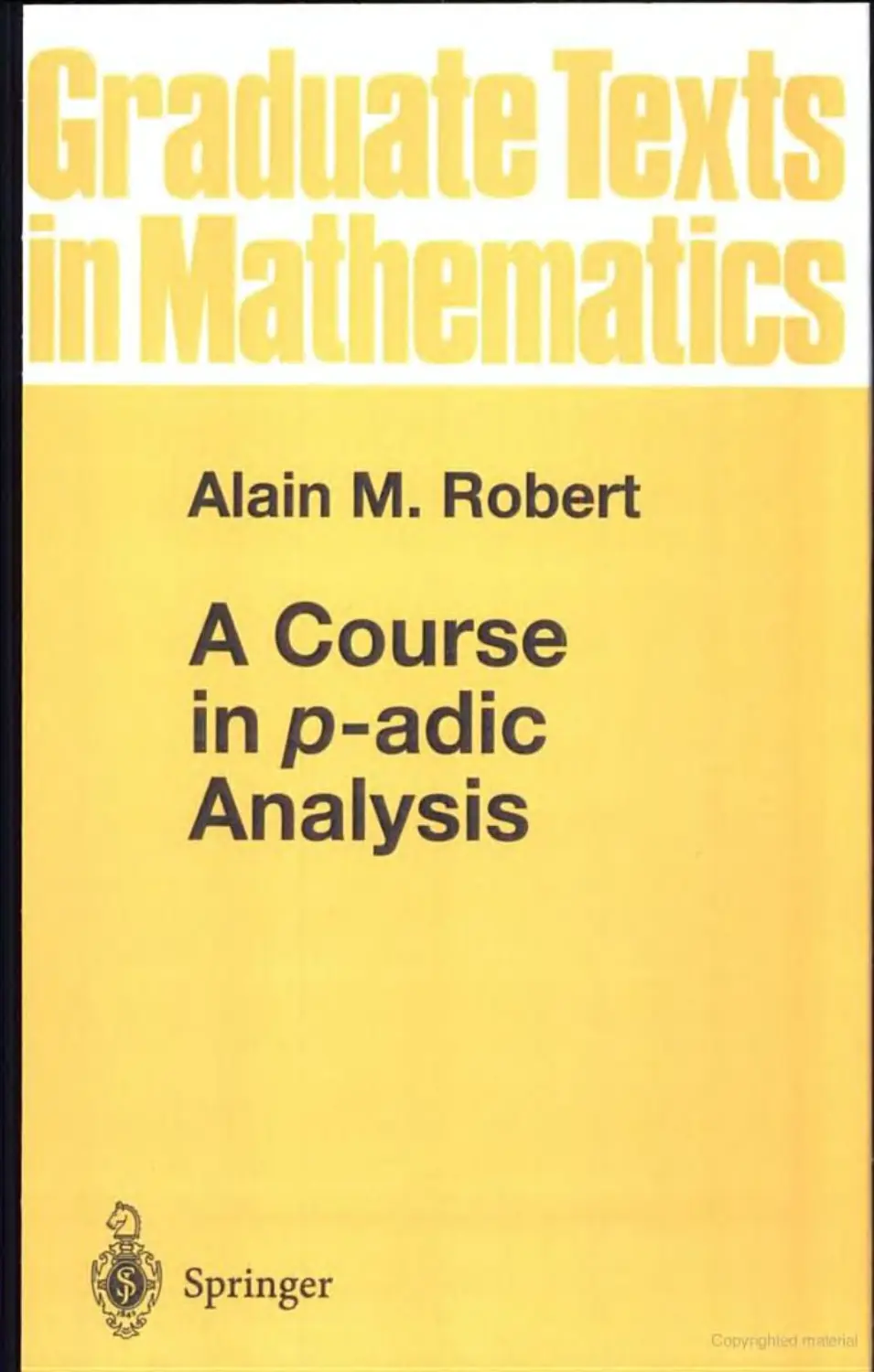


Автор: Robert A.M.
Теги: mathematics mathematical physics mathematical analysis
ISBN: 0-387-98669-3
Год: 2000

Текст
                    Alain M. Robert
A Course
in p-adic
Analysis
Springer

Graduate Texts in Mathematics
198
Editorial Board
S. Axler F.W. Gehring K.A. Ribet
Springer
New York
Berlin
Heidelberg
Barcelona
Hong Kong
London
Milan
Paris
Singapore
Tokyo

Graduate Texts in Mathematics
1 Takeuti/Zaring. Introduction to
Axiomatic Set Theory. 2nd ed.
2 Oxtoby. Measure and Category. 2nd ed.
3 Schaefer. Topological Vector Spaces.
2nd ed.
4 Hiltok/Stammbach. A Course in
Homological Algebra. 2nd ed.
5 Mac Lane. Categories for the Working
Mathematician. 2nd ed.
6 Hughes/Piper. Projective Planes.
7 Serre. A Course in Arithmetic.
8 Takeuti/Zaring. Axiomatic Set Theory.
9 Humphreys. Introduction to Lie Algebras
and Representation Theory.
10 Cohen. A Course in Simple Homotopy
Theory.
11 Conway. Functions of One Complex
Variable 1. 2nd ed.
12 Beals. Advanced Mathematical Analysis.
13 Anderson/Fuller. Rings and Categories
of Modules. 2nd ed.
14 Golubitsky/Guillemin. Stable Mappings
and Their Singularities.
15 Berberlan. Lectures in Functional
Analysis and Operator Theory.
16 Winter. The Structure of Fields.
17 Rosenblatt. Random Processes. 2nd ed.
18 Halmos. Measure Theory.
19 Halmos. A Hilbert Space Problem Book.
2nd ed.
20 Husemoller. Fibre Bundles. 3rd ed.
21 Humphreys. Linear Algebraic Groups.
22 Barnes/Mack. An Algebraic Introduction
to Mathematical Logic.
23 Greub. Linear Algebra. 4th ed.
24 Holmes. Geometric Functional Analysis
and Its Applications.
25 Hewitt/Stromberg. Real and Abstract
Analysis.
26 Maxes. Algebraic Theories.
27 Kelley. General Topology.
28 Zariski/SaMlel. Commutative Algebra.
Vol.1.
29 Zariski/Samuel. Commutative Algebra.
Vol.11.
30 Jacobson. Lectures in Abstract Algebra 1.
Basic Concepts.
31 Jacobson. Lectures in Abstract Algebra 11.
Linear Algebra.
32 Jacobson. Lectures in Abstract Algebra
III. Theory of Fields and Galois Theory.
33 Hirsch. Differential Topology.
34 Spitzer. Principles of Random Walk.
2nd ed.
35 Alexander/Wermer. Several Complex
Variables and Banach Algebras. 3rd ed.
36 Kelley/Namioka et al. Linear Topological
Spaces.
37 Monk. Mathematical Logic.
38 Grauert/Fritzsche. Several Complex
Variables.
39 Arveson. An Invitation to C*-Algebras.
40 Kemeny/Snell/Knapp. Denumerable
Markov Chains. 2nd ed.
41 Apostol. Modular Functions and Dirichlet
Series in Number Theory.
2nd ed.
42 Serre. Linear Representations of Finite
Groups.
43 Gillman/Jerison. Rings of Continuous
Functions.
44 Kendig. Elementary Algebraic Geometry.
45 Loeve. Probability Theory I. 4th ed.
46 Loeve. Probability Theory 11. 4th ed.
47 Moise. Geometric Topology in
Dimensions 2 and 3.
48 Sachs/Wu. General Relativity for
Mathematicians.
49 Gruenberg/Weir. Linear Geometry.
2nd ed.
50 Edwards. Fermafs Last Theorem.
51 Klingenberg. A Course in Differential
Geometry.
52 Hartshorne. Algebraic Geometry.
53 Manin. A Course in Mathematical Logic.
54 Graver/Watkins. Combinatorics with
Emphasis on the Theory of Graphs.
55 Brown/Pearcy. Introduction to Operator
Theory 1: Elements of Functional
Analysis.
56 Massey. Algebraic Topology: An
Introduction.
57 Crowell/Fox. Introduction to Knot
Theory.
58 Koblitz. p-adic Numbers, p-adic Analysis,
and Zeta-Functions. 2nd ed.
59 Lang. Cyclotomic Fields.
60 Arnold. Mathematical Methods in
Classical Mechanics. 2nd ed.
61 Whitehead. Elements of Homotopy
62 Kargapolov/Merlzjakov. Fundamentals
of the Theory of Groups.
63 Bollobas. Graph Theory.
64 Edwards. Fourier Series. Vol. 12nd ed.
65 Wells. Differential Analysis on Complex
Manifolds. 2nd ed.
66 W7aterhouse. Introduction to Affine
Group Schemes.
67 Serre. Local Fields.
68 W'eidmann. Linear Operators in Hilbert
Spaces.
69 Lang. Cyclotomic Fields II.
70 Massey. Singular Homology Theory.
71 Farkas/Kra. Riemann Surfaces. 2nd ed.
(continued after index)

Alain M. Robert
A Course in
p-adic Analysis
With 27 Figures
T

Alain M. Robert
Institut de Mathematiques
Universite de Neuchatel
Rue Emile-Argand 11
Neuchatel CH-2007
Switzerland
Editorial Board
S. Axler
Mathematics Department
San Francisco State
University
San Francisco, CA 94132
USA
Mathematics Subject Classification (2000): 11-01,11E95, llSxx
Library of Congress Cataloging-in-Publication Data
Robert, Alain.
A course in p-adic analysis / Alain M. Robert.
p. cm. — (Graduate texts in mathematics ; 198)
Includes bibliographical references and index.
ISBN 0-387-98669-3 (he.: alk. paper)
1. p-adic analysis. I. Title. II. Series.
QA241,R597 2000
512'.74 — dc21 99-044784
Printed on acid-free paper.
© 2000 Springer-Verlag New York, Inc.
All rights reserved. This work may not be translated or copied in whole or in part without the written
permission of the publisher (Springer-Verlag New York, Inc., 175 Fifth Avenue, New York, NY 10010,
USA), except for brief excerpts in connection with reviews or scholarly analysis. Use in connection
with any form of information storage and retrieval, electronic adaptation, computer software, or by
similar or dissimilar methodology now known or hereafter developed is forbidden.
The use of general descriptive names, trade names, trademarks, etc., in this publication, even if the
former are not especially identified, is not to be taken as a sign that such names, as understood by the
Trade Marks and Merchandise Marks Act, may accordingly be used freely by anyone.
Production managed by Timothy Taylor; manufacturing supervised by Erica Bresler.
Typeset by TechBooks, Fairfax, VA.
Printed and bound by R.R. Donnelley and Sons, Harrisonburg, VA.
Printed in the United States of America.
987654321
ISBN 0-387-98669-3 Springer-Verlag New York Berlin Heidelberg SPIN 10698156
I -H
F.W. Gehring
Mathematics Department
East Hall
University of Michigan
Ann Arbor, MI 48109
USA
CO/
K.A. Ribet
Mathematics Department
University of California
at Berkeley
Berkeley, CA 94720-3840
USA

Preface
Kurt Hensel (1861-1941) discovered or invented the p-adic numbers1 around the
end of the nineteenth century. In spite of their being already one hundred years
old, these numbers are still today enveloped in an aura of mystery within the
scientific community. Although they have penetrated several mathematical fields,
number theory, algebraic geometry, algebraic topology, analysis, ..., they have
yet to reveal their full potential in physics, for example. Several books on p-adic
analysis have recently appeared:
F. Q. Gouvea: p-adic Numbers (elementary approach);
A. Escassut: Analytic Elements in p-adic Analysis, (research level)
(see the references at the end of the book), and we hope that this course will
contribute to clearing away the remaining suspicion surrounding them. This book
is a self-contained presentation of basic p-adic analysis with some arithmetical
applications.
* * *
Our guide is the analogy with classical analysis. In spite of what one may think,
these analogies indeed abound. Even if striking differences immediately appear
between the real field and the p-adic fields, a better understanding reveals strong
common features. We try to stress these similarities and insist on calculus with the
p-adics, letting the mean value theorem play an important role. An obvious reason
for links between real/complex analysis and p-adic analysis is the existence of
!The letter p stands for a fixed prime (chosen in the list 2, 3, 5, 7, 11, ...) except when explicitly
stated otherwise.

vi Preface
an absolute value in both contexts.2 But if the absolute value is Archimedean in
real/complex analysis,
if x ^ 0, for any y there is an integer n such that \nx\ > \y\,
it is non-Archimedean in the second context, namely, it satisfies
\nx\ = \x+x + --- + xt\ < |jc|.
n terms
In particular, \n\ < 1 for all integers n. This implies that for any r > 0 the subset
of elements satisfying |jc| < r is an additive subgroup, even a subring if r = 1.
For such an absolute value, there is (except in a trivial case) exactly one prime
p such that |/71 < l.3 Intuitively, this absolute value plays the role of an order
of magnitude. If x has magnitude greater than 1, one cannot reach it from 0 by
taking a finite number of unit steps (one cannot walk or drive to another galaxy!).
Furthermore, \p\ < 1 implies that \pn | —> 0, and the p-adic theory provides a link
between characteristic 0 and characteristic p.
The absolute value makes it possible to study the convergence of formal power
series, thus providing another unifying concept for analysis. This explains the
important role played by formal power series. They appear early and thereafter
repeatedly in this book, and knowing from experience the feelings that they inspire
in our students, I try to approach them cautiously, as if to tame them.
* * *
Here is a short summary of the contents
Chapter I: Construction of the basic p-adic sets Zp, Qp and Sp,
Chapters II and III: Algebra, construction of Cp and £2P,
Chapters IV, V, and VI: Function theory,
Chapter VII: Arithmetic applications.
I have tried to keep these four parts relatively independent and indicate by an
asterisk in the table of contents the sections that may be skipped in a first reading.
I assume that the readers, (advanced) graduate students, theoretical physicists, and
mathematicians, are familiar with calculus, point set topology (especially metric
spaces, normed spaces), and algebra (linear algebra, ring and field theory). The
first five chapters of the book are based solely on these topics.
The first part can be used for an introductory course: Several definitions of the
basic sets of p-adic numbers are given. The reader can choose a favorite approach!
Generalities on topological algebra are also grouped there.
2Both Newton's method for the determination of real roots of / = 0 and Hensel's lemma in the
p-adic context are applications of the existence of fixed points for contracting maps in a complete
metric space.
3Since the prime p is uniquely determined, this absolute value is also denoted by |. \p. However,
since we use it systematically, and hardly ever consider the Archimedean absolute value, we simply
write |. |.

Preface vii
The second—more algebraic—part starts with a basic discussion of ultrametric
spaces (Section II. 1) and ends (Section III.4) with a discussion of fundamental
inequalities and roots of unity (not needed before the study of the logarithm in
Section V.4). In between, the main objective is the construction of a complete and
algebraically closed field Cp, which plays a role similar to the complex field C
of classical analysis. The reader who is willing to take for granted that the p-adic
absolute value has a unique extension |. |# to every finite algebraic extension K
of Qp can skip the rest of Chapter II: If K and K' are two such extensions, the
restrictions of |. \k and \.\K' to K D Kf agree. This proves that there is a unique
extension of the p-adic absolute value of Qp to the algebraic closure Q* of Qp.
Moreover, if o e Aut(AVQp), then x i-> \xg\k is an absolute value extending
the p-adic one, hence this absolute value coincides with \.\k- This shows that
o is isometric. If one is willing to believe that the completion Qap = Cp is also
algebraically closed, most of Chapter III may be skipped as well.
In the third part, functions of a p-adic variable are examined. In Chapter IV,
continuous functions (and, in particular, locally constant ones) / : Zp -> Cp are
systematically studied, and the theory culminates in van Hamme's generalization
of Mahler's theory. Many results concerning functions of a p-adic variable are
extended from similar results concerning polynomials. For this reason, the algebra of
polynomials plays a central role, and we treat the systems of polynomials—umbral
calculus — in a systematic way. Then differentiability is approached (Chapter V):
Strict differentiability plays the main role. This chapter owes much to the
presentation by W.H. Schikhof: Ultrametric Calculus, an Introduction to p-adic Analysis.
In Chapter VI, a previous acquaintance with complex analysis is desirable, since
the purpose is to give the p-adic analogues of the classical theorems linked to the
names of Weierstrass, Liouville, Picard, Hadamard, Mittag-Leffler, among others.
In the last part (Chapter VII), some familiarity with the classical gamma function
will enable the reader to perceive the similarities between the classical and the p-
adic contexts. Here, a means of unifying many arithmetic congruences in a general
theory is supplied. For example, the Wilson congruence is both generalized and
embedded in analytical properties of the p-adic gamma function and in integrality
properties of the Artin-Hasse power series. I explain several applications of p-adic
analysis to arithmetic congruences.
Let me now indicate one point that deserves more justification. The study of metric
spaces has developed around the classical examples of subsets of R72 (we make
pictures on a sheet of paper or on the blackboard, both models of R2 ), and a famous
treatise in differential geometry even starts with "The nicest example of a metric
space is Euclidean n-space R72." This point of view is so widely shared that one
may be led to think that ultrametric spaces are not genuine metric spaces! Thus the
commonly used notation for metric spaces has grown on the paradigmatic model
of subsets of Euclidean spaces. For example, the "closed ball" of radius r and
center a — defined by d(x, a) < r — is often denoted by B(a: r) or Br(a). This
notation comforts the belief that it is the closure of the "open ball" having the same

viii Preface
radius and center. If the specialists have no trouble with the usual terminology and
notation (and may defend it on historical grounds), our students lose no opportunity
to insist on its misleading meaning. In an ultrametric space all balls of positive
radius (whether defined by d(x, a) < r or by d(x, a) < r) are both open and
closed. They are clopen sets. Also note that in an ultrametric space, any point of
a ball is a center of this ball. The systematic appearance of totally disconnected
spaces in the context of fractals also calls for a renewed view of metric spaces. I
propose using a more suggestive notation,
B<r(a) = {x : d(x, a) < r}, BSr(a) = {jc : d(x, a) < r]
which has at least the advantage of clarity. In this way I can keep the notation
A strictly for the closure of a subset A of a topological space X. The algebraic
closure of a field K is denoted by Ka.
* * *
Finally, let me thank all the people who helped me during the preparation of this
book, read preliminary versions, or corrected mistakes. I would like to mention
especially the anonymous referee who noted many mistakes in my first draft,
suggested invaluable improvements and exercises; W.H. Schikhof, who helped
me to correct many inaccuracies; and A. Gertsch Hamadene, who proofread the
whole manuscript. I also received encouragement and help from many friends and
collaborators. Among them, it is a pleasure for me to thank
D. Barsky, G. Christol, B. Diarra, A. Escassut, S. Guillod-Griener,
A. Junod, V. Schiirch, C. Vonlanthen, M. Zuber.
My wife, Ann, also checked my English and removed many errors.
Cross-references are given by number: (II.3.4) refers to Section (3.4) of Chapter
II. Within Chapter II we omit the mention of the chapter, and we simply refer
to (3.4). Within a section, lemmas, propositions, and theorems are individually
numbered only if several of the same type appear. I have not attempted to track
historical priorities and attach names to some results only for convenience. General
assumptions are repeated at the head of chapters (or sections) where they are in
force.
Figures I.2.5a, 1.2.5c, I.2.5d, and 1.2.6 are reproduced here (some with minor
modifications) with written permission from Marcel Dekker. They first appeared in
my contribution to the Proceedings of the 4th International Conference on p-adic
Functional Analysis (listed in the References).
Alain M. Robert
Neuchatel, Switzerland, July 1999

Contents
Preface v
1 p-adic Numbers 1
1. The Ring Zp of p-adic Integers 1
1.1 Definition 1
1.2 Addition of p-adic Integers 2
1.3 The Ring of p-adic Integers 3
1.4 The Order of a p-adic Integer 4
1.5 Reduction mod p 5
1.6 The Ring of p-adic Integers is a Principal Ideal Domain . ... 6
2. The Compact Space Zp 7
2.1 Product Topology on Zp 7
2.2 The Cantor Set 8
2.3 Linear Models of Zp 9
2.4 Free Monoids and Balls of Zp 11
*2.5 Euclidean Models 12
*2.6 An Exotic Example 16
3. Topological Algebra 17
3.1 Topological Groups 17
3.2 Closed Subgroups of Topological Groups 19
3.3 Quotients of Topological Groups 20
3.4 Closed Subgroups of the Additive Real Line 22
3.5 Closed Subgroups of the Additive Group of p-adic Integers . . 23
3.6 Topological Rings 24
3.7 Topological Fields, Valued Fields 25

x Contents
4. Projective Limits 26
4.1 Introduction 26
4.2 Definition 28
4.3 Existence 28
4.4 Projective Limits of Topological Spaces 30
4.5 Projective Limits of Topological Groups 31
4.6 Projective Limits of Topological Rings 32
4.7 Back to the p-adic Integers 33
*4.8 Formal Power Series and p-adic Integers 34
5. The Field Qp of p-adic Numbers 36
5.1 The Fraction Field of Zp 36
5.2 Ultrametric Structure on Qp 37
*5.3 Characterization of Rational Numbers Among
p-adic Ones 39
5.4 Fractional and Integral Parts of p-adic Numbers 40
5.5 Additive Structure of Qp and Zp 43
*5.6 Euclidean Models of Qp 44
6. Hensel's Philosophy 45
6.1 First Principle 45
6.2 Algebraic Preliminaries 46
6.3 Second Principle 46
6.4 The Newtonian Algorithm 47
6.5 First Application: Invertible Elements in Zp 49
6.6 Second Application: Square Roots in Qp 49
6.7 Third Application: nth Roots of Unity in Zp 51
Table: Units, Squares, Roots of Unity 53
*6.8 Fourth Application: Field Automorphisms of Qp 53
Appendix to Chapter I: The p-adic Solenoid 54
*A.l Definition and First Properties 55
*A.2 Torsion of the Solenoid 55
*A.3 Embeddingsof Rand Qp in the Solenoid 56
*A.4 The Solenoid as a Quotient 57
*A.5 Closed Subgroups of the Solenoid 60
*A.6 Topological Properties of the Solenoid 61
Exercises for Chapter I 63
2 Finite Extensions of the Field of p-adic Numbers 69
1. Ultrametric Spaces 69
1.1 Ultrametric Distances 69
Table: Properties of Ultrametric Distances 73
1.2 Ultrametric Principles in Abelian Groups 73
Table: Basic Principles of Ultrametric Analysis 77
L3 Absolute Values on Fields 77
1.4 Ultrametric Fields: The Representation Theorem 79
1.5 General Form of Hensel's Lemma 80

Contents xi
1.6 Characterization of Ultrametric Absolute Values 82
1.7 Equivalent Absolute Values 83
2. Absolute Values on the Field Q 85
*2.1 Ultrametric Absolute Values on Q 85
*2.2 Generalized Absolute Values 86
*2.3 Ultrametric Among Generalized Absolute Values 88
*2.4 Generalized Absolute Values on the Rational Field 88
3. Finite-Dimensional Vector Spaces 90
3.1 Normed Spaces over Qp 90
3.2 Locally Compact Vector Spaces over Qp 93
3.3 Uniqueness of Extension of Absolute Values 94
3.4 Existence of Extension of Absolute Values 95
3.5 Locally Compact Ultrametric Fields 96
4. Structure of p-adic Fields 97
4.1 Degree and Residue Degree 97
4.2 Totally Ramified Extensions 101
4.3 Roots of Unity and Unramified Extensions 104
4.4 Ramification and Roots of Unity 107
*4.5 Example 1: The Field of Gaussian 2-adic Numbers Ill
*4.6 Example 2: The Hexagonal Field of 3-adic Numbers 112
*4.7 Example 3: A Composite of Totally Ramified Extensions ... 114
Appendix to Chapter II: Classification of Locally Compact Fields ... 115
*A.l Haar Measures 115
*A.2 Continuity of the Modulus 116
*A.3 Closed Balls are Compact 116
*A.4 The Modulus is a Strict Homomorphism 118
*A.5 Classification 118
*A.6 Finite-Dimensional Topological Vector Spaces 119
*A.7 Locally Compact Vector Spaces Revisited 121
*A.8 Final Comments on Regularity of Haar Measures 122
Exercises for Chapter II 123
3 Construction of Universal p-adic Fields 127
1. The Algebraic Closure Qap of Qp 127
1.1 Extension of the Absolute Value 127
12 Maximal Unramified Subextension 128
1.3 Ramified Extensions 129
1-4 The Algebraic Closure Q* is not Complete 129
1 -5 Krasner's Lemma 130
*1.6 A Finiteness Result 132
* 1 -7 Structure of Totally and Tamely Ramified Extensions 133
2- Definition of a Universal p-adic Field 134
2.1 More Results on Ultrametric Fields 134
2.2 Construction of a Universal Field £2p 137
2.3 The Field £2p is Algebraically Closed 138

2.4 Spherically Complete Ultrametric Spaces 139
2.5 The Field £2p is Spherically Complete 140
3. The Completion Cp of the Field Qap 140
3.1 Definition of Cp 140
3.2 Finite-Dimensional Vector Spaces over a Complete
Ultrametric Field 141
3.3 The Completion is Algebraically Closed 143
*3.4 The Field Cp is not Spherically Complete 143
*3.5 The Field Cp is Isomorphic to the Complex Field C 144
Table: Notation 145
4. Multiplicative Structure of Cp 146
4.1 Choice of Representatives for the Absolute Value 146
4.2 Roots of Unity 147
4.3 Fundamental Inequalities 148
4.4 Splitting by Roots of Unity of Order Prime top 150
4.5 Divisibility of the Group of Units Congruent to 1 151
Appendix to Chapter III: Filters and Ultrafilters 152
A.1 Definition and First Properties 152
A.2 Ultrafilters 153
A.3 Convergence and Compactness 154
*A.4 Circular Filters 156
Exercises for Chapter III 156
4 Continuous Functions on Zp 160
1. Functions of an Integer Variable 160
1.1 Integer-Valued Functions on the Natural Integers 160
1.2 Integer-Valued Polynomial Functions 163
1.3 Periodic Functions Taking Values in a Field
of Characteristic p 164
1.4 Convolution of Functions of an Integer Variable 166
1.5 Indefinite Sum of Functions of an Integer Variable 167
2. Continuous Functions on Zp 170
2.1 Review of Some Classical Results 170
2.2 Examples of p-adic Continuous Functions on Zp 172
2.3 Mahler Series 172
2.4 The Mahler Theorem 173
2.5 Convolution of Continuous Functions on Zp 175
3. Locally Constant Functions on Zp 178
*3.1 Review of General Properties 178
*3.2 Characteristic Functions of Balls of Zp 179
*3.3 The van der Put Theorem 182
4. Ultrametric Banach Spaces 183
4.1 Direct Sums of Banach Spaces 183
4.2 Normal Bases 186
4.3 Reduction of a Banach Space 189
4.4 A Representation Theorem 190

4.5 The Monna-Fleischer Theorem 190
*4.6 Spaces of Linear Maps 192
*4.7 The p-adic Hahn-Banach Theorem 194
5. Umbral Calculus 195
5.1 Delta Operators 195
5.2 The Basic System of Polynomials of a Delta Operator 197
5.3 Composition Operators 198
5.4 The van Hamme Theorem 201
5.5 The Translation Principle 204
Table: Umbral Calculus 207
6. Generating Functions 207
6.1 Sheffer Sequences 207
6.2 Generating Functions 209
6.3 The Bell Polynomials 211
Exercises for Chapter IV 212
5 Differentiation 217
1. Differentiability 217
1.1 Strict Differentiability 217
*1.2 Granulations 221
1.3 Second-Order Differentiability 222
*1.4 Limited Expansions of the Second Order 224
1.5 Differentiability of Mahler Series 226
1.6 Strict Differentiability of Mahler Series 232
2. Restricted Formal Power Series 233
2.1 A Completion of the Polynomial Algebra 233
2.2 Numerical Evaluation of Products 235
2.3 Equicontinuity of Restricted Formal Power Series 236
2.4 Differentiability of Power Series 238
2.5 Vector-Valued Restricted Series 240
3. The Mean Value Theorem 241
3.1 The p-adic Valuation of a Factorial 241
3.2 First Form of the Theorem 242
3.3 Application to Classical Estimates 245
3.4 Second Form of the Theorem 247
3.5 A Fixed-Point Theorem 248
*3.6 Second-Order Estimates 249
4. The Exponentiel and Logarithm 251
4.1 Convergence of the Defining Series 251
4.2 Properties of the Exponential and Logarithm 252
4.3 Derivative of the Exponential and Logarithm 257
4.4 Continuation of the Exponential 258
4.5 Continuation of the Logarithm 259
5. The Volkenborn Integral 263
5.1 Definition via Riemann Sums 263
5.2 Computation via Mahler Series 265

xiv Contents
5.3 Integrals and Shift 266
5.4 Relation to Bernoulli Numbers 269
5.5 Sums of Powers 272
5.6 Bernoulli Polynomials as an Appell System 275
Exercises for Chapter V 276
6 Analytic Functions and Elements 280
1. Power Series 280
1.1 Formal Power Series 280
1.2 Convergent Power Series 283
1.3 Formal Substitutions 286
1.4 The Growth Modulus 290
1.5 Substitution of Convergent Power Series 294
1.6 The valuation Polygon and its Dual 297
1.7 Laurent Series 303
2. Zeros of Power Series 305
2.1 Finiteness of Zeros on Spheres 305
2.2 Existence of Zeros 307
2.3 Entire Functions 313
2.4 Rolle's Theorem 315
2.5 The Maximum Principle 317
2.6 Extension to Laurent Series 318
3. Rational Functions 321
3.1 Linear Fractional Transformations 321
3.2 Rational Functions 323
3.3 The Growth Modulus for Rational Functions 326
*3.4 Rational Mittag-Leffler Decompositions 330
*3.5 Rational Motzkin Factorizations 333
*3.6 Multiplicative Norms on K(X) 337
4. Analytic Elements 339
*4.1 Enveloping Balls and Infraconnected Sets 339
*4.2 Analytic Elements 342
*4.3 Back to the Tate Algebra 344
*4.4 The Amice-Fresnel Theorem 347
*4.5 The p-adic Mittag-Leffler Theorem 348
*4.6 The Christol-Robba Theorem 350
Table: Analytic Elements 354
*4.7 Analyticity of Mahler Series 354
*4.8 The Motzkin Theorem 357
Exercises for Chapter VI 359
7 Special Functions, Congruences 366
1. The Gamma Function Fp 366
1.1 Definition 367
1.2 Basic Properties 368

Contents xv
1.3 The Gauss Multiplication Formula 371
1.4 The Mahler Expansion 374
1.5 The Power Series Expansion of log rp 375
*1.6 The Kazandzidis Congruences 380
*1.7 About T2 382
2. The Artin-Hasse Exponential 385
2.1 Definition and Basic Properties 386
2.2 Integrality of the Artin-Hasse Exponential 388
2.3 The Dieudonne-Dwork Criterion 391
2.4 The Dwork Exponential 393
*2.5 Gauss Sums 397
*2.6 The Gross-Koblitz Formula 401
3. The Hazewinkel Theorem and Honda Congruences 403
3.1 Additive Version of the Dieudonne-Dwork Quotient 403
3.2 The Hazewinkel Maps 404
3.3 The Hazewinkel Theorem 408
3.4 Applications to Classical Sequences 410
3.5 Applications to Legendre Polynomials 411
3.6 Applications to Appell Systems of Polynomials 412
Exercises for Chapter VII 414
Specific References for the Text 419
Bibliography 423
Tables 425
Basic Principles of Ultrametric Analysis 429
Conventions, Notation, Terminology 431
Index 435

1
p-adic Numbers
The letter p will denote a fixed prime.
The aim of this chapter is the construction of the compact topological ring Zp
of p-adic integers and of its quotient field Qp, the locally compact field of p-adic
numbers. This gives us an opportunity to develop a few concepts in topological
algebra, namely the structures mixing algebra and topology in a coherent way.
Two tools play an essential role from the start:
• the p-adic absolute value |. \p = |. | or its additive version, the p-adic valuation
onlp == vp,
• reduction mod p.
1. The Ring Zp of /?-adic Integers
We start by a down-to-earth definition of p-adic integers: Other equivalent
presentations for them appear below, in (4.7) and (4.8).
1.1. Definition
A p-adic integer is a formal series £]l>0 ai Pl w*tn integral coefficients a, satisfying
0 < fl,- < p - 1.
With this definition, a p-adic integer a = J2i^oaiPl can ^e identified with the
sequence (aj^o of its coefficients, and the set of p-adic integers coincides with

2 1. p-adic Numbers
the Cartesian product
X = XP= f]{0, 1,..., p - 1} = {0, 1,..., p - 1}N.
In particular, if a = £,.>0 a,- p\b = J],>o ^ P* (with a*, &/ e {0, 1,..., p - 1})
we have
a = b <=> at = fy for all i > 0.
The usefulness of the series representation will be revealed when we introduce
algebraic operations on these p-adic integers. Let us already observe that the
expansions in base p of natural integers produce p-adic integers (ending with zero
coefficients: Finite series are special series), and we obtain a canonical embedding
of the set of natural integers N = {0, 1,2,...} into X.
From the definition, we immediately infer that the set of p-adic integers is not
countable. Indeed, if we take any sequence of p-adic integers, say
a = ^Oip\ b = ^btp\ c = ^dp\ ...,
i>0 i>0 *>0
we can define a p-adic integer x = X^>o X*P' by choosing
thus constructing a p-adic integer different from a, b, c, This shows that the
sequence a, b, c,... does not exhaust the set of p-adic integers. A mapping from
the set of natural integers N to the set of p-adic integers is never surjective.
1.2. Addition of p-adic Integers
Let us define the sum of two p-adic integers a and b by the following procedure.
The first component of the sum is oq + bo if this is less than or equal to p — 1, or
ao + bo — p otherwise. In the second case, we add a carry to the component of
p and proceed by addition of the next components. In this way we obtain a series
for the sum that has components in the desired range. More succinctly, we can say
that addition is defined componentwise, using the system of carries to keep them
in the range {0, 1,..., p — 1}.
An example will show how to proceed. Let
a= 1 = l+0p + 0p2 + ---,
b = (p - 1) + (p - 1 )p + (p - l)p2 + - - ■ -
The sum a + b has a first component 0, since 1 + (p — 1) = p. But we have to
remember that a carry has to be taken into account for the next component. Hence
this next component is also 0, and another carry has to be accounted for in the
next place, etc. Eventually, we find that all components vanish, and the result is

1. The Ring 7*p of p-adic Integers 3
1 _f b = 0, namely b is an additive inverse of the integer a = 1 (in the set of p-adic
integers), and for this reason written b — — 1. More generally, if
*>o
we define
b = cr(a) = £](p - 1 - a{)pl
so that a + b +\ = 0. This is best summarized by a + cr(a) 4- 1 = 0 or even
cr(a) + 1 — —a. In particular, all natural integers have an additive inverse in the
set of p-adic integers. It is now obvious that the set X of p-adic integers with the
precedingly defined addition is an abelian group. The embedding of the monoid
N in X extends to an injective homomorphism Z -> X. Negative integers have
the form —m — 1 = o(m) with all but finitely many components equal to p — 1.
Considering that the rational integers are p-adic integers, from now on we shall
denote by Zp the group of p-adic integers. (Another natural reason for this notation
will appear in (3.6).) The mapping a : Zp -> Zp obviously satisfies
id and is therefore an involution on the set of p-adic integers. When p is odd, this
involution has a fixed point, namely the element a = J2oo ^T~Pl e ^p-
13. The Ring of p-adic Integers
Let us define the product of two p-adic integers by multiplying their expansions
componentwise, using the system of carries to keep these components in the desired
range {0, l,...,p- 1}.
This multiplication is defined in such a way that it extends the usual
multiplication of natural integers (written in base p). The usual algorithm is simply pursued
indefinitely. Again, a couple of examples will explain the procedure. We have
found that -1 = £(p - l)pf. Now we write
_l=(/7_l).£y, -(p-l)J>' = 1'
Hence 1 — p is invertible in Zp with inverse given as a formal geometric series of
ratio p. Since
P - Ylaipi = ^P + ai?2 + '" * ^ l + °P + °P2 + ' *''
i>0
the prime p is not invertible in Zp for multiplication. Using multiplication, we can
also write the additive inverse of a natural number in the form
_w = (_l).m = ^(p_ l)p' -^Tmip1,

4 1. p-adic Numbers
but it is not so easy to deduce the coefficients of — m from this relation. Together
with addition and multiplication, Zp is a commutative ring. When p is odd, the
fixed element under the involution o is
2 P 2 ^P 2 1 — d 2'
but 2 is not an invertible element of Z2, — \ & Z2, and the involution cr = 02 has
no fixed point in Z2.
7.4. 77ze Order of a p-adic Integer
Let a = X^o at Pl be a p-cidic integer If a ^ 0, there is a first index v = v(a) > 0
such that ciy ^ 0. 77h.s zrufex is the p-adic order v = v(a) = ordp(a), And we get
a map
v = ordp : Zp - {0} -* N.
This terminology comes from a formal analogy between the ring of p-adic integers
and the ring of holomorphic functions of a complex variable z e C. If/is a nonzero
holomorphic function in a neighborhood of a point a e C, we can write its Taylor
series near this point
f(z) = Yla»(z -a)"' (a™ * a |z-a| < £)-
The index m of the first nonzero coefficient is by definition the order (of vanishing)
of / at a: this order is 0 if f(a) ^ 0 and is positive if / vanishes at a.
Proposition. The ring 7Lp of p-adic integers is an integral domain.
Proof. The commutative ring Zp is not {0}, and we have to show that it has no
zero divisor. Let therefore a = J2i>oatPl ^ ^, b = J2i>o^iPl ^ 0> anc* define
v = v(a), w = v(b). Then av is thelirst nonzero coefficient of a, 0 < av < p, and
similarly Z?^ is the first nonzero coefficient of b. In particular, p divides neither av
nor bw and consequently does not divide their product avbw either. By definition
of multiplication, the first nonzero coefficient of the product ab is the coefficient
cv+w of pv+w, and this coefficient is defined by
0 < cv+w < p, cv+w = avbw (mod p). ■
Corollary of proof. The order v : Zp — {0} -> N satisfies
v(ab) = v(a) + v(b),
v(a + b)> min(f(a), v(b))
if a, b, and a+b are not zero.
■

1. The Ring Zp of p-adic Integers 5
It is convenient to extend the definition of the order by v(0) = oc so that
the preceding relations are satisfied without restriction on Zp, with the natural
conventions concerning the symbol oc. The p-adic order is then a mapping Zp ->
N U {oc} having the two above-listed properties.
1.5. Reduction mod p
Let Fp = Z/pZ be the finite field with p elements. The mapping
a = //\aiPl ^ flo mod p
defines a ring homomorphism s : Zp —> Fp called reduction mod p. This reduction
homomorphism is obviously surjective, with kernel
{aeZp:a0 = 0} = {E^i^-p1 = pE^ofly+ip'] = P%p-
Since the quotient is a field, the kernel pZp of e is a maximal ideal of the ring
Zp. A comment about the notation used here has to be made in order to avoid a
paradoxical view of the situation: Far from being p times bigger than Zp, the set
pZp is a subgroup of index p in Zp (just as pZ is a subgroup of index p in Z).
Proposition. The group Z* of invertible elements in the ring Zp consists of the
p-adic integers of order zero, namely
Z* = £>p': «o 5* 0}.
Proof. If a /7-adic integer a is invertible, so must be its reduction e{a) in Fp. This
proves the inclusion Z£ c {J2i>oaiPl : ao ^ 0}. Conversely, we have to show
that any p-adic integer a of order v(a) = 0 is invertible. In this case the reduction
£(a) e Fp is not zero, and hence is invertible in this field. Choose 0 < bo < p
with aob0 ~ 1 mod p and write aob0 = 1 + kp. Hence, if we write a =aG-\- pa,
then
a-bo= l+kp+ pabo = 1+ p*
for some p-adic integer k. It suffices to show that the p-adic integer 1 + Kp is
invertible, since we can then write
a ■ fco(l + KP)~l = 1, a"1 = fco(l + kP)~\
In other words, it is enough to treat the case ao = 1, a = 1 + Kp. Let us observe
that we can take
(1 + KP)~l = 1 - Kp + (^P)2 = 1 + Cip + C2p2 + - - •
with integers c, e {0, 1,..., p - 1}. This possibility is assured if we apply the
rules for carries suitably. Such a procedure is cumbersome to detail any further, and

6 1. p-adic Numbers
another, equivalent, definition of the ring Zp will be given in (4.7) below, making
such verifications easier to handle. ■
Corollary 1. The ring Zp of p-adic integers has a unique maximal ideal, namely
pZp —Zp ~Z*. ■
The statement of the preceding corollary corresponds to a partition Zp = Z£ U
pZp (a disjoint union). In fact, one has a partition
Zp - {0} = \\ P*Zp (disjoint union of p*Z* = v~l(k)).
Corollary 2. Every nonzero p-adic integer a e Zp has a canonical
representation a = pvu, where v = v(a) is the p-adic order of a andu e Z* is a p-adic
unit. ■
Corollary 3. The rational integers a e Z that are invertible in the ring Zp are
the integers prime to p. The quotients of integers m/n e Q (n ^ 0) that are
p~adic integers are those that have a denominator n prime to p. ■
1.6. The Ring of p-adic Integers is a Principal Ideal Domain
The principal ideals of the ring Zp,
(/) = pkZp = {xeZp: ordp(x) > /:},
have an intersection equal to {0}:
Zp D pZp D ... D pkZp D ■■■ D f]pkZp = {0}.
Indeed, any element a J= 0 has an order v(a) = k, hence a g (pk+1). In fact, these
principal ideals are the only nonzero ideals of the ring of p-adic integers.
Proposition. The ring Zp is a principal ideal domain. More precisely, its ideals
are the principal ideals {0} and pkZp {k 6 N).
Proof. Let / ^ {0} be a nonzero ideal of Zp and 0 ^ a e / an element of minimal
order, say k = v(a) < oo. Write a = pku with a p-adic unit u. Hence pk —
u~la el and (pk) = pkZp c /- Conversely, for any b e / let w = v(b) > A and
write
This shows that / C pkZp.
■

2. The Compact Space Zp 7
2. The Compact Space Zp
2.1. Product Topology on Zp
The Cartesian product spaces
Xp = f](0, 1, 2, - - -, p - 1} = {0, 1. 2,..., p - 1 }N
i">0
will now be considered as topological spaces, with respect to the product topology
of the finite discrete sets {0, 1,2,..., p — 1}. These basic spaces will be studied
presently, and we shall give natural models for them (they are homeomorphic for
all p). By the Tychonoff theorem, Xp is compact. It is also totally disconnected:
The connected components are points.
Let us recall that the discrete topology can be defined by a metric
fl ifa^b,
*(a,b)= \ ^
I 0 if a = b,
or, using the Kronecker symbol, 8(a, b) = 1 — 8ab. Several metrics compatible
with the product topology on Xp can be deduced from these discrete ones. For
x = (a0, ax,...), y = (Z?0, bu ...) e Xp, we can define
d(x, y) = sup :— = ,
,->o Pl Pv(x~y)
d (x, y) = > nrj-> an(i so on-
Although all metrics on a compact metrizable space are uniformly equivalent, they
are not all equally interesting! For example, we favor metrics that give a faithful
image of the coset structure of Zp: For each integer k e N, all cosets of pkZp in
Zp should be isometric (and in particular have the same diameter).
The padic metric is the first mentioned above. Unless specified otherwise, we
use it and introduce the notation
ti \d(Xj0) = p-v ifx^0(v^ ovdp(x))9
\x = 1
[0 ifx = 0
(absolute values will be studied systematically in Chapter H). We recover the
P-adic metric from this absolute value by d(x, y) = \x — y\. With this metric,
multiplication by p in Zp is a contracting map
d(px,py)= jd(x,y)
and hence is continuous.

8 1. p-adic Numbers
22. The Cantor Set
In point set topology the Cantor set plays an important role. Let us recall its
construction. From the unit interval Co = / = [0,1] one deletes the open middle
third. There remains a compact set
Ci=[0,f]U[f, 1].
Deleting again the open middle third of each of the remaining intervals, we obtain
a smaller compact set
C2-[0,|JU[|,|]U[|, 2]U[|, 1].
Iterating the process, we get a decreasing sequence of nested compact subsets of
the unit interval. By definition, the Cantor set C is the intersection of all Cn.
remove
[1/3 2/3"
The Cantor set
It is a nonempty compact subset of the unit interval / = [0,1]. The Cantor
diagonal process (see 1.1) also shows that this compact set is not countable. If we
temporarily adopt a system of numeration in base 3 —hence with digits 0,1, and
2 — the removal of the first middle third amounts to deleting numbers having first
digit equal to 1 (keeping first digits 0 and 2). Removing the second, smaller, middle
intervals amounts to removing numbers having second digit equal to 1, and so on.
Finally, we see that the Cantor set C consists precisely of the numbers 0 < a < 1
that admit an expansion in base 3:
0.«ia2 - - ■ = — + ^ + """
with digits at = 0 or 2. We obtain these expansions by doubling the elements of
arbitrary binary sequences. This leads to considering the bijection
+■■?:«*»i:w' z^c-
*>o />o
The definition of the product topology shows that this mapping is continuous, and
hence is a homeomorphism, since the spaces in question are compact.

2. The Compact Space Zp 9
Binary sequences can also be considered as representing expansions in base 2
of elements in the unit interval. This leads to a surjective mapping
*">o
i>0
This map is surjective and continuous but is not injective: The numbers J2i>j 2'
and 2j e Z2 have the same image in [0, 1], as is immediately seen (in the decimal
system, a decimal expansion having only 9's after place j can be replaced by a
decimal expansion with a single 1 in place j). In fact, Card <p~l(t) < 2 for any
t e [0,1].
We can summarize the situation by a commutative diagram of maps
f-.Ts!^ C C [0, 1]
II i / g
<p : Z2 -> [0, 1]
The function g identifies contiguous extremities of the Cantor set C and sends
them onto points of the interval having two binary expansions (rational numbers
of the form a/2j). These constructions will now be generalized.
0 1/9 2/9 1/3
WW
\\ \ 1
2/3
1
/ //
/ //
\
< *
u
0 1/8 1/4 1/2 3/4 1
Gluing the extremities of the Cantor set
2.3. Linear Models ofZp
We choose a real number b > 1 and use it as numeration base in the unit interval
[0, 1]. In other words, we try to write real numbers in this interval in the form
ao/b + ai/b2 -\ with integral digits 0 < a, < b. More precisely, fix the prime
p and consider the maps f = fb (= fb,p) : Zp -> [0, 1] defined by the infinite
series in R
* IE-')-»■££;■
W>0
/>0
with a normalizing constant # chosen so that the maximum of \J/ is 1. Since
this maximum is attained when all digits 0, are maximal, it is attained at

10 1. p-adic Numbers
— 1 = J2t>o(P — l)pl 6 Zp, and its image must be 1:
Ep - 1 b~x /7—1
. A bl+l F }\-b~x b-\
namely
b~\
■d =
1
For p = 2 and Z? = 3 we find that # = 2, and we recover the special case studied
in the preceding section, where \J/ furnished a homeomorphism Z2 -> C C [0, 1].
In general, \J/ ~ \J/b will be injective if the p-adic integers
£(p-l)p'andp'eZp
have distinct images in [0, 1]. The first image is
# - (P - !)£ l/*f"+1 = #(/> - 1)^"V(1 - &"1)
= $b-]-\p - 1)/(Z? - 1) = b~j~l.
The second image is # - Z?~i_1. The injectivity condition is thus & > 1, or b > p.
Let us summarize.
Theorem. The maps \J/b (= fa,p) : Zp —> [0, 1] defined for b > 1 by
\i>0 / f x i>0 "
are continuous. When b > p, fa is injective and defines a homeomorphism of
Zp onto its image fa(Zp). When b = p, we get a surjective map tJsp which is
not injective. ■
The commutative diagram given in the last section generalizes immediately to
our present context.
Comment. When b > p, fa gives a linear model of Zp in the interval [0, 1]; the
image is a fractal subset A of this interval. The self-similarity dimension d of such
a set is "defined" by means of a dilatation producing a union of copies of translates
of A. If we denote by E(A) an intuitive — not formally defined — notion ofextent
of A and if kA is a union of m translates of A, this self-similarity dimension d
satisfies
mE(A) = E(kA) = kdE(A),

2. The Compact Space Zp 11
and hence d - log X = logm and d = log m/ log A. In our case, take A = /> so
that m = /7 and the self-similarity dimension of A = \lrb(Zp) in [0, 1] C R is
log pi log Z? < 1. In this way we obtain a continuous family of fractal models of
increasing dimension for b \ p degenerating in the limit to a connected interval.
It may be useful to look at symmetric models obtained by replacing the digits
dj e {0,1,2,..., p — 1} by symmetric ones in {—^—-,..., ^^-}. Define
v(k) = k- ^— (0<k<p-l).
We can choose the normalization constant & of the map
in order to have
min^-' = —1. max^-' = +1.
(When p = 2, v(£) = (—1)*+1| = ±|, and the corresponding expansion has
fractional digits.) The involution o induces a change of sign in the image. When
p ^ 2 it has the origin as fixed point. Here is a picture of centered linear models
ofZ3 whenZ? \ 3.
• ii ■ i i
■ ■■ ■! •
• ■! ii i
i y i 1 i !
• ii ii i
i ii ii i
• ii it i
i i i . i i y
-1 -1/2 -1/4 0 1/4 1/2 1
A centered linear model of Z3
2.4. Free Monoids and Balls ofZp
Let B<r(a) denote the ball defined by d(x, a) = \x — a\ < r in Zp. It is clear that
this ball does not change if we replace its radius r by the smallest power p~n that is
greater than or equal tor. If the p-adic expansion of a is ao+aip-i [-anpn-i =
sn + pn+xa, the ball does not change either if we replace its center by sn. This ball
is fully determined by the sequence of digits (of variable length giving the radius)
ao> &i, >,an, and we associate to it the word
ao«i •cin e Mp
m the free monoid generated by S = {0, 1, ..., p - 1}.
Conversely, to each (finite) word in the elements of 5 — say a$a\ -an — we
associate the ball of center a = a0 + axp + - - ■ + anpn and radius r = p~n. We
get m this way a bijective map between Mp and the set of balls of Zp\ Observe
that a ball BSr(a) defined by d(x, a) < r is the same as a ball B<r(a) for some
r' >r.

12 1. p-adic Numbers
The monoid Mp has several matrix representations
Mp -> Gl„(Zp).
For example, when n = 2, we can take
-U
s,-*T' = \n .) (seS={0,l,...,p-l}).
Indeed,
TV
and more generally,
™-(s t)(s t)-(» "**)•
Ia0Ial " a« ~ I 0 1 /
Observe that in this representation the length of a word corresponds to the order of
the determinant of the matrix. In terms of balls, the radius appears as the absolute
value of the determinant, whereas a center of the ball is read in the upper right-hand
corner of the matrix. With the preceding notation
B^r(a) = B<r(sn) ^¥,-.fl„(E^)<-> ^0+1 sj\ .
Euclidean models of the ring of p-adic integers will be obtained in the next section
by means of injective representations
Mp -> G1„(R).
Since Mp is free, such representations are completely determined by the images
of the generators, namely by p matrices Mo,..., Mp^\.
2.5. Euclidean Models
Let V be a Euclidean space, namely a finite-dimensional inner product space over
the field R of real numbers. Select an injective map
v : S = {0, 1, 2,..., p - 1} -* V, v(S) = E C V,
and define the vector mappings (using vector digits)
v(a()
;>o i>o
Since Zp — LL0<E5(<3o + pZ*P), we have
;>o i>o °

2. The Compact Space Zp 13
For large enough values of b, the image F = Fv%b = ^fv^Lp will also be a disjoint
union of self-similar images. In this way we get a construction of spatial models
4>(ZP) by iteration (similar to the construction of the Cantor set as an intersection
of compact sets). ^
More explicitfy, let us denote by E the convex hull of E in V. As is known,
this is the intersection of all half spaces containing E. It is also the intersection
of those half spaces containing £ and having for boundary a hyperplane touching
the configuration. Let X be an affine linear functional on V such that
A < 1 on E, X(v) = 1 for some v e E.
Choose & = b — 1. Then
\ i>0 / i>0 U
so that the image F of ^ is also contained in the convex hull of E: F C E = Kq.
Moreover, by choice of the constant #,
From the self-similarity representation of F we get a better approximation
Iterating this inclusion in the self-similarity representation of F we get an even
better approximation:
Eventually, this leads to a representation of the fractal F as the intersection of
a decreasing sequence of compact sets Kn. Several pictures will illustrate this
construction.
(2.5.1) Take, for example, p = 3, V = R3 with canonical basis e0, ei, e2, and
v(k) = ejt. Then the corresponding vector maps Vt> : Z3 —> R3 are given by
;>0 "
Let us choose the constant # such that
*<°> = »£^r = *.
namely & £.^o \/bi+l = &/(b - 1) = 1. In this case, the image of * is contained
ln tne P^ne x + y + z = 1. Since the components of the images VKfl) are positive,
e lrtlage of the map *I> is contained in the unit simplex of R3 (convex span of the

14 I. p-adic Numbers
basic vectors). More precisely, the mappings Vt> are injective for b > 2, and hence
give homeomorphic images — models — of Z3 in this simplex. When b = 2, the
image is a Sierpinski gasket — hence connected — in this simplex. In general, the
image is a fractal having self-similarity dimension log 3/ log b.
Models of Z3: Sierpifisky gasket
(2.5.2) Take now p = 5, V = R2, and the map v defined by v(0) = (0,0), v(l) =
(1,0), v(2) = (0,1), v(3) = (-1,0), v(4) = (0, -1). With a suitably chosen
normalization constant &, the components of an image V(a) — (jc, y) will satisfy
— 1 < jc + v < 1 and — 1 < x — y < 1. The image of V^ is a union of the similar
subsets *(* + 5Zs) (0 < it < 4). Observe that *(5Z5) = b~x^{Z5) and that these
subsets are disjoint when Z? > 3. In this case, the image is a fractal of self-similarity
dimension log 5/ log b. In the limit case b = 3 the image is connected.
,f*4*$
«|» «|* «g» 4$* *|» «|» «|» A «g»
•JilTiiJi
TTT
****
TTT
**+*
Model of Z5 as planar fractal

2. The Compact Space Zp 15
(2.5.3) It is interesting to refine the preceding construction by addition of an
extra component. Take p = 5 as before but V = R3 with v' of the form
v'W = (#),WeR3,
ho = 0, h\ = hi = —hi = — h$ = ft > 0.
The corresponding vector maps Vt> have images in a tetrahedron bounded by an
upper edge parallel to the jc-axis and a lower edge parallel to the y-axis (hence
two horizontal edges: Choosing h suitably, we get a regular tetrahedron). These
edges give linear models of Z2, and the vertical projection on the horizontal plane
(obtained by omitting the third component) is the previous construction. But now,
the vector maps Vt> are already injective for b > 2, and in the limit case b = 2 the
image is a well-known connected fractal, parametrized by Z5. As in (2.2), these
vector mappings furnish commutative diagrams
*i
b ■
<l> = *•
2 •
z5
**(Zs) ~>
if S Z
<KZ5)
Model of Z5 as space fractal
(2.5.4) Take p = 7, 1; : {0, 1, 2,..., 6} -> R3 given by v(0) = 0 and
v(l) = (1,0,-1) i/(2) = (0,1,-1) i/(3) = (-1,1,0)
f(4) = (-1,0,1) i;(5) = (0,-1,1) v(6) = (1,-1,0).
With a suitable normalization constant, all the image points will remain in the cube
-1<jc<1, -\<y<l, - 1 < z < 1-
Ane components of an image also satisfy x + y + z = 0, and hence are
situated in this plane, intersecting the cube in a regular hexagon. For b > 3 we get

16 1. p-adic Numbers
interesting models of Z7 in this hexagon. In the limit case b = 3, a connected
fractal parametrized by Z7 appears.
(2.5.5) We can give a 3-dimensional model refining the preceding one. Still
with p = 7, take the canonical basis e^ e2, e3 of R3 and consider the vector map
corresponding to the choice v(0) = 0 and
i/(l) = e, i/(2) = e2 i/(3) = e3
v(4) = -ei v(5) = -e2 v(6) = -e3.
The image of the corresponding vector map Vt> : Z7 -> R3 is a fractal model
contained in the octahedron
W + M + kl<i
(provided that we choose a correct normalization constant #). A suitable projection
of this model on a plane brings us back to the preceding planar example (contained
in a hexagon).
The preceding constructions are similar to the IFS (iterated function systems)
used for representing fractals: They stem from affine Euclidean representations of
the monoid of balls of Zp. In fact, in this section only translations and dilatations
are used (rotations will also occur in IL4.5 and II.4.6).
Models of Z7
2.6. An Exotic Example
There is an interesting example connecting different primes. We can add formally
(i.e., componentwise) two 2-adic numbers and consider this sum in Z3. We thus
obtain a continuous map

3. Topological Algebra 17
We can make a commutative diagram
Z2XZ2 ^> Z3
i i
CxC -±» C + C
n n
F0,1]2 -±* [0,2].
Recall that the left vertical map is given by
CCrf.Ei,*)-(££.££)
and hence the diagonal composite is
G><,i>2')~2i;^-
Consequently, this composite has an image equal to the whole interval [0,2].
Hence addition C x C —► [0, 2] is also surjective. A good way of viewing the
situation is to make a picture of the subset C x C in the unit square of R2 and
consider addition (x, y) h» (x + y, 0) as a projection on the x-axis. The image of
the totally disconnected set C x C is the whole interval [0, 2].
1
1
0
i
■ ■
■ ■

IBIS

IBIS
■ ■-.
■ ■ '•.
■ p
■ ■-
•-pp \
iuzi\
■ ■-
■ ■
"■-. ■■-
'-■■
\ ■■
'*■■
■ ■-
""PP "-.
■■".
'■mm "-.
■ ■•
•-■*■■
1
A
'A
A
JA
2
^
A projection of C x C
3. Topological Algebra
3.1. Topological Groups
Definition. A topological group is a group G equipped with a topology such
that the map (x, y) i-» xy_1 : G x G -> G is continuous.

18 1. p-adic Numbers
If G is a topological group, the inverse map x h» x~l is continuous (fix x —e
in the continuous map (x, y) h» xy~J) and hence a homeomorphism of order 2
of G. The translations jcbajc (resp. x h» xa) are also homeomorphisms (e.g.,
the inverse of x h» ax is x »->- a"1*). A subgroup of a topological group is a
topological group for the induced topology.
Examples. (1) With addition, Zp is a topological group. We have indeed
c'6fl + pnZp, b' eb + pnZp =*a'-b'ea-b+ pnZp
for all n > 0. In other words, using the p-adic metric (2.1), we have
\x ~a\ < |p"| = p~\ \y-b\< \pn\ = p"" => |(x - y) - (fl - fc)| < p~\
proving the continuity of the map (x, y) h» x — y at any point (a, Z?).
(2) With respect to multiplication, Z* is a topological group. There is a
fundamental system of neighborhoods of its neutral element 1 consisting of subgroups:
1 + pZp D 1 + p2Zp D-Ol+ p"Zp D - - -
consists of subgroups: If a, /? e Zp, we see that (1 + pnP)~} = 1 + p72/?' for some
/?' e Zp (as in (1.5)), and hence
£i=l + Pn<x, b=l + pnp=> ab~l = (1 + p"oO(l + pnp) =l+pny
for some y eZp. Consequently,
a' e a(l + p"Zp), V e b(l + p"Zp) ==> a'b"1 e ab~\\ + pnZp) (n > 1),
and (x, y) »->> x_y_1 is continuous. As seen in (1.5), 1 + pZp is a subgroup of index
p — 1 in Z*. It is also open by definition (2.1). With respect to multiplication, all
subgroups 1 + pnZp (n > 1) are topological groups.
(3) The real line R is an additive topological group.
If a topological group has one compact neighborhood of one point, then it is a
locally compact space. If a topological group is metrizable, then it is a Hausdorff
space and has a countable fundamental system of neighborhoods of the
neutral element. Conversely, one can show that these conditions are sufficient for
metrizability.l
Let G be a metrizable topological group. Then there exists a metric d on G that
defines the topology of G and is invariant under left translations:
d(gx,gy) = d(x,y).
Specific references for the text are listed at the end of the book.

3. Topological Algebra 19
A metrizable group G can always be completed, namely, there exists a
complete group G and a homomorphism j : G ~+ G such that
• the image j(G) is dense in G,
• j is a homeomorphism G -> j(G),
• any continuous homomorphism f :G -> G' into a complete group G' can be
uniquely factorized as f = g o j : G ~> G -» Gf with a continuous
homomorphism g :G ~+ G\
3.2. Closed Subgroups of Topological Groups
As already observed, a subgroup of a topological group is automatically a
topological group for the induced topology.
Lemma. Let G be a topological group, H a subgroup of G.
(a) The closure H of H is a subgroup of G.
(b) G is Hausdorff precisely when its neutral element is closed.
Proof, (a) Let <p : G x G ~> G denote the continuous map (x, y) h» xy~l. Since
H is a subgroup, we have <p(H x H) C H and hence
<p(H x //) = <p(H x H) C <p(H x H) C H.
This proves that M is a subgroup.
(b) Let us recall that a topological space X is Hausdorff precisely when the
diagonal A# is closed in the product space X x X. In any Hausdorff space the
points are closed, and thus
G Hausdorff => [e] closed
=> Ac = <P~l(e) closed in G x G
=> G Hausdorff.
The lemma is completely proved. ■
Proposition. Let H be a subgroup of a topological group G. If H contains
a neighborhood of the neutral element in G, then H is both open and closed
in G.
Proof. Let V be a neighborhood of the neutral element of G contained in H. Then
for each h e H, hV is a neighborhood of h in G contained in H. This proves
that H is a neighborhood of all of its elements, and hence is open in G. Consider
now the cosets gH of H in G. Since translations are homeomorphisms of G,
these cosets are open in G. Any union of such cosets is also open. But H is the
complement of the union of all cosets gH ^ H. Hence H is closed. ■

20 1. p-adic Numbers
Examples. The subgroups pnZp (n > 0) are open and closed subgroups of the
additive group Zp. The subgroups 1 + pn Zp (n > 1) are open and closed subgroups
of the multiplicative group 1 + pZp.
Let us recall that a subspace Y of a topological space X is called locally closed
(in X) when each point y eY has an open neighborhood V in X such that Y n V
is closed in V. When this is so, the union of all such open neighborhoods of points
of Y is an open set U in which Y is closed. This shows that the locally closed
subsets of X are the intersections U C\ F of an open set U and a closed set F
of X. In fact, Y is locally closed in X precisely when Y is open in its closure Y.
Locally compact subsets of a Hausdorff space are locally closed (a compact subset
is closed in a Hausdorff space). With this concept, the preceding proposition admits
the following important generalization.
Theorem. Let Gbea topological group and H a locally closed subgroup. Then
H is closed.
Proof. If H is locally closed in G, then H is open in its closure H. But this closure
is also a topological subgroup of G. Hence (by the preceding proposition) H is
closed in H (hence H = H) and also closed in G by transitivity of this notion. ■
Alternatively, we could replace G by //, thus reducing the general case to H
locally closed and dense in G. This case is particularly simple, since all cosets gH
must meet H: g e H for all g e G, namely H = G.
Corollary 1. Let H be a locally compact subgroup of a Hausdorff topological
group G. Then H is closed. ■
Corollary 2. Let Y bea discrete subgroup of a Hausdorff topological group G.
Then T is closed. ■
The completion G of G is also a topological group. If G is locally compact, it
must be closed in its completion, and we have obtained the following corollary.
Corollary 3. A locally compact metrizable group is complete. ■
3.3. Quotients of Topological Groups
As the following statement shows, the use of closed subgroups is well suited for
constructing Hausdorff quotients. Let us recall that if H is a subgroup of a group
G, then G/H is the set of cosets gH (g e G). The group G acts by left translations
on this set. When H is a normal subgroup of G. this quotient is a group. Let now
G be a topological group and
n : G -► G/H

3. Topological Algebra 21
denote the canonical projection. By definition of the quotient topology, the open
sets U' C G/H are the subsets such that U = n~l(U') is open in G. Now, if U is
any open set in G, then
n~\7TU) = UH = [Juh
is open, and this proves that nU is open in G/H. Hence the canonical projection
n : G —> G/H is a continuous and open map. By complementarity, we also see
that the closed sets of G/H are the images of the closed sets of the form F — FH
(i.e., F = 7T~l(Ff) for some complement Ff of an open set Uf C G/H). It is
convenient to say that a subset A c G is saturated (with respect to the quotient
map tt) when A — AH, so that the closed sets of G/H are the images of the
saturated closed sets of G (but it is not a closed map in general).
Proposition. Let Hbea subgroup of a topological group G. Then the quotient
G/H {equipped with the quotient topology) is Hausdorff precisely when H is
closed.
Proof. Let n : G ~+ G/H denote the canonical projection (continuous by
definition of the quotient topology). If the quotient G/H is Hausdorff, then its points
are closed and H = n~l(e) is also closed. Assume conversely that H is closed in
G. The definition of the quotient topology shows that the canonical projection tt
is an open mapping. We infer that
7Z2=tzxtz:GxG-> G/H x G/H
is also an open map. But Ker(7T2) = HxHcGxG. Hence 7t2 induces a
topological isomorphism
3f: (G x G)/(H x H) -> G/H x G/H.
To prove that G/H is Hausdorff, we have to prove that the diagonal
A = {(x,x):xe G/H]
is closed in the Cartesian product G/H x G/H. Since the map Jf is a homeomor-
phism, it is the same as proving that the inverse image A of this diagonal is closed
in (G x G)/(H x H). This inverse image is
A = {(£, k) mod H x H : gH = /:#}
= {(g, k) mod # x H : k~lg e H}.
But R = {(g, k) : k~lg e H] C G x G is closed by assumption: It is an inverse
image of the closed set H under a continuous map. This closed set R is obviously
saturated, i.e., satisfies
R = R(H x H).

22 1. p-adic Numbers
This proves that its image Rr — A in the same quotient is closed, and the conclusion
is attained. ■
Together with the theorem of the preceding section, this proposition establishes
the following diagram of logical equivalences and implications for a topological
group G and a subgroup H.
G/H finite Hausdorff «=^ H closed of finite index
iy iy
G/H discrete <^=> H open
iy iy
G/H Hausdorff «=► H closed
3.4. Closed Subgroups of the Additive Real Line
Let us review a few well-known results concerning the classical real line, viewed
as an additive topological group. At first sight, the differences with Zp are striking,
but a closer look will reveal formal similarities, for example when compact and
discrete are interchanged.
Proposition 1. The discrete subgroups of R are the subgroups
aZ (0 < a G R).
Proof. Let H ^ {0} be a nontrivial discrete subgroup, hence closed by (3.2).
Consider any nonzero h in H, so that 0 < \h\ (— ±h) e H. The intersection H D
[0, \h |] is compact and discrete, hence finite, and there is a smallest positive element
a G H. Obviously, Z - a C //. In fact, this inclusion is an equality. Indeed, if we
take any b e H and assume (without loss of generality) b > 0, we can write
b = ma -h r (m e N, 0 < r < a)
(take for m the integral part of b/a). Since r = b — ma e // and 0 < r < a,
we must have r = 0 by construction. This proves b = ma gZ-g, and hence the
reverse inclusion H C Z • a. ■
Corollary. The quotient of R by a nontrivial discrete subgroup H ^ {0} is
compact. m
Proposition 2. Any nondiscrete subgroup of R is dense.
Proof. Let H c R be a nondiscrete subgroup. Then there exists a sequence of
distinct elements hn e H with hn—>heH. Hence e„ = \hn — h\ e H ande„ —> 0.
Since // is an additive subgroup, we must also have Z - sn c H (for all n > 0),
and the subgroup // is dense in R. ■

3. Topological Algebra 23
Corollary, (a) The only proper closed subgroups of R are the discrete
subgroups aZ (a € R).
(b) The only compact subgroup of R is the trivial subgroup {0}. ■
Using an isomorphism (of topological groups) between the additive real line
and the positive multiplicative line, for example an exponential in base p
f f-> p\ R -+ R>0
(the inverse isomorphism is the logarithm to the base p) we deduce parallel results
for the closed (resp. discrete) subgroups of the topological group R>0.
Typically, we shall use the fact that the discrete nontrivial subgroups of this
group have the form paZ (a > 0) or, putting 6 = p~a, are the subgroups
6Z = [6m : m e Z}
for some 0 < 6 < 1.
3.5. Closed Subgroups of the Additive Group of p-adic Integers
Proposition. The closed subgroups of the additive group Zp are ideals: They
are
{0}, pmZp (meN).
Proof. We first observe that multiplication in Zp is separately continuous, since
\x'a - xa\ = \a\\x' — jc| -> 0 (*' -► jc).
Since an abelian group is a Z-module, if H c Zp is a closed subgroup, then for
any h e H,
ZH c H =» ZpacZaCH = H.
This proves that a closed subgroup is an ideal of Zp (or a Zp-module). Hence the
result follows from (1.6). ■
Corollary 1. The quotient ofZpbya closed subgroup H ^ {0} is discrete. ■
Corollary 2. The only discrete subgroup of the additive group Zp is the trivial
subgroup {0}.
^oor Indeed, discrete subgroups are closed: We have a complete list of these
(being closed in Zp compact, a discrete subgroup is finite hence trivial).
Alternatively, if a subgroup H contains a nonzero element h, it contains all multiples of h,
and hence WDN-/i.In particular, H 3 pnh -> 0 (n -> oo). Since the elements
Pnh are distinct, H is not discrete. ■

24 1. p-adic Numbers
3.6. Topological Rings
Definition. A topological ring A is a ring equipped with a topology such that
the mappings
(x, y) \-> x + y : A x A —► A,
(x, y) h+ x ■ y : A x A —► A
are continuous.
The second axiom implies in particular that y h* — y is continuous (fix x = — 1
in the product). Combined with the first, it shows that
(jc, y) \-> x — y : A x A —> A
is continuous and the additive group of A is a topological group. A topological
ring A is a ring with a topology such that A is an additive topological group and
multiplication is continuous on A x A.
If A is a topological ring, the subgroup Ax of units is not in general a
topological group, since x h+ x~l is not necessarily continuous for the induced
topology (for an example of this, see the exercises). However, we can consider the
embedding
x \-+ (x, jc_1) : Ax -> A x A,
and give A x the initial topology: It is finer than the topology induced by A. For this
topology, A x is a topological group: The continuity of the inverse map, induced by
the symmetry (jc, y) h* (v, x) of A x A, is now obvious. Still with this topology,
the canonical embedding A x c->- A is continuous, but not a homeomorphism onto
its image in general.
Proposition. With the p-adic metric the ring Zp is a topological ring. It is a
compact, complete, metrizable space.
Proof. Since we already know that Zp is a topological group (3.1), it is enough to
check the continuity of multiplication. Fix a and b in Zp and consider x = a -f- h,
y =b + k'm Zp. Then
\xy - ab\ = \(a + h)(b + k) - ab\ = \ak + hb- hk\
< max(M, |6|)(|A| + |*|) + |A||*| -> 0 (\h\, \k\ -> 0).
This proves the continuity of multiplication at any point (a, b) e Zp x Zp. m
Corollary 1. The topological group Zp is a completion of the additive group
Z equipped with the induced topology. m

3. Topological Algebra 25
To make the completion process explicit, let us observe that if x
is a p-adic number, then
xn = ^ aip1 e N
0<i</i
defines a Cauchy sequence converging to x.
Corollary 2. The addition and multiplication of p-adic integers are the only
continuous operations on Zp extending addition and multiplication of the
natural numbers. m
3.7. Topological Fields, Valued Fields
Definition. A topological field K is afield equipped with a topology such that
the mappings
(x,y)^ x + y : K x K -^ K,
(x, y) h+ x • y : K x K ~> K,
x ^ x'1 : Kx -► Kx
are continuous.
Unless explicitly stated otherwise, fields are supposed to be commutative. A
topological field is a topological ring for which K x = K — {0} with the induced
topology is a topological group. Equivalently, a topological field is a field K
equipped with a topology such that
(x, y) m» x — y is continuous on K x K,
(x, )) h> x/y is continuous on K* x Kx.
Except for the appendix to Chapter II, we shall be interested only in valued fields:
Pairs (K, |. |) where K is a field, and |. | an absolute value, namely a group
homomorphism
extended by |0| = 0 and satisfying the triangle inequality
l* + yl<l*l + lyl (x,yeK)9
or the stronger ultrametric inequality
\x + v| < max(|x|, |j|) (x, y e K).
In this case d(x, y) = |* — y\ defines an invariant metric (or ultrametric) on K,
d(x, y) = d(x — a,y —a) = d(x — y, 0) (a, x, y e K).
= Ei>ofl«P'"

26 1. p-adic Numbers
This situation will be systematically considered from (II. 1.3) on, and in the
appendix of Chapter II we shall show that any locally compact topological field can
be considered canonically as a valued field.
Proposition 1. Let K be a valued field. For the topology defined by the metric
d(x, y) = \x — v|, K is a topological field.
Proof. The map (jc, v) m» x — y is continuous. Let us check that the map (x, y) h+
xy~l is continuous on^x x Kx. We have
x -h h x hy — kx
y + k y y(y + k)'
Hence if v ^ 0 is fixed, \k\ < |y[/2, and c = max(|jt|, |y|),
\x -\~h x
y±k
<2c!^Uo (|*|,l*l-0).
\y2\
This proves that AT is a topological field. ■
Proposition 2. Let K be a valued field. Then the completion KofK is again a
valuedfield.
Proof. The completion K is obviously a topological ring, and inversion is
continuous over the subset of invertible elements. We have to show that the completion
is afield. Let (xn) be a Cauchy sequence in K that defines a nonzero element of the
completion K. This means that the sequence \xn\ does not converge to zero. There
is a positive £ > 0 together with an index N such that \xn \ > e for all n > N. The
sequence (l/xn)n>N is also a Cauchy sequence
1
XnXrr
<s \xn-xm\-+0 (n9m-+oo).
The sequence (l/xn)n>^ (completed with l's for n < N) defines an inverse of the
original sequence (xn) in the completion K. ■
4. Projective Limits
4. L Introduction
Let x = ^2t>oaiPl be a P-adic integer. We have defined its reduction mod p as
s(x) = ao mod p e ¥p. We can also consider the finer reduction a$ + a\p mod p2
or more generally
£n(x) = ^aip1 mod pn e Z/pnZ.

4. Projective Limits 27
By definition of addition and multiplication of p-adic integers, we get homomor-
phisms
£n:Zp-> Z/pnZ.
Since xn = J2i<n a'Pl ~* x (w "^ °°)» we w°uld also like to be able to say that
the rings Z/pnZ converge to Zp. This convergence relies on the links given by the
canonical homomorphisms
<pn : Z/pn+1Z -> Z/pnZ
and the commutative diagram
Z/pn+lZ
£n+l <Pn
/ En \
Zp -+ Z/pnZ
which we interpret by saying that Zp is closer to Z/pn+lZ than to Z/pnZ.
Before proceeding with precise definitions, let us still consider an example
emphasizing a similar situation for sets. Consider the finite products £„ = Yli<n ^
of a sequence (X,-)i>o of sets. We would like to say that these partial products
converge to the infinite product E = Ylt>o %i anc* thus consider this last product
as limit of the sequence (En). For this purpose, we have to formalize the notion of
approximation of E by the En. This relation is given by the projections
pn : E -+ En
omitting components of index i > n. In a sense, these projections are composed
of infinitely many arrows — each (p3 : Ej+X —► Ej omitting a component — as
in the chain of maps
/?,,:£—►--•—> En+2 —> En+\ —^ En-
One can consider that any set X, given with a family of maps /„ : X —► En which
have the same property as above, is an upper bound of the sequence (En). A limit of
the sequence would then be a least upper bound. Thus the limit would be an upper
bound (£, (pn)) such that every upper bound (X, fn) is obtained by composition
with a map / : X —► E as follows:
fn= pnof :X -+ E -+ •■• -+ En+2 -► En+i -► En.
This factorization plays the role of remainder after division of /„ by all maps
(Pj : Ej+i -► Ej for j > n:
fn=<Pn° fn+l = (Pn O ^+1 O /n+2 = ifri ° /•
These preliminary considerations should motivate the following definition.

28 1. p-adic Numbers
4.2. Definition
A sequence (En, <pn)n>o of sets and maps <pn : En+\ -^ En (n > 0) is called a
projective system. A set E given together with maps ^n\E —> En such that
\J/n =<pno i//n+Y (n > 0) is called a projective limit of the sequence (En, <pn)n>o
if the following condition is satisfied: For each set X and maps fn : X —> En
satisfying fn — (pn o fn+\ (n > 0) there is a unique factorization f of fn through the
set E:
fn = ^nof:X^E^En (n > 0).
The maps <pn : En+X -> En are usually called transition maps of the projective
system. The whole system, represented by
Eo *- E\ <—'"<— En <—-••,
is also called an inverse system. "The" projective limit E = lim En is also placed
at the end of the inverse system:
En <r- En+\ < lim En
■■■ fn
The hypothesis fn = <pn o fn+\ can be iterated, and it gives
fn—<pno fn+l =<pno <pn+i o fn+2
= (<Pn O (pn+l O - - - O <pn+k) O fn+k+\ = lJ/nO f
for k > 0. Hence / behaves as a limit of the /) (y —> oo) and \}rn as a limit
of composition of transition mappings <p„ o #?„+] o - ■ • o ^+£ when A: —> oo. The
factorization condition is a universal property in the sense that it must hold for
all similar data. Finally, it is obvious that if (£, (^«)/i>o) *s a projective limit of a
sequence (En, <pn)n>o, it will still be aprojective limit of any sequence (En, <pn)n>k,
since we can always define inductively tyn-i = (Pn~\°i/n f or n < /:. In other
words, projective limits do not depend on the first terms of the sequence.
4.3. Existence
Theorem. For every projective system (En, <pn)n>o of sets, there is a projective
limit E = limEn C Jl En with maps i//n given by (restriction of)projections.
* n>0
Moreover, if(Ef, \l/'n) is another projective limit of the same sequence, there is
a unique bijection f : E' —> E such that \j/fn = \j/no f

4. Projective Limits 29
Proof. Let us prove existence first. For this purpose, define
E = {(*„): <pn(xn+{) = xn for all n > 0} C \\ En-
The elements of E are thus the coherent sequences (with respect to the transition
maps <pn) in the product. If x e E, we have by definition
<Pn(Pn+l(x)) = Pnto;
hence for the restrictions \J/n of the projections pn to £,
The set £ with the maps -tyn can thus be viewed as an upper bound of the sequence
En with transition maps <pn. Let us show that this construction has the required
universal property. For this purpose consider any other set E' with maps TJr'n : Er —>
En satisfying <pn o ^+1 = \J/rn, and let us show that there is a unique factorization
of jj/rn by i//n. It is clear first that the \J/rn define a (vector) map
(rn)-E'^Y\En, yy+Wn{y)).
The relations ^(j) = <PnWn+i(y)) show that the image of the vector map (^)
is contained in the subset E of coherent sequences. There is thus a unique map
f : E' -+ E C Y\En having the required properties \J/rn = i//n o /, and this one
is simply the vector map {}J/'n) considered as having target E. All that remains
is to prove the uniqueness. If both (E, (^n)) and (£', (^)) have the universal
factorization property, there is also a unique map /': E -> E' with \J/n = ^'n o f.
Substituting this expression in ^/'n = \J/n o /, we find that
and /' o / is a factorization of the identity map Ef —> E'. Since we are assuming
that (E',\l/'n) has the unique factorization property, we must have /' o / = idf'.
One proves similarly that / o /' = id^. ■
Corollary. When all transition maps in a projective system (£*„, <pn)n>o cire
surjective, then the projective limit (E, (^/n)) also has surjective projections \//n,
and in particular, the set E is not empty.
Proof. By construction of E in the product |~[ En, it is enough to show that if one
component xn e En is given arbitrarily, then there is a coherent sequence with
this component in En. It is enough to choose xn+l e En+\ with (pn(xn+\) = xn
(this is possible by surjectivity of (pn) and to continue choices accordingly. The
(countable!) axiom of choice ensures the possibility of finding a global coherent
sequence with prescribed nth component. ■

30 1. p-adic Numbers
4.4. Projective Limits of Topological Spaces
When the projective system (En, <pn)n>o is formed of topological spaces and
continuous transition maps, the construction made in the previous section (4.3)
immediately shows that the projective limit (£, \J/n) is a topological space equipped
with continuous maps jj/n : E —► En having the universal property with respect to
continuous maps. Any topological space X equipped with a family of continuous
maps fn : X -* En such that /„ = <pn°fn+i (« > 0) has the factorization property
fn — \]/n o f with a continuous function f : X —► E. Indeed, this factorization
is simply given in components by the fn and is continuous by definition of the
product topology (and the induced topology on the subset lim En C TJ En). When
the topological spaces En are Hausdorff spaces, the subspace lim En is closed: It
is the intersection of the closed sets defined respectively by the coincidence of the
functions pn and <p o pn+\. For future reference, let us prove a couple of results.
Proposition 1. A projective limit of nonempty compact spaces is nonempty and
compact
Proof. Let (Kn,<pn) be a projective system consisting of compact spaces. The
product of the Kn is a compact space (Tychonoff's theorem), and the projective
limit is a closed subspace of this compact space. Hence lim Kn is compact. Define
K'„ = <pn{Kn+X) D Kl = (pn{<Pn+l{Kn+2)) (= <Pn(K+l) ) D ■ • ■ .
These subsets are compact and nonempty. Their intersection Ln is not empty in
the compact space Kn. Moreover, <pn(Ln+\) — Ln, and the restriction of the maps
<pn to the subsets Ln leads to a projective system having surjective transition
mappings. By the corollary in (4.3), this system has a nonempty limit (with surjective
projections). Since lim Ln C lim Kn, the proof is complete. ■
Corollary. A projective limit of nonempty finite sets is nonempty. ■
Proposition 2. In a projective limit E = lim En of topological spaces; a basis
of the topology is furnished by the sets tf/~l(Un), where n > 0 and Un is an
arbitrary open set in En.
Proof. We take a family x = (jcf-) in the projective limit and show that the
mentioned open sets containing x form a basis of neighborhoods of this point. If we
take two open sets Vn C En and Vn-\ C En-\, the conjunction of the conditions
xn e Vn and *„_! e Vn_\ means that
Call Un the open set Vn D <p~\(Vn-\) of En. Then the preceding condition is still
equivalent to x e \l/~l{Un). By induction, one can show that a basic open set in

4. Projective Limits 31
the product — say Y\n<N ^ x Yin>N &" — nas an intersection with the projective
limit of the form ^^l(UN) for some open set Un C £V ■
Corollary. The projective limit of the sequence of initial partial products En —
Y\i<n %i °fa sequence of topological spaces is (homeomorphic to) the
topological product Yli>o Xi of the family. ■
Proof. The canonical projections n«>o ^i —> En furnish a continuous bijective
factorization Yioo ^i —> lim E„9 which is an open map by definition of the open
sets in these two spaces. *~~ ■
Proposition 3. Let A be a subset of a projective limit E = lim En of topological
spaces. Then the closure A of A is given by
Proof. It is clear that A is contained in the above mentioned intersection, and that
this intersection is closed. Hence A is also contained in the intersection. Conversely,
if b lies in the intersection, let us show that b is in the closure of A. Let V be a
neighborhood of b. Without loss of generality, we can assume that V is of the form
\J/~l(Un) for some open set Un C En. Hence i/n{b) C Un. Since by assumption
b g ^~l(^n(A)), we have i/n(b) G i/n{A), and the open set Un containing b must
meet \l/n(A): There is a point a G A with ^fn{p) £ Un. This shows that
aeAmif-l(Uny
In particular, this intersection is nonempty, and the given neighborhood of b indeed
meets A. m
Corollary l.lfK is a compact subset of a projective limit E = lim En, then
Corollary 2. A subset A of a topological projective limit is dense exactly when
all its projections \J/n (A) are dense. ■
4.5. Projective Limits of Topological Groups
It is also clear that ifa projective system (Gn, <pn) is formed of groups Gn andhomo-
morphisms (pn : Gn+\ —> Gn, then the projective limit G = limG„ is nonempty
since it contains the neutral sequence (e, e,...). It is even a group having this
sequence as neutral element, and the projections \J/n : G -^ Gn are group homo-
morphisms. The universal factorization property holds in the category of groups.
An interesting case is the following. Let G be a group and (Hn) a decreasing
sequence of normal subgroups of G. We can then take Gn = G/Hn and (since

32 1. p-adic Numbers
Hn+\ C Hn), <pn : G/Hn+i -> G/Hn the canonical projection homomorphism. The
projective limit of this sequence is a subgroup of the product
G=\myG/HncY\G/Hn
together with the restrictions of projections \//n : G —► G/Hn. Since the system of
quotient maps fn:G -> G/Hn is always a compatible system, we get a
factorization / : G -> G such that fn = \J/no f. It is easy to determine the kernel of this
factorization /:
ker/ = f~l (Pker^) - p)ker/„ = f] Hn.
In fact, we have the following general result.
Proposition. Let G = lim Gn be a projective limit of groups, and let \frn:G —> Gw
denote the canonical homomorphisms. Then H ker jjr„ = {e} w reduced to
the neutral element and G is canonically isomorphic to the projective limit
lim (G/ ker \]/n\
Proof. Let G' = f] ker jj/n and consider the embedding / : G' —► G leading to
trivial composites ^ = \Mc = &n ° /- Since the system (Gr, ^) obviously
admits the trivial factorization g : Gr —► G (constant homomorphism with image
e G G), we have / = g by uniqueness. This proves that the embedding / is trivial,
namely Gr = {e}. Of course, one can also argue that since the projective limit G
consists of the coherent sequences in the product J~[ Gn, with maps \//n given by
restriction of projections, D ker \//n consists only of the trivial sequence. ■
4.6. Projective Limits of Topological Rings
It would be a tedious task to give a list of all structures for which projective
limits can be defined. One can do it for rings, vector spaces,..., and one can mix
structures, for example by looking at topological groups, topological rings, and
so on. Just for caution: A projective limit of fields is a ring, not a field in general
(because a product of fields is not a field). Coming back to the case of a group
G (having no topology at first), in which a decreasing sequence (Hn) of normal
subgroups has been chosen, we can consider the projective limit of the system of
discrete topological groups Gn = G/Hn. Let again G = lim G/Hn and identify
G with its image in G. Then G is dense in G, which can be viewed as a completion
of G. More precisely, the closure //f of //,- in G is open and closed in G, and these
subgroups form a basis of neighborhoods of the identity in G. The subgroups //,
make up a basis of neighborhoods of the neutral element in G for a topology, and
G is the completion of this topological group. At this point one should recall that
a topological group admitting a countable system of neighborhoods of its neutral
element is metrizable.

4. Projective Limits 33
Similarly, if A is a commutative ring given with a decreasing sequence (/„) of
ideals and transition homomorphisms <pn : A/In+l —► A/In, the projective limit
A ~ limA/In is a topological ring equipped with continuous homomorphisms
(projections)^ : A —> A //„. By the universal factorization property of this limit,
we get a canonical homomorphism A -> A that is injective when P| /„ = {e}, and
in this case A can be identified with the completion of A for the topology of this
ring, having the /„ as a fundamental system of neighborhoods of 0.
4.7. Back to the p-adic Integers
We apply the preceding considerations to the ring Z of rational integers and its
decreasing sequence of ideals /„ = pnZ. The inclusions pn+xZ C pnZ lead to
canonical transition homomorphisms
tpn : Z/pn+1Z —► Z/p»Z.
The next theorem gives a second equivalent definition for p-adic integers.
Theorem. The mapping Zp -> lim Z/pnZ that associates to the p-adic
number x = J2a*Pl tne sequence (*/i)w>i of its partial sums xn = ^Zi<n^iPl mod
pn is an isomorphism of topological rings.
Proof. Since the transition homomorphism <p„ is given by
^fli/?1 mod pn+l i-* ^fliP1 mod pn,
the coherent sequences in the product ]~[ Z/pnZ are simply the sequences (xn) of
partial sums of a formal series J^>o a*Pl (® <ai — P~^\ an(* these are precisely
the p-adic integers. The relations
*i=flo» x2=a0 + aip, x3 — ao + aip~\-a2p2, ...
and conversely
*2 ~~ *1 *3 "" *2
a0 = *l, fll = 1 fl2 = ^ ,
show that the factorization Zp —► limZ///IZ is bijective, and hence an algebraic
isomorphism. Since this is a continuous map between two compact spaces, it is a
homeomorphism, whence the statement. ■
One can note that the homomorphisms Z —> Z/pn+lZ -> Z/pnZ furnish a
limit homomorphism Z —> lim Z///*Z, which can be identified to the canonical
embedding Z —> Zp. The map
^a,/?1 mod /?" h-> ^fli/?1 mod //'Zp

34 1. p-adic Numbers
obviously defines an isomorphism Z/p"Z —► Zp/pnZp, and in particular,
Zp/pZp = Z/pZ = Fp.
More generally, the same argument shows that
Zp/pnZp ~ Z/pnZ.
On the other hand, the restriction of the reduction homomorphism Zp -> Z/pnZ
to the subring
Z(p) = {fl/Z? :a eZ9 0 ^ Z? e N and Z? prime to p} C Q
is already surjective and has kernel pnZ(P), hence defines an isomorphism:
Zlp)/p"Zlp) = Z/p"Z.
Starting with the subring Z(p) C Q, we see that Zp appears also as a projective
limit limZ(p)/pnZ(P) and hence as a completion of this ring Z(p).
Comment. The presentation of the ring Zp of p-adic integers as a projective
limit of the rings Z/pnZ shows that one can choose any system of representatives
for Z mod pZ and write a corresponding expansion for any x e Zp in the form
x = YlsiP* W^tn aH digits Si e S. In particular, when the prime p is odd, it can
also be useful to choose the symmetrical system of representatives
O = [ 2~, . . . , U, . . . , ~~2~\-
In practice, we always choose a system of representatives S containing 0 in order to
allow finite expansions x = J] siPl - F°r example, if we choose the representative
p e S instead of 0 e 5, the representations
p • 1 + 0 - p + ^Sip* = 0 • 1 + 1 • p + ^T ^p1
«>2 i>2
are not permitted, since 0^5.
4.S. Formal Power Series and p-adic Integers
Let us derive yet another presentation of p-adic integers. We denote by Z[[X]] the
ring of formal power series in an indeterminate X with rational integral coefficients.
A formal power series is just a sequence (an)ne^ of integers an e Z. Addition is
made coefficientwise,
(an) + (b„) = (c„) with c„ = an + fc„ (n > 0),
and multiplication according to
(an) ■ (bn) = (cn) with cn = ^2 aibj (n ^ °)-

4. Projective Limits 35
These composition laws appear naturally if we use the notation / = f(X) =
X^>o GnXn for the sequence (flw)weN- In this way we identify polynomials to
formal power series having only finitely many nonzero coefficients: Z[X] C Z[[X]].
We shall use formal power series rings over more general rings of coefficients and
shall study their formal properties when needed (VI. 1).
Theorem. The map
£>x* ^ !>/>' -■ zt™ -* zp
is a ring homomorphism. It defines a canonical isomorphism
Z[[X]]/(X -p)^ Zp,
where (X — p) denotes the principal ideal generated by the polynomial X — p
in the formal power series ring.
Proof. Let us consider the sequence of homomorphisms
/„ : Z[[X]] -► Z/pnZ, ^fl/X' m> J^fl,-// mod pn.
Since these maps /„ are obviously compatible with the transition homomorphisms
<pn defining the projective limit, we infer that there is a unique homomorphism
/ : Z[[X]] -► limZ/pnZ = Zp
compatible with the /„. If x = ]£ at Pl *s anY /?-adic integer, then x = /(£ ai X' )>
and this shows that / is surjective. We have to show that the kernel of / is the
principal ideal generated by the polynomial X — p. In other words, we have to
show that if the formal power series ^2aiX* *s sucn that Yli<naiPl e Pn^ ^or
every n > 0, then this formal power series ^aiX1 is divisible by X — p. For
n — 1 the condition implies a^ = 0 mod p9 hence a0 = P&o for some integer aG.
Then, for n = 2 we get
<z0 + flip = 0 mod /?2 => a0 4- «i = 0 mod /?,
and we infer that there is an integer ct\ such that aG + a\ = /tq^. Let us go on:
(a0 + «!/?) + fl2/?2 = 0 mod p3 => <x\p2 + a-ip1 = 0 mod p3,
which gives of] + ai = pa-i for some integer #2. Generally, for n > 1,
/^Ofo-i + anpn =a0~\-alp-\ h anpn == 0 mod pn+l
furnishes an integer an with a„_i + an = pan. All these relations can be
summarized by
Oo = P&0, <*n = P<*n - tt/i-1 (" > 1),

36 1. p-adic Numbers
or still more concisely by
a0axX + a2X2 + • - • = (p - X)(a0 + axX + a2X2 + ■•■),
namely
This concludes the proof. ■
5. The Field Qp of p-adic Numbers
5.7. The Fraction Field ofZp
The ring of p-adic integers is an integral domain. Hence we can define the field of
p-adic numbers as the fraction field of Zp
Qp = Frac(Zp).
An equivalent definition of Qp appears in (5.4).
We have seen that any nonzero p-adic integer* e Zp can be written in the form
x = pmu with a unit u of Zp and m e N the order of jc. The inverse of x in the
fraction field will thus be 1/jc = p~mu~l. This shows that this fraction field is
generated — multiplicatively, and a fortiori as a ring — by Zp and the negative
powers of p. We can write
Qp=Zp[l/p],
The representation \/x = p~mu~l also shows that l/x e p~mZp and
is a union over the positive integers m. These considerations also show that a
nonzero p-adic number x e Qp can be uniquely written as jc = pmu with m e Z
and a unit u eZ*\ hence
meZ
is a disjoint union over the rational integers m e Z. The definition of the order
given in (1.4) for p-adic integers can now be extended to p-adic numbers x eQp.
If 0 ^ x = pmu with a unit u e Z*, then we define
ordp(jc) = vp(x) = vp(pmu) = m e Z.
(When the reference to the prime p is not needed, we simply denote this order by
v(x) =ord;c.) Hence
v-1(m) = pmZp-pm+1Zp = pmZ*p.

5. The Field Qp of p-adic Numbers 37
We have
v(x) > 0 «=» x e Zp,
and this equivalence is valid even when x = 0 with the usual convention v(0) =
-hex) > 0. If x = a/b (a eZp9 O^b e Zp\ then v(x) = v(a) - v(b) e Z, and
the basic relation
v(xy) = v(x) + v(y)
holds for all x, y e Zp (even when xy = 0 with the convention m -h oo = oo -h
co = oo). The p-adic order is a homomorphism
v : Q£ = ]J />mz; -► z
meZ
Moreover, if jc = pvu is a nonzero p-adic number, with u a p-adic unit, we can
write u = Y1 &iPl £ Zp with a0 ^ 0 (0 < fl,- < p — 1), and
* = E^" = 2>^'
is a sum starting at the integer v = ordx e Z, possibly negative.
As in (1.4), we may compare these expansions to the Laurent expansions of
meromorphic functions (in the complex plane, near a pole). The index of the first
nonvanishing coefficient is the order of the power series.
By convention, the order of the zero power series is +oo. Hence the relation
v(x +y)>: min(u(x), v(y))
holds in all cases.
Comment. If Z(P) C Q denotes the subring consisting of rational numbers having
denominator prime to p, we have similar formulas
Q = U^Z<* QX = II^"Z^
m>0 PeZ
since the group Z(*, consists of the fractions having both numerator and
denominator prime to p.
5.2. Ultrametric Structure on Qp
The map jc h+ \x\ = l/pv, where v =ordjc e Z, defines a homomorphism
Q*^(RX)+ = R>0
that we conventionally extend by the definition |0| = 0. This map extends the
previous absolute value on Zp and is called the p-adic absolute value on Qp

38 1. p-adic Numbers
(cf. (2.1), (3.7); absolute values will be systematically studied in Chapter II, cf.
(II. 1.3)). This absolute value has the characteristic properties
|*| > 0 if x ± 0, |jcj| = |*| • |y|, |jc + y\ < max(|*|, |y\).
In particular, we can define a metric on Qp by
d(x,y) = \x-y\.
This distance satisfies
d(x, y) > 0 if x ^ y and d(y, x) = d(x, y)
as well as the triangle inequality in the strong ultrametric form
d(x, y) < max(d(*, z), d(z, y)) < d(x, z) + d(z, y).
This metric is invariant on the additive group
d(x+z,y + z) = d(x,y)
and also satisfies
d(zx,zy) = \z\ d(x,y)
for all jc, j, z e Qp. In particular,
,, , d(x, y)
d(px,py) = .
P
From now on we shall always consider Qp as a metric field, endowed with this
ultrametric distance. By (3.7) Qp is a valued field, and hence a topological field.
Theorem. The field of p-adic numbers Qp induces on Zp the p-adic topology.
It is a locally compact field of characteristic 0. It can be identified with the
completion of Z[l/p] = [apv : a e Z, v e Z}, or of Q, for the p-adic
metric.
Proof. With the metric just introduced Zp is the unit ball centered at the origin in
Qp: For* e Qp we have equivalences
x eZp «=> v(x) > 0 <=> |*| < 1 «=> d(x, 0) < 1.
Similarly, if k > 0, the ideal pkZp is the ball defined by d(x, 0) < p~k. These
balls make up a fundamental system of neighborhoods of 0 in Zp and Qp. Since
the group Zp contains a neighborhood of 0, it is open (and hence closed). In fact,

5. The Field Qp of p-adic Numbers 39
it is a compact neighborhood of 0 in Qp. This proves that the topological field Qp
is locally compact, and hence complete (Corollary 3 in (3.2)). Finally, if
x = ^2,xipl (v = ordjc e Z)
is the p-adic expansion of a nonzero element x eQp, the sequence
Xn = JZ ^
u<i<n
of truncated sums is a Cauchy sequence of Z[l/p] converging to x,
*-*,,= 5^-^iP1 € pnZp,
d(x, x„) = \x- x„\ < p~n -► 0 (n -► oo).
This proves that Z[l/p] is dense in Qp, and this metric space can be viewed as a
completion of the ring Z[ 1 /p] for the induced metric. ■
53. Characterization of Rational Numbers Among p-adic Ones
It is easy to recognize rationals among p-adic numbers if we know their expansions.
The result is similar to the characterization of rational numbers among real numbers
expressed in decimal expansions.
Proposition. Let x = ^aip1 e Qp (i > v(x), 0 < m < p — 1). Then x is a
rational number, Le., x e Q precisely when the sequence (at) of digits ofx is
eventually periodic.
Proof. Multiplying if necessary a p-adic expansion by a power of p, we see that
it is enough to consider the case v(x) > 0, namely x e Zp. If the sequence (at)
is eventually periodic, x is the sum of an integer and a linear combination (with
integral coefficients) of series of the form
Y,ps+i'=psrheQ>
and hence is a rational number. Conversely, suppose that x = ^Xip1 — a/b is
the p-adic expansion of a rational number (as we mentioned, we can assume that
x eZp; hence the summation is made for i > 0). Taking a reduced representation,
a and b will be relatively prime integers, with b prime to p. Adding a suitably
large integer to x, we may assume that x is positive (hence a and b are also
positive). Considering the p-adic expansions of these integers, we are able to write an

40 1. p-adic Numbers
equality
y<£ i">0 k<a
In the left-hand side we have to take into account some carries re according to the
following identities:
b0xe + bixe-i H h bex0 + re=ae + re+lp.
For £ > max(a, /?), we have more simply
boxi + b\Xt-X -\ h bpxt-p +rt= n+ip.
It suffices to compute xt mod p as a function of JC£_i,..., JQ-^ and r^, and then
to take the representative of this class such that 0 < jq < p. This allows the
determination of the carry r^+i by division by p. In other words, starting with the data
(xe-u...,xe-0,re)e(Z/pZf+1
there is an algorithm (taking into account the fixed values of bo,..., bp) furnishing
(xi3 xt-u . - -, xi-fi+u r*+1) e (Z/pZf+l
(the values of xt~\,..., xt-p+\ are simply copied in a shifted position). Since the
set (Z/pZ)P+l is finite, this algorithm will eventually produce a cyclic orbit (as
soon as a vector takes a value already attained, it will produce the next vector
already attained and start a cycle). ■
Corollary. The p-adic integers J] pn and J] Pnl are riot rational ■
5.4. Fractional and Integral Parts of p-adic Numbers
As we have already noticed, any nonzero /?-adic number x eQp can be written
as a series x = J2i>m xiP* startmg at tne index m = v(x) e Z. Let us define
[x] = ^\xipl e Zp : integral part of x,
(x) = z_\Xlpl e 'miP\ c Q -fractional part of jc.
i<0
We thus obtain a decomposition
x = [x] + (x):Qp = Zp+Z[l/p].
If (*) ^ 0, then (x) = apv for integers a and u < 0. This decomposition depends
on the choice of representatives chosen for digits; here 0 < jc,- < /? — 1. With this

5. The Field Qp of p-adic Numbers 41
choice, more can be said of the fractional part as a real number, namely
o<(x> = ev= E ^<(p-i)E7 = '-
Hence the fractional part of any /?-adic number satisfies
<*> e [0,1) 0 Z[l/p}.
Let us consider these representatives modi, namely in Z[l/p]/Z C R/Z.
With the normalized exponential, we can embed the circle R/Z in the complex
numbers:
R -► R/Z -► Cx : t v+ exp(2nit).
This leads us to consider the map (systematically considered by J. Tate, whence
the notation)
t : Qp ^ Cx : x h+ cxp(2ni(x)).
For example, if v(x) = —1, namely x = k/p + y withO < k < p — 1 and v e Zp,
then
r(x) = cxp(2jtik/p) = f *,
where f = exp(2ni/p) is a primitive /nh root of unity in C. The image of all
elements x e Qp with v(x) > — 1 is the cyclic subgroup of order p in Cx:
p-lZp/Zp = t(P-1Zp) = iip C Cx.
It is useiul to introduce some notation. The cyclic subgroup of rath roots of unity
in C will be denoted by
fJim = {zeC:zm = l}.
The union of all these cyclic groups is the group of all roots of unity (in C)
fi = [J fJLm — [z e C : zm = 1 for some integer m > 1}.
m>l
With respect to the prime p, we have a direct product decomposition
I1 = Akp)" Pp00 >
where fx^p) is the group of roots of unity of order prime to p, and /xpoc the group
of roots of unity having order a power of p: /nh power roots of unity. Hence fxpoc
is the p-Sylow subgroup of the abelian torsion group //. It is the union of the

42 1. p-adic Numbers
increasing sequence of cyclic groups
lip C /v C • • • C fipk C - - •,
/v* = U/v c cx-
Proposition. The map r : Qp —> Cx, jc h> exp(27r/(x)) is a homomorphism.
It defines an isomorphism Qp/Zp = /xp^ o/rfte additive group Qp/Zp w/r/i r/ze
^roM/7 ofpth power roots of unity in the complex field C.
Proof. Let us compute the difference
(x + y)-(x)-(y)=x + y-[x+y]-(x- M) - (y - [y]).
It is equal to [x] + [y] — [x + y] € Zp, and hence (x + y) — (x) - (y) e
Z[l/p] flZp = Z. This proves that
exp(27n-[(x + y)-(x)-(y)])=l
and r(x + y) = t(x) + r(y). The map t is a homomorphism. Its kernel is defined
by
kerr = {x e Qp : (x) e Z}.
But (x) e Z means x = [x] + (x) e Zp, so that kerr = Zp. The image of r
consists of the complex numbers of the form
exp(2nik/pm) = exp(2jri/pm)k.
Since exp(27Ti //?™) is a root of unity of order pm, these roots of unity generate —
when m varies among natural integers — the subgroup [ip^. m
In particular, we have
x e p~kZp <=> pkx e Zp <=> t(jc)p* = 1 <=> t(jc) e fipk.
Comment. It is possible to give the factorization of rational numbers into p-
integral and p-fractional components independent of the construction of p-adic
numbers. Indeed, any rational number has the form
x = pv - (v e Z, a and b prime to p).
b
When v = — m < 0, namely when x g Z(P), we can use the Bezout theorem to
express the fact that pm and b are relatively prime,
(pm,b)= 1 =apm +fib\

5. The Field Qp of p-adic Numbers 43
hence multiplying by x yields
a aa 8a n n
x = ^rb = T + ^eZ^ + Z[l/p]-
This gives an elementary description of the decomposition
Q = Z(p) + Z[l/p]
induced by the decomposition Qp = Zp + Z[l//?].
5.5. Additive Structure ofQp and Zp
Let us start with the sum formula Qp = Zp + Z[l/p] proved in the last section.
Observe that this sum is not direct, since
Z„nZ[l/p]=Z.
The various embeddings that we have obtained are gathered in the following
commutative diagrams giving the additive (resp. multiplicative) structure of Qp
(resp.Qp.
z(p)
yx
/
\
/
\
Q
z
(i)
\
\
/
m/P\
pz
Zp
zpx
/
\
Qp
z
Qpx
(i)
\
/
m/p]
pz
If we embed Z in the direct sum Zp © Z[l/p] by means of m t-> (m, —m) and
call T the image, then the addition homomorphisms
Z(p) © Z[l/p] -* Z(p) + Z[l/p] = Q,
Zp ©Z[l/p] -* Zp + Z[l/p] = Qp
have kernel T and furnish isomorphisms
(z(p)©Z[i/p])/r = Q,
(zp©Z[i/p])/r = Qp.

44 1. p-adic Numbers
Thus we have the following diagrams with vertical short exact sequences.
Z
4
Z(p) -+ Z(p)©Z[l//7] <- Z[l/p],
I
Q
z
4
Zp -* Zp©Z[l/p] <- Z[l/p].
4
Here is another pair of diagrams describing the inclusion relations between the
various abelian groups of numbers that we have considered:
Z[l/p] -► Q -► Qp Pz ^ Qx ^ Q*
u u u u u u
Z ^ Z(p) ^ Zp, (1) ^ Z*p) -+ Z*.
Comment. The subgroup Zp of Qp admits no direct complement. Indeed, for any
subgroup T of Qp
mZp = {0}=>r discrete in Qp => T = {0}.
In a sense, the subgroup Z[l//?] is the best near supplement that one can take, and
we have unique sum decompositions with two components:
xeZp, v g [0, 1) n Z[l/p].
But this system of representatives [0, 1) Pi Z[l/p] is not a subgroup.
5.6. Euclidean Models of Qp
It is easy to give Euclidean models of the fields Qp extending the models of Zp
given in (2.5) if we only observe that the inclusions of additive topological groups
—Zp D Zp and Zp D pZp
are similar. In other words, a dilatation of ratio p of the Euclidean model of Zp
gives a model of (l/p)Zp. Iteration gives a model of
An illustration shows a piece of Q7, with central portion Z7.

6. Hensel's Philosophy 45
A piece of Q7 with Z7 as central portion
6. Hensel's Philosophy
6.1. First Principle
Let us explain the first principle in a particular case. Let P(X, Y) e Z[X, Y]
be a polynomial with integral coefficients. When speaking of solutions of the
implicit equation P = 0 in a ring A, we mean a pair (x,y) e A x A = A2 such
that P(x, y) = 0.
Proposition. The following properties are equivalent:
(i) P = 0 admits a solution in Zp.
(m) For each n > 0, P = 0 admits a solution in Z/pnZ.
(Hi) For each n > 0, rfrere Are' integers an, bn such that
P(an, bn) = 0 mod pn.
™oof. (hi) is a simple reformulation of (11). Now for x = Yli>o at Pl eZJp, define
*" = ]C«<„ flip' mod p" € Z/p"Z. Then if (*, y)eZpx Zp, then
^(*„ >n) = Ptx, y) mod ^Zp e Zp/pnZp (= Z/p"Z),
and hence (1) => (if). Conversely, to prove (n) =» (1) let us consider the finite sets
*n = {(*, y) G Z/z^Z x Z/p"Z : P(x, v) = 0}.

46 1. p-adic Numbers
Reduction mod pn furnishes a map <pn : Xn+i —> Xn, and the projective system
{Xn,ipn)n>\ has a projective limit X = limXw C Zp x Zp. The pairs in X
furnish solutions of P = 0 in Zp, and the result follows from (4.4) (Corollary of
Proposition 1). ■
Generalizations. Instead of a single polynomial P in two variables, one can
consider an arbitrary family (P,),G/ of polynomials having a finite number m > 2
of indeterminates and their common zeros. The above result shows similarly that
the algebraic variety defined by the equations Pi = 0 (/ el) will have points with
coordinates in Zp precisely when it has points with coordinates in all rings Z/pnZ
(/! > 1).
6.2. Algebraic Preliminaries
Proposition. Let A be a ring and P e A [X] be any polynomial. Then there are
polynomials Pi and P2 e A[X, Y] such that
P(X +h) = P(X) + h - PL(X, h) = P(X) + h - P\X) + h2P2(X, h).
Proof. Let us write the polynomial P explicitly as a finite sum P(X) = Y^^nXn
with some coefficients an e A. Then
P{X + h) = ^an{X + hf = ^an(Xn + nX"~lh + h\ . •))
= ^anXn+h Y^nanXn~l +h2 - P2(X,h);
hence the result. ■
63. Second Principle
The idea for improving approximate solutions will now be given in its simplest
form. Take a polynomial P e Z[X] and an integer x such that P(x) = 0 mod p.
We can look for a better approximation x of P(X) = 0 in the form of an integer
such that P(x) = 0 mod p2. Without loss of generality, we may assume that x is
an integer ao between 0 and p — l. We are looking for an integer x = ao + a\p
(again with 0 < a\ < p) such that P(x) = 0 mod p2. But we have just seen that
we can write
P(a0 + aip) = P(a0) + P\a0) alP + (aipf ■ b
for some integer b. By assumption, P(a0) = pt, and the desired congruence holds
mod p2 if t + P'(ao) ■ a\ = 0 mod /?. We can suppose r ^ 0 (there is nothing to
prove otherwise). When P'(^o) # 0 mod /? we can take a\ hee —t/P'(ao) mod p
and
pr P(oq)
x = ao + a\ p = ao = x
P'(ao) P\ao)

6. Hensel's Philosophy 47
exactly as in the classical Newton approximation method. With this choice, we have
P{x) = P(a0 + ax p) = 0 mod /?2.
We shall occasionally use the notation
P(JC)
A^Ot) = x —
for the Newton map. It is obvious that x = Np(x) can be/^r from x when P'(x)
is 5W2^//.
Newton's method
6.4. The Newtonian Algorithm
In this section we show that even when the derivative vanishes mod /?, we can
still construct a better approximation of a root of P = 0, but we have to be less
demanding concerning its location.
Proposition. Let P e ZP[X] and x e Zp be such that P{x) = 0 mod pn. If
* = v{P\x)) < /i/2, then x = W/>(jc) = jc - P(x)/P'(x) satisfies
(1) P(x) = 0 mod pn+l (a definite improvement).
(2) x ~ x mod pn~k (a controlled loss),
(3) v(P'(x)) = i;(P'(jO) (= A:) fart invitation to iteration).
Proof. Put />(*) = /?"}> forsomey e Zp, and />'(*) = pku forsomeunitw e Z*.
% definition of Jc,
x — x
PW
-/? yu e p Zp
Un the other hand, still by choice of Jc, the first two terms of the Taylor expansion
of the polynomial P at the point x cancel each other:
PW , 9
P{x) = P(x) - ~ P\x) + (* - x)2 ■ f.
P'(x)

48 1. p-adic Numbers
By (6.2) the t in the last term belongs to Zp. Hence
P(x) = (Jc - xf • t e p2n~2k Zp = p"- pn~2k Zp c pn+lZp
(recall that 2k < n). It only remains to compute the order of P'(x). For this, we
use a first-order Taylor expansion of P' at the point x (6.2):
p'(jt) = P'(X + (Jc - x)) = P'(jc) + (Jc - jc) - s
= PkU + /?"-*£ - J = p*(« + pn~2kZS) = p*U.
Since « — 2& > 0, and since u is a unit,
i; = u + pn-2*ZJ gm + pZp C Z*,
which proves v(P'(x)) = k as claimed. ■
Theorem (HensePs Lemma). Assume that P e ZP[X] andx e Zp satisfies
P(x) = 0modpn.
If k = v(P'(x)) < n/2, then there exists a unique root f of P in Zp such that
f = x mod pn~k and v(P'tf)) = v(P\x)) (= *).
Proof. Existence. Let xq — x and construct an improved root x\ eZp,
xY == x0 mod pn~k and P^) = 0 mod pn+\ v(P'(xi)) = v(P'(x0)) (=k).
Similarly, we can find an improvement x2 of the approximate root xi in the form
of a p-adic integer satisfying
jc2 = Xl mod p71*1"* and P(jc2) = 0 mod p"+2.
Iterating the construction, we get a Cauchy sequence (xn)„>0 having a p-adic limit
f satisfying P(f) = 0 and f = x mod p71"*.
Uniqueness. Let f and ?y be two roots of P satisfying the required conditions:
In particular,
tj = £ modp"-*,
and since n > 2k, we have « — k > & + 1, and a fortiori
?7 == f mod p*+I.
Now,
P{rft = Pg) + f(f )(? - f) + (17 - Hfa

6. Hensel's Philosophy 49
for some p-adic integer a. Hence
(?7-?)(/3,(?) + (?7-^)=0.
But
£U) + (u^jfr =f 0,
order k order > k + I
so that the only possibility is ?7 — f = 0, and uniqueness follows. ■
Note that the uniqueness part of the proof shows that f is the unique root
satisfying the a priori weaker congruence f = x (mod pk+x).
6.5. First Application: Invertible Elements in Zp
Let us consider the first-degree polynomial P(X) = aX — 1, where a ^ 0 is a
p-adic integer. In order to be able to find an approximate root mod /?, we have to
assume that a g pZp (in the p-adic expansion of a, the constant term «o ^ 0).
When this is the case, Pr(X) = a and k = v(P'(x)) = 0, and any root mod p can
be improved to a root mod pn (n > 2). Eventually, we find a genuine root in Zp9
which means that a is invertible in this ring. Thus we have another "proof of the
implication
a eZp- pZp ==» a e Z*.
However, this proof is deceptive, since Newton's method assumes a priori that we
know how to divide: In the first step we are led to replacing x by
P(x) ax-\ 1
x = x = x = — (!)
P\x) a a
Numerically, it is better to apply Newton's method to the rationalfunction f(X) =
l/X - a, for which f\X) = -l/X2. Hence
x = Nf(x) = x - 4^- = x + x2/0c) = 2x - ax2.
With this function, Newton's method uses ^polynomial, and no division is required
to evaluate the successive approximations of the inverse.
6.6. Second Application: Square Roots in Qp
Consider now the quadratic polynomials P(X) = X2 — a, where a is a /?-adic
integer. It is obvious that such an equation can have a root x in Zp only if v{a) =
is even. Then if we divide a by a suitable even power p2m of p, we
are brought back to the case v(a) = 0, namely a e Z*. Since P'(x) = 2x, we see
that the case p = 2 has to be treated separately.

50 1. p-adic Numbers
Case p odd. Hensel's lemma will apply as soon as we can find an approximate
root mod p. But we know that in the cyclic group F* squares make up a subgroup
of index two. The quadratic residue symbol of Legendre distinguishes them:
+1 if a is a square mod p,
—1 if a is not a square mod p.
Let us choose an integer 1 < a < p that is not a square mod p. Then the three
numbers a, p,ap have no square root in Qp. They make a full set of representatives
for the classes mod squares
Q;/(Qp2 = (PZ/P2Z) x (Z*/(Z*)2) ^ Z/2Z x Z/2Z.
Since every quadratic extension of Qp is generated by a square root of an element
(every quadratic extension of a field of characteristic 0 is generated by a square
root), we see that we obtain all quadratic extensions of the field Qp for p > 3 —
up to isomorphism — in the form of the three distinct fields
QP(Va~l Qp(Vp), Qp(Vw).
Case/? = 2. Observe that Z£ = 1 + 2Z2, since the only possibility for the nonzero
constant digit is 1. Now we have
a e Z£ is a square <£==> a e I + 8Z2.
Proof. If a = b2 e Z* for some b = 1 + b{l + b222 + - - • = 1 + 2c, then b2 =
1 + 4(c + c2), and since c = c2 mod 2Z2, we have b2 e 1 + 8Z2 as claimed.
Conversely, if a = 1 mod 8Z2, we can apply Hensel's lemma to the resolution
of the equation X2 — a = 0, starting with the approximate solution x = 1. By
assumption, this is an approximate solution mod 23 (n = 3 > 2k = 2 is suitable).
We get an improved solution jc,
x2 = a mod 23 but x = x mod 22 only,
since w — & = 3 —1 = 2. By iteration, we get an exact root f = 1 mod 4 satisfying
x2 = am Z2. ■
We have
Q27(Q2X)2 = (2Z/22Z) x (Z2X/(Z2X)2).
Since
Z2X = 1+2Z2 = {±1}-(1+4Z2),
we also have
Z2X/(Z2X)2 = {±1} x (1+ 4Z2)/(1 + 8Z2),
©

6. Hensel's Philosophy 51
so that finally
Q2 /(Q2)2 = Z/2Z x Z/2Z x Z/2Z-
There are — up to isomorphism — seven quadratic extensions of the field Q2- They
are obtained by adjoining roots of elements in the nontrivial classes of Q* /(Q£ )2-
If we choose the elements
-1, ±(1+4) = ±5, ±2, ±2-5,
we get the seven nonisomorphic quadratic extensions
Q2(VrT), Q2(V±5), Q2(x/±2), Q2(V±l0).
Examples. (1) Since 32 == 1 mod 8, x = 3 is an approximate root of x2 — 1=0.
Newton's method leads to the improvement x = 7, which is an improved solution
mod 16, but we only have 7 = 3 mod 4 as the theory predicts (and there is no
exact root f = 3 mod 4, since the only roots are f = ±1).
(2) Since a = — 7=1— 8 = 1 mod 8, we obtain
V=7gZ2xcQ2.
(3) The preceding considerations prove that the equations
X2 + l = 0andX2-3 = 0
have no solution in Q2. The polynomials X2 + 1 and X2 — 3 are irreducible in
Q2[X].
We shall determine later the structure of the multiplicative group 1 + 4Z2.
6.7. Third Application: nth Roots of Unity in Zp
Letf beanyrootofunityinQp,sayf" = l.Then/ii;(f) = r;(l) = 0andv(£) = 0.
This proves that all roots of unity in Qp lie in Z* C Q*. In particular, each root of
unity has a well-defined reduction mod p, e(f) e F*. Let us show that the group
Z* contains roots of unity in each class mod pZp, i.e. above each element of F*
The polynomial P(X) = Xp~l-l has derivative Pf(X) = (/7-l)X^2.Forany
unit x eZ*, k = v(P'(x)) = 0, and the simplest case (6.3) of the approximation
method applies. Since the polynomial Xp~l — 1 has p—l distinct roots in the
field F^, namely all elements of F*, Hensel's lemma furnishes p—l distinct roots
in Z*. This shows that the field Qp of p-adic numbers always contains a cyclic
subgroup of order p—l,
consisting of roots of unity.

52 1. p-adic Numbers
Proposition 1. When p is an odd prime, the group of roots of unity in the field
Qp is fip^.
Proof. We have to prove that the reduction homomorphism e : /x(Qp) -> F* is
bijective. It is surjective by Hensel's lemma. So assume that f = 1 + pt e kerf
(r e Zp) is a root of unity, say f has order n > 1,
f" =(1+^ = 1-
Hence «/?r + ©P2^2 H + Pntn = 0, or
This shows that r = 0 (when p\n) or /? | n. In the second case, replace f by f p and
n by «//?: Starting the same computation, we see that t = 0 or p2 \ n (original
n), and so on. Finally, we are reduced to the case n = p. In this case, the above
equation is simply
and since p > 3,
/n)pt + - - - + p^r*-1 = p + p2(- - -) ^ 0.
This proves that t = 0 in all cases and f = 1.
'♦GD'
When /? is odd, /? — 1 is even and —1 belongs to /zp_i. The number —1 will
have a square root in Qp precisely when (p — l)/2 is still even, namely when
p = 1 mod 4. We have
yf^\ e Qp <=> 4|p-l <=> /? = 1 mod 4.
A number i = V—T can thus be found in Q5, Q13, ...
Proposition 2. The group of roots of unity in the field Q2 is /z2 = {±1}.
Proof. We have
-1 = l+2 + 22 + --- g 1+2Z2
and
{±1} = /x2cZ2x = 1+2Z2.
On the other hand, F£ = {1}, and the only roots of unity in Z£ have order a power
of 2. But —1 is not a square of Z£ (6.6), and there is no fourth root of 1 in Q2.

6. Hensel's Philosophy 53
To summarize, we give a table.
Field
Q2
Qp
p odd prime
Units
Z2X = 1+2Z2
z;di+pzp
index p-1
Squares
1+8Z2
index 4
inZ*
index 2
inz;
Roots of unity
M2 = {±1}
Number of
quadratic
extensions
7
3
6.& Fourth Application: Field Automorphisms of Qp
It is possible to determine all automorphisms of the field Qp (over the prime
field Q). For this purpose, we need a lemma.
Lemma. Letx e Q* Then the following properties are equivalent:
(i) x is a unit: x eZ*
(11) xp~~l possesses nth roots for infinitely many values of n.
Proof. If x is a unit, then x ^ 0 mod pZp and xp~~l = 1 mod pZp. Let us put
a = xp^1 and consider the equation P(X) = Xn — a = 0. It has an approximate
root 1 mod p, and when n is not a multiple of p, P'(l) = n does not vanish mod
p. By Hensel's lemma, there is an exact solution of this equation, namely there
exists an element § e Zp such that fn = a = x*7"1. This proves (1) => (11).
Conversely, if xp_1 = y£, we have
(p - l)v(x) = /i • v(y„)9
and « divides (p — l)t>(x)- This can happen for infinitely many values of n only if
v(x) = 0; hence x is a unit (we are assuming x ^ 0 from the outset). ■
Theorem. 77ze only field automorphism of Qp is the identity.
Proof. Let <p be an automorphism of the field Qp. By the algebraic characterization
of units of Q *, the automorphism <p must preserve units. Hence if x e Q * is written
in the form x = pnu (where n = v(x) and u e Z* is a p-adic unit), we shall
have
P(*) = ^(P11") = <P(p"Mu) = pn(p(u)
and v(<p(x)) = n = v(x). This shows that the algebraic automorphisms of the field
Qp preserve the /?-adic order: They are automatically continuous. Now, if y e Qp
is an arbitrary element, we can take a sequence of rational numbers rn e Q with

54 1. p-adic Numbers
rn —► y. For example, we can take these rational numbers by truncating the p-adic
expansion of y. Now, since the automorphism <p is trivial on rational numbers,
(p(y) = <P( Mm yn) = lim <p(yn) = lim yn=y. ■
/i->oo n-^-oo m->oo
Note. The preceding theorem is similar to the following well-known result:
The only algebraic automorphism of the real field R is the identity.
Indeed, if <p is a field automorphism of R, we have (p(x2) = (p(x)2 for all x, and
hence <p(y) > 0 for all y > 0 (write y = x2), and then also
(p(u) < cp(v) for all « < i;
(put y = v — u). This means that these algebraic automorphisms automatically
preserve the order relation <. Since they must be trivial on the prime field Q, they
must be trivial. In detail: If t e R and a, b e Q, then
a < r <b =» a — <p(a) < (p(t) < (p(b) = b.
Thus we see that
\<p(t)-t\ sb-a
is arbitrarily small; hence <p(t) — t — 0.
Comment. Let us stress that in both the p-adic and the real cases, we are
considering purely algebraic automorphisms over the prime field Q: The proofs show
that they are automatically continuous, and hence trivial. But there are infinitely
many automorphisms of the complex field C: Only two of them are continuous,
namely the identity and the complex conjugation. For example, the nontrivial
automorphism
a + byfly-> a-b4l (a,beQ)
of the field Q(\/2) extends to any algebraically closed extension of this field;
in particular it extends to C. This extension is a discontinuous automorphism
ofC.
Appendix to Chapter 1: The p-adic Solenoid
The fields R of real numbers and Qp of p-adic numbers can be linked in an
interesting topological group, the solenoid. We present a couple of constructions
and properties of this mathematical structure.

Appendix to Chapter 1: The p-adic Solenoid 55
AJ. Definition and First Properties
The canonical group homomorphisms
<pn : R/pn+1Z -+ R/pnZ, x mod pn+lZ i-» x mod pnZ (n > 0)
make up a projective system (R/pnZ, (pn)n>o of topological groups.
Definition. The p-adic solenoid S^ is the projective limit Sp = limR/p^Z of
the projective system (R/pnZ, (pn).
By definition, the solenoid Sp is a compact abelian group equipped with
canonical projections
Ife : Sp-► R/p"Z (/!>0)
that are continuous surjective homomorphisms. In particular,
^ = ^0:Sp^ R/Z
is continuous and surjective, and the solenoid can be viewed as a covering of the
circle. The kernel of this covering is obviously ker ty = limZ//?"Z = Zp, and we
have the following short exact sequence of continuous homomorphisms,
0 -> Zp -+ Sp -* R/Z -► 0,
presenting the circle as a quotient of the solenoid, or the solenoid as a covering of
the circle with fiber Zp. Also observe that
pnZp = ker(^) c Zp = ker(^) c Sp.
Alternatively, one could define the solenoid as the projective limit of the system
having transition homomorphisms
tp'n : R/Z -> R/Z, x mod Z h> px mod Z (/i > 1).
A2. Torsion of the Solenoid
We recall the following well-known fact:
For each positive integer m > 1 rfrere is a unique cyclic
subgroup of order m in the circle: It is m~~lZ/Z C R/Z.
Proposition 1. For each positive integer m > 1 prime to p the solenoid Sp has
a unique cyclic subgroup Cm of order m.
Proof. Let us denote temporarily by C^ the cyclic subgroup of order m of the
circle R/pnZ (it is the subgroup m~~1Z/pnZ). Since the transition maps
<pn : R/p"+IZ —> R/p"Z

56 1. p-adic Numbers
have a kernel of order p prime to m (by assumption), they induce isomorphisms
Cm+1 —► Cm. The projective limit of this constant sequence is the cyclic subgroup
Cm C Sp. To prove uniqueness, let us consider any homomorphism a : Z/raZ —►
Sp. The composite
$n ocr : Z/mZ -► Sp -► R/pnZ
has an image in the unique cyclic subgroup Cm of the circle R/pnZ. Hence cr has
an image in Cm, and this concludes the proof. ■
Observe that this unique cyclic subgroup Cm of order m (prime to p) of Sp has
a projection $(Cm) in the circle given by
ijf{Cm) = m~lZ/Z C R/Z.
Since $~l(m~lZ/Z) = Cm x Zp, the cyclic group C, is the maximal finite
subgroup contained in ilr~l(m"1Z/Z).
Proposition 2. The p-adic solenoid Sp has no p-torsion.
Proof. Let o : Z/pZ —> Sp be any homomorphism of a cyclic group of order p
into the solenoid. I claim that all composites
(pn o ^+i o cr : Z/pZ -► Sp -> R/p"+1Z -+ R/pnZ
are trivial. Indeed, the composite
^„-h o cr : Z/pZ ^Sp^ R/p"+lZ
must have an image in the unique cyclic subgroup of order p of the circle R/p"+lZ,
and this subgroup is precisely the kernel of the connecting homomorphism <p„ and
-tyn o o = tpnityn+i o cr). Consequently, there is no element of order /? in Sp (and
a fortiori no element of order pk for & > 1 in Sp). ■
A3. Embeddings ofK and Qp in the Solenoid
Theorem. The p-adic solenoid contains a dense subgroup isomorphic to R. It
also contains a dense subgroup isomorphic to Qp.
Proof. The projection maps /„ : R —> R/p^Z are compatible with the transition
maps of the projective system defining the solenoid
fn = VnO /„+! : R "* R/pn+1Z -* R/pTZ.
Hence there is a unique factorization / : R —> Sp such that
fn = ^nof:R^Sp^ R/p"Z.

Appendix to Chapter 1: The p-adic Solenoid 57
If x ^ 0 G R, as soon as pn > x we have fn(x) ^Oe R/pnZ and consequently
f[x) ^ 0 G Sp. This shows that the homomorphism / is injective (this also
follows from (1.4.5), since f]w>i ker /„ = fl„>i P"z = i0))- Tne density of the
image of / follows from the density of the images of the /„ (1.4.4, Proposition 3)
(in fact, all fn are surjective). Consider now the subgroups
Hk = f-\p-kZ/Z) dSp {k > 0).
We have //0 = Zp by definition, and this is a subgroup of index pk of Hk:
Hk = lim p~kZ/pnZ = p~kZp (k > 1).
Hence
Qp = f-l<Z[l/pyZ) ^U^~\p-~kZ/Z) = \jHkc Sp.
The density of this subgroup of Sp follows from the density of all images
VUQp) = Z[l/p]/pnZ c R/pnZ
(1.4.4, Proposition 3). ■
Corollary. The solenoid is a {compact and) connected space.
Proof. Recall that for any subspace A of a topological space X we have
A connected, A c B C A ==» B connected.
In our context, take for A the connected subspace f(R) c Sp, which is dense in
the solenoid. The conclusion follows. ■
Let us summarize the various homomorphisms connected to the solenoid in a
commutative diagram.
Li ^-> Lip = Lp
\ ■** ^
R <-+ Sp <- Qp
R/Z = R/Z <- Qp/Zp
A.4. The Solenoid as a Quotient
The sequence of continuous homomorphisms
fn:RxQp-> R/pnZ, (t, x) i—> t + ^T^// mod pnZ
i<zn
(if x = J2v<i<oeaiP1' v = ordp(x)) is compatible with the sequence of
connecting homomorphisms defining the projective limit Sp. Hence there is a unique

58 1. p-adic Numbers
factorization consisting of a continuous homomorphism
/:RxQp^Sp, (r, x) h> t + x
having composites $n ° f — fn- Alternatively, the two injective continuous ho-
momorphisms 71 : R -> Sp, j2 : Qp -> Sp furnish a unique continuous
homomorphism
which coincides with the preceding one (we are identifying the product and the
direct sum). This homomorphism / will therefore be called the sum
homomorphism.
Lemma. The kernel of the homomorphism f defined above is the subgroup
ker/ = T = {(a, -a): a e Z[l/p]} C R x Qp.
It is a discrete subgroup of the product R x Qp.
Proof. If f(t,x) = 0, we have in particular fo(t,x) = ^0 ° f(t,x) = 0 e
R/Z, namely t + £,-50 arf e Z> f e -£i<o arf+ Z c Z[l/p]. Similarly,
f„(t,x) = Ogives
r + J] fl,y e p"Z (/i > 1).
This proves that the p-adic expansion of the element teZ[l/p] is given by
t = — IimJ]/<:/1 a,-/?1 in Qp. Hence t = — x e Qp. Conversely, it is obvious
that T C ker/. Let us show that the (closed) subgroup T is discrete. For this it
is enough to show that a suitable neighborhood of 0 in R x Qp contains only the
neutral element of T. Consider the open set
(-1,1) xZpcRxQp.
If a pair (a, —a) is in T Pi (—1, 1) x Zp, then the p-adic expansion of a e Z[l/p]
must be of the form £/>0 ai pl - But we have seen (1.5.4) that in the /?-adic field Qp,
the intersection Z[l/p]DZp = Z contains only the rational integers. In particular,
a eZ f) (-1, 1) ={0}.Hence
rn((-U)xZp) = {0}cRxQp,
and the proof is concluded. ■
Theorem. The sum homomorphism f : R x Qp —> Sp furnishes an
isomorphism /': (R x Qp)/ rp = Sp both algebraically and topologically.
Proof. Since all maps /„ are surjective, the map / has a dense image (1.5.4).
Moreover, using the integral and fractional parts introduced there,
/(r, x) = f(t + (x), x - (x)) = f(s, 30,

Appendix to Chapter 1: The p-adic Solenoid 59
where s eR and y = x — (x) = [x] e Zp. Going one step further, we have
fts, y) = f(s - [s], y + M) = /(«, z),
where u = s — [s] e [0, 1) and z = y + [s] e Zp. This proves
bn / = /(R x Qp) = /([0, 1) x Zp).
A foniori, the image of / is equal to /([0, 1] x Zp), and hence is compact and
closed. Consequently, / is surjective (and /' is bijective). In fact, the preceding
equalities also show that the Hausdorff quotient (recall that the subgroup Tp is
discrete and closed) is also the image of the compact set fi = [0,1] x Zp and
hence is compact. The continuous bijection
/':(RxQp)/rp^Sp
between two compact spaces is automatically a homeomorphism. ■
Corollary 1. The solenoid can also be viewed as a quotient o/RxZp by the
discrete subgroup Az = {(rn, —m): m E Z}
/': (R x Zp)/Az = Sp.
Proof. Since the restriction of the sum homomorphism / : R x Qp —► Sp to the
subgroup R x Zp is already surjective, this restriction gives a (topological and
algebraic) isomorphism
/r:(RxZp)/kerr = Zp.
But
ker/' = (ker/) fl(Rx Zp) = Az = {(m, -m) :meZ}. m
These presentations of the solenoid can be gathered in commutative diagrams
of homomorphisms:
Z[l/p] Z
/ \ / \
R QP R Zp
\ i/ \ i/
&p Sp
Corollary 2. 77ze solenoid can also be viewed as a quotient of the
topological space [0, 1] x Zp by the equivalence relation identifying (l,x) to
(0,x + l) (xeZp).

60 1. p-adic Numbers
Proof. This follows immediately from the previous corollary, since the
restriction of the sum homomorphism to [0, 1] x Zp is already surjective, whereas its
restriction to [0, 1) x Zp is bijective. ■
Comment. This last corollary gives a good topological model of the solenoid:
One has to glue the two extremities of the cylinder [0, 1] x Zp having basis Zp
by a twist representing the unit shift ofZp. This gives a model for the solenoid
as a very twisted ropel On the other hand, it is clear that instead of the subgroup
r = Z[l/p] consisting of the elements (a, —a) (a e Z[l/p]) we could equally
well have taken the diagonal subgroup A, image of
a h> (a, a): Z[l/p] -^Rx Qp,
the isomorphism (R x Qp)/A = Sp now being given by subtraction.
A.5. Closed Subgroups of the Solenoid
Lemma. Let o : Cpm —► Cp«-i be a surjective homomorphism between two
cyclic groups of orders pm and pm~l. Then the only subgroup H C Cpm not
contained in the kernel of a is H = Cpm.
Proof. Recall that any subgroup of a cyclic group is cyclic and that the number of
generators of Cn = Z/nZ is given by the Euler ^-function (p(n). In particular, if
n = pm is a power of p, the number of generators is
<p(pm) = Pm~\p -l) = pm- pm-1.
Consequently, all elements not in the kernel of a surjective homomorphism of a
cyclic group of order pm onto a cyclic group of order pm~l are generators of the
cyclic group of order pm (the kernel has order pm~1). ■
Proposition. For each integer k > 0, there is exactly one subgroup H^ c Sp
having a projection of order pk in the circle: ^(//*) = p~~kZ/Z C R/Z. This
subgroup is /& — ^~~l{p~~kZ/Z) C Sp.
Proof. We can apply the lemma to each surjective homomorphism
p~kZ/pn+lZ -+ p~kZ/pnZ
in the sequence of connecting homornorphisms defining the solenoid as a projective
limit. The projective limit of these cyclic groups is p~~kZp. ■
As a preliminary observation to the following theorem, let us assume that the
solenoid contains a cyclic subgroup H of some finite order m > 1. Taking a
generator* of H and n large enough so that jfrn(x) ^ 0, we see that the restriction of this
homomorphism Vr„ to //must be injective. A fortiori, the restriction of ^n+\ (and all
isNforN > n) to //must be injective. The restriction of <p„ : R//?"+lZ -> R/pnZ

Appendix to Chapter 1: The p-adic Solenoid 61
to i/n+i(H) must be injective. Hence H = ^/n+\(H) has no element of order p
and m is prime to p.
Theorem. The closed subgroups of the solenoid Sp are
(1) Cm, the cyclic subgroup of order m relatively prime to p (m > 1),
(2) Cm x pkZp, where m is prime to p and k e Z,
(3) Sp itself {connected).
Proof. Let H be a closed subgroup of the solenoid Sp. Since H is compact, its
image ^(//) is a closed subgroup of the circle R/Z. The only possibilities are
ir(H) = n~xZ/Z cyclic of order n > 1,
or
j/(H) = R/Z is the whole circle.
(1) The easiest case is the second one,
^(//) = R/Z is the whole circle,
in which case \fr„(H) C R/z^Z must be a closed subgroup offinite index. Hence
it must be open in this circle. By connectivity, irn(H) C R//?nZ. Since this must
hold for all n > 1, we conclude that
H = H = Plf~\UJT)) = Sp
and H — Spin this case.
(2) If f (//) = {0}, then H c ^(0) = Zp c Sp, and we have shown in (3.5)
that the only possibilities are
H = {0}, pkZp for some integer k > 0.
These possibilities occur in the list for Cm = {0} (m = 1).
(3) We can now assume that ^(//) = a~~lZ/Z is cyclic and not trivial. Write
a = pfi • m with & > 0 and m prime to p. By the Chinese remainder theorem (or
the p-Sylow decomposition theorem) this cyclic group is a direct product of the
cyclic subgroups m~lZ/Z and p~~kZ/Z. If k > 1, the above lemma shows that
^+l(//) must contain an element of order /?*+I. As in the proposition, we see
that H contains ^~\p~kZ/Z) = p~kZp C Sp, and finally // = Cm x /T*ZP. If
fc = 0, two possibilities occur: Either ^n(H) is cyclic of order m for all«, or there
is a first n such that this group irn(H) contains an element of order p. In the first
case H = Cm, while H = Cm x pnZp in the second. ■
A. 6. Topological Properties of the Solenoid
We have seen in (I. A.4) that the solenoid Sp can be viewed as a quotient of the
cylinder [0, 1] x Zp, and an image of [0,1) x Zp. This leads to considering the

62 1. p-adic Numbers
second projection of this product as a (discontinuous) map (r, x) h* x. This map
has continuous restrictions to all subspaces [0, n] x Zp (0 < n < 1). It furnishes
continuous retractions of these subspaces onto the neutral Zp-fiber of the solenoid
Recall that we have a continuous surjective homomorphism iff : Sp -> R/Z
leading to a presentation of the solenoid by the short exact sequence of continuous
homomorphisms
0 -► Zp -► Sp -► R/Z -» 0.
The subspaces ir~l([0, rj]) (0 < rj < 1) have continuous retractions on the fiber
Zp, simply since ^"^([G, /?]) is homeomorphic to [0, n] x Zp. The following
statement is then an immediate consequence of these observations.
Proposition 1. Let U be any proper subset of the circle R/Z. Then the sub space
if~~l(U) CSP of the solenoid is homeomorphic to U xZp. The map
(t, X) = (t- [t], X + [t]) H> (0, X + [*])
furnishes by restriction a continuous retraction of ijf~l([0, n]) c Sp onto the
neutral fiber Zp C Sp (0 < 77 < 1). ■
The solenoid has still another important topological property that we explain
and prove now.
Definition. A compact and connected topological space K is called
indecomposable when the only partition of K in two compact and connected subsets is
the trivial one.
Proposition 2. The solenoid Sp is an indecomposable compact connected
topological space.
Proof. Let us take two compact connected subsets A and B covering Sp. We have
to show that if A ^ Sp, then B = Sp. Thus we assume A ^ Sp from now on:
B ^ 0. Since we have
/2>1
for every compact set K, the assumption A ^ Sp leads to jJrn(A) ^ R/pnZ for
some integer n = n0 and hence also for all integers n > n0 (the transition maps
<pm are surjective). It will suffice to show jJr„(B) = R/pnZ for all n > no. Take
such an n and an element b e B. Then
V-\b)cR/pT+1Z
has cardinality p > 2, and the restriction of ^>„ to the connected set

Exercises for Chapter I 63
is not injective. The proof will be complete as soon as the following statement (in
which the situation and notation are simplified) is established.
Let a > 1 be any integer, <p : R/aZ -+ R/Z the canonical projection, and C a
connected subset of R/aZ containing two distinct points s ^t with <p(s) = <p(t).
Then <p(C) = R/Z.
In terms of the restriction <p\c of the map <p to C, we have to prove
<p\c not injective =» <p\c surjective
under the stated assumptions. It is obviously enough to do so when C ^= R/aZ,
In this case, take a point P & C C R/aZ and consider a stereographic projection
from the point P of the circle R/aZ onto a line R. This is a homeomorphism
f:R/aZ-{P}^R.
The image /(C) of the subset C is a connected subset of the real line containing
the images of two different congruent points mod Z. Since any connected set in the
real line is an interval, this proves that /(C) contains the whole interval J linking
these two different congruent points. Hence C contains a whole arc / of the circle
having image <p(I) = R/Z. ■
Exercises for Chapter 1
1. Compute the squares of the following numbers
6, 76, 376, 9376, ....
Show that one can continue the sequence in a unique way: For example, the number
743 740081787109376
appears in the 18th position. Define the limit
a := 2_]ai 10' = - - - a^a^a^a^a^axa^ = ■ - ■ 109376
i>0
as a 10-adic integer: a € Zio- Give the 10-adic expansion of — 1.
Observe that by definition a2 = a, and find the four solutions 0, 1, a, ft of x2 = x
in Zio- What are a + /3, a/3 ?
Prove that Zio = Z5 x Z2. {Hint. Consider the map x h-> (ax, fix).)
2. (a) Give the 5-adic expansion of the integers 15, —1, —3. The integers 2, 3, 4 are
invertible in Z5: Give the 5-adic expansions of the inverses. Give the expansion of
^inZ7.
(b) What is the p-adic expansion of \ if the prime p is odd?
(c) If / is a positive integer, give the expansion of 1/(1 — pf) in Zp.
(d) More generally find the expansion ofl/m in Zp when the integers is not divisible
by p. (Hint Let / be the multiplicative order of p mod m so that pf — 1 = wm.
Then use \/m — —n/(\ — pf).)

64 1. p-adic Numbers
3. (a) Show x e pnZp <=> —x € pnZp and so ordp(—x) = ordp(x)-
(&) Check as in (1.5) that if a € Zp, then (1 + pna)~l - 1 + p"a' for some a' e Zp.
(c) Using the p-adic metric, reformulate (b) in the form
if 0 <r < l,then
\x - 11 < r, | J — 11 < r =^ |jcj - 11 < r.
(J) Let ex denote the involution introduced in (1.2). Show that cr(B<r (a)) = B<r(cr(a)).
4. Show that there is a square root of 2 in Zj. (Compute the first coefficients in a =
<2q + a\l -\-ail1 H iteratively using a2 = 2; do not be surprised if no regular pattern
appears: The same happens for the computation of the decimal expansion of \/2 in R;
cf also (1.5.3).)
5. (a) Solve the equation x2 = 1 in all Z/2PZ (az > 1). Guess the result by making a small
table with the first values n < 4 or 5.
(Hint. Consider separately the cases n = 1, 2, > 3. When w > 3, observe that if
x2 = 1, then x is the class of an odd integer 2k + 1 (0 < * < 2W_1), and 4*(* + 1)
has to be divisible by 2n. In (VII. 1.7) we show that the unit group in Z/2nZ is a
product of two cyclic groups (n > 3), from which the result also follows.)
(b) Solve the equation x2 = 1 in Z2.
6. (a) Let N be a positive integer. Show that the subset {N, N + I, N +2,...} is dense
inZp.
(b) For which values of a and b € Zp is the subset a + bN dense in Zp?
(c) Show that the subset {—1, —2, —3,...} is dense in Zp.
7. Let jp : Q -> Qp denote the canonical injection.
(a) Determine the subring j~l(Zp) of the field Q (this subring is simply written Q D
Zp = Z(p)). What is jp\Zp) n Z[l/p]?
(b) Show that
f| j;l(Zp) = Z.
p prime
(this equality is sometimes simply written PL(Q n Zp) = Z).
8. Let X be a nonempty set and E = XN the set of sequences in X. For two different
sequence a = (an), b = (bn) let us put
d^ b>> = -^ inrr = - ■
min{fl : an ^ £„} v
{a) Show that J defines an ultrametric distance on E.
(b) Show that E is complete for the preceding metric.
9. The distance between two subsets A, B of a metric space is defined by d(A, B) =
infaeA,beB d(a, b). Show that if the metric d is ultrametric, then
'd(a.b) ifr <d(a,b),
d(BMa),BMb))={
0 if r > d(a,b).
More generally, the distance of two disjoint balls B, B' is equal to the constant value
of d(x, xr) forx e B, xf e B'.

Exercises for Chapter 1 65
10. Let A' be a (commutative) field and let ^[[X]] be the ring of formal power series
/(*) = En>o"nXn. ChooseO < 6 < 1 andforg(X) = £n>0^X" ^ /(X), define
d{f{x\ g{X)) = e™{n'a^b»].
Show that d defines an ultrametric distance on #[[X]] for which this space is complete.
Show that the space of polynomials K[X] is dense in #[[X]], and hence this is a
completion of the space of polynomials. The ball {/(X) : d(f(X), 0) < 6n] is the ideal
(Xn) = X"K[[X]]. The fraction field K((X)) = A[[X]][X"1] consists of the Laurent
series £1>v anXn (v e Z). It is a completion of the ring K[X, X-1].
11. Let 6 > I and for any nonzero polynomial / € R[X] define |/| = 6^f. Extend this
definition by |0| = 0 and \f/g\ — \f\l\g\ for a rational fraction f/g e R(X). Show
that this defines an ultrametric absolute value on the field R(X).
12. Let E be a compact metric space and / : Z2 —► E be a continuous surjective map. For
each ball B C Z2 of positive radius, let AB = f(B) be the compact image of B in the
space E. Observe that
AB = AB' U AB» \iB = B!U B",
f| AB = [f(x)}.
Bbx
Conversely, recall that Mi denotes the free monoid generated by two letters, say 0 and
1, and V(E) denotes the set of parts (power set) of E. For any map tp : M2 -> V(E)
having the properties
(a) (p(0) = E, (p(w) = tp(wO) U (p(wl) (w € M2),
(b) S((p(wn)) -> 0 when the wn are the initial segments of an infinite word,
(c) fl (p(wn) ^ 0 when the wn are the initial segments of an infinite word,
show that there exists a continuous surjective map
/ : Z2 -> E such that f(Bw) = (p(w).
13. Let E be a compact metric space. Show that there exists a continuous surjective map
/ :Z2 —> E. In other words, the metric space is a topological quotient of the space
Z2. {Hint. Let (tfi)i<j<* be a covering of E by closed sets of diameter < I. If k > 1
call A0 = tf0 U ■ ■ ■ U Kt and Ax = Ki+l U--UKk with, e.g., I = [k/2]. If £ > 1,
start again and define similarly shorter unions Aoo, A01 such that Ao = Aoo U Aoi-
This leads to finitely many words wt so that Kt = AWj. Proceeding similarly for each
of them, show how to define a map tp : M2 —> E having the properties listed in the
previous exercise.)
Conclude that all spaces Zp are homeomorphic to Z2-
Give an explicit continuous surjective map Z2 —> {1/az : n > 1}
14. Let E be a compact metric space. Show the equivalence
(i) there is a continuous surjective map / : [0, 1] -> E,
(ii) E is path-connected.
(Hint. Use the previous exercise to construct a continuous surjective map /o: C ->
E. where C is the Cantor subset of the unit interval, and extend /o through the
missing intervals — this is possible if the space E is path-connected.)

66 1. p-adic Numbers
In particular, for every compact, convex subset A' of a (real or complex) Hilberr
space, there is a continuous surjective /:[0, 1] -> E ("space-filling curve" or
Peano curve).
15. Let £ be a compact metric space with the following properties:
(a) E is totally disconnected.
(b) E has no isolated point (hence is not a singleton set!).
Show that E is homeomorphic to Z2.
16. Show that the planar fractal image of Z5 is path-connected when it is connected (cf.
picture in text).
17. Construct a planar model of Q7 using v : {0, 1,... 6} -> C defined by
v(0) = 0, v(j) = ejm2*i/6 (1 < j < 6).
Observe the appearance of the von Koch curve in the image of
*7={X>*7" l<fl„ <6|cQ7.
U>o J
18. (a) Give an example of a discrete subset of [0, 1] C R that is not closed.
(b) Prove that if A is a discrete subset of a Hausdorff topological space X, then A is
open in A (the same is true for any locally compact subset in a Hausdorff space).
(c) Let G be a topological group that is Hausdorff, and T a discrete subgroup. Prove
directly that T is closed in G (cf. 1.3.2).
(d) Let G be a group having more than one element, let Gj denote the topological
group G with the discrete topology, and let Go denote the topological group G
with the topology having only 0 and G as open sets (not Hausdorff!)- Prove that
r = Gd x {e} is a discrete subgroup of the topological group Gd x Go- What is
its closure?
19. (a) Let # be a normal subgroup of a topological group G. Prove that the subgroup H
is also normal.
(b) For any topological group G, the quotient G/{e} is a Hausdorff topological group.
(c) Let H be a closed subgroup of a locally compact (topological) group G. Prove that
the space G/H is locally compact.
(d) Let G be a locally compact totally discontinuous group, so that the connected
component of the neutral element in G is {e}. Prove that any neighborhood of the neutral
element contains a clopen subgroup. (Hint. Start with a compact neighborhood K
of e. There is a clopen neighborhood U of e contained in K. Since U is compact
and disjoint from the closed set F = G — U, there is a symmetric neighborhood
W of e such that UW D FW = 0 and hence
£/Wc<TttOcC Fc = £/.
By induction W" C J7 W" C £/. The subgroup generated by W is open and
contained in (J.)
20. Here is an example of a topological ring A that does not induce on its units A x a topology
compatible with the group structure (cf. (1.3.5)). Let H be a complex Hilbert space with
orthonormal basis (ef-)/>o- Hence the elements of H are the series x = £/>o x-t^i such

Exercises for Chapter 1 67
that xi e C and £i>o l*i I2 < oo. Consider the sequence of continuous operators Tn in
H defined by
Tn.ei»\ei, ^^
Prove that for every jc € H, \\ Tnx — x ||2 -> 0, and hence T^jc —► jc and 7n -> / for the
strong topology on the ring A of bounded operators on H. But T~* -f> I for the strong
topology (consider the vector x = J2n>\ €n/n)-
21. Let K be an ultrametric field.
(a) Show that if K is locally compact, then all balls of K are compact (and conversely).
(b) Two balls of K having the same radius r > 0 are homeomorphic.
{Hint. Consider separately the cases |A'X| discrete or dense; remember that all
spheres are clopen, and if necessary, use a bijection (0, r] D | K x | -> (0, r) n | # x |.)
22. Let G be a group and
G = G0 D G\ D G2 D ■ - - D Gn D - - ■
be a decreasing sequence of normal subgroups of G. Show that there is a unique group
topology on G for which (Gn)n>o is a fundamental system of neighborhoods of e. For
this topology, the Gn are clopen subgroups and
G Hausdorff «=* pj G„ = {<?}.
/2>0
When this is the case, show that G is metrizable. {Hint Note that G/Gn is discrete and
metrizable. One can embed G in the countable metrizable product \\ G/Gn.)
23. Let A = M2(ZP) be the noncommutative ring of 2 x 2 matrices having coefficients
in Zp. Show that A is a topological ring (for the product topology). The units in A
constitute a group A* = Gl2(Zp):
g e Gl2{Zp) *=>ge M2(ZP) and detg € Zx.
Show that Gl2(Zp) is a topological group with the topology induced from A. Let Gn C G
denote the normal subgroup consisting of matrices g = (gij) congruent to the identity
matrix mod pn,
gij = Sij mod p"Zp
{8tj — lifi = j and = 0 if i ^ j is the Kronecker symbol). Show that the Gn form a
fundamental system of neighborhoods of the identity in Gl2(Zp).
24. Let (An)n>o be a decreasing sequence of subsets of a set E. Consider the canonical
inclusions An+1 c An as transition homomorphisms. Show that the intersection A =
nw>o ^« together with the inclusions A -> An has the universal property characterizing
the projective limit lim An and hence may be identified with it: Iim An = O An.
25. Let (Xn, <Pn)n>o and (y„, ^n)n>o be two projective systems. One can consider canoni-
cally (Xn xyn,^„x ^n)n>o as a projective system. Prove
lim(Xw x Yn) = IimX/2 x limy„.

68 1. p-adic Numbers
26. Let a e Z be a rational integer. Show that X2 -f X + a =0 has a root in Q2 if and only
if a is even.
27. (a) In which fields Qp does one find the golden ratio (root of x2 = x + 1)?
(6) How many solutions of X4 + X2 +1 =0 are in Q7 ? (Either make a list of solutions
mod 7, or consider y = X2 and solve in two steps.)
28. (a) Show that if a € 1 + j?Zp and the integer az is prime to p, then there is an Azth root
of a inQp.
(b) Give an example of a e 1 + pZp having no pth root in Qp.
(c) Show that if a € I + p3Zp, then a has a pth root in Qp.
29. Let Az be a positive integer, v = ordp«; hence « == pvn' and (/?,«') = 1. For integers
a, b eZ, prove
a = & (mod AzZ(p)) <<=» a =s & (mod pvZ).
{Hint. Observe that nZ(p) — pvZ(P) and nZ(p) I1Z = pvZ.)
30. Let /? and q be distinct primes.
(a) Prove that the fields Qp and Q9 are not isomorphic.
(b) Prove that the fields Qp and R are not isomorphic.
(c) Prove that the fields Qp(iAg-i) and Qg(pLp-i) are not isomorphic.
(//inf. Look at roots of unity. Observe that for each prime p, the field Qp has an
algebraic extension of degree 4, which is not the case of the field R. For part (c),
use the lemma in (6.8).)
31. Let p and q be distinct primes. What is the projective limit
limR^^Zx^Z)?

2
Finite Extensions of the Field
of p-adic Numbers
The field Qp is not algebraically closed: It admits algebraic extensions of arbitrarily
large degrees. These extensions are the p-adic fields to be studied here. Each one
is a finite-dimensional, hence locally compact, normed space over Qp. A main
result is the following: The p-adic absolute value on Qp has a unique extension to
any finite algebraic extension K of Qp.
1. Ultrametric Spaces
1. L Ultrametric Distances
Let {X, d) be a metric space. Thus X is equipped with a distance function d : X x
X —> R>0 satisfying the characteristic properties
d(x, y) > 0 *=> x ^ y,
d(y,x) = d(x,y)9
d(x,y)<d(x,z)+d(z,y)
for all x, y, and z e X. For r > 0 and a e X v/e define1
B<r(a) = {x e X : d(x, a) < r]
= dressed ball of radius r and center a,
!Let me use this unconventional terminology in this section only. From (II.2) on, I shall rely on the
reader for a proper distinction between "open" and "closed', balls.

70 2. Finite Extensions of the Field of p-adic Numbers
B<r(a) = {x e X : d(x, a) < r]
= stripped ball of radius r and center a.
Hence B<r(a) is empty if r — 0, and the stripped balls form a basis of a topology
on X: In particular, all stripped balls are open.
Definition. An ultrametric distance on a space X is a distance {or metric)
satisfying the strong inequality
d(x, y) < max (d(x, z), d(z, y)) ( < d(x, z) + d(z, y))
for all x, y, and z € X. An ultrametric space (X, d) is a metric space in which
the distance satisfies this strong inequality.
The following results are valid in ultrametric spaces.
Lemma 1. {a) Any point of a ball is a center of the ball.
(b) If two balls have a common point, one is contained in the other
(c) The diameter of a ball is less than or equal to its radius.
Proof, (a) If b e B<r(a), then d(a, b) < r and
x e B<r(a) <=> d(x, a) < r %=£r d(x, b) < r <=> x e B<r(b)
proving B<r(a) = B<r(b). The case of a dressed ball is similar.
(b) Take, for example, a common point c of the balls B<r(a) and B<rf(b). By
the previous part, we have
B<r(a) = B<r(c) and B^Q?) = B^(c).
Now, it is clear that #<r(c) C B<Ac) if r < r\ while B<Ac) C B<r(c) if r' < r.
All other cases are treated similarly. Part (c) is obvious. ■
It is immediately seen by induction that ultrametric distances also satisfy the
strong inequality for finite sequences xi, x2, ...,xn e X:
d(xi, xn) < max (d(xux2), d(x2, x3),..., d(x„-u xn)).
Consider a cycle containing n > 3 distinct points: jc,- (1 < i < «), xn+i = jci. We
may assume d(x\, *„) = max, <n d(xt, xI+1): Renumber these points if necessary,
and observe that d(xn, x„+1) = d(xn, x^) — d(x\, xn). Since
d(xi, xn) < max (d(xi, x2), - - -, ^fe-i, x„))
by the ultrametric inequality, it follows that
d{xux„) = d(Xi,Xi^i)

1. Ultrametric Spaces 71
for at least one index 1 < i < n — 1. In other words, the cycle has at least two pairs
of consecutive points with equal maximal distance. In particular, in a set a, b, c
of cardinality 3, at least two pairs have the same (maximal) length. A picturesque
way of formulating this property is this:
In an ultrametric space, all triangles are isosceles {or equilateral), with at
most one short side.
Here is an image of the situation. Let x be the earth and y, z be two stars in a
galaxy not containing the earth, so that d(x, y) > d(y, z). Then we consider that
d{x, y) = d(x, z) (this is the distance of the galaxy containing y, z to the earth).
In other words, ultrametric distances behave as orders of magnitude.
Let us denote by Sr(a) = {x e X : d(x, a) = r] the sphere of center a and
radius r > 0. Then if a ball B does not contain the point a, it lies on the sphere
Sr(a), where r = d(a, B)
if B = B<s(b\ then r = d(a, b) > s and B C Sr(a),
and similarly,
if B = B<s(b)9 then r = d(a, b) > s and B C Sr(a).
Let us reformulate these properties in the form of another lemma.
Lemma 2. (a) Ifd(x, z) > d(z, y), then d(x, y) = d(x, z).
(b) Ifd{x, z) ^ d(z, y), then d(x, y) = max (d{x, z), d(z, y)).
(c) Ifx e Sr{a), then B<r(x) c Sr(a) and
Sr(a)= (J B<r(x). m
xeSr(a)
Balls within a ball
The stripped balls are open in any metric space: By definition, they make up a
basis of the topology. Similarly, the dressed balls are closed in any metric space.
In an ultrametric space we have some other peculiarities.

72 2. Finite Extensions of the Field of p-adic Numbers
Lemma 3. (a) The spheres Sr{a) (r > 0) are both open and closed.
(b) The dressed balls of positive radius are open.
(c) The stripped balls are closed.
(d) Let B and Br be two disjoint balls.
Then d(B, B') — d(x, x') for any x e B, x' e B'.
Proof, (a) The spheres are closed in all metric spaces, since the distance function
x m> d(x, a) is continuous. A sphere of positive radius is open in an ultrametric
space by part (c) of the previous lemma.
(b) If r > 0, then B<r(a) = #<r(fl) U Sr(a) is open.
(c) If r > 0, the sphere Sr(a) is open; hence B<r(a) = Bsr{a) — Sr(a) is closed.
If r = 0, B<r(a) = 0 is closed.
(d) Take four points: x, y e B and x', yr e Bf. The 4-cycIe of points x, x', y', y
has two pairs with maximal distance: They can only be d(x, xr) = d(y, y'), since
we assume that the balls are disjoint. AH pairs of points x e B, xr e B' are at the
same distance, and d(B, B') := iniXGB,xfGBf d(x, xf) is this common value. ■
Due to the frequent appearance of simultaneously open and closed sets in ultra-
metric spaces, it is useful to introduce a definition.
Definition. An open and closed set will be called a clopen set.
Lemma 4. {a) A sequence (xn)n>0 with d{xn,xn+\)-^Q (n -> oo) is a Cauchy
sequence.
(b) lfxn -> x ^ a, then d(xn, a) = d(x, a) for all large indices n.
Proof, (a) Observe that if d(xn, xw+i) < e for all n > N9 then also
) < max d(xn+l,xn+i+l) < e
0<i<m
for all n > N and m > 0.
(b) In fact, d(xn, a) = d(x, a) as soon as d(xn, x) < d(x, a). ■
Proposition. Let Q C X be a compact subset.
(a) For every a e X — Q, the set of distances d{x, a) (x e Q) is finite.
(b) For every a e Q, the set of distances d(x, a) (x e Q — {a}) is discrete
in R>0.
Proof, (a) We have just seen that
d(x, y) < d(x, a) => d(y, a) = d(x, a);
hence the function / : x h-^ d(x,a), Q —> R>0 is locally constant and continuous.
Its range is finite: The sets f~l(c) (for c e f{£l)) form an open partition of the
compact set Q.

1. Ultrametric Spaces 73
(b) The map / : x h» d(x, a)y Q — {a} —> R>0 is locally constant as before.
For e > 0, its restriction to the compact subset £2 — B<B(a) has finite range. This
proves that all sets
[s, oo) fl {d(x, a) : x e Q, x ^ a]
axe finite. Hence f(Q — {a}) is discrete in C R>o- ■
Let us summarize.
Properties of ultrametric distances.
(a) Any point of a ball is a possible center of the ball
b e B<r(a) ==> B<r(b) = B<r(a) (and similarly for stripped balls).
(b) If two balls have a common point,
then one is contained in the other.
(c) A sequence (x/2)nGN is a Cauchy sequence
precisely when d(xn, xw+i) —> 0 (n —> oo).
(d) In a compact ultrametric space X, for each a e X,
the set of nonzero distances {d(x, a) : a ^ x e X] is discrete in R>o-
1.2. Ultrametric Principles in Abelian Groups
Let G be an additive (abelian) group equipped with an invariant metric d, namely
a metric satisfying
d(x + z, y + z) = d(x, y) (x, y and z e G).
For* e G, define
|*| = d(x, 0).
Then
1—jc| = d(-x, 0) = d(0, x) = d(x, 0) = |jc|
and
|x + y\ = d(x + y, 0) < d(x + v, y) + d(y, 0)
<d(x.0)+d(y,0) = \x\ + \yl
This shows that x h+ — x and (jc, y) h+ x + y are continuous and G is a topological
group when equipped with the metric d. We shall say that G is a valued group
when such a metric d has been chosen.
Assuming that this metric satisfies the ultrametric inequality, we shall have
similarly
|* + y| = d(x + y, 0) < max (*/(* + y, y), d(\\ 0))
< max (d(x9 0), d(y, 0)) = max (|*|, \y\).

74 2. Finite Extensions of the Field of p-adic Numbers
In particular, all nonempty balls centered at the neutral element 0 e G are
subgroups of G. These subgroups are
£<r(0) = {x e G : \x\ < r] (r > 0),
£<r(0) = {x e G : \x\ < r] (r > 0).
Instead of applying (1.1) to see that the balls B<r(0) and B<r(0) are open and
closed when r > 0, one can observe that these subgroups are neighborhoods of
the origin and use (1.3.2) to reach the same conclusion.
Conversely, if we are given a function G —> R>o : x t-* \x\ satisfying
|jc| >0 for* ^0, |-*| = |jc|,
\x + y\< \x\ + \y\ (resp. <max(|*|, |y|))
then we can define an invariant metric (resp. ultrametric) on G by
d(x,y) = \x-y\.
The characteristic properties of distances are immediately verified (see the specific
references at the end of the volume). A pair (G, |. |) consisting of an abelian group
G and a function G —> R>o : x \~> \x\ satisfying the preceding properties, with
the ultrametric inequality
\x + y\<max(\x\9\y\) (x,y e G),
will be called an abelian ultrametric group.
The study of convergence for series in a complete abelian group is simpler in
ultrametric analysis than in classical analysis. Let (0,-),->o be a sequence and define
If this sequence of partial sums sn has a limit s, then
an = -Wi ~ s„ -► s - s = 0.
This necessary condition for convergence of the series X!i>o aiIS sufficient in any
complete ultrametric group. Indeed, if 5*w+i — sn = an —> 0, the sequence (5*w)
is a Cauchy sequence and hence converges. Moreover, reordering the terms of a
convergent series, and grouping terms, alters neither its convergence nor its sum.
Proposition. Let {at), gn be a sequence in a complete ultrametric abelian group.
Assume that at —> 0, so that the series X!i>o ai converges: Let s be its sum.
Then
{a) for any bijection a:N^Nw have s = X!i>o a<r(o*
(b) for any partition N = \}j l} we have s = J2j [Jliei ai )■

1. Ultrametric Spaces 75
Proof, (a) For e > 0, define the finite set
7(e) = {i:|fll-|>fi}
and the corresponding sum
For any finite set J D 1(e),
\ J-Ke)
This proves that the family (a{) is summahle. This notion is independent of the
order on N. Explicitly, for e > 0, 77 > 0 we have
\s(e)-s(y])\ <max(e, //),
since 5*(e) — s(rf) is a finite sum of terms having absolute values between e and 77.
In particular, (s(l/n))n>o is a Cauchy sequence, and we call s its limit. If e > 0,
letting n -> 00 in
|5-(e) — 5-(1/az)| 5 max(e, 1/n)
we get
|5*(f) — 5*| < £.
Hence we can say that s(s) —> s when e -> 0. Now, if ^ = flCT(f) is a rearrangement
of the terms of the series and 5*^ = 5Zi<n fl/»tne inequality
\s-s'n\<e
holds when {cr(/) : i < «} contains the finite set 1(e), hence for all sufficiently
large n.
(b) Let 57 = ]Cig/ fl'»so tnat we nave to Prove s — Jlj sj- Take any e > 0 and
define the finite sets
Ij(E) = Ijni(E).
Obviously, the nonempty Ij(e) make a partition of the finite set 1(e), and
s(E) = J2ai=J2\ H a*
/(£) j \ielj(e)
< max Ifl.l < e.

76 2. Finite Extensions of the Field of p-adic Numbers
Finally,
|5--]T5-7-| <max I |j-j(£)|, J] I ]P ai J -J]*; J
j \ \ j \izlj(e) J J 1/
('
< max j |5* — 5*(e)|, max
J2 ai~sJ
< E.
Since this is true for all e > 0, the conclusion follows. ■
Corollary. Let (fli7)i>o,v>o be a double sequence such that for any e > 0 the
set of pairs (i, j) with |fl,7| > s is finite. Then this double family is summable
and
*">0 \v*>0 / v*>0 V>0 /
Proof. The family (fl,7),->o,v>o is summable over the countable set N x N by
hypothesis, and the sum of the corresponding series J] ■ ■ a^ can be computed in
any order. It can also be computed using the two groupings mentioned. ■
Comments (1) Summable families over arbitrary index sets will be considered
later (cf. (IV.4.1)). The above proposition will be generalized correspondingly.
(2) In classical analysis, there is a distinction between conditionally convergent
and absolutely convergent—or commutatively convergent, or summable — series
(of real or complex numbers): This distinction disappears in non-Archimedean
analysis, since the sum of a convergent series can be computed in any order, any
grouping. But in both contexts a grouping in a divergent series may produce a
convergent one: Think of a, = (— 1)', \a,\ = 1 -f> 0; here is a grouping that leads
to a convergent series
(1 - 1) + (1 - 1) + ■ ■ • = 0 + 0 + - - ■ = 0,
and here is another grouping,
1 +(-1 + 1) + (-1 + 1) + --- = 1+0+ ()+•■-= I
leading to a different sum. Or think of the divergent series J]/2>o an where all
an = 1. A suitable grouping of its terms leads to a convergent series:
1 + (1 + - - - + 1) + (1 + ■ - - + 1) + - - - = 1 + p + p2 + - ■
p terms
p2 terms

1. Ultrametric Spaces 77
Basic Principles of Ultrametric Analysis in an Abelian Group
(1) The strongest wins
M>|yl=H* + yl = l*l-
(2) Equilibrium: All triangles are isosceles {or equilateral)
fl-hfr-hc = 0,|c| < \b\ => \a\ = \b\.
(3) Competitivity
fftere w / ^ y such that \ai\ — \aj\ — max |^|.
(4) y4 dream realized
(an)n>o is a Cauchy sequence ^=> d{an, an+\) —> 0.
(5) Another dream come true {in a complete group)
yj >0 an converges ^==> an —> 0.
When J]n>o a" converges, J],2>o lfl« I may diverge but
E/2>o fl* I — SUP \a" I and th* infinite version of {3) is valid.
(6) Stationarity of the absolute value
a„ -> aj^O ==» fftere is N with \an\ = \a\forn > N.
13. Absolute Values on Fields
Definition 1. An absolute value on afield K is a homomorphism
f:Kx-+ R>0
extended by /(0) = 0 and such that f{x + y) < /(*) + /(j) (*, J e #).
The trivial homomorphism f{x) = l(x e Kx) defines the trivial absolute value
on K. We shall usually denote by f{x) = |jc| an absolute value, and by definition,
such a function will always have the characteristic properties
1*1 > 0,
|jc| = 0 <=» x = 0,
\xy\ = W-UI-
l* + y| < l*| + |y|
for all x, j e K. The pair (AT, |. |) is a valued field (1.3.7).

78 2. Finite Extensions of the Field of p-adic Numbers
If y2 = 1 e AT, then |*|" = |*"| = 1 and |*| = 1. In particular, |-1| = |1| = I.
Also, |2| = |1 + 1| < 1 + 1 = 2, and by induction
\n\<n («eN)
(here n = n ■ 1# e K in the left-hand side of the inequality, whereas n e R>0 in
the right-hand side). Also, quite generally,
IjI
By induction
1*1 + *2 + • - - + *„| < |*j| + |*2| + - * * + \Xn\
for every positive integer n.
Definition 2. Art ultrametric field is a pair (K, |. |) consisting of a field K and
an ultrametric absolute value on K, namely an absolute value satisfying the
strong triangle inequality
|* + y\ < max (|*|, |y\) < |*| + Iy\ (x,ye K).
As before, induction shows that
l*i + *2H + *»l < max(|*i|, |*2l, .--,l*«l).
In this case, we have |2| = |1 + 1| < 1 and by induction
|/i|<1 (/ieN).
Hence ultrametric fields have the non-Archimedean property
\nx\ < |*| (n e N).
The following lemma is obvious (cf. (1.2)).
Lemma. All balls containing 0 in an ultrametric field K are additive subgroups.
The dressed unit ball £<i(0) is a subring of K. The balls B<r(0) (r < 1) are
ideals ofB<i(0). The balls £<r(0) (r < 1) are ideals ofB^(0). ■
Proposition. Let x h* \x\be an absolute value on afield K. Then:
(1) d(x, y) — |* — y\ defines a metric on K.
(2) For each exponent 0 < a < 1 , * i-> |*|" still defines
an absolute value on the field K.
(3) Tjf* h-> |*| wa/2 ultrametric absolute value,
then for each positive exponent a > 0, * h^ |jc|a still defines
an ultrametric absolute value on the field K.

1. Ultrametric Spaces 79
Proof. AH statements are obvious except perhaps the triangle inequality, which is
nevertheless a simple exercise. ■
The trivial absolute value defines the discrete metric: d(x, y) = 1 ifx^y.
I A. Ultrametric Fields: The Representation Theorem
Let K be an ultrametric field. We use the general notation
A = [x e K : \x\ < 1}: dressed unit ball,
M = {x e K : |jc| < 1}: stripped unit ball.
Hence
A = A* UM
is a disjoint union, where Ax, the multiplicative group of invertible elements in A,
is the unit sphere |jc| = I.
Proposition. The subset A is a maximal subring of Ky and M is the unique
maximal ideal of the ring A.
Proof. Indeed, if Ar is any subring strictly containing A^ it will contain an element
y such that |y\ = r > 1 together with all its powers yn. Hence B<r« — ynA C A\
and since rn = |yn | —> oo, we see that K = U«>i ynA = A'. Moreover, any ideal
not contained in M contains a unit, and hence coincides with the whole ring A.
This shows that M is the unique maximal ideal of A. ■
Definition 1. A subring A of a field K such that
for every x e K*, x e A or l/x e A
is called a valuation ring of K. A commutative ring A having a single maximal
ideal is called a local ring.
The unit ball in an ultrametric field is a local ring and a valuation ring.
Definition 2. If K is an ultrametric field, its residue field is the quotient k =
A/M of its dressed unit ball, the maximal subring ofKt by its unique maximal
ideal
The residue field parametrizes the stripped balls of unit radius in the dressed
unit ball of K. If S C A is a set of representatives for the classes mod M, then
A = Bsl{0) = \\B^{x\
xeS
Theorem. Let K be a complete ultrametric field, A its maximal subring
defined by \x\ < 1. Choose an element % with |£| < 1 together with a set of

80 2. Finite Extensions of the Field of p-adic Numbers
representatives S C A containing Ofor the classes A/%A. Then each nonzero
element x e K* is a sum
x = ^fl,-?' {m e Z, m e S, am ^ 0)
with m > 0precisely when x e A. The mapx \-+ (sn) where sn = ^2m<i<n a£l
defines an isomorphism A = lim A/%nA.
Proof. The conditions |f | < I, £ e A is not a unit, and £ e M are all equivalent.
Starting with x e A, there is a unique fl0 e S with x — «o e £ A,
x = fl0 + £*i (*i e A).
Repeating the procedure for xx, and so on, we get by induction
x = a0 + flif + ■ - - + fl„-ifB"1 + xn$n
with fl/ 6 S and x„ e A. In the notation of the statement of the theorem, we can
write x = sn + *n£w- Since |xn£w| < |£n| = |£|w -> 0, the sequence (sn)n>0 is a
Cauchy sequence, and the series J]*>o a&1 converges to the element x e A. Since
for any x e K there is an integer k such that \?-kx\ < 1, namely such that ?-kx e A,
the preceding expansion can be derived for this element, and we obtain a series
expansion for x starting at the index i = m = —k. ■
Observe that even when K is not complete, each x e K x has a series
representation as indicated in the theorem, but an arbitrary series
^Tflif' (m e Z, a,- e S, am^ 0)
will — in general — converge only in the completion of K. In other words, even
when K is not complete, we get an injection
A <-» ^=limA/£M.
7.5. General Form ofHenseVs Lemma
Theorem (Hensel's Lemma). Let Kbea complete ultrametric field with
maximal subring A and f e A[X]. Assume that x e A satisfies
\f(x)\ < \f\x)\\
Then there is a root £ e A of f such that |f — x\ = \f(x)/f'(x)\ < |/'(jc)|.
This is the only root off in the stripped ball of center x and radius \ f'(x)\.
Proof. In spite of the similarity with (1.6.4) (particular case K — Qp), we give a
complete proof with absolute values (instead of congruences). The idea is again to

1. Ultrametric Spaces 81
use Newton's method iteratively. Since the polynomials / and /' have coefficients
in the ring A, we have \f(x)\ < 1 and 0 < \f'(x)\ < 1.
First step: Estimates concerning the distance ofx=x — f(x)/f'(x) to x.
The assumption is c := \f(x)/f'(x)2\ < 1. We have
/(*) f(x) _,, .
x — x — — = - f (x),
fix) f'{x?
\x-x\=c\f(x)\.
Similarly
\x-x\2=c\f(x)l
The second-order expansion (1.6.2) of / at the point x gives
/(* ) = f(x) + (x - x)f\x) +(* - xfr (re A: \r | < 1),
=0: Newton's choice
\f(x)\ < F-x\2 = c\f(x)\ < |/(jc)|,
and?is an improved approximation to a root. The first-order expansion (1.6.2) of
/' at the point x gives
f(x) = f(x) + (x-x)s (seA: \s\<l),
\f(x) - f'(x)\ < \x-x\ = c\f'{x)\ < \f'(x)\.
It shows that
lf'(x)l = I fix) + (f'{x) - /'(*)) | = \f{x)\.
strongest
The invitation to iteration is clear.
Second step: Further iterations.
Let now jc = N/(x)
< c|/(*)l _ 2
" l/'^)|2 C '
This iteration furnishes
l/(*)l < c"l/(*)l < cc|/(jc)| < c2+,|/WI,
and since \f(x)\ — c\f'{x)\2 by definition, we obtain
!/(*)! < c4\f'(x)\2.
fix)
fix)2

82 2. Finite Extensions of the Field of p-adic Numbers
We can construct the sequence xo = xn x\ = jc~, xn = * ,... inductively with
jc,-+1 = jq. Define also C\ =*c, ci+\ = c}. The preceding estimates show that
l/(*i)l < d'-i" - -cic|/(x0)| < c2'~l\f(x0)\ = c2'\f'(x0)\2 ^ 0 (i -> oo),
|*2 "*ll = |f -*| < C2|/Vo)l < c|/Vo)l = |*i -*0i,
and by induction,
k-+i - *l < c2' |/'(*0)l < c|/'(xo)l - |*i - x0\ (i > 1).
In particular, |x, — xq\ = \x\ — jc0| = \x — jc| = c I/'(*()) I is constant for j > 1
(these Xj are closer to each other than to xo).
Third step: The limit root £.
The sequence (jc,-)i>o is a Cauchy sequence, so it converges in the complete field
K. Since all iterates jc,- belong to the closed subring A, we have
£ = lim jc,- € A,
It - jtbl = |jc, - x0\ = \x-x\= c\f'(x)\ < \f'(x)\,
/(f) = /(lim jc,) = lim /(jc,) = 0.
n—>oo n—>oo
Fourth step: Uniqueness of the root%.
Let % be as before and rj have the required properties, say rj = £ + h. Hence
\h\ = \f] - £| < \f'(x)\ = |/'(£)|. The second-order expansion (1.6.2) of/ at the
point £ gives
0 - f{ji) = f{S)+hf'{t;) + h2t (teA: \t\ < 1),
o = *( /'(£) + fa) = /*(/'(£) + fa);
strongest ^0
hence /z = 0, i.e., r\ = £. ■
Observe that when the absolute value is trivial, it takes only the values 0 and 1,
the assumption reduces to
0=|/W|<|//(x)l2=l,
and the statement is trivially correct.
1.6. Characterization of Ultrametric Absolute Values
Theorem. Let x \-^ \x\be an absolute value on afield K. Then the following
properties are equivalent:
(0 N S \ for all natural integers n e N.
(ii) The absolute value is bounded onN ■ 1#.

1. Ultrametric Spaces 83
(hi) |1 + *| < I for every x e K such that \x\ < 1.
(iv) x h* \x | is an ultrametric absolute value,
(v) {x € K : \x\ < 1} is a subring of K.
Proof. We proceed according to the following scheme of implications:
(i) => (ii) => (iif) => (iv) => (v) => (iii)
and
O'v) => (i).
Among these implications, several are trivial, namely,
(i) => (i7), (iv) => (v) => (iii) and (iv) => (i).
It only remains to prove two implications. For (ii) => (hi) we can assume \n\ < M
for all integers n and use the binomial formula to compute
|1 +x\n = |(1 +xT\ = |]T ("VI < £ W-
When |jc| < 1, we obtain
ll+jcl" <(/i + l)M,
|1 -f-jc| <(n + l)1/n-M1/n
for all integers w > 1. Since (« -h l)1/n —► 1 as well as Ml/n —► 1 for n —► oo, we
infer |1 -f jc| < 1. To prove (iii) => (iv), we can — without loss of generality —
assume that |jc| > |j| in \x -h J I, |jc| > 0 and estimate this quantity as follows:
\x + y\ = \x\ ■ \l+y/x\ < \x\ = max(|*|, |v|). ■
Corollary. Any absolute value on afield of characteristic p ^ 0 is ultrametric.
Proof. Indeed, any absolute value is bounded on the image of N in a field of
characteristic p, since this image is a finite prime field. The second condition of
the theorem is automatically satisfied. ■
The absolute values that are not bounded on the prime field of K (necessarily
of characteristic zero) are sometimes called Archimedean absolute values: They
have the property that
if x ^ 0, then for each y there is an n e N such that \nx\ > \y\.
1-7. Equivalent Absolute Values
distinct absolute values can define the same topology on a field K. It is not always
Useful to distinguish them.

84 2. Finite Extensions of the Field of p-adic Numbers
Theorem. Let \.\\ and |. |2 be two absolute values on a field K. Then the
following conditions are equivalent:
(0 There is ana > 0 with |. |2 = | -1".
(ii) |. |i and |. |2 define the same topology on K.
(Hi) The stripped unit balls for |. |i and |. |? coincide.
We say that \. h and |. |2 are equivalent absolute values when these conditions
are satisfied.
Proof, (i) => (ii) Since \x — a\2 < r <=$> \x — a\i < r1/a, the stripped balls are
the same for the two topologies. Hence the topologies defined by |. |i and |. |? are
the same.
(ii) => (Hi) Let us observe that
|jc|x < 1 <=> xn -► 0 (for the topology defined by |. |i)
and similarly for |. |2. By assumption we obtain
Mi <1<=>M2<1.
(Hi) => (i) Let us assume Mi < 1 <=^ M2 < 1- Since |1/jc|i = 1/|jc|i and
similarly for |. |2, we see that
Mi > 1 <=* M2 > 1
and consequently
|X|1 = 1<=>M2 = 1-
If I. Ii is trivial, \x\x = 1 for all x e Kx, and the same is true for |. |2, so that
we can take a = 1 in the statement of (i). Otherwise, we can find jc0 € Kx with
l*o I i ^ 1> and replacing xG by 1/jco if necessary, we can assume |jc0|i < 1. Define
= log l^o b
log\xQ\i'
so that |*o|2 = l*ol? by definition. Take then any element x e Kx with |jc|i < 1
and consider the rational numbers r > 0 such that |jc|j < |jc0|i- These rational
numbers r = m/n are those for which
1*17 < l*ol7,
< i.
i
By assumption, these are the same as those for which
\xm\
— < 1,

2. Absolute Values on the Field Q 85
namely \x\% < (jcoIS or \x\i < \xoh- On the other hand, these rational numbers
are precisely those for which
rlog|x|i < logroll (resp. r log|x|2 < log|x0|2)
or
r > log|x0|i/log|x|i (resp. r > log|x0|2/log|x|2)
(all logarithms in question are negative). This proves
log|*oli/log|*|i = log|x0|2/log|x|2,
log|*b/log|x|i = log|xo|2/log|xoli =a-
Hence |jc|? = |jc|", as was to be shown. ■
2. Absolute Values on the Field Q
2.7. Ultrametric Absolute Values on Q
Let us recall that if p is a prime number, we can define an absolute value on
the field Q of rational numbers by the following procedure. If x = pma/b with
a,b,m eZ, b ^ 0, and p prime to a and b, we put
MP = p-m.
In other words, we put \p\p = \/p < 1 and \n\p = 1 for any integer n prime to
p, and extend it multiplicatively for products. Since
Q* = pz x Z*, = {J P^p),
meZ
this defines the absolute value uniquely. This absolute value is an ultrametric
absolute value on Q.
Theorem (Ostrowski). Letx \-+ \x\bea nontrivial ultrametric absolute value
on the field Q. Then there exists a prime p and a real number a > 0 such that
\x\ = \x\ap (xeQ).
Proof. Since the integers generate Q (by multiplication and quotients), the absolute
value must be nontrivial on N. As we have seen, any ultrametric absolute value
satisfies \n\ < 1 (n € N). Hence there must exist a positive integer n with \n\ < 1.
The smallest such integer is a prime p because in any factorization n = n\ ■«?, we
have \n\\ ■ \n2\ = \n\ < 1, and consequently one factor m must satisfy \nt\ < 1.
Let us call this prime p so that by definition
\n\ = 1 for 1 < n < p

86 2. Finite Extensions of the Field of p-adic Numbers
butO < |p| < 1 -1 claim that for every integer m e Z prime top, we have \m\ = 1.
Indeed, if m is prime to p, the Bezout theorem asserts that there are integers u and
v with up + vm = \. Hence
1 = |1| = \up + vm\ < maxflwp), \vm\) < 1.
Since by assumption \up\ = \u\\p\ < \u\ < 1, the maximum must be \vm\ = 1
and hence \m\ = 1 (we know a priori that \v\ < 1 and \m\ < 1). There is now a
unique positive real number a such that
\p\ = a/pr
(indeed, take a = (log|p|)/(log(l/p)) — a quotient of two negative numbers —
independent from the basis of logarithms chosen). Then if the rational number x
is written in the form x = pva/b e Q* with p prime to a and b (i.e., a/b e Z*p)\
we shall have
w = \p\v = d/pr = u\ap
and the theorem is completely proved. ■
2.2. Generalized Absolute Values
Observe that if |. | is an absolute value and a > 0, then |. |a is not an absolute
value in general. For example if |. | is the usual absolute value on Q and a = 2,
then f(x) = \x\2 does not satisfy the triangle inequality
4 = /(2) = /(l + 1) > /(l) + /(l) = 2.
But it satisfies
f(x + y) = \x + y\2 < (\x\ + |^|)2 < (2max{|x|, |v|})2 = 4max(/(x), f(y)).
This is one reason for considering generalized absolute values.
Definition. A generalized absolute value on afield K is a homomorphism f :
K x —>► R>o extended by f(0) — Ofor which there exists a constant C > 0 .smc/z
fix + y) < Cmax(/(jc), /(y)) (jc, y € AT).
Observations. (1) For any generalized absolute value / and any a > 0 (not only
for 0 < a < 1), /" is also a generalized absolute value: Replace C by Ca.
(2) The ultrametric absolute values are those for which the above inequality
holds with C = 1. Moreover, if / is a (usual) absolute value, then
fix + y) < /(*) + /O0 < 2max(/to, /(y)),
and (usual) absolute values are generalized absolute values: The above inequality
holds with C = 2. Let us prove a converse.

2. Absolute Values on the Field Q 87
Theorem. Let f be a generalized absolute value on afield K for which
f(x + y) < 2max(/(x), f(y)) (x, y e K).
Then f is a usual absolute value: It satisfies the identity
f(x + y)<m+f{y) <x,yeK).
Proof. Iterating the defining inequality for generalized absolute values, we find
that
f(ai +a2+a3+a4) <C max(/(ai + ci2), f(a3 + a*))
< C2maxi<1<4 f{at).
More generally, by induction if n = 2r, then
f(ax + • - - + an) < C max /fa).
Since we are assuming that the constant C = 2 can be taken in the preceding
inequalities, we have
f{a\ H h a„) < 2r max /(#/) = n max /(fl,-)-
Now, if n is not a power of 2, say 27""1 < n < 2r, we can complete the sum by
taking coefficients a, = 0 for n < i < 2r and still write
/(tf i H h an) < 2r max /(ar-) < 2n max /(a,-)-
We shall have to use two particular cases of this general inequality:
(1) f(n) < 2n (take at = 1 for 1 < i < «),
<2> / (£l<,<„ «<) ^ 2"maX /(«•) ^ 2" El<i<n /(«/)■
To estimate /(a-f£), we shall estimate /((a+b)n) thanks to the binomial formula
(the nth power of a + £ is a sum of « + 1 monomials)
< 2(«+1)52 / ((")) - mm?-*
< 2(n+ 1)^2Q/(«)7W""'
= 4(n + lX/(a) + /(W.
Let us extract nth roots:
/(« + fc) < 4V"(n + D1/n • (/(«) + /(&)) -* /(fl) + f(b) {n -* (X)). ■

88 2. Finite Extensions of the Field of p-adic Numbers
2.3. Ultrametric Among Generalized Absolute Values
We can give a generalization of (1.6).
Theorem. Let f be a generalized absolute value on afield K.Iff is bounded
on the image of the natural numbers N in Kt then it is an ultrametric absolute
value.
Proof. Let n = T be a power of 2 and consider a sum of n terms ai. As in (2.2),
we see by induction that
f(aY + • • • + an) < Cr max /(fl|-).
Take now x e K and consider the element
0<I<FI V l '
Since this sum has n elements, we have
(/(l +x))n-1 = /((l +xT'1) < C max If ((" ~ ^ • fix')] .
If / is bounded on the image of N in K, say f(k) < A for all k e N, we shall
have
(/(l + x))n~l < CM max (1, /W1"1)
and
/(l +jc) < Cr/('z-1)A1/('z-1)max(l, /(*)).
Letting again n —> co, we obtain
/(1+x) < max (1,/(*)).
If now a ^ 0 and b € K, then /(a) ^ 0 and
/(0+6) = /(fl)/(l+6/0)
< /(A) max (1, f{b/a)) = max (/(a), /(£>)). ■
2.4. Generalized Absolute Values on the Rational Field
The ultrametric absolute values on the rational field Q have been determined in
(2.1). Here, we treat the generalized absolute values.
Theorem. Any nontrivial generalized absolute value on the rational field Q is
either a power of the usual absolute value or a power of the p-adic absolute
value.

2. Absolute Values on the Field Q 89
Proof. Take any nontrivial generalized absolute value / and assume that
/(x + y)<C.max(/(x),/W).
If C < 1, then / is ultrametric, and we conclude by (2.1). Assume now C > 1.
By induction — regardless of the size and number of addends — we can prove
/(«o + • - • + ar) < Cr • max /fo).
Let us fix an integer n > 2 and put A = An = max (/(l),..., /(«)) > 1. Now,
any integer m > 2 can be expanded in base n, say
m = /J 171,-w1 (0 < mi < n, mr ^ 0).
Hence
/(m) < Cr • max /(m^/V)
< Cr A„ • max /(«/ = CrAn max (1, /(«)r).
But mr ^ 0, «r < m, and thus r < logm/ log «, so that we can write
f{m) < AnCl0*m/]0zn - max(l, f(n)]^m/logn)J
/(m)l/logm < Al/log/«Cl/logn ,max(lf /(„)*/>°g«).
Let us replace m by m* (keeping « fixed), so that the left-hand side is unchanged,
and let it -> oo, whence Alnm°gm) ~> 1. We obtain
/(m)l/lQgm £ cl/logn .max(lj /(n)1/10^).
In other words, we have obtained an inequality in which the constant An does not
appear. We can now replace n by nk, and since Cl^k —> 1, we have simply
/(m)l/logm < max(1? /(W)l/k««).
First case: 77zere w fl« integer n > 2 vv/f/z /(«) < 1.
We can use such an integer n in the inequality just found and deduce
/(m) < 1 for every integer m > 2.
Hence / is an ultrametric absolute value by (2.3). Finally, Ostrowski's theorem
(2.1) applies: / is a power of the p-adic absolute value
f{x) = \x\ap (xeQ)
for some real a (determined by the condition f(p) = \p\ap = (l/p)a).

90 2. Finite Extensions of the Field of p-adic Numbers
Second case: We have f(n) > 1 for every integer n > 2.
The general inequality
/(m)1/,ogm < max(l, f(n)1/lo^n)
is now simply
/(m)l/logm < /(„)l/log"
Since we can permute the roles of n and ra, we must even have
/(m)i/iogm = f(n)i/k*nm
Hence f(n)l/}ogn = ea is independent from n. This leads to
/(w) = ealogf,=#ia
for all integers n > 1, and with the usual absolute value
f(n) = \n\a (neZ).
By the multiplicativity property, we also have
f(x)=\x\a (xeQ).
Since 0 < a < oo, the map / is a power of the usual absolute value, and the
theorem is completely proved. ■
Comment. The preceding result shows that for a generalized absolute value / on
the field Q, the only possibilities are
• / is trivial,
• |/71 < 1 for some prime p and f is a power of the p-adic absolute value,
• \n\ > 1 for all positive integers n and f is a power of the usual Archimedean
absolute value.
Observe that the two nontrivial cases can also be classified according to the
value of |2|: If |2| < 1, / is a power of the 2-adic absolute value; if |2| = 1, / is a
power of the p-adic absolute value for some odd prime p; if |2| > 1, / is a power
of the usual Archimedean absolute value.
3. Finite-Dimensional Vector Spaces
3.1. Normed Spaces over Qp
Let V be a vector space over the field Qp. A norm on V is a mapping
||. || : V - {0} ^ R>0

3. Finite-Dimensional Vector Spaces 91
extended by ||0|| = 0 and satisfying the following characteristic properties:
||ax|| = kz|||x|| (aeQp, xeV),
||*-r->>||<max(|M|,||y||) (x,yeV).
In particular, the norms that we are considering are ultrametric norms. A normed
space over Qp is simply a vector space over this field equipped with a norm. A
norm defines an invariant (ultra-)metric on the underlying additive group of V.
Hence a norm defines a topology on V, which becomes an additive topological
group in which scalar multiplications
x\^> ax:V -+ V (a e Qp)
are continuous homeomorphisms.
Examples. (1) Let V = Qp with norm ||jc|| = c\x\ where c > 0 is a fixed,
arbitrarily chosen positive real constant. This example shows that {||t> || : v e V]
can be different from the set of absolute values of scalars, i.e. the absolute values
of the elements of the field Qp. (This is a difference from real and complex normed
spaces).
(2) Let V = Qnp for some positive integer n. Then for x = (jc,-)i<i<ii € V we
can put H^Hoo = supl5l-5/J |jc,-| = maxi</<„ |jc,-|. This defines an ultrametric norm
on V.
Two norms x \-+ \\x\\ and x \-+ \\x\\' are called equivalent when they induce
(uniformly) equivalent metrics on V, namely when there exist two constants 0 <
c < C < oo with
ex
ll'<C||x|L
This happens precisely when the topologies defined by these two norms are the
same (exercise).
Theorem. Let V be a finite-dimensional vector space over Qp. Then all norms
on V are equivalent.
Proof. Let n = dim V and choose a basis (ef)i<f<„ of V. Hence
x = (xt) h> v = ^2xEet = tp(x)
defines an algebraic isomorphism <p : Qnp -* V. On the space Q^, we consider the
sup norm given in the above example. We have to show that the isomorphism <p is
bicontinuous. But
u2x'e*
< maxllx.^ll = max|^|||ej| < max||e/|| ■ maxl^l = CHxHoo,

92 2. Finite Extensions of the Field of /?-adic Numbers
where C = max ||e,-||. (Note that the strong triangle inequality is not really
necessary here since it would be enough to observe that || Ylxiei\\ — Yl \\xiei\\ <
J2 Ik/ll -max|jc,-| = C || x || oo-) This proves that || ^>(x) || < C||x ||oo and
discontinuous. Finally, we show that <p is an open map. Let B = Bsl = {x € Qnp : ||x||oo < 1}
be the unit ball in Qnp. We have to show that <p(B) contains an open ball of positive
radius centered at 0 in V. Denote by Si the unit sphere
Si = {xeQnp:\\x\\00 = l}
in Q" Then Si is a closed subset of the compact set B<\, and hence is compact.
This implies that <p(Si) is also compact. This image does not contain the origin of
V (remember that <p is bijective). Hence the distance from 0 to <p(S\) is positive,
and the minimum is attained for some point <p(xo):
x e S2 => I^COII > ||^(xo)|| = e > 0.
If v e V — {0} has norm ||t>|| < e, the norm of all multiples Xv where |A| < 1 will
also satisfy ||At>|| < s. Hence in particular, if ||t>|| < e, then
Xe K, \X\<1 =>\vg<p(Si).
Since (e,-) is a basis, we can write
Without loss of generality we may assume that the largest component is the last
one:
0^ Kl = max |u, | = 11(^)1100-
With X = \/vn we have Xv = <p((vi/vn)) = <p(w) e <p(Si). The remark made
before proves that this scalar X satisfies |A| > 1, so that
llfe)lloc=l^l = T|T<l.
|A|
This shows that v = <p((vi)) with ||C^)IIoo <\:ve <p(B), where B = £<i(0, Q£).
Consequently,
B<£(V) C <p(B). B
Corollary 1. Let V and W be two finite-dimensional normed vector spaces
over Qp and a : V —► W a linear map. Then a is continuous. ■
Corollary 2. Any algebraic isomorphism of a finite-dimensional normed vector
space over Qp is bicontinuous. 0

3. Finite-Dimensional Vector Spaces 93
Corollary 3. Let V be a finite-dimensional vector space over Qp. A subset
S c V that is bounded with respect to one norm on V is bounded with respect
to any other norm on V. ■
Remark. Observe that the proof could be simplified if we knew that all norms of
elements of V were absolute values of scalars, namely if || V|| = \QPV But this
equality is in general not satisfied.
3.2. Locally Compact Vector Spaces over Qp
There are not many compact normed spaces over Qp. In fact, any nonzero element
x of a vector space generates a line, and the norm is an unbounded continuous
function on this line because
ll**« = |A|||*|| tteQp).
This shows that the only compact normed space is the trivial normed space {0}.
Let us turn to locally compact normed spaces over Qp.
Theorem. If V is a locally compact normed space over Qp, then its dimension
isfinite.
Proof. Let us select a compact neighborhood £2 of 0 in V. Also choose a scalar
a e Qp with 0 < \a\ < 1 (for example a — p with \a\ = \/p will do). The
interiors of the translates x + aQ (x e V) cover the whole space. A fortiori there
is a finite covering of the compact set £2 of the form
£2<z[J(ai+a£2) (for some at e V).
finite
Consider the finite-dimensional subspace L generated by the elements at. By
(3.1), this finite-dimensional subspace is isomorphic to a normed space Qdp, and
hence is complete. Consequently, this subspace L is closed, and in the Hausdorff
quotient V/L (1.3.3) the image A of the set £2 is a compact neighborhood of 0 and
satisfies
ACaA (ora~lA <Z A),
whence a~n A C A by induction. Since \a~n\ —> oo, we see that
AcV/Lc\Ja-nAGA.
In particular V/L is compact: V/L = 0, V = L is a finite-dimensional space. ■
Corollary. In a locally compact normed vector space over Qp, the compact
subsets are the closed bounded sets.

94 2. Finite Extensions of the Field of p-adic Numbers
Proof. The compact subsets of any metric space are closed and bounded (by
continuity of the distance function). Conversely, if V is a locally compact normed
vector space over Qp, it has finite dimension and its norm is equivalent to the
sup norm of this space (3.1). But in Q" any bounded set is contained in a
(compact) product of balls of Qp. Hence the closed bounded sets are compact subsets
ofQJ- ■
3.3. Uniqueness of Extension of Absolute Values
Let K be a finite (hence algebraic) extension of the field Qp. We can consider K as
a finite-dimensional vector space over Qp. Each absolute value on K that extends
the p-adic absolute value of Qp is a norm on this vector space, and we can apply
the results of (3.1).
Proposition. There is at most one absolute value on K that extends the p-adic
absolute value of Qp.
Proof. Let |. | and |. |' be two absolute values on K that extend the absolute value
of Qp. These two norms must be equivalent, and there exist constants 0 < c <
C < oo such that
c|jc| < |xf < C|jc| (jc e K).
Replace x by xn in the preceding inequalities:
c|jc"| < |jc"f < C|jcn|.
Since |. | and |. |' are absolute values, they are multiplicative, and the preceding
inequality is simply
c|jc|n < Mm < C\x\\
or
c1/f,|jc| < |jc|' < c:1/fi|jc|.
Letting « -^ oo, we have cl/n -* 1 and Cl/n -> 1. This proves |jc| = \x\'. ■
Application. Let A' be a Galois extension of Qp and assume that the p-adic
absolute value of Qp extends to K. Then for each automorphism o of K/Qp we
can consider the absolute value \x\' = \ax\. By the preceding proposition, this
absolute value must coincide with the original one. Let G = Gal (K/Qp) and for
each x e K, consider the element
N(x)=Y\cxxeQp.
(T€G

3. Finite-Dimensional Vector Spaces 95
We must have
\N(x)\ =
ceG
cgG
Hence with d = #(G) = [K : Qp] = d\mQp(K),
1*1 =
\N(x)\l,d.
Since N(jc) e Qp, this formula gives an explicit expression for the extension of
the absolute value of Qp (provided that one exists!). This observation can be used
to prove the existence of an extension of the absolute value of Qp.
3.4. Existence of Extension of Absolute Values
Let again K be a finite extension of degree d of the field Qp. The relative norm
(as defined in field theory, not to be confused with a vector space norm!) is a
multiplicative homomorphism (3.3)
N = NK/Qp:K*-+Q;, x^N(x),
which coincides with the dth power on Q *. It can be defined either by embedding
K in a Galois extension L and taking a product over the d distinct embeddings
K c-> L or by using the determinant of the Qp -linear map y \-+ xy of the Qp -vector
space K.
Theorem. Let K be a finite extension of degree d of the field Qp of p-adic
numbers. For each x € K, let £x denote the Qp linear operator y \-+ xy in K.
Then
f(x) = \N(x)\l/d^\dct£x\1/d
defines an absolute value on K that extends the p-adic one. This is the unique
absolute value on K having this property.
Proof. If a e Qp, it is obvious that N(a) = ad whence \N(a)\]/d = \a\, and
the proposed formula is an extension of the p-adic value. The multiplicativity
f(xy) = f(x) - /(y) is a consequence of the multiplicativity of the determinant
(or of the norm). We still have to check the ultrametric inequality. For this crucial
point we use the local compactness of K. Let us choose any norm x \-^ \\x \\ on K
with \\K\\ = \QP\. For example, pick a basis e\,..., ed of K over Qp and use the
sup norm on components in this basis. Since the continuous function / does not
vanish on the compact set ||jc|| = 1, it is both bounded above and below on this
set, say
0 < £ < f(x) < A < oo (||jc|| = 1).

96 2. Finite Extensions of the Field of p-adic Numbers
For x e K* choose AeQp with ||x|| = |A|. Hence the vector x/X has norm 1,
s<f(x/k)<A (Jt^O),
and since f(x/k) = f(x)/\X\,
sW<f(x)<A\k\ (x^O),
e\\x\\ < f(x) < A\\x\\ (x^O).
Thus with a = s~~l we have both ||x|| < af(x) and f(x) < A\\x\\. Suppose now
f{x) < 1 (hence \\x\\ < a). We infer
fd+x) < A||l -f-jc|| < Amax(||l||, ||jc||)
< Amax(||l||,a) = C = Cmax(/(1), f(x)).
If more generally f{y) > /(jc), we can divide by y and apply the preceding
inequality to jc/y, since f(x/y) = f(x)/f(y) < 1. Finally, multiplying both sides
by /(y), we obtain the general inequality
/(^-hy)<Cmax(/(x),/(y)).
This proves that / is a generalized absolute value. Since / extends the p-adic
absolute value, it is bounded on N C Qp C K and is an ultrametric absolute value
by (2.3).
The uniqueness of the extension has already been proved in (3.3). ■
3.5. Locally Compact Ultrametric Fields
In locally compact ultrametric fields K, we shall use adapted notation
R = #<i D P = £<i
instead of
which will still be used in the general — not necessarily locally compact — case.
We are going to prove the following general result.
Theorem. Let K be a field equipped with a nontrivial ultrametric absolute
value and consider the corresponding (ultra-)metric space. Then K is locally
compact precisely when the following three conditions are satisfied:
(1) K is a complete metric space.
(2) The residue field k = R/P is finite.
(3) \K x | is a discrete subgroup of R>o,
hence of the form 0Z for some 0 < 6 < 1.

4. Structure of p-adic Fields 97
Proof. Assume first that the field K is locally compact. Hence there is a compact
neighborhood of 0 in AT. This neighborhood contains a ball £<e(0), where e > 0.
This ball B<e is compact. Using dilatations, we see that all balls £<r(0) of K are
compact. Any Cauchy sequence in K is bounded, hence contained in a compact
ball: It must converge in K. This shows that K is complete (recall more generally
that every locally compact topological group is complete (1.3.2)). Now the residue
field parametrizes the open unit balls contained in the unit ball £<i(0). If this
last one is compact, the preceding partition in open sets must be finite, which
proves (2). Finally, since the open unit ball ^<i(0) is closed in the compact ball
fl<i(0), the continuous function x \-^ \x\ must attain a maximal value over the
compact set B<i(0). Call 6 < 1 this maximal absolute value. The only possible
nonzero absolute values are now the integral powers of 0. Indeed, a multiplicative
subgroup of R>o is either discrete or dense (1.3.4). (Alternatively, one could use
the last property of ultrametric distances mentioned in (1.1) for the compact sets
B^ - B<r, 0 < r < s.)
Conversely, assume that the three conditions are satisfied and choose an element
7T e K with largest possible absolute value less than 1: it e P C R => ttR C P.
The reverse inclusion also holds:
x e P => \x | < |it | => x = jt - x/n (x/n e R) => x e n R.
This proves that P = (jc) = ttR is principal. By the representation theorem
(1.4), the complete ring R is topologically isomorphic to the projective limit
R = lim R/nnR of the finite rings R/ixn R:
R = B<i (0) is isomorphic to R compact.
The field K is locally compact, since it has a compact neighborhood of 0. ■
4. Structure of p-adic Fields
4-1. Degree and Residue Degree
Let K be a finite extension of the field Qp of p-adic numbers. Hence K is locally
compact and complete. Let us choose an element n of maximal absolute value
smaller than 1, say 0 < \n\ = 0 < 1, and come back to the usual notation for
the ring
/? = {*€ K : \x\ < 1}
and its maximal ideal P = ttR. The residue field k = R/P is finite, hence a finite
^tension of ¥p - Zp/pZp. If / - [k : ¥p] = dimFp(k), then
k = Fg, q=#(k) = mVP))f = Pf,

98 2. Finite Extensions of the Field of p-adic Numbers
since there is — up to isomorphism — only one finite field having q elements.
Since the integer p belongs to P, we have
VP = \P\=Oe, \"\ = \P\lle
for some integer e > 1.
Definitions. The residue degree of the finite extension K of Qp is the integer
f = [k:Fp] = dimFp(k).
The ramification index of K over Qp is the integer
e = l\K*\ : |Q;|] = [|*x| : pz] = #(|/^X|/Jpz).
Warning. I hope that the degree / will not occur next to a polynomial /(X) or a
function /, or if it does, let me rely on the reader to distinguish them (using P for
a polynomial could similarly lead to a confusion with the maximal ideal P = it R
in a finite extension K of Qp, and here tt is not 3.14159...!) In the same vein, k
will usually denote a residue field and here, we try to avoid its use as a summation
index.
Let a\ and#2 £ Qp, *i and JC2 e K* be such that
|fll*l| = |fl2*2l (9*0).
Then |jci| = \a2/ci]\ ■ \x2\ e pz \x2\, and the absolute values of X\ and*2 belong
to the same coset mod pz. Consequently, in a finite sum
Y^cuxi (a, eQ£, xt e K*)
of nonvanishing terms, if the |jc, | belong to distinct cosets mod pz, we cannot
have a competition of absolute values, and necessarily £ atX[ ^ 0. This argument
shows that n — [K : Qp] = dim(K) > e. One can also see directly that n > f
(exercise!). Let us prove that n > ef (we even prove n = ef below).
Proposition. In the situation described in this section, we have ef < n.
Proof. Let us choose a family (s1/)i</</ in R such that the images si e k make up
a basis over the prime field ¥p. I claim that the elements
(si7rJ)\<i<f. 0<J<e
are independent over Qp. Consider indeed a nontrivial linear combination

4. Structure of p-adic Fields 99
where Xj = Yli cijsi- Then for each j there is an index £ = £(j) such that
\cij\ > |cl7| for all i,
and Xj/cij = Yli(cu/C£j)s* ~ YliYisi ls a nontrivial linear combination with
coefficients in R (and y£ = 1). Consider this relation mod P: Define yt = Yi m°d
P. Since (£),- is a basis of the residue field k = /?/P considered as a vector space
over its prime field, we have
i
simply because yt — \. Hence
£**. */>.
E^
and |jt/| = \ctj\ e |Q* | is a power of /?. There can be no competition among the
absolute values of the distinct terms Xj7TJ, and this proves
y^ cijSi7rj = 2\,xJ7tJ t£ ®-
This proves the expected linear independence, and hence the inequality stated in
the proposition. ■
Theorem. For each finite extension K of Qp, we have
ef = [K: Qp] - n.
Proof. By the above proposition it is enough to prove the existence of a set of
generators of K over Qp containing ef elements. We shall show that the family
of the Proposition generates the Qp-vector space K. For this purpose we use the
representation theorem (1.4) for the complete field K and the element § = p e
P C R. In this case R/pR is finite with representatives
5 = | J2 cVSi3t' : ° - C*J - P ~ l \ •
Hence one can write any element x e R as a series
x = ^2,ctp* (cteS).
If we write explicit expressions for the coefficients
l<i</.0<.7<:e

100 2. Finite Extensions of the Field of p-adic Numbers
we obtain
£>0 l</</,0<7<e
and if we sum in a different order (only £ can take infinitely many values, and
pl —► 0: The family in question is summable by the Proposition in (1.2)), then
x = J2 E^PJ-*«■*'■
But Cij = J2e cijtPE e Zp and x = J^-- cijSiit*. This proves that the e/ elements
■S/ttj (1 Si < /> 0 < y < p — 1) constitute a spanning set of the field K
considered as a vector space over Qp. Together with the proposition, this concludes
the proof of the theorem. ■
A finite extension K of Qp is said to be
unramified when e = 1, i.e., when [K : Qp] = /,
totally ramified when / = 1, i.e., when [AT : Qp] = e,
tamely ramified when p does not divide e,
wildly ramified when e is a power of p.
In other words, an extension K/Qp is
unramified when p is a generator of the maximal ideal P C /?,
totally ramified when the residue field does not grow.
Comment. Let us come back to the analogy between p-adic numbers and
functions of a complex variable already mentioned in (1.1.4) and (1.5.1), since it is also
responsible for the preceding terminology. Let us explain this in its simplest form.
Let § ^ 0 be a meromorphic function defined in a neighborhood of 0 in C. It is
known that there is a representation
^(Z) = ^2anzn (am^0)
validin a punctured disc 0 < \z\ < e. The smallest index m e Zsuchthat^ ^ Ois
the order off at the origin. This integer is positive when f vanishes and is negative
when § has a pole at the origin. In this way, we see an analogy between the field
L of meromorphic functions defined in a (variable) neighborhood of the origin in
C and the p-adic field Qp consisting of the formal expansions x = X^>m anPn
(m eZ). The functions that are holomorphic at the origin make a maximal subring
Lq of L comparable to Zp in Qp. The local construction of the field L is also a
justification for calling Qp a local field.
Now take an integer e > 1 and consider the change of variable
u \-^ z = ue : C -* C.

4. Structure of p-adic Fields 101
This is a canonical example of a ramified covering of degree e at the origin, in a
topological sense: The inverse image of any z ^ 0 consists of e distinct preimages,
while u = 0 is the only preimage of z = 0. Iff = Yln>m a^ (0 < kl < e) is as
before a meromorphic function in a neighborhood of the origin, we can make the
change of variable z = ue and obtain a new expansion
In this way, the field L is embedded in the field U consisting of convergent Laurent
series in the variable u. There is no function yfz defined in a neighborhood of z — 0
in C, so that the field V = L(zl'e) is a proper extension of the field of convergent
Laurent series L in the variable Z- This extension U is totally ramified over L, with
degree e: It is obviously comparable to the extension Qp(tt) of Qp if n = pl^e.
Observe that with meromorphic functions it is traditional to work with the order-of-
vanishing function ordo(f) = m, instead of a corresponding ultrametric absolute
value |f |o = 0m (for a choice 0 < 6 — \z\o < 1; there is no canonical choice for
6 here).
The rational field Q can similarly be compared to the field of rational functions
C(z), the completions Qp (letting now the prime p vary) corresponding to the
fields of meromorphic functions near a variable point a e C instead of the origin.
4.2. Totally Ramified Extensions
Let us recall the following well-known irreducibility result stated over Zp rather
than over Z.
Theorem 1 (Eisenstein). Let f(X) e Zp[X] be a monic polynomial of degree
n > 1 with f(X) = Xn mod/?, /(0) ^ 0 mod/?2. In other words,
f(X) = Xn+an-lXn-l+..-+a0,
ordfo) > 1 (0 < i < n - i), ordfao) = 1-
Then f is irreducible in the rings Zp[X] and QP[X].
Proof. Take a factorization / = g - h in ZP[X] — or in QP[X]; this is the same
by an elementary lemma attributed to Gauss — say
g = btXl + - - - + b09 h = cmXm + ... + c0.
Hence
£ + m = n, bgcm = 1, b0c0 = a0.
Since «o is not divisible by p2, p can divide only one of the two coefficients bo
and Co. Without loss of generality we can assume that p divides Co but p does not
divide Z?0- Consider now all these polynomials mod p. By assumption / = Xn is
a monomial, so that its factorization / = g • h must be a product of monomials

102 2. Finite Extensions of the Field of p-adic Numbers
and h = Co is a constant. Considering that bgcm = I, the only possibility now is
m = 0 and a trivial factorization. ■
The preceding argument mod p can be made directly on the coefficients. Let
r > 1 be the smallest power of X in h having a coefficient not divisible by p:
p does not divide cr but p divides cr_i, cr_2> • - •, Q)-
The coefficient of Xr in the product of g and /z is
ar = b0cr + fcicr_i + fc2Cr-2 H = b0cr + p(- - ■).
Since b$cr is not divisible by p, the preceding equality shows that p does not
divide ar either. By assumption, this shows that r =n. Sumrning up,
n=ra-f-£>ra>r=:fl
implies m = n and £ = 0. The factorization g h of f is necessarily trivial.
The same proof shows the following more general result.
Let A be a factorial ring with fraction field K, and n a prime of A. Any
polynomial
f = anXn + an-iXn~l H -ffloG A[X] {of degree n>\)
with an not divisible by n, a, divisible by n for 0<i<n — 1, ao not divisible by
it2, is irreducible in the rings K[X] and A[X].
Definition. A monic polynomial f(X) e ZP[X] of degree n > 1 satisfying the
conditions of the theorem, namely
f(X) = Xn modp, /(0) ^ 0 modp2,
is called an Eisenstein polynomial.
Theorem 2. Let K be a finite, totally ramified extension of Qp. Then K is
generated by a root of an Eisenstein polynomial
Proof. The maximal ideal P of the subring R = B<\ of K is principal and
generated by an element it with \7t\e = \p\. Since n = [K : Qp] = e by assumption,
the linearly independent powers (7tl)o^i<e generate K and K = Qp[tc]. The
irreducible polynomial of this element can be factored (in a Galois extension of Qp
containing AT) as
/(X) = Y\& -n") = Xe+J2 OtX1 ±Y\*a
The constant term has absolute value in^jr^) = \n\e = \p\ (by (3.3) all
automorphisms o are isometric), whereas the intermediate coefficients a, satisfy \a( \ < 1

4. Structure of p-adic Fields 103
(each is divisible by one tt° at least, and ax e Zp). Hence these intermediate
coefficients are in pZp as required: / is an Eisenstein polynomial. ■
Examples. (1) In the field Q2, — 1 is not a square (1.6.6), and we can construct the
quadratic extension K = Q2(i) = Qi[Xy(X2 + 1). Since
(1 + l)2 = i2 + 2i + 1 = 2i\
the element i -+-1 is a square root of 2i. With the (unique) extension of the 2-adic
absolute value we have
|i + l|2 = |2i| = |2| = i, 11 + 11=^1,
so that i + 1 is a generator of the maximal ideal P of the maximal subring R of
the field K: P = (1: -h 1)R. The quadratic extension K is totally ramified of index
e = 2, hence wildly ramified. Let jc = 1 + 1. Then jc — 1 = 1 and (jc — l)2 = — 1
shows that jc is a root of the polynomial
X2-2X+2 = (X- 1)2 + 1.
This is an Eisenstein polynomial (relative to the prime 2), and K = Q2O") is also
obtained as a splitting field of this Eisenstein polynomial.
(2) For p ^ 2 let us add a primitive pth root of unity to Qp. In other words, we
are adding to Qp a root of fp - I = 0 with ? ^ 1. Hence f is a root of
<Dp(X) = (Xp - 1)/(X - I) = Xp~l + • - • + X + 1-
This is the pf/z cyclotomic polynomial: It is irreducible, since the change of variable
X — 1 = Y produces
a>p(X) = [(r-hi)^-i]/r = ^-1-hP(--o + p,
an Eisenstein polynomial. Hence we obtain an extension of Qp of degree p — 1
prime to p. We shall prove that it is totally ramified. Since the powers f' are also
roots of the same equation when i is not a multiple of p, the powers f' (1 < i <
P — 1) form a complete set of conjugates of f, and
Obviously, <l>p(l) = 1 + h 1 = p, so that
But all absolute values |1 — f'| are equal by (3.3), since these elements are

104 2. Finite Extensions of the Field of p-adic Numbers
conjugate. The preceding inequality leads to
\p\= n ii-fi^u-tr1-
This proves that n = 1 — f is a generator of P in R: The extension tf = Qp(f)
is ramified with degree n = e = p — 1, hence totally and tamely ramified.
In the course of the preceding deduction we have used the uniqueness of
extension of valuations again. However, in the present context, it is obvious that
i-?i" = (i-?)(i + --- + r~1)
implies |1 —f'| < |1 — f |. But the roles of f and f' may be reversed: ff is also
a generator of the cyclic group [ip of order p when I < i < p — 1, so that £ is
a power (f' y of ff (take y" such that ly = 1 mod p). This furnishes the equality
11 — f' | = 11 — f |. By the way, this proves that
|l+? + --■ + ?
*-i|
i-r"
i-f
and l-hf-h----f~fz~1are units of the maximal subring R c ^ = Qp(f )•
These are the so-called cyclotomic units of tf. Since f = 1 mod P, we have
1 + ? H h f'"-"1 = i mod P.
4.3. Roots of Unity and Unramified Extensions
Let K be a (commutative) field of characteristic 0 and let fi(K) be the multiplicative
group consisting of the roots of unity in K. Since every element of this group has
finite order (by definition), we can apply the Sylow decomposition theorem (or the
Chinese remainder theorem) and write a direct product fi(K) = /jipoc(K) - /z(p)(tf),
where elements in jjlpx(K) have a pth power order and elements in fi^P)(K) have
order prime to p. We shall prove that when K is a finite extension of Q^, the group
/jL(p)(K) is finite, and compute its order. (In the next section we show the finiteness
of the group jjlpx{K).)
In any valued field, all roots of unity are on the unit sphere:
f» = i => |fr = in = in = i => if i = l.
In the case of an ultrametric extension of Qp,
KDA = B<:i DM = B<{,
we see that ji — fi(K) CAX C Kx. By reduction mod M,
e: A-> A/M = k
we obtain £(/z) C &x. To explain the effect of reduction mod M on roots of unity
let us give a lemma.

4. Structure of p-adic Fields 105
Proposition 1. Let K be any ultrametric extension of Qp. Then
Hpco(K) = iJL(K)n(l+M).
Proof. First, if f e n(K) has order a power of p, denote by \ = e(f) G k its
reduction. Then
fpf = 1 => fp/ = 1 G * => f = 1 => f G 1 + M,
since the field A: has characteristic p. Conversely, if r g 1 + M has order n > 1,
write f = 1 + f with 0 ^ |f | < 1. Then
1 = (1 + £)" = 1 +Wf + - -. + f» = I + f(w + f«)
implies n -h f a = 0, and
N = lf«|<|f|<l
implies p | n. If n ^ p, we can replace f by fp, which has order n/p > 1, and
iterate the procedure. Eventually, we see that n is a power of p. ■
Corollary 1. 77ie restriction of the reduction map eW/jl(K) has kernel [ip™ (K).
It is injective on jji(p)(K): The distance between two distinct roots of unity of
order prime to p is 1. ■
Corollary 2. If the residue degree f = f(K/QP) is finite, then the group
JjL(P)(K) of roots of unity having order prime to p in K is finite and
#(/W/0)<p/-1- ■
When K/Qp is finite, the next proposition shows that the order of fJ>(P)(K) is
exactly pf — I.
Proposition 2. Assume that the extension K of Qp is complete with residue
field k algebraic over Fp. Then we have a split exact sequence
(1) -» Hfc(K) -> fi(K) -> *x -» (1).
Jjff/ze residue field is finite, say f = [k : Fp] < oo, f/zen ?/ze cyclic group /i{p)(K)
has order pf — 1.
Proof. Let e : /x —> £x be the group homomorphism obtained by restriction
of the reduction (ring) homomorphism A —> A/M. It will be enough to show
that e induces an isomorphism fi(p)(K) = kx. By the preceding proposition, the
reduction map induces an isomorphism of /x(p)(AT) into kx. We have to prove that
it is surjective. Let a G kx and replace k by the finite field Fp(a) = Fg so that

106 2. Finite Extensions of the Field of p-adic Numbers
a is a root of unity of order prime to p, dividing m ~ q — I = #(ftx). Choose
an element a e A in the coset a (mod M) and consider the solutions x of the
following problem:
Xm - 1 = 0 with x = a (mod M) (i.e., e{x) = a).
Since m is prime to p, and tf is complete, Hensel's lemma (1.4) can be applied,
and this furnishes an element x in Kx with xm = 1; hence jc e /z(p)(tf) and
e(jc) = s(a) = a.
This proves that — when the residue field ft is algebraic — the restriction of the
reduction mod M is an isomorphism fi(p)(K) -> ftx. m
Application. Let K be a locally compact (i.e., finite) extension of Qp and adopt
the usual notation corresponding to this case:
K D R = BS1(K) D P = nR,
k - /?//>, / = [ft : ¥p], q = pf = #(ft).
Then we have canonical isomorphisms
V(P)(K) x (1 + P) ^> Rx (multiplication),
Li(P)(K) -> ftx (reduction mod P).
With a choice of jt, we also have an isomorphism
jrz x H(P)(K) x(l + P)4 tfx (multiplication).
We infer that if ps is the highest power of p such that K has a root of unity of
order ps, then
fip~(K) = fi(K) Pi (1 + P) has order p5.
The p-adic logarithm will furnish a way of analyzing more precisely the structure
of the abelian group 1 + P (cf. V.4.5).
It is useful to relativize the definitions of ramification index and residue degree
as follows. Let K C L be two finite extensions of the p-adic field Qp and denote
by R the maximal subring of K, P its maximal ideal, ft — R/P (residue field of
K) as before. Introduce the maximal subring Rl of L, the maximal ideal Pt of
RL, and kL — Rl/Pl (residue field of L). We can define
e = e(L/K) = [\Lx\ : \KX\],
f = f(L/K) = [kL:k] = dimkkL,
n = [L:K] = dim* (I).

4. Structure of p-adic Fields 107
Then n = ef simply because this relation holds for both index and degree over
QP
ri = e'f (where ri = [L : Qp],...)
n" = e"f" (where n" = [K : Qp],...),
and we can divide these relations,
#! = — = -■-£
#l" *" ' /""
Theorem. Ltff K (Z L be two finite extensions ofQp. Then there is a unique
maximal intermediate extension K C Kur C L that is unramified over K.
Proof. If the residue field kL of L has order qLi we have seen that Lx contains
a cyclic subgroup /x(p)(L) of order ^ — 1 consisting of the roots of unity having
order prime to p in L. More precisely, if q = #(£) and / = f(L/K) is the
residue degree of the extension, then qL — qf. The unramified extensions of
K contained in L correspond one-to-one to the extensions of k = Fq in kL. This
correspondance is order-preserving, hence the uniqueness of a maximal unramified
extension. Explicitly,
Km = K(fi(p)(L)) = K(tiqL-i) C L. ■
4.4. Ramification and Roots of Unity
Let us keep the notation introduced in the preceding section for the group of roots
of unity in the extension K of Qp.
Theorem. Let f be a root of unity in the field K having order p* (r > 1).
Then |f - 1| = \p\lM^ < 1, where <p(p') = pT~~1(p - 1) denotes the Euler
(p-function.
Proof. (1) Case t = 1, the root f has order p. In this case fp = 1 but f ^ 1 and
? = 1 + f (If I < 1) is a root of the polynomial (Xp - l)/(X - I):
(I -l. t\p __ i i
0=- ^ = -r(p$ + p£2x + Sp) (\x\<l).
Hence
p(l+$x) + $?-] = 0,
and since |f | < 1 and |jcJ < 1, we have |1 + px\ = 1,
\$p-l\ = \-pQ+px)\ = \p\,
k-l| = l?l = lp|1/<p_I)<l-

108 2. Finite Extensions of the Field of p-adic Numbers
Since this absolute value occurs frequently in p-adic analysis, let us introduce a
special notation for it:
I = |p|<|p|^r :=rp <1,
so that
r2 = \ = |2|, rp > ± (p odd prime).
(2) General case: The order of f is precisely p/+1 (t -h 1 > I). Then zpt has
order p, and by the special case already treated,
|^'-l|=rp<l.
Let us write f = 1 + rj with \rj\ < I, so that
^-l=(l+^f-l=/ + pW
with |v| < 1. Since
\pr)y\<\p\<rp = \l-Spt\,
we see that rp — |1 — fp'\ = \rjp'\ and finally \rj\ = rjp as expected. ■
Location of the 2nth roots of unity on the unit sphere
The appearance of the Euler ^-function is even more natural if we proceed as in
(4.2). Let us give this deduction as a reminder of the properties of the cyclotomic
polynomials. Recall that
Xp - 1
<J>„(X) =
p X-l
denotes the pih cyclotomic polynomial (of degree p — 1).

4. Structure of p-adic Fields 109
Location of the pnih roots of unity on the unit sphere (p = 3 and 5)
Then, it is well known that the p'th cylotomic polynomial (of degree (p(pT) =
pt~l{p — 1)) is given by
vp' i
If £ is a root of unity of order p\ then the other roots of unity having the same
order are the powers fJ of f, where the integer j is prime to p, hence the preceding
cyclotomic polynomial has a factorization
®pt(X) = x(p-1)pl~l + - - • + xpt~x + i
= n <* - *'■>
with a product restricted to the integers y prime to p: There are cp(pT) linear factors
in this product. On the other hand, substituting X = 1, we get
p= n &-&•
But f = 1 (mod P) and
iZ^. = l+f+... + f>-i=y (mod P).
When p is prime to j, we infer |1 - f-7! = |1 — f |, and all factors in the above
Product have the same absolute value,
|p| = |l-f|^), |f_I| = |p|lMp').

110 2. Finite Extensions of the Field of p-adic Numbers
Corollary 1. If the ramification index e = e(K) is finite, then the group {jlp^{K)
of roots of unity in K having order a power of p is finite. More precisely,
#(AV»(ff))<
i-l/p
Proof. In general, if the field K has a root of order p*, the preceding theorem
shows that the ramification index e is a multiple of y>(pT) = p* — p/_1. Hence
pt(l-l/p)<e.
This gives a bound for the order p* < ep/(p — 1), and
#(/V»(/0)< *P
p-1
Observe that the result of this corollary is valid for any valued field K of
characteristic 0, provided that its absolute value extends the p-adic one on Q.
In particular, if e = 1, we have #(/zpoo(tf)) < p/(p — 1),
#0vc(/O) = lifp>3,
whereas # (/z2oc( tf)) < 2 if p = 2. This proves again a result obtained in (1.6.7).
Corollary 2. 77ze grow/? of roots of unity in Qp is precisely
^(Qp) = M(p)(Qp) = Mp-i P odd prime,
MQ2) = W(Q2) = {±1}. ■
Example. Let A^ be the extension generated over Qp by a primitive pth root of
unity and K' the extension of K generated by a primitive root of unity of order p -
Both extensions are totally ramified. The degrees of these cyclotomic extensions
are determined by the previous theory, and a diagram summarizes the situation.
K' = Qp(fa)
degree p | wild
K = QPUP)
degree p — 1 | tame
The element n = £p — 1 has absolute value \tt\ = |p|1/(p_1) generating the group
of values \K*\: P = nR C R C K = Qp(fp). Similarly, the element it' = f p2 -1
has absolute value |jt'| = Ip^/Mp-D generating the group of values | tf/x|:
P' = tt'R' CR'CK' = Qp(fa).

4. Structure of p-adic Fields 111
4,5. Example 1: The Field of Gaussian 2-adic Numbers
The ring of Gaussian integers Z[i] is a square lattice generated by 1 and i = a/-T
in the complex field:
Z[i] = Z©iZcC.
It is known that this ring is a principal ideal domain. We can also embed it in an
algebraic extension of the 2-adic field Q2. Since we have seen that —1 has no root
in Q2, the extension K = Q2(i) has degree 2 over Q2. Observe that (1 + i)2 = 2i;
hence |1 -f i\ = |2|1/2, and this extension is totally and wildly ramified: e = 2.
The general notation gives in this case
K = Q2(i) D R = Z2[i] d P = (1 + i)R.
We shall consider the generator
7T = I - 1 = 1(1 + I)
of the maximal ideal P,
n2 = -2i, \n\ = |2|1/2.
Since the residue field of K is
k = R/P = F2,
we can consider representations with "digits" in the representative system
s = {0,1} CQ2C Q2(0-
Expansions in base b — tt of nonzero elements of K = Q2(i) have the form:
E,->v«.-* to e5, vgZ, o^O),
while elements of Z2[j ] have expansions
E,>o^, to e 5).
A parametrization of Z2[i] is given by the set of binary sequences, hence a bijective
map
<D:SN->Z2[i], fe)^X>fc',
orequivalently,
<S> : 7>(N) -> Z2[i], J h> J2b'-
j
Proposition. The elements of Z2[i] admitting a finite expansion
Eo<;</2fl*^> (where at e S, n e N) in base b are precisely the Gaussian

112 2. Finite Extensions of the Field of p-adic Numbers
integers, and we have
Z[i] = \ ^2 &? : J a finite subset of IS } .
Proof. Since Z[i ] is a ring containing I and b, it certainly contains all polynomials
in b. We have to prove the converse inclusion, namely:
Every Gaussian integer admits a finite representation in base b.
Let F = <!>(S(N)) C Z[i] be the image of the finite binary sequences. It will
be enough to prove that this image is a subgroup of Z[i], since it contains the
generators 1 and b. In other words, we have to prove
Starting with
we infer successively
F + F C F and - F C F.
b = i-l, fe+l=i\
b2 = -2i, b4 = -4,
b\b + 1) = 2,
fc2(fc+l)+l=3,
fe4+fe2(fe + l)+l = 3-4 = -l.
We have obtained the expansions
2 = b2 + fc3,
and more generally,
-1 = i+t2 + b* + b49
2bl =6/+2+6,+3>
-#' = £>,"+£>,"+2+i,+3+£>,"+4.
These expansions give reduction algonthms to prove that for finite subsets J and
JCofN,
JV + JV gF,
J
4.6. Example 2: The Hexagonal Field of3-adic Numbers
Here, we consider the quadratic extension K — Q3(\/^3) of the field Q3 of 3-
adic numbers. Since it is obtained by adjunction of the root of a generator of the
maximal ideal 3Z3 of Z3, it is totally and tamely ramified with index e = 2. This

4. Structure of p-adic Fields 113
quadratic extension contains f = (1 4- \/^3)/2, which is a root of unity of order
6: One can check in succession
?2 = ? - 1. ?3 = ?2 - ? = (? - 1) - ? = -1.
Also observe that if we add a root rj of unity of order 3 to Q3, we obtain a totally
ramified extension of degree 2, for which rj — 1 is a generator of the maximal ideal.
In fact, we can take 77 = f2 and check (with the 3-adic absolute value)
(17 - l)2 = f4 - 2?2 + 1 = -f - 2(f - 1) + 1 = 3(1 - f) = -3?2,
and since 17 + 1 = f2 4- 1 = f, it follows that [77 + 11 = I and
W - H2 = |i? - II2 = |-3f 2|, |i? - 1| = I3I1'2 = VT73.
We shall now take the generator & = \f^b and consider expansions J2ia'bl navmS
coefficients at in a fixed set of representatives (containing 0) of the residue field
k = R/P = R/bR = Z3/3Z3 = F3.
We could take {0, 1, -1} as a set of representatives. However, we shall take S =
{0,1, f}: Indeed by definition 2? = 1 + fc, so that
-1 = -2? + fc = f+fc-3f=f+fc + ffc2 = f (mod ft)
and we can replace the representative — 1 by f. It is easy to check that
2? = 1+6,
2 = ^ + 6 + 62 + f^3,
i + f = £fc + ffc2 + fc3 + ffc4.
These relations show how to compute sums. Finally, a picture shows(\) how the
image of the finite ternary sequences
F = <S>(S(N)) C Z[f ]
J
1
WB*1 A A »
1/,» '_»
A A
'-» A '"» A
A „ -->
A
Finite sums 5^o<i<3'' a'^'
fills in the whole lattice Z[f ].
A A .
A A
bA
*r
L
1

114 2. Finite Extensions of the Field of p-adic Numbers
As in the preceding section, we have obtained unique representations for
the elements of the hexagonal lattice Z[f ], which is the ring of integers in
0(7=3).
Proposition. Let b = V^3, f = (1 + V^A and S = {0, 1, f}. Then the
finite sums Ylj aj& (aj £ S) fill up the hexagonal lattice Z[f ] in C (or in
K = Q3(V==3)). ■
4.7. Example 3: A Composite of Totally Ramified Extensions
Let us consider the following quadratic extensions of Q3:
Ki = QsCV^), K2 = Q3(V3).
They are both totally (tamely) ramified, since |V=3| = |V3| = |3|]/2. Hence
n = e = 2, / = I for both. Let K — K\- K2 denote the composite (in a common
extension). Obviously, V=T = \/^3/-\/3 g tf, and the cyclic group of roots of
unity in K contains /X4. But the residue field of Q3 is F3 = Z3/3Z3; it contains
only the roots of unity ±1. Hence the residue field of K contains the quadratic
extension F9 and its cyclic group of units fig. On the other hand, as we have seen
in the preceding example,
Ki = Q3(VZ3) D Q(V=3) D Z[f 1
where f = f6 = (1 + V—3)/2 is a root of unity of order 6. Altogether, tf contains
/x8 • /x3 = /X24 (Chinese remainder theorem). Both the residue degree and the
ramification index of K must be greater than 1. The only possibility is e(K) = 2,
/(/O = 2 (and h(/0 = 4).
Q3(V3, V=3) = Ch(V3, V^T)
/* \
^1 K2
\ /
Qs
It is interesting to observe that although both K{ are totally ramified over Q3, their
composite K is not totally ramified over Q3. In fact, take an odd prime p and
a positive integer a prime to p that is not a square mod p. Then the quadratic
extensions Qp(^fp) and Qp(^/ap) are nonisomorphic and totally ramified over
Qp. But they generate
Qp(Vp, Vw) = Qp(Jp, VS),
which contains the unramified quadratic extension Qp(^/a) of Qp. The image of
yfa in the residue field of Qp(V^) *s a square root of a mod p. Hence / > 2, and
since e/ = 72 = 2, we have e = 1.

Appendix to Chapter 2: Classification of Locally Compact Fields 115
Appendix to Chapter 2: Classification of Locally
Compact Fields
In this appendix we shall give an approach to the classification of locally compact
(commutative) fields of characteristic 0. This contains our main case of interest,
namely that of ultrametric fields. For this purpose we shall take for granted the
existence of a Haar measure on such a field: On any locally compact group G
there exists a positive Radon measure /i on G — or equivalently a regular Borel
measure /x on G — that is left invariant. Thus we view this measure either as a
(1) positive continuous linear functional
/z:Cc(G;R)^R, / h> /x(/)
on the space of compactly supported continuous functions on G, invariant under
left translations
M/) = / A*)dn(x) = f f(gx)dfi(x) (g e G),
Jg Jg
or as a
(2) o -additive function on a suitable a -algebra of subsets containing the relatively
compact open sets U of G. We also write /x(£/) for the measure of the subset U.
If U is a relatively compact open subset of K, we denote by vol (U) the measure
of U. By left invariance of this measure, we have vol (U) = vol (gU) for any
g eG. The Radon measure can be extended as a linear form on a vector space of
functions containing the characteristic functions of relatively compact open sets
V C G, and if we denote by cpu the characteristic function of U, the two points of
views are linked by the relation vol (U) = fi(<pu)- By abuse of notation, we shall
also write vol (U) = fi(U).
The uniqueness of Haar measures will play an essential role and will be admitted
here without proof:
Let fi and v be two Haar measures on a locally compact group G;
then there exists a positive constant a such that [i = av.
For a general classification of locally compact fields, not necessarily
commutative and in any characteristic, the reader can consult the references given at the
end of this volume.
A.L Haar Measures
Let K be a locally compact commutative field (the general definition of topological
fields was given in (1.3.7)) and let us choose and fix a Haar measure \x on the additive
group K. By invariance, we have vol (U) = vol (U + a) for any a e K.
For any automorphism a of the field K, the invariant measure a(/x) defined
by a(/x)(L/r) = /ji(aU) (for all U in the suitable o-algebra) is proportional to
M, say a(fi) = m(a) • \jl. Since two Haar measures are proportional, this scalar
^faO is independent of the choice of Haar measure. Now take in particular for

116 2. Finite Extensions of the Field of p-adic Numbers
automorphism a an automorphism of the form a : x h> ax where a ^ 0 e K. In
this case we shall simply denote by m(a) the resulting scalar. By definition
vol(aU) = m(a) ■ vo\(U) (a e Kx).
The associativity of multiplication in K gives immediately
m(ab) = m(a)m(b) (a,b e Kx).
Hence m is a homomorphism K* -> (Rx)>0, m(\) — 1 and m{a~l) = m(a)~l.
This homomorphism m is the modulus of K. It is conventionally extended by
m(0) = 0. We shall eventually show that it is a generalized absolute value on K.
A.2. Continuity of the Modulus
Take a compact neighborhood V of 0 in K and choose a e K. Since a V is compact
and the Haar measure is regular, for each s > 0 we can find an open set U D a V
with
voI(£/)<voI(aV) + £.
By continuity of multiplication in K, there is a neighborhood W of a such that
U d WV. Thus forx e W
vol (jc V) < vol (U) < vol (aV) + e,
m(jc) < m(a) + e/vol (V).
Since m(*) > 0 and ra(0) = 0, this inequality proves that m is continuous at the
point 0. It also proves that m is upper semicontinuous at each point a e K. But for
fl^Owe can write m(a)= \/m(a~l), whence m is also lower semicontinuous at
such points. This proves the continuity of the modulus on K.
A.3. Closed Balls are Compact
For r > 0 we denote by Br = {x e K : m{x) < r} a closed ball in tf. Fix again
a compact neighborhood V of 0 in K. We shall prove
Br is contained in a compact set of the form y V.
As a.first step, we construct a sequence (t^^o C V with ttw —> 0. Since
0 • V = {0} C V,
there is a neighborhood U of 0 in K for which we still have U V C V (take Vo
an open neighborhood of 0 in V and choose £/ such that U V is contained in Vb)-
We can find an element n e U H V with 0 < m(7t) < 1. Hence n2 e UV C V>
7t3 = n -7t2 e UV C V, and by induction, itn e V (n > 1). But V is compact, so
that the sequence {7tn) must have a cluster value tt' in V. By continuity of m, m(7r0
must be a cluster value of the sequence (m(7rn)). Since m(nn) = m{jt)n —> 0,
the only possibility is m(7r') = 0 and n' = 0. This proves that the sequence

Appendix to Chapter 2: Classification of Locally Compact Fields 117
(nn) has only one cluster value in the compact set V: It must converge, and
yrn -> 0. Finally, observe that since n e U and UV c V, we have n V C V and
V C fl~l V. We see by induction that the sequence of compact sets Tt~n V increases
monotonically.
Second step: We show that Br CZ7t~NV for some large TV > 1. Since we already
know that Br is closed and n~NV is compact, this will indeed show that Br is
compact. Let a e Br.By the first part nna -► 0, and there is a first integer n such
that 7Tna eV.IfagV, this first positive n is such that izna e V but 7Tn~1a g V.
In other words, 7tna e V — ttV. The set V — n V is relatively compact (in V
compact) and
0£Q:= V -nV.
We can define r' = info m(x) > 0 and choose N > 1 such that m{jt)N - r < r'.
Hence
m(7t)N r </ < m{7tna) = m(7r)nm(a) < m(7rfr (a e Br).
This shows that m(7t)N < m(7t)n and hence n < N. Thus we have a e 7t~nV C
Tr-w v for all a e Br: The ball Z?r is contained in the compact set n~N V. ■
Corollary 1. The balls Br (r > 0) make up a fundamental system of
neighborhoods ofO in K. In particular,
an -* 0 in K ^=> m(a) < 1.
Proof. If V is any compact neighborhood of 0 in K, put r = maxv m(x) in
order to have V C Br. Since 0 is not in the closure of Br — V, the minimum r'
of m(x) on the closure Q of Z?r — V is positive; for 0 < r" < r' it is clear that
£r» C V. ■
Corollary 2. Any discrete subfield of K is finite.
Proof. Let F be a discrete subfield of K. Choose any a e K with m{a) > 1. Then
we have m{a~n) = m(a)~~n -> 0, whence g_/i —> 0, and since F is discrete it
shows a i F. This proves F c Bx. But we know that F is closed (L3.2). Thus F
ls compact and discrete, hence finite. ■
Remark. If the field K has characteristic 0 but is not assumed to be commutative,
we see here that its center is a locally compact nondiscrete (commutative) field.
Indeed, this center is closed and contains the rational field Q by assumption, hence
ls not finite. It is locally compact and not discrete by Corollary 2.

118 2. Finite Extensions of the Field of p-adic Numbers
A. 4. The Modulus is a Strict Homomorphism
We claim that V = m(Kx) is closed in R>0 and m : Kx -► T is an open map.
For r > 0, the compact set m(Br) is simply m(Br) = {0} U (r Pi [0, r]). In
particular, if 0 < £ < r < oo, T Pi [e, r] is closed in R>0- Since the interiors of
the intervals [e, r] cover R>0, we can conclude that V is closed in this topological
space. If V is a neighborhood of 1 in K*, we have now to prove that m(V) is
a neighborhood of 1 in T. It is enough to show that for every sequence (yn) in
T such that yn —► 1, there is a subsequence yni in m(V) (a subset A is not a
neighborhood of 1 in T when there is a sequence yn -> 1 in T and yn & A). Let
us write yn = m(xn) for some elements xn e V. Since V is compact, the sequence
(xn) must have — at least — one cluster point x e V. By continuity of m, m(x)
must be a cluster point of m(xn) = yn —> I. This proves m(x) = 1, namely
x e N := ker(m) C ^ x. But VN is a neighborhood of jc e N. By definition of a
cluster point, for each no there must be an integer n > no with jcw e ViV and hence
yn = m(xn) e m(VN) = m(V). This proves the existence of the subsequence of
(yn) in m(V) as desired.
Corollary. If the field K is locally compact and nondiscrete, the subgroup
m(K*) is either R>0 or of the form {6n : n e Z} = 6Z for some 0 < 0 < 1.
W/zen C = max {m(l + x) • ^ G #i} = I, the second case occurs.
Proof. Since 1 +B\ is a neighborhood of 1 in K x, its image must be a neighborhood
of 1 in r. When C = 1, this neighborhood is contained in (0, 1] and its image
under t \-> t~* is a neighborhood of 1 in T contained in [1, oo). The intersection of
these two neighborhoods of 1 in T is reduced to the single point {1}, thus proving
that T is discrete in this case. ■
In an obvious sense, the modulus m defines the topology of K: Any
neighborhood of an element x e K has the form x + V for some neighborhood V of 0 in
K, and m( V) contains a neighborhood of 0 e T, namely,
there is an s > 0 such that m{x) < s =$> x e V,
which implies that the given neighborhood x + V contains x + Be.
A. 5. Classification
Let us recall the result obtained above (Corollary 2 in A.3): In a nondiscrete locally
compact field, any discrete subfield is finite. Now the discussion of cases can be
made according to the value of the constant
C = max m(\ 4- x) > 1.
It is obvious that
m(a -\-b) < C - max (m{a), m{b)),

Appendix to Chapter 2: Classification of Locally Compact Fields 119
since if 0 ^ m{a) > m(b), we can divide by a so that x = b/a e B\ and
tn(l +b/a) < C, m{a-\-b) < C • m(fl) — C • max(m(fl), m{b)). Hencem defines
a generalized absolute value (II.2.2) on AT. In every case, a suitable power of C
will be less than or equal to 2, and a power of m is a metric defining the topology
of K. This shows that any locally compact field is metrizable.
First case: C > 1. In this case, the field K is not ultrametric; hence it is
automatically of characteristic 0 and contains the field Q. If K is not discrete, Q is not
discrete either (because infinite, by the result just recalled), and the metric induced
by K on Q must be equivalent to the usual Archimedean metric. The completion
R of Q for this metric must also be contained in K. Hence K is a real vector space.
Being locally compact, it must be finite-dimensional. One can show that the only
possible cases are K = R. C (or H: Hamilton quaternions if it is not commutative).
Second case: C = 1. Then K is ultrametric. If we assume K to be of characteristic
0, it contains the field Q, and as before, the induced metric on Q is not trivial. By
the classification of ultrametric absolute values on Q we infer that K must induce a
p-adic metric on Q and contain a completion Qp. Since K is assumed to be locally
compact, its degree over Qp is finite (II.3.2). We leave out the positive characteristic
case (interested readers can find a complete discussion in the specific references
given at the end of this book).
It is easy to see that contrary to the real case, there are extensions of Qp of
arbitrarily large degree (cf. (III. 1.3)).
A.6. Finite-Dimensional Topological Vector Spaces
In order to approach the structure of locally compact fields (having no a priori
norm), we have to give a few general definitions and results concerning
topological vector spaces. Instead of limiting ourselves to the field of scalars Qp, let us treat
the case of arbitrary valued fields: This general context has the advantage of
emphasizing the individual properties needed to establish each result. Thus we shall
consider in this section that K is any ultrametric valued field (II. 1.3), nondiscrete:
1^*1 =£ {1}. In particular, K is a metric space.
Definition. A topological vector space over K is a vector space V (over K)
equipped with a Hausdorff topology for which
the additive group V is a topological group,
the multiplication (a,v)h-> a • v : K x V —> V is continuous.
Let U be a neighborhood of 0 in such a topological vector space. By continuity
°f multiplication at (0, 0). there is £ > 0 and a neighborhood UoCUofO such
that
Ui := {av : a e AT, \a\ <e, v e Uq} C U.

120 2. Finite Extensions of the Field of p-adic Numbers
This neighborhood U\ C U of 0 has the property
a e K, \a\ < 1 =» aU\ C t/i.
Definition. A nonempty subset U in a topological vector space V is balanced
when
ae K, \a\ < 1 =» aU c U.
The balanced neighborhoods of 0 in a topological vector space play the role of the
balls in normed spaces. We have just proved that in a topological vector space
there is a fundamental system of neighborhoods of 0 consisting of balanced
ones.
Theorem 1. A one-dimensional topological vector space V over K is
isomorphic as a topological vector space to K. More precisely, for each 0 ^ v e V,
the map a\-+ av : K —> V is a bijective linear homeomorphism.
Proof. Fix 0 ^ v e V. The one-to-one linear map a t-+ av : K -> V is
continuous, since V is a topological vector space over K. We have to show the
continuity of the inverse, namely
Vs > 0 3 U neighborhood of 0 in V such that av e U =» \a\ <£.
We proceed as follows. If £ > 0 is chosen, we take b e K with 0 < \b\ < £ and a
balanced neighborhood U of 0 in V such that U $ bv ^ 0 (this is possible, since
we assume that V is Hausdorff). Now, ifav e U, then
b
bv = - - aa i U =*>
a
"*—v—' U balanced
> 1 =» \a\ < \b\ < s.
Lemma. A linear form cp : V —* K on a topological vector space V is
continuous precisely when its kernel is closed in V.
Proof. If the linear form cp is continuous, its kernel is closed. Conversely, assume
that the kernel of y is closed. We may assume <p ^ 0 and take v0 e V with
<p(vo) ^ 0. Replace vq by Vo/<p(vo), so that <p(vo) = 1 - The linear variety
{<p = 1} = i;0-hkerp
is closed and does not contain the origin. Hence there is a balanced neighborhood
U of 0 that does not meet this closed subset:
(u0 + kerp)n£/ = 0.

Appendix to Chapter 2: Classification of Locally Compact Fields 121
I claim that cp(U) C #<i, so that ip is bounded, continuous at the origin, and
continuous. Now, if v e U and <p(v) ^ 0, consider the scalar a = l/(p(v). We have
<p(av) = 1 ==> av g U ==> \a\ > 1.
U balanced
This proves \cp(v)\ < 1, as expected. ■
Theorem 2. Assume that the field K is complete. Then a finite-dimensional
topological vector space V over K is isomorphic as a topological vector space
to a Cartesian product Kd. More precisely, for any basis (ef-) of V, the linear
map
(ki)*-+J2kiei:Kd-+V
i
is an isomorphism of topological vector spaces.
Proof. We proceed by induction on the dimension of the vector space V: The
dimension-1 case is covered by the first theorem. Assume that the statement is true
up to dimension d — 1. If dim^ V = d, select a basis e\,..., ed of V and consider
the linear span W of the first d — 1 a. By the induction assumption, the space W
is isomorphic to Kd~l and hence complete and closed in V. The linear form
ip : y^^i^i »-> ^</> V —* K
i
is continuous, since its kernel kerfy?) = W is closed. The one-to-one linear map
Kd = K"-1 xKXwxKed^V
is continuous. Its inverse is
x\-+{x- cp(x)ed , <p(x)ed)
and hence is also continuous. ■
A.7. Locally Compact Vector Spaces Revisited
We have seen in (3.2) that locally compact normed spaces V over Qp are finite-
dimensional. Using the existence of Haar measures, we can now prove the same
statement without the assumption that the topology is derived from a norm.
Theorem. Any locally compact vector space over Qp is finite-dimensional.
Proof (Weil). The proof is based on (A.6): A finite-dimensional subspace of a
locally compact vector space V over Qp is isomorphic as a topological vector space
to a finite product Q^, hence is complete, and hence is closed in V and locally
compact. Let now V be any locally compact vector space over Qp. In particular,

122 2. Finite Extensions of the Field of p-adic Numbers
it is a locally compact abelian group, and we can choose a Haar measure jjl on V.
We can define a modulus homomorphism
mv : Q* -* R>0
as for locally compact fields (A.l). For 0 / a e Qp, the map U h» vol (af7) is
also a Haar measure on V, and by uniqueness, there is a unique positive scalar
my(a) > 0 such that \o\(aU) = mv(a) • vol(U) (for all relatively compact
open sets U C V). For example, If W = Qdp has dimension d over Qp, then
mw(a) = \a\d- Since //* -> 0 in Qp, we have
wv(p)n = mv(Pn) -* 0,
and this proves mv(p) < 1 for all locally compact Qp-vector spaces V. Select
now a /i-dimensional vector subspace W of V. Integrating in succession over W
tmdF= V/W,
f \-> / dfiF(y) / /U + y)d/xw(x),
Jf Jw
we get an invariant Radon measure on V, which we may take for /xy (or we can
change the choice of Haar measure on F to obtain this equality). Hence
/ f(x)d/xv(x)= / dfifiy) I f(x + y)dfiw(x)
Jv Jf Jw
for all continuous functions / with compact support on G. We see that
mv{a) = mw(a) ■ mF(a) = \a\d ■ mF(a),
mv(p) = \p\d-mF(j>)<\p\d,
logmv(p) <d-log|p|,
and by division by log \p\ < 0,
d < logmv(p)/log \p\.
This shows that the dimension d of finite-dimensional subspaces of V is bounded,
and this implies that V itself is finite-dimensional. ■
A.8. Final Comments on Regularity of Haar Measures
Let us consider the Haar measure on the locally compact group G =Rxfe
where the first copy of R has the usual topology and the second copy the discrete
topology. The usual Lebesgue measure /z^ is a Haar measure on R, and we can
take for Haar measure of R^ the counting measure
/x^(A)-#(A) (AcRj).

Exercises for Chapter 2 123
The product of these two Haar measures is a Haar measure on the product R x R^.
The subset A = {0} x R^ has the discrete topology, and
fi(A) = inf fi(U) = oo,
r/opeiOA
simply since each open set U D A contains an uncountable family of open intervals
of positive length. However, a compact set K C A is finite (because discrete), hence
fi(K) = 0, and sup^ compact cA ti(K) = 0 is different from fi(A) = oo. In general,
inner regularity holds only for subsets having /x(A) < oo (and in a suitable algebra
containing the Borel subsets). This pathology disappears in locally compact spaces
that are countable at infinity. This last property holds for all locally compact fields:
we have seen this in characteristic zero in (A.5).
Exercises for Chapter 2
1. Let X be an ultrametric space. Show that the spheres of radius r > 0 in X are the
complements of one open ball of maximal radius r in a closed ball of radius r.
2. Let X be an ultrametric space.
(a) Fix a positive radius r > 0. Show that the condition d(x, y) < r is an equivalence
relation x ~ y between elements of X. The equivalence classes are the closed
balls of radius r, and the quotient space is the uniformly discrete metric space of
closed balls of fixed radius r (the inequality d(x, y) < r also defines an equivalence
relation, for which the equivalence classes are the open balls of radius r).
(b) Fix a e X and assume that {d(x, a): x e X] is dense in R>0. Show that the ordered
set of closed balls containing the point a (with respect to inclusion) is isomorphic
to the half line [0, oo) c R.
(c) Assume that for each x e X, [d(x, y) : y e X} is dense in R>o- Define Tx as the
ordered set of closed balls in X (with respect to inclusion). Prove that this is a tree.
Recall that we denote by 8(A) the diameter of a bounded subset of a metric space,
so that 8B<r = r. We have two natural maps
XxR>0 -* Tx (fl,r) h> B = B<r(a)
Tx
is
R>o
(a,r) h> B = B<cr
i S
8(B) = r
For r > 0, the fiber S-1(r) is the uniformly discrete metric space consisting of
closed balls of fixed radius r. If X is separable, this fiber is countable. For any subset
A C X define Tx(A) as the subset consisting of the (dressed) balls B meeting A.
Prove that this is a subtree of Tx- Take for A successively sets containing only one,
two, or three elements: What are the possible configurations?
id) The metric space Zp can be embedded in an ultrametric space X satisfying the
condition required in (c) (cf. Chapter III). Sketch Tx(Zp) and show that the picture
does not depend on the choice of ambient space X.
Let |. | be an absolute value on a field K.
(a) Prove the triangle inequality
l* + y|a<|jc|a + |y|a (x,yeK, 0 < a < 1).

124 2. Finite Extensions of the Field of p-adic Numbers
(b) When the absolute value is ultrametric, prove the same result for all a > 0.
(c) If a = a0 + £i<i<rt fl< and \ai\ < lfll for 1 < / < n, prove |a| = maxo<,<„ |a,-|.
4. As corollary of the proof of Theorem 1 of (II. 1.4) we see that (with the notation of the
theorem): If AfeA is finite, then A/£nA is also finite and #(A/%nA) = [#(A/f A)f.
More generally, show that in any integral domain A,
#(A/(ab)) = #(A/(a)).#(A/(b))
ifab ^ 0. (Hint. Observe that multiplication by b on (a) — a A leads to an isomorphism
of the A -modules A/(a) and Ab/(ab). Then use the isomorphism A jab A = A/a A x
aA/abA.)
5. (a) Let P(X) = X2 - 2X + 1 € Z[X]. This polynomial has the root x - 1. Find
explicitly the sequence of iterates given by Newton's method starting at an element
x ^ 1: Does this sequence converge in Qp?
(b) Let >4 be the maximal subring of an ultrametric field as in (1.4), and let P(X) e A [X]
be a polynomial having a simple root x = £.
Show that for any x in the open ball of center £ and radius \P'{t;)\ ^ 0 Newton's
method furnishes a sequence of iterates that converges to £.
6. Prove directly the following: If an -> 0 and bn -> 0 in an ultrametric field, then
cn = £o<i</i fl/fc«-/ -* ° and
n>0 n>0 n>0
[/#nf. The assumption implies that the two sequences are bounded, say
Iflil <C \bi\ <C for all i > 0,
and for each given £ > 0 there exists N = Ne such that
|flil<*, \bi\<e (i>N).
For i + j > 2iV, we have |a/£y| < eC, since one index at least is greater or equal to
N.]
7. Show that two norms on a vector space define the same topology when mere exist two
constants c, C such that
c||*|| < \\x\\' < C\\x\\.
(The unit ball for one norm must contain a ball for the other norm; observe mat mis
condition is independent from the ultrametricity.)
8. Let K'/Kbea finite extension of ultrametric fields. Show directly that the residue field
k! of K' has finite degree over the residue field of K and
/ - [*': k) < n = [Kf : K]
(cf.4.1 and 4.3).
9. Let K be a valued field that is an extension of Qp, and let ? € K. Suppose that there
exist integers ao(j), a\(j) an-\(j) € Z (j > I) such that
Ifn +flfi-iO-»n-1 + " ■ ■ +000)1 -► 0 (/ -► oo)-

Exercises for Appendix to Chapter 2 125
(a) Show that |£ | < 1. (If you cannot, glimpse at the proof of Proposition 3 in (IIL2.1)).
(b) Prove that £ is algebraic of degree less than or equal to n over Qp.
(Hint. Consider the nonempty sets Xm c (Z/pmZ)n consisting of the families
(ao mod pm,... ,^-1 mod pm) such that |£" H-fln-i^"1 + ■ • - + aol < \pm\ =
\/pm- Then any element of HmXm ^ 0 gives a polynomial dependence relation
for £ over Qp.)
10. Let s < t and £ a root of unity of order p*, £' a root of unity of order p', both in Q£.
What is the distance |£ - £'|?
11. Let A' be an ultrametric extension of Qp. Prove that if the group /x(A') of roots of unity
in K is infinite, then this field K is not locally compact. (Hint. Can you find a convergent
subsequence?)
12. Show that the quadratic extensions Qs(>/2) and Qs(V5) of Q5 in Q<j coincide, by two
methods:
(a) Use the fact that 6 has a square root in Q5.
(b) X2 - 2 and X2 - 3 are irreducible over F5 (hence /x24 C Qs(\/2), 1^24 C Qs(V^)).
13. Consider the following quadratic extensions of Q7 in Q^
Qi(V^l), Q7(V2), Q7(>/3), Q7(V5), Q7(V6).
By (1.6.6), they cannot be distinct: Give identities. What is the degree of Qj(y/2, V3)
over Q7? (What is the degree of Q(>/2, V3) over Q?)
Exercises for Appendix to Chapter 2
1. Let U be a neighborhood of 0 in a topological vector space V over a valued field K.
Show that
n w
Jt€ff,|Jt|>l
is a balanced neighborhood of 0 contained in U.
2. Let A' be a nondiscrete ultrametric field. Assume that A is not complete and consider
the topological vector space K over K.lfa,b e A' are linearly independent over Ar, the
two-dimensional subspace Ka + Kb is not isomorphic, as a topological vector space,
to A2. (Hint. The one-dimensional subspaces of A'2 are not dense in this space!)
3. Let A be a finite extension of Qp (hence locally compact). A character of K is a
continuous homomorphism x :A->U(l) = {zeCx : \z\ = 1}.
(a) Prove that such a character x is locally constant and takes its values in /xpo=.
(b) If jj/ is a fixed nontrivial character, consider the characters i/a(x) — jj/(ax) (a e K).
Show that a h> ij/a is an injective homomorphism f . K ^> K- where A'r is the
(multiplicative) group of characters of A\ (For a nontrivial character on K, one can
take the composite of the trace Tk/qp and the Tate homomorphism r (1.5.4).)
(c) Define a topology on Ar having for neighborhoods of a given character x the
subsets
VsMx) = {*' 6 K~ : Ix'to - xtol < s}
(s > 0, A a compact subset of A). Show that the above-defined homomorphism
/ : a h-> jj/a is continuous.

126 2. Finite Extensions of the Field of p-adic Numbers
(d) Show that the inverse homomorphism tya h> a is continuous on f(K). Conclude
that this image is locally compact, and hence closed in Kz. (Hint. Use Corollary 1
in (L3.2).)
Comment For any locally compact abelian group G, one can define its Pontryagin
dual
G-* = {x:G->U(l)a continuous homomorphism}
and show that Gz is again a locally compact abelian group with (G~)~ canonically
isomorphic to G. When G = K is the additive group of a locally compact field, one can
show (as above) that K and K~ are isomorphic. This generalizes the known situation
for the field R.

3
Construction of Universal
p-adic Fields
In order to be able to define ^-valued functions by means of series (mainly power
series), we have to assume that K is complete. It turns out that the algebraic
closure Q* is not complete, so we shall consider its completion Cp: This field turns
out to be algebraically closed and is a natural domain for the study of "analytic
functions." However, this field is not spherically complete (2.4), and spherical
completeness is an indispensable condition for the validity of the analogue of the
Hahn-Banach theorem (Ingleton's theorem (IV.4.7); spherical completeness also
appears in (VI.3.6)). This is a reason for enlarging Q£ in a more radical way than
just completion, and we shall construct a spherically complete, algebraically closed
field Qp (containing Q* and Cp) having still another convenient property, namely
\Qp\ = R>o- This ensures that all spheres of positive radius in Qp are nonempty:
B<r(a) ^ B<r(a) for all r > 0. In fact, we shall define the big ultrametric extension
&p first — using an ultraproduct — and prove all its properties (this method is
due to B. Diarra) and then define Cp as the topological closure of Q* in Cp. This
simplifies the proof that Cp is algebraically closed. By a universal p-adic field we
mean a complete, algebraically closed extension of Qp.
In this chapter Qa denotes a fixed algebraic closure of Qp.
1 • The Algebraic Closure Q^ of Qp
1-1. Extension of the Absolute Value
There is a canonical absolute value on Qap. Indeed, the absolute value of Qp extends
uniquely to Q" as the following observation shows. If Ki and A^ are two finite

128 3. Construction of Universal p-adic Fields
extensions of Qp in Qp, the two extensions (II.3.4) of the absolute value of Qp t0
these fields must agree on their intersection K\ f! K2 by uniqueness (II.3.3). Hence
all the extensions of the absolute value of Qp to finite subextensions of Q£ define
a unique extension of this absolute value to Qap. As a consequence, this algebraic
closure is an ultrametric field, and we set
Aa := the maximal subring of Q* : |*| < 1,
Ma := the maximal ideal of Aa : |*| < 1,
ka := Aa/Ma the residue field of Qap.
We shall see below that Qa is not complete, hence not locally compact. Moreover,
the residue field ka is infinite, and |(Qpx | is a dense subgroup of R>o- Hence none
of the conditions of (II.3.5) for local compactness are satisfied!
1.2. Maximal Unramified Subextension
We have seen in (II.4.3) that every finite extension K of Qp contains a maximal
unramified subextension: Since K is complete, the group fi^{K) of roots of
unity in K having order prime to p is isomorphic to the cyclic group kx of order
q — \ = pf — 1, where / is the residue degree of K:
Kur = Qp(^-l) = Qp(^-l) C K.
It is not difficult to generalize this result to the algebraically closed extension
Proposition. The residue field k° of the algebraic closure Qap of Qp is an
algebraic closure of the prime field Fp.
Proof. Since any algebraic element x e Qap generates a finite-dimensional
extension K of Qp, the residue field of K is also finite-dimensional over Fp. This
proves that the residue field of Q£ is algebraic over Fp. Conversely, if £ ^ 0 is
algebraic over Fp, it belongs to the cyclic group Fp(£)x and hence is a root of unity
of order m prime to p. Now consider the cyclotomic extension Qp(/xm) obtained
by adjoining to Qp all roots of unity of order m. Iff ^ rj are two such roots, then
If — r)\ = 1 and the reductions off and r) are distinct (cf. II.4.3). Hence the residue
field of Qp(/xm) contains m distinct mth roots of unity and contains f. ■
We shall denote by F£ = Fpoc = |J/>i *V an algebraic closure of Fp and by
(Qap)ur = Qp(/^(p)) C Q£ the extension generated by all roots of unity having
order prime to p. This is the maximal unramified extension of Qp in Q£.
Corollary- The residue field of the maximal unramified extension ofQp in Qap
is an algebraic closure of the prime field Fp. ■

1. The Algebraic Closure Qap of Qp 129
13. Ramified Extensions
One can give another reason for the fact that the extension Q£ has infinite degree
over Qp. Choose algebraic numbers ne = pl^e (e > 2). We have
KI = IpI = i/p, Ki = (i/p)1/e,
and consequently the ramification index of Qp(jre) is greater than or equal to e.
This proves that Qp has algebraic extensions of arbitrarily large degree. Indeed,
the polynomial Xe — p is an Eisenstein polynomial, and hence is irreducible (II.4.2)
in ZP[X] or QP[X]: This defines an extension of degree e of Qp. More generally,
if K is any finite extension of Qp (contained in Qp, it is locally compact, and we
can choose a generator n for the maximal ideal P of R. The polynomial Xe — n
is an Eisenstein polynomial, hence is irreducible in R[X] and K[X]y whence K is
not algebraically closed. These simple observations show that
I(QPX I D PQ = {Pv ■ v e Q} = (J p^z.
Proposition. The absolute values of algebraic numbers over Qp are fractional
powersofp:\(Qapr\ = p<*.
Proof. If x eQJ-Qp is any algebraic number not in Qp, it satisfies a nontrivial
polynomial equation
J2 aix1 - 0 (a{ e Qp)
of degree n > 2. By the principle of competition, there are two distinct indices,
say i > ji with
\aixi\ = \ajXJ\*0.
Hence
\x\l~j = \aj/ai\epz,
and \x\ e p(1/e)Z (e = i - j > 1). ■
1A. The Algebraic Closure Qa is not Complete
A complete metric space X is a Baire space: A countable union of closed subsets
Xn in X having no interior point cannot have an interior point. In particular, such
a countable union cannot be equal to X. Recall that locally compact spaces and
complete metric spaces are Baire spaces.
Theorem. The algebraic closure QL of Qp is not a Baire space.

130 3. Construction of Universal p-adic Fields
Proof. Let us define the sequence of subsets
Xn = {x e (?p : deg* - [Qp(x) : Qp] = n} CQJ (n > 1)
so that Qap = Un>iXn. It is also obvious that XXn C Xn (X e Qp), Xm-\-Xn c
Xmn, and in particular,
Xn -h Xn C Xn2.
(a) These subsets are closed. If x ^ 0 is in the closure of Xn, say x = limjc^
with a sequence (*,-) in Xn, then for each xt let /)(X) e Qp[X] be a polynomial
of least degree with jc, as a root and coefficients scaled so they lie in Zp and at
least one of them is in Z*. Extracting if necessary a subsequence of (ft), we can
assume that it converges (in norm, coefficientwise), say f• —> /, so / e ZP[X]
has degree less than or equal to n and at least one coefficient in Z*, so f(X) ^ 0.
By the ultrametric property, the convergence f~>f is uniform on all bounded
sets of Q^,. Since the convergent sequence (jcf) is bounded, we have
/(*) - fi(Xi) = f(x) - f{xg) + fin) - f{xg) -> 0.
v v < v v '
-►o -*o
This implies f(x) = lim/)-(*/) — 0 and x e Xn.
(b) The subsets Xn have no interior point. Since for any closed ball B of positive
radius in Qa we have Q£ = Qp • £, such a ball cannot be contained in a subset
Xn, and no translate can be contained in Xn. m
Corollary. The space Qa is neither complete nor locally compact. ■
1.5. Krasner 's Lemma
Theorem 1 (Krasner's Lemma). Let K c Q£ be a finite extension of Qp and
let a e Qap (so that a is algebraic over Qp). Denote by a° the conjugates of
a over K and put r = minfla^fl \aa — a\. Then every element b e B<r(a\ Q£)
generates (over K) an extension containing K(a).
Proof. Take any algebraic element b such that a g K(b). Since we are in
characteristic 0, Galois theory asserts that there is a conjugate aa ^ a of a over K(b)
(the automorphism a fixes K(b) elementwise) and we can estimate the distance
of a to b as follows:
\b-a°\ = \(b-af\ = \b-al
\a-aa\ < max(\a-b\.\b-aa\)^ \b - a\.
This shows that
\b ~a\ > \a-aa\ > r.
Hence if b e B<r(a), namely \b — a\ < r, we have
a e K(b), K(a) c K(b). ■

1. The Algebraic Closure Qap of Qp 131
Examples, (a) Take K = Q2 and a = V—T = 1. Then iCT = —1 and
r = |i-r| = |2i| = |2| = I.
Hence for fc g Q£,
|6-i|<i=»ieQ2(6).
(ft) Take K = Q3 and a = V^. Then a47 = - V^ and
r = \a - a°\ = |2V=3| = |V=3| = |3|1/2 = J\.
Hence for ft g Q3,
\b - v^3i < yr =» v^ g 03(6).
Recall that the norm of a polynomial /(X) = ^<fl anXn is the sup norm on the
coefficients ||/|| = maX|<„ \an\*
Theorem 2 (Continuity of Roots of Equations). Let K be a finite extension
of the p-adic field Qp and fix an algebraic element a e Qap of degree n over
K corresponding to a monic irreducible polynomial f G K[X] (of degree n).
There is a positive s such that any monic polynomial g G K[X] of degree n with
\\g — f\\ < s has a root b e K(a) also generating this field: K(b) = K(a).
Proof. Let us factorize the polynomial g in the algebraic closure Qap of K, say
g(X) = I1(X — bi), and evaluate it at the root a of /:
Y\(a-bi) = g(a) = g(a)-f(a).
With M = max0<,-<„ (\a\l) = max(l, \a\n) we can estimate
J] I* " *'l = teW - /<*)! ^ W8 - f\\ • ^,
hence for one index i at least,
l«-6.-|<IIS-/ll1/n-Af1>'1.
By the preceding theorem, if s > 0 is chosen small enough, then ||g — f\\ < s
will imply K(b{) D #(#) for some i. But the degree of bi is less than or equal to
1, since it is a root of the nth degree polynomial g e K[X]. This proves #(&,-) =
K(fi). m
Corollary 1. Lef / G #[X] be a monic irreducible polynomial, a e Qap a root
off, and (g,-)i6N # sequence of monic polynomials with coefficients in K of the
same degree as f. If gi —> f (coefficientwise), there is a sequence (xt) of roots
of these polynomials such that xi G K (a) for large i and Xi —> a.

132 3. Construction of Universal p-adic Fields
Proof. As soon as \\gi — f\\ < s is small enough, the above result is applicable
and shows that \a — x{ \ is small for at least one root jcf- of g,. More precisely, the
inequality
shows that \a — Jcf-1 -> 0, and the convergence xt -> a in AT (a) follows. ■
Corollary 2. The algebraic closure Qa 0/ Qp is a separable metric space.
Proof. Take aeQap and let / be its minimal polynomial over Qp. Since Q is
dense in Qp, we can find monic polynomials g e Q[X] as close to / as we want
If we choose a sequence gn —> /, the continuity principle for the roots shows
that a is a limit of roots xn of the polynomials gn. This shows that the algebraic
closure of Q is dense in Qap. But this algebraic closure is a countable field since
the set of polynomials of fixed degree with coefficients in the countable field Q is
countable. ■
1.6. A Finiteness Result
In the last two sections of this chapter, let us prove a couple of theorems easily
obtained with the techniques developed above. (We shall not need them in the
sequel.)
Theorem. Let K be a finite extension of Qp and n > 1 an integer Then there
are only finitely many extensions of K of degree n in Qa.
Proof. (1) Let F be an extension of degree n of K and let e be its relative
ramification index, / its residue degree: n = ef. The cyclic subgroup consisting of
roots of unity in F having order prime to p is isomorphic to the cyclic group
of nonzero elements in the residue field of F (11.4,3). These roots generate the
maximal unramified subextension Fur of K in F,
[FUT :K] = f
(II.4.4), and the extension F/Fm is totally ramified of degree e. If the residue
degree / is given, there is only one unramified extension of degree / of K in
Q£. Hence the announced result will be established as soon as the same finiteness
property for totally ramified extensions is established.
(2) Let us show that there are only finitely many totally ramified extensions of
given degree n = e of K. Fix such an extension F and \etK^R^P=^7TR
(conventional notation). By (II.4.2, II.4.4) it is generated by an element having
minimal polynomial
Xn+an^Xn~l+--- +w07r,

1. The Algebraic Closure Qap of Qp 133
which is an Eisenstein polynomial. Its coefficients at belong to P, and uo e R* is
a unit: uo e K and |w0| = 1- The Cartesian product
Pn~l x /?*
is compact, and by continuity of the roots of equations (1.5), each element of
this product has an open neighborhood corresponding to polynomials having
their roots generating the same extension F in Qa This completes the flniteness
proof. ■
1.7. Structure of Totally and Tamely Ramified Extensions
It is possible to improve the result (II.4.2) concerning the generation of totally
ramified extensions.
Theorem. Let K C L C Qap be finite extensions of Qp. Assume that L/K is
totally and tamely ramified of degree e. Then there exists a generator n of the
maximal ideal P of R C K such that L is generated by an eth root ofn in Q£.
Proof. By assumption e = [L : K] is prime to p. The proof will be accomplished
in three steps.
(1) Consider arbitrary generators n of P C R C K and ni of Pl C Rl C L.
Since L/K is totally ramified of degree e, \nL\e = \n\ and nl/n = u is a unit in
Rl- Since the residue degree of L/K is 1, the residue fields are the same, and there
is a unit f of R (one can take a root of unity in K) such that f = u (mod P)l.
Let us write
7t£=7t-h, u = i;+7rLv (v e RL)-
Hence
7VeL = 7T • (f -h 7TLi;) = f 7T + 7T7TLi;.
The element f 7r is also a generator of the ideal P of R. We are going to show that
L is generated by a root of the equation Xe — f 7r. Let us replace the generator it
by 7r' = ^ an(j simply denote it by n again. Thus we assume from now on that
*he generators ttl and 7r are linked by a relation
7TeL= 7T -\- 7T7TLV (v G ftjj.
(2) The polynomial / = Xe — 7r is an Eisenstein polynomial (II.4.2) of /?[X].
Hence it is irreducible over K[X\ We have
f{7TL) = 7TeL - 71 = 7T7TJ.U, |/(7TL)| = |7T7TLi;| < |7r|.
Let us factor/ in Q£:
f(X) = Xe-n= YliX-a,)

134 3. Construction of Universal p-adic Fields
(where f|af- = ±tt). Since / is irreducible, the roots a,- are conjugate and have
the same absolute value in Qp, say |a,-| = c independent of i. Hence
Ce=Y[\*i\ = \7Tl
\<*i\=C=\7T\1'e = \7rLl
and
\nL - cti\ < maxda,-!, |ttl|) = |ttl|.
If we come back to the polynomial /, then
n^-a'>
i<i<c
= i/(^)i<i^i = i^r
shows that at least one of the factors is smaller than \ttl\. Without loss of generality
we may assume
\nL-<xi\ < \7tL\.
(3) The roots of f(X) = Xe - n = 0 are the at = ff-a, where £/ = 1. Since e
is prime to p, we have |f,- — 11 = 1 when £,- ^ 1 by Proposition 1 in (II.4.3). This
proves
\a(-a\ = \a\ = c=\nL\ (i ^ 1),
\nL - a| < |ttl| = 1« - a, | (i ^ 1).
By Krasner's lemma, we infer that
K(a) c K(nL),
and since the element a has degree e, this inclusion is an equality. ■
Example. If we add a primitive pth root fp of unity to Qp, we obtain a totally
ramified extension K of degree p — 1. Hence AT/Qp is tamely ramified and can
be generated by a (p — l)~th root of the generator —p of /?Zp.
For /? = 3, we have seen in (II.4.6) that b = yf^% works:
Q3fe) = Q3(V^3).
2. Definition of a Universal p-adic Field
2.7. More Results on Ultrametric Fields
Let us start with a couple of general results concerning (nondiscrete) ultrametric
fields.

2. Definition of a Universal p-adic Field 135
Proposition 1. Let K be an ultrametric field and K its completion. Then K is
still an ultrametric field and
(a) \K\ = Ijfl,
(b) K and K have the same residue field.
Proof. Let A be the ring of Cauchy sequences in K. The ideal I of A consisting
of Cauchy sequences a = (an) with an —»► 0 (also called null Cauchy sequences)
is a maximal ideal: If an -/> 0, then an / 0 except for finitely many indices n
and a is invertible in the quotient A/1. We can define K = A/1 with a canonical
injection K c-> K given by constant sequences. If a = (an) e A — I is a Cauchy
sequence that is not null, the sequence (\an\) is stationary (stationarity principle),
and we define an absolute value on K by
\a\ = lim \an\ e \KX\ C R>o fora ^ 0 and |0| = 0.
Obviously, the canonical injection K c-> K is an isometric embedding, and we
view AT as a subfield of AT: The absolute value of K extends the absolute value
of K. The residue field k of K parametrizes the open unit balls £<i(tf) (a = 0
or \a\ = 1) contained in the closed unit ball: &x parametrizes the open unit balls
contained in the unit sphere Si = {x e K : \x\ = 1}. Any Cauchy sequence of the
closed unit ball has all its final terms in an open unit ball; hence it corresponds to
a fixed element in the residue field k. ■
An extension L of an ultrametric field K having same residue field kL = k and
the same absolute values \L\ = |K\ is called an immediate extension of K. Hence
the completion of K is an immediate extension of K.
Proposition 2. Let K be a nondiscrete ultrametric field and put
A = {x e K : |jc| < 1} : maximal subring of K
M = {x e K : |jc| < 1} : maximal ideal of A.
Then, either M is principal, or M = M2 and the ring A is not Noetherian.
Proof. By hypothesis T = \KX\ / {1}, and either T fl (0, 1) has a maximal
element 0 or it has a sequence tending to 1. In the first case we can choose it e M
with \tt I = 6, and M = n A is principal. In the second case, for each x e M, namely
1*1 < 1, we can find an element y such that |jc| < \y\ < 1, so that
* = y (*/y) e m2.
Since v and jc/y belong to M, this shows that x e M2, and we have proved M = M2.
In this last case, the subgroup T = | Kx \ is dense in R^.0, and all the ideals
Ir = B<r = B<r(0- K) = {xeK : \x\ < r]
for r e T fl (0, 1) are distinct: The ring A is not Noetherian.
■

136 3. Construction of Universal p-adic Fields
Proposition 3. With the same notation as before:
{a) IfK is algebraically closed, so is the residue field k.
(b) IfL is an algebraic extension ofK, the residue field ki ofL
is also an algebraic extension of the residue field k of K.
Proof. In any ultrametric field, |£ | > 1, \ax\ < 1 (i < n) implies
in>iri>k£'l ('"<")>
Ifl" >|J>£'I,
i<.n
and hence
r + X>ri = l£l">l,
i<.n
r + X^-rX).
This proves that any root of a monic polynomial having coefficients \a-t | < 1 belongs
to the closed unit ball |*| < 1.
(a)LetXn +Yli*znaiXl ek[X] be a monic polynomial of degrees > 1.Choose
liftings at e A of the coefficients, i.e., at =aI- (mod M), and consider the monic
polynomial
Since the field K is algebraically closed, this polynomial has a root x e K. By the
preliminary observation, x e A and x mod M is a root of the reduced polynomial
Xn + Yli<n atXl - This proves that k is algebraically closed.
(b) Let 0 / f e kL and choose a representative x e AL — ML of the coset
£ ^ 0: |jc| = 1. By assumption, this element is algebraic over K, and hence x
satisfies a nontrivial polynomial equation
]T^jc"=0 (n> 1, ai e K).
By the principle of competitivity, at least two monomials have maximal competing
absolute values
\at\ = \atxl\ = \ajxj\ = \aj\ for some/ < j.
Dividing by a(, we obtain a polynomial equation with coefficients \ark \ < L ark. £ ^
and at least two of them not in M. By reduction mod M we get a nontrivial
polynomial equation satisfied by £. •

2. Definition of a Universal p-adic Field 137
22. Construction of a Universal Field Qp
Let R be the normed ring £°°(Qp) consisting of bounded sequences a = (tt,-),-€N of
Q" with the sup norm
IMI =supI-6N|aI-|.
Let us also choose and fix an ultrafilter U on N containing the subsets [n, oo)
(n e N). (Readers not familiar with ultrafilters can find all definitions and properties
used here in the Appendix to this Chapter.) Recall that for each subset AcN either
A e U or Ac = N — A e U. On the other hand (here is the reason for choosing an
ultwfiltet), each bounded sequence of real numbers has a limit along U, and we
put
<p(a) = lim|a£-| > 0.
Proposition 1. The subset J = <p~~l{Q) is a maximal ideal of the ring /?, and
the field Qp = R/J is an extension of the field Qap.
Proof. Let us show that each element a g J is invertible mod J. But if a = (an)
is not in the ideal J, the limit r = <p{a) > 0 does not vanish, so we can find a
subset A e U such that r/2 < |a(-| < 2r (i e A). Define a sequence p — (fit) by
f$i = — for i e A and pt = 0 for i g A.
Since |#| < 2/r (i e A), the sequence & is bounded fi < 2/r and p e R.By
construction 1 — aft vanishes on the set A, hence 1 - a/3 e J. This shows that
a mod J is invertible in the quotient Qp. Consequently, the quotient is a field,
ar*d J a maximal ideal of R. Finally, constant sequences provide an embedding
QJ-SV -
The map <p defines an absolute value on the field Qp: For a = (a mod J) we
put
\a\ = |fl|n = cp(a) = \im \cti\.
ls absolute value extends the absolute value on Qa (considered as a subfield of
p through constant sequence).
r°P°sition 2. The absolute value \. \q coincides with the quotient norm of
R/J, namely for a = {a mod J\
\a\Q = \\a mod J\\R/J := inf \\a - p\\.

138 3. Construction of Universal p-adic Fields
Proof. We have lim^ \yA < sup \yt\(y e R), and hence
lim \at | = lim la, - ft | < sup \at - ft | (P e J),
Mn<l|a-0ll tfej).
This proves
Mo < l|fl|li?/j-
Conversely, if a — a mod J\ then for any subset A e U we can define the sequence
£ = (ft)asft=0 (i € A) and #=<*,■ (i /<= A) so that P e J and ||a - p\\ =
suPi€>\la«l and
ll«ll/?/j < inf sup |af| = lim sup|a, | = lim |a(-| = |fl|n. H
AeU ieA U
From now on we shall simply write \a\ = \a\Q for either the absolute value on the
field Qp or the quotient norm in R/J.
Proposition3. We have
|fi£|=R>o.
Proof. This is a simple consequence of the fact that |Q^ | is dense in R>o- Indeed,
each positive real number r is limit of a sequence (r„) of elements rn e \Qap\, say
rn = l««l («„ G Qp, so that the sequence a is bounded and defines an elements
in the quotient Qp with \a\ = r. ■
Comment. This construction of Qp is reminiscent of nonstandard analysis. Let
X =Qap and in the Cartesian product XN introduce the equivalence relation
(*n) ~ (y„) <=> {n € N : xn = yn} € W.
The quotient *X := XN/~ is an ultrapower of X (as systematically used in
nonstandard analysis, in the construction of superstructures). The subset bX consisting
of classes of bounded sequences is the set of limited elements in this ultraproduct
*X, and the classes of sequences tending to zero (along U) are the infinitesimal
elements lX C bX. The quotient bX/'X = R/J = Qp has more simply been obtained
in one step.
2.3. The Field Qp is Algebraically Closed
Let / e £2P[X] be a monic polynomial of degree n > 1, say

2. Definition of a Universal p-adic Field 139
We show that this polynomial / has a root in the field £2p. Select representative
families for the coefficients:
cik = (dki)t mod J.
We can consider the polynomials
fi(X) = Xn+J2<xkiXi eQap[X].
k<zn
Since the field Q* is algebraically closed, each of these has all its roots in Q*.
More precisely, the product of the roots of f is (up to sign) the constant term aQi
of this polynomial, so that we can choose at least one root £■ with £,- < |aof-|1/n.
The sequence f = (£,) is bounded ||f || < ||floll1/n, £ £ /?, and the class * of f is a
root of/in ^p. ■
2.4. Spherically Complete Ultrametric Spaces
Consider a decreasing sequence (B<rn(an))n>o of closed balls in an ultrametric
space X:
d(aj, an) < r„ for all pairs i >n.
When r„ \ 0, the sequence of centers is a Cauchy sequence; hence it converges if
we assume that the space X is complete. The limit of this sequence belongs to every
B<rn(an) (these balls are closed). In particular, this shows that the intersection of
the sequence is not empty.
At first, it seems surprising that even in a complete space, a nested sequence
of closed balls may have an empty intersection when the decreasing sequence of
radii has a positive limit. Consider, however, the following situation. In the discrete
space N with the ultrametric distance d(n, m) = 1 — 8mn, the decreasing sequence
of closed sets Fn = [n, oo) has an empty intersection (they all have diameter equal
to 1). This space is complete (it is uniformly discrete), and a small modification of
the metric (cf. the exercises) transforms these sets Fn into closed balls of strictly
decreasing radii.
Definition. An ultrametric space X is called spherically complete when all
decreasing sequences of closed balls have a nonempty intersection.
A spherically complete space X is complete: If (jc„) is any Cauchy sequence of
*» consider the decreasing sequence (r„) where rn = supm>„ \xm — xn\ (which
converges to 0). Then (B<rn(xn)) is a decreasing sequence of closed balls having
0r intersection a limit of the sequence.
Comment. Any extension of an ultrametric field K which has the same residue
eld and the same value group (in Rx) is called an immediate extension of K. It
Can De proved that each ultrametric field admits an immediate extension that is
Pnerically complete. For example, there is a spherically complete extension of

140 3. Construction of Universal p-adic Fields
Q* that has residue field Fp™ and value group /?Q. In fact, spherically complete
extensions are maximal elements among extensions having prescribed residue field
and value group.
2,5. The Field Qp is Spherically Complete
Let us consider any decreasing sequence (Bn)n>G of closed balls Bn = B<rn(an)
in the field Qp. The ultrametric inequality shows that such a sequence of balls
decreases if
\an+i — an\ <rn and (r„) decreases.
Take liftings an e R of the centers an e R/J in the following way. Since
\an+\ ~an\ < r„ < r„_i
and since the absolute value is the quotient norm, we can proceed by induction and,
once an has been chosen, successively choose the next lifting an+\ still satisfying
||a„+i — an || < r„_j. Then ||a* —an || < r„_i for all k > n. The ith component will
a fortiori satisfy |a^ — am | < r„_i (k > «). Consider now the diagonal sequence
t = (&) in /? defined by §, = <*„-. Then
II? ~ c*„|| < sup |£ - «m-| < r„_i
because the interval [«, oo) of N belongs to the ultrafilter U, whence for x = £
mod ^7,
|x-fl„| < Ht-cUl <r„_!,
I* ~«„-il <max(|x ~an\,\an - an^\) < r„_i,
namely x e Bn_i- Since this happens for all integers n > 0, we infer x e p| Bni
and the intersection of the given decreasing sequence of balls is not empty.
The field Qp is spherically complete, hence complete.
3. The Completion Cp of the Field Qap
3.7. Definition of Cp
Let us define
Cp = Q£ = closure of Q£ in Qp.
Hence Cp is a completion of Q£:
Proposition. The field Cp is a separable metric space.

3. The Completion Cp of the Field Qap 141
Proof. The algebraic closure Q£ of Qp is a separable metric space (by Corollary
2 in (1.5)) and is dense in Cp. Any countable dense subset of Qap is automatically
dense in Cp: For example Qa is dense in Cp. m
The universal field Cp is not locally compact: |C*| = pQ = {pv : v e Q} is
dense in R>o- We shall use the following notation
Ap = {x e Cp : \x\ < 1}: maximal subring of Cp,
Mp = {x eCp : \x\ < 1}: maximal ideal of Ap.
Hence Mp = M2p, and Ap is not a Noetherian ring (2.1).
3.2. Finite-Dimensional Vector Spaces over a Complete
Ultrametric Field
Let us formulate and prove a generalization of (II.3.1) (cf. Theorem 2 in (II.A.6)
for the most general version).
Theorem I. Let Kbea complete (nondiscrete) ultrametric field and V a finite-
dimensional vector space over K. Then all norms on V are equivalent.
Proof. We use induction on the dimension n of V. Since the property is obvious for
« = 1, it is enough to establish it in dimension n assuming that it holds in dimension
« - 1. Choose a basis (e,-)^-^ of V and consider the vector space isomorphism
V • Kn -> V sending the canonical basis of Kn onto the chosen basis of V.
Considering that Kn is equipped with the sup norm, we have to show that for any
given norm ||. || on V, the mapping <p is bicontinuous. First, for x = (jc,-) e Kn,
we have
llxie! + • - • + x„e„|| < £ tallfe-1| < max |x,-| ■ E||e,-||,
||p(x)|| < C||x|| (C = E|k||)f
which proves the continuity of the map (p. Conversely, let F be the subspace of
generated by the last n — 1 basis vectors. Since the dimension of F is n — 1,
toe induction hypothesis shows that on this subspace, the given norm is equivalent
to the sup norm of the components. In particular, F is complete and closed in V.
lnce e = et ^ F, we can define
rf(e,F)=inf||e-y||>0
yeF
andputy =d(e, F)/||e|| < 1. By the induction hypothesis, there is also a constant
c^ such that
llyll > cF ■ max \xt\ (y = E2</<:„xIeI g F).

142 3. Construction of Universal p-adic Fields
For each v = <p(x) e E — F, say v = £e -f~ y (£ ^ 0, y e F), we can write
v = *(e + y/$)
with
IN = l5l-||e + y/?|| = g|-||e-y/H
>|f|-^(e,F) = |f|-y||e|| = y.||fe||,
and hence
llyll = llv-?e|| <max(||v||,||fe||) < max(||v||, y^lMI) = IMI/y
(since y < 1). This shows that ||v|| > y ||y||. We have thus proved
IMI>y||?e||, ||v||>y||y||,
l|v||>ymax(||$e||,||y||),
and since ||y|| > Cfmaxi>2 |x,-|> we have
llp(x)|| = ||v|| > y maxflf|||e||, cFmax,->2 1^1)
> cmax,->! \xi\ = c- ||x||,
with *i = £ and c = cy = y min(c/r, ||e||). ■
Corollary. If K is a complete (nondiscrete) ultrametric field and L is a finite
extension of K, there is at most one extension of the absolute value of K to L.
Any K-automorphism ofL is isometric.
Proof. Same as in (II.3.3). ■
We can now give Krasner's lemma (L5) in a more general form.
Theorem 2. Let fi be any algebraically closed extension of Qp and K C®
any complete subfield. Select an algebraic element a(e £2) over K and denote
by a° its conjugates over K. Let r = rrmv^fl \a° — a\. Then every algebraic
element b over K, b e B<r(a), generates with K an extension containing
K(a).
Proof. We can proceed as in (1.5), since we now have uniqueness of the extension
of absolute values for finite extensions of K. For any algebraic element b such
that a £ K(b), a has a conjugate a° ^a over K(b) (the automorphism o leaves
all elements of K{b) fixed), and
\b-au\ = \U>-ay\ = \b-al
\a - aa\ < maxfla - b\, \b -aa\) = \b- a\.

3. The Completion Cp of the Field Q* 143
Hence
\b~a\ > \a -a°\ > r.
Taking the contrapositive, \b — a\ < r=>a e K(b) and K(a) C #(£). ■
33. The Completion is Algebraically Closed
Theorem. The universal field Cp is algebraically closed.
Proof. Let L (C £2p) be a finite — hence algebraic — extension of Cp. We can
apply the general form of Krasner's lemma to the extension Cp C Qp, since we
already know that
• the field Cp is complete,
• the field Qap is algebraically closed,
• he field Qp has an absolute value extending the p-adic one.
Assume that L = Cp(a) is generated by an algebraic element a of degree n > 1
and let / e Cp[X] be the monic irreducible polynomial of a. By density of the
algebraic closure Q* of Qp in Cp, we can choose (1.5) a polynomial g e Qap[X]
sufficiently close to / in order to ensure that a root of g generates L over Cp. But
Q£ is algebraically closed, so that g has all its roots in Q£, and this proves that /
has degree \\L = Cp. m
Comment. We have not used the possibility of extending the absolute value of
Cp to finite extensions of this field, since we work in the field Qp constructed
in (2.2). The general possibility of extending absolute values for finite (algebraic)
extensions—where the base field is not locally compact—involves other algebraic
techniques.
3*4. The Field Cp is not Spherically Complete
Proposition. The universal field Cp is not spherically complete.
tttoOF. Here is an argument showing the existence of strictly decreasing sequences
01 closed balls of Cp having an empty intersection (without explicitly constructing
one such sequence!).
Let rn ~~> r > 0 be a strictly decreasing sequence of T = p® = |C£ ]
ro > n > ■ ■ ■ > r„ > - • - > lim rn = r > 0.
n lhe ball B = £<ro(0) we can choose two closed disjoint balls Z?o and B\ with
e same radius r\ < r0. In each of these we can select two closed disjoint balls of
radii'"2<r1,say
B(q and Bt\ closed and disjoint in Bt.

144 3. Construction of Universal p-adic Fields
Continuing these choices, we define sequences of closed balls having decreasing
radii given by the sequence (r„) and satisfying in particular
Bt D Bij D • • • D Btj...k D £,7. .*/ D • - -
(with multi-indices equal to 0 or 1). By construction, two balls having distinct multi-
indices of the same length are disjoint. If (i) = (i"i, /? , - - -) is a binary sequence we
can define
Such an intersection is either empty or is a closed ball of radius r = lim r„ having
for center any element in it, as always in the ultrametric case. In any case, all B^
are open subsets of Cp (this is where r = lim r„ > 0 is used). If two sequences (i)
and (j) are distinct — say in ^ jn — then by construction /?,-,...,-„ and Bjy..jn are
disjoint, and a fortiori B^ C B^...^, B^ c #;,--./„ are disjoint. Since the metric
space Cp is separable, the uncountable family of disjoint open sets (£(i>) can only
be a countable set of distinct open sets (any countable dense subset must meet all
nonempty open sets). This forces most of the B^y to be empty! ■
A pictorial representation of the preceding proof is sketched in the exercises.
3.5. The Field Cp is Isomorphic to the Complex Field C
The result of this section will not be used in this book. It gives the answer to a
natural question, namely: What is the algebraic structure of the field Cp?
Let us start by the determination of the cardinality of the field Cp.
Lemma. The field Cp has the power of the continuum.
Proof. The unit ball of Qp is Zp ~ rL>o(0> 1, -. -, p — 1}, hence has the power of
the continuum c: numeration in base p gives a 1-1 correspondence with [0, 1] C R
except for contably many overlaps, so these sets have the same cardinality. (In
fact, each Zp is homeomorphic to the Cantor set: Exercise 13 of Chapter I.) The
field Qp itself has the same power, since it is the countable union of balls pm^p
(each having cardinality c). All finite extensions of Qp have the same power. The
algebraic closure Q^ of Qp still has the same power (the ring of polynomials in
one variable over Qp has also the power of the continuum). Finally, a countable
product (QpN cannot have bigger cardinality. Such a product contains all Cauchy
sequences of Q" and
Card(Cp)<Card((QpN) = c. ■
Recall the terminology used for field extensions. A transcendence basis of a field
extension Kfk is a family (X)^/ in K such that

3. The Completion Cp of the Field Qap 145
the subfieldk{Xt)lQi C K is a purely transcendental extension ofk,
and K/k(Xi)iei is an algebraic extension.
Here are some general results of Steinitz concerning field theory:
Two algebraic closures of a field k are k-isomorphic.
Every field extension K/k has a transcendence basis.
Two transcendence bases of K/k have the same cardinality.
For example, let Qa be the algebraic closure of Q in Cp and Qb the algebraic
closure of Q in C. Then there is an isomorphism
Q^Q*.
These fields are countable. But the fields Cp and C have the power of the continuum,
hence the same transcendence degree (over the prime field Q or its algebraic
closure).
Theorem. The fields C and Cp are isomorphic.
Proof. Any extension of the rational field Q having the power of the continuum
has a transcendence basis having this cardinality. By the above lemma the
transcendence degrees of C and Cp over Q (or its algebraic closure) are the same, and
we can select transcendence bases (X)iGl in C and resp. (Y)ieJ in Cp (indexed by
the same set). Now, C is an algebraic closure of Q(X,-)IG/ and Cp is an algebraic
closure of Q(y()iG/. Hence these two algebraic closures are isomorphic. ■
As a consequence, we can view the field Cp as the complex field C endowed with
an exotic topology. But the preceding considerations do not lead to a canonical
isomorphism between these universal fields: The axiom of choice has to be used
to show the existence of such an isomorphism.
Reld D £<! d £<, Residue field Nonzero |. | Properties
QP D Zp d pZp Fp pz locally compact
9 w H ' ' ' H [ locally compact
QJDA-3M- *-=K = Fp« P« [algebraically closed
p p p I not locally compact
CP3APDMP F»=F^ p« (algebraically closed
p p p p ** I complete
o -n a _ ,, kr> _ f algebraically closed
uncountable [ sphencally complete

146 3. Construction of Universal p-adic Fields
4. Multiplicative Structure of Cp
4.1. Choice of Representatives for the Absolute Value
Definition. Let G be an abelian group written multiplicatively and n > 2 an
integer We say that
1. G is ^-divisible if for each g e G, there is x e G with xn = g,
2. G is uniquely ^-divisible if for each g e G, there is a unique x e G
with xn = g,
3. G is divisible if it is n-divisible for all n > 2.
A simple application of Zorn's lemma will show the possibility of extending all
homomorphisms having a divisible group as target.
Theorem. Let G be a divisible abelian group. For each abelian group H and
homomorphism (p : Ho —► G of a subgroup Ho C H, there is a homomorphism
ifr : H —> G extending (p.
Proof. Consider all homomorphisms Ho C H' —> G (//' is a subgroup of H
containing Ho) extending a given homomorphism <p : //0 —> G. There will be a
maximal one ^ for the order relation given by continuation: Every totally ordered
set of extensions has an upper bound, defined in the obvious way on the union
of the increasing chain of subgroups. I claim that the domain of such a maximal
homomorphism is the whole group H. Indeed, if the domain of an extension y is
a proper subgroup H' C H, let us show that it is not maximal. For this purpose,
select any element g e H,g g H' and consider the subgroup H" generated by H'
and g, namely the image of the homomorphism
(£, x') h> gV : Z x H' -+ H.
When the only power of the element g that lies in H' is the trivial one, the subgroup
H" is isomorphic to Z x H', and an extension of (pr is given by
<p"{glx') := <p'{x').
If other powers of g lie in H\ the inverse image of Hr by the homomorphism
I m> gl : Z -* H is a nontrivial subgroup mL C Z (m > 0) (in other words, gm lS
the smallest positive power of g in //')- In this case, we choose an mth root ^^
of <p'{gm) e G such that zm = ^'(£™). We can define the extension y?" : H"-* G
by
?V*'):=*V(*').
This is well-defined because if gilx[ = gllx^ (x[ e //'), we have
gl^=x'2{x\T'eH';

4. Multiplicative Structure of Cp 147
hence l\ — £2 = km is a multiple of m and
*>V'~'2) = <p'{gkm) = ?>'(gm)* = (zm)* = zm*,
*>'(x>'(xjr1 = v'(4(^)_1) = *>V'-'2) = ^'-'2,
and finally
zV(*i) = zV(*2>- ■
Remarks. (1) For an additively written abelian group G, divisibility requires that
all equations nx = a (x e G,« positive integer) have (at least) one solution x e G,
hence the terminology. For example, the additive groups Q and R are divisible,
but Z is not a divisible group.
(2) An abelian group G having the extension property mentioned in the statement
of the theorem is called injective group or injective Z-module.
Application. The universal field Cp is algebraically closed; hence the
multiplicative group C* is divisible. The homomorphism <p : Z —> C* defined by
(p(n) = pn e C* has an extension \j/ : Q —* C*. This extension is one-to-one,
since its kernel is a subgroup of Q with ker ^ nZ = {0}. The image of ^ is a
discrete subgroup V C C* isomorphic to the subgroup /?Q C R>o- Instead of \^(r)
we shall often write pr e Cp and ^r(Q) = /?Q. But — although the notation does
not emphasize it — this subgroup /?Q c C * depends on a sequence of choices of
roots of p in Cp and is not canonical. When we consider /?Q as a subgroup of C *,
we have to remember that \pa\ = \jpa > 0. This subgroup is a complement to
the kernel
U(l) = {xeCp:|x| = l}cC;
of the absolute value. In particular, we have a direct product decomposition
c; = r-u(i) = pQxU(i)
(analogous to polar coordinates in Cx) given by
x = r - (x/r) h> (|x|, x/r) (r e T, |x| = |r|, x/r e U(l)).
aince both Ap and Mp are clopen subsets of the metric space Cp, the subgroup
(*) = Ap — Mp is clopen and the preceding product is a topological isomorphism.
4-2- Roots of Unity
nrst analysis of the structure of the group of units
U(1) = AP-MPCC;

148 3. Construction of Universal p-adic Fields
is made by looking at the reduction mod Mp. The restriction of the (ring) homo-
morphism
e :Ap-+ Ap/Mp^Fpoo
(where Fp°c is an algebraic closure of Zp/pZp = Fp) to units gives a surjective
(group) homomorphism (II.4.3)
e:U(l)->F^
with kernel £ (1) = 1 + Mp C U(l), whence a canonical isomorphism
U(l)/(l+Mp)^F^.
In the algebraically closed field Cp, we can find roots of unity of all orders, so
that /jL = /x(Cp) is isomorphic to the group of roots of unity in the complex field.
There is a canonical product decomposition of this group,
fji = /X(p) - fip°o (direct product),
where /X(p) is the subgroup consisting of the roots of unity of order prime to /?, and
fipcc the subgroup consisting of the pth power roots of unity (in Cp).
The restriction of the reduction homomorphism £ gives an isomorphism of this
subgroup /X(P) with Fie, and hence a direct product decomposition
u(i) = /i(p).(i + Mp)cc;.
On the other hand,
/v*c (i+mp)hq;.
Let us recall the more precise result established in (II.4.4).
Theorem. Let f e jjlp^ c Cp be a root of unity having order p* (/ > 1). Then
l?-H = lp|1Mp/)<l (^(p') = Pr""I(p-l))- ■
For a subextension K of Cp, the link with the notation used in (II.4.3) is
fjL(p)(K) = /X(P) n K: roots of unity (in A^) having order prime to /?,
fjipoc(K) = fipoc n K: pth power roots of unity (in A^).
4.3. Fundamental Inequalities
In the preceding section (4.2) — based on II.4.4 — we recalled the estimates for
absolute values of pth powers. Such estimates form a recurring theme of p-adic
analysis, and we give a few more precise forms of these estimates for convenient
reference. The first one is purely algebraic.

4. Multiplicative Structure of Cp 149
Fundamental Inequalities: First form. Denote by I = (/?, 7) the ideal of the
ring Z[7] generated by the prime p and the indeterminate 7. Then
(1 + T)pn - 1 e 7 • /" (/! > 0).
Proof. For n = 0, the assertion is a tautology, and we proceed by induction on
n > 0. Assume that (1 + T)p" = 1 + Tu for some u e /". Hence
(1 + T)p"+1 = (1 + W = 1 + /?7Wv + Tpup
for some polynomial i; e Z[T]. But
p7m e t Pin<z r./n+1,
7^m^ = 7 • 7^~ V E 7 • In+[
(since /? > 2), and the sum pTu + 7^mp belongs to 7 - In+1 as expected. ■
Let us replace the indeterminate 7 by an element t e ApdCp. Since each
element in /" is a sum of terms containing factors plTn~~l for 0 < i < n, the
ultrametric inequality shows that all elements obtained have an absolute value
smaller than or equal to the maximum of | pl t"~~l \, and we see that we have obtained
the following inequality.
Fundamental Inequalities: Second form. Lett e Cp, \t\ < 1. Then
1(1+ t)pn - 1| < |r| - (max(|f|, |p|))» (n > 0)
(cf.(V.4.3)). ■
Other forms are often used (they are not completely equivalent to the preceding
°nes, but also admit useful applications). We mention them briefly.
Third form. Let K be a finite extension ofQp, K D RD P. Then
(1 + P)p" C 1 + Pn+l (n > 0).
" P = nR and \n\ = 6 < 1 (generator of the discrete group \K*\ c R>o),
^en in K the announced inclusion is equivalent to
|r| <6>=>|(l+r)^-l| <6>"+1. ■
nis third form follows from the first one (replace 7 by n) but is less precise than
*e second form because
peP, \p\=9e
and0 = lpp>|p|if^> 1.

150 3. Construction of Universal p-adic Fields
Fourth form. With the same assumptions as in the third form, we have
(1 + tf = 1 + nt (mod pntR)
ift e 2pR (neN, Z or even Zp). ■
If we look at the first term only in the expansion
(1 + tf - 1 - nt = n(n - l)f2/2 + • - -,
we find that for t/2 e pR,
n(n - \)t2 x t
= (n — 1) • nt • - e nt • pR.
2 2
It only remains to check that the next terms are not competitive. Since we shall
not need this form before Chapter VII, we refrain from giving a proof now. It will
be obtained by a general method in (V.3.6). ■
4A. Splitting by Roots of Unity of Order Prime to p
We have a direct product decomposition (4.2)
U(l) = wP)X(l+Mp)
of the multiplicative subgroup defined by |x| = 1 in C* The corresponding
projection U(l) -^ /X(P) is the Teichmiiller character. It can be made explicit in
several forms. Let |x| = 1 and K = Qp(x) have residue degree /. The residue field
k = R/P of K has order q = pf, and the reduction homomorphism £ sends the
given unit x to an element £(x) e F* of order dividing q — 1 (II.4.3). Hence
£{xf~l = 1, xq~l = 1 (mod P).
The fundamental inequality (second form) shows that the pth powers of xq~~l =
1 +1 (f e P C K or t e Mp C Cp) tend to 1:
A fortiori, taking n = fm,
x^
Say x^+l = x^(l + £m) where £m -► 0. Hence xq^ - x*" = x?mem -+ 0,
and the Cauchy sequence (xqm )m>o has a limit f in the complete (locally compact)
field K C Cp. Obviously, C* = £ and
f = lim xqm = x + (x* - x) + (**' - xq) + - • • - x (mod />).

4. Multiplicative Structure of Cp 151
The map
x m» f = co(x) — lim xq
m—>oo
defines a homomorphism U(l) Pi Kx -> /x^_i C K* that corresponds to the
projection on the first factor in the direct product decomposition (II.4.3)
U(i)nrs/iH x(i + P).
It is possible to give a formula working independently from the residue degree of
x e U(l). Indeed, if q is given, the subsequence (xp") has an end tail in (xgm).
We have obtained the following result.
n'
Theorem. Let x e Cp with \x\ = 1. Then the sequence (xp ") converges to the
unique root of unity that is congruent to x (mod Mp) and the homomorphism
a): x y~> ^ = co(x) = lim xpn
m—>oo
corresponds to the projection on the first factor in the direct product
decomposition
U(l) = /z(p)x(l+Mp). ■
4.5. Divisibility of the Group of Units Congruent to 1
In this section we investigate the divisibility properties of the multiplicative group
Proposition 1. The group 1 -h Mp is divisible. For each m > 2 prime to p, it is
uniquely m-divisible.
Proof. It is enough to prove that the group 1 + Mp is p-divisible and uniquely
*" -divisible for each m prime to p.
(l)Letl-hr e 1+Mp and select a root x e Cp of Xp~(l+t): this is possible.
S1nce this field is algebraically closed. Since |jc|p = \xp\ = |1 + 11 = 1, we have
l*l = l:*(EU(l).Now
(x mod Mp)p = xp mod Mp = J e k
lrjiplies x mod Mp = 1. since k has characteristic /?. This proves x = 1 + s e
]+Mp.
(2) Let 1 -+- t e 1 + Mp and select a positive integer m prime to p. We are
Poking for a root of the polynomial f(X) = X™ - (1 + i)- We already have an
aPproximate root j = 1 for which the derivative mXm~l does not vanish mod Mp
(P does not divide m):
/(>>>= l-(l+f) = -r, r(j) = /n, |/'(v)| = 1.

152 3. Construction of Universal p-adic Fields
Thus we have |/(j)//"'^)21 = |—t\ < 1, and Hensel's lemma (II. 1.5) is applicable:
There is a unique root of / in the open ball of center 1 and radius 1. ■
In fact, for each (G/zmC fi(p) C F*™, there is one root x of / with x = f
(mod Mp). These m roots of / are all the roots of this polynomial, and for each
given t; e fim there can be only one root of / congruent to this root of unity f.
For later reference, let us formulate explicitly the following characterization of
the topological torsion of C *.
Proposition 2. For x e Cp we have
x e 1 + Mp «=» xpn -> 1 (n -► oc).
Proof. Ifjc=l+fel+ Mp, the sequence
xPn -\ =(i+f)P"_i
tends to 0 by the fundamental inequality (4.3) (second form). Conversely, assume
that xpn —> 1 (for some x eCp) and take an integer n such that xp" belongs to the
open neighborhood 1 + Mp of 1 in Cp. Since we have proved in (4.1) that there is
a torsion-free subgroup V (= /?Q) of C * and a direct-product decomposition
c;=r-M(„)-(i+Mp),
we see that x e /X(p) ■ (1 -f-Mp). The first component f of x is trivial simply because
it has an order prime to p:
/Gl+Mp=^^" = l=^f = l. ■
Observe that the convergent sequence (xpn)n>o is eventually constant precisely
when x is a pih power root of unity
x e fipoc c 1 +Mp.
Appendix to Chapter 3: Filters and Ultrafilters
A. 7. Definition and First Properties
Let X be a set. A family T of subsets of X is a filter when
l.AeT, B eF=> ADB eT,
ZAeT,A'DA=>A'eT.
If there is a filter on a set X, then this set is not empty by the condition 0. The
condition 1 shows (by induction) that the intersection of a finite family of subsets
At e T is an element of the filter T and in particular is not empty. The intersection
of all elements of T may be empty, in which case we say that this filter vsfree.

Appendix to Chapter 3: Filters and Ultrafilters 153
Example. Let X be a subset of a topological space Y, choose a point y e X — X,
and define a filter JonXas follows:
J7 z= {V HX : Visa neighborhood of y in Y}.
This example is typical, since if T is any free filter on a set X, we can define a
topology on the disjoint union Y = X u {co} by specifying its open sets:
subsets of X and subsets A U {co} {A e T).
The topology induced on X is the discrete one, but co is in the closure of X in Y,
and the filter on X attached to co is precisely T.
A family # C T is a basis of this filter if any A e T contains afie&
Lemma. Let B be a family of nonempty subsets of a set X such that
A eB, B eB =» there exists C eB such that C C A n B.
Then the family of subsets ofX containing elements ofB is a filter having B as
a basis. m
The filter constructed in the previous lemma is called the filter generated by B.
Lemma. Let T be a filter on a set X and let f : X —► Y be a map. Then the
family f{J^ = {f(A) : A e T} is a filter on f(X) and a basis of a filter on Y.
Example. Let T be a free filter on N. Choose for each neNan element An e T
such that n £ An. Hence A = f]lSn<N An e T and [AT, oo) d A, and hence
W, oo) e T. Any free filter on N contains all subsets [N, oo) (N e N).
More generally, let X be an infinite set. Then any free filter on X contains
aH cofinite subsets (i.e. complements of finite subsets) as elements. The cofinite
subsets form the Frechet filter on X.
A-2. Ultrafilters
he inclusion relation for families T C V(X) is an order relation, and if T' D T,
We say that T is finer than T. For example, any free filter on X is finer than the
frechet filter.
In an obvious sense, the subsets of a finer filter T' are smaller than those of T}
definition. Maximal filters are called ultrafilters.
Compare with coffee powder, where finer grinding also provides finer granules!

154 3. Construction of Universal p-adic Fields
Any totally ordered sequence of filters on a set X has a majorant (the union
in V(X)), and by Zorn's lemma, any filter is contained in a maximal one. For
example, the Frechet filter on X is contained in an ultrafilter (necessarily free).
Theorem. Let T be a filter on a set X. Then T is an ultrafilter precisely when
the following criterion is satisfied:
for each Y C X eitherY eTorYc^X-YeT.
Proof. If the condition is satisfied, T is obviously maximal. Conversely, assume
that there is a subset Y C X with Y £ T and Yc £ T. Observe that all A e T
meet Y:
Yc $T ==> Yc?>A=>YnA^0.
AeT
Define T1 D T as follows:
T' = {A' C X : A' d A n Y for some A e T}.
Hence Tr is a filter, and Y e T. Since Y £ T,Tr is stricdy finer than T, proving
that this last filter was not maximal. ■
Corollary 1. Let U be an ultrafilter on a set X. IfA\,..., An is a finite family
of subsets ofX such that Ui<i<n A" e ZY» then there exists at least one index i
for which At eU.
Proof. It is enough to prove the assertion for two subsets (by induction). If A £ U
and B £ U, we infer from the above criterion that Ac e U, Bc e U\ hence
(A U B)c = Ac Pi Bc e U, and A U B £ U. ■
Corollary 2. Let f : X -► Y and let U be an ultrafilter on the set X. Then
f(U) is an ultrafilter on f(X) and a basis of an ultrafilter on Y.
Proof. It is enough to prove the assertion when / is surjective. For any A C F*
either f~l(A) or f~\A)c = f\Ac) belongs toZY; hence
either A = f{f~~\A)) or Ac = f(f~l(Ac)) belongs to U.
By the criterion, f(U) is an ultrafilter on Y. ■
A. 3. Convergence and Compactness
Definition. Let X be a topological space. A filter T on X is said to converge to
a point x e X if it is finer than the filter of neighborhoods of this point, namely*
when each neighborhood ofx in X contains a subset A Gf.

Appendix to Chapter 3: Filters and Ultrafilters 155
For example, the filter of neighborhoods of a point converges to this point. In a
Hausdorff space, a convergent filter can converge to at most one point.
Let X be a compact space. Then for each filter T on X, the family (A)Aep has
nonempty finite intersections; hence by compactness
Q := p| ~a ^ 0.
AeT
If U is any open set containing Q, then
Uc n fi = 0 => £/c H p| Aj = 0 => £/ d p| ^7 d p| Aj ( e J7)
for some finite family (Aj) of subsets Aj e T. This proves that U contains an
element of T and this filter is finer than the filter of neighborhoods of Q.
Theorem. In a compact space, every ultrafilter converges.
Proof. Let U be an ultrafilter on the compact space X and choose x in the
nonempty intersection f]A&u A. The nonempty subsets
Ur\V (U eU,V neighborhood of jc)
generate a filter finer than U, hence equal to U. Hence this ultrafilter converges to
x, and a posteriori
p[A = {X}.
AeU ■
Application. Let U be an ultrafilter on the set N of natural numbers and let (<z„)„>o
be a bounded sequence of real numbers. Then Wmu an exists and
inffl„ < liman < sup<z„.
n U „
Proof. Since the sequence (<z„)„>o is bounded, then
—oo < a := inf<z„ < £ := sup<z„ < oo,
" n
and this sequence defines a map
rt h> an : N -^ \a, ft] c R
taking its values in a compact space. The image of the ultrafilter U is a basis of an
ultrafilter in the compact space [a, fi\\ hence it converges in this space. ■

156 3. Construction of Universal p-adic Fields
A. 4, Circular Filters
Let K — Qp be the spherically complete extension of Qp constructed in (III.2).
Recall that |Q* \ = R>o and the residue field kn is infinite.
To each closed ball B C K we associate a filter Tb on K defined as follows:
If the ball B is a single point {a}, we take for TB the filter of neighborhoods of
this point, generated by the B<B(a) (e > 0).
If B = BSr(a) has positive radius r, we take for Tb the filter generated by the
subsets
A(e, au...,an)= B<r+e(a) - (J B<r_E(ai) (0 < £ < r, a,- e £).
When £ decreases and/or the number of points n increases, these subsets decrease,
and we see that these subsets make up a basis of a filter. The filter Tb generated
by this basis is the circular filter associated to the closed ball B.
By definition, the subset A(£y a\,..., an) contains
r<\x — a\<r + e (x e K)
(observe that this set is independent of the choice of center a e B). Also, for any
b e B there is a S > 0 such that
[x e K : r — S < |x — b\ < r] C A(e, a\,..., an).
Lemma. Let B be a closed ball of radius r > 0 and choose a e B. Then a
basis of the circular filter Tb is given by the following subsets
A'(£, aly..., an) = {r - £ < \x - a\ < r + e] - [J B<r^E{at\
finite
where the at are chosen on the sphere Sr(a) : \x — a\ = r and0 < £ < r. ■
Here, replacing £ by a smaller one, we may even assume that the points a{ satisfy
\ai-aj\ =r(i ^ j).
The preceding definitions can be relativized to a subset X C K = Qp. Assume
XnA^0forallA e TB,
so that Tb induces a filter on X. Then this induced filter TB(X) = TB n X is still
called a circular filter on X.
For example, let X = Cp. When the closed ball B <Z K does not meet Cp, we
have r := d(B, Cp) > 0, and if 8(B) = r, the trace of Tb on Cp is a circularfilter
without a center in Cp.
Exercises for Chapter 3
1. Prove that Qp is not complete by considering the series £, n)=l pnpl/n.
(Hint. Let x be the sum in a completion of Q£ and let A' be the completion of Qp(*)*

Exercises for Chapter 3 157
Show by induction that all p1/" e K for (n, p) — 1, and hence K is not algebraic over
Qp-)
2. Let K be an algebraically closed valued field. Prove that its completion K is also
algebraically closed.
(//*>tf. Let /(X) = X" + an-iX"-1 + h aiX + ao e K[X] and select monic
polynomials fj(X) = X" + ^-.i^X""1 + h ai ^X + ao,; e # [X] converging
coefficientwise to /. Then 8j := ||/)+1 - /j-|| = max/ kj+i - a,j| -> 0 (j -> oo).
Choose inductively a root x7- (in the algebraically closed field K) of // so that (x;); is
a Cauchy sequence (cf. III. 1.5) and hence converges in the completion K to a root of
/. This type of proof also appears in (VI.2.2).)
3. Let X be the real Banach space consisting of sequences x — (jc„)„>o of real numbers
converging to zero with the norm ||x|| = sup |x„| = max |x„|. Consider the sequence
in X defined by
flO = (0), fl„ = (1 + L, 1+ £,..., l + £, 0,0,...) («>L)
so that \\an || — 2 (n > I). Show that with the induced metric, the set A ~{an\n> 0}
is an complete ultrametric space which is not spherically complete.
(Hint The induced metric on A is given by
d(an, an+k) = \\an - an+k\\ = 1 + ^L (n > 0, k > 1).
What is the closed ball of center an and radius 1 + ^?)
4. (a) Let X be a complete metric space having the following property: Any decreasing
sequence of possible values of the distance function converges to 0. Show that X is
spherically complete.
(b) If a complete metric space is not spherically complete, show that we can replace
its metric by a uniformly equivalent one 8 for which it is spherically complete. (Hint:
For given x and y, define <5(x, y) ~ 2", where the integer n e Z is chosen so that
d(*» y) < 2" < 2d(x, y). Then use (a).)
5. Prove that the residue field of £lp is uncountable.
(Hint. Each sequence N -> />t(P) C Q£ leads to a nonzero element of the residue field
*QOfftp.IfN->fo is any map, use Cantor's diagonal procedure as in (1.1.1) to define
an element not contained in the image.)
6- There are many possible choices of copies of p® in Cp. Let tpn denote the homomor-
phismx h> x": C£ -> C£ (n > 1), then kerlim^„ — lim/>t„T gives a parametrization
of choices. (Recall that a countable projective limit of surjective maps is surjective (4.3).)
'■ Let K be an extension of Qp with \KX\ dense in R>o- Recall (exercise of Chapter II)
that the tree 7# is the ordered set of closed balls of K. This tree comes with a projection
^ : T% -> R>0. For r > 0, the fiber 8~l(r) = K/B<r is the uniformly discrete quotient
group of closed balls of radius r.
(a) Show that the maximal totally ordered subsets of T% are isomorphic to either [0, oo)
or to (0, oo): Let us call these subsets maximal branches, and in the first case, we
say that the corresponding branch bears a fruit. The projection by 8 of a maximal
branch is either an isomorphism with the interval [0, oo) or an isomorphism with
an interval (r, oc) (r > 0): The fruit of a branch can lie only above r = 0.

158 3. Construction of Universal p-adic Fields
(b) Show that K is complete exactly when all maximal branches having a projection
containing (0, oo) do bear a fruit, i.e., are isomorphic to [0, oo) by projection.
(c) Assume that the field K is separable, so that all fibers S~~l (r) (r > 0) are countable.
Show that such a field cannot be spherically complete.
(Hint. The set of distinct branches having a nonempty intersection with any
8~l[r'y r"] for some fixed rr < r" is uncountable.)
K K/B^
r = 0 r' r" r = l
Tree of K: Fruits, branches, and holes
(d) Define an action of the 2 x 2 upper triangular matrix group T^(K) C Gl2(#) on
TK (cf. fVI.3.I)). When K = Qpy show that this action is transitive on the subtree
defined by 8 > 0.
8. Let a e&p-Cp and r := d(a, Cp) > 0. Show that the cases Sr(a) n Cp = 0 and
Sr(a) nCp^0 both occur.
(Hint. Choose first a € £lp with \a \ = 1 and residue class a e Icq not algebraic over the
prime field: In this case r = 1 and the sphere S\ (a) meets Cp. On the other hand, select
a decreasing sequence of closed balls B<rn(an), rn \ I having an empty intersection
in Cp and choose a in the intersection of the same balls of £2p: The sphere Si(a) does
not meet Cp.)
9. Let K be an ultrametric field. Assume that both k (the residue field) and | K * | are
countable. Prove that for fixed r > 0, the set of dressed balls of radius r is also countable.
(Hint. Observe that the set of open balls of radius r is countable. Define a surjective
map from the set of open balls to the set of closed balls of the same radius.)
10. Let K be an ultrametric field with | K x | dense in R>0- For real t > 1 let Vt denote the
partition of the closed unit ball A ~ {x e K : \x\ < 1} into its cosets mod the additive
subgroup £<!/, = {x e A : |x| < \/t}. The family (Vt) indexed by t e [0, oo) has the
property
for 5 > t > 1, Vs is strictly finer than Vt.
(The "continuous family" (At\>\ of associated a-algebras is a filtration of the space
A in the sense used in the theory of stochastic processes.)
h
^
fv
^
/

Exercises for Chapter 3 159
11. Let us denote by B<r {r > 0) the additive subgroup |x| < r (in Cp or in any ultrametric
field having dense valuation).
{a) For 0 < r < s, show that the subgroup £<r of B<s has no supplement: B<s is not a
direct product of £<r with another subgroup. In other words, the short exact sequence
0 -+ H = B<r -> G = Bss -> G/H -> 0
does not split. {Hint. For all x e G = Z?<5, pnx -> 0.)
{b) For 0 < r < 5 < 1 show that the multiplicative subgroup 1 -h B<r of 1 + B<s has
no supplement, (//wt If |x| < l,then(l + x)Pn -> 1.)
(c) For 0<52<r<5<l, prove that there is a canonical isomorphism
(1 + B<s)/{1 + £<r) -^ Bss/B<r.
{Hint. Consider the homomorphism xki=x-1 mod £<r.)
{d) We have iip™ n (1 -1- £<rp) = {1}, but the direct product iipx - (1 -1- £<rp) is a
proper subgroup of 1 + Mp. Show that 1 + B<rp has no supplement in 1 + Mp
and more precisely, ixp^ is maximal among the subgroups Hcl+ Mp such that
H n (1 -1- £<rp) = {1}. (Tfinf. The sequence (1 + r)^" —> 1 is eventually stationary
precisely when 1 +1 e iip™.)
12. Prove the first form of the fundamental inequalities by induction, using a — {\ + T)pK
and the factorization
ap - 1 = {a - l)(l + a + - - - + ap~l),
where each ak e 1 + / {k > 1) so that 1 + aH ha^"1 € p + 7 = /. (Observe that
the case n = 1 of the statement is crucial, and the induction step is based solely on it!)

4
Continuous Functions on Zp
The goal of this chapter is the study of continuous functions on subsets of the
p-adic field Qp with values in an extension of Qp. Since Qp admits a partition into
clopen balls x + Zp (x e Qp/Zp = Z[l//?]/Z), it is enough to study continuous
functions on Zp. Thus, we shall typically study continuous functions Zp -> Cp.
Since the natural numbers N form a dense subset of the ring Zp, we shall start by
the study of functions on N or Z and with values in any abelian group.
In classical analysis, real- or complex-valued functions that are continuous on
an interval can be uniformly approximated by polynomial functions (theorem of
Weierstrass). But there is no canonical series representation for them. It is a specific
feature of p-adic analysis that continuous functions Zp -» Cp have a canonical
Mahler series representation. As has been noticed and proved by L. van Hamme,
many systems of polynomials can also be used instead of the binomial system.
This leads us into the umbral calculus, where suitable systems are found.
Due to the granular structure of Zp, the locally constant functions also constitute
a dense subspace of C(Zp; Cp) (these functions correspond to the step functions on
an interval in the classical theory). A basis of this space consisting of characteristic
functions of suitable balls has been devised by M. van der Put.
1. Functions of an Integer Variable
1.1. Integer-Valued Functions on the Natural Integers
A polynomial f(x) e Q[x] can take integral values on all natural integers even if its
coefficients are not integers. For example n2 = n (mod 2) shows that \x2 — ix lS

1. Functions of an Integer Variable 161
such a polynomial. More generally, np = n (mod p) shows that the polynomial
lxp _ I* is also such a polynomial.
P The study of these polynomials is based on the following observation. Each
binomial polynomial
(x\ x(x — 1) • - - (x — n + 1)
0
n; n\
€QM (#i>0)
defines an integer-valued function N -> N. This (and the theorem below) explains
their central role in this chapter.
The first binomial polynomials are
(;)-• (0- (0-T-i-
One can read the sequence of values given by (J in Pascal's triangle: The first
values are 0 (outside of the triangle)
CHQ- er)=°-(;)='■(-:>«•
etc.
In the figure below, we exhibit the values of the binomial polynomials in vertical
columns, with special attention to Q).
1
1
1
1
1
1
1
1
1
1
2
3
4
5
6
7
8
1
3
6
10
15
21
28
1
4
10
20
35
56
G)
1
0
0
0
0
1
5
15
35
70
1
6
21
56
1
7 1
28 8 1
Values of the binomial polynomials as vertical columns
n tne other hand, introduce the finite-difference operator V defined by
(V/)(x) = f{x + 1) - f(x).
J*his is a discrete analogue of the gradient operator, whence the notation; we
^P A for a discrete analogue of the Laplace operator.) This forward-difference
P^ator acts on any function / on N taking values in an abelian group. An abelian
£roup can always be considered as a Z-module, and conversely, any Z-module is
n a^elian group. Thus we shall now consider functions / : N -> M where M is

162 4. Continuous Functions on Zp
a Z-module. The action of the finite-difference operator on the binomial functions
is easily determined: An elementary computation shows that
The binomial polynomials behave with respect to the difference operator as the
polynomials xl/i\ do with respect to the derivation operator:
D(x°) = 0, D[ — ) = = (i > 1).
This analogy will be exploited and generalized.
Theorem. Lex M be any abelian group and let f : N —»• M be an arbitrary
map. Then there is a unique sequence (iw,-)i>o of M such that
/<*) = £ m, (*) = J2 «•■ t) (* e N).
Forx 6 N only finitely many terms of the sum are nonzero, and mi = (V'/)(0).
Proof. Since (*) = 0 for x = 0 and i > 1, we see that mo = /(0) is uniquely
defined. The finite-difference operator can be used repeatedly to bring any coefficient
into the constant term position:
Hence m^ = V*/(0). These computations already prove the uniqueness of the
coefficients m* and show how they have to be computed. Conversely, if the function
/ is given, let us compute the iterated differences V*/(0) e M and define g(x) =
5Zo</<jc ^' /(0)G)> 0> = / ~ £■ The iterated differences of <p vanish at the origin
by construction: <p(0) = 0, <p(\) — <p(0) — 0, whence <p(\) = 0 from which
it is apparent that <p vanishes at the points 0, 1, 2, More formally, one can
establish by induction the general formula
vV(0) = £(-iyY*W - o = v(k) + - - -
The induction hypothesis ^(y) = 0 for all j < k and V*^(0) = 0 implies
?<*) = ~J2 (-w(k)<P(k - 0 = 0 (* > 0).

1. Functions of an Integer Variable 163
Hence (p = 0, as expected. This proves f = g and the existence of an expansion
of the desired form. ■
Comments. (1) The preceding proof shows that the expansion of / is simply / =
Z/>o mi C) ■ T^s series converges pointwise: Although infinitely many coefficients
rm will be nonzero in general, for each fixed x 6 N the sum E,->o mffix) is a
finite sum. Let us introduce the Pochhammer symbol
(x)o= 1, (x),-=x(x--l)-.-(x-i+l) (i > 1),
so that
V(jc)i = j(*),-_i and
The preceding series expansion of / takes the form
;>o l ■
which is strikingly similar to the Taylor-MacLaurin power series of an analytic
function (of a real or complex variable).
(2) The formulas
v*/(0) = £(-i)*-,Y*)/(0
correspond to the formal power series identity
*>0 /7>0
between these two generating functions.
J-2. Integer- Valued Polynomial Functions
We shall denote by L = L(Z) c Q[jc] the Z-module consisting of polynomial
functions taking integer values on the natural integers:
L = {/ € QM : /(N) C Z}.
We have seen in (1.1) that Z[x] C L is a proper inclusion: All binomial functions
belong to L.
Theorem. The Z-module L consisting of polynomial functions f e Q[x]
integer-valued on N is free, with a basis given by the binomial polynomials ( ).
**oof. Let / be an integer-valued polynomial. Obviously, all the iterated
differences of / have the same property, and in particular the coefficients mt of the series
cyf-

164 4. Continuous Functions on Zp
expansion of / are rational integers. On the other hand, the iterated differences
V1 / will vanish identically if the exponent i is greater than the degree of /. Hence
the series 5ZiW|(j) is a finite sum, and the uniqueness of the representation has
been proved in (1.1). ■
Corollary 1. If a polynomial f e Q[x] takes integral values on N, it also takes
integral values on Z.
Proof. It is enough to check this property for the basis of L consisting of the
binomial polynomials. If x — — m is a negative integer, then
(~™ J = -m(-m - 1) • • ■ (-in - i + l)/i! = (-1)1 r
Hence the (:) and all / e L define functions Z -► Z. ■
Corollary 2. If a polynomial of degree d > 0 (w#/i rational coefficients) takes
integral values on d -\~ I consecutive integers, then it takes integral values on
all integers.
Proof. Let / take integral values on the integers a,a + \, ...,a + d and
consider its translate g(x) = f(x — a) which takes integral values on the first integers
0, 1,..., d. Hence the first iterated differences of g at the origin are also integers,
and if / is a polynomial of degree d, so is g. The expansion g = ^2i<zd V'g(O) (j)
shows that g 6 L. ■
Definition. Let Mbea Z-module. The M -valued polynomial functions are those
that have a finite expansion in the basis consisting of binomial polynomials.
Since the polynomial functions with values in M are the finite sums J] w,- (j), the
mapping
Maps(N;M) -+ MN : / ^ (V/(0))i>0
induces a bijection between the polynomial functions and Mm: The subspace of
the product consisting of families with only finitely many nonzero entries.
13. Periodic Functions Taking Values in a Field
of Characteristic p
We shall have to consider the case where the Z-module M is a vector space over
the finite field Fp. To start with, let us take M = ¥p.
Proposition. For i < p\ the functions (:) : Z —> Fpj x J-*- (*) mod p are
periodic of period T = p*. They make up a basis of this space of T-periodic
maps.
w

1. Functions of an Integer Variable 165
Proof. The binomial coefficients are best described by their generating function
(l + i
i>0 \f/
The identity (1 + u)x+T = (1 + u)x - (1 4- u)T combined with the congruence
(I+m/ = l+upt (modp)
leads to
(1 + u)x+pt = (1 + uf • (1 + upt) (mod /?).
Fori < p', the coefficients of w1 in (1 + u)x+p' and in (1 -h«)^ are the same mod p\
hence
CVO-C)(mod/,) ^^
To prove the second part of the statement, consider the linear map
j : Maps^^^F,) -+ FTp, f » (Vf(0))0^T.
If V* /(0) = 0 for 0 < i < T, then / vanishes at the points 0, 1,..., T - 1 (1.1),
hence vanishes identically by T -periodicity. This proves that the linear map j is
infective. Since both spaces Maps^.p^odic (Z; Fp) and FTp have the same dimension
over Fp (even the same number of elements, since this field is finite), it is bijective.
It will be enough to check that the image of the set of binomial polynomials (:) is
the canonical basis of the target
(:) is a polynomial of degree i => V*Q =0 for k > *",
V*G) = CI) vanishes at 0 for k < i, V*Q(0) = 1. ■
Remark. It is not difficult to prove periodicity of the binomial coefficients relative
to nonprime moduli. For example,
ls periodic of period ml.
Theorem. Let M be a vector space over Fp and f : Z -» M a function that is
Periodic of period T = pT (for some t > 0). Then f can be uniquely written
in the form
0<i<

166 4. Continuous Functions on Zp
In other words,
Mapsr.periodic(Z;M) = 0M,-
i
is the direct sum of the subspaces
Mi = [ ; W C Maps(Z;M) (0 < i < T).
Proof. A 7-periodic map on Z is a map on the finite quotient Z/ TZ, and hence
takes only finitely many values. This reduces the proof to the finite-dimensional
case. The map
j : Mapsy.peri^ -> MT, f m> (V/CO)^,-^
is linear and injective. Since both spaces Mapsj-.^nodic and MT have the same
dimension over Fp (even the same number of elements, since this field is finite),
it is bijective. ■
1.4. Convolution of Functions of an Integer Variable
Let A be a commutative ring and /, g : N -► A two functions. We define their
shifted convolution product by1
/**(«)= £ f(i)gU)= £ /(0*(/t-l-0 (*>1)
i+j=n —1 0<i<n-l
and / *g(0) = 0. This is a commutative, associative, and distributive product on
Maps(N, A).
Proposition. The iterated differences of a shifted convolution product are given
by
V"(/ *g) = E*+j=»-i V'/ • V'*(0) + / * V"g (n > 1).
Proof. It will be practical to use the notation f\ for a unit translate of a function
/:
f\(n) = f(n + \) (ii>0)
(the value /(0) is lost). With this notation the difference operator is expressed
by
V/ = /, - /-
^e usual convolution product is defined by / * g(n) — Yli+j=n f(0g(j) (n — 0).

1. Functions of an Integer Variable 167
Let us evaluate the translate of a shifted convolution product:
= /(«)*(0)+ 5Z /<0*(7 + D
i+j=n~\
= f(n)g(0) + (f*gi)(n),
whence
V(/*g) = (f*g)i - f*g = f ■ «(0) + f*Vg.
Iterating the preceding formula, we obtain
V2(/±S) = V(/-g(0)+/*Vg)
= V/.«(0)+V(/*V«)
= V/ ■ g(0) + f ■ Vg(0) + f*V2g.
By induction, we obtain
v"(/*g)= £ v'7-v^(0) + /*v"g,
i+j=n-1
which expresses Vn(/ *g) as a sum of / * Vng and a linear combination of the
finite differences V1"/ (i < n) of/. ■
1-5. Indefinite Sum of Functions of an Integer Variable
If the finite-difference operator V is to be compared to the derivation operator —
pursuing the analogy — we should construct an inverse of it, corresponding to
integration. It is clear that for any function / : N —> A, there is a unique primitive
F '■ N -» A satisfying
VF = / and F(0) = 0.
These conditions indeed imply
/(0) = VF(0) = F(1) - F(0) = F(l)
and then
/(«) = F(/i + 1) - F(n), F(n + 1) = F(/i) + /(/i).
% induction, F(/i + 1) = Eo<,-<» /(')■
Definition. 77ze indefinite sum operator S is defined by
5/(0) = 0 and 5/(n) = ^ /(i) (n > 1).
0<i <«

168 4. Continuous Functions on Zp
If we use the shifted convolution product introduced in the preceding section, we
see that Sf = 1 * /, where 1 represents the constant function 1 on N. In fact,
V(i */)(n) = £/(0 -£ /(i) - /(/i), V(i */) = /.
Examples. (1) Let / = 1 be the constant unit function. Then S\(n) = n.
(2) Let / (= SI) be the identity function N -> N. Then
(3) More generally, let / = (^) be the fcth binomial polynomial N -^ N. We
have seen in (1.1) that V(J = (^1,) and (£) = 0 (* > 1). Hence
SG:.)-G) ^
This property can be read in Pascal's triangle. Consider, for example, the two
consecutive sequences
f2:0, 0,1, 3,6,10,...,
/3:0,0,0, 1,4,10,....
The differences of the second one indeed give the first one.
(4) Consider now f(n) — n2, the square function. In this case
Sf(n) = £V - I2 + 22 + • ■ - + (n - I)2.
Since
'GH--"2-C>
we have
and
6Sf(n) = 2n(n - l)(/i - 2) + 3/i(/i - 1)
= n(n - l)[2/i - 4 + 3] = n(n - l)(2/i - 1).
We have obtained the well-known formula
Sftn) = £V = ln^n ~ l^2n - ^

1. Functions of an Integer Variable 169
This way of proceeding is similar to the general procedure that consists in writing
the binomial series expansion of F = Sf,
F = F(0) + VF(0)Q + V2F(0)Q + V3F(0)Q,
using F(0) = 0 and VF = /; hence
VF(0) = /(0) = 0, V2F(0) = V/(0) = 1, V3F(0) = V2/(0) = 2.
The preceding examples lead to the following result.
Proposition 1. If the function f of an integer variable is given by
i>0 V/
then
F(n) = Sf(n) = Tci(.n ). .
The preceding examples also show that
1*1 =id, 1*1*1(72)= (")>••■> 1*1* ■■-*!(/»)= (")■
k+\ faciors
A few more formulas may be useful. By definition / = V(S/) = V(l * /). Let
us compute S(V/):
5(V/)(n)=l*V/(/i)= J^ V/(*>
= £ tf<* + ]) ~ fW = /(«) - /(0).
" we denote by F0 the projection on constant functions defined by
P0 : Maps(N; A) -> A, / h> /(0) ■ 1
we have obtained S o V = id — Po- Hence the following proposition.
Proposition 2. 77ie indefinite-sum and finite-difference operators are linked by
theformulas
Vo5 = id, SoV = id-P0, VoS-SoV = P0. ■
^e identity S(V f) = f — /(0) - 1 gives a first-order limited expansion of / if
We only rewrite it / = /(0) ■ 1 + S(V/). This point of view has been generalized
bV van Hamme.

170 4. Continuous Functions on Zp
Theorem. For every function f of an integer variable and every integer n > 0,
we have
f = /(O) • i + v/(0) - Q + v2/(0) - Q + - • • + v/(0). r\ + Rn+lf
with the van Hamme form for the remainder Rn+\ f = Vn+1 / * (/7)-
Proof. The case n = 0 has already been obtained: R\f = SVf = 1 * V/. For
«>lwe can use the identity
1+7=71-1
proved in (1.4). Let us apply
V+1(g*/) = J] V'2-VV(0) + 2*V"+1/
i+_/=fi
to the function g(x) = £), for which V's(jc) = (^.) = (p. We find that
v-((;),/) %eC)v>/(o,+(;)±v-,
But the left-hand side is
Vn+1 ((* )*/) = Vn+1(l*l*-.-*l*/) = Vn+l(Sn+lf) = f,
whence the result, since V o S = id. ■
2. Continuous Functions on Zp
2.1. Review of Some Classical Results
Let us recall the basic property of uniform convergence.
Theorem. Let X be a topological space, M a complete metric space, and
(fn)n>o a sequence of continuous maps X —> M. If
d(fm, fn) := supdM(fm(x). fn(x)) -* 0 (m,n -* oo),
xgX
then the sequence (fn)n>o has a limit that is a continuous function f : X —> M-
Proof. Fix momentarily x e X. Then (/n0O)n>o is a Cauchy sequence in the
complete space M; hence it converges. Let f(x) = lim^oc fn(x) denote its limit.

2. Continuous Functions on Zp 171
This defines a function f : X ~+ M. We have to prove that this function is
continuous. But for each positive s > 0 there is a rank N = NE such that
dM{fm(y\ My)) < supdM(M*), /(*)) = d{fm, fn) < *
(m,n> N, ye X). Letting m->oowe infer
dM(f(y), My)) < £ (n>N,yeX),
and hence
d(f,fn) = mpdM(f{y),My))<£ (ri>N).
yex
This proves that the sequence (fn)n>o converges uniformly to / and implies the
expected continuity: let us recall this point. For a, y e X, we write
dM(f(y), f{a)) < dM(f(y), My)) + dM(My), Ma)) + dM(Ma), /(«));
whence
dM(f{y), f(a)) <£ + dM(My), Ma)) + e (/! > TV).
Let us choose and fix an integer n > N.If a e X,the continuity of the function
fn assures us that there is a neighborhood V of a in X such that
y e V => dM(My), Ma)) < *.
The preceding inequality shows that
dM(f(y), f(a)) <3s (ye V),
and hence / is continuous at the point a (for any a e X). ■
Another classical result for continuous functions / : Zp —> R is the following,
u we fix a continuous injective function p> : Zp -» R (for example, a linear
model of Zp (1.2.3) corresponds to such a function), then / can be uniformly
aPproximated by polynomial expressions in <p. Indeed, the algebra of polynomials
ln P is a subalgebra of the algebra of continuous functions over the compact
sPace Zp, which separates points. The Stone-Weierstrass theorem implies that this
subalgebra is dense for uniform convergence.
Finally, let / : Zp -> Cp be a continuous function. Then |/| : Zp ->R is
c°ntinuous, and since Zp is a compact space, sup|/|= max|/| is attained at
S°me Point xeZp. More precisely, f(Zp) is a compact subset of Cp and the
Proposition in (II. 1.1) shows that
{|/(*)l # 0 : x e Zp] is discrete in R>0.
Particular, for every e > 0 there are only finitely many possible real values of
j/(*)| satisfying | f(x)\ >s.

172 4. Continuous Functions on Zp
2.2. Examples of p-adic Continuous Functions on Zp
The definition of a topological ring A shows that any polynomial / e A[X] gives
rise to a continuous polynomial function A -> A. In particular, if / e Cp[X] is a
polynomial with coefficients in Cp, it gives rise to a continuous function Zp —> Cp
by restriction. Since x e Zp implies |x| < 1, any power series J2i>oaix' with
ai 6 Cp and \ai\ -> 0 converges uniformly, and hence defines a continuous
function Zp -> Cp. For any continuous function / : Zp -> Cp, we define its sup
norm by
H/ll = sup |/(x)| = maxl/WI (<oo).
JC€Zp *€ZP
Finally, let us give examples of continuous functions Zp -» Cp of an apparently
different type. If x = J2i>oatPl e Zp, we define/(x) = ^->0fl,-/?21. This defines
a continuous function Zp —> Zp with
l/M - /OOI = I* - y|2.
This estimate shows that / is even differentiate at every point with /' = 0, but
/ is not locally constant. We shall come back to this example later on. If we put
f(x) = Y^ atP™, we have similarly
l/W-/(y)l = l*-yr.
and with f(x) = J] aiPl\ then for any m > 1,
l/(*)-/O0l<l*-yr
if |x — v| is small enough.
2.3. Mahler Series
The binomial polynomials define continuous functions
Q : Z,-> Z„ *-(*).
Since N is dense in Zp, we have || Q || = supN | (£) | < 1. In fact, (J) = 1 proves
that
= 1 (Jfc > 0).
As noted in the previous section, for any sequence (fl,-),->o in Cp with |«,-1 -> 0, the
series J]fc>o fl*G) defines a continuous function / : Zp —> Cp. It is quite
remarkable that conversely, every continuous function Zp —> Cp c«n be so represented-
G

2. Continuous Functions on Zp 173
This result has been obtained by Mahler and will be established below. For
example, it is applicable to all locally constant functions.
Definition. A Mahler series is a series J]*>o fl*C) w^ coeffic^ents \ak I -► 0
in Cp (or Qp).
Comment If a series ]T^>0 ak Q) converges simply at each x 6 Zp, it converges
uniformly on Zp and is a Mahler series. In fact, assume that it converges at the
single point — 1. This implies ak(~kl) -> 0, and since (~!) = (—1)*, we see that
\ak\ = \ak (~kl) | -► 0: the series converges uniformly.
Example. Let t e Mp — namely, t e Cp, \t\ < 1 — and consider the sequence
ak = tk, which tends to 0. The Mahler series ^ >0 f*(*) converges uniformly to
a continuous function / : Zp ~> Cp. Since (1 4- t)n = JIo<A:<n CD'* *°r mtegers
« > 1, the preceding continuous function extends n m> (1 -f- t)n, and it is still
denoted by
(l+0* = iy(*) (*eZ,).
2.4. The Mahler Theorem
Keeping the preceding notation concerning the binomial polynomials fk(x) = (*k)
and the sup norm ||/|| = supz |/(x)| for continuous functions on Zp, we intend
to prove the following general result.
Theorem 1. Let f :ZP —> Cpbea continuous function and put ak = V* /(0).
Then \ak | -» 0, and the series Xjt>o ak (*) converSes uniformly to f. Moreover,
11/11 = supjk>0|a*|.
Proof. Since the function / is continuous, f(Zp) is a compact subset of Cp and
)| has at most 0 as an accumulation point in R>0. Without loss of generality
we may assume / ^ 0 and replace / by ///(jco), where x0 € Zp is chosen with
maximal. Hence we shall assume ||/|| = 1 from now on: The image of /
ls contained in the unit ball Ap of Cp. Let us consider the quotient E = Ap/pAp
\pAp = 5<|P|(CP)) as a vector space over the prime field Fp. Then the composite
f = (/ mod /?): Zp -> Ap -> E is continuous (takes only finitely many values,
ls locally constant) and is not identically zero. Since Zp is compact, it is uniformly
continuous and uniformly locally constant. This means that for t suitably large, <p
ls constant on cosets mod pfZp. Hence <p is 7-periodic on Z, where T = pr with
values in the vector space E. By (1.3) we can write

174 4. Continuous Functions on Zp
Taking representatives a® 6 Ap for the ak, the difference
k<zT
has values in pAp. By the competition principle, at least one \ak\ = 1, and
|flj| <1, max|flj| = l.
By construction ||/ - ^<r a^{j) || = r < ]/?|. If / - £*<r <#(*) is not 0, we
can iterate the procedure on this difference and find S > T and coefficients a\
(k < 5) with
\alk\<r, max|a]|=r,
and
We can even write
|/-Z;c«j?+«2)(;)|=^sip2i
II k<zs W ||
if we agree to define ak = 0 for k > 7. It is obvious that this procedure leads to
convergent series
ak = al + ^ + • • - e Cp, |fljf| < |pn| -> 0,
|a*| < 1 (ft < T), \ak\ <r (T<k<S), etc.,
and also supJt>0 |a*| = suP*<:r \ak\ — \ — || /1|. The proof of the theorem is
therefore complete, since |/ — ]T^>0ak('k) | < \p\m for all positive integers m. ■
Corollary. For any continuous function f : Zp —* Cp, there is a sequence of
polynomials fn 6 Cp[x] that converges uniformly to f. B
Theorem 2. Lef f : N ~> Cp be any map and define ak = V*/(0). 77zen rftf
following properties are equivalent:
(i) \ak\ —> 0 w/ierc /c -> oo.
(«") 77ie Mahler series ^2k>0 ak ( j) converges uniformly.
(Hi) f admits a continuous extension toZp -» Cp.
(iv) / is uniformly continuous (for the p-adic topology on NJ.
(v) II V*/|| -> 0 when k -> oo.

2. Continuous Functions on Xp 175
Proof. Here is a complete scheme of implications.
(/)=r»(n)Wehave
■CDIHG)
k(J <|fl*| (J1 = 1**1 (xeZp),
hence the uniform convergence if \ak\ ~> 0.
(«") => (tit) This is the basic property of uniform convergence reviewed in (3.1).
(Hi) O (iv) On a compact metric space, any continuous function is uniformly
continuous.
(in) => (v) Apply the Mahler theorem to the continuous extension of / to Zp
(still denoted by /):
*>o W
Since VQ) = (^), we have
-S-C:.)
v/
*>1
and by induction
By the same theorem
"'-£<-,)■
l|V'7||=supki4|-»0.
!nparticular, |fl/| = |V->/(0)| < ||VVII -> 0; hence (v) =» (i). ■
2-5. Convolution of Continuous Functions on Zp
As an application of the Mahler theorem, we show that the (shifted) convolution
Product defined in (1.4) for functions of an integer variable N -> Cp extends to
^p -* Cp. In turn, this result allows us to give an explicit estimate for the remainder
ln a finite Mahler expansion. By definition,
f*g(n)= J2 /(')*0").
l/**(«)l 5 max |/(i)«(j)| < ||/||||g||,
and
ll/*sll<ll/llllsll-

176 4. Continuous Functions on Zp
Proposition. Let f and g be two continuous maps Zp -» Cp. Then the shifted
convolution product f *g has a continuous extension Zp —► Cp.
Proof. By (3.4) (Theorem 2, (i) => (hi)), the existence of a continuous extension
°f / *g (initially only defined on N) will follow from V*(/*g)(0) -^ O.Toprove
this convergence, let us come back to the formula (proved in 1.4)
v2w+1(/*g)= £ v7-v^(0) + /*v2w+1g,
1+7=2/*
V2n+l(/*g)(0)- J] V7(0)-V^(0) + (/*V2w+Ig)(0).
1+7=2/1
For any bounded function h, the ultrametric property gives || V/i|| < ||/i||, and we
can estimate
where
v2n+1(/*g)(0) = r,+ r2 + r3,
ri= I] v'7(0)-v2^g(0),
n<i<2n
r2= £ v2n-'7(0) • v^(0),
n<7<2«
73 = (/*V2n+1g)(0),
as follows:
Hil<|V"/l-ll*D.
\T2\ S ll/ll ■ Wg\\,
|r3| < ll/ll ■ Iiv2"+1g|| < ii/H • nv"g||.
Altogether, this shows that
|v2n+,(/*g)(0)| < max(|r,i, ir2|, ir3|)
< max(||V"/ll • ll«|| , ll/ll ■ IIVgII)->0.
Similar estimates can be made for |V2n(/ *g)(0)|, and we prove thereby the
required convergence: V*(/*g)(0) -*■ 0. *
Corollary 1. Any continuous f : Zp -» Cp fo« limited Mahler expansions
f = /(0) + V/(0) • Q + V2/(0) - Q + - - -
+ V"/(0)Q+ /?„+,/ (n>l)

2. Continuous Functions on Zp 177
with the van Hammeform of the remainder
Rn+lf = V"+1/£Q, ll/Wi/ll < l|V"+1/|| -> 0 (n -> oo).
Proof. The announced formulas hold on N by the preceding section. Taking g =
(") in ||/*gll 5 11/11 llgll, we see that they extend continuously to Zp by the
proposition. ■
Another application of the Mahler theorem (or of the possibility of extending
the convolution product to continuous functions over Zp) is given by the following
corollary.
Corollary 2. For any continuous function f : Zp -> Cp, the indefinite sum
Sf = f * 1 of f extends continuously to Zp. More precisely, iff = Xjt>o ^k('^j
is the Mahler expansion of f, then
Sf = l*f = I>(, " A II5/H = ||/||.
Proof. We have noticed that
sQ-^GH+i)-
whence the result.
Corollary 3. The only linear form <p : C(Zp; K) -> K that is invariant under
translation is the trivial one <p = 0.
Fkoof. In fact, we prove that if <p(F) = ^(F^forallF 6 C(Zp; K), where Fx(x) =
F(* + 1), then <p = 0. Indeed, take any / e C(ZP; K). There exists an F e
C(ZP; K) with / = VF = Fx - F (take F = Sf). and thus
<p(f) = <p(Fl-F) = <p(Fl)- <p(F) = 0. ■
Corollary 4. Let a : Zp -> Zp, x i-> — 1 — x, be the canonical involution
(U.2). Then S(f o ct)(jc) = -Sf(-x).
**oof. For integers n, m>lwe have
S/(#i +«) - Sf(n) = f(n) + ■-■ + /(« + m - 1).
y density of the integers n > 1 in Zp and continuity of both sides, we get more
generally
Sf(x + m) - S/(x) - /(*) + - • • + f{x + m - 1) (x e Zp).

178 4. Continuous Functions on Zp
Take now x = ~m in this equality:
Sf(0) - Sfir-m) = /(-«) +•■- + /(-!)
= /(<x(ifi-l)) + --- + /(<x(0))
= S(foo)(m).
Since S/(0) = 0, the result follows.
Example. Let a = 1 -h f 6 l+McCp and take
*>o \*'
Then we have
ax - 1
Sf(x)= (a#l).
a — 1
3. Locally Constant Functions on Zp
3.1. Review of General Properties
When X is a topological space and E any set, a map / : X —► Zs is locally constant
if for each jc 6 X
Vx = {j € X : /(j) = f{x)}
is a neighborhood of x. Equivalently, one can require f~l(e) open in X for each
e e E, or even /_1 (A) open in X for each subset A c E. In other words, locally
constant functions / : X -» Zs are continuous functions when E is endowed
with the discrete topology. On a connected space, a locally constant function is
constant (take x 6 X, put e = /(jc) 6 E, A = E — {e}, and consider the partition
of the connected space X into two disjoint open sets f~l(e) and f~l(A): Since
f~l(e) ^ 0, f~l(A) must be empty and / = e is constant). A locally constant
function /ona compact space X can take only a finite number of values (/W
must be compact and discrete).
Lemma. If X is a compact metric space, a locally constant function f onXtS
uniformly locally constant when there exists 8 > 0 such that
d(x,y)<:8=> f(x) = f(y).

3. Locally Constant Functions on Zp 179
Proof. Give E the discrete metric. Since X is compact, / : X -> E is uniformly
continuous. Hence there is a 8 > 0 such that
d(x, y)<8=> d(f(x), f(y)) < 1 =» f{x) = /()0,
and the conclusion follows. ■
The set of functions X -> E is denoted by ,F(X; £"), and when E = K is a
field, -F(X; A^) = -F(X) is a vector space over K (omitted from the notation if
this field is implicit from the context). When X is a compact ultrametric space, the
locally constant functions X -> K form a Jf-vector subspace .Flc(X) of -F(X).
The characteristic functions of clopen balls of X form a system of generators of
T\X).
32. Characteristic Functions of Balls ofZp
We are interested in locally constant functions on X = Zp taking values in any
abelian group M (this abelian group will typically be an extension K of Qp). Let
us start by the study of the (uniformly) locally constant functions / 6 -Flc(Zp; M)
satisfying
\x~y\<\pj\ = ^j=^nx)=f(y)
for some fixed integer j > 0. These are the functions that are constant on all closed
balls of radius r7- = l/pj- Since the balls in question are the cosets of pjZp inZp,
these functions are the elements of the vector space
Fj = FiZ/ptZ) = HZplp^p) C T\ZP\K\
In fact, we have a partition
0<i<p'
into balls of radius r,-, and
i + pjZp = BSp->{i) (0<i<pj)
ls an enumeration of these balls in Zp. For fixed j the characteristic functions
<Pt j = characteristic function of the ball B<\/pJ(i) (0 < z < pi)
^ake up a basis of the finite-dimensional space Fj. When we let j increase, the
subspaces Fj also increase, and
Pc(Zp-K) = ]jFj.
"fortunately, the previously given basis of Fj has no element in common with the
^is constructed similarly in F7_i. A clever way of constructing coherent bases

180 4. Continuous Functions on Zp
of the spaces Fj — where the basis of Fj extends the basis of F/_i — has been
devised by M. van der Put. Let
Ifc
(pQ0 = 1 characteristic function of Zp (i = 0)
<Piti characteristic function of i + pZp (1 < i < p)
<pit2 characteristic function of/ + p2Zp (p < i < p2), etc.
Generally,
^ = (pt j characteristic function of i + p^Zp if p*~l < * < pJ".
Since absolute values of elements of Zp can only be powers of p, we have
\X\ < T <=> |JC| < -^ (p^-1 < I < Pj),
I pJ
and ij/i = <pij is also the characteristic function of the ball
Bi = {xeZp:\x-i\ <!//}
(with the convention Bo = Zp for i = 0).
On the other hand, the indices i in the range pJ~~l < i < pj are precisely those
that admit an expansion of length j in base p, namely an expansion of the form
/ = *o + hp-\ f- h-iPJ~~l (0 < i£ < p - 1, 0-i ^ °)-
Definition. The length of an integer i > 1 W f/ie integer v = v(i) > 1 .swc/i fto
f/ie expansion of i in base p has digits ii = Ofor £ > v, w/i/fe /v_i ^ 0.
With this definition, the van der Put sequence is defined by
fy = (fi^i) : characteristic function of/ + pv(l)Zp.
Here are the first few functions:
1
P0.1 •
^0,2 -
0*0,3 •
• • <Pp-l,l
■ ■ <Pp-l,2
• • <Pp-l,3
<Pp,2 ■
■ • <Pp2-l,2
<Pp2,3
- w-u
<Poj
The sequence (i/l)j<pj appears at the top of this triangular table of characteristic
functions.
Proposition. The sequence 0l/t)o<i<pj is a basis of F} (j > 0).

3. Locally Constant Functions on Zp 181
Proof. For fixed j > 0, the components of any / e Fj in the known basis <pij
(i < pj) of Fj are the (constant) values of / on the balls i + pjZp:
f = ]T /(f)wj-
i<p*
In particular, for / = fa, the characteristic function of Bg = I + PvZp, we have
a sum of the form
fa = £ Vij,
where the indices that occur are the same as those occurring in the partition
Bi=\J(i + p'Zp).
They are the indices i such that 0 < i < pJ and i = t (mod /?)v (in order to have
i € Bg). These indices can be listed:
i=£, L + p\ l + 2p\ ....
The first one is t itself, and they are all greater than or equal to I. The matrix
of the components of the V"£ in the basis <pij is lower triangular with l's on its
diagonal (all its entries are O's and 1 's). This matrix U has determinant 1 and hence
is invertible: The fa (0 < I < pj) form a basis of Fj. If we write U = I + N,
the matrix TV is lower triangular with O's on its diagonal and hence is nilpotent: A
power of N vanishes. This proves that
U^^I-N + N2 + (-\)mNm if 7V"+1=:0.
In particular, the inverse U~lofU has integral entries: The components of the <ptj
m the basis (fa) are also integers. ■
Here is an even more precise result.
Proposition. If f = ^ &iito € Fj, the coefficients are given by
a0 = /(0) and an = f(n) - f(nJ) (n > 1),
where n_ — n — nv-\ pv~l denotes the integer of length strictly smaller than n
obtained by deleting its top digit in base p.
^oof. We have already observed that /(0) = a0- Fix a positive integer n and
c°nsiderthesum/(n) = J2i<pj «ito(")in which fa(n) = Oor 1. More precisely,
to(«)= ! <=>n e B,
4=> n = / mod pv(l)
4=> the digits of n and i
are the same up to v(i)
i is an initial partial sum of n.

182 4. Continuous Functions on Zp
This shows that
/(n) = flo+ (*) + *„,
whereas
f(n J) = fl0 + (*)-
Hence /(n) — /(n_) = g„ as claimed in the proposition. ■
Corollary. When / = £ fli" Vo* £ ^/ tates ^ values in an ultrametricfield, we
have
||/||= max |fl|-|.
Proof. For each xeZpwe have Vi(*) = 0 or 1: \^i(x)\ < 1 and
\f(x)\ = lj^aiifi(x)\<max\atl
This proves
11/11 = sup \f(x)\< max |fl|-|.
Conversely, a0 = /(0) => |flo| < 11/11, and for n > 1,
Iflnl = l/(n) ~ /(Ml < max(|/(M)|, |/(n_)|) < ||/||,
hence max \an | < || /1|. ■
Since (VOi>o is a basis of Tlc(Zp',K) = U;>o ^j» il is easv to genera*ize
the preceding results to all locally constant functions (taking their values in an
extension K of Qp).
Theorem- Let f : Zp —> K be a locally constant function. Define
a0 = /(0), fl„ = f(n) - /(«_) (n > 1).
Then f = £ a,-^,- is a finite sum and \\f\\ = sup,- |fl,|. •
J.J. 77ze van der Pw/ Theorem
We are now able to give the main result, namely the representation of any
continuous / : Zp —> K where K is a complete extension of Qp.
Theorem. Let f : Zp —> K be a continuous function. Define
ao = f(0),an = f(n)-f(n^) (n > 1).

4. Ultrametric Banach Spaces 183
Then \an \ —> 0, and ^jT, ai V^i converges uniformly to f. Moreover,
H/ll =sup \at\ = max \ai\.
i l
Proof. Since \n — m_| —> 0(n —> oo) and / is uniformly continuous, we have
\an\ = l/(w) — /(i-)l -> 0 (m ^ oo), and the series converges uniformly. The
sum of this series is a continuous function,
g = J2ai^i-
We still have to prove f = g. Since these functions are continuous, it is enough
to show that their restrictions to the dense subset N are the same. The obvious
equality /(0) = a$ — g(0) can be used as the first step in an induction on n. Let
8j = T,i<p> ai&- For n < Pj we have
f(n) — /(n_) = an (by definition)
= coefficient of gj (since m < pJ)
= gj(n) - gj(n-),
f(n)-gj{n) = f(n-)-gj(n_).
This shows that if / and gj agree on {0, 1, 2, n — 1}, they will also agree at
the point n (provided that n < pi). As a consequence, for all integers n e N,
/(«) = lim7- gj(n) = g(n) (with a stationary convergence). As mentioned, this
proves f = g. The equality ||/|| = sup,- \ax | is obtained exactly as in the case /
locally constant. ■
4. Ultrametric Banach Spaces
in this section K will always denote a complete ultrametric extension of Qp.
We have already given in (II.3.1) the formal properties of ultrametric norms on
Qp-vector spaces, and we have studied finite-dimensional such spaces over K.
Here we turn to infinite-dimensional ones.
We shall simply say normed space for ultrametric normed space over AT, and
Banach space for complete normed space.
4-1. Direct Sums of Banach Spaces
he direct sum of a family (£,-),-G/ of normed spaces is the algebraic direct sum of
fois family,
££) Ei = {(xi) : only finitely many jc, ^ 0} C ]~[ Et
quipped with the sup norm on the components,
||x || = sup II*, || = max \\xt || if x = (*,-).

184 4. Continuous Functions on Zp
When (Et )ieI is a family of Banach spaces, it is convenient to consider a completion
of the preceding direct sum. Here is the construction. The support of a family
x = (Xi)iei € Yliei Ei>is h = {i e / : Xi ^ 0} C /, and ||xz-1| -y 0 means
for all £ > 0, the set /*(£) := {*" e I : \\xi || > e] is finite.
If \\xi II —► 0, then the support Ix of the family x is flf /nasf countable, since it is
the countable union of the finite sets Ix{\/n)(n > 1).
Definition. The Banach direct sum of the family (£z)jG/ of Banach spaces Et
is the normed space
a,^n^
iel
consisting of the families x = (jc,) such that ||jc, || —> 0, equipped with the sup
norm
ll^ll = 11(^)11 := sup ||jcf || = max ||^ ||.
i l
This terminology is justified by the following result.
Theorem. The Banach direct sum of a family (E;)ieI of Banach spaces is a
completion of the normed direct sum of the family
Proof. The set of families x such that || jc,- || —* 0 is a vector subspace of the product
Yliei Et* ana< tne algebraic direct sum is dense in it. Let us show that the Banach
direct sum is complete,
ie/ iel
Let n i-> jc(71) = (x[[ ),-G/ be a Cauchy sequence in the direct sum. For each i € U
n i-> jc, is a Cauchy sequence in £,. Let X, be its limit. For given e > 0, there is
an integer NE such that
\\x(n) - X(m)\\ <£ (12, Wl >Ne).
A fortiori, for all i e I,
l|JC(«)_jc(m)|| Se (nm>Ne)
Letting m —> oo, we obtain
\\*jn) - Xi\\ < £ (n>NE,i€l). (*>
Since II*, || < £ outside a finite set J (depending on £ and «), we also have
11^-11 < maxdl^ll, 11^ - x/ll) <£ 0" £ 7).

4. Ultrametric Banach Spaces 185
This proves that the family x :— (*,-) is in 0I-G/£I-. Coming back to the inequality
(*), we see that
||x<»> _ x || = sup ||XW _ x. || < £ (n > ^).
i
This proves x(fl) -> x in 0-G/ £f. ■
Example. When all Banach spaces £,- = £ are equal, the algebraic direct sum is
also denoted by
iel iel
Its completion is the space of sequences in E converging to 0: we denote this
space by c0(/; E). (The notation cG(K) is similar to the classical (c0) introduced
by S. Banach when K = C.) When E = K is the base field, or when / = N, we
drop them from the notation if there is no risk of confusion:
cd(/) = co(/; K\ c0(E) = c0(N; £), c0 = c0(N) = c0(N; ff).
We can now formulate a few consequences of the theorem.
Corollary 1. L£tf Ebea Banach space. Then c0(/; £) is fl completion ofE(I) C
£ for the sup norm. ■
Corollary 2- Lef E be a Banach space. Then the sum map £(/) —> E has a
unique continuous extension X : co(/; E) —> £.
Proof. The sum * = (jcJ i-> X!;G/ *» ■ ^(/) -^ £ is a contracting linear map
£x, I < sup 11^11 = 11x11 (*e£(/)).
II IG/ || '"
11 has a unique continuous extension X. This extension is also a contracting linear
map by density and continuity. Hence we have more generally
lJ2xq <suPll*;ll = Wl (* ec0(I:E)). m
II ie/ || l
^his sum X can be computed using any ordering of the index set / and any
grouping / = ]J j.: The equality for families with finite support extends by
continuity to the completion c0(/; E) (cf. (II. 1.2)).
Corollary 3 (Universal Property of Direct Sums). Let £j denotejhe canonical
ejection of a factor into the direct sum Ej -> 0-G/ Ex c 0IG/£,*. Tfterc
J°r each Banach space E and family (fj) consisting of linear contractions

186 4. Continuous Functions on Zp
fj : Ej —> F, there is a unique linear contraction f such that the following
diagram is commutative:
Ej ^ ©IG#ft C ©IG/F,-
fj\ I ®fi / f
E
Proof. Under the assumptions made,
(*.) ^ {fa): @ieiEi -+ c°(/; E)
is a linear contracting map, and composition with the sum X yields the unique
solution to the factorization problem
i
4.2. Normal Bases
When E and F are (ultrametric) normed spaces over K, we denote by L(E; F) the
normed vector space of continuous linear maps T : E -» F. Recall that a linear
map is continuous precisely when it is continuous at the origin, or, equivalently,
when it is bounded:
\\Tx\\
\\t\\ :==sup -n~ir < °°-
By definition, we have
11^*11 < II71IMI (xeE).
This shows that T is a contraction precisely when || T || < 1.
Comment. The inequality ||Fjc|| < ||r||||jc|| (jc e E) shows that ||7x|| < ||T||
when ||jc|| < 1, and hence sup^u^ \\Tx\\ < ||7||. But contrary to classical
functional analysis, this inequality can be a strict inequality: When 1 ^ ||F||, the unit
sphere ||x|| = 1 is empty, closed and open unit balls coincide, and sup^u^i ^
suP|UII<i- For the operator T = id (and \\E — {0}|| discrete in R>o) we have
sup ||x|| = sup 11*11 <l^||id|| = l.
II* II < I II*II<1
Proposition 1. If F is complete, then L(E\ F) is also complete.
Proof. Let (Tn) be a Cauchy sequence in L(E,F). For each x e F, (Tn(x))IS
a Cauchy sequence in the complete space F, and hence has a limit Tx which
obviously depends linearly on x e F. This defines a linear map T : E -* ?'
Let e > 0 be given. There exists an integer NE such that \\Tn - Tm\\ < £ for &*

4. Ultrametric Banach Spaces 187
n m> N£. Letting m->oowe deduce \\Tx — Tmx\\ < £||jc|| for all n,m > N£.
This proves that the operator T — Tm is continuous (bounded); hence T — Tm +
(7 - Tm) is continuous. Moreover, ||T — Tm || < £ when m > NE. This shows that
|| y _ 7^ || -^ 0, Tm -> T (m -» oo), and everything is proved. ■
Corollary. For any normed space E, the topological dual Ef = L(E; K) is a
Banach space. ■
Example. Let / be any index set and E a Banach space. The vector space of
bounded sequences a = (fl,-)ie/ m E with the norm ||a|| = supf- ||a,-|| is a normed
space, denoted by /°°(/; E) (it is complete: cf. exercise).
The universal property of a direct sum consisting of factors E, all equal to the
same Banach space E and for linear forms cpi : E —> K leads to the following
statement.
Proposition 2. The topological dual of the space co(/; E) is canonically
isomorphic as a normed space to /°°(/; £")•
Proof. If <p is a continuous linear form on c0(/; E), we let <pt = <po et denote the
restriction of tp to the i th factor E in co(/; E) (families having a zero component for
all indices except i). Since \\<pi || < |M|, we get a bounded family (&) e Z°°(/; £")-
Conversely, if (^f) e /°°(/; £')> we can define a linear form ^ = E^f on c0(/; £)
by the formula (a,) i-> £f- ^ite) (a summable series, since the sequence <pi is
bounded and \\at || -> 0). Both maps
^^(^o£,-), (^-)h> x^-
are linear and decrease norms. Hence they are inverse isometries. ■
In other words, the bilinear map
(te),fe))H>X^^fe), c0(I-E)xloo(I;Ef)^K
ls a duality pairing that proves the proposition.
Corollary. The space /°°(/) = /°°(/; AT) w fl Banach space. m
Inthespaceco = c0(/), the family of elements ef- = (^^(Kronecker symbol)
as the following basic property. Each sequence a = (an)n>o e c0 is the sum of a
Unique convergent series
n>0

188 4. Continuous Functions on Zp
and ||a|| = supw>0 \an\ == max„>0 \an\- We say that this family of elements e,- =
(8ij) constitutes the canonical basis of this space (in spite of the fact that it is not
a vector space basis: In linear algebra, linear combinations are always assumed to
be finite linear combinations).
This leads to the following definition.
Definition. A normal basis in an ultrametric Banach space E is a family (e,-),-€/
of elements of E such that
• each x e E can be represented by a convergent series
x = Ylj xiei where the sequence of components \xi\ —> 0,
• in any representation x = X!/ xiei we have
||x||=sup-€/ \Xi\.
A normal basis is sometimes called an orthonormal basis. In particular, for each
convergent series ^7 ;c,er-, the set of nonzero components is at most countable, as
observed earlier. If (e,-)/ is a normal basis, we have ||ef-1| = 1 for each i e I. On
the other hand,
X = J2Xie* = J2 *"*'" =* Xfc1' ~ >7l)e' = °'
j i i
and by the second postulated property of a normal basis,
sup \x{ -yi\ = ||0|| = 0, =^ xt = yi (i e /),
whence the uniqueness of representations in normal bases. All properties of normal
bases are summarized in the following obvious result.
Proposition 3. Let E be an ultrametric Banach space having a normal basis
(ei)isi- Then the mapping (jc,-) \-> ^2iGl *;e,- defines a linear bijective isometry
co(/; K) —> E. Conversely any linear bijective isometry c0(/; K) —> E defines
a normal basis in E, namely the image of the canonical basis ofco(I; K). ■
Example 1. The Banach spaces c0(/; K) supply examples of ultrametric spaces
with normal bases. In particular, when the index set / is finite, we get the (finite)
product spaces Kn with the sup norm (cf. exercises).
Example 2. Let E = C(ZP; K) be the space of continuous functions Zp -* K
(where K is a complete extension of Qp) equipped with the sup norm. The Mahler
theorem (2.4) asserts that the binomial polynomials constitute a normal basis of
E: The map
c0(K) -> E : (ak) i-> ]T^/* = $^<fe
k>0 £>0
G

4. Ultrametric Banach Spaces 189
is a bijective linear isometry. The van der Put theorem (3.3) asserts that the sequence
(jj/j)j>o constitutes another normal basis of E. These two normal bases are quite
different in nature.
4.3. Reduction of a Banach Space
Let K be a complete extension of Qp and E an ultrametric Banach space over K.
We keep the general notation for
• A = BS\(K): maximal subring of K,
• M = £<i(tf): maximal ideal of A,
• k = A/M: residue field of K.
Moreover, we consider the closed unit ball in E, E\ = {v e E : \\v\\ < 1}, as an
A-module and ME\ = {kx : X e M, x € Ej) as an A-submodule (MEi is
obviously an additive subgroup of E\). As a consequence, E = E\/ME\ is a
ft-vector space.
Remark. We have quite generally ME\ C Z?<i(Zi). This inclusion is in general
a tfricf inclusion. For example consider any finite, ramified extension K of Qp as
a Banach space over Qp. Its open unit ball is strictly larger than pBsx(K): The
open unit ball contains an element of norm \p\l/e, while all elements of pB<\(K)
have norms < \p\ < \p\l/e.
Lemma. If either \\E\\ — \K\, or \K*\ is dense in R>0, then ME\ — B<X(E).
Proof. In the first case, if k = ||jc|| < 1, we can write x = X ■ (x/k) e ME\. In
the second case, if ||jc|| < 1 we can choose a scalar k e K with ||jc|| < \X\ < 1
and still write x = A. • (jc/A) e M£i. ■
Proposition. 7f (ei)ieIJs a normal basis of E, then (e, mod ME\)iGf is a basis
of the k-vector space E.
Proof. Define £t — (ef mod ME\) e E. These elements generate E: If x =
(* mod Mf"]) e £", we can write x = X!^^ w^tn ^ I**I — 1 an(^ on^y finitely
many \xi\ = 1, giving rise to a finite linear combination jc = X^ifo' moc* ^)^i-On
the other hand, take a linear combination £\ «,£, =0e£ = E\jME\ (a,- € ft,
only finitely many nonzero such coefficients). We can choose scalars a,- e A c ^
with cxi = (a- mod M) and a, = 0 if a( = 0. By assumption
J2ate< eME* <= fl<i(£),
namely || £\ ma || < 1. By definition of a normal basis,
sup \at\ = X^J < 1

190 4. Continuous Functions on Xp
and \at | < 1 for all i. This proves that all at = (at mod M) — 0 e k and the linear
combination is trivial. The family (£,)/ is free and is a basis of the reduced vector
space E. ■
4.4. A Representation Theorem
With the same notation as before, observe that the closed balls Bsr(E) (r > 0)
and the open balls B<r(E) (r > 0) are A-modules and for any ideal / of A,
Bsr(E)/IBSr(E) is an A/7-module.
In particular, if the ideal / is principal, say / = (£) with |§ | < 1, then
BSr(E)fi;BSr(E) is an A/(f )-module.
Let us generalize the expansion theorem (II. 1.4) to the vector case.
Theorem. Let E be an ultrametric Banach space, f e K, |§ | < 1, and choose
a set of representatives S C B<r(E)for the classes mod £;Bsr(E). Assume that
0 e S. Then every element x e B<r(E) can be represented uniquely as the sum
of a convergent series
Proof. Take for a0 the (unique) representative in S with x—ao el; BSr(E). Hence
x — ao = r\ = §jci for some x\ e BSr{E). One can proceed similarly for x\ and
find elements a\ e S, x2 € BSr(E) with x\ — a\ = i-x2, namely
x =a0 + <3i£ + t2*2-
Iterating the construction, we obtain a series J2i>o a& • which converges to x. For
this part of the proof, the completeness of E is not needed, since the element x,
the limit of partial sums, is known a priori. But when E is complete, every series
X^x)^"?1 w^tn coefficients a, e S is convergent, since \a^l\ < r|£|' —* 0. The
uniqueness statement is immediately verified. Indeed, if X^o^'?' = 0» we ^ave
*">i
hence a0 = 0, since this representative is in 5. By induction, all ax = 0. •
4.5. The Monna-Fleischer Theorem
In a Banach space co(/; ^0, we have
||x|| =sup \x{\ = max |x,-| e |/T|.
/ 7

4. Ultrametric Banach Spaces 191
Hence if an ultrametric Banach space admits a normal basis, we have
\\E\\ = \K\, ||£-{0}|| = |#x|.
Theorem. Let K be a complete ultrametric field with \K*\ discrete in R>0 and
E an ultrametric Banach space over K. Then E admits a normal basis precisely
when\\E\\ = \K\.
Proof. The preliminary comment proves the necessity of the condition.
Conversely, let us show why it is sufficient. Since K has a discrete valuation, its
maximal subring A = R is principal, with maximal ideal M = P = nR. Then
PE\ =ttE\. Let us choose and fix a system of representatives S c R for the
classes mod P, with 0 e S. Also choose and fix a basis (e,-)/ of the k- vector space
E = E\/7tE\ with liftings e,- e E\9 so £,- = e^ mod ttE\. I claim that (e,)/ is a
normal basis of E. Consider first the case of a vector x e E\: ||x|| < 1. The vector
x = (x mod ttE\) can be expanded in the k-basis (£,-)/, say x = J2 ai£i (only
finitely many at ^0). Consider the representatives
af* e S, a™ = a,- (mod P);
hence af* = 0 except for finitely many indices. If ||x|| = 1, at least one \af)\ = 1
andalll^l < 1. We have
ri =x-£a?))e/e £<!(£)-
By the lemma in (4.3), we have B< \ (E) = P E\ = it E\, and the same construction
with the vector 7r_1(x — YLaT**i) e Ei gives a family
0 for finitely many indices only,
such that
x = ^^0)e/+7r^^1)e, + r2 to e ir2*,).
By iteration, we obtain a sequence r„ e iznE\ and convergent series
Qi = a™ + 7TflJ!) + - - - e /? C AT
giving a representation * = X!/ fl*e* witn ai ~^ 0 (f°r fixed j<> only finitely many
Gi ¥" 0). At each step of the iteration we have to choose a scalar kn such that
\\K(7i-nrn)\\ = 1.
This is possible by the assumption || E \\ = \ K |. ■

192 4. Continuous Functions on Zp
4.6. Spaces of Linear Maps
Let AT be a complete ultrametric field and F, F two ultrametric Banach spaces
over K. Assume that E admits a normal basis and fix an isomorphism cq{J) = E.
Then any linear map T : E -> F furnishes a family of f, = Fe7 e F, namely the
image of the normal basis of E — canonical basis of c0(J). When the linear map
T is continuous, this family is bounded
\\fj\\<\\T\\\\ej\\ = \\T\\.
We thus obtain a linear map
L(E;F)->r(J;F) : T h-> (f,-)y.
Proposition 1. /^.sw/ne tfzaf F admits a normal basis and fix an isomorphism
co(J) = E. Then the map
L(E-F)^r(J;F)
defined above is an isometric isomorphism.
Proof. We have already seen that ||(f/)/ll < \\T\\. Conversely,
x = y^*/ej =>• F(x) = y^JCj-fy (this sum converges!),
j j
\\T(x)\\ < sup||*7-f7|| < sup 1^-1 sup \\fj\\ = IM|sup||f7-||
j j j J
whence \\T\\ < sup7- ||f7|| = ||(f/)/ll- Observe that for any choice of bounded
family f7 e F, there is a T € L(E; F) with Tej = f7 (J e 7), so that the map
L(E; F) -> l°°(J; F) is surjective. ■
In particular, for F = AT, we get the following result (cf. Proposition 1 in (4.2)).
Corollary. There is a canonical isometric isomorphism
(c0(J))' = i°°(jy ■
Assume now symmetrically that F has a normal basis and fix an isomorphism
c0(/) = F. The linear maps T : E -+ F = c0(/), x \-+ T(x) = (yv(x)) gi^3
family (^,)/ of linear forms (pt■ \ E -> AT. If F is continuous, so are the linear
forms tpt and ||F(x)|| = sup,- |^(x)|,
||F||=sup||F(x)||/||x||
= sup sup |^(x)|/[|x||
= sup sup |p,-(x)|/||x|| = sup ||^||.
i x^O i
This proves the following proposition.

4. Ultrametric Banach Spaces 193
Proposition 2. The linear map
L(E- c0(D) -> /°°(/; E'):Tv^ fa)
is isometric, but not always surjective. ■
When both E and F have normal bases, we get the following statement.
Proposition 3. When E = c0(J) and F = co(/), we can make canonical
identifications
L(E-F) = Z°V;co(/)) C /°°(/;E') = /""(/-./"V)) - Z°°(/ x J). m
In other words, when normal bases are chosen, continuous linear maps E —> F
are represented by bounded matrices with columns in c0(/) = F.
More particularly, if T is continuous and of rank less than or equal to 1. we can
write
T(x) = <p(x)a = ((P(x)ai)I
for some tp e E\ In this case, ^(x) = <p(x)at, \\<p( \\ = \at | ||^|| -> 0. This proves
that the image of T belongs to the closed subspace c0(/; E'). By linearity, the same
property will hold for any continuous linear map T of finite rank:
Lh(E-c0(I)) -> c0(/; E'):Tb+ fe).
Definition. A completely continuous linear map T : E —> F is a linear map
that can be approximated {uniformly on the unit ball) by finite-rank continuous
linear maps.
If we denote by LCC(E, c0(/)) the space of completely continuous maps E —* F,
thenT m> (^) defines an isometric map LCC(E, co(/)) —* cq(/, E'). It is surjective:
It is enough to check that the image of the finite-rank operators is dense in the target
space. But if (<pt) is an arbitrary sequence of continuous linear forms on E with
fell -^ 0, and £ > 0 is given, there is a finite subset J C / such that \\<pi\\ < e
f°r i & J- Define TJ/t = <pt for i e 7 and Vi = 0 for i £ 7. Then (^,) is the image
°f a continuous finite-rank operator and ||(^,) — 0Ai)|| < £•
Comment. One can show that when A' is a locally compact field, the completely
continuous maps T : E -> F are precisely the linear maps that transform bounded
sets of E into relatively compact sets in F. These transformations are classically
called compact linear maps. In the general case, the distinction between compact
a°d completely continuous operators has been studied in detail and has led to the
definition of compactoids.

194 4. Continuous Functions on Zp
4 J. The p-adic Hahn-Banach Theorem
Let E be a normed space, V c £ a vector subspace, and p>: V —> AT a continuous
linear form
Ml = sup —— < oo.
Is there a continuous linear form 7p : E -> K extending <pl If the answer is positive,
can we find a linear form Ip with the same norm ?
Theorem (Ingleton). Let V be a subspace of a normed space E. When the base
field K is spherically complete, the restriction map
if m> <p = 1r\v, E'-> V
is surjective. Moreover, for each (p e V, it is possible to find an extension ij/ = lp
withM\\ = \\<p\\.
Proof, (a) Let us show first that a continuous linear form on a subspace V ^ E
can be extended to V + Ka (for any a e E — V) without increasing its norm. The
definition of ty = Tp has to satisfy
U(x + ka)\\ < |M| - \\x+ka\\ {xeV,le K).
For A = 0 this is satisfied, since \^|v = (p. When A ^ 0, we may divide by -A
and see that it is sufficient to find a linear form ij/ with
\mx-a)\\<\\<p\\.\\x-a\\ (xeV),
\\<p(x) - 1r(a)\\ < ||p|| - \\x - a\\ :- r* (x e V).
In other words, we have to choose ct = ij/(a)m the intersection of the balls Bx =
B<rx((p(x)) C K. For any pair of points xjeV, <p(x) e Bx and ^(y) e £> are
at distance
\<p(x) - <p(y)\ < ||p|| ■ ||x - y\\ < ||p|| max(||x -a\\,\\y- a\\) = maxfo, ry).
This proves that the smallest among the balls Z?x and By is contained in the largest:
Bx H Z?v ^ 0. Since we are assuming that the field K is spherically complete,
the intersection Plxev &x *s not empty and any a in this intersection is a possible
choice for a = i/(a).
(b) Consider now the set of pairs (V, <pr) consisting of a vector subspace V' D V
and an extension (pf of(p to V with the same norm as <p. This set of pairs is ordered
by the relation
(V", <p") >- (V, ?') <=> V" 3 V and p'V = <P ■

5. Umbral Calculus 195
Any linearly ordered set of such pairs has an upper bound. By Zorn's lemma,
there is a maximal pair. By the first part, this maximal pair is defined on the whole
space E. ■
5. Umbral Calculus
The Mahler theorem (3.4) has been generalized by L. van Hamme. To be able
to give this generalization, we have to briefly review umbral calculus: This term
has its origin in the nineteenth century, when formal computations were used with
little justification. Today, it refers to an algebraic treatment of polynomials, power
series, and identities between them.
5.1. Delta Operators
Let K be a field of characteristic 0 and K[X] the vector space of poly nomials (in
one variable) with coefficients in K. The translations xa (a e K) are the linear
operators in K[X] defined by
(rfl/)(X)=/(X+fl)-
We shall often identify the indeterminate X with a variable x (in K or in an
extension of K: Since K is infinite, there is no danger in identifying formal polynomials
and polynomial functions on K). Since the degree of the zero polynomial is not
defined, let us adopt the ad hoc convention deg(O) = — 1: This allows us to speak
of tiiesubspace of polynomials having degree less than or equal to n for any n > 0.
The unit translation will also be denoted by x\ = E.
Definition. A delta operator is a linear endomorphism 8 ofK[X] such that
(1) 8 commutes with all translations xa (a e K),
(2) 8(X) = c e K x is a nonzero constant.
Proposition. Let S be a delta operator in K[X]. Then
(1) 8(a) = Ofor all constants a e K.
@) iff is a nonconstant polynomial, then deg(<5/) = deg/ — 1.
Proof. By hypothesis, 8(X) = c ^ 0, and by translation,
c = xac = xa8X = 8xaX = 8(X + a) = 8X + 8a = c + 8a.
"ence 8a = 0 for all constants a e K. To prove the second point, it will suffice to
show that
deg(8Xn) = n- 1 (n > 1).

196 4. Continuous Functions on Zp
Fix an integer n > 1 and put SX" = f(X). Then
f(X +a) = raf(X) = raSX" = Sra(X") = S(X + a)"
and for X = 0,
/<«)=£(*)«**<*"~*)<p).
or
/(*) = ^ (^ W"-*)(0) • X*.
We see that / is a polynomial of degree less than or equal to n with a coefficient
of Xn given by 5(1)(0) — 5(1) = 0 (using the first part, already proved). The
coefficient of Xn~l is n8X(0) = nc ^ 0 (the field K has characteristic 0). Hence
f(X) = 8Xn is a polynomial of degree n — 1. ■
Corollary. The image by a delta operator of the subspace of polynomials of
degrees less than or equal ton(n > I) is the subspace of polynomials of degrees
less than or equal ton — 1.
Proof. The dimension of the image of a linear operator is equal to the dimension
of the source minus the dimension of the kernel. The assertion follows from the
proposition. ■
Examples. (1) The differentiation operator D is itself a delta operator. More
generally, if a e AT, the operator xaD = Dxa is a delta operator.
(2) The finite difference operators (recall E = x\: Unit translation)
V = V+ = n - id = E - id,
V_ =id-r_i = t_iV,
and xa V± are delta operators. When a ^ b, the operators xa — xb are also delta
operators.
(3) Any formal power series in D of order 1, namely
defines a delta operator. For example
log(l + D) = D - \D2 + \D3 ,
^-1 = D + ^Z>2 + £Z>3 + ---,
D2/(eD- 1)-Z)-|Z)2 + ..-
are delta operators.

5. Umbral Calculus 197
5.2. The Basic System of Polynomials of a Delta Operator
Let 8 be a delta operator. If / is a nonzero polynomial, there is a polynomial g
such that 8(g) = / (and necessarily deg g = deg / -f 1 by the preceding section).
This polynomial g is determined up to an additive constant, since the kernel of 8
consists of the constants. Replacing g by g — g(0), we see that there exists a unique
polynomial g such that
8(g) == /, g(0) = 0 (normalization),
and the degree of this polynomial is one more than the degree of /.
Definition. The basic system (pn)n>o corresponding to a delta operator 8 is the
system of polynomials such that
1. degprt = n (n > 0),
2. 8pn = npn-x (rc>l),
3. /*) = 1, p„(0) = 0 (n> 1).
Starting with po = 1 there is a unique polynomial p\ (of degree 1) such that
Kp\) = 1 and p\ (0) = 0. Proceeding inductively, there is a unique polynomial pn
(of degree n) such that 8(pn) = «p„_! and p„(0) = 0. Hence the definition
characterizes a unique system of polynomials for any delta operator. Explicit formulas
for computing these polynomials will be given in (5.5) and (6.2). Any basic system
constitutes a AT-basis of the vector space K[X].
For example, the basic system of the delta operator D (derivation) is the system
(*")h>o of powers of x. For the operator 8 = V the basic system is
(x)n = x(x — l)---(x—n-hl) (Pochhammer symbol)
with the convention (jc)0 = 1. We indeed have (1.1)
V(x)„ = h(x)„_i (n > 1),
anc* (x)n vanishes at x = 0 if n > 1. For 8 = V_ the basic sequence consists of
the polynomials pn(x) = jc(jc 4-1) - • • (x + n — 1). For every basic sequence, we
have
Skpn = n(n - 1) • - - (n - k + 1) • /?„_* (ft < «).
h particular,
8npn =nl- p0 = nl
Generalized Taylor Expansion. Let 8 be a delta operator and (pn )„>0 its basic
system in K[X\ Then we have general expansions
f(* + y) = E Mr^ •Pk(y) (/ e ^[X])-
i>0

198 4. Continuous Functions on Xp
We can indeed write the tautology
8k(Pn)(0)
Pk,
where all coefficients of the pk are 0 except for pn, which is 1. For any linear
combination / of the pn we obtain by linearity
f y^ **(/X0)
Replacing / by one translate rx f in the preceding equality, we obtain
= z.n^mpk-
which is the announced generalized Taylor expansion. ■
In particular, if we take for / the polynomial pn, we obtain the following
equalities.
Binomial Identities. Any basic sequence of a delta operator satisfies the
following identities:
Pn(x + y)= 2^ (,. I ■ Pk(x)pn-k(y)-
0<k<n
The binomial identity can be written in the mnemonic way
Pn(x+ y) = "<jKx)+ &))*"
where one must remember to replace powers by indices in the binomial expansion
of the right-hand side.
5.3. Composition Operators
Definition. A composition operator is an endomorphism T of K[X] that
commutes with translations.
We shall determine all composition operators. More precisely, we shall establish
the following result.
Theorem. The following properties of an endomorphism T: K[X] —* K[X]
are equivalent: They characterize composition operators.
(i) T commutes with the unit translation,
(ii) T commutes with all translations.

5. Umbral Calculus 199
(Hi) For all delta operators 8, T can be written as a formal
power series in 8: T = (p(8) e K[[8]].
(iv) T = (p(D) e #[[D]] is a formal power series in the derivation D.
(v) T commutes with the derivation TD = D T.
(vi) T commutes with any delta operator.
Proof. (/) =» (it) Write x\ = E and use the Taylor series expansion around n:
Enf(x) = f(n+x) = J2 f(k\n) - ^-
By the commutation hypothesis T E = E T we infer
T(xk)
EnTf = TEnf = ]T fik)W " —
*>0
Put g = Tf and consider the polynomial in two variables
T(xk)
F(x,y) = g(x + y)-Y,f(k)W'
k>0
k\
We have seen that F(x, n) = 0 for all positive integers n and all x. If x is fixed, the
corresponding polynomial in y has infinitely many roots and is consequently
identically zero. This proves F == 0. Hence xyg - Txyf = 0, or xyTf - Txyf = 0.
Since this is valid for all polynomials /, we see that the operator T commutes with
translations.
(ii) => (Hi) Let T be a composition operator and 8 a delta operator. Write the
generalized Taylor formula using the basic sequence (pk) corresponding to 8:
(first for fixed y and variable x). We have
Let us apply the composition operator T to this polynomial,
and evaluate it at the origin (we now fix x = 0 and consider a variable y):
(Tf)(y) = (tv7Y)(0) = (Tzyf)(0) = £ <ZM2> . a*/(>').
Hence
(7»(0) ,,

200 4. Continuous Functions on Zp
and finally,
v^ (Tpk)(0) .
t = 22 i •5 G * [ph-
The coefficients of the expansion of a composition operator T as a power series
in the delta operator 8 — say T = ^ak8k — are given by ak = (Tpk)(0)/k\. In
particular, let us remember that for the case 8 = D these coefficients are
(7V))(0)
a, —
k\
Since obviously (ii) => (i) and (Hi) => (iv) => (v) => (vi) it only remains to prove
(vi) =^ (H) to accomplish the full cycle of equivalences. Let 8 be a delta operator
and write the generalized Taylor formula for an arbitrary polynomial:
/(* + y) = £aV(*)-/?*(y)/*!,
This shows that all translations can be expressed as formal power series in any
delta operator. As a consequence, if an operator commutes with a delta operator,
it commutes with all translations. ■
For convenience, let us use the following notation for the commutant of a subset
A of the endomorphism ring of K[X]:
Af = {T e End K[X] :TS = ST for all S e A}.
The commutant of A' is the bicommutant — or double commutant — of A: It is
denoted by A" = (Af)f.
Corollary. In the endomorphism ring ofK [X], the commutant of a delta
operator 8 can be identified with the ring K [[£)]]. In particular, this commutant is
commutative, and the bicommutant of any delta operator can be identified vM»>
the ring K[[D]].
Proof. The equivalences (v) o (vi) o (iv) of the theorem show that the
commutant of the derivation, or of any delta operator, coincides with the ring of power
series in the derivation D. This ring is independent of the delta operator in question
and is commutative; hence by (ii) o (v) 4> (vi) we have
{D}' = {tv :yeK}' = {8}' c EndK[X].

5. Umbral Calculus 201
Since {D}' is commutative, {D\ C {D}". On the other hand, the operation that
consists in taking the commutant obviously reverses inclusions, and
D e {D}' =» {D}' d {D}". m
Let T be a nonzero composition operator. We can write 7 = $2 ->v 0j£7 with a
first nonzero coefficient flv ^ 0 (v > 0). In this case, we say that the composition
operator 7 has order v and we write T = DVS = SDV with a composition operator
S of order 0, namely, 5 is invertible. Since the kernel of the operator Dv consists
of the polynomials of degree less than v, we infer
v = dim ker Dv = dim ker 7.
This equality shows that the order of a composition operator is independent of the
delta operator used to represent it as a power series. On the other hand, the delta
operators are the composition operators of order 1.
If T = YlajDJ anc* T' = Ylbj D3 are two composition operators, then T o V
is also a composition operator, and its formal power series is obtained by
multiplication of the formal power series giving T and Tf.
5.4. The van Hamme Theorem
Let T be a continuous endomorphism of the Banach space C(ZP) of continuous
functions on Zp (and values in a fixed complete extension K of Q^). Let us recall
the definitions of the norms
||/||= sup |/(x)|= max |/(jc)|,
sup = max taken on the compact space Zp,
urn = supii7/i!/ii/n= sup ii2Yii.
/¥o 11/11=1
When this continuous endomorphism commutes with the unit translation operator
. = Ti> it also commutes with the (forward) difference operator V = T\ — id and
lts Powers. Hence 7 leaves the subspaces ker Vn c C{ZP) invariant.
Lemma. The subspace kerVn ofC{Zp) consists of all polynomials of degree
strictly smaller than n.
tttooF. The statement is obvious for n — 0 and 1. In fact, if Vn/ — 0, the finite
^fference theory applied to the restriction of / on N shows that this restriction is
a Polynomial p of degree smaller than n. Hence we have / — p on N and also on
^p by continuity and density of N in Zp. ■

202 4. Continuous Functions on Z>p
As a consequence, any continuous endomorphism 7 of C(Zp) commuting with
E (or equivalently, with V) leaves the polynomial subspace
n = K[X] = |JkerVn c C(ZP)
invariant and induces a composition operator in this space. Let us expand this
composition operator as a formal power series in the delta operator V
T|n = £>nV" e/a[V]].
If 7 ^ 0, the order v of 7 is the index of the smallest nonzero coefficient. Since
|| V|| = 1, the ultrametric inequality shows that
||71| <sup|a„|.
On the other hand, the basic polynomial sequence of the delta operator V is the
sequence (x)n — x(x — 1) - - - (x — n + 1), and the coefficients an are given by the
formula
T((x)n)
<Xn = — -
n!
In particular for n = 1, 1^1 = \\T(x)\\ < \\T\\\\x\\ = \\T\\. If we assume ||7|| =
\(Xy I, we see that \an | < \a\ \ for all n > 1. The main step of van Hamme's
generalization of the Mahler theorem can now be given.
Proposition. Let 7 be a continuous endomorphism of C(ZP) that commutes
with V. Assume 7(1) = 0 and \\T \\ = \ce\\ = h so that T induces a delta
operator on K[X] with basic polynomial sequence (/?n)n>o-"
po = 1, degpn = n, T(pn) = npn„x and pn(0) = 0 (n > 1).
Then \\pn/n\\\ = I.
Proof. Let us use the renormalized qn = pn/n\, so that by definition
q0 = 1, dcgqn = n, T(qn) = qn^, andqn(0) = 0 (n > 1).
We have to prove ||qn || = 1 (n > 1). Replacing 7 by 7/als we may assume ct\ = 1>
1 = Ikoll = II7*!|| < ||9l|| = \\Tq2\\ < \\q2\\ < • •
Now by assumption, 7 = V + a2V2 H = V(/ + a2V H ) = WU with
an invertible composition operator U = (/ + a2V + --•), II ^11 = 1 Define
V = U~l = I - a2V H also with || V|| = 1. We claim that there is a suitable
continuous invertible composition operator S, with || 51| = 1, such that
qn = SV"(fn), (*)

5. Umbral Calculus 203
where fn = 0 denote momentarily the binomial polynomials: V/n = /n_i- First,
for any composition operator 5 of order 0, the preceding definition leads to
polynomials with degqn=n. Moreover,
Tqn = To SVn(fn) = VU o SVn(fn),
and since U = V-1 and all the operators in question commute,
Tqn = 5V""1 o V(/„) = SVn~\fn-X) = qn-x.
There only remains to construct a suitable invertible composition operator 5 with
||S|| = 1 so that the formula (*) furnishes polynomials with qn(0) — 0 (n > 1).
Let us take
V
S = / - V— = / - VV'tf,
where V is given by the formally derived power series in V giving V. Namely,
V = 7 + 5^ A.V" =» V = £nA,V"-1.
«>i «>i
Now we have
SV"(/„)=(/-Vy)oVU)
= (Vn-VV,-1V')(/„).
Recall that all the operators are formal power series in V, and V*/„ = fn-k
vanishes at the origin for k < n. The only interesting term is thus the monomial
containing V"/„. But if <p = <p(t) is a formal power series, the formal power series
<p" - t<pn-x<p' = <pn~ (t/n)(<pny = ^ - {t/nW
has a coefficient of tn equal to 0. Since this is the constant term in SVn(fn), this
proves that qn(0) — 0. All operators used in the definition of 5 have norm less than
<*equal to 1; hence ||5|| < 1, \\qn\\ < IISIIIIVIIII/«II = 1- ■
Theorem. Let T be a continuous endomorphism ofC(Zp) that commutes with
^- Assume T(l) = Oand \\T\\ = \T(x)\ = 1. Define the polynomial sequence
q0 = 1, dcgqn = n, T(qn) = qn„u qn(0) = 0 (n > 1).
Hicn ^flch continuous function f e C(Zp) c<zh Z?e expanded in a generalized
Mahler series
vwfc c„ = (T"f)(0) -> 0 and ||/|| = sup„>0 |c„|.

204 4. Continuous Functions on Zp
Proof. Using the notation of the preceding proposition, we have T = VU with U
invertible and \\U\\ = 1. Hence
\Tnf(0)\ < nr"/ll = \\unvnf\\ < nwil -* o
(by the Mahler theorem). It will be enough to establish all statements for the
polynomial functions /, since the general case will result from this by density
and continuity. The generalized Taylor expansion of a polynomial / takes the
form
/ = £>"/)(0) • —^ = X>"/)(0) • q„.
From ||#n|| = 1 follows quite generally
11/11 < sup\cn\,
and from the asserted formula for the coefficients,
k„i - l(r"/)(0)l < lir"/ll < IIrBII11/11 < \\T\\n\\f\\ < ll/ll,
whence conversely sup |cn| < ||/|| and finally sup \cn\ = ||/||. ■
Comment. The generalized Mahler expansion is not valid for the delta operator
D (differentiation): This operator does not extend continuously to all of C(ZP)-
On the other hand, its renormalized basic sequence isqn(x) — xn/n\, and even if a
series expansion f(x) = $^n>oc«xn//1- converges uniformly, ||/|| = sup|/(x)| =
max |/(jc)| is not usually equal to sup |cn|. The delta operator D on tf [X]) has a
power series expansion in V with coefficients
an — D I —- I (0) = coefficient of x in ( I
— constant coefficient of (x — 1) ■ • • (x — n -f l)/n! = (—l)""1 /n.
In particular, ax = 1, but \an\ > 1 when n is a multiple of p, so that the theorem
is not applicable.
5.5. The Translation Principle
To illustrate an important principle we begin with a particular case.
Example. We know that the basic sequence for the delta operator D is the sequence
of powers. The basic sequence corresponding to a translate xaD of D is
pn(x) = x(x - naf~x (n > 1).

5. Umbral Calculus 205
Indeed, we have
Dpn = (x - naf~l +(n- l)x(x - na)n'2
— (x — na)n~2[x — na -f nx — x] — n(x — na)n~2[x — a],
whence
*aDPn = h(* + a — naf~\x + a — a] = npn^x.
To be able to prove the general translation principle we need a couple of easy
results.
Lemma. Let T = <p(D) = ]C«>ofln^n ^ fl composition operator and let Mx
be the multiplication by x operator f \-± xf. Then
TMx-MxT = <p'(D).
Proof. By definition,
(DMX - MxD)f = (jc/y - */' = /,
whence DMX — MXD — I (identity operator). Similarly,
(DnMx » MxDn)/ = (xfin) - x/(n) = nf{n~l\
whence DnMx - MXD" = nD{n~l\ This is the particular case T = Dn of the
expected formula. The general case results by additivity, since for any polynomial
/, (TMX - MxT)(f) is a finite sum
J2<*n(DnMx - MxDn)f = J^annD^f
(only terms with n < deg(/) + 1 really occur). ■
Comment. One can define the Pincherle derivative V — TMX~ MXT of any
composition operator. For T = <p(D) the lemma shows that V = <p'(D). A sim-
uar result has been used for a long time in quantum theory: If Mf denotes the
"Multiplication operator by a polynomial /, then
DMf — MfD = Mfi multiplication operator by the derivative /'.
Observe that in (5.4) we have used a different derivative, namely a derivative with
respect to a series expansion in the operator V. For this reason, it is always necessary
*° specify with respect to which delta operator the derivative of a composition
°Perator is taken.

206 4. Continuous Functions on Z,p
Proposition. Let 8 be a delta operator and write 8 = D<p(D) with an invertible
power series <p. Then the basic sequence of polynomials of 8 is given by
pn=x<p(Dyn(xn-1) (#i>l).
Proof. Since (p(D) as well as cp(D)~n are invertible operators, <p(D)~n(xn~l)]s
a polynomial of degree n — 1 and the polynomial pn = x(p(D)~n(xn~l) has
degree n. Since x divides p„, we obviously have p„(0) = 0. It only remains to
check that 8pn = npn_i- By definition, pn = Mx(p(D)~n(xn~l), so that 8pn =
D<p(D)Mx<p(D)~n(xn~l). Using the lemma, we can write
A/X<p(£>r"(*n_1) = <p(DYnMx(xn-1) - [^(Dn'tx""1)
= <p(DTn(xn) + «[^(D)-n-1](x"-1).
Hence
5pn = Dcp(D)MMD)-»(x"~l)
= D^(D)[^(D)-"(x") +^z[^(D)-"-1](^"-1)]
= (p(D)-n+l(Dxn) + n^(D)-n(Djc'1-1)
= ^(DrB+1(nJc"_1) + n(n - lMD)-n(x"-2)
= N(/))-"+1Mx+n(n - 1)^(D)-"](jc"-2).
Using again the lemma to bring the operator Mx into the first position, we obtain
fyn = [Mxn<p(D)-n+l + (n<p(D)-n+ly + n(n - l)<p(D)-n](xn-2)
= nMx(p(D)-(n-l\xn~2) + [-n(n - l)^(D)"n + n{n - lWDnt/"2)
= /iM^(D)-«»-V2) = npn-L ■
The Translation Principle. Let 8 be a delta operator and (pn)n>o its basic
sequence. Then the basic sequence of the translate delta operator xa8 is given
by po— 1 and
~ x
Pn = Pn(* - na) (n > 1).
x — na
Proof. By the explicit formula of the proposition with 8 = D<p(D), we have
pn = Jch^D)]""^-1)
= XT.^JPr"^"1) = JCT_Bfl[(l/jc)pB]f
from which the translation principle follows. *
Observe that since the polynomial pn is divisible by x (n > 1), pn(x — na>
is divisible by x — na and the polynomial pn is divisible by x: It vanishes at the
origin as required. Several cases of this translation principle are interesting. F°r
example, the case a — —\ leads to the backward difference operator r_i V = V->
while a = — ^ leads to a centered difference operator.

6. Generating Functions 207
Umbral calculus
Delta
operator
(IV.5)
D = d/dx
Basic sequence
of polynomials
(IV.5.2)
Related
sequences
(IV.6.1)
(*")„>o
umbral
operator
(Pn)n>0
Appell sequences
Dpn = «/?„-!
Sheffer sequences
8s„ — nsn-i
n>0
(IV.5.5) translation principle
Binomial identity: pn(x + y) = " (p(x) + p(y))n"
Appell sequences: pn{x + y) = " (p(x) + y)n,"
Sheffer sequences: sn(x + y) = " (s(x) + p{y)TT
cf.(V.5.4), (V.5.5) for the example of the Bernoulli numbers and polynomials.
6. Generating Functions
6.L Sheffer Sequences
In this section 8 will be a fixed delta operator, and (pk)k>o will denote its basic
sequence. Recall the generalized Taylor series (5.2)
„ , y^ ff*/)(0) , ,
£>0
valid for any polynomial / e ff[X].
Definition. A Sheffer sequence {relative to 8) is any sequence of polynomials
(sn)n>osuch that
1. degs„ =nforalln > 0,
2. fa„ = n • sn-iforall n > 1.
*he constant so is nonzero. If (5-K)n>o is a Sheffer sequence, we have
S*sn = n(n - 1) • • - (n - k + 1) - sn_k = (n)* - s„_* (* < ti)-

208 4. Continuous Functions on Zp
The generalized Taylor expansion
gives for f = sn
sn(x + y) = ]T ( W*) - sn-k(y). (S)
This formula generalizes the binomial identity for the basic sequence (pk).
Definition. An Appell sequence is a Sheffer sequence corresponding to the
derivation operator D.
The Appell sequences (pn) are characterized by the relations
1. deg pn = n for all n > 0,
2- Pn =n- pn-iforalln > 1.
The Appell sequences satisfy (5), which is in this case
pn(x + y)= V I " )xk - pn-k{y).
0<A<n W
This identity may be symbolically written
Pn(x + y) = "(x + p(y))nr
where we interpret exponents of the binomial expansion of the right-hand side as
indices.
Proposition. Let S be an invertible composition operator. Then the polynomial
sequence sn — S(pn) is a Sheffer sequence. Conversely, if(sn) is a Sheffer
sequence, the endomorphism S of K[X] that sends the basis (pn) onto the basis
(sn) is an invertible composition operator.
Proof. To check the first statement, we compute 8sn using the fact that 8 and a
commute:
8sn = 8Spn = S8p„ = 5(n/?n_i) = nS(pn i) = ns„~i.
Conversely, for n > 0 we have
S8pn = Snpn_i = n5-n_i = 8sn = 8Spn.
Since the polynomials pn make up a basis of K[X], this proves that 5 and
commute. Hence 5 is a composition operator (5.3).

6. Generating Functions 209
6.2. Generating Functions
Let us still consider a fixed delta operator 8 with basic system of polynomials
(Pn)n>0' Let 5 be an invertible composition operator. The polynomial system
S"lpn = sn is a Sheffer sequence, and we are going to determine more explicitly
the exponential generating function
.zn
VVfr)--- = Fs(x,z)
*—Z ni
«>o
(where z is a new indeterminate, a variable in C or Cp,...). We know that
8 = <p(D) e K[[D]], <p(0) = 0 and <p'(0) ^ 0,
5 = ^r(D) e ff[[D]], ^(0)^0.
By (5.3) the formal power series corresponding to the composition operator rx 5_1
is
*—' /i! z—' «!
n\
On the other hand, the formal power series (in D resp. 8) corresponding to 8 can
be computed as follows. Firstly, we have seen that
r* = J2 Pn(x)— = yV —r = exp(jcD),
and secondly,
r* = rxS~l o 5 = Fj(jc, 5) o j,(D).
since 5 = <p(D), or equivalently D — <p~l(8) (a systematic characterization of
invertibility of formal power series is given in (VI. 1.3) Theorem 1), a comparison
01 the two expressions for rx furnishes
Fs(x,<p(D))-j/(D) = exp(xD).
With the formal power series 8 = <p(D), we can express D = <p~l(8) and come
ack to the above expression:
Fs(x, z) - ^((P~\z)) = exp(jc<p_1(z)),
Fs(x, z) = Y\(x)— = ———- • exp(x<p_1(z)).
*-* n\ T]/{<p-l(z))

210 4. Continuous Functions on Zp
We can deduce several useful identities from this one. For example, derivation
with respect to x leads to
dxFS{X,z) = YJSnWZ-}
• exp(x<p-\z)),
n>0 "'
<P~\z)
H<p~\z))
X <P~l(z)
±~!Sn{0)nl jK<p-1{z)Y
In particular, for the basic sequence sn = pn which corresponds to the identity
composition operator 5 = id, hence to the formal power series ij/ = I,
Ep„(x)— = exp(x<p \z)),
n'
n>l
The first identity gives an algorithm for the computation of the basic sequence
(Pn)n>o- Here are a few examples.
Example 1. Let us consider the delta operator
V = V+ = r-l=eD-l= <p(D),
for which
z = <p(u) = eu - 1, eu = z + 1, u = log(l + z) = <p~\z).
We have
exv(x<p-l(z)) = exp(x log(l + z)) = (1 + z)x
The basic polynomials for this delta operator V are simply the Pochhammer
polynomials
po = 1, pn(x) = (x)n = x(x - 1) • • - (x - n + 1) (n > 1).
Example 2. As with the delta operator V_ = 1—r_ = 1 — <rD, which corresponds
to - = <p(u) = 1 — e~M, m = log 1/(1 — z) = ^_1(z), we have
exrfxp-'fe)) = (1 - Z)-* = £ (T)(-Z)"-

6. Generating Functions 211
The basic polynomials are now
Po=h Pn(x) = x(x + 1) • • - (x + n - 1) = (-l)"(-*)„ (n > 1).
Another example of the general formulas follows (cf. the exercises for the Fibonacci
numbers and the Gould polynomials).
63. The Bell Polynomials
The Bell polynomials Bn(x) can be defined by their generating function
]TB„(*)^=exp[*(e*-l)].
This generating function has the required form for a basic sequence of polynomials
of a delta operator. We can indeed take
u = <p~l(z) = ez — 1 = (r_! o exp)(z)
and hence
z = <p(u) = (log orO(M) = Log(l + w).
This shows that the delta operator 8 that leads to this generating function is
8 = <p(D) = log(l + D) = D - Id2 + \d* - • - -.
The following formulas result from the general theory:
Bn(x + y)= J2 (1l\Bk{x)Bn_k{y\
0<k<n W
J2B'n(0)^ = <p-\z) = e*-h
whence ^(0) = 1 (w > 1). The polynomials B n are monic polynomials having
zero constant term if n > 1. The first ones are
£o = l, B1(x) = x, B2(x) = x + x2, B3(x) = x + 3x2+x3,
B4(x) = x + lx2+ 6x3 + x4.
Tf
u we take the derivative of the generating function (with respect to z), we obtain
^relation
Bn+l{x) = x J^ (?W*).
0<k<n \*/
fom which these polynomials are easily computed inductively.

212 4. Continuous Functions on Zp
Comment. The special values Bn = Bn{\) of the Bell polynomials are the Bed
numbers. They represent the numbers of distinct partitions of the set (1, 2,..., n\
into nonempty subsets. The first ones are
Z>o — 1, B\ = 1, Z>2 — 2, Z>3 = 5, B4 = 15,
where, for example, the five partitions of {1, 2, 3} are
{1},{2},{3}
{1,2}, {3}
{2,3},{1}
U, 3}, {2}
{1,2,3}.
Exercises for Chapter 4
1. (a) Suppose that we define the notion of Banach space E over an ultrametric field K
simply as a complete normed K-vector space. Try to prove that if E is a Banach
space of positive dimension over K, then K is complete.
(b) If you cannot prove (a), think of the following examples: A' is a noncomplete ultra-
metric field and E — K is its completion with the norm given by the extension of the
absolute value. This is a Banach space over K. For example, take K = Q with the
p-adic absolute value and E = Qp as Banach space over Q, or K = Qap (algebraic
closure of Q^) and E = Cp as Banach space over Q£. What is happening?
2. Let (Ei)iG[ be a family of Banach spaces. Define the Banach product of this family as
the normed vector subspace
consisting of the bounded families x = (jc/), equipped with the sup norm
l*| = IC*f)|:=sup|jc,|.
I
In particular, ©rG/£/ is a normed vector subspace of Yliei Ei-
(a) Show that this Banach product is complete and hence is a Banach space. Observe
that /°°(7; E) = Y]iGl E and conclude that /°°(7; E) is complete for any Banach
space E. ^ w
(fc) Show that the dual of 0IG/E£ is canonically isomorphic to Yliei *v
(c) Formulate the universal properties of the direct sum and Banach product as canonical
isometries
Z.(E;f]Ei)= F]Z.(E;E,),
E(0E,;E)S fJE(E(-;E).
[The second isomorphism for E = K gives (fc).]

Exercises for Chapter 4 213
3. Let E = Kn (for some n > 1) with the sup norm. If (sj)i<j<n is a normal basis of
£, show that the matrix having the sj for columns is in Gin(A): It has entries in A and
determinant in A *. Conversely, any normal basis is obtained in this form.
4. When \KX | = \n\z is discrete but the condition ||£|| = |K\ is not satisfied, show that
the norm of E can be replaced by an equivalent one that satisfies it. Take either
M^suptWiAeff, W<WI}
or
|Mr = inf{|A|:Aetf, \k\ > ||x||},
for which
i^iiixn < Hxir < iixii < »xirr < itti-mixii.
Since sup — max and inf = min, these new norms take their values in \K\.
5. Let (ui)iG[ be a family of continuous operators in an unitrametric Banach space E such
that for each x e E,<p(x) := supIG/ ||u/(jc)|| < oo. Show that suplG/ ||t<j|| < oo.
(Hint. Consider the subsets En C E defined by <p < n and use the Baire property for
the union U„>! En ~ E, or copy the proof of the Banach-Steinhaus theorem from any
book on functional analysis !)
6. (a) Assume / e Q[X], /(0) e Z, and that V/ takes integral values on all natural
numbers. Prove that / also takes integral values on N.
(b) Let the polynomial / e Q[X] take integral values on all natural numbers: /(N) c
Z. Prove that / also takes integral values on all integers: /(Z) C Z.
(Hint. Show that /(Z) cQnZp for all primes p.)
7. The maximal number of electrons on atomic layers is given by the following sequence
K :2, L :8, M : 18, N : 32,....
What is the next one? Find a polynomial formula f(n) giving these values.
(Hint. Compute the finite differences to determine the simplest polynomial / taking
these prescribed values.)
8- The maximal number of regions in the plane R2 determined by n lines is given by (make
pictures!)
0 12 3 4 ...
f(n) | 1 2 4 7 11
Find a polynomial formula for f(n).
• ^et f(n) denote the maximal number of regions determined in the unit disk \z\ < 1 (of
the complex plane C) by connecting n distinct points on its boundary \z\ ~ 1 by lines.
Show that this sequence starts as follows:
n
f(n)
12 3 4 5 6 ...
1 2 4 8 16 31 ...
Find a polynomial formula for f(n).
■ Consider the Fibonacci sequence as a function of an integer variable n -> fn:
/o-0. /i = 1, /„+i = /„ + /„-i (»>!)■
Does this function extend continuously to any Zp (p prime)?

214 4. Continuous Functions on Zp
11. What are the Mahler series expansions of the following polynomial functions:
f(x) = 2x2 - 1, g(x) = 4*3 - 3x, f(g(x)).
12. Let xn ~ J2k>o an,k (£) be the Mahler series of the continuous function xn: Zp -► Q
Hence anj = 0 for fc > n. Show that
«n,0 = &n (=1 for « = 0 and = 0 for « > 0),
0<y<A: ^J/
an£ = k(an-i%k +a„_ljjfc_1) (k > 1,« > 1).
Show also that when p is an odd prime,
apk 3= 0 (mod p) (2 < fc < p - 1).
The ank/k\ are the Stirling numbers of the second kind; cf. (VI.4.7).
13. Let / : Zp -* Qp be continuous, given by a Mahler series
-§*e>
/« _
What is the Mahler series of the function xfl
14. Prove the following formula:
(OH-1HU2HC-3)
■ +
(_D»-i
forrc > 1.
15. Show that the series
T.pn{p2n_l)-
converges for all x € Zp, * ^ 1. The sum /(*) defines a continuous unbounded function
ZP-{-l}-*Q„-
16. Let a e 1 -h Mp and m a positive integer prime to p. Show that there is a unique wth
root of a in 1 +Mp.
(Hint. Consider the series expansion (1 + 01/m = £*>() C *m)**0
17. Let / : Zp -► Cp be a continuous function and F = Sf its indefinite sum (IV. 1.5).
(a) Show that there are uniform estimates
\F(n + pv)~F(n)\<£v (n e N),
where £^ -> 0 (v -* oo). (J/wr. In a sum F(« + pv) - F(n) = J2n<i<pv f®
group the indices i in question into cosets mod p*Z. Let C be one such coset and

Exercises for Chapter 4 215
pick one c e C,
x€C xeC
Hence | £xgC /Ml < ma^xGC (I/to - /(c)|, |pw/tol)-)
(b) Show that for every given e > 0, there is an integer v such that
\F(n + V) - F(/i)| < c (n, * € N).
(c) Prove directly (i.e., without the Mahler theorem) that for any continuous function
/ : Zp -* Cp, the indefinite sum F of f extends continuously to Zp. (Corollary
2 in 3.5).
18. Show that the finite sums
X>rfl/ (5>=0, 5>*0)
are delta operators (notations of 5.1).
19. Let us define the Bell-Carlitz polynomials B„ by their generating function
exp (xz + (ez - 1)) - J2 B«Wl-
Hence B£(0) = B„ (=B„(1) cf. (IV.6.3)) are the usual Bell numbers.
(a) Prove that
0<y<n ^-"
Hence these polynomials interpolate consecutive values in the sequence (£n)n>o-
(b) Prove that the sequence (££)n>o is an Appell sequence (IV.6.1).
(Hint. Differentiate the expression found under (a).)
20. Considerthepowerseriesexpansion(l-f—t2)~l = ^Tn>0 anr'2. Show that c^ = /n+i,
where (fn)n>o is the Fibonacci sequence
/0 = 0, /i = 1, /„+!=/„+/«-l <*!>!)■
Define a sequence (pn) of polynomials by the identity
eXp ^ log t _z!_z2J = J2 P»<*)jj,
so that an = pn(\)/n!. Show that this generating function corresponds to the choice
u = cp-\z) = log 1/(1 - z - z2), c"" - 1 = -z - z2, S = ?>(£>).
Show that
'-•w-eK?)-'-'-'
(the operator —V_ is simply given by / »-> f(x — 1) — f{x)).

216 4. Continuous Functions on Z
21. Show that the basic sequence of polynomials corresponding to the translate delta
operator T-E Vis
Pn(x) = x-{x + ne- 1)„_! (n > 1).
The renormalized polynomials qn{x) = pn(x)/n\ are the Gould polynomials
x (x + ne)n x (x + ns\ x (x -h ne — 1\
qn0c)=— :— = ——( ) = -l , -
x+ne n\ x-\~ne\ n ) n\ n — \ J
(Hint. Check by induction that
Vpn = n(x+e){x + e + {n-\)e- 1)„_2 = nxE(pn_i)
and hence t-EVpn = npn^\, then use the translation principle (5.5).) Write explicitly
the binomial identity for the Gould polynomials.
Show that the delta operators r_£V satisfy the condition ||r|| = \ct\ \ — 1 of the van
Hamme theorem (5.4), and hence they give rise to uniformly convergent expansions of
all continuous functions Zp -► K (complete extension of Qp).

5
Differentiation
Calculus in the p-adic domain is rather straightforward. Let us emphasize, however,
that:
• A function with a continuous derivative is not necessarily strictly differentiable.
• The mean value theorem is valid provided the increment is small enough:
• The radius of convergence of the exponential series is rp < oo.
in this chapter the field K will denote a complete extension of Qp, e.g., K = Cp
1- Differentiability
1-1- Strict Differentiability
Let X c K be a subset with no isolated point.
Definition. A function f.X-^Kis said to be differentiable at a point aeX if
the difference quotients (f(x) — f(a))/(x — a) have a limit I = f'(a) asx-^a
(x ^ a) in X.
Equivalently, one can require the existence of a limited expansion of the first
order
f(x) = f(a) + (jc - a)f\a) + (jc - a)<j)(x) where 4>(x) -> 0 (jc -» a).

218 5. Differentiation
Example 1. Let (Bn)n>\ be the sequence of open balls
Bn = [x 6 Zp : \x - p"\ < |p2"|} C{«ZP: \x\ = \p"\]
and / the function on Zp vanishing outside (J Bn (a disjoint union) with values
Ax)=p2n (xeBn).
Then / is constant on each open ball Bn and hence is locally constant outside
the origin. Consequently / is differentiate at each x^O with f'(x) = 0. At
the origin limx_>o(/(^) ~ f(®))/x = linWo f(x)/x exists and is zero, so that
/ is also differentiable at this point with /'(0) = 0. In this example, /' = 0
(identically), /' is continuous, a situation classically denoted by / e Cl, but the
difference quotients
f(y)-f(x) = f(x)-f(y)
y — x x — y
take the value 1 on the pairs x = xn = pn, y = yn — pn — p2n, which are arbitrarily
close to the origin.
Example 2. Let /: Zp -> Zp be the continuous function defined by
x = S£janpn ^ f(x) - J2a»P2n'
n>0 /2>0
Then / is differentiable at all points x e Zp with f\x) = 0. Again /' — 0 e C1,
but / is injective, and hence far from being locally constant.
The preceding examples show that the notion of differentiability at each point of
a set X is not very useful, even if we require these derivatives to vary continuously,
and we shall introduce a stronger condition.
Definition. We say that f is strictly differentiable at a point a e X — and
denote this property by f e Sl(a) — if the difference quotients
*>/(*» y) =
x-y
have a limit I — f'(a) as (x, y) -» (a, a) (x and y remaining distinct).
Classically, i.e., for a function /: / -> R (where / C R is an open interval),
if f\a) exists at each a e I and f' :a \-> ff{a) is continuous, then / is strictly
differentiable at all points a e I. The examples preceding the definition show
that in ultrametric analysis, the situation is different and we have to assume strict
differentiability to get interesting results.
Proposition 1. Let f : X -> K be strictly differentiable at a point a € X with
f\a) ^ 0. Then there is a neighborhood V of a in X such that the restriction
of fjf\a) to V is isometric.

1. Differentiability 219
Proof. Since / e Sl(a), for each e > 0 there is a neighborhood VE of a for which
l*/(*. y) - f'(a)\ < £ if x e V£ and y e V£.
Let us take £ = \f\a)\ (^ 0 by assumption) and V the corresponding
neighborhood. Then
l*/(*. y) ~ /»l < l/'(*)l * 0, if (x, y) € V x V
and there is a competition between the terms <£/(*, y) and /'(«)
l*/(*. >0I = l/'(«)l for (jc, y) e V x V.
Hence \f(x) - f(y)\ = \f(a)\ -\x-y\ for (x, y) € V x V. ■
Corollary. If f e S1^) and /'(a) ^ 0, f/ierc ftere w a neighborhood V of
a e X in which f is injective. ■
Theorem. Assume that the function f is defined in a neighborhood ofaeK
and strictly differentiable at this point with f'(a) ^ 0. Choose an open ball B
containing a such that
a = sup
fix) - f{y)
x-y
f'(a)
< \f'(a)\.
Then f maps each open ball contained in B onto an open ball, namely
B<E(b) CB=^ f(B<e{b)) = *<*(/(£>)) (£' = \f(a)\e).
Proof. Put s = fr(a) ^ 0. As in the preceding proposition, we have
I/W-/O0I
x-y
= \s\ (x^ye B),
and f/s is an isometry in the ball B. This already proves
f(B<£(b)) C B<W£(/aO).
To prove that this inclusion is an equality, we select any c € B<|*|e(/(fc)), namely
\f(b) — c\ < \s\e, and show that the equation f(x) = c has a solution x with
I* — b\ < e. Equivalently, we show that the map <p(x) = x — (f(x) — c)/s has a
fixed point x with \x - b\ < e. Observe first that <p(B<£(b)) c B<£(b):
<p(x)-b=x-b-(f(x)-c)/s
= x-b- (f(x) - /(fc))/5 - (/(*) - c)A,
kp(x) - b\ < max(|x - fr|, |/(x) - /(ft)|/M. |/(fc) - c\/\s\) < e.

220 5. Differentiation
Now we prove that <p is a contracting map with contraction ratio a/\s\ < 1:
, , , , /(*) - f(y)
<p(x) - <p(y) = x - y
s
= ^J / _ fix) - f(y)
s v * - y
|jc — y\ a
\<p(x) - <p(y)\ < cr = — ■ |x - y|.
M M
Since the ball B<£(b) is closed in the complete space K, the mapping ^ has a
unique fixed point in this ball and the theorem is completely proved. ■
Observe that this theorem is a generalization of Hensel's lemma (II. 1.5) (here
/ is not a polynomial): The function / — c has a zero x e B, or f(x) = c, as soon
as |/(b) — c| is small enough for some b e B.
Let us turn to strict differentiability on a subset X having no isolated point.
Since X is a metric space, it is Hausdorff and the diagonal of X is closed in X x X.
The open subset X x X — Ax is dense in the product X x X.
Proposition 2. For f:X -► /f, the following properties are equivalent:
(0 / eS\a)foralla e X.
(ii) The function 4>/, initially defined only onXxX — Ax, admits a continuous
extension & to X x X.
(Hi) f is differentiate at each point a e X and there is a continuous function
a onX x X vanishing on Ax with
fiy) = fix) + iy- x)fix) + (y- x)a(x, y) (x,ye X).
Proof. The implication (i) => (ii) is given by the double limit theorem, which
we recall: Let Xo be a dense subset of a topological space X, Y a metric space,
and f a continuous map Xo —>* Y such that for each x e X
z e Xo and z -+ x implies f(z) has a limit g(x) e Y.
Then the extension g : X —> Y is continuous. (More generally, the conclusion is
valid when the target space Y is a regular space, i.e., a topological space in which
every point has a fundamental system of neighborhoods consisting of closed sets.)
The implication (ii) => (i) is obvious.
Finally, if 4>/ has a continuous extension 4>, it has a unique one by the density
of X x X — Ax in X x X. Since we can write
f(y) = f(x) + (y-x)&f(x,y)
= fix) + (y - x)f'(x) + (y - x)[<l>f(x, y) - /'(*)],
■- j
a(jc,_v)
it is obvious that (ii) <$■ (Hi). *
•

1. Differentiability 221
Definition. We shall say that f is stricdy differentiable on X — notation f e
Sl(X) or even f e S1 —when the conditions of Proposition 2 are satisfied.
When / E S1, f'(x) = 4>(x, x) is continuous and f eCl, but strict
differentiability is a stronger condition, justifying a specific notation. Strict differentiability
furnishes coherent limited expansions, and if
M = sup |4>/(*, y)\ = sup |$(*, y)| < oo,
we have
l/W-/(y)l<Af|jc-yl-
7.2. Granulations
The theorem of the preceding section is particularly interesting when the field K
is locally compact, namely when it is a finite extension of Qp. Let us come back
to the usual notation for this case:
K D RD P = nR, k = R/P = F^.
If/* e \KX\, every ball Bsr(a) is a disjoint union of q open balls Z?, = 5<r(«i) =
B<er(cii) (withfl = \n\ < 1) and any set containing # distinct points jc,- G Bsr(a)
with
l*i-*jl>r (Mj)
contains at most one point in each Bt, hence exactly one point in each Bt.
Proposition. Let K be a finite extension of Qp and f : £1 —> K bean isometry
where Q is some compact open subset ofK. Then f maps the balls contained
in Q onto balls of K.
Proof. If BSr(a) is a ball contained in Q, it is clear that
/(*<r(fl» C Bsr(b) (b = f{a)).
There remains to prove the surjectivity f(BSr{a)) = B<r{b). But if we take a
Partition of BSr(a) consisting of smaller disjoint balls, say B\ = fl<£(az) with
8 = MV, the images xt = /(a*) of chosen points ax e B\ form a system of qv
Points in B<r(/(«)) with
l*i —-^jl = Ifli - flj| > e (i ^ j).
Hence the image f(BSr(a)) contains a point in each smaller ball of the partition
°f f(B<r(a)) into qv balls of radius s = \n \vr < r (y > 0). This shows that
the image of Bsr(a) by / meets all closed balls of positive radius. Hence this
lrnage f(B<r(a)) is dense in B<r(f(a)). Since it is compact, it is closed, and the
Proposition is established. ■

222 5. Differentiation
Definition. A granulation of an open compact set Q c K is a finite partition of
Q into balls Z?<r(a,) of the same radius r > 0.
Since two balls B\, B2 having a common point satisfy either B\ C B2 or Z?2 C
B\, two granulations are always comparable: One is finer than the other. Every
ball of the coarser one is a disjoint union of some power qv of balls of the finer
one. Now observe that qv = 1 (mod p — 1), so that the numbers of balls in
the two granulations differ only by a multiple of p — 1. This number of balls is
well-defined modulo /? — 1.
Definition. For any open compact set Q in a finite extension K of Qp, we define
the type r(Q) e Z/(p — 1)Z of Q to be the class mod(p — 1) of the number of
balls in any granulation of Q.
For example, the type of Zp is p e= 1 and the type of Z£ is p — 1 = 0.
It is obvious that the type is additive for disjoint unions:
r(Q U Q') = r(fi) + r(£T) e Z/(p - 1)Z.
Consequently, to compute the type of any open compact set Q, it is enough to
know the cardinality of any partition of Q into balls (allowing unequal radii). The
following theorem summarizes the preceding comments.
Theorem. Let Q be an open compact subset of a finite extension K of Qp and
f an injective strictly differentiate map Q-± K. If f vanishes nowhere, then
Q and f(Q) have the same type.
Proof. From / e Sl(a) and f'(a) ^ 0 we infer that there is a neighborhood V
(for example an open ball) of a in Q such that any ball in V is transformed by /
into a ball of /(V). ■
Corollary. Let p > 2, and f : Zp -> Z£ be an injective strictly dijferentiable
map with nowhere vanishing /'. Then f is not surjective. *
13. Second-Order Differentiability
With the same notation as in (1.1), we define
*2/(*, y, z) =
x-y
when jc, v, and z are distinct. Since we can also write
a *v * /(*) , f(y) m
*2/(*. y, Z) = + 7 r +
(x - y)(x -z) (y - x)(y - z) (z - x)(z - y)
this function 4>2/ is symmetric in x, y, and z.

1. Differentiability 223
Definition. We say that a function f is twice strictly differentiable at a point
a e X — and denote this property by f e S2(a) — if 4>2/(jc, y, z) tends to a
limit as (x, y, z) —>* (a, a, a), x, y, andz remaining distinct.
Proposition 1. Iffe S2(a\ then f e Sl(a).
Proof. Let us take two pairs (x, y) and (z, t) e X x X — Ax in the vicinity of
(a, a) and estimate the difference
*/(*, y) - */(*, t) = */(*, y) - */(Z, y) + */(*, y) - */(*, t)
= (x - z)4>2/(x, z, y) + (y - t)®2f(y, U z\
If we assume / e S2(a), then 4>2/ will remain bounded in a neighborhood of
(a, a, a), say |4>2/| < M, when the three variables of 4>2/ are close enough to
a. In particular if x, y, z, and t are near enough to a, we have
|*/(*f y) - */(z, 01 < Mmax(|x - z|, |y - f |),
a quantity that tends to zero when (x, y) and (z, t) tend to {a, a). Since the target of
$/ is a complete space, the Cauchy criterion is valid and shows that this function
$/ has a limit as (jc, y) -> (a, a). m
As in (1.1) (Proposition 2), the double limit theorem shows that the following
two properties are equivalent:
(i) f eS2(a)foralla e X.
(ii) The function 4>2/, initially defined only on triples with distinct entries, admits
a continuous extension to X x X x X.
We shall say that the function / is twice strictly differentiable—notation / e S2(X)
or even f e S2 — when these conditions are satisfied.
Proposition 2. /// <= S2, then f e S1.
Proof. We have to prove that the difference quotients
x-y
have a continuous extension across the diagonal of X x X. By assumption, there
ls a continuous function 4>2 that extends 4>2/ to X x X x X, and we have
<bf{x, z) - 4>/(y, z) = (* - y) - $2(x, y, z).
In this expression we let z -> x. We know that 4>/(jc, z) tends to /'(*) and
/'(*) - $/(y, x) = (x-y)- 3>2(*, y,x).

224 5. Differentiation
Since the order of the variables in <£/, 4>2/, and <I>2 is irrelevant, we can write
/'(*) = */(*, y) + (x-y)- *2(*. x, y),
and interchanging x and y,
/'GO = */(y, *) + (y - *) ■ *2(y. y. *)■
Subtracting these expressions, we obtain
/'(*) - f'(y) = (*- y)l*2(x, x, y) + *2(x, y, y)],
*/'(*. y) = ®2(x* x, y) + <M*, y, y).
This shows that 4>/' admits a continuous extension to X x X: /' e Sl. Moreover,
/» = (/'/(«) = */'(«,«) = 2*2(fl, «, a). ■
7.4. Limited Expansions of the Second Order
It is also possible to characterize the second-order differentiability by means of
limited expansions (this will not be used later and may be skipped).
Proposition. In order for a function f to be in the class S2, it is necessary and
sufficient that it admits a limited expansion
fix) = f(y) + (*->)■ <*(y) + (x- y)2P(x, y),
where a and P are two continuous functions.
Proof, (a) Suppose first that / e S2 C S1. In the formula
®if(x, y, z) = (x, y, z distinct),
x-y
we can let z —* y. In the limit, we get
^nx,y,y)=^x^-^y^^f^-f'^ ix*y),
x — y x — y
namely
*/(*. y) = f'(y) + ix- y)$2/(*, y, y).
Coming back to the definition of 4>/, we have
fix) ~ /(y) = (x- y)f'(y) + (x - y)2$2/(*, y, y).
This gives an expansion of the desired form with
a = /' and 0(x9 y) = 5>2/(*, y, y)-

I. Differentiability 225
(b) Conversely, let us postulate the existence of a limited expansion as in the
statement of the proposition; hence
&f(x,y) = a(y) + {x-y)P{x,y) (x * y).
If x, y, and z are distinct, we have
*/(*,*) = a(z) + (*-z)j8(x,z),
*f(y,z) = a(z) + (y-z)P(y,z),
whence by subtraction (and division by x — y),
*2/(*. y, z) = ^—^P{x% z) + 1—1-Piy, z)
x — y x — y
= ty(x,z) + tip(y*z)
(where A. + M = 1)- Let us choose a point a ^ x and subtract the same quantity
P(x, a) = (X + fi)P(x, a) from both members:
*2/(*. J>, z) - j8(x, a) = k[P(x, z) - P(x, a)] + /z[/S(y, z) - j8(x, a)]-
It is clear that
y -»» g and z-± a => /x -> 0 and 4>2/(jc, y, 2) -* /3(jc, a)
(observe that \k\ = 1 as soon as maxflz — a\, \y — a\) < \x — a\). When x, y, and
z -*» a (while remaining distinct), we even see that 4>2/(jc, y, z) -± P(a, a): In
the region U: maxfljt — z\, \y — z\) < |jc — y|, in which |/x| and |A.| are less than
or equal to 1 we have
\*2f{x,y,z)-P(a,a)\ <
max(|0(jc, 2) - j8(jc, a)|, |/3(y, z) - 0(x, a)|, \P(x, a) - j8(a, a)|) -
In this region 4>2/(jc, y, z) -» /S(a, a) (jc, y, and z distinct -* a). Since 4>2/ is
symmetric in its three variables, we can estimate the difference
\*2f(x,y,z)-P{a,a)\
by first permuting the variables in order to bring them into the region in which the
preceding estimates have been made. ■
Caution. A function / on Zp can have a derivative /' e Sl without being twice
strictly differentiable, namely with f &S2. One can think of a function / with
vanishing derivative at each point, hence with /' = 0 e S2, but that is not stricdy
differentiable at a point: We have given an example of such a function, locally
constant outside the origin, in (1.1).

226 5. Differentiation
7.5. Differentiability of Mahler Series
Let / be a continuous function on Zp and choose y eZp. We can write the Mahler
expansion of the continuous function x h* f(x + y) as
/(* + y) = £ c*fr>(f) with C*W = (v*/)(y) -* o.
Theorem. Let f be a continuous function on Zp. Then f is differentiable at y
precisely when
l(vV)(y)/*l ^ o (*^oo).
In this case f\y) = £*>,(-1)*-!(VVX30/*-
Proof. Replacing / by its translate x h+ f(x + y) we see that it is enough to
prove the theorem when y = 0. Now, since cq = /(0), we have
=e^)=ei(::;>
If |q/A:| -> 0 (when A: -»» oo), the Mahler series
represents a continuous function of y e Zp. In particular, /'(0) exists and
^--"-gG-Of-g^'T-
Conversely, if / is differentiable at the origin, the function g defined by g(0) =
/'(0) and g(;c) = (f(x) — f(0))/x for x ^ 0 is continuous on ZP and possesses a
Mahler expansion
§-0
gCO = >,)*(,_ J (where w = V*g(0) -► 0).
We deduce
/(*) - /(0) = *g«
*>0
But
*>0 ^
<;H-»GK)-*+,)G:.K)-

1. Differentiability 227
Hence we can write
f(x)=f(P) + xg{x)
-*+5»(*H:,K))
= c0 + ]T k{yk~l + Yk\k)'
By uniqueness of the Mahler coefficients of /, we deduce ck = k(Yk + Yk~\)
(k > 1) and in particular ck/k = Yk + Yk~\ -± 0 (k-± oo). ■
Comment For any integer A: > 1 we have \k\ = p~~v^k) > \/k, or equivalently,
Vl*l <£. Hence |cfc/fc| < k \ck I, and the condition k \ck\ -> 0 implies \ck/k\ -* 0.
This stronger condition will imply strict differentiability of the Mahler series.
Let us first give a statement concerning Mahler series of Lipschitz functions.
Definition. A function f: X —► K {as in (LI)) is Lipschitz when there exists
a constant M with
\fW-f(y)\<M\x-y\ tx.yeX).
Since the smallest bound M is
||*/||:=sup|*/(xf30|,
Lipschitz functions are also characterized by |4>/| bounded. We shall denote by
Lip(Zp) the subspace of C(ZP) consisting of Lipschitz functions. By definition,
S\Zp)cLip{Zp)cC(Zp).
Proposition. A function f = X!*>oc*(*) e C(Zp) is Lipschitz precisely when
{k\ck\}k>o is bounded, namely
|<£/| bounded <=> the sequence k\ck\ is bounded in R>o-
The proof of this proposition is based on the following lemma.
Lemma. Fork > 1 and p3 <k< pJ+l, we have
<pJ\x-y\ (x,yeZp).
10-0
Comment More precisely, when k is in the quoted interval, its expansion in base
P has the form
k = kQ + kxp + - ■ ■ + kjpJ (0 < ki < p, k; ^ 0)

228 5. Differentiation
(j 4-1 digits), and we call k- the integer ko + k\ p -\ \-kj-\pj l < pJ (at most
j digits). Then
Jfc - it. = JkypJ"f |* - Jfc-| = p~y,
and the statement of the lemma can be written uniformly for all integers k:
10 -(Oh*-'->--i*-*-
This lemma shows that |jc — jy| < \pj\ = p j implies |(*) — (£)| < 1. For
example, if y = x + // for some h > j,
< 1 (forfc<p*).
IGRVOI
This is the /?*-periodicity of the binomial functions (IV. 1.3)
x h+ I J mod p (k < ph)
already exploited in the proof of the Mahler theorem.
Proof of the Lemma. The formal identity (1 + Tf+y = (1 + T)x{\ + T)y leads
to the well-known relation
(ThEoe
(first for positive integers x and y but also by density and continuity for p-adic
integers x and y). Write then
0-rro-&e7j)CKO+£(*7OG^>
Thus
(;KhE(v)Gi>j:^f7r)G*,>
and it only remains to estimate
£K'-%-.)|
1
< max — =
I
15*5* \i\ mini<,-<jk |i|

1. Differentiability 229
It is clear that for p3 < k < pJ+l, the minimum in question is attained for i = pJ
with |i| = \pJ \ = p~j. The lemma follows. ■
Remark. A slightly less precise inequality, namely
would be sufficient for our study of S1 functions.
Proof of the Proposition. Let us write the difference quotients
f(x + h)-f(x)
4>/(* + fc,x) =
2-is*(cr)-©)
k>\ 0<i<*
for h ^ 0. We observe that
■iS-feO©-©)
\ck(x\( h \\ \ck\
\h\ij\k-ij\- \h\ K
uniformly in i (and fixed h ^ 0). The double family
c±(x\( h \ = _£*-(x\( h~1 \
h \i)\k-i) k-i\i)\k-i-l)
is thus summable in any order, and in particular, it is equal to a double series over
the indices i > 0 and j = k — i — 1 > 0. Replacing h by y + 1, we obtain
*/(* + y+ !,*)= £
«,J>0
£i±z±lj *
7 + 1 V"
(y * -D-
Firstly, the ultrametric inequality gives
|*/(* + y + i,*)l < sup
cI-h/+l
7 + 1
and hence
||*/1| - sup |*/(x + y + 1, x)| < sup
jc,v^-1 i,j>0
ci+7 + ]
7 + 1

230 5. Differentiation
In fact, the preceding expansion is a false Mahler series in y because it is not
valid for all values of y eZ. Nevertheless, it holds for all (x, y) e N x N, and
this proves that the coefficients are given by the finite differences on the integers.
Hence secondly,
ci+j+\
7 + 1
< sup |<D/| = ||4>/|| (<oo)
and
Altogether, we have
sup
Ci+j+l
7 + 1
< l|4>/ll-
sup
i.j>0
ci+i+\
j+l
11^/11 (<oo).
In particular, considering only the subset of indices (i, j) for which i+j + l—n,
sup(\cn\,\cn/2\,...,\cn/n\)<\\<i>f\\.
On the left we have
\cn\sup l/\i\ = \cn\ p* (ps <n< //+1).
Call Kn the highest power of p that is less than or equal to n. The preceding
considerations prove that
ll*/ll = sup
ci+j+\
7 + 1
= sup icn\cn\.
Since tcn < n < picn, the proposition follows. ■
Corollary 1. Let f e Lip (Zp) and f = ^cn (n) its Mahler expansion. Then
||4>/1| = SUp Kn\cn\ < 00. fl
The number || 4>/1| does not define a norm on the vector space Lip (Zp) because
3>/ vanishes for constant functions: It is only a seminorm. In order to have a norm*
we take
!l/lh= sup(1/(0)1, ||*/||).
Since /(0) = c0, we define in an ad hoc way the value /c0 = 1 in order to have
||/||l = SUp Kn\cn\.
n>0

1. Differentiability 231
Corollary 2. Let f e Lip (Zp) and Sf its indefinite sum. Then Sf e Lip (Zp)
and
\\fh<\\Sfh<p\\fh.
Proof. We have
H/lli = sup Kn\an\,
|| Sf ||! =SUp/Cn|Gn_i|
n>l
by Corollary 2 in (IV.3.5). Now observe that
whence the assertion. ■
Corollary 3. The map
is an isomorphism between the normed spaces (Lip (Zp), ||. || 1) and 1°°. 77ie
!*„(*) («>!)
1 and//
correspond to the "canonical basis" of £°°.
Here, /cn (highest power of p that is less than or equal to n) is considered as an
element of Zp: Its absolute value is \k„\ = l//cn e R>0.
Proof. Any / e C(Zp) is given by a Mahler series
to W
When / is Lipschitz. we write this series
=£H)eLip(Z'>
with
/
n>0
ll/lli = sup(|/(0)|, W\\)C=l sup kb|c„| = sup |c„/k„|;
/I>0 /2>0
hence the result.

232 5. Differentiation
1.6. Strict Differentiability of Mahler Series
Theorem. For a continuous function f = X!*>oc*(*) e C(Zp), we have
k\ck\^0 (k^ oc)=* feSl(Zp).
Proof. We have
•"">-i>((:)-(D)A-*
and thanks to the lemma (in its weak form),
^h(C)-©)A-j,)
<k\ck\.
If k\ck\ —* 0, 4>/ is a continuous function as a sum of a uniformly convergent
series with continuous terms: The polynomial (*) — (*) in x and y vanishes
identically on the diagonal x = y and is divisible by x — y, whence ((*) — (£)) /(x - y)
is also a polynomial function. ■
It is possible to prove conversely
feSl(Zp)=>k\ck\^0 (*-*oo).
Corollary. Let f e Sx(Zp) and Sf its indefinite sum. Then Sf 6 Sl(Zp). ■
With the preceding results, it is easy to construct examples of continuous
functions on Zp exhibiting various behaviors (as far as differentiability is concerned).
Example 1. Let the Mahler coefficients c* of a continuous function / be
[ pJ ifk = pi,
I 0 if A: is not a power of p,
so that
\Ck/k\ takes alternatively values 0 and 1.
Hence \ck/k\ does not tend to 0, thereby proving that / is not differentiable at the
origin. But 4>/ is bounded, since k\ck\ (taking values 0 and 1 only) is bounded.
Example 2. As in the preceding example, but with
[ pV if k = p',
Ck — \
10 if A: is not a power of p.

2. Restricted Formal Power Series 233
Then
\ck/k\ takes alternatively values 0 and \pj\ -> 0,
so that / is differentiable at the origin. Here \ck/k\ = k\ck\ and / e Sl.
2. Restricted Formal Power Series
2.7. A Completion of the Polynomial Algebra
Recall that in this chapter K denotes a complete extension of Qp. A formal power
series with coefficients in a subring R of the field K is a sequence (an)n>o of
elements of R. However, when we use the product
(dn)n>0 • (bn)n>0 = (Cn)n>0 with Cn = ^ fl.-fej (fZ > 0)
we prefer the series representation f(X) = J]n>o fln^" instead of (an)n>o- The set
of formal power series is a ring and an tf-algebra denoted by /?[[X]]. Recall that
the formal power series ring with integral coefficients has already been considered
in (1.4.8); we shall come back to a more systematic study of formal power series
rings in (VI. 1). The particular formal power series having coefficients an -> 0 are
called restricted formal power series, or more simply restricted {power) series.
The restricted formal power series with coefficients in K form a vector subspace
of K[[X]] denoted by K{X] and isomorphic to the Banach space c0(K) (IV.4.1).
This subspace is a completion of the polynomial space for the Gauss norm — sup
norm on the coefficients —
K[X] C K{X} C K[[X]].
We still call Gauss norm the extension
||/(X)|| := sup |a„| = max \an\ (f(X) = TanX" e K{X}).
Lemma. For two restricted power series f and g, we have
11/511 < 11/1111*11-
^oof. Let f(X) = £n>0fl„X", g(X) = £„20fc„X" be two polynomials. Their
Product h = fg is the polynomial h(X) = £„>o cnXn having coefficients c„ —
£.+,=„ a,bj. Since \c„\ < max,+J=„ \a,\\bj\ < ||/||||g||,
||/«||=max|cn|< H/ll\\g\\ (f.geKlXM
^ence multiplication is (uniformly) continuous in K [X] and extends continuously
t0 the completion K{X} with the same inequality. ■

234 5. Differentiation
Hence K{X] is a ring and a Banach algebra. This is the Tate algebra in one
variable over K.
As usual, we denote by A the maximal subring of K, M the maximal ideal of
A, and k = A/M the residue field of K. The unit ball A{X} C K{X} is a subring,
since
11/11 <1, Ilsll<l=>ll/Sll<l.
From this it follows that the reduction (IV.4.3) of the Banach space K{X}, the
quotient of its closed unit ball by its open unit ball, is the polynomial ring over the
residue field
A{X]/M{X}=k[X].
Let |*| < 1 (x in K or Kr: complete extension of K) and /= ^n>GcinXn a
restricted formal power series. Then \anxn\ -> 0(n —> oo),sothat/(jc) = ^n>0G„x"
converges and / defines a function on the unit ball of K (or Kr)
f:A-> K :x h^ ^ anxn.
n>0
The sup norm of this function satisfies
\\f\\cb(A,K) = sup \f(x)\ < sup \an\ = \\f\\Kix\-
A n>0
In particular, the series £n>o anxn converges uniformly on the unit ball A, and /
defines a continuous function on this ball. The linear map
K{X] -> Cb(A; K): £>„*" i-> /
is a contracting map of Banach spaces.
Example. Let K = Qp and consider the polynomial (restricted formal power
series) X - Xp of norm 1 in QP{X}. Since xp = x (mod p) for all jc e Zp, we
have |xp— x| < |/?| = 1/p whenx e Zp and the norm of the continuous function
x h^ xp — x on Zp is l/p < 1.
Theorem. If the residue field k of K is infinite, the canonical embedding
K{X} -> Cb(A: K) is isometric:
sup\f(x)\ = \\f\\Km.
xgA
Proof. If / == 0, then ||/|| =0 and there is nothing to prove. Otherwise, we can
replace / by f/an where \an\ — \\f\\. Thus we may assume that ||/|| = 1. In this
case the image of / e A{X} in the quotient is a nonzero polynomial
feA{X]/M{X] = k[X],

2. Restricted Formal Power Series 235
and since the residue field k is infinite, we can find a e k* with /(a) # 0. Taking
any a e A* G K* with residue class a in kx, we have
|a| = land|/(a)| = l,
whencesuplJc|5l \f(x)\ = maxw<i \f(x)\ = maxUN1 \f(x)\ = 1 = ||/||. ■
The preceding proof shows more: For/ e /ffX^wehavesup^ |/| = max a |/|
in spite of the fact that the unit ball A is generally not compact. Moreover, the
maximum of \f(x)\ (\x\ < 1) is attained at a point x with |jc| = 1.
Recall that we denote by Ap the maximal subring of Cp (closed unit ball) and
by Mp the maximal ideal of Ap (open unit ball).
Corollary. We have
sup \an | = sup 7 anxn = max \S^ anxn ,
n>0 xeAp[^ { XeAp\^ I
and this maximum is attained on A* = Ap — Mp, which is the unit sphere
\x\ = 1 in Cp. The canonical embedding
K{X}->Cb(Ap-Cp)
is isometric. m
2.2. Numerical Evaluation of Products
Let f(X) = ^n>0anXn and g(X) = ^n>obnXn be two restricted power series.
Their formal product is the power series
h(X) = J2cnX\
where
0<i<n
As we have seen in the previous section, it is again a restricted power series.
Theorem. Let f(X),g(X) e K{X} be two restricted power series and let h(X)
be their formal product. Then h(X) e K{X}, and the evaluation of this formal
product can be made according to the usual product
h(x) = f(x)g(x) (|x| <1).
*t*oof. Replacing anxn by an and similarly bnxn by bn, we see that it is suffi-
Clent to prove the statement for x = 1. With cn = l^o<z<nG^«-i we nave t0

236 5. Differentiation
prove
if Hn>o a" and 5Zn>o bn converge, then ]Tn>0 cn converges and
n>0 n>0 n>0
Because multiplication is continuous,
i>0 j>0 i<W j<N
Let us show now that
I> " X>j ~ I>* ^ 0.
Choose Ns large enough to ensure
lOil <£, \bi\ <£ (i > A/e).
Now the difference
J2aiJ2bJ~lLCk
i<N j<N k<N
is the sum of the terms aibj corresponding to pairs (i, j) in the square 0 < i, j < N
above the diagonal, namely with i + j > N. The contribution of these terms is
less than or equal to eC if C is an upper bound for the coefficients and N > 2Ne
because at least one index i or j will be greater than or equal to NE. This proves
the theorem. ■
Observe that the classical result concerning absolutely convergent series cannot
be applied here, since we only assume \an\ -> 0 and \bn\ —> 0 (but ]T \&n\ and/or
]T \bn | may diverge). On the other hand, due to the ultrametric inequality, it is now
easier to estimate tails of sums!
Corollary. The canonical map K{X} -* Cb(A; K) is a norm-decreasing ho-
momorphism of K-algebras. ■
This isomorphism is isometric when the residue field k of K is infinite (and also
when \K* | is dense in R>o, as we shall see later (VI. 1.4)). The identification of a
restricted formal power series f(X) with the function / that it defines on the unit
ball A will often be made.
2.3. Equicontinuity of Restricted Formal Power Series
Let us still identify K{X} with a normed subspace of C^(Ap; Cp). With A =
B<i(K) as usual,
supl/WI < \\f\\Km ■■= sup \an\ = sup \f(x)\ (f = J2 a»Xn e KWy
xeA /i>0 xgAp

2. Restricted Formal Power Series 237
Proposition 1. The unit ball in K{X} is uniformly equicontinuous. More
precisely, K{X] cLip (A) and ||4>/|| < ||/||, < ||/||/or/ 6 K{X). In particular,
\f(x + h)- f(x)\ < \h\ H/ll if \x\ < 1 and \h\ < 1.
Proof. Write / ~ ]T anXn, so that
fix) - f(y) = J2 ««(*" - y") = (* - y) £ "n(.xn-x + ■■■ + y"-1).
If |jc| < 1 and \y\ < 1, the ultrametric inequality gives \xn~l -\ h yn"1 | < I,
and the result follows. ■
In a similar vein, let us derive the following inequalities.
Proposition 2. If f e K{X}, then
\f(x + y)-f(x)-f(y) + f(0)\<\\fi-\xy\ (W<1, lyl<D-
If moreover f is odd* then
l/(* + y) - /(*) - f(y)\ < ll/ll -to>(* + y)l (M < i. \y\ < *)•
Proof. With the same notation as before,
fix + y) - /(*) - /(y) + /(0) = Y, *■«* + >)" - x" - >")),
n>2
whence the result, since each term (x + y)n — jcn — yn is divisible by xy. When /
is odd,
/(* + 30-/(*)-/(y)= E «n((^ + >7)n-^-^))-
n odd >0
Only the terms with n odd and greater than or equal to 3 remain in the sum, and
for these
{x + yf -xn-yn= xy(x + y)pn(x)
for some integral polynomials pn e Z[X]. Hence ||p„|| < 1. ■
Remark. Although it is uniformly equicontinuous, the unit ball of Cp{X] is not
Precompact in C&(AP; Cp): The Ascoli theorem is not applicable, since Ap is not
locally compact. For example, the infinite sequence (X")„>o satisfies
IX"-Xm || = 1 (n^m)
and hence contains no convergent subsequence. However, if we consider the
restriction of these continuous functions to the (compact) unit ball R of a finite
e*tension K of Qp, the preceding sequence admits a convergent subsequence,

238 5. Differentiation
namely (Xqm)m>o, where q is the cardinality of the residue field of K. In fact, the
subsequence (Xp" ) converges uniformly on every unit ball Z?<i(0; K), provided
that K has finite residue degree over Qp (III.4.4).
2.4. Differentiability of Power Series
The formal derivation operator /* i-^- /*' is continuous and contracting on K{X]
simply since \nan | < !««| —> 0 and
||/'||= sup \nan\< sup \an\ = \\f\\.
We are interested in strict differentiability; hence we look at the differential
quotients
x-y
When / e K{X}, Proposition 1 of (2.3) shows that
n>\ 0<i<n-l
is a formal power series in two variables and coefficients tending to zero. Thus
4>/ has a continuous extension to A x A that is a sum of a uniformly convergent
power series (in two variables). The value on the diagonal is
^f(x,X) = J2^nxn~K
This proves the following result.
Theorem 1. Let f e K{X}. Then f defines a strictly differentiableJunction on
the unit ball A of K: f e Sl(A). The derivative of f is given by the restricted
formal power series
f = */Ia = J^nanX"-1 e K{X}. ■
It is easy to give more precise estimates for the convergence:
*/(*, y) - 2>«a"-1 = X>(*" - yn)/(x - y)- J2na"^1
= Yian(*n~~l + - - - + yn~l - n$n~x) -+ °
when (x,y) —> (§, §). In fact,

2. Restricted Formal Power Series 239
and by (2.3),
<max(|;c'"||y-^U*'-£Wl)
<max(|y- £|, |x-£l) (i.y.feA).
We have obtained
\*f(x,y)-f'G)\<m-max(\y-S\,\x-S\)-
Theorem 2. A restricted formal power series f = ^anXn defines a twice
strictly differentiable function on the unit ball AofK: f e 52(A).
Proof. As we have seen in the proof of the preceding theorem,
<t>f(x,y) = J2a" Z! xiyJ=ai+a2(x +>>)+-•-.
n>\ i+j=n-\
and hence, for distinct x, y, z,
®2f(x,y,z) =
x-y
n>2 i+/=n-l * ^
n>2 Ar+£4/n-n-2
Since \an\ -> 0, this series converges uniformly on A x A x A and represents a
continuous extension of 4>2 /. ■
Generalization. Let us just indicate here that differentiability of restricted power
series is not limited to order two. In fact, one can define higher-order difference
quotients inductively by
®kf(xo,xu...,xk) :=
Xq - X\
(*o ^ xi). The expressions 4^/ are symmetric in their fc ■+• I variables, and an
ea&y computation shows that
*'m"" *"-?(nJC-J
Taking /(*) = xN we obtain

240 5. Differentiation
a sum of all homogeneous monomials of total degree TV — k. In this case <bkf has
an obvious extension to the diagonal (all jc,- = jc):
^ r, . N-k .u f monomials of degree N — k]
kjy ' ' ' \ in k + 1 vanables J
-co---
The equality &kf(x> jc, ..., jc) = f^k\x)/k\ remains true by linearity when / is
a polynomial or even a restricted series. These functions are of class Sk on A.
2.5. Vector- Valued Restricted Series
Let E be an ultrametric Banach space over K. A restricted vector series (with
coefficients in E) is a formal power series
f(X) = J2^Xn,
n>0
where an e £, ||fln || —> 0. We can still define the Gauss norm of such a restricted
series / by
H/ll := sup \\an\\.
n>0
Hence the normed space of restricted vector series (with coefficients in E) is a
Banach space isometric to Co(E). If the indeterminate X is replaced by a variable
jc e A C K, the restricted series ^2n>oanXn gives rise to a continuous vector-
valued function f : A -> £, which we can write as /(jc) = ^n>^xnan (not that
it matters, but we may prefer to write scalar multiplications on the left), for which
sup B/WI!< sup 11^11 = 11/11.
|x|<l n>0
That is, the linear map co(E) -> Ct(A. E) is continuous and contracting.
Proposition. When the residue field k of K is infinite, the canonical map
Co(E) -> Cb(A, E)is an isometry.
Proof. Assume ||/|| = c > 0 and look at the A-module B<C(E): Its quotient
E = £<c(£)/£<c(£) is a vector space over k = A/M. The restricted series /
with coefficients in BSC(E) has a polynomial image / = ^anXn having at least
one nonzero coefficient, since ||/|| = c. We can choose a fc-linear form <p^on
E such that <p(an) ^ 0 for such a coefficient. The scalar polynomial <p o / =
J] a„Xfl = J] <p(an)Xn is not identically zero and there is an element a e k* such
that 0? o /(a) ^ 0. A fortiori f(a) ^ 0 and ||/(a)|| = c for every a e A, a in the
coset a (mod M). ■

3. The Mean Value Theorem 241
3. The Mean Value Theorem
3.1. The p-adic Valuation of a Factorial
Since the formula for the p-adic order of n\ will play an essential role, we review
it.
Lemma. Let n > 1 be an integer and let Sp(n) be the sum of the digits ofn in
base p. Then the p-adic order ofnl is given by
ordp(n!)= £—.
p-\
Proof. We have to compute
ordp(n\) = ^ or&p(k)-
l<k<n
Let us fix an integer k < n say with order ordp(k) = v and write its expansion in
basep:
k = kvpv + • • • + ktpl (y < £, kv ^ 0).
Then
*-l = (p-l) + ... + (p- l)pv~l + (kv - l)pv + - • • + kiPe,
and hence
Sp(k-l) = v(j>-l) + Sp{k)-l.
Equivalently,
v = ordp(k) = -(1 + Sp(k - 1) - Sp(k)).
p — 1
Summing over all values of k < n we obtain a telescoping sum
ord>!) = —L- Y, (! + V* ~ *) " V*)) = —^7^ ~ W)- "
^ l<A:<n P
Alternative Proof. A more traditional way of obtaining the same formula goes
as follows. The number of integers k with fixed v = ordp(k) that appear in the
Product n\ is equal to the number of multiples of pv that are not multiples of pv+1
(and are less than or equal to n), namely
[pv\ [pv+1V

242 5. Differentiation
where [x] denotes the integral part of the real number x. Hence
-H+[7]+[?]+-£[?]-
Let us write n in base p as n — no + n\p + njp2 -\ (a finite sum). Then

raft
1 + "2P + "3P2 + '
Hence
n2-\~n3p-\~n4p2 +
[7H+pbM
Summing all these, we obtain
n + ordp(n!) = Sp(n) + p ordp(n!),
n - 5p(/i) = (p - 1) ordp(«!)
and the result follows. *
3.2. First Form of the Theorem
As already recalled in (2.1) the field K is assumed to be a complete extension ot
Qp (e.g., Cp or £2p). Even for polynomial functions /, the following form of the
mean value theorem,
\f{h)-ftO)\<\h\-\\f'\\
does not hold without restriction. Recall that for polynomials / (or more generally
for restricted power series), we use the sup norm on the coefficients (Gauss norm)-
If the residue field of K is infinite, this norm coincides with the sup norm
on the unit ball of K (2.1).

3. The Mean Value Theorem 243
For example, if f(t) = tp9 we have /'(f) = Ptp~ Whence ||/'|| = \p\ = l/p < 1.
And with /i = 1,
l = l/(l)-/(0)|>|/i|^/'||-l/p.
However, we show below that there is a universal bound (depending on the prime
p but not on the restricted series /) such that the mean value theorem holds for
\h\ <rp. The preceding example can be used to discover the limitation in size of
the increment h. In order to have
l/(^)-/(0)|<|/i|.||/,||
in this particular case, we must have
\h\p<\h\\\f'\\ = \h\\p\9
whence the restriction \h\ < |/?|1/(p-1).
Let us recall that we have introduced a special notation (II.4.4) for this absolute
value:
rp := \p\Wp-» , \p\ <rp<l.
It will play an important part from now on. Observe that
ri = \, rp> -p- (p odd prime),
and also rp / 1 when the prime p increases (whereas \p\ = l/p \ 0).
Theorem. Let f(X) e K{X] be a restricted power series and also denote by
f the corresponding function t h» f[t) = X)n>0 antn on tne un^ ^a^ A of K.
Then
I/U + A)-/(0I<|A|-Il/'II
for all t, he K with \t\ < 1 and \h\ <rp = \p\l/{p~l).
First Proof. (1) Let us establish first the result for a polynomial /. The Taylor
formula permits us to compute the difference f(t -f- h) — f(t) as
/(* + h) - f(t) = £>* - *lp. = h £ ^ • D^fXt),
k>l K' *>' K'
so that
|r|<l=»|/(r + /i)-/(OI<|A|sup
Since
\\Df\\ = H/'ll = sup \kak\ < sup |**| - H/ll,
*>1 *>0
U-I
k\
,Jfc-l JT'l\
\\DK-lf

244 5. Differentiation
we see that ||D|| < 1, ||D*|| < 1 (k > 1). In particular, \\Dk~lf\\ < ||/'|| and
||D^7'||<sup|^| t3? o ( = Ofcr*>deg/).
n>k
The result will be proved if we can show that \hk~l/k\\ < 1 (for all k > 1). This
condition for k = p requires \h\p~l < |/?|, i.e., \h\ < rp. When it is satisfied, we
have
\h\k~l < ipl^-OAp-D < \k[\9
simply since
k - SJk) k - 1
p-\ p-\
(2) Consider now the general case of a restricted series f(t) = ]C*>o aktk.
Without loss of generality we may assume \f(t + h) — /(f)| ^ 0, hence / not
constant. Consider the polynomials fn(t) = X^<n aktk- We have
||/-/n||=sup|^|~^0
k>n
as well as
||/„||= sup \ak\ = ||/||,
||/„'||= sup 11^*11 = ||/'||
fc<n
for all large n. Take f and /i as in the first part. The convergence
Mt + /i) - /„(*) -> /(r + h) - f(t) ^ 0
implies \fn(t + /i) - /„(f)l = \f(t + /z) - /(r)| for all large n. Hence, using such
a large value of the integer n, and using the result for polynomials, we have
\nt+h)- /(oi - \ut+*) - /„(oi < ihi - ii/;ii = iai - ii/i. ■
Second Proof. Let us observe that
so that the operator Dk/k\ transforms polynomials with integer coefficients into
polynomials with integer coefficients: ||D*/*!|| < 1, ||D*|| < \kl\ -> 0. Better
still: If g is any restricted series, it is obvious that || Dk(g)/k\\\ -► 0, since the first
k coefficients of g are destroyed by the operator Dk (while the other coefficients

3. The Mean Value Theorem 245
of g are multiplied by integers under the effect of the operator Dk/k\). Coming
back to the expression
hk~l Dk'lf\t)
we see that the mean value theorem will be proved if we show \hk~] /k\ < 1. For
k = p this condition requires \h\ < \p\ll{p~l) = rp as before. When it is satisfied,
take an integer k, put v = ordp(k), and write k = pvm > pv. We have
hk-l| rk-\
- \pv\ ~ p ]F] [F]
The exponent is
PV~l .._„ . _. . «-l,
li = r -v = (l+ /> + ■-- + pv'1) - v > 0,
and the proof is completed.
Remark. Let E be an ultrametric Banach space over K and
f(X) = y£akXk
k>0
a restricted power series with coefficients in E. Then we can view / as the vector-
valued function
t \-> Yltkak, A~> E
on the unit ball A of K (2.5). Then the mean value theorem immediately furnishes
ll/U + /0-/(OII<W-ll/'ll
forallf,/i e K such that |f| < 1 and \h\ <rp = Ipl1^-1*. In fact, simply replace
m the above proof \ak\ by \\ak\\, \f(t)\ by ||/(0ll» etc. whenever necessary.
'•-?- Application to Classical Estimates
Let us apply the mean value theorem (3.2) to the polynomials f(t) = (1 4- t)p"
& > 1). Since /'(f) = pn{\ + t)p"'\ we have ||/'|| = \pn\ and hence
l(l + 0^-l|<l'M/nfor|f|<v
Recall that the fundamental inequality (III.4.3) in its second form gives
\(\+tf -l\<\t\-(max(\t\,\p\)T,

246 5. Differentiation
hence the same inequality only when \t\ < \p\. Since
1/P = \P\ <rp<\
with strict inequalities for all p > 3, the mean value estimate is sharper for odd
primes (in the indicated region).
r-|Z|
An application of the mean value theorem
With the Newton polygon method (VI. 1.6) we shall be able to compute more
explicitly these absolute values |(1 -h t)p" — 1|. Let us simply observe now that
this absolute value vanishes when (1 + t)?" = 1, namely when 1 + t e [Ly. The
smallest \t\ for which this occurs is 1 + t e iip, and as we have seen in (II.4.4),
this implies |f| = \p\l/{P~l) = rp.
Let us give another application to binomial coefficients. Define successively two
polynomials g and / (having integral coefficients) by
(1 + X)p = 1 + p • g(X) + Xp,
f(t) = (l+tg(X) + XpT,
so that
/(0) =(1+F)n,
Here we consider f :Qp -> E, where E C QP[X] denotes the finite-dimensional
subspace consisting of polynomials of degree less than or equal to np. The mean
value theorem (vector form) leads to an estimate of the norm of
f(p) - /(0) = a + xy - (i + xt = £ ("P)^ - E (")*"*•

3. The Mean Value Theorem 247
Since ||/'|| < \n\, we have \\f(p) — /(0)|| < \np\ and in particular, looking at the
coefficient of X"*
CK)
(7)-
(mod npZp).
On the other hand, when j is not divisible by /?, the coefficient of XJ satisfies
(mod npZp).
This last congruence was obvious a priori, since
(7)-7(7-".W
3.4. Second Form of the Theorem
Let us give a closely related form of the mean value theorem for series converging
in M C A C K. Assume that /(f) = ]C*>ofl*'* converges whenever \t\ < 1.
More precisely, let us assume that the coefficients a^ e K satisfy
Wk\rk —> 0 for all positive real numbers r < 1.
The variable f itself can be taken in the field K or any extension of this field, e.g.,
in Cp. When t g Mp we can consider the restricted series fT e CP{X} defined by
MX) = J^akTkXk.
If If | < 1 we have f(t) = fz(t/r) as soon as the element t g Mp is chosen such
that |?| < |T| < 1. Obviously;
/ (f) = and sup \f (t)\ = ——.
T |r|<|r| lTl
The mean value theorem for the restricted series fT now gives
Equivalently,
l/(r + A)-/(OI<l*|- sup |/'(f)|.
Ul<|r|
All this is valid whenever \h/r \ <rp for some t g Mp. We can find such are Mp
e*actly when |/z| < rp. Let us summarize this result in the case K = Cp, using
the notation
HsIU, := sup \g(t)\ (<oo).
IH<i

248 5. Differentiation
Theorem. Let /eCp [[X]] be a formal power series that converges in the open
unit ball Mp. Assume that ||/'||<i < oo. Then we have
\f(t + h)-f(t)\<\h\.\\f'\u
for all t e Mp and \h\ < rp. I
In this case, the mean value theorem holds in Mp for increments heCp
satisfying \h\ < rp (notice the strict inequality). Examples of this situation are given by
power series / e ZP[[X]] (or more generally in A[[X]]): ||/'||<i < 1. Take for
instance / = J2k>o Xk = 1/(1 - X). For all \t\ < 1 we have \f[t + h) - f(t)\ =
\h\/\(l-t)(l-t-h)\ = \h\(t, h eMp), simply since \l~t\ = |l-f-A| = l
the strongest wins! Here |/'(f)| = 1/|1 - t\2 = 1 and H/'lUi = 1.
3.5, A Fixed-Point Theorem
Theorem. Let K be a finite extension ofQp, R = B<i(K)its closed unit ball
and f e K{T} a restricted formal power series with \\f\\ < 1. Assume
||/'|| < 1 and inf \f(x) - x\ <rp = \p\l^'l\
xeR
Then f has a fixed point in R.
Proof. The function / defines a continuous map from the unit ball R of K into
itself. Since \K x | is discrete in R>0 (we are assuming that the field K is a finite
extension ofQp), there is a point x0 e R with |/(*o)-*ol - V^efine inductively
jcn+i = f(xn) for n > 0. By the mean value theorem,
\xn+i ~xn\ = \f(xn) - /(xn_i)|
<I*n-*n-lHI/r|| < |*n-*n-l|,
and we see by induction that |xn+1 — xn\ < rp (n > 0). If xn — xn-\ for one
positive n, we are done. Otherwise, \xn — jcn_i | ^ 0 for all positive integers, and
as before,
l*n+l -*nl = l/(*n) ~ /(*n-l)l
< \xn -xn_i| - II/'H < |xw -xn_i| < rp.
The strictly decreasing sequence |xn+i — jcn | in the discrete subgroup | K x | C R>o
has to tend to 0: (xn) is a Cauchy sequence. The limit of this sequence is a fixed
point of / in R.
Comment. To show that the hypotheses are necessary, let us consider the function
f{T) -P+le QP[T] C QP{T}. We have
f(T)^pTP-\ ||/'|| = i<rp<l.

3. The Mean Value Theorem 249
This function / has no fixed point in the unit ball Zp of Qp. In fact,
f(x) -x=xp-x-\-l = l (mod p) (x e Zp)
so that infjceZp 1/00 ~~ *l = *> an(* the second assumption of the theorem is not
satisfied. (However, xp—x + 1 = 0 certainly has a root in a suitable finite extension
of Qp, and / has a fixed point in the unit ball of such an extension.)
3.6. Second-Order Estimates
Let us keep the notation of the general mean value theorem (3.2).
Theorem. We have
\f{t +h)- f(t) - f'{t)h\ < \h2/2\ ■ \\f"\\
whenever t,h e K satisfy \t\ < 1 and
\h\ < |y/l\ ifp = 2, \h\ < \p\l/{p-2) if p is an odd prime.
Proof. As in (3.2), it is enough to prove this theorem for polynomials. Let us write
the Taylor series of / at the point t:
f{t + h)- /(f) - f'(t)h = £>* • D*/(0/*!
k>2
= *2E-
k>2
uk-2
k\
hk~
Dk-2f"(t)
k-2 ftt
Dk~2f
j^kik-l) {k-2)\K'
As in the proof of the mean value theorem (3.2) we have
II Dk~2f" II „ l|r>*-2/"'ll
11 J " <ll/"ll (*>2), and " J ■
II (* - 2)!
(1) For p ^ 2 it only remains to prove
hk~2
\ (k - 2)[ |
0 (k -* ex)).
*(* - 1)
< 1 (k > 2).
tor k = p this requires \hp 2\ < \p\, which is the condition given in the theorem.
When it is satisfied, if v — ardp(k) > 1, we have k > pv and \k — 11 = 1, whence
hk"2
k(k - 1)
< ^ < \Pf

250 5. Differentiation
with an exponent
v >
P-l
v > 0
(the linear fractional transformation x h» ^^ increases when x < p —
vertical asymptote — since for x = 0 it takes a value pv~~l > 1 above the horizontal
asymptote). In the case v = ordp(k — 1) > 1, we have k > pv + 1, and the
preceding estimates are satisfied. Finally, when ordp(k — 1) = ordp(k) = 0, we
have \k(k — 1)| = 1, and the proof is complete.
(2) In the case p = 2, we take a factor h2/2 in front of the above Taylor
expansion, and it only remains to prove
uk-2
k(k - l)/2
< 1 (k > 2)
for |/z| < |\^|. For /: = 4 this already requires \h2/2\ < 1, which furnishes
the restriction \h\ < |\^|. Conversely, assume that this condition is satisfied. For
v = ord2(k) > 1,
k > 2V and \k{k - 1)/2| = |2|
v-l
whence
NA:-2
fc(it - l)/2
< |/Z|2 < |2|2v-,-l-(v-D
\2\e.
Since we are assuming v > 1, the exponent e is equal to 2V l — v > 0. One can
treat the case v = ord2(£ — 1) > 1 in a similar way. ■
Comment. The condition on the absolute value of the increment \h \ is less
restrictive for p = 2, but the inequality is also weaker in this case, since the denominator
2 in \h2/2\ is important (it is irrelevant for odd primes p).
Corollary. Let K be a finite extension ofQp, R its ring of integers with maximal
ideal P. For neN {or even n eZp), we have
(1 + xf = 1 + nx (mod pnxR)
as soon as x e 2pR.
Proof. We take f(T) = (1 + 7T, so that
f"(T) = n{n - 1)(1 + Tf~2 (n > 2),
|iril = |n(n-l)| (n>0).

4. The Exponential and Logarithm 251
For |x| < \p\l/{p-2) (resp. < \y/2\ if p = 2) we have
|(l+x)n-l-^|<
liril < |/uc|
Since \x/2\ < |/?| when jc e 2/?/?, the preceding inequality furnishes the expected
statement. ■
This corollary gives the fourth form of the fundamental inequality, mentioned
in(III.4.3).
4. The Exponential and Logarithm
4.1. Convergence of the Defining Series
Theorem. The series y£,k>i(—l)k~1xk/k converges precisely when \x\ < 1.
The series X^o**/^ converges precisely when \x\ < rp — \p\l/(p~~l\
Proof. Since \k\ = 1 for all integers k prime to p, in order to have convergence
of the first series, the condition \xk/k\ -> 0 implies |jc| < 1. Conversely, when
M < 1,
<k\x\k~+0 (k~+oc).
For the second series
_ |jt|*lp|~or(V*!) = tpikordpx-ordp(k\)
we use (3.1) for the p-adic valuation of factorials. The exponent is
Since Sp(k) — 1 when k = pj (j > 0) is a power of p, we have
i-L^O <=> k(ordp(x) TT/^00'
and this happens precisely when ordp(;c) —- > 0, namely when
ordp(x) > -, |*I < \p\l^'l)
p-\
as asserted.

252 5. Differentiation
By analogy with the classical case, we shall write
xk
ex = exp(*) = £ T7
for the sums of these series whenever they converge. Strictly speaking, we should
mention the dependence on the prime p and, for example, write logp(l + x) and
expp(x).
Comments. (1) In the p-adic domain, the exponential function is not an entire
function: The convergence of the exponential series is limited by the radius rp:
ri — \ and - < rp < 1 (p odd prime),
which we have already encountered as a limitation for the increments in the mean
value theorem (3.2) and (3.4). A heuristic explanation for this apparent
coincidence is furnished by the Taylor series, when expressed in terms of the differential
operator D = d/dx. Quite formally, we have
f(x +h) = J2 h DJ(X) = exp(/>D)(/)(*).
On polynomial functions, or more generally on restricted power series, we have
seen that ||D|| = 1, so that the series for exp(/iD) converges for \h\ < rp (as
we have just seen). However, observe that the first form (3.2) of the mean value
theorem holds even up to | h \ < rp. In the classical case, the exponential is an entire
function, and there is no limitation for the size of the increments in the mean value
theorem.
(2) Since |jc| < rp < 1 is required for convergence of the exponential, there
is no number e = exp(l) defined in Qp. For p > 3, however, rp > \/p = |pl»
and exp(p) is well-defined by the series: One could select a definition of a number
e = ep as a pth root of exp(p). Similarly, when p = 2 one could define e as fourth
root of exp(4). However, there is no canonical choice for these roots.
(3) The series defining the functions log and exp have rational coefficients.
Hence for each complete extension L of Qp,
xeB<l(L)==>log(l + x)eL,
x e B<rp(L) => e* = exp(jc) e L.
4.2. Properties of the Exponential and Logarithm
Proposition I. For \x\ < rp we have
| log(l + x)\ - |x|, | exp(x)| = 1, |1 - exp(x)| - \x\.

4. The Exponential and Logarithm 253
Proof. For k > 1 we have Sp(k) > 1 and hence ordp(kl) <(k- l)/(p - 1). We
infer
\k\ > \kl\ > \p\—y = rp
k-\
1*7*1 < \x*/k\\ < (Ixl/r^r1 - Ijc| < |x| < 1
for k > 2 and 0 < |jc | < rp. Hence the absolute values of the terms in the series
xk
1+* + X!t7 = exp(x),
*>2 K'
k>2
are strictly smaller than the first ones. By the ultrametric character of the absolute
value, the strongest (we underline it!) wins:
exp(x) = i + x + ^2''' =^ I exP(*)l = 1>
*>2
exp(jc) — 1 = x_ + ^2' *' =* I exP(*) — 1 f = fjcJ,
*>2
log(l + jc) = x + Yl' ■' =* I lo^! + *)I = M
tfui<v ■
Corollary. The only zero of log(l + x) in the ball \x\ < rp is x = 0. ■
In fact, we shall prove a stronger result:
x h-> log(l + x) is injective in the ball B<rp.
Proposition 2. For two indeterminate s X and Y, we have the following formal
identities:
exp(X + Y) = exp(X) - exp(K),
logexp(X) = X,
explog(l -\~X)= 1-f-X.
**oof. The first identity is easily obtained if we observe that the product of two
Monomials X1/i\ and YJ/j\ is
XlYi _ (i + j\ X'Yi

254 5. Differentiation
Grouping the terms with i + j = n leads to a sum {X + Y)n/n!. Let us turn to the
second identity. In the series log(l + X) = 5^n>1 anXn we would like to substitute
X = eY - 1 = b\Y + fc2F2 H (*i = 1)- We have to expand the following
expression and group the powers of Y:
£>„ (biY + W2 + •--)"= J2C"Y"-
n>l n>l
Here are the first coefficients:
c\ = a\bu c2 = a\b2 + a2b\, c3 = a\b3 + a2 - 2bib2 + a3b{.
More generally, we see that
cn = a\bn + a2(- - •) H h «n-i(- - •) + anb\.
For 2 < y < w — 1 the coefficient of 0/ is a polynomial in ^,..., bn-\ with integral
coefficients (of total degree j). The problem is to evaluate the polynomials cn at
the rational values
flu = , bn = — [n > 1).
« «!
The result of this computation is known: Identical computations are classically
made for the substitution of the real-valued power series x = ey — 1 in the real-
valued log(l + x) (convergent for |jc| < 1). But it is established in any calculus
course that the result is log(ey) = y. Hence all evaluations of the polynomials c„
vanish for n > 2, and the expected formula is proved. The third identity is treated
similarly. ■
Remark. The preceding proof is surprising: It relies on real analysis for a purely
formal result that is applied to p-adic series. It was our purpose to deal with the
exponential and logarithm funaion in an elementary way — before treating power
series systematically — and thus we had to give an ad hoc proof for this inversion.
But a more systematic treatment of formal power series will give us an opportunity
to present an independent proof of this property with no reference to real analysis
(VI.1).
Proposition 3. For \x\ <rp and \y\ < rp we have
exp(x + y) = exp(x) - exp(.y),
logexp(x) =x,
explog(l +jc) = 1 -h jc.
Proof. Observe first that if an and bn -► 0, then the family (anbm)njm>o is sum"
mable. In particular, its sum is independent of the way terms are grouped before
summing. Hence the first identity holds as soon as the variables x and y are in the
domain of convergence of the p-adic exponential
exp(x) - exp(y) = exp(x + y\

4. The Exponential and Logarithm 255
Let us check the second identity: We have to show that it is legitimate to substitute
a value jc e Cp, \x\ < rp in the formal identity
X = logex=log(l+e(X)),
where
i.
The substitution in the sum can be made by addition of two contributions:
(_ir-i
E
/w
-e(xr
+
."<# " Jx=jc L^>7V JX=jc
In the first finite sum, the substitution can obviously be made in each term
according to
(2 \n
x+h+"j =e(x)" (|jc|<r")-
Since \e(x)\ = \x\ < rp < 1, we have
e(jcf -* log(l + e(x)) = log ex (N -> oo).
The proof of the second identity will be completed if we show that the second
contribution is arbitrarily small (for large N). But when |jc| < rp, each monomial
appearing in the computation of e(x) satisfies |jc* /1! j < rp (because i > 1),
and each monomial appearing in the computation of e(x)m has an absolute value
less than r™. All individual monomials appearing in the evaluation of the second
contribution ^m>N • - • have an absolute value smaller than
sup
(-D
,m—1
m
Since the power series for the logarithm converges, it is possible to choose TV large
enough to ensure that all 11/m \r™ (m > N) are arbitrarily small and that the same
holds for their sum (independently of the groupings made to compute it). Again,
the verification of the third identity is similar. ■
Corollary, (a) The exponential map defines an isometric homomorphism
exp : £<rp -^> B<rp(l) = 1 + B<rp C €£.
{b) The homomorphism log : 1 + Mp —> Cp is surjective.
Proof, (a) The fact that the exponential map is injective in its domain of definition
results from the equality loge* = x. Better still, the exponential is an isometry:
■e-'\ = \e*\\er
-II
l^-'-ll
yV

256 5. Differentiation
The inverse of the isometry
B<
\ + B<
is the restriction of the logarithm to the ball B<rp(l) C 1 + Mp. In particular, we
have
log(l +x)(l+y) = log(l +x) + log(l + y) (*, y e B<Tp).
But the power series
fix, y) = log(l + x)(l + y) - log(l + x) - log(l + y) = £ a™*"1/
n,/M>0
converges for |jc| < 1 and |y| < L. Since
ara+n/
m\n\amn =
0,
(*,y)=(0.0)
awxany l
we conclude that the logarithm is a homomorphism in its ball of convergence:
log(l + x)(l + y) = log(l +x) + log(l +y) (x, y e £<i).
(&) If x e Cp, choose a sufficiently large integer n in order to ensure that
\pnx\ < rp. Hence
pnx = logexp/?njt, * = logf
for a pn th root § e 1 + Mp of exp pnx el+ Mp (ffl.4.5). ■
1+B<
The unit ball in C5

4. The Exponential and Logarithm 257
Theorem. The logarithm defines a homomorphism log : 1 + Mp -> Cp. Its
kernel is the subgroup fip^. Its restriction to 1 + B<rp is an isometry (hence
injective).
Proof. There only remains to establish the statement concerning the kernel of the
logarithm. Let x = l+rel + Mp be in this kernel. We know that xp" -> 1
(when Ji -> oo) (III.4.5: Proposition 2). Take n large enough so that \xp" — 11 < rp.
Since xp" is still in the kernel, we now have xp" = 1 by the corollary of the first
proposition. ■
4.3. Derivative of the Exponential and Logarithm
The exponential and logarithm are strictly differentiable functions in their disk of
convergence (2.4), and
[expxl' = J] -JT = £ TTZTv = CXP*'
[iogd+X)v = ^(-d*-1^. = Ec-n*-1
-i^-i
*>1 * M 1+X
Proposition. Let t e Mp. Then, the derivative of
x^(l+tf : Zp^- Cp
at the origin is log(l +1).
Proof. By definition, we have a Mahler expansion
*>o W
'p)->
since t e Mp c Cp. We deduce
-S'O-grG*:!)-'
d+*)*-i=u»*(;] = >:r(: ;h4
(1+0*
^-«-»-5(Ci:0-^)i-

258 5. Differentiation
When \t\ < 1 we know that tk/k -> 0, whereas
(^ _ J) — C—!>*-'| < 1. (*_J)->>(-l)*-1Whenjc-»0 (* > 1).
This proves that
(i+tr-i
log(l+0 (*->0inZj
x
uniformly in t on any disk B<r C Cp of radius r < 1. ■
Comment. We can write
(d/dx)x=0(l + tf =\og(l-)rt),
where the derivative is the limit of difference quotients taken with respect to
increments in Zp. When log(l +t) ^ 0 and \h\ is small enough, we have
(1+0*-1
= |log(l + 0l-
This provides an improvement of the second form of the fundamental inequalities
(III.4.3), in the region rp < |r| < 1. But | log(l + 01 is arbitrarily large in this
region, since log : 1 + Mp -> Cp is surjective (4.2).
4.4. Continuation of the Exponential
It is natural to try to construct a homomorphism
extending the exponential defined above by a series expansion. If such an extension
exists, when xeC^we can choose a high power pn of p so that pnx e B<rp (tne
exponent n depends on x) and then
fMp" = f(pnx) = exp(pnx).
In other words, f(x) has to be a pnth root of exp pnx in the algebraically closed
field Cp. This can be done in a coherent way, thus furnishing a continuation of the
exponential homomorphism.
Proposition. There is a continuous homomorphism Exp : C^ ~> 1 -f- Mp &'
tending the exponential mapping, originally defined only on the ball B<rp C Cp-
Proof. Recall that 1 + M^ is a divisible group (III.4.5), and divisible groups
are injective Z-modules (III.4.1), and hence enjoy an extension property ^

4. The Exponential and Logarithm 259
homomorphisms defined over subgroups. We can use this for the homomorphism
exp : B<rp —* 1 + B<rp C 1 + Mp,
since its target is the divisible group 1 + Mp. m
For this corollary, only the p-divisibility of 1 + Mp is used.
The usefulness of the extensions Exp is limited by the fact that none are
canonical. However, since the logarithm is defined on the image of any extension, the
composite log oExp : Cp —► Cp has a meaning. If x eCp, let us choose an integer
n such that pnx e B<rp, and consider the following equalities:
/?nlogoExp(jc) = log(Exp x)pH = log(Exp(pnx))
= log(exp(pnJc)) = pnx.
Consequently, log oExp(jc) = x. We have obtained the following result.
Corollary. The log : 1 4- Mp —► Cp is inverse to all extensions
Exp : Cp -> 1 + MP>
and any such extension is infective. ■
Let us summarize the construction in a diagram of homomorphisms (of abelian
groups):
Exp log
cp -X i+Mp -4 Cp
u u u
exp log
B<rp > 1 + B*zrp > B<rp-
Both composite arrows are identities.
4.5. Continuation of the Logarithm
Proposition. There is a unique function f : C* -> Cp having the properties
(1) / is a homomorphism: f(xy) = f{x) + f(y),
(2) The restriction of f to I + Mp = £<i(l) coincides with the logarithm
defined by its series expansion,
(3) f(p) = 0 (normalization).
Proof. Let us start with the uniqueness statement. By (III.4.2), the subgroups
P M(P) and 1 -\-Mp generate C*. Hence it is enough to see that the given conditions
imply that / vanishes on /?Q/x. This is obvious on the subgroup jz, since the field Cp
(of characteristic 0) has no additive torsion. On the other hand, if x e pQ, there will
te an equation xa = pb (with some integers a and b). Hence af{x) = bf(p) = 0

260 5. Differentiation
by the normalization condition, and f{x) = 0 as expected. For the existence
part, it is enough to define / trivially by 0 on pQfi observing that this definition
is coherent with the logarithm on the intersection p^fi Pi (1 + Mp) = ^ *.
But the subgroup ilp™ is precisely the kernel of the logarithm series (Theorem
in (4.2)). a
The preceding continuation of the log function is called the Iwasawa logarithm
and is denoted by Log.
Theorem. The Iwasawa logarithm has the following properties:
(I) It is locally analytic: In the neighborhood of any a ^ 0
(— l)*"1 ( x — a\k
Log x = Log a + Yl ~i ( ) A* ~a\ < M)-
(2) For* eZ*,
1 (i-^P-i)*
L°BXSST~^1^ 1 "
1 P k>i K
(3) For any complete subfield K ofCp, Log(A^x) C K.
(4) For every continuous automorphism oofCp,
Log(^) = (Logxf.
Proof. (1) When a ^ 0 let us simply write x = a{\ + (x — a)/a) and
Log x = Log a + log ( 1 + 1,
so that the asserted expansion follows.
(2) If x e Z*, we have xp~l = 1 (mod p) and
Log x = —l— Log (xp~l) - —?— log (1 + (xp-1 - 1)).
p-\ p-1 v
The series expansion is applicable to the last term and furnishes the announced
expression.
(3) If K D A D M and x e K*9 let us write
x = pr - K ■ u (r e Q, f e V(p), «el+ M),
so that Log x — log w . Hence we can find integers n and ra with xn = pmv, where
u 6 1 -h M, and hence nLogx = Logu. Since jc" e A^, we have v e K. Now,
the coefficients of the series defining the logarithm are rational and K is complete:
log v e K, and finally Log x = (log v)/n e K.

4. The Exponential and Logarithm 261
(4) Under the stated conditions, we can consider the homomorphism
/ : C*-+ Cp, x k> a'1 LogU").
We know that \x° \ = |jc| by uniqueness of extensions of absolute values first on
Q° (II.3.3) and then also on Cp by continuity. Since the coefficients of log(l + x)
are rational numbers, the second condition of the proposition is verified by /.
Hence / satisfies the three characteristic properties of the Iwasawa logarithm: It
must coincide with it. ■
Comments. (1) The product of the subgroups fAp°c and 1 + B<Tp is a direct product,
since the intersection of these subgroups is trivial. But this product is not equal
to 1 4- Mp. Indeed, the logarithm of an element in the product is in the ball
log(MP~-(l + £<rp)) = £<rp,
whereas log(l 4- Mp) = Cp. A different way of seeing this consists in observing
that
1 ^ £ = 1 + § e ^ => |5| = |p|i/*<i") > rp
(? of order pf) (II.4.4). Taking x = 1 +1 e 1 + B<rpi hence \t\ < |§|, we have
f* = l + £+f+ £f with |£f| < min(|£|, \t\).
Now
\tX-l\ = \t;\ = \p\l/^f)
has a very particular form. It is clear that we are not obtaining all elements of
1 + Mp in this form (in Mp the p-adic order is an arbitrary positive rational
number).
(2) The rationality property of the logarithm shows that for every finite extension
K of Qp the logarithm furnishes an isometric isomorphism
log: 1+ B<rp{K)^B*rp(K)-
to particular,
log : 1 + pZp -^ pZp (= Zp) (/? odd prime),
log : 1 + 4Z2 ^ 4Z2 (= Z2).
to general, with the conventional notation
K D RD P = ttR,

262 5. Differentiation
the multiplicative subgroup 1 + P still contains its torsion subgroup (p-torsion)
as a direct factor. Let m be the largest integer such that K has a pmth root of
unity: This torsion subgroup is iipm\ it is cyclic. One can show that there is an
isomorphism
1 + P ^ Z/pmZ x R.
This results from the structure theorem for finitely generated Zp-modules: The
ranks of the multiplicative Zp-modules
1 + P, 1 + B<r,(ff) c 1 + P
are the same, since the quotient is finite, cyclic of order pm (cf. A. Weil: Basic
Number Theory). These results do not extend to infinite extensions of Qp contained
inCp.
(3) Let us still consider a finite extension K of Qp in Cp. When P = B<rp(K),
both cases
lip C 1 + P and ilp <£ 1 + P
can occur. For example, for p = 3, consider as in (II.4.7) the two quadratic
extensions Kx = QKV^) and K2 = Q3(a/3). Since the field QHV-3) contains
a 6th root of unity (the ring of integers of this field is a hexagonal lattice in
the complex field) and since J^-i e Qs(a/3, V—3) = K\ - K2, we see that
/x4 C ^i ■ K2 and necessarily
M12 = At4 - A*3 C Kx - K2.
On the other hand, the order of n0) D (Kx • K2) is #(#* ) = 3/ - 1, hence of the
form 2, 8, 26,..., and the presence of a fourth root of unity implies that this order
is greater than or equal to 8. In particular, K\ ^ K2. Since Q(\/^3) = Q(ft)we
see that f3 e A^i but f3 ^ A^2- Nevertheless, quite generally,
vp~(K) = vp~nK (c (l -h Mp)n k = l + />).
If P = nR, then ijlp~(K) c 1 + B<[7r](Cp), so that the order of iip~(K) is adivisor
of the order of
^n(i + %,(Cp)),
which is known, since the absolute values |f — 1| for f e/xpoc are given by
(III.4.2).

5. The Volkenborn Integral 263
(4) Here is a diagram summing up the general situation:
log
(1) ^1 + ^4^
n n ^ n
log
flp c > 1 + B<rp > BSrp
n n n
log
fipc ^-+ 1 + Mp —* Cp
n n ^ n
The lines consist of short exact sequences, split by the choice of a section Exp
of log. Observe that the subgroup /?Q • \i is well-defined, independently from the
choice of a copy of pQ cC^.
Note. The possibility of extending the exponential to the whole of Cp had already
been shown by M.-C. Sarmant(-Durix) in her doctoral thesis. We have followed
the method of the book by W. Schikhof.
5. The Volkenborn Integral
5J. Definition via Riemarm Sums
Let K be a complete extension of Qp. We are going to define f f dx for certain
functions / : Zp -> K. Unfortunately, Corollary 3 in (IV.3.5) shows that one
cannot define nontrivial translation-invariant linear forms on C(Zp). Let us recall
this result (notation ft(x) = f(x + 1)).
Lemma. If<p : C(Zp) —> K is linear and translation-invariant, i.e.,
<p(fi) = <p(f)forallfeC(Zp),
then cp = 0. ■
Observe that we can define translation-invariant linear forms on jFlc(Zp), the
space of locally constant functions on Zp (IV.2.1). Indeed, we can construct such a
linear form with <p(l) = 1. Translation invariance imposes the same value l/p for
the characteristic functions of the cosets of pZp. More generally, this translation-
tavariant linear form should take the same value l/pn for the characteristic
functions of the cosets pnZp. These functions have sup norm 1 but
\<p(f)\ = \y\ = Pn is arbitrarily large.

264 5. Differentiation
This shows that this linear form is not continuous. Equivalently, we can define the
p-adic "volume" of the balls B<\^(J) in Zp to be
™(fl<ip«i0")) = ^Qp-
The next construction works for dijferentiable functions — at least (Sf)'(0) should
exist — and is not translation-invariant. It is convenient to deal with strictly dif-
ferentiable functions / e Sl(Zp).
Let us start with the expressions
A E /U>= H fU)mU + pnZP)
o< j < pn o< j < pn
representing Riemann sums for /. The integral of / over Zp will be defined as the
limit (n -> oo) of these sums, when it exists. The indefinite sum F of a function
/ has been defined in (IV. 1.5) in order to have VF = f (F(0) = 0):
F = Sf=l±f: F(k) = J^ fU).
Hence we have
1 Y- ,,„ F(p") - F(0)
P 0<j<pn
(since F(0) = 0), and we see that the limit exists if F is dijferentiable at the origin.
When the function / has Mahler coefficients c„, we know that the coefficients
of Sf are simply shifted, and the differentiability of Sf at the origin is equivalent
to the requirement
|c„_i/«| -> 0 (ji^co)
(Theorem 1 in (1.5)). This is the case if / e Sl(Zp).
Definition. The Volkenborn integral of a function f e S}(Zp) is by definition
[ f(x)dx=\im\ J^ /tf) = (S/)'tf>).
If / = c is a constant, then fz f(x) dx = c. Here is a main property of this
integral.
Proposition 1. (a) For f e Sl(Zp) we have
[ f{x)dx\<p\\f\U.
Jz

5. The Volkenbom Integral 265
(b) Iffn -> f in S\ namely ||/„ - fh -> 0, then
[ fn(x)dx^ [ f(x)dx.
JTD JZD
Proof. By definition,
/,
fMdx
= l(S/)'(0)| < \\Sfh = sup(||*S/||, |5/(0)|),
so that (a) follows from Corollary 2 in (1.5):
IIS/Hi <p||/||i.
(b) is a consequence of (a). m
Recall that we use the notation V/ for a discrete gradient of a function /:
V/(x) = /(* + l)-/(x).
Proposition 2. For f e S1(ZP) we have
[ Vf{x)dx = f'{0).
JzP
Proof. By definition,
[ v/(x)dx = (sv/yco) = (/ - /(0)/(0) - /'(0),
Jzp
since SV/ = / _ /(0) (Proposition 2 of (IV. 1.5)). ■
5.2. Computation via Mahler Series
The indefinite sum of a binomial function Q is the next one S(n) = (n+1)- This
observation makes it easy to compute the Volkenbom integral of a function / e S1
°f which the Mahler expansion is known.
Proposition. Let 5Zjt>o c* (*) ^e tne Mahler series of a strictly dijferentiable
function f e Sl. Then
[ f(x)dx = J2
(-!)*<;*/(*+D-

266 5. Differentiation
Proof. Since fn — zlk<n
c*Q tends to f in ||. || i, we can simply integrate term
by term:
\k + l) k+l\ k J
C y(0)=iim-i-f'-,)=-i-('-|)=<=ii
V^-h 1/ x-±ok+\\ k ) k+\\k) £+1
Now,
and
implies
(one can also apply directly Theorem 1 in (1.5) to the function Sf). ■
Example. Let us fix t e Mp c Cp, namely \t\ < 1, and consider the function
f = ft defined by
/(x) = (l + r)J
Then
[ (l + t)xdx = Yt-^==-log(l±t) (=lfbrr = 0).
Jz„ t£ k +J f
5.3. Integrals and Shift
A few more formulas for the Volkenbom integral will be useful. Recall that the
translation operators xx have been defined in (IV.5.1) by
r*/(0 = /(* + *>■
In particular, for x = rx = E (unit translation), xf = /i. Let us also denote by D
the differentiation operator, V the finite difference operator, and S the indefinite
sum. Obviously, D commutes with translations and consequently also with V =
r-id.
Proposition 1. Let Pq : f h> /(0)1 be the projection ofSl(Zp) onto constants.
Then the following relations hold:

5. The Volkenborn Integral 267
(a) Sx = rS- Po-
(b) DS commutes with all translations xx.
(c) SD = DS- P0DS.
Proof. By definition, for integers n > 1,
S(rf)(n)= £ xf(j)= J2 fU + D
0<i</2
which proves Sx = xS — Po (by density of the integers n > 1 in Zp and continuity
of the functions in question). On the other hand, differentiation of the function
Sxf = xSf - /(0) leads to DSxf = DxSf = xDSf. Moreover, recall that
VSf = / but SVf = / - /(0) (IV.1.5). In other words,
VS = id, SV = id - P0.
We infer
SD = SDVS = SVDS = DS - P0DS.
The proposition is proved. ■
Proposition 2. Ler / e S2(Zp). 7fo#i
(fl) f Txf(t)dt = {SfY{x).
(*>$(/')(*) = [ f(x + t)dt- [ f(t)dt.
Proof. Start with the definition fz f{t)dt = (S/)'(0). Hence
f /(r + l)dr = f xf(t)dt = (Sxfy(P) = DSxf(0)
Jzp Jzp
= xDSf(0) = DSf(l) = (Sf)'(\y
*he first formula (a) for a positive integer x = n follows by iteration, and for any
x ^Zpby continuity and density (alternatively, one can do the same calculations
W]tii xx in place of r). Recall now Proposition 2 of (5.1),
[ V/(r)rfr = //(0)>
JzP
^d use a translation
P Vf(t+x)dt = f'{x).
JzD

268 5. Differentiation
From this, it is obvious that S(f')(n) = /'(0) H h f\n — 1) can be expressed
as a telescoping sum
S{f'){n) = [ f(t + n)dt- [ f(t)dt (\<ne N),
and by continuity and density of the positive integers n in Zp,
S{f'Kx)= [ f{t + x)dt- [ f(f)dt (xeZp).
JZp JZp
Writing /' = g, we can choose any primitive G e Sl(Zp) of g and write
S(g)(x)= [ G(x + t)dt- [ G(t)dt.
JzP JzP
Of course, two different primitives of a function g may differ by any function h
having h! = 0.
Proposition 3. Let f e S2(ZP) c S\ZP) and define F{x) - fz f(x + t)dt.
Then F e Sl(Zp) and
F\x)= [ f\x + t)dt.
Proof. By Proposition 2 of (1.3),
/ e S\ZP) => /'e S\ZP),
so that
G(x)= f f'(x + t)dt
Jzp
defines a function G e Sl(Zp). Moreover, by Proposition 2 (a),
f f(x + t)dt = (Sf')Xx) = (OSOf)(x),
JzP
which proves G = OSOf. Now by the first proposition SO = OS - PoDS and
G = 0{OS - P0OS)f = OOSf = (5/)" = F\
because F = (5/)'. ■
Proposition 4. Let o denote the involution (1.1.2) x i~> —1 — x of Zp. Then
[ (foa)dx= [ fdx.
JzD JzD

5. The Volkenborn Integral 269
Proof. We have seen that
Sf{h)
f fdx = (Sf)XO)=\im^.
Jz h-^o h
Let us take h = —pn {n -» oo). Hence
(S/)(0) = hm = hm .
n->oo —pn n->co pn
But by the Corollary 4 in (IV.3.5),
-SA-pn) = S(foo)(pn)9
whence the result (S/)'(0) = (S(f o o))f (0). ■
Corollary If f is an odd function, then
b/d——-
Proof. Quite generally, using Proposition 2 in (5.1) and Proposition 4, we have
/'(0) = / {f{x + 1) - /(*)) dx = / (/(-*) - /(*)) rfx.
■fa, Jzp
Now, if / is odd, we obtain the announced result
/'(0)= [ -2f{x)dx.
JzP ■
5-4. Relation to Bernoulli Numbers
In (5.2), we have proved
f (l + tfdx = -log{l + t)
JzP l
f°r \t\ < 1, t e Cp. Let us now choose |r| < rp and define s = log(l + t), so that
t = es - 1, \s\ = \t\ <rp.
The preceding formula now reads
JzD
esxdx= S
es - 1

270 5. Differentiation
Classical Definition. The Bernoulli numbers are the rational numbers bk
defined by the following generating function:
— = £**-•
e'-l +-± k\
k>0
Here are the first few values:
b0 = 1, bx = -\, b2 = \, b3 = 0, b4 = -^, b5 = 0,
and,
^6 = 4^ ^8 = -^, ^10 = 66, ^12 = ~2^-
Since we can also write etx = $^>0 tkxk/k\ with a convergence in 5!(ZP), we
can integrate term by term (Proposition 1 in (5.1))
and identify the coefficients
bk = I xkdx.
JzP
Observe that by definition bk e Q, and these integrals are independent of the prime
p used to compute them! Also, \bk\ < pllJC^Ih = p (still by Proposition 1 in (5.1)),
namely | pbk | < 1, i.e., pbk e Zp Pi Q. In (5.5) we shall give a more precise result.
Proposition. The Volkenborn integral of a restricted series f = Yln>oan%n
exists and can be computed term by term:
I f(x)dx = ^2/anbn.
Here, the bn are the Bernoulli numbers, and using fz f(x) dx = —/'(0)/2 for
the odd functions f(x) = x2k+l (Corollary at the end of (5.3)), we obtain
*>! = -{, b2k+l=0 (*>1).
Classical Definition. The Bernoulli polynomials Bk are defined by the
following generating function:
V- r, , Jk teXt
> Bk(x)— = .
*>o K- e l

5. The Volkenborn Integral 271
I hope that no confusion will arise between the Bernoulli and the Bell
polynomials (also denoted by Bn in (IV.6.3)): The context should always explicitly specify
which ones are under consideration!
Obviously, bk = Bk(0). Conversely, the definition
_ ^p jcV tk
leads to an explicit expression of the Bernoulli polynomials (with Bernoulli
numbers as coefficients):
*(*) = !.! £ b^
j+k=n J mK m
= E (%-»'■
Thus Bn is a monic polynomial of degree n (equal to its index). This expansion
is symbolically written "Bn(x) = (b + *)":" the binomial formula leads to the
correct expression, provided that we interpret fe* as the fcth Bernoulli number bk.
Here are a few values:
floto = 1, Bx{x) = x-\, B2(x) = x2-x + \.
Returning to the Volkenborn integral, we have
Identification of the coefficients leads to the p-adic expression of the Bernoulli
Polynomials
Bk(x)= f {x+yfdy.
The formula (5.3)
Jz»
Vf(x + y)dy = f(x)
for / = j* leads to
f (x + y+lfdy- f (x + y)kdy =
Jzp Jzp
kx
.k-l

272 5. Differentiation
= (h + 1)B„(jc)+ £ (" .'- ')fi*W-
k<ji~
namely
Bk{x+1)-Bk(x) = kxk-1.
In particular, Bk{\) = 5^(0) for k >2, and these polynomials may be extended by
1-periodicity on R. We obtain the continuous periodic functions x \-± Bk(x — [x])
(/: > 2) on the real line (as usual, [x] denotes the integral part of a real number*
so that 0 <x — [x] < 1).
On the other hand, we can expand (y + x + 1)" = 51 (*)(> + *)* ^^ hence
rewrite
(n + l)x" = (xn+l)' = f J2 (" +k \x + y?dy
fc<„-i V K /
This gives a recurrence relation for the computation of these monic polynomials:
In particular, for x = 0 and w > 1,
Another relation for the Bernoulli polynomials is easily obtained from the fact that
the integrals of / and of / o a are the same (Proposition 4 in (5.3)):
Bk{\-x)= f (y+l-xfdy
-L
{-\-y+\-xYdy
= (-D* f (y + x)kdy = (-l)kBk(x).
5.5. Sums of Powers
The above formula VBk(x) = kxk~\ with SV = id - P0, leads to Bk(x) -h-
kS(xk~l). Replacing k by k -f- 1, we obtain
*) = Mh*w (*>0).

5. The Volkenborn Integral 273
This gives an explicit formula for the sums of powers:
1 ^ A-hl\ .. xk+l
E(7)
*',= fTT.k J 6-"' + *+>
bkX+L\j-^bM-ii+^-
[.-liK'->T + i
Here are a few explicit expressions for these sums of powers:
Sk{n) = £ ** = S{xk)\x=n (k > 1),
i<i<«
Si(n) = \nin - 1),
S2in) = \nin - l)(2n - 1),
S*{n) = \n\n - l)2,
S*in) — \n5 - ±n4 + |n3 - ±n,
S5in) = In6 - ^5 + ±n4 - ±n2.
(Observe that for k = 0, Six0) = Biix)—bi = x gives a sum of powers J2i<<n*° =
n, which is correct if the summation is extended over the indices 0 < i < w and
*° is the constant 1, including 0° = 1.) In the Archimedean theory, the main term
is xk+l /[k -f- 1): It gives the primitive of xk, namely the area below the graph of
t h> tk between the values 0 and x. Here the main term will turn out to be bkX.
Proposition. When p is an odd prime, the sums ofkth powers satisfy
Skip) = pbk imodpkZp) (*>1),
while
Ski2) = l~2bk (mod kZ2) ik > 1).
Proof. We have pbo = p9 pb\ = —p/2, which are both in Zp (even if p = 2).
We already know (5.4) that pbk e Zp ik > 0) (this also follows by induction, as
the next argument shows). Since
v / k \ Dj Dk+1
Sk(p) = pbk\VSj-i)bk^7 + TTi
z£0-J
pj-2 . , pk
pbt + pk > ( . )pbk+i-j——- + pk
JU-l) ' *(*+!)■

274 5. Differentiation
we have to show that
^ /k-l\ Pj~2 Pk
V ( \pbk+x.~ + —- eZp.
But the pbk+\-j are in Zp for j > 2, and for p > 3
, .,. nx . .. J-Sp(j) ^ J ~ 1 . ,
ordp jO - 1) < ordp j! = ^— < < j - 1
p-1 /?- 1
implies ^^ e Zp. For p = 2,
ord2 y0" - 1) = max(ord2y, ord2(j - 1)) < y - 1
with equality for j = 2. This explains the loss of one power of 2. ■
Corollary. For any prime p, b2n € QHp~lZp {n > 1). ■
Remarks. (1) For p = 2 and o<2<2/: > 3, the corresponding Bernoulli number is
zero: The congruence 5jt(2) = 1 = 0 = 2bk holds mod &Z2, not mod 2£Z2. For
even k = 2n > 2, the same congruence forces &2n to have an even denominator.
(2) For p = 3 and even /: = 2n > 2, the congruence S2w(3) = 3&2n (mod 3Z3)
leads to 3b2n = 1 + 22n = 1 + 4n (mod 3Z3), and 3 appears in the denominator
of bin- By the preceding remark, the factor 6 appears in the denominator of all b2n
{n > 1).
(3) The property pb-m e Zp (all primes p) means that the denominator of bin *s
a product of distinct primes (each prime occurring at most once). We have a more
precise result.
Theorem (Clausen-von Staudt). The denominator of the Bernoulli number
bin is the product of the primes I such that I — 1 divides 2n. More precisely<,
bm = - 5Z 7 + m2n (m2n e Z*-
l prime:l~l\2n
Proof. Let us start with the congruence pb2n = Sinip) (mod pZp). Now, it is
easy to compute a sum J2o<j<P Jk m°d P- This is a sum over the field Fp. Put
Sk = (Sk(p) mod p)e¥p.
For each 0 ^ u eFp we have
sk = ^ xk = ]£^(*w)* = uk ^ *k ~ "****'
jcgFp jteFp xeFp
whence
(1 - uk)Sk = 0.

5. The Volkenborn Integral 275
If k is not a multiple of p — 1, we can choose «eFpx such that uk ^ 1 (because
Fx is cyclic), and in this case we see that sk = 0, namely Sk(p) == 0 (mod p).
On the other hand, if p — 1 \ k, then
jr€Fp O^eFp
This information can be gathered together in the following form:
\ £ prime: t-\\k^2n /
Letting the prime p vary (an exception!), we obtain
b*+ e ;hQn n zp=z
t prime:l—\\k p prime ■
5.6. Bernoulli Polynomials as an Appell System
In (5.3) we have proved
/'(*)= [ Vf(y + x)dy.
In the case of Bernoulli polynomials, this gives
B'kW= [ VBk(y + x)dy= [ k(y + xf~x dy = kBk_y(x).
JzP JzP
Hence (Bk)k>G is an Appell system of polynomials. In particular, it satisfies the
modified binomial identity for Sheffer systems (IV.6.1). We can derive it
immediately in our context:
Bn{x + y) = I (t + x + y)ndt
Jzp 0<*<n W
{t+x)kyn-kdt
e (;W
0<*<n
i n /, i jl iv
In umbral notation, we can write symbolically
B»(* + y) = "(»(*)+30V
which generalizes (5.4) Bn(y) = "(b + v)n," since £n(0) = fc„. Let us give the
relation between this system and composition operators. Let U be the operator on

276 5. Differentiation
K[X] defined by
U(j>Xx)= [ p(y + x)dy.
It is obvious that this operator U commutes with the unit translation E = Ti = t,
hence (IV.5.3) with all translations:
rU(p)(x) = U{p)(x + 1) = [ p(y + x + l)rfy = U{xp){x).
Jzp
By definition £/(**) = Bk, and the system of Bernoulli polynomials is a Sheffer
sequence (IV.6.1). Moreover, as we have seen in (IV.6.2), V = eD — 1. We deduce
V{Up){x)= [ (pO> + x + l)-p(y + x))d/=Vw.
Jzp
(eD - \)Up = Dp, Up = ~^—p.
eu — 1
This is the expression of the composition operator U as a formal power series in
the derivation D (IV.5.3).
Exercises for Chapter 5
A. Classical reminder. Let /, g, h : R -> R denote the functions defined by
fix):
x2sin(l/x)ifx^0,
0 if x = 0,
andg = /+x/2,/z = /-x2.
(a) Prove that / is differentiable at every point with /'(0) = 0, but / is not strictly
differentiable at the origin / £ Sl(0) and /' is not continuous.
(b) Prove that g is differentiable at every point with g'(0) = \, but there is no
neighborhood of the origin in which g is increasing.
(c) Prove that h is differentiable at every point with /z'(0) = 0 and there are infinitely
many points in every neighborhhood of the origin at which h has a relative
maximum.
B. Classical reminder (continued). Let / be a real-valued function defined in the
neighborhood of a point a e R. Assume that f e Sl {a) and f'(a) > 0. Show that there is a
neighborhood V of a such that the restriction of / to V is an increasing function and
in particular is injective.
1. Discuss the continuity and differentiability at the origin of the following functions on
e»<;> e/(;>
„>o v1/ „>o \P /
z„.

Exercises for Chapter 5 277
2. Prove that the function Sp introduced in (V.3.1) — sum of digits in base p — satisfies
Sp(m + n) = Sp(m) + Sp(n) - (p - l)oidpf ^ * J,
5p(m - w) = 5p(m) - Sp(n) + (/? - l)oidprj.
3. Let / : Zp -> Qp be defined by
/(*) =
P"if|xl = |p«| = ^,
0 ifx = 0.
Then / is locally constant outside the origin, and lim^^o \f(x)/x I = 1- By refining the
preceding definition, construct a function g that is locally constant outside the origin,
also differentiable at the origin with g'(0) = 1.
4. Check that | log(l + x)| < rp when \x\ = rp. But show that | log(l + x)| is variable on
the sphere \x\ — rp,
(a) For. which values of x e Cp do the following series converge?
r2«+l
-*-ir + - = D-^
3! £8 & + W
cosx = i _x +... = Y{-xT^—.
2! 4* (2n)!
n>0
(fc) In the disk of convergence, prove that
2 2
sin x 4- cos x — 1,
sinx cos y 4- cosx sin y = sin(x + y),
cos x cos j — sin x sin j = cos(x + y).
Compute the derivative of the functions sin and cos.
(c) Choose a square root i of — 1 in Cp and prove that
cosx + i sinx = e1* (i e Cp, i1 = —1).
(<0 Check the estimates (give their domain of validity)
|sinx| = |x|, |cosx| = l, |cosx —1| = ?
6- Prove that when t e Mp, x \-+ (1 + t)x is differentiable at the origin of Cp: To compute
the limit of differential quotients for x -> 0 (in Cp not only in Zp), use the expression
(1 + t)x = exp(x log(l + /)) valid for small |x|.
7- The Chebyshev polynomials (of the first kind) can be defined by the classical formulas
Tn(cos6) = cosaz0 (n > 0). Observe that Tmn{x) — Tm{Tn{x)). When p is an odd
prime, prove that
Tp(x) = xp (mod p)

278 5. Differentiation
and with the mean value theorem, show that
Tnp(x) = Tn{xp) (mod pnZp(x))
(what can you say about the case p — 2?).
8. Let us say that a polynomial f(x)e Zp[x] is an nth pseudo-power when f\x) e
nZp[x].
(a) Show that the following polynomials are nth pseudo-powers: xn, f(x)n (/ any
polynomial), Tn (Chebyshev polynomial of the first kind; cf. previous exercise).
(b) Using the mean value theorem, prove that if / is an nth pseudo-power, then
a =ee b (mod pZp) => f{a) ^ f{b) (mod pnZp).
(c) Suppose {fn)n>0 is a sequence of polynomials with deg /„ = n and satisfying the
congruences
fPn(x) = fn(xp) (mod pnZp).
Show that fn is an rath pseudo-power. Deduce that for m e N, a e Zp, the sequence
fmpv has a limit for v -> oo.
9. Define a sequence of polynomials inductively by the conditions
/ Pn(
Jo
PO = I. Pn = primitive of p„_i such that / p„(xMx=0 <n>l).
The first one is p\ (x) = x — |.
(a) Prove that pn(x)= Bn(x)/n\, where #„(x) denotes the nth Bernoulli polynomial.
(6) Prove that pn(l) — pn(0) (n ^ 1) and compute the Fourier series expansions of
the 1-periodic functions /„ extending Pn\[0,i]>
Jhtimx
For even n ~2k >2 there is absolute convergence, and
2 12
10. For any prime /?, prove the following congruence for the Bernoulli numbers:
2n(bpn — £«) = 0 (mod pnZp) (n > I).
(///«/. Use the congruence 7P" = 7" (mod pnZp) (exercise 8), hence a similar
congruence for the sums of powers Spn{p) and Sp{p% and conclude by Proposition m
(5.5).)
11. For each wz > 1, show that the numerator of
2+- + -+-- + -
2 3 n
is divisible by 2™ when n is large enough.

Exercises for Chapter 5 279
(a) Check the preceding assertion experimentally for a few values of n > 2.
(b) Prove the general statement by consideration of the logarithm 1 + M2 -> C2 and
the expansion of log(l — 2) = log(— 1) = 0.
12. Show that all continuous homomorphisms / : Z* ~> Q* have the following form:
/(Cm) = f'V (f € Mp-i, «el + pZp)
for some v € Z/(/? — 1)Z andx € Zp.
13. Prove that an infinite product ]l«>o(1 + fl«)' wnere all a„ ^ —I, converges for any
sequence (an)n>o converging to 0 in Cp.
(Hint. Use )log(l + an)\ — \an\ if \an\ is small.)
14. Let / be an ordered set, (E|)ie/ a family of sets (or groups, rings,...), and let <pij :
Ej -> Ei be maps (resp. homomorphisms,...) given for i < j e /, subject to the
transitivity conditions
<Pij = <Pu o <Pij : Ej ~+ Ei-+ Et (i < I < 7).
Assume that / contains a countable cofinal sequence S : in < i\ < ■ ■ - and consider
the projective system (Ein,<pin+uln)n>o with projective limit lim^ Ex. Show that if T
is another countable cofinal sequence in / and lim 7 E, is similarly defined, there is a
canonical isomorphism lim s Et ~ lim j Ei (use the universal property of projective
limits). Provided that / has a countable cofinal subset, we may define lim Et by choosing
such a sequence 5 and putting lim Ei := lim 5 Ei. For example, let A be the maximal
subring of a complete ultrametric field K and consider the ideals
lr = £<r(/0 C A (0 < r < 1).
Establish the following isomorphism:
A{X] -^ lim (A/Ir)[X]
(limit when r \ 0).

6
Analytic Functions and Elements
A powerful method for defining functions is provided by power series (we have
seen two examples in Chapter V: exp and log). This method is here developed
systematically, and we come back to a more thorough study of formal power
series. As is classically known, uniform limits of polynomials in a complex disk
lead to analytic functions.
Another class of special functions is supplied by rational functions, namely
quotients of polynomials: The simplest being the linear fractional transformations.
We also study them in this chapter, especially since their uniform limits in the
p-adic domain lead to the "analytic elements" in the sense of Krasner. Indeed, in
ultrametric analysis, the sole consideration of balls is not sufficient and in particular
not adapted to analytic continuation.
In this chapter the field K will still denote a complete extension of Qp in Cp (or in
£2p) often with dense valuation. The results that also require K to be algebraically
closed will be simply formulated for the field Cp (they are also valid for Qp)-
1- Power Series
7.7. Formal Power Series
Formal power series have already appeared repeatedly (with integral coefficients
in (1.4.8), with coefficients in a field in (IV5), (V.2)). We now study them more
systematically.
Let A ^ {0} be a commutative ring with a unit element 1. The formal power
series ring A[[X]] consists of sequences (an)n>o of elements of A, with addition

1. Power Series 281
and multiplication respectively defined by
(fln)n>0 "h (bn)n>0 = fan "h bn)n>0,
Instead of the sequence notation (an)n>o we shall prefer to use the notation / —
f(X) = 5Zn>ofl«^n ^or a formal power series. The formal power series ring
A[[X]] contains the polynomial ring A[X], and since 1 e A, we have Xn G
A[[X]] (n > 0).
Let us show that this formal power series ring constitutes a completion of the
polynomial ring.
Definition. Lef /(X) = X!n>o fl«^" ^e a nonzero power series. Its order is the
integer
o) = co(f) = min |neN:fl„^ 0}.
This order is the index of the first nonzero coefficient of /(X). We shall also
adopt the convention co(0) = oo with the usual rules
oo>n, oo-hn = n-hoo = oo (n > 0).
The following relation is then obvious:
<*>(/ + g)> min(G>(/), <w(g)),
with an equal sign if the orders are different. Moreover,
w(Xnf) = n + a>{f)
shows that
{/(X) : co(f) >n} = XnA[[X]]
ls the principal ideal generated by X" in the formal power series ring. Since
A[[X]]/X"A[[X]] = A[X]/(X"),
we also have
A[[X]] = fim A[[X]]/XnA[[X]] = lim A[X]/(Xn)
(with obvious identifications), and the ring A[[X]] appears as a completion of the
ring A[X] for the metrizable topology admitting the ideals (X") as a fundamental
system of neighborhoods of 0.
When the ring A has no zero divisor, we have, moreover,
co(fg) = co(f) + co(gl

282 6. Analytic Functions and Elements
Taking/ = g we infer co(f2) = 2co(f) and co(fn) = nco(f) (n > 0) by induction.
In particular, we see that if A is an integral domain, so is the formal power series
ring A[[X]]. If we iterate the construction, A[[X]][[y]] = A[[X, Y]] is also an
integral domain. We have obtained the following result.
Lemma. Let A be an integral domain andn a positive integer. Then the formal
power series ring A\[X\,..., Xn]] is also an integral domain. ■
Definition. The formal derivation D of the ring A[[X]] is the additive map
defined by
D (J2anXn J = J2nanX"-1 = J2nanX"-\
It satisfies
D{fg) = D(f)g + fD(g) (/, g e A[[X]]).
Since ker D D A, we see in particular that
D(af) - aD(f) (a e A, f e A[[X]]),
namely, the derivation D is A-linear. Since
co(D(f))>co(f)-l,
it is also continuous for the previously defined topology.
If we iterate this derivation D we obtain
Dk{Xn) = n(n - 1) • • • (n - k + l)Xn~*,
and since the product of/: consecutive integers is divisible by kU we can define
±Dk:Xn^ (n)xn~k
k\ \k)
even when the ring A does not contain inverses of the integral multiples of 1 - Hence
we define an A-linear map
^Dk : A[[X]] -> A[[X]]
correspondingly. In spite of the fact that a formal power series does not define a
function, we also use the notation /(0) for the constant coefficient ao of /. Then
if /(X) = £^o^*n,wehave
ak = ~Dk (f)(0) (*>0).

1. Power Series 283
7.2. Convergent Power Series
Since we are assuming that the field K is complete, an ultrametric series
converges when its general term tends to 0. If r > 0 denotes a real number such that
\an \rn -± 0, then J2n>o fl" *" converges (at least) for |jc | < r, and we get a function
Bsr(0) -+ K.
Definition. The radius of convergence of a power series f = 5Zn>o a"Xn
having coefficients in the field K is the extended real number 0 < r/ < oo
defined by
rf = sup{r >0: \an\rn -± 0}.
Alternatively, we can consider the values of r > 0 for which (\an \rn) is bounded:
sup{r > 0 : \an\rn -+ 0} < sup{r > 0 : (\an\rn) bounded),
and conversely,
(\an\rn) bounded => \an\sn -► 0 (s < r)
proves the other inequality, so that
rf = sup{r > 0 : Qan\rn) bounded}.
It is possible to compute this radius of convergence as in the classical complex
case by means of Hadamard''s formula.
Proposition 1. The radius of convergence of f = ^2n>oan^n ™
1 1
lim„>0 \an\l/n limsup^oo K|1/w '
Proof. Define rj by the Hadamard formula. If |jc| > r/ (this can happen only if
*7 < oo!), we have
lim sup Mia*!17* = |jc| - lim sup \ak\l/k = \x\ ■ — > 1.
»-*°° k->n "^°° k->n rf
Hence the decreasing sequence supjt>n |x | \ak \l/k is greater than 1, and for infinitely
many values of k > 0 we have \ak \ \x\k > 1, namely, the general term akxk of the
series does not tend to zero: The series ^2akXk diverges. Conversely, if |jc| < rj
(this can happen only if rf > 0!) we can choose |jc| < r < rj, and from
lim supr\ak\l/k =r- lim sup\ak\l/k < 1
we infer that for some large /V
supr\ak\}/k < 1.
k>N

284 6. Analytic Functions and Elements
Hence |fl* \rk < 1 for all k > N and
\akxk\ = \ak\rk(^\ <^\0 (k -* oo).
This shows that the general term of the series £ 0*** tends to zero, and the series
converges. ■
The letter x will here be used for a variable element of B<r/, while the capital
X denotes the indeterminate. When rj = 0, the power series converges only for
x = 0. Hence we shall mainly be interested in power series / for which r/ > 0.
Definition. A convergent power series is a formal power series f with r/ > 0.
Comments. (1) Let f{X) e K[[X]] be a convergent power series. If K' C £lp is
a complete extension of K, then / can be evaluated at any point x e B<r/(K').
The convergent power series f(X) defines in this way a continuous function (still
denoted by /)
f : B^iK')-+K'
because it is a uniform limit of continuous polynomial functions
fy : x b+ ^T anxn.
Usually, we shall simply write the condition |jc| < r/, assuming implicitly that the
element x is taken in K, Cp, or even Qp.
(2) If rf > 1, / is a restricted series, and by Theorem 1 in (V.2.4), it is strictly
differentiable, with a derivative given by numerical evaluation of the formal
derivative: f(x) = (Df)(x) (|jc| < 1). A similar result holds for any convergent power
series: If |jc0| < rf, then the restricted power series g(X) = f(xoX) has the
preceding property, and we conclude that
/'(*) = (/>/)(*) (\x\<rf).
(3) Observe that a radius of convergence rf > 0 does not necessarily belong to
\KX\. If 0 < rf $ |KX|, then the sphere |jc| = rf is empty: Bsrf = B<r/. These
subtleties disappear when we take x in the universal field £lp, since \QP\ = R>o*
Either the series converges at all points of the sphere {x e Qp : |jc| = /"/} or it
diverges at all points of this sphere.
Examples. (1) The radius of convergence of the series J2n>0 Xn is r/ = 1. This
series diverges at all points of the sphere |jc| = 1, since its general term does not
tend to 0.

1. Power Series 285
(2) More generally, any series / = 5Zn>o anXn € ZP[[X]] has a radius of
convergence r/ > 1. Interesting examples are supplied by the expansions
fa(X) = T(a)xneZp[[X]]
for fixed a e Zp. We also denote by (1 -h X)a the formal power series fa(X).
(3) When a series 5Zn>o fl«^" converges on the sphere |jc| = 1, it is a restricted
series (V.2) and rj > 1. Here is an example with r/ = 1. Consider 5Zn>o PnXp",
which obviously converges when |x\ = 1. Since \pn\l/ff = \p\n/p" -> 1, we have
rf = 1 by Hadamard's formula.
(4) The radius of convergence of a series can be 1 even when the coefficients
are unbounded or when \an\ -> oo. The series X^>o Xp"/pn illustrates this
possibility. As in the previous example rj = 1, since
\l/pn\l/P" = \p\-n/p" ^ 1.
This series converges only if |jc| < 1: It obviously diverges if |jc| = 1.
Proposition 2. Let f and g be two convergent power series. Their product
fg (computed formally) is a convergent power series, and more precisely, the
radius of convergence of fg is greater than or equal to min(r/, rg). Moreover,
the numerical evaluation of the power series fg can be made according to the
usual rule
(fg)(x) = f(x)g(x) Qx | < min(rf, rg)).
Proof. All statements are consequences of (V.2.2). ■
Corollary 1. Let r > 0. The set of power series f = ^anXn such that
\an\rn -> Ois a ring, and for each x e Bsr the evaluation map f h> f(x) is a
homomorphism of this ring into the base field K. ■
Corollary 2. For any polynomial /, the radius of convergence of the composite
f ° g is > rg and
(f o g)(x) = f(g(x)) (\x\<rg).
Proof. If |jc| < rg, taking / = g in the preceding proposition, we obtain g2(x) =
S(x)2 and by induction gn(x) = g(x)n (n > 0). Taking linear combinations of
these equalities, we deduce
ifog)(x) = f(g(x)) (\x\<rg)
for
any polynomial f. ■

286 6. Analytic Functions and Elements
The possibility of evaluating a composition fog according to the same rule
will be established for general power series in (1.5).
Proposition 3. The radius of convergence of f = 5Zn>0 anXn and ofits
derivative Df — 5Zn>i rcflnX"~] are the same: r/ = rDf.
Proof. Let us prove this proposition when the field is either an extension of Qp or
an extension of R with the normalized absolute value. We know that
±<\n\<n (neN)
and also
n±l/n -► 1 (n -* oo).
This proves
which concludes the proof. ■
Although / and Df always have the same radius of convergence, their behaviors
on the sphere |jc| = r/ may differ. For example, the radius of convergence of the
series / = $^n>0 xP" is r/ = 1. This series diverges on the unit sphere, but the
derivative Df = 5Zn>o Pn*p"~l converges at all points of the unit sphere.
Example. The series
log(l-hX) = J](-ir-1X7n,
1
= £(-i)n~1xn~1 = £(-i)nx"
0+x> »>1
have the same radius of convergence, since the second one is the derivative of the
first. Obviously, the radius of convergence of the second one is r = 1; hence the
radius of convergence of the logarithmic series is also 1 (compare with (V.4.1))-
Direct inspection (V.4.1) shows that the series log(l -h X) diverges when \x\ = h
while the series f(X) = expX diverges on the sphere |jc| =rp.
1.3. Formal Substitutions
In this section we study the composition of power series /(X), g(X) e K[[X]\-
In order to be able to substitute X = g(Y) in the power series f(X), it is essential
to assume that the order of g(X) is positive. This assumption is represented by any
of the following equivalent notations:
co(g) > 1, s(0) = 0, g(X) e XK[[X]].

1. Power Series 287
Then co{gn) > n, and if f(X) = £n>ofl"X'\ then
figtY)) = Sflnfe(^))" = X>^
is well-defined, since the family (an(g(Y))n)n>0 *s summable: The determination of
any coefficient cn involves the computation ofat most a finite number of am (g(Y))m
(m < n) and their coefficients of index at most n in each of them. We thus define
the composite power series by
(fog)(Y) = J^cnYneK[[Y]].
The substitution X = g(Y) furnishes a homomorphism
f(X) h> {fogXY) = f(g(Y)) : K[[X]] -+ K[[Y]]
sending 1 to 1 and continuous for the metrizable topology having the ideals
X*tf[[X]] as fundamental neighborhoods of 0, since
co(f)>k=>co(fog)>k.
For a fixed power series g of positive order, the identity of formal power series
(/1/2) og = (/io g)(f2 o g)
is easily verified. Hence f2og = (/ o g)2, and by induction
fnog=(fog)n (n>l).
Observe that the exponents are relative to multiplication and not to composition.
Iteration of composition is represented by
£°(2) =g°g, g°{n) = gogo---og.
» v '
n factors
Also distinguish the multiplication identity / = 1 (constant formal power series)
and the composition identity g = X = id:
foX = f, Xog = g {feK[[X]l geXK[[X}]).
For example Xo(n) o / = /, but Xn o / = /" (n > 0).
Proposition. Let g and h be two formal power series with positive order. Then
for any formal power series f we have
(fog)oh = fo{goh).
Proof. Both sides are well-defined. They are equal when f(X) = Xn, since fog =
£" in this case (the observation made just before the proposition is relevant). Hence

288 6. Analytic Functions and Elements
the statement of the proposition is true by linearity for any polynomial /. Finally,
in the general case let f(X) = ^2n>0cinXn. Then
(fog)oh = (j2<*ngn)oh = J2a-(Snoh)
\H>0 / H>0
Theorem 1. Let f(X) = J2n>oan^n be a formal power series. The following
properties are equivalent:
(i) 3ge K[[X]] with £(0) = 0 and (f o g)(X) = X.
(ii) ao = /(0) = Oandar = /'(0) ^ 0.
When they are satisfied, there is a unique formal power series g as required by
(i), and this formal power series also satisfies (g o f)(X) = X.
Proof. (0 =» (ii) If g(X) = £m^ bmXm, then the identity (/ o g)(X) = X can
be written more explicitly as
^«(Xr=fl0 + fl,^X + X2(-) = X.
In particular, ao = 0 and a\b\ = 1; hence ax ^ 0.
(ii) =» (0 The equality (/ o g)(X) = X requires that axbx = 1 and that the
coefficient of Xn in axg(X) + - - • + ang(X)n vanishes (for n > 2) (indeed, the
coefficient of Xn in amg(X)m, whenever m > n, vanishes). This coefficient of Xn
is determined by an expression
a\bn + Pn(a2, ... ,an\bu ..., bn-i)
with known polynomials Pn having integral coefficients (not that it matters, but
these polynomials are linear in the first variables ax; cf. (V.4.2)). The hypothesis
ax ^ 0 e K makes it possible to choose iteratively the coefficients bn according to
bn = -a~lPn(a2,...,ari;bu...,bri-l) (n > 2).
These choices furnish the required inverse formal power series g.
Finally, if / satisfies (ii) and g is chosen as in (j), then bo = 0 and b\ =
\/a\ ^ 0, so that we may apply (i) to g and choose a formal power series h with
(g o h)(X) = X. The associativity of composition shows that
HX) = (/o£) o fc(X) = / o (g^h)(X) - /(X).
id id
This proves g o f(X) = go h(X) = X.
m

1. Power Series 289
We still need a formula for the formal derivative of a composition. The identity
D(fg) = (Df)g + fDg (fgeK[[X]])
is well-known and easy to check. In particular, if / = g, we see that D(g2) —
2g Dg. By induction
D(gn) = ngn~lDg (geKUX]]) (n > 1)
and by linearity
D(f o g)(Y) = Df(X) Dg(Y) = Df(g(Y)) Dg(Y)
for all polynomials / e K[X].
Theorem 2 (Chain Rule). Let f and g be two formal power series with
g(0) = 0. Then the formal derivative of f o g is given by
D(f o g)(Y) = Df(X) Dg(Y) = Df(g(Y)) Dg(Y).
Proof. Fix the power series g and let / vary in K[[X]]. Then
co(f) > k => co(f og)>k => co(D(f og))>k-l
as well as
co(f) >k=> co{Df) >k-l=>co \Df(g(Y)) Dg(Y)] > * - 1.
The identity D(f o g)(Y) = Df(g(Y)) Dg{Y), valid on the dense subspace of
polynomials / e K[X], extends by continuity to / e /^[[X]]. ■
Application. Let us come back to the formal power series
of order 0 and
log(l + X) = X - \X2 ± ■ ■ ■ = Y.«>i ^f^Xn
of order 1. Their formal derivatives are respectively
D(ex) = 0+ 1 + X + iX2 + • • ■ = ex,
D(iog(i + x)) = i - x + x2 t • • • = Vc-iy-'x"-' = —l—.
For the composition, let us introduce here the formal power series of order 1
e(X) = ex-l = £„>i ±Xn, De(X) = D(ex) = ex.

290 6. Analytic Functions and Elements
The composite
log(ex) = log(l + e{X)) = X + J2 C*X*
is well-defined, and its formal derivative is
1
D(log(ex))
l+e(X)
i + E^q**-1.
Comparison of these two expansions gives
0 = kckeQ, ck = 0 (k> 2),
and this proves
log(ex) = log(l+KX)) = X.
The formal power series e(X) is the inverse for composition of log(l 4- X): By the
last assertion of Theorem 1 we also have e{X) o log(l + X)= X, namely
expologd-hX)- l=X,
or equivalently
1.4. The Growth Modulus
Let / be a nonzero convergent power series with coefficients in the field K. For
|jc| < rj we have f(x) = X!n>o an*n and hence
\f{x)\ < maxl^l.
Although the sphere \x\ = r is not compact, / is bounded on this sphere:
l/(*)l<|ajrm (W=r),
for some m > 0. Let us say that a monomial |flmjc'"| is dominant on a sphere
\x\ = r(< rf) when
Wn\rn < \am\rm for all n ± m.
In this case, this monomial is responsible for the absolute value of /,
\f(x)\ = \amxm\ = \an\rjn (\x\ = r),
which is constant on the sphere. When r is small enough, there is always a dominant
monomial: If m = co(f) is the order of /, we have |/(jc)| = \amxm\ for all
sufficiently small values of |jc|.

1. Power Series 291
Definitions. (1) The growth modulus of a convergent power series f is defined
by
Mrf = Mr(f) = max \a„ \r" (0 < r < rf)
so that r \-> Mrf is a positive increasing real function on the interval
flU,) CR.
(2) We say that r e [0, rj) is a regular radius for f if the equality Mrf =
\an\rn holds for one index n = n(r) > 0 only The monomial \an\rn oranxn is
called the dominant monomial for that radius.
(3) When there are {at least) two distinct indices i ^= j such that Mrf —
\a( \rl = \aj |rJ, we say thatr is a critical radius and the monomials |fl,- \rl — Mrf
are called competing monomials.
By definition
l/(*)l<Mr(/) if|x| = r<r/f
and this inequality is an equality \ f(x)\ = Mr(f) for all regular radii r. If a0 ^ 0,
then r = 0 is regular and \f(x)\ — |a0| for small |jc|. The positive critical radii
satisfy rl~j = \aj/at\ e |^x|: They are roots of absolute values of elements of
K. A critical radius of a power series with coefficients in K is the absolute value
of an algebraic element (over K).
When the coefficients^ e K are given, it is easy to sketch the curves r h> \an\rn
{n > 0) and their upper bound Mrf on the given interval. This upper bound is a
continuous convex curve. Let us show that it is continuously differentiable except
at a discrete set of points of the interval [0, rf).
Mrf( = |f(x)|)
»i|r
r= x
The growth modulus: r h^ Mrf

292 6. Analytic Functions and Elements
Classical Lemma. Let cn > 0 and 0 < R < oo be such that for every r < #
cnrn —>► 0 (<zs n —> oo). 77ien
r i-> M(r) = sup cnrn = max cnrn
is a continuous convex function on the interval I = [0, R) that is smooth except
on a discrete subset A = {rr < r" < rm < ■ - •} c /. Between two consecutive
values of A, M coincides with a single monomial cmrm.
Proof. Let 0 < r < R. Since cnrn -> 0 (n -> oo), there is an integer m > 0 with
cmrm = max cnrn = M(r).
If N > m and 0 < 5 < r, then
Qvr < cmr ==> — • r < 1 ==> — ■ .y < i ==> c^s < cms .
Hence only finitely many monomials, namely those for which N < m, can compete
with cmsm for s < r. The critical radii s < r are among the finite set of solutions
of
s^1 = — (0 < i < j < m).
The set A is either finite—possibly empty — or consists of an increasing sequence
converging to R. ■
This proves that a nonzero convergent power series / has only finitely many
critical radii smaller than any given value r < jy and the set of regular radii of /
v$> dense m [0, rf).
In the following commutative diagram, we denote by E the union of the critical
spheres in the open convergence ball of / and by [0, /y )reg the subset consisting
of regular values.
B<r/ D B<r/ — £ —> K*
ii.i ii.i ii.
M f
[ar/) D [0,/y)reg M R>0
Examples. (1) The power series J2n>0xn = 1/(1 - jc) and I^o*"/"1 = *
have no critical radius. This is obvious for the first one, and follows from the prooi
of Proposition 1 (V.4.2) for the second one (this can also be seen as a consequence
of the fact that the exponential has no zero (2.2)). On the other hand, if the set
{|fl„|r"} is unbounded on the real line, then there exists a sequence of critical radii
H / rf (exercise).

1. Power Series 293
(2) If / is a restricted power series, then My(f) is the Gauss norm of /. This
suggests that the maps / \-+ Mr(f) are norms on a suitable subspace of K[[X]]
depending on the value r > 0. This is indeed the case.
Proposition 1. When \ K x | is dense in R>o and f e K{X], the Gauss norm of
f and the sup norm of the function defined by f on the unit ball AofK coincide.
In other words (cf. (V.2.1)), the canonical homomorphism
K{X}->C(A;K)
is an isometric embedding.
Proof. The Gauss norm of / is Mi /, and the inequality
sup|/(Jt)|<A/,/
|x|<I
holds in general. With our assumption, we can choose a sequence xn e K with
\xn\ regular and |jc„| / 1; hence we have
i
Mxf = supMr f < sup|/(x)|. ■
r/\ xgA
Proposition 2. When r > 0 is fixed, f h> Mr(f) is an ultrametric norm on
the subspace consisting of formal power series f(X) = ^2anXn such that
\an\rn -► 0(n —* oo). This norm is multiplicative, i.e., Mr(fg) = Mr(f)Mr(g)
when f and g belong to this subspace.
Proof. If / ^ 0, then one an at least is nonzero, and Mr{f) > \an\rn > 0, since
r > 0. Hence Mr is a norm on the subspace considered. Moreover, the equality
Mrifg) = Mr(f)Mr(g)
is true if r is a regular radius for /, g, and fg, since it is the common value (V.2.2)
\fg(x)\ = \f{x)\\g{x)l (\x\ =r,xe Qp).
The general result follows by density of regular values and continuity of the maps
r m> Mr(f), r m> Mr(g), r \-+ Mr(fg). m
In the classical case, a complex function with an infinite radius of convergence
Js an entire function. The only entire functions that are bounded on C are the
constants. This is the theorem of Liouville. There is an analogous result in p-adic
analysis.

294 6. Analytic Functions and Elements
Theorem. Let the power series f e K [ [ X] ] have infinite radius of convergence
If the function \f\ is bounded on K and \K*\ is dense, then f is a constant
More generally, if\f(x)\ < C\x\N for some C > 0, N e N, andallx e Kwith
\x\ > c, then f is a polynomial of degree less than or equal to N.
Proof. It will suffice to prove the second, more general, statement. Write f(x) =
^2 anXn as usual. We have
\an\rn<Mrf = \f(x)\lxl=r<CrN,
provided that r > c is a regular radius of /. By the lemma and since | K x | is dense
in R>0, this happens at least for a sequence of values r, = \xj | —> oo, Xj e K,
KI<Crf-".
Letting j —> oo, we get an — 0 for all n > N. This proves that / is a polynomial
of degree at most N, as claimed. ■
There are many entire functions that are bounded on Qp, just as there are many
entire functions bounded on R (e.g., polynomials in sinjc and cos jc).
1.5. Substitution of Convergent Power Series
Let f(X) = £n>ofl"A:'\ g(X) = £m2l bmXm be two convergent power series
with g(0) = 0. The formal power series (/ o g){X) = 5Z*>o c^k w^turn out t0
be convergent, too, and we intend to prove the validity of the numerical evaluation
if o g){x) = f{g{x)\
^2,ckxk =^an (llm>ibmxm)
*>0 n>0
when |jc| is suitably small.
In order to be able to substitute the value X = g(x) in the formal power series
f(X), it is necessary to assume that this is small: \g(x)\ < rf will do. But even
if g(x) ~ 0, namely, x on a critical sphere of g, \x\ might be too big to allow
substitution in fog. Recall that critical spheres occur when several monomials
are of competing size. The circumstance g(x) = 0 does not prevent a few individual
monomials to be large, and thus have an influence after rearrangement of these
terms. On the other hand, the power series fog converges in a ball, and it would
be unreasonable to expect to be able to take advantage of the single fact that "#(*)
small" i.e., x close to a root of g, and hence x on a critical sphere of g, while
sup |g| on this critical sphere is Mr{g) (r — \x\). This explains the reason for the
hypotheses made in the following theorem.
Theorem. Let f and g be two convergent power series With £(0) = 0. //
\x\ < rg and M\x\(g) < r^, thenrjog > |jc| and the numerical evaluation of the

1. Power Series 295
composite fog can be made according to
if o g){x) = f(g(x)).
Proof. Assume that x e K (or Qp) satisfies the assumptions and define r = \x\.
Then recall that if f(X) = J^n^0an^n and£(F) = £^, bnYn, the formal power
series (/ o g)(Y) = Ylk>ockYk *s obtained by grouping equal powers in the
expansion of ]Cn>ofl«£(^)" (tms *s a double series). Define the polynomials
fN(X)= J2 a«xn-
The substitution
(fNOg)(x) = fN(g(x))
is valid if |jc| < rg by Corollary 2 of Proposition in (1.2). Let y = g(x). Since
lvl = IgOOl < Mr(g) < rf, we have /w(y) -> f(y), and here is a diagram
summing up the situation:
fN(g{x)) —> /(*(*)) (/V^OO)
|| <— polynomial case for fN (1.2)
(/jvo*)(x) -* (fog)(x) (N-+OQ).
Introduce
(fNog)(Y) = J^c'k(N)Yk,
((f-fN)og)(Y) = J^4(N)Yk,
k>N
so that the coefficients c* of / o g are
Recall that
(/ o g)(Y) - (fN o g)(Y) = ^ ang{Yf = ]T 4(N)Yk
is obtained by grouping the monomials having the same degree. Any monomial
of g(Y)n is a sum of products of n monomials of g(Y). When we evaluate it at a
point y with M\y\g = p, the ultrametnc inequality shows that its absolute value is
less than or equal to pn. This is where we use the assumption Mr(g) < rf in its
full force: Choose y e Cp with
(a) \x\ —r < |y| < rg, so that g(y) is well-defined,
(k) lg(y)| < M\y\g = p < ry, so that /(g(y)) is well-defined

296 6. Analytic Functions and Elements
(this is possible by continuity of t \-^ Mtg and Mr(g) < rf). Our previous
observation gives
k*(A0/l < sup \an\pn -> 0 (N -> oo)
because p <rf. This shows that the sequence (ckyk)k>o lies in the closure of the set
of sequences (c'k(N)yk)k>o (N > 1). But for each N, the sequence c'k(N)yk -> 0
(k -> oo) and the space c0 of sequences tending to 0 is complete (IV.4.1). This
proves
ckyk -* 0, rfog > |y| > \x\,
and also
(/o£)(y)-(/*os)(y)->0. ■
Example. Take K = Qp and consider the formal power series
fix) = J2X" = j-rj> g(Y) = y-yp-
Takearootf e \ip-\. Then g(£) = 0, so that f(gtf)) = /(0) = 1 is well-defined.
But rfog = 1, and the power series of / o g is not convergent on the unit sphere,
so that (/ o g)(r) is not defined. Here for r = |f | = 1, Mr(g) — 1 is not less than
rf = 1, and the substitution is not allowed (cf. exercises for the case p = 2). This
example also shows that for fields K having a discrete valuation, the condition on
balls g(B<r(K)) C B<irf is not sufficient to allow substitution: If (1 < r < />)>
y eZp = £<r(0; Qp), we have y = y* (mod pZp) hence \y - yp\ < Ipl < l
and thus g(B<r(Qp)) = ^(B<i(Qp)) C £<i- But although / converges in the
open unit ball, we cannot find a power series representing the composite / o g in
the ball £<i, since the rational function
1
1 - y + yp
has poles at the roots of 1 — y + yp = 0. These poles are located on the unit sphere
of a finite extension of Qp, and no power series can represent this rational function
on the sphere r = 1 (cf. exercises).
Another quite interesting example where the composition (/ o g)(x) is well-
defined but different from f(g(x)) will appear in (VII.2.4).
Application. As proved in (1.3), the formal power series f(X) = log(l + X) and
g(X) = e(X) = exp X — 1 are inverses of each other. By (1.5),
\og{ex) = x {\x\ <rp\

1. Power Series 297
since M]x\(e(-)) = \x\ and \x\ = r < rp < rXog = 1. Similarly,
explog(l +x) = 1 +x (\x\ < rp),
since Mjjc|(log(l -f- •)) = 1*1 for \x\ = r < rp, and rp is the radius of convergence
of the exponential. This is a second, independent, proof of the fact that exp and
log are inverse isometries in the open ball B<rp(K) (Proposition 2 in (V.4.2)).
1.6. The Valuation Polygon and its Dual
The study of
Afr = Afr(/) = sup|fl„|r"
«>o
is best made using logarithms. We shall use Greek letters for these logarithms:
p =logr <pf = logrr,
an =logK|,
/xp = log Mr = sup (np + an).
H>0
It is convenient to choose the log to the base p in order to have log p = 1 and
an = log \an\ = -oidp(an) = -vn.
The function /xp is a convex function as the sup envelope of affine linear functions.
It is apiecewise linear function, since the critical radii (and their logarithms) occur
on a discrete subset. Its opposite
-/xp = inf (vn - np)
H>0
is a concave function. When |jc| = r = pp is a regular radius, we have
-/xp = ordp/(x).
Definition. The function
p h-> hp := inf(vn — np) (—oo < p < Pf),
77 >0
or its graph, is the valuation polygon of the power series f.
{a) Let atXl be the dominant monomial between two consecutive critical radii,
say 'r <r < r'. Then
hp = -lip = inf(vn - np) = v, - ip

298 6. Analytic Functions and Elements
is affine linear in the corresponding interval
fp = log r < p < p' = log r'.
This gives a side of the valuation polygon. The valuation polygon, or the graph of
p m> hp := inf^o^H ~ ^p), is the boundary of the convex intersection of lower
half-planes determined by the lines of equations
A* : p^ vn- np.
The slope of A* is — n, and this line passes through the point (0, vn). The segment
of A* above the interval ['p, p'] is a portion of the boundary — a side — of this
convex region.
(b) If the dominant monomial just beyond the critical radius r' is cijXJ, then
i < j are the extreme indices for competition of the monomials
(rV-| = k/fljl=p-,4+,'J,
p' = logr' = ^i.
j-i
(c) From the definition hp = \nfn>p(vn — np) (-co < p < pj) we infer
successively
hp <vn-np (p, n >0),
hp+np < vn (p, n > 0),
sup(hp + np) <vn (n> 0).
p
The function
n »->► sup(fcp -h np)
p
is a piecewise linear convex function whose graph gives the boundary of the convex
intersection of upper half-planes containing all points Pn = («, vn). The line of
equation
Ap : nh+ hp-\-np
has slope p and passes through the point (0, hp). This gives a method for computing
fcp = —/xp for a fixed value of p. The value vn — np is geometrically the height
above the origin of a straight line of slope p going through the point Pn = («, v«)-
One can draw the graph of the function n »->► ordpfln of an integer variable
consisting of the points Pn — and look for the lowest line of slope p going through
these points. The height above the origin of this lowest line gives the value hp-
Letting now the slope p vary, this construction furnishes the desired convex hull
of the points Pn (or of the graph of n m> vn = ordp an).

1. Power Series 299
vn=ordpan
critical slope
01 i j n
The Newton polygon: convex envelope of the Pn
Definition. The function
n h> sup(vn + np) (-oo < p < pf),
p
or its graph, is the Newton polygon of the power series f.
The Newton polygon is the boundary of the sup convex envelope of the points
pn = (n, vn) (n > 0).
A few conventions are useful at this point. When a coefficient an vanishes, its
valuation vn = oo, and the corresponding point Pn is at infinity above all other
ones. For example, the Newton polygon has a first vertical side at m = ord(/),
least integer m with am ^ 0. If / is a polynomial, it also has a last vertical side at
n = deg (/) (since all P„'s are at oo when n > deg /).
The two polygons constructed are duals of each other. The sides of one
correspond to vertices of the other. For example, a side of the Newton polygon
corresponds precisely to a slope of a lowest contact line going through two distinct
points Pn. This situation occurs when two monomials have competing maximal
absolute values, namely when this slope p is the logarithm of a critical radius: The
valuation polygon has a vertex, and the graph of r h^ Mrf exhibits an angle at
the corresponding value of the radius r. More formally, from
hp = inf (y„ - np)
/i>0
(P < Pf)
We infer
hp <v„- np (p < pf, n> 0)
with equality for at least one index n. Equivalently,
hp + np < vn (p < pf9 n> 0),
sup (hp -f rcp) < vn (m > 0).
p

300 6. Analytic Functions and Elements
Duality of the Newton polygon and the valuation polygon
The affine lines
Ap :t h* hp+tp,
which are below all Pn, have a sup that is the Newton polygon. Dually, the affine
lines
A*:p^ -(np + ctn) = vn-np
have an inf that is the valuation polygon.
This notion of duality is developed in convexity theory. It has numerous
applications:
differential geometry (contact transformations),
variational calculus, classical mechanics, ....
Algorithm. Here is an efficient procedure to find the critical radii of a power
series f(X) = Y^n>oan^n- Let v« := or^pan anC* plot the points Pn = (h> vn'm
Determine the convex envelope of this set of points (and of Poo — (0, oo)). The
vertices of this convex envelope correspond to dominant monomials, those
responsible for \f\ = Mr between two critical radii, and endpoints of sides correspond
to competing monomials (responsible for a critical radius) with extremal indices.

1. Power Series 301
If pt and Pj (i < 7) are two endpoints of a side of the Newton polygon, the slope
p' of this side
P' = ^ = l0g/
J -*
corresponds to the critical radius r' for which the two monomials atX1 and a3X3
are the extreme competing monomials 10,-Kr')1 = \cij\(r')J,
(r'y-i = \ai/aj\=pv'-v', r'= p'.
For p / p', the point Px is the only contact point of the line Ap of slope p defining
the Newton polygon
hp = Vi - ip (p / p'\
For p \ p', the point Pj plays a similar role:
hP = vj - JP (P \ P')«
Example 1. Consider an Eisenstein polynomial (II.4.2)
f(X) - Xn + an^Xn-x + - + floe Z[X],
where p \ at (0 < j < n) and ao is not divisible by p2. These assumptions mean
that
ordptfo = 1, ordp a,- > 1 (1 < i < n),
so that the Newton polygon of / can be drawn (see the figure).
°rd p(an)
critical slope : p = - 1/n
critical radius : r = pp = | p |1/n
The Newton polygon of an Eisenstein polynomial

302 6. Analytic Functions and Elements
Example 2. Let us treat the case of the power series
f(X) = lpg(l + X) = £„>, ^X».
We have
ordp an = 0 if 1 < n < p, ord^ a^ = — 1,
and
— 1 < ord^ g„ < 0 if p < n < p2,
ordD(l/n)
slope : -l/(p3 - p2)
The Newton polygon of the logarithm
The vertices of the Newton polygon are the points
Pl =(1.0), Pp = (p,~l), Pp2 = (p2,~2), Ppi=(p\-3),
The successive slopes of the sides are
-1
1
P2~ P
p3- p2
p-\
They correspond to critical radii
p~~pz* < p p2~p < p p1-p2 < ..
and we recognize the sequence
(^0).
(-► 1),
rP = \p\*-1 <r'=rxplp <r\
_ r\/P2
p p
(->!)•
Between two consecutive critical radii, the absolute value of the logarithm
coincides with the absolute value of the dominant monomial. We already know that
|log(l+x)| = |x| (0<\x\<rp),

1. Power Series 303
— the isometry domain of log (inverted by exp) — and see further that
\xP\
P
rp < |log(l+Jc)| =
= p\x\p < prp (rp < \x\ <r'p),
where r' = rl/p is the next critical radius. Quite generally,
pj~lrp < |log(l+x)|
PJ'MpJ <PJrp
for
rj"" <\x\<rW
Here we see how [ log(l + x)\ increases: We already knew by (V.4.4) that it can
be arbitrarily large, since log : 1 -\~Mp -> Cp is surjective. On the other hand, the
zeros of log(l -\~x) can occur only when \x | is equal to a critical radius. This gives
an independent proof of (II.4.4) for the estimates of |f — 11 when f e iip™.
L7. Laurent Series
Let us show how the preceding considerations extend to Laurent series. Let
oo
/ = J2 a"x" = E a"x"
neZ -oo
be such a series with coefficients in the field K. Thus we consider this series as a
sum of two formal power series
/ - /-+/+ = J2 a"x"+E a"x"
n<0
n>0
with /+ e K[[X]] as before, and /~ = £„<0 anXn ^[[X^1]] has zero
constant term. Convergence requires |jc| < r"j = r/+ = 1/lim^^oo \an\x/n for the first
°ne and similarly \x~x \ < 1/ lim^oo \a-n \x/n for the second one. Let us define
rf := limn^oo \a_n
|l/n
and let us assume rf < ft, so that we have a common open annulus of convergence
rf < \x | < rt and hence a continuous (strictly differentiable) function — still
denoted by / — in this annulus of K (or in any complete extension of K).
The absolute value of this function / is bounded on a sphere \x\ = r (where
rf <r < rp,
\f(x)\< sup \an\rn (\x\=r),
—00</1<OC
and is even constant on this sphere, provided that a single monomial dominates
aU the others. In this case we say that it is a regular radius. We again define the

304 6. Analytic Functions and Elements
growth modulus of /,
MTS = Mr(f) := sup \an\rn (rj<r< r+),
—oo<n<oo
as a positive real function on the interval (rj, ri) C R. A critical radius r is a
value rj<r<rt such that for two monomials (at least)
Mrf = Iflilr' = IflylH (-00 <i < j < 00).
The critical radii make up a discrete subset of the interval (rj, ri), and regular
radii are dense in this interval.
The growth modulus r h^ Mrf of a Laurent series is a convex function but
is not necessarily increasing. Taking the log to the base p, define p = logr,
Mp/ = log Mr/. Then
py-+hp = iLpf (logr~ <c p < logrj)
is a concave piecewise linear function (inf envelope of affine linear ones). It is the
valuation polygon of the Laurent series /. All these facts are established exactly
as in the case of power series.
Laurent series can also be multiplied in a common annulus of convergence. Let
us indeed start with the case of Laurent polynomials. If
p = Y2a»X"< 1 = J2b"x" e K[X, X~ll
finite finite
then their product is the polynomial pq = J] cnXn having coefficients
Cn= Y2 <*kbi3 knl < sup \akbi\ (n e Z).
k+l=n k+l=n
With the Gauss norms of p and q (sup norms on the coefficients) we have
\cn\ < \\PW-\M (neZ)
and consequently
\\pq\\<\\p\\'\\q\\.
The product operation is (uniformly) continuous: It extends continuously to the
completion K{X, X~1} with the same inequality. This completion consists 01
Laurent series Yl-oo<n<ooa"Xn> wnere \an\ -> 0 for both limits n -> 00 and
n —> — 00: These are called restricted Laurent series.
In particular, the powers of a restricted Laurent series are again restricted Laurent
series, and if f e K{X, X~1}, thenxmfn e K{X, X'1} for all m eZandneN-
More generally, if /is a convergent Laurent series and rf < \a\ < rt,theng(X) ^
f(aX) is in K {X, X~l}, and the same results are established for convergent Laurent
series instead of restricted ones.

2. Zeros of Power Series 305
2. Zeros of Power Series
2.1. Finiteness of Zeros on Spheres
Let K be a complete extension of Q^ (in Cp or £2p)y
K D AD M, A/M = k : residue field.
Select a nonzero convergent power series f(X) = ^2,n>^anXn e K[[X]]: rj > 0.
If f(a) = 0 for some a e K*, \a\ < r/, then r = \a\ is a critical radius: Indeed,
|/(a)|=0<Afr/:=sup|flfI|r,,^0
(cf. (1.4): r = 0 is critical precisely when ao = f(0) = 0).
We have already obtained an illustration of this fact in the study (1.6) of
|log(l +x)| for |;c | < 1: the zeros of log occur on the critical spheres, centered at
1, containing pth-power roots of unity (V.4.2).
Proposition. Let f e A{X] be a restricted power series. Let a e A. Then there
is a formal power series g such that
f(X) = f(a)-)r(X-a)g{X).
Moreover, g e A{X} and rg > r/.
Proof. Replace / by MX) = f(aX), and hence fx e A{X] (if \a\ < 1 we even
haver^ = rf/\a\ > 1). Hence we only have to consider the typical case a = l.We
write / = Y.n^anXn (an e A, \an\ -* 0), and we have to find g = Y,n^bnXn
with
/(X) = /(1) + (X-1)*(X).
Comparing coefficients, we find the conditions
oq = /(l) - bo, an = bn-X -bn (w > 1),
or b0 = /(i) — a0 = J]i>oG<"' bn = K-i ~ an. By induction we see that
Hence |&„| -> 0 and g e A{X}, as desired. If rj = 1, we are done. If r/ > 1, take
any r > 1, r < r/, so that 1^,-lr1 -> 0. Hence there is a constant c > 0 such that
Ic-lr' <c, k-| <c/r' (i >0).
Hence \b„\ < sup£->n \at\ < csup£>n 1/r1 = c/rn+1,
l*nkn<c/r (n>0).

306 6. Analytic Functions and Elements
Since the sequence (\bn\rn)n>o is bounded, rg > r. Letting r increase to r*, we
see that rg > sup1<r<r r — r/ (compare with Theorem 1 in (V.2.4)). a
Theorem (Strassman). A nonzero restricted power series f e A{X] has only
finitely many zeros in A.
Proof. (1) Zeros on the unit sphere. Assume / — ^2n>0anXn ^ 0 and define
/x := min{n : \an\ = sup |<zr-|} < v := sup{n : \an\ = sup |<zr-|},
i i
so that /x < v. If /x = v, then / has no zero on the unit sphere. We are going to
show more precisely that / has at most v — /x zeros (counting multiplicities) on
the unit sphere. Suppose v > 1 and f(a) = 0 for some ggAx, namely \a\ = 1.
Write
f = (X~a)g, geA{X}.
By the definition of the extreme indices /x and v, when we reduce the coefficients
modM,
f(X) = (X-a)g(X)ek[X],
we find that
deg / = 1 + deg g, co(f) = co(g),
since a ^ 0 (co denotes the order as in (1.1): first index of a nonzero coefficient),
v = 1 + vg, /x = jj.g.
This proves that
vg — fig = (v — /x) — 1 < v — /x.
But any zero b ^ a of f Is also a zero of g:
0 = /(£>) = (£> - a)«(6) =» g(b) = 0.
For example, if v = /x + 1, we arrive at vg = /x5, so that g cannot vanish on A •
In this case, / has only one zero in Ax, and v — /x = 1. If v > /x + 1» we can
repeat the procedure for g. In this way, we see that after at most v — /x steps, the
last function h e A{X] obtained will satisfy vh — /xft, hence will not vanish on
the unit sphere A x. This process leads to a factorization
f = P h, P polynomial, h e A{X},
and h does not vanish on Ax.
(2) Zeros in M. If f(a) = 0 for some a e M, namely \a\ < 1, consider
fa(X)= f(aX), for which rfa = rf/\a\ > rf > 1. By the first step, fa has a finite

2. Zeros of Power Series 307
number of zeros on the unit sphere: / has a finite number of zeros on the critical
sphere of radius r = \a\. Since / has only finitely many critical radii r <c 1, the
conclusion follows. ■
The proof has shown more precisely that the number of zeros of / in A (counting
multiplicities) is bounded by the telescoping sum of differences v — /x of exponents
of critical monomials (corresponding to the critical radii less than 1). Hence we
have obtained the following result.
Corollary. Let f = 5Zn>oG«^n e ^[(THl be a nonzero convergent power
series and assume that r < r/ is a critical radius of f. Let also
fx = min{n : \an\rn = Mrf] < v = max{n : \an\rn = Mrf]
be the extreme indices of the monomials of maximal absolute value. Then,
counting multiplicities,
f has at most v — /x zeros in Sr(K),
f has at most v zeros in the closed ball B<r(K),
f has at most fx zeros in the open ball B<r(K). ■
Remark. With the previous notation we have
*, x- f \a^ iorr-s <s < r,
Msf = {
I \av\sv forr<s<r-M
for small enough e > 0. Taking logarithms (to the base p),
/x<j — ordpa^ for a / p,
va — ox&pav for a \ p,
and v — /x appears as a difference of slopes of the valuation polygon at the
corresponding vertex.
2.2. Existence of Zeros
We keep the same notation as in the preceding section.
Theorem 1. Let K be a complete and algebraically closed extension of Qp and
f = ^2anXn e K[[X]] a nonzero convergent power series. If f has a critical
radius r < rj> then f has a zero on the critical sphere of radius r in K. More
precisely, if p. < v are the extreme indices for which \an\rn = Mrf, then f has
exactly v — /x zeros {counting multiplicities) on the critical sphere \x\ = r of
K: There is a polynomial P e K[X] of degree v — /x and a convergent power

308 6. Analytic Functions and Elements
series g e K[[X]] with
f = P • g, rg > rf, g does not vanish on Sr(K).
Proof. The result is trivial if r = 0, so we assume r > 0 from now on. Recall that
la^r*1 = \av\rv, rv~^ = \a^/av\ e \K*\. Since K is algebraically closed, there
is an element a e K with \a\ = r. Replace / by fa(X) — f(aX) having r = 1
as critical radius. This converts / into a series having a radius of convergence
rja = r//\a\ > 1, and in particular, fa e K{X}. We can similarly replace / by
the multiple f/av and assume |flM| = kM = Mr/ = 1 (and av = 1). To sum up,
it is sufficient to study the normalized situation
r = 1 < r/ is a critical radius of f e A{X] C K{X],
\all\ = \av\ = Mrf = l. \an\<\ (n>0),
\an | < 1 for n < /x and also for n > v.
We are going to show that (counting multiplicities)
/ has precisely v — /x zeros on the critical sphere Sr{K).
For |jc| t£ 1 close to 1, the absolute value of f(x) is given by
||fl jc"| = |*r if |jc| / 1 say 1 - £ < |jc| < 1,
(*)
Ifl^l = |jcr if |jc| \ 1 say 1 < |x| < 1+e-
(The first estimate is valid when |x| is larger than the largest critical radius less
than 1, and similarly, the second one is valid when |x| is smaller than the smallest
critical radius greater than 1.)
First step: Truncation. For any index r > 0 define the polynomial Px = ^n<x anx
(of degree < t) and the remainder gT = £„>r anXn. We have / = PT 4- gr> an(*
if r > v, then
Mxgz = max|an| < 1 = Mxf = MXPZ.
By continuity of the functions r y-+ MrgT and r^Mr/we infer
!>„*"
< MrgT < Mr/ (|x| = r close to 1).
If r is regular for both gT and / (which is the case if r ^ 1 is close to 1), we have
\gAx)\ = MrgT < Mrf = \f(x)\ (\x\ = r ± 1, r close to 1).
Consequently, if r > v, then

2. Zeros of Power Series 309
for the same values of \x\ = r. Choose t > v, so that aT ^ 0: deg PT = r. Since
K is algebraically closed, we can factorize this polynomial:
Pr(X) = Or [](*-£)-
More precisely, consider the partition of these roots into three subsets,
A = Ar
Ar = a;
A = Ar
roots § with |£| < 1,
roots § with |£| > 1,
roots § with |£| = 1.
Here is a table of the absolute values \x — § |, depending on § and |x| close to 1:
\x\/\
1*1 = 1
|x|\l
A : |?| < 1
1*1
1
\x\
A : |§| = 1
1
l*-fl
\x\
A' : m > 1
1*1
1*1
151
In the middle column, we see that when |x| crosses the value 1, then \x — § |
(f G A) varies from 1 to |x|. The number of roots f e A — taking multiplicities
into account — is responsible for the variation of growth of | PT |. We have
\Pr{x)\ = \at\Y\\x-$\Y\\x-S\Y\\x-S\
AAA'
(the factors of this product are repeated as many times as the respective
multiplicities require). Considering separately the cases |x| < 1 and |x| > 1, we have
\Pr(x)\
l«rll*|#A- 1 -nA'l*l if \x\=r/h
Klk|#A.|x|#A-nA'l?l ^ l*l=r\l
(1)
(where multiplicities are taken into account in the exponents—the same notational
abuse is made below). Recall (*)
|/(x)| = Mrf
lajljcr = |*r for\x\=r/>l,
\av\\x\v = \x\v for|x|=r\l.
Comparing the first lines of (1) and (2), we infer
M=#A, |or| f] 151 = 1-
(2)

310 6. Analytic Functions and Elements
Observe that if r > v, then \aT\ < 1, so that N is not empty! Comparing now the
second lines, we get
8 := #A = v - /x
independently from the index of truncation r (recall that this takes into account
the multiplicities of the roots |f | = 1 occurring in PT and is thus greater than or
equal to the cardinality of this set of roots). Since \aT\ Y\A> l£| = 1, we can now
write
\Pr(x)\=Y\\x-S\ for |x| = l, (3)
A
namely, the absolute value of PT(x) on the critical (unit) sphere is the product of
the distances of x to the roots f e A.
Second step: Convergence. Let us compare two successive truncations: if Pz ^ /,
then there is r' > r with
PAx) = J^ anxn = PT(x) + az>xx\ az> ± 0.
By the first step, the roots of the polynomial PT> on the unit sphere constitute a set
A' having the same number of elements (counting multiplicities) 8 = v — \jl as A,
and
|/V(*)l = ni*-*'I far |x| = l.
A'
In particular, if we take a root § e A of Pz, we have
n i* - ?\=i^«)i=i^'«> - p-«)i=i^r'i=i^'i-
A'
Hence for one root £' 6 A' at least, we have
ir-fi<iM1/5.
When / is not a polynomial, we can consider the infinite sequence of successive
truncations of /, which are polynomials of degrees equal to their index
T < T\ = Xf < T2 = t" <
Their sets of roots on the unit sphere
A0 = A, Aj = A', A2, ... C {x e K : |x| = 1}
have the same cardinality 8. Let us choose and fix a root f = f0 e Ao- We have
seen that we can choose a root %\ e A\ such that
I*l-f0l<|flrj1/a

2. Zeros of Power Series 311
and then a root £2 e A2 such that
Ife-fil^KI1'8, etc.
Since |a„| -» 0, this construction furnishes a Cauchy sequence (£,),->o on the unit
sphere of the complete field K. Let us call f „> its limit. By construction,
i/(&»)i =
£ «*i
< max \at \ -> 0,
/&») = /(lim &,) = lim /(&,) = 0.
This proves the existence of a root a = foo of / in the unit sphere of K. Writing
/ = (X — a)g, if v — /x > 1, we can repeat the construction of a root of g.
Eventually, we arrive at the precise statement of the theorem. ■
For example, if a convergent power series / e CP[[X]] has no zero in the open
ball B<zrf of Cp, then it has no critical radius. This is the case for f(X) = ex, as
was mentioned in (1.4) (before the Liouville theorem).
Corollary. Let f e K[[X]] be a convergent power series having no zero in
some closed ball \x\ < r ( < ry) of Ka. Then \/f is given by a convergent
power series with r\/f >r. If f has no zero in an open ball \x\ < r' ( < r/) of
Ka, then \/f is given by a convergent power series with r\/f > r'.
Proof. Let / = J^n>0anXn. since flo = f(0) ^ 0, we may replace / by f/f(0)
and assume a0 = 1. Define g = 5^n>1 anXn, so that / = 1 + g, rg — rf. The
formal power series \jf e 1 H- X K[[X]] is obtained by formal substitution (1.3)
7 = TT7°*(X)-
since co(g) > 1. For the estimate of the radius of convergence of this power series,
we may replace K by Ka, and hence assume that K is algebraically closed. By the
theorem, / has no critical radius less than or equal to r, and if / = ^Zn>o^nXn,
then |«o | > |fl„|rnforalln > 1. This shows that Mrg = maxM>! \an\rn < |a0| = 1-
Numerical evaluation of the above composition (1.5) is valid when
\x\ <zrs = rf, M\x\g < r1/(i+n = 1,
which is the case for |jc| <r, since
Mlxlg sMrg <z 1.
The same reference (1.5) also proves that r\/f > r. The second statement is
obtained by letting r / r'. ■

312 6. Analytic Functions and Elements
When K is not algebraically closed, we can still give the following factorization
result (in the following statement, /x and v have the same meaning as before).
Theorem 2. Let K be a complete extension of Qp in Qp and f e K[[X]\ a
nonzero convergent power series.
(a) If f(a) = 0 for some a e Qp, \a\ < ry, then a is algebraic over K.
{b)Ifr=\ is a critical radius off, then there is a factorization
f = cP - Q - g\, c e Kx, P, Q e A[X] monic polynomials,
P of degree v - jx, \P(0)\ = 1, Q of degree /z, Q = X** (mod M),
gi e 1 -\- XM{X} (rg > r/) has no zero in the closed unit ball
of Ka. These conditions characterize uniquely this factorization.
Proof, (a) If / has a zero a on the sphere \x\ = r in Cp (or £2p), then r is a critical
radius, and the preceding theorem shows that / has v — /z roots in Qp (counting
multiplicities). If o is a tf-automorphism of £2p, it is continuous and isometric
(III.3.2):
/(a") = /(«)"= 0, \a°\ = \a\=r.
Hence a has a finite number of conjugates contained in the finite set of roots of
/ on the sphere |x| = r of £2p. By Galois theory, this proves that a is algebraic
over K. The same argument shows that the product P = Y[* (X — £) e Ka[X]
extended over all roots of / having absolute value r (all multiplicities counted)
has coefficients fixed by all tf-automorphisms of Ka and hence coefficients in K.
This is a monic polynomial P e K[X] of degree v — /z.
(b) Define P = Y]^(X - f) e K[X], the product over all roots of / having
absolute value r = 1 (taking into account multiplicities). Hence P is a monic
polynomial of degree v — /x, and P(0) = ±n? *s a un^- Let similarly Q =
Y\^(X - f) e Ka[X] be the product corresponding to the roots of / in the open
unit ball |£| < 1, i.e., f e M. Then 2 is a monic polynomial of degree /x having
its coefficients in M except for the leading one. As before. Galois theory shows
that Q e K[X]. Now, / = PQg with a convergent power series g, rg > *7 > 1>
having no zero in the closed unit ball of Ka, hence no critical radius. If g ~
Hn^ohX*, we have \b0\ > \btxl\ for all i > 1, |jc| < 1, since there is no critical
radius in the unit ball. Hence \bo\ > |£,|, and taking c = bo ^ 0, we see that
(£,- —> 0 since rg > 1)
/ = cPG^i. *i = 1 + £>< W 6 1 + XM{X}.
i>0
For uniqueness, observe that in a factorization / = cP • Q - g\ with g\ e
1 +XM{X} (rg > r^), hence g] having no zero in the closed unit ball of K >
the polynomial cP Q is a multiple of the product of the linear factors
corresponding to the roots of / in the closed unit ball (counting multiplicities). If the degree
of PQ is v, this monic polynomial is the product Y\^(X ~ H) e Ka[X] extended
over all roots |f | < 1. If P = \\ (X — i-) is a product extended over a subset ot

2. Zeros of Power Series 313
roots, the condition \P(0)\ = | J~[? £| = 1 implies that the factors correspond to
roots |£1 = 1- The degree of P being v — /x by assumption, this product contains all
the linear factors of / corresponding to the roots on the unit sphere. Consequently,
Q is the product of the linear factors of / corresponding to the roots in the open
unit ball. ■
Remarks. (1) Under the assumptions of (b). if / has its coefficients in A, and
not all in M, then the constant c is a unit, and by reduction mod M, the equality
/ = cPQg\ leads to / = cPQg\ = cPX11, since g[ = 1. Since P is a monic
polynomial of degree v — \i with constant term P(0) e Ax, P(0) ^ 0, we
recognize the significance of /x and v as the extreme indices of monomials of
maximal absolute value for |jc| = 1. In the normalized form av = 1; hence c = 1.
(2) This theorem is a version of the Weierstrass preparation theorem, which was
initially proved for rings of germs of holomorphic functions in several complex
variables. It has now several formulations in purely algebraic terms.
2.3. Entire Functions
Definition. An entire function is a function f given by a formal power series
f e K[[X]] having infinite radius of convergence: rj = oo.
Before studying the entire functions more closely, let us prove the following
elementary result.
Lemma. For any sequence (an)n>o *n a complete ultrametric field K with
fln-> i, the products pn := Y\n<zN an converge to a limit denoted by Y\n>o a" =
YY^Lo an- More generally, if(an)n>o is a sequence of K-valuedfunctions defined
on some set S, and ifan —> 1 uniformly on 5, the partial products pw converge
uniformly to \\n^ an.
Proof. By assumption \an\ = 1 for large n. Hence the partial products remain
bounded, say \pN\ < C (TV > 0). By definition,
Pn+i - Pn — (0jv - 1)Pn,
\Pn+\ - Pn\ < C\aN - 1| -* 0 (TV -> oo).
This proves that the sequence of partial products p^ is a Cauchy sequence. It
converges in the complete field K. The second statement follows immediately
from the first one. ■
The exponential is an example of a function with no zero:
ex - e~x = e° = 1 => ex # 0
(this is true for the complex exponential and for the p-adic exponential: Only the
homomorphism property is used!). Although it is an example of an entire function

314 6. Analytic Functions and Elements
in complex analysis, the finite radius of convergence of the p-adic exponential
prevents this function from being entire in this context. In fact, any entire function
having no zero in complex analysis is of the form f(z) = es^ for some entire
function g, but the only entire functions in p-adic analysis having no zero in an
algebraically closed field are the constants. This leads to an easy determination
of entire functions in /?-adic analysis. The main results are contained in the next
statement.
Theorem. Let f e A^[[X]] be a formal power series with r/ = oo.
(a) If f does not vanish in Ka, then f is a nonzero constant
(b) If f has only finitely many zeros in Ka, then it is a polynomial
(c)lf0^f€ Cp[[X]], the following conditions are equivalent:
(i) f has infinitely many zeros.
(ii) f has a sequence of critical radii —> oo.
(hi) The growth of \f\ is not bounded by a polynomial in \x |,
(iv) / is given by a convergent infinite product
f(x) = Cxm • \\(\ — x/t)tne product taken over nonzero
roots off, counting multiplicities, andm = ordo/.
Proof, (a) If / does not vanish, then ao = /(0) ^ 0 and \f(x)\ = \a0\ whenever
|jc| is smaller than the first critical radius. Since / does not vanish, there is no
critical radius; hence all an = 0 for n > 1. This proves that / = a0 is constant
(b) After division of / by the monic polynomial having the same roots as /,
we are brought back to the first case.
(c) The equivalence (i) <=$ (ii) is a consequence of the finiteness of zeros on
each critical sphere. The equivalence (ii) <==> (Hi) is Liouville's theorem (1.4).
Finally, (iv) => (i) is clear, and we now show (iY) => (iv). By assumption / ^ 0,
and if its order is m > 0, we can write
f(X) = J2 a»X" = CxmV + Yl "«*">
with C = am (andaj, = am+n/am). Without loss of generality we may now assume
that / is given by an expansion f(x) = 1 + Yln>\ anx"- In mis case I/Ml ^ *
for small jc, namely for |jc| < r0 (ro denoting the first critical radius of /)- Just
beyond this critical radius, we shall have |/(x)| = \x\N if there are precisely N
zeros (counting multiplicities) of / on the critical sphere \x \ = no- Let us write
f(x) = po{x).Mx), po(x)= Yl (l~j)-
The same procedure can obviously be iterated on each successive critical sphere
and furnishes a factorization
/(*)=P«to ■/«+!(*), Pn(x)= Yl l1"^)-
l£l<r«./(£)=0 ^ */

2. Zeros of Power Series 315
This construction makes it obvious that for fixed x, the terms (1 — x/§) of the
product tend to 1 and this convergence is uniform in x in a ball B<r (provided
that R < oo). This is the infinite product representation of /. It also shows that
for each given sequence (£■) with |§j1 -* oo there is an entire function having the
£'s as zeros (with correct multiplicities, and no other root): The corresponding
infinite product converges uniformly on all bounded sets (its general term tends
to 1 uniformly on bounded sets). Observe finally that if an infinite product of the
form j~[0 — XI%Y nas trie same zeros (^ 0) as a power series /, the quotient
has no further zero x ^ 0. This function has no positive critical radius and can
only be a monomial cmxm, m being the multiplicity of the zero at the origin. This
concludes the proof of the theorem. ■
2.4. Rolle's Theorem
Rolle's theorem for differentiable functions of a real variable is valid for scalar
functions only. Here it is:
If f : [a, b] —> R (a < b) is continuous and differentiable on
the open interval (a, b), then there exists a < c < b with
f (c) = .
b — a
The mean value theorem with an intermediate point follows from it. The preceding
equality can be written f(b) — f(a) = (b — a)f\c) or with a = t, b = t + h,
c = t + 6h, as a limited expansion of the first order:
f(t + h) = f0) + h.f'(t + 6h) (O<0< 1).
We give here the p-adic versions. Let us start with an easy observation.
Proposition. Let f e K[[X]] be a convergent power series. For f e K with
If I < r/, there is a unique convergent f% e K[[X]] with f(x) = f%(x — f)
for small \x\. Moreover, f% has the same radius of convergence as f, and the
preceding equality holds for \x\ < rj.
If / = X!n>o anXn, this means that we can expand around §,
YJ^xn=Y^an(M){x~Hf,
with no gain (no loss either) in convergence: |x| < r/ <=> \x — f | < r/.
Proof. For a polynomial / e A[X], this is the Taylor formula for the expansion
around the point £ e A:
n<d n<d n<d

316 6. Analytic Functions and Elements
with a polynomial ft e A[X]. This proves that sup„ 1^(5)1 < 1 when supn |^| <
1, so that f *-* ft diminishes the Gauss norms. The same is true for the converse
isomorphism. We conclude that
/ h-> ft : K[X] -► K[X] is isometric.
This isometry has a unique isometric extension to the completion K{X}: We still
denote it by / h-» ft. Now, if / e ^[[X]] has ry > 0, we may apply the preceding
result to any g = f(aX) where a e Ka, \a\ < r/, since g e Ka{X} in this case.
This shows that the radius of convergence of ft is greater than or equal to rf,
but as before, the inverse isometry proves the converse inequality and nothing is
gained. ■
Theorem. Let f e C^[[X]] have convergence radius rf > 1. Then
(p) if f has two distinct zeros a ^ b in B<\ satisfying \a —b\ <rp,
then fr has a zero in B<Y;
(b) if f has two distinct zeros a^bin B<x satisfying \a — b\ < rp,
then f has a zero in B<x.
Proof. By the preceding proposition, we can replace / by its expansion centered
at the point b. Thus, we may assume a ^ b = 0, \a\ < rp (resp. \a\ < rp):
f(X) = £B21 anXn and ax ^ 0 (otherwise, f'(0) = 0, and we are done). We can
also assume that \a\ = rc is the smallest positive critical radius. Hence there is an
integer n > 1 such that
whence
\a\\rc = \a>nVnc,
= rn~x <rnp~] (resp. < rnp'1).
If v = ordpM, say n = pvm, m prime to p, we have
n - 1 pvm - 1 pv - 1 v 1
- = - ->- r=pv-1 + --- + p + l>v
p~l p~\ p~\
(with equality only for m — 1 and v = I: n = p). Hence
<r»p-l = \p\ft<\p\v = \n\9
so
that \a\\ < |na„| and |«i| = (nfl^r"1""1 for some r' < 1. Recalling that r/' ^
r/ > 1. we see that the power series /' admits a critical radius r' < 1. By (2.2) /
has a zero in the closed unit ball. In the case (b), \ax | < \nan | proves r' < h and
the zero is in the open unit ball. *

2. Zeros of Power Series 317
Example. Let / = xp — px and choose a root p1/^-1* e Cp. The zeros of / are
0 and fjLp-\ - pl^p~l\ Hence two distinct roots are at a distance rp. The zeros of
f are also the zeros of f/p = xp~] — 1, i.e., the elements of \jlp~\ on the unit
sphere.
Corollary. Let f e Cp[[X]] withr/ > 1. For each pair of points a, b e Ap
such that \a — b\ < rp, there is a point f e Ap such that
nb)-f(fl) = {b-a)f'{$).
If a, b e Mp and \a — b\ < rp, there is a point f e M^ such that
f(b)-f{a) = (b-a)f(£).
Proof. As in the classical case, consider the function
/(*) /(*) f{b)
a x b
1 1 1
4>(x) =
which vanishes at x = a and x = £>. Its derivative
4>Xx) =
f(fi) fix) f{b)
a 1 b
1 0 1
vanishes in A^ (resp. Mp).
2.5. The Maximum Principle
The preceding theory concerning critical radii — and particularly the existence of
zeros on critical spheres — has important consequences for the study of power
series.
Proposition. Let r < rf be a critical radius of f e CP[[X]]. Then \f\ takes
all values between 0 and Mrf in \Cp\. More precisely, for each y e Cp with
\y\ < Mrf, there is a solution x eCp of the equation fix) = y with \x\ = r.
If \y\ = Mrf, the same equation also has a root of absolute value r, provided
that \y-f{0)\= Mrf.
Proof. Consider the formal power series
fiX) -y = ia0-y) + J2a»Xn (*° = f(0))'
If \y\ < Mrf, then f ~y has the same dominant monomials as /, and r is
still a critical radius of / — y: This function vanishes on the corresponding sphere.
If \y\ = Mrf, the assumption made ensures that the formal power series

318 6. Analytic Functions and Elements
/ — y = (ao — y) + 5Zn>i anXn also admits the critical radius r and hence
vanishes on the corresponding critical sphere of Cp. This proves that
Mrf = sup \f(x)\ = sup \f(x)\ = max|/(x)|
\x\<r \x\<r lxl=r
when r is critical. ■
Corollary. Let r < rj. Then
Mrf = SUp \f(x)\ = SUp \f(x)\.
\x\<r \x\<r
Moreover, ifre\C*\isa rational power of p, then
Mrf = max|/(x)| = max|/(*)|.
I*l<r \x\=r
Proof. For every r <: r/,
l/(*)l < AV < Mr/ (1*1 <r)
implies that
sup |/(x)| < sup |/(x)| < Mr/.
|x|<r |*|<r
Conversely, we can find a sequence (xn) in C^ such that:
\xn | = r„ is regular for all n and rn / r.
Hence
l/(*)l = MrJ /Mrf
implies that
SUP |/(X)| > SUp |/(*B)| = Mrf.
|x|<r n
Finally, if r is regular, |/(x)| = Mrf is constant on the sphere \x\ = r, while if r
is critical, Mrf = max^i^ |/(x)| follows from the proposition. ■
2.6. Extension to Laurent Series
Instead of Taylor series, we can work with convergent Laurent series
oo
f = J2anX"eK[[X,X-'}]
—OO
as in (1.7). Existence of zeros on critical spheres rj < |x| = r < r^ is ensured,
provided that the field K is algebraically closed (typically, if K = C^).

2. Zeros of Power Series 319
For example, let r be a critical radius of /. As in (2.5), an equation f(x) = y e
C will have a solution x e Cp with |x| = r, provided that
either |v| < Mrf or \y\ — Mrf and \y - a0\ = Mrf.
This shows that
sup \f(x)\ = max \f(x)\ = Mrf (r~ < r < r+).
|x|<r l*l=r J J
In the case of a Laurent series /, the function r y-> Mr f is not necessarily
increasing, but it is always a convex function on the interval (rj, r^). A consequence of
this observation is the maximum principle for annuli:
If r~ <n <r2<rj (r, e \KX\)9 then
SUPri5|x|<r2 l/MI =maXr,<|x|<r2 |/(*)l = max (Mn / , Mnf).
We have also seen that
p = logr h* /xp/ = log Mrf
is a convex function on the interval (log rj, log r^) (cf. (1.7)). Let us show that it
is — as in complex analysis — a formal consequence of the maximum principle
for all functions xm fn(meZ, n e N) (given by convergent Laurent series by
(1.7)) in annuli rJ < r\ < r2 < rj.
Hadamard's Three-Circle Theorem. Assume that f e K[[X,X~1]] is a
convergent Laurent series, so that f is also a function defined on an annu-
lus r~ < |x| < r+ of K. Then
p = logr h> iipf = log Mrf — log max \f(x)\
\x\=r
is a convex function.
Proof. Let (r~ < r\ < r < r2 < r+), M, — MrJ, so that
Mrf < max(Mi,M2)
by the maximum principle. Apply this inequality to xm fn (m e Z, n > 0),
rmMnr < max (if MJ1, rfA^),
and taking nth roots
rm/"Mr < max (r?,nMu r2lnM2\
If K = Cp, we can choose the rational number a = m/n such that r"M\ = r"M2
(if K — £lpor C, we can take a sequence of rational numbers m*/rc* converging
to the real root a of r\Mx = r%M2). With this choice for a (using continuity if

320 6. Analytic Functions and Elements
K — Qp or C), we can write
raMr < r?M, = r$M2 = (r^Mtf - (r^M^f
if s + t — 1. Since p ~ log r is a convex combination of the pt = log r,, we can
choose s > 0, t > 0 with ^ -h r = 1 and r = r{- rl2. With this choice ra = r"s • r™,
and the obtained inequality simplifies into
Mr < MJ - M[.
With /Xp = logMr and /x,- = logMj (/ — 1,2), we now get the announced
convexity property
VP < sfii + r/x2 (p = *a + rp2)- ■
Definition. Let f be a Laurent series with r 7 = 0. We say that the origin is an
isolated singularity. Three cases can occur:
(1) f is a Taylor series (an = Ofor all n < 0):
The origin is a removable singularity.
(2) / has finitely many coefficients an ^ Ofor n < 0:
The origin is a pole.
(3) / has infinitely many coefficients an ^ Ofor n < 0:
The origin is an essential singularity.
If the origin is a pole of /, its order is the smallest integer m > 0 such that
xm f is a Taylor series (has a removable singularity at the origin). In the case of an
essential singularity, the analogue of a classical result of Picard is valid.
Proposition. Let f have an essential singularity {at the origin). Then there are
infinitely many critical radii r,- \ 0, and for each e > 0, y e Cp, the equation
f(x) = y has infinitely many solutions 0 < \x\ < e. ■
Proposition. Let f be a Laurent series with r7 = 0 and rt = oo. Then
(a) iff has no zero in C*, f is a single monomial;
(b) if f has only finitely many zeros in C*,
then f is a polynomial in X and X~l;
(c) / is given by a Weierstrass product
nx) = cxm • nte|>,(i - */f y* ■ riifKid - $/xy*
extended over the roots f of f = 0,
v^ denoting the multiplicity of the root f. ■
Example: Theta Functions. Choose an element q e C* with 0 < \q\ < *•
Consider the product
&i(X)=Y\(i-q"x)Y[(i-^),

3. Rational Functions 321
which converges in the annulus 0 < |jc| = r < oo. Obviously,
Q
If we define more generally 0fl(X) = S\(a~lX) (a € C*), then we have
®a(q~lX)=-— ©fl(X).
aq
Products of such theta functions satisfy functional equations of the form
S(q-lX) = C(-X)d - 0(X).
These functions are used for the construction of the Tate elliptic curves.
3. Rational Functions
Functions defined by convergent power series expansions are defined in a ball.
Unfortunately, as we have seen in (2.4), it is impossible to obtain an analytic
extension of such a function by looking at the expansions at different points of
the ball of convergence: The radius of convergence does not change, so the ball of
convergence is the same. Any point of a ball is a center of the ball, and there is no
way of defining "points near the edge."
On the other hand, we like to consider rational functions (quotients of
polynomial functions) as analytic functions outside their set of poles (zeros of their
denominators). These functions can be expanded in power series in each ball
containing none of their poles. More generally, uniform limits of rational functions
will play a role similar to the analytic functions in complex analysis: They are the
"analytic elements" introduced by Krasner.
3.1. Linear Fractional Transformations
A linear fractional transformation is a rational function
ax+b
x y—> f{x) = —
ex + d
where ad—bc^ 0. The coefficients are taken from a field K, and a linear fractional
transformation defines a map
/ : tfU{oc} -> K\J{oo).
The space K U {oc} = Pl(K) is the projective line over K: Its elements are the
homogeneous lines in K2, represented by quotients
x
— = [x : y] = class of pairs proportional to (jc, y).
y

322 6. Analytic Functions and Elements
When c = 0 (a and d ^ 0), we get an affine linear map
a b
-x + - = a'x + b' (a' ^ 0).
a a
When c ^ 0,
cx-\rd c \_ \ c /x + d/cj
Typical examples of linear fractional transformations are
(a) translations x \-+ x + b,
(b) dilatations (or homotheties) x \-^ ax,
(c) inversion x \-> l/x.
The preceding formula shows that these particular linear fractional transformations
generate the group of all linear fractional transformations.
A good description of linear fractional transformations is supplied by 2 x 2
matrices: To each such invertible matrix we associate the linear fractional
transformation having for coefficients the entries of the matrix
(-)
ax + b
cx + d
Composition of linear fractional transformations corresponds to matrix
multiplication: The above correspondence is a homomorphism from the group G\i{K) of
invertible 2x2 matrices with entries in K to the group of automorphisms of the
projective line P*(A^) = K U {oo}. The kernel of this homomorphism consists of
the nonzero multiples of the identity matrix I2 (scalar matrices) L J = a ■ h
(a ^ 0), namely the center of G\2(K). Hence there is an isomorphism
PGh(K) = Gl2{K)/(K*h) ^ Aut(P\K)).
Here are representative matrices for the three types of linear fractional
transformations listed above:
(a) The matrix i J produces the translation x j-^ x + b.
(b) The matrix i 1J produces the dilatation (or homothety) x \-^ ax.
(c) The matrix ( n) produces the inversion x \-^ l/x.
Proposition. Let K be an ultrametric field. Then the image of a ball of K under
a linear fractional transformation is either a ball or the complement of a ball

3. Rational Functions 323
Proof. Affine linear transformations send an open (resp. dressed) ball to an open
(resp. dressed) ball. The formula
/(*) =
ax + b
cx + d
K-
+ (b - ad/c)
_L_1
x+d/c]
(when c^O) shows that a linear fractional transformation that is not an affine
linear map is nevertheless composed of such transformations and of an inversion.
It is thus sufficient to prove the statement for the inversion. Consider, for example,
the ball B<r{a) and its image B' by inversion. If the origin belongs to B<r(a\
then this ball coincides with B<r = B<r(0) and its inverse is the set defined by
|jc| > 1/r, i.e., the complement of the ball BsX/r(a). Otherwise, \a\ > r, and for
x e B<r(a),
so that
\x-a\< r, |*| = \a + (x - a)\ = \a\,
\a-x\
1 1
jc a
=
a — x \
xa
This proves that the image of the ball B<r(a) under inversion is contained in the
ball B<r/\a\2(\/a). Since the same argument shows that the image under inversion
of the second ball must be contained in the first one, we conclude that the inversion
is a bijection between these balls. A completely similar proof holds for closed balls
instead of open ones (alternatively, one can use the relation B<r(a) = P\s>r B<s (a)
between closed and open balls.) Hence we have
f{B<r{a)) = B<rna]2(\/a) if \a\ > r,
f(BSr(a)) = B<rM2(\/a) if \a\ > r,
f({x-\x~ci\=r}) = {y:\y-l/a\ = r/\a\2} if \a\>r. ■
The image of a ball is called a generalized ball: A complement of a ball of K is
identified to a ball of Pl(K) containing the point at infinity; note, however, that in
general two such generalized balls satisfy no inclusion relation. The analogy with
the classical complex case is striking. Indeed, recall that in C a linear fractional
transformation preserves the family of generalized circles (circles and straight
lines) and the family of generalized disks (disks, half planes, and complements of
disks).
3.2, Rational Functions
Let us review a few elementary algebraic facts concerning rational functions having
coefficients in an algebraically closed field K. Let / e K(x) be a rational function
and write / = g/h with two relatively prime polynomials g and h, h being
monic. We say that / is regular at the point a e K if h(a) ^ 0. In this case,
f(a) = g{a)/h{a) is well-defined, and the numerator of the function / — f(a)

324 6. Analytic Functions and Elements
vanishes, and hence is divisible by x — a. This shows that if / is regular at a, we
can write
/ = /(«) + (* — a)f(i)(x), /(i) rational, regular at a.
Iterating this construction for f^, we obtain a second-order limited expansion of
/. By induction, we see that for any integer m > 1,
/ = a0 + aiix -*) + ■■• + am^(x - a)"1'1 + (x - a)m/(m),
where /(m) is rational, regular at the point a.
We say that / ^ 0 has a /?o/e of order m > 0 if the denominator /z has a zero
of order m at the point a (hence g(a) ^ 0, since g is prime to h). In this case, we
write h(x) = (jc - a)mM*X hx(a)^ 0; hence
f = ^ = a /i = — regular at a.
J (x-a)mhi (x-a)mJ J hi &
If we write the above expansion for /i, we obtain
/=; —(av + a.ix - a) + - • • +am-i{x - a)m~l +{* ~ a)m f)
{x — a)m v
a0 Cl\ &m-\ 7 ( 1 \ 7
= (x-ar + (x-ar-l+'"+^Z + f = Pa\7^)+f
with a polynomial Pa of degree m and zero constant term. The rational function
\x—aj (x — a)m x—a
is the principal part of / at the pole a. It is uniquely characterized by the properties
{ Pa is a polynomial with zero constant term,
I f — Pa[ I is regular at a .
I \x-aj
The order of / ^ 0 at the point a e K is by definition
ordfl/ = ordflg — ordah e Z.
This integer is positive if / (is regular and) vanishes at a. negative = — m if / has
a pole of order mate.
Consider the finite set {a,-} = {a e K : h(a) — 0} of poles of / = g/h and
the respective principal parts Pt (-—^ j of /. Then / — £f Pt ( ~^- j is a rational
function that is regular everywhere: It is a polynomial, and we have obtained the
decomposition

3. Rational Functions 325
One way to obtain this decomposition is to start with the Euclidean division
algorithm for polynomials,
g = Pooh + gu deg gi < deg g.
Then
h h
If deg g > deg ft, then deg Pco = degg — deg/z; otherwise, Poo = 0. The well-
known partial fractions expansion for the first term leads to
*~2> (*-«,)■
The particular rational functions
1
(x-aY
, xn (a e K, m > 0, n > 0)
generate the K-vector space K(x). Since they are also independent, they make a
vector space basis of K(x).
If AT is a valued field, we have
With the
previous
1 \x
1 \x
notation
*
hh
0
oo
(1*1
Qx
-> oo),
l-*fl).
-»0|jc|-»oo
we see that
\f(x)\ -> 0 when |jc| -> oo <=* /^(jc) = 0,
|/(jc)| is bounded when \x\ -> oo <£=> /oo(*) is constant,
|/(jc)| -» oo when |jc| -» oo <£=> deg PooU) > 0.
Let us now specialize to K = Cp, algebraically closed and complete. We can use
the binomial series expansion: For a ^ 0, m > 1,
(jc -a)m (-aY» \ a)
= E<-'r"(7)^ (IxKKI)

326 6. Analytic Functions and Elements
(a Taylor series),
-1 (i - a-ym
xm\ xJ
(a Laurent series). In particular, in any region r\ <.\x\ <.ri containing no pole of
/, we can choose the first type of expansion for the principal parts corresponding
to poles |of,-1 > ri and the second type for the principal parts corresponding to
poles \a.i\ < r\. We obtain Laurent series expansions (1.7) (and (2.6)).
Proposition. Let f e Cp(x) be a nonzero rational function and {af} its set of
poles. Then f admits three types of Laurent series expansions:
(fl) E-m<«<oo anxn (0 < 1*1 < min{|or/| : at ^ 0}),
(*) E-oo<«<oo««x" (max{K| : \a(\ < r] < \x\ < min{|a,-| : |a,-| > r}),
(c) E-oo<«<tv ««x" (1*1 > maxflaj}).
Proof. In the first case (a), if / has a pole at the origin, then m is its order. Let us
consider only the case (b). If r > 0 is fixed, group the principal parts corresponding
to poles in the closed ball |jc | < r. For each individual monomial in these principal
parts, a multiple of some 1 /(x — c^)m, choose the Laurent expansion that converges
for |;t| > |a/|. Any linear combination of these expansions converges at least for
|jc| > max{|c*/| : |a?,-| < r}. Group similarly the principal parts corresponding to
the poles |o?,-| > r, and choose the Taylor series for the corresponding monomials
]/(jc — al)m: Their linear combination converges at least for |jc| < min{|or£| :
|of,-| > r}. Adding these two contributions, we get a Laurent series as announced
Observe that since a Laurent series defines a continuous sum in its open annulus
of convergence, this region cannot contain a pole of the sum, whence the precise
estimate for the radii limiting its region of convergence. ■
3.3. The Growth Modulus for Rational Functions
Let us say that a radius r > 0 is regular for a rational function / = g/h eCp(x)
(g and h relatively prime polynomials) when it is regular for both g and h, hence
when g and h do not vanish on the sphere \x\ = rofCp. Hence, when \x\ = r is
regular for / = g/h%
M je
\g(x)\ = Mrg, \h(x)\ = Mrh, and |/(x)| = --~-
Mrh
Lemma. Let f = g/h e Cp(x) and define Mrf := Mrg/Mrh for real r > 0.
This expression is well-defined independently from the particular representation
of f as a fraction g/h, and r i-^ Mrf is continuous on R>o- For each regular
1
(x - a)1

3. Rational Functions 327
r > 0, |/Ml = Mrf on the sphere \x\ = r. In each region where f has a
Laurent series expansion, Mrf coincides with the growth modulus as defined
in (2.6).
Proof. If / = g/h = gi/hu then gh\ = g\h, \g(x)h\{x)\ - \g\{x)h(x)\ implies
Mrg ■ Mrh\ = Mrgl - Mrh
first for the regular values r (of g, h, g\, and h\, i.e., of the product ghg\h\),
and hence also for all values r > 0 by continuity. This proves that MrgjMrh —
Mrg\ /Mrh i. The other assertions of the lemma are obvious. ■
Considering the previous results, we shall simply denote by Mrf = Mrg/Mrh
the growth modulus of a rational function f = g/h.
i
p=3
0
Mr((x-1)/(X-P))
;\ i/r
IV
1/p 1
*■
pole zero
Growth modulus for a linear fractional transformation
Observe that for a nonzero rational function /, Mr f > 0 for r > 0. When a radius
r > 0 is not regular for the rational function f = g/h, we say that it is a critical
radius: f has some poles and/or zeros on the sphere |jc| — r. Denote as before by
{di} the poles of / and introduce its set {/?,-} of zeros.
Theorem. Let f = g/h e Cp(x) be a rational function. Then we have:
(a) If f is regular at the origin, then r h> Mrf is
convex increasing on the interval 0 < r < min{|c^-|}.
(b) If f has no pole in the region r\ < \x\ < r2, then
r h> Mrf is convex in the interval r\ < r < r2.
(c) Ifdegg < deg/z, thenr h-> Mrf is decreasing for r > max{|or/|}.
(d) \f(x)\ = Mrf = cr***-**hfor \x\ = r > maxfla.-l, |^|}.

328 6. Analytic Functions and Elements
Proof, (a) and (b) follow from the lemma and (1.4). For (c) and (d), observe
that for any polynomial P of degree d, MrP = \a<i\rd when r is bigger than the
absolute value of all roots of P. Apply this to P — h to obtain (c), and to both g
and h to obtain (d). a
Example. Consider the rational function
/(*) = —X— e Cp(x),
1 — xz
which has a simple zero at the origin and two poles on the unit sphere. For |x| < 1
we have |1 — x2\ = 1, while |1 — x2\ = |jc|2 for \x\ > 1. Hence
l/(*)l
f |x| if |x| < 1, [r if r < 1,
Mrf=\
l/\x\ if |x|> 1, [rl if r> 1.
Proposition 1. Let f = g/h e Cp(x) be a rational function and let Sr be the
sphere {x : \x\ = r] of radius r > 0. Then:
(a) Iff has no pole on 5r, then \f(x)\ < Mrf {x G Sr\
(b) Iff has no zero on 5r, then \f(x)\ > Mrf (x e Sr).
Proof, (a) If a critical sphere Sr (r > 0) contains no pole of /, its denominator does
not vanish on this sphere and r is a regular value for the denominator: \h(x)\ = Mrh
is constant on 5r,
i f, M ^(X)I ^ M*% ha f /i i x
^(x)l = ~UT - ~^TZ = Mrf (|x| = r>"
Mr/z Mr/z
(fc) Replace / by 1//. ■
If / has a zero f$ e Sr, then by continuity, |/| takes arbitrarily small values in
a neighborhood B<e(/3) of f$. Such a neighborhood is contained in the sphere Sr
as soon as £ < \f$\. Hence |/| takes arbitrarily small values on the sphere 5r. The
same holds for 1 // if / has a pole a e Sr. If / has both zeros and poles in 5r, this
shows that |/| takes arbitrarily small and large values on this sphere. This will be
made more precise in the next propositions.
Proposition 2. Let f = g/h e Cp(x), Sr as before and consider an open ball
D — B<r(a) of maximal radius in the sphere Sr (hence \a\ = r). If f has no
pole in D, then
Mrf = sup \f(x)\:=\\f\\D.
Proof. For s > r = \a\, the spheres Ss and Ss(a) = [x : \x — a\ = s} coincide.
Hence Msf = Msaf (growth modulus with respect to the center a): This is

3. Rational Functions 329
obvious for regular values of s and by continuity also for all values s > r. This
proves
Mrf = MrMf.
Since / is regular in the ball D, its growth modulus Mtaf (with respect to the
center a) is an increasing function of t < r. By the maximum principle (2.5) for
balls,
M,,fl/= sup \f(x)\ (t <r),
\x-a\±t
and by continuity of the function t h> Mta /,
Mr,af = sup MtMf = sup sup \f(x)\
= sup |/(x)| = ||/||D. ■
|jc— c|<r
Observe that since we work with the field Cp, having an infinite residue field,
a sphere Sr of positive radius is a disjoint union of infinitely many open balls of
maximal radius r, so that it is always possible to choose a ball D = B<r(a) without
pole of / as in Proposition 2.
Proposition 3. Let f = g/h € Cp(x) be a rational function, Sr as before.
Then:
(a) Iff has no pole on Sr, then Mrf — sup^j^ \f(x)\.
(b) Iff has no zero on Sr, then Mrf = inf|x|=r |/(*)|.
(c) Iff has both zeros and poles on Sr, then
\f{x)\ assumes all values of \Cp\ onx e 5r.
Proof. Observe that if / has no pole and no zero in Sr, then r is regular and
\f(x)\ — Mrf is constant on 5r. Now (a) follows from Propositions 1 and 2. For
(b), replace /by 1// and apply the previous result.
(c) Choose a pole a e Sr and a zero p e Sr with
\a - fi\ = tmnfa - h\ := &
(minimum taken over the zeros f}} and poles at in Sr). Then
M5Mf = MSff (s>8\
since the spheres of radius s > 8 and centers a (resp. /3) coincide. By continuity,
Ms,af = MSmpf := M.
Now, for each y e Cp, \y\ < M,f — y has a critical radius r < 8 and f{x) = y
has a solution x e B^8(P) C 5r. Similarly, for each v e Cp, \y\ > M, f{x) = y

330 6. Analytic Functions and Elements
has a solution x e B<$(u) c Sr (consider l/f). Finally, as in (2.6), / also assumes
some values v = f(x) where \y\ = M. I
3.4. Rational Mittag-Leffler Decompositions
Recall that we denote the complement of a set B c Cp by Bc = Cp — B.
Proposition 1. Let 0 ^ / = g/h e Cp(x). Assume degg < deg/z and that
f has all its poles in a ball B = B<a for some a > 0. Then for any subset D
disjoint from B, \\f\\D < WIWb^ = Maf. If D = B<a(a) is a maximal open
ball in the sphere \x\ = cr, then
U\\D = \\f\\Bc=M0f.
Proof. Since / has all its poles o?,- in B, we have ap = max,- |o?,-| < cr and
!/(*)!< MUI/ (|x|> crp).
On the other hand, since degg < deg/z, the growth modulus Mrf decreases for
r > o>,
\f(x)\<Maf (|*|>cr),
and for Z) c #c we have
ll/lb<ll/ll^<Afff/-
Taking a sequence^ e #c with regular rn = |jc„ | \ cr, so that |/(jc„)| = Mrnf /
M0f, we see that ||/||^ > sup„ |/(x„)| = Mff/. Finally, if D = fl<cr(a) is a
maximal open ball in the sphere |jc| = cr, then Proposition 2 of (3.3) shows that
II/IId = M?/> since / has no pole on \x\ = a. ■
Observation. The last step of the preceding proof, ||/||d = Maf, requires only
that we find a sequence {xn) in D with regular rn = \xn — a\ / a, so that
l/(*„)| - Afrjl.fl/ -> MCMf = M0f
ll/lb > sup!/(*„)! > liml/UJI == M,/.
This will be essential for generalizations (cf. Proposition 2 in (4.2)).
If f = g/h e Cp(x) is a rational function and cr > 0, we can group the principal
parts corresponding to the poles a, of / in the open ball B = B<tT:
/*w = £ p, (——) ■

3. Rational Functions 331
We can apply Proposition 1 to fo, since this function has all its poles in B. The
growth modulus Mrfo is decreasing for r > o:
WfB\\D = ^p\Mx)\<MafB (Den
xeD
Proposition 2. Let f e Cp(x) be a rational function and let fB be the sum
of the principal parts of f corresponding to its poles in B = B<a. If D is a
maximal open ball B<a(a) in the sphere \x\ = a and D contains no pole off,
then
WfB\\D = MafB<Maf=\\f\\D.
Proof. We may assume fo^O and let us introduce /0 := / — fB e Cp(x),
which is regular in B (but may have poles in the sphere |jc| = o). Hence
r h> Mr/0 is increasing (may be constant) for r <a.
On the other hand, MrfB decreases (strictly) beyond
op := max{|a| : a is a pole of f in B] < o.
There is at most one crossing point of Mr fo and Mr fB in the interval {pp,o). Hence
Mrf0 ^z MrfB with at most one exception r e (ap, ex). For all regular values (all
except finitely many), these Mr represent absolute values of the corresponding
functions where in a sum, the strongest wins:
MrfB < max(Mr/*, Mr/0) = Mr(fo + /0) = Mrf {ap{fo) <r / a).
Taking an increasing sequence of regular values rn f a, we conclude that
MafB<M0f
Finally, by Proposition 2 of (3.3) we have M„fB = Wfo ||d, Maf = \\f\\D. ■
Let us go one step further and group the poles of / in a finite number of balls.
Theorem. Let B, = B<a,(ai) (1 <i<£)be a finite set of disjoint open balls
in the closed ball B<r and define D = B<r ~ \J1<l<t Bt. Let f e Cp(x) be
a rational function regular in D, f ~ fBi the sum of the principal parts of f
corresponding to its poles in Bi (1 < i < I). In the canonical decomposition
/ = /o+X>= ^,/i,
l<i<£ 0<i<i
where /0 is regular in B<r, we have
imiD=max H/.llo.

332 6. Analytic Functions and Elements
Proof. As in (3.3) (Proposition 2) we can select open balls Dt of maximal radius
ot on the spheres \x — a{\ = oi (1 < i < £) and containing no pole of /.
Mittag-Leffler decomposition of a rational function
By Proposition 1, the inclusions /),■ C D C Bf lead to the same sup norms
\\fi\\Dt^\\fl\\D = \\fi\\Bf{=M^QJi).
By Proposition 2, we have \\fi\\o, < 11/ II d, (i > 1), hence
UMd = WMd, < 11/11A < II/IId 0<i< I).
Now the competitivity principle (II. 1.2) in / — /o — X!i<i<£ ft =® shows that we
have
||/||D = max ||/||z>. ■
0<i<£
Note that for the regular part /o of / in B<r we have
||/o||d = sup |/0(jc)| = max |/0(jc)| = sup |/0(jc)|
\x\<r l*l=r \x-b\<r
for any \b\ = r. On the other hand, if deg g < deg h, f = g/h -» 0 (\x\ -+ oo),
we find that /o — 0, so that we also have
II/IId= sup \\Mo
for the unbounded domain D = Cp — Lij<,-<^ Bt.
Let us introduce the following notation for any subset D of Cp:
R(D): ring of rational functions having no pole in D,
R0(D) C R(D): subring defined by |/(*)| -> 0 when |jc| -> oo.

3. Rational Functions 333
For any open ball B and any D disjoint from B, we can look at
R(D UB)-^> R(D) -> R0(Bcy
The first map is the restriction / h> f\D (injective as soon as D is infinite), while
the second is / h> fB (principal part of / in B). This second map is surjective
and admits a section fB »-> fB\D also given by restriction. If a rational function is
regular onDUB and on Bc, i.e., regular everywhere, then it is a polynomial. If
moreover it tends to 0 (when \x\ -» oo), then it is 0:
R(DUB)DRo(Bc) = {0}.
Hence the preceding sequence is a short exact sequence: It splits
/ = /o + fB <* (/o, /*) : R(D) = R{D U B) 0 R0(BC).
More generally, with the notation and assumptions of the theorem,
0 —* R{B<r) -^ R(D) —> 0 R0(Bf) —> 0
is a split short exact sequence (the case £ — 1 is as in the previous example). The
section of / h> (fi)i<i<e furnishing the splitting is (fi)i<i<i h> Ei<i<* /iId-
Indeed, the difference / — £1<l<£ .//Id extends to the regular /0 e R(B<r). All
these maps are linear and contracting; hence
R(D)^R(B<r)(B 0 R0(Bf)
Ki<£
is an isomorphism of the normed space /?(£>) with a direct sum of normed spaces
overCp(rV.4.1).
3.5. Rational Motzkin Factorizations
It is easy to give a product decomposition for rational functions quite similar to
the sum decomposition given in the preceding section. Let B C Cp be an open
ball and / = g/h e Cp(x) a rational function having all its zeros and poles in B:
S = {aeCp: g(a)h(a) = 0}cB.
Hence f = c Yia€s(x ~~ fl)Mc G^a G ^> c g Cp- Choose fc in £ and write
a€S
Observe that
\x-a\
\x-b\
= 1 ixiB).

334 6. Analytic Functions and Elements
More precisely,
x —a b — a \b — a\ t n
7 = 1 + 7. 7 <1 btB),
x — b x — b \x — b\
\x-a « »»—/^_^v^
ix-* »„<'*■«»■ Pil^j "' <L
This gives a factorization
/(x) = c(*-&r/i(*).
where
m = (number of zeros - number of poles) of / in B,
and
\\h-\\\Bc < 1, h(x)-> 1(|*|-* oo).
If we take another center b in B, we shall have
/(x) = C(x - b)mh(x)
with
\x-b)
In particular, we see that c and m are independent of the choice of center of B (but
h depends on this choice). The integer m is called index of f relative to the ball
B. Asymptotically,
f(x)^c(x-b)m (M-*oo).
We can formulate a more general result when the zeros are located in a finite union
of balls. Let r > 0 and let
Bt = B<ai(bl)cB^ (1 <i<£)
be a finite set of disjoint open balls contained in B<r (0 < 07 < r, \bi\ < r)-
Consider the domain
& = B<r- U Bt.
l<i<£
The next three propositions concern rational functions / that are units in the ring
R(D): Neither / nor \/f has poles in D, i.e., / has neither zero nor pole in D.
Proposition 1. Any f e /?(/))* can be uniquely factorized as
f ~ f° ' ll & (Motzkin factorization),
l<i<£

3. Rational Functions 335
where f0 e #(£<r)x and for 1 < i < £
f = (x- b.T'hi e R(B<r, \\ht - 1 Use < 1, hiix) -> 1 (|x| -> oo).
Proof. The only possibility consists in collecting the zeros and poles of / in Bt
and defining f as the product of the corresponding factors {x - aYa (a 6 Bi,
\La e Z positive for zeros and negative for poles of /). With /0 = // Y\\<i<t fi
all requirements are satisfied. ■
As before, the difference mi between the number of zeros and poles of / in Bt
(taking multiplicities into account) is the index of f with respect to Bt. With any
choice of center bi of Bi, the Motzkin factor ft of / relative to Bt satisfies
_* ill <i.
Proposition 2. Assume \\f — \\\d < 1- Then f has as many zeros as poles in
each ball Bi C Dc.
Proof. The assumption implies \f(x) — 1| < 1 for all x e D, hence \f(x)\ = 1
is constant in D. Consider a ball B; and consider the growth modulus centered
at bi e Bi. Without loss of generality, we may assume i = 1, b\ = 0, since b{
is also a center of the ball B<r. Since D contains a maximal open ball D\ of the
sphere |jc| = ox := ex having no pole of / — 1 (in fact infinitely many such balls),
Proposition 2 of (3.3) shows that
Mo(f-D=\\f-l\\D1<\\f-l\\D<l-
\\hi-nD =
fj
(x-biY
Motzkin factorization of a rational function

336 6. Analytic Functions and Elements
By continuity of the growth modulus, we have Mt (/ — 1) < 1 for all t close to a.
For regular values of t < o close to a we have
\f(x) - 1| = Mt(f - 1) < 1 => \f(x)\ = 1 (|x| = t).
Hence Mt f = 1 for t / o. But our study of Laurent series has shown (3.3) that
for f < cr close to cr, Mtf = tm, where m is the difference between the number
of zeros and poles of / in Z?i. Hence m = 0, as asserted. ■
Under the assumptions of the preceding proposition, if / has some zeros in Bi,
it also has some poles in this ball, and we can look at the principal part P{-f of /
in Bi (3.4).
Proposition 3. If \\f — \\\D < 1, then the principal part Pif of f relative to
the ball Bi and the Motzkin factor f = ht defined in Proposition 1 are related
by
l|/'i/llfl = ll/f-l||fl (l<i<*).
Proof. Let S denote the set of zeros and poles of /, and let / = /o - rii<<<< f> ^
the Motzkin factorization of /. By Proposition 2, we have
Hence cot = f — 1 is a rational function that is regular outside Bt and tends to 0
when \x\ —> oo: cot is a sum of principal parts of poles in £f. Moreover,
I|g>«IId< INIIat < 1-
Similarly, /0 = c(l -f~ coo), and replacing / by f/c (hence /0 by f0/c) we may
assume c = 1. Let us compare the additive and multiplicative decompositions
/=«>/+ T, Pif= n o+^)=(i+a>l-)- n(i+^>
l<i<£ 0<j<£ j^i
* * -'
1+^r regular in B,
with || ^ \\D < 1. Hence
/ = (l + Tfc) + a*(l + ifc),
and the principal part Pt f of / relative to the ball Bt is also the principal part ot
Pif = Pi(o>g + a*ifc) = a>, + /,/((w^I). W
By the rational Mittag-Leffler theorem (3.4),
II^/(^^,)IId< II*>«iMId < W&Ad,

3. Rational Functions 337
and in (*) the first term is dominant:
\\Pif\\D=\M\D = \\fi-l\\D. ■
3.6. Multiplicative Norms on K(X)
When r > 0 is fixed, the growth modulus Mr(f) (1.4) defines an absolute value, in
other words a multiplicative norm, on the field K(X) of rational functions having
coefficients in an extension K of Qp. Other norms of the same type are obtained
if we consider a e K and consider the growth modulus centered at the point a:
For a rational function / regular at a, having a power series expansion
/(*) = ^2an(a)(x - d)n (\x - a\ < rf),
Mrtfl(/):= sup \an(a)\rn (r < rf).
When \K\ is dense in R>o, the maximum principle (2.5) shows that
Mr.af= sup |/(x)|= sup |/(x)| (f e K[X]);
\x—a\<r \x—a\<r
hence MrMf = \\/\\b is the sup norm on the ball B = B<r(a) when / is a
polynomial. Since a multiplicative norm on K{X) is completely determined by its
values on K[X], we deduce that the following properties are equivalent:
(0 Mrfi = Mry, (ii) B<r(a) = B^r(b); (Hi) \a - b\ < r.
When the field K is algebraically closed, a multiplicative norm is completely
determined by its values on linear functions. As we have seen, for a linear function
X-f = (0-?) + (X-«)
we have
Afrifl(X-f) = supdf-fl|fr) (r>0).
When f varies in A^ we have Mra(X — f) > r and hence
inf Mr.fl(X-f)>r.
In fact, this inequality is an equality: Take f e K with |f — # | < r.
Proposition. Lef A" &e an algebraically closed, spherically complete extension
°fQp- Then any absolute value \J/ on the field of rational functions K(X) that
extends the absolute value of K is of the form Mra for some a e K and r > 0.
Proof. By (II. 1.6), the absolute value ty is ultrametric. We are looking for a ball
# = B<r(a) leading to
nx~Z) = MrAX-Z)=\\X-Z\\B (feAT).

338 6. Analytic Functions and Elements
Let us consider
r = inf f{X - f).
(1) If this is a minimum, take a e K such that \^(X — a) = r. Then
r < \HX - £) < sup(*(X - a), tfr(* - £))■
v v , v v ,
=l*-fll
If If — a\ ^ r, this is an equality
*(X - f) = sup(r, |f - a|) - Mr,fl(X - f).
If |f — a | = r, the preceding inequality gives
r < f(X - f) < sup(r, r) = r;
hence \^(X — f) = r = sup(r, |f - a\) = Mr?fl(X — f). This proves \^ = Mr>fl.
(2) In general, take a sequence
\HX-a„) = r„\r (n>0).
As we have seen,
r < \HX " £) < sup(^(X-^), ^-f)) = Mr„jfln(X - f ).
Hence
r < *(* - f) < liminf Mrn,an(X - f) (f e tf),
n-»oo
\J/ < liminf Afril,flB.
If \I/(X — f) > r, then \^(X — f) > r„ for all large n, and by (1),
r < V(X - f) = sup(r„, |f -«„|) = Mrn.fl„(X - f) (n > N)
proves that
^(X-f) = liminf Mrn,fln(X-f).
n—>oc
If thereisaf e ^f with^(X-f) — r, we are brought back to the first case already
treated.
(3) Let us study liminf„^.oo MrnCln(X — f). Consider the inequality
r„+i = \^(X - an+i) < sup(r„, |a„+i - an\) = Mr^Qn(X - an+i).
If rn ^ \an+\ ~ an\, then r„+1 = sup(r„, \an+i - an\) > rn. Since we suppose
on the contrary rn+\ < rn, there is a competition r„ = \an+\ — an\. Define the
sequence of balls Bn = B<rn(an) (n > 0). We have just proved that
Bn+l cBn (n> 0).

4. Analytic Elements 339
Since the field K is spherically complete by assumption,
B = p| Bn £ 0,
and any element a in this intersection is a possible center of the ball B = B<r(a):
liminfMr„,fln(X-f)= lim \\X - f Ik = IIX - f II* = Mr,fl(X -f).
This concludes the proof. ■
4. Analytic Elements
Since analytic continuation cannot be achieved by means of Taylor expansions in
p-adic analysis (cf. (1.2)), another procedure has to be devised. It was Krasner's
idea to mimic the Runge theorem of complex analysis: A holomorphic function
/ defined in a domain D of the complex plane C can be uniformly approximated
by means of rational functions. More precisely, for each compact subset C C D,
choose A = teJiG/ with one point in each connected component of the
complement of C in the Riemann sphere. Then / can be uniformly approximated on C
by rational functions having all their poles in the set A.
We shall adopt this point of view here, and we start by a discussion of the
domains of Cp in which the idea of Krasner can be carried out. For simplicity, we
shall limit ourselves to bounded analytic elements.
4.1. Enveloping Balls and Infraconnected Sets
Let D be any nonempty subset of the field Cp. Its diameter is defined by
8 = 8(D) = sup \x — y\ = sup \x — a\ < oo (a e D).
x,ytD xeD
The closed ball
BD := B<8(a) (a e D)
is called the enveloping ball of D (if D is unbounded — i.e., 8 = oo — we take
BD = Cp). It is the intersection of all closed balls containing D and hence the
smallest closed ball containing D. When D is closed and bounded,
flGCp-D^r = d(a, D) = inf \a - x\ > 0,
y xeD
and the open ball B<r(a) is a maximal open ball in the complement of D. Each
maximal open ball of Bo — D is called a hole of D. The preceding observations
show that any closed bounded subset D has a representation
D = BD - \J Bt, where BD = Du\jBt
i i
with (possibly infinitely many) holes B{ — B<ri(at).

340 6. Analytic Functions and Elements
Examples. (1) Let D = £<i be the open unit ball. Then BD = B<\, and the holes
of D are all the open balls £<i(tf) contained in the unit sphere (\a\ = 1).
(2) If 0 < r g \CP\, we have B<r(a) = B<r(a), and this set coincides with its
enveloping ball (it has no hole).
We shall be interested in a special class of closed bounded subsets.
Definition. A subset D C Cp is calledinfraconnected if its diameter S is positive
and for each a e D
{\x — a\ : x e D] is dense in [0, S] c R>o-
In other words, D is infraconnected when for all pairs of distinct points a ^
b e D, all annuli
[x e Cp : r\ < \x — a\ < r2] (0 < rx <r2 < \b — a\)
meet D. In particular, if D is infraconnected, it has infinitely many elements.
Infraconnected sets
Lemma. Let D be an infraconnected set. Then for each c e Cp,
Ic = [\x - c\ : x e D]
is dense in an interval of R.
Proof. (1) If c = a e D, by definition {\x — a\ : x g D] is dense in the interval
[0, S], where 8 is the diameter of D.

4. Analytic Elements 341
(2) If c g D is at a distance r < 8 of D, we have to prove
/c = {|jc — c\ : x e D] is dense in the interval [r, 5].
There is nothing to prove if r = 8. Otherwise, choose a e D with \c — a\ < 5.
Since 8 = supbeD \a — b\, we can choose b e D with |c - a\ < |tf — b\ < 5.
Hence
r < \c - a\ < \a - b\ = |c - fc| < 5
(make a picture !). The annuli of inner radius r\ > \a — c| having center a or
c coincide. If we select any outer radius r-i > r\, r2 < |c — b\ = \c — a\, the
corresponding annulus meets Z), since this subset is infraconnected.
(3) Finally, if D is bounded and c e Cp is not in the enveloping ball of D, D is
contained in the sphere \x — c\ = d(c, D) > 8 centered at c and Ic is an interval
reduced to a point. ■
Examples. (1) Let 0 < r\ < r2 < oo. Then the annulus r\ < \x — a\ < r2 is
infraconnected. But the complement of this annulus is not infraconnected. The
complement of a sphere in a ball is infraconnected. For example, the subset |jc| ^
l/p of the unit ball B<i is infraconnected.
(2) The compact subset Zp C Cp is not infraconnected.
(3) Let (Bi)i<i<i be a finite family of disjoint open balls contained in B<\. Then
D = B<!- ]J Bt
is infraconnected, and the holes of D are the open balls Bf (a more general class
of examples will be given below).
Proposition. Let (fir-)/>o be a sequence of disjoint open balls contained in the
closed unit ball B<\. If the sequence of radii rt tends to 0, then
D = B<l-~]jBi
is an infraconnected set. Its enveloping ball is Bo — B<\.
Proof. Let us recall the following fact (systematically used in the proof):
Any nonempty sphere of radius 0 < p < 1 is a union of infinitely
many open balls of equal radii < p.
Let us order the radii of the balls Bt in strictly decreasing order
r' > r" > r'" > ■ - • \ 0.

342 6. Analytic Functions and Elements
By assumption, there are only finitely many balls Bj of any given radius in this
sequence. There exists an open ball B' C Z?<i of radius rf and disjoint from
the finite number of balls Bn having radius greater than or equal to r'. In this
ball Bf we can find an open ball B" of radius r" disjoint from the finite number
of balls Bn having radius greater than or equal to r" (and < r'), etc. We can
construct a sequence of clopen balls B' D B" D Bm D - - - having radii (diameter)
approaching 0. Since the field Cp is complete, the intersection B' n B" Pt B'" - • • is
a common point and is not in the union of the sequence (Z?,)i>o- This construction
shows that Z?<i — \J Bt is nonempty and has infinitely many points. The proof
that it is infraconnected follows from the observation that at each step of the
above construction, we can choose the ball Z?(,) in any given nonempty sphere of
prescribed radius > r(,). ■
4.2. Analytic Elements
As in (3.4), let R(D) denote the ring of rational functions having no pole in D:
R(D) = {/ = g/h : g, h e Cp[X], h having no zero in D}.
Definition. Let D be a closed subset of Cp. A function f : D -* Cp is an
analytic element if it is a uniform limit of a sequence of rational functions
fn e R(D).
The analytic elements on D make up a vector space H(D), which is a uniform
completion of R(D). However, note that in general an / e R(D) can be an
unbounded function on D, so that R(D) is not a metric space. Let us start with the
important case where it is a metric space (in (4.3) we shall show how to treat the
other case).
Proposition 1. When D C Cp is a closed and bounded subset, each f e R(D)
is bounded on D, and H(D) is the closure ofR(D) in the Banach algebra Cb(P)
for the sup norm.
Proof. Recall (3.2): The functions
x", — (n>0, a<£D, m> 1)
(x — a)m
constitute a basis of the vector space R(D). When D is bounded, the functions x
(n > 0) are bounded on D. Moreover, when D is closed and a g D, the distance
infVGo |jc — a\ is positive, so that the functions l/(x — a)m (m > 1) are also
bounded on D. This proves that all rational functions having no pole on D define
bounded continuous functions D —► Cp, and the same is true for the analytic
elements (IV.2.1). Since the closure of a subalgebra of Cb(D) is also a subalgebra,
the statement follows. •

4. Analytic Elements 343
Corollary. The product of two analytic elements on a closed and bounded set
D is an analytic element ■
We can now generalize Proposition 1 in (3.4) for infraconnected sets.
Proposition 2. Let D C Cp be a closed, bounded, and infraconnected set.
Assume 0 e BD and let 0 < d(0, D) < r < S(D). Then
Mrf<\\f\\D (feR(D)).
If the sphere \x\ = r meets D, we have, more precisely,
Mrf<\\f\\srnD<\\f\\D (feR(D)).
Proof. Let o — d(0, D), 8 = 8(D), so that [\x\ : x e D] is dense in the interval
[a, 8]. If / e R(D), let us show that there exists a sequence xn e D with
l/(*n)l = MMf -* Mrf (n -* oo),
so that
II/IId > sup 1/(^)1 > lim 1/(^)1 = Mrf
First case: D does not meet the sphere Sr = {\x\ = r}. Since D is infraconnected
and r e {\x\ : x e D], we can find points xn e D with |jc„| -> r monotonically.
All except finitely many (that we may discard) are regular, and we have finished
in this case.
Second case: There is a point a e D n Sr (observe that in this case D c Sr may
well happen for r = 5 !). We have MJjfl/ = Msf for s > r, since the spheres
of radius s and respective centers a or 0 coincide. By continuity we also have
Mraf = Mrf. By density of the values \x — a\ (x e D infraconnected) in the
interval [0, 8] we can find a sequence xn e D such that \xn — a\ = rn is regular
for / (with respect to the center a), rn / r: \xn\ — \a\ = r. Hence xn e Sr H D,
\f(xn)\ -> MAfl/ = Mr/,
WfUno > sup 1/(^)1 >Afr/.
The proof is complete. ■
Corollary. Let c e Bd where D is a closed bounded infraconnected set, and r
in the interval Jc := closure of{\x — c\ : x e D}. Then the growth modulus Mrc
(centered at the point c) has a continuous extension to H(D). More precisely,
f h> Mrcf is a contracting map
\Mrxf - Mr_cg\ < MrAf - g) < 11/ ~ g\\n (/, g e R(D)).

344 6. Analytic Functions and Elements
Proof. Take a sequence (jc„) as in the proof of the above proposition (working for
both / and g) and let n —► oo in the inequality
I l/(*„)l - \g{xn)\ I < \f(xn) - g(xn)\ < ||/ - g\\D. m
Definition. Let D be closed, bounded, and infraconnected:
ce BD, o = d(c, D)<r < 8(D).
The growth modulus MKC is defined on H(D) by continuous extension of
f h> MrtCf : R(D) -* R>0-
Forfixed r and c, the growth modulus is aseminorm on H(D). Beware of the fact
that for complicated infraconnected sets D there can be nonzero analytic elements
f on D with Mrxf = 0: This can happen only when r is an extremity of the
interval [a, 8]. For this more specialized topic involving a discussion of T-filters,
we refer to the recent book by A. Escassut.
43. Back to the Tate Algebra
A power series f(x) = JZ«>o fl«x" w^tn 0 < r^ < oo does not necessarily define
an analytic element on B<rf. If it does, this sum is bounded on the closed and
bounded ball B<rf (Proposition 1 in (4.2)). In the typical case rf = 1, if the \an\
are unbounded, there are infinitely many critical radii less than 1, and the sum
is unbounded: It is not an analytic element on B<x = Mp. When the \an\ are
bounded, both cases can happen. The series JZ«>o x" ^ */0 ~~ x) nas bounded
\an\ (=1) and is an analytic element on Mp (indeed a rational function with a
single pole at I ^ Mp). It is more difficult to give an example of a power series
with bounded coefficients that is not an analytic element on Mp (a criterion will
be given in (4.6)). When \an\ —> 0, the sum / is a uniform limit of polynomials
(partial sums) on Ap, and we get an analytic element on the closed unit ball. This
simple observation shows that a convergent power series defines analytic elements
on all balls B<r (r < rf).
Theorem. The space H(AP) of analytic elements on the closed unit ball
coincides with the Tate algebra Cp{x} with its norm: for f = JZ«>o #«*">
ll/H = sup \f(x)\ = sup \an\.
Ul<i «>o
Proof. When \a\ > 1 the series expansion (3.2)
{x-a)m (-af1 V a) ^ \ n Jam+n

4. Analytic Elements 345
converges for |jc| < \a\ and a fortiori for |jc| < 1: Its coefficients tend to 0:
I an+m \n }\~ \a\n+m
This shows that the space of rational functions without a pole on Ap is a subspace of
the Banach algebra Cp{x}. This subspace contains the dense subspace consisting
of the polynomials
Cp[x] C R(Ap) C Cp{x},
and the closure is H(AP) — Cp{x}. m
To be able to speak of analytic elements on the complement of a ball (which is
unbounded) we now approach the case of unbounded domains D, and hence R(D)
is not a metric space. Let us introduce the vector subspaces
Rb(D) := [f e R(D): f bounded on Z)},
consisting of the rational functions f = g/h, deg g < deg h, having no pole in D,
Ro(D) := {/ e R(D) : f -* 0 (|*| -► oo)} c Rb(D)
consisting of the rational functions f = g/h, deg g < deg h, having no pole in D.
The Euclidean division algorithm shows more precisely that
tf(D) = *6(D)©Cp[*]
= Ro(D)@Cp ©jcCp[x].
A fundamental system of neighborhoods of an fo in R(D) is given by
Wo) = {/ €= R(D) : sup \f(x) - Mx)\ < £} {e > 0).
xeD
In particular, if /o is bounded, then VE(fo) c Rb(D), namely:
vE(fo)nxCpix] = {0}.
This proves that the topology induced by uniform convergence on xCp[x] is the
discrete one:
/?(£>)= Rb(D) © xCp[x] .
normed space uniformly discrete
By completion we get
H(D) = Hb(D) © xCp[x} -
Banach space un|formly discrete

346 6. Analytic Functions and Elements
We can also write
H(D) = H0(D) © Cp @xCp[x]
and group the last two factors
H(D)=H0(D)eCp[x],
but the uniform structure on the last factor is not the discrete one.
When D is unbounded, we shall only use bounded analytic elements and thus
work in the Banach algebra Hb(D) = H0(D) © Cp. We note that H0(D) is a
(maximal) ideal in this algebra with quotient Hb(D)/Ho(D) = Cp (a field).
Let us now treat explicitly the case of the complement of open balls.
Proposition. The bounded analytic elements on Cp — Mp = {\x\ > 1} are the
formal restricted power series in 1/x:
Hb({\x\ > 1}) = Cp{l/x} D H0({\x\ > 1}) = x'lCp{l/x}.
Proof. The inversion x \-+ y = 1/x transforms bounded rational functions having
no pole in \x\ > 1 into rational functions having no pole in \y\ < 1,
^({k|>l}) = /?({|y|<l}),
and the completion is
Hb({\x\>l}) = H({\y\<l}) = Cp{y}
by the preceding theorem. ■
The comments made prior to the proposition prove that the analytic elements
on {\x\ > 1} are given by Laurent series having only finitely many nonzero terms
anxn with n > 0:
H({\x\ > 1}) = Hb({\x\ > 1}) @xCp[x] = Cp{l/x}@xCp[xl
More generally, if B = B<r(a) is an open ball, then
H(BC) = Hb(Bc) © (x - a)Cp[x - a],
and
Hb(Bc)cCp[[(x~ay]]]
is the subspace consisting of the formal power series
f(x) = ^ an/(x - fl)n such that \an\/rn -» 0 (n -» ex)).

4. Analytic Elements 347
Similarly,
H0(BC) C(x- aylCp[[(x - a)~1]]
is the subspace consisting of the formal power series
f(x) = ^2an/(x - af such that \an\/rn -> 0 (n -> oo).
n>l
4A. The Amice-Fresnel Theorem
Let B = 1 + Mp C Cp be the open ball of radius 1 and center 1. We are going to
give a useful description of the space Ho(Bc) of generalized principal parts relative
to the hole B: These are the analytic elements in the complement of B that tend
to zero at infinity. By (4.3) we know that these analytic elements / e Ho(Bc) are
given by restricted power series in l/(x — 1) with zero constant term:
/w=E*-(,_1lrfi (i*-i-*o)
and
\\f\\B< = Mhlf = sup \Xm\.
Let us expand each term (x — l)-™"1 according to the binomial formula
f*o V " /
Recall the elementary identity (-1)"(-™-1) = (-iy(~^_l) e.g., if m > n, then
(-iK~""1)=(~iy''
m
t (—m — 1) • • • (—m — n) m{m — 1) ■-■(« + 1)
n! (n + 1)-- -(m — l)»i
(n + 1)(« + 2) - • • w(w + 1) - - ■ (m + n)
-<-K"V')
ra!
(similar computations are valid when n > m). Grouping terms, we see that the
coefficient of jc" in f{x) is
Define #? : Zp —► C^ by the uniformly convergent series
p(x) = -
m>0

348 6. Analytic Functions and Elements
(this is a Mahler series in y = — x— 1 (IV.2.3)). The inequality \\<p\\zp < ma^lA^is
obvious, and conversely, since Xm is a linear combination with integral coefficients
of (p(— 1),.. .,(p(—m — 1), we also have
max|Am| < \\(p\\Zp
(recall Theorem 1 in (IV.2.4) for Mahler series). This proves that
Mz,=SUp|A„|==||/l!lI-
By definition, (p is a continuous extension ofn\->an to Zp. Reversing the
operations, we have proved the following result of Y. Amice and J. Fresnel.
Theorem. Let f = JZ«>o fl«x" e Cp[[jr]] be a convergent power series with
Tf >\ and denote by B the open ball 1 + Mp. Then the following properties
are equivalent:
(i) The sequence n\~± an has a continuous extension <p : Zp —> Cp.
(ii) / is the restriction of an analytic element of Ho(Bc).
4.5. The p-adic Mittag-Leffler Theorem
For a simple region D = Bsr — Iii<,-<£ ^ where the Bi = B<0t(ai) are disjoint
open balls in Bsr, namely holes of D (notations and assumptions of (3.4)), the
rational Mittag-Leffler theorem leads by completion to a simple decomposition of
analytic elements in D:
H(D) -^> H{Bsr) © 0 H0(Bf).
Explicitly, this means that each / e H(D) can be uniquely written as
/ = /o + £/' (/o e H(Bzr)\ ft € H0(Bf), 1 < i < £),
i
namely with generalized principal parts f off, regular outside B{?, or equivalently,
having all their singularities in the hole Bi of D. If we choose a center^ in the hole
Bi, such a generalized principal part f e H0(Bf) is given by a Laurent expansion
(Corollary in (4.3))
Let us turn to a closed, bounded, and infraconnected domain Z) C Cp.
Proposition. Lef D be closed, bounded, and infraconnected, f e R(D). Let
also B = B<a be a hole of D. If fs denotes the sum of the principal parts

4. Analytic Elements 349
attached to the poles of f in B, and fo = f — fB, then
WfB\\D<M0fB<M0f<\\f\\D,
||/l!D = max(||/ll||£„||/olb).
Proof. If / e R(D) is a rational function without a pole in D, B = B<a is a hole
of D, and fB is the sum of the principal parts of / corresponding to its poles in B,
then we have / = fB + f0 with a regular /0 € /?(Z) U 5), /B(x) -* 0 (x -* oo),
and
W/bWd < M0fB by (3.4) Proposition 1,
Ma fB < Maf by (3.4) Proposition 2,
Maf <U\\d by (4.2) Proposition 2.
This proves \\fB \\d < II/IId> and the competitivity principle (II. 1.2) in
/-/n-/o = 0
leads to
11/11^= maxdl/Blb, ll/olb). ■
This means that we have an isomorphism
R(D) -^> R(D U ff) ® /?0(^c)
of normed spaces.
Let now (Z?,-)i€/ be the family of holes of Z), so that BD = Z) U JJ7 Z?,- is the
enveloping ball of D. We also have a split short exact sequence
0 ^ tf(tfa) -^ /?(D) -* 0 R0(Bf) -* 0
with linear contracting maps of normed spaces. The surjective map is / i-> (/i)/Gy,
where fi denotes the sum of the principal parts of / at its poles in Bji When
/ € R(D) is given, finitely many fi are nonzero. The map
is a splitting: / — J^. /i |/) is the restriction of a rational /0 € R(BD) and /(jc) =
/o(jc) + X!i /i(^) (■* e £*)• The central term is the normed direct sum of the
extreme ones, and
RlD)^+R{BD)®Q)R0(Bf)
i
is an isometry of normed spaces. By completion, we obtain the following general
result.

350 6. Analytic Functions and Elements
Theorem- Let D be a closed, bounded, infraconnected set, (Z?,)IG/ its family of
holes. Then there is a Banach direct sum decomposition
H(D) -^ //(Bo)0.G///o(Bf)-
Each f G H(D) can be uniquely expressed as a sum
/=/o + J]/i-I II/IId = max(||/oll, sup \\f§ ||),
iel
where
fo is an analytic element on the enveloping ball of D,
fi are analytic elements on B\ with f(x) —► 0 (x —► oo),
WfiW = WMsf = WMd ^ 0(i ^ oc). m
In particular, in the summable family (/j)ie7 of generalized principal parts of
an analytic element / e H(D), at most countably many f are nonzero (IV.4.1).
4.6. The Christol-Robba Theorem
A formal power series / = JZ«>o a"xn e Cp[[jc]] having bounded coefficients
converges at least for |jc| < I: rj > 1 but it does not always define an analytic
element on the open ball Mp. Let us determine the space H(MP) of analytic
elements on this ball.
Since H(MP) c H(B<r) for all r < 1, it follows that any / e H(MP) is given
by a power series JZ«>o fl«x" sucri mat \an\fn "^0(n-> oo) for all r < 1, hence
by a power series having a radius of convergence ry > 1. On the other hand, Mp
is closed and bounded; hence H(Mp) c C&(MP) (Proposition 1 in (4.2)).
Lemma. The subspace o/Cp[[jc]] consisting of the convergent power series f
having a radius of convergence rf > 1 and a bounded sum in Mp coincides
with the space l°° of formal power series having bounded coefficients: The
map
(««)«>o »-> £>„*" : £°° -* Cp[[x}} n Cb{Mp)
is an isometric isomorphism.
Proof. If (an)n>o is a bounded sequence,
l/WI
n>0
<sup\an\ (\x\ < 1),

4. Analytic Elements 351
hence ||/|| < sup„>0 \an\ with the sup norm of / on Mp. Conversely, assume that
the power series Yln>o a^xn converges for \x\ < 1 and has a bounded sum in this
ball. For a regular \x\ = r < 1 we have
Kr"|<Mr/ = |/(x)|<||/|| (/!>0).
Taking a sequence of regular r / 1, we infer \an\ < ||/||(« > 0), and consequently
sup„>0KI < 11/11- ■
The preceding proof works for any field K having a dense valuation: Compare
with (V.2.1), where the residue field k was assumed to be infinite.
The lemma shows that we have an isometric embedding
/ h> (a„)n>o : H(Mp) ->l°°= l°°(Cp).
The following theorem characterizes the image: It gives a criterion for a formal
power series with bounded coefficients to define an analytic element / e H(Mp).
Theorem (Christol-Robba). Let f = J2n>o fl«x" e Cp[[x]] be a formal
power series with bounded coefficients. Define pv = pv(pv — 1) (v > 1). Then
f defines an analytic element on Mp precisely when the following condition
(CR) holds:
For each e > 0 there exist v and N > 0
such that \an+Pv — an\ < e (n > N).
Proof. The proof is based on the Mittag-Lefrier theorem (4.5) for the bounded and
closed infraconnected set
D = Mp = Bsl - ]J B^tf) <ZBD = Bsl = Ap.
The condition is necessary. Let us write the Mittag-Lefrler decomposition of the
space of analytic elements H(Mp) on the open unit ball as
H(MP) = H(AP) © 0f //o((< + Mp)c)
with a sum parametrized by f e fi(p). The space H(AP) is the Tate algebra with
normal basis (x')f>o, and //o((f + Mp)c) has normal basis l/(x - f )m+1 (m > 0).
This proves that the family of functions
*"> ix-\r+i (n-°- *e^ m±°)
constitutes a normal basis of //(Mp). Let us show that each basis element satisfies
the condition given in the theorem. This is obvious for the powers xn (n > 0). On

352 6. Analytic Functions and Elements
the other hand, the rational function
1
(x -7r
/(*>=/- »V+I «€^'W^°)
(having a pole at the point f ^ Mp) can be expanded according to the binomial
formula
1 x-^ (~m —\\ „ „
by the elementary identity on binomial coefficients recalled in (4.4). We have
obtained
to V m J
Let us estimate the difference between two coefficients as in the condition (CR):
-"[("T'V-rr)]-
Now, since since pv is a multiple of pv — 1 and f pv_1 = 1, we have f ~Pv = 1
for v large enough (depending on f). On the other hand, jc h> (^) is uniformly
continuous on Zp, so that, uniformly in n,
( v I — ( ) is small if pv is small in Zp,
V m 7 V m J
which is the case for large u, since pv is a multiple of pv:
^[(■'■ri^-r.-")]-
dm-r.-)]- -v.
Finally, the conclusion will be reached as soon as we observe that (CR)
characterizes a closed subspace of £°°. Let (an) be a sequence in the closure of the space
satisfying (CR). If e > 0 is given, we can first find a sequence (an) satisfying (CR)

4. Analytic Elements 353
and with \an — an | < e {n > 0). Then
l«*+pv -fi«l < max(|fl„+/7v -an+Pv|, \an+Pv -an\, \an -an\)
< max(£, \an+Pv -an\).
This is less than or equal to e when n and v are large enough, by assumption on
the sequence (an). Hence (an) still satisfies (CR).
The condition is sufficient. Fix a positive integer N and consider the rational
function
8nM = > anxn + ^
n<AT
having all its poles in the set of roots of unity (on the unit sphere). We have
fix) - gN(x) = > anxn f .
~. 1 — xpv
The numerator is
(l~x*)(f(x)-gN(x))
= Yla»xn-xPvY.a»xn- H a»x"
n>N n>N N<n<N+pv
We have obtained
/to ~ 8N(X) =
1 -jc^
and since 11 — jc^ | = 1 for \x\ < 1, we have
l/to ~ 8nM\ =
^(aM+Pu-^K+^
< sup \an+Pv -an\ (\x\< 1).
With the postulated condition, ||/ — g^\\ < s. This proves that / is a uniform
limit on |*| < 1 of rational functions gx having no pole in this ball. ■
Examples. Here are three power series with bounded coefficients (hence a
bounded sum in |jc| < 1) that do not define an analytic element on Mp:
• X]n>0 x^ (follows from the Christol-Robba condition),
• exp7rx (\n\ = rp) (exercise),
• (1 + x)l/m (m > 1 not multiple of p) (book by A. Escassut).

354 6. Analytic Functions and Elements
Analytic elements
Formal
power series
power series
converging in
W<1
power series
bounded in
M<1
analytic
elements in
W<1
analytic
elements in
W<1
polynomials
Cp[[x]]
H(Mp)
H(Ap) = Cp{x]
CPM
Sequences
(««)«>o
limsupK|1/n < 1
(r/ > 1)
(«n)«>0
bounded
sequence
Christol-Robba
condition
(4.6)
(n -> oo)
an ^ 0 for
finitely many rc's
n>0
i™
CO
CTO
4. 7. Analyticity of Mahler Series
Theorem. Let f :ZP -> Cp bea continuous function with Mahler series
fM
-£•©■
77ie« / is the restriction of an analytic element f e Cp{x] iff \ck/kl\ -* 0.
Proof. Consider the triangular change of basis of the space of polynomials given
by
w* = £(-i)':-nP;l*n (*>o)
where the coefficients are positive integers: Stirling numbers of the first kind.
Conversely,
"■-EB*-*.
fc<n
where the coefficients are positive integers: Stirling numbers of the second kind.
Hence if / = J2nanxn — !C* ^* (*)* IS a polynomial, we have sup„ \an\ =
sup^ \bk\, and this isometry (an) h> (b*) extends to an isometric embedding of the

4. Analytic Elements 355
completion
Cp{x] —+ C(Zp-Cp),
^anxn h> y^M*)* = Ylck(iX
n>0 fc>0 fc>0 ^ /
where Zfy = Ck/kl. The assertion follows. ■
Corollary. //Y/ze Mahler coefficients cu o/7z continuous function f satisfy \ck \ <
crk (k > ko) for some c > 0 ara/r < rp, f/zen / is the restriction of an analytic
element f on the closed unit ball Ap of Cp.
Proof. Under the assumption, \ck/kl\ < crk/\k\\. Since the general term of the
exponential series ex tends to 0 when \x\ = r < rp, we have rk/\kl\ -> 0. The
conclusion follows by the Theorem in (4.3). ■
Example. Choose and fix an element t e Cp with \t\ < rp. According to the
preceding corollary, the Mahler series
-S'G)
fix)
is the restriction of an analytic element / e H(AP) = Cp{x}. I claim that the
analytic element in question is
f(x) = f**1+*\
Proof. The assumption \t \ < rp indeed implies (Proposition 1 in (V.4.2))
|log(l + r)| = U| <rp,
so that the series expansion
(*log(l+0)n
/iw = E
n>o n-
converges for |jc| < 1. Now, for integers m > 0,
(mlog(l+?))n
Mm) = £
n>o n-
= emlog(l+0 = ^ogd+O^ = (, + tyn = /(||f)
(we have used the identities ex+y = eKey; hence emx = (ex)m ande,og(1+,) = l+t).
By continuity and density,
/,(*) = f{x) = fix) ixeZp).

356 6. Analytic Functions and Elements
Since / — f\ is given by a power series expansion, it vanishes identically in its
convergence disk (a nonzero power series expansion has a discrete sequence of
critical radii with finitely many zeros on each critical sphere). ■
Since
fix) = £V(l) = (1 + tf (x e Zp),
k>0 W
for smaller values of x e Cp. Recall that
it is also clear that for larger values of t e Mp c Cp we can still define (1 + tf
:es of x e Cp. Recall th
pi~1rp<\]og(l+t)\
PJ
= pJ\t\PJ <p'rp
for
r^i-1<\t\<r^
(cf. (1.6)). Hence
l*|<r^=>|Iog(l+OI<pV
and it is enough to assume \x\ < 1/pi to have a convergent series expansion for
(l+t)x = ex}f*il+,).
Still, for |f | < rplp and \x — n\ < IfpK we can define
(1 + tf = (1 + tf - (1 + tf~n = (1 + tf • e(x-n)l0^l+t\
For these values of the parameter t e Cp, the function x i~> (1 + tf is a locally
analytic function defined in the neighborhood
VJ = U b<\/p>W = 'Lp + B\ip>
aeZp
of Zp in Cp.
Remark. The identity
e*los(1+f) = (l+f)*
leads to

4. Analytic Elements 357
hence to
Identifying the coefficients of xn we get the well-known classical identity
[iog(i + or
Hl k>n
= £(-1/-
tk
where the coefficients are again the Stirling numbers of the first kind.
4.8. The Motzkin Theorem
Let D be a closed, bounded, and infraconnected set, / e //(D)x an invertible
analytic element on D. Assume that B = B<a(a) is a hole of D (maximal open
ball in the complement of D). A Motzkin factorization of / relative to the hole B
is a product decomposition / = gfo), where
(l)seff(DUB)x,
(2) fw = (x - a)mh (meZ,he H(BC)* ),
h(x) -> 1 (jc -> oo), and \\h — \\\Bc < 1.
Remarks. (1) We have seen in (4.3) that an analytic element on Bc admits a
convergent Laurent series expansion. If it is not zero, we can write it as
£ aj(x — a)j = am{x — a)m - h(x).
j<tn
Here h(x) = 1 + b\/(x — a) + - • - {amb\ = <zm_i,...) is invertible if it does
not vanish on Bc, i.e., if it has no critical radius greater than or equal to a. Since
h(x) — 1 -* 0 (x -* oo), Mrh (r > o) decreases, Mrh \ 0 (r -* oo), and
II* - llluc = MrAh - 1) = max |^|/W < 1.
(2) When \\f — 1||D < 1, then / is invertible. In fact, since D is closed and
bounded, H(D) is a closed subalgebra (Banach subalgebra) of Q>(D) (4.2). Hence
the geometric series expansion
1 -— = Ya-fT
f l-(l-/)
«>0
converges (in norm) in //(£>). More generally, if / e H(D) and ||/ — /(«)|| <
\f(a)\ for some a e D, then f/f(a) (hence also /) is invertible.
(3) The existence of a Motzkin factorization (with respect to a hole Z? = B<0)
requires Mc / > 0: The growth modulus function is multiplicative:
Mof = MGg.MG(fw)>0.
This condition is also sufficient, as we are going to prove.

358 6. Analytic Functions and Elements
Theorem. Let D be a closed, bounded, and infraconnected set, B = B^ a
hole of D. Then each f G H(D) satisfying \\f — 1\\d < 1 admits a unique
Motzkin factorization (with index m = 0)
f = g-h, \\h~l\\Bc < 1, h(x)^ l(x^oo).
Proof. Let (fn)n>o be a sequence of R(D) converging uniformly to /. Since
\\fn -l\\D< max(||/„ - f\\D, ||/ - 1||D) < 1
for large n, we can disregard the first few values of n and assume \\fn — 1 \\D < 1
for all n. By the rational Motzkin factorization result (3.5) we can write
fn=gn- K (hn = (fn)(B) ~+ 1)-
Now set P(f) = /#, the principal part of a rational function / with respect
to the hole B (as in the Mittag-Leffler decomposition) and Q(f) = fa) the
Motzkin factor of / relative to the same hole. Obviously, P(f) = P(f — 1) and
Q(fn/fm) = Qfn/Qfm (the Motzkin factorization of rational functions is simply
obtained by gathering the linear terms corresponding to the zeros and poles in B).
The norm estimate in (3.5) for the function fn/fm leads to
\\Q(fn/fm)- lib = \\hn/hm - l\\D = \\ P (fn /fm)\\ D-
By the proposition in (4.5),
\\K/hm - l\\D = \\P(fJfm)\\D = \\P(fn/fm ~ DIlD
Hence we have
\\hn/hm -\\\D = \\hn/hm - \\\BC = Ma
-<M"(^)
and by multiplicativity of the growth modulus
Ma(hn - hm) Ma(fn - fm)
Mahm ~~ Mafm
But since \fm - 1| < 1, we have \fm\ = 1 (on D) and MGfm = 1. The same is
true for hm and /. We have obtained
II An ~ Am II* - Ma(hn - hm) < Ma(fn ~ fm) < ||/„ ~ frnWa, (*>
which proves the uniform convergence of the singular (Motzkin) factors hn to
h e H(BC). Since \\h - \\\Bc < 1, we even have h g H(Bc)*. Moreover, we have
J n Jm
I Jm
(hn-hm\

Exercises for Chapter 6 359
a uniform convergence
— -► - e H(BC) (n -* oo),
hn h
which implies a convergence
fn f
hn h
in H(D). The maximum principle on the ball B and Proposition 2 in (4.2) give
llgii ~ Smlls < Ma(gn - gw) < \\gn - gm\\D,
hence
llgn - gmWDUB < \\gn ~ gmWo "> 0
when m,n -* oo, so that g„ -> g e H(D U #). Since
gn Jn J g
uniformly (first on Z), but also on D U B by the maximum principle), the function
g is a unit of H(D U Z?) and does not vanish in DU B.
Let us prove uniqueness. If f = gxh\ = #2^2 are two decompositions, then
£1. *1 = 1
is a Motzkin factorization of / = 1, and it is sufficient to prove the uniqueness in
this simple case. Assume that gh = 1 is a Motzkin factorization and choose
gn^g (gneR(DUBr), hn~+h (hneR(Bc)x).
Then the inequality (*) for the rational functions hn and 1 gives
IIAn - 111^ < WgnK " 1 lb "► 0 (#1 -► OO).
This proves hn —► 1 (n —> oo), /z = lim„_>oc /zn = 1, and g = 1. ■
Exercises for Chapter 6
1. (a) Show that ^[X][[y]] ^ tf[[K]][X] (consider £-<y ^'" W).
(Z?) Give a description of the fraction field K((X)) of A'HX]] using Laurent series of
order > — oo.
2. Using the definition of the product of formal power series prove the identity
D(fg) = gDf + fDg age K[[X]])
for the formal derivative of a product.

360 6. Analytic Functions and Elements
3. (a) Let /, g e K[[X]] be two convergent power series with g(0) = 0. Assume that
the value group \KX\ is dense in R>o- Prove that the numerical evaluation result
(/ ° g)(x) = f(g(x)) is valid in the ball |jc| < r of K9 provided that r < rg and
g(Bsr)cB<zrr
(b) Show that the radius of convergence of a composite fog satisfies
r/og > min (rg, sup{r : Mrg < r/})
and Mr(f og) = MMrg(fl
4. Let f(X) e K[[X]] be a convergent power series and fix a e K, \a\ < /y. Let
X = a + Y and /(X) = f(a + Y) = fa(Y) (this substitution g(Y) = a H- K is not a
substitution of formal power series of the type considered in the theory, since co(g) = 0).
Show that the following double series is summable when X is replaced by an element
x e AT, |*| < r/:
Reorder its terms to obtain another proof of the proposition in (VI. 2.4):
f(a) + Df(a)Y + ^D2f(a)Y2 + - - -.
Deduce that the radius of convergence of g is at least equal to r/. Interchanging the roles
of/ and g, conclude that r/ — rg. [By contrast to the classical case, it is impossible to
obtain an analytic continuation of / using a Taylor series centered at a different point.]
5. Let p be an odd prime. There is a sequence (an)n>o in Cp with
2^r<kl<jr («>0).
What is the radius of convergence of the power series / = J]«>o anXn?Show that the
sphere \x\ — r/ in Cp is empty (the corresponding closed arid open balls coincide).
What can one say of the convergence of / on the sphere \x\ = r/ in Qp?
6. Take K = Qp and consider the formal power series
f(X) = Txn = T^—i g(Y) = Y-YP.
Find the power series representing the composite /og, which is the rational function
1
I - X + XP
when p = 2. In this case, the two roots f,??ofl — X + X2 = 0are easily determined.
Give the power series expansion of (1 — X + X2)~] explicitly using the partial fraction
decomposition
1 a b
1 - X + X2 ~ X-f + X-n
The coefficients of the corresponding power series are periodic mod 6.
(Hint. Note that f and r] are 6th roots of unity.)

Exercises for Chapter 6 361
7. Show that
sin*
tan* = (|*| < rp\
cos*
*3
arctan* = * - — + — =f ■ - - (M < 1),
are inverse functions for |* | < rp. L. van Hamme has suggested the following extension.
Choose i e Cp with i2 = — 1 and use the Iwasawa logarithm to define
arctan* = --Log (* ^ ±i).
2i 1 — i*
Using
zi (arctan* — arctan a) = Log : Log-
? 1 + ia 1 — ia
prove that if a point a e Cp is selected, then arctan * is given by a series expansion
valid in the ball
|* — a\ < min(|a — i\, \a +1|).
Prove that
arctan 1 = 0, lim arctan* = 0.
Ul^oo
8. (a) Let f(X) = ^2n>oanXn be a convergent power series and assume that the set
{|««k/} is unbounded. Prove that there exists an infinite sequence of critical radii
n / rf.
(b) Let (an)n>o be a sequence in Cp with
1*01 < |ail < ■■• < \an\ < -■■ < I.
Prove that the formal power series f(X) = X^>o fl« ^w defines a bounded function
in |*| < r/ with infinitely many critical radii converging to r/.
9. Prove that for any ultrameiric field A', 1 + XK[[X]] is a multiplicative group, and for
r > 0,
U>o J
is a multiplicative subgroup of 1 + XK[[X]].
(Hint. For r = I, the subgroup Gi is simply 1 + XA[[X]]; use dilatations to get the
general statement.)
10. Prove the Liouville theorem in the case K has a discrete valuation but an infinite residue
field.
11. (a) Show that r > 0 is a regular radius for f\, f2,..., /„ iff it is regular for fifz-'-fn-
(b) Let /, g e K[[XJ] be two convergent power series. Assume f(xn) = g(xn) for a
convergent sequence xn -> *oo(*n 7^*00 for all n > 0), where |*oo I < rnin(/yf rg).
Show that / = g.
(c) Formulate and prove a statement analogous to (b) for Laurent series.

362 6. Analytic Functions and Elements
12. Let K = Qpiftp^)- This is a totally ramified extension of Qp, and |Kx | is dense (the
residue field of K is ¥p). Give an example of a polynomial / for which ||/||Gauss =
suPjc<i I/Ml *s not a maximum.
13. Let / denote the Taylor series at the origin of
X4 + (p2-l)X2-p2
1-pX
What is the canonical factorization / = cPQgi (Theorem 2 in VI.2.2) of this formal
power series? Draw the Newton polygon of /.
14. Show that the formal power series Y^n>i PnlXn defines an entire function. What is the
location of its zeros? Give the form of an infinite product that represents this function.
15. Give the Laurent expansions of the rational function
x
(x - l)(x - p)
valid in the region \x\ > 1. Same question for the region 1/p < |jt| < 1.
16. Let f(X) = Y^n>oanXn be a formal power series with coefficients \an\ < 1. Consider
the map g : Mp — {0} -> Cp - Ap defined by y = g(x) = f(x) + 1 /x. Prove that g
is bijective.
(Hint. To show that g is surjective, proceed as follows. For given y with |y| > 1
we are looking for a solution x of* = j~2(l + xf(x)). Show that the sequence
defined inductively by xq = 0, xn+\ — y_1(l + xnf(xn)) is a Cauchy sequence with
\xn\— \/\y\ < 1, and hence it converges in the open unit ball Mp.)
17. What are the critical radii of the polynomial
xn+\ +xn + ... + x2 + \_x 4- 1 (n > 1) ?
How many roots are there on each critical sphere?
18. Let / : R>o -> R>o be a C2-function and define log /(r) = <p(p), where p = log/"-
Show that <p may be convex even when / is not convex (consider /(r) = yfr).
(a) Consider the functions fa(r) = ra (a e R) and discuss the convexity of fa and
the corresponding <pa.
(b) Prove r2f"(r)/f(r) = <p"(p) + <p'(p)(<p\p) - 1) and deduce that if <p is convex and
ipf does not take values in (0, 1), then / is convex.
19. What is the Newton polygon of the polynomial
px3 - (Ap1 + l)x2 + (4p3 + 4p)* - 4p2 ?
(a) Compute the absolute value of the zeros of this polynomial.
(b) Factorize the polynomial and compare with the result obtained in (a).
20. (a) Show that the logarithm log : 1 + B<Tp -* B<Tp is surjective. More precisely,
show that for each \y\ — rp there are exactly p preimages jc,- with |jc,-| = rp and
log(l +xt) = y (but if \y\ < rp, there are only p — 1 preimages).
(b) Draw the valuation polygon of the formal power series of log(l + X).

Exercises for Chapter 6 363
21. What are the Newton polygons of the Chebyshev polynomials 73, T& T$ (any prime p)
(cf. exercises for Chapter V). Same question for T],Tp, Tpi,..., Tpn.
22. Let f — g/h e Cp(x) be a rational function. Assume that / has a zero and a pole on
a sphere |jt| = r. Show that |/| assumes all values (in p® = |C* |) on this sphere.
23. Generalize the mean value theorem (as given in (2.4)) to the case of a parametrized
curve / h-> (/(?), g(t), h(t)) by considering the determinant
<&(t) =
f(a) /(f) f(b)
g&) g(0 gib)
h(a) h(t) h(b)
which vanishes for the two values t —a and t — b.
24. (a) Draw the graph of the growth modulus Mrf of the following rational functions:
-x (l-xY 1 -xn
Tx% \TTx) ' i + xw
Can one guess the location of the zeros and poles of a rational function by the sole
observation of the graph of Mr fl Sketch the graph of the growth modulus Mr^ \ /,
centered at the point 1, for the same functions,
(b) Draw the graph of the growth modulus Mrf of
X \-pX
\-X\- p2X'
25. Give the principal parts Pf of the rational functions
x2+x + l 2jc2-;c-1
f
2x2
at the origin. Take a > 1 and consider a region D := {a < |*| < r}. Compare IIP/Hd
and||/-l||i>.
26. With the notation of (3.5), let / = cYlaGs^x ~ a)tla- Prove that the principal part
Pi(f'/f) with respect to some ball £,- is f[jfu where fi is the Motzkin factor of /
relative to fl,. If ||/-1|Id < 1, use (3.4) and prove ||/'||D = max0<,<£ |U'|D-
27. Fix r > 0 and choose c e £lp — Cp. Then
/ h+ MrAf)
is a multiplicative norm on Cp(X). lfS= dist (c, Cp), show that
inf Mrc(X -a) = 8.
In particular, the general inequality infaec Mr^c(X ~a) > r can be a strict inequality.
28. Show that the union of two infraconnected subsets having a nonempty intersection is
infraconnected.

364 6. Analytic Functions and Elements
29. The subsets of Cp
£<1A(0) n{\x-a\>e: for all a e Qp]
are infraconnected. What are their enveloping balls? What are their holes? Conclude
that Cp — Qp is a union of an increasing sequence of bounded infraconnected sets, each
of them having finitely many holes.
30. (a) Let B be a dressed ball and D a closed and bounded subset of Cp so that
\\/\\b = II/IId for all polynomials /.
Prove that D C B and B = Bd is the enveloping ball of D.
(b) Let D be closed and bounded. Prove \\f\\BD = \\/\\d for / e H(BD).
{Hint. Choose g e R(BD) such that \\f - g\\B[) < ||/||D.)
31. Let D = B<r — LIi<f<£ Bi and B C D any nonempty open ball. Show that the
restriction map H(D) -* H(B) is injective.
(Hint. Use the Mittag-Leffler decomposition to show that each / e H(D) is described
by a power series expansion in B and hence has isolated zeros if nonzero.)
32. The simple domains of the form D — B<r — \\i<i<Li B( can be patched together. For
example, if the hole B\ of D has radius r\, show that any D\ = B<n — Llxy^, Bj
has a nonempty intersection with D and the union DU D\ is again a simple domain of
the same form.
33. Choose a sequence rn / 1 (rn < 1) and let 5W = {|;c| = rw}. Show that
D = B<} -\JSncCp
n
is infraconnected. Moreover, if B c D is any nonempty open open ball, show that the
restriction map H(D) -> H(B) is injective.
(Motzkin calls analytic a set Z) having this property. If D' = D U ^<i(l), it can be
shown that the restriction //(/)') -> H(B<i(l) is «of injective; hence D' is not an
analytic set; this is again the phenomenon of 7"-filters.)
34. Find domains of uniform convergence for the following sequences of rational functions:
xn xn x2n
l-xn' l-x2"' \-xn'
35. Let 0 < e < 1 and D = {x e Cp : |jc| <£ [1 - s, 1 + £]}. Consider the sequence of
functions
fnW = —^- e R(D).
I — xn
This sequence converges in H(D): The limit / ^ 0 is a zero divisor (a nontrivial
idempotent). Conclude that for any D e Cp having at least two points, and which is
not infraconnected, H(D) is not an integral domain.
(Hint. Choose a ^ b e D and an annulus {0 < r\ < \x — a\ < r2 < \b — a\] that
does not meet D and use a sequence similar to the one above. It can be shown that
infraconnectedness is also a sufficient condition for H(D) to be an integral domain.)

Exercises for Chapter 6 365
36. Show that the series X^>o Pn/(x ~~ n) converges for x e Cp —Zp and that it defines
an analytic element on the subsets Dn — {x e Cp : \x — a\ > \/n Va e Zp}.
37. Show that the series
£
converges for x £ {0} U p and defines an analytic element in the complement De of
any (finite) union of balls of the form Un>o B<e(pn) (£ > 0).
38. Show that the exponential is not an analytic element on its convergence ball.
(Hint. Let n be a root of Xp~l + p — 0, so that the convergence ball of f(X) — eIZX
is 1. Then use the Christol-Robba criterion (VI.4.6).)
39. Let pv = pv(pv — 1) and <pv(x) = 1 — xPv. Check the following assertions:
(a) <pv(x) -> 0 (v -> oo) for any |x| = 1.
(« l^vWI = l,if |jc| < 1, Mi(<pv)= 1.
(c) sup|x|=i te>v(x)| = 1.
40. (a) Let £> C Cp be closed, bounded, and infraconnected. Assume / e H(D) and
11/ - 1 ||d < 1. Prove that log / e H(D).
(b) If / e R(D)X, ||/ - 1||d < 1, and / = []i fi is the Motzkin factorization of
/ (with respect to a finite family of open balls Bj as in (3.5)). show that log / =
5Zi 1°8 / *s tne Mittag-Leffler decomposition of log /.
41. Let 0 < r < 1 and (an)n>\ a sequence on the unit sphere with \an — am \ ~ 1 whenever
n t£ m. Define
£0 = £<r(0), Bn = B<r(an\ D = Cp-Un>0Bn.
Choose a sequence \n -> 0 and consider the rational functions
gnM=l + J*-.
Show that ||g„ — l||fic < \Xn\/r -+ 0. Conclude that Y\n>i Sn converges uniformly
on D, x2 n„>i g/i € //(/))*, but the sequence /v = *2 Ili<n<7v £« is not uniformly
convergent on D.
(Hint. Observe that /#+ \ — fa is not bounded on D due to the presence of the unbounded
factor x2.)
\x-p" xj

7
Special Functions, Congruences
The applications given in this chapter concern congruences.
They rely on the first two sections of the preceding chapter (convergence
of power series, growth modulus, critical radii). The more technical notion of
analytic element developed in the last two sections of Chapter VI is not used
here.
1. The Gamma Function Tp
The special functions of classical analysis are defined by a variety of methods:
series expansions, differential equations, parametric integrals, functional equations,
etc. We have seen in (V.4) that the power series method is well adapted to the
definition of the exponential and logarithm in a suitable ball of Cp.
Here is another method adapted to p-adic analysis. Let / be a classical function
defined on some interval [a, oo) c R with rational values f(n) e Q on the integers
n > a, we may look for a continuous function Zp -> Cp extending n i~> f(n).
By the density of Z f! [a, oo) in Zp, there is at most one such interpolation. Of
course, this possibility requires arithmetic properties of the sequence of values
f(n) and the method works only in particular cases. A suitable modification of
the function n i~> n! will lead to an analogue of the classical gamma function.
Another successful example of this method (not treated here) is the Riemann zeta
function, using its values at the negative integers.
To simplify our considerations, we assume first that the prime p is odd: p > 3-
The case p = 2 is treated later in (1.7).

1. The Gamma Function Tp 367
/./. Definition
The function n h> n\ cannot be extended by continuity on Zp. Indeed, let us look
for a continuous function
/ : Zp -+ Qp
satisfying /(«) = nf(n — 1) for all integers n > 1. By continuity and density the
same relation will hold for all n e. Zp. Iterating it, we get
/(„) = n(n - lXw - 2) • - • pmf(pm - 1)
for all integers n > pm, where pm is a fixed power of p. Since / is continuous
on the compact space Zp, it is bounded and there is a constant C > 0 such that
l/C*)l < C (x e Zp). The preceding factorization also shows that
\f(n)\ < \p\m • C
for all integers n > pm. But these integers make up a dense subset of Zp; hence
ll/lloo<lpf -C.
Since the integer m > 1 is arbitrary, the only possibility is 11/1100 = 0. (The single
consideration of the case m = 1 is sufficient: Taking C = ||/||oo we get ||/||oo £
IpI ll/lloo, (1 —l/p)ll/lloo £ 0.) The only continuous function / on Zp satisfying
the functional equation f(n) = nf(n — 1) for all integers n > 1 is / = 0.
The trouble obviously comes from the multiples of p in the factorial n\: Let us
omit them and consider a restricted factorial n\*
n!*:= ft J-
The key to the construction of the /?-adic gamma function lies in a generalization
of the classical Wilson congruence
(p — 1)! = —1 mod p.
Proposition. Let a and v > 1 be two integers. Then
Y[ j = -l (mod//).
a<j<a+pv, p\j
Proof. The integers a < j < a + pv make up a complete set of representatives
of the quotient Z/pvZ. Those that are not multiples of p represent the invertible
elements, namely the elements of the unit group G = (Z//?UZ)*. Grouping each
element g e G with its inverse g_1 we obtain compensations in the product except
wheng = g_1. But

368 7. Special Functions, Congruences
In the ring Z/pvZ we can write
g2 = 1 <=► g2 - 1 = 0 <=^ (g - l)(g + 1) = 0.
The elements in question are g = ±1, or both g — 1 and g + 1 are zero divisors.
The second case corresponds to
p divides both g — 1 and g + 1.
Obviously, this second case can happen only when p divides 2 = (g +1) — (g — 1),
i.e., p = 2. Since we are considering only the case p odd, this does not occur, and
the proposition is proved. ■
The proposition implies that the products
/(*):= (-1)" Y\ j (w>2)
satisfy f{a) = f(a 4- pv) (mod pv). More generally, they also satisfy
f{a) = f{a+mpv) (mod pv) (m e N).
The function a i-> f(a): N — {0,1} -► Z is uniformly continuous for the p-adic
topology, hence has a unique continuous extension 7jp ->7jp.
Definition. The Morita p-adic gamma function is the continuous function
1 p - ^p ~* ^p
r/zar extends
f(n):=(-l)n ]1 ^* («^2)'
Observe that by construction, this p-adic gamma function takes its values in the
clopen subset Z£ of Zp.
Since its definition depends on the prime p, this function is denoted by Vp. (But
as with the functions log and exp, we might simply denote it by T when the prime
p is fixed and there is no risk of confusion.)
1, Tp(3) = -2,
fn\ if n odd, n < p ~ 1,
—n\ if n even, n < p — 1.
7.2. Basic Properties
We have
rp(2) -
Vp(n 4-1) =

1. The Gamma Function Tp 369
From the definition it also follows that Tp{n) e Z* is given by
_ (~l)n+lnl _ (-l)n+ln\
when the integer n is greater than or equal to 2. Still, by its definition, we have
; not multiple of p,
> multiple of /?,
and by continuity, more generally,
rp(w + l)
I— nTp(ri) ifrcisi
—Tp{n) if n is ]
I-xTp(x) if x e Z*,
-rp(x) ifxePZp.
It is convenient to introduce a function hp:
\ -X if
hp(x) =
-x ifxeZ* (|*| = 1),
1 if x e PZP (\x\ < 1),
in order to be able to write the functional equation
rp(x + 1) = hp(x) - rp(x) (x e Zp).
This functional equation can be used backwards to compute the values Tp(l) and
Fp(0) from Tp(2) = 1. In particular, we check that rp(0) = 1. This normalization
also follows by continuity: By the proposition in (1.1) (with a = 0),
hence Tp{pn) -> 1 as n -> oo.
Theorem. For an odd prime p, the p-adic gamma function Tp : Zp -> Qp is
continuous. Its image is contained in Z*. Moreover:
(i) rp(0)=if rp(i) = -i,rl,(2) = if
Tp(n + 1) = (~ir+1«! (1<«< p).
(2) |r„(jc)| = L
(3) \rp(x) - rp(y)\ < |* - h irp(x) -1| < m.
(4) Tp(x + 1) = hp{x)Tp{x).
(5)rp(x)-rp(\-x) = (-\)R^,
where R(x) e {1, 2,..., p], R(x) = x (mod p\
As we shall see in (1.7), the property (3) has to be suitably modified for p = 2.
The exponent in (5) is also different in this case.

370 7. Special Functions, Congruences
Proof. (3) follows from r(a + mpv) = F(a) (mod pv) (aeZ, m eN) by
continuity.
There only remains to prove (5). Put f(x) = rp(x) ■ Tp{\ — x). We have
/(* + 1) = hp(x)rp(x) - rp(-x),
and since rp(—x) = rp(l — x)/hp(—x),
f(x + 1) = e(x) - /(*), £(*) = fcpW/M-4
Now,
(-1 if|*| = i,
[+1 if|jc| < 1.
Take for x an integer « and iterate,
f{n + 1) = £(w) - /(w) = • • • = (-1)#/(1),
with an exponent # equal to the number of integers j < n prime to /?. Since the
number of integers jf < « divisible by /? is [«//?], this exponent # is « — [n/p].
Hence
/(„ +1) = rpin +1) - rp(-w) = (-iy-t«/ri. rp(i)rp(0) = c—iy^,"1"I"/ri-
^ -y - V
"I
To find the formula given in (5), let us take x = m = n + 1 (integer), whence
1 — wi = — h and
rp(m) - rp(i - aw) - rp(w +1) • rPi-n) = (-ly^1-^.
With the expansion of the integer n in base /?,
« = wo + wi/H = n0 + p —
we infer
Since we assume p odd — hence p—\ even — this proves that n ~- [n/p] has the
same parity as no:
(_iyH-Mn/pl _ / jyio+i
Since m = w+1 = «o+l (mod p) and «0+l is in the correct range {1, 2,..., p;»
we have /?(ra) = w0 + 1. and the formula is proved for integral values x = rn of
the variable. By density and continuity, it remains true for all x e Zp. ■

1. The Gamma Function Tp 371
Comment The classical T-function satisfies the Legendre relation
iwa - z)
SIU7TZ
which implies for z = \
ra)2-7r, rd) = jz.
Hence we can say that in Qp, an analogue of the number jt could be taken as
Yp(\f = (-\fP+l)l2. In particular, if/? = 1 (mod 4), rp(\) = V^T is a
canonical square root of — 1 in Qp. This canonical imaginary unit can be identified easily.
In the case p = 1 (mod 4), the Wilson congruence
(p-l)!=^^-LYi2 = -l (modp)
shows that ( £—■ j! mod p is a square root of — 1. Since (p + l)/2 = \ (mod p),
the point (3) of the above theorem gives
M|), r,(£±i) = ,-,)<— (ti)i = - (ti), ,„,„, „>.
7.3. 77ie Gauss Multiplication Formula
The classical gamma function satisfies the identity
]1 r (z + -) = (2n)lm-1)/2mll-2mz)/2 ■ r(mz) (« > 2).
which is the Gauss multiplication formula. It is remarkable that rp satisfies a
similar relation.
Proposition. Let m > 1 be an integer prime to p. Then
0 rp(X + m)=£m' m'~R{mX) • (^P~2)5(mX) • r^diuc),
0<y<m
where
0</<m v '
0<y<m
i?(y)€ {l,...,p}, i?(y) = y mod p,
s(y) = € Zp.

372 7. Special Functions, Congruences
Proof. Let
0< / <:m ^ '
0<y<m
G(x) = Gm(x) = f(x)/rp(mx).
We have to compute the Gaussian factor G(x). Start with
C(jr + 1/",)=rv^M),n„r'(' + ^)
■r-f^ n r^'/»»
hp(mx)rp{mx) Tp{x) ^j<m
hP(x)
G(x).
hp(mx)
Consider the locally constant function
k(x) =
hp(x) _ j -x/(-mx) = \/m if |*| = 1,
hp(mx) [-l/(-l) = l if|jc| < 1
(since (m, /?) = 1). This multiplier is useful to compute the successive values
G(1/ih) = X(0)-G(0),
G(2/#n) = k(0)k(l/m) - G(0), ...
GO"/m) = f[ X(i/ih) • G(0).
0<i<7
Since (m, p) = 1, we have
f] k(i/m) = (l/m?
0<i<y
with an exponent
# = #{i prime to p, 0 < f < j]
= 7-1
M-
Let us find a convenient form for this exponent. Start with the p-adic expansion
of the integer j — 1:
j = 0'-Do+l+/>
=:*(/>

1. The Gamma Function Tp 373
where R(j) = j (mod p) is in the correct range {1,..., /?}. This proves
y-.-[^]-«n-.+(,-.)[^i].
and hence
with
CKl-c/"
*0')
rzzii - j - ru)
i p J- p •
an expression that admits a continuous extension to Z
p
We have proved
R(x) -x
s(x) = U 6 Zp).
0<i'<7
and
ml~RU\mP-lyOK G(0),
G(x) = ml-R^x\mP-lf^^ . G(0)
for integral jc = y/iw (y = mx > 0 multiple of aw). By continuity, the last formula
will also hold for all x eZp. This proves the expected formula
f[ rpl* + iW = £- • ™l-R{mx\rnp-lf{mx)rp(mx)
0<j<m
withem = G(0). ■
Finally, let us observe that em = G(0) is always a fourth root of unity.
Lemma. We have £* = 1. In fact £„ = 1 except when p = 1 (mod 4) and
m is even, in which case e^ ~ — 1.
Proof. When m is odd,
^ = iyi)...ry^)
since rp(0) = 1. Now we can group pairs
r„ I - I r„ ['—±-) = ±1
\mJ \ m J

374 7. Special Functions, Congruences
(by the analogue of the Legendre relation). In this case £m = ± 1. Assume now m
£m = il p\2'' £m == ^ p\2' '
even. The same grouping leaves the middle term Tp(^) solitary:
As we have seen in (1.2), Tp{\)2 = —1 when p = 1 (mod 4), so that em is a
square root of — 1 and
£m = G(0)= f] rp(i)
0<y'<m
is a root of unity of order 4. ■
1.4. The Mahler Expansion
If / is a continuous function on Zp, it can be represented by a Mahler series
ft*)=y>*(Tl A*=(v*/xo).
We have shown (Comment 2 in (IV. 1.1)) that these coefficients are linked to the
values of / by the identity of formal power series
vk yn
Proposition. Let Tp(x + 1) = J2k>o ak (*) be the Mahler series ofTp. Then its
coefficients satisfy the following identity:
^ .+1 xk \-xP ( x*\
2J-1? "krr = -: exp (x + — .
U k] l~x V pJ
Proof. Let us compute e~x<p(x), where <p(x) = ^n>0Fp(n + l)*"/**!. For
this purpose, we make a partial summation over the cosets mod p:
O^P^ («*> + ■/)-'
Here, we can use
(-1)"+1«!
Tp(n + 1):
for « = mp + j, [n/p] = m and get
rp(mp +j +1) = (-ir^+l • (T+-)!-
m\pm

1. The Gamma Function Tp 375
We obtain
xmp+j
*<*)= £ D-1*
,wp+y+i:
0<j<p m>0
W2!/7'
!nm
Finally,
= _exp(^) £(-l)V
expV p / i-(-*)"
whence the desired formula.
7.5. 77ze Power Series Expansion of log Tp
We shall use the following formula (V.5.3) for the Volkenborn integral:
S(f')(x) = f [f(x + jO ~ /(>>)] rfy (* e Zp)
with the function
/(*)
xLogje — x if |jc| = 1,
0 if|Jc|<l,
Log, ifW = l
J [0 if|jc| < 1
= LogfcpU).
Here, Log denotes the Iwasawa logarithm (V.4.5): It vanishes on roots of unity, so
that Log (—x) = Log jc. This implies that the function / is odd, so that fz /(f) dt=0
(Corollary of Proposition 4 in (V.5.3)), a fact that we are going to use presently. On
the other hand hp still denotes the function occurring in the functional equation
rp(x + 1) = hp{x)Tp{x)\
hence
VLog rp(jc) = Log rp(x + 1) - Log Tp(x) = Log hp(x).

376 7. Special Functions, Congruences
Since SVf = f - /(0) and Log Tp(0) = Log 1 = 0, we infer
Logrp(x) = SLoghp(x).
The above formula for the Volkenborn integral with /' = Log hp is now
Logrp(x) = S(Loghp)(x) = S(f')(x)= [ f{x + y)dy
= / [(*4y)Log(x4y)-(*4y)]dy.
For the computations, we come back to
Log (x 4 y) = Log y + Log (1 4 x/y),
and Log(l 4- x/y) = log(l 4 */y) is given by the series expansion if \x/y\ < 1
(e.g., x e pZp and \y\ = 1). Since (1.2) \rp(x) — 1| < |jc|, we also have
[Log r„(p*)| = |rp(/«c) - 1| < \px\,
since |/?Jt| < rp.
Theorem. For x e. pZp, we have
Log r,(x) = A0 x - £ \ x2-1,
^ 2ra(2ra 4 1)
where
k0= \ Logtdt, km = / f~2,ndf (in > 1).
./z* Jz*
TTie radius of convergence of the power series is 1, and this provides a
continuation of Log rp in the open unit ball Mp G Cp.
Proof. The preliminary considerations already prove that
Logiy*)
(x 4 y)Logy - x - y 4 [x 4 y)^-!)""1-^
rfy.
-L
which is equal to
x Logydy+ I (yLog y - y) dy 4 / (-* 4 (x 4 y) V) ' ) ^
Jz* Jz* Jz* v 7
=A0 —0. previous comment

1. The Gamma Function Tp 377
Here is the elementary computation for the series appearing under the integral
sign:
or+v^-ir'-^ = 5>ir-'^ + 5>ir'-
«>i
«y
«>l
71+1
«-l
«yJ
(-ly1-1*"-1-1
^ «r £r (w + Dy
«>1
(-1) I )
1 JC
7I>1
w(w + 1) yn
Now, for odd n > 1, the function equal to 0 on pZp and to 1/y" on Z* is odd
with a vanishing derivative at the origin. This shows that /zx y~n dy = 0 for odd
w > 1 (Corollary at the end of (V.5.3)). There remain only the even terms
Logrp(x) = k0x-^2
r'kn+l
-[ 2m(2m + 1)
with A.Q = /Zx Log r df, and km = fz* t lm dt (m > 1) as asserted. We can
deduce an estimate of these coefficients. If /„ denotes the function equal to 0 on pZp
and to x -2b on Z *, we have || /„ || i = 1 (cf. (V. 1.5)), as follows from
\*fn(x,y)\ =
x—2n v~2n
x-y
v2n 2n
yln _ y2n
(1*1 = \y\ = U.
x-y
x2ny2n(x - y)
ly2n-1 + ---+x2w-1|<l (|*| = |y|=l).
This proves \kn\ <p (Proposition 1 in (V.5.1)) and pkn e Zp (n > 1). The
isometric property of the logarithm on 1 + pZp makes it easy to prove that the norm
||. || i (V. 1.5) of the function equal to 0 on pZp and to Log on units is 1: This proves
Uol < p also. But we can prove a more precise result directly (cf. below). We have
seen (Proposition 3 in (VI. 1.2)) that the radius of convergence of a power series
/ is the same as the one for its derivative /' and hence also for /". Let us apply
it to
f(x) = Ipx - }
„ 2/1+1
^2«(2«+l)

378 7. Special Functions, Congruences
and
f"(x) = -Y^Kx2n-1.
n>l
Since the coefficients kn are bounded, we infer ry» > 1. Finally, jy» < 1 comes
from the fact that | kn \ -/> 0: We show this in the next lemma. ■
Recall that the Bernoulli numbers (V.5.4) are given by the Volkenborn integral
h=L
xkdx (*>0).
zp
Lemma. For n > 1 we have kn ~ b2n (mod Zp). Moreover, |A.o| < 1 and
\kn\ = p for all integers n > 1, such that 2n is a multiple of p — 1.
Proof. (1) We have
r'„(0)
k0 = (iogrp)'(x)u=0 = ^ = r;(0),
and since we have seen in (1.2) that T p(pn) ~ 1 (mod pn) we infer
rp(Pn)-\ rp(pn)-rp(0)
Pn /771
whence
r;(o)=iimW^i^)ezp
y «-»oo pn *
and |Ao| < 1.
(2) The units of the ring Z/pmZ are represented by the integers 0 < j; < pm
that are prime to p. The involution u i-> w"1 on these units shows
i<j<pm, pM i<y<pm, pt/
Dividing by /?m and letting ra -> oo, we obtain by definition (V.5.1) (adapted to a
function vanishing outside Zp
K= I r2ndt= [ t2ndt (modZp).
Jz*p Jz*
(3) Start with
f t2ndt= f t^dt- f t^dt
JZp Jzp JpZp

1. The Gamma Function Tp 379
Let us compute explicitly the second integral:
[ t2ndt = lim — Y j2*
I lim _L. y m2n 2
P Jzc
l<m<pn-x
t2ndt = pln~xbln.
(Observe that this computation proves that in the Volkenborn integral over pZp
we could have replaced formally t by ps with d(ps) = \p\ds = (\/p)ds\) We
have obtained
f t2ndt= f t2ndt-p2n~l f s2nds
J Lin J Lin J LiD
Zip *£ip
= (1 - p2"-1^ = b2n (mod Zp) (n > 1).
The last assertion of the lemma follows now from the Clausen-von Staudt theorem
(V.5.5). ■
The lemma and hence also the theorem are completely proved. Let us summarize
two formulas that follow immediately from the theorem (and its proof).
Corollary. We have
KM
r
^—=/ Log(x + r)rfr, (Logrp)"(*)= / ——dt.
Proof. Everything follows from the previous proof and Proposition 3 of (V.5.3)
(justification of derivation under the integral sign). Observe that the expansion
1 1 1 1^ i"
= = - > (-1)" —
* + / / (l+jc/f) / ;£- t"
can be integrated termwise:
f —!—dt = y(-l)"x"[ r^dt.
Jz*px + t £> Jz«p
Since the integrals of odd functions (with zero derivative at the origin vanish by
the corollary of Proposition 4 in (V.5.3)), there remain only the even powers of t
(corresponding to odd powers of x):
[ ^—dt = -yimx2m~\ km= [ r2mdt.
h*,x + t 4t Jz;
This confirms our previous expression for the coefficients of Log Tp. ■

380 7. Special Functions, Congruences
1.6. The Kazandzidis Congruences
We have already given in (V.3.3) some congruences for the binomial coefficients
©=(:)
(mod pnZp).
It turns out that these congruences hold modulo higher powers of p.
Theorem (Kazandzidis). For all primes p > 5 we have
©"(*) (modP3"*("-*>(")Zp)-
For p = 3 the same congruence holds only mod 32nk(n — fc)(")Z3 (namely one
power of 3 fewer).
The form of these congruences suggests that we should prove (when p > 5)
0/0-
1 (mod p3nk(n - k)Zp).
It is clear that the left-hand side is a p-adic unit, and L. van Hamme had already
observed that it can be expressed in terms of Tp (or in terms of a p-adic beta
function) as follows:
(pn\ l(n\ TP{pn)
The Kazandzidis congruence states that this unit belongs to a multiplicative
subgroup 1 + prZp C Z* with aprecisely determined integer r > 0. The preceding unit
can be studied by means of the logarithm: We have indeed proved | log £ | = |£ — 11
if |£ — I| < rp. On the other hand, we also have \Tp(x) — 1| < |jc|, proving, for
example,
Vp(px) el + pZp (xe Zp).
Since we are assuming p > 3 we have \p\ < rp, and the isometric property of
the logarithm is valid for £ = Tp(px), resp. £ = Tp(py) and £ = Tp(px + py)
(x,y eZp). Hence
Tp(px + py)
rp(px)rp(py)
log
rp(px + py)
rp(px)rp{py)
(x9 y e Zp).
Let us introduce the restricted power series (all its coefficients are in pZp as we
shall see)
f(x) = log rp(px) = k0px - ^ 2n(2n"+1)P2"+lx2n+1-

1. The Gamma Function Yp 381
This is an odd function (this is also a consequence of the Legendre relation, which
implies Tp(px) • Tp(—px) = 1). We now have
log
Tp{px + py)
Yp(px)Yp{py)
= \f(* + y)-f(x)-f(y)\.
As we have seen in (V.2.2), the linear term of f(x + y) — f(x) — f(y) disappears,
and \f(x + y) — f(x) — f(y)\ < C - \xy(x + j)|, where the constant C is the
sup of the absolute value of the coefficients (of index n > 3) of /. Here, we need
to examine carefully these coefficients. The Kazandzidis congruences will follow
from the next theorem. ■
Theorem. Let f(x) = log Tp(px) (x e Zp). Then
(a) f is given by a restricted series having all its coefficients in pZpt
(b) \f(x + y) - f{x) - f(y)\ < \p3xy(x + y)\.
Proof. Let us start with
f(x) = k0px - ^T
^ 2n(2n + 1)
p2n+lx2n+l.
(a) The radius of convergence of / is p > 1 (this function is obtained by a dilatation
x \-+ px from the function considered in (1.5)) and hence the series for f(x) is a
restricted power series. We can write
f(x) = X0px- pJ^pK
„2n-l
.2/i+l
«>1
2n(2n + l)
We have seen that Xq € Zp and pXn e Zp (n > 1). It is enough to observe that
This is obvious for n = 1 and n = 2 and follows from the lemma below for n > 3.
(&) Let us repeat the expression for f(x + y) — f(x) — f(y) in the following
form:
~jhp3((x + y)3 ~*3~y3) ~ ^hp5((x+yy>5~x5-y5>>---'
The leading term in this expression of f(x + y) — f(x) — f(y) is
.2,, , _,2
^p3 - 3(*2j + *j2) = y /73*j(* + j) = ^-^p3Xy(x + j) mod Zp.
When the prime /? is greater than 3, this term is in p3xy(x + y)Zp, whereas it is
only in 32xy(x + y)Z3 when p = 3. The next term is treated similarly:
*2 S
— p°xy(x + y)(*)
t?4 *
—p xy(x + J)
1
4 • 52 ■ 6
/? xj(x + y)

382 7. Special Functions, Congruences
When p = 3 there is a factor 34 making this term smaller than the first one. When
p = 5 there is still a factor 53 of the same size as in the first term. When /? > 5 the
factor p5 makes this term strictly smaller than the first one. The subsequent terms
are treated in the next lemma. ■
Lemma. For n > 3 we have
p2n-3
< 1.
|2n(2n + l)|
Proof. Let us estimate the /?-adic order of the fraction:
2n - 3 - ordp 2n(2n + 1) > 2n - 3 - ordp (2n + 1)!
= 2n
>2n
>2n
1.7. About12
Let us show here how the Morita gamma function is defined for the prime p = 2.
Preliminary comment. Let G be a finite abelian group written additively and let
s = s(G) = J^g.
gcG
In this sum the pairs {g, — g] consisting of two distinct elements contribute 0 to
the sum, and we see that
2n+l-
P
2n+l-
p-\
In
- — -n-
Sp(2n + 1)
-1
1
-3>0.
s= ]C *-
g=-g
But g = — g is equivalent to 2g = 0, and
H = {geG:2g = 0}GG
is a subgroup of G, isomorphic to a product of cyclic groups of order 2: H is of
type (2,2,..., 2). Moreover, we have seen that s(G) = s(H). Now, the sum s(H)
is obviously invariant under any automorphism of the group H: The only case
where s(H) can be nonzero is thus
H cyclic with two elements,
in which case s(H) — 1 is the nontrivial element of this group. Equivalently, s ^ 0
precisely when the 2-Sylow subgroup of G is cyclic and not trivial.

1. The Gamma Function Tp 383
Proposition. For v >3the kernel of the homomorphism
xi->xmod4 : (Z^Z)* -+ (Z/4Z)X = {±1}
is a cyclic group C(2V~2) oforder2V~2 generated by the class of 5, and(Z/2vZ)x
is isomorphic to the direct product ofC(2v~2) and {±1}.
Proof. Since the order of (Z/2i;Z)x is 2v~l, the kernel of the homomorphism
onto (Z/4Z)X = {±1} has order 2V~2. We shall prove that this kernel contains an
element x of order 2V~2. Take x = 1 -h 4f (obviously in the kernel) and use the
fourth form of the fundamental inequality (III.4.3) (Corollary at the end of (V.3.6))
(1 + tf = 1 + nt (mod pntR)
for n=2k and p = 2. Replacing t by At (t e R) we obtain
(1 + 4tf = 1 + 2k4t (mod 2 - 2* • 4R),
(1 + 4f)2* = 1 + 2k+2t (mod 2k+3R).
The element 1 -i-4f has order 2V~2 precisely (and is a generator of the kernel) when
(l+4f)2V"V 1 (mod 2^):
(1 + 4tf~3 = 1 + 21,~If ^ 1 (mod 2^/?).
As appears now, this will be the case exactly when t is odd, \t\ = 1. This proves
that the class of an integer x = 1 -h At is a generator of C(2^~2) precisely when
x ^ 1 (mod 8) and jc = 5 = 1 -h 4 is an eligible candidate! ■
Corollary The product of all units of Z/2VZ is
l(v = l), -l(v = 2), l(v>3).
Proof. This follows from the preliminary observation, since
(Z/2Z)X ^ {1}, (Z/4Z)X = {±1},
whereas if v > 3, then
(Z/2^Z)X = {±1} x C(2V~2)
is a product of two nontrivial cyclic groups. ■
Now let us consider the following sequence:
/(1)=1, f(n)= f] j (n>2).
1<7<«, >odd
Hence f(2) = 1 and
/(2n + 1) = /(2n) (n>l).

384 7. Special Functions, Congruences
Since f(n) is odd for all n > 1, we infer (for the 2-adic absolute value!)
|/(n)| = l, \f(m)-f(n)\<\2\ = ± (nfni>l).
For n — 2V we have
/(!) = !, /(2)=1, /(4) = 3 = -l (mod 4)
and then
mv)= n ^"s+1 (mod2V) (^>3)-
1<7<2v,j" odd
As in (1.1) we infer
|/(n + 2v)-/(n)| =/(«)( f] j - 1 ] < |2V| (v > 3)
and more generally
\f(m) - f(n)\ <\m-n\ (m, n>\, \m - n\ < |).
This proves that the function / is uniformly continuous, and hence has a unique
extension to Z2 -> Z£ = 1 4- 2Z2, which we still denote by /:
l/(*)-/O0l<l*-j| i\x-y\<\).
Since f(2v) == 1 mod 2V (v > 3) we deduce /(0) == 1.
Lemma. We have \f(x 4- 4) - f(x)\ = \ (x e Z2).
Proof. Since the image of / is contained in 1+ 2Z2 of diameter \, we have quite
generally \f(x) — f(y)\ < \. The relation
f(2n + 2) = (2n + l)/(2n) = 2n/(2n) + f(2n)
shows that
|/(2n + 2) - /(2n)| = |2n/(2n)| = |2n| ( < |2| = |).
Similarly,
/(2n + 4) - /(2n) = f(2n) - 1 - 3 - /(2n) ~ ~2f(2n) (mod 4),
|/(2n + 4) - /(2n)| = |2/(2n)| = |2| ( = §).
Since we also have
/((2n + 1) + 4) - f(2n + 1) = /(2n + 4) - /(2n),
we may conclude that |/(jc + 4) - /(jc)| = |2| = | (jc G Z2). ■

2. The Artin-Hasse Exponential 385
In order to have
iyo) = i, rp(i) = -if rp(2) = i
for all primes (including p = 2), we decide to change the sign of f(n) when n is
odd. Thus we define
r2(n) = (-!)"/(«) = (-!)" [7 j (n>2).
l<j<n,j odd
The formula (Definition (1.1))
rp(n) = (-l)" n j (n>2)
l<7<n,pfj
holds now for all primes p. By definition, we have
If(x) if x e 2Z2,
-/(*) if*el+2Z2.
Consequently, when x and y are in the same coset mod 2,
r2(*) - r2(y) = ±(/(x) - /(>)),
and this shows that
|r2(*) - r2(y)\ = \f(x) - f(y)\ (x = y (mod 2)),
so that the inequalities obtained for / are still valid for T2.
Observe that we have
T2(jc + 1) = h2(x)Y2(x\
where
\-x ifjtel+2Z2 (|x| = l),
h2(x) = {
[-1 ifxe2Z2 (|jc| < 1),
in complete similarity with the odd-prime case (1.2).
2. The Artin-Hasse Exponential
The exponential series has a radius of convergence rp < 1 because its coefficients
an = 1 jn! have increasing powers of p in the denominator. It turns out that the
Artin-Hasse power series
exp (x + \xP + jrxP2 + --•)= J2a»xn
H>0

386 7. Special Functions, Congruences
has /7-integral coefficients: an e Q DZp. As a consequence, this power series has
a radius of convergence equal to 1. Dwork has used this power series for the
construction of pth roots of unity in Cp (similar to the construction of nth roots of
unity in C). The Dieudonne-Dwork criterion explains the integrality property of
the Artin-Hasse power series, and Hazewinkel has found a deep generalization of
this phenomenon. We shall present only the initial aspects of these theories.
2.7. Definition and Basic Properties
Let us start by reviewing a couple of elementary formulas concerning the Mobius
function. Recall that for an integer n > 1 this function is defined by (i(l) = 1 and
fi(n) = 0 if n is divisible by a square k2 > 1,
&(piP2 - - - Pm) = (— l)m if the pi are distinct primes.
Lemma. We have
£>(</) = 0, £|jx(<0l=2* (n>\),
d\n d\n
where k is the number of distinct prime divisors of n.
Proof. In fact, if n = p^1 • • - p^k and d \ n is a divisor with fi(d) ^ 0, then d is a
product of a subset of primes /?,■, and quite explicitly,
J2 V(d) = 1 + J2 KPi) + J2 ViPiPj) + - - •
d\n i 1,7
_,_t+Q_...+(_Wi
= e (-iyf) - a - d« = o.
o<i<* ^'
Similarly,
J] \lL(d)\ = 1+1] lM(A)l + £ MPiPj)\ + ''' = (1 + D* = 2"- ■
Proposition. We have identities of formal power series
log(l -xn) = x,
^ n
«>i
and for each prime p
y -*iog(i-/)„ + I/ + i/ + ....
T^. /I p pz

2. The Artin-Hasse Exponential 387
Proof. Recall that
log(l ~-t) = log = V — -
1 — t *—' W2
m>l
Hence
E-— w-*»> = £*»>£ —
~ n *-i *-~? nm
«>1 n>l m>l
= £ -jj- E ^ =*
N>1 n\N
by the first identity of the lemma. Similarly,
> log(l - xn) = > jx(n) >
«>l,ptn «>l,p|« m>l
= £^ E *-)•
The conditions rc | N and rc prime to p amount to n | Np~v, where v = ordpN
(also denoted by pv \\ N). The corresponding sum vanishes (still by the first
identity of the lemma) except if Np~v = 1, namely N = pv (v > 0):
Corollary. We have formal power series identities:
exp(jc) = P[(l-jcBrM(")/w.
exp^ + ^p + ^^+---) = ]~[ (l-jc"rM(n)/". ■
Definition. The Artin-Hasse exponential is the formal power series defined by
Ep(x) = exp (x + ±jc* + ^jc^2 + •-■) = !+* + •--.
Since log and exp are inverse power series for composition (VI. 1), we have
1 1 2
log EJx) = x + -xp + —xp + • - -,
P P2
and by the corollary,
£„(*)= II (I-jcT*00'"
n>l, p|«
is an identity of formal power series.

388 7. Special Functions, Congruences
2.2. Integrality of the A rtin-Hasse exponential
The power series exPfp = 1 + xp//?+•- • converges at least for |jc| < rp, since
\xp/p\ < |jc| for |jc| < rp. Consider the product of the two power series
xp xp
C* =\+x + --- + — + ■ • - and e* /p = 1 + — + .--.
p\ p
Its first coefficients are
xp-\
GH)
expx exp — = 1+H h — + xp I —- + - 1 H
/? (/?- 1)! -1 -
The coefficient of xp is
A miracle happens: The numerator is divisible by p — Wilson's theorem — so
that the whole fraction is in Zp. More is true: All the coefficients in the product
XP Xp2 r-r XpJ yr-,XpJ
expx - exp — • exp —— - • - = I exp —r- = exp > —r
P P2 )>o PJ Jio PJ
are p-integral, hence in Zp. As a consequence, this power series converges for
\x\ < 1-
The radius of convergence of the power series
1 1 2
h(x) = x + -xp + — xp +-.-
P P2
is the same as for its derivative (Proposition 3 in (VI. 1.2)):
h'(x)= l+xp~l +xp2~l + ..-,
namely />, = r/,' = 1. The critical radii and the growth modulus of h are the same
as for the logarithm log(l + x): Both series have the same dominant monomials.
In particular, Ep(x) = exph(x) is well-defined, it converges at least for \x\ < />
and
\\ogEp(x)\ = \h(x)\ = \x\ (|x|<#».
(But |^| is unbounded in the open unit ball Mp C Cp.) This proves that Ep(x) =
exp h(x) is well-defined in the ball \x\ < rp.
Theorem. The coefficients of the Artin-Hasse power series Ep are p-integral
rational numbers, so that Ep(x) 6l+ jcZp[[jc]]. Moreover, the radius of
convergence of this power series is r£p = 1, and
\Ep(x)\ = l, \Ep(x)-l\ = \x\ (|*| <1).

2. The Artin-Hasse Exponential 389
Proof. When p does not divide n, —fi(n)/n is equal to 0 or to ± 1 jn: The binomial
series expansion of (1 — xnytfn)/n j^ its coefficients in Zp, and hence converges
for|jc| < 1 (at least). The infinite product has coefficients inZptoo.lt also converges
in the ball |jc| < 1 by the lemma in (VI.2.3). This proves Ep(x) e 14-*Zp[[jc]], and
in particular r = rEp > 1. Let us show that this radius of convergence is precisely
1. For this purpose, let us prove the identity of formal power series
Ep(xp) = Ep{x)Ep{rx) • • - Ep(Sp-lx)
where r is a primitive pth root of unity: r ^ 1 = rP. The exponent in the product
is indeed
(i + c + --- + cp"> + p(^ + ^2 + ■■■),
whence the identity. Now, each power series Ep(rlx) has the same radius of
convergence r = rEp, while the radius of convergence of Ep(xp) is r1/p. By
Proposition 2 in (VI. 1.2), we obtain
rl/p>min(r,r,...,r) = r,
namely r >rp. This proves r < I.1 Now let
£p(x) -!=* + £ a*** (fl„ € Zp).
Hence we have
\anxn\ < |jc|" < l^l2 < 1*1 (M<1, «>2),
and \Ep(x) — 1| = |jc| (|jc| < 1) since the strongest wins. ■
As we have already observed, the coefficient of xp in the expansion of
ex+xP/p _ f m fP/p
is p-integral. Let us show that this product furnishes a transition between exp and
Ep, with an intermediate radius of convergence (a quantitative way of saying that it
has fewer powers of p in the denominators of its coefficients than the exponential).
Proposition. The radius of convergence of the power series f(x) — e****^ is
r, - r(2p-l)/p2
1J ~" ' p »
hence rp < rf < 1. We have
|exp(x + ix*)| = l (\x\<rf).
or r = oo. but look at exercise 9.

390 7. Special Functions, Congruences
Proof. (1) As formal power series, we have
J>2 PJ
and conversely,
«***'/'= £,(x).«p(-g^.
To prove that this product converges beyond |jc| = rp and get an estimate of its
radius of convergence, it is sufficient to show that the radius of convergence of its
second factor is greater than rp (Proposition 2 in (VI. 1.2)). To get an estimate of
the radius of convergence of
exp("S£)
we use (VI. 1.5). First, let us recall that
Mr V ^— = -L Up1 for 0 < r < r1'^ = r"
J£p> \P2\ ~ ~ P
(the dominant monomial of the log series in the interval rp < r < rp is xp /p2:
Since the preceding monomials are absent in £->2 xpJ /pJ', the first one is
dominant up to rp. The numerical substitution of g(x) = X!;>2 xpl IP* m /(*) = exP x
is allowed when
\x\ < rg = 1 and MMg < rf = rp.
The second condition is
\Ap2I\p2\ < Ipl^, \*\p2 < lp|2+^ = lp|^ = r2f-\
namely
Since
we see that
|jc| < rf-Wr1.
L<l(2-l.) = ^l<iE<l>
p p V p/ r P ~
rp < rf-»"* < I,
and the numerical evaluation is valid in the region considered above. The radius of
convergence of the composite is at least rp p~ ^p > rp. In its ball of convergence,

2. The Artin-Hasse Exponential 391
all factors in
gt+xP/p = £ (JC) .
fl-(^)
have absolute value equal to 1, hence \ex+xP/p\ = 1 (|jc| < rp2p l)lp ).
(2) To simplify the notation, let
p = radius of convergence of ■
F
pi — radius of convergence
P3 = radius of convergence
of exp (i-j ,
°feXP(§^)'
Since \Ep(x) — 1| = \x\ for \x\ < 1, we have p > 1. More precisely, \/Ep{x) =
Ep(—x) if p is odd, proves that p = 1 in this case. Now, let us write
exp
This shows that
(4Y^^m
p2 >min(p,r/,p3)
(Proposition 2 in (VL1.2)), and since p2 < P3 < 1 £ P> we infer that p2 > 0-- ■
2.3. r/i^ Dieudonne-Dwork Criterion
Another proof of the p-integrality of the coefficients of the Artin-Hasse power
series will now be given.
Let k be a field of characteristic p. The identity xp = x in k characterizes its
prime field ¥p. In the polynomial ring k[x], the identity f(x)p = f(xp)
characterizes polynomials / having coefficients in the prime field. For a polynomial /
with integral coefficients, the congruence f(x)p = f(xp) (mod p) means that
f(x)p - f{xp) € PZ[x],
and it should therefore be written more precisely as f(x)p = f(xp) (mod pZ[X]).
For polynomials / with rational coefficients, it turns out that the same congruence
characterizes the integrality of its coefficients. This principle also holds for power
series. The extent to which the operations
first raising x to the power p and then applying /,
first computing f(x) and then raising to the pth power
lead to similar results, is a measure of the integrality of the coefficients of /. A
precise formulation of this principle can now be given.

392 7. Special Functions, Congruences
Theorem (Dieudonne-Dwork). Let f(x) e 1 -f- *Qp[[x]] be a formal power
series. Then the following conditions are equivalent:
(i) The coefficients of f are in Zp.
(H) f{x)P/f(xP) e 1 + pxZp[[x]l
Proof. (0 => (ii) If f(x) e 1 + xZp[[x]]3 then f(x)? ~ f(xp) (mod p). Both
series belong to 1+ *Zp[[jc]], and f(xp) el+ *Zp[[jc]] is invertible, so that (ii)
follows.
(ii) =» (i) Let us write f(x) — ^2i>0 aix1 (ao = 1, a, e Qp) and assume
./w = funfi+pj; v7j (*> e zp).
w
We have fl0 = 1 an^ fli=^6Zp. Let us assume by induction that a{ e Zp for
i < rc and let us compare the coefficients of xn in both members of (*). The
coefficient of xn in the left-hand side is the same as in
\i<n J i<n
The nonwritten monomials are products aixan - ■ -aipxll+l2+'"+lp having at least
two distinct indices ij. It is enough to determine them mod Zp, and for this reason,
all monomials not containing an will play no explicit role, since — by the induction
assumption — they have coefficients in Zp. The only monomials containing an
that are of interest for us have a single factor anxn and all other factors ao = 1 (all
other monomials containing an lead to powers xm, m > n). Hence we find that the
coefficient of xn in the left-hand side of (*) is
ai + Pan + terms in pZp.
if ip—n
With the convention an/p = 0 when n is not divisible by p (i.e., n/p not an integer),
we may write this coefficient as
an/p + Pan + termS in P^p-
The right-hand side of (*) is
and the coefficient of xn in this expression is
an/p + terms in pZp.
Since «//? < «, the induction hypothesis shows that an/p e Zp, and hence a%/p =
flM/p (mod pZp). By comparison we infer pan e pZp and an e Zp. ■

2. The Artin-Hasse Exponential 393
Application. Consider, for example, the Artin-Hasse power series Ep. As formal
power series we have the following identities:
(p§£)=exp('
Ep(x)p = exp ( p ^ — J - exp ( px + xp + + 1 = epxEp(xp).
Hence
Ep(x)p
EJxP)
= epx e 1 + pxZp[[x]],
as we are just going to show. In other words, the p-integrality of the coefficients
of the Artin-Hasse power series follows from the Dieudonne-Dwork criterion and
the following observation.
Proposition. We have
epx e 1 + PxZp[[x]]
and even
epx e 1 + pxZp{x] (p an odd prime).
Proof. For n > 1 we have
pn n-Sp(n)
n\ p — 1
n~\ p-2 1
> n = n -\ > 1,
p-1 p-l p-\
hence the first result. For p = 2 there remains only ord2 (2n/n!) > 1 with equality
precisely when S2(n) = 1, namely when n = 2V is a power of 2. For p > 3 we
see that
, Pn P~2
ordp — > n -> oo {n —> oo),
«! P — 1
and the second result follows. ■
2.4. The Dwork Exponential
The roots of the equation x+xp/p = 0 are 0, as well as the roots of xp~l + p = 0.
All the roots n of xp~l + p = 0 have the same absolute value |jt| = rp. Since the
radius of convergence of exp(x -h xp/p) is greater than r^, we may evaluate this
power series on any such root n. But crude substitution of n in x 4- *p/p gives 0,
and e° — 1 is not the correct result for ex+xP,p | ^! In fact, the condition given in

394 7. Special Functions, Congruences
(VI. 1.5) for numerical substitution is not satisfied, since
M|7r|
\x + y) = rp = rexp-
In the classical, complex case, all roots of unity are special values of the
exponential. It turns out that pth roots of unity can also be constructed analytically by
means of a generalized exponential. Recall that if 1 ^ £ e fip, then |£ — 11 = rp
(II.4.4).
Proposition (Dwork). Choose a root it of the equation xp~l + p = 0 and let
rn denote the result of the substitution ex+xP/p\ _ . Then rn e \ip is the pth
root of unity such that
rn = 1 -f- 7r (mod n2).
Proof. (1) We have
ex+x?/P = j + x _j_ x2^ ^ _ j + x ^mod x2^ ^ indeterminate).
Let us show that we also have
ex+xP/p\x^ = l+* (modTr2).
The sup norm of the function ex+xPlp on its ball of convergence is 1. hence the
coefficients an of its power series expansion ex+xP/p = J]«>oGnJC" satisfy
2p-In
\an\r/ <1 (n>0)
(Lemma in (VI.4.6)). Hence
\a»nn\<rp p .
The exponent of rp is
np2—2np+
p2
-(^)
We want to show that \an7tn\ <z\n\ (rc>2). This is certainly the case when
(Zj-fn > 1. When p > 5, we have (^fn > %n > 1 for all n > 2 and
we are done. When p = 3, we have (£-^-)2rc = |rc > 1 for all n > 3. We have
to estimate <z3. But the coefficients an of exp(jc -h |jc3) are the same as those of
the Artin-Hasse power series for n < 8, hence are 3-integers, and the conclusion
follows. When p = 2, we have (—)2rc = \n > 1 for all n > 5. We have to
estimate the coefficients an for n < 4. But (exercise)
1+7T +7T2+|7r3+^7r4+---,
^x+a2/2
x=tt=-2

2. The Artin-Hasse Exponential 395
and since \tt2 = 1 (is a 2-integer!), ^jr4 = 0 (mod n2) as we desired to show.
(2) As formal power series, we have
,X+XP/P\P _ „P(X+XP/P) _ nX+xP _ nx . **>
(ex+xP/p)
e^ . tr/=zer = eH ■ e
In detail, let ip denote the polynomial ip{x) = jcp. Then (p o exp(jc) = exp px as
formal power series, and hence with h{x) = x -f- xp/p
(exp(x + xp/p))p = ip o exp(jc + xp/p) = <p o (exp oh)(x)
— ((p o exp) o h(x) = exp(/?/z(jc))
= epx+xP = ^ • <?P
(since p is a polynomial, no condition on the order of exp oh is required in Corollary
2 of Proposition 2 (Vl.1.2)). Since |jrp| = |/?jt| = \p\rp < rp, the numerical
evaluation of both exponentials is obtained by substitution (VI. 1.5):
# = (ex+xP/p\x=ji)P = epn - enP = e^ • e"^ = 1. ■
Let us renormalize the situation. Choose a root n of jcp-1 + /? = 0; hence
\n| = rp. Substitute jc = jtj, so that eJTy converges whenever \y\ < 1. The same
substitution in exp(jc + xp/p) leads to a power series
ttj H j = exp (jtj — Try*7) = expjr(j — yp)
converging at least for
\ny\<r?r-W, \y\ < ^p-D/p2-..
The exponent of rp is
2p-l _ 2 = 2p - 1 - p2 = (p - I)2
P2 P2 P2
The power series expjr(j — yp) converges at least for
\y\ < \P\-{p-mp2) = pip-wtf\
hence its radius of convergence is greater than or equal to p^p~l)/(p ) > 1.
Definition. When tt is a root ofxp~l + p = 0 in Qa, the Dwork series is the
formal power series
EAx) = exp(7rU - xp)) e Qp(tc)[[x]].
The radius of convergence of the Dwork series is p^P~l^^P > > 1.

396 7. Special Functions, Congruences
Hence En=^ f og, where f(x) = ex and g(x) — n(x —xp) has order 1 (sufficient
to enable substitution). We shall be interested in the special values taken by this
power series when its exponent vanishes:
xp — x = 0 <£=> x=Oorxe fip-i•
As we have seen,
£„(!)= l+7r (modjr2)
is a generator of [ip.
Theorem (Dwork). Let n be a root ofxp~l + p = 0. Then K = Qp(jt) is a
Galois extension of Qp. It is totally and tamely ramified of degree p — 1, aaw/
£ = Qp(p<p). More precisely:
(a) The field K contains a unique pth root of unity £,n e \ip such that
£„. == 1 +7T (mod tt2).
(b) The series En(x) has a radius of convergence p^p~l^p > 1.
(c) For every a e Qp with ap =awe have
Ejr(a) e [Lp, En(a) =l+an (mod tt2),
so that En(l) = £r-
Proof. Nearly everything has already been proved. Observe that Xp~l + p is an
Eisenstein polynomial relative to the prime p and hence is irreducible over Qp
(II.4.2). If tt and jx' are two roots of this polynomial, then {jt' jir)p~x = 1, hence
tt'/tt e fMp-i C Qp. Thus the splitting field of Xp~l + p over Qp is obtained
by adding a single root tt of this polynomial to Qp. This proves that # is totally
ramified of degree p—l over Qp and hence tamely ramified. The uniqueness of a
pth root of unity $n = \+tt (mod tt2) follows from the simple observation that the
distance between pth roots of unity is rp (Example 2 in (II.4.2), and also (II.4.4)):
Two distinct pth roots of unity are not congruent mod tt2. The other statements of
the theorem follow easily from previous observations. ■
Comments (1)If 1 ^ £ e Cp isarootofunityoforder/?,wehaveseenin(II.4.4)
that f = f — 1 is a root of
and hence |f | = /^ = Ipl1^-"1*. We are now considering roots tt of the simpler
equation
xp~l + p = 0.

2. The Artin-Hasse Exponential 397
Since jr and f have the same absolute value, f = tzu for some u with \u\ = 1:
f — 1 = 7Cu, f = l+jrwe/xpc Cp.
]fap~l = 1, say a = k (mod /?) with 1 < A: < /? (namely A; = ao is the first digit
in the /?-adic expansion of a), then both En{a) and £^(1)* are /?th roots of unity
congruent to 1 -h kit (mod jr2), and the theorem implies
En(a) = £*(!)*.
(2) The Dwork power series is a kind of exponential map: En (0) = 1 and
E
V<p-\ C {a : ap — a] —4 [ip
(3) Let / > 1 and El(x) = exp jt(jc - xpf), so that En(x) = Eln(x). Then
Ef(x) = expn(x-xpf)
2 /—1 /
= expjr(jc — xp) expn(xp — xp )- - -expjr(jcp — xp )
= En(x)EAxp)-'En(xpf~1)
converges at least when each factor converges. The most restrictive condition is
given by the last one: Convergence of EJT(xp ) occurs if
I*"'"| < p^'P2, \x\ < pO-')/(PV-').
With q = pf, we see that the radius of convergence of El is pCp-0/(P9) > \
f
rf
e*
rp = Ipl^l
f+*
rP
Ep (Artin-Hasse)
expEy>o ~T
1
El (Dwork)
€?<*-**) (q = pf)
P M
Radii of convergence of some exponential series
(listed in increasing order)
2.5. Gauss Sums
Sums of roots of unity play an important role in number theory. Let us show how
they can be used to prove that any quadratic extension of the rational field Q is

398 7. Special Functions, Congruences
contained in a cyclotomic one, i.e., in an extension generated by roots of unity. It
is enough to show that the quadratic extensions Q(*/p) (p prime) are contained
in a cyclotomic extension of Q.
Let us choose a root of unity £ of prime order p > 3 in an algebraically closed
field K of characteristic 0. For example, take K = C and r = e2jTi/p. Then the
sum of roots of unity
0<-V«rn W
0<v<p
is the simplest example of a Gauss sum: Here—as in (1.6.6) — (-1 = ±1 denotes
the quadratic residue symbol of Legendre.
Proposition 1. For an odd prime p, we have S2 = ±/?.
Proof. The square of the sum Sp is
For fixed \i ^ 0, v\i goes through all nonzero classes mod p, and we can replace
v by vfji in the double sum:
We consider separately the terms with v = p — 1:
?(tV-»-»®
and for v ^ p — 1
Recall that
=0 because v+1^0

2. The Artin-Hasse Exponential 399
Hence
<-"-»(t)-£©
-^.-(tO-eG)
= P(~1/P)-
The announced formula is proved. ■
Corollary 1. For a prime p > 3, r/ie complex absolute value ofSp is
\SP\c = <Jp. ■
Corollary 2. For a pn/ne p > 3, r/te quadratic extension Q(y/~p) is contained
in the cyclotomic field Q(£, %/^T). ■
Observe that if /? = 2, we have (1 + V11!)2 = 2-v/::T, so that a/2 e QCv^T)
and the quadratic extension Q(a/2) is also contained in a cyclotomic one.
Comment. A theorem of Kronecker asserts that any Galois extension of the
rational field Q with abelian Galois group is contained in a cyclotomic one. This is
a deeper theorem, which has been widely generalized, and belongs now to class
field theory.
The general form of Gauss sums in a field K containing a pth root of unity £ is
obtained as follows. The map u h-> f", Fp —> Kx is a group homomorphism:
/■v+m = /■" . /■**
The map v h> (-), F* -> Kx is a group homomorphism:
(tK)®-
extended by (-J = 0. Replace Z/pZ = Fp by a finite field F9 (where q = pf \s
a power of /?) and let more generally ty and / be two group homomorphisms
^ : Fq -» K* and / : F* -> Kx extended by /(0) = 0.
According to tradition, we shall say that ^ is an additive character of F9 and / a
multiplicative character of F^. By definition, the Gauss sum attached to this pair

400 7. Special Functions, Congruences
of characters is the sum
In the next section we give the /?-adic absolute value of Gauss sums. Now, let us
show how to determine all additive characters of a finite field.
Proposition 2. Let G be a group and K afield. Any set of distinct
homomorphisms G -> Kx is linearly independent in the K-vector space of functions
G-» K.
Proof. Since linear independence of any family is a property of its finite subsets,
it is enough to prove that all finite sets of distinct homomorphisms are linearly
independent. We argue by induction on the number of homomorphisms Vi. Since
homomorphisms are nonzero maps, the independence assertion is true for one ho-
momorphism. Assume that n — 1 distinct homomorphisms are always independent
and consider n distinct homomorphisms fa (1 < * 5 «)- Starting from a linear
dependence relation
QfiW^) + - + ^fcW = 0 (x eG, a, e K),
we multiply it by the value fa(a) (for some a e G):
ax fa(a) fa (x) + - - - + an fa (a)fa(x) = 0 (x e G).
On the other hand, we may replace x by ax in the first equality, and since fa (ax) =
fa(a)fa(x), we obtain
ctifa(a)fa(x)H hanfa(a)fa(x) = 0 (x e G).
If we subtract the two relations obtained, the first term disappears, and we get a
shorter relation:
^i(fa fa) - ^i(a))fa + • • ■ + <xn(fa(a) - fa(a))fa = 0.
By the induction assumption, all the coefficients of this new relation vanish. If we
choose a e G such that fa(a) — fa(a) ^ 0 (this is possible since fa # tyn\
we see that an = 0. Using the induction assumption again, we get o?/ = 0
(1 < i < n). ■
Proposition 3. Let F be a finite field and r : F -> Kx a nontrivial additive
character. Then any other additive character \jf has the form i/(x) — r(ax) for
some a e F.
Proof. The identity
z(a(x -+- y)) = x(ax + ay) = r(ax)r(ay)

2. The Artin-Hasse Exponential 401
shows that for any a e F, ra(x) := x{ax) defines an additive character. Now,
a h> Ta is a homomorphism
*a+b(x) = *(0z + b)x) = r(ax + bx) = r(ax)r(bx) = ra(x)r^(x).
It is injective, since t is a nontrivial character:
ra(x) =1 (xeF)=4fl=0.
The additive characters (ra)aGF constitute a basis of the F- vector space of functions
F ~-> Kx. Any additive character must be in this family by Proposition 1. ■
As a consequence, we observe that the Gauss sums G(tJs9 x) can be computed
easily from G(t, /):
GW, X) = G(ra, x) = JT r(ax)x(x).
xeF*
If we assume a ^ 0 and replace x by a~lx in the sum, then we obtain
G«r,x)= 51 Tfefl-1*)/^-1*) = £ TMx(fl"I)xM = x(fl",)C(T,x).
2.6. 77ze Gross-Koblitz Formula
Let us choose a primitive pth root of unity fp in Cp and let AT = Qp(fp). Then
|fp — 11 = rp, and $p — 1 is a generator of the maximal ideal P of R C AT. As we
have seen in (2.4), there is a generator n of P uniquely characterized by
n*"1 =-p, 7r=fp-l (mod«p-l)2).
Conversely, if we choose a root 7r e Cp of ttp~1 = —p, the field K = Qp(tt) is
a Galois extension (2.3) of Qp, it contains all roots of unity of order /?, and the
Dwork series furnishes En(\) = £p, the unique root of unity of order p satisfying
t;p == 1 + n (mod 7r2).
Since an additive character of the field ¥p is uniquely determined by its value
\^(1) G /Xp, we choose the nontrivial additive character
We can now consider Gauss sums of the form
C(X,^)=X>(*)C (X(0) = 0),
where x is a multiplicative character of ¥p with values in K. More precisely, the
values of x are roots of unity having order dividing p — 1 (and 0):
G(x, VO € Q(/Xp, Mp_,) = Q(/Xp(p_,)).

402 7. Special Functions, Congruences
We shall consider Gauss sums of the form
£ a>(x)-aHx)=Ylo>(xrati (a>(0) = 0),
0^xgFp xeFp
where oj(jc) e p-p-i denotes the unique root of unity in K having reduction x in
the residue field R/P of K ((IL4.3) and (III.4.4)). Here, the integer a only counts
mod p — 1: It is better to take a e —j^-Z/Z and set
Ga = ~YJ^)~{P~l)aKn (0>(P) = 0).
*eFp
A reason for the choice of sign is that we now have Go = 1:
0<f</7 0<f</7
It is remarkable that these Gauss sums are linked to the Morita p-adic gamma
function: When a = a/(p — 1) (0 < a < /? — 1) we have explicitly
«■-* "r'(^r)-
This is a particular case of the Gross-Koblitz formula. Since the values of Tp are
units of Zp, the preceding formula gives the exact order of Ga, and
\Ga\ = \7r\a=rap = \p\^.
Conversely, this case of the Gross-Koblitz formula shows that
J E Q(7T, flp(p-i)),
and this is an algebraic value, since ttp~~1 = — p.
There is a more general formula Let a E Z(p) = Q D Zp be a rational number
with denominator N prime to p and choose a sufficiently high power q = p^ of
p so that the extension Fg of degree / of its prime field contains a root of unity of
order N. We shall work in the tamely ramified extension
K = Qp(7T,llq-l)CCp
having ramification index e = p ~- I, residue degree /, and hence degree n = ef
over Qp. Considering a e ^Z/Z C —^-Z/Z, we choose a representation
0 < (or) = —— < 1
q-\
of a and write the p-adic expansion of the numerator:
a =a0+aip-\ M/-] pf~l <q - 1 < q = pf.
<

3. The Hazewinkel Theorem and Honda Congruences 403
Let Sp(a) — y£20<j<faj denote the sum of digits of a as in (V.3.1) and introduce
the integers a^ having the p-adic expansions obtained by cyclic permutations
from the expansion of a = a(0):
a(l) = af-i +a0p + •-- + af-2pf~\
a(2) = «/-2 +af-\p H \-af^3pf~\
aif l) = ax + a2p + a3p2 -\ \-a0pf l.
On the other hand, if the nontrivial additive character rfr of the prime field Fp is
chosen as before, the composite of ^ with the trace
Tr: Fg -^ Fpy x h> x + xp + • • • + xpf~l
is a nontrivial additive character of Fq (the trace is nontrivial, since the extension
Fq/Fp is separable: All extensions of finite fields are separable). Then we have
the following general formula.
Theorem (Gross-Koblitz). Let 0 < a = < 1. The value of the Gauss sum
Ga is explicitly given by
Ga = - £ co(xraMTr(x)) = *Ma) fl Tp (~r) ' -
O^xgF^ 0<j<f W V'
3. The Hazewinkel Theorem and Honda Congruences
3.1. Additive Version of the Dieudonne-Dwork Quotient
The power series
does not have coefficients in Zp (powers of p appear in the denominators).
However, its exponential — the Artin-Hasse power series—has ^-integral coefficients.
This phenomenon will now be studied more closely. Observe that
so that
f(xP) = xp + \xP2 + jtxP* +
f{x) =x
p
has integral coefficients! Let us introduce the operator
Hpf(x) = f(x)-^—t

404 7. Special Functions, Congruences
on formal power series. We have an identity of formal power series:
exppHpf(x) = exp(pftx) - f(xp))
= (exp/(*))"
expf(xP) '
The expression Hpf is an additive version of the Dieudonne-Dwork quotient
<p(x)p/<p(xp) (2.3), and we shall formulate criteria for ^-integrality of some formal
power series in terms of Hp>
Proposition. Let f denote the formal power series f(x) = log(l + x). Then
H2f(x) = J2 (*" ~ *2nV" e Z(2)[W].
n odd
Hpf(x) = ]T (-l)"-1*"//? e Z(p)[[jc]] (/? Art odd prime).
Hence for all primes p, Hp(\og(l + x)) has p-integral coefficients.
Proof. We have
iog(i+^) = V(-irl-)
1 1 x^"
P P^x n
If the prime p is odd, we have (—1)" = (—l)pn, and the announced result follows
in this case. When p — 2, let us write explicitly
xn
iog(i+*)=]£ — y; —,
« odd « even
and
« odd n=2m even
EX % ■> X
AA n AA ™
n odd m odd
As announced, all coefficients are in Z(2).
aa n ^ 2w
n odd n=2m even
3.2. 77ze Hazewinkel Maps
Let us consider the following setting: Either
A = Z^M C B = Q[t]

3. The Hazewinkel Theorem and Honda Congruences 405
or
A = Zp[t] CB = Qp[t],
and a is the Q-linear map (resp. Qp-linear map)
a : B -» B, a(t) = £«,■*' ■"* a^P) = ^2aifPi
extended to
ff* : B[[x]] -> £[[*]], £ fl|-(r)x' »-> X] ^('V,
letting o act on the coefficients only. Note that (a*/)(jt") = <?*(/(*")), so that we
may unambiguously write this term a*f(xn).
Definition. Any map Hp : B[[x]] -» £[[*]] of the form
f»Hpf = nx) - I x>:/(^'),
vvfrere /cN* = {l,2,...}wfl subset of indices, will be called a Hazewinkel
map.
In the next three propositions, Hp denotes a Hazewinkel map.
Proposition 1. Let f = Y,m>\ fm*"1 e B[[x]], so that /(0) = 0. Then
Hpf e A[[x]] =^mfmeA (m > 1).
Proof. The coefficients of Hpf = ]£ nmXm € A[[x]] are given by
hm= fm 22 V1 fm/p' € A
with the convention fm/p, = 0 if i > ordp(jn), namely if m/pl is not an integer.
This series of identities starts with hm = fm e A when (m, p) = 1. We proceed
by induction on the order v of m, the case v = 0 having just been treated. When
p | m, we have
Pi
so that
™fm = ~ V" ^'/ih/p" = T] P' la I ~T fm/pl I (m°d ™A)
Gv4 by induction
and hence mfm e A as expected.

406 7. Special Functions, Congruences
Remark. When / = J2 fm*"1 e B[[x]] and Hpf e A[[jc]], we can write fm =:
am/m with coefficients am e A, and the formal power series / is a logarithmic
series
/w=X>m*m=X;
WJ>I
m
Proposition 2. Let g = Ylm>i SmXm and h = J]m>i ^^m be two formal
power series with zero constant term. Then
Hp(g oh) = Hp(gXh) + - J] X) (CT,«m) • (>* W'm - KKx'W) ■
P I m>l
Proof. By definition,
Hp(g oh) = goh--Y °Ug o h)(xP'),
Pi
while
tfpteX*) = g(h) - - J] ^(^').
The first terms are the same and cancel by subtraction. Using the obvious relation
<(goh) = ai(g)oGl(h)
and the expansion g = J2m>i SmXm we get the announced result. ■
In the special case / = {1} (a single term in the index set /),
Hpf = f(x)--o.f(xn,
P
and we recover the additive version (3.1) of the Dieudonne-Dwork quotient in
the case of constant coefficients (cf. generalization in (3.3) below). The following
conditions are equivalent:
(0 fm - i\/p)ofm/p e A.
(ii) am - oam/P e mA.
(iii) am = oam/p (mod mA).
(iv) am(t) = am/p(tp) (mod pvA[t]) (v = ordp m).
Definition. A sequence («m)m>i in A = Z(p)[f ] is a p-Honda sequence when it
satisfies the following Honda congruences:
am(t) = am/p(tp) (mod mZ(p)[t]) when p \ m.

3. The Hazewinkel Theorem and Honda Congruences 407
In particular, a sequence (am)m>\ in Z(p) is a p-Honda sequence when
am == am/p (mod wiZ(p)) when p | m.
The paragraph preceding the definition proves the following result.
Proposition 3. For a formal power series f(x) = ]Cm>i cimxm/m e £[[*]]
we have the equivalences
(i) Hpf — f(x) o*f(xp) has its coefficients in A C B,
P
(ii) («m)m>i is a p-Honda sequence in A.
Proposition 4. Let A be a ring, I an ideal of A containing a prime p, and x
and y two elements of A satisfying x = y (mod Ir)for some integer r > 1.
Then
pv \m ==> xm = ym (mod Ir+V) (v e N).
Proof. (1) Let us write x = y + z with z e /r. Hence
xp = (y + zf = yp + z/>(- - ■) + zp
with
zp(- -) e z/ C V • / = /r+1
and
This establishes the case m = /? (u = 1) of the lemma.
(2) The case m = pv is treated by induction on u, the basic step vh> u-f 1
being analogous to the first case already treated. Hence
xpl = ypV (mod I)r+V (t > 0).
(3) Finally, if we raise a congruence to the power I = m/pv, it is preserved: If
x' = y' (mod If, say x' = y' + zf with z' e Is, then
(jCy = (/)f+z/(-.-) €(// + /'. ■
This proposition shows that the sequence ((1 -f- -*)"%>] is a /?-Honda sequence
for any prime p. Let us state it explicitly.
Corollary. Let m > 1 be an integer divisible by p.Ifv > 1 denotes its p-adic
order, then
(1 + x)m = (i -f-*T/p (mod pvZ[x]).

408 7. Special Functions, Congruences
Proof. Observe that (1 + x)p ~ 1 -\-xp (mod p) and apply the proposition. ■
3.3. The Hazewinkel Theorem
The particular form of the Hazewinkel theorem that we are going to state and prove
has been specifically studied by various authors:
Barsky, Cartier, van Hamme, Honda,..., Zuber
(neither exhaustive nor chronological... but in alphabetical order!). It has many
applications. Let us first give the Dieudonne-Dwork theorem (2.3) in a more general
form.
Theorem (Dieudonne-Dwork). Letf(x)e l-\-xQp[t][[x]] be a formal power
series. Then the following conditions are equivalent:
(i) The coefficients of f are in Zp[t].
(ii) f(x)P/a*f(xn e 1 + P*Zp[t][[x]].
Proof. As in (2.3): Only observe at the end of the implication (ii) => (i) that the
coefficient of xn in the left-hand side is now
an/P(t)p + pan(t) + terms in pZp[t]
and in the right-hand side
c*an/p(t) = anlp(tp) = an/p(t)p (mod pZp[t]).
The conclusion follows. ■
If we know a priori that the coefficients of / are rational, namely
f(x)el+xQ[t][[x]l
we get equivalent statements:
(i) The coefficients of f are in Z(p)[f],
(ii) f(x)P/a*f(xP) e I -i-PxZip)[t][[x]]
simply since Zp D Q = Z(p). Let us come back to the notation of (3.2):
either A = Z{p)[t] cB = Q[t] or A = Zp[t] c B = Qp[t]
and
o : B -> £, a(t) = J^a/r1" «-> a(tp) = ^«^p'

3. The Hazewinkel Theorem and Honda Congruences 409
is extended to
a* : B[[x]] -> B[[x]], ]£ a^x1 h* ]£ fl,-(rlV
*>0 i>0
by letting a act on the coefficients only.
Theorem. For a formal power series f(x) = J2m>i amXm/m e B[[x]] we
have equivalent statements:
(i) Hpf = f(x) o*f(xp) has its coefficients in A C B.
P
(ii) <p = ef has coefficients in A.
Proof. (i)=>(ii) Assume that f(x) = ]£m>1 fmxm = J2m>\ amxm/m satisfies
(i). By Proposition 3 in (3.2), (am) is a/?-Honda sequence. Then Hp(f) has
coefficients in A and by the proposition in (2.3), exp pHp(f) has /^-integral coefficients
exp pHp(f) = (exp f)p/expo* f(xp) = (exp f)p/o* exp fix?)
= <p{x)p/oMxp) e 1 + pxZ(p)[t][[x]].
By the general form of the Dieudonne-Dwork criterion,
<p(x) = exp(f) e l+*A[[x]]
has ^-integral coefficients.
The proof of the converse (ii) => (i) is based on Proposition 4 in (3.2). Assume
that tp = exp(/) has /^-integral coefficients. Write
f(x) = logexp(/(*)) = log(l + (e*x) - 1)) = g(h(x)),
namely / = g o h with g(x) = log(l ■+• x) and h(x) = ef(x) — 1. Proposition 2 in
(3.2) can be applied to this composition:
Hp(f) = Hp(g oh) = Hp(g)(h) + - 5ZS °lZ™ (hMP'm - (<Kxpl)T) •
By (3.1) Hp(g) has ^-integral coefficients and by assumption, h has ^-integral
coefficients. There only remains to consider the second term, where g has constant
coefficients (independent of t)
°lgm =gm =±l/m.
Now, for all formal power series h e A[[x]] having ^-integral coefficients, we
have
h(x)pI == alh(xp') (mod p).

410 7. Special Functions, Congruences
As Proposition 4 of (3.2) shows, this congruence is improved when raised to a
power m:
h(xfm = oih(xp')'" (mod p)l'+1 (v = ordpm).
This proves
h(x)p'm -alh(xp')m <e pmA[[x]l
and the p-integrality of the remaining sum follows. ■
3.4. Applications to Classical Sequences
Proposition (Beukers). Let M be a d x d matrix with integer coefficients.
Define an — Tr(Mn). Then for any prime py (an)n>\ is a p-Honda sequence
dm = am/p (mod mZ(p)) if p \ m.
Proof. We have to prove that e* has coefficients in A = Z(p) where f(x) =
5Zw>i cimxm /m. This logarithmic generating function is easily evaluated:
/(*) = £(TrM™)^=Tr(£^)
= Tr (-Iog(l - Mx)).
Hence
exp f(x) = expTr Iog(l - Ma)-1 = detexplog ((1 - Ma)'1)
= det(l - Ma)"1 = l/det(I - Mx)
has its coefficients in A. ■
Corollary 1. The Lucas sequence
£o = 2, £, = !, *n+i = £„ + 4-i (n>l),
lv a p-Honda sequence for any prime p.
Proof. Let M = I n e M2(Z). The characteristic polynomial of M is
a2 — a — 1, hence M2 — M — I = 0 (Hamilton-Cayley). We deduce
M"+2 = Mn+X + M" (« > 0).
Since Tr I2 = 2, Tr M — 1, this proves that f „ = Tr M" is the Lucas sequence. ■
Corollary 2. The Perrin sequence
a{) = 3, «! = 0, fl2 = 2, «„+2 = a„ + fln-i (« > 0*
is a p-Honda sequence for any prime p.

3. The Hazewinkel Theorem and Honda Congruences 411
(° l l\
Proof. Let M = | 1 0 0 e M^(Z). The characteristic polynomial of M is
—x3 + x + 1, hence M3 — M — I =0 (Hamilton-Cayley). We deduce
Mn+3 = M"+1 + M" (n > 0).
Since Tr/3 = 3, TrM = 0, and TrM2 = 2, this proves that an = TrM" is the
Perrin sequence. ■
3.5. Applications to Legendre Polynomials
Let (Pn)n>o denote the sequence of Legendre polynomials. This sequence can be
defined by its generating function
where R2 = 1 — 2xt + x2. Recall that these polynomials Pn{t) e Q[f ] satisfy
deg/>„=«, P„(l)=l (#i>0).
They can be computed according to the Rodrigues formula
This formula shows that the coefficients of Pn are rational numbers with
denominators powers of 2. More precisely, the coefficients of Pn belong to (l/2n)Z. They
are ^-integral for all odd primes p.
The following generating functions are well known (they can be checked by
differentiation with respect to x):
> /V-iW— =log— —-,
£i m l~f
xm 2
Y Pm(t)— = lOg ■
Hence
\m>l /
'fe'-^H
2
exp
?* + /?'

412 7. Special Functions, Congruences
and for each odd prime p, we get two p-Honda sequences. Explicitly,
p\m=* Pm~i(t) = P{m/P)~i(tp) (mod mZ(p)[t]),
p\m=^ Pm(t) = Pm/P(tp) (mod mZ(p)[t]).
For example, to check that
write
x-t + R , jc-1 1 -jc /, „ 1-r \I/2
-i + I^(-iW^)
so that the denominator 1 — t disappears: All coefficients are in Z[~, t] c Z(p)[f].
The integrality verification for the other generating function is similar and therefore
left as an exercise. ■
The change of variable t = 1 + 2t clears the powers of 2 in the denominators,
and congruences mod 2 (or mod 4) can also be established.
3.6. Applications to Appell Systems of Polynomials
Let (An(f))„>0 be an Appell family (IV.6.1) in Zp[t]: A'n = nAn^ (n > 1). The
following result generalizes the corollary of Proposition 4 in (3.2).
Theorem (Zuber). For an Appell family (An(t))n>o in Zp\t\ the following
conditions are equivalent:
(i) There exists a eZp such that
An(a) = An/P(a) (mod nZp) (n > 1, /? | /?).
(h) There exists a eZp such that (An(a))n>\ is a Honda sequence
An(a) = An/P(ap) (mod nZp) (n>l, p\n).
(Hi) (An)n>i is a Honda sequence of polynomials
An(t) = An/P(tn (mod nZp[t]) (n > 1, p | n).
Proof, (i) «£> (ii) by the p-adic mean value theorem (V.3.2),
\ap-a\<\p\<rp (aeZp).

3. The Hazewinkel Theorem and Honda Congruences 413
Hence
\An/p{ap)-An/p(a)\<\p\-¥\<\n\9
\P\
and the equivalence follows.
(iii) r=> (ii) is obvious.
(i) r=> (iii) This uses (3.3): It is enough to show that
exp]T An(t)— = J2 Q&y^ ^0 = 1) (*)
n>\ n k>0
has p-integral coefficients, namely qk(t) e Zp[t].
(1) Let us compute the partial derivative d/dt of the defining equation (*):
or equivalently (using A'n = /2A„_i),
«>1 m>0 £>0
This gives
(2) Let us compute the partial derivative d/dx of the defining equation (*):
53 i^*"-* • exp J] • • • = J] a^**-1
or equivalently,
«>1 m>0 £>]
This gives
n+m=k,n>\
and
(3) Comparing (/) with (//),
q'k = ^oflfc-i + (* ~ Oflfc-i =(k + AQ- l)qk-\ (* > 1).

414 7. Special Functions, Congruences
Iteration leads to
qZ = (k + A0-W + A0- 2)qk-2, - • •,
q™ = (k + A0 - 1 )(* + A0 - 2) - - • (k + A0 - €)^_£ (1 < £ < *).
Now, the Taylor formula is
n<;<t \ J /
Qkit)
Since A0 eZp, all binomial coefficients are in Zp. Moreover, by assumption, all
qn(a)eZp, since (A„(a))n>] is a p-Honda sequence. We conclude that the
polynomials quit) have p-integral coefficients. ■
Exercises for Chapter 7
1. For /, g e Q[x], prove that
f = g (mod nZp[x]) <=» f = g (mod pvZ{p)[x])
(cf. Exercise 29 in Chapter I).
2. Let p be an odd prime. Show that the closure of the set of pairs (n> n !*) in Zp xZp is
the union of two graphs.
{Hint. Consider the graphs of ±Tp.)
3. Find the limit lim„_>oo Fp(pn). More precisely, can you evaluate
lim (!>(/?") -l)//>"?
4. Prove the congruence
(1 + 4fj2* = 1 + 2k+2t (mod 2*+3) (f e Z)
by induction on the integer k > 0.
5. More on the gamma function Vo-
(a) Check the formula
(~iy(2[/z/2])! , _.
(2^/2][/z/2]l)
(b) Prove T2(/z + l)r2(-/z) = (~l)1+[Crt+1)/2J (n > 1).
(c) Let m > 1 be an odd integer. Prove ]~[o<A:</n ^lik/m) = ±1.
6. For any prime p and 0 < a < p, show that
/z h-> (—IV
/?"/z!

Exercises for Chapter 7 415
has a continuous extension to Zp given by
x i-> (-\f+lrp(a + px + 1) e Z; C Q^.
Prove the following generalization. Let q = pf (/ > 1 j be a fixed power of /?, and
0 < a < q. Show that
(-p)^"'ml
admits a continuous extension Zp -^ Q^ given by
x^(-i/^(-/7)ord^: Y\ r#,([fl//>I"] + //-I"x + i).
0</</
(//i/zf. Write a telescopic product with no = a -\- qm, tif —m
(a-\-qm)\ n$\ n\\ /z/-l-
_ («o + p«i)! («i + ptn)\ (a/_i h- /wz)!
= ±/>",r#,(flo+/>ni+i)-/^2rp(ii,+i)-.-pmrp(ii/-,+i).
Observe that when the prime p is odd, q — 1 is even and (— l)^1*™ — _|_i: Hence this
sign is relevant only if p — 2, in which case it is (m) = (— l)m.)
7. With TTp~l = —p, prove
enx e \+7txZp[tt][[x\\.
7tn n n — 5n(rt) Sd(h) 1
{Hint. For n > l.ord^ — = p—± = -£-f > - )
n\ p — 1 /? — 1 /? - 1 /? — 1
8. Compute the first coefficients of the Artin-Hasse exponential Ep for p = 2, 3 (and 5).
In particular, show that
£2(X) = 1 + X + X2 + f X3 -f §X4 + X5(- • -),
£3(X) - 1 + X + X2 + iX3 + 35 X4 + *5(-' ■)-
Compute the first coefficients of the Dwork exponential for p = 2. 3 (and 5).
9. Here is another proof of the fact that the radius of convergence r of the Artin-Hasse
exponential Ep is smaller than or equal to 1.
(a) Show that if this radius r were greater than 1, then the unit sphere would be a critical
sphere of Ep. and Ep would have a zero a ^ 1 on this sphere.
(b) Use the identity
Epix)Ep^x) - ■ Ep{^-]x) = Ep(xP)
(where £ is a primitive /rth root of unity: £ ^ 1 = £p) to show that Ep would have
infinitely many zeros on the unit sphere, thus contradicting (Vl.2.1).

416 7. Special Functions, Congruences
(c) When p ^ 2, give another proof of r£ < 1 based on the identity
E,p(x)/Ep(x) = J2xPJ~1-
(Hint. Use Propositions 2 and 3 in (VI. 1.2), as well as \/Ep(x) = Ep(—x) to show
thatr1/jEp = r£p.)
10. When tt^"1 = -p and Try = x, then we have e"<y-yp) = ex+xP/p. Find the
corresponding general expression for £7r0,~~-v*) (# = p/f y > l) in terms of x = 7ry.
11. Prove the following relations for the coefficients of Dwork's exponential en^x~xq^ =
«A„ = 7TA„_i (1 < n < q), nAn = 7r(An-i - qAn-.q) (n > #).
(ffrm. Differentiate the above generating function.)
12. For 0 < a = a/(p - 1) < 1 let Ga denote the Gauss sum - J]?-"0£*(£)- Use **«
Gross-Koblitz formula to prove GaG]_a = rtp.
13. Let x be a nontrivial multiplicative character F* —> Cx, and consider the Gauss sum
G(X) = J]x(v)fv
ueF£
(where £ ^ 1 is a pth root of unity in C). Show that the complex absolute value of this
Gauss sum is
|G(X)lc = VV-
(Hint. Prove G(x)G(x) = p exactly as in the proof of Proposition 1 in (VII.2.5). There,
the Legendre symbol was a multiplicative character x such that x ^ 1 = X2- But here,
X2 may be nontrivial.)
14. Let x : Fx -► Cx be a nontrivial, complex-valued, multiplicative charaaer of F^. As
in the previous exercise, we consider the Gauss sums G(x)'- |G(x)lc = y/P- Show that
the only case when G(x) = £^/p for some root of unity e, happens when x = (t)-
(Hint. Let co : Fx —*c Cx denote an injective homomorphism, considered as a
complex-valued, multiplicative character of ¥p (analogous to the Teichmiiller
character (III.4.4)). Show that any nontrivial multiplicative character x : Fx -> Cx can be
written uniquely x = <*>~a (1 < a < p — 2). If G(co~a)2/p is a root of unity, use the
Gross-Koblitz formula to show that a = ^j--)
15. Check the following formulas by differentiation with respect to x
En xm , x-t + R
Pm-\(t)— = log—- ,
m \—t
2
Y Pm(t)— = log
,. m \-tx-\-R

Exercises for Chapter 7 417
16. Let (Bn)n>o denote the sequence of the Bernoulli polynomials. If p is an odd prime,
prove the following congruences:
Bpn(t) = Bn(tp) (modnZp) (n > 1).
For p = 2, prove that a single power of 2 is lost, i.e.,
2B2n{t) = 2Bn{t2) (mod nZ2) {n > 1).
(Hint. Use (Chapter V, Exercise 10) and (VII.3.6) for the Appell sequence fin(t) =
2pBn(t) € Zp[r].)

Specific References for the Text
1.2
A. Cuoco: Visualizing the p-adic integers, Amer. Math. Monthly 98 (1991), pp. 355-364.
A. Robert. Euclidean Models of p-adic Spaces, Proc. of the 4th Int. Conf. (Nijmegen),
M. Dekker (1997), pp. 349-361.
1.3.1
N. Bourbaki: Topologie Generale, Hermann (Paris 1974), Chap. IX §3.
1.6.8
F.K. Schmidt: Mehrfach Perfekte Korper, Mathematische Annalen 108 (1933), pp. 1-25
(cf.Th.V,p.7).
I Exercise 1
These numbers were apparently already considered by Gergonne and Lucas in the nineteenth
century and called congruent numbers:
R. Cucuuere: Jeux Maihematiques, in Pour la Science (Juin 1986), pp. 10-15.
II.1.2
N. Bourbaki: Topologie Generale, Hermann (Paris 1974), Chap. IX §3.
II.4.6
A. Robert: A Good Basis for Computing with Complex Numbers. Elemente Math. 49 (1994),
pp. 111-117.
It was pointed out to me by H. Bninotte (Diisseldorf) that the surjectivity proof given in
this article has a gap. One can deduce it from
I. Katai: Number systems in imaginary quadratic fields, Ann. Univ. Sci. Budapest, Sect.
Comp. 1994. pp. 91-93, MR#95k: 11134.
II.A
N. Bourbaki: Algebre commutative, Hermann (Paris 1964), Chap. VI §9.
A. Weil: Basic Number Theory, Springer Verlag (3d ed. 1974), Chap. 1.

420 Specific References for the Text
IIL1.6
M. Krasner: Nombre des extensions d'un degre donne d'un corps p-adique, in: Les
tendances geometriques en algebre et theorie des nombres, Colloques Internat. du CNRS
N° 143 (1966), pp. 143-169.
IIL2.4
For spherical completeness, cf. Chapter 4 of A.C.M. van Roou: Non-Archimedean
Functional Analysis
IIL2.5
B. Diarra: Ultraproduits ultrametriques de corps values, Ann. Sc. de FUniv. de Clermont
D, Serie Math. 22 (1984), pp. 1-37.
IIL3.3
S. Lang: Algebra, Addison-Wesley (2nd ed. 1984), p. 412 and 420, or (3d ed. corrected
1994), p. 347 and p. 482.
Ill Exercise 7
Trees have always played an important role in p-adic analysis. They were revived recently
by Berkovitch, Escassut, Mainetti, and others in the context of circular filters, from
which our version for balls is derived (Exercise 2 in Chapter II).
IV.1.3
J.E Adams: On the groups J(X)-III, Topology, vol. 3 (1965), pp. 193-222.
IV.1.5
L. van Hamme: Three generalizations of Mahler's expansion ..., in p-adic Analysis, Proc.
Trento 1989, ed. by F Baldassari et al., Springer Verlag (1990), Lect. Notes #1454,
pp. 356-361.
I V.4.6 For compact operators and compactoids
J.-P. Serre: Endomorphismes completement continus des espaces de Banach p-adiques,
IHES n°12 (1962), pp. 69-85.
A. CM. van Roou: Non-Archimedean Functional Analysis p. 133.
IV.5.5
L. van Hamme: Continuous operators which commute with translations..., Proc. of the 1st
Int. Conf. (Laredo), M. Dekker (1992), pp. 75-88.
G.-C. Rota, D. Kahaner, A. Odlyzko: Finite Operator Calculus, J. of Math. Anal, and
AppL, vol. 42, N° 3, (1973) pp. 684-760.
S.M. Roman, G.-C. Rota: The Umbral Calculus, Adv. in Math., vol. 27, nb. 2 (1978) pp. 95-
188.
\3
A. Robert: A note on the numerators of the Bernoullinumbers, Expositiones Math. 9 (1991)
pp. 189-191.
V.4.5
M.-C. Sarmant(-Durix): Prolongementde lafonction exponentielie en dehors de son cercle
de convergence, C.R. Acad. Sc. Paris (A), 269 (1969), pp. 123-125.
VI.1.4
For an example of entire function, bounded on Qp see the book by W. Schikhof, Ultrametric
Calculus, p. 126.

Specific References for the Text 421
VI.2.2
S. Lang: Algebra, Addison-Wesley 2nd ed. p. 215, Th. 11.2 (or 3d ed. p. 208, Th. 9.2).
VL2.3 Part (c) is already in
L. Schnirelmann: Sur les fonctions dans les corps normes ..., Bull. Acad. Sci. USSR
Math., vol. 5/6 (1938) pp. 487-497.
VI.2.6
D. Husemoller: Elliptic Curves, Springer-Verlag, GTM 111 (1987) ISBN: 0-387-96371-5
(3-540-96371-5 Berlin),
J.H. Silverman: Advanced Topics in The Arithmetic of Elliptic Curves, Springer-Verlag,
GTM 151 ISBN: 0-387-94325-0 (3-540-94325-0 Berlin).
VL3
For real/complex analysis, my favorite is
W. Rudin: Real and Complex Analysis, 2nd.ed., McGraw-Hill, New-York (1974) ISBN:
0-07-054233-3.
[Runge p. 288; Mittag-Leffler p. 291; Hadamard three-circle p. 281; Picard for essential
singularities p. 227.]
VL3.6
B. Guennebaud: Surune notion de spectre pour les algebresnormees ultrametriques (These,
Univ. Poitiers 1973).
G. Garandel: Les semi-normes multiplicatives sur les algebres d'elements analytiques
Indag. Math. 37 n° 4 (1975) pp. 327-341.
VL4.7
M. Abramowitz, I. Stegun: Handbook of Mathematical Functions, Dover (1972) ISBN:
486-61272-4 (Chap. 24 p. 824).
VI.4.8
E. Motzkin: La decomposition d'un element analytique en facteurs singuliers.
Ann. Inst. Fourier 27, fasc.l (1977), pp. 67-82.
VIL1.6
A. Robert, M. Zuber: The Kazandzidis Supercongruences. A simple Proof and an
Application. Rend. Sem. Mat. Univ. Padova, vol. 94 (1995), pp. 235-243.
VH.2.5
B.Gross, N. Koblitz: Gauss sums and the p-adic T-function, Annals of Math. 109 (1979),
pp. 569-581.
R.F. Coleman: The Gross-Koblitz formula, pp. 21-52 in Galois representations and
arithmetic algebraic geometry, Papers from a Symposium held at Kyoto Univ. (1985) and
Tokyo Univ. (1986), ed. by Y. Ihara, Adv. Studies in Pure Maths. 12, North-Holland
(1987), ISBN 0-444-70315-2.
S. Lang: Cyclotomic Fields, Springer-Verlag, GTM 59 (1978),
- . - : Cyclotomic Fields II, GTM 69 (1980).
VII.2.6
A simple proof of the Gross-Koblitz formula appears in A.M. Roben: The Gross-Koblitz
Formula Revisited, Rend. Sem. Mat. Univ. Padova (to appear in 2001).
VII.3.2
Proposition 4 appears repeatedly in various forms
N. Bourbaki: Algebre commutative, Chap. VI, lemme I, p. 157 and Chap. IX, lemme 1, p. 2.

422 Specific References for the Text
vn.3.3
M. Hazewinkel: Formal Groups and Applications, Academic Press, New-York (1978),
573 p. (contains over 500 references!).
VIL3.4
L. van Hamme: The p-adic Moment Problem, pp. 151-163 in p-adic Functional Analysis
(Santiago-Chile 1992), Editorial Univ. de Santiago.
VIL3.5
T. Honda: Two Congruence Properties ofLegendre Polynomials, Osaka Journal of Math.,
vol. 13 (1976), pp. 131-133.
A. Robert: Polynomes de Legendre mod p, in Univ. Blaise Pascal, Sem. d'analyse 1990-91,
t. 6 (pp. 19.01-19.11).
- . - : Polynomes de Legendre mod 4,
C.R. Acad. Sc. Paris, t. 316, Serie I (1993), pp. 1235-1240.
VII.3.6
M. Zuber: Proprietes de congruence de certaines families de polynomes, C.R. Acad. Sc.
Paris, t. 315, Serie I (1992), pp. 869-872.

Bibliography
General
Y. Amice: Les nombres p-adiques, PUF, Collection Sup. "Le mathematicien" 14 (Paris
3975).
G. Bachmann: Introduction to p-adic numbers and valuation theory. Academic Press,
New York (3964).
A. Escassut: Analytic Elements in p-adic Analysis, World Scientific (1995) ISBN: 983-
02-2234-3.
F. Gouvea: p-adic Numbers: An Introduction, Springer-Verlag, Universitext (1993) ISBN :
0-387-56844-1 (3-540-56844-1 Berlin).
N. Koblitz: p-adic Numbers, p-adic Analysis and Zeta-Functions, Springer-Verlag, GTM
58 (1977, 3984) ISBN: 0-387-90274-0 (3-540-90274-0 Berlin).
K. Mahler: p-adic Numbers and their Functions, Cambridge University Press, Cambridge
tract 76 (2nd ed. 3981).
A. Moxxa: Analyse non-archimedienne. Springer-Verlag, New York (1970).
A.C.M. van Roou: Non-Archimedean Functional Analysis. Marcel Dekker, Pure and Appl.
Math. 51(1978).
W.H. Schikhof: Ultramciric Calculus, An Introduction to p-adic Analysis, Cambridge
Studies in Adv. Math. 4, Cambridge Univ. Press (1984). ISBN: 0-523-24234-7.
J-P. StRRE: Coursd'arithmetique,PUF, Collection Sup. "Le mathematicien'" 2 (Paris 1970),
Tnglish translation: A Course in Arithmetic. Springer-Verlag (1973).

424 Bibliography
Advanced, More Specialized
S. Bosch, U. Guntzer, R. Remmert: Non-Archimedean Analysis, A Systematic Approach to
Rigid Analytic Geometry, Springer-Verlag, Grundlehren Nr. 261 (1984).
B. Dwork: Lectures on p-adic Differential Equations, Springer-Verlag, Grundlehren Nr. 253
(1982).
B. Dwork, G. Gerotto, F.J. Sullivan: An Introduction to G-functions, Ann. of Math. Studies
133, Princeton Univ. Press (1994), ISBN: 0-691-03681-0.
J. Fresnel, M. van der Put: Geometrie Analytique Rigide et Applications, Birkhauser,
Progress in Math. 18 (1981).
L. Gerritzen, M. van der Put: Schottky Groups and Mumford Curves, Springer-Verlag,
L.N. in Math. 817 (1980).
Proceedings of Congresses in p-adic Functional Analysis
J. Bayod et al. (editors): p-adic Functional Analysis, Proc. of the 1st Int. Conf. (1990,
Laredo, Spain) Lect. Notes in pure and appl. math. 137, Marcel Dekker (1992).
N. de Grande-de Kimpe et al. (editors): p-adic Functional Analysis, Proc. of the 2nd Int.
Conf. (1992, Santiago. Chile) Editorial Universidad de Santiago (1994).
A. Escassut et al. (editors): p-adic Functional Analysis* Proc. of the 3d Int. Conf. (June
1994, Clermont-Ferrand, France) Annales Math. Blaise Pascal, vol. 2, N°l (1995).
W.H. Schikhofet al. (editors): p-adic Functional Analysis, Proc. of the 4th Int. Conf. (June
1996, Nijmegen, The Netherlands) Lect. Notes in pure and appl. math. 192, Marcel
Dekker (1997) ISBN: 0-8247-0038-4.
J. Kakol et al. (editors): p-adic Functional Analysis. Proc. of the 5th Int. Conf. (June 1998,
Poznan, Poland) Lect. Notes in pure and appl. math. 207, Marcel Dekker (1999) ISBN:
0-8247-8254^2.
A.K. Katsaras et al. (editors): p-adic Functional Analysis, Proc. of the 6th Int. Conf. (July
2000, loannina, Greece) (to appear).

Tables
Field
Q2
Qp
p odd prime
Units
ZJ = 1+2Z2
Z^Dl+pZ,
index p-1
Squares
1+8Z2
index 4
inZJ
index 2
inz;
Roots of unity
M2 = {±1}
/V-i
Number of
quadratic
extensions
7
3
Field 3B<i D #<i Residue field Nonzero |. |
Properties
QpZP3 pip Fp pz
KD RD P = jtR Vq(q-=Pf) Mz =/?*
QapD Aa D Ma ka = ¥ap = Fpoo p^
CpDXpD Mp
QPD AQD Mq
*", = *>
uncountable
R>
locally compact
ef — dimQp K < 00
locally compact
algebraically closed
not locally compact
algebraically closed
complete
algebraically closed
spherically complete

426 Tables
Umbral calculus
Delta
operator
(IV5)
D = d/dx
(IV5.5)
Basic sequence
of polynomials
(IV.5.2)
r I
umbral
operator
(Pn)n >0
j __ p„{x+ny)\
translation principle
Related
sequences
(IV.6.1)
Appell sequences
Dpn = npn^x
Sheffer sequences
8sn —nsn-i
Binomial identity: pn(x + y) = "(p(x) + /?(>))","
Appell sequences: pn(x -\-y) = "(p(x) + y)n,"
Sheffer sequences: s„{x + y) = " (s(x) + /?(y))V
Analytic elements
Formal
power series
power series
converging in
1*1 < r
power series
bounded in
W<1
analytic
elements in
W<1
analytic
elements in
W<l
polynomials
Cp[[x}]
M(MP)
H(AP) = Cp{x]
Cp[x]
Sequences
Iimsup|tf„|1/'7 < 1
(rf > 1)
bounded
sequence
Christol-Robba
condition
(4.6)
(n —> oo)
an y£ 0 for
finitely many «'s
«>0
ex
CO

Tables 427
Radius of convergence of some exponential series
(listed in increasing order)
Ep (Artin-Hasse) El (Dwork)
/ e e*+f expE7>0^ **-*•> (* =p/)
Zp-1
Tf rp = \p\7=* rpp 1 p p*

Basic Principles of Ultrametric
Analysis in an Abelian Group
(1) The strongest wins
M > \y\ => \x + y\ = \x\.
(2) Equilibrium: All triangles are isosceles (or equilateral)
a + b + c = 0,\c\ < \b\ => \a\ = \b\.
(3) Competitivity
f/zere w i ^ y a-wc/z//ior |az| = |fl7-1 = max \ak\.
(4) A dream realized
(tf/?)/2>o ^ fl Cauchy sequence <=> d(an, an+\) —► 0.
(5) Another dream come true (in a complete group)
2_\ >nan conver8es ^^ fl/2 —> 0.
When SZ^ofln converges, Y,n>0 \an\ may diverge, but
| £fl„| < sup \an\ = max 1^1
and the infinite version of (3) is valid.
(6) Stationarity of the absolute value
an —> a =£0 => there is N with \an\ = \a\forn > N.

Conventions, Notation, Terminology
We use the abbreviations
iff "'if and only if," := "equal by definition,'* = nontrivial equality
■ is the "end of proof (or "absence of proof) sign.
In a statement: (/"), («),... always denote equivalent properties.
In the table of contents, an asterisk * before a section indicates that it will not be used later
and may be omitted in a first reading.
Set Theory
V{E) power set of E\ Set of subsets of E\ 0: Empty set.
A c B means "jc e A => jc e B" hence: A c E <f=> A e V(E).
(certain authors denote this inclusion by c).
When A <z B <z E, B — A — B\A denotes the complement of A in £,
E — A = Ac is the complement of a subset A c E.
A subset of E having only one element is a singleton set: x e E =» {jc} eV(E).
\J ■ Disjoint union symbol, partition of a set.
E1: Set of families (or functions) I -> E.
E^); Set of families I -> E having components equal to the base point
of E (the neutral element in a group C the 0 in a ring A ...)
except for finitely many indices.
Let / : E -> F,x \-+ f{x) be a map. Then
/ is infective when x ^= y ==» /(*) ^ /(>), namely / is one-to-one,
or equivalently when /(jc) = /(y) =» x — y,
/ is surjective when /(£) = F (namely / is orcto),
/ is bijective when it is one-to-one and onto.

432 Conventions, Notation, Terminology
The characteristic function of a subset A c E is the function
{1 if x e A,
0 if x <£ A.
Fundamental Sets of Numbers
N = {0, 1,2,...,«,...} C Z c Q C R C C, N* = {1. 2,...,«,...} = N>0-
When /? e {2, 3, 5, 7, 11,...} is a prime, ¥p = Z/pZ.
/? | « means /? divides n, p\n means p does not divide n,
pv \\n means that /?v is the highest power of p dividing n,
R>0 = [x 6 R : x > 0}, R>o = {x eR:x > 0}, [a, b): interval a < x < b.
Z(p) = {«/&: a e Z, & > 1, b prime to /?} C Q.
Z[l/p] = [apv :aeZ, ieZ)cQ.
When a > 0 and 5 C R, as = {as : s e S] c R>o, e.g.. pz C pQ C R>o
fjc] G Z integral part of x e R: [jc] < x < [*] + 1.
(jc) fractional part of jc € R: x = [x] + (jc).
gcd: Greatest common divisor; 1cm: Least common multiple.
&if Kronecker symbol (= 1 if i =■ j, = 0 otherwise).
Groups, Rings and Modules
Ax: Multiplicative group of units (i.e.. invertible elements) in a ring A.
A[X]: Polynomial ring in one indeterminate X and coefficients in the ring A,
a monic polynomial / is a polynomial having leading coefficient 1:
Xn + flu-i*"-1 + - - - + flo if deg / = «■
A[[X|]: Formal power series ring.
A {A'}: Restricted power series over a valued ring A
(Chapter V: Power series with coefficients -> 0) A[X] cAfflc A[[X]].
An integral domain is a commutative ring A ^ {0} having no zero divisor.
K = Frac A: Fraction field of an integral domain A. In particular,
#(X) = Frac A[X]: Rational fractions,
K((X)) = Frac A[[X]] p tf(X)): Formal Laurent series ring.
A[\/q]: Partial fraction ring corresponding to denominators in {1. q, q2,...},
where q is not a zero divisor in the ring A.
If G is an abelian group, then [g e G : gn = e for some integer n > 1}
is the torsion subgroup of G: In particular,
M(A) denotes the group of roots of unity in a commutative ring A,
li = //(Cx) = jipoc x fiiph where
pLp^: /?th-power roots of unity (/?-Sylow subgroup of ji),
ji{p)\ Roots of unity having order prime to p,
jin{A) — [x e A : xn = 1}: nth roots of unity in the ring A.
f g
A pair of homomorphisms A -> B —> C is exact when /(A) = kerg.
A short exact sequence (SES) is an exact pair with
/ injective and g surjective; hence C is a quotient of B by f(A) = A,
f s
written 0 ^ A ^ B -> C —* 0 for additive groups
(replace 0 by 1 for multiplicative groups).

Conventions, Notation, Terminology 433
Fields, Extensions
Characteristic of a field K: Either 0 or the prime p such that p ■ 1# = 0 e K,
in which case the prime field ¥p is contained in K.
For each prime /?, the group F* is cyclic; when the prime p is odd, the squares in F* make
up a subgroup of index two. kernel of the Legendre symbol (- J = ± 1.
In a field (or a ring) of characteristic p we have (x + y)p = xp + yp.
Ka: Algebraic closure of a field A'; when K — Ka is algebraically closed of characteristic
0, fin(K) is cyclic and isomorphic to Z/nZ.
Pl(K) = K U {oo} denotes the projective line over the field K.
Topology, Metric Spaces
The closure of a subset A c X (X being a topological space) is denoted by A.
A Hausdorff space is a topological space X in which for every pair of distinct points, it is
possible to find disjoint neighborhoods of these points: Equivalently, the diagonal Ax is
closed in the product X x X.
The diameter of a subset A c X with respect to a metric d is
diam(A) = S(X) — sup^. yeA d(x, y) < oo.
We say that A is bounded when diam(>4) < oo.
The distance of a point x e X to a subset A c X is */(*, A) = inffl€>i */(*, a),
d(x, A) = Q <==$> x e A.
The balls in a metric space (X, d) are denoted by
Bsr(a) = B<r(a\X) = {* e X : </(*, a) < r}: closed (dressed) ball,
B<r(a) = B<r(a\ X) = {x e X : d(x, a) < r}: open (stripped) ball.
For a ball with centers equal to the base point (the neutral element in a group, the 0 element
in a ring), the notation will be just /?<,., B<r.
The sphere of radius r > 0 and center a in the metric space (X, d) is
£,.(0) = (xeX : d(x, a) = r} = B<r(a) - B<r(a).
A metric space is separable if it has a countable dense subset.
C(X\ K): Space of continuous functions X —> AT, or simply C(X) when A' is understood;
C/>(X; AT): Subspace consisting of the bounded continuous functions (when AT is a valued
field). The sup norm of a bounded function is
ll/ll - ll/llx - sup |/(x)| (/ e Cb(X; K)).
xeX

Index
A
absolute value II. 1.3
— overQH.2.1
algebraic variety 1.6.1
Amice-Fresnel theorem VI.4.4
analytic element VI.4.2
Appell sequence IV.6.1
Artin-Hasse exponential VII.2.1
B
Baire space III. 1.4
balanced subset II.A.6
balls (stripped and dressed) II. 1.1
Banach space (ultrametric —) IV.4.1
basic system of polynomials IV.5.2
Bell (numbers and polynomials) IV.6.3
Bell-Carlitz polynomials (IV, exercise 19)
Bernoulli (numbers and polynomials) V.5.4
Beukers proposition VII.3.4
binomial identities IV.5.2
— polynomial IV. 1.1
C
Cantor set 1.2.2
carry (operations in basis p) 1.1.2
Chebyshev polynomials (V, exercise 7)
Christol-Robba theorem VI.4.6
Clausen-von Staudt theorem V.5.5
clopenset IL1.1
commutant (bicommutant) IV.5.3
composition operator IV.5.3
continuity of roots of equations III. 1.5
continuous retraction I.A.6
convexity (and duality) VI. 1.4
covering of circle I. A. 1
critical radius VI. 1.4
cyclotomic polynomial (- units) II.4.2
D
delta operator IV.5.1
diagonal (in a Cartesian product) 1.3.3
Dieudonne-Dwork criterion VII.2.2, VII.3.3
differential quotient (higher order—) V.2.4
divisible group III.4.1
dominant (monomial) VI. 1.4
dressed ball 11.1.1
duality (convexity theory) VI. 1.6
Dwork series VII.2.3
E
Eisenstein (irreducibility criterion)
11.4.2
— polynomial II.4.2
entire function VI.2.3
enveloping ball BD VI.4.1
equivalent absolute values II. 1.7
— norms 11.3.1,111.3.2
Euclidean model 1.2.5
extension of absolute values
— existence 11.3.4
— uniqueness II.3.3

436 Index
K
Fibonacci numbers (IV, exercise 20)
filters III.A. 1
finiteness (extensions of Qp of given degree)
III.1.6
formal power series 1.4.8, IV.5, VI. 1
fractal subset 1.2.3
fractional part {x) 1.5.4
fundamental inequalities III.4.3
gamma function Vp (Morita) VII. 1.1
Gaussian 2-adic numbers II.4.5
Gauss multiplication formula for Vp
VII. 1.3
— normV2.1
generalized absolute value II.2.2
— ball VI.3.1
— over Q II.2.4
— Taylor expansion IV.5.2
Gould polynomials (IV, exercise 21)
granulation, type of— V.1.2
growth modulus VI.1.4, VI.3.3
H
Haar measure II. A. 1
Hahn-Banach theorem (/?-adic) IV.4.7
Hadamard formula (radius of convergence)
VI. 1.2
— three-circle theorem VI.2.6
Hazewinkel maps VII.3.2
— theorem VII.3.3
HensePs lemma 1.6.4, II. 1.5
hexagonal field (3-adic numbers) II.4.6
Honda sequence (and congruences)
VII.3.2
homothety (= dilatation) 1.5.6, VI.3.1
I
IFS (iterated function system) 1.2.5
indecomposable compact space I.A.6
indefinite sum IV1.5
Ingleton theorem IV.4.7
index with respect to a hole VI.3.5
infinite product VI.2.3
infraconnected set VI.4.1
injective Z-module III.4.1
/^-integer 1.5.4
integral part (p-adic) [jc] 1.5.4
inverse system (— projective system) 1.4.2
involution a 1.1.2
irreducibility criterion (Eisenstein) II.4.2
isolated singularity VI.2.6
Iwasawa logarithm Log V.4.5
Kazandzidis congruences VII. 1.6
Krasner's lemma III. 1.5. III.3.2
Legendre polynomials VII.3.5
— relation for r^VII.l.2
— quadratic residue symbol 1.6.6
length of an expansion in basis p IV.3.2
— of a word 1.2.4
linear fractional transformation VI.3.1
Liouville theorem VI.1.4
Lipschitz function V.1.5
locally analytic function VI.4.7
locally constant function IV.3.1
local ring II. 1.4
Lucas sequence VII.3.4
M
Mahler series IV.2.3
— theorem IV.2.4
maximum principle VI.2.5, VI.2.6
mean value theorem V.3.2, V.3.4
metric, /?-adic —1.2.1
Mittag-Leffler theorem VI.3.4, VI.4.5
Mobius function n(n) VII.2.1
module of an automorphism II .A. 1
Monna-Fleischer theorem IV.4.5
Motzkin factorization VI.3.5, VI.4.8
multiplicative norm VI.1.4, VI.3.6
N
Newton algorithm 1.6.4
— approximation method 1.6.3
— polygon VI. 1.6
normal basis (ultrametric Banach space)
IV.4.2
O
order of composition operator IV.5.3
order of formal power series IV.5.3, VI. 1.1
/?-adic integer 1.1.1. — number 1.5.1
— metric 1.2.1
Perrin sequence VII.3.4
Picard theorem (essential singularity) VI.2.6
Pochhammer symbol (x)n IV. 1.1
principal ideal domain 1.1.6
— pan at a pole VI.3.2
projective limit (inverse system) 1.4.2

Index 437
Q
quadratic residue symbol (Legendre) 1.6.6
R
radius of convergence VI. 1.2
— (exp and log) V.4.1
ramification index II.4.1
reduction mod p 1.1.5
— of ultrametric Banach space IV.4.3
regular radius VI.1.4
representation theorem IV.4.4
residue degree II.4.1
— field II. 1.4
restricted factorial VII. 1.1
— formal power series V.2.1
Rodrigues formula VII.3.5
Rolle's theorem VL2.4
roots of unity in C 1.5.4
— inC^III.4.2
Runge theorem VI.4.2
S
saturated set 1.3.3
Schnirelman's theorem VI.2.3
self-similarity dimension 1.2.3
Sheffer polynomials, — sequences IV6.1
Sierpinsky gasket 1.2.5
solenoid Sp I.A.I
spherically complete metric space III.2.4
stereographic projection I.A.6
Stirling numbers (1 st and 2nd kind)
VI.4.7
Strassman theorem VI.2.1
strict differentiability V1.1
stripped ball II. 1.1
support (of a family) I V.4.1
—- differentiability V.l.l
T
tame ramification II.4.1
Tate homomorphism xp 1.5.4
Teichmiiller character III.4.4
topological field 1.3.7
— group 1.3.1
— ring 1.3.6
totally disconnected 1.2.1
— ramified (extension) II.4.1
transition map (inverse system) 1.4.2
translation principle IV.5.5
type of a granulation V.1.2
U
ultrafilterIII.A.2
ultrametric absolute value II. 1.3
— Banach space IV.4
— distance, — space II. 1.1
— field II. 1.3
— group II. 1.2
ultraproduct IIL2.2
uniformly equivalent metrics 1.2.1
unit (/?-) 1.5.4
universal field Qp III.2.2
universal property of inverse limits 1.4.2
unramified extension II.4.1
maximal —11.4.4,111.1.2
V
valuation of n ! V.3.1
— polygon VI. 1.6
— subringll.1.4
valued field 1.3.7
van der Put sequence IV.3.2
— theorem IV.3.3
van Hamme theorem IV.5.4
Volkenborn integral V.5.1
W
wild ramification II.4.1
Wilson congruence VII. 1.1
Z
Zuber theorem VII.3.6