/

















































































































































Автор: Swami V. Swami Ranganathananda H.H.
Теги: yoga translated literature sport gymnastics supreme yoga the divine life society
ISBN: 81-7052-087-8
Год: 2003
Текст
                    THE SUPREME YOGA
A new translation of the Yoga Vasistha
(IN TWO VOLUMES)
By
Swami Venkatesananda
Foreword by
H.H. Swami Ranganathananda
Published By
THE DIVINE LIFE SOCIETY
P.O. SHIVANANDANAGAR—249 192
Distt. Tehri-Garhwal, Uttaranchal, Himalayas, India
Volume I
Price ]
2003
[ Rs. 100/-

First Edition: 1976
The Chiltern Yoga Trust
P.O. Elgin 7180, South Africa
Second Edition: 1991
Thrid Edition: 1995
Fourth Edition: 2003
(3,000 Copies)
©The Divine Life Trust Society
ACKNOWLEDGEMENTS
Grateful thanks are offered:
To H.H. Sri Swami Ranganathanandaji Maharaj, President,
Ramakrishna Mission and Math, for his gracious Foreword.
To the devotees of H.H. Swami Venkatesananda who
assisted in the revision of the artwork.
ISBN 81-7052-087-8
Published by Swami Jivanmuktananda for The Divine Life
Society, Shivanandanagar, and printed by him at the
Yoga-Vedanta Forest Academy Press, P.O. Shivanandanagar,
Distt. Tehri-Garhwal, Uttaranchal, Himalayas, India

PREFACE
The Yoga Vasistha has always been considered as perhaps
the most elaborate exposition of Philosophy and Religion ever
written under the sun. The work, which is voluminous in its
nature, has been abridged by several scholars subsequently to
make the treatise accessible to people who would not have the
time and patience to wade through this large literature. Sri
Swami Venkatesananda, a direct disciple of His Holiness Sri
Swami Sivanandaji Maharaj, has, however, excelled the earlier
precis writers on this subject in his brilliant two-volume
presentation of this Scripture under the title 'The Supreme
Yoga'. The First Edition was published under the auspices of
The Chiltern Yoga Trust, P.O. Elgin, Cape Province, South
Africa, in two excellently printed volumes.
Now, the Fourth Edition of this veritably standard work is
being published by The Divine Life Society Headquarters for
the benefit of all seekers of Truth and the general readers of
spiritual teachings. We have a firm hope that this well-known,
towering teaching will provide to everyone the requisite
inspiration and solace.
This Edition is specially dedicated to the sacred memory
of H.H. Sri Swami Dayanandaji Maharaj who attained Maha
Samadhi on 4.2.2002. He will be remembered by Gurudev
Swami Sivanandaji Maharaj's spiritual fraternity as one who
has rendered invaluable service to the Institution in various
capacities, besides being the chief architect of the printing
establishment at the Headquarters Ashram.
Shivanandanagar,
4th February, 2003^ THE DIVINE LIFE SOCIETY
v

Foreword
This book. The Supreme Yoga, is a translation into English,
accompanied by brief expositions, by Swami Venkalcsananda of the Divine
Life Society. Rishikesh. India, of the well-known Vcdanta treatise in
Sanskrit. The Yoga Vasistha.
The Swami has arranged the verses of the book in such a way as to
convert them into a rosary of daily thoughts throughout the year, on the lines
of his two other books already published, namely The Srimad Bhagavatam
or Book of God and The Bhagavad Gita or The Song of God.
The Yoga Vasistha has been a favourite book of spiritual seekers in
India these several centuries Its special appeal lies in its thoroughly rational
approach, and in its presentation of Vedanta as a philosophy which dares,
like the The Bhagavad GTta, to bridge the gulf between the secular and the
sacred action and contemplation, in human life, through a comprehensive
and lofty spirituality. The reader will come across passages such as the verse
entry for 31 st January', highlighting the importance of reason:
"The remark of even a child is to be accepted, if it is in accordance with
reason: hut the remark of even Brahma Himself the creator of the world, is
to be rejected like a piece of straw, if it does not accord with reason."
It is this philosophy of a comprehensive spirituality, rational and
practical, that man in the modem age needs to rescue himself from his stagnation
of vvorldliness and put him on the high road of creative living and fulfilment.
Swami Venkatesananda. who has been working untiringly for decades to
spread the life-giving message of Yoga and Vedanta in East and West, has
done a great service to spiritual seekers far and wide by bringing out this
translation of The Yoga Vasistha in the wake of his translation of the other
two great books.
The Chiltern Yoga Trust of Elgin. South Africa, deserves the silent
thanks of readers for publishing these three books of the Swami and helping
to broadcast far and wide the life-giving, purifying, and inspiring ideas of
Eternal India, Amar Bharat, in her Vedanta.
20th December, 1975 ounv^u.
President
Ramakrishna Math
Hyderabad, A.P. India.
vii
•X^vA^oflWVvvivtK^^UJk/rV^LAj

Introduction
i
Scholars speculate about die author of this monumental scripture and
such other academic matters: may God bless them with success.
The Yoga Vasistha is the greatest help to the spiritual awakening and
the direct experience of the Truth. This is certain. If this is what you want,
you are welcome to the Yoga Vasistha.
The text abounds in repetitions which are, however, not repetitious. If
you do not like (or need) repetition, then readjust this one verse:
"'/his world appearance is a confusion: even as the
blueness of the sky is an optical illusion. I think it is
better not to let the mind dwell on it. but to ignore it. " (I - 3/2) ."
This verse occurs several times in the scripture and it sems to be the
very essence of die teaching.
If that is not quite clear to you now, read die scripture. The numerous
ways in which this truth is revealed will help open your mind.
It is wise to read just one page per day. The teaching is revolutionary.
The biased mind does not readily accept it. After die daily reading,
meditate. Let the message soak through.
An oft recurring expression in this scripture is 'kakatallya' - a crow
alights on the coconut palm tree and at that very moment a ripe coconut
falls. The two unrelated events tfius seem to be related in time and space,
though there is no causal relationship.
Such is life. Such is 'creation'. But the mind caught up in its own trap of
logic questions why, invents a "why" and a 'wherefore' to satisfy itself,
conveniently ignoring the inconvenient questions tiiat still haunt an
intelligent mind.
Vasistha demands direct observation of the mind, its motion, its notions,
IX

its reasoning, the assumed cause and the projected result, and even the
observer, the observed and the observation - and the realisation of the'r
indivisible unity as the infinite consciousness.
That is the uniqueness of this scripture which hence declares itself to
be supreme:
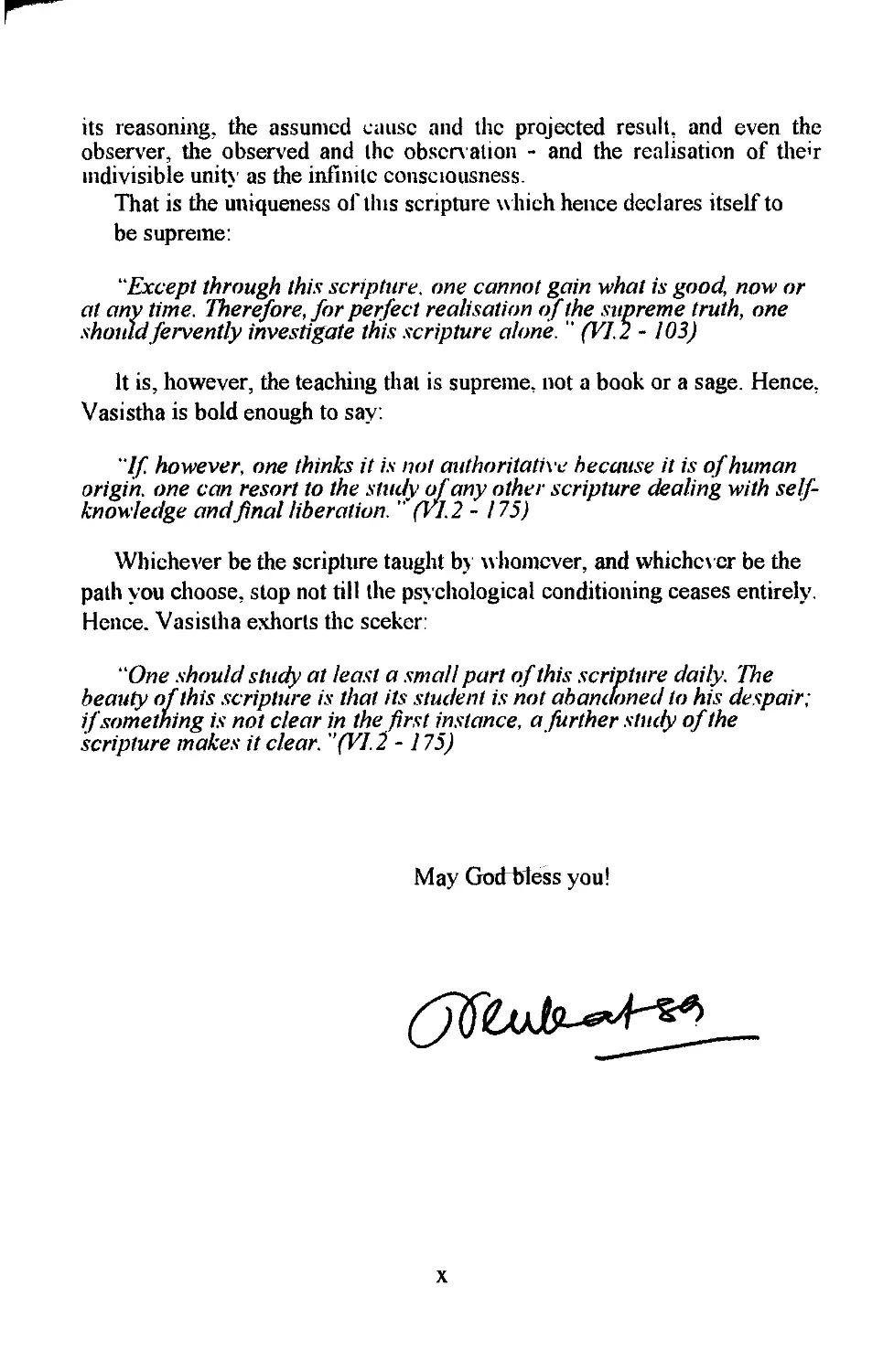
"Except through this scripture, one cannot gain what is good, now or
at any time. Therefore, for perfect realisation of the supreme truth, one
should fervently investigate this scripture alone. " (VI2 - 103)
It is, however, the teaching that is supreme, not a book or a sage. Hence,
Vasistha is bold enough to say:
"If. however, one thinks it is not authoritative because it is of human
origin, one can resort to the study of any other scripture dealing with self-
knowledge and final liberation. "''(VI. 2 - 175)
Whichever be the scripnire taught by whomever, and whichever be the
path you choose, slop not till the psychological conditioning ceases entirely.
Hence. Vasistha exhorts the seeker:
"One should study at least a small part of this scripture daily. The
beauty of this scripture is that its student is not abandoned to his despair;
if something is not clear in the first instance, a further study of the
scripture makes it clear. "(VI. 2 -175)
May Godirtess you!
x

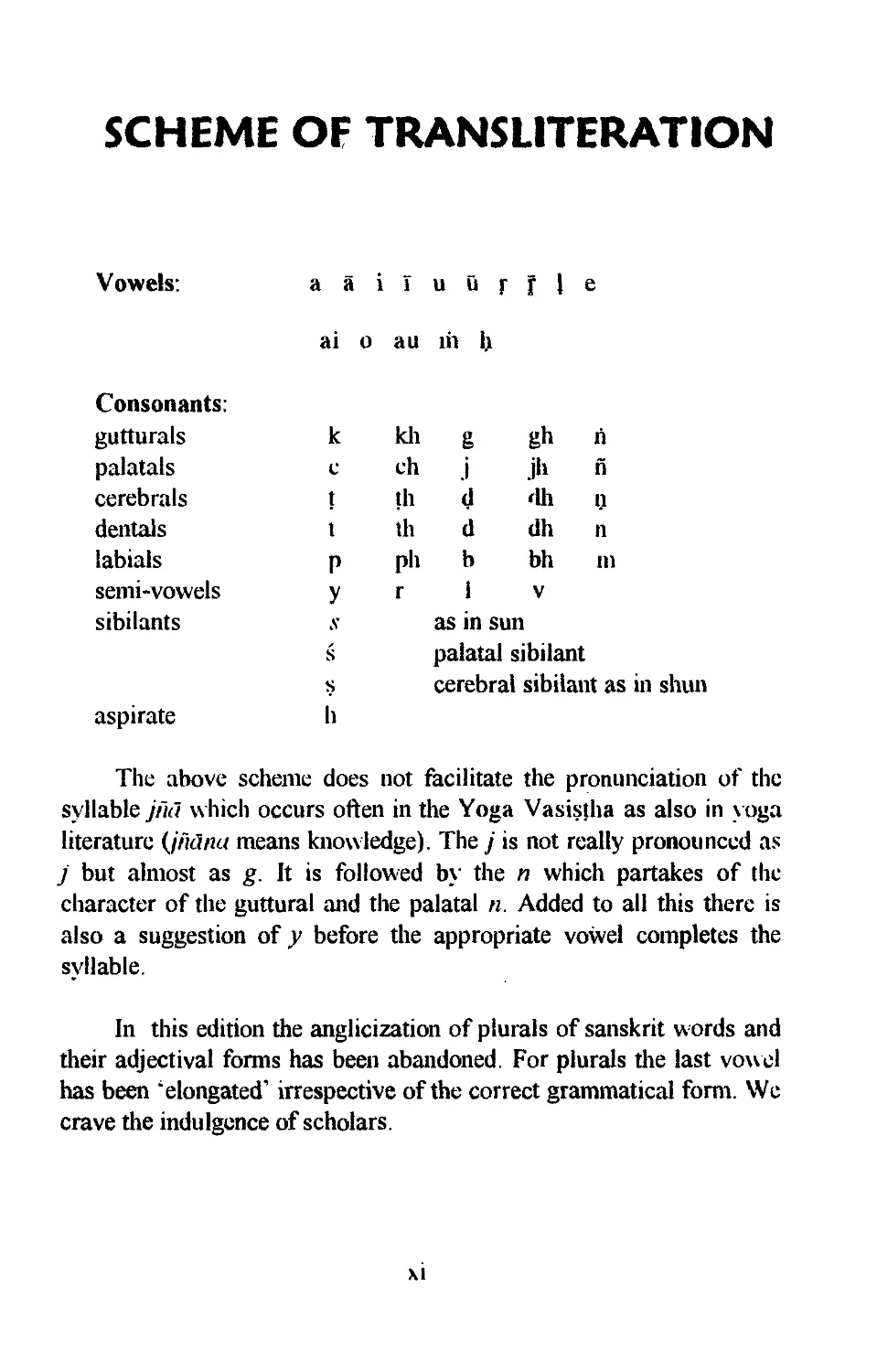
SCHEME OF TRANSLITERATION
Vowels: a a i i u 0 r jf | e
ai o au in h
Consonants:
gutturals
palatals
cerebrals
dentals
labials
semi-vowels
sibilants
aspirate
The above scheme does not facilitate the pronunciation of the
syllable jfu't which occurs often in the Yoga Vasistha as also in yoga
literature (jnilna means know ledge). The j is not really pronounced as
j but almost as g. It is followed by the n which partakes of the
character of the guttural and the palatal n. Added to all this there is
also a suggestion of y before the appropriate vowel completes the
syllable.
In this edition the anglicization of plurals of Sanskrit words and
their adjectival forms has been abandoned. For plurals the last vowel
has been 'elongated' irrespective of the correct grammatical form. We
crave the indulgence of scholars.
k
c
t
t
P
y
.V
s
s
h
kh
ch
th
th
ph
r
g
j
d
d
b
1
gh
jh
dh
dh
bh
v
as in sun
palatal sibilant
n
n
n
n
in
cerebral sibilant as in shun
M

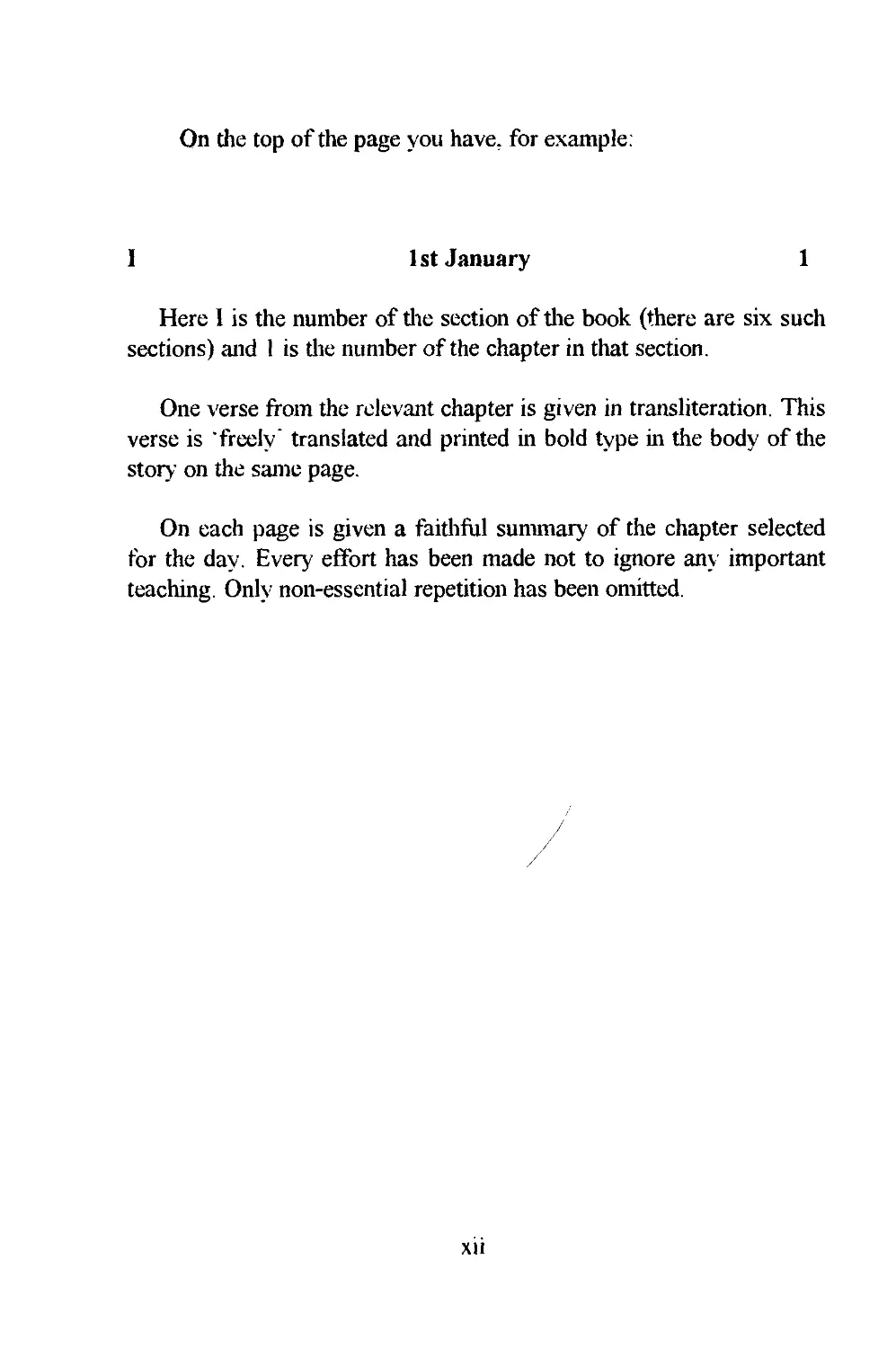
On the top of the page you have, for example:
I 1st January 1
Here I is the number of the section of the book (there are six such
sections) and 1 is the number of the chapter in that section.
One verse from the relevant chapter is given in transliteration. This
verse is freely' translated and printed in bold type in the body of the
story on the same page.
On each page is given a faithful summary of the chapter selected
for the day. Every effort has been made not to ignore any important
teaching. Only non-essential repetition has been omitted.
xu

OM TAT SAT
Om Naniah Sivanandaya
Om Namo Narayanaya
Om Namo Venkatesaya
PRAYER BEFORE THE DAILY READING
yatah sarvani bhutani pratibhanti sthitani ca
yatrai "vo "pasamarii yanti tasmai salyatmane nama!i( 1)
jnata jiianarh tatha jney am drasta darsana drs\abhuh
karla hetuh kriya yasmat tasmai jnaptyatmanc namah (2)
sphuranti sikara yasmad anandasya "mbare 'vanau
sanesaiii \'\\anam tasmai brahmanandatmanc namah (3)
Salutations to that reality in which all the elements and all the animate
and inanimate beings shine as if they have an independent existence, and in
which they exist for a time and into which they merge.
Salutations to that consciousness which is the source of the apparcnth
distinct threefold divisions of knovver. knowledge and known: seer, sight
and seen; doer, doing and deed.
Salutations to that bliss absolute (the ocean of bliss) which is the life of
all beings whose happiness and unfoldment arc derived from the shower of
spray from that ocean of bliss.
\in

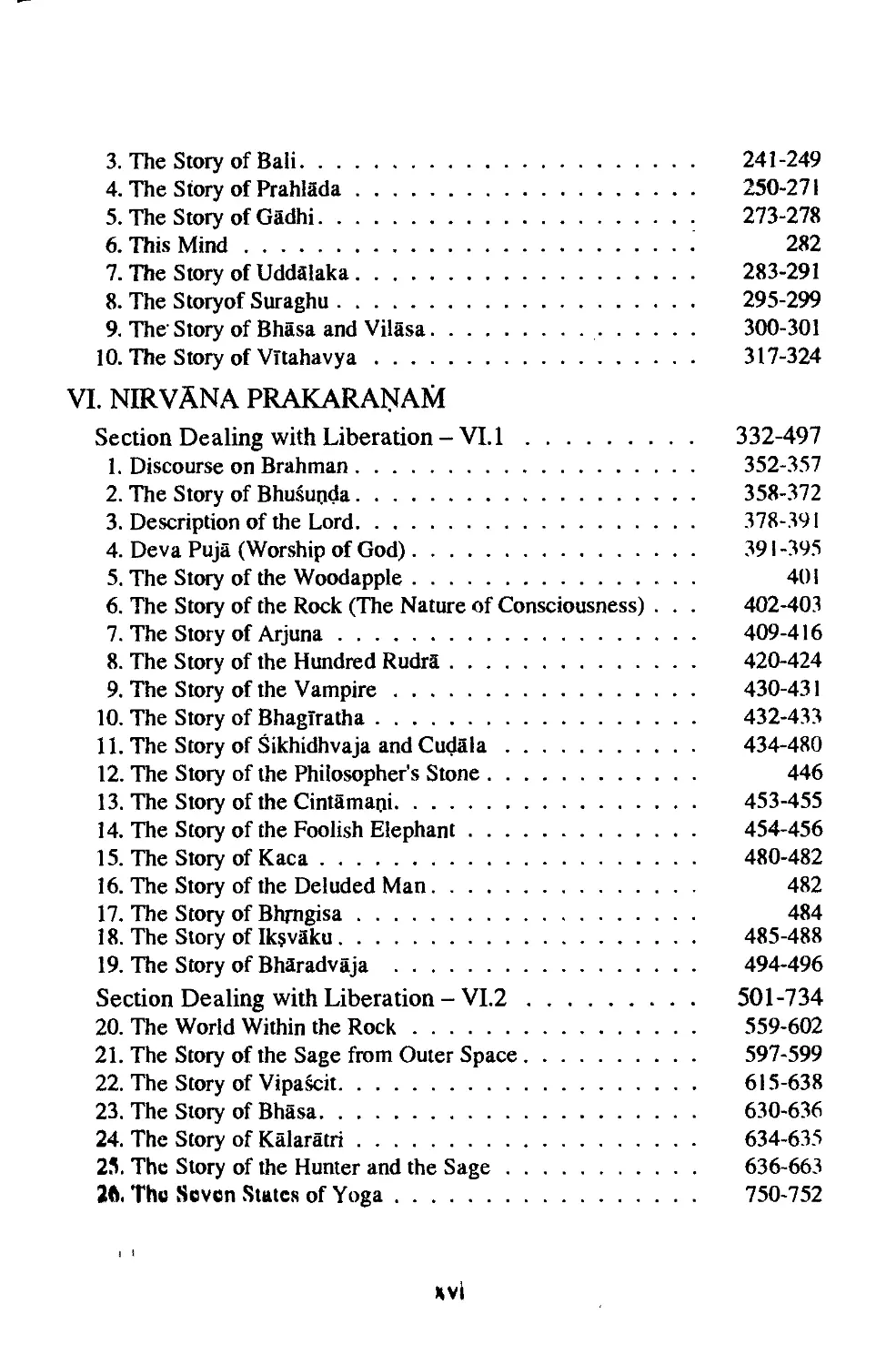
CONTENTS
Preface v
Foreword vii
Introduction ix
Scheme of Transliteration xi
Prayer xiii
I. VAIRAGYA PRAKARANAM
Section Dealing with Dispassion 1-22
II. MUMUKSU VYAVAHARA PRAKARANAM
The Behaviour of the Seeker 25-39
1. The Story of Suka 1-26
2. The Four Gate-Keepefs 32-36
III. UTPATTI PRAKARANAM
Section Dealing with Creation
1. The Story of Akasaja (The holy man) 44
2. The Story of LTla 59-91
3. The Story of Karkati 99-114
4. The Story of the Sons of Indu (Ten Young Men) 116-117
5.TheStoryofAhalya 118-119
6. The Story of the Great Forest 127-128
7. The Story of the Three Non-existent Princes 130
8. The Story of Lavana 132-149
IV. STHITI PRAKARANAM
Section Dealing with Existence 155-209
1. The Story of Sukra 157-167
2. He Sees the Truth 174
3. The Story of Dama, Vyala and Kata 176-184
4. The Story of BhTma, Bhasa and Drdha 184
5. The Story of Dasura 199-204
6. Kaca'sSong 206
V. UPASAMA PRAKARANAM
Section Dealing with Dissolution 213-333
1. The Story of King Janaka 218-225
xv

3. The Story of Bali 241-249
4.TheStoryofPrahlada 250-271
5. The Story of Gadhi 273-278
6. This Mind 282
7.TheStoryofUddalaka 283-291
8.TheStoryofSuraghu 295-299
9. The Story of Bhasa and Vilasa 300-301
10. The Story of Vltahavya 317-324
VI. NIRVANA PRAKARANAM
Section Dealing with Liberation-VI. 1 332-497
1. Discourse on Brahman 352-357
2. The Story of Bhusuoda 358-372
3. Description of the Lord 378-391
4. DevaPuja (Worship of God) 391-395
5. The Story of the Woodapple 401
6. The Story of the Rock (The Nature of Consciousness) . . . 402-403
7. The Story of Arjuna 409-416
8. The Story of the Hundred Rudra 420-424
9. The Story of the Vampire 430-431
10. The Story of Bhaglratha 432-433
ll.TheStoryofSikhidhvajaandCudala 434-480
12. The Story of the Philosopher's Stone 446
13. The Story of the Cintamani 453-455
14. The Story of the Foolish Elephant 454-456
15. The Story of Kaca 480-482
16. The Story of the Deluded Man 482
17. The Story of Bhrngisa 484
18. The Story of Iksvaku 485-488
19. The Story of Bharadvaja 494-496
Section Dealing with Liberation - VI.2 501-734
20. The World Within the Rock 559-602
21. The Story of the Sage from Outer Space 597-599
22. The Story of Vipascit 615-638
23. The Story of Bhasa 630-636
24. The Story of Kalaratri 634-635
25. The Story of the Hunter and the Sage 636-663
26. The Seven States of Yoga 750-752
*vi

SECTION ONE
VAIRAGYA PRAKARANAM
SECTION DEALING WITH
DISPASSION

I 1st JANUARY 1
ubhabhySm eva paksabhyam yatha khe paksinam gatih
tathai 'va jfiana karmabhyam jSyate paramam padarh (7)
SUTIKSNA, the sage, asked the sage Agastya: O sage, which one of
the two is conducive to liberation, work or knowledge?
AGASTYA replied: Verily, birds are able to fly with their two wings:
even so. both work and knowledge together lead to the supreme goal of
liberation. Neither work alone nor knowledge alone can lead to liberation:
both of them together form the means to liberation. I shall narrate to you a
legend in answer to your question. There once lived a holy man by name
Karunya, the son of Agnivesya. Having mastered the holy scriptures and
understood their purport, the young man became apathetic to life. Seeing
this, Agnivesya asked why Karunya had abandoned the due performance
of his daily duties. Karunya replied: "Do not the scriptures declare on the
one hand that one should fulfil scriptural injunctions till the end of one's
life, and on the other that immortality can be realised only by the
abandonment of all action? Caught between these two doctrines, what
shall I do, O my guru and father?" He then remained silent.
AGNIVESYA said: My son, listen: I shall narrate to you an ancient
legend. Duly consider its moral and then do as you please. Once upon a
time a celestial nymph named Suruci was seated on a peak in the
Himalayas, when she saw a messenger of Indra (the king of gods) fly
past. Questioned by her, he informed her of his mission which was as
follows: "A royal sage by name Aristanemi entrusted his kingdom to his
son and was engaged in breath-taking austerities in Gandhamadana hill.
Seeing this, Indra asked me to approach him with a bevy of nymphs and
escort him to heaven. The royal sage, however, wanted to know the merits
and the demerits of heaven. I replied: In heaven, the best, the middling and
the least among pious mortals receive appropriate rewards, and once the
fruits of their merits have been exhausted they return to the world of
mortals. The royal sage refused to accept Indra's invitation to heaven.
Indra once again sent me to the royal sage with the request that he should
seek the counsel of the sage Valmiki before turning the offer down. The
royal sage was introduced to the sage Valmiki. He asked: "What is the
best way to rid oneself of birth and death?"
In reply, Valmiki narrated to him the dialogue between Rama and
Vasisfha.
3

r^
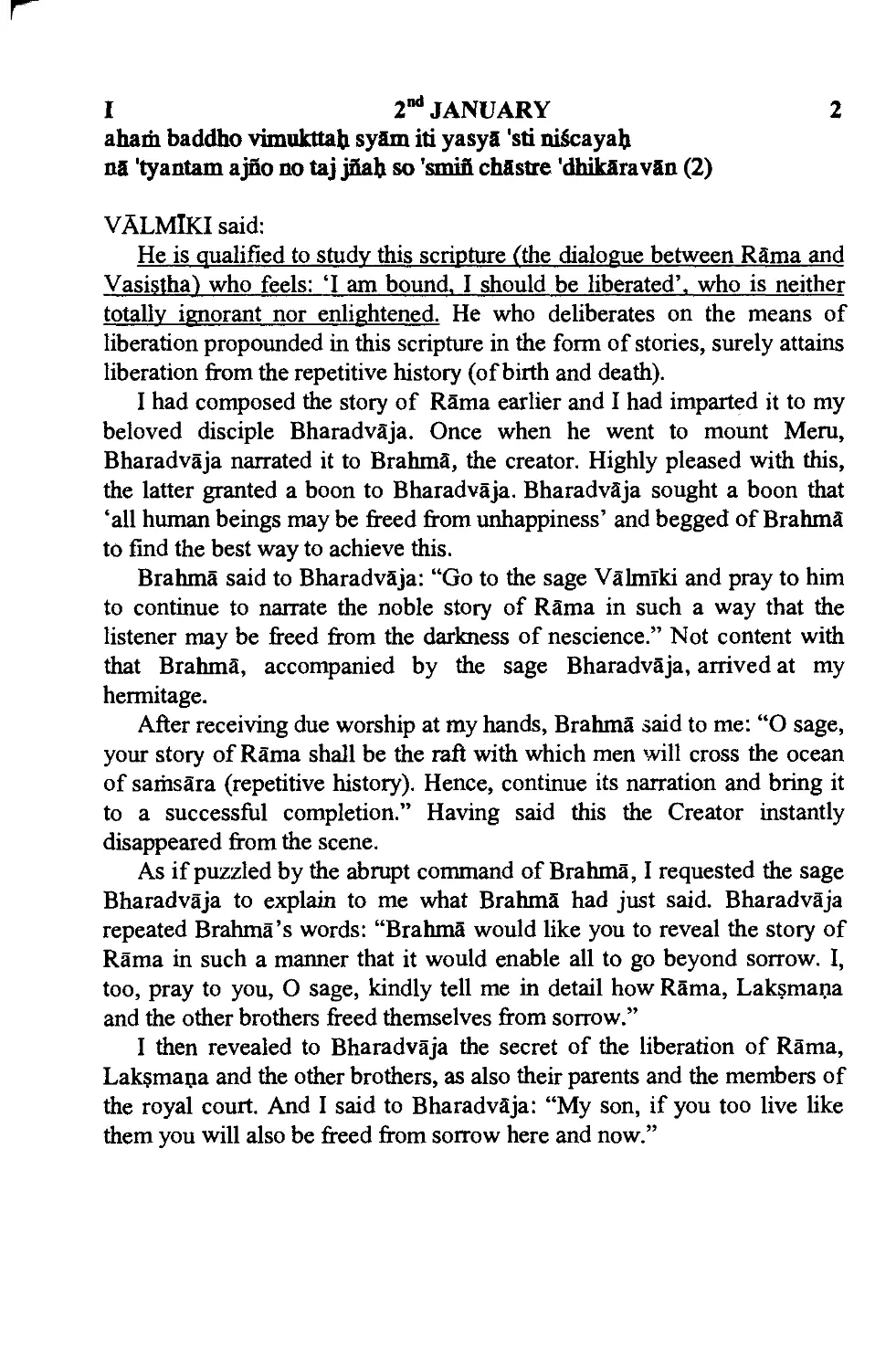
I 2nd JANUARY 2
aharh baddho vimukttah sySm iti yasya 'sti niScayah
na 'tyantam ajfio no taj jfiah so 'smifi chastre 'dhikaravSn (2)
VALMIKI said:
He is qualified to study this scripture (the dialogue between Rama and
Vasistha) who feels: 'I am bound, I should be liberated', who is neither
totally ignorant nor enlightened. He who deliberates on the means of
liberation propounded in this scripture in the form of stories, surely attains
liberation from the repetitive history (of birth and death).
I had composed the story of Rama earlier and I had imparted it to my
beloved disciple Bharadvaja. Once when he went to mount Meru,
Bharadvaja narrated it to Brahma, the creator. Highly pleased with this,
the latter granted a boon to Bharadvaja. Bharadvaja sought a boon that
'all human beings may be freed from unhappiness' and begged of Brahma
to find the best way to achieve this.
Brahma said to Bharadvaja: "Go to the sage Valmlki and pray to him
to continue to narrate the noble story of Rama in such a way that the
listener may be freed from the darkness of nescience." Not content with
that Brahma, accompanied by the sage Bharadvaja, arrived at my
hermitage.
After receiving due worship at my hands, Brahma said to me: "O sage,
your story of Rama shall be the raft with which men will cross the ocean
of sarhsara (repetitive history). Hence, continue its narration and bring it
to a successful completion." Having said this the Creator instantly
disappeared from the scene.
As if puzzled by the abrupt command of Brahma, I requested the sage
Bharadvaja to explain to me what Brahma had just said. Bharadvaja
repeated Brahma's words: "Brahma would like you to reveal the story of
Rama in such a manner that it would enable all to go beyond sorrow. I,
too, pray to you, O sage, kindly tell me in detail how Rama, Laksmana
and the other brothers freed themselves from sorrow."
I then revealed to Bharadvaja the secret of the liberation of Rama,
Laksmana and the other brothers, as also their parents and the members of
the royal court. And I said to Bharadvaja: "My son, if you too live like
them you will also be freed from sorrow here and now."

I 3rd JANUARY 3
bhrahmasya jagatasya 'sya jatasya 'kaSavarnavat
apunah smaranam manye sadho vismaranarh varam (2)
VALMlKI continued:
This world-appearance is a confusion, even as the blueness of the sky
is an optical illusion. I think it is better not to let the mind dwell on it, but
to ignore it. Neither freedom from sorrow nor realisation of one's real
nature is possible as long as the conviction does not arise in one that the
world-appearance is unreal. This conviction arises when one studies this
scripture with diligence. It is then that one arrives at the firm conviction
that the objective world is a confusion of the real with the unreal. If one
does not thus study this scripture, true knowledge does not arise in him
even in millions of years.
Moksa or liberation is the total abandonment of all vasana or mental
conditioning, without the least reserve. Mental conditioning is of two
types - the pure and the impure. The impure is the cause of birth; the pure
liberates one from birth. The impure is of the nature of nescience and
egosense; these are the seeds, as it were, for the tree of re-birth. On the
other hand, when these seeds are abandoned the mental conditioning, that
merely sustains the body, is of a pure nature. Such mental conditioning
exists even in those who have been liberated while living. It does not lead
to re-birth, as it is sustained only by past momentum and not by present
motivation.
I shall now narrate to you how Rama lived the enlightened life of a
liberated sage. Knowing this you will be freed from all misunderstanding
concerning old age and death:
Upon his return from the hermitage of his preceptor, RSrna dwelt in
his father's palace, sporting in various ways. Desirous of touring the
whole country and visiting the holy places of pilgrimage, Rama sought the
presence of his father and asked to be permitted to undertake such a
pilgrimage. The king chose an auspicious day for the commencement of
this pilgrimage; and on that day, after receiving the affectionate blessings
of the elders of the family, Rama departed.
Rama, along with his brothers, toured the whole country from the
Himalayas downwards. He then returned to the capital, to the delight of
the people of the country.
5

r
I ^JANUARY 4 56
koparh visada kalanSm vitatam ca harsam
na 'lpena kSranavaSena vahanti santab
sargena samhrtijavena vina jagatySm bhutSni
bhQpa na mahanti vikaravanti (5/15)
VALMlKI continued:
Upon entering the palace, Rama devoutly bowed to his father, the
sage Vasistha and other elders and holy men. The whole of the city of
Ayodhya put on a festive appearance for eight days, to celebrate the
return of Rama from the pilgrimage.
For some time Rama lived in the palace, duly performing his daily
duties. However, very soon a profound change came over him. He grew
thin and emaciated, pale and weak. The king Dasaratha was worried
over this sudden and unaccountable change in his beloved son's
appearance and behaviour. Whenever he questioned Rama concerning
his health, the latter replied that there was nothing wrong. When
Dasaratha asked Rama, "Beloved son, what is worrying you?" Rama
politely replied, "Nothing, father," and remained silent.
Inevitably Dasaratha turned to the sage Vasistha for the answer. The
sage enigmatically answered: "Surely, there is some reason why Rama
behaves in this manner. Even as. in this world, no great changes take
place before the coming into being of their cause (viz. the cosmic
elements'), changes like anger, despondency and joy do not manifest in
the behaviour of noble ones without proper cause." Dasaratha did not
wish to probe further.
Soon after this the sage Visvamitra, of world renown, arrived at the
palace. When the king was informed of the holy visit, he rushed forward
to greet him.
Dasaratha said: "Welcome, welcome, O holy sage! Your arrival at
my humble abode makes me happy. It is as welcome to me as vision to a
blind man, rain to parched earth, son to a barren woman, resurrection of
a dead man and recovery of lost wealth. O sage, what may I do for you?
Pray, whatever be the wish with which you have come to me, consider
that wish already fulfilled. You are my worshipful deity. I shall do thy
bidding."
6

I 5m JANUARY 4 5 6
kale kale prthag brahman bhori vlrya vibhtltayah
bhotesv abhyudayam ySnti prallyante ca kalatah (8/29)
VALMlKI continued:
Visvamitra was delighted to hear Dasaratha's words and proceeded to
reveal his mission. He said to the king: "O king, I need your assistance in
the fulfilment of a religious rite. Whenever I undertake a religious rite, the
demons, who are the followers of Khara and DhOsana, invade the holy
place and desecrate it. Under the vows of the rite, I am unable to curse
them. You can help me. Your son Rama can easily deal with these
demons. In return for this help I shall confer manifold blessings upon him
which will bring you unexcelled glory. Do not let your attachment to your
son overpower your devotion to duty. In this world the noble ones do not
consider any gift beyond their means. The moment you say yes, that very
moment I consider that the demons are dead, for I know who Rama is;
even so does the sage Vasistha and the other holy ones in this court. Let
there be no procrastination, O king. Send Rama with me without delay."
Hearing this highly unwelcome request, the king remained stunned and
silent for a while, and then replied: "O sage, Rama is not even sixteen
years old, and is therefore not qualified to wage a war. He has not even
seen a combat, except what goes on in the inner apartment of the palace.
Command me and my vast army to accompany you to exterminate the
demons. But I cannot part with Rama. Is it not natural for all living beings
to love their young; do not even wise men engage themselves in
extraordinary activities for the love of their children; and do not people
abandon their happiness, their consorts and wealth rather than their
children? No, I cannot part with Rama.
"If it is the mighty demon Ravana who causes disturbance to your rite,
nothing can be done to help you. Even the gods are powerless against him.
Time and again, such powerful beings are born on this earth: and in time
they leave the stage of this world."
Visvamitra was angry. Seeing this, the sage Vasistha intervened and
persuaded the king not to go back on his promise, but to send Rama with
Visvamitra. "O king, it is unworthy of you to go back on your promise. A
king should be an exemplar of righteous conduct. Rama is safe in the care
of Visvamitra, who is extremely powerful and who has numerous
invincible missiles."
7

I 6th JANUARY 10
nirasta 'stho nirSso 'sau nirlho 'sau nira" 'spadah
na mQdho na ca muktto 'sau tena tapy&mahe bhrsam (45)
VALMlKI continued:
In obedience to the wishes of the preceptor Vasistha, the king
Dasaratha ordered an attendant to fetch Rama. On his return he
announced that Rama would follow, and added: "The prince seems to be
dejected, and he shuns company." Bewildered by this, Dasaratha turned
to Rama's chamberlain and asked for the facts concerning Rama's state
of mind and health.
The chamberlain was visibly distressed. He said:
"Lord, since his return from the pilgrimage a great change has come
over the prince. He does not seem to be interested even in bathing and in
the worship of the deity. He does not enjoy the company of the people in
the inner apartments, nor is he interested in jewels and precious stones.
Even when offered charming and pleasing objects he looks at them with
sad eyes, uninterested. He spurns the palace dancers, regarding them as
tormentors! He goes through the motions of eating, walking, resting,
bathing and sitting like an automaton, or one who is deaf and dumb. Often
he mutters to himself: "What is the use of wealth and prosperity, of
adversity or of house? All this is unreal." He is silent most of the time, and
is not amused by entertainment. He relishes only solitude. He is all the
time immersed in his own thought. We do not know what has come over
our prince, what he contemplates in his mind, or what he is after. Day by
day he gets more and more emaciated.
"Again and again, he sings to himself: 'Alas, we are dissipating our
life in various ways, instead of striving to reach the supreme! People wail
aloud that they are suffering and that they are destitute, but no one
sincerely turns away from the sources of their suffering and destitution!'
Seeing all this and hearing all this, we, his humble servants, are extremely
distressed. We do not know what to do. He is bereft of hope, he is bereft
of desire, he is attached to nothing and he depends on nothing. He is not
deluded or demented, and he is not enlightened, either. At times however,
it looks as if he is overwhelmed by suicidal thoughts spurred on by the
feelings of despondency: 'What is the use of wealth or of mothers and
relations, what is the use of the kingdom, and what is the use of ambition
in this world?' Lord, only you can find the appropriate remedy for this
condition of the prince."
8

I 7*" JANUARY 1112
kim name 'dam bata sukham yeyam samsSrasantatih
jayate mjtaye loko mriyate jananaya ca (12/7)
VISVAMITRA said:
If that be the case, may Rama be requested to come here. His
condition is not the result of delusion, but it is full of wisdom and
dispassion and it points to enlightenment. Bring him here; and we shall
dispel his despondency.
VALMIKI said:
Thereupon, the king urged the chamberlain to invite Rama to the
court. In the meantime, Rama himself got ready to meet his father. Even
from a distance he saw and saluted his father and the sages; and they saw
that, though young, his face shone with the peace of maturity. He bowed
to the feet of the king, who embraced him, lifted him up, and said to him:
"What makes you so sad, my son? Dejection is an open invitation to a host
ofmiseries."
RAMA said:
Holy sir, I shall duly answer your question. I grew up happily in my
father's abode; I was instructed by worthy teachers. Recently I went on a
pilgrimage. During this period a trend of thought has taken hold of me,
robbing me of all hope in this world. My heart begins to question: What
do people call happiness and can it be had in the ever-changing objects of
this world? All beings in this world take birth but to die, and they die to be
born! I do not perceive any meaning in all these transient phenomena
which are the roots of suffering and sin. Unrelated beings come together;
and the mind conjures up a relationship between them. Everything in this
world is dependent upon the mind, upon one's mental attitude. On
examination, the mind itself appears to be unreal! But we are bewitched
by it. We seem to be running after a mirage in the desert to slake our
thirst!
Sir, surely we are not bond slaves sold to a master; yet we live a life of
slavery, without any freedom whatsoever. Ignorant of the truth, we have
been aimlessly wandering in this dense forest called the world. What is
this world, what comes into being, grows and dies? How does this
suffering come to an end? My heart bleeds with sorrow, though I do not
shed tears in deference to the feelings of my friends.
9

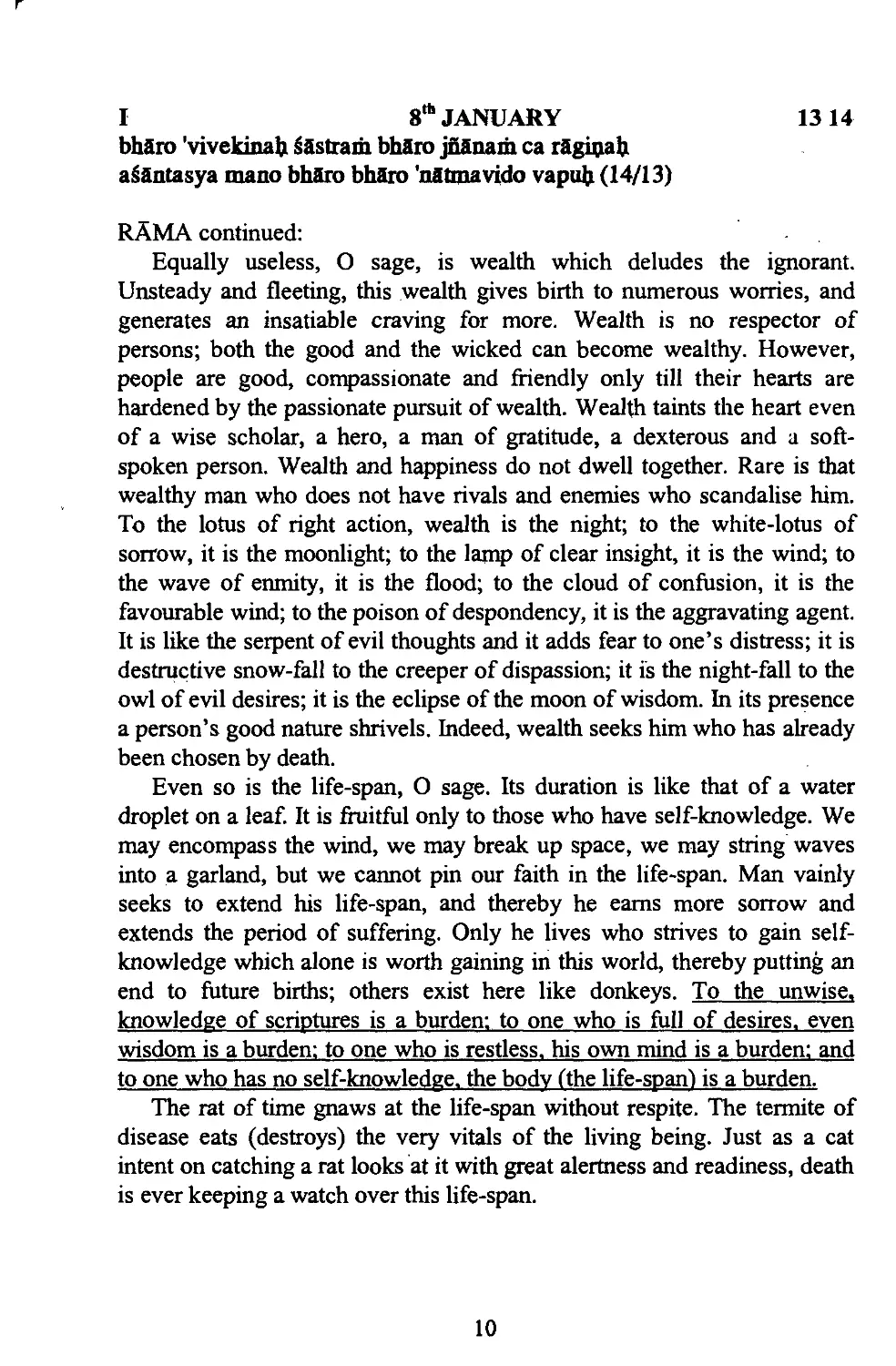
I 8th JANUARY 13 14
bharo 'vivekinah slstram bharo jrianam ca r&ginah
aSantasya mano bharo bharo 'natmavido vapuh (14/13)
RAMA continued:
Equally useless, O sage, is wealth which deludes the ignorant.
Unsteady and fleeting, this wealth gives birth to numerous worries, and
generates an insatiable craving for more. Wealth is no respector of
persons; both the good and the wicked can become wealthy. However,
people are good, compassionate and friendly only till their hearts are
hardened by the passionate pursuit of wealth. Wealth taints the heart even
of a wise scholar, a hero, a man of gratitude, a dexterous and a soft-
spoken person. Wealth and happiness do not dwell together. Rare is that
wealthy man who does not have rivals and enemies who scandalise him.
To the lotus of right action, wealth is the night; to the white-lotus of
sorrow, it is the moonlight; to the lamp of clear insight, it is the wind; to
the wave of enmity, it is the flood; to the cloud of confusion, it is the
favourable wind; to the poison of despondency, it is the aggravating agent.
It is like the serpent of evil thoughts and it adds fear to one's distress; it is
destructive snow-fall to the creeper of dispassion; it is the night-fall to the
owl of evil desires; it is the eclipse of the moon of wisdom. In its presence
a person's good nature shrivels. Indeed, wealth seeks him who has already
been chosen by death.
Even so is the life-span, O sage. Its duration is like that of a water
droplet on a leaf. It is fruitful only to those who have self-knowledge. We
may encompass the wind, we may break up space, we may string waves
into a garland, but we cannot pin our faith in the life-span. Man vainly
seeks to extend his life-span, and thereby he earns more sorrow and
extends the period of suffering. Only he lives who strives to gain self-
knowledge which alone is worth gaining in this world, thereby putting an
end to future births; others exist here like donkeys. To the unwise,
knowledge of scriptures is a burden: to one who is full of desires, even
wisdom is a burden; to one who is restless, his own mind is a burden; and
to one who has no self-knowledge, the body (the life-span') is a burden.
The rat of time gnaws at the life-span without respite. The termite of
disease eats (destroys) the very vitals of the living being. Just as a cat
intent on catching a rat looks at it with great alertness and readiness, death
is ever keeping a watch over this life-span.
10

I 9' JANUARY 1516
cittam karanam arthanam tasmin sati jagat trayam
tasmin kslne jagat kslnam tac cikitsyam prayatnatah (16/25)
RAMA continued:
Holy sir, I am bewildered and scared when I contemplate the coming
into being of the dreadful enemy of wisdom known as egotism. It comes
into being in the darkness of ignorance, and flourishes in ignorance. It
generates endless sinful tendencies and sinful actions. All suffering surely
revolves around egotism (it is the T who suffers); and egotism is the sole
cause of mental distress. I feel that egotism is my worst disease! Spreading
the net of worldly objects of pleasure, it is this egotism that traps the living
beings. Indeed, all the terrible calamities in this world are born of egotism.
Egotism eclipses self-control, destroys virtue and dissipates equanimity.
Giving up the egotistic notion 'I am Rama' and giving up all desires, I
wish to rest in the self. I realise that whatever I have done with an egotistic
notion is vain. Non-egotism alone is truth. When I am under the influence
of egotism, I am unhappy; when I am free from egotism I am happy.
Egotism promotes cravings; without it they perish. It is this egotism alone,
without rhyme or reason, that has spread the net of family and social
relationships to catch the unwary soul. I think I am free from egotism; yet,
I am miserable. Pray, enlighten me.
Bereft of the grace earned through the service of the holy ones, the
impure mind-stuff remains restless as the wind. It is dissatisfied with
whatever it gets, and grows more and more restless by the day. The sieve
can never be filled with water; nor can the mind ever reach the state of
fulfilment however much of worldly objects one acquires. The mind flits
in all directions all the time, but is unable to find happiness anywhere.
Unmindful of the possibility of reaping great suffering in hell, the mind
seeks pleasure here, but even that it does not get. Like the lion in a cage,
the mind is ever restless, having lost its freedom yet not happy with its
present state.
Alas, I am bound by the knots of craving to the net that has been
spread by the mind. Even as the rushing waters of a river uproot the trees
on its bank, the restless mind has uprooted my whole being. I am being
wafted by the mind like a dry leaf in the wind. It does not let me rest
anywhere. It is this mind alone which is the cause of all objects in the
world: the three worlds exist because of the mind-stuff; when the mind
vanishes, the worlds vanish too. You should try hard to find treatment
11

r
I 10th JANUARY 17
bhlsayaty api dblram mSm andhayaty api seksanam
khedayaty api s&nandam trsnfi krsneva SarvaiT (16)
RAMA continued:
It is really when the mind-stuff is enveloped by craving that
innumerable errors arise in the darkness of ignorance thus caused. This
craving dries up the good and noble qualities of the mind and heart (like
sweetness and gentleness of disposition) and makes me hard and cruel. In
that darkness, craving in its different forms dances like a goblin.
Though I adopt various methods to restrain this craving, it overpowers
me in a moment and carries me astray, even as a gale carries a straw away.
Craving cuts away any hope I entertain of developing dispassion (and
such other qualities) even as a rat snaps a thread; and I helplessly revolve,
caught in the wheel of craving. Like birds caught in a net we are unable,
though we have the wings for it, to fly to our goal or abode of self-
knowledge. This craving can never be appeased, even if I were to quaff
nectar. The characteristic of this craving is that it has no direction; it
drives me in one direction now and the very next moment it takes me
away in another direction, like a mad horse. It spreads in front of us a very
wide net of son, friend, wife and other relatives.
Though I am a hero, this craving makes me a frightened coward:
though I have eves to see, it makes me blind: though I am full of joy, it
makes me miserable: it is like a dreadful goblin. It is this dreadful goblin
craving that is responsible for bondage and misfortune; it breaks the heart
of man and creates delusion in him. Caught by this goblin, man is unable
to enjoy even the pleasures that are within his reach. Though it appears as
if the craving is for happiness, this craving leads neither to happiness nor
to fruitfulness in this life; on the contrary, it involves vain effort and leads
to every kind of inauspiciousness. Even when it occupies the stage called
life on which several happy and unhappy situations play, this craving, like
an aged actress, is incapable of performing anything good and noble, and
suffers defeat and discomfiture at every turn. Yet, it does not give up
dancing on the stage!
Craving now ascends to the skies, now dives into the depths of the
nether world; it is ever restless for it is based on the emptiness of the
mind. In the mind the light of wisdom momentarily shines, but there is
delusion the next moment. It is a wonder that sages are able to cut this
with the sword of self-knowledge.
12

I 11th JANUARY 18
baddhlstha ye sarlresu baddhSstha ye jagatsthitau
tan moha madironmattSn dhigdhig astu punah punah (52)
RAMA continued:
This pitiable body composed of veins, arteries and nerves is also a
source of pain. Inert, it appears to be intelligent. One does not know if it is
sentient or insentient, and it engenders only delusion. Delighted with a
little gratification and distressed by the least adversity, this body is indeed
highly despicable.
I can only compare a tree to the body; with branches for arms, trunk
for the torso, holes for eyes, fruits for head and leaves for numerous
illnesses. It is a resting place for living beings. Who can say that it is one's
own? Hope or despair in relation to it is futile. It is but a boat given to one
for crossing this ocean of birth-and-death; but one should not regard it as
one's self. This tree which is the body is born in the forest known as
sarhsSra (repetitive existence), the restless monkey (mind) plays on it, it is
the abode of crickets (worries), it is constantly eaten by the insects (of
endless suffering), it shelters the venomous serpent (of craving), and the
wild crow (of anger) dwells on it. On it are the flowers (of laughter), its
fruits are good and evil, it appears to be animated by the wind (of life-
force), it supports the birds (of senses), it is resorted to by the traveller
(lust or desire) for it provides the shade of pleasure, the formidable vulture
(egotism) is seated on it, and it is hollow and empty. It is certainly not
meant to promote happiness. Whether it lives for long or falls in a short
time, it is still useless. It is composed of flesh and blood, it is subject to
old age and death. I am not enamoured of it. It is completely filled with
impure substances and afflicted with ignorance. How can it fulfil my
hopes?
This body is the home of illness, the field for mental distress, changing
emotions and mental states. I am not enamoured of it. What is wealth,
what is kingdom, what is the body - all these are mercilessly cut down by
time (death). At death this ungrateful body abandons the soul that dwelt in
it and protected it. What hope shall I repose in it? Shamelessly it indulges
again and again in the same actions! Its only certain purpose seems to be
to burn in the end! Unmindful of old age and death that are common to the
rich and the poor, it seeks wealth and power! Shame, shame upon those
who are bound to this body, deluded by the wine of ignorance! Shame on
those who are bound to this world!
13

r
I 12td JANUARY 19
aSakttir apadas trsna mflkata mOdhabuddhitS
grdhnuta lolata dainyarh sarvarh balye pravartate (2)
RAMA said:
Even the part of life which people ignorantly regard as enjoyable -
childhood - is full of sorrow, O sage. Helplessness, mishaps, cravings,
inability to express oneself, utter foolishness, playfulness, instability,
weakness - all these characterise childhood. The child is easily offended,
easily roused to anger, easily bursts into tears. In fact, one may say boldly
that the child's anguish is more terrible than that of a dying man, an aged
man, a,sick man or any other adult. For, in childhood, one's state is
comparable truly to that of an animal living at the mercy of others.
The child is exposed to the countless happenings around it; they puzzle
and confuse the child, and arouse in it various phantasies and fears. The
child is impressionable and is easily influenced by the wicked. In
consequence, the child is subjected to control and punishment by its
parents. Childhood seems to be a period of nothing but subjection!
Though the child may appear to be innocent, the truth is that all sorts
of defects, sinful tendencies and neurotic behaviour lie hidden and
dormant in it, even as an owl lies hidden in a dark hole during the
daytime. O sage, I pity those people who foolishly imagine that childhood is a
happy period.
What can be worse suffering than a restless mind? And, the child's
mind is extremely restless. Unless the child gets something new every day,
it is unhappy. Crying and weeping seem to be the child's foremost
activity. When the child does not get what it wants, it looks as if its heart
is broken. When the child goes to school, it receives punishment in the
hands of its teachers; and all this adds to its unhappiness.
When the child cries, its parents, in order to pacify it, promise to give it
the world; and from then on the child begins to value the world, to desire
the worldly objects. The parents say, "I shall give you the moon for a toy,"
and the child, believing their words, thinks that it can hold the moon in its
hands. Thus are the seeds of delusion sown in the little heart.
Though the child feels heat and cold, it is unable to avoid it— how is it
better than a tree, then? Like the animals and birds the child vainly reaches out
to get what it wants. And it is fearful of every elder in the house.

I 13th JANUARY 20
udbodhayati dosalim nikrntati gunavalim
naran&m yauvanollaso vilaso duskrtasriyam (29)
RAMA continued:
Leaving this period of childhood behind, the human being goes on to
the stage of youth - but he is unable to leave the unhappiness behind!
There he is subjected to numerous mental modifications and he progresses
from misery to greater misery, for he abandons wisdom and embraces the
terrible goblin known as lust that resides in his heart. His life is full of
desire and anxiety. They who have not been robbed of their wisdom in
their youth can withstand any onslaught.
I am not enamoured of this transient youth in which short-lived
pleasure is quickly followed by long-lasting suffering, and deluded by
which man regards the changing to be changeless. What is worse, it is
during youth that one indulges in such actions that bring unhappiness to
many others. Even as a tree is consumed by a forest-fire, the youth's heart
is consumed by the fire of lust when his beloved leaves him. However
much he may strive to develop purity of heart, the youth's heart is stained
with impurity. Even when his beloved is not present near him, he is
distracted by the thoughts of her beauty. Such a person who is full of
cravings is naturally not held in high esteem by good men.
Youth is the abode of diseases and mental distress. It can be compared
to a bird whose wings are good and evil acts. Youth is like a sandstorm
that disperses and dissipates one's good qualities. Youth arouses all sorts
of evils in the heart and suppresses the good qualities that may exist there:
it is thus the promoter of evil. It gives rise to delusion and attachment.
Though youthfulness appears to be very desirable to the body, it is
destructive to the mind. In youth one is tempted by the mirage of
happiness, and in its pursuit he falls into the well of sorrow. Hence I am
not enamoured of youth.
Alas even when youth is about to leave the body, the passions that had
been aroused by youth burn the more fiercely and bring about one's quick
destruction. He who delights in this youth is surely not a man, but an
animal in human garb.
They are adorable, they are great souls, and they alone are men who
are not overcome by the evils of youth and who survive that stage of life
without succumbing to its temptations. For, it is easy to cross a great
ocean; but to reach the other shore of youth without being overcome by its
likes and dislikes is indeed difficult.
15

I 14™ JANUARY 21 22
na jitah Satrubbib. sarhkhye pravista ye 'drikotare
te jara jlrna raksasya paiya ' 'su vijita mune (22/31)
RAMA continued:
In his youth, man is a slave of sexual attraction. In the body which is
no more than the aggregate of flesh, blood, bone, hair and skin, he
perceives beauty and charm. Even if this 'beauty' is permanent there is
some justification to the imagination; but, alas, it does not last very long.
On the contrary, very soon the very flesh that contributed to the
attractiveness, charm and beauty of the beloved is transformed first into
the shrivelled ugliness of old age and later consumed by fire, or by worms
or by vultures. Yet, while it lasts this sexual attraction consumes the heart
and the wisdom of the man. By*this is the creation maintained; when this
attraction ceases, this sarhsara (birth-death cycle) also ceases.
When the child is dissatisfied with its childhood, youth takes over;
when youth is plagued by dissatisfaction and frustration, old age
overpowers it. How cruel is life. Even as wind tosses a dew-drop from a
leaf, old age destroys the body. Even as a drop of poison when it enters
the system soon pervades it, senility soon pervades the entire body and
breaks it down, and makes it the laughing-stock of other people.
Though the old man is unable to satisfy his desires physically, the
desires themselves flourish and grow. He begins to ask himself, "Who am
I? What should I do?" etc. when it is too late for him to change his life's
course, alter his life-style or make his life more meaningful. With the
onset of senility all the distressing symptoms of a physical break-down
like cough, white hairs, hard breathing, dyspepsia and emaciation,
manifest themselves.
Perhaps, the deity presiding over death sees the white roofed head of
the old man as salted melon and rushes to take it. Senility vigorously cuts
the root of life like a flood that cuts away the roots of trees standing on the
river-bank. Death follows and carries it away. Senility is like the royal
attendants that precede the king, death.
Ah, how mysterious and how astounding it is! They who have not been
overcome by enemies and who have taken their abode in inaccess-ible
mountain peaks - even they have been afflicted by the demoness known
as senility and deeeneracy.
16

I 15th JANUARY 23 24
yuga vatsara kalpakhyaih kificit prakatatSm gatah
rQpair alaksya rupStma sarvam flkramya tisthati (23 - 7)
RAMA continued:
All enjoyments in this world are deluded, like the lunatic's enjoyment
of the taste of fruits reflected in a mirror. All the hopes of man in this
world are consistently destroyed by Time. Time alone, O sage, wears
everything out in this world; there is nothing in creation which is beyond
its reach. Time alone creates innumerable universes, and in a very short
time Time destroys everything.
Time allows a glimpse of itself through its partial manifestation as the
year, the age and the epoch: but its essential nature is hidden. This Time
overpowers everything. Time is merciless, inexorable, cruel, greedy and
insatiable. It is the greatest magician, full of deceptive tricks. This Time
cannot be analysed; for however much it is divided it still survives,
indestructible. It has an insatiable appetite for everything - it consumes the
smallest insects, the biggest mountains and even the king of heaven! Even
as a young boy plays with a ball for his pastime, Time uses the two balls
known as the sun and the moon for its pastime. It is indeed Time alone
that appears as the destroyer of the universe (Rudra), the creator of the
world (Brahma), the king of heaven (Indra), the lord of wealth (Kubera)
and the nothingness of cosmic dissolution. It is indeed this Time that
successively creates and dissolves the universe again and again. Just as
even the great and mighty mountain is rooted on earth, this mighty Time is also
established in the absolute being (Brahman).
Even though Time creates endless universes, it is not wearied, nor does
it rejoice; it does not come, nor does it go; it does not rise, nor does it set.
Time the gourmet sees that the objects of this world have been ripened by
the fire of the sun, and when he finds them fully ripe he consumes them!
Each epoch of time is decked, as it were, by the lovely jewels of colourful
beings for the pleasure of Time that playfully wipes them all out.
To the lotus of youthfulness, Time is the nightfall; to the elephant of
life-span, Time is the lion. In this world there is nothing, high or low, that
Time does not destroy. Even when all these are destroyed, Time is not
destroyed. Just as a man after a day's activity rests in sleep as if in
ignorance, even so Time, after the cosmic dissolution, sleeps or rests with
the creation-potential hidden in it. No one really knows what this Time is.
17

I
I 16'" JANUARY 25 26
danavS api dlryante dhruva 'py adhruva jlvitah
amarfl api mary ante kaivs' 'sths madrSe jane (26/26)
RAMA continued:
Besides the Time I have just described, there is another Time which is
responsible for birth and death; people refer to it as the deity presiding
over death. Yet again there is another aspect of this Time, known as
krtanta - the end of action, its inevitable result or fruition. This krtanta is
like a dancer with niyati (the law of nature) for his wife; the two together
bestow on all beings the inevitable fruit of their actions. During the course
of the existence of the universe they are indefatigable in their labour,
unwinking in their vigilance and unflagging in their zeal. When Time thus
dances in this universe creating and destroying everything, what hope can
we entertain? Krtanta holds sway even over those whose faith is firm, and
makes them restless. On account of this krtanta everything in this world is
constantly undergoing change; there is no permanency here.
All beings in this world are tainted with evil, all relationships are
bondage, all enjoyments are great diseases and desire for happiness is only
a mirage. One's own senses are one's enemies; the reality has become
unreal (unknown); one's own mind has become one's worst enemy.
Egotism is the foremost cause for evil, wisdom is weak, all actions lead to
unpleasantness and pleasure is sexually oriented. One's intelligence is
governed by egotism, instead of being the other way round. Hence there is
no peace nor happiness in one's mind. Youth is fading. Company of holy
ones is rare. There is no way out of this suffering. The realisation of truth
is not to be seen in anyone. No one is happy at the prosperity and
happiness of others, nor is compassion to be found in anyone's heart.
People are getting baser and baser by the day. Weakness has overcome
strength, cowardice has overpowered courage. Evil company is easily had,
good company is hard to come by. I wonder whither Time is driving
humanity.
Holy one, this mysterious power that governs this creation destroys
even powerful demons, robs whatever has been considered to be eternal of
its permanency, kills even the immortals - is there then any hope for
simple folk like me? This mysterious being seems to dwell in all, and its
individualised aspect is regarded as egotism; and there is nothing that is
not destroyed by it. The entire universe is under its control, its will alone
prevails here.
18

I 17,n JANUARY 27
taranti matanga ghafS tarangarh ranambudhiih ye mayi te na Sarah
sttrasta eve manasastarangarh dehe 'ndriyambodhim imam taranti (9)
RAMA continued:
0 sage, thus neither in childhood, youth nor old age does one enjoy
any happiness. None of the objects in this world is meant to give
happiness to anyone. The mind vainly seeks to find such happiness in the
objects of this world. Only he is happy who is free from egotism and who
is not swayed by craving for sense-pleasure; but such a person is
extremely rare in this world. Indeed, I do not regard him as a hero who is
able to battle successfully against a mighty army: only him I consider a
hero who is able to cross the ocean known as the mind and the senses.
1 do not regard that as a 'gain' which is soon lost; only that is a gain
which is not lost - and there is no such gain available to man in this world,
however hard he may struggle. On the other hand, both fleeting gains and
temporary adversities come to a man, even without his seeking. I am
puzzled, Holy sir, that a man roams here and there seemingly busy
throughout the day, and is all the time engaged in selfish activity; and
though he does not do one good turn during the day, he is still able to
sleep at night! Yet, even though the busy man overcomes all his earthly
enemies and surrounds himself with wealth and luxury, and even when he
boasts that he is happy, death creeps in upon him. How it finds him, only
God knows! In ignorance, man binds himself to wife, son and friends; he
knows not that this world is like a large pilgrim centre where countless
people come together fortuitously - and they whom he calls his wife, son
and friends are among them.
This world is like a potter's wheel; the wheel looks as if it stands still
though it revolves at a terrific speed - even so to the deluded person this
world appears to be stable even though in fact it is constantly changing.
This world is like a poison tree; one who comes into contact with it is
knocked unconscious and stupified. All points of view in this world are
tainted, all countries in the world are territories of evil, all the people of
the world are subject to death, all actions are deceitful.
Many aeons have come and gone; they are but moments in time - for
there is essentially no difference between an epoch and a moment, both
being measures of time. From the viewpoint of the gods even an epoch is
but a moment. Even so the whole earth is but a modification of the earth-
element! How futile to pin our faith and our hope on it!
19

f
I 18th JANUARY 28 29
iti me dosadavSgni dagdhe mahati cetasi
prasphuranti na bhogaSa mrgatrsna sarahsv iva (29/1)
RAMA continued:
0 holy one! Whatever appears to be permanent or transient in this
world is like a dream. What is a crater today was a mountain before, what
is a mountain today becomes a hole in the earth in a short while, what is a
dense forest today is soon transformed into a big city, what is fertile soil
now becomes an arid desert. Similar is the change in one's body and in
one's life-style and fortune.
This life-and-death cycle appears to be a skilful dancer whose skirt is
made up of living souls; and her dancing gestures consist of lifting the
souls up to heaven, hurling them down in hell or bringing them back to
this earth. All the mighty deeds, even the great religious rites that people
perform here are soon consigned to one's memory. Human beings are
born as animals and vice versa; gods lose their divinity - what is
unchanging here? I see even the creator Brahma, the protector Visnu, the
redeemer Rudra and others inexorably going towards destruction. In this
world sense-objects appear to be pleasant to one only till he remembers
this inevitable destruction. Just as a child playing with earth makes
different designs with a clod, the ordainer of the universe keeps creating
new things and destroying them soon.
This perception of the defects of the world has destroyed the undesirable
tendencies in my mind: and therefore, desire for sense-pleasure does not arise
in my mind, even as a mirage does not appear on the surface of water. This
world and its delights appear bitter to me. I am not fond of wandering in the
pleasure-gardens, I do not relish the company of girls, I do not value the
acquisition of wealth. I wish to remain at peace within myself. I am constantly
enquiring: "How can I wean my heart completely away from even thinking of
this ever-changing phantasm called the world?" I do not long for death, nor do
I long to live; I remain as I am, free from the fever of lust. What shall I do with
the kingdom, pleasure or wealth, all of which are the playthings of egotism
which is absent in me?
If I do not get established in wisdom now, when shall another
opportunity arise? For, indulgence in sense-pleasure poisons the mind in
such a way that its effects last several life-times. Only the man of self-
knowledge is free from this. Therefore, O sage, I pray, instruct me in such
a way that I may forever be free from anguish, fear and distress. With the
light of your instruction, destroy the darkness of ignorance in my heart.
20

I l^" JANUARY 30 31
apahastita sarvSrtham anavasthitir flsthitfl
grhltvotsrjya ca "tmanarh bhavasthitir avasthita (30/8)
RAMA continued:
By reflecting on the pitiable fate of living beings thus fallen into the
dreadful pit of sorrow, I am filled with grief. My mind is confused, I
shudder, and at every step I am afraid. I have given up everything, but I
have not established myself in wisdom: hence I am partly caught and
partly freed. I am like a tree that has been cut but not severed from its
root. I wish to restrain my mind but do not have the wisdom to do so.
Hence, pray tell me what that condition or state is in which one does
not experience any grief? How can one, who is involved in the world and
its activities as I am, reach the supreme state of peace and bliss? What is
that attitude that enables one not to be influenced by various kinds of
activities and experiences? Pray tell me how people who are enlightened
live in this world. How can the mind be freed from lust and made to view
the world both as one's own self and also as no more valuable than a
blade of grass? The biography of which great one shall we study in order
to learn the path of wisdom? How should one live in this world?
Holy sir, instruct me in that wisdom which will enable my otherwise
restless mind to be steady like a mountain. You are an enlightened being:
instruct me so that I may never again be sunk in grief.
Obviously this world is full of pain and death; how does it become a
source of joy, without befuddling one's heart? The mind is obviously full
of impurities. How can it be cleansed and with what cleanser prescribed
by what great sage? How should one live here so as not to fall a victim to
the twin currents of love-and-hate? Obviously there is a secret that enables
one to remain unaffected by the grief and suffering in this world - even as
mercury is not affected when it is thrown into the fire: What is that secret?
What is the secret that counteracts the habit of the mind that is spread out
in the form of this universe?
Who are those heroes who have freed themselves from delusion? And
what methods did they adopt to free themselves. If you consider that I am
neither fit nor capable of understanding this, I shall fast unto death.
VALMIKI said:
Having said so, Rama remained silent.
21

I 2(T JANUARY 32 33
sakala loka camatkrti karino 'py abhimatam yadi
rSghavacetasah
phalati no tad ime vayam eva hi sphutataram munayo
hatabuddhayah (33/46)
VALMlKIsaid:
All those who had assembled in the court were highly inspired by the
flaming words of Rama's wisdom that are capable of dispelling the
delusion of the mind. They felt as if they themselves had been rid of all their
doubts and deluded misunderstanding. They drank the nectarine words of
RSma with great delight. As they sat in the court listening to Rama's
words, it appeared as though they were no longer living beings but painted
figures - they were so still with rapt attention.
Who listened to Rama's discourse? Sages like Vasistha and
Visvamitra; the ministers, members of the royal family, including king
Dasaratha; citizens, holy ones, servants, caged birds, animal pets, the
horses of the royal stable and the celestials - including the perfected sages
and heavenly musicians. Surely, even the king of heaven and the chiefs of
the nether world listened to Rama.
Thrilled to hear Rama's speech, all of them exclaimed: "Bravo, bravo"
with one voice, and this joyous sound filled the air. To felicitate Rama
there was a shower of flowers from heaven. Everyone assembled in the
court cheered him. Surely no one but Rama, who was full of dispassion,
could have uttered the words that he gave expression to - not even the
preceptor of the gods. We were indeed extremely fortunate to have been
able to listen to him. While we listened it seemed as though we were filled
with the feeling, "There is no happiness even in heaven'.
THE PERFECTED SAGES in the assembly said:
Surely, the answer that the holy ones are about to give in answer to the
weighty and wise questions of Rama are worthy of being heard by all
beings in the universe. O sages, come, come, let us all gather in the court
of king Dasaratha to listen to the answer of the supreme sage Vasistha.
VALMlKI said:
Hearing this, all the sages of the world hastened to the court, where
they were duly received and honoured. They were all duly seated in the
court. Surely, if in our heart the lofty wisdom of Rama is not reflected, we
shall indeed be the losers: whatever be our abilities and faculties, we shall
thereby prove that we have lost our intelligence!
22

SECTION TWO
MUMUKSU VYAVAHARA PRAKARANAM
BEHAVIOUR OF THE SEEKER

II 21st JANUARY 1
yatha 'yam svavikalpottah svavikalpa pariksayat
kslyate dagdha samsaro nihsara iti niScayah (33)
VISVAMITRA said:
O Rama, you are indeed the foremost among the wise, and there is
really nothing further for you to know. However, your knowledge needs
confirmation, even as the self-knowledge of Suka needed confirmation
from Janaka before Suka could find the peace that passeth understanding.
RAMA asked: "Holy one! Pray tell me, how was it that Suka did not
find peace in spite of his knowledge, and how he found it later."
VlSvAMITRA said:
Listen, O Rama, I shall duly narrate to you this soul-uplifting story of
the born-sage Suka, the son of Vedavyasa, who is now seated next to your
father. Just like you, Suka also arrived at the truth concerning existence
after deep contemplation of the evanescence of this world. Yet, because it
was self-acquired knowledge, he could not positively affirm to himself
'this is the truth'. He had of course arrive at the state of extreme and
supreme dispassion.
One day this Suka approached his father, Vedavyasa, and asked him:
"Sir, how did this diversity of world-creation come into being; how will it
come to an end?" Vedavyasa gave a detailed answer to this question, but
Suka thought 'All this I knew already; what is new in this?' and was not
impressed. Vedavyasa sensed this, and hence he said to Suka: "My son, I
do not know anything more than this, but there is the royal sage Janaka on
earth who knows more than this. Kindly approach him."
Suka thereupon came to Janaka's palace. Informed by the palace
guards of the young Suka's arrival, Janaka ignored Suka for a week as he
patiently waited outside. The next week Janaka had Suka brought into the
palace and waited upon by dancers and musicians. Suka was unmoved by
this, too. After this, Suka was ushered into the royal presence, and Janaka
said: "You know the truth. What else shall I tell you now?" Suka repeated
the question he had asked his father, and Janaka too gave him the answer
his father had given. Suka said: "I knew this, my father told me this, the
scriptures also affirm this, and now you declare the truth, and that is this
diversity arises on account of mental modifications and it will cease when
they cease." Thus, when his self-knowledge had been confirmed, Suka
attained peace and remained in nirvikalpa samadhi.
25

II 22nd JANUARY 2 3
yaSah prabhrtina yasmai hetunai 'va vina punah
bhuvi bhoga na rocante sa jlvanmuktta ucyate (2/8)
VISVAMTTRA said to the assembled sages:
Like Suka, Rama, too, has gained the highest wisdom. The surest sign
of a man of the highest wisdom is that he is unattracted by the pleasures of
the world, for in him even the subtle tendencies have ceased. When these
tendencies are strong, there is bondage; when they have ceased, there is
liberation. He is truly a liberated sage who by nature is not swayed by
sense pleasure, without the motivation of fame or other incentives. And, I
pray that the sage Vasistha should so instruct Rama that he will be
confirmed in his wisdom and we, too, may be inspired. That instruction
will surely become the greatest wisdom, the best of all scriptures - for it is
imparted by an enlightened sage to the qualified, dispassionate student.
VASISTHA said: I shall surely do so. I shall now impart to Rama
the wisdom which was revealed to me by the creator, Brahma, himself.
RAMA said: Holy sir, kindly tell me first: why was Vedavyasa
considered not liberated while his son Suka was considered liberated?
VASISTHA said: O Rama, countless have been the universes that
have come into being and that have been dissolved. In fact, even the
countless universes that exist at this moment are impossible to conceive
of. All this can immediately be realised in one's own heart, for these
universes are the creations of the desires that arise in the heart, like castles
built in the air. The living being conjures up this world in his heart and
while he is alive he strengthens this illusion; when he passes away, he
conjures up the world beyond and experiences it - thus there arise worlds
within worlds just as there are layers within layers in a plantain stem.
Neither the world of matter nor the modes of creation are truly real; yet
the living and the dead think and feel they are real. Ignorance of this truth
keeps up the appearance.
O R5ma, in this cosmic ocean of existence, beings arise here and there
who are equal to others, and others who are different. This Vedavyasa is the
twenty-third in this stream of creation. He and other sages will attain
embodiment and disembodiment again and again. In some they will be equal
to others and in others unequal. In this embodiment Vedavyasa is indeed a
liberated sage. Such liberated sages also are embodied countless times and
they assume relations with others - and sometimes they are equal to others and
sometimes unequal in their learning, behaviour, etc.
26

II 23ra JANUARY 4 5
param paurusam aSritya dantair dantan vicOrnayan
Subhena 'Subham udyukttam prakttanam paurusam jayet (5/9)
VASISTHA continued:
O Rama, even as, whether there are waves or no waves, water remains
water, even so whatever be the external appearance of the liberated sage,
his wisdom remains unchanged. The difference is only in the eyes of the
ignorant spectator.
Therefore, O Rama, listen to what I am about to say, which instruction
is sure to remove the darkness of ignorance. In this world, whatever is
gained is gained only by self-effort; where failure is encountered it is seen
that there has been slackness in the effort. This is obvious; but, what is
called fate is fictitious and is not seen.
Self-effort, Rama, is that mental, verbal and physical action which is
in accordance with the instructions of a holy person well versed in the
scriptures. It is only by such effort that Indra became king of heaven, that
Brahma became the creator, and»the other deities earned their place.
Self-effort is of two categories: that of past births and that of this birth.
The latter effectively counteracts the former. Fate is none other than self-
effort of a past incarnation. There is constant conflict between these two in
this incarnation; and that which is more powerful triumphs.
Self-effort which is not in accord with the scriptures is motivated by
delusion. When there is obstruction in the fruition of self-effort one should
examine it to see if there is such deluded action, and if there is it should be
immediately corrected. There is no power greater than right action in the
present. Hence, one should take recourse to self-effort, grinding one's teeth,
and one should overcome evil by good and fate by present effort. The lazy
man is worse than a donkey. One should never yield to laziness but strive to
attain liberation, seeing that life is ebbing away every moment. One should not
revel in the filth known as sense-pleasures, even as a worm revels in pus.
One who says, "Fate is directing me to do this," is brainless, and the
goddess of fortune abandons him. Hence, by self-effort acquire wisdom
and then realise that this self-effort is not without its own end, in the direct
realisation of the truth.
If this dreadful source of evil named laziness is not found on earth,
who will ever be illiterate and poor? It is because laziness is found on
earth that people live the life of animals, miserable and poverty-stricken.
VALMlKI said: At this stage, it was time for evening prayers and the
assembly broke up for the day.
27

II 24,h JANUARY 6
gastraih sadScara vijrmbhita deSadharmair yatkalpitarh
phalam affva cira prarQdham
tasmin hrdi sphurati copanam eti cittam angSvall tad anu
paurusam etad fihuh (40)
VASISTHA began the second days discourse:
As is the effort so is the fruit, O Rama: this is the meaning of self-
effort, and it is also known as fate (divine will). When afflicted by
suffering, people cry, "Alas, what tragedy" or "Alas, look at my fate" both
of which mean the same thing. What is called fate or divine will is nothing
other than the action or self-effort of the past. The present is infinitely
more potent than the past. They indeed are fools who are satisfied with the
fruits of their past effort (which they regard as divine will) and do not
engage themselves in self-effort now.
If you see mat the present self-effort is sometimes thwarted by fate (or
divine will), you should understand that the present self-effort is weak. A
weak and dull-witted man sees the hand of providence when he is
confronted by a strong and powerful adversary and succumbs to him.
Sometimes it happens that without effort someone makes a great gain:
for example, the state elephant chooses (in accordance with an ancient
practice) a mendicant as the ruler of a country whose king suddenly died
without leaving an heir; this is certainly not an accident nor some kind of
divine act, but the fruit of the mendicant's self-effort in the past birth.
Sometimes it happens that a farmer's efforts are made fruitless by a
hailstorm: surely, the hailstorm's own power was greater than the farmer's
effort and the farmer should put forth greater effort now. He should not grieve
over the inevitable loss. If such grief is justified, why should he not weep daily
over the inevitability of death? The wise man should of course know what is
capable of attainment by self-effort and what is not. It is, however, ignorance
to attribute all this to an outside agency and to say that 'God sends me to
heaven or to hell', or that 'an outside agency makes me do this or that' Such
an ignorant person should be shunned.
One should free oneself from likes and dislikes and engage oneself in
righteous self-effort and reach the supreme truth, knowing that self-effort
alone is another name for divine will. We only ridicule the fatalist. That
alone is self-effort which springs from right understanding which
manifests in one's heart which has been exposed to the teachings of the
scriptures and the conduct of holy ones.
28

II 25th JANUARY 7 8
a£ubhesu samSvistam Subhesv eva" 'vatSrayet
prayatnac cittam ity esa sarva Sastra 'rtha samgrahah (7/12)
VASISTHA continued:
With a body free from illness and mind free from distress, one should
pursue self-knowledge so that one is not bom again here. Such self-effort
has a threefold root and therefore threefold fruit - an inner awakening in the
intelligence, a decision in the mind, and the physical action.
Self-effort is based on these three - knowledge of scriptures,
instructions of the preceptor, and one's own effort. Fate (or divine dispensation)
does not enter here. Hence he who desires salvation should divert the
impure mind to pure endeavour by persistent effort - this is the very
essence of all scriptures.
The Holy ones emphasise: persistently tread the path that leads to the
eternal good. The wise seeker knows: the fruit of my endeavours will be
commensurate with the intensity of my self-effort and neither fate nor a
god can ordain it otherwise. Indeed, such self-effort alone is responsible
for whatever man gets here; when he is sunk in unhappiness, to console
him people suggest that it is his fate. This is obvious: one goes abroad,
one appeases one's hunger, by undertaking a journey and by eating food -
not on account of a fate. No one has seen such a fate, but everyone has
experienced how an action (good or evil) leads to a result (good or evil).
Hence, right from one's childhood, one should endeavour to promote
one's true good (salvation) by a keen intelligent study of the scriptures, by
having the company of the holy ones and by right self-effort.
Fate or divine, dispensation is merely a convention which has come to be
regarded as truth by being repeatedly declared to be true. If this god or fate is
truly the ordainer of everything in this world, of what meaning is any action
(even like bathing, speaking or giving), and whom should one teach at all? No.
In this world everything, except a corpse, is active and such activity yields its
appropriate result. No one has ever realised the existence of a fate or divine
dispensation. People use such expressions as 'I am impelled by fate or divine
dispensation to do this,' for self-satisfaction, but this is not true. For example, if
an astrologer predicts that a young man would become a great scholar, does
that young man become a scholar without study? No. Then, why do we
believe in divine dispensation? Rama, this sage Visvamitra became a
Brahma-Rsi by self-effort; all of us have attained self-knowledge by self-effort
alone. Hence, renounce fatalism and apply yourself to self-effort.
(The word used for fate is 'daivaim' which also means 'god'- S.V.)
29

II 26th JANUARY 9
evarh karmasthakarmani karma praudha svavasana
vasana manaso na 'aya mano hi purusah smrtah (17)
RAMA asked:
Lord, you are indeed the knower of truth. Pray, tell me what do people
really call god, fate or daivarh.
VASISTHA replied: The fruition of self-effort by which one
experiences the good and evil results of past action is called fate or daivarh by
people. People also regard that as fate or daivarh which characterises the
good and evil nature of such results. When you see that 'this plant grows
out of this seed', it is regarded as an act of this daivarii. But I feel that fate
is nothing but the culmination of one's own action.
In the mind of man are numerous latent tendencies, and these
tendencies give rise to various actions - physical, verbal and mental.
Surely, one's actions are in strict accordance with these tendencies, it
cannot be otherwise. Such is the course of action: action is non-different
from the most potent among latent tendencies, and these tendencies are
non-different from the mind. One cannot definitely determine whether
categories like mind, latent tendencies, action and fate (daivarh) are real
or unreal: hence, the men of wisdom have alluded to them symbolically.
RAMA asked again:
Holy sir, if the latent tendencies brought forward from the previous
birth impel me to act in the present, where is freedom of action?
VASISTHA said:
Rama, the tendencies brought forward from past incarnations are of
two kinds - pure and impure. The pure ones lead you towards liberation,
and the impure ones invite trouble. You are indeed consciousness itself,
not inert physical matter. You are not impelled to action by anything other
than yourself. Hence you are free to strengthen the pure latent tendencies
in preference to the impure ones. The impure ones have to be abandoned
gradually and the mind turned away from them little by little, lest there
should be violent reaction. By encouraging the good tendencies to act
repeatedly, strengthen them. The impure ones will weaken by disuse. You
will soon become absorbed in the expression of the good tendencies, in
good actions. When thus you have overcome the force of the evil
tendencies then you will have to abandon even the good ones. You will
then experience the supreme truth with the intelligence that rises from the
good tendencies.
30

II 27th JANUARY 10
imam moksa kathSm £rutvS saha sarvair vivekibhih
param ySsyasi nirduhkham naSo yatra na vidyate (8)
VASISTHA continued:
The cosmic order that people refer to as fate, daivam or niyati and
which ensures that every effort is blessed with appropriate fruition is
based on omnipresent and omnipotent omniscience (known as Brahman).
By self-effort, therefore, restrain the senses and the mind; with a mind that
is one pointed calmly listen to what I am going to say.
This narrative deals with liberation; listening to it with other wise
seekers who are assembled here, vou will realise that supreme being
where there is no sorrow nor destruction. O Rama, the omnipresent
omniscience or the cosmic being shines eternally in all beings. When a
vibration arises in that cosmic being, lord Visnu is born, even as a wave
arises when the surface of the ocean is agitated. From that Visnu, Brahma
the creator was born. Brahma began to create the countless varieties of
animate and inanimate, sentient and insentient beings in the universe. And
the universe was as it was before the cosmic dissolution.
The Creator saw that all living beings in the universe were subject to
disease, death, pain and suffering. Compassion arose in his heart and he
sought to lay down a path that might lead living beings away from all this.
He thereupon instituted noble virtues (like austerity, charity, truthfulness
and righteous conduct) and centres of pilgrimage. But these were
inadequate; they could bestow on people only temporary relief from
suffering and not final liberation from sorrow.
Reflecting thus, the Creator brought me into being. He drew me to
himself and drew the veil of ignorance over my heart. Instantly I forgot
my identity and my self-nature. I was miserable. I begged of Brahma the
creator, my own father, to show me the way out of this misery. Sunk in
my misery, I was unable and unwilling to do anything, and I remained
lazy and inactive.
In response to my prayer, my father revealed to me the true knowledge
which instantly dispelled the veil of ignorance that he himself had, spread
over me. The Creator then said to me: "My son, I veiled the knowledge
and revealed it to you so that you may experience its glory; for only then
will you be able to understand the travail of ignorant beings and to help
them. O Rama, equipped with this knowledge, I am here and I will
continue to be here till the end of creation."
31

II 28m JANUARY 11
moksadvSre dvarapalag catvarah pariklititah
kmo vicarah santosaS caturthah sadhusangamah (59)
VASISTHA continued:
Even so in every age, the Creator wills into being several sages and
myself for the spiritual enlightenment of all. And, in order to ensure the
due performance of the secular duties by all, Brahma also creates kings
who rule justly and wisely over parts of the earth. These kings, however,
are soon corrupted by lust for power and pleasure; conflict of interests
leads to wars among them which in turn give rise to remorse. To remove
their ignorance, the sages used to impart spiritual wisdom to them. In days
of yore, O Rama, kings used to receive this wisdom and cherish it; hence
it was known as Raja VidyS, Kingly Science.
The highest form of dispassion born of pure discrimination has arisen
in your heart, O Rama, and it is superior to dispassion bom of a
circumstantial cause or an utter disgust. Such dispassion is surely due to
the grace of God. This grace meets the maturity of discrimination at the
exact moment when dispassion is generated in the heart.
As long as the highest wisdom does not dawn in the heart, the person
revolves in this wheel of birth and death. Pray, listen to my exposition of
this wisdom with a concentrated mind.
This wisdom destroys the forest of ignorance. Roaming in this forest
one undergoes confusion and seemingly interminable suffering. One
should therefore approach an enlightened teacher and by asking the right
question with the right attitude, elicit the teaching. It then becomes an
integral part of one's being. The fool asks irrelevant questions
irreverently; and the greater fool is he who spurns the sage's wisdom. He
is surely not a sage who responds to the vain questions of a foolish
questioner.
O Rama, you are indeed the best among all seekers, for you have duly
reflected over the truth and you are inspired by the best form of
dispassion. I am sure that what I am going to say to you will find a firm
seat in your heart. Indeed, one should positively strive to enthrone
wisdom in one's heart, for the mind is unsteady like a monkey. And one
should then avoid unwise company.
Rama there are four gate-keepers at the entrance to the Realm of
Freedom, moksa They are self-control, spirit of enquiry, contentment and
good company. The wise seeker should diligently cultivate the friendship
of these, or at least one of them.
32

II 29,n JANUARY 1213
prasanne cittatve hrdi samabhave valgati pare
Sama bhogl bhutasv akhila kalana drsfisu purah
samam yati svantahkarana ghafanasvadita rasam
dhiya drste tattve ramanamatanam jagatam idam (12/21)
VASI§THA continued:
With a pure heart and a receptive mind, and without the veil of doubt
and the restlessness of the mind, listen to the exposition of the nature and
the means of liberation, O Rama. For, not until the supreme being is
realised will the dreadful miseries of birth and death come to an end. If
this deadly serpent known as ignorant life is not overcome here and now,
it gives rise to interminable suffering not only in this but in countless
lifetimes to come. One cannot ignore this suffering. But one should
overcome it by means of the wisdom that I shall impart to you.
O Rama, if you thus overcome this sorrow of repetitive history
(sarhsara), you will live here on earth itself like a god, like Brahma or
Visnu! For when delusion is gone and the truth is realised by means of
enquiry into self-nature, when the mind is at peace and the heart leaps to
the supreme truth, when all the disturbing thought-waves in the mind-stuff
have subsided and there is unbroken flow of peace and the heart is filled
with the bliss of the absolute, when thus the truth has been seen in the
heart, then this very world becomes an abode of bliss.
Suph a person has nothing to acquire, nor anything to shun. He is
untainted by the defects of life, untouched by its sorrow. He does not
come into being nor go out, though he appears to come and go in the eyes
of the beholder. Even religious duties are found to be unnecessary. He is
not affected by the past tendencies which have lost their momentum: his
mind has given up its restlessness, and he rests in the bliss that is his
essential nature. Such bliss is possible only by self-knowledge, not by any
other means. Hence, one should apply oneself constantly to self-
knowledge - this alone is one's duty.
He who disregards holy scriptures and holy men does not attain self-
knowledge. Such foolishness is more harmful than all the illnesses that
one is subject to in this world. Hence, one should devoutly listen to this
scripture which leads one to self-knowledge. He who obtains this scripture
does not again fall into the blind well of ignorance. O Rama, if you want
to free yourself from the sorrow of samsara (repetitive history) receive the
wholesome instructions of sages like me, and be free.
33

II 30th JANUARY 13
sthito 'pi na sthita iva na hrsyati na kupyati
yah susuptasamah svasthah sa Santa iti kathyate (76)
VASISTHA continued:
In order to cross this formidable ocean of samsara (repetitive history),
one should resort to that which is eternal and unchanging. He alone is the
best among men, O Rama, whose mind rests in the eternal and is,
therefore, fully self-controlled and at peace. He sees that pleasure and pain
chase and cancel each other, and in that wisdom there is self-control and
peace. He who does not see this sleeps in a burning house.
He who gains the wisdom of the eternal here is freed from samsara
and he is not bom-again in ignorance. One may doubt that such tin-
changing truth exists! If it does not, one comes to no harm by enquiring
into the nature of life for seeking the eternal will soften the pain caused by
the changes in life. But, if it exists, then by knowing it one is freed.
The eternal is attained neither by rites, rituals, pilgrimages nor by
wealth; it is to be attained only by the conquest of one's mind, by the
cultivation of wisdom. Hence everyone - gods, demons, demi-gods or
men - should constantly seek (whether one is walking, falling or sitting)
the conquest of the mind and self-control which are the fruits of wisdom.
When the mind is at peace - pure, tranquil, free from delusion or
hallucination and free from cravings - it does not long for anything nor
does it reject anything. This is self-control or conquest of mind - one of
the four gate-keepers to liberation which I mentioned earlier.
All that is good and auspicious flows from self-control. All evil is
dispelled by self-control. No pleasure in this world or. in heaven is
comparable to the delight of self-control. The delight one experiences in the
presence of the self-controlled is incomparable. Everyone spontaneously
trusts him. No-one (not even demons and goblins) hates him.
Self-control, O Rama, is the best remedy for all physical and mental
ills. When there is self-control the food you eat tastes better. He who
wears the armour of self-control is not harmed by sorrow.
He who even while hearing, touching, seeing, smelling and tasting what is
regarded as pleasant and unpleasant, is neither elated nor depressed - he is
self-controlled. He who looks upon all beings with equal vision, having
brought under control the sensations of pleasure and pain, is self-controlled.
He who, though living amongst all is unaffected by them: who does not feel
elated nor hates - even as one is during sleep - he is self-controlled.
34

II 31st JANUARY 14
vicSraj jfiayate tattvam tattvad visrantir atmani
ato manasi Santatvam sarva duhkha pariksayah (S3)
VASI$THA continued:
Enquiry (the second gate-keeper to liberation) should be undertaken
by an intelligence that has been purified by a close study of the scripture,
and this enquiry should be unbroken. By such enquiry the intelligence
becomes keen and is able to realise the supreme; hence enquiry alone is
the best remedy for the long-lasting illness known as samsara.
The wise man regards strength, intellect, efficiency and timely action
as the fruits of enquiry. Indeed, kingdom, prosperity, enjoyment as well as
final liberation, are all the fruits of enquiry. The spirit of enquiry protects
one from the calamities that befall the unthinking fool. When the mind has
been rendered dull by the absence of enquiry, even the cool rays of the
moon turn into deadly weapons, and the childish imagination throws up a
goblin in every dark spot. Hence, the non-enquiring fool is really a
storehouse of sorrow. It is the absence of enquiry that gives rise to actions
that are harmful to oneself - and to others - and to numerous
psychosomatic illnesses. Therefore, one should avoid the company of such
unthinking people. They in whom the spirit of enquiry is ever awake
illumine the world, enlighten all who come into contact with them, dispel
the ghosts created by an ignorant mind, and realise the falsity of sense-
pleasures and their objects. O Rama, in the light of enquiry, there is
realisation of the eternal and unchanging reality; this is the supreme. With
it, one does not long for any other gain nor does one spurn anything. He is
free from delusion, attachment; he is not inactive nor does he get drowned
in action; he lives and functions in this world and at the end of a natural
.life-span he reaches the blissful state of total freedom.
The eye of spiritual enquiry does not lose its sight even in the midst of
all activities; he who does not have this eye is indeed to be pitied. It is
better to be born as a frog in the mud, a worm in dung, a snake in a hole,
than to be one without this eye. What is enquiry? To enquire thus: "Who
am I? How has this evil of samsara (repetitive history) come into being?"
is true enquiry. Knowledge of truth arises from such enquiry: from such
knowledge there flows tranquillity in oneself: and then there arises the
supreme peace that passeth understanding and the ending of all sorrow.
( VicSra or enquiry is not reasoning or analysis; it is directly looking into
oneself.-SN)
35

II 1st FEBRUARY 1516
santosah paramo labhah satsangah paramS gatih
vicarah paramam jflanam §amo hi paramam sukharh (16/19)
VASISTHA continued:
Contentment is another gate keeper to liberation. He who has quaffed
the nectar of contentment does not relish craving for sense pleasures; no
delight in this world is as sweet as contentment which destroys all sins.
What is contentment? To renounce all craving for what is not obtained
unsought and to be satisfied with what comes unsought, without being
elated or depressed even by them - is contentment. As long as one is not
satisfied in the self, he will be subjected to sorrow. With the rise of
contentment the purity of one's heart blooms. The contented man who
possesses nothing owns the world.
Satsanga (company of wise, holy and enlightened persons) is yet
another gate keeper to liberation. Satsanga enlarges one's intelligence,
destroys one's ignorance and one's psychological distress. Whatever be
the cost, however difficult it may be, whatever obstacles may stand in its
way, satsanga should never be neglected. For satsanga alone is one's light
on the path of life. Satsanga is indeed superior to all other forms of
religious practices like charity, austerity, pilgrimage and the performance
of religious rites. One should by every means in one's power adore and
serve the holy men who have realised the truth and in whose heart the
darkness of ignorance has been dispelled. They who, on the other hand,
treat such holy men disrespectfully surely invite great suffering.
These four - contentment, satsanga (company of wise men), the spirit
of enquiry, and self-control - are the four surest means by which they who
are drowning in this ocean of samsara (repetitive history) can be saved.
Contentment is the supreme gain. Satsanga is the best companion to the
destination. The spirit of enquiry itself is the greatest wisdom. And, self-
control is supreme happiness. If you are unable to resort to all these four,
then practise one. By the diligent practice of one of these, the others will
also be found in you. The highest wisdom will seek you of its own accord.
Until you tame the wild elephant of your mind with the help of these noble
qualities you cannot progress towards the supreme, even if you become a
god, demi-god or a tree. Therefore, O Rama, strive by all means to
cultivate these noble qualities.
36

II 2na FEBRUARY 17
dlpe yatha vinidrasya jvalite sampravartate
Sloko 'nicchato 'py evam nirvanam anaya bhavet (7)
VASISTHA said:
He who is endowed with the qualities that I have enumerated thus far
is qualified to listen to what I am about to reveal. You are indeed such a
qualified person, O RSma. Only he would wish to hear this who is ripe
for liberation. But this revelation is capable of leading one to liberation
even if one does not desire it, as a light is capable of illumining the eves of
even the sleeping person. As when the truth that a rope is a rope is seen
and the fear generated by the misunderstanding that it is a snake
disappears, the study of this scripture frees one from sorrow born of
sarhsara.
This scripture consists of 32,000 couplets. The first section known as
VairSgya Prakaranam (chapter on dispassion) imparts to one knowledge
of the true nature of life in this world. Its careful study purifies the heart.
This section consists of 1,500 couplets.
The next section, known as Mumuksu Vyavahara Prakaranam
(concerning the behaviour of a seeker of liberation) consists of 1,000
couplets. In this the qualifications of a seeker are described.
After that comes the Utpatti Prakaranam (section on creation) which
consists of 7,000 couplets. In it are found many inspiring stories which
help illustrate the great truth, which is: on account of the interplay of the
false ideas of 'this' and T, the universe which has never truly been
created, appears to be.
The next is the Sthiti Prakaranam (section on existence) and it consists
of 3,000 couplets. With the help of stories again, the truth concerning the
existence of this world and its substratum is revealed.
Then comes the UpasSnti Prakaranam (section on cessation) which
consists of 5,000 couplets. By listening to this the deluded perception of
the world comes to an end, leaving only a trace of ignorance.
Lastly, the Nirvana Prakaranam (section on liberation) which runs to
14,500 couplets. A study and understanding of this section destroys one's
fundamental ignorance; and when all kinds of delusions and
hallucinations are set at rest, there is total freedom. Though still wearing a
physical body, he lives as if he is free from it, free of all cravings and
desires, attachment and aversion. He is free from sarhsara (repetitive
history). Here and now, he is free from the demon known as egotism. He
is one with the infinite.
37

II 3rd FEBRUARY 18
yuktti yukttam upadeyarh vacanam balakad api
anyat trnam iva tyajyam apy ukttarh padmajanmana (3)
VASISTHA continued:
One who sows the seed of the knowledge of this scripture soon obtains
the fruit of the realisation of truth. Though human in origin, an exposition
of truth is to be accepted; otherwise even what is regarded as divine
revelation is to be rejected. Even a young boy's words are to be accepted
if thev are words of wisdom: else, reject it like straw even if uttered by
Brahma the creator.
He who listens to and reflects upon the exposition of this scripture
enjoys unfathomable wisdom, firm conviction and imperturbable coolness
of spirit. Soon he becomes a liberated sage whose glory is indescribable.
The sage of infinite vision sees countless universes in the one
undivided intelligence, for he has realised the magic of maya or cosmic
illusion. He sees the infinity in every atom, and therefore he is unattached
to the rise and fall of the ideas of creation. Hence, he is ever contented
with what comes unsought (which he does not reject) and he does not run
after nor grieve for what has been taken away from him.
This scripture is easy of comprehension, as it is richly embellished
with a number of interesting stories. One who studies this scripture and
contemplates its meaning has no need to undertake austerities, meditation
or repetition of a mantra; for what is greater than liberation which is
granted by a study of this scripture?
One who studies this scripture and comprehends its teaching is no
longer deluded by world-appearance. When one sees that the yonder
deadly snake is a life-like painting, one is no longer afraid of it. When the
world appearance is seen as an appearance it does not produce either
elation or sorrow. It is indeed a great pity that even when such a scripture
exists, people seek sense-pleasures which lead to great sorrow.
O Rama, when a truth that has not been personally experienced is
expounded, one does not grasp it except with the help of an illustration.
Such illustrations have been used in this scripture with a definite purpose
and a limited intention. They are not to be taken literally, nor is their
significance to be stretched beyond the intention. When the scripture is
thus studied, the world appears to be a dream-vision. These indeed are the
purpose and the purport of the illustrations. Let no one of perverted
intellect misinterpret the illustrations given in this scripture.
38

II 4tn FEBRUARY 19 20
vicflraya' 'caiyaparamparanam materia satyena sitena tatvat (19/35)
yavad visuddharh svayam eva buddhya hy anantarOparh param abhyupaisi
VASISTHA continued:
Parables have only one purpose: to enable the listener to arrive at the
truth. The realisation of truth is so vital that any reasonable method used is
justified, though the parables themselves may be fictitious. The parables
themselves are only partly applicable to the truth thus illustrated, and only
that part is to be grasped and the rest ignored. Study and understanding of
the scriptures with the help of illustrations and a qualified teacher are
necessary only till one realises the truth.
Again, such study should continue till the truth is realised; one should
not stop short of complete enlightenment. A little knowledge of the
scripture results in confusion worse confounded. Non-recognition of the
existence of supreme peace in the heart and assumption of the reality of
imaginary factors are both born of imperfect knowledge and the
consequent perverted logic.
Even as the ocean is the substratum of all the waves, direct experience
alone is the basis for all proofs - the direct experience of truth as it is.
That substratum is the experiencing intelligence which itself becomes the
experiencer, the act of experiencing, and the experience. The experiencing
alone is the. fact; yet, in a state of non-understanding, this experiencing
seems to have a subject (the experiencer). Wisdom that is born of the spirit
of enquiry dispels this non-understanding and the undivided intelligence
shines in its own light. At that stage even the spirit of enquiry becomes
superfluous and dissolves itself.
Even as movement is inherent in air, manifestation (as the subtle
perceiving mind and as the gross objects it perceives) is inherent in this
experiencing intelligence. And the perceiving mind, on account of
ignorance, thinks "I am such and such an object" and thence becomes that.
The object is experienced only in the subject, not elsewhere!
Rama, till such time as this wisdom arises directly in you, take
recourse to the knowledge transmitted by the great teachers. When you
receive such knowledge from the great teachers, your behaviour will
mirror theirs; and when thus you grow in their virtuous qualities, your
wisdom will unfold within you. Wisdom and emulation of the noble
behaviour of holy ones thrive on each other!
39

SECTION THREE
UTPATTI PRAKARANAtif
SECTION DEALING WITH
CREATION

AKASA - SPACE or DIMENSION
Three important words occur in the text, which are:
cidakasa, cifakasa and bhutakasa. Literally, akasa means space, and
hence cidakasa means consciousness-space, cittakasa means mind-space
and bhutakasa means element-space. These three concepts are thus
beautifully explained by Bhagavan Ramana Maharsi.
When
someone asked, "It is said that cidakasa itself is atma svarupa (image of
atma) and that we can view it only with the help of the mind. How can w
e see it if the mind has subsided?"
Bhagavan replied: "If the sky is taken as an illustration it must be stat
ed to be of three varieties, cidakasa, cittakasa and bhutakasa. The natur
al state is called cidakasa, the I-feeling that is born from cidakasa is citta
kaSa. As that cittakasa expands and takes the shape of all the bhutas (el
ements) this is all bhutakasa. When the cittakasa which is consciousness
of the self (T) does not see the cidakasa but sees the bhutakasa it is said
to be mano akasa and when it leaves mano akasa and sees cidakasa it is
said to be cinmaya (pure consciousness). The subsiding of the mind me a
ns that the idea of multiplicity of objects vanishes and the idea of onenes
s of objects appears. When that is achieved everything appears natural."
Perhaps a better translation for the word akasa is 'dimension'. The
same infinite consciousness is known as cidakasa, cittakasa and bhfltaka
sa viewed from the spiritual, mental (conceptual) and physical dimensio
n respectively.
42

Ill 5th FEBRUARY 1
yatha rasah padarthesu yatha tailam tiladisu
kusumesu yatha ' 'modas tatha drastari drsyadhlh (43)
VASISTHA continued:
I shall now declare to you the creation and its secret. For it is only as
long as one invests the perceived object with reality, that bondage lasts;
once that notion goes, with it goes bondage. Here in this creation only that
which is created grows, decays and then goes either to heaven or to hell,
and can get liberated.
During the cosmic dissolution the entire objective creation is resolved
into the infinite being, which is variously designated as Atma, Brahman,
Truth etc. by the wise, to facilitate communication and dialogue. This
same infinite self conceives within itself the duality of oneself and the
other. Thence mind arises as a wave arises when the surface of the calm
ocean is disturbed. But please bear in mind that just as a bracelet of gold is
but gold (and though gold exists without being a bracelet, bracelet does
not exist without gold or other metal) the qualities and the nature of the
created and the potentiality of creation are inherent in the creator. The
mind is non-different from (and has no existence independent of) the
infinite self.
Even as the mirage appears to be a very real river of water, this
creation appears to be entirely real. As long as one clings to the notion of
the reality of 'you' and T, there is no liberation. Not by merely (and
verbally) denying such a notion of existence is it obliterated; on the
contrary, such denial itself becomes a further distraction.
Rama, if the creation is in fact real, its cessation is not possible; for it
is an immutable law that the unreal has no real existence and the real does
not cease to be. Meditation and such other practices can therefore not
cause its cessation. As long as the notion of creation lasts, even the
contemplation (samadhi) in which there is no movement of thought
(nirvikalpa) is not possible. Even if it were possible, the moment one
returns from such contemplation the creation with its sorrow arises in the
mind. Movement of thought creates the notion of created objects.
Even as the essence exists in all things, as oil exists in sesame seeds
and as aroma exists in flowers, the faculty of objective perception exists in
the perceiver. Even as the dream objects are experienced only by the
dreamer, the objects of perception are experienced by the perceiver. Just
as from a seed the sprout arises in due time, this potentiality becomes
manifest as the notion of creation.
43

Ill 6tB FEBRUARY 2
pr&naspando 'sya yatkarma laksyate c3 'smadadibhih
drSyate 'smabhir evai 'tan na tv asya 'sty atra karmadhlh (25)
VASISTHA continued:
There is a holy man named Akasaja (lit: born of space). He is in
constant meditation and has the welfare of all at heart. He had lived for a
long time, when death desired to devour him. When death approached him
it had to struggle with a fierce fire that protected the holy man. Even after
fending this off, death was unable to touch him! Bewildered by this
extraordinary and unprecedented event, death went to lord Yama, who
presides over the destinies of mortals, and questioned him: "Pray, Lord,
tell me: why is it that I am unable to grasp him?"
Yama answered: "In fact, O death, you do not really kill anyone!
Death is really caused by one's own karma (the fruition of one's own
action). Hence discover this man's fatal karma." Even as no one can find
the whereabouts of a barren woman's son, death could not discover the
holy man's karma anywhere in the world. He reported this to Yama.
Yama said: "O death, this holy man AkaSaja was truly born of space
and has no karma at all. He is as pure as space. Hence he has incurred no
karma which can help you grasp or devour him. Even as a barren woman's
son, this holy man is not born. Therefore he has no mind - hence he has
not even committed a mental action which could bring him within your
reach. He is nothing but a mass of intelligence. He appears to be a living
being only in our eves; in him there does not exist any such notion as can
give rise to karma. Consciousness is reflected in consciousness; and the
reflection assumes independence! It is a false assumption, not a real
existence; and this holy man knows this truth. Even as liquidity is
naturally present in water, this holy man lives in the supreme spirit. His is
a causeless manifestation, and hence he is known as self-created. He who
entertains the foolish notion 'I am this body made up of earth' is entangled
in matter, and you can overpower him. Since this holy man has no such
notion, he is beyond your reach.
"This holy man has never been born. He is pure consciousness that has
undergone no change. In the infinite being, at the beginning of an epoch,
there arises a vibration on account of latent ignorance; and this manifests
as diverse beings as if in a cosmic dream. Uninvolved in this, this holy
man remains pure consciousness."
VASISTHA said: In the Creator there is neither a seer nor an object of
perception. Yet he is known as self-created. He shines in cosmic
consciousness as a painting in the mind of an artist.
44

Ill 7th FEBRUARY 3
ativahikam evs 'ntar vismrtya drdharupaya
adhibhautikabodhena mudha bhati pi£Scavat (22)
VASISTHA continued:
In the Creator there is no memory of the past, since he had no
previous karma. He does not even have a physical body; the unborn is of
spiritual substance. Mortal beings have two bodies, as it were, one
physical and one spiritual, but the unborn Creator has only the spiritual
since the cause that gives rise to the physical does not exist in him.
He was not created, but he is the Creator of all beings. Surely the
created (like a bracelet) is of the same substance as that of which it was
created (gold). The Creator's thought being the cause of this manifold
creation and the Creator himself having no physical body, the creation too
is truly of the nature of thought, without materiality.
A throbbing arose in the Creator whose thought had spread out as the
universe. This throb brought into being the subtle body (made of
intelligence) of all beings. Made only of thought, all these beings only appeared
to be, though they felt that that appearance was real. However this
appearance, thus imagined to be real, produced realistic results or
consequences, as sexual enjoyment in a dream does. Similarly, even the Creator
(the holy man of the story), though he has no body, appears to have a
body.
The Creator is also of a dual nature - consciousness and thought.
Consciousness is pure, thought is subject to confusion. Hence he appears to come
into being (arise), though he does not so arise. He is the intelligence that
supports the entire universe, and every thought that arises in that intelligence
gives rise to a form. Though all these forms are of the nature of pure
intelligence, on account of self-forgetfulness of this and of the thought of
physical forms, they freeze into the physical forms - even as goblins (though
formless) are seen to have forms on account of the perceiver's delusion.
The Creator, however, is not subject to such delusion. Hence he is
always of a spiritual nature, not materialistic. The Creator is spiritual; and
even so his creation, too, is in reality spiritual in essence. This creation is
causeless. Hence it is essentially spiritual even as the supreme being,
Brahman is. The materiality of the creation is like the castle in the air, an
illusory projection of one's own mind - imaginary.
The Creator is the mind; mind or pure intelligence is his body.
Thought is inherent in the mind. The object of perception is inherent in the
perceiver. Who has ever discovered a distinction between the two?
45

Ill 8th FEBRUARY 4
na drgyam asti sadrOpam na drasta na ca darSanam
na Sunyarh na jadam no cic chantam evedam atatam (70)
VALMIKI said:
At this stage the sun sped towards the western hills as if eager to
meditate upon the sage's words, and to illumine other parts of the earth.
The assembly dispersed for prayers. The next morning all the members of
the court reassembled as before.
RAMA asked: O holy sage! Pray, tell me what the mind really is.
VASISTHA replied:
Even as empty, inert nothingness is known as space, mind is empty
nothingness. Whether the mind is real or unreal, it is that which is
apprehended in objects of perception. Rama, thought is mind, there is no
distinction between the two. The self that is clothed in the spiritual body is
known as mind; it is that which brings the material or physical body into
existence. Ignorance, samsara (repetitive history), mind-stuff, bondage,
impurity and darkness (or inertia) are all synonyms. Experience alone is
the mind; it is none other than the perceived.
This entire universe is forever non-different from the consciousness
that dwells in every atom, even as an ornament is non different from gold.
Just as an ornament potentially exists in gold, the object exists in the
subject. But when this notion of the object is firmly rejected and removed
from the subject, then consciousness alone exists without even an apparent
or potential objectivity. When this is realised evils - like attraction and
repulsion, love and hate, cease in one's heart - as also the false notions of
the world, you, I, etc. Even the tendency to objectify ceases. This is
freedom.
RAMA asked:
Holy sir, if the object of perception is real, then it shall not cease to be.
If it is unreal, then we do not see it as unreal; so how can we overcome
this?
VASISTHA said:
Yet, O Rama, we see that there are holy ones who have overcome this!
External objects like space, etc. and psychological factors like T etc. exist
only in name. In reality neither the objective universe, nor the peceiving
self, nor perception as such, nor void nor inertness exists; only one is,
cosmic consciousness (cit). In this it is the mind that conjures up the
diversity, diverse actions and experiences, the notion of bondage and the
desire for liberation.
46

Ill 9m FEBRUARY 5 6
yasmad vi$nvadayo devah sQryadiva marlcayah
yasmaj jaganty anantani budbuda jaladher iva (5/9)
RAMA asked:
O holy sage! What is the source of this mind and how did it arise?
Kindly enlighten me on these.
VASI$THA replied:
After the cosmic dissolution and before the next epoch dawned, the
entire objective universe was in a state of perfect equilibrium. There then
existed the supreme Lord - the eternal, unborn, self-effulgent - who is the
all and who is omnipotent. He is beyond conception and description;
though he is known by various names like Atma, etc., these are
viewpoints and not the truth. He is, yet he is not realised by the world; he is
within the body, too, yet he is far. From him emerge countless divinities
like lord Visnu. even as countless rays emerge from the sun; from him
emerge infinite worlds as ripples arise from the surface of the ocean.
He is the cosmic intelligence into which countless objects of
perception enter. He is the light in which the self and the world shine. He
ordains the characteristic nature of every created thing. In him the worlds
appear and disappear, even as a mirage appears and disappears repeatedly.
His form (the world) vanishes, but his self is unchanging. He dwells in all.
He is hidden and he overflows. By his mere presence this apparently inert
material world and its inhabitants are ever active. Because of his
omnipresent, omnipotent omniscience, his very thoughts materialise.
This supreme self cannot be realised, O Rama, by means other than
wisdom - not indeed by exerting oneself in religious practices. This self is
neither far nor near; it is not inaccessible nor is it in distant places: it is
what in oneself appears to be the experience of bliss, and is therefore
realised in oneself. Austerity or penance, charity and the observances of
religious vows do not lead to the realisation of the Lord; only the company
of holy men and the study of true scriptures are helpful, as they dispel
ignorance and delusion. When one is convinced that this self alone is real,
one goes beyond sorrow, on the path of liberation.
Austerity or penance is self-inflicted pain. Of what value is charity
performed with wealth earned by deceiving others? - only they derive, the
fruits of such charity! Religious observances add to one's vanity. There is
only one remedy for ignorance of the Lord - the firm and decisive
renunciation of craving for sense-pleasure.
47

Ill 10th FEBRUARY 7
dras{r drSya kramo yatra sthito 'py astamayangatah
yad anakaSam akaSarh tad rupam paramatmanah (21)
RAMA asked:
Where does this Lord dwell, and how can I reach him?
VASISTHA replied:
He who has been described as the Lord is not very far: He is the
intelligence dwelling in the body. He is the universe, though the universe
is not he. He is pure intelligence.
RAMA remarked:
Even a little boy says that the Lord is intelligence: what need is there
for special instruction concerning this?
VASISTHA replied:
Ah, one who knows that pure intelligence is the objective universe
knows nothing. Sentient is the universe, and sentient is the soul (jlva).
The sentient creates the knowable and gets involved in sorrow. When
there is cessation of the knowable and the flow of attention towards that
which is not knowable (pure intelligence), then there is fulfilment and one
goes beyond sorrow.
Without the cessation of the knowable, one's attention cannot be
finally turned away from the knowable. Mere awareness of the
involvement of the jlva in this samsara is of no use. But if the supreme
Lord is known, this sorrow comes to an end.
RAMA asked:
Holy sir, please describe the Lord.
VASISTHA replied:
The cosmic intelligence in which the universe, as it were, ceases to be,
is the Lord. In him the subject-obiect relationship appears to have ceased,
as such. He is the void in which the universe appears to exist. In him even
cosmic consciousness stands still like a mountain.
RAMA asked again:
How can we realise the Lord and realise the unreality of the universe
that we have come to regard as real?
VASISTHA answered: The Lord can be realised only if one is firmly
established in the unreality of the universe just as one knows that the
blueness of the sky is unreal. Dualism presupposes unity, and non-dualism
suggests dualism. Only when the creation is known to be utterly
nonexistent is the Lord realised.
48

Ill lltn FEBRUARY 8 9
yo jagarti susuptastho yasya jagran na vidyate
yasya nirvasano bodhah sa jrvanmukttah ucyate (9/7)
RAMA asked:
Holy sir, by what method is this known, and what should I know by
which the knowable comes to an end?
VASISTHA replied:
The wrong notion that this world is real has become deep rooted on
account of persistent wrong thinking. However, it can be removed that
very day on which you resort to the company of holy men and to the study
of the holy scripture. Of all scriptures this Maharamayanarh is best. What
is found here is found elsewhere; what is not found here is not found
anywhere else. However, if one does not wish to study this one is
welcome to study any other scripture - there is no objection to this.
When the wrong notion is dispelled and the truth realised, that
realisation so thoroughly saturates one that one thinks of it, speaks of it,
rejoices in it and teaches it to others. Such people are sometimes called
jivanmuktas and also videhamuktas.
RAMA asked:
Lord, what are the characteristics of jivanmuktas (liberated while
living) and videhamuktas (liberated ones who have no body)?
VASISTHA replied:
He who, while living an apparently normal life, experiences the whole
world as an emptiness, is a Jlvanmukta. He is awake but enjoys the
calmness of deep sleep; he is unaffected in the least by pleasure and pain.
He is awake in deep sleep; but he is never awake to this world. His
wisdom is unclouded by latent tendencies. He appears to be subject to
likes, dislikes and fear; but in fact he is as free as the space. He is free
from egotism and volition; and his intelligence is unattached whether in
action or in inaction. None is afraid of him; he is afraid of none. He
becomes a Videhamukta when, in due time, the body is dropped.
The Videhamukta is, yet is not, is not T nor the 'other'. He is the sun
that shines, Visnu that protects all, Rudra that destroys all, Brahma that
creates; he is space, the earth, water and fire. He is in fact cosmic
consciousness - that which is the very essence in all beings. All that is in
the past, present and future - all indeed is he and he alone.
49

Ill 12,h FEBRUARY 9
: drastr dar§ana drSyanam madhye yad darSanam sthitam
£&dho tad avadhanena svatmanam avabuddhyase (75)
RAMA asked again:
Lord, my perception is distorted: how can I attain to that state you have
indicated?
VASISTHA replied:
What is known as liberation, O Rama, is indeed the absolute itself,
which alone is. That which is perceived here as T, 'you', etc., only seems
to be, for it has never been created. How can we say that that Brahman has
become all these worlds?
O Rama, in ornaments I see only gold, in waves I see only water, in air
I see only movement, in space I see only emptiness, in mirage I see only
heat, and naught else; similarly, I see only Brahman the absolute, not the
worlds.
The perception of 'the worlds' is beginningless ignorance. Yet it will
vanish with the help of enquiry into truth. Only that ceases to be which
has come into being. This world has never really come into being, yet it
appears to be. The exposition of this truth is contained in this chapter on
creation.
When the previous cosmic dissolution took place, all that appeared to
be before, disappeared. Then the infinite alone remained; it was neither
emptiness nor a form, neither sight nor the seen, and one could not say
that it was, nor that it was not. It has neither ears, eyes nor tongue, and yet
it hears, sees and eats. It is uncaused and uncreated; and it is the cause of
everything, as water is the cause of waves. This infinite and eternal light is
in the heart of all; and in its light the three worlds shine as a mirage.
When the infinite vibrates, the worlds appear to emerge; when it does
not vibrate, the worlds appear to submerge - just as when a firebrand is
whirled fast a fiery circle appears, and when it is held steady the circle
vanishes. Vibrating or not vibrating, it is the same everywhere at all times.
Not realising it, one is subject to delusion; when it is realised, all cravings
and anxieties vanish.
From it is time; from it is perception of the perceivable object. Action,
form, taste, smell, sound, touch and thinking - all that you know is it
alone, and it is that by which you know all this! It is in the seer, sight and
seen as the very seeing: when you know it, you realise your self.
50

Ill • ' 13th FEBRUARY 10
pOrnat pQrnam prasarati samsthitam pQrnam eva tat
ato viSvam anutpannam yac cotpannam tad eva tat (29)
RAMA said:
Holy sir, how can it be said to be not empty, not to be illuminated and
not dark? By such contradictory expressions you confuse me!
VASI$THA replied:
Rama, you are asking immature questions. Yet I shall elucidate the
correct meaning.
Even as the uncarved image is forever present in a block, the world
(whether you regard it as real or unreal) is inherent in the absolute, which
is therefore not void. Just as in a calm ocean one cannot say that there are
no waves present, the absolute is not empty of the world. Of course these
illustrations have limited application and should not be exceeded.
In truth, however, this world does not arise from the absolute nor does
it merge in it. The absolute alone exists now and for ever. When one
thinks of it as a void, it is because of the feeling one has that it is not void;
when one thinks of it as not-yoid, it is because there is a feeling that it is
void.
The absolute is immaterial, and so material sources of light like the sun
do not illumine it. But it is self-luminous, and therefore it is neither inert
nor dark. This absolute cannot be realised or experienced by another; only
the absolute can realise itself.
The infinite (space of) consciousness is even purer than infinite space;
and the world is even as that infinite is. One who has not tasted capsicum
does not know its taste; even so, one does not experience consciousness in
the infinite in the absence of objectivity. Hence even this consciousness
appears to be inert or insentient, and the world is experienced as such too.
Even as in the tangible ocean tangible waves are seen, in the formless
Brahman the world also exists without form. From the infinite the infinite
emerges and in it exists as -the infinite; hence the world has never really
been created - it is the same as that from which it emerges.
When the notion of self is destroyed by the withdrawal of the fuel of
ideas from the mind, that which is, is the infinite. It is on account of the
infinite that knowledge, knower and known exist as one, in the absence of
the intellect.
51

Ill 14m FEBRUARY 11
adav eva hi yan n3 'sti k&ranasambhavat svayam
vartamane 'pi tan a& 'sti nS§ah syat tatra kldr&ah (13)
RAMA said:
Lord, during the cosmic dissolution, where does this world (which is
clearly seen now) go?
VASISTHA said:
From where does the son of a barren woman come, and where does he
go? A barren woman's son has no existence, ever. Even so, this world as
such has no existence, ever. This analogy baffles you only because you
have taken the existence of the world for granted.
Consider this: Is there a braceletness in the golden bracelet, is it not
just gold? Is there a thing called sky independent of the emptiness? Even
so, there is no 'thing' called the world independent of Brahman the
absolute. Just as coldness is inseparable from ice, what is called the world
is inseparable from Brahman. Water in the mirage does not come into
being and go out of existence; even so this world does not come out of the
absolute nor does it go anywhere. The creation of the world has no cause,
and therefore it has had no beginning. It does not exist even now: how can
it reach destruction?
If you concede that the world has not been created out of Brahman, but
assert that it is an appearance based on the reality of Brahman, then indeed
it does not exist and Brahman alone exists. It is like dream: in a state of
ignorance, the intelligence within oneself appears as numerous dream-
objects, all of which are nothing other than that intelligence. Even so, in
what is known as the beginning of creation such an appearance happened;
but it is not independent of Brahman, it does not exist apart from
Brahman, hence it does not exist.
RAMA said:
Holy sir, if that is so, how is it that this world has acquired such a
sense of reality? As long as the perceiver is, the perceived exists, and vice
versa; and only when both these come to an end is there liberation. If there
is a clean mirror it reflects something or other all the time: even so, in the
seer this creation will again and again arise. However, if the non-existence
of creation is realised, then the seer ceases to be! But, such a realisation is
hard to get.
VASISTHA said: Rama, I shall presently dispel your doubts with the
help of a parable. You will then realise the non-existence of creation and
lead an enlightened life in this world.
52

Ill 15th FEBRUARY 12
vivarttam eva dhavanti nirvivarttani santi ca
cidvedhitani sarvSni ksanat pindlbhavanti ca (30)
VASISTHA said:
O R3ma, I shall narrate to you how this creation appears to have
emerged from the one pure undivided cosmic being, even as dreams
appear in the consciousness of the sleeping person.
This universe is in fact the eternal, effulgent, infinite consciousness
which generates within itself the knowable (which would be known as that
which is to be) with an idea concerning its form (which is space), and with
an enquiry concerning itself. Thus is space brought into being. When after
a considerable time the consciousness of creation becomes strong in the
infinite being, the future jlva (living cosmic soul, also known as
Hiranyagarbha) arises within it: and the infinite abandons, as it were, its
supreme state to limit itself as the jlva. However, even then Brahman
remains the infinite, and there is no real transformation into any of these.
In space, the faculty of sound manifests itself. Then comes into being
egotism which is vital to further creation of the universe; and at the same
time, the factor known as time. All this happens merely by the creative-
thought inherent in the cosmic being, not as real transformations of the
infinite. By the similar exercise of the creative-thought, air is created. The
Vedas come into being, too. Consciousness which is surrounded by all
these is called the jlva, which gives rise to all the different elements in this
world.
There are fourteen planes of existence, each with its own type of
inhabitants. And all these are the manifestations of the creative-thought of
consciousness. Even so, when this consciousness thought "I am light",
sources of light like the sun, etc. were instantly created. Similarly water
and earth were created.
All these fundamental elements continued to act on one another - as
experiencer and experience - and the entire creation came into being like
ripples on the surface of the ocean. They are interwoven and mixed up so
effectively that they cannot be extricated from one another till the cosmic
dissolution. These material appearances are ever changing and the reality
exists unchanged; since these are all linked with consciousness, they
instantly become gross physical substance, though all these are the infinite
consciousness alone, which has undergone no change whatsoever.
53

Ill 16"1 FEBRUARY 13
jagatah pancakam bljam pancakasya cid avyayfi
yad bljam tat phalam viddhi tasmad brahmamayam jagat (9)
VASISTHA continued:
In the supreme being there exists the vibration which is at once
equilibrium and disturbance; on account of this there appear space and
light and inertia, though they have not really been created. Since all this
happens in consciousness, they possess the quality of the knowable; at the
same time there arises the knower. It is the inherent power of
consciousness to illumine all things, hence it is the cosmic knower. That
consciousness itself becomes its own knowable and the knower. When
such a relationship arises, the idea 'I am a jlva', arises in consciousness.
By the further identification with the knowable, in the pure
consciousness there arises the notion of egotism and then the faculty of
discrimination or the rationalising intellect. After this the mind and the
root-elements arise. These root-elements combine again and again to form
the worlds. Spontaneously, and also by orderly changes, all these
countless forms appear and disappear repeatedly, even as cities come and
go in a dream. None of these needs any instrumental or material causes
like earth, water or fire; for all this is of the essential nature of
consciousness, and it is this consciousness that apparently creates all these
as one creates cities in a dream. It is nothing but pure consciousness.
The five elements are the seed of which the world is the tree; and the
eternal consciousness is the seed for the elements. As is the seed, so is the
fruit (tree). Therefore, the world is nothing but Brahman the absolute.
In this manner has the universe been conjured up in cosmic space by
cosmic consciousness with its own infinite faculties; it is not real, nor has
it been really created. Though these elements have combined among
themselves and created apparent materiality in the world, yet in truth all
this is mere appearance like the forms seen in space. They owe their
reality to their substratum - cosmic consciousness - which alone is real.
Do not entertain the feeling that the world of five elements is their creation.
Look upon the five elements themselves as the manifestation of the power
inherent in consciousness absolute. It may be said that the elements such as
earth etc. have arisen in consciousness like dream-objects; or it may be said
that they are mere appearances ignorantly superimposed on cosmic
consciousness.
Such is the vision or realisation of holy men.
54

Ill 17m FEBRUARY 13
asatyam satyasamkaSam brahma ' 'ste jlvaSabdavat
ittharh sa jlvaSabdarthah kalanakulatam gatah (33)
VASISTHA continued:
Rama, I shall now tell you how the jiva (living soul) came to dwell in
this body.
The jiva thought, "I am atomic in nature and stature" and so it became
atomic in nature. Yet it only apparently became so, on account of its
imagination which was false. Even as one may dream that he is dead and
that he has another body, this jiva - which in truth had an extremely subtle
body of pure consciousness - now begins to identity itself with grossness,
and so becomes gross.
Even as a mountain is reflected in a mirror and is seen as if it were in
the mirror, the jiva reflects the external objects and activities, and soon
begins to think that they are all within itself, and that it is the doer of the
actions and the experiencer of the experiences.
When the jiva wishes to see, eyes are formed in the gross body. Even
so the skin (tactile sense), ears, tongue, nose and the organs of action are
formed as a result of the appropriate desire arising in the jiva. Thus the
jiva (which has the extremely subtle body of consciousness) abides in the
body, imagining various external physical experiences and various internal
psychological experiences. Thus, resting in the unreal which however
appears to be real. Brahman, now appearing to be jiva, becomes confused.
This same Brahman which has come to regard itself as a finite jiva and
endowed with a physical body, apprehends the external world which, on
account of the veil of ignorance, appears to be composed of matter.
Someone thinks he is Brahma, someone else thinks he is something else -
in this manner the jiva imagines it is this or that, and so binds itself to the
illusion of world-appearance.
But all this is mere imagination or thought. Even now nothing has ever
been created; the pure infinite space alone exists. Brahma the creator
could not create the world as it was before the cosmic dissolution, for
Brahma attained final liberation then. Cosmic consciousness alone exists
now and ever; in it are no worlds, no created beings. That consciousness,
reflected in itself, appears to be creation. Even as an unreal nightmare
produces real results, this world seems to give rise to a sense of reality in a
state of ignorance. When true wisdom arises, this unreality vanishes.
55

Ill 18th FEBRUARY 14
evarh brahma mahajlvo vidyate 'ntadivarjitah
jlvakoti mahakoti bhavaty atha na kiflcana (35)
VASISTHA continued:
As I have already explained to you, O Rama, this world consisting of
egotism and the countless objects of experience has not been created and
therefore it does not exist. What exists is Brahman, the absolute existence.
Just as a wave is seen on the calm surface of the ocean when the latter is
agitated, even so when the absolute 'thinks', as it were, that it is a jlva, the
jiva-nature manifests itself. Just as a sleeping person appears to create
diverse creatures within himself (without ever abandoning his own unique
and sole reality) by a mere thought or will, the absolute brings into being
these countless creatures, without ever suffering diminution or change.
The cosmic form (viraf) of this cosmic consciousness is of course of the
nature of pure consciousness, uncontaminated by gross materiality. The
cosmic form made of pure consciousness can be compared to an everlasting
dream in a sleeping person in which there exist palaces and other beings.
Even the creator Brahma is a mere thought-form in this cosmic
consciousness. Consciousness reflecting its own thought-forms within
itself is all this apparent seer and seen, all of which are mere imaginations.
All of them however exist in name only and multiply in name only. Even
as the cosmic being arose in the cosmic consciousness as a cosmic
thought-form, others arose from the thoughts of that cosmic being -just
as one lamp is kindled from another. But all of them are non-different
from that one cosmic being on account of whose thought-vibration they
arose. Brahman alone is the cosmic being (Virat) and the cosmic being is
all this creation, with the jiva and all the elements that constitute this
creation.
RAMA asked: Lord, is there only one jiva that is cosmic, or are there
many jivas, or is there a huge conglomerate of jivas?
VASI$THA answered: Rama, there is neither one jiva nor many nor a
conglomerate of jivas. Jiva is only a name! What exists is only Brahman.
Because he- is omnipotent, his thought-forms materialise. One alone
appears as diverse on account of ignorance; we do not experience this
ignorance, which disappears on enquiry even as darkness vanishes when
light is brought in to look at it. Brahman alone is the cosmic soul
(mahajlva) and the millions of jivas. There is naught else.
56

Ill 19th FEBRUARY 14
cetya samvedanat jlvo bhavatySyati samsrtim
tad asarhvedanad ruparh samayati samam punah (36)
VASISTHA continued:
By the apprehension of the perceived or the knowable, consciousness
becomes jlva (the living soul) and is apparently involved in repetitive
history (samsara). When the false notion of a knowable apart from the
knower (consciousness) ceases, it regains its equilibrium.
In an orderly and sometimes disorderly way, the one mahajlva thus
becomes individual jlva, inheriting from the previous generation the sense
of duality and of individuality.
The mysterious power of consciousness, which in an inexplicable and
miraculous way produces this infinite diversity of names and forms
(body), is known as egotism. The same consciousness, when it wishes to
taste or to experience itself, becomes the knowable universe. Only
immature people see in this either a real transformation or even a deluded
appearance; for there is nothing other than consciousness.
The ocean is water, the waves are water; and when these waves play
upon the surface of the ocean, ripples (also water) are formed. Even so
with the universe. Even as the ocean might look upon and recognise the
individuality of the ripples, the consciousness thinks of the individuals as
independent; and thus egotism ('I-ness') is born. All this is the wonderful
play of the mysterious power of consciousness - and that alone is called
the universe.
When egotism has come into being, that egotism (which is non-
different from consciousness) entertains notions of the various elements
that constitute this universe, and they arise. In unity diversity arises. O
Rama, give up all these false notions of T and 'you', by renouncing even
the notions of a jlva and its own cause. When all these have gone you will
realise the truth, which is in the middle between the real and the unreal.
When all these 'clouds' have been dispelled, the one indivisible whole
shines as it has never ceased to shine. We do not know what is real or
what is false!
This consciousness is not knowable. When it wishes to become the
knowable it is known as the universe. Mind, intellect, egotism, the five
great elements and the world - all these innumerable names and forms -
are all consciousness alone. A man and his life and works are
indistinguishable, the static and the kinetic manifestations of the same factor. Jlva
and the mind etc. are all vibrations in consciousness.
57

Ill 20th FEBRUARY 14
svayam astam gate bahye svajfianad udita citih
svayam jadesu jadyena padam sausuptam agata (67)
VASISTHA continued:
That consciousness indeed exists here, knowing 'I cannot be cut, I
cannot be burnt, I cannot be made wet, I cannot be dried; I am eternal,
omnipresent, unchanging and unmoving.' This is the truth. People like to
argue and confuse others; they are indeed confused. But, O Rama, we are
beyond confusion. Changes in the unchanging are imagined by ignorant
and deluded people, but in the vision of sages who have self-knowledge,
no change whatsoever has taken place in consciousness.
O Rama, consciousness alone has spread itself out as space, without
undergoing any change in itself. After that, consciousness alone appears
as the wind that has the quality of motion. And then consciousness alone
appears as fire, water, the earth and its minerals, and also the bodies of
living beings. When the notion of an external knowable has been
removed, self-knowledge arises: and when in it there is the notion of
inertia or ignorance, the state of deep sleep has come to it. Hence since
consciousness alone exists at all times, it may be said that space exists and
does not exist, the world exists and does not exist.
Even as heat is to fire, whiteness is to a conch shell, firmness is to a
mountain, liquidity is to water, sweetness is to sugarcane, butter is to milk,
coolness is to ice, brightness is to illumination, oil is to mustard seed, flow
is to a river, sweetness is to honey, ornament is to gold and aroma is to a
flower, the universe is to consciousness. The world exists because
consciousness is; and the world is the body of consciousness. There is no
division, no difference, no distinction. Hence the universe can be said to
be both real and unreal - real because of the reality of consciousness
which is its own reality, and unreal because the universe does not exist as
universe independent of consciousness. This consciousness is indivisible
and has no parts or limbs. In it the mountains, the oceans, the earth, the
rivers, etc. do not exist as such, but only as consciousness; hence there are
neither parts nor limbs in consciousness. But because of the unreality of
the universe, etc. it cannot be said that their own cause - consciousness -
is also unreal. Such a statement would only be a set of words with no
meaning, for it runs counter to our experience; and the existence of
consciousness cannot be denied.
(At this stage, the third evening set in; and the assembly dispersed.)
58

Ill 21st FEBRUARY 15
varjayitva jnavijfianam jagac chabdartha bhajanarh
jagad brahma sva Sabdanamarthe na 'styeva bhinnata (10)
VASISTHA continued:
O Rama, even as from the waking state experience there is no
materiality in the objects seen in a dream (though while dreaming the
objects appear to be solid) this world appears to be material yet in reality it
is pure consciousness. There is not even a temporary or subtle river in the
mirage; even so there is in no sense a real world, but only pure
consciousness. Only knowledge based on ignorance clings to the notion of
a world; in reality there is no difference in the meaning of the words
'world', 'Brahman or the infinite' and 'self. The world is as true in
relation to Brahman as the dream-city is true in relation to the experience
of the waking consciousness. Hence, 'world' and 'cosmic consciousness'
are synonyms.
To make all this crystal clear, O Rama, I shall now narrate to you the
story of Mandapa. Pray, listen attentively.
Once upon a time, O Rama, there was a king on earth called Padma.
He was perfect in every respect; and by his own nature and conduct he
enhanced the glory of his dynasty. He honoured religious traditions even
as the ocean respects the authority of the shore. He subdued his enemies
even as the sun routs darkness. Even as fire reduces hay to ashes, he
destroyed evil in society. Holy men resorted to him, even as gods resort to
heaven. He was the abode of virtue. He made his enemies tremble on the
battlefield even as a gale ruffles a creeper. He was highly learned and a
master of arts. To him there was nothing impossible of achievement, even
as to lord Narayana there was no impossibility.
This king had a wife by name Llla. She was highly accomplished as a
woman and was very beautiful. It appeared as if she was goddess LaksmI
(consort of Narayana) incarnate on earth. She was soft-spoken, her gait
was slow and^ graceful and her smile radiated the cool delight of
moonlight. She was fair, she was sweet as honey. Her arms were soft and
delicate. Her body was as pure and clear as the waters of the holy river
Gaftga; and even as a touch of the waters of the Ganga gives rise to bliss,
to touch her was to experience bliss. She was highly devoted to her
husband Padma, and knew how to serve him and to please him.
She was one with the king and shared his joy and sorrow. She was in
fact the alter ego of Padma - except that when the king became angry, she
merely reflected fear.
59

^ III 22na FEBRUARY 16
tapo japa yamaii devi samastSh siddhasiddhayah
sarhprapyante 'maratvam tu na kadacana labhyate (24)
VASISTHA continued:
King Padma and the queen Lila lived an ideal life. They enjoyed their
life in every possible and righteous way. They were young and youthful
like the gods, and their love for each other was pure and intense without
any hypocrisy or artificiality. One day the queen Lila thought: "The most
handsome king who is my husband is dearer to me than even my own life.
What should I do in order that he and I may live for ever, enjoying the
pleasures of life? I shall immediately undertake such austerities as the holy
ones would suggest in order that I may fulfil my ambition." She sought the
counsel of the holy ones.
The holy ones said to her: "O queen, austerities or penance, repetition
of mantras and a disciplined life will surely bestow upon you all that it is
possible for one to attain in this world: but physical immortality is not
possible of attainment in this world!"
The queen pondered this advice and decided: "If I should die before
my husband, then I should attain self-knowledge and be free from sorrow.
But if he should leave before me, then I shall so strive now as to obtain a
boon from the gods that his jiva does not leave our palace. I shall be
happy to live in it in the knowledge that he is always with me."
Thus resolved, Lila began to propitiate the goddess Sarasvati without
even discussing this project with her husband. Once in three nights she used
to eat after devoutly worshipping the Lord, holy ones, the preceptor, the
learned ones and the sages. She was utterly convinced that this penance
would prove fruitful. This conviction greatly strengthened her application to
the penance undertaken. Though she did not reveal her intention to the king,
she did not let her service to her husband suffer in the very least on account
of this penance. After one hundred such three-nightly worships, the goddess
Sarasvati appeared and granted her the boons of her choice. Lila prayed:
"Divine mother, grant me two boons: (I) when my husband departs from his
body, let his jiva remain in the palace, and (2) whenever I pray to you, let
me see you." Sarasvati granted these two boons and disappeared.
Time inexorably passed. King Padma, who was mortally wounded on
me battlefield, died in the palace. Queen Lila was inconsolable with grief.
When she was thus sunk in grief, an ethereal voice spoke to her.
(Note: The description of the royal couple's life-style is extremely
beautiful. - S.V.)
60

Ill 23rd FEBRUARY 17
cittskfigam cidakaSam SkaSam ca trtlyakarh
dvabhySm Sflnyataram viddbi cidakaiam varanane (10)
THE ETHEREAL VOICE OF SARASVATl said:
My child, cover the king's dead body with flowers; then it will not
decay. He will not leave the palace.
(Lila did so. Yet she was not satisfied, and she felt like a wealthy man
who had been tricked into poverty stricken existence. She invoked
goddess Sarasvati, who appeared before her and said:)
My child, why do you grieve? Sorrow, like water in mirage, is an
illusion.
(Lila asked her: Pray tell me, where is my husband?)
O Lila. there are three types of space - the psychological space, the
physical space and the infinite space of consciousness. Of these the most
subtle is the infinite space of consciousness. By intense meditation on this
infinite space of consciousness you can see and experience the presence of
one (like your husband) whose body is that infinite space, even though
you do not see him here. That is the infinite space which exists in the
middle when the finite intelligence travels from one place to another; for it
is infinite. If you give up all thoughts you will here and now attain to the
realisation of oneness with all. Normally only he who has realised the utter
non-existence of the universe can experience this; but you will do so, by
my grace.
VASISTHA continued:
Lila began to meditate. Immediately she entered the highest state of
consciousness free from all distractions (nirvikalpa). She was in the
infinite space of consciousness. There she saw the king once again, on a
throne, surrounded by many kings who adored him, by many sages and
holy men who chanted the Vedas, by many women and by armed forces.
She saw them, but they did not see her, as one's thought-forms are visible
only to oneself, not to others. She saw that the king had a youthful body.
She also saw in his court very many members of the court of king Padma.
She wondered: are they all dead, too!
Again, by the grace of goddess Sarasvati, Lila came back to her
palace and saw her attendants asleep. She woke them and asked them to
request the members of the royal court to assemble at once. Messengers
were quickly despatched to summon all; and very soon the royal court of
king Padma was teeming with the ministers, sages, civil servants, relatives
and friends. Seeing them all there, Lila rejoiced.
61

Ill 24m FEBRUARY 18
adarse 'ntarbahiscaiva yatha sailo 'nubhflyate
bahirantas cid adarse tatha sargo 'nubhflyate (5)
VASI$THA continued:
Seeing all the members of the royal court, Llla was puzzled: she
thought: "This is strange, for these people seem to exist in two places at
the same time - in that region which I saw in my meditation and here in
front of me. Just as a mountain is seen both inside the mirror and outside
it. this creation is seen both within consciousness and outside it. But,
which of these is real and which the reflection? I must find out from
Sarasvati." She adored Sarasvati and saw her seated in front of her.
LlLA asked: Be gracious, O Goddess, and tell me this. That on which
this world is reflected is extremely pure and undivided, and it is not the
object of knowledge. This world exists both within it as its reflection and
outside as solid matter. Which is real and which the reflection?
SARASVATI asked: Tell me first, what do you consider real and what
unreal?
LlLA answered: That I am here and yoU are in front of me, I consider
real. That region in which my husband is now, I consider unreal.
. SARASVATI said: How can the unreal be the effect of the real? The
effect is the cause, there is no essential difference. Even in the case of a
pot which is able to hold water whereas its cause (clay) cannot, this
difference is due to the co-operative causes. What was the material cause
of your husband's birth? For only material effects are produced by
material causes.
Hence when you find no immediate cause for an effect, then surely the
cause existed in the past - memory. Memory is like space, empty. All creation
here is the effect of that emptiness - and hence the creation is empty, too. Even
as the birth of your husband is an illusory product of memory, I see all this as
the illusory and unreal effect of imagination. I shall narrate to you a story
which illustrates the dream-like nature of this creation. In pure consciousness,
in a corner of the mind of the Creator, there was a dilapidated shrine covered
with a blue dome. It had the fourteen worlds for rooms. The three divisions of
space were holes in it. The sun was the light. In it there were little anthills (the
cities) and little piles of earth (mountains), little pools of water (the oceans).
This is creation, the universe. In a very small comer of it there lived a holy man
with his wife and children. He was healthy and free from fear. He performed
his religious and social duties well.
62

Ill 25™ FEBRUARY 19 20
prakttanl sa smrtir lupta" yuvayor udita 'nyatha
svapne jSgrat smrtir yadvad etan maranam angane (20/16)
SARASVATI continued:
That holy man was known as Vasistha and his wife was ArundhatT
(though they were different from the Vasistha and Arundhati of legendary
fame). One day when that holy man was seated on the top of a hill, he saw
at the foot of that hill a colourful procession on the move, with a king
riding a stately elephant, followed by an army and other royal
paraphernalia. Looking at this a wish arose in the heart of the holy man:
"Indeed, the life of a king is rich and full of delight and glory. When will I
ride a royal elephant like that and be followed by an army like this?"
Some time after this the holy man grew old and then death overtook
him. His wife, who was highly devoted to him, prayed to me and asked for
the same boon that you had asked for - that her husband's spirit should
not leave her house. I granted her that boon.
Though that holy man was an ethereal being, on account of the power of
his constant wish during the previous life-span he became a mighty king and
ruled over a great empire which resembled heaven on earth. He was dreaded
by his foes, he was indeed a cupid to womenfolk, he was stable and firm
against temptations like a mountain, he reflected all the scriptures within
himself like a mirror, he was the wish-fulfiller of everyone in need, and he was
the resting, place of holy men. He was indeed the full moon of righteousness.
(Arundhati had also given up her body and attained reunion with her
husband.) It is eight days since this happened.
Llla, it is the same holy man who is now your husband, the king; and
you are the same ArundhatT who was his wife. On account of ignorance
and delusion, all this seems to take place in the infinite consciousness.
You may regard all this as true or as false.
LlLA asked: O Goddess, all this seems so strange and incredible to
me. It is like saying that a huge elephant is bound in the centre of a
mustard seed, or that in an atom a mosquito fought with a lion, or that
there is a mountain in a lotus pod.
SARASVATI said: My dear, I do not utter falsehood. I am telling the
truth. It sounds incredible, but this kingdom appears to exist only in the
hut of the holy man on account of his desire for a kingdom. The memory
of the past is hidden, and you two have risen again. Death is but waking
from a dream. Birth which arises from a wish is no more real than the
wish - like waves in a mirage!
63

Ill 26th FEBRUARY 20 21
yathaitat pratibhamatram jagat sargSvabhasanam
tathaitat pratibhamatram ksanakalpavabhasanam (20 /29)
SARASVATI continued:
Llla your house, you, I and all this is pure consciousness, naught else.
Your house was itself in the house of the holy man Vasistha. In the space
of his jlva existed the rivers and the mountains, and so on. Even after the
'creation' of all this in the holy man's house, it remained as it was before.
Indeed, in every atom there are worlds within worlds.
LlLA asked: O Goddess, you said that it was only eight days ago that
the holy man had died; and yet my husband and I have lived for a long
time. How can you reconcile this discrepancy?
SARASVATI said: O Llla, just as space does not have a fixed span,
time does not have a fixed span either. Just as the world and its creation
are mere appearances, a moment and an epoch are also imaginary, not
real. In the twinkling of an eye the jlva undergoes the illusion of the
death-experience, forgets what happened before that, and in the infinite
consciousness thinks 'I am this' etc. and 'I am his son, I am so many years
old,' etc. There is no essential difference between the experiences of this
world and those of another - all this being the thought-forms in the
infinite consciousness. They are like two waves in the same ocean. Since
these worlds were never created, they will never cease to be: such is the
law. Their real nature is consciousness.
Even as in a dream there is birth, death and relationship all in a very
short time, and just as a lover feels that a single night without his beloved
is an epoch, the jlva thinks of experienced and non-experienced objects in
the twinkling of an eye. And immediately thereafter he imagines those
things (the world) to be real. Even those things which he had neither
experienced nor seen present themselves before him as in a dream.
This world and this creation is nothing but memory, dream; distance
and measures of time, like a moment and an age, are all hallucinations.
This is one kind of knowledge - memory. There is another which is not
based on memory of past experience. This is the fortuitous meeting of an
atom and consciousness, which is then able to produce its own effects.
Liberation is the realisation of the total non-existence of the universe as
such. This is different from a mere denial of the existence of the ego and
the universe! The latter is only half-knowledge. Liberation is to realise
that all this is pure consciousness.
64

Ill 27th FEBRUARY 21
mahacidrQpam eva tvam smaranam viddbi vedanam
karyakaranata term sa Sabdo na ca vSstavah (23)
LlLA asked:
O Goddess, without prior hallucination how was the creation of the
holy man and his wife possible?
SARASVATI said:
Indeed, that was due to the thought-form of Brahma, the Creator. He
himself had no hidden thought-forms (memory), for before creation there
was dissolution and at that time the Creator had attained liberation. At the
beginning of this epoch, someone assumes the role of creator and thinks "I
am the new Creator" - this is pure coincidence, even as one sees a crow
alighting on a palm tree and the coconut falling, though these two are
independent of each other. Of course, do not forget that even though all
this seems to happen, there is no creation! The one infinite consciousness
alone is thought-form or experience: there is no cause and effect
relationship, these 'cause' and 'effect' are only words, not facts. The
infinite conscious-ness is forever in infinite consciousness.
LlLA said: Goddess, your words are truly enlightening. However,
since I have never been exposed to them before, the wisdom is not well
grounded. I wish to see the original house of the holy Vasistha.
SARASVATI said: O Llla, give up this form of yours and attain the
pure spiritual insight. Fpr only Brahman can really see or realise Brahman.
My body is made of pure light, pure consciousness. Your body is not.
With this body of yours you cannot even visit the places of your own
imagination, then how can you enter the field of another's imagination?
But if you attain the body of light you will immediately see the holy man's
house. Affirm to yourself, "I shall leave my body here and take a body of
light. With the body, like the scent of incense I shall go to the house of the
holy man."
Even as water mixes with water you will become one with the field of
consciousness. By the persistent practice of such meditation, even your
body will become one of pure consciousness, and subtle. For I see even
this my body as consciousness. You do not, for you see the world of
matter, even as an ignorant man might mistake a precious stone for a
pebble. Such ignorance arises of its own accord, but is dispelled by
wisdom and enquiry. In fact, even such ignorance does not exist! There is
neither unwisdom nor ignorance; neither bondage nor liberation. There is
but one pure consciousness.
65

Ill 28th FEBRUARY 22 23
taccintanam tatkathanam anyonyam tat prabodhanam
etad eka paratvam ca tad abhySsam vidur budhah (24)
SARASVATI said:
Dear Lila, in dream the dream-body appears to be real; but when there
is an awakening to the fact of dream, the reality of that body vanishes.
Even so the physical body, which is sustained by memory and latent
tendencies, is seen to be unreal when they are seen to be unreal. At the
end of the dream you become aware of the physical body; at the end of
these tendencies you become aware of the ethereal body. When the dream
ends, deep sleep ensues; when the seeds of thought perish, you are
liberated. In liberation the seeds of thought do not exist; if the liberated
sage appears to live and to think, he only appears to do so, like a burnt
cloth lying on the floor. This is, however, not like deep sleep or
unconsciousness, in both of which the seeds of thought lie hidden.
By persistent practice (abhyasa) egotism is quietened. Then you will
naturally rest in your consciousness; and the perceived universe heads
towards the vanishing point. What is called practice?
Thinking of that alone, speaking of that, conversing of that with one
another, utter dedication to that one alone - this is called abhyasa (or
practice) by the wise. When one's intellect is filled with beauty and bliss,
when one's vision is broad, when passion for sensual enjoyment is absent
in one - that is practice. When one is firmly established in the conviction
'This universe has never even been created, and therefore it does not exist
as such,' and when thoughts like "This is world, this I am," do not arise at
all in one, that is abhyasa or practice. It is then that attraction and
repulsion do not arise; the overcoming of attraction and repulsion by the
use of will force is austerity, not wisdom.
(At this stage evening set in: and the court dispersed. Early next
morning the court assembled, and Vasistha continued his discourse.)
VASI$THA continued:
Rama, SarasvatI and queen Lila immediately sat in deep meditation or
nirvikalpa samSdhi. They had risen above body-consciousness. Because
they had given up all notions of the world, it had completely vanished in
their consciousness. They roamed freely in their wisdom-bodies. Though
it seemed that they had travelled millions of miles in space, they were still
in the same 'room', but on another plane of consciousness.
66

Ill 29tn FEBRUARY 24 25
iti jaladhi mahadri lokapala tridasa purambara bhOtalaih parTtarh jaga-
dudaram aveksya mSnusI drSgbhuvi nijamandirako{ararh dadarsa (25/ 35)
VASISTHA continued:
Holding each others hands, SarasvatT and Llla slowly ascended to far
distant scenes in space. This space was intensely pure and totally empty.
They rested on top of mount Meru, the axis of the earth, and saw countless
interesting sights as they proceeded away from the orbit of the moon.
They roamed within huge cloud formations in space and entered infinite
space, the womb and source of infinite beings in infinite worlds.
In the cosmos they saw the seven great mountains which were radiant
like the fire of dissolution; they saw golden plains near Meru; and they
saw the densest form of darkness. They saw siddhas (beings with
supernatural powers); they saw crowds and crowds of demons, goblins
and other spirits; they saw space vehicles come and go everywhere; they
saw celestial nymphs sing and dance; they saw a variety of birds and also
animals; they saw angels and gods; they saw great yogis endowed with all
auspicious qualities; they saw the abode of the Creator, the abode of Siva
and others. Like a couple of mosquitos they roamed all these planes.
( The description is graphic and detailed in the text. - SN.)
In short they saw all that was already in the mind of SarasvatT and
which Sarasvatr wanted to show to queen Llla. It was like the lotus of the
heart with the directions for its petals, the netherworld for the mud in
which it grows, held by the divine serpent which is the root.
In this lotus they saw what is known as Jambfldvlpa, in which there
are many continents surrounded by salty ocean. Beyond that is Sakadvlpa,
surrounded by ocean of milk. Then Kusadvlpa with an ocean of curd.
Then Krauncadvlpa with an ocean of ghee. Then Salmalldvipa
surrounded by an ocean of wine. Then Gomedakdvipa surrounded by an
ocean of sugarcane juice. Then Puskaradvlpa surrounded by an ocean of
sweet water. Then there is a cosmic hole. Beyond that is the Lokaloka
mountain shining resplendently. Beyond that is the infinite forest, etc.
Lastly there was infinite space, sheer emptiness.
( Compare with the description in BhSgavatam. - S.V.)
Having thus seen the oceans, mountains, the protectors of the universe,
the kingdom of the gods, the sky and the very centre of the earth. Lrla saw
her own house.
67

r
HI 1st MARCH 26
brahmfltmaika cidakaSamatra bodhavato muneh
putra mitra kalatrani katharh kani kada kutah (54)
VASISTHA continued:
The two ladies then entered into the holy man's house. The whole
family was in mourning. Their grief gave the house a depressing
atmosphere. By the practice of the yoga of pure wisdom, Lila had acquired that
faculty by which her thoughts instantly materialised. She wished that her
relatives should see her and SarasvatI as ordinary womenfolk. They
appeared so to the mourning family and their supernatural radiance
dispelled the gloom that pervaded the house.
The eldest son of the departed holy couple welcomed the two ladies,
taking them to be two angels of the forest! He said to them: "O angels of
the forest, surely you have come here to relieve us of our grief in our
bereavement."
The two ladies asked the young man: "Tell us the cause of your
sorrow, which seems to afflict all these people here."
The son of the holy couple replied: "O ladies, in this very house there
lived a pious man and his devoted wife, who were both devoted to a
righteous life. Recently they abandoned their children and grandchildren,
their house and their cattle, and ascended to heaven. Therefore, to us this
whole world appears to be empty. Look, O ladies, even the gods are
crying in grief: (raining tears!). The trees are shedding tears every
morning: (dew-drops). Abandoning this earth, my parents have surely
gone away to the world of the immortals." Hearing this, Lila laid her hand
on the young man's1 head: instantly he was relieved of his sorrow. Seeing
this, all the others were also relieved of sorrow.
RAMA asked:
O Holy one, why is it that Lila did not appear to her own son as his
real mother?
VASISTHA replied:
Rama, he who has realised the unreality of material substances sees
only the one undivided consciousness everywhere. A dreamer does not see
this world, a man in deep coma may even see the other world. Lila had
realised the truth. He who has realised the truth that Brahman, the self, etc.
are all one infinite consciousness - unto him where is son, friend, wife,
etc.? Even her laying her hand on the young man's head was the
spontaneous expression of Brahman's grace.
68

Ill 2nd MARCH 27
paramSnau paramSnau sargavargS nirargalam
mahSciteh sphuranty arkaruclva trasarenavah (29)
VASISTHA continued:
Having thus blessed the family of the deceased holy man, the two ladies
disappeared. Llla turned to Sarasvatl to ask her a question. (In this state, of
course, their bodies were made neither of matter like earth nor
psychosomatic factors like life-breath. It was like two dream-objects conversing
with each other.) Llla asked Sarasvatl: "How was it that we were seen by
this family of mine here, and we were not seen by my husband who was
ruling a kingdom when we visited him?"
SARASVATl answered: Then you were still clinging to your notion 'I
am Llla'; now you have overcome that body consciousness. Till the
consciousness of duality is completely dispelled, you cannot act in the infinite
consciousness; you cannot even understand it, even as one standing in the
sun does not know the coolness of the shade of a tree. But now if you go to
your husband you will be able to deal with him as before.
LlLA said: It was here itself that my husband was the holy man and I
was his wife; here again I was his queen; here he died and here again he
rules now! Pray, take me where I can see him.
SARASVATl said: Llla, you and your husband have been through many
incarnations. In this incarnation the king has slipped deep into the snare of
worldliness and he thinks 'I am the lord, strong, happy, etc' Though from
the spiritual standpoint the whole universe is experienced here, from the
physical point of view millions of miles separate the planes. In the infinite
consciousness, in every atom of it. universes come and go like particles of
dust in a beam of sunlight that shines through a hole in the roof. These come
and go like ripples on the ocean.
LlLA said: Since emerging as a reflection in the infinite consciousness I
have had 800 births. I have been a nymph, a vicious human woman, a
serpent, a forest tribal woman; and on account of evil deeds I became a
creeper, and by the proximity of sages I became a sage's daughter; I became
a king; and on account of evil deeds done then, I became a mosquito, a bee,
a deer, a bird, a fish; and again I became a celestial, a tortoise, and a swan,
and I became a mosquito again. Just as the scales of balance seesaw
constantly, I have also been caught up in the seesaw of this repetitive
existence, samsara.
69

Ill 3™ MARCH 28 29
ihaiva 'hgusfamatrante tad vyomny eva padarh sthitam
mad bhartr rajya samavagatam yojanakotibhak (29/36)
RAMA asked:
Holy sir, how was it possible for the two ladies to travel to distant
galaxies in the universe, and how did they overcome the numerous
barriers on the way?
VASISTHA replied:
O Rama, where is universe, where are galaxies, where are barriers?
The two ladies remained in the queen's inner apartment. It was there that
the holy man Vasistha was ruling as king Viduratha; it was he who was
king Padma before. All this happened in pure space: there is no universe,
no distance, no barriers. Conversing with each other, the two ladies
proceeded towards a village on top of a mountain. The beauty of that
mountain is indescribable. All its houses were covered with flowers that
continually dropped from the trees. The beds were made of clouds, and
the houses were illuminated by lightning.
On account of the intensity of her practice of the yoga of wisdom, Llla
had acquired full knowledge of the past, present and future. She
recollected the past and said to Sarasvati: "0 Divinity, some time ago I was an
aged woman and I lived here. I was devoted to righteousness in every
way; but I had never practised enquiry into the nature of the self ('Who
am I, what is this world?'). My husband was also a righteous and learned
man; but his inner intelligence had also not been awakened. We were
exemplars in conduct; and we taught others how they should live." Llla
showed Sarasvati her previous dwelling, and continued: "See, this is my
favourite calf. On account of my separation it does not eat and has been
constantly weeping for the past eight days. In this place my husband ruled
the world. Because of his strong will-power and determination to be a
great king, he had indeed become an emperor within the short span of
eight days, though it seemed like a long time. Just as air moves about
unseen in space, even so in the space of this house my husband lives,
unseen. Here, in the space of the size of a thumb we imagined the
kingdom of my husband to be a million square miles. O Divinity, surely
both my husband and I are of pure consciousness; yet, on account of
m5ya, my husband's kingdom appears to encompass hundreds of
mountains. This is truly marvellous. I wish to enter into the capital city
where my husband rules. Come let us go there; for what is impossible of
achievement to the industrious?"
70

Ill « 4m MARCH 29 30
utpadyotpadyate tatra svayam samvit svabhflvatah
svasankalpaih Samam yfiti balasankalpajalavat (30/8)
VASISTHA continued:
Along with SarasvatI, queen Llla rose into the sky. They went beyond
the region of the pole star, beyond the realms of the sages of perfection,
even beyond the realm of the gods, of Brahma (the creator), Goloka and
the realms of Siva and of the manes and the liberated ones. From there
Llla saw that even the sun and the moon were far below, and were barely
visible. SarasvatI said to Llla, "Dear one, you have to go beyond even this
to the very top of the head of creation; all that you have seen is just a few
particles that have emanated from there." Soon they had reached this
summit for their will becomes adamantine whose consciousness is pure
and unveiled.
There, Llla saw that this creation was enveloped by layers of water,
fire, air and space, and beyond that was pure consciousness. This supreme
infinite consciousness is pure, peaceful, free from illusions, established in
its own glory. In that Llla saw countless creations floating like dust-
particles in light. The self-projections of the jlvas dwelling in those
universes gave them their forms and nature. Because of the essential
nature of this infinite consciousness, all these keep arising and again
arising and, by their own thought-force, return to a state of tranquillity: all
this is like the spontaneous play of a child.
RAMA asked: What do people mean by 'above', 'below' and so on,
when only the infinite is truth?
VASISTHA replied: When ants crawl all over a round rock, what is
under their feet is always 'below' and what is behind their back is always
'above'; so people talk of these directions. Of those countless universes, O
Rama, in some there are only plants; some have Brahma, Visnu, Rudra
and others as the presiding deities, and some have none at all; in some
there are only animals and birds; in some there is only an ocean; some are
solid rocks; some are inhabited only by worms; some are pervaded by
dense darkness; in some gods dwell; some are forever illumined; some
seem to be heading towards dissolution; some seem to be falling in space
towards destruction. Since consciousness exists everywhere for ever,
creation of these universes and their dissolution also goes on everywhere
for ever. All these are held together by a mysterious omnipresent power.
Rama, everything exists in the one infinite consciousness; everything
arises from it; it alone is everything.
71

HI 5m MARCH 31 to 40
prajopadravanisthasya rajflo-'rajfio 'thava prabhob.
arthena ye mrta yuddhe te vai nirayagSminab (30)
VASI$THA continued:
Having seen all this, Lila saw the inner apartment of the palace where
the corpse of the king lay buried under a heap of flowers. There arose in
her an intense wish to behold her husband's other life. Instantly she broke
through the summit of the universe and entered into the realm where her
husband now ruled. At the same time, a mighty king who ruled over the
Sindhu region was laying a siege to her husband's kingdom. As the two
ladies were coursing the space above the battlefield they encountered
countless celestials who had assembled there to witness the battle and the
exploits of the great heroes.
RAMA asked: Holy one, tell me: who is a hero among soldiers and
who is a beast or a war criminal?
VASI$THA replied:
O Rama, he who fights a battle on behalf of a righteous king in
accordance with the scriptural injunctions, whether he dies in battle or
wins, he is a hero. He who fights for an unrighteous monarch who tortures
people and mutilates their bodies, even if he dies fighting in battle he is a
beast or criminal and he goes to hell. He who fights to protect the cattle,
holy men, friends or they who have taken his asylum is an ornament of
heaven. On the other hand, thev who fight for a king who delights in
harassing the people ("whether he be a king or not, or just a landlord), thev
go to hell. Only the hero who dies in battle goes to heaven; they who fight
unrighteously, even if they die in battle, do not go to heaven.
Then Lila saw the two great armies closing in on each other, ready to
engage themselves in battle.
(There follows a graphic description of the state of readiness of the
armies, the different formations of the battalions as also the fierceness of
the battle; and the gruesome scene of destruction that followed it. All
these are omitted in this translation. - S.V.)
As evening set in, Llla's husband held a council with his ministers
concerning the events of the morning; and then he went to sleep.
The two ladies left the place where they stood watching the fierce
battle and, travelling like a breath of air, entered into the apartment where
the king was asleep.
72

Ill 6th MARCH 40
yatha samvit tatha cittarh sa" tathfi 'vasthitim gatfi
paramena prayatnena nlyate 'nyadaSflm punah (13)
RAMA asked:
Holy one, the body seems to be so large and heavy; how does it enter
through a minute hole?
VASI$THA replied:
O Rama, indeed it is impossible for one who is rooted in the idea that
he is a physical body to pass through a subtle hole or tube. It is the
innermost conviction that 'I am the body which is obstructed thus in its
movement' that in fact manifests as such obstruction: when the former is
absent, the latter is absent too.
Just as water ever remains water and flows down and fire does not
abandon its nature of rising up, consciousness remains for ever
consciousness. But he who has not understood this does not experience its subtlety
or true nature. As is his understanding, so is his mind, for it is the
understanding that is the mind: yet, its direction can be changed by great
effort. Normally, one's actions are in accordance with one's mind (one's
understanding).
But he who knows that his body is ethereal, how can his movement be
obstructed? In truth, everyone's body everywhere is pure consciousness:
but on account of an idea that arises in someone's heart, there seems to be
all this coming and going. For the same infinite consciousness is also the
individual consciousness (mind) and the cosmic space (material).
Therefore the ethereal body can enter anything anywhere, and it goes where the
wish of its heart leads.
O Rama, everyone's consciousness is of this nature and power. In
everyone's consciousness there is a different idea of the world. Death and
such other experiences are like cosmic dissolution - the night of cosmic
consciousness. When that comes to an end everyone wakes up to one's own
mental creation, which is the materialisation of one's ideas, notions and
delusions. Even as the cosmic being creates the universe after the cosmic
dissolution, the individual creates his own world after his death.
However, divinities like Brahma, Visnu, Siva and holy sages attain final
liberation during cosmic dissolution, and their creation of the next cycle is
not from memory. In the case of other beings, the new creation after the
death in the previous one is conditioned by the impressions left in the mind
by the various experiences during that lifespan.
11,

Ill T" MARCH 40
sukrtam duskrtam ce 'dam mameti krtakalpanarh
bfilo 'bhOvam aharh tv adya yuveti vilasadd hrdi (SO)
VASI$THA continued:
Immediately after death (the state in which it may be said that one is
neither here nor there) when the consciousness, as it were, slightly opens
the eyes though it seems not to do so - that state is known as pradhana or
the inert state of consciousness. It is also known as ethereal nature, un-
manifest nature; and it is regarded both as sentient and insentient. It is this
which is responsible for the next birth.
When that ethereal nature becomes awakened and when in its
consciousness the egosense manifests itself, it gives rise to the five elements
(earth, water, fire, air and ether), space-time continuum and all the rest of
the material needed for physical birth and existence. These then condense
into their material counterparts. During dreaming and waking states they
give rise to the feeling of a physical body. But in fact all this constitutes
the ethereal body of the jiva. When the idea 'I am the body' becomes
deeply ingrained, this ethereal body develops the physical characteristics
of a body - like the eyes, etc. - though all this happens only like vibrations
or movements in air. Even if all these appear to be real, they are as
(un)real as the experience of sexual pleasure in a dream.
Wherever one dies, there itself that jiva sees all this happening. In that
space, in that field of consciousness itself, he imagines, "This is the world,
this am I"; and, believing that he is born, he experiences the world which
is nothing but space - he, the jiva, is space, too! He thinks, "He is my
father, she is my mother, this is my wealth, I have done this wonderful
deed, alas I have sinned." He imagines "I have become a small child, and
now I have become a youth." and sees all these in his heart.
This forest known as creation arises in the heart of every jiva.
Wherever a person dies, there and then he sees this forest. In this manner,
countless worlds born in the consciousness of individual jlvas have in
time vanished; even so countless BrahmSs, Rudras, Visnus and suns have
vanished. In this manner, the illusory perception of creation has taken
place countless times, is taking place now, and will take place in the
future. For all this is non-different from the movement of thought which,
again, is not independent of the infinite consciousness. In reality, what is
mental activity but consciousness, and that consciousness is the supreme
truth.
74

Ill Sm MARCH 41
paSyasIvaitad akhilam na ca pa§yasi kincana
sarvfltmakataya nityam prakacasyatmanS ' 'tmani (55)
VASISTHA continued:
The two ladies entered the apartment of the king like two divinities. By
their grace the king's attendants were fast asleep. As they took their seats,
the king awoke and beheld them. He worshipped their lotus-like feet with
flowers. Sarasvati wished that his minister should aquaint Llla with the
king's ancestry: by her will, the minister awoke.
When Sarasvati asked the king who he was, the minister informed the
ladies that he was a descendant of the great king Iksvaku and that his
father was Nabhoratha who had entrusted his kingdom to his ten year old
son and retired to the forest to lead a spiritual life. The king's name was
Viduratha. Sarasvati then blessed VidOratha by laying her hand on his
head and thus inspired him to recollect the facts of his own previous lives.
Instantly, the king remembered everything and asked Sarasvati:
"How is it that though it is hardly one day since I died, it seems that I
have lived in this body a full seventy years, and how is it that I remember
all the things that happened when I was young in this lifespan?"
SARASVATI replied: O king, at the very moment of your death and
in the very place of your death, all this that you are seeing here
manifested. All this is where the holy man Vasistha lived, in the village on
the hill. That is his world, and in that world is the world of king Padma,
and in that world of king Padma is the world that you are in. Living in it
you think, "These are my relatives, these are my subjects, these are my
ministers, these are my enemies": you think that you are ruling and you
are engaged in religious rites; you think that you have been fighting with
your enemies and you were defeated by them; you think you are seeing us,
worshipping us, and that you are receiving enlightenment from us; you
think, "I have overcome all sorrow and I enjoy supreme bliss, I shall be
established in the realisation of the absolute."
All this took no time to happen, even as in no time during a dream a
whole life's drama is enacted. In reality you are neither born nor do you
die. You see all this, as it were, though you do not see: for when all this is
naught other than the infinite consciousness, who sees what?
(VIDORATHA asked: Then are not these, my ministers, independent
beings?) To the enlightened person there is only one infinite
consciousness, and there is no notion of 'I am' or 'these are'.
While Vasistha said this, another day came to an end.
75

Ill 9* MARCH 42
dTrgba ivipnam idam visvarh viddhy ahantadi samyutam
atrl'nye svapna purusa yatha satyas tatha Srunu (8)
SARASVATI continued:
To an immature and childish person who is confirmed in his
conviction that this world is real, it continues to be real; even as a child
who believes in a ghost is haunted by it throughout his life. If a person is
enamoured of the appearance of the bracelet he does not see that it is just
gold: he who sees the glory of palaces, elephants and cities does not see
the infinite consciousness which alone is true.
This universe is but a long dream. The egosense and also the fancy that
there are others, are as real as dream-objects. The sole reality is the infinite
consciousness which is omnipresent, pure, tranquil, omnipotent, and
whose very body and being is absolute consciousness (therefore not an
object, not knowable): wherever this consciousness manifests in whatever
manner, it is that. Hence when the seer fancies seeing a human being, a
human being happens there. Because the substratum (the infinite
consciousness) is real, all that is based on it acquires reality, though the
reality is of the substratum alone. This universe and all beings in it are but
a long dream: to me, you are real, and to you I am real - even so the others
are real to you or to me. And this relative reality is like the reality of the
dream-objects.
RAMA asked: Holy, one, in the case of a city which appeared in one's
dream, it continues to be if it is a real city. Is this what you imply in your
teaching?
VASI$THA replied: You are right, O Rama. Since the dream of a city
etc. is based on the real substratum of infinite consciousness, these dream-
objects appear to be real. But then there is no real difference between the
waking state of consciousness and the dream state. What is real in the one
is' unreal in the other - hence both these states are essentially of the same
nature. Therefore the objects of the waking or the dreaming consciousness
are equally unreal, except for the infinite consciousness on which they are
all superimposed.
After having imparted this teaching to the king, SarasvatI blessed him
and said: "May all auspiciousness attend you. You have seen what is to be
seen. Give us leave to go."
VidOratha said: "Soon, O Goddess, I shall go from here, just as one
goes from one dream to another in sleep. Pray, grant that my ministers and
my virgin daughter may go with me." SarasvatI granted his prayer.
76

Ill 1<T MARCH 43
ka iva 'smin paritrata syad itysdlnavlksitaih
utpalanlva varsadbhih parirodita sainikah (59)
SARASVATI said:
O King, you shall die in this war and then you will regain your
previous kingdom. After your death in this body you will come over to the
previous city with your daughter and your ministers. We two shall go now
as we came; and all of you will of course follow us in due course: for the
nature of the motion of a horse, an elephant and a camel is different!
VASISTHA continued: Even as SarasvatI was saying this to the king a
royal messenger rushed in to announce that the enemy forces had entered
the capital and were destroying it. There was an incendiary raid in
progress, and the entire city was ablaze. The two ladies, the king and his
ministers moved to a window to witness that dreadful scene.
Looting of the city had commenced; and the robbers were yelling
fiercely everywhere. The entire city was enveloped in dense smoke. Fire
was raining from the sky. (Anti-aircraft?) missiles described 'half-moon'
shaped flaming streaks in the sky. Heavy rock-like missiles (bombs) were
falling on the houses, destroying them and the roads around.
The king and the others heard the pitiable cries of the citizens.
Everywhere there was weeping and wailing, the heart-rending cries of women
and children. Someone was crying: "O dear, this woman has lost her
father, mother, brother and her little infant: though she has not perished,
the tragedy of her life is burning her heart." Another shouted: 'Get out of
that house quickly; it is about to collapse." Yet another: "Look, bombs
and weapons rain into every house." Missiles were raining like the
downpour that precedes cosmic dissolution. All the trees around the
houses had been burnt and the whole place looked desolate. What looked
like elephants had been propelled into the air from the battlefield and they
were raining fire on the city. Bound by attachment, men tarried in burning
houses looking for their wives and children. Even women of the royal
household were being dragged about by the invading soldiers. Weeping
and wailing, these noble ladies did not know what to do. They cried:
"Alas, who will help us in this terrible situation?" and they were
surrounded by soldiers.
Such is the glory of sovereignty, kingdoms and empires.
(The description is astonishing and resembles modern warfare and
bombing of civilians. - S.V.)
77

Ill 11 "MARCH 44
mrtir janmany asadrupS mrtyarh janma 'py asanmayam
vilared viSarSrutvad anubhotes ca raghava (26)
VASISTHA continued:
In the meantime, the queen arrived there. She said, "Your Majesty, all
the other ladies of the harem have been violently dragged away by the
enemy. From this indescribable calamity that has befallen us, only Your
Majesty can redeem us."
The king bowed to Sarasvati and excused himself, "I shall myself go
to the battlefront, O Goddess, to deal with the enemy; and this, my wife,
will wait upon you during that time."
The enlightened Lila was amazed to see that the queen was a complete
replica of herself. She asked Sarasvati: "O Divinity, how is it that she is
exactly what I am? Whatever I was in my own youth, she is now. All these
ministers, etc. who are here are the same that were there, in our palace. If
they are but a reflection or the objects of our fancy, are they sentient and
are they also endowed with consciousness?"
SARASVATI replied: O Lila, whatever vision arises within oneself,
that is immediately experienced. Consciousness (as subject) itself
becomes, as it were, the object of knowledge. When in consciousness the
image of the world arises, at that very instant it becomes so. Time, space,
duration and objectivity do not arise from matter; for then they would be
material. What is reflected in one's consciousness shines outside also.
What is regarded as the real objective world experienced in the waking
state is no more real than that experienced during sleep (dream). During
sleep the world does not exist; and during the waking state the dream does
not exist! Even so, death contradicts life: while living, death is
nonexistent; and in death, life is non-existent. Because that which holds
together either experience is absent in the other.
One cannot say that either is real, or unreal, but one can only say that
their substratum alone is real. The universe exists in Brahman only as a
word, an idea. It is neither real nor unreal; just as a snake-in-the-rope is
neither real nor unreal. Even so is the existence of the jiva. This jiva
experiences its own wishes. It fancies that it experiences what it had
experienced before; and some are new experiences. They are similar at
times and dissimilar at times. All these experiences, though essentially
unreal, appear to be real. Such is the nature of these ministers and others.
Even so this Lila exists as the product of the reflection in consciousness.
Even so are you, me and all others. Know this and rest in peace.
78

Ill n^lVIARCH 45 46
tapo va devata va 'pi bhfltvS svaiva cid anyatha
phalam dadaty atha svairam nabhah phala nipatavat (45/19)
THE SECOND LlLA said to SarasvatI:
O Divinity, I used to worship SarasvatI and she used to appear to me
in my dreams. You look exactly like her. I presume that you are Satasvatl.
I humbly beg of you to grant me a boon: when my husband dies on the
battlefield, may I accompany him to whichever realm he goes in this very
body of mine.
SARASVATI replied: O dear lady, you have worshipped me for a long
time with intense devotion: therefore, I grant your boon.
THE FIRST LlLA thereupon said to SarasvatI:
Truly, your words never fail, your wish always comes true. Pray tell
me why you did not allow me to travel from one plane of consciousness to
another with the same body.
SARASVATI replied: My dear Llla, I do not really do anything to
anyone. Every jlva earns its own state by its own deeds. I am merely the
deity presiding over the intelligence of every being; I am the power of its
consciousness, and its life-force. Whatever form the energy of the living
being takes within itself, that alone comes to fruition in course of time.
You longed for liberation, and you obtained it. You may consider it the
fruit of your austerity or worship of the deity: but it is consciousness alone
that bestows the fruit upon you - even as the fruit that seems to fall from
the sky really falls from the tree.
VASISTHA continued:
As they were talking among themselves like this, the king Viduratha
ascended his resplendent chariot and proceeded to the battlefront.
Unfortunately, he had not assessed the relative strength of his and the
enemy's forces, right up to the moment he actually entered into the enemy
ranks.
The two Lllas, SarasvatI, as also the princess who had received the
blessings of SarasvatI, were watching the terrible war from their
apartment in the palace.
The sky was crowded with the missiles from both the armies. The
battle-cries of the warriors were heard everywhere. There was a pall of
smoke and dust over the entire city.
Even as the king Viduratha entered the ranks of the enemy there was
an intense tut-tut sound of intense crossfire. As the missiles collided, there
were sounds like khut-khut, tuk-tuk, jhun-jhun.
79

Ill 13th MARCH 47 48 49 50
yo yatha prerayati mam tasya tisthfimi tat phala
na svabhSvo 'nyatam dhatte vahner ausnyamivaisa me (47/5)
THE SECOND LlLA asked Sarasvatl.
O Goddess, please tell me why it is that though we are blessed by you,
my husband cannot win the battle?
SARASVATl replied: No doubt I was adored by king VidOratha for a
considerable time; but he did not pray for victory in battle. Being the
consciousness that dwells in the understanding of every person, I bestow
upon that person that which he seeks. Whatever it be that a person asks of
me. I bestow upon him that fruit: it is but natural that fire gives you heat.
He had asked for liberation; and he shall attain liberation.
On the other hand, the king of Sindhu worshipped me and prayed for
victory in battle. Hence the king VidOratha will be slain in battle, he will
rejoin you both and in course of time will attain liberation. This king of
Sindhu will win the war and will rule the country as the victorious monarch.
VASISTHA continued: As the ladies were witnessing the battle the
sun rose in the eastern horizon as if eager to witness the concluding phase
of this terrible battle. Surrounded by a thousand soldiers each, the two
kings fought each other. Their missiles had several different shapes and
sizes. Some of them, though they were single-headed when they left the
ground, multiplied into a thousand in the air and rained literally in tens of
thousands when they hit their target.
Both the kings were well matched in strength and valour: Viduratha's
was inborn, while the strength of the enemy was derived from a boon he
had obtained from lord NSrSyana. While they fought, their armies
watched dumbfounded. At one stage, when it looked as though VidOratha
was winning, the second Llla was highly elated and pointed him out to
Sarasvatl; but the very next moment the enemy emerged unscathed. For
every deadly missile of one, the other used a countermissile. The missile
that created depression was countered by one that inspired the warriors.
The serpent missile had its antidote. The water-missile was met with the
fire-missile. And the Visnu-missile was used by both the kings.
Both the kings lost their vehicles, and they continued to fight standing
on the ground. As VidOratha was about to ascend a new vehicle he was
cut down by the king of Sindhu. VidOratha's body was soon brought to
the palace, which the pursuing enemy could not enter on account of
SarasvatT's presence.
80

Ill 14,B MARCH 51 52
trijagac cid aov antar asti svapnapuram yatha
tasyfi 'py antaS cid anv astesvapy ekaikaso jagat (52/20)
VASISTHA continued:
Soon after the king VidOratha fell there was utter postwar confusion
and chaos in the city. The king of Sindhu announced that his son would be
the new ruler; there was great rejoicing among his subjects, and his
ministers quickly got ready for the coronation. Immediately the new
administration proclaimed martial law in the new state, which restored
peace and order to it.
Seeing VidOratha fall, the second Llla fell down unconscious. The first
LllS said to Sarasvati: "O Goddess, see, this my husband is about to give
up the ghost."
SARASVATI said:
Dear one, all this terrible war, this destruction and death, are as real as
a dream; for there is neither a kingdom nor the earth. All this took place in
the house of the holy man Vasistha on top of the hill. This palace and this
battlefield and all the rest of it is nowhere but the inner apartments of your
own palace. In fact, the entire universe is there. For within the house of
the holy man is the world of the king Padma; and within the palace of that
king in that world is all that you have seen here. All this is mere fancy,
hallucination. What is, is the sole reality which is neither created nor
destroyed. It is that infinite consciousness that is perceived by the ignorant
as the universe.
Just as a whole city exists within the dreamer, the three worlds exist in
a small atom: surely, there are atoms in those worlds, and each one of
those atoms also contains the three worlds.
The other Llla who fell down unconscious has already reached that
world in which your husband Padma's body is lying.
LlLA asked: O Goddess, tell me: how did she go there already, and
what are the people there telling her?
SARASVATI replied: Just as both of you are the fancied objects of the
king, even so the king himself and I are dream-objects. One who knows
this gives up looking for 'objects of perception'. In the infinite
consciousness we have created each other in our fancy. The other youthful
Llla was indeed yourself. She worshipped me and prayed that she would
never be widowed: hence, before the king VidOratha died she left this
place. Dear one, you are all individualised cosmic consciousness, but I am
the cosmic consciousness: and I make all these things happen.
81

Ill 15th MARCH 53
mahflcit pratibha satvSn maba niyati ni&ayat
anyonyam eva paSyanti mithah sampratibirhbitat (25)
VASISTHA continued:
O Rama, the second Lila who had obtained a boon from Sarasvatl rose
into the sky and there met her daughter. The girl introduced herself to Lila,
and Lila requested her to guide her to her husband. The girl then flew away
with her mother. They passed through the region of the clouds and into the
starry heaven. They went still further to the realms of Brahma, Visnu, and
Siva, and then into the summit of the universe. They were able to do all this
even as the coolness of ice is able to radiate from the ice-jar without
breaking it. Lrla, who had an ethereal body, experienced all this within
herself. Passing beyond even this universe, Lila entered into the infinite
consciousness. In that infinite consciousness there are countless universes
which do not know of one another's existence.
Lila entered one of those universes in which lay the body of king
Padma covered with a heap of flowers. She again passed through the
regions of the gods and entered the city and the palace in which the body
lay. But alas, when she looked around her daughter had disappeared. She
recognised the king as her husband and thought that, having died a
warrior's glorious death on the battlefield, he had ascended to the hero's
heaven. She thought, "By the grace of Sarasvatl, I have physically
reached this place. I am the most blessed among persons."
THE FIRST LlLA asked Sarasvatl: Seeing her, what did the servants
of the king do?
SARAS VATl answered: The king, the servants of the royal household
and all the rest of them, are only infinite consciousness. However, since
the substratum is the reflection of the infinite consciousness which is real,
and since there is a conviction in the order of fanciful creation, they
recognise one another. The husband says, "She is my wife," and the wife
says, "He is my husband".
She could not go in her own physical body to the new realm because light
cannot co-exist with darkness; and as long as there is the blind notion of
ignorance, wisdom does not arise. When the wisdom concerning one's
ethereal body arises, the physical body ceases to be recognised as true. This is
the fruit of the boon that I granted her. The recipient of the boon thinks, "Just
as you have made me think by your boon, so I am." Therefore she thinks she
has reached her husband's abode in her physical body. One may ignorantly see
a snake in the rope; but the rope cannot behave like a snake.
82

Ill 16th MARCH 54
tasmin prathamatah sarge ya yatha yatra samvidah
kacitas tas tatha tatra sthita adya 'pi niscalah (13)
SARASVATI said:
Only one who has arrived at wisdom can ascend to the ethereal realms, O
Lila, not others. This Llla does not possess such wisdom; hence she only
fancied that she had reached the city where her husband dwelt.
THE ENLIGHTENED LlLA said: Let that be as you say, O Goddess. But
please tell me: how did the objects acquire their characteristics - like heat in
fire, coolness in ice, solidity of earth? How did the world order (niyati) first
arise, as also birth and death?
SARASVATI said: Dear one, during the cosmic dissolution the entire
universe having disappeared, only the infinite Brahman remains in peace. This
infinite being of the nature of consciousness feels 'I am' and then 'I am an
atom of light'. Thus it experiences the truth of that statement within itself. It
also fancies the existence within itself of the diverse creatures; and since its
nature is pure and absolute consciousness, that fanciful creation appears to be a
real creation with objects of diverse characteristics in strict accord with the
fancy of the infinite consciousness.
Whatever, wherever and however was conceived or fancied by the infinite
consciousness during that first creation, all that has remained there and in that
manner and with those characteristics, even now. Thus was a definite order
brought into being here.
In fact, this order is inherent in infinite consciousness. All these objects and
their characteristics were potentially present in it even during the cosmic
dissolution: into what else could they dissolve? Moreover, how can something
become nothing? Gold that appears as bracelet cannot become formless
entirely.
Thus although all the elements of this creation are utter emptiness, yet
whatever element was conceived of in the beginning with whatever
characteristic, such order has persisted until now. All this is only from the relative point
of view; for the universe has not been created at all, and whatever is, is the
infinite consciousness and naught else. It is the nature of appearance to appear
to be real, even though it is unreal. Such is the order (niyati) in the universe,
that nothing until now has been able to alter it. It was the infinite consciousness
itself that thought of all these elements within itself and it experienced them
within itself, and that experience appears to have materialised.
83

Ill 17a MARCH 54
ko 'dya yflvanmrtam brdhi cetanam kasya kim katham
mriyante dehalaksSni cetanam stbitam aksayam (69)
SARASVATI continued:
According to the order that existed in the first creation, human beings
were endowed with a life-span of one, two, three or four hundred years.
The shortening or the lengthening of the life-span is dependent upon the
purity or impurity of the following factors - country, time, activity and the
materials used and consumed. He who adheres to the injunctions of the
scriptures enjoys the life-span guaranteed by those scriptures. Thus the
person lives a long or short life, and reaches its end.
THE ENLIGHTENED LlLA said: Kindly enlighten me concerning
death. Is it pleasant or unpleasant; and what happens after death?
SARASVATI said:
There are three types of human beings, my dear: the fool, one who is
practising concentration and meditation, and the yogi (or intelligent one).
The two latter types of human beings abandon the body by the practice of
the yoga of concentration and meditation, and depart at their sweet will
and pleasure. But the fool who has not practised concentration or
meditation, being at the mercy of forces outside himself, experiences great
anguish at the approach of death.
This fool experiences a terrible burning sensation within himself. His
breathing becomes hard and laboured. His body becomes discoloured and
he gets dizzy. He is confused in his vision and sees the earth as space and
the sky as the solid earth. He experiences all sorts of delirious sensations
such as falling into a well, riding a fast vehicle, melting away like snow,
being dragged with a rope, floating away like a blade of grass, etc. He is
unable to express his suffering. Gradually his senses lose their power; and
he is unable to think. Therefore he sinks in unwisdom and ignorance.
THE ENLIGHTENED LlLA asked:
Though every person is endowed with the eight limbs, why does he
experience all this agony and ignorance?
SARASVATI replied: Such is the order established in the beginning of
creation by the infinite consciousness. When life-breath does not flow
freely, the person ceases to live. But all this is imaginary. How can infinite
consciousness cease to be? The person is nothing but infinite
consciousness. Who dies and when, to whom does this infinite consciousness
belong and how? Even when millions of bodies die, this consciousness
exists undiminished.
84

m 18™ MARCH 55
jlva ity ucyate tasya nama 'nor v&san&vatah
tatraivS' 'ste sa ca savagSre gaganake tatha (6)
THE ENLIGHTENED LELA said:
Kindly proceed with your discourse on birth and death: listening to it
again will certainly deepen my wisdom.
*» SARASVATI said:
When there is cessation of the flow of the life-breath, the
consciousness of the individual becomes utterly passive. Please remember,
O Llla, that consciousness is pure, eternal and infinite: it does not arise
nor cease to be. It is ever there in the moving and unmoving creatures, in
the sky, on the mountain and in fire and air. When life-breath ceases the
body is said to be 'dead' or 'inert'. The life-breath returns to its source -
air - and consciousness, freed from memory and tendencies, remains as
the self. That atomic ethereal particle which is possessed of these
memories and tendencies is known as the jlva: and it remains there itself,
in the space where the dead body is. And they refer to it as 'preta'
(departed soul). That jlva now abandons its ideas and what it had been
seeing till then, and perceives other things like one dreaming or
daydreaming.
After a momentary lapse of consciousness the jlva begins to fancy that
it sees another body, another world and another life-span.
O Llla, there are six categories of such 'departed souls': bad, worse
and worst sinners; good, better, best of virtuous ones. Of course, there are
sub-divisions among these, too.
The worst among the sinners undergo terrible sufferings in hell, and
then are born in countless living species before they see the end of their
agony. They might even exist as trees for a long time. (In the case of some
of the worst sinners, the momentary lapse of consciousness may last a
considerable time.) The middling among sinners also suffer lapse of
consciousness for a considerable time; and then are born as worms and
animals. The light sinners are soon reborn as human beings.
The best among the righteous ascend to heaven and enjoy life there.
Later they are born in good and affluent families on earth.
The middling among the righteous go to the region of the celestials,
and return to the earth as children of brahmanas, etc.
Even the righteous among the departed ones, after enjoying such
heavenly pleasures, have to pass through the realms of the demi-gods to
suffer the consequences of the iniquities they might have committed.
85

Ill 19m MARCH 55
iti sarvaSarlrena jaiigamatvena jangamam
sthavaram sthavaratvena sarvStma bhavayan sthitah (54)
SARASVATI continued;
All these departed souls experience within themselves the fruition of their
own past actions. At first there is the notion 'I am dead', and then 'I am being
carried away by the messengers of the god of death'. The righteous among
them fancy that they are taken to heaven; and the ordinary sinners fancy that
they are standing in the court of the god of death, where they are being tried
and judged for their past life.
Whatever the jlva sees, that the jlva experiences; for in infinite
consciousness there is nothing known as time, action, etc. Then the jlva fancies, "The
god of death has sent me to heaven (or hell)' and 'I have enjoyed (or suffered)
the pleasures (or tortures) of heaven (or hell)', and 'I am born as animal, etc.
as ordained by the god of death'.
At that moment, the jlva enters into the body of the male through the food
eaten; it is then transferred to the female and delivered into this world, where it
undergoes life again in accordance with the fruition of past actions. There it
grows and wanes like the moon. It undergoes senility and death. This is
repeated till the jlva is enlightened by self-knowledge.
THE ENLIGHTENED LlLA asked: O Goddess, please tell me how
all this began in the very beginning.
SARASVATI replied: The mountains, the forests, the earth and the
sky are but infinite consciousness. That alone is the very being of all,
the reality in all; and hence that pure infinite consciousness appeared
to become whatever form it took whenever it manifested itself. Till
now it continues to be so. When the life-breath enters into the bodies
and begins to vibrate the various parts of the bodies, it is said that
those bodies are living. Such living bodies existed right in the
beginning of creation. When those bodies (into which the life-breath
had entered) did not vibrate, they were known as trees and plants. It is
indeed a small part of the infinite consciousness that becomes the
intelligence in these bodies. This intelligence, entering into the bodies,
brings into being the different organs like the eyes.
Whatever this consciousness thinks it is, it takes that form. Thus
this self of all exists in all bodies, with motion as the characteristic of
moving bodies, immovability as the characteristic of the immovable
bodies. Thus do all these bodies continue to be even now.
86

Ill 20m MARCH 55
na tu jadyam prthak kificid asti nfl 'pi ca cetanam
na 'tra bhedo 'sti sargadau satta s&m&nyake na ca (57)
SARASVATI continued:
When that intelligence, which is part of the infinite consciousness, fancied
itself to be a tree, it became a tree; or a rock, it became a rock; or grass, it
became grass. There is no distinction between the sentient and the insentient,
between inert and intelligent: there is no difference at all in the essence of
substances, for the infinite consciousness is present everywhere equally.
The differences are only due to the intelligence identifying itself as
different substances. The same infinite consciousness is known by
different names in these different substances. In the same way, it is the
same infinite consciousness that the intelligence identifies as the worms,
ants and birds. In it there is neither comparison nor a sense of difference:
just as the people living in the north pole do not know (and therefore do
not contrast themselves with) the people of the south pole. Each
independent substance identified as such by this intelligence exists by
itself without distinction from the other substances. Ascribing distinctions
to them as 'sentient' and 'insentient' is like a frog born in a rock and a
frog born outside it considering themselves different, one insentient and
the other sentient!
The intelligence, which is a part of the infinite consciousness, is
everywhere, and it is everything. Whatever that intelligence thought of as
itself, it became that in the very beginning of creation and so it has
remained ever since.
It thought of itself as space, it thought of itself as the moving air, it
thought of itself as the insentient, it thought of itself as the sentient beings.
All this is nothing but the fancy of that intelligence. Such appearance is
not the reality, though it appears to be real.
O Llla, I think that now the king Viduratha wishes to enter into the
heart of the body of king Padma. He is proceeding towards it.
THE ENLIGHTENED LILA said:
O Goddess, let us also proceed in the same direction.
SARASVATI said:
Tuning himself to the ego-principle in the heart of Padma, Viduratha
fancies that he is proceeding to another world. Let us proceed along our
own paths: one cannot tread the path of another!
87

Ill 21" MARCH 56
yatfafl v&sanayfl jantor visam apy amjtfiyate
asatyah satyatam eti padSrtho bhSvanfit tathfl (31)
VASISTHA continued:
In the meantime the life-breath left the body of the king Viduratha,
even as birds abandon a tree that is about to fall. His intelligence rose into
space in an ethereal form. Lila and Sarasvati saw this and followed it. In
a few moments that ethereal form became conscious when the period of
post-mortem unconsciousness came to an end. And the king fancied that
he saw even the gross form which had been put together by the funeral
rites performed by his relations.
With this he travelled towards the south and reached the abode of the god
of death, who declared that the king had not committed any sinful action at all
and ordered his messengers to let him enter his own previous body (of Padma)
which lay embalmed. Instantly, the jiva of Vidflratha crossed over to the other
universe in which Padma's body lay, and reached the palace. Obviously
Viduratha had been linked with Padma's body through the ego-sense of the
latter, even as a man travelling in distant countries is still attached to the place
where he has buried his treasure!
RAMA asked: O Holy sir, if one's relations fail to perform the funeral
rites properly, then how can that one obtain the ethereal form?
VASISTHA answered: Whether the funeral rites had been duly performed
or not, if the departed one believes that they have been performed he gets the
benefit of the ethereal form. This is a well-known truth: whatever be one's
consciousness, that one is. Things (objects or substances) come into being on
account of one's fancy (thought or idea); and one's fancy also arises from the
things. Poison turns into nectar through one's fancy (or faith): even so. an
unreal object or substance becomes real when such intense faith is present.
Without a cause, no effect is produced anywhere at any time; and therefore
mere is no fancy or thought either. Hence but for the one causeless infinite
consciousness, nothing whatsoever has ever arisen or been created. Rest
assured of this. If the funeral rites are performed by one's relatives with the
right faith, it helps the intelligence of the departed soul - unless the latter is
overpoweringly vicious.
Let us return to the palace of king Padma. As I said, Lila and
Sarasvati re-entered that beautiful palace and the room in which the
embalmed body of Padma had been kept. All the royal attendants were
fast asleep.
88

Ill 22nd MARCH 57
dehsd dehflntara praptih pQrva deharh vina sada
ativabika dehe 'smin svapnesv iva vinasvaif (22)
VASISTHA continued:
There they saw, seated near the body of king Padma, the second LTla who
was devoutly fanning the king. The first LTla and SarasvatI saw her, but she
did not see them.
RAMA asked: It was said that the first Lila had temporarily left her body
near the king and travelled with SarasvatI in an ethereal body: but now the
first Lila's body is not mentioned at all?
VASISTHA replied: When the first LTla became enlightened, the egoistic
fancy of her ethereal real being abandoned its link with the gross physical
form, and it melted away like snow. In fact, it was Lila's ignorant fancy that
made it appear as if she had a physical body. It was as if one dreams and thinks
"I am a deer": on waking up and finding the deer missing, does one go about
searching for it? In the mind of the deluded, the unreal manifests itself; and
when the delusion has been dispelled (like the realisation that it is rope and not
snake) there is no longer an ignorant fancy. This fanciful conviction that the
unreal is real is deep-rooted by repeated imagination.
Even without destroying it. one can move from one ethereal body to
another, just as in dream one can take one form after another without
abandoning the previous one. The yogi's body is truly invisible, ethereal, even
though it appears to be visible in the eyes of the ignorant beholder. And it is
such a beholder who, on account of his own ignorance, thinks and says, "This
yogi is dead". For where is the body, what exists and what dies? That which is
- is: only delusion vanished!
RAMA asked: Holy sir, does a yogi's physical body then become an
ethereal body?
VASISTHA replied: How many times I have told you, O Rama: yet you
do not grasp it! The ethereal body alone is: by persistent fancy it appears to be
linked to a physical body. Just as when an ignorant man (who thinks he is the
physical body) dies and the body is cremated, he has a subtle body, even so the
yogi, on being enlightened even while living, has an ethereal body.
The physical body is only the creation of one's ignorant fancy, not real.
There is no difference between the body and the ignorance. To think that they
are two is indeed sarhsara (repetitive history).
89

Ill 23rd MARCH 58
■ad vflsanasya rOdhayam ativahika sarhvidi
deho vismrtim ayati garbhasarhstheva yauvane (16)
VASISTHA continued: In the meantime, SarasvatI restrained VidOratha's
jlva from entering into the body of king Padma.
THE ENLIGHTENED LlLA asked SarasvatI: O Goddess, from the time I
sat here in contemplation till now, how much time has elapsed?
SARASVATI replied: Dear one, it is a month since you entered into
contemplation. During the first fifteen days your body, on account of the heat
generated by pranaySma, became vaporised. Then it became like a dry leaf
and fell down, rigid and cold. The ministers then thought that you had died of
your own accord and cremated that body. Now, on account of your own wish
you appear here in your ethereal body. In you there are no memories of past
life or latent tendencies brought forward from previous incarnation. For when
the intelligence is established in the conviction of its ethereal nature, the body
is forgotten: even as in youth one forgets life as a foetus. Today is the thirtyfirst
day and you are here. Come, let us reveal ourselves to this other Lila.
When the second Lila saw them before her, she fell at their feet and
worshipped them.
SARASVATI asked her: Tell us how you came here.
THE SECOND LlLA replied: When I fainted in the palace of VidOratha, I
did not know anything for some time. I then saw that my subtle body rose to the
sky and was seated in an aerial vehicle which brought me here. I saw that
VidOratha was lying here asleep in a garden of flowers. I thought he was fatigued
from battle and without disturbing him, I fan him
SarasvatI immediately let VidOratha's jlva enter the body. The king at
once awoke as if from slumber. The two Lflas bowed to him. The king asked
the enlightened Lila, "Who are you, who is she, and from where has she
come?"
The enlightened Lila replied: "Lord, I am your wife in your previous
incarnation and your constant companion, even as a word and its meaning are.
This Lila is your other wife; she is my own reflection, created by me for your
pleasure. She who is seated on yonder golden throne is the goddess SarasvatI
herself."
Hearing this, the king sat up and saluted SarasvatI. SarasvatI blessed him
with long life, wealth and so on, and enlightenment.
90

Ill 24tb MARCH 59 60
duhkhitasya niSa" kalpah sukhitasyaiva ca ksanah
ksanah svapne bhavet kalpah kalpah ca bhavati ksanah (60/22)
VASISTHA continued:
After granting the desired boons to the king, SarasvatT vanished at that
spot. The king and the quee»&>ndly embraced each other. The royal attendants
who were guarding the king's body woke up and rejoiced that the king had
come back to life.
There was great rejoicing in the state. People far and wide recounted for a
long time how the queen Lila returned from the other world with another Lila
as a gift to the king. The king heard from the enlightened Lila all that took
place during the previous month. He continued to rule and enjoy the blessings
of the three worlds through the grace of Sarasvatl, which he had no doubt
earned by his own self-effort.
Thus is the story of Lila, O Rama, which I have narrated in detail to you.
Contemplation of this story will remove from your mind the least faith in the
reality of what is perceived. Truly, if only that which is true can be removed,
how can one remove what is unreal? There is nothing to be removed, for all
that appears to be, in your eyes (the earth, etc.), is nothing but the infinite
consciousness; and if something has been created even that has taken place by
it, within it itself. Everything is as it is; nothing has ever been created. You
may say that what appears to be is the creation of m3ya, but then maya itself is
not real!
RAMA said: Lord, what a grand vision of the ultimate truth you have
given me! But there is an insatiable hunger in me for the nectar of your
enlightening words. Pray, explain to me the mystery of time: in the story of
Lila sometimes a whole life-time was spent in eight days, sometimes in one
month! Are there different time-scales in different universes?
VASI$THA replied: O Rama, whatever one thinks within oneself in his
own intelligence, that alone is experienced by him. Even nectar is experienced
as poison by him who fancies it is poison. Friends become enemies and
enemies become friends, depending upon one's inner attitude. The object is
experienced by one strictly in accordance with one's inner feeling. To a
suffering person a night is an epoch; and a night of revelry passes like a
moment. In dream a moment is non-different from an epoch. A lifetime of
Manu is but an hour and a half to Brahma; Brahma's life-time is a day of
Visnu. Visnu's life-span is Siva's day. But to the sage whose consciousness
has overcome limitations, there is neither day nor night.
91

Ill 25,B MARCH 60
tlvra vegavatl yfi syat tatra samvid akarhpita
saiva ' 'yati pararh sthairyarh amoksam tv eka rOpinl (S3)
VASISTHA continued:
The yogi knows that it is one's own mentajity that turns sweet things
into bitter things and friends into enemies, and vice versa. In the same
way, by changing the angle of vision and by persistent practice, one can
develop a taste for the study of scriptures and for japa, etc. which were
uninteresting earlier. Just as a sea-sick man sees the world go round, the
ignorant man thinks that these qualities abide in the objects. A drunken
man sees empty space where a wall stands; and a non-existent goblin kills
a deluded person. This world is nothing but a mere vibration of
consciousness in space. It seems to exist even as a goblin seems to exist in
the eyes of the ignorant. All this is but maya; there is no contradiction
between the infinite consciousness and the apparent existence of the
universe. It is like a marvellous dream of a person who is awake.
O Rama, in the autumn the trees shed their leaves; in springtime the
same trees sprout new leaves which were surely within the trees themselves.
Even so this creation exists all the time within the absolute consciousness. It
is not seen, even as the liquidity that exists in gold is not always evident. If
the creator of one epoch attains liberation and if the creator in the next epoch
projected the new universe from his memory, even that memory is none
other than the infinite consciousness.
RAMA asked: Lord, how is it that the king and also the citizens
experienced the same objective facts?
VASISTHA replied: That is because the intelligence of all the £vas is
based upon the one infinite consciousness, O Rama. The citizens, too, thought
that he was their king. Thought-vibrations are natural and inherent in the infinite
consciousness and they are not motivated. Even as it is natural for a diamond to
sparkle, the king's intelligence thinks, 'I am king VidOratha'. So do all the beings
in the universe. If one's intelligence is established in this truth concerning the
infinite consciousness, it reaches the supreme state of liberation. This depends
upon one's own intensity of self-effort. A man is pulled in two different
directions: towards the realisation of Brahman the absolute and towards the
ignorant acceptance of the reality of the world. That which he strives to realise
with great intensity wins! Once he overcomes ignorance, the deluded vision of
the unreal is for ever dispelled.
92

Ill 26m MARCH 61
samastah samataiva 'ntah samvido buddhyate yatah
sarvatha sarvadfl sarvarh sarv&tmakam ajas tatah (2)
RAMA asked:
Holy sir, please tell me briefly again: how does the delusion of the notions
of T and 'the world' arise in the first place, without any cause?
VASI$THA replied: As all things are equally indwelt by intelligence, so at
all times in every way the uncreated is all, the self of all. We use the expression
'all things': it is only a figure of speech, for only the infinite consciousness or
Brahman exists. Just as there is no division between a bracelet and gold, no
division between waves and water, there is no division between the universe
and the infinite consciousness. The latter alone is the universe; the universe as
such is not the infinite consciousness, just as the bracelet is made of gold but
gold is not made of bracelet. Just as we refer to a man and his limbs as being
one and the same, we refer to the presence of the infinite consciousness as all
beings, which does not imply a division in it.
In that infinite consciousness there is an inherent non-recognition of its
infinite nature: that appears to manifest as T and 'the world'. Just as mere is
an image in a marble slab even if it has not been carved, even so this notion of
T and 'the world' exists in the infinite consciousness. Even as in a calm sea
the waves exist in their potential state, the world exists in its potential state in
the infinite consciousness: and that is known as its creation. The word
'creation' has no other connotation. No creation takes place in the supreme
being or the infinite consciousness; and the infinite consciousness is not
involved in the creation. They do not stand in a divided relationship to each
other.
This infinite consciousness regards its own intelligence in its own heart, as
it were, though it is non-different from it, even as wind is not different from its
own movement. When there is an unreal division, at that very moment there
arises in that consciousness the notion of space which, on account of the power
of the consciousness, appears as the element known as space or ether. That
itself later believes itself to be air and then fire. From this notion there arises
the appearance of fire and light. That itself further entertains the notion of
water with its inherent faculty of taste; and that itself believes itself to be the
earth with its inherent faculty of smell and also its characteristic of solidity.
Thus do the water and the earth elements appear to have 'manifested
themselves.
93

HI 27" MARCH 61
nfi 'stameti na codeti kvacit kificit kadScana
sarvarh SSntam ajath brahma cidghanarh su§il5ghanarh (31)
VASI$THA continued:
At the same time, the same infinite consciousness held in itself the notion
of a unit of time equal to one-millionth of the twinkling of an eye: and from
this evolved the time-scale right up to an epoch consisting of several
revolutions of the four ages, which is the life-span of one cosmic creation. The
infinite consciousness itself is uninvolved in these; for it is devoid of arising
and setting (which are essential to all time-scales), and it is devoid of a
beginning, middle and end.
That infinite consciousness alone is the reality, ever awake and
enlightened; and with creation also it is the same. That infinite consciousness
alone is the unenlightened appearance of this creation; and even after this
creation it is the same always. When one realises in the self by the self that
consciousness is the absolute Brahman, then he experiences it as all - even as
the one energy dwelling in all his limbs.
One can say that this world-appearance is real only so far as it is the
manifestation of consciousness and because of direct experience; and it is
unreal when it is grasped with the mind and the sense-organs. Wind is
perceived as real in its motion, and it appears to be non-existent when there is
no motion: even so this world-appearance can be regarded both as real and
unreal. This mirage-like appearance of the three worlds exists as non-different
from the absolute Brahman.
The creation exists in Brahman just as the sprout exists in the seed,
sweetness in milk and pungency in capsicum. But in ignorance it appears to be
different from and independent of Brahman. There is no cause for the world's
existence as a pure reflection in the absolute Brahman. When there is notion of
creation, the creation seems to be: and when through self-effort there is
understanding of non-creation, there is no world.
Nothing has ever been created anywhere at any time; and nothing comes to
an end either. The absolute Brahman is all - the supreme peace, unborn, pure
consciousness and permanent. Worlds within worlds appear in every atom.
What can be the cause and how do these arise? As and when one turns away
from the notions of T and 'the world', one is liberated. The notion of 'I am
this' is the sole bondage here. They who know the infinite consciousness as
the nameless, formless substratum of the universe, gain victory over samsara
(repetitive history).
94

Ill 28th MARCH 62 63
astlha niyatir brahml cic chakttih spandarupini
avaSya bhavitavyaika satta sakala kalpaga (62/8)
RAMA asked:
It is evident that Brahman alone exists! But why do these sages and men of
wisdom exist in this world as if so ordained by god - and what is god?
VASISTHA replied: There does exist, O Rama, the power or energy of
the infinite consciousness, which is in motion all the time; that alone is the
reality of all inevitable futuristic events, for it penetrates all the epochs in time.
It is by that power that the nature of every object in the universe is ordained.
That power (citsakti) is also known as mahasatta (the great existence),
mahacitti (the great intelligence), mahasakti (the great power), mahadrsti (the
great vision), mahakriya (the great doer or doing), mahodbhava (the great
becoming), mahaspanda (the great vibration). It is this power that endows
every thing with its characteristic quality. But this power is not different from,
or independent of, the absolute Brahman; it is as real as a pie in the sky. Sages
make a verbal distinction between Brahman and the power, and declare that
creation is the work of that power. The distinction is verbal, even as one
speaks of the body (as a whole) and its parts. The infinite consciousness
becomes aware of its inherent power, even as one becomes aware of the limbs
of his body. Such awareness is known as niyati. It is also known as daiva or
divine dispensation.
That you should ask me these questions is ordained by niyati; and that
you should act upon my teaching is also ordained by niyati. If one says,
"The divine will feed me," and remains idle, that also is the work of niyati.
This niyati cannot be set aside even by gods like Rudra, but wise men should
not give up self-effort because of this, for niyati functions only as and
through self-effort. This niyati has two aspects, human and superhuman -
the former is seen where self-effort bears fruit and the latter where it does
not. If one remains idle, depending upon niyati to do everything for him, he
soon discovers that his life departs; for life is action. He can, by entering into
the highest superconscious state, stop the breath and attain liberation: but
that is indeed the greatest self-effort!
The infinite consciousness alone appears as.one thing in one place and
another in another place. There is no division between that consciousness
and its power, as there is no division between wave and water, limbs and
the body. Such division is experienced only by the ignorant.
95

Ill 29,B MARCH 64 65
brahmanah sphuranarh kiflcid yad avatarhbudher iva
dlpasyeva" 'py avatasya tarn jlvam viddhi rSghava (64/8)
RAMA asked: When the only reality is the infinite consciousness and its
own inherent kinetic power, how does the jlva acquire an apparent reality
in the secondless unity?
VASI$THA replied: In the mind of the ignorant alone does this
terrible goblin known as jlva arise as a reflected reality or appearance. Not
even the men of wisdom or sages can definitely say what it is: because it is
devoid of any indications of its nature. In the mirror of infinite
consciousness countless reflections are seen, which constitute the
appearance of the world. These are the jivas. Jlva is like unto just a little
agitation on the surface of the ocean of Brahman: or just a little movement
of the flame of a candle in a windless room. When in that agitation the
infinitude of the infinite consciousness is veiled, limitation of
consciousness appears to arise. This too is inherent in that infinite consciousness^
That limitation of consciousness is known as the jlva.
Just as when a spark from a flame comes into contact with flammable
substance it bursts into an independent flame, even so this limitation of
consciousness, when it is fed by latent tendencies and memories, condenses
into egotism - T ness. This I-ness is not a solid reality, but the jlva sees it as
real, like the blueness of the sky. When the egotism begins to entertain its own
notions it gives rise to the mind-stuff, the concept of an independent and
separate jlva, mind, maya (or cosmic illusion) and cosmic nature, etc.
The intelligence which entertains these notions conjures up the natural
elements (earth, water, fire, air and space). Associated with these, the same
intelligence becomes a spark of light, though it is the cosmic light in truth. It
then condenses into countless forms - somewhere it becomes a tree,
somewhere a bird, somewhere it becomes a goblin, somewhere it becomes
demi-gods, etc. The first of such modifications becomes the creator Brahma
and creates others by thought and will. Thus the vibration in consciousness
alone is the jlva, karma, god; and all the rest follows.
Creation (of the mind) is but agitation in consciousness; and the world
exists in the mind! It seems to exist because of imperfect vision, imperfect
understanding. It is really not more than a long dream. If this is
understood, then all duality will come to an end; and Brahman, jlva, mind,
m5ya, doer, action and the world will all be seen as synonymous, with the
one non-dual infinite consciousness.
96

Ill 3(P MARCH 66 67
cidghanenaikatam etya yada tisfhati niscalah
sSrhyan vyavaharan vS'pi tada samSanta ucyate (66/12)
VASISTHA continued:
The one never became many, O Rama. When one candle is kindled
from another, it is the same flame which burns in all candles; even so, the
one Brahman appears to be many. When one contemplates the unreality of
this diversity he is freed from sorrow.
Jiva is nothing more than the limitation of consciousness; when the
limitation goes, there is peace; even as for one who wears shoes the whole
world is paved with leather. What is this world? Nothing but an
appearance, even as a plantain stem is nothing but leaves. Even as liquor is able
to make one see all sorts of phantasms in the empty sky, mind is able to
make one see diversity in unity. Even as a drunkard sees a tree moving,
the ignorant one sees movement in this world.
When the mind perceives duality, then there is both duality and its
counterpart, which is unity. When the mind drops the perception of duality,
there is neither duality nor unity. When one is firmly established in the oneness
of the infinite consciousness, whether one is quiet or actively engaged in work,
he is considered to be at peace with himself. When one is thus established in
the supreme state, it is also known as the state of non-self or the state of
knowledge of the void, or emptiness.
On account of the agitation of the mind, consciousness appears to
become the object of knowledge! Then there arise in the mind all sorts of
false notions like 'I am born,' etc. Such knowledge is not different from
the mind. Hence it is known as ignorance or delusion.
To rid oneself of the disease of this samsara or world-appearance there
is no remedy but wisdom or self-knowledge. Knowledge alone is the cure
for the wrong perception of a snake in the rope. When there is such
knowledge there is no craving in the mind for sense-pleasure, which
aggravates the ignorance. Hence if there is craving, do not fulfil it. What
difficulty is there in this?
When the mind entertains notions of objects, there is agitation or
movement in the mind; and when there are no objects or ideas there is no
movement of thought in the mind. When there is movement, the world appears
to be; when there is no movement, there is cessation of world appearance. The
movement of thought itself is called jiva, cause and action; that is the seed for
world-appearance. Then follows the creation of the body.
97

Ill 31st MARCH 67
yatha sampadyate brahma kltah sampadyate tatha
kltastu rudhabhfltaugha valanat tucchakarmakah (69)
VASISTHA continued:
On account of various causes, there is this movement of thought.
When there is movement of thought one does not see the truth; and then
there is the feeling of 'I am', 'This is mine', etc. The world-appearance is
the waking state of consciousness; egotism is the dreaming state; the
mind-stuff is the deep sleep state and pure consciousness is the fourth
state or unconditioned truth. Beyond even this there is absolute purity of
consciousness. One who is established in it goes beyond sorrow.
The world-appearance is said to have the absolute Brahman as its
cause in just the same way as the sky (space) is the cause of the growth of
a tree (since the sky does not obstruct its growth, it promotes or causes it).
In fact, Brahman is not an active causative factor; and this is revealed by
enquiry. Even as one digging the solid earth finds empty space as he
continues to dig, when the enquiry is continued you will find the truth that
all this is none other than the infinite consciousness.
RAMA asked: Pray, tell me how this creation becomes so extensive.
VASISTHA continued: The vibration in the infinite consciousness is not
different from that consciousness itself. From that vibration, just as the jlva
becomes manifest even so from the jlva the mind becomes manifest, because
the jlva thinks. The mind itself entertains the notions of the five elements and
it transforms itself into those elements. Whatever the mind thinks of, that alone
it sees. After this the jrva acquires the sense-organs - the tongue, the eyes, the
nose, the sense of touch, etc. In this there is no causal connection between the
mind and the senses, but there is the coincidence of the thought and of the
manifestation of the sense-organs - just like a crow sits on a palm tree and
accidentally the fruit drops from it and it appears that the crow dislodged it!
Thus the first cosmic jlva came into being.
RAMA asked: Holy sir, if ignorance is non-existent in truth, then why
should one even bother about liberation or about enquiry?
VASISTHA replied: Rama, that thought should arise in its own time, not
now! Flowers bloom and fruits ripen in their due time. The cosmic jlva utters
OM and by pure will creates the various objects. Just as the creator Brahma was
willed into being, even so is a worm brought into being: because the latter is
caught up in impurity, its action is trivial. The distinction is illusory. In truth, there
is no creation, and hence no division at all.
98

Ill 1st APRIL 68 69
atha varsa sahasrena tam pitamaha ayayau
dSrunarh hi tapah siddhyai visSgnir api Sltalab. (1)
VASISTHA continued:
O Rama, there is this ancient legend: There once lived to the north
of the Himalaya mountains a terrible demoness known as Karkati.
She was huge, black and dreadful to look at. This demoness was ever
hungry. She thought, "If only I can eat all the people living in
Jambudvipa continent in one meal, then my hunger will disappear,
even as a mirage disappears after a heavy rain.
"Such a course of action is not inappropriate, since one should
preserve one's life. However, since the people of Jambudvipa are
pious, charitable, devoted to god and endowed with a knowledge of
herbs, it is inappropriate to harass them. Let me engage myself in
penance, for through penance is attained that which would otherwise
be extremely difficult to attain." She then went up one of the snow
peaks and commenced her penance, standing on one leg. She was as
firm as a marble statue and did not notice months pass by. In course of
time she had grown so thin that it looked as if she was a skeleton clad
in transparent skin. After a thousand years had passed, the creator
Brahma appeared before her, pleased with her penance: by intense
penance one can attain anything - even poisonous fumes are
extinguished." When Brahma said to her, "I am pleased with your penance;
ask a boon of your choice," she expressed this wish: "I request that I
should become a living steel pin (Sucika), an embodiment of disease.
With this boon I shall simultaneously enter the hearts of all beings and
fulfil my desire and appease my hunger."
BRAHMA said: So be it; you shall be Visucika. Remaining a
subtle thing you will inflict pain on those who eat the wrong food and
indulge in wrong living, by entering their heart. However, one can
attain relief by the use of the following mantra:
himadrer uttare parsve karka(T naraa raksasT
visflcikabhidhana sanamna 'py anyayabadhika
om hrarh hnrii srlrh rath visnusakttaye namo bhagavati
visijusaktti ehi enaih hara hara daha daha hana hana paca paca
matha matha utsadaya utsadaya dure dure kuru kuru svaha visucike
tvaih himavantarh gaccha gaccha jlvasara candramandalam gato 'si svaha
One who is proficient in this mantra should wear it on his left arm
and, thinking of the moon, pass that hand over the patient, who will be
cured at once.
99

Ill 2na APRIL 70
svSrtha kriyogra samarthyad yati bhavanaya 'nyatam
padartho 'bhimatam&adhyo nibivaseneva darpanah (19)
VASISTHA continued:
Immediately the demoness with a mountainous body began to shrink
gradually to the size of a pin. She became so subtle that her existence
could only be imagined. She was like the extremely subtle
susumnS nadi that links the base of the spine with the crown of the head.
She was like the alaya-consciousness described by the Buddhists. She
was constantly followed by her other form known as Visucika (cholera).
Though she was extremely subtle and unseen, her demoniacal mentality
underwent no change at all. She had gained the boon of her choice; but she
could not fulfil her desire to devour all beings! That is because she was of the
size of a needle! How strange: the deluded ones do not have foresight. The
selfish person's violent efforts to gain his selfish ends often lead to other
results, even as a person is unable to see his face when he runs to the mirror
puffing and panting - his own breath mists the mirror.
Significantly, the demoness who had a huge form gave up that huge body,
died to it, in order to fulfil her ambition to become a needle. Even death
becomes desirable when one is keen on some selfish gain and when one is
possessed by excessive craving.
Visucika was radiant and was as subtle as the aroma of flowers. Dependent
upon the life-force of others, she was devoted to her own work.
With her twofold form of Sucika and Visucika, the demoness roamed the
world, afflicting all the people. By her own wish she had become small:
indeed, people become what they intensely wish to be. Mean-minded people
even pray for trivia; just as the demoness prayed to be transformed into a cruel
needle. One's inborn nature is not easily counteracted even by penance.
Sucika entered into the physical bodies of people who had been greatly
debilitated or had become obese, and transformed herself into Visucika
(cholera). Sucika entered into the heart of even a healthy and intelligent person
and perverted his intellect. In some cases, however, she left that person when
the latter underwent a healing treatment either with the aid of the mantra or
with drugs.
Thus the demoness roamed the earth for many many years.
(The demoness is perhaps the cholera virus. The connection with improper
eating and living habits is interesting. - S.V.)
100

Ill 3rd APRIL 70
vina parSpakarepa tlksnS maranam Ihate
vedanSd rodhita sQcI karmapaSe pralambate (66)
VASISTHA continued:
Sflcika had her numerous hiding places. Among them were dust and
dirt on the ground, unclean fingers, threads in a cloth, within one's body
in the muscles, dirty skin covered with dust, unclean furrows on the palms
and on other parts of the body (due to senility), places where flies abound,
in a lustreless body, in places full of decaying leaves, in places devoid of
healthy trees, in people of filthy dress, in people of unhealthy habits, in
tree stumps caused by deforestation in which flies breed, in puddles of
stagnant water, in open sewers running in the middle of roads, in rest
houses used by travellers and in those cities where there are many animals
like elephants, horses, etc.
Being Sucika (a sewing needle), she wore dirty pieces of cloth thrown
on the roads, sewn together; and she roamed freely in the bodies of sick
people. Even as a sewing needle which has been well used by a tailor feels
fatigued, Sucika got tired of her destructive activity. Just as sewing
(piercing) is the natural function of a needle, cruelty was the nature of
Sucika. Just as the needle keeps on swallowing the thread that passes
through it, Sucika continued to claim her victims.
Even wicked and cruel people are sometimes moved to pity when they
see others who have been poverty-stricken and miserable for a long time.
Even so, Sucika saw the endless thread that had passed through her in the
cloth (her own karma) in front of her. This worried her. She fancied that
this dark cloth, which had been woven by her (as sewing needle) was
covering her face and that she was blindfolded. She wondered, "How shall
I tear this veil?" She (the needle) passed through soft cloth (good people)
as also hard cloth (wicked ones), for what fool or wicked person
discriminates between what is good and what is not?
Unharmed and unprovoked by others, Sucika works for the
destruction and death of others: bound by this thread, she is dangling
perilously. Known also as Jlva-sflcika, she moves in all beings as the life-
force with the help of prana and apana, subjecting the jiva to sorrow by
causing terribly sharp pain (of gout, rheumatism) which makes one lose
one's mind. She enters into the feet (like a needle) and drinks blood. Like
all wicked people, she rejoices in others' sorrow.
As Vasistha was saying this, the sun set and another day came to an
end. The assembly adjourned for prayers.
101

Ill 4tn APRIL 7172
Spatadd hi mano moharh pQrvamSpat prayacchati
pa£cad anartha vistara rupena parijrmbhate (71/12)
VASI$THA continued:
After living in this manner for a long long time, KarkatI was
disillusioned and repented her foolish desire to devour people, which had entailed
severe penance for a thousand years and the degraded existence as a
needle (and cholera virus). She thus bewailed her misfortune:
"Alas, where is my mountainous body and where is the form of a
needle? Sometimes I fall into mud and filth, I am trampled upon by
people. I have no friends, no fixed abode or body worth the name. No one
takes pity upon me. I have lost my mind and my senses! The mind that is
heading towards calamity first creates delusion and wickedness: and these
themselves later expand into misfortune and sorrow. I am never free. I am
in the hands of others and do what they make me do. I desired to appease
the goblin of a desire to devour all; but that has led to a remedy worse than
the disease, and a greater goblin has arisen. Surely I am a brainless fool;
hence I threw away such a great and gigantic body and deliberately chose
this despicable body of a virus (or a needle). Who is now going to liberate
me from this miserable existence as a being smaller than a worm? Ah,
when will I again be as large as a mountain and drink the blood of large
beings? Let me become an ascetic again and perform penance as I did
before."
At once KarkatI abandoned all wish to devour living beings and went
to the Himalayas to do intense penance again. Standing, as if on one foot,
she began her penance. The fire of penance generated smoke from the
crown of her head, and that too became another Sflcika, a helpmate. Her
shadow became yet another SOcika, yet another friend.
Even the trees and creepers of the forest admired Sucika's penance and
radiated their pollens for her to eat, but she would not consume anything
at all. She stood firmly on her resolve. The god of heaven also sent small
particles of meat to where she stood; but she would not even let them
touch her. Thus she stood for seven thousand years, utterly motionless,
unmoved by wind, rain or forest-fire.
Karkatl's whole being became completely purified .by this penance.
All her sinful tendencies had been washed away and she gained the
highest wisdom. The energy of her penandfe set the Himalayas on fire, as
it were. Indra, the king of heaven, learnt from the sage Narada of
Karkatl's unprecedented undertaking.
102

Ill 5tn APRIL 73
sati dharmini dharma hi sambhavantiha na" 'sati
Sariram vidyate yasya tasya tat kila tjpyati (32)
In answer to Indra's request, SAGE NARADA narrated the story of
KarkatI:
This despicable goblin KarkatI became a living needle embodied in a
metal needle. As such she entered into the bodies of sinful people and
afflicted their muscles, their joints and their blood. She entered these
bodies like wind; and caused stabbing and pricking pains. She inflicted
much pain on those bodies which had been nourished on impure food like
meat, etc.
She also entered into the bodies of all beings like vultures, etc. and
devoured the bodies of others. On account of the power of her penance
she had acquired the faculty of entering into the mind and heart of all, and
participating in all that the 'host' did. What is impossible to one who is
invisible and subtle like the wind?
However, since she sometimes liked some beings more than others and
some pleasures more than others, on account of her impure tendencies, she
became bound to them and hovered over them. She roamed freely, but
when there was trouble she returned to the needle-body, as ignorant
people do in times of trouble.
Yet, she was not satisfied physically. Only an existential factor can
undergo appropriate experiences; how can a non-existent body experience
satisfaction? Thus dissatisfied, Sucika was miserable. In order to regain
her previous body as a gigantic goblin, she began to perform penance
again. She entered the body of a vulture which flew to the peak of the
Himalayas, where the vulture deposited the needle and flew off.
Using the solid needle as her support, Sucika began her penance which
continues till now. O Indra, if you do not interrupt her penance she might
seek to destroy the world by the power of that penance.
VASISTHA continued:
Hearing this, Indra commissioned Vayu the wind-god to find out the
exact spot where Sucika dwelt. Vayu wafted through all the different
planetary systems in the universe and finally entered the earth-plane and
descended upon the Himalayas where, on account of its proximity to the
sun, there was no vegetation and the whole area looked like an arid desert.
103

Ill 6W APRIL 74 75
vidita parama karana 'dya jata svayam anucetana sarhvidarh vicarya
svamanana kalananusara ekastviha hi guruh paramo na raghava 'nyab (28)
VASISTHA continued:
In the Himalayas, Vayu saw the ascetic Sucika standing like another
peak of the mountain. As she was not eating anything at all she had
become almost completely dried up. When Vayu (wind) entered her
mouth, she threw it out again and again. She had withdrawn her life-force
to the crown of her head and stood as a perfect yogini. Seeing her, Vayu
was amazed and lost in wonderment. He could not even talk to her;
convinced that she was engaged in supreme penance, he forthwith
returned to heaven where he reported to Indra: "Lord, in the Jarhbudvlpa-
continent Sucika is performing unprecedented penance. She does not even
let wind enter her mouth! And to overcome hunger she has turned her
stomach into solid metal. Pray, approach the creator Brahma to appease
her by granting her the desired boon, or else the power of her penance
might burn us all up." Indra approached Brahma, who went to where
SOcika was engaged in penance.
In the meantime, SOcika had become totally pure by her penance. Only
her other forms - her shadow, and the fire of her austerities - were witness
to her penance. By coming into contact with her, even the air and the
particles of dust around her had attained final liberation! At this time she
had gained direct knowledge of the supreme causeless cause of all by her
own examination of the intelligence within her. Surely, direct enquiry into
the movements of thought in one's own consciousness is the supreme gum
or preceptor, O Rama, and no one else.
Brahma said to her: "Ask a boon." She reflected within herself in
response to this: 'I have reached the realisation of the absolute; and there
are no doubts or wants in me. What shall I do with boons? When I was an
ignorant girl I was haunted by the goblin of my desires; now, through self-
knowledge, that ghost has been laid.'
Brahma said: "The eternal world-order cannot be set aside, O ascetic.
And it decrees that you should regain your previous body, live happily for
a long time and then attain liberation. You will live an enlightened life,
afflicting only the wicked and the sinful, and causing the least harm - and
that too only to appease your natural hunger." Sucika accepted what
Brahma had said and soon her needle-body grew into a mountainous
body.
104

Ill 7,n APRIL 76 77
akrrrimam sukharh kTrtim 2yu§ caiva" 'bhivSnchata
sarvSbhimatadanena pujanlya" gunSnvitSh (77/26)
VASISTHA continued: Though she had regained her former demoniacal
form, KarkatI re-mained in the superconscious state for a considerable
time, devoid of all demoniacal tendencies. She remained in the same
place, seated in the lotus posture of meditation. After a period of six
months she became fully aware of the outside world and her body.
Immediately she experienced hunger; for as long as the body lasts it is
subject to its own physical laws, including hunger and thirst.
KarkatI reflected: "Whom shall I devour? Destruction of other living
beings for the sake of prolonging one's life is condemned by wise sages.
Hence, if while not consuming such forbidden food I have to give up this
body, I see no harm in it. Unwholesome food is poison. Moreover, to an
enlightened person like me there is no distinction between physical life
and death."
As she was reflecting thus, she heard an aerial voice say: "O
KarkatI, approach ignorant and deluded people and awaken wisdom in
them. One whom you try to enlighten but who fails to awake to truth, is fit
for your consumption. You shall incur no sin by devouring such an
ignorant person." Hearing this, KarkatI got up and descended from the
mountain. She entered a dense forest where hill-tribes and hunters dwelt.
In that region there was a king of the hunters known as Vikram. As was
his custom, this king and his minister went out into the night to protect his
subjects by subduing robbers and dacoits. KarkatI saw these two brave
and adventurous men who were just then offering their prayers to the
tribal demi-gods of the forest.
Seeing them, KarkatI reflected: "Surely, these two men have come
here to appease my hunger. They are ignorant and therefois a burden on
earth. Such ignorant people suffer here and hereafter; suffering is the only
mission in their life! Death, unto them, is a welcome release from such
suffering and it is possible that after death they will awake and seek their
salvation. Ah, but, it may be that they are both wise men, and I do not like
to kill wise men. For, whoever wishes to enjoy unalloyed happiness, fame
and long life, should by all means honour and worship good men, by
giving them all that they might wish to have. Let me therefore test their
wisdom. If they are wise I shall not harm them. Wise men, good men, are
indeed great benefactors of humanity."
105

Ill 8th APRIL 78
samrambha dv&ram utsrjya samata svacchaya dhiya
yukttya ca vyavaharinya svarthah praj&ena sSdhyate (25)
VASISTHA continued:
Having decided to test the king and his minister, the demoness
Karkati roared and shouted: "Hey you two little worms roaming this
dense forest! Who are you? Tell me quick or else I shall devour you."
The king replied: "O ghost, who are you, and where are you?"
Hearing this calm and cool reply of the king, the demoness felt that his
answer was appropriate and made herself visible to him. The king and the
minister then beheld her dreadful form, and without being perturbed in the
very least the minister said to her: "O demoness, why are you so angry?
To seek food is natural to all living beings; and in performing one's
natural functions one need not be bad-tempered. Even selfish ends are
gained by the wise by appropriate means and proper behaviour or action,
after they give up anger and mental agitation and resort to equanimity and
a clear mind. We have seen thousands of insects like you and have dealt
justly with them, for it is the duty of a king to punish the wicked and
protect the good. Give up your anger, and achieve your end by resorting to
tranquillity. Ask of us what you will have; for we have never turned a
beggar away empty-handed."
Karkati greatly admired the courage and the wisdom of the two men.
She thought that they were not ordinary human beings but enlightened
men, for the very sight of their faces filled her heart with peace. When two
enlightened men meet their hearts mingle in peace and bliss, even as the
waters of two mountain streams mix at their confluence. Who but a wise
man can maintain his calm while faced with almost certain death? Hence
she thought, "Let me utilise this opportunity to clear the doubts that are in
my mind; for he is surely a fool who, having the company of a wise man,
neglects to clear his doubts."
At her request the minister informed her of the king's identity.
Karkati retorted: "O king, you do not seem to have a wise minister! A
good minister makes the king wise; and as is the king so are his subjects.
Lordship and equal vision accrue from the kingly science (of self-
knowledge); he who does not possess this is neither a good minister nor a
wise king. If you two are men not possessed of self-knowledge, then in
accordance with my inherent nature I shall devour you both. In order to
determine this I shall ask you some questions. Give me the right answers."
106

Ill 9,n APRIL 79
ekasya 'neka sankhyasya kasya 'nor ambudher iva
antar brahmanda laksani llyante budbuda iva (2)
THE DEMONESS asked:
O king, what is it that is one and vet is many, and in which millions of
universes merge even as ripples in an ocean? What is it that is pure space,
though it appears to be not so? What is it that is me in you and that is you
in me; what is it that moves yet does not move, that remains stationary
though it is not so; what is it that is a rock though conscious, and what
plays wonderful tricks in empty space; what is it that is not the sun and the
moon and fire and yet eternally shines; what is that atom that seems to be
far and yet so near; what is it that is of the nature of consciousness and yet
is not knowable; what is it that is all and yet is not any of these; what is it
that, though it is the very self of all, is veiled by ignorance and is regained
after many life-times of intense and persistent effort; what is it that is
atomic and yet contains a mountain within it, and that transforms the three
worlds into a blade of grass; what is it that is atomic and yet is
immeasurable; what is it that, without ever renouncing its atomic nature,
appears to be bigger than the biggest mountain; what is that atom in which
the entire universe rests like a seed during cosmic dissolution?
What is it that is responsible for the function of all the elements in the
universe, though it does nothing at all; even as ornaments like bracelets
are made of gold, of what are the seer, the sight and the seen made; what
is it that veils and reveals the threefold manifestation (viz. the seer, the
sight and the seen); in what is the apparent three-fold division of time (the
past, the present and the future) established, even as the tree is in a seed;
what is it that comes into manifestation and vanishes alternately, even as
the tree comes out of the seed and the seed comes out of the tree
alternately?
O king, what is the creator of this universe and by whose power do you
exist and function as a king, protecting your subject and punishing the
wicked; what is it, seeing which your own vision is purified and you exist
as that alone without a division?
O king, to save yourself from certain death, answer these questions. By
the light of your wisdom dispel this darkness of doubt in me. He is not a
wise man who is unable, when questioned, to cut at the very root of
ignorance and doubt.
If, however, you are unable to uproot this ignorance in me and to
answer these questions, you will appease my hunger today.
107

Ill 10,n APRIL 80
sarvatmakatvan naiva 'sau Sanyo bhavati karhicit
yad asti na tad astiti vaktta manta iti smrtah (10)
THE MINISTER replied:
I shall surely answer your questions! That to which all your questions
refer is the supreme self. That self is subtler than even space, since it has
no name and cannot be described, and neither the mind nor the senses can
reach it or comprehend it. It is pure consciousness. The entire universe
exists in the consciousness that is atomic, even as a tree exists within the
seed: but then the universe exists as consciousness and does not exist as
the universe. That consciousness exists because such is the experience of
all, and since it alone is the self of all. Since it is, all else is.
That self is empty like space; but it is not nothingness, since it is
consciousness. It is, yet because it cannot be experienced by the mind and
senses, it is not. It being the self of all, it is not experienced (as the object
of experience) by anyone. Though one, it is reflected in the infinite atoms
of existence and hence appears to be many. This appearance is, however,
unreal. But, the self is not unreal. It is not a void or nothingness: for it is
the self of all, and it is the very self of one who says it is and of one who
says (or thinks) it is not! Its existence can be experienced indirectly just as
the existence of camphor can be experienced by its fragrance. It alone is
the self of all as consciousness; and it alone is the substance that makes
the world-appearance possible.
In that infinite ocean of consciousness, whirlpools known as the three
worlds arise spontaneously and naturally, even as whirlpools are caused
by the very nature of running water. Because this consciousness is beyond
the reach of the mind and senses, it seems to be a void; but since it can be
known by self-knowledge, it is not a void. On account of the indivisibility
of consciousness, I am you and you are me; but the indivisible
consciousness itself has neither become I nor you! When the wrong notions of 'you'
and T are given up there arises the awareness that there is neither you,
nor I, nor everything; perhaps it alone is everything! The self being
infinite moves not, though moving; and yet is for ever established in every
atom of existence. The self does not go nor does it ever come: for space
and time derive their meaning from consciousness alone. Where can the
self go, when all that is, is within it? If a pot is taken from one place to
another, the space within does not move from one place to another;
everything is for ever in space.
108

Ill 11th APRIL 80
ysvat katakasamvittis tSvan na° 'stlva hemata
ySvac ca drSyatSpattis tSvan nS 'stlva sa kala" (48)
THE MINISTER continued:
The self, which is of the nature of pure consciousness, seems to be
inert and insentient when it is apparently associated with inertia. In infinite
space, this infinite consciousness has made infinite objects appear; though
all this seems to have been done, such effect being a mere fancy, nothing
has been done. Hence it is both consciousness and inertia, the doer and the
non-doer.
The reality in fire is this self or consciousness: yet the self does not
burn nor is it burnt, since it is the reality in all, and infinite. It is the eternal
light which shines in the sun, the moon and the fire, but independent of
them. It shines even when these have set: it illumines all from within all. It
alone is the intelligence that indwells even trees, plants and creepers, and
preserves them. That self or infinite consciousness is, from the ordinary
point of view, the creator, the protector and the overlord of all; and yet
from the absolute point of view, in reality - being the self of all - it has no
such limited roles.
There is no world independent of this consciousness: hence, even the
mountains are in the atomic self. In it arise the fantasies of a moment and
of an epoch: and these appear to be real time-scales, even as objects seen
in a dream appear to be real at that time. Within the twinkling of an eye
there exists an epoch, even as a whole city is reflected in a small mirror.
Such being the case, how can one assert the reality of either duality or
non-duality? This atomic self or infinite consciousness alone appears to be
a moment or an epoch, near and far, and there is nothing apart from it; and
these are not mutually contradictory in themselves. As long as one sees the
bracelet as a bracelet: it is not seen as gold; but when it is seen that
bracelet is just a word and not the reality, then gold is seen. Even so, when
the world is assumed to be real, the self is not seen: but when this
assumption is discarded, consciousness is realised. I is the all, hence real;
it is not experienced, hence unreal.
What appears to be is but the jugglery of maya, which creates a
division in consciousness into subject and object. It is the assumption of
division that creates diversity right from the creator Brahma down to the
little insect. Just as in a single seed the diverse characteristics of the tree
remain at all times, even so this apparent diversity exists in the self at all
times, but as consciousness.
109

Ill 12tn APRIL 81
atma yatnaSataprSpyo labdhe 'smin na ca kincana
labdham bhavati tac caitat paramam va" na kincana (9)
KARKATl said: I am delighted with your minister's answers, 0 king.
Now I would like to hear your answers.
THE KING said: Your questions, O noble lady, relate to the eternal
Brahman which is pure existence. It is known when the threefold
modification known as waking, dreaming and deep sleep cease, and when the
mind-stuff is rid of all movements of thought. The extension and
withdrawal of its manifestation are popularly regarded as the creation and the
dissolution of the universe. It is expressed in silence when the known
comes to an end, for it is beyond all expression. It is the extremely subtle
middle between the two extremes; and that middle itself has two sides. All
these universes are but its playful but conscious projection. As the
diversity of this universe, it seems to be divided in itself; but truly, it is
undivided.
When this Brahman wishes, wind comes into being, though that wind
is nothing but pure consciousness. Similarly, when sound is thought of,
there is a fanciful projection of what sounds like sound: but being pure
consciousness, the reality is far from what is thought of as sound and as its
meaning or substance. That supreme subtle atomic being is all and is
nothing: I am that yet I am not; that alone is. By its omnipotence all this
appears to be.
This self can be attained by a hundred ways and means; yet, when it is
attained, nothing has been attained! It is the supreme self; yet it is nothing.
One roams in this forest of samsara or repetitive history till there is the
dawn of that wisdom which is able to dispel the root-ignorance in which
the world appears to be real. Just as the ignorant man is attracted by the
perception of water in the mirage, this world-appearance attracts the
ignorant man. But the truth is that it is the infinite consciousness that
perceives the universe within itself through its own power known as
maya. That which is seen within appears also outside, like the
hallucination of one who is mad with lust.
Though the self is extremely subtle and atomic and of the essential
nature of pure consciousness, by it the entire universe is wholly pervaded.
This omnipresent being by its very existence inspires the world-
appearance to 'dance to its tunes'. That which is thus subtler than a
hundredth part of the tip of hair is yet greater than the greatest, because of
its omnipresence.
110

Ill 13th APRIL 81
cid anor antare santi saniagranubhavanavah
yatha madhurasasya 'ntah puspa patra phalaSriyah (35)
THE KING continued:
The light of self-knowledge alone illumines all experiences. It shines
by its own light. What is the light by which one 'sees', if all the lights in
the world from the sun onwards become inert? Only the inner light. This
inner light appears to be outside and to illumine external objects. The
other sources of light are indeed non-different from the darkness of
ignorance and only appear to shine: though there is no essential difference
between fog and cloud (both of which veil objects), it is often seen that
fog seems to radiate light, while cloud seems to obscure it. The inner light
of consciousness shines for ever within and without, day and night;
mysteriously, it illumines the effects of ignorance without removing the
darkness of ignorance. Just as the ever-luminous sun reveals its real nature
with the help of night and day, even so the light of the self reveals its real
nature by revealing both consciousness and ignorance.
Within the atomic space of consciousness, there exist all the
experiences, even as within a drop of honey there are the subtle essences of
flowers, leaves and fruits. From that consciousness all experiences
expand, for the experiencing is the sole experiencer (which is
consciousness). Whatever may be the particular description of the
experiences, they are all encompassed in the one experiencing of
consciousness. Indeed, this infinite consciousness alone is all this, and all
the hands and eyes are its own; though, being extremely subtle, it has no
limbs. In the twinkling of an eye this infinite consciousness experiences
within itself an epoch, even as in the course of a brief dream one
experiences youth, old age and even death. All these objects which appear
in consciousness -are indeed non-different from consciousness, even as a
sculpture carved of stone is nothing but stone. Just as the whole tree with
all its future ramifications is in the seed, the entire universe of the past,
present and future is contained in the atom of infinite consciousness.
Therefore, though the self is neither the doer of actions nor the
experiencer of experiences, it is the doer of all actions and the experiencer
of all experiences. There is nothing apart from it. Within the atom of
infinite consciousness the doership and the experiencer are inherent. The
world, however, has never really been created, nor does it disappear. It is
regarded as unreal only from the relative point of view; from the absolute
point of view it is non-different from the infinite consciousness.
Ill

Ill 14M APRIL 81
drasta drgyataya tisthan drastrtam upajlvati
satyarh katakasamvittau hema kaficanatam iva (70)
THE KING continued:
Sages only speak of the inner and the outer, which are but words with
no corresponding substance: it is meant to instruct the ignorant. The seer,
himself remaining unseen, sees himself; and the seer does not ever
become an object of consciousness. The seer is the sight only, and when
the latent psychic impressions have ceased, the seer regains its pure being;
when the external object is imagined, a seer has been created. If there is
no subject, there is no object either: it is the son that makes a man 'father'.
Again, it is the subject that becomes the object, there is no object (sight)
without a subject (seer), even as without a father there is no son. Because
the subject (seer) is pure consciousness, he is able to conjure up the
object. This cannot be the other way round: the object does not give birth
to the subject. Therefore the seer alone is real, the object being
hallucination: gold alone is real, the bracelet is a name and a form. As
long as the notion of bracelet lasts, the pure gold is not apprehended; as
long as the notion of the object persists, the division between the seer and
the seen also persists. But just as, because of the consciousness in the
bracelet, gold realises its goldness, the subject (seer) manifesting as the
object (the seen) realises subjectivity (consciousness). One is the rejection
of the other: there is no real duality. The seer does not see himself as he
sees the object: the seer sees himself as the object, and therefore does not
see. Though he is the reality, yet he appears to be unreal. However, when
self-knowledge arises and the object ceases to be, the seer (subject) is
realised as the sole reality.
The subject exists because of the object, and the object is but a reflection of
the subject: duality cannot be if there is not one, and where is the need for the
notion of 'unity' if one alone exists? When thus real knowledge is gained by
means of right enquiry and understanding, only mat remains which is not
expressible in words. Of that it cannot be said that it is one nor that it is many,
it is neither seer nor seen, neither subject nor object, neither this nor that.
Neither unity nor diversity can be truly established as the truth: for every thesis
gives rise to antithesis. Yet, one is not different from 'the other': just as the
wave is not other than water, bracelet is not different from gold. Even so,
division is not a contradiction of unity! All this speculation concerning unity
and diversity is only to overcome sorrow. That which is beyond all this is the
truth, the supreme self.
112

Ill 15tn APRIL 82
mahatam eva sarhparkat punar duhkham na badhate
ko hi dipa Sikha hastas tamasS paribhOyate (8)
VASISTHA continued: After listening to these wise words of the king,
Karkati became tranquil and her demoniacal nature left her. She said to
them: "O wise men, you are both fit to be worshipped by all and to be
served by all. I have been thoroughly awakened by your holy company.
One who enjoys the company of enlightened men does not suffer in this
world, even as one who holds a candle in his hand does not see darkness
anywhere. Pray tell me, what can I do for you?"
THE KING said: O lady, in my city many people suffer from
rheumatic heart troubles. In the country there is also an epidemic of cholera. It is
in order to investigate these and find a remedy for them that my minister
and I came out of the palace tonight. My humble submission to you is this:
do not take the life of any of my people. (Karkati at once acceded to the
king's request.) Now, please tell me: how shall I recompense you for your
kindness and appease your hunger?"
KARKATI replied: Once I had the intention of engaging myself in
penance in the Himalayas and giving up the body. But now I have given up
that idea. Once upon a time I was a demoness of gigantic proportions. I wished
to devour people, and with this intention performed penance. From the creator
Brahma I obtained a boon, as a result of which I became a needle (and also the
cholera virus); as such I brought untold misery to people. Brahma, however,
also evolved a mantra by which alone I am brought under control. Learn this
mantra, and with its help you can enable people to get rid of rheumatic heart
troubles, also leukaemia and other blood illnesses. I used to spread leukaemia
in such a way that it was passed on by the parent to his children!" All the three
of them then went to the bank of the river, where the king received the mantra
from Karkati; this mantra becomes effective by its repetition (japa).
The grateful KING said to Karkati: O kind lady, now you have become
my guru and friend. Friendship is valued by good people. Pray, assume a
gentle and smaller form, and come to my palace and live as my guest. You
need not afflict good people at all. But I shall feed you with sinners and
thieves.
Karkati agreed. She became a charming young woman and accompanied
the king to live as his guest. He entrusted to her thieves and other criminals and
sinners. Every evening she resumed her demoniacal form and consumed them.
During the daytime she continued to be a charming woman - the friend and
guest of the king. After her meal she would often go into samadhi for a few
years at a time, before returning to normal consciousness and normal life.
113

Ill 16,n APRIL 83 84
avibodhad ayarh vado jfiate dvaitam na vidyate
jfiate sarhSantakalanarh maunam eva 'vaslsyate (84/25)
VASISTHA continued:
Thus KarkatI lives even now protecting the king's descendants. She
was the daughter of a demon who resembled a crab. Demons are of many
kinds and colours. She was of the black kind. I told you the story, because
I remembered her questions, and the king's answers. In essence, even as
the ramifications of the tree (with its leaves, flowers, fruits, etc.) extend
from the seed in which there is no such diversification, the universe of
diversity extends from the infinite consciousness.
O Rama, by merely listening to my words, you will be enlightened,
there is no doubt in this. Know that the universe has arisen from Brahman
and it is Brahman alone.
RAMA asked: If oneness alone is the truth, why then do we say, "By
this, that is attained."?
VASISJHA replied:
Rama, in the scriptures words have been used in order to facilitate the
imparting of instruction. Cause and effect, the self and the Lord, difference and
non-difference, knowledge and ignorance, pain and pleasure - all these pairs
have been invented for the instruction of the ignorant, they are not real in
themselves. All this discussion and argumentation take place only in and
because of ignorance: when there is knowledge there is no duality. When the
truth is known all descriptions cease, and silence alone remains.
Then you will realise that there is only one, without beginning and without
end. But as long as words are used to denote a truth, duality is inevitable;
however, such duality is not the truth. All divisions are illusory. I shall give
you another illustration. Listen very carefully. By means of the potent medicine
of my explanations you will surely overcome the illness that afflicts your mind.
This sarhsara (world appearance) is nothing but the mind filled with likes and
dislikes; when it is free of them, world appearance, too, comes to an end. The
consciousness in the mind is the seed of all substances; and the inert aspect of
the mind is the cause of the illusory appearance of the world. Because of the
omnipresence of consciousness, the mind takes the form of the knowable and
thus becomes the seed of the universe; the mind, like a child, imagines the
existence of the world. When the mind is illumined, it experiences the infinite
consciousness within itself. I shall presently explain to you how this subject-
object division arises.
114

Ill 17th APRIL 85
sad asaditi kalabhiratatarh yat sadasadabodha vimohadayinTbhih
avirataracanabhir rsvaratman pravilasatiha mano mahan mahatman (39)
VASISTHA continued:
Once I asked the creator Brahma to tell me how this universe was first
created. And he gave me the following reply.
BRAHMA said: My child, it is only mind that appears as all this. I
shall tell you what happened to me at the beginning of this epoch. At the
end of the previous epoch there was the cosmic night, and as soon as I
woke at the end of that night I offered my morning prayers and looked
around, wishing to create the universe. I beheld the infinite void which
was neither illumined nor dark. In my mind there was the intention to
create; and in my heart I began to see subtle visions. There in my mind
and with my mind I saw several seemingly independent universes. In them
all I also saw my own counterparts, creators. In those universes I saw all
kinds of beings, as also mountains and rivers, oceans and wind, sun and
heavenly beings, the netherworld and the demons.
In all these universes I also saw scriptures and moral codes which
determine good and evil, heaven and hell; as also the scriptures that lay
down the path to pleasure and the path to liberation. And I saw people
pursuing all these different goals.
I saw seven worlds, seven continents and also oceans and mountains,
all of them inexorably heading for destruction. I saw time and its
divisions, right down to days and nights. I saw the holy river Ganga as it
knit together the three worlds - the celestial region, the atmosphere and
the earth.
Like a castle in the air this creation shone extensively with its sky,
earth and oceans. Looking at all this, I was wonderstruck and puzzled:
"How is it that I am seeing all these with my mind in the great void, even
though I have not seen them with physical eyes?" I contemplated this
problem for a considerable time and eventually I thought of one of the
suns in one of the solar systems and requested him to come to me. I asked
him the question that was engaging my attention.
THE SUN replied:
O great one, being the omnipotent creator of all this you are indeed the
Lord. It is the mind alone that appears as all this ceaseless and endless
creative activity, which, on account of nescience, delodes one into
thinking that it is real or that it is unreal. Surely you know the truth, Lord:
yet, since you commanded me to answer your query, I say this.
115

Ill 18tn APRIL 86
aigvarySnam hi sarvesam akalpam na vinSSi yat
rocate bhrataras tan me brahmatvam iha netarat (31)
THE SUN said:
0 Lord of lords, near the holy mountain Kailasa in a place known as
Suvarnajata, your sons had established a colony. In that place there was a
holy man known as Indu, a descendant of the sage Kasyapa. He and his
wife enjoyed every blessing except an offspring. In order to obtain this
blessing they went to Kailasa and engaged themselves in severe penance,
living only on a very small quantity of water. They had resorted to the
state of trees and stood unmoved.
Lord Siva was pleased with their penance and, appearing before them,
asked them to choose a boon from him. They prayed that they might beget
ten worthy sons who would be devoted to God and righteousness. Lord
Siva granted the boon. Very soon after this, the holy man's wife gave
birth to ten brilliant and radiant sons. These boys grew up into young men;
they had mastered all the scriptures even when they were barely seven
years of age. After a considerable time their parents abandoned their
bodies and became liberated.
The ten young men were sorely distressed at the loss of their parents.
They asked themselves: "O brothers, what is the most desirable goal here,
which is proper for us to aspire to and which will not lead to unhappiness?
To be a king, to be an emperor, even to be Indra the god of heaven - all
these are trivial, since even Indra rules heaven just for an hour and a half
of the Creator's life-span. Ah. therefore. I think only the attainment of
creatorship is the best of all lordship, for it will not come to an end for a
whole epoch." They said to themselves: "Well then, we should soon reach
Brahma-hood, which is devoid of old age and death."
The eldest brother said: "Please do as I tell you to do. From now on
contemplate as follows, 'I am Brahma, seated on a full-blown lotus.' " All
the brothers thereupon began to meditate in the following manner: 'I am
Brahma, the creator of the universe. The sages, as also Sarasvati the
goddess of wisdom, are within me in their personal form's. Heaven is
within me, with all the celestials. Mountains, continents and oceans are
within me. Demi-gods and demons are within me. The sun shines within
me. Now the creation takes place. Now the creation exists. Now is the
time for the dissolution. An epoch is over. The night of Brahma is at
hand. I have self-knowledge and I am liberated.'
Meditating thus with all their being, they became that.
116

Ill 19tB APRIL 87 88
tathaiva karmakarane kamana nasti dhlmatam
tathaiva karmasarhtyage kamana nasti dhlmatam (88/12)
THE SUN continued:
Lord, after that, still deeply contemplating on their intention to be the
creators of the universe, the ten holy men stood in contemplation. Their
bodies had withered away and whatever was left was consumed by wild
beasts. But they continued to stand there in their disembodied state for a
long long time... till an epoch came to a close and there was the great
scorching heat of the sun and the terrible cloud-burst which destroyed
everything. The holy men still continued to stand in their disembodied
state, with the sole intention of becoming the creators of the universe.
At the dawn of a new creation these men continued to stand in the
same place and in the same manner and with the same intention. They
became the creators. They were the ten creators whom you saw; and you
saw their universes, too. Lord, I am one of the suns that shine in the
universes thus created by them.
THE CREATOR asked the Sun: O Sun, when thus the universes have
been created by these ten creators, what is there I need to do?
THE SUN replied: Lord, you have no wishes, nor any motives of your
own. Naturally, there is no need for you to do anything. What benefit do
you derive from creating the universe? Creation of the universe is surely a
motiveless pastime to you!
Lord, creation emerges from you who are free from the least desire or
motive - just as the sun, without intending to shine, is reflected in a pool
of water without the water intending to so reflect it. Just as without
intending to do so, the sun causes night and day to follow each other, even
so, engage yourself in the non-volitional act of creation. For what will you
gain by abandoning your natural function?
Wise men do not desire to do anything; and wise men do not desire to
abandon action either.
Lord, you are viewing with your own mental eye this universe thus
created by those holy men. One beholds with physical eyes only such
objects as have been created by him in his own mind, naught else. These
objects which have been created by the mind are indestructible: only those
objects which have been put together with material substances
disintegrate. A person is made of whatever is firmly established as the truth of
his being in his own mind: that he is, naught else.
117

Ill 2(T APRIL 89
mano hi jagatam kartr mano hi purusah parah
manah krtam krtam loke na Sarlrakrtarh krtam (1)
THE SUN continued:
Lord, the mind alone is the creator of the world; and mind alone is the
supreme person. What is done by the mind is action, what is done by the
body is not action. Behold the powers of the mind: by determined
thinking, the sons of the holy man became creators of the universe! When
one, on the other hand, thinks 'I am a little body' he becomes a mortal
being. One whose consciousness is extroverted experiences pleasure and
pain; on the other hand the yogi, whose vision is introverted, does not
entertain ideas of pain and pleasure. In this connection there is a legend
which I shall narrate to you.
. In the country of Magadha there was a king named Indradyumna.
Ahalya was his wife. In that place there was_ also a handsome young man
of loose morals known as Indra. One day during a discourse the queen
listened to the story of the seduction of the famed Ahalya by Indra the
king of heaven. As a result, Ahalya was distraught with love for the young
man Indra, and with the help of one of her maids managed to have the
young man brought to her. From then onwards, Indra and Ahalya used to
meet each other in a secret house and enjoy themselves.
Ahalya was so fond of Indra that she saw him everywhere. The very
thought of him made her face radiant. As their love grew their relationship
became public, and it reached the king's ears.
The irate king, in an effort to break this relationship, punished them in
numerous ways: they were immersed in ice-cold water, they were fried in
boiling oil, they were tied to the legs of an elephant, they were whipped.
Indra said to the king, laughingly:
"O king, the entire universe to me is nothing but my beloved. So it is to
Ahalya. Hence we are unaffected by all these. Sir, I am only mind; and
mind alone is the individual. You can punish the body; but you cannot
punish the mind nor bring about the least change in it. If the mind is fully
saturated with something, whatever happens to the body does not affect
the mind. The mind is unaffected even by boons and curses, even as the
firmly established mountain is not moved by the horns of a little beast.
The body does not create the mind, but the mind creates the body. The
mind alone is the seed for the body: when the tree dies, the seed does not,
but when the seed perishes, the tree dies with it. If the body perishes, the
mind can create other bodies for itself."
118

Ill 21st APRIL 90 91
pratibhasam upaySti yadyad asya hi cetasah
tattat prakatatam eti sthairyam saphalatam api (91/17)
THE SUN continued:
Lord, the king thereupon approached the sage Bharata and pleaded that
he should punish the recalcitrant couple by cursing them. And the sage
pronounced a curse upon the couple. However, they said to the sage "and
to the king: "Alas, you are both of little understanding. By thus cursing us
you have squandered the merit acquired by penance. Your curse will
surely destroy our bodies, but we shall lose nothing by that. No one can
destroy the mind of others." However, the sage's curse destroyed their
bodies, and on leaving those bodies they were born together as animals
and then as birds, and then as a human couple in a holy family. Till now,
on account of the total love for each other, they are born together as
husband and wife. Even the trees of the forest were inspired and infected
by the supreme love and devotion of this couple.
Even the sage's curse could not bring about the mutation of the
couple's mind. Even so Lord you cannot interfere with the creation of the
ten sons of the holy man. But what do you lose if they are thus engaged in
their own creation? Let them remain with the creations of their own mind!
It cannot be destroyed by you any more than the reflection in crystal can
be removed.
Lord, in your own consciousness, create the world as you like. In truth,
the infinite consciousness, the mind (one's own consciousness) and the
infinite space are all of one substance, pervaded by the infinite
consciousness. Therefore regardless of what the young men have created, you can
create as many worlds as you like!
BRAHMA said to Vasistha:
Having listened to this advice of the Sun I immediately began to create the
worlds as the natural expression of my own being. I requested the Sun to be
my first partner in this task. Thus he was the Sun in the creation of the young
men and the progenitor of the human race in my creation, and he played this
dual role efficiently. In accordance with my intentions he brought about the
creation of the worlds. Whatever appears in one's consciousness, that seems to
come into being, gets established and even bears fruits! Such is the power of
the mind. Just as the sons of the holy man gained the position of creators of the
world on account of the powers of their mind, even so have I become the
creator of the world. It is the mind that makes things appear here. It brings
about the appearance of the body, etc. Naught else is aware of the body.
119

Ill 22"° APRIL 91
kathyate jlva nSmnaitac cittam pratanuvSsanam
Santa deha camatkaram jivam viddhi kramat param (23)
THE CREATOR BRAHMA said:
The individualised consciousness (mind) has in it its own manifold
potentialities, even as spices have taste in them. That consciousness itself
appears as the subtle or ethereal body, and when it becomes gross that itself
appears to be the physical or material body. That individualised consciousness
itself is known as the jlva or the individual soul when the potentialities are in
an extremely subtle state. And when all this jugglery of the jlva ceases, that
itself shines as the supreme being. I am not, nor is there anyone in this
universe: all this is nothing but the infinite consciousness. Just as the intention
of the young men became manifest, all this is appearance based on infinite
consciousness. The young men's intention made them feel that they were the
creators: even so I am.
The pure and infinite consciousness alone thinks of itself as the jlva
and as the mind, and then believes itself to be the body. When this
dreamlike fantasy is prolonged, this long dream feels like reality! It is both real
and unreal: because it is perceived it appears to be real, but because of
inherent contradiction it is unreal. The mind is sentient because of its
being based on consciousness; when viewed as something apart from the
consciousness, it is inert and deluded. When there is perception the mind
takes on the role of the object of perception: but not in reality - even as
when it is perceived as such, the bracelet is seen; though the truth is that it
is gold.
Because Brahman alone is all this, even what is inert is pure consciousness;
but all of us, from me down to the rock, are indefinable, neither inert nor
sentient. There can be no apprehension of two completely different things:
only when there is similarity between the subject and object is perception
possible. Concerning what is indefinable and wh6se existence is not certain,
inert and sentient are only words with no substance. In the mind the subject is
believed to be sentient and the object is said to be inert. Thus, caught in
delusion, the jlva hangs around. In truth, this duality itself is the creation of the
mind, a hallucination. Of course we cannot determine with certainty that such
a hallucination exists, either. The infinite consciousness alone is.
When this illusory division is not seen for what it is, there is the arising
of the false egotism. But when the mind enquires into its own nature this
division disappears. There is realisation of the one infinite consciousness,
and one attains great bliss.
120

Ill 23rd APRIL 92
manasaiva manas tasmSt paurusena pumSn iha
svakam eva svakenaiva yojayet pavane pathi (28)
VASISTHA asked Brahma:
Lord, how is it possible that the sage's curse affected Indra's body and
not his mind? If the body is non-different from the mind, then the curse
should affect the mind too. Kindly explain to me how the mind is not thus
affected - or that it is affected!
THE CREATOR BRAHMA replied:
Dear one, in the universe, from Brahma to a hill, every embodied
being has a twofold body. Of these, the first is the mental body which is
restless and acts quickly. The second is the body made of flesh, which
does not really do anything. Of these the latter is overpowered by curses
and also by boons or charms: it is dumb, powerless, weak and transient
like a droplet of water on a lotus-leaf, and it is entirely dependent upon
fate, destiny and such other factors. Mind however, is independent, though
it might seem to be dependent. When this mind confidently engages in
self-effort, then it is beyond the reach of sorrow. Whenever it strives, then
and there it surely finds the fruition of its striving.
The physical body achieves nothing; on the other hand, the mental body
gets results. When the mind dwells constantly on what is pure, it is immune to
the effects of curses. The body may fall into fire or mire, but the mind
experiences only that which it contemplates. This was demonstrated by Indra.
It was also demonstrated by the sage Dlrghatapa who wished to perform a
religious rite but fell into a blind well while collecting the materials for it; he
performed the rite mentally and derived the fruit of actual physical
performance of the rite. The ten sons of the holy man were also able to achieve
Brahma-hood by their mental effort: even I could not prevent it.
Mental and physical illness, as well as curses and 'evil eye' do not
touch the mind that is devoted to the self, any more than a lotus flower can
split a rock into two by falling on it. Hence one should endeavour with the
mind to make the mind take to the pure path, with the self make the self
tread the path of purity. Whatever the mind contemplates, that instantly
materialises. By intense contemplation it can bring about radical change
within itself to heal itself of the defective vision in which illusions were
perceived as real. What the mind does, that it experiences as truth. It
makes the man who is sitting in moonlight experience burning heat; and it
makes one who is in burning sun experience cool comfort!
Such is the mysterious power of the mind.
121

Ill 24th APRIL 93
esa jagaj jangala jlrnavalll sarhyak samaloka kutharakrtta
valllva viksubdha manah£arTra bhOyo na sarhrohati ramabhadra (24)
VASISTHA continued:
Thus was I instructed by the creator Brahma in days of yore and that I
have conveyed to you, O Rama. Thus, since the absolute Brahman in its
undifferentiated state pervades everything, everything is in an
undifferentiated state. When that condenses of its own accord, the cosmic mind is
bom. In that mind there arises the intention of the existence of the
different elements in their extremely subtle state: the totality of all this is
the luminous cosmic person who is known as Brahma the creator. Hence
this Creator is none other than the cosmic mind.
This Brahma the creator sees whatever he intends to see in his own
mind, for he is of the nature of consciousness. It is he who has wished into
being this nescience which is the differentiating principle in the universe,
and on account of which one confuses the self with the not-self; it is with
this factor of nescience that the Creator has caused this universe to appear
as one of diverse creatures. Because of this - though the entire universe is
nothing but infinite consciousness - there appear to be creatures bom of
atomic particles and molecules.
Therefore, O Rama, all objects and substances in this universe have
emerged in Brahman the absolute, just as waves manifest in the ocean. In
this uncreated universe the mind of Brahma the creator perceives itself as
the egotism, and thus does Brahma the cosmic mind become Brahma" the
creator of the universe. The power of that cosmic mind alone appears to
be the diverse forces in the universe. Infinite number of diverse creatures
manifest themselves in this cosmic mind and they are then known as
diverse jlvas.
When these diverse jlvas arise in the infinite space of consciousness,
(seemingly composed of the elements) into each of the bodies
consciousness enters through the aperture of life-force, and thence forms the seed of
all bodies, both moving and unmoving. Thence birth as individuals takes
place, each individual being accidentally (like a crow alighting and
coconut falling) brought into contact with different potentialities whose
expression gives rise to the law of cause and effect, etc., and thence to rise
and fall in evolution. Desire alone is thereafter the cause of all this. Rama,
such is this forest known as world-appearance; he who cuts its very root
with the axe of investigation (enquiry) is freed from it. Some arrive at this
understanding soon, others after a very long time.

Ill 25th APRIL 94
sarvS etsh sam3y5nti brahmano bhutajatayah
kificit pracalitabhogat payoraSer ivormayah (19)
VASISTHA continued:
Rama, I shall now describe to you the divisions of beings into the best,
the worst and the middling, as it happened in the beginning of this cycle of
creation. The first and foremost among the creatures are born of noble
practices. They are naturally good and devoted to good deeds. They reach
liberation in a few life-times. They are full of the quality of purity and
light (satva). Then there are those who are full of impurity, in whom the
worldly habits are strong and variegated, who will perhaps reach
liberation in a thousand births - they are the least among the good. Among
them there are those in whose case liberation itself is doubtful in this
world-cycle: they are beings of dense darkness.
The middling type are the ones who are full of the quality of dynamism
and desire (rajas). When such people are close enough to liberation that
on their departure from this world they reach it, they have a mixture of
rajas and satva. When the rajasic (passionate desire) tendency is so strong
that it takes a little longer to sublimate it, they are purely rajasic. When it
is extremely dense, it partakes of darkness (tamas). In the case of those
from whom liberation is so remote that it is doubtful, the quality of
rajas partakes of the densest darkness.
They who even after a thousand births are still in darkness, un-
awakened, are known as beings of darkness (tamas), they may take a long
time to reach liberation. But when this liberation seems to be at hand, then
their tamas is mixed with satva. If they are proceeding close to liberation,
then their tamas is mixed with rajas. When, even after a hundred births,
liberation is another hundred births away, they are full of tamas; and if
liberation is doubtful, they are in dense darkness.
(This chapter seems to suggest that satva, rajas and tamas, in
themselves, are not obstacles to liberation; but the further modifications by
wrong thought and wrong action push liberation away. - S.V.)
All these beings have arisen in the absolute Brahman when there was
just a slight disturbance in its equilibrium, even as waves arise on the
surface of the ocean. Even as the space in a jar, the space in a room and
the space in a small hole are all integral parts of one cosmic space, all
these are but the infinite being in which there are no parts. And, as they
arose in it, they merge in it. Thus by the will of the infinite Brahman all
these seem to arise and then dissolve in it.
123

Ill 26'" APRIL 95
karmanSs'e manonaSo manonago hy akarmata
mukttasyaisa bhavatyeva na 'mukttasya kadacana (36)
VASISTHA continued:
Action and the doer of the action arose spontaneously in the supreme being
at the same time, even as do flower and its fragrance. However it is only in the
eyes of the ignorant that the creation of the jivas appears to be real, even as
only the ignorant see blueness in the sky! To the enlightened, the expressions
'Jivas are bom of Brahman' and 'Jivas were not bom of Brahman' are both
meaningless.
Only for the sake of instruction is the dualism provisionally accepted;
otherwise instruction is impossible. After having posited that jivas are bom of
Brahman, it is pointed out by the teacher that since the effect is nondifferent
from the cause, jivas are nondifferent from Brahman. All these appear to be
bom of Brahman, even as fragrance is bom of flower; and they re-enter into
Brahman, even as one season 'enters' into another! With every species of
being that manifests itself in the universe, is simultaneously bom its natural
behaviour. It is only their ignorance of their own essential nature or self which
leads to such behaviour or action as to cause reaction in a later birth.
RAMA said: Holy sir, truly the declarations of sages whose minds are
uncoloured constitute scripture. And they who are pure at heart and in whose
vision there is no division, are regarded as sages. The immature person can
hope to see the light of truth only with the aid of a scripture and of the
knowledge of the nature of an enlightened person. Holy sir, we see in this
world that the seed is bom of a tree, and the tree grows from the seed. Is it then
appropriate to say that without the seed of previous karma, diverse beings were
bom of the absolute Brahman?
VASI$THA replied: If you observe carefully, O Rama, you will see that it
is only when the mind is involved in the action that there is the extension of the
action into its own fruition. Hence mind is the seed of action. Even so, when
the cosmic mind manifested itself in the absolute Brahman, at that very instant
the natural tendencies of diverse beings were bom, and the embodied beings
came to be regarded as jivas. There is no division between mind and action.
Before it is projected as action it arises in the mind, with the mind itself as its
'body'. Hence action is nothing but the movement of energy in consciousness,
and it inevitably bears its own fruit. When such action comes to an end, mind
comes to an end, too; and when the mind ceases to be, there is no action. This
applies only to the liberated sage, not to others.
124

Ill 27™ APRIL 96
kakatallya yogena tyaktta spharadrgakjteh
rites' cetyanupatiny ah krtah paryaya vrttay ah (15)
VASISTHA continued:
Mind is only perception; and perception is movement in consciousness.
The expression of this movement is action, and fruition follows this. Mind is
an intention arising in the omnipotent and infinite consciousness. It stands
between the real and the unreal, as it were, but inclined towards
comprehension. Though non-different from the infinite consciousness, it
thinks that it is. Though non-doing, it thinks it does. Such is the mind, and
these qualities are inseparable from the mind. Even so the jiva and the mind
are inseparable. Whatever the mind thinks of, the organs of action strive to
materialise: hence again, mind is action. However, mind, intellect, egotism,
individualised consciousness, birth and death, latent tendencies and such other
words are but words without corresponding reality: the sole reality is the
infinite consciousness in which these concepts are conceived to exist. All these
concepts have arisen when, by accidental coincidence (the crow dislodging the
coconut), the infinite consciousness in a moment of self-forgetfulness viewed
itself as the object of perception. When thus veiled by nescience
consciousness views diversity in an agitated state, and identifies objects as
such, it is known as mind or intellect. When it ignorantly and foolishly
identifies itself as an existent separate individual, it is known as egotism.
When it abandons consistent enquiry, allowing itself to play with countless
thoughts coming and going, it is known as individualised consciousness.
Whereas pure movement in consciousness, or action without an
independent doer, when it pursues the fruition of such action, it is known as karma
(action). When it entertains the notion 'I have seen this before,' in relation to
something seen or unseen, it is known as memory. When the effects of past
enjoyments continue to remain in the field of consciousness though the effects
themselves are unseen, it is known as latent tendency. When it is conscious of
the truth that the vision of division is the product of ignorance, it is known as
knowledge. When it moves in the wrong direction towards greater self-
forgetfulness and deeper involvement in false fancies, it is known as impurity.
When it entertains the indweller with sensations, it is known as the senses.
When it remains unmanifest in the cosmic being, it is known as nature. When
it creates confusion between reality and appearance, it is known as
maya (illusion). When it dissolves in the infinite there is liberation. When it
thinks 'I am bound', there is bondage; when it thinks 'I am free', there is
freedom.
125

Ill 28tn APRIL 97
mana eva vicSrena manye vilayam esyati
manovilayamStrena tatah sreyo bhavisyati (10)
VASISTHA continued:
The light of consciousness, eclipsed by a firm conviction in the
existence of the mind, is indeed the mind. This mind embodies itself in
diverse beings - humans, gods, demons, demi-gods and celestials. It then
spreads itself out as various forms of behaviour, also the cities and towns,
etc. Such being the truth, what is the use of examining all these external
appearances? It is mind alone that is the proper factor for us to examine.
For when we enquire into the nature of the mind, all the created objects or
all appearances are seen to be its creations; only the infinite consciousness
remains as uncreated by the mind. When deeply observed, the mind is
absorbed into its substratum, and when it is thus absorbed, there is
supreme felicity. When the mind thus disintegrates, there is liberation and
there is no more rebirth, for it was mind alone that appeared to take birth
and to die. (VicSra, usually translated 'enquiry', is 'direct observation'.)
RAMA asked again:
Pray, Lord, how did all this take place in the pure infinite
consciousness? How was it possible for the mind, which is apparently a
mixture of the real and the unreal, to arise in it?
VASISTHA said:
Rama, space is threefold - the infinite space of undivided
consciousness, the finite space of divided consciousness and the physical space in
which the material worlds exist. The infinite space of undivided
consciousness (cid akasa) is that which exists in all, inside and outside, as the
pure witness of that which is real and of that which appears to be. The
finite space of divided consciousness (citta akasa) is that which creates
the divisions of time, which pervades all beings and which is interested in
the welfare of all beings. The physical space is that in which the other
elements (air, etc.) exist. The latter two are not independent of the first -
the infinite space of undivided consciousness. In fact the others do not
exist, and this division of consciousness into three is arbitrarily suggested
only while instructing the ignorant. The enlightened one knows that there
is only one reality - the infinite consciousness.
Rama, when that consciousness apparently thinks T am intelligent' or
T am inert', that is the mind. It is from this wrong notion that all the other
physical and psychological factors have been imaginarily created.
126

Ill 29,n APRIL 98
yatah kutaScid utpannam cittarh yat kincid eva hi
nityam atma vimoksSya yojayed yatnato 'nagha (1)
VASISTHA continued:
0 Rama, whatever might have been the origin of the mind and
whatever it might be, one should constantly direct it towards liberation through
self-effort. The pure mind is free from latent tendencies, and therefore it
attains self-knowledge. Since the entire universe is within the mind, the
notions of bondage and liberation are also within it. In this connection
there is the following legend which I heard from the creator Brahma
himself. Listen to it attentively:
There was a great forest, so large that millions of square miles in it
were like the space within an atom. In it there was just one person who
had a thousand arms and limbs. He was forever restless. He had a mace in
his hand with which he beat himself and, afraid of the beating, he ran
away in panic. He fell into a blind well. He came out of it, again beat
himself, again ran away in panic - this time into a forest. He came out of
it, again beat himself, again ran away in panic - this time into a banana
grove. Though there was no other being to fear, he wept and cried aloud
in fear. He kept running as before, beating himself as before.
1 witnessed all this intuitively; and with the power of my will I
restrained him for a moment. I asked him, "Who are you?" But he was
sore distressed and called me his enemy and wept aloud and then laughed
aloud. Then he began to abandon his body - limb by limb.
Immediately after this I saw another person running like the first one,
beating himself, weeping and wailing. When I similarly restrained him, he
began to abuse me and ran away intent on his own way of life. Like this I
came across several persons. Some listened to my words and, abandoning
their previous way of life, became enlightened. Some others ignored me or
even held me in contempt. Some others even refused to come out of the
blind well or the dense forest.
Such is the great forest, O Rama: no one finds a sure resting place in
it, whatever be the mode of life they may adopt. Even today you see such
people in this world; and you yourself have seen such a life of ignorance
and delusion. Because you are young and ignorant, you do not understand
it.
127

Ill 3(r APRIL 99
svayam praharati svSntam svayarii eva svayecchaya
palayate svayam caiva pasyS 'jfiSna vijrmbhitam (36)
VASISTHA continued:
O Rama, this great forest is not far away, nor is that strange man in a
strange land! This world itself is the forest. It is a great void; but this void
is seen only in the light of enquiry. This light of enquiry is the T in the
parable. This wisdom is accepted by some and rejected by others, who
continue to suffer. They who accept it are enlightened.
The person with thousands of arms is the mind with countless
manifestations. This mind punishes itself by its own latent tendencies, and
restlessly wanders in this world. The blind well in the story is hell and the
banana grove is heaven. The dense forest of thorny bush is the life of a
worldly man, with the numerous thorns of wife, children, wealth, etc.
hurting him all the time. The mind now wanders into hell, now into
heaven and now into the world of human beings.
Even when the light of wisdom shines on the life of the deluded mind
it foolishly rejects it, considering that that wisdom is its enemy. Then it
weeps and wails in distress. Sometimes it experiences an imperfect
awakening, and it renounces the pleasures of the world without proper
understanding - such renunciation itself proves to be a great source of
sorrow. But when such renunciation arises out of the fullness of
understanding, of wisdom born of enquiry into the nature of the mind, the
renunciation leads to supreme bliss. Such a mind may even look at its own
past notions of pleasure with puzzlement. Just as the limbs of the person
fell down and disappeared as they were cut away, the latent tendencies of
the person who wisely renounces the world, also vanish from the mind.
Behold the play of ignorance which makes one hurt oneself out of
one's own volition; and which makes one run hither and thither in
meaningless panic. Though the light of self-knowledge shines in every
heart, yet one wanders in this world driven by one's own latent desires;
and the mind itself intensifies this sorrow and goads one to go round in
circles. By its own whims and fancies, thoughts and hopes, it binds itself.
When it is visited by sorrow, it despairs and becomes restless.
When one who gains wisdom preserves it for a long time and persists
in the practice of enquiry, he does not experience sorrow. An uncontrolled
mind is the source of sorrow; when it is thoroughly understood, the sorrow
vanishes like mist at sunrise.
128

Ill 1st MAY 100
karanam karma karta ca jananam maranam sthitih
sarvam brahmaiva nahyasti tadvina" kalpanetara" (30)
VASISTHA continued:
O Rama, the individualised consciousness (the mind) has arisen in the
supreme being: it is both different and non-different from the infinite
consciousness, even as a wave is different and non-different from the ocean. To the
enlightened the mind is the absolute Brahman; and to the unenlightened the
mind is the cause of repetitive history (sarhsara).
The absolute Brahman is omnipotent: there is nothing which is outside
of it. It is his own power or energy that pervades all things. In embodied
beings it is the cid-sakti (the power of consciousness). It is motion in air,
stability in earth, void in space and the power of self-consciousness ('I
am') in created beings. It is the power of disintegration, it causes grief in
the grief-stricken and elation in the joyous; it triggers creation and brings
about the dissolution of the universe.
The jlva is at the junction of consciousness and matter; and because it
is a reflection of the absolute Brahman, it is said to be in Brahman. See the
entire universe and also the T as the absolute Brahman, for the self
(which is Brahman) is omnipresent. When that self thinks, it is known as
mind. It is nothing but the power of the absolute Brahman, non-different
from Brahman: in it all this arbitrary division into T and 'this' are but
apparent reflections. The very reality of the mind is Brahman alone.
Here and there, now and then, this power of Brahman makes manifest one
or .the other of its powers. Thus creation, transformation, existence and
destruction are all brought about by Brahman in Brahman: it is nothing but
Brahman. The instruments of action, action and the doer; birth, death and
existence - all this is Brahman. Nothing else is. Delusion, craving and
attachment are non-existent; how can they exist when there is no duality?
When bondage is non-existent, surely liberation is false too.
RAMA asked:
Holy sir, you said that when the mind thinks of something it materialises.
Now you say that bondage does not exist!
VASI5THA replied:
O Rama, the mind, in a state of ignorance, imagines bondage. The
bondage exists only in that state of ignorance. Just as the dream objects vanish
when the dreamer wakes up, all these hallucinations known as bondage and
liberation do not exist in the eyes of the enlightened.
129

Ill 2nd MAY 101
sankalpajalakalanaiva jagatsamagram
sankalpameva nanu viddhi vilasacetyam
sankalpamatramalam utsrjya nirvikalpa
maSritya niScayam avapnuhi rSma sSntim (39)
VASI$THA continued:
To illustrate this, there is an interesting legend. Kindly listen to it.
A young boy asked his nanny to tell him a story and the nanny told
him the following story to which the boy listened with great attention:
Once upon a time in a city which did not exist, there were three princes
who were brave and happy. Of them two were unborn and the third was
not conceived. Unfortunately all their relatives died. The princes left their
native city to go elsewhere. Very soon, unable to bear the heat of the sun,
they fell into a swoon. Their feet were burnt by hot sand. The tips of grass
pierced them. They reached the shade of three trees, of which two did not
exist and the third was not even planted. After resting there for some time
and eating the fruits of those trees, they proceeded further.
They reached the banks of three rivers; of them two were dry, and in
the third there was no water. The princes had a refreshing bath and
quenched their thirst in them. They then reached a huge city which was
about to be built. Entering it, they found three palaces of exceeding
beauty. Of them two had not been built at all, and the third had no walls.
They entered the palaces and found three golden plates; two of them had
been broken into two and the third had been pulverised. They took hold of
the one which had been pulverised. They took ninety-nine minus one
hundred grams of rice and cooked it. They then invited three holy men to
be their guests; of them two had no body and the third had no mouth.
After these holy men had eaten the food, the three princes partook of the
rest of the food. They were greatly pleased. Thus they lived in that city for
a long long time in peace and joy.
This is an extremely beautiful legend; remember this always, and you
will grow into a learned man.
O Rama, when the little boy heard this he was thrilled. What is known
as the creation of the world is no more real than this story of the young
boy. This world is nothing but pure hallucination. O Rama, this world is
nothing more than an idea: all the objects of consciousness in this world
are just an idea: reject the error (dirt-) of ideation and be free of ideas: and
remaining rooted in truth, attain peace.
130

Ill 3raMAY 102
abaddho baddha ity uktva kirn Socasi mudhaiva hi
anantasya ' 'tmatattvasya kim katharh kena badhyate (9)
VASI$THA continued:
Only a fool, not a wise man, is deluded by his own ideas, thinks that
the imperishable is perishable and gets deluded. Egotism is but an idea,
based on a false association of the self with the physical elements. When
one alone exists in all this as the infinite consciousness, how has what is
called egotism arisen? In fact, this egotism does not exist any more than
the mirage exists in the desert. Therefore, O Rama, abandon your
imperfect vision, which is not based on fact; rest in the perfect vision
which is of the nature of bliss and which is based on truth.
Enquire into the nature of truth. Abandon falsehood. You are ever free:
why do you call yourself bound and then grieve? The self is infinite: why,
how and by whom is it bound? There is no division in the self, for the
absolute Brahman is all this. What then is called bondage and what is
liberation? Only in a state of ignorance do you think you experience pain
though you are untouched by pain. These things do not exist in the self.
Let the body fall, rise or go on to another universe; I am not confined
to the body, so how am I affected by all this? The relation between the
body and the self is like that between cloud and wind, and lotus and bee.
When the cloud is dispersed, wind becomes one with space. When the
lotus withers, the bee flies into the sky. The self is not destroyed when the
body falls. Even the mind does not cease to be until it is burnt in the fire of
self-knowledge; what to speak of the self itself? Death is but the veiling
by time and space of the ever-present self. Only foolish people fear death.
Abandon your latent tendencies even as a bird wishing to fly into the
sky breaks out of its shell. Born of ignorance, these tendencies are hard to
destroy, and they give birth to endless sorrow. It is this ignorant self-
limiting tendency of the mind that views the infinite as the finite.
However, even as sun dispels mist, enquiry into the nature of the self
dispels this tendency. In fact the very desire to undertake this enquiry is
able to bring about a change. Austerities arid such other practices are of no
use in this. When the mind is purified of its past by the arising of wisdom,
it abandons its previous tendencies. The mind seeks the self only in order
to dissolve itself in the self. This indeed is in the very nature of the mind.
This is the supreme goal, O Rama: strive for this.
At this stage, another day came to a close.
131

Ill 4 ■ MAY 103104
tlvramandatva samvegSd bahutvalpatva bhedatah
vilambanena ca ciram na tu Sakttim aSakttitah (103/15)
VASISTHA continued:
Having manifested in the infinite consciousness, the mind has, by its
own nature, spread itself out. By its nature, again, it makes the long appear
short and vice versa, and makes one's own appear to be distinct and vice
versa. Even a little thing which it touches, it magnifies and makes its own.
In the twinkling of an eye it creates countless worlds and in the twinkling
of an eye it destroys them. Even as an able actor plays several roles one
after the other, this mind assumes several aspects one after the other. It
makes the unreal appear as real and vice versa; and on account of this it
seems to enjoy and to suffer. Even that which it gets naturally it grabs with
hands and feet and, as a result of this false sense of ownership, suffers the
consequences.
Time as changing seasons is able indirectly to bring about changes in
the trees and plants; even so, the mind makes one thing appear to be
another by its powers of thought and ideation. Therefore, even time and
space and all things are under the control of the mind. Depending upon its
intensity or dullness, and upon the size (big or small) of the object created
or influenced, the mind does what is to be done with some delay or much
later: it is not incapable of doing anything whatsoever.
Pray, O Rama, listen to another interesting legend to illustrate this.
In a country known as UttarSpSndava, there reigned a king known as
Lavana, a descendant of the famous king Hariscandra. He was righteous,
noble, chivalrous, charitable and in every way a worthy king. His enemies
had all been conquered; and their followers could not even think of him
without becoming feverish with anxiety. One day this king ascended his
throne. After all the ministers and others had paid their homage to him, a
juggler entered the court and saluted him. He said to the king: "I shall
show you something wonderful!" As he waved a bunch of peacock
feathers, there entered into the court a cavalier leading a beautiful horse.
He requested the king to accept it as a gift. The juggler requested the king
to ride that horse and roam freely throughout the world. The king, too,
saw the horse.
Thereupon the king closed his eyes and sat motionless. Seeing this,
everyone assembled in the court became silent. Absolute peace reigned in
the court, as no one dared to disturb the king's peace.
132

HI 5,n MAY 105106
anabhyasta vivekarh hi de£akalava£Snugam
mantrausadhivas'am yati mano nodaravrttimat (105/15)
VASISTHA continued:
Rama, after some time the king opened his eyes and began to tremble
as if in fear. As he was about to fall down, the ministers supported him.
Dismayed to see them, the king asked: "Who are you and what are you
doing to me?" The worried ministers said to him: "Lord, you are a mighty
king of great wisdom and yet this delusion has overpowered you. What
has happened to your mind? Only they who are attached to the little
objects of this world and the false relationships of wife, etc. are subject to
mental aberrations, not one like you, devoted to the supreme. Moreover,
only he who has not cultivated wisdom is adversely affected by spells, etc.
not one whose mind is fully developed."
Hearing this, the king partly regained his composure, though upon
looking at the juggler he trembled as if in fear, saying, "O magician, what
have you done to me? You have spread a net of illusion over me. Truly
even the wise are overpowered by the jugglery of m3y5; even as, though I
am still in this body, within a short period I experienced wonderful
hallucinations."
The KING then recounted his experiences during the previous hour:
When I saw this juggler wave his bundle of peacock feathers I jumped
on the horse which stood in front of me and experienced a slight mental
delusion. Then I went away on a hunting expedition. The horse led me
into an arid desert where nothing lived, nothing grew, where there was no
water and it was bitterly cold. I experienced great grief. I spent the whole
day there. Later, riding that horse again, I crossed that desert and reached
another which was less dreadful. The horse ran away. The sun set.
Frightened, I hid myself in a bush. The night was longer than an epoch.
The day dawned. A little later I saw a dark girl clad in black clothes
carrying a plateful of food. I approached her and begged for food: I was
hungry. She ignored me; I pursued her. At last she said, "I shall give you
food if you consent to marry me." I consented; survival was the foremost
consideration then. She later introduced me to her father who was even
more dreadful to look at. Soon the three of us reached their village which
was flowing with blood and flesh. I was introduced as that girl's husband.
I was treated by them with great respect. They entertained me with
dreadful stories which were a source of pain. At a diabolical ceremony, I
married that girl.
133

Ill 6tnMAY 107108
akrustamuddharataram ruditam vipatsu
bhukttam kadannamusitam hatapakvanesu
kalantaram bahu mayopahatena tatra durvasananigada
bandhagatena sabhyah (48)
THE KING continued:
Very soon I had become a member of the primitive tribe. My wife gave
birth to a daughter, the source of more unhappiness to me. In course of
time three more babies arrived. I had become a family man in that tribe. I
spent many years among this tribe, suffering the agonies of a family man
with a wife and children to feed and to protect. I cut firewood and often I
had to sleep under a tree at night. When the weather became cold I hid
myself in a bush in order to keep warm. Pork was my staple diet.
Time rolled on and I became old. I began to trade in meat. I took the
meat to the villages on the Vindhya mountains and sold the best part of it
there; what could not thus be sold at a decent profit, I cut up into bits and
dried in a terribly filthy place. I would often fight with others in the tribe
for a piece of meat to eat when I was afflicted with hunger. My body had
become black as soot.
Thus engaged in sinful activities, my mind had also become inclined
towards sin. Good thoughts and feelings had taken leave of me. My heart
had shed all compassion, even as a snake sheds its slough. With nets and
other traps and weapons I caused untold hardship to birds and animals.
Clad only in a loin cloth I endured every inclemency of the weather.
Thus I spent seven years. Bound by the ropes of evil tendencies. I grew
wild with anger and used abusive words, wept in misfortunes and ate
rotten food. Thus I lived for a long time, in that place. I drifted like a dry
leaf in the wind, as if my only mission in life was eating.
There was drought in the land. The air was so hot that it seemed to
waft sparks of flame. The forest caught alight. Only ashes remained.
People were dying of hunger. People chased after mirages thinking there
was water. They mistook pebbles to be balls of meat and began to chew
them. Some had even begun to eat corpses. Some, while doing so, even
chewed their own fingers which had been soaked in the blood of those
dead bodies. Such was their demented state of starvation. What was once
a flourishing forest had been transformed into a huge crematorium. What
was once a pleasure-grove resounded with the agonised cries of the dying.
(These two chapters are full of apt and graphic similes. - S. V.)
134

Ill f" MAY 109
manovilasah samsSra id yasySm pratlyate
sarvagaktter anantasya vilaso hi mano jagat (25)
THE KING continued:
Thus afflicted by famine, many people left the country and migrated
elsewhere. Some others, deeply attached to their wife and children,
perished in that land. Many others were killed by wild animals.
I, too, left the country to go away along with my wife and children. At
the border of the country I found the cool shade of a tree tempting and,
after putting down the little children I was carrying on my shoulders, I
rested under that tree for a long time.
The youngest of my children was quite small and innocent, and
therefore was the dearest to my heart. With tears in his eyes, he demanded
food. Although I told him that there was no meat to eat, in his childish
innocence he persisted in his demand, unable to bear his hunger. I said to
him in despair, "All right, eat my flesh!" The innocent child said, without
thinking, "Give me." I was moved by attachment and pity. I saw the child
was unable to endure the pangs of hunger any more. I decided that the best
way to end all these miseries was to end my life. I raised a pyre with the
help of the timber I found nearby. And as I ascended that pyre I shuddered
- and I found myself in this court, being hailed and greeted by all of you.
(As the king said this, the juggler vanished.) The MINISTERS said:
Lord, he cannot be a juggler, for he was not interested in money or a
reward. Surely some divine entity wished to demonstrate to you and to all
of us the power of cosmic illusion. From all this it is clear that this world-
appearance is nothing but the play of the mind; the mind itself is but the
play of the omnipotent being. This mind is able to fool even men of great
wisdom. Else, where is the king who is well versed in all branches of
learning, and where is this bewildering delusion?
Surely, this is not a juggler's trick: for a juggler performs for material
gain. It is really the power of illusion. Hence, the juggler vanished without
looking for a reward.
VASISTHA said: Rama, I was there in that court at that time and so I
know all this firsthand. In this manner, the mind veils the real nature of the
self and creates an illusory appearance with many branches, flowers and
fruits. Destroy this illusion by wisdom, and rest in peace.
135

Ill 8m MAY 110
manomatram jagat krtsnarh manah paryantamandalam
mano vyoma mano bhflmir mano vayur mano mahan (15)
VASI§THA continued:
In the beginning, there arose a division in the supreme being or infinite
consciousness, and the infinite apparently became both the observer and the
observed. When this observer sought to grasp or comprehend the observed,
there arose a mixture (of the reality and the apparent appearance) or a
confusion. On account of this confusion in the infinite consciousness there
arises the concept of finiteness.
The finite mind then generates within itself countless ideas which weaken
and veil, it leading to sorrow - which the mind greatly magnifies. These ideas
and these experiences leave their mark on the mind, forming the impressions
or conditioning tendencies which are for the most part latent or dormant. But
when the mind is rid of these, the veil vanishes in a moment like mist at
sunrise, and with it the greatest sorrow also vanishes. Till then the mind plays
with all, even as little children play with fledglings and tease them.
The impure mind sees a ghost where there is just a post, pollutes all
relationships, creating suspicion among friends and making enemies of them,
even as a drunken man sees that the world is revolving around him. A
distressed mind turns food into poison and causes disease and death.
The impure mind (laden with the tendencies) is the cause for delusions
(manias and phobias). One should strive to uproot these and discard them.
What is man but the mind? The body is inert and insentient. One cannot say
that the mind is inert, though one cannot say that it is sentient either. What is
done by the mind is action; what is renounced by the mind is renunciation.
Mind is the whole world, mind is the atmosphere, mind is the sky, mind is
earth, mind is wind, and mind is great. Only he whose mind is foolish is called
a fool: when the body loses its intelligence (for example, in death) the corpse is
not said to be foolish!
Mind sees: the eyes are formed. Mind hears: ears come into being. Even so
with the other senses: it is the mind that creates them.
Mind decides what is sweet and what is bitter, who is friend and who is
enemy. Mind decides the length of time: king Lavana experienced the period
of less than an hour as if it extended to a life-time. Mind decides what is
heaven and what is hell. Hence, if this mind is mastered, everything is
mastered - including the senses.
136

Ill 9" MAY 110
na spandate mano yasya sastrastambha ivottamah
sadvastuto 'sau purusah slstab kardamakrjakah (63)
VASISTHA continued:
What is more mysterious, Rama, than that the mind is able to veil the
omnipresent* pure, eternal and infinite consciousness, making you confuse
it with this inert physical body? The mind itself appears as wind in the
moving element, lustre in the lustrous, solidity in earth and void in the
space.
If 'the mind is elsewhere' the taste of food that is being eaten is not
really experienced. If 'the mind is elsewhere' one does not see what is
right in front of oneself. The senses are born of the mind, but not the other
way round.
It is only from the point of view of fools that the body and the mind are
said to be quite different; in fact, they are non-different, being mind alone.
Salutations to those sages who have actually realised this truth!
The sage who has realised this is not disturbed even if the body is
embraced by a woman: to him it is like a piece of wood coming into
contact with the body. Even if his arms are cut off, he does not experience
it. He is able to convert all sorrow into bliss.
If the mind is elsewhere, even if you hear an interesting story you do
not hear anything at all.
Just as an actor is able to portray in himself the character of different
personalities, the mind is able to create different states of consciousness
like waking and dreaming. How mysterious is the mind which is able to
make the king Lavana feel that he is a primitive tribesman! The mind
experiences what it itself constructs, the mind is nothing but what has
been put together by thought; knowing this, do as you please.
It is the mind indeed mat, on account of persistent thinking, thinks that it is
bom, that it dies; and though it has no form, thinks that it is a jiva with a body,
etc. On account of thoughts alone does it acquire a nationality, and enjoys or
suffers pleasure arid pain - all of which are in the mind, like oil in a seed.
He who does not allow his mind to roam in objects of pleasure is able to
master it. Even as one who is bound to a pillar does not move, the mind of a
noble man does not move from the reality: he alone is a human being, the
others are worms. He attains to the supreme being by constant meditation.
137

Ill KTMAY 111
sarvarh sarvagatam gantarh brahma sampadyate tada
asankalpana sastrena chinnam cittam gatam yada (IS)
VASISTHA continued:
Victory over this goblin known as mind is gained when, with the aid of
one's own self-effort, one attains self-knowledge and abandons the craving for
what the mind desires. This can be achieved without any effort at all (even as a
child's attention can be easily diverted) by the cultivation of the proper
attitude. Woe unto him who is unable to give up cravings, for this is the sole
means to one's ultimate good. By intense self-effort it is possible to gain
victory over the mind; then, without the least effort, the individualised
consciousness is absorbed in the infinite consciousness when its individuality
is broken through. This is easily accomplished: they who are unable to do this
are indeed vultures in human form. There is no other path to one's salvation
except control over one's mind - which means resolute effort to abandon
cravings. Make a firm resolve to kill the mind, as it were, which is easily
achieved without the least doubt. If one has not abandoned the cravings of the
mind, then all the instructions of a preceptor, study of scriptures, recitation of
mantras, etc. are as valuable as straw! Only when one severs the very root of
the mind with the weapon of non-conceptualisation can one reach the absolute
Brahman, which is omnipresent supreme peace. Conceptualisation or
imagination is productive of error and sorrow; and it can be so easily got rid of
by self-knowledge - and when it is got rid of there is great peace. Why does
one find it so difficult?
Abandon your reliance on fate or gods created by dull-witted people, and
by self-effort and self-knowledge make the mind no-mind. Let the infinite
consciousness swallow, as it were, the finite mind and then go beyond
everything. With your intelligence united with the supreme, hold on to the self
which is imperishable.
When the mind is thus conquered by remaining completely unagitated,
even the conquest of the three worlds seems worthless. This involves nothing
but self-knowledge. Why do you consider it difficult? If this is found difficult
by someone, how does he even live in this world without self-knowledge? One
who knows the deathless nature of the self is not afiaid of death. Nor is he
affected by separation from friends and relatives. When feelings like 'This is I'
and 'This is mine' are removed, the mind ceases to be. Then one becomes
fearless. Weapons like swords generate fear; the weapon (wisdom) 'that
destroys egotism generates fearlessness.
138

. Ill llmMAY 112
yat tu cancalatahmarh tan mano mrtam ucyate
tad eva ca tapah §8stra siddhanto moksa ucyate (8)
VASI§THA continued:
Towards whichever object the mind flows with intensity, in that it sees
the fulfilment of its cravings. The cause of this movement in a particular
direction is not obvious; like ripples on the surface of the ocean, such
intense movement appears now here and now there, comes into being and
dies. However, just as coolness is inseparable from ice, this restless
movement is inseparable from mind.
RAMA asked: How then Holy sir, can this restless movement of the
mind be restrained by force without causing greater restlessness?
VASI5THA said: Of course, there is no mind without restlessness;
restlessness is the very nature of the mind. It is the work of this
restlessness of the mind, based on the infinite consciousness, that appears as this
world: O Rama, that indeed is the power of the mind. But, when the mind
is deprived of its restlessness, it is referred to as the dead mind; and that
itself is penance (tapas) as also the verification of the scriptures and
liberation.
When the mind is thus absorbed in the infinite consciousness there is
supreme peace; but when the mind is involved in thoughts there is great
sorrow. The restlessness of the mind itself is known as ignorance or
nescience; it is the seat of tendencies, predispositions or conditioning.
Destroy this through enquiry, as also by the firm abandonment of
contemplation of the objects of sense-pleasure.
O Rama, mind constantly swings like a pendulum between the reality and
the appearance, between consciousness and inertness. When the mind
contemplates the inert objects for a considerable time, it assumes the
characteristic of such inertness. When the same mind is devoted to enquiry and
wisdom, it shakes off all conditioning and returns to its original nature as pure
consciousness. Mind takes the very form of that which one contemplates,
whether it is natural or cultivated. Therefore, resolutely but intelligently
contemplate the state beyond sorrow, free from all doubts. The mind is capable
of restraining itself; there is indeed no other way. Wise men remove from their
mind the manifestations of the latent tendencies or conditioning (which alone
is the mind) as and when they rise: thus is nescience removed. First destroy the
mental conditioning by renouncing cravings; and then remove from your mind
even the concepts of bondage and liberation.
139

Ill 12mMAY 113
ma va 'karta bhava prajfia kim akartrtayehite
sadhyam sadhyam upSdeyam tasmat svastho bhava 'nagha (7)
VASI$THA continued:
The psychological tendency (or mental disposition or mental conditioning)
is unreal, yet it does arise in the mind: hence it can be compared to the vision
of two moons in a person suffering from diplopia. Hence this tendency should
be renounced as if it were sheer delusion. The product of ignorance is real only
to the ignorant person; to the wise, it is just a verbal expression (just as one
speaks of the barren woman's son). Do not remain ignorant, O Rama, but
strive to be wise by renouncing mental conditioning as you would abandon the
idea that there is a second moon.
You are not the doer of any action here, O Rama; so why do you assume
doership? When one alone exists, who does what and how? Do not become
inactive, either: for what is gained by doing nothing? What has to be done has
to be done. Therefore, rest in the self. Even while, doing all the actions natural
to you, if you are unattached to those actions you are truly the non-doer; if you
are doing nothing and are attached to that non-doership (then you are doing
nothing) you become the doer! When all this world is like the juggler's trick,
what is to be given up and what is to be sought?
The seed of this world-appearance is ignorance; without being seen as 'this
is it', this ignorance has the quality of truth! The power which creates this
world-appearance and keeps it revolving - as the potter's wheel is kept
revolving by a potter - is the psychological tendency (or mental conditioning). Like a
bamboo, it is hollow and without substance. Like the waves of a river, it does
not die even when it is cut asunder. It cannot be grasped. It is subtle and soft,
but it has the power of a sword. Though it is perceived in its own reflection as
its effects, it is not useful in one's quest of truth. On account of this
conditioning, differences are seen in the objects of this creation.
Though it cannot be said to abide in a particular place, it is seen everywhere.
This mental conditioning is not a manifestation of intelligence, yet being based
on intelligence it has the appearance of intelligence. Though it is ever changing, it
creates in oneself an illusion of permanence. Because of its proximity to the
infinite consciousness, it seems to be active; and when that infinite consciousness
is realised, it (the conditioning) comes to an end. This mental conditioning dies
when not. fed by attachment to objects; but even in the absence of such
attachment, it continues to remain as a potentiality.
140

Ill 13WMAY 113
sanitambastanl citre na strl strldharminl yatha
tathaivakaracinteyam kartum yogya na kificana (32)
VASISTHA continued:
This ignorance or mental conditioning is acquired by man effortlessly and
it seems to promote pleasure, but in truth it is the giver of grief. It creates a
delusion of pleasure only by the total veiling of self-knowledge. Thus it was
able to make king Lavana experience less than an hour as if it were years.
This ignorance or mental conditioning is powerless to do anything, yet it
seems to be very active, even as a mirror actively reflects the light of a lamp.
Even as a life-like painting of a woman is unable to perform the duties of a
living woman, this ignorance or mental conditioning is incapable of
functioning, though it appears to be potent. It is even unable to delude the wise man,
though it overpowers the stupid one even as a mirage fools the ignorant and
not an intelligent man.
This ignorance or mental conditioning has but a momentary existence: yet,
since it flows on, it seems to be permanent like a river. Because it is able to veil
the reality it seems to be real: but when you try to grasp it you discover it is
nothing. Yet again, it acquires strength and firmness on account of these
qualities in the world-appearance, even as a flimsy fibre when rolled into a
rope acquires great strength. This conditioning seems to grow, but in fact it
does not. For when you try to grasp it, it vanishes like the tip of a flame. Yet,
again, even as the sky appears to be blue, this conditioning also seems to have
some kind of real appearance! It is born as the second moon in diplopia, it
exists like the dream objects and it creates confusion even as people sitting in a
moving boat see the shore moving. When it is active, it creates a delusion of
the long dream of world-appearance. It perverts all relationships and
experiences. It is this ignorance or mental conditioning that is responsible for
the creation and perception of duality, and of division and the consequent
confusion of perception and experience. When this ignorance or mental
conditioning is mastered by becoming aware of its unreality, mind ceases to be
- even as when the water ceases to flow, the river dries up.
RAMA said: On the other hand, Holy sir, the river seen in the mirage does
not come to an end. How astonishing it is that this ignorance has blinded the
whole world! This ignorance or mental conditioning thrives on the twin forces'
of desire and hate. Pray, tell me the best way to ensure that this ignorance or
mental conditioning may not arise at all.
141

Ill 14"1 MAY 114
n3 'ham brahmeti sankalpat sudrdhad badhyate manah
sarvarh brahmeti sankalpat sudrdhanmucyate manah (23)
RAMA asked:
Holy sir, how does this dreadful darkness of ignorance disappear?
VASISTHA said:
O Rama, even as darkness disappears on turning towards light,
ignorance disappears if you turn towards the light of the self. As long as
there does not arise a natural yearning for self-knowledge, so long this
ignorance or mental conditioning throws up an endless stream of world-
appearance. Even as a shadow vanishes when it wishes to see the light,
this ignorance perishes when it turns towards self-knowledge. Rama, it is
desire that is ignorance or mental conditioning: and the coming to an end
of desire is liberation. This happens when there is no movement of
thought in the mind.
RAMA asked: O sage, you have said that when ignorance ceases to
be, there is self-knowledge. What is the self (atman)?
VASISTHA replied: O Rama, from Brahma the creator down to the
blade of grass, all this is nothing but the self: ignorance is non-existent
unreality. There is no second thing here known as the mind. In that self
itself, the veil (that is also of itself) floats, creating the polarisation of
subject-object; and the infinite consciousness itself is then known as the
mind. This veil is an idea, an intention or a thought in that infinite
consciousness. Mind is born of this idea or thought, and mind has to vanish
with the help of an idea or thought, i.e. by the coming to an end of the idea
or thought.
The firm conviction that 'I am not the absolute Brahman' binds the
mind; and the mind is liberated by the firm conviction that 'everything is
the absolute Brahman'. Ideas and thoughts are bondage; and their coming
to an end is liberation. Therefore, be free of them and do whatever has to
be done spontaneously.
Even as thought or idea 'sees' blueness in the sky, the mind sees the
world as real. There is no blueness in the sky: limitation of sight perceives
the sky as blue. It is only the limitation of thought that perceives the
world-appearance. This world-appearance is delusion: it is better not to let
the very thought of it arise again in the mind. By thinking 'I am lost' one
comes to grief, and by thinking 'I am alert' one goes towards bliss.
142

Ill 15m MAY 114
tasmfin manonusandhSnam bhavesu na karoti yah
antaS cetana yatnena sa Santim adhigacchati (48)
VASISTHA continued:
When the mind continually dwells on deluded or stupid ideas it becomes
deluded; and when the mind continually dwells on enlightened and
magnanimous ideas it is enlightened. When the thought of ignorance is sustained in
the mind, ignorance is firmly established; but when the self is realised, this
ignorance is dissolved. Moreover whatever the mind seeks to attain, that the
senses strive for with all their energy.
Therefore, he who does not let his mind dwell on such thoughts and ideas,
by striving to be conscious of the self enjoys peace. That which was not in the
beginning does not exist even now! That which was and therefore is now, is
the absolute Brahman: contemplation of this bestows peace, for that Brahman
is peace. One should not contemplate anything else at any time and in any
manner anywhere. One should uproot the very hope of enjoyment with one's
utmost strength and using one's utmost intelligence,.
Ignorance alone is the cause of old age and death. Hopes and attachments
seem to ramify on account of the mental conditioning which is ignorance. This
takes the form of ideas like 'This is mine', "These are my sons', etc. In this
empty physical body where is it that is called T? In truth, O Rama, T, 'mine'
etc. have no existence at all; the one self alone is the truth at all times.
It is only in a state of ignorance that one sees a snake in the rope, not in an
enlightened state. Even so, to the enlightened vision, only the infinite
consciousness exists, naught else. O Rama, do not become an ignorant man;
become a sage. Destroy the mental conditioning that gives rise to this world
appearance. Why, like an ignorant man, do you consider this body as your self,
and feel miserable? Though the body and the self appear to exist together, they
are not inseparable; when the body dies, the self d<fes not die.
Is it not a great wonder, O Rama, that people forget the truth that the absolute
Brahman alone is and are convinced of the existence of the unreal and
nonexistent ignorance?! Do not let the foolish idea of the existence of ignorance take
root in you; for if the consciousness is thus polluted, it invites endless suffering.
Though it is unreal, it can cause real suffering! It is on account of ignorance that
illusions like mirage exist, and one sees various visions and hallucinations, and
experiences heaven and hell. Therefore give up mental conditioning, which alone
is responsible for the perception of duality, and remain totally unconditioned.
Then you will attain incomparable pre-eminence over all!
143

HI 16 MAY 115
sarvesu sukhaduhkhesu sarvasu kalanasu ca
manah kartr mano bhokttr manasam viddhi mSnavam (24)
After a few minutes of deep contemplation RAMA asked:
Holy sage! It is indeed incredible that this non-existent nescience creates
such an illusion that this non-existent world appears to be very real: pray
explain how this is possible. Also please tell me why the king Lavana
underwent all sorts of sufferings; and who or what it is that experiences all this.
VASISTHA replied: O Rama, it is not really true that consciousness is in
any way related to this body. The body has only been fancied by the
consciousness as if in a dream. When consciousness (clothed, as it were, by its own
energy) limits itself and considers itself a jlva, that jTva, endowed with this
restless energy, is involved in this world-appearance.
The embodied being who enjoys or suffers the fruits of past actions and
who dons a variety of bodies, is known as egotism, mind and also jlva. Neither
the body nor the enlightened being undergoes suffering: it is only the ignorant
mind that suffers. It is only in a state of ignorance (like sleep) that the mind
dreams of the world-appearance, not when it is awake or enlightened. Hence
the embodied being that undergoes suffering here is variously known as the
mind, ignorance, jlva, mental conditioning as also the individualised
consciousness.
The body is insentient, and hence cannot enjoy or suffer. Nescience gives
rise to heedlessness and unwisdom; hence it is nescience alone that enjoys or
suffers. It is indeed the mind alone that is bom, weeps, kills, goes, abuses
others, etc., not the body. In all the experiences of happiness and unhappiness
as also in all the hallucinations and imaginations, it is mind that does
everything and it is mind that experiences all this: mind is man.
I shall narrate to you the reason for the sufferings of king Lavana. Lavana
was a descendant of Hariscandra. Lavana thought: "My grandfather
performed a great religious rite and became a great man. I should also do the
same rite." He gathered the necessary materials and the religious men and he
performed the rite mentally, sitting in his own garden for a whole year.
Since he had thus successfully completed the religious rite performed
mentally, he was entitled to its fruits. Thus you see that mind alone is the
performer of all actions and hence it is also the experiencer of all happiness
and unhappiness. Therefore, guide your mind along the path to salvation.
144

Ill 17" MAY 116117
bljajfigrat tatb.fi jSgran mahfijfigrat tathaiva ca
jfigrat svapnas tathfi svapnah svapna jSgrat susuptakam
iti saptavidho mohah punareva parasparam (117/12)
VASI$THA continued:
I myself was a witness to the scene in king Lavana's court, and when they
wished to know who that juggler was after he had abruptly disappeared from
the court, I saw his identity through my subtle vision and found that he was a
messenger of the gods. It is the tradition that Indra would send all sorts of
afflictions to test the strength of anyone who engaged himself in that particular
religious rite which Lavana was performing mentally. The hallucinations he
had were the result. The rite was performed by the mind and the hallucinations
were experienced by the mind. When the mind is thoroughly purified you will
get rid of all duality and diversity which it creates.
Rama, I have already narrated to you the process of cyclical creation (after
the previous cosmic dissolution), and of how one comes to entertain the false
notions of T and 'mine'. Equipped with wisdom, he who gradually ascends
the seven steps to perfection in yoga attains liberation from these.
RAMA asked: Holy sir, what are the seven steps you have referred to?
VASI$THA replied: O Rama, there are seven descending steps of
ignorance; and there are seven ascending steps of wisdom. I shall now describe
them to you. To remain established in self-knowledge is liberation; when this
is disturbed, there arises egotism and bondage. The state of self-knowledge is
that in which there is no mental agitation, neither distraction nor dullness of
mind, neither egotism nor perception of diversity.
The delusion that veils this self-knowledge is sevenfold: seed state of
wakefulness, wakefulness, great wakefulness, wakeful dream, dream, dream
wakefulness and sleep. In pure consciousness, when mind and jlva exist only
in name, it is the seed state of wakefulness. When notions of T and 'this'
arise, it is known as wakefulness. When these notions get strengthened by the
memory of previous incarnations, it is great wakefulness. When the mind is
fully awake to its own fancies and is filled with them, it is wakeful dream. The
false notions of experiences during sleep (which yet appear to be real) are
dreams. In the dream wakeful state one recalls past experiences as if they are
real now. When these are abandoned in favour of total inert dullness, it is
sleep.
These seven have their own innumerable sub-divisions.
145

Ill 18th MAY 118
jfianabhumih Subhecchakhya prathama samudahrta
vicSrana dvitlya tu trtlya tanumanasa (5)
sattvapattis' caturthl syat tato 'samsakttinamika
padarthabhavanl sastl saptaml turyaga smrta (6)
VASISTHA continued:
I shall now describe to you, O Rama, the seven states or planes of
wisdom. Knowing them you will not be caught in delusion. Pure wish or
intention is the first, enquiry is the second, the third is when the mind
becomes subtle, establishment in truth is the fourth, total freedom from
attachment or bondage is the fifth, the sixth is cessation of objectivity, and
the seventh is beyond all these.
"Why do I continue to be a fool? I shall seek holy men and scriptures,
having cultivated dispassion." Such a wish is the first state. Thereupon
one engages in the practice of enquiry (direct observation). With all these
there arises non-attachment, and the mind becomes subtle and transparent:
this is the third state. When these three are practised there arises in the
seeker a natural turning away from sense-pleasures, and there is natural
dwelling in truth. This is the fourth state.
When all these are well practised, there is total non-attachment; and at
the same time a conviction in the nature of truth. This is the fifth state.
Then one rejoices in one's own self, the perception of duality and
diversity (both within oneself and outside oneself) ceases, and the efforts
that one made at the inspiration of others bear fruition in direct spiritual
experience.
After this, there is no other support, division or diversity, and self-
knowledge is spontaneous, natural and therefore unbroken: this is the
seventh, transcendental state. This is the state of one who is liberated even
while living here. Beyond this is the state of one who has transcended
even the body (the turlyatlta).
Rama, all who ascend these seven planes of wisdom are holy men.
They are liberated and they do not fall into the mire of happiness and
unhappiness. They may or may not work or be active. They rejoice in the
self and do not stand in need of others to make them happy.
The highest state of consciousness can be attained even by animals and
primitive men, by those who have a body and by disembodied beings. For
it involves only the rise of wisdom. They who have reached this plane of
consciousness are indeed great. Even an emperor is like a worthless blade
of grass compared to them, for they are liberated here;*ohd now.
146

Ill 19,n MAY 119
tvatta" 'hanta ' 'tmata tatta satta 'satta na kacana
na kvacid bhedakalana na bhavo na ca rafijana (21)
VASISTHA continued:
The self ignorantly imagines an egotistic existence (even as if gold
forgetting its goldness, might think it is a ring and weeps and wails "Alas, I
have lost my goldness.")
RAMA asked: Holy sir, how can ignorance and egotism arise in the self?
VASISTHA said: Rama, one should ask questions concerning the reality
only, not concerning the unreal. Neither goldless ringness, nor limited egotism
exists in truth. When the goldsmith sells the ring he weighs out the gold. If one
were to discuss the existence of the ringness in the ring, and the finite form in
the infinite consciousness, then one has to compare it with the barren woman's
son. The existence of the unreal is unreal: it arises in ignorance and vanishes
when enquired into. In ignorance one sees silver in the mother-of-pearl: but it
cannot serve as silver even for a moment! As long as the truth that it is mother-
of-pearl is not seen, the ignorance lasts. Even as one cannot extract oil from
sand and one can obtain only gold from the ring, there are no two things here
in this universe: the one infinite consciousness alone shines in all names and
forms.
Such indeed is the nature of this utter ignorance, this delusion and this
world-process: without real existence there is this illusory notion of egotism.
This egotism does not exist in the infinite self. In the infinite self there is no
creator, no creation, no worlds, no heaven, no humans, no demons, no bodies,
no elements, no time, no existence and no destruction, no 'you', no T, no self,
no that, no truth, no falsehood (none of these), no notion of diversity, no
contemplation and no enjoyment. Whatever is, is that supreme peace. There is
no beginning, no middle and no end: all is all at all times, beyond the
comprehension of mind and speech. There is no creation. The infinite has
never abandoned its infinity. That has never become this. It is like the ocean,
but without ocean's movement. It is self-luminous like the sun, but without
activity. In ignorance, the supreme being is viewed as the world. Even as space
exists in space, one with space, even so what appears to be the creation is
Brahman existing in Brahman as Brahman. The notions of far and near, of
diversity, of here and there, are as valid as the distance between two objects in
a mirror in which a whole city is reflected.
147

Ill 20™ MAY 120121
ityevam rSghava 'vidya mahatl bhramadayinl
asa sattam nayatyaSu sacca 'sattam nayatyalarh (121/10)
VASISTHA continued:
The day after his hallucinatory experience, king Lavana thought: "I
should actually go to those places that I saw in the vision; perhaps they
exist in reality". Immediately he set out with his retinue and proceeded in
a southerly direction. Soon he came across the very scenes of his vision,
and the type of people whom he had seen then. He met the very people
whom he knew during his existence as a tribesman. He even saw his own
destitute children.
He saw there an old woman who was weeping and screaming in
agony: "O my beloved husband, where have you gone, leaving us all here.
I have lost my beautiful daughter who had an extraordinary stroke of luck
to obtain a handsome king for her husband. Where have they all gone,
alas, I have lost all of them." The king approached her, consoled her, and
learnt from her that she was indeed the mother of his tribal wife! Out of
compassion he gave them enough wealth to meet their needs and to help
them out of the drought that had stricken the whole countryside, even as
he had seen the day before. He dwelt among them for some time arid then
returned to his palace.
The next morning, the king asked me to explain the mystery and was
fully satisfied with my answer. O Rama, thus the power of nescience is
capable of creating a total confusion between the real and the unreal.
RAMA asked: O sage, this is indeed puzzling. How can that which
was seen in a dream or an hallucination be also experienced in the reality
of the waking state?
VASISTHA replied: Rama, all this is ignorance! The notions of far
and near, a moment and eternity, are all hallucinations: in ignorance the
real appears to be unreal, and the unreal seems to be real. The
individualised consciousness perceives what it thinks it perceives on
account of its conditioning. On account of ignorance, when the notion of
egotism arises, the delusion of a beginning, a middle and an end also
arises. One who is thus deluded thinks that he is an animal and
experiences this. All this happens on account of accidental coincidence,
just as a crow flies towards a coconut palm and as it alights on it a fruit
falls down as if the crow dislodged it, though in fact the crow did not!
Similarly, by pure coincidence and in ignorance, the unreal seems to be
real.
148

Ill 21" MAY 121
avidyaya ' 'tmatattvasya sambandho aopapadyate
sambandhah sadrSanarh ca yah sphufab. svanubhutitah (33)
VASISTHA continued:
In his hypnotic state the king Lavarjia obviously saw, reflected in his own
consciousness, the marriage of a prince with the tribal woman, etc. and he
experienced it as if it happened to him. A man forgets what he did earlier in his
life even if at that time he had devoted a lot of time and energy to that action.
Even so, he now thinks that he did not do what he actually did. Such
discrepancies in memory are often seen.
Even as one sometimes dreams of a past incident as if it happens now,
Lavana experienced in his vision some past incident connected with the
tribesmen. It is also possible that the villagers in the Vindhyas experienced in
their own minds the visions that appeared in the consciousness of Lavana. It is
also possible that Lavana and the tribesmen saw in their own minds whatever
was experienced by the other. These hallucinations become reality when
experienced by many, even as a statement made by very many people is
accepted as true. When these are incorporated in one's life, they acquire their
own reality: after all, what is the truth concerning the things of this world,
except how they are experienced in one's own consciousness?
Nescience is not a real entity, even as oil in sand is not a real entity.
Nescience and the self cannot have any relationship: for there can be
relationship only between same or similar entities - this is obvious in everyone's
experience. Thus it is only because consciousness is infinite that everything in
the universe becomes knowable. It is not as if the subject illumines the object
which has no luminosity of its own, but since consciousness is all this,
everything is self-luminous, without requiring a perceiving intelligence. It is by
the action of consciousness becoming aware of itself that intelligence
manifests itself, not when consciousness apprehends an inert object.
It is not correct to say that there is a mixture in this universe of the sentient
and the inert, for they do not mix; but because all things are full of
consciousness, when this consciousness comprehends itself there is
knowledge. One may see a relationship between a tree and a rock, though they
appear to be inert: but such relationship exists in their fundamental constituents
which have undergone a certain kind of change to become a tree or to become
a rock, just as the taste-buds in the tongue respond to the taste in the food, etc.,
because of their similarity in constitution.
149

Ill 22nd MAY 121
sarhbandhe drsyadrstlnam madhye drastur hi yad vapuh
drastr darsana drsyadivarjitam tad idam pararh (S3)
VASI$THA continued:
All relationship is therefore the realisation of the already existing unity: it is
regarded as relationship only because of the previous false and deluded
assumption of a division into subject and object. In fact, there is only one All,
the infinite consciousness. Therefore, realise this universe as the infinite
consciousness. It is filled with the jugglery of the power of that consciousness;
yet, nothing has happened, for the full cannot be filled with more. It is filled
only in the sense of a space which is filled with an imaginary city.
Bracelet is an illusory appearance of gold. When the false notion of the
bracelet is rejected, the truth of the gold is realised; and when the false notion
of the subject-object is rejected, there is no ignorance to create a division.
Thought alone creates all these divisions and illusions. When it ceases,
creation ceases, too: then you realise that all the waves constitute one ocean,
dolls are wood, pots are clay and the three worlds are absolute Brahman.
In the middle between the sight and the seen, there is a relationship which
is known as the seer. When the division between the seer, the sight and the
seen is abolished, that is the supreme. When the mind travels from one country
to another, between them is cosmic intelligence. Be that always. Your true
nature is distinct from the limited wakeful, dreaming and sleep consciousness;
it is eternal, unknowable, not inert - remain as that always. Remove dullness
and be established in the truth in your heart: then whether you are busily
engaged in activity or in contemplation, remain as that always without getting
tangled in body consciousness. Even as you do not busy yourself with the
affairs of a future village do not get tangled with the moods of your mind, but
be established in truth. Regard the mind as a foreigner or a piece of stone.
There is no mind in infinite consciousness; that which is done by this
nonexistent mind is also unreal. Be established in this realisation.
In fact, the mind does not exist: if it did exist, now it is dead; yet mis dead
mind sees all this, which is therefore false perception. Be established firmly in
this realisation. He who is ruled by this mind, which is totally non-existent, is
indeed insane. Therefore reject the reality of the mind from a great distance
and be ever devoted to right thinking and meditation. I have investigated the
truth concerning the mind for a very long time, O Rama, and have folind none.
Only the infinite consciousness exists.
150

Ill 23rd MAY 122
aparijfiayamanaisa mahamohapradayinl
parijfiata tv anantakhya sukhada brahmadayinl (29)
VASISTHA continued:
This seemingly endless stream of ignorance can be crossed over only by
the constant company of the holy ones. From such company there arises
wisdom concerning what is worth seeking and what is to be avoided. Then
there arises the pure wish to attain liberation. This leads to serious enquiry.
Then the mind becomes subtle, because the enquiry thins out the mental
conditioning. As a result of the rising of pure wisdom, one's consciousness
moves in the reality. Then the mental conditioning vanishes and there is non-
attachment. Bondage to actions and their fruits ceases. Even while living and
functioning in this world, he who has this unconditioned vision does what has
to be done as if he is asleep, without thinking of the world and its pleasures.
After some years of living like this, he is fully liberated and he transcends all
these states: he is liberated while living.
Such a liberated sage is not elated at what he gets, nor does he grieve for
what he has not. O Rama, strive to know the truth. By attaining knowledge of
the self you will go beyond grief, delusion, birth and death, happiness and
imhappiness. The self being one and undivided, you have no relatives and
therefore no sorrow bom of such false relationship. There is nothing other than
the self worth attaining or desiring. This self undergoes no change and does
not die: when the pot is broken, the space within it is not broken.
When mental conditioning is overcome and the mind is made perfectly
tranquil, the illusion that deludes the ignorant comes to an end. It is only as
long as this illusion (mava) is not clearly understood that it generates this great
delusion: but once it is clearly understood it is seen as the infinte. and it
becomes the source of happiness and the realisation of the absolute Brahman.
It is only for the sake of scriptural instruction that one speaks of the self,
Brahman, etc., but in truth one alone is. It is pure consciousness, not embodied
being. It is, whether one knows or not, whether one is embodied or not. All the
unhappiness you see in this world belongs to the body; the self which is not
grasped by the senses is not touched by sorrow. In the self there is no desire:
the world appears in it without any wish or intention on its part. Thus, O
Rama, through my precepts the false notion of a creation and its existence has
been dispelled. Your consciousness has become pure, devoid of duality.
151

Ill 22nd MAY 121
sarhbandhe drSyadrsflMm madhye drasfur hi yad vapuh
drastr darsana drgyfldivarjitarh tad idarh pararh (53)
VASI$THA continued:
All relationship is therefore the realisation of the already existing unity: it is
regarded as relationship only because of the previous false and deluded
assumption of a division into subject and object. In fact, there is only one All,
the infinite consciousness. Therefore, realise this universe as the infinite
consciousness. It is filled with the jugglery of the power of that consciousness;
yet, nothing has happened, for the full cannot be filled with more. It is filled
only in the sense of a space which is filled with an imaginary city.
Bracelet is an illusory appearance of gold. When the false notion of the
bracelet is rejected, the truth of the gold is realised; and when the false notion
of the subject-object is rejected, there is no ignorance to create a division.
Thought alone creates all these divisions and illusions. When it ceases,
creation ceases, too: then you realise that all the waves constitute one ocean,
dolls are wood, pots are clay and the three worlds are absolute Brahman.
In the middle between the sight and the seen, there is a relationship which
is known as the seer. When the division between the seer, the sight and the
seen is abolished, that is the supreme. When the mind travels from one country
to another, between them is cosmic intelligence. Be that always. Your true
nature is distinct from the limited wakeful, dreaming and sleep consciousness;
it is eternal, unknowable, not inert - remain as that always. Remove dullness
and be established in the truth in your heart: then whether you are busily
engaged in activity or in contemplation, remain as that always without getting
tangled in body consciousness. Even as you do not busy yourself with the
affairs of a future village do not get tangled with the moods of your mind, but
be established in truth. Regard the mind as a foreigner or a piece of stone.
There is no mind in infinite consciousness; that which is done by this
nonexistent mind is also unreal. Be established in this realisation.
In fact, the mind does not exist: if it did exist, now it is dead; yet this dead
mind sees all this, which is therefore false perception. Be established firmly in
this realisation. He who is ruled by this mind, which is totally non-existent, is
indeed insane. Therefore reject the reality of the mind from a great distance
and be ever devoted to right thinking and meditation. I have investigated the
truth concerning the mind for a very long time, O Rama, and have found none.
Only the infinite consciousness exists.
150

Ill 23rd MAY 122
aparijfiayamanaisa mahamohapradayinl
parijfiata tv anantakhya sukhada brahmadayinl (29)
VASISTHA continued:
This seemingly endless stream of ignorance can be crossed over only by
the constant company of the holy ones. From such company there arises
wisdom concerning what is worth seeking and what is to be avoided. Then
there arises the pure wish to attain liberation. This leads to serious enquiry.
Then the mind becomes subtle, because the enquiry thins out the mental
conditioning. As a result of the rising of pure wisdom, one's consciousness
moves in the reality. Then the mental conditioning vanishes and there is non-
attachment. Bondage to actions and their fruits ceases. Even while living and
functioning in this world, he who has this unconditioned vision does what has
to be done as if he is asleep, without thinking of the world and its pleasures.
After some years of living like this, he is fully liberated and he transcends all
these states: he is liberated while living.
Such a liberated sage is not elated at what he gets, nor does he grieve for
what he has not. O Rama, strive to know the truth. By attaining knowledge of
the self you will go beyond grief, delusion, birth and death, happiness and
unhappiness. The self being one and undivided, you have no relatives and
therefore no sorrow bom of such false relationship. There is nothing other than
the self worth attaining or desiring. This self undergoes no change and does
not die: when the pot is broken, the space within it is not broken.
When mental conditioning is overcome and the mind is made perfectly
tranquil, the illusion that deludes the ignorant comes to an end. It is only as
long as this illusion (maya) is not clearly understood that it generates this great
delusion: but once it is clearly understood it is seen as the infinte. and it
becomes the source of happiness and the realisation of the absolute Brahman.
It is only for the sake of scriptural instruction that one speaks of the self,
Brahman, etc., but in truth one alone is. It is pure consciousness, not embodied
being. It is, whether one knows or not, whether one is embodied or not. All the
unhappiness you see in this world belongs to the body; the self which is not
grasped by the senses is not touched by sorrow. In the self there is no desire:
the world appears in it without any wish or intention on its part. Thus, O
Rama, through my precepts the false notion of a creation and its existence has
been dispelled. Your consciousness has become pure, devoid of duality.
151

SECTION FOUR
STHITI PRAKARANAM
SECTION DEALING WITH
EXISTENCE

IV 24™ MAY 1
sakara bafa dhanadavankuxah santi yukttimat
nakare tanmahakararh jagadastlty ayukttikam (33)
VASI5JHA continued:
O Rama, after the exposition of the true nature of world-creation I shall
deal with the exposition of the true nature of the sustenance of this world-
appearance. Only as long as the delusion of this world-appearance lasts is there
this existence of the world as an object of perception. In fact, it is as real as a
dream-vision; for it is produced out of nothing by no one with no instruments
on nothing. It is experienced only like a day-dream; it is essentially unreal. It is
a painting on void like the colours of a rainbow. It is like a widespread fog;
when you try to grasp it, it is nothing. Some philosophers treat this as inert
substance or void or the aggregate of atoms.
RAMA asked:
It has been said that this universe remains in a seed-state in the supreme
being, to manifest again in the next epoch: how can this be and are they who
hold this view to be regarded as enlightened or ignorant?
VASISTHA continued:
They who say that this universe exists in a seed-state after the cosmic
dissolution are those who have firm faith in the reality of this universe! This is
pure ignorance, O Rama. It is a totally perverted view which deludes both the
teacher and the hearer. The seed of a plant contains the future tree: this is
because both the seed and the sprout are material objects which are capable of
being apprehended by the senses and the mind. But, that which is beyond the
reach of the mind and the senses - how can that be the seed for the worlds? In
that which is subtler than space, how can there exist the seed of the universe?
When that is so, how can the universe emerge from the supreme being?
How can something exist in nothing? And if there is something called the
universe in it, how is it not seen? How can a tree spring out of the empty space
» in a jar? How can two contrary things (Brahman and the universe) co-exist:
\ can darkness exist in the sun? It is appropriate to sav that the tree exists in the
J seed, because both these have appropriate forms. But in that which has no
form (Brahman) it is inappropriate to say that this cosmic form of the world
exists. Hence it is pure foolishness to assume that there exists a causal
relationship between Brahman and the world: the truth is that Brahman alone
exists and what appears to be the world is that alone.
155

IV 25tt MAY 2 3
ityasyanto na saddrs{er asaddrsfeg ca vS kvacit
asySstvabhyuditam buddham nSbuddharh prati va 'nagha (3/15)
VASISTHA continued:
Rama, if the universe existed in a seed-state in the absolute Brahman
during the cosmic dissolution, then it would need a co-operative cause for
its manifestation after the dissolution. To assume that the universe
manifested without such co-operative causation, is to assume the existence of a
barren .woman's son. Hence the fundamental cause itself has to be seen as
the very nature of the supreme being, which continues to be so even
during the period after the dissolution, in what one regards as this
creation. There is no cause and effect relation between the supreme being
and the universe.
Millions of universes appear in the infinite consciousness (cid SkSSa)
iikB specks of dust in a beam of light. Even as such specks of dust are not
to be seen in the outside sunlight itself, the world is not seen in the
supreme non-dual consciousness. That is because these universes are non-
different from the infinite consciousness, even as one's nature is not
different from oneself.
At the conclusion of the cosmic dissolution'there arose the Creator of
the universe, who was nothing more than memory. The thoughts that arose
from that memory constitute this world-appearance which is no more real
than a pie in the sky. The memory from which the thoughts sprang has
itself no valid basis, because all the deities of the previous world-cycle
(like the creator Brahma, etc.) had surely attained liberation. When there
is no one to remember, how can memory exist?
Thus that memory which arose in consciousness (of previous
experiences or otherwise) appears as the world. That spontaneous world-
appearance assumed a certain ethereal form which is known as the cosmic
person. In one small atom all the three worlds appear to be, with all their
components like space, time, action, substance, day and night. In that there
are other atoms in which there are such world-appearances, just as there is
a figure in an uncarved marble slab and that figure has a figure in its limbs
and so on, ad infinitum. Hence. O Rama, in the eyes of both the
enlightened and the ignorant, the vision does not vanish: to the enlightened this is
Brahman at all times, and to the ignorant it is always the world! In utter
void you see what is regarded as 'distance'; in the infinite consciousness
you see what is regarded as 'creation'. Creation is just a word, without
corresponding substantial reality.
156

IV 26,n MAY 4 5 6
manah sarvam idam rSma tasmin aulas' cikitsite
cikitsito vai sakalo jagaj jalamayo bhavet (4/5)
VASI$THA continued:
O Rama, the only way to cross this formidable ocean of world-
appearance is the successful mastery of the senses. No other effort is of
any use. When one is equipped with the wisdom gained by study of the
scriptures and the company of sages, and has his senses under his control,
he realises the utter non-existence of all objects of perception. Rama,
mind alone is all this: and when that is healed, this jugglery of world
appearance is also healed. This mind alone, by its thinking faculty,
conjures up what is known as the body: no body is seen where the mind
does not function! Hence the treatment of the psychological illness known
as perception of objects, is the best of all treatment in this world. The
mind creates delusion, the mind produces ideas of birth and death; and as
a direct result of its own thoughts, it is bound and it is liberated.
RAMA asked: O Holy sage, kindly tell me how this enormous
universe exists in the mind?
VASI$THA replied: O Rama, it is like the universes created by the
brShmana boys. Again, it is like the hallucinations suffered by the king
Lavana. There is another illustration. It is the story of the sage Sukra
which I shall presently narrate to you. A long time ago the sage Bhrgu was
performing intense penance on the peak of a mountain. His son Sukra was
a young man at that time. While the father sat motionless in meditation,
the young son attended to the father's needs. One day this young man
beheld in the sky a beautiful flying nymph. His mind was disturbed with
desire for her; so was her own mind disturbed when she saw the radiant
young Sukra.
Intensely overcome by desire for the nymph, Sukra closed his eyes and
(mentally) pursued her. He reached heaven. There he saw the radiant
celestial beings, gods and their consorts, the celestial elephant and horses.
He saw the creator Brahma himself as also the other deities who govern
this universe. He saw the siddhas (perfected beings). He listened to
celestial music. He visited the celestial gardens in heaven. Finally he saw
the king of heaven - like an ignorant man - Indra himself, seated in all his
majesty, waited upon by incomparably beautiful nymphs. He saluted
Indra. Indra got up from his throne and greeted the'young sage Sukra and
begged him to stay in heaven for a long time. Sukra consented to do so.
157

IV IT MAY 7 8 9
vividha janmadaSam vividhSsayah samanubhaya sarfraparaihparSh
sukham atisthad asau bhrgunandano varanadTsutate drdhavrksavat (8/29)
VASISTHA continued:
Sukra had completely forgotten his previous identity. After spending
some time in the court of Indra, Sukra roamed the heaven and soon
discovered the whereabouts of the nymph he had seen. When they looked
at each other they were overcome by desire for each other, for wish-
fulfilment is the characteristic of heaven. Sukra wished for the darkness of
night to envelop the pleasure-garden where he met the nymph. So it was
dark. Sukra then entered the beautiful rest house in that garden: the nymph
followed. She pleaded, "Great one, I am tormented by desire for you. Only
the dull-witted deride love, not the wise ones. Even the lordship of the
three worlds is nothing compared to the delight of the company of the
loved one. Hence, pray, give me shelter in your heart." Saying so, she
collapsed on his chest.
Sukra spent a very long time with that nymph, roaming at will in
heaven. He lived with that nymph for a period equal to eight world-cycles.
After this length of time, as if his merit had been exhausted, Sukra fell
from heaven along with that nymph. When their subtle bodies fell on earth
they became dew-drops which entered food-grains which were eaten by a
holy brahmana, from whom his wife received their essence. Sukra
became their son. He grew up there. The nymph had become a female
deer, and Sukra begot through her a human child. He became greatly
attached to this son. The anxieties caused by this child soon aged Sukra,
and he died longing for pleasures.
On account of this, Sukra became the ruler of a kingdom in the next birth
and he died to that embodiment longing for a life of austerity and holiness. In
the next birth he became a holy man. Thus, after passing from one
embodiment to another and enduring all manner of destinies. Sukra practised intense
austerity, standing firm on the bank of a river. Thus contemplating while
seated in front of his father, Sukra spent a long time. His body had qecome
extremely emaciated. In the meantime, the restless mind created scene irfter
scene of successive life-spans, birth and death, ascent to heaven and descent to
earth and the peaceful life of a hermit. He was so immersed in these that he
regarded them as the truth. The body had been reduced to skin and bone. Yet it
was not consumed by carnivorous beasts as it stood right in front of the sage
Bhrgu - who was engaged in deep meditation - and as Sukra- himself had
endowed it with psychic strength through the practice of yogic discipline.
158

IV 28th MAY 10
svayam flrdhvam praySty agnih svayam ySnti paySmsy adhah
bhokttaram bhojanam yati srstlm ca 'py antakah svayam (29)
VASI$THA continued:
After a hundred celestial years of contemplation the sage Bhrgu got up
from his seat. He did not see his son Sukra in front of him, only the dried up
body. The body appeared hideous, with worms dwelling in the eye-sockets.
Deeply concerned with what he saw and without really reflecting over the
natural course of events, Bhrgu was filled with rage and resolved to curse
Time for thus causing the untimely death of his son.
Time (or death) instantly approached the sage in physical form. He wore
impenetrable armour, and had a sword in one hand and a noose in the other.
He had six arms and six faces, and was surrounded by a host of his servants
and messengers. He was radiant with the flames of destruction that
emanated from his body and from the weapons he held in his hands.
Calmly and in unfaltering voice, TIME thus addressed Bhrgu.
0 sage, how is it that such a wise sage as you are contemplates such
unworthy conduct? Wise men are not upset even when they are offended;
yet you have lost your balance of mind even though no one has offended
you! You are indeed an adorable person and I am one of those who strictly
adhere to the appropriate mode of behaviour - hence I salute you, not with
any other motive. Do not waste your merit in useless exhibition of your
power to curse! Know that I am unaffected even by the fires of cosmic
dissolution; how childish of you to hope to destroy me with your curse!
1 am Time: and I have destroyed countless beings, even the gods who
preside over this universe. Holy one, I am the consumer and you are the
food: this indeed is ordained by nature. This relationship is not based on
mutual likes or dislikes. Fire by its very nature flames upward, and water
naturally flows down: food seeks the consumer, and created objects seek
their end. This is how it has been ordained by the Lord: in the self of all, the
self dwells as itself. To the purified vision there is neither a doer nor an
enjoyer; but to the unpurified vision which sees division, such a division
seems to exist. You are indeed a knower of truth and you know that there is
neither doership nor non-doership here. Creatures come and go like flowers
on trees, their causation is naught else than conjecture. All these are
attributed to time. This can be considered real or unreal, for when the
surface of the lake is agitated, the reflection of the moon seems to be
agitated. This can be considered both true and false.
159

IV 29,h MAY 10
kartavyam eva niyatam kevalam karyakovidaih
susuptivrttim asntya kadacittvam na naSaya (39)
TIME continued:
Do not give way to anger, O sage. That is surely the path to disaster. For
what will be, will be. Realise this truth. We are not swayed by vanity; we are
naturally inclined to the fulfilment of our natural functions. Such indeed is
the nature of wise ones. What has to be done has to be done by wise men
here, remaining egoless and unselfish as if in deep sleep: do not let this be
violated.
Where is your wisdom, your greatness and your moral courage? Though
you know the path to blessedness, why do you act like a fool? You know that
ripe fruit falls to the ground; ignoring this, why do you think of cursing me?
Surely you know that everyone has two bodies, the one physical and the
other mental. The physical body is insentient and seeks its own destruction; the
mind is finite but orderly - but that mind is disturbed in you! The mind makes
the body dance to its tunes, bringing about successive changes in it, like the
child playing with mud; its thoughts cause bondage and its own pure state is
liberation. Mental actions alone are actions. It is the mind that creates the body
with all its limbs. Mind itself is both the sentient and insentient beings; all this
endless diversity is nothing but mind, which in its function as determination is
known as the intellect, and in its function as identification is known as the
egosense. The physical body is only physical matter, yet the mind deems it as
its own. Yet if the mind turns towards the truth it abandons its identification
with the body and attains the supreme.
O sage, while you were engaged in contemplation your son went far, far
away in his own fancy. He left the body which was 'the son of Bhrgu' and
rose up to the heaven, where he enjoyed the celestial nymph. When his merit
had been exhausted by such enjoyment, he fell down on the earth like ripe
fruit, along with the nymph. He had to leave his celestial body in heaven. He
fell on eartb to be born with a physical body, where he had to undergo a
series of births - a brahmana boy, a king, a fisherman, a swan, again a king,
a great yogi with psychic powers, a celestial demi-god, the son of a sage, a
king again, and again the son of a sage; and on account of evil deeds he
became a hunter, a king, and then as worms and plants, a donkey, a deer in
China, a snake, a bird, and once again a demi-god; and now once again he
has become the son of a brahmana known as Vasudeva. He is well read in
the scriptures and is at present engaged in penance on the bank of the holy
river Samanga.
160

IV 30,nMAY 11
nanu vijfiata samsara gatayo vayam apadam
sampadam caiva gacchamo harsamarsa va£am vibho (13)
VASISTHA continued:
Encouraged by Yama (Time), the sage Bhrgu thereupon entered into the
eye of wisdom in order to behold the life of his son. In an instant he saw, in
his own intelligence, the entire story of his son's transmigration. Wonder-
struck at what he saw, he re-entered his own body.
Completely devoid of all attachment to his son, BHRGU said: Lord,
you are indeed the knower of the past, present and future, whereas we are of
little understanding. This world-appearance, which though unreal appears to
be real, deludes even the heroic man of wisdom. Surely all this is within you,
and only you know the true form of this phantom created by the
imaginations of the mind.
This son of mine is not dead: yet taking him to be dead, I became
agitated. I thought that my son had been taken away from me before his time
arrived. Lord, though we understand the course of earthly events, we are
moved to joy and sorrow by what we consider" as good fortune and
misfortune.
In this world, anger impels man to do what should not be done, but
tranquillity enables one to do what should be done. As long as there exists
the delusion of world-existence, so long the distinction between appropriate
and inappropriate action is valid. It is inappropriate that we should be
agitated by your natural function - which is to cause the apparent death of
beings here. By your grace I have seen my son again, and I realise that mind
alone is the body and it is the mind that conjures up this world-vision.
TIME said:
Well said, O sage; truly mind is the body; it is the mind that 'creates the
body' by mere thoughts, just as the potter makes a pot. It creates new bodies
and brings about the destruction of what exists, and all this by mere wish. It
is surely obvious mat within mind exist the faculties of delusion or
hallucination, dreaming and irrational thought, which create a pie in the sky.
Even so it creates the appearance of the body within itself; but the ignorant
man with a gross physical vision sees the physical body as different from,
and independent of, the mind.
The three worlds (of waking, dream and sleep) are nothing but the
expression of the faculties of the mind: this expression can be considered
neither real nor unreal. When the mind, conditioned by the perception of
diversity, 'sees', it sees the diversity.

IV 31st MAY 11
na 'sti bandho na mokso 'sti tanmayastviva laksyate
grastam nityam anityena maySmayam aho jagat (63)
TIME continued:
The mind itself gets involved in this world-appearance by entertaining
countless notions (like 'I am weak, foolish, unhappy, etc.')- When the
understanding arises that 'AH this is but the false creation of the mind, I am
what I am' then the peace of the supreme arises in one's consciousness.
The mind is like the vast ocean with infinite variety of creatures within it,
on the surface of which ripples and waves rise and fall. The small wave
thinks it is small; the big one that it is big. The one that is broken by the
wind thinks it has been destroyed. One thinks it is cold, another that it is
warm, but all the waves are but the water of the ocean. It is true to say that
there are no waves in the ocean; ocean alone exists. It is also true mat there
are waves!
Even so, the absolute Brahman alone exists. Since it is omnipotent, the
natural expression of its infinite faculties appears as the infinite diversity in
this universe. Diversity has no real existence except in one's own
imagination. 'All this is indeed the absolute Brahman' - remain established in this
truth. Give up all other notions. Even as the waves, etc. are non-different
from the ocean, all these things are non-different from Brahman. Even as in
the seed is hidden the entire tree in potential, in Brahman there exists the
entire universe for ever. Even as the multicoloured rainbow is produced by
sunlight, all this diversity is seen in the one. Even as the inert web emanates
from the living spider, this inert world-appearance has sprung from the
infinite consciousness.
Even as the silkworm weaves its cocoon and thus binds itself, Jhe infinite
being fancies this universe and gets caught in it. Even as an elephant
effortlessly breaks loose from the post to which it is tied, the self liberates
itself from its bondage. In fact, there is neither bondage nor liberation for the
Lord. I do not know how these notions of bondage and liberation have come
into being! There is neither bondage nor liberation, only that infinite being
is seen: vet the eternal is veiled by the transient, and this is indeed a great
wonder (or a great illusion). The moment this mind manifested in the infinite
consciousness there also arose the notions of diversity: the various deities,
the innumerable species of creation - long-lived, short-lived; big and small;
happy and unhappy. All these living entities are but notions in the infinite
consciousness: ignorant and bound, or free from ignorance and liberated. "
162

IV 1st JUNE 12 13
svaya vflsanaya loko yad yat karma karou' yah
sa tathaiva tad apnoti netarasyeha kartrta (13/11)
TIME continued:
O sage, gods, demons and human beings are non-different from this
cosmic ocean of consciousness known as Brahman: this is the truth, all
other assertions are false. They (the gods, etc) entertain false notions (like
'I am not the absolute') and thus superimpose the feeling of downfall
upon themselves. Even though they are forever pure, they superimpose
impurity on themselves; this is the seed of all their actions and their
consequences - happiness, unhappiness, ignorance and enlightenment.
Of these beings, some are pure like Siva and Visnu, some are slightly
tainted like men and gods, some are in dense delusion like trees and
shrubs, some are blinded by ignorance like worms. Some wander far from
wisdom and some have reached the state of enlightenment and liberation
like Brahma, Visnu and Siva. Though revolving thus in the wheel of
ignorance and delusion, when one steps on to the wisdom concerning the
supreme truth, he is instantly redeemed.
Of these, neither they who are like trees firmly rooted in delusion, nor
they who have utterly destroyed their delusion, need engage themselves in
the enquiry into the scriptures. The scriptures themselves have been
produced by enlightened beings for the guidance of those who have been
awakened from the slumber of ignorance after their evil nature and its
expressions have ceased to be, and whose intellect naturally seeks such
scriptural guidance.
O sage, it is only the mind that experiences pleasures and pain in this
world, not the physical body of beings. In fact, the physical body is
nothing but the fruit of the fancy of the mind; the physical body is not an
existential fact independent of the mind. Whatever your son willed in his
own mind, that he experiences; we are not responsible for this. All beings
here in this world obtain only those actions which spring from the
storehouse of their own potentialities and predispositions: no one else is
responsible for those actions, no superhuman being or god.
Come, let us go to where your son is engaged in penance, after
momentarily enjoying the pleasures of the heaven.
Saying thus, Yama - Time - caught hold of Bhrgu and led him away.
(As the sage Vasistha said this, the eighth day came to a close and the
assembly dispersed.)
163

IV 2M JUNE 14
yo na sSstrena tapasa na jnanenS 'pi vidyaya
vinasto me manomohah kslno 'sau darsanena yarn (31)
VASISTHA continued:
O Rama, the sage Bhrgu and the deity presiding over Time proceeded
towards the bank of the river Samanga. As they were descending the Mandara
mountain they saw beautiful forests inhabited by perfected and enlightened
sages. They saw mighty elephants in rut. They saw other perfected sages who
were being playfully pelted with flowers by celestial nymphs. They saw
Buddhist (or enlightened) monks roaming the forest. Then they descended on
the plains dotted with villages and cities. Very soon they had reached the bank
of the river Samanga.
There the sage Bhrgu saw his son, who had another body and whose nature
was different from what it was before. He was of a peaceful disposition and his
mind was established in the tranquillity of enlightenment, though he was
deeply reflecting the destiny of living beings in the universe. This radiant
young man appeared to have reached total quiescence of mind, in which the
play of thoughts and counter-thoughts had ceased. He was absolutely pure like
a crystal. There was no thought in his mind of either 'this is to be obtained' or
'this is to be avoided'.
Time said to Bhrgu: "This is your son." Sukra heard the words and gently
opened his eyes. Seeing the two radiant beings standing in front of him, he
greeted mem appropriately and seated them on a rock. In soft and sweet words,
he said: "O Divine beings, I am truly blessed to behold both of you! By your
very presence before me the delusions of my mind have been destroyed:
delusions which are not destroyed either by the study of scriptures, or by
austerities, or by wisdom or by knowledge. Even a shower of nectar is not so
blissful as the sight of holy ones. The earth trodden by your feet is holy."
The sage Bhrgu said to him: "Recollect yourself, for you are not an
ignorant person!" Sukra was instantly awakened to the memory of his previous
existence, which he beheld with his eyes closed for a brief period.
SUKRA said: Behold, I have passed through countless embodiments and
through countless experiences of pain and pleasure, wisdom and delusion. I
have been a cruel king, a greedy trader and a wandering ascetic. There is no
pleasure that I have not enjoyed, no action I have not performed, no
unhappiness or happiness I have not endured. Now I wish for nothing, nor do I
wish to avoid anything: let nature take its course.
164

IV 3rd JUNE 15
jfiasya 'jfiasya ca dehasya yavad dehamayam kramah
lokavad vyavaharo 'yam sakttya 'saktryS 'thava sadfl (35)
VASISTHA continued:
Soon they arrived at the place where the body of Sukra (the son of Bhrgu)
lay in an advanced condition of decay. Seeing this, Sukra wailed: "Look at this
body which was admired and adored by even celestial nymphs; it is now the
abode of worms and vermin. The body which was smeared with sandal-paste
is now covered with dust. You are now known as a corpse and you are truly
frightening me. Even wild beasts are afraid of your dreadful appearance.
Totally devoid of sensations, this body remains in a state of utter freedom from
thoughts and ideas. Freed from the goblin of the mind, it remains unaffected by
even natural calamities. It is indeed a good fortune that I am able to see this
body, liberated from sorrow, in this dense forest."
RAMA asked: Holy sir even though, as you have just said, Sukra had
passed through countless embodiments, why is it that he bemoaned the fate of
the body which was bom of Bhrgu?
VASISTHA replied: Rama, it is because all the other bodies were the
hallucinations of this original body which was that of Sukra, the son of sage
Bhrgu. Soon after creation, at the end of the previous dissolution, on account
of the will of the infinite consciousness the jlva or the living soul, which
became the food that entered the body of the sage Bhrgu, was later born as
Sukra. It was in that embodiment that this soul had all the rites and rituals
appropriate to the birth of a brahmana boy.
Why did Sukra (now known as Vasudeva) bemoan that body? Whether
one is wise or ignorant, as long as the body lasts its functions continue
unaltered according to its nature. And the embodied person functions as it is
appropriate in the world, either attached or unattached. The difference between
the two lies in their mental dispositions: in the case of the wise these are
liberating, and in the case of the ignorant they are binding. As long as there is
the body, so long shall pain be painful, and pleasure pleasant; but the wise are
not attached to either. Rejoicing in joy and suffering in suffering, the great
ones appear to behave like the ignorant, though in fact they are enlightened.
He whose sense-organs are freed, but whose organs of action are restrained, is
liberated; he whose sense-organs are bound, but whose organs of action are
free and unrestrained, is in bondage. The wise behave appropriately in society,
though inwardly they are free of all need to conform. O Rama, renounce all
craving and longings and do what needs to be done, in the realisation that you
are the ever pure infinite consciousness.
165

IV 4th JUNE 16
matputro 'yam id sneho bhrgum apy aharat tada
paramatmlyata dehe y&vad akrtibhavinl (18)
VASI$THA continued:
Hearing the young ascetic Vasudeva mourning the fate of his previous
body, TIME (or DEATH) intervened and said to Sukra:
O son of Bhrgu! Abandon this body and re-enter your other body even
as a king re-enters his kingdom. With that other body of Sukra once again
engage yourself in penance and then become the spiritual preceptor of the
demons. At the end of the epoch you will give up that body, never to
become embodied again.
Having said this, Time vanished at that very place.
Sukra then abandoned the body of Vasudeva - in which he had
performed intense penance on the bank of the river Samanga - and
reentered the decayed body of Sukra, the son of the sage Bhrgu. At that very
moment the body of Vasudeva fell down and became a corpse. The sage
Bhrgu sprinkled the body of Sukra with the holy water from his own
water-pot, uttering sacred hymns which had the power to revive that body,
clothing it with flesh, etc. Instantly, that body became youthful and radiant
as it was before.
Sukra got up from the meditative posture and seeing his father, the
sage Bhrgu, standing in front of him, fell prostrate at his feet. Bhrgu was
delighted to see his son thus resurrected from the dead, and fondly
embraced him. The feeling of affection at the thought, 'This is my son'
overcame even the sage Bhrgu: this is natural as long as there is bodv-
consciousness. Both of them rejoiced at this happy reunion.
Both Bhrgu and Sukra then perfomed the funeral rites of the body of
the brahmana boy, Vasudeva; for thus do the men of wisdom honour
social customs and traditions. Both of them then shone with the radiance
of the sun and the moon. They who were surely the spiritual preceptors of
the whole universe roamed the world. Established firmly in the knowledge
of the self, they remained unmoved by the changes that took place in the
time and in the environment. In course of time Sukra became the spiritual
preceptor of the demons; and his father Bhrgu became one of the sages of
highest wisdom.
Such is the story of the sage Sukra who, on account of his infatuation
with a nymph, wandered in countless wombs.
166

IV 5™ JUNE 17
pratibhasava&d asti nfl 'sti vastv avalokanat
dlrghasvapno jagajjalamalanam cittadantinah (18)
RAMA asked:
Holy sir, why does not the wish of others materialise as the wish of
Sukra materialised in his ascent to heaven, etc.?
VASI$THA replied:
Sukra's mind was pure; since that was his first embodiment it was not
impure from other previous embodiments. That mind is pure in which all
cravings are in a state of quiescence. Whatever that pure mind wishes, that
materialises. What happened in this respect to Sukra is possible for everyone
else.
The world exists in each jlva in a seed state and becomes manifest like
the tree sprouting from the seed. The world is thus falsely fancied by each
individual. The world neither arises nor sets; all this is nothing but the fancy
of the deluded mind. Even as one's dreams are unknown to others, one's
world is unknown to others. There are goblins and demi-gods and demons,
all of which are embodiments of delusion. Even so have we come into
being, O Rama, out of pure thought-force, and consider the false to be real.
Such indeed is the origin of creation in the infinite consciousness.
Materiality is not factual, though it is perceived in emptiness. Everyone
thus fancies one's own world; when this truth is realised, the world thus
fancied comes to an end. This world exists only in appearance or
imagination and not because one sees the material substances. It is like a long dream
or a juggler's trick. It is the post to which the mind-elephant is tied.
The mind is the world, the world is the mind; when one is realised as not
true, both of them vanish! When the mind is purified it reflects the truth, and
the unreal world-appearance vanishes. The mind is purified by persistent
contemplation of truth.
RAMA asked:
How did the succession of births arise in the mind of Sukra?
VASISTHA replied:
Sukra had been taught by his father Bhrgu concerning the succession of
births, and this teaching had conditioned Sukra's mind which conjured up
the expansion of such conditioning. Only when the mind is totally purified
of all conditioning does it regain its utter purity; that pure mind experiences
liberation.
1*7

IV 6th JUNE 18
nS Tcaranekaranadipare vastvadikarane
vicaranIyahs5rohikimasaravicaranaih(23)
VASI5THA continued:
The diversity that is seen in this creation is but an appearance. Evolution
has the one infinite consciousness as its source and its goal. During
evolution there seems to be an apparent diversity in the one infinite
consciousness, in accordance with the notions that appear in that
consciousness. Some of these notions intermingle, thus producing infinite
variety in this diversity. Some do not thus intermingle. But in fact all these
notions appear in every atom of existence, and these atoms exist
independent of one another. The totality is known as the absolute Brahman.
Each individual sees only those objects which are rooted in his own
mind. When the ideas in the mind do not bear fruits, there is a change in the
mind; there follows a succession of births to suit these psychological
changes. It is this psychological connection that creates the conviction in the
reality of birth and death, and in the reality of the body. When this
conviction is given up, there is the cessation of embodiment.
It is only because of forgetfulness of truth that the confusion arises that
the unreal is real. By the purification of the life-force (prana) and by the
knowledge of that which is beyond this prSna or life-force, one gains
knowledge of all mat is to be known concerning the activities of the mind, as
well as the basis for the succession of births.
The self of all living beings passes through three states: waking,
dreaming and deep sleep. They have nothing to do with the body. (Even this
is based on the assumption of the existence of living beings in the one self,
which is not the truth.) The wise man who goes beyond the deep sleep state
(which is pure consciousness) returns to the source: but the fool who does
not is caught up in the life-cycle.
Since the consciousness is infinite, one is led from one life-cycle to
another, even beyond the world-cycle. Such creations are endless, one
appearing within another like the barks of a plantain stem. Of course it is
unwise to compare Brahman the absolute, with anything.
One should enquire into that which is truly the uncaused cause of all
substances, which is yet beyond all such causation: this alone is worth
enquiring into, for this alone is the essential. Why enquire into the
nonessential?
168

IV 7th JUNE 18
drsyam pasyan svamStmanam na drastS samprapagyati
prapancakr&nta samvitteh kasyodeti nija sthitih (27)
VASISTHA continued:
O Rama, the tree in a seed grows out of it after destroying the seed: but
Brahman creates this world without destroying itself - the tree (world)
appears even when the seed (Brahman) is as it is. Hence it is impossible to
compare the incomparable Brahman with anything whatsoever; whereas
trees etc. are definable material substances, Brahman is nameless and
formless. It is Brahman alone that becomes what appears to be of a different
nature; yet from another point of view it does not so become, for it is eternal
and changeless. One cannot therefore posit anything concerning Brahman: it
is not possible to say that it has not become all this, nor is it possible to say
that it has become all this.
When the self is seen as an object, the seer is not seen (realised): as long
as the objective universe is perceived, one does not realise the self. When
you see the mirage as water you do not perceive the rising hot air; but when
you perceive the rising hot air you do not see the water in the mirage! When
one is truth, the other is not.
The eyes which perceive all the objects of the world do not see
themselves. As long as one entertains the notion of objectivity, the self is not
realised. Brahman is as subtle and as pure as space. It dannot be realised by
any effort whatsoever. As long as one sees what is seen with the inner
feeling that they are objects of perception (himself being their separate seer
or subject), the realisation of Brahman is far indeed.
It is only when the division between the seer and the seen is given up,
only when the two are 'seen' as of one substance, that the truth is realised.
There is no object which is totally of a different nature from the subject. Nor
can the subject (self) be seen as if it were an object! In fact, the subject
(self) alone appears to the sight as the seen (object): there is no other object
of perception here. If again the subject or the self alone is all this, then surely
it is not even the subject or the seer! There is no division in such a vision.
Just as sugar becomes diverse sweetmeats without losing its natural
sweetness, this infinite consciousness or Brahman visualises itself as all this
infinite diversity without ever divesting itself of its essential nature. There is
no limit whatsoever to the manifestation of this infinite consciousness.
169

IV 8*JUNE 18
citrarnrtam namrtameva viddhi citrSnalam nSnalameva viddhi
citrSngana nOnamananganeti vaca" vivekastv aviveka eva (69)
VASISTHA continued:
Each jlva experiences within itself whatever and however it has given rise
to within itself, with the help of its own life-force. O Rama, behold with the
eye of your inner wisdom the truth that in every atom of existence there are
countless world-appearances. In everyone's mind, in every rock, in the flame
of fire and in water there exist countless world-appearances, even as oil exists
in sesame seed. It is when the mind becomes absolutely pure that it becomes
pure consciousness, and therefore one with the infinite consciousness.
This world-appearance is but a long dream which manifests everywhere,
being the imagination of the Brahma the creator and all others. The objects
thus bom in the Creator's dream migrate from dream to dream, from
embodiment to embodiment - thus generating the illusory solidity of this
world-appearance. Yet this dream-like appearance is true during the period of
the dream itself.
Within every atom is the potential experience of every kind, even as a seed
contains within itself the different aspects of the tree. Within every atom of
existence there is the infinite consciousness: hence, it is indivisible. Therefore
give up all your notions of diversity or unity. Time, space, action and matter
are all but different aspects of the one infinite consciousness; and
consciousness experiences them within itself - whether it happens to be the
body of the creator Brahma or that of a worm.
An atom of consciousness, when it attains to the fully grown state of a
body, experiences its own faculties. Someone perceives the objects spread out
as if outside, because the infinite consciousness is omnipresent. Others behold
everything within, evolving and devolving alternately. Some go from one
dream-experience to another.
The rare few realise that the world-appearance seen within themselves is
illusory, except as the one infinite consciousness which alone is ever true. On
account of this consciousness, the world appears in the jlva: and there are jlvas
within jlvas ad infinitum. It is when one thus experiences the truth, that he is
freed from illusion. At the same time, one's craving for pleasure is thinned out.
This is the only proof of wisdom. A painted pot of nectar is not nectar, nor a
painted flame fire, and a painting of a woman is not a woman: wise words are
mere words (ignorance) not wisdom, unless they are substantiated by the
absence of desire and anger.
170

IV 9th JUNE 19
devan devayajo ySnti yaksa" yaksSn vrajanti hi
brahma brahmayajo yfinti yad atuccham tad Ssrayet (5)
VASISTHA continued:
The seed for all jlvas, which is the absolute Brahman, exists
everywhere; and within the jlvas there are countless other jlvas. All this is
because the entire universe is totally permeated with the infinite
consciousness. Upon their appearance as the jlvas, whatever type of
contemplation they adopt, they soon become of the same nature. They
who are devoted to the gods reach the gods; they who adore the demi-gods
attain the demi-gods. They who contemplate the absolute Brahman
become Brahman. Hence one should resort to that which is not limited,
conditioned or finite. By contemplating the form of the nymph, Sukra
was bound; and when he realised the purity of his self, which is infinite
consciousness, he was instantly liberated.
VASISTHA said: That state which endures is known as the waking
state; and that which is transient is the dream state. Even during the period
of the dream it takes on the characteristic of the waking state; and when
the waking state is realised to be of a fleeting nature, it gets the
characteristic of dream. Otherwise, the two are the same.
When the life-force in the body stirs, the various organs of thought,
word and deed perform their functions. They flow towards their objects of
perception in accordance with the deluded notions that prevail in the
mind. This life-force perceives diverse forms within the self. Since this
perception seems to be of an enduring nature, it is known as the waking
state.
But when the life-force (jlva-cetana") is not thus diverted by the mind
and body, it remains rooted in peace within the heart. There is no
movement of consciousness in the nerves of the body, nor does the life-
force activate the senses. However that consciousness, which is awake
even in deep sleep and which is also the light that shines in waking and
dreaming, is the transcendental consciousness, tunyS.
When again the seeds of ignorance and delusion expand there arises
the first thought, which is the thought 'I am'. Then he perceives thought-
forms within the mind in dreams. At this time the external sense-organs do
not function, but the inner senses function and there is perception within
oneself. This is the dream state. When the life-force again activates the
sense-organs, once again there is wakefulness.
171

IV lO^JUNE 20 21
staya eva kusOle to simho 'sflti bhayam yathS
Sflnya eva saifte 'ntar baddho 'smlti bhayam tatha (21/49)
VASISTHA continued:
I have described the states of the mind just to enable you to understand
the nature of the mind: it has no other use, for mind takes on the form of
that which it intensely contemplates. Existence, non-existence, gaining
and renouncing - all these are no more than moods of the mind.
RAMA asked: If mind is all this, Lord, how does it ever get tainted?
VASISTHA replied: It is a beautiful question, Rama, but this is not the
proper time: when you have listened to what I have to say you will surely
find the answer to this question with the utmost clarity.
That the mind is impure, is the experience of everyone who strives for
liberation. Depending upon one's particular point of view, everyone
describes it differently.
Just as air coming into contact with different flowers takes on their
scent, so mind entertaining different notions takes on those moods, creates
bodies suitable to them and, as the energy activating the senses, enjoys the
fruition of its own notions. It is the mind, again, that provides the fuel for
the functioning of the organs of action. The conviction of the mind
determines the action and the action strengthens the conviction.
Mind is everywhere devoted to dharma, wealth, pleasure and freedom:
but everyone has a different definition of these and is convinced that that
definition is the truth. Even so, followers of the sage Kapila, the
Vedantins, the Vijfianavadins, the Jainas and others, assert that theirs is
the only path to liberation. Their philosophies are the expressions of their
experiences which are the fruit of their own practice, which is in
accordance with the convictions in their mind.
O RSma, bondage is none other than the notion of an object. This
notion is maya, ignorance, etc. It is the cataract that blinds one to the sun
of truth. Ignorance raises a doubt; doubt perceives - that perception is
perverted. In darkness when one approaches even a lion's empty cage, he
is afraid. Even so. one ignorantly believes he is imprisoned in this empty
body. The notions of T and 'the world' are but shadows, not truth. Such
notions alone create 'objects': these objects are neither true nor false.
Abandon these notions and remain established in the truth.
172

IV 11* JUNE 22
vicarana parijfi&ta svabhavasyoditstmanah
anukampya bhavantiha brahma visnv indra Sankarfih (16)
VASISTHA continued:
He who acquires wisdom through self-enquiry and possesses the
following qualifications enjoys clarity of self-knowledge, even as water
becomes clear when a piece of alum is thrown into it.
His mind is undisturbed by modifications. His being has been
transmuted. Having attained what is worth attainment - self-knowledge -
he has abandoned the very notion of objectivity. Since the seer alone sees,
he does not regard any other factor as the seer (subject). He is fully awake
in the supreme truth; hence he is totally asleep, as it were, in the world-
appearance. His dispassion being pervasive, he is disinterested in pleasure
and its opposite. His cravings have ceased, even as the restlessness of
rivers ceases on their entering the ocean. He has cut the net of world-
appearance as a mouse cuts the snare.
It is only when the mind has become devoid of all attachment, when it
is not swayed by the pairs of opposites, when it is not attracted by objects
and is totally independent of all supports, that it is freed from the cage of
delusion. When all doubt come(s to rest and when there is neither elation
nor depression, then the mind shines like the full moon.
When the impurities of the mind have ceased to be, there arise in the
heart all the auspicious qualities and there is equal vision everywhere.
Even as darkness is dispelled by the rising sun, thj world-illusion is
dispelled when the sun of infinite consciousness arises in the heart. Such
wisdom as is capable of gladdening the hearts of all beings in the
universe, manifests and expands. In short, he who has known that which
alone is worth knowing, transcends all coming and going, birth and death.
Even the gods Brahma, Visnu. Indra and Siva are sympathised with
and assisted by the holy ones in whom self-knowledge has arisen through
self-enquiry or direct observation.
When there is absence of egoism there is no confusion in the mind.
Just as waves rise and fall in the ocean, the worlds arise and vanish: this
deludes only the ignorant, not the wise. The space in a pot does not come
into being when the pot is made, nor is it destroyed when the pot is
broken: he who knows that such is the relationship between his body (pot)
and the self (space) is not influenced by praise or censure. This world-
appearance no longer haunts one when one enquires into the nature of the
self. When wisdom arises, delusion sets.
173

IV 12* JUNE 22
mayi sarvam idam protam sOtre manigana iva
cittam tu n3 "ham eveti yah pasyati sa pasyati (31)
VASISTHA continued:
O Rama, he sees the truth who sees the body as a product of deluded
understanding and as the fountain-source of misfortune; and who knows
that the body is not the self.
He sees the truth who sees that in this body pleasure and pain are
experienced on account of the passage of time and the circumstances in
which one is placed; and that they do not pertain to him.
He sees the truth who sees that he is the omnipresent infinite
consciousness which encompasses within itself all that takes place
everywhere at all times.
He sees the truth who knows that the self, which is as subtle as the
millionth part of the tip of a hair divided a million times, pervades
everything.
He sees the truth who sees that there is no division at all between the
self and the other, and that the one infinite light of consciousness exists as
the sole reality.
He sees the truth who sees that the non-dual consciousness which
indwells all beings is omnipotent and omnipresent.
He sees the truth who is not deluded into thinking that he is the body
which is subject to illness, fear, agitation, old age and death.
He sees the truth who sees that all things are strung in the self as beads
are strung on a thread, and who knows 'I am not the mind'.
He sees the truth who sees that all this is Brahman, neither T nor 'the
other'.
He sees the truth who sees all beings in the three worlds as his own
family, deserving of his sympathy and protection.
He sees the truth who knows that the self alone exists and that there is
no substance in objectivity.
He is unaffected who knows that pleasure, pain, birth, death, etc. are
all the self only.
He is firmly established in the truth who feels: 'What should I acquire,
what should I renounce, when all this is the one self?'
Salutations to that abode of auspiciousness who is filled with the
supreme realisation that the entire universe is truly Brahman alone, which
remains unchanged during the apparent creation, existence and dissolution
of the universe.
174

IV 13* JUNE 23
ajfiasyeyam anantSnfim duhkh&nSm koSamSlikS
jflasya tviyam anantangm sukhflnSm koSamSlikS (18)
VASI5THA continued:
Rama, he who treads the superior path, though he dwells in this body'
which functions as the potter's wheel does by past momentum, is
untainted by the actions that might be performed. In his case the body
exists for his pleasure and for the liberation of his soul.
To the ignorant this body is the source of suffering: but to the
enlightened man this body is the source of infinite delight. While it exists,
the wise man derives from it great pleasure and also the delight of
enlightenment; and when its life-span comes to an end he does not regard
it as a loss at all. Hence to the enlightened person the body itself is a
source of infinite delight; and since it transports him in this world in
which he roams freely and delightfully, the body is regarded as a vehicle
of wisdom. Since it is through the body that the wise man derives the
different sense-experiences and gains the friendship and affection of
others, to him it is a source of gain. The enlightened man reigns happily
while dwelling in the city known as the body, even as Indra the king of
heaven dwells in his city.
The body does not subject the wise man to the temptations of lust and
greed, nor does it allow ignorance or fear to invade him. The intelligence
that governs the wise man's body is not drawn out by the excitement of
pleasure; it rests within in a state of contemplation. The embodied being
comes lightly into contact with the body while it lasts, but is untouched by
it once it is gone - even as air touches a pot which exists, not when it does
not exist.
Just as the deadly poison which was drunk by lord Siva did not harm
him, the varied actions and enjoyments of an enlightened person do not
bind him to the cycle of birth and death. Just as when you know someone
is a thief, and deal with him with that knowledge, he becomes your friend,
when you enjoy the objects knowing their true nature, they give you joy.
The wise man who is rid of all doubts, in whom there is no image of self,
reigns supreme in the body.
Therefore one should abandon all cravings for pleasure and attain
wisdom. Only the well-disciplined mind really experiences happiness. A
captive king is delighted with a piece of bread; he who has never been
captured does not enjoy even the annexation of another kingdom as much.
Hence the wise man strives to conquer his mind and senses.
175

IV 14mJUNE 24 25
maha naraka SSrhrajye matta duskjta vSranah
&$& Sara saft&adhyS durjaya hlndriyarayah (24/1)
VASISTHA continued:
O Rama, in the great empire known as dreadful hell, evil actions roam
like mighty elephants in rut. The senses which are responsible for these
actions, are equipped with a formidable magazine of cravings. Hence these
senses are hard to conquer. These ungrateful senses destroy the body, their
own abode and support.
However one who is equipped with wisdom is able to restrain craving
without injuring the being, even as a noose restrains the elephant without
harming its being. The bliss enjoyed by the wise man who has his senses
under control is incomparably superior to the enjoyment of a king who rules
over a city built with brick and mortar. The former's intelligence grows in
clarity as his craving for sense pleasure is worn out. However the craving
disappears completely only after the supreme truth has been seen.
To the wise the mind is an obedient servant, good counsellor, able
commander of the senses, pleasing wife, protecting father and trustworthy
friend. It impels him in good actions.
RSma, be established in truth and live in freedom in a mindless state.
Behave not like the demons Dama, Vyala and Kata, whose story I shall
now narrate to you.
In the netherworld there was a mighty demon known as Sambara. He
was a past-master in the art of magic. He created a magic city with a
hundred suns in the horizon, walking and talking beings made of gold,
swans carved in precious stones, ice-cold fire and his own celestial bodies.
He was a terror to the gods of heaven.
When he was asleep or away from his city, the gods took advantage of
the situation and killed his army. Enraged, the demon invaded the heaven.
Afraid of his magic powers the gods hid themselves, but they managed to
kill his forces at opportune moments.
In order to protect them the demon created three others: Dama, Vyala
and Kata. These three had had no previous incarnation and hence they were
free from every type of mental conditioning. They had no fear, doubt or
other pre-dispositions; they did not flee before the enemy, they did not know
the meaning of war, victory or defeat. In fact they were not independent
jivas at all; they were merely the robot-like working projections of the
demon Sambara.
176

IV 15th JUNE 26 27
yasya 'ntar vasana rajjva grathibandhah Sarlrinah
mahanapi bahujno 'pi sa balena 'pi jlyate (27/20)
VASISTHA continued:
The demon Sambara despatched his invulnerable army, protected by the
three new demons, to fight with the gods. The army of the gods, too, got
ready to fight. The demons were unarmed and they were engaged in hand-
to-hand combat with the gods. A fierce battle ensued. Later they fought with
all kinds of terrible missiles - destroying all the cities, villages, caves,
animals and others. Each side alternately enjoyed victory and suffered
defeat. The three principal demons looked for the principal gods, but they
could not be found. The demons went back to Sambara to report to him.
The gods prayed to the creator Brahma, who appeared before them at
once, and begged him to find a way to destroy the three demons.
BRAHMA said: Sambara cannot be killed now. He will be killed after
a hundred years by lord Visnu. It is wise for you to retreat from battle, as if
defeated. In due course, on account of their engagement in this war, the
egosense will arise in them. Then they will be subjected to psychological
conditioning and develop latent tendencies. Just now these three demons are
utterly devoid of the egosense and its adjuncts (conditioning and
tendencies).
They in whom the egosense ('me') and its counterpart (the tendencies)
do not exist, know neither desire nor anger. They are invincible. He who is
bound by the egosense (me) and by the conditioning of the mind, even if he
is regarded as a great man or a man of great learning, can be defeated even
by a child.
In fact, the notions of T and 'mine' are the eager receptacles which
receive sorrow and suffering. He who identifies the body with the self sinks
in misery; he who even envisions the self as the omnipresent being
overcomes sorrow. To the latter there is nothing in the three worlds which is not
the self and which there is to be desired.
He whose mind is conditioned can be defeated: in the absence of such
conditioning even a mosquito becomes immortal. The conditioned mind
experiences suffering; when rid of the conditioning, it experiences delight.
Conditioning or craving weakens a person. Hence, you need not feel
anxious to fight these three demons. Do what you can to create in them the
feelings of T and 'mine'. Since they are ignorant creatures of the demon
Sambara they will easily fall for this bait. Then they can be easily defeated
by you all.
177

IV 16* JUNE 28 2930
naikathyatisayad yad vad darpanam bimbavad bhavet
abhyasatisayat tadvat te sahankaratam gatah (29/6)
VASI$THA continued:
Having said thus, the creator Brahma vanished. The gods rested in their
abodes for a while, in preparation for a fresh onslaught on the demons. The
renewed fighting between the armies of the gods and the demons was even
more fierce than the previous one. There was terrible destruction
everywhere.
This continued involvement in fighting generated in the three demon
leaders the basic notion of 'I am'. Even as a mirror reflects an object held
close to it. one's behaviour reflects as the egosense in one's consciousness.
However if this behaviour is 'held at a distance' from consciousness and
there is no identification with such behaviour, me egosense does not arise.
Once this egosense arose, there quickly followed the desire for the
prolongation of life in the body, acquisition of wealth, health, pleasure, etc.
These desires greatly debilitated their personality. Then there arose
confusion in their minds, which in turn gave rise to feelings of 'This is mine' and
'This is my body'. All these inevitably resulted in inefficiency and inability
to do their own work.
The demons were greatly attached to eating and drinking. Objects gave
them feelings of pleasure and thus robbed them of their freedom. With the
loss of freedom their courage also went, and they experienced fear. They
were terribly worried at the very thought, 'We shall die in this war'.
The gods took advantage of this situation and began to attack these
demons. The three demons, who were possessed by fear of death, fled.
When the demon-army saw that their invincible protectors had fled
before the invading gods, they were thoroughly demoralised; they fell by me
thousands.
When me demon Sambara heard that his army had been routed by the
gods, he was furious. Referring to the three invincible demons - Dama,
Vyala and Kata - he demanded: "Where have they gone?" Afraid of his
wrath, these three demons took refuge in the nethermost world.
There Yama gave them refuge and also three girls to marry. They lived
in the nether world for a long time. One day they were visited by Yama
himself, without his paraphernalia.They failed to recognise and honour him.
Angered, he despatched them to the most dreadful hells.
After suffering there and after a number of incarnations in different
subhuman species, they now live as fish in a lake in Kashmir.
178

IV 17™ JUNE 31
ahankaram ato rfima marjaya 'ntab prayatnatah
aham na kticideveti bhavayitva sukhl bhava (7)
VASI$THA continued:
Thus you see the disastrous results that arise from non-wisdom. You see
how the invincible demons were utterly defeated and disgraced on account of
their egosense, which gave rise to fear in their hearts. The deadly creeper of
worldliness sprouts from the seed of the egosense. Therefore, O Rama,
abandon this egosense with all the strength that lies within: and by being
established in the conviction: 'I is nothing', be happy. The one infinite
consciousness, which is of the nature of pure bliss, is eclipsed by the shadow
of the egosense.
Though the demons Dama, Vyala and Kata were really free from the
cycle of birth and death, on account of the egosense they had to be subjected to
birth and death. They, of whom even the gods were afraid, are today miserable
fish in a lake in Kashmir.
RAMA asked:
Holy sir, Dama, Vyala and Kata were unreal, having been produced by
the magic of Sambara. How was it that they became real entities like us?
VASISTHA replied:
Rama, just as the demons Dama and others were unreal and the products
of magic, even so are we, the gods and others. All these notions of T and
'you' are unreal. That you and I are seen to be real entities does not alter the
truth; even if a dead person appears before you now, he is still dead!
However it is unwise to declare the truth (Brahman alone is real) to the
ignorant. For the reality of the world-appearance, which has become deep-
rooted in the heart of the ignorant, will not be dispelled except through intense
enquiry into the purport of the scriptures. One who declares: "This world is
unreal, Brahman alone is real," to such ignorant people, is laughed at.
However well you explain to them that 'All this is Brahman', the ignorant
cannot comprehend it. That truth can be experienced only by the wise.
O Rama, neither we nor these demons are real. The reality is the one
infinite consciousness which does not undergo any change. In that infinite
consciousness there arise the notions of yourself, myself, demons, etc.; they are
invested with reality because the perceiving consciousness is real. Where this
consciousness is 'awake' there such notions arise; and where it is 'asleep',
there such notions are dissolved. Yet in the infinite consciousness there are no
such states as awake and asleep. It is but pure consciousness. Realise this and
be free from sorrow and fear caused by division.
179

IV 18* JUNE 32
cidakaSo "ham ityeva rajasa rafijitaprabhah
svarupam atyajanneva virQpam api buddhyate (31)
RAMA asked:
Holy sage, pray tell me when and how will the three demons attain
liberation?
VASISTHA replied: O Rama, when they listen to the narration of their
story and are reminded of their own essential nature as pure
consciousness, they will be liberated.
In course of time, there will arise a city named Adhisthana in the
middle of Kashmir. In the centre of that city there will be a hill whose
peak will be known as Pradyumna. On top of that hill there will be a
skyscraper. In a corner of that building the demon Vyala will be born as a
sparrow.
In that building a king known as Yasaskar will reside. The demon
Dama will be born as a mosquito and reside in a hole in one of the pillars
of that palace.
Elsewhere in that city there will be a palace known as
Ratnavall-vihara which will be inhabited by the state minister known as
Narasirhha. The demon Kata will be born as a myna bird and live in that
palace.
One day Narasirhha will recite the story of the three demons. Listening
to it, the myna will be enlightened. It will recall that its original
personality was a magical creation of the demon Sariibara; this
recollection will free it from the magic. The demon Kata will thus attain
nirvana (liberation).
Other people will recount this story and the sparrow will also attain
liberation after listening to it; thus will the demon Vyala attain liberation.
In the same way, the mosquito-demon DSma will also listen to this
story and attain liberation.
Such is the story, O Rama, of the three demons DSma, Vyala and
Kata who, on account of their egosense and their cravings, fell into hell.
All this is nothing more than the play of ignorance and delusion.
In fact, it is the pure consciousness that entertains the impure notion of
T am', playfully as it were; and without ever renouncing its essential
naure as consciousness, experiences the distorted image of itself within
itself. Even though this distorted image is truly unreal, the egosense ('I
am') believes it to be real, and gets deluded.
180

V 19* JUNE 32
acaracarucaritasyavivikttavrtteb
saihsarasaukhyaphaladuhkhadasasvagrdhnoh
ayurya&msi ca gunaS ca sahaiva laksmya
phullanti madha valata iva satphalaya (60)
VASI$THA continued:
They who are established in the state of liberation, as pointed out by
the scriptures, surely cross this ocean of world-appearance as their
consciousness flows towards the self. But they who are caught in the net
of polemics, which only produce sorrow and confusion, forfeit their own
highest good. Even in the case of the path shown by the scriptures, only
direct experience leads one on the safest way to the supreme goal.
What else is left of a greedy man except a handful of ashes? But he
who looks upon the world as less valuable than a blade of grass never
comes to grief. He who has fully realised the infinite is protected by the
cosmic deities. Hence one should not set foot on the wrong path even in
times of great distress. He who has earned a good reputation through a
virtuous life, gains whatever has not been gained «nd is rid of misfortune.
Only he can be considered a human being who is not complacent with his
own virtue, who is devoted to the teaching he has heard and who strives to
tread the path of truth: others are animals in human disguise. He who is
filled with the milk of human kindness is surely the abode of lord Hari.
Whatever has to be enjoyed has been enjoyed, whatever has to be seen
has been seen: what else is there new in this world which a wise man
should seek? Hence one should be devoted to one's duty, as ordained by
the scriptures, having given up all craving for pleasure. Adore the saints:
this will save you from death.
Adhering to the injunctions of the scriptures one should patiently wait
for perfection, which comes in its own time. Enquire constantly into the
nature of truth, knowing that 'this is but a reflection'. Do not be led by
others; only animals are led by others. Wake up from the slumber of
ignorance. Wake up and strive to end old age and death.
Misfortune is the best fortune. Rejection by all is victory. Life, honour
and noble qualities blossom and attain fruition to one whose conduct and
behaviour are good and pleasant, who is devoted to seclusion and who
does not crave for the pleasures of the world which lead to suffering.
181

IV 20* JUNE 33
sarvSuiaya sSphalyat sarvam sarvatra sarvads
sambhavatyeva tasmSt tvam Subhodyogam na samtyaja (1)
VASISTHA said:
- Rama, every zealous effort is always crowned with fruition. Hence do
not abandon right effort. Surely it is necessary to weigh the worthiness of
'the end result before plunging into zealous effort of any sort. If you
carefully investigate in this manner you will surely discover that self-
knowledge alone is capable of utterly destroying all pain and pleasure by
their very roots: hence zealous effort should be directed towards self-
knowledge alone. Get rid of all notions of objectivity created by the
pleasure-seeking desire within you: is there any happiness which is
untainted by unhappiness?
Both the absence of restraint and the practice of restraint are indeed
one in the absolute Brahman, and there is no real division between them;
yet the practice of restraint bestows great joy and auspiciousness upon
you. Hence resort to self-restraint and give up egosense. Enquire into the
nature of truth and seek the company of the wise. They indeed are good
and wise men who live in accordance with the scriptural injunctions, and
in whom greed, delusion and anger decrease day by day.
In the company of the wise, self-knowledge arises; and at the same
time the notion of the reality of the objects of perception wanes, and
eventually vanishes. When the world as object thus fades away, only the
supreme truth exists; and the jlva or the individualised personality is
absorbed in it as it does not find any object worth clinging to. The world
as an object was never created, nor does it exist as such now, nor will it
ever be so: it is only the one supreme being that exists at all times as the
sole reality.
Thus have I explained to you in a thousand ways the essential unreality
of the world-as-an-object-of-perception. It is nothing but the pure space of
consciousness: in it there is no division which could be referred to as,
"This is the truth' and, "This is not real'. The wonderful manifestation of
that infinite consciousness alone is regarded as the world, naught else. In
it divisions like subject and object and substance and shadow are arbitrary
assumptions - like the distinction made between the sun's rays and the
sunlight: in truth, only the indivisible and unmodified consciousness
exists. When in accordance with its own nature it closes and opens its
eyes, as it were, there is what is known as dissolution and creation of the
universe.
182

IV 21st JUNE 33
aham artho 'pahjfiatah paramarthambare malarh
parijfiato "ham arthas tu paraniatmambaram bhavet (24)
VASISTHA continued:
When it is not rightly understood, the T appears to be an impure
notion in the infinite consciousness; but when the T is rightly understood,
its meaning is seen as the infinite consciousness. It does not appear as the
egosense any more, but as the one infinite reality. In fact, there is no
distinct entity as the T.
When this truth is revealed to one with a pure mind, his ignorance is at
once dispelled; but others cling to their own false notion as a child clings
to the idea of ghosts.
When the T as a separate entity is thus known to be false, how can
one believe in the other notions (of heaven, etc.) that are related to it?
Craving for heaven and even for liberation arises in one's heart only as
long as the T is seen as an entity. As long as the T thus remains, there is
only unhappiness in one's life. And this notion of the T cannot be got rid
of except through self-knowledge. When one is possessed by this ghost of
'I-ness', nothing -no scriptures, no mantras - enables one to get rid of it.
Only by the constant remembrance of the truth that the self is a pure
reflection in the infinite consciousness does 'I-ness' cease to grow. The
world-appearance is a juggler's trick, all subject-object relationship
between it and me is foolish. When this understanding takes root, 'I-ness' is
uprooted. When it is seen that it is the T that gives rise to the notion of a
'world', both of them cease in peace.
However, the higher form of 'I-ness' which gives rise to the feeling 'I
am one with the entire universe, there is nothing apart from me', is the
understanding of the enlightened person. Another type of 'I-ness' is when
one feels that the T is extremely subtle and atomic in nature and therefore
different from and independent of everything in this universe. This too is
unobjectionable, being conducive to liberation. But the 'I-ness' that has
been described earlier on is one which identifies the self with the body:
this is to be abandoned firmly. By the persistent cultivation of the higher
form of 'I-ness', the other is eradicated. Having kept the lower 'I-ness' in
check, one should resort to the higher form, persistently generating the
feelings: 'I am the All', 'I am extremely subtle and independent'. In due
course even this higher form of 'I-ness' should be abandoned. Then one
may either engage oneself in activity or not: there is no fear of downfall
for him.
183

IV 22M JUNE 34
sarhyag alokanat satyad vasana pravillyate
vasana vilaye cetah samam aySti dlpavat (28)
VASISTHA continued:
O Rama, after Sariibara had been deserted by the three demons Dama,
VySla and Kata, he realised that they had foolishly entertained egoistic
notions and thus come to grief. Hence he resolved to create more demons,
but this time with self-knowledge and wisdom, so that they might not fall
into the same trap of egosense.
Sariibara thereupon created three more demons known as
Bhima, Bhasa andDrdha. They were omniscient, they were endowed
with self-knowledge, they were full of dispassion and sinless. They
regarded the whole universe as of no more value than a blade of grass.
They began to fight with the army of the gods. In spite of fighting for a
considerable time, the egosense did not arise in them. Whenever the
egosense raised its head, they subdued it with self-enquiry ('.Who am I?')
They were therefore free from fear of death, devoted to appropriate action
in the present, free from all attachment, devoid of the feeling 'I did this',
intent on doing the work allotted to them by their master Sariibara, free
from desire and aversion and endowed with equal vision. The army of the
gods was quickly defeated by them. The gods fled to lord Visnu for
refuge. After this lord Visnu himself had to fight with the demon
Sariibara: slain by the lord, the demon instantly reached the abode of
Visnu. Lord Visnu also liberated Bhima, Bhasa and Drdha who, when the
body fell, became enlightened as they had no egosense.
O Rama, the conditioned mind alone is bondage; and liberation is
when the mind is unconditioned. The conditioning of the mind drops away
when the truth is clearly seen and realised: and when the conditioning has
ceased one's consciousness is made supremely peaceful as when the flame
of a lamp is put out. To realise 'the self alone is all this, whatever one may
think of is clear perception. 'Conditioning' and 'mind' are but words
without corresponding truth: when the truth is investigated they cease to
be meaningful - this is clear perception. When this clear perception arises,
there is liberation.
Dama, Vyala and Kata illustrate the mind that is conditioned by the
egosense; Bhima, Bhasa and Drdha illustrate the mind that is free from
this conditioning. O Rama, do not be like the former! That is the reason
why I narrated this story to you, my dear and highly intelligent disciple.
184

IV 23rd JUNE 35
siQyatam jfLSnasarvasvam SrutvS caiva 'vadharyatam
bhogecchflmatrako bandhas tattyago moksa uyate (3)
VASI$THA continued:
O Rama, they are true heroes who have brought under control the
mind which is dominated by ignorance and delusion. Such control of the
mind is the only way by which one can remedy the sufferings of this world
appearance and the endless chain of tragedy. I shall declare to vou the
quintessence of all wisdom: listen and let it perfume your whole life.
Bondage is the craving for pleasure and its abandonment is liberation.
Hence look upon all the pleasure centres in this world as poison.
Blind abandonment is undesirable: enquire deeply into the nature of
sense-pleasures and abandon all craving for them. Then you can live
happily.
By the cultivation of auspicious qualities all wrong knowledge
gradually ceases, the mind becomes desireless - free from the pairs of oppos-
ites, restlessness, fear and delusion. Thereby the mind rests in a state of
bliss. It is then unpolluted by the egosense, evil thoughts and feelings,
attachment and sorrow.
Then the mind gets rid of its Violent son known as doubt and its wife
known as craving. Ironically, the awakened mind brings about the
cessation of those very things (like thoughts and desires) which promoted its
growth. Pursuing the enquiry into its real nature, the mind abandons its
identification even with the body. The ignorant mind expands; but on the
awakening of wisdom the same mind ceases to be mind.
Mind alone is this universe. Mind is the mountain range. Mind is
space. Mind is god. Mind alone is friend and foe. When the consciousness
forgets itself and undergoes modification and psychological conditioning
it is known as the mind, which gives rise to birth and death. This is known
as jlva - being that part of the infinite consciousness which has assumed
the character of an object of this consciousness, just a little enveloped by
the psychological conditioning. It is this jlva that moves away from the
truth of the infinite consciousness and, by sinking deeper into the
conditioning, becomes involved in the world-appearance.
Of course the self is neither the jlva, the body, nor its components. The
self, like space, is independent of all these.
185

IV 24*JUNE 35
vicaranasamadhigatatma dlpako manasyalarh parigalite 'vadhlradhlh
vilokayan ksayabhavanfiasa gafir gatajvaro vilasati dehapattane (69)
VASI$THA continued:
O Rama, the mind itself is the jlva; the mind experiences what it has
itself projected out of itself. By that it is bound. It is the state of mind that
determines the nature of the reincarnation of the jlva.
One who wishes to be a king dreams that he has become king. What
one intensely wishes for, he obtains sooner or later. If the mind is impure
its effects are also impure; if it is pure its products are pure too. The noble
man engages himself in noble spiritual pursuits even in straitened
circumstances.
There is neither bondage nor liberation in truth. The infinite thinks: 'I
am the body,' and this thought acts as bondage. When one realises that all
these are false he shines as the infinite consciousness. When the mind has
been purified by pure thoughts and actions it takes on the nature of the
infinite, even as a pure cloth dyes easily.
When in a pure mind there arise concepts and notions of a body,
scriptural knowledge, etc., the world-appearance comes into being. When
the mind gets involved in the external objective universe it moves away
from the self; when the mind gives up the subject-object relationship it has
with the world it is instantly absorbed in the infinite.
The mind has no existence apart from the infinite consciousness: it did
not exist in the beginning, it will not exist in the end and so it does not
exist now! One who thinks that it does exist holds sorrow in his hand. He
who knows that this world is the self in reality goes beyond that sorrow;
this world gives him both joy and liberation.
The mind is nought but ideas and notions: who will grieve when such
mind comes to an end! The reality is consciousness which is the middle,
between the seer and the object.
When the mind's conditioning ceases then ignorance, craving, desires
and aversions, delusion, stupidity, fear and ideations come to an end:
purity, auspiciousness and goodness arise One enjoys the delight of self-
knowledge.
He who has an intelligence that has been rendered pure bv the
destruction of all inner impurities, has his heart illumined by the light of
the self obtained through enquiry into the self; seeing the worthlessness of
birth and death, he dwells without fear or anxiety in the city which is the
body.
186

IV 25th JUNE 36
cic cinoti citam cetyam tenedam sthitam atmani
ajfie jfie tv anyadayatam anyad astni kalpana (11)
RAMA asked:
Lord, the infinite consciousness is transcendental; pray tell me how
this universe exists in it.
VASI$THA replied: This universe exists in the infinite consciousness
just as future waves exist in a calm sea; non-different in truth, but with the
potentiality of an apparent difference. The infinite consciousness is un-
manifest, though omnipresent - even as the space, though existing
everywhere, is unmanifest. Just as the reflection of an object in crystal can be said
to be neither real nor entirely unreal, one cannot say that this universe, which
is reflected in the infinite consciousness, is real nor unreal. Again, just as
space is unaffected by the clouds that float in it, this infinite consciousness is
unaffected and untouched by the universe that appears in it. Just as light is
not seen except through the refracting agent, even so the infinite
consciousness is revealed through these various bodies. It is essentially
nameless and formless, but names and forms are ascribed to its reflections.
Consciousness reflecting in consciousness shines as consciousness and
exists as consciousness: vet to one who is ignorant though considering
oneself as wise and rational, there arises the notion that there has come into
being and there exists something other than this consciousness.
To the ignorant this consciousness appears as the terrible world-
appearance; to the wise, the same consciousness appears as the one self.
This consciousness alone is known as pure experiencing; and it is thanks to
it that the sun shines and all beings enjoy life here.
This consciousness is not created, nor does it perish; it is eternal and the
world-appearance is superimposed on it, even as waves in relation to the
ocean. In that consciousness, when it is reflected within itself, there arises
the 'I am' notion which gives rise to diversity. As space, the same
consciousness enables the seed to sprout; as air, it draws the sprout as it
were; as water, it nourishes it; as earth, it stabilises it; and as light, the
consciousness itself reveals the new life. It is the consciousness in the seed
that in due course manifests as the fruit.
This consciousness alone is the different seasons and their characteristics. It
is on account of this consciousness that the entire universe exists, supporting
an infinite number of beings till the time of the cosmic dissolution.
187

IV 26* JUNE 37
yena Sabdam rasam rQpam gandbam janflsi rSghava
so 'yamStmfi pararh brahma sarvam Sptlrya samstbitah (7)
VASISTHA continued:
Thus this world-appearance comes and goes as the very nature of
consciousness. Being non-different from the infinite consciousness, this
world-appearance has a mutual causal relationship with it - arises in it,
exists in it and is absorbed in it. Though like the deep ocean it is not
agitated, yet it is agitated like the waves appearing on the surface. Even as
one who is intoxicated sees himself as another person, this consciousness,
becoming conscious of itself, considers itself as another.
This universe is not real, nor is it unreal: it exists in consciousness yet it
does not exist (independently) in consciousness. Though appearing to be an
addition to consciousness, it does not exceed consciousness* The
relationship is like ornaments and gold.
This self, the supreme Brahman which permeates everything, is that
which enables you to experience sound, taste, form and fragrance.
O Rama. It is transcendental and omnipresent; it is non-dual and pure. In it
there is not even a notion of another. All these diversities - like existence
and non-existence, good and evil - are vainly imagined by ignorant people.
It matters not whether this imagination is said to be based on the not-self or
the self itself.
Since there is nothing other than the self, how can there be desire for
another? Hence notions like, "This is desirable' and "This is undesirable' do
not touch the self. Since the self is desireless and because the doer, the
instrument of action, and the action itself are also non-dual, it does not get
involved in action. Since that which exists and that in which it exists are
identical, one cannot even say it is. Since in it there is no desire whatsoever,
there is no idea of inaction in it.
There is naught else, O Rama. You are the very existence of this
absolute Brahman. Therefore free yourself from all notions of duality, and
live an active life. What have you to gain by doing all kinds of actions again
and again? And what will you gain by desiring to be inactive? Or by
adhering to scriptures? O Rama, rest in peace and purity like the ocean
when it is not agitated by wind. That self, by which everything is completely
permeated, is not to be gained by travelling far and wide. Do not let your
mind wander among the objects of the world. You yourself are the supreme
self, the infinite consciousness; you are naught else!
188

IV 27th JUNE 38
nfi 'nandam na nir&nandam na calam nS 'calam sthiram
na sannS 'sanna caitesam madhyam jfianimano viduh (10)
VASI5THA continued:
O R3ma, the sense of doership (the notion 'I do this') which gives rise to
both happiness and unhappiness (or which gives rise to the state of yoga) is
fictitious in the eyes of the wise; to the ignorant, however, it is real. What is
the source of this notion? This notion arises when the mind, spurred by the
predisposition, endeavours to gain something; the resultant action is then
attributed to oneself. When the same action leads to the experience of its
fruition, the notion 'I enjoy this' arises. The two notions are in truth the two
faces (phases) of the same notion.
Whether one is engaged in action or not, whether one is in heaven or in
hell, whatever may be the psychological conditioning, that itself is
experienced by the mind. Hence to the ignorant and conditioned person there is
this notion: 'I do this' whether he is doing something or doing nothing; but
such a notion does not arise in the enlightened or unconditioned. When the
truth concerning this is known the conditioning is weakened; and
thenceforth the wise man, even while acting in this world, is not interested in the
fruits of those actions. He lets actions happen in his life without attachment;
and whatever be the results of those actions, he regards them as non-
different from his own self. This is not the attitude of one who is immersed
in the mental states.
Whatever the mind does, that alone is action: hence, the mind alone is
the doer of actions, not the body. The mind alone is this world-appearance;
this world-appearance has arisen in it and it rests in the mind. When the
objects and the experiencing mind have become tranquil, consciousness
alone remains.
The wise declare that the mind of the enlightened is neither in a state of
bliss nor devoid of bliss, in motion nor static, neither real nor unreal, but
between these two propositions. His unconditioned consciousness blissfully
plays its role in this world-appearance as if in a play. Since it is the mental
conditioning which determines the nature of the action and of the
experience - and since it is absent in the enlightened - the latter is ever in bliss.
His actions are non-actions. Hence he does not incur merit or demerit. His
behaviour is like that of a child; and though he appears to be in pain, he is
not. He is totally unattached to this world-appearance and to the actions of
the mind and the senses. He does not even entertain the notion of liberation
or of bondage. He sees the self and the self alone.
189

IV 28th JUNE 39
ajfiasya 'rdhaprabuddhasya sarvam brahmeti yo vadet
mahSnarakajalesu sa tena viniyojitah (24)
VASI§THA continued:
Rama, the absolute Brahman being omnipotent, his infinite potencies
appear as this visible universe. All the diverse categories - like reality,
unreality, unity, diversity, beginning and end - exist in that Brahman. Like
waves on the sea the jiva also appears in Brahman, self-limited by
individualised consciousness: this jiva later undergoes progressively denser
conditioning, functions in accordance with that conditioning and
experiences the consequences of such action.
RAMA asked: Lord, Brahman is free from sorrow; and yet that which
has emerged from it - as a lamp kindled from another lamp - is the universe,
which is full of sorrow. How is this possible?
VALMlKI said: Hearing this question, Vasistha contemplated thus for a
while: "Obviously Rama's understanding is not efficient because there is
impurity in his mind. Yet if he is not enabled fully to understand the truth,
his mind will not find rest. As long as the mind is swayed by thoughts of
pleasure or happiness, so long is it unable to comprehend the truth. If the
mind is pure, then it instantly comprehends the truth. Hence it is stated that
he who declares 'AH this is Brahman' to one who is ignorant or half
awakened, goes to hell. Hence a wise teacher should encourage his students to
first be established in self-control and tranquillity. Then the student should
be properly examined before the knowledge of the truth is imparted to him."
Then,
VASI5THA said: You will discover the truth for yourself whether
Brahman is free from sorrow or not. For the present understand this:
Brahman is omnipotent, omnipresent and the indwelling presence in all.
Brahman, through the indescribable power known as mSya, has brought
this creation into being. This maya is capable of making the unreal appear
real, and vice versa. You see such infinite diversity of creatures in this
world itself. That is the manifestation of the infinite potencies of the Lord.
He who is at peace within himself beholds the truth. When the mind is not
at peace the world appears to be a confusion of diversity. But in fact this
universe is an apparent manifestation of the infinite potencies of the Lord.
Where there is light there is natural visibility; even so, on account of the
omnipotence of the Lord, this world-appearance has arisen as his very
nature. However simultaneously with this world-appearance ignorance has
also come into being, on account of which there is sorrow. Give up this
ignorance and be free.
190

IV l^JUNE 40
brahma cid brahma ca mano brahma vijfftnavastu ca
brahmartho brahma sabdaS ca brahma cid brahma dhatavah (29)
VASISTHA continued:
O Rama, this entire creation of world-appearance is but an accidental
manifestation of the intention of the omnipotent conscious-energy
(cit-sakti) of the infinite consciousness, or Brahman. The intention itself
condenses and thus gives rise in the mind to the substance thus intended.
Immediately the mind reproduces the substance as if in the objective field.
At this stage there is a notion of this creation having factually abandoned
its fundamental and true nature as the infinite consciousness,
This infinite consciousness apparently sees within itself a pure void:
and the conscious-energy (cit-sakti) thereupon brings space into existence.
In that conscious-energy there arises an intention to diversify: this
intention itself is then regarded as the creator Brahma with his retinue of
other creatures of living beings. Thus have all the fourteen worlds
appeared in the space of infinite consciousness, with their endless variety
of beings - some immersed in dense darkness, some very close to
enlightenment and others fully enlightened.
In this world, O Rama, among the many species of living beings only
the human beings are fit to be instructed into the nature of truth. Even
among these human beings many are obsessed by sorrow and delusion,
hate and fear. All this I shall presently deal with in great detail.
But all this talk about who created this world and how it was created is
intended only for the purpose of composing scriptures and expounding
them: it is not based on truth. Modifications arising in the infinite
consciousness (organisation of the cosmic being) do not really take place
in the Lord, though they appear to do so. There is naught but the infinite
consciousness, even in imagination! To think of that being the creator and
the universe as the created, is absurd: when one lamp is kindled from
another there is no creator-creature relationship between them - fire is
one. Creation is just a word, it has no corresponding substantial reality.
Consciousness is Brahman, the mind is Brahman, the intellect is
Brahman. Brahman alone is the substance. Sound or word is Brahman and
Brahman alone is the component of all substances. All indeed is Brahman;
there is no world in reality.
Just as when the dirt is removed the real substance is made manifest
even so, when ignorance is dispelled, truth is realised.
191

IV 30™ JUNE 41
kutojateyamititeramama'stuvicarana
imam katham aham hanmltyesa te 'stu vic&ranS (32)
RAMA asked:
Lord, how could there be even an intention to diversify in the infinite
consciousness?
VASISTHA said: O Rama, there is no contradiction in my statements.
You will see the beauty of the truth in my statements when you attain the
vision of truth. Descriptions of creation, etc. are given in the scriptures for the
purpose of instructing disciples; do not let your mind be coloured by them.
When you realise that which is indicated by the words, then naturally you will
abandon the jugglery of words.
In the infinite consciousness itself there is neither an intention nor the veil
of delusion; but that itself is before you as the world.
This can be realised only when ignorance comes to an end. Ignorance will
not cease except with the help of instruction which rests in the use of these
words and descriptions. This ignorance seeks to destroy itself and hence seeks
the light of true knowledge. Weapons are destroyed by other weapons, dirt
cleans dirt, poison cures poison and enemies are destroyed by other enemies:
even so this ignorance (maya) rejoices when it is destroyed! The moment you
become aware of this mSya, it vanishes.
This maya veils the truth and creates this diversity, but it does not know its
own nature, and that is strange. As long as one does not enquire into its nature,
it rules; the moment there is enquiry into its nature, it ceases.
This maya does not exist in truth. So long as this truth is not directly
experienced by you, you will have to accept my word for it. He who knows
that Brahman alone is the truth, is liberated. All other points of view are
intended to bind a person to ignorance.
This ignorance will not go away without self-knowledge. Self-knowledge
arises only when the scriptures are studied deeply. Whatever may be the origin
of this ignorance, surely even that exists in the self. Hence O Rama, do not
enquire into 'How has this ignorance arisen': but enquire into 'How shall I get
rid of it'.
When this ignorance or maya has ceased to be, then you shall know how it
arose. You will realise that this ignorance is not a real entity. It arises only in a
state of unwisdom. Not a single person, whether he is a great scholar or a hero,
has been spared by this ignorance! This ignorance is the source of all sorrow:
uproot and destroy it.
192

IV 1st JULY 42
subhasubha prasara parahatakrtau jvalaj jaramarana visadamurchite
vyatheha yasya manasi bho na jayate narakjtir jagati sa rSma raksasah (52)
VASISTHA continued:
I shall again declare to you the way in which the one infinite consciousness
has come to appear as the jiva and all the rest of it. You see in the ocean that it
is tranquil in places and agitated in other places. Even so, the infinite
consciousness seems to embrace diversity in some places, though it is in itself
non-dual. It is natural for the omnipotent infinite consciousness to manifest in
all its infinite glory.
This manifestation of the omnipotence of infinite consciousness enters into
an alliance with time, space and causation which are indispensable to the
manifestation. Thence arose the infinite names and forms. But all these
apparent manifestations are in reality non-different from the infinite
consciousness. That aspect of this infinite consciousness - which relates itself
to the manifestation of the names and forms and thus to time, space and
causation - is known as the 'knower of the field' or the witness consciousness.
The body is the field: that which knows this .field inside out and in all its
aspects, is the knower of the field or witness consciousness.
This witness consciousness becomes involved in the latent predispositions
and develops the egosense. When this egosense generates notions and
intentions within itself, it is known as the intellect. As the thinking instrument,
it is known as the mind. When the intelligence gets further modified or
perverted, it becomes the senses. All of these constitute the body. Just as a fruit
undergoes various changes in size, colour, etc. as it matures, the same
consciousness undergoes these apparent changes as the ignorance grows
deeper and denser.
The foolish person then abandons all right thinking or enquiry into the
truth, and voluntarily embraces ignorance as bliss. Caught in its own trap of
various activities, and of identification of oneself as their doer, he undergoes
endless suffering which is self-imposed and self-willed. O Rama, in this world
the cause of all misfortunes is only the mind which is full of sorrow and grief,
desire and delusion. Forgetful of self-knowledge, it generates desire and anger,
evil thoughts and cravings which throw the person into the fire of sense-
objects. O Rama, rescue this mind from the mire of ignorance.
O Rama, he indeed is a demon in human form who is not distressed by the
impure state of the mind caused by alternating good and evil thoughts, and
who is subjected to old age, death and despair.
193

IV 2naJULY 43
viharanti jagat kecin nipatanty utpatanti ca
kanduka iva hastena mrtyuna 'viratam hatah (25)
VASISTHA continued:
This incidental manifestation of the power of the infinite
consciousness appears as the millions of species of beings in this universe.
These countless beings are caught up in their own mental conditioning.
They are found in every country and in every place in the universe, and
they are in every conceivable kind of situation.
Some of them are part of the new creation in this epoch, others are
more ancient. Some have incarnated just a couple of times, others have
had countless incarnations. Some are liberated, others are sunk in dreadful
suffering. Some are celestials, some are demi-gods, and others are the
deities presiding over this manifest universe. Some others are demons,
others are goblins. Some are members of the four castes of human beings,
and others are members of primitive uncivilised tribes.
Some of them are in the form of herbs and grass; others appear as
roots, fruits and leaves. Some are in the form of creepers, and some are
living as flowers. Some are the kings and their ministers, clad in royal
robes; others are clad in rags and bark of trees, either because they are
anchorites or they are beggars.
Some are snakes and others are insects, others are animals like the
lions, tigers, etc. Some are birds, others are elephants and donkeys.
Some are prosperous, others are in adverse circumstances. Some are in
heaven, others are in hell. Some are in the region of the stars, others are in
holes of dying trees. Some live amongst liberated sages, others are already
liberated sages who have risen above body-consciousness. Some are
endowed with enlightened intelligence, some are extremely dull.
O Rama, just as in this universe there are countless beings of various
species, in other universes, too, there are similar beings with different
bodies suited to those universes.
But, all of them are bound by their own mental conditioning. These
beings roam this universe sometimes uplifted, sometimes degraded, and
death plays with them as with a ball. Bound to their own countless desires
and attachments and limited by their own mental conditioning, they
migrate from one body to another. They will continue to do so till.they
perceive the truth concerning their own self - which is infinite
consciousness. After attaining this self-knowledge they are liberated from
delusion and they do not return to this plane of birth and death any more.
194

IV 3rd JULY 44
svabhava kalpito rSma jlvanam sarvadaiva hi :'
amoksapada samprSpti sarhsaro 'styatmano 'ntare (6)
VASI$THA continued,
However, all this creation takes place only as in a dream. This creation
is not real; it merely appears to be so. He who has eradicated ignorance totally
and in whom every form of conditioning has ceased, is a liberated sage: though
he seems to be aware of this dream known as world-appearance, in reality he
does not see it as the world. This world-appearance is naturally conceived of in
all the jlvas at all times, till the jlva attains liberation. In every jlva, therefore,
the body exists potentially - not in all its physical substantiality, but as a
thought and as an intention.
I shall describe to you once again how the creator Brahma arose in the
infinite consciousness, and you will see from that account how the infinite
beings arose similarly in that consciousness. The infinite consciousness which
is devoid of time, space and causation, playfully assumes these. Thus the
cosmic person comes into being; this cosmic person is also the cosmic mind
and cosmic life.
This cosmic person intends to experience sound; and space is brought into
being, with the transmission of sound as its character. It intends to experience
touch; air is created. These are unseen and subtle. Wishing to see, this cosmic
person brings fire into being, and this fire expands into the numerous sources
of light. When it intends to experience taste as well as coolness to counteract
fire, water comes into being. And, lastly, by its mere wish to smell, earth with
its faculty of smell comes into being.
This cosmic person with all its faculties is still extremely subtle and
undivided. It apparently abandons that and perceives itself as infinite sparks in
space. It thinks of itself as each one of these sparks; the egosense arises. This
egosense also has intelligence inherent in it, and it conceives of a body for
itself with the help of the five cosmic elements I have already mentioned. This
body it regards as gross, physical and material, and so it becomes.
This cosmic person is Brahma. He appears to create all these countless
beings; and he himself protects them. He first arose in the infinite
consciousness: but apparently overcome by self-limitation and forgetfulness of
the infinite nature, as in foetal sleep, he identifies himself with the body fuelled
and maintained by the life-force (prana) and composed of material substances.
When he begins to enquire into his origin, his true nature is revealed to him;
and he is liberated from self-limitation.
195

IV 4,n JULY 45
asadidam akhilam maya sametam tviti viganayya visadita 'stu ma te
sadiha hi sakalarh maya sametarhtviti ca vilokya visadita'stu ma te (50)
VASISTHA continued:
O Rama, though this universe seems to exist, nothing really exists as the
universe. It is but the appearance or reflection of the infinite consciousness,
which alone is the reality. In that consciousness the creation appears as if in
a dream. Hence, only the reality in which it appears is real: that is the infinite
void. You see the world because the eyes (or ears etc.) perceive the world: in
the same way, if you think or believe or know that it exists, that is because
your mind thinks so. That mind has brought the body into being for its own
dwelling. All the powers that are inherent in the mind and by which this
world has been brought into being, are found in the infinite consciousness.
Hence the sages have declared that the mind is omnipotent. All these gods,
demons and humans have been conjured up by the mind; when the mind
ceases to entertain such notions, they shall cease to be, as a lamp without
fuel.
The wise man who knows that all the objects in the world are unreal does
not consider them objects of pleasure to be pursued. He who runs after the
objects created by bis own mind surely comes to grief. This world
appearance has come into being on account of desire; it will cease only
when desire ceases to arise (not when you turn against it). When this world-
appearance has been dissolved, nothing whatsoever has really been
destroyed.
If an unreal appearance has vanished, what does one lose? If it is utterly
unreal, how can it be destroyed; and why does one grieve over the unreal
loss? Or, if it were real, then no one could destroy it or make it unreal; from
this point of view, this world is nothing but Brahman, the eternal truth. In
which case is there any room for sorrow at all? That which was non-existent
in the beginning, and that which shall cease to be in the end, is not real in the
middle (in the present) either. That which exists in the beginning and in the
end, is the reality in the present, too. See that 'all this is unreal, including
myself and there will be no sorrow in you: or. see that 'all this is real,
including myself and sorrow will not touch you either.
As the sage said this, the ninth day came to an end and the assembly
dispersed.
196

IV 5tnJULY 46
anagatanSm bhoganSm avafichanam akrtrimam
agatanSm ca sambhoga iti pandita laksanam (8)
VASISTHA continued:
Knowing that the entire universe including one's wealth, wife, son, etc.
are nothing but the creation of the jugglery of the mind, one does not
grieve when they are lost, nor does one feel elated when they prosper. On
the other hand, it may be proper to feel unhappy when they prosper, for
such prosperity may intensify one's ignorance. Hence, that which
generates attachment and craving in the fool, generates detachment and
cool indifference in the wise. Not to desire for those experiences which
one does not effortlessly obtain, and to experience those which have
already arrived: such is the nature of the wise person. If one is able to
wean the mind away from craving for sense pleasure by whatever means,
one is saved from being drowned in the ocean of delusion. He who has
realised his oneness with the entire universe, and who has thus risen above
both desire 'for' and desire 'against', is never deluded.
Therefore, O Rama, realise that self or infinite consciousness which
permeates and therefore transcends both the unreal and the real: and then
neither grasp nor give up whatever is inside or outside. The wise sage who
is established in such self-knowledge is free from any sort of colouring,
mental conditioning or self-limitation: he is like the sky or space, which is
totally free from being tainted by anything that happens within it.
Let your mind not entertain a feeling of 'mine-ness' in any of the
objects of the senses: then, whether you are active or inactive, you will not
be sunk in the mire of ignorance. When your heart does not taste sense-
pleasures as sweet and desirable, then you have known all that there is to
be known, and you are saved from this cycle of birth and death. He who is
not attracted by the pleasures of either this world or of heaven (whether or
not there is body-consciousness in him) is liberated, even if he does not
specifically desire or strive for such liberation.
O Rama, in this ocean of ignorant mental conditioning, he who has
found the raft of self-knowledge is saved from drowning; he who has not
found that raft is surely drowned. Therefore, O Rama, examine the nature
of the self with an intelligence as sharp as the razor's edge: and then rest
established in self-knowledge. Live as the sages of self-knowledge live.
They know the infinite consciousness and the world-appearance: hence,
they neither relish nor renounce activity in this world. You, too, have
attained self-knowledge, Rama, and you are at peace.
197

IV 6*" JULY 47
nidarSanartham srsfestu mayaikasya prajapateh
bhavate kathitotpattir na tatra niyamah kvacit (47)
VASISTHA continued:
0 Rama, in the past there have been millions of Brahmas, Sivas,
Indras and Narayanas: however, even the creations of these gods were
but the jugglery of may a! These creations were sometimes from Brahma;
others were ascribed to Siva or Narayana or the sages. Again, sometimes
Brahma was born of a lotus, at others he rose from the waters or from an
egg or from space. In some universes Brahma is the supreme deity, in
others it is the Sun, Indra, Narayana or Siva. In some universes, the earth
is filled with trees, in others with people or with mountains. Somewhere
the earth is of mud or clay, elsewhere it is rocky or golden or coppery.
One may count the rays of the sun; but it is impossible to count the
number of universes that exist. This creation is beginningless. In this 'city
of Brahman' (which is the infinite consciousness or the consciousness in
the space of one's heart) these universes arise and vanish again and again.
But these are different from the one infinite consciousness.
These creations - whether they are gross or subtle, established or
disintegrating - are all garlands of the subtle elements which have all
arisen from the infinite space of consciousness. Sometimes space gets
established first, and the Creator is said to be born of space; at other times,
air gets established first, and at other times fire, water or earth: and the
Creator gets an appropriate title. From this Creator's body there arise
'words' like brahmana (a priest) etc., and these words 'become living
beings' with appropriate designations. Of course, all this is unreal, like the
creations seen in a dream. Hence the question: "How did all this arise in
the one infinite consciousness?" is immature and childish. The creation
appears to take place on account of the intentions of the mind.
1 have described all this to you only as an illustration of the truth. However,
in mis creation there is no such order or sequence. This creation is nothing but
the creation of the mind: this is the truth, the rest is but a fanciful description.
On account of the succession of the creation and dissolution of this universe a
time-scale is conceived of, from a moment to an aeon. But this uniyerse is for
ever present in consciousness, just as sparks are ever present in a red-hot iron.
In the pure vision of an enlightened person, however, all this is Brahman
alone, not a world-appearance. The repetition (creation and dissolution) of
infinite number of universes, with the infinite variety of creators in them, is
nothing but the fanciful perception of the ignorant and the deluded.
198

IV 7m JULY 48
kriyfivi&sabahula bhogaiSvarya hataSayah
na" 'peksante yada satyarh na paSyanti £a{has tada (1)
VASI$THA continued: O Rama, they who are busy with the diverse
affairs in this world in pursuit of pleasure and power, do not desire to
know the truth which they obviously do not see. He who is wise but who
has not completely controlled the pleasure-seeking tendencies of his
senses, sees the truth and sees the illusion. And he who has clearly
understood the nature of the world and of the jlva and who has firmly
rejected the world-appearance as the reality, he is liberated and is not born
again. The ignorant strive for the welfare of the body and not of the self:
be not like the ignorant, O Rama, but be wise.
To illustrate this I shall now narrate to you an interesting legend. In the
country known as Magadha, which had an abundance of pleasure-gardens,
there lived a sage by name Dasura. He was engaged in breathtaking
penance. He was a great ascetic who had no interest at all in worldly
pleasures; and he was learned, too.
He was the son of another sage known as Saraloma. But as ill luck
would have it, he lost both his parents when he was young. The deities of
the forest took pity on this orphan who was inconsolable in his grief, and
they said to him: "O wise boy! You are the son of a sage; why do you
weep like an ignorant fool? Do you not know the evanescent nature of this
world-appearance? Young one, such is the very nature of this world-
appearance: things come into being, they exist for a while and they are
then destroyed. Whatever being there appears to be (from the relative
point of view), even if that being is called Brahma the creator, is subject
to this inevitable end. There is no doubt about this. Hence do not grieve
over the inevitable death of your parents."
The young man's sorrow was ameliorated. He got up and performed
the funeral rites of his parents. Then he began to lead a rigorously
religious life, hemmed in on all sides with do's and don'ts. Since he had
not yet realised the truth, he was immersed in the performance of the
rituals with all their injunctions and prohibitions. All this created in him a
feeling that the whole world is full of impurities. He sought to live in an
unpolluted place. A tree-top, he decided! Wishing to live on a treetop, he
performed a sacred rite during which he cut off and offered his own flesh
into the sacred fire. Soon, the fire-deity himself appeared before him and
announced, "You will surely attain the wish which has already appeared
in your heart." After accepting the ascetic's worship, Fire disappeared.
199

IV 8tB JULY 49 50 51
jMnam tvam eva 'sya vibho krpayopadiSa 'dhuna
ko hi nama kule jatam putram maurkhyena yojayet (51/28)
VASISTHA continued:
The sage then saw in front of him a huge Kadamba tree which had a
majestic appearance. It seemed to wipe with its hands (its foliage) the tears
(raindrops) of his beloved sky. It had actually covered the space between
heaven and earth with the thousands of its arms (branches), and it stood
like the cosmic form of the Lord, with the sun and the moon for his eyes.
Laden with flowers, it rained them on the holy and divine sages who
traversed the sky. And the bees that dwelt on it sang a song of welcome to
those sages. (The description of the tree is graphic and beautiful. - S.V.)
The sage ascended this tree which stood like a pillar linking heaven
and earth. He sat on the topmost branch of the tree. For a brief moment he
let his eyes roam in all the directions. He had a vision of the cosmic being.
(The detailed description given of what he saw is also interesting. - S. V.)
Because he had taken his abode on the Kadamba tree, he had come to be
known as Kadamba-daSttra. He commenced his austerities sitting on the top of
that tree. He had been accustomed to the ritualistic performances enjoined in
the Vedas, and so he engaged himself in their performance - but this time
mentally. Yet such is the power of such mental performance that it purified the
sage's mind and heart, and he attained pure wisdom.
One day he beheld a nymph in front of him. She was extremely
beautiful. The sage asked her: "O beautiful lady, who are you?" She
replied: "Lord, I am a deity of the forest. In this world nothing is
unattainable to one who resorts to the presence of an enlightened sage like
you. I have just been to attend a festival in the forest, where I met several
other goddesses of the forest, each one of them with her offspring. I was
alone among them who had no children. Hence I am unhappy. However,
when you are in this forest, why should I be unhappy? Grant me a son or I
shall reduce myself to ashes." The sage picked up a creeper and handing it
to her said: "Go. Just as this creeper will produce flowers in a month, you
too, will give birth to a son." The grateful goddess went away.
She returned to the sage, after twelve years, with the son of that age.
She said: "Lord, this is your son. I have instructed him in all branches of
learning. I pray that you may instruct him in self-knowledge: for who will
let one's son grow into a fool?" The sage accepted to do so and the
goddess went away. From that day the sage began to instruct the young
man in all branches of self-knowledge.
200

IV 9" JULY 52
jayati gaccchati valgati jrrhbhate sphurati bhati na bhati bhasurah
suta mahamahima sa mahlpatih patirapamiva vatarayakulah (29)
VASISTHA continued:
During this period I was myself going over that very tree and heard the
sage's instructions to his son.
DASURA said: I shall illustrate with a story what I wish to say
concerning this world. There lives a mighty king named Khottha who is
capable of conquering the three worlds. The deities presiding over the
worlds faithfully honour his commands. No one can even catalogue his
innumerable deeds which were productive of both happiness and
unhappiness. His valour could not be challenged by anyone using any
weapon whatsoever or even by fire, any more than one can hit space with
a fist. Even Indra, Visnu and Siva could not equal him in his enterprises.
This king had three bodies which had completely engulfed the worlds:
and they were respectively the best, the middling and the least. This king
arose in the space and got established in space. There, in space, the king
built a city with fourteen roads and three sectors. In it were pleasure
gardens, beautiful mountain peaks for sports, and seven lakes with pearls
and creepers in them. In it there were two lights which were hot and cold
and whose light never diminished.
In that city the king created several types of beings. Some were placed
above, others in the middle and yet others below. Of them some were
long-lived and others short-lived. They were covered with black hair.
They had nine gates. They were well ventilated and had five lamps, three
pillars and white supporting wooden poles. They were soft with clay
plastering. All this was created by the maya or illusory power of the king.
Here, the king besported himself, with all the ghosts and goblins
(which are afraid of enquiry or investigation) that had been created to
protect the mansions (the different bodies). When he thinks of moving he
thinks of a future city and contemplates migrating to it. Surrounded by the
ghosts, he runs fast to the new abode after leaving the previous one, and
occupies the new city built in the fashion of a magic creation. In that again
when he contemplates destruction, he destroys himself. Sometimes he
wails, "What shall I do? I am ignorant, I am miserable." Sometimes he is
happy, at others pitiable. Thus, he lives and conquers, goes, talks,
flourishes, shines and does not shine: my son, thus this king is tossed in
this ocean of world-appearance.
201

IV 10" JULY 53
asat sat sadasat sarvath sankalpadeva na" 'nyatah
sankalpam sadasaccaivamiha satyarh kimucyatam (45)
DASURA continued:
Thus has been illustrated the creation of the universe and of man.
Khottha, who arose in the great void, is nothing but a notion or an
intention. This notion arises in the great void of its own accord and
dissolves in the great void of its own accord, too. The entire universe and
whatever there is in it, is the creation of this notion or intention, and
naught else. In fact even the trinity (Brahma, Visnu and Siva) are the
limbs of that notion. That intention alone is responsible for the creation of
the three worlds, the fourteen regions, and the seven oceans. Of the
different kinds of beings thus created, some (the gods) are in a higher
region and the others are in lower realms.
Having built this imaginary city the king placed it under the protecting
care of ghosts: these ghosts are the aharhkara (ego-principle). The king
thenceforth sports in this world, in this body. In a moment he sees the
world in the waking state; and after some time he abruptly shifts his
attention to the world within which he enjoys in his dreams. He moves
from one city to another, from one body to another, from one realm to
another. After many such peregrinations he develops wisdom, getting
disillusioned with these worlds and their pleasures, and reaches the end of
his wandering by the cessation of all notions.
In one moment he seems to enjoy wisdom, whilst the very next
moment he is caught up in pleasure-seeking; and in an instant his
understanding gets perverted, just as in the case of a little child. These
notions are either like dense darkness (and give rise to ignorance, births in
the lower orders of creation), pure and transparent (and give rise to
wisdom, drawing one close to the truth) or impure (and give rise to
worldliness). When all such notions cease, then there is liberation.
Even if one engages oneself in every other sort of spiritual endeavour,
even if one has the gods themselves as one's teachers and even if one
were in heaven or any other region, liberation is not had except through
the cessation of all notions. The real, the unreal and the admixture of these
two are all but notions and naught else; and notions themselves are neither
real nor unreal. What then shall we call real in this universe? Hence my
son, give up these notions, thoughts and intentions. When they cease the
mind naturally turns to what is truly beyond the mind - the infinite
consciousness.
202

IV lltt JULY 54
ma sankalpaya sankalpam bhavam bhavaya ma sthitau
etavataiva bhavena bhavyo bhavati bhotaye (12)
THE YOUNG MAN said:
Father, please tell me how this sankalpa (notion, thought, idea,
concept) arises and how it grows and ceases?
DASURA replied:
My son when, in the infinite consciousness, the consciousness
becomes aware of itself as its own object, there is the seed of ideation.
This is very subtle, but soon it becomes gross and fills the whole of space
as it were. When consciousness is engrossed in this ideation it thinks the
object is distinct from the subject. Then the ideation begins to germinate
and to grow. Ideation multiplies naturally by itself. This leads to sorrow.
There is no cause other than this ideation for sorrow in this world!
This ideation or notion has really come into being by sheer
coincidence (the crow alights on the palm tree and the fruit falls to the
ground, without any causal connection). But this unreal nonsubstance is
yet able to grow! Your birth, therefore, is unreal; your existence, surely, is
unreal too. When you know this and realise this, the unreality ceases.
Do not entertain ideas. Do not hold onto the notion of your existence.
For it is only by these that the future comes into being. There is no cause
for fear in the destruction of all ideation. When there is no thought, notion
or ideation ceases. My son, it is easier to cease to entertain notions than it
is to crush a flower that lies on the palm of your hand. The latter demands
effort; the former is effortless. When thus all notions cease there is great
peace, and sorrow is destroyed to its very root. For everything in this
universe is but an idea, a notion, a concept: it has different names - like
the mind, the living soul or jiva, intelligence and conditioning. There are
no real substances corresponding to these words. Hence remove all
thought: do not waste your life and effort in other endeavours.
As the notions weaken, knowledge of the unreality of the objects prevents
attachment. When there is no hope, there is neither elation nor depression. The
mind itself is the jiva when it is reflected in consciousness; and mind itself
builds castles in the air, stretching itself, as it were, into the past, the present
and the future. It is not possible to comprehend the ripples of ideation, but this
much can be said: sense-experiences multiply them and when these are given
up, they cease to be. If these notions are real like the blackness of coal, then
you cannot remove them; but that is not so. Hence they can be destroyed.
203

IV 12"1 JULY 55 56
karta na 'smi na ca 'hamasmi sa iti jfiatvaivamantah sphutarh
karta ca 'smi samagramasmi taditi jflatva 'thava niScayam
ko 'pyeva 'smi na kincidevamiti va nirnlya sarvottame
tistha tvarh svapade sthitah padavido yatrottamah sadhavah (56/49)
VASISTHA continued:
Hearing the sage's words, I descended upon that Kadamba tree. For a
considerable time the three of us discussed self-knowledge, and I awakened
the supreme knowledge in them. Then I took leave of them and went away. O
Rama, this is meant to illustrate the nature of the world-appearance; and
therefore, this story is as true as the world itself. Even if you believe that this
world and yourself are real, then be it so: rest firmly in your own self. If you
think that this is both real and unreal, then adopt the appropriate attitude to this
changing world. If you believe that the world is unreal, then be firmly
established in the infinite consciousness. Similarly, whether you believe that
the world has had a creator or not, let it not cloud your understanding.
The self is devoid of the senses; hence though the doer of everything,
he is as if inert. One enjoys a life-span of just a hundred years: why does
the immortal self run after the sensual pleasures during this brief period?
If the world and its objects are real, even then it does not stand to reason
that the conscious self should seek the inert objects! And of course if they
are not real, nothing but unhappiness can result from their pursuit.
Give up the desires of your heart. You are what you are in this world:
knowing this, sport in this world. In the very presence of the self all
activities take place in this world, just as in the very presence of a lamp
there is light. The lamp has no intention to shine: even so, the self does not
intend to do anything and yet everything happens in its very presence. You
may adopt one or the other of the two attitudes: (1) I am the omnipresent
being that does nothing, and (2) I am the doer of all actions in this world.
In both cases you will arrive at the same state of perfect equanimity, which
is immortality. You will be free from likes and dislikes, attraction and
aversion. You will be rid of the foolish feelings, 'Someone else served
me', or 'Someone else hurt me'. Hence O Rama, you may feel. 'I am not
the doer, I do not exist' or 'I am the doer, and I am everything': or enquire
into the nature of the self ('Who am I') and realise 'I am not any of this
that is attributed to me'. Rest established in the self which is the highest
state of consciousness in which the best among the holy men who know of
this state ever dwell.
204

IV 13th JULY 57
yadi tvam StmanS ' 'tmanam adhigacchasi tarn svayam
! etat praSnottaram sadhu janSsyatra na samSayah (15)
j RAMA asked:
Holy sage, how does this unreal world exist in the absolute Brahman:
can snow exist in the sun?
VASI5THA said:
Rama, this is not the right time for you to ask this question, you will
not be able to comprehend the answer now. Love stories are uninteresting
to a little boy. Every tree bears its friuts in due season; and my instruction
will also bear fruit in good time. If you seek your self with the self by your
own self-effort, then you will clearly find the answer to your question. I
discussed the question of doership and non-doership in order that the
nature of the mental conditioning or ideation may become evident.
Bondage is bondage to these thoughts and notions: freedom is freedom
from them. Give up all notions, even those of liberation. First, by the
cultivation of good relationships like friendship, give up tendencies and
notions which are gross and materialistic. Later, give up even such notions
as friendship, even though continuing to be friendly, etc. Give tip all
desires and contemplate the nature (or notion) of cosmic consciousness.
Even this is within the realm of ideation or thought. Hence give this up in
due course. Rest in what remains after all these have been given up, and
renounce the renouncer of these notions. When even the notion of the
egosense has ceased, you will be like the infinite space. He who has thus
renounced everything from his heart, he indeed is the supreme Lord -
whether he continues to live an active life or whether he rests in
contemplation all the time. To him neither action nor inaction is of any
use. O R5ma I have examined all the scriptures and investigated the truth;
there is no salvation without the total renunciation of all notions or ideas
or mental conditioning. This world of diverse names and forms is
composed of the desirable and the undesirable! For these people strive,
but for self-knowledge no one strives. Rare are the sages of self-
knowledge in the three worlds. It is a pity that people indulge in such
colossal destruction of life for these petty gains. Shame on them. None of
these engages the attention of the sage, because he is equipped with self-
knowledge. He is established in that supreme seat to which the sun and the
moon have no access (the susumna?). Hence the sage of self-knowledge is
not enamoured of the gains or the pleasures of the entire universe.
205

IV 14,n JULY 58
kim karomi kva gacchami kim grhnSmi tyajami kim
atmana puritam visvam mahakaipambuna yatha (S)
duhkhamatma sukham caiva khamagasumahattaya
sarvamatmamayam jfiatam nastakasfo 'hamatmana (6)
sabahyabhyantare dehe adhaScordhvam ca diksu ca
ita atma tatasca ' 'tma na 'styanatmamayam kvacit (7)
sarvatraiva sthito hyatma sarvamatmamayam sthitam
sarvamevedamatmaivam atmanyeva bhavamyaham (8)
yannama nSma tatkincit sarvameva 'hamantarah
apQritaparanabhah sarvatra sanmayah stbitah (9)
pOrnastisthami modatma sukhamekarnavopamah
ityevarh bhavayamstatra kanakacalakufijake (10)
uccSrayannonkaramca ghantSsvanamiva kramat
omkarasya kalamatram pasc&tyam balakomalam
na ' 'ntarastho na bahyastho bhavayan parame hjdi (11)
VASI$THA continued:
In this connection, O Rama, I remember an inspiring song sung by the
son of the preceptor of the gods, Kaca. This Kaca was established in self-
knowledge. He lived in a cave on mount Meru. His mind was saturated
with the highest wisdom and hence it was not attracted by any of the
objects of the world composed of the five elements. Feigning despair,
Kaca sang this meaningful song. Pray listen to this.
KACA said: What shall I do? Where shall I go? What shall I try to
hold? What shall I renounce? This entire universe is permeated by the one
self. Unhappiness or sorrow is the self. Happiness is the self, too. For all
desires are but empty void. Having known that all this is the self, I am
freed from all travail. In this body, within and without, above and below,
everywhere - here and there - there is only the self and self alone and
there is no non-self. The self alone is everywhere; everything exists as the
self. All this is truly the self. I exist in the self as the self. I exist as all this,
as the reality in all, everywhere. I am the fullness. I am the self-bliss. I fill
the entire universe like the cosmic ocean.
Thus he sang; and he intoned the holy word OM which resounded like
a bell. He had merged his entire being in that holy sound. He was neither
inside anything nor outside anything. Yet this sage remained in that place
totally absorbed in the self.
(Paragraphs two and three above are the translation of the text on this
page. -S.V.)
206

IV 15m JULY 59
moha* evarhmayo mithya jagatah sthiratam gatah
sankalpanena manasa kalpito 'ciratah svayam (31)
VASISTHA continued:
What else is there in this world, O Rama, except eating, drinking and
sex: hence what is there in this world that a wise man would find worthy
of seeking? This world of five elements -and the body composed of flesh,
blood, hair and all the rest of it - are considered real by the ignorant, and
they exist for his entertainment. The wise see in all this an impermanent
and unreal but terrible poison.
RAM A asked: When the mind gains the state of the Creator himself by
the destruction of all notions, how does the notion of the world arise in it?
VASISTHA continued: The first-born Creator, on arising from the
womb of the infinite consciousness, uttered the sound 'Brahma': hence he
is known as Brahma, the creator. This Creator first entertained the notion
of light, and light came into being. In that light he visualised his own
cosmic body: and this came into being, from the brilliant sun to the
diverse objects that fill the space. He contemplated the same light as of
infinite sparks: and all these sparks became diverse beings. Surely it is the
cosmic mind alone that has become this Brahma and all the other beings.
Whatever this Brahma created in the beginning is seen even today.
This unreal world has acquired substantiality on account of the
persistence of the notion of its existence. All the beings in this universe sustain it
by their own notions and ideas.
After creating the universe by his own thought-force, the Creator
reflected thus: "I have created all this by the power of a little agitation in
the cosmic mind. I have had enough of it. It will now perpetuate itself. Let
me rest." Contemplating thus, Brahma the creator rested - rested in his
own self in deep meditation. Then out of compassion for the created
beings, the Creator revealed the scriptures which treat of self-knowledge.
Once again he became absorbed in the knowledge of his own self, which
is beyond all concepts and descriptions. This indeed is the highest 'state of
the Creator' (brahml-sthiti).
From there on, created beings acquired the character of the things with
which they associated. By associating with the good they became good,
and those who associated with the worldly, became worldly. Thus one
gets bound to this world-appearance; and thus one is liberated too.
207

IV 16mJULY 60 61
yaiva cid bhuvanabhogabhdsane vyomni bhSskare
dharSvivarakoSasthe saiva citklfakodare (61/18)
VASISTHA continued:
After the creation of the world-appearance, it (this world-appearance)
became like a water pot in which the living creatures keep coming up and
going down into the blind well, with the 'desire to live' as the binding
rope. These living beings that arose in the ocean of infinite consciousness
like waves and ripples, entered into the physical space; and when the
elements like air, fire, water and earth were evolved they became involved
in them. Then the cycle of birth and death began to revolve.
The jivas come down (as it were) riding the rays of the moon, and
enter into the plants and herbs. They become the fruits, as it were, of those
plants; the fruits are ripened by the light of the sun. Then they are ready to
incarnate. The subtle notions, ideas and mental conditioning are dormant
even in the unborn being; at birth the veil that covered them is removed.
Some of these beings are born pure and enlightened (satvic). Even in
their own previous births they had turned away from the lure of sensual
pleasures. But the nature of the other person who is born merely to
perpetuate the cycle of birth and death, is a mixture of the pure, the impure
and the dark. There are others whose nature is pure with just a slight
impurity; they are devoted to the truth and are full of noble qualities - rare
are such people who are devoid of the darkness of ignorance. Other
people are enveloped by the darkness of ignorance and stupidity, they are
like rocks and hills!
Those beings in whom purity preponderates with just a slight impurity
(the rajasa-satvic people) are ever happy, enlightened and neither grieve
nor despair. They are unselfish like trees; and like them they live to
experience the fruition of past actions without committing new ones. They
are desireless. They are at peace within themselves and they do not
abandon this peace even in the worst calamities. They love all, and look
upon all with equal vision. They do not drown in the ocean of sorrow.
By all means one should avoid drowning in the ocean of sorrow but
engage oneself in the enquiry into the nature of the self: "Who am I, how
has this world-illusion arisen?" One should thus abandon egoism in the
body and attraction to the world. Then one will realise that there is no
division in space, whether or not a building stands in space. The same
consciousness that shines in the sun also dwells as the little worm that
crawls in a hole on this earth.
208

IV 17,n JULY 62
tava tulyamatiryah syat sujanah samadarSanah
yogyo 'sau jfianadrstlnam mayokttanam sudrspmSn (9)
VASI$THA continued:
O Rama, one who is wise and who is capable of enquiring into the
nature of truth should approach a good and learned person and study the
scripture. This teacher should be free from craving for pleasure and he
should also have had direct experience of the truth; with his help one
should study the scripture; and by the practice of the great yoga one can
reach the supreme state.
O Rama, you are indeed a spiritual hero and an abode of good
qualities. You are free from sorrow. You have reached the state of
equanimity. Give up all delusion through the highest form of intelligence.
When you are free from all concern concerning the objects of the world
you will be established in non-dual consciousness, and that is final
liberation. There is no doubt about this. Sages of self-knowledge will
follow your noble example.
Rama, only a person who is intelligent like you, who is good-natured
and equal-visioned like you and who sees only what is good, is entitled to
the vision of wisdom which I have described here.
O Rama, as long as you are embodied, live without being swayed by
likes and dislikes, attraction and aversion in conformity with the standards
of the community in which you live, but without any desires and cravings.
But constantly seek to discover the supreme peace, as the holy ones do. It
is by emulating the example of the holy ones that one makes progress
towards the supreme state. Whatever be one's nature here in this life, that
alone he obtains after leaving this life-span; but he who exerts seriously
now is able to overcome such predispositions and exalt himself from the
states of darkness and stupidity (tamas) and impurity (rajas). It is by the
exercise of one's wisdom that one can ascend from these other states to
the state of purity and enlightenment (satva).
It is only by intense self-effort that one obtains a good embodiment.
There is nothing that intense self-effort cannot achieve. By the practice of
brahmacarya (continence or whole-souled devotion to Brahman), courage,
endurance and dispassion, and by intelligent practice based on common-
sense, one obtains that which one seeks to obtain - self-knowledge.
Rama, you are already a liberated being: live like one!
209

SECTION FIVE
UPASAMA PRAKARAtfAM
SECTION DEALING WITH
DISSOLUTION

V 18,nJULY 12
bhogas tyaktturh na Sakyante tat tySgena vina" vayarh
prabhavSmo na vipadam aho sankatam agatam (2/21)
VALMIKI said:
The people (including the gods, demi-gods and sages and the members of
the royal court) listened to sage Vasistha's words of wisdom with total
attention. The emperor Dasaratha, as also his ministers, had for the time being
abandoned their royal preoccupations and pleasures, intent on absorbing the
teachings of the sage. At noon the conches gave the time signal, and the
assembly rose for the midday interval. In the evening the congregation was
given leave to retire for the day, and as the kings and the princes rose to leave
the court, their dazzling ornaments illumined it The court itself appeared to be
a miniature universe.
When the assembly had thus dispersed, the king DaSaratha duly
worshipped the sages and received their blessings. After this Vasistha gave leave to the
princes, Rama and his brothers, to retire for the day: they, too, fell at the sage's
feet and received his blessings.
When night fell, all of them, with the exception of R3ma, retired to bed.
But Rama could not sleep. RAMA contemplated the illuminating words of the
sage Vasisfha, thus: What is this worldrappearance? Who are all these
different kinds of people and other beings? How do they appear here, from
where do they come and where do they go? What is the nature of the mind and
how does it attain quiescence? How did this mSya (cosmic illusion) arise in
the first place and how does it come to an end? Again, is such an end to this
illusion desirable or undesirable? How has limitation entered into the infinite
self ? What exactly are the means that the sage Vasisfha has prescribed for the
conquest of the senses and the mind? They are surely the sources of sorrow. It
is impossible to abandon enjoyment of pleasure, and it is not possible to end
sorrow without abandoning such enjoyment: this indeed is a problem. But
since the mind is the crucial factor in all this, surely if the mind once tastes the
supreme peace, freed of all world-illusion, it will not abandon that and run
after sense-pleasure.
Oh, when will my mind be pure and when will it rest in the supreme being?
When will my mind rest in the infinite even as a wave is re-absorbed in the
ocean? When will I be free of all craving? When will I be blessed with equal
vision? When will I be rid of this terrible fever of worldliness?
O mind, will you really remain firmly established in the wisdom revealed
by the great sages? O my intellect, you are my friend: contemplate the
teachings of sage Vasisfha in such a way that we shall both be saved from the
miseries of this worldly existence.
213

V 19™ JULY 3 4
yad yad rSghava samyati mahajana saparyaya
dinam tad ih_a salokam §es8stv andna* dinalayah (4/12)
VALMIKI continued:
When the day dawned, Rama and the others got up and performed
their morning religious functions and went over to the residence of the
sage Vasistha. The sage himself had by then concluded his own dawn
prayers and was in deep meditation. When he rose, he and the others
drove to the palace of king Dasaratha. As they entered the royal court the
king walked three paces to receive them with due honour. Soon after this
all the other members of the assembly (the gods, the demi-gods, the sages
and others) entered the assembly and took up their respective places.
Opening the day's proceedings, DASARATHA said:
O blessed Lord, I hope you have thoroughly recovered from the strain
of yesterday's discourse. For our part, we feel highly elevated by the
words of supreme wisdom that you uttered yesterday. Surely the words of
enlightened sages dispel the sorrows of all beings and bestow bliss upon
them. They drive away the impurities caused in us by our own evil deeds.
The evil tendencies like craving, greed, etc., are weakened by your
wisdom. Our deluded belief in the reality of this world-appearance is also
provided with a powerful challenge.
O Rama, only that day on which such sages are worshipped can be
regarded as fruitful: the other days are of darkness. This is your best
opportunity: enquire and learn from the sage that which is worth learning.
VASISTHA said:
O Rama, have you deeply contemplated the teachings I have
communicated to you? Did you reflect over them during the night and have you
inscribed them on the tablet of your heart? Do you remember that I said to
you that the mind is man? Do you remember what I said about the creation
of this universe in all its details? For it is only by frequent remembrance of
such teachings that they attain clarity.
RAMA said: Lord, I have indeed done just that. Giving up sleep I
have spent the whole night meditating upon your enlightening words,
endeavouring to see the truth that the words pointed to. Thus have I
enshrined that truth in my heart. Who will not bear your teachings on his
head, knowing that they confer the highest bliss on him? At the same time,
they are extremely sweet to hear, they promote every type of auspic-
iousness and they bring us the incomparable experience.
Hence, O Lord, I pray: resume your most excellent discourse.
214

V 20,B JULY 5
he jana aparijfiata atma vo duhkhasiddhaye
parijflatastv anantaya sukhayopaSamSya ca (23)
VASI$THA said: O Rama, kindly listen to this discourse on the
dissolution of the universe and the attainment of supreme peace.
This seemingly unending world-appearance is sustained by impure
(rajasa) and dull (tamasa) beings, even as a superstructure is sustained by
pillars. But it is easily abandoned by those who are of a pure nature, even
as the slough is abandoned effortlessly by a snake. They who are of a pure
(satva) nature and they whose activities (rajas) are based on purity and
light (satva) do not live their life mechanically, but enquire into the origin
and the nature of this world-appearance. When such enquiry is conducted
with the help of the right study of scriptures and the company of holy
ones, there arises a clear understanding within oneself in which the truth is
seen. Not until this truth is perceived by oneself for oneself through such
enquiry is the truth seen truly. O Rama, you are indeed of a pure nature:
therefore, enquire into the nature of the truth and the falsehood and be
devoted to the truth. That which was not in the beginning and which will
cease to be after a time, how can that be regarded as truth? That alone can
be regarded as the truth which has always been and which will always be.
Birth is \>f the mind, O Rama: and growth is mental, too. And when
the truth is clearly seen, it is mind that is liberated from its own ignorance.
Hence let the mind be led along the path of righteousness by the study of
the scriptures, company of holy ones and the cultivation of dispassion.
Equipped with these one should resort to the feet of a master whose
wisdom is perfected. By faithfully adhering to the teachings of the master,
one gradually attains to the plane of total purity.
Behold the self by the self through pure enquiry, even as the cool moon
perceives the entire space. One is tossed around over the waters of this illusory
world-appearance like a piece of straw only as long as one does not get into the
secure boat of self-enquiry. Even as particles of sand floating in water settle
down when the water is absolutely steady, the mind of the man who has gained
the knowledge of the truth settles down in total peace. Once this knowledge of
the truth is gained, it is not lost: even if a piece of gold has lain in a heap of
ashes, the goldsmith finds no problem in seeing it. When the truth has not been
known, there may be confusion: but once it is known there can be no
confusion. Ignorance of the self is the cause of your sorrow: knowledge of the
self leads to delight and tranquillity.
215

V 21st JULY 5
yatha rajobhir gaganam yatha kamalam ambubbih
na lipyate hi samSlistair dehair atma tathaiva ca (31)
VASISTHA continued:
Resolve the confusion between the body and the self: and you will be
at peace at once. Even as a nugget of gold fallen into mud is never spoiled
by the mud, the self is untainted by the body. I repeat, with uplifted arms I
proclaim, "The self is one thing and the body is another, even as the water
and the lotus", but no one listens to me! As long as the inert and insentient
mind pursues the path of pleasure, so long this darkness of world-illusion
cannot be dispelled. But the moment one awakens from this and enquires
into the nature of the self, this darkness is dispelled at once. Hence, one
should constantly endeavour to awaken the mind which dwells in the body
in order that one may go beyond the process of becoming - for such
becoming is fraught with sorrow.
Even as the sky is not affected by the dust-particles floating in it and as
the lotus is not affected by water, the self is unaffected by the body.
Pleasure and pain are falsely imagined to be experienced by oneself, even
as one falsely thinks that 'the sky is polluted by dust'. In fact, pleasure and
pain are neither of the body nor of the serf which transcends everything;
they belong only to ignorance. Their loss is no loss. Neither pleasure nor
pain belong to anyone: all indeed is the self which is supreme peace and
infinite. Realise this, O RSma.
The self and the world are neither identical nor are they different
(dual). All this is but the reflection of the truth. Nothing but the one
Brahman exists. 'I am different from this' is pure fancy: give it up, O
Rama. The one self perceives itself within itself as the infinite
consciousness. Therefore, there is no sorrow, no delusion, no birth
(creation), nor creature: whatever is, is. Be free from distress, O Rama. Be
free of duality; remain firmly established in the self, abandoning even
concern for your own welfare. Be at peace within, with a stea"dy mind. Let
there be no sorrow in your mind. Rest in the inner silence. Remain alone,
without self-willed thoughts. Be brave, having conquered the mind and
the senses. Be desireless, content with what comes to you unsought. Live
effortlessly, without grabbing or giving up anything. Be free from all
mental perversions and from the blinding taint of illusion. Rest content in
your own self. Thus, be free from all distress. Remain in an expansive
state in the self, like the full ocean. Rejoice in the self by the self, like the
blissful rays of the full moon.
216

V 22naJULY 6 7
kecittvakarmani rata virata api karmanah
narakannarakam ySnti duhkhad dubkharh bhayadbhayarh (6/3)
VASISTHA continued:
0 Rama, he who knows that all the activities merely happen because
of the mere existence of consciousness - even as a crystal reflects the
objects around it without intending to do so - is liberated. They who, even
after taking this human birth, are not interested in such non-volitional
activity, go from heaven to hell, and from hell to heaven again.
Some there are who are devoted to inaction, having turned away from
or suppressed all action: they go from hell to hell, from sorrow to sorrow,
from fear to fear. Some are bound by their tendencies and intentions to the
fruits of their own actions; and they take birth as worms and vermin again.
Others there are who know the self; blessed indeed are they, they have
carefully enquired into the nature of the mind and overcome all cravings:
they go to higher planes of consciousness.
He who has taken birth for the last time now is endowed with a
mixture of light (satva) and a little impurity (rajas). Right from birth he
grows in holiness. The nobler type of knowledge enters into him with
ease. All the noble qualities like friendliness, compassion, wisdom,
goodness and magnanimity seek him and take their abode in him. He
performs all appropriate actions, but is not swayed if their results appear
to be gain or loss, nor does he feel elated or depressed. His heart is clear.
He is much sought after by the people.
Such a one, who is full of all the noble qualities, seeks and follows an
enlightened master who directs him along the path of self-knowledge. He then
realises the self which is the one cosmic being. Such a liberated one awakens
the inner intelligence, which has been asleep so far: and this awakened
intelligence instantly knows itself to be the infinite consciousness. Becoming
constantly aware of the inner light, such a blessed one instantly ascends into
the utterly pure state. Such is the normal course of evolution, O Rama. There
are, however, exceptions to this rule. In the case of those who have taken birth
in this world, two possibilities exist for the attainment of liberation. The first is:
treading the path indicated by the master, the seeker gradually reaches the goal
of liberation. The second is: self-knowledge literally drops into one's lap, as it
were, and there is instant enlightenment.
1 shall narrate to you an ancient legend which illustrates the second
type of enlightenment. Please listen.
217

V 23rd JULY 8
upaSamasukhamaharet pavitrarh suSamavatab Samameti sSdhucetah
praSamitamanasah svake svarQpe bhavati sukhe sMiruttama cirSya (8/18)
VASISTHA continued:
O Rama, there is a great monarch whose vision is unlimited, who rules
" over the Videha territory: he is known as Janaka. To those who seek his
aid, he is a cornucopia. In his very presence the heart-lotus of his friends
blossoms: he is like unto a sun for them. He is a great benefactor to all
good people. One day he went to a pleasure garden where he roamed
freely. While he was thus roaming, he heard the inspiring words uttered by
certain holy, perfected ones. Thus did the
PERFECTED SAGES sing:
We contemplate that self which reveals itself as the pure experience of
bliss, when seer (the experiencer) comes into contact with the object (the
experience) without a division or conceptualisation.
We contemplate the self in which the objects are reflected non-
volitionally, once the divided experience (predicate) of subject-object and
the intention or volition that created this division, have all ceased.
We contemplate that light that illumines all that shines, the self that
transcends the twin concepts of 'is' and 'is not' and which therefore is 'in
the middle' of the two sides, as it were.
We contemplate that reality in which everything exists, to which
everything belongs, from which everything has emerged, which is the
cause of everything and which is everything.
We contemplate the self which is the very basis of all language and
expression, being the alpha and the omega, which covers the entire field
from 'a' to 'ha' and which is indicated by the word 'aham' (T).
Alas, people run after other objects, foolishly giving up the Lord who
dwells in the cave of one's own heart.
He who, having known the worthlessness of the objects, still remains
bound at heart to them, is not a human being!
One should strike down every craving with the rod of wisdom, whether
that craving has arisen or is about to rise in the heart.
One should enjoy the delight that flows from peace. 'The man whose
mind is well controlled is firmly established in peace. When the heart is
thus established in peace, there arises the pure bliss of the self without
delay.
218

V 24th JULY 9
arajjureva baddho 'ham apanko 'smi kalankitah
patito 'smyuparistho 'pi ha mam&tman hatfl sthitih (16)
VASI$THA continued:
Having heard the. words of the sages, king Janaka became terribly
depressed. With the utmost expedition he retraced his steps to the palace.
Quickly dismissing all his attendants, he sought the seclusion of his own
chamber. In a mood of intense anguish,
KING JANAKA said to himself: Alas, alas, I am helplessly swinging
like a stone in this world of misery. What is the duration of a life-span in
eternity: yet I have developed a love for it! Fie on the mind. What is
sovereignty even during a whole life-time: yet, like a fool, I think I cannot
do without it! This life-span of mine is but a trivial moment, eternity
stretches before and after it. How shall I cherish it now?
Ah, who is that magician who has spread this illusion called the world
and thus deluded me? How is it that I am so deluded? Realising that what
is near and what is far is all in my mind, I shall give up the apprehension
of all external objects. Knowing that all the busy-ness in this world leads
only to endless suffering, what hope shall I cherish for happiness? Day
after day, month after month, year after year, moment after moment, I see
happiness comes to me bearing sorrow, and sorrow comes to me again and
again!
Whatever is seen or experienced here is subject to change and
destruction: there is nothing whatsoever in this world which the wise would rely
on. They who are exalted today are trodden under foot tomorrow: O
foolish mind, what shall we trust in this world?
Alas, I am bound without a cord: I am tainted without impurity: I am
fallen, though remaining at the top. O my self, what a mystery! Even as the
ever brilliant sun suddenly faces a cloud floating in front of him, I find this
strange delusion mysteriously floating towards me. Who are these friends
and relatives, what are these pleasures? Even as a boy seeing a ghost is
frightened, I am deluded by these fanciful relatives. Knowing all such
relatives as cords that bind me to this old age, death, etc., I still cling to
them. Let these relations continue or perish: what is it to me? Great events
and great men have come and gone, leaving just a memory behind: on what
shall one place reliance even now? Even the gods and the trinity have come
and gone a million times: what is permanent in this universe? It is vain hope
that binds one to this nightmare known as world-appearance. Fie on this
wretched condition.
219

V 25mJULY 9
kakatallyayogena sampannayam jagatsthitau
dhurtena kalpita vyartham heyopadeyabhavana (49)
KING JANAKA continued:
I am like an ignorant fool deluded by the goblin known as the egosense
which creates the false feeling, 'I am so-and-so'. Knowing full well that Time
has trampled under foot countless gods and trinities, I still entertain love for
life. Days and nights are spent in vain cravings, but not in the experience of the
bliss of infinite consciousness. I have gone from sorrow to greater sorrow, but
dispassion does not arise in me. What shall I regard as excellent or desirable,
seeing that whatever one cherished in this world has passed away, leaving one
miserable. Day by day people in this world grow in sin and violence, hence
day by day they experience greater sorrow. Childhood is wasted in ignorance,
youth is wasted in lusting after pleasures and the rest of one's life is spent in
family worries: what does a stupid person achieve in this life?
Even if one performs great religious rites, one may go to heaven - nothing
more. What is heaven, is it on earth or in the netherworld? Is there a place
which is untouched by affliction? Sorrow brings happiness and happiness
brings sorrow on its shoulders! The pores of the earth are filled by the dead
bodies of beings: hence it looks solid! There are beings in this universe whose
winking is of the duration of an epoch: what is my life-span in comparison? Of
course there appear to be delightful and enduring objects in this world: but
they bring with them endless worries and anxieties! Prosperity is truly
adversity and adversity may be desirable, depending upon their effect upon the
mind. Mind alone is the seed for this delusion of world-appearance; it is the
mind that gives rise to the false sense of T and 'mine'.
In this world which appears to have been created - even as the fruit of
coconut palm might appear to have been dislodged by a crow which
coincidentally happens to alight on the tree at that moment - sheer
ignorance generates feelings like: 'this I should have' and 'this I should
reject'. It is better to spend one's time in seclusion or in hell than to live in
this world-appearance.
Intention or motivation alone is the seed for this world-appearance. I
shall dry up this motivation! I have enjoyed and suffered all kinds of
experiences: now I shall rest. I shall not grieve any more. I have been
awakened: I shall slay this thief who has stolen my wisdom, which is the
mind. I have been well instructed by the sages: now I shall seek self-
knowledge.
220

V 26™ JULY 10
sthite manasi niskame same vigataranjane
kaySvayavajau katyau spandaspandau phale samau (28)
VASISTHA continued:
Seeing the king thus seated engrossed in deep contemplation, his
bodyguard respectfully approached him and said: "Lord, it is time to
consider your royal duties. Your Majesty's handmaiden awaits your
pleasure, having prepared your perfumed bath. The holy priests await your
arrival in the bath chamber, to commence the chanting of the appropriate
hymns. Lord, arise and let what has to be done be done; for noble men are
never unpunctual or negligent."
But the king ignored the bodyguard's words and continued to muse:
"What shall I do with this court and the royal duties, when I know that
all these are ephemeral? They are useless to me. I shall renounce all
activities and duties and I shall remain immersed in the bliss of the self.
"O mind, abandon your craving for sense-pleasures so that you may be rid
of the miseries of repeated old age and death. Whatever be the condition in
which you hope to enjoy happiness, that very condition proves to be the source
of unhappiness! Enough of this sinful, conditioned, pleasure-seeking life. Seek
the delight that is natural and inherent in you."
Seeing that the king was silent, the bodyguard became silent, too.
THE KING once again said to himself: What shall I seek to gain in this
universe, on what eternal truth in this universe shall I rest with
confidence? What difference does it make if I am engaged in ceaseless
activity or if I remain idle? Nothing in this world is truly enduring in any
case. Whether active or idle, this body is impermanent and ever-changing:
when the intelligence is rooted in equanimity, what is lost and how?
I do not long for what I do not have, nor do I desire to abandon what
has come to me unsought. I am firmly established in the self; let what is
mine be mine! There is nothing that I should work for; nor is there any
meaning in inaction. Whatever is gained by action or by inaction is false.
When the mind is thus established in desirelessness, when it does not seek
pleasure, when the body and its limbs perform their natural functions,
action and inaction are of equal value or meaning. Hence let the body
engage itself in its natural functions; without such activity, the body will
disintegrate. When the mind ceases to entertain the notions 'I do this' 'I
enjoy this' in regard to the actions thus performed, action becomes
nonaction.
221

V If" JULY 11
citta caficala samsara atmano na sukhaya te
Samamehi samac chantam sukham sSram av&pyate (5)
VASI$THA continued: Reflecting thus, king Janaka rose from his seat as
the sun rises on the horizon, and began to engage himself in the royal
duties, without any attachment to them. Having abandoned all concepts of
the desirable and the undesirable, freed from all psychological
conditioning and intention, he engaged himself in spontaneous and appropriate
action - as if in deep sleep, though wide awake. He performed the day's
tasks, including the adoration of the holy ones; and at the conclusion of
the day he retired to his own seclusion to spend the night in deep
meditation, which was easy and natural to him. His mind had naturally
turned away from all confusion and delusion, and had become firmly
established in equanimity: and when he rose in the morning
KING JANAKA thus reflected in his own mind:
O unsteady mind! This worldly life is not conducive to your true happiness.
Hence, reach the state of equanimity. It is in such equanimity that vou will
experience peace, bliss and the truth. Whenever you create perverse thinking
in yourself, out of your wantonness, it is then that this world illusion begins to
expand and spread out It is when you entertain desire for pleasure that this
world-illusion sprouts countless branches. It is thought that gives rise to this
network of world-appearance. Hence abandon this whim and fancy and attain
to equanimity. Weigh in the balance of your wisdom, the sense-pleasures on
one side and the bliss of peace on the other. Whatever you determine to be the
truth, seek that Give up all hopes and expectations and, freed from the wish to
seek or to abandon, roam about freely. Let this world-appearance be real or
unreal, let it arise or set: but do not let its merits and demerits disturb your
equanimity. For at no time do you have a real relationship with this world-
appearance: it is only because of your ignorance that such a relationship has
appeared in you. O mind, you are false, and this world-appearance is also false:
hence there is a mysterious relationship between you two - like the
relationship between the barren woman and her son. If you think that you are
real and that the world is unreal, how can a valid relationship exist between the
two? On the other hand, if both are real, where then is the justification for
exultation and sorrow? Hence abandon sorrow and resort to deep
contemplation. There is naught here in this world which can lead you to the
state of fullness. Hence resolutely take refuge in courage and endurance, and
overcome your own waywardness.
222

V 28,h JULY 12
anamrstavikalpamSus' cidatma vigatamayah
udiyaya hrdakaSe tasya vyomnlva bhaskarah (6)
VASISTHA continued:
Having reached the understanding already described, Janaka
functioned as the king and did all that was necessary, without getting befuddled
and with a great strength of mind and spirit. His mind was not distracted
by royal pleasures. In fact he moved about as if he were continually in a
state of deep sleep.
From then on he was interested neither in accumulating nor in rejecting
anything: without any doubt or confusion, he lived in the present. His
wisdom was uninterrupted and his intelligence did not become clouded
again by impurities. The light of self-knowledge (cit-atma) arose in his
heart, free from the least taint of impurity and sorrow, even as the sun
rises on the horizon. He beheld everything in the universe as existing in
cosmic power (cit-sakti): endowed with self-knowledge he saw all things
in the self which is infinite. Knowing that all that happens happens
naturally, he neither experienced elation nor suffered depression and
remained in unbroken equanimity. Janaka had become a liberated one
while still living (jlvanmukta).
Janaka continued to rule the kingdom, without his self-knowledge
setting or rising again on account of the influence of the evil or the good
prevalent around him. Remaining for ever in the consciousness of the
infinite, he experienced the state of non-action, even though he appeared
to others to be ever busy in diverse actions. All his tendencies and
intentions had ceased to be: hence though he appeared to be active, he was
really in a state of deep sleep all the time.
He did not brood over the past, nor did he worry over the future: he
lived in the present moment, smiling happily all the time.
Janaka attained whatever he did by dint of his own enquiry. Similarly,
one should pursue the enquiry into the nature of truth till one reaches the
very limits of such enquiry. Self-knowledge or knowledge of truth is not
had by resorting to a guru (preceptor), nor by the study of scripture nor by
good works: it is attained only by means of enquiry inspired by the
company of wise and holy men. One's inner light alone is the means,
naught else. When this inner light is kept alive it is not affected by the
darkness of inertia.
223

V 29th JULY 12
prajnayeha jagat sarvarh samyageva 'nga drgyate
sarhyag darSanamSyanti a& ' 'pado na ca sampadah (38)
VASISTHA continued:
Whatever sorrows there may be that seem to be difficult to overcome are
easily crossed over with the help of the boat of wisdom (the inner light). He
who is devoid of this wisdom is bothered even by minor difficulties. But he
who has this wisdom, even if he is alone and helpless in this world and even if
he is unlearned in the scriptures, easily crosses the sea of sorrow. Even without
the help of another, the man of wisdom accomplishes his work; he who is
without wisdom does not, even his capital is lost. Hence, one should constantly
endeavour to gain this inner light or wisdom, even as one who aspires for fruits
exerts constant effort in his garden. Wisdom is the root which, when thus
constantly nourished, yields the good fruits of self-knowledge.
The effort and the energy that are directed by the people in worldly
activities should first be directed to the gaining of this wisdom. One should
first destroy the dullness of wit which is the source of all sorrow and calamities
and which is the seed for this huge tree of world-appearance. And whatever is
gained in heaven, or in the netherworld or by empires here, is gained by
wisdom here and now. By wisdom is this ocean of world-appearance crossed
over, not by charity, nor by pilgrimage nor by austerities. Those men who are
endowed with divine virtues here gained them through wisdom. Even kings
have gained their throne through wisdom: wisdom is surely the path to heaven
as well as to supreme good or liberation.
It is by wisdom alone that a meek scholar wins in a contest against a
powerful adversary. Wisdom or the inner light is like the legendary precious
stone, O Rama, which bestows on its owner whatever he wishes to have. He
who has this wisdom reaches the other shore of this world-illusion easily; he
who does not have this wisdom drowns in world-illusion. When one's
intelligence and understanding are properly guided by this inner light, one
reaches the other shore; if not, one is overcome by obstacles.
Defects, desires and evils do not even approach that man of wisdom whose
mind is undeluded. Through wisdom (in the inner light) the entire world is
clearly seen as it is; neither good fortune nor misfortune even approach one
who has such clear vision. Even as the dense dark cloud that veils the sun is
dispersed by wind, the darkness of egosense which veils the self is dispelled by
wisdom. He who seeks to be established in the highest state of consciousness
should first purify his mind by the cultivation of wisdom or by the kindling of
the inner light, even as one who desires foodgrains tills the field.
224

V 3(F JULY 13
ayameva 'hamityasmin sankoce vilayam gate
anantabhuvanavySpI vistara upajayate (IS)
VASI$THA continued:
O R5ma, thus do enquire into the nature of the self, even as Janaka
did. Then you will reach, without any obstacle whatsoever, that realm of
the knowers of what is to be known. Again and again, one should
overcome the enemies known as the senses: and then the self attains self-
satisfaction by its own endeavour. When thus the infinite self is realised,
sorrow comes to an end, even the seeds of delusion are destroyed, the
shower of misfortunes ceases and the perception of evil ends. Hence O
Rama, be like Janaka, and realise the self in the inner light; be an
excellent person.
If one engages oneself in constant self-enquiry and sees the ever-
changing nature of the world, in due time (like Janaka) one will attain
self-knowledge. Neither god, rites and rituals (or any action), nor wealth,
nor relatives are of any use in this; to those who are afraid of the world-
illusion, self-effort (as self-enquiry) alone is capable of bringing about
self-knowledge. Pray do not follow the teachings of those deluded ones
who depend upon gods, various rites and such other perverse practices.
This ocean of world-appearance can be crossed only when you are firmly
established in supreme wisdom, when you see the self with the self alone,
and when your intelligence is not diverted by sense-perceptions.
Thus have I narrated to you how king Janaka attained self-knowledge
as if by an act of grace, which caused the knowledge to drop from heaven,
as it were. One who cultivates the wisdom that Janaka had will experience
the inner light in his own heart, and the ignorant fancy of world-illusion
will be instantly dispelled. When the limited and conditioned feeling 'I am
so-and-so'ceases. there arises consciousness of the all-pervading infinite.
Hence O Rama, like Janaka, you too abandon the false and fanciful notion
of the egosense within your own heart. When this egosense is dispelled
the supreme light of self-knowledge will surely shine in your heart. This
egosense alone is the densest form of darkness: when it is dispelled, the
inner light shines by itself. He who knows 'I am not', 'Nor does the other
exist', 'Nor is there non-existence', and whose mental activity has thus
come to a standstill, is not engrossed in acquisitiveness. O Rama there is
no bondage here other than craving for acquisition and the anxiety to
avoid what one considers undesirable. Do not succumb to such anxiety
and do not let acquisition of what is considered desirable be your goal:
giving up both these attitudes, rest in what remains.
225

V 31st JULY 13
dhavamanam adhobhage cittarh pratyahared balat
pratyaharena patitam adho varlva setuna (30)
VASISTHA continued:
They in whom the twin urges of acquisition and rejection have come to an
end do not desire anytliing nor do they renoimce anything. The mind does not
reach the state of utter tranquillity till lliese tvvo mipulses (of acquisition and of
rejection) have been eliminated. Even so. as long as one feels 'this is real' and
"this is unreal" the mind does not experience peace and equilibrium. How can
equanimity, purity or dispassion arise in the mind of one who is swayed by
thoughts of 'this is right', 'this is wrong", "this is gain', 'this is loss'? When
mere is only one Brahman, wliich is forever one and the many, what can be said
to'be right and what is wrong? As long as the mind is swayed by thoughts of the
desirable and the undesirable, there cannot be equanimity.
Desirelessness (absence of all expectations), fearlessness, unchanging
steadiness, equanimity, wisdom, non-attachment, non-action, goodness, total
absence of perversion, courage, endurance, friendliness, intelligence,
contentment, gentleness, pleasant speech - all these qualities are natural to one who is
free from the instincts of acquisition and rejection: and even those qualities are
non-intentional and spontaneous.
One should restrain the mind from flowing downward, even as the flow of a
river is blocked bv the construction of a dam. After having firmly abandoned all
contact with external objects, turn the mind within and reflect over everything
within yourself, even while engaged in various activities. With the help of this
sharp sword of wisdom, cut through this network of conditioning (which throws
up cravings, intentions, motivations, acceptance and rejection) wliich alone is
the cause of tins stream of world-appearance.
Having reached the state of purity', remain established in it right now. Cut
the mind down with the mind and dismiss the thought of the mind which thus
negates the mind: thus will you have finally destroyed the world-appearance.
Then delusion will not arise again and the mind will not create the world-
appearance again either. Though appearing to function in this world, be firmly
rooted in the awareness of the unreality of all this and thus give up all hopes and
expectations. Rooted in equanimity, doing whatever happens to be the
appropriate action in each given situation and not even thinking about what has
thus befallen you unsought, live a non-volitional life here. Even as the Lord may
be said to be both the doer and the non-doer of all actions here, you too live non-
volitionally. doing - yet not doing - what has to be done.
226

V 1st AUGUST 13
cetyena rahita yaisa cit tad brahma sanatanam
cetyena sahita yaisa cit seyam kalanocyate (S3)
VASISTHA continued:
You are the knower of all, the self, you are the unborn being, you are the
supreme Lord; you are non-different from the self which pervades everything.
He who has abandoned the idea that there is an object of perception which is
other than the self is not subjected to the defects born of joy and grief. He is
known as a yogi who is freed from attraction and aversion, to whom a clod of
earth and a nugget of gold are of equal value and importance, and who has
given up all the tendencies which confirm the world-appearance. Whatever he
does, whatever he enjoys, whatever he gives, and whatever he destroys, his
consciousness is free and therefore equanimous in pain and pleasure. Doing
whatever has to be done without the division into the desirable and the
undesirable, he who engages himself in action does not drown in it.
He who is confirmed in his conviction that the infinite consciousness
alone exists, is instantly freed from thoughts of pleasure, and is tranquil and
self-controlled. The mind is by nature inert: it borrows intelligence from the
consciousness which it pursues in order to gain the ability to experience. The
mind thus comes into contact with whatever has been brought into being by
the power or energy of consciousness (cit-saku). Thus the mind exists by the
grace of consciousness, as it were; and it entertains various thoughts on
account of its perception of this universe. The consciousness alone is its light:
otherwise, how does the inert mind function intelligently?
They who are well versed in the scriptures declare that the fictitious
movement of energy in consciousness is known as the mind. And the expressions
of the mind (like the hissing of the snake) are known as thoughts or ideas.
Consciousness minus conceptualisation is the eternal Brahman the absolute;
consciousness plus conceptualisation is thought. A small part of it, as it were,
is seated in the heart as the reality. This is known as the finite intelligence or
individualised consciousness. However, this limited consciousness soon
'forgot' its own essential conscious nature and continued to be, but inert. It
then became the thinking faculty with reception and rejection as its inherent
tendencies. In fact, it is the infinite consciousness alone that has become all
this: but until it awakes to its infinite nature it does not know itself in self-
knowledge. Hence the mind should be awakened by means of enquiry based
on scriptures, dispassion and control of the senses. This intelligence when it is
thus awakened, shines as Brahman the absolute; or else it continues to
experience this finite world.
227

V 2na AUGUST 13
yatha Silamayl kanya codita 'pi na nrtyati
tatheyam kalana dehe na kincit avabudhyate (65)
VASISTHA continued:
When this inner intelligence is not awakened, it does not really know
or understand anything: and what appears to be known through the
thoughts is of course not the reality. These thoughts themselves derive
their value from consciousness, even as a receptacle derives its scent from
the incense kept in it. On account of this borrowed intelligence, thought is
able to know a minute fragmented fraction of this cosmic consciousness.
The mind blossoms fully only when the light of the infinite shines upon it.
Otherwise, though appearing to be intelligent, thought is unable to
comprehend anything really, even as the granite figure of a dancer does
not dance even when requested to do so. Can a battle scene painted on a
canvas generate the roar of the fighting armies? Can a corpse get up and
run? Does the figure of the sun carved on a rock dispel darkness?
Similarly, what can the inert mind do? Even as the mirage appears to be
flowing water only when the sun shines, the mind appears to be intelligent
and active only because of the inner light of consciousness.
Ignorant people misconstrue the movement of life-force to be the
mind: but in fact it is nothing more than the prana or life-force. But in the
case of those whose intelligence is not fragmented or conditioned by
thoughts, it is surely the radiance of the supreme being or self. The
intelligence that identifies itself with certain movements of life-force in
the self, by entertaining notions of 'this am I', 'this is mine', is known as
the jlva or the living soul. Intelligence, mind, jlva, etc., are names which
are used even by wise men: such entities are not real, however, from the
absolute point of view. In truth, there is no mind, no intelligence, no
embodied being: the self alone exists at all times. The self alone is the
world; the self alone is time and also the evolutionary process. Because it
is extremely subtle it seems not to exist, though it exists. While appearing
to be a reflection or appearance, it is also realised to be the truth: but the
self is beyond all these descriptions and its truth can only be experienced
directly in self-knowledge.
When the inner light begins to shine, the mind ceases to be, even as
when there is light, darkness vanishes. On the other hand, when
consciousness is objectified in an effort to experience the objects of the
senses, the self is forgotten, as it were, and there arise thoughts concerning
the creatures of the mind.
228

V 3rd AUGUST 13
pranaSaktau niruddhayarh mano rama villyate
dravyacchaya 'mi tad dravyam pranarupam hi manasam (83)
VASI$THA continued: A thought arising in the supreme being is known
as individual consciousness; when this consciousness is freed from
thought and individuation, there is liberation. The seed or the sole cause
for this world-appearance is but the arising of a thought in the infinite
consciousness, which gave rise to the limited finite individual
consciousness. When consciousness thus moved away from its utterly
quiescent state and became tainted, as it were, from thought, the thinking
faculty arose and, with it, the mind thought of the universe.
O Rama, by the control of the life-force the mind is also restrained: even
as the shadow ceases when the substance is removed, the mind ceases when
the life-force is restrained. It is because of the movement of the life-force
that one remembers the experiences one had elsewhere; it is known as mind,
because it thus experiences movements of life-force. The life-force is
restrained by the following means: by dispassion, by the practice of
prSnayama (breath-control) or by the practice of enquiry into the cause of
the movement of the life-force, by the ending of sorrow through intelligent
means and by the direct knowledge or experience of the supreme truth.
It is possible for the mind to assume the existence of intelligence in a
stone. But the mind does not possess the least intelligence. Movement
belongs to the life-force which is inert: intelligence or the power of
consciousness belongs to the self which is pure and eternally omnipresent.
It is the mind that fancies a relationship between these two: but such fancy
is false and hence all knowledge that arises from this false relationship is
also false. This is known as ignorance, as mays or cosmic illusion, which
gives rise to the dreadful poison known as world-appearance.
This relationship between the life-force and consciousness is imaginary;
if it is not so imagined, there can be no world-appearance! The life-force, by
its association with consciousness, becomes conscious and experiences the
world as its object. But all this is as unreal as the experience of a ghost by a
child: the movement within the infinite consciousness alone is the truth. Can
this infinite consciousness be affected by any finite factor: in other words,
can an inferior entity overwhelm a superior one? Hence O Rama, in truth
there is no mind or finite consciousness: when this truth is clearly
understood, that which was falsely imagined as the mind comes to an end. It
appeared to be because of imperfect understanding; when this
misunderstanding ceases, the mind also ceases to be.
229

V 4,n AUGUST 13
jadatv&n nihsvarupatvat sarvadaiva mrtarh manah
mrtena maryate lokaS citreyam maurkhyacakrika (100)
VASISTHA continued:
This mind is inert and is not a real entity: hence it is for ever dead! Yet
beings in this world are killed by this dead thing: how mysterious is this
stupidity! The mind has no self, no body, no support and no form: yet, by
this mind is everything consumed in this world. This indeed is a great
mystery! He who says that he is destroyed by the mind which has no
substantiality at all, says in effect that his head was smashed by a lotus
petal. To say that one can be hurt by the mind which is inert, dumb and
blind, is like saying that one is roasted by the heat of the full moon. The
hero who is able to destroy a real enemy standing in front of him, is
himself destroyed by this mind which does not even exist.
What is the power of that which has been put together by thought,
whose very existence is false and which is found to be non-existent when
its existence is enquired into?
Stupidity and ignorance alone are the sources of all sorrow in this
world; this creation has been brought about only by ignorance and
stupidity. In spite of knowing this, it is indeed strange that this unreal and
false non-entity is sought to be strengthened by living beings.
This world-illusion can be compared to the imagination of the hero
who thinks that he is bound by the invisible chains that issue from the eyes
of his enemy, and that he is harassed by the invisible army created by the
mere thought of the enemy. This world thus conjured up by the
nonexistent mind is also destroyed by another equally non-existent mind. This
illusory world-appearance is none other than the mind. He who is unable
to understand the true nature of the mind is also unfit for being instructed
in the truth expounded in the scripture. The mind of such a person is
unable to grasp the subtle truth of the teaching expounded in this
scripture: it seems to be satisfied with the illusory world-appearance. Such
a mind is full of fear: it is afraid of the melodious sound of the veena and
it is even afraid of a sleeping relative. It is frightened by hearing someone
shout aloud and flees that spot. The ignorant man is completely overcome
by his own deluded mind.
A man is burnt by his own mind which is in his heart, which is as
virulent as poison though it is mixed with just a little happiness. He does
not know the truth. Yet he is foolishly deluded by the mind! This indeed
is a great mystery.
230

V 5,n AUGUST 14
na pasyatyeva yo 'tyartham tasya kab khalu durmatih
vicitramanjaiTcitram samdarSayati kSnanam (3)
VASISTHA continued:
My teachings are not meant for those whose intelligence has been
silenced by a firm faith in the reality of this illusory world and the
consequent striving for the pleasures of this world. What foolish man will
endeavour to show a colourful forest to one who refuses to see? Who will
strive to educate that man, whose nose has been eaten away by leprosy, in
the delicate art of distinguishing different perfumes? Who will make
enquiries concerning village affairs from a corpse lying in the crematorium:
and if a fool does just this, who can dissuade him from such foolish attempt?
Even so, who can instruct that ignorant person who finds it difficult to
govern the mind which is dumb and blind?
In fact the mind does not exist. He who finds it difficult to overcome the
non-existent mind suffers from the effects of poison he has not taken. The
wise man sees the self all the time; and he knows that all movement arises
from the movement of the life-force; he knows, too, that the senses perform
their respective functions. What then is known as the mind? All motion
belongs to life-force and all consciousness belongs to the self, and the senses
have each their own power: which is the one that binds them all together?
All these are indeed aspects of the one infinite omnipotent consciousness:
diversity is a word without substance. How does even the idea of diversity
arise in you?
What indeed is the jlva (individual soul) but a word which has befuddled
the intelligence of people? Even the finite or individualised consciousness is
an unreal fancy: what can it do! Seeing the fate of the ignorant people who
are suffering because the mind that they have fancied into existence veils the
truth which alone exists, I am filled with pity. In this world fools are bom
only to suffer and perish. Every day millions of animals are killed
throughout the world; every day millions upon millions of mosquitoes are
killed by the wind; every day in the oceans the big fish eat the small ones -
what is there to grieve for? The stronger animal kills and eats the weaker
animal in this world; from the smallest ant to the greatest of divinities, all are
subject to birth and death. Every moment countless beings die and countless
others are bom - totally regardless of whether people like it or not, whether
they rejoice or grieve. Hence it were wiser neither to grieve nor to rejoice
over the inevitable!
231

V 6,ft AUGUST 14
atmano jagataSca 'ntar drastr drSya da&ntare
darsanakhye svam atmanam sarvada bhSvayan bhava (SO)
VASISTHA continued:
O Rama, he who comes forward to remove the sorrow of people of
perverted intelligence is endeavouring to cover the sky with a small
umbrella. They who behave like beasts cannot be instructed, for they are
being led like animals by the rope of their own mind. Hence the wise man
does not attempt to teach those who have not overcome their own mind
and are therefore miserable in every way. On the other hand, the wise do
endeavour to remove the sorrow of those who have conquered their mind
and who are therefore ripe to undertake self-enquiry.
The mind is not, O Rama: do not unnecessarily imagine its existence.
If you imagine its existence it destroys you, like a ghost. As long as you
have forgotten your self, so long does this imaginary mind exist. Now that
you have realised that the mind waxes large by the continued affirmation
of its existence, abandon such thinking.
When objectivity arises in your consciousness, the latter becomes
conditioned and limited: that is bondage. When objectivity is abandoned, you
become mind-less: that is liberation. Coming into contact with the qualities of
nature is conducive to bondage; abandoning them is the road to liberation.
Knowing this, do whatever you please. Realising 'I am not' and 'this is not',
remain firm and unmoved like the infinite space. Abandon the impure thought
which creates a duality of self-world. In the middle between the self as the seer
and the world as the seen, vou are the seeing (sight"): always remain'in this
realisation. Between the experiencer and the experience you are the
experiencing: knowing this remain in self-knowledge.
When, abandoning this self, you think of an object, then you become
the mind (subject) and thus become the subject of unhappiness. That
intelligence which is other than self-knowledge is what constitutes the
mind. When it is realised that 'All this is but the self, there is no mind, no
subject, no object and no thinking. When you think 'I am the jlva,' etc.,
the mind arises and with it sorrow. When you know 'I am the self, the jlva
and such other things do not exist', the mind ceases to be and there is
supreme bliss. In the light of the truth that 'All this universe is the self
alone', the mind does not exist. Only so long as this serpent of mind is in
the body is there fear; when it is removed by the practice of yoga, where is
the cause for fear?
232

V 7th AUGUST 15
adrsyaiva 'tti mamsasthirudhirfldi saiTrakat
manobilavillnaisa trsna vanaSunl nrnam (8)
VASI$THA continued:
When the self, self-forgetfully, identifies itself with the objects seen
and experienced and is thus impurified, there arises the poison of craving.
This craving intensifies delusion. Gods like Siva, etc., may be able to cope
with the fires of cosmic dissolution; but it is impossible for anyone to deal
with the consuming fire of craving. Whatever terrible suffering and
calamities there are in the world, are all the fruits of craving, O Rama.
Remaining unseen and subtle, this craving is vet able to consume the very
flesh, bone and blood of the body. In a moment it seems to subside, the
next moment it is in an expanded state. Afflicted by it, man becomes
pitiable, weak* lustreless, mean, deluded, miserable and fallen.
When this craving has ceased, one's life-force is pure and all divine
qualities and virtues enter one's heart. The river of craving flows only in
the heart of the unwise person. Even as an animal falls into a trap (a blind
well) on account of its craving for food (the bait), a man following the
trail of his craving falls into hell. Even the worst blindness of senility is
mild in comparison to the blinding delusion which craving brings about in
one's heart in the twinkling of an eye. Craving makes one cringe and
become 'small': even lord Vispu became a dwarf when he decided to beg.
Hence this craving, which is the source of all sorrows and which destroys
the lives of all beings, should be renounced from a great distance.
Yet it is on account of craving that the sun shines on earth, the wind
blows, the mountains stand and the earth upholds living beings; all the
three worlds exist only on account of craving. All the beings in the three
worlds are bound by the rope of craving. It is possible to break even the
strongest rope in this world, but the rope of craving is hard to break.
Therefore, O Rama, give up craving by giving up thinking or
conceptualisation. The mind cannot exist without thinking or
conceptualisation. First, let the images of T, 'you', 'this' not arise in the mind, for it
is because of these images that hopes and expectations come into being. If
you can thus refrain from building these images, you will also be counted
as a man of wisdom. Craving is non-different from the egosense. Ego-
sense is the source of all sins. Cut at the very root of this egosense with
the sword of wisdontpf the non-ego. Be free from fear.
233

V 8" AUGUST 16
sarvatra vSsanatySgo rSma rajlvalocana
dvividhah kathyate tajjnair jfieyo dhyeyaS ca mSnada (6)
RAMA said:
Lord, you instruct me to abandon the egosense and the craving that it
gives rise to. If I abandon the egosense, then surely I should also give up
this body and all that is based on the egosense. For the body and the life-
force rest on the support of the egosense. When the root (the egosense) is
cut, then the tree (the body, etc.) will fall. How is it possible for me to
abandon the egosense and yet live?
VASISTHA replied: O Rama! The abandonment of all notions,
conditioning and conceptualisation is said to be of two kinds: one is based on
knowledge or direct realisation and the other is based on contemplation. I
shall describe them to you in detail: One should become aware of one's
deluded notion in which one thinks that 'I belong to these objects of the
world and my life depends upon them. I cannot live without them and they
cannot exist without me, either.' Then by profound enquiry, one
contemplates ,'I do not belong to these objects, nor do these objects belong to me'.
Thus abandoning the egosense through intense contemplation, one should
playfully engage oneself in the actions that happen naturally, but with his
heart and mind ever cool and tranquil. Such an abandonment of the
egosense and the conditioning is known as the contemplative egolessness.
When there is knowledge or direct experience of the non-dual truth,
one abandons the egosense and conditioning, and entertains no feeling of
"This is mine" even with regard to the body - this is known as direct
realisation of egolessness. He is liberated even while living who playfully
abandons the egosense through the contemplative method. He who
uproots this egosense completely by the direct experience is established in
equanimity: he is liberated. Janaka and others like him follow the
contemplative method. Others who have the direct experience of
egolessness are one with Brahman and have risen beyond body-
consciousness. However, both of them are liberated and both have become
one with Brahman.
He is considered a liberated sage who is not swayed by the desirable
and the undesirable, who lives in this world and functions though
inwardly totally untouched by the world, as if he is in deep sleep.
(As the sage Vasistha said this, another day came to an end. The
assembly dispersed.)
234

V ST AUGUST 17
bhavfldvaitam upSSritya sattadvaitamayatmakah
karmSdvaitamanadrtya dvaitadvaitamayo bhava (29)
VAsisTHA continued:
C [Rama, they who have gone above body-consciousness are beyond
description, too: I shall therefore describe to you the nature of those who
are liberated while living. The desire that arises in the course of one's
natural functions devoid of craving, is that of a liberated sage. But that
desire which is bound up with craving for external objects is conducive to
bondage. However, when all ego-based notions have ceased in one's
heart, the attention that is directed naturally is also the nature of the
liberated sage. That which is afflicted by contact with external objects is
the craving conducive to bondage; the non-volitional desire which is
/unaffected by any object, is liberation. That desire which existed even
before contact with the objects, exists even now and for ever: it is natural,
\ therefore sorrowless and free from impurity. Such a desire is regarded by
! the wise as free from bondage.
'I want this to be mine'; when such a craving arises in one's heart it
I gives rise to impurity. Such a craving should be abandoned by a wise
J person by all means at all times. Give up the desire that tends to bondage
| and the desire for liberation, too. Remain still like the ocean. Knowing
that the self is free from old age and death, let not these disturb your mind.
When the whole universe is realised as illusory, craving loses its meaning.
The following four types of feelings arise in the heart of man: (1) I am
the body born of my parents, (2) I am the subtle atomic principle, different
from the body, (3) I am the eternal principle in all the diverse perishable
objects in the world, and (4) the T as also the 'world' are pure void, like
space. Of these the first is conducive to bondage and the others to
freedom. The desires that are related to the first cause bondage; desires
that are concomitant to the other three do not cause bondage.
Once the realisation that 'I am the self of all' has arisen, one does not
again fall into error or sorrow. It is this self alone which is variously
described as the void, nature, m3ya, Brahman, consciousness, Siva,
Purusa, etc. That alone is ever real; there is naught else. Resort to the
understanding of non-duality, for the truth is non-dual; however, action
involves duality and hence functions in apparent duality - thus, let your
nature partake of both duality and non-duality. The reality is neither
duality (for it is the mind that creates division) nor unity.
235

V 10th AUGUST 18
vayam tu vakttum murkh&nSih ajitatmlyacetasam
bhogakarddamamagnSnam na vidmo 'bhimatam matam (13)
VASI5THA continued: j
The liberated sage who is disinterested in the events of the past, present and
future looks on with amusement at the state of the world. Constantly engaged
in appropriate action, established in the happy medium between two extreme
and opposite points of view, he dwells unremittingly, rejecting every form of
conditioning or intention. He rests in the supreme state of plenitude; henct he
is not agitated nor excited by the events of this world. In all hostilities he is in
the neutral position; yet endowed with compassion and consideration for all,
he remains unaffected by the world-appearance. If he is spoken to, he answers
simply and suitably; if not spoken to, he is silent; he seeks nothing and he hates
nothing; thus he is not afflicted by the world. He says what is good for all; and\
when questioned, he explains his views convincingly. He knows what is\
appropriate and what is inappropriate. He is aware of the point of view of other
people. He is firmly established in the supreme state; remaining calm and cool
in his own heart, he looks at the state of the world amusedly. Such is the state
of the sages who have reached liberation while yet living in this world.
We are unable to expound the philosophy of the fools who have not
controlled their own mind and who are immersed in the mire of sense-
pleasure. They are only interested in sexual pleasures and in the
acquisition of material wealth. We are also unable to expound the path of rituals
and routines which bestow all kinds of rewards in the shape of pain and
pleasure. O RSma, live in this world with unlimited vision, having firmly
rejected all limitation. Inwardly be free from all desires and hopes; but
outwardly do what has to be done. Examine everything and seek only that
which is not limited or finite: and live in this world constantly
contemplating the infinite. Without entertaining any hope in your heart, yet living
as if you are full of hopes, live in this world with your heart calm and
cool, yet behaving outwardly like everyone else. Give up all notions of 'I
am the doer' inwardly, yet engage yourself in all activities outwardly.
Thus live in this world, O Rama, completely free from the least trace of
the egosense. There is no bondage and therefore there is no liberation, in
truth. This world-appearance is essentially unreal and is of the"nature of a
juggler's trick. The omnipresent, infinite self can never be bound; so how
is it to Deliberated? All this confusion arises on account of the ignorance
of the truth: when the truth is known this confusion vanishes, like the
imaginary snake in the rope.
236

V I 11th AUGUST 18
subattdhuh kasyacit kah syad iha no kascidapyarih
sada
sarve ca sarvasya sarvam sarveSvarecchaya (49)
VASfSTHA continued:
Y)u are a wise man, O Rama: be firmly established in egolessness and
reman unpolluted, like space. When the ego is non-existent, how can
notions like "These are my relatives' arise? The self is not involved in
such/notions, nor in notions of pleasure and pain, good and evil. Be free
from fear and delusion caused by world-appearance. To one who is
unporn there are no relatives, nor sorrow caused by such relatives!
// If you realise that you have been someone before, you are someone
now and you will be someone later on, and if you realise that this is true
even of all these relatives, you will be free from delusion. If you feel that
/you were before, you are now, but that you will not be hereafter, even then
you need not grieve, for that is the end of this world-appearance. Hence, it
is foolish to grieve here in this world; it is better to be happy at all times
and to be ever engaged in appropriate actions. However O Rama, yield
neither to exultation nor to sorrow, but remain in a balanced state of mind.
You are the eternal, infinite light, pure and extremely subtle.
This world-appearance is, later it will vanish and reappear: but this is
only for the ignorant, not for the enlightened. This world-appearance has
sorrow for its nature: ignorance expands and aggravates it. But you are
wise, O Rama: therefore be happy. Illusory appearance is naught other
than illusion; dream is none other than a dream! All this is the power of
the omnipotent, and the appearance is just the appearance.
Who is a relative here and to whom, and who is an enemy to whom: by
the wish of the Lord of all beings, all are all to all at all times! This river
of relationship is flowing on constantly. They who are in heaven later go
to hell; and they who are in hell go to heaven. They go from one species to
another, from one part of the universe to another. The brave become
cowards and cowards become brave. There is nothing in this universe
which is unchanging, O Rama. They who were relatives go away after a
while. Friend, foe, relative, stranger, I, you - are words without
corresponding substance. 'He is friend' and 'He is not a relative' - such
thoughts arise in a mean person: in the magnanimous person such
distinction does not arise. O Rama, all beings are your relatives, for in this
universe there does not exist absolute unrelatedness. The wise know that
"There is nowhere where I am not", "That is not which is not mine": thus
they overcome limitation or conditioning.
237

V \2m AUGUST 19
kim putra ghanatarh Sokarh nayasySndhyaika karanam
baspadharadharam ghorarh pravftkala iva ' 'mbujam (26)
VASISTHA continued:
O Rama, in this connection there is an ancient legend which I shall
narrate to you: In the continent known as Jambudvipa there is a great
mountain known as Mahendra. In the forests on the slopes of that
mountain many holy men and sages lived. They had in fact brought down
onto that mountain the river Vyoma Gahga for their bath, drinking^ etc.
On the bank of this river there lived a holy man named Dlrghatapa •who
was, as his name implies, the very embodiment of ceaseless austerity. 1
This ascetic had two sons named Punya and Pavana. Of theAe
Punya had reached full enlightenment, but Pavana, though he had
overcome ignorance, had not yet reached full enlightenment. With the
inexorable passage of invisible and intangible time, the sage Dlrghatapa,'
who had freed himself from every form of attachment and craving, had
grown in age and had abandoned the body and reached the state of utter
purity. Using the yogic method, his wife followed him. At this sudden
departure of the parents, Pavana was sunk in grief. Punya, on the other
hand, performed the funeral ceremonies but remained unmoved by the
bereavement. He approached his grieving brother, Pavana.
PUNYA said: Brother, why do you bring this dreadful sorrow upon
yourself? The blindness of ignorance alone is the cause of this torrential
downpour of tears from your eves. Our father has departed from here
along with our mother to that state of liberation (or the highest state which
is natural to all beings) and is the very being of those who have overcome
the self. Why do you grieve when they have returned to their own nature?
You have ignorantly bound yourself to the notions of 'father' and
'mother'; and yet you grieve for those who are liberated from such
ignorance! He was not your father, nor was she your mother, nor were
you their son. You have had countless fathers and mothers. They have had
countless children. Countless have been your incarnations! And, if you
wish to grieve over the death of parents, why do you not grieve for all
those countless beings unceasingly?
Noble one, what you see as the world is only an illusory appearance. In
truth there are neither friends nor relatives, hence, there is neither death
nor separation. With your keen intelligence enquire into the truth: abandon
notions of T, 'you' etc., and of 'He is dead', 'He is gone'. All these are
your own notions, not truth.
238

V \ 13th AUGUST 20
maahyasthadrstayah svastha yathapraptartha darSinah
tajjf Istu preksaka eva saksidharme vyavasthitah (40)
PW YA continued:
1 hese false notions of father, mother, friend, etc. are swept aside by
wise am as dust is swept away by wind. These relatives are not based on
trutt, they are but words! If one is thought of as a friend, he is a friend; if he
is thought of as the other, he is the other! When all this is seen as the one
onjuppresent being, where is the distinction between friend and the other?
rather, enquire within yourself: "This body is inert and it is composed
oi blood, flesh, bones, etc.; what is the T in it?" If you thus enquire into
ie truth you will realise that there is nothing which is you nor anything
hich is T: what is called Punya or Pavana is a false notion.
However, if you still think 'I am', then in the incarnations past you
have had very many relatives. Why do you not grieve for their death? You
had many relatives when you were a swan, many tree-relatives when you
were a tree, many lion-relatives when you were a lion, many fish-relatives
when you were a fish, why do you not weep for them? You were a prince,
you were a donkey, you were a peepul tree and then a banyan tree, you
were a fly and also a mosquito, you were an ant. You were a scorpion for
half a year, you were a bee, and now you are my brother. In these many
other embodiments you have taken birth again and again countless times.
Even so, I have had very many embodiments. I see them all and your
embodiments, too, through my subtle intelligence which is pure and clear-
visioned. I was a tree, a camel, a king, a tiger, and now I am your elder
brother. For ten years I was an eagle, for five months I was a crocodile and
for a hundred years I was a lion: now I am your elder brother. I remember
all these embodiments I have passed through in a state of ignorance and
delusion. In all these embodiments there were countless relatives. Whom
shall I mourn? Considering this, I do not grieve.
All along this path of life, relatives are strewn like dry leaves on a
forest path. What can be the proper cause for grief or joy in this world,
brother? Let us therefore abandon all these ignorant notions and remain at
peace. Abandon the notion of the world which arises in your mind as the
T. Be still, neither going up nor falling down! You have no unhappiness,
no birth, no father, no mother: you are the self and naught else. The sages
perceive the middle path, they see what is at the moment, they are at
peace, they are established in witness consciousness: they shine like a
lamp in darkness, in whose light events happen (without the lamp being
involved).
239

V 14m AUGUST
tasmad asamanantanSm trsnanSm raghunandana
upSyastyaga evaiko na nama paripalanam (5)
VASI$THA continued: Thus instructed by his brother, Pavana was
awakened. Both of them remained as. enlightened beings, endowed with
wisdom and direct realisation. They roamed the forest doing what they
pleased but without blemish. In course of time they abandoned heir
embodiment and attained final liberation, as a lamp without fuel. I
Craving is the root of all sorrow, O Rama: and the only intelligent wavis
to renounce all cravings completely and not to indulge them. Even as fre
burns all the more fiercely when fed with fuel, thoughts multiply By
thinking: thoughts cease only by the extinction of thinking. Hence ascenA
the chariot of non-thinking and with a compassionate and limitless vision\
behold the worlds sunk in sorrow. Arise, O Rama.
This indeed is the Brahmic state, pure, free from craving and from
illness. Attaining this state even one who has been a fool is freed from
delusion. He who roams the earth with wisdom as his friend and awareness
as the female companion, does not become deluded. There is nothing of
value in the three worlds which cannot be had by the mind free from
craving. They who are cured of the fever of craving do not subject
themselves to the successive rise and fall inherent in embodied existence.
The mind attains fulfilment only by utter dispassion, not by filling it with
desires and hopes. To those who are devoid of any attachment or craving the
three worlds are as wide as the footprint of a calf, and a whole world-cycle is
but a moment. The light of the full moon is not as bright nor is the ocean as
full as the mind free from craving.
When all the desires and hopes which are like the branches of the tree of
the mind are cut down, the mind resumes its own nature. If you resolutely
deny refuge to these hopes and cravings in your mind, then there is no fear
for you. When the mind is free from movements of thought (which are
motivated by hopes or cravings) then it becomes no-mind: and that is
liberation. The thinking that is brought about by hopes and cravings is
known as 'vrtti' (movement of thought); when hopes and cravings are given
up, there is no vrtti either. When the aggravating cause is removed, the effect
ceases to be. Hence, for restoring peace to the mind, remove the disturbing
cause, which is hope or craving.
(Note: AM is taken to mean both 'hope' and 'craving'- S.V.)
21
240

V 15,n AUGUST 22
tameva bhukttavirasam vyaparaugham punah punah
divase divase kurvan prajfiah kasmanna lajjate (33)
VASI$THA continued:
Or, O Rama, bring about a transmutation of the mind even as king Bali
did. I shall narrate to you the story of Bali, listening to which you will gain
knowledge of the eternal truth.
In another part of the world (jagat) there is what is known as
Patala (the nether world). In it are found extremely beautiful demonesses,
strange reptiles with many heads, demons with enormous bodies, huge
elephants, places which are heavily polluted and where terrible
'kanaka ta' noise constantly fills the air, caves or deep mines full of precious
gems, places which have been hallowed or sanctified by the dust of the
divine feet of the sage Kapila and places sanctified by lord Hatakesvara
who is adored by celestial damsels.
The demon-king Bali, son of Virocana, ruled over this region. The
Lord of the universe, Sri Hari, himself was the protector of this king:
hence even the king of heaven, Indra, adored him. By the heat of the
radiance of this king Bali the oceans were dried up, as it were. His eyes
were so powerful that by a mere look he could move mountains. Bali
ruled for a very long time over the nether world. In course of time intense
dispassion overcame king Bali, and he began to enquire thus: "How long
should I rule over this nether world, how long shall I wander in the three
worlds? What shall I gain by ruling over this kingdom? When all that is in
the three worlds is subject to destruction, how can one hope to enjoy
happiness through all this?
"Again and again, the same disgusting pleasures are experienced and
the same acts are repeated dav after day in this world: how is it that even a
wise man is not ashamed of this? The same day and the same night, again
and again, life in this world revolves like a whirlpool.
"Doing all this every day, how can one reach that state in which there
is cessation of this repetitive existence? How long should we continue to
revolve in this whirlpool and of what use is it? Ah, I remember what my
father Virocana once told me. I had asked him: 'Father, what is the
destination of this world-appearance or repetitive existence, when will it
come to an end? When will the delusion of the mind cease? Gaining what
shall one attain total satisfaction, seeing what shall one seek naught else? I
see that it is impossible to attain this by means of experience of worldly
pleasures or actions, for they only aggravate the delusion! Pray tell me the
means by which I shall rest for ever in supreme peace'."
241

V 16,B AUGUST 23
eka eva 'sti sumahams tatra raja mahadyutih
sarvakrt sarvagah sarvab sa ca tOsnlrh vyavasthitah (6)
VIROCANA said to Bali: My son, there is a vast realm wide enough to
engulf the three worlds. In it there are neither oceans, mountains, forests,
rivers, earth, sky, winds, moon, gods, demons, demi-gods, vegetation,
heaven, high and low, words, me, nor the gods like Visnu. Only one is
there and that is the supreme light. He is omnipotent, omnipresent, he is
all - and he remains silent, as if inactive. Prompted by him, his minister
does everything - what has not been he brings about and what is, he alters.
This minister is incapable of enjoying anything, and he does not know
anything: though ignorant and insentient, he does everything for the sake
of his master, the king. The king remains alone, established in peace.
BALI asked: Father what is that realm which is free from
psychosomatic illnesses? Kindly explain all this to me in detail.
VIROCANA replied: All the gods and demons put together, and even
a force many times their strength, can not even challenge the minister. He
is neither Indra the king of the gods, the god of death, the god of wealth, a
god, nor a demon whom you can easily conquer. Though it is believed that
the god Visnu killed the demons, it was indeed this minister who
destroyed them. In fact even the gods like Visnu were overpowered by
him and made to take birth here. Both Cupid and anger derive their power
from him, too. It is because of his wish that there is unceasing conflict
between good and evil here. This minister can only be defeated by his own
master, the king. When in due time there arises such a wish in the heart of
the king, this minister can be easily defeated. He is the most powerful in
all the three worlds; and the three worlds are but his exhalation! If you
have the ability to conquer him, then indeed you are a hero.
When the minister arises the three worlds are manifested, even as the
lotus blossoms when the sun rises. When he retires the three worlds
become dormant. If you can conquer him with your mind utterly one-
pointed and completely free of delusion and ignorance, then you are a
hero. If he is conquered, then all the worlds and everything in them are
conquered. If he is not conquered, then nothing is conquered - even if you
think you have conquered this or that in this world. Hence my son, in
order to attain absolute perfection and eternal bliss, strive with all your
might and in every possible manner, whatever be the difficulties and
obstacles, to conquer that minister.
242

V 17th AUGUST 24
visaySn prati bhoh putra sarvSneva hi sarvatha
anSstha parama hyesa sa yukttir manaso jaye (17)
BALI asked: Father, by what effective means can that powerful minister
be conquered?
VIROCANA replied: Though this minister is almost invincible my son, I
shall tell you how to conquer him. He is overcome in a moment if one grasps
him by means of intelligent action; in the absence of such intelligent action he
burns everything like a venomous snake. One who approaches him
intelligently, plays with him as one plays with a child and playfully subdues him; such a
one beholds the king and is established in the supreme state. For once the king
is seen, the minister comes completely under one's control; and when the
minister is under one's control, the king is seen clearly. When the king is not
seen, the minister plays havoc and spreads sorrow; when the minister is not
conquered, the king remains unseen. Therefore one's intelligent practice has to
be simultaneously twofold: to behold the king and to subdue the minister. By
intense self-effort and steady practice you can gain both these. Then you will
enter that region and never again experience sorrow. That is the region
inhabited by holy men who are forever established in peace.
My son, I shall now make all this explicit to you! The region I have
referred to is the state of liberation, which is the end of all sorrow. The king
there is the self who transcends all other realms and states of consciousness.
The minister is the mind. It is the mind that has made all this world, like pot
from clay. When the mind is conquered, everything is conquered.
BALI asked: Father kindly tell me what intelligent practice will enable
me to conquer the mind.
VIROCANA replied: The very best intelligent means by which the
mind can be subdued is complete freedom from desire, hope or
expectation in regard to all objects at all times. This means is both very
easy and extremely difficult, my son: it is very difficult for one who does
not engage himself in serious practice, but very easy for one who is
earnest in his effort. There is no harvest without sowing: the mind is not
subdued without persistent practice. Hence take up this practice of
renunciation. Until one turns away from sense-pleasure here, one will
continue to roam in this world of sorrow. Even a strong man will not reach
his destination if he does not move towards it. No one can reach the state
of total dispassion without persistent practice.
243

V 18th AUGUST 24
avaSyam bhavitavyakhya sveha ya niyatikriya
ucyate daiva§abdena sa naraireva netaraih (27)
VIROCANA continued:
Only by right exertion can dispassion be attained; there is no other
means. People talk of divine grace or fate; but in this world we perceive
the body, not a god. When people speak of god they imply what is
inevitable, what is beyond their control and the events of natural order.
Even so, whatever brings about total equanimity and the cessation of joy
and sorrow is also referred to as divine grace. Divine grace, natural order
and right self-exertion all refer to the same truth; the distinction is due to
wrong perception or illusion.
Whatever the mind conceives of through right self-exertion comes to
be in its fruition, and when the mind apprehends such fruition there is
experience of joy, etc. The mind is the doer and whatever it conceives of
the natural order (niyati) creates and manifests. The mind is also able to
run counter to the natural order; hence it may even be said that mind is the
prompter of the natural order. Even as wind moves in space, the ji va (the
individual) functions in this world doing what has to be done within the
natural order, though such action appears to be selfish or egotistic.
Prompted by nature, he seems to move or stand still - both of which are
mere expressions or false superimpositions, even as the movement of trees
on a mountain top makes it look as if the peak is swaying.
Hence as long as there is mind there is neither god nor a natural order;
when the mind has ceased to be, let there be whatever is!
BALI asked: Lord, pray tell me, how can the cessation of craving for
pleasure be firmly established in my heart?
VIROCANA said: My son, self-knowledge is the creeper that yields
the fruit of cessation of craving for pleasure. It is only when the self is
seen that the highest form of dispassion becomes firmly rooted in the
heart. Hence one should simultaneously behold the self, through
intelligent enquiry, and thereby get rid of the craving for pleasure.
When the intelligence is still unawakened, one should fill two quarters
of the mind with enjoyment of pleasure, one part with study of scriptures
and the other with service of the guru. When it is partially awakened, two
parts are given over to the service of the guru and the others get one part
each. When it is fully awakened, two parts are devoted to service of the
guru and the other two to the study of scriptures, with dispassion as the
constant companion.
244

V 19th AUGUST 24
degakramena dhanam alpavigarhanena
tens 'nga sadhujanamarjaya manapurvarh
tatsangamottha visayadyavahelanena
sarhyag vicaravibhavena tava ' 'tmalabhah (71)
VIROCANA continued:
Only when one is filled with goodness is one qualified to listen to the
exposition of the highest wisdom. Hence one should constantly endeavour to
educate the mind with purifying knowledge; and nourish the mind with the
inner transformation brought about by the study of scriptures. When the mind
has thus been transformed it is able to reflect the truth without distortion. Then
without delay one should endeavour to see the self. These two - self-
realisation and cessation of craving - should proceed hand in hand,
simultaneously.
True dispassion does not arise in one by austerity, charity, pilgrimage, etc.,
but only by directly perceiving one's own nature. And there is no means for
direct self-realisation except right self-exertion. Hence one should give up
dependence upon a god or fate and, by right self-exertion, firmly reject the
seeking of pleasure. When dispassion matures, the spirit of enquiry arises in
oneself. The spirit of enquiry strengthens dispassion. The two are
interdependent: even as the ocean and the clouds are. These two, and also self-realisation,
are all intimate friends and always exist together.
Hence first of all one should abandon all dependence on extraneous factors
(like god) and, grinding one's teeth and with intense right self-exertion,
cultivate dispassion. One may, however, earn wealth without violating local
traditions and customs and without defying one's relatives, etc. One should
utilise this wealth to acquire the company of good and holy men endowed with
noble qualities. Such company of holy men generates dispassion. Then there
arises the spirit of enquiry, knowledge and the study of scriptures. By stages,
one reaches the supreme truth. When you turn completely away from the
pursuit of pleasure, you attain to the supreme state through the means of
enquiry. When the self is completely purified you will be firmly established in
the supreme peace, never again to fall into the mire of conceptualisation -
which is the cause of sorrow. Though you continue to live, you will remain
freed from all hopes and expectations. You are pure! Salutations to you!!
In accordance with the prevailing social tradition, acquire a little wealth:
and with that acquire the company of saints, and adore them. By their
company you will gain contempt for the objects of pleasure. And by the right
enquiry you will gain self-knowledge.
245

V 20m AUGUST 25 26
bhavyo 'si cettadetasmat sarvamSpnosi niScayat
no cettad bahvapi prokttarh tvayi bhasmani hOyate (26/12)
BALI said to himself:
Luckily, I remembered all that my father said to me. Now that craving for
pleasure has ceased in me, I shall attain to the state of tranquillity which is
like nectar. I am really and truly tired of repeatedly earning wealth, fulfilling
my desires and enjoying sexual pleasures. Delightful is the state of peace; in
utter inner tranquillity all pleasures and pains cease to be of value. Life is one
continuous round of repetitive experiences; nothing new is ever experienced.
I shall give up everything and with my mind completely withdrawn from the
pursuit of pleasure, I shall remain happily established in the self. This
universe is but the creation of the mind: what is lost by abandoning it?
Enough of even this repentance! For the important thing in a cure is the
immediate treatment of the illness. "Who am I?" "What is all this?" I shall
submit these questions to my guru Sukra.
VASISTHA continued:
Having thus resolved, Bali contemplated the guru of the demons,
Sukra. Because he was established in infinite consciousness, Sukra was
omnipresent and knew that his disciple needed his presence. Instantly he
materialised his body in front of the king Bali. In the immediate presence
of the guru, Bali shone with a special radiance. He received the guru with
due honours and worshipped the guru's feet with great devotion. Then,
BALI asked Sukra: Lord, it is the reflection of your own divine
radiance that prompts me to place this problem before you. I have no
desire for pleasure; and I wish to learn the truth. Who am I? Who are you?
What is this world? Please tell me all this!
SUKRA replied: I am on my way to another realm, O Bali: but I shall
give you in a few words the very quintessence of wisdom. Consciousness
alone exists, consciousness alone is all this, all this is filled with
consciousness - I, you, and all this world, are but consciousness. If you
are humble and sincere you will gain everything from what I have said; if
not, an attempt at further explanation will be like pouring oblations into a
heap of ashes (i.e., useless; the oblations are meaningful only when
poured into the sacred fire). The objectivity (conceptualisation) of
consciousness is known as bondage and the abandonment of such
objectivity is liberation. Consciousness minus such objectivity is the
reality of everything: this is the conviction of all philosophies. When you
are established in this vision, you will also attain the infinite
consciousness.
246

V 21st AUGUST 27
dhyatrdhyeyadhySnahlno nirmalah Santavasanah
babhQva 'vatadlpabho balih praptamahapadah (33)
After Sukra left, BALI reflected thus:
What my preceptor said to me was indeed correct and appropriate. Surely
all that is, is consciousness and there is naught else. It is when that infinite
consciousness entertains the concept, "This is sun' that the sun is distinguished
from darkness. It is consciousness that distinguishes light from darkness, that
cognises earth as earth, the directions in space as such directions and the whole
world as the world. If consciousness did not recognise a mountain, would it
exist as a mountain? Consciousness itself is all this: including the senses, the
body, the desires that arise in the mind, whatever is within and whatever is
outside, space and even changing phenomena. It is indeed on account of that
consciousness that I am able to come into contacts with the objects and
experience them, not because of the body itself. Since consciousness exists one
without a second, who is my friend and who is my enemy? Even if the head of
the body known as Bali is cut off, does the infinite consciousness lose its
head? Even hate and other such qualities are but modifications of
consciousness. Hence again, there is neither hate nor attachment, neither mind
nor its modifications - since the consciousness is infinite and absolutely pure,
how can perversions arise in it? Consciousness is but a word! It has no name.
I am the eternal subject free from all object and predicate. I salute that
omnipresent consciousness which is free from the tempting concept of objects,
and hence eternally free. I salute myself which is the consciousness free of the
subject-object division, which acts appropriately without division and which is
the light which is reflected in all appearances. I am that consciousness in which
craving for experience has ceased. I am limitless like space; I am untouched by
happiness, unhappiness and the like. Let them therefore do what they like to
me, for I am non-different from them. Movement of energy in one substance is
neither loss nor gain. When consciousness alone is everything, thought or its
expansions do not make that consciousness expand or contract. Hence I shall
continue to be active till I reach absolute quiescence in the self.
VASISTHA continued: Having thus reflected Bali, uttering the sacred
word OM and contemplating its subtle significance, remained quiet. Freed
from all doubts, from perception of objects and without the division between
thinker, thought and thinking (meditation, meditator and the obiect of
meditation), with all intentions and concepts quietened. Bali remained firmly
established in the supremem state with a mind in which all movement of
thought had ceased, like a lamp in a windless place.
Thus he lived for a considerable time.
247

V 22,,,, AUGUST 28 29
na kiricidapi kartavyam yadi n&ma mays 'dhuna
tat kasmanna karomldarh kificit prakrtakarma vai (29/18)
VASI§THA continued:
All the demons (followers or subjects of the king Bali) rushed to the palace
and surrounded the king who was seated in deep contemplation. Unable to
understand the mystery, they thought of their preceptor, Sukra. They beheld
Sukra in front of them. Sukra saw that Bali was in a super-conscious state. He
said to the demons, with a smile radiating joy: »
"It is indeed wonderful, that this king Bali has attained such perfection by
dint of his own resolute enquiry. Let him remain established in his own self.
The mental activity that gives rise to the perception of the world has ceased in
him: hence do not try to talk to him. When the dark night of ignorance comes
to an end, the sun of self-knowledge arises: such is his state now. In course of
time, he himself will come out of that state, when the seed of world-perception
begins to sprout in his consciousness. Hence go about doing your work as
before: he will return to world-consciousness in a thousand years from now."
Hearing this, the demons returned to their posts of duty and carried out the
work of the realm. After a thousand celestial years of such contemplation, the
king Bali was awakened by the music of the celestials and divinities. A
supernatural light that radiated from him illumined the entire city.
Even before the demons could reach him again, BALI reflected thus:
"It was indeed a wondrous state in which I remained for a brief moment. I
shall continue to remain in that state: what have I to do with the affairs of the
external world? Supreme peace and bliss reign in my heart now.
"I am consciousness and in me there does not exist any perversion. What
is there for me to acquire or abandon? What fun: I long for liberation, but who
has bound me, when and how! Why do I long for liberation then? There is no
bondage and no liberation: what shall I gain by meditation or by not
meditating? Freed from delusion of meditation and non-meditation, let be what
has to be: there is neither gain nor loss to me. I do not desire either meditation
nor non-meditation, neither joy nor non-joy; I do not desire the supreme being
nor the world. I am neither alive nor dead; I am neither real nor unreal.
Salutations to myself, the infinite being! Let this world be my kingdom, I shall
be what I am; let this world not be my kingdom, I shall be what I am. What
have I to do with meditation and what have I to do with the kingdom. Let be
what has to be. I belong to none and none belongs to me. There is absolutely
nothing that has to be done by what as known as me; then why should I not do
that action which is natural?"
248

V 23rd AUGUST 29
yesu yesu pradeSesu mano majjati balavat
tebhyas tebhyah samahrtya taddhi tattve niyojayet (54)
VASI$THA continued:
King Bali thereafter ruled the kingdom, doing everything spontaneously
without premeditation. He worshipped the brahmanas, gods and the holy
ones. He treated his relatives with deference. He rewarded his servants amply
and gave in charity more than expected. He fondly sported with the
womenfolk. The wish to perform a sacred rite rose in his heart, and he
conducted it in the appropriate manner. It was during this rite that lord Visnu,
wishing to snatch the rulership of the three worlds from Bali and bestow it
upon Indra, took the form of a dwarf and cheated Bali into giving away the
rulership of the world to Visnu in charity.
O Rama, this Bali will be the next Indra; hence he dwells in the nether
world (to which he had been sent by lord Visnu himself) as a liberated and
enlightened sage, awaiting the time when he shall rule the heaven. He is totally
unconcerned whether he is visited by prosperity or adversity. He had ruled the
three worlds for billions of years; but now his heart is at rest. Once again he
will rule the three worlds as Indra for a very long time. But he is not excited at
the prospect of becoming Indra; nor was he depressed when he lost his
position and was hurled into the netherworld. He welcomes whatever comes to
him unsought, and is at peace within himself.
Thus have I told you the story of king Bali, O Rama. Gain such a vision as
he had and enjoy supreme felicity. Abandon the desire for the essenceless and
useless sense-pleasure in this world. The attractive objects that tempt you here
do not deserve your admiration any more than rock-figures seen at a distance.
Establish your mind, which flits from one thing to another, firmly in your heart.
You are the light of consciousness, O Rama; in you are the worlds rooted. You
are the infinite. In you are all the worlds strung like beads of a rosary. That
being which thou art is neither born nor does he die. The self is real, birth and
death are imaginary. Enquire into the nature of all the illnesses that beset life
and live without craving. You are the light and the Lord, Rama: and this world
appears to be in that light. It has no real and independent existence.
Give up all wrong notions of the desirable and the undesirable. Then you will
enjoy equanimity: and the wheel of birth will come to a halt. In whatever the
mind tends to sink, retrieve it from it and direct it towards the truth. Thus will the
wild elephant of the mind be tamed. Do not be led astray by the long-winded
empty statements of the self-appointed teachers who have no direct experience:
you will surely attain enlightenment by listening to my discourse.
249

V 24m AUGUST 30 31
manSkcalati parne 'pi drstaribhayabhltayab
vadhvastrasyanti vidhvasta" mrgyo grSmagata iva (31/12)
VASISTHA continued:
O Rama, I shall narrate to you another story which illustrates the path to
enlightenment which is free from obstacles. In the nether world there was a
mighty demon-king known as Hiranyakasipu. He had wrested the sovereignty
of the three worlds from Indra. Among his many sons was Prahlada, who
shone like a brilliant diamond among jewels.
The demon-king became proud and arrogant. His aggressive ways and his
rule of terror greatly worried the gods, who prayed to the creator Brahma to
find a way out of their predicament. In answer to their prayer, the lord Hari
assumed the form of Narasimha and destroyed the demon-king. Narasimha's
body was enormous and powerful. He had sharp and dreadful teeth and nails.
His abdomen was mountainous. He had powerful arms which could shake the
whole creation. His breath rocked mountains. His very limbs were terrible
missiles. Unable to endure the fiery gaze of Narasimha, the demons fled in all
directions. The inner apartments of the palace were reduced to ashes.
Prahlada, whose life had been spared, performed the funeral rite of his
fallen relatives. Stunned by the magnitude of the destruction, he and the others
who remained alive stood immobile for a while.
PRAHLADA mused: Who is there to help us now: the very seeds of the
demon-families have been destroyed by Hari. Alas, our enemy has swiftly
reached the peak of military victory. The gods who used to bow down humbly
to the feet of my father have occupied our realm. My own relatives have
become lustreless, unemployed, without enthusiasm, destitute and miserable.
The demons who were strong and powerful once are weak and timid now like
the gods: indeed, mysterious is destiny. A timid deer, when it is taken into a
strange village, takes fright at the sound of a falling leaf: even so the
demonesses who have seen the valour of the enemy, panic at anything.
The gods have taken back the wish-fulfilling tree. Even as the demons
delighted to look at the faces of the goddesses before, the gods delight to look
at the demonesses now. The demi-goddesses and others who enjoyed life in
the inner apartments of the demons have escaped and have gone away to the
forests of mount Meru and live like birds of the forest. My own mothers (the
queens) are the very images of grief. Alas, my father's fan serves Indra now.
By the grace of Hari, we have been subjected to incomparable and
inexpressible adversity, the very thought of which makes us miserable and
desperate.
250

V 25th AUGUST^ 31
avisnuh pOjayan visnum na pQjaphalabhagbhavet
visnurbhotva yajed visnumayam visnuraham sthitah (40)
PRAHLADA continued to muse:
Even as the snowy peaks of the Himalayas are never subjected to the
scorching heat of the sun, the gods who live in the shade of the protection
of Visnu are not subjected to oppression. Even as a little monkey seated
on the branch of a tree annoys a powerful dog on the ground, these gods
enjoying the security of the protection of Visnu harass the demons.
It is Visnu who protects the whole universe and upholds it. Even if
Visnu abandons the use of weapons, no one can face him {Narasimha did
not use conventional weapons. -S.V.). He alone is the refuge of all beings
in this world, therefore by all means one should take refuge in him - there
is no other way. No one is superior to him and he alone is the cause of the
creation, preservation and dissolution of the universe. From this very
moment I shall also be devoted to Visnu and live as if filled with his
presence. The holy mantra 'Namo Naryanaya' dedicated to him is capable
of bestowing every blessing on the devotee: may it never leave my heart.
One who is not Visnu does not derive any benefit by worshipping
Visnu. One should worship Visnu by being Visnu. Hence I am Visnu. He
who is known as Prahlada is none other than Visnu: there is no duality.
Visnu's vehicle, Garuda, now bears me. His insignia adorn my limbs.
Laksml, his consort, is standing next to me. All the divine splendour of
Visnu has become mine.
The conch, discus, mace and sword which, are the symbols that are
invariably associated with Visnu, are with me now. The lotus that bears on
it the creator Brahma, springs from my navel. The entire universe which
repeatedly appears and disappears is in my abdomen.
My colour is now the colour of Visnu, which is blue. I am dressed in
the yellow garment of Visnu. I am Visnu. Who can be my enemy and who
can challenge me now? Since I am Visnu, he who is hostile to me has
surely reached the end of his life-span. These demons who stand in front
of me find it difficult or impossible to endure the dazzling brilliance that
radiates from me. And those gods are really singing my own praise, as I
am Visnu.
I have transcended all sense of duality and therefore I have myself
become Visnu. He in whose abdomen ever abides the three worlds, he
who subdues all evil forces in the universe and he who dispels the
anxieties and fears of all - he am I and I salute him.
251

V 26,n AUGUST 32 33
gunavannirguno jata ityanarthakramam viduh
nirguno guna van jata ityabuh siddhidam kramam (33/4)
VASISTHA continued:
Having thus transfigured himself into the very image of Visnu,
Prahlada thought of worshipping Visnu. He thought, "Here stands another
Visnu who is also seated on his vehicle Garuda, who is endowed with all
the divine qualities and powers, who bears all the insignias relative to the
status of Visnu. I shall now worship him according to the tradition relating
to such worship, but mentally." Having thus resolved, Prahlada mentally
worshipped Visnu, with all the materials ordained by tradition and
scriptural injunctions. After this he also worshipped Visnu with external
rites and rituals. Upon completion of this worship, Prahlada rejoiced.
From then on Prahlada worshipped Visnu in that manner every day.
Seeing him and following his example, all the demons in the kingdom also
became staunch devotees of Visnu. The rumour spread like wild fire in
heaven that the demons who had till lately been enemies of Visnu, had
suddenly become his devotees! The gods in heaven were bewildered: how
could demons become devotees! THEY quickly approached Visnu, saying:
The demons are your traditional enemies. That they should turn into
your devotees appears to be unreal and a trick. Where is the diabolical
nature of the demons; and where is devotion to you which arises only
during the last incarnation of a jTva? Good and divine qualities do not go
with these demons: it sounds so incongruous. Surely the qualities of a
being are always in accordance with the fundamental nature of that being.
To hear that these demons have become your devotees overnight is almost
painful. If it were said that they had gradually evolved into higher states of
being, cultivated good qualities and then become your devotees, we could
very well understand it. But that someone who has been of wicked
disposition has all at once become your devotee, is incredible.
THE LORD replied:
O gods, do not suffer doubt and despair. Prahlada has become my
devotee. This is indeed his last birth and he deserves to be liberated now.
The seeds of his ignorance have been burnt; he will not be born any more.
It is meaningless and painful to hear that a good man has become evil-
minded. It is appropriate and good to hear that one who has had no good
qualities has become good. Prahlada's change is for your good.
252

V 27,n AUGUST 33
tribhuvanabhavanabhiramakosarh sakalakalarikahararh param prakasarh
asaranasaranarh SaranyamlSarh harimajamacyutarnlsvararh prapadye (19)
VASISTHA continued:
After thus reassuring the gods Visnu disappeared, and the gods
returned to their respective abodes, becoming friendly towards Prahlada.
Every day Prahlada thus worshipped lord Visnu by thought, word and
deed. As the immediate fruit of such worship all the noble qualities, like
wisdom and dispassion, grew in him. He did not seek pleasure; even his
mind did not contemplate pleasure. Having abandoned craving for
pleasure his mind was dangling without support. Lord Visnu came to
know of the state of Prahlada. He travelled in the netherworld to where
Prahlada was worshipping him. Seeing that lord Visnu himself had come
to the palace, Prahlada rejoiced even more, and worshipped Visnu again.
PRAHLADA prayed:
I take refuge in the Lord in whom the three worlds rejoice, who is the
supreme light which destroys the darkness of every kind of ignorance and
impurity, who is the refuge of the helpless destitute, who alone is the Lord
whose refuge is worth seeking, the unborn, the surest security. You are
radiant like the blue lotus or the blue jewel; your body is blue like the
zenith of the clear winter sky; and you hold your divine insignia in your
hands -1 take refuge in you. I take refuge in him whose voice is the truth
(the holy scriptures), whose navel-lotus is the seat of Brahma the creator
and who dwells in the hearts of all beings. I take refuge in him, the
radiance of whose nails sparkles as the stars in the heaven, whose sweet
smiling face is the moon, the rays emanating from the jewel in whose
heart flow as the holy river Ganga and who is clad in the pure autumnal
sky.
I take refuge in him in whom this extensive universe rests without
diminution, who is ever unborn and unchanging, whose body is composed
of all the auspicious qualities and who rests on a banyan leaf. I take refuge
in him who has goddess Laksmi at his own side, the beauty of whose
body is like the beauty of the setting sun. I take refuge in the Lord who is
like the sun unto the lotus of the three worlds, who is like a lamp unto the
darkness of ignorance, who is of the nature of infinite consciousness and
who destroys the suffering and distress of all beings in the universe.
253

V 28,n AUGUST 34
sarvasarhbhramasarMantyai paramSya phalaya ca
brahmavisxantiparyanto vicaro 'stu ipva 'nagha (3)
THE LORD said:
0 Prahlada, you are an ocean of good qualities and you are indeed the
jewel among the demons. Ask of me any boon of your choice which is
conducive to the cessation of the sorrow of birth.
PRAHLADA said:
Lord, you are the indweller of all beings and you grant the fruition of
all our wishes. Pray grant me that boon which you consider to be limitless
and infinite.
THE LORD said:
Prahlada, may you be endowed with the spirit of enquiry till you rest
in the infinite Brahman, so that all your delusions might come to an end
and you may attain the highest fruit (blessing).
VASISTHA continued:
Having said thus, the Lord disappeared. Prahlada concluded his
worship, and after singing hymns in praise of the Lord, began to reflect in
the following manner.
PRAHLADA contemplated:
The Lord had commanded "Be continually engaged in enquiry"; hence
I shall engage myself in enquiry into the self. What am I who speak, walk,
stand and function on this elaborate stage known as the world - I should
find this out to begin with. Surely I am not this world which is outside and
which is inert - composed of trees, shrubs and mountains. Nor am I the
body which was born on account of the movement of the life-breath and
which seems to live for a very brief moment. I am not sound (word or
name or expression) which is apprehended by the inert substance known
as the ear, which is but a momentary movement of air and which is devoid
of form and devoid of existence. I am not the sense or experience of
touch, which is also momentary and which is able to function only on
account of the infinite consciousness. Nor am I the sense of taste based on
the ever changing and restless tongue ever devoted to its objects.
1 am not the sense of sight (or form) which too is momentary and
which is but a perversion of the understanding of the seer. Nor am I the
sense of smell, which is an imaginary creation of the nose and which has
an indeterminate form. Hence I am devoid of all these imaginary qualities.
I have nothing whatsoever to do with the functions of these senses. I am
pure consciousness. I am peace beyond thought.
254

V 29m AUGUST 34
a idanlrh smrtarh satyam etattad akhilam maya
nirvikalpacidabhasa esa atma 'smi sarvagah (19)
PRAHLADA continued to contemplate:
I am the all-pervading reality which is devoid of objectivity and
therefore percepts and concepts. I am pure consciousness. It is by this
consciousness that all things - from a little pot to the mighty sun - are
perceived. Ah. I now recollect the truth that I am the self which is
omnipresent, in which there is no conceptualisation. It is by that self that
all the senses and their experiences are made possible; for it is the inner
light. It is because of that inner light that these objects acquire their
apparent substantiality.
It is thanks to that inner light of consciousness (which is utterly free
from all modifications) that the sun is hot, the moon is cool, the mountain
is heavy and water is liquid. It is the cause of all the effects that manifest
as this creation, but it is itself uncaused. It is on account of that inner light
of consciousness that the characteristic nature of the diverse objects arises.
Because it is formless and because it is the cause of all effects, this
universe has arisen in it, with all its diversity. It alone is the cause of the
manifestation of the trinity (Brahma the creator, Visnu the preserver and
Siva the redeemer); but it is not itself caused.
I salute this self which is its own light, free from the duality of knower
and known, subject and object. In it exist all things of this universe; and
into it they enter. Whatever this inner self thinks of, that happens
everywhere, apparently as an external reality. When thought of by this
consciousness, these things seem to come into being; when thought of as
non-existent, they reach their end. Thus all these infinite objects appear in
the limitless space of consciousness. They appear to grow and they appear
to diminish, even as a shadow seems to grow and to diminish in the light
of the sun.
This self or inner light of consciousness is unknown and unseen: it is
attained by those who have purified their heart. But by the holy ones it is
seen in the supremely pure cosmic space (dimension) of consciousness.
This self exists in an undivided state in the three worlds - from
Brahma the creator to the blade of grass - as the infinite and self-
luminous consciousness. It is one, without beginning and end; it exists as
the all, as the inner experiencing of all mobile and immobile beings.
255

V 30th AUGUST 34
ghrtam yatha 'ntah payaso rasaSakttir yatha jale
cicchakttih sarvabhavesu tathfl 'ntarahamSsthitah (56)
PRAHLADA continued to contemplate:
The one self, which is the sole experiencing, is therefore the experiencer in
all: hence the self is said to have a thousand hands and eyes. With this
beauteous body of the sun, this self which is T roams the space, as also in the
body of air. It is the same with the self embodied as the deity holding the
conch, discus, mace, etc., who is adored in this world It was this self or T that
was bom as the one who is ever seated in the lotus (the creator Brahma). It is
the self again that shall, at the end of the world-cycle, dissolve this creation or
withdraw it from manifestation.
The self referred to as the I embodied in Indra protects the world. I am
woman, I am man, I am the youth, I am the senile old man; and on account of
embodiment, I am apparently bom here. I am the omnipresent. From the
ground of the infinite consciousness, I raise trees and plants, being present in
them as their very essence. Even as clay in the hands of a child, this world-
appearance is pervaded by me for my own delight. The world derives its reality
from the self (me), it functions in and through me, and when I abandon or
cease to comprehend it, it ceases to have any reality. For this world exists in
me, the self or infinite consciousness, even as a reflection seems to exist in a
mirror.
I am the fragrance in flowers, I am the radiance in flowers and leaves, I am
the light in the radiance and even in that light I am the experience. Whatever
mobile and immobile beings exist in this universe, I am their supreme truth or
consciousness free from conceptualisation. I am the very essence in all things
in the universe. Just as butter exists in milk and just as liquidity exists in water:
even so. as the energy of consciousness. I exit in all that exists. This world-
appearance of the past, the present and the future exists in the infinite
consciousness without the distinction of objectivity. This omnipresent,
omnipotent cosmic being is the self which is indicated by the T. This cosmic
kingdom known as the universe has come to me unsought and is pervaded by
me. I pervade the entire universe, even as the one cosmic ocean pervades the
cosmos after the cosmic creation has been dissolved. Even as a lame
(incapacitated) aquatic creature finds the cosmic ocean is without limits, I find
no end to the extent of myself which is infinite. This world-appearance is like a
dust-particle in the infinite consciousness: it does not satisfy me, even as a tiny
fruit does not appease an elephant's hunger. Hence the form which began to
expand in the house of the creator Brahma, even now continues to expand.
256

V 31st AUGUST 34
sarvabhavSntarasthaya cetyamukttacidatmane
pratyakcetaoarupaya mahyameva namo namab. (69)
PRAHLADA continued to contemplate:
Truly, it was but the infinite consciousness that existed: how has this finite,
limited egosense arisen in it, without any justification and support? What has
given rise to the delusion which expresses itself in statements like "This is
you" and "This I am"? What is this body and what is bodilessness, who lives
and who is it that dies? What comparison is mere between the vision of the
infinite and this fearful vanity known as worldly glory which is full of dreadful
desires and cravings? This vision of the infinite consciousness is pure and is of
the nature of supreme peace: and it is surely the very best among the visions
that are possible in this universe. I salute my own self which is the indweller in
all beings, which is the consciousness freed from objectivity or
conceptualisation and which is the intelligence in all beings. I am the unborn in
whom the world-appearance has vanished. I have gained what is worth
gaining. I have triumphed and I live triumphantly. I find no delight in reigning
over a kingdom, abandoning this supreme felicity of cosmic consciousness. Fie
upon those wicked demons who revel in the filth of this worldly life.
Alas, how foolish and ignorant of my father to have remained satisfied and
pleased with this physical existence! What has he gained by living a long life
and by reigning over this little mud-ball called the earth? The delights of even
countless such worlds is nothing compared to the bliss of the self. He who has
nothing, but has this self-knowledge, has everything. He who abandons this
and seeks other things is not a man of wisdom. What comparison is there
between this mortal physical-existence (like the arid desert) and the bliss of
enlighten-ment (like a delightful pleasure garden)? The sovereignty of the
world, as also all things in the three worlds, exists in consciousness: why do
people not experience the truth that there is nothing outside of consciousness?
Everything, everywhere and at all times is easily obtained through
consciousness, which is omnipresent and undifferentiated. The light that shines
in the sun and the moon, the energy that animates the gods, the intrinsic
characteristic of the mind and the elements, the qualities and the faculties that
exist in nature and the infinite variety of the manifestations of energy and
intelligence, are all the expansions and the functions of the one cosmic
consciousness, which in itself is undivided and unmodified. Even as the sun
shines on all things without distinction, this cosmic consciousness illumines all
things without distinction instantly and spontaneously as the very self of all
things in the universe.
257

V 1st SEPTEMBER 34
bhavena "bhavamasntya bhavastyajati duhkhatam
preksya bhavamabhavena bhavastyajati dustatarh (99)
PRAHLADA continued to contemplate:
The infinite consciousness simultaneously pervades the three periods of
time and experiences the infinite worlds. It envelops all, it sees all; and
because it is undisturbed and unmodified, it alone remains at all times. This
consciousness experiences simultaneously what is sweet and what is bitter; it
is tranquil and at peace. Because this consciousness is in itself free from all
modifications (concepts and percepts), and because it is subtle and it
experiences all things at the same time, it is ever at peace and homogeneous
even while apparently experiencing the diversity of diverse phenomena.
When the apparently transformed becoming resorts to or rests on that being
which has not undergone any modification, the former is freed from sorrow:
and when what is, is seen by what is not (or by the mind in which there is no
movement of thought), that which is abandons its wickedness.
When consciousness abandons the perception of the three modes of time,
when it is freed from the bondage of objectivity or conceptualisation, it rests in
utter tranquillity. It is as if it were unreal, because it is beyond description:
hence some people declare that the self does not exist. Whether there is the self
(Brahman) or not, that which is not subject to dissolution is the supreme
liberation. On account of the modification (thought), this consciousness is
apparently veiled and is not realised. They who are sunk in the mire of
attraction and repulsion are unable to reach this realisation. They are caught in
the net of thoughts. Such have been my ancestors. On account of their desire
and hate and the deluded perception of duality, they lead the life of vermin. He
in whom the ghosts of craving and hostility have been laid, and the mirage of
ignorant thinking and psychological perversion has been dispelled by the cloud
of true inner awakening, he alone lives. For how can there arise concepts and
percepts in the infinite consciousness which alone is?
I salute the self! Salutations to myself, the undivided consciousness, the
jewel of all the seen and the unseen worlds! You have indeed been reached
very soon! You have been touched, you have been gained, you have been
realised, you have been raised above all kinds of perversions: you are what you
are. Salutations to you. Salutations to you, my self, Siva, the Lord of lords, the
supreme self. I salute the self which rejoices in its own body, being established
in itself, in full control of itself, utterly freed from the veil of self-imposed
ignorance (thoughts and concepts).
258

V 2M SEPTEMBER 35
vicaratyesa lokesu jlva eva jagatsthitau
vilasatyeva bhogesu prasphuratyeva vastusu (21)
PRAHLADA continued to contemplate:
OM is the one non-dual consciousness devoid of all perversion. Whatever
there is in the universe is the one self. Even within this body composed of flesh
and blood, etc. it is the intelligence that shines as it does in and through light-
sources such as the sun, etc. It makes the fire hot and it tastes the nectarine
sweetness: it experiences all sense-experiences, as it were. Standing, it is not
stationary; going, it does not move; at rest, it is ever busy; dynamic, it is
unaffected. In the past, present and in the future; here, there and everywhere it
is ever the same in all apparent modifications. Utterly fearless and uninhibited,
it is this consciousness that brings into manifestation and sustains the infinite
variety of beings, from Brahma the creator to the blade of grass. It is ever
dynamic and active; yet it is more inactive than a rock and it is more unaffected
than even space by such activity.
It is this self or consciousness that activates the mind, even as wind rustles
the leaves; it makes the senses function, as the rider guides the horse. Though
the self is the lord of this body, it is ever engaged in diverse actions as if it is a
slave. This self alone is to be sought, adored and meditated upon. It is by
resorting to it that one crosses this world-appearance with its cycle of birth and
death and delusion. It is very easily accessible, it can be easily won over like a
good friend for it dwells in the heart-lotus of every one. It is attained in one's
own body without even the need to call upon it; it manifests itself and reveals
itself even if it is contemplated for an instant. Though it is the Lord of all and is
endowed with all excellences, one who adores it is free from arrogance and
pride.
This self dwells in all bodies, even as fragrance resides in flowers. It is not
realised by all because no one enquires into the truth concerning the self. If it is
realised through self-enquiry there is instant experience of supreme bliss, and
one gets an undying vision of truth: all fetters drop away, all enemies are
quelled and cravings do not agitate the mind. When it is seen, everything is
seen; when it is heard, everything is heard; when it is touched, everything is
touched, for the world is because it is. It is awake even when one sleeps, it
goads the unwise into wakefulness, it removes the distress of the suffering and
bestows all desired objects. In this creation, it exists as if it is a jlva (living
entity); it appears to enjoy the pleasures; and it seems to expand in the objects
of this world.
259

V 3rd SEPTEMBER 35
sambandhah ko 'stu nah kamair bhavabhSvairathendriyaih
kena sambadhyate vyoma kena sambadhyate manah (32)
PRAHLADA continued to contemplate:
This self is the emptiness in space. It is the motion in all things moving. It
is the light in all things luminous. In all liquids it is taste. It is solidity in earth.
It is heat in fire. It is coolness in the moon. It is the very existence of the
worlds. Even as all these characteristic qualities exist in the corresponding
substances, even so it exists as lord in the body. Just as existence exists
everywhere and just as time exists at all times, this self exists in all bodies with
all the physical and psychological faculties.
This self is the eternal existence. It enlightens even the gods. I, the self,
alone am: in me there is no percept or concept. Even as space is unaffected by
the dust-particles floating in it and a lotus is untainted by water, even so I am
not affected by anything. Let the body be subjected to happiness or
unhappiness: how is the self affected by it? Just as the flame of a lamp (though
the wick itself is made of threads) cannot be bound by a piece of thread, the
self, which exceeds or transcends all material existence, is not bound by such
materiality. What relationship can exist between us (the self) and the cravings
which spring from notions of existence and non-existence and from the
senses? Who or what binds the space and by whom is the mind bound?
Even if the body is cut into a hundred pieces, the self is not injured; even if
the pot is pulverised, the space within it is not destroyed. Even if this goblin
mind - which exists only as a word and not as a reality - ceases to be, what do
we lose? Formerly there was a mind which consisted of notions of happiness
and unhappiness: but now that all such notions have ceased to be, where is my
mind? Which fool would entertain such notions as 'One enjoys another', 'One
grasps another', 'One suffers a*ealamity'? Nature alone enjoys, the mind
grasps or comprehends, suffering belongs to the body, the wicked person is a
fool: but in one who has attained liberation there is none of these. I do not
entertain craving for pleasure, nor do I wish to get rid of it. Let notions of
experiences either arise or set in the body: I am not in them nor they in me.
For so long I have been enslaved by the dreaded enemy known as
ignorance, who robbed me of my wealth of wisdom. But now, by the grace of
lord Visnu and through my own excellent self-effort, I have attained that
wisdom. By the magic spell of self-knowledge this goblin egosense has been
expelled. Rid of the destitution of delusion, I remain as the supreme lord. All
that is worth knowing is already known, all that is worth seeing has been seen;
I have now attained that beyond which there is naught to be attained.
260

V 4th SEPTEMBER 35
stutya pranatya vijfiaptya Samena niyamena ca
labdho 'yam bhagavan atma" drs{a£ca 'dhigatah sphutam (49)
PRAHLADA continued to contemplate:
Luckily for me the deadly serpent of craving for sense-pleasure has been
left far behind and all delusions and hopes have been quietened. I have attained
the plane of supreme truth. The Lord, who is the self, has been seen by me by
means of singing hymns, salutations, prayer, peace of mind and disciplined
living. Till now I was harassed by ignorant limitations and delusions. The
forest of ignorance has numerous anthills inhabited by deadly snakes in the
form of sense-cravings, many blind-holes known as death and forest-fires of
sorrow; and in it roam the thieves of violence and greed, as also the most
deadly enemy of egosense. Now I am free of that by the grace of lord Visriu as
also by my own self-effort, and my intelligence has been fully awakened. In
the light of that awakened intelligence I do not perceive an entity which can be
called egosense. Now that the goblin of egosense has been laid, I remain at
peace within myself. When the truth is seen and the egosense has been
dispelled, where is room for delusion, sorrows, hopes, desires and mental
distress? Heaven and hell - as also delusions concerning liberation - exist only
as long as the egosense exists: pictures are painted on canvas, not on empty
sky! When the intelligence is freed from the cloud of egosense and from the
thunderstorm of cravings it shines with the light of self-knowledge, even as the
sky shines during the autumnal full-moon night.
O self free from the mire of egosense, salutations to you. O self in whom
the fearsome senses and all-consuming mind have attained quiescence,
salutations to you. O self in whom the lotus of bliss has fully blossomed,
salutations to you. O self whose two wings are consciousness and its
reflection, and who dwells in the lotus of the heart, salutations to you. O self,
the sun that dispels the darkness of ignorance in the heart, salutations to you. O
self, the promoter of supreme love and the sustainer of all things in the
universe, salutations to you.
Even as steel cuts the steel beam which has been heated, I have subdued
the mind with its own purified state. I have cut asunder cravings, ignorance
and foolishness by their opposites. Egolessly, my body functions with its
inherent energy. The past tendencies, mental conditioning and limitations have
been completely destroyed. Freed from dependency; from habits of thought,
desires and cravings; from deluded belief in the existence of the ego and from
revelry, my mind has reached a state of utter quiescence. With this, all sorrow
has come to an end and the light of supreme bliss has dawned!
261

V 5th SEPTEMBER 36
vacyavacakadrstyaiva bhedo yo 'yamiha' 'vayoh
asatya kalpanaivesa vlcivlcyambhasoriva (8)
PRAHLADA continued to contemplate:
At last the self, which is beyond all states or modes of consciousness, has
been realised. O self! salutations to you. I salute you, I embrace you: who but
you is my friend in the three worlds? You alone destroy and protect, you give,
you praise and you move; now O self, you have been seen and attained - what
will you do now and where will you go? By your reality are all the worlds
pervaded, you alone are seen everywhere. Where will you run away now?
Between us stood the great wall of ignorance from beginningless time.
Now that that wall has collapsed you are seen to be not distant at all.
Salutations to the self who has fully accomplished what needs to be
accomplished, the real doer of all actions, the lord, the eternal and the ever
pure being. Salutations to Visnu, Siva and Brahma. O self, the distinction
between you (the self) and me is verbal, like the distinction between the word
and the substance it refers to: the distinction is unreal and imaginary, like the
verbal distinction between the wave and the water in the wave. In truth, you
alone are spread out as the infinite variety of created objects that appear to be
in this world.
Salutations to the seer, the experiencer. Salutations to the one that creates,
to the one that unfolds and expands as all things. Salutations to that which is
the inner reality of all. Salutations to the omnipresent. Alas, on account of your
identification with the embodiment, you O self had, as it were, forgotten your
own nature. Hence you had to undergo endless suffering in repeated births,
experiencing external perceptions without self-knowledge. This external world
is nothing more than earth, wood and rock: O self, there is no reality in all this
other than you. Attaining self knowledge, one does not long for aught else.
Now, Lord, you have been seen and reached. Hereafter I will not be
deluded again: salutations to you. Lord, how is it that the self, which is the very
light of the eyes and which fills the whole body as the innate intelligence, is
not seen or experienced? How is it that that intelligence which, functioning as
the sense of touch and experiencing all other objects, is itself not realised?
How can that intelligence be distant from oneself, which as the intelligence in
the sense of hearing hears and produces goose-pimples? How is it that one
does not taste the sweetness of that intelligence which experiences the
sweetness or otherwise of the objects? How is it that one does not directly
experience the presence of that intelligence which enjoys the sense of smell?
How is it that the self, who is knowledge or wisdom itself, forgets itself?
262

V 6th SEPTEMBER 36
hamsi pSsi dadasi tvam avasphOrjasi valgasi
anahamkrtirOpo 'pi citreyam tava mSyita (36)
PRAHLADA continued to contemplate:
O self, it is your own light of purity that shines in the sun; your nectarine
coolness that radiates through the moon. The heaviness of the mountains is
derived from you, as also the speed of the wind. Because of you the earth is
firm and space is empty. Luckily, you have been realised by me: luckily, I have
become yours. Luckily, O Lord, there is no distinction between you (the self)
and me - you are I, I am you. Whatever is referred to as you (the self) or as I,
whichever be the root and whichever be the branch, to that I offer my
salutations. Salutations to my self which is infinite and egoless.
You (self) dwell in 'me' in a state of equilibrium, as pure witness
consciousness, without form and without the divisions of space and time. The mind
gets agitated, the senses begin to stir and the energy begins to expand, setting
in motion the twin forces of prSna and apana (two modifications of the life-
force). Drawn by the power of desires, the driver (mind) carries away the body
made up of flesh and blood, bone and skin. However, I am pure
consciousness, not dependent upon the body or anything else: let this body rise
or fall in accordance with the desires that move it.
In course of time the egosense arises and in course of time the egosense
ceases to be, even as the universe dissolves at the end of the cosmic cycle; but
after a long time of such cyclic (birth and death) existence in this creation, I
have attained the state of peace and rest, even as the whole cosmos comes to
rest at the end of its own cyclic existence. Salutations to you, myself, who is
transcendental and who is all: salutations to all of them that speak of us!
The supreme self, being the witness-consciousness, is utterly unai ctsd-by
the faults of the experiences related to it. The self is all in all everywhere and
exists in everything - even as fragrance exists in flowers and oil in sesame
seeds. O self, you destroy, you protect, you give, you roar and you function
here, although you are completely free from egosense: indeed this is a great
wonder. Being the light of the self, I open my eyes, as it were, and the universe
comes into being; and I close my eyes and the universe ceases to be. You, O
self, are the supreme atom in which the entire universe exists already, even as
the great banyan tree exists potentially in the tiny banyan seed. Even as cloud
formations in the sky often resemble horses, elephants and other animals, you
yourself, O self, appear in the cosmic space as the infinite variety of objects.
Free from being and non-being, the self exists as being and non-being and also
the diverse beings - one distinct and separate from the other, as it were.
263

V 7th SEPTEMBER 36
bhavanayamayam c3 "ham tvam fobdairevamSdibhih
svayamevatmana' 'tmSnam lrlartham stausi vaksi ca (56)
PRAHLADA continued to contemplate:
Abandon vanity, anger, impurity and violence: for great souls are not
overcome by such base qualities. Remember past sorrow again and again; and
with a cheerful attitude of mind enquire, "Who am I?, How could all mis
happen?" and be free from all that All that is past is past and all the sorrows
and anxieties that burnt you have ceased to be. Today you are the sovereign of
this city known as the body; and even as one cannot get hold of the sky with
his fist, sorrow is not able to lay its hand upon you. Now you are the master of
your senses and your mind; and you enjoy the greatest delight.
Lord, you are ever asleep, as it were; you are apparendy awakened by your
own energy for the purpose of becoming aware of the experiences being
undergone. It is in fact that energy that comes into contact with the objects of
such experiences; but on account of such awareness, you assume such
experiences to yourself. They who, through the exercise of the life-forces, have
reached 'the aperture of Brahma' at the crown of the head, perceive every
moment what is past and what will be in the future in the city of Brahma.
O self, you are the fragrance in the flower known as the body; you are the
nectar in the moon known as the body; you are the coolness in the ice known
as the body. Just as there is butter in milk, there is attachment in the body. You
dwell-in this body even as fire dwells in wood. You are the light in all
luminous objects; you are the inner light that makes knowledge of objects
possible. You are the strength of the elephant known as mind.
Speech terminates in you, O self! It reappears somewhere else. Even as
different ornaments are fashioned out of gold, all the countless objects of
creation have been fashioned out of you: the distinction is verbal. 'This is you.'
'This is F - such expressions are used when you yourself adore yourself or
describe yourself for your own delight. Even as a huge forest fire might
momentarily assume various forms though it is but a single flame, even so
your non-dual being appears to be all these diverse objects in this universe.
You are the string on which all these worlds are strung. The worlds are for
ever potentially present in you: and by you they are made manifest, as the
flavour of foodstuff is made manifest by cooking. However, though these
worlds seem to exist, they will cease to be if you are not! Happiness and
sorrow collapse when they approach you, even as darkness disappears when it
approaches light However, the experience of happiness etc. is made possible
only because of the light of awareness derived from you.
264

V 8m SEPTEMBER 36
tvadalokeksanodbhuta tvadalokeksanaksaya
mjteva jata" jateva mjta" kenopalaksyate (71)
PRAHLADA continued to contemplate:
Pleasure and pain, happiness and unhappiness owe their existence to you,
O self: they are born of you and they lose their identity when their
nonexistence independent of you is realised. They appear in the light of awareness
and they disappear when they are perceived as non-different from that
awareness: they are born the moment they die and they die the moment thev
are born - who is the perceiver of all this mystery!
Everything is thus ever-changing all the time: how then can such
momentary causes produce tangible and stable results? If it is credible to think
that one can expect stable effects to accrue from such an unstable cause as the
fleeting phenomena, then it should be possible to string lightning into a
luminous garland and wear it as an ornament! O self, you enjoy pleasure and
pain as if they are real - while you perceive and receive them through the
consciousness of a wise person - without ever abandoning the state of utter
equanimity. But what your experiences are when the same tiling happens in
the heart of an unwise or unawakened person, it is impossible for me to
describe! O self, you are in truth non-attached, free from all desires and hopes;
you are one and homogeneous without any parts, you are devoid of egosense;
you assume the doership of actions and you appear to experience the diversity,
whether this is really true and factual or unreal and fictitious.
Hail, hail to you, O self, who has manifested as this limitless universe. Hail
to the self which is supreme peace. Hail to you, O self, who is beyond the
reach of the scriptures, who is the basis and the goal of all scriptures. Hail to
you, O self, who is born and who dwells in all creatures. Hail to you, O self,
who is unborn. Hail to you, O self, who undergoes change and destruction,
and yet is unchanging and indestructible. Hail to you, O self, that is existence;
hail to you, O self, that is non-existence. Hail to you, O self, that is
conquerable, that can be attained. Hail to you, O self, that is invincible and
beyond reach.
I am delighted. I am in a state of utter equilibrium and of supreme peace. I
stand unmoving. I have reached self-knowledge. I am the victor. Salutations to
myself; salutations to you. As long as you, O my self, exist as the pure
untainted reality, where is bondage, where is misfortune, where is good
fortune, where is birth or death? I shall rest for ever in supreme peace.
(This whole chapter is highly inspiring in the original text. — S.V.)
265

V 9m SEPTEMBER 3738
daityodyogena vibudhastato yajnatapahkriyah
tena samsarasamsthanam na samsarakramo 'nyatha (38/16)
VASISTHA continued:
After thus contemplating, Prahlada entered into the state in which there is
no mental modification at all, there is only supreme, bliss undisturbed by the
movement of thought. He sat where he was like a statue. A very long time
passed in this manner. The demons tried their best to disturb him, but they
could not. A thousand years went by. The demons concluded that he was dead.
Anarchy prevailed in the netherworld. Hiranyakasipu was dead; and his
son remained dead to the world. No one else ascended the throne. The demons
roamed the country freely, guided solely by their whims and fancies. There
was utter disorder and the strong overpowered the weak, even as in the ocean
the big fish swallow the small ones.
In the meantime the protector of the universe, lord Visnu - who was
reclining on his serpent-couch in the ocean of milk - contemplated the state of
the universe. In his own mind he saw the heaven and the earth and satisfied
himself that everything was in order in those regions. Then he saw the state of
the netherworld. He perceived that Prahlada was deeply immersed in the
transcendental state of consciousness. Freed from harassment by the demons,
the gods in heaven enjoyed a run-away prosperity. Seeing this,
LORD VI$NU thought: Since Prahlada is immersed in the transcendental
state of consciousness, the leaderless demons have lost their power. In the
absence of a threat from the demons, the gods in heaven have nothing to fear
and hence nothing to hate. If they have nothing to fear or hate, they will soon
rise to the transcendental state of consciousness, beyond the pairs of opposites,
and attain liberation! Then, the earthlings will find religious rites to be
meaningless, since there are no gods to propitiate. This universe, which ought to
exist till the natural cosmic dissolution, will thus abruptly cease to be. I do not
see any good in this: hence, I think that the demons should continue to live as
demons. If the demons function as the enemies of the gods, religious and
righteous actions shall prevail in this creation: and thus will this creation
continue to exist and flourish, not otherwise. Hence, I shall presently go to the
netherworld and re-establish it as it should be. If Prahlada shows no interest in
ruling that realm, I shall appoint someone else in his place. Surely, this is the
last incarnation of Prahlada and he shall live in this embodiment till the end of
this world-cycle. Such is the world-order. Hence I shall go to the netherworld
and roar to awaken Prahlada. I shall persuade him to rule the realm, whilst
enjoying the consciousness of liberation.
266

r
V 1<T SEPTEMBER 39
sthatavyamiha dehena kalparh ySvadanena te
vayarh hi niyatirh vidmo yathabhOtamaninditarh (24)
VASISTHA continued:
Thus resolved, lord Visnu quickly reached the netherworld. In his radiance
the demons gained new strength and vitality; but, dazzled by his divine light,
they ran away. Visnu approached where Prahlada was seated and roared
aloud, "Noble one, Wake up!" and at the same time blew his conch. Hearing
this the demons fell down and the gods rejoiced.
The life-force began to vibrate in the crown of Prahlada's head. The life-
force then spread throughout his body. The senses gained energy and began to
apprehend their respective objects. The mind began to function. The
nadls began to vibrate. The mind began to become aware of its physical body.
Prahlada was fully awake to his surroundings and gazed upon the Lord.
LORD VISNU said to Prahlada:
Remember, O Prahlada, your identity as such and as the ruler of the
netherworld. You have nothing whatsoever either to acquire or to reject: arise.
You have to remain in this body till the end of this world-cycle: I know this as
inevitable, as I know the law of this world-order. Hence you have to rule this
realm as a sage liberated from all delusion here and now.
The time for cosmic dissolution is not yet: why do you vainly wish to
abandon this body? The signs, symptoms and events that naturally precede
such natural cosmic dissolution are not yet seen: why do you vainly wish to
abandon this body? I exist. All this world and the creatures in it exist. Hence
do not think of abandoning your body yet. He is fit to die who is sunk in
ignorance and sorrow. He who grieves thinking T am weak, stupid,' etc., is fit
to die. He who is swayed by countless desires and hopes and whose mind is
restless, is fit to die. He who is subject to the pairs of opposites like happiness
and unhappiness, who is attached to this body, who is distressed physically and
mentally, whose heart has dried up through the fires of lust and anger, is fit to
experience death. People regard that as death when one abandons the body!
Living is appropriate to one whose mind is well controlled by his self-
knowledge and who is aware of the truth. He should live who does not
entertain notions of egoism and who is unattached to anything, who is free
from likes and dislikes and has a calm mind, whose mind has reached the state
of no-mind. It is proper that he should live who is established in the perception
of the truth and who functions here as if playfully, who is inwardly neither
elated nor depressed by external events, who is free from the desire to acquire
or to reject.
267

V ll™ SEPTEMBER 40
dehasamstho 'pyadehatvad adeho 'si videhadrk
vyomasamstho pyasakttatvad avyomeva hi marutah (4)
THE LORD continued:
The functioning or the existence of the body is known as the state of living,
according to the people; and the abandonment of the body in order to get
another body is known as death. O Prahlada: to you what is death and what is
life? I was only using the popular notions to explain myself to you: in truth,
you neither live nor die. Even though you are in the body, since you do not
have the body you are bodiless. You are the observer which is immaterial
intelligence - just as. though air exists in space, it is not attached to space and
hence it is free from spatial limitation. Yet in a manner of speaking you are the
body, since you experience sensations through the body.
You are enlightened. What is a body or embodiment to you? At all times
you are the all, you are the supreme inner light of consciousness: what is body
or bodilessness to you and what can you hold or abandon? Springtime or the
day of cosmic dissolution are nothing to one who has transcended the notions
of being and non-being, for in all conditions he is firmly established in self-
knowledge. Whether all the beings in the universe live, perish or prosper, he
remains firmly established in self-knowledge.
The supreme lord dwells in the body, undying when the body dies and
unchanging when the body changes. When you have given up the false notions
'I belong to the body' or 'The body belongs to me', then there is no meaning in
expressions like 'I shall give it up', 'I shall not give it up'. Enlightened men,
though they be constantly engaged in activity, do nothing: it is not by means of
inaction that they reach the state of non-action! This very fact of non-action
frees you from experiences: for there is no harvest where there is no sowing.
When thus both the notions of 'I do' and T experience' have ceased, there
remains only peace: when that peace is firmly grounded, there is liberation.
To such an enlightened person what is there to acquire or to renounce? For
it is only when the notions of subject and object have ceased that there is
liberation. Such enlightened persons live in this world as if they are for ever in
a state of deep sleep. Likewise, O Prahlada, perceive this world as if you are
half asleep! Enlightened beings do not exult in pleasure nor grieve in pain;
they function non-volitionally even as a crystal reflects the objects placed near
it without intending to do so. They are fully awake in self-knowledge, but they
are asleep, as it were, in relation to the world; they function in this world like
children, without egosense and all the rest of its retinue.
268

\
V 12th SEPTEMBER 41
idarh sukhamidarh duhkhamidarh na" 'stldamasti me
iti dolayitam ceto mOdhameva na panditam (12)
PRWHLADA said:
Lord, I was really overcome by fatigue and I took rest for a brief moment.
By your grace I have attained to the realisation in which there is no distinction
between contemplation and non-contemplation. You were seen by me for a
long time within myself: luckily, you are now seen in front of me. I have
experienced the truth of the infinite consciousness within myself, in which
there is no sorrow, no delusion, no concern with dispassion, no desire to
abandon the body and no fear of this world-appearance. When the one single
reality is known, where is sorrow, where is destruction, what is body, what is
world-appearance, what is fear or its absence? I was in that state of
consciousness which spontaneously arose in me.
'I am disgusted with this world and I shall abandon it' - such thoughts arise
only in the ignorant. Only they think that sorrow is in the body and that there is
no sorrow once the body is abandoned. 'This is pleasure', 'this is pain', 'this is',
'this is not' - only the mind of the ignorant swings like this, not of the wise.
Notions of T and the 'other' exist only in the minds of the ignorant. "This is to be
acquired' and 'This is to be abandoned' - such thoughts arise only in the minds
of the ignorant. When everything is pervaded by you, where is 'another' which
can be acquired or abandoned? The entire universe is pervaded by
consciousness: what is to be acquired and what abandoned?
I was naturally enquiring of myself in myself and rested just for a moment,
without any notions of being or non-being, of acquisition or rejection. I have
attained self-knowledge now: and I shall do whatever pleases you. Pray, accept
my worshipful adoration.
After receiving Prahlada's worship, LORD VISNU said to him:
Arise, O Prahlada: I shall presently anoint you king of the netherworld,
while the gods and the sages who are here sing your glories. (After thus
crowning him king of the netherworld, he continued:) Be thou ruler of the
nemerworld as long as the sun and the moon shine. Protect this realm without
being swayed by desire, fear or hate, looking upon all with equal vision. Enjoy
the royal pleasures and may all prosperity attend you: but act in such a way that
neither the gods in heaven nor the humans on earth are unduly agitated or
worried. Engage yourself in appropriate action, without being swayed by
thoughts and motives. Thus will you not be bound by actions. O Prahlada you
know everything already; what need have you to be instructed?
269

V 13th SEPTEMBER A}
atmSvalokanena' '£u madhavah paridrSyate /
madhavaradhanena' '§a svayamatma 'valokyate (21)
VASISTHA continued:
Having said thus, lord Visnu left the realm of the demons. By the grace and
with the blessings of the Lord, the gods in heaven, the demons in the
netherworld and the humans on earth lived happily, without distress.
Thus I have narrated to you, O Rama, the auspicious story of Prahlada
which is capable of destroying all the impurities of one's heart. They who
contemplate this narration will soon attain a higher state of consciousness,
even if they have been very wicked and sinful. Even a simple investigation of
this narration will destroy all sins; but if the investigation is of a yogic nature,
surely it will lead to supreme realisation. Sin is only ignorance and it is
destroyed by enquiry; hence one should never abandon enquiry.
RAMA asked: How was it O Lord that Prahlada, who was in the highest
state of consciousness, was awakened by the conch sound?
VASISTHA replied: O Rama, liberation is of two kinds: 'with body' and
'without body'. That state of liberation in which the mind is totally unattached
to anything (neither to actions involving acquisition nor to renunciation), and
in which there is no craving at all, is known as 'liberation with body'. That
itself is known as 'liberation without body' when the body drops.
In the case of the 'liberation with body', all the tendencies and mental
conditioning are like fried seeds incapable of giving rise to future embodirrient:
but there still remains the conditioning of purity, expansiveness and self-
knowledge, though even this conditioning is unintentional and nonvolitional
(as in a sleeping person). As long as this trace remains, the sage who is
'liberated with body' can be awakened to world-consciousness even after a
hundred years of inward contemplation. Such was the state of Prahlada; hence
he 'awoke' by the sound of the conch.
Moreover, lord Visnu is the self of all and whatever notion arises in him
materialises immediately. Its manifestation is uncaused, but it has the sole
purpose of creating the infinite creatures in this universe. By the attainment of
self-knowledge, lord Visnu is realised; and by the adoration of lord Visnu. self-
realisation is attained. O Rama, reach the vision which Prahlada had and
engage yourself in ceaseless enquiry: you will reach the supreme state. This
world deludes one only as long as the sun of self-enquiry does not arise in
one's heart.
270

Y 14th SEPTEMBER 43
aradhaya' 'tmana' 'tmanamatmana' 'tmgnamarcaya
atmana' 'tmanamSlokya samtisthasva' 'tmana' 'tmani (19)
RAMA asked:
\Holy sir, you said that Prahlada attained enlightenment by the grace of lord
Visnu. If everything is achieved by self-effort, why was he not able to attain
enlightenment without Visnu's grace?
VASISTHA replied: Surely whatever Prahlada attained was through self-
effort, O Rama, not otherwise. Visnu is the self and the self is Visnu: the
distinction is verbal. It was the self of Prahlada that generated in itself
devotion to Visnu. Prahlada obtained from Visnu, who was his own self, the
boon of self-enquiry; and through such enquiry attained self-knowledge. At
times one attains self-knowledge through self-enquiry undertaken through self-
effort; at times this self-effort manifests as devotion to Visnu - who is also the
self - and thus one attains enlightenment. Thus the foremost means for self-
knowledge is self-enquiry; grace and such other factors are secondary means.
Hence attain mastery over the senses and, by whole-souled spiritual practice,
lead the mind by self-effort along the path of self-enquiry.
If you think that lord Visnu can be seen without self-effort, why do the
birds and beasts not get uplifted by him? If it is true that the guru can
spiritually uplift one without the need for self-effort, then why does a guru not
so uplift a camel or a bull? No, nothing whatsoever is gained with the help of
god or guru or wealth or other means, but only by self-effort at complete
mastery of the mind. What cannot be attained by the resolute practice of self-
mastery coupled with uncolouredness (freedom from every form of mental
conditioning), cannot be attained by any other means.
Hence adore the self by the self, worship the self by the self, behold the self
by the self, and be firmly established by the self in the self. The cult of
devotion to Visnu has been founded with the intention of possibly inducing
those people who have turned away from the study of scriptures, from self-
effort and from self-enquiry, to do something good. Determined and persistent
self-effort is considered the best: in its absence, other forms of worship are
prescribed. If there is complete mastery of the senses, of what use is worship;
and if there is no mastery of the senses, of what use is worship? Without self-
enquiry and the consequent inner tranquillity, neither devotion to lord Visnu
nor self-knowledge is possible. Hence, resort to self-enquiry and the practice
of cessation of distraction, and thus adore the self. If you are successful in this
you have attained perfection; if not, you are no more than a wild donkey.
271

V 15m SEPTEMBER 43
etadapyStmanaiva ' 'tma phalamapnoti bhasitam /
haripOjakramakhyena nimittena 'risOdana (33) /
VASISJHA continued: /
Just as you perform worship of lord Visnu and others, why do you/not
worship your own self? Lord Visnuin fact dwells as the innermost being of
all: they are surely the worst among men who, abandoning the indweller, seek
Visnu outside. The Lord's primary dwelling is the heart-cave of all beings: that
is his eternal body. The form that is seen with the conch, discus, mace, etc. is
the secondary form of the self. He who is unable to contemplate the indwelling
self with one-pointed attention, and who is therefore unable to attain wisdom
of the self, might engage himself in the worship of the external form of lord
Visnu. By the very effort involved in such practice the mind will gradually
become purified and uncoloured. In course of time, when this practice is
continued with intelligence and wisdom, there arises joy and peace in the heart
and one attains maturity and ripeness for self-knowledge. In fact, this fruition
that I have mentioned is derived from the self: the worship of lord
Visnu (as it is called) is but an excuse for it.
Whatever boons or blessings are obtained from lord Visnu are in fact
obtained from the self alone by one who practises enquiry into the nature of the
self. All these different practices and all the blessings that seem to accrue from
them, are based on the understanding and the mastery of one's own mind, even
as the earth is the basis for all the diverse foodstuff. In fact, even for ploughing
the soil or turning a rock, there is no way but the mastery of one's own irtind!
One may revolve on the wheel of birth and death for a thousand lifetimes:
this will not cease till one has fully mastered the mind, and till that mind hasN
come to a state of supreme peace and equanimity. No one in the three worlds -
not even the gods or the members of the trinity - can save a man from the
torments of a wayward mind. Hence, O Rama, abandon all the illusory
appearances of objective phenomena, whether they appear to be within you or
outside you. Contemplate the sole reality of consciousness for the cessation of
repeated birth. Taste the pure consciousness which is, in truth, the very essence
of all that exists, by resolutely renouncing objectivity of consciousness (all the
concepts and percepts) and contemplating the changeless consciousness which
is infinite. You will surely cross this river of world-appearance and rebirth.
272

V 16m SEPTEMBER 44
rama" 'parya vasSneyam maya samsrtjngmikg
atmacittajayenaiva ksayamSyati na 'nyatha (1)
VASISTHA continued:
\ O Rama, this cycle of birth and death is an ^terminable one; this maya
ceases only by the mastery of one's own heart (mind), not otherwise. To
illustrate this, there is a legend which I shall narrate to you:
In this world there is a region known as Kosala. In it there was a
brahmana known as Gadhi. He was very learned and the very embodiment of
dharma. Right from his very childhood he was filled with the spirit of
renunciation and dispassion. Once this brahmana went away to the forest in
order to practise austerity. Desiring to behold Visnu, he entered the water of a
river and there began to recite various mantras, which soon completely purified
his being. After a period of eight months,
LORD VISNU appeared and said: Ask me the botfci of your choice.
The BRAHMANA said: Lord, I wish to behold your own illusory power
(mays) which deludes all beings and keeps them in ignorance.
LORD VISNU said: You will behold my maya and then you will at once
abandon the illusory perception of objects.
After lord Visnu disappeared, Gadhi rose from the water. He was highly
pleased. For several days thereafter Gadhi engaged himself in various holy
activities, constantly immersed in the bliss which had resulted from his vision
of lord Visnu. One day he went to the river for his bath, still meditating upon
the words of lord Visnu. He immersed himself in the water and, while there, he
beheld himself dead and mourned by all. His body had fallen and his face had
become pale and lifeless.
He saw himself surrounded by very many relatives who were all weeping
and wailing aloud; they were inconsolably grief-stricken. His wife was
shedding tears as if a dam had been breached, and she had caught hold of his
feet. His mother, beside herself with grief, had caught hold of his face and was
weeping bitter tears and crying aloud. He was surrounded by a number of
grief-stricken relations. He saw himself lying silent, as if asleep or in deep
meditation; he was taking a long rest, as it were. He listened to all the weeping
and wailing of the relatives and wondered, "What does all this mean?" He was
curious about the nature of friendship and relationship. After the performance
of the funeral rites they placed the body on the funeral pyre. They set the pyre
alight and soon the body of Gadhi was consumed by the fire.
273

V 17th SEPTEMBER 45
evam sa svapaco rajyarh prflpa krrapurantare
aranyam harinam pustamapranamiva vayasah (44) ,
VASISTHA continued: /
Gadhi, who still remained immersed in the river, then saw that he was in
the region known as Bhutamandalarh as a foetus in the womb of a tribal
woman. He was surrounded by filth and flesh in the body of that woman. In
course of time he was bom as her son. For a time he wallowed in his own
excreta. He was dark in colour like his parents. He was well-beloved in the
family.
Soon he grew up into a robust young man. He was a good hunter and
roamed the forest freely. He got married to a tribeswoman and led a nomadic
life, sometimes sleeping under a tree, sometimes hiding himself in a bush and
sometimes making a cave his abode. He became a father, and his children
were as violent and wicked as he was. He had a large family, numerous
relatives and friends. He grew old, and one by one he lost all his friends and
relatives to death. Disgusted, he left his native realm and wandered away to
foreign lands.
One day, while thus wandering from one place to another, he entered a
kingdom which was obviously very rich and prosperous. He was walking
along the main road of the capital city of this kingdom. He saw in front of him
a huge royal elephant which had been richly caparisoned. This royal elephant
had a mission. The king who ruled over that kingdom had just died without an
heir. In accordance with the custom, the royal elephant had been
commissioned to find a suitable successor. It was looking for a suitable^jej^on,
even as a jeweller might look for a precious gem.
The hunter looked at the elephant for some time with a mixture of curiosity
and wonder. The elephant picked him up with its trunk and quickly placed him
on its back. At that moment there arose in that city a tumultuous sound of
drums and bugles. The people everywhere exclaimed in great joy, "Long live
the king". The elephant had chosen the king.
Very soon the hunter was surrounded by the members of the royal court.
The beautiful women of the court surrounded him and began to dress him and
adorn him with princely garments and jewels. The hunter shone as a radiant
king. And they crowned him while he was seated on a throne on the back of
that very elephant. Thus a tribesman and hunter became the king of Klrapura!
Thereafter he enjoyed all the royal pleasures and privileges. He became a well-
known king named Gavala.
274

V 18th SEPTEMBER 46
kim me jlvitaduhkhena maranam me mahotsavah
tokanindyasya durjantor jlvitanmaranam vararh (43)
VASI§THA continued:
Gavala, the king, devoutly served by the maids of the palace and by his
ministers, had totally forgotten his humble origin. Thus eight years passed. He
ruled the kingdom justly and wisely, with compassion and purity.
One day he roamed out of his inner apartments alone and unadorned with
regal dress and royal insignia (people who are conscious of their excellence
ignore external adornments). Outside the palace he saw a group of tribesmen
who were singing familiar songs. Quietly he joined them and also began to
sing with them. An aged tribesman recognised him and, rising from the crowd,
addressed him: "O Katanja! Does the king of this place bestow good gifts and
presents upon you in recognition of your musical accomplishments? Ah, I am
delighted to see you, my old friend."
Gavala ignored this, but the ladies of the royal household and the members
of the court, who were watching from a distance, were shocked at the
realisation that their king was an unworthy tribesman. They began to avoid
him, treating him as if he were a putrid corpse. Thus neglected by his
ministers, servants and the ladies-in-waiting who used to adorn him, Gavala
began to appear in his real form - as a dark and ugly tribesman, hideous to
look at, like a crematorium. Even the citizens avoided him and ran away at his
very sight. He felt utterly lonely though he was living in the palace surrounded
by the people; he felt like a destitute person, though he was king. Even if he
tried to talk to them, they would not answer him!
The leaders of the community held counsel among themselves and began
to talk, "Alas, we have been polluted by the touch of this tribesman who lives
on the flesh of dogs. There is no expiation for this pollution, other than death.
Let us raise a huge pyre and throw our sullied bodies into it and thus purify our
souls." Having decided thus, they gathered firewood with which they built a
huge funeral pyre. One by one they threw themselves into it. With all the
elders thus having ended their lives, there was disorder and anarchy in the city.
King Gavala reflected: "Alas, all this was brought about by me! Why
should I continue to live: death is preferable to life. For one who is
dishonoured by the people, death is better than life." Thus resolved, the king
Gavala calmly offered his body, too, into the fire. As fire began to consume the
limbs of Gavala, Gadhi, who was reciting prayers immersed in the water of the
river, regained his consciousness.
(At this stage evening set in. Another day came to an end.)
275

V 19th SEPTEMBER 47
manorajyamapiprajfialabhantevyavasayinah
gadhina svapnasamdrstam gatvS labdhamakhanditam (37) ./
VASISTHA continued:
Gadhi had become freed from the illusory vision he had. Once again he
regained his consciousness that 'I am Gadhi'. He completed his religious rite
and continued to wonder, 'Who am I? What did I see? And how?' Even as he
walked away from the place he was still contemplating the vision and
enquiring into the nature of the parents, friends and people he had seen in it.
He thought, "Surely, all that was illusory, for I do not perceive anything now!"
After some days another brahmana visited him; and Gadhi duly
entertained the honoured guest. During the course of their conversation
GADHI asked the guest: Sir, why do you look so tired and worn-out? The
GUEST answered: Holy one, I shall tell you the truth! There is a kingdom in
the north known as Kira. I spent a month there, being lavishly entertained by
the citizens. I heard an extraordinary story from them: they said, "A tribesman
ruled this kingdom for eight years. After that his identity became known. On
account of him very many brahmanas of this place perished." When I heard
that, I too, felt polluted and engaged myself in severe austerity and prolonged
fasting till today. The guest spent the night with Gadhi and left the next day.
GADHI contemplated further: That which I saw in an hallucination, my
guest saw as a factual event! Ah, I should verify the story for myself.
Having thus resolved, Gadhi quickly proceeded first to the place known as
Bhutamandalam. Men of highly evolved consciousness can, by appropriate
self-effort, even attain what they mentally visualise: Gadhi thus saw, after^
reaching the destination, whatever he had seen in his vision.
There he saw a village which had been deeply impressed in his
consciousness. He saw the very house of the tribesman (himself) and he saw the very
objects which were used by him. The house was in a very bad shape. He saw
there skeletons of animals whose flesh had been eaten by the family. For some
time he looked at that dreadful place which was truly like a cemetery. From
there he went to the nearby village and asked the villagers: "Do you know
anything about that tribesman who lived in yonder house?"
The VILLAGERS replied: Holy sir, of course we know. There was a
dreadful-looking and fierce tribesman in that house who lived up to a ripe old
age. When he had lost all his kinsmen, he went away and became a king of
Kira and ruled for eight years. He was found out: as a result of which many
people died and he too killed himself. Pray, why do you ask about him? Was
he related to you or do you think you are somehow related to him?
Hearing this, Gadhi was greatly puzzled.
276

V 2(T SEPTEMBER 48
gSdhe svadhividhQtasya svarOpasyaitadatmakarh
cetaso 'drstatattvasya yatpaSyatyuruvibhramam (48)
VASISTHA continued:
Gadhi recognised several objects and places connected with his 'life' in
that village - where he lay intoxicated, where he ate, the dress he wore, etc.
From there he travelled to the capital city of the Klra kingdom. There he asked
the citizens: "Was this country ruled by a tribesman sometime ago?" They
replied enthusiastically, "Oh, yes: and he ruled for eight years, having been
chosen by the royal elephant! When his identity was discovered he committed
suicide. It was twelve years ago."
Just then he beheld the king come out of the palace with his retinue: and
the king was disguised lord Visnu! He asked himself, "It was like a dream: yet,
it appears in front of me in the wakeful state! Alas, I am surely caught in the
net of some sort of hallucination. I remember now that lord Visnu had granted
me the boon that I would see his maya. Surely, this is it." He left the city at
once and performed intense austerity.
GADHI asked the Lord: The hallucination that I had as in a dream, how is
it also seen in the wakeful state?
The LORD said: O Gadhi! That which you see now is an illusion: it is truly
naught but the self, but perceived by the mind which has not been purified and
which has not realised the truth. There is nothing outside the self: just as the
tree is in the seed, all this is already in the mind and the mind sees it as if it is
outside. It is the mind alone that perceives all this now, visualises it as if all this
is in the future and remembers all this as if in the past. It is the mind alone that
is experienced as dream, illusion, illness, etc. In the mind are countless 'events'
like flowers on a tree in full bloom. And just as an uprooted tree bears no
flowers, the mind freed of percepts and concepts is freed from rebirth etc.
Is it any wonder that the mind, which contains countless thought-forms
should be able to manifest the idea T am a tribesman'? Even so, the same mind
manifests other ideas like 'I have a brahmana guest who told me the story,
etc.,' and T am in Klra kingdom now'. All this was but hallucination! Thus
you have seen both forms of illusion: the one which you yourself thought was
illusion and the other which you think is reality - both of which are
hallucinations in truth. You entertained no guest, and you did not go
anywhere! All this, too, was but hallucination. You have really not been to
Bhutamandalarh or the Klra kingdom - all these were also illusions.
277

V 21st SEPTEMBER 49
tathahi bahavah svapnamekarh pas"yanri mSnavah
svSpabhramada maireyamada manthara cittavat (11)
VASISTHA continued: In order to reassure Himself, Gadhi once again went
to BhQtamandalarh and heard the same stories. Once again he adored lord
Visnu who once again appeared before him.
GADHI said: Lord, for six months I was in the two realms, and heard the
same stories which the people there narrate as true. Pray, clear this confusion.
THE LORD said: O Gadhi, these incidents are reflected in your mind
though they took place unrelated to you, even as there appears to be a
coincidental connection between the crow alighting upon a coconut tree and a
coconut falling to the ground. Hence they narrate the same story which you
believe to be yours! Such coincidence is not uncommon: sometimes the same
illusion is perceived by many. Sometimes many people have the same dream:
several people experience the same hallucination and many drunkards may all
of them simultaneously experience that the world is revolving around them.
Such confusion may arise in the minds of people in regard to time, too.
Time is a concept of the mind. Time is related to certain phenomena in a
mutual causal relationship. (Lord Visnu disappeared, and Gadhi contemplated
for a long time. Once again he prayed and the Lord appeared before him.
GADHI prayed to him: Lord, I am utterly confused by your-maya. Pray
remove this confusion by appropriate means.)
The LORD said: Whatever you saw in BhQtamandalarh and Klra were
possibly true. The tribesman known as Katanja lost his kinsmen and became^
king of Kifa. All this was reflected in your consciousness. Even as the mind
sometimes forgets what it actually experienced, it also thinks it has
experienced what it has never seen. Just as one sees dreams and visions, one
experiences hallucinations eve. during the wakeful state. Though Katanja
lived several years ago it appeared to be in the present in your consciousness.
'This I am', such a concept does not arise in the person who has self-
knowledge, but only in the mind of an ignorant person. 'I am the all' -
knowing thus the knower of truth does not drown in sorrow; he does not grasp
finite objects productive of sorrow. Hence he is not swayed by joy and sorrow.
Because you are not fully enlightened your mind clings to the illusion of
objective perception, of concepts. This m3ya is spread out in all directions: he
who remains established in the centre is free from delusion. Get up and
meditate intensely for ten years.
(Gadhi engaged himself in intense meditation thereafter and attained self-
realisation. After that, he lived as a liberated sage, free from fear and sorrow.)
278

V 22M SEPTEMBER 50
vartamanamanayasam bhajad bahyadhiya ksanam
bhutarh bhavisyadabhajad yati cittarnacittatam (16)
VASISTHA continued: This cosmic illusion (mays) creates great delusion
and is of the nature of disequilibrium. It is extremely difficult to understand it.
What comparison is there between a hallucination which lasts for the brief
duration of an hour's dream and a whole lifetime as a tribesman with all the
varied experiences? Again, how can we relate what is seen in that
hallucination and what is seen 'in front of our eyes'? Or, what is truly unreal
and what has really undergone a factual transformation? Hence I tell you, O
Rama, this cosmic illusion leads the unwary mind into endless difficulties.
RAMA asked: But, O Holy sir, how can one restrain this wheel of cosmic
illusion which revolves with such tremendous force?
VASISTHA replied: O Rama, the mind is the hub around which this
vicious cycle revolves, creating delusion in the minds of the deluded. It is by
firmly restraining that hub through intense self-effort and keen intelligence that
the whole wheel is brought to a standstill. When the hub's motion is stopped
the wheel does not revolve: when the mind is stilled, illusion ceases. One who
does not know this trick and does not practise it, undergoes endless sorrow; the
moment the truth is seen, behold! the sorrow comes to an end.
The disease of the perception of this world-illusion is not cured except
through the mastery of the mind. Hence O Rama, abandon all other activities
like pilgrimage, gifts and austerities, and bring the mind under your control for
your ultimate good. This world appearance abides in the mind, even as there is
space within the pot; if the pot is broken, the illusory division of space
vanishes; and if the mind ceases to be, the concept of a world within the mind
also ceases to be. Even as an insect trapped within the pot attains freedom of
movement when the pot is broken, you will also enjoy freedom when the mind
ceases to be, along with the world-illusion contained in it.
Live in the present with your consciousness externalised momentarily, but
without any effort: when the mind stops linking itself to the past and to the
future, it becomes no-mind. If from moment to moment your mind dwells on
what is and drops it effortlessly at once, the mind becomes no-mind, full of
purity. It is only as long as the mind continues to be agitated that it experiences
the diversity of its own projection or expansion, even as rain falls only as long
as there are clouds; and it is only as long as the infinite consciousness limits
itself into the finite mind that such agitation and expansion take place. If
consciousness ceases to be the finite mind, then know that the very roots of
cyclic world-illusion (of birth and death) are burnt, and there is perfection.
279

V 23rd SEPTEMBER 50
cetanam cittarikttam hi pratyakcetanamucyate
nirmanaskasvabhavam tanna tatra kalanamalah (21)
VASISTHA continued:
Consciousness free from the limitations of the mind is known as the inner
intelligence: it is the essential nature of no-mind and therefore it is not tainted
by the impurities of concepts and percepts. That is the reality, that is supreme
auspiciousness, that is the state known as the supreme self, that is omniscience;
and that vision is not had when the wicked mind functions. Where there is
mind, there flourish hopes and desires, and there arise the experiences of pain
and pleasure. The consciousness which has been awakened to the truth does
not fall into concepts and percepts: therefore even though it seems to undergo
various psychological experiences, it does not give rise to the world-illusion
and the cycle of world-appearance.
In the case of those who have been awakened through the study of
scriptures, company of holy men and unceasing and vigilant practice of truth,
their consciousness has reached the pure state of non-objectiveness. One
should forcefully uplift one's mind from the state of ignorance and vacillation
and apply it to the study of scriptures and to the company of holy sages. The
self alone is the sole aid for the realisation of the supreme self or the infinite
consciousness. It is one's own self that strives to abandon one's own sorrow;
and for this the realisation of one's own self by oneself is the only course.
Hence O Rama, while yet remaining active in this world (talking, taking
and leaving etc.), be without the mind and realise that you are pure
consciousness. Abandon notions such as "This is mine', 'That is he,' 'ThisT
am,' and be established in the consciousness of undivided oneness. As long as
the body lasts, consider the present and the future with an equanimous
consciousness. Be forever established in the consciousness of the self in all
states - youth, manhood and old age, pleasure and pain; and in the waking,
dream and deep sleep states. Abandon the impurity of objective perception,
hopes and desires: remain established in self-knowledge. Give up notions of
auspicious and inauspicious happenings, give up visions of the desirable and
undesirable: know that you are the essence of consciousness. Realise that
subject, object and actions do not touch you: remain as pure consciousness
without any disturbance in it. Know 'I am the all,' and live in the waking state
as*if in deep sleep. Be freed from conditions known as duality and non-duality:
and remain in a state of equilibrium which is a state of pure consciousness and
freedom. Realise that this cosmic consciousness is not divisible into T and
'the other'; thus remain firm and unshakable.
280

V 24m SEPTEMBER 50
bhogabhogatiraskSraih karsyarh neyam sanairmanah
rasSpablrais tajjnena kSlena 'jlrnaparnavat (56)
VASI3THA continued:
Cut off all the fetters of desire and hope solely with the intelligence that is
unlimited and which is endowed with patience and perseverance, and go
beyond dharma and adharma. When one is firmly rooted in self-knowledge
even the worst of poisons turns into immortalising nectar. It is only when this
self-knowledge is. overpowered by ignorance that the delusion of world-
appearance arises in the mind; but when one is firmly established in self-
knowledge - which is infinite, unlimited and unconditioned - then the
delusion or ignorance that gave rise to world-appearance comes to an end.
Then the light of your wisdom will radiate in the four directions throughout the
world.
To one who thus drinks the nectar of immortality in the shape of self-
knowledge, the delights of sense-pleasures become painful. We resort to the
company of only those who have attained self-knowledge; others are donkeys
in human garb. The sages who have reached the higher states of consciousness
rise to the highest states of consciousness. They have no external help at all
and no sun illumines their path: self-knowledge alone is their light. In fact, the
sun and the worlds become non-objects of perception to those who have gone
beyond the realm of objective perception and knowledge, even as lamps lose
their luminosity while the midday sun shines. The sage of self-knowledge
shines in this world like the sun, fire, moon and stars.
The ghost of delusion afflicts one only as long as self-knowledge does
not arise in him. The ignorant man is for ever sorrowful, though he roams
everywhere to get rid of it. He is truly a walking corpse. Only the sage of self-
knowledge is a living sentient being. Even as when dense clouds form in the
sky the sun's light is veiled, when the mind becomes gross with impurities and
ignorance the light of self-knowledge is veiled. Therefore one should abandon
craving for pleasures (those that have been experienced in the past and others
that have not yet been experienced, but for which one craves) and thus
gradually weaken the mind by the abandonment of a taste for them. By the
cultivation of a false relationship with what is not self - the body and those
related to it such as wife, son, family, etc. - the mind becomes gross. The notions
of T and 'mine' make the mind dense and ignorant. This is further aggravated
by old age, sorrow, ambitions, psychological distress, efforts to acquire and to
abandon, attachments, greed, lust for wealth and sex, and by the enjoyment of
sense-pleasures - all of which are based on ignorance and delusion.
281

V 25th SEPTEMBER 50
catena cetab Samamagu nltvfl Suddhena ghorastramiva Strayukttya
cirffya sadho tyaja caficalatvam vimarkato vrksa iva "ksatasiih (84)
VASI$THA continued:
O Rama, this mind is like a tree which is firmly rooted in the vicious field
known as body. Worries and anxieties are its blossoms, it is laden with the
fruits of old age and disease, it is adorned with the flowers of desires and
sense-enjoyments; hopes and longings are its branches and perversities are its
leaves. Cut down this deadly poisonous tree, which looks as firm as a
mountain, with the sharp axe known as enquiry.
O Rama, this mind is like an elephant which roams the forest known as the
body. Its vision is clouded by delusion; it has entered into the one (conditioned
and ignorant) side; it is incapable of resting in its own self-bliss; it is violent,
though it wishes to perceive the truth which it hears from wise men; it is
caught up in the perception of diversity and it is conditioned by its own
concepts of pleasure and pain; it is endowed with the fierce tusks of lust, etc. O
Rama, you are a lion among princes! Tear this elephant to pieces by your
sharp intelligence.
O Rama, this mind is like a crow which dwells in the nest of this body. It
revels in filth; it waxes strong by consuming flesh; it pierces the hearts of
others; it knows only its own point of view, which it considers as the truth; it is
dark on account of its ever-growing stupidity; it is full of evil tendencies and it
indulges in violent expressions. It is a burden on earth, O Rama: drive it far,
far away from yourself. \.
O Rama, this mind is like a ghost. It is served by the female goblin known
as craving, it rests in the forest of ignorance and it roams in countless bodies
out of delusion. How can one attain self-knowledge if one does not lay this
ghost with the help of wisdom and dispassion, the grace of the guru, self-effort,
chanting of mantras, etc.?
O Rama, this mind is like a venomous serpent which has killed countless
beings; destroy this with the help of the eagle of the appropriate contemplative
formula or instruction.
O Rama, this mind is like a monkey. It roams from one place to another,
seeking fruits (rewards, pleasures, etc.); bound to this world-cycle, it dances
and entertains people. Restrain it from all sides if you wish to attain perfection.
Even as a terrible weapon is encountered and destroyed, by a more
powerful weapon, tranquillise the mind with the help of the mind itself. For
ever abandon every form of mental agitation. Remain at peace within yourself
like a tree freed from the disturbance caused by monkeys.
282

V 26m SEPTEMBER 51
kadopasSntamanano dharnldharakandare
samesyami Silasamyam nirvikalpasamfldhinfl (33)
VASISTHA continued: O Rama, do not take your stand on concepts and
percepts of the mind, which are subtle and sharp; the mind has been put
together by time and it has gained great strength in course of time. Bring it
under control by wisdom, before time fells this creeper known as the body. By
devoutly contemplating my words you will attain supreme bliss.
I shall narrate to you, O Rama, how the sage Uddalaka of yore attained the
supreme vision of truth. In a corner of the earth there is a great mountain
known as Gandhamadana. In that region there lived the sage Uddalaka. Even
while he was a young boy he aspired to attain supreme wisdom through his
own effort. Of course, then he was of little understanding and he had a restless
mind, though he had a pure heart. He engaged himself in austerities, in the
study of scriptures and so on, and wisdom arose in him.
While sitting alone one day, the SAGE UDDALAKA reflected thus: What
is liberation, which is said to be the foremost among the objects to be attained,
upon attaining which one does not experience sorrow and one is not bom
again? When shall I rest permanently in that state? When will the mental
agitations caused by desires and cravings cease? When will I be freed from
thoughts like 'This I have done' and 'This I should do'? When will my mind
cease to undergo perversities, though living in relationship here, even as the
lotus, though lying on water, is not tainted by it? When will I, with the help of
the boat of supreme wisdom, cross to the other shore of liberation? When will
I be able to look upon the diverse activities of people with the playfulness of a
child? When will the mind attain utter quiescence? When will the illusory
division between the subjective and the objective experiences cease through
the experience of the infinite consciousness? When will I be able to behold this
concept, known as time, without being involved in it? When will I. living in a
cave with a mind in utter tranquillity, remain like a rock in a state in which
there is no movement of thought at all?
.Thus reflecting, Uddalaka continued his practice of meditation. But his
mind continued to be agitated. Some days, however, his mind abandoned
external objects and remained in a state of purity. At other times it was greatly
disturbed. Greatly distressed by such changing moods, he roamed the forest.
One day he reached a lonely spot in the forest. There he saw a cave which
appeared to be most conducive to the attainment of the state of utter
tranquillity. It was delightful in every way, with beautiful creepers and flowers.
283

V 27th SEPTEMBER 52
kurangalipatangebhamliiastvekaikasb hatah
sarvair yukttair anarthais tu vyaptasya" 'jna kutah sukham (21)
VASISTHA continued:
Uddalaka entered that delightful cave and sat in a meditative posture.
Intent on attaining the state of mind without the least movement of thought, he
concentrated his attention on the latent tendencies in the mind.
UDDALAKA reflected thus within himself: O mind, what have you to do
with this world-appearance? Wise men do not come into contact with what is
called pleasure, which turns into pain later on. He who abandons the supreme
peace that lies within and goes in search of sense-pleasure, abandons a
delightful garden and goes into a clump of poisonous weeds. You may go where you
like; you will never taste supreme peace except through perfect quiescence.
Hence abandon all hopes and desires, for all these seemingly wondrous objects
of nature, whether of being or of non-being, are not meant for your happiness!
Do not perish like the deer which is trapped by the sound of music and bells,
nor like the male elephant which is trapped with the help of the female
elephant, nor like the fish whose sense of taste leads it to its death in the hook,
nor like the moth which is attracted by the sight of a flame and perishes in it,
nor like the bee whose sense of smell leads it to the flower, trapped in which it
is destroyed when the flower folds up for the night.
O foolish mind all these perish, being subjected to just one sense-craving
(the deer by the sense of hearing, the bee by the sense of smell, the moth by
the sense of sight, the elephant by the sense of touch, and the fish by the sense
of taste) but you are a victim to all the five temptations: how can vpu have
happiness? Just as the silk-worm spins its cocoon and gets caught/in it you
have woven the web of your own concepts and are caught in it. If you can get
rid of all that, attain purity, overcome even the fear of life and death and thus
attain to total equanimity, you have achieved the greatest victory. On the other
hand, if you cling to this ever-changing phenomenon called the world you will
surely perish in sorrow.
Why do I instruct you thus, O mind, for if one investigates the truth he
discovers that there is no such thing called mind! Mind is but a product of
ignorance; when ignorance wears out, the mind wears out also. Hence you are
in the process of being worn out. It is unwise and foolish to instruct one who is
in the process of disintegrating! Since day by day you are becoming weaker
and weaker, I renounce you; wise men do not teach one who is to be
abandoned. O mind, I am the egoless infinite and homogeneous
consciousness; I have nothing to do with you who are the cause of the ego.
284

V 28th SEPTEMBER 52
padangusfhac chiro yavat kanasah pravicantam
na labdho 'savaham nSma kah syad ahamiti sthitab (36)
UDDALAKA continued to contemplate thus:
The infinite self cannot possibly be squeezed into the mind, any more than
an elephant can be squeezed into a wood-apple fruit. The consciousness that,
through the process of self-limitation, is confined to finitude (and therefore to
concepts and percepts) is known as the mind. This is the result of ignorance
and hence I do not accept this. The egosense is only a child's ignorant concept.
I have carefully investigated, I have observed everything from the tips of
my toes to the top of my head: and I have not found anything of which I could
say "This I am". Who is T? I am the all-pervading consciousness which is
itself not an object of knowledge or knowing, and is free from selfhood. I am
that which is indivisible, which has no name, which is beyond all concepts of
unity and diversity, which is beyond measure (small and big), and other than
which naught else is. O mind, I abandon you who are the source of sorrow.
hi this body in which there is flesh, blood, bone, etc., who says "This I
am"? Motion is the nature of energy, thinking is inherent in consciousness, old
age and death are natural to the body - who says "This I am"? This is the
tongue, these are ears, this is nose, this is motion and these are eyes - who says
"This I am"? I am none of these, nor am I you, O mind, nor these concepts: I
am but the infinite consciousness, pure and independent. T am all this' or
'There is no Y: both are expressions of the same truth. Naught else is truth.
I shall never more be the victim of ignorance. Even as the cloud sitting on
top of a hill does not belong to the hill, though I seem to be associated with
sorrow I am independent of it. In the absence of self-knowledge there arose
egosense: but now I am free of egosense. Let the body, senses and so on be or
perish, I have nothing to do with them. The senses exist in order to come into
contact with their own objects for their own sake: who is the I that is deluded
into thinking 'This is I', or T see,' etc.? These eyes, etc. see or experience
their objects naturally, without being impelled to do so by previous
conditioning. Hence, if actions are performed spontaneously without mental
conditioning, their experience will be pure and free from memories of past
happiness or unhappiness. Hence O senses, perform your functions without
being hampered by memory or mental conditioning - which is riot a fact, in
truth. It is non-different from and not independent of the infinite
consciousness. It can therefore be easily dispelled merely by not reviving it in
consciousness. Hence O mind, abandon this perception of diversity and realise
the unreality of your own independence from the infinite consciousness: that is
liberation.
285

V 29th SEPTEMBER 53
tens "ham nSma neha 'sti. bhavabhavopapattiman
anahahkararupasya sambandhah kena me katham (15)
UDDALAKA continued to reflect thus:
In reality, consciousness cannot be conditioned: it is unlimited and is
subtler than the subtlest atom, hence beyond the influence of mental
conditioning. The mind rests in the egosense and the reflected consciousness
in the senses; and from this there arises the illusion of self-limitation of
consciousness. When this is experienced and thought of again and again, the
egosense and the illusion of self-limitation acquire a false validity. Let the body
continue to live in a world brought into being by its ignorant activities, or let it
abandon it: I am consciousness unaffected by any of these. Consciousness,
being infinite and all-pervading, has no birth nor death, nor is it possessed by
anyone. It has nothing to gain by 'living' as a separate entity, since it is all-
pervading. Birth and death are mental concepts: they have nothing to do with
the self. The self is free from the egosense and is therefore beyond being and
non-being.
The egosense is vain delusion, the mind is like a mirage and the objects of
the world are inert substances: who is it that says "I am"? The body is an
aggregate of flesh, blood, etc., the mind vanishes on enquiry into its nature,
self-limitation of consciousness and such other concepts are insentient
(nonsense). What is the ego? The senses exist and are engaged in self-satisfying
activity all the time; the substances of the world are of the world. Where is the
ego? Nature is nature and its qualities interact on one another (like heStng,
sound, etc.); and what is, rests in itself. Where is the ego?
The self, which is consciousness, exists as the supreme self of all,
everywhere in all bodies at all times. Who am I, what am I made of? There is
thus nothing which can be called T and which undergoes being and non-
being: when there is no egosense in truth, how can that egosense be related,
and to whom? When thus it is realised that there is no relationship at all, then
the false notion of duality vanishes. Thus, whatever there is, is the one cosmic
being (Brahman or the self); I am that reality, why do I suffer in delusion?
When one alone exists as the pure omnipresent being, how can there even
arise something known as the egosense? There is no substantiality in any
substance in truth, the self alone exists; or, even if one assumes the
substantiality to be real, there is no relationship between that and the self. The
senses function as senses, the mind exists as mind, the consciousness is
untouched by these - what is relationship and how does it come into being?
Just because they exist side by side, it is not right to assume a relationship: a
stone and an iron rod may lie side by side, totally unrelated to each other.
286

V 30th SEPTEMBER 53
ahankarabhramasya 'sya jatasySkasavarnavat
apunab smaranam manye ntlnarh vismaranam vararh (25)
UDDALAKA continued to reflect:
It is only when this false egosense has arisen that the perverse notions "This
is mine' and "That is his' arise. When it is seen that all these are tricks of the
false egosense, these unreal notions cease to be. There is in truth naught else
but the self; hence I realise that all this is the one cosmic being. The delusion
known as egosense is like the blueness of the sky: it is better not to entertain
that notion once again, but to abandon it. After having abandoned the very root
of the egosense, I rest in the self which is of the nature of peace.
The egosense is the source of endless sorrow, suffering and evil action.
Life ends in death and death leads to birth, and what is, is disrupted by its own
end - such notions entertained by the egosense lead to great sorrow. The
anxiety caused by thoughts like 'I have got this now', T shall get that too',
burns the ignorant. "This is' and 'That is not' - such notions cause restlessness
in the egotist. But if the egosense ceases to be then the illusory world-
appearance does not germinate again, and all cravings come to an end.
This universe has surely come into being without any valid cause for its
creation: how can one accept the truth of a creation which had no cause or
purpose? From time immemorial all these bodies have been inherent in the
cosmic being, even as pots are for ever inherent in clay. Even as the ocean
exists in the past, present and future as ocean, and the same water temporarily
assumes the form of a wave, all this is for ever the cosmic being at all times. It
is only a fool that entertains a feeling 'This I am' in relation to that temporary
appearance known as the body, etc. In the same way, the mind was
consciousness in the beginning and it will be consciousness again in the end.
Why is it called differently in the middle (now)?
All these phenomena seem to have a transient reality, like dream
experiences, visions in a state of delirium, hallucinations of a drunkard, optical
illusions, psychosomatic illness, emotional disturbances and psychotic states. O
mind, you have conferred a permanent reality upon them. This is not your
fault; it is my fault that I still cling to the notion that you, my mind, are a real
entity. When I realise that all these phenomena are illusory appearances, then
you will become no-mind and all the memories of sense-experiences, etc., will
come to an end. When consciousness realises itself and abandons its self-
limiting mental conditioning, the mind is freed from its colouring and rests in
its essential nature, which is consciousness. When the mind, gathering to itself
all its limbs, offers itself into the fire of pure consciousness, it is purified and
attains immortality.
287

V 1st OCTOBER 53
kslyate manasi kslae dehah prakslnavasanah
mano na kslyate kslne dene tat ksSpayen manah (66)
UDDALAKA continued to contemplate:
When the mind perceives the body as distinct from it, abandons its own
conditioning (the concepts) and recognises its own transient nature, it is
victorious. Mind and body are each other's foes: hence supreme happiness
follows their destruction; for when they come together there is a host of
suffering on account of their mutual conflict.
The mind gives birth to the body through its own thought-force: and
throughout the body's life-time the mind feeds it with its (the mind's own)
sorrow. Thus tortured by sorrow the body wishes to destroy the mind, its own
parent! There is no friend nor enemy in this world: that which gives us
pleasure is considered our friend and that which causes pain is our enemy!
When thus the mind and the body are constantly engaged in mutual
destruction, how can one have happiness? It is by the destruction of the mind
that there can be happiness; hence the body tries every day (in deep sleep) to
destroy the mind. However, until self-knowledge is attained, one unwittingly
promotes the strength of the other and they seem to iiinction together for a
common purpose.
If the mind ceases to be, then the body ceases to be. too, on account of the
cessation of thought-force and mental conditioning: but the mind does not
cease to be when the body dies. Hence one should strive to kill the mind. Mind
is like a forest with thought-forms for its trees and cravings for its creepers: by
destroying these, I attain bliss. When the mind is dead, whether the body
composed of flesh, blood, etc., exists or not, does not matter to me. That I am
not the body is obvious: for the corpse does not function! Where there is self-
knowledge, there is neither mind, senses, nor tendencies and habits (the
concepts and percepts). I have attained that supreme state. I. have attained
liberation. I have risen above all relationships with the mind, body and the
senses, even as oil pressed out of seeds has no relationship with the seeds.
Purity, total fulfilment of all desires (hence, their absence), friendliness to
all, truthfulness, wisdom, tranquillity, blissfulness, sweetness of speech,
supreme magnanimity, lustrousness, one-pointedness, realisation of cosmic
unity, fearlessness, absence of divided consciousness, non-perversity - these
are my constant companions. Since at all times everything everywhere
happens in every manner, in me there is no desire or aversion towards
anything, whether pleasant or unpleasant. Since all delusion lias come to an
end, since the mind has ceased to be and all evil thoughts have vanished, I rest
peacefully in my own self
288

V 2nd OCTOBER 54
antah kundalinlm pranah pOrayamasuradrtah
cakranuvartaprasrtam paySmsIva saridvaratn (26)
VASI$THA continued:
The sage Uddalaka then sat down in the lotus posture with his eyes half-
closed, in meditation. He uttered the holy word OM which bestows the highest
state. He intoned OM in such a way that its vibrations filled his whole being
right up to the crown of his head. As the first part of his practice he exhaled his
breath completely. It was as if his life-force had abandoned the body and was
roaming in the space of pure consciousness. The fire that arose from his heart
burnt the whole of his body.
With the second utterance of the holy word OM he reached the state of
equilibrium, and there happened in him a spontaneous retention of the breath
(life-force) without agitation or vibration. The life-force stood still, as it were,
neither outside, nor inside, below nor above. After reducing the body to ashes
the fire burnt itself out and vanished; only the pure ashes were visible. It was
as if the very bones had turned into camphor which was being burnt in
adoration. The ashes were blown by a powerful wind and dispersed in space.
(All this Uddalaka practised without the violence involved in Hatha Yoga: for
Hatha Yoga gives rise to pain.) In the third stage, when the holy word OM
reached its culmination or tranquillity, there arose the inhalation of breath (the
drawing in of the life-force). During this stage the life-forces, which were in
the very centre of the nectar of consciousness, spread out in space as a cool
breeze. These forces reached the region of the moon. There they spread out as
auspicious rays which thereupon rained on the ashes that remained of the
body.
Instantly, a radiant being with four arms like lord Visnu arose from the
ashes. Uddalaka shone like a divinity, his whole being transmuted into a
divinity. The life-force filled the inner kundalinl which was spread out like a
spiral. Uddalaka's body had thus been completely purified. Then he, who was
already seated in the lotus posture, made the posture firm, 'tied up' his senses
and proceeded to make his consciousness absolutely free from the least
movement of thought. With all his strength he restrained his mind from
distraction. His half-closed eyes were still. With his mind established in inner
silence he equalised the movement of the twin life-forces, prana and apana.
He withdrew his inner senses from contact with their objects, even as oil is
separated from the seed. Thereupon he became directly aware of the mental
conditioning created by past experiences, and unconditioned the awareness
and made it pure. Then he firmly closed his rectum and the other outlets to the
body (the eyes, etc.). With his life-force and awareness thus prevented from
externalisation by perfect discipline, he held his mind in his heart.
289

V 3rd OCTOBER 54
anande parinamitvadananandapadarh gatah
n3' 'nande na nirSnande tatastatsamvida babhau (68)
VASISTHA continued:
Uddalaka's mind had attained absolute tranquillity and no distraction
could afflict it. Directly he beheld in his heart the darkness of ignorance that
veiled the light of self-knowledge. With the light of knowledge that arose in
him, he dispelled even that darkness. He then beheld the light within.
However, when that light dimmed, he experienced sleep. He dispelled the
dullness of sleep, too. Then the mind of the sage threw up diverse brilliant
forms. He cleared his consciousness of these visions. Then he was overcome
by a great inertia, like one intoxicated. He overcame that, too. After this, his
mind rested in another state which was different from all these so far
described. After resting for a while in this state, however, his mind awoke to
the experience of the totality of existence. Immediately after this he
experienced pure awareness. This awareness, which till then had been
associated with other factors, had now regained its purity and independence:
even as when the muddy water in an earthen pot has completely evaporated
the mud becomes an integral part of the pot made of the same substance. Even
as the wave merges in the ocean and becomes one and non-different from it,
the consciousness abandoned its objectivity and regained its absolute purity.
Uddalaka was enlightened. He enjoyed the supreme bliss that gods like
Brahma enjoy. His state was beyond description. He was one with the ocean
ofbliss.
Soon Uddalaka beheld great sages in that infinite consciousness. He ignor/
ed them. He continued with the experience of supreme bliss. He attained.me
state of 'one liberated while living'. He beheld the gods, sages and even the
members of the trinity. He went beyond even that state. He was completely
transmuted into bliss itself and hence he had gone beyond the realm of bliss.
He experienced neither bliss nor non-bliss. He became pure consciousness. He
who experiences this even for a moment is disinterested even in the delights of
heaven. This is the supreme state, this is the eternal abode. He who rests in this
is fully awakened: and never again entertains the notion of objectivity or
conceptualisation. Of course this is not an 'attainment'.
. Uddalaka remained for six months in this state, vigilantly avoiding the
temptation of psychic powers. Even sages and gods adored him. Totally freed
from all desires, Uddalaka roamed as a sage liberated while living. He had
reached the state of perfect equilibrium. He looked upon all with equal vision.
His inner light shone at all times, never rising and never setting. With all
notions of duality totally at rest, he lived devoid of body-consciousness,
established in pure being. '
290

V 4m OCTOBER 55
upaga&ama sanair divasairasau katipayaih svapade vimalatmani
tarurasah Saradanta iva" 'male ravikaraujasi janmada&atigah (23)
In answer to Rama's question concerning pure being, VASISTHA said:
When the mind has ceased to be because of the total absence of the notions
of material existence, consciousness exists in its own nature as consciousness:
and that is known as pure being. When consciousness devoid of notions of
objectivity merges in itself losing its separate identity, as it were, it is pure
being. When all objects, external (material) and internal (notional), merge in
consciousness, there is pure being of consciousness. This is the supreme vision
which happens to all liberated ones, whether they seem to have a body or they
are without one. This vision is available to one who has been 'awakened', to
one who is in a state of deep contemplation, and to a man of self-knowledge; it
is not experienced by the ignorant person. Sages and the members of the
trinity are established in this consciousness, O Rama. Having reached this
state of consciousness, Uddalaka lived for some time.
In course of time, in his mind there arose the wish, 'Let me drop this
embodiment'. He went to a mountain cave and seated himself in the lotus
posture, with his eyes half-closed. He closed off the nine apertures of the body
by pressing his heel against the rectum, etc. He withdrew the senses into his
heart. He restrained his life-force (prana). He held his body in a state of perfect
equilibrium. He pressed the tip of his tongue against the roof of his mouth, his
jaws were slightly parted from each other. His inner vision was directed
neither inward nor outward, neither above nor below, neither in substantiality
nor void. He was established in pure consciousness and he experienced pure
bliss within himself. He had reached the consciousness of pure being, beyond
the state of bliss. His whole being had become absolutely pure.
Uddalaka remained in this totally pure state for some time, like a painted
picture. Gradually, day by day, he attained perfect quiescence: he remained in
bis ov.'H pure being. He had risen above the cycle of birth and death. All his
doubts were set at rest; perverse thoughts had ceased; all impurities of the
heart had been washed away; he had attained that state of bliss which is
beyond description, in which one regards even the joy of the king of heaven as
worthless. Thus, his body remained for a period of six months.
One day several goddesses led by Parvati arrived at that spot in response to
the prayers of a devotee. That goddess saw the body of Uddalaka which had
been dried by the scorching rays of the sun, and quickly placed it on the crown
of her head. Such is the glorious story of the sage Uddalaka, O RSma, which
awakens the highest wisdom in the heart of one who takes shelter in its shade.
291

V 5* OCTOBER 56
praSantajagadastho 'ntarvTtasokabhayaisanah
svastho bhavati yens' 'tmS sa samadhiriti smrtah (20)
VASt$THA continued:
O Rama, living like this, constantly enquiring into the nature of the self,
attain peace. This state of consciousness can be attained by the cultivation of
dispassion, the study of scriptures, the instructions of a guru and by the
persistent practice of enquiry. But if the awakened intelligence is keen and
sharp, you will attain it even without the other aids.
RAMA asked: Holy sir, some there are who rest in self-knowledge, who
are enlightened and yet engage themselves in activities; and there are others
who isolate themselves and practise contemplation. Of these, who is the better?
VASISTHA replied:
Rama, that is samadhi (contemplation or meditation) in which one realises
the objects of the senses as not-self and thus one enjoys inner calmness and
tranquillity at all times. Having realised that the objects are related only to the
mind - and therefore constantly resting in inner peace - some are engaged in
activity, while others live in isolation. Both of them enjoy the bliss of
contemplation. If the mind of one who appears to be in samadhi is distracted,
he is a mad man: on the other hand, if the mind of one who appears to be a
mad man is free from all notions and distractions, he is enlightened and he is
in unbroken samadhi. Whether he is engaged in activity or he lives in isolation
in a forest, in enlightenment there is no distinction. The mind which is free
from conditioning is not tainted even while it is engaged in activity. The
nonaction of the mind is known as quiescence (samadhana); it is total freedom, it
is blessedness. The difference between contemplation and its absence is
indicated by whether or not there is movement of thought in the mind: hence
make the mind unconditioned. The unconditioned mind is firm, and that in
itself is meditation, freedom and peace eternal. The conditioned mind is the
source of sorrow. Hence one should work to remove all mental conditioning.
That is known as contemplation or samadhi in which all the desires and hopes
concerning the world have ceased and which is free from sorrow, fear and
desire, and by which the self rests in itself.
Mentally renounce all false identification of the self with objects here: and
then live where you like. To that householder whose mind has attained utter
quiescence his house itself is the forest. If the mind is at peace and if there is
no egosense, even cities are as void. On the other hand, forests are like cities to
him whose heart is full of desires. The distractions of the mind subside in deep
sleep; enlightenment attains enlightenment - do as you please.
292

V 6th OCTOBER 56
dyauh ksamS vayurSkasam parvatah sarito disah
antahkaranatattvasya bhagS bahiriva sthitah (35)
VASISTHA continued:
He who sees the self as the transcendent being or as the immanent being
(as the self of all) is established in equanimity. He in whom likes and dislikes
have ceased, to whom all beings are the same and who perceives the world in
the wakeful state as if he perceives objects in a dream, is established in
equanimity and he views a city or a village as a forest.
He who has attained inner tranquillity and peace finds peace and
tranquillity everywhere in the world. He whose mind is agitated and restless
finds the world full of restlessness. For what one experiences within, that alone
he experiences outside. In fact the sky, the earth, the air and the space, the
mountains and the rivers, are all parts of the inner instrument (mind); they only
appear to be outside. All these exist like the tree in the seed and they are
externalised like the scent of a flower. Truly there is nothing either inside or
outside: whatever the consciousness conceives of, in whatever manner,
appears so. Thus the self alone is all this, within and without.
He who is filled with inner delight, who is not swayed by exultation or
sorrow and who performs actions merely with his physical body, is established
in equanimity. He is pure as the sky, he is free from desires, his actions are
appropriate and spontaneous; and in relation to exultation and sorrow he
behaves as if he is made of wood or clay. He is at peace, he sees all as his own
self, he considers others' possessions as dirt - naturally and not through fear:
he alone sees the truth. The ignorant man does not realise the unreality of the
objects (big or small), because he has not realised the reality.
He who has attained the state of pure being is never sullied - whether he
lives or dies at home or elsewhere, in luxury or mendicancy, whether he
enjoys or dances or renounces everything and isolates himself on a mountain,
whether he wears expensive creams and scents or wears matted locks or falls
into the fire, whether he commits sins or performs virtuous deeds, whether he
dies or lives till the end of the world-cycle. For he does nothing. It is only the
conditioned mind that is tainted, because of its egosense and the notions
attached to it. When all notions have ceased and wisdom has arisen, the
impurities of the mind are removed, naturally.
The enlightened sage gains nothing by either doing anything or by not
doing anything. Even as a tree does not spring from a stone, desires do not
appear in the life of a sage. Should they arise at times, they instantly vanish
like writings on water. The sage and the entire universe are non-different from
each other.
293

V 7th OCTOBER 57
paramStmamaneScittvad yad antah kacanam svayam
cetanatmapade ca 'ntar ahamityadi vettyasau (15)
VASISTHA continued: O Rama, the infinite consciousness becomes aware
of the pungency of the chilli: and this gives rise to the egosense, with all its
differentiation in time and space. The infinite consciousness becomes aware of
the savour in salt; and that gives rise to the egosense with all the differentiation
which seems to exist in time and space. The infinite consciousness becomes
aware of the sweetness in sugarcane; and thereby arises the awareness of its
particular characteristic. Similarly, the infinite consciousness, being the
indwelling omnipresence, becomes aware of the nature of a rock, a mountain,
a tree, of water, of space -and thus self-consciousness or individuality arises.
Thus the natural combination of atomic particles and molecules (which is
indwelt by consciousness) apparently acts as a dividing wall thus giving rise to
the divisions of T, 'you', etc. In fact all these are but reflections in the
consciousness which, becoming aware of them within itself, bestows upon
them their apparent individuality. Consciousness tastes itself, the awareness
being non-different from consciousness: and that appears to give rise to the
egosense, etc., naught else. The crystal of this infinite consciousness reflects its
own light of consciousness which is present in all these combinations of
atomic particles: and they then gain an apparent self-consciousness and think
T am', etc. In reality, the inner awareness in all these combinations being non-
different from the infinite consciousness, there is no subject-object relationship
between them: hence one does not experience the other, gain the other, or
change or modify the other. O Rama all that I have said above is but a play of^
words to help your comprehension: there is no such thing as T nor 'the world'
(the combination of atomic particles, etc.). There is no mind, nor an object of
knowledge, nor the world-illusion. Just as water acquires the appearance of a
whirlpool with a personality of its own, consciousness seems to give the
appearance of T etc., within itself. But consciousness is consciousness only,
whether it thinks of itself as lord Siva or as a little jlva!
All this diversity of T, 'you' etc., and of the material substances, arises for
the satisfaction of the ignorant: whatever the ignorant person imagines in the
infinite consciousness, that alone he sees. In the light of awareness life is seen
as consciousness; when it is regarded as life, life appears to be no more than
life! There is, in reality, no essential distinction between life and
consciousness. In the same way, there is no real and essential distinction
between the individual (jiva) and the cosmic being (Siva). Know all this to be
undivided and indivisible infinite consciousness.
294

V 8,n OCTOBER 58
yavatsarvam na samtyakttam tavadatma na labhyate
sarvavasthaparitySge sesa atmeti kathyate (44)
VASISTHA continued:
In this connection, O Rama, pray listen to an interesting legend. In the
Himalaya mountain range there is a mountain known as Kailasa. At the foot
of that mountain there lived a hill-tribe known as Hemajata (yellow-haired).
Suraghu was their king. He was strong, powerful and wise; he was endowed
with self-knowledge and he was highly accomplished in poesy and literary art.
Fatigue was unknown to him. He was just in his rule, blessing and punishing
those that deserved to be thus blessed and punished. In all this activity,
however, his spiritual vision became obscured. Suraghu began to reflect within
himself: "People undergo a lot of suffering on my account. Their suffering is
truly my suffering. I should bestow riches upon them: they will rejoice, even as
I would rejoice when I become wealthy. Their joy is my joy. Alas, by
alternately blessing and punishing the people, I am myself alternately enjoying
and suffering." The king was greatly distressed. One day the sage Mandavya
came to visit the king. Suraghu welcomed the sage, bowed to him, worshipped
him and asked: "Lord, I am tormented by the anxieties that the blessing and
the punishment that I inflict upon my subjects will return to me. Please help
me gain equal vision and save me from prejudice and partiality."
MANPAVYA said: All mental weaknesses come to an end by self-effort
based on the wisdom which arises in one who is finnly rooted in self-
knowledge. The distress of the mind is got rid of by enquiry into the nature of
the self. One should enquire in one's own mind, "What are these moods and
modes and feelings that arise within me?" By such enquiry, your mind
expands. When you realise your true nature by such enquiry, you are not
disturbed by exultation and depression. The mind abandons the past and the
future, and thus its fragmented functioning. Then you experience supreme
peace. When you are in that state of tranquillity you take pity on all those who
revel in great wealth and secular power. When you have gained self-
knowledge and when your consciousness has infinitely expanded, your mind
no longer falls into the cesspool of this world, even as an elephant does not
enter a puddle. It is only tlie little mind that seeks little pleasure and power.
The mind abandons everything when the vision of the supreme is gained.
Hence one should resolutely renounce everything till the supreme vision is
gained. Not till one renounces everything is self-knowledge gained: when all
points of view are abandoned, what remains is tlie self. This is true even of
life in this world: one does not get what one desires unless the obstacle to it is
removed. It is even more so in self-knowledge.
295

V 9"1 OCTOBER 59
sesastu cetano jlvah sa ceccetyena cetati
anyena bodhyamano 'sau na"' 'tmatattvavapur bhavet (16)
VASISTHA continued: When the sage MSndavya had departed after saying
this, SURAGHU contemplated thus: What is it that is known as T? I am not
the Meru, the Meru is not mine. I am not the hill-tribe, nor the hill-tribe mine.
This is merely called my kingdom. That notion, too, is abandoned. Even so I
abandon the notions of family relationship - wife, sons, etc.
Let me enquire into this body. I am not the inert substances like flesh and
bones, nor am I the blood or the organs of action. All these are inert
substances, but I am sentient. I am not the enjoyments, nor do they belong to me;
this intellect and the sense-organs are not me, nor are they mine - they are
inert and I am sentient. I am not the mind which is the root-cause of this
ignorant cycle of birth and death. I am not the" faculty of discrimination nor am
I the egosense, these being notions that arise in the mind.
Now, what is left? What remains is the sentient jiva. But it is involved in
subject-object relationship. That which is the object of knowledge or
comprehension is not the self. Thus I abandon that which is knowable or the object.
What now remains is the pure consciousness which is free from the shadow of.
doubt. I am the infinite self, for there is no limit to this self. Even gods like
Brahm5 the creator, Indra the king of gods, Yama the god of death, and all the
countless beings are strung on this infinite consciousness.
Cit-sakti (omnipotent consciousness) is free from the defect of objectivity.
It is beyond being and non-being, though it is the reality in all beings. It
pervades all beings in the universe. It is the beauty in all, it is the light of all. It
is the essence of all forms and all modifications: yet it is beyond all these. At
all times it is all in all. It is itself spread out as these fourteen planes of
existence: even the notion concerning this universe is nothing but this cit-sakti.
False are the fragmented notions of pain and pleasure, for this omnipotent
consciousness is omnipresent and infinite. That is the self, when I am
awakened; when I am deluded that itself becomes the king. It is by its grace that the
body, the mind, etc. function. It is by its power that everything in the whole
universe dances to its tunes. How foolish of me to have experienced distress at
having to bless and punish! OI have been awakened, I have seen all that there
is to be seen, I have attained all that is worth attainment. What are all these:
pain and pleasure, happiness and sorrow, blessing and punishment? All this is
pervaded by Brahman. Where is the justification for grief and delusion; who
does what? It is but the infinite consciousness that exists. Salutations to you, O
beautiful god, salutations to the infinite self!
296

V 10m OCTOBER 60 61
na nirghmo days van no na dvandvl a& 'tha matsarl
na sudhlr na sudhlr na 'rthl na 'narthl sa babhOva ha (60/6)
VASISTHA continued: By such enquiry Suraghu attained to the supreme
state of consciousness. Never again did he grieve; but from that time onwards
he performed his work ever remaining in a balanced state of mind.
Compassionate, vet not uncon-temptuous; not avoiding the pairs of opposites
and not jealous; neither intelligent nor non-intelligent; neither motivated nor
non-motivated - he lived with equal vision and inner calmness. He had
realised 'All this is but the diverse manifestation of consciousness': he was
therefore peaceful in both pain and pleasure, having attained to the fullness of
understanding. Thus he ruled in this world for a considerable time and then of
his own accord discarded his body.. He attained oneness with the infinite
consciousness. O Rama, live and rule the world thus with an enlightened
mind.
RAMA asked: But, O Lord, the mind is so unsteady. How can one reach
the state of perfect equanimity?
VASISTHA continued: O Rama a dialogue which is relevant to this
problem took place between that very king Suraghu and the sage Parigha.
Listen to it. There was a king in Persia named Parigha who was a close friend
of the king Suraghu. Once there was a great famine in the kingdom of
Parigha. Sorely distressed at heart at the very sight of his people's suffering,
and seeing mat all his attempts at bringing relief to them proved fruitless,
Parigha-jyent away to the forest, unbeknown to his people, to perform
austerities. He lived on dried leaves and earned the name Parnada. After a
thousand years of penance and contemplation he attained self-knowledge.
Thereafter he roamed the three worlds freely.
One day he met the king Suraghu, whom he had known before. The two
enlightened kings duly worshipped each other. After that, PARIGHA asked
Suraghu: "Even as you attained self-knowledge through the instructions of the
sage MSndavya, I reached it through the grace of the Lord, earned by
penance. Pray tell me: Is your mind at perfect rest now? Are your subjects
living in peace and prosperity? Are you firmly established in dispassion?"
SURAGHU replied: Who can truly understand the course of the divine
will? You and I had been separated by a great distance so far; but now we
have been brought together. What is impossible for the divine? We have been
truly blessed by your holy visit. By your very presence in our midst we have
all been rid of all sins and defects, and I feel that all prosperity stands in front
of us in your form. Company of good and holy men is indeed equal to the
supreme state of liberation.
297

I
V llm OCTOBER 62 63
tattvSvabodho bhagavan sarvasatrnapavakab.
prokttah samadhisabdena na tu tusnlmavasthitih (62/8)
PARIGHA said: O king, all actions that are performed by one who is firmly
established in equanimity are productive of joy, not those done by others. Are
you established in that state of supreme peace in which no thoughts or notions
arise in your mind and which is known as samadhi?
SURAGHU said: Holy sir, please tell me this: why is only that state of
mind which is free from thoughts and notions called samadhi? If one is a
knower of truth, whether he be engaged in constant action or in contemplation,
does his mind ever lose the state of samadhi? No. The enlightened ones are
for ever in samadhi, even though they engage themselves in the affairs of the
world. On the other hand, one whose mind is not at peace does not enjoy
samadhi by merely sitting in the lotus posture.
Knowledge of truth, Lord, is the fire that burns up all hopes and desires as
if thev are dried blades of grass: and that is known by the word samadhi - not
simply remaining silent! That is known as the state of samadhi in which there
is eternal satisfaction, clear perception of what is, egolessness unaffected by
the pairs of opposites and freedom from anxiety, as also from the wish to
acquire or to reject. From the very moment of the dawn of self-knowledge, the
state of samadhi becomes permanent in the sage. It is neither lost nor
interrupted even for a moment. Even as time does not forget to move on, the
man of self-knowledge does not forget the self. Even as a material object is
forever material, the sage of self-knowledge is for ever a sage of self-
knowledge.
Hence I am always awakened, pure, at peace within myself and in a state
of samadhi. How can it be otherwise? How can there be anything other than
the self? When at all times and in all ways the self alone is all in all, how can
there be a state other than samadhi? And what can be termed samadhi?
PARIGHA said: Surely O king you have attained total enlightenment. You
shine, radiant with bliss, with peace, with sweetness and with purity. In you
there is no egosense, desire or aversion.
SURAGHU continued: O sage there is indeed nothing which is worth
desiring or renouncing, for as long as these things are seen as objects they are
nothing but concepts, percepts and notions. When nothing is worth acquiring,
it follows that nothing is worth renouncing. Good and evil, great and small,
worthy or unworthy are all based on the notion of desirability. When
desirability has no meaning, the others do not arise at all. There is truly no essence
in all that is seen in this world - the mountains, the oceans, the forests, the men
and women and all the objects. Hence there is no desire for them. When there
is no desire, there is supreme peace at heart.
298

V 12th OCTOBER 64
tSni mitrani SSstrSni tani tani dinSni ca
virSgollasavan yebhya atmacittodayah sphutam (19)
VASISTHA continued: After thus considering the illusory nature of the
world-appearance and after mutually worshipping each other, Suraghu and
Parigha continued to engage themselves in their respective duties. O Rama, be
firmly established in this wisdom and discard the impure notion of egosense
from your heart. When the pure heart contemplates the infinite space
(dimension) of consciousness which is the source of all bliss and which is
within easy reach of all, it rests in the supreme self. The mind that is thus
devoted to the infinite consciousness, is not affected by sorrow.
Even if you engage yourself in the activities relating to your daily life, and
even if likes and dislikes arise in you, your inner being will never become
impure. Even as light alone can remove darkness, the knowledge that this
world is the creation of ignorance is the only remedy for its ills. Once this
knowledge has arisen the ignorant perception of the world as something real
ceases once and for all. Thereafter even if you engage yourself in activity, you
are unattached to it and therefore not tainted by it, even as the eyes offish are
not affected by sea water. You will never again experience delusion.
Only on those days on which the light of self-knowledge shines brightly in
ones heart does one live truly. All one's actions are full of bliss on those days.
They alone are friends, scriptures and days that generate in one's heart true
dispassion and also self-knowledge. O Rama, rescue your jiva from this
dreadful mire of world-appearance. Once you have realised the truth
concerning it, you will never agauTreturn to this mire. The company of holy sages will
provide you with the knowledge of the means to attain self-knowledge. Hence
one should not live in such places where such company is not available. In the
company of sages the mind of the seeker becomes quiescent at once. One
should uplift oneself and not revel in the mire of ignorance. The wise man
should constantly enquire into the nature of the world, the self, etc. In this
neither wealth nor scriptures are of any help; only the pure mind which is
constantly engaged in self-enquiry, and which is endowed with dispassion,
enables one to cross this ocean of ignorance.
The very moment one looks upon the body as an inert substance one
attains self-knowledge. When the darkness of ignorance or egosense is
dispelled, the light of self-knowledge shines. Just as the sweetness of sugar is
known only by direct experience, the nature of enlightenment is known only
by direct experience. When the mind and the egosense cease, this self-
knowledge arises. It is reached by the practice of yoga, it is comparable in
some respects to deep sleep: but it is truly incomparable, indescribable.
299

V 13™ OCTOBER 65 66
a&E yavadaSesena na laMs" cittasambhavah
vTrudho datrakeneva tavannah kus"alam kutah (66/11)
VASI$THA continued:
O Rama, so long as one does not subdue the mind with the mind, one
cannot attain self-knowledge; and as long as one entertains the false notions of
T and 'mine', so long sorrow does not come to an end, even as the sun in a
painting never sets. I shall now narrate a legend which illustrates this truth.
There is a great mountain which is as high as the three worlds put together. On
its peaks dwell the gods, in the middle dwell human beings and at its base
dwell the beings of the nether world. It is known as Sahya. It contains
everything, as it were. On it there is the hermitage of the sage Atri. In it there
dwelt two sages known as Brhaspati and Sukra, each of whom had a son,
known as Vilasa and Bhasa respectively. The two boys grew up into young
men. They were very greatly attached to each other and were inseparable.
In course of time, the two elder sages, Brhaspati and Sukra left this world.
Grief-stricken, the two young men performed the appropriate funeral rites. On
account of the loss of their fathers they felt disinterested in property, wealth,
etc., and both of them thereupon went away to the forest, each in a different
direction, to lead a nomadic life. After a considerable time,, once again they
met each other.
VILASA said to his friend Bhasa: What a delight to meet you again, O my
dearest friend. Did your austerities bear fruit? Has your mind rid itself of the
burning fever of worldliness? Have you attained self-knowledge?
BHASA replied: I consider myself extremely fortunate to see you again,
my very dear friend and brother. However, how can we who are wandering in
this world-appearance ever be well and happy unless and until we attain the
highest wisdom, until the psychological perversions cease? Until the hopes
and desires bom of the mind have been completely destroyed, how can we be
well and happy?
Until we attain self-knowledge, we shall return again to this plane of birth
and death to undergo childhood, youth, manhood, old age and death and,
again and again we shall engage ourselves in the same essenceless actions and
experiences. Cravings destroy wisdom. Lost in satisfying sensual appetites, life
ebbs away fast. The mind falls into the blind well of sense-pleasure. It is a
wonder how and why this body - which is an excellent vehicle to take us. to
the other shore of self-knowledge - falls into the mire of worldliness! In the
twinkling of an eye this little ripple known as the mind assumes terrible
proportions. Man foolishly ascribes to the self the sorrow and the sufferings
that do not touch it in the least, and becomes miserable.
300

V 14th OCTOBER 67
antahsakttam mano baddham mukttarh sakttivivarjitam
antahsamsaktfirevaikam karanarh bandhamoksayoh (34)
VASI$THA continued:
Thus conversing with each other and enquiring into the nature of the
world, they soon attained the supreme wisdom. Hence O Rama, I tell you that
there is no way other than self-knowledge for the cutting asunder of bondage
and for crossing this ocean of illusion. To the enlightened person, this ocean of
sorrow is like a little puddle, he views the body as a spectator looks at a distant
crowd. Hence he is not affected by the pains that the body is subjected to. The
existence of the body does not diminish the omnipresence of the self any more
than waves diminish the fullness of the ocean.
What is the relationship of a swan, a rock or a piece of wood to the water
which surrounds them? Even so, the supreme self has no relationship with this
world-appearance. A falling tree seems to raise waves on the water: similar is
the experience by the self of the pleasure and pain that appear on the body.
Even as wood is reflected in the water by its proximity to it, the body is
reflected in the self. But even as a rock falling in the water does not injure the
water nor is injured by it, even so when the body comes into contact with other
material substances (such as wife, children, or material objects) there is no
injury or pain to anyone.
The reflection of an object in the mirror can be said to be neither real nor
unreal, it is indescribable: evenso the body which is reflected in the self is
indescribable. Even as a piece of Wood and water in which it is reflected have no
real relationship, the body and the self have no real relationship. Moreover, there
is in fact no duality where such relationship could exist. One infinite
consciousness alone exists without subject-object division. In this, diversity is
imagined. On account of the power of thought, this imaginary relationship
assumes the force of reality. The self is ever untouched by pain and pleasure; but
flunking itself to be the body, it undergoes the experiences of the body. The
abandonment of this ignorant belief is liberation. They who are not thus
overcome by false identification or attachment are freed at once from sorrow. It
is this conditioning that is the seed of old age, death and delusion; when it ceases,
one goes beyond the ocean of delusion. The mind that is thus conditioned is
bondage; liberation is freedom from conditioning (inner contact attachment or
identitifation). This inner contact (which presupposes fictitious division) alone is
the cause for bondage and liberation. Actions performed by the unconditioned
are non-action; the conditioned mind-acts even while outwardly refraining from
it. Action or non-action is in the mind; the body does nothing. Hence, one should
resolutely abandon this false inner division.
301

V 15th OCTOBER 68
samsakttir dvividha" proktta vandya" vandhya ca raghava
vandhya sarvatra mOdhSnam vandya tattvavidam nija (21)
VASISTHA continued:
Conviction in the reality of the body in one who has abandoned the
distinction between the body and the self, is known as conditioning. He who
believes that the infinite self is limited and therefore seeks pleasure, thus gets
bound. He who enquires, 'All this is indeed the self, what do I desire and what
should I renounce?' is established in the unconditioned state of liberation. He
who knows, 'I am not, nor is there another,' or, 'Let these be or not be' and
does not seek pleasure, is liberated. He is not addicted to inaction nor does he
get lost in the results of action; he is not given to exultation or to depression.
He renounces the fruits of actions by his mind (not by action!). It is by the
rejection of the conditioning that bondage is got rid of and the highest good
gained. Conditioning is the cause of all sorrow.
Conditioning can be illustrated by. the following examples: (1) the donkey
is led by the master's rope and, afraid, it carries a heavy burden; (2) the tree
rooted to the ground bears heat, cold, wind and rain; (3) the worm lies in a
hole in earth, biding its time; (4) the hungry bird rests on the branch of a tree,
fearful of predators; (5) the tame deer peacefully goes about grazing and falls a
prey to the hunter's shot; (6) numerous people are born again and again as
worms and insects; (7) the countless creatures that arise and fall in this
creation like waves on the surface of the ocean; (8) the weak human beings
who, unable even to move about, die again and again; (9) those shrubs and
creepers which derive their nourishment from the earth and grow on earth; and
(10) this very world-illusion which is like a river that carries in its stream the
countless sorrows and sufferings. All these are the expansions of conditioning.
Conditioning (or inner contact, attachment or self-limitation) is of two
kinds: adorable and sterile or barren. Sterile or barren conditioning is seen
everywhere in fools: adorable conditioning is seen among those who know the
truth. That conditioning which exists in the minds of those who are ignorant of
self-knowledge, which is conducive to repeated birth and death, is barren and
sterile. The other form of conditioning, which is found in adorable beings who
have self-knowledge, arises from the realisation of true wisdom.
(The adorable conditioning recognises 'natural' limitations, e.g. the eyes
and the ears, etc., are limited in their perception. The fool's is self-imposed
conditioning and he regards the infinite self to be identical with the physical
body. The word used in the text, viz., sarhsaktti is usually translated as
'attachment'. However, attachment implies division and duality which is
limitation of the infinite and conditioning of the unconditioned.)
302

V 16m OCTOBER 68
antah samsangamangSnam angaram viddhi rSghava
anantah sangamanganarh viddhi rSma rasayanam (50)
VASISTHA continued:
The god who holds in his hands the conch, the discus, etc. protects the
three worlds, on account of the 'adorable conditioning'. It is thanks to the
same type of conditioning that the sun shines and the cosmic body of the
Creator continues to direct this vast creation. Lord Siva, too, shines as a
divinity on account of this type of conditioning. The gods that sustain this
world and function in various ways are endowed with their faculties by this
adorable conditioning or self-limitation. On the other hand, under the
influence of the sterile or barren conditioning, the mind falls a prey to the
desire for pleasure in the deluded belief that such experience is delightful.
Even the functioning of the cosmic elements is due to conditioning, and it is
because of it that the gods in heaven, humans on earth and demons in the
netherworld arise and fall like waves on the ocean. Even as in the ocean the
big fish eat the small ones, all these countless beings feed upon one another
and are helplessly blown around in space on account of their conditioning.
The stars in space move in their own orbits because of conditioning. Now
rising, now setting, now bright, now dark, the moon continues to revolve
around the earth because of conditioning.
ORama, behold this mysterious creatiorHjrought into being by who-
knows-who in response to the mental concepts of beings. This universe has
been conjured up in empty space merely by mental conditioning: it is not a
reality. And in this universe craving for pleasure gnaws at the very vitals of all
beings who are attached to the world, the body etc. No one can count their
number, any more than the number of particles of sand along the ocean
beaches. The Creator of this universe has brought this universe into being, as it
were, only in response to the mental conditioning of these countless beings.
These beings are indeed excellent dry fuel for the flaming fire of hell here. In
this world whatever suffering is found, know that it is meant only for these
beings. Even as rivers flow rapidly towards the ocean, suffering flows towards
those who are mentally conditioned. This whole creation is thus pervaded by
ignorance. However, if one cuts asunder this craving for pleasure, the
limitation of mental conditioning yields to a great expansion. Mental
conditioning (or attachment to the finite and the perishable) is burning pain to
the limbs. O Rama: but infinite expansion (or devotion to the infinite) is the
magic cure for the burning pain. That mind which is unattached to anything,
which is established in the peace of infinite expansion, is conducive to delight.
He who stands rooted in self-knowledge is liberated here and now.
303

V 17* OCTOBER 69 70
esaiva rSma sausuptl stbitir abhyasayogatah
praudha satT turyamiti kathita tattvakovidaih (70/26)
VASISTHA continued:
O Rama, doing what is appropriate at all times, the mind should be held in
the following manner: Not attached to actions, thoughts or objects; not
attached to the heavens above or what is below or in other directions, nor to
external relations, or to the natural movement of the inner senses, or to the life-
force; the mind should not rest in the head or inside the palate, or between the
eyebrows or at the tip of the nose, or in the mouth or in the eyes, or in the
darkness or in the light, or even in the cave of the heart; neither in a state of
wakefulness, in dream, nor in sleep, and even the wide pure space should not
be its home. Unattached to different colours, to movement and steadiness, to
the beginning, the middle, the end and elsewhere, the mind should not rest
either at a distance or nearby, in front, in objects, or in the self. Sense-
experiences, concepts and percepts should have no hold over the mind. The
mind should rest in pure consciousness as pure consciousness, with just a little
externalised movement of thought, as if aware of the utter vanity of the objects
of this world. When thus all attachments have been snapped, the jrva becomes
no-jlva: whatever happens thereafter happens - whether activity or inactivity.
In such a state of non-attachment the jlva is not bound to the fruits of action.
Or, abandoning even that state of a little comprehension of the objects, let the
jlva rest in supreme peace.
Such a liberated person is for ever free from sorrow and fear. All the
people love and adore him. Even if in the eyes of others he appears to be
agitated, within himself he is firmly rooted in wisdom. His consciousness is
ever uncoloured by happiness and unhappiness. Having attained self-
knowledge he lives in constant contemplation, and therefore he is not attached
to anything in the universe. Having risen above the pairs of opposites he
appears to be as if in deep sleep even in the wakeful state. That state in which
the mind is freed from its characteristic movement of thought and in which
there is only the experience of peace, is known as 'deep sleep in wakefulness'.
He who is in it lives a non-volitional life, freed from every type of mental
distraction. When this same state of 'deep sleep in wakefulness' matures, it is
known as turlya or the fourth state. Firmly established in that, the sage perceives
the universe as if it is a cosmic playground and life in it is a cosmic dance. Utterly
freed from sorrow and fear and from delusion of world-appearance, he who is
established in the turlya does not fall into error once again. He is forever
immersed in bliss. He goes even beyond this to the great inexpressible state of
supreme bliss. That is considered the state beyond even tunya, incomprehensible
and indescribable.
304

V IS"1 OCTOBER 71
cidatma nirmalo nityah svavabhSso nirSmayah
dehastvanityo malavamstena sambandhyate katham (24)
VASISTHA continued: It may be possible to put into words the state of one
who is liberated while yet living: which is the state known as turlya or 'deep
sleep in wakefulness' or the state of total freedom. The state beyond that
(which is the state of those who have transcended body-consciousness) is not
for words to describe. This is the 'state beyond the tuiTya'. O Rama, strive to
reach that. Remain unconcerned about the existence of the body, knowing that
it is but a product of illusion. You are a man of wisdom, and you have reached
inner awakening. Only the pure consciousness exists here. Even the word
'self is used only in order to communicate; the truth is beyond all these
descriptions. There is no duality, there are no bodies and therefore there are no
relationships among them. Though I am speaking to you while assuming the
apparent duality, in truth there is no such division.
Even as there is no relationship between light and darkness, there can be
no relationship between the body and the embodied. When the truth is known
the erroneous perception vanishes. The self is consciousness - pure, eternal,
self-luminous and free from change; the body is impermanent and impure.
How can there exist a relation between the two? The body is enlivened by the
life-force; this body can have no relationship whatsoever with the self. Thus
even if self and body are regarded as two distinct realities, there can be no
relationship between them: but if this duality is unreal therrsuch thinking itself
becomes irrelevant. Let this truth be firmly established in you; there is no
bondage nor liberation at any time for anyone anywhere.
It is clear that all this is but the one infinite self or consciousness. If you lend
ear to concepts like 'I am happy or unhappy' or 'I am ignorant', they will bring
you endless sorrow. The body came into being because of life-breath, it exists
because of it, its speech is caused by it and all the senses, function because of it:
the intelligence in it is but the indivisible consciousness. That infinite
consciousness alone is spread out everywhere as space, etc., and these latter are reflected in
the consciousness and this reflection has come to be known as the mind. When
the mind abandons its body-cage and flies away, it experiences the self which is
consciousness. The mind alone is the cause for the appearance of the world:
since the consciousness is omnipresent and infinite, though it is the ultimate
cause, it is not the cause of the world-appearance. Hence, truly, the cause for this
world-appearance is non-investigation into the nature of reality - ignorance.
Even as a lamp instantly removes darkness, the light of self-knowledge dispels
the darkness of ignorance instantly.
305

V 19* OCTOBER 71
jadajadadr&mnadhyarh yattattvarh paramatmikarh
tadetadeva nSnatvam nanasamjnabhiratatam (56)
RAMA asked: Holy sir, how have these concepts and categories come to be
firmly accepted, pray enlighten me.
VASISTHA continued: All this is indeed the self. However, even as waves
rise in the ocean, the diversity known as the universe arises in the mind. Here
and there, the self appears to be kinetic self; elsewhere the self remains in a
static state. The static are inert substances like rock, and the kinetic substances
are humans, etc. In all these the omnipotent self entertains the notion of
ignorance, and therefore remains as if ignorant. The infinite thus clothed in
ignorance is known as the jlva, who is like the trapped elephant in this world-
appearance.
Because it lives, it is known as jlva. Because of its egoistic notion, it is
known as the ego. Because it discriminates and determines, it is known as the
buddhi or the discriminating faculty. Because of its ability to form concepts
and percepts, it is known as the mind. Being natural, it is called nature. It itself
is known as the body, because it changes. It is known as consciousness,
because its nature is consciousness.
The supreme self which alone is the truth is right in the middle between the
inert and the intelligent: that alone creates diversity and is known by all these
diverse names. But all these categories have been invented by men of perverse
intellect for the pleasure of polemics and for the confusion of ignorant men.
Thus, O Rama, it is this jlva alone which is the cause of this world-
appearance: what can this deaf and dumb body do? If the body perishes, the
self does not perish, even as if a leaf falls, the tree does not perish. Only the
deluded person thinks otherwise.
On the other hand, if the mind perishes, everything perishes, and there is
final liberation. The man who wails "I am dying, I perish" is foolishly clinging
to a false concept. He goes on experiencing the world-illusion in some other
place or time. The jlva that dwells in mental conditioning abandons one body
and goes looking for another, even as a monkey abandons one tree in a forest
and jumps on to another. Thereafter, in a moment, it abandons that too, and
seeks yet another, in another part of space and in another period of time. Just
as a nanny takes the baby from one place to another in order to distract it, this
mental conditioning (or the psychological habit or tendency) takes the jlva
here and there. Thus tied to the rope of mental conditioning, the jlva goes
through repeated birth in various species, enduring interminable suffering.
(As the sage Vasistha said this, another day came to an end and the assembly
dispersed.)
306

V 20th OCTOBER 72
drsyadarsanasambandha vistaraistad vijrmbhate
drSyadarSanasarhbhande yatsukharh paramatmlkarh
anubhutimayam tasmat sararh brahmeti kathyate (33)
VASISTHA continued: O Rama, you are not bom when the body is bom,
nor do you die when it dies. To think that the space within the jar came into
being when it was made and the space perishes with the jar, is sheer
foolishness. Moreover, the indwelling consciousness is free from notions of
the desirable and the undesirable in relation to the body, mind and senses. The
indwelling consciousness seems to come into contact with these even as
travellers meet in an inn or logs of wood meet and part in a river: meeting and
parting do not cause happiness or unhappiness to the consciousness. Why
then, do people exult or grieve in these circumstances?
The self, on account of its ignorant self-limitation as the mind, becomes as
if tainted by the objects of the world; but the same self, when it is awakened to
its true nature, abandons its ignorant delusion and regains its self-knowledge.
Recognising the body as an aggregate of the elements, it transcends body-
consciousness and becomes enlightened.
Such an enlightened person is untainted by worldliness or ignorance even
while acting in this world. He is neither attracted nor repelled by anything in
the world. He knows that what is known as T and what is known as 'the
world' in the three periods of time, are but the expansion oTthe conjunction
between pure experiencing and the experience itself. Whether m& object of
experiencing be real or unreal, it is entirely dependent upon the experiencing:
how then do joy and sorrow arise? The false is false, the truth is the truth; a
mixture of these two is of course false! All that is. is but the expansion of the
relationship between pure experiencing and its experience. That experience is
truly the delight of self-bliss. It is pure experiencing itself. Hence it is known
as Brahman the absolute. That delight which arises in the contact of this pure
experiencing with experience is the highest: to the ignorant, it is worldliness,
and to the wise it is liberation. This pure experiencing is itself the infinite self.
When such experiencing is free from decay or curiosity, it is liberation. When
such experiencing is freed from even this contact (the subject-object
relationship), then the world-appearance ceases entirely. Then arises the turlya
consciousness or 'deep sleep in wakefulness'. The self is neither this nor that;
it transcends whatever is the object of experiencing here. In the unlimited and
unconditioned vision of the knower of truth, all this is but the one self, the
infinite consciousness, and there is nothing which can be regarded as the not-
self. The substantiality of all substances is none other than the infinite
consciousness.
307

V 21st OCTOBER 73
paro 'nuh sakalatrtarupo 'harh cetyahankrtih
prathama sarvameva" 'hamityanyoktta raghOdvaha (10)
VASISTHA continued:
O Rama, there is another attitude by which you will also gain divine
insight and remain firmly established in self-knowledge. And that is as
follows: "I am the space. I am the sun. I am the directions, above and below. I
am the gods. I am the demons. I am all beings. I am darkness. I am the earth,
the oceans, etc. I am the dust, the wind, the fire and all this world. I am
omnipresent. How can there be anything other than me?" By adopting this
attitude you will rise beyond joy and sorrow.
Both these attitudes are conducive to liberation: one is 'I am the extremely
subtle and transcendent self and the other is 'I am all and everything'. There
is another attitude with regard to the T, and that is 'I am this body': this
attitude is the source of endless sorrow. Abandon all these three attitudes, O
Rama, and remain as pure consciousness. For though the self is transcendental
and though it is omnipresent, the self alone is the light in all things in the
world, though they are in fact false.
This self-knowledge is not gained by explanations and descriptions, nor by
the instructions of others. At all times, everything is known only by direct
experience. Whatever is experienced and known here in this world, all that is
the self, the consciousness devoid of the duality of the experiencing and the
experience. It is the self alone that exists everywhere at all times, but because
of its extreme subtlety, it is not experienced. In all beings, it is the jrva. All
activities take place in the light of the sun, but if the activities cease the sun
does not suffer loss: even so, it is on account of the self that the body, etc.
function, but if the body, etc. perish, the self does not suffer loss. The self is
not born, nor does it die, it does not acquire, nor does it desire, it is not bound,
nor is it liberated - the self is the self of all at all times.
That (self) is unconditioned by time, space, etc. How does it become
bound? When there is no bondage, what is liberation? Such is the glory of the
self; but on account of ignorance of the nature of the self, people weep and
wail here. Abandon these two false concepts of bondage and of liberation, and
live an enlightened life here. There is no liberation in the sky, or on earth, or in
the nether world; liberation is but a synonym for pure mind, correct self-
knowledge and a truly awakened state. The complete absence of all desires
and hopes is liberation. Until one reaches this true inner awakening or self-
knowledge, one considers oneself bound and strives for liberation. Abandon
these wrong notions of bondage and liberation, and become 'a man of
supreme renunciation', O Rama. Then live a very long life and rule the whole
world.
308

V 22nd OCTOBER 74
avidySsamparijaata na cainam parikarsati
mrgatrsna parijfiata tarsulam na 'vakarsati (20)
VASISTHA continued: The self, playfully seeing a body entertains the notion
that it has become the body. All that constitute the world-illusion come into
being like a mirage in the desert. This illusion spreads out like waves in the
ocean, assuming various names like mind, the faculty of discrimination,
egosense, latent tendencies and the senses. The mind and the egosense are not
in fact two but one and the same: the distinction is verbal. The mind is the
egosense and what is known as the egosense is the mind. Only ignorant people
think that one is bom of the other, even as ignorant people might say that
whiteness is bom of snow. Thus, of the mind and the egosense - if one ceases
the other ceases to be. Hence instead of entertaining the notion of bondage and
that of liberation, abandon all cravings and, through wisdom and dispassion,
bring about the cessation of the mind. If even the wish, 'May I be liberated'
arises within you, the mind is revived; and the mind entertaining other notions
creates a body. Then there arise other concepts like T do this', T enjoy this'
and 'I know this'. All these concepts are unreal, like a mirage in the desert.
However since their unreality is not realised, the illusion attracts the mind even
as the mirage deludes and attracts an animal. But if it is realised as an illusion,
it does not attract the mind, even as mirage does not delude one who knows it
to be a mirage. Just as a lamp utterly dispels darkness, the knowledge of truth
completely uproots concepts and conditioning. \
When one sincerely questions, "This body is but inert substance, why
should one seek pleasure for its sake?" all cravings drop away. Then one
experiences great bliss and supreme peace within oneself. The sage of self-
knowledge attains courage and stability and shines in his own glory. He enjoys
supreme satisfaction in himself. He is enlightened and this inner light shines
brightly within him. He beholds the self as the self of all, omnipresent, the
Lord of all and formless, yet pervading all forms.
Remembering the past when he was swayed by lust, he laughs at his own
past ignorance. He is far from evil company, freed from mental distress but
firmly established in self-knowledge. He neither gives nor takes, neither insults
nor praises anyone, neither rejoices nor weeps. He is a sage liberated while
living who has abandoned all motivated actions, desires and hopes, who is free
from conditioning. O Rama, abandon all desires and remain at peace within
yourself. No delight in the world is comparable to the delight that will fill your
heart when you completely abandon all desires and hopes. Not in kingship,
nor in heaven, nor in the company of the beloved one does one experience
such delight as when one is free from hope.
309

V 23rd OCTOBER 74
gospadam prthivr meruh sthanura£ah samudgikah
trnam tribhuvanam rSma nairasySlankrtakrteh (47)
VASISTHA continued:
He who is endowed with desirelessness treats the whole world as if it were
the footprint of a calf, the highest mountain as the stump of a felled tree, space
as a small box and the three worlds as a blade of grass. He laughs at the
activities of worldly-minded persons. How can we compare such a person, and
to what? How can anyone disturb his equanimity when he is totally free from
thoughts like "I wish this had happened to me"? O Rama, it is desire or hope
that makes one revolve, bound to the wheel of world-illusion.
When you perceive the truth that the self alone is all this, and that diversity
is just a word without substance, you will become totally free from desire or
hope. Such a hero who is endowed with supreme dispassion drives away the
goblin of illusion by his very presence. He is not pleased by pleasure, he is not
troubled by troubles. Attractions do not distract him any more than wind can
uproot a mountain. The twin-forces of attraction and aversion do not even
touch him. He looks upon all with equal vision.
Free from the least attachment he enjoys whatever comes to him unsought,
even as the eyes perceive their objects without desire or hate. Such
experiences do not therefore produce either joy or sorrow in him. Even though
he appears to be engaged in the performance of appropriate actions in this
world, his consciousness is not distracted in the least. Whatever may befall
him in accordance with the laws of time, space and causation, whether
pleasant or unpleasant, he remains inwardly undisturbed. Even as a rope which
had been mistaken for a snake does not frighten one who has seen that it is
only a rope, illusion once dispelled does not return, and self-knowledge once
attained is never lost. Can one restore to the tree the fruit that has fallen from
it?
The knower of truth regards even the most beautiful woman as a painted
image; that is the truth, for both of them are made of the same substance
(earth, water, etc.). When thus the truth is seen, desire to possess does not arise
in the heart. Even as a woman who has a lover goes about doing her
housework with her heart absorbed in contemplation of that lover, the enlightened
sage functions in this world while his consciousness is firmly established in
the truth. It is impossible for anyone to make the woman forget her lover or
make the sage forget the truth. The enlightened sage knows that his self is not
cut when the body is cut, does not weep when the eyes shed tears, is not burnt
when the body is burnt, and is not lost when everything is lost. Whatever may
befall him - whether he is a destitute or affluent, whether he lives in a palace
or in a forest - he is inwardly undisturbed.
310

V 24th OCTOBER 75
tiryagyonisvapi sadS vidyante krtabuddhayah
devayonisvapi prajn2 vidyante murkhabuddhayah (32)
sarvam sarvena sarvatra sarvatha sarvadaiva hi
sambhavatyeva sarvatmanyStatarupinl (33)
VASISTHA continued: Very many such liberated beings exist in the universe,
O Rama. I shall give you a few instances. Janaka the emperor, your own
ancestor, the first ruler of the world Manu, emperor Mandhata who engaged
himself in wars, the demon-kings Bali, Namuci, Vrtra (who even fought with
the king of gods Indra), Prahlada and Sarhbara; the preceptors of the gods
and demons, as also the trinity (who are involved in the creation, preservation
and dissolution of the universe), sages like Visvamitra and Narada, as well as
the deities presiding over natural elements like fire and air.
There are thousands of others, O Rama, who exist in the universe and who
are liberated. Some of them are sages, others are kings, others shine as stars
and planets, others are divinities and others are demons. O Rama, there are
liberated beings even among worms and insects; and there are stupid fools
among the pods. The self is in all; it exists as the all everywhere at all times
and in all ways. The self alone is the Lord and all the divinities. There is void
(space) in substances and substantiality in the void or space. People arer
righteous because they are afraid of the consequences of sin. Even what is not
leads to what is! The contemplation of space or void leads to the attainment of
the supreme truth! What is not comes ftito being, guided by time and space.
On the other hand, what appears to be strong and powerful reaches its own
destruction. Thus perceiving the truth, O Rama, abandon joy and sorrow, grief
and attachment. The unreal appears to be real and the real appears to be
unreal: hence give up hope and hopelessness and attain equanimity.
In this world liberation is at hand at all times, everywhere. By their own
self-effort millions of beings have attained liberation. Liberation is either easy
or difficult depending upon one's wisdom or unwisdom; hence kindle the
lamp of wisdom in yourself. By the vision of the self is sorrow beheaded.
There have been countless beings in this world who have attained self-
knowledge and liberation while yet living: like the emperor Janaka. Therefore,
become liberated here and now. The attainment of inner peace by utter non-
attachment to anything here is known as liberation; this is possible whether the
body exists or not. He who is freed from all attachment is liberated. One
should wisely and intelligently exert in order to attain this liberation. O Rama
resort to spiritual heroism, to right exertion, and by the right self-enquiry strive
to reach the perfection of self-knowledge. For one who thus strives, the entire
universe is like the footprint of a calf.
311

V 25th OCTOBER 76 77
cidatmana ima" ittharh prasphurantlha Sakttayah
ityasyS ' 'Scaryajalesu na" 'bhyudeti kutflhalam (77/30)
VASISTHA continued
All these worlds, O Rama, appear in Brahman the absolute; but they are
apprehended as an independent substantial reality on account of ignorance or
non-wisdom. Such an erroneous notion ceases on the arising of wisdom.
Erroneous perception makes all this appear as 'die world': right perception
brings about the cessation of this error. This error is not dispelled except by
right exertion with the right attitude and wisdom. Blessed are you, Rama, that
the right spirit of enquiry has already manifested ,in your heart. When the truth
is realised through such enquiry, strength, intelligence and radiance increase.
The sage who has realised the truth and who is liberated from error here
and now beholds this world as he would in deep sleep, without the least
craving. He does not apprehend with his inner intelligence even those objects
and experiences which seek him unsought: for his own heart is withdrawn into
itself. He has no hopes for the future and he does not recall the past, nor does
he even live in the present; and yet he does all. Asleep, he is awake; awake, he
sleeps. He does all, yet he does nothing. He is ever in a state of equilibrium.
His actions are entirely non-volitional.
The sage is unattached to anything or anybody. Hence his behaviour
appears to be devout to the devout and harsh to the harsh. He is a child among
children, old man among old men, hero among heroes, youth among youth
and sorrowing among the sorrowful. His soft and sweet words are full of
wisdom. He has nothing to gain from noble deeds, yet he is noble; he has no
longing for pleasure and hence is not tempted by it. He is not attracted to
bondage or liberation. The net of ignorance and error having been burnt by the
fire of wisdom, the bird of his consciousness flies away to liberation.
He is not elated when his efforts bear fruit; nor is he worried if they do not.
He appears to take and to abandon with the playfulness of a child. He is not
surprised if the moon shines hot or the sun shines cool. Knowing that the self
which is the infinite consciousness can bring all these about, he is not
surprised even by such wondrous phenomena. He is not timid and he is not
given to outbursts of anger. Knowing that beings are constantly bom and that
they die constantly, he does not give way to joy or grief. He knows that the
world arises in his own vision - even as the dream-objects arise when one
dreams - and hence all these objects are of momentary existence. Therefore he
does not feel any justification for either pity or joy. When all such concepts -
like pleasure and pain, desirable and undesirable - cease, all notions in the
mind cease. Error does not arise again, even as oil is not obtained from burnt
seed.
312

V 26th OCTOBER 78
prSnaspandaccittah spandas tatspand&deva samvidah
cakravartavidhayinyo jalaspandadivormayah (14)
VASI$THA continued:
Mind and movement of thought are inseparable; and the cessation of one is
the cessation of both. O Rama, there are two ways in which this cessation can
be achieved: one is the way of yoga - which involves the restraint of the
movement of thought, and the other is the way of knowledge - which involves
the right knowledge of the truth.
In this body that energy (lit: air) which circulates in the energy-channels is
known as prana. In accordance with its diverse functions in the body, it is also
known by the names apSna, etc. This prana is indistinguishably united with
the mind. In fact the consciousness that tends towards thinking, on account of
the movement of prana, is known as the mind. Movement of thought in the
mind arises from the movement of prana; and movement of prana arises
because of the movement of thought in consciousness. They thus form a cycle
of mutual dependence, like waves and movement of currents in water.
The mind is caused by the movement of prana; and hence by the restraint
of the prana the mind becomes quiescent. When the mind abandons the
movement of thought, the appearance of the world illusion ceases. When all
hopes and desires have come to an end in one's heart through the earnest
practice of the precepts of the scriptures and of the sages, and the cultivation of
dispassion in previous life-spans, and when one has endeavoured to practise
contemplation or meditation and reached a stage where one is devoted to a
single truth in a single-minded way, the movement of prana is arrested.
The movement of prana is also arrested by the effortless practice of
breathing without strain, in seclusion; by the repetition of the sacred OM with
the experience of its meaning when the consciousness reaches the deep sleep
state; by the practice of exhalation when the prapa roams in the space without
touching the limbs of the body; by the practice of inhalation leading to the
peaceful movement of prana; by the practice of retention when the prana
comes to a standstill for a long time; by the closing of the posterior nares by
the tip of the tongue when the prana moves towards the crown of the head; by
the practice of meditation in which there is no movement of thought; by the
holding of the consciousness steadily at a point twelve inches from the tip of
the nose; by the entering of the prSna into the forehead, through the palate and
the upper aperture; by fixing the prana at the eyebrow centre; by the sudden
cessation of the movement of thought; or when all mental conditioning comes
to an end through meditation on the space in the heart centre over a long
period of time.
313

V IT OCTOBER 78 79
samvinmatrarh tu hrdayamupadeyam sthitam smrtam
tadantare ca bahye ca na ca bahye na ca ' 'ntare (78/35)
RAMA asked: Lord, what is the heart that is spoken of by you?
VASISTHA continued: O Rama, two aspects of the 'heart' are spoken of
here: one is acceptable and the other is to be ignored. The heart that is part of
this physical body and is located in one part of the body may be ignored! The
heart which ig acceptable is of the nature of pure consciousness. It is both
inside and outside and it is neither inside nor outside. That is the principal
heart; in it is reflected everything which is in the universe, and it is the
treasure-house of all wealth. Consciousness alone is the heart of all beings, not
the piece of flesh which people call the heart! Hence if the mind freed of all
conditioning is gathered into pure consciousness, the movement of prana is
restrained.
By anyone of these methods, propounded by the various teachers, the
movement of prana can be restrained. These yogic methods bring about the
desired results if they are practised without violence or force. When one is
firmly established in such practice with simultaneous growth in dispassion and
when the mental conditioning comes under perfect restraint, there is fruition of
the restraint of the movement of prana.
During the practice one may use the eyebrow centre, the palate, the tip of
the nose or the top of the head (twelve inches from the nose); thus the prana
will be restrained. Again, if by steady and persistent practice the tip of the
tongue can touch the uvula, the movement of prana will be restricted. Surely,
all these practices appear to be distractions; but by their steady practice one
reaches the absence of distractions. It is only by such steady practice that one
is freed from sorrow, and experiences the bliss of the self. So practise yoga.
When through practice the movement of prana is restrained, then nirvana or
liberation alone remains. In it is all; from it is all; it is all; it is everywhere: in it
this world-appearance is not, nor is this from it, nor is the world-appearance
like it! He who is firmly established in it is liberated while living.
He whose mind is firmly established in peace through the practice of yoga
has the right vision of the truth. To see that the supreme self is without
beginning and end, and that these countless objects are in fact the self and no
other, is the right vision. Erroneous vision leads to rebirth, right vision ends
rebirth. In it there is no subject-object (knower-knowable) relationship; for the
self (consciousness) is the knower, knowledge and the knowable, too, and the
division is ignorance. When this is directly seen there is neither bondage nor
liberation. When the sage rests in his own self, with his intelligence firmly
established in the inner self, what pleasures can bind him in this world?
314

V 28th OCTOBER 80
mrtam mano mrta tints mrto 'hankararaksasah
vicaramantrena samah svasthastisthami kevalam (80/38)
VASISTHA continued:
One who engages himself in enquiry is not tempted by distractions. The
eyes but see: the notions pleasant, unpleasant, etc. arise, not in the eyes, but
elsewhere - it is even so with the other senses. Hence, the sense-functions are
not evil. If egoistic thought is linked to these sense-functions there is mental
agitation. O eyes! The objects of your experience arise and fall, and they are
but appearances. Do not let your gaze linger on them, lest the eternal
indwelling consciousness suffer mortality. Be an onlooker that you truly are.
O mind! Countless scenes are seen by the eyes in accordance with their
natural function; why do you get involved in them? Even if these scenes are
reflected in the mind and recognised by it, why do you respond to these as the
egosense? There is an intimate relationship between the eyes and their objects;
but why do you offer yourself as their support and then endeavour to
apprehend them? Truly, scene, sight and mind are unrelated, like the face,
mirror and reflection: yet somehow the illusory notion arises that 'I see this'.
Indeed it is through repeated thinking that this ignorant relationship is
strengthened; but I shall now destroy it through right enquiry. When ignorance
is destroyed such illusory relationship between scene, sight and mind will
never again arise. The mind alone provides the senses with their intelligence;
hence this mind should be destroyed. O mind why do you vainly get agitated
through the five senses? Only he who thinks 'It is my mind' is deluded by you.
You do not exist, O mind. I do not care whether you stay or you go from me.
You are unreal, inert, illusory. Only a fool is harassed by you, not a wise man.
This understanding puts an end to the darkness of ignorance. Get out of this
body, along with your cravings and your emotions like anger. O mind I have
slain you today because I have realised that you never did exist in truth.
For a very long time this ghost of a mind generated countless evil notions
like lust, anger, etc. Now that that ghost has been laid I laugh at my own past
foolishness. The mind is dead; all my worries and anxieties are dead; the
demon known as egosense is dead, too: all this has been brought about
through tne mantra of enquiry. I am free and happy now. All my hopes and
desires have gone. Salutations to my own self! There is no delusion, no
sorrow, no I, no other! I am not the self, nor am I someone else, I am the all in
all. Salutations to my own self! I am the beginning. I am the consciousness. I
am all the universes. There are no divisions in me. Salutations to my own self
alone! That which is omnipresent equally in all, to that subtle indwelling
omnipresence, that self, salutations!
315

V 29'" OCTOBER 81
vicarakarako maurkhyadahamasam mitastbitih
vicarena 'mitakarah kva nSma 'ham vicarakah (14)
VASISTHA continued:
O RSma, thus having reflected, the wise man should proceed further in
the following manner:
"When the self (consciousness) alone is all this and when the mind has
been cleansed with this understanding, what is mind - mind is surely
nonexistent. Whether it is unseen or it is not-mind, or it is an illusory appearance;
this much is certain that either it does not exist or it is mere illusion. Now that
both wickedness and delusion have ceased, I do not see what the mind is.
"All my doubts have ceased. I am without the fever of agitation. Whatever
I am, I am; but without craving. When the mind ceases to be, the craving
ceases to be too. When the mind is dead and the craving is dead, delusion has
vanished and egolessness is bom. Hence I am awakened in this state of
wakefulness. When there is only one truth and diversity has no reality at all,
what shall I investigate?
"I am the eternal self that is omnipresent and subtle. I have reached that
state of reality which is unreflected in anything, which is beginningless and
endless and which is utterly pure. Whatever is and whatever is not, the mind
and the inner reality are all the one infinite consciousness - which is supreme
peace beyond comprehension and by which all this is pervaded. Let the mind
continue to be or let it die. What is the sense in enquiring into all this, when
the self is established in utter equanimity? I remained in a conditioned state as
long as I was foolishly engaged in this enquiry. Now that through this enquiry
I have reached the unconditioned being, who is the enquirer?
"Such thoughts are utterly useless now that the mind is dead. They may
revive this ghost known as the mind, hence I abandon all these thoughts and
notions. Contemplating the OM I shall remain in the self, in total inner >
silence."
Thus should a wise man investigate the nature of the truth at all times,
whatever he may be doing. On account of such investigation the mind remains
established in itself, freed of all agitation but performing its natural functions.
The holy ones with unconditioned consciousness live and function here,
freed from pride and" delusion, with their heart ever rejoicing, their
countenance shining with a divine radiance and performing their natural
actions.
The above line of enquiry was adopted by the sage Samvarta, who himself
described it to me once upon a time.
316

V 30* OCTOBER 82
tyajadeva 'nugrhnflti vrttlrindriyavardhitah
yasmannivaryate tasmjnpronmatta iva dhavati (14)
VASI$THA continued:
There is another mode of enquiry which was adopted by the sage
Vltahavya. This sage used to roam the forests in the mountain ranges known
as Vindhyas. At one stage he became totally disenchanted with the affairs of
the world which create delusion: and through the contemplation which is free
from all perverse notions and thoughts he abandoned the world as a worn-out
illusion. He entered his hermitage, seated himself in the lotus posture and
remained firm like a mountain peak. Having withdrawn the senses and turned
the attention of the mind upon itself, he began to contemplate as follows:
How fickle is my mind! Even if it is introverted, it does not remain steady
but gets agitated in a moment like the surface of the ocean. Tied to the senses
(like the sight) it bounces again and again like a ball. Having been nourished
by the senses, the mind grasps the very objects it has given up; and like a
demented person it runs after the very things from \^iich it has been
restrained. It jumps from one object to the other like a monkey.
I shall now consider the character of the five senses through which the
mind thus gets distracted. O senses, has the time not yet arrived for you all to
attain self-knowledge? Do you not remember the sorrow that followed your
pursuit of pleasure? Then give up this vain excitement. Truly you are inert and
insentient: you are the avenue through which the mind flows out to reach
objective experience. I am your Lord, I am consciousness and I alone do all
these as the pure intelligence. You, O senses, are false. There is no connection
whatsoever between you and the consciousness which is the self. In the very
light of the consciousness which is non-volitional, you function even as people
perform various actions in the light of the sun. But do not entertain the false
notion T am intelligent', O senses, for you are not. Even the notion T am
alive' that you entertain falsely, is conducive only to sorrow.
There is nothing but consciousness which is beginningless and endless. O
wicked mind, what then are you? The notions that arise in you, viz. T am the
doer' and 'I am the enjoyer' which appear to be great rejuvenators are in fact
deadly poisons. Do not be so deluded, O mind; you are neither the doer of
anything nor are you the experiencer in truth. You are inert and your
intelligence is derived from some other source. How are pleasures related to you?
You yourself do not exist; how do you have relations? If you realise that T am
but pure consciousness', then you are indeed the self. Then how does sorrow
arise in you when you are the unlimited and unconditioned consciousness?
317

V 31st OCTOBER 82
kriyate yattu yacchakttyS tattenaiva krtam bhavet
lapati datrarh pumSakttya lavakah procyate puman (39)
VlTAHAVYA continued to contemplate:
O mind, I shall gently bring home to you the truth thai you are indeed
neither the doer nor the experiencer. You are indeed inert; how can a statue
made of stone dance? If your intelligence is entirely dependent upon the
infinite consciousness, then may you live long in that realisation. However
what is done with the intelligence or the energy of another, is considered to be
done by the latter. The sickle harvests with the energy of the farmer; and hence
the farmer is said to be the harvester. Similarly, though it is the sword that cuts,
the man who wields the sword is the killer. You are inert O mind; your
intelligence is derived from the infinite consciousness. That self or the infinite
consciousness knows itself by itself; experiences itself in itself by itself. The
Lord endeavours to enlighten you continuously; for the wise should thus
instruct the ignorant in a hundred ways. The light of the self alone exists as
consciousness or intelligence; that itself has come to be known as the mind. If
you realise this truth, you will instantly be dissolved.
O fool, when you are in truth the infinite consciousness, why do you
grieve? You are not, the body is not: the one infinite consciousness alone
exists and in that homogeneous being, the diverse concepts of T and 'you'
appear to exist. If you are the self then the self alone exists, not you! If you are
inert, but different from the self, then you do not exist either! The self or the
infinite consciousness alone is all; there is naught else. There is no possibility
for the existence of a third thing, apart from the consciousness and the inert
substance. Hence O mind, you are neither the doer nor the experiencer. You
have been used as a channel of instruction by the wise ones in their
communication with the ignorant, but in fact that channel is unreal and inert.
The self alone is the reality. If the fanner does not use the sickle, can it
harvest? O mind you are neither the doer nor the experiencer: hence grieve
not. The Lord (consciousness) is not like you; hence do not grieve for him!
He does not gain anything by either doing or not-doing. He alone pervades all;
there is naught else. Then what shall he do and what shall he desire? You
have no relationship to the self, except as the fragrance to a flower.
Relationship exists only between two independent beings of similar nature
when they strive to become one. You O mind are ever agitated; and the self is
ever at peace. There can thus be no relationship between you two. If, however,
you enter into the state of samadhi or utter equanimity, you will remain firmly
established in consciousness, without the distraction of diversity, without the
notions of either many or one, and realise that there is but one self - the
infinite consciousness which shines as these countless beings.
318

V 1st NOVEMBER 83
svatmabhavastava sukharh manye manavatam vara
tameva bhavaya 'bhSvam sukhatySgo hi mUdhata (28)
VlTAHAVYA continued to contemplate:
O senses, I feel that you have all been dispelled by the light of my
admonitions, for you are born of the darkness of ignorance. O mind, see how
when you exist, countless beings get deluded and they enter into this ocean of
sorrow with all its illness, old age and death; how greed gnaws at all the good
qualities and destroys them; how lust or desire dissipates their energy.
O mind, when you cease to be all the good and noble qualities blossom,
there is peace and purity of heart, people do not fall into doubt and error and
worries and anxieties dry up. When the darkness of ignorance is dispelled the
inner light shines brightly. Mental distraction and distress cease just as, when
the wind ceases to agitate its surface, the ocean becomes calm. There arises
self-knowledge within, and the realisation of truth puts an end to the
perception of the world-illusion: infinite consciousness alone shines. There is
an experience of bliss not granted to the ignorant who are full of desires. Even
as new shoots may arise from burnt leaves, a new life may emerge from this.
However he who would avoid entanglement in delusion once again, rests
constantly in self-knowledge. Such are the fruits of your absence, O mind, and
there are countless others. You are the support of all our hopes and desires;
when you cease to be, all these hopes and desires cease. You can now choose
either to be one with the reality or to cease to be an independent entity.
Your existence as identical with the self and non-different from it is
conducive to happines, O mind. Hence be firmly rooted in the realisation of your
non-existence. Surely it is foolish to neglect happiness. If you exist as the inner
being or consciousness, who will wish for your non-existence? But you are not
a real entity; hence your happiness is delusion. You were not real, you came
into being through ignorance and delusion, but now through enquiry into your
nature, and that of the senses and self, you have once again ceased to be. You
exist as long as one does not undertake this enquiry. When the spirit of enquiry
arises, there is total equanimity or homogeneity. You were born of the
ignorance which is the absence of wisdom and discrimination. When this
wisdom arises, you cease to be. O mind, you were awakened by many means.
Now that you have lost the false characteristic of a mind, you exist as the
supreme being or the infinite consciousness, freed from all limitation and
conditioning. That which arose in ignorance perishes in wisdom. There is
indeed no mind; the self alone exists, it alone is, there is naught else. I am that
self; hence there is naught other than me in the universe. I am the infinite
consciousness whose kinetic state alone appears as the universe.
319

V 7T NOVEMBER 84
yathasthitamidarh visvarh santamakaSanirmalarh
brahmaiva jlvanmukttanarh bandhamoksadrgah kutah (30)
VASISTHA continued:
After this enquiry, the sage Vitahavya remained in a state of total
quiescence (samadhi) and even his prSna did not move. His consciousness was
neither fixed within nor did it perceive objects outside. His eyes were softly
focussed around the nose. With his body held erect he appeared to be a living
statue. Thus he lived for three hundred years. His samadhi .Was undisturbed by
natural disturbances or by those caused by human and subhuman beings. He
spent three hundred years as if it were an hour. The body which was reflected
in the consciousness was protected by it.
After this period his mind began to move in his heart and there arose in it
notions of a creation. Then he spent a hundred years as a sage in Mount
Kailasa. For a hundred years he was a demi-god. Then he ruled as Indra, the
king of heaven, for a period of five world-cycles.
RAMA asked: How was it possible to interfere with the timetable of gods
like Indra, O Holy one?
VASISTHA replied: The energy of the infinite consciousness is
omnipresent; and it manifests as whatever it likes wherever it likes. Thus he saw all
this in his own heart, which was free from all conditioning. On account of his
attainment of the infinite consciousness, therefore, these conditions apparently
arose in it non-volitionally. After this he served as an attendant of lord Siva for
a whole epoch. All this the liberated sage Vitahavya experienced.
RAMA asked: If such is the experience of Vitahavya, a liberated sage,
then it seems as if bondage and liberation exist even for a sage!
VASISTHA replied: O Rama, for the liberated sages this world exists in
all its purity, peace and perfection as Brahman the infinite: how can there be
bondage and liberation for them? Since Vitahavya had become one with the
infinite consciousness, he experienced the experiences of all, and he does so
even now!
RAMA asked: If the creation of the sage was fictitious and imaginary, how
were the embodied beings in it conscious and sentient?
VASISTHA replied: If the creation of Vitahavya was fictitious, O Rama,
so is this! That and this are both pure infinite consciousness, their appearance
being the result of the delusion of the mind. In truth, neither that creation
existed nor does this exist. Brahman alone exists in the three periods of time.
Only until this truth is realised does the world appear to be a solid reality.
320

V 3rd NOVEMBER 85
upSdeyo hi dehasya na me tyago na samsrayah
yadrso dehasarhtyagas tadrso dehasarMrayah (12)
RAMA asked: Lord, please tell me how Vltahavya revived his body.
VASISTHAcontinued:
The sage had realised the infinite consciousness; and he knew that the
mind, called Vttahavya, was but a trick of the infinite consciousness. While he
was a servant of lord Siva he once thought of seeing that body of Vltahavya.
When he thought thus, in his own consciousness he saw all the other
embodiments that he had had - some of them had come to an end and others
were still functioning; and he saw the body known as Vltahavya sunk like a
worm in mud.
Seeing it thus, he reflected: "Surely this body of mine is devoid of life-force
and is therefore unable to function. I shall now enter the solar orbit and with
the help of the solar power known as pingala I shall enter that body. Or shall I
abandon it; for what have I to do with the body of Vltahavya? On the other
hand, this body is neither worth reviving nor worth abandoning. It is the same
to me whether the body is abandoned or it is revived. Seeing that this body has
not decomposed and returned to the elements, I shall enter it and function for a
while."
The sage's subtle body then entered into the orbit of the sun. Reflecting on
the purpose of the sage's entry into his orbit and the appropriate action
concerning that purpose, the sun ordained his own energy to execute the task.
The subtle body of the sage thereupon saluted the sun.
The energy of the sun led the way and, as ordained by the sun, it entered
the region of the Vindhya after descending from the solar orbit. It descended
right where the body of the sage was lying covered in mud, in order to raise it.
Following it, the subtle body of Vltahavya also entered that body. That body
was instantly revived. Vltahavya thereupon bowed to the solar energy,
pingala, who returned the salutation.
Pingala returned to the solar orbit and the sage proceeded towards the lake
for his bath and ablution. Having had his bath and having worshipped the sun,
the sage resumed his life as before. He lived an enlightened life with
friendliness, balanced mind, peace, compassion and joy.
321

V 4m NOVEMBER 86
vismrtir vismrta dOrarh smrtih sphutamanusmrta
satsajjatam asacca 'sat ksatarh kslnam sthitam sthitam (22)
VASI3THA continued:
In the evening the sage once again entered the forest for the practice of
intense meditation. He thought "I have already realised the falsity of the
senses; any further enquiry concerning them will be a contradiction." Having
abandoned all vain imagination he sat in the lotus posture again and in him
arose the knowledge 'I am established in the consciousness of total
equanimity. Awake, I remain as if in sleep. Established in the transcendental
state of consciousness I shall continue to be till the body drops away.'
Thus resolved, he meditated for six days which passed as if in a moment.
After that he lived a long time as a liberated sage. He was free from exultation
and sorrow. At times he would address his mind: "O mind, look how blissful
you are now that you are in a balanced state! Remain like that all the time."
He would address his senses: "O senses! The self does not belong to you,
nor do you belong to the self. May you all perish! Your cravings have ceased.
You will no longer be able to rule me. The error of your existence arose from
ignorance of the self, even as the non-perception of the rope gives rise to the
erroneous perception of a snake. All these errors exist in the darkness of non-
wisdom, and in the light of wisdom they vanish. You are different from the
self, the doer of actions is different from all these, the experiencer of
experiences is different, and the infinite consciousness is again different from
all these - what is whose error, and how does it arise? It is like this: trees grow
in the forest, ropes are made of other fibres with which the timber is bound
together, the blacksmith fashions the axe, etc., and with all these the carpenter
builds a house for his own livelihood - not because he wants to build a house!
Thus in this world all things happen independent of one another and their
coincidence is accidental, like the ripe coconut falling coincidentally when a
crow alights on it, making ignorant people feel that the crow dislodged the
coconut. Who is to blame for all these? When this truth is known, error
remains error, knowledge becomes clear knowledge, the real is real, the unreal
is unreal, what has been destroyed is destroyed and what remains remains."
Thus reflecting, the sage lived in this world for a very long time. He was
established in that state which is totally free from ignorance and error and
which ensured that he would not be bom again. Whenever there was contact
with the objects of the senses, he resorted to the peace of contemplation and
enjoyed the bliss of the self. His heart was free from attraction and aversion
even when all manner of experiences came to him unsought.
322

V 5* NOVEMBER 86
mitrakaya mays yattvam tyajyase cirabandhavah
tvayaiva ' 'tmanyupanlta satmajfianavaSat ksatih (36)
VASISTHA continued:
Once, the sage Vltahavya felt inclined to abandon his body and to ensure
that he would never again retum to embodiment. He resorted to a cave on the
Sahya mountain, sat in the lotus posture and
VITAHAVYA said this within himself:
O attraction, abandon your force of attraction. O hate, abandon haired. You
have played long enough with me. O pleasures, salutations to you; you have
indeed sustained me all these years and even made me forget the self. O
sorrow, salutations to you; you spurred me on my quest for self-knowledge and
it is by your grace that I have attained this self-knowledge; hence you are
indeed the bestower of delight. O body, my friend, permit me to go to my
eternal abode of self-knowledge. Such indeed is the course of nature; everyone
has to abandon the body at some time or the other. O body, my friend, you
have been my relative for a long time. I abandon vou now. You yourself have
brought on this separation by nobly leading me to the realisation of the self. In
order to enable me to attain self-knowledge, you have destroyed yourself!
O mother craving! Give me leave to go; you are now left alone to wither
away because I have reached the state of supreme peace. O lust! In order to
conquer you I befriended your enemy, dispassion; forgive me. I proceed to
freedom; bless me. O merit! Salutations to you, for you rescued me from hell
and led me to heaven. Salutations to demerit, the source of pain and
punishment. Salutations to delusion, under which I laboured for a long time.
O cave, the companion of samadhi (meditation), salutations to you. You
have given me shelter when I was tormented by the pains of worldly existence.
O staff, you have been my friend too, protecting me from snakes, etc., and you
have saved me from falling into a pit, etc. O body, retum to the elements of
which you are composed. Salutations to activities like bathing; salutations to
all the activities in this world. Salutations to the life-forces (prana) that have
been my companions. Whatever I did in this world was done only with you,
through you and because of your energy. Pray return to your own source, for
now I shall merge in the infinite consciousness (Brahman). O senses, return to
your own sources, the cosmic elements. I shall now enter into the self, by the
self indicated by the culmination of the OM-sound, as a lamp without fuel. I
am free from all the activities of this world and from all notions of perceptions
and experiences. My heart is established in peace indicated by the resonance of
the OM. Gone are delusion and error.
323

V 6th NOVEMBER 87 88
acinmayam cinmayam ca neti neti yaducyate
tatastat sarhbabhuva" 'sau yadgiramapyagocarah (87/16)
VASI$THA continued:
With all the desires in the mind utterly silenced, and having well grounded
himself in the plane of non-dual consciousness, sage Vltahavya uttered the
holy word OM. Contemplating the esoteric significance of the OM, he
perceived the error of confusing the reality with the appearance. By the total
abandonment of all concepts and percepts, he renounced the three worlds. He
became utterly quiescent, as the potter's wheel when it comes to rest. By the
utterance of OM he dispelled the webs of sense-organs and their objects, even
as wind disperses scent. After this he pierced the darkness of ignorance. He
beheld the inner light for just a split second, but immediately renounced that
too. He transcended both light and darkness. There remained just a trace of
thought-form; this, too, the sage cut asunder in the twinkling of an eye through
the mind. Now the sage remained in the pure unmodified infinite
consciousness; it was like the state of consciousness of the just-bom infant. He
abandoned all objectivity of consciousness, and even the slightest movement
of consciousness. He crossed the state known as 'pasyanti' and reached the
deep sleep consciousness. He continued beyond that too, and reached the
transcendental or turiya consciousness. It is a state of bliss that is not its
description, which is both the 'is' and the 'is not', both something and not-
something, light and darkness. It is full of non-consciousness and (objectless)
consciousness, it can be indicated by negation (not this, not this"). He became
that which is beyond description.
That state is the void. Brahman, consciousness, the Purusa of the
Sankhya, Isvara of the yogi, Siva, time, Atman or self, non-self and the
middle, etc. of the mystics holding different views. That state is that which is
established as the truth by all these scriptural viewpoints, that which is all - in
that the sage remained firmly established. When the sage had thus become one
with the infinite consciousness, the body decomposed and the elements
returned to their source.
Thus have I told you, O Rama, the auspicious story of the sage Vltahavya.
Reflect over it. Whatever I have said to you and whatever I shall say to you
now is bom of direct perception, direct experience and deep contemplation.
Meditate upon this, O Rama, and attain wisdom. Liberation is attained only by
wisdom or self-knowledge. What has been described as Vltahavya is only a
notion in our mind; so am I and so are you. All these senses and the whole
world are nothing but the mind. What else can the world be, O Rama?
324

V 7th NOVEMBER 89
avidySmapi ye yuktya sfidhayanti sukhatmikarh
te hyavidyflmaya eva na tvatmajfiastathakramah (15)
RAMA asked: Lord, why do we not see many of these liberated sages
traversing the sky now?
VASISTHA replied: Flying in the sky etc. are powers that are natural to
some beings, O Rama. The extraordinary qualities and faculties which are
observed in this world are natural to those beings; not to the sages of self-
knowledge. Supernatural faculties like flying in the air, etc. are developed by
even those who are devoid of self-knowledge or liberation, by the utilisation of
certain substances or by certain practices. All this does not interest the man of
self-knowledge, who is utterly content in himself. They who in pursuit of
pleasures acquire these powers tainted by ignorance are surely full of
ignorance: the sages of self-knowledge do not adopt such a course.
Whether one is a knower of truth or ignorant of it, powers like flying in the
air accrue to one who engages himself in some practices. But the sage of self-
knowledge has no desire to acquire these. These practices bestow their fruit on
anyone; for such is their nature. Poison kills all, even so these practices bring
about the ability to fly, etc., but they who have attained the supreme self-
knowledge are not interested in these, O Rama. They are gained only by those
who are full of desires. Self-knowledge is the greatest gain; how does the sage
of self-knowledge entertain any desire for anything else? In the case of
Vrtahavya, however, he did not desire these powers; they sought him.
RAMA asked: How is it that worms and vermin did not destroy
Vitahavya's body when it lay abandoned in the cave? And how was it that
Vltahavya did not attain disembodied liberation in the first place?
VASISTHA replied: The ignorant man's body is composed and
decomposed on account of the states of his mental conditioning; in the case of one who
has no such conditioning, there is no momentum for decomposition. Again, the
mind of all beings responds to the qualities of the object with which it comes into
contact. When a violent creature comes into contact with one who has reached
utter equanimity, it also becomes temporarily equanimous and tranquil, though it
may return to its violence when this contact is lost. Hence Vitahavya's body
remained unharmed. This applies even to material substances like earth, wood,
etc., for consciousness pervades all. Since Vitahavya's consciousness did not
undergo any change, no change happened to his body. The sage is free to live or
to abandon the body. That he did not abandon it at one time and did so later is
purely coincidental; it may be related to his karma, etc., but in truth he is beyond
karma, and devoid of mental conditioning. Again, it is like the crow dislodging
the ripe coconut - purely coincidental.
325

V 8* NOVEMBER 90
manastSm mudhatSm viddhi yadS naSyati sfl 'nagha
cittanflSabhidhanam hi tada sattvamudetyalam (16)
VASISTHA continued:
When the mind of Vitahavya had become unattached and totally free
through the practice of enquiry, there arose in him noble qualities like
friendliness, etc.
RAMA asked: When the mind has been dissolved in Brahman the
absolute, in whom do qualities like friendliness arise?
VASISTHA answered: O Rama, there are two types of 'death of the
mind'. One is where the form of the mind remains and the other is where even
the form ceases to be. The former happens when the sage is still alive; and the
latter happens when he is disembodied. The existence of the mind causes
misery; and its cessation brings joy. The mind that is heavily conditioned and
caught in its own conditioning brings about repeated births. Such a mind
brings unhappiness. That which regards as 'my own' the qualities that are
beginningless, is the jiva. It arises in the mind which has no self-knowledge
and which is therefore unhappy.
As long as there is mind, there is no cessation of sorrow. When the mind
ceases, the world-appearance also ceases to be. The mind is the seed for
misery.
I shall now describe how the mind ceases to be. When both happiness and
unhappiness do not divert a man from his utter equanimity, then know that his
mind is dead. He in whom the notions 'This I am' and 'This I am not' do not
arise, thus limiting his consciousness, his mind is dead. He in whom the very
notions of calamity, poverty, elation, pride, dullness and excitement do not
arise, his mind is dead and he is liberated while living.
The very nature of the mind is stupidity. Hence when it dies, purity and
noble qualities arise. Some wise men refer to as 'the pure mind' that state of
utter purity that prevails in a liberated sage in whom the mind is dead. Such a
mind of the liberated sage is, therefore, full of noble qualities like friendliness,
etc. The existence (satta) of such natural goodness in a liberated sage is known
as satva, purity, etc. Hence this is also called 'death of the mind where form
remains'. The death of the mind where even the form vanishes pertains to the
disembodied sage. In the case of such a mind, no trace is left. It is impossible
to describe it in a positive way: in it there are neither qualities nor their
absence, neither virtues nor their absence, neither light nor darkness, no
notions at all, no conditioning, neither existence nor non-existence. It is a state
of supreme quiescence and equilibrium. They who have risen beyond the mind
and the intelligence reach that supreme state of peace.
326

V 9m NOVEMBER 91
dve blje cittavrksasya vrttivratatidhSrinah
ekam prSnaparispando dvitlyam drdhabhavana (14)
RAMA asked:
Lord, what is the seed of this fearful tree known as the mind, and what is
the seed of that seed, and so on?
VASISTHA replied:
R3ma, the seed for this world-appearance is the body within, with all its
notions and concepts of good and evil. That body has a seed, too, and that is
the mind which flows constantly in the direction of hopes and desires, and
which is also the repository of notions of being and non-being and the
consequent sorrow. The world-appearance arises only in the mind and this is
illustrated by the dream state. Whatever is seen here as the world is but the
expansion of the mind, even as pots are transformations of clay.
There are two seeds for the tree known as the mind which carries within it
innumerable notions and ideas: first, movement of prana (life force) and
second, obstinate fancy. When there is movement of prana in the appropriate
channels there is movement in consciousness, and mind arises. Again, it is the
movement of prana alone - when it is seen or apprehended by the mind - that
is seen as this world-appearance which is as real as the blueness of the sky.
The cessation of the movement of prana is the cessation of the world-
appearance too. The omnipresent consciousness is 'awakened', as it were, by
the movement of prana. If this does not happen, then there is supreme good.
When consciousness is 'awakened' thus, it begins to apprehend objects,
ideas arise and thence sorrow. On the other hand, if this consciousness rests in
itself as if fast asleep, then one attains what is most desirable: and that is the
supreme state. Therefore you will realise the unborn state of consciousness if
you either restrain the movement of prana in your own psychological ground
(of concepts and notions), or refrain from disturbing the homogeneity in
consciousness. It is wheli this homogeneity is disturbed and the consciousness
experiences diversity that the mind arises, and the countless psychological
conditions spring up into activity.
In order to bring about quiescence of the mind the yogi practises
pranayama (restraint of the movement of the life-force), meditation and such
other proper and appropriate methods. Great yogis regard this pranayama
itself as the most appropriate method for the achievement of tranquillity of the
mind, peace, etc. I shall now describe to you the other viewpoint, that of the
men of wisdom, bom of their direct experience: they declare that the mind is
bom of one's obstinate clinging to a fancy or deluded imagination.
327

V lO01 NOVEMBER 91
drdhabh&vanaya tyakttapurvaparavicaranam
yadadanam padarthasya vasana s3 praklrtita (29)
VASISTHA continued:
When, obstinately clinging to a fancy and therefore abandoning a thorough
enquiry into the nature of truth, one apprehends an object with that fancy - such
apprehension is described as conditioning or limitation. When such fancy is
persistently and intensely indulged in, this world-appearance arises in
consciousness. Caught up in his own conditioning, whatever the person sees he
thinks that to be real and gets deluded. And on account of the intensity of the
conditioning and the fancy, he discards his own nature and perceives only the
world-illusion. This happens only to the unwise person. That, whose perception
is thus perverted, is known as mind. When this mind is confirmed in its perverted
perception, it becomes the seed for repeated birth, old age and death.
When notions of the desirable and undesirable do not arise, then the mind
does not arise and there is supreme peace. The following alone constitute the
form of the mind - conception, imagination, thought and memory. When these
are absent, how does a mind exist? When one established in non-becoming
contemplates that which has not changed into becoming, and when one thus
perceives what is as it is, then the mind becomes no-mind. When the
psychological conditioning or limitation is not dense, when it has become transparent,
one becomes a liberated sage who apparently lives and functions by past
momentum (even as a potter's wheel rotates after the initial impulse has been
withdrawn), but he will not be bom again. In his case the seed has been fried,
as it were, and will not germinate into world-illusion. When the body falls he is
absorbed into the infinite.
Of the two seeds for this world-illusion (viz. movement of prana and
clinging to fancy), if one is got rid of the other also goes away; for the two are
interdependent. The mind creates the world-illusion and the mind is created by
the movement of prana in one's own conditioning. Again, this movement of
prana also takes place because of the mental conditioning or fancy. Thus this
vicious circle is completed; one feeds the other, one spurs the other into action.
When prana moves in consciousness, mind arises; then the conditioning keeps
the prana in motion. When one is arrested, both fall.
Psychological conditioning or limitation alone is the source of untold pain
and sorrow and it is the root of ignorance; but when it comes to an end the
mind falls with it instantly. Even so, by the restraint of the movement of prana
(life-force), the mind comes to a standstill, without perceiving the world that
dwells within it.
328

V 11th NOVEMBER 91
hrdi samvedyamSpyaiva prSnaspando 'tha vSsana
udeti tasmat samvedyam kathitam bljametayoh (64)
VASISTHA continued: Rama, the notion of an object (of knowledge, of
experience) is the seed for both movement of prSna and for the clinging to a
fancy, for it is only when such desire for experience arises in the heart that
such movement of prana and mental conditioning take place. When such
desire for experience is abandoned, both these cease instantly.
Of course the indwelling consciousness is the seed for this desire for
experiencing: for without that consciousness the desire for such experience
will not arise at all. However it has no object of experience either outside or
inside; for it is the consciousness itself that, on account of a movement of
thought within itself, desires to experience itself as an object. Just as a man
dreams of his own death or of his travel abroad, even so this consciousness, by
its own cleverness, experiences itself as an object. When such experience takes
place this world-appearance results, O Rama. When this truth is realised, the
illusion ceases to be.
What is the truth? That all this is nothing but the one infinite consciousness
and that there is naught else. Whatever is seen and whatever is unseen, all that
is the infinite consciousness - thus should the wise one realise, so purifying his
vision. Unpurified vision perceives the world; purified vision perceives the
infinite consciousness - and that itself is liberation. Hence O Rama, strive to
eradicate the desire for experience. Get rid of idleness. Free yourself from all
experiences.
RAMA asked: Lord, how can these two be reconciled? Can I seek freedom
from all experiences and freedom from inactivity at the same time?
VASI$THA replied: He who has no desire or hope for anything here, nor
entertains a wish to rest in inactivity, such a one does not exist as a jlva; he is
neither inactive nor does he seek to experience. He who does not lean towards
experience or perception of objects, though he is engaged in ceaseless activity,
he is neither inactive nor does he do anything or experience anything. The
objective experiences do not touch the heart at all: hence he whose
consciousness is not inactive is a liberated sage here and now.
Freed from all conditioning, fully established in the state of unmodified
consciousness, the yogi remains like a child or a dumb person: in him there is
bliss, which is not an experience but the very nature of consciousness. Hence it
does not act as a disturbance but remains integrated in the consciousness.
There is freedom from all experiences. At the same time the yogi is constantly
engaged in action: hence there is freedom from inactivity.
329

V 12m NOVEMBER 91
badhva ' 'tmanam ruditva" ca kosakarakrmiryatha
cirat kevalatameti svayarh samvitsvabhavatah (93)
VASISTHA continued:
However difficult it may be to reach this state, Rama, strive for it and cross
this ocean of sorrow. This desire for experience arises as a thought in
consciousness; and by the repetition of this thought it gains strength. Thus having
brought about the illusory creation within itself, consciousness leads itself to its
own liberation. Whatever it conceives of, that materialises. Thus having bound
itself, having subjected itself to sorrow (like the silkworm in the cocoon), in
due course of time it attains to liberation, because its nature is infinite
consciousness. What is seen as the universe is nothing but pure consciousness.
Pure existence alone is the seed for this infinite consciousness. They are
inseparable like the sun and his rays. However this pure existence has two
aspects: diversity and unity. That which is described as 'this' and 'that', T and
'you' is known as diversity. When this diversity is abandoned and there is pure
existence, it is regarded as unity; when diversity is abandoned and unity
prevails, there is also non-experience. Hence unity is neither a 'thing' nor an
object of experience. This unity is therefore eternal and imperishable.
Hence, O Rama, abandon all forms of division - in terms of time, parts or
substance - and rest in pure existence. These divisions are conducive to the
arising of concepts. They are non-different from the pure consciousness, are
not facts as such. Contemplation of division does not lead to purity of vision.
Pure existence alone, without any division in it, is the seed for all these that
we have discussed thus far: and there is no seed for this pure existence. It is the
cause of everything: and it is itself uncaused. In it are all these reflected. All the
diverse experiences are experienced in this pure existence, even as diverse
tastes are tasted by the one tongue. Infinite number of universes are bom, exist
and dissolve in it; and they come into mutual relationship in it.
That pure existence is heaviness in all heavy things; lightness in all that is
light. That is grossness and that alone is subtlety. It is first among the first, last
among the last. It is the light of the luminous and the darkness of the dark. It is
substantiality of all substances and it is the space, too. It is nothing and it is
everything; it is and it is not. It is seen and it is unseen. That I am and that I am
not. O Rama, therefore by every means in your power, strive to get established
in that supreme state and then do what is appropriate. They who reach that
state - which is pure and undecaying and which is the truth of one's own self-
attain to supreme peace. By reaching it you will forever be freed from the fear
of this worldly existence.
330

V 13m NOVEMBER 92
adhyatmavidySdhigamah sadhusangama eva ca
vasanasamparityagah pranaspandanirodhanarh (35)
RAMA asked: Holy sir, kindly tell me: how may one quickly destroy all these
seeds of distraction and reach the supreme state?
VASISTHA said: These seeds of sorrow, O Rama, can be destroyed, each
one by the destruction of the previous one. But if you can at one stroke cut off
all mental conditioning and by great self-effort rest in the state of pure
existence even for a second, in no time you will be established in it. If however
you wish merely to find your foothold in pure existence, you can achieve it by
even greater effort. By contemplating the infinite consciousness, too, you can
rest in the supreme state: but that demands greater effort.
Meditation is not possible on objects of experience: for they exist only in
consciousness or the self. But if you strive to destroy the conditioning (the
concepts, notions, habits, etc.) then in a moment all your errors and illnesses
will vanish. However this is more difficult than the ones described earlier. For,
until the mind is free from the movement of thought, cessation of conditioning
is difficult, and vice versa; and unless the truth is realised the mind does not
cease to function, and vice versa. Yet again, until the conditioning ceases, the
unconditioned truth is not realised, and vice versa. Since realisation of truth,
cessation of the mind and the ending of conditioning are interwoven, it is
extremely difficult to deal with them individually and separately.
Hence by every means in your power renounce the pursuit of pleasure and
resort to all the three simultaneously. If all these are simultaneously practised
for a considerable time they become fruitful, not otherwise. O Rama, this
world-appearance has been experienced as truth for a very long time: and it
needs persistent practice of all these three to overcome it.
Wise ones declare that the abandonment of conditioning and the restraint
of prana are of equal effect: hence one should practise them simultaneously.
Prana is restrained by the practice of pranayama and the yoga asanas, as
taught by the guru, or by other means. When desires, aversions and cravings
do not arise in the mind even though their objects are seen in front, then it is to
be inferred that mental conditioning has weakened; thence wisdom arises,
further weakening the conditioning. Then the mind ceases.
It is not possible to 'kill the mind' without proper methods. Knowledge of
the self, company of holy men, the abandonment of conditioning and the
restraint of prana - these are the means to overcome the mind. Ignoring these
and resorting to violent practices like hatha yoga, austerities, pilgrimage, rites
and rituals are a waste of time, Self-knowledge alone bestows delight on you.
331

V ^NOVEMBER 93
kificitpraudhavicaram tu nararh vairflgyaporvakam
samsrayanti gunah suddh&h sarafc pQrnamiva 'odajah (3)
VASISTHA continued:
If one has achieved even a little control over the mind by self-enquiry, such
a person has attained the fruit of his life. For that self-enquiry will expand in
his heart. When such enquiry is preceded by dispassion and has attained
stability by practice, all the noble qualities resort to it naturally. Ignorance and
its retinue do not bother one who is fully established in self-enquiry, and who
sees what is, without distortion. When he has found his foothold in the spiritual
ground, he is not overcome by the robbers known as sense-pleasures.
Sense-pleasures do overcome one who is not so established. He who is not
constandy engaged in self-enquiry and is not thus constantly conscious of the
self, he alone is considered a dead man. Hence O Rama, carry on this enquiry
constantly. Knowledge of the truth in its rum drives away all sorrow. When the
inner light kindled by a proper study of the scriptures illumines both
knowledge and the experience of it, their total identity is realised. This inner
light itself is regarded as self-knowledge by the holy ones: and the experience
of it is an integral part of self-knowledge and non-different from it. He who
has self-knowledge is for ever immersed in the experience of it. He is liberated
while living, and lives like an emperor of the world.
Such a sage is not distracted by the diverse experiences he may apparently
be subject to, whether they are regarded by others as pleasant or unpleasant.
He is not bound or overcome by pleasure, nor is there a craving for pleasure in
him. He is completely satisfied in his own self. He is not attached to anything
or anybody; and he has no enmity or hatred in his heart; nor is he frightened by
the roar of an enemy or the roar of a lion in the forest Inwardly ever free, yet
he engages in doing constantly whatever actions may be appropriate for the
moment. His attitude towards both a murderer and a philanthropist is the same.
In his cosmic vision all things great and small appear to be the same, for he
knows that the entire universe is nothing but pure consciousness.
He who acts without attachment, merely with the organs of action, is not
affected by anything, neither by joy nor by sorrow. His actions are non-
volitional. He sees not, though eyes see; he hears not, though ears hear; he
touches not, though the body touches. Surely attachment (contact, association)
is the cause for this world-illusion and it alone creates objects; attachment
causes bondage and endless sorrow. Therefore holy ones declare that the
abandonment of attachment is itself liberation. Abandon attachment, O Rama,
and be a liberated sage.
332

V 15th NOVEMBER 93
bhavabhave padarthanam harsSmarsavikarada
malina vasana yaisa sa sanga iti kathyate (84)
VASISTHA continued:
Attachment is that. O Rama, which makes the conditioning of the mind
more and more dense, by repeatedly causing the experiences of pleasure and
pain in relation to the existence and the non-existence of the objects of
pleasure, thus confurning such association as inevitable and bringing about an
intense attachment to the objects of pleasure. In the case of the liberated sage
this conditioning is freed from the experiences of joy and sorrow: hence it is
purified and the conditioning is weakened, if not destroyed. Even if it exists in
an extremely weakened state till the death of the body, the actions that spring
from such a weakened (and so pure) conditioning do not result in rebirth.
On the other hand, the dense conditioning which exists in the unwise is
itself known as attachment. If you abandon this attachment, which causes
perverse notions in you, the actions that you may spontaneously perform here
will not affect you. If you rise beyond joy and sorrow and therefore treat them
alike, and if you are free from attraction, aversion and fear, you are unattached.
If you do not grieve in sorrow, if you do not exult in happiness and if you are
independent of your own desires and hopes, you are unattached. Even while
carrying on your activities here if you do not abandon your awareness of the
homogeneity of the truth, you are unattached. If you have gained self-
knowledge and if, endowed with equal vision, you engage yourself in
spontaneous and appropriate action in the here and now, you are unattached.
By effortlessly remaining established in non-attachment, live here as a
liberated sage without being attracted by anything. The liberated sage lives in
the inner silence, without pride or vanity, without jealousy and with his senses
fully under his control. Even when all the objects of the world are spread out in
front of him, the liberated sage, who is free from cravings, is not tempted by
them, but engages himself in mere natural actions. Whatever is inevitable and
appropriate, he does; his joy and delight, however, he derives from within: thus
he is freed from this world-appearance. Even as milk does not abandon its
colour when it is boiled, he does not abandon his wisdom even when it is
severely%tested by terrible calamities. Whether he is subjected to great pain or
he is appointed the ruler of heaven, he remains in a balanced state of mind. O
Rama, engage yourself constantly in self-enquiry and rest firmly established in
self-knowledge. You will never again be subjected to birth and bondage.
(Vicara has been translated as 'enquiry'. It really means efficient movement
of one's inner intelligence - 'car' is 'to move'. It should not be confused with
intellectual analysis. It is direct observation or 'looking within'. - S.V.)
333

SECTION SIX
UPASAMA PRAKARANAM
PART ONE
SECTION DEALING WITH
LIBERATION

BHAGAVAN RAMANA MAHARSl said:
Cidabhasa is the feeling of the self which appears as the shining of the
mind. The one becomes three, the three becomes five and the five
becomes many; that is, the pure self (satva which appears to be one)
becomes through contact three (satva, rajas and tamas) and with those
three the five elements come into existence, and with those five, the whole
universe. It is this which creates the illusion that the body is the self. In
terms of the sky (akaSa) it is explained as being divided into three
categories as reflected in the soul; the boundless world of pure
consciousness, the boundless world of mental consciousness and the
boundless world of matter (cid akasa, citt5k3sa and bhfltakasa). When
mind (citta) is divided into its three aspects, namely mind, intuition and
maker of the T (manas, buddhi and aharhkara), it is called the inner
instrument or antahkarana. Karanarh means upakaranarh. Legs, hands
and other organs of the body are called bayakarana or outer instruments,
while the senses (indriyas) which work inside the body are antahkaranas
or inner instruments. That feeling of the self or shining mind which works
with these inner instruments is said to be the personal soul or jlva. When
the mental consciousness which is a reflection of the tangible aspect of
pure consciousness, sees the world of matter, it is called mental world
(mano akasa), but when it sees the tangible aspect of pure consciousness,
it is called total consciousness (cinmaya). That is why it is said, "The
mind is the cause of both bondage and liberation for man." That mind
creates many illusions.
If the secret truth mentioned above is ascertained by self-enquiry, the
multiplicity resolves itself into five, the five into three, and the three into
one. Suppose you have a headache and you get rid of it by taking some
medicine, you then remain what you were originally; the headache is like
the illusion that the body is the self; it disappears when the medicine
called self-enquiry is administered.
It is true that it is only possible for mature minds, not for immature
ones. For the latter, repetition of a mantra under one's breath (japa),
worship of images, breath-control (prSnayama), visualising a pillar of
light and similar yogic and spiritual and religious practices have been
prescribed. By those practices, people become mature and will then realise
the self through the path of self-enquiry.
336

VI. 1 16* NOVEMBER 1
anayaiva dhiya rSma viharannaiva badhyase
anyatha 'dhah patasySsu vindhyakhate yatha gajah (26)
VALMlKI said:
The sage Vasistha had concluded the teaching contained in the upasama
prakaranarh and he uttered the words, "O Rama, you have heard the
upasama prakaranarh; now hear the section dealing with liberation." All the
kings and the sages who were seated in the court were deeply absorbed in the
great Vasistha's discourse; with their attention totally riveted on his words and
gestures they appeared more like figures in a painting than actual living human
beings. In fact it seemed that even the sun, the air, the birds and the beasts - the
entire nature - was absorbed in intently listening to the sage's discourse with
their souls absorbed in the sublime exposition of the nature of the innermost
self.
As the sun was about to set, the palace suddenly resounded with drums and
trumpets. For a few moments this sound drowned the voice of the sage
Vasistha. When the sound of the drums, trumpets and conches died down, the
sage asked Rama the following question:
VASISTHA said:
I have thus provided you with a net woven with words which are indicative
of the highest truth: tie down the bird of your mind with this net and let the
mind then rest in your heart. Thus shall you attain self-knowledge. O Rama,
have you absorbed this truth imparted by me (although it is mixed with varied
expressions and illustrations) even as the proverbial swan is able to separate
milk from water when these are mixed together, and to drink the milk alone?
You should contemplate this truth again and again, from beginning to end,
and reflect upon it. You should march along this path now, O noble one.
Though engaged in diverse activities you will not be bound if your intelligence
is saturated witn this truth; otherwise you will fall, even as an elephant falls
from the cliff. Again, if you conceptualise this teaching for your intellectual
entertainment and do not let it act in your life, you will stumble and fell like a
blind man.
In order to reach the state of perfection or liberation taught by me, you
should live a life of non-attachment, doing what is appropriate in every
situation as it reaches you. Rest assured that this is the vital factor in the
teachings of all scriptures.
Given leave to depart, all the kings and the sages of the assembly left for
their abode. They contemplated Vasistha's teachings and discussed it among
themselves, spending only a couple of hours in pleasant and deep sleep.
337

VI. 1 nm NOVEMBER 2
dehe ySvad ahambhavo drsye 'smin ySvad atmata
ySvan mamedamityastha tavac cittsdivibhramah (31)
VALMlKI continued:
Very soon the darkness of the night began to "Secede, even as mental
conditioning recedes with the approach of the awakening of the inner
intelligence. Shafts of light from the eastern horizon illumined the eastern and the
western peaks. Rama, Laksmana and all the others awoke at that auspicious
hour and perfoimed their morning religious duties. Then they proceeded
swiftly to the hermitage of the sage Vasistfia. They offered him appropriate
worship, prostrated at his feet and followed him to the royal court. The
audience packed the court; but there was pin-drop silence. The space in the
court was again filled with celestial beings and sages who had attained
perfection. All of them took their allotted seats as on the previous days. Rama
devoutly gazed at the face of the sage Vasistha.
VASISTHA said:
Rama, do you remember what I have so far said to you, the words which
are capable of awakening a knowledge of truth or self-knowledge? I shall once
again declare to you how perfection can be permanently established.
By resorting to dispassion (the unconditioned mind) and a clear
understanding of the truth, this ocean of samsara (bondage to life and death) can be
crossed: hence engage yourself in such endeavour. When the truth is clearly
perceived and when its misunderstanding has been completely abandoned,
upon the dissolution of all the latent tendencies or mental conditioning the
sorrowless state is reached.
The one infinite absolute existence or cosmic consciousness is not affected
by the concepts of time and space, nor is it subject to polarity or division. The
infinite alone exists and has somehow assumed duality. However, when in fact
the infinite cannot thus be divided, how can such duality come into being?
Knowing this be free of the egosense and rejoice in the self. There is no mind,
no ignorance, no individual soul: these are all concepts that arose in the creator
Brahma. That one alone shines in the nether world, on earth and in heaven as
consciousness. As long as the concepts born of ignorance persist, as long as
there is perception of that which is not the infinite, and as long as there is hope
in the trap known as the world, so long one entertains notions of mind, etc. As
long as one considers the body as the T and as long as the self is related to
what is seen, as long as there is hope in objects with the feeling 'This is mine',
so long will there be delusion concerning mind, etc.
338

VI. 1 18* NOVEMBER 2
jlvanmukta mahatmano ye parSvaradarSinah
tesam ya cittapadavr sa sattvamiti kathyate (42)
VASISTHA continued: The illusory notion of the existence of the mind, etc.,
persists only as long as the sublime realisation of the truth is not experienced
through the company of the wise, who are totally unattached, and as long as
wickedness has not been weakened. As long as the experience of this world as
a reality has not been shaken by the energy derived from the clear perception
of the truth, so long the existence of the mind etc. seems to be self-evident.
Such a notion continues as long as there is blind dependence, on account of
craving for objective experience, and as long as there is wickedness and
delusion as a consequence.
But in the case of one who is not attracted by pleasure, whose heart is cool
because of its purity and who has shattered the cage of desires, cravings and
hopes, the deluded notion of the existence of the mind ceases to be. When he
sees his body as the deluded experience of a non-entity, how can a mind arise
in him? He who has the vision of the infinite, and into whose heart the world-
appearance has merged, does not entertain the deluded notion of a jlva, etc.
When incorrect perception has come to an end and when the sun of self-
knowledge arises in the heart, know that the mind is reduced to naught. It is
not seen again, even as burnt dry leaves. The state of mind of the liberated
ones who are still living and who see both the supreme truth and the relative
appearance, is known as satva (transparency'). It is improper to call it the
mind: it is really satva. These knowers of truth are mindless and are in a state
of perfect equilibrium: they live their life here playfully. They behold the inner
light all the time, even though they seem to be engaged in diverse actions.
Concepts of duality, unity or such others do not arise in them, for there are no
tendencies in their heart. The very seed of ignorance is burnt in the state of
satva and it does not again give rise to delusion.
O Rama, you have reached that state of satva and your mind has been
burnt in the fire of wisdom. What is that wisdom? It is that the infinite
Brahman is indeed the infinite Brahman, the world-appearance is but an
appearance whose reality is Brahman. The appearance - for instance, your
body as 'Rama' - is insentient; this is unreal, its reality is the reality of its
substratum, which is consciousness. Why then do you grieve? However if you
feel that all this is consciousness, even then there need not arise the notions of
diversity in it. Recollect your essential nature as the infinite consciousness.
Abandon the notions of diversity. You are what you are: nay, not even that as
a concept, but beyond it. You are the self-luminous being.
339

VI. 1 19* NOVEMBER 3
mahataranga gambhlra bhasuratma cidarnavah
ramabhidhormistimitab samah saumyo 'si vyomavat (4)
VASISTHA continued:
You are that ocean of consciousness in which there appear countless waves
and ripples which are known as universes. You are indeed beyond the states of
being and non-being, both of which are mere concepts of the mind. Rise
beyond such conditioning and therefore beyond all duality. How can
tendencies and limitations exist in you? All such concepts ('This is a latent
tendency or limitation' and 'This is a jiva or the living soul') arise in
consciousness: how then are they different from consciousness; and if they are
not, how can we say that they arise in consciousness?
That which is known as Rama is in truth the magnificent and infinite
ocean of consciousness in which numerous universes appear and disappear
like ripples and waves. Remain in a state of total equanimity. You are like the
infinite space. Fire is inseparable from heat, fragrance from the lotus, blackness
from collyrium, whiteness from snow, sweetness from sugarcane, light from a
luminary; even so experiencing is inseparable from consciousness. Even as
waves are inseparable from the ocean; even so the universes are inseparable
from consciousness.
Experiencing is non-different from consciousness, the egosense is non-
different from experiencing, the jiva is non-different from egosense and the
mind is non-different from the jiva (non-different or inseparable). The senses
are non-different from the mind, the body is non-different from the senses, the
world is non-different from the body and there is nothing but this world. This
catalogue of dependent categories has existed for a very long time; yet this has
neither been set in motion by anyone, nor can we say whether it has existed for
a very long or very short time. The truth is, O Rama, all this is naught else but
the self-experiencing of the infinite.
There is emptiness in the empty; Brahman pervades Brahman; the truth
shines in the truth and fullness fills fullness. The wise man though functioning
in this world does nothing, for he seeks nothing. Even so, O Rama, remain
pure at heart like space, but outwardly engage yourself in appropriate action;
remain unaffected in situations which could provoke exultation or depression.
He who is friendly even to one who is about to murder him, is a seer of truth.
Adoration of one who has not thus risen above likes and dislikes (raga and
dvesa) is futile effort. Only he who is free from egoistic or volitional activity
and utterly non-attached to anything, is liberated; even if he should destroy the
world, he does nothing. He in whom all concepts and habitual tendencies have
ceased has overcome all mental conditioning and bondage.
340

VI. 1 20th NOVEMBER 4 5
adya 'ham prakrtistho 'smi svastho 'smi mudito 'smi ca
lokaramo 'smi rSmo 'smi namo mahyam namo 'sru te (5/7)
VASISTHA continued:
O Rama, the mind, the intellect and the egosense, as also the senses, are all
devoid of independent intelligence: where then do the jlva and all the rest of it
reside? Even as the moon is one and yet it appears to be two or more on
account of defective vision or agitation in the reflecting medium, the self (inner
intelligence or consciousness) is one, but appears to be many on account of the
agitation caused by the thoughts.
Just as night comes to an end when darkness recedes, ignorance comes to
an end when the poison of craving for pleasure ceases. This deadly virus of
craving for pleasure is instantly cured by the magic formula of scriptural
declarations. At the very instant when wickedness or foolishness comes to an
end the mind with all its retinue vanishes, even as pearls scatter when the
connecting thread is broken. Hence, O Rama, they who abandon the
scriptures have chosen to live as worms and vermin for their own self-
destruction.
When wind subsides, the surface of the lake becomes calm once again:
when agitation caused by ignorance ceases, the unsteadiness of the eyes
caused by infatuation for wife and other objects of pleasure ceases. Obviously,
0 Rama, you have reached that steadiness. You have listened intently to my
words: and on account of that the veil of ignorance has been lifted in you.
Even ordinary human beings are profoundly influenced by the words of their
family preceptor: how then can it be different in one who possesses an
expanded vision, as you do?
RAMA said: Lord, by listening to your words of wisdom the world, which
appears to be outside, has lost its substantiality and my mind has ceased. I rest
in supreme peace. I perceive the world as it is, as the infinite consciousness
infinitely displayed before me. All my doubts have been dispelled, I am free
from attraction and resistance. I am established in nature, I am well (svasthah:
1 rest in the self) and I am happy. I am Rama in whom the worlds find their
refuge. Salutations to me, salutations to you. The mental conditioning has
vanished. The mind has come to an end. I see the self as the all-in-all. When I
think of the past I smile at the foolish ideas of duality that I used to entertain.
All this, thanks to the effect of your nectarine words of spiritual counsel. While
still living in this world I am also in the world of light. Thanks to the rayi of
light that emanate from your illumined heart in the form of words of supreme
wisdom, I am immersed in supreme bliss here and now.
341

VI. 1 21" NOVEMBER 6
bhedamabhyupagamya 'pi Srnu buddhi vivrddhaye
bhavedalpaprabuddhgnSm api no duhkhits yatha (2)
VASISTHA continued:
O Rama, you are dear to me: hence I declare the truth to you once again.
Listen attentively. Listen, though for doing so you have to assume the
existence of diversity. Your consciousness will expand. And the truth that I
shall expound will save from sorrow even they who are not fully awakened.
When one is ignorant, one entertains the wrong notion that the body is the
self; his own senses prove to be his worst enemies. On the other hand, he who
is endowed with self-knowledge and knows the truth, enjoys the friendship of
his senses which are pleased and contented; they do not destroy him. He who
has nothing but disgust for the physical body and its functions does not surely
indulge it and thus invite suffering.
The self is not affected by the body, nor is the body in any way related to
the self. They are like light and darkness. The self, which transcends all
modifications and perversions, neither comes into being nor does it vanish.
Whatever happens, happens to this body which is inert, ignorant, insentient,
finite, perishable and ungrateful: let it happen. But how can this body ever
comprehend (through the senses or the mind) the eternal consciousness: for
when either is seen as the reality, the other ceases to be. When thus their nature
is totally different, how can their experience of pain and pleasure be the same?
When they do not and cannot have any relationship whatsoever, how can they
exist together? When either arises the other ceases, even as when the day
dawns the darkness of night ceases to be. Self-knowledge can never become
self-ignorance, even as the shadow can never become hot.
Brahman, which is the reality, can never become unreal even when one is
aware of diversity. Nor can the body ever acquire the nature of the infinite
consciousness. Though the self is omnipresent it is unaffected by the body,
even as the lotus is not affected by water. Hence, even as space is not affected
by the movement of air within it, this infinite self is not affected by conditions
known as old age, death, pleasure and pain, existence and non-existence which
pertain to the body. Even though all these bodies are seen by deluded
understanding, they are all in the infinite consciousness alone, even as waves
appear on the ocean. The diversity and the perversity of the appearances
belong to the reflecting medium: the truth or the infinite self is not affected by
all this, even as the sun is not affected by the diversity and the agitation that its
reflection undergoes in several mirrors, or other reflecting media. When the
truth con-cerning the self is thus seen, the notion of self-ignorance vanishes.
342

VI. 1 22M NOVEMBER 6
sarvesarh eva caitesam sthitaivaisa cid avyaya"
kintvabodhavaSad asyah parSm krpanatSm gats (26)
VASISTHA continued:
Correct understanding of the body and the intelligence that dwells in the
body enables one to understand the entire creation in its material and its
spiritual aspects, as easily as one sees objects illumined by a lamp. It is only
when there is not this right understanding that deluded and wrong notions rise
and flourish within one's heart - notions which are utterly devoid of substance.
Befuddled by these wrong notions, which arise in the absence of the light of
true knowledge, one is constantly and restlessly carried hither and thither like a
blade of grass in wind.
In the absence of the 'taste' (direct knowledge) of the cosmic intelligence,
the senses endeavour to apprehend their objects and vainly imagine that such
contact gives rise to meaningful experience! Surely the infinite and inexhaus-
table intelligence (consciousness) dwells in all these: however, on account of
the absence of self-knowledge, it appears to be ignorant of itself and therefore
limited and finite.
The life-force and its retinue function here merely to provide energy for the
movements inherent in living, not with any other motive. In the absence of
self-knowledge all the talking and roaring the people indulge in are like the
sound produced by a gun! They inevitably proceed towards destruction and do
not lead to salutary results. Fools enjoy the fruits of their labour, not knowing
that they are resting and sleeping on a rock that is burning hot.
Keeping company with such fools is like sitting on a tree in a forest, which
is about to be felled. Whatever you do for the sake of such people is like
beating the air with a rod. What is given to them is thrown into mud and to
converse with them is as meaningful as the dog barking at the sky.
Ignorance of the self is the source of all troubles and calamities. Tell me, O
Rama, is there a single trouble that does not spring from ignorance of the self?
This entire creation is pervaded by ignorance which sustains it. One who is
ignorant is visited again and again by terrible sorrow and rarely by pleasure.
Sources of sorrow like body, wealth, wife, do not cease in the case of one who
is ignorant of the self. For mere is no end to the ignorance of one who firmly
believes that the body is the self: how can true self-knowledge arise in him? As
long as such ignorance rules, the fool falls again and again. His sorrow is
unceasing. Even the cool rays of the moon are experienced as poisonous fumes
by him. The portals of hell are wide open, eager to receive such a fool.
343

VL1 23rd NOVEMBER 6
janma balyam vrajatyetad yauvanam yuvatfi jarflm
jara maraoamabhyeti mOdhasyaiva punah punah (45)
VASI§THA continued:
It is only in the eyes of the fool that the poisonous creeper (woman) bears
the blossoms of restless eyes and pearl-like smiling teeth. For only in the heart
of the wicked grows the dreadful tree of infatuation, providing an abode for
countless birds (sinful tendencies), hi the forest of his vicious heart rages the
fire of hate. His mind is flooded with jealousy, giving rise to the growth of the
weeds of destructive criticism of others; the only lotus his heart knows is envy
which is sought by the bees of endless worry.
Death is meant only for such vicious fools. Birth and childhood lead to
youth: youth leads to old age; and old age ends in death - and all these are
repeatedly experienced by the ignorant. The ignorant man is like a pot tied to
the rope known as the world, with which he is now lowered into the blind well
of samsSra and now lifted up. This very ocean of world-appearance is like the
footprint of a calf to the wise, and an unfathomable and endless sea of sorrow
to the ignorant. Even as a caged bird is unable to find freedom, the ignorant
man devoted to the fulfilment of his appetites is unable to find release from
bondage. His mind, which is befuddled with apparently countless tendencies
and conditioning, is unable to see clearly the revolving wheel of life and death.
In order to capture and to hold in bondage the ignorant person, his own
infatuation spreads out a whole network of illusory relationships throughout
the world. With a small piece of flesh (the eyes) the foolish man sees a little
particle of earth which he regards as mountains, lakes, forests and cities.
Ignorance is a mighty tree which has spread its branches in all directions,
creating countless leaves of illusory objects. On that tree dwell numerous birds
(like ever so many experiences of pleasure of the ignorant). Births are its
leaves, actions are its buds, merit and demerit are the fruits, wealth and
auspiciousness are its flowers.
This ignorance is like the moon which rises when the sun of wisdom has
set; repeated births are the rays of the moon, and this ignorance is the lord of
defects and imperfection. Tendencies and habits are the nectarine rays
showered by this moon; the birds of hope and desire drink of this nectar. In the
darkness of ignorance the fool thinks he experiences pleasure, or happiness in
the objects of this world.
The external appearance of sweetness in the objects is caused by
ignorance, for all these objects have a beginning and an end. They are limited,
they are perishable.
344

VI. 1 24Ul NOVEMBER 7
kalah kavalitanantajagatpakvaphalo 'pyayarh
ghasmarScarajatharah kalpair api na trpyati (15)
VASISTHA continued:
They whom you regard here as radiant women decked with pearls and
other jewels are but the creation of your own delusion: they are the ripples that
arise in the ocean of lust. It is this delusion that sees attractiveness and
seductive qualities in what is but a modification of flesh, fat, skin, etc. and
even makes them appear charming; and it is on account of such delusion that
their breasts are described as golden pots and their lips as the source of nectar,
etc.
It is on account of delusion that one seeks wealth and prosperity, which are
sweet in the beginning to the dull-witted, which are the cause of the pairs of
opposites (happiness and unhappiness, pleasure and pain, success and failure)
in the middle and which come to an end very soon. From the pursuit of
prosperty arise countless branches of pleasure and numberless branches of
unhappiness. This delusion flows like a river from beginningless time and it is
muddied and darkened by useless actions and their reactions. It gives rise to
repeated births and it swells more and more on account of the bitter reactions
or the consequences of actions calculated to bring pleasure or happiness.
Such actions are like an ill-wind that raises a cloud of dust, whose particles
are physical and mental illness, old age and the various relationships. All these
lead to death (or the passage of time) which has an insatiable and voracious
appetite and which consumes all the worlds when they are ripe, as it were.
Youth is haunted by the goblins of worries and anxieties which dance
when the wisdom-moon does not shine; and youth proceeds towards denser
darkness of delusion. One's faculty of speech is overworked in the service of
the common and the uncultured folk here, and it grows debilitated.
In the meantime, poverty spreads its thousands of branches, yielding the
fruits of unhappiness and hard labour. Yet greed, which is empty and
insubstantial and which is destructive of one's own spiritual elevation,
continues to proclaim victory in the darkness of delusion.
Stealthily the cat of senility catches the mouse of youth.
This creation is essenceless, yet it gains a false reality. It even grows the
fruits of dharma (righteous living) and artha (pursuit of prosperity). This world
enveloped by the sky and endowed with the eyes of the sun and the moon is
upheld by the delusion of its substantiality. In the lake of. this world-
appearance lilies (known as bodies) blossom, and they are resorted to by the
bees known as life-forces.
345

VI. 1 25™ NOVEMBER 7
varakl srsfiSapharr sphurantl bhavapalvale
krtantavrddhagrdhrena Safhena vinigrhyate (32)
VASISTHA continued:
The decadent concept of the world-existence lies imprisoned in the senses
bound by self-limitation and conditioning and by the powerful thread of hopes
and desires. This world-appearance is like a delicate creeper which constantly
trembles in the wind of the movement of prana or life-force, and which
constantly sheds all kinds of beings, abandoning them to their destruction.
There are many noble people who have risen above the quagmire of this
hell known as world-existence and, devoid of all doubt, rejoice for a little
while. There are the divine beings who dwell like lotuses in the blue expanse
of the firmament.
In this creation actions are like the lotus which is polluted by vain desire for
the fruits of such actions, which is caught in the net of psychological
conditioning and which is endowed with the perfume of dynamism.
But this world-appearance is like a little fish which comes into being in this
finite space and which is soon swallowed by the obstinate and invincible old
vulture known as krtgnta (the end or conclusion of action). Yet diverse scenes
arise and cease day after day, as ripples and waves appear and disappear on the
surface of the ocean. The potter known as time keeps all these revolving like
the potter's wheel. Innumerable forests known as creation have been reduced
to ashes by the forest-fire known as time. Such is the state of this creation. But
since the ignorant are bound fast to their own false notions, neither the
transiency of the world nor the hard blow they suffer in their life is able to
awaken them.
This psychological conditioning or self-limitation persists during the whole
world-cycle like the body of the chief of the gods, Indra. As if by accident, in
the midst of all this there occur divine manifestations in whom the purest
nature is revealed.
Whereas the immobile creatures stand contemplating the mystery of time,
as it were, the mobile creatures swayed by the twin-forces of attraction and
repulsion, love and hate and, afflicted by the terrible illness known as pleasure
and pain, old age and death, become debilitated and decadent. Among the
latter, the worms and vermin silently and patiently endure the fruits of their
own past evil actions, contemplating them, as it were, all the time. But the
imperceptible time (or death) which is beyond even contemplation devours all
and everything.
346

VI. 1 26* NOVEMBER 7
yah sampado yaduta santatam apadaS ca
yadbalya yauvana jarS maranopatapah
yan majjanam ca sukhaduhkha paramparabhir
ajMnaffvratimirasya vibhQtayastah (67)
VASISTHA continued:
The trees stand, the very picture of misery, having to endure cold, wind and
heat yet laden with flowers and yielding fruits. Caught in the lotus known as
this world, beings like bees hum restlessly all the time.
This whole universe is, as it were, the begging-bowl of Kali (suggestive of
the feminine of Ksla which means time and death!) the goddess whose nature
is action, motion. This Kali constantly seeks to fill the bowl with all the
creatures of this world and to offer them again and again to her lord.
This universe can be compared to an aged woman. The darkness of self-
ignorance is her hair. The sun and the moon are her restless eyes. Her internal
and external nature include the gods Brahma, Visnu, Indra, the earth, the
mountains, etc. The truth concerning Brahman the absolute is the treasure-
chest hidden in her chest. Her mother is the consciousness-energy (or, she is
the mother known as consciousness-energy). She is extremely agitated and
inconstant like a cloud. The stars are her teem. Dawn and dusk are her lips.
The lotus is her palm. The sky is her mouth. The seven oceans are her pearl-
necklace. She is clad in the garment of the blue firmament. The pole is her
navel. The forests are the hair on her body. This aged woman is born again and
again: she dies again and again.
All this takes place in the light of consciousness. In this there are gods who
are created within the twinkling of an eye by the creator Brahma; and there are
beings who are destroyed by the very act of Brahma closing his eyes. In that
supreme consciousness there are Rudras who commence and conclude
thousands of time-cycles within the twinkling of an eye. And there are other
deities who, within the twinkling of an eye, create and destroy deities like
Rudra. Surely such manifestation is infinite.
What is impossible for the infinite consciousness to bring about in infinite
space? However all these are but imagination, which is a manifestation of
ignorance. All prosperity and all adversity, childhood, youth, old age and death
as also suffering, what is known as being immersed in happiness and un-
happiness and all the rest of it: all these are the extensions of the dense
darkness of ignorance.
347

VI. 1 27th NOVEMBER 8
ajfianad vrddhim ayati tadeva syat phalarh sphutam
jfianena ' 'yati samvittis tameva 'nte prayacchati (6)
VASISTHA continued:
O Rama, I shall now narrate to you how this creeper known as ignorance
creeps in all directions. This creeper flourishes in the forest known as world-
appearance and it is rooted in the mountain of consciousness. The three worlds
are its body; and the entire universe is its skin. Pleasure and pain, being and
non-being, wisdom and ignorance are its roots and fruits.
When that ignorance entertains the notion of pleasure, pleasure is
experienced; when it entertains the notion of pain, pain is experienced. When
the notion of being prevails there is being; when the notion of non-being
prevails there is non-being. That ignorance expands by means of ignorance
and yields greater ignorance; when it seeks freedom, it feeds on wisdom and
grows into wisdom in the end.
This creeper of ignorance is made manifest in its various pastimes and
psychological states or modes. Somewhere at some time it falls on (comes into
contact with) wisdom and is purified; but it gets attached again. It is the source
of all emotions and sense-experiences. Its sap is the memory of past
experiences. Vicara or enquiry into the nature of the self is the termite that eats it
away. The stars and the planets mat shine in the firmament are the flowers of
this creeper.
This creeper is shaken by the mind. It is resorted to by the birds of notions.
The deadly snakes of the senses encircle it. The python of prohibited action
dwells in it. It is illumined by the light of the heaven. It is filled with the
livelihood of living beings. It contains other things, too: all those things that
delude the foolish, all those things that promote wisdom and an infinite variety
of living beings. In it are they who are born, who are about to be born, who are
dead and who are about to die. It is sometimes partially severed; it is elsewhere
completely uncut (in the case of the totally immature persons); but it is
impossible to destroy it altogether. The past, present and future are in it. It is a
deadly creeper which makes one senseless; but it dies when it is resolutely
examined.
This creeper itself is manifest as all these: the stars and the planets, the
living beings, the plants, the elements, heaven and earth, the gods as well as
the worms and vermin. Whatever there is in this universe is pervaded by this
ignorance. When it is transcended you will attain self-knowledge.
348

VI. 1 28th NOVEMBER 9
udetyavidya vidyflyah salilsdiva budbudah
vidyayam llyate 'vidya payaslva hi budbudah (16)
RAMA said: Lord, I am puzzled by your statement that even the gods like
Visnu and Siva are part of this ignorance or avidya. Pray explain that
statement further.
VASI$THA replied: The truth, or existence-consciousness-bliss absolute,
is beyond thought and understanding; it is supreme peace and omnipresent, it
transcends imagination and description. There arises naturally in it the faculty
of conceptualisation. This self-understanding is considered to be threefold:
subtle, middling and gross. The intellect that comprehends these three regards
them as satva, rajas and tamas. The three together constitute what is known as
prakrti or nature. Avidya or ignorance is prakrti or nature, and it is threefold.
This is the source of all beings; beyond it is the supreme.
These three qualities of nature (satva, rajas and tamas) are subdivided again
into three each, i.e. the subtle, middling and gross of each of these. Thus you
have nine categories. These nine constitute the entire universe.
The sages, ascetics, the perfected ones, the dwellers of the nether world,
the celestials, the gods - these are the sStvic part of ignorance. Among these
the celestials and the dwellers of the nether world form the gross (tamas), the
sages form the middling (rajas) and the gods Visnu, Siva, etc. form the satvic
part. They who come under the category of satva are not bom again: hence
they are considered liberated. They exist as long as this world lasts. The others
who are liberated while living (jivanmukta) shed their body in course of time,
reach the abode of the gods, dwell there during the period of the existence of
the world and then are liberated. Thus this part of avidya has become vidya or
self-knowledge! Avidya arises in vidya just as ripples arise in the ocean; and
avidya dissolves in vidya just as ripples dissolve in the water.
The distinction between the ripples and the water is unreal and verbal.
Even so the distinction between ignorance and knowledge is unreal and verbal.
There is neither ignorance here nor even knowledge! When you cease to see
knowledge and ignorance as two distinct entities, what exists alone exists. The
reflection of vidya in itself is considered avidya. When these two notions are
abandoned what remains is1 the truth: it may be something or it may be
nothing! It is omnipotent, it is more empty than space and yet it is not empty
because it is full of consciousness. Like the space within a pot, it is
indestructible and everywhere. It is the reality in all things. Just as a magnet
makes iron filings move by its very presence, it causes cosmic motion without
intending to do so. Hence it is said that it does nothing at all.
349

VI. 1 29* NOVEMBER 10
parij&aya parityflgo vasananSrh ya uttamah
sattasamanyarOpatvam tat kaivalyapadam viduh (14)
VASISTHA continued:
Thus all this world-appearance, with all the mobile and immobile beings in
it, is naught whatsoever. Nothing has really become physical or material. If
conceptualisation - which gives rise to notions of being and non-being - is
eliminated, then it is realised that all these jlvas (the individual souls), etc. are
empty expressions. All the relationships that arise in one's heart on account of
ignorance are seen to be non-existent. Even when the rope is mistaken for a
snake; no one can be bitten by that snake!
It is absence of self-knowledge that is known as ignorance or delusion.
When the self is known one reaches the shores of limitless intelligence. When
consciousness objectifies itself and regards itself as its own object of
observation, there is avidyS or ignorance. When this subject-object notion is
transcended, all the veils that envelop the reality are removed. The individual is
nothing more than the personalised mind. Individuality ceases when that mind
ceases; it remains as long as the notion of a personality remains. So long as
there is a pot there is also the notion of a space enclosed within or confined to
that pot; when it is broken the infinite space alone is, even where the pot-space
was imagined before.
RAMA asked: Lord, please tell me how this cosmic intelligence becomes
things like insentient rocks.
VASI$THA replied: In these substances like rocks, consciousness remains
immobile, having abandoned the thinking faculty but not having been able to
reach the state of no-mind. It is like the state of deep sleep, far away from the
state of liberation.
RAMA asked again: But if they exist as in a state of deep sleep without
any concepts or percepts, I think they are close to liberation!
VASISTHA replied:
Moksa, liberation or the realisation of the infinite is not existence as an
immobile creature! Liberation is attained when one arrives at the state of
supreme peace after intelligent inquiry into the nature of the self, and after this
has brought about an inner awakening. Kaivalva or total freedom is the
attainment of pure being after all mental conditioning is transcended
consciously and after a thorough investigation. The wise ones say that one is
established in pure being or Brahman only after one has investigated the nature
of truth as expounded in the scriptures, in the company and with the help of
enlightened sages.
350

VI. 1 30* NOVEMBER 10
yatra 'sti. v&sanSbljafi tat susuptarh na siddhaye
nirblja vflsanS yatra tatturyarh siddhidam smrtarh (20)
VASISTHA continued: As long as psychological limitation and conditioning
remain in the heart, even in their subtle 'seed' state, it should be regarded as
the deep sleep state; it gives rise to rebirth even if a state of tranquillity is
experienced and even when the mind appears to be self-absorbed. It is an inert
state and is the source of unhappiness. Such is the state of insentient and
immobile objects like rocks, etc. Self-limitation (vasana) is hidden and latent
in them even as flowers are latent in seeds (which sprout, grow and yield
flowers) and pots in clay. Where the seed of vasana (self-limitation,
conditioning or tendency) exists, that state is like deep sleep: it is not
perfection. When all vasanas are destroyed and even the potentiality of the
vasana does not exist that state is known as the fourth (beyond waking,
dream and deep sleep) and transcendental state. It brings about perfection.
VasanS, fire, debt, disease, enemy, friendship (or glue), hate and poison - all
these are bothersome if even a little residue is left after their removal.
If all the vasanas have been completely removed one is established in the
state of pure being; whether such a one is alive or not, he is not again afflicted
by sorrow. The cit-£akti (energy-consciousness) lies in immobile creatures,
etc. as latent vasanas. It is this cit-gakti that determines the nature of each
object; it is the fundamental characteristic of the very molecules of each object.
If this is not realised as atma-sakti (the energy of the self or infinite
consciousness) it creates the delusion of world-appearance; if it is realised as
the truth (which is infinite consciousness) that realisation destroys all sorrow.
The non-seeing of this truth is known as avidya or ignorance; such ignorance
is the cause of the world-appearance which is the source of all the other
phenomena. Even as the arising of the first thought disturbs sleep and ends it,
the slightest awakening of inner intelligence destroys ignorance. When the
light of enquiry is turned on ignorance, ignorance disappears. When one
begins to enquire: "What is T in this body composed of blood, flesh, bone,
etc.?" at once ignorance ceases to be. When all things that have a beginning
are ruled out, what remains is the truth - which is the cessation of avidya or
ignorance. You may regard it as something or as no-thing: that is to be sought
which is when ignorance has been dispelled. The sweetness one tastes is not
experienced by another: listening to someone's description of the cessation of
avidya does not give you enlightenment. In short, avidya is the belief that
there exists a reality which is not Brahman or cosmic consciousness. When
there is the certain knowledge 'This is indeed Brahman', avidya ceases.
351

VI. 1 lrt DECEMBER 11
punah punar idam rama prabodhartharh mayocyate
abhySsena vinS sSdho na 'bhyudety atmabhavana (1)
VASISTHA continued:
Again and again I repeat all this, O Rama, for the sake of your spiritual
awakening: the realisation of the self does not happen without such repetition
for spiritual practice). This ignorance, known as avidya, has become dense by
having been expressed and experienced in thousands of incarnations, within
and outside this body by the senses. But self-knowledge is not within the reach
of the senses. It arises when the senses and the mind (which is the sixth sense)
cease.
O Rama, live in this world firmly established in self-knowledge, even as
king Janaka lives having known what there is to be known. In his ease the
truth is realised all the time whether he is active or not, whether he is awake or
not. Lord Visnu incarnates in this world and takes on embodiment fully
established in this self-knowledge. Even so, lord Siva remains established in
self-knowledge; and lord Brahma, too, is established in self-knowledge. Be
established in self-knowledge, O Rama, like them.
RAMA asked: Lord, pray tell me; what is the nature of the self-knowledge
in which all these great ones are established?
VASI$THA replied: Rama, you know this already. Yet in order to make it
abundantly clear, you are asking about it again.
Whatever there is and whatever appears to be the world-jugglery is but the
pure Brahman or the absolute consciousness and naught else. Consciousness is
Brahman, the world is Brahman, all the elements are Brahman, I am Brahman,
my enemy is Brahman, my friends and relations are Brahman. Brahman is the
three periods of time, for all these are rooted in Brahman. Even as the ocean
appears to be expanded on account of the waves, Brahman seems to be
expanded on account of the infinite variety of substances. Brahman
apprehends Brahman, Brahman experiences or enjoys Brahman, Brahman is
made manifest in Brahman by the power of Brahman himself. Brahman is the
form of my enemy who displeases me who am Brahman: when such is the
case who does what to another?
The modes of the mind - like attraction and repulsion, likes and dislikes -
have been conjured up in imagination. These have been destroyed by the
absence of thoughts. How then can they be magnified? When Brahman alone
moves in all which is Brahman, and Brahman alone unfolds as Brahman in all,
what is joy and what is sorrow? Brahman is satisfied with Brahman, Brahman
is established in Brahman. There is neither T nor another!
352

VI. 1 2"" DECEMBER 11
mano buddhirahankaras tanmStranlndriyani ca
brahmaiva sarvarh nSnatma sukham dubkham na vidyate (43)
VASISTHA continued:
All the objects in this world are Brahman. T am Brahman. Such being the
case, both passion and dispassion, craving and aversion, are but notions. Body
is Brahman, death is Brahman, too: when they come together, as the real rope
and the unreal imaginary snake come together, where is the cause for sorrow?
Similarly, body is Brahman and pleasure is Brahman; where is the cause of
rejoicing when body experiences pleasure,? When, on the surface of the calm
ocean, waves appear to be agitated, the waves do not cease to be water! Even
when Brahman appears to be agitated (in the world-appearance), its essence is
unchanged and there is neither T-ness nor 'you'-ness. When the whirlpool
dies in the water, nothing is dead! When the death-Brahman overtakes the
body-Brahman, nothing is lost.
Water is capable of being calm and of being agitated: even so Brahman can
be quiescent and restless. Such is its nature. It is ignorance or delusion that
divides the one into "This is sentient jlva' and 'This is insentient matter': the
wise ones do not hold such erroneous views. Hence, to the ignorant the world
is full of sorrow; to the wise the same world is full of bliss. Even as, to the
blind man the world is dark and to one who has good eyesight the world is full
oflight.
When the one Brahman alone pervades all, there is no death nor is there a
living person. The ripples play on the surface of the ocean, they are neither
bom nor do they die! Even so the elements in this creation. 'This is' and 'This
is not', such deluded notions arise in the self. These notions are not really
caused, nor do they have a motivation, even as a crystal reflects different-
coloured objects without a motivation.
What is seen as the body, notions, objects of perception, perishable and the
imperishable, thoughts and feelings and their meaning - all these are Brahman
in Brahman the infinite consciousness. There is duality only in the eyes of the
deluded and ignorant. The mind, the intellect, the egosense, the cosmic root-
elements, the senses, and all such diverse phenomena are Brahman only:
pleasure and pain are illusions (they are words without substance). Even as a
single sound produced amongst hills echoes and re-echoes into diversity, the
one cosmic consciousness experiences multiplicity within itself, with the
notions "This is I' and 'This is mind', etc. The one cosmic consciousness sees
diversity within itself even as a dreamer dreams of diverse objects within
himself.
353

VI. 1 3rd DECEMBER 11
svayarh prabhur mahatmaiva brahma brahmavido viduh
aparijflatam ajflanam ajflanam iti kathyate (47)
VASI$THA continued:
When gold is not recognised as such, it gets mixed up with the earth; when
Brahman is not thus recognised, the impurity of ignorance arises. The knowers
of Brahman declare that such a great one is himself the Lord and Brahman: in
the case of the ignorant the non-recognition of the truth is known as ignorance.
(Or, it is the opinion of the knowers of Brahman that the very same Lord or
supreme being is regarded as ignorance in the ignorant.) When gold is
recognised as such it 'becomes' gold instantly; when Brahman is recognised as such
it 'becomes' Brahman instantly.
Being omnipotent, Brahman becomes whatever it considers itself to be,
without any motivation for doing so. The knowers of Brahman declare that
Brahman is the Lord, the great being, which is devoid of action, the doer and
the instrument, devoid of causal motivation and of transformation or change.
When this truth is not realised, it arises as ignorance in the ignorant. But
when it is realised, the ignorance is dispelled. When a relative is not
recognised as such, he is known as a stranger; when the relation is recognised,
the notion of stranger is instantly dispelled. When one knows that duality is
illusory appearance, there is realisation of Brahman the absolute. When one
knows "This is not F the unreality of the egosense is realised. From this arises
true dispassion. 'I am verily Brahman', when this truth is realised the
awareness of the truth arises in one and all things are then merged in that
awareness. When such notions as T and 'you' are dispelled, the realisation of
the truth arises and one realises that all this is indeed Brahman.
What is the truth? 'I have nothing to do with sorrow, with actions, with
delusion or desire. I am at peace, free from sorrow. I am Brahman' - such is
the truth. 'I am free from all defects, I am the all, I do not seek anything nor do
I abandon anything, I am Brahman' - such is the truth. 'I am blood, I am flesh,
I am bone, I am the body, I am consciousness, I am the mind also, I am
Brahman' - such is the truth. 'I am the firmament, I am space, I am the sun and
the entire space, I am all things here, I am Brahman' - suck is the truth. 'I am a
blade of grass, I am the earth, I am a tree stump, I am the forest, I am the
mountain and the oceans, I am the non-dual Brahman' - such is the truth. 'I
am the consciousness in which all things are strung and through whose power
all beings engage themselves in all their activities; I am the essence of all
things' - such is the truth. This is certain: all things exist in Brahman, all things
flow from it, all things are Brahman, it is the one self, it is the truth.
354

VI. 1 4* DECEMBER 11
cid atma brahma sat satyam rtam jfia iti na"mabhih
procyate sarvagam tattvarh cinmfltram cetyavarjitam (66)
VASISTHA continued:
The truth which is omnipresent and which is pure consciousness devoid of
objectivity is referred to variously as consciousness, self. Brahman, existence,
truth, order and also as pure knowledge. It is pure and in its light all beings
know their own self. I am the Brahman which is pure consciousness after its
own appearance as the mind, the intellect, the senses and all other such notions
have been negated. I am imperishable consciousness or Brahman in whose
light alone all the elements and the entire universe shine. I am the
consciousness or Brahman, sparks from whom arise continually radiating
reflected consciousness throughout the universe. Even when seen by a pure
mind it is expressed in silence. Though it appears to be in contact with the
ceaseless experiences of the egosense of countless beings who thus derive the
delight that is of Brahman, yet it is beyond the reach of these and untouched by
them. For, though it is truly the ultimate source of all happiness and delight, it
is of the nature of deep sleep (devoid of diversity), peaceful and pure. In
subject-object relationship and the consequent experience of pleasure, the bliss
of Brahman is infinitesimally experienced.
I am the eternal Brahman free from the wrong notions of pleasure and pain,
etc., and therefore pure; I am the consciousness in which there is true and pure
experiencing. I am that pure consciousness in which the pure intelligence
functions without thought-interference. I am that Brahman which is the
intelligent energy that functions in all the elements (earth, water, fire, etc.). I
am the pure consciousness which manifests as the characteristic taste, etc., of
the different fruits. I am the changeless Brahman which is realised when both
elation at having gained what one desires and depression at not having gained
it are transcended. When the sun shines and the objects of the world are seen
in that light, I am the pure consciousness that is in the middle between these
two and which is the very self of the light and of the illumined object. I am that
pure consciousness which exists unbroken in the waking, dream and deep
sleep states and which is therefore the fourth or the transcendental truth.
Even as the taste of die juice of sugarcane cultivated in a hundred different
fields is uniform and same, even so the consciousness indwelling all beings is
the same - that consciousness I am. I am that conscious energy (cit-§akti)
which is larger than the universe and yet subtler than the minutest atomic
particle and therefore invisible. I am the consciousness that exists everywhere
like butter in milk, and whose very nature is experiencing.
355

VI. 1 5* DECEMBER U
akhilamidamaharh mamaiva sarvarh tvahamapi na "hamathetaracca na" "ham
iti viditavato jagatkrtarh me sthiramathava 'stu gatajvaro bhavSmi (112)
VASI$THA continued:
Even as ornaments made of gold are only gold, I am the pure
consciousness in the body. I am the self that pervades all things within and
without. I am that consciousness which reflects all experiences without itself
undergoing any change and which is untouched by impurity.
I salute that consciousness which is the bestower of the fruits of all
thoughts, the light that shines in all luminaries, the supreme gain; which
pervades all the limbs and which is ever awake and alert; which constantly
vibrates in all substances and which is ever homogeneous and undisturbed as if
it were in deep sleep though wide awake; which is the reality that bestows the
individual characteristic on each and every substance in the universe; which,
though within all and so nearest to all, is far on account of its inaccessibility to
the mind and the senses; which is continuous and homogeneous in waking,
dreaming, deep sleep and in the fourth (transcendental) state of consciousness;
which shines when all thoughts have ceased, when all excitements have ceased
and when all hate has ceased; which is devoid of desire and egosense and
which cannot be divided into parts.
I have attained that consciousness which is the indweller of all; which,
though it is all, is yet beyond the diversity; which is the cosmic net in which
the infinite number of beings are caught like birds; in which all these worlds
manifest but in which, in fact, nothing has ever happened; which is therefore of
the nature of being and non-being; which is the resting place of all that is good
and divine; which plays the roles of all beings; which is the source of all
affection and peace, though it is forever united and liberated. It is the life of all
living beings, the uncreated nectar which cannot be stolen by anyone, and
which is the ever-existent reality - which is reflected in sense-experiences but
which is devoid of them (which the senses cannot experience). In it all beings
rejoice, though it itself is pure bliss beyond all joy - like the space but which is
beyond space; glorious yet devoid of all expansions and glory. Though
seemingly it does all, yet it does nothing.
All this is T and all this is mine. But I am not and I am not 'other than I'. I
have realised this. Let this world be an illusion or substantial. I am free mom
the fever of distress.
{The verses in the text that constitute the second paragraph above are
inspiring. -S.V.)
356

VI. 1 6* DECEMBER 1213
sarhsarottaraneyuktkyogaSabderiakathyate
tarn viddhi dviprakaram tvam cittopagamadharmipTm (13/3)
VASISTHA continued:
Established in this realisation of the truth, the great sages lived for ever in
peace and equanimity. They were free from psychological predisposition and
hence they did not seek nor reject either life or death. They remained unshaken
in their direct experience, yet they roamed the forests, islands and cities and
travelled to the heavens as if they were angels or gods; they conquered their
enemies and ruled as emperors - they engaged themselves in diverse activities
in accordance with scriptural injunctions as they realised that such was
appropriate conduct. They enjoyed the pleasures of life. They duly fulfilled the
duties of the household life. They retained their equanimity even in those
disastrous situations where others would have lost their peace and balanced
state of mind.
Their mind had fully entered the state of satva or divinity and was therefore
utterly free from delusion, from egoistic notion ('I do this') and from the desire
for achievement, though they did not reject such achievement or the rewards
for their actions. They did not indulge in vain exultation when they defeated
their enemies nor did they give way to despair and grief when they were
defeated. They were engaged in natural activities, allowing all actions to
proceed from them non-volitionally.
Follow their example, O Rama. Let your personality (egosense) be egoless
and let appropriate actions spontaneously proceed from you. For the infinite
indivisible consciousness alone is the truth; and it is that which has put on this
appearance of diversity, which is neither real nor unreal. Hence live completely
unattached to anything here. Why do you grieve as if you are an ignoramus?
RAMA said: Lord, by your grace I am fully awakened to the reality. My
delusion has vanished. I shall do as you bid me to do. Pray, Lord, tell me how
one reaches this state of liberation by the restraint of the life-force (prSna) and
by the annihilation of all self-limitations or psychological conditioning.
VASI$THA continued: They call it yoga which is the method by which
this cycle of birth and death ceases. It is the utter transcendence of the mind
and it is of two types. Self-knowledge is one type; restraint of the life-force is
another. However, yoga has come to mean only the latter. Yet, both the
methods lead to the same result. To some self-knowledge through enquiry is
difficult; to others yoga is difficult. But my conviction is that the path of
enquiry is easy for all. Because self-knowledge is the ever-present truth. I shall
now describe to you the method of yoga.
357

VI. 1 7* DECEMBER 1415
sa yathfl jlvati khagas tatheha yadi jlvyate
tadbhavej jlvitam punyam dfigham codayameva ca (14/11)
VASISTHA continued:
In the infinite and indivisible consciousness there is a mirage-like world-
appearance in one corner, as it were. The creator Brahma, who is the apparent
cause for this world-appearance, dwells there. I am his mind-born son. Once
when I was in the heaven of India, I heard from sages like Narada the stories
of long-lived beings. In the course of this discussion, the great sage Satatapa
said:
In one corner of the mount Meru there is a wish-fulfilling tree known as
Cuta, whose leaves are made of gold and silver. On that tree there dwells a
crow known as Bhusunda who is utterly free from all attraction and aversion.
There is none on earth or in heaven who has lived longer than he has. He is not
only long-lived but he is also an enlightened and peaceful person. If any of you
can live as he lives, that shall be regarded as a highly laudable and meritorious
life,
I heard these words. I was greatly inspired. I set out to meet this Bhusunda.
Instantly I reached that peak of the mount Meru where he lived. The mountain
was radiant, comparable to the lustre of the yogi who through the practice of
yoga has 'opened' the psychic portal at the crown of the head and at the upper
end of the nadl known as the susumnS. The peak reached right up to heaven.
There I saw the tree known as Cflta whose flowers and leaves were radiant
like jewels. It was a heaven-scraping tree. The celestials who dwelt on it filled
the atmosphere with their songs. Perfected sages who could assume any form
they liked also dwelt on it. It was an enormous tree of immeasurable
dimensions.
I saw the different types of birds that dwelt on that tree. 1 saw the famous
swan which is the vehicle for the creator Brahma. I saw the bird Suka which is
the vehicle of the fire-god and which was learned in the scriptures. I saw the
peacock which is the vehicle of the god Kartikeya. I also saw the bird known
as BharadvSja, as also other birds. And at a great distance on that tree 1 saw
crews. Among them 1 saw the great Bhusunda who sat there in utter
tranquillity and peace. He was beautiful, radiant and peaceful.
This was the famous Bhusunda the long-lived. He had lived through
several world-cycles. He remembered even those who lived aeons ago. He
remained silent. He was free from I-ness and mine-ness. He was the friend and
relation of all.
358

VI. 1 8* DECEMBER 16
abo bhagavata 'smakam prasado darsitaS cirfit
darsanamrtasekena yat sikttah saddruma vayarh (16/10)
VASISTHA continued:
I descended right in front of Bhusunda. He knew that I was Vasistha and
welcomed me appropriately. By his mere thought-force he materialised
flowers with which he worshipped me. He made me sit near him. Bhusunda
then said to me:
"I consider it a great blessing that after a long time you have given us your
darsan (visit). Bathed in the nectar of your darSan (presence and company),
we have been renewed like a good tree. You are the greatest among those who
are worthy of adoration: and you have come here only as a result of my
accumulated merit. Pray tell me the immediate reason for this visit. Surely, in
your heart there shines the light of self-knowledge kindled by continuous and
intense enquiry into the nature of this unreal world-appearance? What is the
purpose of your visit? Ah, by the very sight of your blessed feet, I have divined
your purpose. You have come here in pursuit of your enquiry into the secrets
of extreme longevity. Yet, I would love to hear the purpose from your own
lips."
I replied as follows: "You are truly blessed in that you enjoy the supreme
peace all around you, in that you are endowed with the highest wisdom
(selfknowledge) and in that you are not caught in the net of illusion known as
world-appearance. Pray enlighten me in regard to a few facts concerning
yourself.
"In what clan were you born? How did you acquire the knowledge of that
which alone deserves to be known? What is your age now? Do you remember
anything concerning the past? Who is it that ordained that you shall be long-
lived and that you shall live on this tree?
BUSUNDA replied:
Since you ask these questions concerning me, O sage, I shall duly answer
them. Pray listen attentively. The story I am about to narrate is so inspiring that
it will destroy the sins of those who relate it and those who listen to it.
Having said this, O Rama, Bhusunda began the following narration. His
words were grave and polite. They had power, for he had risen beyond all
desires and the pursuit of pleasure. His heart was pure, for it had reached its
own fulfilment He was fully aware of the birth and the extinction of the
creations. His words were sweet He had the dignity of the creator Brahma
himself. His words were like nectar. And he commenced his discourse which
follows.
359

VI. 1 9* DECEMBER 18
atfaeyamSyayau tflsarh kathavasaratah katha
asmSn umapatir kirn devah pasyaty avahelaya (27)
BUSUNPAsaid:
In this universe there is a great divinity known as Hara who is the god of
gods and who is adored by all the gods in heaven. His consort occupies one
half of his body. The holy river Gangs flows from his matted locks. On his
head also shines the radiant moon. A deadly cobra encircles his neck,
apparently deprived of its poison by the nectar that flows from the moon. His
sole adornment is the sacred ash which is smeared all over his body. He dwells
in cemeteries or cremation grounds. He wears a garland of skulls. His amulets
and bracelets are snakes. By a mere glance he destroys the demons. He is
devoted to the welfare of the entire universe. Hills and mountains which seem
to be forever immersed in meditation are the symbols which represent him. His
lieutenants are goblins that have heads and hands like razors and that have
faces like a bear, a camel, a mouse etc. He is radiant with three eyes. These
goblins bow down to him. And, the female deities who feed on the beings in
the fourteen worlds dance in front of him.
These female deities are also endowed with faces resembling various
animals. They dwell on the peaks of mountains, in space, in different worlds,
in crematoriums and in the bodies of embodied ones. Of these female deities
eight are principal ones: they are Jaya, Vijaya, JayantI, Aparajita, Siddha,
Raktta, Alaihbusa and Utpala. All the others follow these eight deities. Of
these, the seventh Alaihbusa is the most famous. Her vehicle is the crow
which is extremely powerful and which is blue in colour.
Once upon a time all these female deities assembled in space. They duly
worshipped the divinity known as Tumburu (which is one of the aspects of
Rudra) and engaged themselves in left-handed ritual which reveals the
supreme truth. They adored Tumburu and also the deity known as Bhairava
and they began to perform various rites intoxicated, as they were, by wine.
Soon they began to discuss an important question: how is it that the Lord of
Uma (Hara) treats us contemptuously? They made up their mind thus: "We
shall demonstrate our prowess in such a way that he does not do so hereafter."
They overwhelmed Uma by their magic powers, and separated her from her
lord Hara. All the female deities sang and danced in ecstasy. Some drank,
some sang, some laughed, some roared, some ran, some fell and some ate
flesh. These intoxicated deities began to create disorder in the whole world.
360

VI. 1 10* DECEMBER 19
tata jnatamalam jneyam brahmya devyab. prasadatab. «
kintv ekantasthiteb. sthanam abhivanchama uttamam (25)
BUSUNPA continued:
While the deities were thus be-sporting and celebrating, their vehicles, too,
got themselves intoxicated and began to dance. All the swans danced along
with the crow which was Alarhbusa's vehicle. While these female swans were
thus dancing, there arose in them the desire to mate. One by one, all the swans
mated with the crow (Canda), as they were all drunk. Soon they became
pregnant. When the celebrations were over, all the deities went over to lord
Hara (Siva): they offered him the body of UmS which they had converted into
food by their magic power. The Lord knew the truth and was annoyed with the
deities. And, they re-created Uma as she was before and offered her to the
Lord who regained his consort. All the deities returned to their respective
abodes. The swans which were the vehicles of BrShml informed her of
everything that happened.
The goddess Brahml said to them: "Since you are all big with child, you
will not be able to perform your duties. Hence, for some time go where you
please." Having said this, the goddess sat in deep contemplation. The swans
laid twenty one eggs at the proper time and they were soon hatched. Thus
twenty one of us were bom in the family of Canda the crow. Along with our
mothers, we adored the goddess Brahml. By her grace we attained self-
knowledge and liberation. We then approached our father who fondly
embraced us all. All of us then worshipped the goddess Alarhbusa.
Canda said: "Children, have you gone beyond the dragnet known as the
world-appearance after having cut the shackles of vasana or mental
conditioning? Or else, come let us adore the goddess by whose grace you will
attain the highest wisdom."
We replied: We have gained the knowledge that is worth gaining, by the
grace of the goddess Brahml. We seek a secluded and excellent place to dwell.
Canda said: "There is an excellent mountain in the world known as Meru,
which is the support for the fourteen worlds and for all the beings that dwell in
them. All the gods and sages dwell on it. On it is the wish-fulfilling tree. On
one of its branches I once built a nest, while the goddess Alarhbusa was in
deep meditation. It is beautiful and excellent in every way. Children, go to that
nest and live in it You will never encounter any hindrance."
In accordance with our father's instructions all of us came here and took up
our abode in that nest.
361

VI. 1 11* DECEMBER 20
tatastatasca paryastarh luthitam na ca vrttisu
na 'parSmrsta tattvartham asmakam bhagavan manah (35)
VASISTHA asked:
What happened to your brothers, for I see only you here?
BUSUNPA continued: There was a world in days of yore which is not far
beyond our memory, for we witnessed it ourselves. A very long time has
passed, o sage, and in course of time my brothers abandoned their physical
existence and ascended to the heaven of lord Siva. Indeed, even long-lived
persons who may be holy and saintly and strong are consumed, in course of
time, by time (or death).
VASISTHA asked again: How is it that you have remained unaffected by
die heat and the cold and the wind and the fire?
BUSWPA continued:
Truly, to be embodied as a crow held in contempt by the people is not a
happy state, though the Creator has amply provided for the survival of even the
humble crow. But, we have remained immersed in the self, happy and
contented: hence we have survived in spite of ever so many calamities. We
have remained firmly established in the self, having abandoned vain activities
that are but torment of the body and the mind. To this physical body there is
misery neither in life nor in death; hence we remain as we are, not seeking
anything other than what is.
We have seen the fate of the worlds. We have mentally abandoned
identification with the body. Established in self-knowledge and remaining on
this tree I see the passage of time. Through the practice of pranayama I have
risen above the division of time. Hence, I am at peace within my heart and I
am not affected by the events of the world. Let all beings vanish or let mem
come into existence; we have no fear at all. Let all these beings enter into the
ocean known as Time (or death); but we are seated on the shores of that ocean
and are therefore unaffected. We neither accept nor reject; we appear to be but
we are not what appears to be. Thus do we remain on this tree.
Though we engage ourselves in diverse activities, we do not get drowned
in mental modifications and we never lose contact with the reality. Lord, that
nectar for which the gods churned the ocean is inferior to the nectarine
blessing that flows from the very presence of sages like you. I consider nothing
more praiseworthy than the company of sages who are free from all cravings
and desires. Holy one, even though I have already attained self-knowledge, I
consider that my birth has been truly fulfilled in that today I have seen you and
I have enjoyed your company.
362

VI. 1 12* DECEMBER 21
brahmanniyatiresa hi durlanghyS pSramesvarl
mayedrsena vai bhSvyam bhavyam anyais tu tadrSai (23)
BU$UNDA continued:
This wish-fulfilling tree is not shaken by the various natural calamities as
also the cataclysms caused by living beings. There have been several of the
latter when demons have tried to destroy or overwhelm the earth as also when
the Lord has intervened and rescued the earth from the grip of the demons.
During all these this tree has remained unaffected. Even the flood and the
scorching heat of the sun attendant upon cosmic dissolution have not
succeeded in shaking this tree. On account of this, we who dwell on this tree
have also escaped harm: evil overtakes one who lives in an unholy place.
VASI$THA asked:
But, at the end of the life of the cosmos, when everything is dissolved, how
have you managed to survive?
BUSUNDA replied:
. During that period, O sage, I abandon this nest, even as an ungrateful man
abandons his friend. Then I remain united with cosmic space, totally free from
all thoughts and mental modifications. When the twelve cosmic suns pour
unbearable heat upon this creation, I practise the varunl dharana and remain
unaffected (Varuna is the lord of waters: varunl dharana is Contemplation of
Varuna.) When the wind blows with such force as to uproot even mountains, I
practise the parvaff dharana and remain unaffected. (Parvata is mountain and
parvatl dharana is contemplation of the mountain.) When the whole universe
is flooded with the waters of cosmic dissolution, I practise v3yu dharana and
remain unaffected. (Vayu is wind and vayu dharana is contemplation of the
wind.) Then I remain as if in deep sleep till the beginning of the next cosmic
cycle. When the new Creator begins to create a new cosmos, I resume my
abode in this nest.
VASI$THA asked: But at the end of the life of the cosmos, when
everything is dissolved, how have you managed to survive?
BUSUNDA replied: O sage, the will of the supreme being cannot be
transgressed: it is his will that I should be like this and that the others should be
as they are. One cannot fathom nor measure what has to be. In accordance
with the nature of each being, that which is to be comes to be. Therefore, in
accordance with my thought-force or conception, this tree is found in every
world-cycle at this place in this manner.
363

VI. 1 13"1 DECEMBER 21
drstanekavidhanalpasargasangagamSgamah
kim kim smarasi kalySna citramasmin jagatkrame (27)
VASISTHA asked:
You enjoy such longevity as would suggest that you have attained final
liberation! And you are wise, brave and you are a great yogi. Pray, tell me
what extraordinary events vou remember, relating to this and the previous
world-cycles.
BUSU^DAsaid:
I remember that once upon a time there was nothing on this earth, no trees
and plants, not even mountains. For a period of eleven thousand years the earth
was covered by lava. In those days there was neither day nor night below the
polar region: for in the rest of the earth neither the sun nor the moon shone.
Only one half of the polar region was illumined. Then demons ruled the earth:
they were deluded, powerful and prosperous. The earth was their playground.
Apart from the polar region, the rest of the earth was covered with water.
And then for a very long time, the whole earth was covered with forests,
except the polar region. Then there arose great mountains, but without any
human inhabitants. For a period of ten thousand years, the earth was covered
with the corpses of the demons.
At one time, the gods who used to roam the skies had vanished from sight
on account of fear. And the earth had become more like a single mountain! I
remember many such events: but let me narrate to you what is important.
During my life-time I have seen the appearance and disappearance of countless
Manus (the progenitor of the human race). At one time the world was devoid
of the gods and the demons, but was one radiant cosmic egg. At another time,
the earth was populated by brahmanas (members of the priest-class) who were
addicted to alcohol, SDdras (servant-class) who ridiculed the gods and by
polyandrous women. I also remember another epoch when the earth was
covered with forests, when the ocean could not even be imagined and when
human beings were spontaneously created. At one time, there was neither
mountain nor earth; the gods and the sages dwelt in space. At another time,
neither the gods nor the sages, etc.; darkness prevailed everywhere.
First there arose the notion of creation. Then light and the division of the
universe arose. Then one after the other the diverse beings were created, as
also the stars and the planets I saw that during one epoch it was lord Visnu
(generally considered the protector) who created the universe, and during
another it was Brahma who created the universe and in another it was Siva
who became the creator.
364

VI. 1 14* DECEMBER 22
arkaderrksasancaranmervadisthflnakadigati
samsthanam anyathg tasmin sthite ygnti diso 'nyatha (46)
BU§UIfl)A continued:
Of course I remember sages like you. O sage, this is the eighth time you
have taken birth as sage Vasisjha, and this is the eighth time we meet each
other. At one time you were bom of space, at another of water, at another of
wind, at another of a mountain and then of fire.
Whatever is happening in the present creation has happened exactly in the
same manner during three previous creations. But I remember the events often
such creations. {Then follows a list of major world events all of which were not
repeated all the time in every creation, accounting for the differences in the
number of times Bhusunda witnessed them. A few of them are reproduced
here to illustrate. - S.V.) In every age there have been sages who propounded
the truth and revealed the Vedas. There have been Vyasas who wrote down
the legends (or prehistoric tales). And, time and again Valmlki composed»the
sacred Ramayana.
In order to destroy the demons lord Visnu takes birth again and again as
Rama: he will be bom in this age for the eleventh time. And, lord Visnu will
incarnate as Krsna for the sixteenth time.
However, all this is illusory appearance; the world as such is not a reality. It
seems to be real to the deluded mind. It arises and it ceases in the twinkling of
an eye like ripples on the ocean. The three worlds were similar during some
epochs and in other epochs they were utterly dissimilar. On account of all these
differences, in every age I have new friends, new relations, new servants and
new dwellings. Sometimes I dwell in the Himalayas, at tither times in the
Malaya mountains and at other times, on account of inherited tendencies, I
take my abode here in this nest.
Even the directions change from age to age. Because I alone have survived
even the night of the creator Brahma I know the truth about these changes.
Depending upon the position of the poles and the movements of the stars, the
sun and moon the directions (north, east, etc.) are determined. When these
change, the directions change. But, I know that this world is neither real nor
unreal. The only reality is the movement of energy within the cosmic
consciousness. This, on account of deluded understanding, appears as this
creation and disappears: such delusion also causes confusion of relationships
and duties. In some ages the son behaves like the father, friend like an enemy
and man like woman. Sometimes in 'the dark age' people behave as if 'the
golden age' prevails and vice versa.
365

VI. 1 15m DECEMBER 23
andh!k|tahrda1iLa§ahka^iiakopavikarajah
cinta na parihimsanti cittarh yasya samahitam (16)
VASISTHA asked:
O Bhusunda, how is it that your body has not been consumed by death?
BUSUNPA replied:
O sage, you know everything, yet you ask this question in order to cultivate
the eloquence of your servant. I shall answer your question; for obedience is
the best form of worshipping saints.
Death does not wish to kill one who does not have rSga-dvesa (attraction
and aversion) nor false notions and mental habits. Death does not wish to kill
one who does not suffer from mental illness, who does not entertain desires
and hopes which give rise to anxieties and worry, who is not poisoned by
greed, whose body and mind are not burnt by the fire of anger and hate, who is
not churned and ground by the mill of lust, who is firmly established in the
pure awareness of Brahman the absolute and whose mind is not distracted..
O sage, these evils do not even approach one whose heart has found the
state of utter quiescence and tranquillity. Nor do illnesses of the body and the
mind affect him. His awareness neither rises nor sets either in deep sleep or in
the waking state. He whose mind and heart are established in supreme peace is
not touched by the blinding evils bom of lust arid hate. He neither seeks nor
spurns, neither gives up nor gathers, though he is constantly engaged in
appropriate action. None of the evil forces afflict him. All joy and happiness
and all auspicious qualities flow towards him.
Hence, O sage, one should remain firmly established in the imperishable
and eternal self which is free from nescience and from all seeking. One should
slay the ghost of duality or division and fix the heart on the one truth, which
alone is sweet in the beginning, in the middle and in the end.
Neither in the company of the gods and demons, nor of the celestial artists
nor heavenly damsels, is there to be found permanent joy. One cannot find
what is eternally good either in heaven or on earth nor even in the nether world
-nowhere in this creation. All activities are beset with physical and mental
illness and many forms of unhappiness: the eternal good is not found in them.
Such eternal good is not to be found in any of the activities of any of the
senses, for their experiences are tainted by a beginning and thus an end.
Neither the sovereignty of the whole world nor the attainment of the form
of a god, neither study of scriptures nor engaging oneself in the work of others,
neither listening to nor reciting stories, neither longevity nor death, neither
heaven nor hell, is comparable to the state of the mind of a holy one.
366

Vfcl 16* DECEMBER 24
sarTrapurapalasya manaso rathacakrayoh
alankSranrpasya 'sya prasasyestaturangayoh (34)
BluSUNpA continued:
The best of all states, O sage, is indeed the vision of the one infinite
consciousness. Even the contemplation of the self which is infinite
consciousness banishes sorrow, terminates the long-dream vision Of the world-
appearance, purifies the mind and the heart, and dispels worries and
misfortunes. That contemplation of the self is devoid of mentation. It is easy
for the like of you, it is rather difficult for the like of me.
But this contemplation of the self has comrades, as it were, that closely
resemble such contemplation; among them is the contemplation of the life-
force or prana which enables one to overcome sorrow and to promote
auspiciousness. I have adopted this contemplation.
It is that contemplation of prana that has bestowed longevity as also self-
knowledge on me. I shall now describe it to you.
Lord, look at this enchanting body which is supported by three pillars (the
three bodies or the three nadls?) and endowed with nine gates, and which is
protected by the egosense which has eight consorts (the puryastaka) and
several relations (the root elements).
Enclosed right in the middle of this body are the subtle ida and pirigala.
There are three lotus-like wheels. These wheels are composed of bones and
flesh. When the vital air wets the wheels, the petals or the radii of these
lotuslike wheels begin to vibrate. The vital airs expand on account of their
expansion. These nadls thereupon radiate above and below. Sages call these
vital airs by different names - prana, apana, samana, etc. - on account of their
diverse functions. These functions derive their energy from the central psychic
centre which is the heart-lotus.
That energy which thus vibrates in the heart-lotus is known as prana: it
enables the eyes to see, the skin to feel, the mouth to speak, the food to be
digested, it performs all the functions in the body. It has two different roles,
one above and one below, and it is then known as prana and apana
respectively. I am devoted to them which are free from fatigue, which shine
like the sun and the moon in the heart, which are like the cart-wheels of the
mind which is the guardian of the city known as the body, which are the
favourite horses of the king known as egosense. Being devoted to them, I live
as if in deep sleep, for ever in homogeneous consciousness. He who adores the
prana and the apana thus is not reborn in this world again and he is free from
all bondage.
367

VI. 1 17th DECEMBER 25
yatkaroti yad asnati buddhyaivS 'lam anusmaran
kumbhakadln narah svSntas tatra kaita na Mncana (22)
BUSUIflPA continued:
Prana is constantly in motion inside and outside the body: prana is th^t
vital air which is established in the upper part. Apana is similarly andi
constantly in motion inside and outside the body, but dwells in the lower part, j
Pray, listen to the practice of the extension or the control of this life-force, 1
which is conducive to the welfare of one who is awake or is asleep. The efflux
of the vital force centred in the heart-lotus of its own accord and without effort
is known as recaka or exhalation. The contact with the source of the prSnic
force which extends downwards to the length of twelve 'fingers' in the heart-
lotus, is known as puraka or inhalation.
When the apana has ceased to move and when the prana does not arise
and move out of the heart (and till these begin to happen) it is known as
kumbhaka (retention as of a filled pot). There are said to be three points for the
recaka, kumbhaka and puraka: (1) outside (the nose); (2) from below the place
known as dvadasanta (above or in front of the forehead at a distance of
twelve-fingers); (3) the source of the prana (heart-lotus).
Pray listen to the natural and effortless movement of the life-force at all
times. The movement of the vital air up to the extent of twelve fingers from
oneself constitutes recaka. That state in which the apSna-force remains in the
dvadasanta, like the unfashioned pot in the potter's clay, should be known as
external-kumbhaka.
When the outgoing air moves up to the tip of the nose, it is known as
recaka. When it moves out up to the extent of the dvadasanta, it is known as
external-recaka. When the movement of prana has ceased outside itself and as
long as the apana does not rise, they call it external kumbhaka. When,
however, the apana flows inwards, without the prana rising within, they call it
internal-kumbhaka. When the apana rises in the dvadasanta and attains
internal expansion, it is also known as internal-puraka. He who knows these
kumbhaka is not bom again.
Whether one is going or standing, awake or asleep, these vital airs - which
are naturally restless - are restrained by these practices. Then whatever he
does or eats, he who knows these kumbhaka is not the doer of those actions. In
a few days he attains the supreme state. He who practises these kumbhaka is
not attracted by external objects. They who are endowed with this vision -
whether they are active or inactive - are not bound; they have attained that
, which is worthy of being attained. (DvSdaSmta suggests a magnetic field around
the body 12 finger-widths all round, which is also composed of prSpa-apana.)
368
I

VI. 1 18th DECEMBER 25
bahye tamasi sariikslrjie lokalokah prajayate
harde tu tamasi kslne svaloko jayate mime (44)
BUSUIfl>A continued:
He whose impurity of heart and mind have been destroyed, by thus being
devoted to prana and apana, is freed from delusion, attains inner awakening
and rests in his own self- even while doing whatever has to be done.
Lord, prana arises in the lotus of the heart and it terminates at a distance of
twelve finger-breadths outside the body. Apana arises in the
dvadasanta (twelve finger-breadths from the body) and it terminates in the
lotus of the heart. Thus apana arises where prana terminates. Prarjta is like a
flame and it goes up an out; apana is like water and it goes down towards the
heart-lotus.
Apana is the moon which protects the body from outside; prana is like the
sun or the fire and promotes the body's internal welfare. Prana generates heat
in the heart-space every moment, and after producing this heat it generates heat
in the space in front of the. face. Apana, which is the moon, nourishes the
space in front of the face and then it nourishes the space in the heart.
If one is able to reach that space where the apana unites with the prana, he
does not grieve any more, nor is he bom again.
In fact, it is only prana that undergoes a modification and appears as
apana, after abandoning its burning heat. And then, the same prana, having
abandoned the coolness of the moon, gains its nature as the purifying fire of
the sun. The wise ones enquire into the nature of prana as long as it does not
abandon its solar nature to become lunar. One who knows the truth concerning
the rising and the setting of the sun and the moon in one's own heart is not
bom again. He who sees the lord, the sun, in one's heart he sees the truth.
In order to attain perfection one does not prevent nor protect external
darkness, but one strives to destroy the darkness of ignorance in the heart.
When the external darkness goes, one is able to see the world: but when the
darkness of ignorance in the heart is dispelled there arises self-knowledge.
Hence one should strive to behold the prana and the apana whose knowledge
bestows liberatioa
Apana terminates in the heart where prana arises. Where prana is born
there apana perishes; where apana takes birth there prana ceases. When prana
has ceased to move and when apana is about to rise, one experiences external
kumbhaka; rooted in this one does not grieve any more. When apana has
ceased to move and when prana is arisen just a little, one experiences internal
kumbhaka; rooted in this one does not grieve any more.
369

VI. 1 19th DECEMBER 25
yatra prano hy apSnena pranena 'pana eva ca
niglrnau bahiranta£ ca deSakalau ca pasya tau (57)
BUSUNDA continued: If one practises kumbhaka (suspension of breath) after
exhaling the prana to a distance farther from where the apana rises (the twelve
finger-breath distance), he is not subject to sorrow any more. Or, if one is able
to see the space within oneself where the inhaled breath turns into the impulse
for exhalation, he is not born again. By seeing where the prana and the apana
terminate their motions and by holding fast to that state of peace one is not
subject to sorrow again.
If one keenly observes the place and the exact moment at which the prana
is consumed by the apana, he does not grieve. Or, if one keenly observes the
place and the exact moment at which the apana is consumed by prana, his
mind does not arise again. Therefore behold that place and that moment at
which prana is consumed by apana and apana is consumed by prana inside
and outside the body. For that precise moment at which the prana has ceased
to move and the apana has not begun to move, there arises a kumbbaka which
is effortless: the wise regard that as an important state. When there is effortless
suspension of breath, it is the supreme state. This is the self, it is pure infinite
consciousness.
I contemplate that infinite consciousness which is the indwelling presence
in prana but which is neither with prana nor other than prana. I contemplate
that infinite consciousness which is the indwelling presence in the apana but
which is neither with apana nor other than apana. That which is after the
prana and the apana have ceased to be and which is in the middle between
prana and apana - I contemplate that infinite consciousness. I contemplate
that consciousness which is the prana of prana, which is the life of life, which
alone is responsible for the preservation of the body; which is the mind of the
mind, the intelligence in the intellect, the reality in the egosense. I salute that
consciousness in which all things abide, from which they emerge, which is all
and everywhere and which is all in all and eternal; which is the purifier of all
and whose vision is.most meritorious. I salute that consciousness in which
prSrja ceases to move but apana does not arise and which dwells in the space
in front (or, at the root) of the nose. I salute the consciousness which is the
source for both prana and apana, which is the energy in both prana and apana
and which enables the senses to function. I salute that consciousness which is
in fact the essence of the internal and the external kumbhakas, which is the
only goal of the contemplation of prana, which enables the prana to function
and which is the cause of all causes. I take refuge in that supreme being.
370

VI. 1 20th DECEMBER 26
na bhutam na bhavisyam ca cintayami kadacana
drstim alambya tisthami vartamanamiha' 'tmana (8)
BUSWPA continued:
By the regular and systematic practice of pranSyama as described by me, I
have gained the state of purity and I am not disturbed even when the mount
Meru is shaken. This state of samadhi or total equanimity is not lost whether I
am walking or standing, whether I am awake, asleep or dreaming. With my
vision turned upon the self I rest in the self, with the self, in all conditions of
life, whatever changes may take place in the world or in the environment Thus
have I lived right from the time of the previous cosmic dissolution.
I do not contemplate either the past or the future: my attention is constantly
directed to the present. I do what has to be done in the present, without thinking
of the results.
Without considerations of being or nonbeing, desirable or undesirable, I
remain in the self: hence I am happy and free from illness because I contemplate
the moment of the union of the prana and the apana (when the self is revealed); I
neither entertain vain notions like 'I have obtained this and I shall gain that, too';
I neither praise nor censure anyone (neither myself nor others) nor anything at
any time; my mind does not exult on gaining what is considered good, nor does it
get depressed on obtaining what is considered evil. I embrace the supreme
renunciation and have renounced even the desire to live; my mind does not
entertain cravings but is peaceful and balanced; I behold the one common
substratum in all tilings, because I am not worried by thoughts like 'What shall I
do now?' or 'What shall I get tomorrow morning?'; I am not bothered by
thoughts of old age and death nor by longing for happiness, nor do I regard some
as 'mine' and others as 'not-mine'; I know that everything at all times,
everywhere, is but the one cosmic consciousness; I do not think 'I am the body'
even while being engaged in physical activity, as I know this world-appearance
to be illusory and I live in it as if I am fast asleep; I am undisturbed by prosperity
and adversity when they are granted to me, as I regard them with equal vision
(even as I look upon both my arms as arms); whatever I do is not tainted by
desire or by the mud of egosense, I do not lose my head when I am powerful nor
do I go begging when I am poor; I do not let hopes and expectations touch me; I
rejoice with the happy ones and I share the grief of the grief-stricken, for I am the
friend of all; because I know that I belong to none and none belongs to me,
knowing that I am the world and all the activities in it and its intelligence. This is
the secret of my longevity.
371

VI. 1 21st DECEMBER 2728
prabuddhah smah prahrstah smah pravistah smah svamaspadam
sthitah stno jflatavijneyS bhavanto hy apart iva (28/7)
VASISTHA said:
Thereupon I said to Bhusunda, "Marvellous indeed is this, your
autobiography, O Lord. Blessed indeed are they who can behold you, you are like a
second creator. Rare indeed are people like you. I have earned great merit by
seeing you. May you continue to be blessed. Give me leave to depart."
O Rama, on hearing this Bhusunda worshipped me and in spite of my
remonstrances, accompanied me for some distance holding my hand tightly in
a gesture of friendship. Then we parted: and parting of friends is indeed a
difficult event. Such is the story of Bhusunda, O Rama: practise the
pranayama described by Bhusunda and endeavour to live like him.
RAMA asked: Lord, by the rays of light shed by you the gloom of
darkness has vanished. We are all spiritually awakened, we are delighted, we
have entered into our own self, we are your own replica as it were, having
known what there is to be known.
In that inspiring account of Bhusunda that you narrated, you mentioned a
body which has three pillars; nine gates, etc. Pray tell me: how did it arise in
the first place, how does it exist and who dwells in it?
VASISTHA said: O Rama, this house known as the body has not been
made by anyone, in fact! It is only an appearance, like the two moons seen by
one suffering from diplopia. The body is experienced to exist only when the
notion of a physical body prevails in the mind; it is unreal, but since it appears
to be when the notion arises, it is considered both real and unreal. Dreams are
real during the dream-state, though they are unreal at other times; ripples are
real when they are seen to exist, not at other times. Even so the body is real
when it is experienced as a real substance.
The notion of T am this body' arises in relation to what is truly a piece of
flesh with bones etc., because of a mental predisposition; it is an illusion.
Abandon this illusion. There are thousands of such bodies which have been
brought into being by your thought-force. When you are asleep and dreaming,
you experience a body in it: where does that body arise or exist? When all
these have ceased, you engage yourself in diverse activities, playing different
roles: where is the body with which you do these? When you play with your
friends and enjoy their company in self-forgetful delight, where does that body
abide? Thus, O Rama, the bodies are but the products of the mind: hence they
are regarded as real and unreal. Their conduct is determined by the mind, they
are non-different from the mind.
372

VI. 1 22nd DECEMBER 28
dfrghasvapnam imam viddhi dlrgharh va cittavibhramam
drrgham va 'pi manorajyam samsaxarh raghunandana (28)
VASI$THA continued:
"This is wealth', "This is body' and "This is a nation' - all these are notions,
O RSma, which are the manifestation of the energy of the mind and which are
otherwise illusory. Know this to be a long dream or a longstanding
hallucination or daydreaming or wishful thinking. When, by the grace of God or the
self, you attain awakening, you will then see all this clearly. The existence of a
world independent of you or the mind is but the jugglery of the mind, it is
nothing but the recognition of a notion as if it were a substance.
I remarked that I was born of the mind of the Creator: even so the world
arises in the mind as a notion. In fact, even the Creator is but a notion in the
cosmic mind; the world-appearance too, is a notion in the mind. These notions
gain strength in the mind by being invested repeatedly with the mantle of truth,
and therefore they arise again and again, creating the illusory world-
appearance with them.
If a man resolutely seeks the source of the notions, he realises
consciousness; otherwise he experiences the illusory world-appearance again
and again'. By continually entertaining notions such as "This is mine' and "This
is my world' such notions assume the appearance of substantiality. The
permanency of the world is also an illusion: in the dream-state what is really a
brief moment is experienced by the dreamer as a life-time. In a mirage only the
illusory 'water' is seen and not the substratum: even so, in a state of ignorance
one sees only the illusory world-appearance but not the substratum. However,
when one has shed that ignorance, the illusory appearance vanishes. The wise
man who knows that this world is only a notion or imagination is unafraid of
anything. When one knows that the world is nothing but the appearance of
one's self, of whom need he be afraid? When one's vision is purified by
enquiry, one's deluded understanding concerning the world vanishes.
It is by clear perception and understanding that one's nature is purified and
then it does not become impure again. What is that right understanding? It is to
realise that this world is nothing but the reflection (and therefore appearance)
of pure consciousness and thus it is neither real nor unreal. Birth, death,
heaven, knowledge and ignorance are all reflections of consciousness. I, you,
the ten directions and all this, is consciousness: such is right understanding.
When there is right understanding the mind does not arise nor does it s^t, but it
attains supreme peace. It does not indulge in praise and censure, in exultation
and depression, but it is ever cool and rests in truth.
373

VI. 1 23rd DECEMBER 28
yatkincid uditarh loke yannabhaspatha va divi
tat sarvarh prapyate rama rSgadvesapariksayat (74)
VASISTHA continued:
When one realises that death is inevitable to all, why will he grieve over the
death of relations or the approach of one's own end? When one realises that
everyone is sometimes prosperous and otherwise at other times, why will he be
elated or depressed? When one sees that living beings appear and disappear
like ripples on the surface of consciousness, where is the cause for sorrow?
What is true is always true (what exists always exists) and what is unreal is
ever unreal; where is the cause for sorrow? The T is not, was not and will
never be. The body has risen from a mysterious delusion and appears to exist.
Where is the cause for sorrow? When there is right understanding of the truth
that even if the body is real, T is different from it and that T is but the
reflection of the infinite consciousness, there is no sorrow.
Hence, one should not pin one's faith, hope and aspiration on that which is
unreal; for such hope is bondage. O Rama, do thou live in this world without
entertaining any hope. What has to be done has to be done and what is
inappropriate should be given up. Live happily and playfully in this world
without considerations of desirable and undesirable.
The infinite consciousness alone exists everywhere at all times. What
appears to be is but an appearance. When the appearance is realised as
appearance, that which is, is realised. Either realise that 'I am not and these
experiences are not mine' or know that 'I am everything': you will be free
from the lure of world-appearance. Both these attitudes are good: adopt the
one that suits you. You will be freed from attraction and aversion.
Whatever there is in the world, in the firmament and in heaven is attained
by one who has destroyed the twin forces of attraction and aversion. Whatever
the ignorant man does prompted by these forces leads him to instant sorrow.
One who has not overcome these forces, even if learned in the scriptures, is
indeed pitiable and despicable. His conversations are 'I have been robbed by
another' or 'I have abandoned wealth and pleasure'. Wealth, relations and
friends come and go; the wise one does not seek them nor abandon them. That
which has a beginning and an end is not worthy of the attention of the wise.
O Rama, for your spiritual awakening I declare again and again: this
world-appearance is like a long dream. Wake up, wake up. Behold the self
which shines like a sun. You are indeed awakened by this shower of nectarine
words: you have nothing to do with birth, sorrow, sin and delusion. Abandon
all these notions and rest in the self.
374

VI. 1 24* DECEMBER 29
param pauruamasthaya balam prajflarh ca yuktitah
nabhim samsaracakrasya cittameva nirodnayet (7)
VASI$THA, who suddenly became silent when he found that Rama was
completely absorbed in the self, resumed his discourse after an interval and
after Rama had returned to normal consciousness:
O Rama, you are thoroughly awakened and you have gained self-
knowledge. Remain forever in this exalted state; do not get involved in this
world-appearance. This wheel of world-appearance (the wheel of birth and
death of all things) has ideas, thoughts or notions for its hub. When these are
arrested the world-appearance ceases, too. Hence, one should restrain the hub
(the thoughts and notions) having resort to supreme self-effort, strength,
wisdom and commonsense. What is not achieved by such concerted action is
not achieved by any other means. Hence, one should abandon the false
dependence on divine intervention which is in fact the creation of the
immature childish mind and, with one's intense self-effort one should gain
mastery over the mind.
This world-appearance commenced with the thought-force of the Creator.
But, it is false. In it these bodies bom of the natural characteristics of various
elements wander about. Hence, one should never again entertain the notion
that the body exists and that pleasure and pain are factual states.
The ignorant man who thinks he is suffering and whose face is streaming
constantly with tears, is worse than the painting or a statue, for the latter is free
from experience of sorrow! Nor is the statue subject to illness and death. The
statue is destroyed only when someone destroys it, but the human body is
certainly doomed to die. Even when well protected and preserved, the human
body decays from day to day and does not remain in good condition. Hence
the statue is better than the body created by thoughts and notions. Who will
entertain any hopes based on such a human body?
The body is worse than even the body one dreams about. The dream-body
is created by a short-lived notion and hence it is not subjected to long-standing
sorrow; but the wakeful body is the product of long-standing ideas and notions
and hence it is tormented by long-standing sorrow for a long time. Whether
you think that the body is real or unreal, it is certain that it is the product of
thoughts and notions. Hence, there need be no sorrow in relation to it.
Even as when a statue is broken, no life is lost, when the body born of
thoughts and notions is dead, nothing is lost. It is like the loss of the second
moon when one is cured of diplopia. The self which is infinite consciousness
does not die nor does it undergo any change whatsoever.
375

VI. 1 25* DECEMBER 29
nirTho hi jado deho na"' 'tmano 'syS "bhivafichitarh
karta na kaScideva 'to drastS kevalamasya sah (35)
VASI$THA continued: O Rama, a man riding the merry-go-round sees the
world whirling in the opposite direction: even so, man whirling on the wheel
of ignorance thinks that the world and the body are revolving. The spiritual
hero, however, should reject this: this body is the product of thoughts and
notions entertained by an ignorant mind. The creation of ignorance is false.
Hence, even if the body seems to be active and doing all kinds of actions it is
still unreal even as the imaginary snake in the rope is forever unreal. What is
done by an inert object is not done by it; though appearing to do, the body does
nothing.
The inert body does not entertain any desire (to motivate its actions) and
the self (which is the infinite consciousness) has no such desire either: Hence
there is in truth no doer of action but there is only the witnessing intelligence.
Even as a lamp in a windless place shines spontaneously and naturally, being a
lamp, thus should one remain the self in all conditions. Even as the sun, resting
always in himself and in his own essential nature, constantly engages himself
in the affairs of the day, you too, resting in your own self engage yourself in
the affairs of the state.
Once the deluded notion that this false body is a reality has arisen, then like
a ghost imagined by a little boy, there arises the goblin of egosense or the
mind. This false mind or egosense then roars aloud in such a way that even
great men, frightened by it, withdraw themselves in deep meditation. He who
however lays the ghost known as the mind (or egosense) in the body, dwells
without fear in the void known as the world.
It is strange that even now people live considering the self to be the body
created by the illusory ghost known as the mind. They who die while they are
yet in the grip of the ghost known as the mind, their intelligence is ignorance!
He who trusts in the house haunted by the ghost known as mind and lives in it,
is a goblin and he is indeed deluded, for that house (the body) is impermanent
and unstable. Hence, give up this subservience to the ghost known as egosense
and rest in the self without bestowing a second thought on it.
They who are under the evil influence of the ghost known as egosense are
deluded and in fact they have neither friends nor relations. A deed done with
the intelligence overpowered by the egosense is poisonous and it yields the
fruit of death. The fool who is devoid of wisdom and courage and who is
wedded to the egosense is already dead. Let this ghost rest in or depart from
the body. Do not let your mind even look at it, O Rama!
376

VI. 1 26th DECEMBER 29
cittayaksadrdhakrantam na Sastrani na bandhavah
saknuvanti paritratum guravo na ca manavam (68)
VASI$THA continued:
When the egosense is stripped of its coverings, ignored and abandoned by
the awakened intelligence, it is incapable of doing you any harm. Even if the
egosense dwells in this body how is the self affected?
O Rama, it is impossible to catalogue the calamities that visit one who is
under the influence of the mind. All this weeping and wailing 'Alas, I am
dead', 'Alas, I am burning' that one hears in this world is only the play of the
egosense. However, even as the all-pervading space is not polluted by
anything, the self which is omnipresent is not affected by the egosense.
Whatever a man does with the body is really done by the egosense with the
help of the reins known as inhalation and exhalation. The self is indirectly
regarded as the cause of all this, even as space is indirectly responsible for the
growth of plants, inasmuch as it (the space) does not prevent the plant from
extending into space. Even as a lamp is considered responsible for the vision
of an object, the self is regarded as responsible for the actions of the body,
mind, etc. which function in the light of the self. Otherwise, there is no
connection whatsoever between the inert body and the conscious self. It is only
because of the energy of the self (prana) which is constantly vibrating, creating
agitation everywhere, that the mind is confused with the self.
You are the self, O Rama, not the mind. What have you to do with the
mind? Abandon this delusion. The goblin-mind residing in the body has
nothing to do with the self, yet it quietly assumes 'I am the self. This is the
cause of birth and death. This assumption robs you of courage. Give up this
ghost, O Rama, and remain firm. Neither scriptures nor relations nor even the
gurus or preceptors can protect the man who is utterly overpowered by the
ghost known as the mind. On the other hand, if one has laid this ghost, the
guru, the scriptures and relations can easily aid him, even as one can easily
rescue an animal from a mud-puddle. They who have laid this ghost are the
good people who render some service to this world. Hence, one should uplift
oneself from this ignorance by laying this ghost known as egosense. O Rama,
do not wander in this forest of worldly existence like an animal in human garb.
Do not wallow in this mud known as family-relationship for the sake of this
impermanent body. The body was born of someone, it is protected by the
egosense and in it happiness and sorrow are experienced by someone else: this
indeed is a great mystery. Even as the essential nature of the pot and that of a
piece of cloth are non-different, even so the essential nature of the mind and
that of the infinite consciousness are non-different.
377

VI. 1 27* DECEMBER 29
te deSas te janapadSs ts diSas te ca parvatah
tvad anusmaranaikantadhiyo yatra sthita janfih (109)
VASISTHA continued:
There is the abode of lord Siva known as Kailasa. I lived there for some
time, worshipping lord Siva and practising austerities. I was surrounded by the
perfected sages in whose company I used to discuss the truths of the scriptures.
One evening I was engaged in the worship of lord Siva. The entire
atmosphere was filled with peace and silence. In that forest the darkness was
so dense that it appeared to be solid enough to be cut with a sword.
At that time I saw a great light in the forest. With the external sight I saw
that Ught and with my insight I enquired into its nature. I saw that it was lord
Siva himself who was walking along holding his consort PSrvatI with one
hand. In front of him walked his vehicle Nandi, making way for the Lord. I
made the divine presence known to the disciples assembled around me and
proceeded to where the lord was.
I saluted the lord and offered him due worship. I remained for a
considerable time feasting my eyes on the divine vision. Lord Siva then said to
me: "Is your austerity proceeding satisfactorily, without any obstacles? Have
you attained that which is worthy of attainment and have your internal fears
ceased?"
In response, I said to the Lord: "Supreme Lord, they who are fortunate to
be devoted to thee, find nothing difficult of attainment and they do not
experience fear at all. Everyone in the world salutes and prostrates to those
who are devoted to you and who constantly remember you. "'Only they are
countries, they are cities, they are directions and mountains, where people who
are solely and wholeheartedly devoted to you dwell. Your remembrance is the
fruit of merits acquired in the past births and it is also the guarantee of still
more blessedness in the future. Your constant remembrance, O Lord, is like
the pot of nectar and is the ever-open door to liberation. Lord, wearing the
precious and radiant jewel of your remembrance I have trampled under foot all
the calamities that might otherwise torment me in the future.
"Lord, though by your grace I have reached the state of self-fulfilment, I
am eager to know more about one thing. Pray enlighten me. What is the
method of worshipping the Lord which destroys all sins and promotes all
auspiciousness?"
*{Only they deserve to be taken notice of as countries, cities', etc., where the
Lord's devotees dwell. - S.V.)
378

VI. 1 28th DECEMBER 29
SkarSdi paricchinne mite vastuni tatkutah
akrtrimam anadyantam devanam cicchivarh viduh (122)
THE LORD said: God is not Visnu, Siva or Brahma; not the wind, the sun or
the moon; not the brahmana or the king; not I nor you; not Laksmi nor the
mind (intellect). God is without form and undivided (not in the objects'): that
splendour (devanam) which is not made and which has neither beginning nor
end is known as god (deva) or lord Siva which is pure consciousness. That
alone is fit to be worshipped; and that alone is all.
If one is unable to worship this Siva then he is encouraged to worship the
form. The latter yields finite results but the former bestows infinite bliss. He
who ignores the infinite and is devoted to the finite abandons a pleasure-
garden for a thorny bush. However, sages sometimes worship a form playfully.
The articles used in the worship: wisdom, self-control and the perception of
flie self in all beings are the foremost among those articles. The self alone is
lord Siva, fit to be worshipped at all times with the flowers of wisdom.
(I asked the Lord: "Pray tell me how this world is transmuted into pure
consciousness and also how that pure consciousness appears as the jiva and
other things." The LORD continued:)
Indeed only that cid akasa (the infinite consciousness) which alone exists
even after the cosmic dissolution, exists even now, utterly devoid of
objectivity. The concepts and notions that are illumined by the consciousness
within itself shine as this creation on account of the movement of energy
within consciousness, precisely as dreams arise during sleep. Otherwise, it is
totally impossible for an object of perception to exist outside of the
omnipresent infinite consciousness.
The whole world, the firmament, the self, the jiva (individuality) and all
the elements of which this world is constituted are naught but pure
consciousness. Before so-called creation when only this pure consciousness
existed, where were all these? Space (akaSa), supreme or infinite space
(paramakSSam), absolute space (brahmakasam), creation, etc. are mere
words.. Even as the duality experienced in dream is illusory, the duality
implied in the creation of the world is illusory. Even as the objects seem to
exist and function in the inner world of consciousness in a dream, objects seem
to exist and function in the outer world of consciousness during the wakeful
state. Nothing really happens in both these states. Even as consciousness alone
is the reality in the dream state, consciousness alone is the substance in the
wakeful state too. That is the Lord, that is the supreme truth, that you are and
that am I and that is all.
379

VI. 1 29th DECEMBER 30
na sa dure sthito brahman na dusprapab sa kasyacit
samsthitah sa sada dehe sarvattaiva ca khe tatha (21)
The LORD continued: The worship of that Lord is true worship and by that
worship one attains everything. He is undivided arid indivisible, non-dual and
not fashioned nor created by activity; he is not attained by external efforts. His
adoration is the fountain-source of joy.
The external worship of a form is prescribed only for those whose
intelligence has not been awakened and who are immature.. When one does
not have self-control, etc., he uses flowers in worship; such worship is futile
even as adoring the self in an external form is futile. However, these immature
devotees derive satisfaction by worshipping an object created by themselves;
they may even earn worthless rewards from such worship.
I shall now describe to you the mode of worship appropriate to enlightened
people like you. The Lord fit to be worshipped is indeed the one who upholds
the entire creation, who is beyond thought and description, who is beyond the
concepts of even the 'all' and the 'collective totality'. He alone is referred to as
'God' who is undivided and indivisible by space and time, whose light
illumines all the objects, who is pure and absolute consciousness. He is that
intelligence which is beyond all its parts, which is hidden in all that is, which is
the being in all that is and which robs all that is of their being (i.e., which veils
the truth). This Brahman is in the middle of being and non-being, it is God,
and the truth that is indicated as 'OM'. It exists everywhere like the essence in
a plant. That pure consciousness which is in you, me, in all the gods and
goddesses, that alone is God. Holy one, even the other gods endowed with
form are indeed nothing but that pure consciousness. The entire universe is
pure consciousness. That is God, that 'all' I am, and everything r attained
from and through him.
That God is not distant from anyone. O Holy one, nor is he difficult to
attain: he is for ever seated in the body and he is everywhere like space. He
does everything, he eats, he holds everything together, he goes,-he breathes, he
knows every limb of the body. He is the light in which all these limbs function
and all the diverse activities take place. He dwells in the cave of one's own
heart. He transcends the mind and the five senses of cognition; therefore he
cannot be comprehended nor described by them - yet for the purpose of
instruction, he is indicated as 'consciousness'. Hence, though it appears as
though he does everything, he does nothing. That consciousness is pure and
seemingly it engages itself in the activities of the world to the same extent as
the spring does in the flowering of trees.
380

VI. 1 3<T DECEMBER 30
garlrapar^jabrirantamanobhraniarasambhrtam
asvadayati sankalpamadhusattarh cidlsvaiT (34)
The LORD continued:
Somewhere this consciousness functions as space, somewhere as a jlva,
somewhere as action, somewhere as substance and so forth, but without
intending to do so. Even as all the 'different' oceans are but one indivisible
mass of water, this consciousness, though described in different ways, is but
one cosmic mass of consciousness. In the body, which is like a lotus, it is the
same consciousness that imbibes the experience which is like honey gathered
by the restless mind which is like the bee. In this universe all these various
beings (the gods, the demons, mountains, oceans and so forth) flow within this
infinite consciousness even as eddies and whirlpools appear in the ocean. Even
the wheel of ignorance which causes the wheel of life and death to revolve,
revolves within this cosmic consciousness whose energy is in constant motion.
It was consciousness, in the form of the four-armed Visnu, that destroyed
the demons, even as a thunderstorm equipped with the rainbow quenches the
heat that rises from the earth. It is consciousness alone which takes the form of
Siva and Visnu, of Brahma the creator and the numerous other beings. This
consciousness is like a mirror, which holds a reflection within itself without
undergoing any modification thereby. Without undergoing any modification in
itself, this consciousness appears as all these countless beings in this universe.
The infinite consciousness is like a creeper. It is sprinkled with the latent
tendencies of countless jivas. Desires are the buds. Past creations are the
filaments. The sentient and the insentient beings are parte of the creeper. The
one appears as many, but it has not become many.
It is by this infinite consciousness that all this is thought of, expressed and
done. It is the infinite consciousness alone which shines as the sun. It is the
infinite consciousness which appears as the bodies which are in feet inert and
which come into contact with one another and derive various experiences. This
consciousness is like the typhoon, which is unseen in itself but in which sand-
particles and dust rise and dance as if by themselves. This consciousness casts
a shadow in itself, as it were, and that is regarded as tamas or inertia.
In mis body, thoughts and notions generate action in the light of this very
consciousness. Surely, but for this consciousness even an object which is
immediately in front of oneself cannot be experienced. The body cannot funct'
ion nor exist but for this consciousness; It grows, it falls, it eats. This
consciousness creates and maintains all the movable and the immovable
beings in the universe. The infinite consciousness alone exists, naught else
exists.
381

VI. 1 31st DECEMBER 30
cidasti hi Sartre ha sarvabhutarnayatmika
calonmukhatmikaika tu nirvikalpa para smrta (67)
' VASISTHA continued:
Thereupon I asked the Lord: "If this consciousness is omnipresent, how
then does one become insentient and inert in this world? How is it possible that
one who is endowed with consciousness loses consciousness?"
The LORD applauded the question and replied:
The omnipresent consciousness which is all in all, exists in this body both
as the changing and as the unchanging and unmodified one. Just as a woman
dreams herselt to be another with another as her husband in that dream, the
same consciousness believes itself to be of another nature. Just as the same
man when he is under the influence of uncontrollable rage behaves completely
differently, even so consciousness assumes another aspect and functions
differently. By stages, it becomes insentient and inert.
Consciousness thus becomes its own object, creating space and then air
and their respective qualities. At the same time it evolves within itself time and
space and becomes a jlva followed by individualised finite intellect and mind.
From this arises the cyclic world-appearance and notions like T am an
untouchable' etc. The infinite consciousness itself thus becomes apparently
inert, just as water becomes crystal. Thereafter the mind becomes deluded,
entertains cravings, falls a prey to lust and anger, experiences prosperity and
adversity, suffers pain and pleasure, clings to hope, endures terrible suffering
and is filled with likes and dislikes that perpetuate the delusion. Thoroughly
deluded, it goes from error to error, from ignorance to greater ignorance.
In childhood, this deluded consciousness is totally dependent on others, in
youth it runs after wealth and is filled1 with worry, in old age it is sunk in
sorrow and in death it is led by its own karma. In accordance with that karma,
it is born in heaven or in hell, in the nether world or on earth as human,
subhuman or inanimate being. It is the same consciousness that appears as
Visnu, Siva, Brahma and others. It is the same consciousness that functions as
the sun, the moon, the wind, the factors that cause changes in seasons, day and
night. It is the same consciousness that is the life-force in seeds and the
characteristics of all material substances. This consciousness which is
conditioned by self-limitation is afraid of itself! Such is the truth concerning
the jiva-consciousness. It is also known as karma-atma (the self that is caught
in the wheel of action and reaction). Behold the power of ignorance and
inertia! Merely by the forgetfulness of one's own true state, the consciousness
undergoes great troubles and sorrows and experiences pitiable downfall.
Continued in Volume II
382