/























Текст
                    0 CAMBRIDGE
Official
Cambridge
Exam
Preparation
COMPLETE
(V> ENGLISH FOR SPANISH SPEAKERS
® CAMBRIDGE
Official
Cambridge
Exam
COMPLETE
FIRST
for Schools
Student’s Book
without answers
B2
WITH ONLINE
PRACTICE
Guy Brook-Hart, Susan
Hutchison, Lucy Passmore
and Jishan Uddin
(9 ENGLISH FOR SPANISH SPEAKERS
Cambridge University Press
www.cambridge.org/elt
Cambridge Assessment English
www.cambridgeenglish.org
Information on this title: www.cambridge.org/9788490362037
© Cambridge University Press and UCLES 2019
This publication is in copyright. Subject to statutory exception
and to the provisions of relevant collective licensing agreements,
no reproduction of any part may take place without the written
permission of Cambridge University Press.
First published 2019
20 19 18 17 16 15 14 13 12 11 10 9 8 7 6 5 4 3 2 1
Printed in the United Kingdom by Latimer Trend
Legal Deposit: M-8749-2019
A catalogue record for this publication is available from the British Library
ISBN 978-8-490-36203-7 Student’s Book without answers with Online Practice
The publishers have no responsibility for the persistence or accuracy
of URLs for external or third-party internet websites referred to in this publication,
and do not guarantee that any content on such websites is, or will remain,
accurate or appropriate. Information regarding prices, travel timetables, and other
factual information given in this work is correct at the time of first printing but
the publishers do not guarantee the accuracy of such information thereafter.
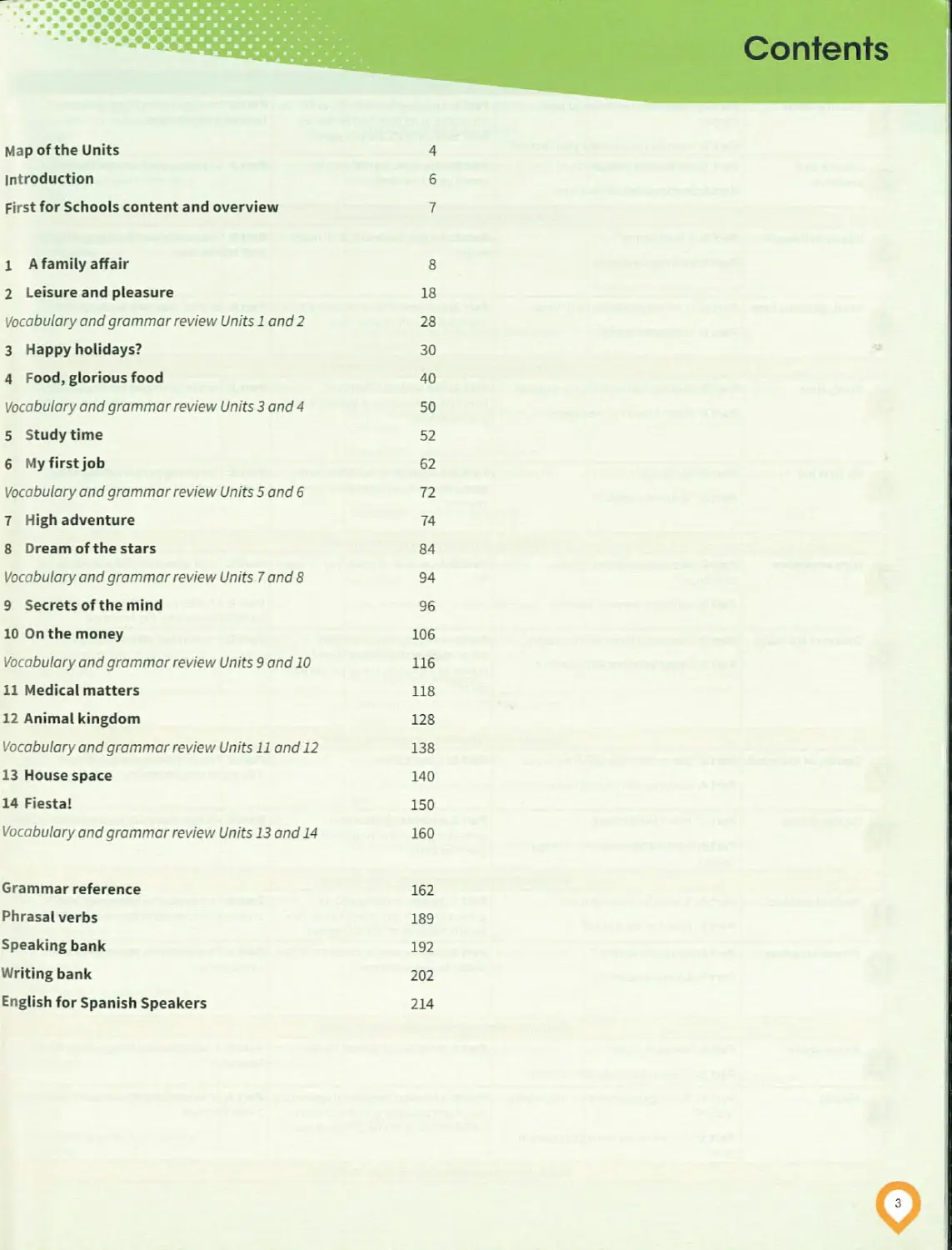
Contents
Map of the Units	4
Introduction	6
First for Schools content and overview	7
1	A family affair	8
2	Leisure and pleasure	18
Vocabulary and grammar review Units 1 and 2	28
3	Happy holidays?	30
4	Food, glorious food	40
Vocabulary and grammar review Units 3 and 4	50
5	Study time	52
6	My first job	62
Vocabulary and grammar review Units 5 and 6	72
7	High adventure	74
8	Dream of the stars	84
Vocabulary and grammar review Units 7 and 8	94
9	Secrets of the mind	96
10	On the money	106
Vocabulary and grammar review Units 9 and 10	116
11	Medical matters	118
12	Animal kingdom	128
Vocabulary and grammar review Units 11 and 12	138
13	House space	140
14	Fiesta!	150
Vocabulary and grammar review Units 13 and 14	160
Grammar reference	162
Phrasal verbs	189
Speaking bank	192
Writing bank	202
English for Spanish Speakers	214
Map of ft		ie units			1 1 1
	_ A family affair	Part 6: ‘From worst enemies to best friends’ Part 2: ‘How do you manage your money?’	Part 1: An essay: It is beneficial for teenagers to receive pocket money from their parents. Do you agree?	Part 1: Young people talking about their families and activities
t	Leisure and f pleasure	Part 1: ‘Ice skating - my passion’ Part 4: Sentence transformations	Part 2: An article: A great way to spend your free time	Part 2: A talk by a professional footballer
		Vocabulary and grammar review Units 1 and 2	_
I	Happy holidays?	Part3: 'A bus journey’ Part 7: ‘Holiday surprises’	Part 2: A story: It was a trip I’ll never forget’	Part 3: Five young people talking about their best holiday ever
4	_ Food, glorious food *	Part 6: ‘Are insects the future of food?’ Part 1: ‘How to eat sushi’	Part 2: A review: A local restaurant, snack bar or cafe in your area	Part 4: An interview with a young chef
	Vocabulary and grammar review Units 3 and 4
1	R Study time 3	Part 7: ‘Making the most of your summer’ Part3: ‘Exam stress for teenagers’	Part 2: The set text: The most interesting character in the book that you have read	Part 1: People talking about study and school
(	My first job	Part5: ‘My first job’ Part 2: ‘Voluntary work’	Part 2: A letter or email: What part- timejobs can teenagers do in your country	Part 3: Five young people talking about weekend jobs
	Vocabulary and grammar review Units 5 and 6
	High adventure	Part 6: ‘Are you ready for a school challenge?’	Part 2: An article: Agreatway to keep fit	Part 2: A talk about the Duke of Edinburgh Award
		Part 4: Sentence transformations		Part 4: An interview with someone who did a parachute jump for the first time
I	Dream of the stars	Part 7: 'Careers in film and the theatre’ Part 1: '1 want your job: stunt person’	Parti: An essay: There are both advantages and disadvantages to a career as a musician or actor. Do you agree?	Part 2: A talk about unusual sports
		Vocabulary and grammar review Units 7 and 8
<	p Secrets of the mind	Part 5: Our month in a tech free house’ Part 4: Sentence transformations	Part 2: A short story	Part 1: People talking about different influences on personality
	q On the money	Part 2: ‘How 1 like to shop’ Part 5: ‘1 got rid of nearly everything 1 owned’	Part 2: A review: Write about something you have bought or been given recently	Part 4: An interview with a student about ‘Buy nothing day’
		Vocabulary and grammar review Units 9 and 10	।
_ _ Medical matters 11		Part 4: ‘A school science project’ Part 3: ‘Afraid of the dentist’	Part 1: An essay: Young people generally don’t pay attention to their health and fitness. Do you agree?	Part 3: Five people talking about health problems and reasons for visiting a doctor
1	Animal kingdom	Part 1: 'Not just a hobby’ Part 7: ‘Animal rescue’	Part 2: A letter or email: Advice for a visitor to your country	Part 1: People talking about wildlife and conservation
		Vocabulary and grammar review Units 11 and 12
1	House space 3	Part 5: ‘Living in a yurt' Part 2: ‘The smallest house in Britain’	Part 2: An article: My ideal home	Part 2: A talk about building a small house from a kit
1	Fiesta! 4	Part 6: ‘Koningsdad: Europe's most lively festival’ Part 3: ‘The week my town goes back in time’	Parti: An essay: The advantages and disadvantages going to the cinema compared to streaming films at home	Part 4: An interview with someone who visits music festivals
	Vocabulary and grammar review Units 13 and 14


I Speaking 		| Pronunciation	| Vocabulary	| Grammar
part 1: Speaking about your home and what it is like to grow up in your hometown	Word stress	Phrasal verbs to describe relationships Collocations with make and do	Present perfect simple and continuous
part 2: Describing and discussing the benefits of different free time activities	Sentence stress (1)	Phrasal verbs to talk about skills and hobbies	Making comparisons Adjectives with -ing and -ed

part 3: Choosing the best activities for a school trip	Intonation (1)	travel, journey, trip and way	Past simple, past continuous and used to at, in and on in time phrases Past perfect simple and continuous
Part 4: Talking about diet and healthy eating	Grouping words and pausing (1)	food, dish and meal Adjectives to describe food, meals and restaurants	so and such too and enough

Part 1: Talking about your preferences regarding school subjects	Word stress (2)	Phrasal verbs connected with study find out, get to know, know, learn, teach and study attend, join, take part and assist	Zero, first and second conditional
Part 2: Describing what people learn and enjoy about doing different kinds of jobs	Sentence stress (2)	work and job; possibility, occasion and possibility; fun and funny Collocations with job and work	Countable and uncountable nouns Articles

Part 3: Discussing different ways to encourage students to do more sport	Intonation (2)	Verb collocations with adventure activities look, see and watch; listen and hear	Infinitive and verb + -ing
Part 4: giving opinions on the impor- tance of dance, drama and music as school subjects	Grouping words and pausing (2)	Verb collocations with ambition, career, experience and job People and the theatre Verb collocations with ambition, career, experience and job	at, in, on to express location Reported speech

Part 2: Describing the emotions that people have in different situations	Sentence stress (3)	achieve, carry out a nd devote stay, spend and pass; move, cause and have	Modal verbs to express certainty and possibility
Part 1: Talking about your personal life and interests	Linking (1)	arrive, get and reach Phrasal verbs connected with shopping	as and like Modal verbs to express ability

Part 2: Describing different ways to stay healthy and ways to deal with ^different illnesses	Intonation (3)	Health vocabulary Idiomatic expressions	Relative pronouns and relative clauses
Part 3: choosing a topic connected with animals Part 4: Discussion about looking after animals	Word stress (3)	avoid, prevent and protect; check, control, keep an eye on and supervise	Third conditional and mixed conditionals wish, if only and hope

Part 2: Describing what life is like in different places	Revision of features of pronunciation	space, place, room, location and square	Causative have and get Expressing obligation and permission
Part 3: Deciding how to celebrate an occasion Part 4: Discussion on festivals and celebrations	Improving fluency	Vocabulary to describe what people do Vocabulary for festivals	The Passive
L,
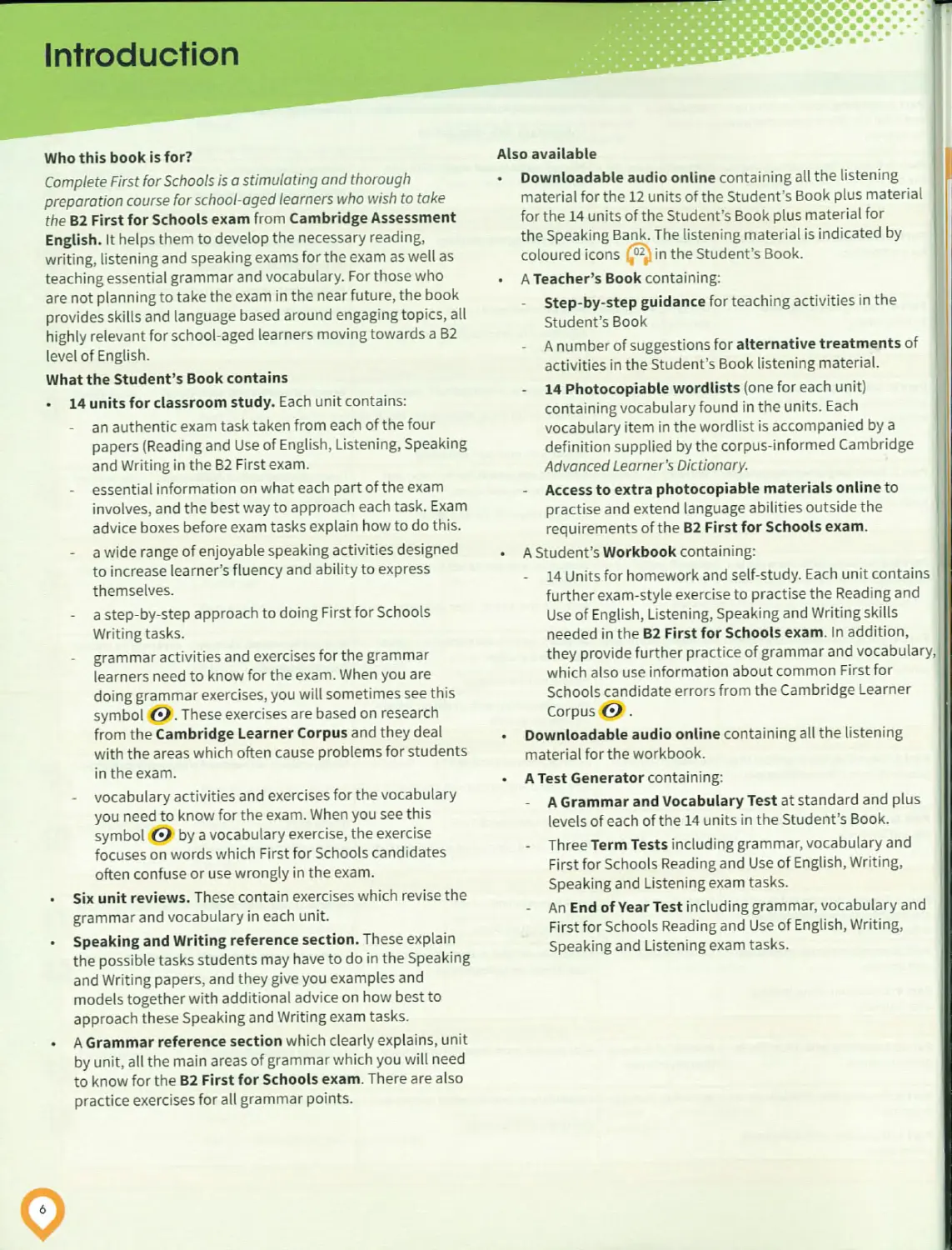
Introduction
Who this book is for?
Complete First for Schools is о stimulating and thorough
preparation course for school-aged learners who wish to take
the B2 First for Schools exam from Cambridge Assessment
English. It helps them to develop the necessary reading,
writing, listening and speaking exams for the exam as well as
teaching essential grammar and vocabulary. For those who
are not planning to take the exam in the near future, the book
provides skills and language based around engaging topics, all
highly relevant for school-aged learners moving towards a B2
level of English.
What the Student’s Book contains
• 14 units for classroom study. Each unit contains:
-	an authentic exam task taken from each of the four
papers (Reading and Use of English, Listening, Speaking
and Writing in the B2 First exam.
-	essential information on what each part of the exam
involves, and the best way to approach each task. Exam
advice boxes before exam tasks explain how to do this.
-	a wide range of enjoyable speaking activities designed
to increase learner’s fluency and ability to express
themselves.
-	a step-by-step approach to doing First for Schools
Writing tasks.
-	grammar activities and exercises for the grammar
learners need to know for the exam. When you are
doing grammar exercises, you will sometimes see this
symbol . These exercises are based on research
from the Cambridge Learner Corpus and they deal
with the areas which often cause problems for students
in the exam.
-	vocabulary activities and exercises for the vocabulary
you need to know for the exam. When you see this
symbol 6) by a vocabulary exercise, the exercise
focuses on words which First for Schools candidates
often confuse or use wrongly in the exam.
•	Six unit reviews. These contain exercises which revise the
grammar and vocabulary in each unit.
•	Speaking and Writing reference section. These explain
the possible tasks students may have to do in the Speaking
and Writing papers, and they give you examples and
models together with additional advice on how best to
approach these Speaking and Writing exam tasks.
•	A Grammar reference section which clearly explains, unit
by unit, all the main areas of grammar which you will need
to know for the B2 First for Schools exam. There are also
practice exercises for all grammar points.
Also available
•	Downloadable audio online containing all the listening
material for the 12 units of the Student’s Book plus material
for the 14 units of the Student’s Book plus material for
the Speaking Bank. The listening material is indicated by
coloured icons .’.°2 in the Student’s Book.
•	A Teacher’s Book containing:
Step-by-step guidance for teaching activities in the
Student’s Book
A number of suggestions for alternative treatments of
activities in the Student’s Book listening material.
- 14 Photocopiable wordlists (one for each unit)
containing vocabulary found in the units. Each
vocabulary item in the wordlist is accompanied by a
definition supplied by the corpus-informed Cambridge
Advanced Learner’s Dictionary.
Access to extra photocopiable materials online to
practise and extend language abilities outside the
requirements of the B2 First for Schools exam.
• A Student’s Workbook containing:
- 14 Units for homework and self-study. Each unit contains
further exam-style exercise to practise the Reading and
Use of English, Listening, Speaking and Writing skills
needed in the B2 First for Schools exam. In addition,
they provide further practice of grammar and vocabulary,
which also use information about common First for
Schools candidate errors from the Cambridge Learner
Corpus <•) .
•	Downloadable audio online containing all the listening
material for the workbook.
•	A Test Generator containing:
A Grammar and Vocabulary Test at standard and plus
levels of each of the 14 units in the Student’s Book.
-	Three Term Tests including grammar, vocabulary and
First for Schools Reading and Use of English, Writing,
Speaking and Listening exam tasks.
-	An End of Year Test including grammar, vocabulary and
First for Schools Reading and Use of English, Writing,
Speaking and Listening exam tasks.
В2 First for Schools content and
overview
Part/Timing	Content
Reading and Use of English 1 hour 15 minutes	Part 1A modified cloze text containing eight gaps and followed by eight multiple-choice items Part 2 A modified open cloze text containing eight gaps Part 3 A text containing eight gaps. Each gap corresponds to a word. The stems of the missing words are given beside the text and must be changed to form the missing word. Part 4 Six separate questions, each with a lead- in sentence and a gapped second sentence to be completed in two to five words, one of which is given as a ‘key word’ Part 5 A text followed by six multiple-choice questions Part 6 A text from which six sentences have been removed and placed in a jumbled order after the text. A seventh sentence, which does not need to be used, is also included. Part 7 A text, or several short texts, preceded by ten multiple-matching questions	In tasks 1-4 candidates are expected to demonstrate the ability to apply their knowledge of the language system by completing the first four tasks. In tasks 5-7 candidates are also expected to show understanding of specific information, text organisation features, tone, and text structure.
Writing lhour20 minutes	Part 1 One compulsory essay question presented through a rubric and short notes Part 2 Candidates choose one task from a choice of four questions. The task types are: • an essay • an article • a letter or email • a review • a story • a task based on a set text	Candidates are expected to be able to write using different degrees of formality and different functions: advising, comparing, describing, explaining, expressing opinions, justifying, persuading, recommending and suggesting.
Listening Approximately 40 minutes	Part 1A series of eight short unrelated extracts from monologues or exchanges between interacting speakers. There is one three-option multiple-choice question per extract. Part 2 A short talk or lecture on a topic, with a sentence- completion task which has ten items Part 3 Five short related monologues, with five multiple- matching questions Part 4 An interview or conversation, with seven multiple- choice questions	Candidates are expected to be able to show understanding of attitude, detail, function, genre, gist, main idea, opinion, place, purpose, situation, specific information, relationship, topic, agreement, etc.
Speaking 14 minutes —	Part 1A conversation between the examiner (the ‘interlocutor’) and each candidate (spoken questions) Part 2 An individual ‘long turn’ for each candidate, with a brief response from the second candidate (visual and written stimuli, with spoken instructions) Part 3 A discussion question with five written prompts Part 4 A discussion on topics related to Part 3 (spoken questions)
7
Starting off
Work in pairs. Discuss these questions.
•	Which of the activities in the photos look the most fur
•	Write a list of five activities you enjoy doing with your
family and a list of five activities you enjoy doing with
your friends. How different are the two lists? Why do
you think this is?
Listening Part 1
•	In Listening Part 1, you listen to people talking in eight
different situations, which may be either conversations
between two or more people, or just one person
speaking.
You answer one question for each situation
by choosing A, В or C. You hear each piece
twice.
Work in pairs. You will hear people talking in eight
different situations. Before you listen, read questions
1-8 and underline the main idea in each. The first one
has been done for you.
1 You hear part of a conversation between friends.
The boy says the reason his father cooks most of the
time is because
A the boy doesn’t like exotic food.
В the boy has too much school work.
C the boy doesn’t know what ingredients to buy.
2 You hear part of a conversation between friends.
The girl says that she enjoys spending weekends with
her family because
A her mother spends a long time researching places
to visit.
В her mother often chooses entertaining activities to
do at the weekend.
C her parents allow her to relax at home.
Vocabulary
3 You hear a girl talking to her brother on the phone.
What has her brother done to annoy her?
A He hasn’t done something he agreed to do.
В He has bought the wrong present.
C He has forgotten to buy a card.
4 You hear a boy taking part in a class discussion.
His relationship with his brother
A was surprisingly better in the past.
В was bad because they argued.
C improved because of their parents’ actions.
5 You hear a girl talking to a friend.
She says her sister didn’t tell her mum that she had got
two new kittens because
A her mother doesn’t like cats.
В her room was too small for kittens.
C her mother thought that one cat was enough.
6 You hear a boy leaving a message on his mother’s phone.
He is calling his mother because he wants her to
A tell his relatives that he can’t see them tonight.
В allow him to stay at his friend’s house.
C help him with his project.
7 You hear an interview with a young chess champion.
She says that the main reason for her success is that
A her father gave her a chess set when she was young.
В she has been very lucky.
C her family have helped her.
8 You hear a boy talking to a friend.
Why did the boy go to Denmark last summer?
A He likes trying new things.
в He always spends his holidays there.
C The climate is better there.
Listen and choose the best answer (A, В or C).
Work in pairs. Correct the mistakes in questions 1-6.
1	How often you do the cooking?
2	You usually spend your weekends with your family?
3	You have yet managed to get a present?
4	Parents should limit the amount of time their children
spend in front of a screen?
5	How much pets you say you had at home?
6	How you have become so successful?
Phrasal verbs
Match the phrasal verbs (1-12) from Listening Part 1 to
their definitions (a-l).
1	chill out 6
2	come up with
3	set off
4	work (something) out
5	rely/depend on
(someone)
6	fall out with (someone)
7	try (something) out
8	hit it off
9	look out for
(someone/something)
10	take after (someone)
11	look up to (someone)
12	look back at (something)
a have an argument with
someone
b immediately like each
other and become
friendly
c relax and rest
d experiment with an idea
e be able to trust someone
to do something
f find an answer to
something
g respect or admire an
older person
h start a journey
i think of (an idea or plan)
j think about something in
the past
к try to notice
I be like a parent or older
sibling
Complete the sentences with a phrasal verb from
Exercise 1 in the correct form.
1	I used to.............with	my cousins all the
time when I was younger, mostly because I didn’t
agree with their opinions, but now I’m a bit older
we’ve started to really...........as	we seem to
understand each other better.
2	My mother is a really good artist. I’ve always
	her because I’ve always known she’s
talented. I really hope I	her so that I can
make a living out of art too.
3	I know I can.............Martin if I’ve got a problem
because he always...............good	suggestions.
4	When I think about my childhood, I...........all
the silly things I did, but at least I now know what to
............so that I can avoid making the same
mistakes.
5	My friend loves the weekend because she can get up
late and just................On weekday mornings,
on the other hand, she’s up at 7 am as she has to
for school soon after that.
6	When Tomas has a problem, he often
a few ideas before he finds the correct solution.
It doesn’t matter what the situation is, he usually
............it..............in the end.
A family affair
1
Reading and Use of English Part 6
Work in pairs. You are going to read an article giving
advice to teenagers about how to get on better with
their siblings (brothers and sisters). Before you read,
write these adjectives in the correct column below.
cheeky childish cooperative
critical energetic enthusiastic hardworking
irritating mature organised patient
reliable responsible self-confident sensitive
sympathetic thoughtful
• In Reading and Use of English Part 6, you read a text
of 500-600 words with six gaps where sentences have
been removed.
You choose one sentence from a list of seven
sentences (A-G) for each gap; there is one
sentence you will
not need.
Read the article opposite carefully, ignoring the spaces,
and make a note of the main idea of each paragraph.
usually positive
usually negative
6АПК/)
First paragraph:
^e-t-tin^ on ^itk ^our 3ibliK^3 6Ak be Xl{{icul-t, but it is
possible to Мое a ^oo4 velAtionskip.
Six sentences have been removed from the article.
Choose from the sentences (A-G) the one which fits
each gap (1-6). There is one extra sentence which you
do not need.
Add one of these prefixes dis-, im-, in-, ir-, un- to each of
the words to make opposites.
cuopeeetive uKCoopeYA-tiue. critical enthusiastic
mature organised reliable responsible
sensitive sympathetic
Work in pairs. Which of the adjectives in Exercise 1 do
you think typically describe older siblings in relation to
younger siblings? Why? Which describe younger siblings
in relation to older siblings? Why?
Workingroups.
•	Make a list of things teenage children sometimes say
about their siblings.
44 6 з v'Z.Alh) iwi-tA-tiK.^ I
рАУбК^З AlMxjS ^YAl36 key.
•	Discuss what you can do to live happily with your
brothersand sisters.
•'Зе. to tkm akX tvy -to be coopevAtiue.
Use the underlined words in the sentences and in the
text to help you.
A It is a Iso crucia I that you are sensitive to the feelings of
your siblings too.
В Your siblings need to learn to take responsibility if they
have done something wrong.
C These arrangements will hopefully make both of you
more cheerful.
D It is only natural that these developments will affect
your feelings towards members of your family.
E But you should try not to let incidents like these have
too big an effect on your relationship.
F Indeed, it could seem impossible to imagine that you
could ever be friends.
G This could be watching a series on television, joining I
an exercise class or even preparing a family meal.

Q
1
v fM * Г *  *
жю ешвйю то ж renaoiw
Everybody feels irritated by their siblings from time
to time. Maybe your younger brother shows off and
behaves in an immature way when you invite your
friends to your house. Or perhaps your hardworking
older sister gets a lot of praise from your parents,
making you feel like you are not trying hard enough.
At times, your brother or sister can feel like your
worst enemy. 1 | ] But your relationship can improve
greatly with a bit of effort and understanding.
Sibling relationships can be especially difficult for
teenagers, who are experiencing many changes to
their preferences and personality. (2 | |For example,
you may now find some of the activities that you used
to enjoy doing with your younger brother childish or
a waste of time. At times, the age difference can feel
bigger than it really is, and this can have a negative
effect on your relationship.
One way to solve this problem is to make sure you
continue to include your brother or sister in your day-
to-day life. Find an activity that you think you will
both enjoy and suggest that you do it together. । з | )
If you do this activity regularly, you will soon
remember how much fun it can be to spend time
together, and you will start to get on better with each
other. This can take some time, so it is important to be
patient and enthusiastic.
Of course, it is perfectly
normal for brothers
and sisters to fall out
with one another over
small things. When
you live together, it is
only natural that you
will get on each other's
nerves from time to
time. For example, if
your younger sister is
always borrowing your
clothes without your
permission and then
loses or damages them, then of course it is your right
to be annoyed with her. 4	) It is important to learn
to forgive your siblings for this kind of behaviour, just
as you would forgive your close friends.
In situations like these, it is really important to let
your sibling know how you feel. Rather than insulting
your sister when she takes your things, tell her that
it makes you feel angry, and that you would feel
much happier if she asked you first, (s | ) Your older
brother may be more popular with your parents for
his academic achievements, but he may also feel sad
that he is not so popular with you. By making an effort
to understand each other's feelings, your relationship
will quickly improve.
Finally, it is important to learn how to compromise.
It is understandable that you may not want to lend
your favourite jumper to your unreliable sister, but
maybe you could offer her a less valuable alternative
item of clothing. Or if your brother likes to spend all
his free time watching football and you find it boring,
you could suggest a different sport that you follow
regularly together. (6 j And if you make the effort to
make your sibling happy, he or she will do the same
for you.
A family affair 11
1
Work in groups of four. Two students should take the
role of Brother/Sister A and two students should take
the role of Brother/Sister B.
•	Read the role-play cards and decide as a group what
the missing / borrowed item is going to be.
•	Work with the student who has the same role as you.
Read your role and prepare what you are going to say,
•	When you are ready, change partners and have your
conversations.
Brother/Sister A
You recently received a special gift for your
birthday. When you looked for it the other day,
it had gone missing. You think that your brother/
sister may have taken it. You are annoyed
because
•	they often take your things without asking
•	this gift is very important to you as it is something
that you had wanted for a long time.
Have a conversation with your brother/sister.
Find out what happened and decide how to avoid
this situation in the future.
Grammar
Present perfect simple and continuous
► Page 162 Grammar reference
Look at the pairs of sentences in italics and answer the
questions that follow.
1 a I’ve broken my personal record playing virtual ten nit
b I’ve been playing virtual tennis all evening.
Which sentence (a or b) talks about...
1	the result of an activity?
2	the length of an activity?
2 a I’ve been learning howto bake bread.
b I’ve phoned her more than six times, but she never
answers the phone.
Which sentence (a or b) talks about...
1	how many times something has been repeated?
2	changes or developments which are not finished?
Brother/Sister В
You recently borrowed something belonging to
your brother/sister without asking them. You
sometimes do this because your brother/sister
never lets you borrow their things.
Have a conversation with your brother/sister.
Explain what happened and discuss how to avoid
this situation in the future.
3	a I’ve been helping my mum while her assistant is on
holiday.
b We’ve lived in this house since I was a small child.
Which sentence (a or b) talks about something
which is...
1 temporary?
2 permanent?
Complete the sentences with the present pe
or continuous form of the verbs in brackets.
1	Гие Ьак (visit) friends, so I haven’t spoken to
my parents yet today.
2	My mum	(ask) me to tidy my room
several times.
3	I..............(clean)	the kitchen, so what would you
like me to do next?
4	Our neighbour...............(play)	the violin for the
last three hours and it’s driving me mad!
5	Congratulations! You	(pass) the exam
with really high marks!
6	Adriana doesn't know many people in ourtown yet.
She	(only live) here for a few weeks.
7	We................(spend)	every summer in Crete
since I was a child, so it’ll be sad if we don’t go there
this year.
8	I’m really tired because I............(cook) all day!
1
Students often make mistakes with the present perfect
simple and continuous. Correct the underlined verb
(*) which is wrong in each sentence.
/
1	I was-interested in it since I saw a film about it.
Moe, bun
2	In these last three weeks, I learned so many interesting
things which I didn’t know how to do before.
3	This isn’t the first time I fix the brakes on my bike.
4	My name is Hannah and I .play tennis for three years.
5	Since I started the project, I had been doing research
on someone famous from my country.
6	They had been talking about it for weeks, but nothing
has been done up to now.
7	Vicky and Kostas are friends for many years. They
actually met at primary school.
Reading and Use of English Part 2
• in Reading ana use от tngnsn нагт л, you reaa а гехт от
150-160 words with eight gaps
where words have been removed.
You write one word in each gap.
You are given an example (0).
ф Work in pairs. You are going to read an article about
how teenagers get and manage their money. Before you
read, match the verbs (1-7) to the nouns (a-g) to make
phrases related to getting and managing money. Some
verbs may be used with more than one noun.
1	open	a	a budget
2	get	b	a bank account
3	set	c	pocket money
4	buy	d	essential items
5	receive	e	bills
6	make	f	a part-time job
7	pay	g	choices
О Work in groups. Discuss these questions.
•	Which of the phrases in Exercise 1 are related to
getting money? Which are related to managing money?
•	Which of the things in Exercise 1 have you done, or do
you do?
I До konse^ork euevy ^ezk to ^et pocket жоку fvow
ну pArmbs.
Read the text quickly. How do teenagers get and
manage their money?
Think of the word which best fits each gap. Use only
one word in each gap. Make sure that you spell the word
correctly.
How (0)....4?.....young people manage
their money? A recent survey asked teenagers
(1)...........their money comes from and
about their spending habits. Just over 80%
of the teenagers surveyed received regular
pocket money (2) .........their	parents.
About half of these had to (3) ......
housework in return for their pocket money.
Just under 10% received no money but said
that their parents bought (4)........
essential items, such as clothes. A further
12% chose (5)..........get a part-time job.
Reasons (6)..........seeking employment
included having more money to spend, saving
up for a large purchase such (7)........
a car and wanting to be financially
independent; that is to say, to make
their own money. When asked about
(8)...........spending	habits, about half
of the teenagers surveyed said that they
spent all their money each month. A
quarter opened a bank account and saved
a set amount each month and 10% set a
monthly budget.
A
1
Vocabulary
Now check or complete your answers by using these
clues.
1	an adverb used to describe places
2	This preposition tells us who gives teenagers pocket
money.
3	Which verb do we use with housework?
4	a pronoun which tells us who the parents buy
everything for
5	a preposition often used before the infinitive form of a
verb
6	a preposition used with reason and often followed by
the gerund (-ing) form of a verb
7	This preposition is used with such to mean for
example.
8	Whose spending habits did the survey ask about?
Work in pairs. Is what the text says about how teenagers
get and manage their money true in your country
as well?
Collocations with make and do
Put the words and phrases in the box into the third
column of the table.
-an activity -ад-appoiiiLiiieTft an arrangement
the bed business a change a choice
the cleaning a course a decision an effort
an excuse (an) exercise a favour friends
homework housework an impression a job
a mistake money a noise a phone call apian
progress a promise the shopping (a) sport work
verb	definition	f,	common collocation
make	to create or produce something	AH Appoiwtw6wt
do	to perform an activity or job	ah A6tiuit^ i-
Students often confuse make and do. Complete the
sentences with the correct form of make or do.
1	According to a recent study of teenagers, half of them
do not	housework for pocket money.
2	Many teenagers get a part-time job because they
want to	money and be financially
independent.
3	If you want to	me a favour, could you
.............the	shopping for tonight’s dinner?
4	A few changes have been..............to	the
computer game and the company say they’ll try to
avoid	similar mistakes in the future.
5	People who................language	courses tend to
............a	lot of friends at the same time.
6	I	a big effort to be helpful around the
house last week.
Work in pairs. Each choose five words/phrases from
the table in Exercise 1 and think about when you did or
made these things. Then take turns to tell your partner
about them.
I RaX to жАкь A cRoice.	A^A^ 4oitk ж^
Йоу Xoik^ A (ahaiaAas. course. Xuvika tRe. зижжеу.
it ^a-s A Xiffwult cRoicz to жлкг., I ХшХеХ to
Xo tRe 1Аи.^иА^е coum акХ ж&з ж^ RoIIXa^.
Speaking Part 1
Which of the phrases (a-l) can you use with these
sentence openings? In one case, both are correct.
► page 192 Speaking bank
In Speaking Part 1, the examiner asks you questions
about yourself. These may include questions
about your life or studies, your plans for the
future, your family, your interests, etc.
Look at these two questions, which the examiner may
ask you in Speaking Part 1.
Examiner: a Where are you from?
b What do you like about the place where
you live?
1	Which question asks you to give your personal
opinion? Which asks you for personal information?
2	Which question needs only a fairly short answer?
Which question needs a longer answer?
Listen to Tania and Peter answering the questions
03 above. Who do you think gives the best answers? Why?
In the exam, you will get higher marks if you use
a range of appropriate vocabulary. Work in pairs.
Which of these phrases can you use to describe
It is... л lAY^e ifUustriAl cify
It has...
Q Pronunciation: word stress (1)
In the Speaking paper, you will get higher
marks if your pronunciation is clear. In
words of more than one syllable, one
syllable is stressed more than the others.
If you stress the wrong syllable, the
word becomes difficult to understand.
In dictionaries the stressed syllable is
marked like this: residential.
Underline the stressed syllable in each of
these words and phrases.
industrial
relaxed atmosphere
wonderful
facilities
historic
ф Listen and check your answers. Then work
04, in pairs and take turns to read the words
* aloud.
the place where you live?
a a large industrial city
b a relaxed atmosphere
c lively cafes
d in the middle of some great countryside
e a pleasant residential district
f good live music venues
g plenty of sports facilities
h a lot of historic buildings
i lots of attractive buildings
j some pretty good shopping
к a busy city centre
I wonderful beaches nearby
A
How can you extend your answers to the two questions
below? Think about Tania’s extended answers you
heard in Exercise 2, and use the frameworks given here
to help you.
Examiner: Where are you from?
Student: I’m from ... It’s a ... which ...
Examiner: What do you like about the place
where you live?
Student: Well, it’s , so ..., but... and ...Also ...
Work in pairs. Take turns to ask and answer the
questions in Exercise 6. Use some of the vocabulary
from Exercise 3.
Read questions 1-8. Think about how you can give
extended answers. Then work in pairs and take turns
to ask and answer the questions.
1	Do you come from a large family?
2	What do you like about being part of a
large/small family?
3	Who does the housework in your family?
4	What things do you enjoy doing with your family?
5	Tell me about your friends.
6	What things do you enjoy doing with your friends?
7	Who are more important to you: your family
or your friends?
8	Do you have similar interests to your parents?
Writing Part 1
An essay
► Page 202 Writing bank
•	In Writing Part 1, you write an essay in which you discuss
a question or topic. After the essay topic, there are
some notes which you must use.
•	You must also include an idea of
your own.
•	You must write between 140
and 190 words.
Exam
advice
Read the writing task and note the points you must
deal with.
In your English class, you have been talking about how
teenagers manage their money.
Now your English teacher has asked you to write an
essay.
Write your essay using all the notes and give reasons
for your point of view.
‘It is beneficial for teenagers to receive pocket
money from their parents.’
Do you agree?
Notes
Write about:
1.
2.
3.
reasons why receiving pocket money is
beneficial for teenagers
reasons why receiving pocket money may
not be good for teenagers
..............(your own idea)
Work in groups. Discuss the task and try to find two or
three things you can say about each of the notes 1-3.
1
Read a student's answer to the task, ignoring the
spaces. Which of her ideas do you agree with, and which
do you disagree with?
(1) ........most teenagers can rely
on their parents for the things they need,
learning how to manage money is an
important skill. Many adults believe that
teenagers simply waste their pocket money
on clothes, computer games and fast food.
(2)___________, I believe that parents can
teach teenagers to manage their money
effectively by giving them regular pocket
money.
Some parents prefer to buy their children
everything they need rather than give them
their own money. It is true that young people
may not spend their money on sensible
things, (3)	parents may know
better what they need, but in my view, young
people need to be given the independence to
make their own choices.
People often argue that young people will find
it difficult to make their money last for
a whole month. (4).......... ,	if parents
help their children to set a budget, and are
strict about not giving them extra money,
they will soon learn to manage their money
sensibly in my opinion. They are likely to be
more financially responsible when they
are adults and will be less likely to borrow
money from their parents.
For all these reasons, I think that teenagers
benefit more from receiving pocket money
from their parents than if their parents buy
them everything they need.
Complete this plan for the student’s essay by matching
the notes (а-d) to the paragraphs (1-4).
Paragraph 1:
Paragraph 2:
Paragraph 3:
Paragraph 4:
introduction:
conclusion:
a Who should decide what teenagers need and why?
b Parents can help children to manage their money and
why this is good
c Most beneficial to give teenagers pocket money
d Common belief that teenagers waste money + my
opinion
It is important to express your opinions in an essay. Find
four phrases which the student uses to introduce her
personal opinions.
When you write an essay, you should try to present
contrasting points of view. Complete the student’s
essay by writing although, however, on the other hand or
whereas in each of the spaces 1-4.
Complete the sentences with although, however, on the
other hand or whereas. In some cases, more than one
answer may be possible.
1	Adults tend to worry more about their health,
	young people are more concerned
about money.
2	.............1 am happy to do some of the cooking,
I don’t want to do it all.
3	My mum and dad have similar tastes............,
mine are completely different.
4	my parents give me a lot of freedom,
I would prefer to have even more independence.
5	Young people often spend many hours a week on
their social life............  older	people are
often too busy.
6	I enjoy making beds.............,	I’m not at all keen
on doingthe ironing.
Write your own answer to the writing task in Exercise 1.
Before you write, use the notes you made in Exercise 2
to write a plan. Write between 140 and 190 words.
• Use the student’s essay as a model, but express your
own ideas and the ideas which came up during your
discussion.
A family affair
0
9 Leisure and
pleasure d
В	к
ж
/ X
* F
Starting off
©о
Which of the activities in the photos have you done?
Which do you think is...
•	the most enjoyable?
•	the cheapest?
•	the healthiest?
•	the most relaxing?
•	the least active?
•	the best to do with
friends?
•	the most popular
among young people?
Which would you like to try? Why?
Listening Part 2
•	In Listening Part 2, you hear a talk or lecture by one
speaker.
•	You listen and complete ten sentences with a word
or short phrase.
• You write the actual words you hear and you
must spell them correctly. You don't change
them in any way.
You hear the recording twice.
Work in groups. You are going to hear a professional
footballer talking about her career. Before you listen
complete the sentences about professional sports
players with words from the box.
burn chase depend on
doubt influence perform
regret share train
1 In team sports, players need to learn to trust and
............their teammates.
2	They often.............a lot of energy playing
sport, and so they must be careful about their diet
3	Sportspeople should try not to............
missed opportunities or any bad decisions they
make during matches and competitions.
4	Professional sportspeople..............every	day
to maintain their peak of physical fitness.
5	Players sometimes start to ...........their
ability and it’s important that they overcome this. |
6	Athletes need to prepare carefully so they are
ready to	at their best in an importan| ч
competition.
7	In some sports, players need to	both
opponents and the ball for a long time and this
requires high levels of fitness.
8	To win, players need to know what they can do to
the game, especially if they are Iosin
9	A lot of sportspeople say that the thing they like
most is that they	their experiences i
with their teammates and this makes their
relationship with them stronger.
Could you be a professional sportsperson? Look aga
at the sentences above. Which would be easiest or
most difficult for you to do? Why?
2
Work in pairs. Read the listening task text below. What
type of information do you need to complete each
sentence?
Professional Footballer
As a young girl Clare played in the (1) .....
with her brother and some friends.
She used her (2) ..........and skills because
she wasn’t very tall or strong.
At school she enjoyed playing in matches, but also
liked (3)...........
The scout from the academy who watched her school
team was hoping to (4)	new players.
During the game Clare was worried that she wouldn’t
be (5)	for the academy.
She realised she could be a (6)	when
she joined the academy.
People think that women’s football is more
(7)	than men’s because it isn’t as fast.
Clare thinks that the lack of (8)	is an
issue for women's football.
Clare hopes that, with increased (9)	for
female players, people will see football as a game for
everybody.
She says she is fortunate not to have had many
(10)	in her career.
You will hear a woman called Clare Jackson, who is a
05 professional footballer, talking about how she managed
to make football her career. Listen and complete the
sentences in Exercise 3 with a word or short phrase.
Work in groups. Discuss these questions.
1	Which sports do you find ...
•	good for both girls and boys?
•	most complicated to learn?
2	Are there any sports you would like to try?
3	Do you have a hobby you would like to make into a
career like Clare did?
Grammar
Making comparisons
► Page 163 Grammar reference
Students often make mistakes with comparisons.
Choose the correct phrase in italics in these extracts
from Listening Part 2.
1	At first it was difficult for me as my brother and his
friends were bigger and more strong I stronger.
2	That probably helped me to develop into a
much better I more better player.
3	When I played for my school team, I soon realised I was
more influential/ most influential in almost every game
I played in than many of my teammates.
4	In fact my performance was better/ as good as I could
have hoped for.
5	I find it a bit irritating and confusing to be honest,
but it makes me much motivated / more motivated
to do well.
6	People say that the women’s game is more limited / the
most limited when compared to the men’s game.
7	I’ve been luckier / more lucky than many female
players.
8	It really is the most amazing / amazingest thing that’s
happened to me.
Complete the sentences with the correct form of the
adjective in brackets.
1	There are lots of ways to keep fit, but I think
................ (healthy) of all is zumba.
2	Playing chess is.............(cheap) than playing
video games.
3	Team games are...............(sociable) than cycling
because you meet and speak to a lot of people.
4	Chess is.............(hard)	than most games I know.
5	For me, parachute jumping is the.............
(thrilling) of all sports.
6	Speaking for myself, I find team sports the
	(not interesting).
7	Mountain biking is	(good) for getting
exercise than most sports.
Complete the sentences with your own ideas.
1	Learning to ride a bicycle is not as ...
2	In team games, the most...
3	I’m much better at...
4	My friends are far...
5	Golf is not nearly ...
Leisure and pleasure  19
2
You are going to read an extract from a blog by a
teenager about ice skating. Before you read, work in
pairs. What do you think people most enjoy about
ice skating?
Read the extract quickly to find out how the writer
became interested in ice skating.
Reading and Use of English Part 1
I first (0) A- ice skating when I was eight years old. I remember seeing a poster at my
local leisure centre (1) ice-skating lessons and begged my dad to (2) me
have a go. He agreed (3) I promised not to break any bones, and the following week,
I turned up at the ice rink for my first lesson. I remember feeling a bit unsteady at first, but
I soon got used to the ice underneath my feet and was thrilled by the (4) of sliding
across the ice. Later, my instructor taught me how to do different turns and jumps. I was
(5) of falling at first, but I picked it up quite quickly and then it felt so exciting! I soon
became much more confident about (6) risks. Now I train at the ice rink twice a
week and have taken part in several national contests. Next year, I am hoping to (7)
an international event in Switzerland. I have also kept the promise I (8) to my dad -
I have never fallen and injured myself while ice skating!
• You fill in the gaps with the best
option, А, В, C or D.
• In Reading and Use of English Part 1, you
read a text of 150-160 words.
Read the extract again and decide which answer (A, B,
C or D) best fits each gap. There is an example at the
beginning (0).
Q
0	A took up	В played	Cthought	D came
1	A taking	В advertising	C giving	D teaching
2	A allow	В let	C permit	D enable
3	A as long as	В as soon as	C as far as	D as much a
4	A emotion	В attention	C feeling	D touch
5	A worried	В alarmed	C anxious	D scared
6	A doing	Btaking	C making	D having
7	A take	В make	C enter	D participate
8	A made	В did	C said	D told
2
0 Work in pairs. Choose a hobby or
sport, then prepare your roles and act
out the conversation.
Student A
You are a teenager. You want to take
up a new hobby, but you need your
parents to agree and to give you
some money to have lessons. Think
of reasons why you want to take
up this hobby and try to persuade
your mother or father to give you
permission.
Student В
You are one of Student A’s parents.
You don’t want him/her to take up
this hobby. Think of reasons why
he/she shouldn’t do it and try to
persuade him/her not to.
Vocabulary
Phrasal verbs and expressions
0	Match the phrasal verbs and expressions from the ice-skating blog (1-8) to their definitions (a-h).	3	Hans let me	on	his new bike, and now 1 want to get one myself!
	1 take up (line 1)	a learn how to do 2 have a go (line 3)	something 3 turn up (line 4)	b do what you said you 4 get used to (Iine5)	would do 5 pick something up (line?) c be part of an event	4 5 6	1 didn’t like my new haircut at first, but 1 am starting to 	it. When Diego finally	at the gym, it was almost closing time. People won’t trust you unless you can	and do what you say you’re going to do.
	6 take risks (line 8)	d start doing an activity 7 take partin (line 9)	for the first time	7	1 need to get more exercise, so I’m thinking of	 jogging.
	8 keep a promise (line 10) e arrive f try something g do something even though something bad might happen because of it h feel more	U comfortable in a new situation	8 1 really enjoyed	the school quiz even though our team didn’t win. 9 I’ve never sung in a choir before, but I’ll	if	it’s just for fun. 10 You don’t need to bring any special equipment for the yoga class-just	on time. Work in pairs. Take turns to answer these questions. Make a note of your partner’s answers. • What new skills have you picked up recently?
Complete the sentences with a phrasal verb or
expression from Exercise 1 in the correct form.
1 I’d never do something like sky-diving because I don’t
enjoy....................
2 I found playing the violin difficult at first, but my
teacher says that lam.....................really	quickly.
•	What new activity would you most like to have a go at?
•	Do you enjoy taking risks? Why? / Why not?
•	Are you good at keeping promises?
•	What new situations have you had to get used to in the past?
Now work with another pair and tell them about your partner.
Leisure and pleasure
0
Grammar
Adjectives with -ed and -ing
► Page 164 Grammar reference
Look at the sentence from the blog on page 20 and
answer the questions.
I was scared of falling at first, but I picked it
up quite quickly and then it felt so exciting!
1	Which of the words in bold refers to how the
boy felt?
2	Which of the words in bold refers to what
made him feel like that?
Students often confuse adjectives with -ed and
adjectives with -ing. Choose the correct adjective in
italics in these sentences.
1	When we went to Disneyland, I think we found it more
amused / amusing than our parents.
2	It can be very irritated / irritating when friends arrive
latefor a film.
3	You will never get bored / boring at night in Berlin
because the nightlife is wonderful.
4	It’s very annoyed / annoying when people eat crisps in
the cinema.
5	The situation was very embarrassed / embarrassing for
me and I felt uncomfortable.
6	I was really excited I exciting and wanted to see as
much of the city as possible.
Use the word given in capitals at the end of the
sentences to form a word with -ed or -ing that fits
the space.
1	We were quite............by the unfriendly attitude
of the other students.
PUZZLE
2	It’s very..........to	be able to apply things we
learn in the classroom to our free-time activities.
MOTIVATE
3	Anita looked quite............when	she left the
police station.
WORRY
4	The film was not particularly..........
AMUSE
5	We were absolutely...........by the time we got
to the top of the mountain.
EXHAUST
6	Everyone watches Pietro at parties because he’s an
	dancer.
ASTONISH
7	My exam results were very...........I’d	worked
really hard and I thought I had done better.
DISAPPOINT
8	All the boys loved that.........car chase at the
end of the film.
THRILL
9	Tomas sounded really..............on	the phone.
He’s lost his place in the first team.
DEPRESS
2
fy You will hear a girl talking about one of the experiences
os4 5 6 * * * * a-g. Listen and decide which experience she is talking
* 11 about.
a She rode a motorbike for the first time.
b She was punished for something she didn’t do.
c She had to study all weekend for an exam.
d She broke a bone.
e She was trapped in a lift.
f She won a competition.
g She did a parachute jump.
Listen again. Which adjectives does she use to describe
/ o^l these things?
1	the whole experience:
2	how she felt after studying:
and.................
3	how she felt about her best friend’s suggestion:
4 thethoughtof breaking a bone:
5 how she felt in the plane:...........and
6 the jump itself:............
Q Work in pairs. Look at the experiences a-g in Exercise 4.
Have you done any of these things or have any of them
happened to you? How did you feel about them? Take
turns to describe your experience.
Reading and Use of English Part 4
In Reading and Use of English Part 4. you complete six
sentences with between two and five words so that
they mean the same as the sentences
printed before them.
• You use the word given in CAPITALS
without changing it in any way.
Complete the second sentence so that it has a similar
meaning to the first sentence, using the word given. Do
not change the word given. You must use between two
and five words, including the word given.
0 He doesn’t enjoy watching TV as much as watching
films.
MORE
He likes watching films..........................
watching TV.
1	It is easier to learn English than most other languages.
ONE
English is........................ languages
to learn.
2	Joanna finds swimming more boringthan running.
NOT
For Joanna, swimming is..........................
running.
3	It was the strangest game I have ever seen.
SUCH
I have never seen...........................
game.
4	Basketball is a lot more popular than football in
my country.
NEARLY
Football is..........................popular as
basketball in my country.
5	In general, ice skating is a lot more expensive than
rollerblading.
FAR
In general, rollerblading is
............................ice	skating.
6	It took Marek longer to cycle home than Simone.
MORE
Simone cycled home
Marek.
Leisure and pleasure 23
2
Speaking Part 2
► Page 194 Speaking bank
• In Speaking Part 2, you and the other candidate speak
on your own for a minute each.
• You compare two photos which the examiner
gives you.
Listen to an examiner giving this task to a candidate
called Bruno. According to Bruno, how can people benefi
from each activity?
Listen again and tick this checklist.
Bruno	Yes	No
1 introduces the topic
• You answer a question connected with
both photos.
• You answer a question quite briefly
about your partner's photos.
Work in pairs. Look at the examiner’s instructions and
the question and photos below. Then discuss what you
can say to compare the photos.
Examiner: Here are your photographs. They show
people doing different activities in their
free time. I’d like you to compare the
photographs, and say how you think the
people can benefit from spending their free
time doing these different activities.
2 deals with each photo in turn
3 describes each photo in detail
4 refers to the first photo when
talking about the second photo
5 spends most of the time
answering the printed question
6 talks about things not
connected with the question
7 speaks until the examiner
says ‘Thank you’.
How can the people benefit from spending their
free time doing these different activities?
Photograph 1
Photograph 2
Work in pairs. Listen again and complete the sentences
from Bruno’s answer which begin with these words and
phrases.
1 I think they benefit from ...
2 Firstly...
3 At the same time ...
4 Also...
5 I think they also benefit because ...
Which word(s) or phrase(s) (1-5) in Exercise 4 does
Bruno use to:
a introduce his answer to the examiner’s question?
b introduce the first point he wants to make?
c add additional points?
Which of these words/phrases could also be used for
b and c in Exercise 5?
Besides First of all In addition
To start with What is more
Pronunciation: sentence stress (1)
• We stress the words in sentences that we
particularly want our listeners to hear,
the words which carry the most meaning.
These are usually nouns, verbs, adjectives
or adverbs, not small grammar words like
articles or prepositions.
Listen and underline the stressed words
og\ in these sentences.
1	Firstly, they’re getting some exercise,
which is always good for you.
2	It’s great for your health and helps
you to relax.
3	Atthesametime, they're having fun
together...
4	... which is important because it builds
up their social relationships and their
friendships.
5	Also, it’s good to see girls playing serious
sports.
6	I think it goes against the idea that boys
have better athletic ability than girls.
Work in pairs. Take turns to read the
sentences aloud, paying attention to the
stress.
Work in pairs. Take turns to read these
extracts.
•	Firstly, they’re getting some exercise,
which is always good for you. It’s great for
your health and helps you to relax.
•	At the same time, they're having fun
together, which is important because it
builds up their social relationships and
their friendships. Also, it’s good to see
girls playing serious sports. I think it goes
against the idea that boys have better
athletic ability than girls.
Change partners and take turns to do the Speaking
Part 2 task in Exercise 1.
•	Try to speak for a minute.
•	Try to use some of the words and phrases
from Exercise 4.
•	Use your own ideas and Bruno’s ideas.
•	While you are listening to your partner, use the
checklist in Exercise 3 and give feedback when your
partner has finished.
Work in pairs and take turns to do this Speaking
Part 2 task.
Examiner:	The photographs show people doing
different free-time activities.Compare
the photographs, and say what you think
the people enjoy about doing these
different activities.
What do the people enjoy about doing these
different activities?
Leisure and pleasure
Writing Part 2
An article
Page 206 Writing bank
In Writing Part 2 you do one writing task from a choice
of four.
• The possible tasks are an article, a letter or email,
a report, a review, or a story. The fourth
task is always the set-book option.
• You must write between 140 and
190 words.
Look at this writing task and note the points you must
write about.
You have seen this announcement in an English-
language magazine for teenagers.
A great way to spend your free time!
Tell us about a leisure-time activity you really enjoy.
•	How did you get started?
•	Why do you enjoy it so much?
We will publish the most interesting articles in next
month’s issue.
Write your article.
Work in pairs. Tell your partner about one of your
free-time activities. While you are speaking, answer
the questions in the writing task above.
Work in pairs. The article in the next column would
lose marks in the exam because it is not divided
into paragraphs.
1	Divide it into paragraphs.
2	Say what the main idea is in each paragraph.
Sailing
- a fun and exciting sport
I’ve always loved the sea, but I first
experienced sailing last year. I went to stay
with my aunt, who lives near the sea. She is a
keen sailor and she suggested that I join the
local sailing school. In the first lesson, I learnt
how to steer the boat and some basic survival
skills at sea. Although I found some things
quite complicated at first, I soon mastered
the basics. By the end of the course, I was
quite a competent sailor. I really benefitted
from meeting other people who were my age
at the sailing club. When we became more
experienced, we were allowed to take a small
boat out on our own. It was really satisfying
to take charge of the boat and we enjoyed
being independent. It was a lot more difficult
for us to sail when the weather was bad. I
even fell in the water once, but it was very
exciting trying to keep the boat under control
in the rough sea. Despite the difficulties, I
can’t wait to go back there next summer.
1 love sailing because it’s challenging and
sociable.
You can write compound sentences by joining two
sentences with and, but and because. Which two
sentences are joined in these compound sentences?
1	I’ve always loved the sea, but I first experienced sailinj
last year.
2	She is a keen sailor and she suggested that I join the
local sailing school.
3	It was really satisfying to take charge of the boat and
we enjoyed being independent.
4	I even fell in the water once, but it was very exciting
trying to keep the boat under control in the rough sea
5	I love sailing because it’s challenging and sociable.
2
Л Write compound sentences by joining these sentences
with and, but and because. Use pronouns (he, she, it, etc.)
to avoid repetition.
1	I’d like to learn to fly. I think learning to fly is too
expensive.
ГД like, -to Imyk -to {Uj, but I -tkkk its -too fcxpuisiufc.
2	I got interested in flying when I was about 14. My
father took me to an airshow.
3	My parents don’t want me to fly. They think flying is
dangerous.
4	One of my friends is learning to fly. My friend has asked
me to come with him. My friend thinks I’d like flying.
Q You can write complex sentences by joining two
sentences with words such as when, who, which and
that. Write these complex sentences as two separate
sentences.
1	I went to stay with my aunt, who lives near the sea.
[ to shy ntk mu) Aunt. <Ml) Aunt liu&s kcay
tke 5&Л.
2	I really benefited from meeting other people who
were my age at the sailing club.
3	When we became more experienced, we were allowed
to take a small boat out on our own.
4	It was a lot more difficult for us to sail when the
weather was bad.
Join these sentences using when, who, which and that.
1	I was 13.1 started running seriously.
2	My uncle encouraged me. My uncle’s a keen athlete.
3	I go running most days. I’ve finished school and done
my homework.
4	Running is a sport. Running gets you really fit.
Join these sentences using and, because, but, when,
which and who. Use pronouns (he, she, it, etc.) to
avoid repetition.
1	I started windsurfing. I was 13.1 was staying with
friends by the sea.
2	Oneof my friends is a keen windsurfer. She
encouraged me to start. She thought I would enjoy it.
3	I kept falling into the sea to start with. It was a fairly
windy day. There were a lot of waves.
4	I didn’t enjoy it at first. I had to concentrate quite hard.
I carried on trying.
5	I started to windsurf quite fast. It was exciting. I
started to find it quite enjoyable.
Find adjectives in the article which describe the
following:
1	how the writer found learning to sail at first
2	the writer’s ability to sail by the end of the sailing
course
3	how the writer felt about the experience of sailing with
friends
Complete the table with the words in the box.
asteftijshiiig"" competitive delightful demanding
depressing dreadful economical entertaining
exhausting incredible irritating popular
superb time-consuming tremendous unbelievable
feelings about an activity
the type of activity
As-toHiskin^
You are going to write your own article to answer the
writing task in Exercise 1. Before you write:
•	decide on a title for your article which will encourage
people to read it
•	decide how many paragraphs you need, the subject
of each paragraph and write a short plan
•	think about some of the vocabulary you can use.
Write your article using between 140 and 190 words.
1 Vocabulary and
grammar review
_______
Vocabulary
Complete the sentences with adjectives from Exercises
1 and 2 on page 10, or their opposites. In some cases,
more than one answer may be possible.
1	Hugo is very	- he often helps his
grandparents with the shopping.
2	My parents allow my brother to come home any time
he likes because they know he is very
3	Pascale is very	, so she’s bound to finish
her part of the project on time.
4	David is so	that you can never trust him
to do what he says he’s going to do.
5	Melanie is very	and not afraid of
meeting new people.
6	I wouldn’t have criticised you if I had known how
you were!
7	Helen is very young, but she behaves in a
and responsible way.
8	Luis is a very .............person, who is always
trying new sports and activities.
Complete the sentences with a phrasal verb from page 9
in the correct form.
1	It’s Toby’s birthday next week. We need to
some ideas for a present.
2	I can see the family resemblance. You’ve got your
father’s eyes - you really ............him, don’t
you?
3	Why are you standing by the window? - I’m
the delivery person. I’m expecting an
important package today.
4	I don’t feel like doing much this weekend. I think that
I’ll just..............around	the house.
5	We’ll need to	the new internet
streaming service - I’ve heard it’s much better than
the others but I want to see it for myself before I pay
for it.
6	I must apologise to my sister. We	over
something really small and had a massive argument.
I hope she’ll forgive me.
Complete the sentences with the correct form of make
do.
1	Could you	me a favour and let me copy
your notes from the last class?
2	Do you mind if I use your phone? I’ve got to
..... an urgent phone call.
3 I’ll	the shopping on my way home this
evening.
4 My mum’s	an English course in
the evenings, and I sometimes help her with her
homework.
5	I’ve got so much homework to	that I
can’t come out with you tonight.
6	Marco has	a big effort with his students
so I’m afraid he’s a bit disappointed with their results.!
7	Sarah wasn’t enjoying the party, so she	.J
an excuse and left.
8	We phoned the police because our neighbours were
too much noise.
Grammar
Complete the sentences with the present perfect simple
or continuous form of the verbs in brackets. In some
cases, both forms are possible.
1	I’m celebrating because my team	...(win)i
the league!
2	At last you	(arrive) - we .
(expect) you for ages.
3	Of course I’m annoyed. I................(spend) ages
preparing for this party and no one....	(tun
up) yet.
4	We ................(have)	a really interesting time.
Gavin	(tell) us about his trip round the I
world. There are a few countries he still ...........I
(not tell) us about, but I get the impression he
.......... (see) almost everything!
5	Kate	(lose) weight recently because she
(get) more exercise.
6	I wonder if Irina	(finish) reading that
book yet. I ............. (wait) to read it for ages.
7	Tatiana is so greedy! She	...(eat) all the
cakes and she	(not leave) any for us.
8	Paolo	(look) very tired recently. I think
it’s because he	(study) too hard.
Vocabulary and
grammar review
2
Vocabulary
ф Complete the sentences with a phrasal verb or
expression from the Vocabulary on page 21 in the
correct form.
1	If you can’t	, no one will ever trust you.
2	I just don’t like	, so I’d never get a
motorbike.
3	Mario is thinking of	jogging, as he
doesn’t feel he’s getting enough exercise.
4	I thought learning Italian would be difficult, but
when I moved to Bologna I soon...................it
5	We	a 10 km run at the weekend, to raise
money forthe local hospital.
6	I can’t work out how to solve this maths problem;
would you like to	and see if you can
doit?
Grammar
ф Join the sentences to form compound and complex
sentences. More than one answer may be possible.
1	Katya took up karate. She was seven years old. She
was interested in karate.
2	Her father is a professional karate instructor. He
taught her. She progressed quickly. She soon became
junior regional champion.
3	She did karate with other children. The other children
were the same age as her. None of them was as good
as her. She felt dissatisfied.
Complete the second sentence so that it has a similar
meaning to the first sentence, using the word given. Do
not change the word given. You must use between two
and five words, including the word given.
1	This motorbike is not as noisy as my previous one.
MADE
My previous motorbike________________________
this one.
2	Small towns are safer than large cities.
NOT
Small towns	as large cities.
3	No one in the team plays better than Gemma.
PLAYER
Gemma	in the team.
4	She looks more relaxed than she did before the exam.
STRESSED
She does not look........................ she	did
before the exam.
5	Tatiana does not speak nearly as clearly as Irina.
MUCH
Irina speaks	Tatiana.
6	None of the other sofas in the shop are as comfortable
as this one.
ANY
This sofa is	the others in
the shop.
Word formation
4	Last year, she took part in the national championship.
She didn’t win. She was injured during one of the
matches.
5	She hopes to become a professional karate instructor.
She hopes to work in the same sports centre as her
father. Her father has too many students.
6	Some of her father’s students have been studying
karate for several years. Her father thinks they would
benefit from a different teacher. They are too familiar
with his style of karate.
Use the word given in capitals at the end of each
sentence to form a word that fits in the gap.
1	What an	band! I never expected they’d
be that good. AMAZE
2	They found the journey so	that they fell
asleep as soon as they arrived. EXHAUST
3	It’s a	problem - I don’t really know what
to do about it. PUZZLE
4	Jake felt	that he wasn’t picked to play in
the match. DISAPPOINT
5	You can’t expect children to work hard if they don’t feel
..................MOTIVATE
6	We were	by the way the other team
shouted at us. ASTONISH
Vocabulary and grammar review
3 Happy
** holidays?
Starting oft
holiday locations
and places to stay
holiday
activities
types of
holiday
Work in pairs. Complete the table with the words and
phrases in the box.
Choose one or two of the photos. Discuss the different
types of activities you could do on this type of holiday
and say what the advantages and disadvantages of thi
type of holiday are.
backpacking a beach holiday a camping holiday
at a campsite a city break in the city centre
a cruise on a cruise ship at a luxury hotel
meeting new people in the mountains relaxing
at the seaside by the sea seeing new places
a sightseeing tour skiing sunbathing
visiting monuments walking and climbing
at a youth hostel
3
Listening Part 3
Grammar
• in Listening Part 3, you listen to five different speakers
talking about the same topic.
• You hear the recording twice.
. You match each speaker with one of
eight sentences A-H. There are three extra
sentences you don't need.
Past simple, past continuous and used to
► Page 165 Grammar reference
Complete these extracts from Listening Part 3 with the
correct form of the verbs in brackets. Then listen again
to check your answers.
Aswe(l)	(leave), they (2)
(take) great delight in giving us each yet another
present to take home with us.
You will hear five short extracts in which teenagers are
talking about their best holiday ever. Before you listen,
underline the main idea in each statement A-H.
A I wanted my own country to be more like this.
В I was surprised how much I liked some of the food.
С I didn’t want to change our holiday plans.
D I went on my first holiday without my parents.
E I didn’t know where this place was before I went there.
Not many people from where I live (3)
(visit) Cuba at that time, so I (4)	(not
know) what to expect.
1(5)	(start) to doubt my decision while I
(6)	(wait) for my food to arrive.
As we (7)..............(ride) around the city, I
suddenly (8)	(think) to myself how much
nicer it would be if more people did this back home.
F I had been to this place before.
G I had no idea what this place would be like.
H I preferred this holiday because I went with my parents.
While we (9)...............(travel) to the first island, I
(10)	(tell) him that we should perhaps
just focus on fewer islands and spend more time on
each.

Now listen and choose from the list (A-H) in Exercise
1 what each speaker says about their holiday. Use the
letters only once. There are three extra letters which
you don’t need to use.
Speaker 1
Speaker 2
Speakers
Speaker 4
Speakers
ф Work in groups. Discuss these questions.
• Whatwasyour best holiday ever?
• Why did you like it so much?
Choose the correct option in italics.
1 When they walked I were walking home, they found a
wallet with a huge amount of money in it!
2 When I was at primary school, I was doing / used to do
about one hour’s homework a day.
3 As soon as Mandy was getting / got Simon’s text, she
was jumping / jumped on her bike and was riding / rode
round to his house to speak to him.
4 When I was younger, we used to spend / were spending
our holidays in my grandparents’ village.
5 Luckily, we walked/ were walking past a shopping
centre when the storm began / was beginning.
6 My mum used to visit / was visiting lots of exotic places
when she was / was being a tour guide.
Students often make spelling mistakes when adding -ed
to past tense verbs. Add -ed to each of these verbs.
develop enjoy happen mention
occur open plan prefer stop
study travel try
0
Happy holidays?
3
Vocabulary
travel, journey, trip and way
Students often confuse the words above. Look at these
sentences from Listening Part 3 and complete the
definitions below with traveljourney, trip or way.
•	We did an amazing journey by train right through the
Rocky Mountains in Canada.
•	On our way there (to Cuba), we stopped in Toronto for
a bonus day.
•	I remember going on a school trip to Copenhagen a
few years ago. We only stayed for a few days ...
•	I don’t usually enjoy international travel, but this was
definitely an exception.
travel, journey, trip or way?
A (1)...............is a journey in which you visit a
place for a short time and come back again.
(2) ‘	’ refers only to the route that you
take to get from one place to another.
The noun (3) ‘	’ is a general word which
means the activity of travelling.
Use (4) *..............’	to talk about when you travel
from one place to another, usually by car, train or bus.
Choose the correct option in italics.
1	She met plenty of interesting people during her
weekend travel / trip to Montreal.
2	We stopped at the supermarket on the way I trip to
the beach to pick up some cold drinks.
3	My mum and dad have booked a journey I trip to
Greece for our holidays this August.
4	My mum is away on a business journey / trip, so the
house is really quiet atthe moment.
5	People spend far more on foreign travel I journeys
than they did 50 years ago.
6	The travel I journey to my village will take about
three hours.
7	‘Have a good travel / trip to Budapest!’ ‘Thanks!
See you next week when I get back!’
8	Excuse me, I’m a bit lost. Can you tell me the best
journey / way to the bus station?
Complete the sentences with an adjective from the bo)
More than one answer may be possible.
a(n) homeward I outward / hard / dangerous journey
a business / sightseeing / shopping I day / round /
successful trip
a(n) outward / pleasant / safe / extended / overnight
journey/trip
1	I’m going on a(n)...........trip	to Zurich, so I wo
be back till tomorrow.
2	The ............journey wasn’t nearly as hard as tl
homeward one.
3	They’ve gone on a(n)............trip, so I guess
they’ll come home with lots of new clothes.
4	Havea(n)..............journey	and don’t drive too
fast!
5	I hope you have a(n)............trip and come bac
with those new boots you wanted!
6	The children have a..... journey to school,
including crossing the river on a kind of rope bridge.
Q
Work in groups. Imagine you are planning a trip
together this weekend. Decide:
•	where to go
•	howto get there
•	what to do when you arrive.
3
Reading and Use of English Part 3
Abus journey
Form adjectives from these nouns and verbs by adding
a suffix.
	noun (n) or verb (v)	adjective
1	nature (n)	HA-tuVAl
2	adventure (n)
3	friend (n)
4	memory (n)
5	mystery (n)
6	risk {n + v)
7	crowd (n + v)
8	thrill (n +v)
9	doubt (n + v)
10	success(n)
11	remark (n + v)
12	access (n + v)
Form adjectives from the nouns and verbs in the box.
In some cases, more than one answer may be possible.
When you have finished, use your dictionary to check
your answers.
z----------------------------------------------------
artist caution colour educate emotion
energy mass predict reason respond storm
thought wealth
Sophie was (0) ....rdteA...
to get out of the airport and
into Seoul. She was travelling
to Pusan and had decided to
go there by bus. She was very
pleased to find it was fairly
(1)_____________- a lot cheaper
than the train. The bus felt
really (2) ...........and the
big leather seats were a lot more
(3)	than the ones on
the buses back home. Although
the train would have been
(4)	faster, she was
looking forward to stopping at
the Sunsan Services that had
featured in some of her favourite
films. She was therefore
(5)	when she could
get off and buy some snacks and
take some photos. She could
even (6)	some of the
places she had seen in the films.
She was glad, though, when the
bus started again as she was
(7)	about getting
to Pusan. It was 5 hours before
they finally arrived, but Sophie
had had a (8)	time
getting there!
RELIEF
EXPENSE
LUXURY
COMFORT
CONSIDER
DELIGHT
IDENTITY
ENTHUSIASM
MARVEL
In
of
Reading and Use of English Part 3, you read a text
150-160 words with eight gaps and one example.
• In each gap, you write the correct form of the word
given in CAPITALS at the end of the line.
• In the test, the words will be a mix of nouns,
adjectives, adverbs and verbs. Some of
them might need a prefix, e.g. un-.
Read the text on the right. Use the word given in
capitals at the end of some of the lines to form a word
that fits in the gap in the same line. When you have
finished, use your dictionary to check your answers.
Work in groups. Have you ever felt nervous or anxious
on a journey? Why?
Happy holidays?
3
Grammar
Reading and Use of English Part 7

at, in and on in time phrases
► Page 166 Grammar reference
Complete these sentences from Listening Part 3 with
at, in or on.
1 But he said that provided we get up..8 am every
day, even weekends, we could make the most
of our time.
2 December 2015,1 went on a family holiday to
Cuba..........night, there was so much lively music
and laughter everywhere we went.
3 ......14th September last year, I went to New York
with my friend and his family.
4	.our very first day, we all decided to hire bikes,
as Copenhagen is supposed to be a very safe place
to cycle.
Students often make mistakes with at, in and on in time
phrases. Make sentences.
Lots of people go to
the beach
The best time to visit
my country is
July.
December.
summer.
My mother’s birthday’s
The roads here are
usually busy
I always do my
homework
It’s a good idea to go
down to the harbour
early
at	spring.
on	autumn.
in	winter.
the morning.
Sunday evenings
night.
the weekend.
the afternoon.
14 September.
•	In Reading and Use of English Part 7, you read either
one long text divided into four to six sections, or four
to six separate short texts. The total length is 500-600
words.
•	There are ten questions which you match
with the different texts or sections.
Exam
advice
Work in groups. You are going to read about four peopl
who had unexpected experiences while they were on
holiday. Before you read, suggest some things that
might happen to people on holiday which they weren’t
expecting.
Read questions 1-10 carefully and identify the key
words in each question.
Which person
1	was not prepared for the weather?
2	had transport difficulties because of the time of yeari
3 visited somewhere at a popular time of year?
4	had an unexpected expense?
5	had to wait a long time to arrive at his/her destination
6 changed theirtravel plans while on holiday?
7	received assistance from a local person?
8	received assistance from another tourist?
9	had people waiting for him/her?
10	was unable to leave on the day they had planned?
Read the texts opposite. For questions 1-10, choose
from the four people (А-D). The people may be chosen
more than once.
Work in groups. Which person do you think had the
biggest surprise on holiday? Take it in turns to tell each
other about a memorable holiday you have had. Then
decide which of you had the most interesting holiday.
3


ЦоЩ>АУ
Sl/KPfUSES
A Anna Jones - Sicily
I travelled to Sicily and had arranged to meet my host
family at the airport in Palermo at 8 pm. The flight
was fine and I had nearly finished my book when the
pilot announced that we would be delayed because
of a storm in Palermo. I felt a bit anxious at this
point, but the flight continued without any problems.
Then, as we were approaching Palermo, we hit the
storm and the pilot announced that the flight had
been redirected to another city in Sicily. We landed
there, and then an hour or so later the plane took off
again for Palermo. By the time we finally landed in
Palermo it was almost midnight. My host family had
been worried about me. They were very kind to me
and we had a delicious late-night dinner as soon as
we got to their house.
в Callum McKinnon - Japan
I went on a trip to Japan to visit my uncle, who was
working in Tokyo. While we were there, we all decided
to visit a famous site called the Inari Shrine in Kyoto.
Unfortunately, we hadn't arranged accommodation,
and when we arrived, we realised that most of the
hotels were fully booked because it was a national
holiday. We decided to visit the shrine anyway and
find accommodation later. However, as we were
walking back through the woods, we realised we had
got lost. We were worried that we would have to sleep
in the woods, but then we met an American who had
a map and helped us to get back onto the path and to
find our way back to the entrance. He told us that he
was staying in a guest house that might have some
rooms available. We received a warm welcome there
and met a lot of nice people.
c Lucy Parker - Morocco
Last winter I went on an amazing trip with my family.
We spent two days in Spain before taking the ferry to
Morocco to visit my aunt and uncle. We had a brilliant
time exploring the markets, and tasting incredible food.
We had planned to take the ferry back to Spain on
Thursday evening, but we decided to stay an extra night
and leave early the next morning. On our final day in
Morocco, we got up early to catch the train from Fez to
Tangier, where we would get the ferry back to Spain and
our flight back to London. Unfortunately, because it was
the New Year holiday, there was a reduced ferry service
that day. We managed to catch a much later ferry, but by
the time we arrived back in Spain, we had already missed
our connection. There were no flights with seats available
for two days, but least we got to spend longer in Spain.
d Ian Roberts -
I travelled to the USA with my family last summer, and
we chose a flight that had a stopover in Iceland. We
decided to stay there for three nights as we had never
been there before and it was a good opportunity to
visit. Because it was summer, we thought that our light
waterproof jackets would be warm enough for our time
there. But when we arrived in Reykjavik, it was pouring
with rain and very cold. We met a local woman when we
were waiting for the bus who kindly gave us her umbrella
and told us where we could buy warm clothes.
We eventually found an outdoor clothing shop and bought
warm coats, hats and gloves. We put our new clothes to
good use by doing plenty of activities, including walking,
snowmobiling and whale watching. The stopover really
cost us a lot, but it was worth it.
Our warm clothes stayed in the suitcase for the rest of
the trip though.

Grammar
Past perfect simple and continuous
► Page 166 Grammar reference
Look at this sentence from Reading and Use of English
Part 7 and answer the questions.
I travelled to Sicily and had arranged to meet my host family
at the airport in Palermo at 8 pm.
1	Which of these actions happened first?
a She had arranged to meet her host family.
b She travelled to Sicily.
2	Which verb form is used to indicate that something
happened before something else in the past?
3	Compare the sentence above with the one below.
What does the sentence below suggest about when
the arrangement to meet was made?
When I arrived in Sicily, I called my host family and arranged
to meet them at the airport.
Work in pairs. Find at least six other examples of the
past perfect (hadbeen / had done) in Reading and Use
of English Part 7. What event or situation in the more
recent past (in the past simple) makes it necessary to
use the past perfect? For example:
(past perfect) I had nearly finished my book - (event
in past simple) the pilot announced that we would be
delayed because of a storm.
Complete the sentences with the past simple or past
perfect form of the verbs in brackets.
1	Wewerefeelinghungry although we
	(eat) lunch only an hour before.
2	I didn’t know my way around the city because I
(never be) there before.
3	The party, which our hosts...........(organise)
before we arrived, was one of the most enjoyable
parts of our trip.
4	When I.............(arrive)	in Nairobi, I wasn’t
allowed into the country because I...........(lose)1
my passport.
5	I............ (recognise)	her from the photograph,
although I............(never speak) to her before.
6	He helped to raise money to repair homes which the
hurricane................(damage).
Look at sentences A and В and answer the questions.
A Paul was tired because he’d been travelling all day.
В Paul went to the information office because he’d never
travelled in the region before.
1	Which sentence focuses on the length of time spent
travelling?
2	Is the underlined verb in the past perfect simple or
past perfect continuous?
Complete the sentences with the past simple, past
perfect simple or past perfect continuous form of the
verbs in brackets.
1	The storm damaged the house where she
	(live) since she left school.
2	We	(walk) up the mountain for about
three hours when suddenly it..............(begin)
to rain.
3	I............ (already finish) the work when she
..............(offer) to help me.
4	I............(only speak) for 30 seconds when he
interrupted me with a question.
5	Carla was tired and dirty when she.............(get)	i
home because she	(help) her grandad in
his garden all afternoon.
6	I............(never / go) to the Camp Nou stadium,
so I was thrilled when my uncle....... (give) me
tickets for the Barcelona - AC Milan match last week.
7	We were really hungry when we........ (get
back) from the cycling trip because we .;..........I
(forget) to take any sandwiches.
8	Cristian's tooth............(hurt) for nearly two
weeks before he finally..............(decide)	to go to
the dentist.
Speaking Part 3
Page 197 Speaking bank
Q Listen to two candidates, Miguel and Antonia, beginning
1Cl this task. What benefits do they mention for three of
the options?
. in Speaking Part 3 you and the other candidate discuss
a situation or problem together and reach a decision.
•	The examiner gives you a page with a task consisting of
a question and five different word prompts.
•	You have 15 seconds to think about the task and then
you have two minutes to discuss your ideas.
•	The examiner then asks you another question
(which is not written down) so that you can
summarise your thoughts. You will have
one minute to do this.
Work in pairs. Read the examiner’s instructions and
look at the task. Which phrases in the box below could
you use to talk about each option?
Examiner:
I’d like you to imagine that your school
has won first prize in a competition - a
trip for all the students. Here are some
ideas for trips that students could do
and a question for you to discuss. Talk
to each other about how these different
trips could benefit the students.
In Speaking Part 3, it’s important for candidates to react
to each other’s ideas and suggestions. You can do this
by asking each other questions. Complete the students’
questions with a word or phrase from the box. Then
listen again to check your answers.
about that don’t you
shall think this one
what about
become more self-confident
become more independent
learn to work in a team
be educational for students
have new experiences
tough conditions
get a real thrill
learn teamwork
cope in another language
make a change from
their everyday lives
appreciate other cultures
tget away from their
daily routine
1		we start with...................?
2	How do you	a sightseeing tour might be
good for students?
3	Right..............this	sort of activity holiday in the
mountains?
4	Yes, and they learn to be more independent
because they’re away from home and their families,
................think?
5	And the beach activity day: what ...........?
Happy holidays'?
Pronunciation: intonation (1)
You can indicate that you have finished
speaking, or that you have more to say, by
making your voice rise or fall. This is called
intonation. A falling intonation shows that you
have finished speaking, while a rising intonation
often indicates that you have more to say.
The speaker’s voice falls or rises most on words
which are stressed.
Listen to these extracts from the
conversation. Decide if the speaker’s voice
rises or falls on the underlined words.
1	How do you think a sightseeing tour might
be good for students?
2	I think you can learn a lot about architecture
and history and things like that.
3	Yes, and also you can visit somewhere very
different and learn about other cultures.
4	What about this sort of activity holiday in
the mountains?
5	I think it can give young people exciting
experiences and adventures, things they
don’t get in their everyday lives.
Work in pairs. Take turns to read sentences
1-5 aloud.
Write two sentences of your own, explaining
the benefits of two of the options in the
speaking task. Decide which words you
should stress and whether your voice should
rise or fall on the stressed words.
When you are ready, work in pairs and
•	take turns to read your sentences aloud
•	react to what your partner says with your
own ideas.
(ft
1 Talk about each of the options in turn again.
2 Suggest which option you would choose, say why,
and ask your partner if he/she agrees.
3 Agree with the first option your partner suggests.
4 Disagree with the first option your partner suggests,
say why you disagree, then suggest another option
and say why.
5 Agree with the first option your partner suggests, but
then suggest an alternative and say why.
6 Disagree with everything your partner says in order to
make the discussion longer.
Listen to two pairs of candidates, Miguel and Antonia,
and Irene and Nikolai, doing this part of the task. Which
of the strategies from Exercise 6 (1-6) does each speaker
use?
•	Miguel ...... Antonia
•	Irene........ Nikolai............
Match the phrases (1-7) with their function (a-e). Some
functions can be matched with more than one phrase.
1	In my opinion, the best choice is... because...
2	I think we should choose ... because ...
3	What do you think?
4	Yes, I think you’re right, but... because ...
5	You might be right, but I think we should also consider
... because...
6	I think... is a better option because ...
7	I think your suggestion would be fine if..., but...
a suggest an option and say why
b ask your partner if they agree
c disagree with a suggestion and say why
d suggest a different option
e agree with a suggestion, but suggest a different
option and say why
Work in pairs. Do the first part of the task yourselves.
•	Ask each other the questions from Exercise 3.
•	Talk about each of the options from the speaking
task in turn. Take two minutes to do this.
•	Try to use the words and phrases from the box in
Exercise 1.
Work in pairs. Look at the examiner’s instruction for the
second part of the task and the list of strategies (1-6).
•	Decide together which strategies would be good for
this part of the task. Write Y (yes) or N (no) next to each
strategy.
•	Give reasons for your answers.
Examiner:	Now you have a minute to decide which
trip the school should choose.
Now work in pairs and do the second part of the task
using phrases from Exercise 8.
Writing Part 2
Read the story and choose the correct options in italics.
A story
► page 208 Writing bank
 In Writing Part 2, you may be asked to write a short
story. This task usually gives you the words you must use
to start or end your story.
• The task tests your ability to structure your
writing and to use a variety of tenses,
grammatical structures and vocabulary.
Q Look at the writing task and underline:
•	the words you must use to start your story
•	the two elements you must include in your story
•	where the story will appear, so that you know who is
going to read it.
Your teacher has asked you to write a story for the
English-language magazine at your school. The story
must begin with this sentence:
It was a trip I’ll never forget.
Your story must include:
•	a group of people
•	a surprise
Write your story.
Q Now listen to five people talking about trips and
journeys they will never forget. Match each speaker to
a trip or journey from the list (A-F). Use the letters only
once. There is one extra letter which you do not need
to use.
1 2	Lisa Mark		A В	a family excursion a first flight
3	Maya	□	C	a school trip
4	Patrick	Q	D	a frightening voyage
5	Sarah	( )	E F	a visit to a relative a long car journey
Listen again. Which stories include a group of people
fi3 and a surprise?
Work in pairs. Which of the stories you heard do you
think would make the most interesting contribution to
the school magazine?
It was a trip I’ll
never forget. We
(1) were feeling / had
felt very excited
as we climbed
into the rather .
ancient bus. With f.
40 noisy kids and ®
three nervous
teachers, it was
very crowded. I was still at primary
school and our teachers (2) had decided / were
deciding to organise an excursion to a nearby
wildlife park.
We found the tour round the park
fascinating because we were seeing animals
we (3) had only read / only read about in
books before, such as zebras and elephants.
It was brilliant to see them in real life.
Anyway, just after we (4) had entered / were
entering the part where the monkeys lived,
the bus (5) had / was having a puncture.
While we (6) were waiting / had waited for the
driver to change the wheel, a whole group of
monkeys (7) approached / had approached the
bus and started climbing all over it. We
(8) had never seen / were neuer seeing such a
cool thing before and we (9) started / were
starting laughing and shouting even more.
I think the teachers felt relieved when the
driver (10) managed / had managed to change
the wheel and continue the tour. All in all, it
was a very memorable trip.
Work in pairs. Answer these questions.
1 How many paragraphs are there and what is the
subject of each paragraph?
2 What adjectives does the writer use?
3 What things do you think made the trip
memorable for the writer?
Write your own story for the school magazine in
140-190 words.
•	Before you write, think about what you want to say
and make a plan of what to include in each paragraph.
Your story can be true or invented.
•	When you write, think what tenses you can use, and
try to use a variety.
•	Include adjectives to describe your feelings.
•	When you have finished, check your writing for
mistakes.
Happy holidays? [ 39
Reading and Use of English Part 6
л Food, glorious
food
Work in pairs. Discuss these questions.
•	What’s the most unusual food you have ever eaten?
•	What’s the most unpleasant food you can imagine?
•	If you could fill a large bowl with food that you really
enjoy, what would you fill it with?
Starting off
Work in groups. Match the descriptions (1-3) of how we
might prepare and eat our food in the future with the
words in the box.
Read the text carefully before you look at the gaps, so
you know what each paragraph is about.
•	Look at the words on either side of the gap and make
sure the sentence you choose makes sense with them.
3D printed food artificial beef
breathable chocolate
1 It looks and feels like meat. In fact it is meat, although
it’s never been near a living, breathing animal. Instead,
it’s grown from stem cells in a laboratory. It will
replace meat from farm animals in your diet.
2 You’ll eat it by inhaling it. It will give you all the flavour
without any of the calories. You just inhale tiny
particles of chocolate as a mist. There could be other
food sprays available in future too, such as aerosols
containing cheese or spices.
3 You’ll just select what you want to eat from the control
panel of the computer. All your snacks will be printed
in front of you as the ingredients are built up in layers.
You’ll be able to print out a chocolate biscuit or a beef
burger in seconds.
Match the photos with the descriptions 1-3 in Exercise
1.	Which foods and ways of eating in Exercise 1 would
you:
•	be happy to try?
•	think about trying in future?
•	a bsolutely refuse to try?
• Look for words in the missing sentences that
might give you a clue. For example.
Instead in sentence A tells you that it
expresses an idea that contrasts with
the sentence before the gap.
Work in groups. You are going to read an article about
insects as a source of food. Before you read, decide if
the following sentences are true or false.
1	Some kinds of insectscan be eaten.
2	Insects can provide a high level of nutrition.
3	It is difficult to farm insects on a large scale without
damaging the environment.
ф Read the first three paragraphs of the article opposite
as quickly as you can and check your answers to
Exercise 1.
Ф Read the full article and say briefly what each
paragraph is about.
4
Six sentences have been removed from the article.
Choose from the sentences A-G the one which fits each
gap (1-6). There is one extra sentence which you do not
need to use.
A Instead, it’s the idea of eating one that is the cause of
such upset.
В There’s even a chocolate version available too.
C In fact, for every human, there are forty tonnes
ofthem.
Work in groups. Discuss these questions.
•	Would you eat food containing insect flour?
Why? I Why not?
•	Do you think eating insects and insect-products will
become an important part of people’s diets in future?
Why? I Why not?
•	Do you think the food innovations mentioned in the
final paragraph of the article will become popular in
future?
D Meanwhile, many other innovations are seen as the
possible future of food.
Unfortunately, the same can’t be said for insects.
So, if we want to find a way to produce more protein
with fewer supplies, insects are the way to go.
Insect burgers are likely to look like the meat ones we
eat today.
E
F
G
future of food?
The world population is continuing to grow and in many areas
of the world, the demand for animal products is rising sharply,
so in the next few decades, we'll need to figure out how to
produce enough food for billions more mouths.
There is one source of food that could provide at least part of
the solution and they're already freely available. [ 11 ] They can
be found right under our noses, as well as below our feet and all
around us: insects.
You may turn your nose up at the thought, but it isn't actually
such a crazy idea. Although they may not look like much, insects
are a great source of food. They contain essential nutrients
and can provide a nutritious meal. Insects give out such small
amounts of greenhouse gas, and take up so little room on the
planet compared with the animals we traditionally eat, that they
are very much more environmentally friendly. Insects also require
fewer food resources compared with our traditional sources of
meat in order to give us the nutrition we need. They also require
less water than animals or birds. (a| ) It seems like the obvious
conclusion.
It's estimated that a third of the world's population already eat
them. Boiled silkworm larvae is a popular dish across Asia, and
wasps are also popular across the continent. In Africa termites
can be prepared in a variety of ways to form part of a nutritious
meal.
What seems to be one of the biggest barriers is convincing more
people to eat insect cuisine. Some foods, like chocolate, sell
themselves. [ з | ] A lot of people in Europe and North America
feel so disgusted at the idea of eating insects that they won't go
anywhere near them. Psychologists tend to agree that the dislike
that people have towards insects has nothing to do with them
tasting disgusting. (41 ] There have been several experiments
that have helped confirm this conclusion. In one experiment,
when a sterilised insect was placed in a cup of juice and an
everyday object in another, people were consistently convinced
that the juice that had the insect in tasted worse, if they were
willing to taste it at all. It appears to be the case that insects
reliably produce negativity.
However, there is a movement to put insects on our dinner
tables. Across Europe there are companies making nutrition bars
that contain insects, (s | ] Meanwhile, in the United States, the
company Chapul sells protein bars containing cricket flour.
Most of the companies selling insects and insect-based foods
are only just starting up or haven't been around for very long, so
we aren't sure yet how it will progress, or if the industry will be
successful. Will we see an insect aisle at the supermarket? Will
fast-food restaurants serve up bug burgers? [e | ]These range
from 3-D printed food, to foods manufactured in a laboratory to
resemble seafood or meat, to further developments of soy-based
foods. Whether any of these will become something that the
majority of us eat every day is still not certain.
Food, glorious food
Vocabulary
food, dish and meal
Correct the mistake in each sentence.
<•) 1 I’m quite surprised, but I’m really enjoying English
meal.

Students often confuse the words above. Match the
definitions to the photos.
food
dish
meal
something that people and animals eat to keep
them alive: There was lots of food and drink at
the party.
food prepared in a particular way as part of a
meal: a chicken/vegetarian dish.
an occasion when food is eaten, or the food
which is eaten on such an occasion: I have my
main meal at midday. You must come round for a
meal sometime.	__
Complete the sentences with food, dish or meal in the
correct form.
1	Some types of...............are	connected to
increased intelligence.
2	I really enjoy cooking a .............when	I get home
in the evening.
3	My favourite...............have	a (ways been desserts.
2 Moussaka is one of the most delicious meals you can
eat in my country.
3 This beef food is really tasty, isn’t it?
4 The meal in my country is delicious.
5 When I visit you, I could cook a food that is from my
country.
6 The cost of your holiday includes two dishes a day:
breakfast and dinner.
Complete the collocations with food, dish or meal. In
one case, more than one answer is correct.
1	a.............source/supply/shortage
2	organic/convenience...............
3	a(n) elaborate/simple.............or.............J
4	a balanced/filling/light/heavy ..	....
Complete the sentences with the correct form of a
collocation from Exercise 4. In some cases, more than
one answer may be possible.
1	At weekends, Santos likes to spend hours in the
kitchen, carefully cooking
containing many ingredients.
2	Growing populations may lead to............in
some countries.
3	I wouldn’t call yoghurt and a banana a.........
- it’s more like a snack.
4	If we continue to overfish, we won’t be able to rely on
the oceans as a	in the future.
5	Many people lead such busy lives that they tend to buy
from supermarkets to save time.
6	My mum always tries to provide...........with
fresh vegetables, pasta or potatoes and some meat or
fish.
7	The severe floods are threatening the country’s
8	There’s little evidence that...........is healthier
than other types of food.
Work in pairs. Read the future food ideas below. Which
would you like to try? Can you add any more ideas?
Write a list and then swap your list with another pair.
Which ideas are the best?
•	A skin patch - you just apply it to your skin like a
plaster and it gives you all the nutrients you need to
stay healthy!
•	Edible cups - after you finish your drink of juice, you
can eat the glass!
•	Wiki balls - small balls of food covered in an edible
skin, similar to the skin of soft fruit. They could contain
any liquid, or solid food like ice cream. You just carry
them around in your pocket and wash them before
you eat them!
Grammar
so and such
► page 167 Grammar reference
4
Put the words in order to complete the sentences.
1 that / delicious / because / so / meal I remember / was
/it
I’ll always
Complete the sentences from Reading and Use of English
Part 6 with so, such or such a.
1	It isn’t actually...........crazy idea.
2	A lot of people in Europe and North America feel
disgusted at the idea of eating insects
that they won’t go anywhere near them.
3	Instead, it’s the idea of eating one that is the cause of
upset.
4	Insects give out	small amounts of
greenhouse gas, and take up ............little	room
on the planet compared with the animals we
traditionally eat, that they are very much more
environmentally friendly.
Complete the sentences with so, such or such a.
1	The idea of eating an insect is	disgusting it’s
making me feel sick!
2	There was	much food on the table that we
didn’t know where to start.
3	I don’t think eating a pizza at your place is........
good idea if your parents have guests.
4	I ate	a lot at lunchtime that I won’t want
any dinner tonight.
5	We took ............little to eat on the picnic that we
were starving when we got home.
6	I like going to my friend’s house because his sister makes
	delicious	cakes.
2 in / noisy / can’t / restaurant / a / eat I such
I
3 us/of/for / be/together/all/such / to/fun
It was
4	medicine / in / such / life / disgusting/ tasted / my
I have never
5	you / long I such / time / to / after / a / see
I’m glad
6	people / party / at / few / were / so / the / there
What a pity
For questions 1-6, complete the second sentence so
that it has a similar meaning to the first sentence, using
the word given. Do not change the word given. You must
use between two and five words, including the word
given.
1	This is the best meal I’ve ever eaten.
GOOD
I have	meal before.
2	She spoke too quickly for us to understand.
THAT
She spoke	couldn’t
understand her.
3	We all felt hungry because the organisers didn’t give
us enough food.
LITTLE
The organisers provided us
................................that everyone
felt hungry.
4	It was the most enjoyable party she had ever been to.
FUN
She had never...............................a
party.
5	It’s been over a month since I last had pizza.
FOR
I ..............................over a month.
6	Why aren’t we allowed to eat or drink in class?
LET
Why	eat or drink
in class?
Food, glorious food 43
Listening Part 4
•	In Listening Part 4, you listen to an interview or a
conversation and answer seven questions by
choosing A, В or C.
•	You hear the recording twice.
3 What did Jez choose to prepare first?
A soup
В a curry
C a pie
4 How did Jez feel when he made a mistake when
cooking?
A He felt like giving up completely.
В He became more determined to get help from the
teacher.
C He accepted that it was part of learning a new skill.
Work in pairs. You will hear an interview with a boy
called Jez, who has completed a cookery course. Before
you listen, discuss these questions.
•	Can you cook? If yes, what kind of things do you like to
make?
•	Do you think it’s important for young people to learn
to cook? Why? / Why not?
•	Is there a particular dish you would like to learn how to
make?
Quickly read only the questions 1-7 and underline the
main idea in each one. (Don’t read the options A-C yet.)
1	Why did Jez decide to do the cooking course?
A He wanted to learn some basic cooking skills.
В His parents were keen for him to learn how to cook.
C He was persuaded to go by a friend.
2	Jez says when he first arrived at the class he felt
A worried by the number of students there
В nervous about how good at cooking the other
students might be
C surprised that some of the students were quite
young
5	What does Jez say about his teacher on the cooking
course?
A She made the students feel that they were all
capable of achieving good results.
В She reminded him of his teachers at school.
C She tended to ask a lot of questions.
6	What did Jez enjoy least about the course?
A listening to some of the talks
В the amount oftime spent outdoors
C clearing up after cooking
7	What is Jez’s immediate plan?
A to make friends with other people who also enjoy
cooking
В to attend a cooking club
C to try to find a special class to develop his skills
Q Now quickly read the options, then listen and choose
the best answer (A, В or C).
Work in pairs. Discuss these questions.
•	Do you think that Jez did an interesting cooking
course? Why? I Why not?
•	Would you like to do a similar course? Why? I Why not?
•	Do you think it is important for young people to learn
about where food comes from - how it is grown and
produced? Why? / Why not?
44
Grammar
too and enough
 page 168 Grammar reference
Complete the sentences from Listening Part 4 with too,
too many, too much or enough.
1	She said she didn’t feel brave.......... to go along
by herself.
2	I added	water...
3	... and the pastry got............sticky	and
impossible to work with.
4	Therewere .............talks, and they weren’t
always very interesting.
Complete the sentences with too, too many, too much
or enough.
1	I really enjoyed the meal, although I thought there
were................chips and not...............fresh
vegetables.
2	Few schools spend	time teaching
students about nutrition.
3	A lot of people eat	quickly to enjoy their
food properly.
4	The school canteen is.............small	for everyone
to eat lunch at the same time.
5	I spent	time researching my project and
not..............time writing it.
Q) Students often make mistakes with too, too many,
Ф too much or enough and very. Choose the correct
option in italics.
1	I liked the restaurant but the food wasn’t enough /
there wasn’t enough food.
2	Experts say that fast food is not very / not too much
good for you.
3	I don’t have money enough/ enough money to pay for
your dinner.
4	We didn’t like the bread because it wasn’t fresh enough
/ enough fresh.
5	The food takes too much long / much too long to
prepare, so customers become impatient.
6	The food was not too much / very tasty.
7	I’m afraid the meal was too much / much too expensive.
Complete the second sentence so that it has a similar
meaning to the first sentence, using the word given. Do
not change the word given. You must use between two
and five words, including the word given.
1	Few people can afford to eat in that restaurant.
TOO
That restaurant..............................
most people to eat there.
2	We can’t make the cake because we’ve just about run
out of sugar.
ENOUGH
We haven’t got
make the cake.
3	‘Sorry, we haven’t got any more chocolate ice cream,’
said the waiter.
RUN
‘Sorry, we...................................
chocolate ice cream,’ said the waiter.
4	We didn’t go fora picnic because of the cold weather.
WARM
The weather. ..........................    us	to
go for a picnic.
Reading and Use of English Part 1
•	Read the whole text before you look at the options.
•	The options will be similar in meaning, but only one
will fit correctly into the gap.
•	Look at the words before and after the gap and
check that the word you have chosen fits A
with them. Sometimes one of the options Ш i
has the right meaning, but does not fit the I I
grammar of the sentence.	\
Exam
advice
You are going to read a short text about how to eat
sushi. Read the text on the next page quickly. Don’t
worry about the gaps at the moment. Are the following
sentences true or false?
1	You can use your hands to eat some kinds of sushi.
2	It is important to dip the rice into the soy sauce
correctly.
3	It’s a good idea to mix wasabi with soy sauce.
4	Ginger should only be eaten at the end of the meal.
Read the text again and decide which answer (A, B,
C or D) best fits each gap. There is an example at the
beginning (0).
Food, glorious food
How to eat sushi
Workingroups.
•	Have you ever tried sushi? Did you like it?/Would you'
like to try it? Why? / Why not?
•	Which food from your country do you enjoy? Why?
•	Are there any dishes from other countries that you
enjoy or that you would like to try?
•	How important do you think it is for people to try food
from different countries?
HOW TO EAT SUSHIG
Speaking Part 4
The taste and flavour of sushi is influenced not
► Page 199 Speaking bank
only by how it’s prepared but also by how you
eat it. Read the tips below to help you know
what to expect and how to enjoy it!
Q At most sushi restaurants, you should be able to
order basic kinds of sushi such as sashimi (sliced
raw fish or meat without any rice) and nigiri
• In Speaking Part 4 the examiner asks you questions
to find out your opinions on general topics related
to Part 3.
• The examiner may also ask you to react to ideas
(a (0) A.of pressed rice topped with a slice of
fish). Use chopsticks for sashimi, but for the other
(1) of sushi, it’s acceptable, and even
(2)	, to use your hands. Hold it between your
thumb and first two fingers.
О Dip nigiri into the soy sauce fish-side first and do
this only (3)...........If you dip the rice side into the
sauce, the sushi may (4)........apart. Nigiri should
also be eaten fish-side down.
© As a (5)....... rule,	pieces of sushi should be eaten
in a single bite - that’s the traditional way. But don’t
attempt that with larger sushi rolls, such as California
rolls.
О Sushi chefs tend to put wasabi (a green ball of
paste) on the sushi when they’re preparing it, but if
you want to (6) more, you can simply put it
onto your fish using chopsticks. Never mix it with soy
sauce as the (7)........... flavours	will overpower the
sushi.
Q Don’t treat pickled ginger as something to put on the
dish. It is (8) to be eaten between servings.
and opinions which the other candidate
expresses.
This part tests your ability to express and
justify opinions, agree and disagree.
Marina and Pablo are answering an examiner’s question
in Speaking Part 4. Read their answers, ignoring the
gaps, and match the words and phrases in bold with the
definitions a-g.
0	A portion	В share	C slice	D part
1	A makes	В groups	C types	D sets
2	A expected	В required	C supposed	D recommended
3	A shortly	В briefly	C directly	D immediately
4	A become	В fall	Cget	Dgo
5	A general	В broad	C normal	D familiar
6	A spread	В place	C add	D lay
7	A gathered	В joined	C united	D combined
8	A proposed	В suggested	C instructed	D meant
Examiner:
Marina:
Do you think fast food is bad for you?
I think it depends. I think the most important
thing is to have a balanced diet, (1)
you eat a variety of vegetables, meat, cereals
and so on. I’m not sure it matters so much how
long it takes to prepare, (2).........I	think
fastfood is just food which is prepared quickly.
(3)............. if you just live on, what’s it
called, junk food, for instance hamburgers and
pizzas and things like that, (4).......you
probably need to cut down on those and have a
more balanced diet.
4
Examiner: And Pablo, what do you think?
Pablo:	I agree with Marina. I think it’s fine to eat fast
food occasionally, (5).............you have to
balance it with other things like fresh fruit and
vegetables (6)	are in season and
cut down on dairy products and fat. Also, I think
that (7).............you eat is only one part of a
healthy lifestyle.
Pronunciation: grouping words and
pausing (1)
When we speak, we say words in groups which
form a meaning together, almost like one
word, and we pause slightly between these
groups of words.
ф Listen to Pablo answeringthe examiner’s
c next question and use a (/) to mark where
he pauses.
Well, the important thing is not eating, it’s
spending time together so that they can talk
about what they’ve been doing during the
day. They get the chance to exchange opinions
and make plans as well, because everyone
can contribute and that’s what makes a rich,
meaningful family life.
Work in pairs. Read Pablo’s answer aloud.
While your partner is speaking, check
where they pause and if the pause sounds
natural.
a a solid or liquid substance obtained from animals or plants
and used especially in cooking fAt
b a combination of the correct types and amounts of food
c do or use less of something
d food that is unhealthy but is quick and easy to eat
e foods made from milk, such as cream, butter and cheese
f only eat a particular type of food
g someone’s way of living; the things that a person or
particular group of people usually do
Complete Marina’s and Pablo’s answers with a word or
Read the questions and think about how you might
answer them. Write a few sentences for one of them and
mark where you need to pause when you speak.
•	What, for you, is a healthy diet?
•	How are the things we eat nowadays different from the
things our grandparents used to eat when they were
young?
•	Do you think young people should learn to cook at
school? Why? / Why not?
phrase from the box. Then listen to check your answers.
because but in other words
on the other hand then
what which
Work in pairs and take turns to ask and answer the
questions.
Find words or phrases in Marina’s and Pablo’s answers
where they:
1	explain what they mean using different words
2	give a reason
3	give examples
4	balance one idea or opinion with another.
Food, glorious food 47
Writing Part 2
A review
► Page 210 Writing bank
Work in pairs. Read the writing task and note down the
points you must deal with.
•	In a review you need to show your ability to describe
and give your opinion about something you have
experienced, tor example a restaurant or a concert.
•	Think about what people will want to know when they
read the review. For example: What sort of restaurant is
it? What is the food like? Is it expensive?
Make a recommendation to the reader: Is it
a good place to go? Is there something you
particularly enjoyed?
You see this announcement in your local English-
language newspaper.
•	Do you know a local restaurant, cafe or snack
bar?
•	If so, why not write a review for our Food
section? Tell our readers what the place and
the food are like, and say whether you think
everyone in the family would enjoy eating there.
•	All reviews published will receive vouchers for
a free meal for all the family in a place of your
choice.
Write your review.
Answer these questions with a partner.
1	Which features (a—j) do you think a review of a cafe or
restaurant should cover?
2	Which features does the review opposite cover?
a the type of restaurant, cafe or snack bar
b the writer’s general opinion of the restaurant, cafe
or snack bar
c a description of its design and surroundings
d a description of the food
e a description of the other customers
f a description of the service
g an explanation of how to get there
h a recommendation
i an indication of the price
j the location
I visited the Cherry Blossom restaurant
recently with my family to celebrate my
sister's graduation from university. It is a
Japanese restaurant, decorated in Japanese
style, with some beautiful paintings of
Japan on the walls. The style is modern and
elegant, but it still felt warm and welcoming.
The service was excellent, and the waiters
were very helpful. They explained the menu
to us and suggested dishes that we might
like. As there were eight of us, we managed
to try a good variety of food. Everything was
very tasty, and the seafood in particular was
delicious - it was so fresh. I can personally
recommend the sushi. Try the sashimi and
the nigiri - the flavours are amazing!
We ended the meal with Japanese tea, which
we found very refreshing. The beautiful
ceramic teapots it was served in made it
seem even more special. All in all it was
a very satisfying experience, and we will
certainly come again. It isn't the cheapest
place to eat, but on the other hand we
felt the cost was reasonable, and it was
good value for money. We had a wonderful
evening. I highly recommend it.
4
Q A review is a good opportunity to show your range of
vocabulary. Complete the table with the adjectives in
the box. You can write some adjectives in more than
one row.
delicious elegant fresh helpful modern
reasonable refreshing satisfying tasty
welcoming wonderful
the waiters / the service
the interior
the food
the price
the restaurant in general
ф Now add these adjectives to the table. You can add
some of them to more than one row.
attractive colourful competitive cosy
exceptional exclusive expensive limited
old-fashioned original poor rude
satisfactory (a bit) slow upbeat
Read this writing task and note down the points you
must deal with.
You see this announcement in your school
magazine.
Have you been to a restaurant, cafe or
snack bar in your area?
•	If so, why not write a review for our‘Free Time’
section, telling us what it is like and whether you
would recommend it to our students.
•	The three best reviews will receive a prize of €50.
Write your review.
Write a plan for your review and make notes on what
you will put in each paragraph. Here are some things
you can cover:
•	introduction - the name and type of place and where
it is situated
•	your overall opinion of the place
•	particular dishes the place serves (and your opinion of
them)
•	the decor, the service, etc.
•	things you particularly like and/or dislike, such as the
price or the atmosphere.
Work in pairs. Compare your plans.
. Write your review. Write 140-190 words.
Food, glorious food
3 Vocabulary and
grammar review
Vocabulary
Choose the correct option in italics.
1	The travel I journey wasn't as boring as I’d thought it
would be.
2	Sarah came back from her shopping trip I journey with
lots of new clothes.
3	Among Brian’s many interests, he lists foreign journeys
/traveland climbing.
4	Do you know the way / journey to the town centre?
5	It was a long, dangerous trip / journey to the South
Pole.
6	I often meet my friends on my journey / way to school.
7	Are you all prepared for next week’s trip / travel to
Egypt?
8	Many of our students have quite a long travel / journey
to college each morning.
6 Pablo is no longer as frightened of spiders as in the
past.
USED
Pablo	frightened of spiders
than he is now.
Word formation
Read this text. Use the word given in capitals at the end
of some of the lines to form a word that fits in the gap in
the same line. There is an example at the beginning (0).

Grammar
Complete the second sentence so that it has a similar
meaning to the first sentence, using the word given. Do
not change the word given. You must use between two
and five words, including the word given.
1	During my visit to London, I took hundreds of photos.
WHILE
I took hundreds of photos.......................
London.
2	I didn’t notice that my passport was missing until I
reached the check-in desk.
LOST
When I reached the check-in desk, I realised that
my passport.
3	I’ve given up using the bus to go to school because it
was always late.
USED
I..	by bus, but I’ve given it up
because it was always late.
4	She was still at school when she passed her driving
test.
GOING
She passed her driving test when
.........................school.
5	Paola and Antonio met for the first time at yesterday’s
party.
NEVER
Paola and Antonio........................before
yesterday’s party.
We had been promised an
(0) tK^ttOKAl, holiday in a four-
star hotel, so we made our reservation
despite the (1)	....... expense
this involved. The website said it
was a (2)	hotel which
promised outstanding views of
(3)	mountain scenery.
The view was indeed amazing and
we could (4)	....... many of
the local landmarks in the distance
from our room on the 10th floor.
We were absolutely (5)
to be staying there, as we are keen on
climbing and were looking forward to
(6)	the mountain.
Unfortunately, we woke up late the
next morning and realised that we
had forgotten our (7)
Luckily, there were a lot of things
to do in the hotel, so everything
was to our (8)	, even
though we didn’t manage to climb the
mountain!
EXCEPT
CONSIDER
LUXURY
DRAMA
IDENTITY
DELIGHT
TACKLE
EQUIP
SATISFY
Vocabulary and Л
grammar review *+
Vocabulary
Complete the email with the correct form of food, dish
or meal. Sometimes more than one answer is possible.
that restaurant.
ENOUGH
Julio doesn’t.
that restaurant.
to get a job in
Last week, I went out with my family for a
(1)..............in a restaurant. The
(2)	was not very good though.
For my first course, I chose a (3)............
called ‘Chef’s special’, which turned out to be a
kind of pizza. Generally, I enjoy fast
(4)	but	this (5)............was
quite disappointing because it wasn’t very tasty.
The rest of my family didn’t enjoy their
(6)	very much either. Personally,
I think we would have enjoyed ourselves more if
we'd cooked a (7)	at home - after
all, we always have plenty of (8).............
in the fridge.
Grammar
Q Complete the second sentence so that it has a similar
meaning to the first sentence, using the word given. Do
not change the word given. You must use between two
and five words, including the word given.
1 The food was so hot that we didn’t really enjoy it.
TOO
The food was	really enjoy.
2 The waitress spoke so quickly that we had difficulty
understanding her.
ENOUGH
The waitress didn’t speak........................
understand her easily.
3 We didn’t get a table at the restaurant because it was
too full.
SO
The restaurant......................... we	couldn’t
get a table.
4 Jack went to so much effort to make that delicious
meal.
SUCH
Jack made...........................to	make that
delicious meal.
5 Julio is not a very good cook, so he won’t get a job in
6 We ate very late because Phil spent too much time
preparing the meal.
TIME
Phil spent	preparing the
meal that we ate very late.
Word formation
Read this text. Use the word given in capitals at the end
of some of the lines to form a word that fits in the gap in
the same line. There is an example at the beginning (0).

Even in quite (0)
societies, eating habits are
changing. In the past, people
used to prepare good filling
meals from fresh ingredients
and what was readily
available in markets, but
now(1) .............food	is
becoming (2) ............
popular. Research shows
that eating some types of
food too often may lead to
a (3)	of health
problems, so governments
and other (4)	now
offer information about diet
and nutrition in the hope that it
will make a (5)	to
people eating a more
(6)	diet.
On the other hand, some
people argue that despite
the (7)	of many
traditional dishes from our
menus, in general our diets are
not as repetitive as they used
to be. There is a much wider
(8)	of products
available in supermarkets and
other shops than there was 20
years ago.
TRADITION
CONVENIENT
INCREASE
COMBINE
ORGANISE
CONTRIBUTE
BALANCE
APPEAR
CHOOSE
Vocabulary and grammar review 51
Starting off
Work in groups. Discuss these questions.
•	What are the people doing in the photos?
•	Which of the activities are the most useful?
•	Which are most fun?
Work in pairs. Discuss these questions.
•	What’s your favourite subject? Why do you like it?
•	Do you think you might like to study it at university in
the future?
•	Can you study it outside the classroom as well?
•	Where could you go to learn more about it?
•	Think of two or three activities a school could arrange
to help you learn more about this subject.
1	tutor
2	research (verb)
3	learner
4	mark (verb)
5	admission
6	pass (noun)
7	sit (an exam)
8	course requirement
9	job prospects
a check a piece of work or an exam, showing mistakes
and giving a number or a letter to say how good it is
b someone who is learning something
c something that is needed or demanded for a course
d study something in detail in order to discover new
information
e successful result in a test or course
f take a test or exam
g the possibility of being successful at finding work
h university teacher who teaches a small group of
students
i permission to study at college, university, etc.
. Read the questions carefully and underline
important words.
• Read all the options carefully. You won't hear exactly
the same words as the ones you read in the options.
Sometimes information relating to all the
options will be mentioned, so listen carefully
to make sure that you understand exactly
what is said.
Read the questions and underline the main idea in each
question (but not in the options A, В or C). The first one
has been done for you.
5
6 You hear a boy talking to a friend about his favourite
subject at school.
What does he like most about this subject?
A making shapes out of paper
В doing research
C finding solutions
7 You hear a girl talking about why students should have
to do homework.
What reason does she give?
A Homework helps students to do better in their
studies.
В Students learn more at home than in class.
C Teachers can tell students what they really think in
the feedback.
1 You hear a girl complaining about a problem she has
had at school.
Why was the girl upset?
A She handed in an unfinished essay.
В Her essay may only receive a score of 40%.
C Heressay wasn't very good.
2 You hear a boy admitting he copied his friend’s work.
Why did he do it?
A His friend asked him to copy her work.
В His teacher didn’t know about the subject.
C He did it because he wasn’t keen on the subject.
3 You hear a girl talking about her preference for
coursework over exams.
What reason does she give for her answer?
A Exams do not always allow students to show their
ability.
В Exams are difficult for every student to do well in.
C Exams just test how well you know a subject.
4 You hear a boy talking about learning a new language.
Why does he think that it’s a good idea?
A It’s a really challenging experience.
В There is a link between intelligence and language
ability.
C It will help with future employment opportunities.
5 You hear a girl talking to her father about choosing a
future course.
What advice does her father give her?
A just choose something she’s interested in
В find out more aboutthe course
C stop taking the course if she doesn’t like it
8 You hear a boy talking about doing group projects at
school.
What is his opinion about them?
A Group projects force all members to do an equal
share of the work.
В Group projects can sometimes lead to some people
doing more work than others.
C Group projects are really annoying.
Listen and choose the best answer (A, В or C).
Vocabulary
Phrasal verbs
Match these phrasal verbs from Listening Part 1 with
their definitions (a-j).
1	drop out
2	live up to sth
3	hand (sth) back
4	get away with sth
5	point out
6	put (sth) off
7	get through sth
8	get out of doing sth
9	take on
10	catch up with sth
a be as good as something
b delay an event or activity until a later time
c do something you didn’t have time to do earlier
d manage to just pass or complete something
e succeed in avoiding punishment for something
f tell someone about some information, e.g. because
they don’t know it or have forgotten it
g stop going to classes before you have finished the
course
h avoid doing something you don’t want to do
i return something to the person who gave it to you
j accept (a challenge, job, responsibility)
Study time
Complete the sentences with a phrasal verb from
Exercise 1 in the correct form.
1	Franz hates writing essays and tries to
writing them till the last moment.
2	I don’t know how Charo	copying her
essays from the internet, but the teacher never seems
to notice.
3	Julia worked hard for the test, but when the teacher
	it.......................she was disappointed
that she’d got a very low mark.
4	My mum is very ambitious for me and it’s difficult to
	her expectations.
5	The teacher	....that I hadn’t answered the
second part of the question.
6	I tried to..........tidying my room by saying I had
too much homework, but Dad didn’t believe me.
find out, get to know, know, learn, teach and
study, attend, join, take part and assist
J Students often confuse the words above. Choose the
correct option in italics.
1	I’m hoping to study / learn geography at university.
2	I only found out I knew my grade just now when my
teacher handed my essay back to me.
3	I know it’s important to learn / study about lots of
different things.
4	You’re expected to join / attend all your lessons.
5	I’m knowing / getting to know lots of local people.
6	They also organise lots of other things for us to assist /
take part in after school.
7	There are clubs we can assist /Join if we’re interested.
8	I’m doing a karate course learned/ taught in Japanese.
Grammar
Zero, first and second conditionals
Page 168 Grammar reference
Read the sentences (1-6) below. Which ...
a refer to something which the speaker thinks is
possible?
b refer to something which the speaker is imagining, or
thinks is improbable or impossible?
c refer to something which is generally true?
5 If there are any changes to the programme, the
teachers will tell you straight away.
6 I won’t be able to do that unless I do well in my exams
at school.
Match the beginnings and endings of these sentences.
1	I won’t mention your name
2	If I travelled round the world,
3	We don’t allow people to do the course
4	I’ll have to buy the book
5	I’d get another chocolate bar,
6	If I see her,
7	If I wasn’t so busy,
8	If I went to study in Australia,
a I wouldn’t see my family for several months.
b I’d go to the cinema with you.
c maybe I would decide to live there permanently.
d I’ll tell her you called.
e unless I can find it in the library.
f unless you want me to.
g if I could afford it.
h unless they have the right qualifications.
1	If you speak a bit of the language, it’s much easierto
make friends.
2	If I gave up football, I’d have more time to study.
3	If you’re not sure when your event starts, check the
programme.
4	If I could drop some subjects, I’d have more time for
geography.
Students often make mistakes with first and second
conditionals. Complete the sentences with the correct
form of the verbs in brackets.
1	If I...........(say)	that technology does not affect
the way we study, I would be lying.
2	If I..........(live)	near enough, I
(cycle) to my school, but unfortunately I live too far
away to do that.
3	I agree with you about studying together. I’m sure we
can! If we	(do), we..........  (be)
able to test each other at the same time.
4	We can organise a class trip if we	(have)
any free time during the term.
5 If you............(have)	any problems with your
homework, always.............(ask) your teacher for
advice.
6 If everyone ...........(stop) using plastic bags, it
............(be)	good for the environment.
Complete the second sentence so that it has a similar
meaning to the first sentence, using the word given. Do
not change the word given. You must use between two
and five words, including the word given.
1 We will not be able to finish the project without your
help.
ASSIST
Unless...............................the project,
we will not be able to finish it.
2 You cannot use the swimming pool unless you become
a member of the sports club.
JOIN
You can only use the swimming pool
...............................the	sports club.
3 Stella will not participate in the concert because she is
feelingill.
PART
If Stella was not feeling ill, she
...............................the	concert.
4 It will be necessary for us to postpone the match if the
weather does not improve.
PUT
Unless the weather gets better, we
...............................the	match.
5 My English will only improve if my teacher points out
my mistakes.
UNLESS
My English..............................my
teacher points out my mistakes.
6 I will only play in the basketball match if I recover from
my cold.
OVER
Unless............... ...............I will not play
in the basketball match.
Work in pairs. Discuss these questions.
•	If you could study something at school that you don’t
learn about at the moment, what would it be?
•	If you could go on holiday anywhere in the world,
where would you like to go?
•	How will you celebrate if you pass all your exams this
year?
•	If you could change one thing in your life, what would
it be?
•	If, one day, you became famous, what do you think you
would be famous for?
Study time
Reading and Use of English Part 7
Work in pairs. You are going to read extracts from
four reports by students about summer courses they
attended. Before you read, discuss these questions.
•	How do you think students benefit from attending a
summer course?
•	What benefits do each of the photos show?
•	If you could learn something new over the summer,
what would you learn?
•	Before you read the sections, read the questions
carefully, underlining the main ideas.
•	Read the first section and find which questions it
answers.
Deal with each section in turn in this way.
•	If you have any time left, go back and
check what you have written and fill in any
questions you missed.
Underline the main idea in each question.
Which person
1	took part in a summer course organised by their
school?
2	had the summer course recommended to them by a
family member?
3	decided that they would like to work in this area in the
future?
4	learned a lot from another student?
5	felt better prepared for an exam after the summer
course?
6	had to work harder than they thought they would?
7	studied with students of the same gender?
8	received praise for their work on the course?
9	made a good friend on their course?
10	learned about different careers they could follow?
For questions 1-10 above, choose from the four people
(А-D) on page 57. The people may be chosen more than
once.
Work in groups. Look at this post on a student forum.
Think about the experiences of the students you have
just read about, and decide what Will should do.
Will
I I’m 16 years old and would like to spend the
summer doing something a bit different. I am
applying to university next year and would
like to do something that will look good on my
application form. I would like to be a teacher
in the future and am thinking of applying to
study Spanish or History. Does anyone have any
recommendations for summer courses which would
be interesting for me and that would help me
with my university application?
WlaJtina, Mul mod: oi? цои* лимнит
Have you ever attended a summer course? Four students relate their experiences ...
0
Xiao from ^kanjko! attended an Enj/isk
Language summer course 7*» London.
My teachers at school recommended that I study abroad
during the summer to prepare for my final exams. My sister
had taken an English course in the UK a few years earlier
and, on her advice, I signed up for the same one. When I
arrived, I found that I was the only Chinese person on the
course. There were a lot of Italian and Spanish students,
but as I didn't speak any of those languages, I had to try to
communicate in English. I felt lonely at first, but fortunately,
I met a Polish girl
called Magda, who
was also the only
person from her
country. We became
close friends, and
because she had
a high level of
English, she helped
me to improve my
vocabulary. Overall,
it was a great
experience and I have now decided to apply to a British
university.
Улмег from Edinburgh ок а summer exchange
u/ith an orchestra to foremen in Germany.
Our school orchestra takes part in a summer exchange
programme with a secondary school in Bremen. I decided
to join last summer, as my older brother and several of my
friends were going, and because I was taking a German
exam and wanted to improve my level. I’d expected to
spend a lot of time messing around, but our schedule was
surprisingly tough. We had to start our rehearsals at 9.00 am
every morning, and the music was more challenging than
I had expected, so I had to spend a lot of time practising,
which was annoying.
The German music
students were a lot of fun,
though, and had planned
some great activities for
us in the evenings. I'd
hoped that we'd stay in
touch, but we only chat
online occasionally now.
I didn't really improve my
German either, as they
all spoke perfect English.
Celine from Avignon attended a science camp in Paris.
A university in Paris that organises summer schools for
secondary school students came to our school and gave
a presentation on their engineering courses. I had been
considering a career in this field, so I convinced my parents
to let me go. The course was specifically for girls who want
to study science subjects at university. We were taught by
lecturers and students from the university, who told us all
about their subjects
and possible jobs
and professions that
we could have in
the future. It was a
really rewarding
experience, and I
now feel much more
confident about
taking my physics
exam next year.
Ji ]uan from Madrid attended л theatre summer
School in Dublin.
When I told my parents that I wanted to work in a theatre
when I leave school, they insisted that I get some experience
first. I found a summer school in Ireland which prepares
young people for careers in the performing arts and I signed
up for it straight away. We were trained by professionals
working in different roles in the theatre. I was interested
in the technical side of theatre, so I had the opportunity to
work with a lighting technician for four weeks. He made
me realise that lighting is a huge responsibility and that
it is really hard work, but
he was very encouraging
and told me I was a
natural technician. It was
a rewarding experience,
which confirmed that a
theatre technician is the
right job for me.
Study time
Reading and Use of English
Part 3
Form nouns from these verbs.
verb	noun
qualify	1 ^uAli-fitA-bioK
intend	2
respond	3
lose	4
compare	5
exist	6
demand	7
develop	8
perform	9
advise	10
appear	11
know	12
•	Read the text quickly to see what it is about.
•	Read before and after the gap to decide:
- what meaning the word has
- what type of word you need (noun, verb, adjective
or adverb).
• Think about how you need to change the word in capitals to form
the word you need. Does it need to be negative?
• When you have finished, read the completed
text to check that it makes sense.
Read the text below. Use the word given in capitals at the end of som
of the lines to form a word that fits in the gap in the same line.
EXAM STRESS FOR TEENAGERS
Each of the nouns below has been
formed from a verb. Write the verb next
to the noun.
verb I noun
1	agreement
2	assessment
3	feeling
4	involvement
5	investigation
6	confusion
7	preference
8	approval
Teenagers who have exams may experience
(0)	of stress for a number of different
reasons. Their future ambitions, such as what they
will study at university, may be (1)
on their exam results. They will probably feel
afraid that their (2)	will not be
as strong as that of their friends and may feel
worried about being (3)	negatively
to them. They may feel so overwhelmed by the
amount of studying they will need to do to obtain
a (4)	result that they give up leisure
activities which they would have previously found
enjoyable and (5)............. ,	such as doing
sports and listening to music. Teenagers suffering
from exam stress may show a variety of symptoms,
including (6)	of appetite, being unable
to sleep and a lack of (7)	.....to study.
It is important for teachers and parents to watch
out for these signs and to be as supportive and
(8) .............as	possible.
FEEL
DEPEND
PERFORM
COMPARE
SUCCEED
RELAX
LOSE
MOTIVATE
ENCOURAGE
Work in groups. What can teenagers who are suffering from exam
stress do to help themselves relax?
5
Speaking Part 1
>> page 192 Speaking bank
. |n Speaking Part 1, listen carefully to the question
and make sure your answers are relevant.
• Where possible, give reasons for your
answer and/or add some extra
information.
ф Work in pairs. Complete this extract of two candidates
1S doing Speaking Part 1. Then listen to check your
answers.
Examiner: Nicola, what’s your favourite subject at
school?
Nicola:	I find physics fascinating. That’s
(1)	I enjoy all science subjects a
lot and (2)............I	can get high enough
marks in my final exams, I’ll study engineering
(3).............I	go to university. Also, I’ve
got three good friends in my class,
(4).............I	enjoy doing experiments
with in the lab.
Examiner: And you, Alex, how do you think you’ll use
English in the future?
Alex:	Well, I think English is absolutely vital now,
especially if you want to travel. You can get
by without it, (5)...........it will be
difficult to get a good job, even if you stay in
your home country. I’m hoping to study at an
American university in the future,
(6)	I’ll definitely need to have a
high level of English to do that.
Examiner: Thank you. Nicola, can you ...
Q Work in pairs. Discuss these questions.
1	How many reasons does Nicola give for her answer?
2	How many situations does Alex mention for using
English?
3	Why is it good to combine ideas and reasons in your
answers?
4	Why is it good to sound interested and enthusiastic?
ф Think how you can answer these questions, combining
your ideas and reasons for them. Then work in pairs and
take turns to ask and answer the questions.
•	What is/was your favourite subject at school? Why?
•	How do you think you’ll use English in the future?
Pronunciation: word stress (2)
With some related words, the stress is different
depending on whether it is a noun, a verb or an
adjective.
Listen to these words. Which syllable is
( stressed?
necessary necessity
Decide which syllable is stressed in each of
these words.
satisfying/satisfactory	educate / education
exam I examination	explain / explanation
possible / possibility	prefer / preference
®
Now listen to check your answers. What do
you notice about where we stress words
ending in -tion and -/ty?
Work in pairs. Take turns to read the words
aloud.
Think about how you can answer these questions.
•	What do you particularly like about the school where
you study?
•	What plans and ambitions do you have for your
education in the future?
Work in pairs. Take turns to ask and answer the
questions above. While you listen to your partner, pay
attention to how they stress their words. Correct them
where necessary.
Work in pairs. Decide which of you will be Student A and
which Student В and take some time to think about how
you will answer your questions below. Then take turns
to ask your partner their questions.
Questions for Student A
•	Can you describe the school you go to?
•	What would you like to study in the future if you had
the chance? Why?
•	How much homework do students in your country
generally do?
•	Can you tell me what you most enjoy about learning
English?
•	Tell me about the best teacher you have ever had.
Questions for Student В
•	Do you prefer studying alone or with other people?
Why?
•	Can you remember your first day at school?
Tell me about it.
•	Would you like to study in a different country?
Why? / Why not?
•	How important are exams in your country?
How important is learning English to you?
Study time
5
Writing Part 2
The set text
•	The 'set text' is a book chosen by B2 First for Schools
candidates to study with their teacher in class. The
book changes every two years. In Writing Part 2, you
have the option of answering a question about this set
text. The question is often an essay question, but could
be a review, an article or a letter instead.
•	You might want to choose this question if you and your
class have studied the set text together.
•	You should not choose this question if you have not
read the book or seen the film adaptation of the book.
•	You should not write about another book instead.
This is very important, because if you write
about a different book, you will get a very
low mark for this question, or possibly no
marks at all.
Read this writing task and look at the essay plan.
Which is the most interesting character in the book you
have read? What part does this character play in the
story, and why is this character interesting?
Introduction: say who the character is
Paragraph 2: brief description of the character’s role,
giving examples from the story
Paragraph 3: reasons why the character is interesting,
giving examples from the story
Conclusion: one or two sentences to sum up
your essay
Work in groups. Read the two essays opposite.
•	Which essay do you think is best? Why?
•	What is wrong with the other essay?
ESSAY 1
The most interesting character in the book
is definitely John Grainger. Although several
other characters, such as Emma and Harry, are 1
important to the plot, John is the one with the
most energy and charm.
John is the hero of the novel, and in the very
first chapter, we see how John can’t help getting
involved in other people’s lives. For example, in
the cafe, he tells Harry that he has spilt coffee
on his jacket and this is how their unlikely
friendship begins. John is always willing to help
people, even in tense situations like the boat
journey in the storm. As a result, people trust
him and he ends up leading everyone to safety
at the end of the story.
I find his character interesting because he is so
unselfish. He always seems to consider other
people’s needs and is never afraid of putting
himself in danger. This is particularly true
when he jumps into the sea and rescues Emma.
John may be just a character in a book, but for
all the above reasons, I would love to meet him
in real life. He is the kind of person who could
teach us all a great deal.
5
Essay 2
Although there are a number of interesting
characters in this book, there is one in
particular who stands out, in my opinion, and
that is the main character: John Grainger.
John definitely plays one of the most important
roles in the book. All the other characters can
see that he is a reliable person and that is why
they are happy to take his advice and follow
his example. Right from the start, he stands
out compared to the others, and we know he is
going to be the hero.
I find him fascinating as a character because I
have always been interested in unusual people.
It is hard to define what makes someone stand
out from the crowd. It may be a certain attitude
to life, or the way the person deals with a crisis
that they face. I think people can always tell
when someone special walks into a room, and if
John walked in, everybody would realise they
were in the presence of an amazing person.
All in all, John is definitely the most interesting
character in the book. The decisions he makes
reflect this and engage the reader.
Look at how these words and phrases were used in
Essay 1 to link ideas together. Then complete the essay
below with these words and phrases. In some cases,
more than one answer is possible.
although as a result for all the above reasons
for example like such as
My favourite character in the book is Lucy, because
(1)______________at first the reader is given the
impression that she is shy and a little dull, she
actually turns out to be far from boring.
(2)	, when we first see her, sitting
quietly and staring out of the window at the river,
Mark and Jane don't even notice that she is there.
(3).............., she hears them talking about their
plan to harm Kim, and then the reader realises that
‘little' Lucy, as Gavin always calls her, is a brave
and intelligent woman. Throughout the book, the
reader is surprised by Lucy, (4)	when
she confronts Gavin about his behaviour towards his
sister. Other characters in the book, (5)
Kim and Mark, soon learn to respect her for her
honesty and courage.
(6).............., Lucy is the most interesting
character in the book for me. I still think about
her sometimes, even though she is just a fictional
character and I read the book a long time ago.
Match the teacher’s comments (a and b) with the
opening paragraphs of the two essays in Exercise 2.
a You start the essay well, identifying the character
you have decided to focus on and mentioning
other examples of characters in the book who are
also central to the plot. You have justified your
choice of character by briefly giving reasons why
you think he is interesting. This makes your essay
interesting and informative right from the start.
b You have said which character you are going to
write about, which is good. You could improve your
introduction by briefly giving a reason why you
think the character is interesting, and possibly by
mentioning one or two other main characters in
the book to make a comparison.
Now, think of a book you have read and write your own
opening paragraph for the task in Exercise 1.
Finish the essay you started in Exercise 4. Try to use
some of the words and phrases you practised in
Exercise 5.
Study time
Listening Part 3
• Before you listen, read each option carefully and think
about what it means.
Listen for the general idea of what each speaker is
saying.
You will hear five short extracts in which young people
are talking about their weekend job. Listen and match
the speakers (1-5) with the photos (A-E).
Listen again. Choose from the list (A-H) the reason
each speaker gives for doing their weekend job. Use the
letters only once. There are three extra letters which
you do not need to use.
• It is important to listen for words which have
the same meaning as the words in the
options, since you will not hear those exact
words on the recording.
Choose the correct meaning, a or b, for these sentences.
1	It is easy to do.
a I don’t find it difficult.
b I think it’s hard work.
2	It enables me to work alongside a friend.
a I don’t have the opportunity to work with a friend.
b I work closely with a mate.
3	My parents told me I had to do it.
a Mum and Dad made me do it.
b Mum and Dad suggested it.
A It is easy to do.
В It enables me to work alongside a friend.
C My parents told me I had to do it.
D It gives me the opportunity to make new friends.
E It may be useful for the career I’ve chosen to do.
F I’m saving up to buy something special.
G It enables me to choose exactly when I want to work.
H It is well paid.
Speaker 1
Speaker 2
Speaker3
Speaker 4
Speakers
Work in groups.
•	Would you be interested in doing any of the jobs the
speakers talked about? Why? / Why not?
•	What job would be‘a dream come true’for you?
Vocabulary
work and job; possibility, occasion
and opportunity; fun and funny
6
Work in pairs. The diagram shows adjective collocations
with job and work, in groups according to meaning.
Complete the diagram with the words in the box. In some
cases, more than one answer may be possible.
Students often confuse the words above. Read these
sentences from Listening Part 3 and choose the correct
option in italics.
1 I’ve got a work I job in a department store on
Saturdays.
2 It isn’t a very well-paid job / work, but then lots of
weekend jobs / works aren’t.
3	I can’t wait to learn to drive! It’ll be great fun / funny.
4	I didn’t really have to actively look for job/ work.
5	We always have a good laugh together - she tells really
fun / funny jokes.
6	It’s actually hard, physical work / job -1 didn’t expect
that when I started.
7	On one possibility / occasion / opportunity I had four
dogs - I’ll never do that again!
8	It’s great having the possibility / occasion / opportunity
to spend time out and about in the fresh air.
9	There’s even the possibility / occasion / opportunity
that I’ll be asked to design a website soon.
Choose the correct option in italics.
1	I know he was trying to be fun / funny, but none of his
jokes made us laugh.
2	The trip was fun / funny - we should do it again
sometime.
3	I don’t think there’s much possibility / opportunity of
him being chosen for the job.
4	I only wear these smart clothes on special occasions /
opportunities.
5	Did you get a(n) possibility / opportunity to chat to Matt
yesterday?
6	She’s just applied online for a summer job/ work.
7	I’m hoping to study engineering and to find job / work
in the construction industry when I leave school.
8	One of my jobs / works was to teach children to swim.
badly-paid challenging demanding fascinating
full-time hard holiday manual office outdoor
part-time permanent pleasant responsible
skilled temporary tiring tough weekend
well-paid worthwhile
Work in pairs. Describe the jobs using two or three
adjectives from Exercise 3. Put opinion adjectives first
and adjectives that give factual information afterwards.
For example:
A lif&^uAv^ At A	pool i«S A pleASAK-t,
outXoov, koliAAvjjob.
1	bed tester - you get paid to sleep in hotel beds around
the world and report how comfortable they are
2	strawberry picker - you pick and package strawberries
at a fruit farm
3	aid worker - you are sent to help in emergency
situations around the world, e.g. earthquakes, floods
4	wildlife photographer-you photograph endangered
species all over the world
Work in pairs. Which of the jobs in Exercise 4 would
you most like to do? Why? Can you think of any more
unusual jobs? Write a list and then swap your list with
another pair. Which jobs are the best?
My first job 63
Reading and Use of English Part 5
JOB
You are going to read an extract from a blog by a
student called Jenny, who is describing her very first
job. Before you read, work in groups.
• What do you think are the advantages and
disadvantages of working at weekends?
Read the first paragraph quickly and choose the
correct answer.
How did Jenny get her job?
A through a friend
В through an advertisement
C through a relative
My first
When I was 16, life seemed so unfair because just
about everyone I knew had a weekend job and I didn’t.
They were lucky enough to have a ‘hook up’. That’s
when someone like your parents, or a friend, gets
one for you so you don’t have to waste time reading
through countless job advertisements. But then one
of my mates got a Saturday job as a cleaner in a big
hotel down the road from my house, so when there
was an opening, I joined her. Now, I know what you’re
thinking. ‘I’m not cleaning for anybody.’ I was thinking
the same. But it paid the usual hotel rate of £5 an hour
and anyway, cleaning couldn’t be that difficult,
could it?
There was a lot more to the job than you might expect.
First, I’d collect my cart from the storeroom and load it
with all the supplies I needed - a pile of fresh sheets
and towels, as well as toiletries like shampoo and soap.
Then I set to work on cleaning the rooms. I made the
beds, vacuumed the carpets, cleaned the baths and
dusted the furniture. Such was the reality of my very
first job. It wasn’t particularly fun. In fact, it could be
really unpleasant at times, especially at the beginning.
The first time I made a bed, I didn’t fold the sheets
correctly and the manager made me do it all over
again. But one of my colleagues showed me exactly
what to do and I took notes, just like I did in school.
It took ages for me to get it right but when I did, I felt
happy and confident, and it wasn't long before I could
make a bed in no time at all!
The guests were mostly pleasant and I even learned
new words in a few different languages by speaking
to some of them. However, on a few occasions, they
would get annoyed because they had returned to their
room to find me there cleaning it. Then there were a
few guests who left stuff like empty pizza boxes and
clothing on the floor, making it just about impossible
for me to do any cleaning at all. But the worst thing
was when we lost clothes guests had asked to be dry
cleaned - occasionally I’d forget to put a ticket on an
item, and it would simply disappear!
Although it wasn’t well paid, the job enabled me to
party with my friends and keep my mobile phone
in credit. It wasn’t just the money that made it all
worthwhile. For the first time I was able to spend time
with adults other than my parents and teachers. I had
always thought that it would be difficult to get on with
them, but as long as I was willing to work as hard as
them, we all got on fine. They didn’t have any authority
over me either - we were all the same - pushing the
same carts and cleaning the same number of rooms.
And if I didn’t want to do the work, these grown-ups
52 wouldn’t try to twist my arm. They wouldn’t yell at me
or punish me, it was up to me to motivate myself. That
was one very important lesson for me to learn and one I
never got taught in school.
My time at the hotel also taught me that you can gain
new skills from any kind of work, even a job you never
thought you’d do. And at the same time, it showed me
where I didn’t want to be in future. And I didn’t want
to be in a hotel cleaning baths and folding towels for
the rest of my life. I was looking for something a lot
more challenging.
6
First read the text quickly to get a general idea
of what it is about.
Read the first question, find where it is answered in the
text, and read that section carefully more than once
before you read the options А, В, C and D.
 Read the options carefully and choose the
one which matches what the text says.
• Pay attention to words like often, never.
generally.
Read the questions which you will have to answer in
Exercise 4 and find the parts of the text which provide
the answers.
1	What best describes Jenny’s feelings in the first
paragraph?
2	What do we learn about Jenny’s job in the first two
paragraphs?
3	What impression does Jenny give of the hotel guests?
4	What best describes Jenny’s relationship with her
colleagues?
5	What does ‘twist my arm’ mean in line 52?
6	What conclusion does Jenny draw about her job?
Choose the answer (А, В, C or D) which you think fits
best according to the text.
1	What best describes Jenny’s feelings in the first
paragraph?
A She had assumed finding a job would be easy.
В She envied people she knew who already had jobs.
C She was unwillingto find a job.
D She was surprised at the number of job
opportunities available.
2	What do we learn about Jenny’s job in the first two
paragraphs?
A It was better paid than she expected.
В It was easy to do.
C It took a long time to complete each task.
D It was more challenging than she thought it
would be.
3	What impression does Jenny give of the hotel guests?
A They were generally friendly.
В They tended to be untidy.
C They often complained.
D They made it difficult for her to do her job.
4	What best describes Jenny’s relationship with her
colleagues?
A She felt she had little in common with them.
В She felt that she was expected to do more work
than them.
C She felt that they treated her as an equal.
D She felt they worked harder than she did.
5	What does ‘twist my arm’ mean in line 52?
A try to prevent me from doing something
В persuade me to do something I don’t want to do
C pretend to agree with me when they don’t
D threaten to hurt me if I don’t agree to do something
6	What conclusion does Jenny draw about her job?
A She was disappointed that she had learned so little
from it.
В She regretted all aspects of it.
C It inspired her choice of career.
D It was a rewarding experience but she was glad it
was over.
Work in pairs. Discuss these questions.
•	Would you enjoy doing a job like Jenny’s? Why? / Why
not?
•	Which parts of her job would you enjoy more and
which would you enjoy less?
•	What would be your ideal weekend job? Why?
Speaking Part 2
Page 194 Speaking bank
Work in pairs. When you compare photos, you can say what
the photos have in common as well as what is different
about them. Look at the photos and discuss how you could
answer the examiner’s instruction below to say:
•	which things are similar
•	which things are different.
Examiner:	I’d like you to compare the photographs and
say what you think the people are learning
from doing these two types of work.
What are the people learning from doing these two types
of work?
Compare the general differences between the
two photos and also spend time answering the
printed question.
can talk about one photo first and then the
jr (as you saw in Unit 2). or both at the
time (as in this unit).
Keep speaking till the examiner says
'Thank you'.
Exam
advice
How could you use these words or phrases to talk
about the photos?
a involve
b deal with
c not well paid
d coaching
e full-time
f part-time
g keep somebody in order
h work under pressure
i keep cool
Listen to Bruno and Sofia doing this part of the test
/22\ Which photo do they use each word or phrase with?
Write 1 or 2 or В (both) by each word or phrase (a-i)
in Exercise 2.
Which of these strategies (a or b) does Bruno use
when doing the task?
a He describes the first photo and answers the
question before moving on to the second photo
and doing the same.
b He points out similarities as well as differences
between the two photos and switches between
them as he answers.
Listen again. Which of these phrases does Bruno
22 use? Tick/the ones you hear.
•	Both photos show...
•	Both the jobs in the photos involve ...
•	neither of them is...
•	Anyway, the first photo shows...
•	While the girl in the first photo ...
•	...whereas in the second photo ...
•	... whereas the boy’s ...
•	Another thing in the second photo is ...
•	I think both can ...
•	On the other hand ...
•	not just... but also...
6
Pronunciation: sentence stress (2)
•	We can use stress to contrast ideas or
information.
Which ideas or information does Bruno
contrast in this sentence?
•	Anyway, the first photo shows a girl serving
young people in a restaurant, whereas in
the second photo a boy is working with
children.
Listen to the sentence and underline the
23\ stressed words.
Decide which words are stressed in these
24\ sentences. Then listen to check your answers.
•	The girl’s job may be full-time, / whereas the
boy’s is probably part-time.
•	The girl can learn how to keep customers
happy, / while the boy has to keep children
in order.
•	He’ll probably learn not just to deal with
children, / but also their parents.
•	I’d prefer to coach children than work in a
restaurant / because really I enjoy being in
the fresh air more than being indoors.
Write three sentences to compare the photos on page
66 and say which job you think is more difficult. Use
phrases from Exercise 5.
Then work in pairs and take turns to read your
sentences aloud, using stress to contrast your ideas.
Work in pairs.
Student A: Do the speaking task in Exercise 1 on
page 66.
Student B: Time your partner and make sure they
speak for one minute.
Work in pairs.
Student B:
Student A:
Follow the examiner’s instructions
below.
Time your partner and make sure they
speak for one minute.
Examiner:	Here are your photographs. They show
people doing different part-time jobs.
I’d like you to compare the photographs
and say what you think the people might
enjoy or not enjoy about doing these
jobs.
What might the people enjoy or not enjoy about doing these jobs?
My first job
Grammar
Countable and uncountable nouns
► Page 169 Grammar reference
Choose the correct option in italics.
1	Could I have some more informations I information
about the job?
2	I’ve done a bit of babysitting, so I can give you
an advice / some advice if you like.
3	My brother’s just found a work / a job as a chef.
4	On our school language exchange the accommodation
was / accommodations were with host families.
5	The furnitures / furniture in the office where my dad
works is so old-fashioned!
6	The football flew through the open window into the
living room, but luckily it didn’t do any damages /
damage!
7	When we go on holiday, we always take too many
luggages / much luggage.
8	Everyone loves the band, because they play such
fantastic musics / music.
Students often make mistakes with countable and
ф uncountable nouns. Find all the uncountable nouns in
each list.
1	accommodation hotel luggage staff
2	advice information knowledge news suggestion
3	accident bus damage traffic transport
4	air conditioning bed carpet furniture
5	dish food meal music
6	homework job task work
7	equipment factory machinery tool
8	cash dollar money wealth
9	fun joke stuff
Complete the sentences with the words in the box. In
some cases, more than one answer may be possible.
amount bit deal
number piece
1 Can I give you a.............of	advice about
shopping in this town?
2	Duringthestorm, quite a large	of trees !
were blown down.
3	Have you brought that ..........of equipment I
asked for? The amplifier, I mean.
4	I’ve just been given a great........of	news - I’ve
passed my exams!
5 Seb put a great
the party.
6 There were a large
judging by the
of effort into organising
...of guests at the party,
of food that was eaten!
Articles
► Page 170 Grammar reference
Match the underlined examples from the reading text
(1-6) with the rules for articles (a-f). The first one has
been done foryou as an example.
1	One of my mates got a Saturday job as
a cleaner... b
2	... in a big hotel down the road from my house.
3	My time at the hotel also taught me that you can learn
new skills from any kind of work.
4	There were a few guests who left things like empty
pizza boxes and clothing on the floor...
5	The worst thing was when we lost clothes...
6	... the job enabled me to keep my mobile phone
in credit.
a a and an are not used with uncountable nouns.
b a and on are used with singular countable nouns
mentioned for the first time.
c the is used when it’s clear who or what we are referring
to from the context.
d No article is used when talking about plural and
uncountable things in general.
e the is used with superlative adjectives and adverbs,
f the is used with things mentioned before.
6
Read the text as quickly as you can, ignoring the gaps.
Choose the best way to end the title, A or B.
Babysitting...
A a great deal harder than it looks!
В a simple way to earn a bit of money!
Reading and Use of English Part 2	1
• Read the text quite quickly to get a general idea what
it is about.
Most people think that babysitting is one of (1)_____
easiest jobs available to (2) young people. They
imagine a teenager putting (3).......well-behaved child
to bed at 8 o'clock in the evening and then relaxing on
the sofa until (4) parents come home. Well, they
couldn't be more wrong!
I had decided that (5) good way to earn some extra
cash would be to look for (6) ... babysitting job, and it
didn't take long for me to find one.
I now work all day on a Saturday for (7) family with
two young boys. I expected to look after (8) .......perfect
children who would behave well and listen to me all
(9).......time. Unfortunately, I've found out that
(10) kids like that don't exist at all! While (11)
two boys are usually polite and calm, they are also
typical kids who like to fight, scream and shout for no real
reason at times! Sometimes they really test my (12)
patience!
Being (13) babysitter requires (14) flexibility.
I have to be a friend when I play with them, but (15)
teacher when they fight with each other over (16) ........
silly things like sharing their toys. So, every Saturday for
me is like an adventure, but one I look forward to!
и Complete the text with a, an, the or if no article is
needed.
Q Work in pairs. Discuss these questions.
•	Have you ever babysat for younger brothers or sisters
or someone else’s children? If so, did you find it easy or
difficult? Why?
•	Do you think babysitting is a good job for a teenager?
Why? / Why not?
•	Look at the words before and after the gap and decide
what type of word you need (an article, pronoun,
preposition, etc.).
•	When you've chosen a word, read the completed
sentence to make sure it makes sense.
•	Words may sometimes be part of fixed
phrases, e.g. in order to, as far as
I know. etc.
Read the text below and think of the word which best
fits each gap. Use only one word in each gap. There is
an example at the beginning (0).
You don't get paid when you do volunteering
but it can be a very rewarding experience.
Interested? Then read on!
Volunteering is (0) л great way to spend
your free time. Whatever your interests, there will be
a volunteering role (1)	is ideal for you. If
you like animals, why (2)	take dogs for
a walk at an animal rescue centre? If you are keen on
sport, you (3)	organise team games like
football and basketball for young children in a sports
hall. If you are interested in protecting the environment,
then what about spending a day cleaning up a section
of river? Not (4)	is volunteering fun, but it
can also teach you useful new skills (5)	as
team work and problem solving. Another benefit is that
you can meet new people who might turn
(6)	to be good friends too! It can also
develop your confidence as well as your general
knowledge, and you'll always have (7)
interesting to talk about. So, what are you waiting for?
(8)	volunteering a try!
My first job
Check or complete your answers using these clues.
1	a relative pronoun
2	a negative
3	a modal verb
4	not... but also
5	a synonym of for example
6	part of a phrasal verb
7	a pronoun
8	part of an expression which means the same as try
something
Work in groups. Discuss these questions.
1 Do you think all young people should get experience of
these things? Why? / Why not?
•	working in a team
•	problem solving
•	doing outdoor activities
•	helping other people
•	looking after animals
2 Which of the experiences above do you think are the ।
most useful to have?
Writing Part 2
A letter or email
Work in pairs. Discuss what you can say to answer the
three points. Note down your ideas as you speak.
Write a brief plan for your reply (in note form).
Page 204 Writing bank
• Read the email in the task carefully and underline the
points you must reply to.
Write a plan, dealing with each point in turn,
probably one in each paragraph.
Write the email following your plan.
Read this writing task. Which three points must you deal
with in your reply?
You have received an email from an English friend,
Rosie. Read this part of the email.
I’m doing a school project on weekend jobs that
teenagers in different countries do while they are still
at school. Can you help me by describing the sort
of weekend jobs teenagers do in your country, any
problems they have and how people find part-time jobs?
Thanks,
Rosie
• Howmany paragraphs do you need?
• What ideas or information will you include in each
6
Read Pablo’s email to Rosie, ignoring the spelling
mistakes, and answer these questions.
1	How does Pablo begin and end his email?
2	How do we know the subject of each of the three main
paragraphs straight away?
Read the writing task below and note the points you
must deal with in your answer. Then write a short plan.
You have received an email from an American friend, Sam.
Read this part of the email.
Hi Rosie
It’s good to hear from you.
In Spain, it’s quite hard for young people to find
jobs. Some teenagers have parents who run small
businesses like shops or restaurans, and they often
help out at the weekend. Others may do babysitting
or earn extra money by washing cars for their
neibours or their parents’ friends.
Teenagers who work regularly at the weekend have
two main problems. First, it can be quite difficult
forthem to combine part-time work with the large
amount of homework and studing for exams wich
they have to do. Second, the jobs are often not well
payed. On the other hand, the money is usefull
becaus they can buy little things for themselves and
be a bit more independent.
Finding a weekend job isn’t always straightforward,
especialy if you don’t live in a big city, or in an area
which is visited by tourists. Teenagers in my area
usually do a bit of work from time to time for family
members or people they know, rather than having a
regular weekend job.
I hope this helps and good luck with your project.
Cheers,
Pablo
Pablo’s email contains eight spelling mistakes often
Ф made by students. Find and correct the mistakes.
restaurans restaurants
Decide whether these words are spelled correctly or
ф not. Where they are spelled wrongly, write the correct
spelling.
accomodation
АббожжоДл-Ыои.
I’m doing a project on teenagers’ part-time jobs.
Can you help me by describing a part-time job
you’ve done (or the job of someone you know well),
what you or they learned from it and any problems
you or they had with it?
Thanks,
Sam
Write your email. You should write between 140 and 190
words.
embarrassing	opportunity
confortable	convenient
greatful	believe
environment	necessary
experience	begining
communicate	excellent
forward	preffer
received	recommend
definately	easely
course	advertisment
My first job
5 Vocabulary and
grammar review
Vocabulary
Complete the sentences with phrasal verbs from page
53 in the correct form.
1	It’s getting harder for students to
copying essays from the internet, because there are an
increasing number of ways teachers can check.
2	Tom’s university course didn’t	his
expectations, and he	after the first term.
3	Dmitry doesn’t like doing housework, so he
doing it by pretending he has
homework.
4	I missed a year of school, so I needed to...........
my classmates, but I still managed to	my
exams without any problems.
5	When my teacher................my essay, she
that I hadn’t answered the question
exactly and that there was a lot which was irrelevant.
Choose the correct option in italics.
1	Mario is thinking of taking lessons to know I learn how
to drive.
2	Ludmila wants to know / study biology at university.
3	Sven is teaching / learning me to ski.
4	If you join I ass/st this club, you will know / get to know
people from all over the world.
5	You should attend / assist lessons every day if you
want to get high marks.
6	Sayed decided to assist/ take part in the debate on
human rights.
Grammar
Complete the second sentence so that it has a similar
meaning to the first sentence, using the word given. Do
not change the word given. You must use between two
and five words, including the word given.
1	He won’t pass the test because he doesn’t work hard
enough.
HARDER
If he worked	..........pass the test.
2	Cycling to school will make you more independent.
BECOME
If you cycle	....... more
independent.
3	Sandra only goes to dance classes because she wants
to keep fit.
ATTEND
If Sandra didn’t want to keep fit,
dance classes.
4	I’ll lend you my book if you take care of it.
AFTER
If you....................... ,	you can borrow ii
5	I can’t tell you the answer because I don’t know.
WOULD
If I...................... tell	you.
6	He’s not very enthusiastic because he’s tired.
SO
If ........................, he’d be more
enthusiastic.
Word formation^
For questions 1-8, read this text. Use the word given in
capitals at the end of some of the lines to form a word
that fits in the gap in the same line. There is an example
at the beginning (0).
It is sometimes said that ‘Your
schooldays are the happiest days of
your life’, and people often feel that
this should be a period of
(0)	. However, exams
often affect students’ happiness, and
many students express a
(1)	for alternative
methods of assessment, where the
work they do throughout the year
counts towards their Anal mark.
They say that exams test short-term
memory and (2)............ ,	which
is forgotten immediately after the
exam. Also, assessing coursework
as part of the final mark changes
students’ (3)...........,
making them more responsible
about studying. There are some
students, however, who prefer final
examinations, saying that in
(4)	they only have to
work hard for two months a year
and so they have more time for their
leisure (5)	......They say
that some students receive
(6)	..........with their
coursework from their parents, so it
is not an accurate (7)..........
of how hard they have worked or of
their real (8)............in	the
subject they are studying.
ENJOY
PREFER
KNOW
BEHAVE
COMPARE
ACT
ASSIST
MEASURE
ABLE
72
Vocabulary and
grammar review
6
Vocabulary
Q Complete the sentences with a word from the box.
fun funny job occasion occasion
opportunity possibility work
\)
1	Andrea's birthday was a great..............-1 won’t
forget it for a long time.
2	Excuse me! I have to get to............and	I’m
already late.
3	My sister did an excellent...........arranging the
party for us so well!
4	My uncle has lost his temper on only one............
as far as I can remember.
5	I didn’t find the gym class much..........because
the other people there weren’t very friendly.
6	Olga sees the school play as a great..........to
show how well she can act.
7	Polly took us to see a very ..........film	which
made us laugh a lot.
8	You have no.............of	getting a better-paid job
with your lack of qualifications.
Grammar
Q Complete the second sentence so that it has a similar
meaning to the first sentence, using the word given. Do
not change the word given. You must use between two
and five words, including the word given.
1	I found my first day at work so enjoyable.
FUN
I..............my	first day of work.
2	Were you able to speak to your teacher after class?
OPPORTUNITY
Did you.............to	your teacher after class?
3	Our class may be able to go on an exchange trip to
Canada next year.
POSSIBILITY
Our class may.............on an exchange trip to
Canada next year.
4	We didn’t expect the news to be nearly so good.
MUCH
The news...............we	expected.
5	Patricia helped us a lot with her advice.
DEAL
Patricia provided us...........helpful	advice.
6	William has only spoken to his great-uncle
once during the year.
OCCASION
William has only spoken to his great-uncle
........~....a ll year.
Complete the sentences by writing one word in each
gap. In some cases, more than one answer may be
possible.
1	Careful! This laptop cost my mum a great
	............of money.
2	I heard an interesting........... of	news at school
this morning - we’re going to get a new sports hall
next year.
3	You need to putin a certain.............of effort if
you want to be successful.
4	That’s a really useless...........of	equipment -
you should throw it away!
5	There are a large.............of shops in the town
centre where you can buy souvenirs.
Complete the story with o, on, the or if no article is
needed.
I was travelling around Europe by (1) train
one summer when I was about 18 years old and
I arrived in (2) city (I can't remember
(3) name) just as it was getting dark. I went
looking for somewhere to stay, such as
(4) youth hostel, but the only one I found
was full, and they couldn't recommend anywhere
else for (5) cheap accommodation. As usual,
I had (6) problem with (7) money:
I didn't have enough for (8) hotel.
I wandered round (9) city looking for
(10)	.. park to sleep in. It was very dark when
I came to (11) pair of (12) imposing
gates Leading into what looked like (13)
park. I went inside, and fortunately I had
(14) excellent sleeping bag, which I unrolled
and climbed inside. Then I ate some bread, which
was (15) only food I had. When I woke up
and looked around me, I had (16) enormous
surprise when I saw I had been sleeping in (17)
someone's back garden!
Q
Vocabulary and grammar review
7 High adventure
camping hiking mountain biking parachuting
rock climbing volunteering
Starting off
Listening Part 2
Vocabulary
Verb collocations with adventure activities
• Before you listen, look at the incomplete sentences,
including any words which come after the gap.
• Think about what type of information you need for each
gap (a date, a job, etc.).
Complete these extracts from Listening Part 2 with the
correct form of go, do or take part.
• Think about what type of word(s) you
need for each gap (a noun (phrase), verb
(phrase), etc.).
Work in pairs. You are going to hear James giving a talk
about completing his Duke of Edinburgh Award as part
of a school project. Read the text and discuss what type
of information you need for each gap.
The Duke of Edinburgh Award
To get his Duke of Edinburgh Award,
James had to complete four different tasks,
including volunteering, a physical activity,
skills development and going on an (1)
The award scheme began in the UK in
(2)	. There are three different types of
award. James thought that the (3)	award
was the most suitable for him.
For the volunteering part, James worked at a local
(4)--------------
Despite the hard physical work and the cold, James
thought the work was (5)
For the physical activity, he planned a series of cycling
trips with his (6)
The best part for James was taking part in an expedition
with a group of friends. They spent three days
(7)	in Scotland and sleeping in tents.
Before they left, they were taught some simple things,
such as (8)	and how to cook food on a
small stove.
It was a challenging experience, but James enjoyed
feeling (9)	........
When James was volunteering, he had to be responsible
and follow (10)	rules.
1 My work included planting trees and clearing the paths
so that people could.................running	and cycling
there.
2 I had	a bit of mountain biking before
with my older brother on family holidays.
3 I wanted a bigger challenge, so I arranged to
on a series of longer bike rides with my best friend.
4 For me, the highlight of the Duke of Edinburgh Award
was..................in	the expedition.
5 Me and a group of school friends planned to
.................hiking	and camping for three days in
the highlands of Scotland.
Complete the sentences with a suitable verb from the
table below. More than one answer may be possible.
1 I think local governments should............
competitions for schools in their area in which any
student over 15 can.............
2 I would encourage people to..............swimming
two or three times a week because it’s an excellent
way of.............exercise.
3 People who enjoy team sports often..............
basketball or football, whereas people who
enjoy individual sports	athletics or
............cycling.
verb	sport
hold I organise / a race I a competition / a
compete in / enter tournament / a championship
/take part in
do/take	exercise
go*
play**
do***
running/cycling/skiing/
swimming/ hiking
football/golf / basketball
sports / athletics I gymnastics / judo
/weightlifting/mountain biking
* for sports that end in -ing and are usually done outdoors
** for sports which are considered games
*** for other sports which do not use go or play
Listen and complete the sentences with a word or short
phrase.
Work in groups. Discuss these questions.
• What do you think are the advantages of taking part in
an award scheme like this?
• What are the main difficulties of getting the award?
Work in groups. Plan your own expedition.
•	Where would it be?
•	What activity would it involve?
•	How long would it last?
•	What would you have to take with you?
Tell the class about your expedition.
Which one sounds the most fun? Which one sounds
the hardest?
High adventure  75
7
Reading and Use of English Part 6
ф Work in pairs. You are going to read an article by a
student who went on a school expedition to Romania.
Grammar
Infinitive and verb + -ing
► Page 171 Grammar reference
First, read the title and the introduction in italics. What
do you expect to find out by reading the article?
Read the article on the opposite page quickly and see if
your ideas were right.
Look for words and phrases in the sentences which you
think refer to something in the article.
Look at the words on either side of the gap. What do
they tell you about what the missing sentence will be
about?
• Read the sentences and find one that fits the meaning.
• Check that it links with both the sentence before
and the sentence after. Pay attention
to pronouns (we, that, it, etc.), adverbs
(however, even so, etc.) and other
reference words in the sentences.
Six sentences have been removed from the article.
Choose from the sentences A-G the one which fits each
gap. There is one extra sentence which you do not need
to use.
A However, we wouldn’t be spending any time there
until the end of the trip.
В For example, a few people suffered from sickness
because we were so high up in the mountains.
C It was much more challenging than I thought it would
be at times.
D Above all though, it has made me realise how easy my
life is.
E This was where we met other team members and
chose our destination.
F I would never have imagined that these powerful
creatures could be so gentle and calm.
G This had to be raised by us to fund the trip.
Work in pairs. Discuss this question.
• Would you like to go on an adventure trip like this?
Why? I Why not?
These sentences from the article contain examples of when
to use the infinitive and when to use the verb + -ing form.
Match the sentences (a-j) with the rules (1-9) below. Some
sentences match more than one rule.
a Not having television, internet and hot running water for
three weeks was certainly a challenge.
b We decided to plan a three-week adventure in Romania.
c This would involve trekking in the mountains,
collaborating on a project with members of the local
community and taking part in a conservation project at a
brown bear sanctuary.
d I never got tired ofwatchingthesun rise every morning
over the pine forests.
e We arranged a variety of events to raise the money.
f This meant that they were too weak to continue walking.
g Of course, it was not a case of simply signing up and
paying the money.
h I didn’t hesitate to sign up for the initial meeting.
i Feeding the bears in the sanctuary was also incredible.
j In fact one of the team decided not to continue the
journey.
The infinitive is used:
1 to say why you do something sexte-puz &
2 after too and enough
3	after these verbs (there is a more complete list on page
171):
agree	appear	arrange	ask,
decide	expect	fail	help
hesitate	promise
4	The negative is formed by placing not before the infinitive.
The verb + -ing is used:
5	after prepositions
6	as the subject or object of a verb
7	after these verbs (there is a more complete list on page
171):
admit	continue	enjoy	finish
involve	mind	postpone	risk
suggest
8	after these expressions:
it’s no good it’s not worth it's not a case of it’s no use
it’s a waste of time	spend time can’t help
9	The negative is formed by placing not before the
verb + -ing.
О
7
Victoria recently participated in an expedition
to Romania with an organisation called School
Challenge, which helps school students plan their
own adventure tops to exciting destinations all over
the world. Her trip included trekking in the mountains,
collaborating on a project and doing conservation work
at a wild animal sanctuary.
I heard about School Challenge through a friend who
had travelled to South America with pupils from her
school. When my school offered the opportunity to take
part in a School Challenge, I didn't hesitate to sign
up for the initial meeting. [ 1 | ] We decided to plan a
three-week adventure in Romania. This would involve
trekking in the mountains, collaborating on a project
with members of the local community and taking part
in a conservation project at a brown bear sanctuary.
Of course, it was not a case of simply signing up and
paying the money. (21 ) We arranged a variety of
events to raise the money, including a school dance, a
coffee morning for parents and a sponsored walk. We
also had to organise our project in Romania. We had
decided to go to a remote rural village and to work
with a team of local people to improve the school
buildings.
We left for Romania in July. We were going to be
away for three weeks, and we had to travel light, as
we would have to carry our backpacks. We packed
light, waterproof clothes to keep us warm and
dry while we were trekking in the mountains. We
flew into Bucharest, the capital city of Romania.
'31 ] Once we landed, we headed straight to the
countryside to begin a week of trekking in the
mountains.
We had been warned that our trip would not be a
holiday and that things would not always go to plan.
We certainly experienced our fair share of difficulties
during the trip. [4 | ] This meant that they were too
weak to continue walking and we were not able to
travel as far as we had intended. In fact one of the
team decided not to continue the journey. On our first
day working on the school project in the village, we
didn’t have the right materials to get started, so our
work was delayed by a whole day.
Despite these setbacks, it was a truly amazing
trip. I never got tired of watching the sun rise every
morning over the pine forests. Feeding the bears
in the sanctuary was also incredible. [51 j My best
memory, though, was working on the school building
project. I will never forget the hospitality and kindness
of the villagers. They cooked us amazing meals and
did everything they could to make us feel comfortable
and welcome.
My School Challenge trip influenced my life in so
many ways. It gave me a taste for independence and
adventure, and certainly made me want to travel more.
[б I ] Not having television, internet and hot running
water for three weeks was certainly a challenge, but in
many ways
I enjoyed living a simpler life for a short time.
Complete the sentences with the correct form of the
verb in brackets.
1	Carlos has suggested	(start) a five-a-side
football team. What do you think?
2	It’s no good	(run) in a marathon if you’re
not wearing the right shoes.
3	We’ve decided................(hold)	the race early in
the morning before it gets too hot.
4	(train) is essential if you want to perform
well as an athlete.
5	I’ve joined a gym............ (get)	myself fitter.
6	If you train too hard, you risk...........(injure)
yourself before the race.
7	She was disqualified from the race for.............
(push) an opponent.
8	I don’t think the weather is good enough
(go) sailing this afternoon.
3	The internet means that we spend more time sitting at
home, but we cannot imagine to live without it.
4	Being fit and healthy does not mean to run 20 km a
day.
5	Many students would prefer to cycle to school than g0
by school bus.
6	Many people only think about take exercise when they
are overweight.
7	Unless they try to compete as a team, they will not
succeed to win the competition.
8	Doing a sport is a good alternative if you are bored to
sit and read a book.
9	It may be good to use a bicycle instead of going by
public transport.
10	There are several good reasons for ride a bike.
Reading and Use of English Part 4
Choose the correct option in italics.
1	What sport would you advise someone to do / doing in
order to make friends?
2	What sport would you choose to learn / learning if you
had plenty of time and money?
3	If someone needed to get fit, what sport would you
suggest to do I doing?
4	What sports do you avoid to take part in I taking part in
and why?
Work in pairs. Ask and answer the questions in Exercise
3, giving your opinions.
Students often make mistakes with the infinitive
and verb + -ing. Find and correct the mistakes. Some
sentences are correct.
1	Students are not allowed running along school
corridors.
2	Few people choose spending their time taking
exercise.
• Use the word given in CAPITALS without changing it.
• Count the words you use. Contractions
(isn't, don't, etc.) count as two words.
• Read both sentences again at the
end to check that they mean the same.
Work in pairs. For questions 1 and 2, choose the correct
answer А-D. Why are the other answers incorrect?
Complete the second sentence so that it has a similar
meaning to the first sentence, using the word given. Do
not change the word given. You must use between two
and five words, including the word given.
1	Why don’t we start running if we want to train for the
competition?
TAKING
He suggested...........................in order to
train for the competition.
A thatthey should take up running
В taking up running
C to take up running
D going running
2	She climbed the mountain without difficulty.
EASY
She found..........................the mountain.
A it easy to climb
В thatit was easy to climb
C she could easily climb
D it simple to climb
7
Now do these Part 4 questions. Use the clues below
each question to help you.
1 Victoria prepared for the trekking trip by going walking
every weekend.
READY
Victoria went walking every weekend
............................... for	the trekking trip.
•	Can you think of an expression with ready which
means prepare?
•	Why did Victoria go walking every weekend?
•	Do you use a verb + -ing or an infinitive to say why she
went walking every weekend?
2	I found it impossible not to feel sorry for him.
HELP
I................................sorry for him.
•	You need an expression with help which means ‘find it
impossible’.
•	Your answer needs to be in the same tense.
3	Cycling on this road is prohibited.
USE
Cyclists...............................this road.
•	What verbs go with use to mean it’s prohibited?
•	Do you use a verb + -ing or an infinitive with them?
ф Now do these Part 4 questions.
1	We’d like all our students to participate in the sports
programme.
PART
We are keen on all our students....................
the sports programme.
2	Mateo managed to win the race.
SUCCEEDED
Mateo	the race.
3	You should have phoned her to tell her the game was
cancelled.
GIVE
You were supposed
to tell her the game was cancelled.
4	Buying the equipment for this sport is cheaper than
hiring it.
MORE
It’s......	the equipment
for this sport than to buy it.
5	Til never get angry with the referee again,’ said Martin.
TEMPER
Martin promised never
................................the	referee again.
6	Tanya found skydiving easy to learn.
DIFFICULTY
Tanya...............................to skydive.
Check your answers by looking at these clues for each of
the questions in Exercise 3.
1	Did you use a fixed phrase which means participate?
2	Managed is followed by an infinitive. Is succeeded
also followed by an infinitive? Do you also need a
preposition?
3	Did you use an expression which means phone (give
hero...)?
4	Have you used an opposite of cheap? Did you use an
infinitive or a verb + -ing?
5	Did you remember an expression with temper which
means get angry?
6	You cannot write didn’t have any difficulty in learning
because it’s seven words.
Listening Part 4
look, see and watch', listen and hear
vocabulary
Exam
advice
• You have one minute to read the questions
before you listen.
• Read the main part of each question
carefully first and underline the
key words.
• If you have time, go back and read the
options for each question.
о
Work in pairs. You are going to hear an interview with a
girl who did a parachute jump for the first time. Before
you listen, discuss these questions.
•	Do you think skydiving / parachuting is a risky sport?
•	Would you like to try it? Why? / Why not?
i
A
2
Read the questions and find the key words in each one.
What was Emily’s initial opinion of extreme sports?
She was attracted to them.
В She thought they were a waste of time.
C She wasn’t interested in trying them.
Why did Emily want to do a parachute jump?
A She wanted to raise money for charity.
She wanted to write an article about it.
She wanted to try a new extreme sport.
Why did Emily decide to go to New Zealand for her
jump?
A
В
C
3
В
c
4
5
The companies in New Zealand have a better
reputation.
It would have been more expensive in the UK.
She had always wanted to visit the country.
Why did she choose Adrenaline Sky Tours?
A Theirjumps were cheaper.
В She wanted to jump with an instructor.
C All of the reviews for the company were positive.
What did Emily think about before jumping out of the
plane?
A her instructor jumping out of the plane
В the door of the plane opening
C a relaxing image of a beach
What made Emily feel most afraid during the jump?
A waiting for her parachute to open
В looking at the view below
C landing
What is Emily’s most important piece of advice for
people wanting to do a jump for the first time?
A Choose your company carefully.
В Don’t jump on your own.
C Don’tthinktoo much about what you are doing.
Candidates often confuse the words above. Complete
these sentences from Listening Part 4 with the correct
form of look (at), see, watch, listen or hear.
1
I had	some amazing video clips of
people doing adventure sports there.
I.............carefully	to the advice that my
instructor, Dave, gave me.
He told me not to....	the plane door.
Then I.............. my	instructor telling me to look
at the view.
I felt so free,
2
3
4
the clouds drift past.
2
3
4
5
5
Choose the correct option in italics.
I looked ot / watched my watch and saw that it was
time to leave.
I really enjoy looking at I watching cartoons.
We live near a motorway and can listen to / hear the
traffic non-stop.
I’ve been looking at/ watching our holiday photos.
Did you watch / see Buckingham Palace when you
were in London?
She knew the police officer was looking / watching
what she did.
Ivan was in the kitchen, so he didn’t listen to j hear the
telephone ringing.
Marisa looks so relaxed when she’s listening to /
hearing music.
6
7
8
Speaking Part 3
Look at this checklist. Which things did you do in your
discussion?
Page 1Э7 Speaking bank
yes I no
• When you discuss the first part of the task, you needn't
talk about all of the options, but you should make
suggestions, ask your partner's opinion and respond to
your partner's ideas.
• When you discuss the second part of the task, it's not
necessary to reach agreement, but you should:
1 Talk about all of the activities.
Listen to each other and respond
to what the other person says.
3 Ask each other’s opinion.
- discuss which option(s) to choose and give reasons for
your choice(s)
- listen and respond to what your partner
says. Don't be afraid to disagree politely -
this can lead to a good discussion.
Before you start this section, look at the work you did
on Speaking Part 3 on pages 37-38. Work in pairs. Read
the examiner’s instructions and the speaking task
below. Then take about two minutes to do the task in
pairs.
Examiner:	I’d like you to imagine that the head
of your school is interested in getting
students to do more sport. Here are
some ideas. Talk to each other about
how each of them might encourage
students to do more sport.
4 Interrupt each other.
5 One student tried to speak much
more than the other.
Now listen to Miguel and Irene doing the speaking
task from Exercise 1. Which of the things on the
checklist in Exercise 2 did they do?
Listen to Miguel and Irene again, and then put the
phrases in the box in the correct column in the table.
How do you think ...? Well, perhaps...
Yes, and ...
I imagine students would see ...
Maybe, but... What about...?
I suppose that might be...
I suppose so, but...
Yes, I see what you mean.
That’s a good point, and ...
Do you really think...? That’strue.
Yes, good idea. You’re right. Yes, but...
suggesting ideas	asking your partner’s opinion	agreeing	disagreeing
-Ho^ До ^ou
Ьк1к.к...?
High adventure
0
Q Pronunciation: intonation (2)
You will make a good impression in the exam if
you sound interested and enthusiastic about
what you discuss. You can use intonation to
show your interest.
ф Listen to how the voices rise and fall on the
28 highlighted words.
Miguel: Well, perhaps this could be organised
in a more adult way - you know, with
some serious sports for people who
were interested and less serious
activities for other people. That way
everyone could get involved.
Irene: Yes, good idea, and people could be
organised into teams and it could
all be made quite competitive and
enjoyable at the same time. When
I think about it, it could be really
successful.
Now work in pairs and read the extract aloud.
Take turns as Miguel and Irene.
Now follow the examiner’s instructions for the second
part of Speaking Part 3.
Examiner: Now you have a minute to decide which two
facilities the town should build.
Writing Part 2
An article
► page 206 Writing bank
•	Underline all the points you must deal with in your
essay.
•	Write a plan betore you start writing and organise your
ideas into paragraphs.
•	Think about who is going to read your article and write
in an appropriate way. Think about what they will find
interesting, enjoyable or useful.
•	Use linking words such as: however,
despite, in addition, for example and
on the other hand.
Work in pairs. Follow the examiner’s instructions for the
second part of Speaking Part 3.
Read this writing task. Who are you writing for and what
are the main points you must deal with in your answer?
Examiner:
Now you have a minute to decide which
idea the head of your school should
choose.
Work in pairs. Take about two minutes to do the first
part of the speaking task below.
Examiner:
I’d like you to imagine that a town wants
young people to spend their free time in
ways which are useful for them. Here are
some ideas that they are thinking about
and a question for you to discuss. Talk to
each other about how these ideas would
provide useful ways for young people to
spend their freetime.
You see this notice on your school noticeboard.
The editors of the school magazine would like
contributions to the magazine on the following
subject:
A great way to keep fit
Describe a sporting activity or form of exercise
you enjoy, how you started and why you would
recommend it to other people.
The writer of the best article will receive ten tickets
to the local cinema.
Write your article.
Work in pairs.
• Discuss the ideas each
of you could use to deal
with the main points in
the task.
• Which ideas would you
use in your article?
Read the article on page 83.
• What does the writer
enjoy about her way of
taking exercise? Why?
7
CLIMBING:
A GREAT WAT TO GET FIT
OUTDOORS OR INDOORS
I love climbing. I joined a climbing club last year
and despite living in the city, I now spend most
of my free weekends travelling to the nearby
mountains to go climbing with other members
of the club. It's a great way to spend time in the
countryside.
Although climbing is typically an outdoor
activity, it’s also possible to do it indoors on a
climbing wall. This is very useful for beginners
who want to learn to climb with an instructor
in a safe environment. You don't need a lot of
equipment, other than comfortable clothes
and shoes that grip the surface of the wall. For
some people climbing is a competitive sport,
and there are tournaments you can take part in.
However, many climbers do it just because they
enjoy it.
I would recommend climbing to anyone who
loves doing exercise either outdoors or indoors
and keeping fit. I particularly recommend
climbing in the mountains, as it is a great
way to get out of the city. You can go climbing
in all seasons and as long as you go with an
experienced climber, you are unlikely to get
injured, not eat the right sort of food.
Study how the words in bold in the article are used.
Then complete the sentences with although, however
or despite.
1	the swimming pool is quite far from
where I live, I try to go there three times a week.
2	being given tickets to the football
match, we decided to watch it on TV.
3............................I’d love to be a professional footballer,
I don’t think I’m talented enough.
4	She was very easy to talk to,......... being a
famous tennis star.
5		feeling	very tired, she managed to finish
the race.
6	I didn’t enjoy the tournament............, most of
the teams played very well.
Study how the writer used the words in the box in the
article. Then use them to complete the sentences below.
beginners competitive equipment
experienced injured instructor tournament
1	Although Valerie enjoys	sports, she
prefers exercising on her own.
2	It is not advisable to go climbing alone, even if you are
very..................
3	If you don’t train before the race, you are more likely
to get................-
4	This course is suitable for all levels, including
5	If you want to learn to dive, you must find a qualified
	to teach you.
6	My school football team are playing in an important
	this weekend.
7	If you go skiing, you can usually hire most of the
you will need.
Now write your own answer to the writing task in
Exercise 1.
•	Before you start writing, make a brief plan.
•	Try to use structures and vocabulary you have studied
in this writing section and this unit.
•	Write between 140 and 190 words.
•	Read through your article when you have finished to
improve it and to check it for mistakes.
Look at the structure of the article. In which paragraph
does the writer deal with these points?
1	describing an activity
2	how she started
3	why she would recommend it
• Some of the sections may say quite similar things. You
will have to read carefully to decide which section
answers the question exactly.
Reading and Use of English Part 7
Dream of
the stars
Underline phrases in the texts which give
you the answers and check them against
the questions.
You are going to read a magazine article about four young
people who do different jobs in the film and theatre
industry and answer questions about them. First take
two minutes to skim read the article, then say what you
have learned about the people.
Read the questions to see the kind of information you are
looking for. Look for the key words in the questions.
Which young person
1 prefers working in the theatre to working in film? Q
2 is involved in the teaching of other people?
3 likes learning new things from colleagues?
Starting off
Work in groups. Match the speakers 1-4 with the correct
photograph.
1	‘You need to be artistic and have a good eye for colour.
The ability to work under pressure, and to create a
look that the actor in the chair is happy with, is very
important too.’
2	‘You have to be very physically fit and skilled in a range
of fighting techniques. You also need to feel confident
using weapons like swords as well as everyday objects
such as bottles and sticks.’
3	‘It’s important to be able to communicate really
well and be confident in your ability. Having a good
memory helps too, as you need to learn a lot of lines.’
4	‘You need to be able to sing and act to a very high
standard and to enjoy it, too. And you also have to
get on well with everyone you work with, like the
musicians and the other members of the cast.’
If you worked in films or in the theatre, which job would
you like to do?
4	had intended to work in a different area?
5	talks about having to turn down invitations?
6	thinks it is important to make a good
first impression?
7	complains about the length of time it takes
to find work?
8	believes it is important to be ready to accept
negative comments?
9	enjoys the unpredictable nature of their work?
10	says that people tend to have the wrong idea
about their work?
Read section A and look again at the questions,
answering any that you can. Part of section A has been
underlined to help you answer one of the questions.
Do the same for sections В, C and D. Underline the relevant
parts of the text as you answer the questions.
Q Work in groups. Discuss these questions.
•	If you had to choose, which of the four young people
would you prefer to change places with for a day? Why?
•	Which person would you definitely not want to change
places with? Why?
84
8
Careers in film and the theatre
A Jenna Bell
I train actors to act out fight scenes either on stage or
on screen. It's my job to make sure all the actions in
the scene look as realistic as possible and that actors
use the correct techniques. Theatre is very different
from film as you have to create something that can
be performed in front of a live audience, time and
time again. I started doing martial arts at school
and then went on to study at drama college, where
I was introduced to stage combat. I loved it from the
beginning, and decided this was what I was meant
to do! I work for myself,
so I have to put up with
the lack of financial
security that goes along
with it. Looking for a
job takes ages, which
is really frustrating.
Working with actors who
have had no experience
of stage combat can
be challenging too -
especially when you
have to tell them that
they're doing everything
wrong!
В Roland Green
I sing and act in shows and musicals on stage,
accompanied by an orchestra. I joined a choir at school
and that gave me a great introduction to singing as a
profession. You have to put in hours of practice before
each performance but it's worth it when you're on stage.
The most difficult aspect of the job is being able to take
criticism from the director or the conductor without
question. Some of it can seem pretty harsh but that s the
nature of the profession,
so you just have to be
prepared for it. You've
got to be disciplined, too.
If friends ask me to go
out the evening before a
performance, I have to say
no but it doesn't bother
me too much. I'm happy to
concentrate on my singing
and build a successful
career.
C Chloe Desmond
I'm an actor and I spend
a lot of time auditioning
for roles in the theatre
and film. The director isn't
just looking for someone
who can act, they want
someone who can grab
the audience's attention
from the moment they walk
on stage. But acting isn't
as glamorous as people
think it is. When I'm not
auditioning, I'm often
rehearsing or reading through a script at home. During
filming, there's a lot of waiting around, which is really
boring. That's why my heart lies in theatre acting,
because it's more structured. I'm doing a play at the
moment and I've got a timetable of all the performances
I'll be in. I originally wanted to be a dancer, but at
college I was on a course that didn't do street dance, so
they told me to try the acting course. I realised then that
I really wanted to pursue a career in acting and I just
kept working towards achieving my ambition.
D Freddy Lee
I'm a make-up artist and work in theatre and film
productions. I'm self-employed, which may sound scary,
but I haven't had any problems getting work so far. I
love not knowing what I'll be doing from one week to
the next. So I can be creating cuts and wounds for a
horror film or creating a lion face for musical theatre!
Working alongside more experienced artists is great
too as they can show you how to apply lipstick when
there's bad lighting or no mirrors! When I started, I was
happy just to work
in small theatre
productions. But now
I want to gain as
much experience as
I can - whether it's
doing make-up for
the stage or the big
screen. One thing's
for sure, no matter
what job I'm offered,
I'm not going to turn
it down!
Dream of the stars
Vocabulary
Verb collocations with ambition,
career, experience and job
Complete these extracts from Reading and Use of English
Part 7 with a word or phrase from the box in the correct
form.
achieve gain offer pursue turn it down
I___________________________________________________
I realised then that I really wanted to (1)..........
a career in acting and I just kept working towards
(2)	.........my ambition.
Now I want to (3)	....as much experience
as I can.
One thing’s for sure, no matter what job I’m
(4)	........., I’m not going to (5) ...........!
Complete the collocations with the words in the box.
an ambition a career experience a job
1	gain/get/have/lack..............
2	apply for / find / look for I offer / turn down
3	build/make/pursue/start out on..............
4	achieve/fulfil/realise..........
Choose the correct option in italics to complete Eve’s
story.
I’ve always enjoyed performing in front of an
audience, so I’d like to (1) gain I build a career
as an actor. If I could (2) achieve / make my
ambition of going to drama school, I’d
(3) lack / gain the knowledge and experience I
need if I’m going to (4) pursue / find a job in the
theatre. Acting is a very competitive profession
and you have to (5) look for I build your career
step by step. Hopefully, one day a well-known
director will notice your talent and (6) offer / gain
you a job which will enable you to (7) start out
on / fulfil your ambition!
Work in pairs. Talk about:
•	the ambitions you have for your future
•	a career or careers you might like to pursue.
People and the theatre
Candidates often confuse these words: playing,
performance and acting; audience, public and spectators;
scene and stage. Choose the correct option in italics in
each of these sentences.
1	Theatre is very different from film as you have to
create something that can be performed in front of a
live audience / public / spectators, time and time again.
2	You have to put in hours of practice before each
performance / acting.
3	I sing and act in shows and musicals on scene /stage,
accompanied by an orchestra.
4	That’s why my heart lies in theatre playing I acting,
because it’s more structured.
Check your answers by looking at the texts on page
85 again.
Look at the photos. Then complete the sentences with a
word from the box. Use each word only once.
acting audience performance play
the public scene spectators stage
1	The garden in all its glory is now open to
2	He wrote his latest............in under six weeks.
3	The thing I enjoy most about ...........is the
chance to work in films on location.
4	She gave a superb	in the leading role of
the play.
5	The	were clearly delighted with his
performance as Hamlet.
6	In the final	of the play, the actor forgot
what he was supposed to say.
7	The show ended with all the performers singing on
together.
8	He broke the world 400-metres record in front of over
40,000 cheering
audience
spectators
Grammar
at, in and on to express location
► Page 172 Grammar reference
Candidates often confuse at, in and on when saying
where something is located. Complete these sentences
from Reading and Use of English Part 7 with the correct
preposition.
1	I started doing martial arts school and then
went on to study drama college.
2	I’m an actor and I spend a lot of time auditioning for
roles.........the theatre and in films.
3	When I’m not auditioning, I’m often rehearsing or
reading through a script...........home.
4	That’s why my heart lies........theatre acting, because
it’s more structured.
5	...but college I was............a course that didn’t
do street dance.
Complete the sentences with at, in or on.
(•) 1 Every Sunday, we got up early and went for a walk
..............the mountains.
2	Every year, many people are injured the roads
because of bad driving.
3	I am studying English school, and a spell in your
country would be a great chance for me to improve.
4	I think that your cinema is the best the city.
5	I was alone home-my parents were a
party and my sister was	a friend’s house.
6	Despite spending two hours a day commuting, I prefer
living the outskirts of London.
7	The seaside is the ideal place for a family holiday
because children can swim the sea as well as
play..........the beach.
8	Our next destination was Italy, where we spent a week
	....the seaside.
9...The journey was a good one, and I met an old friend
........the train.
10	You can waste a lot of time...a car........traffic
jams.
the public
Dream of the stars
8
Listening Part 2
Be careful to choose the right information from what you
hear, e.g. if you need to write a type of animal in the
gap, the speaker might mention other animals which
are not the correct answer.
• Write exactly the word(s) you hear without changing
them in any way.
• Read the completed sentences to make sure
the words fit grammatically and match what
the speaker said. Answer every question,
even if you're not sure.
Work in pairs. You are going to hear a girl called Clara
giving a talk to students in her year about a project she
has done on unusual sports. Before you listen, read the
sentences very quickly. For which question do you have
to write a number only?
Read the sentences again and match the question
number (1-10) with the type of word required
(in the list below). There is an example to help you.
Nouns
Listen and complete the sentences with a word, number
2g or short phrase.
Work in groups. Discuss these questions.
•	Which of the sports mentioned would you consider
trying? Why?
•	Which one or ones would you definitely refuse to try? ।
•	What is more important - winning a sporting
competition or taking part? Why?
•	Which do you prefer - watching sports on TV or
watching them live as a spectator?
Grammar
Reported speech
► Page 174 Grammar reference
Look at these three sentences which Clara said in
Listening Part 2. What do you think Clara’s mum and
dad’s exact words were, a or b?
1 ...they said it would be a bit boring because most
people knew all about the usual ball sports already.
a ‘It will be a bit boring because most people know
all about the usual ball sports already.’
b ‘It would be a bit boring because most people
knew all about the usual ball sports already.’
a person....
a material...
a place [plural] .
a sport. J...
a countable noun [plural]
an uncountable noun.....
an adjective
a period of time..
a number
Clara had wanted to talk about sports
such as (1)	at first.
Her (2)	gave her the idea
for her talk.
countries and is gaining in
2 When I told Mum about it, she said that running
around on grass with a stick between her legs wasn’t
exactly her idea of a good time.
a ‘Running around with a stick between my legs
wasn’t exactly my idea of a good time.’
b ‘Running around with a stick between my legs isn’t
exactly my idea of a good time.’
3 When I mentioned it to Mum and Dad, they told me
that it didn’t sound like the most interesting spectator
sport in the world.
a ‘It didn’t sound like the most interesting spectator
sport in the world.’
b ‘It doesn’t sound like the most interesting
spectator sport in the world.’
It is played in more than (3)
popularity. Sticks can be made of wood as well as (4)
Competitors are required to play for (5)	each half.
Clara says that it is (6)	for spectators.
U
Land yachting events are held on (7)	because they
need strong winds. Yachts run on wheels and are powered
by (8)	, whereas the buggies use a large kite.
Competitors are not expected to have much (9)	to race
land yachts.
Clara recommends a book called Out of the Ordinary because of its (10)
,A*d yackfi*
И
hufuaj Qporfs
,лнс( quit
8
Match the reporting verbs on the left with the sentences
on the right that could be used to express the ideas. There
is an example to help you.
1	persuade	a	Why don’t we go to the cinema this evening?
2	suggest	b	Go on, come to the party with us! It’ll be great. 4
3	agree	c	I’m really sorry for not doing my homework.
4	refuse	d	It was me who lost the tickets. It’s all my fault.
5	apologise	e	I’m afraid I’m not prepared to do that.
6	accuse	f	I’m with you on that. You’re absolutely right.
7	admit	g	You took my laptop without asking me first, didn’t you?
8	promise	h	I’ll definitely get there on time. You can count on it!
9	remind	i	That machine is very hot so be careful not to touch it!
10	warn	j	Don’t forget to buy some milk on your way home.
For questions 1-6, complete the second sentence so that
it has a similar meaning to the first sentence, using the
word given. Do not change the word given. You must use
between two and five words, including the word given.
1 ‘There’s no way I’m going to join the hockey team,’ said
Mark.
INTEND
Mark told me that.....................join	the
hockey team.
2 ‘I’ll return quite late from the theatre tonight,’ said Elena.
BACK
Elena said that..................... quite	late
from the theatre that night.
3 ‘I won’t be late for the match,’ said Lucy.
ARRIVE
Lucy promised she	time for the
match.
4 ‘You can’t borrow my camera, Mike,’ said his father.
ALLOWED
Mike’s father told him he..................his
camera.
5 ‘I know I got several answers wrong in this exercise,’
Hannah said.
MISTAKES
Hannah admitted that she.....................in	the
exercise.
6 ‘I really enjoyed the show,’ Katie told George.
FOUND
Katie told George that she...................very
enjoyable.
Choose the correct form of the verb in italics in these
sentences from Listening Part 2.
1 I asked Dad whether he fancied taking part in a race,
but he refused to even consider/ even considering it!
2 So, I don’t think I’ll be able to persuade her to join /
persuade her joining a team any time soon!
3 We don’t actually have that book in school, but the
library has promised to get / getting a copy.
Complete the sentences with the verb in brackets in the
correct form.
1	She admitted	(steal) the watch.
2	Vera accused James of..........(lie).
3	Mark’s mother agreed	. (buy) him a car.
4	The children apologised for	(break) the
window.
5	Peter has invited me	(visit) him in
Switzerland this summer.
6	Ewan persuaded his father.	(lend) him his
bike.
7	Karen has promised	(phone) me tonight.
8	I would suggest............(install) new computers
in the school.
9	Can I remind you...........(send) your
grandmother a birthday card?
10	Cara warned me............(not use) the machine.
8
Reading and Use of English Part 1
Read the title and the text quickly to get a general idea
of what it's about.
• Deal with the gaps one by one. Read carefully before
and after each gap.
• Check that the word fits into the sentence
grammatically by looking at prepositions and other
grammatical structures.
• If you are not sure which option is correct,
reject the options you think are wrong and
choose from the others.
• When you have finished, read the whole
text quickly again to check your answers.
Work in pairs. You are going to read an article about the
job of a stunt performer. First, look at the photo and
decide if sentences 1 and 2 are true or false.
1 Stunt people have to be good at more than one sport.
2 Stunt people spend more time filming than preparing
the scene.
Read the article quickly and check your answers.
Read the article again and decide which answer (A, B,cc.
best fits each gap. There is an example at the beginning
0	A succeed	(5)manage	C arrive	D achieve
1	A impressive	В excellent	C impossible	D treniend,
2	A exact	В original	C right	D real
3	A remove	В make	C take	D do
4	A career	В job	C work	D position
5	A recommended	В required	C crucial	D advise^
6	A truth	В matter	C event	D case
7	A offer	В lend	C provide	D recomnr
8	Ain	В out	C over	D on
Now check your answers to Exercise 3 by using these clue
1 The word incredibly can’t be used with extreme adjects
Which word is not an extreme adjective?
2 The word you need also means ‘genuine’ or ‘true’.
3 This word forms part of a phrase which means ‘replace’.
4 Only one option can follow the verb pursue. Look backtc
the vocabulary section in this unit.
5 Only this word can be followed by the preposition to-the
others use for.
6 Only this word forms part of a phrase beginning with Itis
often/usualiy the_________that...
7 Only this word can be followed by a direct object and the
word with.
8 This word forms part of a phrasal verb which means 'to
have a result that you aren’t expecting’.
I want your job:
stunt
рншш]
Have you ever watched a film and wondered how
the actors (0) to perform incredibly
(1) things like jumping from tall buildings
or driving at high speed? Well, in fact, they don’t
do these things at all! The (2) performers
are stunt men or women who (3) the place
of the film star.
In order to pursue a (4) as a stunt person,
you have to be good at several sports including
skiing, swimming and horse riding. Preparation
is (5) to the success of a scene, so every
single action is planned very carefully. In fact, it is
often the (6) that it takes longer to prepare
for the scene than to film it!
If you want to find out more about this exciting
job, there are plenty of websites that can
(7) you with all the information you need.
And who knows? It might just turn (8) to
be the perfect job for you!
Discuss these questions in groups.
•	Can you do any of the sporting activities mentioned in
the text? If so, how well can you do them?
•	Would you like to be a stunt person? Why? / Why not?
90
8
Speaking Part 4
Page 199 Speaking bank
The questions here will be general questions of opinion.
Give your opinion and support it
with reasons and/or examples.
you may be asked if you agree.
• Listen carefully to what your partner says:
In Speaking Part 4, the examiner will ask you questions
which encourage you to give your opinions on topics
related to Part 3. Read and listen to Tania and Peter
answering the examiner’s question. Which words or
phrases do they use to speak in general?
Examiner: Do you think schools should teach subjects
such as dance, drama or music?
Tania:	Well, I think, generally speaking, schools
should teach these subjects to small children
so that they can find out if they like them. I
think these subjects help children to learn
how to express themselves. But I don't think
generally it’s so important for older children
or teenagers to do these subjects because
they tend to have lots of other things to study.
So, on the whole, I guess these subjects
should be voluntary, not compulsory, as
children get older.
Examiner: Peter, do you agree with Tania?
Peter:	Generally, yes, but I feel it’s a pity when
students don’t have time for the subjects
they enjoy.
Read Tania and Peter’s conversation again and answer
the questions.
1	How does Tania give a balanced answer?
2	What reasons does she give?
3	Which of these things does Peter do?
a Hejust says he agrees.
b He says he agrees, but adds his own opinion.
c He says he agrees and gives a reason.
Think of general things you can say to give a balanced
answer to this question. Then, in pairs, take turns to ask
and answer this question.
Do you think that schools should teach subjects such as
painting and photography? Why? I Why not?
Pronunciation: grouping words and
pausing (2)
We tend to pause between groups of
words which form a meaning together, for
example: The family had a small shop / just
round the corner from where we live, / and
one day my aunt was working there on her
own.
Use a (/) to mark where you think Tania
pauses in her answer in Exercise 1.
(Jh Now listen again and check your answers.
Work in pairs. Take turns to take the part of
Tania and read her answer aloud.
Dream of the stars <91
Read these questions. Then decide which phrases in
the box you could use in your answer to each question.
Some phrases can be used for more than one answer.
1	Do you think that all young people should learn to play
a musical instrument? Why? / Why not?
2	What things do young people learn from acting in
plays?
3	What are the advantages of seeing a film in the cinema
instead of on television?
4	Should newspapers and magazines pay so
much attention to singers’ and actors’ lives and
relationships? Why? / Why not?
5	What do you think is the purpose of television: to
entertain or to educate people? Why?
a celebrity
avoid/cause a scandal
help society develop
the media
a tabloid (newspaper)
work in a team
a compulsory/voluntary activity
develop their acting/musical abilities
develop their artistic expression
develop their musical knowledge
disturb/protect someone’s privacy
interrupt a film with advertisements
make people aware of problems
when the film is released
Think how you can give balanced, general answers to
each question in Exercise 5. Then, in pairs, take turns to
ask and answer the questions.
Writing Part 1
An essay
► Page 202 Writing bank
•	To make your argument easy to follow, you can start
paragraphs with a short sentence which says what the
paragraph is about.
•	If you decide to write a 'balanced essay’, try to have
the same number of points in favour as against, or
advantages as disadvantages.
•	In order to complete the writing task
successfully, you must express your
personal opinion clearly.
Read this writing task. What are the key points you must
deal with?
In your English class, you have been talking about the
advantages of being famous as a film star.
Now your English teacher has asked you to write an
essay.
Write your essay using all the notes and give reasons
for your point of view.
'Being famous as a film star has both advantages
and disadvantages.’
Do you agree?
Notes
Write about:
1.
2.	lifestyle
3
media attention
(your own idea)
—
Work in groups. Discuss the advantages and
disadvantages of being famous as an actor or film star.
While you discuss, you should:
•	note down the main points of your discussion
•	cover all three points in the essay task in Exercise 1.
8
Work alone and write a brief plan for your essay. In your
plan, you should have:
•	the number of paragraphs
•	the main idea of each paragraph.
Write an opening paragraph for your essay. When
you have finished, work in pairs and compare your
paragraphs.
Work in pairs. Read this opening paragraph. How does
it compare with yours?
Many young people dream of achieving fame as
actors or film stars. However, it is a life which has
both advantages and disadvantages.
Javier wrote a balanced essay to answer the question in
the writing task. Read the essay. Then, in pairs, answer
questions 1-7 opposite.
a Many young people dream of achieving
fame as film stars. However, it is a
life which has both advantages and
disadvantages.
b There are three main advantages. Firstly,
if actors are well known, people will want
to watch their films, and if their films are
popular, they will be offered more jobs
in the future. Also, they live exciting and
glamorous lives with plenty of foreign
travel and luxury. There is no doubt that
most actors find this very enjoyable.
Finally, fame and success go together.
c On the other hand, fame brings
disadvantages fpr actors too. First,
many film stars have little privacy or
time to themselves because they are
always being followed by reporters
and photographers. Next, people
with glamorous lifestyles meet
other glamorous people and this can
sometimes cause problems with, for
example, their family relationships.
Finally, they have to work very hard
to be successful and this may lead to
considerable stress.
d To conclude, I think for film stars the
advantages of being famous outweigh the
disadvantages because being well known
is a result of their professional success.
However, they need common sense to
deal with the disadvantages.
1	Are Javier’s ideas about being famous similar to yours?
2	How does he balance his arguments in the essay?
3	What is the purpose of the underlined phrases in
the essay?
4	What do the highlighted phrases show?
5	Note down the words and phrases he uses to link ideas
together throughout the essay.
6	In which paragraph (a d) does Javier give his own
opinion?
7	Why is it important to make your opinion clear?
Work alone.
•	Write a second paragraph where you outline the
advantages you discussed in Exercise 2. Start it using
an introductory sentence.
•	Write a third paragraph where you balance the
advantages of the second paragraph with the
disadvantages. Start it with an introductory sentence
as well.
Write your answer to the task below.
•	Follow the stages that you have practised: identifying
the key points in the question, thinking of ideas and
planningyour essay.
•	Use Javier's answer in Exercise 6 as a model.
•	You should write between 140 and 190 words.
In your English class, you have been talking about the
advantages and disadvantages of a career in music
or acting. Now your English teacher has asked you to
write an essay.
Write your essay using all the notes and give reasons
for your point of view.
‘There are both advantages and disadvantages to
a career as a musician or an actor.’
Do you agree?
Notes
Write about:
1.	doing something you enjoy
2.	becoming well known
3	(your	own idea)
Dream of the stars
7 Vocabulary and
grammar review
Word formation
9 I really don’t mind.......... (help)	my little sister
with her homework.
Read this text. Use the word given in capitals at the end
of some of the lines to form a word that fits in the gap in
the same line. There is an example at the beginning (0).
Adventute^n
10 It’s no good ............(ask)	him anything. He’s
really unhelpful.
11 My brother enjoys	(work) in a coffee
shop.
12 You know it’s not worth ............(spend) so much
money on one computer game.
Grammar
The teams that come first are the
ones who race (0)
and adapt to the sort of
(1)	situations which
arise in these races. The teams who
do well show both flexibility and
(2)	. Unfortunately,
our (3) ............for the race in
Australia weren’t methodical in any
way. In fact, as a beginner, I was so
(4)_____________that the training
I actually did was (5)
to run and cycle as much and as
hard as I could. When we actually
did the race, one of my team-mates
became just too tired to continue.
We had been going really fast
without taking any rests, and he
had been (6)	to ask
us to take a break. I knew that our
INTELLIGENT
PREDICT
PATIENT
PREPARE
EXPERIENCE
SIMPLE
WILL
team had not been (7)_______________ REAL
about the pace we could keep. Not
finishing that race was the most
(8)	lesson I could VALUE
have learned.
Complete the sentences with the infinitive or -ing form
of the verb in brackets.
1	Can I suggest	(take) a break in about ten
minutes?
2	Did you manage	(get) in touch with her?
3	Do you want me..............(invite) her?
4	My cousin’s considering	(change) his car.
5	He absolutely refuses	(wear) any other
make of trainers.
6	He admitted ...........(finish)	all the cake.
7	He persuaded them	(finish) the job.
8	I expect	(become) very rich one day.
Complete the second sentence so that it has a similar
meaning to the first sentence, using the word given. Do
not change the word given. You must use between two
and five words, including the word given.
1 You can’t go skydiving until you’re 18 years old.
ALLOWED
People under 18	skydiving.
2	He didn’t want to get sunburnt, so he stayed in the
shade.
AVOID
He stayed in the shade
sunburnt.
3	Paola hates windsurfing when the weather is cold.
BEAR
Paola	when the weather is
cold.
4	Could you please turn your mobile phone off?
MIND
Would	your mobile phone
off?
5	You might have an accident if you don’t take all the
safety precautions.
RISK
If you don’t take all the safety precautions,
........................ an	accident.
6	The weather is so wet that it’s not worth going for a
walk today.
POINT
The weather is so wet that there’s
for a walk today.
94
Vocabulary and О
grammar review V
Vocabulary
Decide which answer (А, В, C or D) best fits each gap.
1 The flying display attracted about 50,000
despite the rain.
A public В assistants C spectators D audience
2	As a police officer, I get a lot of questions from members
of the	asking how to get to one place or
another.
A people В public C audience D spectators
3	During the musical, the	clapped at the end
of every single song.
A audience В spectators C public D attendants
4	The children really did put on a good	in the
school play.
A play В act C performance D acting
5	I’d love to have a career in	one day!
A acting В playing C performance D stage
6	That play is much better on the	than it is in
the film version.
A theatre В play C scene D stage
7	My sister is thinking of pursuing a	in the
music industry.
A work В job C career D position
8	My uncle always says it’s more important to do a job you
enjoy than one where you	a lot of money.
A win В earn C gain D pay
Grammar
Complete the sentences with at, in or on.
1	She arrived for the audition...........a taxi.
2	The new cinema will be built........... the outskirts
of the town.
3	They have band practice.............the	basement of
his grandmother’s house.
4	We had to wait for ages	the queue to get
the tickets for the performance.
5	I wish I had joined my friends	the festival
this weekend.
6	She was really nervous when she first went
the stage.
7	He has posters of all his favourite stars
the walls of his bedroom.
8	He was	the phone to his agent hoping
she could get him a part	the new film.
9	They met each other	the party after the
premiere of the film.
10	The person	the backdoor is looking for
the theatre manager.
Complete the second sentence so that it has a similar
meaning to the first sentence, using the word given. Do
not change the word given. You must use between two
and five words, including the word given.
1	‘I won’t lend you my new bike, Sue,’ said Sam.
REFUSED
Sam	Sue his new bike.
2	‘I am really sorry that I was late for the rehearsal,’ said
Michelle.
APOLOGISED
Michelle	for the rehearsal.
3	Sarah said, ‘He forgot to bring the camera on purpose.’
ACCUSED
Sarah	the camera on
purpose.
4	1 will definitely be at the cinema on time,’ said Lewis.
ARRIVE
Lewis promised	on time.
5	‘Don’t forget your money for the theatre trip,’ said our
teacher.
BRING
Our teacher reminded....................... for
the theatre trip.
6	‘OK, we can all go in my car to the concert,’ said Steve.
DRIVE
Steve agreed	to the
concert.
Vocabulary and grammar review 95
Reading and Use of English Part 5
Starting oft
Exam
advice
• When a question asks what a word or phrase
refers to, read carefully what is said in the
sentence and make sure you understand it i
before you read the options.
Q Secrets of the
7	mind J
Read the title of the text, as it will tell you what the
text will be about.
Work in pairs. Match the words and phrases to find eight
things which might make people happy.
1	being admired
2	being part of
3	doing really well
4	having enough
money to
5	having lots of
6	having lots of time
to spend
7	living
8	not having to
a a loving family
b in your studies or work
c friends
d work too hard
e by the people around you
f in a nice neighbourhood
g on the things you enjoy doing
h live well
You are going to read an article about the Green family,
who experimented with banning the use of electronic
devices in their home for one month. Read the article
opposite quickly to find out why they decided to do this.
For questions 1 and 2, the sentences in the article which
give you the answers have been underlined. Read the
questions and the underlined sentences. Then choose
the answer (А, В, C or D) which you think fits best
according to the underlined sentences.
1 What does the first paragraph suggest about the
Green family?
Which of the things in Exercise 1 do you think are
essential for happiness? Which do you think are not so
important?
What other things make people happy?
Work in pairs. Take turns to do the task below.
•	Student A should look at photos A and B.
•	Student В should look at photos C and D.
The photos show people who are happy. Compare the
photos and say why you think the people might be happy.
A They don’t normally have dinner together.
В They prefer to be quiet during mealtimes.
C They often complain abouttheirfood.
D They normally use their phones during mealtimes.
2 Why was Susan Green worried about her children’s use
of electronic devices?
A They were going to bed later than usual.
В They had stopped spending time with their friends.
C Their relationships with other people had changed.
D They were not spending enough time outside.
9
5
10
15
20
25
30
35
□ur moiiHi in a kch-Free house
It's dinner time in the Green household, a family of four
from Melbourne, Australia. Susan Green sets the table,
as her husband Michael and two children emerge from
the kitchen with dishes of food. As the family take their
seats at the table, an awkward silence descends. 14-year-
old Carolyn plays restlessly with a fork, while 16-year-
old Billy frowns at the dish of broccoli in front of him.
Meanwhile, Michael reaches absently for an object that
isn't there, an unmistakable look of disappointment
on his face. In this typical family scene, one thing is
missing. There is not a single mobile phone on the table
or anywhere in the room. The Greens are experiencing
their first evening without electronic devices, as part
of a month-long experiment to see if going without
technology will make them a happier family.
The use of electronic devices has increased dramatically
over the past 10 years, and recent studies suggest
that they may be responsible for decreased levels of
article very worrying, particularly the increased risks
of anxiety and depression in young people, but I doubted
that my family would be convinced,' she says. 'But I
40 wanted to avoid financial rewards, as they felt a bit too
individualistic.’ In the end, the promise of a fun family
day out at a theme park persuaded the Greens to go tech-
free for a whole month.
It wasn't easy at first. 'I felt completely lost without my
45 phone,' Carolyn recalls. 'I felt isolated because I couldn't
chat with my friends online. But after two weeks, things
got easier. I started to meet up with my friends more
and it was much nicer to catch up face to face. I already
knew that online chat is not always an ideal use of time
50 and often delays more important tasks like studying,
but I just couldn’t resist. I was also aware that teenagers
are often bulbed online and that this can make them
anxious and depressed. Fortunately, this hasn't happened
to me personally, but it’s certainly true that people can
happiness. Susan Green had noticed these worrying
tendencies in her own family. 'I was aware of the obvious
dangers to teenagers who spend too much time online,'
she says. 'I was regularly telling Billy to turn off his
game and go and get some fresh air, or Carolyn to stop
chatting with her friends and get some sleep. That's
just a normal part of family life today. What worried
me more is that their constant mobile phone use was
affecting their social interactions. Even when they
invited their friends over, I would find them all sitting
together looking at their phones and not talking.'
Susan's concerns prompted her to carry out her own
research into the issue. When she came across an article
in a weekend newspaper about people who gave up using
electronic devices for a month, she was keen to try it
with her own family. However, she realised that it was
going to take more than reading an article to persuade
them. 'I found some of the research mentioned in the
55
60
65
70
be much meaner online than they would be face-to-face.
What I hadn't noticed was that it was making me less
happy in general.'
The Green family's experiment is now over, but they
have made a commitment to try and stick to some of the
principles that they established during their tech-free
month. 'Mobile phones and tablets are strictly banned
during mealtimes,' says Michael. 'And we have agreed
to have a tech-free weekend activity each week, where
we all leave our phones at home.' Susan feels delighted
with the results of the experiment and is certain that it
helped her to achieve her aim of improving her family's
happiness. 'We now devote more time to one another
than we did when we used to spend every waking hour
glued to our screens,' she says. 'It just goes to show
that it is possible to enjoy the convenience of modern
technology without having to compromise our family
relationships and general happiness.'
Now, for questions 3-6, choose the answer (А, В, C or D) which you think fits best according to the text.
3 How did Susan convince her family to go ‘tech-free’ for a
month?
A by getting them to read an article on the subject
В by giving them money
C by trying to scare them
D by arranging an activity for them
4 What did Carolyn realise about chatting online after her
family’s experiment?
A It can waste a lot of time.
В It is more enjoyable to chat face to face.
C Young people are more often unkind to each other
online.
D It made her feel anxious.
5 What does Ft refer to in line 56?
A chatting online
В online bullying
C being mean
D delaying important tasks
6 Which of the following is true about the Green family after
the experiment?
A They no longer use mobile phones at home.
В They are very happy to have their phones back.
C They regularly do some activities without their phones.
D They always leave their phones at home when they go
out.
I)	Work in groups. Discuss these questions.
•	Do you think that electronic devices such as mobile
phones can make people less happy? Why? / Why not?
•	Do you think that it is a good idea to ban mobile
phones during family mealtimes and activities? Why? /
Why not?
Vocabulary
achieve, carryout and devote
Complete these sentences from Reading and Use of
English Part 5 with the correct form of achieve, carryout
or devote.
1 Susan’s concerns prompted her to...............her
own research into the issue.
2 Susan feels delighted with the results of the
experiment and is certain that it helped her to
her aim of improving her family’s
happiness.
3 ‘We now................more time to one another than
we did when we used to spend every waking hour
glued to our screens,’ she says.
Complete the collocations with the correct form of
achieve, carry out or devote.
1	Last year, my uncle	a lifelong ambition
to visit New York.
2	Scientists have been ............research to
discover the cause of the disease.
3	The project is quite easy, so you won’t need to
	very much time to doing it.
4	Igor felt very tired because he had...........a lot
of time and energy to the project.
5	My mum said she’d stop my pocket money if I was
home late, but I don’t think she’ll..............her
threat.
6	In the army, you have to be obedient and
instructions immediately.
Complete the sentences with the correct form of stay,
spend, pass, make, cause or have.
1	I decided to	the afternoon in the park.
2	Colin played a game on his phone to .........the
time while he was waiting forthetrain.
3	They say the weather is going to	like this
for the rest of the week.
4	How did you.............the weekend? Did you
enjoy yourself?
5	I............two hours today trying to finish my
homework.
6	The bus strike has been	problems for
students trying to get to school.
7	The bad sound quality............the	film very
difficult to understand.
8	Using up-to-date materials can	a
dramatic effect on the amount students learn.
9 The news that his sister had had a baby...........1
him very happy.
Which verb, make, cause or have, forms a collocation
with each of these nouns? In some cases, more than one
verb-noun collocation is possible.
an accident a change an effect an impact
the impression a problem trouble
Complete the sentences with a collocation from
Exercise 5. More than one answer may be possible.
stay, spend and pass; make, cause and have
Students often confuse the words above. Choose the
correct option in italics.
1	Remember, your behaviour will have / cause an effect
on other people.
2	I’m very sorry if I’ve made / caused you any problems.
3	I have passed / spent my life studying happiness.
4	Yesterday, I spent I stayed two hours listening to the
radio.
5	I really enjoy late-night films on TV when I can stay / be
awake.
1	A dog ran onto the road and would have..............
if the driver hadn’t reacted quickly.
2	Amalia obviously ..............a	good
on the examiners because they gave her a Grade A.
3	I hope I haven’t	you any ............by
coming to stay unexpectedly.
4	I.......................... that	she’s not very
organised. Otherwise, she’d hand her work in on time.
5	Living in the country	....a nice.............
after spending the last three years living in a city.
6	Your choice of subjects at university will..........
a big............. on	your future career.
98
9
Listening Part 1
. Listen to the whole piece before you choose: the answer
may depend on the general idea rather than a few
words.
• Pay attention to words like most likely and
the most.
• if you are not sure about the answer after
listening the first time, try to decide which
answers you think are wrong before you
listen the second time.
You are going to hear people talking in eight different
situations. Before you listen, work in groups. Discuss
whether you agree with these statements or not.
•	What people do in life is influenced by their
personality.
•	Twins typically have very similar personalities and
interests.
•	Young people nowadays are generally under more
pressure than their parents were.
•	Many people find it difficult to motivate themselves to
do exercise.
•	Everyone sometimes has a dream where they’re flying,
falling or running.
Work in pairs. Read questions 1 and 2 and find the key
words in each question that will help you listen for the
correct answer.
1 You hear an expert talking about why we buy certain
products. Which factor is most likely to determine
whether we choose to buy a product in a supermarket?
A cost
В appearance
C location
2 You hear a girl talking about her relationship with her
twin sister. What difference between them surprises
people the most?
A their interests
В their personalities
C their looks
Q Now listen, and for questions 1 and 2, choose the best
зТ> answer (A, В or C).
Listen and, for questions 3-8, choose the best answer
(A, BorC).
3 You hear a psychologist talking about stress.
What is her main concern about young people?
A They work too hard at school.
В They grow up too fast.
C They feel pressure from adults.
4 You hear two friends talking about a classmate.
Why are they talking about him?
A They want to arrange a meeting with him.
В They are both annoyed with him.
C They are interested in his test results.
5 You hear a psychologist talking about personality
types.
What aspect of people’s lives do these personality
types influence?
A their academic performance
В their future job
C their future husband or wife
6 You hear a girl talking to a boy about a dream.
What does she think that the dream means for her?
A She’s worried about lack of success.
В Her life is in danger.
C She’s feeling stressed about something.
7 You hear a girl talking about things which motivate
people.
What motivates her to do exercise?
A setting goals
В meeting new people
C feeling better
8 You hear a boy talking to a friend on his phone.
Why is he calling his friend?
A to apologise for his behaviour
В to discuss a problem
C to cancel a plan
Work in pairs.
•	When you feel stressed, what do you do to relax?
•	Talk about someone in your family. What do you think
their free-time activities might show about their
personality?
Secrets of the mind W
Grammar
Modal verbs to express certainty
and possibility
Page 176 Grammar reference
Read these extracts from Listening Part 1 and look at
the underlined modal verbs. Then answer the questions
below.
1	People assume that because Louisa and I are twins,
we must be very similar.
2	The first interpretation can’t be true but the second
one may be, as I’m feeling under a lot of pressure to fit
in at my new school.
3	I suppose he might have been disappointed with his
result.
4	I guess he could have found this test more difficult.
Complete the sentences with a modal verb and the
correct form of the verb in brackets. In some cases,
more than one answer may be possible.
1	Everyone in the class..............(work)	incredibly
hard because you have all passed the exam!
2	I think she	(be) a really happy person
because she’s always smiling and laughing.
3	Jamie woke up in the night screaming. He
.................(have)	a nightmare.
4	I don’t know why Irina hasn’t arrived yet. She
(have to) stay on late at school, or she
	(stop)	on the way home to see some
friends.
5	I don’t know how old the teacher is, but he looks quite
young, so he	(be) more than 25.
6 They say it..........(rain)	at the weekend. I hope
football training won’t be cancelled.
1	Which of the underlined verbs do we use:
a when we are certain something is true?
b when we are certain something is not true?
c when we think something is possibly true? (3 verbs)
2	Which of the sentences refer(s) to:
a the present?
b the past?
Students often make mistakes with modal verbs. Four
of these sentences contain mistakes. Find and correct
the mistakes.
1	I think the school play was lovely. You may have really
enjoyed acting in it!
2	He’s had a really good sleep, so he mustn’t be tired any
more.
3	The road is very busy, so cross it carefully or you can
have an accident.
4	She lives in a really nice house, so her mum and dad
can be earning a lot of money.
5	I have a lot of homework to do, so I may go to bed late.
Work in pairs. Look at these two photos and answerthe
questions using may, might, must, could and can’t.
What do you think has happened or is happening in each
picture?
How are the people feeling and why?
Reading and Use of English Part 4
• Read the original sentence, the word given and the
sentence with the gap. Think about:
-	whether you need an expression, e.g. he changed
his mind
-	whether you need a phrasal verb, e.g. give up
-	what grammar you will need, e.g. do you
need to change from active to passive 4^^^"
or put something into reported speech? X
• You must spell your answers correctly.
Work in pairs. Choose the correct answer, A, В or C.
Why are the other answers incorrect?
Complete the second sentence so that it has a similar
meaning to the first sentence, using the word given. Do
not change the word given. You must use between two
and five words, including the word given.
1	Paola went to bed late after watching a film.
STAYED
Paola..................................a	film.
A stayed up late because she was watching
В stayed up late to watch
C stayed up late after watching
2	I can’t go on holiday during the school term.
FINISHES
I can’t go on holiday
A until the school term has finished.
В when the school term finishes.
C until the school term finishes.
3	My father usually collects me from school in the car.
UP
My father usually................
school in the car.
A takes up me from
В picks me up from
C gets me up from
4	Juan didn’t study enough for his exam.
SHOULD
Juan ................................his	exam.
A should have studied more for
В should have spent longer studying for
C should study more for
9
5	This dress was a present from my sister.
WAS
This dress ................................my	sister.
A was gave to me by
В had been given to me by
C was given to me by
6	‘Eva wasn’t at the party last night.’
SEE
James said that	Eva
at the party last night.
A he hadn’t seen
В he wasn’t seeing
C he hasn’t seen
Now do these Part 4 questions.
1	My dad hates it when people leave a mess in the kitchen.
STAND
My dad can’t.........................in	the kitchen.
2	‘You must try the new Italian cafe,’ said Karl to his
friend.
ADVISED
Karl	the new Italian cafe.
3	I couldn’t run as fast as Sven in the race.
KEEP
I couldn’t........................in the race.
4	I’m sure Annabel was not in school yesterday.
HAVE
Annabel ..........................in school
yesterday.
5	How long did it take you to read the book?
SPEND
How long..........................the book?
6	It’s possible that my brother has discovered that I have
broken his computer.
MAY
My brother..........................out	that I have
broken his computer.
Speaking Part 2
► Page 194 Speaking bank
• When you're not sure how to answer the question in the
task, use phrases which allow you to speculate.
 Spend about half the time comparing the
photos and half the time answering the
question.
Look at this speaking task. Then complete Bruno’s
answer with words or phrases from the box which he
uses to compare or speculate about what he can see.
Examiner:
Here are your photographs. They show
young people doing difficult activities.
I’d like you to compare the photographs
and say why you think the people have
decided to do these activities. All right?
Why have the people decided to do these activities?
could be different exactly what looks as if
may have decided must perhaps
seems unlike who appears
Bruno: The first photo shows a girl (1)
to be painting a city scene. I think she
(2).....................in Italy. She (3).........I
to be quite far away from the buildings she’s
painting and she (4)	she’s happy
with her painting so far. She may be doing a
school art project or (5).........she’s
going to give it to somebody as a present.
The second photo shows another girl
skateboarding. I’m not sure (6)
she’s going to do, but it (7)........be
a jump or a trick because she seems to be
concentrating very hard. She could be practising
for some kind of competition. Skateboarding is
quite an unusual sport for girls and I think this girl
enjoys being a bit (8)..........
The girl in the first photograph (9) ......1
to paint this scene because she finds it peaceful
and relaxing. She looks quite calm,
(10)............the girl in the second
photograph, who looks confident, but a bit tense.
Now listen to check your answers.
Work in pairs. Read the examiner’s instructions and
look at the photos on the page opposite. Then complete
the sentences with your own ideas.
Examiner:	Here are your photographs. They show
people celebrating at different events.
I’d like you to compare the photographs
and say what you think the people are
enjoying about the different situations.
1	In the first photo, the children look as if...
2	They seem to be ...
3	They are probably going to ...
4	In the second photo, the girls appear to be ...
5	They could be ...
6	Unlike the first photo,...
7	In both photos, the people seem ...
9
What are the people enjoying about the different
situations?
Q Pronunciation: sentence stress (3)
• We can use sentence stress to emphasise
certain words in a sentence.
ф Listen to two versions of the same answer.
How does the different emphasis change the
meaning of what the speaker says?
The second photo shows another girl
skateboarding. I’m not sure exactly what she’s
going to do, but it must be a jump or a trick
because she seems to be concentrating very
hard. She could be practising for some kind of
competition.
ф Work in pairs. Take turns to read the answer
above to your partner. Your partner should
listen and say if you sound like version 1 or
version 2.
Listen to Bruno and notice which words
, 3^ he emphasises. Then, with a partner, take
turns to read Bruno's answer using the same
emphasis.
The girl in the first photograph may have
decided to paint this scene because she finds
it peaceful and relaxing. She looks quite calm,
unlike the girl in the second photograph who
looks confident, but a bit tense. She could be
practising for some kind of competition.
Look again at the extract in Pronunciation Exercise 4.3.
How many words or phrases can you find which mean
a little?
Look at the sentences you completed for Exercise 3 and
decide which words you would like to emphasise when
you speak. Then work in pairs and take turns to read
your sentences aloud.
Now take turns to do the task in Exercise 2. When
talking about people’s feelings, use words or phrases
which mean a little where appropriate.
7 Work in pairs. Take turns to do the speaking tasks on
page 104.
•	While you listen to your partner doing the speaking
task, think about the things he/she is doing well and
the things he/she could do better.
•	When he/she has finished, give feedback and
suggestions. If necessary, look at the checklist in
Exercise 3 on page 24 to give you ideas.
Secrets of the mind	103
Taskl
Examiner:	Here are your photographs. They show
people who have just done something
special. I’d like you to compare the two
photographs and say how you think
the people feel about what they have
just done.
Task 2
Examiner:	Here are your photographs. They show
people in frightening situations. I’d like
you to compare the two photographs
and say why you think the people are
frightened in these situations.
How are the people feeling about what they have
just done?
Why are the people frightened in these situations?
Writing Part 2
A story
► Page 208 Writing bank
Look at the writing task on the right and think about a
special day in your life. What made it special? Here are
some suggestions:
•	You met someone interesting.
•	You were successful at something (passing an
important exam, winning a competition, etc.).
•	You spent the day somewhere unusual.
•	You did something really enjoyable.
You see the following announcement on an English-
language website for teenagers.
Short story competition
Write a story for our short story competition for
teenagers!
Your story must begin with this sentence:
When David read the email, he realised it was
going to be a very special day.
Your story must include:
•	some tickets
•	a friend
Write your story.
Work in pairs. Decide what happened to David that day.
Think about:
•	what the email was about and why it meant the day
was going to be special
•	events before the email
•	what the tickets were for and who the friend was
•	what happened on the day.
ф Read the following answer to the writing task. It should
be divided into three paragraphs. Where do you think
each new paragraph should begin?
When David read the email, he realised it
was going to be a very special day. It said,
'Congratulations, you have won two tickets to
tonight's concert!' A month ago, he
(1) 'd entered I was entering a competition to
win tickets to a concert, but (2) didn't hear I
hadn't heard anything since then. His favourite
band was going to play in his town, but the
tickets (3) had been selling out I had sold out
immediately and he'd been unable to get one.
He (4) 'd been listening / was listening to the
musicians and downloading all their songs for
two years, so he’d felt very disappointed. Now,
however, he (5) 'd received / been receiving this
incredibly exciting email. He called his best
friend Marco straight away. Marco (6) listened
I was listening to one of the band's songs when
David called and at first he couldn't believe it.
'That's just so incredible!' he exclaimed. The
tickets were VIP tickets, which (7) had included
/ included a meeting with the band before
the concert started. David and Marco (8) were
walking / walked straight through security at
the concert hall and then (9) spent I had been
spending an hour sitting on comfortable sofas
chatting to the band. They also got to watch
the concert from right in front of the stage,
which (10) made I was making it the
best concert ever!
You can make a story more interesting for your reader
by using a variety of tenses. Read the sample answer
again and choose the correct verb tenses.
Read the writing task below and think about what you
can write about.
•	Why was Barbara smiling?
•	What or who was in the photograph?
•	Who went on a journey and where did they go?
You see this announcement in an English-language
magazine for teenagers.
Stories wanted!
Write a short story for our magazine. The best story
will win a prize!
Your story must begin with this sentence:
Barbara just couldn’t stop smiling.
Your story must include:
•	a photograph
•	a journey
Write your story.
Work in pairs. Take turns to make up a story. When you
tell your story:
•	describe the photograph
•	say why Barbara was smiling
•	say what happened on the journey.
Do the writing task following the steps below. Write
between 140 and 190 words.
Think about what you will say and make notes.
Plan your story: how many paragraphs do you need
and what will you put in each paragraph?
Write your story following your plan.
Check what you have written for mistakes.
• When you have finished writing, read your story again
and make sure it follows on from the prompt sentence.
Check your work carefully for mistakes. If you
often make certain spelling mistakes, check
that you haven't made them again. Have
you used the right verb tenses?
Secrets of the mind 105
Are you given a regular amount of money by people in
your family to spend on whatever you like?
Do you think children should have to help their parents
around the house if they want a bit of ‘pocket money’?
Which of these things do you enjoy buying? Where
would you buy each of them? Would you buy any of
them online?
Starting off
• Have you ever saved up to buy something? If so, what
was it? How long did it take you to save up the money
you needed?
Answer the questions you find easy first.
Pay careful attention to the meaning of the text to help
Reading and Use of English Part 2
you think of the right word.
Work in groups. You are going to read a text by a
teenager about her shopping habits. Before you read,
discuss these questions.
•	What are the advantages and disadvantages of
shopping online?
•	Which do you prefer: online shopping or going to
shops? Why?
Answer all the questions. If you can't decide, think what
type of word you need (preposition, pronoun, etc.) and
guess.
Check your answers by reading the
completed text again. Make sure the words
you have chosen go with the prepositions,
verbs, etc. in the text.
10
Read the text in one minute, ignoring the gaps. Choose
TWO letters that answer the question.
What does the writer buy on the internet?
A stationery
В clothes
C interactive games
ОФО
How I like to shop
Some adults thinkthat because teenagers spend so
(0) ..wiM..... time online, they probably also shop
that way. That isn't actually true, at (1)
not for me and my friends. I buy some things online
though, such as pens and notebooks, and I get
computer games that way too. It's very convenient,
as I can order exactly (2)	I want. There
are no huge crowds of people to put (3)..........
with either. And online stores don't have closing
times, so it's perfect for me as a teenager who
has (4)......... of hobbies atthe weekend.
However, I never buy T-shirts and stuff like
that online, as you can't try anything
(5)	before you buy. Sometimes things
look quite different (6).........real life. A blue
jumper might turn (7)	to be green! I like
the social aspect of going shopping for clothes. I'd
much (8)	spend time with friends in a
shopping centre than sit at home in front of
my computer.
Work alone. Think of the word which best fits each gap.
When you have finished, compare your ideas with other
students.
] Work in pairs. Discuss these questions.
•	Are there any things you would never buy online?
•	What are your favourite shops to visit in town?
What do you like about them?
•	Do you think that we will still go to shops in the future?
Grammar
as and like
► Page 177 Grammar reference
Look at sentences а-d and answer the questions below.
a It’s very convenient, as I can order exactly what I want,
b ... so it’s perfect for me as a teenager...
с I never buy T-shirts and stuff like that online ...
d She is 33, but she acts like a teenager!
1	In which sentence(s) is as or like followed by a clause?
2	In which sentence(s) is as or like followed by a noun or
pronoun?
3	What does as mean in sentence b? How is it different
from like in sentence d?
Complete the sentences with as or like.
1	He has a weekend job................a shop assistant.
2	He was regarded by his teachers................one of
the most brilliant students they had ever taught.
3	How embarrassing! Donna came to the party wearing
exactly the same clothes..................me!
4	I find subjects.............physics	and chemistry
very difficult.
5	I’ll be on holiday next week,.............you know.
6	I’m afraid I don’t study......... much
........... I should.
7	I’m speaking to you...............a	friend.
8	My English teacher is lovely. She’s............a
mother to me!
9	Some Swiss cities, such ............Zurich and
Berne, have earned a reputation...............
excellent places to live.
10	Tanya’s father gave her a car for her 18th birthday
...................she’d	done so well in her exams.
Reading and Use of English Part 5 J
Work in groups. You are going to read a true story written
by a young woman called Eva. Look at the title of the text
and choose the answer you think is correct: A, В or C.
Eva...
A sold all her belongings to her relatives and friends.
В gave away most of her possessions to people she knew.
C gave away some personal items to complete strangers.

I GOT RIO OF NEARLY,
EVERYTHING
I OWNED!
1
5
When the people first came round they were
all sitting around drinking tea nervously and
occasionally glancing at the cupboards. I didn’t like
the atmosphere and found the whole situation
unsettling. I was beginning to wonder why I had
asked these people round to go through my stuff and
take what they wanted. Then my sister Louise arrived
at the door. Without putting down her bag or saying
hello, she headed for the bedroom, determination
on her face. She couldn’t get there quick enough.
‘I knew she’d be the competition!’ cried my friend
Rosa, jumping off the sofa and heading in the
same direction. This is what happens when
you open your home to friends, family and
is neighbours, telling them they can help themselves to
everything within it. Moments later, Rosa and Louise
reappeared with armfuls of clothes and pot plants. I
was surprised that they hadn’t taken the whole lot.
Last month, I moved abroad for two years to study,
го taking just a single suitcase with me. I couldn’t afford
to keep my flat, so when it came to my possessions,
extreme measures were called for. Some of my stuff,
like old novels and pairs of jeans, I could cope with
giving away. But there was a list of things like
25 precious paintings and my childhood teddy bear that
I couldn’t bring myself to let go. I just wasn’t up to
that. So, I decided to offer these things up for long-
term loan. It’s not recycling, or even freecycling: I’m
calling it ‘sharecycling’. It was my beloved tent
30 that formed the premise of it. I made the decision as
I thought about the pointlessness of putting stuff into
storage for two years. Instead, I imagined someone
I loved putting my tent onto their back and setting off
into the countryside in the summer sunshine. I was
35 moving to the other side of the world, but this made
it feel as though I would still, in some small way,
be with my friends. And once I’d come up with the
idea, it just grew and grew. I decided to give away
everything - the plants on the balcony, the
40 computer games, the chairs, even the towels in
the bathroom.
Read the text quickly and check your answer.
Ti IIHII	^Гнппп
To get rid of it all, I had an open house, inviting
everyone I knew to take my belongings. ‘This is just
like supervised stealing!’ said one friend, as
45 she loaded books by the handful into a carrier bag.
I became like a sales assistant. I recommended
novels, waved toys at babies, and brought out coats
and jeans for people to try on.
Now I am sitting in a flat on the other side of the
so world as the last of the monsoon rains pour down
outside, turning the pavements into mud and sending
the street sellers sheltering under doorways and
umbrellas. I feel very far from my home, and from my
stuff. That list I made of the things I want back?
55 I’m not sure how much I’ll need it. So far, I haven’t
missed any of my pictures, or that strange purse
shaped like a mouse which I’ve had since I was
seven years old. Instead, I’ve missed my family, my
friends, and my city.
60 And my ‘sharecycling’ plan ties me back to them.
A friend took my tent to a music festival. And my
favourite picture ended up on the wall of my best
friend’s flat back home. This is what gives me
a real buzz: the thought of all my bits and pieces in
65 my friends’ lives, a physical reminder of our ties. It’s
like I've pressed pause’ on my city life rather than
‘stop’, making the move easier. It shows I’m not ready
to travel around the world forever with just a laptop.
10
The answers to the questions come in the same order in
the text, so, for example, you will locate the answer to
question 2 after question 1.
The final question may refer to the whole
passage: in this case, consider the general
message, but also skim the text for words
which support your choice.
Choose the answer (А, В, C or D) which you think fits
best according to the text.
1 What best describes Eva’s feelings in the first
paragraph?
A She felt happy that her guests were enjoying
themselves.
В She felt uncomfortable at first.
C She wanted her guests to leave as quickly as
possible.
D She felt she was expected to do too much for her
guests.
2 What does ‘unsettling’ mean in line 5 in the first
paragraph?
A worrying
В comforting
C exciting
D surprising
3 What do we learn about Eva’s attitude to her
possessions in the second paragraph?
A She was sad that she couldn’t afford to keep all of
berthings.
В She felt a strong emotional attachment to all of
them.
C She was keen to share them with other people.
D She wanted to put some of the items in storage.
4 What does‘this’ refer to in line 35 in the second
paragraph?
A the idea of sharecycling
В the world
C the idea of camping
D the summer sunshine
5 What is meant by ‘a real buzz’ in line 64 in the final
paragraph?
A an interesting topic of conversation
В a low, continuous sound
C a sudden memory from a longtime ago
D a strong feeling of excitement
6 What best describes Eva’s experience of giving away
her things?
A It was enjoyable but she will be glad to get them
back.
В It was a lot harder to do than she expected.
C It made her value people more than things.
D She was surprised at how strange it felt.
To understand a text, you often need to understand
exactly what the writer is referring to at different points
in the text. Which noun phrase (a or b) does each of
these words/phrases refer to?
1 ‘the whole lot’ (line 18) paragraph 1
a cupboards	b everything
2
‘these things’ (line 27) paragraph 2
a booksand clothing
b valued possessions
3 ‘it’(line 30) paragraph 2
a offering things for loan b a special tent
4 ‘it’(line 42) paragraph 3
a her house
b her possessions
5 ‘it’(line 55) paragraph 4
a the stuff	b the list
6
‘them’ (line 60) paragraph 5
a special places	b
important people
7 ‘This’(line’63) paragraph 5
a a thought	b a picture
Work in groups. Discuss these questions.
•	Do you think you have many things you could easily
live without? If so, what are they?
•	Do you have a possession that you couldn’t live
without? If so, what is it and why is it so special?
•	Why do you think some people buy things that they
don’t really use?
•	How can we reduce the amount of things we buy?
• Are there any benefits in having less stuff? If so, what
are they?
Vocabulary
arrive, get and reach
ф Students often confuse the words above. Choose the
correct option in italics.
1 Then my sister Louise arrived / got / reached at the
door.
2 She couldn’t arrive I get/reach there quickly enough!
3 I’ll certainly tell you when I arrive / get / reach my
destination.
Complete the sentences with the correct form of arrive,
get or reach. In some cases, more than one answer may
be possible.
1 After an hour’s discussion we finally
a decision.
2 The traffic was so bad that they didn’t. ..............
to the concert till after it had started.
3 She’s driving home and she’ll phone me when she
4 What time do you normally........ to school in
the morning?
5 When they............. at the hotel, they went
straight to their rooms.
6 When you	the end of the road, turn left.
Complete the sentences with the adverbs and adverbial
phrases in the box.
finally in time on time safe and sound
shortly unannounced
1 Mum was worried that we might have an accident
because of the snow, but we arrived home
, much to her relief.
2 Sandy was late for the refreshments, but he arrived
..................to hear the speeches.
3 The airline has a great reputation for punctuality, with
90% of flights arriving ....................
4 The Orient Express from Paris will be arriving
..................at	Platform 13.
5 Uncle Kamal arrived	.in the middle of
lunch, so we had to set an extra place for him at the
table.
6 We were very late because of the traffic, and when we
..................arrived,	the match had nearly finished.
Listening Part 4
• You will hear options A, В and C referred to in some
way, but only one of them is the correct
answer to the question.

Listen for the same idea to be expressed,
not the same words.
I Exam
advice
Work in pairs. You are going to hear an interview with a
student called Martin, who helped to organise an event
for ‘Buy Nothing Day’. What do you think this is? Choose
TWO answers.
‘Buy Nothing Day’
A takes place on an annual basis.
В encourages people to give away things they don’t
need.
C is always held on a Sunday.
D is held to try to make people realise they don’t need
everything that they buy.
Listen to the first part of the interview and check your
guesses.
Read questions 1-7 and underline the key words.
1 Martin first became interested in Buy Nothing Day
when
A he was told about it by his parents.
В he read about it online.
C he heard about it through another pupil.
2 How did Martin feel about the different activities
suggested on the Buy Nothing Day website?
A He felt there were a lot to choose from.
В He thought most ofthem were dull.
C He was surprised at how few there were.
3 Where was the location for the Buy Nothing Day
zombie walk?
A a shopping mall
В a supermarket
C a shopping street
4 Martin and his friends agreed to have identical
A masks.
В clothes.
C plastic bags.
5 What aspect of moving like a zombie did Martin find
most challenging?
A walking in a straight line
В holding his arms out
C avoiding keeping his head up
6 How did Martin feel during the zombie walk?
A He felt proud that the spectators were so
impressed.
В He felt very embarrassed.
C He was too busy concentrating to notice people’s
reaction.
7 What does Martin say about participating in the walk
next year?
A He thinks he will be too busy to attend.
В He thinks it would be fun to be a zombie again.
C He plans to do something more serious next time.
10
о
Now listen to the full interview, and for questions 1-7,
choose the best answer (A, В or C).
Work in groups. Discuss these questions.
•	Do you think Buy Nothing Day is a good idea?
•	Can Buy Nothing Day help people think more about
how much they buy?
•	Would you enjoy taking part in a zombie walk like
Martin and his friends? Why? / Why not?
Vocabulary
phrasal verbs
П Match the phrasal verbs (1-9) from the reading text with
their definitions (a-i). Look back at the reading text to
help you do this.
1	head for	a	give (something) free of charge
2	giveaway	b	throw (something) away
3	set off	c	begin a journey
4	come up with	d	go in the direction of
5	get rid of	e	take (something) for yourself
6	try on	f	think of (a plan / an idea)
7	turn into	g	put on (clothes) to see if they fit or look right
8	end up	h	finish by (being/ becoming/ doing)
9	help yourself to	i	change something into something different
Complete the sentences with the correct form of the
phrasal verbs in Exercise 1.
1	Chantal............ the	brilliant idea of selling her
old clothes in the market on Saturday.
2	I never buy jeans without	them........
first to make sure they’re the right size.
3	..............a	biscuit if you'd like one - I just made
them this morning.
4	Our flight leaves early tomorrow morning, so we’ll
need to make sure we.................for the airport in
plenty of time.
5	Are you	the station? I’m going in that
direction too, so jump in and I’ll give you a lift.
6	My jumper has got two big holes in it, so I think I
..............it.
7	I don’t want to sell the books or throw them away. I’d
like to ..............them........to someone who
enjoys reading.
8	I entered the competition for fun. I never thought I’d
	winning	first prize!
9	Do you remember that old shop on the corner?
They’ve.................it.... a cafe.
Choose the correct option in italics.
1	Do you usually head for j set off the same shops when
you go shopping?
2	Have you ever spent a long time in a shop and come up
with / ended up buying nothing?
3	Some people buy clothes and shoes without trying
them on / trying on them. When is this a good idea?
4	When was the last time you got rid of / came up with
some clothes?
5	How common is it for people to set off/ giveaway
items of clothing in your country?
Work in pairs. Ask and answer the questions in
Exercise3.
Grammar
Modal verbs to express ability
► Page 177 Grammar reference
Read these sentences and answer the question below.
a When my mate suggested that we organise our own
Buy Nothing Day event, I thought it could be a lot
of fun.
b It wasn’t exactly easy persuading other people to take
part. But in the end we managed to get just about
everyone in our class to join in.
c So, you can choose a big shopping centre or a
supermarket to walk in.
d I can spread my arms out like a zombie pretty well
now!
e Most of us were able to do that without too much
practice.
f The zombie walk could have gone badly, but actually
it went well.
Which of the underlined modal verbs in sentences a-f
refer to the following? The first one is done as
an example.
1	general ability in the past....
2	ability on one difficult occasion in the past.
3	possibility in the present or future and
4	ability in the present
5	something that was possible but actually did not
happen
Choose the correct form of the verb in italics. There may
be more than one correct form in some sentences.
1	We walked all day, and at five o’clock we finally could
I were able to I managed to reach the top of the
mountain.
2	I couldn't / can’t / wasn’t able to get to sleep, so I ended
up staying awake all night.
3	When I was a small child, I could I was able to / con sing
beautifully, but my voice isn’t so good now.
4	Can you / Are you able to / Could you hear the
neighbours’ television? It’s far too loud!
5	I could play / could have played / can play tennis with
Luis yesterday, but I wasn’t feeling well, so I stayed at
home.
6	Although the shop was very crowded, we could I were
able to I managed to get the shopping done quite
quickly.
Write some sentences about yourself, your family or a
friend. Use each word or phrase in the box twice.
could was/wereableto could have can
>-------------------------------------------
Complete the second sentence so that it has a similar
meaning to the first sentence, using the word given. Do
not change the word given. You must use between two
and five words, including the word given.
1	Manon wasn’t able to think of any good ideas for a
present.
COME
Manon ........................with any good ideas
for a present.
2	You were lucky that you didn’t have an accident - you
were driving so fast.
COULD
You were lucky because......................an
accident - you were driving so fast.
3	Nobody wanted these old toys, so I’ll keep them.
RID
I.......................these	old toys, so I’ll keep
them.
4	Is it possible for me to take one of these apples?
HELP
....................... to	one of these apples?
Speaking Part 1
Page 192 Speaking bank
Practise by working in small groups, asking and
answering questions about your personal life and
interests. Make sure you choose topics that involve
using a range of phrases.
• Don't go to the exam with memorised answers, as you
will lose marks for not responding naturally. However,
you can prepare by thinking about the vocabulary to
describe your life, your studies or work, the
neighbourhood where you live, etc.
 Look at the examiner while you're speaking
and try to sound confident.
Exam
advice
ф Read these Speaking Part 1 questions and note down a
few ideas you could use to answer each of them. (Do not
write complete sentences.)
1	Are you ever given money by people in your family?
(If so, are you given money regularly, or on special
occasions?)
2	What do teenagers in your country typically spend
their money on?
3	Do you have a favourite shop? (Can you describe it to
us?)
4	Is there anything you’d like to buy but can’t afford?
Q) Read the descriptions of how some candidates answer
Part 1 questions. Then listen to Pablo and Marina
answering the questions in Exercise 1 and match the
candidates with these descriptions. Write P (Pablo),
M (Marina) or В (both).
1	This person is not sure how to answer at first,
but then gives quite a long, complete answer.
2	This person gives lots of other information
about themselves while they give reasons for
their answer.
3	This person gives two alternative answers as well Q
as a combined answer.
ф Choose three questions from Exercise land think how
you will answer them. Think about the types of answer
in Exercise 2.
•	When you are ready, work with a partner and take
turns to ask and answer the questions you have
chosen.
•	While you are listening to your partner, for each
answer, decide how they are answering the question
and how successful they are at answering it.
Q Pronunciation: linking (1)
To speak fluently, speakers often
•	do not pronounce the last consonant of a word.
This often happens if the word ends in two
consonants, e.g. next Monday or if it is a short word
ending in‘t’.
•	do not pronounce the final‘t’ of negatives such as
didn’t, couldn’t, etc. when the main verb begins with
a consonant
•	link the last consonant of the word to the word
which follows when it begins with a vowel
•	do not pronounce the‘t’ in often.
Listen to these example sentences.
। зч I saw them last week.
I couldn’t find my trainers.
I like eating and talking.
I don’t often buy clothes and shoes.
Look at and listen to the answer to question 2 in
40 Exercise land notice how the speaker:
•	does not pronounce the crossed-out letters
•	joins the words indicated with_.
I thinkjt really depends, because teenagersjre^all
differentjnd so they spend theif-money infall sorts
jjf ways. I guess some people spend more money on
clothesjnd magazines, whilejDthers spend morejDn
music and things like sports equipment. In general
though, I think most-teenagers spend money on things
like going out-to cafesjjr cinema tickets.
Work in pairs. Take turns to read the answer in 4.2
aloud, in the same way.
Look at the answer to question 3 in Exercise 1 below
and:
•	cross out the final consonants you think the
speaker won’t pronounce
•	mark with a_the words you think the speaker will
link.
Then listen to check your answers.
Hmm, I’m not sure, because I don’t go shopping much
really. Umm, but there is one shop I really like. It’s one
of a chain of sports shops and what’s cool about it is
I can just wander round and see all the clothes and
equipment and stuff they sell. I look at clothes and
equipment I’d like to buy - when I can afford it, I mean.
On the money 113
о
Listen to Marina and Pablo answering the examiner’s
question below. Which type of answer (1-3) from
Exercise 2 do they each give?
Writing Part 2
Examiner:
What sort of shops do you go to
regularly?
A review
► Page 210 Writing bank
Work in pairs. Look at the words in the box and the
questions below. Which words could you use to help you
answer the questions?
• Think about who will read your review and what
information they want to know.
a bargain a brand competitive a consumer
to purchase the sales
in stock/out of stock unavailable
•	What sort of shops do you go to regularly?
•	Tell us about a shop you’ve visited recently. Why did
you go there?
•	Which shops in your area are the most attractive?
Why?
•	What’s the best time of year to go shopping in your
town?
•	Tell us about something you really enjoyed buying.
•	If you won a lot of money in a competition, how would
you spend it?
Now take turns to ask and answer the questions.
Write a plan thinking about each of the things you want
to describe and in what order.
Decide what recommendation you
are going to make and include it in
your answer.
Look at this writing task. What are the key points you
must deal with?
You’ve seen this announcement on an English-
language website for teenagers.
Reviews wanted!
We are looking for reviews of something our readers
have been given or bought recently. It could be a
gadget, a piece of clothing, or something else.
Write a review describing your purchase. Tell us
whether you like it and why, and if you would
recommend it to other people.
Write your review.
ф Work in groups. Discuss what you could review and
what information and ideas you could use to deal with
the points you have identified in Exercise 1.
Write a plan for your review. Then compare your plan
with a partner’s.
Read Matt’s answer on the opposite page and write
notes to complete his plan below.
Plan
Paragraph 1:
Ike. Is: A bike.; До I like, tt —
Paragraphs 2 and 3:
Paragraph 4:
- the perfect
bike for me
I was recently given a new bicycle for my birthday
- an AbacusCruiser, costing £500. All the other
bicycles I've ever had were second-hand, so I love
how shiny and amazing it looks. Apart from looking
cool, this bike is also a joy to ride.
It's a road bike, and although it isn't as high-tech as
the ones in the Tour de France, it still goes pretty
fast. I love the fact that it's very light and extremely
comfortable to ride. In fact, the saddle is the most
comfortable I've ever had, as it is made of leather.
What's more, it's good in the rain as the tyres are
made of good thick rubber that doesn't slip on wet
roads.
My Cruiser has three gears, which are all I need
because I live in such a flat part of the country that
I wouldn't use more if I had them. However, if you
live somewhere hilly, I would advise you to go for
the 11-gear models, which are not very expensive
either.
If you want a good-quality bicycle at a fairly
inexpensive price, I would definitely recommend the
Abacus Cruiser. Go to your local shop or have a look
online and see if you can find it!
Study how Matt uses the highlighted words or phrases.
Then join these sentences using the words in brackets
and making any other changes which are necessary.
1	I’ve always wanted a new camera. This was the perfect
present, (so)
I ’ue. aIm^s a сАжегА, -so -tklx ms ike.
2	This camera is very easy to use. It takes excellent
pictures, (apart from)
3	It’s blue, which isn’t my favourite colour. The camera
looks very smart, (although, still)
4	It has a strong case. This is very important. I am a
clumsy person. I would soon damage it while carrying
it around, (which, because, such, that)
5	It has a good instruction manual. It also comes with a
DVD. The DVD is very helpful, (and what’s more, which)
J Write your own answer to the writing task in Exercise 1.
Before you write, think how you can use some of the
highlighted words in Matt’s answer in your own review.
Write between 140 and 190 words.
On the money [115
9 Vocabulary and
grammar review
Vocabulary
Choose the correct option in italics.
appear to both could just look look as if maybe
might be doing it perhaps very different
1	Sheila spent I passed most of her holiday at her
cousins’ house.
2	I think the bad weather might cause I have an impact
on the plans for the class trip.
3	Air travel causes I makes a lot of pollution.
4	People play with their mobile phones to spend I pass
the time when there’s nothing more interesting to do.
5	Patricia studied really hard all weekend, but it had /
caused no effect on her final result in the exam.
6	Hearing my brother’s good news caused I made me
very happy.
7	I stayed / spent six hours doing homework for my
English class last weekend.
Grammar
Look at the photos and question for Speaking Part 2.
Then complete the candidate’s answer with the words
and phrases in the box.
What do the people enjoy about these free-time
activities?
The first photo shows two young people doing archery.
They (1) ................taking	part in a competition, or
they (2).................be	practising, I'm not sure. They
(3)	as part of a traditional activity in
their country or because they enjoy the sport.
The second photo shows a (4) ...............situation.
In this photo, there are two elderly people playing the
piano together. They (5)..............very happy and
relaxed.
The teenagers in the first photo (6) ............
be enjoying themselves because they're having to
concentrate hard in order to hit the target or win the
competition.
On the other hand, in the second photo, the people
(7) ............they're	just enjoying each other's
company and (8).............they're	not taking the
music too seriously. In (9)	photos, the
people are enjoying doing things which need a lot of
practice.
Complete the conversation with the correct form of the
verbs in brackets.
Andy: Why won’t Stephen answer his mobile phone?
Nigel: He (1)	(must/switch) it off while he
was playing football and forgotten to turn it back
on again.
Andy: He (2)	(can’t/turn) it off for that
reason because he didn’t have football training
today - it was cancelled.
Nigel: Well, he (3) _____________(may not / hear) it, or
he (4)	(could I leave) it at home.
Try ringing again. He (5)	......(might /
answer) this time. Anyway, why do you want to
call him?
Andy: I want to remind him that he’s coming round to
my house today after school. He
(6)..........._....... (might I forget) - you know
what he’s like.
Nigel: He (7)	(can’t / forget) - he was
talking about it yesterday and he was looking
forward to it.
116 r
Vocabulary and 1fl
grammar review IW
Vocabulary
3
Read the text and decide which answer (А, В, C or D)
best fits each gap.
I thinK that we-, as teenage shopp&rs, are- natural^
ve-nj (0)..._________to price. Were always
bunting for (1)_____________and man^ of us plan
our shopping and do not just (2)
into shops and bu^ on impulse.
Funnily enough, marbf of friends sa>f their
parents have a lot of (3) ...........both	on
how much the^ spend on clothes and on what the>{
bu'f, even if the>f have (4)	the mone>|
themselves from a part-time job. In short, despite
what marnf older people might thinK, we worq
about our parents reaction to the clothes we
(5)	The shops in area operate
in a highly (6)	environment, so the*/
have to make sure the>f (7)...........for >|oung
peoples tastes Ц having a wide range of fashion
clothes in (8)........... at	an>{ one time.
4
5
6
0	A sensible	В sensitive		C	affected	D	considerate
1	A values	в	cheapness	C	bargains	D	decreases
2	A jump	в	POP	c	enter	D	pass
3	A impact	в	importance	c	pressure	D influence
4	A earned	в	won	c	gained	D	acquired
5	A invest	в	achieve	c	purchase	D	obtain
6	A competent	в	competitive	c	contested	D	combative
7	A offer	в	cater	c	sell	D	supply
8	A stock	в	shelf	c	place	D	existence
Grammar
2
Complete the second sentence so that it has a similar
meaning to the first sentence, using the word given. Do not
change the word given. You must use between two and five
words, including the word given.
1 Manu didn’t succeed in completing the crossword.
ABLE
Manu	off the crossword.
It’s important that we start our journey early tomorrow.
SET
the beach
an answer to the
Carl couldn’t go towards the beach because the road
was closed.
HEAD
Carl wasn’t________________
because the road was closed.
Pierre was unable to suggest an answer to the
problem.
COME
Pierre..
problem.
James never believed that he would finally become
a doctor.
END
James didn’t think...........„.......
a doctor.
John couldn’t throw away his old things.
RID
John wasn’t
his old things.
Complete the text with as or like.
When my grandfather left school at the age of
14, he got his first job (1)	an office
assistant. In those days, he was extremely thin,
(2)	he wasn’t paid very much and
couldn’t afford to eat a lot. But he was in the same
situation (3)............a	lot of boys at that
time, (4)	most children left school
at that age and had to look for a job. I have one
or two photos of him from that time, and he looks
just (5) ............me, but thinner! When he
was older, he worked at all sorts of things, such
(6)	reporting for a local newspaper
and working (7)	a part-time
mechanic. (8)	many people of his
generation, he worked hard all his life, but he
always found time for the things he enjoyed,
(9)	walking in the country or
spending time with his grandchildren.
I hope I’ll be (10) ..........him when I’m
an old man!
We need
early tomorrow.
Vocabulary and grammar review
0
Medical
matters
Here I am, in my 80s, still
quite.............. -
I mean, I go shopping, visit
my friends and go to the
cinema when I want to.
What more can you
ask for?
I do an hour’s 2
...............in	the
morning before school,
and in the evening I
usually have time for
a couple of hours’
football, so I really
think I’m very fit.
Starting off
Work in pairs. Complete what each of the people
says about their health with the words and phrases
in the box.
active balanced diet catch
check-up get over illness infection
putting on treatment workout
ч_________________________________________________
•	Do you ever think about your health?
•	Do you think you and yourfriends have a healthy
lifestyle?
Q; Work in pairs. Listen to the first part of what each
speaker (A-F) says about their health and, when you
hear the ‘beep’, predict which extract (1-6) from
Exercise 1 comes next.
Example: AxL
Q Now listen to the complete extracts to check your
/4^ answers to Exercises 1 and 2.
Q Work in pairs. Discuss these questions.
•	How important is it to get regular exercise? What do
you do to get exercise?
•	What does the phrase ‘everything in moderation’
mean? Are there some things you think people should
8 avoid even in moderation?
I visit the doctor 4
regularly once a year
fora..............
Once or twice I’ve
needed ............
for something she’s
found, but it’s never
been anything very
serious.
I do............the
occasional cold or
other............  1
I’m a doctor, so I can’t
really avoid them, but
I.............them
pretty quickly and they
don’t usually stop me
going to work.
I’m very careful to eat a 6
.............- only a
little meat and plenty of
fresh fruit and vegetables
- and I’m careful about
not..........
weight, so I do a
reasonable amount
of exercise as well.
I never go to the doctor
and in fact I don’t even
know my doctor’s
name. I’m lucky. I’ve
never had
a day’s................
in my life.
11
Listening Part 3
 Before you listen, you should read and think about the
meaning of each option.
• Wait until each speaker finishes before you choose an
answer.
 Remember that the speakers may talk about
something connected with other sentences,
but there is only one correct option for
each speaker.
You are going to hear five people talking about a visit
to the doctor. First, match the words (1-10) with their
definitions (a-j).
1	cure	6	prescription
2	bruise	7	surgery
3	symptom	8	treat
4	examination	9	scar
5	dose	10	injury
a a piece of paper on which a doctor writes the details of
medicine that someone needs
b the amount of medicine someone is told to take
c to make someone with an illness healthy again
d a specific characteristic of a disease or problem
e a dark mark on a person’s skin after they have been
hurt
f to give medical care to someone
g a mark, often permanent, on a person’s skin, after it
has been cut
h an operation
i damage to a person’s body, often through sport or an
accident
j a thorough check by a doctor to discover a patient’s
problem

Now listen and tick (/) the words and phrases from
Exercise 1 as you hear them.
Listen again. For speakers 1-5, choose from the list
(A-H) what each speaker says about their visit. Use the
letters only once. There are three extra letters which
you do not need to use.
A I needed to wait for a long time to be seen.
В I agreed with the diagnosis.
С I asked to increase the dose.
D I was surprised at the effectiveness of the treatment.
E I was worried that I would not fully recover.
F I am going to get the opinion of a specialist.
G I missed my appointment.
H I decided not to take the medicine.
Speaker 1
Speaker 2
Speakers
Speaker 4
Speakers
Work in pairs. Answer these questions.
•	How often do you go to the doctor?
•	Do you feel nervous before you go to the doctor?
Why?/Why not?
1
Vocabulary
Idiomatic expressions
Hi Mumtaz
It’s important to be able to guess the meaning of
idiomatic expressions from the context. Match the
highlighted expressions (1-6) in these extracts from
Listening Part 3 with their definitions (a-f) below.
I was booked in for surgery the next day. But the next
morning, it was cancelled - I was (1) taken aback.
Six months later, I was (2) over the moon to find that I’d
made a full recovery.
I arrived late as I'd (3) lost track of time and I was afraid
that I’d missed my appointment.
I’m often ill and am always (4) coming down with
something.
I’ve just requested an appointment with another doctor
who’s an expert in these sorts of mysterious illnesses, and
hopefully he’ll be able to (5) get to the bottom of it.
As a child, I had terrible problems with my skin. It looked
like I had scars. I often (6) felt a hit off-colour too.
a starting to suffer from an illness
b delighted
c felt slightly ill
d discover the real reason for something
e surprised or shocked so that you don’t know what
to say
f wasn’t aware of the time
Reading and Use of English Part 4
Read the email from Sophie to her friend Mumtaz. What
does Sophie have to do for her school science project?
How are you doing? Do you remember me telling
you about my school science project on a famous
person in medicine? I need to decide on my topic
now, but (1) Гт finding it almost impossible to make
up my mind. Everyone else in my class seems to
know what they’re doing, so it seems as if (2) I’m the
only person who hasn’t decided. I’ll need to spend a
lot of time researching this person so that I can write
about them and give a presentation. I’ve never had
to do such a long piece of writing before and I’m not
sure how I’ll (3) manage to complete it. (4) I didn’t
expect it to be nearly so hard when our teacher first
told us about it.
I (5) initially considered doing my project on Dr
Edward Jenner, who introduced the first vaccination
in the 18th century. Vaccination certainly
(6) marked a major advance in medicine because it
has eradicated serious diseases in many countries.
However, I’m also thinking of researching Sir
Alexander Fleming, who discovered the first
antibiotic, penicillin, in the early 20th century.
Antibiotics were another key breakthrough in
medicine and led to many lives being saved.
I’ll (7) keep thinking about my topic and when I’ve
finally (8) managed to make up my mind, I’ll let you
know! In the meantime, I’d love to hear what you
think. I know that you love science and medicine.
All the best,
Sophie
>o
11
Read the text in Exercise 1 carefully and replace the underlined words with one of the options below. There are five options you do not need to use. a everyone apart from me has b got ready to make c represented an important development d it’s far harder than I’d thought e it’s extremely hard for me f continue to consider g first thought about h thought it was impossible i succeed in finishing j much progress is likely to be made к major advances are being made I it was almost as hard as I’d expected m succeeded in making g \	® I I ' vOi VfkjB о	°.	1 о	VII > о &	’ (Г э	В В	For questions 1-6, complete the second sentence so that it has a similar meaning to the first sentence, using the word given. Do not change the word given. You must use between two and five words, including the word given. 1 If 1 continue to follow a healthy diet, 1 will stay healthy. KEEP If 1	a	healthy diet, 1 will stay healthy. 2 1 hadn’t expected the injection to hurt so much. FAR The injection	I’d expected. 3 1 finally managed to make an appointment to see the doctor. SUCCEEDED 1 finally	an appointment to see the doctor. 4	The doctors don’t think that my father will need an operation. UNLIKELY The doctors say that	my father will need an operation. 5	As a result of the doctor’s mistake, the patient was wrongly treated. LED The mistake by the doctor	 wrongly treated. 6	My sister is the only person in my family who doesn’t wear glasses. APART Everybody in my family	my sister. Write sentences about yourself and your friends using the words and phrases in the box. apart from as long as far ...than led to succeeded unlikely уж	-X’-—- В** / В Medical matters [ 121
Grammar
Relative pronouns and relative clauses
Page 178 Grammar reference
Complete the extracts from Listening Part 3 with a
relative pronoun. In some cases, more than one answer
may be possible.
1	The doctor...............I	saw at the hospital told me
she had seen this type of injury many times.
2	I just took the painkillers.............I was given.
3	I knew that these diseases had really serious
symptoms and could be difficult to cure,..................
meant I needed to be seen.
4	I was treated using some strange herbs,...............I
wasn’t too keen on as the taste was pretty bad.
Read these sentences. Which contain defining relative
clauses? Which contain non-defining relative clauses?
Write D for defining or ND for non-defining after each
sentence.
1	The village where I go for my holidays has a very
healthy climate.
2	Mrs Altmeyer, who you met on the train, is a nurse.
3	The children who you’ve been talking to all go to the
same school.
4	Have you still got the book which I lent you?
5	My physical education teacher, who was an Olympic
champion, says that exercise is essential for good
health.
6	Students who eat a good breakfast often do better at
school.
7	The people whose house we are staying in are working
abroad for a few months.
In which of sentences 1-6 in Exercise 2 could you use
that instead of which or who?
In which sentences in Exercise 2 could you omit who or
which? Why?
Join the sentences using a relative clause. In some
cases, more than one answer may be possible.
1	Did you see the film? They broadcast it on television
last night.
^ou su film ftkA-t/^ki^kJ -tkejj ЬгоаДсдЛ
ok tekulsioK Ias£ ni^kt?
2	He studied hard for his maths exam. He found it quite
easy.
3	The man is a taxi driver. They sold the car to him.
4	Could you give me the newspaper? You were reading it
earlier.
5	That white house over there is the house. I was born
there.
6	Where’s the envelope? I put the money in it.
7	Karen and Teresa are on holiday in the Caribbean at
the moment. We’re looking after their dog.
8	Every morning, I go running in the park with Andy. You
know his sister.
Reading and Use of English Part 3
Read this sentence and answer the question below.
As a result of the doctor’s mistake, the symptoms of the
illness were misunderstood.
What does misunderstood mean?
a understood badly or wrongly
b not understood at all
Now read these two sentences and answer the questions.
In the past, the cause of this disease was unknown, so it
couldn’t be prevented.
1 What does unknown mean?
a known badly
b not known at all
Many dentists disapprove of fruit juices because they
contain a lot of sugar.
2 What does disapprove mean?
a not approve of
b approve of wrongly
Which prefix, mis-, un- or dis-, has a different meaning
from the other two?
ф Complete the sentences with the negative form of the
verb in capitals. Remember to use the correct form of
the verb.
You must not...............your seatbelt until the
plane has landed. FASTEN
I’m sorry to............. you,	but you haven’t passed
1
2
3
4
5
6
7
8
the test. APPOINT
You must be very careful with the saw. If you
.............it, you could injure yourself. USE
I couldn’t	my shoelaces because the
knots were too tight. TIE
My surname is very unusual, which means that many
people.............it. SPELL
I saw George at the party an hour ago, but now he
seems to have......... APPEAR
I was so tired that I fell asleep on my bed without
getting...............DRESS
We were told that the test was today, but we must
have been	as we had a normal lesson.
INFORM
Add a prefix un-, dis-, in-, im- or mis- to form opposites of
these words. In some cases, more than one answer may
be possible.
ability agreement appear experienced format
happiness helpful honest like likely patient
predictable prepared reliable satisfied
understand
• Check:
- what type of word you need. e.g. noun,
verb, etc.
- whether nouns need to be singular or plural
- whether a prefix or suffix is needed
- what form verbs should be in
You must spell your answers correctly.
Read the text below. Use the word given in capitals at
the end of some of the lines to form a word that fits in
the gap in the same line. Before you decide on the word,
think about what type of word you need (adjective,
noun, etc.), and whether you need a negative or
plural form or a correct verb form.
Afraid of the dentist?
You’re sitting in the waiting room looking
nervously through a magazine. The
receptionist calls your name and you walk
slowly into the surgery. You lie back in the
chair and open your mouth so that the
dentist can give your teeth a thorough
(1)	Many people feel
some (2)	related to
visiting the dentist. However, for a
small (3)	. , the fear is
so great that they avoid making an
(4)	to see their
dentist for many years. This can have
serious consequences for those who
are affected. They are likely to suffer
from dental problems and may feel self-
conscious about the (5)
of their teeth as a result.
People may (6)________________going to the
dentist for a variety of reasons. Fear of pain
is the most common one, and many people
also hate feeling (7)........... in the
hands of the dentist. However, dentists
EXAMINE
ANXIOUS
MINOR
APPOINT
APPEAR
LIKE
HELP
can help to make their patients feel more
relaxed by talking to them and perhaps
playing soothing music to make them feel
less (8)_________________ EASY
Medical matters 123
11
Speaking Part 2
Nicola...	I Yes
► Page 194 Speaking bank

If you can't think of a word, explain what the
thing is used for or what it looks like.
Complete the table below with these phrases, which can
help you in the Speaking paper.
Phrases for getting out of difficulties
I can’t think of the word, but it’s a type of...
I’m not sure how to say it, but it’s used for...
I’m sorry, what I meant was...
Let methink...
No, I mean ...
What I want to say is that...
What’s the word? Um ...
Sorry, I mean...
when you need
time to think
when you can’t
think of the word
when you’ve
made a mistake
Work in pairs. Look at the photos and listen to Nicola
doing Speaking Part 2 and then complete the checklist
above right.
1 spoke for the complete minute or until
the examiner said, ‘Thank you’.
2 compared the photos and spent roughly
equal time on each.
_ answered the examiner’s question
clearly with heropinion.
4 gave (a) reason(s) for heropinion.
5	found ways of explaining things when
she didn’t know a word.
6	corrected her mistakes.
7	sounded interested and enthusiastic
about what she was saying.
Work in pairs. Read the examiner’s follow-up question ano
different candidates’ answers. Then answer the questions.
Examiner: Now, which activity would you prefer to do?
Miguel:	I’d prefer to go cycling, because I’m not very
good at cooking and I really enjoy making -1
mean, doing - physical exercise. I find cycling
in the city quite exciting, but if I can, I’d rather
cycle in the country because it’s less polluted.
Peter:	Making salad is better because the other is
dangerous.
Nikolai:	Oh, I think cycling is very good for the health,
even in the city, and also it’s important to have
a healthy diet because you know what they say
we are what we eat!
1 Who do you think gave the best answer, Miguel, Peter or
Nikolai? Why?
2 Match what the examiner might be thinking with each
candidate’s answer (a-c).
a ‘Did he listen to my question? He isn’t answering it at all!’
b ‘This is a good answer: two or three sentences, he
corrects himself and he uses a variety of vocabulary.’
c ‘Too short! He hasn’t used much language and he’s not
really answering the question!’
>
How important is each activity for staying healthy?
О
ft
Pronunciation: intonation (3)
We tend to use more intonation on stressed
words than on unstressed words.
Work in pairs. Look at this extract from
.•47\ Nicola’s answer. Underline the words you
think she stresses. Then listen to check your
answers.
OK, so both photographs show people doing
things which might be good for their sanity,
sorry, I mean their health. In the first photo, I can
see someone who looks as if he’s... urn, what’s
the word?... he’s commuting by bicycle in busy
traffic.
Listen to the extract with two different
48 intonations.
•	In which version, a or b, does the speaker
sound more certain and confident?
•	Does the voice rise or fall on the final
stressed word in each sentence? What does
this show?
Decide which words will be stressed in this
extract. Then listen to check your answers.
On the other hand, if you live in the city, it’s
a good way of getting exercise. In the second
photo, the kids should remember that they
need to eat a mixed, sorry, a balanced diet, not
just salad and fruit.
Take turns to read the extract aloud.
Why is it important for these people to deal with
their illness or injury?
Work in pairs. Student A should listen to the examiner’s
instructions and do the task in Exercise 2. Student В
should complete the checklist in Exercise 2 and give
feedback at the end.
Now, Student В should listen to the examiner’s follow-
up question and answer it.
Work in pairs. Student В should listen to the examiner’s
instructions and do this task. Student A should
complete the checklist in Exercise 2 and give feedback
at the end.
Now, Student A should listen to the examiner’s follow-
up question and answer it.
Medical matters 125
нм
Work in groups. Look at the discussion question below.
Note down at least three healthy or unhealthy aspects
for each discussion point (a-e). When you have finished,
change groups and report what your group decided.
Work in pairs. Discuss what the strong points and weak
points of this essay are. Then say what comments
you would write at the end if you were this student’s
teacher.
Do you think modern lifestyles are healthy or not? Talk
about:
a the environment and health
b diet
c work activities
d information, e.g. about exercise, diet
e free-time activities.
Work in pairs. Read the writing task below.
•	Underline the main ideas in the task.
•	Decide which points from your discussion you would
include in your answer and write a plan.
In your English class, you have been talking about
whether modern lifestyles are healthy or not.
Now your English teacher has asked you to write
an essay.
Write your essay using all the notes and giving reasons
for your point of view.
‘Modern lifestyles can seriously endanger our
health.’
Do you agree?
Notes
Write about:
1.	food
2.	physical activity
3	(your	own idea)
It seems strange that although we know a
lot about how to live healthily, many people
continue to do things which may be harmful to
their health.
The modem world offers us plenty of
opportunities to live healthily. For instance,
we all know about the importance of eating
a balanced diet and taking regular exercise.
Moreover, in rich countries we have easy access
to good-quality fresh food and suitable sports
facilities, so it should be easy to adopt healthy
living habits.
However, there are things which prevent
people from having a healthy lifestyle. For
example, industry and traffic have led to
serious environmental pollution. What is more,
we spend a lot of time sitting down, and this
often means we have less time for activities
which keep us fit. For example, there are many
people who spend many hours sitting in front
of computers working, studying, or playing
computer games. In addition, many people do
not eat the right sort of food.
11
. Your concluding paragraph should summarise your
opinion and the reasons for it.
. Don't include new ideas in your final sentence because
you won't be able to support them with reasons or
examples.
• Be careful not to spend too long on Part 1,
or you won't have time to do Part 2 well.
ф Work in pairs. Read these concluding paragraphs and
decide which one is most suitable for the essay in
Exercise3. Why?
Y
If you’re not sure how to begin a paragraph, you can
begin with a sentence which:
• says what the paragraph will contain
• relates the paragraph to the previous paragraph.
Look at the opening sentences (a and b) from
paragraphs 2 and 3 of the sample answer in Exercise 3
and answer the questions below.
a The modern world offers us plenty of opportunities
to live healthily.
b However, there are things which prevent people from
having a healthy lifestyle.
1 What will each paragraph contain?
2 Which word relates one of the paragraphs to the
previous paragraph?
1 All in all, I believe that we have to find ways
of living which are as healthy as possible.
Also, I think people should try to drive more
carefully.
2 In conclusion, I would agree with the
statement because although we have plenty
of opportunities to follow a healthy lifestyle,
in practice we often choose a less healthy
alternative.
3 To summarise, modern lifestyles have good
and bad aspects, but the lifestyle we choose
depends on us. However, often our health
depends on factors which we cannot control.
Match each of these teacher’s comments (a-c) to one of
the concluding paragraphs in Exercise 4.
a A good brief final paragraph where your opinion is
clearly stated and you summarise the main arguments
of your essay.
b This concluding paragraph doesn’t seem to sum up
the arguments you expressed in the main part of the
essay, but it sums up other arguments. What a pity,
because it’s well written!
c You’re giving an opinion which is not exactly
connected with the essay question. Also, your final
sentence introduces a new argument which hasn’t
been dealt with in the main part of the essay, so it’s
not really a conclusion.
Write opening sentences for paragraphs which will
contain:
1 three advantages of living in the country
2 some disadvantages of living in the country
3 reasons exercise is important
4 dangers of taking too much exercise
i ’ Work in groups. Discuss whether you agree or disagree
with the statement in the essay question in Exercise 9
below. You can talk about:
•	diet
•	sport and exercise
•	free-time activities.
Do this writing task. Write between 140 and 190 words.
Before you write, make a plan. When you write, you can
use the essay in Exercise 3 as a model.
In your English class, you have been talking about how
interested young people are in health and fitness.
Now your English teacher has asked you to write an
essay.
Write your essay using all the notes and giving reasons
for your point of view.
‘Young people generally don’t pay enough
attention to their health and fitness?
Do you agree?
Notes
Write about:
1.	physical exercise
2.	other habits which affect health
3	 (your	own idea)
Medical matters
Q
--	I
Starting oft
Listening Part 1
Work in pairs. Discuss these questions.
•	What is the relationship between the people and the
animals in each photograph?
•	Are animals important in your life? If so, why are they
important?
Here are some words and phrases to help you.
pet owner farming leisure
a member of the family competitive sport
develop a strong bond depend on
take part in competitive sports
used for farming purposes a working animal
You will hear what the topic is, but you won't hear the
question before the extract. Underline the main idea in
the question before you listen.
• Don't decide on your answer until you have
heard the whole of the extract.
hear the extract.
• Check your answer the second time you
In pairs, decide what is the main idea in the questions in
Exercise 2.
You will hear people talking in eight different situations.
For questions 1-8, choose the best answer (A, В or C).
1 You hear a man and a woman talking about a wildlife
documentary.
What did the woman find most surprising?
A the number of different animals that were in the
programme
В the fact that one country has such a wide variety of
animals
C how dangerous the animals from this country are
2 You hear a boy and his sister talking about a safari trip
they went on.
What does the boy say he liked best about the trip?
A watching the lions feeding
В being out in the warm weather
C going out early in the morning
3 You hear part of a lecture on animal conservation.
What does the speaker say is the most important thing
people should do?
A reduce use of plastic bottles
В support a ban on single-use products
C give money to wildlife charities
4 You hear two friends discussing zoos.
What is the main reason that the boy feels we should
keep zoos?
A They give the opportunity to see animals you
would not usually see.
В They help to stop animals disappearing from the
planet.
C They supply animals with their basic needs.
5 You hear a conversation between a volunteer at an
animal shelter and her friend.
The volunteer says that her shelter’s policy is to ...
A keep all related puppies together when they
rehome them.
В see if the new homes are appropriate.
C keep the larger dogs at the shelter for longer.
6 You hear a man talking about being a vegan.
What does he think is the biggest reason why more
people are becoming vegan?
A They are worried about their health.
В They are concerned about conditions for animals.
C They can get enough vitamins without meat.
7 You hear a woman talkingto herfriend about working
with lions.
When did the woman first realise she wanted to work
with lions?
A at school
В at university
C during her second job
8 You hear a woman and her husband discussing
whether to let their cats outside.
What does the husband say about the idea?
A He’s worried about letting them out.
В He agrees with his friend that it’s a good idea.
C The vet recommended letting them out.
Vocabulary
avoid, prevent and protect; check, control,
keep an eye on and supervise
Students often confuse the words above. Choose
the correct option in italics in these extracts from
Listening Part 1.
1	I want to talk about how we can avoid / prevent I
protect harming the endangered species that live in
our oceans, seas and rivers.
2	Zoos avoid / prevent /protect animals and help them
to breed and increase their populations.
3	It’s important that we’re sure that the person will look
after the dog and be able to check / control / supervise
it.
4	I still need to be checked / controlled/ supervised by a
more experienced keeper, but I’m getting there.
5	I’ve put up a special fence in the garden to avoid /
prevent / protect them from getting out.
6	I think we should let the cats out, but we’ll have to
check / keep an eye on / supervise them.
Complete the sentences with a word or phrase from
Exercise 1 in the correct form. In one case, more than
one answer is possible.
1	This cream is perfect for............you from insect
bites.
2	The new law................people	from building
houses in the National Park.
3	There was a man who was................the tickets as
people walked into the stadium.
4	I think we should set out early to ..........the
worst of the traffic.
5	You ought to be wearing a hat to	your
head from the sun.
6	It’s the chemistry teacher’s responsibility to
	students when they’re doing
experiments, to make sure nothing explodes!
7	Make sure you...............your essay for mistakes
before you hand it in.
8	We should always respect the forces of nature because
we will never be able to................them.
Animal kingdom
2
Complete the sentences with an adverb-verb
collocation from the box in the correct form.
Grammar
Third conditional and mixed conditionals
0
о
avoid ... at all costs check ... carefully
closely supervise heavily protect narrowly avoid
properly protect strictly control successfully prevent
1	Ben	the bear from
attacking them by making a lot of noise.
2	Juan..........................an accident when a
dog ran in front of his car.
3	The camp is ......................... with	a high
fence and an alarm to prevent dangerous animals
from getting in.
4	The number of visitors to the game reserve is
	to	avoid upsetting the
animals.
5	Tourists visiting the wildlife park need to be
	to	make sure they don’t
go too near the wild animals.
6	When it rains heavily, you should
crossing the river...............,	as the current can be
very strong.
7	You need to ............your	route........... on
the map before you start your journey, as you could
easily get lost.
8	Rhinos are an endangered species and need to be
by game wardens.
► Page 179 Grammar reference
Look at this sentence from Listening Part 1 and then
decide whether the statements (1-3) are true (T) or
false (F).
If we hadn't opened zoos, many animals would have become
extinct.
1	They opened zoos.
2	Many animals became extinct.
3	The speaker is talking about the past.
Now look at these sentences and answer the questions
below.
a If I had seen that big cat in the wild, I would have been
scared to death.
b If I saw that big cat in the wild, I would be scared to
death.
Which sentence (a or b)...
1	means: It’s not likely that I will see that big cat in the
wild?
2	describes an imaginary situation in the past?
3	has this form: if+ past simple, would (or a modal e.g.
could, might) + infinitive?
4	has this form: if+ past perfect, would have + past
participle?
5	is known as a second conditional? (see pages 54-55)
6	is known as a third conditional?
7	has the same form as If we hadn’t opened zoos, топу
animals would have become extinct in Exercise 1?
12
Jfe Students often make mistakes with tenses in third
conditional sentences. Complete the sentences with the
9 correct form of the verb in brackets.
1	If Martin had concentrated on his work, he
(finish) it earlier.
2	If I............(know) that the train was going to be
so late, I would have caught an earlier one.
3	If there had been a swimming pool in the garden, I
	(go) for a swim.
4	John would have spoken to Emma if his phone
...............(not be) broken.
5	If you had been there, you..........(enjoy)
yourself, too!
6	Sorry! I	(not make) so much noise if I’d
known you were asleep.
7	We wouldn’t have heard the burglar downstairs if the
dog	(not bark).
Work in pairs. Answer these questions in any way you
like.
•	What would have happened if you’d got up an hour
later this morning?
•	Where was the last place you went on holiday?
What would you have done if you hadn’t gone on
holiday there?
•	What was the last exam you passed? What would have
happened if you’d failed the exam?
If you want to talk about past and present time in the
same conditional sentence, you can combine the second
conditional with the third conditional. Look at the
two extracts from Listening Part 1. Which part of each
sentence (a orb)...
•	refers to the present time, and which refers to the
past?
•	is a second conditional, and which part is a third
conditional?
1	If we hadn’t thrown so much rubbish away, (a)
they wouldn’t face such a crisis, (b)
2	If people weren’t aware of how some animals are
treated, (a)
they would never have become vegans, (b)
Complete the sentences with the verb in brackets. Use a
second conditional and a third conditional in each.
1	My dad doesn’t have a car, so he didn’t drive me to my
dancing lesson yesterday.
If my dad..............(have) a car, he.............
(drive) me to my dancing lesson yesterday.
2	Katie feels nervous about the test because she didn’t
study last weekend.
If she	(study), she	(not feel)
nervous about the test.
3	Our dog barks too much, so we didn’ttake him on
holiday with us.
If our dog	(not bark) so much, we
.............(take)	him on holiday with us.
4	Karl was very rude to me, so we are no longer friends.
If Karl	(not be) so rude to me, we
.............(still be) friends.
2
Reading and Use of English Part 1
Read the article quickly without paying attention to the
gaps. What do the writer's parents do in their free time?
NOT JUST А КОКУ *£> •»'
My mother and father (0) Mve. an unusual hobby, which
involves the whole family. They train puppies to
(1) guide dogs for blind people. Of course it’s my
parents' responsibility to (2) the puppies. My sister
and I just keep (3) on them when they are out. We
all (4) the puppies for regular walks and my parents
teach them how to (5) to different situations, such
as crossing a busy road. They also teach the puppies how to
behave when they (6)	. people and other dogs. It is very
important for a guide dog to stay calm and focused and not
to get (7)	from its work. After one year, the puppies
continue their (8) at a special school. I often wish
that it had been possible to keep one of our puppies.
For questions 1-8, read the text again and decide which
answer (А, В, C or D) best fits each gap. There is an
example at the beginning (0).
Work in pairs. You are going to read a short article by a
girl whose parents train puppies to become guide dogs
to help blind people. First, look at the photo and discuss
the questions.
•	What kind of dog is the dog in the photo? What might
it do?
•	Do you have this type of dog in your country?
0 A	make	В play	C	have	D	take
1 A	convert to	В become	C	begin	D	turn into
2 A	respond	В run	c	control	D	supervise
3 A	a look	В an eye	c	a view	D	a control
4 A	take	В go	c	have	D	give
5 A	reply	В respond	c	answer	D	return
6 A	encounter	В experience	c	visit	D	undergo
7 A	entertained	В confused	c	distracted	D	disturbed
8 A	schooling	В training	c	coaching	D	exercising
•	Read the words before and after the gap carefully.
•	Try all the options in the gap before deciding. Make
sure the word you choose goes with any prepositions
etc. after the gap.
Read the text again carefully when you have
finished.
Make sure you choose an answer for
all the questions.
Work in pairs. Discuss the questions.
•	Would you like to keep a pet for only one year? Why? /
Why not?
•	What kind of pet wouldn’tyou like?
•	What pets do you think would be difficult to keep?
•	At what age should children be allowed to have a pet?
•	Apart from dogs, what other animals can be trained to
help people?
•	Do you think animals enjoy working with people?
Grammar
wish, if only and hope
page 180 Grammar reference
Read sentences a-f and answer the questions below.
a I wish we had seen the new panda cubs at the zoo.
b I wish the dog next door wouldn’t bark, especially at
night.
c My aunt has a white cat, and I wish I had one too.
d If only I was still living in Italy!
e I hope this dress doesn’t look old-fashioned.
f I hope you enjoy your holiday and have good weather!
1	In which sentences is the speaker talking about
something in the present?
2	In which three sentences is the speaker saying he/she
would like the present situation to be different?
3	In which sentence is the speaker complaining about an
activity which is annoying?
4	What tenses are possible after wish and if only when
referring to present time?
5	In which sentence is the speaker talking about
something which happened in the past?
6	What tense is used after wish (and if only) when
referring to past time?
7	In which sentence is the speaker talking about
something in the future?
8	What tense can be used with the verb after hope when
we talk about the future?
Students often confuse wish and hope. Read these
Ф sentences and decide when wish is used correctly and
when you should use hope.
1	It was lovely seeing you and I wish to see you again
very soon in my house.
2	Going to the theme park together was great and I wish
you enjoyed the experience.
3	I wish I’d visited you last summer when I had the
chance.
4	I’m looking forward to having news from you soon and
I wish you have a good time in New York.
5	My neighbour’s children are always shouting; I wish
they wouldn’t be so noisy.
6	The performance was really good but I wish more
people will come next time.
7	I don’t get many letters from you and I wish you’d write
to me more often.
8	We wish you enjoy your stay at our hotel while you’re
here in Tokyo.
For questions 1-5, complete the second sentence so
that it has a similar meaning to the first sentence, using
the word given. Do not change the word given. You must
use between two and five words, including the word
given.
1	I regret not studying harder when I was at school.
STUDIED
If only ........................when	I was at
school.
2	I want the neighbours to stop making so much noise.
MAKE
I wish the neighbours.......................
noise.
3	What a pity that they cancelled the match!
CALLED
If only they	the match!
4	I’m sorry you didn’t meet my brother.
WISH
I	my brother.
5	It’s a pity I can’t cook well.
BETTER
I wish I......................cook.
Animal
Reading and Use of English Part 7
If you have unanswered questions after you have read
all the texts, scan them again to find the information
you need, rather than trying to read them in detail
again.
ЖПЖ
What would you do if you came across
an animal that needed help? Four people
share their animal rescue stories.
RESCUE

• If you see a word you don't understand,
and you think you need to understand it
to answer a question, try to guess what it
means by reading the text around
the word.
Work in groups. You are going to read a newspaper
article about people who have been involved in rescuing
animals. Before you read, discuss these questions.
•	Do you think people in your country are good at taking
care of animals?
•	What would you do if you saw an animal that needed
help?
Read questions 1-10 and underline the main idea in
each.
Which person
1	was injured by the animal?
2	found an animal that had escaped?
3	accidentally scared the animal?
4	looked after the animal straight after it had been
rescued?
5	was able to keep the animal?
6	decided to change their behaviour after rescuing an
animal?
7	noticed something unusual about the animal’s
behaviour?
8	was delighted to see the animal again?
9	helped to release the animal?
10	could only keep the animal for a short time?
Now read the article and, for questions 1-10, choose
from the people (А-D). Each person may be chosen
more than once.
Work in pairs. What would you have done in each of the
situations described in the text?
A Anita Perez
I was taking the rubbish out, when I heard a mewing sound
behind the bins. I looked down and a tiny kitten peered out.
It looked very thin, so I brought it into the house and gave it
a dish of water and some food. I begged my mum to let me
keep it, but as we already had two cats, she was worried
that it wouldn't be a welcome addition to our home! We
took it to the vet, who called the local cat rescue charity.
They didn't have space for
the kitten and asked us if we
could keep it until they were
able to find it a new home.
We enjoyed taking care
of it for two weeks until it
eventually went to live with
an elderly couple.
В Jane O'Neill
I was volunteering in a conservation area in Costa Rica.
There were a lot of sea turtles on the beach, as it was
the time of year when they lay their eggs. One afternoon
I noticed a turtle which hadn't moved for a long time. I
approached it quietly, trying not to frighten it. That's when
I saw that it had a ring of plastic stuck around its neck and
was having difficulty breathing. I lifted it gently into a box
and rushed it to the animal rescue centre. They cut the
plastic off and treated its injuries, which fortunately weren't
too serious. After a few days, I went with them to return
the turtle to the sea. It felt amazing to see it swimming
away, and at that moment I made a promise to stop buying
products with plastic packaging.
134
Jack Smith
ie summer, my cousins and I were picking apples on my
cle's farm when we heard a distressed cry. We saw that a
at had got its front legs caught in the fence. It was quite
dly injured, so my cousin rushed back to the house to tell
t uncle. I stayed with the goat and tried to untangle the
rbed wire around his legs. Unfortunately, he didn't realise
at I was trying to help and started kicking his back legs in
?ht. If I hadn't moved away so quickly, I could have been
dly hurt. Luckily, at that point, my uncle arrived with the
t, who was able to cut the goat free and treat his injured
rs. My uncle told us that this goat would often jump over
э fence. After a few days, the goat returned to his field, but
never tried to run away again!
David da Silva
ras walking home from school one day when I heard
oud howling sound coming from under a tree. I saw a
lall dog sitting there looking sad. I wondered whether
lad escaped from the dog rescue home, but when I
w the bag of dog toys next to it, I realised it had been
andoned. When I put out my hand to touch the dog, it
: me. I decided that it probably wasn't a good idea to
Indie it myself, so I called the rescue home. A few days
:er, I went with my mum to check on the dog. He came
nning up to me. One of the volunteers said to me, 'I think
at dog has chosen you!' I was absolutely thrilled that he
d remembered
a. My mum
isn't sure at first,
cause of the bite,
it eventually she
ve in and we
ok him home that
:ernoon.
Speaking Parts 3 and 4
► Page 197-199 Speaking bank
Answer the questions in Speaking Part 4 with your
opinion backed up with an example from your own
experience if possible.
• Be prepared to discuss with your partner
- you will gain marks if you have a
conversation rather than just speaking
one at a time.
Work in pairs. Look at the speaking task below and
listen to Pablo and Marina doing the task.
1 What is going wrong?
2 What can Marina do to put things right?
Now listen to Pablo and Marina doing the task again.
What phrases does Marina use to interrupt?
Work in pairs. Do the speaking task in Exercise 1, but
take turns playing the role of a very talkative student
and a student who wants to interrupt.
Now listen to the examiner and do the second part of
Speaking Part3.
Animal kingdom
Part 4 questions are on topics related to Part 3. Listen to
Marina answering two Part 4 questions. How does she
answer the questions?
A She just gives her opinion.
В She expresses a range of ideas, but doesn’t say which
she agrees with.
C She summarises other people’s opinions, then gives
her own.
Put these phrases from Marina’s answer in the correct
column of the table.
I’m not sure that I agree
Some people say that
I think that’s true
People often suggest that
That’s a difficult question.
That’s quite interesting.
say whether you
comment on the introduce other agree or disagree
question people’s opinions with the other
people’s opinions
(-tkkk tMt’s
true
Work in pairs and take turns to ask and answerthese
Part 4 questions.
1	What pet do you think is most suitable for young
children? Why?
2	How can children benefit from having an animal to
look after?
3	Why is it important to protect animals and other
wildlife?
4	Do you think animals should be kept in zoos? Why? /
Why not?
Work in pairs. Think of two more phrases you can add to
each column of the table.
Pronunciation: word stress (3)
We sometimes pronounce individual words differently, depending on whether
we stress them or not.
Listen to these phrases from Marina’s answers again and underline the
highlighted words which are stressed.
That’s a difficult question. Some people say that it’s cruel to keep animals in zoos,
where they don’t have the freedom that they’d have in their natural habitat.
They say that animals get stressed and can’t relax, but I’m not sure that I agree. I think
they can. If animals have some space, they can have a nice relaxed life in a zoo.
That’s quite interesting. People often suggest that children learn to be responsible
because they have to look after the animal.
I think that’s true and also, from my experience, I think that it’s an extra relationship
which develops children’s ability to love and care about the animals and the people
around them.
®
Listen again and notice how the pronunciation of the highlighted words changes
depending on whether they are stressed or not.
Work in pairs. Take turns to read the sentences in 7.1 aloud.
Writing Part 2
A letter or email
> Page 204 Writing bank
. if you're writing a letter or email to a friend, use an
informal style with contractions.
. Start in a friendly way with a phrase like It's good to hear
from you or I'm glad you're thinking of coming, etc.
• Finish with something friendly like / hope
you enjoy yourself or Looking forward to
seeing you.
П Work in pairs. Read this exam task and discuss the
questions below.
You have received a letter from your British friend,
Leo. Read this part of the letter.
My family is thinking of visiting your country
this summer. We’d be interested in seeing some
beautiful scenery. Also, we’d like to see some
wildlife. Can you advise me on where to go, what to
see and the best way of getting around?
Best wishes,
Leo
Write your letter.
1	What three things must you deal with in your letter?
2	What advice would you give Leo about your country?
3	What style would you use: formal or informal? Why?
E Work in pairs. Write a plan for your letter.
Read Manolo’s reply to Leo’s letter and answer these
questions.
1	How does Manolo show that he has read Leo’s letter?
2	Has he answered all three points in the question?
What advice does he give about each?
3	Does he give reasons for his advice?
4	What style does he use: formal or informal?
Q Find these ways of giving advice in Manolo’s letter.
1	I’d advise you + to infinitive
2	You should + infinitive (without to)
3	If I were you, I’d /1 would...
4	The best idea would be + to infinitive
5	Moke sure that...
Ш
Write five similar sentences using each of the five
phrases in Exercise 4 once to give advice to Leo about
visiting your country.
Write your own answer to the question.
•	Use Manolo’s letter as a model.
•	Write between 140 and 190 words.
Dear Leo,
I'm very glad to hear that you’re thinking of visiting
my country this summer. You can see beautiful
countryside and scenery all over the country,
although it varies a lot, depending on the region.
If you want somewhere that's not usually too hot
in summer, I'd advise you to go to Asturias, in
the north of Spain. It's a region which has some
fantastic mountains as well as green countryside
and beautiful rivers. You should visit the Picos de
Europa', which are really spectacular mountains
and canyons. All the paths are clearly marked,
which makes walking quite safe, and you're sure
to see a lot of wildlife while you're there. You may
even see bears and wolves if you're lucky!
If I were you, I'd hire a car to get around. The best
idea would be to hire it online before you leave
home. Make sure that you take warm clothes and
a raincoat, as we can have heavy rain, even in
summer.
I hope you enjoy your holiday and have good
weather!
Best wishes,
Manolo
Animal kingdom
Q
П Vocabulary and
grammar review
Vocabulary
Complete the sentences with a word from the box in the
correct form.
bruise cure dose examination injury
prescription scar surgery symptoms treat
1	Although the accident happened a long time ago, you
can see a	on his face from where he was
badly cut.
2	Harry has a big dark	on his leg from
where he got kicked playing football.
3	The main	of the illness are feeling tired
and thirsty all of the time.
4	The doctor insisted on give me a medical
to check I was alright, and fortunately I was.
5	The label on the medicine says you should take a
	___________three times a day.
6	My grandfather is making a good recovery after they
had to perform__________________on his heart.
7	Rana’sdoctor hasgiven hera	for
antibiotics to treat her illness.
8	Take this medicine. It should	you in a few
days.
9	Unfortunately the illness is serious and he will need
to be	for it in a special clinic over a long
period.
10	There was a train crash last night, but fortunately
none of the passengers suffered any ..................
Word formation
Use the word given in capitals at the end of each
sentence to form a word that fits in the gap.
1 I’m sorry about the mistake. The trouble is I
the instructions. UNDERSTAND
2	My mum and dad	of some of my friends
because they make a lot of noise when they come
round to our house. APPROVE
3	My dad said he felt very	with the quality
of the food at that restaurant and he complained to
the waiter, which was rather embarrassing. SATISFY
4	My friend’s joined our hockey team, and although
she’s a little	, she’s very keen and tries
hard. EXPERIENCE
5	Luis goes to school even when he’s feeling ill because
he	missing lessons. LIKE
6	Even though Sandra offered to lend her favourite book
to her brother, he was	to help her with
her essay. WILL
7	It would feel a bit strange and	to chat
with my teachers online. NATURE
8	We got the answers wrong because we were given
	.........  information	by the teacher. LEAD
9	I am wearing	clothes because I don’t
want to ruin my good ones while I’m fixing my bike.
FASHION
10	My friend was told that his behaviour was totally
in the classroom. ACCEPT
11	Teresa is quite	, so I’m not sure if she’ll
turn up to dance practice every week. RELY
12	I want to know the truth, so don’t dare be
with me. HONEST
Grammar
Complete the second sentence so that it has a similar
meaning to the first sentence, using the word given. Do
not change the word given. You must use between two
and five words, including the word given.
1	The boy with the broken arm is still in hospital.
WHOSE
The boy........................   not	left hospital
yet.
2	Did the doctor treat this injury?
ONE
Is this	doctor treated?
3	Everyone who lives in the town Paola comes from is
very friendly.
INHABITANTS
Paola comes from a town .................... ....
very friendly.
4	The teacher liked how Jan answered the questions.
WAY
Jan answered the questions
the teacher liked.
5	His email left us in no doubt about his opinion.
WHAT
It was clearto us .......................his
opinion was.
6	No one finds Chiaro’s jokes amusing.
TELLS
The jokes	amuse anyone.
Vocabulary and 1 Q
grammar review I
Vocabulary
Read the text and decide which answer (А, В, C or D)
best fits each gap.
Due to the destruction of their natural habitat, more
and more animals need to be (1)	by
creating nature reserves and passing laws. The
laws are often designed to (2)	farmers
from using land where rare species live. The idea is
that humans and animals (3)	coming
into conflict by not competing for the same land.
Sometimes local people complain about losing
farmland to nature reserves. However, jobs are
often created for wardens, whose job is to
(4).......... the nature reserves to make sure
everything functions correctly. Other people get
jobs selling tickets to visitors, and there are also
jobs for people to (5)..........the tickets as
the visitors pass the entrance. In nature reserves
containing dangerous animals, it may only be
possible to visit them by car, and wardens need
to (6)____________the number of cars entering
the reserve to make sure they keep within
reasonable limits.
1	A	prevented	В protected	C avoided	D defended
2	A	avoid	В end	C prevent	D disallow
3	A	avoid	В prevent	C miss	D fail
4	A	check	В control	C prevent	D supervise
5	A	check	В control	C look	D supervise
6	A	look	В control	C prevent	D supervise
Grammar
Complete the sentences with the correct form of the
verb in brackets. In some sentences more than one
answer is possible.
1	The lions wouldn’t have attacked us if they
	 (not	be) so hungry.
2	I wish it..........(be)	summer - then we could go
to the beach!
3	If my maths teacher............(be) ill at the
moment, we............. (have)	a maths test
yesterday.
4	If only you	(not make) so much noise!
I can’t concentrate on my studies, and it’s really
annoying me!
5	I wish I...........(live) near the city centre. It’s
such a long bus ride from here.
6	Where’s Candice? I hope she.............(not miss)
the train.
7	I wish you..............(speak) more clearly so I could
understand you better.
8	I think this soup...........(be) nicer if I’d used a bit
less salt, don’t you?
9	I hope you..............(change) your shirt before we
go out to the restaurant.
10	I know my mother wishes she..............(study)
harder when she was my age.
11	We...............(get) to the cinema in time if there
hadn’t been so much traffic.
12	If you...........(eat) more breakfast this morning,
you wouldn’t be feeling hungry now.
Complete the second sentence so that it has a similar
meaning to the first sentence, using the word given. Do
not change the word given. You must use between two
and five words, including the word given.
1	We are lost because we didn’t bring the map with us.
LEFT
If we..........................the map behind, we
would not be lost now.
2	My sister only did the work in our neighbour’s garden
because they gave her some money for helping them.
PAID
My sister would not have done the work
in our neighbour’s garden unless they
........................for helping them.
3	Even if he had worked harder, the result would have
been the same.
DIFFERENCE
It would not.........................if he had
worked harder.
4	It’s a pity I don’t get on better with my brother.
RELATIONSHIP
I wish I......................my brother.
5	Sasha would like Irina to help him from time to time.
ONCE
Sasha wishes Irina........................a	while.
6	Sergei is disappointed because the youth orchestra
rejected him.
TURNED
If the youth orchestra.....................,
Sergei would not be disappointed.
Vocabulary and grammar review [139
Starting off^
Q Work in pairs. Match the descriptions 1-6 with the
photos A-F.
1	Motorhome for sale: suitable for sleeping and cooking.
Comes with TV, cooker and fridge! Tyres in excellent
condition.
2	Luxury villa on two floors with amazing views from the
large balcony. Beautiful garden and swimming pool.
Reasonable rent.
Work in pairs. You are going to read an extract about life
in a yurt. Before you read, look at the photo and discuss
the questions.
•	What is a yurt?
•	What do you think would be the good and bad things
about living in one?
• Think carefully about what the text is actually saying, as
incorrect options will not reflect the true meaning of the
text, although they may sound similar.
3	Second-floor flat for rent in modern block. Two
bedrooms, kitchen, living room and bathroom.
4	Traditional chalet with timber roof, balcony and
wooden shutters for sale in beautiful hillside area. Two
bedrooms.
5	Houseboat available for let July and August. Situated
on a quiet river. Enjoy beautiful views from the deck.
Sleeps two people.
6	House for rent in coastal village. Ideal family holiday
home with several beaches a short walk away.
Look at the photos again. If you had to choose, which of
the places would you prefer to stay in for a month? Why?
• If you aren't sure of the answer, have a
guess. You won't lose marks for a wrong
answer.
Read the first paragraph of the extract quickly and
choose the correct answer.
The extract is taken from a
A blog
В newspaper article
C novel
D review
liViNG iN A YURT

j Today I want to talk about
what living in a yurt is
actually like. It’s been
a while since my last
‘building our house' post,
but it took us quite a while
to get things organised.
We didn’t have time to
settle into our new round
space slowly. When we
moved in, winter was around the corner and we
had lots of rain and wind, and then two solid weeks of snow
The roof leaked, so we had to secure it as best we could. I
was afraid that was only the start of worse things to come.
But fortunately we haven't had any problems since, so I
can’t complain!
So, let me answer the first question people ask us: Aren't
you cold?’ Well, the answer is no. I know it looks like a
tent, but the thick sheep's wool insulation does a fine job
of keeping the heat in, and our little stove warms up pretty
quickly too. I can’t argue with the fact that the mornings are
cold - they are But the way we deal with it is to get up
early and start doing things. Mark gets the fire going and
I put away the convertible bed to create extra space, and
then I go for a walk with the dog. On my way back, I get
wood from the shed so we have enough for the day. By the
time we return, the yurt is nice and warm and we sit down
to have breakfast
The list of things that need fixing or building is long and
ever growing. But we re trying to change the way we look at
these things. After all, living the way we do, it’s part of the
deal. So for us things don’t go wrong - they happen.
And we’re usually capable of fixing whatever needs fixing.
But what we would really like is to have a sink put in. It
would be much easier for cooking and doing the dishes.
We store water in cans, so we can manage without one, but
it’s the first on the list of things to get done. What we don’t
have, but won’t build, is a bath. It doesn’t make sense to
have one inside as it takes up too much room. For a shower,
we need to build one that uses solar heating or electricity.
But since we live a few metres from Mark's parents’ house,
that isn’t a priority.
A yurt is very different from a typical house. For a start, it’s
just not as solid. And I don't mean in construction (it can
stand wind speeds up to lOOkm/h), but in the way it shields
you from the world outside. We’re so much more aware of
the weather. The rain on the roof is noisy, just like in a tent.
We can hear the wind and feel it pushing against the walls.
We can hear the cows in the field by day and the foxes and
the owls by night. We hear our neighbours too, when they’re
outside, but we’re lucky to live in such a quiet location.
We’d been living in a truck and in other people's homes for a
year before we moved here. The yurt was actually what we
aspired to - a step up for us, a place for ourselves. And one ”
that we built ourselves and which was already becoming
our home while we were constructing it. We didn’t have to
move in and find traces of other people, to fill the space up
with our belongings to erase these. The empty yurt already
felt like a part of us in a way that I’ve never experienced
with a house. We still say to each other how happy we are
to be living here, almost every day. And yet, we're already
making plans for our next adventure - finding a piece of
land and building our next home.
Choose the answer (А, В, C or D) which you think fits
best according to the text.
1 How did the writer initially feel about the leak in the
roof?
A disappointed that she didn’t know how to repair it
В surprised at how successful she was in repairing it
C concerned that other problems might develop
D angry that the yurt couldn’t cope with the weather
conditions
2 What does ‘it’ refer to in line 22?
A the cold
В the stove
C the fact
D the heat
3 In the immediate future, the writer is keen to install
A solar heating.
В a shower.
C electricity.
D a sink.
4 What does the writer say makes a yurt different from
typical houses?
A It is more dangerous than living in a normal house.
В You can feel the wind from the inside.
C It is not waterproof.
D Foxes and owls can get in at night.
5 What does‘aspired’mean in line 54?
A expected other people
В felt unable to do
C had the ambition
D were afraid
6 What best sums up the writer’s feelings about her yurt?
A She resents the difficulties and challenges it
presents.
В She would prefer to live in a conventional house.
C She feels frustrated at the lack of space it has.
D She is proud of what she has created.
House space
Work in pairs. Discuss the questions.
•	Would you like to live in a yurt? Why? / Why not?
•	Can you think of any other unusual places to live?
•	What would you miss most if you lived in a yurt or one
of the unusual places that you mentioned?
Vocabulary J
space, place, room, area, location and square
ф Students often confuse the words above. Choose the
correct option in italics in these sentences from Reading
and Use of English Part 5.
1	We didn’t have time to settle into our new round space
/ location slowly.
2	It doesn’t make sense to have one inside as it takes up
too much room / area.
3	We’re lucky to live in such a quiet location ! square.
4	The yurt was actually a step up for us - a room / place
for ourselves.
5	We didn’t have to fill the space / square up with our
belongings.
Choose the correct option in italics.
1	We don’t have enough area I space in our garden to
hold the party.
2	I hope I’ll have enough place I room for all the things
I’ve bought.
3	I’m enclosing a map which shows the location I place
of my school.
4	It’s dangerous to go walking in a mountainous area /
place without the correct equipment.
5	The animals in this zoo have a lot of area / space to
move around in.
6	The concert will take place in the main square / place
in front of the cathedral.
7	There isn’t enough place I space to build more houses
in this neighbourhood.
8	It’s fine for you to stay at our location / place, as we’ve
got loads of room / area.
Complete the sentences with a collocation from
Exercise3.
1 If someone makes you feel uncomfortable by standing
too close to you, we say that they are invading your 6
2 I love my school. It’s surrounded by	..with
lots of trees and lawns.
3 I’m tall, and the seats on the plane didn’t have enough
4 There are lots of stalls in the..............selling fresh
fruit and vegetables.
5 On the edge of the park there’s a lovely................
where you can sit and eat a sandwich.
6 My little cousin found a good.................in	the
trees.
Listening Part 2
Work in pairs. Write area, place, room or space in the
gaps to form collocations, e.g. hiding place. Then
discuss what each of them means, e.g. A hiding place is a
place to hide or in which to hide something.
1 hiding/market/meeting plAce
2 floor/green / office / parking / personal / public
3 head / leg/standing
4 residential / picnic / play / reception
It is important to read each sentence carefully before
you listen as this will help you follow the recording.
• Read the words before and after each gap and make
sure your answers form complete sentences.
• If the answer is a noun, listen to check if it is
singular or plural.
You are going to hear a student called Kit giving a talk
to his classmates about a house he built. First, read the
sentences and think about the kind of word required to
complete them - noun, verb, etc.
The house that Kit built
Kit usually spends his free time building small
planes and (1)............
He found it very useful that the website informed
you where to purchase (2)
He raised money for the things he needed by doing
small tasks such as clearing (3)	..........
He was pleased to be given a (4).........by	a
neighbour for his house.
Thanks to Kit's father's friend, the house has got
(5)........... but	there isn’t any running water.
He was unsuccessful in making a (6)
in the kitchen area.
In the lounge area he uses a (7)
containing reading material as a seat.
He spends the night there at (8)	and
during the holidays.
Kit thinks that his friends (9)	......him
having a house of his own.
Kit is now going to help his (10)....   to
build a house.
И Listen and complete the sentences with a word or short
& Phrase.
Q Work in pairs. Discuss these questions.
•	Which would you prefer to do: build your own house or
get someone to build one for you?
•	What would your ideal house look like?
•	How would you furnish and decorate it?
Grammar
Causative have and get
► Page 181 Grammar reference
Q In Listening Part 2, Kit describes the work that was done
on the house. What work does he mention? Listen again
if necessary.
g Look at these pairs of sentences and answer the questions.
a I wired the house.
b I got the house wired.
a I painted all the doors and window frames.
b I had the glass in the window frames fitted professionally.
1	Which sentences (a or b) did you hear on the
recording?
2	Which sentences (a orb) mean...
Kit did it himself?
he asked someone else to do it for him?
3	In the b sentences, who do you think did these things?
13
Complete the sentences with the correct form of have or
get and a verb from the box.
Г	"	Л
cut down deliver extend
paint pullout renew
1	My parents are planning to.............the	house
.............Then I’ll get a room of my own!
2	She went to the dentist yesterday and
a tooth................,	so she’s not feeling too well
today.
3	We’re thinking of.............the	house
.............blue. What do you think?
4	I love the old tree in the park near my house, so I’m
sorry the council have decided to .............it
5	You’ll need to	your passport
.............before we go to America next autumn.
6	When my parents go out for the evening, they arrange
for us to	pizzas ............from a
local restaurant.
Complete the second sentence so that it has a similar
meaning to the first sentence, using the word given. Do
not change the word given. You must use between two
and five words, including the word given.
1	Someone stole my bag during the bus journey.
HAD
I.........................I	was on the bus.
2	A professional photographer is taking a photo of
Stephan.
PICTURE
Stephan...........................by a professional
photographer.
3	Marianne wants the hairdresser to change the colour
of her hair.
DYED
Marianne wants to.......................... at the
hairdresser’s.
4	The college rejected Pascual’s application.
TURNED
Pascual had .........................the college.
5	Someone is building a pool at my friend’s house at the
moment.
BUILT
My friend.........................at her house at
the moment.
House space 143
3
Reading and Use of English Part 2
Work in pairs. Look at the photo. Would you like to live
in the red house? Why? / Why not?
Read the text quickly, ignoring the gaps.
Cover the text and answer the questions.
Use ONE WORD ONLY.
1	Where is the house situated?
2	Whatcolour is it?
3	Was the house constructed in 1900?
4	Who was Robert Jones?
5	Did he like living in the house?
6	Is it possible to prepare food in the house?
Now read the text again and think of the word which
best fits each gap. Use only one word in each gap.
Now compare your answers with the types of
grammatical words listed in the Exam advice. The words
you need follow the same order as those listed.
The words you need are mainly grammatical, for
example verbs or parts of verbs, articles, prepositions,
relative pronouns, phrasal verbs, linking
words, negative forms and possessive
adjectives.
You must spell the words correctly.
Work in pairs. Discuss these questions.
•	Would there be any advantages in living in a very small
house like Quay House?
•	Do you think it’s important for a house to have plenty
of space? Why? I Why not?
•	What things would you like to have room for in your
house? Why?
•	Would you like to live in a different type of home, or a
different place? If so, where? If not, why not?
[ * The smallest house in Britain *
Eventually, he (5)	......up moving out because
it was so uncomfortable. However, (6)	the
house is very small, it’s still extremely practical. There's
a living area with cooking facilities and there’s enough
room for a bed too. So, if you're ever in Conwy, why
(7)_________ ......pop in and see it for yourself? It's well
worth a visit! And, it certainly won't take up too much of
(8)	time!
(4)	happened to be very tall. The rooms
were so small that he couldn't stand up in them fully.
13
Grammar
Expressing obligation and permission
Which speaker said each of these sentences? If
necessary, listen again to check.
Page 181 Grammar reference
£ Work in pairs. You will hear five English teenagers
who are staying with host families while on a school
exchange visit to Germany. Before you listen, make a list
of things students who stay with a host family in your
country should and shouldn’t do, e.g. You should keep
your room tidy. You shouldn’t stay up too late.
Look at these sentences and then answer the questions
below.
A / can use their phone to call my parents.
В I have to help with the housework.
C / can’t take food from the fridge.
D I’m supposed to go to bed quite early.
E They let me invite a friend round.
F They won’t let me do any cooking.
1 Which phrases in italics have a similar meaning to
a I must?
b Гт not allowed to?
c I’m allowed to?
2 Which phrase has a similar meaning to I’m supposed to
in D?
a I must be.
b I should, but sometimes I don’t.
В Listen and choose which sentence (A-F) in Exercise 2
? best summarises what each student says. There is one
extra letter which you do not need to use.
1	Matt
2	Gaia
3	Megan	Q
4	Luke	Q
5	Lauren
1 I don’t have to do anything around the house.
2 I had to make conversation in German.
3 They don’t allow me to spend much time online talking
to my English friends.
4 Apparently, I was supposed to phone to say I was going
to be late back.
5 ... they didn’t let me goto з party in the evening the
other day.
Work in pairs. Complete the table with the phrases in
Exercises 2 and 4.
present	past
obligation
prohibition
permission
no
obligation
House space
Speaking Part 2
Look at these words and phrases. Which could you use with the first
photo, which with the second photo, and which with both?
Page 194 Speaking bank
• It is alright to take a few seconds to
think about what you are going to say
before you start speaking.
• Remember you will be asked
a question about your
partner's photos, so
pay attention while your
partner is speaking.
close to nature	environment
fresh air	hi-tech
maintain a lifestyle	occupants
organic food	a rural setting
spend quality time	social life
pollution	sophisticated entertainment
V					J
Work in pairs. Take turns to speak for a minute about the photographs
following the examiner’s instructions.
Work in pairs. Read the examiner’s
instructions and look at the photos.
Then brainstorm words and phrases
you could use to talk about each
photo.
Examiner: Here are your
photographs. They show
two different places to live.
I’d like you to compare the
photographs and say what
you think it is like for the
people to live in each of
these places.
What is it like for the people to live in each of these places?
146
Work in pairs. Listen to Peter and Tania doing the task,
ф then say whether the statements on this checklist are
true (T) or false (F).
Checklist	I T I F
Peter spends a lot of time describing
what he sees in each photo.
2 He outlines the main idea of each photo.
He concentrates on answering the
3 question more than comparing the
details of the photos.
4 Hecompares what it would be like to
live in each place.
He mentions things which he thinks are
similar about the people in both photos.
6 He uses language which shows he is
imagining the lifestyle in each photo.
7 He uses a good range of vocabulary to
express his ideas.
8 He uses short, simple sentences.
9 Tania gives a long, detailed answer to
her question.
In the Speaking exam it is important to be able to use a
wide range of words which go beyond basic vocabulary.
Look at the sentences taken from Peter and Tania
speaking and choose the best way to complete them.
Then listen again and check.
1	The first photo shows a traditional I old country house I
cottage with the people who live there / occupants.
2	I guess that both photos show a lifestyle I life which the
people have chosen.
3	Living in the country cottage must be very peaceful /
qufetwith very little stress ...
4	... and plenty of physical work, healthy natural / organic
food and fresh air.
5	... living in the city flat... you’re at the centre of things,
with entertainment / cinemas and theatres and friends
close by.
6	The family in the second photo must need to earn quite
a lot of money to take care of/ maintain their lifestyle.
7	I can only achieve / reach my ambitions in a city.
Work in pairs. Choose either Task A or Task В on the next
page. Then discuss what you can say to do the task in a
similar way to Peter. (Use the checklist above.)
13
Change partners and work with someone who chose the
other task.
•	Take turns to do your tasks.
•	While you are listening to your partner, use the
checklist in Exercise 4.
•	When your partner has finished, use all the points in
the checklist to give him/her feedback.
Task A
Examiner:	Here are your photographs. They show
people on holiday in different places.
I’d like you to compare the photographs
and say what you think the people are
enjoying about having a holiday in these
places.
What are the people enjoying about having a
holiday in these places?
13
Task В
Examiner:	Here are your photographs. They show
old people living in two different types
of place. I’d like you to compare the
photographs and say which place you
think is better for old people to live in.
Writing Part 2
An article
► Page 206 Writing bank
• Note who you are writing the article for and make the
article suitable and appealing for them. Remember
that an article is written in a less formal style than an

Which place is better for old people to live?
essay.
• Think carefully about which verb tenses to choose.
•	Use a wide range of language to demonstrate your
ability.
•	Check your answer, looking for mistakes you
know you often make.
Work in groups of three. Read this writing task and
discuss the questions below.
You see this announcement in your school magazine.
My ideal home
If you could choose the type of house you would
like to live in and its location, where would you live,
what sort of house would it be and what features
would it have?
The best articles will be published in the next issue
of our magazine.
Write your article.
1 What would be the ideal location for your house?
2 Whatsortof house would you choose?
3 What features would your ideal house have?
Work in pairs with someone from another group.
• Take turns to give a short talk describing your ideal
house.
• When your partner finishes speaking, ask a few
questions to find out more details.
Look at the writing task again and discuss these
questions.
1	Who will read your article?
2	What style would be suitable for this article?
3	Which of these should your article particularly use:
present simple, going to I will, conditional with would?
Why?
4	What information must it contain?
5	How can you make the article interesting for your
readers?
Read the sample answer to the writing task opposite,
ignoring the gaps.
1	How does this ideal home compare with your own?
2	Has the writer answered the question completely?
Complete this plan for the sample answer by writing
the notes in italics beside the correct paragraphs.
Advantages of ideal flat
Characteristics of fiat
Conclusion: room for my friends
My present accommodation
Type of flat and location
Para. 1: ..........................................
My space, my place
I dream of living in a small, stylish modern flat
in a historic old building near the centre of a
large city (0) Ж.к as Barcelona, where
my aunt lives. What a change that would be
(1)	the ordinary suburban house
(2)_________	I live now! I could enjoy all
the things a big city has to offer, going to cool
shops, trendy cafes, seeing the latest films
at modern cinemas or going bowling with my
friends - who would naturally all live nearby!
What would the flat be like? Well, for a start, I'd
live on my (3)	, so I'd be able to do
(4)	I wanted whenever I wanted.
The Hat would be hi-tech, with the heating and
lighting controlled automatically. There would
be a light, airy sitting room with an enormous
comfortable sofa in it, a huge TV screen and all
the latest gadgets, of course. Ideally, it would
(5)____________big windows in all
the rooms.
Para. 2: .........
Para.3:	.......................................
R Complete the sample answer. Write one word in each gap.
П) Work in pairs. Discuss whether these statements are
true (T) or false (F).
F
T
1	The article uses plenty of adjectives.
2	It uses a conditional.
3	The writer mentions all the furniture
she would need.
You can tell something about the
4	writer’s personality and tastes from the
article.
5	There are plenty of relative clauses.
The writer doesn’t say where she lives
now.
BjJ Write your own article.
•	Before you write, decide what features of the
sample answer you could also use. Then write a plan.
•	When you write, follow your plan.
•	Write 140-190 words.
I wouldn't need much space, as (6)_____________
as I had room to have a (7)	friends
round too. (8)	I had all these
things, I'd be happy for years.
House space 149
Starting off
Work in pairs. Complete the descriptions of festivals
and celebrations with the verbs in the box.
Which words and phrases in bold in Exercise 1 are
illustrated in the photos?
celebrate commemorate dress up gather round
hold let off march perform play wearing
1	We hold a festival every March to...........the
arrival of spring.
2	People in our region	in traditional
costumes and then they..............one of our
traditional dances.
3	People.............through the town in a
spectacular parade to.............a famous battle.
4	In many parts of the town, residents...........
street parties.
5	Bands..............dance music all night long.
6	Crowds ............street performers.
7	During the festival, we	fireworks.
8	People from the town go out in the streets
disguises.
1501
Look at the photos again. They show different events
which take place during festivals.
1	Why do people do these different things at festivals?
2	Which type of activity is most enjoyable for people to
watch?
3	Which country do you think each of the photos was
taken in?
Work in pairs. Tell each other about a festival you have
been to, or one you have seen on TV.
•	What kind of festival was it?
•	Did you enjoy it? I Would you like to go to this festival?
Why? I Why not?
•	Would you recommend it to other teenagers? Why? /
Why not?
14
Listening Part 4
Work in pairs. You are going to hear an interview with
a man who has spent the last year travelling around
Britain visiting festivals. Before you listen, discuss these
questions.
What different types of festivals around the world have
you heard about?
Is there any festival you have heard about that you
would particularly like to visit?
What are the advantages and disadvantages of having
festivals in your home town?
As you read the questions and options, try to predict
what you might hear on the recording.
• When you are listening, wait until the
speaker has finished talking about an
idea before you choose your answer.
Exam
advice
Now listen, and for each question, choose the best
answer (A, Bor C).
1	Why did Nick first decide to go travelling to British
festivals?
A He had lots of free time after he retired.
В He wanted to know how good British festivals
were.
C He loved a Spanish festival he once went to.
2	Nick now thinks that the Hay-on-Wye Festival was
3	Nick says that the WOMAD festival
A is as famous as Glastonbury.
В features music from different countries.
C is relatively unheard of.
4	Why did Nick go to the festival at Sidmouth?
A He wanted the same experience as he had at Hay
and WOMAD.
В He wanted to participate more and not just watch.
C He wanted to go to a festival by the sea.
5	What happened after Nick lost his bag at Sidmouth?
A Hestuck with his original plans.
В He thought about stopping his festival tour.
C He decided he would only go to Edinburgh and
Notting Hill.
6	What did Nick say about the Diwali festival he went to?
A It was the best festival.
В It was very memorable.
C It had the best food.
7	What does Nick say about the idea of doing another
festival tour?
A He may do one but will make a decision later.
В He is going to do one in Spain.
C He doesn’t have the energy to do another one.
Work in pairs and discuss these questions.
•	Which festival from the recording sounded most/least
interesting? Give reasons.
•	Would you like to do a tour of festivals in the UK or
your country? Why? / Why not?
A not particularly interesting.
В his favourite festival.
C better than he expected.
Grammar
The passive
► Page 182 Grammar reference
Read this text quickly to find out what happens at the
Sapporo Snow Festival in Japan.
SAPPORO SNOW FESTIVAL, JAPAlJ
The passive is formed by the verbs be + a past participle
{eaten, done, played, etc.). Find the passive verbs in
these extracts from the recording.
a It was recommended to me by my wife, as it’s her
favourite festival.
b Here, the lyrics of songs, plots of films and verses of
poems are all celebrated.
с I went to ... WOMAD in western England, which is held
every July.
d Spectators gathering around the many stages are
definitely very well entertained.
e Unfortunately, my bag with all my non-dancing clothes
was taken -1 think by mistake.
f Lots of fireworks were let off - it’s called the Festival of
Light for a good reason.
) Work in pairs. In which extracts in Exercise 1 does the
speaker do the following? (You can use the extracts for
more than one answer.)
1 He tells us who or what does/did the action.
In exbcAct A
2 He uses the passive because he doesn’t need to say
who or what does/did something because it’s obvious
from the situation or context.
3 He uses the passive because what happens is more
important than who does it.
4 He uses the passive because he doesn’t know who or
what does/did something.
.) Rewrite the sentences in the passive, starting with the
words given.
1 They founded our school in 1904.
Our school.............
2 Someone has stolen my wallet!
My wallet............!
3 You won’t be able to email me while they are repairing
my laptop.
You won’t be able to email me while my laptop
4 Have you heard? They’ve awarded me second prize!
Have you heard? I..............!
5 If you hadn’t done the work, your teacher would have
told you off.
If you hadn’t done the work, you.............
The Sapporo Snow Festival is a huge snow and ice
sculpture festival, which (1)......  held	every
year in early February in the city of Sapporo, Japan. It
is said to be one of Japan’s most popular events. Every
year, huge sculptures (2)	built
from ice and snow, which often has to
(3) ........transported from the nearby
mountains. The sculptures, which (4)
created by teams from all over Japan, feature subjects \
such as cartoon characters and famous buildings.
They (5)	typically built life-size and
include a great deal of detail. The first festival
(6)	held in 1950, when six high school
students were said to have competed to build the most
impressive snow sculpture. It has since
(7)	transformed into a huge
commercialised event. In 2007 over 2 million people
were reported to have attended. The 1972 snow festival
is thought (8)	have been an important
turning point for the success of the festival as it
coincided with the Sapporo Winter Olympic Games.
The festival now includes seasonal activities, such
as ice skating and snow slides, and traditional local
seafood (9)	served from food stalls. At
night, the sculptures (10)________lit up and look
spectacular against the snowy backdrop of the city.
Read the text again and think of the word which best fits
each gap. Use only one word in each gap.
Look at this sentence from the text about the Sapporo
Snow Festival and answer the questions below.
The 1972 snow festival is thought to have been an
important turning point for the success of the festival as
it coincided with the Sapporo Winter Olympic Games.
1	What does the sentence mean, a orb?
a People think that 1972 was an important turning
point for the success of the festival.
b People used to think that 1972 was an important
turning point for the success of the festival.
2	It follows the pattern ‘subject + passive verb + infinitive'.
Other verbs which can be used in this way include:
believe, report, soy, consider, expect.
Which other three sentences in the text follow the same
pattern?
3	The sentence above could also be expressed as follows:
It is thought that 1972 was an important turning point for
the success of the festival.
How would the other three sentences be expressed
using this pattern instead?
14
Rewrite the following sentences beginning with the
words given.
1	The Sapporo Snow Festival is thought to be the most
famous winter festival in South East-Asia.
It is thought...
2	2,500 people are known to have built snow sculptures
in 1959.
It is known ...
3	It is reported that last year’s festival attracted record
numbers of visitors.
Last year’s festival is reported ...
4	It is said that our festival has the best snow sculptures
in the world.
Our festival is said ...
Q Complete the second sentence so that it has a similar
meaning to the first sentence, using the word given. Do
not change the word given. You must use between two
and five words, including the word given.
1	People believe that the festival originated in the 18th
century.
HAVE
The festival	in the 18th
century.
2	People expect that she will be chosen as carnival
queen.
BE
She is.........................as carnival queen.
3	The festival is said to be more popular than ever.
THAT
It is ........................more	popular
than ever.
4	They think Channel 4 is the only channel which will
broadcast the opening ceremony.
THOUGHT
Channel 4.........................the only channel
which will broadcast the opening ceremony.
5	People think that Carnival is the best festival of the
year.
CONSIDERED
Carnival	the best festival of
the year.
6	They haven’t arranged a date for the festival next year.
BEEN
A date for the festival.....................for
next year.
Reading and Use of English Part 6
• Underline clues in the text while you read, such as
pronouns (e.g. this, he, etc ), or words after the gap
which suggest something mentioned before.
• Read each sentence carefully, thinking about where it
could fit and looking for clues.
Quickly read the article again with your
answers to check that it makes sense.
Work in groups. You are going to read an article about
a Dutch festival. Before you read, look at the festival in
the photos.
•	What do you think is happening?
•	Would you enjoy a festival like this? Why? / Why not?
KONINGSDAG: i ;
Europe's most *
lively festival
When we arrived in the city centre, I barely recognised the place that
I had visited two years earlier. Every street was crowded with people
dressed from head to toe in orange - orange dresses, trousers, shoes,
facepaintand wigs.[ i | ]My aunt, uncle and cousin Marc had
invited me to visit them in Amsterdam to celebrate the weekend of
Koningsdag, which is Dutch for 'King's Day'. Of course, we have royal
celebrations back home in the UK, but I had never seen anything quite
like this before!
King's Day is a traditional celebration of the Dutch monarch's
birthday. On this day, everybody in the Netherlands is given a day
off work or school and a huge carnival is held in Amsterdam. It is
celebrated by people of all ages, and many tourists travel from
different countries to be part of the festivities. [21 ) It certainly
felt more crowded than usual as we made our way through the lively,
bustling streets wearing the orange clothes that Marc had told me to
bring with me.
We passed street parties with people dancing, and stalls selling a
variety of food. Marc insisted that we stopped for a tompouce, which
turned out to be layers of pastry filled with a lot of cream and topped
with orange icing. I'm not a big fan of very sweet things, but it didn’t
seem right not to try one. Round every corner we found ourselves
in what looked like a street market, [ з | ) People had brought any
unwanted items that they owned and were trading and selling them
on the street. Even children were trading their old books and toys.
We stopped on a bridge to watch the canal boats. |д| ) This time,
all the boats were decorated with colourful flags and were filled
with dancers. Loud music was pumping out of different boats on the
canal, and it was a proper party atmosphere. We stood on the bridge
and watched them roll past, and it was almost impossible not to
dance along with the people on the boats.
Tired out from all the dancing, we decided to go for a walk around the
city. We passed the Rijksmuseum, one of the most famous museums
in Amsterdam, and I was surprised when Marc asked me if I wanted
to go in. (51 ] However, when we got inside, I saw that it was packed
with people dressed in orange. Apparently, many museums are open
during the King's Day celebrations, and people enjoy visiting them
when they want a break from the celebrations. It was certainly a lot
more interesting than visiting museums back home.
We stayed out until around 10 pm and then made our way back to my
aunt and uncle's house with the celebrations still going on around us.
(б | ] I would have to say that King's Day is one of the most unusual
festivals that I have ever been to, and one that I will never forget.
14
Six sentences have been removed from the article.
Read the article (but not the missing sentences) quite
carefully. As you read:
•	think about the subject of each paragraph
•	underline any words and phrases before and after the
gaps which may refer to the missing sentences (one
has been done for you as an example).
Now choose from the sentences A-G the one which fits
each gap (1-6) in the text. There is one extra sentence
which you do not need to use.
A Marc told me that this was one of the traditional
events on King’s Day.
В In fact, it is estimated that between 600,000 and a
million people visit Amsterdam for King’s Day.
C It seemed like a strange thing to do in the middle of a
huge carnival.
D Of course, I had done this often on my last visit, but
today the scene looked completely different.
E Marc told me that they continued all night, and that
maybe if I came next year, we could stay out a bit later.
F We were really hungry by now and decided to get
something to eat.
G These colourfully dressed people were dancing,
singing, eating and having an amazing time.
Work in pairs. Discuss these questions.
•	What would you like about visiting this festival?
•	Do you think festivals in your country are more for
tourists or more for local people?
Reading and Use of English Part 3
•	Don't forget to check if you need a negative
prefix or a plural form.
g Remember to write your answer in
capital letters.
Look at these extracts from the text on page 154 and
use the word given in capitals to form a word that fits in
the gap. Then check your answer by looking at the text
again.
1	...many	travel from different countries
to be part of the festivities. TOUR
2	... all the boats were decorated with colourful flags
and were filled with	.DANCE
Complete the table with the correct nouns for people.
I noun/verb I	person	I noun/verb I	person j
1 design		7 guitar
2 novel		8 comedy
3 research		9 sales
4 collect		10 special
5 survive		11 refuge
6 consult		12 assist
Read the text below. Use the word given in capitals at
the end of some of the lines to form a word that fits in
Speaking Parts 3 and 4
the gap in the same line.
► Pages 197-199 Speaking bank
The week my town goes back in lime
FASHION
My home town in Wales was a
(0)	holiday resort
in the 19th century. A Victorian
Festival is now held every
summer, so that people can
experience life in the town during
this period of history. If you visit
my town during the festival, you'll
notice that local people are
dressed (1)	.Men
walk around the town in suits,
waistcoats and tall hats, and
women in long skirts and high-
necked blouses. The
USUAL
• You needn't discuss all five prompts - it's better
to discuss a few in more detail.
• Remember to allow your partner to express
his/her ideas.
• Try to reach a decision together, but don't worry
if you can't agree.
In Part 4, give your opinion plus an explanation,
reason or example.
• Listen carefully to what your partner
says and be ready to say something
about it or comment on it.
Work in pairs. Listen to the examiner’s instructions and
then spend two minutes doing the first part of this Part
3 task.
(2)	for the festival
begin in spring. A committee of
volunteers makes the necessary
(3)	for the festival.
Typical activities include an old-
fashioned funfair, stalls selling
tea and cakes, and performances
by street (4)	. The
highlight of the festival is a
procession of (5)
people who walk through the town
carrying flaming torches,
followed by an (6)
firework display at the lake in
the town centre. Most of the
(7)	are people from
the town, but many people from
the (8)	area also visit
at this time.
PREPARE
ARRANGE
MUSIC
ENERGY
IMPRESS
PARTICIPATE
SURROUND
learning about
history
Are festivals
important in
the modern
world?
keeping
traditions alive
hearing different
types of music
having fun
as a
community
suitable for
people of all ages
Listen to the examiner’s next instruction and spend a
minute doing the second part of the Speaking Part 3 task.
Now listen to Nicola and Alex doing the first part of
Speaking Part 3. Were their ideas different from yours?
Listen again. Nicola and Alex help each other to do this
part of the exam.
1 How is it clear that they are listening carefully to each
other, and why is this important?
2 What phrases do they use:
a to encourage each other?
b to help their partner to express an idea?
c to take over when their partner gets into trouble?
Work in pairs. Listen to the examiner’s instructions and
do the first part of this Part 3 task. Try to use phrases
you noted down in Exercise 4 to help the discussion
along.
Listen to the examiner’s instructions and do the second
6b'( part of the Part 3 task.
Work in pairs. Listen to Sofia and Bruno answering this
Part 4 question. Who do you agree with more? Why?
Q Pronunciation: improving fluency
Work in pairs. Read and listen to Sofia’s
/ 70^ answer and underline the words she stresses.
Hmm, that’s a good question. Some people say
that it’s good for, what’s it called, community
spirit, but I think the main benefit is for local
businesses because tourists and visitors are
attracted to the town to spend their money in
shops and restaurants.
Listen again and mark with a 71 or a to show
where her voice rises or falls on stressed
words.
Use a (/) to mark where you think she pauses.
70 Then listen again to check your answers.
ф Now read and listen to Bruno’s answer and
, 71 follow steps 1-3 above.
Yes, I partly agree with her. I think in many
places people spend a lot of time during the
year preparing for their festival and I think it
really encourages a feeling of cooperation and
a community feeling.
ф Take turns to read both answers aloud.
Think for a moment how you will answer this
question. Then take turns to answer it, using
suitable stress, intonation and pauses.
Do you think festivals should be organised
more for tourists or more for local people?
Work in groups of three. One student should take the
role of the examiner and ask these questions to the
others. When you have finished, change roles and ask
and answer the questions again.
1	What can tourists learn from visiting a festival in
another country?
2	Do you think that some towns and cities spend too
much time and money on organising festivals?
3	How important is it for people to remember their
traditions?
4	Do you think there should be a limit to noise at
festivals or other celebrations?
Examiner:
How do towns and cities benefit from
having festivals and other celebrations?
Fiesta!

Writing Part 1
An essay
► Page 202 Writing bank
•	Write a plan before you start writing your answer.
•	Make sure your plan includes all the things
you must write about.
•	Check your answer for any careless
spelling or grammar mistakes.
Work in pairs. Read the writing task below.
•	Make a note of the key points in the task.
•	Make a list of the advantages and disadvantages of
going to music festivals and concerts to listen to live
music instead of listening to recorded music.
•	Discuss: Which do you prefer? Why?
In your English class, you have been talking about
the advantages and disadvantages of going to music
festivals and concerts to listen to live music instead of
listening to recorded music.
Now your English teacher has asked you to write an
essay.
Decide which of the ideas you discussed you can use in
the essay and write a brief plan.
When you have finished, work in pairs and compare your
plans.
Read Ulli’s essay and answer these questions.
1	Which of her ideas are the same as yours?
2	Which is her own idea?
3	Do you agree with heropinion?
Although people can listen to recorded music
on their music players when They are travelling
working or studying music festivals and concerts
are becoming more and more popular. 1 2This is I
believe because 3they offer two main advantages.
The first advantage is that the quality of the sound
is much better at live concerts where the music
and voices come directly from the performers.
4This makes 5it a much more emotional experience
because you have direct contact with the musicians
and you react to gthem and they react to you.
The second advantage is the atmosphere. Instead
of listening to a recording alone on your personal
music player you are listening with a huge crowd
of people and enjoying the music together.
7This means it is a social as well as an artistic
Write your essay using all the notes and give reasons
experience.
for your point of view.
‘Is it better to listen to live music or
recorded music?’
Notes
Write about:
1. quality
2. convenience
3...............(your own idea)
The main disadvantage is that you can't listen to
live music whenever you want like you can on a
personal device. In addition to 8that the noise from
the audience sometimes spoils the quality of the
sound.
In my opinion however the best way to enjoy music
is the spontaneous atmosphere of a live concert.
9It is more exciting
because you are
surrounded by other
enthusiastic fans.
Candidates often make mistakes with punctuation.
UHi’s answer in Exercise 3 is missing ten commas.
Punctuate it correctly by adding the ten commas.
Work in pairs. UHi connects her ideas by using words
which refer to other parts of her essay. What does each
of the underlined words in her essay refer to?
6	Many live concerts are held late at night..........
leads to complaints from people living nearby who
cannot sleep.
7	The sound quality of the recording is not very good,
and in addition to...............it	is quite expensive.
8	I am not very keen on being in large crowds. In spite
of................,	I would never miss a concert by my
favourite band.
1 Чку’ reftvs -to pe-oplt.
Students often make mistakes with it, this, that and they
Now do this writing task.
6)
when referring to other parts of their writing. Complete
the sentences with it, this, that or they. In some cases,
more than one answer may be possible.
1	In my opinion, going to live concerts is better.
	gives you the chance to really connect
with the band.
2	Listening to live music is better, but on the other hand
	is more expensive.
3	A further disadvantage is that when young people
want to go to a concert, .............cannot always
afford the ticket price.
4	During the tour, the band performed in Paris and
Berlin, but ...............had played in Amsterdam
before..............
5	The band’s tour had various problems: the coach
broke down and some of their equipment was stolen.
On top of all.............., there was a storm on the
night of the concert.
In your English class, you have been talking about the
advantages and disadvantages of going to the cinema
rather than streaming films or watching them on
television.
Now your English teacher has asked you to write an
essay.
Write your essay using all the notes and give reasons
for your point of view.
‘Is it better to watch films at the cinema
or at home?’
Notes
Write about:
1.	quality
2.	cost
3	(your	own idea)
1 О Vocabulary and
IО grammar review
Vocabulary
Choose the correct option in italics.
1	I never seem to have enough space I place for
everything on my desk!
2	Bring your family to stay with us! We’ve got plenty of
room /place for all of you.
3	He loves travelling and the first thing he does when he
arrives in a new location / place is take a photo.
4	The teacher said he’d found an excellent location I
space for our class picnic this year.
5	There aren’t really many sports facilities in this area I
location.
6	There’s an empty place / room at that table if you want
to sit there.
7	We may have to take two taxis because I don’t think
there’s space / place in one for all of us.
8	You can buy international newspapers at the
newsagent’s in the main square I place, just behind the
station.
9	I found the flight uncomfortable because there wasn’t
enough leg place I room.
10	She’s got a good hiding place I room for the money she
keeps in her bedroom.
Grammar
Read the text and think of the word which best fits each
gap. Use only one word in each gap.
LIVING IN CAVES
Wherever people live, they need to protect
themselves (0)	.{урж. .. the weather, and ever
(1)		humans	started to walk the Earth,
they have Lived in caves. To start with, they
(2)............ use	of natural caves, but they soon
ran (3) ____________of these. It was then simpler for
them to create their own caves (4)	.....to
build shelters using other materials or techniques.
On volcanic islands, for example, people found the
rock was soft (5)	to dig into, and
(6)	are places in the world where these
artificial caves are still inhabited. Modern-day caves
have some unexpected advantages. For anyone who
has ever visited (7).......... ,	the benefits are
immediately apparent: they will have found that
the cave is insulated from noise and has a generally
pleasant temperature. It is not too hot in the summer,
while it stays warm in the winter. (8)	.......
is more, a modern cave is Likely to contain all the
modern household gadgets that make life comfortable.
Complete the second sentence so that it has a similar
meaning to the first sentence, using the word given. Do
not change the word given. You must use between two
and five words, including the word given.
1 My grandparents are hoping to employ someone to
paint their house soon.
HAVE
My grandparents are hoping to
.......................soon.
2 Make sure that someone checks the bike for you
before your parents buy it.
HAVE
Make sure that....................  before	your
parents buy it.
3 Magda must tidy her room each morning.
CLEAR
Magda has........................her	room each
morning.
4 They make us do three hours of homework a day in
this school.
HAVE
We ........................three hours of
homework a day in this school.
5 In this restaurant, you should pay for your food when
you order it.
SUPPOSED
In this restaurant, you..................for
your food when you order it.
6 Speaking is forbidden during the exam.
ALLOWED
You........................during the exam.
Vocabulary and 1 A
grammar review IH1
Word formation
Read the text. Use the word given in capitals at the end
of some of the lines to form a word that fits in the gap in
the same line. There is an example at the beginning (0).
Getting work experience is a good
way for young people who are
still at school to see whether they
would enjoy a particular career.
Future (0)
see work experience on CVs
and it can be a good way to see
whether, for example, someone
will enjoy being a (1)...........
before they start on a law degree.
They get the chance to consider
various (2)______________for
a future career with working
professionals whose advice
they will find (3)
helpful when thinking about the
different choices they will have
to make. Work experience often
involves uncomfortable situations
but people who do it learn how
to behave (4)	...........in
front of clients and how to take
(5)	for things in
the workplace. Appearance is
important and they need to dress
(6)	whether they are
going for a job as an air-traffic
controller or an IT specialist
or a job which is perhaps less
technical but equally
(7)	 ,	such as a sales
(8)	...... or a teacher.
EMPLOY
LAW
POSSIBLE
SPECIAL
APPROPRIATE
RESPOND
SUIT
DEMAND
REPRESENT
Use the word given in capitals at the end of each
sentence to form a word that fits in the gap.
1	Tanya has a ............as	a very hard-working
student. REPUTE
2	In this airline, we make sure that we follow all the
	procedures	in order to avoid accidents.
SAFE
3	My teacher just looked at me in...........when I
answered all the questions perfectly. AMAZE
4	My mother expressed her .............with	the work,
which was very badly done. SATISFY
5	Visitors are often confused to find the
of two streets with similar names in the town. EXIST
6	If only Maria would tell us the	instead of
trying to deceive us with obvious lies! TRUE
7	Pierre swam the.............of the river in five
minutes. WIDE
8	The	of a swimming pool has made the
hotel much more popular. ADD
9	Can you tell the	between this fake Rolex
and the original one made in Switzerland? DIFFER
10	I have several other.......... in July, so I won’t be
able to go on holiday then. OBLIGE
Grammar
Complete the second sentence so that it has a similar
meaning to the first sentence, using the word given. Do
not change the word given. You must use between two
and five words, including the word given.
1	It is almost certain that the flight will arrive on time.
EXPECTED
The flight	...............on time.
2	Thieves entered our school at the weekend.
BROKEN
Our school	.............thieves at the
weekend.
3	According to reports, seven firefighters were injured in
the fire.
REPORTED
Seven firefighters.......................been
injured in the fire.
4	It’s two months since I last tidied my room!
BEEN
My room...........................two months!
5	According to many people, elephants’ memories are
excellent.
SAID
Elephants’ memories ........................
excellent.
6	There were very few cakes left by the end of
yesterday’s party.
EATEN
Almost every..........................by the end of
yesterday’s party.
Vocabulary and grammar review 161
Grammar reference
1
PRESENT PERFECT SIMPLE AND
CONTINUOUS
Present perfect simple: have + past participle
positive	negative	question
I’ve read the article in a newspaper.	She hasn’t had lunch.	Have they arrived yet?
Present perfect continuous: have been + present participle
positive	negative	question
I’ve been watching the match.	She hasn’t been waiting long.	Have they been working with you?
Both the present perfect simple and present perfect
continuous talk about something which started in the past.
•	The present perfect simple is a completed action which has
a result in the present:
She’s passed her driving test, so now she can take the children
to the day care centre herself.
•	The present perfect continuous is an action which is still
happening now:
They’ve been working hard on their presentation, but it isn’t
finished yet.
The two tenses are often very similar in their usage. However:
present perfect simple
• emphasises the result:
They’ve worked on the
environmental project all
week and they’re going to
present the final version
tomorrow.
•	focuses on how much of
an activity is complete:
I’ve listened to all of the audio
novels you recommended.
•	may give the idea that
something is permanent
(and may be accompanied
by a time expression
which shows this):
She’s been a lecturer in the
science department for well
over twenty years and she
is still actively involved in
research.
present perfect continuous
•	emphasises the action:
They’ve been working on the
environmental project all
week, but they’ve still got
some way to go.
•	focuses on how long
an activity has been in
progress:
I’ve been listening to the audio
novels you recommended and
I’ve still got two left.
•	may give the idea that
something is temporary
(and may be accompanied
by a time expression
which shows this):
She’s been working here part-
time this week, but she goes
bock to her normal job on
Monday.
• focuses on how many
times an action has been
repeated:
IVeVe watched that
programme about celebrities
several times.
• focuses on the process of
change over a period of
time and that the changes
are not finished:
My use of grammar has been
getting more accurate since!
started testing myself.
Note:
Some verbs are not used in the continuous form, e.g. know,
hate, understand, want.
I’ve known Guy fora long time. (NOT: I’ve been knowing Guy for
a long time.)
I’ve understood everything you’ve outlined. (NOT: Iwe-been-
understanding everything you’ve outlined.)
PRACTICE
О Complete the sentences with either the present perfect
simple or continuous form of the verbs in brackets.
1 I	(prepare) my presentation on mammals
all week, but I	(not finish) it yet.
2 What	(you do)? Your hands are covered in
dirt.
3 Your parents	(look) exhausted
recently. Have they.............. (work)	too much?
4 I	(not complete) my essay yet, because I
(chill out) in the garden for over an hour.
5 Have you goto plaster?!	(do) some work
around the house and I	(damage) the nail
on my thumb quite badly.
6 I	(be) to Spain several times this year.
Every visit was really outstanding.
7 Recently the government	(become) more
aware of the need to promote music education.
8 I	(change) a wheel on my car, so I’m not
really in the mood to go out.
0 Tick the correct sentences. Correct the sentences with
mistakes.
1 The surgeon has just finished a nine-hour operation, so
he’s exhausted.
2 We have lived in Berlin for two years and before that we
lived in London for five years.
3 I have finally been learning how to use the passive in
English. I feel over the moon that I can do it at last.
4 I can see that he has eaten too much recently. He’s
gained a lot of weight.
5 The rain has been pouring down all day, so I chose to
stay indoors.
6 They haven’t mastered Chinese, but they can
communicate at a basic level. That’s an incredible
achievement!
7 They have browsed for jobs in sport management for
over four hours and still haven’t found anything.
8 I have gone to the weight lifting session every weekend
for years.
J Make sentences with either the present perfect simple or
continuous.
1	Scientists/discover/ vaccines /to cure / many fatal
illnesses.
2	He I not put I his recent qualifications on his CV / yet.
3	Wake up! You / sleep for / over two hours now.
4	We all feel thirsty, / because / as usual / not / drink
enough / during training.
5	She / know him / since / he was a small child.
6	It snow I heavily I all morning / and as a result / the roads
/areslippery now.
2
MAKING COMPARISONS
fhe form of comparatives and superlatives depends on the
lumber of syllables in the original adjective or adverb.
)ne-syllable adjectives
adjective	comparative	superlative
high	higher	highest
small	smaller.	smallest
\djectives ending in a single consonant
adjective	comparative	superlative
fat sad	fatter sadder	fattest saddest
\djectives with two syllables
adjective	comparative	superlative
clever narrow	cleverer/ more clever narrower / more narrow	cleverest / most clever narrowest/ most narrow
Adjectives with three or more syllables
adjective	comparative	superlative
experienced inconvenient	more experienced more inconvenient	most experienced most inconvenient
Note:
Adjectives with two syllables, ending in -y, replace the у with i:
easy	easier	easiest
happy	happier	happiest
These very common adjectives have irregular comparative
and superlative forms.
adjective	comparative	superlative
good	better	best
bad	worse	worst
little	less	least
much	more	most
far	further/farther	furthest / farthest
Use:
•	Comparative adjectives compare differences between two
nouns. Sentences have the following structure:
noun (subject) + verb + comparative adjective + than +
noun (object)
My SUV is more reliable than your jeep.
•	Superlative adjectives compare one noun to a group of
nouns.
noun (subject) + verb + the + superlative adjective + noun
(object)
His flat is the most luxurious home on the estate.
•	To say two things are the same, use:
as + adjective + as
She finds doing physics as challenging as solving maths
equations.
(= She finds doing physics and solving equations in maths
equally challenging.)
•	To say that one thing is less than another, use:
notso/as + adjective + as
The party’s majority in Parliament is not so/os substantial as
before.
•	To say that one thing is more or less than another, use:
less/least + adjective
This coat is less expensive than the other one.
This is the least expensive coat in the shop.
•	These adverbs form irregular comparisons:
well - better - best badly - worse - worst
•	To say that we do one thing the same as another, use:
as + adverb + as
She dresses as elegantly as a fashion model.
•	To say that we do one thing differently from another, use:
notso/as + adverb + as
He doesn’t adapt to new situations as rapidly as his peers.
Grammar reference
• We can use words and phrases with comparative forms to
express large and small differences. These are some ways of
expressing a large difference:
much I far I a lot I considerably + adjective/adverb +
-er I more + adjective/adverb
Acts of kindness in that century were much rarer than
nowadays.
not nearly as + adjective/adverb + as
The study of genetics is not nearly as well developed as we
would wish.
by far + superlative
Surprisingly, the common pizza is by far the most authentic
dish in Italy.
one of the most + superlative + infinitive
Amazingly, one of the filthiest parts of the human body is the
mouth, which has 600 different types of bacteria living in it.
• These are some ways of expressing a small difference:
slightly I a bit / a little + adjective/adverb + -er / more +
adjective/adverb
Because of the new gambling law people spend slightly less
time in casinos than they did in the past.
not quite as + adjective/adverb + as
The launch of the new product was not quite as successful as
anticipated.
PRACTICE
О Complete the sentences with the correct comparative or
superlative form of the word in brackets.
1	Today is the ___________(bad) day I’ve had this year.
2	You call in sick	(often) than anyone else in
the class.
3	This questionnaire about energy use is the
(complicated) I’ve ever completed.
4	The conference on tropical diseases was the
(memorable) I’ve ever attended.
5	The ferry from Staten Island to Manhattan is the
(cheap) in the world. It’s free!
6	This shape is much	(irregular) than the
other one.
0 Tick the correct sentences. Correct the sentences with
mistakes.
1	He’s the more hard-working student in the class.
2	I think that this natural medicine is most effective than
those tablets.
3	Generally the inhabitants of that part of town are not as
affluent as we are.
4	This curry is hotter and more exotic than the one we had
yesterday.
5	The climate in certain parts of Spain is considerably
harsh than many people realise.
6	At the weekend he wears casual clothes than during the
week.
7	Her use of English grammar is the more accurate in the
class.
8	By far efficient way of mastering a foreign language is to
live in the country where the target language is spoken.
0 Put the words in order to make sentences with the
comparative or superlative.
1	His ambition / than / has always / his brother’s. I greater
I been /
2	was as accurate / the report / Her analysis / the financial
situation / as / in the magazine, / of/
3	The lecturer is / since she started / less / work on her /
available to her students / thesis.
4	His skills / are not / as fast / as people predicted. /
developing I
5	My interest in I considerably / than / the project is I
greater now / it was / at the beginning.
6	ideally want. / high / My motivation is/as/not quite/as
I would I
7	than / There are slightly I living in / fewer people / ten
years ago. I the town I
8	more / than by train. / It’s / to travel by car I considerably
/exhausting/
ADJECTIVES WITH -ED AND -ING
People often confuse adjectives that end in -ed, like bored or
excited, with adjectives that end in -ing, for example boring or
exciting.
The difference is that:
•	adjectives that end in -ed describe emotions - they tell us
how people feel about something.
Did you see that video about spiders? Yes, I was terrified by it.
•	adjectives that end in -ing describe the thing that produces
the feeling.
I watched a terrifying video about spiders on YouTube.
Spelling changes when adding -edand -ing
-ed
If the base word ends in an ‘e’, just add ‘d’:
surprise surprised amuse amused
-ing
If the base word ends in an ‘e’, remove the ‘e’ and add ‘ing’:
surprise surprising amuse amusing
PRACTICE
0 Choose the correct adjective.
1	I was fascinated / fascinating by the presentation.
2	He was irritated I irritating to meet Milly in town after they
had had an argument.
3	She talks a lot about the time she worked in a circus.
She’s so amused / amusing.
4	You look exhausted/ exhausting. Why don’t you lie down
for a bit?
5	Feeling tired / tiring and depressed / depressing, she
phoned her best friend for a chat.
6	I really can’t eat this! It smells disgusting I disgusted!
What is it?
Complete the sentences with the correct form of the
adjectives.
1	The plot of the story was really interesting and the
characters were very	(appeal).
2	I could listen to her all night. She’s one of the most
(fascinate) people I know.
3	Although some people are not directly
(involve) in education, they can still be very influential.
4	Put your notebook down and listen. I’ve got some
(astonish) news for you.
5	His parents were very	(dissatisfy) by his
result in the test.
6	She’s got the..............(irritate) habit of speaking
with her mouth full.
7	Children! Your behaviour is	(disgust)! Don’t
eat without washing your hands!
8	The new Professor of Politics is very..............
(prejudice). Very few students attend his lectures.
I ____________________________________________________________
>AST SIMPLE, PAST CONTINUOUS AND USED
1st simple
positive	negative	question
object + verb+ ed	subject + didn’t +	Did + subject +
object	verb + object	verb + object?
hey adopted a	He didn’t succeed	Did she identify
>aby girl.	in the exam.	all the errors?
1st continuous
positive	negative	question
object + be + verb • -ing + object le was criticising *is employees in ^is speech.	subject + not be + verb + -ing + object He wasn’t emphasising the main points sufficiently.	Be + subject + verb + -ing + object? Were they enquiring about the vacancies at the hotel?
Used to
positive	negative	question
subject + used to + verb + object She used to be a fighter pilot.	subject + didn’t use to + verb + object He didn’t use to impress people at interviews.	Did + subject + use to + verb + object? Did they use to offend people by their actions?
Past simple
We use the past simple to describe:
•	actions or events in the past:
He outlined his proposal to the audience.
•	actions or events which happened one after another:
The author participated in the workshop, then she gave a
presentation on her latest novel and finally she signed copies
of it.
•	things which happened over a long period in the past:
All the time he was at school, he rebelled against the rules.
Past continuous
We use the past continuous to describe:
•	an activity which started before and continued until an
event in the past:
The mayor was opening the ceremony when the lightning
struck and the lights went out.
He scratched his car when he was driving into a multi-storey
car park.
Used to
\Ne use used to to describe:
•	situations in the past which are no longer true:
I used to go running every evening in the summer.
•	repeated activities or habits in the past which no longer
happen:
She used to go to school by bus every day, but now she walks.
PRACTICE
О Choose the correct option in italics.
1	I always used to worry I was worrying if I made
grammatical mistakes in English, but I couldn’t care less
now.
2	During her five years at university, she seldom socialised /
was socialising with other students.
3	She used to scuba dive / was scuba diving, when a shark
suddenly appeared.
4	She impatiently unwrapped the parcel, quickly examined
the contents and then used to discord I discarded it.
5	She regularly used to participate in races until her health
was deteriorating I deteriorated.
6	She was gazing out of the window, when the postman
rang I used to ring the bell.
Grammar reference 165
О Complete the sentences with the past simple or
continuous form of the verbs.
1 We	(put) the finishing touches to supper,
when the guests	(ring) to say they were
not coming.
2	I	(win)thetennismatch, when my
opponent	(claim) the light was too dark to
continue.
3	He	(serve) behind the counter in a fast
food restaurant, when I first	(notice) him.
4	I	(stroll) home, whistling cheerfully, when
a man in a mask	(run) out of the post
office.
5	It was total chaos when we ...............(enter) the
sitting room - the children	(draw) on the
walls and	(jump) up and down on the sofa.
6	The detective	(ask) me where I
(head) in such a hurry on the night of the
burglary.
AT, IN AND ON IN TIME PHRASES
We use at with:
•	specific times:
In fairy tales the witches always emerge at night, at midnight
to be precise.
•	mealtimes:
Let’s discuss it tomorrow at breakfast.
•	weekend and holiday periods:
Did you say you had plans to go to Italy at Easter?
We use in with:
•	periods of time (years, months, seasons and centuries):
She graduated in 2017.
He launched his new campaign in April.
•	parts of the day:
They always hold their progress meetings in the morning.
•	periods of time before something happens:
The next election will take place in two months’ time.
•	how long something takes:
She figured out how to do the calculation in about two
minutes.
We use on:
•	for particular dates, days, parts of days or types of days:
The American Declaration of Independence was on the 4th of
July 1776.
I’ll confirm my decision on Monday morning.
He disappeared on a freezing cold night in December.
PRACTICE
О Match the beginnings and endings of these sentences.
1	My appointment with the eye specialist is at
2	I’m not going to miss spending the festive period with my
relatives at
3	The company relocated to southern Asia on
4	In Russia, certain museums and art galleries are closed
to the public on
5	The gardens of that mansion are full of beautiful flowers in
6	The population of that industrial town is predicted to
double in the
a Mondays.
b early spring.
c 25 July 2018.
d New Year.
e next few years.
f five o’clock.
О Tick the correct sentences. Correct the sentences with
mistakes.
1	I’ll send an email and attach a copy of the agenda of the
meeting in Tuesday morning.
2	We usually go backpacking in southern Europe at August.
3	This castle was demolished in 1542 during the reign of
Henry VIII.
4	We never take a vacation at Easter in order to avoid the
overcrowded airport lounges and the frequent flight
delays.
5	It isn’t true that Einstein’s famous theory got its name
because he developed it at a relatively short period of
time.
6	It’s highly risky to be on your own on night in that part of
town.
PAST PERFECT SIMPLE AND CONTINUOUS
Past perfect simple: had + past participle
positive	negative	question
Pd read her dissertation in a professional journal.	She hadn’t eaten her packed lunch.	Had they arrived at the ice rink?
past perfect continuous: had been + present participle
positive	negative	question
I’d been considering oil the possibilities.	She hadn’t been looking after herself properly.	Had they been working with you?
past perfect simple
We use the past perfect simple to describe something which
happened before a single event in the past:
The police arrested him, even though he had not done anything
illegal.
When he opened the safe, the top-secret documents had already
disappeared.
The trainee pilot in the light aircraft took off before everybody
had fastened their seatbelts.
Note: We often use the past perfect simple with already, just
and never.
Past perfect continuous
We also use the past perfect continuous to describe something
which happened before a single event in the past, but the
continuous tense focuses on the length of time:
She needed to start to do some very gentle exercise, because
she'd been lying in bed for nearly a month after the operation on
her spine.
It was nearly a year before his boss realised that he had been
leaving the office early every Friday afternoon.
PRACTICE
0 Complete the sentences with the past perfect simple or
continuous form of the verbs in brackets.
1	We were furious, because we	(wait) for
over five hours before the plane got permission to take
off.
2	He	(cheat) for over a year in all his exams
before one of the teachers finally found evidence to prove
it.
3	The hurricane completely destroyed the cottage that
they	(build) only a year ago.
4	I must have dropped the confidential documents that he
(hand) to me.
5	When they got home, they discovered that their
babysitter	(already put) their toddler
to bed.
6	When I finally reached the end of the queue, I found out
that my colleague	(pick up) the tickets an
hour earlier.
0 Complete the sentences with the past perfect simple or
continuous form of the verbs in brackets.
1	The waiter, who was under a lot of pressure, brought a
fruit drink that I	(not order).
2	I had enormous difficulty recalling the complex password
I	(commit) to memory the previous night.
3	The children excitedly collected the nuts that
.................(fall) from the trees.
4	She	(ride) her pony all afternoon when we
glimpsed her briefly as she went into the wood.
5	I	(watch) the programme every week for
nearly two months, but to my horror I had to miss the
last episode.
6	She	(live) in London all her life and was
reluctant to move, even when she got married.
4|
SO AND SUCH
So and such (a/an) are intensifiers meaning ‘very’ or‘extremely’.
I’m so pleased to hear that you passed your exam!
That child’s behaviour was so unacceptable!
IVe had such a fabulous holiday.
He is such a splendid public speaker.
\Ne use so and such (a/an) to talk about cause and effect:
cause	effect
so + adjective or adverb (+ that)
He was so down when he failed his driving test She performed so well in the audition	that he wouldn’t speak to anybody. that she got the lead role in the film.
such + adjective or adverb + noun (+ that)
He’s such a talented salesperson She’s such a gifted musician	that his company has just promoted him. that she plays in the National Youth Orchestra.
such + adjective + uncountable noun / plural noun (+ that)
They committed such terrible crimes France cooks such exceptional food	that they both spent a long time in prison. that we always put on weight when we are there on holiday.
so + much/many/few/little + noun (+ that)
He had so many belongings in his luggage She makes so many grammatical mistakes	that he had to pay an excess baggage charge. that she is unlikely to pass either the written exam or the oral test
such a/an + adjective + singular countable noun (+ that);
such a lot of
The restaurant served such dreadful food She’s got such a lot of friends on social medio	that we refused to pay the bill. that she’s constantly getting messages.
Grammar reference
Note:
•	We also use such (+ noun) to mean ‘of a similar type’:
When the owners of vicious dogs take them out without a lead,
parents of small children ore often alarmed, but fortunately
such behaviour is not widespread.
TOO AND ENOUGH
•	too means ‘more than is needed or wanted’:
She’s too qualified for that unchallenging office job.
•	enough means ‘as much as is necessary or needed’:
I don’t think the company has enough staff with the necessary
technical skills.
PRACTICE
О Choose the correct option in italics.
1	So much I many acid rain fell that the leaves on the trees
became damaged.
2	He made so few I little mistakes when he spoke German
that he did very well in the oral exam.
3	He’s so / such an imaginative artist that his paintings are
in very big demand.
4	He had such a lot of/ so many success with his latest
invention that he has made a fortune.
5	Most of the dishes were such / so spicy that the children
wouldn’t even try them.
6	He ran so / too quickly in the marathon that he beat some
of the elite runners.
О Tick the correct sentences. Correct the sentences with
mistakes.
1	They were such thrilled that he had graduated with a
very good degree.
2	The neighbours’ music was so loud that she reported
them to the police.
3	He’s to exhausted to row in that boat race.
4	She hadn’t got enough stamina to complete the last
circuit of the track.
5	At the end of the exam, she had much little time left that
she didn’t tackle the last question.
6	She designed so fabulous clothes that she was offered
permanent employment with one of the well-known
fashion houses in Paris.
О Choose a sentence from the box to match each sentence
1-6.
1	The dark chocolate filling in the cream cake tasted too
bitter for most guests at the wedding celebration.
2	The beef stew smelled good, but the meat was tough.
3	She couldn’t bite into the pear because it was too firm.
4	The curry was meant to be hot, but I found it too mild.
5	The hot chocolate drink from the machine looked good
first sight, but it was just too weak.
6	The salad bowl had stood on the counter for several
hours and the lettuce, in particular, was a bit off.
A It was not fresh enough.
В It was not strong enough.
C It was not tender enough.
D It was not spicy enough.
E It was not ripe enough.
F It was not sweet enough.
51	1
ZERO, FIRST AND SECOND CONDITIONALS
Conditionals
Conditional sentences express a condition (If...) and the
consequence of the condition. The consequence can be
expressed before or after the condition:
If you win a sport scholarship, you can study at that American
university.
You can study at that American university if you win a sport
scholarship.
Note: If the condition comes first, a comma is used.
Zero conditional
We use the zero conditional to express things that are
generally or always true (e.g. scientific facts):
If you heat water to 100 degrees centigrade, it boils.
Most people tend to be extremely aggressive if you accuse them
of lying.
Note: In zero conditionals, when and /fare often
interchangeable. The present simple is used in both clauses.
First conditional
We use the first conditional to express a future situation which
we think is real or possible:
I’ll research that topic today, if I remember to take my laptop
with me.
If it’s not raining, we will go to the beach.
If there isn’t a sandstorm again tomorrow, we’ll go hiking in the
desert.
Unless my local team loses their next match, they’ll be top of the
championship league.
Note: In first conditional sentences, it’s not important which
clause comes first.
The structure is usually if+ present simple and will + infinitive.
We can often use unless instead of if not:
I won’t be able to go snowboarding unless I get all my gear
sorted out.
(If I don’t get all my gear sorted out, I won’t be able to go
snowboarding.)
Second conditional
We use the second conditional to express things which are
imaginary, contrary to the facts, impossible or improbable:
If I won something like an international golf tournament, I’d
probably spend my winnings on buying a luxury yacht.
If you reduced your calorie intake and joined a gym, you would
easily lose all your excess weight.
Note: In second conditional sentences, it’s not important
which clause comes first.
The structure is /7+ past simple and would + infinitive.
Although many conditional sentences use if+ will/would,
conditional sentences can also use other words instead of if,
for example when, os soon as, and in case. Other modal verbs
can be used instead of will/would, for example can/could, may
and might.
Provided
Provided can sometimes be used instead of if:
Provided the weather is fine, you could take a tour around the
city.
PRACTICE
Э Choose the correct option in italics.
1	The sun’s very strong today, so if you don’t sit in the
shade, you get / will get badly burnt.
2	If you mix oxygen and hydrogen together, you get / will
get water.
3	A lot of wild animals tend to attack if they are / will be
scared.
4	When the manager is out of the office, her personal
assistant takes / will take all her calls.
5	If/ Unless the weather doesn’t improve significantly, we’ll
have to postpone the barbecue.
6	You won’t win / will win a fortune in the lottery unless you
buy a ticket.
Э Complete the sentences with the first or second
conditional form of the verbs.
1	If he	(be) late, we	(have to)
leave without him.
2	If I	(be) you, I	(buy) that
computer.
3	If you	(come) this way, the doctor
...............(see) you now.
4	If I	(have) more money, I
(not be) here now.
5	Provided you................(study) hard, you
(pass) the exam.
6	I	(buy) a new Ferrari, if I
(win) the lottery.
0 Tick the correct sentences. Correct the sentences with
mistakes.
1	I would sleep more peacefully if the neighbours stop
having parties late at night.
2	We take a taxi to get to the hotel from the airport if our
flight arrives late.
3	Babies usually only cry when they are hungry, thirsty or wet.
4	If she doesn’t go on the excursion, I will either.
5	We definitely will cancel the beach party unless it pours
with rain.
6	If you weren’t so stubborn, we wouldn’t have so many
massive rows.
61
COUNTABLE AND UNCOUNTABLE NOUNS
Nouns can be either countable [C] or uncountable [II]. However,
some nouns can be both countable [C] and uncountable [U], but
with a difference in meaning.
Most people claim that it’s healthy to drink tea regularly.
(uncountable, because it’s tea in general)
She ordered a tea with a slice of lemon.
(countable, because it’s a cup of tea)
Preparing for a major exam is an enormous amount of work.
(uncountable, because it’s work in general)
That sculpture is a famous work of art.
(countable, because it’s a particular work)
The grammar for countable nouns is different from the grammar
for uncountable nouns.
Countable nouns
•	use a or an in the singular: a firefighter, an accountant
•	can be made plural: plotform - platforms, portrait - portraits
•	use some and any in the plural: some ponds, any replies
•	use few and many in the plural: few mayors, many
manufacturers
Uncountable nouns
•	do not use a or an
•	cannot be made plural:
pollution, behaviour
•	use verbs in the singular:
The BBC news is independent.
•	use some and any in the singular:
Some student accommodation is available.
He wasn’t seeking any help or advice.
•	use little and much in the singular:
There was little information available on the website.
•	use other words to refer to a quantity:
I gave her a piece of advice about getting a bank loan.
He wanted to borrow a small amount of money.
Grammar reference 169
Some common uncountable nouns in English
accommodation, advice, behaviour, cardboard, countryside,
damage, equipment, experience, food, furniture, homework,
housework, information, knowledge, luggage, media, music,
newspaper, pollution, research, scenery, smoke, software,
stuff, transport, work
PRACTICE
О Tick the correct sentences. Correct the sentences with
mistakes.
1	The students finally found some suitable
accommodations at a reasonable rent.
2	We were astonished to discover that the airline charged
us extra for our luggages.
3	A pollution caused by plastic in the ocean is responsible
for the death of marine life.
4	I usually reject an advice from my doctor.
5	The company’s brochure contained little information
about prices and delivery dates.
6	All of the paintings in the art gallery are extremely
valuable work of art.
О Choose the correct option in italics.
1	Many experts argue that it is not wise to drink coffee I
coffees just before going to bed.
2	He considered going to the citizen’s advice centre, but
finally decided he didn’t need to ask for some / any help.
3	There’s a container for recycling cardboards / cardboard
and waste papers / paper behind our block of flats.
4	Some of the news about the political situation were / was
very upsetting.
5	The cost of the equipment / equipments needed to play
golf is I ore beyond the reach of most people.
6	The engineers were desperately struggling to repair the
damages I damage caused to the bridge by the explosion.
ARTICLES
The indefinite article
We use о or an:
•	with singular, countable nouns mentioned for the first time:
A new car loses ten percent of its value as soon as you drive it
out of the showroom.
•	to talk about jobs:
My ambition is to become a surgeon.
\Ne do not use a or an with uncountable nouns or plural
countable nouns:
If you have knowledge and experience you have power.
More women than men gain top university degrees.
\Ne use an before words beginning with a vowel sound
(including words with a silent ‘h’):
I’ve just downloaded an app, but Гт worried now about the
security of my data.
Let’s meet up in an hour.
Note:
We don’t use an when the letters ‘u’ or ‘e’ are pronounced with
a ‘y’ sound:
That Swiss army knife is a useful tool.
The definite article
The is used:
•	with things we have mentioned before, or when it’s clear
who or what we are referring to from the context:
Two experienced trainers - one for tennis and one for martial
arts - have just joined the club.
The tennis coach is from Spain and the judo black belt is from
Japan.
Could you get me some detergent and some flour from the
shop, please? (i.e. the shop we always go to)
•	when referring to particular things:
I love most sci-fi, but I don’t like the science fiction written by
that new, best-selling, American author.
•	with things which are unique:
Since I bought a telescope, I spend hours studying the sky at
night. The moon and the stars fascinate me.
•	with adjectives to express groups:
In Europe, the wealthy are investing heavily in property,
especially in second homes in coastal areas.
•	with nationalities:
The French tend to spend their summer holidays in their own
country rather than travelling abroad.
•	with superlative adjectives:
The ferry from Staten Island to New York provides the
cheapest service for commuters in the world. It’s free!
PRACTICE
О Complete the sentences with definite or indefinite articles.
1	I heard loud noise in basement.
2	I think that ....woman riding....._...bicycle is
member of Dutch royal family.
3	We are looking for apartment in centre of
	... town.
4	What’s longest bridge in Europe?
5	poor in many towns are having to feed themselves
from food banks.
6	He’s university student in one of most
historic towns in Europe.
70
0 Choose the correct option in italics.
1	Could you go to the / a chemist’s and get my
prescription?
2	The company has bought two new vehicles for its car
fleet. The IA luxury, three-litre car is for the / a CEO and
the I о Mini is for her assistant.
3	The/A French and the/ a Welsh are very protective of
their national languages.
4	The IA window in the / о sitting room is the / a largest in
the /a whole house.
5	She’s just been awarded a I on university degree in
modern foreign languages.
6	The I an I - accommodation can be quite cheap in some
parts of the / an / - Ireland.
7
INFINITIVE AND VERB + -ING
Infinitive
We use the infinitive:
•	to say why we do something:
She put a tick to accept the terms and conditions.
He’s taken up long-distance running to improve his health.
•	to say why something exists:
They’ve erected the metal barrier on that sharp bend to
reduce accidents.
•	after too and enough:
It was too late to express my opinion because the professor
had already moved on to another topic.
The image wasn’t clear enough to illustrate what it was
supposed to depict.
\Ne use the infinitive in the following verb patterns:
Verb + -ing
We use a verb + -ing, e.g. I can’t stop yawning:
•	after prepositions:
He’s improved his English by reading extensively.
Note: We also use a verb + -ing after to when to is a
preposition:
I’m looking forward to receiving a detailed reply to my letter
of complaint.
•	as the subject or object of a sentence:
Correcting mistakes is a crucial part of the learning process.
When he was fully recovered after the operation, he decided to
take up wrestling.
•	after the verbs admit, appreciate, avoid, celebrate, consider,
delay, deny, dislike, enjoy, finish, imagine, involve, keep,
mind, miss, postpone, practise, regret, risk, stop, suggest:
I considered swapping this task for another one.
She celebrated passing all her exams by going on a trip to
Thailand.
I now regret borrowing money from my grandparents.
•	after the expressions it’s no good, it’s not worth, it’s no use, it’s
a waste of time, can’t stand, can’t bear, can’t help:
It’s a waste of time trying to increase the bee population.
It’s not worth buying expensive ski gear-you can hire it.
I can’t bear seeing my best friend making such a fool of herself.
Verbs followed by either an infinitive or a verb + -ing with
almost the same meaning
I hate criticising people. I hate to criticise people.
It continued being foggy all morning. It continued to be foggy all
morning.
Note: When love, hate, prefer and like are used with would,
they are always followed by the infinitive:
We would like to devote more time to our exam preparation.
Verbs followed by either an infinitive or a verb + -ing with a
difference in meaning
verb + infinitive
verb + -ing
try	Гт mailing my CV every day to IT companies to try and get a job. (My objective is to get a job in IT.)	If you want to get a job in IT, why don’t you try phoning the companies? (Phoning is a method to reach your objective.)
mean	Martin means to get a scholarship to cover some of the costs of his college course. (This is his intention.)	He wanted to get a scholarship to cover some of the costs of his college course, but it meant getting top grades in all his subjects, (it involved)
stop	She stopped playing the game of chess to phone her mother, (in order to phone her mother)	When her opponent made a winning move, she stopped playing the game of chess. (She didn’t continue.)
Note: The form forget + verb + -ing is unusual. It is more normal
to use (not) remember: I don’t remember being three years old.
(NOT I forget being three-gears old.)
PRACTICE
О Tick the correct sentences. Correct the sentences with
mistakes.
1	He decided make a high offer to be sure he could buy the
second-hand car.
2	I intend to continue to improve my level of spoken
English.
3	They persuaded me applying for the position of assistant
manager.
4	It’s recommended to book a table in advance.
5	Can I remind you not driving without having your licence
on you.
6	The lawyers advised him say he was guilty of the crime.
0 Choose the correct option in italics.
1	I can’t stop to speak / speaking. I’m in a hurry.
2	He’s completed the design on time by closely follow /
following the brief he was given.
3	I’m looking forward to joining / join the expedition to the
North Pole.
4	I admit to foolishly celebrate I celebrating victory before
the game was over.
5	I regret not taking up I take up the place I was offered at
university.
6	I can’t bear watching / watch politicians being dishonest.
7	If you forget to do I doing the homework, you will have
problems with the teacher.
0 Match the beginnings and endings of these sentences.
1	It’s not	a	not taking driving lessons.
2	It’s a waste of	b	people talking about money all the time.
3	It’s no use	c	time learning foreign languages.
4	I can’t stand	d	worth complaining to the manager.
5	She prefers to	e	eat fish rather than seafood.
6	I very much regret	f	buying property. It’s better to rent.
О Complete the sentences with the correct form of the verb
in brackets. In which sentence are two answers possible?
1	I meant	(buy) my grandfather a birthday
present, but I forgot.
2	I remember	(carry) the painting I bought
you all round Mexico!
3	She’s stopped	(take) sandwiches to work.
She eats in the canteen now.
4	Camping isn’t for me. I prefer	(stay) in a
comfortable hotel.
5	(analyse) the problem is not enough -
what we need is a solution.
6	Tom doesn’t believe in	(pay) for anything
if he can get it for free.
8
AT, IN AND ON TO EXPRESS LOCATION
at
\Ne use at:
•	when we think of a place as a point, not an area (including
at home, at school, at work, at university):
The delivery man is at the bock door.
The cars were waiting at the barrier.
•	to talk about an event with a number of people:
IVe 7/ both be at the reception this evening.
The students were at the seminar about virtual reality.
in
We use in:
•	when we think of a place as an area or space:
He had his workshop in the basement of his house.
The headquarters of the company are located in Silicon Volley.
Many British criminals try to escape the law by living in villas
in the south of Spain.
, for carsand taxis:
He spent two hours in a taxi because of the rush hour.
I keep up to date with the news by listening to the radio in the
car.
. normally with in class, in hospital, in prison, in court:
My partner is still in hospital after the accident in the
warehouse at work.
He defended his client in court.
. with people or things which form lines:
She was prepared to wait in a queue for hours for a bargain.
. with the world:
There’s a lot of competition between Dubai and Saudi Arabia
to construct the tallest building in the world.
on
We use on:
. to talk about a position in contact with a surface:
They posted announcements on the walls of the building.
The frying pan is on the cooker.
She was relaxing on the terrace all afternoon.
•	with border, coast, road to, the outskirts of, the edge of, the
way to I from, etc:
On the border between France and Germany, there was a
bakery selling bread and pastries.
•	with means of transport apart from cars and taxis:
The wind demolished the sail on our yacht.
•	for technology:
He denies that he spends hours on the phone.
I rediscovered a friend from school on Facebook.
•	with left and right:
There was a sharp bend in the road on the left.
Can you see the man in shorts leaning against the doorover
there on your right?
at	in	on
n+ i ini ir/mi i hni icc in thn vunrld	nnthohonrh
PRACTICE
О Complete the sentences with the correct preposition.
1	In old spy films they often exchanged prisoners
the border.
2	Over two hundred guests were the wedding
reception.
3	He kept all his rubbish his attic rather than getting
rid of it.
4	Their head office is a prestigious part of the
capital.
5	The criminals who burgled my flat will be court
tomorrow.
6	We played football all day the new pitch.
О Tick the correct sentences. Correct the sentences with
mistakes.
1	They waited patiently on the back door for him to come
back.
2	They had to wait all afternoon at the queue for the opera
tickets.
3	That snake is reputed to be the most poisonous on the
world.
4	All the cutlery is on the tray ready to be carried into the
dining room.
5	She used to own a luxury villa on the outskirts of a
medieval town.
6	The facilities in that cruise ship are incredible.
О Choose the correct preposition in italics.
1	There are lots of fortified castles on / in I at the border
between Spain and Portugal.
2	A lot of children are failing to achieve at school because
theu are spendinq too much time on / in / at their phones.
REPORTED SPEECH
We change tenses in reported speech. If the reporting verb
(said, told, admitted, warned, etc.) is in the past, we tend to
change the original verb to a past form as well. Here are some
changes we make:
	speech	reported
present simple past simple	T am a sales representative for a steel company.’	She said she was a sales representative for a steel company.
present continuous past continuous	‘I’m filing this correspondence.’	He said he was filing the correspondence.
present perfect past perfect	‘I’ve tried eating insects in Asia.’	She said she had tried eating insects in Asia.
past simple past perfect	‘I missed the last flight.’	He told me he had missed the last flight.
will would	Til reply to your email tomorrow.’	She promised she would reply to my email tomorrow.
Modal verbs change in the following way:
can could	‘I can gently jog for long periods, but I can’t run fast.’	She said she could gently jog for long periods, but she couldn’t run fast.
may might	‘I may let you use the calculators to solve the problems later.’	The teacher suggested he might let us use the calculators to solve the problems later.
must had to	‘I must sort out my financial difficulty.’	She said she hod to sort out her financial difficulty.
We do not change:
•	modal verbs could, would, should, might, ought to and used
to in reported speech:
‘I would prefer to have two starters rather than a main course. ’
She said she would prefer to have two starters rather than
a main course.
•	must when it’s negative:
‘You mustn’t open the files relating to the new product launch.’
Her boss told her she mustn’t open the files relating to the
new product launch.
•	must when it expresses a deduction:
‘The candidates must still be waiting in reception.’	She
said that the candidates must still be waiting in reception.
Note: If the reporting verb is in a present tense, no tense
changes are necessary:
Til help you when you move into your new flat. ’	She says
she’ll help me when I move into my new flat.
Questions in reported speech
•	We change the word order in the question to the same as a
normal sentence.
•	We make the same tense changes as in reported speech
(see opposite).
•	We use the same question words (when, how, etc.).
•	We use a full stop (.), not a question mark (?):
‘How long have you been working in the marketing
department?’
She asked me how long I hod been working in the
marketing department.
‘When can I interview you?’
The researcher asked the students when he could
interview them.
•	We do not use the auxiliary verbs do, does and did-, the
question has the same form as a normal sentence:
‘What time do you take a coffee break?’
The new employee asked what time we took a coffee
break.
•	We use if or whether with Yes/No questions:
‘Can I wear casual clothes at the presentation tomorrow?’
He wanted to know whether he could wear casual clothes
at the presentation the following day.
•	We often use these verbs and phrases to introduce reported
questions: ask, wonder, want to know, enquire.
Pronoun, adjective and adverb changes in reported speech
We usually make the following changes:
you he/she/ they	7 warned you earlier.’	He said he had warned her earlier.
your )> his/her/ their our their	‘I noticed your grammar mistake earlier.’	He mentioned that he had noticed her grammar mistake earlier.
this/that (as pronouns) it	‘You should erase this from your memory.’	She told him he should erase it from his memory.
this/that/these/ those + noun the + noun	This report is very detailed.’	She told him the report was very detailed.
Remember that references to times also need to change in
reported speech:
‘I delivered the package this morning.’
She said she had delivered the package that morning.
Other changes include:
present reference	today this week/ month/year	that day that week/month/year
future reference	tomorrow next week/ month/year	the next/ the following day the next/the following week/ month/year
past reference	yesterday last week/ month/year	the day before OR the previous day the previous week/month/year OR the week/month/yearbefore
Descriptions of place also frequently change:
‘Did the courier service deliver the package here? ’ $ He asked if
the courier service had delivered the package there.
PRACTICE
) Complete the reported speech with the verbs in the
correct tense and any other words necessary.
1	‘I work in the human resources department.’ She said
she	in the human resources department.
2	‘I’m having a late breakfast.’ He phoned to say that
he	a late breakfast.
3	‘I’ve never done anything adventurous or dangerous.’
He admitted that he	anything
adventurous or dangerous.
4	‘I think I got food poisoning from the fish I ate.’ She
suspected that she	food poisoning from
the fish she ____________
5	‘I’ll ring as soon as I wake up.’ She promised that she
as soon as she
6	‘I can speak and understand Chinese but I can’t write
it.’ He told me that he	speak and
understand Chinese but that he	write it.
) Choose the correct option, A or B.
1	She shouted that she into the river from the top of the
cliff.
A could jump В can jump
2	The waiter said that he an extra portion of
cheesecake, if we wanted it.
A could bring В can bring
3	She whispered that she pay the bill.
A can’t	В couldn’t
4	She told them that they better in the tests this year.
A must do	В had to do
5	She stated that she to travel by ferry rather than by
plane.
A would prefer В will prefer
6	The lecturer told the students they at the exam
questions until ten o’clock exactly.
A mustn’t look В had not to look
0 Tick the correct sentences. Correct the sentences with
mistakes.
1	She said that the passengers must still be going through
customs and immigration.
2	He promises he would help me to put the winter tyres on
my car.
3	He asked me how long had I been employed as a
receptionist?
4	They asked her when would she be available for
interview?
5	She wanted to know what time did we finish work?
6	She wondered whether she could express herself freely
in the meeting without first getting permission from the
manager.
О Complete the sentences in reported speech. Pay
particular attention to the correct pronouns, adjectives
and adverbs.
1 ‘Martin, I gave you clear instructions about what to do
yesterday.’
She told Martin that she had
2 ‘Cynthia, we discovered your missing sports gear in the
washing machine this morning.’
They told Cynthia that
3 ‘What project are you working on tomorrow, Jack?’
I asked Jack what project
4 ‘Tom, your essay is extremely confusing.’
The lecturer told Tom that
5 ‘What did you do yesterday, Maria?’
He asked Maria what
6 ‘Have you noticed any of my belongings here?’
He asked if she
Grammar reference 175
9
MODAL VERBS TO EXPRESS CERTAINTY AND
POSSIBILITY
Ve use:
must to express certainty about the present:
He’s won four Olympic gold medals, so he must be highly
talented.
Note: We usually have a good reason for expressing this
certainty, e.g. He’s won four Olympic gold medals.
can’t or couldn’t in negative sentences (not mustn’t):
You can’t be hungry, you just had dinner.
must have + past participle to express certainty about the
past:
She must have calmed down before starting the talk, because
her delivery was perfect.
can’t have and couldn’t have + past participle in negative
sentences:
She couldn’t hove fought harder to defend her point of view.
He can’t have lost his wallet -1 sow him holding it at the
supermarket checkout.
may, might or could to express possibility about the present
or future:
They could challenge you over this topic.
I might comment later.
I may osk you to lend me some money.
We might go on holiday after all, if we save enough money in
time.
We’d better leave now because the traffic could be very heavy
later.
may not and might not (or mightn’t) in negative sentences
(not can’t or couldn’t):
Don’t wait up for me because I might not be back until after
midnight.
may have, might have, could have, may not have, might
not have + past participle to express possibility about the
past:
His case felt very heavy. I think he may have picked up the
wrong one at the airport and might not have noticed.
I’m astonished that she isn’t here yet. She’s usually so
punctual. I think she may have missed her train or she might
not have bought the right ticket.
’RACTICE
> Choose the best modal verb in italics.
1	You must I might / may be tired - you haven’t been to bed
for two days!
2	He’s just been successful in getting a place on a
postgraduate course, so he might / could / must be very
academic.
3	It can’t! mustn’t/ might be John over there; he’s already
moved to Canada.
4	She must/ will/ may have revised very well, because her
exam results were outstanding.
5	He can’t / mustn’t / didn’t have been to Moscow, because
he doesn’t have a Russian visa in his passport.
6	I was amazed by her performance. She couldn’t/ can’t/
mustn’t have spoken more convincingly in the debate.
0 Match the beginnings and endings of these sentences.
1	I think she might not have noticed that she
2	I think she may
3	Sometimes it can be
4	We could be late if we don’t
5	She might not have
6	Somebody could be
a remembered she was supposed to meet us at the airport.
b difficult to understand her.
c be delayed at the office.
d dropped her scarf when she got out of the taxi.
e in danger -1 just heard a scream outside.
f hurry up a bit.
0 Complete the sentences with a suitable modal verb. More
than one answer may be possible.
1	Mum says we	be able to afford those
mountain bikes after all, even though they are quite
expensive.
2	I absolutely love these earrings! You
chosen a better present for me.
3	He would never have said that to you. You
have heard him properly.
4	You’d better book, otherwise you	be sure
to get a seat.
5	My phone isn’t in my bag. I .......... left it at
school. That’s the only place it could be.
6	Let’s eat out tonight. I	have time to go to
the supermarket today.
10
AS AND LIKE
ye use os:
to say someone or something is that thing, or has that
function:
He is employed part-time as a lorry driver.
She uses social media mainly as a means of communication.
The role of a financial adviser is to act as a critical friend.
to express the same as was predicted, expected, imagined,
promised, etc:
He did exactly as he had promised.
As expected, the driving test was very stressful.
to mean ‘because’:
/Is this is an official written examination, I must warn all
candidates that no talking is allowed.
/4s he exceeded the speed limit, he has to pay a fine.
after certain verbs, e.g. describe and regard:
The police regard this man as potentially very dangerous.
The staff at the zoo are describing the escaped monkey as a
risk to the public.
with adjectives and adverbs to make comparisons:
The waltz is nowhere near as dramatic os the tango.
to mean ‘for example’ in the phrase such as:
И/е hove been trying out lots of different activities at the gym,
such as aerobics, yoga and cycling.
with the same... as:
There’s a Russian joke about two men who met each other
after fifty years. One said to the other: ‘How did you recognise
me after all this time?’ The other replied: ‘It was easy, you’re
stilt wearing the same jacket as when we last met.’
in the following phrases:
as far as I know (I think it’s true but I don’t know all the
facts):
/4s far as I know, my wife’s grandparents came from Poland,
as far as I’m concerned (this is my personal opinion):
/4s far as I’m concerned, you can continue wasting your time
trying to finish that5000-piece jigsaw puzzle.
as far as I can see/tell (this is what I’ve noticed or
understood):
/4s faros I can see, he’ll be lucky to pass his exams if he doesn’t
study more.
ike
Ve use like:
to mean ‘similar to’ (especially after the verbs be, seem, feel,
look, sound, smell and taste):
When he plays the violin, it sounds like a cat in pain.
to mean ‘for example’:
He takes part in a wide range of cultural activities like singing
in a choir, modern dance and classical ballet.
PRACTICE
О Tick the correct sentences. Correct the sentences with
mistakes.
1	He works full time like a dental receptionist.
2	When he serves in badminton, he looks as a professional
player.
3	By far as I can tell, she has probably twisted her ankle.
4	They’ve added a lot of traditional dishes, such like onion
soup and Irish stew, to the restaurant’s menu.
5	The customs officers at the airport regard men on their
own with large suitcases as highly suspicious.
6	Like she stole a bottle of expensive perfume from the
duty-free shop, she was arrested and missed her flight.
О Complete the sentences with as or like.
1	There’s really no point in learning to bake pastry
..............far	I’m concerned.
2	She’s actively involved in lots of extreme sports,
rock climbing and white-water rafting.
3	She gave her husband a sports car for their wedding
anniversary,	promised.
4	He uses his Swiss army knife	a bottle and
can opener.
5	That teenager’s bedroom looks	the inside
of a recording studio.
6	The new Professor of History is not ...........
entertaining	the person who held the post
before her.
MODAL VERBS TO EXPRESS ABILITY
To say someone has an ability, we use can, can’t, could,
couldn’t, and be able to.
In the present, we use:
•	can or amjislare able to to express ability:
That athlete can run at a steady pace over long distances, but
she can’t sprint on the last lap.
•	can’t or am not I isn’t / aren’t able to for things which are
not possible:
The bank manager isn’t able to discuss your loan today, but is
able to see you tomorrow morning.
Note: We usually use can and can’t when speaking because
they are shorter and less formal than able to.
In the past, we use:
•	could, but only when speaking in general:
When she was at primary school, she could recite several
lengthy poems off by heart. (NOT was able to recite several
lengthy poems off by heart.)
Grammar reference 177
•	was/were able to when speaking about one particular
occasion when someone succeeded in doing something:
When the waiter brought the bill, I realised that I didn’t have
enough cash on me to pay, but I was able to ring a friend who
came and paid it. (NOT I-eottld ring a friend who came and
paid it.)
•	couldn't and wasn't/weren'table to when speaking in
general and also when speaking about one particular
occasion:
I wasn’t able to / couldn’t calculate the exact dimensions of the
store room from the office plan.
He couldn’t/wasn’t able to understand many of the formulas
in chemistry until he started to revise seriously for his exam.
•	When talking about ability, we use con only in the present
and could only in the past. For perfect and future tenses, we
use able to:
He’s been under a lot of pressure at work, so he hasn’t been
able to go out much recently, (present perfect)
When you finally get the job, you’ll be able to organise your
daily routine as you wish, (future simple)
We use be able to:
•	after an infinitive:
She hopes to be able to study tropical medicine when she goes
to university.
•	after modal verbs (might, should, may, etc.):
I’ve got some free time at the weekend, so I might be able to
help you fix the dent in your car.
When you’ve completed this assignment, you should be able
to start the advanced course.
•	We usually use con and could with see, hear, smell, feel and
taste:
From upstairs we could smell the eggs burning in the frying
pan on the stove in the kitchen.
I can hear a strange, scratching noise coming from inside the
chimney.
However, we use manage when we succeed in doing something
which is quite difficult to do:
Did you manage to run the marathon in less than two and a half
hours?
She managed to get the top grade in the chemistry exam,
although she hadn't attended sessions in the lab for some time.
Note: could is not possible in this example:
He could get the top grade in the chemistry exam, although he
hod not been to the lab to do experiments for some time.
Note: We do not use be able to in continuous forms.
PRACTICE
О Complete the sentences with a modal verb from the box.
can	can’t x2	could couldn’t
was able to
1	you understand basic economics when
you were eight?
2 He	get to the meeting on time yesterday,
because his car broke down.
3	She’s absolutely amazing - she’s only seven and she
speak five languages, including Japanese.
4	He was delighted, because he	find a taxi
and get to the party on time.
5	I’ve searched everywhere for my car keys, but I
find them anywhere.
6	I	lift this armchair-it’s so heavy! Could
you help me, please?
О Tick the correct sentences. Correct the sentences with
mistakes.
1	I wasn’t able translate the text into French, because it
contained too many unfamiliar expressions.
2	When the garage mechanic showed me the bill forthe
repair, I didn’t have enough money on me to pay for it,
but fortunately I could use my credit card this time.
3	Thank you for your job offer, but I am afraid I couldn’t
accept it.
4	When you finally move into your new flat, you’ll be able
to decorate it as you wish.
5	I could taste and smell the garlic for hours after the meal.
6	He could run the marathon in less than three hours,
although he hadn't been training regularly for ten days.
11
RELATIVE PRONOUNSAND RELATIVE
CLAUSES
A clause is a group of words containing a subject and a verb in
a tense which form a sentence or part of a sentence. Relative
clauses start with these relative pronouns:
who, which, that, whose, where, when and why.
Defining relative clauses
• Relative clauses which tell us which particular person
or thing the speaker is talking about are called defining
relative clauses. They give essential information:
The optician who tested my eyes is my cousin.
The relative clause tells us which optician we are talking
about.
Mon-defining relative clauses
. Relative clauses which give us extra information are called
non-defining relative clauses:
My cousin is an optician, who is a member of your golf club.
\Ne already know which optician (it’s my cousin); who is a
member of your golf club does not tell us which optician we
are talking about; it just adds extra information.
There are differences in grammar:
defining relative
clauses...
don’t have commas
use the following relative
pronouns: who, which, whose,
where, when and why
can use that instead of who
or which
Who, which or that can be
omitted when they are the
object of the clause: The
eye drops (-/which/that) the
optician gave me should be
used twice a day.
non-defining
relative clauses...
use commas (or pauses in
spoken English)
use the following relative
pronouns: who, which, whose,
where and when
don’t use that
The relative pronoun cannot
be omitted.
PRACTICE
£ Choose the correct relative pronoun.
1	Vienna, which I where / whose is the capital of Austria, is a
city famous for its history and culture.
2	Melanie, who / whose / which mother is from Kyoto,
speaks English and Japanese fluently.
3	This phone, who / which I where I bought on holiday,
takes absolutely superb photos.
4	Buckingham Palace, which / where I whose members of
the British royal family live, is located in the centre of
London.
5	Ms Wilde, who I which / where is my physics teacher, is
going to retire in the near future.
6	The film star Russell Crowe, which I who / whose has
starred in numerous successful films, was born in New
Zealand.
Complete the sentences with a relative pronoun.
1	The abstract painting	was damaged by
yesterday’s fire is being repaired.
2	The place	the lorry had been abandoned
was a pedestrian precinct.
3	The reason	I came here early this morning
is not of any significance.
4	The doctor	I was hoping to see wasn’t on
duty when I arrived at the medical centre.
5	The woman	spoke at the meeting was
very knowledgeable.
6	That’s the owner	vicious dog ferociously
attacked the postman.
12
THIRD CONDITIONAL
We use a third conditional to talk about:
•	something which did not happen in the past and its results,
which are imaginary:
If you had texted me yesterday, I would not have forgotten
that I had an appointment at the hospital. (You didn’t text
me yesterday and I forgot I had an appointment at the
hospital.)
If he hadn’t jumped out of the way of the speeding car, it
would have run him over. (He jumped out of the way of the
speeding car, so it didn’t run him over.)
Notes
•	We can contract the third conditional as follows:
If you'd texted me yesterday, I wouldn’t have forgotten that I
had an appointment at the hospital.
•	We can use could and might instead of would:
If I hod revised better for the exam, I could have passed it.
(I had the ability to pass the exam, but I didn’t pass it,
because I didn’t revise well enough.)
If the temperature had been slightly higher, we might have
had a picnic in the countryside. (The picnic was a possibility.)
If the temperature had been slightly higher, we would hove
had a picnic in the countryside. (The picnic was a certainty.)
MIXED CONDITIONALS
• When we want to use a conditional sentence to talk about
both the past and the present, we can use the second
conditional in one part of the sentence and third conditional
in the other:
If the cost of even the cheapest seats wasn’t so high (2nd
conditional, present time), we’d have gone to see the opera
(3rd conditional, past time).
The cost of even the cheapest seats is high and that is why
the speaker didn’t go to see the opera.
If the runner hadn’t collapsed fifty metres from the finishing
line (3rd conditional, past time), she would be the winner
(2nd conditional, present time).
The runner collapsed fifty metres from the finishing line and
that is why she isn’t the winner this year.
Note: You cannot use zero or first conditionals in mixed
conditional sentences.
Grammar reference
Wish or hope?
Optimistic about something? Use hope.	I hope everybody arrives on time, so that our departure isn’t delayed.
Pessimistic about something happening, or sure it won’t happen? Use wish.
Talking about a present situation? Use wish + past simple.	I wish I had an American work permit. She wishes she had more time to complete the project.
Talking about something you would like to happen or something you would like someone to do? Use wish + would.	I wish you would be more considerate towards the others in the group. He wishes his children would make a greater effort at school.
Talking about past time? Use wish + past perfect.	I wish I hadn’t token your advice about accepting that position in the sales department. She wished she hadn't set out on the journey.
PRACTICE
о Choose the correct verb tense.
1 If the bank to give me a loan, I wouldn’t have bought
that expensive motorbike.
A didn’t agree В doesn’t agree C hadn’t agreed
2 I wouldn’t have stayed at that luxury resort, if you it
to me.
A didn’t recommend В don’t recommend
C hadn’t recommended
3 She would have been seriously injured in that multiple
car crash if she her seat belt.
A wouldn’t wear В didn’t wear C hadn’t worn
4 If you for my support, I would have willingly helped
you in any way I could.
A had asked В asked C ask
5 I would have been extremely disappointed, if you
with us on holiday.
A don’t come В hadn’t come C wouldn’t have come
6 If he rushing to take his pregnant wife to the
maternity clinic, he wouldn’t have driven through the
traffic lighten red.
A wasn’t В hadn’t been C wouldn’t be
О Complete the third conditional sentences with the verb in
brackets.
1 If you	(not/arrive) late at the check-in
desk, we	(not/miss) our international
flight
2 If they	(go) to bed at a reasonable time,
they	(not/wake up) so late.
3 If she	(enrol) in the advanced course at art
school, she	(might get) that fabulous job
as a fashion designer.
4 If you	(be) born in that part of Switzerland
you probably	(learn) to speak three
languages.
5 If Ben	(not go) on that motorbike trip
round South America, he. .............(never meet) his
future wife.
6 She	(take) a taxi from the railway station,
if she	(have) enough money.
WISH, IF ONLY MID HOPE
Wish, if only
•	\Ne use wish / if only + past simple to say we would like a
present situation to be different:
I wish I lived in a villa overlooking the sea. (I don’t live in a
villa overlooking the sea now.)
If only it was the end of the summer term! (But it isn’t - it’s the
middle of the summer term.)
Note: This use of wish I if only is similar to the second
conditional, as it uses a past tense to refer to something
which is contrary to the facts in the present.
•	We use wish I if only + would to say if we want:
•	something to happen:
I wish that terrible noise would stop. (I can’t make it stop
and I want it to stop.)
•	someone to start doing something they don’t do:
If only you’d do the washing up occasionally!
•	someone to stop doing something which annoys us:
If only friends wouldn’t keep asking me to go out when I’m
trying to revise!
•	We use wish I if only + past perfect to talk about things
which we are unhappy about which happened in the past:
He wishes he had completed the project by the deadline. (He
didn’t complete the project by the deadline - perhaps if he
had completed it, he would have been promoted.)
Note: This use of wish I if only is similar to the third
conditional, i.e. it uses a past perfect tense to refer to
something which is contrary to the facts in the past.
•	If only means ‘I wish’. When talking about other people, we
use he wishes, they wish, etc. We use if only when we feel
something very strongly. Otherwise we use I wish.
Hope
. We use hope when we want something to happen or to be
true, and usually have a good reason to think that it might:
I hope you make lots of friends when you are abroad.
She hopes her parents will enjoy themselves on their world
cruise.
Note: We use hope + present/future tense with a future
meaning, especially when the subject of the two clauses
is different, i.e. I and you in I hope you make lots of friends
when you are abroad.
. We often use hope + infinitive when there is only one subject
to the sentence:
She hopes to work in the field of entertainment after college.
•	\Me can use hope when we want something to be true about
the past, but we don’t know if it is true:
I hope you had a brilliant honeymoon. (But I don’t know if
you had a brilliant honeymoon.) -
PRACTICE
o Complete the sentences with the verb in the simple past or
with would.
1 I wish I	(had) a really well-paid job.
2 If only I	(can) meet some people who are
more motivating.
3 I wish that tap in the kitchen	(stop)
dripping. It’s driving me crazy!
4 If only he	(start) being more responsible.
5 I wish I	(weigh) a little bit less.
6 If only my mother.............. (not	keep) texting me
asking if I’m all right.
О Tick the correct sentences. Correct the sentences with
mistakes.
1 He wishes he has chosen a different course at college.
13
CAUSATIVE HAVE AND GET
•	We use have/get + something + past participle (cleaned/
fixed/made/repaired, etc.), when we ask someone else to do
something for us:
I’ve just hod my car serviced, (i.e. Someone has serviced my
car.)
•	get is less formal than have:
I usually get my car washed at the weekend.
LVe have just got the week’s shopping delivered from the
supermarket.
•	It’s not usually necessary to say who did it for us, but it is
possible:
I’m going to get the light fixed by an electrician.
•	have/get + something + done can be used in any tense or
form:
I’m going to get the trouser bottoms of my new suit shortened
for the interview.
•	We can also use this structure with have to say we have
been the victim of something:
I had my passport and driving licence stolen while I was
travelling on the underground.
PRACTICE
О Complete the sentences with the correct form of have or
get and a verb from the box.
cut deliver dry clean service steal I
1	I	my hair	at that new salon
near the station tomorrow.
2	We	a supply of logs	for the
wood burner yesterday.
3	You should	your suit	for the
wedding.
In order to get a tourist visa for the USA, I had to fill in an
online application form and make an online payment.
•	\Ne use have to more often in questions:
Do we have to complete all sections in the survey?
•	We use must for a goal (or an obligation) that we give
ourselves:
I must make a bigger effort to meet the targets I set myself.
•	\Ne use have to when the obligation comes from someone
else:
My manager has just handed me a list of jobs that I have to
complete by Friday at the latest.
•	We use must for strong advice:
You must be extremely attentive when you start learning how
to handle birds of prey.
Other ways of expressing obligation
•	We use be supposed to + infinitive to talk about an obligation
which is different from what really happens:
We’re supposed to do circuit training for two hours a day. (But
most people do much less.)
Aren’t you supposed to be doing group work now? (i.e. not
chatting with friends over coffee)
•	We use should + infinitive without to to talk about the right
thing to do, but which is different from what really happens:
You should always use your own words when you write an
essay, not copy texts you have found on the internet.
•	The past of should is should have + past participle:
You shouldn’t have answered that question in only 150 words!
•	We can use ought to to mean ‘should’:
In some cultures, young people are taught that they ought to
be especially respectful towards older people.
Permission
•	To express permission, we use can (past could), let, allowed
to and may (past was/were allowed to):
You can drive to college, but you must park your vehicles in the
spaces allocated to students.
Am I allowed to use my student identity card to get reduced
fares on public transport?
She let him copy her notes before the exam.
•	We use may in formal situations:
You may go and wait outside the interview room when you
have completed the questionnaire.
•	To say that there is no obligation, or it’s not necessary, we
use don’t have to, don’t need to and needn’t:
You don’t have to take your shoes off, if you don’t want to,
but it is expected when you are invited into most homes in
Sweden.
You needn’t wear a suit and tie for this job, but it’s important
to dress smartly.
•	I didn’t need to means ‘It wasn’t necessary and I didn’t do
it’; I needn’t have means ‘It wasn’t necessary but I did it’:
I didn’t need to read the novel to find out about the plot of the
story because I’d already seen the film.
You needn’t have bothered to bring a present, but thanks very
much anyway. It’s much appreciated.
PRACTICE
О Choose the correct verb in italics.
1	Do we have to / must leave now?
2	I must/have try to modify my behaviour and be more
punctual.
3	The police warned me that I might / must never drive
without insurance again.
4	We’re supposed to / should follow all of the club rules.
5	You should / supposed to never cheat in an exam or copy
other students’ homework.
6	In my country, men accept that they may / ought to offer
their seat to women on public transport.
7	You can / must buy lunch in the canteen or bring a
sandwich if you prefer.
0 Tick the correct sentences. Correct the sentences with
mistakes.
1	You are not let to park in front of the entrance.
2	The teacher allowed them to use calculators in the maths
test.
3	You may leave the room when you have finished the
exam.
4	I wish I hadn’t put a coat on. I didn’t need to do as now
I’m too hot.
5	You needn’t wear casual clothes on ‘dress-down Friday’,
but most people do.
6	I needn’t have bothered to buy a return ticket because
my friend offered me a lift home.
7	The film star was hoping to have a quiet night, but he got
recognised at the restaurant.
14
THE PASSIVE
The passive is formed from the verb to be + past participle
(done/eaten/cleaned, etc.).
active
They washed all the dirty
plates by hand.
It’s helpful when people keep
you well informed.
The bedroom walls are not
soundproof, so you can hear
the neighbour’s alarm in the
morning.
We’ve packed all our cases
ready for the move.
passive
All the dirty plates were
washed by hand.
It’s helpful when you’re
kept well informed.
The neighbour’s alarm can
be heard in the morning,
as the bedroom walls are
not soundproof.
Our cases have all been
packed ready for the
move.
Ne use the passive when:
. what happens is more important than who does it:
The roof on our holiday cottage has been replaced, so we can
stay there in the spring now.
we don’t know who or what does/did something:
My passport and my driving licence have been removed from
the safe in my hotel room.
. we don’t need to say who or what does/did something
because it’s obvious from the situation or context:
Finally, the new international fishing regulations were
accepted, (obviously by a government or by the fishing
industry)
when writing in an official style:
A double room has been reserved for you for two nights on
the 14th and 15th of May. We respectfully inform you that the
room must be vacated at 11 am on the day of departure.
THE PASSIVE WITH GET
:n informal English we can sometimes use get instead of be
:o form the passive, especially when we want to say that
something bad happened to someone or something:
lur fridge-freezer got damaged during the move. (Formal: Our
ridge-freezer was damaged)
She got seriously injured while climbing in the Alps. (She was
seriously injured)
-le got fined £100 for speeding.
Fhe passive with get is not possible with state verbs: £he-chalet
n the Swiss Alps got owned by a famous footballer. The chalet is
iwned by a famous footballer.
THE PASSIVE WITH REPORTING VERBS
Ne often use the passive to report what people say or think,
?specially when we don’t know who said it or thought it, or it’s
lot important:
Some of the younger members of the royal family are reported to
зе skiing in Scotland.
~h arlie Chaplin is considered to be one of the most creative film
itars ever.
this use of the passive is common in news reports:
le/She is said/thought/considered + infinitive:
Sdward is thought to be one of our star pupils.
Pickpockets are known to operate in gangs near the station.
/erbs that we can use with this pattern are:
:onsider, expect, feel, know, say, suppose, think, understand
Го talk about the past, we can use:
the perfect infinitive, e.g. He/She is said to have played/
eaten/been, etc:
The head teacher is understood to have spoken to Martin’s
parents about his appalling behaviour on the school trip.
It is said/thought/considered, etc. + that:
It is said that this breed of dog is very good for hunting.
It is known that criminals operate in this area.
Verbs that we can use with this pattern are:
agree, consider, decide, expect, feel, find, know, propose,
recommend, soy, suggest, suppose, think, understand
• It is agreed/plonned + infinitive:
It has been agreed to alter the dates for moving into the new
apartment without extra charge.
Verbs that we can use with this pattern are:
agree, decide, forbid, hope, plan, propose
PRACTICE
О Make the sentences passive.
1	A member of the hotel staff opened the safe for me.
2	You can find lots of bargains at the market.
3	You can buy tickets for the event online.
4	People thought that children were to blame for the damage
to the trees.
5	Someone took my phone out of my jacket pocket.
6	They’ve replaced the winter tyres on my car.
О Choose the correct option.
1	Our antique chairs and sofa using high-quality
materials.
A were restored В was restored C been restored
2	My bag with all my money and cards at the station.
A been stolen	В were stolen	C was stolen
3	The man in the picture for questioning by the police.
A had wanted	В gets wanted	C is wanted
4	Your train tickets and you can collect them from a ticket
machine at any mainline station.
A had been reserved В have been reserved
C have reserved
5	Their cor badly damaged in the collision.
A been	В had	C got
6	They fortheft.
A were arrested В been arrested C arrested
О Tick the correct sentences. Correct the sentences with
mistakes.
1	Some football supporters been reported to be engaging in
antisocial behaviour.
2	Pele considered to have been the best footballer of all time.
3	Homeless people are know to sleep in cardboard boxes
underthat bridge.
4	The manager is understood have praised the technicians for
their outstanding commitment to their work.
5	It is planned to shut down the factory for a month in the
summer.
6	It has been decided to buy new uniforms for the airline
ground staff.
Grammar reference 183
USED TO, GET/BE USED TO
positive	negative	question
used to + i nf in iti ve did not I didn’t use Did ...use to +
to + infinitive infinitive?
• We use used to when we refer to things in the past which are
no longer true. It refers to:
•	repeated actions:
I used to eat in the college cafeteria, but now I bring a
packed lunch.
•	a state or situation:
That mountain bike used to belong to my best friend.
(It belonged to my best friend in the past, but not any
more.)
•	In positive statements, the form used to does not change.
We do not use the verb be before it and it always refers to
the past:
They used to go to the sports club three times a week when
they lived in London.
Not: They ore used to go ...or They use to go...
•	In negative statements we use didn't use to:
I didn’t use to get very good marks in exams, but this term I’m
really pleased with my results.
•	If we want to be very formal, we can use the negative form
used not to:
She used not to be as wealthy as she is now.
Emphatic did
We can use did with use to to emphasise a point.
I never used to be on friendly terms with people at the gym, but
I did use to say hi to them when I arrived. (Don’t use this form in
written exams.)
Questions
In questions we use did + use to:
You look familiar. Did you use to be in the same doss as me in
primary school?
Tags
We normally use did to make tags after used to:
So, she used to teach you English literature, did she?
When we first started going out, we used to love eating in nice
restaurants, didn’t we?
Used to or would!
We can use both used to and would to talk about people’s
habits in the past. When we use them both together, used
to generally comes first, because it sets the scene for what
follows:
When I was about twelve, I used to create amazing models. I
would make steam engines that really worked and I would fold
ordinary paper to produce boomerangs that actually flew back
to you.
However, you CAN’T use would to describe a state or situation,
which is no longer true:
We used to work in Chicago. Not: Hfe would work in Chicago.
Be used to
Be used to can refer to the past, present or future. It means ‘be
accustomed to’ or ‘be familiar with’.
•	be used to + noun or noun phrase:
I work in a fast food restaurant, so I’m used to lots of
customers.
•	be used to + pronoun:
She was brought up in the countryside and hates pollution.
She’s not used to it.
•	be used to + the -ing form of a verb:
He was a surgeon until he retired, so he was used to working in
demanding situations.
Get/become used to
College life can be very stressful, but don’t worry. You’ll soon get
used to it. (Or, more formally, You’ll soon become used to it.]
PRACTICE
О Complete the sentences with the positive, negative or
question form of used to and the verb in brackets.
1	I..... eating olives when I was a child, but I
can’t resist them now. (-1 enjoy)
2	Her friends	online shopping, but now they
think it’s great, (-/do)
3	They	hours playing an addictive video
game. (+/spend)
4	My father	a vintage Italian sports car.
(+ / own)
5	he......................in touch with his relatives after
they emigrated to Australia? (? I keep)
6	I	being alone in the dark when I was
young, (-/like)
О Tick the correct sentences. Correct the sentences with
mistakes.
1	My dad would tour with a circus as an acrobat before he
got married.
2	I would work in a steel factory when I was in my
twenties.
3	When she was younger, she would enjoy riding horses
and would visit the stables every day.
4	I would live in New York State near the Great Lakes until I
left to go to university in Washington.
5	When I was a kid I would play outside with my friends
until it was quite dark and my mother called me to go in.
6	I didn’t use to enjoy the taste of caviar until I spent a few
months in Russia last year.
q Complete the sentences with the correct form of be/get
used to.
1	Having lived in Alaska all of her life, she
the extremely low temperatures during the winter
months.
2	He has just started work on a construction site. It’s taken
him a long time	the noise and dust.
3	I’m completely exhausted. I	working such
long hours.
4	We’ve just started our university course. It’s hard for us
writing a 5,000-word essay every week.
5	I’ve just started a new job and everything is new and
pretty confusing, but I	the systems and
routines.
6	Living on your own for the first time can be very
demanding, but just relax. You’ll soon
coping with everything.
О Complete the second sentence so that it has a similar
meaning to the first sentence, using the word given.
1	Living in such overcrowded conditions appeared unusual
to her.
NOT
She	in such
overcrowded conditions.
2	She is adjusting to her new lifestyle.
GETTING
She	her new lifestyle.
3	In his home country, Dima was a trainee accountant.
USED
In his home country, Dima
employed as a trainee accountant.

THE POSITION OF ADVERBS AND ADVERB PHRASES
type of adverb	position	example
manner (how)	They usually go in the end position. They sometimes go in the mid position if the adverb is not the most important part of the clause or if the predicate is very long.	He drank hurriedly. She hurriedly drank her coffee and left without speaking.
place (where)	They usually go in the end position. They can occasionally go in the front position, especially in writing.	Could you please move over there? We’ll be sitting on the sofa over there. Inside, there was a lot of antique furniture.
time (when)	They usually go in the end position. They occasionally go in the front position, especially if we want to emphasise the adverb.	I’m leaving for the Antarctic next week. Tonight, I’m going to complete my project! I 1 promise!
duration (how long)	They usually go in the end position.	I con assure you that the meeting won’t last long.
frequency (how often)	They can usually go in mid, front and end position. But always, ever and never do not usually go in the front position.	We often eat out at the weekend. I usually have a late breakfast at the weekend. Sometimes, we went deep-sea fishing on holiday. We don’t hear the neighbours very often now. I could never type very fast. Not: Nevercouldltype very fast.
degree (how much)	Really, very and quite usually go in the mid position. A lot and a bit usually go in the end position.	I really admire his ability to speak in public with such confidence. We go skiing in Scotland a lot. I must admit that I’d like to change the recipe a bit.
viewpoint (opinion)	They usually go outside the clause, often at the beginning.	Personally, I’d rather not go out this evening.
evaluative	They usually go outside the clause, often at the beginning.	Unfortunately, I forgot my sports gear, so I had to sit on the side and watch the match.
PRACTICE
О Choose the best place, A or B, for the adverb in each sentence.
1 _[A]_ she_[B]_ left the meeting before the chairperson
started marking her closing remarks, (quickly)
2 Can you arrive for the interview_[A]_ at _[B]_ eight
o’clock? We want to make a prompt start with the
selection process, (exactly)
3 _[A]_ what his role as a careers adviser is all about,
is making sure that his clients receive up-to-date
information to _[B]_ match their specific needs.
(basically)
4 There is an expectation that effective managers should
_[A]_ speak_[B]_ to their staff about their strengths and
weaknesses and offer sound advice on how to improve,
(frankly)
5 _[A]_ I can’t support your application _(B]_ for the
post of assistant manager, (personally)
6 _[A]_ all the documents relating to the purchase of the
property _[B]_ were destroyed in a fire, (apparently)
7 Everybody else has had their test results, but I haven’t
heard anything yet, so _[A]_ I haven’t_[B]_ passed,
(presumably)
8 It was _[A]_ made clear in the letter to all staff that
bonuses would _[B]_ be suspended for the rest of the
year because of the company’s weak financial position,
(regrettably)
1
2
3
Tick the correct sentences. Correct the sentences with
mistakes.
Seriously he spoke about the problem.
Surprisingly, he is one of the country’s leading experts
in criminal investigation.
Frankly, she discussed her personal problems with her
counsellor.
They will be arriving shortly on the hopefully delayed
flight from Berlin.
The explanation was not clearly sufficient to satisfy
everybody’s curiosity.
Sadly, I have to inform you that your application for
the post has been unsuccessful.
4
5
6
FUTURE PERFECT SIMPLE AND FUTURE
PERFECT CONTINUOUS
Future perfect simple: will have + past participle
positive	negative	question
I will have left by the time you read this note.	She won’t have finished the project by next week, in my opinion.	Will you have had breakfast by the time I arrive?
Future perfect continuous: will have been + present
participle
positive	negative	question
I will have been working here for ten years by 2022.	She won’t have been waiting for more than ten minutes, by the time we get there.	Will they really have been learning English for five years, when they take the exam?
We use both the future perfect simple and the future perfect
continuous to project ourselves forward in time and to look
back. The future perfect simple tense refers to a completed
action in the future and the future perfect continuous refers
to events or actions that are currently unfinished, but will be
finished at some future time. Both tenses are usually used
with time expressions.
future perfect simple
refers to a completed action
in the future:
Hurry up, or the concert will
have started by the time we
get there.
She will have eaten all her
sandwiches by the time she
gets to the top of the hill.
They will have finished the
new road by this time next
month.
future perfect continuous
refers to actions that are
currently unfinished but will
be finished in the future:
At six o’clock, we will have
been waiting for the bus for
half an hour.
She will be exhausted when
she gets home because she
will have been running for
over two hours.
They will have been building
that road for over a year by
the time it’s finished.
Note: Some non-action verbs, or state verbs, e.g. be, know,
seem, like, hate are not used in the continuous form:
On Thursday, I will have known you for over two years. (Not:
On Thursday, I will hove been knowing you forever two years.)
I will hove eaten fifty mince pies by the end of the Christmas
holiday. (Not: Hwiff-have been eating fifty mince pies by the
1
2
3
4
PRACTICE
О Complete the sentences with the future perfect simple
or continuous form of the verb in brackets.
By the end of the next decade, most people in America
(drive) hybrid cars for several years.
Next week my best friends	(be) married
for a year.
I	(live) in London for nearly two years
when I finish my training course.
Next month Sylvia	(work) in the hospital
for 20 years, so she can answer all your questions.
I think they	(reach) their hotel by now.
My grandfather	(retire) by the end of the
year at the age of 75!
I bet there will be some great food at the party. My
mum	(cook) all day.
How long	(study) when you finally get
your Master’s degree?
Next week we	(know) each other for
exactly ten years. We should celebrate!
How much do you think you	(earn) by
the end of the year?
5
6
7
8
9
10
Grammar reference 187
Tick the correct sentences. Correct the sentences with
mistakes.
1	By the end of the day, I will have been learning all the
new words on that list.
2	This time tomorrow we will have been working here for
exactly a month.
3	Sorry I’m late. How long have you waited for me?
4	I think she will have been playing tennis all morning, so
she’ll be pretty tired.
5	By the time we get home, we will have been walking 20
miles. That’s quite impressive!
6	They will have travelled all day so they’ll want to go to
bed early.
phrasal verbs consist of a verb with a preposition or adverb or both. The meaning of the phrasal verb is
different from the meaning of its separate parts. The following are all phrasal verbs:
phrasal verb	definition
to be into sth	to be interested in something
to book sb into	to reserve a place for somebody at a | hotel/event
to break up	to finish school/college at end of the term/year
to bring up	to introduce (a topic in a discussion)
to burst out	to suddenly start doing something (laughing/crying)
to calm sb down	to stop somebody feeling angry, upset or excited
to check in	to arrive and register at a hotel or airport
to checkout	to leave a hotel after paying and returning your room key
to cheer up	to become happy
to copy out	to write a written text again on a piece of paper
to devote sth to sth	to use time, energy, etc. for a particular | purpose
to drop out	to fail to complete something (a university course / a race)
to fall behind	to not make progress
to get away	to leave or escape from a person or place
to get back	to return
to get on	to board a plane/train/ferry/bus
to get through	to complete successfully
phrasal verb	definition
to point out	to direct someone’s attention to someone or something
to pullout	to drive from the side of the road onto a different part of the road
to pull over	to drive to the side of the road and stop
to pull up	to stop in a vehicle
to read out	to read words aloud so that other people 1 can hear
to read up on sth	to spend time reading in order to find out information about something
to refer to sb or sth	to talk or write about somebody or something, especially briefly
to rub out	to erase
to run into sb	to meet someone you know when you are not expecting to
to run into sth	to crash into something (in a vehicle or on a bike)
to set out	to start a journey
to shut up	to stop talking or making a noise, or to make somebody stop doing this
to speak up	to speak loudly and distinctly OR to express an opinion freely
to stand for	to mean
to stand up for	to defend
to stay over	to sleep overnight (often at someone’s hni ico^
PHRASAL VERBS USED IN THREE THEMES M
(COMMUNICATION, EDUCATION AND TRAVEL)
Communication
О Choose the correct option in italics.
1	We had been discussing animal habitats, but then
he suddenly brought up I in I over the topic of illegal
hunting.
2	She burst out / up I over laughing when she heard my
suggestion about the debate.
3	They were very upset when they heard the news, so I
tried to calm them under / over I down.
4	She speaks about her daughter all the time, but hardly
ever refers on I with I to her son.
5	The topic of flat rentals came overt up / in several times
during the discussion.
6	She cheered over tup/ out when she heard that her essay
had been re-marked and that her grade had improved.
О Complete the sentences with the correct form of a verb
from the box.
deal get give look note shut j
1	I wish they would stop shouting. I think I’ll tell them to
up.
2	The speaker	with all the questions after his
presentation without difficulty.
3	She	her point ofview across very skilfully.
4	In spite of her promise, she	away all their
secrets.
5	They	down everything the speaker said
yesterday.
6	She	forward to her skydiving lesson
tomorrow.
0 Tick the correct sentences. Correct the sentences with
mistakes.
1	VIP stands to ‘Very Important Person’.
2	He talked his best friend in applying for a job in sales.
3	She read out an extract from her essay to the class.
4	My parents taught me to stand in for my beliefs in all
arguments.
5	He pointed over all the mistakes I had made in my email.
6	They talked the problem over and finally found a
solution.
Education
О Choose the correct preposition.
off outx2 through upx2 I
1	He rubbed	the mistakes in his homework
before he handed it in.
2	He picked	the key words in the text.
3	She looked	the chapter again.
4	She made	a very interesting ending to her
story.
5	They spoke	clearly and confidently in the
debate.
6	The teacher told him	for being impolite.
0 Match the beginnings and endings of these sentences.
1	They broke up
2	He didn’t get through
3	I handed in
4	He devotes a lot of time to
5	She’s started falling behind
6	Going over
a the course and will have to redo it next year.
b for the summer holidays on the 20th of July.
c the sciences, as he is hoping to be a physicist.
d in some classes and may need to have extra coaching.
e your notes the night before the exam isn’t the best
revision technique.
f my homework early, so I’d be free at the weekend.
0 Tick the correct sentences. Correct the sentences with
mistakes.
1	He dropped out university after the first year.
2	The teacher told her that she needed to read up in her
British history.
3	Could you copy out this list exactly as it is in the
textbook?
4	Could you hand the exam papers out, please?
5	They have taken over drama as one of their optional
subjects.
6	Can you all listen on, please? I’ve got an important
announcement to make.

□vel
Complete the sentences with a phrasal verb from the box.
booked into check into getaway
set out	stop over	took off
1	I think it’s important to	from everything
and have a proper holiday.
2	I'm afraid you’ll have to wait to ..........your
room, as it isn’t quite ready.
3	We	our friends the same hotel as
us, but couldn’t get them the same rate.
4	They	on the last leg of their journey up the
Amazon in the early hours.
5	The plane	several hours late because of
dreadful weather conditions.
6	We’re going to	in Hong Kong on our way to
Australia.
Match the beginnings and endings of these sentences.
1	He pulled his car
2	They ran into the castle to get
3	The slow old coach could not keep
4	The police car signalled for her to stop, so she
5	They decided to check
6	They didn’t get
a out early and just have a light continental breakfast.
b back from their weekend break until after midnight.
c up with the other vehicles on the motorway.
d pulled up immediately.
e away from the large group of tourists.
f over to the side of the road when he heard a knocking
noise.
Choose the correct option in italics.
1	He was driving over the speed limit on a narrow country
lane when he ran in I into / up a tree.
2	It was raining heavily and they had no protective
clothing, so they stayed over/down / up in the remote
village.
3	He turned up / over / on an hour late, but he had a good
reason and was very apologetic.
4	We got on / at/ over the ferry and then just relaxed and
enjoyed the crossing.
5	He pulled out / on / at without looking in his rear mirror
and collided with a van.
6	We went over / away /out on holiday to a tropical island.
Phrasal verbs 191
Speaking bank
SPEAKING PART 1
О Read about Part 1 of the Speaking paper.
In Parti of the Speaking paper, an examiner asks you
personal questions about familiar topics. In Part 1:
•	you are with another candidate, but you only speak to
the examiner, not the other candidate
•	an examiner asks you questions about yourself, and you
answer
•	the questions are about everyday topics such as your
family, your home town, likes and dislikes, your work or
studies, free time, travel, celebrations and your future
plans.
О Read the tips.
To get a good mark in Part 1 of the Speaking paper:
•	you should listen to the questions carefully and make
sure you answer the exact questions the examiner asks
you
•	you should use full sentences to answer the questions
•	you should add reasons, examples or extra information
to support your answers
•	you should express your own opinions
•	if you don’t understand a question, you should ask the
examiner to repeat it
•	you should try to relax and answer the questions in a
natural way.
0 Read some typical Part 1 questions. Match each question
with a topic (a-e).
1	What do you like about your home town?
2	What kind of job would you like to do in the future?
3	How do people usually celebrate New Year in your country?
4	When do you usually spend time with your family?
5	What do you normally do at the weekend?
6	Tell us about an enjoyable trip that you went on.
7	Which country would you most like to visit?
8	Which subject did you most enjoy when you were at school?
9	What’s the most important festival in your country?
10	What do you enjoy doing in your free time?
a Personal and family life
b Hobbies and freetime
c Work and studies
d Travel
e Celebrations
0 Read and listen to Sofia’s answers to four of the questions
in Exercise 3. Does she add more information in every
answer?
Examiner: What do you like about your home town?
Sofia:	1 Well, I’m from Milan, in the north of Italy. It’s a
big city, and I enjoy living there because there’s
always lots to do, like going to the cinema or
music concerts. There are also a lot of young
people there,2 so I like that as well.
Examiner: What do you enjoy doing in your free time?
Sofia:	Well, I’m quite a sporty person, so I do a lot of
exercise.3 For example, I go to the gym two or
three times a week, and I play tennis. I also
enjoy spending time with my friends.
Examiner: Which country would you most like to visit?
Sofia:	I would love to go to Australia. 4The reason for
this is that I like hot weather and I love going
to the beach. The beaches in Australia look
amazing. I also think the way of life in Australia
is quite relaxed, having barbecues and things
like that, so I think I'd enjoy that.
Examiner: Which subject did you most enjoy when you
were at school?
Sofia:	5Could you repeat that, please?
Examiner: Yes. Which subject did you most enjoy when
you were at school?
Sofia:	That was definitely geography, because
I’m really interested in different countries,
and I love learning about how people live in
other parts of the world. 6I had a very good
geography teacher at school too, and I think he
made the subject very interesting.
1	Use full sentences in your answer.
2	Give yourown opinions.
3	Add examples to support your answers.
4	Add reasons to support your answers.
5	Ask the examiner to repeat a question if necessary.
6Add extra information to make your answer longer.
0 Look at Sofia’s answers again. Does she use full verb
forms, e.g. I am, I will, or contracted forms, e.g. Гт, Г1П
0 Read the tip.
• You will sound more fluent and relaxed if you use
contracted verb forms like Гт, ГН, I’ve, it’s.
The questions the examiner asks may be about the past,
present or future, and it is important to listen carefully
and answer correctly. Read six more questions. What do
they ask about? Write past, present or future.
1	Tell us about your last holiday or trip.
2	How often do you watch TV?
3	Which sport would you like to try?
4	What things do you usually buy online?
5	Which famous person would you most like to meet?
6	What kinds of food did you dislike when you were
younger?
Choose the most suitable verb form to complete the
answers to the questions in Exercise 7.
1	I to Spain last month with some friends.
A ’vebeen В would love to go C went
2	I TV very often.
A don’t watch В didn’t watch
C ’m not going to watch
3	I skiing because I think it’s really good fun.
A once tried В d like to try C love
4	I usually clothes online.
A bought some В buy my C didn’t buy many
5	I Ariana Grande because I think she’s an amazing
singer.
A ’ve never met В meet C ’d love to meet
6	I ice cream!
A hated	В hate	C ’d hate
Ф Choose the correct options in italics to complete Bruno's
ft answers to three more questions. Listen and check.
Examiner: In what ways do you think you will use English
in the future?
Bruno:	I think I'll use English for my job in the future.
(1) The reason for this is that/ Such as I want
to work for an international company, so
probably everyone will speak English to each
other. I’ll probably use it for travelling (2) too /
also, because I’d like to travel and visit lots of
different countries.
Examiner: What do you usually do on your birthday?
Bruno:	I usually see my family on my birthday (3) also
/ because they like to wish me a happy birthday
and they might have presents for me. Then in
the evening I usually get together with some
friends and do something, (4) as well / like go for
a meal together.
Examiner: What kind of music do you enjoy listening to?
Bruno:	I really enjoy R&B music. (5) For instance / Too
I like American singers like Rihanna. I’m (6) as
well / also keen on classical music because I find
it very relaxing.
ф Practise answering some of the Part 1 questions in this
section. Try to relax and talk about yourself in a natural
way.
Write the words and expressions in the box next to the
correct function.
also as well because for example
for instance like plus such as too
the reason for this is that
1	adding extra information
2	giving a reason
3	giving an example
Speaking bank «193
I
SPEAKING PART 2
Read about Part 2 of the Speaking
paper.
In Part 2 of the Speaking paper, you are
given a one-minute ‘long turn’. In Part 2:
•	the examiner will give you two
photographs on a similar topic and ask
you to compare them and answer a
question
•	the question you have to answer is
written above the photographs
•	you speak on your own for around one
minute, and no one will interrupt you
•	your partner will talk about a different
set of photographs
•	when your partner has finished
speaking, the examiner will ask you
a question about your partner’s
photographs. You will have around 30
seconds to answer this question.
Э Read the tips.
To get a good mark in Part 2 of the
Speaking paper:
•	you should compare the two
photographs and say what is similar
and different about them, rather
than just describing them
•	you should always make it clear
which photograph you are talking
about
•	you should focus equally on both
photographs, rather than just talking
about one of them
•	you should speculate about what is
happening in the photographs and
how the people are feeling
•	you should make sure you allow
enough time to answer the question
after you have finished comparing
the photographs
•	you should listen carefully while your
partner is answering, so you can
answer the question the examiner
will ask you.
О Read the exam task and look at the photographs. What topic connects the
two photographs? What question do you have to answer?
Examiner: In this part of the test I’m going to give each of you two
photographs. I’d like you to talk about your photographs on your
own for about a minute, and also to answer a question about
your partner’s photographs. Tania, it’s your turn first. Here are
your photographs. They show people on holiday. I’d like you
to compare the photographs and say why you think the people
chose these holidays.
Read and listen to the model answer. Does the student say why the people have chosen the holidays?
1ODEL ANSWER
‘Both pictures show people on holiday, but they’re different kinds of holidays. "The people in
he first photo are in the countryside, ^whereas the second photo shows a big city. 4It looks as
if the people in the first photo are on a walking holiday, because they’ve got backpacks and
a map. sOn the other hand, the other people are probably doing some sightseeing. They seem
to be up in a tower, and they’re taking a selfie. Another difference is that the people in the
city 5look happy and relaxed, whereas the people in the countryside look worried. I think they
might be lost. They don’t look as happy as the people on the city break. I think the people in
the first photo must epjoy walking. eMaybe they chose this holiday because they eiyoy being in
the countryside. I think the people in the second photo enjoy city life, so eI guess they probably
chose to visit this city because there are lots of interesting things to see.
1	Say what is similar about two photos.
2	Make it clear which photo you are talking about.
3	Use linking words to compare the photos and say what is different about them.
* Speculate about what the people are doing.
5 Say how you think the people are feeling.
6 Answer the question when you have finished comparing the photos.
Complete the sentences for comparing and contrasting photographs with a word from the box.
Listen and check.
as both difference different other whereas
1	pictures show people on holiday.
2	They’re	kinds of holidays.
3	The people in the first photo are in the countryside,	the second photo shows a big city.
4	On the	hand, the other people are probably doing some sightseeing.
5	Another	is that the people in the city look happy and relaxed.
6	They don’t look . happy	as the people on the city break.
Match the beginnings and endings of these sentences for speculating about photos. Listen and check.
1	It looks as
2	They’re probably doing
3	They seem to
4	They look
5	I
6	They must enjoy
7	Maybe they
8	I guess
a be up in a tower.
b think they might be lost.
c if they’re on a walking holiday.
d walking.
e some sightseeing.
f happy and relaxed.
g they probably chose to visit this city because there are lots of interesting things to see.
h chose this holiday because they enjoy being in the countryside.
Speaking bank 195
О Read the task and look at the photographs. Then listen to
three students making mistakes when they complete the
task. Match each speaker (1-3) with the mistake that they
make (А-D). There is one answer you don’t need.
A describes what they can see in both photos, but doesn’t
compare and contrast them
В focuses too much on one photo
C doesn’t give any personal opinions about the photos
D compares and contrasts the photos but doesn’t answer
the question
Examiner: Here are your photographs. They show people
preparing food. I’d like you to compare the
photographs and say how the people might be
feeling about the food they are preparing.
How might the people be feeling about the food they are
preparing?
О Read the task and look at the photographs. Complete the
task, then listen to the model answer and compare your
answers.
Examiner: Here are your photographs. They show
people working. I’d like you to compare the
photographs and say what you think might be
difficult about the people’s jobs.
What might be difficult about the people’s jobs?
SPEAKING PART 3
0 Read about Part 3 of the Speaking paper.
Part 3 of the Speaking paper lasts for about three minutes,
and you work with a partner. In Part 3:
•	the examiner will explain an imaginary situation to you,
then give you a piece of paper with written prompts that
show different ideas or possibilities
•	you must talk with your partner and discuss the prompts,
giving your opinions about the different prompts
•	you do not have to discuss all the prompts, but you
should discuss most of them
•	there is no right or wrong answer to the task
•	the examiner will then ask you to try to reach agreement
about something, and you do this with your partner
•	you do not have to reach agreement with your partner,
but you should try.
0 Read the tips.
To get a good mark in Part 3 of the Speaking paper:
•	you should talk to your partner and listen to your
partner - it is important to have a conversation with
your partner, rather than just expressing your own
ideas
•	you should make suggestions and respond to
suggestions that your partner makes
•	you should express your own opinions on the different
prompts and respond to your partner’s opinions
•	you should give reasons for your opinions
•	you should try to reach agreement with your partner
when the examiner asks you to.
0 Read the exam task and read how the examiner will
introduce it. What question do you have to discuss? How
many prompts are there for you to discuss?
Examiner: I’d like you to imagine that a hotel wants to
attract more guests. Here are some ideas
О Read and listen to Pablo and Marina completing the task.
' How mang of the prompts do they discuss? Do they both
express their opinions?
Pablo:	xShall we start with tennis courts? This sounds like a good idea. A lot of people like playing tennis.
Marina:	2I can see what you mean, but not everyone likes tennis, and a lot of people go on holiday to relax, so they perhaps don’t want to do sport. 3I think a swimming pool might be a better idea, because people of all ages can use a swimming pool. Do you agree?
Pablo:	Yes, you’re right. I hadn’t thought about that. I agree that a swimming pool’s a good idea because people like to sit by it even if they don’t swim. “What do you think about the idea of reduced prices? I think that would make a difference.
Marina:	5Yes, that’s true. There are so many hotels to choose from, and people usually look at the price and try to find a bargain. But I’m not sure that price is enough on its own because people are often happy to pay a bit more money for a hotel with better facilities.
Pablo:	5Yes, I agree. I think evening entertainment might be a good idea, though. That’s a bit different, too, because not many hotels offer it.
Marina:	Yes, and it would be good if they offered entertainment for children too, not just adults.
Pablo:	Yes, I completely agree with you. 4Do you think that having an award-winning chef would attract customers?
Marina:	Yes, I do. Everyone loves good food, but a lot of hotels don’t have very good restaurants. They could also open the restaurant to everyone, but offer cheaoer n rices for cuests.
0 Read the second task that the examiner gives the
students, then read and listen to the students completing
the task. Do they reach agreement?
Examiner: Now you have about a minute to decide which
idea would be best for the hotel.
Marina: So, what do you think would be best for the
hotel?
Pablo:	I’d suggest either the swimming pool or the
evening entertainment. Both those things are
easy for people to see when they look on the
website, and I think they would both be popular
with guests.
Marina: Well, I think everyone enjoys a swimming
pool, especially children and young people.
But on the other hand, most people only use
a swimming pool in the summer, whereas
evening entertainment can continue all year,
and, like we said, they could offer different
entertainment for different ages.
Pablo:	That’s true, so shall we choose the evening
entertainment?
Marina: Yes, let’s go for that.
0 Listen to extracts from three more pairs of students
completing the task in Exercise 3. What mistakes do the
students make? Match each pair (1-3) with a common
mistake (А-D). There is one mistake you don’t need.
A The students talk about one prompt for too long, so don’t
have enough time to talk about the other prompts.
В The students talk for too long individually, don’t listen to
each other, and don’t ask for each other’s opinions.
C The students interrupt each other.
D The students talk about things that are not relevant to
the task.
• Using expressions to make suggestions and asking for
your partner’s opinion is a good way of engaging your
partner, and making sure that you have a conversation,
rather than talking on your own for too long.
О Match the beginnings and endings of the sentences to
(4 make suggestions. Listen and check.
0 Choose the correct words to complete the questions you
can use to ask your partner’s opinion. Listen and check.
1	Do I Are you agree?
2	What ore / do you think about the idea of a swimming
pool?
3	Will I Would you agree with that?
4	Do /Moy you think that’s true?
0 Complete the expressions for agreeing and disagreeing
4 with a word from the box. Listen and check.
	agree right	better sure	but that’s	mean think
\							J
1 I	so too.
2 Yes,	true.
3 Yes, you’re
4	I	with you.
5	I can see what you	but I think a swimming
pool might be a	idea.
6	I’m not	about that.
7	Yes, that’s true,	on the other hand,
entertainment would also be popular.
• It is important to use a polite expression like the ones in
Exercise 9 when you disagree with your partner. It can
seem rude to just say No or I don’t agree.
Ф Read and listen to the expressions for reaching
(4 agreement, (a) Which two expressions can you use to
encourage your partner to reach agreement with you?
(b) Which expression shows that you have reached an
agreement?
1	I’d suggest either the swimming pool or the evening
entertainment.
2	Are you OK with that?
3	My choice would be the reduced prices.
4	So, shall we choose the evening entertainment?
5	Yes, let’s go for that.
a like a good idea.
1	It might be a good	b
2	Perhaps they	c
3	Tennis courts sound
d
4	They could
5	I would say that
idea to offer reduced prices.
offer entertainment for
children, too.
an award-winning chef would
be a good idea.
should have a swimming
pool.
8
Read an exam task and practise answering it with a
partner. Listen and compare your ideas.
Examiner: I’d like you to imagine that some people are
discussing modern technology. Here are things
that some people say it would be difficult to live
without. Talk to each other about why it would
be difficult to live without these things.
Read the second part of the exam task and practise
answering it with a partner. Listen and compare your
ideas.
Now you have about a minute to decide which thing people
would find it the most difficult to live without.
SPEAKING PART 4
О Read about Part 4 of the Speaking paper.
Part 4 of the Speaking paper lasts for about four minutes,
and you work with a partner. In Part 4:
•	the examiner will ask you questions on the general topic
that you have talked about in Part 3
•	the questions ask you to express your opinion rather
than give information
•	the examiner will ask you questions individually, but they
may also bring your partner into the discussion after you
have answered a question
•	the examiner may also ask you to reply to your partner’s
opinions.
0 Read the tips.
To get a good mark in Part 4of the Speaking paper:
•	you should express your opinions and give reasons and
examples to support your opinions
•	you should avoid giving short answers and should
always give more information to expand your answers
•	you should listen carefully when your partner is
speaking, so that you can give your opinion on what
they have said if you are asked.
0 Read some typical Part 4 questions on the topic of travel
and holidays. Do all the questions ask about opinions?
1	What is the advantage of going on holiday with friends,
rather than with family?
2	Some people say that tourism is bad for an area. What do
you think?
3	What places are popular for holidays in your country?
4	Some people say travel is bad for the environment. Do
you agree?
5	What do you think young people can learn by going
travelling?
О Read and listen to Alex and Nicola discussing two of
the questions in Exercise 3. Choose the sentence which
describes how they answer.
A They each give their own opinions, but don’t listen to
each other.
В They listen to each other and respond to what the other
says.
Examiner: Alex, some people say that travel is bad for the
environment. Do you agree?
Alex:	Yes, I do, because T think that when people
travel they use fuel, for example in a plane or
a car, and that’s very bad for the environment.
2They also create a lot of rubbish, for example if
they have a picnic on the beach, and that’s bad
for the environment too.
Speaking bank
Examiner: What do you think, Nicola?
Nicola:	Well, I agree with Alex that travel can be bad
for the environment, but on the other hand, I’d
say that you can be a responsible tourist. 3For
example, I prefer to travel by train because it’s
better for the environment, and I never leave
rubbish. So I think it’s possible to travel in a
way that isn’t bad forthe environment.
Examiner: OK. Alex, what do you think young people can
learn by going travelling?
Alex:	Oh, I think they can learn a lot. For example,
they can learn about other cultures and ways of
life, and they can also see some of the problems
that exist in other parts of the world. I think
that travelling is very good for young people.
Examiner: What do you think about this, Nicola?
Nicola:	“I completely agree with Alex, and I also think
that young people can benefit personally by
becoming more independent when they go
travelling. For example, when you’re travelling
you might have to deal with some difficult
situations, and if you do this successfully, it can
give you a lot of confidence.
1 Express your own opinions.
2Give reasons and examples to support youropinions.
3Talk about your own likes, dislikes and preferences.
Agree and disagree with your partner, and respond to what they
say.
Remember:
•	to listen carefully when your partner is answering their
questions because you might be asked to give your
opinion on the same question
•	to use polite expressions if you want to disagree with
your partner
•	there are no right and wrong answers to the questions
in Part 4. You will be marked on how well you express
your opinions, not on the opinions themselves.
0 Listen to three more pairs of students answering Part 4
questions. What mistakes do the students make? Match
each pair (1-3) with a common mistake (А-D). There is one
mistake you don’t need.
A The students’ answers are too short, and they don’t add
more information.
В The students don’t listen to each other, so they can’t
respond to what the other says.
C The students talk about things that are not relevant to
the task.
0 Read the tip. Then listen to three students answering part
4 questions on the topic of food. What extra question does
each student have in their mind?
•	Sometimes it can be difficult to think of things to say in
answer to a Part 4 question. To help, it can be useful to
keep question words in your mind: Why? How? When?
Where? Asking these questions to yourself can help you
think of extra things to say.
О Sometimes the examiner might ask you a question that
you haven’t thought about before. Look at the model
answers and notice the strategies that the students use.
MODEL ANSWER
Examiner: Do you think online shopping will ever replace
going to shops?
Student: ‘Hmm, let me think. That’s an interesting
question. I’m not sure that online shopping will
ever replace going to the shops because there
are some things that people like to see or try
before they buy them.
Examiner: Do you think that some people spend too much
time shopping?
Student: 2Well, it’s true that some people spend quite a
lot of time shopping. I guess for some people
shopping is almost like a hobby. But I think
that if they’ve got plenty of money to spend,
then it isn’t a problem for them to spend a lot of
time in the shops. But I think it’s a problem for
people who don’t have much money, because
they might spend too much if they spend a lot
of time shopping.
Examiner: Is it better to go shopping alone or with friends?
Student: 3I think that there are some advantages to
shopping alone, for example you can find
things more quickly and you probably don’t
spend as much money. On the other hand,
shopping with friends is more fun because
you can chat about things and go for a coffee
together. So I think I would probably say that
shopping with friends is better for this reason.
1	Use expressions to give yourself time to think about your ideas,
then give your opinion.
2	Start with a general statement about the topic of the question,
then develop the idea and give your opinion.
3	Give one point of view and then the opposite point of view, then
give your own opinion.
D The students interrupt each other.
Listen to three students answering Part 4 questions about
health and fitness. Match each student with the strategy
(1-3) from Exercise 7 that they use.
Practise answering these Part 4 questions. Listen and
compare your answers.
1	Some people say that there will be no shops in 20 years
because people will buy everything online. Do you agree?
2	Are there advantages to living in the countryside rather
than a big city?
3	Why do you think that so many people dream of
becoming a celebrity?
4	How do you think people benefit from going on holiday?
Speaking bank 1201
Writing bank
ESSAY
О Read about Part 1 of the Writing paper.
In Part 1 of the Writing paper, you have to write an essay for your teacher. This
task is compulsory. The topic of the essay is in the form of either a question that
you have to answer, or a statement that you have to agree or disagree with.
In your essay, you can either just give arguments in favour of your own opinion or
you can give arguments for and against the idea and end by giving your opinion.
You must include the two ideas that are given in the notes with the task, and you
must add a third idea of your own. You should write between 140 and 190 words.
0 Read the exam task. What question should you answer? What ideas should you
include?
In your English class you have been talking about the environment. Now, your
English teacher has asked you to write an essay.
Write your essay using all the notes and giving reasons for your point of view.
‘Will environmental problems be worse in 20 years?’
Notes
Write about:
1.	pollution
2.	climate change
3	(your own idea)
0 Study the model answer. What extra idea does it include?
MODEL ANSWER
’In my opinion, 2it is possible that environmental problems will be worse in 20
years. We already face a large number of serious environmental problems, and if
steps are not taken to tackle them, they will become even more serious.
3Firstly, there is already a huge amount of pollution in the world, for example from
cars, lorries and planes. There is also a big problem with the amount of rubbish
that we produce, which often ends up in the sea.
Secondly, 4our modern way of life produces harmful gases which are causing the
planet to become warmer. This is a very serious problem for animals such as polar
bears, 5which may die out if the ice that they live on melts.
Finally, the world's population is growing rapidly and this will put even more
pressure on the Earth's resources. More people means more food production, more
pollution and more waste.
6ln conclusion, the world faces some very serious environmental problems which
will definitely be worse in 20 years if nothing is done to solve them. 7However, I am
optimistic that scientists and politicians will find ways to improve the situation.
1	Use phrases to express your own opinion.
2	Start with a general introduction to the topic.
3	Use words and phrases to organise your essay and make it clear when you are
introducing a new topic.
, 4 Give information which is relevant to the topic.
5	Give reasons to support your
arguments and opinions.
6	End with a clear conclusion.
7	Use linking words to add similar or
contrasting ideas.
О Read the tips.
Remember, to get a good mark for
your essay:
•	you must include the two ideas
in the notes and your own idea
•	all the ideas you include should
be relevant to the topic
•	your ideas should be organised
into clear paragraphs
•	there should be a clear
introduction and conclusion
•	you should use linking words
to link your ideas and structure
your essay
•	you should use a wide range of
grammar and vocabulary
•	you should avoid informal
language.
0 Read the essay question. Then
decide which ideas would be
relevant to include in the essay.
I'Ve shouldn’t spend so much money on
exploring space. Do you agree?
1	It costs a huge amount of money
to send rockets into space.
2	Rockets hove extremely powerful
engines.
3	There are more important
problems in the world that we
should spend money on.
4	We can learn a lot about our own
planet and solar system.
5	People first landed on the moon in
1969.
6	A lot of people in the world don’t
have food or shelter.
7	I would love to go into space.
8	Important scientific experiments
can be carried out in space.
Look at the plan for a student’s essay on the question in Exercise 5. Decide
which paragraph the correct sentences from Exercise 5 could go in.
Introduction
1	Is it worth the money?
Arguments against exploring space
2....,....
Arguments for exploring space
3....,....
Conclusion
We can learn things from exploring space, but it’s probably a luxury the world
can’t afford.
Read the essay question. Then choose the best introduction and conclusion.
Why is it the best one?
Do you think it is better to watch films in the cinema or at home?
1	Introductions
A There are loads of amazing films nowadays. Personally, I love science
fiction films and I often watch them with my friends.
В Watching a film on the big screen at the cinema is certainly very impressive.
But in my opinion, there are also advantages to watching films at home,
with friends.
C Going to the cinema is quite expensive, and some people can’t afford it.
Also, some small towns don’t have a cinema.
2	Conclusions
A To sum up, I hardly ever go to the cinema because there isn’t one very close
to where I live. But I often watch movies with my friends at the weekend.
В On balance, some people prefer going to the cinema to watch films, and
some people prefer to watch films at home. There are lots of different
reasons for this, for example some people can’t afford to go to the cinema.
C In conclusion, I would say that for most films, it is more enjoyable to watch
at home, with a few friends. However, for films with a lot of special effects, it
is worth the trip to a cinema to see these on the big screen.
Study the words and expressions in the Key language box.
KEY LANGUAGE FOR ESSAYS
Ordering your ideas:
firstly, secondly, finally
Expressing your opinion:
in my opinion, in my view, I would say that, Personally, I think
Giving reasons:
because, as, since
Giving results or consequences:
consequently, as a result, therefore, for this reason
Giving examples:
for example, for instance, such as, one example of this is
Linking similar ideas:
in addition to this, furthermore, moreover
Linking contrasting ideas:
however, on the one hand/on the other hand, in contrast, although, whereas
Giving a conclusion:
in conclusion, to sum up, on balance
0 Choose the correct words and
phrases in italics.
1 In my opinion, computers are
essential in schools as/ for this
reason students need them to find
information on the internet.
2 It is clearly necessary to test
new medicines, but in my opinion
/ therefore this doesn’t justify
causing animals to suffer.
3 Cars create a lot of pollution in
city centres. In addition to this
/ Consequently, they can cause
accidents and injure or kill
pedestrians.
4	There are several reasons why I
am against exams. Finally / Firstly,
they only test what someone can
remember on one particular day.
5	Sports such as / furthermore tennis
and football are more sociable
than running.
6	The climate is becoming warmer
and in contrast/ as a result a lot
of animals are now in danger of
dying out.
Ф Read the exam task and plan your
essay.
In your English class you have been
talking about city life. Now, your
English teacher has asked you to write
an essay.
Write your essay using all the notes and
giving reasons for your point of view.
‘Some people believe that cycling
is the best way to travel around
cities. ’
Do you agree?
Notes
Write about:
1.	health
2.	safety
3	(your	own idea)
ф Write your essay in 140-190 words.
Use the checklist on page 213.
Writing bank
EMAIL/LETTER
О Read the tips.
o Read about the email / letter in Part 2 of the Writing paper.
In Part 2 of the Writing paper, you choose a task from three possible ones. One
of the tasks might be an email / letter. It might be an informal email / letter to a
friend, or a formal email / letter, for example to apply for a job. The input to the
task might be an email / letter that you have to answer, or a job advertisement or
notice that you reply to.
The task will give details about what points you should write about, or it will have
questions for you to answer. You should make sure you cover all the points in the
task and you should write 140-190 words.
0 Read the exam task. Who should you write an email to? What should you write
about in your email? What questions should you answer?
You have received this email from your English-speaking friend, Jo.
I guess you’ve been in your new home for about a month now. All your old
friends are really keen to know how you’re getting on. What’s your new home
like? And are there lots of exciting things to do in the city? Also, have you
made plenty of new friends?
Write and tell me all about it!
Jo
Write your email in 140-190 words.
0 Study the model answer. Does it answer all the questions in Jo’s email? Is the
tone formal or informal?
MODEL ANSWER
Hi Jo,
2lt was great to hear from you! I miss all my old friends, but Гт getting used to
living here in Manchester now.
3My new flat is amazing! It's modern and quite big, and it's got a lovely balcony
which looks out over a park. There's also a large living room with comfortable
sofas and our new huge TV! My room's quite small, but I don't mind that because
I'm out during the day, so I only use it for sleeping.
"Manchester's a really lively city. Did you know it's the biggest university city in
Britain, so there are loads of young people here? There's always something new
and exciting to do. I've discovered some amazing music venues where there are
live bands.
4’ve been lucky with friends and I've met some really nice people here. I'm seeing
some of them this evening, to go to the cinema, and I know Byou'll get on with
them when you meet them. When are you going to come and visit me? Let me
know when you're free and we can 6fix a date.
?See you soon,
Ali
Remember, to get a good mark for
your email or letter:
•	you must answer the questions
or provide the information
mentioned in the input text
•	your email/letter should be
organised into clear paragraphs
•	you should use a suitable formal
or informal tone, depending on
who the email/letter is to
•	you should use a wide range of
grammar and vocabulary.
Tip: Vary the expressions you use. For
example, if you need to make more
than one suggestion, use a different
expression to make the second
suggestion.
Tip: It is important to use the same
formal or informal tone right through
the email/letter. For example, in a
formal email/letter, don’t use any
informal expressions, and remember
to choose a suitable formal beginning
and ending.
1	uses a suitable greeting
2	gives a reason for writing
3	answers the first question
4	answers the second question
5	answers the third question
6	as it is an informal email/letter, uses informal words and phrases
7	uses a suitable ending phrase
04
0 Read this task. Then decide if the
sentences below are true or false.
You see this notice in your college.
Our college wants to organise
an event this summer to
raise money for schools in
developing countries. Below
are some of our ideas. Please
email me to let me know which
you think is the best idea and
why. Please also tell us how we
should organise the event, to
make sure it is a success.
1	a fun sports day
2	a quiz evening
3	a concert
Thank you for your help.
Anna Bradley, Principal
Write your email.
1	You need to write a notice about the
event.
2	You have to choose one idea.
3	You should explain your reasons for
choosing this.
4	You should suggest a date for the
event.
5	Your email is to the college principal.
6	You should use an informal tone.
I Choose the four sentences that are suitable to include in
your email in Exercise 5. Why are they suitable?
1	I think it’s a great idea to raise money for schools in
developing countries.
2	I would suggest that a fun sport day would be the best
option.
3	I think a quiz evening would be amazing!
4	Loads of people enjoy listening to live music.
5	Concerts are extremely popular with lots of people of
different ages.
6	I think it would be a good idea to keep the ticket price
fairly low.
7	Why don’t you serve food during the event, too?
8	I’m sure that the event will be a huge success and
hopefully it will raise a large amount of money.
Choose the correct option in italics in this formal email.
(1) Dear Ms Copeland, I Hi Anne,
I am writing (2) because of/in response to your advertisement
for staff to work in your hotel this summer. I am (3) currently /
at the moment studying hotel management at college and
(4) would love to work / would be interested in working in your
hotel.
I have (5) learned all about / studied different aspects of hotel
work as part of my course, and I also have some experience
of hotel work as I (6) was employed / had a job in a large
international hotel in Spain for six weeks last summer. I
worked mainly as a waiter, but also (7) gained some experience
as / had a go as о receptionist when the regular receptionist
was ill.
I am friendly and hardworking, and work well as part of
a team. I also understand that in a hotel, (8) keeping the
customer happy / customer satisfaction is vital.
(9) I would be grateful if you would / Please will you consider me
for a position in your hotel.
(10) 7 look forward to hearing from you. / И/rite soon!
Joseph Brown
I Read the exam task. Then read the relevant Key language
box and plan your letter.
You see this advertisement in your local newspaper.
Staff wanted for summer work
We require staff to work with our English-speaking
guests in our busy hotel this summer.
We are looking for people for the following roles:
f -Waiter
-	Coffee bar assistant
-	Receptionist
Write to Maria Simpson at Top Beach Hotel saying
which job interests you and why, and explain why
you would be suitable for the job.
Write your letter.
Q Write your letter in 140-190 words. Use the checklist on
page 213.
KEY LANGUAGE FOR INFORMAL EMAILS AND
LETTERS
Opening an informal email/letter:
Hi, Hi there, Hi (Jack), Dear (Jo)
Giving reasons for writing:
Thanks for your letter/email. It was great to hear from you.
Referring to something mentioned in the email/letter:
You said in your email/letter that..., You mentioned that
... You asked whether...
Making suggestions / giving advice:
Why don’t you ...? You could always... I think you should
... It might be an idea to...
Offering to do something:
I can ... if you like. I could always...
Making requests:
Can you...? Could you ...?
Asking for information:
Let me know... Can you tell me ...?
Apologising:
Гт sorry about...
Closing an informal email:
See you soon. Write soon. Hope to hear from you soon.
KEY LANGUAGE FOR FORMAL EMAILS AND LETTERS
Opening a formal email/letter:
Dear (Mr/Mrs/Ms Edwards), Dear Sir/Madam,
Only use Mrs if you are sure that the woman you are writing
to is married. Otherwise, use Ms.
Giving reasons for writing:
I am writing in response to... I sow your notice/advert in ...
Referring to something mentioned in the letter/notice/
advert:
Your letter/notice/advert mentioned that... Your letter/notice/
advert asked for...
Making suggestions / giving advice:
It would be a good idea to... It might be sensible to... You
might like to consider...
Offering to do something:
I would be abie/willing to... if necessary.
Making requests:
Would it be possible for you to...?
Asking for information:
Could you give me some information on ...? Could you let me
have more details about...?
Apologising:
I would like to apologise for...
Closing an informal email:
Yours sincerely /after Dear Mr Edwards), Yours faithfully /after
Dear Sir/Madam), I look forward to hearing from you, Kind
regards
Writing bank 1205
ARTICLE
MODEL ANSWER
I*. Read about the article in Part 2 of
the Writing paper.
In Part 2 of the Writing paper, you
choose a task from three possible
ones. One of the tasks might be an
article. The task will give details
about what you should write an
article about and what information
you should include.
You might be asked to write a
description, give examples or give
your opinions about something. The
task will also say where people will
read your article, e.g. on a website or
in a magazine or newspaper.
You should make sure you cover
all the points in the task, and you
should structure your article in
a suitable way. You should use
creative language to make the article
interesting for your reader, and you
can ask the reader direct questions
to engage them. You should write
140-190 words.
| Read the exam task. What should
you write an article about? What
points should you include? Where
will people read your article?
You see this notice in an English-
language magazine.
Articles wanted
My hobby
Write an article about your
hobby. Say what it is, how you
started doing it, and why you
enjoy it.
The best articles will appear in
our magazine next week.
Write your article.
Э Study the model answer and answer
the questions.
1	Does the article cover all the
points in the task?
2	How many paragraphs does it
have?
3	How many direct questions does it
ask the reader?
4	Is it written in a formal or an
informal style?
'The thrill of the stage
2ГП never forget the first day I stepped onto a real theatre stage. I knew
immediately that this was my hobby for life! I'm now a member of my local drama
club. We put on two shows every year and have a lot of fun while doing so!
3I first started acting by chance. A friend of mine was interested in joining a
drama club, and I agreed to go along with her, to give her a bit of support. "And I
loved it from the first day!
First, drama is incredibly challenging. 6Not only do you have to learn what you're
going to say, but also understand the character you're playing, their role in the
play, and then communicate that to the audience.
7Another thing I love about drama is how sociable it is. I've made so many good
friends at the drama club, and spending time with them, working towards a
shared goal, is extremely rewarding. And in addition to all of this, 8what could
beat the thrill of appearing under the lights, in front of a cheering crowd?
1 has an interesting title
2 has a first sentence which interests the reader and encourages them to read more
3is organised into clear paragraphs, each with a topic sentence
4gives the writer’s opinions
5 uses creative language with strong meanings
6gives examples to support the ideas
7 uses structures to add emphasis
stry to end with a question ora lively final sentence
О Read the tips.
Remember, to get a good mark for your article:
•	you must include all the points in the input
•	you should choose an interesting title for your article
•	your ideas should be organised into clear paragraphs, which each focus on a
clear topic
•	you should make the reader feel interested by asking them questions
•	you should use a wide range of creative language and language structures
•	you should include your own opinion and experiences.
О It is important to choose a title and first sentence which will engage your reader
and encourage them to read more. Choose the best title and first sentence for
an article about Nelson Mandela. Why is it the best?
A Nelson Mandela
I really admire Nelson Mandela because of everything he achieved in South
Africa.
в A peaceful transformation
Can you imagine one person bringing peaceful change to a whole country?
c An important figure in South Africa
Nelson Mandela is a very important figure in the history of South Africa.
The first sentence in each paragraph (the topic sentence)
gives the topic of the paragraph. Match the topic
sentences (a-e) to the paragraphs from an article about a
favourite place to visit. There are two topic sentences you
don’t need.
a The people here are incredibly warm and welcoming.
b This is a lovely, relaxing place.
с I first discovered this place about five years ago.
d One thing I really love is the stunning scenery.
e If you love good food, this is a great place to visit.
1	When you look in one direction, you can see the
beautiful beach and the clear blue sea. In the opposite
direction, there are lovely views of the mountains, which
have snow on their peaks all year round.
2	You can find delicious local cheeses, and plenty of
fresh fruit and vegetables. And of course there’s fresh fish
which the fishing boats bring in each day, and which is
perfectly cooked in the restaurants by the beach.
3	They always have time to stop and chat and they
seem genuinely keen for you to enjoy your stay. There is
always someone to help if you have any problems, too.
In an article, it is important to use creative words with
strong meanings to make your writing more interesting.
Replace the bold words and expressions in the sentences
with the creative words with similar meanings from the
box.
absolutely essential fascinated by freezing
huge packed terrifying
1	Like a lot of people, I was interested in the castle’s
history.
2	The city centre is always crowded with tourists.
3	His first film was a big success.
4	I always enjoy watching my local football team play,
even when the weather’s cold.
5	The drive up the narrow mountain road was quite scary
at times.
6	A good fitness programme is really necessary if you’re
serious about losing weight.
You can use structures to emphasise your ideas and
opinions in an article. Complete each second sentence so
it has a similar meaning but has more emphasis.
1	I admire his determination.
What J	his determination.
2	I like the freedom you get when you go hiking.
The thing	the freedom you get when you
go hiking.
3	Her honesty really surprised me.
One thing	her honesty.
4	I will never forget our evening barbecues on the beach
What	our evening barbecues on the beach.
5	I noticed how happy everyone looked.
The thing	how happy everyone looked.
G Study the words and expressions in the Key language box.
KEY LANGUAGE FOR ARTICLES
Catching the reader’s attention:
Have you ever...? I want to tell you about... It’s the best...
Ordering ideas:
First(ly), Second(ly), Finally,
Linking similar ideas:
moreover, in addition to this
Linking contrasting ideas:
while, whereas
Linking results:
therefore, which means
Emphasising ideas:
What I love/admire the most is..The thing I like best is ...
Giving your opinion:
In my opinion, Forme, as far as Гт concerned
ф Complete the sentences with one word in each space.
1	me, sailing is definitely the best sport in
the world!
2	Painting is relaxing, creative and fun, and
addition to this, you can earn a bit of money by selling
your paintings.
3	As far	I’m concerned, cooking is the best
hobby.
4	Hiking isn’t expensive,	means that anyone
can doit.
5	I love most is watching live shows in a
theatre.
6	I want to	you about something amazing
that happened to me last year.
ф Read the exam task and plan your article.
You see this notice on an English-language fitness
website.
Articles wanted
Staying healthy
How important is your health to you? What do
you think are some of the best ways to stay fit
and healthy?
The best articles will appear on our website next
month.
Write your article.
ф Write your article in 140-190 words. Use the checklist on
page 213.
Writing bank 207
STORY
О Read about the story in Part 2 of the
Writing paper.
In Part 2 of the Writing paper, you
choose a task from three possible
ones. One of the tasks might be a
story. The task will give you the first
sentence of the story, and two ideas
that you must include. It will also tell
you who the story is for, e.g. a school
magazine or an English-language
website for young people.
You should make sure you use the
first sentence correctly and include
the two ideas you are given. You
should organise your story into
paragraphs, and make sure your
story has a clear beginning, middle
and end. You should use a range of
past tenses, and a range of words
and expressions to show when
the different events of the story
happened. You should write 140-190
words.
0 Read the exam task and answer the
questions.
1	What should the first sentence of
your story be?
2	What two ideas do you need to
include?
3	Where will people read your story?
You see this notice on an English-
language website for young
people.
We are looking for stories for
our English-language website
for young people.
Your story must begin with this
sentence:
Feeling slightly nervous, Emma
walked up the steps and onto the
plane.
Your story must include:
- bad weather
- a surprise
Write your story.
0 Study the model answer and answer the questions.
1	Does the story start with the first sentence in the task?
2	Does it include the two ideas from the task?
3	Does it have a clear beginning, middle and ending?
4	What past tenses does it use?
5	Does it include descriptions as well as actions?
MODELANSWER
Feeling slightly nervous, Emma walked up the steps and onto the plane. She 1 2 3 4'd
never been to America before, but now 2she was on her way for a one-month
exchange visit to an American school.
3As she 4was waiting for the plane to take off, questions 4went through her mind.
Would she get on with the other students? Would they accept her? Would it be
difficult? Emma sighed. It was too late to change her mind now!
3An hour later, Emma was looking out at the Edear blue sky as they flew over the
ocean. Then, 5 6 7all of a sudden, the sky darkened. There was a roar of thunder and
the pilot told passengers to put on their seat belts. 5Two minutes later, the plane
was in the middle of 8a fierce storm. Lightning flashed, and the plane bumped
and shook Violently. Terrified, Emma closed her eyes.
After what felt like hours, the plane landed. As she walked out into the terminal
building, Emma saw a big colourful sign: Welcome Emma! 9What an amazing
surprise! Her host family were there, smiling and waving, and Emma knew
immediately that Everything would be fine!
1 starts with the first sentence from the task
2 includes some background to the events
3 is organised into paragraphs
* uses past simple, past continuous and past perfect verb forms
5 uses a range of time expressions to say when the actions happened and what order they
happened in
6 uses descriptive adjectives and adverbs to make the story interesting
7 includes a clear ending
8 includes the idea of bad weather, specified in the task
9 includes the idea of a surprise, specified in the task
О Read the tips.
Remember, to get a good mark for your story:
• you must use the first sentence and the two ideas in the input
• your story should be organised into paragraphs, and it should have a clear
beginning, middle and end
• you should use a range of past tenses for the events in the story
• you should use a range of words and expressions to show when the different
events happened
• you should include descriptions as well as actions
• you should use descriptive adjectives and adverbs to make your story
interesting
• you should think of an interesting ending.
0 Read two beginnings of students’ stories. Which one is
better? Give three reasons why.
A When Laura sat down on the train, she noticed a bag on
the seat opposite her. She waved goodbye to her mum,
and the train started moving. Laura started reading her
book, then the phone in the bag rang.
В When Laura sat down on the train, she noticed a bag on
the seat opposite her. There was no one else in her part
of the train, so she guessed someone had probably left
it there by mistake. It was a very modern, fashionable
bag, and looked expensive. Laura opened her book
to start reading, when she heard a phone ringing. It
wasn’t hers - it was coming from inside the bag.
0 Choose the best ending for the story in Exercise 5. Why is it
better than the other one?
A Laura stepped down from the train, holding the bag.
A woman immediately ran towards her. ‘I’m Kirsty,’
she said, ‘the owner of the bag. Thank you so much for
all you did for me today!’ Laura handed her the bag.
‘No problem,’ she said, smiling. ‘It certainly made my
journey a lot more interesting!’
В When Laura reached her station, she picked up the bag.
She wasn’t sure what to do with it, so she decided she
would take it to the lost property office. Then, all of a
sudden, a woman came running onto the train. ‘That’s
my bag!’ she said, and grabbed it out of Laura’s hands.
Q We often use words and expressions in stories to make it
clear when the different actions happened. Choose the
correct option in italics.
1	Sam was watching TV when eventually I suddenly the
door burst open.
2	By the time I Until they got home, it was completely dark.
3	While I As soon as the letter arrived, Max picked it up and
ппрпрН it
О Study the words and expressions in the Key language box.
KEY LANGUAGE FOR STORIES
Past simple verbs for the main events:
went, found, saw, decided, helped
Past continuous verbs for longer actions or descriptions:
was waiting, were sitting, was raining, was feeling
Past perfect verbs for earlier actions:
had forgotten, hadn’t told her, hadn’t noticed
Time expressions:
after, as soon as, at first, before, by the time, during,
eventually, in the end, finally, gradually, meanwhile, just then,
later, suddenly, while, when
Descriptive adjectives for feelings:
determined, enthusiastic, nervous, optimistic, puzzled,
relieved
Descriptive adjectives for the weather:
bitter, damp, frosty, mild, misty, stormy
Descriptive adjectives for places:
busy, crowded, peaceful, picturesque, stunning
Descriptive adverbs:
angrily, fiercely, gently, quietly
Adverbs to comment on what happened:
fortunately, luckily, sadly, unfortunately
Direct speech:
‘Hi,’she said. ‘Where are you going?’he asked. ‘Go away!’
she shouted.
0 Add the correct punctuation to the direct speech.
1	Will you come with me he asked.
2	Don’t worry he said.
3	Get out she cried.
4	It doesn’t matter she said.
ф Read the exam task and plan your story.
REVIEW
О Read about the review in Part 2 of the Writing paper.
In Part 2 of the Writing paper, you choose a task from three possible ones. One of the tasks might be a
review. The task will give details about what you should review and what aspects of it you should discuss.
It will also say where people will read your review, e.g. on a website or in a magazine or newspaper.
You should make sure you cover all the points in the task, and structure your review in a suitable way.
You should talk about your personal experience of a product or experience, give your own opinion of it
clearly, and make a recommendation for your reader. You should write 140-190 words.
0 Read the exam task. What should you write a review of? What points should you include?
Where will people read your review?
You see this notice in an English-language magazine.
Film reviews wanted
What films have you seen recently? Write a review of a film you have seen, explaining
what it was about and whether you enjoyed it or not. Tell us whether or not you think
other people would enjoy it.
The best reviews will be published in next month’s magazine.
Write your review.
0 Study the model answer and answer the questions.
1	Does the review cover all the points in the task?
2	Did the writer enjoy the film?
3	Who does the writer think will enjoy the film?
4	Is the language in the review formal and neutral, or informal and friendly?
MODEL ANSWER
'Black Panther
I watched the film Black Panther for the first time last week. 2lt's a superhero film, in the same genre
as Superman and Spider-Man, and has been extremely popular around the world.
^Although I am not usually a big fan of superhero films, 4I was really impressed with this one. The story
is fairly traditional, with the hero T'Challa (Black Panther) defeating the evil Killmonger, who is trying
to gain power over the whole world. bBut the action is gripping and the special effects are spectacular.
Chadwick Boseman, who plays T'Challa, acts superbly, and really brings the comic-book character to
life. The brilliant costumes and music also really help make the film a real spectacle.
30n the negative side, 6I felt that there was sometimes a bit too much violence, which makes it
unsuitable for young children, and of course you have to accept that the plot is slightly predictable
because the good guy will always win.
In spite of this, 7I loved the film and 8anyone who enjoys fantasy movies will definitely like it.
1	includes the name of the film as the title
2	briefly describes the film in the introduction
3	is organised into clear paragraphs, which focus on positive and negative aspects
4	uses a range of phrases to express a personal opinion
5	praises positive features and says why the film is good
6	includes some negative features, to give a balanced view
7	clearly states the writer’s opinion in the conclusion
8	includes a recommendation, saying who would enjoy the film
0 Read the tips.
Remember, to get a good mark for your review:
•	you must include all the points in the input
•	your ideas should be organised into clear paragraphs,
which each focus on a clear topic
•	you should state clearly whether you liked or didn’t like
the product or experience
•	you should include a recommendation
•	you should use descriptive language to make your
review interesting
•	you should use an informal, friendly style.
0 Read the review task. Then look at the two student plans.
Which plan is better? Why?
Reviews wanted!
What shopping websites have you used recently? Write
a review of a shopping website that you have used.
Say what you bought, how pleased you were with the
product, and talk about any problems you experienced.
Say whether you would recommend the site to others.
Introduction
name of website TechWorld, and basic information (what the^j
sell).
What I bought (a new tablet)
experience
The website - wh^ I liKe it (eas^ to use - good prices)
The product - wh'f I was pleased with it (good quality)
к few problems
slow delivery missing case, but the^ dealt with this quicKl^
F-ecommendation
great website for anyone who is looKing for a low-priced tablet or
other device
0 Using descriptive adjectives and adverbs in a review
makes it interesting to read. Choose the best adverbs to
go with the descriptive adjectives.
1	The action scenes in the film were a little / incredibly
gripping.
2	The food in the restaurant is lovelg, but it is absolutely /
ridiculously expensive.
3	The basic plot of the book is rather / mildly predictable.
4	This is a completely / brilliantly entertaining show.
5	The device that I bought is totally I extremely useful.
6	The holiday flat is small but very / highly well equipped.
7	Our hotel room was absolutely I very perfect.
8	All the staff were a bit / realty welcoming.
О We often use adjectives or phrases to give our opinion
about something in an indirect way. Match the beginnings
and endings of the sentences.
1	I was disappointed to	a my new camera.
2	We were delighted that	b seats around the pool for all the guests.
3	I’m absolutely thrilled with	c find that the screen was cracked.
4	The tent isn’t as big	d than I expected.
5	The food was even better	e as it looked on the website.
6	There weren’t enough	f we had a room with a view of the sea.
0 In a review we often use words to express contrast.
Complete the sentences with words from the box.
although despite however spite though
1	The weather was terrible, but in	of this, we
thoroughly enjoyed our stay at the resort.
2	Even	it was rather expensive, we really
artirtiinz-i	tima z-ifr fhn miicaiim
о Study the words and expressions in the Key language box.
KEY LANGUAGE FOR REVIEWS
Praising something:
It is one of the best ...I have ever...
the... was absolutely perfect
the... was even better than I expected
I was pleased/delighted to find that...
It was a nice surprise to find that...
Criticising:
The... was rather disappointing
The advertisement said..but in fact...
I was a little disappointed to find...
There weren’t enough...
Recommending:
Anyone who likes... will really enjoy...
Don’t miss the chance/opportunity to...
I’m sure everyone will really enjoy ...
If you get the chance to see/buy/try..., you should
definitely do it
I would advise anyone to ...
Advising someone against something:
I would suggest finding a better... than this.
I would strongly advise against eoting/reoding/watching/
buying this...
My advice is to avoid this...
paragraphs	ideas	useful phrases
Description of the resort
Why I enjoyed/ didn’t enjoy it
Good value for money?
Recommendation
ф Write your review in 140-190 words. Use the checklist on
page 213.
ф Choose the correct words in the sentences.
1	This show was even better than / as I expected.
2	The dessert was rather disappointed / disappointing.
3	Anyone who enjoys crime novels will I con love this book.
4	Don’t lose I miss the opportunity to visit this theme park.
5	I would suggest using / to use a different website.
6	I would strongly advise I suggest against staying at this
campsite.
ф Read the exam task and plan your review.
You see this advertisement on a travel website.
Reviews wanted!
What holiday resorts have you been to recently?
Write a review describing the resort, explaining why
you did or didn’t enjoy your stay there and saying if
you would recommend it
The best reviews will be published on our website.
Write your review.
WRITING CHECKLISTS
ESSAY CHECKLIST
STORY CHECKLIST
•	Have you answered the question in the task?
•	Have you included the two ideas in the task and added
your own idea?
•	Have you included only relevant information?
•	Have you started with an introduction and ended with
a conclusion?
•	Have you ordered your ideas into paragraphs?
•	Have you given reasons for your ideas and opinions?
•	Have you used words and phrases to link ideas?
•	Have you used between 140 and 190 words?
•	Have you included the two ideas in the task?
•	Have you organised your story into paragraphs?
•	Have you given some background to the story?
•	Have you finished with a clear ending?
•	Have you used a range of different past tenses?
•	Have you used time words and expressions to say
when the actions happened?
•	Have you used descriptive language?
•	Have you used between 140 and 190 words?
EMAIL I LETTER CHECKLIST
•	Have you covered all the points in the task?
•	Have you used an appropriate formal or informal tone?
•	Have you used a range of phrases for giving advice,
making suggestions, etc.?
•	Have you used a suitable opening phrase, and a
suitable ending?
•	Have you used a wide range of language?
•	Have you used between 140 and 190 words?
REVIEW CHECKLIST
•	Have you covered all the points in the task?
•	Have you organised your ideas clearly into
paragraphs?
•	Have you given your own opinion clearly?
•	Have you ended with a recommendation?
•	Have you used descriptive adjectives and adverbs to
make your writing interesting?
•	Have you used a friendly tone?
•	Have you used between 140 and 190 words?
ARTICLE CHECKLIST
•	Have you covered all the points in the task?
•	Have you organised your ideas clearly into
paragraphs?
•	Have you got an interesting title and first sentence?
•	Have you given your own opinions clearly?
•	Have you used creative vocabulary with strong
meanings?
•	Have you used structures to add emphasis?
•	Have you used between 140 and 190 words?
Writing bank 112'3
> English for Spanish Speakers
VOCABULARY
1 ARRANGEMENTS
Prepare, arrange and organise
When you prepare for something, you get ready for it.
The students are preparing for their exam.
You arrange or organize an event or an activity.
/ The school arranges visits to local museums.
К The school prepares visits to local museums.
/ The festival is organized by local people.
X The festival is prepared by local people
When you prepare food, you get it ready to eat, for
example, by chopping vegetables, etc.
Can you help Ed and Annie prepare the food for the
party?
You can also say you made lunch or you made some
sandwiches, especially when the preparation process is
less important than the finished food.
/ I’ve made us some sandwiches for lunch.
X I’ve prepared us some sandwiches for lunch
0 Choose the best option to complete the sentences.
1	Lisa is	a party for her sister’s birthday.
A preparing В organizing C making
2	The tourist office can...........boat trips along
the river.
A arrange	В prepare	C prepare for
3	The hotel ........... activities	for guests with children.
A makes	В prepares	C organizes
4	Jack is in the kitchen ..........some food for the
picnic.
A preparing for	В preparing	Carranging
5	Let’s ........... another meeting for next week.
A prepare	В make	Carrange
6	What’s the best way to	a job interview?
A prepare В prepare for C organize for
7	One of my friends	me a lovely cake for my
birthday.
A prepared В made	C organized
8	Everyone is busy.............the	festival next week.
A organizing for В preparing C preparing for
Which preposition?
0 Choose the correct preposition to complete the sentences.
1	We’re meeting the others at/to the restaurant.
2	On Friday, we’re going in/on a trip along the river.
3	Don’t worry, we can buy drinks and snacks in/on the
train.
4	Our flight leaves at 4 o’clock in/on the afternoon.
5	I’ll meet you at/in the top of the steps, out of/outside the
cafe.
6	Are you going to Lyon during/forthe whole weekend?
7	You can buy tickets online or you can get them in/at the
theatre.
8	This weekend, I was at/in a music festival with some
friends.
'14
Pronunciation: Words ending in R
Remember, the letter R is not normally pronounced at
the end of English words. Words like offer, later, better
and visitor end in the weak sound /э/.
g 0 Listen and repeat the sentences. Focus on pronouncing
the /а/ sound at the end of the words in bold.
1	I’ll see you later.
2	It’s cheaper to get the bus.
3	We’re leaving after breakfast.
4	Do you offer discounts for students?
5	Let’s meet at the visitor centre.
6	It’s better in the summer.
7	Remember we’re in room number 26.
8	The weather can be a major factor.
Before and after
To talk about time and sequences, we use:
before/after + noun: I’ll meet you after lunch,
before/after + clause: Get a ticket before you get on the
train.
You can use early/earlier or beforehand to talk about a
time before something:
/ Amy arrived for the class 20 minutes early
X Amy arrived for the class 20 minutes before.
/ The meeting will last all through the lunch break, so
have something to eat beforehand.
X The meeting will last all through the lunch break, so
have something to eat before.
You can use later, then or afterwards to talk about a
time after something:
/ You fill in the form online and a few minutes later, you
get a confirmation email.
о Read the sentences carefully. Underline the action or
event which happens first.
1	Let’s meet outside the sports centre after the training
session.
2	Before each match, we usually spend about 15 minutes
warming up.
3	Anyone can come to the workshop, but you need to book
your place beforehand.
4	You have to choose a username now, but you can change
it later if you want.
5	The talk starts at 7.30pm, but most people arrive a bit
earlier.
6	The talks usually last about 45 minutes and there’s time
for questions afterwards.
ф Find and correct one mistake in each comment.
1
Every Saturday, I go to the cinema with my friends. The film
starts at 4pm, so we usually meet for a coffee before. Then
afterwards, I go home for dinner with my family.
Ье.(оге.клкД
2
Tomorrow morning, the bus will pick us up at 9.30. Can you
all be in reception at least ten minutes before the bus leaves,
please? We’ll visit the National Museum in the morning and
after there’ll be time to walk around the city.
3
I’m really excited about our trip to Australia. We fly to Sydney
on the 12th, then two days after, we’re heading to Melbourne.
We’ll spend 10 days staying with friends in Melbourne before
we go back to Sydney again for the last few days.
4
I go to a yoga class on a Wednesday evening after college.
The class starts at 6, so I generally leave college at about
5.30. It only takes me 15 minutes to walk, but I like to arrive
Collocations: verb + noun
ф Complete the dialogue using the best form of the verbs
from the box. Think carefully about the verb + noun
collocations. One verb is used twice.
do give have make take
Mark: You look a bit stressed. Is everything okay?
Anna: Yes, I’m fine, just busy. My cousins are visiting from
the US next week and I’m (1)	all the
arrangements for their stay. You know, sorting out
accommodation and transport. I said I’d
(2)	care of everything for them so they
can just relax and (3)	fun.
Mark: Can I help at all?
Anna: Actually, I wonder if you could (4)	me
a favour?
Mark: Yes, sure. What?
Anna: Would you be able to (5)	me to the
airport on Saturday?
Mark: Yes, of course. No problem.
Anna: Oh, that would be great. Thanks!
Mark: What time do you need to be there?
I think their flight arrives about midday, but I’ll
check later and I’ll give you a call to let you know.
Some verbs are typically just followed by an object:
answer sb/sth, contact sb, phone sb, call sb
/ Or you could contact the Indian embassy.
X Or you could contact with the Indian embassy.
Q Are these sentences correct? Add any prepositions that
are missing or cross out any that are not needed.
to
1	Did the travel company reply л your email?
2	No, I’m still waiting an answer.
3	Have you contacted with the hotel about arriving late?
4	Yes, I phoned to them last week and they said it was fine.
5	I’m happy to answer to any questions.
6	Can you explain the application process to us again,
please?
7	Can the club provide us rackets and other equipment?
8	Yes, just talk to a member of staff when you arrive.
Q Complete the email using words from the box. Not all the
words are needed and some gaps can be left blank.
afterwards arranged beforehand give
in make prepared to with
$ ф Listen and check your answers. Then complete the verb +
noun collocations.
1	make...........for something
2	take	ofsomething
3	have...........
4	do somebody a
5	take somebody to the	./station, etc.
6	give somebody a
To:	Andy
Subject:
Hi Andy,
I’m really looking forward (1)..........the
kayaking trip next week. I just wanted to contact
Verb + preposition
Some verbs are typically followed by a phrase with a
preposition:
look forward to sth, wait for sb/sth, reply to sb/sth,
apply for sth, talk to sb
/ You’ll need to apply for a visa to visit India.
К You’ll need to apply a visa to visit India.
Some verbs can be followed by an object + a phrase
with a preposition:
provide sb with sth, explain sth to sb, describe sth to sb
/ Your travel agent will be able to provide you with all
the information.
X Your travel agent will be able to provide you all the
information.
(2).............you	with a few questions.
According to the schedule, we finish kayaking at 4.30
(3)	the afternoon on Saturday. Have
you (4)	anything else for
(5)	or are we free once it has finished?
I was also wondering about what to bring. I presume
you’ll provide us (6)	all the kayaking
equipment. What sort of clothes do we need?
Perhaps you could (7).............me	a call and let
me know. I’m at college during the day, so it’s best to
call (8)............me	in the evening.
Thanks,
Isabelle
2 LIFESTYLES
Life
Remember the plural form of the noun life is lives I
laivz/.
/ Mobile phones are now part of our daily lives.
К Mobile phones are now part of our daily life.
To talk about how someone lives and the things they
typically do, you can refer to their lifestyle or their
way of life. Lifestyle (written as one word) is often used
about individual choices, especially in the modern
world. Way of life is often used to talk about a group
of people and commonly refers to traditional ways of
doing things.
/ IVe need to encourage more healthy lifestyles.
X l/l/e need to encourage more healthy life styles.
7 The way of life in this mountain village has barely
changed for hundreds of years.
Someone’s standard of living is how well they live: how
much money they have, how much they can afford to
buy, etc.
/ We enjoy a higher standard of living than previous
generations.
X И/е enjoy a higher level of life than previous generations.
The cost of living is how much money people need to
spend to live, eat, etc., especially in a particular country
or area.
/ The cost of living in big cities is much higher.
Q Match the comments to the ideas they illustrate.
A lifestyle В way of life C cost of living
□ standard of living
1 Fares on public transport have really gone up recently.
life lifestyle lifestyles lives living
1	We all want to earn enough money to maintain a good
standard of ...............
2	My grandparents spent their whole	in the
same house.
3	The problem is the cost of	has risen, but
wages have stayed the same.
4	People will always be interested in the private
of the rich and famous.
5	Nowadays, the internet is just part of normal, everyday
for most people.
6	This traditional way of	is slowly
disappearing as people adopt more western
Collocations: everyday activities
0 Complete the descriptions using the best form of a verb
from the box. Some verbs are not needed and some verbs
may be used more than once.
change check control do exchange go
have know make meet take
I use my mobile for just about everything. If I want to
(1)	my email, it’s on my phone. If I want to
(2)	a photo, I reach for my phone. I use it
to play games, to listen to music, to send messages to
my friends. The first thing I do when I (3)......
someone new is (4)	mobile numbers.
Sometimes, I even use my phone to (5)..........a	call!
I think I have a fairly healthy lifestyle. I generally eat quite
healthily and if I (6)..............a snack between meals,
it’s usually some fruit or nuts. 1(7)	.........quite a bit
of exercise. I (8)	running at least twice a week
and I (9)................an	effort to be active during the day.
So I always walk up the stairs rather than taking the lift, for
Take part in and take place
Exercise and sport
When you take part in an activity, you participate.
/ Over 40,000 people take part in the London Marathon
every year.
X Over 40,000 people take part of the London Marathon
every year.
When an event takes place, it happens.
/ The Football World Cup takes place every four years.
X The Football World Cup takes part every four years.
You typically use take place to talk about an organized
event. To talk about everyday or unplanned events, you
use happen or be.
/ Something really embarrassing happened yesterday.
X Something really embarrassing took place yesterday.
/ The meal is at 8pm in Pizza Workshop.
X The meal takes place at 8pm in Pizza Workshop.
Expressions with take
|g Choose the best phrase to complete the sentences.
1	The festival takes part/takes place in August every
year.
2	Severe I things have happened/have taken place
recently that have made me think more about my
health.
3	We took part in / took part on a competition
between local schools.
4	It’s important to take care about yourself/take
care of yourself and stay healthy.
5	Remember the price doesn’t take in account /take
into account spending on food and drink.
6	The kids took their shoes off/ took out their shoes
to play in the water.
Exercise is an uncountable noun used to describe all
kinds of physical activity.
/ Cycling to school or to work is a great way to get some
exercise.
X Cycling to school or to work is a great way to do some
exercises/some sport.
An exercise (countable) is something you do and
repeat in order to practise a particular skill. You can do
a grammar exercise in a language class and you can
do a physical exercise, for example, to strengthen your
muscles.
/ At the start of a training session, we always do some
stretching exercises.
Exercise is also a verb.
/ You should exercise for at least 30 minutes, three times
a week.
Sport is usually an organized physical activity. You can
do sport or you can play sports that involve games
and scores, such as football, tennis, basketball, etc.
/ We’re trying to encourage children to do more sport.
К We’re trying to encourage children to practise-more
sport.
/1 prefer playing team sports like football and
volleyball.
When you practise something, you try to improve your
skills, for example, by doing exercises.
/ In my tennis lesson, we were practising serving the boll.
Practice is a noun, e.g. football practice, a practice
session
) Complete the dialogue using the best form of the words
from the box. Some words are used more than once. More
than one answer may be possible.
do exercise go play practice practise
Katie: Did I tell you I’m training at the moment to take part
in a marathon next year?
Ella: Wow! I didn’t even know you were a runner.
Katie: I wasn’t! I only started running last year. When I was
at school, I (1)	a lot of team sports. You
know, I used to be part of the volleyball team and I’d
go to (2)	sessions after school. But then
when I started work, I didn’t have the time any more.
Ella: Yeah, I know what you mean. I used to
(3)	quite a bit of sport when I was a
kid. I really loved swimming. I went to lessons and I
spent hours in the pool (4) ._... my
technique, but I haven’t been for ages.
Katie: Exactly, same here. So anyway, I realized I wasn’t
doing any (5)	and I was getting really
unfit. So I joined a running club.
Ella: That sounds fun.
Katie: Yeah, I tried to (6)	running on my own,
but it’s more fun (7)	. with other people.
We meet at the local park and we usually start off
with some stretching (8)	.then we go
fora run together.
Ella: So why did you decide to do a marathon?
Katie: Well, some of the people from the running club had
signed up and I thought it would be good to have a
goal to work towards.
Ella: Wow, good luck!
) Listen and check your answers.
pelting: у
 Find and correct three spelling mistakes in each
paragraph.
I’m thinking about getting a bycicle. I’ve noticed that a lot
more people are ciclying around the city recently and there
are more and more cycle lanes. I think it’s better for the
environment and it’s a good way to stay phisically active too.
I’ve started wearing a device to track how much exercise I
do as I’m walking around town. It allows me to analise how
many steps I’ve done and how many calories I’ve burned
each day. So, on a tipical day, I do about 8,000 steps.
Although sometimes it seems to record steps when I’m
sitting on the bus too which is a bit misterious!
A few years ago, my city hosted the Winter Olimpics. It was
an amazing event and it encouraged me to take up skying. I
loved it and now I go up into the mountains most weekends
during the winter. It’s great fun and a fantastic way to keep
fit; much better than going to the gim!
Pronunciation: /1/, /i:/ and /ai/
ф Listen and practise saying the three vowel sounds.
1	hl	;	/i:/	/01/	I
1	bit	beat	bite
2	hit	heat	height
3	sit	seat	sight
4	Tim	team	time
ф Now listen to these phrases and tick the underlined sound.

1	my whole life	/
2	our daily lives
3	a healthy lifestyle
4	the cost of living
5	a live concert
6	the type of person
7	a typical day
8	a strange feeling
9	a filling meal
10	download the file
11	read a book
12	get rid of it
13	ride a bike
14	cycle to school
ф Listen again and repeat the phrases. Pay special attention
to the vowel sounds.
English for Spanish Speakers 219
0 Find and correct one mistake in each sentence.
1	We all have busy, modern ways of living and we seem to
spend less time together as a family, lifestyles
2	I work full-time and so does my husband, so that our
children can have a good level of life.
3	On a tipical day, I don’t get home from work until around
7 o’clock in the evening.
4	Even in the evening, I still control my email on my phone,
so I don’t really relax properly.
5	If one of the kids is taking place in a school play or a
sports competition, one of us will always go along.
6	We do an effort to eat together as a family at least two or
three times a week.
7	Because we’re always busy, we tend to drive everywhere
which means we don’t get as much exercises as we
should.
8	I know I should do a bit more phisical activity and take
better care of myself.
3 PLACES
Place, space, room and area
Place is a useful word to describe a town, a building
etc., but there are other words which better describe
specific places.
Room and space both refer to a place that is empty or
available to use.
/ We don’t have enough room to store all our things.
X l/l/e don’t have enough place to store all our things.
f There’s a big garden and plenty of space for the dogs to
run around.
^... plenty of place for the dogs to run around.
Space is often used with another noun: office space,
storage space. It is also used to refer to an area you are
free to enjoy: open space, green space, public space.
Part of a town or a piece of land is an area.
V The neighbourhood has plenty of parks and playground
areas.
К The neighbourhood has plenty of parks and playground
zones.
You can also say that something is located or is
situated somewhere.
/ The hotel is located/is situated on the top of a hill,
above the beach.
X The hotel is placed on the top of a hill, above the beach.
Note that located and situated are quite formal, it is
common to just say:
The hotel is on the top of a hill, above the beach.

0 Choose the best option to complete the sentences.
1	Is there place/room for one more chair at the table?
2	Living in the countryside, there’s plenty of open room/
space for children to run around and play.
3	Clifton is a small seaside town and it’s a great place/zone
to live and work.
4	Many people have left the countryside and moved to
urban areas/places to find work.
5	Their offices are located/placed on the outskirts of the
city, close to the motorway.
6	In the centre of the island, there’s a large area/zone of
forest.
7	Write on every second line, so you leave place/room for
changes and corrections.
8	There’s a lovely new kitchen with plenty of storage area/
space.
Car park / parking space
A car park is a building or an area where people can
park their cars. In American English, this is called a
parking lot.
/ There’s a large carpark behind the shopping centre.
There’s a large parking behind the shopping centre.
A parking space is a place in a car park or by the side of
the road where you can park a car.
/ We drove around for ages looking for о parking space.
X We drove around forages looking fora parking.
alse friends
I Complete the sentences using a word or phrase from the
box. Not all the words are needed.
camping campsite carpark choice election
exhibition exposition facilities installations
parking parking space
1	We had trouble	near the hotel.
2	The hotel	only has space for a handful of
cars and it was already full.
3	It took us nearly 30 minutes to find a	in a
street near the port.
4	Have you visited the new Van Gogh	at the
City Museum yet?
5	We could either go to the museum or visit the park. It’s
your
6	I went	with my friends last summer in the
mountains.
7	We stayed ata great	on the edge of a
forest.
8	It had really good	; nice showers, a small
shop and barbecues.
Go, get to and arrive
When you go somewhere, you travel to that place. You
usually use go to + a place.
/ PVe’re planning to go to Paris next week.
X We're planning to go Paris next week.
When you arrive or get somewhere, you reach that
place.
/ What’s the best way to get to your house?
К What’s the best way to get your house?
У Sam got back about an hour ago.
J The match had already started when we got there.
Arrive is used especially to talk about transport and
journeys. The preposition after arrive depends on the
type of place; in New York, in Italy, at the cinema, at work
/ Her flight arrives at midday.
/ IVe finally arrived at the station nearly 20 minutes late.
X We finally arnvedto the station nearly 20 minutes late.
Q Complete the sentences using the best form of go, get
or arrive.
1	My sister	to Miami on holiday last year. She
said it was amazing.
2	How do you	to college? It is close enough to
walk?
3	I was meeting Sam at the cinema at 6, but I
there early, so I grabbed a coffee next door.
4	I think the train’s due to...... in	Brussels at 3
o’clock in the afternoon.
5	Hey, Gemma! I thought you were in Germany. When did
you.............. back?
6	Sorry, I have to	home now. Mum said I have
to be back by 10.
7	How do we	to the stadium from here? Have
you got a map on your phone?
8	Give me a call when you	at the airport.
Which preposition?
ф Complete each possible sentence ending with the correct
preposition.
They arrived ...
1	...	an old house that seemed to be empty.
2	...	Rome on Saturday.
3	...	the village just as it was getting dark.
4	...............the island last week.
5	...	train from Paris.
6	...	a small market selling fruit and
vegetables.
7	...	foot after walking for several hours.
8		 Mexico 11 hours later.
ф Check your answers, then use one of the sentences as the
first or the last line of a short story.
English for Spanish Speakers
0 Match the sentence halves.
1	Finally, the ambulance arrived
2	Kim explained that she’d arrived
3	When the police arrived
4	Most children from the village get
5	When we eventually got
6	I really think you should go
7	By the time they got
8	I’ll tell George when he gets
Entering and leaving
a.	to the top of the hill, we were all exhausted.
b.	back to the car, the ice-creams had all melted.
c.	to the doctor.
d.	in this country as a child.
e.	on the scene, the men had already run off.
f.	home from work this evening.
g.	at the hospital.
h.	to school by bus.
Spelling: gh
0 Find and correct two spelling mistakes in each
description.
You enter or go into a room or a building. Enter is a
slightly more formal word.
/ И/е went into a shop selling souvenirs.
X We entered a shop selling souvenirs.
У Luke went into the kitchen to make some coffee.
X Luke got into the kitchen to moke some coffee.
/ Please enter the building via the main entrance.
You leave a room or building or you go out. You go out
especially for a purpose.
/ И/eV/ need to leave the house at about 6.30.
/ We'll need to go out from the house at about 6.30.
/ Let’s go out for a walk.
You get into or get out of a car, but you get on/onto or
get off a bus, train, plane, etc.
/ A woman got out of a taxi.
X A woman got off a taxi.
/ We got off the bus at the next stop.
Q Complete the sentences using a preposition from the box.
Write - if no preposition is needed. Some words can be
used more than once and some are not needed.
I live on the outskirts of the city. Althought there aren’t as
many shops or things going on as in the city centre, it’s
a nice neightbourhood. Everyone’s friendly and there’s a
sense of community.
For most of the year, my home town has a really nice
climate. Fora few weeks each summer thought, we
experience really hight temperatures and it’s difficult to
keep cool.
My apartment is pretty quiet. The family who live upstairs
have a young daugher. When they moved in, I thought
she’d be really noisy. Sometimes I hear her laughting and
playing, but she really doesn’t make much noise.
I have to cycle across the city every day to get to college.
'	in into off on out out of	)
1	She went .....1^9....the wrong room by mistake.
2	Anna left	the office about an hour ago.
3	The driver got	thecarand went over to a
woman standing nearby.
4	His mother only went	the room fora few
minutes to answer the front door.
5	We got	the train at Lime Street station and
went a couple of stops.
6	I need to go	to do a bit of food shopping
later.
7	They got ........... the	bus in the main square and
walked down to the sea.
8	The pupils all stood up when the teacher entered
the room.
The roads are really busy and there aren’t enought cycle
paths. I gothrought
a park for part of my
route, which is much
safer, but the rest of
the journey can be a
bit of nightmare.
22
ф Read the texts quickly and match them to the text types.
1	A travel blog:..............
2	A police report:
3	Directions:..............
A
At approximately 4.45pm, three men 'entered/gotin
the building. Fifteen minutes later, at around 5 o’clock,
they 2left/went out of via the front entrance carrying
six bags of stolen goods. The men 2gotinto/gotonto a
black Mercedes parked outside and drove off.
В
When you ‘★get out/leave here, you need to 5getout
from/go out of the main door and turn right. Follow
the path for a few metres, then turn left by the library.
The Chemistry Department is right next to the library.
When you 6go in/getinto, there’s a reception desk in
the lobby, they’ll tell you which room to go to.
C
The next morning after breakfast, I 'wentout/left to
explore the city. The hotel was quite a way out of town,
so 16gotinto/got on a bus. I wasn’t quite sure where I
was going, but 19got off/went out when we arrived at
what looked like the main square. I wandered around
for a while, then 110got into/went into a small cafe and
managed to order some mint tea.
ф Now choose the best options to complete the texts.
Remember, transport is an uncountable noun and is
not usually used in a plural form.
/ Most people use public transport to get around the
city.
X Most people use the public transports to get around the
city.
You can talk about different means of transport or
forms of transport.
/ Bikes are the main form of transport on the island.
X Bikes are the main way of transport on the island.
Note: means is the singular and the plural form.
/ The tram is still a major means of transport in several
European cities.
X The tram is still a major mean of transport in several
European cities.
.JJ Are these sentences correct? Correct any mistakes.
About you:
ф What are the most popular means of transport where you
live?
- Do people use public transport?
- What’s the quickest way to get around?
- Are there problems with traffic?
Collocations: adjective + noun
ф Choose the best adjective to complete the sentences.
1	The company’s offices are in a high / long /tall, glass
building in the city centre.
2	The journey can take up to an hour in big / heavy / great
traffic.
3	I hate trying to park my car in a little/small/short space.
4	If you live in a big /great/main city, you expect a
certain amount noise.
5	We heard a really big / loud I strong noise, like an alarm
going off.
6	Arrive at the museum early to avoid big / large / long
queues.
4 FACT & OPINION
Subject or theme?
The subject of an article, a conversation, a talk, etc. is
the thing being discussed. You can use subject to talk
about everyday things such as the topic of an email or
a meeting.
/ Immigration is a subject that people have strong views
about.
X Immigration is a theme that people have strong views
about.
Theme is a slightly more formal word often used to talk
about the main idea in a work of art or in an academic
talk or book. A theme can also be the idea which
links together several things, such as the talks at a
conference or works of art at an exhibition.
/ The theme of this gear’s conference is technology in
education.
False friends: information
0 Choose the best word to complete the sentences.
1	The economy has been a key subject/theme of the
election campaign.
2	Has Grandpa ever told you the history/story of when he
travelled to America by ship?
3	According to the advert/announcement, the new phone
even works under water.
4	Recently, we received the sad news/notice that the club
is going to close at the end of the year.
5	I went to an interesting conference/talk by a crime writer
about how she researches her books.
Verb + noun collocations
0 Choose the best verb to complete the sentences. More
than one option may be possible.
1	Students have to	some research into a
particular topic for their end-of-year project.
a conduct bdo c make
2	Each person is asked to	a one-minute talk
about one of their hobbies or interests.
a give	bmake csay
3	The local mayor ....... a speech at the opening
ceremony.
a did	b gave c made
4	The tutor .......... us	some really good advice about
preparing for exams.
agave b offered c taught
5	Last summer, I	a course in digital
photography at the local college.
a did	bmade	ctook
6	Let me	straight to the point.
a get	b go	c reach
7	The advert for the event	that there would
be food and drink available at the venue.
a put	b said c wrote
8	I’ll send you copies of the slides, but you might want to
your own notes.
ado	bmake ctake
24
Complete the questions with on appropriate verb in each
gap. More than one answer may be possible.
1	Have you ever	a talk in public?
2	What’s the most interesting course you’ve
3	Do you prefer to	research online or in a
library?
4	What’s the best advice you’ve been___________ about
learning a language?
5	Do you prefer to	notes on paper or on a
laptop or tablet?
bout you:
; Check your answers, then answer the questions about
yourself. Explain your answer.
/hich preposition?
i Choose the best option to complete these sentences.
1	There were a number of talks and other events all related
to/related with art and photography.
2	The price is reasonable but in relation to/in relation
with quality it’s a bit expensive
3	No one from the company has yet been in contact
regarding/regarding to my complaint.
4	You will be sent additional information concerning/
concerning to meals and accommodation nearer the
time.
5	There was a welcome pack consisting of/consisting on a
map and some information about the local area.
6	All the information about the holiday apartment was
correct apart from/apart of the address.
Point, factor, aspect
A point is an idea that someone expresses. It is often an
opinion or an argument rather than a simple fact.
Sophie made a good point about the cost of new
technology.
A factor is a fact or a situation that influences
something.
/ Education is clearly an important factor in encouraging
people to reduce waste.
X Education is clearly an important point in encouraging
people to reduce waste.
An aspect of something is part of a problem or a
situation.
/ Spelling is an important aspect of language learning.
X Spelling is on important point of language learning.
0 Complete the sentences using point, factor or aspect.
1	An important	to take into consideration
when planning an advertising campaign is the age of the
target audience.
2	I completely agree with the writer’s.........about
some adverts being misleading.
3	I think helping people is the most rewarding
ofthejob.
4	Price shouldn’t be the only..........in	your decision
about which course to choose.
5	For most people, food is still an important........
of family life.
6	His main	was that motivation is a key
in academic success.
Actual, current, present, modern
5 PERSONAL RELATIONSHIPS
Actual describes something that is real or correct,
especially compared with a guess or false information.
the actual + cost, number, amount, result
/ И/e expected the repairs to be around €100, but the
actual cost was nearly double.
Current and present describe something that exists
now, especially compared with the past or the future,
the current + system, situation, level, rate
/ There need to be changes because the current system
is incredibly slow.
X There need to be changes because the actual system is
incredibly slow.
the present + study, system, case, situation
/ Anything would be an improvement on the present
situation.
Modern describes something that is new and exists
now, especially compared with the past.
modern + world, society, life, technology
/ Online advertising is just a part of modern life.
К Online advertising is just a part of actual life.
0 Complete the texts using words or phrases from the box.
actual actually current currently
modern present right now
In our (1)	society, it’s possible to access all
kinds of information about the world around you via mobile
technology. Your mobile phone can use GPS to pinpoint your
(2)	location, then you can find information
about nearby restaurants, get directions or check the local
weather forecast. It can tell you about nearby events that are
happening (3)	and you can even book tickets.
One of the (4)	issues in education is its focus on
learning facts and information. Some people have suggested
this is no longer what we need in a (5)	world. As
technology changes the world around us at an increasingly
fast pace, the facts that people learnt in school a few years
ago are already out-of-date. What young people
(6)	need to learn at school, the argument
goes, is not facts, but skills.
Some estimates reckon that there are around a quarter of
a million words in English, but the (7)........... number
may be much larger. This includes words that are in
(8)	...........use as well as obsolete words that you
might find in literature, for example, but which are no longer
used in the (9)	day. And of course, new words
are being added to the language all the time to describe
new technology and new concepts that have become a
part of (10)	life like self-checkouts, selfies and
fake news.
Relationships and relations
Relationship is used to talk about the personal
connections between people, especially from the same
family or partners (husband/wife, boyfriend/girlfriend).
/ Chloe has a good relationship with her parents.
X Chloe has a good relation with her parents.
Relations (plural) is usually used to talk about the way
two groups or countries feel and behave towards each
other.
public/customer/international relations
She is head of marketing and public relations for the
company.
A person in your family is a relative or a relation.
Relative is the more common word.
They had a big party and invited all their friends and
family/relatives/relations.
0 Complete the sentences using the best form of
relationship, relations or relative.
1	Their	broke up after Alice moved away to
study at university.
2	Maria lives on her own and she has no close,
living nearby.
3	Since the crisis,..........between the two countries
have completely broken down.
4	Josh has always had a close	with his
grandparents.
5	Some people have responsibilities caring for elderly
6	The company is trying to improve customer
and reduce the number of complaints.
Verb + preposition
0 Complete the sentences using an appropriate preposition
(for, on, to, etc.) in each gap. Two gaps can be left empty.
1	It’s only natural that teenagers don’t always agree
their parents.
2	I sent Gemma a message to thank her	the
flowers.
3	When you see Rory, congratulate him	the
new baby from me.
4	Louisa finally got married	her long-term
partner last year.
5	Tom suspects	Alex	secretly
looking at his phone messages.
6	I trust............Lily to look after the house while
we’re away - she’s a sensible girl.
7	Mark confessed	taking money from his
mother’s purse.
8	Ruth would never lie	her parents about
something like that.
>elling: adjectives
Find and correct four spelling errors in each story.
When I met my girlfriend’s parents for the first
time, I was really nervious. When I arrived at her
house and her mum answered the door, I suddenly
wasn’t sure whether it was appropiate to kiss her
on the cheek or just to shake hands. So I just stood
there awkwardly smiling. Thankfully, she stepped
forward and gave me a big friendly hug. I was
really greatful and immediately relaxed and felt
confortable as she welcomed me into the house.
My sister is married to a Canadian and they live
in the far north of Canada. Last year, I visited
them for the first time and I was atonished by what
a beautiful area it is, with vast areas of unspoilt
landscape. I was there in the spring, but the
temperatures were still really low and there was
snow on the ground. I’m not accostumed to such cold
weather and I had to borrow extra clothes from my
sister. I found it quite dificult just walking around
on the icy ground and at first, I was frightenned of
falling over, but I gradually got used to it.
Pronunciation and spelling: weak vowels
The weak vowel sound /э/ can be represented by any
vowel in the spelling of words. Remember not to stress
syllables with weak vowels.
A: agree, comfortable
E: parents, frightened
I: cousin, possible
0: confess, factor
JJ: suspect, nervous
p Underline the weak sound(s) in the words in bold in each
sentence.
1	Is the film appropriate for children?
2	We had a marvellous time yesterday.
3	My parents arrived together.
4	Sorry, it’s currently unavailable.
5	We only meet up for special occasions.
6	I suspect Tom’s probably responsible for the mess.
Listen and repeat the sentences. Be careful not to stress
the weak syllables.
Nervous
If you’re nervous, you feel slightly worried, especially
about something that’s is going to or might happen.
You might feel nervous before an exam or another
important occasion.
/ Most people feel a bit nervous before a job interview.
If someone feels slightly angry orthey find a situation
stressful, you can say they’re agitated or irritable. You
might feel agitated or irritable if you’re stuck in a traffic
jam or you have to wait too long for something.
/ The concert started more than forty minutes late and
people were storting to get irritable.
X The concert started more than forty minutes late and
people were starting to get nervous.
</ One man got really agitated and started shouting at
the hotel manager.
X One man got really nervous and started shouting at the
hotel manager.
Commonly confused adjectives
0 Choose the best option to complete the sentences.
1	We’d been walking around all day and the kids were
getting tired and irritable/nervous.
2	It’s natural to feel a little agitated/nervous when you
have to speak in front of a lot of people.
3	Sam became quite agitated/nervous and accused his
brother of lying to him.
4	I really enjoyed going surfing with Steve, it was great
fun/very funny.
5	Isabelle was a long way from home and feeling a bit
alone/lonely.
6	I quite enjoy travelling alone/lonely because I can do
exactly what I want.
7	I’m very pleasant/pleased to hear that you can come
next week.
8	Children inevitably get bored/boring on long car
journeys.
9	I spent the whole day sitting in long, bored/boring
meetings.
English for Spanish Speakers 1227
Be/get/go + adjective
You can use get + some emotion adjectives to describe
a feeling that develops.
get tired/excited/angry/nervous
/ Everyone’s getting excited about the festival next week.
You use be + an emotion adjective to describe a
reaction.
be disappointed/shocked/surprised
/1 was very disappointed when I heard the news.
XI got very disappointed when I heard the news.
Some expressions use go + adjective; go mad/crazy, go
red
/ His parents went mad when they found out.
X His parents got mad when they found out.
0 Complete the stories using the best form of be, get or go in
each gap. Sometimes more than one answer is possible.
I recently moved into an apartment with two other
university students. After just a couple of days, I
(1)............surprised to find that the coffee I’d
bought was nearly empty. I asked my flatmates about it
and they admitted that they’d been using it. I explained
I (2)........... a	bit disappointed and I’m hoping it
won’t happen again.
This new girl moved into the apartment recently and she
(3)................mad	when she found out we’d been
using her coffee. I mean, it was just a bit of coffee, but she
(4)	really upset about it.
TThe other day, I had to make a speech at a party to
celebrate my grandparents’ 50th wedding anniversary.
It was awful. I (5)...........really nervous and I
completely forgot what I was going to say. I managed
to say a few words off the top of my head, then I
(6)..............bright red and sat down as quickly
as possible.
My granddaughter, Amy, made a lovely speech at our
party. I (7)	really touched by what she
said. I don’t often (8)......... emotional,	but I
admit I had to wipe away a tear.
/ —---------------------------------------------------
Don’t mind, don’t care, don’t worry
or doesn’t matter?
If you don’t mind something, it’s okay with you:
you’re not annoyed or worried about it. It’s generally
a positive expression to show you’re happy whatever
happens.
I really don't mind walking to work.
If you don’t care about something, you don’t think
it’s important or interesting. It’s often a negative
expression to show a lack of interest.
/ He’s only interested in making money and he doesn’t
care about anything else.
t He’s only interested in making money and he doesn’t
mind about anything else.
You say to someone ‘don’t worry’, to show that
something isn’t a problem and they can relax about it.
/ If you have any problems, please don’t worry, just give
me a call.
X If you have any problems, please don’t mind, just give
me a call.
You say something doesn’t matter, if it isn’t important.
/ For me, it doesn’t matter where I spend my birthday,
as long as I’m with friends and family.
X For me, it doesn’t mind where I spend my birthday, as
long os I’m with friends and family.
ф Complete the responses with mind, care, worry or matter.
1	A: If you’re late again, you might lose your job.
B: To be honest, I really don’t..........I	hate the job
anyway!
2	A: Would you prefer to meet in the morning or the
afternoon?
В: I don’t...........Whichever’s easiest for you.
3	A: I’m really sorry, I forgot to pick up your dry cleaning.
B: It doesn’t.............. I can get it tomorrow.
4 A: I’m afraid I can’t give you a lift tomorrow after all.
B: Don’t ............I can get the bus.
5 A: Oh dear, we’ve only got enough chairs for four people.
В: I don’t	sitting on the floor.
6 A: So, you want me to get some red balloons to decorate
the room?
B: The exact colour doesn’t ..........Just	something
bright and colourful.
7 A: I’m so sorry. I’m afraid I broke one of your mugs.
B: Oh, don’t	about it. It wasn’t expensive
and I’ve got plenty more.
(5^ ф Listen and check your answers.
6 THOUGHTS AND MEMORIESl
Commonly confused verbs: thinking
Think is a general verb to talk about having ideas and
opinions.
/1 think it’s a good idea.
XI think is a good idea.
/ I’ve been thinking about what to do next.
X I’ve been thinking what to do next.
You can use remember + that... when you want
someone to consider a particular point.
/ You have to remember that different cultures have
different ideas about personal space.
X You have to think that different cultures have different
ideas about personal space.
You can use imagine to talk about hypothetical
situations.
7 It’s almost impossible now to imagine life without
electricity.
X It’s almost impossible now to think life without
electricity.
You can use wonder + if/whether/why ... when you are
considering possibilities.
/ Fora long while, I wondered whether I should forgive
him.
X For a long while, I thought whether I should forgive him.
Q Complete the sentences using an appropriate form of
think, remember, imagine or wonder.
1	It’s important to...........that	everyone has
different priorities in life.
2	People were asked to............that they could only
save one object as their home was burning down.
3	It’s human nature to	whether our lives
would have been better if we’d made different choices.
4	When something like this happens, it makes you stop and
about what’s really important to you.
5	We should all ...........that our actions have an
impact on the people around us.
6	There are lots of factors to consider if you’re
	...........of moving to another country.
7	Most teenagers	why their parents make
such a fuss about tidying their rooms.
Phrases with think
© Identify and correct one mistake in each sentence.
it
1	I thinkA is very important to teach children how to think
critically.
2	Whenever you read something, you should think on the
source of the information and how this might affect how
it’s presented.
3	There’s lots of information which we think it is objective
and accurate but is, in fact, just opinion.
4	Some people seem to think that get qualifications is the
main aim of education.
5	I think that is one of the key functions of education to
raise young people’s awareness of the world around
them.
6	As a society, we need to think in the long-term effects of
the decisions we make now, especially when it comes to
the environment.
7	Before you make a decision about your future studies,
you need to take your time, get some advice and think
about carefully.
8	There’s lots of really useful information online for anyone
thinking in studying abroad.
About you
ф Do you agree or disagree with the statements in 2a?
Explain your reasons.
Spelling: vowel combinations
Q Complete the gaps in the words using one, two or three
vowels.
1	You shouldn’t bel....ve everything you read on social
media.
2	Just bee.....se something sounds convincing, it
doesn’t mean it’s true.
3	Sometimes, it’s difficult to tell the difference betw n
fact and fiction.
4	Her latest article rec ved hundreds of comments.
5	Do the ideas that people read online directly affect their
beh...........viour?
6	Most of us focus on ideas we agree with inst..d of
trying to seek out opposing arguments.
7	The magazine always has such b......tiful photos to
accompany the articles.
8	I love writing about issues that matter to me so I’d like to
pursue a car........r in journalism.
English for Spanish Speakers 229
Commonly confused verbs: notice, realize, see
When you look at something, you see it.
/ As soon as I opened the box, I could see it was empty.
X As soon as I opened the box I could notice it was empty.
When you see or hearsomething and you consciously
think about it being there, you notice it.
/ At first, I didn’t notice the security guard standing in the
corner.
К At first, I didn’t notice of the security guard standing in
the corner.
When you think about a situation and you understand
something new, you realize it.
/ When I got in the taxi, I realized I didn’t know the
address of Jack’s apartment.
X When I got in the taxi, I noticed I didn't know the address
of Jack’s apartment.
» ф Complete the text using the best form of notice, realize or
see in each gap.
Last week, I had to travel to a business meeting in another
city. I chose to go by train so I could do some work on my
way. When I got on the train, I didn’t (1)........it
was quieter than usual. I got out my laptop and started
some work. After about 30 minutes, we stopped at a station
and I looked out the window to (2)	where we
were. I didn’t recognize the name of the town at first, then
I suddenly (3)...........I was on the wrong train and
going in the opposite direction! I quickly gathered up my
things and jumped off the train. On the platform, I checked
the times of the trains going the other way. I could
(	4)...........that the next train was going to be another
half an hour and I (5)......... I	was going to miss my
meeting.
Pronunciation: final /s/ and /z/
Hi ф What is the final sound in the words below?
1	notice/s//z/..........
2	realize/s/_/z/...........
3	choose/s/_/z/
4	lose/s//z/............
5	miss/s//z/............
ф In the text in 4a, circle four words that end with /s/ and
underline eight words that end in /z/.
Commonly confused verbs:
remembering and forgetting
When you remember something or remember doing
something, it is still in your mind from the past. When
one thing reminds you of something else, it makes you
think about it again.
/1 remember playing on the beach with my brothers as a
kid.
У The smell of sun cream reminds me of family holidays
at the beach.
К The smell of sun cream remembers to-те family
holidays at the beach.
When you remember to do something, you don’t forget
to do it. When you remind someone to do something,
you tell them about it, so they don’t forget.
/ Can you remember to get some more milk on your way
home?
/ Can you remind me to call Alex this evening?
К Can you remember me to call Alex this evening?
When you forget an object, you don’t remember to
bring it with you.
Oh no, I forgot my swimming stuff.
If you mention the place, you say you left something
somewhere.
/1 suddenly realized I’d left my keys in my other
trousers.
XI suddenly realized I’d forgotten my keys in my other
trousers.
When you lose an object, you don’t know where it is.
I’ve lost my phone. I can’t find it anywhere.
ф Complete the anecdotes with the best form of a verb from
the box. Add me or myself where needed.
forget leave lose remember remind
I’m really bad at (1)	people’s names.
I meet a lot of people for my job and it can be really
embarrassing when I know I’ve met someone before, but
I’ve completely (2)	their name.
I’ve always had a terrible memory. I used to write notes
on the back of my hand to (3)...........to	do things.
Nowadays, I set reminders on my phone. So, my phone
beeps to (4) ...........about a dentist’s appointment
or someone’s birthday.
When I was a young kid, I (5)	playing
in the fields behind our house with my sister on long
summer days. We always used to come home covered
in grass stains and now the smell of grass always (6)
.............of that time.
I always leave the apartment in a rush in the morning
and several times recently, I’ve got to work and realized
I’ve (7)	something important like my phone
or my keys. The other day, I thought I’d (8)
my wallet. I thought maybe I’d dropped it on the tram or
perhaps that it’d be stolen. It was only when I got home
that I discovered I’d actually just (9) ......it	on
the kitchen table.
About you
ф Answer the questions about yourself.
•	What kind of things do you find difficult to remember?
•	How do you remind yourself to do things?
•	What’s your earliest memory?
•	Which sounds, smells and tastes remind you of your
childhood?
•	Do you often forget to take things out with you?
•	When was the last time you left something somewhere?
Collocations: lose, miss and waste
0 Choose the best option to complete the sentences.
1	The exhibition is only on for another week, so don’t lose/
miss the chance to see this unique collection of artworks.
2	Unfortunately, I lost/missed the last train and had to get
an expensive taxi home.
3	I don’t understand why people lose/waste their money
on expensive designer clothes.
4	The only way to lose/take off weight is to eat less and do
more exercise.
5	If you drop out of your university course now, you’ll have
lost/wasted all that time and effort.
6	Yes, the tickets are expensive, but it would be a pity to
lose/miss the opportunity to see my favourite band play
live in my hometown.
0 Read the conversation between two old friends. Complete
the dialogue using the verbs from the box.
leave lose notice realize remember remind
think think of wonder
Steve: Look, I found this old photo when I was clearing
out some stuff. Do you (1) .............. that
summer?
Emma: Oh wow! Look, there’s my yellow teddy bear. If I
still had it then, we must’ve been about five or six
years old.
^tpwp- Ohiipc T didn’t	that T mmpmhpr
GRAMMAR
0 Is the needed in each sentence below? Cross out any that
are not needed.
1 PEOPLE & SOCIETY
Plural nouns: groups of people
When you talk about a whole group or type of people,
you usually use a plural noun.
/ The hotel offers special rates for students.
X The hotel offers special rates for student.
/ Most of their fans are children and teenagers.
/ Most of their fans are child ond teenager.
Remember, some common nouns to refer to people have
irregular plural forms, e.g. people, children, men, women
ф Choose the correct noun form to complete the sentences.
1	We don't know whether animals have emotions in the
same way as human being / human beings.
2	On public transport, passengers should give up their
seats for mothers with babies I babys.
3	In the future, scientist / scientists will probably find a cure
for diseases like diabetes.
4	It’s important for children I childrens to develop healthy
eating habits at a young age.
5	I think you can tell what kind of person I people someone
is within the first few minutes.
6	Although tourist/ tourists bring money into a country,
they can also cause problems.
7	I don’t believe that policeman / policemen should carry
guns.
8	It’s shocking that a child / children born in Spain can
expect to live to 83 years old compared to some African
countries where life expectancy is just 50 years.
About you
ф Do you agree or disagree with the comments in exercise 1?
Give a brief opinion on each topic.
1	It’s important to have green open spaces where the
people can relax.
2	Nowadays the students are more likely to search for
information online than in a library.
3	Most of the people inside the stadium were singing and
having a great time.
4	We called the police as soon as we realized the money
was missing.
5	In most restaurants, the menus are also written in
English for the tourists and other visitors.
6	Museums are trying to appeal more to the young people
with interactive exhibits.
7	She didn’t have a microphone and the people at the back
couldn’t hear what she was saying.
8	Afterthe wedding ceremony, the guests all gathered
together for photographs.
Which preposition?
0 Complete the sentences using one preposition from the
box in each gap. Some prepositions are used more than
once and some are not needed.
The + plural noun
When you talk about a general group of people, you
don’t need the before the noun.
/ Lots of junk food advertising is aimed at children, (-all
children)
Lots of junk food advertising is aimed at the children.
When you talk about a particular group of people, you
use the before the noun.
7 At some schools, the children have to wear a special
uniform, (-the children at those schools)
Some nouns to describe groups of people are typically
used with the; the police, the public
/ They reported the incident to the police.
at by from in of under	।
1	The university has students all over the world.
2	Some of the people my class have taken the exam
before.
3	I read a really interesting book an Australian
writer.
4	One of the women our tour group had her bag
stolen.
5	I don’t think I’ve ever met anyone Slovakia before.
6	Obviously, his point of view, the situation seems
unfair.
False friends: people
Someone, everybody, nothing + verb
In English, you can refer to people in general as the
public (always singular).
7	Asa police officer, I have to deal with the public every
day.
The people at a performance (at the theatre, a concert,
etc.) are the audience (usually singular).
/ At the end of his speech, the audience stood and
clapped.
X At the end of his speech, the public/the spectators stood
and clapped.
The people at a sporting event are spectators
(countable noun) or fans.
/ The sports stadium can hold 30,000 spectators.
You can refer to the people who live in a particular place
as residents or inhabitants (both fairly formal). Local
people would be more informal/neutral.
f It’s a small town of about 12,000 inhabitants.
X It’s a small town of about 12,000 habitants.
7	Local residents have complained about the plans for
the new road.
) Choose the best word to complete the sentences.
1	The audience /public/spectators sang along with the
band’s most well-known songs.
2	The younger habitants/ inhabitants / neighbours of the
village are leaving to find work in the city.
3	Local politicians answered questions from members of
the public/public people/publics.
4	The museum is open to the audience /public/spectators
on Tuesdays and Fridays.
5	It’s difficult for young people/ youngs/youths to find
places to live in the city.
6	The race was watched by hundreds of cheering audience
/ publics / spectators.
7	I think the best bit about going to new places is meeting
the local inhabitants/people/residents.
8 She works in a small software company and she’s
popular with her classmates/ colleagues/companions.
Remember, this group of pronouns are all followed by a
singular verb.
everybody, everyone, everything + is/has, etc.
/ Everything seems more difficult when you’re tired.
X Everything seem more difficult when you’re tired.
somebody, someone, something + is/has, etc.
/ The bus only stops at the next stop if someone presses
the button.
К The bus only stops at the next stop if someone press the
button.
nobody, no one, nothing + is/has, etc.
/ Nobody knows how the fire started.
X Nobody know how the fire started.
anybody, anyone, anything + is/has, etc.
/1 don’t know if anyone else has a better suggestion.
XI don’t know ifangane-else-have a better suggestion.
0 Are these sentences correct? Correct any mistakes.
1	When I arrived for the meeting, nobody were there. X Ms
2	Not everyone thinks the new policy is a good idea.
3	This problem concerns everybody, but nobody want to
take responsibility.
4	The lights go on automatically when someone enter the
room.
5	They promised to improve things, but nothing have
changed.
6	If no one answers the door, the delivery person just
leaves a card.
7	Just call me if anything go wrong.
8	Everything were going okay until it started to rain.
We all...
We + all + main verb
/ We all want to have clear air to breathe.
X We want all to have clean air to breathe.
We + be + all
/ We are all aware of the health problems linked to eating
fatty foods.
X We-aH-afe aware of the health problems linked to eating
fatty foods.
\Ne + auxiliary/modal + all + main verb
/ I’m sure we could all do more to help.
J We’ve all met someone who talks too much.
English for Spanish Speakers .233
0 Add all to each sentence in the best position.
All
1	Of course, we л want our children to grow up in a healthy
environment.
2	To be honest, I’m sure we have done things we’re not
proud of.
3	At the end of the day, we are able to make our own
decisions about what we buy.
4	The students stood in silence for a moment, then they
started clapping.
5	In an ideal world, we would be treated equally.
6	People in different jobs might find it strange if they were
paid exactly the same.
7	As a society, we should contribute to looking after the
elderly.
8	The coach reminded the players that they had a
responsibility to behave well.
Uncountable nouns: abstract concepts
Many general concepts are described using
uncountable nouns; society, education, health, pollution,
tourism, technology, etc. These nouns are not usually
used with a or the.
7 In modern society, we accept that families come in
many different forms.
X In the modern society, we accept that families come in
many different forms.
/ Some people worry that education has become too
focused around exams.
X Some people worry that the-edttcation has become too
focused around exams.
Q Read the Q&A. Delete any articles (a, an, the) that are not
needed.
WHAT DO YOU THINK ARE THE
MOST SERIOUS ISSUES FACING
THE MODERN SOCIETY?
Personally, I think the health is a big issue. Although the
medical technology has improved enormously, people are
living much less healthy lifestyles. We all eat a fast food
and drink sweet, fizzy drinks and we spend all day sitting
at a desk. That means that the obesity is becoming a
massive problem.
For me, it's the environment that I worry about. The
pollution is a huge issue, especially in big cities. To solve
it, we need to look at the transport. More people need to
leave their cars at home and use a public transport. We
also need to have tougher regulations on the industry.
I worry about the pressures on young people. I think the
social media is having a negative influence. There’s too
much pressure to post perfect photos of yourself and to
get lots of ‘likes’. Plus, the education nowadays is all about
tests and grades. Children are under enormous pressure
to do well at the school.
Noun-verb agreement
0 Complete the sentences using the best form of the verb
in brackets. Think carefully about the noun which agrees
with the verb.
1	Young people typically ...	...(watch) TV on their
phones or laptops.
2	Modern technology ..............(allow)	us to access
news almost as it happens.
3	Most of the company’s employees............. (work)
at their main office in Milan.
4	My parents....... (live) in a small apartment on
the coast.
5	In the winter, the weather sometimes
(affect) the public transport system.
6	At the university, students all..........(have)	a card
that gives them access to the library.
7	Local people usually.............(hang)	their washing
to dry outside.
8	All this information ..........(be)	available via our
website.
9	Of course, tourism	(create) jobs in the area.
lOVisitors to the region ..........(spend)	thousands of
euros every summer.
pelting: double letters
i Find and correct one spelling mistake in each sentence.
1	There will be plenty of oportunities for people to try out
different sporting activities.
2	If people in the community all work together, then
anything is posible.
3	Everyone agrees that major changes are necesary to
improve living conditions.
4	We need to comunicate our ideas more effectively to the
general public.
5	Health officials recomend that people eat five portions of
fruit and vegetables a day.
6	Local people are very unhappy about the decission to
close the public library.
7	To be honest, it’s embarrasing to see our politicians
behaving in this way.
8	The audience were dissapointed when the concert was
cancelled at the last minute.
Noun + verb form
opportunitg/right/decision + to do
/ A handful of students had the opportunity to spend a
year at an American university.
X A handful of students had the opportunity of spending a
year at an American university.
danger/idea + of doing
/ Many people like the idea of cycling, but find the roads
are too busy.
X Many people like the idea to cycle, but find the roads are
too busy.
But: be a good/bad/great idea + to do
/ It isn’t a good idea to use your date of birth as your
password.
X It isn ’t a good idea using your date of birth as your
password.
have problems/difficulty/trouble + doing
/ Some people have difficulty sleeping.
X Some people have difficulty to sleep.
; Complete the texts using the correct form of the verb in
brackets. Add any other words that are needed.
According to the Universal Declaration of Human Rights,
all children have the right (1) to (get) a free
elementary education. However, children in some countries
have difficulty (2)	(access) even basic
schooling. For example, in countries that are hit by war or
natural disasters, children may have problems just
(3)	(reach) the nearest school safely. In other
cases, parents may make a decision (4)	(not
send) their children to school because they need them to
work to help support the family.
The internet has opened up the opportunity for students
(5)	(search) for information from a huge range
of sources. Whilst the idea (6)	(have) access to
all this information sounds great, are we in danger
(7)	(be) overloaded? We’re constantly being
told that it isn’t a good idea (8)	(trust)
everything you read online. If you have trouble
(9)	....... (decide) what’s fact and what’s fake news,
these simple guidelines might help ...
ф Find and correct four mistakes in each paragraph.
скИЛгк
I think it’s a great idea for child and young people learning
about politics at school. It’s an important part of the
education. And, of course, the decissions that politicians
take now will affect young people in the future.
I strongly support the idea to have plenty of parks and
green spaces in urban areas. In areas where most local
habitants live in apartments, it’s the only oportunity they
have to relax and exercise outdoors. They are especially
important for family with young children.
Modern technology makes it posible for people of all over
the world communicating very cheaply and easily. Family
members who live in different countries now have no trouble
to keep in touch with instant messaging and video calls.
English for Spanish Speakers
2 TRAVEL
On holiday vs in the holidays
A holiday is a time when you are not working or
studying, especially when you can travel or relax.
/ Hfe had a great holiday in Sicily.
К И/е had a great holidays in Sicily.
/1 really need a holiday.
You can go somewhere on holiday:
/ Kate’s not here, she’s on holiday at the moment.
К Kate’s not here, she’s on holidays at the moment.
J Ne’re going on holiday to Greece next month.
The holidays are a time when children and students are
not at school or university, e.g. during the summer.
/ What did you do in the summer holidays?
0 Complete the sentences using holiday/holidays and any
other words that are needed.
1	You’ve been working a lot lately. I think you need to take
2	George is.......... from 15th July for a week.
3	As children, we often spent	with our
grandparents.
4 Emily said she had a really good.............in
Jamaica.
5 Hotel prices are always higher during the school
6 Our neighbours are away
at the moment.
Adjectives and adverbs
Remember, you can use an adjective before a noun.
/ Our trip along the Amazon was a real adventure.
К Our trip along the Amazon was a really adventure.
/ The holiday was a total disaster - it rained every day.
К The holiday was a totally disaster.
You can use an adverb before an adjective or with a
verb.
/ It was an incredibly hot day.
X It was an incredible hot day.
/ The weather can change very quickly.
К The weather can change very quick.
0 Choose the appropriate adjective or adverb form to
complete the sentences.
1	Most people go on holiday to have a break from their
normal/normally lives.
2	There’s a direct/directly flight from Madrid to San
Francisco.
3	Several people complained they were treated bad/badly
by the travel company.
4	The website gives a brief/briefly description of each hotel
along with some photos.
5	Problems can often be solved easier/more easily if you
speak to someone right away.
6	The hotel is much better after some recent/recently
changes to the restaurant and pool area.
7	Restaurants in the main tourist resorts can be terrible/
terribly expensive.
8	All the day trips were very good/well organized.
9	For many people, the main/mainly reason for visiting the
Maldives is to go snorkelling.
10	Would you go away on holiday with a complete/
completely stranger?
Which preposition?
0 Complete the description using a preposition from the box
in each gap. Some words are used more than once and
some are not needed.
along at by from in of on to
Last year, we visited the island of Dominica in the
Caribbean. We stayed (1) an amazing eco-hotel
(2) the centre of the island. Our room was (3)
the second floor and from our balcony we had a fabulous
view (4) the surrounding area. Dominica has a
tropical climate, so it’s slightly cooler and dry for the first
few months (5) the year, butthen there’s a hot, rainy
season (6) mid-June to mid-November, which is why
the island’s so green. We were there (7)	... . late April and
it was lovely and warm. We did quite a bit of hiking through
the forest. We saw loads of wildlife and we came across
some spectacular waterfalls where we swam (8) the
refreshingly cold water. We also hired a car and drove (9)
the coast. One day, we stopped at a tiny village that
wasn’t even marked (10) the map and had lunch
from a local fried chicken stall, sitting under a palm tree,
looking out at the ocean.
Parts of the day
You mostly use far to talk about distance in questions
and negatives.
/ How far is it to the city centre?
/ The apartment isn’t very far from the beach.
К The apartment isn’t very fcmof the beach.
You say something is 5 kilometres/10 minutes away.
/ The apartment is two kilometres away from the town
centre.
X The apartment is two kilometres- far from the town
centre.
/ The hotel is about 30 minutes away from the airport by
bus.
You can also say something is a long way.
/ И/e were a long way from the nearest village.
X H/e were far away from the nearest village.
Q Choose the best option to complete the sentences.
1	I live quite a long way/far from where I work.
2	Do you know how for/long the station is from here?
3	The castle is about 20 minutes away/far by car.
4	There’s a great restaurant that isn’t too far away/far from
here.
5	The university is only about five minutes away/far from
my apartment.
6	We’ve travelled a long way/far in the past few days.
Reflexive verbs
These verbs can be used with a reflexive pronoun
(myself, yourself, etc.):
enjoy yourself, take care of yourself, introduce yourself
/1 think everyone really enjoyed themselves at the
beach.
You don’t usually need a reflexive pronoun when talking
about behaviour in general.
/ If you keep behaving that way, of course people will get
annoyed.
X If you keep behaving yourself that way, of course people
will get annoyed.
0 Choose the best option to complete the sentences.
1	The guide to the group and ran through the
schedule for the day.
a introduced b introduced him c introduced himself
2	The hotel manager and moved us to a different
room.
a apologised b apologised herself c apologised for
3	If you see someone , speak to a member of airport
staff immediately.
a behaving strangely b behaving themselves
strangely c behaving him strangely
4	Lots of people about flying.
a feel nervous b feel themselves nervous
c feel oneself nervous
5	Make sure you..... while you’re away.
a take care yourself b take care of you
c take care of yourself
6	If you......you can have ice cream for pudding.
a behave it b behave you c behave yourself
7	The kids really at the ski school.
a enjoyed b enjoyed themselves c enjoyed them
8	I’m looking forward to by the pool and reading a
book.
a relaxing b relaxing me c relaxing myself
Names of buildings
Уои use the before the names of most buildings; the
Hilton Hotel, the National Museum
Уои usually use the before names with ... of...; the Tower
of London, the Museum of Modern Art
But, you don’t usually use the when the first word is the
name of a place; Edinburgh castle, Berlin Zoo
0 Complete the sentences with the or - in each gap.
1	Thecouple were staying at	Grand Hotel.
2	Thousands of tourists visit	Royal Palace in
Phnom Penh.
3	We did a tour around..	Cambridge
University.
4	I took a great photo of ....... Prague Castle.
5	It’s really worth visiting	Science Museum.
6 Have you been to	Colosseum in Rome?
7	Milan Cathedral is an amazing building.
8 Ifyou visit Istanbul, you have to go to	Blue
Mosque.
9 I’d love to see	Leaning Tower of Pisa.
ф Choose the best options to complete the dialogue.
Dan: Have you got any travel plans this year?
Nina: Yes, we’re going on holiday/on holidays to the US
2in/on May.
Dan: Wow, that’s really exciting. Where are you going?
Nina: We’re flying to San Francisco. We’ve got a "briefly
stop/briefstop there for a couple of days, to see all
the famous sights, like the/а Golden Gate Bridge.
Then we’re going to drive inland to Yosemite
National Park.
Dan: That sounds amazing. Are you going on an
organized tour?
Nina: No, we’re travelling independent/independently,
but Hannah’s got everything pretty egoodplanned/
well planned. All the hotels are already booked and
she’s planned out the route 7in/on the map.
j» ф Listen and check your answers.
3 PROBLEMS & SOLUTIONS
Adjective + verb form
difficult/easy/important/impossible (for someone) to
do something
It is easier/cheaper/better to do something (=to make
a suggestion)
something is suitable/better for doing something (-to
describe the reason/purpose of something)
concerned/excited/worried about doing
interested in doing something
2 Match the problems, 1-3, to the solutions, A-C.
Problem 1: I’ve just got a new job, but it’s difficult for me
(1)...to.........(get) to the office from where I live because
it’s not on a bus route.
Solution:.............
Problem 2: I’m going to Africa on holiday next month. I’m
really excited (2)............(go), but I’m a bit worried
(3) .............(get) sick.
Solution:
Problem 3: I’ve seen a holiday apartment online that I’m
interested (4)	(rent), but I’m a bit concerned
(5)............ (give)	my credit card details to the owner for
the deposit.
Solution A: It’s sensible (6)	(not / give) your
payment details to someone you don’t know, especially via
email. Secure online payment systems, like Paypal, are much
safer (7)	(make) online payments. Alternatively,
you could check whether it’s possible
(8)	(pay) the deposit using a bank transfer.
Solution B: It really depends on how far away it is. A scooter
might be a good option. They’re cheap to run and it’s easy
(9)	(get through) traffic. Scooters are only really
suitable (10).............(get	around) the city though. If
you need to travel further out of town, it’s probably better
(11)	(buy) a car. Or would it be possible for
you (12)................ (get) a lift with a colleague who lives
nearby?
Solution C: If you’re travelling to a tropical country, it’s
important (13)..............(visit) your doctor for advice
before you go. Your doctor will advise you about any
vaccinations you need. When you’re there, you should be
careful about what you eat and drink. It’s always better
(14)	(drink) bottled water and
(15).............(avoid) ice in your drinks. It’s easy
(16)..........................(get) sick from ice made from unclean
water.
ф Now complete the texts using the best form of the verbs in
brackets. Add any other words that are needed.
Which preposition?
0 Choose the best preposition to complete the sentences.
1	The airline didn’t tell us anything about the reason for/of
the delay.
2	You should contact the person responsible for/of
maintenance and they’ll sort it out.
3	I’m afraid, there’s no simple solution of/to the problem.
4	I don’t have enough information about/for the risks to
make a decision.
5	This is a typical example about/of poor management.
6	Most people aren’t aware about/of their rights when it
comes to online booking.
Spelling: -ing forms
0 Find and correct three spelling mistakes in each
paragraph.
We had a nightmare journey to Rome. Our flight
was delayed and we spent nearly four hours
waitting in departures. It was really frustrating
because no one was giving us any information,
so we didn’t know what was happenning. Some
passengers were begining to get really angry.
My cousins are visitting next month from the
US and I’ve been planing what to do with them.
They’re really difficult to please though. Everything
I suggest they say they’re not interested in. They
don’t like sightseeing and they don't want to go
to the beach. To be honest, I’m starting to wonder
why they’re comming!
Last year, I started writting a blog for a cycling club
I’m part of. At first, I just wrote about the trips we
went on and posted a few photos. Over the past
few months though, it's been developping into
something a lot bigger with links to social media,
advertising what we do and trying to attract new
members. It’s good for the club, but it’s almost
becomming a full-time job now and I don’t really
have the time.
English for Spanish Speakers ,239
Make it easy and find it difficult
find/make something + adjective
/ Technology should make our lives easier.
X Technology should moke easier our lives.
/ Some people find it very difficult to talk about their
feelings.
XSome people find very difficult to talk about their
feelings.
0 Complete the sentences using the verb make or find plus
the words in brackets. Put the words in the best order and
add any other words that are needed.
1	The kids ate so much ice cream, they
waAl tkmselvfcs sick (sick / themselves).
2	People don’t mind going to work if they
(interesting I their job).
3	The noise from the road outside
(impossible / to sleep).
4	It’s quite a good website, but I	(annoying/
slightly / the adverts).
5	Losing weight seems like a simple task, but lots of people
(difficult).
6	There are lots of things we could do to
(more attractive / the apartment).
7	Having a qualification in English language
(easier/to find a job).
Worth, worthwhile and worthy
Worth, meaning ‘having a particular value’, is only
used after verbs such as be, seem and look. It is always
followed by an object; be worth something.
/ Some of the items stolen were worth a lot of money.
If something is worth doing, it is useful or important
enough to do.
/ It’s definitely worth getting travel insurance.
If you say that something is worth it, it is useful or
enjoyable enough to make the cost or effort acceptable.
/ Getting a car with air-conditioning was slightly more
expensive, but I think it was worth it.
If something is worthwhile, it is worth the time, effort
or money involved in doing it. Worthwhile can be used
before a noun or after a verb such as be, seem or look. It
can be used at the end of a clause or sentence.
/ It was a worthwhile experience and it’s taught me a
lot.
SI think all the hard work has been worthwhile.
Worthy is a more formal adjective to describe something
that deserves respect or support. Worthwhile is a more
common and natural word in most contexts.
/ They’re raising money for a worthy/worthwhile cause.
0 Match the sentence halves. Think about both meaning and
grammar.
1	She’s involved in a really worthwhile ...
2	Some people believe it isn’t worth ...
3	European countries give humanitarian aid worth ...
4	This project is a huge investment, but it’s worth ...
5	Health education projects are especially worthwhile...
A it because it could save hundreds of lives.
В millions of euros to development projects every year.
C project to encourage reading skills in young kids.
D because they can help prevent future problems.
E giving money to charity because it gets wasted.
Comparative and superlative adjective forms
0 Are these sentences correct? Correct any mistakes.
1	Some people find it more easy to travel as part of a
group. X e,AsieY
2	It’s always more safe to carry any cash and your credit
cards separately.
3	By putting your bag across your body, you make it more
difficult to steal.
4	They might find it simplier just to get a taxi from the
airport.
5	Remember, the rules about what you can take on board
may be stricter with some airlines.
6	It’s probably more nice and more comfortable to visit in
September when it’s slightly cooler.
7	The beaches are certainly much more clean than they
were a few years ago.
8	Probably the strangest way I’ve ever travelled was by
camel.
9	Generally, you’ll find it quickier to buy your ticket from
one the machines.
lOThe castle is quite small, but combining it with a visit to
the nearby historic town make it a worthy trip.
Pronunciation: words ending in /v/ and /f/
Condition or conditions?
Remember, /v/ is a ‘voiced’ sound so there is a vibration
in your throat as you make the sound.
Put your hand on your throat and say ‘save’ - you
should feel the vibration at the end.
Now say ‘safe’ - the air escapes from your mouth with
no vibration in yourthroat.
Listen to the dialogues and underline the word you hear.
Ben:	I got my tickets online. It’s much cheaper.
Zak:	How much did you (1) safe/savel
\Ne mostly travelled on the metro in Mexico City.
Matt: Really? Is it (2) safe/save?
Lily:	I don’t think we’ve ever been to Lisbon.
Suzie: Yes, we (3) half/have.
Leo:	I think it’ll take about two hours.
Nick: I’d say two and a (4) half/have.
James: Will the interview be recorded?
Sophie: No, we’re doing it (5) life/live.
Anna: I wish we didn’t have so many exams.
Ella:	Ah, it’s just a fact of (6) life/live.
Molly: Did you hear that the cafe’s going to close down?
Rory: No! I don’t (7) belief/believe it!
Tom: Apparently, the team have sacked the manager
again.
Jake: Oh no, that’s almost beyond (8) belief/believel
ф Check your answers then work with a partner to repeat
the dialogues. Focus on the pronunciation of the
underlined word.
Condition can be an uncountable noun used to describe
the state of something, in good/bad/poor condition
/ The car’s a few years old, but it’s still in good condition,
к The car’s a few years old, but it’s still in good conditions.
Conditions is a plural noun used to describe a situation.
/ The flight was cancelled due to the extreme weather
conditions.
X The flight was cancelled due to an extreme weather
condition.
/ There are concerns about low pay and unsafe working
conditions.
Countable and uncountable nouns:
0 Complete the sentences using the correct form of the
noun.
1	The apartment was in very poor condition/conditions
and needed a lot of work.
2	The doctor gave him some advice/advices about how to
improve his diet.
3	Everyone agrees we need to cut waste, but no one wants
to change their behaviour/behaviours.
4	People living in remote areas sometimes find it difficult to
access medical care/cares.
5	We need to improve the living condition/conditions of
some of the world’s poorest people.
6	Several local residents complained about the noise/
noises from the event.
7	Mass tourism in the area has done a lot of damage/
damages to the environment.
8	The police couldn’t find any evidence/evidences that it
was anything but an accident.
9	The course is suitable for students with no previous
knowledge/knowledges of the language.
10	You can avoid being bitten at night/nights by sleeping
under a mosquito net.
11	Animals are often scared of loud noise/noises, like
fireworks.
12	Some people had trouble/troubles getting to the
stadium because of traffic jams.
English for Spanish Speakers
Word order: wh- clauses
When a verb phrase is followed by a wh-clause,
remember the word order is:
... what/why/how/whether + subject + verb
/1 don’t know who I can ask for help.
X1 don’t know who ean+askfor help.
У No one explained to us where the meeting point was.
X No one explained to us where was the meeting point.
У Let me know how long the work will take.
X Let me know how long will the work take.
I Complete the sentences using in the words and phrases in
brackets.
1	Ijust can’t understand why	(are/soselfish
/ some people).
2	Several people have asked when	(reopen/
the station / will).
3	I’m trying to find out where	(can/get/1/
more information).
4	I read an article discussing whether	(be
banned I plastic bottles / should).
5	You can imagine how upset	(a lot people /
by the news / were).
6	You mustn’t forget how important	.....(is /it/
plenty of water / to drink).
7	We all know how hard	(a parking space/be
/ can /it/to find).
8	I wonder what	. (about the problem/do/
the new government / will).
Negative adjectives
ф Choose the correct adjective form to complete the
sentences.
1	The man was badly injured and inconscious/
unconscious.
2	It’s totally inacceptable/unacceptable that people have
to wait so long to see a doctor.
3	The accident left her incapable/uncapable of working.
4	At the moment, it’s impossible/unpossible to say how
long he’ll take to recover.
5	It’s very inusual/unusual for someone so young to suffer
a heart attack.
6	I thought it would be impolite/unpolite to ask too much
about her health problems.
ф Choose the best option to complete the sentences.
1	The college has made a number of changes to make...
A it easier for disabled students to get around.
В it more easy for disabled students getting around.
C easy for disabled students to get around.
2	The course aims to make participants more aware...
A about some of the challenges blind people face every
day
В of some of the challenges blind people face every day.
C some of the challenges blind people face every day.
3	For everyone, I think learning a bit of sign language...
A is really worth.
В is really worth to do.
C is really worthwhile.
4	People with dyslexia sometimes find ...
A better text on a coloured background to read.
В it better for reading text on a coloured background.
C it better to read text on a coloured background.
5	It’s important that young people know where ...
A can they find information about mental health issues.
В to find information for mental health issues.
C they can find information about mental health issues.
f
4 CHOICES
Verb + preposition
Some verbs are often followed by a preposition:
/ There are several different dates available to choose
from.
к There are several different dates available to choose.
V They finally decided on the larger TV.
к They finally decided the larger TV.
Some verbs are followed by a thing or a person, with no
preposition:
/ The changes will only affect final year students.
к The changes will only-affect to final-gear students.
/ A young man with a clipboar d approached me in the
street.
к A young man with a clipboard approached to me in the
street.
You can ask someone something. You can ask a
question or ask permission.
If you ask about something, you want information. If
you ask for something, you want someone to give it to
you.
/ Please ask a member of staff about our special offers.
к Please ask to a member of staff about our special offers.
S Have you asked for a discount?
X Have asked a discount?
0 Read the sentences. Some sentences need a preposition
added, some gaps can be left empty.
1 As you approach	the city centre, look out
for signs for the university.
If you’re not sure which option is best for you, then ask
....... advice.
3 You can listen	the show online or vio digital
Commonly confused word forms
choose (verb) - chose (past simple), chosen (past
participle)
choice (noun)
/ Students can choose between full-time and part time
courses.
X Students can choice between full-time and part-time
courses.
lose [verb) - lost (past simple and past participle)
loss (noun)
loose (adjective)
7 Be careful not to lose you key.
X Be careful not to loose you key.
fall (verb) - fell (pastsimple), fallen (pastparticiple)
feel (verb) - felt (past simple and past participle)
/ The baby quickly fell asleep.
X The baby quickly feh asleep.
S It’s easy to feel confused by all the different options.
X It’s easy to feH confused by all the different options.
ф Complete the sentences using words from the box. Not all
the words are needed.
choice choose chose chosen falling feeling
fell felt loose lose loss lost
1	My second	of film is by a Spanish director.
2	Are you..............okay or do you want to sit down?
3	I didn’t want to	my place in the queue.
4	You can..............to	travel by train or by bus.
5	If the factory closes, it’ll mean the..... of
hundreds of jobs.
6	I'm really glad we’ve already.	the venue for
our wedding.
Past simple and past participle forms
0 Complete the sentences using the correct form of the verb
in brackets.
1 Originally, we	(plan) to stay for four days,
but we decided to stay on for an extra day.
2 After I’d	(read) a few online reviews, I
changed my mind about the hotel.
3 What ..............(happen)? Did you get the job or not?
4 When she was younger, she	(prefer) to be
called Kate rather than Katherine.
5 Yesterday,! .............(hear) that Louis has changed
his mind about moving.
6 We’ve ............ (write)	a list of possible venues for
the meeting.
7	Most of us walked to the beach, but Max and Zoe
-.......  ...	(catch) the bus.
8 There are only two seats	(leave). Which one
do you want?
Relative pronoun + verb
When a relative pronoun is the subject of the following
verb, look back to see which noun the relative pronoun
refers to. This will help you use the correct form of the
verb.
This is a decision which affects everyone in the neighbourhood.
singular noun singular verb form
/This is о decision wbieh-offect everyone in the
neighbourhood.
There are some people who prefer to live alone.
plural noun plural verb form
X There are some people who prefers to live alone.
ф Underline the noun which the relative pronoun refers back
to.
ф Choose the correct verb form.
ф Tick the final sound of each verb.
1 I’m looking for a job which doesn’t/derrt involve too
much travelling.
2 It would be good to work with people who are/is as
passionate as me about design.
3 I’d like to find a role which use/uses my language skills.
4 Everyone wants a manager who listen/listens to their
employees.
5 There are lots of people who wish/wishes they could work
shorter hours.
6 As a mother, I’m interested in jobs which finish/finishes in
time for me to pick the kids up from school.
7 I’d never work in an industry which cause/causes
pollution or create!creates a lot of waste.
1	1		IvzJ	Ы	/s/
1	uses		J
2	listens
3	wish
4	finish
5	causes
6	creates
ф Listen and repeat sentences 3-9. Pay special attention to
the verb endings.
Spelling: adverbs
0 Find and correct one spelling mistake in each sentence.
1 Personaly, I prefer to buy fruit and vegetables from the
market rather than the supermarket.
2 As a family, we regulary do our food shopping online
because it’s so much easier.
3 I absolutly hate shopping for clothes so I’d much rather
order stuff online.
4 I think it’s extremly sad that so many bookshops have
closed down because of competition from the internet.
5 As a single parent on a low income, I have to think very
carefuly about what I spend money on.
6 The cost of living has really risen recently, petrol has
become particulary expensive.
7 My two sons like totaly different kinds of food which
makes cooking forthem impossible.
8 I stopped eating meat a couple of years ago and now my
diet is completly vegetarian.
Word order: adverbs
0 Choose the correct option to complete the sentences.
1 There’s a cafe on the first floor and visitors........
5 STATISTICS
A lot and a few
snacks from the ground floor shop.
A can also buy В also can buy
2	I was disappointed that there.	parking
space for disabled guests.
A was one only В was only one
3	To choose which option you prefer,.............touch
the screen.
A simply you have to В you simply have to
4	The centre is open late on a Wednesday and Friday for
those who ..............after work.
A can only get there	В only can get there
5	If there’s a choice,..........a	room on the top floor.
A I’d probably prefer	В I’d prefer probably
6	The university library has lots of areas for quiet study, it
a space for group study.
A has also В also has
7	There’s a coffee stall outside if you........a	quick
coffee to take away.
A just want В want just
8	You	drinks brought to you in your cinema
seat.
A even can have В can even have
0 Choose the best options to complete the text.
Teenagers have a lot of (1) choices/chooses to make which
potentially (2) affect/affects their future lives. They have
to (3) choice/choose which subjects to study at school and
then whether to go on to university or college. When you (4)
decides/decide on a subject to study, of course, you
(5) have to think also/also have to think about what career
that might lead to. It’s not surprising then that many young
people (6) feel/fell unsure and slightly stressed. That’s why
it’s so important to (7) ask about/ask for advice from people
who (8) know/knows about study options and careers.
You use a lot of or lots of {informal} + plural or
uncountable noun to talk about a large number or
amount of something.
/ There were a lot of people in the square. /There were
lots of people in the square.
X There were lot of people in the square. / There were o-ht-
people in the square.
You use a few + plural noun to talk about some or a
small number of something.
/ Only a few people left comments.
К Only fewpeople left comments. / Only some people left
comments.
You can use the last/past/previous/next few days/
years, etc.
/ Numbers have increased suddenly in the past few
months.
X Numbers have increased suddenly in the past months.
0 Choose the best option to complete the dialogues.
A:	Are you nearly ready for the move? Have you got (1) a
lot/а lot of things still to pack?
B:	No, we’re almost ready, I think. There are just (2) a few/a
few of boxes which Tom will take in his van today. Then
I’ll take (3) the last a few I few things in my car with me on
Tuesday.
A:	How was your journey? Was there (4) a lot/а lot of traffic?
B:	No, it wasn’t too bad actually. There were (5) a lots of/lots
of cars going the other way, but we were quite lucky. We
had to slow down (6) few/а few times, but mostly it was
fine.
A:	How’s work?
B:	It’s been pretty busy lately. Over (7) the past few/the past
weeks, we’ve had (8) lots of/lots new orders. Which is
great for the business, but it means I’ve had to work long
hours and (9) few/а few weekends too.
English for Spanish Speakers it245.
Spelling: vowels
0 Find and correct one spelling mistake in each sentence.
1	Recently, there’s been an encrease in the number of
people taking holidays in their own country.
2	Avoiding unnecessary flights is one exemple of a way in
which people are becoming more eco-conscious.
3	Those who travel abroad are also choosing hotels and
resorts that are more environmentally responsable.
4	In many parts of the world, eco-turism is now becoming
the dominant model.
5	Many more hotels are involved in projects to help
conserve wildlife in the sorrounding area.
6	Some hotels make it more convinient for guests to avoid
waste, such as by providing refillable water bottles.
7	For most, a hotel’s eco-credentials are secondary to its
location and facilities, but nonetheless, it’s something
they now take into account.
8	For conservationists, just the existence of eco-resorts
which contribute to conservation efforts is a positive
step.
This/these
Q Choose the best option to complete the sentences.
1	At the sports club, the tennis courts are in bad condition,
the showers don’t work and there aren’t enough coaches
to run training sessions. The majority of this/these
problems could be solved by more investment.
2	Heavy traffic in towns and cities puts poisonous gases
into the air and this/these kind of pollution directly
affects human health.
3	More than 150 students at the university reported their
phones stolen last year. In around 50% of that/those
cases, the phones later turned up and had not been
stolen at all.
4	Recently, our local museum hosted a special exhibition
of paintings by Salvador Dali and more people visited the
museum in that/those five days than in the whole of the
previous year!
5	The new housing development would cause an increase
in traffic and put pressure on local services. For this/
these reasons, the council has refused permission for it to
go ahead.
6	Local residents would like to know more about the size of
the planned business park and the type of businesses it
might include, but that/those information isn’t publically
available yet.
7	In feedback, college students have asked for more study
space, a better wi-fi signal and longer lunch breaks.
Some of this/these things, of course, are much easier to
fix than others.
8	People post hundreds of photos of themselves on social
media every day, but what percentage of this/these
pictures have been edited or filtered to create a better
image?
Which preposition?
0 Choose the best option to complete the sentences.
1	These statistics are based in/based on a relatively small
sample of just 150 people.
2	The majority of people are capable for/capable of
scoring at least 70% on these kinds of tests.
3	The key of/key to achieving a high score often lies in
understanding the format of the test.
4	We collected a lot of information about the 30-50 age
group, but we lack/lack of data about younger and older
people.
5	The article concentrates in/concentrates on the figures
for the past 12 months.
6	She just picked out a few statistics to support her view
instead/instead of giving the overall picture.
7	Which type of graph you choose will depend in/depend
on the type of information you’re presenting.
8	She was positive about the future of the business despite/
despite of the disappointing sales figures.
Word order: a lot/very much
After a transitive verb( a verb that requires one or more
objects), о lot, a bit or very much comes after the direct
object.
like/enjoy + something + very much
/ Most employees didn't like the changes very much.
enjoy/use/miss + something + a lot
/ Stephanie missed her family and friends a lot.
You can also use much/very much before some verbs.
/ И/е all very much want the project to succeed.
/ Most customers much prefer to pay by card.
0 Read the comments. Are the words in bold in the correct
position? Edit any that are nfljtxorrect.
I’d like to thank^ery mudjjyou all for your help over the
past few weeks. WeTUUTcm’t have completed this project
without you. I very much appreciate your hard work.
Now hopefully, you can relax and enjoy a bit the summer
before the next big project starts in September.
To be honest, I didn’t enjoy very much school. But that
was nearly 20 years ago. I think education has changed
a lot now. From what I see at my kids’ school, I think I’d
much prefer to be at school nowadays. They use a lot
technology to make learning more fun and engaging.
Losing my sight has changed my life a lot, but not all the
changes have been negative. Of course, being visually
impaired has affected very much the way I do things. I
rely on the people around me a lot to help me get about,
but in many ways, that’s brought me closer to people.
I’ve realized what good friends I have.
6 Being polite
Verb forms 1
О Choose the best verb form to complete the sentences.
1	If you’re able to come at the weekend, we’d be delighted
see/of seeing/to see you.
2	I really don’t mind pick/picking/to pick you up from the
airport.
3	Would you like go/going; to go anywhere particular while
you’re in London?
4	Please don’t hesitate get/getting/to get in touch again if
you need more details.
5	I’m sure Greg would be happy look after/looking after/to
look after the children for a few hours.
6	Would you rather sleep/sleeping/to sleep in the room on
the ground floor or the room upstairs?
7	I’m really looking forward see/to seeing/to see you both
soon.
8	Thank you so much for feed/for feeding/to feed the cat
while we were away.
9	I’m keen start/ofstarting/to start classes as soon as
possible.
10	I was glad hear/ofhearing/to hear that everything went
well.
11	Many thanks for letting me stay/staying/to stay at your
place overnight.
12	It would be really nice meet up/meeting up/to meet up
while you’re in Madrid.
Q Choose the best option to complete the messages.
The flowers you sent were (1) absolutely/totally beautiful. I
was (2) absolutely/so surprised when they arrived.
Thank you so much for helping me decorate the apartment
last weekend. It looks (3) absolutely/completely different
now. I’m (4) really/totally grateful for all your help.
Which preposition?
0 Complete the sentences using prepositions from the box.
1	by for from of to with
1	Unfortunately, we were not completely satisfied
	 the service we received.
2	I’m incredibly grateful	everyone
their support.
3	The hotel staff were very kind	me when I
was unwell.
4	We were all very impressed.............the quality of
the food.
5	Personally, Ido not see the need	any
further changes.
6	I look forward to hearing	you again soon.
Spelling: double letters
0 Find and correct one spelling mistake in each sentence.
1	I’d like to Wellcome everyone to today’s conference.
2	All food and accomodation is included in the cost of the
trip.
3	If you could just complete your full name and adress,
please.
4	Could I just draw your atention to the safety information?
5	It may be necessary to wait a little longer during bussy
periods.
6	The staff we dealt with were polite and profesional.
7	There are extra toilet facilities on the first floor in adittion
to those in the reception area.
8	The hotel is especially popular with bussiness travellers.
9	I’m writting to you regarding your recent enquiry.
0 Choose the best options to complete the messages.
Thank you for (1) getting/got in touch about our
Acknowledgements
The authors and publishers acknowledge the following sources of copyright material and are grateful for the permissions granted. While every
effort has been made, it has not always been possible to identify the sources of all the material used, or to trace all copyright holders. If any
omissions are brought to our notice, we will be happy to include the appropriate acknowledgements on reprinting and in the next update to the
digital edition, as applicable.
Key: U = Unit, SB - Speaking Bank, ESS = English for Spanish Speakers
Text
U10: I he lelegraph tor the adapted text from “Sharecycling: our family and friends took everything we owned' by Jennifer Rigby, The Telegraph 13.11.2U15.~
Copyright © 2015 Telegraph Media Group Limited. Reproduced with permission; U13: Paprika Patterns for the adapted text from ‘Daily Life in a Yurt: Winter’.
Copyright© 2015 Paprika Patterns. Reproduced with kind permission.
Photography
All the photographs are sourced from Getty Images.	" ’
Ul: Niedring/Drentwett/MITO images; FatCamera/E+; Eric Audras/ONOKY; Jupiterimages/Stockbyte; Nikada/iStock/Getty Images Plus; Caiaimage/Chris
Ryan; SW Productions/Stockbyte; AntonioGuillem/iStock/Getty Images Plus; JGI/Jamie Grill; DGLimages/iStock/Getty Images Plus; ViewApart/iStock/
Getty Images Plus; Alex Tihonov/Moment; Kohei Hara/DigitalVision; U2: moodboard/Cultura; piskunov/E+; isitsharp/E+; Davizro/iStock/Getty Images Plus;
Ryan McVay/Photodisc; Caiaimage/Trevor Adeline; Aksonov/E+; Letizia Le Fur/ONOKY; Hero Images; ranplett/E+; FatCamera/E+; Westend61; Nancy Ney/
Photodisc; Cavan Images; Moelyn Photos/Moment; U3: LuckyBusiness/iStock/Getty Images Plus; Sol de Zuasnabar Brebbia/Moment; Westend61/Brand
X Pictures; Janie Airey/Cultura; Westend61;joci03/iStock/Getty Images Plus; Sijori Images/Barcroft Media; theJIPEN/iStock Editorial/Getty Images Plus;
valentinrussanov/E+; Gina Pricope/Moment Open; Jenny Jones/Lonely Planet Images; xavierarnau/E+; horstgerlach/iStock/Getty Images Plus; Jose Luis
Pelaez Inc/DigitalVision; SolStock/E+; Jupiterimages/Stockbyte; Flying Colours Ltd/Photodisc; Nigel Fennell/EyeEm; U4: Batel Shimi/Kari Feinstein PR/
Handout/Wirelmage; NosUA/iStock/Getty Images Plus; SeventyFour/iStock/Getty Images Plus; luknaja/iStock/Getty Images Plus; Eugene Mymrin/Moment;
Caiaimage/Robert Daly; Tetra Images; Mike Harrington/DigitalVision; WestendEl; ahirao_photo/iStock/Getty Images Plus; PNC/DigitalVision; Image Source;
gerenme/E+; Janja Milosevic/EyeEm; wundervisuals/E+; brittak/E+; Andersen Ross/Cultura; StefaNikolic/E+; d3sign/Moment; U5: Hill Street Studios LLC/
DigitalVision; Compassionate Eye Foundation/Steven Errico/DigitalVision; Klaus Vedfelt/DigitalVision; Compassionate Eye Foundation/Robert Kent/
DigitalVision; Alistair Berg/DigitalVision; Maskot; Stockbyte; Patrick Kunkel/MITO images; LeoPatrizi/E+; Hero Images; Monty Rakusen/Cultura; bol982/
iStock/Getty Images Plus; Daisy-Daisy/iStock/Getty Images Plus; Tim Macpherson/Cultura; James Woodson/Photodisc; monkeybusinessimages/iStock/
Getty Images Plus; caracterdesign/E+; UygarGeographic/E+; U6: Indeed; Christine Schneider/Cultura; Highwaystarz-Photography/iStock/Getty Images
Plus; GCShutter/E+; John A. Rizzo/Photodisc; Stuart Ashley/DigitalVision; Wavebreakmedia/iStock/Getty Images Plus; asiseeit/iStock/Getty Images Plus;
Kelvin Murray/Photodisc; i love images/Juice Images; Alistair Berg/DigitalVision; Echo/Juice Images; Doris Beling/Folio; South_agency/E+; Jose Luis Pelaez
Inc/DigitalVision; Steve Debenport/E+; Hero Images; spooh/E+; Johner Images; U7: Kacey Klonsky/lmage Source; Hero Images; Steve Debenport/E+;
CasarsaGuru/E+; Oliver Furrer/Photographer’s Choice RF; Image Source; dannicolae/iStock/Getty Images Plus; Joanne Hedger/Moment; Mario Widmer/
EyeEm; Brett Froomer/The Image Bank; Graiki/Moment; Kamran Jebreili/arabianEye; FatCamera/E+; U8: Hill Street Studios LLC/DigitalVision; igor_kell/
iStock/Getty Images Plus; joshblake/E+; elkor/E+; SensorSpot/E+; quavondo/iStock/Getty Images Plus; Hero Images; Maskot; Robyn Beck/AFP; Caiaimage/
Martin Barraud/OJO+; Dmytro Aksonov/E+; satoril3/iStock/Getty Images Plus; Matt Roberts/Getty Images Sport; Philippe Turpin/Photononstop; Jack
Taylor/Getty Images News; aluxum/E+; Caiaimage/Robert Daly; vgajic/E+; Caiaimage/Martin Barraud; U9: kali9/E+; Caiaimage/Sam Edwards; Philartphace/
iStock/Getty Images Plus; Rayman/Photodisc; Layland Masuda/Moment Open; Eric Audras/ONOKY; Ryan McVay/Stockbyte; Jupiterimages/Pixland/Getty
Images Plus; numbeos/E+; ArtMarie/E+; Flashpop/DigitalVision; gpointstudio/iStock/Getty Images Plus; PNC/DigitalVision; YinYang/E+; Cultura/Seb Oliver;
Cyndi Monaghan/Moment; Johner Images; Adie Bush/lmage Source; dszc/E+; U10: Foodcollection; scanrail/iStock/Getty Images Plus; vnlit/iStock/Getty
Images Plus; Sung Yoon Jo/iStock/Getty Images Plus; Glowimages; Robert Daly/OJO Images; bonetta/iStock/Getty Images Plus; baibaz/iStock/Getty Images
Plus; kali9/E+; Simon Potter/Cultura; Ben Pipe Photography/Cultura; lolostock/iStock/Getty Images Plus;Tony Anderson/Taxi; Juanmonino/iStock/Getty
Images Plus; blue jean images; Ull: WestendGl; jacoblund/iStock/Getty Images Plus; kaИ9/Е+; m-imagephotography/iStock/Getty Images Plus; Barcin/
E+; REB Images/Blend Images; Caiaimage/Sam Edwards/OJO+; izusek/iStock/Getty Images Plus; Andrew Brookes/Cultura; Tang Ming Tung/DigitalVision;
imagenavi; anouchka/iStock/Getty Images Plus; Claudia Goepperl/Photodisc; Peoplelmages/E+; Corey Jenkins/lmage Source; Emilija Manevska/Moment;
Nlauria/iStock/Getty Images Plus; U12: Zocha_K/E+; XIXinXing/iStock/Getty Images Plus; Ariel Skelley/DigitalVision; moodboard/Brand X Pictures;
Rosmarie Wirz/MomentOpen; Frans Lemmens/Corbis; Chris Minihane/Moment; Robert Cinega/500px Prime; 101dalmatians/E+; Huntstock/Brand X
Pictures; Westend61; Keren Su/Corbis; kajakiki/E+; Konrad Wothe; Kryssia Campos/Moment; Barbara Bergmann/EyeEm; loannis Tsotras/Moment Open;
Estersinhache fotografia/Moment; Mike Kemp; Monty Rakusen/Cultura; Jose Luis Pelaez Inc/DigitalVision; Santiago Urquijo/Moment; U13: Mario Gutierrez/
Moment; sbossert/E+; Martin Barraud/Caiaimage; LuisPortugal/E+; lmagineGolf/E+; Jon Bower at Apexphotos/Moment Open; Melissa Ross/Moment Open;
malerapaso/E+; RDImages/Epics/Hulton Archive; moodboard/Cultura; skynesher/E+; Pascal Broze/ONOKY; Marco Bottigelli/Moment; George-Standen/
iStock/Getty Images Plus; shan.shihan/Moment; kali9/E+; Hoxton/Martin Barraud; dbvirago/iStock/Getty Images Plus; U14: Glow Images; filmfoto/iStock
Editorial/Getty Images Plus; Sunnybeach/iStock/Getty Images Plus; Flavio Vallenari/iStock/Getty Images Plus; Anik Messier/Flickr/Moment; FooTToo/iStock
Editorial/Getty Images Plus; Klaus Vedfelt/Taxi; Glowimages; VLIET/iStock/Getty Images Plus; Ira Heuvelman-Dobrolyubova/Moment Open; ambaradan/
iStock/Getty Images Plus; Feverstockphoto/E+; martinedoucet/E+; Pekic/E+; Hero Images; Martin Dimitrov/E+; Toshiaki Ono/a.collectionRF; Image Source;
SB: Tim Graham/Getty Images News; George Rose/Getty Images News; JOKER/Gudrun Petersen/ullstein bild; Tetra Images; Monty Rakusen/Cultura; Daniel
Mihailescu/AFP; ESS: Todor Tsvetkov/E+; Ben Pipe Photography/Cultura; Westend61; Alistair Berg/DigitalVision; Carol Yepes/Moment; Topic Images Inc.;
Alon Ceng/EyeEm; Chuck Ortego/EyeEm; Alexander Spatari/Moment; Jesse Kraft/EyeEm; Hero Images; Image Source/DigitalVision; Tetra Images - Rob
Lewine/Brand X Pictures; khoa vu/Moment; Jordan Siemens/DigitalVision; Digital Vision/Photodisc; fontina/Moment; RichVintage/E+; Michal Gutowski
Photography/Moment; David Hastilow/Getty/Stockbyte; mikeuk/E+; Rene Frederick/DigitalVision; Evan Reinheimer/Moment; Livinus/iStock Editorial/Getty
Images Plus; Image Source; Jesus Argento Raset/EyeEm.
Front cover photography by ultraforma/E+/Getty Images; Josef Lindau/Corbis/VCG/Getty Images.
Audio
Audio production by Leon Chambers.
Acknowledgements
COMPLETE
COMPLETE - covers everything!
Complete First for Schools is the most thorough preparation for
B2 First for Schools. Complete is trusted by millions of candidates
worldwide.
Maximise students' performance with the Complete approach to
language development and exam training
Create a stimulating learning environment with eye-catching images,
easy-to-navigate units and fun topics
Build confidence through our unique understanding of the exam and
insights from previous candidate performance
Exploit Complete's unique exam journey through Exam advice and
integrated exam practice
Deliver successful and stress-free outcomes knowing the Complete
formula covers everything
Cambridge English Scale	Cambridge English Qualification
180-199	C1 Advanced
160-179	B2 First for Schools
140-159	B1 Preliminary for Schools
120-139	A2 Key for Schools
Exam advice
Language
development
V
•J
FIRST
for Schools
Exam
training
Complete confidence
JI
ENGLISH FOR SPANISH SPEAKERS
The ENGLISH FOR SPANISH SPEAKERS
editions help Spanish-speaking learners
overcome the difficulties they face when
learning English.This is achieved by
integrating our expert knowledge of
Spanish speakers with information taken
from the unique Cambridge Learner Corpus
www.cambridge.es/ess
Cambridge
V UNIVERSITY PRESS
Cambridge Assessment
English
Experts together
Official
Cambridge
Exam
Our aim is to deliver the materials you tell us you need. Exclusive insights
from test development and candidate performance guarantee expert
content. The result is a unique Exam Journey in each course, ensuring
every student is ready on exam day. From skills development to exam
tasks, language discovery to real-world usage, we create better learning
experiences, together.
Experience
Better
Learning