/


Автор: Kosta J. Williams M.
Теги: english english grammar english language student's book
ISBN: 978-1-108-433273
Год: 2019



Текст
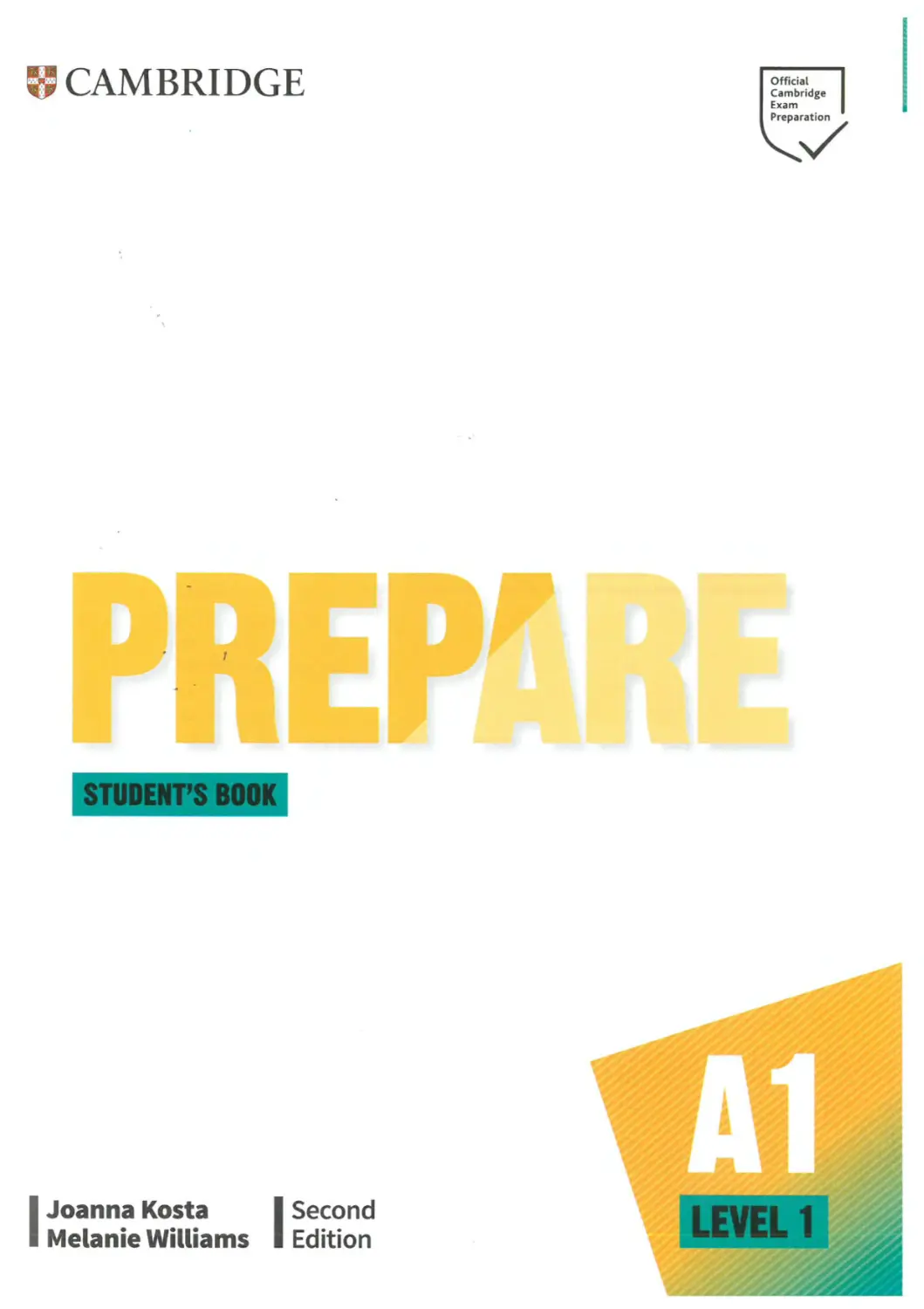
                    CAMBRIDGE
Official
Cambridge
Exam
Preparation
PREP'
STUDENT’S BOOK
Joanna Kosta I Second
Melanie Williams I Edition
Cambridge University Press
www.cambridge.org/elt
Cambridge Assessment English
www.cambridgeenglish.org
Information on this title: www.cambridge.org/9781108433273
© Cambridge University Press and UCLES 2015, 2019
This publication is in copyright. Subject to statutory exception
and to the provisions of relevant collective licensing agreements,
no reproduction of any part may take place without the written
permission of Cambridge University Press.
First published 2015
Second Edition 2019
20 19 18 17 16 15 14 13 12 11 10 9 8 7 6 5 4 3 2 1
Printed in Dubai by Oriental Press
A catalogue record for this publication is available from the British Library
ISBN 978-1-108-433273 Students Book
ISBN 978-1-108-380584 Students Book and Online Workbook
ISBN 978-1-108-380928 Workbook with Audio Download
ISBN 978-1-108-385930 Teachers Book with Downloadable Resource Pack
(Class Audio, Video, Photocopiable Worksheets)
The publishers have no responsibility for the persistence or accuracy
of URLs for external or third-party internet websites referred to in this publication,
and do not guarantee that any content on such websites is, or will remain,
accurate or appropriate. Information regarding prices, travel timetables, and other
factual information given in this work is correct at the time of first printing but
the publishers do not guarantee the accuracy of such information thereafter.
CONTENTS
0 In the classroom	10
1	All about me	14
2	My family	18
CULTURE The United Kingdom	22
3	My home	24
4	My things	28
LIFE SKILLS Creativity & innovation: Being creative and being you 32
REVIEW 1	34
5 What can you do?	36
6 Party time!	40
CULTURE Holidays in the USA	44
7 My day	46
8 At school	50
LIFE SKILLS Study skills:	Learning English	54
REVIEW 2	56
9 Feeling good	58
10 Things we do	62
CULTURE Youth clubs in the UK	66
*11 My digital life	68
12 Working life	72
LIFE SKILLS ICT literacy:	Being careful	on the internet	76
REVIEW 3	78
13 Places	80
14 Out and about	84
CULTURE Museums around the world	88
15 What shall I wear?	90
16 Buy it!	94
LIFE SKILLS Social responsibility: Looking after our world	98
REVIEW 4	100
17 Different places	102
18 The weather	106
CULTURE Beach culture in Australia and New Zealand	110
19 A fantastic concert	112
20 Animals	116
LIFE SKILLS Collaboration:	Deciding things together	120
REVIEW 5	122
Extra activities	124
Vocabulary list	126
Grammar reference and practice	136
UNIT	VOCABULARY		READING
0 IN THE GLASSROOM page 10	The alphabet Numbers Days The classroom Colours Months	a / an this, that, these, those
1 ALL ABOUT ME page 14	Objects and people Countries and nationalities	Determiners be singular О be plural© be singular and plural ©	Tell us about you Sfrom
2 MY FAMILY page 18	Families Adjectives: feelings	Determiners Possessive’s be © and short answers	Read about a family Sand
Culture The United Kingdom	page 22
3 MY HOME page 24	Rooms Things in my room	there is / there are\ in / on hove got О	Your Rooms!
4 MY THINGS page 28	Things in my school bag Adjectives: things	hove got © hove got ©	What have you got in your school bag today? 0 Syllables
Life Skills Creativity & innovation: Being creative and being you page 32
Review 1 Units 1-4 page 34
5 WHAT CAN YOU DO? page 36	Activities and skills Parts of the body	can / can't 0 con / can't Prepositions: in, on, behind, under	Rubberboy
6 PARTY TIME! page 40	Food and drinks Telling the time (1)	Countable and uncountable nouns some, any, lots of Ssome Prepositions: on, at, from, until	Party invitations
Culture Holidays in the USA	page 44
7 MY DAY page 46	Daily activities Telling the time (2)	Present simple© 0 Present simple endings Present simple©	My Brazil blog
8 AT SCHOOL page 50	School subjects Words with two meanings	Present simple© Wh- questions 0 Wh- questions	School of the Air
Life Skills Study skills: Learning English page 54
Review 2 Units 5-8 page 56
9 FEELING GOOD page 58	Sports and activities Health	like © © Pronouns	Ask the doctor
10 THINGS WE DO page 62	After-schoobactivities Jobs around the house	Present continuous © © Present continuous© 0 Yes / No questions	What are you doing?
Culture Youth clubs in the UK	page 66
Key to symbols: 0 Pronunciation @ Video

LISTENING SPEAKING	WRITING	VIDEO
Asking and answering
questions about personal
details
A conversation about making introductions A conversation about feelings	Telling your friend about you	A web page to describe a person in your family	© Me and you
			©Wales
A conversation about the rooms in a house and a flat	9 Lists Giving a list of what you have in your bedroom	* •
Descriptions of things	*	A questionnaire asking have you got questions	© Things in your bag
A meeting of the
photo club
Asking and answering
can you questions
z
© What can you do?
Talking about the
class party
An invitation to a party
A conversation
about the photo
club’s day
Telling a partner about your
daily routine
Talking about
changes in the
school timetable
Interview questions about
school life
© Fourth of July in the USA
® Daily routine
® School subjects
Talking about sports
and activities
9 Word stress
Discussing five things you
like doing at the weekend
© Feeling good
Talking about
after-school clubs
Writing a blog about yourself
© Boy and Girl Scouts
UNIT	VOCABULARY
11 MY DIGITAL LIFE page 68	Entertainment Technology	Adverbs of frequency: always, often, sometimes, never How much ...? / How many,..? 9/w/ and /v/	Conversations about digital devices
12 WORKING LIFE page 72	Jobs In a cafe	Present simple and present continuous can: requests and permission 9 Intonation	A story about working in a cafe
Life Skills ICT literacy: Being careful on the internet		page 76
Review3 Units 9-12 page 78 13 PLACES page 80	Places in a town Adjectives: places	Is there a ... ? / Are there any...? Prepositions: inside, outside, above, below, near	My favourite place
14 OUT AND ABOUT page 84	Transport Phrases: going out	because, and, but, or 9 Final /m/ and /п/ sounds Let's .... Shall we ...?	Getting around London
Culture Museums around the world page 88
15 WHAT SHALL 1 WEAR? page 90	Clothes Phrases: people	Plurals: spelling 9 Plurals Describing people	Describing people and their clothes
16 BUY IT!	Shopping	need, wont	Conversations
page 94	Money and prices Life Skills Social responsibility: Looking after our world Review 4 Units 13-16 page 100		too page 98	about buying things 9/f/ and /s/
17 DIFFERENT PLACES page 102	The natural world Adjectives: opinions	Comparatives: short adjectives Sthan Comparatives: long adjectives	Great days out
18 THE WEATHER	Weather	it	What do you think
page 106	Holidays	Prepositions: with, for, until	about the weather?
9 Vowel sounds
Culture Beach culture in Australia and New Zealand page 110
19 A FANTASTIC CONCERT page 112	Adjectives (1) Adjectives (2)	Past simple: be 9 was Wh- questions in the present and past	An article about a sound engineer
20 ANIMALS	Wild animals	Past simple©	Read about
page 116	Pets and farm animals	9 Extra syllable	Alessandro’s
		Past simple©	summer holiday
Life Skills Collaboration: Deciding things together page 120
Review 5 Units 17-20 page 122 Extra activities page 124 Vocabulary list page 126
Key to symbols: 9 Pronunciation (>) Video
6
LISTENING | SPEAKING________________________WRITING___________________VIDEO
An interview with a
famous person
Telling people about your
friends
A talk about what
jobs people in
someone’s family do
Preparing a menu and
ordering in a cafe
Talking about places
in a town or city
9/s/ and /к/
Conversations about
meeting friends at
the weekend
Asking and answering
questions about where
you live
Writing an email to your
friend and giving ideas for
things to do
© Favourite places
A conversation
about wearing
clothes
A conversation
about going
shopping
Describing your carnival
clothes
Writing a shopping
conversation
A conversation
about a house
Asking and answering
questions about which
places you want to visit
Phone messages
about people’s
holidays
Writing a postcard about
your holiday
A story about going
out with friends
Asking and answering
questions about the past
and present
A radio interview
about animals
Writing a review of your
school year
Grammar reference and practice page 136
® Famous museums
around the world
© Clothes
© Great places
© The weather
© A Trip to New Zealand
WELCOME TO PREPARE
PRONUNCIATION
Practise and improve
your pronunciation
CULTURE
VIDEO
Watch interesting
documentaries about
the culture topics
CULTURE
Learn about the culture
of English-speaking
countries and the
wider world
YOUTH CLUBS
IN THE UK
num ram
num ram
Ф eumiMsuMf
Review 2
ммшммнГ<1П’
REVIEW
Check your progress
PROJECT
Work together to create
something fun and
expand your learning
LIFE SKILLS
Develop important
skills that you can use
in your daily life
REVIEW 2 UNITS 5-8
CITY YOUTH CLUB
A piece for all
young people!
| LIFE SKILLS ICT LITERACY
“ BEING CAREFUL!
ON THE INTERNET
♦ ' инмжи

9

IN THE CLASSROOM
VOCABULARY
The alphabet
d>) I
01
Listen and repeat the letters.
Aa	Bb	Cc	Dd	Ее	Ff	Gg	Hh	li
Jj	Kk	LI	Mm	Nn	Oo	Pp	Qq	Rr
Ss	Tt	Uu	Vv	Ww	Xx	Yy	Zz
d# 9 Listen and write the names.
02
3 Listen and repeat. Then ask and answer with your partner.
Numbers
What’s your name?
William
How do you spell it?
W-l-double L-l-A-M
Д Listen and repeat the numbers.
04	"
STARTER UNIT
5 How many candles? Write the number in words.
nine
Ф 6 Look at the cakes in Exercise 5. Listen and match the people to
the cakes.
How old are you?
1 Ryan: cake[D]
2 Penny: cakeEJ
3 Jack: cakeEU
4 David: cakeQ
5 Anna: cakeQ
6 Lara: cakeQ
7 Listen to your teacher. Write four numbers. Then play a game.
Days
Ф Q Listen and repeat. Then write the days in the right order on the calendar.
06
Wednesday	Thursdav T J Friday
Tuesday	Mi
January
Monday					—
1	2	3	4	5	6	7
8	9	10	11	12	13	14
Listen and check. Then practise with your partner.
SPEAKING
Friday
Wednesday, Thursday
j Make three questions. Then walk around
the class and ask and answer.
How What How
1
2
3
is your name?
do you spell it?
old are you?
IN THE CLASSROOM 11
VOCABULARY
The classroom
VOCABULARY
Colours
^8 1 Listen and repeat.
07	*
Match the colours to the words.
black	blue
orange	red
brown	green	grey
white	yellow
1 orange
Listen and check. Then repeat.
2 Say the colour, not the word!
а! ап
0	yellow
1 blue
2 brown
з green
4 grey
3 Write sentences.
The pencil is yellow.
5 orange
6 red
7 white
sy/sfflw
a ruler a book an apple
two rulers three books
an orange
^GRAMMAR REFERENCE AND PRACTICE PAGE 136
Point to things in the book and in your classroom
and say what you can see.
12 STARTER UNIT
GRAMMAR
this, that, these, those
Read the sentences. Match them to the pictures.
1	This pencil is red.
2	These pencils are orange.
3	That book is green.
4	Those books are blue.
» GRAMMAR REFERENCE AND PRACTICE PAGE 136
3 Ask and answer about things in your classroom.
A: What colour are these books?
B: Blue.
A: What colour is that desk?
B: Brown.
f VOCABULARY
Months
Put the months in the correct order.
May
December
January
June
September
November
March
August
February
October
Listen and check. Then repeat.
2 Listen and repeat. Then walk around the class.
Ask and answer the question.
V z
IN THE CLASSROOM 13
d»
d>)
12
d»
12
Listen, check and repeat.
Look at the photos again,
and find Rosa, Joelle and
Listen to the conversation
right answer.
Ф Д Listen and repeat.
13 “
Hi. I’m Clara.
2 Paolo
Hi, Clara. My name’s Nick. And this is Maya.
3 Joelle
a He’s my dad.
b He’s my teacher,
c He’s my friend.
Hello, Clara.
See you later.
Yes. See you Monday.
a My number’s 046 311 392. [
b My number’s 056 312 392. □
c My number’s 056 123 923. □
Goodbye, Nick. Bye, Clara.
g Practise the conversation in groups of three.
Use your names.
UNIT 1
GRAMMAR
Д Complete the sentences.
0 I 'jrn____Lyra.
Determiners
Look at the words and complete the table.
His bag’s blue.
This is my watch.
Her bag’s red.
What’s your phone number?
1 It_________green.
pronoun	determiner
1	my
You	1
He	2
She	3
2 She____________my friend.
» GRAMMAR REFERENCE AND PRACTICE PAGE 137
4 I	Ben.
be singular О
5 And you
a student.
Look at the purple letters in the sentences.
Complete the table with the words in the box.
is are is am is
I’m Joelle	1 1	Joelle
You’re funny!	2 You	funny
She’s my teacher.	3 She	my teacher
He’s my dad.	4 He	my dad.
It’s new.	5 It	new.
» GRAMMAR REFERENCE AND PRACTICE PAGE 137
3 He___________my teacher.
5 Work in pairs. Ask and answer about your phone
numbers.
A:	What's your phone number?
B:	It's ... What's your phone number?
A: It's...
Now tell the class about your friend’s
phone number.
His or her phone number's ...
g Make a picture.
Talk to your partner about it.
My name's Monika.
I'm 13.
This is my new school bog.
It's red.
? Play a game in groups of four. Put your pictures
on the table. Take turns to speak.
Your name’s
VOCABULARY
AND 'IM
Countries and nationalities
2
3
4
5
6
Read about the students from different
countries and answer the questions.
Where is Irina from?
How old is Martina?
What’s the name of the boy from Mexico?
How old are the twins from Brazil?
Where is Matteo from?
Is one of the students from your country?
d»
Read about the students again
and complete the table.
country	nationality
0 Italy	Italian
1 Turkey
2	Mexican
3	Brazilian
4	Russian
5 China
6	Argentinian
7 Spain	——
Listen and check. Then repeat.
de
15
3
Match the flags to the countries in Exercise 2.
UNIT 1
0 PRONUNCIATION iron,
Ф A Listen and repeat.
16
A: Where ore you from?
В: Гт from Chino.
Then ask and answer with your
partner.
What’s your name?
How old are you?
Where are you from?
What’s your nationality?
Ф 5 Listen and complete the chant.
17
Hi! Hello! Where are you from?
What’s your nationality?
I’m Mexican.
He’s Mexican!
He isn’t0 Italian .
He’s Mexican! ;
Hi! Hello! Where are you from?
What’s your nationality?
Hi! Hello! Where are you from?
What’s your nationality?
GRAMMAR
be
J Read the chant again and complete the tables.
be plural О
We are	We’re	Brazilian.
You are	1	Argentinian.
They are	2	Brazilian.
be singular and plural О
1 am not	I’m not	Chinese.
You are not	3
He is not	4
She is not	5
We are not	6
You are not	7
They are not	8
GRAMMAR REFERENCE AND PRACTICE PAGE 137
I’m Turkish.
We’re Brazilian
We’re Argentinian.
She’s Turkish!
She isn’t1
She’s Turkish!
They’re Brazilian.
They aren’t2
They’re Brazilian!
Hi! Hello! Where are you from?
What’s your nationality?
You’re Argentinian.
You aren’t3
You’re Argentinian!
Look at the sentences in Exercise 1 and complete the table.
о	e
Germany	Egypt	0 He’s from Germany.
		He isn't from Egypt .
Greece	Colombia	00 They’re Greek .
		They aren’t Colombian .
Brazil	Turkey	1	from
		We	from
Argentina	Russia	2 	.
		They	from
Italy	China	3	from
		You	from
Spain	Mexico	4
		She
	England	5	from
		1	from
Listen again. Then do the chant in your groups.
SPEAKING
Write your
country here.
All about me. Work in pairs. Tell your friend about you.
My name's...
I'm...
I'm from...
My phone number's ...
This is my...
ALL ABOUT ME
AND
' Hi. My name’s Ruby. I’m 11
and my sister Isabel is 14.
Our baby brother is one.
This is my mother and
Hello. My name’s Helena. This is my
family - my husband and my three
children. We’re from Manchester.
Hi. I'm David. This is my wife. Her name’s Helena
These are our two daughters. Their names are
Isabel and Ruby. Our son’s name is Oscar.
Hello. I’m Isabel and I’m 14.
My sister’s name is Ruby.
These are my parents and
this is my baby brother. He’s
called Oscar.
ABOUT YOU
Where is your family from?
How old are the people in your family? ►
FAMILY
VOCABULARY
Families
father. Their names are
Helena and David, but we
Read and answer the questions.
1 Where is the family from?
2 How old is Ruby?
call them Mum and Dad!
3 How old is Isabel?
4 How old is Oscar?
2 Read again and complete the table.
©	Ruby	Helena and David	Isabel and Ruby	Oscar	Ruby and Oscar
mum and dad
brother and sister
parents
daughter
husband and wife
son
children
mother and father
child
baby
Listen to the family words and repeat them.
0» q
19	**
Э PRONUNCIATION and
A Listen and repeat.
20 ”
1 mum and dad
2 brother and sister
3 husband and wife
4 family and friends
5 mother and father
6 Spanish and German
GRAMMAR
Determiners
Possessive’s
Find and underline their and our in the speech
bubbles on page 18. Then match the pronouns to
the determiners.
pronoun	determiner
I 	her
you	our
he	my
she	their
we	your
they	his
» GRAMMAR REFERENCE AND PRACTICE PAGE 138
3 Match the two parts of the sentences.
1 Oscar is Ruby’s
2 Ruby is Oscar’s
3 Ruby is David and Helena’s
daughter,
brother.
sister.
» GRAMMAR REFERENCE AND PRACTICE PAGE 138
Д Complete the sentences about the family.
0 Oscar is David’s son
1 David is Oscar’s
2 Ruby is Helena’s
3 Helena is David’s
4 David and Helena are Ruby’s _________.
5 Isabel, Ruby and Oscar are David and Helena’s
2 Complete the sentences with their or our.
These are my brothers,
names are Tom and Harry.
5 Look at the picture of the family for two minutes.
Then close the book and talk about the family
with your partner.
S) TALKING POINTS
(>) Watch the video. Ask and answer
the questions with a partner.
What's your name?
Where are you from?
How old are you?
Tell me about your family.
children are 12,10 and 7.
names are Lily, Riley and Ollie.
MY FAMILY 19
VOCABULARY LISTENING
Adjectives: feelings
I
1 Look at the photos. Complete the
мвь sentences with the words in the box.
©
bored clever funny
happy hot hungry
nice sad tired
0 I’m happy .
1	I’m
2	I’m
3	I’m.
4	I’m_______.
5	She’s_____.
6	You’re
7	They’re_____.
8	She’s
Listen and check. Then repeat the sentences.
2 Play a game with your partner. Decide who is Student A and who is Student B.
Student A, think of an adjective. Make a noise or do an action and help
Student B, think of the correct word. Don’t say a word!
J Look at the picture story. Listen and number the pictures in the right order.
4* L’sten again. Write yes or no.
Conversation 1 Bella is Spanish, no
Conversation 2 Bella is hungry.
Conversation 3 Sue is hot.
Conversation 4
Conversation 5
Conversation 6
The film is funny.
Sue and Bella are bored.
Bella is happy.
20 UNIT 2
GRAMMAR
be © and short answers
Look at the picture story again. Match the Yes / No questions to the short answers.
Yes / No questions
Are you Spanish?
Are you hungry?
Is she hot?
Is the film funny?
Are you bored?
Are they tired?
Short answers
No, we aren’t.
No, it isn’t.
Yes, she is.
No, they aren’t.
Yes, I am.
No, I’m not.
Wh- questions
Where are you from?
What is your name?
How old are you?
Remember
You are Spanish.
Are you Spanish?
» R AMMAR REFERENCE AND PRACTICE PAGE 138
Put the words in order and make questions.
0 is/How/old/friend/your/?
How old is your friend?
1	they/Are/tired/very/?
2	happy/she/Is/?
3	is / What / phone / number / your / ?
4	Where/they/from/are/?
5	your/When/is/birthday/?
i
6	name/is/What/your/?
3 Complete the conversations.
0 Are your friends hot?
No, they aren't . They’re fine!
1	you tired? No we________.
2	your parents Russian?
Yes, they
3	Tom sad?
No, he . He’s bored.
4	you bored?	.	., .. .
J	No, I .Im tired.
5___________your teacher clever?
Yes, she
6_________ ________	 your brothers hungry?
No, they_______.
J » Work with a partner. Go to page 124.
g Complete the web page about you.
Home J (J) Profile A3 Friends
Me Info Photos +
Name
Age
Nationality
Today I’m
happy	sad	bored
hot	angry
7	Ask your partner questions and write a new web
page for him or her in your notebook.
^WRITING j
Make a new web page for a person in your family
in your notebook. Use the web page in Exercise 6
to help you.
Use full sentences. Begin your sentences with
a capital letter and end them with a full stop •
Д Work in pairs. Practise the conversations in
Exercise 3.
MY FAMILY

The United Kingdom
CULTURE
THE UNITED
KINGDOM
There are three countries in Gr®a‘Jrit°'n- (j
They are England, Scotland and Wales.
The United Kingdom is different It is Great
Britain (England, Scotland and Wales) and
Northern Ireland.
The United Kingdom is a good Place f°r young
people to visit. There's lots to see and do.
In pairs, discuss the questions with your partner.
1 Where are you from?
2 Where are people in your family from?
3 Do you know any places in the United Kingdom? Which ones?
lurgh
2
Look at the map and the photos on the web page. Guess the answers.
•	Where is Ross from?	• Where is Owen from?
•	Where is Emily from?	• Where is Poppy from?
Read the web page quickly. Were your answers in Exercise 2 correct?
>ton
Hello. I’m Owen and I’m Welsh.
Caernarfon Castle is in Wales. It’s a
very big castle. Look at the photo!
Rugby is an important sport in Wales.
Hi. I’m Ross and I’m Scottish.
Loch Ness is in Scotland. It’s a famous lake.
‘Loch’ is a Scottish word that means ‘lake’.
The thistle is a symbol of Scotland.
»’•'1 1
. I
h
Caernarfon Castle <
Hello. I’m Poppy and I’m English.
The Shambles is in York, England.
It’s a very old street.
The lion is a symbol of England.

Hi. I’m Emily and I’m Northern Irish.
The Giant’s Causeway is in Northern Ireland.
Can you see the big rocks in the photo?
These rocks are very old. There is a story
about a giant and the rocks.
The shamrock is a symbol of Ireland. I
4
Read the web page again. Write the countries.
1	Loch Ness is in______.
2	Caernarfon Castle is in
3	The Shambles is in_______.
4	The Giant’s Causeway is in.
5	The shamrock is a symbol of
6	The lion is a symbol of_____.
7	Rugby is an important sport in_ ___.
24
6
Match the countries to the nationalities.
Country	Nationality
England	Welsh
Scotland	Northern Irish
Wales	British
Northern Ireland	Scottish
Britain	English
Listen, check and repeat.
Complete the sentences with the highlighted
words from the text.
1 Ross is from Scotland. He’s
2	Poppy is from England. She’s_______
3	Owen is from Wales. He’s_______.
4	Emily isJrom Northern Ireland. She’s
Look at the web page again to check.
7 Look at the map. Write the capital cities.
1	Scotland-»________
2	England ->________
3	Walesa__________
4	Northern Ireland ->______
J" Listen, check and repeat.
Ф g Listen to the interview with two young people
from the United Kingdom. Which capital cities
from Exercise 7 do they talk about?
D TALKING POINTS
Where are your mum and dad from?
What is the capital city of your country?
Ф) Q Listen again. Choose the correct words in the table.
26
Name
Shona / Susan
Nationality
Welsh / Scottish
Northern Irish / English
Dad's nationality
Northern Irish / Scottish
Welsh / Northern Irish
Mum’s
nationality
Scottish / Spanish
Welsh / English
Edinburgh / Belfast
Cardiff / London
Good place
to visit
park / castle
Big Ben / Regent’s Street
Mark / Max
' * AL
PROJECT |
A poster
In small groups or pairs, make a poster about your
country or another country. On your poster, put:
•	a map of the country
•	the names of big cities
•	names and pictures of places to visit
•	pictures of the country’s symbols
•	pictures of popular sports
•	information about the country’s money
Finally, present your poster to the class.
The name of the money in the UK is
pounds (£) and pence (p).
For ‘£2.00’ we say two pounds, and
for *10p’ we say ten pence or ‘ten p’.
INTERESTING FACT! p I
VOCABULARY |ЗД LISTENING ,
Rooms
1
©
Match the rooms A-G in the photos to the words
in the box.
bathroom bedroom diningroom
hall kitchen living room toilet
C hall
2
©
Match the things h-m in the photos to the words
in the box.
Ф 4 Joelle and Rosa are at Paolo’s house. Listen and
number the rooms A-G in the right order.
5 Look at the photos again. Student A, make a
sentence. Student B, guess the room.
bath door floor shower
wall window
The walls are blue and white.
3 Listen and check. Then repeat the words.
24 UNIT 3
Yes!
The bathroom?
GRAMMAR
there is / there are', in / on

J Look at the examples in the table. Use these examples to talk about the photos on page 24.
There's (There is)
There’s a table in the kitchen.
There’s a toilet here.
There’s a shower and a bath.
There are
There are four doors.
There are three bedrooms.
There are two windows.
in/on
Mum’s in the kitchen.
The bags are on the table.
» GRAMMAR REFERENCE AND PRACTICE PAGE 139
Complete the sentences with is I are and in I on.
1 There
one phone
the box.
2 There
two phones
the box.
29
Look at the photos on page 24 again and listen to
the sentences. Write Y (yes) or N (no).
0 X	2_____	4
1	3 ____ 5
Ф з
29
4
Listen again and repeat.
Complete the sentences with There's or There are.
Then match them to the pictures.
There's
a boy in the kitchen.
four people in the kitchen,
a shower in the bathroom,
a table in the kitchen.
two windows in the living room,
six books on the floor in the
blue bedroom.
the living room.
five pictures on the walls in
a baby in the bath.
two girls in the pink bedroom.
Tell your partner five things about your home.
I live in a flat. There are six rooms.
Write about your partner’s home.
Luigi's home is a flat. There ore two toilets and...
I live in a house.
MY HOME 25
VOCABULARY
AND
READING
Things in my room
Match the words to the photos A-L.
bed board game
clock computer
poster pet fish
bookcase chair
clothes guitar
television (TV) toys
Listen to check. Then repeat.
, Ц Ц.	| | f я*	Л * ft II II V
|U1ll!' IIIHII Mf ffilllij
miu ий iiiiT mill]
[iW Mil’ll WI.’ J liil I
№'11 IM ll'IILI I'llj
2 Read the magazine article. Match the people to
the rooms 1-3.
Your Rooms!
Luisa
This is my room. It's got blue walls and a light brown
floor. There's a bed and a chair in here, and a TV.
I've got lots of clothes. They're all on the bed and the
floor. There are also lots of toys on the floor. They're
my little brother's!
Jozef
This is my room. I've got a computer and lots of board
games. My brothers have got a computer in their
room too. I've also got a guitar in here. I've got lots of
posters of my favourite bands on the walls.
Agata
This is my room and my sister's. There are two beds
and a chair. There's a clock on the wall. We've got lots
of books on the bookcase. My sister's got two pet fish,
called Nemo and Dory. They've got a little house and
lots of green plants in their aquarium!
26 UNIT3
? Read the article again. Are the sentences right (/)
or wrong (X)?
1	The walls in Luisa’s room are brown.
2	There are clothes on the bed in Luisa’s room.
3	Jozef’s got brothers.
4	There are posters on the walls in Jozef’s room.
5	Agata has got three fish.
g) TALKING POINTS
What is your favourite colour?
What is your favourite computer game or
board game?
Who is your favourite person?
What is your favourite thing?
f SPEAKING j
Э PRONUNCIATION Lists
Ф 1 Listen and repeat.
; 32	x___*
1	I’ve got a chair, a table and a desk.
2	I’ve got a guitar, a pet fish and a TV.
3	My brother’s got a camera, a phone and a
computer.
4	In our flat, there’s a kitchen, a living room
and two bedrooms.
5	The teacher’s got a book, a pen, a ruler
and a dictionary.
GRAMMAR
2 Play this game in small groups. What have you got
in your bedroom / kitchen / living room / flat?
Read the magazine article on page 26 again.
Underline all the examples of ’ve got, ’s got and
have got.
I / you / we / they ’ve got (have got)
he I she / it	’s got (has got)
» GRAMMAR REFERENCE AND PRACTICE PAGE 139
Complete the sentences from the article.
0 I ’ye got a computer.
1	My sister______ two pet fish.
2	It_______blue walls.
3	We lots of books.
4	They  ______ a little house.
5	My brothers a computer too.
6	I	lots of clothes.
Complete the sentences with’ve got, ’s got and
have got.
1	My dad ________a nice phone.
2	My parents_________a television in their
bedroom.
3	I________two brothers and a sister.
4	Your brother_______lots of friends.
5	Rosa and David_____ new cameras.
6	You	my dictionary!
Д Read the sentences about Sara’s room. Underline
examples of also.
/’ve got a bed and a chair in my room. I’ve also got a
desk. On my desk, I’ve got a book and two pens. I’ve
also got о computer.
Think about your room and draw it. Write about
it. Use also in one or two of your sentences.
In our bedroom,
we’ve got a bed.	In our bedroom, we’ve
got a bed and a chair.
MY HOME 27
MV THINGS
ABOUT YOU
Talk about things in your bedroom.
I’ve got a clock. I’ve got...
VOCABULARY READING
O’)
I
Things in my school bag
WHAT HAVE YOU GOT M
YOUR SCHOOL BAG TODAY
Tell us here:
Match the words in the box to the photos A-J.
banana chocolate coat football
gloves hat keys scarf wallet
water bottle
I’ve got all my school books and my
pencil case, of course! And I’ve got
my water bottle, some chocolate
and my hat. I haven’t got my gloves.
They’re at home. Oh, and yes, I’ve
got my wallet and my phone.
Listen and check. Then repeat.
9 Read the blog and match the bags to the
students.
Sylvain
OK, I’ve got my school books and ... I’ve
got my keys, my phone and my water bottle.
I’ve got a banana and an orange, too. I’ve
got my gloves and I’ve got my coat - look!
I haven’t got my scarf or my hat.
Nicolas
Jana
Well, I've got my school books and all my
school things. And I've got my watch, my
wallet, my keys and a football. I haven't got
my phone. Its at home. And I've got a banana
and some chocolate. I'm always hungry!
In my bag today I've got my school books, of
course, and my new pencil case. And I've got
my sister's water bottle because I haven't got
one and she's got two! I haven't got my gloves,
but I've got my scarf and hat. I've got my keys
and an orange, too.
Pia
28 UNIT 4
2 Look at the pictures in Exercise 2. Say and answer.
This student’s got a water bottle, a hat and a phone.
Sylvain.
0 PRONUNCIATION Syllables
Ф Д Listen and repeat.
35
•	• •	• • •
friend	guitar	Saturday
3 Complete the sentences.
0 My little brother
hasn’t got a hat.
He ’sgot ______ a coat.
1 My sister
a football.
She	a guitar.
2 We	a bath
in our house.
We _________a shower.
Write the words in the table.
alphabet banana bottle
chocolate clothes computer
football	gloves keys
Mexican	scarf	wallet
Ф Listen and check. Then repeat.
3 They	pet fish.
They____________a television.
4 My sister
a banana.
She	some
chocolate.
have got О
Read the blog in Exercise 2 again and complete
the table.
5 You_________some keys.
You_________a phone.
1 You	haven’t got haven’t got	my scarf. your water bottle.
Nicolas Pia	hasn’t got 2	1	phone. her water bottle or her gloves.
We	haven’t got	3	phones.
You	haven’t got	your hats.
Sylvain and Pia	4	their gloves
» GRAMMAR REFERENCE AND PRACTICE PAGE 140
6 I   a hat in my bag.
I a book.
Д What have the students in the blog on page 28 got
in their bags? Write down all the things you can
think of.
You’ve got one minute!
2 Listen to the sentences. Choose the words you hear.
0 ([haven'tgot)/ I’ve got my things.
1	He hasn’t got / He’s got a coat.
2	You’ve got / You haven’t got a sister.
3	They haven’t got / They’ve got a TV in the kitchen.
4	She’s got / She hasn’t got a new bag.
5	I haven’t got / I’ve got my banana.
6	We’ve got / We haven’t got a clock in the classroom.
Work with a partner. Compare and talk about
your lists.
I’ve got ‘phone’ on my list. You haven’t got it.
You’ve got ‘drink’. I haven’t.
Now work in small groups. Compare and talk
about your lists.
You’ve got ‘pencil case’. We haven’t got it.
We’ve got ‘keys’. You’ve got ‘keys’, too.
MY THINGS 29
VOCABULARY I I LISTENING
Adjectives: things
38
3
Listen and number the sentences.
It’s a dirty, dark brown bag.
It’s a clean, light blue bag.
It’s a long, new ruler.
It’s a short, red ruler. Ш
It’s a dark blue coat.
It’s an old, grey coat.
Listen again and check. Then repeat.
Д Talk about the picture in Exercise 1 with your
partner.
There are four bags in the picture. This
bag is light brown and it’s small and dirty.
Look at the picture and find these things.
©
along.	ru,er
abi8'^bag
a new. g'een coat
a da* ,ed CO®‘
a black and
football
a dirty. «<* and
There’s one black and
white hat. Look, here it is.
g Talk about your things. Use the picture in
Exercise 1 to help you. Think about things in your
bedroom and things in your classroom.
I’ve got о new school bog. It’s dork green ondyellow.
It’s big. I’ve also got о new coot.
It’s...
Ф g What hasn’t Emma got? Listen and tick (/).
39
She hasn’t got...
her coat.
her pencil.
her bag.
her ruler.
her football things.	[Zl
her hat.	О
2 Look at the picture and find these things.
a. red ruler
a short, red
a small, brovun ba
s co»1
л °	. u* coat
♦ a l»9bt
a clean, black and
,o°tbe/,
Listen again and check.
7 Now look at the picture in Exercise 1 and find
Emma’s things.
30 UNIT 4
GRAMMAR
have goto
Read the examples. Choose the correct words to
complete the two sentences.
1 In questions, the pronoun (he, she, we, etc.)
is before / after the words have or has.
2 The word got is / is not in the short answers.
Have I got
my books?
Has he got my
dictionary?
Have we got a
new English book?
Have you got
my keys?
Has she got
my phone?
J Ask and answer with your partner.
A:	Hove you got a clock on your kitchen wall?
B:	Yes, I hove.
... a clock on your kitchen wall?
... a shower in your house?
... your keys in your bag?
... a chair in your bedroom?
... your English books on your desk?
... photos on your bedroom wall?
Now make some more hove got questions to ask
your partner.
® TALKING POINTS
(►) Watch the video. Ask and answer the
question with a partner.
What have you got in your bag?
^WRITING j
Do a questionnaire.
Write six have you got questions using ideas from
Exercise 3.
Short answers
Yes, I have. / No, I haven’t.
Yes, you have. / No, you haven’t.
Yes, he/she/it has. / No, he/she/it hasn’t.
Yes, we have. / No, we haven’t.
» GRAMMAR REFERENCE AND PRACTICE PAGE 140
Hove you got a blue coot?
Have you got a desk in your bedroom?
Have you got...?
У Complete the sentences.
0 A: Has he got a pet fish?
B: No, he hgsrft •
1 A: _____ Emma got her bag?
B: No, she_________.
2 A:	Sylvain and Pia got their hats?
B: Yes, they
3 A: _______ I got your phone?
B: Yes, you_________.
4 A:__________you got your water bottle?
B: No, I
5 A:________ your bag got my football things in it?
B: Yes, it
Listen and check. Then repeat.
Ask four students your six questions. Write their
short answers.
Now write about the students.
Georgia has got two brothers and one sister. She’s
got a new red school bog and she’s got a pet fish.
She hasn’t got a choir in her bedroom.
MY THINGS 31
LIFE SKILLS INNOVATION *
BEING CREATIVE
AND BEING YOU]
Read, think and answer. Discuss with a partner.
1	What’s your favourite room at home? Describe it.
2	What’s your favourite colour?
3	What colour are the walls in your bedroom?
4	What things have you got in your bedroom?
Read the title and look at the pictures in the
interview below. Guess the answers.
1	What room is the interview about?
2	What is Tristan Deever’s hobby?
Read the interview. Were your answers in
Exercise 2 correct?
§ LIFE SKILLS
Being creative and being you
We are all different. We can be creative and tell
others about us. For example, we can plan a nice
room. Think about:
•	your hobbies
•	your things (table, chair, etc.)
•	the things you do
Interview with pop star
YKtSVAtf PttVtK.
Look inside Tristan Deever’s musical home!
Tristan:
Interviewer:
Tristan:
Interviewer:
Tristan:
Interviewer:
Tristan:
Interviewer:
Tristan:
Interviewer:
Tristan:
Welcome to my home!
Thank you. So, what’s your favourite room?
The living room is my favourite room. Look!
There’s a long sofa for me and for my friends.
The sofa is colourful - it’s lots of different colours.
There’s a TV and there are music posters on the walls.
And the sofa is on a rug.
Yes. It’s my favourite rug. The rug looks like a guitar. It’s cool!
Music is everywhere in your living room.
Yes. I love music. Music is my hobby. I’ve got three guitars.
And I’ve got books about music, too. The books are on a
blue shelf. I’ve got a pet fish. His name’s Fran. He’s in his
fishbowl, on the table.
Hello Fran!
There’s a big light in my living room.
Your living room is a happy room with lots of colours in it.
Yes, it’s a happy room and I’m a happy person.
And it’s a musical room and I’m a musical person.
32 LIFE SKILLS
/| Read the interview again. Underline the wrong
word in each sentence. Write the correct words.
1	Tristan Deever is a teacher.
2	The kitchen is his favourite room.
3	His music posters are on the table.
4	He’s got six guitars.
5	The fish’s name is Frank.
6	Tristan Deever is a sad person.
Label the photos. Look at the highlighted words in
the interview again and check.
fishbowl light rug shelf sofa
Ф g Listen again. Complete the sentences with the
words in the box.
bed board games books
clock computer posters
1	There are football	on the wall.
2	There are		on the bookcase.
3	There’s a	on the table.
4	There are 		on the shelf.
5	There’s a	on the shelf.
6	There’s a	in the bedroom.
® TALKING POINTS
What is your favourite hobby?
What do you think is good about Daisy’s
new bedroom?
Q Match the sentences 1-3 to the pictures A-C.
© USEFUL LANGUAGE
1 I love football
2 The clock looks like a football.
3 It’s cool.
g Write true sentences about your living room.
Use all the words from Exercise 5.
In my living room, there’s о sofa. There isn’t о rug.
Look at the interview on page 32 again. Use the
underlined words in Exercise 9 and answer.
1 What does Tristan Deever say about music?
2 What thing looks like a guitar?
3 What does Tristan Deever say is cool?
*3® Listen to Anna on TV. Answer the questions
(choose a or b).
1	What room is Anna talking about?
a a new bedroom b a new living room
2	Is Daisy happy with her new room?
a yes	b no
PROJECT
Apian fora
new bedroom
i
Draw a picture of your new bedroom and write
about it. Think about these questions:
•	What’s your favourite colour?
•	What colour are the walls in your new bedroom?
•	What’s your favourite hobby?
•	Are there things from your hobby in your room?
•	Where is your bed and other things in your room?
Tell your partner about your new bedroom.
BEING CREATIVE AND BEING YOU 33
2 Put the letters in the right order to make
family words.
f GRAMMAR ]
0 tressi sister
1 bhsunda
2 uhtdraeg
3 fwei
4 nos
5 rtnepas
6 torbrhe
7 drnhicle
8 hrtemo
9 frheta
10 ybba
1 Complete the sentences with the words in
the box.
I’m It’s He’s She’s
We’re They’re My
is (x 2) are His Her
3 Match the adjectives to the people. Close
your book and ask and answer with a partner.
bored fanny happy hot
hungry sad tired
A: Is Joe funny?
B: Yes, he is.
Hi!0 My name’s Joelle.1	_12.
These2 my new friends.3
really nice!
This4 Paolo.5	13.6
Dad’s Italian.
This7 Rosa.8	13.9
camera’s new!10 in a photo club,
fun!
Look at the picture and complete the sentences.
0 The computer is Stella's .
1	The_______is
2	The	is
3	The	is
4	The___•_is f
5	The	is
SPEAKING
Play this game. Write six things in your bag.
Ask and answer with your partner.
f LISTENING
Listen and complete the boxes about the two
students.
Name:
Surname:
Age:
Nationality:
Phone number:
Read about Keira’s home. Are the
sentences right (/) or wrong (X)?
My name’s Keira and I live in
a flat with my mum and dad.
We’ve got five rooms - a kitchen,
a living room, a bathroom, two bedrooms and I
a small hall. We haven’t got a dining room.
In the kitchen, there’s a table with six chairs.
There’s also a TV and a clock. In the living
room, there’s a desk and a computer. There are
three pictures on the walls. In the bathroom,
there’s a shower. We haven’t got a bath. My
favourite room is my bedroom. I’ve got a desk,
a chair and a small table in here.
Have you got a phone?
Yes, I have.
Have you got a ruler?
No, I haven’t.
You get one point
when your partner
says Yes, I hove.
Count your points.
Who is the winner?
0 There are six rooms in the flat.
1	There’s a dining room.
2	There’s a table in the kitchen.
3	There’s a computer in the kitchen.
4	There are four pictures in the living room.
5	There’s a bath in the bathroom.
WRITING
Write these sentences with capital letters and
full stops.
0 my name’s gabby and i’m 14
My name's Gabby and I'm 14.
1	my mum’s from brazil and my dad’s from
mexico
2	my friend ling is Chinese
3	they aren’t from turkey
4	he isn’t Spanish, he’s argentinian
5	my teacher’s called mr brown
UNITS 1-4

E WHAT CAN YOU DO?
sail sing skate speak swim
a horse
underwater
the guitar
Listen and check. Then repeat.
Ф 2 Look at the photo at the top of the page and listen. Write yes or no.
0 The friends are in the park, yes
1	This week’s photo club project is called ‘Every day’.
2	Rosa’s camera is old.
3	The new boy is called Jose.
4	He’s got a very nice camera.
36 UNIT 5
GRAMMAR
5 Put the words in order and make questions.
Then ask and answer with your partner.
Ф Read the Grammar box. Then listen again.
What can Joelle, Rosa and Paolo do? Look
at Exercise 1 on page 36 and write J (Joelle),
R (Rosa) or P (Paolo) on each photo.
1 dictionary/you/Can/use/a/?
2 good I you / photographs / take / Can / ?
3 draw / Can / a / you / horse / ?
4 dad/Can/sing/your/?
5 swim/you/25 metres/Can/?
6 Can / remember / name / your / teacher / your / ?
О t
I / you / he / she / it / we / they can swim.
I / you / he /.she / it / we / they can’t (cannot) swim.
О
What can you do?
Short answers
Can you swim? Yes, I can. No, I can’t.
» GRAMMAR REFERENCE AND PRACTICE PAGE 141
2 Complete the sentences with can or can't.
0 Joelle can ride a horse.
1	Rosa_________swim underwater.
2	Paolo	sing or ride a horse.
3		 Paolo paint a picture?
No, he
4	_____ Paolo speak Italian?
Yes, he ~	.
_____ /
0 PRONUNCIATION can/can't
Ф 3 Listen and repeat.
What can you do? Can you ride a horse?
No, I can’t.
Can you play the guitar?
No, I can’t.
Well, can you take photos?
Yes, I can. And I can speak Italian.
Oh good!
g What can you do? Put a / (yes) or a X (no) in the
me column.
7 Ask and answer with your partner. Use can and
can't. Complete the table for your partner.
Can you ...
play the guitar?
ride a bike?
cook spaghetti?
ice skate?
remember your
friends’ birthdays?
speak Spanish?
me
my partner
g Read the sentences in the table. Then write
three sentences about you and three sentences
about your partner. Use and, but and or in your
sentences.
Д Listen and choose the word you hear.
0 \{car$/ can't take good photos.
1	We can / can't see the TV.
2	I can/ can't remember her name.
3	My sister can / can't play the guitar.
4	Can / Can't your little brother read?
5	My mother can / can't speak Chinese.
	sing	play the guitar
1 can sing and play the guitar.
1 can’t sing or play the guitar.	X	X
1 can sing but 1 can’t play the guitar.		X
/ can take photos and paint a picture. Luigi can't
speak Chinese or swim underwater.
WHAT CAN YOU DO? 37
VOCABULARY
A N D
Parts of the body
Look at the photos. Match the parts of the body
©A-L to the words in the box.
arm ear eye face foot/feet
hair hand head leg mouth
nose tooth/teeth
Ф 2 Listen. Point to the parts of your body when you
hearthem.
3 Play the game in Exercise 2 with your partner.
Д Read the article and answer the questions.
1 What is Rubberboy’s real name?
2 Where is he from?
3 What is he famous for?
4 Where can you see Rubberboy?
Listen and check. Then repeat.
BUBBEBBOY ,
This is Rubberboy’ Of course, that’s not his real
name. His real name is Daniel Browning Smith and he
comes from the USA. He is famous for the things he can
do with his body. For example, he can stand on his hands
and put his feet behind his head. Can you do that? It’s
really difficult! He can also get into a very small box - only
34 cm x 40 cm x 50 cm. You can read about Daniel in a
book called Guinness World Records and you can also see
him on TV or on your laptop.
38 UNIT 5
GRAMMAR
Prepositions: in, on,
behind, under
GRAMMAR,REFERENCE AND PRACTICE PAGE 142
Match the sentences to the pictures A-G. Then
complete the sentences with in, on, behind or under,
0 His hands are behind his head.	[b]
1	The guitar is the door.	О
2	There are lots of books the table.
3	She is	the table.
4	His head is_______the desk.
5	The dog isn’t her bed!	О
6	The ruler is	the pencil case.
; Choose the correct words.
1 There are some nice pictures behind / on the wall.
2 My bag is in / on the chair in my bedroom.
3	I can’t open my eyes under / behind the water.
4	Look! The dog is on / behind the door.
5	Is that chocolate you’ve got in / under your
mouth?
© TALKING POINTS
© Watch the video. Ask and answer the
questions with a partner.
Can you ...
get into a small box?
head a ball?
do a cartwheel?
stand on your head?
SPEAKING
" Walk around the class. Ask and answer questions.
Use the phrases in the box.
move your ears paint with your toes
put your toes in your mouth
walk on your hands write with your feet
Hi, Sonia. Can you paint with your toes?
Yes, I can. What about you?
No, I can’t.
WHAT CAN YOU DO? 39
PARTY TIME!
?) ABOUT YOU
Write down all the food words you
can in two minutes. How many words
have you got?
Food and drinks
Ф Д Look at the table and listen to the teacher talking
about the class party. Match the names of the
students to the food.
Match the photos А-P to the words in the box.
©	biscuits	bread	butter	cakes
	cheese	chicken	chips	eggs
	juice	lemonade	milk	pasta
	potatoes	rice	soup	tomatoes
Listen and check. Then repeat.
Class Party
VAiat •food, can you bring?
2 Put the food in Exercise 1 in the right columns.
Then work with your partner and put more food
words in the columns.
fruit
drinks
Nome	Food
Jessica,	cheese
Xtm	C_	-bread and batter
Hugo	oranges
Lily	apples
Nina.	bananas
Alfie	tomatoes
Tom	biscuits
	cakes
	lemonade
	juice

3 Talk to your partner about the food and drinks
you like and don’t like.
I like vegetables. I don’t like eggs.
40 UNIT 6
GRAMMAR
Countable and uncountable
nouns
Read the sentences about countable and
uncountable nouns.
There are things you can count (countable):
an apple ten apples
Thefe are things you can’t count (uncountable):
rice
You can add s to countable nouns but you can’t
add s to uncountable nouns:
apples rices
(Be careful - potato - potatoes tomato - tomatoes)
Which of the food and drinks words on page 40
are countable and which are uncountable?
4 Choose the correct words to complete the
sentences.
0 Have you got (any)/ a soup?
1 I’ve got any / some biscuits in my bag.
2 There isn’t a / any milk in the kitchen.
3 There are lots of/ an eggs here.
4 I’ve got some / a bananas and oranges for
the party.
5	There’s lots of/ on orange under the table.
6	James can’t bring any/ some cheese.
7	There’s any / lots of food for the party.
Э PRONUNCIATION some
g Listen to the sentences with some.
Then listen again and repeat.
» GRAMMAR REFERENCE AND PRACTICE PAGE 143
Write the words in the box under the right
shopping basket. For countable words, add a or an.
apple	banana chip	egg	fruit
meat soup	milk pasta vegetable	potato	rice
0 Look at the picture of the party food and write
sentences. Use a /an, some, any or lots of.
They've got some oranges.
They haven’t got any bread.
There’s...
countable
an apple
uncountable
__rice_
some, any, lots of
3 Read the sentences from the listening exercise.
Then match them to the rules in the box.
a We haven’t got any food for the class party
tomorrow.
b I can bring some bread and butter.
с I can bring some biscuits. We’ve got lots of
biscuits at home.
d Can you bring some tomatoes?
e I haven’t got any fruit at home.
f We need some fruit.
g We haven’t got any tomatoes at home.
h Have you got any tomatoes at home?
1 We use some and lots of in positive sentences,
jb_____________
2 We use any in negative sentences.
3 We can use some or any in questions.
J Write a shopping list for your party.
g Tell the people in your class about the food at
your party.
I’ve got lots of fruit. I haven’t got any chocolate.
I’ve got some cakes.
PAGE 143
PARTY TIME! 41
В
VOCABULARY
AND
Telling the time (1)
CAN YOU v
HANNA* ъ
iel invites
Place: 33 Albert Street
Date: 1st August
Time: From 8 until late!
Call: 020 875 645 or
Email: hannah.timms@worldnet.com
party food
iming
Games
DISCO!
Games in the water and lots of nice food
It'S on Saturday, 1st April, at 2.1b.____
for more information
' I
REBECCA'S PARTY
D
on Wednesday, 2nd March
after school from 3.30 until
5.30 at Rebecca's house.
Would you like
to come to
MY PARTY?
and
sports!
Wear something special!
Bring food and drtnfcs.
Call 03276 753 902
4
'J
It's on Saturday, 1 st July, at Victoria Park,
from 10 am until 2 pm.
01632 960250 andrew@fgcool.com
Read the invitations and find ...
1	two different days.
2	four different months.
3	three different places.
4	four different times.
5	two email addresses.
6	two phone numbers.
Saturday
Ф Э Listen to the conversations 1-4 and match
56
them to the invitations A-D.
Conversation 1
Conversation 2
Conversation 3
Conversation 4
42 UNIT 6
Look at the pictures A-G. Match the times
to the clocks.
Prepositions: on, at, from, until
0 It’s six twenty.
1 It’s 9 am.
2 It’s one ten.
3 It’s three thirty.
4 It’s two fifty.
5 It’s four o’clock.
6 It’s 7 pm.
'П
Read the invitations again. Underline on, at, from
and until. Then complete the table with on, at,
from and until.
Days
Times
Dates
Places
on Wednesday
Saturday
3.30	5.30
2.15
1st August
2nd March
Rebecca’s house
the park
Listen and check. Then repeat.
Ф Д Listen and complete the clocks.
58	"
» GRAMMAR REFERENCE AND PRACTICE PAGE 143
2 Complete the sentences with on, at, from
and until.
0 Tom’s party is on Tuesday at 4.30.
1 Is your party 1st July?
2 The party is	my house,	2 pm
5 pm.
3 See you the park Sunday!
4 My party is_______the swimming pool. It’s
3 pm.
Practise the conversations about parties with
your partner. You can find them on page 124.
Change the days, times and places.
WRITING
Look at the invitations on page 42 again.
Now write an invitation to your party. Put
•	the day	• the date
•	the time	• the place
•	your phone number and email address
Invite people to come to your party.
Would you like to ...? Where ...?
What time ...? I’d love to ...
It’s on ... Oh, I’m sorry, I can’t.
When ...? It’s at...
<S) TALKING POINTS
Do you like parties?
How often do you go to parties?
What is your favourite party food?
What are your favourite party activities?
PARTY TIME! 43
CULTURE
FACTFILE
Holidays in the USA
HOLIDAYS IN
THE USA
On public holidays, schools and offices (j
close. There are about ten public ho idlays
in the United States of America (the USA).
People do different things to celebrate these
holidays. People also eat different food on
different holidays.
Some public holidays in the USA are:
Thanksgiving * Independence Day
★ Labor Day * Martin Luther King Day

Hi everyone.
Can you help me with my school
project on American holidays?
What are your favourite holidays?
1 Lo°k at the photos 1-4. Listen and repeat the words.
BF
a parade
pumpkin pie
fireworks
turkey
6
7
8
14
15
1
2
3
4
What day is:
Independence Day?
Read the web page and look at the calendar.
For this calendar, what date is:
Martin Luther King Day?
Thanksgiving?
F~| s | s
2	3
9 К
22
29
13
20
27
21
28
NOVEMBER
W
the American
4
In pairs, talk about the questions.
What colours is the American flag?
Are there parades where you live? When?
Are there fireworks where you live? When?
Do you have barbecues? When?
Hi, I’m Megan. My
favourite holiday is
Thanksgiving. It’s on
the fourth Thursday in November. On
Thanksgiving, we say thank you for the
things we’ve got. We have a big family
meal. We eat lots of food together. We eat
turkey potatoes and vegetables. And we
eat pumpkin pie for dessert.
JANUARY
M	T	W	T	F	s	S
	1	2	3	4	5	6
7	8	9	10	11	12	13
14	15	16	17	18	19	20
21	22	23	24	25	26	27
28	29	30	31	1
4	5	6				10
JULY
M	T	W	T	F	S	S
1	2	3	4	5	6	7
8	9	10	11	12	13	14
15	16	17	18	19	20	21
22	23	24	25	26	27	28
29	30	31		2	3	4
	6	7			10	-| )
18
25

5
12
19
26
16 17
23 24
30
Read the web page again. What happens on these days? Tick (/) columns 1-3 of the table.
	1 Martin Luther King Day	2 Independence Day	3 Thanksgiving	4 Labor Day
a family meal
a barbecue
a parade
fireworks
Hi
44 CULTURE
Martin Luther King
@)F TALKING POINTS
Do you have a holiday for workers in
your country? When is it?
What are your favourite holidays in
your country? When are they?
6
What food do Americans eat on holidays? Write
three sentences.
On Martin Luther King Day, they eat chicken and ...
2
3
0» 8
61
PROJECT
Listen again. What happens on Labor Day?
Tick (/) column 4 of the table on page 44.
61
Listen to Ava talking about her favourite
holiday, Labor Day. Answer a or b.
1
corn on the cob
pecan pie
7 F Hello, I’m Jake. My favourite holiday
У is Independence Day It’s on 4th July
On Independence Day we celebrate
the birthday of the USA - the declaration of
Independence on 4th July 1776. Some people go
and see parades and hold American flags. In my
family we have a barbecue with friends. We eat
burgers and corn on the cob. At night, there are
fireworks.
burgers
sweet potatoes
I, Hi, I’m' Sandra. My
Г favourite holiday is
Martin Luther King Day
(MLK Day). It’s on the third
Monday in January. On MLK
Day we celebrate Martin
Luther King’s birthday and we remember his
ideas. We sometimes help other people on
this day. For example, we visit and talk to old
people. In my family we have a family meal.
We eat chicken and sweet potatoes. And we
eat pecan pie for dessert.
A web page
5 Put the letters in the right order and write the
food words.
1	oner	________on the cob
2	i p e
3	t w s e e	potatoes
4	t к у e r u
5	gu rb res _______________
Look at the highlighted words on the web page
and check your answers.

What month is Labor Day?
a August	b	September
Who does Labor Day celebrate?
a workers	b	children
What does Ava’s family have?
a a family meal	b	a barbecue
In small groups, write a web page about a holiday
in your country. Use the questions as headings.
Answer the questions on the web page. Find
photos or draw pictures for your web page.
•	When is the holiday?
•	What is the holiday for?
•	What special things do people do?
•	What special food do people eat?
Present the web page to the class.
HOLIDAYS IN THE USA 45
0
1
Jose’s clothes are new.
The next photo club project is ‘Things we do
CJ8 5 Complete the sentences with the words in the
box. Then listen again and check.
can can’t clothes
different every day shower
T) ABOUT YOU
What is your favourite
food in the morning?
What can you eat for
lunch at school?
What food can’t you
take to school?
VOCABULARY
AND
----------------
Daily activities
' LISTENING
2
3
4
5
You have a	in the morning.
Jose	go to the next photo club with
his friends.
Jose go for a drink.
Jose’s day is from Rosa’s day.
Look at the things you do every day. Match the
photos A-J to the words in the box.
catch the bus to school get dressed
getup go to bed have a shower
have breakfast have dinner have lunch
walk to school wash your face
Listen and check. Then repeat.
2 Work with a partner. Talk about the photos.
Take turns.
Picture F catch the bus to school
J Who can you see in the big photo? Where are
they? Who has got a camera in their hand?
Ф 4 Listen and answer these questions.
1	Is Rosa happy?
2	Is Jose good at taking photos?
3	What day is the photo club?
4	What has Jose got at five o’clock?
UNITY
Ф g Listen to Rosa and Jose and read. Two things are
different from the recording. What are they?
Rosa: On Mondays, I get up, wash my face and
have a shower. Then I have breakfast with
my dad. Then I put my things in my school
bag and catch the bus to school. I go to
school at eight thirty.
Jose: On Mondays, I get up and wash my face.
I have a drink in my room and then I have
a shower. At two o’clock I put my things in
my bag and leave the hotel. I go to school at
five o’clock.
2 Make sentences. Use the words in the box.
I go to school ot eight o'clock.
1	catches the bus to school.
You	go to bed in the evening.
He	gets up at seven o’clock.
She	has lunch at one o’clock.
We	get dressed in the morning.
You	walk to school.
They	wash my face.
GRAMMAR
Present simple О
Read about the friends and then complete the
sentence.
J PRONUNCIATION | Present simple endings
Ф 3 Listen to the -s and -es sounds. Sometimes
we add another syllable when we say the
-s or -es. Sometimes we don’t.
goes	leaves	paints	plays
rides	swims	walks	watches
Then put the verbs in the box in the
correct column.
gets: -s is NOT an washes: -es IS an
extra syllable extra syllable
Ф Listen and check. Then repeat.
66
We go to school at eight thirty. Jose goes
to school at five o’clock.
Д Talk to your partner about things you do in
your day.
I get up and have a shower. Then I get dressed.
I catch the bus to school and at twelve o'clock I hove
lunch ot school.
Now tell the class about your partner.
Carolina gets up and washes her face.
Miguel has a shower and
then he goes to bed.
Write about what your partner does every day.
Louro gets up at eight o'clock. Then she washes her
face and gets dressed. She has lunch ot one o'clock.
\Ne use the present simple to talk about things
we do one time / every day.
» GRAMMAR REFERENCE AND PRACTICE PAGE 144
MY DAY
VOCABULARY
Telling the time (2)
It’s... o’clock.
It’s half post...
О It’s half past
J Look at the clocks 1-7. What’s the time?
It’s half past nine.
7- Listen, check and repeat.
Ф 2 Draw s’x clocks in your notebook. Listen and draw
the time on the clocks.
Д Read the blog again and complete the sentences.
Use the words in the box.
at night Brazil goes in the evening
looks for names Scotland sleeps
tired to bed
J Read Christine’s blog and answer the questions.
What does Christine do at...
1 ten past four in the afternoon?
2 half past five in the afternoon?
3 half past nine in the evening?
4 quarter past five in the morning?
5 quarter to six in the morning?
0 Christine is from Scotland, but now she is in
Brazil .
1	She studies	and , and she
in the day.
2	She into the forest and	birds
and night animals.
3	She writes the of the birds and the night
animals in her notebook.
After dinner she goes . She is very
CJ>)
M I L
MY BRAZIL BLOG
&4
Hi. My name’s Christine and I’m from Scotland. But I’m not in Scotland now. I’m in
Brazil and I study animals. My life here is very different from my life in Scotland!
Here in Brazil, I study in the evening and at night, and I sleep in the day! I get up at about
4 pm and at 4.10,1 have a shower and then have a drink and have breakfast with the
other students. At about 5.30 in the afternoon, we put our things into our bags.
At 6 pm, we go into the forest and look for birds.
We write their names in our notebooks. We don’t talk because we don’t want the
birds to hear us. At 9.30 in the evening, we stop and eat sandwiches, and drink
water or juice. It’s our lunch! We don’t stop for a long time. At about 10.15, we look
for night animals.
We finish at about 3 am. Before we eat our dinner, we write the names of all
the birds and animals on the computer. We have dinner at 5.15. At 5.45 in the
morning, I’m very tired. I’m ready for bed!
I don’t see the sun because I sleep all day! But I’m very happy.
48  UNIT 7

GRAMMAR
Present simple Ф
SPEAKING
Read about Christine and then complete the
sentences.
In Brazil, Christine sleeps in the day. She doesn’t
sleep at night. The students don’t see the sun.
We don’t stop for a long
time to eat our lunch.
Here in Brazil, I study in the
evening. I don’t study in the
evening in Scotland.
1 We use don't / doesn't to make the present
simple negative for /, you, we, they.
2 We use don't I doesn't to make the present
simple negative for he, she, it.
3 We add / don't odd ‘s’ / ‘es’ to the main verb
to make the present simple negative for he,
she, it.
Ф ? Listen and repeat.
70
GRAMMAR REFERENCE AND PRACTICE PAGE 144
Talk about things Christine does in Brazil and
doesn’t do in Scotland.
0 have a shower
In Brazil, Christine has a shower ot ten post four.
She doesn’t hove о shower ot ten post four in
Scotland.
1 getup
2 have lunch
3 have dinner
4 go to bed
Д Complete the sentences with the verbs
in brackets ().
Read about Lesedi’s day. Tell your partner
what Lesedi does at:
1 quarter past six in the morning
2 quarter past ten in the evening
3 quarter to ten in the morning
4 quarter past four in the afternoon
5 half past seven in the evening
7.30
9.45
10.15
play a football game
walk to the Football
Academy
play and learn about football
have a shower
MORNING
6.15 get up. No shower!
LZ 7.00
afternoon
12.00 have lunch
12.45 go to school for lessons
4.15 have a drink and a sandwich
4.30 play football with friends in the park
6.30 eat with my family
EVENING
7.30 do homework
10.15 go to bed
0 You____don't live (not live) in Scotland.
1	My sister	(not wash) her hair in
the morning.
2	My mum and dad	(not make)
sandwiches for lunch.
3	I	(not do) my homework in the
morning before school.
4	James ___	_ (not get) the bus to
school.
5	We(not go) to school on
Sundays.
6	My teacher______________(not work) at night.
2 How is your day different to Lesedi’s? Tell your
partner what you do and don’t do.
/ don't get up ot quarter post six in the morning.
I get up ot seven o'clock. I hove lunch ot... I do
homework ot...
Q) TALKING POINTS
(>) Watch the video. Ask and answer the
questions with a partner.
What time do you get up?
What do you do in the morning?
What do you have for breakfast?
How do you get to school?
MY DAY 49
School subjects
J Match the school subjects to the pictures A-J.	Д Listen again to the timetable changes art English French geography history IT maths music	teacher talking and complete tl no change	about the ne table. new subject
PE science	Monday: double maths	/	X
Listen and check. Then repeat.	Tuesday: 71	art
7 What subjects are in your school timetable?	. What time are they? Ask and answer.	(^eS a^‘
When is maths?	Wednesday: maths
At 10 o’clock.	Wednesday: PE
d# J Listen to the teacher talking about changes in the	Thursday: school timetable. Write the subjects you hear.	geography 5 What are your fave Tell your partner.	write school sut	ijects?
50 UNIT 8
GRAMMAR
Present simple О
Look at the table and then choose the correct words to complete the sentences.
Do we have double maths in the morning? Do we have PE in the afternoon?	Yes, you do. No, you don’t.
Does he teach art on another day? Does she teach music after school?	Yes, he does. No, she doesn’t.
Do you play an instrument? Do they have English on Tuesday?	Yes, l/we do. No, they don’t.
1 We use do I does to make questions and short answers with he and she.
2 We use do I does to make questions and short answers with /, you, we, and they.
» GRAMMAR REFERENCE AND PRACTICE PAGE 145
2 Look at Lara’s school timetable. Complete
questions and answers 1-3.
0 A: Does Lara hove geography on Tuesdays?
B: Yes, she does .
1	A:science on Wednesdays?
B:
2	A:_______________art on Fridays?
B:
3	A:_________2._____history on Mondays?
B:
Now answer questions 4-5 with information
about you. ;
4	A: Do you have English on Thursdays?
B:
5	A: Do you have maths on Wednesdays?
B:
Make questions. Then ask and answer with
your partner.
0 you / go to school / on Saturdays/?
A:	Do you go to school on Saturdays?
B:	Yes, / do.
1	you/do homework/in the morning/?
2	you / understand / your maths lesson / ?
3	you / use IT/in English lessons/?
4	your dad/help you/with homework/?
5	your school/have/a photo club/?
6	your teacher/walk/to school/?
7	your friend/like/PE/?
8	your mum and dad / speak/English / ?
Listen and check. Then repeat.
ME LARA
	MONDAY	TUESDAY	I	WEDNESDAY	THURSDAY	FRIDAY	|
09.15	science	art	IT	geography	PE
10.05	art	music	English	maths	science
BREAK
11.20	history	PE	history	science	maths
LUNCH
13.30	English	geography	maths	music		IT
14.20	French	history	maths	PE		science
AT SCHOOL 51
VOCABULARY
1
AND
Words with two meanings
2 Read the interview again. Then read the sentences
and write yes or no. Correct the no sentences.
0 Lowanna is Australian. Yes
1 Lowanna starts her lessons at six o’clock.
Read the interview with Lowanna. Where is her
school? Does she have lessons every day?
2
3
4
5
Interviewer:	What’s your name?
Lowanna:	My name’s Lowanna.
Interviewer:	Where do you come from?
Lowanna:	I come from Australia.
Interviewer:	Where do you go to school? Do you
catch the bus?
Lowanna:	I don’t catch the bus to school.
School comes to me.
Interviewer:	Why does school come to you?
Lowanna:	Because there isn’t a town or a
school near my house. I learn with
School of the Air.
Interviewer:	What’s School of the Air?
Lowanna:	It’s learning on the internet.
Interviewer:	When do you start your lessons in the
morning?
Lowanna:	Well, my first lesson starts at
eight o’clock.
Interviewer:	Tell me more about your lessons.
Lowanna:	I can see my teacher on my computer
screen. I can hear and see her, and
she can hear and see me. There are
other students, too. I can see
and hear them.
3
6
Lowanna’s teacher talks to her on her phone.
Lowanna can see the other students.
Lowanna has projects to do after the lessons.
Lowanna’s mum and dad help her with
homework.
Lowanna meets the other students at weekends.
Ask and answer the questions with a partner.
What do you think of the School of the Air?
Do you want to learn at home like Lowanna or do
you like learning at school with your friends?
Interviewer:
Lowanna:
Interviewer:
How often do you
have lessons?
I have them
five days a
week. I don’t
have them in
the holidays.
Do you get
homework?
Who helps you
with it?
Lowanna:
	1 Interviewer:
	“ Lowanna: 1 Interviewer:
	Lowanna:
	1 Interviewer:
	1 Lowanna:
Do you ever meet the other students?
Yes, I do.
When do you meet them?
So, do you like your school?
We meet in the summer. We go to
camp for a week.
Yes, I do! My mum and dad don’t help
me, but I can ask the other students
from School of the Air for help.
Yes, I think it’s great.
School of the Air
® TALKING POINTS
(>) Watch the video. Ask and
answer the questions with a partner.
What’s your favourite subject?
What subjects are you good at?
Do you go to school on a Saturday?
/| Some words in English have more than one
meaning. Look at the example catch,
I catch the bus to school ot 7.30 every morning.
In PE, con you catch the ball?
How do you say these sentences in your
language? Do you use catch for both sentences?
5 Complete the sentences with the words in the box.
© catch come get meet see think
1	a Lowanna and her family_________from
Australia.
b My friends sometimes___________to my house.
2	a What do you of my new school bag?
b I ______the bus leaves at 9.15.
3	a I_____ my friends at school every day.
b Excuse me. I can’t________the board.
4	a My brother and I ___ the bus to school
every day.
b Our dogs the ball when we play
football in the park.
5	a I often my friends in town.
b Hello, Sam. Nice to you.
6	a What time do you__________home?
b I ______ lots of presents on my birthday.
g Now find the words from Exercise 5 in the
interview. Do the words have meaning a or
meaning b?
*	t
Д Read the answers and then write the questions.
Use a different question word for each question.
I like history because it’s interesting.
2
I have guitar lessons one day a week.
3______________________________________________
I come from Madrid.
4
Oh, that’s my dad.
5 _____________________________________________
It’s one o’clock.
6
The bus leaves at quarter to five.
0 PRONUNCIATION | Wh- questions
dt g Listen to the Wh- questions from
Exercise 4. Which words are stressed?
Underline them.
1	Where do you live?
2	Who’s your best friend?
3	When do you have breakfast?
4	How often do you clean your bedroom?
5	What’s your favourite subject?
6	Why do you like football?
Ф g Listen again and repeat. Then ask and
answer the questions with your partner.
GRAMMAR
Wh- questions
WRITING
Match the question words to the answers.
question words
Who?
What?
Where?
When?
How often?
Why?
answers
A thing
A place
A person
A reason
Every day / every week, etc.
A time/a day, etc.
» GRAMMAR REFERENCE AND PRACTICE PAGE 145
Now find the question words from Exercise 1
in the interview. Underline the questions and
answers.
3 Complete the questions. Use all the question
words.
1		do you live?
2	’s your best friend?
3	_________ do	you	have breakfast?
4	_______ do you clean your bedroom?
5	_______’s your favourite subject?
6	_______do you like football?
Write some questions to ask your friend about
school. Use the questions in the interview with
Lowanna to help you.
Write one question for each of the question
words.
Who...? What...? Where...?
When...? How often...? Why...?
What's your name? My name's Klos.
Where do you go to school? I go to school in my town.
When do you start lessons? I start lessons ot 8.30.
Why...?
How often...?
Who...?
Ask your friend the questions and write the
answers.
2 Now use the answers and write about your friend.
Viktor comes from Sweden. He doesn't go to school
ot home. He goes to school in his town. He gets the
bus to school and starts his lessons ot 8.30.
AT SCHOOL 53
LIFE SKILLS STUDY SKILLS
LEARNING
ENGLISH I
Ф' LIFE SKILLS
Learning English
We can all be good learners
of English. There are lots of
different ways to learn English
at school and at home.
Read, think and answer. Discuss
with a partner.
1	What’s your favourite school
subject? Why?
2	What languages can you
speak?
3	Who’s your English teacher?
4	Where do you do your English
homework?
5	What is your favourite part of
an English lesson: reading,
listening, writing or speaking?
Tick (/) the things you do.
read in English
listen to English
write in English
speak English
learn and remember new О
vocabulary
J Read the messages on the online
forum. Which of the ideas from
Exercise 2 can you see?
I’ve got an English pen pal, a friend I write
to. Every month I write letters to him in
English and he writes letters to me. He’s a
friend of my family. He lives in England.
I listen to music in English. There is lots of
I watch TV in English. When I watch TV in
English, I can also put on English subtitles
so I can read what they say, too. This
helps me understand more.
We learn English at school. This can
help us speak to other people in
English. How can we be GOOD learners
of English? Here are five top tips!
I read in English. I read comics in English.
Comics are good because they are short
and they’ve got pictures. I think reading
helps me learn new words and phrases.
pop music in English and I like pop music.
I listen to music when I walk to school.
I listen and learn the words. Sometimes,
I read the words and listen, too. Sometimes
I sing in English, but only in the shower!
54 LIFE SKILLS
At home, I do my English homework in my
bedroom. My brothers and sisters speak and
watch TV in the living room, so I can’t work
in the living room. When I do homework,
I stop and take a break every 15 minutes.
Read the messages again. Read the sentences
below and tick (/) or cross (X).
To b.e a good English learner, you can ...
1	... read in English.
2	... listen to your own language.
3	... write to an English friend.
4	... dance to English pop music.
5	... learn the words to English pop music.
6	... watch TV when you do your homework. О
® TALKING POINTS
How do you remember new vocabulary
in English?
What’s your favourite idea from the listening?
Ф 0 Complete the sentences in the Useful Language box.
Use the phrases below. Listen again and check.
Make phrases. Match the verbs 1-5 to the words
a-e. Look at the messages again to check.
1	read	a	homework
2	watch	b	letters
3	write	c	TV
4	listen to	d	comics
5	do	e	music
•	put words on things
•	learning words in groups is
making vocabulary cards
g Label the picture. Use the phrases from Exercise 5.
USEFUL LANGUAGE
Suggestions
1 What about	?
2 You can.
3 ______a good idea.
10 Put the words in order. Use the Useful Language
box above.
1 vocabulary / having / notebook / What / a /
about/?
2 dictionary /good / a / is / Using / idea / a
3 word / You / a / sentence / in / write / the / can
0» 7
77 1
Listen to people talking about learning English.
Answer a, b or c.
What does Pablo want help with?
a reading in English
b learning vocabulary in English
c doing English homework
Ф о
77 **
Listen again. Underline the four
suggestions you hear.
PROJECT
Apian for learning
English

making vocabulary
cards
in groups
reading	making vocabulary
books	notebooks
writing words
in sentences
putting words
к on things in
the house
Help a friend learn more English. Make
a plan. Write four top tips’
Give an idea for:
•	reading in English
•	listening in English
•	writing in English
•	learning vocabulary in English
Speak to your friend. Take turns and say
your ideas.
Have you got a favourite idea? What is it?
Tell the class.
LEARNING ENGLISH 55
REVIEW 2 UNITS 5-8
! VOCABULARY j
Circle the odd word out.
0 cakes
1 apple
2 ride
3 biscuits
pasta
banana
sail
chocolate
potato
swim
chicken
rice
orange
stand
cakes
4	geography	sing	history	science
5	tomatoes	milk	cheese	butter
6	foot	mouth	teeth	hair
2 Label the pictures with the parts of the body.
[ GRAMMAR
Put the words in order and make questions. Then ask and answer.
0 your/English/dad/speak/Does/?
Does your dod speak English?
1	go / Do / an / you / club / Tuesdays / on / after-school / to ?
2	teacher I Does / your / school / to / walk ?
3	phone / you / a / have / in / bag / your / Do ?
4	Do / parents / your / the / guitar / play ?
5	Do / get / parents / you / up / your / before / seven / o’clock ?
Look at the shopping and correct the sentences. Use some, any or lots of.
0 They’ve got lots of potatoes.
They haven't got any potatoes.
1	They’ve got some chocolate biscuits.
2	They haven’t got any fruit.
3	They haven’t got any drinks.
4	They haven’t got any bread.
5	They haven’t got any meat.
6	They haven’t got any tomatoes.
7	They’ve got lots of cheese.
REVIEW 2
J Use the pictures and talk about your daily routine.
Hi everyone,
WRITING
UNITS 5-8
Read the message from a pen pal
website and answer the questions.
2
3
4
5
2
3
4
5
6
I wake up at
quarter to seven.
Write an email to Rodrigo. Answer his questions
and tell him all about you.
Listen again and correct the sentences.
0
Look at the table and make sentences. Use can or can’t and and, but or or.
Jamie con paint but he can’t ploy the guitar.
	play tennis	swim	run fast	cook	paint	speak Russian	speak French	play the guitar
JaiYiie					/			X
Maria		X	✓
Sara		X	X
Rose						/	/
Callum	/			X
Hannah	X							X
penpalchatter.com
FIND A PEN PAL	JOIN PEN PALS
WHO’S ONLINE	MY ACCOUNT
SPEAKING
HOME
CHAT
Listen to the interview. How many questions
do you hear?
My name’s Rodrigo and I come from Spain. I’m 14 years
old and I go to school in Madrid. My favourite subjects are
maths and science. I love all sports and I play
football for my school.
In my free time after school, I play computer
games or go out with my friends. At
weekends we go to see a movie or go to a
cafe for a drink. I don’t watch much TV,
but I listen to a lot of music. I also like
to play the guitar and sing.
What about you? What’s your name?
How old are you? What things do you
like? What kind of things do you do at
weekends? Write to me soon!
Imogen lives in London.
Imogen doesn’t live in London. She lives in
Los Angeles.
Imogen goes to school with her sisters.
Imogen likes history and geography.
Imogen sees her friends every day.
Imogen watches sport on TV.
Imogen goes ice skating on Sundays.
How old is Rodrigo?
Where does he go to school?
What are his favourite school subjects?
What sport does he do?
When does Rodrigo visit a cafe?
What does Rodrigo want people to do?
(?) двоит YOU
What activities do you like?
What activities do you do with your friends?
f VOCABULARY
AND
p
LISTENING
Sports and activities
Ф 3 Listen to Joelle, Paolo and Rosa talking about
their sport project photos 1-3. Write the names.
1	’s photo	3	’s photo
2	’s photo
Match the words in the box to the photos A-J.
Д Listen again and complete the sentences.
Then match the sentences to the pictures.
badminton baseball basketball
dancing football hockey running
swimming table tennis tennis
Listen and check. Then repeat.
80	r
2 We use ‘play’ with some of the activities in
Exercise 1. Which ones?
1 Joelle: I’m not very good at
2 Rosa: I’m good at
l/Ve play badminton.
Listen and check. Then repeat.
Э PRONUNCIATION ] Word stress
5	Underline the stress in the words.
83	0 basketball 1 computer 2 address 3 television 4 potatoes 5 guitar Listen and check.	6 badminton 7 bedroom 8 vegetables 9 tennis 10 nationality Then repeat.
<1»
81
UNIT 9
GRAMMAR
like О О
Read the sentences.
I like your photo.
I don’t like your computer.
I like swimming.
I don’t like playing tennis.
Now choose the correct words to complete
the sentence.
After	and	we
use a noun or the -ing form of the verb.
• Complete the table with the -ing form of
the verbs in the box.
clean	Play	ride	swim
take	walk	watch
catch - catching	dance - dancing	run - running

Now match the two parts of the sentences
and complete the rules.
1 When verbs end in two or more
consonants
2 When verbs end in an‘e’
3 When short verbs end in a vowel and
a consonant
a we double the consonant and add ‘ing’.
b we add ‘ing’.
c we cut the vowel and add‘ing’.
» GRAMMAR REFERENCE AND PRACTICE PAGE 146
3 Complete the sentences with the -ing form
of the verbs in brackets ().
* = like / — = not like
0 Ben likes running in the park (‘ ’ run) in
the park.
1 Mary dance).
2	I( ' play badminton).
3	Alison and Gemma
eat potatoes or bread).
4	You(C stand on your
head).
5	Paul	(~~ swim).
6	We	( ” learn English).
® TALKING POINTS
© Watch the video. Ask and answer the
questions with a partner.
What activities do you like doing?
What activities are you good at?
What activities are you not so good at?
4 Do you like doing these sports and activities? Tick (/)
the table for you. Then add two more activities.
		1 like	1 don’t like	I’m good at A	I’m not very good at w
0	playing tennis	/			/
1	playing hockey
2	running
3	playing basketball
4	playing football
5	dancing
6	watching sport
7	table tennis
8	swimming
9
10
g Talk to two friends about the table in Exercise 4.
Remember to use the -ing form.
/ like playing tennis, but Гт not very good at it. I don't like
running.
I like watching football, but I don't tike playing it. I'm good
at dancing.
g Now write about your friends.
Franko likes playing tennis, but she doesn't like running.
She isn't very good at computer games.
George doesn't like running and he isn't very good ot it.
He likes playing basketball.
FEELING GOOD
VOCABULARY
Health
NIT 9
Eat a good breakfast
♦ You’ll do better in class.
♦ You’ll do better at sport.
♦ You’ll feel well.
Lots of sweet things aren’t good for
us. They aren’t good for our teeth!
Eat more fruit and vegetables.
You’ll feel fine.
DR SMART
It isn’t good for you to stay at home all
day. Go to the park with your friends
and play football with them. It’s good
to be outside. You’ll feel better.
DR SMART
1 Read the letters to the doctor. Match them to the doctor’s answers.
Dear Doctor
I'm 15 years old. My friends like going to the
park and playing football. I'm always tired. I like
watching sport on TV and I like playing computer
games, too. Is it good for me to stay at home?
Can you help me?
Tom
Dear Doctor
I'm 13 years old and I like eating chocolates and
cakes. My mum isn't happy and gives me lots of
fruit and vegetables, but I don't like them. Lots
of my activities are good for me. I like playing
football and I'm very good at it. Is it OK for me
to eat lots of sweet things?
Sophie	___________
ASK THE DOCTOR
DR SMART'S TIP OF THE WEEK
2 Read the letters and answers again. Now look at
the sentences. Write yes or no.
0 Tom likes playing football, no
1	Sophie likes eating apples.
2	Sophie likes doing sport.
3	Tom likes going to the park.
4	Tom is very tired.
5	The doctor thinks it’s good for Tom to stay
at home.
6	The doctor thinks it’s good for Sophie to eat
sweet things.
2 Read Dr Smart’s ‘Tip of the week’. Look at the five
breakfasts. Tick (/) three breakfasts which are
good for you. Check your answers on page 124.
4 Complete the sentences with the words in blue
©from the texts.
1	It________________people to eat a lot of biscuits.
2	Eat fresh fruit and vegetables and you’ll
3	Spend time with your friends and you’ll
4	I like doing sport and it’s__________me.
5	Eat a good breakfast and you’ll
5 Work in pairs. Complete the table with the words
and phrases in the box. Add four of your ideas.
Pronouns
Read the letters and answers on page 60 again.
How many of the phrases in the box can you find?
at it for her for him for me
for us for you with them
2 Complete the table with the pronouns in purple
in Exercise 1.
ICE AND PRACTICE PAGE 146
btsctnts bread butter cake
chocolate dancing oranges
playing computer;games vegetables
walking to^school water
GOOD FOR УОН
NOT GOOD FOR УОН
biscuits
3 Complete the sentences.
0 Eat a good breakfast. It’s better for you .
1	They like playing basketball. It’s good for
2	I like drinking milk. It’s good for
3	She doesn’t like eating ice cream. It isn’t good for
4	We don’t like eating a lot of chocolate. It isn’t
good for___________.
5	He likes walking to school. It’s good for______.
6	I don’t like playing table tennis. I’m not very
good at___________.
Д Write a letter to Dr Smart. Use Tom and Sophie’s
letters to help you.
g Read your partner’s letter and answer it. Use
Dr Smart’s answers to help you.
g What do you eat for breakfast? Tell your partner.
SPEAKING
2 Think of five things you like doing at the weekend.
Discuss them with your partner.
Are all these things good for you? Why / Why not?
FEELING GOOD 61
(?) ABOUT YOU
Do you have any after-school
clubs at your school?
What are they? Which ones
do you go to?
^VOCABULARY
AND
LISTENING
After-school activities
1 Match the pictures A-J to the after-school clubs on
the form below.
2 Look at the after-school clubs at Park Academy
and choose (/) three clubs for the week.
d# Listen and check. Then repeat.
85
Then work in groups of three. Talk about your
after-school clubs. Take turns.
I’ve got board games club on Wednesday.
What hove you got?
I’ve got Italian.
I haven’t got anything on Wednesday.
I’ve got drama on Tuesday.
Hand the form to your teacher. Don’t forget to write your name and your class.
Class:
Name:
Thursday
Wednesday
Friday
Tuesday
Please choose the After-School Clubs you want to do
and tick (/) the boxes. You can choose one for each day.
PARK ACADEMY
AFTER-SCHOOL CLUBS:
February-June
Monday
athletics club □	yoga club EH	board games club О	coding club EH	horse riding club О
cookery club О	drama club О	Italian club Q	judo club EH	film club □
Ф 3 Listen to Freya telling Mike about
her after-school clubs. What day is
her favourite club?
<1» 4
86	"
Listen again and match the photos
1-5 to the days.
Monday
Tuesday
Wednesday
Thursday
Friday
5 When do you go to after-school
clubs? Tell your partner.
62 UNIT 10
GRAMMAR
Present continuous О О
Look at the examples from the listening. Match examples a and b to sentences 1 and 2.
a I’m looking at some photos.
b I’m making a cake for my mum.
c I’m not making a pizza.
d We’re practising on the running track.
e We aren’t running a race.
1 This describes something in a picture
2 This is happening now.
Now look at examples a-e and choose the correct words to complete the sentences.
1 To make the present continuous, we use the verb be plus the ‘ing’ form / infinitive form of the main verb
2 We use the present continuous when something is happening now / happens every day.
» GRAMMAR REFERENCE AND PRACTICE PAGE 147
Make sentences from the words in the circles. Compare your sentences with your partner.
Гт not you aren't
we aren't they aren't
he isn't she isn't
it isn't
painting a picture
writing a letter swimming
kicking a ball cooking a pizza
riding a horse
d» 3
87
Look at the picture and
listen to the sentences.
Say yes or no for each
sentence.
0	yes___
1
2
3
4
5
6
Now talk to your partner
about what’s happening
in the picture.
Д Work in groups of three. Look at the activities in the box. Student A mimes an activity.
Students В and C ask questions to guess the activity.
You’re writing.
You’re drawing.
No	Yes!
draw open the window sit stand stand on one leg touch your toes write
THINGS WE DO 63
VOCABULARY
AND
Jobs around the house
Match the words in the box to the photos A-H.
carry the shopping clean the bath cook dinner
do the washing-up feed the cat make your bed
tidy your room walk the dog
Listen and check. Then repeat.
88	r
9 Read the story. What kind of shopping has Maria got?
What are you doing?
Maria:
Tomas:
Maria:
Tomas:
Maria:
Tomas:
Tomas? Can you help me carry the shopping?
Sorry, Mum, I can’t. I’m in my bedroom.
Are you tidying your room?
Yes, I am.
Don’t forget to make your bed.
OK!
Maria:
Lyra:
Maria:
Lyra:
Maria:
Lyra:
Lyra? Can you help me carry the shopping?
Sorry, Mum, I can’t.
Are you in your bedroom, too? Are you doing your
homework?
No, I’m not. I’m in the bathroom. I’m cleaning the bath
OK. Well, don’t forget to feed the cat. He’s hungry.
He’s always hungry. He can wait a minute!
Maria: Jason? What about you? Can you help me carry the shopping?
Jason: Sorry, Maria, I can’t. I’m in the kitchen.
Maria: What are you doing? Are you doing the washing-up?
Jason: No, I’m not. I’m cooking the dinner. I can help you in a minute.
Maria: OK. Thanks. I’ve got a lot of shopping. Oh, where’s Esther?
Is she doing her homework?
Jason: No, she isn’t. She’s walking the dog.
64 UNIT 10
Esther:
Maria:
Esther:
Maria:
Esther:
Hi, Mum. What are you doing?
I’m carrying the food shopping into the
house. But I can’t carry the big box.
Can you carry it into the house for me?
Sure. What’s in it?
A new television.
Wow!
шннммнннмннмввнвнннмнний
2 Read the story again. Are the sentences right (/)
or wrong (X)? Correct the wrong sentences.
1 Tomas is making his bed.
2 Lyra is in her bedroom.
3 She’s feeding the cat.
4 Jason is in the kitchen.
5 He’s doing the washing-up.
6 Esther is carrying the shopping.
Q PRONUNCIATION Yes I No questions
Ф Listen and repeat the questions.
J 90 **
A: Are you cleaning the both?
B: No, we aren't.
B: Is she helping in the kitchen?
A: Yes, she is.
Д Complete the table with the words in the box.
breakfast	a cake	the cleaning
homework	lunch	the washing
make
your bed
do
the washing-up
® TALKING POINTS
Which things do you help with at home?
Which things don’t you help with?
Д Look at the story again for one minute. Then close
your book. Ask and answer with your partner.
A: Is Tomas doing his homework?
B: /es, he is.
A: No, he isn't. He's tidying his room.
B: Is Jason cooking the dinner?
A: Yes, he is.
B: Right!
5 Role play the story in small groups.
f WRITING j
GRAMMARj
Present continuous О
Read Matt’s blog for the week. What’s he doing now?
Look at examples	from the story.
Are you tidying your room? Is she doing her homework?	Yes, 1 am. Yes, she is.	No, I’m not. No, she isn’t.
Day: Friday 14 October
Time: 18:43
I’ve got new activities after school this term.
I like film club. It’s really cool. It’s my favourite
club. I don’t like swimming club. I want to
change to cooking. Then I can eat lots! I’m
always hungry.
Now choose the correct words to complete the
sentences about the present continuous.
1 We use do and does + a pronoun / be + a
pronoun (e.g. he, she, you, they, I) for questions.
2 We use о pronoun + do and does / о pronoun
(e.g. he, she, you, they, I) + be for short answers.
GRAMMAR REFERENCE AND PRACTICE PAGE 147

2 Complete the sentences with the verbs in
brackets ().
Send me an email. I’m at home and I’m bored.
Are you doing your homework? I’m not. I’m
sitting on my bed and I’m writing to you!
0		Are	you helping (help) your sister?
	No,	Гт not
1		Lucy	(clean) her bedroom?
	Yes,
2	No,	you	(cook) pasta?
3	No,	they		(eat) lunch?
4	Yes,	Ollie	(feed) the cat?
Write a blog about you. Use Matt’s blog to
help you.
Spelling
cook + -ing = cooking -> He’s cooking.
sit +1 + -ing = sitting He’s sitting on his bed.
make + -ing = making -> He’s making a film.
THINGS WE DO 65
WELCOME TO THE CYC BLOG. FIND OUT WHAT'S GOING ON!
Volunteer
Check-In
I'm Sam. There's a skateboard park at the club and I love skateboarding.
I haven't got a skateboard, but that's OK. The club's got skateboards for
people to use.
I'm Tom. There's a living room area at the club. I like sitting on the sofas
and talking to friends. I've got lots of friends at the club. I'm happy here
Youth clubs in the UK
I'm Mark. I work at the club on Tuesdays and Thursdays. I'm a
volunteer - I don't get money for my work. I like helping peopL
I'm Rose. I like rock climbing and there's a big climbing wall at the club
You can do rock climbing on Mondays and Wednesdays.
1 Work in pairs. Talk about the questions.
1 What do you do after school?
2 Where do you go after school?
3 What do you like doing with your friends?
A place for all
young people
I'm Kate. There's a coffee shop and you can buy food and drink there
I help in the coffee shop on Fridays.
Some young people go to youth clubs after /
school or at the weekend.
Youth clubs are places where all young
people can go. They don't cost a lot of money
and some youth clubs are free (you pay no
money). At a youth club you can:
plan the things you want to do
meet other young people
learn new things
do fun activities
I'm Lily. I like doing arts and crafts. We can paint pictures and make
things, too. Mark is a helper in the arts and crafts room. He's really nice
People talk to him about their problems.
FACTFILE
CULTURE
CITY YOUTH CLUB
Are you 10-18 years old? I
Open Monday to Friday, 5 pm-8 pm
_____ Only £5 a year.
YOUTH CLUBS
IN THE UK
Read the City Youth Club blog. Are the sentences	Ф 7 Listen again. Choose the correct words and
right (/) or wrong (X)?	92 phrases.
1 The City Youth Club is for young and
old people.
2 There are lots of different things you can
do at the youth club.
3 You have to pay money for every activity.
3 Read the blog again. Write the names.
1	Who works at City Youth Club on Tuesdays and
Thursdays?____________
2	Who feels happy at City Youth Club?
3	Who is at the club on Mondays and Wednesdays?
4	Who hasn’t got a skateboard?_______
5	Who likes painting pictures?_______
6	Who helps in the coffee shop on Fridays?
1	What do some people like doing in the living
room area?
a playing board games b painting pictures
2	What does Jack like playing at the club?
a tennis	b table tennis
3	What sport can you do on Mondays and
Wednesdays?
a basketball	b badminton
4	What sport can you do on Tuesdays and
Thursdays?
a football	b	baseball
5	What is Sophia’s favourite room at the club?
a art room	b	music room
6	What can Sophia do?
a sing	b	play the guitar
Д Match the highlighted activities in the blog to the
©sentences.
1 I like being creative and making things.
2	I do this on a special wall.
3	Teachers 'are good 6t this when students
have got problems.
4	Some people can jump when they
do this.
5	I like doing this on the phone, or when I
meet people.
Listen to Sophia talking about her youth club.
Underline five activities she talks about.
Write true sentences about you. Use the activities
in Exercise 4.
TALKING POINTS
Which youth club do you prefer, City Youth Club
or Fun Zone Youth Club? Why?
What activities are good to do at a youth club?
What do you like about them?
basketball	board games	coding	football
music	running	table tennis
Start with:
I like ... I don’t like ... I don’t know if I like ...
1
PROJECT
A blog page
Imagine there’s a youth club near your
school. Work in small groups and write a
blog page about the youth club. You can use
the colourful headings and questions. Then
find some photos or pictures for your blog.
Information
•	What’s the name of your youth club?
•	When is it open?
•	Who can go there?
Things you can do
•	What different activities can people
do there?
Places at the club
•	What different rooms/areas are there?
Present your blog to the class. Take turns to
talk. One person says the name of the club,
when it’s open and who can go. Another
person talks about something you can do
there and the room. Another person talks
about another thing you can do.
СШШШЗШвЗМ YOUTH CLUBS IN THE UK 67
Look at the photo and answer the questions.
1	Who can you see in the photo?
2	What’s happening?
9 Read the sentences about Jose. Then listen to Jose answering
93
questions on TV. Writeyes or no.
1	Jose is watching TV.
2	Jose is famous in Brazil.
3	Jose is living in Britain now.
4	Jose plays tennis every day.
5	Jose often uses the internet.
6	Jose likes watching movies.
7	Jose watches a lot of TV.
8	Jose answers all the emails from his fans.
3 Match the words to the meanings. You can use a dictionary to help you.
3
4
5
6
7
8
fans------
band
TV show
newspaper
famous (person)
songs
movies
concert
a
b
c
d
e
f
g
h
you can watch this every week
some people read this every day
lots of people know about (him or her)
these people make music together
another word for films
you go to this and see people making music
these people like a person or a sport a lot
music and words
Listen and repeat.
Ф Д Listen to the conversation with Jose again. Tick (/) the words in Exercise 3 when you hear
them. Which word don’t you hear?
68 UNIT 11
Ask and answer with your partner.
What’s your favourite band / song?
What’s your favourite
movie / TV show?
I like...
I love...
Me too!
Really? I don’t!
GRAMMAR
Adverbs of frequency: always, often, sometimes, never
r
Read the examples from the recording. Complete the table with the words in purple.
I like watching tennis and football, but I don’t play them. I never do any sports.
I love taking photographs. I always have my camera with me.
I like using my computer. I often go on the internet.
I don’t watch much TV. But I sometimes watch a music show.
» GRAMMAR REFERENCE AND PRACTICE PAGE 148
Now choose the correct word to complete the sentence.
We put olways, often, sometimes and never before / after most verbs.
Write the adverbs of frequency in the right places. Use the pictures.
Cl»
9 5
4
0 My brother sleeps until half past eleven.	QQQ
My brother olways sleeps until half past eleven.
1	My dad helps me with my science homework.	QO
2	1 play board games after school.	QQQ
3	My friend sends me very long text messages.	Q
4	1 take my phone to school.	0
5	1 go to judo club at the weekend.	QQQ
Listen and check. Then repeat.
Complete the sentences with always, often, sometimes or never.
Compare your answers with your partner.
1
2
3
4
5
6
7
8
I	help my mum in the kitchen.
I	listen to music in the morning.
I________get up before 7 o’clock.
I	do the washing-up at the weekend.
I	remember my friends’ birthdays.
I	do my homework in bed.
I	clean the bathroom.
I forget to clean my teeth at night.
VOCABULARY
AND
Technology
Match the words in the box to the things in the
photos A-F.
digital camera fitness tracker laptop
smartphone smart speaker tablet
Listen and check. Then repeat.
2 Match the activities to the things in the photos.
Some things have more than one answer.
1	play music	5	read and send texts
2	look at websites	6	take photos
3	read and send	7	play games
	emails	8	count your steps
4	watch films
3 Read the speech bubbles. What things from
Exercise 1 are the people talking about?
Tia - tablet
Tia: I love this! I take it to
my friend's house and we
watch films on it, and I
put all my photos from my
phone on it. Everyone in
my family has one now. We
all like them.
Victor: We’ve got one of these in
I our kitchen. It’s really fun. You ask
f it questions and it can tell you the
I answer. Well, sometimes it can.
It doesn’t always know the right
answers. It also plays music and
helps you remember things.
Daniela: I take photos and
send texts with this and I
use it to talk to my friends,
too. I like it because it’s
small and I can carry it in my
bag. My parents don’t like
me using it a lot.
Iruno: I’ve got one of
these. I use it to help me
with my homework. When
we do projects, I go on
different websites and find
information. I also play
games on it.
1
©
Д Read the speech bubbles in Exercise 3 again and complete the table.
	Tia	Bruno	Daniela	Victor
plays music
looks at websites
sends emails
watches films	✓
sends texts
takes photos
gets information
plays games
5 Tell your partner about your things. What do you use them for?
I’ve goto smartphone. I send texts to my friends. I sometimes phone my family.
70 UNIT 11
GRAMMAR
How much...?/How many...?
Read the questions. Are the words in purple
countable or uncountable? Then complete the
sentences below with how much or how many.
1 How many texts do you get in a day?
2 How much TV do you watch in a week?
1	We use	with countable nouns.
2	We use	with uncountable nouns.
» GRAMMAR REFERENCE AND PRACTICE PAGE 148
2 » Go to page 125.
TALKING POINTS
How much TV do you watch?
How many TVs are there in your house?
Э PRONUNCIATION | /w/ and /v/
Ф J Listen and repeat.
/w/ website watch week
well weekend wait
want
/v/ very	never love	TV
visit	have	movie
favourite
Now make sentences using the words.
Practise saying them with your partner.
/ watch my favourite movie every week.
SPEAKING
Look at the table below. Make a table for you and three friends. Make six
questions from the words in the boxes and write them in the table.
1
-	duo get have listen to play
computer emails games	send take visit watch write
photos texts websites
in a day? at the weekend? in a week?
in a month? on
homework music
television
your phone?
	questions	me	Juan	George	Tatiana
0	How many emails do you send in a week?	0	lots	4	Some
1
2
3
2 Complete the me column of the table in Exercise 1 for
you. Then ask your three friends your questions. Put their
names at the top of the table and write short answers.
You:	Juan, how many emails do you send in a week?
Juan:	Гт not sure. I send lots of emails.
You:	OK. How many emails do you send, George?
George: I send about four emails in a week.
You:	Right. How many emails do you send, Tatiana?
Tatiana: I don't know. I send some.
3 Tell the class about your friends.
Juan sends lots of emails in a week,
but he doesn't visit any websites.
George sends about four emails in
a week and plays some computer
gomes at the weekend.
Tatiana listens to lots of music on her
phone. She also takes lots of photos.
MY DIGITAL LIFE 71
AND
Jobs
ABOUT YOU
What jobs do people in your family do?
What jobs are you interested in?
WORKING LIFE
432
VOCABULARY
LISTENING
Match the words in the box to the photos A-J.
doctor farmer firefighter footballer
journalist lorry driver musician
nurse photographer waiter/waitress
Д Look at the picture and listen to Megan talking
about her family. Complete the ‘picture’ column
in the table in Exercise 5, page 73.
Listen and check. Then repeat.
99	r
2 Make ten true sentences. Compare with
your partner.
A lorry driver	sits	a lot.
A footballer	runs	food.
A firefighter	wears	news stories.
Ajournalist	writes	music.
A musician	makes	special clothes.
A photographer	takes	pictures.
A waiter/waitress	works	in a cafe or
A doctor	helps	restaurant.
A farmer	grows	people feel better.
A nurse	walks travels drives	around the world.
3 Which jobs look interesting to you? Which
look boring?
72 UNIT 12
Ф 5 Listen again and complete the table with the people’s jobs.
100 **
	picture	job
Megan’s dad	4
Megan’s mum
Tony
Amanda
Jamie
GRAMMAR
Present simple and present continuous
Look at sentences A and B.
A He helps people at work every day.
(present simple)
В She’s eating a big ice cream now.
(present continuous)
Read the sentences from the listening. Match
sentences 1-8 to sentences A and B.
Complete the sentences with present simple or
present continuous.
1 We use the	to talk about what
we do every day.
2 We use the	to talk about what
we always/sometimes/never do.
3 We use the	to talk about what
1	He’s teaching her how to swim.
2	She isn’t playing her guitar now.
3	He drives all over Europe.
4	He sometimes goes to Africa.
5	Today he’s Vying to catch a fish!
6	She works in a restaurant every evening.
7	She isn’t working now.
8	She’s taking a photo of Tony.
1
we are doing now.
» GRAMMAR REFERENCE AND PRACTICE PAGE 149
3 Complete the conversations with the verbs (in brackets). Use the present simple or present continuous.
Amy: Hasyour brothergot a job?
Dan: Yes, he has. He 1	~.........  (drive)	a taxi.
Amy: Really?2	he
(drive) you to school
every day?
Dan: No, of course not!
Tom: What does your dad do?
Lee: He 3	(work) in a restaurant.
Tom: That’s interesting.
Lee: But he 4 (not work) now.
He5(cook) our dinner.
Tom: Oh, good!
Jess: Hi, Millie. It’s Jess here. I’m in
Jamaica. What6__________	you
(do)?
Millie: I’m in bed!
Jess: Oh, sorry! 17(sit) on the
beach and 18_________________ (eat) a big
ice cream.
Millie: Lovely!
Listen and check.
101
Д Practise the conversations in Exercise 3 with
your partner.
5 What jobs do people in your family do? What do
you think they are doing now?
WORKING LIFE 73
VOCABULARY
AND
In a cafe
Read the story. Choose the correct words.
Picture 1: Hannah thinks it’s easy / not easy to be a waitress.
Picture 3: Hannah thinks it’s easy / not easy to be a waitress.
LUNCH MENU
OK Dad. I can be a
waitress for a morning.
That’s an easy job.
102
Hi Hannah.
My waitress can’t come
to work this morning!
Can you help?
Soup with
bread
Vegetable soup
Tomato soup
Sandwiches
Cheese and
tomato
Egg
Drinks
Juice
(orange or
apple)
Water
Tea
Coffee
Hot meals
Chicken
and rice
Fish and
chips
Ice cream
Chocolate
or vanilla
Thanks Hannah!
See you soon!
Can I have some
coffee, please? And
a glass of water?
Can I have some
vegetable soup and a
cheese sandwich please?
Can I go home
now, please?
I’m really tired!
2 Read the story again and match the questions to the answers.
1	Who wants a drink?
2	Who wants some food?
3	Who has a dirty table?
a Table 1
b Table 2
c Table 3
74 UNIT 12
3 Match the words in the box to the photos A-K.
bottle bowl cup fork
glass knife	pepper	plate
salt	spoon	sugar
2 Complete A’s questions with Сап I or Can you.
Then write B’s answers. Use Sure, no problem. /
OK./Yes, of course.
0 A:____ Can you buy me a new football,
please?
B:	OK
1 A:	watch TV, please, Dad?
B:
2	A:_________________ useyour digital camera? I
want to take a photo of your baby brother.
B:
3	A:_________________put these books on the
table, please?
B:
4	A:help me with my
homework?
B:_________________
5	A:	_____have an egg for breakfast,
Mum?
B:
6	A:	meet me in the park after
school?
B:
Listen and check. Then repeat.
Д Look at the pictures on page 74 again. Then close
your books. Now work in pairs and talk about the
pictures.
There’s a cup in picture 1.
*	t
0 PRONUNCIATION | Intonation
Ф Q Listen and repeat. Then practise with
104
your partner.
Yes, of course.	Sure, no problem.
Yes, please.	OK.
Yes, that’s right.
There’s a fork in picture 1.
4 Choose the correct answers to complete the
conversation.
No, I don’t think so.
® TALKING POINTS
What do you like on the menu in picture 1?
What’s your favourite cafe called?
What do you have when you go to a cafe?
Waiter:	Good afternoon.
Woman:	Oh, hello. Can 1 have a cup of coffee, please?
Waiter:	1 Yes, of course. / Yes, please. Would you like some sugar with that?
Woman:	2 Yes, please. / OK.
Waiter:	And would you like anything to eat?
Woman:	3 Yes, please. / Sure, no problem. Can 1 have an egg sandwich?
Waiter:	4 Yes, please. / Yes, of course.
Now practise the conversation in pairs.
^GRAMMAR ]
cam requests and permission
Match questions 1-3 to sentences a-c.
f WRITING j
1 Can I have some
coffee, please?
2 Can I go home
now, please?
3 Can you clean this
table, please?
a She wants to do
something.
b He’s asking for
something.
c He’s asking a person
to do something.
Work with a partner. Write a new menu for your
own cafe.
Now write a conversation in the cafe with your
partner. Use your menu and ask for food and
drink. Learn your conversation and then say it for
the class.
GRAMMAR REFERENCE AND PRACTICE PAGE 149
WORKING LIFE
LIFE SKILLS ICT LITERACY
BEING CAREFUL 1
ON THE INTERNET
® LIFE SKILLS
Being careful on the internet
We can use the internet and be safe. Look at
these safety tips:
• Don’t tell people your name, address or
phone number.
• Remember there are age limits when you use
social media sites.
• Ask adults for help.
Read, think and answer. Discuss with your partner.
How often do you use a computer each week?
Where do you use computers?
Do you use a phone every day?
Do you send messages? Who to?
How often do you look at websites each week?
What do you think? Do this internet quiz.
Answer a or b.
2
3
4
5
I’ve got lots of photos of
me and my friends. Is it
I	a good idea to put these
11	photos online?
В	a Yes, it is. Everyone
В	likes looking at
В	photos.
L4 b No, it isn’t. Put photos
В	online and lots of
В	people can see them.
В	So, always ask your
В	parents first. Before
В	you put photos of
В	other people online,
В	ask them.
I	often	use	the	internet.	Is	it	a	good	idea	to
write my real name?
a Yes it is. You can write your name and age
b No, it isn’t. Don’t write your name, address
or phone number.
BE SAFE!
Do you use a computer?
Are you safe on the internet?
Do this quiz and see.
105
I like surfing the internet. Are all
websites good for me?
a Yes, they are. All websites are good
for young people.
b No, they aren’t. Some websites are
not good for young people. Ask your
teacher or parents. They can help
you find good websites.
,ve got a new ‘friend’
on the internet. Is it
a good idea to meet
this person?
a Yes, it is. Meet this
person in a cafe or
at their home.
b Never. You don’t
really know
this person.
Be safe. Don’t	I
meet someone you I
don’t know.	I
I’m 12 years old. Can I
join social media sites?
a Yes, you can. You can
join all social media
sites when you are 10.
b No, you can’t. You can
join most social media
sites when you are 13.

76 LIFE SKILLS
Ф 3 L'sten ап^ read the answers at the bottom of the
106 quiz and answer.
1	Are your answers in Exercise 2 correct? How many?
2	Are you safe on the internet?
Д Now choose the correct words to complete the
sentences.
1	It is / isn't a good idea to use your name on
the internet.
2	Always I Never meet people you ‘know’ on
the internet.
3	There are / aren't age limits on social media sites.
4	All websites are / aren’t good for young people.
5	It’s a good / bod idea to put photos of you and your
friends on the internet.
Look at the quiz again. Find and match the verbs
1-5 to the words a-e.
1	use	a	safe
2	be	b	the internet
3	join	c	the internet
4	surf	d	photos online
5	put	e	social media sites
0 Use the phrases in Exercise 5 and complete the
sentences.
1	Be carefuTand	on the internet!
2	When you   , lots of people can see
them.
3	on your computer. It can help you
do your homework.
4	You can________________when you are 13 years old.
5	to find information about your
hobbies and learn new things.
Listen and read the cartoon. Is cyber bullying good
or bad?
What is cyber bullying?
3 Listen to a talk on cyber bullying. Then complete
the sentence with a, b or c.
When someone isn’t nice to you on the internet,
speak to.
a no one	b a friend c an adult
Ф Q Listen again. Match the questions to the answers.
108
1 How can someone
be bad to you on
the internet?
2 What can you do
about it?
3 What can we all do to
stop cyber bullying?
a You can show the
emails to an adult.
b When another person
needs help, you can
tell an adult.
c They can put bad emails
or photos of you online.
TALKING POINTS
Do people feel good or bad when they get
horrible emails or text messages?
What do you and your friends think about
cyber bullying?
10 Complete the table.
© USEFUL LANGUAGE
DOS	DON’Ts
show bad emails to your
parents
talk to an adult
answer bad messages
put photos online
With a partner, make a Be safe on the internet
poster. Write the headings dos and don'ts,
and put your ideas under them.
Write ideas for:
•	what you do
•	what you don’t do
•	who you ask for help
Find pictures on the internet and illustrate
your ideas.
Talk to the class about your poster. Then
display your poster in your school’s computer
room or in your classroom.
BEING CAREFUL ON THE INTERNET 77
UNITS 9-12
VOCABULARY
GRAMMAR
г
Match the verbs to the nouns and make phrases
for jobs around the house. Some verbs have
more than one answer.
verbs	nouns
carry	the bath
clean	the cat
cook	the dog
do	the lunch
feed	the shopping
tidy	the washing-up
walk	your bedroom
9 Complete the sentences with the words in the box.
athletics better bottle bowl fan
knife newspaper smartphone
1	Can I have a________________of vegetable
soup, please?
2	I’m a big	of that singer. I try
and go to every concert.
3	My parents buy a ________________ every day.
They like to read about what’s happening in
the world.
4	Please can I have a____________ to cut
my apple?
5	Eat more vegetables. You’ll feel
Complete the sentences. Use the present simple
or the present continuous.
0 Say cheese! They 're taking (take)
our photo!
1	Hey! You _	(sit) on my bag.
2	She_______	(do) her homework in the
evenings. She	_____(not watch) TV.
3	he	(help) his
dad? No, he ..................
4	What	they
(eat) for breakfast at the weekend?
5	We________	(not play). We
(make) a film.
6 Listen! My brother (practise)
the piano.
7	you	(wear)
your new T-shirt?
8 They	(not ride) their bikes.
They	(walk).
2 In pairs, play О and X. Make a correct question
and put О (Player 1) or X (Player 2) in the box.
Try to make a line of three Os or three Xs.
How much ...?	Who...?	What kind of...?
Where ...?	How many...?	What time ...?
When ...?	What...?	How often ...?
3 Ask and answer with a partner. Ask with How
often and answer with always, often, sometimes
or never.
6 We can join the club. I love
running.
7 Can I use your, please? I need
to check something on the internet.
8 I always take a of water with
me when I go running.
3 Put the letters in the right order and make job
words.
0 Play board games?
A: How often do you ploy board gomes?
В: I never ploy board gomes.
1	go to drama club?
2	clean the bathroom?
3	eat biscuits in bed?
4	help your friends with their homework?
5	make cakes in cookery club?
6	watch a movie with your parents?
1	rroly rierdv	5	wiatre
2	ujlosaritn	6	egrteirihff
3	nesur	7	htaroogphrep
4	ocodtr	8	ismcunai
78 REVIEW 3

VOCABULARY
AND
LISTENING
F
Places in a town
Q PRONUNCIATION /s/and/w
3 Look at the words beginning with the
letter c. How do you say them?
1 Look at Rosa’s photos for a project called ‘Our
©town’. Match the places in the photos A-J to the
words in blue on the word map.
cinema
hospital
museum		bank
university	Places in a town or city	hotel
station		park
restaurant supermarket
Listen and check. Then repeat.
in	r
2 In pairs, ask and answer. Take turns.
Photo C.
It’s a bank.
cafe camera cinema
city coffee colour
computer cup
Ф Listen, check and repeat.
112
Д Complete the sentences with the places in a town
or city.
0 You stay in a hotel on holiday.
1 You go to........_ to study science.
2	You go to a	to play sports outside.
3	You visit a	to learn about the history of
	a town.
4	You go to a	to get some money.
5	You wait at the		fora train.
6	You go to a	to buy food and things.
7	You meet at the		and see a film.
8	You go to a		_ to have a meal.
9	You stay in	to get better.
80 UNIT 13
What other places can you think of
in a town or city? Make a list with
your partner.
Then make a word map of your town like
the one in Exercise 1. Talk to your partner
about your town.
There’s a swimming pool and о station in
our town. There ore also some cafes, but
there aren’t any cinemas!
Look at the photos and answer the
questions.
1 Do you remember the TV interview with
Jose? What do Rosa and her friends
learn about Jose from the interview?
2 Who can you see in the photos?
3 Where are they?
4 Why do you think the photographers
are there?
Ф 7 Listen. What do the photographers want to do?
Ф g Listen again. Who says these sentences?
1	We’vegot lots of questions for him.
2	We’re waiting to take pictures of you.
3	Are there any photographers in the park?
4	I don’t want to go back there now.
5	Come with us.
6	This way, Jose. RUN!
^GRAMMAR
Is there а...? / Are there any../!
1 Look at the table and complete the sentences with words
and phrases from the box.
there is there are there isn’t
there aren’t a any
Is there i	photographer cinema university	here?	Yes,1 2 No,3 4
Are there 4	photographers banks museums	in the town? in this street?	Yes,5 No,6
2 Now choose the correct words to complete the sentences.
1 We use Is there a ...? to ask questions about
singular / plural nouns.
2 We use Are there any...? to ask questions
about singular / plural nouns.
^GRAMMAR REFERENCE AND PRACTICE PAGE 150
3 Look at the Grammar box and complete the questions and
short answers.
0 Is there a cafe in this street?
No, there isn’t
1 cinema in the town?
No,
2 restaurants in this street?
Yes,
3	university here?
No,
4 banks in the town?
Yes,
5 museum here?
Yes,
6	parks in the town?
No,
Listen and check. Then repeat.
4 » Work in pairs. Go to page 125.
PLACES
VOCABULARY
AND 1|ЩЩД
Adjectives: places
Look at the photos. What can you see?
2 Read the texts and match them to the photos.
Kate
^OWWIATECON h’
I	CHURROS
- w	V
I live in Sydney, Australia and my favourite place is the
swimming pool. It's really near the sea. It's big and it's
always very clean. I often meet my friends there and
we have a great time! It's a very safe place to swim.
It's beautiful and it's cheap, too!
Ruby
Arturo
Jan
I live in Bath, England and my favourite place is Longleat
Safari Park. It's great to go there, but it's expensive!
You can see lots of different animals. There are tall
animals and very small animals. I like the giraffes best.
They're very funny. You can see them from outside!
I'm from Rosario, Argentina and my favourite place is a
little restaurant below our flat. It's a great place to eat
and it's famous for its fish. The food is always good and
it's not expensive. I go with my family every weekend.
I love living above a restaurant!
I'm from Bruges in Belgium and my favourite place is the
chocolate factory. Belgium is famous for its chocolate!
You can go inside the factory and watch people making
the chocolate. It's really interesting. The factory is very
important for our town. I want to work there one day.
3 Read the texts again and answer the questions.
1	Where does Kate live?
2	Where is the chocolate factory?
3	Which animals does Ruby like?
4	When does Arturo go to the restaurant?
5	Who wants to work in a factory?
6	Who likes the water?
Д Find the adjectives in the texts.
beautiful cheap expensive
great important interesting
little safe tall
Listen, check and repeat.
5 Read the example and answer the question.
The factory is very important for our town.
What is very important?____________________________
Now choose the correct word.
Adjectives tell us more about nouns / verbs.
g Write the opposite of the adjectives.
little
big
cheap
short
boring
Now look at Exercise 4 and find them.
82 UNIT 13
Read the four texts on page 82 again. Which place do you like best? Why? Tell your partner.
Now talk about your town. Use the adjectives in Exercises 4 and 6 to help you.
My town is colled... It's big / small...
Look at the pictures. Complete the sentences
with the prepositions above, below, inside, near,
outside.
A	The pet fish is	the house.
В	The cat is	the house.
C	The dog is	the door.
D	The light is	the picture.
E	The doocis	f the picture.
» GRAMMAR REFERENCE AND PRACTICE PAGE 150
J Write questions. Then ask and answer with
your partner.
0 What/is/that box/? (inside)
A: What is inside that box?
B: A sandwich is inside it.
1 What/is/the window/? (outside)
2 What/have/you/got/on/the wall/
your bed I ? (above)
3 Is / there / a cinema / your house / ? (near)
4 Are / there / any exercises / this one / ? (below)
2 Look at the picture. Complete the sentences with
the prepositions in Exercise 1.
0 The supermarket is .near Jack’s flat.
1 Jack’s flat is the restaurant.
2 Jack is________his flat.
3 The supermarket is_________the cafe.
4 There’s a car _______the supermarket. It’s not
in the supermarket!
5 The cafe is the supermarket.
Q) TALKING POINTS
Watch the video. Ask and answer
the questions with a partner.
What’s your favourite place?
Why do you like it there?
What’s your favourite thing to do there?
f SPEAKING j
Use a word map to make some notes about you.
Where do you live?
What can you do there?
Do you like it? Why / Why not?
Ask and answer the questions with your partner.
Remember to use adjectives from the Vocabulary
and Reading exercises, and prepositions from
Grammar Exercise 1.
I live in Malaga. I meet my friends near the sea. It's
near the school. I go every day. I like it there. We con
swim, walk or talk, and it isn't expensive.
PLACES 83
Match the words in the box to the photos A-J.
® bike boat bus car coach plane
taxi train tram Underground
ii7 Listen, check and repeat.
2 Match the transport words in Exercise 1 to the
sentences.
1 This can take a lot of people from one place to
another. It travels on the ground but not on roads.
Transport
Ask and answer with your partner.
Which kind of transport from Exercise 1 do you
ф ABOUT YOU
In pairs, ask and answer the questions.
How do you get to school?
Do you walk with your friends?
VOCABULARY
OUT AND ABOUT
2 This travels on roads in cities. A lot of people travel
on this at the same time.
3 This is in many big cities. It travels on and under
have in your town or city?
Which kind of transport do you usually use?
Which kind of transport do you never use?

the ground.
4	This carries people in the air.
5	This has two wheels and travels on and off roads.
6	This often takes about four people. The passengers
pay the driver.
7	This carries people on water.
8	This takes people from one city to another. It travels
on roads.
9	This carries people in big cities. It travels on the
ground but not on roads.
10	This can carry one or more people on the roads.
No one pays the driver.
3 Read the text about transport in London. Complete
the sentences with the words from Exercise 1. Use
each word once.
Д Read the text again. Are the sentences right (/) or
wrong (X)?
1	You can use a contactless card to pay on river boats.
2	There are under 200 Tube stations.
3	Buses with two floors are called double-decker buses.
4	You can travel by noisy trams in London.
5	Taxi drivers only know the streets in the centre
of London.
6	Cars can’t use the cycle path by the River Thames.
UNIT 14
Q The first thing you need when you get there is a
contactless card. You can use the card to pay for journeys
on buses, boats and the Underground in London.
Q Everyone knows the London 1	or Tube. You
never need to walk very far because there are 11 lines
and over 200 Underground stations. Get a Tube map and
plan your journey.
Q Travel on a red, double-decker London2
They're great because they have two floors and you can
see famous buildings from the top floor.
Q You can travel by3	, too. There are five short
journeys on the River Thames.
..
GRAMMAR
because, and, but, or

2 Look at the sentences from the text.
The words in purple join two ideas to
make a sentence.
They’re great because they have
two floors.
Drivers know every part of London, but
this transport can be expensive.
It’s healthy and there are places to ride
with no cars.
Information centres can tell you which
station or airport is best for you.
2 Use the table to make sentences with because. Compare your
sentences with your partner.
I always walk to school because it's good for me.
I drink lots of milk
I always walk to school
I often help my teacher
I want to be a doctor
because
I like her.
I like helping people,
we don’t have a car.
I like it.
it’s good for me.
I’m good at science,
she asks me.
I live in the same street.
Choose the correct words to complete
the sentences.
1	V\le use because / and / but / or to
give a different, possible idea.
2	We use because / and / but / or to
give a reason.
3	We use because / and I but / or to
give more ideas and information.
4	We use because / and/ but/ or to
add a different and opposite idea.
\\ GRAMMAR REFERENCE AND PRACTICE
PAGE 151
3 Complete the sentences with and, but or or.
0 We can get a double-decker bus in the morning and
travel on the Tube in the afternoon. We have time to
do both!
1	Do you want to visit The Tower of London _ goto
Buckingham Palace? We only have time to see one famous
place today.
2	I like visiting cities I try and see all the famous
places.
3	I love going out __ I don’t have a bike. I use my sister’s.
4	We can go to the cinema _ _ we can go shopping.
Which would you like to do?
5	You can ask Sara to come to the park_please don’t
ask her brother. He isn’t nice to me.
6	Can you get a Tube map, please? Oh,	don’t forget to
bring your contactless cards.
7	I’ve got your hat	I haven’t got your gloves. Sorry!
8	I can come to your house now  we can meet in the
park later. I don’t mind.
Д Complete the sentences with your own ideas using because,
and, but or or. Remember to add another phrase and use a
verb. Compare your sentences with your partner.
0 I like watching films and TV shows .
1	Have you got a blue pen ?
2	London is an interesting city
3	I don’t have a lot of time .
4	I want to ask all my friends to my party.
5	My mum helps me with my homework.
6	Would you like to get a sandwich?
7	There’s a train at 5 o’clock.
Q Some people want to get on a4
They can go to south London. They are modern,
fast and very quiet and carry a lot of people
around that part of London.
Q It's possible to drive your5	in London,
but it's very easy to use public transport.
Q There are other ways to travel around London.
You can get a6 on the street. Drivers
know every part of London, but this transport
can be expensive. People with more time can rent
a7	. It's healthy and there are places to
ride with no cars. A great one is by the side of the
River Thames and lots of people go there.
Q Do you want to travel outside London? Then get
a8	or a9	or a 10	.
Information centres can tell
you which station or	-•
airport is best for you.
PRONUNCIATION Final /m/ and / n/ sounds
5 Say the words with your partner.
film London museum musician
plane station train tram
Ф Listen, check and repeat.
119
OUT AND ABOUT 85
VOCABULARY
Phrases: going out
<b)
120
0» 2
120 **
3
I'm great!
Leo! How are you doing?
Clara
Sara
Meet
at_______
at the swimming pool.
Ali Eva
Poppy
Listen, check and repeat.
LISTENING i
afternoon
morning
Meet
at___
at the juice bar.
4»
121
® TALKING POINTS
What do you like doing at weekends?
Where do you like going?
AND
Anya wants to meet her friends at the weekend.
Listen to the four conversations and write the
names in her diary. You don’t need all the names.
Alex
Hugo
SATURDAY
SUNDAY
Meet
at________
inside the cinema.
Meet
at _... outside
the science museum.
Listen again and write the times in Anya’s diary.
Talk to different people in your class. Use the
conversations to help you.
Hi, Dan.
Hi, Paula. How are you?
Fine, thanks. And you?
Hi, Lisa.
I'm good, thanks. How are you?
Match the phrases 1-6 to the phrases a-k.
There is more than one answer.
1	go	a	a museum
2	go out with	b	at eight o’clock
3	go to	c	running
4	meet	d	a famous person
5	see	e	swimming
6	visit	f	shopping
		g	friends
		h	the park
		i	in the afternoon
		j	a restaurant
		к	a film
UNIT 14
GRAMMAR
Let’sShall we...?
WRITING
Complete the table with Let’s or Shall we.
1	meet on Saturday, go to the cinema.	Yes, that’s a good idea. I’d love to. Sorry, 1 can’t.
2	visit Bruno?
	go shopping?
Now choose the correct words to complete
the sentences.
3 We use a question mark after Let’s / Shall we.
4 Let’s and Shall we have different / similar
meanings.
Read the email from Jason to his new friend Juan.
When is Juan’s visit?
Hi Juan,
Thanks for your email. I am very happy about
your visit. We can do lots of things when
you come. In the morning, we can go to the
park because it’s near my house and we can
meet my friends in the shopping centre in
the afternoon. In the evening, we can see a
film or some music. I hope you like my ideas,
but please tell me what other things you like
doing and we can do them, too.
See you next weekend.
Jason
» GRAMMAR REFERENCE AND PRACTICE PAGE 151
Read the email again and underline because, and,
but and or.
2 Complete this part of Anya’s conversation with
Poppy. Use the Grammar box to help you.
Anya: 1	go swimming on
Saturday.
Poppy: Oh, sorry2_______ go on Saturday
but Sunday morning’s OK.
Anya: That’s OK for me, too.
Poppy: 3 *	; meet at the
swimming pool?
Anya: 4_____-__[________. At quarter to ten?
Now write an email to your new friend and
give ideas for things to do when he/she visits.
Remember to use because, and, but or or in your
email. Use the email from Jason and the phrases
in the box to help you.
go go out with go to meet
see visit
120
3
4
5
Listen and check.
Practise the conversation in Exercise 2 with your
partner. Change the times and places.
BIG opening
50% off
OPEN ALL DAY SATURDAY AND SUNDAY.
SALE
Open Saturday 9-6
Make a diary like Anya’s. Then look at the adverts
and choose two activities. Write the activities and
times in your diary.
Talk to three friends. Make plans for Saturday
and Sunday. See page 125 for an example
conversation.
DO YOU LIKE
ITALIAN FOOD?
Come and try our pizzas.
We have all your favourites.
| Free entry this weekend ОN LY.
OUT AND ABOUT
CULTURE
FACTFILE
Museums around
the world
MUSEUMS AROUND
THE WORLD
We can find museums in countries all over £
the world. There are museums for all types
of people: museums about animals, sport, ar,
culture, science, the past and lots more.
Here are four great museums, in four different
English-speaking countries. Young people
everywhere can enjoy them:
the Hockey Hall of Fame
Questacon
★ MOMA
the Natural History Museum
X Work in pairs. Discuss the questions.
1	Which adjectives do you think of when you hear
the word ‘museum’? Tick (/) them.
beautiful boring cheap exciting
expensive interesting new old
2	Is there a museum near where you live? What
type of museum is it?
3	How often do you visit museums? Often,
sometimes or never?
4	Do you like visiting museums? Why / Why not?
2 Look at the photos on the web page and the names
of the museums in the Factfile. Which museums do
you think are in the text? Tick (/) them.
A science museum
A history museum
An art museum
A sports museum
A toy museum
J Read the web page quickly. Were your answers in
Exercise 2 correct?
I’m Karen. I’m from Canada.
My favourite museum in Canada
is the Hockey Hall of Fame. It’s
a museum about ice hockey. Ice
hockey is Canada’s national winter
sport! The museum is in
Toronto. I really like this museum
because I love sport. My favourite
thing is Shoot Out. You play ice
hockey with a famous hockey
player. It isn’t a real person. It’s
the size of an adult and it’s on a
computer. It’s cool!	—J
I’m James. I’m from Australia.
My favourite museum in Australia
is Questacon. It’s a museum
about science and technology.
Questacon is in Canberra, the
capital city of Australia. I like this
museum because I love science.
You can do experiments . But
my favourite activity is robot
hockey. You can play air hockey
. You play against a robot.
It’s awesome!
I’m Matt and I’m from the USA.
My favourite museum in the USA
is MOMA (Museum of Modern Art).
That’s right, it’s a museum of art
and it’s in New York, the biggest
city in the USA . I like this
museum because I love modern
art. My favourite activity is the
Art Passport. You draw pictures
and answer questions when you
visit the museum. It’s great!
88 CULTURE
/] Read the web page again. Complete the table for the first three museums.
Name of museum	Hockey Hall of Fame	Questacon	MOMA	Natural History Museum
Country		Australia,

City	Toronto
Type of museum	—	—	modern art	—
Fun activity					the Dinosaur Trail
5 Complete the phrases with the verbs.
Ф 7 Listen to Beth again. Complete the table in
123		.
Exercise 4.
3» 6
123 V
answer do draw play play visit
1 2	ice hockey 	 experiments	4 5	pictures questions
3	.air hockey	6	the museum
Now check your answers. Look at highlighted words on
the web page.
(D TALKING POINTS
Which museum in the table is your
favourite?
Why do you like this museum?
Listen to Beth. She is giving a presentation about her
favourite museum. Answer the questions.
1 Why does she like this museum?
2 Why can anyone visit this museum?
PROJECT
A poster about
a museum
In pairs or small groups, make a poster
about a museum in your country. Use
photos or draw pictures on your poster.
Remember to write:
•	the name of the museum
•	where it is
•	what it is
•	why you like it
•	what you can do there
Finally, present your museum poster to
the class. Take turns to talk. One person
says the name of the museum, where
it is and what type of museum it is.
Another person says why they like the
museum. Another person says what you
can do there.

MUSEUMS AROUND THE WORLD 89
VOCABULARY
LISTENING
Clothes
Look at the photos 1-3. What do you think is
happening?
Listen and check.
124
Ф 2 Listen again and choose the correct words to
complete the sentences.
1	There are some photographers outside the
house / at Jose’s hotel.
2	Paolo knows / doesn’t know how to help Jose.
3	Joelle can find some / can’t find any clean clothes
in Paolo’s bedroom.
4	Paolo likes / doesn’t like wearing Jose’s clothes.
5	Jose likes / doesn’t like wearing Paolo’s clothes.
Ф J Look at the photos A-J. Listen and repeat.
©4 Look at the photos 1-3 again. What are Paolo,
Jose, Rosa and Joelle wearing?
What are you wearing today? What’s your friend
wearing?
90
UNIT 15
always plural
clothes
jeans
trousers
glasses
add -s
coat -» coats
shoe -> shoes
hotel -> hotels
cake -» cakes
add es
watch -» watches
dress -> dresses
box boxes
change -y to -/es
party -» parties
factory -> factories
» GRAMMAR REFERENCE AND PRACTICE PAGE 152
Look at the table in the Grammar box. Write the
plural of the words.
0 shirt shirts	6 house	12 sandwich
1 body	7 museum	13 university
2 dictionary	8 doctor	14 shop
3 skirt	9 drink	15 movie
4 waiter	10 cinema
5 address	11 sentence
Э PRONUNCIATION Plurals
Ф О Listen to the words in the table and repeat.
126
/s/	#	/z/	/iz/
coats	sfioes	watches
cakes	. •	jeans	dresses
Ф Q Now listen and write the words in the table.
127 **
addresses cinemas doctors
drinks houses museums
sandwiches sentences shirts
shops skirts waiters
- Listen and check. Then repeat.
128
Д Talk about the differences between pictures
A and В with your partner.
A: /n picture A, there’s one laptop and in picture B,
there are two laptops.
B: Oh yes! You’re right!
5 Write six sentences about the differences in
the pictures.
® TALKING POINTS
© Watch the video. Ask and answer the
questions with a partner.
What are you wearing?
What do you wear to school?
What do you wear when it rains?
What do you wear when it’s hot?
What do you wear to a party?
WHAT SHALL I WEAR? 91
VOCABULARY
AND
READING
Phrases: people
Freddie, look at this photo of me and
my family! We’re at the bus stop on
our way to the carnival.
Mike
Look at the picture. The people are going to a
carnival. What are the people A-l wearing? Use the
words in the boxes to make sentences.
Freddie
That’s so funny! What great costumes
you’re all wearing. Are your parents there?
Adjectives Colours	Nouns
Yes, of course! Can’t you see them?
Mike
little	blue red coat dress
long	yellow	hat shirt
skirt trousers
Freddie
I’m not sure. No, wait! Don’t tell me.
I know your mum’s tall and slim. Is
she the one wearing the red dress?
Person A is wearing a long blue skirt and a white shirt.
2
Match the words and phrases to the people in the
picture.
No, that’s my aunt.
Mike
beautiful eyes big ears a brown beard
dark hair fat longhair old
a red nose short short hair slim
tall young
Freddie
Ahh ... is she wearing a long,
blue skirt and a white shirt? And
has she got long, dark hair?
tilFirtrifr- Mlk«
3 Read the messages about the picture. Complete
the sentences.
Mike’s mum is person
Mike’s dad is person
Mike’s uncle is person
Mike’s aunt is person __.
Д Complete the sentences with words from the
conversation.
1 Mike’s mum is wearing a long, blue v and
a white_________
2 She’s got long, dark
3 She’s
4 Mike’s dad’s got a big, red and red
5 Mike’s uncle is wearing a red
6 He’s got a big
92 UNIT 15
Freddie
Yeah, I can see her! And what
about your dad?
Don’t ask! He’s got a big, red nose and red
hair. He always chooses a terrible costume.
Freddie
Oh dear! Yes, it’s not good, is it?
And who’s the one wearing the red
jacket? He looks great.
Has he got big ears or a big beard?
A big beard.
That’s my uncle. I don’t
know who the other one is!
Mike
Mike
Mike
GRAMMAR
Describing people
Copy the table into your notebook. Then complete it with the words and phrases from Exercises 1 and 2.
He/She’s (has) got...	He/She’s (is)...	He/She’s () wearing ...
long hair	tall	big shoes
GRAMMAR REFERENCE AND PRACTICE PAGE 152
2 Look at the’s in these sentences. Write is or has.
0 She’s tall and beautiful.	is
1 He’s wearing my new jeans!
2 She’s got lots of shoes.
3 He’s very old and he’s got grey hair.
4 She’s got blue eyes and a small nose.
5 He’s wearing a beautiful new digital watch
3 In pairs, look at the photos А-D and describe a person. Your partner says the person.
A: She’s got long hair and she's wearing jeans.
B: Is it person A?
Д Write three sentences about a person in your class. Read your sentences to the class.
The class says the person’s name.
This person has got short brown hair. She's toll and slim.
She's wearing jeans.
SPEAKING
| You’re going to a carnival. Draw a picture of you.
You’re wearing carnival clothes.
2 Work in pairs. Student A, describe your picture to
your partner. Student B, listen to your partner and
draw the picture.
Don’t look at each other’s pictures!
3 Compare your pictures. Are they the same or different?
WHAT SHALL I WEAR?
Shopping
1 Match the words in the box to the photos A-L.
birthday card diary paint paper
perfume plant scissors stamps
sweets rucksack toothbrush umbrella
Listen and check. Then repeat.
130	r
9 Listen to the conversation. Why is Dad going
shopping? Who is going with him: Ryan or Ava?
сф) J Listen again. Tick (/) the things in Exercise 1 that are
on Dad’s shopping list.
94
UNIT 16
GRAMMAR
need, want
Look at the example sentences from the
conversation. Think about the difference between
need and want.
I want to do a picture for Mum, but I need some
blue paint.
I want to go to a party tonight and I need some
new clothes.
She wants a plant for the living room.
I need to write a list.
? Choose the correct words to complete the
sentences.
1 I’ve got nothing to wear! I need / wont some
new clothes.
2 I like having lots of clothes. I need / wont some
new clothes.
J Complete the sentences with need, needs, want
or wants.
0 This football is old. I need a new ball.
1	My friends are outside. They	to play
football with me.
2	We to watch TV. Our favourite film is
on tonight. •
3	I haven’t got any money. I ____to go to
the bank.
4	A: Can I go out with my friends?
B: No, you zto do your homework.
5	My tooth hurts! I to go to the dentist.
6	It’s hot today! My little brother	to go
for a swim.
7	My friend to finish her homework today.
Д Match sentences 1-4 to sentences a-d.
1	1 want to go to	a	1 need some
	the cinema.		new balls.
2	1 want to do my	b	1 need to go
	homework.		shopping.
3	1 want to play	c	1 need my
	tennis.		books.
4	1 want some	d	1 need to buy
	new jeans.		a ticket.
5 Choose the correct words to complete the
sentences.
1	We always / never use to with a verb after
need and want.
2	You can / can’t use a noun after need and wont.
» GRAMMAR REFERENCE AND PRACTICE PAGE 153
0 Complete the sentences with to, some or a.
1	I want	get my sister a nice present.
2	I’m thirsty! I need _ drink of water.
3	I need	finish my homework.
4	My sister wants ______sweets.
5	Dad needs_________new umbrella.
6	I want ___ go to my friend’s house today.
Ф 7 Listen to the conversations. Which shops do the
speakers need?
Conversation 1
Conversation 2
Conversation 3
Conversation 4
Conversation 5
a toyshop
b music shop
c supermarket
d clothes shop
e bookshop
g In pairs, choose an activity.
•	have a party for your friends
•	go to the park
•	go to a football match
Talk about what you need.
What do you want to do?
OK. What do we need?
We need to get some cakes and ...
BUY IT! 95
! VOCABULARY ,
READING
Money and prices
Read the conversations and match them to
the pictures A-D.
133	CF Good morning. Can 1 help you?	Oh hello. Yes, how much are these pens, please?
	They’re £5.25. They’re very nice, aren’t they.	Yes, they are. Can 1 have a blue one and a green one, please?
	Of course. That’s £10.50.	Can 1 pay with my credit card?
Yes, no problem.
Hi. Can I have a chocolate
ice cream, please?
Oh no! That’s too
big. Medium, please.
Sure. What size
do you want?
The large one?
Sure. That’s $2.30
Thanks.
EJ Excuse me. 1 really like this	It’s €24. Would
hat. How much is it, please?	you like to buy it?
No thanks! It’s	OK. I’m sorry about
too expensive!	that. Well, goodbye.
Bye.
So, how are the jeans?
Do you like them?
Well, these ones
are too long.
Oh, I’m sorry.
Er. They’re
your old ones.
Oh right! OK, goodbye then.
But these are perfect.
Oh good! I don’t need
to buy any jeans today.
See you.
2 Write the numbers.
1	This person doesn’t buy anything.
Conversation and Conversation
2	This person pays with a card.
Conversation _____
3	This person buys two things.
Conversation______
4	This person buys something to eat.
Conversation
Ф 3 Listen and repeat the prices.
UNIT 16
Д Match the words to the symbols.
cent dollar euro pence pound
€	£ p $ c
GRAMMAR
too
j Look at the conversations on page 96. Match the
questions to the answers.
g Work in pairs. Write prices for the things in the
box. A$k your partner to guess them.
dress football jeans rucksack
smartphone watch
1 Why doesn’t the
woman want the hat?
2 Why doesn’t the boy
want the jeans?
3 Why doesn’t the girl
want the ice cream?
a It’s too expensive,
b It’s too big.
c They’re too long.
2 Look at the examples in Exercise 1. Then choose
the correct word(s).
g Find and underline buy and pay in the
conversations. Then complete the sentences with
buy or pay.
We use too + adjective when something is
correct I not correct.
1 These trousers are nice, but I don’t want to
__________£50 forthem.
2 Come shopping with me. I need to
a present for Sophie.
3 Wait here a moment. I need to________for
my drink.
4 How much money have you got? Shall we
__________some flowers for Mum?
5 I need to________a new rucksack for school.
6 Let’s________the waitress and go home.
I’m tired.
GRAMMAR REFERENCE AND PRACTICE PAGE 153
J Complete the sentences with
the words in the box.
too cold	too dirty	too hard
too hot	too short
0
He can’t go on the ride.
He’s too short _ .
TALKING POINTS,
How often do you go shopping?
What do you usually buy?
Who do you go shopping with?
Where do you go shopping?
What’s your favourite shop?
He can’t talk. He’s
2 He can’t walk on the beach.
It’s.
Ф 7 Listen to the words and complete the
135	’ x LI
table.
cinema
stamp
sweets
place shopping
conversation sugar
toothbrush
/s/
/J/
see
shop
3 She can’t do the test.
It’s.
4 He can’t see out of the bus.
The window is.
Practise the conversations on
page 96 with a partner.
WRITING
Work in pairs and write a shopping conversation.
Use these ideas or your own. Practise the
conversation and then read it to another pair.
A:	Can I help you?
В:	I need some I a_______.
A:	Yes, of course.
B:	Sorry. This is / These are too
A:	OK. Do you like this / these?
B:	How much__________?
A:	It’s/They’re_______.
B:	Here you are.
A:	Thank you.
A: Would you like________?
B:	Yes please.
BUY IT! 97
LIFE SKILLS responsibility
ДВВЯт?! Are you responsible with
LOOKING АГГЕЦ: our dothes? -
OUR WORLD W y -
$ LIFE SKILLS
Looking after our world
Lots of people put old clothes in the
rubbish. This makes our world dirty.
You can help our world and other
people. You can think about your
clothes. It’s good to be responsible and:
• give some clothes to other people
• make something new with old clothes
• not buy too many clothes
Do you throw away your clothes?
Do you put old clothes in the rubbish?
These clothes go into landfills.
This is bad for our world.
Here is how YOU can help!
rubbish
STOP AND THINK!
© Don't buy lots of clothes.
You don't need five jackets!
© Keep your clothes a long time.
Don't wash them in very hot water.
Read, think and answer. Discuss with
your partner.
Do you wear all your clothes?
Do you need or want to keep all your
clothes?
Are some of your clothes too small?
What do you do with your old clothes?
1
2
3
4
Write three things you can do with your
old clothes.
1
2
3
98 LIFE SKILLS
Read the article. Which of your ideas in
Exercise 2 are in it?
REUSE YOUR CLOTHES!
Give your short trousers or jeans
to a young person. They can use
your clothes again.
© Exchange clothes with friends. For
example, you give a friend a hat and
they give you a T-shirt.
© Make your clothes good again.
Repair your favourite shirt or jeans!
repair clothes
DO YOU KNOW?
TAKE YOUR CLOTHES TO BIG SHOPS
Some big shops help:
© Give old clothes to other people who
need them.
© Make old clothes into other things
TE*n^S & SHOES
HERE!
• We can make playgro’
Wm,kedptp«S«itb o,';1 Т',Ь,ГВ
• We can таке р«*н
FUN IDEA!
• We can make new things
from old clothes!
• Make something different
and cool.
• How about a bag from .	.	...
old jeans?	a bag from old Jeans
Look at the article again. Read the sentences and
write right (/) or wrong (X).
Ways to help look after our world
1	You can buy lots of new clothes.	О
2	Other people can wear your
old clothes.
3	You can put your old clothes in the rubbish. О
4	Shopscan help make old clothes
into other things.	О
5	You can make something new
from old clothes.	О
Ф Q Listen again. Choose a or b.
137
1	What does Megan want to give Jack?
a a shirt	b a T-shirt
2	What does Jack want to give Megan?
a a shirt	b a T-shirt
3	Who do they decide to invite?
a friends	b parents
4	When do they decide to invite them?
a on Tuesday	b on Thursday
5	Where do they decide to invite them?
a to Jack’s house b to Megan’s house
g Look at the highlighted words in the article. Label
the photos.
3	4
Ф 9
137 **
®' TALKING POINTS
Do you like Megan and Jack’s plan? Why /
Why not?
Can you think of clothes to give to a friend?
Match the two parts of the sentences. Listen and
check.
2
USEFUL LANGUAGE
1 IVe can exchange a tell our friends.
Let's	b idea!
3 What a great	c clothes with our friends.
5 	6
10 Look at the Useful Language box and then put the
words in order.
1	water/can/bottles/reuse/We/.
2	give/clothes/Let’s/people/to/.
3	great/a/What/idea/!
g Complete the sentences. Use the words in
Exercise 5.
1	I help look after our world. I don’t______old
clothes.
2	I________my small clothes to my little sister.
3	I _______old clothes to a big shop in my town.
4	Do you want to______ your blue T-shirt for my
red T-shirt?
5	I________my water bottle. I put new water in it
every day.
6	lean_________this shirt and wear it again.
n7 Listen to Megan and Jack.
What is their plan?
a Take clothes to a shop
b Exchange clothes with friends
c Throw clothes away
In small groups, plan a presentation called
‘Look after our world’.
Think about:
•	old things at home and at school.
•	what we can do with these things. We don’t
want to throw them away!
Write your ideas and add pictures. Then give
your presentation to the class.
LOOKING AFTER OUR WORLD 99
I I
REVIEW 4 UNITS 13-16
VOCABULARY ,
J What can you see in the
picture? Talk about it with your
partner. How many sentences
can you make?
A: There is a bank and a cinema.
B: Yes, and there are some tall
buildings.
9 Label the things in the bedroom.
3 What are you wearing? Stand with your back
to your partner. Say what he or she is wearing.
Then describe your partner. Use ‘is’ and ‘has got’.
glasses blue/green/brown eyes
dark/long/short hair tall/short
You’re
wearing...
You’re wearing a yellow
T-shirt and trousers. I think
your trousers are light blue.
GRAMMAR
Write the plurals of the words. Then tick (✓)
the correct spelling rules.
		plural	-s	-es	-ies
0	dollar	dollars
1	city
2	watch
3	shoe
4	dress
5	sandwich
6	taxi
7	nationality
100 REVIEW 4
2 Choose the correct words.
0 I haven’t got a coat. l(need)/ want to buy one.
1	That film is interesting and / but I don’t want to
go. and see it today.
2	I want to wash my hands and / because they
are dirty.
3	We can go to the park but I or we can go
swimming.
4	The new swimming pool is great. I need/ want
to go swimming.
5	Jose is a famous singer and / but I would like
to meet him.
6	We’ve got a test tomorrow. I need / wont to
do my homework now.
SPEAKING
Г
J You are going with your friends to the cinema.
Talk to your partner about things you want to buy.
Let’s get some chocolate.
Good idea. Shall we buy some water, too?
READING
LISTENING
Listen to the conversations. Write the prices next
138	..	. .
to the pictures.
Read the messages. Complete them with the
words in the box.
buy go meet visit
Hl Mike
me at the new cafe at 5.30.
I haven’t got my mobile’
Lizzie
Hello Georgia
Your sandwiches are on the table. I’ve got to
your dad in hospital.
Mum
Hi Daniela
There’s no fish food! Please	some from
the shop.
Dad
Hi Louis
Shall we	shopping later? Wait for me!
Sasha
Read the sentences. Write yes or no.
0
2
3
4
5
6
Louis is at the shops now. no
The fish need some food.
There’s some food for Georgia.
Louis wants Sasha to wait for him.
Mike can send Lizzie a text.
Georgia’s dad is in hospital.
Daniela’s dad wants her to buy something.
WRITING
Write a note for your mum or dad. You can
choose what to write about.
UNITS 13-16 101
7 DIFFERENT PLACES
©
ABOUT YOU
Do you live in a town or a city,
or do you live in a village?
What is your home like?
0
VOCABULARY
AND
LISTENING
The natural world
Match the words in the box to the things 1-9
in the photos.
beach countryside flowers forest
garden grass river sea tree
*3® Listen, check and repeat.
2 Write the words in Exercise 1 next to the
meanings.
1	You can swim in this. It’s salty.
2	You can see lots of trees here.
3	You can walk here because there are
no towns.	_______
4	You can play football on this.
5	You can sit under this to keep out of
the sun.
6	You can grow these. They are very pretty.
7	You can find this around a house. ___________
8	You can sit on this. Sometimes it is
sand, sometimes it is small stones.
9	You can swim in this. It is water and
it moves.
Ф Q Listen to Part 1 of the conversation and answer
141 ** ..
the questions.
1 Where’s Jose?
2 Where are the photographers? Why?
3 What does Jose invite Paolo to do?
Ф Д Listen to Part 2. Write yes or no. Then change the
no sentences and make them true.
0 The friends are in Jose’s house.
No. The friends are in Jose’s hotel room.
1	Rosa wants to look at photos of Jose’s family.
2	Jose’s house is in the city.
3	Jose gives the friends some tickets for his
concert.
4	The concert is tomorrow evening.
5	Paolo needs to wash some clothes.
5 Look at photos А-D. Tick (/) Jose’s house.
Listen to Part 2 again and check.
g Look at photos А-D again. Where would you like
to live? Why? Tell your partner.
102 UNIT 17
GRAMMAR
Comparatives: short adjectives
3 Complete the sentences. Use the comparative form
of the adjectives.
| Complete Rosa’s sentences with the words in
the box.
hard hot long nice old young
newer older
My house is
2 than
Jose’s house.
Now complete the grammar sentences.
3 We add -er to short adjectives / nouns to make
the comparative form.
4 We write than / that after the comparative.
0 Lisa’s hair is ^longer than Mia’s hair.
1	I love apples. They’re _______________oranges.
2	English is French. I’m not very
good at French.
3	I’m my sister. She’s 15 and I’m 12.
4	But I’m my brother. He’s only two.
5	India is	Canada.
Э PRONUNCIATION than
Ф A Listen and repeat.
143 ”
1 Rosa’s house is older than Jose’s house.
2 The sea in Brazil is bluer than the sea
in England.
» GRAMMAR REFERENCE AND PRACTICE PAGE 154
Compare your home with the photos of houses
on page 102. Make sentences and then tell
your partner.
2 Look at the examples.
adjective	comparative	spelling
big	bigge/than	double letter + er
dirty	dirtier than	у -> / + er
new	newer than	+ er
nice	nicer than	+ r
old	older than	+ er
small	smaller than	+ er
g Look at the photos A-F. Talk about them with your
partner. Use the comparative form of the adjectives
in the box.
big	clean	dirty	happy	hot
long	new	nice	old	sad
short	slow	small	tall	young
The beach in picture A is cleaner than the beach in
picture B.
The car in picture C is older than the car in picture D.
Now complete the table. Use the comparative
form of the adjectives.
clean	fat	happy	hot	hungry
long	sad	safe	tall	young
+ er	+ r	double letter + er	уi+ er
		fatter
» GRAMMAR REFERENCE AND PRACTICE PAGE 154
DIFFERENT PLACES 103
Adjectives: opinions
Listen, check and repeat.
VOCABULARY
GREAT DAYS OUT
amazing
popular
attractive
unusual
0»
144
145
Complete the words 1-7 in the text using the
adjectives in the box.
exciting fantastic
wonderful
Warwick Castle
Which places can you visit in December?
Where can you feed animals?
Where can you visit a water park?
Where can you find wonderful gardens?
Where can you learn some history?
Do you like visiting different places? Do you visit
places like these in your country? Tell your partner.
Read about the days out again and answer the questions.
1
2
3
4
5
ALTON TOWERS
2 Read about the four days out and answer the
questions.
Where can you ...
1 go on a road safari?
2 listen to stories?
3 go on rides?
4 see a rainforest?
Woburn Safari Park
Come and have a 2 * 4 * * f	family day out with us.
You can:
	help at feeding time
	go on a road safari around the park
	learn about all the wild animals
 climb the trees ... and more.
There are always new animals to see. We're open every day
March to October and at weekends in the other months.
Look at the website for prices and times. We're very
5 p	so phone before you come.
than Woburn Safari Park.’ * Chris 16.
Visit a very old English castle.
Come and:
•	walk around the outside
•	visit the 7 at	rooms inside the castle
learn about the history of the castle
•	listen to scary stories ... and more.
There are always new things to do. You won’t be bored
at Warwick Castle!
We’re open every day except on 25th December.
Look at the website for prices and times.
TALKING POINTS
® Watch the video. Ask and answer the
questions with a partner.
Which of the four places would you like to visit? Why?
What places in your country do you want to visit? Why?
What places outside your country do you want to
visit? Why?
Are there any places you don’t want to visit? Why not?
UNIT 17
2
3
2
3
4
5
6
GRAMMAR
Comparatives: long adjectives
Look at the examples from page 104 and then
complete the sentences.
The Eden Project is more unusual than
Alton Towers.
Warwick Castle is more exciting than Woburn
Safari Park.
We add more / -er to long adjectives when we
compare things.
We write ‘more’ before / after a long
comparative adjective.
We write ‘than’ before I after a comparative
adjective.
» GRAMMAR REFERENCE AND PRACTICE PAGE 154
Write sentences. Use the Grammar box in Exercise 1
to help you.
0
Houses / expensive / cars.
Houses ore more expensive than cars.
The president of the USA / famous I my mum!
Science / interesting / maths.
The school garden I popular / the park.
Tennis / exciting / football.
This idea / unusual / that one.
Some anjmals / attractive / others.
Make sentences with nouns from Box A and
adjectives from Box B, or use your own ideas.
Make some sentences true and some false.
Box A: nouns
Edinburgh
history
my sister
school
the beach
computers
geography
my dad
New York
Sydney
English
London maths
my teacher
smartphones
the park
F
Box B: adjectives
exciting	expensive	famous
fantastic	important	interesting
popular	unusual
I think moths is more interesting than English.
Д Read your partner’s sentences. Which sentences
do you think are true? Tick (/) them and then
compare answers with your partner.
g Read about four families and then read the texts
on page 104 again. With your partner, compare
the days out for the different families and give
reasons. Use the adjectives on pages 104-105.
/ think the Eden Project is more interesting than Alton
Towers for the Patel family because ...
Manesh Patel is a doctor and his wife, Jameela,
is a teacher. They haven’t got any children.
Manesh likes animals and history, but
Jameela thinks flowers are more interesting
than animals.
The Edwards family are from a small village
in Wales. Caroline works in a hospital and
the twins, Clara and Jack, are ten. They think
history is boring, but Caroline loves it. She also
likes gardens.
The Baluchi family live in Harrogate, a town in
the north of England. Jamal works in a bank
and Naima works in a shop. Their son Rafi is
six. He loves animals and thinks safaris are
very exciting.
The Nowak family are on holiday in the
UK. Jacek is a bus driver and he’s got three
children: Dobry, age 8, Lech, age 12, and Ewa,
age 15. Jacek likes visiting old castles. The
children want to do something more exciting
and to have a good time.
SPEAKING
JL In pairs, ask and answer the questions.
Which places in your country do you want to visit
for a family day out? Why?
Which places outside your country do you want to
visit to do family activities? Why?
Are there any places you don’t want to visit? Why?
2 Together, choose one place you both want to visit.
Tell the class about it and say:
•	where it is
•	what kind of place it is
•	what you can do there
•	what you can see there
•	when the best time to visit is
•	what is unusual/attractive/exciting about it.
DIFFERENT PLACES 105
L.
IO THE WEATHER
What do you think
W___Л- Л-Жл
2) ABOUT YOU
What’s your favourite time of
year? Why?
Messages
Some people love talking about the weather. What about
you? Send us a message. Answer one of these questions.
Q How do you feel when it's raining?
Q What sports do you do in the winter?
Q Do you like summer more than winter?
Hannah, 11, Oxford
I play football every autumn and winter in the rain, wind
and snow. The cold weather doesn't stop me!
О Kellie, 13, Southampton
I feel bad when it rains in the holidays. I like doing things
outside. I don't want to stay inside reading or watching
TV. And you can't go to the cinema every day - it's too
expensive.
О Libby, 12, Newport
I love sports but it's harder to do them outside in winter.
I play tennis in the summer and spring but not in winter.
I often go swimming with my friends on Saturdays
in winter.
David, 13, Suffolk
I have a horse and I ride it every day - in the winter and in the
summer. Cold weather's not a problem, but we don't like the wind!
It's not nice!
Ethan, 11, London
No, I don't like hot sun at all - my favourite kind of weather is
snow. It's much better to play in.
Finn, 10, Hull
Sad! I want to go on a day out with my parents and my brother,
but we can't go because it's raining.
Josh, 12, Aberdeen
Rain is just water - it's not a problem. I put on a coat and
I go outside. It's fun!
Sarah, 14, Derby
Of course! I love the sun. It's my favourite kind of weather. I feel
happier when it's warm. I love going to the pool with my friends.
When I'm on holiday, I spend time at the beach and swim in
the sea.
I VOCABULARY
AND ИСТМ
Weather
Match the pictures A-К to the words,
autumn cold hot rain snow spring summer sun warm wind winter
0 GL GJi, GT И И И pu On. Игу
Q =? C:p:-O О© И I
Ф Listen, check and repeat.
146
2	Look at the web page. Read the three questions and answer them with a partner.
3	Now read the messages. Match the messages to the questions.
106 UNIT 18
4	Read the messages again. Who says this?
1 I like the snow more than the sun.
2 It’s not easy to do sports in winter.
3 I don’t stay inside when it’s raining.
4	I can’t go out today because of the weather.
5	I like being outside, but not in the rain.
6	Warm weather is better than cold weather.
Э PRONUNCIATION | Vowel sounds
5 Match the words with the same vowel
sounds
snow x	stay
wind	\	sport
rain	love
warm	\	where
fun	\ ride
find	coat
watch	stop
wear	live
Ф Listen, check and repeat.
148
® TALKING. POINTS
© Watch the video. Ask and answer the
questions with a partner.
What do you eat when it’s hot?
Do you like summer or winter?
What do you do when it’s raining?
2 Put the words in order and complete the sentences.
0 really/It’s/outside/hot
It'sjreg^ outside - let’s go to the beach.
1 play/It’s/to/fun
_____________in the snow.
2 hot / when / good / it’s
I don’t feel
3 it’s/but/really / hard
I like maths.
4 wear/it/you/can
That’s my hat but.
5 but/it/I / play/can’t
I’ve got a guitar.
3 Look at the questionnaire. Complete questions 5,
6 and 7 with your own ideas. Then ask and answer
with your partner.
ф What do you do when
it’s raining?
Q How do you feel when
it's hot?
Q What kind of clothes do
you wear in summer?
Q What kind of food do you eat
when it's cold?
ф What do
ф How do you feel
GRAMMAR
Q What kind of
Look at the examples from page 106 and complete
the sentences.
I feel bad when it rains in the holidays.
I have a horse and I ride it every day.
I like {tennis), but I don’t playT^ ^)in the
winter.	_______
You can’t(go to the cinemajevery day.C______
too expensive.
4 Tell the class about your partner.
Eva stays at home when it rains. She
loves it when it’s hot. She likes eating
soup and bread when it’s cold.
5 Choose a question from the web page and write
a message about you.
We also use it to talk about the weather:
cold today.
Read the messages on page 106 again and find
more sentences with it.
» GRAMMAR REFERENCE AND PRACTICE PAGE 155
THE WEATHER
f VOCABULARY
LISTENING i
Holidays
J Look at the photos A-C. These people are all on
holiday. Describe what they are doing.
9 Listen to three phone messages. Match the
messages to the photos.
Ф 3 Listen to the messages again and answer the
questions.
Message 1
1	What country is the girl in?
2	What does she say about the weather?
Message 2
3	Who is the boy with camping with?
4	What day is he coming home?
Message 3
5	What kind of sports does the boy do every day?
6	What day is he coming home?
7	Who do you think is having the best holiday?
108 UNIT 18
Д Complete the sentences with information about
you. Then compare your answers with your
partner.
1 The best place for a holiday in my country is
2 The best time to go on holiday in my country is
3 The best people to go on holiday with are
4 Exciting things to do on holiday are
g Complete the table with the words in the box.
Complete the postcard. Choose the correct
prepositions.
Hi, Lara,
Were staying on a farm
1 for / Kith some -friends
of my parents. The
weather’s great, lb’s warm,
but it’s not too hot. We’re
here 1 until / for Sunclay.
Every day we walk in the
countryside 5 for / until
three or four hours. I’m
always hungry!
eateh come drive fly
get hotel leave stay
tent travel visit
See you soon
Chris
places to stay
hotel
travel verbs
catch
0 Choose the correct words to complete the
sentences.
1 Hurry! The bus is leaving / catching in a minute.
2 Let’s come / get the train to the city centre.
3 We’re staying / visiting at a really nice hotel
this week.
4 Dad doesn’t like flying so we travel / drive by
train when we go on holiday.
5 My brother and I catch / go the bus to school
every morning. f
6 Come I Visit to. my house in the morning, and
then we’ll go out.
2 Complete the sentences with for, with and until.
1 Sam and I are going to Tom’s party. Do you want
to come us?
2 I play football	about two hours every
Saturday.
3 My music lesson doesn’t finish_________
three o’clock.
4 I can come to the park an hour this
afternoon.
5 I want to go on holiday my friend
this year.
6 You can stay at my house__________Saturday.
WRITING
Y Look at the different meanings of get. Match them
to the sentences.
a bring b buy c arrive d catch
1 What time do you get home every evening?
2 I need to get some new tennis shoes.
3 Let’s get the bus. I don’t want to walk.
4 I’m thirsty. Can you get me a drink?
You are on holiday in one of the places in the
photos. Write a postcard to your friend. Then
read your postcard to the class.
•	Say where you are and who you’re with.
•	Say what the weather is like.
•	Say what you do every day.
•	Say how long you are staying.
GRAMMAR
Prepositions: with, for, until
I’m with Sofia.
We’re staying here for three
days.
We’re here until Friday.
» GRAMMAR REFERENCE AND PRACTICE PAGE 155
THE WEATHER 109
CULTURE
BEACH CULTURE
IN AUSTRALIA
AND NEW ZEALAND
FACTFILE
Beach culture in Australia
and New Zealand _
Beach culture is very important in Australia
and New Zealand. When it's sunny and hot,
people go to the beach at the weekend and
for holidays.
There are lots of summer camps in Australia and
New Zealand. Young people stay at the beach
with their friends and do fun activities. They can:
do activities in the water
do activities on the beach
have barbecues and eat on the beach
learn about safety in the water and on
the beach
1
Work in pairs. Discuss the questions.
1 How often do you go to the beach?
2 When do you go to the beach?
3 What do you like doing at the beach?
2 Read the web page quickly. Are the sentences
right (/) or wrong (X)?
1 The Kiwi Summer camp is in Australia.
2 The Kiwi Summer camp is on the beach.
Do you know? People from
New Zealand are called
New Zealanders’.
Some people call them ’Kiwis’.
A kiwi is also a bird, and
a fruit.
You need a special board. You can
stand, sit or lie on the board. Climb to
the top of the sand dune and go
down. It’s fast and exciting!
GO KAYAKING IN THE SEA!
Be safe. Put
on a sun hat.
Be safe. Are you good
at swimming? That s
important for snorkel
You need a snorkel mask. Some people also wear
special swimming shoes called ‘fins’ .
You can go on a boat and jump into the sea or you
can snorkel near the beach. Swim under water and
see fantastic fish.
a mask
• Spend a week with other young people.
• Do exciting activities at the beach.
• Enjoy campfires every night.
GO SNORKELLING IN THE SEA!
a paddle ГТ
Be safe. Alway^^p
Wear з life jacket, f"
£ Welcome to KIWI SUMMER CAMP! —
GO SANDBOARDING ON THE BEACH!
You need a boat called a ‘kayak’, and you need
a paddle. When we go in the sea, we use a special
kayak called a ‘sit on top’ kayak. It’s amazing!
110 CULTURE
3 Read the web page again. Complete the
sentences.
hats < jackets night one
swimming young
1	The Kiwi Summer Camp is for_____ people.
2	People go to the camp for	week.
3	At the summer camp, there are campfires every
4	For activities on the beach, people wear sun
5	People who are good at	can go
snorkelling in the sea.
6	For activities on boats, people wear life
Д Read the sentences and write the words. Use the
highlighted words on the web page.
1	You do this under the water.____
2	You do this on the water._______
3	You do this on the beach.
4	You stand or sifon this.________
5	You wear this on your face. It helps you see fish.
6	You use this, to move through the water.
<1» 8
151
d’) 7 Listen to Shane talking about a
surfing camp. Which activities
does he talk about? Underline
them.
Listen again. Choose the
correct words.
1	Where is this summer camp?
a Australia	b
kayaking sandboarding
snorkelling surfing
swimming
New Zealand
2	What activity do they do in the morning?
a snorkelling	b surfing
3	What equipment do they need to do this activity?
a a paddle	b a board
4	What other activities can they do in the afternoon?
a snorkelling and swimming
b snorkelling and kayaking
5	What do they wear to be safe in the sun?
a trousers and a shirt b a hat and a shirt
6	What do they have in the evening?
a a barbecue	b a party
Complete the table. Use the words in Exercise 4.
Things we do
Places	under the water	on the beach	on the sea
Things we use
Write the countries.
I’m from________.
I’m a New Zealander.
I’m from_________,
I’m an Australian.
BEACH CULTURE IN AUSTRALIA AND NEW ZEALAND 111
| TALKING POINTS
Do you like the idea of staying at a summer
camp on the beach?
Which is your favourite summer activity?
PROJECT
A summer
camp leaflet 1
In small groups, write a leaflet for a summer camp
at the beach. Find photos or draw pictures to put on
your leaflet. Make it look fun. Remember to write:
•	the name of the summer camp
•	where it is
•	how long young people can stay there
•	what activities you can do in the morning,
afternoon and evening
Present your summer camp leaflet to the class.
19
A FANTASTIC CONCERT
ABOUT YOU
What do you like to do when you go out with your friends?
Where do you like to go?
These are our tickets'
AND
Adjectives (1)
Listen and check your ideas.
Listen to the story again and check.
I LISTENING i
VOCABULARY
The music’s loud.
Paolo’s a bit late.
Picture C
Picture F
Look at the photos A-F. They tell a story.
Try to put them in the right order with
your partner.
Match some of the adjectives in the box to things
in the photos. Make sentences with your partner.
152
Ф 2
152
3
excited fast
loud slow
difficult	easy
friendly	late
Going home in the car.
Meeting the band.

Paolo’s looking at his watch.
GRAMMAR
Past simple: be
Look at the examples from the recording.
О	©	©	Short answers
1 was late. It was fantastic! We were really excited. They were really friendly.	Paolo wasn’t there. We weren’t late.	Were you tired? Was the music good? Where were you?	Yes, we were. Yes, it was.
GRAMMAR REFERENCE AND PRACTICE PAGE 156
Now answer the questions.
Are Paolo, Rosa and Joelle talking about lost night or every night?
Do we use was and were to talk about now or the past?
J Look at the examples. Complete the table with was, wasn't, were and weren't.
	1 / he / she / it was / wasn’t		you / we / they were / weren’t
о	1 1	happy. 2 She	tall.		10 You	late. 11 They	good.
©	3 1	tired. 4 It	> in my bag.		12 You	at school. 13 We	cold.
о	5	she nice? 6	it interesting? 7 Where	it? 1	8 Yes, she 9 No, it	.	14	they good? 15	you bored? 16 Where	your friends?	17 Yes, they	. 18 No, we	.
3 Correct the sentences. Use was, wasn't, were
and weren't.
0 Paolo, Joelle and Rosa were at the concert
last week.
They weren't at the concert lost week. They were
at the concert lost night.
1 Rosa was late for the bus.
2 The bus was very fast.
3 The concert was at nine o’clock.
4 It was easy to take a photo of the band.
5 Paolo, Joelle and Rosa were tired before
the concert.
Д Write five questions. Begin Where were you ...?
Use the words below or your ideas. Then ask and
answer with your partner.
Where were you on Monday evening?
I was ot my dance class, it was a lot of fun.
yesterday / last night / last week /
last Sunday in the morning / on Monday /
on Friday afternoon / on 1 st June
Q PRONUNCIATION w
Ф A Listen and repeat.
A: Where were you on Saturday afternoon?
В: I was ot a birthday party.
A: Was it fun?
B: Yes, it was.
picnic dance class tennis lesson
a maths test at home
boring
fantastic
difficult
fun
easy
interesting
exciting
loud
A FANTASTIC CONCERT
VOCABULARY
Adjectives (2)
Read the first part of the article and look at the photo. Answer the question.
1 What does Sandy Berry do?
Not much! There is only space for each of us to have a very small
bag. I take good shoes, because I’m on my feet a lot. And one set
of nice clothes for going out on our day off. I don’t take a book
because there’s no time to read.
SANDY BERRY has an exciting job. She’s a sound
engineer, and she travels around the world with bands
on tour. Here, she tells us about her life, and why she
loves her job so much.
Well, the days are very long and I get tired sometimes. I work
16 hours some days. And you need to be strong because the
equipment is heavy. It’s not an easy life. But I have no plans to
change it!
His name was Mr Royce and he was my music teacher when
I was 11. His lessons were great. He was a sound engineer before
he was a teacher. He was so pleased to help me make my dream
come true.
By bus! After each show, we pack all the equipment up and then
drive to the next place. When we arrive, we get the stage ready for
the show that night. We need to be quick, because often there isn’t
much time.
It’s difficult to choose. I work with my favourite thing in the
world - music. I travel all over the world. I was in Europe last
month, and in the USA the month before that. I’m always
meeting new people and learning new things. And I see brilliant
shows every night. It’s great fun.
114 UNIT 19

2 Read the other parts of the article - paragraphs
A-E. Answer the questions.
1	How do you think Sandy Berry travels when she
is working?
2	What do you think Sandy Berry puts in her bag
when she travels?
3 Match the questions 1-5 to the paragraphs A-E
in the interview.
1	Who was your favourite teacher?
2	What do you always take with you when
you travel?
3	How do you travel?
4	What’s the best thing about your job?
5	How difficult is your job?
4 Find these words in the article and underline
©them. Then complete the sentences with the
correct words.
brilliant fun	heavy	new pleased
quick	ready	strong
1	These bags are really . I can’t carry
them! new / heavy / strong
2	The concert was . I was sad at the end!
pleased / new / brilliant
3	Learning the guitar is . I’m really
enjoying it. quick / ready / fun
4	My dad can move big pieces of furniture.
He’s really ________. strong / ready / heavy
5	We’re moving into oyr _________house soon.
new / quick / pleased
6	I’m really - you can come to my party.
pleased / fun / brilliant
7	I’m so tired. I’m to go to sleep.
ready / new / quick
[ GRAMMAR
Wh- questions in the present
and past
Match the questions to the answers.
1 Where was Sandy last month?
2 Why does Sandy need good shoes?
3 How long are Sandy’s work days?
4 How many bags does Sandy take with her
on tour?
5 Who was Mr Royce?
6 What does Sandy like about her job?
A Sandy’s music teacher.
В 16 hours.
C Working with music.
D She’s on her feet a lot.
E One.
F She was in Europe.
2 Read the questions in Exercise 1 again. Complete
the list of question words.
How? What?_______________________
3 Now read the questions again. Complete the
sentence with can or can't.
You	answer Wh- questions with Yes or No.
GRAMMAR REFERENCE AND PRACTICE PAGE 156
4 Put the words in order and make questions.
Start the questions with question words.
0 How / in / old I were / 2016 / you / ?
How old were you in 2016?
1	What I your / is / English / name / teacher’s / ?
2	Who I was / student / best / the / today / ?
3	How / your / last I long / was / holiday / ?
4	Where/Saturday/were/you/on/?
5	What/you / do / school / after/do / ?
6	How / this / was / difficult / exercise / ?
SPEAKING j
Ask and answer the questions in Exercise 4 with
your partner.
2 Work with a partner. Write five questions in the
present or past. Use the prompts to help you.
Then ask your teacher the questions.
•	What colour / first car?
•	What / put in your bag when you travel?
•	Where/you in 2016?
•	What / favourite book when you / young?
•	How I travel to school every day?
Now write two questions to ask your partner.
A FANTASTIC CONCERT
f VOCABULARY j
Wild animals
1 Match the animals to the photos
XK A-J.
bear	crocodile	elephant
giraffe	kangaroo
leopard	monkey	snake
tiger	zebra
Listen and check. Then repeat.
155	Г
2 Work with your partner.
Describe an animal. Ask your
partner to guess what it is.
It’s got a very long neck.
A giraffe.
3 Read about Alessandro’s
summer holiday and choose the
best title.
a Weekend work.
b Helping my aunt.
c My fantastic summer!
Now you’re back at school,	gJ i
write about your summer for
the school website. Were you at
the beach? Were you at home?
It was the beginning of the school holidays and I was
bored! Then my mum's friend Jess phoned. She has a
small safari park, and she needed some help for a day.
At 7 am the next day, Jess walked with me around the
safari park and showed me all the different animals.
I liked the giraffes best with their amazing dark blue
tongues. After that, I started work.
First, I carried food to the different animal houses.
I waited outside and watched the workers feed the
animals. The tigers and the bears were very hungry and
finished all their food quickly. The monkeys played a
noisy game with their food. They weren't hungry! Next,
I cleaned some of the animal houses. I even cleaned the
snake house!
After lunch, the safari park opened for visitors. I worked
at the ticket office -1 took money from the visitors and
gave them information about the safari park. Most
people wanted to know the crocodile feeding time
because that's fun to watch. The safari park closed at
5 pm. I really enjoyed my day and Jess asked me to go
back and help the next day. In the end, I helped in the
safari park for two weeks and it was fantastic.
116 UNIT 20
4 Read Alessandro’s text again. Are the sentences
right (/) or wrong (X)? Correct the wrong
sentences.
1 Alessandro’s dad’s friend wanted help at
the beginning of the holidays.
2 Parts of the giraffes’ bodies were blue.
3 There were several animal houses at the
safari park.
4	The monkeys were hungry.
5	There weren’t any snakes in the safari park.
6	Alessandro was busy with the animals all day.
7	The crocodiles were very popular with
the visitors.
8	Alessandro was very happy working at the
safari park.
5 What do you think was Alessandro’s favourite part
of the day? Discuss with your partner. Which jobs
would you like to do? Can you think of any other
jobs at a safari park?
Past simple О
Д Complete the sentences with one of the verbs
from Exercise 2.
1 Last summer I________with my dad in his shop.
2 She_________with toy animals when she was
a child.
3 I to school with my friends yesterday
morning.
4 They	their homework and then they
_______some TV.
5 My brother one of my bags of shopping
for me.
6	Our teacher ___ the window because it was
hot in the room.
7	We ________a long time for the bus. It was
very late!
8	I to go shopping because there wasn’t
any bread in the house.
Э PRONUNCIATION Extra syllable
Ф 5 Listen and repeat the verbs. Which ones
have an extra syllable when we add -ed?
Complete the table.
Look at the examples. Choose the correct words
to complete sentences 1, 2 and 3.
After that I started work.
I worked at the ticket office.
After lunch the safari park opened for visitors.
We liked the giraffes best.
You all helped a lot today.
The monkeys played a noisy game.
1 We add -ing / -ed to the verb to make the
past simple.
2 The verb ending for the past simple is the
same / not the same for I, you, he, she, it, we
and they.
3 We use the past simple to talk about actions at
a point of time in the past / present.
» GRAMMAR REFERENCE AND PRACTICE PAGE 157
> Look at Alessandro’s text on the web page.
Find the past simple of the verbs.
carry	like	need	paint
start	show	talk	visit
wait	want	wash
Extra syllable
need - needed
No extra syllable
carry-carried
What do you notice about the verbs with
an extra syllable when we add -ed?
Q Work with a partner. Talk about last weekend
using the verbs in Box A and the time phrases in
Box B.
Box A
carry	clean	cook	dance
enjoy	kick	like	listen
paint	Play	practise	study
travel	visit	walk	wash
ask	carry	clean	close	enjoy
finish	help	like	need	open
prnJfrtr	Play	show	stall	wait
walk	want	watch	work
Box В
On Saturday morning...
On Sunday evening ... Last weekend ...
Last Saturday morning / Last Sunday afternoon ...
J Now put the verbs into the right columns in
the table.
On Saturday I watched a film with my friend. I liked
it a lot.
+ed started	+d phoned	y=ied carried

ANIMALS 117

d»
160
4 Listen to part of a radio interview. Zara is talking
to Jim Clark, the host, about her and her family’s
animals. How many animals does Zara have?
What members of her family does she talk about?
d» 5
160
Listen to the interview again and answer the
questions.
Which animal(s):
1	is/are three years old?
2	lives/live in her bedroom?
3	was / were a present?
4	is / are better than watching television?
5	is/arewhke? ;
6	looks/look sad.
7	lives / live in-the fields?
8	likes / like the sheep now?
© TALKING POINTS
Have you or your family got any pets? What are they?
Do you live on a farm? What farm animals have you got?
Past simple ©
2 Write the past simple negative of the verbs.
1 practised
2 stopped
3 loved
4 studied
5 changed
6 used
7 remembered
8 carried
Listen and check. Then repeat.
2 Complete the sentences using the past simple
negative of the verbs in brackets ().
1	You  (not show) me your new
kitten yesterday. Can I see it now?
2	I’m unhappy because Felix
(not invite) me to his party last week.
3	We(not visit) the safari park
yesterday because it was closed.
4	Last summer, the Jones family
(not travel) by train. They used their car.
5	The school bus(not wait) for
me yesterday so I was late for school.
6	My dad(not cook) pizza last
night. He cooked fish and chips.
7	We(not stay) with our friends
last weekend.
8	I was very tired last night and I.....
(not finish) all my homework.
4 Read the story and underline all the verbs. Then
write the story in the past tense.
Liam lives with his parents in the city. He doesn’t
enjoy living in the city. Once a month, Liam visits
his parents’ friends in the country. They don’t live
in a village; they live on a farm by a river. Liam
always enjoys his time there and never wants to
come home.
Liam talks to his parents. There is a good school
near their friends’ house. He wants to go to that
school and to live with his parents’ friends and to
help them on the farm.
So Liam changes schools and helps his parents’
friends on the farm every day. His parents decide
to move to the country, too. Now Liam, his parents
and their friends all live together on the farm.
Look at the examples. Choose the correct words
to complete sentences 1 and 2.
No, I didn’t ask you - sorry.
You didn’t ask me.
The dog didn’t like the sheep at first.
We didn’t talk about farm animals.
My friend didn’t want them.
1	We use didn't / don't and a verb to make the
past simple negative for /, you, he, she, it, we
and they.
2	\Ne add / don't add -ed to the main verb to
make the past simple negative.
WRITING
Write a review of your school year for the school
website.
Think about the school year and write about:
•	school trips you enjoyed
•	your favourite subjects and why you liked them
•	the best after-school clubs and what you
did there
•	your favourite topics in Prepare Level 1
•	your favourite Units in Prepare Level 1
•	what happened at the end of the photo story to
Joelle, Rosa, Paolo and Jose.
RENCE AND PRACTICE PAGE 157
ANIMALS
LIFE SKILLS COLLABORATION
TOGETHER
AT YOUR
CINEMA THIS WEEK!
162
Ф' LIFE SKILLS
Deciding things together
It can be difficult to make
decisions as a group. Friends
want to do different things.
So, we need to:
•	tell friends what we think
•	listen to friends. What do they
want to do?
• use their ideas and our ideas
• find answers together
lOOKUiSj

ACADEMY 3 i
Did you like Wizard Academy 1 and 2?
Then here's film number 3, full of magic!
Read, think and answer. Discuss with
a partner.
1 Where do you like going with
friends?
What food do you like eating with
friends?
What is your favourite film? Why?
What is a film you don’t like? Why
don’t you like it?
Do you find it difficult to choose a
film with friends? Why / Why not?
Read the film posters. Answer the
questions.
1 What film do you want to see?
Why?
2 What other films do you know that
look like these three films?
3 Read the conversation. Answer the
questions.
1 What film do Clare, Tom and Beth
decide to see together?
2 Why do they choose this film?
Д Read the film posters again. Match
the films 1-3 to the words a-c.
1	Looking for Gold
2	Wizard Academy 3
3	Planet Aliens
2
3
4
120 LIFE SKILLS
CLARE
PLANET ALIENS
11.30
 Let’s choose a film we all want to see. I really like films
about superheroes or films about wizards. They’re
exciting. Look, there’s a new Wizard Academy film.
I want to see that. What do you think?
TOM
I think films about wizards are OK. I really don’t like
films about aliens. I don’t want to see Planet Aliens. I
like films about real people but there isn’t one. I also like
films about explorers, so how about Looking for Gold?
a funny
b exciting
c magic
Oh, I really don’t like films about explorers. I like films
about animals, but there isn’t one. I also like films about
aliens, but you don’t like them, Tom, so that’s no good.
I like films about wizards too. We all like films about
wizards, so let’s see Wizard Academy 3.
Read the messages again. Answer the questions.
1 What film does Clare want to see?
2 Why does Clare want to see that film?
Q) TALKING POINTS
What do you like on your pizza?
What don’t you like on pizza?
3 What film doesn’t Tom want to see?
4 What film does Tom want to see?
9 Match the phrases 1-3 to the pictures a-c.
5 Does Beth want to see the same film as Tom?
6 What film does Beth want to see?
Label the pictures 1-6 with the highlighted words
in the messages. Then, match the words to the
meanings a-f.
USEFUL LANGUAGE
1	I really like vegetables.
2	I really don't like fish.
3	I think egg is OK.
10 Look at the pictures and write three sentences.
Use the phrases in Exercise 9.
a They can do magic.
b They go on adventures and find things.
c They don’t live on our planet.
d They are like you and me.
e Crocodiles and kangaroos are other examples.
f They can do special things and they stop
bad people.
PROJECT
A plan for а
Saturday afternoon
with friends
1
Ф 7 Listen to Clare, Tom and Beth.
163	A
Answer the question.
What three things do they have
on their pizza?
g Listen again and complete the
table. Tick (/) for likes and
cross (X) for doesn't like.
Imagine you are going to the cinema
and then for a pizza with your friends.
In groups, decide what film to see and
what to have on one big pizza. Talk
about:
•	the films you can see at the cinema at
the moment
•	the films you and your friends like /
don’t like
	Clare	Tom	Beth
tomato
cheese
egg
tuna (fish)
vegetables
Choose a film together and then talk
about:
the things you can put on a pizza
the things you and your friends like I
don’t like on pizza
Tell the class what you decide and why.
DECIDING THINGS TOGETHER 121
REVIEW 5 UNITS 17-20
VOCABULARY

Complete the sentences with the words in
the box.
Make sentences with the adjectives in the box.
There is more than one answer.
beach countryside flowers garden
river sea trees
О I love swimming in the sea on holiday.
1 I love lying on the______when I go on
holiday.
2 There are lots of fish in the behind
my house.
3 You have some beautiful flowers in your
4 The forest has a lot of tall__ in it.
5 My dog loves running in the.......
6 I love it when there are lots of.....
in summer.
2 Read the sentences and complete the words.
0 This is a very young dog. p u_ _j) p у
1 These animals are often white and live on a
farm, s_________________
2 This animal often carries things for people,
d______________________
3 This animal lives in water and has a lot of teeth.
c
s
4 You can get milk from this animal, c.....
5 This kind of animal can fly. b
6 This animal is a kind of cat and comes from
Africa. I
big clean cold dirty easy
exciting expensive famous
important interesting ntee
old young
0 apples/chocolate
Apples are nicer than chocolate.
1	your school bag/my school bag
2	Jose da Silva/ourteacher
3	a visit to the safari park / a trip to a museum
4	writing English/speaking English
5	films/books
6	going on holiday/staying at home
2 Complete the conversations with the words in
the box.
for in cm on until
with with
1	A: Did you go to Sam’s party on Saturday
evening?
B: Yes. I went Paulina.
2	A: I waited for you...... two o’clock! Where
were you?
В: I was in my guitar lesson. I always have a
guitar lesson	Monday.
3	A: Were you at this school last year?
B: No, I wasn’t. I started here
September.
4	A: Where did you go on holiday last year?
В: I stayed	my friend in Spain
two weeks.
3 Read and complete the story. Use the past
simple.
Logan 0 Jived (live) in a flat in New York. Every
day he1 (travel) to school by bus. He
(not walk) to school because the school
3 (be) a long way from his house. One day,
Logan4 (want) to get to school before
his friends. He5 6....(start) to walk because it
6_ (be) too early for the bus. He7
(walk) and 8 * *_ (walk) for an hour. Where
® (be) the school? Hew (ask) a
man in a shop, ‘Do you know where Main Street
School is?’ ‘Yes,’ the man 11 * (answer).
‘It’s only five minutes from here.’ When Logan
(arrive) at school he 13	___(be) very
happy because he 14 (not be) late for class.
122 REVIEWS
164
LISTENING
Gavin travelled to a lot of places this year. What
was the weather like? Listen and draw a line.
January	February		March		April		May		June
wind =?	cold	$	rain	о	hot $		warm		wind	-о
rain Q	warm	Ф	hot		wind	=2o —□	rain	о	cold
warm >	hot :c		cold	e	warm		wind	^4?	rain	о
hot о	wind	=20 -о	warm		rain	О	cold	$	hot о о
cold e	rain	О	wind		cold	1*	hot $	Ф	warm
warm	hot	-X>?	wind	=2o -о	cold	s	snow	p	rain	о
SPEAKING
Do an interview with an explorer. Write
questions in the past and the present.
Ask and answer with your partner.
Where...
What kind of clothes/food ...
How long/cold...
Why...
Who... - ’
First snow of winter,
all the trees
have new clothes.
WRITING i
I
A haiku is a short poem with three lines. Haikus
are often about the weather. Read the haikus
and match them to the pictures.
0Long summer days,
there's no school for
months.
Why am l sad?
CT The beach in winter,
cold wind in my face,
water in my shoes.
Choose one of the haiku pictures and write your
own haiku.
EXTRA ACTIVITIES
UNIT 2
GRAMMAR, PAGE 21
| UNITS |
VOCABULARY AND READING,
PAGES 60-61
Write short answers to these questions. Then ask
and answer with your partner.
•	Are you bored today?
•	Is your teacher nice?
•	Is the classroom hot today?
•	Are your parents funny?
•	Are you Brazilian?
•	Is your friend sad today?
f UNIT 6
GRAMMAR, PAGE 43
3
Conversation 1
Daniel: Pedro, can you come to my swimming
pool party?
Pedro: Yes! When is it?
Daniel: It’s at 2.15, and it’s at the big swimming pool.
Pedro: Great. Thanks!
Conversation 2
Hannah: Would you like to come to my party, Melissa?
Melissa: I’d love to! When is it?
Hannah: It’s on August 1st*.
Melissa: What time?
Hannah: From eight until late.
Melissa: Cool!
Conversation 3
Andrew: Sam, would you like to come to my
sports party?
Sam:	I’d love to. Is it at the park?
Andrew: Yes, it is. It’s on Saturday at 10 o’clock.
Sam:	I can’t wait!
Conversation 4
Rebecca: Can you come to my birthday party, Ella?
It’s on Wednesday, at my house.
Ella:	I’d love to, but what time is it?
Rebecca: It’s from 3.30 until 5.30.
Ella:	Oh, I’m sorry, I can’t. I’ve got a guitar exam
on Wednesday afternoon.
*August the first
3
Answers;
1, 3 and 5 are good breakfasts.
2 and 4 aren’t good breakfasts. It isn’t good for you to
eat chocolate, cake, chips or ice cream for breakfast.
124 EXTRA ACTIVITIES
UNIT 11
GRAMMAR, PAGE 71
Choose the correct words to complete the questions. Then tick (/) the answers for you.
1 How many/How much fruit do you eat in a week?
1	I eat lots.
2	I eat some.
3	I don’t eat any.
2 How many / How much books have you got in
your bag?
1	I’ve got lots.
2	I haven’t got any.
3	I’ve got four.
3 How many/ How much bread do you eat in a day?
1	I don’t eat any.
2	I eat some.
3	I eat lots.
4	How many / How much tennis do you play in
a week?
1 I play some.
2 I play lots.
3 I don’t play any.
5 How many/ How much board games have you got?
1	I’ve got ten.
2	I haven’t got any.
3	I’ve got some.
6 How many/ How much cooking do you do at home?
1	I do lots.
2	I do some.
3	I don’t do any.
UNIT 13
GRAMMAR, PAGE 81
UNIT 14
GRAMMAR, PAGE 87
Look at the picture of the town. Decide what the
buildings are.
Building 1 is q supermarket.
Now work in pairs. Ask and answer questions
about your town. Take turns.
Is there a museum in your town?
Yes, there is.
Where is it?
It’s number four. Is your number four a museum?
5
Danni: Hi, Suzie.
Suzie: Hi, Danni. How are you doing?
Danni: Fine, thanks. And you?
Suzie: I’m great!
Danni: Can you meet me this weekend?
Suzie: I’d love to.
Danni: Let’s go shopping. There’s a sale on at the
shopping centre.
Suzie: Good idea! Shall we go on Saturday at
10 o’clock?
Danni: Yes, that’s great. See you then.
Suzie: And do you want to go swimming with me on
Sunday morning?
Danni: Sorry, I can’t.
No, it isn’t. It’s a bank.
EXTRA ACTIVITIES 125
ф
VOCABULARY LIST
UNIT 1
OBJECTS AND PEOPLE
bag /Ьаед/ noun
camera /‘kaemra/ noun
chair/tjea/ noun
dad /daed/ noun
friends /frendz/ noun
phone /faun/ noun
photo /'fautau/ noun
students /‘stjuidants/ noun
table /'teibl/ noun
watch /wot// noun
COUNTRIES AND NATIONALITIES
Argentina /.aidsan'tiina/ noun
Argentinian /.azdsan’tinian/ adjective
Brazil /bra'zil/ noun
Brazilian /bra'ziljan/ adjective
China /'tfaina/ noun
Chinese /tjai’n i:z/ adjective
Italy /'it.al.i/ noun
Italian /I'taeljan/ adjective
Mexico /'meksikau/ noun
Mexican /'meksikan/ adjective
Russia /'гл/а/ noun
Russian /'гл/an/ adjective
Spain /'speij/ noun
Spanish /‘spaenij/ adjective
Turkey /'t3iki/ noun
Turkish /’t3ikiJ7 adjective
UNIT 2
FAMILIES
baby /'beibi/ noun
brother /Ъглда/ noun
brothers /'Ьглдагг/ noun
child /tjaild/ noun
children /'tjildran/ noun
dad /daed/ noun
daughter /'da:ta/ noun
father /Та:да/ noun
husband /'hAzband/ noun
mother /'тлда/ noun
mum /тлт/ noun
parents /'pearants/ noun
sister /‘sista/ noun
sons /saoz/ noun
wife /waif/ noun
ADJECTIVES: FEELINGS
bored /ba:d/ adjective
clever /'kleva/ adjective
funny /fAni/ adjective
happy /'haepi/ adjective
hot /hot/ adjective
hungry /'hArjgri/ adjective
nice /nais/ adjective
sad /saed/ adjective
tired /taiad/ adjective
126 VOCABULARY LIST
UNIT 3
UNIT 4
ROOMS
bath /Ьа:О/ noun
bathroom /'ba:6ru:m/ noun
bedroom /'bedruim/ noun
dining room /dainir) ruim/ noun
door/do:/ noun
floor /Лэ:/ noun
hall /ho:l/ noun
kitchen /'kitjin/ noun
living room /'liviq ru:m/ noun
shower /Jaua/ noun
toilet /’toilet/ noun
wall /wd:I/ noun
window /’windau/ noun
THINGS IN MY ROOM ,
bed /bed/ noun
board games /ba:d ,geimz/ noun
bookcase /'bukkeis/ noun
clock /kick/ noun
computer /kam'pju:ta/ noun
clothes /klaudz/ noun
guitar/gi'ta:/ noun
poster /‘pausta/ noun
pet fish /pet fi]7 noun
television /'telivisan/ noun
TV /,ti:'vi:/ noun
toys /taiz/ noun
THINGS IN MY SCHOOL BAG
banana /Ьа'пашэ/ noun
chocolate /'tjokalat/ noun
coat /kaut/ noun
football /'futbo:l/ noun
gloves /glAvz/ noun
hat /haet/ noun
keys /ki:z/ noun
scarf /skaif/ noun
wallet /‘wolit/ noun
water bottle /'wo:ta 'botal/ noun
ADJECTIVES: THINGS
big /big/ adjective
blue /blu:/ adjective
clean /kli:n/ adjective
dark /da:k/ adjective
dirty /'d3:ti/ adjective
light blue /lait blu:/ adjective
long /log/ adjective
new /nju:/ adjective
old /auld/ adjective
short /Ja:t/ adjective
small /small/ adjective
VOCABULARY LIST 127
фVOCABULARY LIST
UNIT 5
ACTIVITIES AND SKILLS
cook /кик/ verb
paint/peint/ verb
play /plei/ verb
remember /ri'memba/ verb
ride /raid/ verb
sail /sell/ verb
sing /sir)/ verb
skate /skeit/ verb
speak /spi:k/ verb
swim /swim/ verb
PARTS OF THE BODY
arm /aim/ noun
ear Лэ/ noun
eye /ai/ noun
face /feis/ noun
feet /fi:t/ noun
foot /fut/ noun
hair/hea/ noun
hand /haend/ noun
head /hed/ noun
leg /leg/ noun
mouth /mau9/ noun
nose/nauz/noun
teeth /ti:G/ noun
tooth /tuiG/ noun
UNIT 6
FOOD
biscuits /'biskits/ noun
bread /bred/ noun
butter /'bAta/ noun
cakes /keiks/ noun
cheese /tjiiz/ noun
chicken /'tjikin/ noun
chips /tjips/ noun
drinks /drirjks/ noun
eggslegzl noun
fruit /f rut/ noun
juice /d^uis/ noun
lemonade /.lema'neid/ noun
meat /mit/ noun
milk /milk/ noun
pasta /'paista/ noun
potatoes /pa'teitauz/ noun
rice /rais/ noun
soup /surp/ noun
sweet snacks /swiit snaeks/ noun
tomatoes /ta'maitauz/ noun
vegetables /'ved^tabalz/ noun
TELLING THE TIME (1)
am /.ei'em/ adverb
o’clock /a'klok/ adverb
pm /.pii'em/ adverb
fifty /Tifti/ number
forty /'fai.ti/ number
sixty /'siksti/ number
thirty /'Gsiti/ number
It’s four o’clock, /its fa: a'klok/ phrase
It’s 9 am. /its main .ei’em/ phrase
It’s one ten. /its wapi ten/ phrase
It’s 7 pm. /its ’sevan .pii'em/ phrase
It’s three thirty. I its Grii '03iti/ phrase
It’s two fifty. I its tu: 'fifti/ phrase
128 VOCABULARY LIST
UNIT 7
UNIT 8
DAILY ACTIVITIES
catch the bus to school /kaetj da Idas ta sku:I/ phrase
get dressed /get drest/ phrase
get up /get лр/ phrase
go to bed /gau to bed/ phrase
have a shower /haev a Jaua/ phrase
have breakfast /haev 'brekfast/ phrase
have dinner /haev 'dina/ phrase
have lunch /haev lAntJ/ phrase
walk to school /wa:k to sku:I/ phrase
wash your face /wdJ ja feis/ phrase
SCHOOL SUBJECTS
art /cut/ noun
English /'iqglij/ noun
French /frent]7 noun
geography /dsi'ograf i/ noun
history /'histori/ noun
IT /.ai'ti:/ noun
maths /maeOs/ noun
music /'mjurzik/ noun
PE /.pii'i:/ noun
science /saians/ noun
TELLING THE TIME (2)
It’s half past... /its ha:f pa:st/ phrase
It’s ... o’clock /its a’kluk/ phrase
It’s quarter past .a /its 'kwp:ta pa:st/ phrase
It’s quarter to ... /its 'kwaita tu/ phrase
It’s ten to ... /its ten tu/ phrase
It’s twenty-five past... /its 'twenti faiv paist/
past /pa:st/ adverb
to /tu/ adverb
WORDS WITH TWO MEANINGS
catch /kaetj/ verb
come /клт/ verb
get /get/ verb
meet /mi:t/ verb
see /si:/ verb
think /Oirjk/ verb
VOCABULARY LIST 129
ЕР
VOCABULARY LIST
UNIT 10
UNIT 9
SPORTS AND ACTIVITIES
badminton /'baedmintan/ noun
baseball /'beisba:!/ noun
basketball /’baiskitbDil/ noun
dancing /damsirj/ noun
football /'f utbDil/ noun
hockey /'hoki/ noun
running/'глптг)/ noun
swimming /swimirj/ noun
table tennis /'teibl terns/ noun
tennis /'tenis/ noun
HEALTH
biscuits /'biskits/ noun
bread /bred/ noun
butter /'bAta/ noun
cake /keik/ noun
chocolate /‘tjoklat/ noun
dancing /daznsir]/ noun
feel better/fi:l 'bet.a/ phrase
feel fine /fill fain/ phrase
feel well /fill wel/ phrase
good for /god fa:/ phrase
not good for /not gud fa:/ phrase
oranges /‘orindsiz/ noun
playing computer games /plenrj kam'pjuita ,geimz/
phrase
vegetables /'vedstablz/ noun
walking to school /'waikirj ta sku:l/ phrase
water /‘waita/ noun
AFTER-SCHOOL ACTIVITIES
athletics /aeO'letiks/ noun
board games /ba:d ,geimz/ noun
coding /kaudirj/ noun
cookery /'kukari/ noun
drama /'dra:ma/ noun
film /film/ noun
horse riding /'ha:s .raidirj/ noun
Italian /ftaeljan/ noun
judo /'d3u:dau/ noun
yoga /‘jauga/ noun
JOBS AROUND THE HOUSE
carry the shopping /'kaeri da Jopir)/ phrase
clean the bath /kli:n da ba:0/ phrase
cook dinner /кик 'dina/ phrase
do the washing-up /du: da 'wojiq лр/ phrase
feed the cat /fi:d da kaet/ phrase
make your bed /meik ja bed/ phrase
tidy your room /'taidi ja ru:m/ phrase
walk the dog /wa:k da dog/ phrase
130 VOCABULARY LIST
UNIT 11
UNIT 12
ENTERTAINMENT
band /baend/ noun
concert /'konsat/ noun
famous person /feimas 'рз:$ап/ noun
fans faenzl noun
movies /'mu:viz/ noun
newspaper /’nju:s(peipa/ noun
song /sor)/ noun
T\J show /|ti:'vi: Jau/ noun
TECHNOLOGY
digital camera /'did^ital 'kaemra/ noun
fitness tracker /Tit.nas .traek.a/ noun
laptop /‘laeptop/ noun
smart speaker /smart 'spiika/ noun
smartphone /'smaitfaun/ nqun
tablet /‘taeblat/ noun
JOBS
doctor /'dokta/ noun
farmer /Ta:ma/ noun
firefighter /faiafaita/ noun
footballer /‘futbaila/ noun
journalist /'d 33:nalist/ noun
lorry driver /'lori 'draiva/ noun
musician /mjui'zijan/ noun
nurse /ns:s/ noun
photographer /fa'tografa/ noun
waiter /’weita/ noun
waitress /'weitras/ noun
IN A CAFE
bottle /'botal/ noun
bowl /baul/ noun
cup /клр/noun
fork /fark/ noun
glass /g lais/ noun
knife /naif/ noun
pepper/'pepa/ noun
plate /pleit/ noun
salt /salt/ noun
spoon /spuin/ noun
sugar/'Juga/ noun
VOCABULARY LIST 131
ф VOCABULARY LIST
UNIT 13
PLACES IN A TOWN
bank /baerjk/ noun
cinema /'sinama/ noun
hospital /'hospital/ noun
hotel /hau'tel/ noun
museum /mju:'zi:am/ noun
park /ра:к/ noun
restaurant /‘restront/ noun
station /'stei/ап/ noun
supermarket /'su:pa(ma:kit/ noun
university /,ju:ni'v3:sati/ noun
ADJECTIVES: PLACES
beautiful /'bju:trfal/ adjective
cheap /tji:p/ adjective
expensive /ik'spensiv/ adjective
great /greit/ adjective
important /im'poitant/ adjective
interesting /'intrastiq/ adjective
little /'litl/ adjective
safe /seif/ adjective
tall /tDil/ adjective
UNIT 14
TRANSPORT
bike /baik/ noun
boat /baut/ noun
bus/Ьл$/ noun
car/ка:/ noun
coach /kautJY noun
plane/plein/ noun
taxi /'taeksi/ noun
train /trein/ noun
tram /traem/ noun
Underground /'Andagraund/ noun
PHRASES FOR GOING OUT
go out with friends /gau aut wid frendz/ phrase
go running /даи ’глпхг)/ phrase
go shopping /gau Jopir)/ phrase
go swimming /gau swimiq/ phrase
go to a museum /gau ta a mjui'ziram/ phrase
go to a restaurant /gau ta a 'restront/ phrase
go to the park /gau ta ба ра:к/ phrase
meet a famous person /mi:t a 'feimas 'p3:san/ phrase
meet at eight o’clock /mi:t at eit a'klok/ phrase
meet friends /mi:t frendz/ phrase
meet in the afternoon /mi:t in di ,a:fta'nu:n/ phrase
see a famous person / si: a 'feimas 'p3:san/ phrase
see a film /si: a film/ phrase
visit a museum /'vizit a mju:'zi:am/ phrase
visit friends /'vizit frendz/ phrase
132 VOCABULARY LIST
UNIT 15
UNIT 16
CLOTHES
digital watch /'did^ital wot]7 noun
dress /dres/ noun
glasses /'glaisiz/ noun
jacket /'d^aekit/ noun
jeans /d^iinz/ noun
shirt /J3:t/ noun
shoes /Juiz/ noun
skirt /sk3it/ noun
trousers /'trauzaz/ noun
T-shirt /'ti:j3it/ noun
PHRASES:PEOPLE
beautiful eyes /'bjuitifal aiz/ phrase
big ears /big iaz/ phrase
a brown beard /a braun biad/ phrase
dark hair/dark hea/jjhrose
fat /f aet/ adjective
long hair /log hea/ phrase
old /auld/ adjective
a red nose /a red nauz/ phrase
short //art/ adjective
short hair /[art hea/ phrase
slim /slim/ adjective
tall /tail/ adjective
young /jArj/ adjective
SHOPPING
birthday card /'b3:0dei kard/ noun
diary /'daiari/ noun
paint /peint/ noun
paper/'peipa/ noun
perfume /'p3ifjuim/ noun
plant /plaint/ noun
scissors /'sizaz/ noun
stamps /staemps/ noun
sweets /swirts/ noun
rucksack /'глкзаек/ noun
toothbrush ДигбЬгл// noun
umbrella Mm'brela/ noun
MONEY AND PRICES
cent /sent/ noun
dollar/'dola/ noun
euro /'juarau/ noun
pence/pens/ noun
pound/paund/noun
VOCABULARY LIST 133
ЕР
VOCABULARY LIST
UNIT 17
THE NATURAL WORLD
beach /bi:tJ7 noun
countryside /'kAntrisaid/ noun
flowers /flauaz/ noun
forest /forest/ noun
garden /'ga:dan/ noun
grass /grcns/ noun
river /'riva/ noun
sea /si:/ noun
tree /tri:/ noun
ADJECTIVES: OPINIONS
amazing /a'meizir)/ adjective
attractive /a'traektxv/ adjective
exciting /ik'saitirj/ adjective
fantastic /faen'taestik/ adjective
popular /'popjala/ adjective
unusual /лп')и:зиэ1/ adjective
wonderful /'wAndafal/ adjective
UNIT 18
WEATHER
autumn /b:tam/ noun
cold /kauld/ adjective
hot /hot/ adjective
rain /rein/ noun
snow /snau/ noun
spring /sprirj/ noun
summer /Члта/ noun
sun /$лп/noun
warm /wa:m/ adjective
wind /wind/ noun
winter /'winta/ noun
HOLIDAYS
catch /kaetj/ verb
come /клт/ verb
drive /draiv/ verb
fly /fl lai/ verb
get /get/ verb
hotel /hao'tel/ noun
leave /li:v/ verb
stay /stei/ verb
tent /tent/ noun
travel /'traeval/ verb
visit /'vizit/ verb
134 VOCABULARY LIST
UNIT 19
UNIT 20
ADJECTIVES (1)
difficult /'difikalt/ adjective
easy /'i:zi/ adjective
excited /ik'saitid/ adjective
fast /fa:st/ adjective
friendly /'frendli/ adjective
late /leit/ adjective
loud /laud/ adjective
slow /slau/ adjective
ADJECTIVES (2)
brilliant /'briljant/ adjective
fun /Мп/ adjective
heavy /'hevi/ adjective
new /nju:/ adjective
pleased /pli:zd/ adjective t
quick /kwik/ adjective .
ready /'redi/ adjective
strong /strorj/ adjective
WILD ANIMALS
bear/Ьеэ/noun
crocodile /'krokadail/ noun
elephant /'elifant/ noun
giraffe /d3i'ra:f/ noun
kangaroo /.kaeqgar'u:/ noun
leopard /'lepad/ noun
monkey /'mArjki/ noun
snake /sneik/ noun
tiger /'taiga/ noun
zebra /‘zebra/ noun
PETS AND FARM ANIMALS
bird /b3:d/ noun
cat /kaet/ noun
cow /као/ noun
dog/dog/noun
donkey /'dorjki/ noun
kitten /'kitan/ noun
mouse /maos/ noun
puppy /'pApi/ noun
rabbit /'raebit/ noun
sheep /Ji:p/ noun
VOCABULARY LIST 135
GRAMMAR REFERENCE AND PRACTICE
STARTER UNIT
! A/AN
a cake a picture
an apple anorange
Practice
What do you see in the pictures? Use a or an.
THIS, THAT, THESE, THOSE
This pen is yellow.
These pens are black.
That desk is grey.
Those desks are brown.
Practice
Complete the sentences with this, that, these
and those.
1......... pen is green.
2	pens are blue.
3	desk is black.
4	desks are white.
136 GRAMMAR REFERENCE AND PRACTICE
UNIT 1
DETERMINERS
1	my	My name is Oliver.
you	your	This is your phone.
he	’ . . his	This is his camera.
she	her	Her name isn’t Rosa.
Practice
%
Complete the sentences.
0 This is Michael. He’s my brother.
1	What’s phone number? My number’s
07700 900530.
2	This is my sister, name’s Freya.
3	Hi, I’m Sam. What’s name?
4	This is Jessica. She’s sister.
5	This is my friend, name’s Lily.
6	Oh no! Where’s phone?
j Choose the correct words.
0 My mum’s from Argentina.(Her)/ His name’s
Martha.
1	My / His name’s Samantha.
2	Hi, my name’s Joe. What’s your / my name?
3	Is this your camera? No, my / her camera’s white.
4	This isn’t Tom’s phonp. Your / His phone’s blue!
5	Is this my book? Yes, her / your name is on it.
6	Hello. This is my sister and this is her / his
friend, Jack.
7	My English teacher’s new. His I Her name’s
Janet Smithers.
8	This is a photo of my dad. Your / His name’s Jim.
BE
positive О
1 am = I’m	I’m from Mexico.
You are = You’re	You’re English.
He is = He’s	He’s my brother.
She is = She’s	She’s my sister.
It is = It’s	It’s my camera.
We are = We’re	We’re from Brazil.
They are = They’re	They’re Russian.
negative О
1 am not = I’m not	I’m not Italian.
You are not = You aren’t	You aren’t Chinese.
He is not = He isn’t	He isn’t my teacher.
She is not = She isn’t	She isn’t Spanish.
It is not = It isn’t	It isn’t your book.
We are not = We aren’t	We aren’t Italian.
They are not = They aren’t	They aren’t English.
Practice
3 Complete the sentences with a pronoun and the
positive or negative form of be.
0 This is Tom. He’s my friend.
1 Happy Birthday!	12 today!
2	This is Daisy. my friend.
3	I’m Stefanos and this is Daska. We’re Turkish.
Spanish.
4	This is Oliver. my brother. He’s my friend.
5	Hello, my name’s Mr Green.	your new
English teacher.
6	Look at my new camera. so cool!
7	My camera’s old.	very good.
8	This is Paola from Rome.	Italian.
9	Your name’s Sergei. from Russia, is
that right?
10	Sorry, in this class. You’re in room 5.
4 Complete the conversation.
Tom: Hi.1 Tom.
Nora: Hello,2 name’s Nora.
Tom: This3 Ben.4 my friend.
It’S5 birthday today.6	12.
Nora: Happy Birthday, Ben! Today’s my birthday
and 7	12 too! And this is8
new camera.
Tom and Ben: Happy Birthday!
Tom: Your camera9 cool!
GRAMMAR REFERENCE AND PRACTICE 137
GRAMMAR REFERENCE AND PRACTICE
DETERMINERS
HFOflND SHORT ANSWERS
we	our	Our mum is funny.
they	their	Is that their dog?
Practice
Complete the sentences with my, your, his, her, its,
our or their.
0 This is George and Sarah and they are my
mum’s friends.
1 Alessandro and Laura live in England, but
__________dad’s from Argentina.
2 Hi! We’re James and Charlotte and this is
__________dog, Spotty.
3 Isthatyour brother? What’s _____ name?
4 Hi Dan, is________sister at school?
5 This is Anna. It’s birthday today!
6 Is that your school? What’s name?
POSSESSIVE ’S
This is my mum’s cat. It is her cat.
Not This isthe catof my mum.
This is Jake and Nat's dog. It is their dog.
Not This is the dog of Jake and Nat.
questions О	short answers О	short answers О
Am 1 funny?	Yes, you are.	No, you aren’t.
Are you English?	Yes, 1 am.	No, I’m not.
Is he tired?	Yes, he is.	No, he isn’t.
Is she Spanish?	Yes, she is.	No, she isn’t.
Is it hot?	Yes, it is.	No, it isn’t.
Are we hoppy?	Yes, we are.	No, we aren’t.
Are they your	Yes, they are.	No, they
parents?		aren’t.
How old is he? not How old he is?
Where are you from? not Where you are from?
Practice
3 Read the sentences and write plural, is or possessive.
0 Peter’s brother lives in Italy, possessive
1	I have two sisters.
2	My brother’s pictures are nice.
3	My favourite films are Spanish.
4	Sara’s from Russia.
5	Luke’s son and Maria’s daughter are there.
Practice
2 Look at the picture and complete the sentences
with the correct names and’s.
6	Jack’s English. _
7	My books are here.
Д Write the sentences as questions.
0 Peter is Argentinian.
Is Peter Argentinian?
1 They are from Italy.
2 You are happy.
3 We are late.
4 She is hungry.
5 They are Italian.
6 Maria is from Mexico.
1 Sally is ,	and	mother.
2 Nat is	and	son, and
and	brother.	4
3 Jason is ,	and father.
4 Katie is	and	sister, and
and	daughter.
5 Sally is	wife.
6 Jason is husband.
7 They are sad.
5 Complete the short answers for the questions in
Exercise 4.
0 Yes,	he is	4 Yes,
1 No,		5 No,
2 Yes,		6 Yes,
3 No,		7 No,
GRAMMAR REFERENCE AND PRACTICE
THERE IS I THERE ARE
there's (there is)
There’s a TV in the living room.
There’s a picture on the wall.
There’s a shower in the bathroom.
there are
There are two tables in the kitchen.
There are three people in the dining room.
There are two beds in the bedroom.
Practice
2 Complete the sentences with in or on.
0 There’s a guitar on the bed.
1	I’ve got a computer_______my bedroom.
2	There are two pictures_______the wall.
3	There are books the table.
4	There’s a bath ______ the bathroom.
5	All my board games are the floor.
6	There are four chairs and a table ____the kitchen.
HAVE GOTO
Practice
2 Look at the picture and complete the
sentences with there's and there are.
I’ve got (have got)	I’ve got a phone.
You’ve got (have got)	You’ve goto guitar.
He’s got (has got)	He's got two pet fish.
She’s got (has got)	She’s got a nice flat.
It’s got (has got)	It's got a big living room.
We’ve got (have got)	We’ve got lots of board games.
They’ve got (have got)	They’ve got a TV in their bedroom.
Practice
J Look at the table and complete the sentences with
have/'ve or has/'s got.
0_______There's* ' a bed.
1	a shower.
2	four chairs
3	a table.
4	a lot of windows.
5	a boy in the kitchen.
	me	my dad	Rosa and David
camera	°/	X	V
dictionary	X	V	X
television	X	3 /	V
guitar		X	X
bookcase	X	V	X
INION
IN
Dad’s in the bathroom.
I live in a house.
ON
The camera is on the floor.
There’s a dictionary on my desk.
0 I’ve got a camera.
1 I
2 He
3
4
5
6
GRAMMAR REFERENCE AND PRACTICE
GRAMMAR REFERENCE AND PRACTICE
UNIT 4 j
HAVE GOT 9, HAVE GOTO
have gotQ	have gotQ	Short answers
1 haven’t got	Have 1 got?	Yes, you have. No, you haven’t.
You haven’t got	Have you got?	Yes, 1 have. No, 1 haven’t.
He hasn’t got	Has he got?	Yes, he has. No, he hasn’t.
She hasn’t got	Has she got?	Yes, she has. No, she hasn’t.
It hasn’t got	Has it got?	Yes, it has. No, it hasn’t.
We haven’t got	Have we got?	Yes, we have. No, we haven’t.
They haven’t got	Have they got?	Yes, they have. No, they haven’t.
3 Now complete the table about you. Write
/ or X. Then write complete sentences.
1 I: a phone/a pet fish
2 I: a hat/the keys
3 I: gloves
I haven't got a football. He hasn't got a scarf.
1/Ve haven't got any chocolate.
Has she got a new water bottle? Yes, she has.
Practice
J Complete the sentences with haven't or hasn't got.
Д Match questions 1-6 to answers a-g.
0 0 Has Sally got a pet?
1 О Have you got a drink?
2 0 Has Hannah got her gloves?
3 0 Has Max got a phone?
4 0 Have we got the chocolate?
5 0 Have I got your phone number?
6 0 Have you got your keys?
a Yes, she has. She’s got a pet fish.
b No, she hasn’t. They’re at home.
c Yes, we have. Here it is!
d No, you haven’t. It’s 07700 900123.
e Yes, he has. It’s in his school bag.
f Yes, I have. They’re in my coat.
g No, I haven’t. Is there water?
0 Tony hasn't got a pet fish.
1 We	a shower in our bathroom.
2 The teacher isn’t happy! Ellie her book.
3 Adam’s cold. He	a hat and coat.
4 Mia’s hungry. She	an apple or a banana.
5 Jim and Ellen	their guitars.
6 My mum and dad	new phones.
2 Look at the table and write sentences about Emma, Tom
and Ben.
5 Write questions with have or has got.
0 Rebecca / a new car?
Has Rebecca got a new cor?
1 Holly / a dark blue phone?
2 Mary and Paolo / a new computer?
3 You/yourglasses?
4 Will and Sophie I their hats and coats?
5 Your brother / a red camera?
6 Your sister / a ruler in her pencil case?
	Emma	Tom and Ben	me (put / orX)
a phone	/	X
the keys	/	X
gloves	X	/
a pet fish	X	/
a hat	/	X
0 Emma: a phone / gloves:
Emma's got a phone. She hasn't got gloves.
1 Tom and Ben: gloves/a phone
2 Emma: a hat/a pet fish
3 Tom and Ben: the keys / a pet fish
4 Emma: the keys
GRAMMAR REFERENCE AND PRACTICE
CAN/ CAN'T
Practice
2 Complete the sentences with can or can't.
positive О	negative О
1 can play the guitar.	1 can’t speak Italian.
You can play the guitar. 	\	You can’t speak Italian.
He can play the guitar.	He can’t speak Italian.
She can play the guitar.	She can’t speak Italian.
It can play the guitar.	It can’t speak Italian.
We can play the guitar.	We can’t speak Italian.
They can play the guitar.	They can’t speak Italian.
0 I can't swim underwater.
1	Mario speak Russian very well. /
2	Thomas take very good photos with
his phone. X
3	We play the guitar. X
4	Jess and Roberta	paint pictures
very well. /
5	My mother_________sing. X
6	I	ride a horse. /
2 Write the questions and short answers.
0 he/play the piano?
No,
Can he play the piano?
No, he can't.
1	they / paint pictures?
questions О	short answers
Can 1 ride a horse?	Yes, you can. No, you can’t.
Can you ride a horse?	Yes, 1 can. No, 1 can’t.
Can he ride a horse?	Yes, he can. No, he can’t.
Can she ride a horse?	Yes, she can. No, she can’t.
Can it ride a horse?	tfes, it can. No, it can’t.
Can we ride a horse?	Yes, we can. No, we can’t.
Can they ride a	Yes, they can.
horse?	No, they can’t.
Yes,
2	you / ride a horse?
No,
3	your sister / take good photos?
Yes,
4	Lizzy and Rita / swim underwater?
No,
5	you and Martha / play the guitar?
Yes,
6	Matthew/speak Spanish?
No,
GRAMMAR REFERENCE AND PRACTICE 141
GRAMMAR REFERENCE AND PRACTICE
3 Look at the table and answer the questions.
			ь *
		A		'fi
			Й	I
Sally	Tom	Jack	Meg	Pier
Meg	Pier	Sally	Philippe	Tom
Pier	Jack	Philippe	Tom	Sally
0 Who can sing?
Pier, Tom and Solly can sing.
1 Who can speak Italian?
2 Who can’t swim underwater?
3 Who can paint a picture and ride a horse?
PREPOSITIONS: IN, ON, BEHIND, UNDER
4 Who can’t sing but can speak Italian?
Where's Don? I can’t see him.
He’s behind the wall.
5 Who can ride a horse but can’t sing?
Д Write four sentences about what you can and can't do.
0 / can point a picture but I can't swim underwater.
1
2
3
4
Your pencil is under the book.
Practice
5 Write the prepositions. Use the words in
the box.
behind in in
in on under
1	The teacher is ..... the classroom.
2	Put your bag_________the door.
3	Put your pens ......... your	pencil case.
4	The cat’s.......the bed.
5	He’s the kitchen.
6	Look! The board games are
the floor.
142 GRAMMAR REFERENCE AND PRACTICE
SOME, ANY, LOTS OF; COUNTABLE
AND UNCOUNTABLE NOUNS
	countable nouns	uncountable nouns
Some
Positive О	We made some	There is some milk
	cakes.	in the kitchen.
Offers ©	Would you like	Would you like
	some apples?	some water?
Any	%
Negative О	We didn’t make	There isn’t any
	any cakes.	milk in the kitchen.

Questions©	Are there any	Is there any milk
	bananas?	in the kitchen?
Lots of
Positive О	We’ve got lots	There’s lots of
	of chocolate.	bread
Practice
Complete the sentences with any or some.
PREPOSITIONS: ON, AT, FROM, UNTIL
on + days
and dates
ot + places
from and until + times
on Monday
on Saturday
on 12th March
at my house
at the park
at our school e
from 9 o’clock
until half past three
Practice
3 Complete the conversation with ot, on, from
or until.
George: Would you like to come to my party?
Jenny: I’d love to. When is it?
George: It’s1 18th July, that’s next week.
Alice: Where is it?
George: It’s2 my house.
Alice: What time is the party?
George: It’s3	8 o’clock4
11 o’clock.
Alice: Great! See you5 Thursday then.
1 Is there_______butter?
2 We’ve got  _______milk.
3	Are there '	tomatoes?
4 Would you like	chocolate?
5	Has Mary got*_______eggs?
6	There aren’t______people here.
2 Complete the conversation with some, any or lots of.
Mum: Let’s put the party food on the table, Katie.
What have we got in the kitchen?
Katie: OK, Mum, we’ve got1 biscuits and
2_________________cake.
Mum: Have we got3 oranges?
Katie: No, we haven’t. And we haven’t got
4________apples.
Mum: What? No, look, Katie, there are5
apples here! There are 12!
Katie: Oh yes, good! Have we got6 juice?
Mum: No, we haven’t. We’ve got some lemonade.
Katie: What about chocolate for the party games? Is
there7_________________chocolate in the kitchen?
Mum: Oh no, there isn’t. I’ve got8_________in the
bag here!
GRAMMAR REFERENCE AND PRACTICE 143
GRAMMAR REFERENCE AND PRACTICE
PRESENT SIMPLE
positive О	negative О
1 work.	1 don’t work.
You work.	You don’t work.
He works.	He doesn’t work.
She works.	She doesn’t work.
It works.	It doesn’t work.
We work.	We don’t work.
They work.	They don’t work.
They work all day.
She catches the bus to school.
They walk to school on Tuesdays.
He doesn't get up at 7 o'clock every day.
Practice
1 Complete the sentences. Use the correct form of
the present simple of the verbs in brackets ().
0 1 start (start) school at 9 o’clock.
1	Jack	(get up) at 6.30 am.
2	We (clean) our teeth in the morning and
the evening.
3	They (have) dinner at 7 o’clock.
4	I	(wash) my face in the morning.
5	Freya (have) a big breakfast.
6	You_________(catch) the bus at 8 o’clock.
7	He	(finish) school at 3.30 pm.
2 Write the sentences in Exercise 1 in the
negative form.
0 I don't start school at 9 o'clock.
3
4
5
6
7
3 Write sentences.
0 Laura / get up / 08.001 then / breakfast
Laura gets up at 8 o'clock. Then she eats
breakfast.	__________________________
1 I / breakfast / room / then / get dressed
2 They/not catch bus/walk/school
3 Harry / not walk / school / go / dad’s car
4 Luke / breakfast / bedroom / not / kitchen
5 You / go / school / 07.30 / you / not / go school /
08.30
GRAMMAR REFERENCE AND PRACTICE
PRESENT SIMPLE: QUESTIONS
AND SHORT ANSWERS
WH- QUESTIONS
questions© Do 1 walk to school?	Who?	A person	Ruby, my sister
	short answers	what? Yes, you do.	A thing	a computer, a bag, lessons
	No, you don’t.	Where?	A place	New York, England,
Do you u$e IT in English lessons?	Yes, 1 do.		the park, school
	No, 1 don’t.	When?	A time/day	Sunday, 5 o’clock,
Does he like maths?	Yes, he does.		now
	No, he doesn’t.	how often?	Every day, week	every Tuesday, sometimes
Does she go to school on Saturdays?	Yes, she does.
	No, she doesn’t.	Why?	A reason	because it’s new what, where, when,
Does the house have a shower? Do we have history on Wednesdays?	Yes, it does. No, it doesn’t. Yes, we do.	f’raC,iOe No, we don’t.	n Write the question words who.
Do they speak Turkish? Yes, they do.	how often or why. No, they don’t.	1	7 A party! Practice	At my house. 3	? 1 Write questions.	—	 x	On 10th January. 0 Cameron / like / maths	4	? Does Cameron like maths?	Maria, Jack, Silvia, Ben, Marta and Tom 1	your friends/go/school/car	5	? 	2	I	?	Every year! 2	Mr Harvey/teach/English	6	? 	*	?	Because she likes football! 3	Tony / play / music/evening ? 4	you / have / PE / Monday ? 5	Maria’s dad/watch/a lot/TV 7
2 Write short answers.
О Does Ellie like art? (/)
Yes, she does.
1	Do you get up at 8 o’clock? (X)
2	Do Harvey and Isaac walk to school? (/)
3	Does Maria study science at school? (X)
4	Do the students have PE on Friday? (X)
5	Does your dad like geography? (/)
GRAMMAR REFERENCE AND PRACTICE
GRAMMAR REFERENCE AND PRACTICE
LIKE О 9
PRONOUNS
positive О	negative О
1 like dancing.	1 don’t like running.
You like dancing.	You don’t like running.
He likes dancing.	He doesn’t like running.
She likes dancing.	She doesn’t like running.
We like dancing.	We don’t like running.
They like dancing.	They don’t like running.
1	me	Do you like me?
you	you	Bananas are good for you.
he	him	1 don’t like him.
she	her	This present is for her.
it	it	We don’t like tennis. We aren’t good at it.
we	us	Can you help us?
they	them	They’re very nice. 1 like them.
Practice
Practice
Complete the sentences with like I likes or
don't like I doesn't like.
1 I playing basketball. ©
2 Jo	dancing.®
3 We chocolate.©
4	You	playing football. @
5	Dan and Megan swimming. ©
6	He board games. @
2 What do you and your family like? Complete the
sentences with like I likes or don't like I doesn't like.
3 Choose the correct pronouns.
0 Kate is very funny. I like(Ser)/ she a lot.
1	I like playing tennis. It’s good for I / me.
2	Amy eats lots of vegetables. She likes them / they
a lot.
3	Do you like и/e/us?
4	Paul doesn’t like playing games all day. It isn’t
good for him / he.
5	Jake and Tina are very nice. I like they / them.
6	My sister likes running. I run with she / her
sometimes.
0 I don't like doing homework.
1	My mum	cooking.
2	My dad running.
3	My brother and sister
swimming.
4	I playing tennis.
5	I riding horses.
6	My parents watching TV.
GRAMMAR REFERENCE AND PRACTICE
UNIT 10
PRESENT CONTINUOUS
2 Look at the picture and complete the sentences.
Use the verbs in the box.
positive О	negative О
I’m (am) cooking.	I’m not (am not) reading.
You’re (are) cooking.	You aren’t (are not) reading.
He’s (is) cooking.	He isn’t (is not) reading.
She’s (is) cooking.	She isn’t (is not) reading.
It’s (is) cooking. It isn’t (is not) reading.
We’re (are) cooking. We aren’t (are not)
reading.
They’re (are) cooking. They aren’t (are not)
reading.
questions 0	short answers
Am 1 sleeping?	Yes, you are.	No, you aren’t.
Are you sleeping?	Yes, 1 am.	No, I’m not.
Is he sleeping?	Yes, he is.	No, he isn’t.
Is she sleeping?	Yes, she is.	No, she isn’t.
Is it sleeping?	Yes, it is.	No, it isn’t.
Are we sleeping?	Yes, we are. Yes, they are.	No, we aren’t.
Are they sleeping?		No, they aren’t.
Spelling
read + -ing
swim + -m + -ing
dance - -e + -ing
Sam’s reading a book.
Sarah’s swimming in the pool.
We’re dancing to the music.
Practice
Write the -ing forms of the verbs.
1	swim	6 ride
2	write	7 look
3	come	8 know
4	wash	9 sit
5	kick	10 clean
dance paint play sing
take talk
0 Freddy s taking_photos.
1	Chris	the guitar.
2	Emily and Maddy.
3	Sally on her phone.
4	Ben and Paul a picture.
5	Carla.
3 Write the sentences in Exercise 2 in the negative
form.
0 Freddy /sn Y tok/nq photos.
1
2	_________________________
3
4
5
Д Look at the picture in Exercise 2 and complete the
questions and short answers.
0 Is Chris ploying the guitar?
Yes, he is.
1 Is Freddy dancing?
2	Emily and Maddy	7
3	Carla painting?
4 Yes,_	Sally	?
5	Ben and Paul	7
Yes,.
GRAMMAR REFERENCE AND PRACTICE 147
GRAMMAR REFERENCE AND PRACTICE
UNIT 11
ADVERBS OF FREQUENCY: ALWAYS,
OFTEN, SOMETIMES, NEVER
HOW MUCH.I HOW MANY...?
888	88	8
always	often	sometimes
always, often, sometimes and never go:
•	before most verbs.
You always take your phone to school.
Lucy often does her homework in bed.
•	after the verb be.
I am sometimes sad on Sunday evenings.
We are never hungry after breakfast.
О
never
countable nouns
How many ...?
How many texts
do you send a week?
uncountable nouns
How much ...?
How much fruit
do you eat a day?
How many people ore there in the classroom?
There are 25.
How much money hove you got?
I’ve got £5.
Practice
Practice
Write the sentences with the adverbs in the right place.
0 Jack goes to concerts, (never)
Jack never goes to concerts.
1 Katia is sad at her dance class, (never)
5 Complete the questions with How much or
How many and the verbs in the box.
2 We go to the movies on Monday evenings, (always)
3 I play tennis with my friends at the weekends.
(sometimes)
4 They are at school from Monday to Friday, (always)
5 Joe likes making cakes, (often)
6 I take photos on holiday, (often)
	get look at stream take	send send take watch
0	How much	homework do you
	get	in a day?
1	—	texts do you in a day?
2		television do you
						in a day?
3	—	music do you in a week?
4		emails do you in a week?
5		steps do you
								in a day?
6	—	websites do you in a day?
7	—	photos do you in a week?
2 How often do you do these things? Write sentences.
frequency	Part A	Part В	when
oQ	do	my homework	in the morning
>oo	go	on the internet	in the evening
2O	play	tennis	on Thursday
3Q	watch	a TV show	in the afternoon
4OO	listen	to music	at the weekend
5888	ride	my horse	on Sunday
Д Think about what you do. Answer the
questions in Exercise 3.
0 I get lots of homework.
1
0 I never do my homework in the morning.
1
2
3
4
5
3
4
5
6
7
148 GRAMMAR REFERENCE AND PRACTICE
UNIT 12
PRESENT SIMPLE AND
PRESENT CONTINUOUS
» SEE GRAMMAR REFERENCE AND PRACTICE,
UNITS 7-8, PRESENT SIMPLE, PAGES 144-145
» SEE GRAMMAR REFERENCE AND PRACTICE,
UNIT 10, PRESENT CONTINUOUS, PAGE 147
We use the present simple to talk about:
•	what we do every day.
I go to school. My dod drives о toxi.
•	What we always / often / sometimes / never do.
You always get up late on Sundays.
Katie sometimes has dinner at 6 o'clock.
\Ne use the present continuous to talk about:
•	what we are doing now:
Jess is sleeping. We 're studying English.
Practice
2 Write questions in the present simple or
continuous using what I doing? or what I do?
0 What does Marco do?
Marco? He works in a cafe in London.
1 ?
I can’t speak! I’m in the cinema!
2?
Every Wednesday? She goes to drama club.
3	?
I’m a teacher. I teach Spanish.
4	?
I’m hungry! I’m eating my lunch.
5	?
Carla? She’s in the shower.
6?
Phillip’s a farmer and Julie is a nurse.
7	?
Ben? His homework, he’s in his room.
CAN: REQUESTS AND PERMISSION
Choose the correct words.
1 It’s half past nine, Tommy’s at school and he
studies / he's studying.
2 Every day Jacob gets up / is getting up at
7 o’clock.
3 My mum’s in the bathroom. She has I is having
a shower.
4 Our history teachfer always gives / is giving us a
lot of homework.
5	I often play / am playing basketball in the park
on Sunday.
6	Mrs Weston likes / is liking her job. She’s a doctor.
7	The children are in class seven this morning.
They do / are doing a geography test.
8	Marta doesn't speak / isn’t speaking Russian
very well - she never studies!
Practice
requests
permission
Con I have some milk, please?
Can you open the window, please?
Can I go out with my friends, Mum?
2 Write Can I or Can you, and then finish the
requests with the words in the box.
a film, please	home, please
me in the park	me Spanish
me with my homework some soup, please
the table the washing-up, please
0 Can you do the washing-up, please ?
request
1	go	7
2	clean	7
3	meet	7
4	watch	7
5	have	7
6	teach	7
7	help	7
Д Write request or permission next to questions 1-7
in Exercise 3.
GRAMMAR REFERENCE AND PRACTICE 149
GRAMMAR REFERENCE AND PRACTICE
IS THERE A ...?/ ARE THERE ANY
PREPOSITIONS: INSIDE, OUTSIDE, ABOVE,
BELOW, NEAR
questions©
Is there a bank here?
Are there any people
outside?
Practice
short answers
Yes, there is. No, there
isn’t.
Yes, there are. No, there
aren’t.
Choose the correct words.
near
0 @/Are there a cinema near here?
1 There isn't/ There aren't any museums in my town.
2 Is / Are there any good hotels near here?
3 Is/ Are there a bank on this street?
4 There isn't / There aren't a hospital here.
5 There's / There are a great restaurant we can eat in.
6 There's / There are lots of students in my school.
Practice
J Where’s the ball? Use the words in the box.
above below
outside
inside near
2 Complete the questions about a town with Is there a?
or Are there any? Then complete the short answers.
0	Is there a Yes, there is.	museum?
1	Yes,	banks?
		Il .l III.,..	4
2	Yes,	schools?
3	No,	cafes?
4	Yes,	hospital?
5	No,	station?
6	Yes,	cinemas?
7	No,	university?
8	Yes,	hotels?
9	Yes,	supermarkets?
1 It’s	the box.
2	It’s		the box.
3	It’s	the box.
4	It’s	the box.
5	It’s	the box.
GRAMMAR REFERENCE AND PRACTICE
UNIT 14
BECAUSE, AND, BUT, OR
Practice
3 Complete the sentences with Shall we?
or Let’s and the verbs in the box.
because gives us a reason.
and gives us more ideas and information.
but gives us a different and opposite idea.
or gives us a different, possible idea.
Practice
J Match the two parts of the sentences.
1 John is eating a	a
big lunch	\
2 The school is near	b
my house,	\
3 I can’t cycle to the pool \ c
4 There is a metro in (
my city,	d
5 You can choose to
take the bus	e
6 We take the river	f
boat to school	g
7 There aren’t any buses
or the Underground
to the city.
but I don’t walk there
every day.
because we don’t like
the busy roads.
but I don’t like travelling
underground.
or trains in my town,
because he’s hungry,
because I don’t have
a bike.
	do go go play visit	meet watch
0	Shall we go	to the cinema?
1		football in the park.
2	weekend?	shopping at the
3	Sunday?	Henry and Ed on
4	Museum.	outside the Science
5	tonight.	a film at your house
6		our homework.
2 Complete the sentences with because, and, but or or.
1 She walks to school _______she lives near it.
2 Many people walk	cycle in our town.
3 Tom like's travelling by plane boat.
4 They are going to the cinema tonight	they have
no homework.
5 I don’t like playing tennis basketball.
6 Lizzie likes going shopping,	she hasn’t got any
money this week.
4 Match sentences 0-6 in Exercise 3 to
answers a-g.
a Yes, that’s a good idea. There’s an
interesting film at the Odeon.
b Sorry we can’t. My TV doesn’t work.
c That’s a good idea. Let’s do
maths first.
d Oh yes, I’d love to! I’ve got a
new ball.
e Oh yes, I’d love to. I like going to
their house.
f That’s a great idea. See you there
at 10 o’clock, OK?
g Sorry, I can’t. I haven’t
got any money.
LEVS..., SHALL WE...?
Let’s	Let’s have a party. Let’s have a pizza for dinner.
Shall we?	Shall we go to the museum this weekend? Shall we watch a film later?
I’d love to.
Yes, that’s a
great idea.
Sorry, I can’t.
Yes, I’d like that.
GRAMMAR REFERENCE AND PRACTICE
GRAMMAR REFERENCE AND PRACTICE
PLURALS: SPELLING			Practice
always plural		clothes, jeans, glasses, trousers	3	uuiiipieie iiic bufiitnieb wiui n иг пиь yui» 0 Emma	is	tall and slim. 1 Jake	wearing blue shoes.
				2	Ida	blue eyes and brown hair.
add -s		house -> houses, skirt -» skirts, cinema -> cinemas		3	Robert	 short and has got a red beard.
add -es		bus -> buses, box -> boxes, watch -> watches		4 5	Poppy	   wearing	a beautiful party dress. Chris	short dark hair and a
change -y to -ies		baby -» babies, dictionary -> dictionaries		6	small nose. Tonia	young, slim and beautiful.
Practice 1 Write the plurals. 1 waiter			4	Think about your family and friends and answer the questions. 0 Who’s got long brown hair? Megan has got long brown hair.
2	shop			1	Who’s wearing black shoes today?
3	sentence
4	digital watch			2	Who’s got beautiful eyes?
5	story
6	drink			3	Who’s wearing a nice hat today?
7	shoe
8	house			4	Who’s wearing blue jeans?
9	address
10	party			5	Who’s tall and slim?

у Hut tne words rrom Exercise 1 in the table.				6	Who’s wearing glasses?
add -s	add -es	change -yto -ies

DESCRIBING PEOPLE
’s (has) got...	She’s got short hair. He’s got blue eyes.
’s (is) / ’re (are)...	Pam’s young. They’re short.
’s (is) I are wearing Dan’s wearing a jacket
and trousers.
Evie and Megan are
wearing hats. ч
GRAMMAR REFERENCE AND PRACTICE
UNIT 16
NEED, WANT
TOO
need	+ verb	+ noun
	Jo is hungry. He needs to buy some food.	He needs some food.
want	+ verb	+ noun
	The children want to have an ice cream.	The children want an ice cream.
too + adjective = something is not right
too hot	It’s too hot. 1 need to open a window.
too expensive	She can’t buy the T-shirt. It’s too expensive.
too hard	We can’t finish the test. It’s too hard.
With a verb, we always use to after need and want.
We need to learn more.
Julio wants to go to the cinema.
Practice
Write need, needs, want or wants.
1	My laptop is old. I	a new one.
2	Do you	to come to the football match
with me?
3	She’s 18 next week and she	to learn to
drive a car.
4	Have you got everything for school? Do you
anything?
5	Oh, it’s very cold! I don’t	to go out today.
6	It’s Amy’s birthday tomorrow and I to buy
a birthday card.
2 Complete the sentences with need, needs, want or
wants and the verbs in the box.
come go	help
play take	take
0 They’re going shopping and they need to take
some money.
1	I’m bored with this homework! I
my new computer game.
2	It’s very warm today. You don’t
your jacket.
3	Ask Petra if she	to the party.
4	I .....	you but I’m busy.
5	They	to the party.
Practice
3 Complete the sentences with too and the words
in the box.
busy dirty hard hot
long old small
0 I need some new tennis shoes. These are
_____too old_____.
1	I can’t do this maths problem.
It’s
2	I need to wash my T-shirt. It’s
3	I’m sorry, I can’t speak to you now.
I’m
4	We need to drink this tea later because now
it’s.
5	You’re taller than me and I can’t wear your
trousers. They’re.
6	They have a big family and need a house.
Their flat is.
Д Read the sentences and write the problems.
Use the adjectives in the box.
dirty expensive hard
hot short small
0 Oh! I can’t drink this coffee!
It's too hot!__________________________________
1 I don’t want to wear my little brother’s coat!
2 These shoes are great, but they cost €200!
3 I can’t do this maths homework.
4 I don’t want to go to the old swimming pool!.
5 Bella! Don’t buy that mini-skirt please!
GRAMMAR REFERENCE AND PRACTICE 153
GRAMMAR REFERENCE AND PRACTICE
COMPARATIVES: SHORT AND LONG ADJECTIVES
short adjectives
tall	+ -er	+ than	Danny is taller than me.
safe	+ -r		The beach is safer than the sea.
hot	double letter + -er		Italy is hotter than England.
happy	у ->-/ + -er		Liz is happier than her sister.
long adjectives
interesting	+ more	+ than	Maths is more interesting than geography.
Practice
Put the words in the right place in the table.
angry clean cold dirty easy fat heavy
hot late long new old sad small white
+ -er	double letter + -er	у -i + -er	ending with -e + -r
taller	bigger	happier	nicer


Read the text. Are the sentences right (/) or wrong (X)?
Mike and Rick are both tall. Mike is 1 metre 76 and Rick is
1 metre 80. Rick weighs 95 kilos. Mike is only 75 kilos. Rick’s
shirts are XL (extra large); Mike’s are M (medium size). Mike
is 27 years old and Rick is 29. Rick’s got lots of friends - he’s
really nice, but Mike hasn’t got many friends - he’s always
angry! Mike and Rick like running. Rick can run one kilometre
in five minutes, but Mike can do it in only four minutes.
1 Mike’s taller than Rick.
2 Rick’s faster than Mike.
3	Rick’s shorter than Mike.
4	Mike’s friendlier and nicer than Rick.
5	Mike’s older than Rick.
6	Rick’s heavier than Mike.
7	Mike’s slower than Rick.
□□□□□□□
Look at the information about two hotels and compare them. Use the words in brackets ().
	€/night	number of rooms	comfort	beach	attractions
Grand Hotel	€220	100	★ ★ ★ ★ ★	0.5 km	cafe, restaurant, garden, dancing, concerts
Hotel Murphy	€60	30	★ ★	2 km	board games, tea and coffee
0 Grand Hotel is more expensive than Hotel Murphy	(expensive)
1 ________________________________________________________________________(comfortable)
2	(boring)
3	(near)
4 ................................................... (peaceful)
5	(exciting)
6 	(attractive)
GRAMMAR REFERENCE AND PRACTICE
to talk about the weather. It's sunny.
\Ne use it as an object pronoun.	That's my pen but you con use it.
as a subject pronoun.	/ can't do this test. It’s too difficult.
Practice
Match the two parts of the sentences.
1
2
3
4
5
6
7
It’s lovely weather today.	a
I can’t find my phone.	b
Oh no, it’s raining!	x	c
Look at my new smart speaker!		- d
I didn’t like our holiday in the mountains.	e
It’s too hot in here.	f
Is that my book on the floor?	g
Really? I loved it.
Can you open the window?
Wow! It’s fantastic!
Shall we go swimming?
Yes, do you want it?
It was in my bag!
We can’t play football now!
2 Complete the conversation with it or it's.
Alfie: Shall we go to the swimming pool?0 It's very hot today!
Connor: Sorry, I can’t.1 too expensive.
Alfie: What about the beach then? That’s cheaper.
Connor: No, I don’t like the beach,2 too dirty.
Alfie: OK. Shall we go to the park and play football?3 not too hot
under the trees.
Connor: I don’t like playing football.4_____isn’t fun.
Alfie: Try5
Connor: No. I really don’t like6
Alfie: I don’t know! What do you want to do?
Connor: I don’t know.7 raining now, anyway! I’ve got a new computer.
Shall we watch a film on 8	?
PREPOSITIONS: WITH, FOR, UNTIL
I'm on holiday with Abby.
Practice
•iDiAgy	—p
I	HOLIDAY I
i	HOLIDAY *
HOLIDAY
We're here until Friday.
We're staying here for three days.
Complete the sentences with with, for and until.
1 I always play hockey _______Grace; she’s my
best friend.
2 Mum! Please don’t wake me up
9 o’clock. I want to sleep!
3 We’re going on holiday to Spain
two weeks.
4 I can’t help you_______tomorrow. I need to
finish my homework today.
5 They’re going to the swimming pool. Let’s go
them!
6 Can you watch the baby __ five minutes,
please?
7 My friends are staying with me
three days.
8 We can’t go swimming	the weather
is warmer.
GRAMMAR REFERENCE AND PRACTICE 155
GRAMMAR REFERENCE AND PRACTICE
|g>/ PAST SIMPLE: BE
positive О	negative О
1/he/she/it was happy.	1/he/she/it wasn’t happy.
We / you they were excited.	We/you / they weren’t excited.
questions©	short answers
Was 1/he/she/it friendly?	Yes, 1 / he / she / it was. No, 1 / he/she/ it wasn’t.
Were we / you they late?	Yes, we / you / they were. No, we / you / they weren’t.
2 Complete the conversation with was I wasn't and
were I weren't.
Anna: Hi, George! Where1 you yesterday?
You 2 at school!
George: I know. 13 in London. 14 at
a concert.
Anna: A concert! Lucky you. Who5 the band?
George: Coldplay - it’s my favourite band.
Anna: Great. Where6 the concert?
George: It7 at Wembley Stadium.
Anna: 8	they good?
George: Yes, they9	. They10 excellent.
My sister11 really happy too!
Anna: Oh 12 she with you?
George: Yes, we13....... at	the front!
Anna: 14 it a long concert?
George: Yes, it15 about two hours.
We16 really tired at the end.
WH- QUESTIONS IN THE PRESENT AND PAST
We use was and were to talk about the past.
I was late home and my dinner was cold.
My mum wasn't very happy.
Jone and Isaac weren't at home last night.
They were at a concert.
Practice
1 Complete the sentences with was, wasn’t,
were or weren't,
0 Were you at the cinema last night?
No, I wasn't .
1	Where you on Saturday night?
2	Is Meg OK? She at school yesterday.
3	I’m sure my homework on the
table, but now I can’t find it!
4	What your favourite film when you
were young?
5	Martha did well in the maths test. The
questions very difficult.
6	Your mum and I	on holiday in
Turkey in this photo.
7	Was Helen at the station the other day? Yes,
she
8	Were your parents with you at the concert?
No, they !
Who?	Who is your best friend?
What?	What was your first word?
When?	When was Freya’s birthday?
Where?	Where were you last week?
Why?	Why were you sad yesterday?
What kind of?	What kind of music do you like?
How?	How are you?
You can’t answer Wh- questions with Yes, or No.
How is your mum?
She's fine, thanks. Not: Yes, thanks.
Practice
3 Complete questions 1-7 with a Wh- question word.
Then match them to the answers b-h.
0 When were you in Manchester?
1	is your brother doing?
2	do you live?
3	is the boy next to Frankie?
4	are you wearing that funny hat?
5	do you finish work in the evening?
6	difficult was your English test?
7	sports do you play?
a	1 was there on Tuesday
b	1 live in a small town.
c	It was easy.
d	At 8 o’clock.
e	He’s watching television.
f	That’s Sam.	□
g	1 like it!
h Tennis and badminton.
GRAMMAR REFERENCE AND PRACTICE
UNIT 20
PAST SIMPLE
J Complete the conversation with the past simple
form of the verbs in the box.
positive О	negative О
verb + -ed	didn't + verb
1/you/he/she/it/ we/they worked.	1 / you / he / she / it / we / they didn’t (did not) work.
Richard lived in Italy until 2013.
Becky worked in a hospital.
We didn't want to go out because it was raining.
I didn't walk to school yesterday.
Practice
Complete the sentences with the past simple
form of the verbs in the box.
answer invite live	travel
walk want work
0 I travelled to Brazil last year on holiday.
1	Gina	in Spain with her mum and dad
when she was a child.
2	We to school this morning.
3	My father	in a bank when he was
younger.
4	My sister to play the guitar and sing at
the party* last nighjt.
5	I	that email from my friend this morning.
6	They	* Luigi to the party, but he can’t
come.
2 Write the sentences in the negative form.
0 They invited my sister to the party.
They didn't invite my sister to the party.
1 Charlie and Nathan liked the film.
ask dance finish get invite
not like not want start stay watch
Abi: I’m so tired.
Jess: Really? What happened?
Abi: Well, on Monday my friend 0 invited me to
a party and 11 all evening. And on
Tuesday, my sister2_______________me to go to the
Plaza cinema with her. 13 the film,
it was really boring!
Jess: And on Wednesday?
Abi: I4 a new tennis course and the
lesson 5 at 9.30. By the time
16 home, it was 10 o’clock!
Jess: Wow! That’s late!
Abi: I know! Last night 17 to do anything!
I just8 at home and 9 TV!
2 We answered Joe’s email last night.
3 She asked her for her phone number.
4 The concert started at 7.30.
5 The party finished very late.
6 They saw crocodiles and tigers in the safari park.
GRAMMAR REFERENCE AND PRACTICE
Acknowledgements
The authors would like to thank all the editors who worked on the
project for their hard work.
The authors and publishers are grateful to the following for
reviewing the material during the writing process:
Italy: Clare Beddows; Mexico: Neil Crawford; Spain: John Hayward,
Estefania Montesinos; Turkey: Souad Alsayyed
The authors and publishers acknowledge the following
sources of copyright material and are grateful for the
permissions granted. While every effort has been made, it
has not always been possible to identify the sources of all
the material used, or to trace all copyright holders. If any
omissions are brought to our notice, we will be happy to
include the appropriate acknowledgements on reprinting and
in the next update to the digital edition, as applicable.
Key: U = Unit, LS = Life Skills, SU = Starter Unit, C = Culture,
R = Review, G = Grammar.
Photography
The following images are sourced from Getty Images.
SU: Ben Welsh/Corbis; Blend Images - Rick Gomez/Brand X
Pictures; Steve Prezant/lmage Source; fstop123/iStock/Getty
Images Plus; Daisy-Daisy/iStock/Getty Images Plus; Caroline
Schiff/Blend Images; rusm/iStock/Getty Images Plus; Klaus
Vedfelt/DigitalVision; anna1311/iStock/Getty Images Plus;
StockPhotoArt/iStock/Getty Images Plus; annal 311/iStock/Getty
Images Plus; terex/iStock/Getty Images Plus; Mickael Guyot/
iStock/Getty Images Plus; popovaphoto/iStock/Getty Images Plus;
studo58/iStock/Getty Images Plus; JohnnyGreig/E+; Utamaru
Kido/Moment; Photodisc; Andersen Ross/Stockbyte; chictype/
iStock/Getty Images Plus; Zoonar/PMalyshev/Getty Images Plus;
Boger Anna/EyeEm; deepblue4you/E+; David Malan/Photodisc;
karandaev/iStock/Getty Images Plus; Compassionate Eye
Foundation/Robert Kent; Ryhor Bruyeu/iStock/Getty Images Plus;
U1: tfortwo/Moment Open; aldomurillo/E+; Santiago Banon/
Moment; Ranta Images/iStock/Getty Images Plus; Wendy Connett/
Moment Open; Vladimir Godnik; Brainsil/iStock/Getty Images Plus;
edoardogobattoni.net/Moment; bodrumsurf/iStock/Getty Images
Plus; Poligrafistka/DigitalVision Vectors; Ismailciydem/iStock/Getty
Images Plus; Bulgac/iStock/Getty Images Plus; Panya/iStock/Getty
Images Plus; Jim Ballard/Photographer’s Choice; Ismailciydem/
iStock/Getty Images Plus; liangpv/DigitalVision Vectors;
Juanmonino/E+; Mehmet Hilmi Barcin/iStock/Getty Images Plus;
apomares/iStock/Gettylmages Plus; PhotoAlto/Sigrid Olsson/
Brand X Pictures; U2: Juanmonino/E+; Science Photo Library/
Getty Images Plusl; Compassionate Eye Foundation/DigitalVision;
36clicks/iStock/Getty Images Plus; Chin Leong Teoh/EyeEm;
Philip Haynes/DigitalVision; oneclearvision/iStock/Getty Images
Plus; Orbon Alija/Еч-; Steve Debenport/E+; skynesher/iStock/Getty
Images Plus; Liderina/iStock/Getty Images Plus; Klaus Vedfelt/
Taxi; KidStock/Blend Images; Johnce/E+; C1: shino-b/DigitalVision
Vectors; ALLEKO/iStock/Getty Images Plus; Russell Burden/
Photodisc; ddukang/iStock/Getty Images Plus; Ida Gundesen/
EyeEm; John Hamilton/EyeEm; stevecoleimages/iStock/Getty
Images Plus; U3: Klaus Vedfelt/DigitalVision; Sisoje/E+;
Westend61; Shestock/Blend Images; Rick Gomez/Blend Images;
Tetra Images; Chee Siong Teh/EyeEm; mactrunk/iStock/Getty
Images Plus; lunglee/iStock/Getty Images Plus; Oleg.PiStock/
Getty Images Plus; scanrail/iStock/Getty Images Plus; Ariana
Pepper/EyeEm; carolo7/E+; Grassetto/iStock/Getty Images Plus;
Artem Perevozchikov/iStock/Getty Images Plus; pbombaert/
Moment; Tat’yana Andreyeva/iStock/Getty Images Plus; diane555/
DigitalVision Vectors; Tony Garc/lmage Source; U4: Laura
Johansen/Photolibrary; Witthaya Prasongsin/EyeEm; empire331/
iStock/Getty Images Plus; Sylvain Sonnet/Photographer’s Choice
RF; Peter Dazeley/Photographer’s Choice; Acharaporn
Kamornboonyarush/EyeEm; kevinjeonOO/E+; Yevgen Romanenko/
Moment; bdspn/iStock/Getty Images Plus; FBP; Dave King/Dorling
Kindersley; Neilstha Firman/EyeEm; Acharaporn
Kamornboonyarush/EyeEm; Dan Thornberg/EyeEm; Yevgen
Romanenko/Moment; RG-vc/iStock/Getty Images Plus; nevodka/
iStock/Getty Images Plus; Science Photo Library; mawielobob/
iStock/Getty Images Plus; subjug/iStock/Getty Images Plus; Gary
Ombler/Dorling Kindersley; zoom-zoom/iStock/Getty Images Plus;
domin_domin/iStock/Getty Images Plus; artisteer/iStock/Getty
Images Plus; Story_Stock/iStock/Getty Images Plus; subjug/
iStock/Getty Images Plus; Elena Ozornina/500Px Plus; Raimund
Koch/The Image Bank; Dorling Kindersley: Dave King; Mosutatsu/
E+; talevr/iStock/Getty Images Plus; Peter Dazeley/Photographer’s
Choice; ATU Images/Photographer’s Choice; Maria Toutoudaki/
Photodisc; Peter Dazeley/Photographer’s Choice; Dorling
Kindersley: Dave King; popovaphoto/iStock/Getty Images Plus;
Dorling Kindersley; RobHainer/iStock/Getty Images Plus; Tanya
Little/Moment; squirmyl/iStock/Getty Images Plus; Astronaut
Images/Caiaimage; Yoko Inoue/Stockbyte; Yasuhide Fumoto/
DigitalVision; philipimage/iStock/Getty Images Plus; Przemyslaw
Klos/EyeEm; LS1: Stephanie Hager - HagerPhoto/Stockbyte;
John Fedele/HitToon/iStock/Getty Images Plus; small smiles/
iStock/Getty Images Plus; EaksitThanahirunya/EyeEm; Bjorn
Myrberg/EyeEm; Enzo Facundo Vega Ramirez/EyeEm; Fancy/
Veer/Corbis; imagenavi; wundervisuals/iStock/Getty Images Plus;
R1: bmcentl/iStock/Getty Images Plus; pepifoto/E+; janscherders/
iStock Editorial/Getty Images Plus; popovaphoto/iStock/Getty
Images Plus; takoburito/iStock/Getty Images Plus; kpalimski/
iStock/Getty Images Plus; Hugnoi/iStock/Getty Images Plus;
Nastco/iStock/Getty Images Plus; babyblueut/E+; mawielobob/
iStock/Getty Images Plus; Ron Levine/DigitalVision; artisteer/
iStock/Getty Images Plus; Terri Lee-Shield Photography/Cultura;
U5: Getty Images/Taxi; ViewStock; Ron Krisel/The Image Bank;
Caiaimage/Rafal Rodzoch; i love images/Juice Images; Marik
Lengauer/EyeEm; Cavan Images/Cavan; Jeffrey Coolidge/The
Image Bank; YinYang/E+; Patrik Giardino/Corbis; Image Source/
DigitalVision; Peathegee Inc/Blend Images; U6: Barcin/E+;
Richard Coombs/EyeEm; Ali Madkhali/EyeEm; LauriPatterson/
iStock/Getty Images Plus; Floortje/E+; Yevgen Romanenko/
Moment; RedHelga/E+; David Murray/Dorling Kindersley;
Stockbyte; joannatkaczuk/iStock/Getty Images Plus; Atw
Photography/Photolibrary; Maren Caruso/DigitalVision; GrishaL/
iStock/Getty Images Plus; Nakhorn Yuangkratoke/EyeEm; Hyrma/
iStock/Getty Images Plus; AnaBGD/iStock/Getty Images Plus;
Dorling Kindersley; AnaBGD/iStock/Getty Images Plus;
chengyuzheng/iStock/Getty Images Plus; Fuse/Corbis; BWFolsom/
iStock/Getty Images Plus; Jamakosy/iStock/Getty Images Plus;
C2: Wavebreakmedia/iStock/Getty Images Plus; Monkey Business
Images Ltd/Monkey Business/Getty Images Plus; yxyeng/E+; Bill
Chizek/iStock/Getty Images Plus; monkeybusinessimages/iStock/
Getty Images Plus; Mark Sagliocco/Wirelmage; yuoak/
DigitalVision Vectors; J-Roman/E+; Michael Ochs Archives/
Stringer; chengyuzheng/iStock/Getty Images Plus; U7: Justin
Paget/Corbis; m-imagephotography/iStock/Getty Images Plus;
Colleen Cahill/Design Pics; Henglein and Steets/Cultura; Carol
Yepes/Moment; Tara Moore/Taxi; fstop123/E+; Gary Buss/Taxi;
JGI/Tom Grill/Blend Images; Fuse/Corbis; theasis/E+;
klebercordeiro/iStock/Getty Images Plus; Thomas Vinke; Andreas
Speich/EyeEm; Filipe Frazao/EyeEm; Image Studios/UpperCut
Images; Image Source/DigitalVision; U8: Alex Segre/Moment;
Richard Woldendorp/Photolibrary; Experiencelnteriors/iStock/
Getty Images Plus; LS2: alexsl/E+; Per Magnus Persson;
RapidEye/E+; Todd Warnock/The Image Bank; Ben Pipe
Photography/Cultura; Westend61; R2: Johner Images; Judith
Haeusler/Cultura; Manchan/DigitalVision; BFG Images;
Westend61; Elva Etienne/Moment; Fuse/Corbis; andresr/E+;
monkeybusinessimages/iStock/Getty Images Plus;
U9: monkeybusinessimages/iStock/Getty Images Plus; technotr/
E+; Steve Debenport/E+; Juice Images; Juice Images Ltd/Juice
Images; dfmjr1/RooM; Fran Polito/Moment; Syldavia/iStock/Getty
Images Plus; skynesher/E+; isitsharp/iStock/Getty Images Plus;
kali9/E+; Steve Debenport/E+; U10: Lina Bruins/EyeEm; taseffsk/
E+; Jonathan Knowles/Stone; All copyrights reserved by Harris
Hui/Moment; izusek/iStock/Getty Images Plus; vladans/iStock/
Getty Images Plus; RapidEye/E+; BernardaSv/iStock/Getty
Images Plus; Tetra Images; Stephen Galle/EyeEm; Image Source;
Fancy/Veer/Corbis; Teerapat Seedafong/EyeEm; George Doyle/
Stockbyte; C3: fstop123/E+; Mikael Vaisanen/Corbis; Hero Images;
Rob Lewine; FatCamera/E+; mixetto/E+; U11: Wavebreakmedi/
iStock/Getty Images Plus; Jupiterimages/PHOTOS.com»/Getty
Images Plus; DmitryVPetrenko/iStock/Getty Images Plus;
skegbydave/E+; bmcentl/iStock/Getty Images Plus; alexsI/iStock/
Getty Images Plus; Ulzanna/iStock/Getty Images Plus; Jummie/
iStock/Getty Images Plus; Shestock/Blend Images; Juanmonino/
E+; YinYang/E+; Steve Prezant/lmage Source; U12: Ariel Skelley/
Digital Vision; Klaus Vedfelt/Digital Vision; kali9/E+; Peopleimages/
DigitalVision; Giuseppe Elio Cammarata/EyeEm; stock_colors/E+;
Push/DigitalVision; Jose Luis Pelaez Inc/Blend Images; Maskot;
sturti/E+; 4kodiak/E+; Buena Vista Images/DigitalVision;
Wattanavit Longja/EyeEm; Suradech14/iStock/Getty Images Plus;
Firmafotografen/iStock/Getty Images Plus; ATU Images/
Photographer’s Choice; KariHoglund/iStock/Getty Images Plus;
imagestock/E+; LS3: violetkaipa/iStock/Getty Images Plus;
Science Photo Library; 4maksym/iStock/Getty Images Plus;
Pakorn Polachai/EyeEm; asiseeit/E+; R3: Danielle Donders/
Moment; IMAGEMORE Co, Ltd.; Martinns/E+; Isabella antonelli/
iStock/Getty Images Plus; U13: Karl Grupe/Photodisc; Corbis/
VCG; andresr/E+; bgpix/iStock/Getty Images Plus;
monkeybusinessimages/iStock/Getty Images Plus; oversnap/
iStock Unreleased; eska2005/iStock/Getty Images Plus;
VictorHuang/iStock Editorial/Getty Images Plus; Manfred
Majewski/EyeEm; Andrew Olney/DigitalVision; Sandra Clegg/
Moment Open; Solange_Z/iStock Unreleased; mseidelch/E+;
Monty Rakusen/Cultura; U14: Image Source; mladn61/iStock/
Getty Images Plus; Alberto Manuel Urosa Toledano/Moment
Unreleased; MihailDechev/iStock/Getty Images Plus;
istanbulimage/iStock Unreleased; ilbusca/iStock Unreleased;
Chuck Levey/iStock/Getty Images Plus; ChrisSteer/E+; Jon
Ortega/EyeEm; claudiodivizia/iStock Editorial/Getty Images Plus;
rabbit75_ist/iStock/Getty Images Plus; ilbusca/iStock Unreleased;
claudiodivizia/iStock Editorial/Getty Images Plus; Hill Street
Studios/Blend Images; DavidCallan/iStock/Getty Images Plus;
canbedone/iStock/Getty Images Plus; technotr/E+; franckreporter/
E+; John Keeble/Getty Images News; Glow Wellness/Glow; Hero
Images; prosiaczeq/iStock Editorial/Getty Images Plus; Theo
Clark/Moment Unreleased; Theo Clark/Moment Unreleased;
C4: yuoak/DigitalVision Vectors; aurielaki/iStock/Getty Images
Plus; JuliarStudio/iStock/Getty Images Plus; colonga/iStock/Getty
Images Plus; MartKIein/lkon Images; U15: mawielobob/iStock/
Getty Images Plus; MAIKA 777/Moment; primeimages/E+;
dudyka/iStock/Getty Images Plus; mawielobob/iStock/Getty
Images Plus; kertlis/iStock/Getty Images Plus; popovaphoto/
iStock/Getty Images Plus; Pinkypills/iStock/Getty Images Plus;
Aigars Reinholds/iStock/Getty Images Plus; baranozdemir/iStock/
Getty Images Plus; Marie-Reine Mattera/Photononstop; Istvn
Homoki/EyeEm; Andrew Geiger/Stone; loco75/iStock/Getty
Images Plus; U16: Jupiterimages/Pixland/Getty Images Plus;
Andrey_Politov/iStock/Getty Images Plus; rustemgurler/iStock/
Getty Images Plus; leisuretime70/iStock/Getty Images Plus; Ryan
McVay/Photodisc; Stockbyte; firina/iStock/Getty Images Plus;
sbego2000/iStock/Getty Images Plus; Foodcollection; Snap
Decision/Photographer’s Choice RF; viktorkunz/iStock/Getty
Images Plus; rustemgurler/E+; Booblgum/iStock/Getty Images
Plus; Welcome to buy my photos/Moment; meshaphoto/E+;
Andersen Ross/Blend Images; Serge Vuillermoz/EyeEm; Ann-
Louise Ahsberg/EyeEm; Pinkypills/iStock/Getty Images Plus; Satu
Ikonen/EyeEm; lleerogers/iStock/Getty Images Plus; Merethe
Svarstad Eeg/EyeEm; LS4: fatihhoca/iStock; Nora Carol
Photography Moment; Stanislav Sabiin/iStock; richard johnson/
iStock; Mark Weiss/Photodisc; Mayabun/iStock; leungchopan/
iStock/Getty Images Plus; Peter Dazeley/Photographer’s Choice;
Image Source; BraunS/E+; RoBeDeRo/E+; Cultura RM Exclusive/
Liam Norris; FatCamera/iStock/Getty Images Plus; R4:
EasyBuy4u/iStock/Getty Images Plus; Brosa/E+; Stephen Oliver/
Dorling Kindersley; popovaphoto/iStock/Getty Images Plus;
exopixel/iStock/Getty Images Plus; U17: red_moon_rise/E+;
A330Pilot/E+; IP Galanternik D.U./E+; MediaProduction/E+;
Johner Images; Pierre-Yves Babelon/Moment; svedoliver/iStock/
Getty Images Plus; Fox Photos/Valueline/Getty Images Plus;
ivanastar/iStock Unreleased; Eva-Katalin/E+; kelley.garner/iStock/
Getty Images Plus; jax10289/iStock Editorial/Getty Images Plus;
Simon Barnes/EyeEm; AlexKozlov/iStock Editorial/Getty Images
Plus; U18: VICTOR/DigitalVision Vectors; alexlesko/iStock/Getty
Images Plus; UrchenkoJulia/iStock/Getty Images Plus; axel
bernstorff/Cultura; briansl01/iStock Editorial/Getty Images Plus;
ChristopherBernard/E+; pashamba/iStock/Getty Images Plus; Jim
Mcintyre/EyeEm; Jacobs Stock Photography Ltd/DigitalVision;
Westend61; C5: Aaltazar/DigitalVision Vectors; art-sonik/iStock/
Getty Images Plus; Poligrafistka/DigitalVision Vectors; Jason
Magerkorth/iStock/Getty Images Plus; pbombaert/Moment; Brand
X Pictures/Stockbyte/Getty Images Plus; Design Pics/Ben Welsh;
Radionphoto/iStock/Getty Images Plus; _548901005677/Moment;
Pyrosky/E+; Floortje/E+; Patrick Kunkel/MITO images;
Poligrafistka/DigitalVision Vectors; bodrumsurf/iStock/Getty
Images Plus; U19: THEPALMER/E+; nutik/E+; U20: Stephen
Simpson Inc/Blend Images; GummyBone/iStock/Getty Images
Plus; Manoj Shah/The Image Bank; Juan Carlos Munoz/The
Image Bank; Hira Punjabi/Lonely Planet Images; Joe McDonald/
Corbis Documentary; Raimund Linke/Oxford Scientific; Thorsten
Milse/robertharding; Nigel Pavitt/AWL Images; Pierre-Yves
Babelon/Moment; Danita Delimont/Gallo Images; David Santiago
Garcia/Aurora; subman/E+; Hero Images; Jose Luis Pelaez Inc/
Blend Images; Gary К Smith/VisitBritain; Fernando Trabanco
Fotografia/Moment; claudiio Doenitz/iStock/Getty Images Plus;
Juan Carlos Munoz/The Image Bank; LaperladiLabuan/iStock/
Getty Images Plus; Photo by Tara Denny/Moment; PeteGallop/
iStock/Getty Images Plus; Image Source; aaaaimages/Moment;
Fuse/Corbis; LS5: powerofforever/E+; Chris Kober/robertharding;
Donald lain Smith/Blend Images; kali9/E+; Charles Imstepf/
Photolibrary; DNY59/E+; Science Picture Со/Subjects; Roger
Dixon/Dorling Kindersley; Acme Food Arts/StockFood Creative;
Brigitte Wegner/StockFood Creative; R5: Andrew Holt/
Photographer’s Choice; Jim Hughes Photography, Inc/Taxi; Brian
Bailey/The Image Bank; G: Huw Jones/Photolibrary; David Arky;
imaginima/E+; Carmen Gold/EyeEm; David Marsden/Photolibrary;
Brian Hagiwara/Photolibrary; Huw Jones/Photolibrary; Glow
Wellness/Glow; MarkGillow/iStock/Getty Images Plus; Nick
David/Taxi.
The following photographs have been sourced from other library/
sources.
C1: eye 35/Alamy Stock Photo; Horia Bogdan/Shutterstock; Jeffrey
B. Banke/Shutterstock; Oliver Hoffmann/Shutterstock; Kamira/
Shutterstock; Gurganus Images/Shutterstock; C4: ©The Hockey
Hall of Fame; Courtesy of Questacon - the National Science and
Technology Centre; DIGITAL IMAGE © 2018, The Museum of
Modern Art/Scala; ©The Trustees of the Natural History Museum,
London; U5: © Daniel Browning Smith; U18: Ellen Isaacs/Alamy
Stock Photo.
Front cover photography by Weekend Images lnc./E+/Getty
Images.
Commissioned photography by Neil Matthews.
Illustration
Amerigo Pinelli (Beehive Illustration Agency); Dusan Lakicevic
(Beehive Illustration Agency); Kathy Baxendale; Adz (Sylvie Poggio
Artists Agency); Javier Joaquin (The Organisation); Humberto
Blanco (Sylvie Poggio Artists Agency); Mark Duffin; Adam Quest;
Adam Quest; Garry Parsons; Claire Bushe.
URLs
The publisher has made every effort to ensure that the URLs for
external websites referred to in this book are correct and active at
the time of printing. However, the publisher takes no responsibility
for the websites and can make no guarantees that sites will
remain live or that their content is or will remain appropriate.
The publishers are grateful to the following contributors:
cover design and design concept: restless; typesetting: emc
design Ltd; audio recordings: produced by Leon Chambers and
recorded at the SoundHouse Studios, London; Life Skills and
Culture sections: Emma Mohamed; Grammar reference section:
Ellen Darling, Steve Marsland and Rebecca Raynes; project
management: Louise Davoren.