/






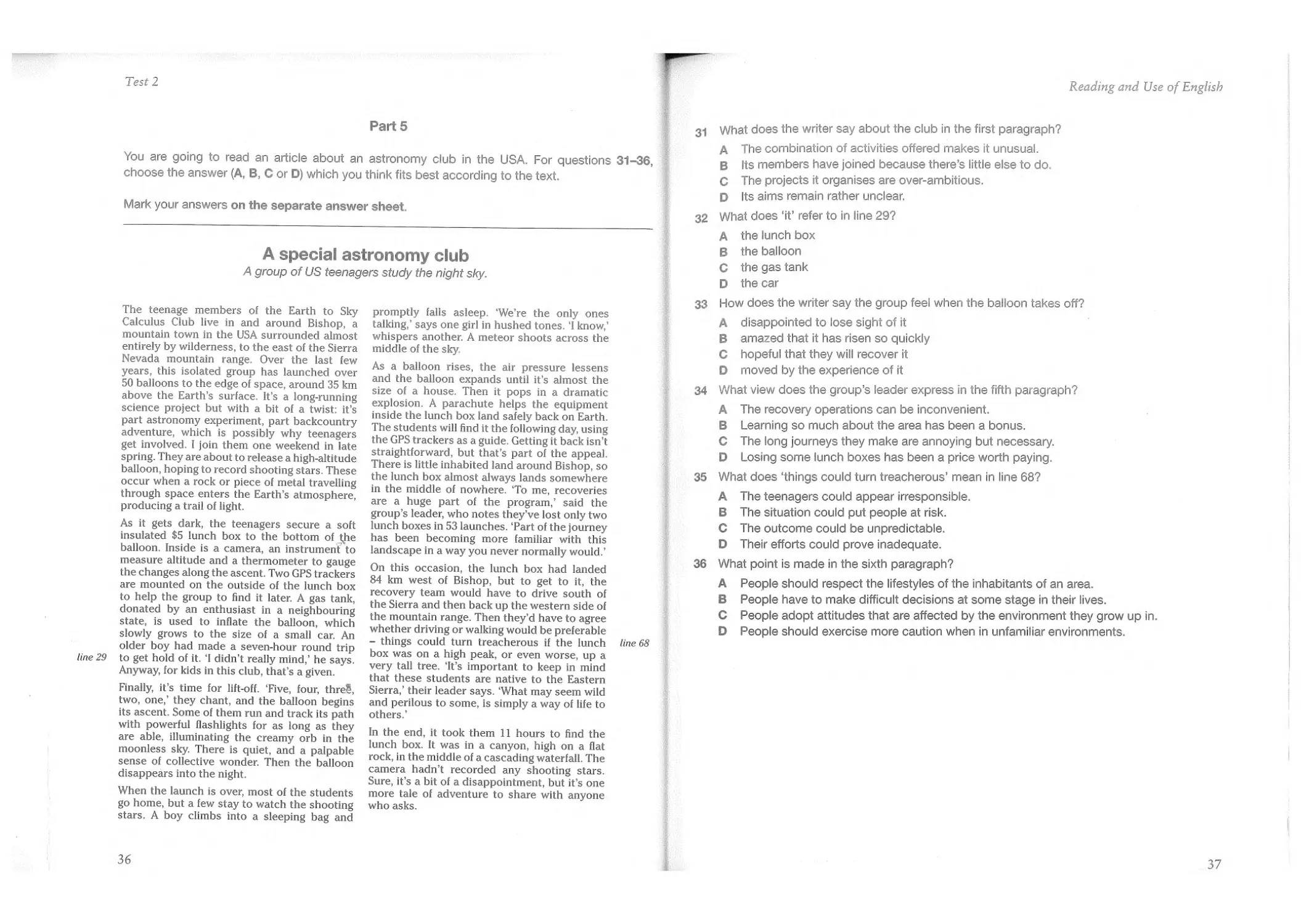
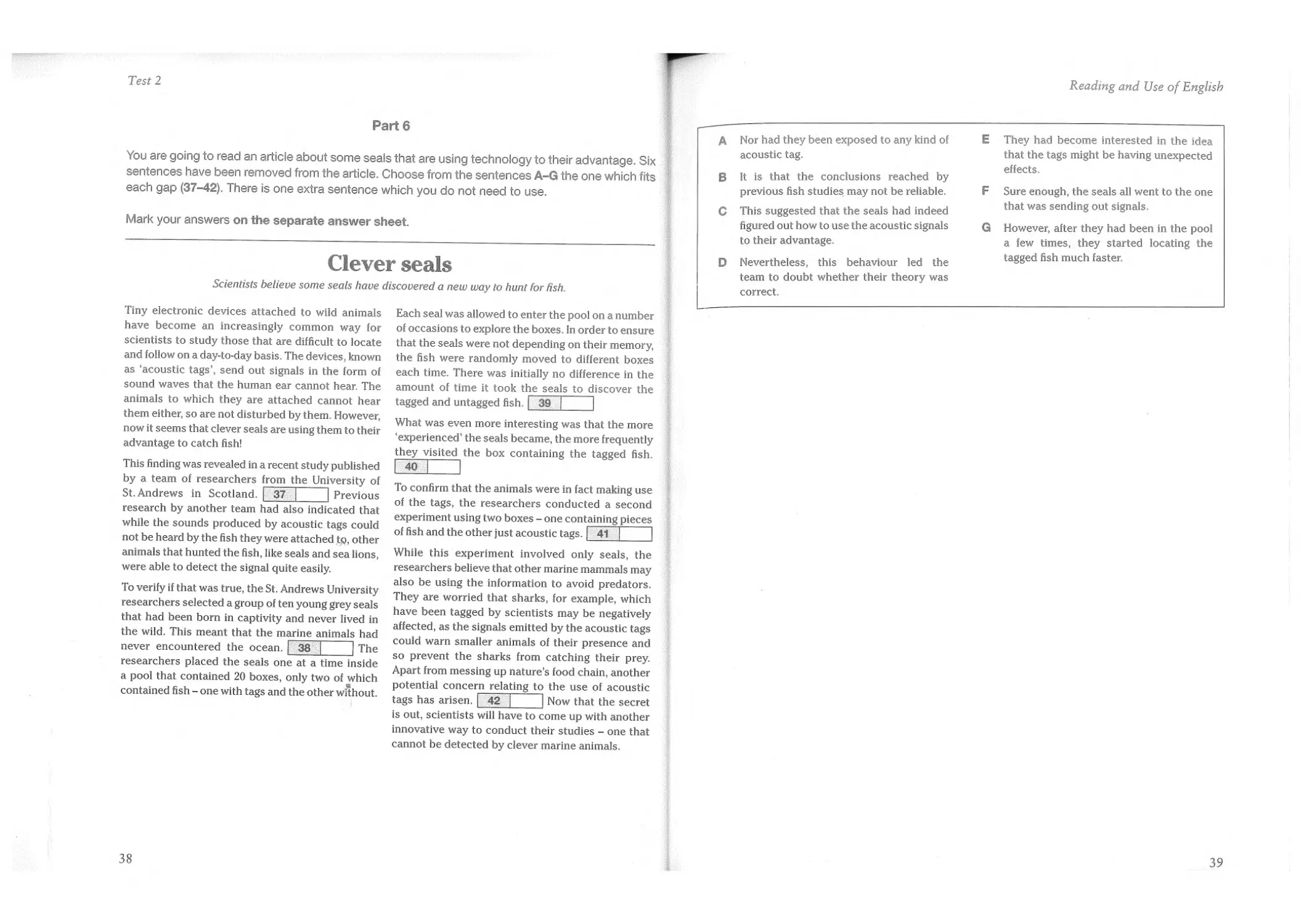


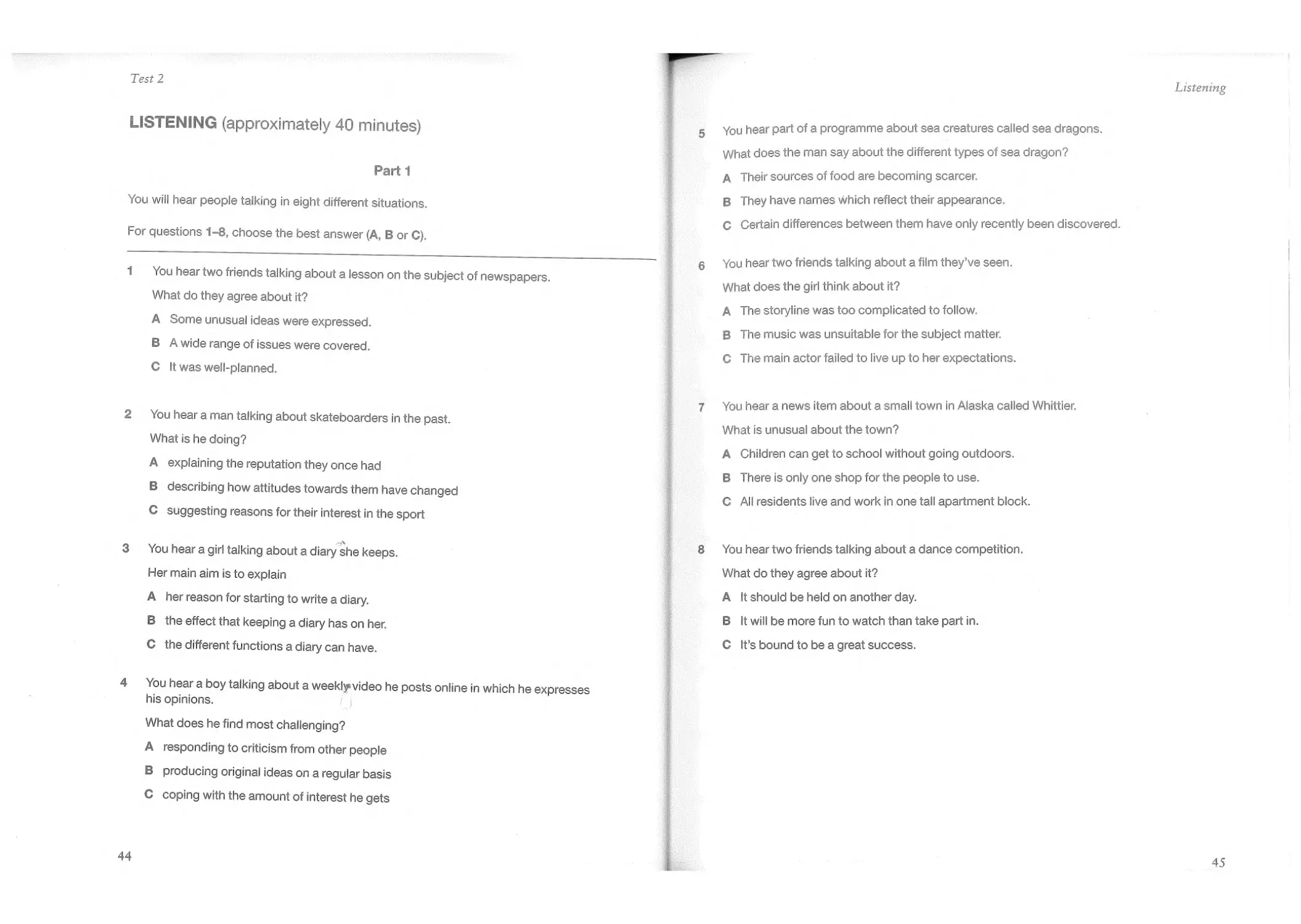
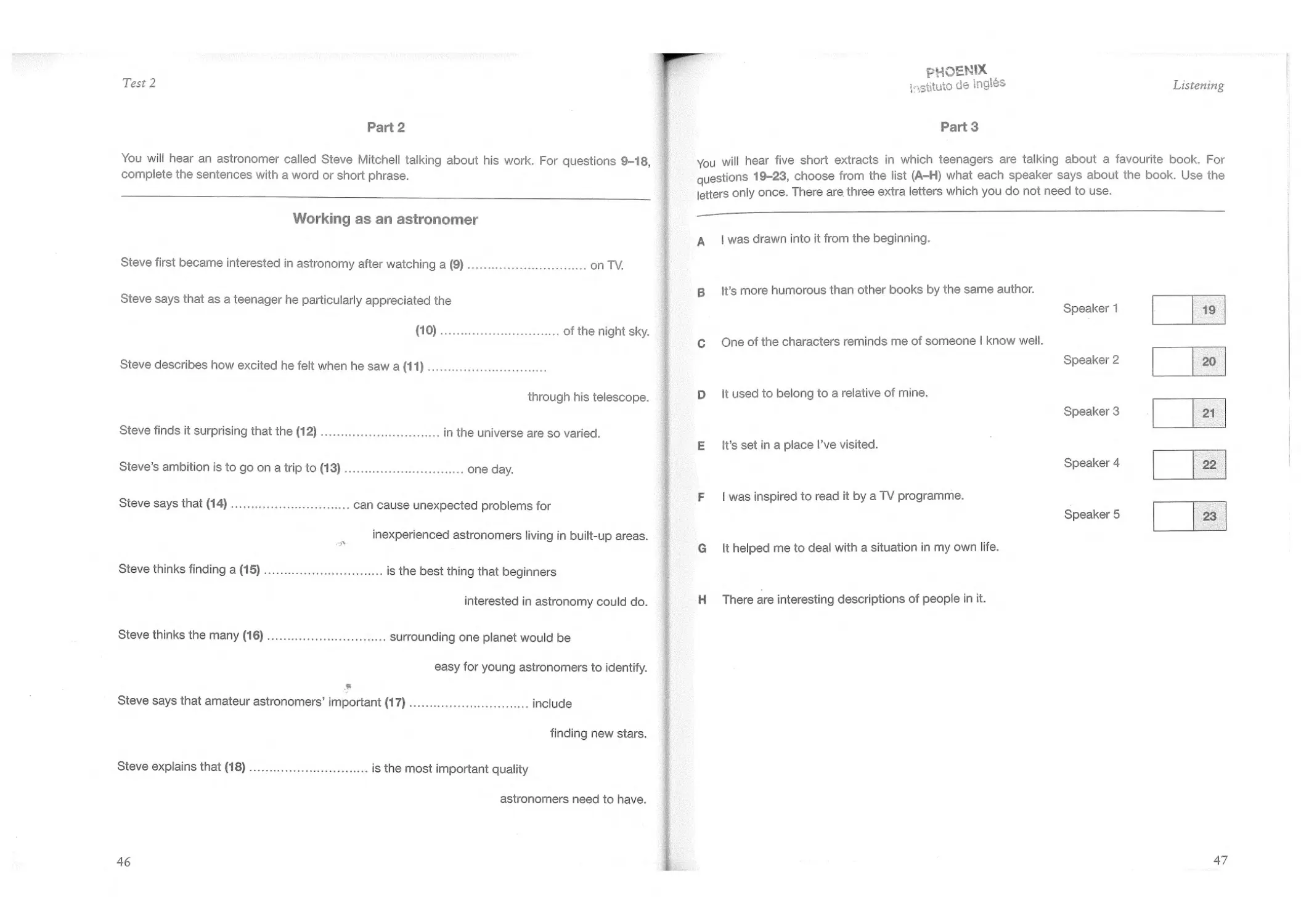
























Текст
gg Cambridge
WW UNIVERSITY PRESS
Language Assessment
Part of the University of Cambridge
CAMBRIDGE ENGLISH
PHOENIX
Institute de Inglfes
Cambridge English

FhCML

FIRST
for Schools
WITH ANSWERS
AUTHENTIC EXAMINATION PAPERS
Photocopiable
Cambridge University Press
www.cambridge.org/elt
Cambridge Assessment English
www.cambridgeenglish.org
Information on this title: www.cambridge.org/9781108433785
© Cambridge University Press and UCLES 2018
It is normally necessary for written permission for copying to be obtained
in advance from a publisher. The sample answer sheets at the back of this
book are designed to be copied and distributed in class.
The normal requirements are waived here and it is not necessary to write to
Cambridge University Press for permission for an individual teacher to make copies
for use within his or her own classroom. Only those pages that carry the wording
'© UCLES 2018 Photocopiable’ may be copied.
First published 2018
20 19 18 17 16 15 14 13 12 11 10 9 8 7 6 5 4
Printed in the United Kingdom by Latimer Trend
A catalogue record for this publication is available from the British Library
ISBN 978-1-108-43378-5 Student's Book with answers
ISBN 978-1-108-38085-0 Student's Book with answers with Audio
ISBN 978-1-108-43376-1 Student's Book without answers
ISBN 978-1-108-43381-5 Audio CDs (2)
The publishers have no responsibility for the persistence or accuracy of URLs
for external or third-party internet websites referred to in this publication, and
do not guarantee that any content on such websites is, or will remain, accurate
or appropriate. Information regarding prices, travel timetables, and other factual
information given in this work is correct at the time of first printing but the
publishers do not guarantee the accuracy of such information thereafter.

Contents
Introduction		4
Testi	Reading and Use of English	8
	Writing	20
	Listening	22
	Speaking	28
Test 2	Reading and Use of English	30
	Writing	42
	Listening	44
	Speaking	50
Test 3	Reading and Use of English	52
	Writing	64
	Listening	66
	Speaking	72
Test 4	Reading and Use of English	74
	Writing	86
	Listening	88
	Speaking	94
Testi	Frames for the Speaking test	95
Test 2	Frames for the Speaking test	98
Test3	Frames for the Speaking test	101
Test 4	Frames for the Speaking test	104
	Marks and results	107
Test 1	Key and transcript	120
Test 2	Key and transcript	132
Test 3	Key and transcript	144
Test 4	Key and transcript	156
	Sample answer sheets	168
	Acknowledgements	175
Visual materials for the
Speaking test
colour section
Introduction
This collection of four complete practice tests comprises papers from the Cambridge English:
First for Schools examination; students can practise these tests on their own or with the help
of a teacher.
The Cambridge English: First for Schools examination is part of a suite of general English
examinations produced by Cambridge English Language Assessment. This suite consists of five
examinations that have similar characteristics but are designed for different levels of English
language ability. Within the five levels, Cambridge English: First for Schools is at Level B2 in
the Council of Europe’s Common European Framework of Reference for Languages: Learning,
teaching, assessment. It has been accredited by Ofqual, the statutory regulatory authority in
England, at Level 1 in the National Qualifications Framework. The Cambridge English: First
for Schools examination is widely recognised in commerce and industry and in individual
university faculties and other educational institutions.
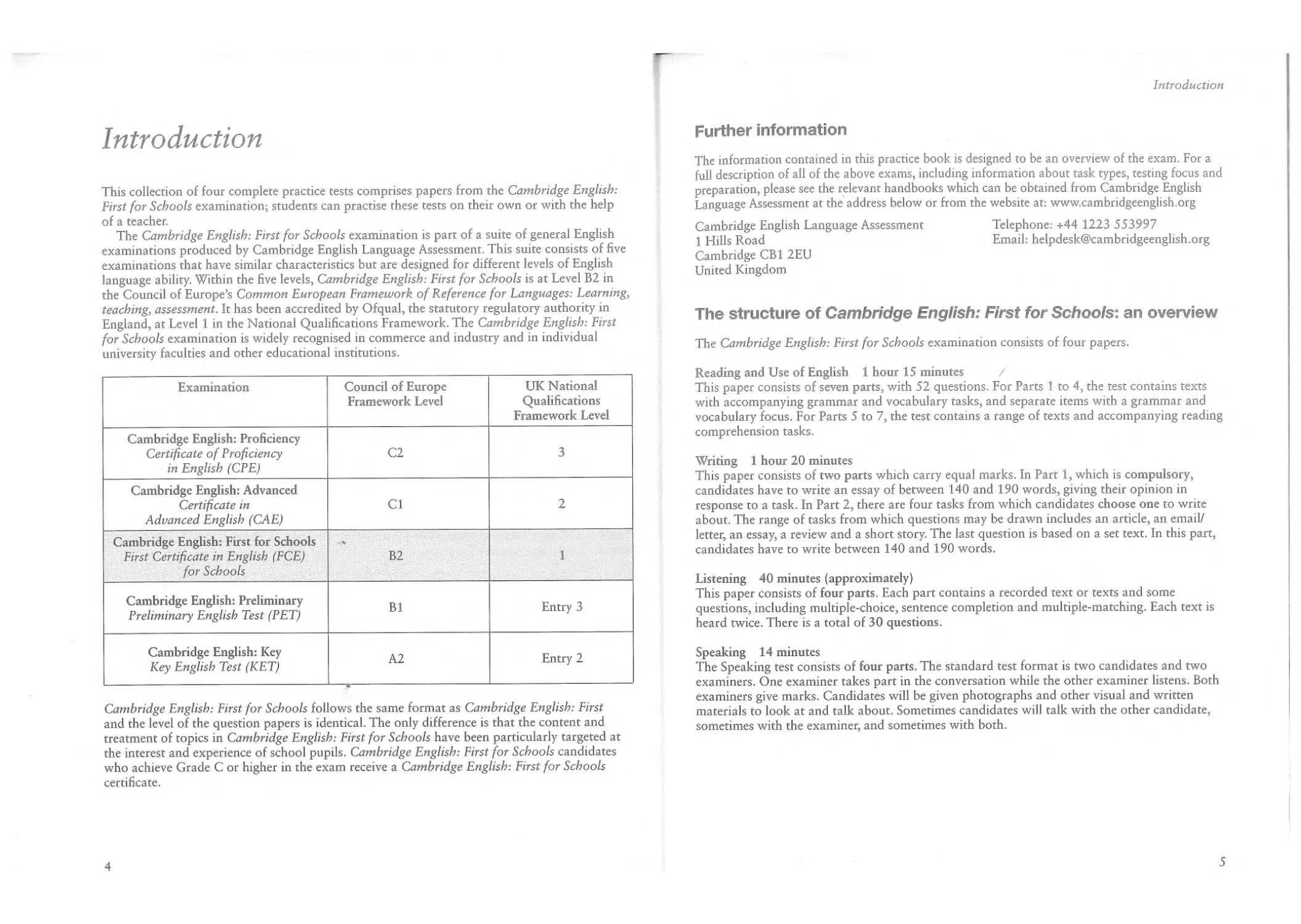
Examination	Council of Europe Framework Level	UK National Qualifications Framework Level
Cambridge English: Proficiency Certificate of Proficiency in English (CPE)	C2	3
Cambridge English: Advanced Certificate in Advanced English (CAE)	Cl	2
Cambridge English: First for Schools First Certificate in English (FCE) for Schools	B2	1
Cambridge English: Preliminary Preliminary English Test (PET)	Bl	Entry 3
Cambridge English: Key Key English Test (KET)	д 2.	Entry 2
Cambridge English: First for Schools follows the same format as Cambridge English: First
and the level of the question papers is identical. The only difference is that the content and
treatment of topics in Cambridge English: First for Schools have been particularly targeted at
the interest and experience of school pupils. Cambridge English: First for Schools candidates
who achieve Grade C or higher in the exam receive a Cambridge English: First for Schools
certificate.
4
Introduction
Further information
The information contained in this practice book is designed to be an overview of the exam. For a
full description of all of the above exams, including information about task types, testing focus and
preparation, please see the relevant handbooks which can be obtained from Cambridge English
Language Assessment at the address below or from the website at: www.cambndgeenglish.org
Cambridge English Language Assessment	Telephone: +44 1223 553997
1 Hills Road	Email: helpdesk@cambridgeenglish.org
Cambridge CB1 2EU
United Kingdom
The structure of Cambridge English: First for Schools: an overview
The Cambridge English: First for Schools examination consists of four papers.
Reading and Use of English 1 hour 15 minutes /
This paper consists of seven parts, with 52 questions. For Parts 1 to 4, the test contains texts
with accompanying grammar and vocabulary tasks, and separate items with a grammar and
vocabulary focus. For Parts 5 to 7, the test contains a range of texts and accompanying reading
comprehension tasks.
Writing 1 hour 20 minutes
This paper consists of two parts which carry equal marks. In Part 1, which is compulsory,
candidates have to write an essay of between 140 and 190 words, giving their opinion in
response to a task. In Part 2, there are four tasks from which candidates choose one to write
about. The range of tasks from which questions may be drawn includes an article, an email/
letter, an essay, a review and a short story. The last question is based on a set text. In this part,
candidates have to write between 140 and 190 words.
Listening 40 minutes (approximately)
This paper consists of four parts. Each part contains a recorded text or texts and some
questions, including multiple-choice, sentence completion and multiple-matching. Each text is
heard twice. There is a total of 30 questions.
Speaking 14 minutes
The Speaking test consists of four parts. The standard test format is two candidates and two
examiners. One examiner takes part in the conversation while the other examiner listens. Both
examiners give marks. Candidates will be given photographs and other visual and written
materials to look at and talk about. Sometimes candidates will talk with the other candidate,
sometimes with the examiner, and sometimes with both.
5
Introduction
Grading
Candidates will receive a score on the Cambridge English Scale for each of the four skills
and Use of English. The average of these five scores gives the candidate’s overall Cambridge
English Scale score for the exam. This determines what grade and CEFR level they achieve.
All candidates receive a Statement of Results and candidates who pass the examination with
Grade A, В or C also receive the First Certificate in English. Candidates who achieve Grade A
receive the First Certificate in English stating that they demonstrated ability at Level Cl.
Candidates who achieve Grade В or C receive the First Certificate in English certificate stating
that they demonstrated ability at Level B2. Candidates whose performance is below B2 level,
but falls within Level Bl, receive a Cambridge English certificate stating that they have
demonstrated ability at Level Bl. Candidates whose performance falls below Level Bl do not
receive a certificate.
For further information on grading and results, go to the website (see page 5).
6
Test 1
Test 1
READING AND USE OF ENGLISH (1 hour 15 minutes)
Parti
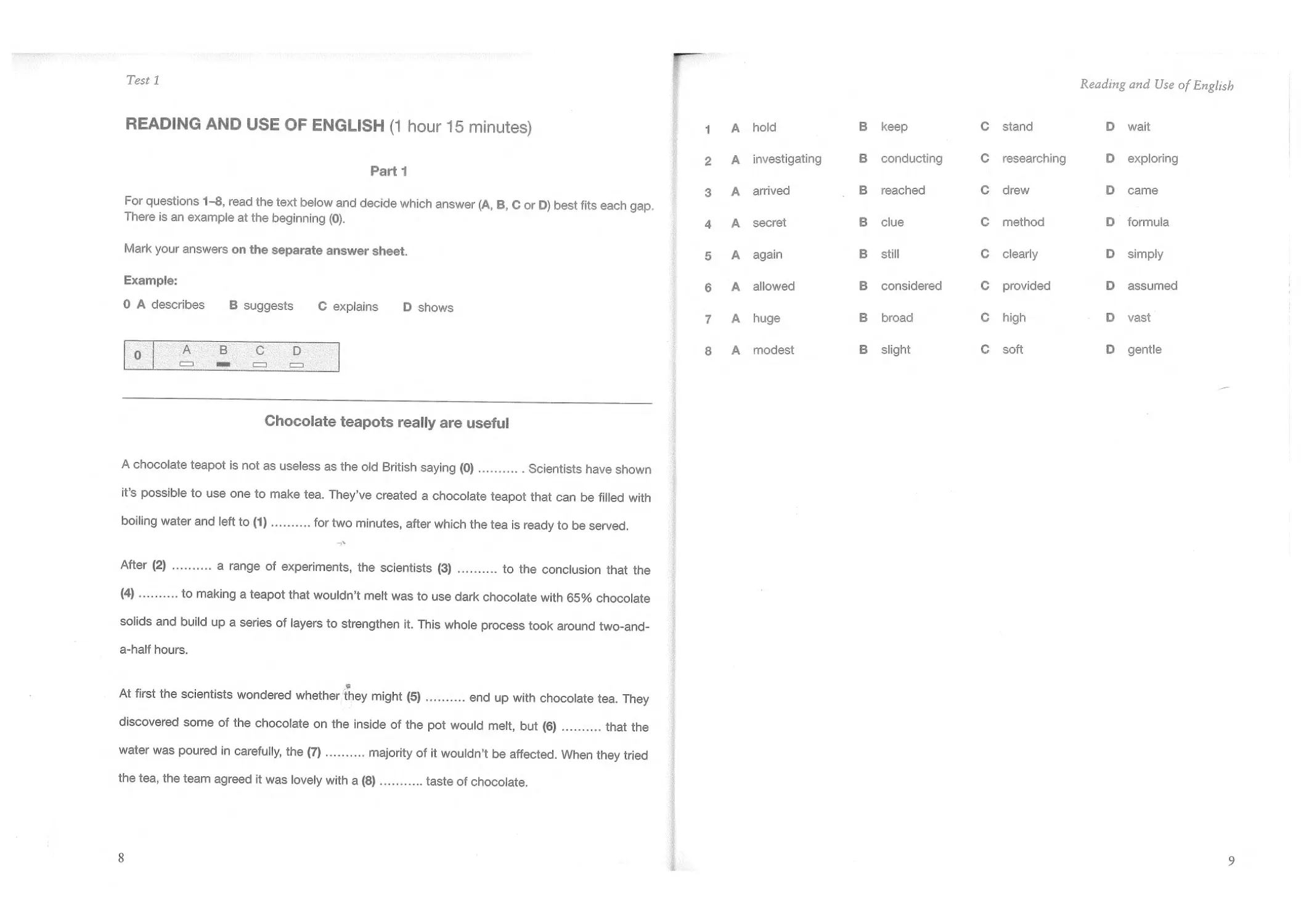
For questions 1-8, read the text below and decide which answer (А, В, C or D) best fits each gap.
There is an example at the beginning (0).
Mark your answers on the separate answer sheet.
Example:
0 A describes В suggests C explains D shows
0	А В C D
Chocolate teapots really are useful
A chocolate teapot is not as useless as the old British saying (0)......Scientists have shown
it’s possible to use one to make tea. They’ve created a chocolate teapot that can be filled with
boiling water and left to (1).....for two minutes, after which the tea is ready to be served.
After (2) ..... a range of experiments, the scientists (3) ......to the conclusion that the
(4)........to making a teapot that wouldn’t melt was to use dark chocolate with 65% chocolate
solids and build up a series of layers to strengthen it. This whole process took around two-and-
a-half hours.
.Я
At first the scientists wondered whether they might (5)...........end up with chocolate tea. They
discovered some of the chocolate on the inside of the pot would melt, but (6)................that the
water was poured in carefully, the (7).........majority of it wouldn’t be affected. When they tried
the tea, the team agreed it was lovely with a (8).........taste of chocolate.
8
Reading and Use of English
1	A	hold	В	keep	c	stand	D	wait
2	A	investigating	В	conducting	c	researching	D	exploring
3	A	arrived	В	reached	c	drew	D	came
4	A	secret	в	clue	c	method	D	formula
5	A	again	в	still	c	clearly	D	simply
6	A	allowed	в	considered	c	provided	D	assumed
7	A	huge	в	broad	c	high	D	vast
8	A	modest	в	slight	c	soft	D	gentle
3
Test 1
Part 2
For questions 9-16, read the text below and think of the word which best fits each gap. Use only
one word in each gap. There is an example at the beginning (0).
Write your answers IN CAPITAL LETTERS on the separate answer sheet.
Example:
H	A	V	E
Making mistakes helps you to succeed
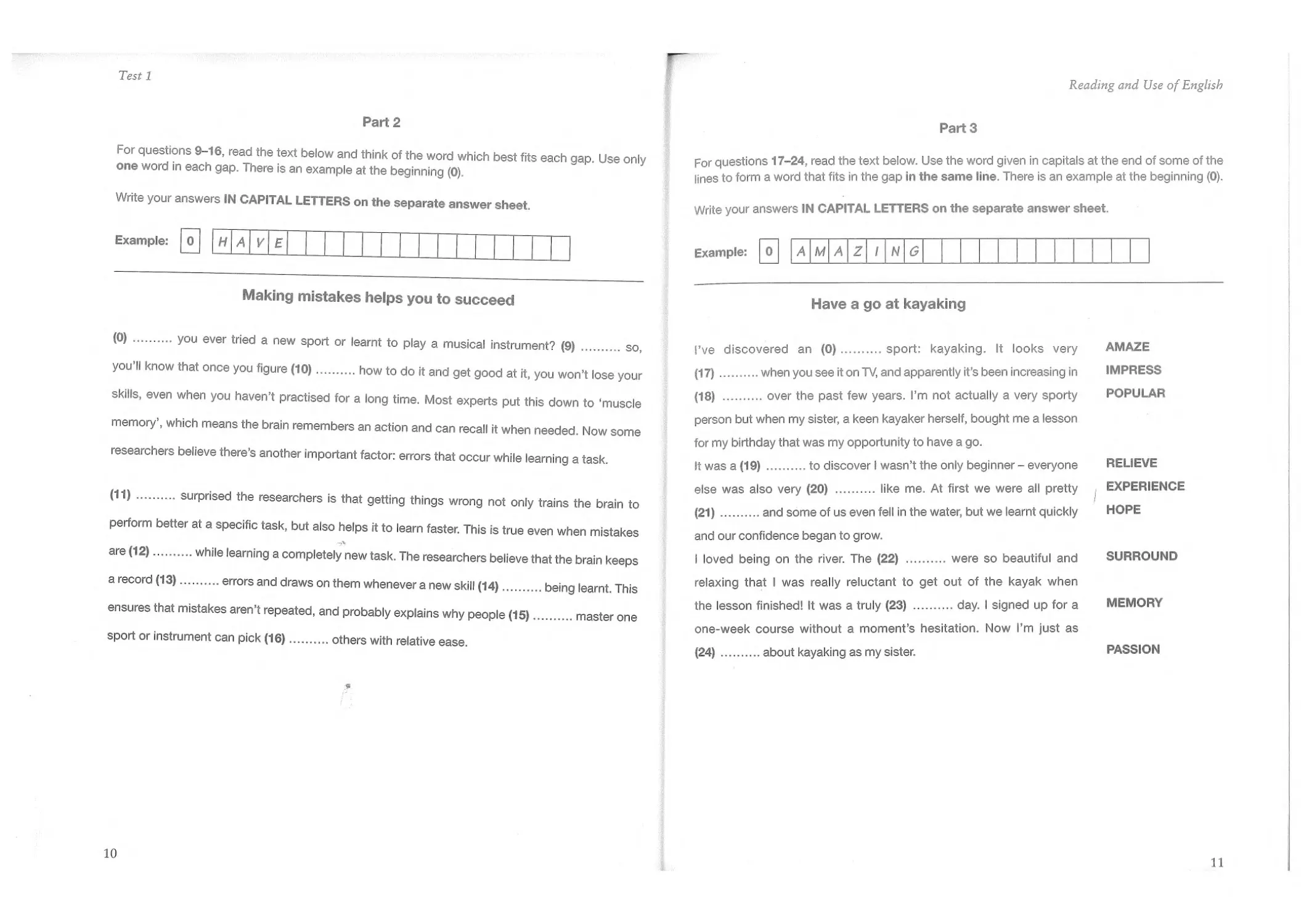
(0) ........you ever tried a new sport or learnt to play a musical instrument? (9) .........so,
you’ll know that once you figure (10).......how to do it and get good at it, you won’t lose your
skills, even when you haven’t practised for a long time. Most experts put this down to ‘muscle
memory’, which means the brain remembers an action and can recall it when needed. Now some
researchers believe there’s another important factor: errors that occur while learning a task.
(11) ......surprised the researchers is that getting things wrong not only trains the brain to
perform better at a specific task, but also helps it to learn faster. This is true even when mistakes
are (12)....... while learning a completely new task. The researchers believe that the brain keeps
a record (13)......errors and draws on them whenever a new skill (14).....being learnt. This
ensures that mistakes aren’t repeated, and probably explains why people (15)...master one
sport or instrument can pick (16).....others with relative ease.
10
Reading and Use of English
Part3
For questions 17-24, read the text below. Use the word given in capitals at the end of some of the
lines to form a word that fits in the gap in the same line. There is an example at the beginning (0).
Write your answers IN CAPITAL LETTERS on the separate answer sheet.
Example:
A	M	A	Z	1	N	G
Have a go at kayaking
I’ve discovered an (0).......sport: kayaking. It looks very AMAZE
(17)........when you see it on TV, and apparently it’s been increasing in	IMPRESS
(18)................over the past few years. I’m not actually a very sporty	POPULAR
person but when my sister, a keen kayaker herself, bought me a lesson
for my birthday that was my opportunity to have a go.
It was a (19) .....to	discover I wasn’t the only beginner - everyone RELIEVE
else was also very (20) .....like me. At first we were all pretty EXPERIENCE
(21)............	and some of us even fell in the water, but we learnt quickly HOPE
and our confidence began to grow.
I loved being on the river. The (22) ......... were	so beautiful and
relaxing that I was really reluctant to get out of the kayak when
the lesson finished! It was a truly (23) .....day. I signed up for a
one-week course without a moment’s hesitation. Now I’m just as
(2	4) .....about kayaking as my sister.
SURROUND
MEMORY
PASSION
11
Test 1
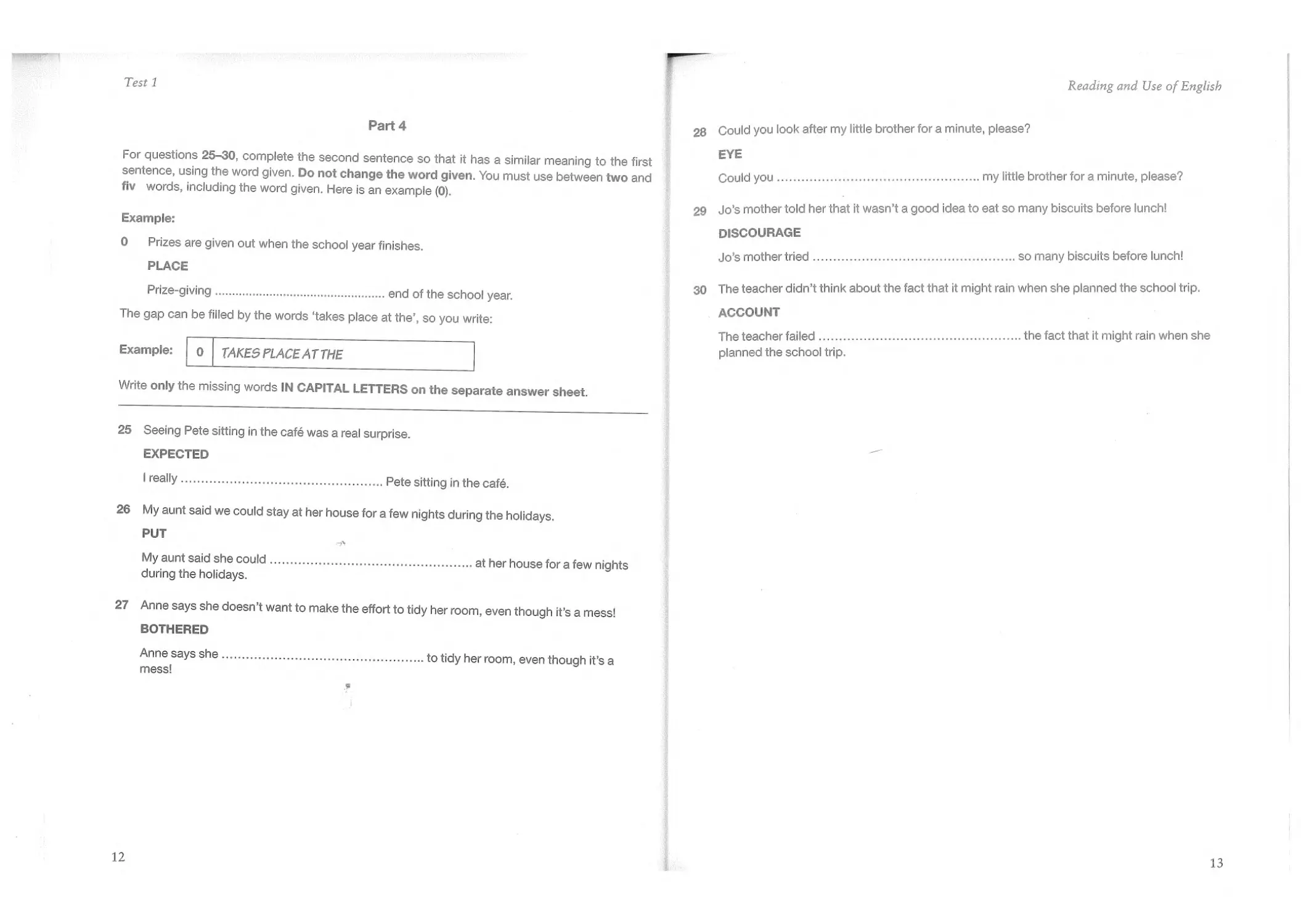
Part 4
For questions 25-30, complete the second sentence so that it has a similar meaning to the first
sentence, using the word given. Do not change the word given. You must use between two and
fiv words, including the word given. Here is an example (0).
Example:
0 Prizes are given out when the school year finishes.
PLACE
Prize-giving...................................end	of the school year.
The gap can be filled by the words ‘takes place at the’, so you write:
Example: 0 TAKES PLACE AT THE
Write only the missing words IN CAPITAL LETTERS on the separate answer sheet.
25	Seeing Pete sitting in the cafe was a real surprise.
EXPECTED
I really................................Pete	sitting in the cafe.
26	My aunt said we could stay at her house for a few nights during the holidays.
PUT
My aunt said she could.................................at	her house for a few nights
during the holidays.
27	Anne says she doesn’t want to make the effort to tidy her room, even though it’s a mess!
BOTHERED
Anne says she..................................to	tidy her room, even though it’s a
mess!
12
Reading and Use of English
28	Could you look after my little brother for a minute, please?
EYE
Could you.................................my	little brother for a minute, please?
29	Jo’s mother told her that it wasn’t a good idea to eat so many biscuits before lunch!
DISCOURAGE
Jo’s mother tried..............................so many biscuits before lunch!
30	The teacher didn’t think about the fact that it might rain when she planned the school trip.
ACCOUNT
The teacher failed.............................the fact that it might rain when she
planned the school trip.
13
Test 1
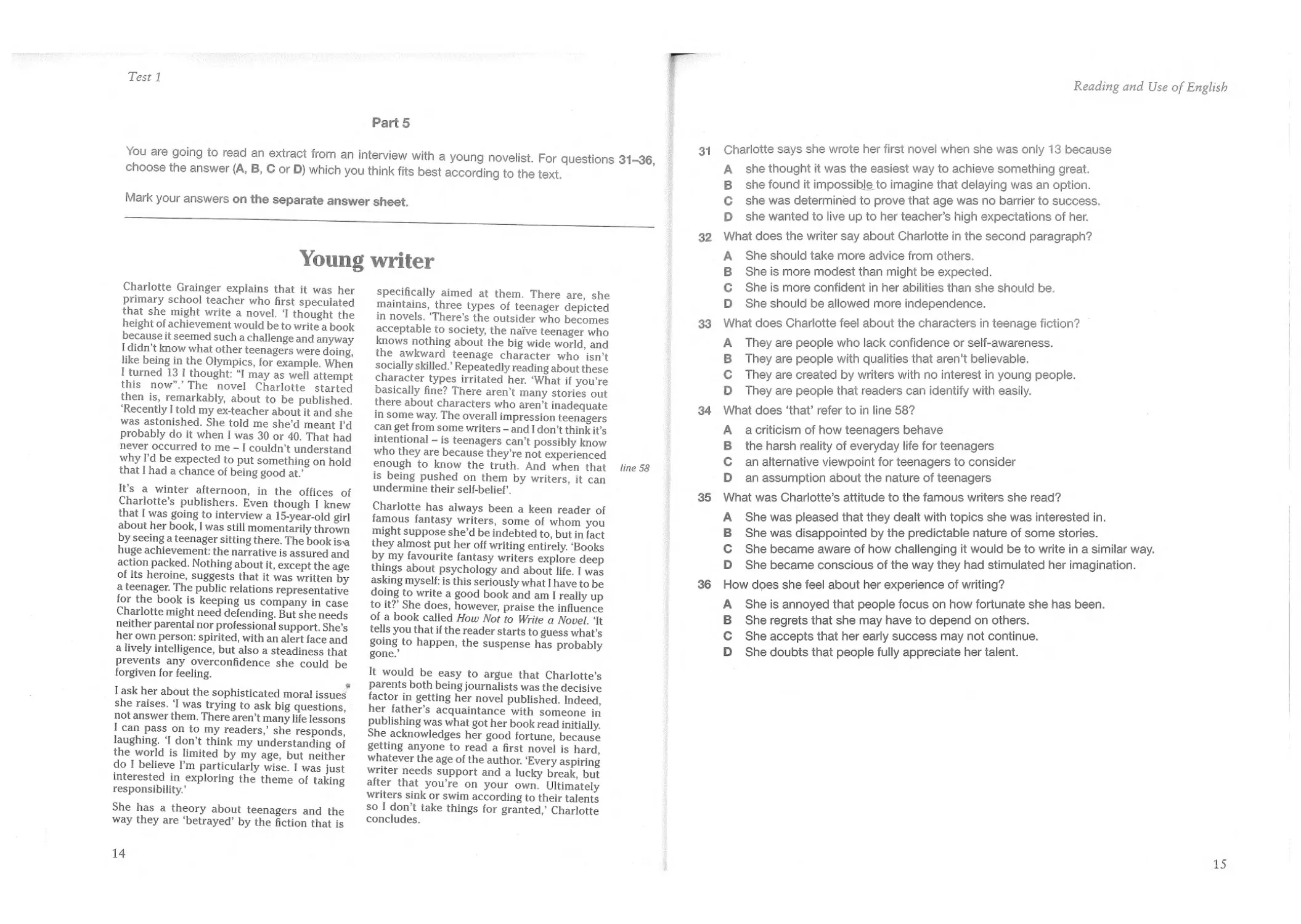
Part 5
You are going to read an extract from an interview with a young novelist. For questions 31-36,
choose the answer (А, В, C or D) which you think fits best according to the text.
Mark your answers on the separate answer sheet.
Young writer
Charlotte Grainger explains that it was her
primary school teacher who first speculated
that she might write a novel. ‘I thought the
height of achievement would be to write a book
because it seemed such a challenge and anyway
I didn’t know what other teenagers were doing,
like being in the Olympics, for example. When
I turned 13 1 thought: “I may as well attempt
this now”.* The novel Charlotte started
then is, remarkably, about to be published.
‘Recently I told my ex-teacher about it and she
was astonished. She told me she’d meant I’d
probably do it when I was 30 or 40. That had
never occurred to me - I couldn’t understand
why I’d be expected to put something on hold
that I had a chance of being good at.’
It’s a winter afternoon, in the offices of
Charlotte’s publishers. Even though I knew
that I was going to interview a 15-year-old girl
about her book, I was still momentarily thrown
by seeing a teenager sitting there. The book is^a
huge achievement: the narrative is assured and
action packed. Nothing about it, except the age
of its heroine, suggests that it was written by
a teenager. The public relations representative
for the book is keeping us company in case
Charlotte might need defending. But she needs
neither parental nor professional support. She’s
her own person: spirited, with an alert face and
a lively intelligence, but also a steadiness that
prevents any overconfidence she could be
forgiven for feeling.
I ask her about the sophisticated moral issues
she raises. ‘I was trying to ask big questions,
not answer them. There aren’t many life lessons
I can pass on to my readers,’ she responds,
laughing. ‘I don’t think my understanding of
the world is limited by my age, but neither
do I believe I’m particularly wise. I was just
interested in exploring the theme of taking
responsibility.’
She has a theory about teenagers and the
way they are ‘betrayed* by the fiction that is
specifically aimed at them. There are, she
maintains, three types of teenager depicted
in novels. ‘There’s the outsider who becomes
acceptable to society, the naive teenager who
knows nothing about the big wide world, and
the awkward teenage character who isn’t
socially skilled.’ Repeatedly reading about these
character types irritated her. ‘What if you’re
basically fine? There aren’t many stories out
there about characters who aren’t inadequate
in some way. The overall impression teenagers
can get from some writers - and I don’t think it’s
intentional - is teenagers can’t possibly know
who they are because they’re not experienced
enough to know the truth. And when that
is being pushed on them by writers, it can
undermine their self-belief’.
line 58
Charlotte has always been a keen reader of
famous fantasy writers, some of whom you
might suppose she’d be indebted to, but in fact
they almost put her off writing entirely. ‘Books
by my favourite fantasy writers explore deep
things about psychology and about life. I was
asking myself: is this seriously what 1 have to be
doing to write a good book and am I really up
to it?’ She does, however, praise the influence
of a book called How Not to Write a Novel. ‘It
tells you that if the reader starts to guess what’s
going to happen, the suspense has probably
gone.’
It would be easy to argue that Charlotte’s
parents both being journalists was the decisive
factor in getting her novel published. Indeed,
her father’s acquaintance with someone in
publishing was what got her book read initially.
She acknowledges her good fortune, because
getting anyone to read a first novel is hard,
whatever the age of the author. ‘Every aspiring
writer needs support and a lucky break, but
after that you’re on your own. Ultimately
writers sink or swim according to their talents
so I don’t take things for granted,’ Charlotte
concludes.
14
Reading and Use of English
31 Charlotte says she wrote her first novel when she was only 13 because
A she thought it was the easiest way to achieve something great.
В she found it impossible to imagine that delaying was an option.
C she was determined to prove that age was no barrier to success.
D she wanted to live up to her teacher’s high expectations of her.
32 What does the writer say about Charlotte in the second paragraph?
A She should take more advice from others.
В She is more modest than might be expected.
C She is more confident in her abilities than she should be.
D She should be allowed more independence.
33 What does Charlotte feel about the characters in teenage fiction?
A They are people who lack confidence or self-awareness.
В They are people with qualities that aren’t believable.
C They are created by writers with no interest in young people.
D They are people that readers can identify with easily.
34 What does ‘that’ refer to in line 58?
A a criticism of how teenagers behave
В the harsh reality of everyday life for teenagers
C an alternative viewpoint for teenagers to consider
D an assumption about the nature of teenagers
35 What was Charlotte’s attitude to the famous writers she read?
A She was pleased that they dealt with topics she was interested in.
В She was disappointed by the predictable nature of some stories.
C She became aware of how challenging it would be to write in a similar way.
D She became conscious of the way they had stimulated her imagination.
36 How does she feel about her experience of writing?
A She is annoyed that people focus on how fortunate she has been.
В She regrets that she may have to depend on others.
C She accepts that her early success may not continue.
D She doubts that people fully appreciate her talent.
15
Test 1
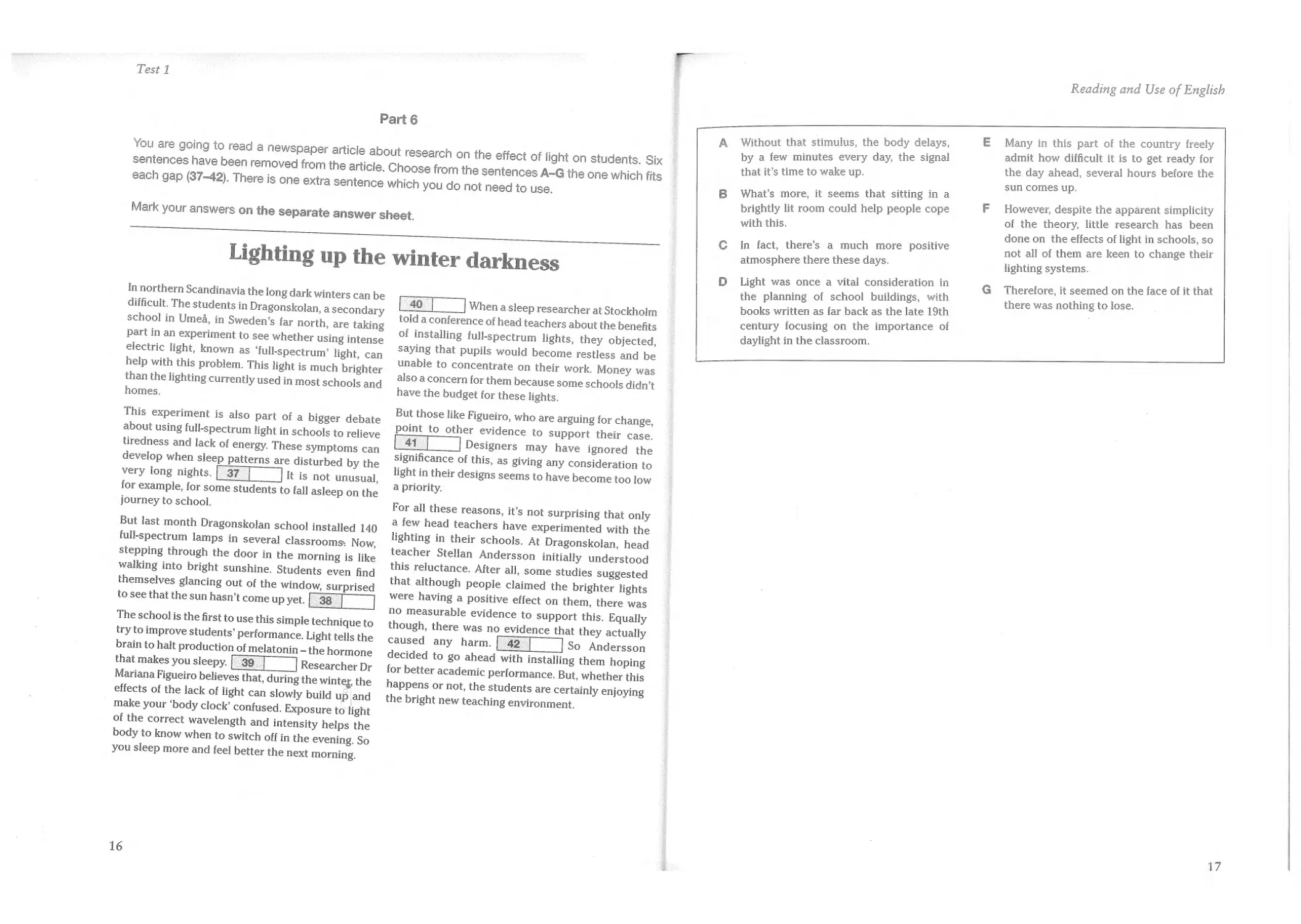
Part 6
You are going to read a newspaper article about research on the effect of light on students. Six
sentences have been removed from the article. Choose from the sentences A-G the one which fits
each gap (37-42). There is one extra sentence which you do not need to use.
Mark your answers on the separate answer sheet.
Lighting up the winter darkness
In northern Scandinavia the long dark winters can be
difficult. The students in Dragonskolan, a secondary
school in Umea, in Sweden’s far north, are taking
part in an experiment to see whether using intense
electric light, known as ‘full-spectrum’ light, can
help with this problem. This light is much brighter
than the lighting currently used in most schools and
homes.
This experiment is also part of a bigger debate
about using full-spectrum light in schools to relieve
tiredness and lack of energy. These symptoms can
develop when sleep patterns are disturbed by the
very long nights. 37 It is not unusual,
for example, for some students to fall asleep on the
journey to school.
But last month Dragonskolan school installed 140
full-spectrum lamps in several classrooms^. Now,
stepping through the door in the morning is like
walking into bright sunshine. Students even find
themselves glancing out of the window, surprised
to see that the sun hasn’t come up yet. 38
The school is the first to use this simple technique to
try to improve students’ performance. Light tells the
brain to halt production of melatonin - the hormone
that makes you sleepy. | 39 |	| Researcher Dr
Mariana Figueiro believes that, during the winter the
effects of the lack of light can slowly build up and
make your ‘body clock’ confused. Exposure to light
of the correct wavelength and intensity helps the
body to know when to switch off in the evening. So
you sleep more and feel better the next morning.
40
41
When a sleep researcher at Stockholm
told a conference of head teachers about the benefits
of installing full-spectrum lights, they objected,
saying that pupils would become restless and be
unable to concentrate on their work. Money was
also a concern for them because some schools didn’t
have the budget for these lights.
But those like Figueiro, who are arguing for change,
point to other evidence to support their case.
Designers may have ignored the
significance of this, as giving any consideration to
light in their designs seems to have become too low
a priority.
For all these reasons, it’s not surprising that only
a few head teachers have experimented with the
lighting in their schools. At Dragonskolan, head
teacher Stellan Andersson initially understood
this reluctance. After all, some studies suggested
that although people claimed the brighter lights
were having a positive effect on them, there was
no measurable evidence to support this. Equally
though, there was no evidence that they actually
caused any harm. 42	So Andersson
decided to go ahead with installing them hoping
for better academic performance. But, whether this
happens or not, the students are certainly enjoying
the bright new teaching environment.
42
16
Reading and Use of English
A Without that stimulus, the body delays,
by a few minutes every day, the signal
that it’s time to wake up.
В What’s more, it seems that sitting in a
brightly lit room could help people cope
with this.
C In fact, there’s a much more positive
atmosphere there these days.
D Light was once a vital consideration in
the planning of school buildings, with
books written as far back as the late 19th
century focusing on the importance of
daylight in the classroom.
E Many in this part of the country freely
admit how difficult it is to get ready for
the day ahead, several hours before the
sun comes up.
F However, despite the apparent simplicity
of the theory, little research has been
done on the effects of light in schools, so
not all of them are keen to change their
lighting systems.
G Therefore, it seemed on the face of it that
there was nothing to lose.
17
Test 1
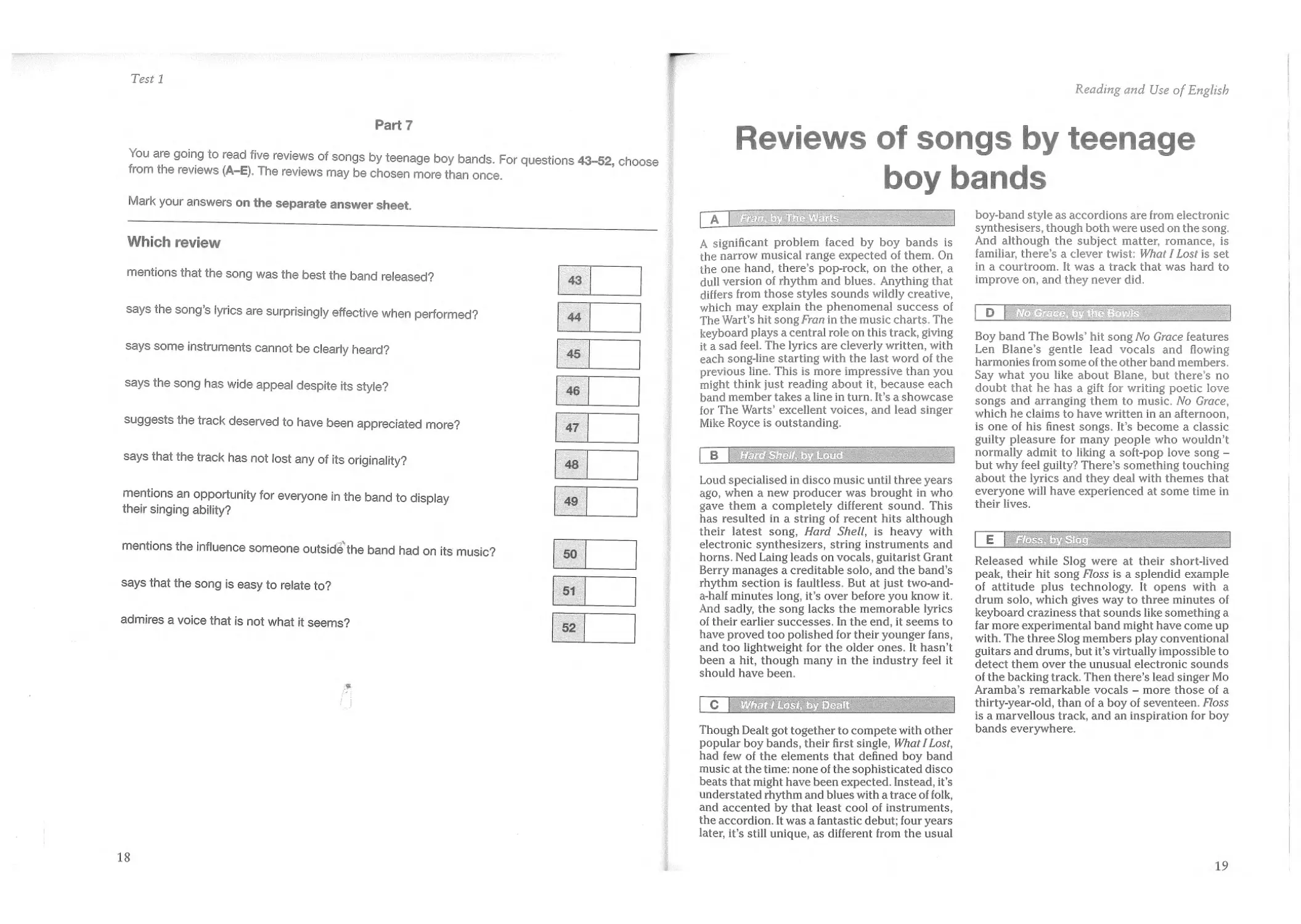
Part 7
You are going to read five reviews of songs by teenage boy bands. For questions 43-52, choose
from the reviews (A-E). The reviews may be chosen more than once.
Mark your answers on the separate answer sheet.
Which review
mentions that the song was the best the band released?
says the song’s lyrics are surprisingly effective when performed?
says some instruments cannot be clearly heard?
says the song has wide appeal despite its style?
suggests the track deserved to have been appreciated more?
says that the track has not lost any of its originality?
mentions an opportunity for everyone in the band to display
their singing ability?
mentions the influence someone outside the band had on its music?
says that the song is easy to relate to?
admires a voice that is not what it seems?
43

44

45

46

47

48

49

50

51

52
18
Reading and Use of English
Reviews of songs by teenage
boy bands
A
A significant problem faced by boy bands is
the narrow musical range expected of them. On
the one hand, there’s pop-rock, on the other, a
dull version of rhythm and blues. Anything that
differs from those styles sounds wildly creative,
which may explain the phenomenal success of
The Wart’s hit song Fran in the music charts. The
keyboard plays a central role on this track, giving
it a sad feel. The lyrics are cleverly written, with
each song-line starting with the last word of the
previous line. This is more impressive than you
might think just reading about it, because each
band member takes a line in turn. It’s a showcase
for The Warts’ excellent voices, and lead singer
Mike Royce is outstanding.
Loud specialised in disco music until three years
ago, when a new producer was brought in who
gave them a completely different sound. This
has resulted in a string of recent hits although
their latest song, Hard Shell, is heavy with
electronic synthesizers, string instruments and
horns. Ned Laing leads on vocals, guitarist Grant
Berry manages a creditable solo, and the band’s
rhythm section is faultless. But at just two-and-
a-half minutes long, it’s over before you know it.
And sadly, the song lacks the memorable lyrics
of their earlier successes. In the end, it seems to
have proved too polished for their younger fans,
and too lightweight for the older ones. It hasn't
been a hit, though many in the industry feel it
should have been.
Though Dealt got together to compete with other
popular boy bands, their first single, What I Lost,
had few of the elements that defined boy band
music at the time: none of the sophisticated disco
beats that might have been expected. Instead, it’s
understated rhythm and blues with a trace of folk,
and accented by that least cool of instruments,
the accordion. It was a fantastic debut; four years
later, it’s still unique, as different from the usual
boy-band style as accordions are from electronic
synthesisers, though both were used on the song.
And although the subject matter, romance, is
familiar, there’s a clever twist: What I Lost is set
in a courtroom. It was a track that was hard to
improve on, and they never did.
Boy band The Bowls’ hit song No Grace features
Len Blane’s gentle lead vocals and flowing
harmonies from some of the other band members.
Say what you like about Blane, but there’s no
doubt that he has a gift for writing poetic love
songs and arranging them to music. No Grace,
which he claims to have written in an afternoon,
is one of his finest songs. It’s become a classic
guilty pleasure for many people who wouldn’t
normally admit to liking a soft-pop love song -
but why feel guilty? There’s something touching
about the lyrics and they deal with themes that
everyone will have experienced at some time in
their lives.
Released while Slog were at their short-lived
peak, their hit song Floss is a splendid example
of attitude plus technology. It opens with a
drum solo, which gives way to three minutes of
keyboard craziness that sounds like something a
far more experimental band might have come up
with. The three Slog members play conventional
guitars and drums, but it’s virtually impossible to
detect them over the unusual electronic sounds
of the backing track. Then there’s lead singer Mo
Aramba’s remarkable vocals - more those of a
thirty-year-old, than of a boy of seventeen. Floss
is a marvellous track, and an inspiration for boy
bands everywhere.
19
Test 1
WRITING (1 hour 20 minutes)
Parti
You must answer this question. Write your answer in 140-190 words in an appropriate style on
the separate answer sheet.
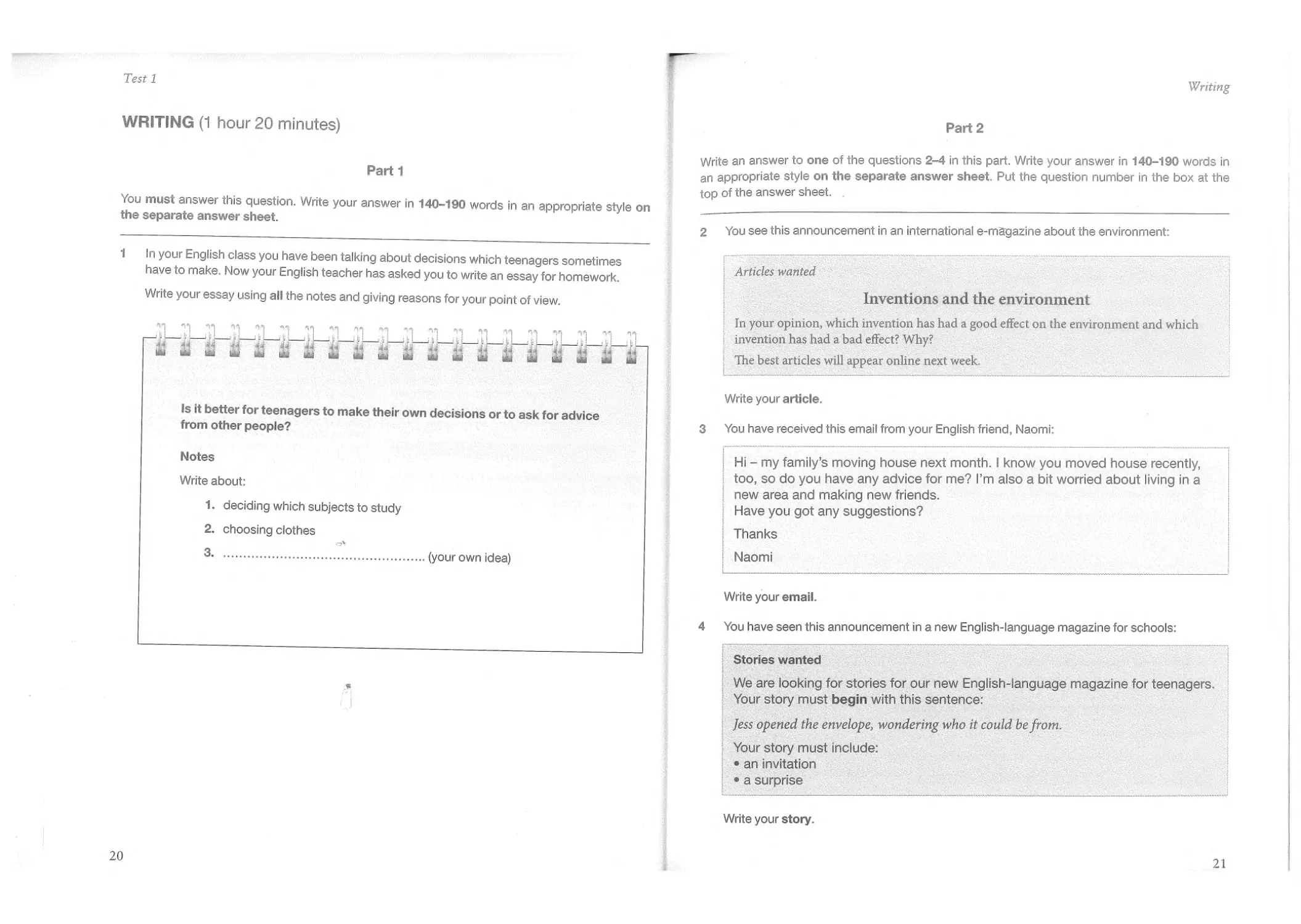
1 In your English class you have been talking about decisions which teenagers sometimes
have to make. Now your English teacher has asked you to write an essay for homework.
Write your essay using all the notes and giving reasons for your point of view.
Is it better for teenagers to make their own decisions or to ask for advice
from other people?
Notes
Write about:
1.	deciding which subjects to study
2.	choosing clothes
3	(your	own idea)
20
Writing
Part 2
Write an answer to one of the questions 2-4 in this part. Write your answer in 140-190 words in
an appropriate style on the separate answer sheet. Put the question number in the box at the
top of the answer sheet. .
2 You see this announcement in an international e-magazine about the environment:
Articles wanted
Inventions and the environment
In your opinion, which invention has had a good effect on the environment and which
invention has had a bad effect? Why?
The best articles will appear online next week.
Write your article.
3 You have received this email from your English friend, Naomi:
Hi - my family’s moving house next month. I know you moved house recently,
too, so do you have any advice for me? I’m also a bit worried about living in a
new area and making new friends.
Have you got any suggestions?
Thanks
Naomi
Write your email.
4 You have seen this announcement in a new English-language magazine for schools:
У—----------------------------------------------	-
Stories wanted
We are looking for stories for our new English-language magazine for teenagers.
Your story must begin with this sentence:
Jess opened the envelope, wondering who it could be from.
Your story must include:
•	an invitation
•	a surprise
Write your story.
21
Test 1
LISTENING (approximately 40 minutes)
Parti
You will hear people talking in eight different situations.
For questions 1-8, choose the best answer (A, В or C).
1 You hear a singer talking about performing on stage.
What does she do if she feels nervous before a performance?
A She pretends the audience is not there.
В She talks with other people in her group.
C She uses a technique suggested by a colleague.
2 You hear a girl telling her father about a special day at school.
How did she feel?
A surprised to be asked for her views
В excited about meeting someone well known
C pleased that her talents were recognised
3 You hear two friends talking about a summer camp they could both go on.
What would they both find difficult about going on it?
A being away from home
В getting on with other people
C doing the organised activities
4 You hear a boy talking about his favourite TV programme.
How does he feel about it?
A disappointed by the absence of one important element
В surprised by the references to real historical figures
C confused by the way the characters behave
22
Listening
5 You hear a journalist talking about an unusual type of house.
What does he think of it?
A He’s impressed by how original the design is.
В He’s confident that It could be successful elsewhere.
C He’s keen to experience staying in it himself.
6 You hear part of an interview with a boy called Max, who found a prehistoric object.
What effect has the discovery had on Max’s life?
A It’s made him more confident.
В It’s provided him with a new interest.
C It’s changed the way his friends treat him.
7 You hear a girl talking about the sport called netball.
What does she say about it?
A The rules are quite complicated.
В The skills are difficult to acquire.
C The level of fitness needed is surprising.
8 You hear two friends discussing a news story about some rock climbers.
How does the boy feel about it?
A He feels sorry for the families of the climbers.
В He admires the courage the climbers showed.
C He’s determined to follow the climbers’ example.
23
Test 1
Part 2
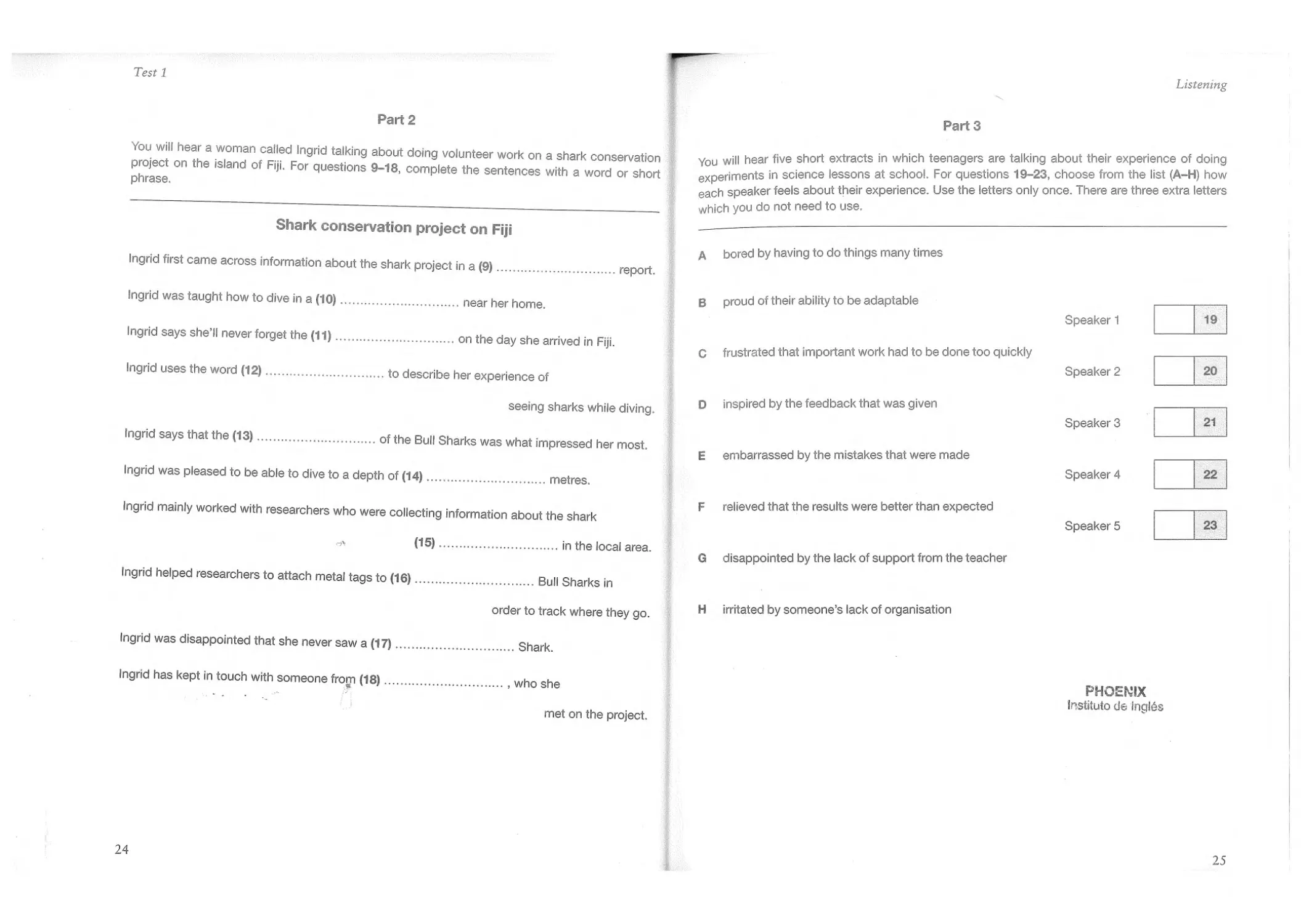
You will hear a woman called Ingrid talking about doing volunteer work on a shark conservation
project on the island of Fiji. For questions 9-18, complete the sentences with a word or short
phrase.
Shark conservation project on Fiji
Ingrid first came across information about the shark project in a (9)............report.
Ingrid was taught how to dive in a (10).................near her home.
Ingrid says she’ll never forget the (11)................on the day she arrived in Fiji.
Ingrid uses the word (12)...................to	describe her experience of
seeing sharks while diving.
Ingrid says that the (13)...................of	the Bull Sharks was what impressed her most.
Ingrid was pleased to be able to dive to a depth of (14)...............metres.
Ingrid mainly worked with researchers who were collecting information about the shark
(15)......................in the local area.
Ingrid helped researchers to attach metal tags to (16)......................Bull	Sharks in
order to track where they go.
Ingrid was disappointed that she never saw a (17)..................Shark.
Ingrid has kept in touch with someone from (18).................... who she
met on the project.
24
Listening
Part3
You will hear five short extracts in which teenagers are talking about their experience of doing
experiments in science lessons at school. For questions 19-23, choose from the list (A-H) how
each speaker feels about their experience. Use the letters only once. There are three extra letters
which you do not need to use.
A bored by having to do things many times
В proud of their ability to be adaptable
C frustrated that important work had to be done too quickly
D inspired by the feedback that was given
E embarrassed by the mistakes that were made
F relieved that the results were better than expected
G disappointed by the lack of support from the teacher
H irritated by someone’s lack of organisation
PHOENIX
Institute de Ingles
25
Test 1
Part 4
You will hear an interview with an air traffic controller called Jake Watson, whose job involves
directing aircraft in and out of an airport. For questions 24-30, choose the best answer (A, В or C).
24 What does Jake find most challenging about his job?
A communicating with a variety of people
В focusing on several tasks at the same time
C being responsible for aircraft safety
25 Why did Jake decide to become an air traffic controller?
A He hoped to increase his income.
В He felt the need to do something different.
C He was unable to fulfil his dream of becoming a commercial pilot.
26 Jake says the selection process for the job showed him that
A he was stronger in some skills than he’d thought.
В he’d be able to develop skills he already had.
C he needed to learn a number of new skills.
27 Jake says the first time he worked without supervision, he
A wished he was still being monitored.
В felt completely ready to deal with it.
C was too busy to let it worry him at all.
28 Jake says that when no planes are flying due to fog, controllers
A use equipment to assess possible solutions to the problem.
В work harder than usual to monitor changing conditions.
C take advantage of a break from their normal routine.
26
Listening
29 What does Jake say about flight delays?
A He finds them irritating when he’s a passenger himself.
В He avoids thinking about passengers’ problems when he’s working.
C He thinks passengers should be given clearer information.
30 How did Jake feel during a recent air display?
A relieved that plans for the day were successful
В concerned about the number of people watching
C impressed by the impact it had on the airport
27
Test 1
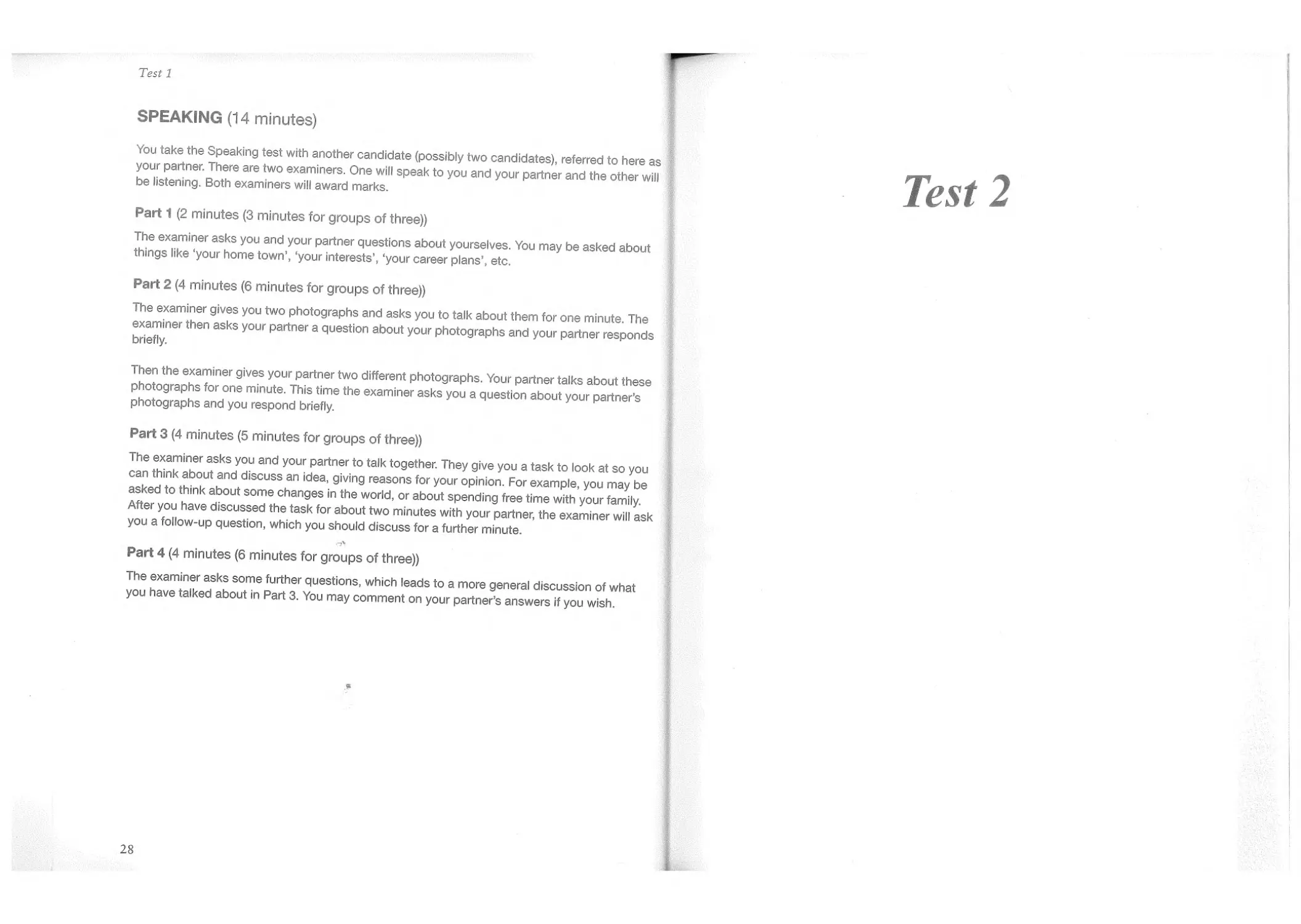
SPEAKING (14 minutes)
You take the Speaking test with another candidate (possibly two candidates), referred to here as
your partner. There are two examiners. One will speak to you and your partner and the other will
be listening. Both examiners will award marks.
Part 1	(2 minutes (3 minutes for groups of three))
The examiner asks you and your partner questions about yourselves. You may be asked about
things like ‘your home town’, ‘your interests’, ‘your career plans’, etc.
Part 2	(4 minutes (6 minutes for groups of three))
The examiner gives you two photographs and asks you to talk about them for one minute. The
examiner then asks your partner a question about your photographs and your partner responds
briefly.
Then the examiner gives your partner two different photographs. Your partner talks about these
photographs for one minute. This time the examiner asks you a question about your partner’s
photographs and you respond briefly.
Part 3	(4 minutes (5 minutes for groups of three))
The examiner asks you and your partner to talk together. They give you a task to look at so you
can think about and discuss an idea, giving reasons for your opinion. For example, you may be
asked to think about some changes in the world, or about spending free time with your family.
After you have discussed the task for about two minutes with your partner, the examiner will ask
you a follow-up question, which you should discuss for a further minute.
Part 4	(4 minutes (6 minutes for groups of three))
The examiner asks some further questions, which leads to a more general discussion of what
you have talked about in Part 3. You may comment on your partner’s answers if you wish.
28
Test 2
r
Test 2
READING AND USE OF ENGLISH (1 hour 15 minutes)
Parti
For questions 1-8, read the text below and decide which answer (А, В, C or D) best fits each gap.
There is an example at the beginning (0).
Mark your answers on the separate answer sheet.
Example:
0 A gone along В come up C thought out D looked into
0 А В C D
Magic paper?
Scientists have (0)...with a new type of paper that can be printed on and then used again up
to 20 times. Users will be able to either remove the writing from the paper themselves, or (1).
it to disappear over a period of time, after which the paper will be completely blank and ready to
be printed on again. There is no significant change in quality between the first and the twentieth
printout. Under normal (2)....it seems that the writing will remain perfectly (3).for at
least three days, long enough for most (4).purposes.
This new process does not (5)....ink. Instead, the paper is printed on using a combination of
chemicals and light. If users want the print to disappear more quickly, they can apply heat to the
paper. This can take as little as ten minutes. The (6).is that in the future this paper will be
(7).....used, providing an environmentally friendly (8).to ordinary paper.
30
Reading and Use of English
1	A	make	В	cause	c	expect	D	leave
2	A	situations	В	circumstances	c	contexts	D	settings
3	A	clear	. В	obvious	c	evident	D	apparent
4	A	objective	в	practical	c	functional	D	constructive
5	A	insist	в	request	c	oblige	D	require
6	A	cause	в	wish	c	hope	D	reason
7	A	widely	в	broadly	c	largely	D	mainly
8	A	substitute	в	option	c	replacement	D	alternative
31
Test 2
Part 2
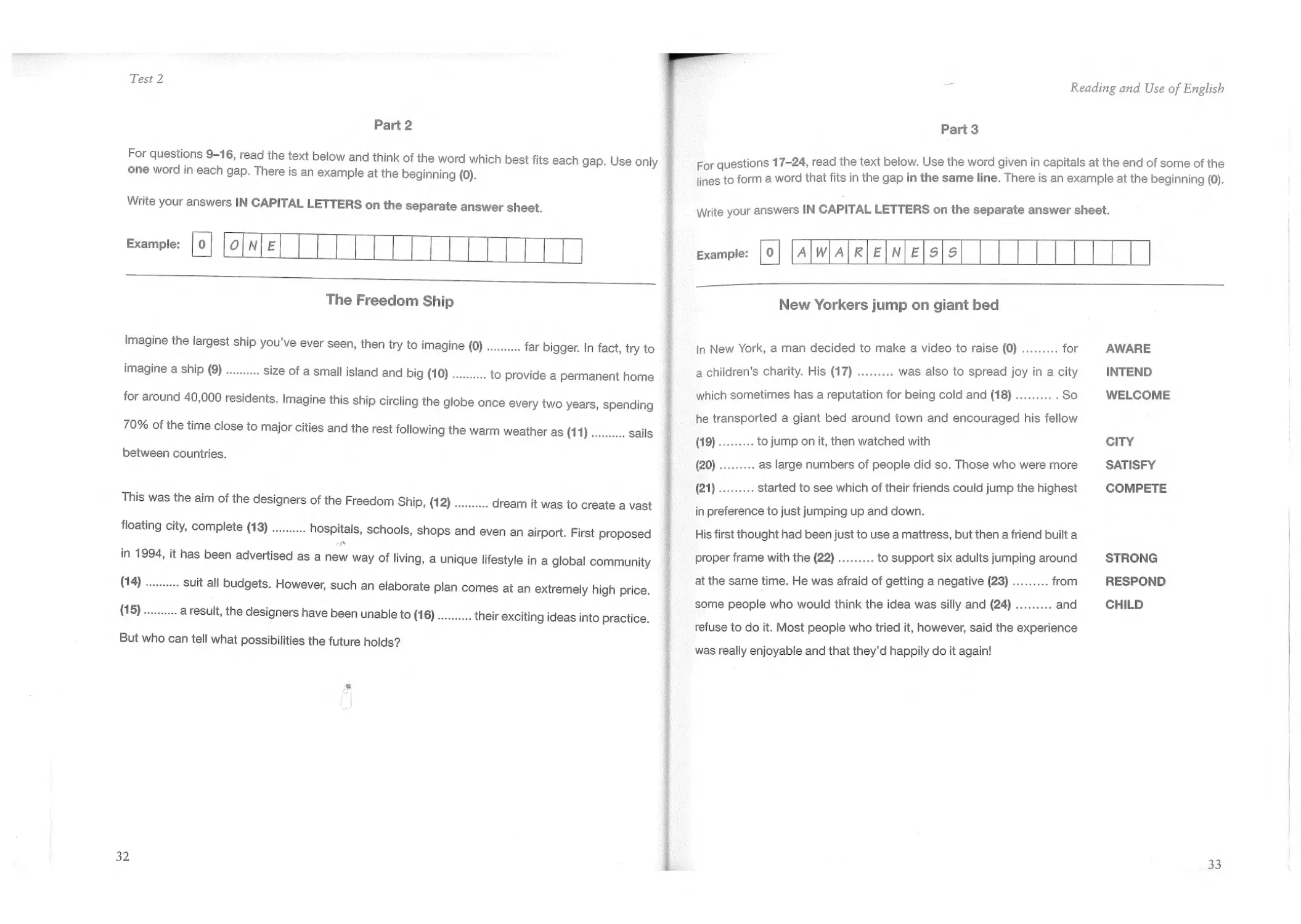
For questions 9-16, read the text below and think of the word which best fits each gap. Use only
one word in each gap. There is an example at the beginning (0).
Write your answers IN CAPITAL LETTERS on the separate answer sheet.
Example:
0
0	N	U1
The Freedom Ship
Imagine the largest ship you’ve ever seen, then try to imagine (0).far bigger. In fact, try to
imagine a ship (9)....size of a small island and big (10)..to provide a permanent home
for around 40,000 residents. Imagine this ship circling the globe once every two years, spending
70% of the time close to major cities and the rest following the warm weather as (11).sails
between countries.
This was the aim of the designers of the Freedom Ship, (12)..........dream it was to create a vast
floating city, complete (13).......hospitals, schools, shops and even an airport. First proposed
in 1994, it has been advertised as a new way of living, a unique lifestyle in a global community
(14) .... suit all budgets. However, such an elaborate plan comes at an extremely high price.
(15).......a result, the designers have been unable to (16).......their exciting ideas into practice.
But who can tell what possibilities the future holds?
32
Reading and Use of English
Part3
For questions 17-24, read the text below. Use the word given in capitals at the end of some of the
lines to form a word that fits in the gap in the same line. There is an example at the beginning (0).
Write your answers IN CAPITAL LETTERS on the separate answer sheet.
Example:
0
A	W	A	R	E	N	E	5	S
New Yorkers jump on giant bed
In New York, a man decided to make a video to raise (0)..for AWARE
a children’s charity. His (17)........was also to spread joy in a city INTEND
which sometimes has a reputation for being cold and (18)..........So WELCOME
he transported a giant bed around town and encouraged his fellow
(19)......to jump on it, then watched with	CITY
(20)... ...as large numbers of people did so. Those who were more	SATISFY
(21)...... started to see which of their friends could jump the highest	COMPETE
in preference to just jumping up and down.
His first thought had been just to use a mattress, but then a friend built a
proper frame with the (22)......to support six adults jumping around STRONG
at the same time. He was afraid of getting a negative (23)....from RESPOND
some people who would think the idea was silly and (24)..and CHILD
refuse to do it. Most people who tried it, however, said the experience
was really enjoyable and that they’d happily do it again!
33
Test 2
Part 4
For questions 25-30, complete the second sentence so that it has a similar meaning to the first
sentence, using the word given. Do not change the word given. You must use between two and
five words, including the word given. Here is an example (0).
Example:
0 Prizes are given out when the school year finishes.
PLACE
Prize-giving..................................end	of the school year.
The gap can be filled by the words ‘takes place at the’, so you write:
Example:
0	TAKES PLACE AT THE
Write only the missing words IN CAPITAL LETTERS on the separate answer sheet.
25	I think I can come to your party after all.
SHOULD
I...........................to	your party after all.
26	Last year, the number of complaints about the leisure centre rose.
INCREASE
Last year, there........................the number of complaints about the leisure
centre.
27	Marta always starts to talk about something else when I try to discuss the history project with
her.
SUBJECT
Marta changes...........................time I try to discuss the history project with
her.
34
Reading and Use of English
28	There will be bikes available for you to use during the school trip.
DISPOSAL
There will be bikes........................during the school trip.
29	My geography teacher expects a lot from us, so I’m working hard on this project.
EXPECTATIONS
My geography teacher...........................of	us, so I’m working hard on this
project.
30	Sorry, I completely forgot the time so I missed the bus.
REALISE
Sorry, I.........................the time was so I missed the bus.
35
1 est 2
Part 5
You are going to read an article about an astronomy club in the USA. For questions 31-36,
choose the answer (А, В, C or D) which you think fits best according to the text.
Mark your answers on the separate answer sheet.
A special astronomy club
A group of US teenagers study the night sky.
The teenage members of the Earth to Sky
Calculus Club live in and around Bishop, a
mountain town in the USA surrounded almost
entirely by wilderness, to the east of the Sierra
Nevada mountain range. Over the last few
years, this isolated group has launched over
50 balloons to the edge of space, around 35 km
above the Earth’s surface. It’s a long-running
science project but with a bit of a twist: it’s
part astronomy experiment, part backcountry
adventure, which is possibly why teenagers
get involved. I join them one weekend in late
spring. They are about to release a high-altitude
balloon, hoping to record shooting stars. These
occur when a rock or piece of metal travelling
through space enters the Earth’s atmosphere,
producing a trail of light.
As it gets dark, the teenagers secure a soft
insulated $5 lunch box to the bottom of |he
balloon. Inside is a camera, an instrument to
measure altitude and a thermometer to gauge
the changes along the ascent. Two GPS trackers
are mounted on the outside of the lunch box
to help the group to find it later. A gas tank,
donated by an enthusiast in a neighbouring
state, is used to inflate the balloon, which
slowly grows to the size of a small car. An
older boy had made a seven-hour round trip
line 29 to get hold of it. ‘I didn’t really mind,’ he says.
Anyway, for kids in this club, that’s a given.
Finally, it’s time for lift-off. ‘Five, four, threS,
two, one,’ they chant, and the balloon begins
its ascent. Some of them run and track its path
with powerful flashlights for as long as they
are able, illuminating the creamy orb in the
moonless sky. There is quiet, and a palpable
sense of collective wonder. Then the balloon
disappears into the night.
When the launch is over, most of the students
go home, but a few stay to watch the shooting
stars. A boy climbs into a sleeping bag and
promptly falls asleep. ‘We’re the only ones
talking,’ says one girl in hushed tones. ‘I know,’
whispers another. A meteor shoots across the
middle of the sky.
As a balloon rises, the air pressure lessens
and the balloon expands until it’s almost the
size of a house. Then it pops in a dramatic
explosion. A parachute helps the equipment
inside the lunch box land safely back on Earth.
The students will find it the following day, using
the GPS trackers as a guide. Getting it back isn’t
straightforward, but that’s part of the appeal.
There is little inhabited land around Bishop, so
the lunch box almost always lands somewhere
in the middle of nowhere. ‘To me, recoveries
are a huge part of the program,’ said the
group’s leader, who notes they’ve lost only two
lunch boxes in 53 launches. ‘Part of the journey
has been becoming more familiar with this
landscape in a way you never normally would.’
On this occasion, the lunch box had landed
84 km west of Bishop, but to get to it, the
recovery team would have to drive south of
the Sierra and then back up the western side of
the mountain range. Then they’d have to agree
whether driving or walking would be preferable
- things could turn treacherous if the lunch line 68
box was on a high peak, or even worse, up a
very tall tree. ‘It’s important to keep in mind
that these students are native to the Eastern
Sierra,’ their leader says. ‘What may seem wild
and perilous to some, is simply a way of life to
others.’
In the end, it took them 11 hours to find the
lunch box. It was in a canyon, high on a flat
rock, in the middle of a cascading waterfall. The
camera hadn’t recorded any shooting stars.
Sure, it’s a bit of a disappointment, but it’s one
more tale of adventure to share with anyone
who asks.
36
Reading and Use of English
31 What does the writer say about the club in the first paragraph?
A The combination of activities offered makes it unusual.
В Its members have joined because there’s little else to do.
C The projects it organises are over-ambitious.
D Its aims remain rather unclear.
32 What does ‘it’ refer to in line 29?
A the lunch box
В the balloon
C the gas tank
D the car
33 How does the writer say the group feel when the balloon takes off?
A disappointed to lose sight of it
В amazed that it has risen so quickly
C hopeful that they will recover it
D moved by the experience of it
34 What view does the group’s leader express in the fifth paragraph?
A The recovery operations can be inconvenient.
В Learning so much about the area has been a bonus.
C The long journeys they make are annoying but necessary.
D Losing some lunch boxes has been a price worth paying.
35 What does ‘things could turn treacherous’ mean in line 68?
A The teenagers could appear irresponsible.
В The situation could put people at risk.
C The outcome could be unpredictable.
D Their efforts could prove inadequate.
36 What point is made in the sixth paragraph?
A People should respect the lifestyles of the inhabitants of an area.
В People have to make difficult decisions at some stage in their lives.
C People adopt attitudes that are affected by the environment they grow up in.
D People should exercise more caution when in unfamiliar environments.
37
Test 2
Part 6
You are going to read an article about some seals that are using technology to their advantage. Six
sentences have been removed from the article. Choose from the sentences A-G the one which fits
each gap (37-42). There is one extra sentence which you do not need to use.
Mark your answers on the separate answer sheet.
Clever seals
Scientists believe some seals have discovered a new way to hunt for fish.
Tiny electronic devices attached to wild animals
have become an increasingly common way for
scientists to study those that are difficult to locate
and follow on a day-to-day basis. The devices, known
as ‘acoustic tags’, send out signals in the form of
sound waves that the human ear cannot hear. The
animals to which they are attached cannot hear
them either, so are not disturbed by them. However,
now it seems that clever seals are using them to their
advantage to catch fish!
This finding was revealed in a recent study published
by a team of researchers from the University of
St. Andrews in Scotland. | 37	| Previous
research by another team had also indicated that
while the sounds produced by acoustic tags could
not be heard by the fish they were attached to, other
animals that hunted the fish, like seals and sea lions,
were able to detect the signal quite easily.
To verify if that was true, the St. Andrews University
researchers selected a group of ten young grey seals
that had been born in captivity and never lived in
the wild. This meant that the marine animals had
never encountered the ocean. 38 The
researchers placed the seals one at a time inside
a pool that contained 20 boxes, only two of which
contained fish - one with tags and the other without.
Each seal was allowed to enter the pool on a number
of occasions to explore the boxes. In order to ensure
that the seals were not depending on their memory,
the fish were randomly moved to different boxes
each time. There was initially no difference in the
amount of time it took the seals to discover the
tagged and untagged fish.
What was even more interesting was that the more
‘experienced1 the seals became, the more frequently
they visited the box containing the tagged fish.
39
40
41
To confirm that the animals were in fact making use
of the tags, the researchers conducted a second
experiment using two boxes - one containing pieces
of fish and the other just acoustic tags.
While this experiment involved only seals, the
researchers believe that other marine mammals may
also be using the information to avoid predators.
They are worried that sharks, for example, which
have been tagged by scientists may be negatively
affected, as the signals emitted by the acoustic tags
could warn smaller animals of their presence and
so prevent the sharks from catching their prey.
Apart from messing up nature’s food chain, another
potential concern relating to the use of acoustic
tags has arisen.
is out, scientists will have to come up with another
innovative way to conduct their studies - one that
cannot be detected by clever marine animals.
Now that the secret
42
38
Reading and Use of English
Д Nor had they been exposed to any kind of
acoustic tag.
В It is that the conclusions reached by
previous fish studies may not be reliable.
C This suggested that the seals had indeed
figured out how to use the acoustic signals
to their advantage.
D Nevertheless, this behaviour led the
team to doubt whether their theory was
correct.
E They had become interested in the idea
that the tags might be having unexpected
effects.
F Sure enough, the seals all went to the one
that was sending out signals.
G However, after they had been in the pool
a few times, they started locating the
tagged fish much faster.
39
Test 2
Part 7
You are going to read an article in which young people talk about their early experiences of going
to football matches. For questions 43-52, choose from the people (А-D). The people may be
chosen more than once.
Mark your answers on the separate answer sheet.
Which person
says that one player was initially unsure of his success?
says that they missed a big event in their team’s history?
was given a special treat to mark an amazing achievement?
felt being a spectator gave them a sense of belonging?
expresses admiration for a footballer on the other side?
says they went to football matches on a regular basis?
mentions that a member of their team showed great confidence regarding
a match result?
enjoyed an event they saw during the match more than the final outcome?
has a lasting memory of viewing the pitch from high up?
witnessed one of the early matches played by a very promising team member?
43
44
45
46
47
48
49
50
51
52
40
Reading and Use of English
Football matches
It would have been impossible for a 10-year-
old taken to the football stadium every other
weekend, as I was, not to get sucked in by the
atmosphere in the stands and out on the pitch.
And to stand among the crowd of spectators was
like being welcomed into one great big family.
There was a heightened sense of glamour, too, as
we had a player in our team who’d also played
internationally. To me, he seemed to have been
sent from another universe. Anyway, at least I got
io witness some of the club’s glory years, even
though my first match was a whole two seasons
after they’d won a major cup. Still, plenty of great
memories - luckily, because the club hasn’t done
so well in recent years.
The first time I went to a football match was
quite an experience. The club I supported had
just knocked out the favourites from a national
tournament, and every time I turned on the radio
I heard our captain telling the press that the cup
was as good as ours. There were 40,000 people
packed into the stadium, but it was seeing the
floodlit grounds below from the top of the steeply
arranged seats that stuck in my mind. That was
the moment I really fell in love with football.
And then they kicked off. My team lost - a word
combination I quickly got used to. That time it was
due to one brilliant player scoring from 25 metres.
Then his second goal went in and the final score
was 2-1 to them. It was still amazing as far as I was
concerned.
I’ve been going to football matches ever since I
was about six. When I think back, 1 can’t remember
the player’s names so well, but I do remember that
our best goal scorer, when I first started going,
was a tall agile guy who’d just curl the ball into
the back of the net. On one occasion he slammed
it into the goal from 40 metres away before the
goalkeeper even had time to raise his hands. I’ve
never seen a better goal since, although I only got
a really good view of it because my dad led us up
the wrong steps in the stand, after the half-time
break. It was followed by the best celebration: a
fantastic pointing-at-the-skies moment. We won
2-1 but, to be honest, after that amazing spectacle,
nothing else really mattered. Dad bought me a
celebratory burger on the way home.
D
On my first ever visit to the stadium, my team
were playing on a muddy pitch that got worse
as the rain kept falling. But that didn’t put one
player off - a teenager who’d recently come up
from the youth team and later went on to achieve
great fame. He scored our only goal in the final
minutes. I vaguely recall the ball bouncing over
the goalkeeper, who’d come out to the edge of his
area. He ran back and dived for it but slipped in
the mud and couldn’t keep it out of the net. The
weather was so bad, the teenager could barely see
what had happened and didn’t realise at first that
he’d actually scored. So there we go - pouring rain,
muddy pitch, 5-1 defeat for my team, got soaked.
And I still decided to support them!
41
Test 2
WRITING (1 hour 20 minutes)
Parti
You must answer this question. Write your answer in 140-190 words in an appropriate style on
the separate answer sheet.
1 In your English class you have been talking about rules at home. Now your English teacher
has asked you to write an essay for homework.
Write your essay using all the notes and giving reasons for your point of view.
‘It’s very important for young people to have rules at home.’
Do you agree?
Notes
Write about:
1.	jobs around the house
2.	behaviour during meal-times
3	(your	own idea)
42
Writing
Part 2
Write an answer to one of the questions 2-4 in this part. Write your answer in 140-190 words in
an appropriate style on the separate answer sheet. Put the question number in the box at the
top of the answer sheet. .
2 You have received this email from your English friend, Sam:
Hi
A friend of mine never seems to want to do the same things as I do, and I always
end up doing things I’m not that interested in. I’m not sure what I should do about
this as we actually get on really well with each other.
Can you give me some advice?
Thanks	:
Sam
Write your email.
3 You recently saw this notice in an international magazine for teenagers:
Reviews wanted
Family holidays
Do you know a good place to have a family holiday? If so, write us a review describing
i the place, explaining the benefits for different members of a family and saying why you
especially recommend it.
The best reviews will be published next month.
I . ; • . .	.	,	• -_______ •	I
Write your review.
4 You have seen this announcement in an international magazine for schools:
Stories wanted
We are looking for stories for our new English-language magazine for teenagers.
Your story must begin with this sentence:
Mark was walking along the beach one Saturday morning.
Your story must include:
•	a sound
•	a rescue
Write your story.
43
Test 2
LISTENING (approximately 40 minutes)
Parti
You will hear people talking in eight different situations.
For questions 1-8, choose the best answer (A, В or C).
1 You hear two friends talking about a lesson on the subject of newspapers.
What do they agree about it?
A Some unusual ideas were expressed.
В A wide range of issues were covered.
C It was well-planned.
2 You hear a man talking about skateboarders in the past.
What is he doing?
A explaining the reputation they once had
В describing how attitudes towards them have changed
C suggesting reasons for their interest in the sport
3 You hear a girl talking about a diary she keeps.
Her main aim is to explain
A her reason for starting to write a diary.
В the effect that keeping a diary has on her.
C the different functions a diary can have.
4 You hear a boy talking about a weekly video he posts online in which he expresses
his opinions.
What does he find most challenging?
A responding to criticism from other people
В producing original ideas on a regular basis
C coping with the amount of interest he gets
44
Listening
5 You hear part of a programme about sea creatures called sea dragons.
What does the man say about the different types of sea dragon?
A Their sources of food are becoming scarcer.
В They have names which reflect their appearance.
C Certain differences between them have only recently been discovered.
6 You hear two friends talking about a film they’ve seen.
What does the girl think about it?
A The storyline was too complicated to follow.
В The music was unsuitable for the subject matter.
C The main actor failed to live up to her expectations.
7 You hear a news item about a small town in Alaska called Whittier.
What is unusual about the town?
A Children can get to school without going outdoors.
В There is only one shop for the people to use.
C All residents live and work in one tall apartment block.
8 You hear two friends talking about a dance competition.
What do they agree about it?
A It should be held on another day.
В It will be more fun to watch than take part in.
C It’s bound to be a great success.
45
Test 2
Part 2
You will hear an astronomer called Steve Mitchell talking about his work. For questions 9-18,
complete the sentences with a word or short phrase.
Working as an astronomer
Steve first became interested in astronomy after watching a (9)..................on	TV.
Steve says that as a teenager he particularly appreciated the
(Ю)..................... of	the night sky.
Steve describes how excited he felt when he saw a (11)...................
through his telescope.
Steve finds it surprising that the (12)................in	the universe are so varied.
Steve’s ambition is to go on a trip to (13).................one	day.
Steve says that (14)....................can	cause unexpected problems for
inexperienced astronomers living in built-up areas.
Steve thinks finding a (15)..................is	the best thing that beginners
interested in astronomy could do.
Steve thinks the many (16)....................surrounding one planet would be
easy for young astronomers to identify.
я
Steve says that amateur astronomers’ important (17)...................include
finding new stars.
Steve explains that (18)...................is	the most important quality
astronomers need to have.
46
Listening
PHOENIX
institute de logics
Part3
ЫМйМКИ
You will hear five short extracts in which teenagers are talking about a favourite book. For
questions 19-23, choose from the list (A-H) what each speaker says about the book. Use the
letters only once. There are three extra letters which you do not need to use.
A I was drawn into it from the beginning.
В It’s more humorous than other books by the same author.
C One of the characters reminds me of someone I know well.
D It used to belong to a relative of mine.
E It’s set in a place I’ve visited.
F I was inspired to read it by a TV programme.
G It helped me to deal with a situation in my own life.
H There are interesting descriptions of people in it.
47
Test 2
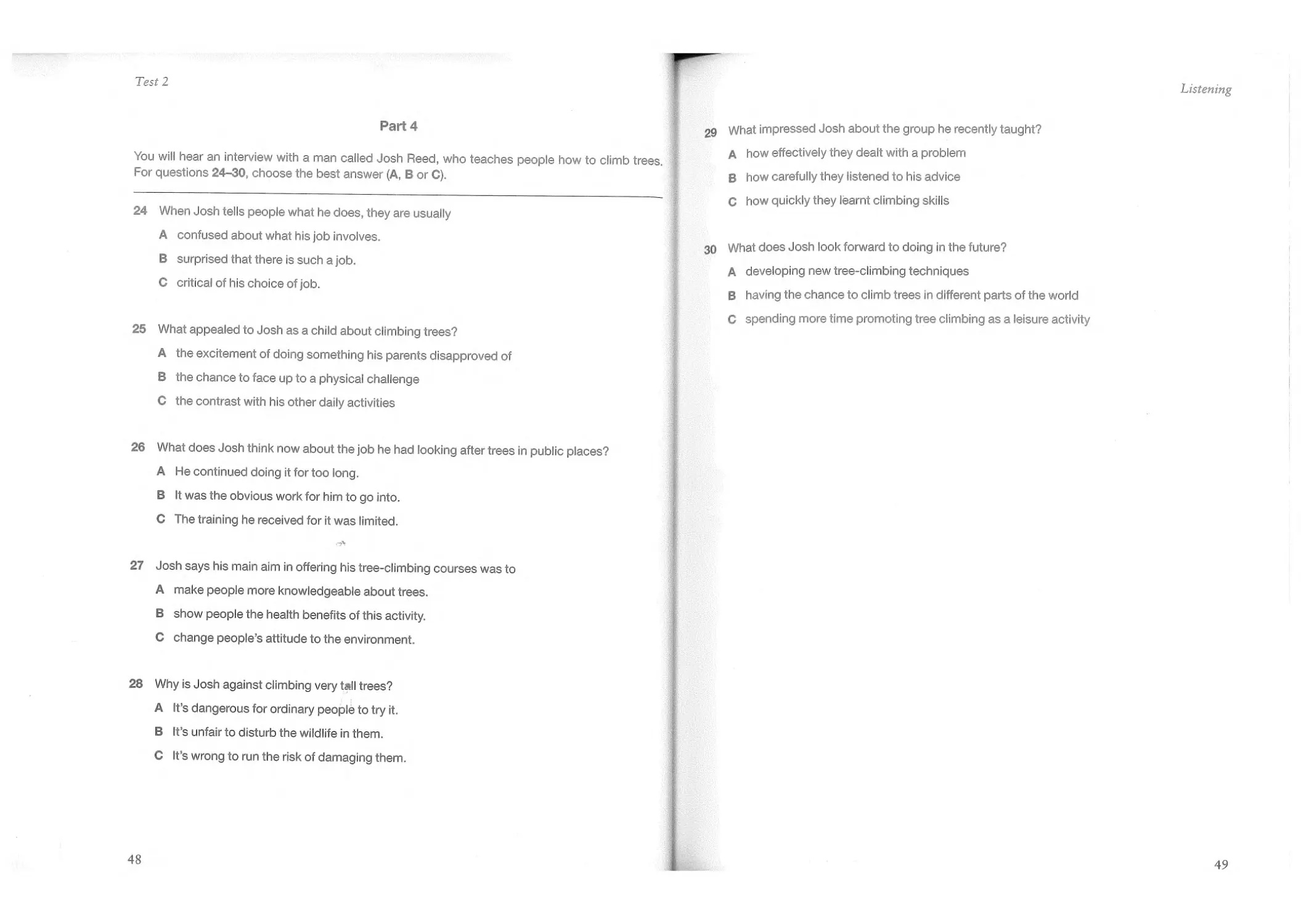
Part 4
You will hear an interview with a man called Josh Reed, who teaches people how to climb trees.
For questions 24-30, choose the best answer (A, В or C).
24 When Josh tells people what he does, they are usually
A confused about what his job involves.
В surprised that there is such a job.
C critical of his choice of job.
25 What appealed to Josh as a child about climbing trees?
A the excitement of doing something his parents disapproved of
В the chance to face up to a physical challenge
C the contrast with his other daily activities
26 What does Josh think now about the job he had looking after trees in public places?
A He continued doing it for too long.
В It was the obvious work for him to go into.
C The training he received for it was limited.
27 Josh says his main aim in offering his tree-climbing courses was to
A make people more knowledgeable about trees.
В show people the health benefits of this activity.
C change people’s attitude to the environment.
28 Why is Josh against climbing very tall trees?
A It’s dangerous for ordinary people to try it.
В It’s unfair to disturb the wildlife in them.
C It’s wrong to run the risk of damaging them.
48
Listening
29 What impressed Josh about the group he recently taught?
A how effectively they dealt with a problem
В how carefully they listened to his advice
C how quickly they learnt climbing skills
30 What does Josh look forward to doing in the future?
A developing new tree-climbing techniques
В having the chance to climb trees in different parts of the world
C spending more time promoting tree climbing as a leisure activity
49
Test 2
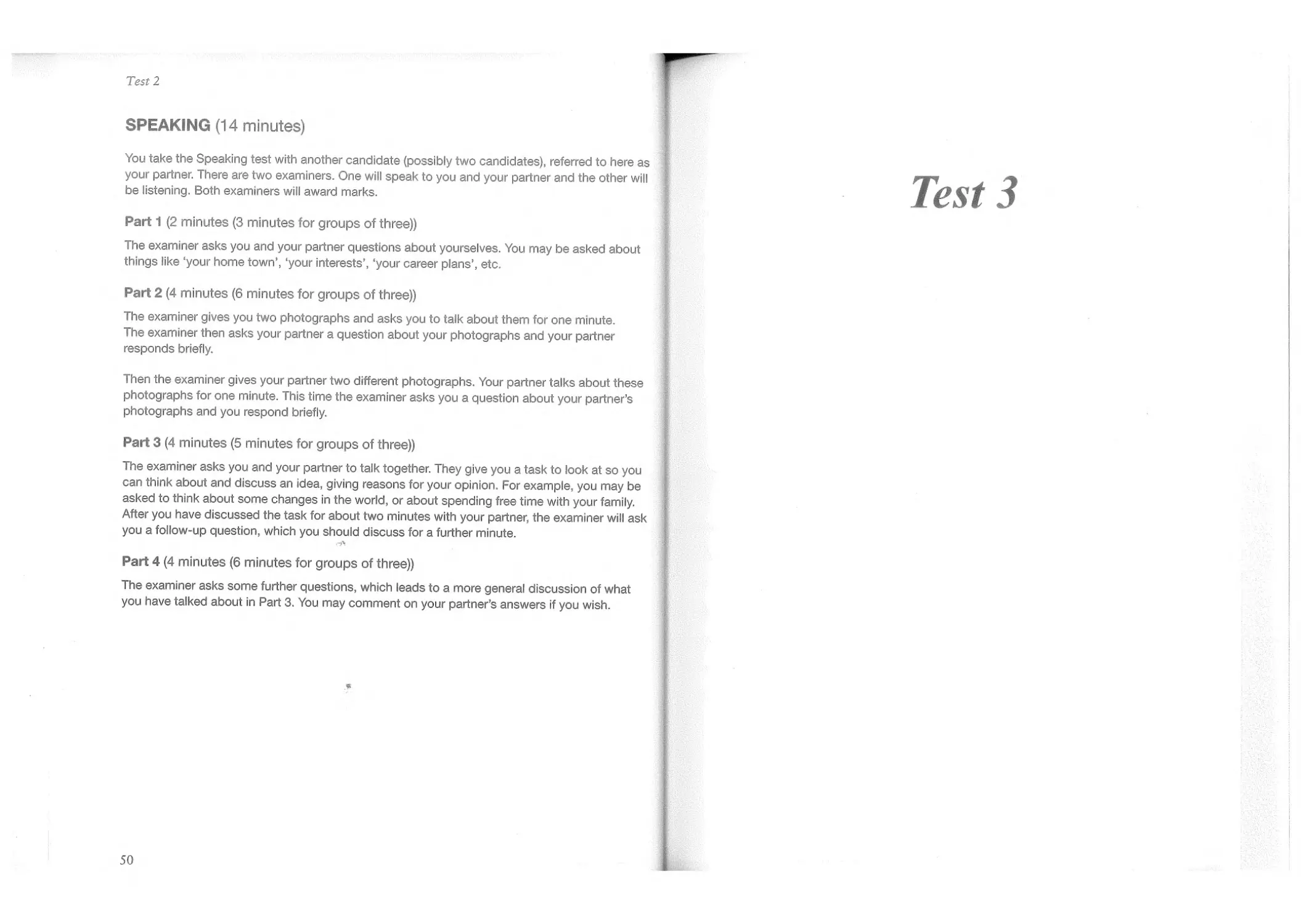
SPEAKING (14 minutes)
You take the Speaking test with another candidate (possibly two candidates), referred to here as
your partner. There are two examiners. One will speak to you and your partner and the other will
be listening. Both examiners will award marks.
Part 1	(2 minutes (3 minutes for groups of three))
The examiner asks you and your partner questions about yourselves. You may be asked about
things like ‘your home town’, ‘your interests’, ‘your career plans’, etc.
Part 2	(4 minutes (6 minutes for groups of three))
The examiner gives you two photographs and asks you to talk about them for one minute.
The examiner then asks your partner a question about your photographs and your partner
responds briefly.
Then the examiner gives your partner two different photographs. Your partner talks about these
photographs for one minute. This time the examiner asks you a question about your partner’s
photographs and you respond briefly.
Part 3	(4 minutes (5 minutes for groups of three))
The examiner asks you and your partner to talk together. They give you a task to look at so you
can think about and discuss an idea, giving reasons for your opinion. For example, you may be
asked to think about some changes in the world, or about spending free time with your family.
After you have discussed the task for about two minutes with your partner, the examiner will ask
you a follow-up question, which you should discuss for a further minute.
Part 4	(4 minutes (6 minutes for groups of three))
The examiner asks some further questions, which leads to a more general discussion of what
you have talked about in Part 3. You may comment on your partner’s answers if you wish.
50

Test 3
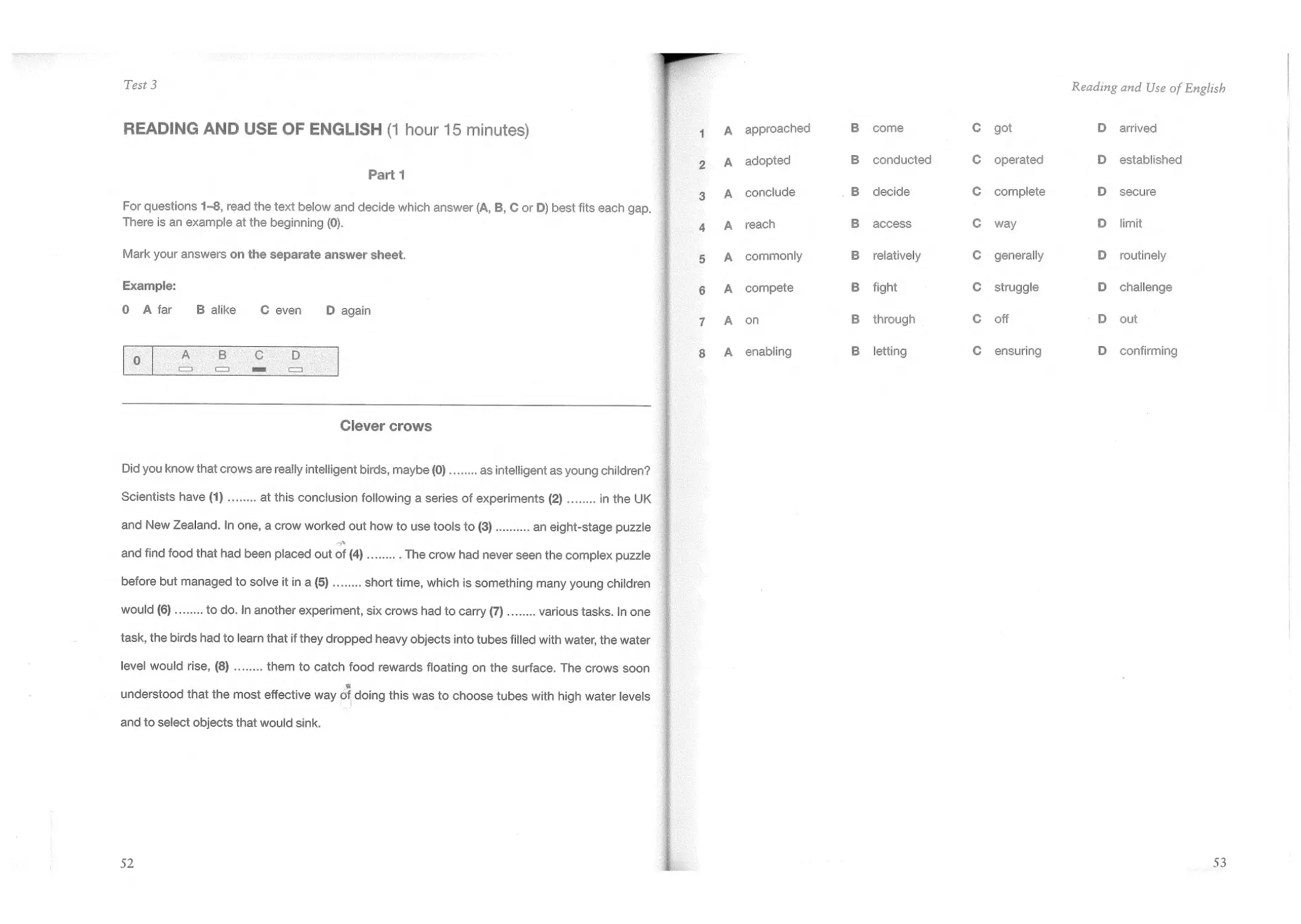
READING AND USE OF ENGLISH (1 hour 15 minutes)
Part 1
For questions 1-8, read the text below and decide which answer (А, В, C or D) best fits each gap.
There is an example at the beginning (0).
Mark your answers on the separate answer sheet.
Example:
0 A far В alike C even D again
Clever crows
Did you know that crows are really intelligent birds, maybe (0).as intelligent as young children?
Scientists have (1).....at this conclusion following a series of experiments (2)..in the UK
and New Zealand. In one, a crow worked out how to use tools to (3)......an eight-stage puzzle
and find food that had been placed out of (4)....The crow had never seen the complex puzzle
before but managed to solve it in a (5)...short time, which is something many young children
would (6).....to do. In another experiment, six crows had to carry (7)..various tasks. In one
task, the birds had to learn that if they dropped heavy objects into tubes filled with water, the water
level would rise, (8)...them to catch food rewards floating on the surface. The crows soon
я
understood that the most effective way of doing this was to choose tubes with high water levels
and to select objects that would sink.
52
Reading and Use of English
1	A	approached	В	соте	c	got	D	arrived
2	A	adopted	В	conducted	c	operated	D	established
3	A	conclude	. в	decide	c	complete	D	secure
4	A	reach	в	access	c	way	D	limit
5	A	commonly	в	relatively	c	generally	D	routinely
6	A	compete	в	fight	c	struggle	D	challenge
7	A	on	в	through	c	off	D	out
8	A	enabling	в	letting	c	ensuring	D	confirming
53
Test 3
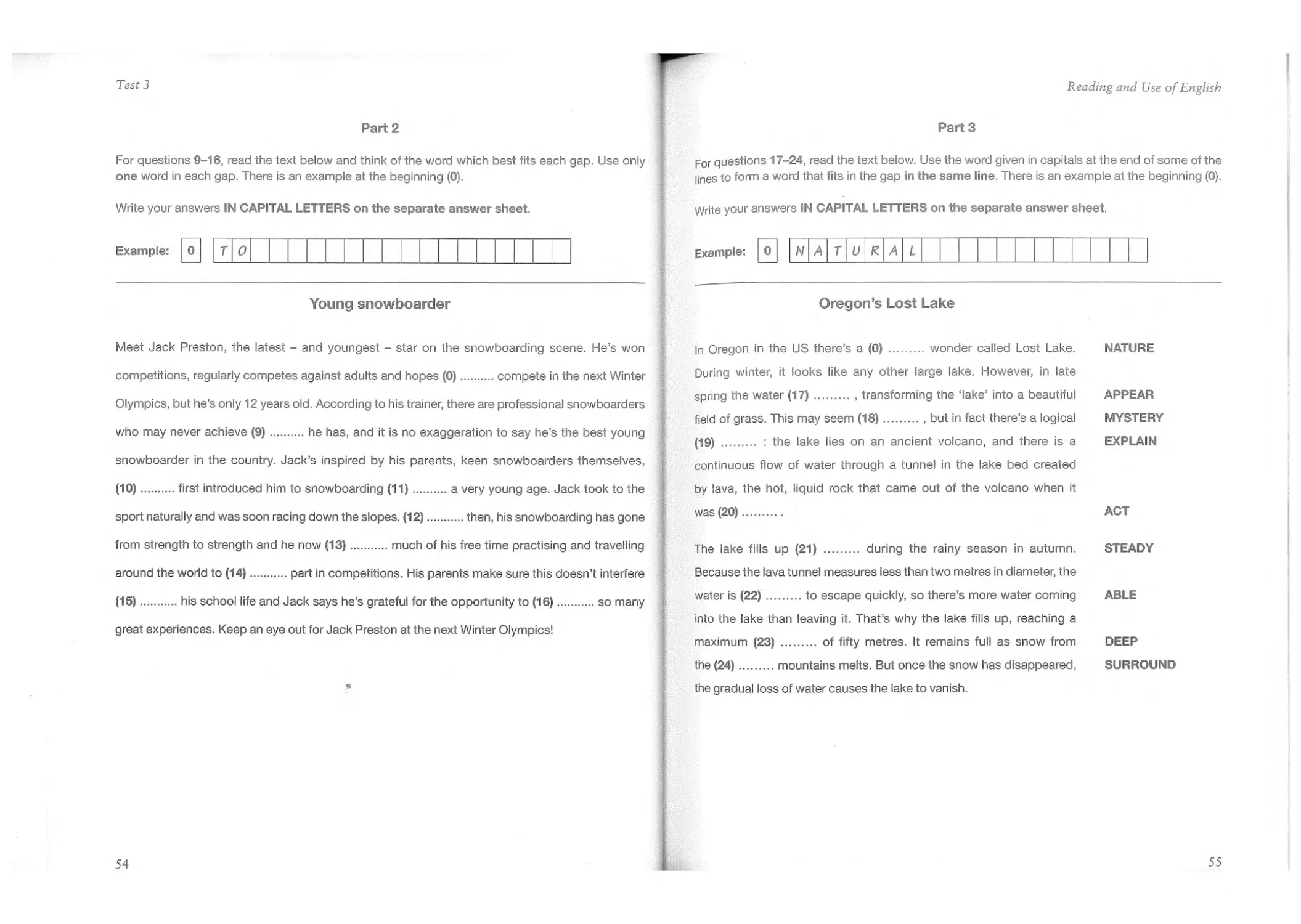
Part 2
For questions 9-16, read the text below and think of the word which best fits each gap. Use only
one word in each gap. There is an example at the beginning (0).
Write your answers IN CAPITAL LETTERS on the separate answer sheet.
Example:
T	0
Young snowboarder
Meet Jack Preston, the latest - and youngest - star on the snowboarding scene. He’s won
competitions, regularly competes against adults and hopes (0)....compete in the next Winter
Olympics, but he’s only 12 years old. According to his trainer, there are professional snowboarders
who may never achieve (9).......he has, and it is no exaggeration to say he’s the best young
snowboarder in the country. Jack’s inspired by his parents, keen snowboarders themselves,
(10)......first introduced him to snowboarding (11)......a very young age. Jack took to the
sport naturally and was soon racing down the slopes. (12)...then, his snowboarding has gone
from strength to strength and he now (13)......much of his free time practising and travelling
around the world to (14).....part in competitions. His parents make sure this doesn’t interfere
(15)......his school life and Jack says he’s grateful for the opportunity to (16).so many
great experiences. Keep an eye out for Jack Preston at the next Winter Olympics!
54
Reading and Use of English
Part3
For questions 17-24, read the text below. Use the word given in capitals at the end of some of the
lines to form a word that fits in the gap in the same line. There is an example at the beginning (0).
Write your answers IN CAPITAL LETTERS on the separate answer sheet.
Example:
0
N	A	T	U	IZ	A	L
Oregon’s Lost Lake
In Oregon in the US there’s a (0) ....... wonder called Lost Lake.
During winter, it looks like any other large lake. However, in late
spring the water (17).......,	transforming the ‘lake’ into a beautiful
field of grass. This may seem (18)......,	but in fact there’s a logical
(19) .... ... : the lake lies on an ancient volcano, and there is a
continuous flow of water through a tunnel in the lake bed created
by lava, the hot, liquid rock that came out of the volcano when it
was (20)........
The lake fills up (21) ..... during	the rainy season in autumn.
Because the lava tunnel measures less than two metres in diameter, the
water is (22).....to escape quickly, so there’s more water coming
into the lake than leaving it. That’s why the lake fills up, reaching a
maximum (23) ........ of	fifty metres. It remains full as snow from
the (24).....mountains melts. But once the snow has disappeared,
the gradual loss of water causes the lake to vanish.
NATURE
APPEAR
MYSTERY
EXPLAIN
ACT
STEADY
ABLE
DEEP
SURROUND
55
Test 3
Part 4
For questions 25-30, complete the second sentence so that it has a similar meaning to the first
sentence, using the word given. Do not change the word given. You must use between two and
five words, including the word given. Here is an example (0).
Example:
0 Prizes are given out when the school year finishes.
PLACE
Prize-giving....................................end of the school year.
The gap can be filled by the words ‘takes place at the’, so you write:
Example:
TAKES PLACE AT THE
0
Write only the missing words IN CAPITAL LETTERS on the separate answer sheet.
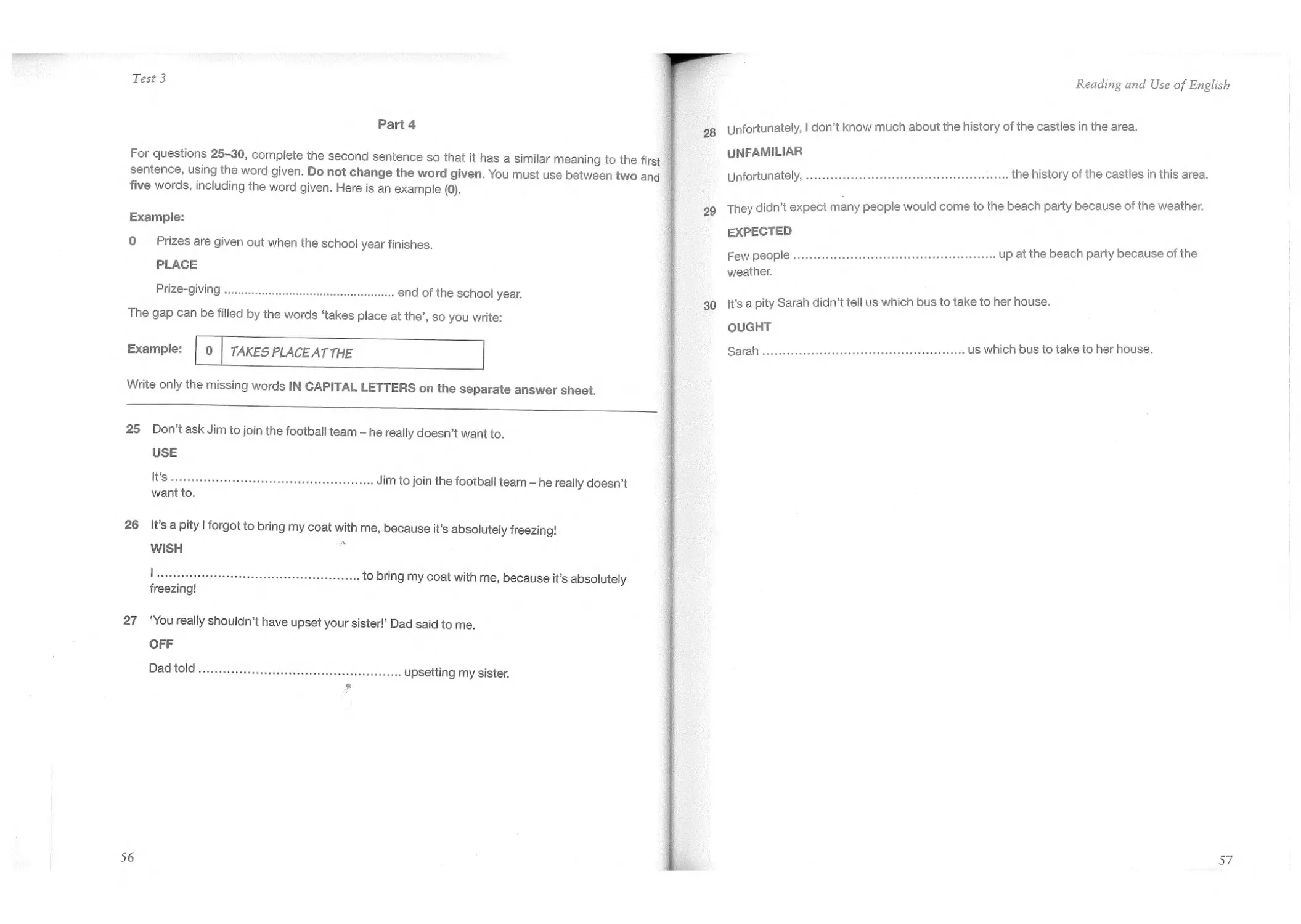
25	Don’t ask Jim to join the football team - he really doesn’t want to.
USE
It’s...................................Jim to join the football team - he really doesn’t
want to.
26	It’s a pity I forgot to bring my coat with me, because it’s absolutely freezing!
WISH
I....................................to	bring my coat with me, because it’s absolutely
freezing!
27	‘You really shouldn’t have upset your sister!’ Dad said to me.
OFF
Dad told.....................................upsetting	my sister.
56
Reading and Use of English
28	Unfortunately, I don’t know much about the history of the castles in the area.
UNFAMILIAR
Unfortunately,................................the history of the castles in this area.
29	They didn’t expect many people would come to the beach party because of the weather.
| EXPECTED
Few people..................................up	at the beach party because of the
weather.
30	It’s a pity Sarah didn’t tell us which bus to take to her house.
| OUGHT
Sarah..................................us which bus to take to her house.
57
Test 3
Part 5
You are going to read an extract from an interview with a palaeontologist, a scientist who studies
dinosaurs and other creatures that lived millions of years ago. For questions 31-36, choose the
answer (А, В, C or D) which you think fits best according to the text.
Mark your answers on the separate answer sheet.
Walking with Dinosaurs
Chloe Morgan readily admits science, let
alone Palaeontology, hadn’t held too much
appeal for her, at least not until she was
fifteen. Even then, it happened more by
accident than design. ‘My younger brother
was going through the dinosaur phase that’s
so common among children, and which I
hadn’t experienced. In fact, I tended to dismiss
it. I reluctantly lent him a hand with a science
project, and when I came across an article
about some of the recent discoveries in the
field, it just blew my mind. I knew immediately
that this was something I wanted to commit
myself to.’
I am curious to know what encouragement
she got because Palaeontology was by no
means a common career choice for young
people at that time. ‘I remember meeting
my first professional palaeontologist,’ she
laughs. ‘This guy, Matt Cornelius, was famous
already, despite being quite young. At first I
was a nervous wreck, even though he had a
reputation for being approachable and easy-
going. I was still worried he’d think I was
just an annoying kid pestering him with my
questions. But I felt more at ease when he
showed so much patience and willingness to
listen.’
I cannot resist bringing up the question of
the portrayal of palaeontologists in movies
and TV shows. Chloe frowns for a moment.
‘I have to admit that films such as Jurassic
Park featuring dinosaurs created by special
effects technology have led to a huge surge in *
public interest in these creatures, though not
necessarily in Palaeontology more generally.
line 37 However much I welcome this, 1 think the
relatively few examples of palaeontologists
depicted in the cinema are misleading. What
irritates me is that we’re either stereotyped
as eccentric geniuses or rather geeky losers,
figures of fun who don’t know how to relate to
people. And films fail to represent accurately
the everyday reality of our working lives.’ I ask
her to explain.
‘My job is remarkably varied. 1 spend lots of
time digging up dinosaur bones, but 1 also
have to put in long hours in laboratories,
analysing fossils, and writing for scientific
publications.’
While it’s not necessarily something Chloe
is required to do on a daily basis, there’s
also the question of communicating scientific
findings to the public, if time allows. The role
of explaining and clarifying is one she takes
seriously. ‘There are a lot of misunderstandings
and misconceptions about science, and
though I know colleagues who are reluctant to
take on such a challenge and don’t want to be
distracted from doing research, I see dealing
with these issues as something I ought to do. I
like to reach out to young people in particular,
because it’s important to let them know about
all aspects of science. Talking about dinosaurs
is one way to get children fired up about the
natural world, and widen their horizons. They line 66
can start to appreciate other branches of
science and to grasp more complex scientific
ideas.’
The recent TV documentary Walking with
Dinosaurs was a great opportunity for Chloe to
influence the way dinosaurs are portrayed on
screen, as she was invited to offer her advice.
‘I had a fairly easy time of it because there was
very little that I needed to comment on; it was
mostly checking that the dinosaurs shown
did exist together in the same time period.
We succeeded in attracting audiences of all
ages because we’ve learnt such a tremendous
amount about dinosaurs recently.’ This means
that the dinosaurs in the documentary are
easily the most life-like that have ever been
portrayed.
Why does Chloe feel dinosaurs continue to
fascinate us and remain the focus of ongoing
research? ‘1 suspect that they speak to the
innate explorer in all of us. Our imaginations
are drawn to the unfamiliar and the prospect
of discovery. And at a time when our world
seems to be shrinking, prehistoric creatures
remind us that there is still more out there to
be discovered. And Palaeontology is a great
form of time travel.’
58
Reading and Use of English
31 Chloe says she became seriously interested in Palaeontology because
A she was astonished by something she read by chance.
В she had always been enthusiastic about related subjects.
C she was keen to share her brother’s passion for the subject.
D she was aware that others seemed to know a great deal about it.
32 What does ‘this’ refer to in line 37?
A the number of films about dinosaurs
В the new desire for information about dinosaurs
C the greater public understanding of Palaeontology
D the special effects technology used by film makers
33 What does Chloe feel about the way palaeontologists are shown in films and on TV?
A disappointed that a false impression is given of them
В pleased because there is a range of different personalities
C resigned to putting up with the unfair criticism they receive
D amused by some of the situations they find themselves in
34 What does Chloe say about communicating with the public about Palaeontology?
A She is delighted she can devote so much time to it.
В She worries that it may prevent her from focusing on research.
C She is critical of some scientists’ lack of ability to do it well.
D She feels it is her duty to make science more comprehensible.
35 What does the expression ‘widen their horizons’ mean in line 66?
A make them more tolerant of different things
В change their view of what’s important in life
C make them aware of new ideas
D encourage them to travel more
36 Chloe thinks that dinosaurs continue to appeal to us because
A they make us appreciate that the world remains a mysterious place.
В they are creatures that it is hard to believe ever existed.
C they require interesting research in order for us to understand them.
D they provide an escape from the boredom of our everyday lives.
59
Test 3
Part 6
You are going to read an article about the discovery of a new basic taste. Six sentences have been
removed from the article. Choose from the sentences A-G the one which fits each gap (37-42).
There is one extra sentence which you do not need to use.
Mark your answers on the separate answer sheet.
A new taste
Scientists believe they have found a new basic taste - beyond sour, sweet, salty, bitter and umami.
For hundreds of years, scientists have known about
four basic, or ‘primary’ tastes: sour, sweet, salty and
bitter. More recently, a Japanese chemist discovered
a fifth primary taste, a savoury taste called umami.
And now, researchers believe they have even found
a sixth primary taste, and this may well affect the
way in which we think about our food.
We experience the five distinct tastes because they
react with our taste buds, the sensory organs in our
mouths that allow us to distinguish between different
tastes. There are thousands of these taste buds on
the human tongue and all around the inside of our
mouths. So, how we experience a mouthful of food
really does depend on how the chemicals in the food
affect our taste buds. Scientists now believe that fat
may affect our taste buds in a similar way to other
tastes, such as sour and sweet. We’ve known for
some time that taste buds recognise fat. Scientists
have, therefore, speculated that fat may produce a
taste of its own which is distinguishable from the five
other primary tastes. 37
38
The researchers conducted two experiments.
In the first, participants were given
liquids that had one of six different tastes: sweet,
salty, sour, bitter, umami and fatty. They wer^ then
asked to sort them into groups, as they believed
were necessary The participants had little trouble
identifying sweet, salty and sour as unique tastes,
but, interestingly, they put the remaining three all
together into a single, separate group.
The researchers then took things a stage further.
39
In the next experiment, they only
groups. ‘It was really very telling,’ said Mattes, one
of the scientists. ‘We already knew that people have
a taste receptor for fatty acids; now we know that
it’s a distinguishable taste.’
Fat, as everyone experiences it, is made up of three
fatty acids. The combination of the three gives fat
the creaminess we associate with it. The kind of
fat Mattes is talking about is actually only in one
of those three fatty acids. It’s the one that gives us
the taste that is unique to fat. A primary taste can
only be called that if it shares no characteristics with
the other primary tastes. The fact that people can
so easily recognise fat as a different kind of taste is
evidence that it is another primary taste. When you
eat a food that contains fat, you don’t immediately
perceive the taste produced by this particular fatty
acid. 40
As a taste on its own, fat is pretty unappealing. ‘It’s
very harsh,’ said Mattes. ‘It doesn’t taste good.’ But
then, neither do some of the other primary tastes,
such as bitter or sour. However, when added to other
ingredients, it contributes greatly to the appeal of
food, as is the case when it is used in combination
with cocoa beans to make chocolate, for example.
Many things are unpleasant in isolation, in fact.
, 41
The impact of Mattes’ research could extend well
beyond the reach of his lab, to what appears on our
plates. 42
‘Understanding this could have
huge implications for the food industry,’ he said. If
food manufacturers begin to concentrate on the
flavour of fat as well as the creamy texture of it in our
gave participants solutions containing the three
mouths, our food might actually start to taste better.’
remaining tastes, and this time the participants
had no difficulty separating them into three distinct
60
Reading and Use of English
A	Fat is a perfect example of this.	E But it’s there, and it’s distinct.
В	There isn’t a firm agreement about what	F And, more specifically, it may affect how it characteristics are necessary.	tastes.
c	That’s when a clear division surfaced.	G This was to find out whether fat could be ,	,	another of the basic tastes.
D	Now there s evidence that it does.
61
Test 3
Part 7
You are going to read an article in which four students talk about subjects they enjoyed studying
at school. For questions 43-52, choose from the people (А-D). The people may be chosen more
than once.
Mark your answers on the separate answer sheet.
Which girl
was shown the appeal of a subject she hadn’t previously considered?
says that she has learnt to solve complicated problems effectively?
appreciates that a subject is of interest to diverse groups of people?
sometimes received negative comments about her work?
hid her true feelings about what her future might hold?
felt that she had little chance of achieving an ambition?
was frustrated at a lack of opportunity to be creative?
enjoyed observing practical demonstrations in the subject?
can understand why she was discouraged from studying something?
found that potentially dull material was brought to life?
*
43

44

45

46

47

48

49

50

51

52
62
Reading and Use of English
Favourite subjects
My Latin and Greek teacher taught me an
invaluable lesson - that if you can excel at only
one thing, then exploit that fully. I was a bit bored
at school, and although 1 pretended otherwise,
I was actually rather concerned about what
lay ahead when I eventually left. But for some
reason I’d always had an interest in the wonders
of classical civilisation. The teacher loved her
subject, and though she didn’t hold back on
the criticism when I messed up, she praised me
to the skies when I met her expectations. She
made what could simply have been dusty, dry
books relevant to the modern world. I became
fascinated not only with understanding the way
society works, but also what makes people tick
and how they deal with problems in life - and
that’s exactly what the ancient Greek tragedies
are all about. And now I’m studying all this at
university, and I feel really mentally stimulated.
C |	|
When I was at school, I always wanted to become
a writer of some kind, although it somehow
just felt hopelessly unrealistic. But I read an
enormous amount, and loved playing around
with words, so English literature was at the top
of my list of favourite subjects. And studying
it has given me more than I could ever have
imagined. I’ve come to understand that modern
works can be read for their underlying meaning
rather than just the simple beauty of their
prose. Now I’ve grasped that, the subject has
become transformed for me into something with
even greater significance. I realise that literature
connects with people’s lives and speaks
to people no matter what their background
might be. And, for me, the thrill of uncovering
the hidden messages contained in a work of
literature hasn’t diminished in any way.
I liked art at school and, at one point, 1 even
thought about studying it at university. But my
parents put an end to that idea, as they said
the subject wasn’t appropriate for someone
with my academic ability. Looking back I can
see their point, but I felt I really needed some
sort of outlet for my artistic ideas. Then, I
discovered poetry, thanks to an outstanding
teacher, who opened my eyes to the power of
words, and encouraged me to go on to study
English literature at university, which I’m
now doing. And recently, I’ve taken to visiting
museums, at quiet times, when the lack of
bustling crowds means that you can stare at a
painting or sculpture for as long as you want.
Those visits are really important to me, and on
my course I find I’m benefitting from the extra
dimension that art brings to my reasoning.
At school, I always found the laws of physics
fascinating to study, and memorable to see in
action in classroom experiments. Luckily I was
really good at maths, so the calculations we
had to do weren’t as taxing to me as they were
to other students. And I got really carried away
with experimenting -1 made a device to measure
magnetic fields with lasers. Physics is the study
of the basic rules governing the universe, and
the impact they have on our everyday lives.
Studying it has helped me to develop a more
analytical approach to any issue 1 have to deal
with. It’s given me the confidence to break down
tricky tasks into manageable parts. And that
has been really beneficial to me in my physics
course at university.
63
Test 3
WRITING (1 hour 20 minutes)
Parti
You must answer this question. Write your answer in 140-190 words in an appropriate style on
the separate answer sheet.
1 In your English class you have been talking about the opportunities teenagers have. Now
your English teacher has asked you to write an essay for homework.
Write your essay using all the notes and giving reasons for your point of view.
‘Young people nowadays have many more opportunities than young
people had in the past.’ Do you agree?
Notes
Write about:
1.	education
2.	travel
3	(your	own idea)
64
Writing
Part 2
Write an answer to one of the questions 2-4 in this part. Write your answer in 140-190 words in
an appropriate style on the separate answer sheet. Put the question number in the box at the
top of the answer sheet.
2	You have seen this announcement in an English-language magazine for teenagers:
- - - - ”—--------- * ---------------- -----—- — — —_ - - — • —— — - ——      — -   —  • -    .--------- ...
Stories wanted
I
I We are looking for stories for our new English-language magazine for teenagers.
Your story must begin with this sentence:
i This was our first camping trip and we were really excited.
= Your story must include:
: • a storm
• a problem
Write your story.
3	You see this notice in an international magazine for teenagers:
Articles wanted
School Rules!
Which rules at your school do you agree with and which ones do you think
are unfair?
Why is it important for students to have rules at school?
\ The best articles will be published next month.
Write your article.
4	You recently saw this notice on a shopping website:
—------—---------,------------------,-----------— ---— —-----————~------------------j
Reviews wanted
Games and Toy Shops
Do you know a good shop which sells games or toys? If so, write us a review
describing the shop and what it sells. Explain why the shop is a particularly
I good place to buy games or toys.
• The best reviews will be published next month.
Write your review.
65
Test 3
LISTENING (approximately 40 minutes)
Part 1
You will hear people talking in eight different situations.
For questions 1-8, choose the best answer (A, В or C).
1 You hear part of an interview with a tennis player after a match.
How does she feel?
A disappointed to have been injured
В grateful for the help she’s received
C impressed by her opponent’s performance
2 You hear two friends talking about a comedy show they went to see.
What do they agree about?
A how unsuitable the venue was
В how enthusiastic the audience was
C how original the comedian’s humour was
3 You hear part of a radio phone-in programme about cycling in cities.
What is the caller doing?
A criticising the lack of cycling facilities
В encouraging people to take up cycling
C complaining about the way cyclists behave
*
4 You hear two friends discussing an article about junk food.
What does the girl suggest about it?
A It won’t appeal to many people she knows.
В It contains information that is inaccurate.
C It is unlikely to affect the way she lives.
66
Listening
5 You hear a teacher talking about a large picture her students are painting to be displayed.
Why does the teacher want her students to paint the picture?
A to improve their ability to work as a team
В to make them aware of art in the area
C to encourage them to think creatively
6 You hear a boy telling a friend about a trip he went on with his father.
What does he say about it?
A He appreciated his father’s attempts to please him.
В He was confident of his father’s ability to organise things.
C He admired his father’s knowledge of other places.
7 You hear a girl talking about a science experiment at her school.
She says that the experiment
A didn’t work as well as intended.
В had an unexpected consequence.
C demonstrated an important scientific principle.
8 You hear two friends discussing an experiment into the effects of spending time in space.
What do they both think about it?
A They’re interested to learn more.
В They admire the participants’ courage.
C They’d be reluctant to do something similar.
67
Test 3
Part 2
You will hear an interview with a boy called Luke Tyler, who took part in a desert marathon race.
For questions 9-18, complete the sentences with a word or short phrase.
Desert marathon race
The (9)....................for	competitors are the same each year.
In his backpack, Luke made sure he put a (10).................that didn’t weigh
very much.
When getting ready for the race, Luke thinks that his (11)..............helped
him more than anything else.
Before the race, Luke was nervous about the danger of (12).................in	the desert.
Luke thinks he should have eaten more (13).................during the marathon.
The runners stopped at places known as (14)...................where they could
have a short rest.
Luke is pleased that he chose the right sort of (15)..............for	the race.
Luke says the (16)....................were	the most memorable things he saw in the desert.
Luke threw away some (17)....................which were items he didn’t need.
Luke mentions that there were (18)...................which	carried some larger
*
items needed for overnight stops.
68
Part3
You will hear five short extracts in which teenagers are talking about what’s called a survival
course, where they learnt the skills you need to live in a forest. For questions 19-23, choose from
the list (A-H) how each speaker felt during the course. Use the letters only once. There are three
extra letters which you do not need to use.
д irritated by other students’ behaviour
В concerned about the possibility of falling ill
Speaker 1
0 enthusiastic about working in a team
Speaker 2
D frustrated by the time it took to do something
Speaker 3
E impressed by someone’s ability
Speaker 4
F disappointed to miss out on something
Speaker 5
G grateful for the opportunity to do something unusual
H surprised by how challenging some of the tasks were
69
Test 3
Part 4
You will hear an interview with a man called Danny Taylor, who is a record producer with his own
recording studio. For questions 24-30, choose the best answer (A, В or C).
24 Why did Danny decide to start his recording studio?
A He had difficulty finding a job in the music industry.
В He was keen to work with a variety of musicians.
C He wanted to record more of his own music.
25 When asked about the way his studio has developed, Danny says he’s
A proud of the reputation he’s built up.
В relieved that his business has kept going so long.
C frustrated about having to do certain kinds of work.
26 What does Danny say about the location of his studio?
A It differs from many other studios.
В It affects the style of music made there.
C It puts off younger bands and musicians.
27 What does Danny say about the behaviour of bands he works with?
A The way they interact is not reflected in their music.
В The stress involved in recording often leads to arguments.
C The image presented in the media is usually misleading.
28 What does Danny find hardest about hie work?
A criticising musicians who lack talent
В deciding which bands he wants to work with
C dealing with the demands of well-known musicians
70
Listening
29 What does Danny think is his greatest strength as a music producer?
A his skill at helping inexperienced musicians improve
В his ability to make a song sound original
C his awareness of what will sell well
30 What advice does Danny offer people interested in becoming music producers?
A Remember that music production requires a great deal of commitment.
В Keep up-to-date with the latest music production technology.
C Find a course with links to the music industry.
71
Test 3
SPEAKING (14 minutes)
You take the Speaking test with another candidate (possibly two candidates), referred to here as
your partner. There are two examiners. One will speak to you and your partner and the other will
be listening. Both examiners will award marks.
Part 1	(2 minutes (3 minutes for groups of three))
The examiner asks you and your partner questions about yourselves. You may be asked about
things like ‘your home town’, ‘your interests’, ‘your career plans’, etc.
Part 2	(4 minutes (6 minutes for part three))
The examiner gives you two photographs and asks you to talk about them for one minute.
The examiner then asks your partner a question about your photographs and your partner
responds briefly.
Then the examiner gives your partner two different photographs. Your partner talks about these
photographs for one minute. This time the examiner asks you a question about your partner’s
photographs and you respond briefly.
Part 3	(4 minutes (5 minutes for groups of three))
The examiner asks you and your partner to talk together. They give you a task to look at so you
can think about and discuss an idea, giving reasons for your opinion. For example, you may be
asked to think about some changes in the world, or about spending free time with your family.
After you have discussed the task for about two minutes with your partner, the examiner will ask
you a follow-up question, which you should discuss for a further minute.
Part 4	(4 minutes (6 minutes for groups of three))
The examiner asks some further questions, which leads to a more general discussion of what
you have talked about in Part 3. You may comment on your partner’s answers if you wish.
72
Test 4
Test 4
READING AND USE OF ENGLISH (1 hour 15 minutes)
Part 1
For questions 1-8, read the text below and decide which answer (А, В, C or D) best fits each gap.
There is an example at the beginning (0).
Mark your answers on the separate answer sheet.
Example:
0 A careless В casual C comfortable D chance
0	А В C D
Computer games may be good for the brain!
Playing computer games is no longer just a (0).pastime. Researchers are therefore increasingly
curious to discover whether it (1)..learning and, if so, how. A recent study has (2).that
gamers are more efficient at visual task learning (learning by watching), than non-gamers.
In the study, keen gamers were compared with people who had rarely, if (3)..,	played video
games. Each group was trained in two visual tasks. Improving visual learning takes time; usually,
if a second task is (4)...before the brain has had a chance to learn how to do the first one, it
results in a decline in performance. So the following day, the participants were asked to (5).
the same tasks again. The frequent gamers showed great (6)......in both tasks, but the non-
gamers’ performance on the first task became worse. The scientists are not sure why this is the
(7)......but believe the learning process may be speeded up by the vast amount of visual training
frequent gamers are (8)....to over the years.
74
Reading and Use of English
1	A	adapts	В	affects	c	relates	D	concerns
2	A	established	В	supposed	c	presented	D	examined
3	A	even	в	hardly	c	ever	D	yet
4	A	developed	в	inserted	c	raised	D	introduced
5	A	take up	в	carry out	c	get over	D	put forward
6	A	increase	в	advance	c	development	D	progress
7	A	case	в	fact	c	circumstance	D	position
8	A	supplied	в	provided	c	exposed	D	revealed
75
Test 4
Part 2
For questions 9-16, read the text below and think of the word which best fits each gap. Use only
one word in each gap. There is an example at the beginning (0).
Write your answers IN CAPITAL LETTERS on the separate answer sheet.
Example:
0
A
The Crystal Palace dinosaurs
The Crystal Palace dinosaurs are (0).........collection of over 30 statues. They stand proudly
overlooking a park in the London suburb of the same name. The park and dinosaur displays are
open to the public and are free to visit. School groups frequently go and look at the dinosaurs,
but (9).....help preserve them, the statues are viewed from a distance and cannot (10)..........
climbed. Created in around 1854, they were the first ever attempt anywhere in the world to
represent dinosaurs as full-scale, three-dimensional, active creatures.
Some of the statues are dramatically different when (11)........comes to comparing them with
modern interpretations of dinosaurs. Which experts in the 1850s decided what the statues should
look (12)........is a subject of historical debate. However, research clearly shows that experts
at the time (13)........different interpretations of the dinosaurs, and these differences of opinion
(14) ......	reflected in the statues currently (15).......display at Crystal Palace. The way in
(16).......	these various interpretations have evolved demonstrates how scientific ideas often
*
develop.
76
Reading and Use of English
Part3
For questions 17-24, read the text below. Use the word given in capitals at the end of some of the
lines to form a word that fits in the gap in the same line. There is an example at the beginning (0).
Write your answers IN CAPITAL LETTERS on the separate answer sheet.
Example:
T	H	0	и	G	H	T
Food miles
Have you ever given any (0) .............. to how far your food has
travelled before it arrives at your local shop? You might be
surprised at the distance, or number of ‘food miles’ involved. And
this isn’t an easy (17) .. to	make. However, some people are
becoming (18) .....	concerned that ignoring the issue of food
miles when shopping is (19) ........... and	can have a negative
impact on the environment. Buying food that has been (20) .........
locally may appear to be the answer, but there are other factors
to take into (21) .....	. For example, in the UK it may be more
(22) .....friendly to import tomatoes rather than grow them, because
the (23) .... British	weather can mean that a lot of electricity
is needed to heat greenhouses. It’s difficult to know what the best
solution is, but a good first step might be for (24) . to do more of
their shopping in markets, where food tends to have less packaging.
THINK
CALCULATE
INCREASE
RESPONSIBLE
PRODUCT
CONSIDER
ENVIRONMENT
PREDICT
CONSUME
PHOENIX
.ituto de Ingles
77
Test 4
Part 4
For questions 25=30, complete the second sentence so that it has a similar meaning to the first
sentence, using the word given. Do not change the word given. You must use between two and
five words, including the word given. Here is an example (0).
Example:
0 Prizes are given out when the school year finishes.
PLACE
Prize-giving...................................end	of the school year.
The gap can be filled by the words ‘takes place at the’, so you write:
Example: о TAKES PLACE AT THE
Write only the missing words IN CAPITAL LETTERS on the separate answer sheet.
25	It hasn’t stopped raining all day so I can’t go out!
WOULD
I................................raining so I could go out!
26	If chemistry is what you want to study next year, don’t let your friends discourage you.
PUT
Don’t let your friends.............................studying	chemistry next year, if
that’s what you want to do.
27	As far as I know, Mary’s not back from holiday until next week.
BEST
To.................................knowledge, Mary’s not back from holiday until next
week.
78
Reading and Use of English
28	Membership fees for the after-school football club should be reduced significantly.
SIGNIFICANT
There needs...................................in membership fees for the after-school
football club.
29	The door was stuck and I couldn’t open it, despite trying really hard.
MATTER
The door was stuck and I couldn’t open it,...............................tried.
30	How did Michael persuade you to help him with his project?
TALK
How did Michael.........................................him	with his project?
Test 4
Part5
You are going to read an article about a teenager who is talking about long family car journeys. For
questions 31-36, choose the answer (А, В, C or D) which you think fits best according to the text.
Mark your answers on the separate answer sheet.
Family road trips
By Ben Robinson, aged 16
I’m just going to say this once, for the record:
when you’re travelling by car somewhere with
your family, even when you’re six years old,
the chances are you know full well that you’re
not ’there yet,’ even as you’re asking over
and over ‘Are we there yet?’ And anyway, the
truth of the matter is, once you get there it’s
not ‘there’ anymore, is it? It’s ‘here’. So if you
really think there’s a chance that you’re ‘there’
yet, you should be asking ‘Are we here yet?’
And Гт pretty sure there’s no one who wishes
they were ‘there yet’ more than the mums and
dads fielding that question over and over every
single long car trip.
J mean, seriously-what are us kids complaining
about? Just think about it. Wouldn’t you prefer
to be lounging in the back seat, with nothing
being demanded of you? So you watch endless
DVDs that you’ve never seemed to get roundlo
seeing before, listen to music, perhaps indulge
in a few of the puzzles you’ve had for ages
but not done, as the scenic vistas roll on by
endlessly outside the window.
And acting as co-pilot in the passenger seat,
map in hand, there’ll be mum or dad, whose
function is to dole out juice boxes, and cookies,
or to adjust the radio station and temperature
to whatever is requested - in short, to keep it
all running smoothly and be the on-the-road
concierge! Are we there yet? I hope not. 9
That is, of course, until someone in the car does
something unthinkable - in my case generally
my younger brother, Tim. Something like ...
putting his foot on my side of the seat. What? He
can’t do that! So I put my foot on his side. And
then it’s his other foot, and then a hand, and
next thing you know he’s hurled his whole body
over into my space and a fight has erupted.
And the driver and co-pilot start reaching back
and separating us as the car accelerates and
swerves. They heatedly tell the younger sibling
off, saying he should stay in his own seat and
keep his hands to himself. This restores civility
for a while. And the scenic wonders, steeped in
history, continue rolling by.
And pretty soon after that, I’m trying to read,
and suddenly I feel something - a draught
blowing across my arm. But the car’s not going
that fast and the window’s not even open. So
where’s it coming from? My vengeful sibling
is in the next seat, discreetly but purposefully
channeling his breath onto me. He’s on his side,
perfectly legitimately, not touching me - so he’s
got me on a technicality. Just breathing. What’s
the problem with that? The anger escalates.
Tim gets yelled at, there’s more swerving. Then
slowly the madness subsides again - for now.
Over the years, Dad's developed strategies
for dealing with us kids on the back seat. For
example, his response to the question ‘Are we
there yet?’ has frequently been, ‘Yup. We’re
here. Get out of the car.’
‘But Dad. We’re still on the highway, going 70
miles an hour.’
‘Oh, well, then maybe we're not there yet.’ That
kept everyone quiet for a while. Mind you, you
can tell when you’re finally ‘there’ when you
see the grown-ups tumble out of the car and go
as far away as they can from the kids who’ve
tormented them for all those hours. So once
and for all, please note: if mum and dad are still
near enough to answer your question, then the
answer is: no. You’re not there yet.
line 43
line 53
line 54
80
Reading and Use of English
31 What is Ben doing in the first paragraph?
A explaining his poor behaviour when travelling
В revealing his dislike of lengthy car journeys
C giving an example of a source of annoyance on trips
D describing a strategy to make journeys pass quickly
32 What is Ben’s attitude to the activities he does during the journey?
A He regards them as a bit of a waste of time.
В He regrets that they distract him from the views outside.
C He admits they are not ones he would enjoy doing at home.
D He takes advantage of being free from other obligations.
33 How does Ben behave towards his younger brother Tim during a journey?
A He overreacts to trivial things that Tim does.
В He deliberately encourages Tim to continue to fight.
C He places the blame for any arguments on Tim.
D He tricks Tim into misbehaving.
34 What does ‘This’ refer to in line 43?
A the speed of the car
В the adults’ response
C the fight
D Tim’s behaviour
35 What does ‘he’s got me on a technicality’ mean in lines 53 and 54?
A He has taken pleasure in Ben’s discomfort.
В He has used the rules to defeat Ben.
C He has managed to spoil Ben’s journey.
D He has realised what has annoyed Ben.
36 In the final paragraph, Ben reveals his
A lack of understanding of his dad’s sense of humour.
В sympathy for what his parents have endured.
C concern that he has pushed his parents too far.
D resentment at his parents’ wish to distance themselves.
81
Test 4
Part 6
You are going to read a newspaper article about listening to birdsong. Six sentences have been
removed from the article. Choose from the sentences A-G the one which fits each gap (37-42).
There is one extra sentence which you do not need to use.
Mark your answers on the separate answer sheet.
The importance of birdsong
Do you enjoy listening to birdsong and, if so, how
often do you really listen to it? One of the pleasures
I share with my grandfather is a love of birds, and
in particular listening to their different songs. Some
people who hear a bird singing say ‘That sounds
lovely’, without feeling any need to identify the
bird in question. Others, including dedicated bird-
watchers, will hear the song and immediately set
about trying to identify the bird. | 37 [ After
all, the next interesting species is sure to turn up
soon. My grandfather takes yet another approach.
Recently we made a plan. We decided that once
a week or so, we’d go down to the wetlands near
where we live, take a hot drink and sit and listen
to a species of bird called the sedge warbler. Out
on empty wetlands, you can’t help but hear these
creatures. We don’t concern ourselves with whether
they’re male or female, or what exactly they’re
Although they may not sing as
beautifully as some other birds, they’re still worth
paying attention to.
In fact, if you look at a scientific analysis of their
song, you find that they sing for an entire minute
without stopping, and in that time, they will utter
around 300 syllables.
introduce up to ten new syllables in that section.
And some analysts say that the music they make is
so intricate that they never sing the same song twice.
40
But then we also risk missing
However, actually being able to hear birdsong is
becoming more of a challenge these days as the air
is increasingly filled with the noise of machines and
traffic.
natural sounds, and those, it seems, are important
for our well-being. Studies have shown that exposure
to white noise negatively affects our concentration
and stress levels.
37
thought. 41
doing. 38
39
They will
Listening to birdsong is the perfect antidote. Recent
research has shown what many of us have always
There’s also evidence that it
can lead to a reduction in anxiety levels, particularly
useful in hospital environments, for example. These
benefits have also been recognised in locations such
as airports. One airport has started to play birdsong
to passengers in its quiet lounge, where people can
unwind before flights, and so far, feedback has been
very positive.
Birdsong is also a great reminder that despite human
activity, much of which can severely affect their
habitats, there are entire communities of birds that
are thriving - and living independently alongside
us. As birds go about their daily business of laying
eggs, raising chicks and finding food, they aren’t
concerned with us in the least. We may be the centre
of our own worlds, but we are most certainly not
the centre of theirs.
the world from a non-human perspective helps us
to reconnect with nature and enables us to see the
bigger picture.
42
Indeed, seeing
82
Reading and Use of English
A It provides physical relaxation as well as
mental stimulation.
В The objective is rather to listen to the
song as another example of how amazing
nature can be.
C It can be a key indicator of the health of
the bird population.
D The only solution is to wear headphones
and block it all out.
E The middle of the song is the most
complex.
F That is something we should be more
aware of.
G Having done so to their satisfaction,
they’ll move on.
83
Test 4
Part 7
You are going to read an article about some young film directors. For questions 43-52, choose
from the people (А-D). The people may be chosen more than once.
Mark your answers on the separate answer sheet.
Which person
describes the opportunity they were given to analyse challenging films?
admits their approach wasn’t typical of the way new directors tend to behave?
believes that it is necessary to change the subject matter of their films regularly?
mentions the challenging environment they had to work in?
says that they don’t want to criticise filmmakers in a different
working environment?
admits they had difficulty mastering one skill required for their work?
describes a technique that they use to create a particular
atmosphere in their films?
explains how they aren’t limited by certain demands that other
filmmakers have to meet?
enjoys writing about complex personalities that may not be easy to like?
mentions how the actors need to feel committed to what they are doing?
46
47
48

49
50
51
52
84
Reading and Use of English
Young film directors
.gUrence Yuen
My main task is to come up with a narrative that
everyone finds engaging. It’s all down to the
quality of that story because, if a director isn’t
working in Hollywood or somewhere like that,
there might not be the budget to pay the cast
what they deserve. This means they all need to
believe passionately in the story that’s being told
and want to come to work every day despite the
lack of financial reward. I’d never knock people
employed by the big studios because some
fantastic films are made there, but independent
filmmakers like me have greater freedom, so we
can tell more unusual stories without worrying
too much about the need to make money or
please huge audiences. For example, I like
creating characters that are different from what
you might typically see in big Hollywood movies
and which don’t always conform to stereotypes.
Daisy Morgan
As a teenager, I’d watch teen movies and then I’d
get fed up and, with my parents’ encouragement,
would watch some of their movies as well and
discuss them in detail. This exposed me to
complex, sophisticated filmmaking at an early
age. Some directors choose to limit themselves
to particular themes because it brings them
success and popularity. But I try to shake things
up when I can - it’s the only way to improve, I
think. Attending film festivals is a great way of
getting direct audience feedback on your work,
but having said that, I try not to worry too much
if people react negatively towards my films. If I
do that, then it starts to block my creativity. I’d
love to write a comedy and I thought at one time
it might be an easy option. It’s not difficult to
write what you personally find funny, but trying
to write something that everyone else will find
equally amusing is a different thing completely.
I didn’t start out with an interest in making
animated films, but I gradually realised there was
potential in that field. I struggled initially and it
took me a good six months to get the hang of it.
When most directors make their first animated
feature film, they keep things fairly modest.
I didn’t scale back or limit my ambition even
though we ended up having to do the filming in
a confined space - it was really cramped. A vital
part of the process of writing a film is finding
someone to do it with - someone who on a basic
level you’re compatible with, but doesn’t have
exactly the same way of doing things. What
almost defeated me was the writing, actually
My first few drafts were too long and needed a
huge amount of editing, which was hard to take
because very promising material had to be cut.
I prefer writing and directing drama because it
gives me the opportunity to create characters
full of contradictions - characters that audiences
won't necessarily warm to. I often include scenes
without dialogue, which adds to the tension and
suspense. I love the opportunity to create strong
emotional responses in people, particularly by
unexpectedly changing the way the viewer
feels about a character. Getting hold of the best
cameras and lighting is a challenge when you
haven’t got a huge budget. Trying to decide on
what camera to use is sometimes a bit tricky
too. We’ve found that with an inexperienced cast
bigger cameras can be off-putting and intrusive.
Several top directors may have influenced my
work, and I don’t think you can hide that from
anyone. In the early days I may have stolen some
ideas from them, but I didn’t see that I was doing
it. Even so, it’s a bit embarrassing when I look
back at my first attempts at filmmaking.
85
Test 4
WRITING (1 hour 20 minutes)
Part 1
You must answer this question. Write your answer in 140-190 words in an appropriate style on
the separate answer sheet.
1 In your English class you have been talking about schools. Now your English teacher has
asked you to write an essay for homework.
Write your essay using ah the notes and giving reasons for your point of view.
Some people say that schools will be very different in the future.
What do you think?
Notes
Write about:
1.	the teachers
2.	the subjects
3	(your	own idea)
86
Writing
Part 2
Write an answer to one of the questions 2-4 in this part. Write your answer in 140-190 words in
an appropriate style on the separate answer sheet. Put the question number in the box at the
top of the answer sheet.
2	You see this announcement in an international e-magazine for teenagers:
Articles wanted
The Weather!
What is your favourite kind of weather and what kind of weather do you hate?
Why? What effect does different weather have on your mood?
The best articles will appear online next week.
Write your article.
3	You recently saw this notice in an English magazine:
Reviews wanted
Family-friendly restaurants
Do you know a restaurant which is especially good for families with children of
different ages? If so, write a review describing the restaurant, explaining what
kind of food it serves and saying why it is a good restaurant for the whole family.
We will post the best reviews on our website.
Write your review.
4	You have received this email from your English friend, Arthur:
My older brother, Stan, is going to your country next year to study. He wants to
find out if there are any customs or traditions he should know about. Also, he’s
not sure whether to live in an apartment on his own or to live with a local family.
Which would be best and why?
Thanks
Arthur
Write your email.
§7
Test 4
LISTENING (approximately 40 minutes)
Part 1
You will hear people talking in eight different situations.
For questions 1-8, choose the best answer (A, В or C).
1 You hear two friends talking about a pop band they saw on TV.
What surprised them both about the band members?
A the wide range of ages
В their level of popularity
C the quality of their voices
2 You hear part of an interview with a scientist.
What is he doing?
A explaining why some research has produced unclear results
В criticising the reluctance of some schools to co-operate with him
C pointing out the possible value of making some controversial changes
3 You hear a teacher talking to a student about doing homework.
What advice does she give?
A Take regular short breaks.
В Deal with the difficult things first.
C Cut down on free-time activities.
.*
4 You hear a football fan talking about his team.
He blames their poor results on
A their struggle to maintain energy levels.
В their poor organisation on the pitch.
C their lack of belief in themselves.
88
Listening
5 You hear a film critic talking about a film for teenagers.
What does she say about it?
A She was impressed by the special effects.
В It was better than the book it was based on.
C The actor who played the leading role performed well.
6 You hear two teenagers discussing a visit to a zoo.
They agree that zoos
A attract tourists in imaginative ways.
В can succeed in educating people.
C play a valuable role in conservation.
7 You hear a young professional ballet dancer talking about performing.
What does she say about being on stage?
A She tries to forget any critical comments she’s heard.
В She succeeds by pretending to be confident.
C She reveals a very different side of herself.
8 You hear a teacher talking about the history of the refrigerator.
What does he say about it?
A Its introduction caused a great deal of excitement.
В Its potential wasn’t recognised for some time.
C Its long-term significance has been overestimated.
89
Test 4
Part 2
You will hear a man called Jack Morton talking about his job as a windsurfing instructor. For
questions 9-18, complete the sentences with a word or short phrase.
Jack Morton - windsurfing instructo
Jack’s first experience of work was as a (9)...................
The name of the first watersports company that Jack worked for was
(Ю).......................
What particularly attracts Jack to windsurfing is the (11)................involved.
Jack most enjoys the moment when his beginners learn to (12).....................
on the board successfully.
Jack uses the word (13)....................to describe how some learners feel
when they succeed.
Jack explains that getting enough (14)....................is	more important than
anything else when learning to windsurf.
Jack feels that the (15)...................is something many windsurfers fail to
think carefully about.
Jack mentions parking a car to explain that people should give each other
(16).....................  when	windsurfing.
The fact that he is (17)..................?has	earned Jack praise from his employer.
Jack says that (18)....................as	well as promotional skills are becoming
more important in watersports careers.
90
Part3
You will hear five short extracts in which teenagers are remembering the day they met their best
friend for the first time. For questions 19-23, choose from the list (A-H) how each speaker felt on
that day. Use the letters only once. There are three extra letters which you do not need to use.
A disappointed by something the friend said
В pleased to find they shared an interest
Speaker 1
embarrassed by a misunderstanding
Speaker 2
surprised that they hadn’t met previously
Speaker 3
happy about a suggestion the friend made
Speaker 4
amused by something they saw together
Speaker 5
nervous about what they had to do together
curious about the friend’s experiences
91
Test 4
Part 4
You will hear an interview with a young artist called Martin Gold, who is learning how to draw the
cartoon stories that appear in magazines. For questions 24-30, choose the best answer (A, В or C).
24	What attracted Martin to drawing cartoons?
A his wish to demonstrate his originality
В his fascination with reading comics
C his interest in the techniques involved
25	Martin’s school teacher reacted to his choice of career by warning him that
A she couldn’t help him to get work experience.
В it would be very hard to find a secure job.
C he might need to consider an alternative to it.
26	Martin continued to follow his ambition because of
A the surprising popularity of his artwork.
В the confidence he had in his own abilities.
C the encouraging responses he’d received from magazines.
—д
27	How did visiting Barcelona help Martin?
A He received help developing his drawing techniques.
В He felt inspired by his experiences there.
C He realised what he really liked about art.
28	By using a different kind of ink for drawing his cartoons, Martin
A increased the amount he was able to produce.
В included a greater degree of detail.
C extended the range of images he can draw.
92
Listening
29	How does Martin feel about his work as a £ghost artist’?
A It’s proving a less valuable experience than he’d hoped.
В It’s preventing him from developing his own cartoons.
C It isn’t regular enough for him to rely on financially.
30	Martin thinks that he might have problems working as a cartoonist because of
A his tendency to take on too many challenges.
В his reluctance to accept advice from others.
C his disorganised approach to his work.
93
Test 4
SPEAKING (14 minutes)
You take the Speaking test with another candidate (possibly two candidates), referred to here as
your partner. There are two examiners. One will speak to you and your partner and the other will
be listening. Both examiners will award marks.
Part 1	(2 minutes (3 minutes for groups of three))
The examiner asks you and your partner questions about yourselves. You may be asked about
things like ‘your home town’, ‘your interests’, ‘your career plans’, etc.
Part 2	(4 minutes (6 minutes for groups of three))
The examiner gives you two photographs and asks you to talk about them for one minute.
The examiner then asks your partner a question about your photographs and your partner
responds briefly.
Then the examiner gives your partner two different photographs. Your partner talks about these
photographs for one minute. This time the examiner asks you a question about your partner’s
photographs and you respond briefly.
Part 3	(4 minutes (5 minutes for groups of three))
The examiner asks you and your partner to talk together. They give you a task to look at so you
can think about and discuss an idea, giving reasons for your opinion. For example, you may be
asked to think about some changes in the world, or about spending free time with your family.
After you have discussed the task for about two minutes with your partner, the examiner will ask
you a follow-up question, which you should discuss for a further minute.
Part 4	(4 minutes (6 minutes for groups of three))
The examiner asks some further questions, which leads to a more general discussion of what
you have talked about in Part 3. You may comment on your partner’s answers if you wish.
94
Frames for the Speaking test
Test 1
Mote: In the examination, there will be both an assessor and an interlocutor in the room.
The visual material for Test 1 appears on pages Cl and C2 (Part 2), and C3 (Part 3).
Part 1 2 minutes (3 minutes for groups of three)
Interlocutor:	Good morning/afternoon/evening. My name is........and
this is my colleague.......
And your names are?
Can I have your mark sheets, please? Thank you.
•	Where are you from, (Candidate А)?
•	And you, (Candidate В)?
First, we’d like to know something about you.
Select one or more questions from any of the following
categories, as appropriate.
Habits and routines
•	Do you like to be busy every day? (Why? I Why not?)
•	What sport do you enjoy playing? (Why do you like doing that?)
•	Do you enjoy watching TV? (What’s your favourite
programme?) (Why do you like it?)
•	Do you ever meet your friends in the evenings after school?
(What do you do together?)
The weekend
•	Do you prefer to spend time with your family or with your
friends at the weekend? (Why?)
•	Are there a lot of interesting things to do in your town at the
weekend? (What do you do there?)
•	Do you often have to do homework at the weekend? (How do
you feel about that?)
•	Can you tell us something about what you’re planning to do
next weekend?
The future
•	What are you going to do after school today? (Why?)
•	What would you like to do for your next birthday? (Why?)
•	Is there something you’d like to learn in the future?
(What would you like to learn?) (Why?)
•	What would you like to do when you leave school? (Why?)
95
Frames for the Speaking test
Part 2 4 minutes (6 minutes for groups of three)
After school clubs
Taking photographs
Interlocutor:	In this part of the test, Гт going to give each of you two photographs. I’d like you to talk about your photographs on your own for about a minute, and also to answer a question about your partner’s photographs. (Candidate A), it’s your turn first. Here are your photographs. They show people doing activities in after school clubs. Indicate pictures 1A and IB on page Cl to Candidate A. I’d like you to compare the photographs, and say what you think the people are enjoying about doing these activities in after school clubs. All right?
Candidate A:	[1 minute]
Interlocutor:	Thank you. (Candidate B), which of these activities would you prefer to do? (Why?)
Candidate B:	[Approximately 30 seconds]
Interlocutor:	Thank you. Now, (Candidate B), here are your photographs. They show people taking photographs in different situations. Indicate pictures 1C and ID on page C2 to Candidate B. I’d like you to compare the photographs, and say why you think the people have decided to take photographs in these situations. All right?
Candidate B:	[1 minute}
Interlocutor:	Thank you. (Candidate A)y do you enjoy taking photographs? (Why?)
Candidate A:	[Approximately 30 seconds]
Interlocutor:	Thank you.
96
Frames for the Speaking test
parts 3 and 4
Helping children with homework
part 3 4 minutes (5 minutes for groups of three)
Interlocutor:	Now, I’d like you to talk about something together for about two minutes. [3 minutes for groups of three] Some parents help children with their homework, and other parents don’t. Here are some things they think about and a question for you to discuss. First you have some time to look at the task. Indicate the visual IE on page C3 to the candidates. Allow 15 seconds. Now, talk to each other about whether you think parents should help children with their homework.
Candidates:	[2 minutes / 3 minutes for groups of three]
Interlocutor:	Thank you. Now you have about a minute to decide what you think is the best reason for parents to help children with their homework.
Candidates:	[1 minute]
Interlocutor:	Thank you.
Part 4 4 minutes (6 minutes for groups of three)
Interlocutor:
Use the following questions,
in order, as appropriate:
♦	Do your parents give you a lot
of help with your homework?
(What do they help with?)
•	Some people say that children shouldn’t
do any homework during the school week.
Do you agree? (Why? I Why not?)
•	Do you think the school day should be longer so that students
don’t have to do work at home? (Why? / Why not?)
•	Some people say that homework isn’t a good thing for children
because they stay up too late doing it. What do you think?
•	Do you think it would be a good idea for students
to do homework online so that the teachers can
see what they’ve done? (Why? I Why not?)
•	Do you think it’s true that giving children prizes is the best
way to encourage them to work harder? (Why? / Why not?)
Thank you. That is the end of the test.
Select any of the following
prompts, as appropriate:
•	What do you think?
•	Do you agree?
•	And you?
97
Frames for the Speaking test
Test 2
Note: In the examination, there will be both an assessor and an interlocutor in the room.
The visual material for Test 2 appears on pages C4 and C5 (Part 2), and C6 (Part 3).
Part 1 2 minutes (3 minutes for groups of three)
Interlocutor:	Good morning/afternoon/evening. My name is..........and
this is my colleague.........
And your names are?
Can I have your mark sheets, please? Thank you.
•	Where are you from, (Candidate А)?
•	And you, (Candidate В)?
First, we’d like to know something about you.
Select one or more questions from any of the following
categories, as appropriate.
Habits and routines
•	Do you like to be busy every day? (Why? I Why not?)
•	What sport do you enjoy playing? (Why do you like doing
that?)
•	Do you enjoy watching TV? (What’s your favourite
programme?) (Why do you like it?)
•	Do you ever meet your friends in the evenings after school?
(What do you do together?)
The weekend
•	Do you prefer to spend time with your family or with your
friends at the weekend? (Why?)
•	Are there a lot of interesting things to do in your town at the
weekend? (What do you do there?)
•	Do you often have to do homework at the weekend?
(How do you feel about that?)
•	Can you tell us something about what you’re planning to do
next weekend?
The future
•	What are you going to do after school today? (Why?)
•	What would you like to do for your next birthday? (Why?)
•	Is there something you’d like to learn in the future? (What
would you like to learn?) (Why?)
•	What would you like to do when you leave school? (Why?)
98
Frames for the Speaking test
Part 2 4 minutes (6 minutes for groups of three)
Listening carefully
Family holidays
Interlocutor:	In this part of the test, I’m going to give each of you two photographs. I’d like you to talk about your photographs on your own for about a minute, and also to answer a question about your partner’s photographs. (Candidate A), it’s your turn first. Here are your photographs. They show people listening carefully in different situations. Indicate pictures 2A and 2B on page C4 to Candidate A. I’d like you to compare the photographs, and say why you think the people are listening carefully in these situations. All right?
Candidate A:	[1 minute]
Interlocutor:	Thank you. (Candidate B), do you always listen carefully to your teachers? (Why?)
Candidate B:	[Approximately 30 seconds]
Interlocutor:	Thank you. Now, (Candidate B), here are your photographs. They show families spending their holidays in different places. Indicate pictures 2C and 2D on page C5 to Candidate B. I’d like you to compare the photographs, and say what you think the families are enjoying about spending their holidays in these places. All right?
Candidate B:	[1 minute]
Interlocutor:	Thank you. (Candidate A)y do you enjoy spending time by the sea? (Why?)
Candidate A:	[Approximately 30 seconds]
Interlocutor:	Thank you.
99
Frames for the Speaking test
Parts 3 and 4
Depending on the internet
Part 3 4 minutes (5 minutes for groups of three)
Interlocutor:	Now, I’d like you to talk about something together for about two minutes. [3 minutes for groups of three] Some people use the internet to find all the information they need, and others think this is not a good idea. Here are some things they think about and a question for you to discuss. First you have some time to look at the task. Indicate the visual 2E on page C6 to the candidates. Allow 15 seconds. Now, talk to each other about whether it’s a good idea for people to use the internet to find all the information they need.
Candidates:	[2 minutes / 3 minutes for groups of three]
Interlocutor:	Thank you. Now you have about a minute to decide what you think is the best reason for people not to depend on the internet for information.
Candidates:	\1 minute]
Interlocutor:	Thank you.
Part 4 4 minutes (6 minutes for groups of three)
Interlocutor:	Use the following questions, in order, as appropriate:
•	Do you and your friends always use
the internet for doing your homework?
(Why? I Why not?)
•	Do you think parents should control how
long their children spend online?
(Why?/Why not?)
Select any of the following
prompts, as appropriate:
• What do you think?
♦ Do you agree?
• And you?
♦	Some people think we can learn more from watching
television than from going online.
What do you think?
•	Should computers be part of every lesson at school?
(Why?/Why not?)
•	Sometimes people try to stay offline for a whole day. Do you
think doing that's a good idea? (Why? / Why not?)
•	A lot of people post pictures and information about what
they’re doing on the internet. Do you think that’s a good
thing to do? (Why do you say that?)
100
Thank you. That is the end of the test.
Frames for the Speaking test
Test3
Note: In the examination, there will be both an assessor and an interlocutor in the room,
The visual material for Test 3 appears on pages C7 and C8 (Part 2), and C9 (Part 3).
Part 1 2 minutes (3 minutes for groups of three)
Interlocutor:	Good morning/afternoon/evening. My name is...........and
this is my colleague.........
And your names are?
Can I have your mark sheets, please? Thank you.
•	Where are you from, (Candidate Aft
♦	And you, (Candidate В ft
First, we’d like to know something about you.
Select one or more questions from any of the following
categories, as appropriate.
Habits and routines
•	Do you like to be busy every day? (Why? / Why not?)
•	What sport do you enjoy playing?
(Why do you like doing that?)
•	Do you enjoy watching TV? (What’s your
favourite programme?) (Why do you like it?)
•	Do you ever meet your friends in the evenings
after school? (What do you do together?)
The weekend
•	Do you prefer to spend time with your family or
with your friends at the weekend? (Why?)
•	Are there a lot of interesting things to do in your
town at the weekend? (What do you do there?)
♦ Do you often have to do homework at the
weekend? (How do you feel about that?)
•	Can you tell us something about what
you’re planning to do next weekend?
The future
•	What are you going to do after school today? (Why?)
•	What would you like to do for your next birthday? (Why?)
•	Is there something you’d like to learn in the future?
(What would you like to learn?) (Why?)
•	What would you like to do when you leave school? (Why?)
101
Frames for the Speaking test
Part 2 4 minutes (6 minutes for groups of three)
Working together
Learning difficult things
Interlocutor:	In this part of the test, Fm going to give each of you two photographs. I’d like you to talk about your photographs on your own for about a minute, and also to answer a question about your partner’s photographs. (Candidate A), it’s your turn first. Here are your photographs. They show people working together in different situations. Indicate pictures ЗА and 3B on page C7 to Candidate A. I’d like you to compare the photographs, and say why you think the people are working together in these situations. All right?
Candidate A:	[1 minute\
Interlocutor:	Thank you. (Candidate B), do you often work together with your friends? (Why?)
Candidate B:	[Approximately 30 seconds]
Interlocutor:	Thank you. Now, (Candidate B), here are your photographs. They show people learning to do new things in different situations. Indicate pictures 3C and 3D on page C8 to Candidate B. I’d like you to compare the photographs, and say what you think is difficult for the people about learning these things. All right?
Candidate B:	|1 minute]
Interlocutor:	Thank you. (Candidate A)y which of these things would you like to learn to do? (Why?)
Candidate A:	[Approximately 30 seconds]
Interlocutor:	Thank you.
102
Frames for the Speaking test
Parts 3 and 4
Traditions and customs
Part 3 4 minutes (5 minutes for groups of three)
Interlocutor:	Now, I’d like you to talk about something together for about two minutes. [3 minutes for groups of three] Some teachers think it’s important for students to learn about their country’s traditions and customs when they’re at school. Here are some of the things they think about and a question for you to discuss. First you have some time to look at the task. Indicate the visual 3E on page C9 to the candidates. Allow 15 seconds. Now, talk to each other about whether it’s important for students to learn about their country’s traditions and customs when they’re at school.
Candidates:	[2 minutes / 3 minutes for groups of three]
Interlocutor:	Thank you. Now you have about a minute to decide what you think is the best reason for students to learn about their country’s traditions and customs.
Candidates:	[1 minute]
Interlocutor:	Thank you.
Part 4 4 minutes (6 minutes for groups of three)
Interlocutor:	Use the following questions, in order, as
appropriate:
•	Is there a custom or tradition in your
country that’s very popular? (Why do you
think it’s popular?)
•	Do you think it’s important to celebrate traditional festivals?
(Why? / Why not?)
•	Do you think it’s true that traditions aren’t so important now
because countries are becoming more similar?
(Why?/Why not?)
•	Do you think it is a good idea for schools to organise trips to
historic places? (Why? / Why not?)
•	Some people say that the best way for children to learn about
history is by talking to their grandparents or older people.
What do you think?
•	Some people say it’s more important to study international
history and not the history of your own country. Do you
agree? (Why? / Why not?)
Thank you. That is the end of the test.
Select any of the following
prompts, as appropriate:
•	What do you think?
•	Do you agree?
•	And you?
103
Frames for the Speaking test
Test 4
Note: In the examination, there will be both an assessor and an interlocutor in the room.
The visual materia! for Test 4 appears on pages CIO and Cl 1 (Part 2), and C12 (Part 3).
Part 1 2 minutes (3 minutes for groups of three)
Interlocutor:	Good mormng/afternoon/evening. My name is	and this is my colleague	 And your names are? Can I have your mark sheets, please? Thank you. •	Where are you from, (Candidate A)1 •	And you, (Candidate B/? First, we’d like to know something about you. Select one or more questions from any of the following categories, as appropriate. Habits and routines •	Do you like to be busy every day? (Why? / Why not?) •	What sport do you enjoy playing? (Why do you like doing that?) ♦	Do you enjoy watching TV? (What’s your favourite programme?) (Why do you like it?) •	Do you ever meet your friends in the evenings after school? (What do you do together?) The weekend •	Do you prefer to spend time with your family or with your friends at the weekend? (Why?) •	Are there a lot of interesting things to do in your town at the weekend? (What do you do there?) •	Do you often have to do homework at the weekend? (How do you feel about that?) •	Can you tell us something about what you’re planning to do next weekend? The future •	What are you going tS do after school today? (Why?) •	What would you like to do for your next birthday? (Why?) •	Is there something you’d like to learn in the future? (What would you like to learn?) (Why?) •	What would you like to do when you leave school? (Why?)
104
Frames for the Speaking test
Part 2 4 minutes (6 minutes for groups of three)
Studying science
Spending time alone
Interlocutor:	In this part of the test, I’m going to give each of you two photographs. I’d like you to talk about your photographs on your own for about a minute, and also to answer a question about your partner’s photographs. (Candidate A), it’s your turn first. Here are your photographs. They show people studying science in different ways. Indicate pictures 4A and 4B on page Cl 0 to Candidate A, I’d like you to compare the photographs, and say what you think the advantages are of studying science in these ways. All right?
Candidate A:	[1 minute]
Interlocutor:	Thank you. (Candidate B), do you enjoy studying science? (Why?)
Candidate B:	[Approximately 30 seconds]
Interlocutor:	Thank you. Now, (Candidate B), here are your photographs. They show people spending time on their own. Indicate pictures 4C and 4D on page Cll to Candidate B. I’d like you to compare the photographs, and say why you think these people have decided to spend time on their own. All right?
Candidate B:	[1 minute] Interlocutor: Thank you. (Candidate A), do you like spending time on your own? (Why?)
Candidate A:	[Approximately 30 seconds]
Interlocutor:	Thank you.
105
Frames for the Speaking test
Parts 3 and 4
Spending time outdoors
Part 3 4 minutes (5 minutes for groups of three)
Interlocutor:	Now, I’d like you to talk about something together for about two minutes. [3 minutes for groups of three] Some people think teenagers should spend most of their free time outdoors with their friends. Here are some things they think about and a question for you to discuss. First you have some time to look at the task. Indicate the visual 4E on page Cl 2 to the candidates. Allow 15 seconds. Now, talk to each other about whether teenagers should spend most of their free time outdoors with their friends.
Candidates:	[2 minutes / 3 minutes for groups of three]
Interlocutor:	Thank you. Now you have about a minute to decide what you think is the most important reason for teenagers to spend their free time outdoors with their friends.
Candidates:	[1 minute]
Interlocutor:	Thank you.
Part 4 4 minutes (6 minutes for groups of three)
Interlocutor:	Use the following questions, in order, as
appropriate:
•	Do you and your friends spend a lot of
your time doing outdoor activities?
(Why?/Why not?)
•	Should students have to do outdoor
sports lessons at school? (Why? I Why not?)
•	Do you think it’s a good^dea for families to go on
holidays where they spend a lot of time outside, for
example camping holidays? (Why? / Why not?)
•	Is growing up in the countryside better for children
than living in cities? (Why? I Why not?)
®	Some people say that it is important for big cities to
have good parks. Do you agree? (Why? I Why not?)
• Do you think it’s true that if people spent more
time outside, they’d care more about protecting
the environment? (Why? I Why not?)
Thank you. That is the end of the test.
Select any of the following
prompts, as appropriate:
•	What do you think?
•	Do you agree?
•	And you?
106
Marks and results	, июекк
Institute de Ingles
Reading and Use of English
Candidates record their answers on a separate answer sheet. One mark is given for each correct
answer in Parts 1, 2, 3 and 7. For Part 4, candidates are awarded a mark of 2,1 or 0 for each
question according to the accuracy of their response. Correct spelling is required in Parts 2, 3
and 4. Two marks are given for each correct answer in Parts 5 and 6.
Candidates will receive separate scores for Reading and for Use of English. The total marks
candidates achieve for each section are converted into a score on the Cambridge English Scale.
These are equally weighted when calculating the overall score on the scale (an average of the
individual scores for the four skills and Use of English).
Writing
Examiners look at four aspects of your writing: Content, Communicative Achievement,
Organisation and Language.
•	Content focuses on how well you have fulfilled the task, in other words if you have done
what you were asked to do.
•	Communicative Achievement focuses on how appropriate the writing is for the task and
whether you have used the appropriate register.
•	Organisation focuses on the way you put the piece of writing together, in other words if it is
logical and ordered.
•	Language focuses on your vocabulary and grammar. This includes the range of language as
well as how accurate it is.
For each of the subscales, the examiner gives a maximum of 5 marks. Examiners use the
following assessment scale:
B2	Content	Communicative Achievement	Organisation	Language
5	All content is relevant to the task. Target reader is fully informed.	Uses the conventions of the communicative task effectively to hold the target reader’s attention and communicate straightforward and complex ideas, as appropriate.	Text is well organised and coherent, using a variety of cohesive devices and organisational patterns to generally good effect.	Uses a range of vocabulary, including less common lexis, appropriately. Uses a range of simple and complex grammatical forms with control and flexibility. Occasional errors may be present but do not impede communication.
4	Performance shares features of Bands 3 and 5.
107
Marks and results
3	Minor irrelevances and/ or omissions may be present. Target reader is on the whole informed.	Uses the conventions of the communicative task to hold the target reader’s attention and communicate straightforward ideas.	Text is generally well organised and coherent, using a variety of linking words and cohesive devices.	Uses a range of everyday vocabulary appropriately, with occasional inappropriate use of less common lexis. Uses a range of simple and some complex grammatical forms with a good degree of control. Errors do not impede communication.
2	Performance shares features of Bands 1 and 3,
1	Irrelevances and misinterpretation of task may be present. Target reader is minimally informed.	Uses the conventions of the communicative task in generally appropriate ways to communicate straightforward ideas.	Text is connected and coherent, using basic linking words and a limited number of cohesive devices.	Uses everyday vocabulary generally appropriately, while occasionally overusing certain lexis. Uses simple grammatical forms with a good degree of control. While errors are noticeable, meaning can still be determined,
0	Content is totally irrelevant. Target reader is not informed.	Performance below Band 1.
Length of responses
Make sure you write the correct number of words. Responses which are too short may
not have an adequate range of language and may not provide all the information that is
required. Responses which are too long may contain irrelevant content and have a negative
effect on the reader.
Varieties of English
You are expected to use a particular variety of English with some degree of consistency in
areas such as spelling, and not for example switch from using a British spelling of a word
to an American spelling of the same word.
108
Marks and results
Writing sample answers and examiner's comments
The following pieces of writing have been selected from students’ answers. The samples relate
to tasks in Tests 1-4. Explanatory notes have been added to show how the marks have been
arrived at.
Sample A (Test 1, Question 1 - Essay)
Is it better for teenagers to make their own decisions or to ask for advice from other people?
In myopinion teenagers can make their own decisions regarding some aspects of their lives, while they
definitely need counselling for others.
For example, choosing clothes should be done by teenagers, so they develop their own style. Furthermore, this
gives them a sense of freedom of expression and they feel they can do what they want
On the other hand, there are issues like choosing the subjects to study or the future career where they need
the advice of either their parents, ora counsellor or both. I think it may be difficult for a young person to know
for sure what career to choose. Moreover, jobs that might seem appealing at first, can be tricky, and it is the
experience and expertise of an adult that can help e teenager make the right decision.
In conclusion, it is my strong belief that teenagers and adults should talk about important issues such as
career and studies, while clothes should be left to teenagers.
Scales	Mark	Commentary
Content	5	All content is relevant to the task and the target reader is fully informed. The writer refers to the two given points and includes their own idea, choosing a job.
Communicative Achievement	5	The conventions of essay writing are used effectively, with appropriate use of common essay expressions (In my opinion; Furthermore; In conclusion) to structure the argument. The writer presents a balanced argument, supporting each point with an explanation and concluding with a clear statement of their opinion on the topic. Ideas, including some more complex ones (Moreover, jobs that... right decision), are communicated clearly and the target reader’s attention is held throughout.
Organisation	5	The text is well-organised and coherent. Each paragraph addresses a separate point in the discussion and ideas are connected within and across sentences and paragraphs by effective use of a range of cohesive devices and organisational patterns, including referencing, substitution and ellipsis.
Language	5	A range of vocabulary including some less common lexis (counselling; freedom of expression; appealling; expertise), is used appropriately. There is a range of simple and more complex grammatical forms, including passive and modal structures and relative clauses, used with control and flexibility. Errors are minimal and do not impede communication.
109
Marks and results
Sample В (Test 1, Question 3 - Email)
Dear Naomi,
Hi friend! I hope you and your family are okey I received your email yesterday but I was too busy to replayed you.
You don't have to be worried, I admite it can be hard at the start but then you 'll be okey with that. I
remembered when Emily, my friend who moved recently, told the same things that you're telling me now, but
now Emi is really happy and have some friends.
I can advise you about one thing: Don’t be shy and try to be more sociable. I know you too much and I have to tell
you that you need to be more self-confident and you have to show like you really are. Don’t be scared of meeting
new people and make friends.
About living on a new place it’s not a problem ora thing to be worried. Were again on the same point, you have
to be sociable and then you re goind to adapt to the city You can walking in the city with your family to know
more about it and how the population act or what they do.
Sorry but I must go because my mum is calling me. I hope you 'll be okey Keep in touch.
Loves you,
Nora
Scales	Mark	Commentary
Content	5	All content is relevant to the task and the target reader is fully informed on all points in the question.
Communicative Achievement	3	The conventions of an informal email are used generally appropriately (Dear Naomi; Hi friend! I hope ... okey; Sorry but I must go; Keep in touch; Loves you). The writer addresses the target reader directly and gives reassurance, suitable advice and suggestions based on personal experience, all of which engages and holds the reader’s attention
Organisation	3	The text is generally well-organised and coherent. Topic sentences are used to signal the focus of each paragraph and ideas are connected using a reasonable variety of linking words and cohesive devices, such as referencing pronouns. A greater range of cohesive devices to connect ideas in longer sentences would improve the overall cohesiveness of the text.
Language	3	A range of everyday vocabulary (sociable; self-confident; adapt) is used appropriately, despite some spelling errors. There is a range of grammatical forms used with a good degree of control. Errors, for example with prepositions and subject/verb agreement, do not impede communication.
110

Marks and results
Sample C (Test 2, Question 1 - Essay)
Mow a days, it is too dificult for parents to have control about their children at home. There have to be some
rules for living together.
In one point of view, having rules at home is very important, because children do what they want with out those.
For example, the have to help with jobs around the house. They have to order their bathroom and their bedroom,
do the washing up and clear the floor when their mom needs help. Also, they should have a good actitude at
meal-times. For example, eat all their food and do not use their mobile phone. The last one is a really bad habit
that they have to change.
Another point of view, is about parents who don't care about they children do. Because of this, their children do
what they want, don't help at home, don’t sit down in meal-times and they use their phone every time. Barents
thinks that don't be extrict with their children is correct and good for they.
In conclusion, is a good idea have rules at home and control ower children for create good habits for their life.
Scales	Mark	Commentary
Content	4	The content is relevant to the task. The target reader is informed about the two given points: jobs around the house and behaviour at meal times. Rather than introducing and developing a separate ‘own idea’, the third paragraph presents a contrasting situation for these points. There is a brief reference to the parents’ attitude, but this is not developed as a separate point and so the target reader is not fully informed.
Communicative Achievement	3	The conventions of essay writing, with generally suitable expressions for the genre (In one point of view; Another point of view; For example; In conclusion), are used appropriately to communicate straightforward ideas. The writer presents a balanced argument which leads to a clear conclusion and the target reader’s attention is held.
Organisation	3	The text is generally well-organised and coherent. Paragraphing, linking words and some cohesive devices (because children do what they want with out those; The last one; Because of this) are used generally appropriately to connect ideas at sentence and paragraph level.
Language	3	A range of everyday vocabulary is used appropriately, despite some problems with spelling. There is a range of simple grammatical forms used with a good degree of control. The errors, mainly with pronouns, do not impede communication.
Ill
Marks and results
Sample D (Test 2, Question 4 - Story)
Mark was walking along the beach one Saturday morning. He loved to wake up early, and then relax there, by the
sea, watching the birds and the boats sailing faraway
He was thinking about the exciting school trip he had had last week when, suddently, he heard an awful noise.
What on earth could that be? He was a bit worried, but as he didn't hear that strenge sound again, he started
to relax. But he heard it again, it was louder. This time, Mark recognised the sound: it was a girl’s scream.
Mark looked around for the place where the sound came from, and he found it. A girl was drowning, and he didn't
think it twice: he started to swim to get to her as soon as possible. After a minute or two. he was very tired.
but he kept swimming. - Don't worry! I'll save you! - said Mark
And at last, he did it. Mark saved the girl, and they both returned without any injury.
- You have saved my life, thanks! - said the blond hair girl to Mark.
And they became the best friends ever.
Scales	Mark	Commentary
Content	5	All content is relevant to the task. The story follows logically from the prompt sentence and includes the two given points: he heard an awful noise; Mark saved the girl.
Communicative Achievement	4	The conventions of story writing, with a clear narrative development, rhetorical questions, direct speech and a suitable ending, are used effectively to engage and hold the reader’s interest. The first paragraph sets the scene and the situation for the action is established at the start of the second paragraph. A combination ofishort and long sentences moves the action forward and creates suspense, motivating the reader to keep going to find out what happens.
Organisation	5	The text is well-organised and coherent, with effective use of organisational patterns to reflect the storyline and rhetorical questions and direct speech to move the action forward. Moving from short to longer paragraphs and sentences and back again mirrors the suspense of the action. Referencing and a range of cohesive devices are used effectively to connect ideas at sentence and paragraph Iqyel.
Language	4	A range of vocabulary is used generally effectively (What on earth; drowning; he didn't think it twice; without any injury), with just a few spelling errors. There is a range of simple and complex grammatical forms, including a range of narrative tenses, used with control and flexibility. Errors are minimal and do not impede communication.
112
Marks and results
Sample E (Test 3, Question 1 - Essay)
Nowadays, we notice more doors opening for young people providing them with many appealing opportunities,
which we certainly cannot say was happening in the past and I am going to prove that.
To begin with, these days there definitely is more universities, which also offer many different courses than in
the past. Furthermore there is no longer any reason why girls would not be able to expand their knowledge.
Morover, in the past people were only able to read books or go outside, whereas in present there is no issue
with finding something interesting to do, for example a playing computer games or watching movies online.
Lastly, in the past people were expected to start a family at a rather young age. What comes with that,
women had to stay at home and take care of children, while men were supposed to work to be able to financialy
support an entire family. People were also dying at a younger age.
In conclusion, I think we can surely say that in the present we are given more oportunities to develop our
personalities and reach our goals than young people were in the past and lam really grateful for that.
Scales	Mark	Commentary
Content	4	The content is relevant to the task. The writer presents a well- developed response to the question and discusses education and two of their own ideas, the impact of technology on leisure and the role of women in society. There is no reference to one of the given points, travel, and so the target reader is not fully informed.
Communicative Achievement	5	The conventions of essay writing are used effectively to hold the target reader’s attention and communicate straightforward and complex ideas, for example when contrasting opportunities for men and for women. The opening paragraph presents a clear statement of the writer’s opinion which is then explored through a balanced argument that uses examples and explanations and leads to a strong conclusion and personal response.
Organisation	4	The text is well-organised and coherent. The development of the argument is supported by effective paragraphing and a range of cohesive devices is used effectively to signal and develop each new point and connect ideas both within and across sentences and paragraphs.
Language	4	There is a range of vocabulary used effectively (more doors opening; appealing opportunities; expand their knowledge), with a few spelling errors. A range of simple and some more complex grammatical forms, including passive forms and modals, is used with control and flexibility. The errors which are present do not impede communication.
ИЗ
Marks and results
Sample F (Test 3, Question 4 - Review)
One of the beet games and toy shops is the one on Flower Street, 55 7; „Miss Margaret Toy Shop". It has very
cute decorations outside the shop, but inside too. The employers are very nice and helps you if you if you don’t
know what you ’re looking for. The aisles are separated on kids ages and there aren’t too violent games or + 7 <3.
There are toys and games for almost every age and you can find anything very easily because they are very
organised. The shop is actualized with the newest toys and games every month and unlike other shops, the
prices are cheaper on most of them. There are expensive ones too, but the price is worth it, to be honest.
It is in a hidden place so that's why it’s not so visited, but I think it’s a great toy shop and this review would
help them get the customers and appreciation they deserve.
Scales	Mark	Commentary
Content	5	All content is relevant to the task and the target reader is fully informed about the shop, what it sells and why the writer thinks it’s a good place to buy toys and games.
Communicative Achievement	3	The conventions of review writing are used to communicate straightforward ideas. There is an appropriate balance of factual information and personal comments to inform and hold the reader’s attention and the final comment is effective in encouraging the reader to visit the shop.
Organisation	3	The text is generally well-organised and coherent. A variety of linking words and cohesive devices (It has; because they are; There are expensive ones too; that’s why) are used to connect ideas. Paragraphing to signal key points in the review and a greater range of cohesive devices to connect ideas between sentences and paragraphs would improve the overall cohesiveness of the text.
Language	3	There is a range of everyday vocabulary used appropriately (cute decorations; hidden place; get the customers and appreciation they deserve), with occasional inappropriate use of less common lexis (actualised). There is a range of simple grammatical forms used with a good degree of control. Minor errors with, for example, prepositions and comparative forms, do not impede communication.
114
Marks and results
Sample G (Test 4, Question 1 - Essay)
There are some people who say that the schools will change in the future.
1.	The teachers will change a lot. In the future, all the teachers will he robots, which is not a good thing, because
robots do not have any feelings, it are machines. This will be like that because robots are faster in almost
everything.
2.	Another difference will be that the subjects will be different. The students in the future will have more math,
but less languages. This will be like that, because when they are good at math they can understand the robot-
teachers better.
3.	Another thing will be the fact that the children will not have to come to a school building, but they can stay
at home and follow the lessons from there. This will need a new software, which is controlled by robots, who are
also the teachers.
So, the schools will change a lot, but the things that are going to change, are, in myopinion, not good things,
because it all will not be controlled by humans and I will keep a world, which is controlled by humanity
Scales	Mark	Commentary
Content	5	All content is relevant to the task and the target reader is informed about the two given points and the writer’s own idea, studying from home.
Communicative Achievement	3	The conventions of essay writing are followed to communicate straightforward ideas. There is a simple introduction and, despite the unusual approach of numbering the individual points, the communicative purpose of giving opinions on the topic is achieved and the target reader’s attention is held. The concluding paragraph effectively summarises the points made and communicates the writer’s opinion on the topic.
Organisation	3	The text is generally well-organised and coherent. There is evidence of a range of cohesive devices used with flexibility in the final paragraph, but, overall, simple linking is used to introduce the focus of each paragraph and connect ideas within and across sentences. A greater variety of cohesive devices to connect ideas in longer sentences and across paragraphs would improve the overall cohesiveness of the text.
Language	4	A range of everyday vocabulary is used appropriately and there is a range of generally simple grammatical forms used with control. A greater range of future and conditional forms would be appropriate for this communicative task. Occasional errors do not impede communication.
115
Marks and results
Sample H (Test 4, Question 2 - Article)
Weather We can all hear or read the magical predictions of it on the radio, television or the internet. It may
look like this topic is of vital importance to all of us, yet I personally am of different opinion. My view on this
matter might seem cynical, as I don’t care much about the weather, but I can still say a word about the e ffects
different kinds of weather have on us.
To start with, I think I can safely say that the bright, optimist, sunshiny day is the epitome of a happy mood,
although lam no exception to this, I think I may be one in my attitude to a dark, rainy weather, which certainly is
one of the things which turns anyone’s day into a bad one. Surprisingly I sometimes fancy this ‘black sheep'of
the weather family and I seem to enjoy the walks with my dog a lot more.
That’s it to my article about weather. I wish only the most awesome weather to all of you!
Scales	Mark	Commentary
Content	5	All content is relevant to the task and the target reader is fully informed about the writer’s attitudes to the weather and the effect it has on their mood.
Communicative Achievement	5	The article is written in an engaging style which is appropriate. The one word opening sentence is an effective way of attracting the reader’s attention and introducing the topic, which is then explored using a natural, informal tone, before concluding with a strong final sentence which addresses the reader directly. Straightforward and more complex ideas, for example in the second paragraph, are communicated effectively.
Organisation	5	The text is well-organised and coherent. Internal and external cohesion is established through a variety of cohesive devices and organisational patterns used with flexibility, moving from general to personal statements and paraphrasing appropriately to avoid repetition (Weather ... this matter ... one of the things ... this “black sheep" of the weather family).
Language	5	There is a range of vocabulary, including less common lexis (cynical; I can safely say; epitome; black sheeps used appropriately and naturally. A range of simple and complex grammatical forms is used with control and flexibility, creating a natural flow to the article. Errors are minimal and communication is not impeded.
Ча*
J
116
Marks and results
Listening
One mark is given for each correct answer. The total mark is converted into a score on the
Cambridge English Scale for the paper. In Part 2, minor spelling errors are allowed, provided
that the candidate’s intention is clean
For security reasons, several versions of the Listening paper are used at each administration
of the examination. Before grading, the performance of the candidates in each of the versions is
compared and marks adjusted to compensate for any imbalance in levels of difficulty.
Speaking
Throughout the test candidates are assessed on their own individual performance and not
in relation to the other candidate. They are assessed on their language skills, not on their
personality, intelligence or knowledge of the world. Candidates must, however, be prepared to
develop the conversation and respond to the tasks in an appropriate way.
Candidates are awarded marks by two examiners: the assessor and the interlocutor. The
assessor awards marks by applying performance descriptors from the Analytical Assessment
scales for the following criteria:
Grammar and Vocabulary
This refers to the accurate use of grammatical forms and appropriate use of vocabulary. It also
includes the range of language.
Discourse Management
This refers to the extent, relevance and coherence of each candidate’s contributions. Candidates
should be able to construct clear stretches of speech which are easy to follow. The length of
their contributions should be appropriate to the task, and what they say should be related to
the topic and the conversation in general.
Pronunciation
This refers to the intelligibility of contributions at word and sentence levels. Candidates should
be able to produce utterances that can easily be understood, and which show control of
intonation, stress and individual sounds.
Interactive Communication
This refers to the ability to use language to achieve meaningful communication. Candidates
should be able to initiate and respond appropriately according to the task and conversation,
and also to use interactive strategies to maintain and develop the communication whilst
negotiating towards an outcome.
117
Marks and results
B2	Grammar and Vocabulary	Discourse Management	Pronunciation	Interactive Communication
5	•	Shows a good degree of control of a range of simple and some complex grammatical forms. •	Uses a range of appropriate vocabulary to give and exchange views on a wide range of familiar topics.	•	Produces extended stretches of language with very little hesitation. •	Contributions are relevant and there is a clear organisation of ideas. *	Uses a range of cohesive devices and discourse markers.	•	Is intelligible. •	Intonation is appropriate. ® Sentence and word stress is accurately placed. •	Individual sounds are articulated clearly.	•	Initiates and responds appropriately, linking contributions to those of other speakers. •	Maintains and develops the interaction and negotiates towards an outcome.
4	Performance shares features of Bands 3 and 5.
3	• Shows a good degree of control of simple grammatical forms, and attempts some complex grammatical forms. 0 Uses a range of appropriate vocabulary to give and exchange views on a range of familiar topics.	•	Produces extended stretches of language despite some hesitation. *	Contributions are relevant and there is very little repetition. ♦	Uses a range of cohesive devices.	•	Is intelligible. •	Intonation is generally appropriate. •	Sentence and word stress is generally accurately placed. •	Individual sounds are generally articulated clearly.	•	Initiates and responds appropriately. •	Maintains and develops the interaction and negotiates towards an outcome with very little support.
2	Performance shares features of Bands 1 and 3.
1	® Shows a good degree of control of simple grammatical forms. • Uses a range of appropriate vocabulary when talking about everyday situations.	•	Produces responses which are extended beyond short phYases, despite hesitation. •	Contributions are mostly relevant, despite some repetition. •	Uses basic cohesive devices.	0 Is mostly intelligible, and has some control of phonological features at both utterance and word levels.	•	Initiates and responds appropriately. •	Keeps the interaction going with very- little prompting and support.
0	Performance below Band 1.
118
Marks and results
The interlocutor awards a mark for overall performance using a Global Achievement scale.
B2 ;	Global Achievement
5	•	Handles communication on a range of familiar topics, with very little hesitation. •	Uses accurate and appropriate linguistic resources to express ideas and produce extended discourse that is generally coherent.
4	Performance shares features of Bands 3 and 5.
3	•	Handles communication on familiar topics, despite some hesitation. •	Organises extended discourse but occasionally produces utterances that lack coherence, and some inaccuracies and inappropriate usage occur.
2	Performance shares features of Bands 1 and 3.
1	•	Handles communication in everyday situations, despite hesitation. •	Constructs longer utterances but is not able to use complex language except in well-rehearsed utterances.
0	Performance below Band 1.
Assessment for Cambridge English: First for Schools is based on performance across all parts
of the test, and is achieved by applying the relevant descriptors in the assessment scales.
119
Reading and Use of English (1 hour 15 minutes)
Part 1
1 C 2 В 3D 4 A 5D 6 C 7D 8B
Part 2
9 If 10 out 11 What 12 made 13 of 14 is 15 who/that 16 up
Part 3
17 impressive	18 popularity	19 relief 20 inexperienced
21 hopeless	22 surroundings	23 memorable 24 passionate
Part 4
25	hadn’t / had not EXPECTED I to see
26	PUT us I up
27	cannot/can’t I be BOTHERED
28	keep I an EYE on
29	to DISCOURAGE Jo/her I from eating/having
30	to take I ACCOUNT of/into ACCOUNT
Part 5
31 В 32 В 33 A 34 D 35 C 36 C
Part 6
37 E	38 C	39 A	40 F	41 D	42 G
Part 7
43 C	44 A	45 E	46 D	47 В	48 C	49 A 50 В 51 D 52 E
Writing (1 hour 20 minutes)
Candidate responses are marked using the assessment scale on page 107-108.
120
Test 1 Key
Listening (approximately 40 minutes)
Parti
1 C 2 А ЗА 4 C 5 C 6 A 7 В 8B
Part 2
9 magazine 10 harbour 11 sunrise 12 magical 13 size
14 30/thirty 15 population(s) 16 baby 17 Zebra 18 India
Part 3
19 C 20 D 21 H 22 В 23 F
Part 4
24 В 25 В 26 A 27 C 28 C 29 В 30 A
Transcript
1 his is the Cambridge English: First for Schools Listening Test. Test One.
Гт going to give you the instructions for this test. Гll introduce each part of
the test and give you time to look at the questions. At the start of each piece
you'll hear this sound:
tone
Yow will hear each piece twice.
Remember, while you're listening, write your answers on the question paper.
You'll have five minutes at the end of the test to copy your answers onto the
separate answer sheet.
There will now be a pause. Please ask any questions now, because you must
not speak during the test.
[pause]
Now open your question paper and look at Part One.
[pause]
121
Test 1 Key
PART 1	You’ll hear people talking in eight different situations. For
questions 1 to 8, choose the best answer (A, В or C).
Question 1 You hear a singer talking about performing on stage.
[pause]
tone
Woman: I’m quite nervous before a performance. Experts say the way to handle that
is to imagine you’re singing to an empty room rather than a theatre full of
people. I tried that - it’s easier said than done though. But I saw another
singer I worked with doing deep breathing exercises before going on stage.
She encouraged me to have a go and, although it probably worked better for
her than for me, it is quite effective. I didn’t use to chat much with anyone
before going on stage ’cos I was worried it might affect my concentration,
but these days I need to discuss last-minute stuff with the band and technical
guys.
[pause]
tone
[The recording is repeated.]
[pause]
Question 2 You hear a girl telling her father about a special day at school.
[pause]
tone
Girl: We had to go to school dressed as a character from a novel today, for World
Book Day. I went dressed as a character from one of my favourite books.
Man: You worked hard on that costume.
Girl: Yeah, my sewing skills are hopeless, but everyone said I looked fantastic.
Man: Good. Were there any special activities organized?
Girl: Someone called Linda Martin who writes novels for teenagers gave a talk.
Apparently she’s famous.
Man: Really?
*
Girl: And then I was interviewed by two girls from another class who wanted
to know what I thought about the day in general. They were doing a class
magazine. I’m not sure why they chose me, but it was fun anyway.
Man: Great!
[pause]
tone
[The recording is repeated.]
[pause]
122
Test 1 Key
Question 3	You hear two friends talking about a summer camp they could both go on. [pause] tone
Girl:	You know that summer camp we were told about, where you learn how to design video games and apps? Would you fancy going on it?
Boy:	1 like the idea of learning how to write computer code. Whether 1 could manage two whole weeks doing the same stuff is another thing.
Girl:	You’ve got a point. There’d be other stuff to do, though - like sports and trips.
Boy:	Maybe. But once we were there, we’d be stuck and we wouldn’t even have our own rooms. And I’ve never spent that long without my family before.
Girl:	It would take some getting used to. There’d be other people our age, though.
Boy:	There’s no knowing we’d like them, [pause] tone [The recording is repeated.] [pause]
Question 4	You hear a boy talking about his favourite TV programme, [pause] tone
Boy:	1 love Princes of the Northi 1 study history at school so 1 really appreciate the way the writers mention actual kings and queens. The plots are very clever with all the twists and turns. But this does mean that the main people in the story suddenly do unexpected things that don’t seem to be consistent with what they did in earlier episodes, and you’re just trying to figure out why. The current series has been criticised because there’s a feeling that they’ve cut out all the fantasy, which was such a big feature of the first series. There’s still plenty of excitement though if that’s what you’re looking for. [pause] tone [The recording is repeated.] [pause]
123
Test 1 Key
Question 5
You hear a journalist talking about an unusual type of house.
[pause]
tone
Man: This winter’s been particularly harsh for people living in Boston in the USA.
One enterprising resident’s had the idea of building himself an igloo. It’s not
unlike an Eskimo igloo in design, so it’s quite unusual to see it standing in
the city. The owner’s currently offering short igloo breaks at an affordable ten
dollars a night and there’s been a lot of interest. It seems people can’t wait to
spend a night in the freezing cold and I’m actually one of them - although I
know it’s not for everyone. And although the owner’s hoping it might take off
in other areas of the country, this doesn’t seem too likely to me.
[pause]
tone
[The recording is repeated.]
[pause]
Question 6
You hear part of an interview with a boy called Max, who found a
prehistoric object.
[pause]
tone
Woman: People often dream of discovering ancient objects, but fourteen-year-old Max
Simmons has actually done it. Tell us about your discovery, Max.
Boy: There’s a beach where I go to look for old stuff. Recently I found a stone
which looked like an arrowhead. My dad reckoned it wasn’t, but I took it to
a museum and they said it is an arrowhead and it’s over fourteen thousand
years old.
Woman: Good thing you didn’t listen to your dad!
Boy: Yeah. I’m trusting my own judgment from now on.
Woman: Were your friends impressed?
Boy: Well, they asked me all about it but they think searching for prehistoric stuff’s
weird. I think it’s brilliant tojind something someone used so long ago.
[pause]
tone
[The recording is repeated.]
[pause]
124
Test 1 Key
Question /	You hear a girl talking about the sport called netball. [pause] tone
Girl:	I’ve always thought netball’s a really great sport and I’ve enjoyed playing it, but 1 just can’t believe how much time some girls at my school spend practising in the gym so that they’re fit enough to get picked for the big matches. I’ve always managed to get into the team without doing that. There’s more than one version of the game and the rules vary depending on which version you play. The best ways to move around the court, and how to throw and catch the ball effectively aren’t things you can pick up just like that in a few training sessions - so learning how to play well is challenging, but it’s fun. [pause] tone [The recording is repeated.] [pause]
Question 8	You hear two friends discussing a news story about some rock climbers. [pause] tone
Girl:	Did you see those two climbers on the news? They were the first people to climb that 800-metre cliff. It was a vertical rock-face. Terrifying !
Boy:	And they did it without any equipment - apart from safety ropes!
Girl:	Yes - they even had to sleep in tents hanging from the cliff during the climb. 1 can’t imagine doing that!
Boy:	I’d love to do something like that. It makes me want to join a climbing club - 1 don’t think I’d be brave enough though. And 1 wonder how their families felt about them doing it.
Girl:	They must have been really worried, don’t you think?
Boy:	1 imagine they’d have been proud more than anything, [pause] tone [The recording is repeated.] [pause] That's the end of Part One. Now turn to Part Two. [pause]
125
Test 1 Key
PART 2	You'll hear a woman called Ingrid talking about doing volunteer work on
a shark conservation project on the island of Fiji. For questions 9 to 18,
complete the sentences with a word or short phrase.
You now have forty-five seconds to look at Part Two.
[pause]
tone
Ingrid: Last summer, before starting university, I spent two months volunteering on
the island of Fiji in the South Pacific Ocean for a research programme called
Project Shark. You may well fancy doing something similar when you finish
school. There’s an excellent website telling you about it if you want to find out
more - I looked through that after I’d read an article about the programme
in a magazine. It also has links to a blog, where I discovered more about the
project from previous volunteers.
What initially appealed to me was the chance to go diving. I grew up on the
coast and my dad used to dive in a harbour not far from where we lived.
When I was about fifteen, I went with him and he showed me the basics. The
local swimming pool had diving lessons too, which I’m sure would’ve been
good - I didn’t need to spend the money on them, though.
The journey to Fiji took about 35 hours. I was so exhausted when I got there
that I don’t remember much about my first day. I took the bus from the airport
to the project and must’ve passed through some beautiful scenery to get
there, I suppose, but I slept through all that. I did see the sunrise though -
that’ll stay with me forever.
The aim of Project Shark is to gather information about sharks and use it to
work out how to protect them from environmental threats. Diving in places
where sharks live can give you good data. I know it sounds frightening,
but you just have to know what you’re doing and volunteers are always
accompanied by experts. It’s magical, though, when you’ve got sharks
swimming all around you.
One type of shark they’re studying is called the Bull Shark. The upper bodies
of these sharks are a strange grey colour, and their noses are broad and flat.
What struck me about these sharks was their size, actually. You wouldn’t
want to fight with one. And usually, when I think of sharks hunting for food, I
think of the speed they go $t, but Bull Sharks are relatively slow. Bull Sharks
like shallow waters near the coast, so generally we didn’t dive deeper than
about 5 metres. Sometimes, though, we went further out to where it was 30
metres down to the seabed - that was satisfying because it was much further
down than my previous record of twenty-two metres. When you’re down
there, your eyes adjust to the darkness and the three-and-a-half metre Bull
Sharks appear around you - amazing!
126
1 est 1 Key
Divers investigate a range of things. It’s important to study different shark
habitats. How big the populations of different shark species are is another
thing they get data on, and that’s what I was mostly involved in. They also did
a survey of shark behaviour, which I found fascinating.
One thing researchers do is insert a metal tag containing a tiny transmitter
under a shark’s skin - they can then follow the shark’s movements. Bull
Sharks are tracked like this, but scientists target the baby animals ’cos they’re
easier to handle than the adult Bull Sharks. I learnt a lot doing that.
I got to see other types of sharks, not just Bull Sharks. A Tiger Shark once
got really close to me, and the Hammerhead Sharks are relatively easy to
spot because they’re quite common. There was no sign of any Zebra Sharks
when I went there, which was a pity, ’cos they’re supposed to look amazing. I
also missed out on seeing Great White Sharks - but they’re not the friendliest
species so I wasn’t too bothered about that!
Apart from the diving and research, I loved being with the other volunteers
who came from all over the world. I shared a room with a nice girl from Japan,
and on the dives, I was often paired with a girl from India - we got along really
well and we still talk on social media. There was also a guy from Australia who
gave me surfing lessons and we emailed for a while when I first got back.
Well, I’ll stop talking now - have you ...
[pause]
Now you'll hear Part Two again.
tone
[The recording is repeated.]
[pause]
That's the end of Part Two.
Now turn to Part Three.
[pause]
127
Test 1 Key
PART 3	You'll hear five short extracts in which teenagers are talking about their
experience of doing experiments in science lessons at school. For questions
19 to 23, choose from the list (A to H) how each speaker feels about their
experience. Use the letters only once. There are three extra letters which you
do not need to use.
You now have thirty seconds to look at Part Three.
[pause]
tone
Speaker 1
Boy: When we’re doing experiments in class, our science teacher normally
explains everything to us in great detail, but I remember one science lesson
when she decided to let us work things out for ourselves. Some of my
friends weren’t happy, but I thought this was a cool idea. After discussing it
in groups, everyone knew what they were doing and had a clear role. It was
a pity we were working under time pressure though. I reckon that must’ve
affected the quality of the work because the results were all over the place. It
would’ve been better to repeat the whole thing at least once more.
[pause]
Speaker 2
Girl: I used to struggle with science, so I was often fed up and blamed my teacher
for the way I felt. Then one day we had to do an experiment and everything
that could go wrong, did go wrong. I noticed I wasn’t the only one having
problems so that stopped me feeling too bad. But the teacher told us that
all the slips and all the miscalculations didn’t matter because you learn from
them, and they’re part of doing science. That made me feel more positive and
like I can really achieve something in science now.
[pause]
Speaker 3
Boy: I did this interesting science experiment in class the other day. We had to
do everything in about forty-five minutes - we got a bit worked up at first
because we thought there’d be problems, especially as we had to repeat the
experiment a few times. In the end, having a strict deadline actually helped us
get things done, and repeating things wasn’t a big deal - we just got better
at all the techniques. My friend had the job of presenting the results, but he
made a complete mess of it. I guess he didn’t have a system. I wasn’t too
pleased about that because we’d been working well as a group till then.
[pause]
128
Test 1 Key
Speaker 4
Girl: I did quite a complicated chemistry experiment the other day - well I found
the teacher’s explanation slightly confusing, though it sort of made sense
later! We were told to do the experiment several times just to make sure our
results were reliable. I made a fairly basic mistake almost immediately, of
course, but I managed not to get upset about it, so nobody noticed. But it
meant I had to change my plan halfway through and use a different piece
of equipment. I thought that was quite impressive really because science
subjects aren’t my thing, and I sometimes panic if things go wrong. But I was
pleased that my results turned out OK.
[pause]
Speaker 5
Boy: In my science class, we had to design our own experiment. The whole idea
of this was not to go running to the teacher asking for help every five minutes
and to do everything against the clock. I liked the challenge of not having
much time, but I could see other people were panicking and weren’t doing
things in a sensible order. I sort of thought I wouldn’t get the outcome I
hoped for, especially because I couldn’t repeat the experiment, which was a
pain. But though things weren’t perfect, the data I ended up with was pretty
accurate. I’d been quite worried, to be honest.
[pause]
Now you’ll hear Part Three again.
tone
[The recording is repeated.]
[pause]
That’s the end of Part Three.
Now turn to Part Four.
PHOENIX
• >stituto de Ingles
129
Test 1 Key
PART 4	You'll hear an interview with an air traffic controller called Jake Watson,
whose job involves directing aircraft in and out of an airport. For questions
24 to 30, choose the best ansiver (A, В or C).
You now have one minute to look at Part Four.
[pause]
tone
Interviewer: With me on Careers Talk is Jake Watson, who’s an air traffic controller -
making sure planes take off and land safely at a busy airport. Jake, welcome!
We’ve got many questions, emailed by our teenage listeners.
Jake: OK!
Interviewer: First, Sarah asks what you find challenging about your job.
Jake: The job’s extremely interesting but it’s not easy. Obviously it involves keeping
radio contact with aircraft and directing their movements. I also have to
provide information to pilots about weather conditions, for example. So
there’s a lot involved. I get to use advanced radio communication to maintain
contact with pilots. I also speak to air authorities to make sure planes pass
safely through their airspace. And it’s when I have to deal with all this at once
that I’m really stretched.
Interviewer: Ben asks how you ended up doing such an unusual job!
Jake: I’ve always loved being around airports! After graduating in aircraft
engineering, I got my private pilot’s licence - I’d always wanted to become a
commercial pilot. But then I was offered a job in aircraft maintenance. That
was pressured at times, so it was good training - and I was lucky enough to
be getting a good salary. But after a while it became a bit routine, so I started
looking at what else was available and saw the job advertised.
Interviewer: Samantha wants to know how hard it was to get the job.
Jake: The selection process was tough. I was given lots of tasks, like problem-
solving to test my analytical skills - which I’d been nervous about. To my
surprise, I had no problems with them. I’ve always been good at math, which
probably helped. Actually, I thought math would be a basic necessity for this
work and that doing the job would make me even better at it. In fact, only
straightforward calculations are involved. Anyway, I got through!
Interviewer: Peter asks how you felt when you first took charge of landing a plane without
any help.
Jake: Yes, well, as a trainee, you’re used to having someone listening to you when
you’re talking to pilots - but eventually you have to do it alone, of course. My
instructors assured me that I’d had all the necessary preparation - I wasn’t
convinced. But in fact the whole thing happened almost without me realising
it. I’d been so absorbed in what I was doing, it was only afterwards that I
remembered no-one had been there checking up on me. So it was fine!
130
Test 1 Key
Interviewer:	Bea asks what air controllers do when the weather’s foggy.
Jake:	Well, the airport’s near a river so some days everything’s covered in dense fog. Then the regular buzz of activity dies down, and there’s just screens lighting up with windspeed reports and so on, which we still keep a close eye on. It doesn’t mean we can relax completely - the fog can hang around for hours, or clear within minutes. We make the most of those times when we’re not dealing with 50 planes an hour, though!
Interviewer:	Now, a question from Richard - are you aware of how much people hate flight delays?
Jake:	Well, controllers actually work to speed up flight departures, but 1 realise why people get frustrated when flights are running late. 1 know from experience, though, that it doesn’t do any good. 1 do sometimes feel sorry for passengers, but the delay in departure schedules isn’t something 1 let myself get concerned about up in the control tower. The departure times are decided according to the routes aircraft take, among other things. But that’s hard to get that over to passengers.
Interviewer:	Finally, 1 read that air traffic controllers recently helped out with an air display at the airport. How did that go?
Jake:	Really well! We’d spent several months preparing for it. It was amazing how little disruption there was to flights. My job was talking to helicopter pilots filming the display, as well as monitoring other aircraft at the show. 1 hadn’t expected to see quite such big crowds - it was certainly a satisfying feeling when it was over and nothing had gone wrong!
Interviewer:	Thanks, Jake. [pause] Now you’ll hear Part Pour again. tone [The recording is repeated.] [pause] That’s the end of Part Four. There will now be a pause of five minutes for you to copy’ your answers onto the separate answer sheet. Be sure to follow the numbering of all the questions. I’ll remind you when there’s one minute left, so that you are sure to finish in time. [Teacher, pause the recording here for five minutes. Remind students when they have one minute left.] That’s the end of the test. Please stop now. Your supervisor will now collect all the question papers and answer sheets.
131
Reading and Use of English (1 hour 15 minutes)
Part 1
ID 2 В ЗА 4 В 5D 6 С 7 А 8 D
Part 2
9 the 10 enough 11 it 12 whose 13 with 14 to 15 As 16 put
Part 3
17 intention 18 unwelcoming 19 citizens 20 satisfaction
21 competitive 22 strength 23 response 24 childish
Part 4
25	SHOULD be able / allowed I to come
26	was I an INCREASE in
27	the SUBJECT I every (single) I each
28	at I your DISPOSAL
29	has I (very/really) high EXPECTATIONS
30	didn’t I did not REALISE I what
Part 5
31 A 32 C 33 D 34 В 35л В 36 С
Part 6
37 E	38 A	39 G	40 C	41 F	42 В
Part 7
43 D	44 A	45 В	46 A	47 C	48 A	49 C 50 В 51 C 52 D
Writing (1 hour 20 minutes)
Candidate responses are marked using the assessment scale on page 107-108.
132
Test 2 Key
Listening (approximately 40 minutes)
Part 1
IB 2 A 3 В 4B 5 В 6 С 7 A 8A
Part 2
9 documentary 10 beauty 11 comet 12 moons
13 a space station 14 light (pollution) 15 (local) club
16 rings 17 discoveries 18 discipline
Part 3
19 H	20 A	21 G	22 C	23 D
Part 4
24 В	25 C	26 A	27 C	28 C	29 В 30 C
Transcript
This is the Cambridge English: First for Schools Listening Test. Test Two.
Гт going to give you the instructions for this test. Til introduce each part of
the test and give you time to look at the questions. At the start of each piece
you'll hear this sound:
tone
Той will hear each piece twice.
Remember, while you're listening, write your answers on the question paper.
You 'll have five minutes at the end of the test to copy your answers onto the
separate answer sheet.
There will now be a pause. Please ask any questions now, because you must
not speak during the test.
[pause]
Now open your question paper and look at Part One.
[pause]
133
Test 2 Key
PARTI	You’ll hear people talking in eight different situations. For questions 1 to 8,
choose the best answer (A, В or C).
Question 1 You hear two friends talking about a lesson on the subject of newspapers.
| pause]
tone
Girl: I enjoyed the discussion about newspapers. Having to do some research
before the lesson meant we all knew what we had to discuss.
Boy: Yeah, but the discussion itself was a bit disorganised. We could’ve done with
someone to lead it and make sure everyone had a chance to speak. We did
get through a lot of topics though.
Girl: Everything from how newspapers deal with social media to the way they
report on celebrities’ private lives. I thought some people had some very
interesting and different things to say.
Boy: Yeah, well, they talk as if they’ve got something new and amazing to tell you. I
didn’t hear anything I hadn’t heard before, though.
[pause]
tone
[The recording is repeated.]
[pause]
Question 2 You hear a man talking about skateboarders in the past.
[pause]
tone
Man: I remember getting my first skateboard when I was 11. In those days
skateboarders were generally seen as rebels who just did whatever they
wanted without considering other people. So skateboarding was disapproved
of by just about everyone, and people who did it liked to show off the fact that
they were different. They had to practise in the streets because there weren’t
any specially built skateparks back then. But it’s difficult to understand why
they were so looked down on because I’m sure they didn’t mean to get in the
way of people and annoythem. It’s completely different nowadays of course -
you can practise in almost every city park.
[pause]
tone
[The recording is repeated.]
[pause]
144
Test 2 Key
Question 3
Question 4
You hear a girl talking about a diary she keeps.
[pause]
tone
Girl: I’ve been writing a diary ever since my mother bought one for my seventh
birthday, and I don’t mean a book with dates for homework assignments and
parties; for me it’s more where I jot down my thoughts and feelings, and even
sketch things that catch my eye. And I really appreciate being able to look
back at what I’ve written. When I first began, I was worried my life was boring
and there wouldn’t be much to say, but it’s actually made me realise that I do
some quite cool stuff. Some people say writing a diary makes you remember
the bad times. In fact, it’s the opposite for me!
[pause]
tone
[The recording is repeated,]
[pause]
You hear a boy talking about a weekly video he posts online in
which he expresses his opinions.
[pause]
tone
Boy: I guess my videos have been a success, at least judging by the number of
comments I get - sometimes there are so many I can’t possibly answer them
all. People who leave comments don’t necessarily agree with every word I say
and tell me why they think I’m wrong. I’ve learnt not to take this personally
though. The thing is to get a discussion going if I can and arguing’s part of
that. There’s a lot of pressure to come up with something new and fresh every
week though, ’cos there are more people doing similar things to me, and it’s
important to keep everyone coming back for more.
[pause]
tone
[The recording is repeated.]
[pause]
135
Test 2 Key
Question 5 You hear part of a programme about sea creatures called sea dragons.
[pause]
tone
Man: Sea dragons may sound like mythical animals from a fairy tale, but they really
do exist. They’re amazing little creatures, close cousins of seahorses, and
they feed off tiny fish and plankton. They don’t have teeth or a stomach and,
you know, they have to eat constantly, and they’re able to travel quite long
distances to find an adequate food supply. Until recently, scientists believed
that there were only two species of sea dragon: the Leafy sea dragon, which
has large plant like flaps flowing out of its body, and the Weedy sea dragon,
which looks similar but has smaller flaps. It turns out there’s a third type - one
scientists have decided to call the Ruby sea dragon, thanks to its stunning
colour.
[pause]
tone
[The recording is repeated.]
[pause]
Question 6 You hear two friends talking about a film they've seen.
[pause]
tone
Girl: Well, that film was rather disappointing, wasn’t it?
Boy: I quite enjoyed it actually. More than the book it was based on. I didn’t even
manage to finish that. At least I know how the story ended now.
Girl: Well, actually the film totally changed the ending to the story, and I couldn’t
really understand why. And also, the boy who played the lead wasn’t like I’d
imagined - a bit too self-confident, you know?
Boy: But what did you think of the soundtrack? I found it a bit annoying and
repetitive at times.
Girl: It’s not the sort of thing you’d normally associate with that type of film - it
seemed to work though.
[pause |
tone
[The recording is repeated.]
[pause]
136
Test 2 Key
Question 7 You hear a news item about a small town in Alaska called Whittier.
[pause]
tone
Woman: Whittier is a port in the US state of Alaska. When you get there you realize
that there’s something quite unusual about it. There are no picturesque little
homes scattered around. Almost the only building you can see is the Begich
Tower. This 14-storey complex is home to the majority of Whittier’s 200
residents.
As well as providing accommodation, the Tower also houses Whittier’s
police station, supermarket and local government office. The school, which
caters for kids of all ages, isn’t too far from the building’s west tower and is
accessible via an underground tunnel. This means they’ve no excuse not to
go even during Whittier’s extremely severe winters.
[pause]
tone
[The recording is repeated.]
[pause]
Question 8 You hear two friends talking about a dance competition.
[pause]
tone
Boy: Are you looking forward to the dance competition on Saturday?
Girl: Yes. Are you going to go in for it?
Boy: No way. I’ll buy a ticket and go and watch, though. What about you?
Girl: I’m actually competing in it - I’ll probably be a bit nervous so I expect you’ll
have a better time than me.
Boy: Well, I’m sure you’ll be fine and the audience will love it. But the people in
charge really should’ve put it off until everyone knew what they were doing.
Girl: I could’ve done with more time to learn my steps, that’s for sure!
[pause]
tone
[The recording is repeated.]
[pause]
That’s the end of Part One.
Now turn to Part Two.
[pause]
137
Test 2 Key
PART 2	You'll hear an astronomer called Steve Mitchell talking about his work. For
questions 9 to 18, complete the sentences with a word or short phrase.
You now have forty-five seconds to look at Part Two.
[pause]
tone
Steve: Hi. I’m Steve Mitchell and I work as an astronomer. I’ve been invited here
today to tell you about my work.
I became keen on astronomy when I was a kid. I read science magazines
intended for adults - anything about maths and physics - I didn’t fully
understand them but I loved the challenge. I watched a lot of TV - I loved
nature programmes and I was also interested in a documentary that was
popular then - that’s what opened my eyes to the possibility of astronomy as a
career.
As a teenager I went stargazing whenever I could. I didn’t understand the
complexity of everything I saw in the night sky at that stage - it was the beauty
of it which appealed to me. It’s easy to get excited by the mystery of the
universe - there’s still so much we don’t know about it.
Every night felt like an adventure - I used to stay up late hoping to catch a
glimpse of another galaxy through my telescope or to see a shooting star -
what astronomers call a meteor. I didn’t manage to spot one, unfortunately. I
saw my first comet when I was sixteen though - that was thrilling, even for my
family who weren’t into astronomy.
Then I started studying the wide range of stars in the universe. Their different
colours reflect how old they are. Recently I’ve taken a particular interest in all
the different moons out there. There are millions of them orbiting the planets
and it’s astonishing that some are intensely hot and have volcanoes on their
surface while others have an icy surface with oceans underneath.
I’ve recently been to a research centre in the USA and met other astronomers,
which was something I’d always wanted to do. I also attended the launch of a
spacecraft bound for Mars, which was awesome. One day it might be possible
to live on a base there and lots of young scientists dream of doing that.
Visiting a space station is definitely on the list of things I hope to do. And there
are a couple orbiting the Earth right now!
*
Now, if you’re thinking of taking up astronomy, don’t worry about equipment.
A good beginners’ telescope isn’t as expensive as you’d imagine. The weather
can spoil things at times - you don’t see stars in a sky covered with clouds,
and light pollution is becoming an issue in cities. It may mean you see nothing,
even on a cloudless night, which is often something people don’t realise when
they’re starting out.
138
Test 2 Key
To get started in astronomy, you can learn the basics from a website - there
are plenty to choose from. But that means you don’t get to meet people
and share ideas. You could consider taking a course, but a good one can
be expensive. Joining a club is another option, and if you’ve got one locally
that’d be the ideal thing.
So what should you try to spot first? Well, the planet Saturn is fascinating with
its rings round it, which are clearly visible with a telescope, so it’d be good to
look out for them. Jupiter has remarkably colourful clouds surrounding it, but
they’re not so easily seen. Another feature of Jupiter is what’s known as its
red spot, which is actually a huge storm in its atmosphere, but even experts
struggle to locate it.
Astronomy, at a professional level, requires specialist knowledge and skills.
Astronomers need to make calculations, for example, about the distance
between stars. But amateur astronomers have a real part to play - teenagers
have made significant discoveries including new stars, and there are certainly
more to be made. So it’s a worthwhile hobby!
To be a professional astronomer, you’ll need a passion for the subject.
Curiosity matters too - the ability to keep asking questions. And astronomy’s
a competitive career - so you’ll need ambition. More than anything else,
though, discipline is what’s needed because all scientists have to be prepared
to work hard.
[pause]
Now you'll hear Part Two again.
tone
[The recording is repeated.]
[pause]
That's the end of Part Two.
Now turn to Part Three.
[pause]
139
Test 2 Key
PART 3	You’ll hear five short extracts in which teenagers are talking about a favourite
book. For questions 19 to 23, choose from the list (A to H) what each
speaker says about the book. Use the letters only once. There are three extra
letters which you do not need to use.
You now have thirty seconds to look at Part Three.
[pause]
tone
Speaker 1
Girl: My favourite book’s called ‘Think Twice’. It’s quite an old-fashioned book
in some ways, but that’s partly why it appeals to me, and also because my
grandmother gave it to me. She said she used to love it when she was my age
and she was so pleased when she found a copy of it for me. I haven’t read
anything else by the same writer but I’d like to. She presents the characters
to you in a fascinating way which really brings them to life - and once you
get into the plot, it keeps you guessing right to the end. It was adapted for
television recently and they did it much better than I’d expected. But I still
prefer the book.
[pause]
Speaker 2
Boy: I really love a book my brother gave me for my last birthday called ‘Henry’s
Adventures’. He said the main character was just like me, which I think’s a
bit unfair because that guy, Henry, is always doing ridiculous things, getting
into all sorts of trouble. The author’s done a great job though, writing about
the different places where Henry goes - I could almost see them! It’s really
hilarious - I just couldn’t Stop laughing, and I literally couldn’t put the book
down from the moment I picked it up. It’d make a great TV series. I’ve finished
it now and I’m definitely going to read some other stuff by her.
[pause]
Speaker 3
Girl: I read lots when I’m on family holidays. We go to my grandparents who live
near the sea, and I love lying on the beach with a good book. I particularly
like books about other kids. The best one I read last summer was about a girl
and her brother who suddenly had to move to the other end of the country. I
could relate to it because we were just about to go through the same thing, so
reading the book was good preparation for that. I have to say that it took me a
little while to get into it, but I’m really glad I kept going.
[pause]
140
Test 2 Key
Speaker 4
Boy: There’s a great series on TV at the moment about a boy who travels into
space. I’d read the book that the series is based on and loved it. It’s a lot
funnier than the TV version, but they’re both good in different ways. The
hero’s so like a friend of mine that the story could’ve been written about him,
even down to the way the writer describes his appearance. My cousin asked
to borrow it when I was staying at his place on a family holiday. He read the
first page and didn’t seem to be able to put it down again until he’d finished
the whole thing.
[pause]
Speaker 5
Girl: I like stories about characters I can relate to. My favourite book’s about a girl
who lived in Ancient Rome. Although she lived at a very different time from
me, many of the experiences she had are like ones that I’ve had too. It’s an
old book - my grandmother’s name’s in the front with the date 1950. She
must’ve been about my age when she read it and it’s great to think of her
getting as much out of it back then as I do now. I love it even though it’s quite
a serious book - actually the writer’s other books are much funnier.
[pause]
Now you'll hear Part Three again.
tone
[The recording is repeated.]
[pause]
That's the end of Part 'Three.
Now turn to Part Four.
[pause]
141
Test 2 Key
PART 4
You’ll hear an interview with a man called Josh Reed, who teaches people
how to climb trees. For questions 24 to 30, choose the best answer (A, В or
C).
You now have one minute to look at Part Four.
[pause]
tone
Interviewer: Today Josh Reed, who runs courses teaching people to climb trees, will
answer questions sent in by our listeners. But first Josh, how do people
respond when you tell them what your job is?
Josh: They say things like: ‘How can anyone do that?’ It is a weird career choice, so
I can understand why they don’t believe anyone actually does it for a living.
And it’s certainly not the sort of work that would suit everyone.
Interviewer: Now, Ben, who’s twelve, asks how old you were when you started climbing
trees.
Josh: Well, I was about Ben’s age actually. There were lots of trees where I lived,
and I used to climb them after school. The world felt different from up there
and it was an escape for me from all the homework and stuff I was expected
to do. I began with the smaller trees, but soon progressed to the bigger, more
difficult ones. I even climbed neighbours’ trees. I’m sure my parents wouldn’t
have been very happy about that, but I just couldn’t resist it.
Interviewer: Right. Chris, who’s fifteen, asks if you’ve ever had any other jobs.
Josh: Well, I studied engineering at college, but there weren’t many jobs in that
field at the time. I saw an advert for an assistant tree surgeon, which involved
making sure trees in parks and other public places were healthy and in good
condition. So I went for the job and ended up doing it for fifteen years. I never
had any formal qualifications, but I worked with people who knew a lot and
passed their knowledge on to me. I should’ve given it up sooner than I did,
though - I needed a new challenge.
Interviewer: That takes us to Elena’s question: What made you want to start organising
tree-climbing courses?
Josh: Well, working as a tree surgeon, you get to know a lot about things like
different types of wood, how trees develop, and also their importance to
us. It made me think about what we’re doing to trees and nature generally. I
reckoned if I encouraged people to climb trees, they might see the world from
a different perspective and then become interested in protecting nature. Tree
climbing makes you fit too, and I thought people might be attracted by that as
well.
Interviewer:
OK. Lucy asks if she could learn how to climb really tall trees.
142
Test 2 Key
Josh:	There’s lots of interest in them - like the Giant Redwoods which can be over a hundred metres high. With the safety equipment and methods, experts can get up them without injuring themselves. Their trunks tend to be quite plain, but there are birds, insects and small plants living at the top of them which, of course, people would like to get close to. But extremely tall trees are also extremely old and can be fragile, and they should be left alone as much as possible. There are plenty of others worth climbing.
Interviewer:	Maria asks what sort of people you teach.
Josh:	Well, the majority are just ordinary people. Actually, I’ve recently finished a course for some 15-year-olds. Teenagers sometimes get criticised for not paying attention to what instructors like me say. But this group were very attentive. Like younger people often do, they picked up the basic skills quite easily. The only real issue was when they climbed a tree with a huge ants’ nest in it. Some of them got really worked up about that, but generally they were much more confident by the end.
Interviewer:	Right. A final question from Peter. What are your plans for the future?
Josh:	Actually, I’d like to continue to do interviews like this - they’re a good way to get across the message about tree climbing. The gear we use is much better than it was and there are good techniques that can be passed on. Tree climbing doesn’t have to be restricted to this country either. The idea that tree climbing is a good leisure activity to take up has plenty of potential in other places too, I’m sure.
Interviewer:	OK Josh. Thanks very much. [pause] Now you'll hear Part Four again. tone [The recording is repeated.] [pause] That's the end of Part Four. There will now be a pause of five minutes for you to copy your answers onto the separate answer sheet. Be sure to follow the numbering of all the questions. I'll remind you when there's one minute left, so that you are sure to finish in time. [Teacher, pause the recording here for five minutes. Remind students when they have one minute left.] That's the end of the test. Please stop now. Your supervisor will now collect all the question papers and answer sheets.
143
Test 3 Key
Reading and Use of English (1 hour 15 minutes)
Part 1
ID 2 В 3C 4 A 5B 6 C 7D 8A
Part 2
9 what 10 who 11 at 12 Since 13 spends 14 take
15 with 16 have/enjoy
Part 3
17 disappears 18 mysterious 19 explanation 20 active
21 steadily 22 unable 23 depth 24 surrounding
Part 4
25	no USE I asking
26	WISH Fd 11 had I remembered OR WISH I had not I hadn’t I forgotten
27	me OFF I for
28	I’m /1 am I UNFAMILIAR with
29	were I had been EXPECTED I to turn/show
30	OUGHT to I have told
Part 5
31A 32 В 33 A 34 D 35 C 36 A
Part 6
37 D	38 G	39 C	40 E	41A	42 F
Part 7
43 В	44 D	45 C	46 A	47 A	48 C	49 В 50 D 51 В 52 A
Writing (1 hour 20 minutes)
Candidate responses are marked using the assessment scale on page 107-108.
144
Test 3 Key
Listening (approximately 40 minutes)
Part 1
IB 2 В ЗА 4 A 5C 6 A 7 В 8 A
Part 2
9 rules 10 sleeping(-)bag 11 attitude 12 sand(-)storms
13 dried(-)fruit(s) 14 check(-)points 15 (sun)(-)glasses
16 sunsets 17 (extra) clothes 18 camels
Part 3
19 F 20 В 21 E 22 D 23 G
Part 4
24 C 25 C 26 A 27 В 28 A 29 В 30 A
Transcript
This is the Cambridge English: First for Schools Listening Test. Test I hree.
Pm going to give you the instructions for this test. Г ll introduce each part of
the test and give you time to look, at the questions. At the start of each piece
you'll hear this sound:
tone
Той will hear each piece twice.
Remember, while you're listening, write your answers on the question paper.
You'll have five minutes at the end of the test to copy your answers onto the
separate answer sheet.
There will now be a pause. Please ask any questions now, because you must
not speak during the test.
[pause]
Now open your question paper and look at Part One.
[pause]
145
Test 3 Key
PART 1
Question 1
Man:
Woman:
Man:
Woman:
Man:
Woman:
Question 2
Man:
Woman:
Man:
Woman:
Man:
You'll hear people talking in eight different situations. For questions 1 to 8,
choose the best answer (A, В or C).
You hear part of an interview with a tennis player after a match.
[pause]
tone
How do you think you played?
Not my best, but I still beat a top player, in that sense, it was satisfactory.
Are you still recovering from the knee operation you had?
Yes, but I can’t let that affect me in a tough game. I have to push myself all the
way. I’m pleased my knee feels like it’s back to normal - much of that’s down to
the doctors and physiotherapists who treated me. I really owe them a lot.
Most of the crowd today wanted your opponent to win. What did that feel like?
She was the home player, so their positive reaction to her was natural. It’s
something players get used to.
[pause]
tone
[The recording is repeated.]
[pause]
You hear two friends talking about a comedy show they went to see.
[pause]
tone
Gerry King was great last night, wasn’t he?
Yes, he’s even funnier live than he is on TV. And he had plenty of jokes I’d never
heard before.
He does tend to stick to certain topics - people he meets, problems he has,
you know - he is extremely funny though. Most people there were obviously big
fans of his.
Well, he’s not rude or aggressive like some comedians. I think that’s why people
responded to him so well. The atmosphere was great, even though we were in a
stadium, which seemed rather a strange place for comedy.
It depends on the size of the crowd. There’s plenty of humour at big football
matches.
[pause]
tone
[The recording is repeated.]
[pause]
146
Test 3 Key
Question 3	Той hear part of a radio phone-in programme about cycling in cities. [pause] tone
Woman:	Our next caller is Marek. What’s your point, Marek?
Man:	Well, you’ve had some callers talking about annoying things cyclists do - like riding through traffic lights when they’re red, or going on pavements and bothering pedestrians. What these callers didn’t say is that cyclists do these things because the traffic and roads in this city are often unsafe for cycling. Would they do these things if there were more lanes set aside for them? 1 doubt it. The benefits cycling brings are obvious, which is why so many people are starting to do it. What we should be doing is making it easier and safer for them rather than finding fault with them. [pause] tone [The recording is repeated.] [pause]
Question 4	Той hear two friends discussing an article about junk food. [pause] tone
Girl:	Have you read this article about junk food?
Boy:	No. What does it say?
Girl:	It’s about how food companies invest an incredible amount of money designing junk food so it’s cheap, easy to eat, and makes us want to eat more of it. It’s difficult to believe they’re allowed to do that when you think how bad it is for us.
Boy:	The trouble with reports like that is that they’re giving unpopular news, so people tend to ignore them. Just think what our friends are like.
Girl:	Most of them would rather not know. I’m determined to give up certain things, though, even though 1 might not find it easy to. [pause] tone |The recording is repeated.] [pause]
147
Test 3 Key
Question 5	You hear a teacher talking about a large picture her students are painting to be displayed. [pause] tone
Woman:	Right, everyone. You’re going to get together as a class this week to paint a picture that’ll be on the wall in the school entrance - so it has to be good. It’ll feature local landmarks - we’ll research these in more detail later on this term. Now, the reason for doing this is to provide inspiration that’ll support your schoolwork, because you can’t come up with interesting ideas or write great stories if you haven’t had the chance to use your imagination. So, I hope you’re all feeling motivated to produce great artwork - ’cos the plan is to have this completed before the end of next week! [pause] tone [The recording is repeated.] [pause]
Question 6	You hear a boy telling a friend about a trip he went on with his father. [pause] tone
Girl:	How was your trip with your dad?
Boy:	Well, we’d never gone off on our own and done anything like that before and I really saw a different side to him. I couldn’t believe he’d actually looked online and booked the perfect place for us to stay - super-modern, not really his thing - he just knew it’d be completely mine. That was kind of him. And he’d planned loads of things for us to do - I don’t know when he found the time because he’s usually so busy. But Dad’s always been into exploring new places - and that’s what we did!
Girl:	You get on really well with your dad, don’t you?
Boy:	Yeah. [pause] tone [The recording is repeated.] [pause]
148
Test 3 Key
Question 7	You hear a girl talking about a science experiment at her school. [pause] tone
Girl:	We did a really cool science experiment at school yesterday, involving loads of plastic bottles with water in them, which we used to design and make rockets that would actually fly! The science was all a bit complicated for us really, even after our teacher had explained the theory behind it in detail. But we fired the rockets from a launch pad on the playing field, and they reached quite a height - we didn’t manage that when we practised the day before! Mind you, they showered everyone with water as they went up, including our teacher! But no-one really seemed to mind. It was great fun. [pause] tone [The recording is repeated.] [pause]
Question 8	You hear two friends discussing an experiment into the effects of spending time in space. [pause] tone
Woman:	Tell me about that experiment you were reading about.
Man:	I’m going to see what else has been posted online actually, but basically six researchers who hardly knew each other volunteered to be shut away in a kind of capsule - they had to stay in it for a year without fresh air or fresh food.
Woman:	And the point was ... ?
Man:	To see what effect that would have on their bodies ... and their minds. 1 certainly wouldn’t be brave enough to do that!
Woman:	Well, they wouldn’t come to much harm, would they? You’ve got me wanting to find out what happened to them now. [pause] tone [The recording is repeated.] [pause] That's the end of Part One. Now turn to Part Two. [pause]
149
Test 3 Key
PART 2	You'll hear an interview with a boy called Luke Tyler, who took part in a
desert marathon race. For questions 9 to 18, complete the sentences with a
word or short phrase.
You now have forty-five seconds to look at Part Two.
[pause]
tone
Luke: My name’s Luke Tyler and I’m going to talk about a tough sporting event I took
part in - the Marathon of the Sands, an annual six-day race across the desert!
The distance covered is more or less 250 kilometres, but the routes differ from
one year to the next and aren’t announced until the day before. However, the
rules competitors follow have remained unchanged since the race started back
in 1986.
Almost everything I needed had to fit into a backpack. And I had to think
carefully about the weight I was carrying - most things I’d decided to take
were fairly light anyway, such as my compass to keep me going the right way. I
checked the sleeping bag I’d chosen was as light as possible, though. My smail
cooker to heat up food was obviously heavier - but to me that was essential!
You obviously need to be fit to take on a huge challenge like this, so I spent the
months before setting off doing intensive training. This preparation was vital, but
at the end of the day, attitude counted for more - just knowing I could do it. I
got advice from friends, though it wasn’t as useful as I’d hoped because they’d
never attempted running anything as hard as a desert marathon.
Before taking on this challenge, I was aware that there were dangers in the
desert. We were warned about scorpions, for example, but I wasn’t too
bothered about those. The sandstorms concerned me more because they can
appear out of nowhere. The heat I was prepared for, which was a good thing,
because sometimes the temperature reached 40 degrees!
The race organisers were very concerned for our welfare. They insisted that
each runner consumed 4,000 calories a day, although how you did that was up
to you. I tended to get my nutrition from dried meat. They’d suggested dried
fruit too, though I didn’t take as much of that as I should’ve done. I couldn’t
resist snacking on biscuits, which I don’t suppose was officially recommended!
The length of the race means it’s exhausting. I was always looking forward to
the breaks. These opportunities come along every few kilometres at what they
call checkpoints and they’re welcome sights for weary runners. They’re basically
just stop-off places where shade and water are provided, and information about
the next stage.
Thinking of comfort during the race, I wore trainers that were slightly big for me
and got some serious blisters. There was a medical team who were brilliant at
treating sore feet, but luckily I’d taken plenty of plasters with me, so didn’t need
their help. There was also a danger of damage to your eyes from the bright light,
so I’d gone for sunglasses that cut out the glare. They certainly made life more
bearable.
150
Test 3 Key
The desert was beautiful. There were some stunning mountains in the
background, and we ran through some interesting villages too. At night, the
sky was so dark that the stars were just amazing, and the sunsets seemed
more beautiful than any I’d seen back home - they’re what’ll stick in my
memory.
After a couple of days, I looked in my bag and realised there were some items
that weren’t strictly necessary. I was told it’d be cold at night so I’d taken
extra clothes with me. But the tent I slept in was cosy, so I got rid of them.
I considered dumping some of the fuel I used for cooking, but in the end
kept it. And I managed to lose my sun-cream, so I just borrowed some from
another runner.
I was never on my own. Volunteers along the way helped to make sure
things went smoothly. Several camels not far behind us were transporting
heavy camping equipment, and I sometimes looked up to see a couple of
helicopters following us to check on our well-being. That was reassuring. And
there were also several trucks full of reporters and camera equipment.
It was an unforgettable experience and one I would ...
[pause]
Now you’ll hear Part Two again.
[The recording is repeated.]
[pause]
That’s the end of Part Two.
Now turn to Part Three.
[pause]
151
Test 3 Key
PART 3	You'll hear five short extracts in which teenagers are talking about what's
called a survival course} where they learnt the skills you need to live in
a forest. For questions 19 to 23, choose from the list (A to H) how each
speaker felt during the course. Use the letters only once. There are three
extra letters which you do not need to use.
You now have thirty seconds to look at Part Three.
[pause]
tone
Speaker 1
Girl: I spent three days with some students in my class at a place in a forest where
they teach you how to survive in the wild. We learnt how to make an open
fire - it was great they allowed us to do that. Everything was done in groups
- which makes sense, I suppose. I was with people who had very different
ideas from me, though we got on well. I really fancied going fishing but our
group never got round to doing that, which I was quite upset about, actually.
We did spend a whole day building a shelter out of branches and leaves - it
was really hard work, but we slept in it too, which was great fun.
[pause]
Speaker 2
Boy: My class went away for a weekend to learn skills we’d need if we ever got
lost in a rainforest, or something like that. For example, our instructor showed
us how to purify river water and make it drinkable by pouring it through a
cloth. We did it very carefully, but the water still looked a strange colour. I did
drink some even though I was quite worried it might make me sick. Before we
went, I thought we might struggle on the course because we had to work in
groups and some kids in my class don’t really get on. But we made a good
fire - my friend Joe eventually managed to light it by knocking two stones
together - he was so proud of that.
[pause]
Speaker 3
Girl: I signed up for the survival skills course - my friends were going and I was
excited to be able to spend some time with them. But the weather was
terrible and I was miserable because I ended up getting a cold. The instructor
said it was too wet to make fires, but we did other things. One day, she took
us on a long walk through the forest and then left us to find our way back.
Luckily, one of the boys in the group worked out a route back through the
forest to the campsite - it was really hard and I don’t know how he did it. I’d
never been in a situation like that before, and to be honest it wasn’t the best
thing I’d ever done.
[pause]
152
Test 3 Key
Speaker 4
Boy: I thought doing the survival skills course with a group of friends from school
would be something I’d really enjoy -1 ended up learning a lot too. It didn’t
start very well because I had a bad headache the first day, but fortunately
it went away. We did lots of different activities. For example, our instructor
showed us things in the forest that you can eat and he also taught us how to
use natural materials to make things. I struggled with that, though. I mean,
we spent a whole day carving wood and my friends made three different tools
but I only made one simple spoon, which was very annoying and I did feel a
bit upset about it. But everything else was great!
[pause]
Speaker 5
Girl: I really appreciated the survival skills weekend. The activities were in groups
and we did different things like learning how to live off nature - what plants
you can eat, and which would make you sick if you tried them. One afternoon
we had a race in groups to make a raft out of tree trunks. Then we had to
use it to get from one side of a river to the other. I’d never done anything
like that before and it did seem a bit strange, but I was really glad they gave
me the chance to have a go. We didn’t get to track wild animals, which was
something our instructor promised we’d do, but I didn’t mind because I’ll
definitely go back there again.
[pause]
Now you'll hear Part Three again.
tone
[The recording is repeated.]
[pause]
That’s the end of Part Three.
Now turn to Part Four.
[pause]
153
Test 3 Key
PART 4	You’ll hear an interview with a man called Danny Taylor, who is a record producer with his own recording studio. For questions 24 to 30, choose the best answer (A, В or C). You now have one minute to look at Part Four. [pause] tone
Interviewer:	Today we’re talking to a record producer, Danny Taylor, Welcome Danny. You set up your own recording studio when you were 20. Why did you do that?
Danny:	1 used to play keyboards in a number of different bands. 1 also wrote songs and recorded a few with the idea of making an album. But studio time was getting too expensive, and 1 thought that if 1 had my own place, 1 could get my material done cheaply - as well as getting other professional musicians to pay me for recording their stuff. 1 didn’t have any experience of working for a record company - but 1 bought some equipment and gave it a try.
Interviewer:	You’ve had the studio for ten years now. Do you make a good living from it?
Danny:	It’s still a small business, but I’ve produced records for well-known bands, and I’m quite well-established. The music industry has changed considerably over the years and I’ve obviously had to adapt to survive - 1 don’t just record pop music anymore. 1 do what might sound like interesting work, recording music for cartoons and adverts, which helps me keep the studio going. It’s a bit of a pain actually though - because I’d much rather focus on the sort of music I’m into.
Interviewer:	You’ve had mixed reactions to the location of your new studio, haven’t you?
Danny:	Well, recording studios generally tend to be in big cities - places where there’s lots going on - good transport connections, shops, and so on. If that’s the environment people are looking for - many musicians are - then my studio out in the country wouldn’t be the ideal place for them. But many up-and- coming groups and solo artists see the sense in being free of distractions, so they can concentrate on creating high-quality recordings.
Interviewer:	Some rock musicians have a reputation for bad behaviour. Do you see any of that?
Danny:	You get all these press stories about famous musicians causing trouble. I’m not saying it doesn’t happen, but people come to the studio to work. Recording’s an intense activity and there are times when the singer has a different opinion from the guitarist, for example, and things do get a bit heated - that’s only to be expected. But it’s good that musicians have strong emotions because all that comes out in the music they produce.
Interviewer:	Would you say your job’s hard?
154
Test 3 Key
Danny: It can be. With famous artists there are so many things I have to do to please
them before they’ll get down to work. Then there are musicians who ask
me to improve their songs. Sometimes they just don’t have what it takes,
though - I have to be honest about that, which is particularly unpleasant.
And new bands send in home recordings of tracks they’d like me to record
professionally - I’m so busy I can seldom listen to them all, which is a shame
because I’m sure I miss some good stuff.
Interviewer: Are there aspects of music production you’re particularly good at?
Danny: Producers vary. Some are great at the technical stuff; some, like me, are good
at arranging music; others can tell whether something they’ve written will
be a commercial success or not. I think what bands appreciate, though, is
the sounds I produce and the fact that my productions stand out from other
stuff on the market. Personally, I get a lot of pleasure working with younger
musicians - they’re open to new ideas and it’s satisfying to see how they
develop.
Interviewer: Finally, what advice would you give to a young person interested in going into
music production?
Danny: Um ... many colleges run courses, and give the impression that there are
plenty of jobs available for people who do them, which isn’t necessarily the
case. As recording technology gets easier to use, more musicians are looking
into producing music themselves and buying some quite sophisticated
equipment to do it. The only people who should consider making a career out
of it though, are those who’re really prepared to dedicate time and energy to
it. But if you’re ready for that, then music production is brilliant.
Interviewer: OK Danny. Thanks.
[pause]
Now you’ll hear Part Four again.
[The recording is repeated.]
[pause]
That’s the end of Part Four.
There will now he a pause of five minutes for you to copy your answers
onto the separate answer sheet. Be sure to follow the numbering of all the
questions. I’ll remind you when there’s one minute left, so that you are sure
to finish in time.
[Teacher, pause the recording here for five minutes. Remind
students when they have one minute left.]
That’s the end of the test. Please stop now. Your supervisor will now collect
all the question papers and answer sheets.
155
Reading and Use of English (1 hour 15 minutes)
Part 1
IB 2 A 3 C 4 D 5B 6 D 7 A 8 C
Part 2
9 to 10 be 11 it 12 like 13 had 14 are 15 on 16 which
Part 3
17 calculation 18 increasingly 19 irresponsible 20 produced
21 consideration 22 environmentally 23 unpredictable
24 consumers
Part 4
25	wish it WOULD I stop
26	PUT you I off
27	the BEST of I my
28	to be I a SIGNIFICANT reduction
29	no MATTER I how hard/much I
30	'TALK you into I helping
Part 5
31	C	32	D	33	A	34 В	35	В	36	В
Part 6
37	G	38	В	39	E	40 D	41	A	42	F
Part 7
43	C	44	В	45	C	46 В	47	A	48	В	49 D 50 A
51 D 52 A
Writing (1 hour 20 minutes)
Candidate responses are marked using the assessment scale on page 107-108.
156
Test 4 Key
Listening (approximately 40 minutes)
Part 1
IB 2 C 3 В 4 A 5 A 6 В 7 C 8 В
Part 2
9 shop(-)assistant 10 wave(-)makers 11 challenge 12 stand (up)
13 emotional 14 practice 15 weather 16 space
17 adaptable 18 photography
Part 3	PHOENIX
19 F 20 E 21 A 22 В 23 H	IftMitUto de lng!6s
Part 4
24 A 25 C 26 A 27 В 28 A 29 В 30 C
Transcript
This is the Cambridge English: First for Schools Listening Test. Test Four.
Гт going to give you the instructions for this test. I’ll introduce each part of
the test and give you time to look at the questions. At the start of each piece
you'll hear this sound:
tone
Той will hear each piece twice.
Remember, while you’re listening, write your answers on the question paper.
You’ll have five minutes at the end of the test to copy your answers onto the
separate answer sheet.
There will now be a pause. Please ask any questions now, because you must
not speak during the test.
[pause]
Now open your question paper and look at Part One.
[pause]
I 57
Test 4 Key
PART 1
Question 1
You'll hear people talking in eight different situations. For
questions 1 to 8, choose the best answer (A, В or C).
You hear two friends talking about a pop band they saw on TV.
[pause]
tone
Boy: That programme last night about that new pop group was cool, wasn’t it?
Girl: I know. I’d seen online that their average age was about sixteen, so I was
really interested to see them!
Boy: What I hadn’t realised was that the youngest one’s only twelve. And they’ve
had sell-out concerts all over the country. You wouldn’t believe that for a new
band, would you?
Girl: I think people can be successful however old they are - the fact they’ve
done so well when they’ve only been around for six months does make them
unusual though.
Boy: Their singing’s quite impressive too, don’t you think?
Girl: Well, the lead singer’s great anyway!
[pause]
tone
[The recording is repeated.]
[pause]
Question 2
You hear part of an interview with a scientist.
[pause]
tone
Man: A handful of schools have been taking part in research to discover if there are
any benefits for teenagers in starting classes later - at around ten or even ten-
thirty in the morning. It wasn’t easy to persuade the schools to get involved
because people are understandably sceptical about changing timetables
and the disruption that might be caused. Studies carried out in the last six
months have suggested that teenagers feel more alert and focused later in
the morning, but little practical action has been taken so far. It seems that
changing the hours of the school day could have a radical effect on the well-
being and the academic performance of teenagers though.
[pause]
tone
[The recording is repeated.]
[pause]
158
Test 4 Key
Question 3
You hear a teacher talking to a student about doing homework.
[pause]
tone
Boy: Did you want to speak to me?
Woman: Yes, Sam. You said you’ve been finding it hard to get through all your
homework and sometimes you end up finishing it late at night. And you
said you were thinking of giving up other things you do after school, like
basketball or guitar lessons. The thing is, taking a bit of time out from your
schoolwork each day isn’t such a bad idea. What I would say is, if you have
several homework tasks, tackle the most challenging ones while you’re still
reasonably fresh. Then, once that’s done, have a little rest before moving on
to the other things you need to do.
[pause]
tone
[The recording is repeated.]
[pause]
Question 4
You hear a football fan talking about his team.
[pause]
tone
Man: When your team’s just lost five games in a row, you’ve got to ask questions.
The easy thing to do is to blame the manager, and say the decisions he’s
made and the way he’s set the team up to play are responsible for the mess
they’re in. I’m fed up with hearing that excuse. The players just look out of
condition. I mean, they seem worn out by the end of the first half. Mental
attitude in sport is important too, of course, and they do seem to have more
motivation than last season, when they were just wandering around the pitch
looking as if they’d lost before they’d even started.
[pause]
tone
[The recording is repeated.]
[pause]
159
Test 4 Key
Question 5 You hear a film critic talking about a film for teenagers,
[pause]
tone
Woman: The film, ‘Olaf the Mighty’, is a fantasy as spectacular as the popular novel
of the same name, from which it’s been adapted. At one point, several of the
actors turn into monsters right in front of your eyes. The film was worth seeing
just for that. As for the characters, they certainly have the looks - though the
same can’t be said about the acting. The male lead played by Rob Weedon is
obviously supposed to be the hero, but he comes across as weak. In fact, you
want the bad guy to beat him, because the relatively unknown actor playing
him gives an impressive and more convincing performance.
[pause]
tone
[The recording is repeated.]
[pause]
Question 6 You hear two teenagers discussing a visit to a zoo.
[pause]
tone
Boy: We went to Chester Zoo last week. There were several areas that’ve been
turned into copies of islands in south-east Asia - zoos seem to have some
unusual ways of getting us to visit!
Girl: They’ll do anything to get more visitors in - it’s about the money really.
<-л
Boy: They aren’t just about that, though. They’ve got an important part to play in
protecting endangered species.
Girl: Preserving creatures in their natural habitat would be in the animals’ best
interests though. Still, they do inform us about wildlife we wouldn’t otherwise
see.
Boy: So you admit there’s some point to zoos then: that they at least raise
awareness of the natural world.
Girl: But do you really think they^re necessary ...
[pause]
tone
[The recording is repeated.]
[pause]
160
1 est 4 Key
Question 7 You hear a young professional ballet dancer talking about performing.
[pause]
tone
Woman: Because I’m so young and attracting attention, there’s the pressure that
comes from everyone watching your every move, looking for what you’ve
done wrong and pulling your performance to pieces. This holds back some
dancers - they just freeze. But I find that other people’s expectations spur
me on to achieve more. By nature, I’m quite shy, and certainly when I’m
practising in the studio I am rather self-conscious. On stage though, I feel
at home. I can understand when other girls confide in me about having
problems with nerves, but I feel so sure of myself in front of the audience that
it’s not something I’ve personally experienced.
[pause]
tone
[The recording is repeated.]
[pause]
Question 8 You hear a teacher talking about the history of the refrigerator.
[pause]
tone
Man: The technology to chill food first became available in the mid-nineteenth
century. It seems such a ground-breaking and life-changing idea that it’s
perhaps surprising that few people initially saw the benefit of it. This was
because the first domestic fridges were incredibly expensive and it was
a good deal cheaper to cut natural ice from lakes and use that instead.
However, as supermarkets became popular and people stopped going
shopping for fresh food every day, the popularity of fridges increased. The
invention of the fridge certainly changed people’s eating habits forever, but
the claim that it was as important a technological breakthrough as other
inventions from the same period needs to be questioned.
[pause]
tone
[The recording is repeated.]
[pause]
That's the end of Part One.
Now turn to Part Two.
[pause]
1
Test 4 Key
PART 2	You’ll hear a man called Jack Morton talking about his job as a windsurfing
instructor. For questions 9 to 18, complete the sentences with a word or
short phrase.
You now have forty-five seconds to look at Part Two.
[pause]
tone
Jack: I’m Jack Morton, and I work as a windsurfing instructor. I’m here to answer
questions from listeners about how to turn your love of watersports into a
possible career in the future.
First, Simon asks whether I went into watersports in order to become an
instructor. Well, when I left school, I actually studied to be a journalist, but
soon discovered that wasn’t for me. I managed to get taken on as a shop
assistant, which meant I had plenty of free time to do watersports, and I
ended up taking a sailing instructors’ course. And that’s where it began!
Now Bethany asks how I got my current job. Well, after I’d built up experience
in sailing, I applied to a company called Outdoorlife - they specialise in
watersports holidays. I’d seen their brochure, and I fell in love with the
pictures of windsurfers blasting across the lake. I didn’t join them in the
end, but was lucky enough to find work with a smaller company called
Wavemakers, and I’m still with them.
John asks what I particularly like about windsurfing. Well, I’ve done a bit
of waterskiing, you know - the excitement of that sport is certainly very
appealing and it requires a lot of skill. For me, though, nothing beats
windsurfing, for the challenge of it.
Gillian asks what kind of students I prefer to teach - total beginners or more
experienced windsurfers. Well, I love both, but I suppose the really satisfying
thing is when you see people who’ve never been on a windsurfing board
before, finally mastering how to stand up on one. Doing that on water isn’t
easy. It’s also pleasing, of course, when someone picks up the basics and
actually manages to change direction, for example!
Of course, the majority of people are thrilled just to have a go, but one or
two get quite emotional when they actually get the hang of it. They may
have felt pressured if other members of the group seemed to be doing better
than them. Ideally, people should feel relaxed about the whole thing ’cos it’s
supposed to be fun.
And obviously there’s a lot to learn when you first start windsurfing. People
often think sheer strength is what’s required to get moving fast across the
water, and that may be true to a certain extent. A good technique helps, of
course, but with practice, I’d say anyone can succeed, and in fact that’s all
that’s needed unless you want to be a professional!

Test 4 Key
Ben asks what mistakes students make when they’re windsurfing. Well, as
they get better, they worry about having the right equipment, then they really
start pushing themselves hard, spending more and more time out on the
lake. When they’re out there, they don’t pay enough attention to the weather,
though - things can change very quickly and they need to be aware of that.
Also, I’ve noticed windsurfers often seem to crowd together in the same small
stretch of lake - I can’t understand why they do that! It’s like people who park
right next to one another in a car park, when they’re the only two vehicles
there! You really need to allow other surfers space and they should do the
same for you - otherwise you can soon get into difficulty.
Sandra asks what skills you need to do this job. Well, it really involves being
well-organised - knowing who’s coming when and what everyone’s capable
of -1 suppose that’s true of many jobs. My boss has always commented
positively on how adaptable I am - changing my schedule at short notice, that
kind of thing. That all makes for a supportive working environment.
Finally, some people have asked about other career possibilities related to
watersports. Obviously having qualifications is useful whatever you decide to
do. Increasingly, people are being asked to demonstrate that they’re good at
photography, and if you combine that with watersports, it can lead to a very
interesting career. And, of course, marketing skills are useful these days too,
and offer another career route.
[pause]
Now you'll hear Part Two again.
[The recording is repeated.]
[pause]
That's the end of Part Two.
Now turn to Part Three.
[pause]
Test 4 Key
PART 3
You'll hear five short extracts in which teenagers are remembering the day
they met their best friend for the first time. For questions 19 to 23, choose
from the list (A to H) how each speaker felt on that day. Use the letters only
once. There are three extra letters which you do not need to use.
You now have thirty seconds to look at Part Three.
[pause]
tone
Speaker 1
Girl: My best friend’s Alice. I met her the day we moved into the flat next door to
hers. Alice’s mum sent her round to see if we needed any help. My mum was
a bit worried because there was stuff all over the place, but she did think it
was nice that our new neighbours were welcoming and seemed keen to find
out if we were settling in OK. Anyway, Alice and I were just having a chat
when we noticed her cat strolling into our house and making itself at home.
We couldn’t help laughing about it and right then we knew we were going to
get along.
[pause]
Speaker 2
Boy: My best friend’s Jake and we’re in the same class at school - we met on our
first day there, which was great because I’d been worried that I might not
make any friends. It was brilliant when Jake asked if I’d like to go round to
his place after school. That was four years ago, and we’ve been inseparable
ever since. We’ve recently got into tennis so we spend a lot of time practising
and we go to tournaments most weekends. We always seem to find the same
things funny too. Jake says it’s a shame we didn’t meet at primary school
really, and I agree.
[pause]
Speaker 3
Girl: Maria’s definitely my best friend. My mum met her mum at work and they had
a lot in common, so Mum invited the whole family over. I was really interested
to see what Maria was like. I’d just got a new computer game that I thought
she’d enjoy playing. So it was a real let-down when she wouldn’t even
give it a try - she made it cle£r that she wasn’t into computer games and
suggested watching a film instead. Mum said Maria was the guest so I had to
put up with it. I wasn’t too pleased about that, so our first meeting was a bit
awkward. Fortunately, things have looked up since then.
[pause]
1 A4
F
Test 4 Key
Speaker 4
Boy: Ben moved into the empty flat next to ours three years ago. I was dying to
know who’d be living next door, hoping there’d be someone my age. I stood
at the window watching as our new neighbours unloaded their stuff from the
removal van. I felt a bit uncomfortable when Ben caught sight of me watching
him! But it was great to see that he was carrying in a games console identical
to mine - I went out to introduce myself! Ben told me he’d been a bit scared
about going to a new school and was relieved to discover I was going there
too. We’ve been best friends ever since.
[pause]
Speaker 5
Girl: Emily’s my cousin, but she’s also my best friend. I didn’t meet her till I was
12, which may seem a bit unusual but that was because she’d been living in
Japan up till then. I was a bit concerned about meeting her and wasn’t sure
I wanted to, because I couldn’t imagine why she’d be interested in someone
like me. But I was keen to find out about everything she’d done before
coming to the UK and we hit it off straight away. She’s really good fun and
always makes me laugh when we’re out together. Actually we feel a bit put
out if we go too long without seeing each other.
[pause]
Now you'll hear Part Three again.
tone
[The recording is repeated.]
[pause]
That's the end of Part Three.
Now turn to Part Four.
[pause]
165
Test 4 Key
PART 4	You'll hear an interview with a young artist called Martin Gold, who is learning how to draw the cartoon stories that appear in magazines. For questions 24 to 30, choose the best answer (A, В or C). You now have one minute to look at Part Four. [pause] tone
Interviewer:	I’m with Martin Gold, an artist who’s learning how to draw cartoons for a living. Martin, what a cool job! How did you get started in it?
Martin:	My dad’s a graphic designer, and obviously drawing skills are important for him - and he expected me to share his enthusiasm, getting me to copy his funny little sketches’ Then, like all kids, 1 started to buy comics - you know magazines full of cartoon stories. But what caught my attention and appealed to me was the images rather than the stories they were telling - that got me wanting to be creative and see what unusual ideas 1 could come up with.
Interviewer:	So, how did your school react when you told them what job you wanted to do?
Martin:	1 can’t say they were encouraging! My art teacher admitted I’d probably find work, but she still tried to persuade me to look into other possibilities involving drawing - like fashion design. That sounded to me like something it’d be incredibly hard to get into - not at all what 1 wanted! 1 was aware though that, as a cartoonist, 1 wouldn’t be guaranteed regular work. But 1 was determined to stick with it.
Interviewer:	So you didn’t give up ...
Martin:	No - if there was an event atschool or if the local drama club was putting on a show at a local theatre I’d do the posters, and they went down incredibly well -1 hadn’t expected that and 1 needed that approval. Later on though, when 1 sent stuff I’d done off to magazines, the replies 1 got were mixed. Although one or two did praise my work, nobody wanted to publish it. 1 started to question whether I’d ever succeed in a career in art.
Interviewer:	And then you went to Barcelona for the summer. What effect did that have?
Martin:	Oh, amazing. I’d gone there hoping to do a drawing course with a cartoonist who has a different and very interesting approach. Unfortunately, that was cancelled at the last minute, t5ut I’d bought my plane ticket so 1 still went. 1 spent my time sketching different sights in the city, and that did improve my drawing skills. Somehow, just being there was enough - 1 came home brimming with new ideas from everything I’d seen and heard. After that my artwork seemed to have a new purpose!
Interviewer:	So, then you went on to art school and started experimenting with new ways of drawing cartoons. Did you enjoy that?
166
Test 4 Key
Martin: Yeah, up till then I’d been drawing using big marker pens, ’cos they made
really strong lines on the paper. But there I was introduced to Indian ink,
which I was told some experienced cartoonists prefer. I could see why
- people who are used to working with it can get far more differences in
shading and line thickness into their drawings. The more immediate effect
for me was that I could turn out finished drawings more rapidly than before. I
guess eventually I’ll learn to make better use of it and start to introduce more
characters into my drawings too.
Interviewer: You’re currently working as a ‘ghost artist’ for a newspaper. What’s that
exactly?
Martin: Well, I’m called in when one of their usual cartoonists is unavailable, for
whatever reason. My drawings have to look identical to what would normally
appear. The work’s giving me a real insight into the world of cartoonists -
more than I thought it would, but it’s getting in the way of what I really want to
do. So, I won’t do it forever, but it pays the bills for now.
Interviewer: So, have you got the qualities needed to succeed as a cartoonist?
Martin: Well, I don’t always feel particularly inspired. But you still have to try and
produce the goods ’cos so many people are depending on you. It’ll be hard,
but I reckon I’ve got the determination. I was talking to my boss and he was
saying how important it is for a cartoonist to be focussed and to have a
methodical way of doing things. I’m a bit concerned ’cos that doesn’t sound
like me! I’m just hoping he’s wrong - that there’s more than one way to get
the job done!
[pause]
Now you'll hear Part Pour again,
[The recording is repeated.]
[pause]
That's the end of Part Four.
There will now be a pause of five minutes for you to copy your answers
onto the separate answer sheet. Be sure to follow the numbering of all the
questions. I'll remind you when there's one minute left, so that you are sure
to finish in time.
[Teacher, pause the recording here for five minutes. Remind
students when they have one minute left.]
That's the end of the test. Please stop now. Your supervisor will now
collect all the question papers and answer sheets.
167
Sample answer sheet: Reading and Use of English
И CAMBRIDGE ENGLISH
Language Assessment
Part of the University ol Cembridxe
Do not write in this box
SAMPLE
Candidate Name
Centre Ng.
If not already printed. wile name
In CAPITALS and cocnplstc the
Candidate Ro. grid (In pencil).
Candidate Signature
Candidate No.
Examination Title
Centre
Examination
Details
Supervisor:
И the canchdste is ABSENT 01 has WITHDRAWN shade fy&re =
|i C4*№C°’l>[w	,,0. cL cL cL X dn cL r7 4 Л A	A, cL J. cL сЛэ Л> f6, cL’ &
Оз
L:
I-
Д,;
£>:
L>;
.9,
Hili
Candidate Answer Sheet
instructions
Use a PENCIL (Вог нв>.
Rub out any answer you wish
to change using an eraser.
Parts 1, 5, 6 and 7:
Mark ONE letter for each
question.
For example, if you think В is the nghl
answer to (he question, mark your
answer sheet like this:
Parts 2, 3 and 4:
Write your answer clearly
in CAPITAL LETTERS.
For Paris 2 and 3 write one letter
in each box. For example:
Continues over
©UCLES 2018
Photocopiable |
168
Sample answer sheet: Reading and Use of English
Part 4					1 Do not write belov.1 here
25				25 2 CD	1 CD	0 u CD ED
26				26 2 CD	1 C3	0 u ЕЗ C3
27				- 2 <23	1 CD	— =>[J °0
28				23 2 CD	1 CD	0 u CD CD
29				29 2 CD	1 C=D	0 и CD CD
30				30 2 CD	1 CD	0 u CD CD
Photocopiable
169
Sample answer sheet: Listening
pl CAMBRIDGE ENGLISH
Wsjw Language Assessment
Part of the University of Cambridge
Do not write in this box
SAMPLE
Candidate Name
ft not already printed. write nemo
in CAPITALS and complete the
Candidate Mo. grid (In pencil).
Candidate Signature
Examination Title
Centre
Supervisor:
If the csndidatB is ABSENT or has WITHDRAWN shads here с=э
Centre No.
Candidate No.
Examination
Details
Instructions
Candidate Answer Sheet
Use a PENCIL (B orHB).
Rub out any answer you wish to change using an eraser.
Parts 1, 3 and 4:
Mark ONE letter for each question.
Part 2:
Write your answer clearly in CAPITAL LETTERS.
For example, if you think В is the
right answer to the question, mark
your answer sheet like this:
Write one letter or number in each box.
If the answer has more than one word, leave one
box empty between words.
For example:
Turn this sheet over to start.
©UCLES 2018
Pholocopiable
170
Sample answer sheet: Listening
Parti
1	A m	8	c
2	A	8	C
	csu	7=1
3	A	S	c
	C3ZZ2	czm
4	A	s	c
	=		7=1
5	A	в	c
		rr->	c=>
6	A	в	c
	Cm	СГГ7	=□
7	A	В	c
	=3	m
8	A	8	c
	<771	С7П	ctn
Part 2 (Remember to write in CAPITAL LETTERS or numbers)
9			J		L																					19 I 1 0 u cm cm cm
10 11							—								zzzz	—										h о u cm» <=3 К»
12												.. .														=0 °D
13																									. .. ,	13  1 0 u ГХЙ К» CiXJ
14			—																							Й 1 0 u cm m CZZ1
15					-																						IS 1 0 u K=> C= 1=3
16																										1 0 U езэ саз е»
17																										17 1 0 u cm cm cm
18																									~TTTT I
I Part 3
19	<0	В rem	«0	И °	Е сез	И’	G с=д	Н егэ
20	• A	в	С	0	£	F	G	Н
	cm	CZT2	стсэ	ссп		ехэ	сз=>	сет
21	A	в	с	D	Е	F	G	н
		=3	=э	1=3	с=з	=□	m	==
22	A	в	с	D	Е	F	G	и
	=	=	ст	=□	•rm		С=5
23	A	в	с	0	Е	F	G	н
	C==	' -	с==	сз=з	с=	е=з		е=з
Part 4
24	АВС <=	c=i	i=:i
25	АВС =3	СХЗ	г=э
26	АВС езгэ	с=>	с=э
27	АВС ст	ст	ст
28	АВС С=Э	=
29	АВС г=г <=• еггз
30	АВС с=	<==	ст
©UCLES 2018
Photocopiablc
171
172
174
Acknowledgements
The authors and publishers acknowledge the following sources of copyright material and are grateful for the
permissions granted. While every effort has been made, it has not always been possible to identify the sources
of all the material used, or to trace all copyright holders. If any omissions are brought to our notice, we will be
happy to include the appropriate acknowledgements on reprinting and in the next update to the digital edition,
as applicable.
Key: В = Below, T = Top.
Text
Dogo Media Inc. for the text on p. 10 adapted from ‘Scientists Confirm That In Order To Succeed, You Have
To First Fail’ by Avery Elizabeth Hurt, 09.12.2014. Copyright © 2014 Dogo Media Inc. Reproduced with
permission; Guardian News & Media Ltd. for the text on p. 14 adapted from ‘An author at 15: teenage girls
had to be ugly, naive or antisocial’ by Kate Kellaway, The Guardian, 01.02.2015. Copyright © 2015 Guardian
News & Media Ltd. Reproduced with permission; Guardian News & Media Ltd. for the text on adapted p.
16 from ‘Swedish school sheds light on dark days on winter’ by David Crouch, The Guardian, 24.01.2015.
Copyright © 2015 Guardian News Media Ltd. Reproduced with permission; New York Daily News for
the text on p.33 adapted from “New Yorkers encouraged to ‘act like a kid’ and jump on bed in middle of
city” by Joel Landau, Daily News, 02.12.2014. Copyright © 2014 New York Daily News. Reproduced with
permission; Los Angeles Times for the text on p. 36 from ‘Teens Launch Balloons To Edge Of Space, And So
The Adventure Begins’ by Deborah Netburn, Los Angeles Times, 17.06.2014. Copyright © 2014 Los Angeles
Times. Reproduced with permission; Dogo Media Inc. for the text on p. 38 adapted from ‘Crafty Seals Seek
Follow Tracking Device Signals To Catch Fish’ by Meera Dolasla, 20.11.2014. Copyright © 2014 Dogo Media
Inc. Reproduced with permission; The Washington Post for the text on p. 60 from ‘Scientists have discovered
a new taste that could profoundly change the way we meet’ by Roberto A. Ferdman, The Washington Post.
Copyright © 2017 The Washington Post. Reproduced with permission; NBCUniversal Archives for the text
on p. 80 from ‘Family road trips: Getting there is not half the fun’ by Eric Ruhlater, 15.11.2012. Copyright ©
2012 NBCUniversal Archives. Reproduced with permission; Dogo Media Inc. for the text on p. 136 adapted
from ‘Scientists Discover Spectacular Ruby-Red Seadragon’ by Allegra Staples, 26.02.2015. Copyright © 2015
Dogo Media Inc. Reproduced with permission.
175
Photos
All photographs are sourced from Getty Images.
p. Cl (T): Hill Street Studios/Blend Images; p. Cl (В), p. C5 (B), p. CIO (T): Hero Images; p. C2 (T): Sean
De Burca/The Image Bank; p. C2 (В), p. C4 (T): Steve Debenport/E+; p. C4 (В), p. C7 (T): asiseeit/E+; p. C5
(T): Sam Edwards/Caiaimage; p. C7 (B): Robert Daly/Caiaimage; p. C8 (T): Emir Memedovski/E+; p. C8 (B):
MivPiv/ E+; p. CIO (B): Hero Images/DigitalVision; p. C11 (T): Christa Paustenbaugh Photography/Moment
Open; p. СП (B): Peoplelmages/E+.
Visual materials for the Speaking test
What are the people enjoying about doing these activities in after school clubs?
1B
Cl
Visual materials for the Speaking test
Why have the people decided to take photographs in these situations?
C2
Visual materials for the Speaking test
1E
PHOENIX
Institute de Ingtes
C3
Visual materials for the Speaking test
Why are the people listening carefully in these situations?
2B
C4
Visual materials for the Speaking test
What are the families enjoying about spending their holidays in these places?
2C
2D
Visual materials for the Speaking test
2E
C6
Visual materials for the Speaking test
Why are the people working together in these situations?
3B
Visual materials for the Speaking test
What is difficult for the people about learning these things?
3D
C8
Visual materials for the Speaking test
C9
Visual materials for the Speaking test
What are the advantages of studying science in these ways?
Visual materials for the Speaking test
Why have these people decided to spend time on their own?
Cll
Visual materials for the Speaking test
4E
C12
Cambridge
UNIVERSITY PRESS
CAMBRIDGE ENGLISH
Language Assessment
Part of the University of Cambridge
Cambridge English
OFFICIAL EXAM
PREPARATION
MATERIALS
What do we do?
CAMBRIDGE.ORG/EXAMS
Together, Cambridge University Press
and Cambridge English Language
Assessment bring you official
preparation materials for Cambridge
English exams and IELTS.
Why else are our
materials special?
What does official
mean?
Our authors are experts in
the exams they write for.
In addition, all of our exam
preparation is officially
validated by the teams who
produce the real exams.
Vocabulary is always ‘on-level’ as
defined by the English Profile resource.
Our materials are based on research from
the Cambridge Learner Corpus to help
students avoid common mistakes that
exam candidates make.