/

Текст
                    UNITED	DOCTRINE COMMAND
20010803 052

SO^IIT MTGMsi
CAPABILITIES &
COUNTERMEASURES
FEBRUARY 1975
авс-ЕАЭзрЙУИМЯ^Ь. IMtt-Af

JDate pr Evev
CLASSIFIED BY HQ TRADOC, DCST
Subject to General Declassification Schedule of
Executive Order 11652
Automatically downgraded at 2yearjntervals
DECLASSIFY ON December 31,1980
REPORT DOCUMENTATION PAGE			Form Approved 0MB No. 0704 0188
Public reporting burden for this collection of information is estimated to average 1 hour per response, including the time for reviewing instructions, searching existing data sources, gathering and maintaining the data needed, and completing and reviewing the collection of information. Send comments regarding this burden estimate or any other aspect of this collection of information, including suggestions for reducing this burden, to Washington Headquarters Services, Directorate for Information Operations and Reports, 1215 Jefferson Davis Highway, Suite 1204, Arlington, VA 22202-4302, and to the Office of Management and Budget, Paperwork Reduction Project (0704-0188), Washington, DC 20503.
1. AGENCY USE ONLY Heave blank)	2. REPORT DATE	3. REPORT TYPE AND DATES COVERED FEBRUARY 1975 FINAL
4. TITLE AND SUBTITLE TRADOC BULLETIN 2. SOVIET ATOM'S: CAPABILITIES AND COUNTERMEASURES			5. FUNDING NUMBERS
6. AUTHORS
7. PERFORMING ORGANIZATION NAME(S) AND ADORESS(ES) HQ U.S. ARMY TRAINING AND DOCTRINE COMMAND ATTN: ATTNG-CON FORT MONROE VIRGINIA 23651			8. PERFORMING ORGANIZATION REPORT NUMBER
9. SPONSORING / MONITORING AGENCY NAME(S) AND AODRESS(ES)			10. SPONSORING/MONITORING AGENCY REPORT NUMBER
11. SUPPLEMENTARY NOTES See TRADOC Bulletin 1
12a. DISTRIBUTION I AVAILABILITY STATEMENT APPROVED FOR PUBLIC RELEASE; DISTRIBUTION IS UNLIMITED.			12b. DISTRIBUTION CODE
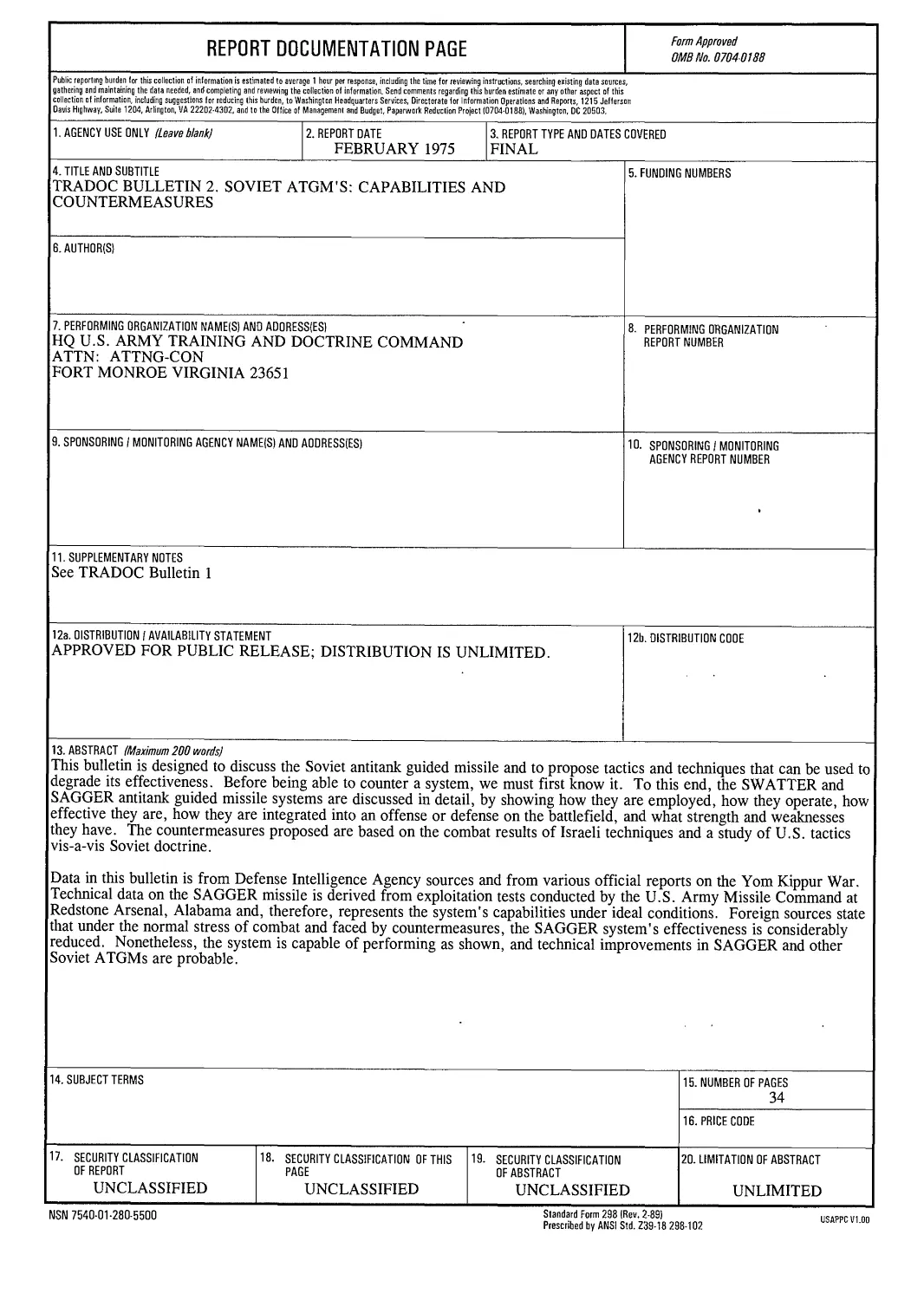
13. ABSTRACT IMaximum 200 words) This bulletin is designed to discuss the Soviet antitank guided missile and to propose tactics and techniques that can be used to degrade its effectiveness. Before being able to counter a system, we must first know it. To this end, the SWATTER and SAGGER antitank guided missile systems are discussed in detail, by showing how they are employed, how they operate, how effective they are, how they are integrated into an offense or defense on the battlefield, and what strength and weaknesses they have. The countermeasures proposed are based on the combat results of Israeli techniques and a study of U.S. tactics vis-a-vis Soviet doctrine. Data in this bulletin is from Defense Intelligence Agency sources and from various official reports on the Yom Kippur War. Technical data on the SAGGER missile is derived from exploitation tests conducted by the U.S. Army Missile Command at Redstone Arsenal, Alabama and, therefore, represents the system's capabilities under ideal conditions. Foreign sources state that under the normal stress of combat and faced by countermeasures, the SAGGER system’s effectiveness is considerably reduced. Nonetheless, the system is capable of performing as shown, and technical improvements in SAGGER and other Soviet ATGMs are probable.
14. SUBJECT TERMS				15. NUMBER OF PAGES 34
				16. PRICE CODE
17. SECURITY CLASSIFICATION OF REPORT UNCLASSIFIED	18. SECURITY CLASSIFICATION OF THIS PAGE UNCLASSIFIED	19. SECURITY CLASSIFICATION OF ABSTRACT UNCLASSIFIED		20. LIMITATION OF ABSTRACT UNLIMITED
NSN 7540-01-280-5500
Standard Form 298 (Rev, 2-89)
Prescribed by ANSI Std. Z39-18 298-102
USAPPCV1.00
UNITED !5ТДЙпЙШ«ИТ
TRAINING AND DOCTRINE COMMAND
BULLETIN NO. 2
SOVIET ATOMS
CAPABILITIES & COUNTERMEASURES
Page
I The Modern Battlefield...................................  2
II Soviet Antitank Guided Missiles .......................    5
III Countermeasures ..............................    20
This TRADOC BULLETIN is intended to provide
to commanders, and others concerned with
military training, timely technical information on
weapons, tactics, and training. It is not intended to
supplant doctrinal publications, but to supplement
material on "how to fight" with data derived from
tests, recent intelligence, or other sources, which
probe "why."
TRAINERS' NOTE: The format of this bulletin is
designed to help trainers identify and extract
needed information. Charts, illustrations, and other
key data that are unclassified, for instance, are
clearly marked and are boxed-in by a bold line.
Comment or criticism is welcome, and should be
directed to:
COMMANDER
US ARMY TRAINING AND DOCTRINE COMMAND
ATTN: ATTNG-CON (TEL: AUTOVON 680-2972/3153)
FORT MONROE, VIRGINIA 23651
I
THE MODERN BATTLEFIELD
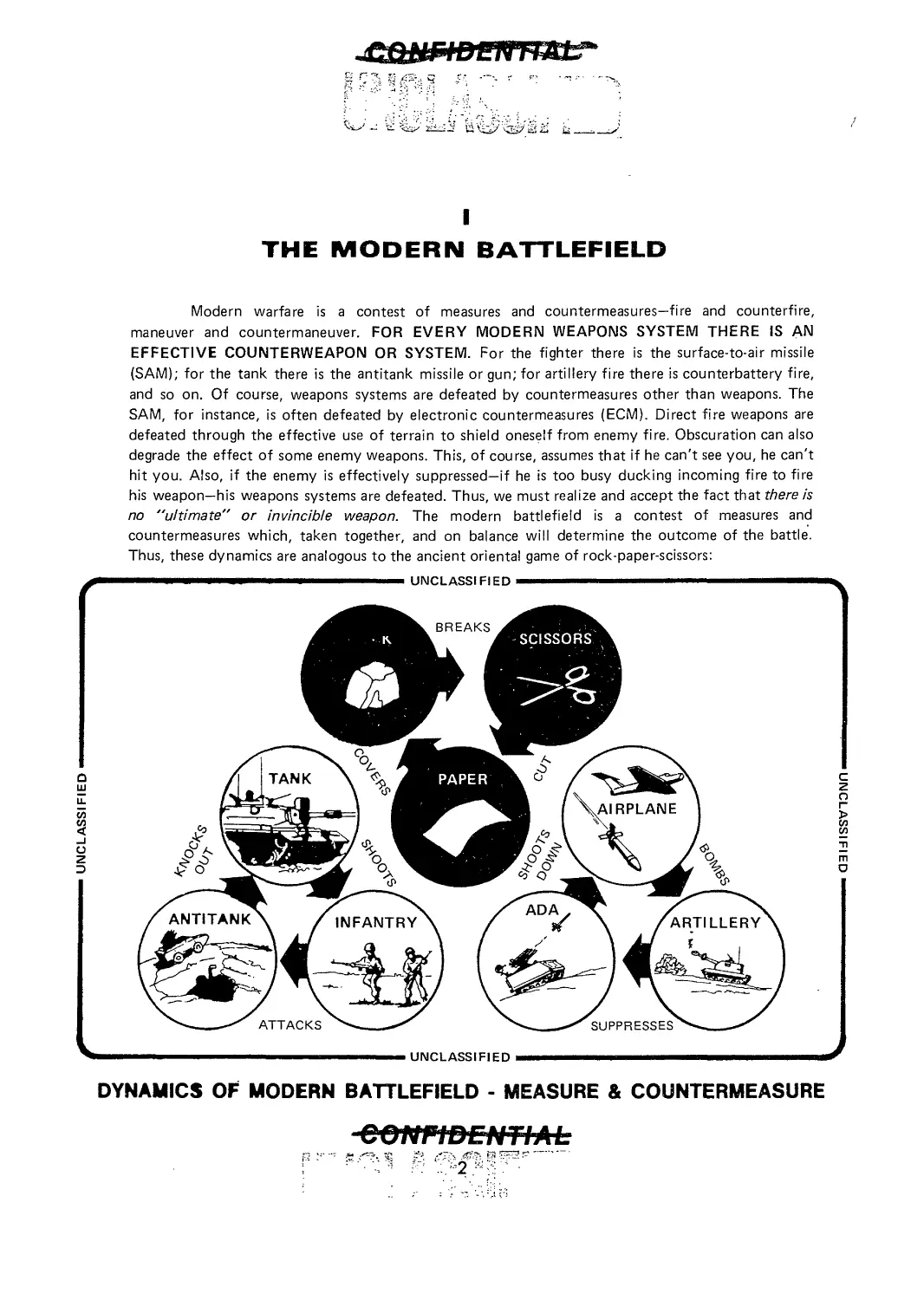
Modern warfare is a contest of measures and countermeasures—fire and counterfire,
maneuver and countermaneuver. FOR EVERY MODERN WEAPONS SYSTEM THERE IS AN
EFFECTIVE COUNTERWEAPON OR SYSTEM. For the fighter there is the surface-to-air missile
(SAM); for the tank there is the antitank missile or gun; for artillery fire there is counterbattery fire,
and so on. Of course, weapons systems are defeated by countermeasures other than weapons. The
SAM, for instance, is often defeated by electronic countermeasures (ECM). Direct fire weapons are
defeated through the effective use of terrain to shield oneself from enemy fire. Obscuration can also
degrade the effect of some enemy weapons. This, of course, assumes that if he can't see you, he can't
hit you. Also, if the enemy is effectively suppressed—if he is too busy ducking incoming fire to fire
his weapon—his weapons systems are defeated. Thus, we must realize and accept the fact that there is
no "ultimate" or invincible weapon. The modern battlefield is a contest of measures and
countermeasures which, taken together, and on balance will determine the outcome of the battle.
Thus, these dynamics are analogous to the ancient oriental game of rock-paper-scissors:
UNCLASSIFIED
UNCLASSIFIED
DYNAMICS OF MODERN BATTLEFIELD - MEASURE & COUNTERMEASURE
TRADOC BULLETIN NO. 2
CHAPTER! ---
All the modern armies" of NATO, the Warsaw^Tact^ tlTe^fa^ and Israeli nations generally
agree that the main offensive weapon of ground forces is the tank. With its heavy armament, armor
protection, and cross-country mobility, only the tank can break through an enemy force and engage
or defeat it decisively. While the Arab-Israeli War of October 1973 (The "Yom Kippur War")
reaffirmed the offensive potential of the tank, it has also dramatized the lethality of modern antitank
weapons—particularly the high velocity tank cannon and the long range antitank guided missile
(ATGM). The effect of these modern antitank weapons in this war was devastating. Not since the
Battle of Kursk between the German and Russians in World War II has there been a comparable loss
of tanks in such a short period of time. If the rate of loss which occurred in the Yom Kippur War
during the short 20 days of battle were extrapolated to the European battlefields over a period of
60-90 days, the resulting losses would reach levels for which the United States Army is totally
unprepared. While it is impossible to say precisely how many losses were attributable to a certain
weapons system, we can say, particularly in view of the vast numbers of ATGMs employed, that the
antitank guided missile was responsible for a high percentage of the Israeli tank losses at the beginning
of that war. In the Arab/lsraeli War of 1967, the Israelis were able to dominate the battlefield
principally with tanks and fighter aircraft. Extensive Arab air defenses in 1973, however, seriously
degraded effective close air support. Thus in the first several days of the 1973 war, Israeli armor units,
advancing without close air, infantry or artillery support, attacked in the face of large numbers of
Soviet-made ATGMs and suffered wholesale destruction. This same situation is, of course, possible on
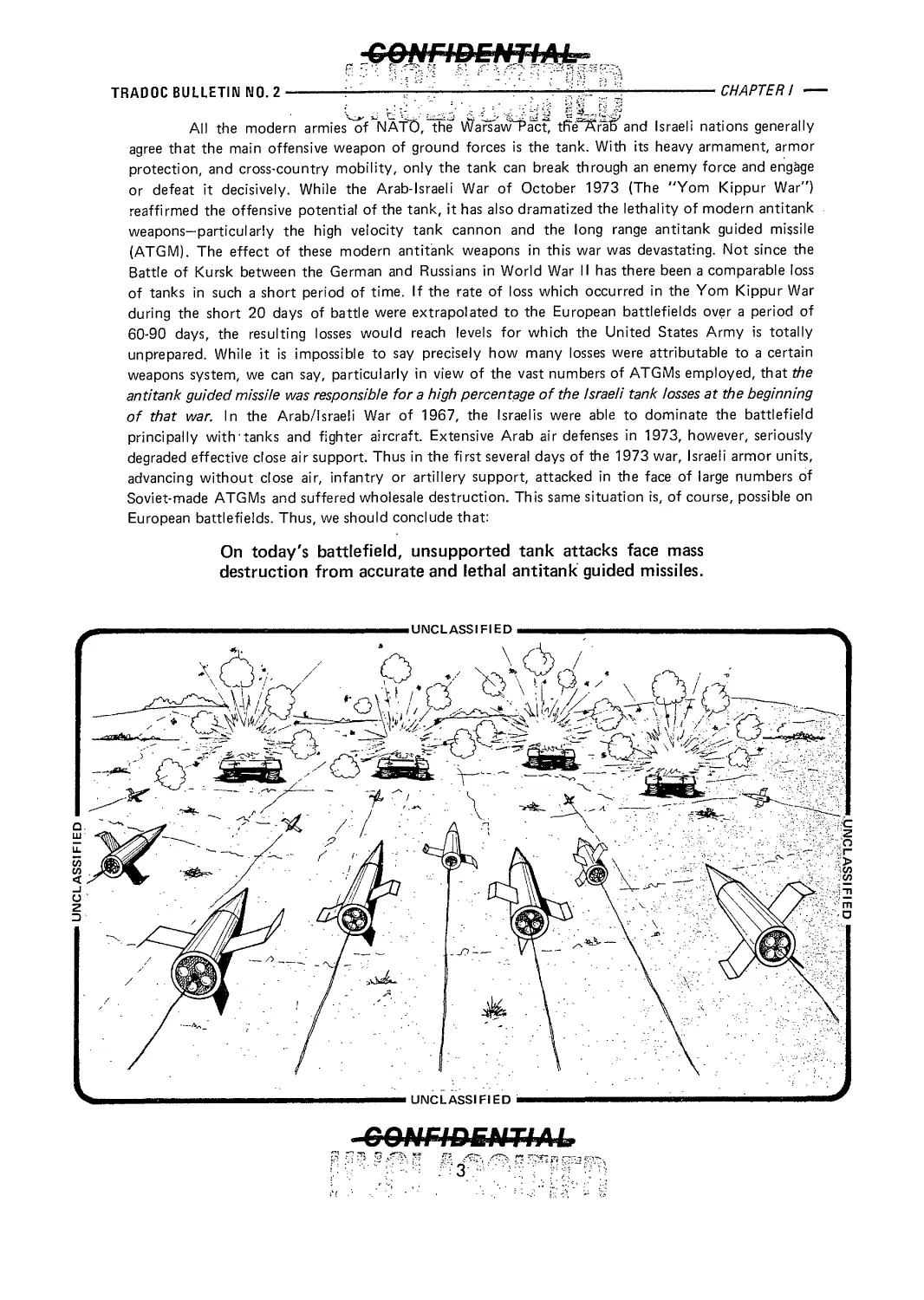
European battlefields. Thus, we should conclude that:
On today's battlefield, unsupported tank attacks face mass
destruction from accurate and lethal antitank guided missiles.
UNCLASSIFIED
UNCLASSIFIED
— CHAPTER I-----------------------——--------------------------------------- TRADOC BULLETIN NO. 2
'? ... 'J	A
d ta Ч-ix’	-=
This bulletin is designed, therefore, to discuss the Soviet antitank guided missile and to
propose tactics and techniques that can be used to degrade its effectiveness. Before being able to
counter a system, we must first know it. To this end, the SWATTER and SAGGER antitank guided
missile systems are discussed in detail, by showing how they are employed, how they operate, how
effective they are, how they are integrated into an offense or defense on the battlefield, and what
strengths and weaknesses they have. The countermeasures proposed are based on the combat results
of Israeli techniques and a study of U.S. tactics vis-a-vis Soviet doctrine.
Data in this bulletin is from Defense Intelligence Agency sources and from various official
reports on the Yom Kippur War. Technical data on the SAGGER missile is derived from exploitation
tests conducted by the U.S. Army Missile Command at Redstone Arsenal, Alabama and, therefore,
represents the system's capabilities under ideal conditions. Foreign sources state that under the
normal stress of combat and faced by countermeasures, the SAGGER system's effectiveness is
considerably reduced. Nonetheless, the system is capable of performing as shown, and technical
improvements in SAGGER and other Soviet ATGMs are probable.

4
-CONFIDENTIAL-
' V; г- £ £ -я	гэд- s> ___
 П .О ,, .'< --':
SOVIET ANTITANK GUIDED MISSILES
The Soviets have fielded three antitank guided missile (ATGM) systems since the early
1950s. They are the SNAPPER, SWATTER and SAGGER. Since the SNAPPER is obsolescent and
unlikely to be found in significant numbers on the modern battlefield, it will not be discussed. The
SWATTER is found only with Soviet forceszwhile the SAGGER is available to the WARSAW Pact
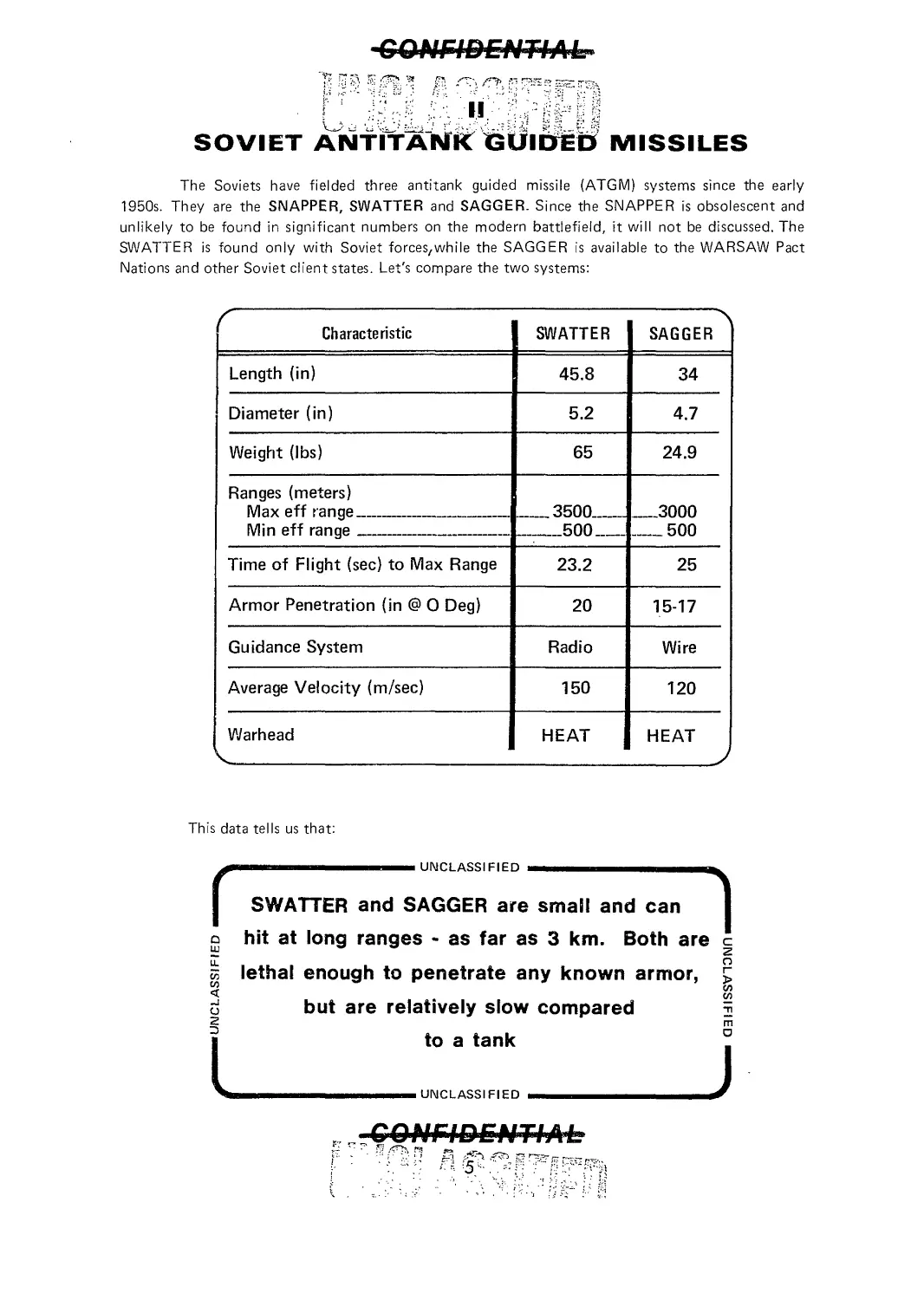
Nations and other Soviet client states. Let's compare the two systems:
Characteristic	1 SWATTER	SAGGER
Length (in)	45.8	34
Diameter (in)	5.2	4.7
Weight (lbs)	65	24.9
Ranges (meters) Max eff range	 Min eff range			3500	 	500			3000 	500
Time of Flight (sec) to Max Range	23.2	25
Armor Penetration (in @ 0 Deg)	20	15-17
Guidance System	Radio	Wire
Average Velocity (m/sec)	150	120
Warhead	HEAT	HEAT
This data tells us that:
...... ——UN C LASS I FIE D
SWATTER and SAGGER are small and can I
hit at long ranges - as far as 3 km. Both are ’
о
lethal enough to penetrate any known armor, £
СЛ
but are relatively slow compared 5
to a tank	°
i——i-	ЧЧ !— UNCLASSIFIED
CONFIDENTIAL
— CHAPTER 11
TRADOC BULLETIN NO. 2
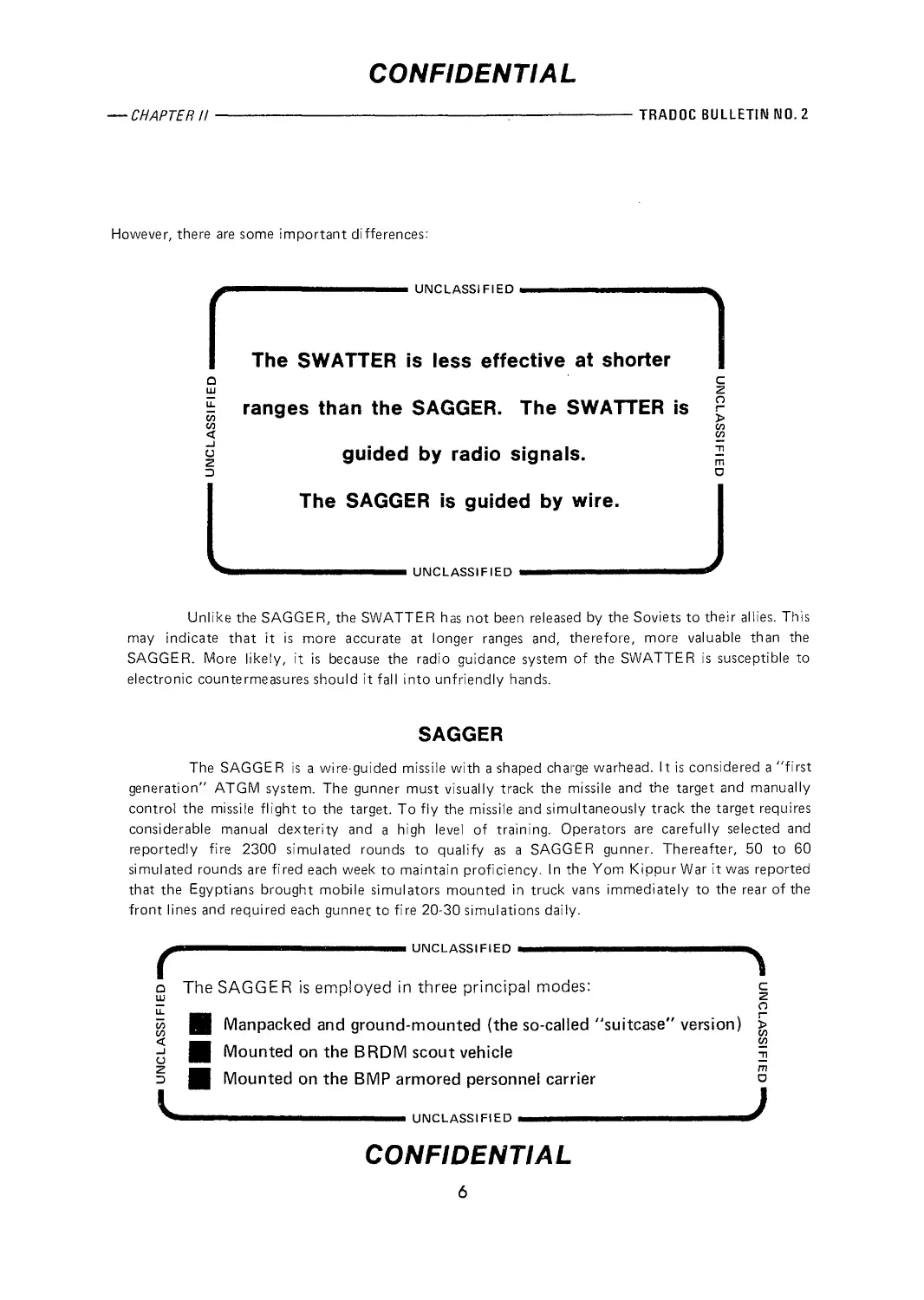
However, there are some important differences:
UNCLASSIFIED
The SWATTER is less effective at shorter
о
Ш
ranges than the SAGGER. The SWATTER is
guided by radio signals.
The SAGGER is guided by wire.
UNCLASSIFIED
Unlike the SAGGER, the SWATTER has not been released by the Soviets to their allies. This
may indicate that it is more accurate at longer ranges and, therefore, more valuable than the
SAGGER. More likely, it is because the radio guidance system of the SWATTER is susceptible to
electronic countermeasures should it fall into unfriendly hands.
SAGGER
The SAGGER is a wire-guided missile with a shaped charge warhead. It is considered a "first
generation" ATGM system. The gunner must visually track the missile and the target and manually
control the missile flight to the target. To fly the missile and simultaneously track the target requires
considerable manual dexterity and a high level of training. Operators are carefully selected and
reportedly fire 2300 simulated rounds to qualify as a SAGGER gunner. Thereafter, 50 to 60
simulated rounds are fired each week to maintain proficiency. In the Yom Kippur War it was reported
that the Egyptians brought mobile simulators mounted in truck vans immediately to the rear of the
front lines and required each gunner to fire 20-30 simulations daily.
 UNCLASSIFIED —
1
a	The	SAGGER is employed in three principal modes:	c
— °
w	M	Manpacked and ground-mounted (the so-called "suitcase" version) >
о	Bi	Mounted on the В RDM scout vehicle	2
i	Bi	Mounted on the BMP armored personnel carrier	о
UNCLASSIFIED	.—.....
CONFIDENTIAL
6
CONFIDENTIAL
TRADOC BULLETIN NO. 2 -
CHAPTER 11 —
THE "SUITCASE” SAGGER
- ..	... UNCI ARSIFIFH ....................... -	- -	- ---
UNCLASSIFIED
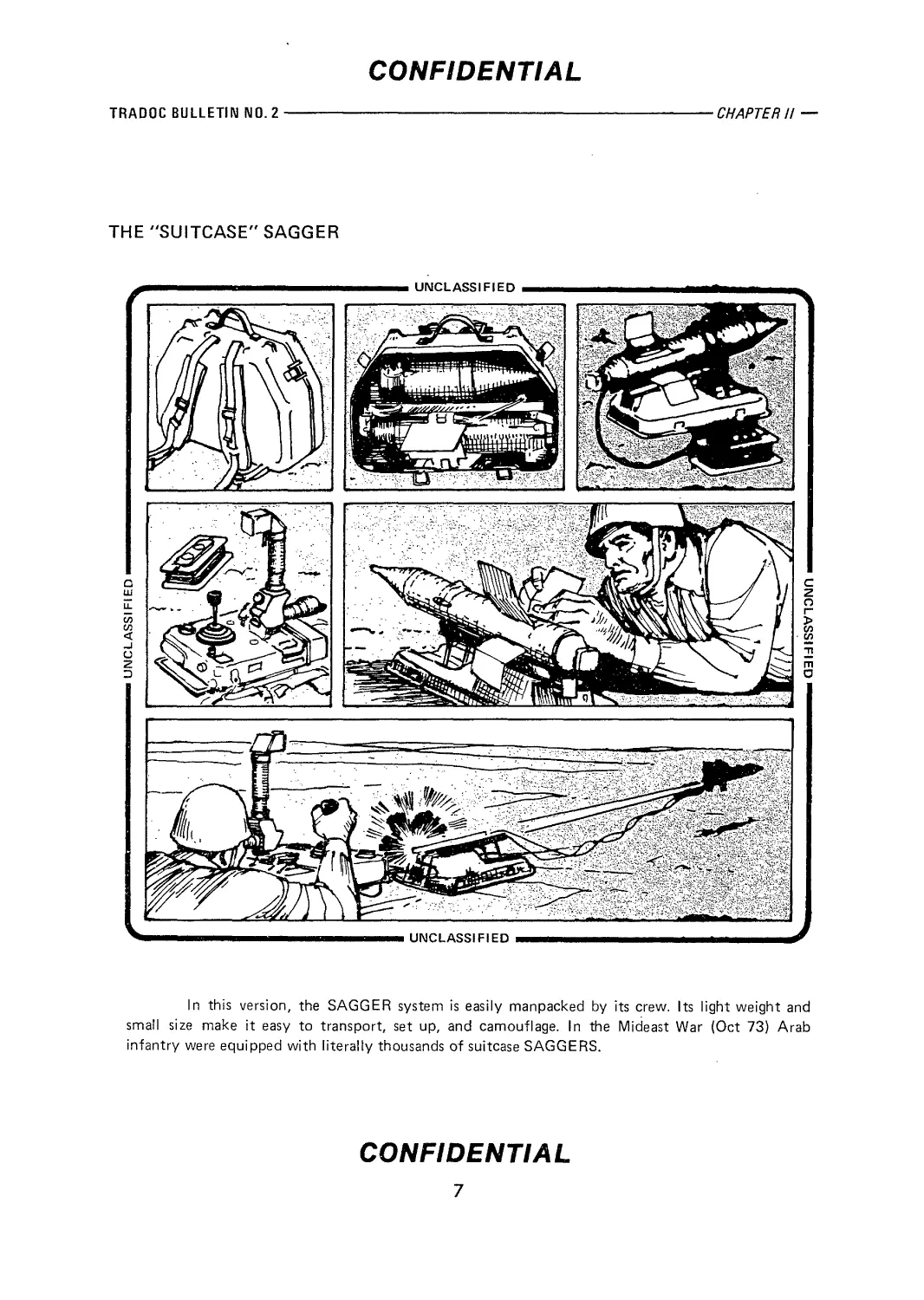
In this version, the SAGGER system is easily manpacked by its crew. Its light weight and
small size make it easy to transport, set up, and camouflage. In the Mideast War (Oct 73) Arab
infantry were equipped with literally thousands of suitcase SAGGERS.
CONFIDENTIAL
7
CONFIDENTIAL
— CHAPTER 11
TRADOC BULLETIN NO. 2
BRDM WITH SAGGERs MOUNTED
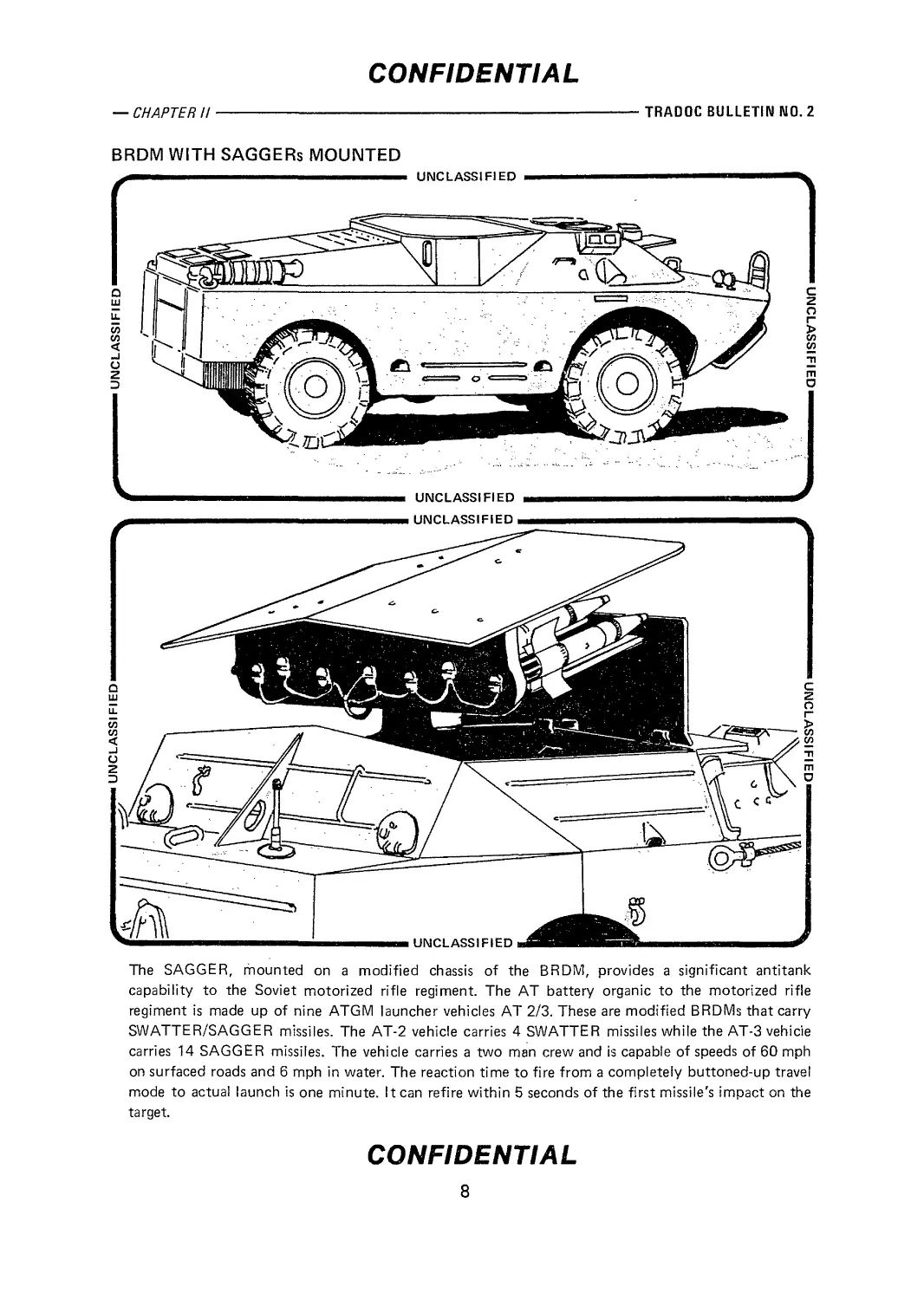
The SAGGER, mounted on a modified chassis of the BRDM, provides a significant antitank
capability to the Soviet motorized rifle regiment. The AT battery organic to the motorized rifle
regiment is made up of nine ATGM launcher vehicles AT 2/3. These are modified BRDMs that carry
SWATTER/S AGGER missiles. The AT-2 vehicle carries 4 SWATTER missiles while the AT-3 vehicle
carries 14 SAGGER missiles. The vehicle carries a two man crew and is capable of speeds of 60 mph
on surfaced roads and 6 mph in water. The reaction time to fire from a completely buttoned-up travel
mode to actual launch is one minute. It can refire within 5 seconds of the first missile's impact on the
target.
CONFIDENTIAL
8
CONFIDENTIAL
TRADOC BULLETIN NO. 2
CHAPTER 11 —
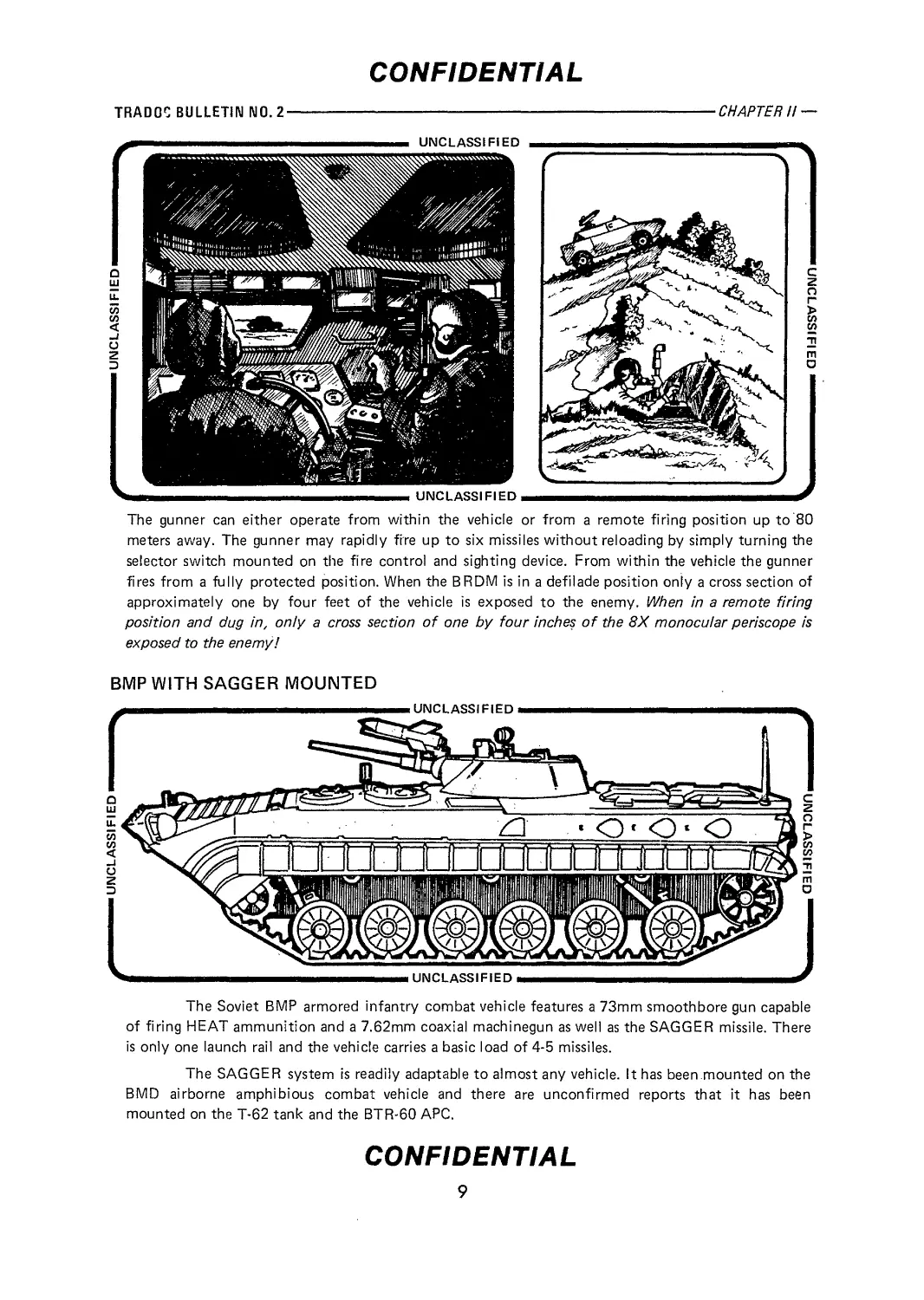
The gunner can either operate from within the vehicle or from a remote firing position up to 80
meters away. The gunner may rapidly fire up to six missiles without reloading by simply turning the
selector switch mounted on the fire control and sighting device. From within the vehicle the gunner
fires from a fully protected position. When the В RDM is in a defilade position only a cross section of
approximately one by four feet of the vehicle is exposed to the enemy. When in a remote firing
position and dug in, only a cross section of one by four inches of the 8X monocular periscope is
exposed to the enemy!
BMP WITH SAGGER MOUNTED
The Soviet BMP armored infantry combat vehicle features a 73mm smoothbore gun capable
of firing HEAT ammunition and a 7.62mm coaxial machinegun as well as the SAGGER missile. There
is only one launch rail and the vehicle carries a basic load of 4-5 missiles.
The SAGGER system is readily adaptable to almost any vehicle. It has been.mounted on the
BMD airborne amphibious combat vehicle and there are unconfirmed reports that it has been
mounted on the T-62 tank and the BTR-60 APC.
CONFIDENTIAL
9
CONFIDENTIAL
- CHAPTER 11
TRADOC BULLETIN NO. 2
METHOD OF OPERATION OF SAGGER
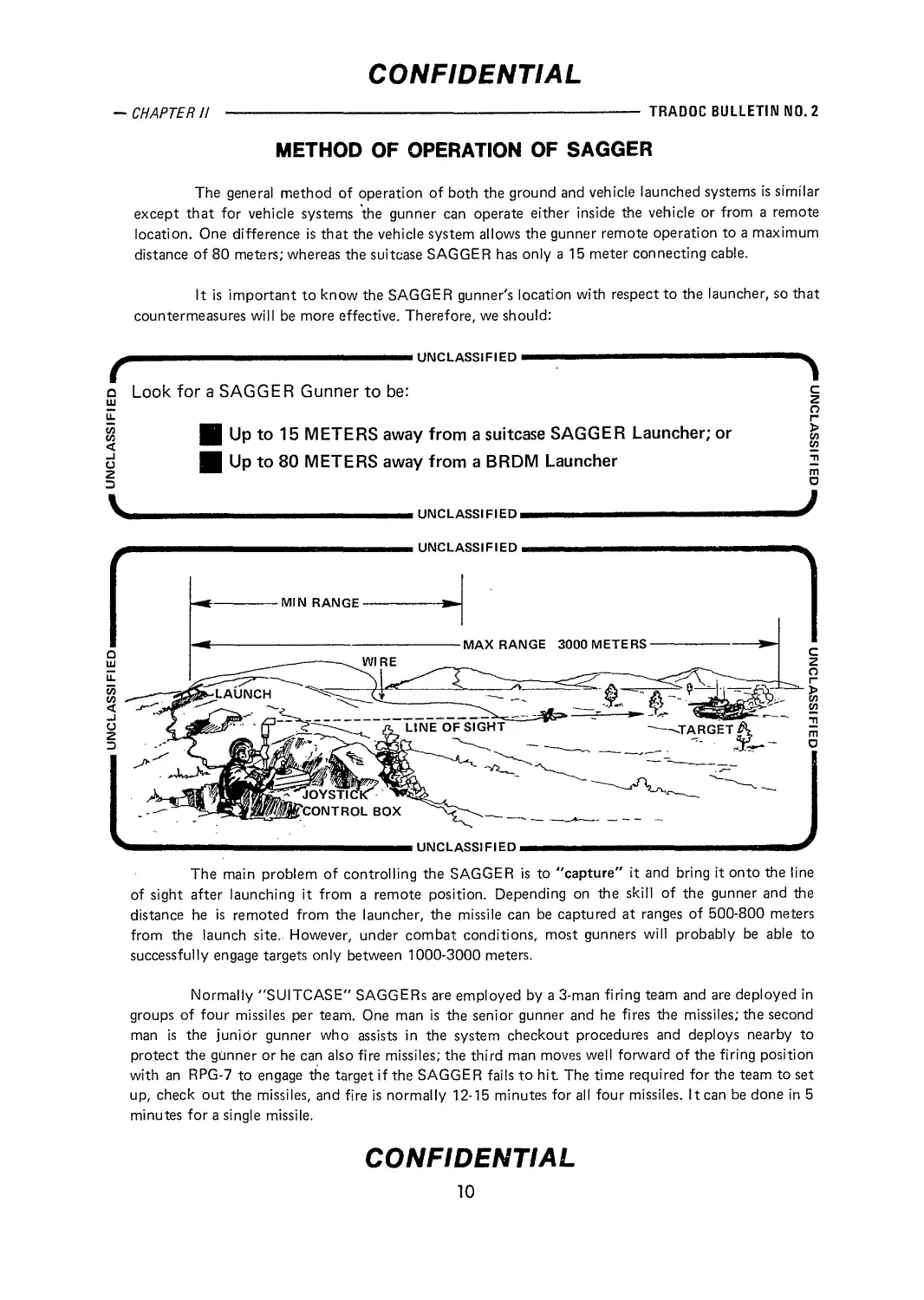
The general method of operation of both the ground and vehicle launched systems is similar
except that for vehicle systems the gunner can operate either inside the vehicle or from a remote
location. One difference is that the vehicle system allows the gunner remote operation to a maximum
distance of 80 meters; whereas the suitcase SAGGER has only a 15 meter connecting cable.
It is important to know the SAGGER gunner's location with respect to the launcher, so that
countermeasures will be more effective. Therefore, we should:
UNCLASSIFIED
UNCLASSI FIEDmwmm^ ^UNCLASSIFIED
Look for a SAGGER Gunner to be:
| Up to 15 METERS away from a suitcase SAGGER Launcher; or
Ц Up to 80 METERS away from a BRDM Launcher
UNCLASSIFIED
The main problem of controlling the SAGGER is to "capture" it and bring it onto the line
of sight after launching it from a remote position. Depending on the skill of the gunner and the
distance he is remoted from the launcher, the missile can be captured at ranges of 500-800 meters
from the launch site. However, under combat conditions, most gunners will probably be able to
successfully engage targets only between 1000-3000 meters.
Normally "SUITCASE" SAGGERs are employed by a 3-man firing team and are deployed in
groups of four missiles per team. One man is the senior gunner and he fires the missiles; the second
man is the junior gunner who assists in the system checkout procedures and deploys nearby to
protect the gunner or he can also fire missiles; the third man moves well forward of the firing position
with an RPG-7 to engage the target if the SAGGER fails to hit. The time required for the team to set
up, check out the missiles, and fire is normally 12-15 minutes for all four missiles. It can be done in 5
minutes for a single missile.
CONFIDENTIAL
io
CONFIDENTIAL
TRADOC BULLETIN NO. 2
CHAPTER // —
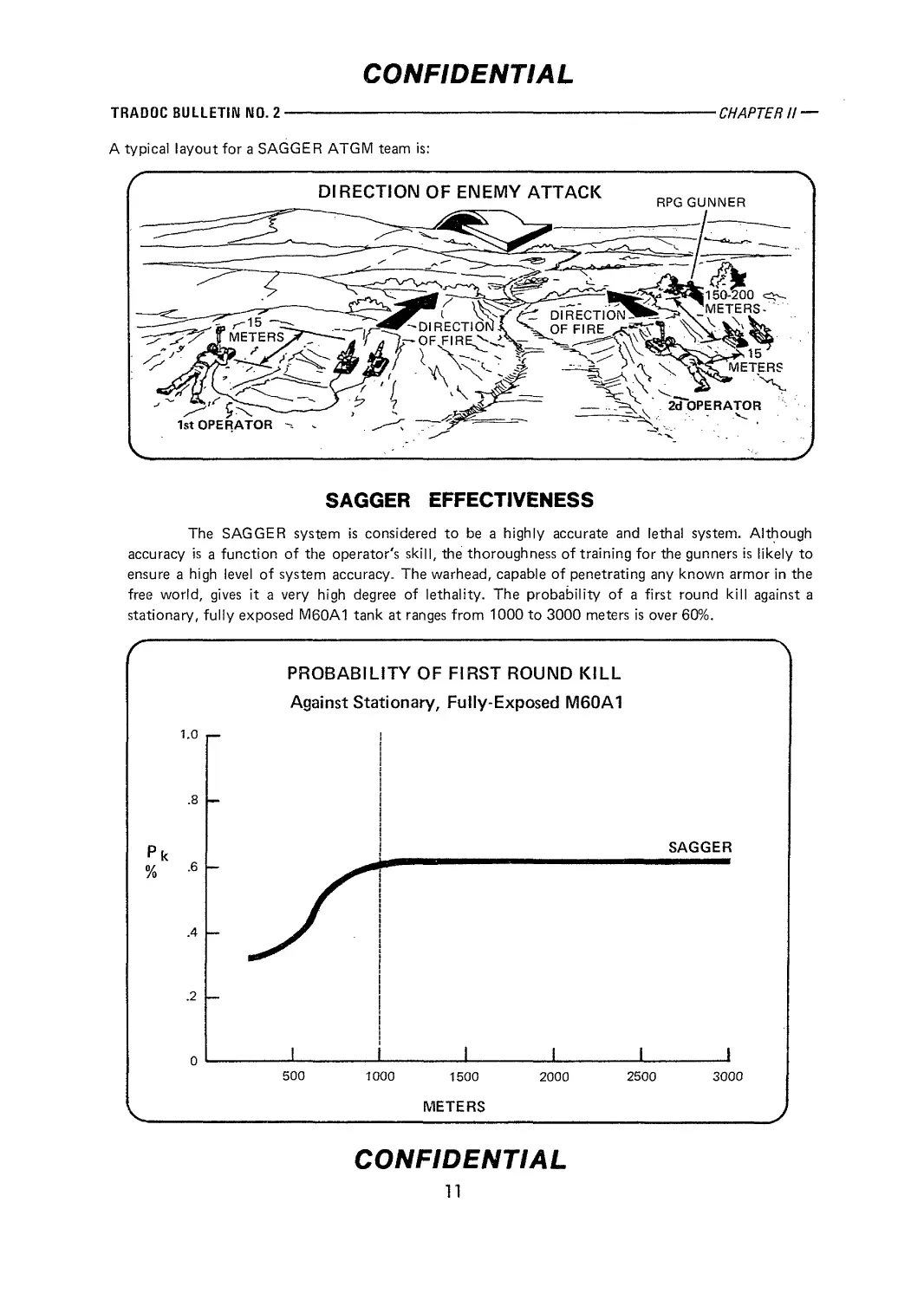
A typical layout for a SAGGER ATGM team is:
SAGGER EFFECTIVENESS
The SAGGER system is considered to be a highly accurate and lethal system. Although
accuracy is a function of the operator's skill, the thoroughness of training for the gunners is likely to
ensure a high level of system accuracy. The warhead, capable of penetrating any known armor in the
free world, gives it a very high degree of lethality. The probability of a first round kill against a
stationary, fully exposed M60A1 tank at ranges from 1000 to 3000 meters is over 60%.
PROBABILITY OF FIRST ROUND KILL
Against Stationary, Fully-Exposed M60A1
METERS
CONFIDENTIAL
n
CONFIDENTIAL
— CHAPTERH
TRADOC BULLETIN NO. 2
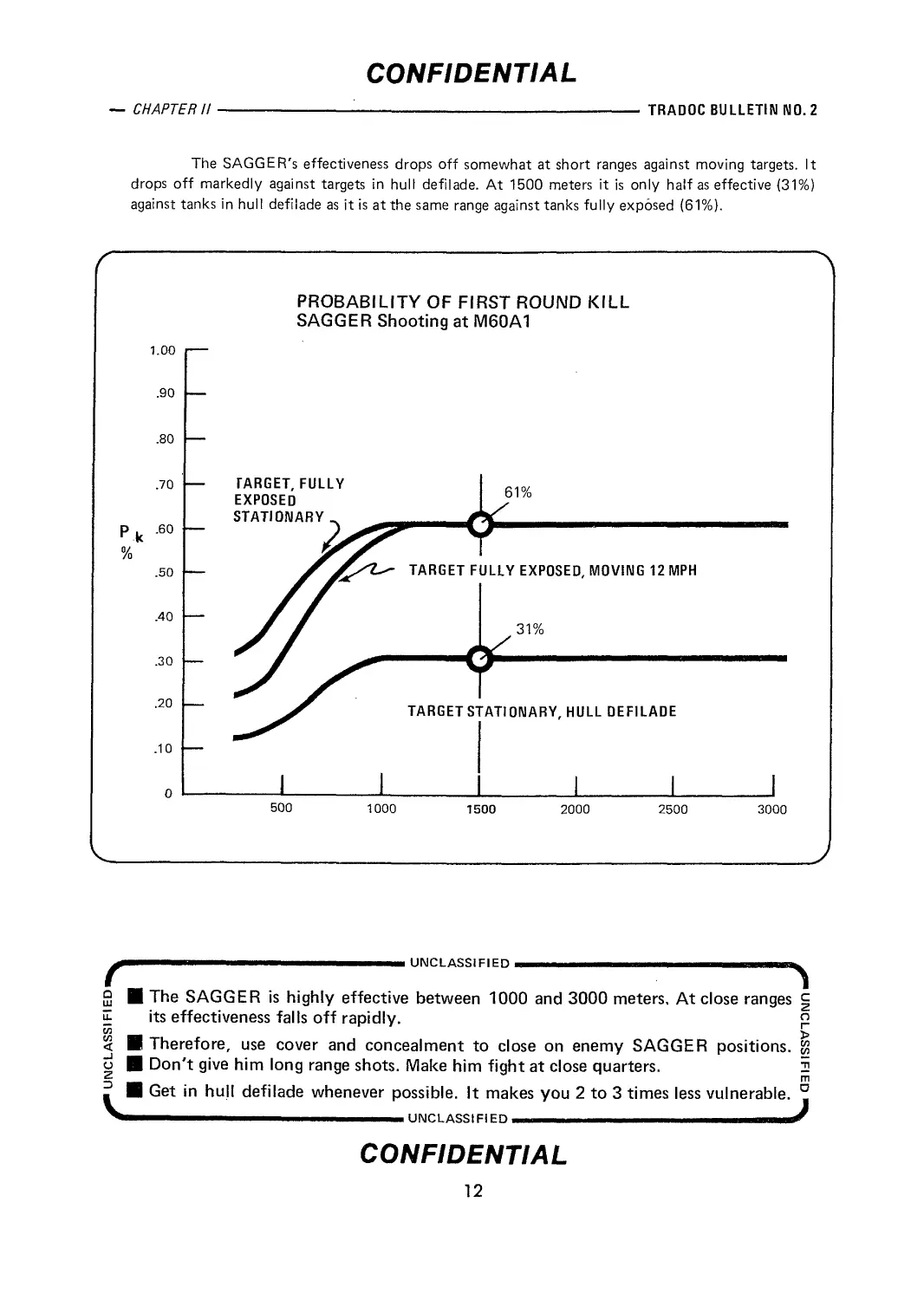
The SAGGER's effectiveness drops off somewhat at short ranges against moving targets. It
drops off markedly against targets in hull defilade. At 1500 meters it is only half as effective (31%)
against tanks in hull defilade as it is at the same range against tanks fully exposed (61%).
PROBABILITY OF FIRST ROUND KILL
SAGGER Shooting at M60A1
ASSIFIED
..............................    II	UNCLASSIFIED .	 । ........пни	.... i iiiwim^
	The SAGGER is highly effective between 1000 and 3000 meters. At close ranges §
its effectiveness falls off rapidly.	p
	Therefore, use cover and concealment to close on enemy SAGGER positions. Й
о В Don't give him long range shots. Make him fight at close quarters.	2
Z	m
j? В Get in hull defilade whenever possible. It makes you 2 to 3 times less vulnerable. °
— .......... 	 UNCLASSIFIED   — 	।	........iwiw^
CONFIDENTIAL
12
CONFIDENTIAL
TRADOC BULLETIN NO. 2
CHAPTER // —
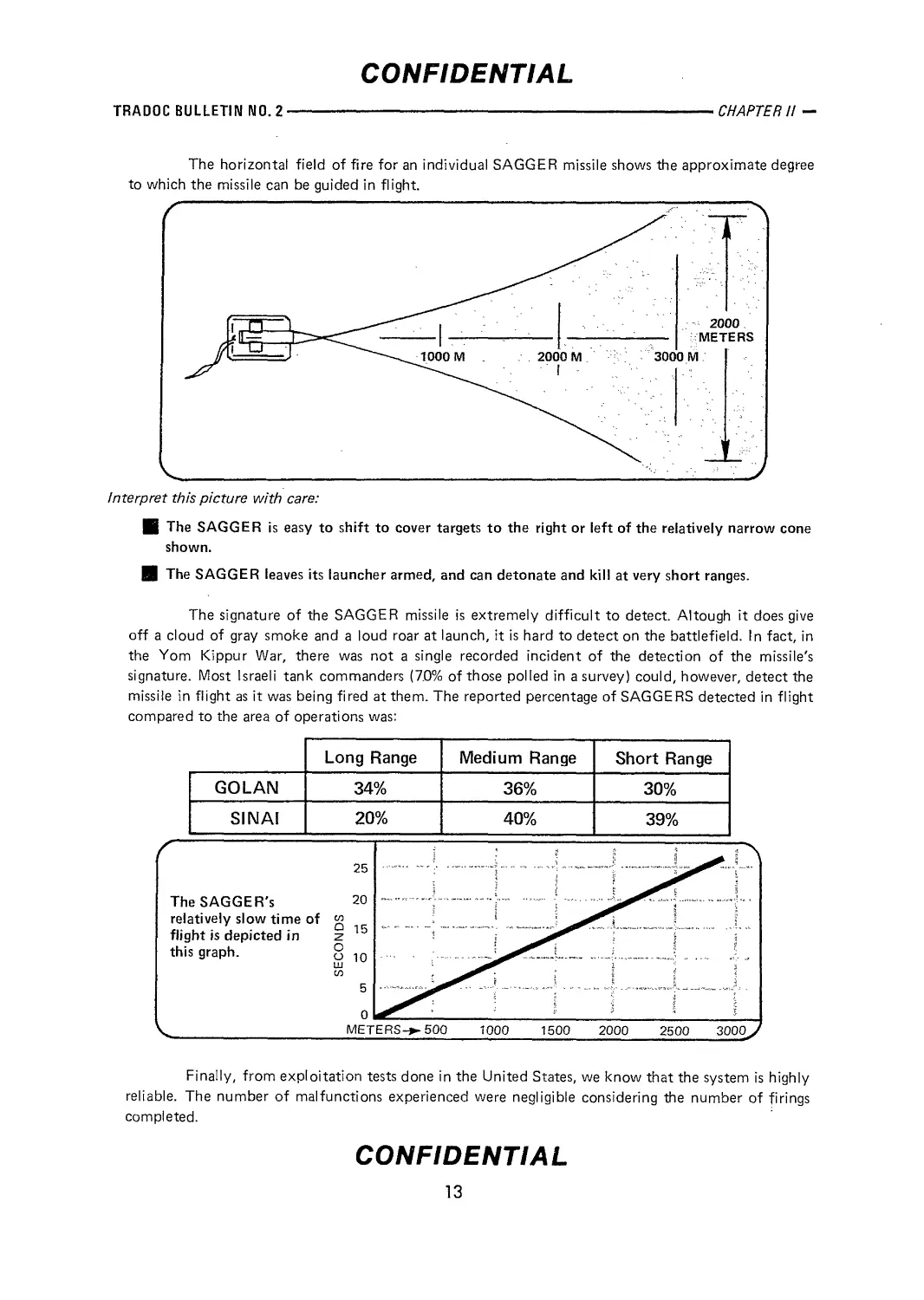
The horizontal field of fire for an individual SAGGER missile shows the approximate degree
to which the missile can be guided in flight.
Interpret this picture with care:
Ц The SAGGER is easy to shift to cover targets to the right or left of the relatively narrow cone
shown.
H The SAGGER leaves its launcher armed, and can detonate and kill at very short ranges.
The signature of the SAGGER missile is extremely difficult to detect. Altough it does give
off a cloud of gray smoke and a loud roar at launch, it is hard to detect on the battlefield. In fact, in
the Yom Kippur War, there was not a single recorded incident of the detection of the missile's
signature. Most Israeli tank commanders (7,0% of those polled in a survey) could, however, detect the
missile in flight as it was being fired at them. The reported percentage of SAGGERS detected in flight
compared to the area of operations was:
Finally, from exploitation tests done in the United States, we know that the system is highly
reliable. The number of malfunctions experienced were negligible considering the number of firings
completed.
CONFIDENTIAL
13
CONFIDENTIAL
— CHAPTER 11
TRADOC BULLETIN NO. 2
SWATTER
MODES OF EMPLOYMENT
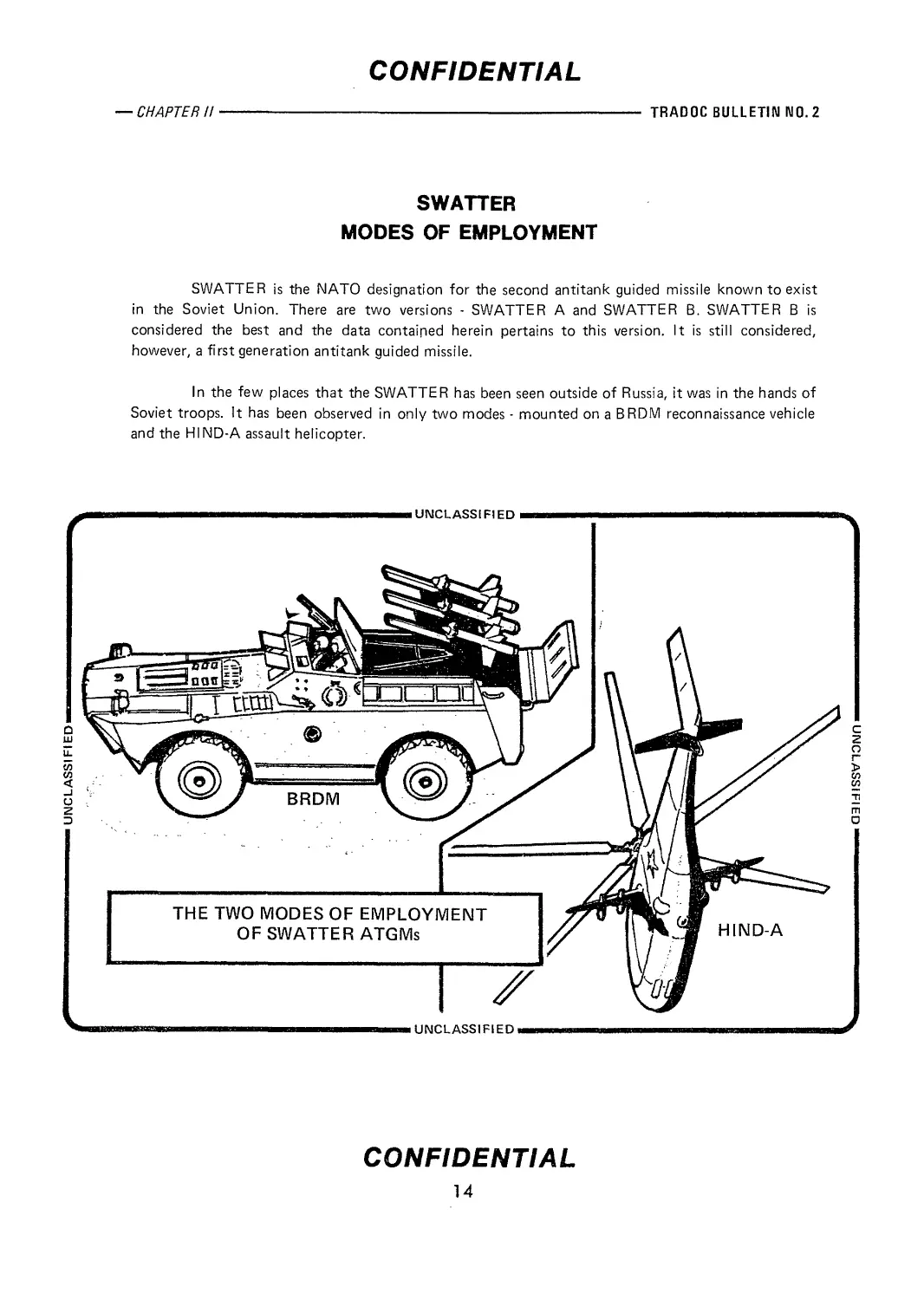
SWATTER is the NATO designation for the second antitank guided missile known to exist
in the Soviet Union. There are two versions - SWATTER A and SWATTER B. SWATTER В is
considered the best and the data contained herein pertains to this version. It is still considered,
however, a first generation antitank guided missile.
In the few places that the SWATTER has been seen outside of Russia, it was in the hands of
Soviet troops. It has been observed in only two modes - mounted on a В RDM reconnaissance vehicle
and the HIND-A assault helicopter.
UNCLASSIFIED
UNCLASSIFIED
CONFIDENTIAL
14
CONFIDENTIAL
TRADOC BULLETIN NO. 2
CHAPTER // —
EFFECTIVENESS OF THE SWATTER
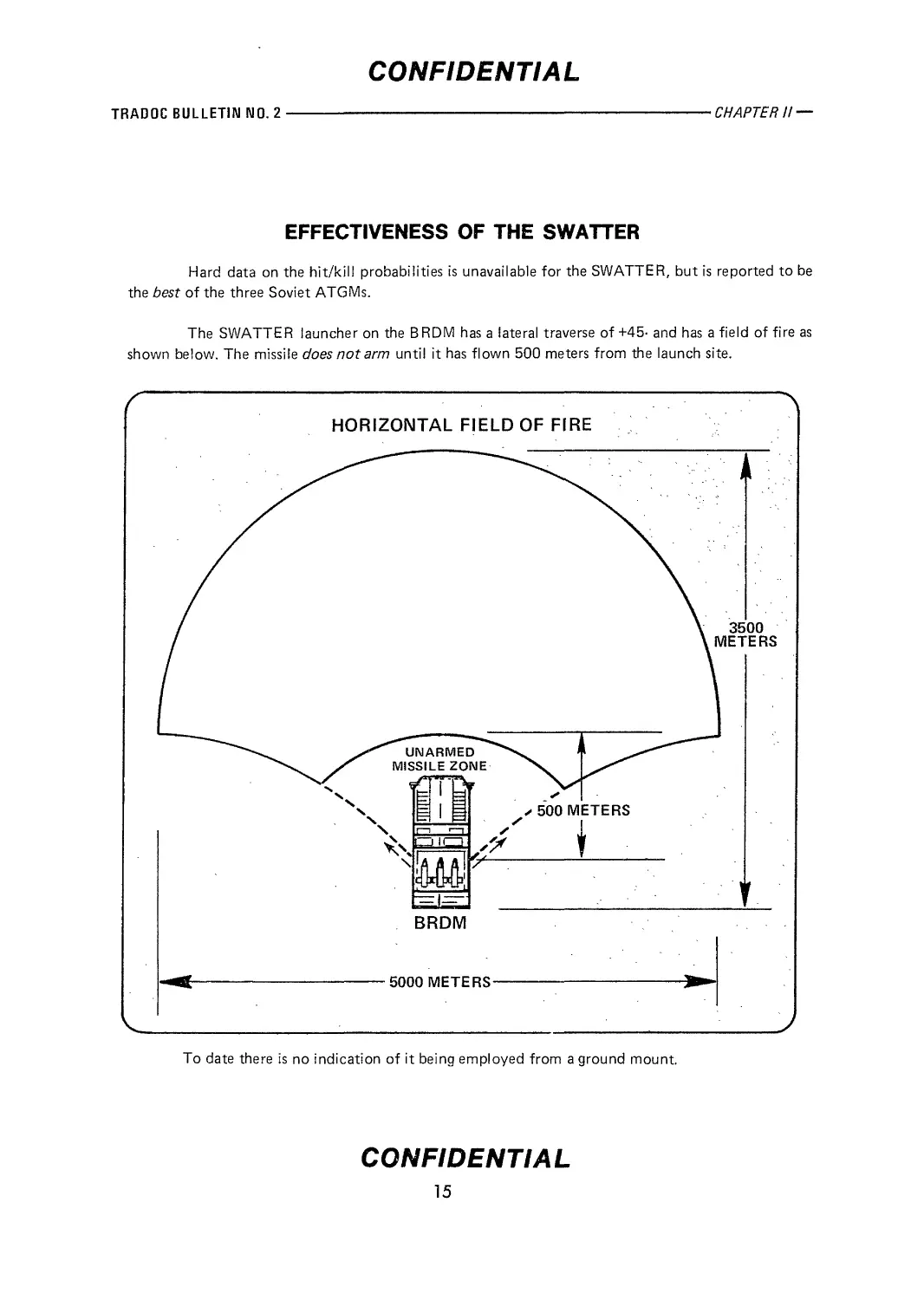
Hard data on the hit/kill probabilities is unavailable for the SWATTER, but is reported to be
the best of the three Soviet ATGMs.
The SWATTER launcher on the В RDM has a lateral traverse of+45- and has a field of fire as
shown below. The missile does not arm until it has flown 500 meters from the launch site.
CONFIDENTIAL
15
CONFIDENTIAL
— CHAPTER //
TRADOC BULLETIN NO. 2
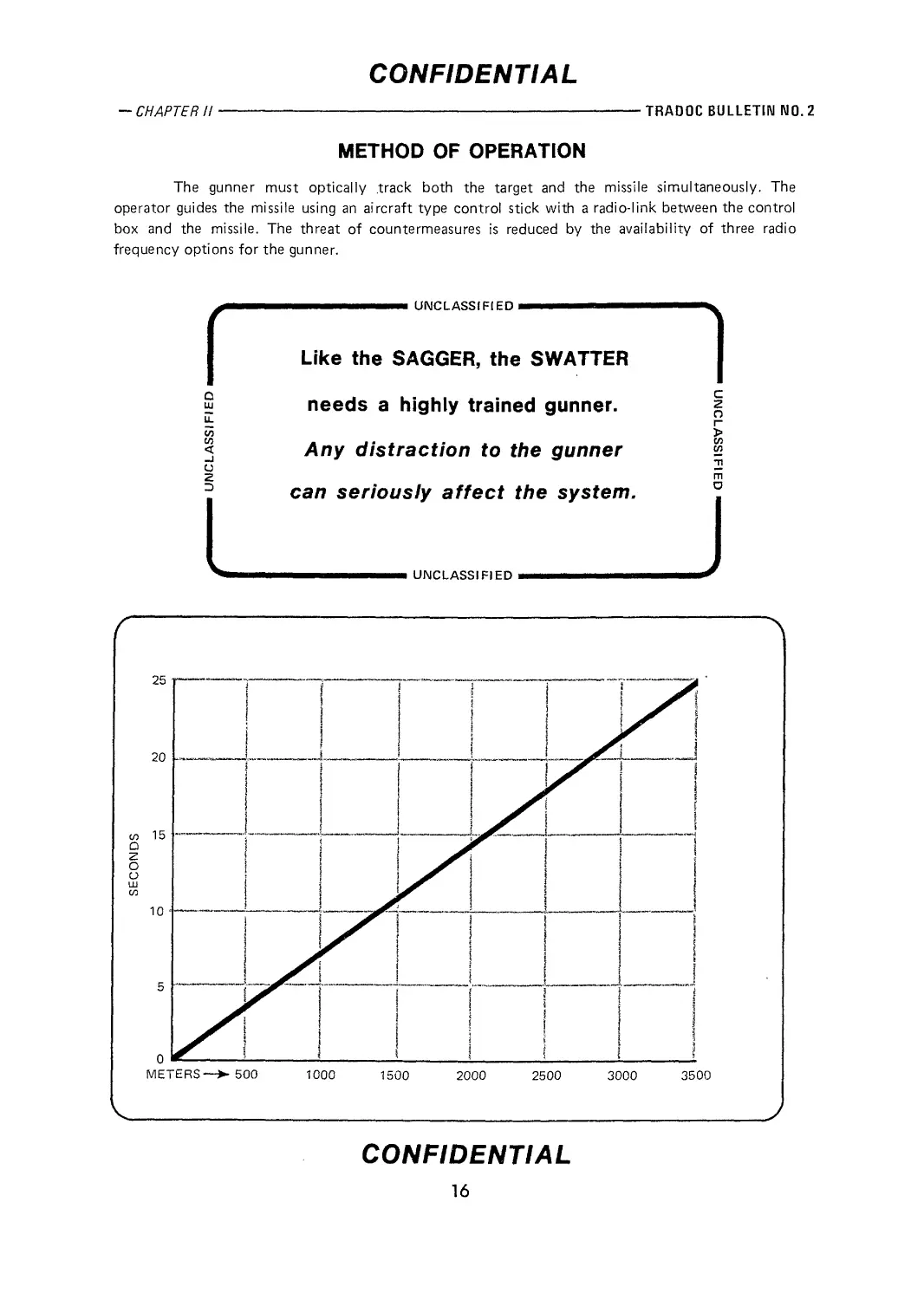
METHOD OF OPERATION
The gunner must optically .track both the target and the missile simultaneously. The
operator guides the missile using an aircraft type control stick with a radio-link between the control
box and the missile. The threat of countermeasures is reduced by the availability of three radio
frequency options for the gunner.
UNCL ASS IFIE D жмммммж
Like the SAGGER, the SWATTER
needs a highly trained gunner.
Any distraction to the gunner
can seriously affect the system.
UNCLASSIFIED мммммммшшм
CONFIDENTIAL
16
CONFIDENTIAL
CONFIDENTIAL
CHAPTER II
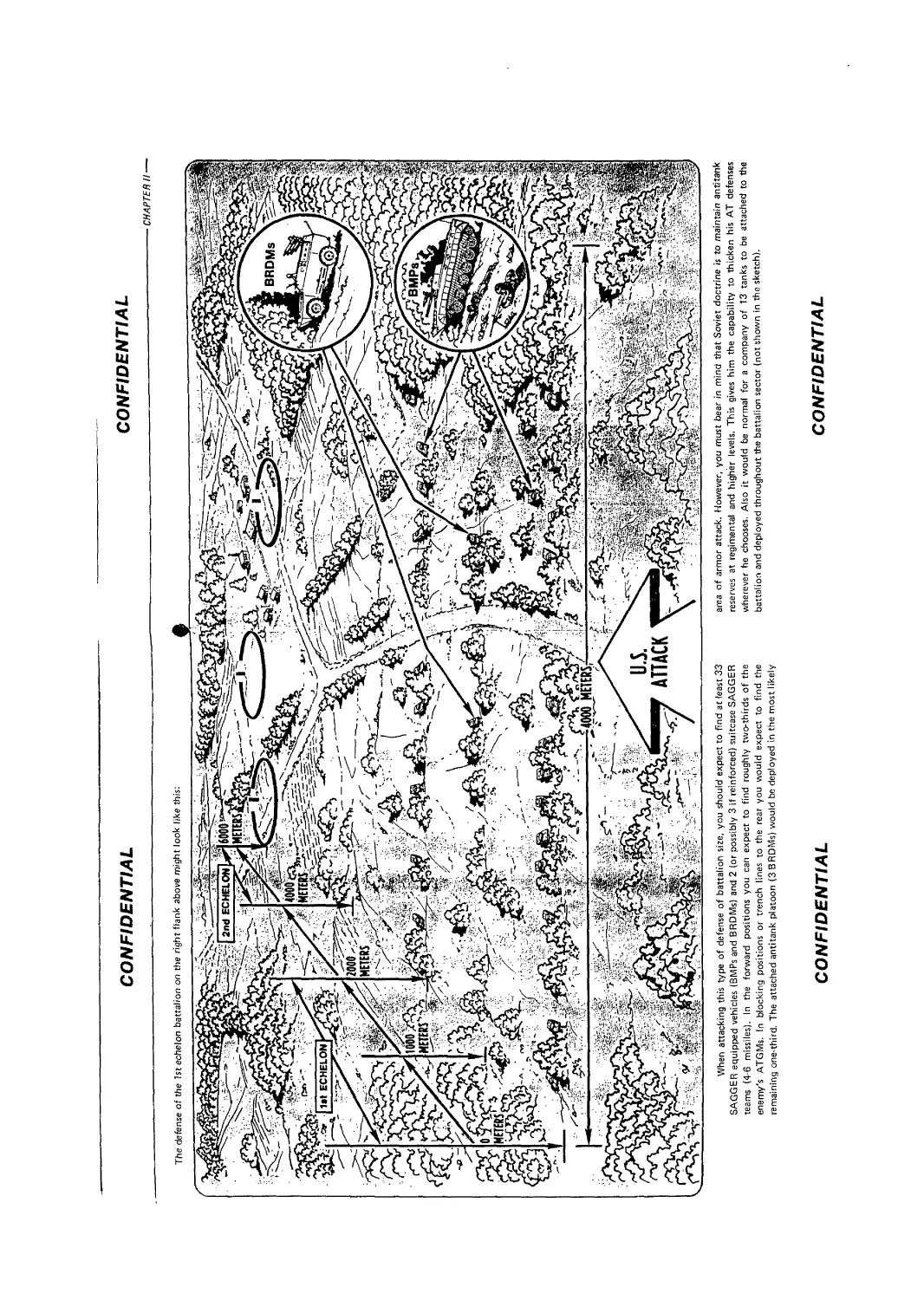
The defense of the 1 st echelon battalion on the right flank above might look like this:
When attacking this type of defense of battalion size, you should expect to find at least 33
SAGGER equipped vehicles (BMPs and BRDMs) and 2 (or possibly 3 if reinforced) suitcase SAGGER
teams (4-6 missiles). In the forward positions you can expect to find roughly two-thirds of the
enemy's ATGMs. In blocking positions or trench lines to the rear you would expect to find the
remaining one-third. The attached antitank platoon (3 BRDMs) would be deployed in the most likely
area of armor attack. However, you must bear in mind that Soviet doctrine is to maintain antitank
reserves at regimental and higher levels. This gives him the capability to thicken his AT defenses
wherever he chooses. Also it would be normal for a company of 13 tanks to be attached to the
battalion and deployed throughout the battalion sector (not shown in the sketch).
CONFIDENTIAL
CONFIDENTIAL
CONFIDENTIAL
TRADOC BULLETIN NO. 2
CHAPTER 11 —
EMPLOYMENT OF SOVIET ATGMs
Essential to the development of effective countermeasures is a consideration of the manner
in which ATGMs are deployed on the battlefield. For this discussion, the employment of SAGGER
and SWATTER ATGMs is considered to be essentially the same. First, the Soviet doctrine of
employment is examined and then a combat example of a variant of this doctrine as employed in the
Mideast is illustrated.
TYPICAL SOVIET EMPLOYMENT
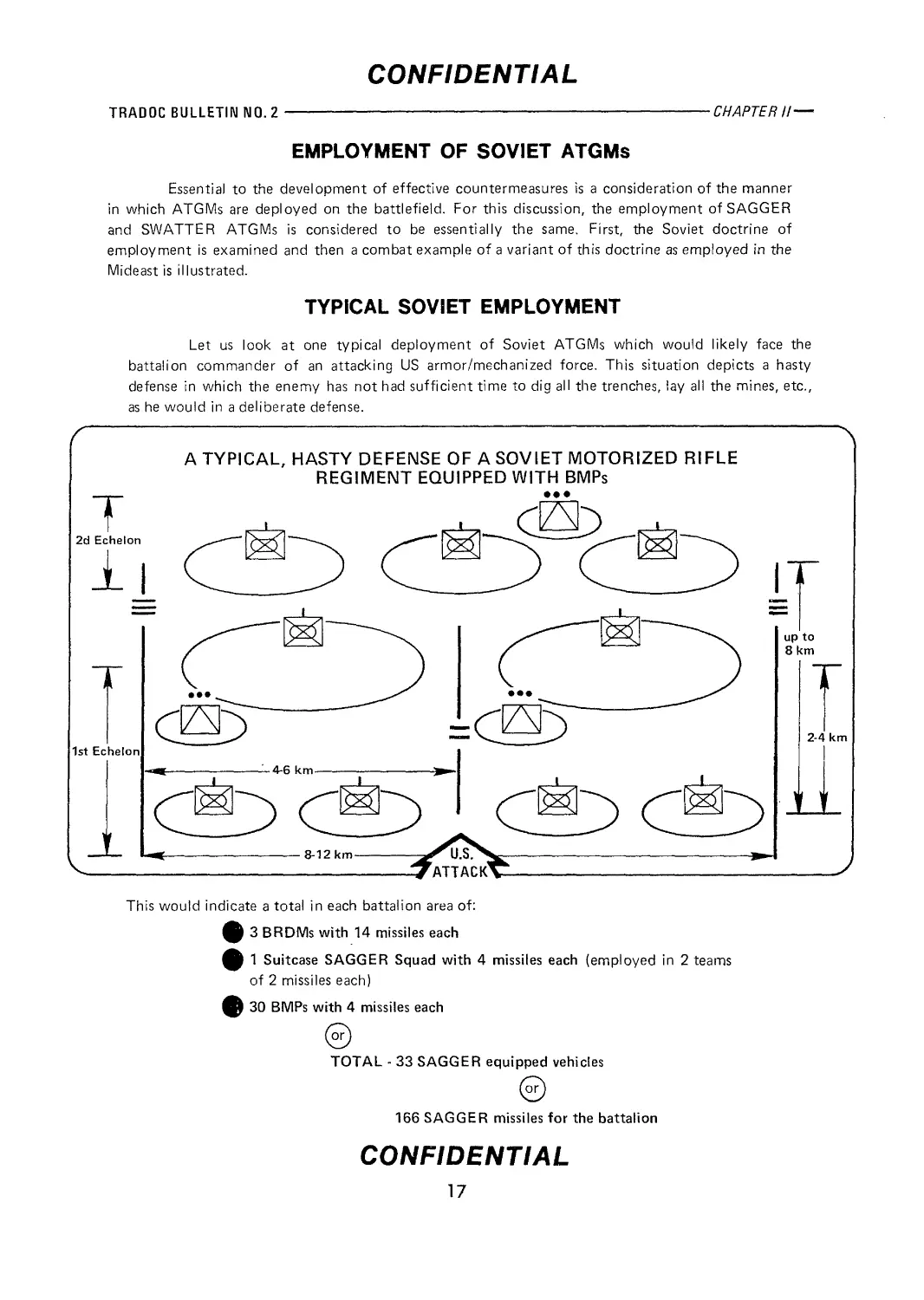
Let us look at one typical deployment of Soviet ATGMs which would likely face the
battalion commander of an attacking US armor/mechanized force. This situation depicts a hasty
defense in which the enemy has not had sufficient time to dig all the trenches, lay all the mines, etc.,
as he would in a deliberate defense.
A TYPICAL, HASTY DEFENSE OF A SOVIET MOTORIZED RIFLE
REGIMENT EQUIPPED WITH BMPs
This would indicate a total in each battalion area of:
3 BRDMs with 14 missiles each
1 Suitcase SAGGER Squad with 4 missiles each (employed in 2 teams
of 2 missiles each)
30 BMPs with 4 missiles each
(or)
TOTAL - 33 SAGGER equipped vehicles
(or)
166 SAGGER missiles for the battalion
CONFIDENTIAL
17
CONFIDENTIAL
— CHAPTERH
TRADOC BULLETIN NO. 2
ATGMs IN THE YOM KIPPUR WAR
"We were advancing and in the distance I saw specks dotted on the sand dunes. I couldn't make out
what they were. As we got closer, 1 thought they looked like tree stumps. They were motionless and
scattered across the terrain ahead of us. 1 got on the intercom and asked the tanks ahead what they
made of it. One of my tank commanders radioed back: 'My God, they're not tree stumps. They're
men!' For a moment I couldn't understand. What were men doing standing out there—quite
still—when we were advancing in our tanks towards them? Suddenly all hell broke loose. A barrage of
missiles was being fired at us. Many of our tanks were hit. We had never come up against anything like
this before...."
ISRAELI TANK COMMANDER IN THE SINAI,
October, 1973
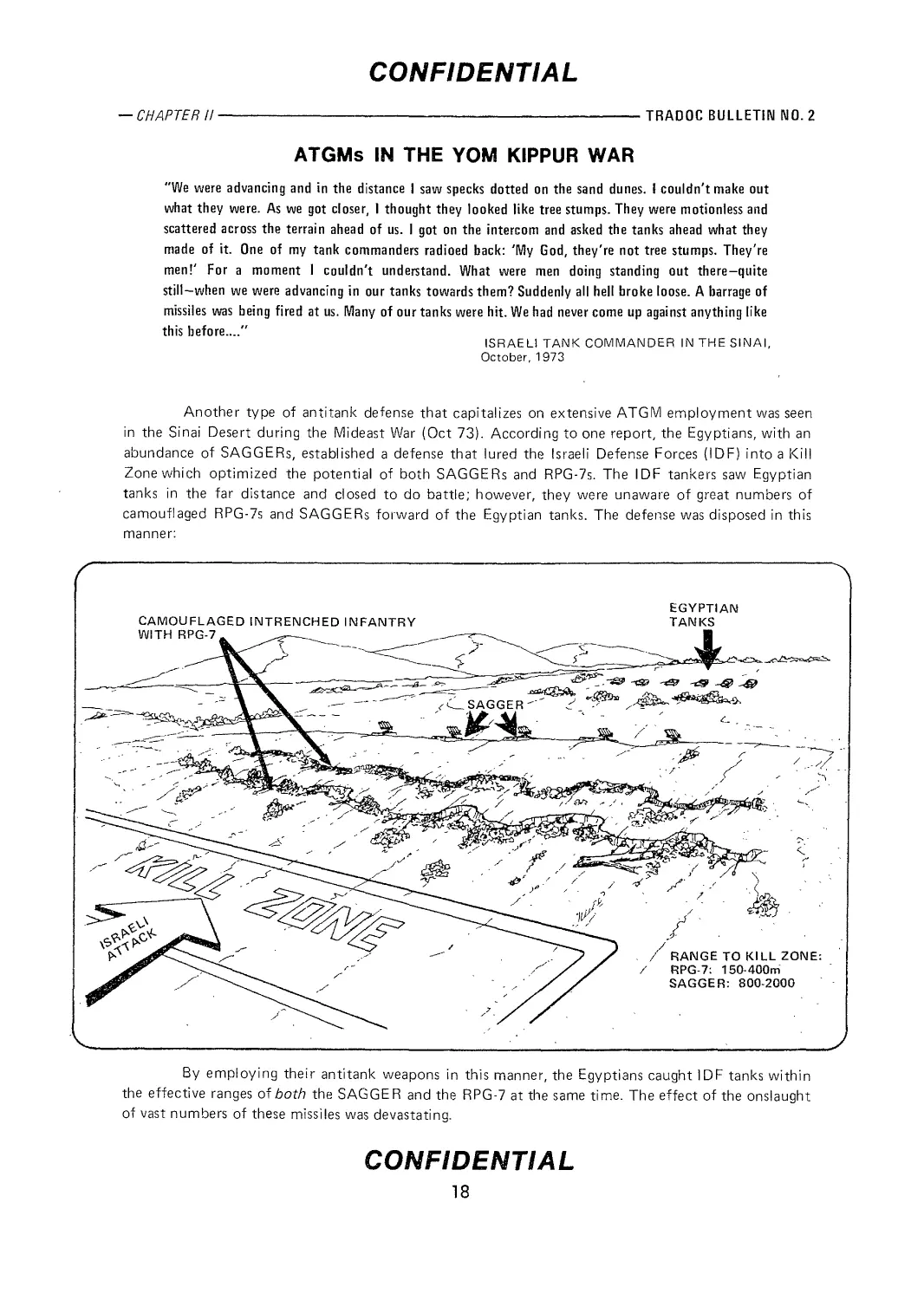
Another type of antitank defense that capitalizes on extensive ATGM employment was seen
in the Sinai Desert during the Mideast War (Oct 73). According to one report, the Egyptians, with an
abundance of SAGGERs, established a defense that lured the Israeli Defense Forces (IDF) into a Kill
Zone which optimized the potential of both SAGGERs and RPG-7s. The IDF tankers saw Egyptian
tanks in the far distance and closed to do battle; however, they were unaware of great numbers of
camouflaged RPG-7s and SAGGERs forward of the Egyptian tanks. The defense was disposed in this
manner:
By employing their antitank weapons in this manner, the Egyptians caught IDF tanks within
the effective ranges of both the SAGGER and the RPG-7 at the same time. The effect of the onslaught
of vast numbers of these missiles was devastating.
CONFIDENTIAL
18
CONFIDENTIAL
TRADOC BULLETIN NO. 2
CHAPTER 11
SUMMARY
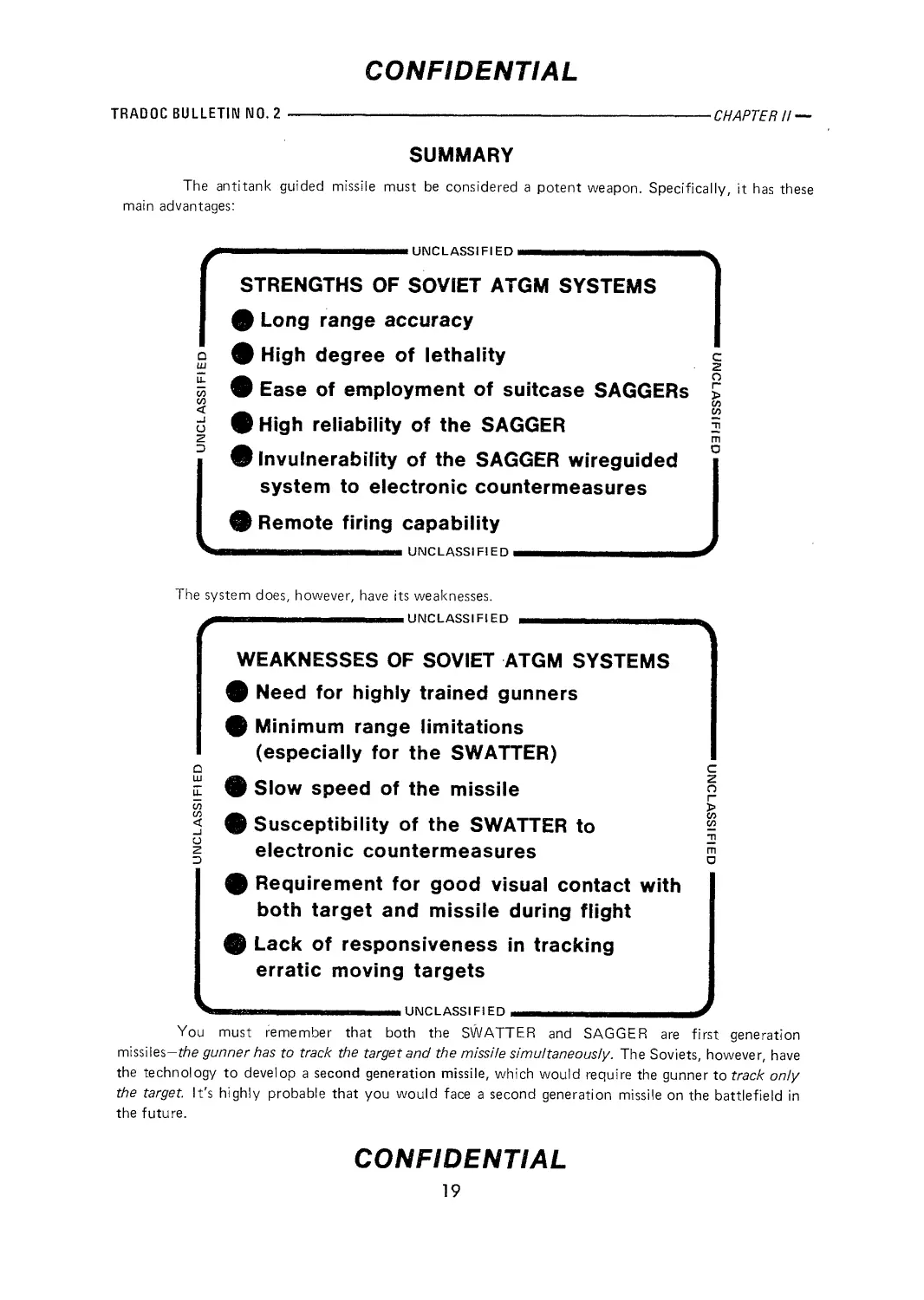
The antitank guided missile must be considered a potent weapon. Specifically, it has these
main advantages:
UNCLASSIFIED
STRENGTHS OF SOVIET ATGM SYSTEMS
ф Long range accuracy
g	ф High	degree	of	lethality	c
£ Ф Ease of employment of suitcase SAGGERs >
d	Ф High	reliability	of	the	SAGGER	5
z	m
□	O
Winvulnerability of the SAGGER wireguided
system to electronic countermeasures
Remote firing capability
UNCLASSIFIED
The system does, however, have its weaknesses.
UNCLASSIFIED
WEAKNESSES OF SOVIET ATGM SYSTEMS
•	Need for highly trained gunners
Minimum range limitations
(especially for the SWATTER)
a	c
•	Slow speed of the missile	p
< ф Susceptibility of the SWATTER to	|
| electronic countermeasures	™
ф Requirement for good visual contact with
both target and missile during flight
Ф Lack of responsiveness in tracking
erratic moving targets
UNCLASSIFIED
You must remember that both the SWATTER and SAGGER are first generation
missiles—Т/ге gunner has to track the target and the missile simultaneously. The Soviets, however, have
the technology to develop a second generation missile, which would require the gunner to track only
the target. It's highly probable that you would face a second generation missile on the battlefield in
the future.
CONFIDENTIAL
19
CONFIDENTIAL
III
COUNTERMEASURES
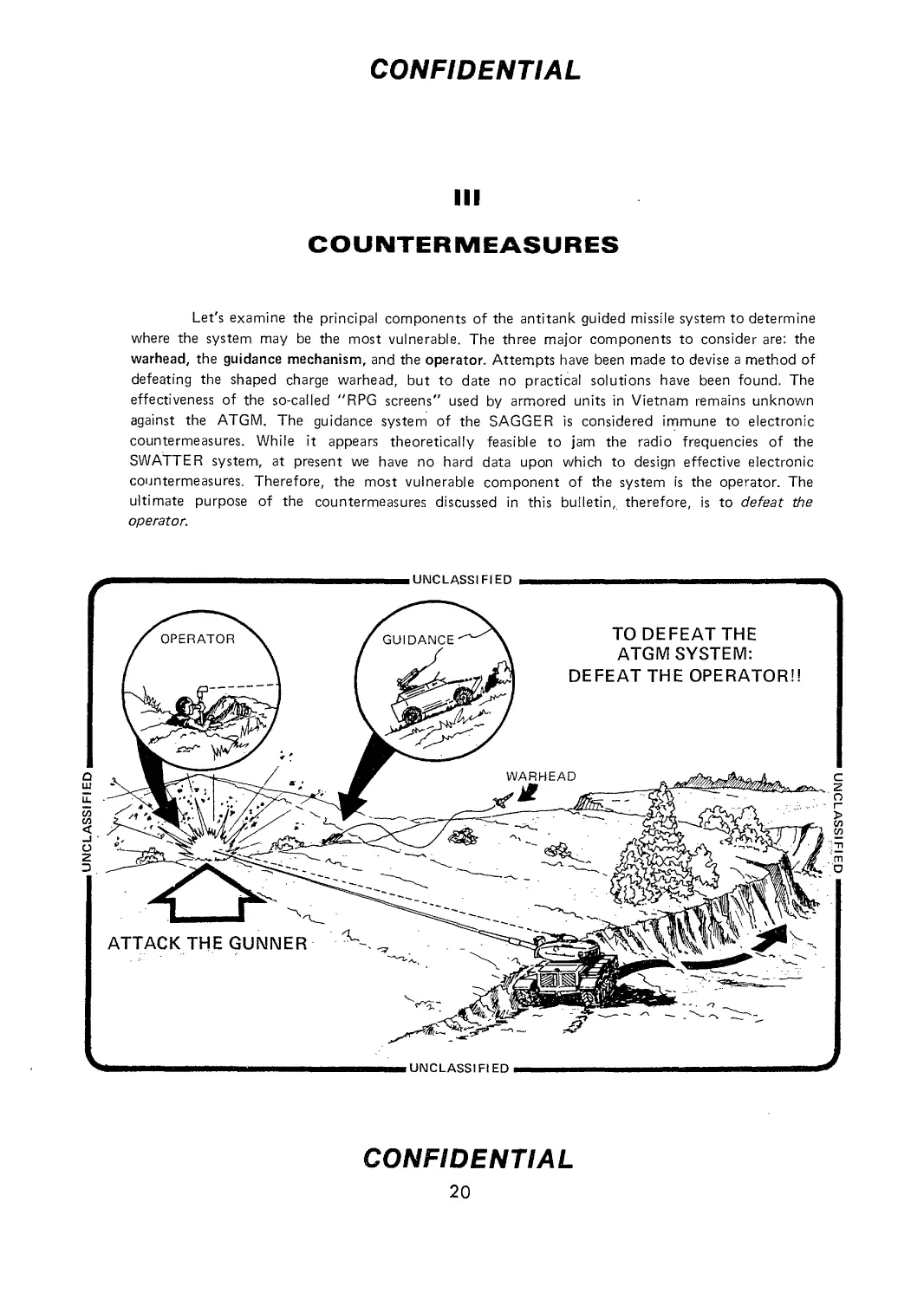
Let's examine the principal components of the antitank guided missile system to determine
where the system may be the most vulnerable. The three major components to consider are: the
warhead, the guidance mechanism, and the operator. Attempts have been made to devise a method of
defeating the shaped charge warhead, but to date no practical solutions have been found. The
effectiveness of the so-called "RPG screens" used by armored units in Vietnam remains unknown
against the ATGM. The guidance system of the SAGGER is considered immune to electronic
countermeasures. While it appears theoretically feasible to jam the radio frequencies of the
SWATTER system, at present we have no hard data upon which to design effective electronic
countermeasures. Therefore, the most vulnerable component of the system is the operator. The
ultimate purpose of the countermeasures discussed in this bulletin, therefore, is to defeat the
operator.
UNCLASSIFIED
UNCLASSIFIED
CONFIDENTIAL
20
CONFIDENTIAL
TRADOC BULLETIN NO. 2
CHAPTER ///—
MIDEAST WAR RESULTS
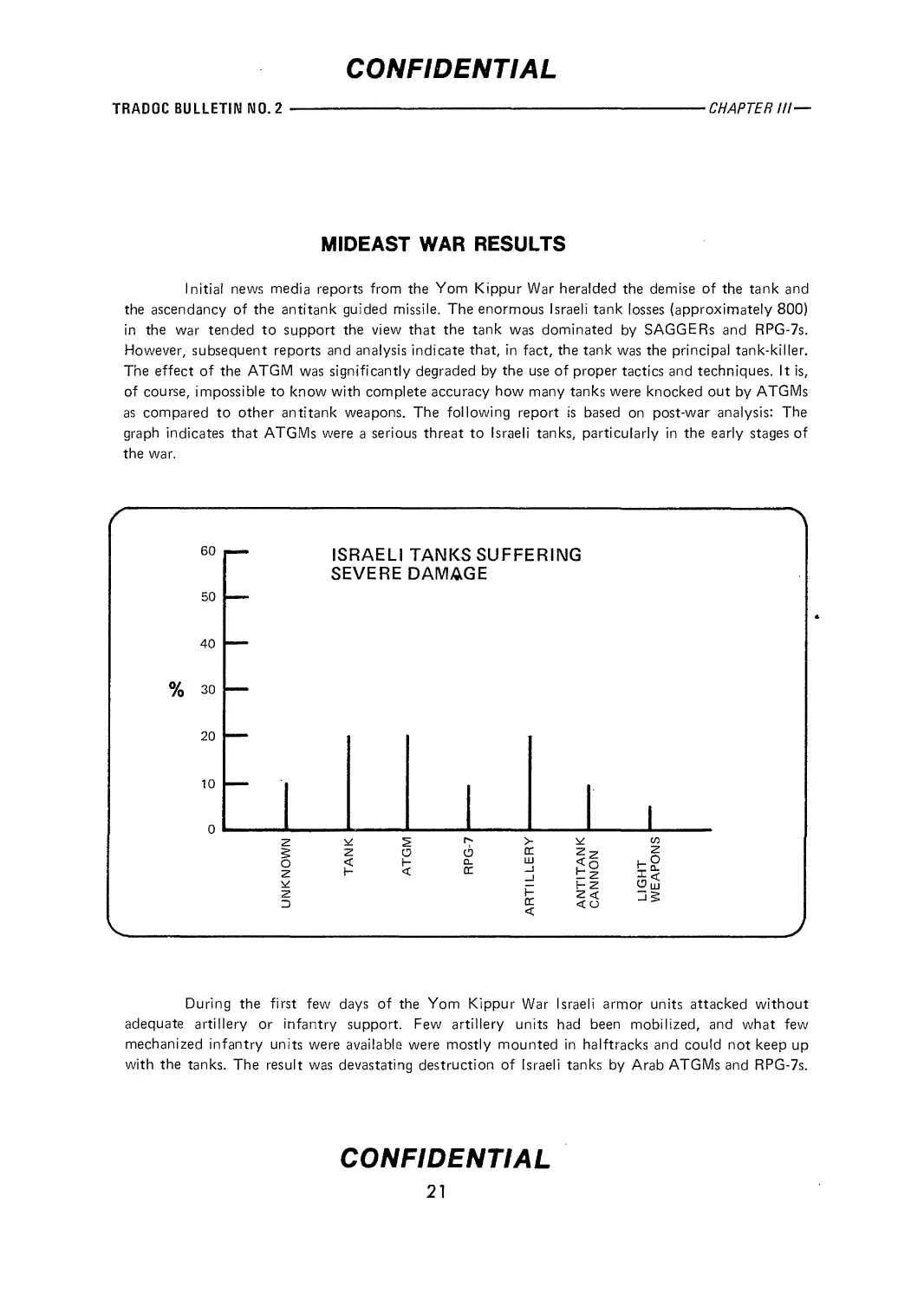
I initial news media reports from the Yom Kippur War heralded the demise of the tank and
the ascendancy of the antitank guided missile. The enormous Israeli tank losses (approximately 800)
in the war tended to support the view that the tank was dominated by SAGGERs and RPG-7s.
However, subsequent reports and analysis indicate that, in fact, the tank was the principal tank-killer.
The effect of the ATGM was significantly degraded by the use of proper tactics and techniques. It is,
of course, impossible to know with complete accuracy how many tanks were knocked out by ATGMs
as compared to other antitank weapons. The following report is based on post-war analysis: The
graph indicates that ATGMs were a serious threat to Israeli tanks, particularly in the early stages of
the war.
During the first few days of the Yom Kippur War Israeli armor units attacked without
adequate artillery or infantry support. Few artillery units had been mobilized, and what few
mechanized infantry units were available were mostly mounted in halftracks and could not keep up
with the tanks. The result was devastating destruction of Israeli tanks by Arab ATGMs and RPG-7s.
CONFIDENTIAL
21
CONFIDENTIAL
— CHAPTER ///
TRADOC BULLETIN NO. 2
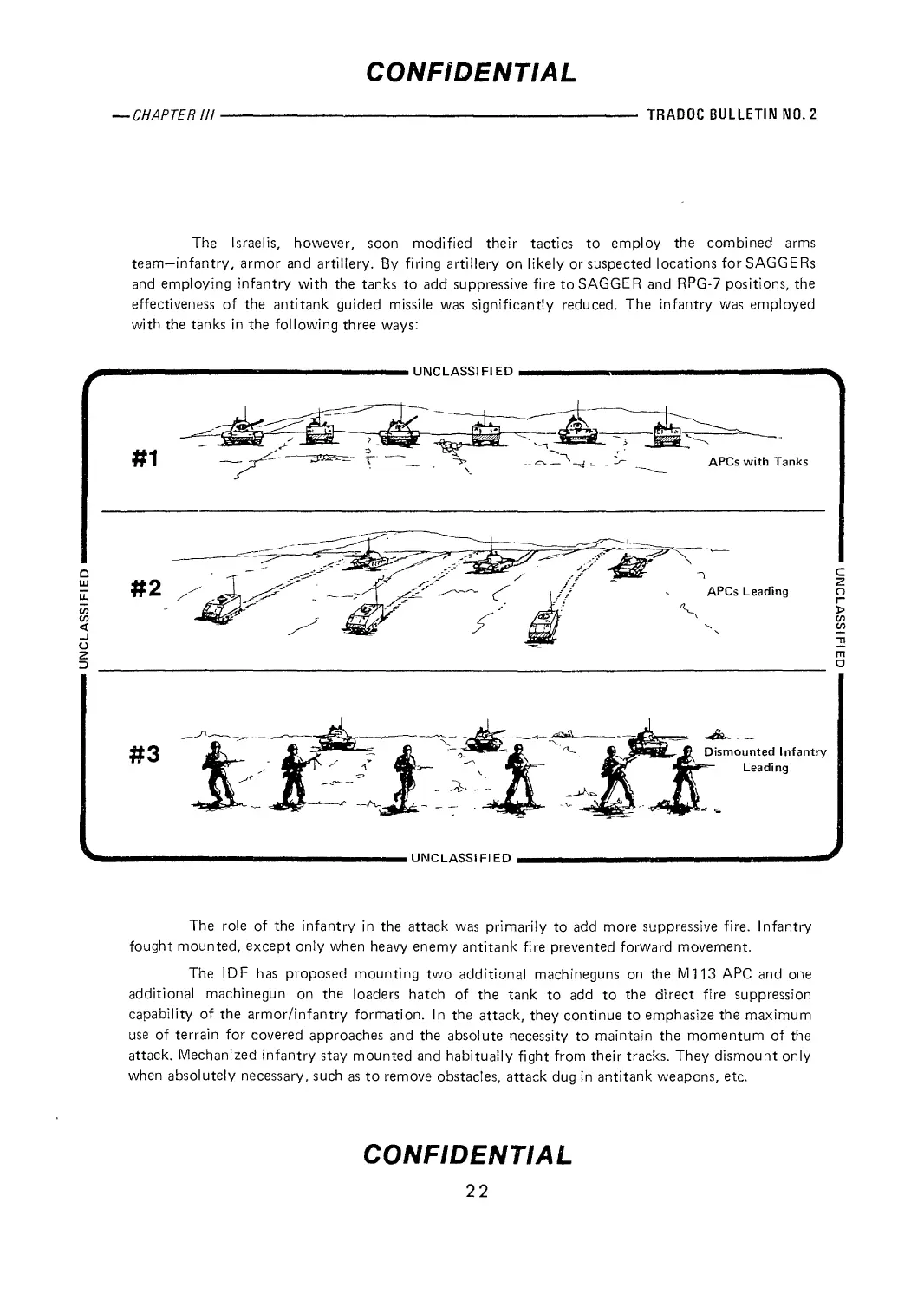
The Israelis, however, soon modified their tactics to employ the combined arms
team—infantry, armor and artillery. By firing artillery on likely or suspected locations for SAGGERs
and employing infantry with the tanks to add suppressive fire to SAGGER and RPG-7 positions, the
effectiveness of the antitank guided missile was significantly reduced. The infantry was employed
with the tanks in the following three ways:
UNCLASSIFIED
UNCLASSIFIED
The role of the infantry in the attack was primarily to add more suppressive fire. Infantry
fought mounted, except only when heavy enemy antitank fire prevented forward movement.
The IDF has proposed mounting two additional machineguns on the M113 APC and one
additional machinegun on the loaders hatch of the tank to add to the direct fire suppression
capability of the armor/infantry formation. In the attack, they continue to emphasize the maximum
use of terrain for covered approaches and the absolute necessity to maintain the momentum of the
attack. Mechanized infantry stay mounted and habitually fight from their tracks. They dismount only
when absolutely necessary, such as to remove obstacles, attack dug in antitank weapons, etc.
CONFIDENTIAL
22
CONFIDENTIAL
TRADOC BULLETIN NO. 2
CHAPTER Ш —
Other more specific techniques used by the Israeli Defense Force (IDF) to counter the
ATGM included:
THE SAGGER WATCH
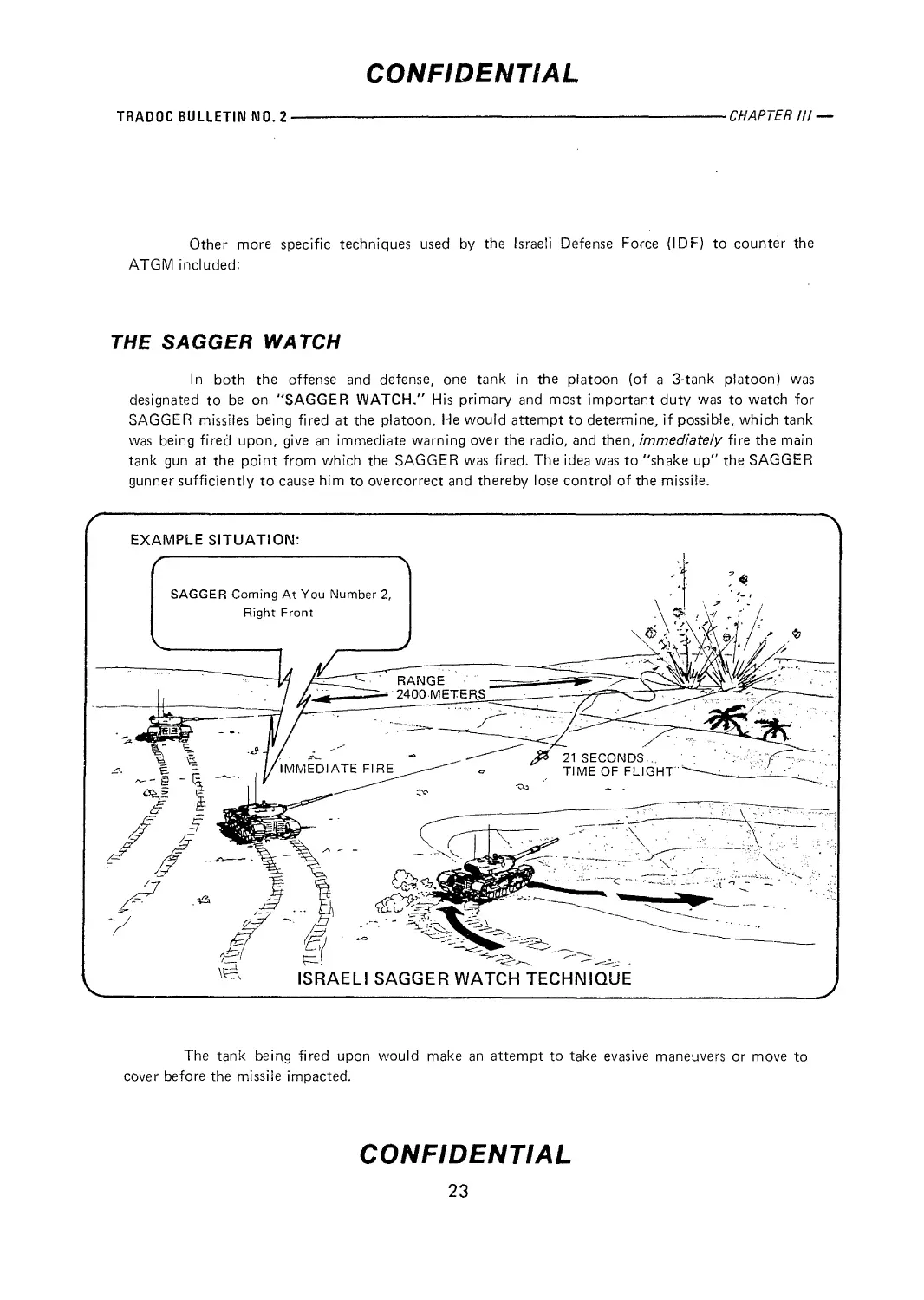
In both the offense and defense, one tank in the platoon (of a 3-tank platoon) was
designated to be on "SAGGER WATCH." His primary and most important duty was to watch for
SAGGER missiles being fired at the platoon. He would attempt to determine, if possible, which tank
was being fired upon, give an immediate warning over the radio, and then, immediately fire the main
tank gun at the point from which the SAGGER was fired. The idea was to "shake up" the SAGGER
gunner sufficiently to cause him to overcorrect and thereby lose control of the missile.
The tank being fired upon would make an attempt to take evasive maneuvers or move to
cover before the missile impacted.
CONFIDENTIAL
23
CONFIDENTIAL
— CHAPTER III
TRADOC BULLETIN NO. 2
Reports from the Mideast vary on the effectiveness of this technique. Difficulties pointed
out are:
	The missile signature is very hard to detect, especially by the tank being fired
upon. The missile does have a small vapor trail while in flight to the target. The
launch site, however, is extremely difficult to locate.
	The long range from launch site to target makes it very difficult to guess the
operator's location in order to place effective fire on his position.
	The gunner's capability to operate from a remote site (80m away from a BRDM
or 15m away for a suitcase SAGGER) and to be dug in reduces the probability of
return fire effectively harrassing him.
	in the offense when the SAGGER alarm was given there was a tendency for
every tank to move to cover or start evasive maneuvers, thus slowing the
momentum of the attack.
THE DODGE
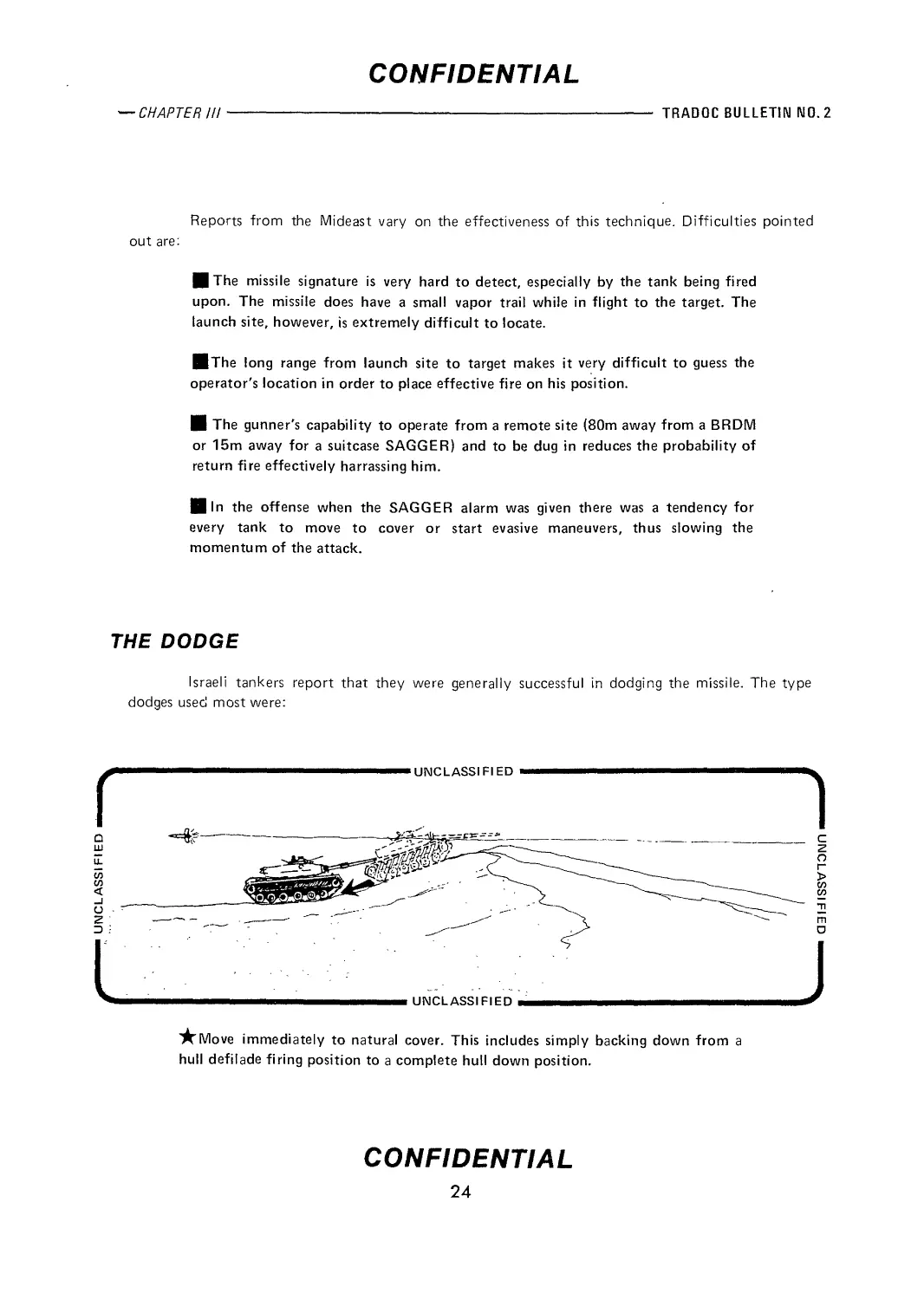
Israeli tankers report that they were generally successful in dodging the missile. The type
dodges used most were:
UNCLASSIFIED
ОЗНГ
★ Move immediately to natural cover. This includes simply backing down from a
hull defilade firing position to a complete hull down position.
CONFIDENTIAL
24
CONFIDENTIAL
TRADOC BULLETIN NO. 2
CHAPTER III -
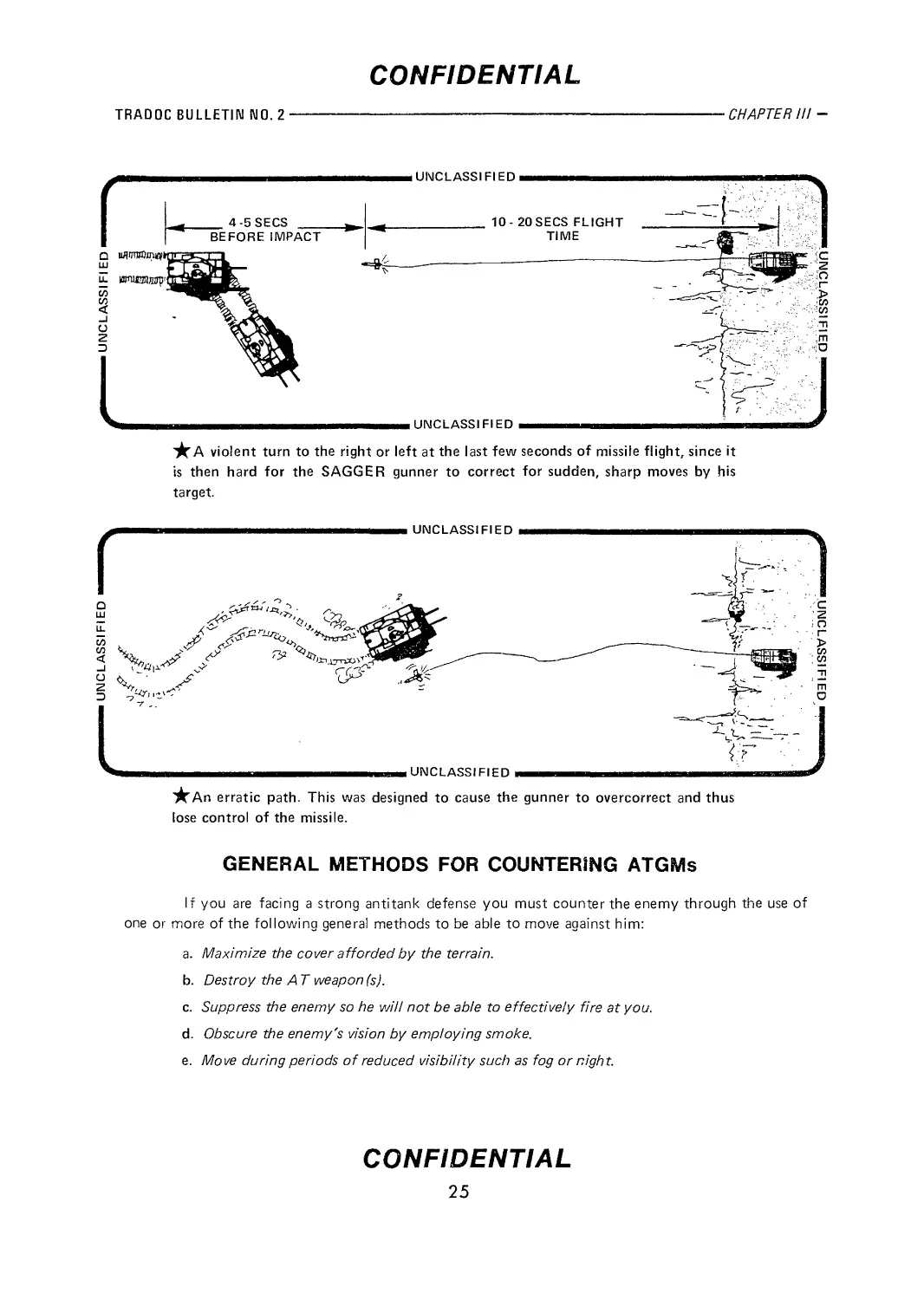
★ a violent turn to the right or left at the last few seconds of missile flight, since it
is then hard for the SAGGER gunner to correct for sudden, sharp moves by his
target.
^ЙГАп erratic path. This was designed to cause the gunner to overcorrect and thus
lose control of the missile.
GENERAL METHODS FOR COUNTERING ATGMs
If you are facing a strong antitank defense you must counter the enemy through the use of
one or more of the following general methods to be able to move against him:
a.	Maximize the cover afforded by the terrain.
b.	Destroy the A T weapon (s).
c.	Suppress the enemy so he will not be able to effectively fire at you.
d.	Obscure the enemy's vision by employing smoke.
e.	Move during periods of reduced visibility such as fog or night.
CONFIDENTIAL
25
CONFIDENTIAL
— CHAPTER III
TRADOC BULLETIN NO. 2
(NOTE: Recently developed night vision devices plus battlefield illumination
enable the enemy to see extremely well at night. Thus, maximum use of the terrain
is essential even at night.)
a TERRAIN
One of the most effective countermeasures to the Soviet ATGM is still the proper use of
terrain! Emphasis in training must be on:
	Bounding and traveling overwatch as discussed in TCs 17-15-3, 17-36-2, 7-4 and 71-4-2.
	Firing from hull defilade positions.
	Using covered routes of approach even at long ranges (3-4 km) from suspected enemy
positions.
b DESTRUCTION
Obviously, antitank weapons that are destroyed are effectively countered. Many Soviet
ATGMs move about the battlefield on vehicles vulnerable to tank and antitank fire. Thus, destruction
of a BMP is more significant than the mere destruction of an armored personnel carrier—it is the
destruction of 4 or 5 SAGGER missiles. Similarly, destruction of a BRDM represents the destruction
of 14 SAGGER missiles and not just the destruction of an enemy scout vehicle.
All aspects of good gunnery techniques, as outlined in appropriate field manuals and training
circulars, apply to .the destruction of ATGMs. Several points, however, deserve special emphasis:
 Trainto hit at long ranges. Since the ATGM is accurate at long ranges, it will
most likely be encountered there.
 Train to hit small targets. You are not likely to have many shots at fully exposed
vehicles. They will fire from hull defilade. So train accordingly. Don't train on large
7 1/2' X 7 1/2' panels; use smaller ones (maximum of 3 1/2' X 3 1/2').
 Train to shoot FAST and hit. The old tank gunnery standards
of getting a round off within 15 seconds is too slow. To be able
to distract a SAGGER gunner while his missile is in flight you
have to fire within 5-10seconds.	„	_
See TC 17-12-5
Mechanized infantry may be forced to dismount, attack and destroy ATGMs if they cannot
be countered by other means. This method, however, is time consuming and the momentum of an
attack may be lost. Training should be oriented to rapid (i.e., double time) movement of lightly
equipped dismounted troops.
CONFIDENTIAL
26
CONFIDENTIAL
TRADOC BULLETIN NO. 2
CHAPTER /// —
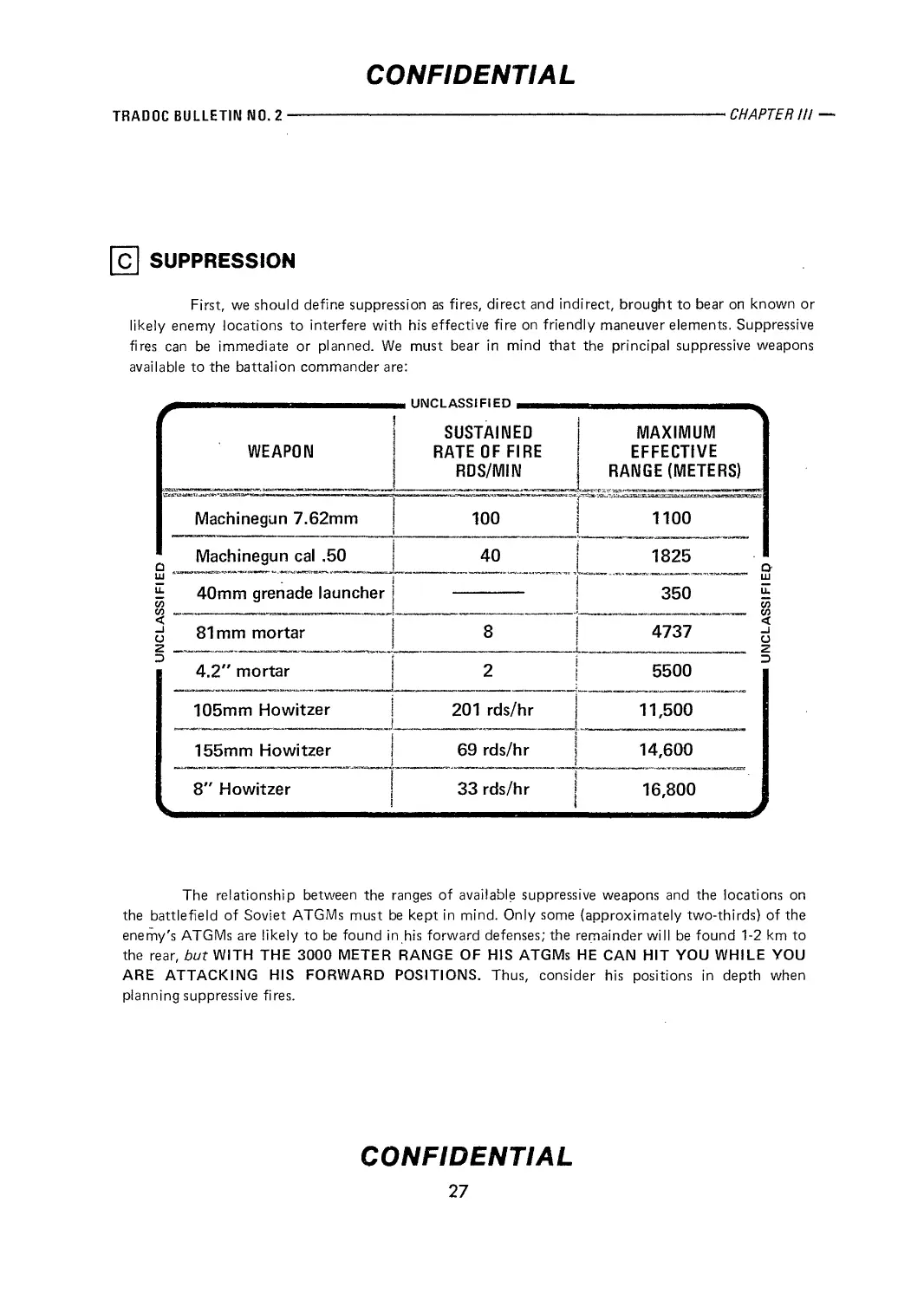
C SUPPRESSION
First, we should define suppression as fires, direct and indirect, brought to bear on known or
likely enemy locations to interfere with his effective fire on friendly maneuver elements. Suppressive
fires can be immediate or planned. We must bear in mind that the principal suppressive weapons
available to the battalion commander are:
UNCLASSIFIED
WEAPON	SUSTAINED	MAXIMUM RATE OF FIRE	I	EFFECTIVE RDS/MIN	RANGE (METERS)
Machinegun 7.62mm	_ .. 		 100	|	1100 1
(	Machinegun cal .50 £	40mm grenade launcher и 81mm mortar	40	I	1825 L	о 				«Т7 I	w 		।	35Q	u. 	J	a 8	|	4737	3 X	.	«2
□ 4.2" mortar , 				 		 105mm Howitzer 155mm Howitzer 8" Howitzer к		2	।	5500 201 rds/hr	|	11,500 69 rds/hr	!	14,600 	j_ 33 rds/hr	|	16,800 	!	j
The relationship between the ranges of available suppressive weapons and the locations on
the battlefield of Soviet ATGMs must be kept in mind. Only some (approximately two-thirds) of the
enemy's ATGMs are likely to be found in his forward defenses; the remainder will be found 1-2 km to
the rear, but WITH THE 3000 METER RANGE OF HIS ATGMs HE CAN HIT YOU WHILE YOU
ARE ATTACKING HIS FORWARD POSITIONS. Thus, consider his positions in depth when
planning suppressive fires.
CONFIDENTIAL
27
— CHAPTER ///
TRADOC BULLETIN NO. 2
You should:
	Make maximum use of tank and APC machinegun fire to provide direct fire
suppression in the assault.
	Consider available resources that can provide suppression and allocate a portion
to suppress dangerous and likely SAGGER positions BEHIND the forward defenses.
	Ensure correct timing. The maximum amount of suppressive fire must be
delivered during those moments the maneuver force is most exposed.
	Use VT fire to the maximum, particularly in loose sandy soil. On loose sandy
soil, point detonating rounds lose up to 60% of their effectiveness.
Additionally, the principles explained in TC 6-20-1 concerning field artillery suppression of
direct fire weapons should be known and applied by maneuver and field artillery units in training.
These principles are:
★	DEDICATE FIRING BATTERIES TO COMPANY TEAMS
★	MONITOR MANEUVER COMPANY COMMAND NETS
★	SIMPLIFY CALLS FOR FIRE
★	DEVIATE FROM NORMAL FIRE PLANNING
★	STANDARDIZE AND ENSURE THAT FOs POSSESS MANEUVER CONTROL
MEASURES
★	FDC AND FIRING BATTERY PROCEDURES MODIFIED TO RESPOND
WITHIN 30-45 SECONDS
★	TRADE SOME ACCURACY FOR SPEED
(See TC 6-20-1 for a full discussion of these principles)
[d] OBSCURATION
It may prove difficult to suppress ATGMs through suppressive fire only. Shortages in
artillery ammunition and well protected enemy positions may require alternative means of degrading
ATGM effectiveness. Obscuration by smoke offers an attractive option. Commanders should:
 Know the capabilities and limitations. Different rounds have different effects
under different conditions. You should know what smoke can and cannot do. As a
28
CHAPTER III ~
TRADOC BULLETIN NO. 2
rough guide, you can figure that an artillery round of smoke (HC) will give you
about 5-6 minutes of obscuration when there is little or no wind. White
phosphorous rounds, on the other hand, will only provide 1-1 1/2 minutes of
obscuration since it dissipates rapidly.
 Train to use smoke. Training exercises should include the use of smoke.
Extensive training with live fire smoke rounds is ideal; however, this will not always
be possible. When conducting field exercises, ARTEP, and ORTTs, the use of
smoke should always be played to the maximum extent possible.
H Plan for the use of smoke. You must think through the amount of smoke you
will need to move on the battlefield. It will be a lot. Present FMs do not give a
reliable guide because past experience on smoke usage did not include countering
ATGM. Smoke will be more important, and its use will be more extensive than ever.
Look at your basic load. Are you ready?
 Plan your smoke to coincide with your tactical move. Timing is critical! Planning"
a smoke mission is more complicated than the normal HE mission—it takes more
time to process and to build up on the ground. Once obtained, the obscuration will
have to be maintained during the move. Don't get caught in the open!
More reliable data on the effects of smoke are forthcoming. Tests are presently being
conducted and future bulletins and/or training circulars will address this subject in more detail.
0 REDUCED VISIBILITY
With recently developed night vision devices now available to the enemy, the "cover of
darkness" no longer provides the protection it once did. However, to counter the effects of known
Soviet ATGMs there still is an advantage to moving on the battlefield at night instead of during the
day because:
 There is apparently no night sight for present Soviet ATGMs, which must rely on
artificial illumination.
 Current Soviet night vision devices are apparently only effective out to 1500
mete rs.
 Fog, especially at night, effectively degrades enemy ATGMs even at close range.
Future bulletins and/or Training Circulars will treat this important subject in greater detail.
— CHAPTER ///
TRADOC BULLETIN NO. 2
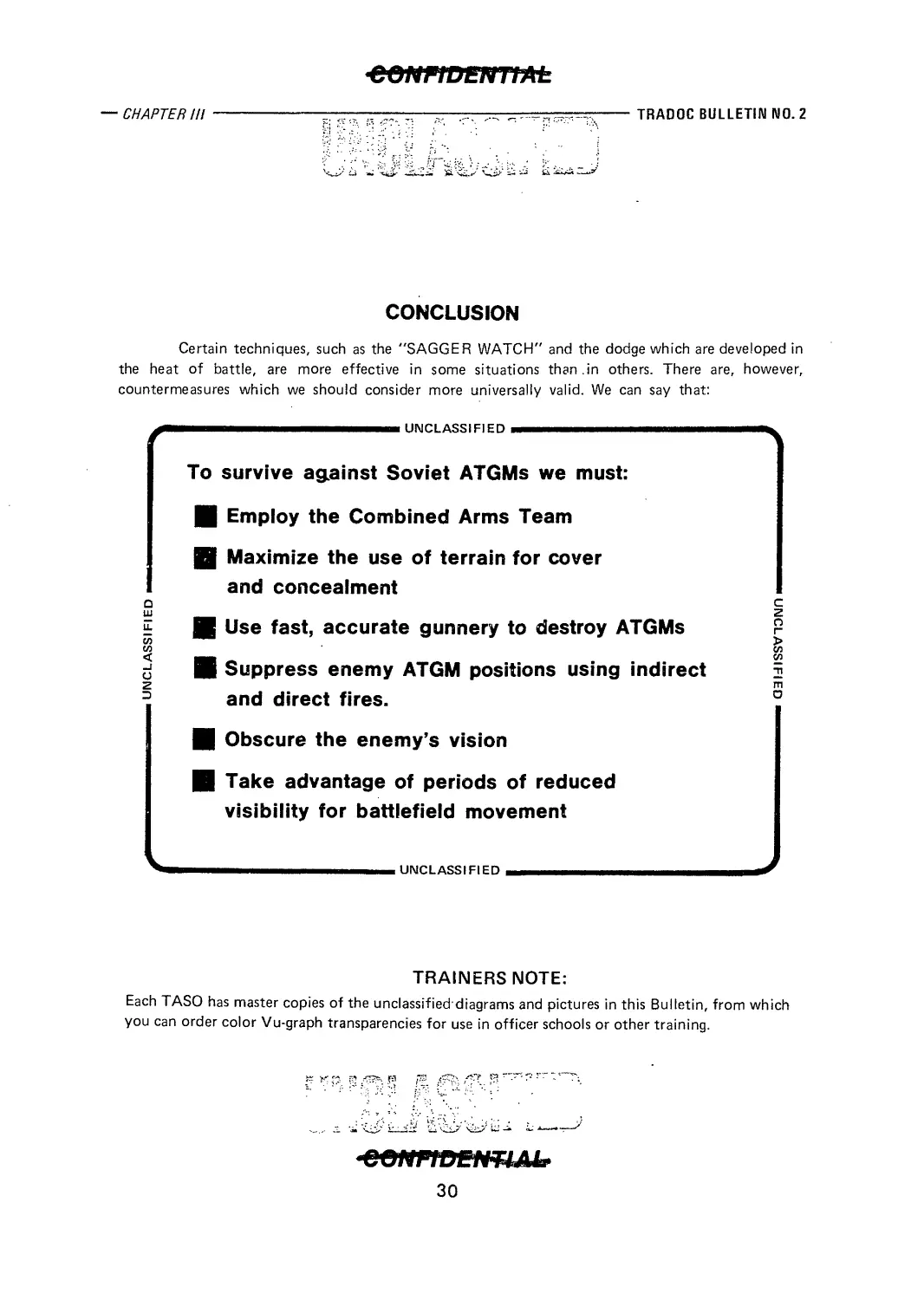
CONCLUSION
Certain techniques, such as the "SAGGER WATCH" and the dodge which are developed in
the heat of battle, are more effective in some situations than.in others. There are, however,
countermeasures which we should consider more universally valid. We can say that:
UNCLASSIFIED
To survive against Soviet ATGMs we must:
Ц Employ the Combined Arms Team
В Maximize the use of terrain for cover
and concealment
Ш	z
±	 Use fast, accurate gunnery to destroy ATGMs	P
о	HI Suppress enemy ATGM positions using indirect	5
о
z
□
and direct fires.
ГП
□
Ц Obscure the enemy’s vision
Ц Take advantage of periods of reduced
visibility for battlefield movement
UNCLASSIFIED
TRAINERS NOTE:
Each TASO has master copies of the unclassified-diagrams and pictures in this Bulletin, from which
you can order color Vu-graph transparencies for use in officer schools or other training.

TRADOC BULLETIN NO. 2
TRADOC BULLETIN NO. 2
CONfWCNTIAL
General, United States Army
Commanding
DISTRIBUTION:
Active Army, ARNG, USAR: To be distributed to selected DA Form 12-11 accounts (2 copies each).
Additional copies can be requisitioned (DA Form 17) from the US Army Adjutant General Publications
Center, 2800 Eastern Boulevard, Baltimore, MD 21220