/

Текст
                    UNCLASSIFIED
UNITED STATES ARMY TRAINING AND DOCTRINE COMMAND
TRADOC1
BULLETIN -1-
• WEAPONS
• TACTICS
• TRAINING
30 SEPTEMBER 1975
UNCLASSIFIED
1.	This TRADOC Bulletin is published in unclassified form to
facilitate the dissemination of information previously printed in
TRADOC Bulletin 1 (Sept 1974), which was classified
Confidential. Information contained herein was declassified as of
21 May 1975. Some data contained in TRADOC Bulletin 1 (C)
remains clasified and is, therefore, not reprinted here.
2.	Knowledge of the weapons capabilities and suggested tactical
techniques in this bulletin will assist combat units to pass their
ARTEPs.
3.	Weapons capabilities and tactical techniques are also
presented in the "How to Fight" film series. The
"Tank/Mechanized Infantry Team" (part 1, Modern Battle)
depicts information similar to the contents of this bulletin.
REPORT DOCUMENTATION PAGE			Form Approved 0MB No. 0704-0188
Public reporting burden for this collection of information is estimated to average 1 hour per response, including the time for reviewing instructions, searching existing data sources, gathering and maintaining the data needed, and completing and reviewing the collection of information. Send comments regarding this burden estimate or any other aspect of this collection of information, including suggestions for reducing this burden, to Washington Headquarters Services, Directorate for Information Operations and Reports, 1215 Jefferson Davis Highway, Suite 1204, Arlington, VA 22202-4302, and to the Office of Management and Budget, Paperwork Reduction Project (0704-0188), Washington, DC 20503.
1. AGENCY USE ONLY (Leave blank)	2. REPORT DATE	3. REPORT TYPE AND DATES COVERED 30 SEPT 1975	FINAL
4. TITLE AND SUBTITLE TRADOC BULLETIN 1. RANGE AND LETHALITY OF U.S. AND SOVIET ANTI-ARMOR WEAPONS			5. FUNDING NUMBERS
6. AUTHOR(S)
7. PERFORMING ORGANIZATION NAME(S) AND ADDRESS(ES) HQ U.S. ARMY TRAINING AND DOCTRINE COMMAND ATTN: ATTNG-CON FORT MONROE VIRGINIA 23651			8. PERFORMING ORGANIZATION REPORT NUMBER
9. SPONSORING / MONITORING AGENCY NAME(S) AND ADDRESS(ES)			10. SPONSORING 1 MONITORING AGENCY REPORT NUMBER
11. SUPPLEMENTARY NOTES
12a. DISTRIBUTION / AVAILABILITY STATEMENT APPROVED FOR PUBLIC RELEASE; DISTRIBUTION IS UNLIMITED.			12b. DISTRIBUTION CODE
13. ABSTRACT (Maximum 200 words) This bulletin presents basic data on the principal US and Soviet tank guns, antitank rockets, and antitank guided missiles. They illustrate that on today's battlefield: what can be seen can.be hit; what can be hit, can be killed . Curves and tables have been derived from information supplied by the Defense Intelligence Agency and the US Army Materiel Systems Analysis Agency. Each graph or table describes the best expected performance of the weapon: its capability under optimum conditions of full daylight, ease in target acquisition, complete target visibility during firing sequence, and operation by a skilled crew. Obviously, weather, terrain, combat stress, and inadequate training will degrade performance. But as both sides discovered in the recent Arab-Israeli War, modern weapons are terrifyingly destructive, and resourceful commanders can find ways to employ them to effect no matter what the situation.
14. SUBJECT TERMS				15. NUMBER OF PAGES 34
				16. PRICE CODE
17. SECURITY CLASSIFICATION OF REPORT UNCLASSIFIED	18. SECURITY CLASSIFICATION OF THIS PAGE UNCLASSIFIED	19. SECURITY CLASSIFICATION OF ABSTRACT UNCLASSIFIED		20. LIMITATION OF ABSTRACT UNLIMITED
NSN 7540-01-280-5500
Standard Form 298 (Rev. 2-89)
Prescribed by ANSI Std. Z39-18 298-102
USAPPCV1.Q0
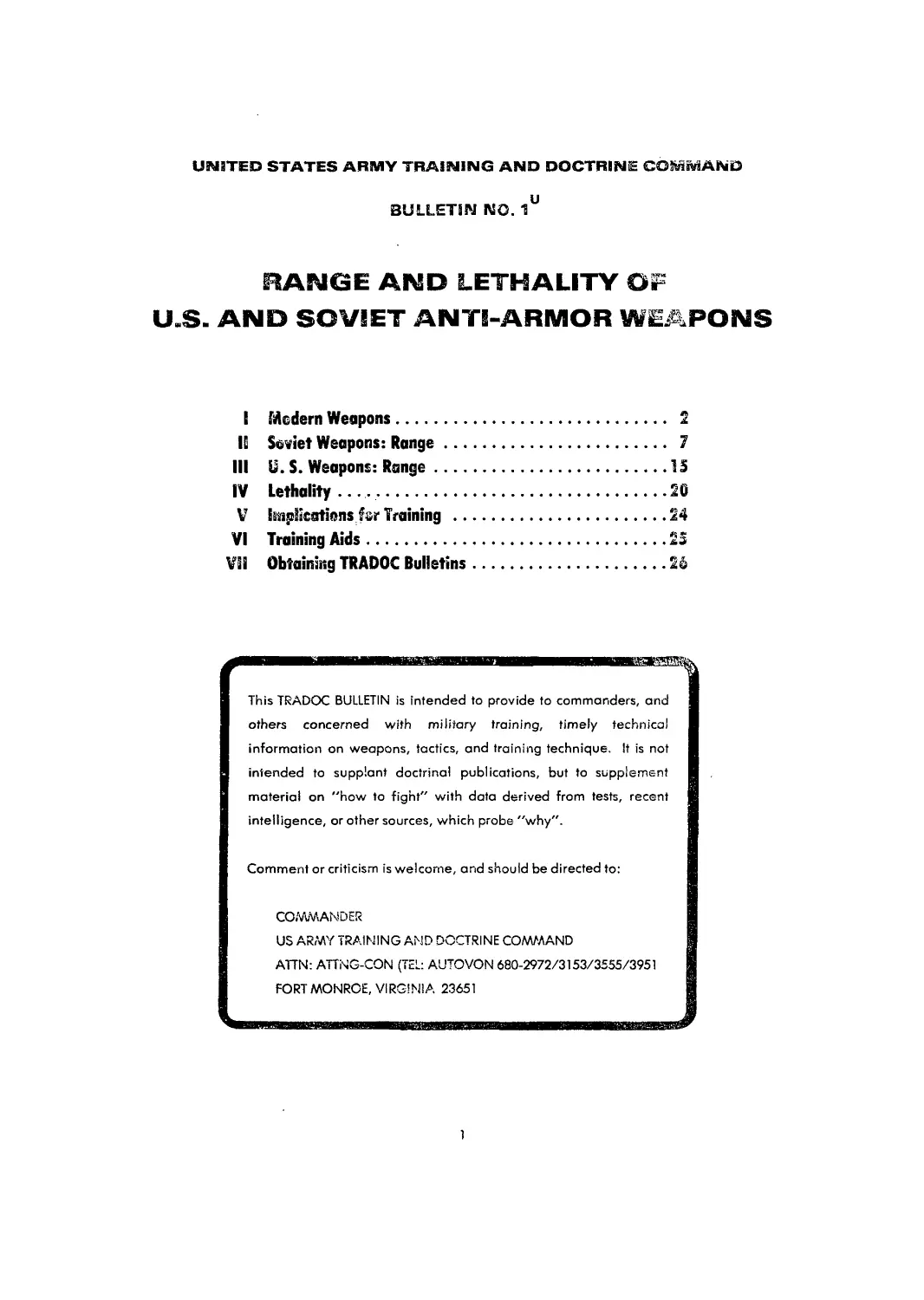
UN3TED STATES ARMY TRAINING AND DOCTRINE COMMAND
u
BULLETIN NO. 1
RANGE AND LETHALITY OF
ULS- AND SOVIET ANTI-ARMOR WEAPONS
I	Modern Weapons....................................   2
IE	Soviet Weapons: Range............................... 1
III	U. S. Weapons: Range ...............................15
IV	Lethality ... ......................................20
V	Implications .for Training .........................24
VI	Training Aids.......................................25
VII	Obtaining TRADOC Bulletins..........................26

This TRADOC BULLETIN is intended to provide to commanders, and
others concerned with military training, timely technical
information on weapons, tactics, and training technique. It is not
intended to supplant doctrinal publications, but to supplement
material on "how to fight" with data derived from tests, recent
intelligence, or other sources, which probe "why".
Comment or criticism is welcome, and should be directed to:
COMMANDER
US ARMY TRAINING AND DOCTRINE COMMAND
ATTN: AUNG-CON (TEL: AUTOVON 680-2972/3153/3555/3951
FORT MONROE, VIRGINIA 23651
I
MODERN WEAPONS
Facts on the reach and killing prowess of modern tank and antitank weapons should be
engraved in the mind of every commander of American troops. Ours is now largely an
armored-mechanized force. More importantly, our potential enemies are lavishly equipped with
advanced tank/antitank weaponry. Only the commander who knows the potential of Soviet
equipment can counter it; and only he who understands what present US weapons can accomplish
is prepared to use them to the best advantage of his mission and his men.
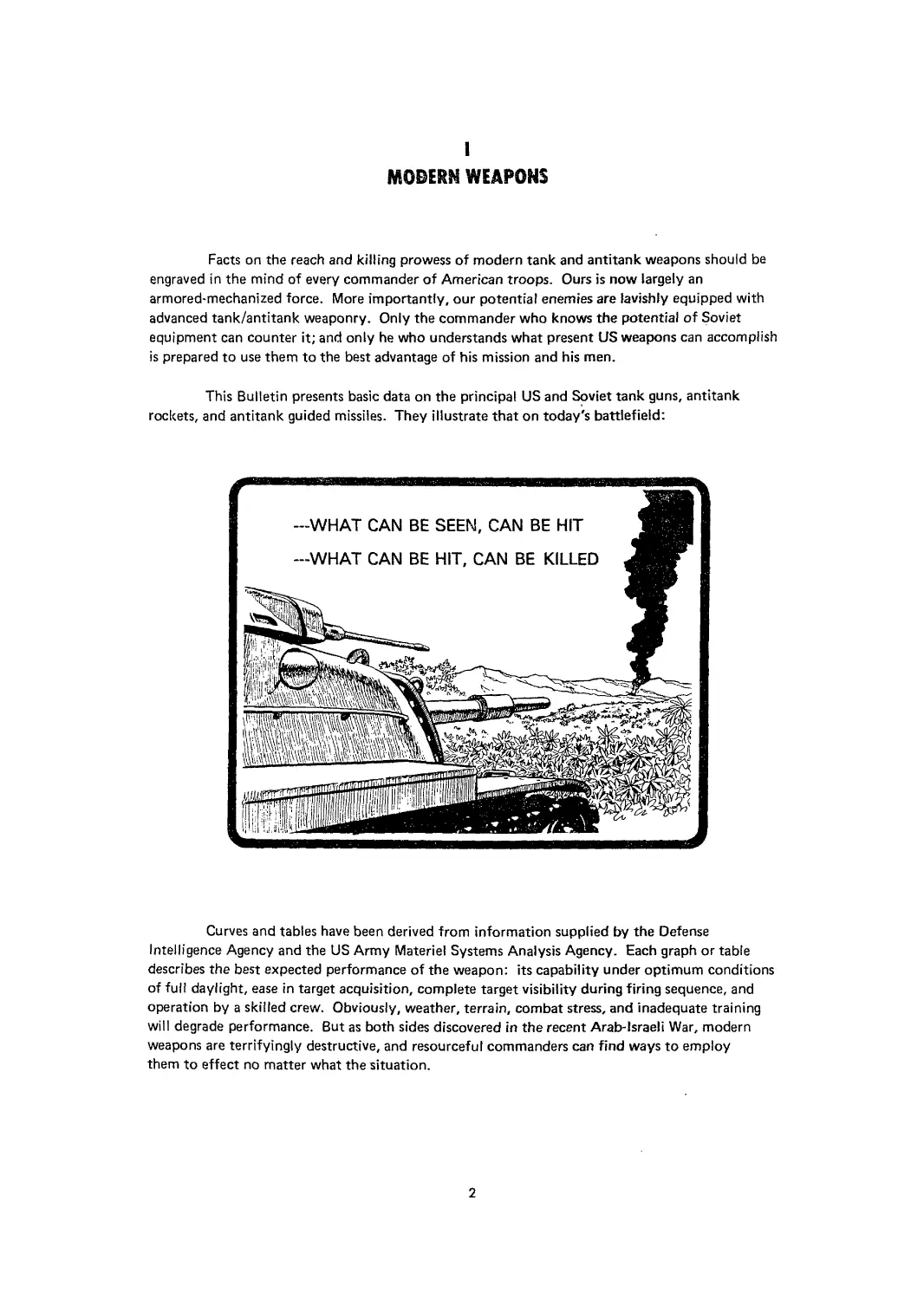
This Bulletin presents basic data on the principal US and Soviet tank guns, antitank
rockets, and antitank guided missiles. They illustrate that on today's battlefield:
Curves and tables have been derived from information supplied by the Defense
Intelligence Agency and the US Army Materiel Systems Analysis Agency. Each graph or table
describes the best expected performance of the weapon: its capability under optimum conditions
of full daylight, ease in target acquisition, complete target visibility during firing sequence, and
operation by a skilled crew. Obviously, weather, terrain, combat stress, and inadequate training
will degrade performance. But as both sides discovered in the recent Arab-Israeli War, modern
weapons are terrifyingly destructive, and resourceful commanders can find ways to employ
them to effect no matter what the situation.
2
TANKS
f	U.S. M60A1	U.S. M60A2	U.S.S.R/’ T-62
Weight, combat load (tons)	53	57.2	40.2
Length w/o gun (ft)	22.9	22.9	22
Width overall (ft)	11.9	11.9	11
Height (ft)	10'10"	10'10"	7.9
Max Road Speed (mph)	30	30	30
Cruising Range (miles)	310	310	310
Crew	4	4	4
Main gun (mm)	105	152	115
Rounds aboard	63	46 Plus (13 msl)	40
Elevation limits (degrees)	-10 to+19	-10 to+20	-5 to +18
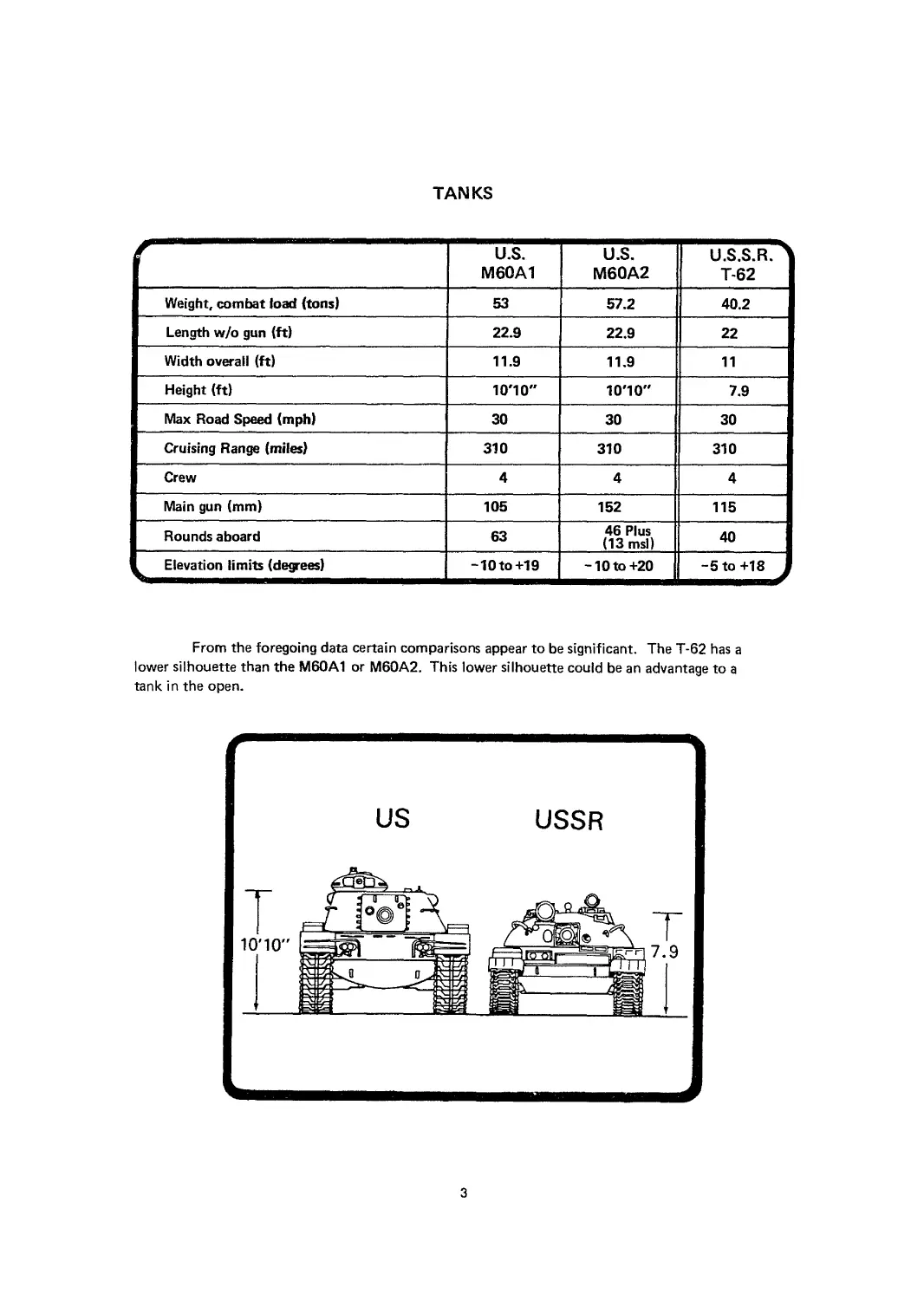
From the foregoing data certain comparisons appear to be significant. The T-62 has a
lower silhouette than the M60A1 or M60A2. This lower silhouette could be an advantage to a
tank in the open.
3
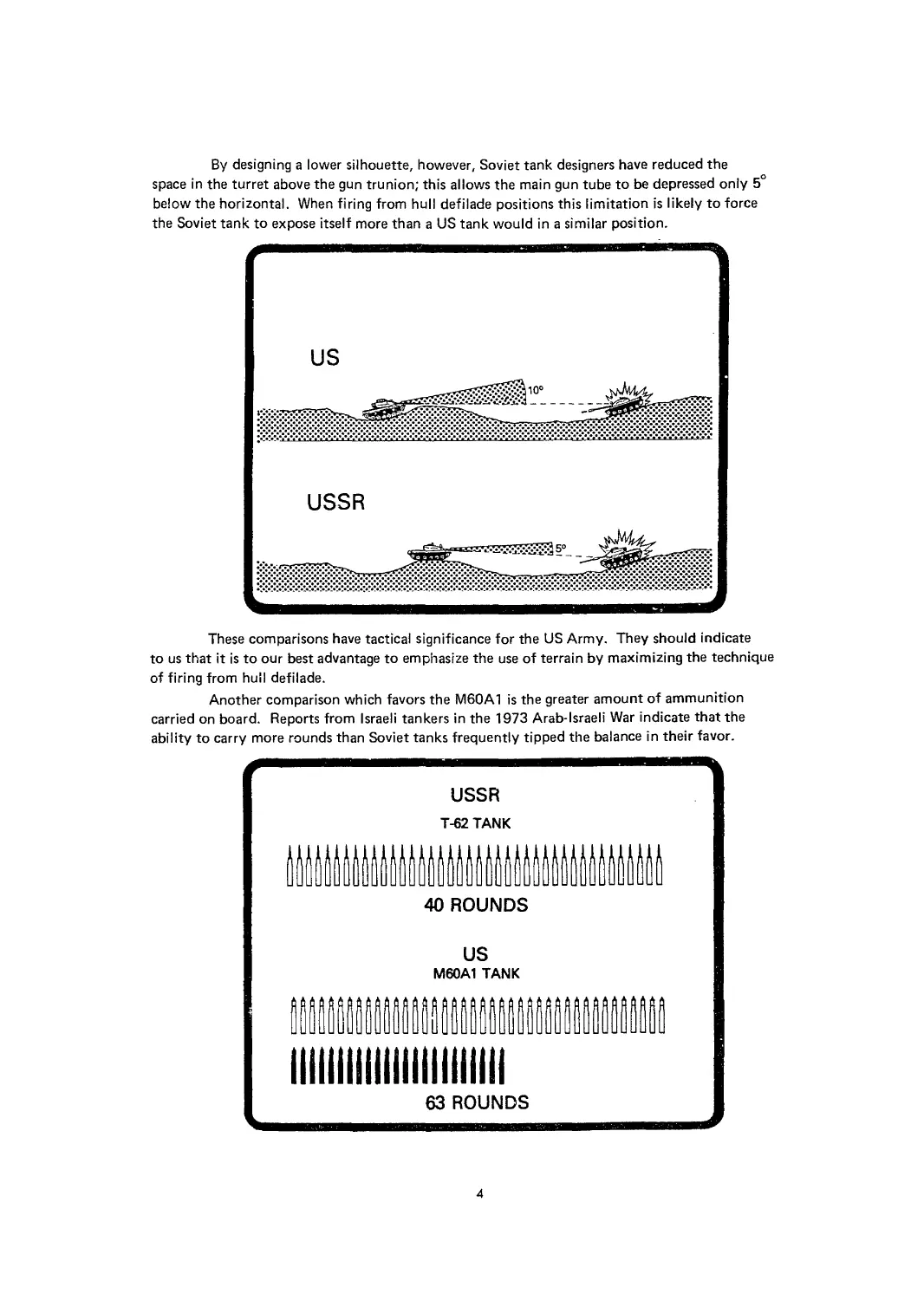
By designing a lower silhouette, however, Soviet tank designers have reduced the
space in the turret above the gun trunion; this allows the main gun tube to be depressed only 5°
below the horizontal. When firing from hull defilade positions this limitation is likely to force
the Soviet tank to expose itself more than a US tank would in a similar position.
These comparisons have tactical significance for the US Army. They should indicate
to us that it is to our best advantage to emphasize the use of terrain by maximizing the technique
of firing from hull defilade.
Another comparison which favors the M60A1 is the greater amount of ammunition
carried on board. Reports from Israeli tankers in the 1973 Arab-Israeli War indicate that the
ability to carry more rounds than Soviet tanks frequently tipped the balance in their favor.
USSR
T-62 TANK
40 ROUNDS
US
M60A1 TANK
llllllllllillilllllllll
63 ROUNDS
4
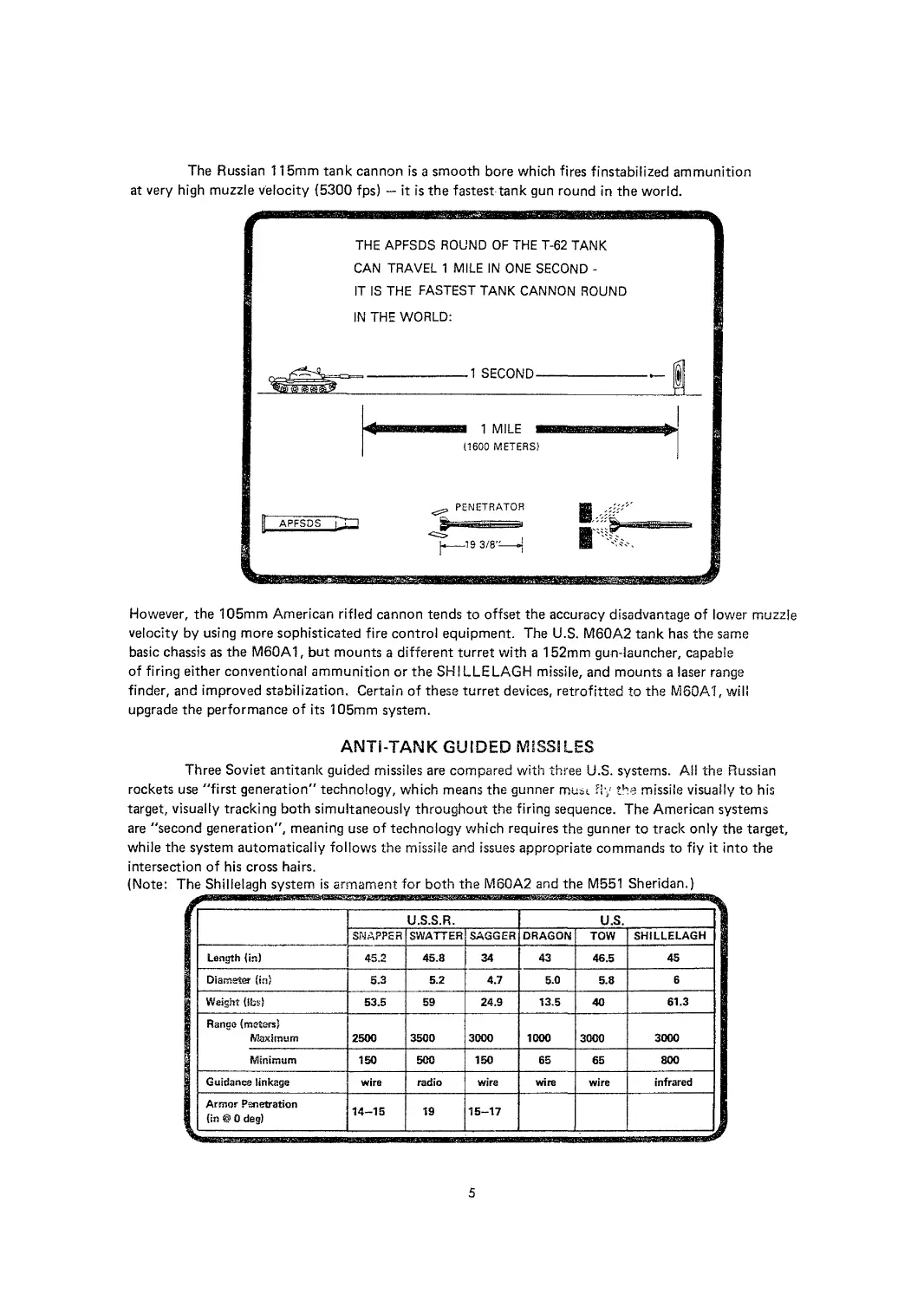
The Russian 115mm tank cannon is a smooth bore which fires finstabilized ammunition
at very high muzzle velocity (5300 fps) — it is the fastest tank gun round in the world.
However, the 105mm American rifled cannon tends to offset the accuracy disadvantage of lower muzzle
velocity by using more sophisticated fire control equipment. The U.S. M60A2 tank has the same
basic chassis as the M60A1, but mounts a different turret with a 152mm gun-launcher, capable
of firing either conventional ammunition or the SHILLELAGH missile, and mounts a laser range
finder, and improved stabilization. Certain of these turret devices, retrofitted to the M60A1, will
upgrade the performance of its 105mm system.
ANTI-TANK GUIDED MISSILES
Three Soviet antitank guided missiles are compared with three U.S. systems. All the Russian
rockets use "first generation" technology, which means the gunner must Ny the missile visually to his
target, visually tracking both simultaneously throughout the firing sequence. The American systems
are "second generation”, meaning use of technology which requires the gunner to track only the target,
while the system automatically follows the missile and issues appropriate commands to fiy it into the
intersection of his cross hairs.
(Note: The Shillelagh system is armament for both the IVI60A2 and the M551 Sheridan.)
	U.S.S.R.			U.S.
	SNAPPER	SWATTER	SAGGER	DRAGON	TOW	SHILLELAGH
Length (in)	45.2	45.8	34	43	46.5	45
Diameter (ini	5.3	5.2	4.7	5.0	5.8	6
Weight (lbs)	53.5	59	24.9	13.5	40	61.3
Range (meters) Maximum	2500	3500	3000	1000	3000	3000
Minimum	150	500	150	65	65	800
Guidance linkage	wire	radio	wire	wire	wire	infrared
Armor Penetration (in © 0 deg)	14-15	19	15-17
5
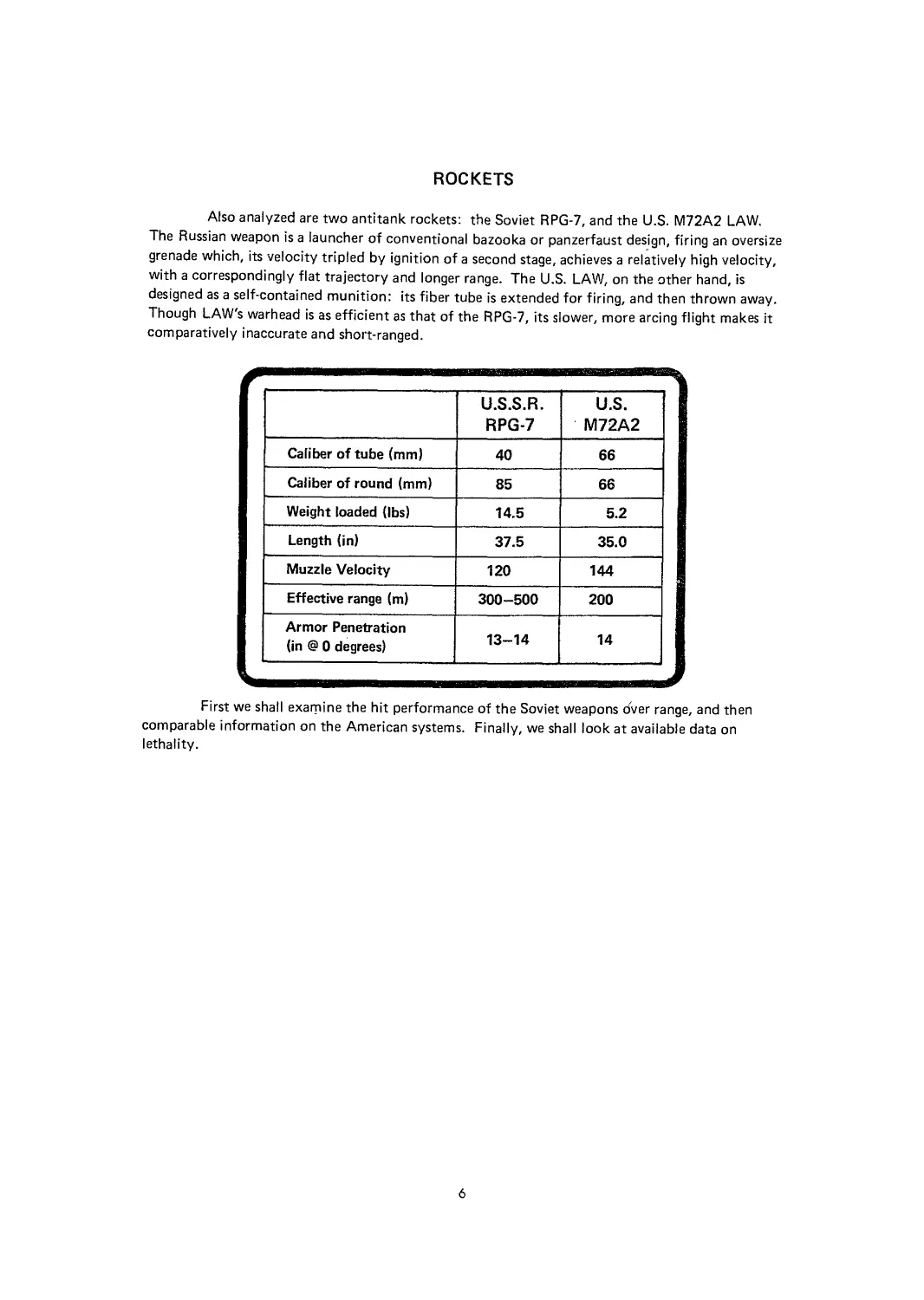
ROCKETS
Also analyzed are two antitank rockets: the Soviet RPG-7, and the U.S. M72A2 LAW.
The Russian weapon is a launcher of conventional bazooka or panzerfaust design, firing an oversize
grenade which, its velocity tripled by ignition of a second stage, achieves a relatively high velocity,
with a correspondingly flat trajectory and longer range. The U.S. LAW, on the other hand, is
designed as a self-contained munition: its fiber tube is extended for firing, and then thrown away.
Though LAW's warhead is as efficient as that of the RPG-7, its slower, more arcing flight makes it
comparatively inaccurate and short-ranged.

	U.S.S.R. RPG-7	U.S. M72A2
Caliber of tube (mm)	40	66
Caliber of round (mm)	85	66
Weight loaded (lbs)	14.5	5.2
Length (in)	37.5	35.0
Muzzle Velocity	120	144
Effective range (m)	300-500	200
Armor Penetration (in @ 0 degrees)	13-14	14
First we shall examine the hit performance of the Soviet weapons over range, and then
comparable information on the American systems. Finally, we shall look at available data on
lethality.
6
II
SOVIET WEAPONS: RANGE
TANK
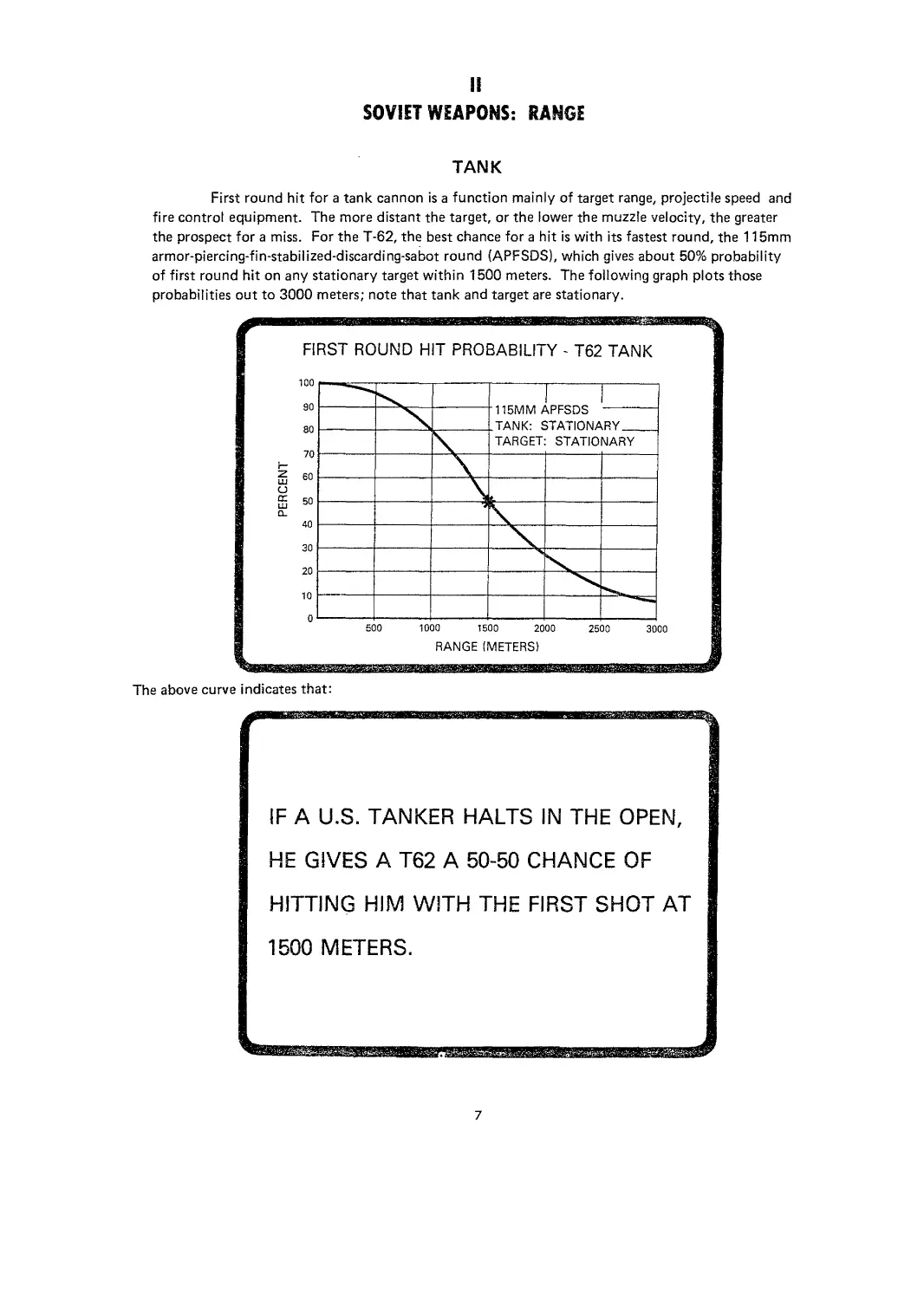
First round hit for a tank cannon is a function mainly of target range, projectile speed and
fire control equipment. The more distant the target, or the lower the muzzle velocity, the greater
the prospect for a miss. For the T-62, the best chance for a hit is with its fastest round, the 115mm
armor-piercing-fin-stabilized-discarding-sabot round (APFSDS), which gives about 50% probability
of first round hit on any stationary target within 1500 meters. The following graph plots those
probabilities out to 3000 meters; note that tank and target are stationary.
FIRST ROUND HIT PROBABILITY - T62 TANK
RANGE (METERS)
The above curve indicates that:
1500 METERS.
IF A U.S. TANKER HALTS IN THE OPEN
HE GIVES A T62 A 50-50 CHANCE OF
HITTING HIM WITH THE FIRST SHOT AT

7
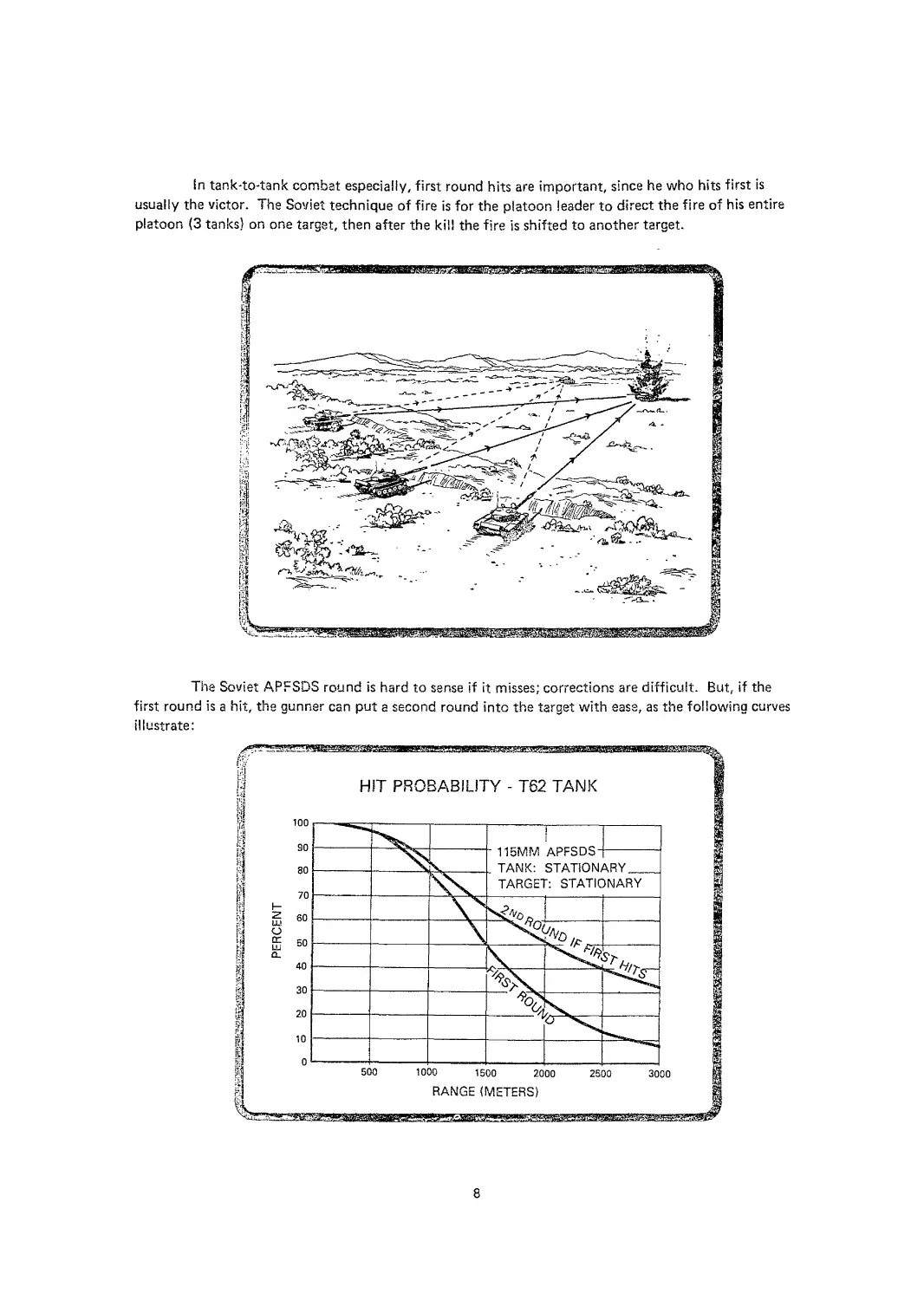
In tank-to-tank combat especially, first round hits are important, since he who hits first is
usually the victor. The Soviet technique of fire is for the platoon leader to direct the fire of his entire
platoon (3 tanks} on one target, then after the kill the fire is shifted to another target.
The Soviet APFSDS round is hard to sense if it misses; corrections are difficult. But, if the
first round is a hit, the gunner can put a second round into the target with ease, as the following curves
illustrate:
8
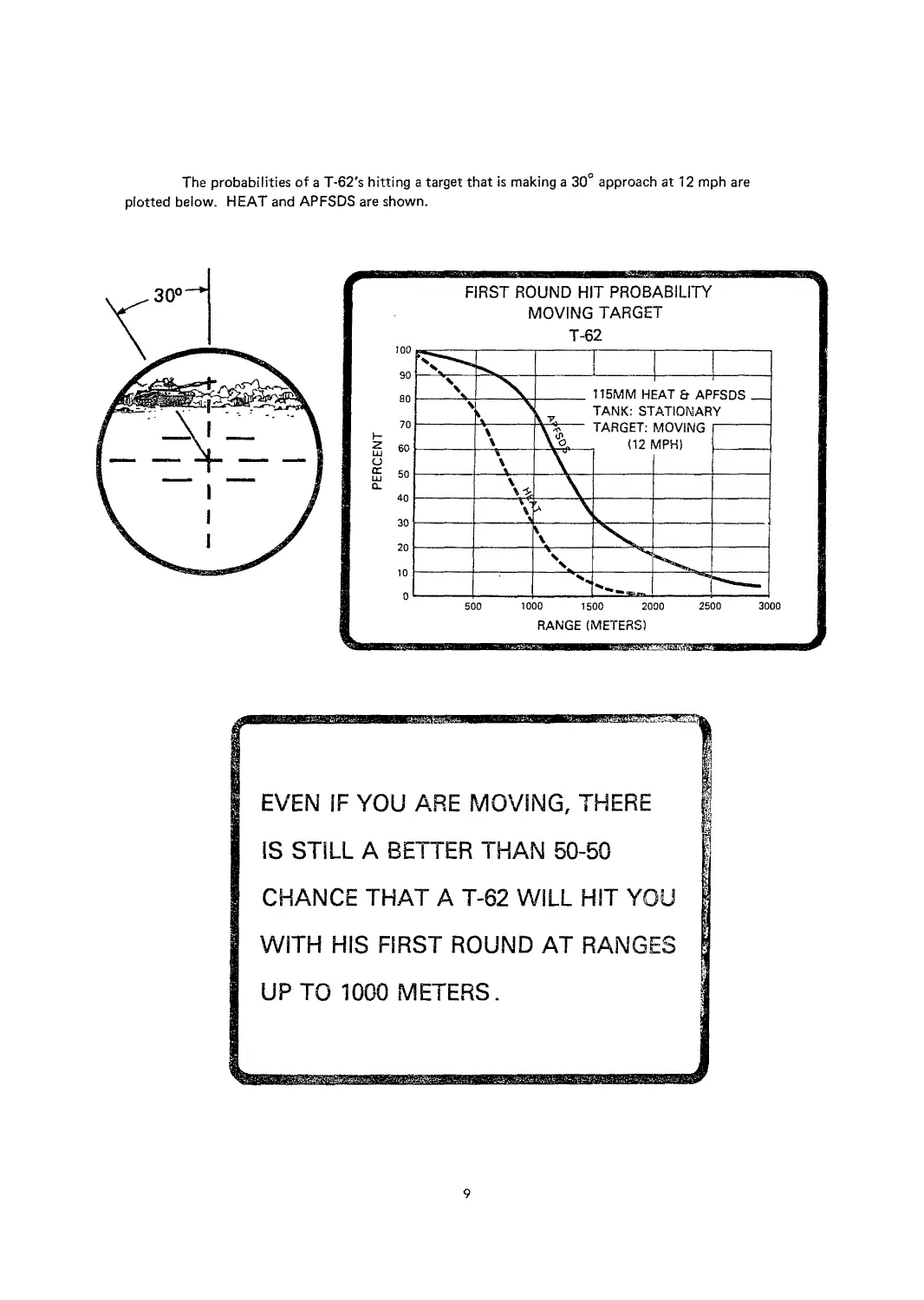
The probabilities of a Т-62's hitting a target that is making a 30° approach at 12 mph are
plotted below. HEAT and APFSDS are shown.
EVEN IF YOU ARE MOVING, THERE
IS STILL A BETTER THAN 50-50
CHANCE THAT A T-62 WILL HIT YOU
WITH HIS FIRST ROUND AT RANGES
UP TO 1000 METERS.
9
ANTI-TANK GUIDED MISSILES
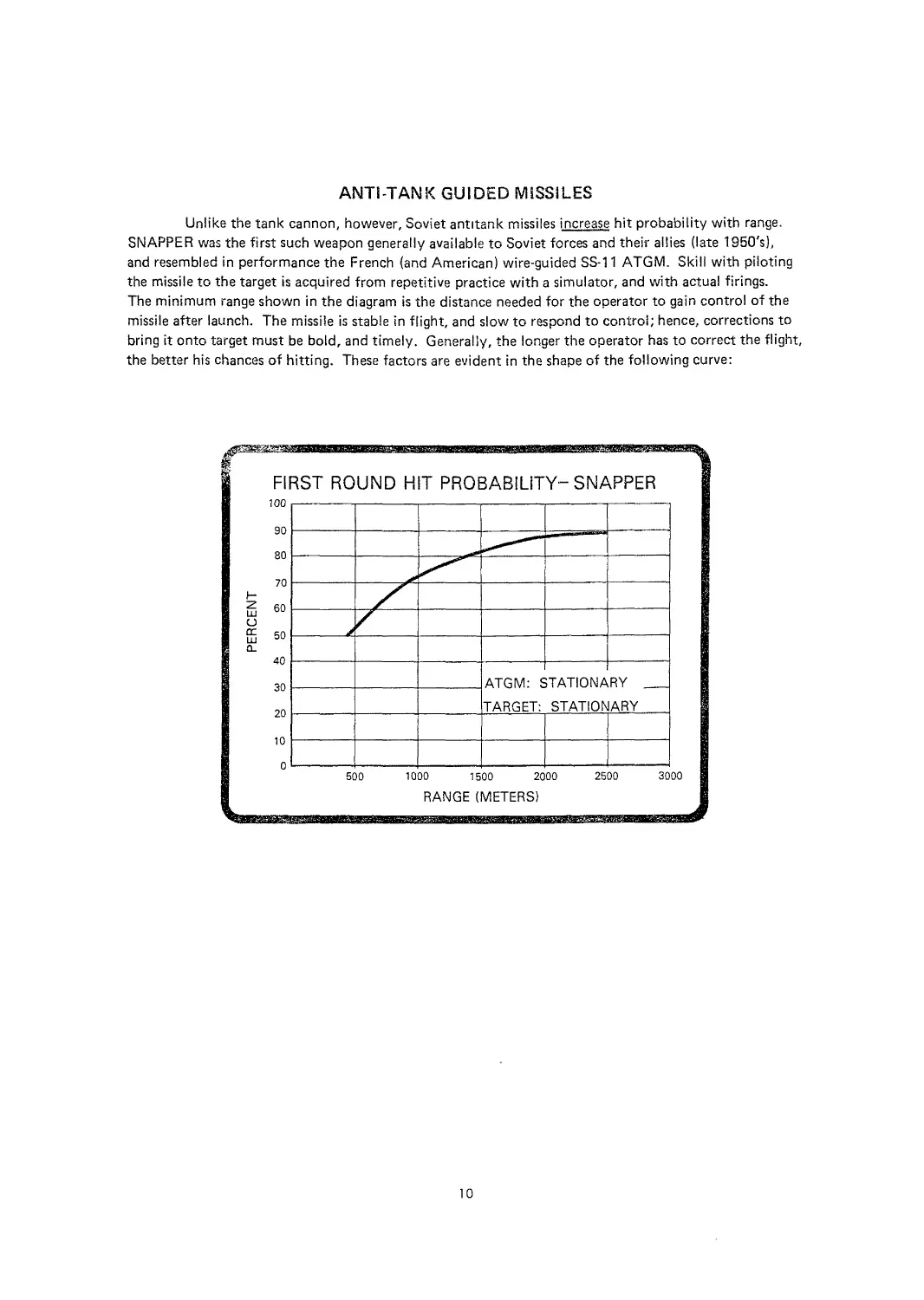
Unlike the tank cannon, however, Soviet antitank missiles increase hit probability with range.
SNAPPER was the first such weapon generally available to Soviet forces and their allies (late 1950's),
and resembled in performance the French (and American) wire-guided SS-11 ATGM. Skill with piloting
the missile to the target is acquired from repetitive practice with a simulator, and with actual firings.
The minimum range shown in the diagram is the distance needed for the operator to gain control of the
missile after launch. The missile is stable in flight, and slow to respond to control; hence, corrections to
bring it onto target must be bold, and timely. Generally, the longer the operator has to correct the flight,
the better his chances of hitting. These factors are evident in the shape of the following curve:
10
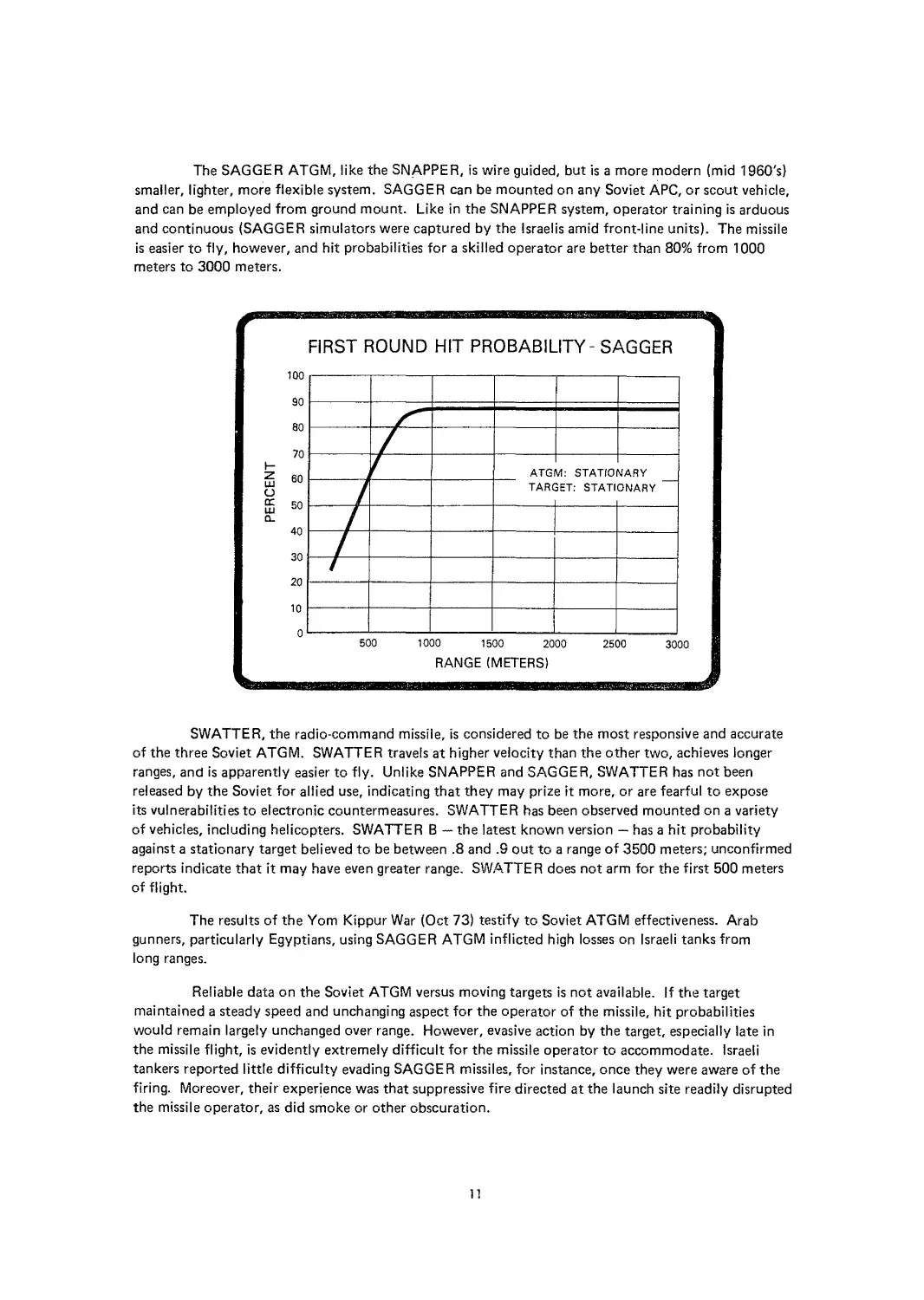
The SAGGER ATGM, like the SNAPPER, is wire guided, but is a more modern (mid 1960's)
smaller, lighter, more flexible system. SAGGER can be mounted on any Soviet APC, or scout vehicle,
and can be employed from ground mount. Like in the SNAPPER system, operator training is arduous
and continuous (SAGGER simulators were captured by the Israelis amid front-line units). The missile
is easier to fly, however, and hit probabilities for a skilled operator are better than 80% from 1000
meters to 3000 meters.
SWATTER, the radio-command missile, is considered to be the most responsive and accurate
of the three Soviet ATGM. SWATTER travels at higher velocity than the other two, achieves longer
ranges, and is apparently easier to fly. Unlike SNAPPER and SAGGER, SWATTER has not been
released by the Soviet for allied use, indicating that they may prize it more, or are fearful to expose
its vulnerabilities to electronic countermeasures. SWATTER has been observed mounted on a variety
of vehicles, including helicopters. SWATTER В — the latest known version — has a hit probability
against a stationary target believed to be between .8 and .9 out to a range of 3500 meters; unconfirmed
reports indicate that it may have even greater range. SWATTER does not arm for the first 500 meters
of flight.
The results of the Yom Kippur War (Oct 73) testify to Soviet ATGM effectiveness. Arab
gunners, particularly Egyptians, using SAGGER ATGM inflicted high losses on Israeli tanks from
long ranges.
Reliable data on the Soviet ATGM versus moving targets is not available. If the target
maintained a steady speed and unchanging aspect for the operator of the missile, hit probabilities
would remain largely unchanged over range. However, evasive action by the target, especially late in
the missile flight, is evidently extremely difficult for the missile operator to accommodate. Israeli
tankers reported little difficulty evading SAGGER missiles, for instance, once they were aware of the
firing. Moreover, their experience was that suppressive fire directed at the launch site readily disrupted
the missile operator, as did smoke or other obscuration.
11
*	SOVIET ATGM HAVE VERY HIGH ACCURACY AT
RANGES FROM 1000 TO 3000 METERS. WITHIN 500
METERS, THEY ARE MUCH LESS EFFECTIVE.
*	SKILLED TANKERS CAN LEARN TO DODGE SOME
SOVIET ATGM IN FLIGHT; THE MISSILE THREAT CAN
ALSO BE COUNTERED BY USE OF SUPPRESSIVE FIRES.
GEOMETRIC FORMATIONS OF TARGET TANKS PROBABLY
AID THE ATGM GUNNER IN HOLDING HIS AIM.
*	SOVIET ATGM ARE VULNERABLE TO OBSCURATION BY
SMOKE OR DUST.
RPG-7
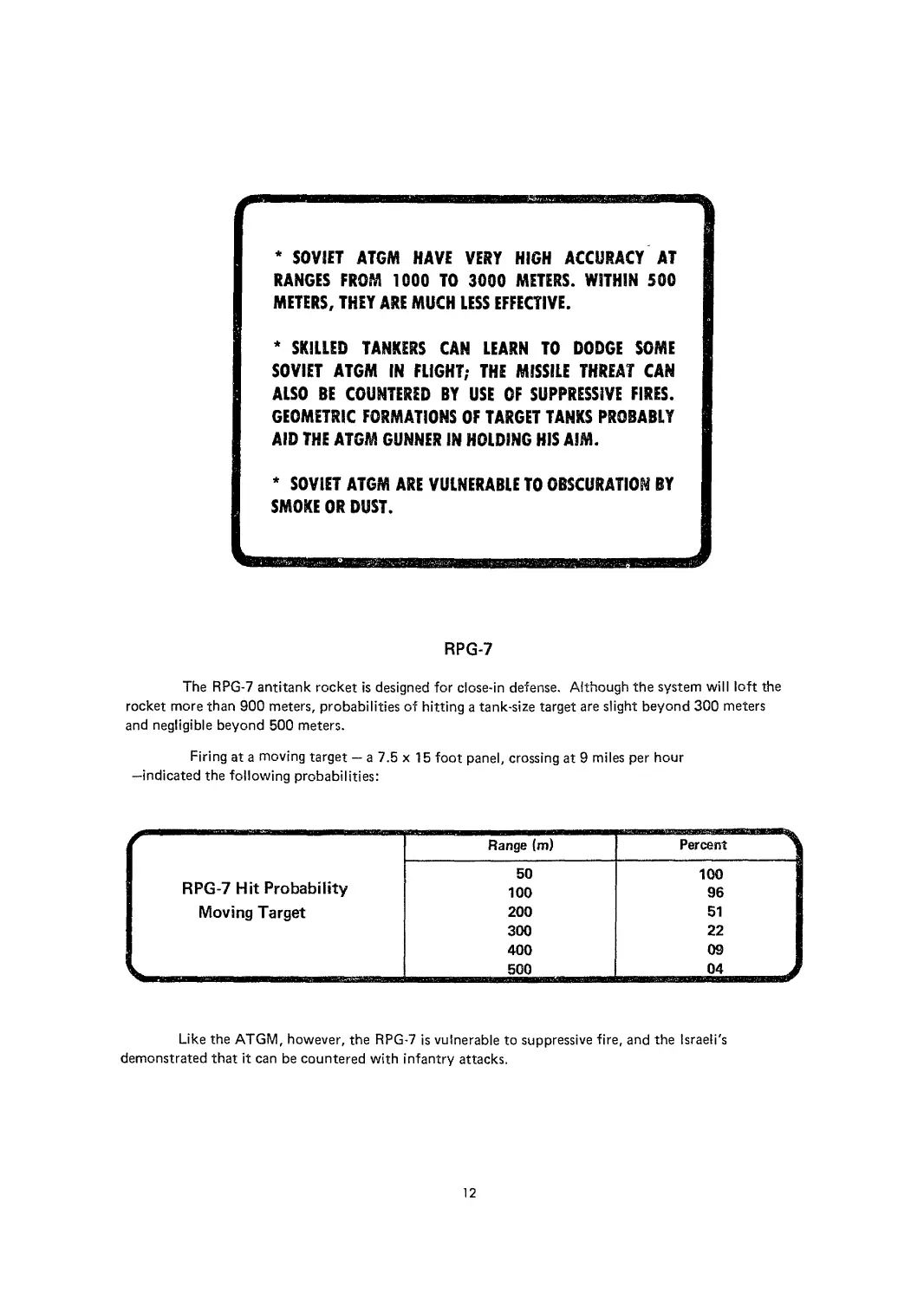
The RPG-7 antitank rocket is designed for close-in defense. Although the system will loft the
rocket more than 900 meters, probabilities of hitting a tank-size target are slight beyond 300 meters
and negligible beyond 500 meters.
Firing at a moving target — a 7.5 x 15 foot panel, crossing at 9 miles per hour
—indicated the following probabilities:
J	Range (m)	Percent
	50	100
RPG-7 Hit Probability	100	96
Moving Target	200	51
	300	22
	400	09
	500	04
Like the ATGM, however, the RPG-7 is vulnerable to suppressive fire, and the Israeli's
demonstrated that it can be countered with infantry attacks.
12
SOVIET CAPABILITIES
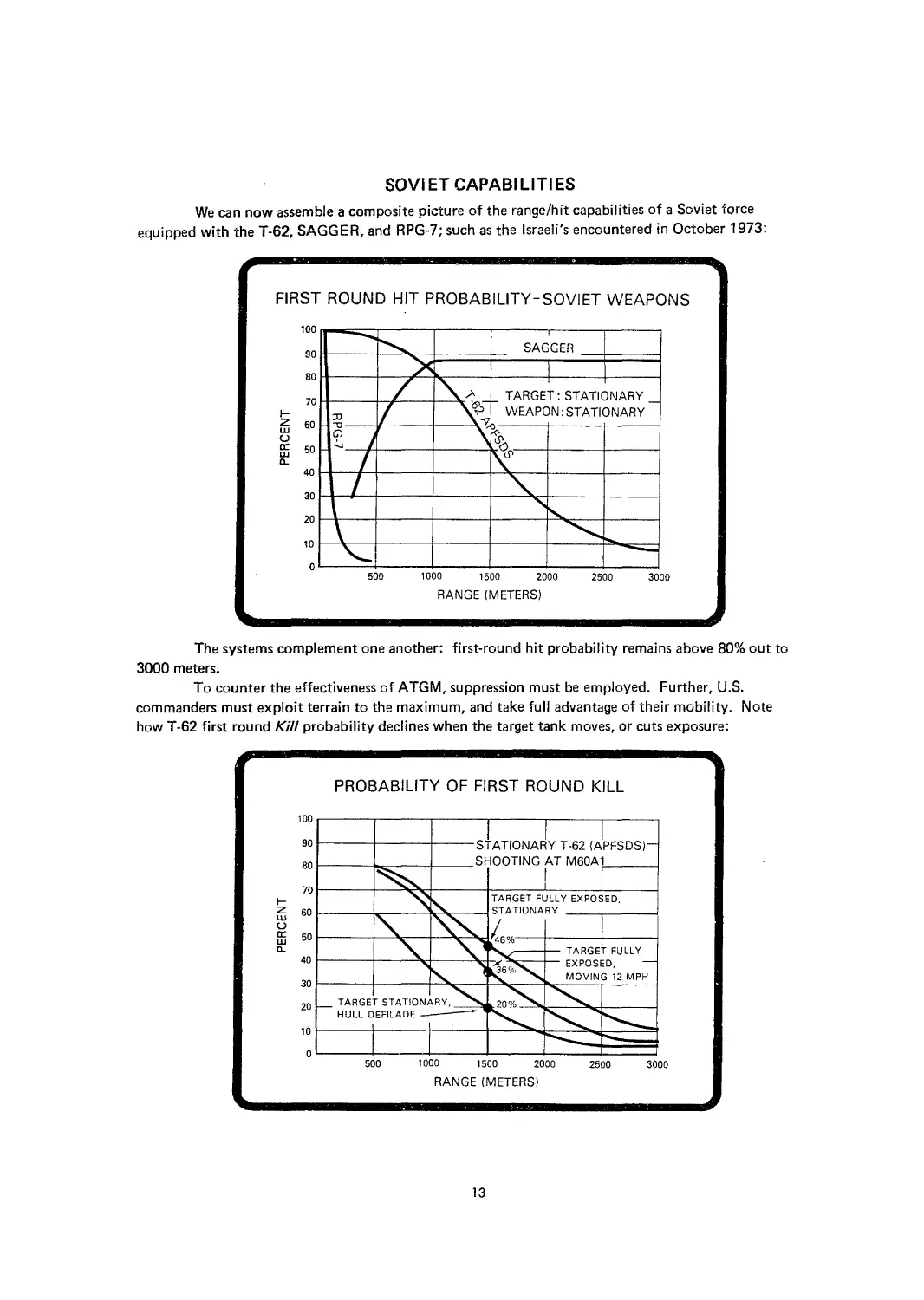
We can now assemble a composite picture of the range/hit capabilities of a Soviet force
equipped with the T-62, SAGGER, and RPG-7; such as the Israeli's encountered in October 1973:
The systems complement one another: first-round hit probability remains above 80% out to
3000 meters.
To counter the effectiveness of ATGM, suppression must be employed. Further, U.S.
commanders must exploit terrain to the maximum, and take full advantage of their mobility. Note
how T-62 first round Kill probability declines when the target tank moves, or cuts exposure:
PROBABILITY OF FIRST ROUND KILL

13

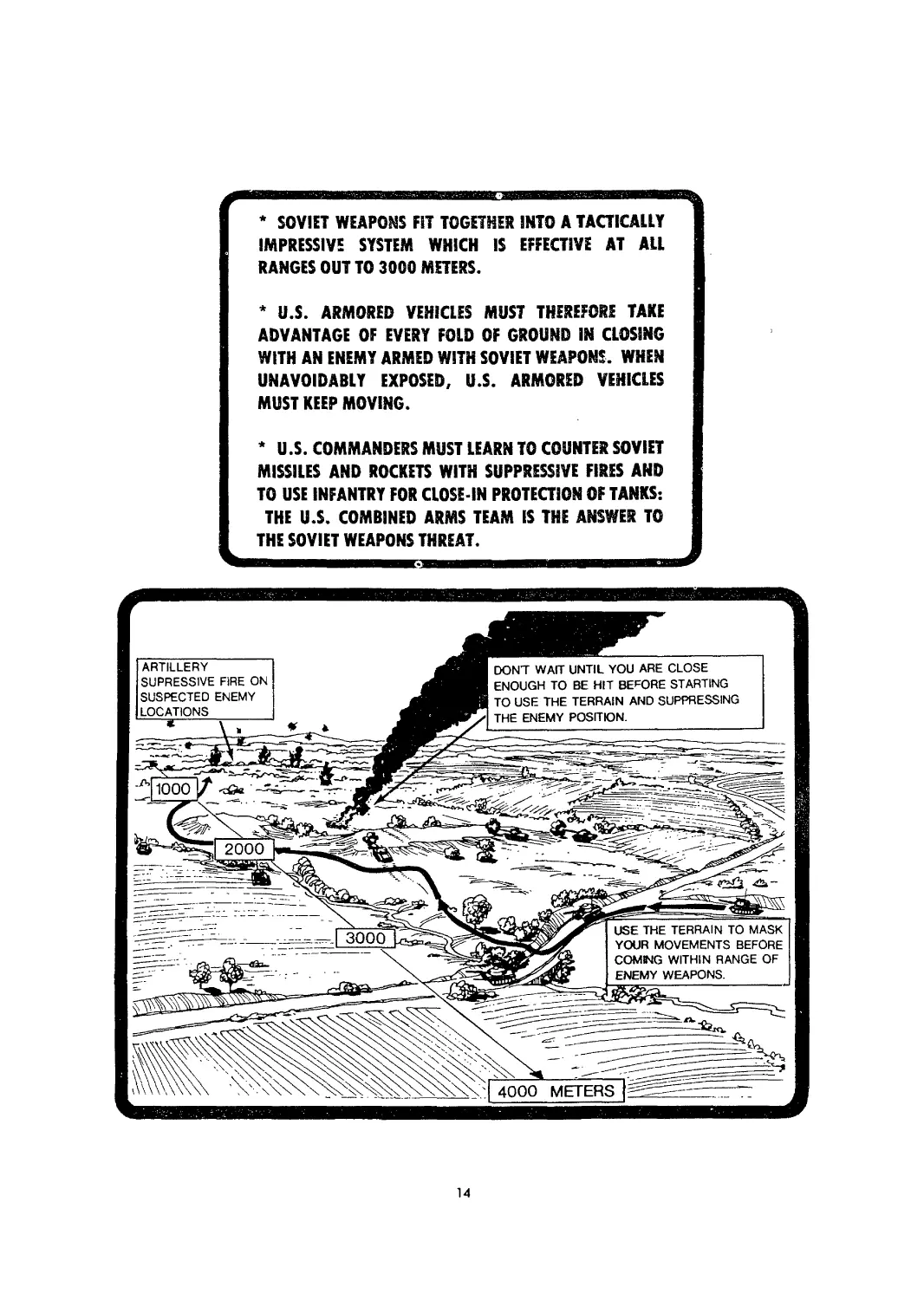
*	SOVIET WEAPONS FIT TOGETHER INTO A TACTICALLY
IMPRESSIVE SYSTEM WHICH IS EFFECTIVE AT ALL
RANGES OUT TO 3000 METERS.
*	U.S. ARMORED VEHICLES MUST THEREFORE TAKE
ADVANTAGE OF EVERY FOLD OF GROUND IN CLOSING
WITH AN ENEMY ARMED WITH SOVIET WEAPONS. WHEN
UNAVOIDABLY EXPOSED, U.S. ARMORED VEHICLES
MUST KEEP MOVING.
‘ U.S. COMMANDERS MUST LEARN TO COUNTER SOVIET
MISSILES AND ROCKETS WITH SUPPRESSIVE FIRES AND
TO USE INFANTRY FOR CLOSE-IN PROTECTION OF TANKS:
THE U.S. COMBINED ARMS TEAM IS THE ANSWER TO
THE SOVIET WEAPONS THREAT.
4000 METERS
USE THE TERRAIN TO MASK
YOUR MOVEMENTS BEFORE
COMING WITHIN RANGE OF
ENEMY WEAPONS.
ARTILLERY
SUPRESS1VE FIRE ON
SUSPECTED ENEMY
LOCATIONS
DON’T WAIT UNTIL YOU ARE CLOSE
ENOUGH TO BE HIT BEFORE STARTING
TO USE THE TERRAIN AND SUPPRESSING
THE ENEMY POSITION.
2000
4 зооо
14
ill
U.S. WEAPONS: RAMGE
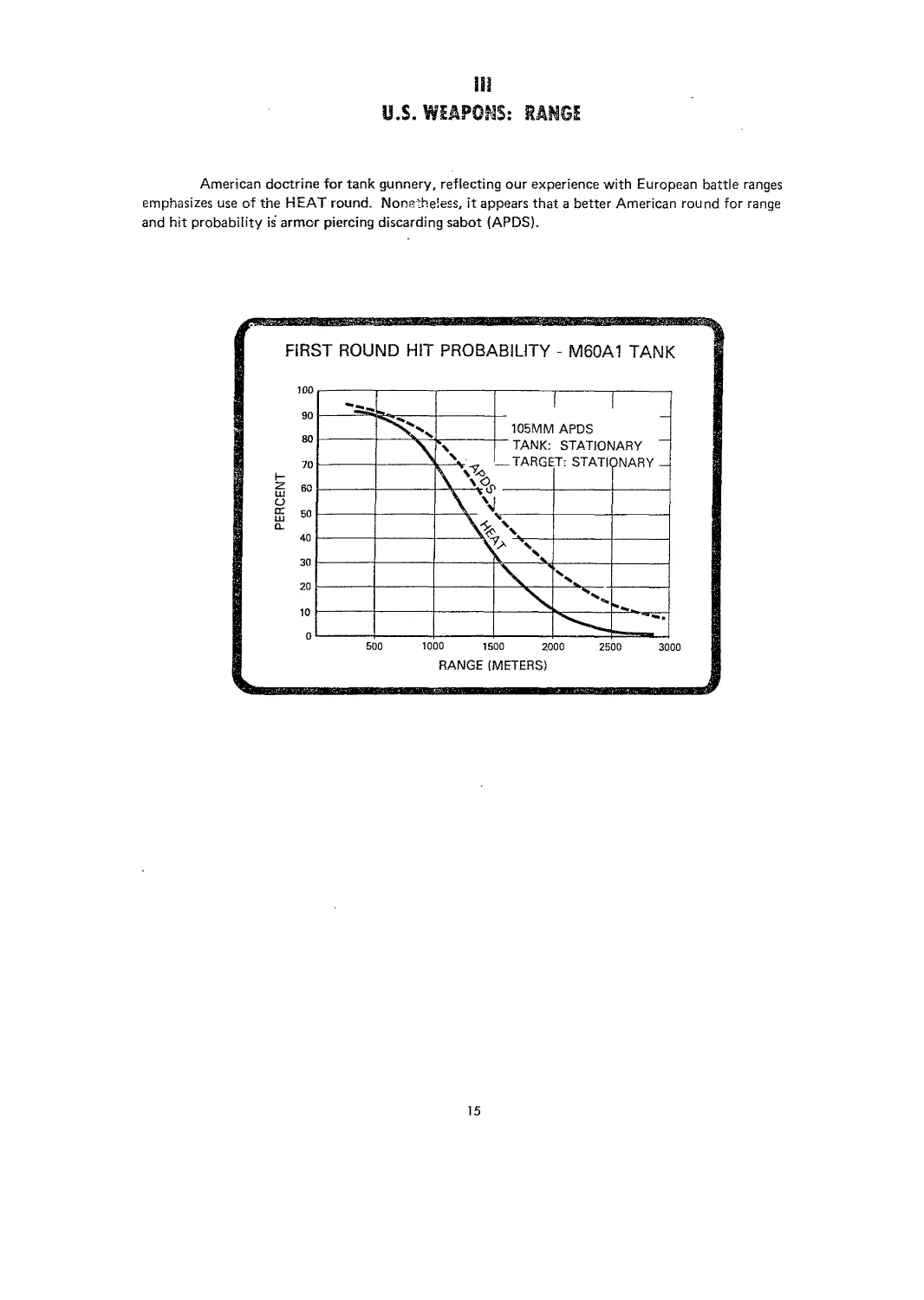
American doctrine for tank gunnery, reflecting our experience with European battle ranges
emphasizes use of the HEAT round. Nonetheless, it appears that a better American round for range
and hit probability is armor piercing discarding sabot (APDS).
FIRST ROUND HIT PROBABILITY - M60A1 TANK
RANGE (METERS)
15
ANTITANK GUIDED MISSILES
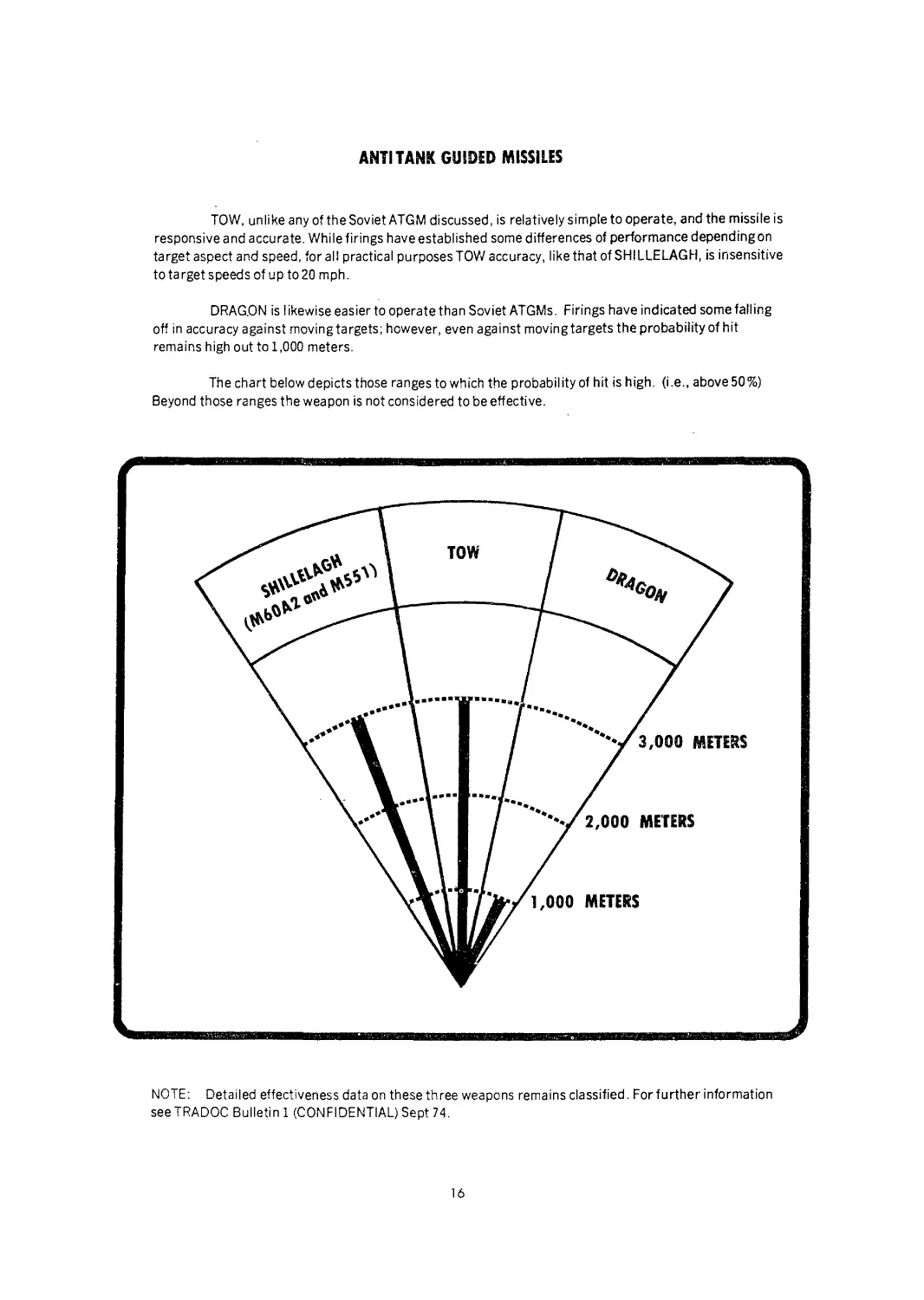
TOW, unlike any of the Soviet ATGM discussed, is relatively simple to operate, and the missile is
responsive and accurate. While firings have established some differences of performance dependingon
target aspect and speed, for all practical purposes TOW accuracy, like that of SHILLELAGH, is insensitive
to target speeds of up to 20 mph.
DRAG.ON is likewise easier to operate than Soviet ATGMs. Firings have indicated some falling
off in accuracy against moving targets; however, even against moving targets the probability of hit
remains high out to 1,000 meters.
The chart below depicts those ranges to which the probability of hit is high, (i.e., above 50%)
Beyond those ranges the weapon is not considered to be effective.
NOTE: Detailed effectiveness data on these three weapons remains classified. For further information
seeTRADOC Bulletin 1 (CONFIDENTIAL) Sept 74.
16
THE LAW
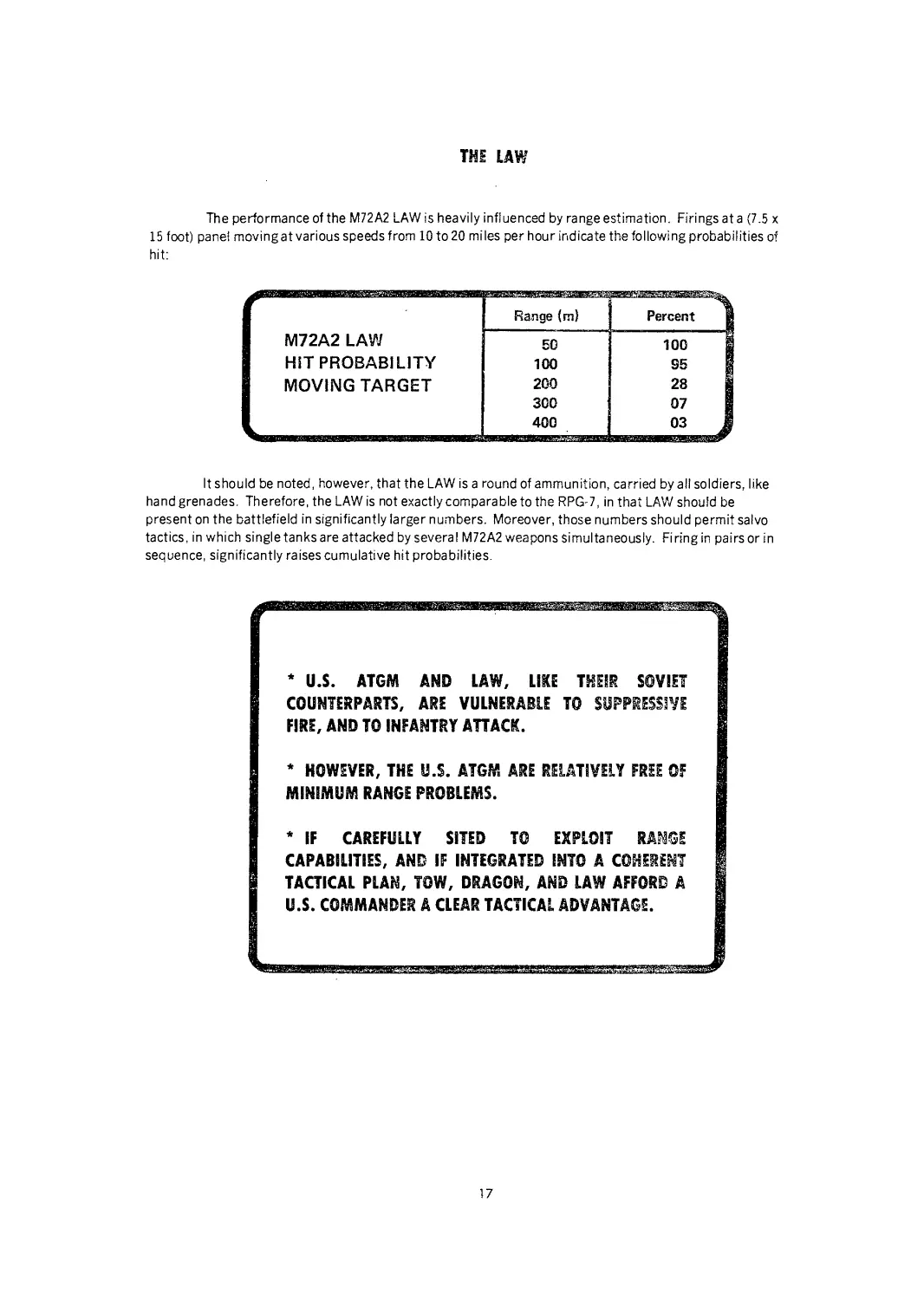
The performance of the M72A2 LAW is heavily influenced by range estimation. Firings ata (7.5 x
15 foot) panel moving at various speeds from 10 to 20 miles per hour indicate the following probabilities of
hit:
It should be noted, however, that the LAW is a round of ammunition, carried by all soldiers, like
handgrenades. Therefore, the LAW is notexactlycomparabletothe RPG'7, in that LAW should be
present on the battlefield in significantly larger numbers. Moreover, those numbers should permit salvo
tactics, in which single tanks are attacked by several M72A2 weapons simultaneously. Firing in pairs or in
sequence, significantly raises cumulative hit probabilities.
*	U.S. ATGM AND LAW, LIKE THEIR SOVIET
COUNTERPARTS, ARE VULNERABLE TO SUPPRESSIVE
FIRE, AND TO INFANTRY ATTACK.
*	HOWEVER, THE U.S. ATGM ARE RELATIVELY FREE OF
MINIMUM RANGE PROBLEMS.
*	IF CAREFULLY SITED TO EXPLOIT RANGE
CAPABILITIES, AND IF INTEGRATED INTO A COHERENT
TACTICAL PLAN, TOW, DRAGON, AND LAW AFFORD A
U.S. COMMANDER A CLEAR TACTICAL ADVANTAGE.

17
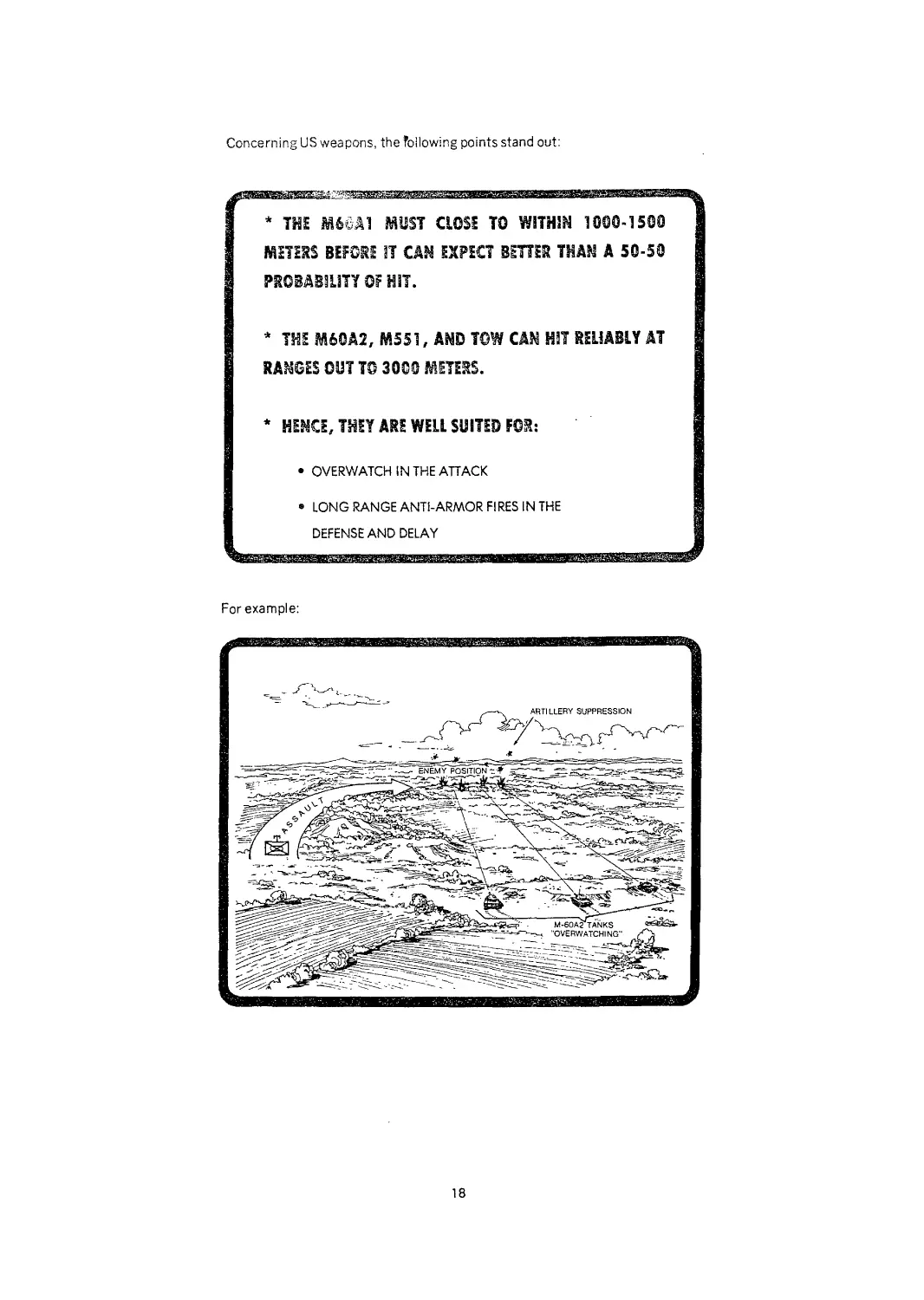
Concerning US weapons, the foilowing points stand out:
DEFENSE AND DELAY
THE MUST CLOSE TO WITHIN 1000-1500
METERS BEFORE IT CAN EXPECT BETTER THAN A 50-50
PROBABILITY OF HIT.
* THE M60A2, М551, AND TOW CAN HIT RELIABLY AT
RANGES OUT TO 3000 METERS.
HENCE, THEY ARE WELL SUITED FOR:
OVERWATCH IN THE ATTACK
• LONG RANGE ANTI-ARMOR FIRES IN THE
For example:
18
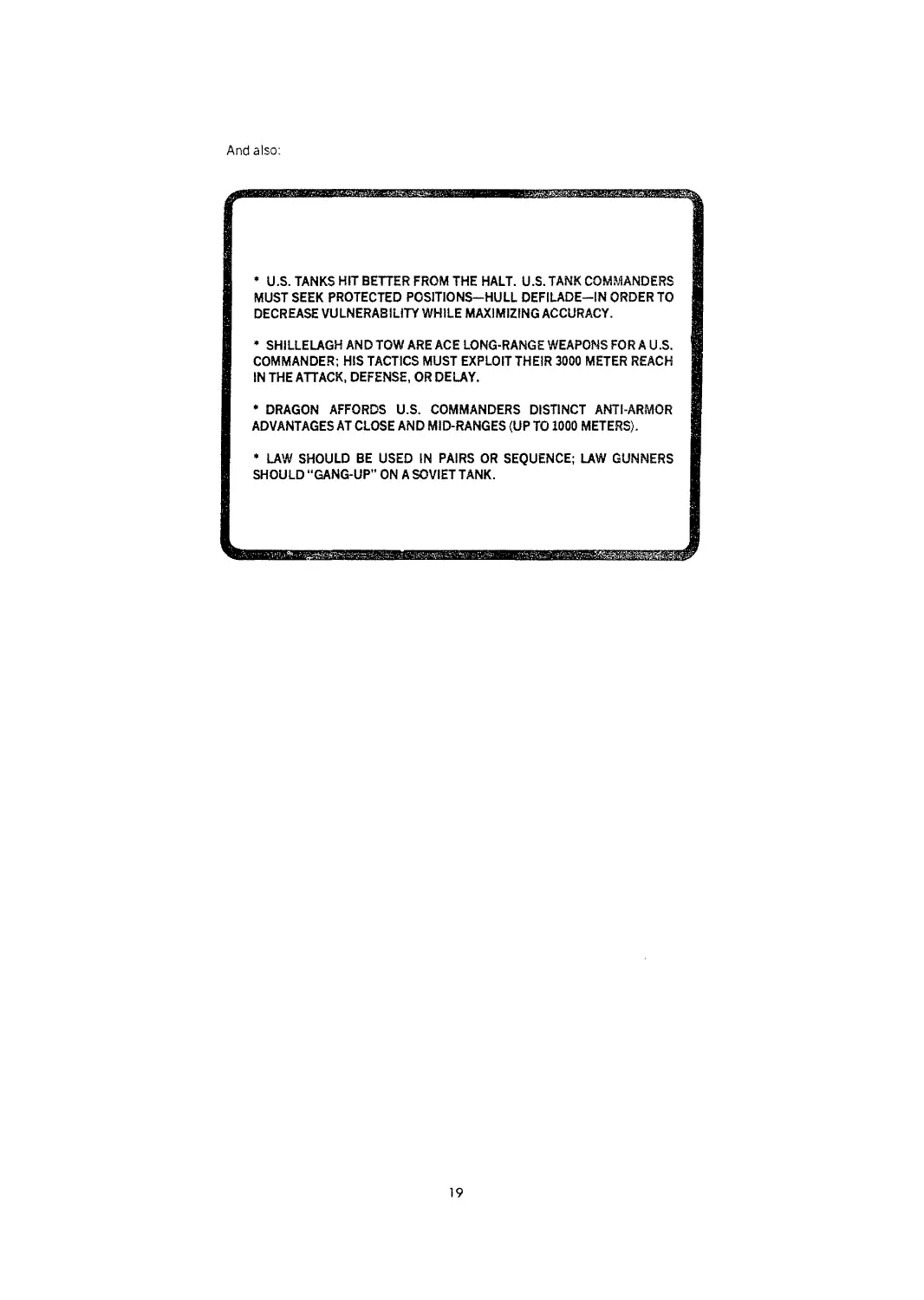
And also:
♦	U.S. TANKS HIT BETTER FROM THE HALT. U.S. TANK COMMANDERS
MUST SEEK PROTECTED POSITIONS-HULL DEFILADE—-IN ORDER TO
DECREASE VULNERABILITY WHILE MAXIMIZING ACCURACY.
*	SHILLELAGH AND TOW ARE ACE LONG-RANGE WEAPONS FOR A U.S.
COMMANDER; HIS TACTICS MUST EXPLOIT THEIR 3000 METER REACH
IN THE ATTACK, DEFENSE, OR DELAY.
♦	DRAGON AFFORDS U.S. COMMANDERS DISTINCT ANTI-ARMOR
ADVANTAGES AT CLOSE AND MID-RANGES (UP TO 1000 METERS).
*	LAW SHOULD BE USED IN PAIRS OR SEQUENCE; LAW GUNNERS
SHOULD “GANG-UP” ON A SOVIET TANK.

19
IV
LETHALITY
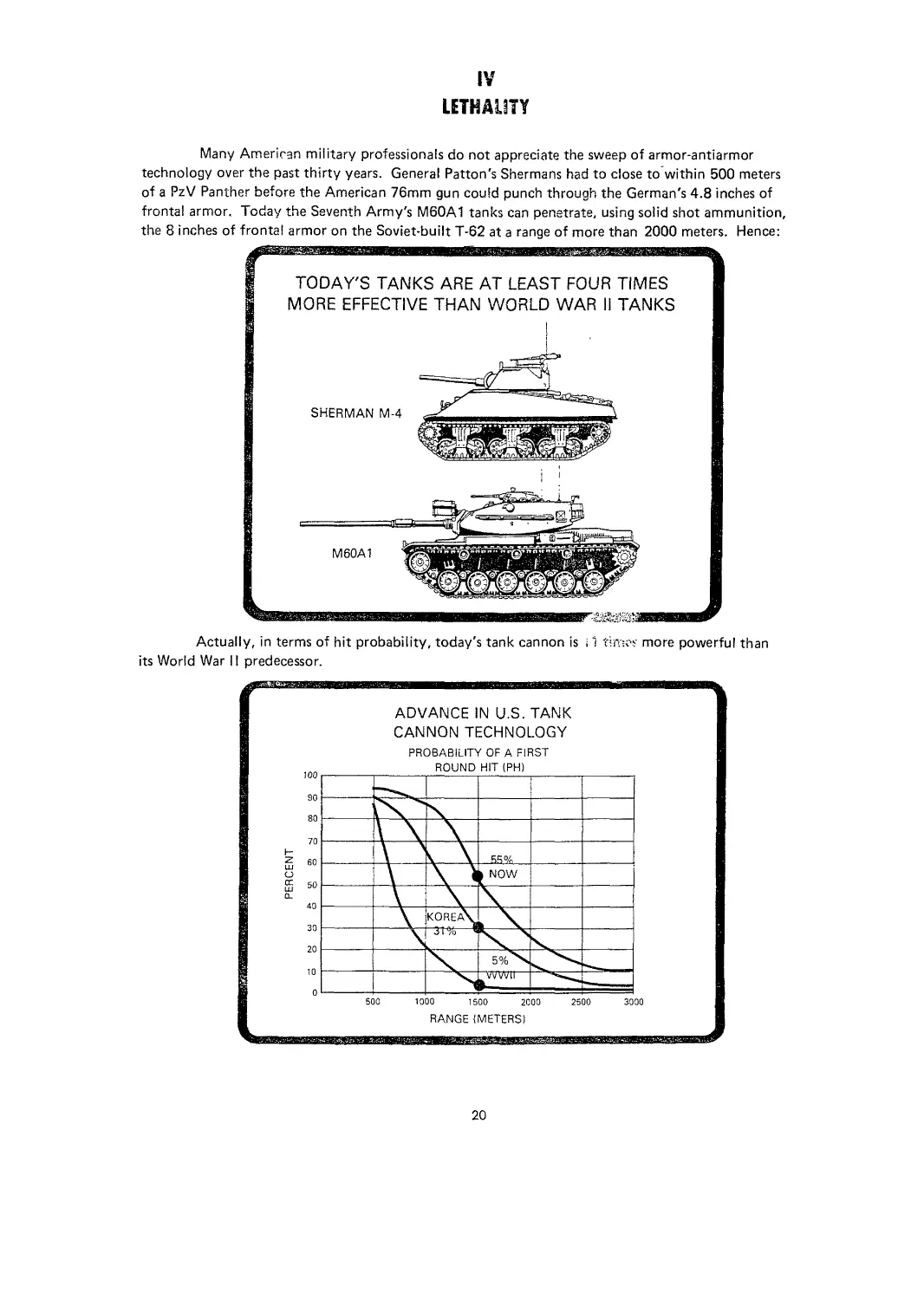
Many American military professionals do not appreciate the sweep of armor-antiarmor
technology over the past thirty years. General Patton's Shermans had to close to within 500 meters
of a PzV Panther before the American 76mm gun could punch through the German's 4.8 inches of
frontal armor. Today the Seventh Army's M60A1 tanks can penetrate, using solid shot ammunition,
the 8 inches of frontal armor on the Soviet-built T-62 at a range of more than 2000 meters. Hence:
Actually, in terms of hit probability, today's tank cannon is i 1 times more powerful than
its World War II predecessor.
20
The kinetic energy tank cannon round, however, which was the mainstay of World War II
combatants, is by no means the only tank killer on today's battlefield. Efficient, chemical-energy
rounds have been devised for tank cannon, as well as for antitank rockets. The High Explosive
Antitank (HEAT) rounds of both the M60A1 and the T-62 can defeat frontal armor three times the
thickness of the Panther's. And, in the TOW, the U.S. has an infantry weapon which has significantly
higher accuracy (.88), at all ranges greater than 500 meters, than the T-62, and sufficient power at
3000 meters to penetrate frontal armor three times that on the T-62.
ARMOR BASIS
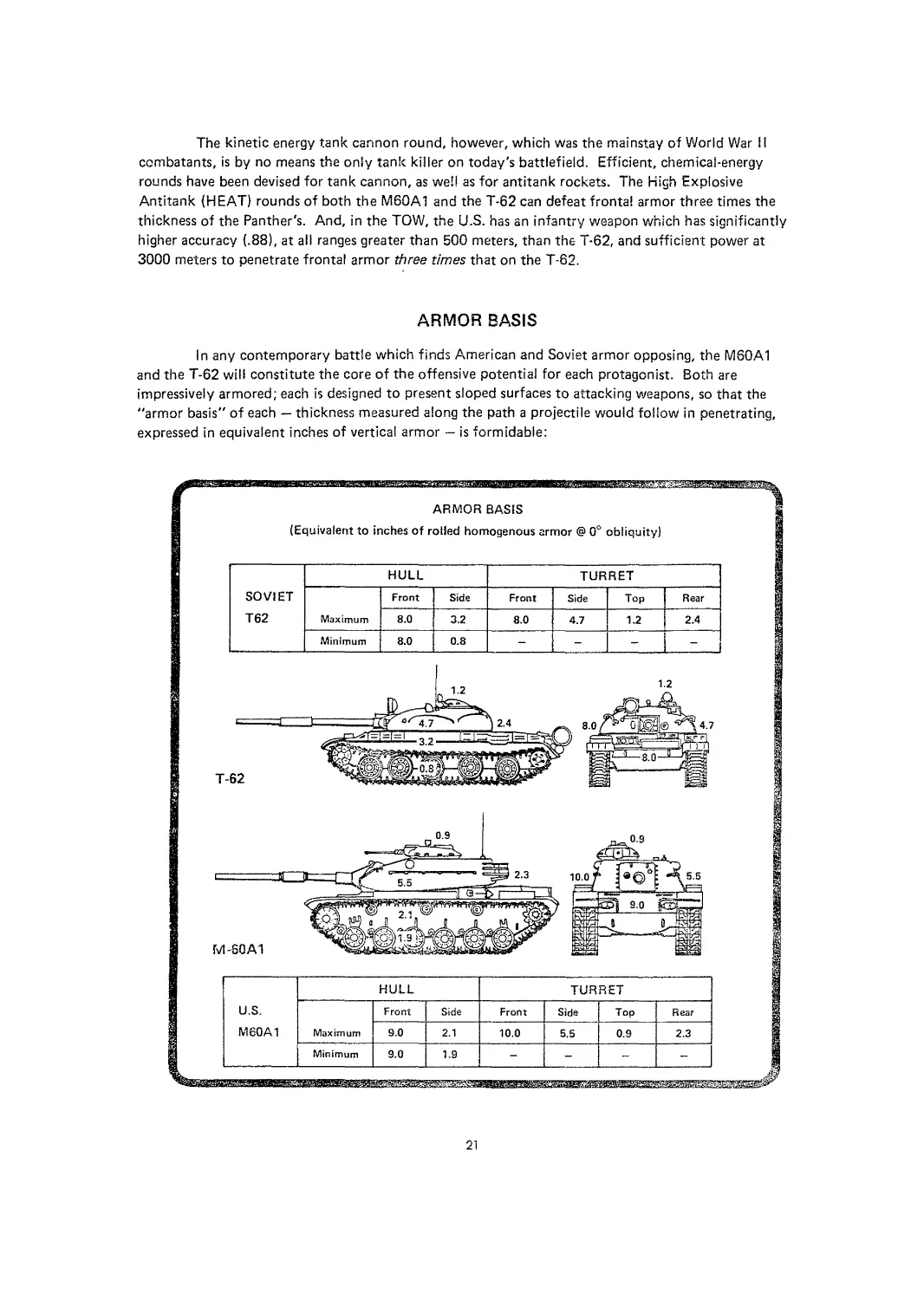
In any contemporary battle which finds American and Soviet armor opposing, the M60A1
and the T-62 will constitute the core of the offensive potential for each protagonist. Both are
impressively armored; each is designed to present sloped surfaces to attacking weapons, so that the
"armor basis" of each — thickness measured along the path a projectile would follow in penetrating,
expressed in equivalent inches of vertical armor — is formidable:
21
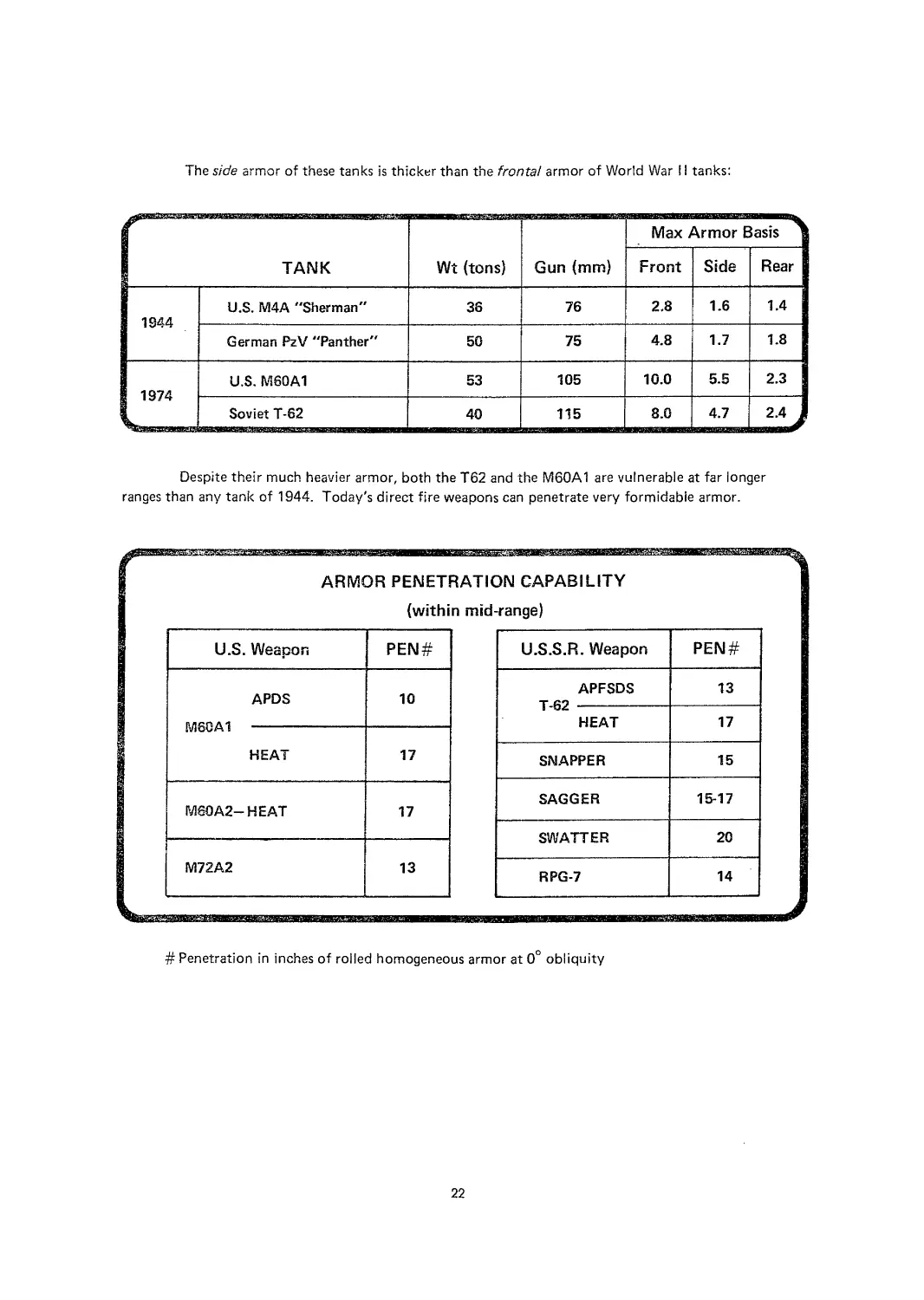
The side armor of these tanks is thicker than the frontal armor of World War 11 tanks:
I	TANK		Wt (tons)	Gun (mm)	Max Armor Basis |
				Front	Side	Rear
1 1944	U.S. M4A "Sherman"	36	76	2.8	1.6	1.4
	German PzV "Panther"	50	75	4.8	1.7	1.8
1 1974	U.S. M60A1	53	105	10.0	5.5	2.3
	Soviet T-62	40	115	8.0	4.7	2.4 ,
Despite their much heavier armor, both the T62 and the M60A1 are vulnerable at far longer
ranges than any tank of 1944. Today's direct fire weapons can penetrate very formidable armor.
# Penetration in inches of rolled homogeneous armor at 0° obliquity
22
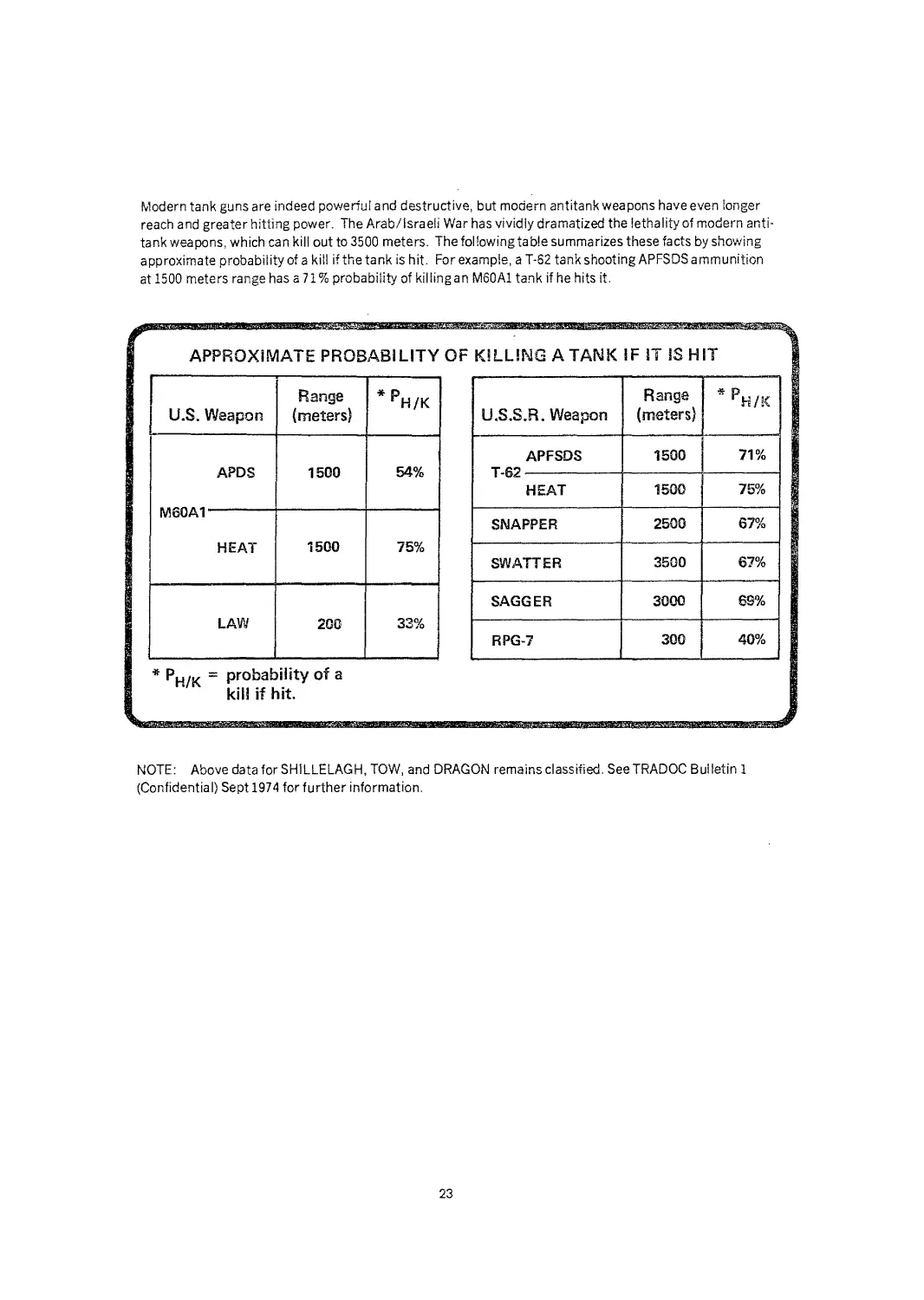
Modern tank guns are indeed powerful and destructive, but modern antitank weapons have even longer
reach and greater hitting power. The Arab/lsraeli War has vividly dramatized the lethality of modern anti-
tankweapons, which can kill out to 3500 meters. The following table summarizes these facts by showing
approximate probability of a kill if the tank is hit. For example, a T-62 tank shooting APFSDS ammunition
at 1500 meters range has a 71% probability of killing an M60A1 tank if he hits it.
APPROXIMATE PROBABILITY OF KILLING A TANK IF IT IS HIT
U.S. Weapon	Range (meters)	* p rH/K
APDS	1500	54%
MoOA1" HEAT	1500	75%
LAW	200	33%
U.S.S.R. Weapon	Range (meters)	* p
APFSDS	1500	71%
I Wb HEAT	1500	75%
SNAPPER	2500	67%
SWATTER	3500	67%
SAGGER	3000	6®%
RPG-7	300	40%
*	= Probability of a
kill if hit.
NOTE: Above data for SHILLELAGH, TOW, and DRAGON remains classified. SeeTRADOC Bulletin 1
(Confidential) Sept 1974 for further information.
23
V
IMPLICATIONS FOR TRAINING
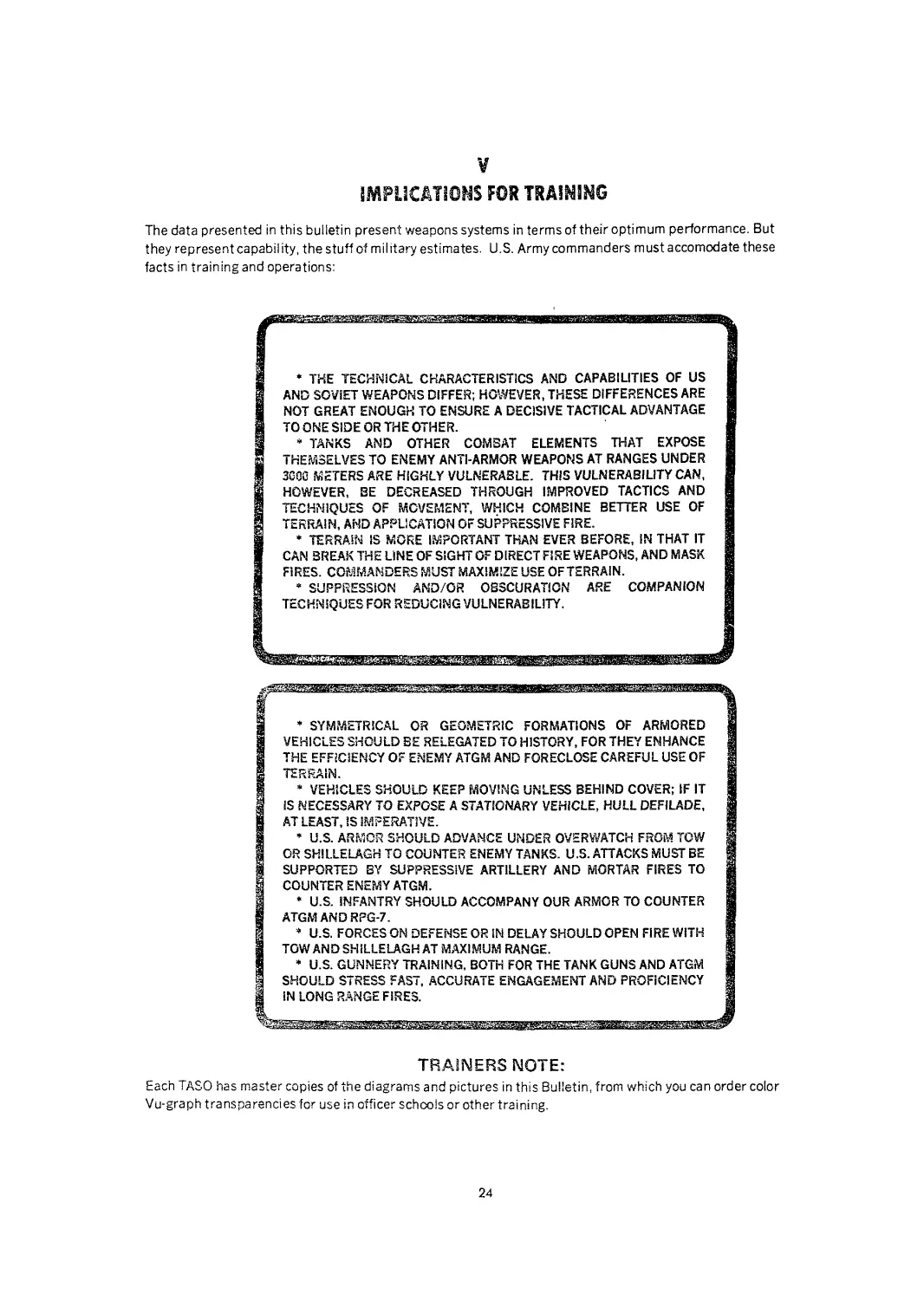
The data presented in this bulletin present weapons systems in terms of their optimum performance. But
they represent capability, the stuff of military estimates. U.S. Army commanders must accomodate these
facts in training and operations:
*	THE TECHNICAL CHARACTERISTICS AND CAPABILITIES OF US
AND SOVIET WEAPONS DIFFER; HOWEVER, THESE DIFFERENCES ARE
NOT GREAT ENOUGH TO ENSURE A DECISIVE TACTICAL ADVANTAGE
TO ONE SIDE OR THE OTHER.
*	TANKS AND OTHER COMBAT ELEMENTS THAT EXPOSE
THEMSELVES TO ENEMY ANTI-ARMOR WEAPONS AT RANGES UNDER
3COO METERS ARE HIGHLY VULNERABLE. THIS VULNERABILITY CAN,
HOWEVER, BE DECREASED THROUGH IMPROVED TACTICS AND
TECHNIQUES OF MOVEMENT, WHICH COMBINE BETTER USE OF
TERRAIN, AND APPLICATION OF SUPPRESSIVE FIRE.
*	TERRAIN IS MORE IMPORTANT THAN EVER BEFORE, IN THAT IT
CAN BREAK THE LINE OF SIGHT OF DIRECT FIRE WEAPONS, AND MASK
FIRES. COMMANDERS MUST MAXIMIZE USE OFTERRAIN.
*	SUPPRESSION AND/OR OBSCURATION ARE COMPANION
TECHNIQUES FOR REDUCING VULNERABILITY.
*	SYMMETRICAL OR GEOMETRIC FORMATIONS OF ARMORED
VEHICLES SHOULD BE RELEGATED TO HISTORY, FOR THEY ENHANCE
THE EFFICIENCY OF ENEMY ATGM AND FORECLOSE CAREFUL USE OF
TERRAIN.
*	VEHICLES SHOULD KEEP MOVING UNLESS BEHIND COVER; IF IT
IS NECESSARY TO EXPOSE A STATIONARY VEHICLE, HULL DEFILADE,
AT LEAST, IS IMPERATIVE.
*	U.S. ARMOR SHOULD ADVANCE UNDER OVERWATCH FROM TOW
OR SHILLELAGH TO COUNTER ENEMY TANKS. U.S. ATTACKS MUST BE
SUPPORTED BY SUPPRESSIVE ARTILLERY AND MORTAR FIRES TO
COUNTER ENEMY ATGM.
*	U.S. INFANTRY SHOULD ACCOMPANY OUR ARMOR TO COUNTER
ATGM AND RPG-7.
*	U.S. FORCES ON DEFENSE OR IN DELAY SHOULD OPEN FIRE WITH
TOW AND SHILLELAGH AT MAXIMUM RANGE.
*	U.S. GUNNERY TRAINING, BOTH FOR THE TANK GUNS AND ATGM
SHOULD STRESS FAST, ACCURATE ENGAGEMENT AND PROFICIENCY
IN LONG RANGE FIRES.
TRACERS NOTE:
Each TASO has master copies of the diagrams and pictures in this Bulletin, from which you can order color
Vu-graph transparencies for use in officer schools or other training.
24
V!
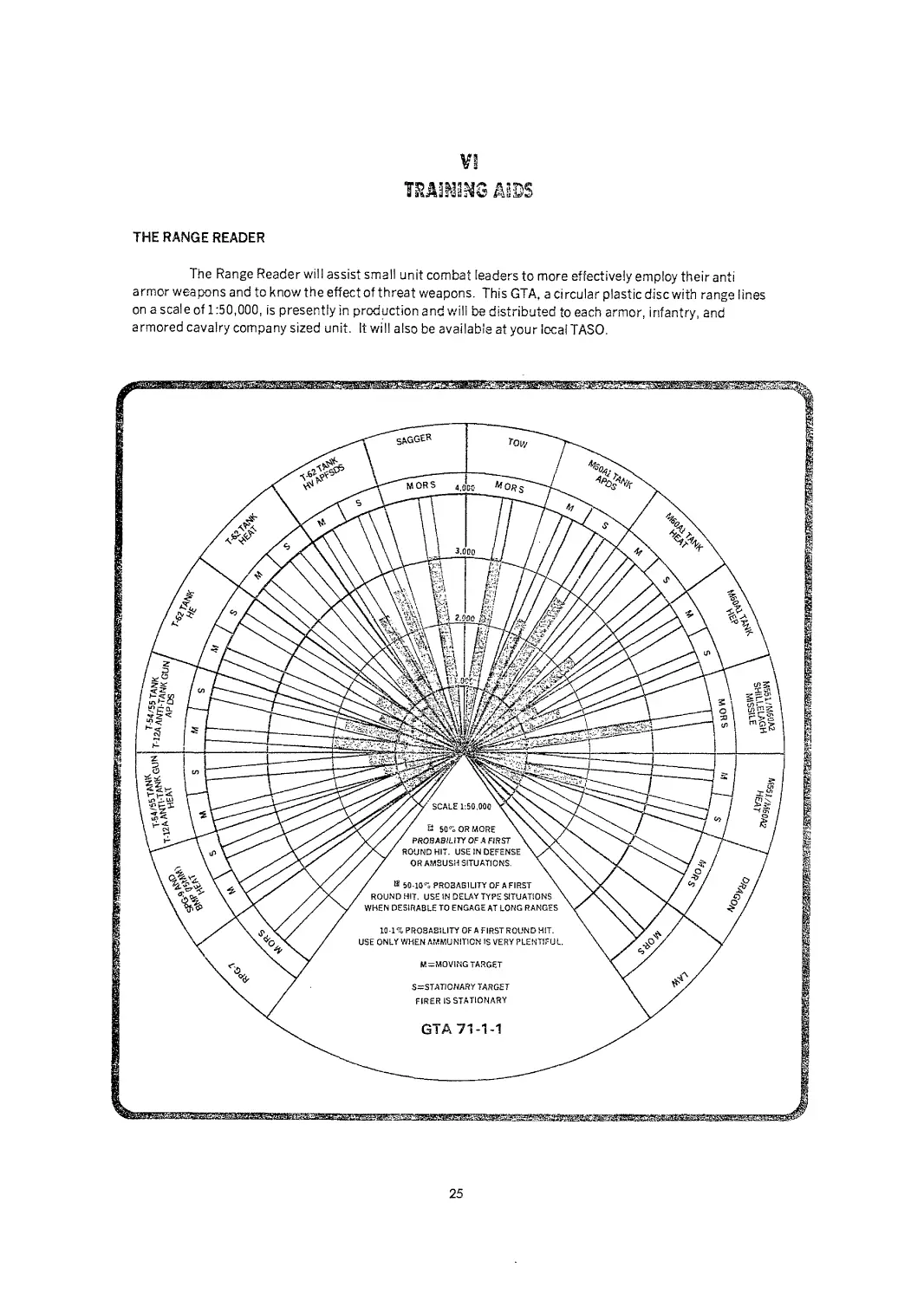
THE RANGE READER
The Range Reader will assist small unit combat leaders to more effectively employ their anti
armor weapons and to know the effect of threat weapons. This GTA, a ci rcular plastic disc with range lines
on a scale of 1:50,000, is presently in production and will be distributed to each armor, infantry, and
armored cavalry company sized unit. It will also be available at your local TASO.

25
VH
OBTAmmG TRADOC BULLETINS
Purpose. A series of TRADOC Bulletins are being published by HQTRADOCto provide
commanders timely technical information on weapons, tactics and training technique. It is not
intended to supplant doctrinal publications, butto supplement material on “How to fight" with
data derived from tests, recent intelligence, or other sources, which probe “why?"
Applicability. TRADOC Bulletins a re developed by Headquarters, TRADOC using the most
comprehensive and current military and civilian data available. Army Training and Evaluation
Programs (ARTEP), Field Manuals (FM) and Training Circulars (TC) will continue to be the
primary training references. TRADOC Bulletins will supplement them with an explanation of
why we are training in a given manner. TRADOC Bulletins should enable commanders to better
stimulate and motivate subordinates to understand why we train the way we do.
Index of Series. TRADOC Bulletins are cataloged in DA Pamphlet310-3, “Index of Doctrinal,
Training and Organizational Publications.” The series are numbered consecutively and each
TRADOC Bulletin is announced at time of printing in the information bulletin distributed to aII
pinpoint account holders by the US Army AG Publications Center.
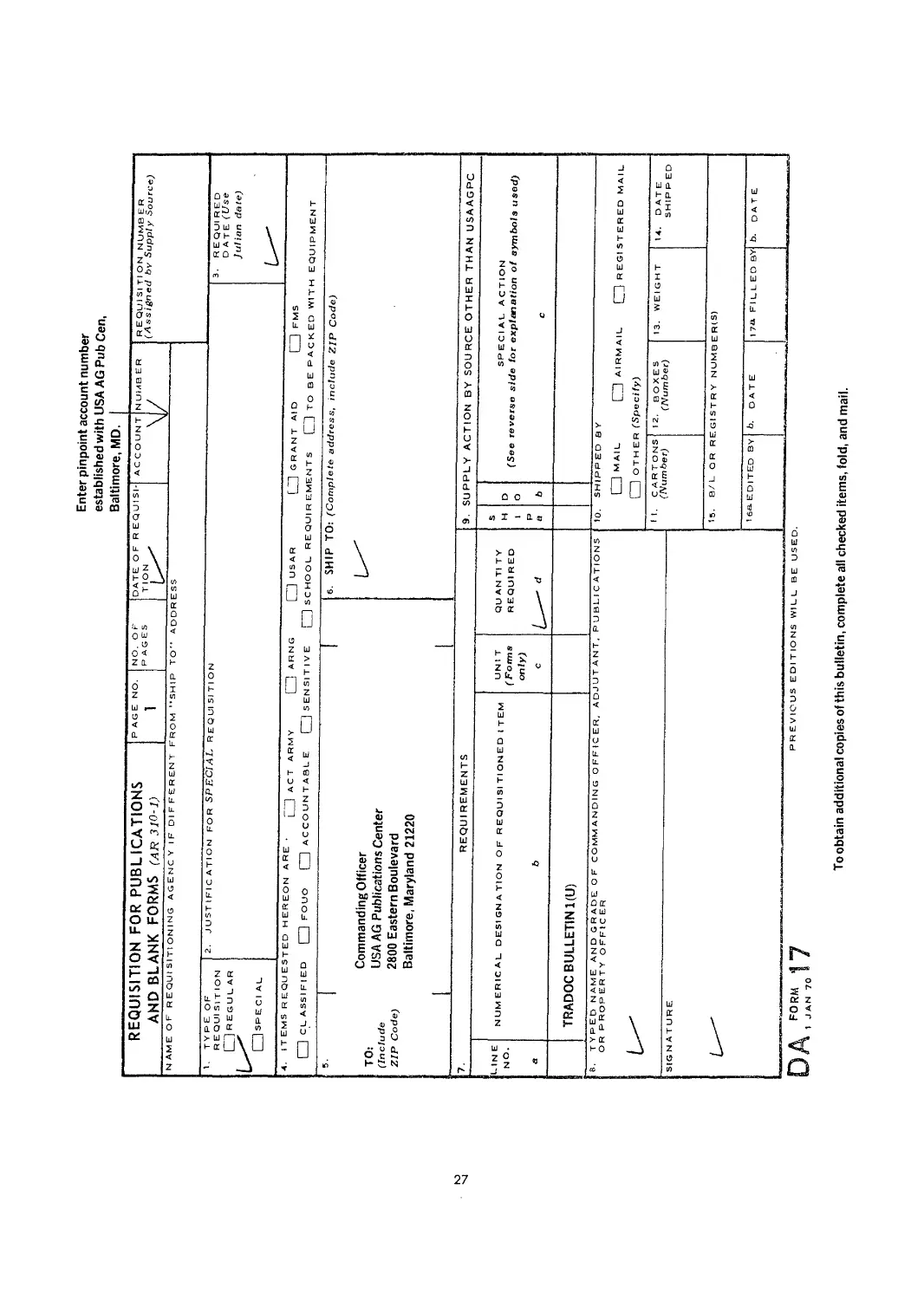
Additional Copies. Submit DA Form 17 to order more copies of th is TRADOC Bulletin.
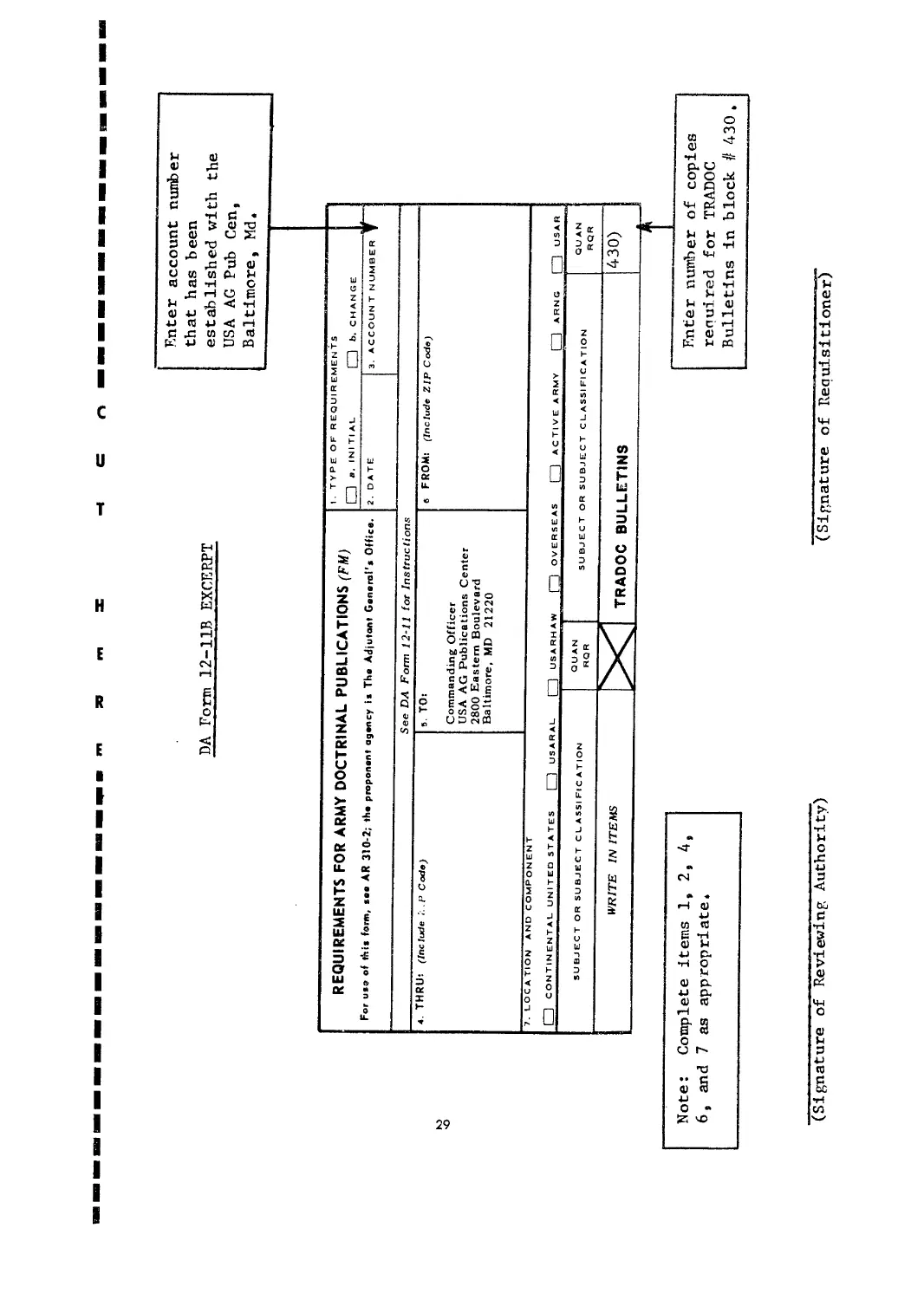
Permanent Distribution. Pinpoint account holders receivingTRADOC Bulletin Number 1 from
Baltimore will automatically receive two copies of all subsequent issues unless a DA Form 12-
11В is submitted to change that quantity. Others desiring to be added to the permanent
distribution listforTRA.DOC Bulletins mustsubmita DA Form 12-11B. Units which are
required to submit publication requests through another headquarters should send the
completed excerpt through proper authority.
Reference for Distribution Procedures. DA Pamphlet 310-10 explains the pinpoint distribution
system and how to establish or update an existing account at the US Army AG Publications
Center, TC21-6-1, “Use YourTrainingPublications," will be helpful also in understandingthe
pinpoint system.
26
Enter pinpoint account number
established with USA AG Pub Cen,
Baltimore, MD.
REQUISITION FOR PUBLICATIONS AND BLANK FORMS (ar зЮ-1)	PAGE NO. 1	NO. О F pages	DATE OF R EQUISI-	ACCOUNT	NUMBER	REQUISITION NUMBER (Assigned by Supply Sou ret
NAME OF REQUISITIONING AGENCY IF DIFFERENT FROM "SHIP TO" ADDRESS
1. TYPE OF RE QUI SIT ION [~~~| REGUL ar 1 I SPECIAL	2. JUSTIFICATION FOR SPECIAL REQUISITION	3. REQUIRED DATE (Use Julian date)
4. ITEMS REQUESTED HEREON ARE •	( ~j ACT ARMY	j j ARNG	USAR	f GRANT AID	[	| FMS
I I CLASSIFIED I | FOUO j | ACCOUNTABLE | | 5 EN S! T ! V E	£2] SCHOOL REQUIREMENTS j | TO BE PACKED WITH EQUIPMENT
5.	I	I	6. SHIP TO: (Complete address, include ZIP Code)
TO:
(Include
ZIP Code)
Commanding Officer
USA AG Publications Center
2800 Eastern Boulevard
Baltimore, Maryland 21220
j	[
7.	REQUIREMENTS				9. SUPPLY ACTION BY SOURCE OTHER THAN USAAGPC
ILIN E NO. a	NUMERICAL DESIGNATION OF REQUISITIONED ITEM b	UNI T ( Forms only) c	QU AN Tl TY REQUIRED d	s H 1 p a	D О b	SPECIAL ACTION (See reverse side for explanation of symbols used) c
	TRADOC BULLETIN 1(U)
8. TYPED NAME AND GRADE OF COMMANDING OFFICER, ADJUTANT, PUBLICATIONS OR PROPERTY OFFICER				10. SHIPP ED В Y Г~) MAIL	i~~l AIRMAIL CZ3 REGISTERED MAIL j I OTHER (Specify)
				II. C ARTONS (Number)			12. BOXES (Number)	1 3. WEI G н T	14. DATE SHIP P ED
SIGNATURE
15. B/L OR REGISTRY NUMBER(S)
lea EDITED BY b. DATE
17a FILLED by b. DATE
PREVIOUS EDITIONS WILL BE USED.
To obtain additional copies of this bulletin, complete all checked items, fold, and mail.
I
I
DEPARTMENT OF THE ARMY
POSTAGE AND FEES PAID
DEPARTMENT OF THE ARMY
OFFICIAL BUSINESS	DOD-314
PENALTY FOR PRIVATE USE $300
Commander
US Army AG Publications Center
2800 Eastern Boulevard
Baltimore, Maryland 21220
c
I
I
I
I
I
I
i
I
У
T
H
{Fold and mail to above)
R
E
i
I
I
i
!
8
I
I
I
i
1
!
I
«1МЯ1М1ШМПШВЯШ MMUMMUM	m я m
О м мм м мм мм мм ММ ММ им ММ Mi нм * МИ
(Signature of Reviewing Authority)
(Signature of Requisitioner)
DEPARTMENT OF THE ARMY
OFFICIAL BUSINESS
PENALTY FOR PRIVATE USE $300
Commander
US Army AG Publications Center
2800 Eastern Boulevard
Baltimore, Maryland 21220
POSTAGE AND FEES PAID
department of the army
DOD-314
I
I
I
I
I
I
I
I
I
I
I
I
c
H
(Fold and mail to above)
R
i
i
i
i
i
i
i
i
i
i
i
i
i
i
30	I
I
I
I
и
TRADOC Bulletin No, 1
General, United States Army
Commanding
DISTRIBUTION:
Active Army, ARNG, USAR: To be distributed in accordance with DA Form 1 2-11 В requirements for
TRADOC Bulletins (Qty rqr block no. 430); plus 2 copies each to all DA Form 12-11 accounts.
U. S, GOVERNMENT PRINTING OFFICE; 197S—037-786/42
31
DEPARTMENT OF THE ARMY
US ARMY AG PUBLICATIONS CENTER
2800 EASTERN BOULEVARD
BALTIMORE MARYLAND 21 220
OFFICIAL BUSINESS
PENALTY FOR PRIVATE USE S300
POSTAGE AND FEES PAID
DEPARTMENT OF THE ARMY
DOD 314
SPECIAL FOURTH CLASS BOOK
RATE