/


Текст
                    ИИ
л
j $ ;й $ % t ^'C K? <. ? л -'r
uW OB1UIUI
UNITED STATES ARMY TRAINING AND DOCTRINE COMMAND
TRAD0C7
BULLETIN /
. •	..3л ;,»r.. • k ...v  -*‘e •..	 j.’.' •. *	v	i 5- • . ।	 j . '	•	••	. •• /.ч;.	 i	'	. . ,	- •	>. •	... : x.
•WEAPONS
• TACTICS
• TRAINING

THE BMP:
30 JUNE 1977
CAPABILITIES AND LIMITATIONS

UNCLASSIFIED
REPORT DOCUMENTATION PAGE			Form Approved 0MB No. 0704-0188
Public reporting burden for this collection of information is estimated to average 1 hour per response, including the time for reviewing instructions, searching existing data sources, gathering and maintaining the data needed, and completing and reviewing the collection of information. Send comments regarding this burden estimate or any other aspect of this collection of information, including suggestions for reducing this burden, to Washington Headquarters Services, Directorate for Information Operations and Reports, 1215 Jefferson Davis Highway, Suite 1204, Arlington, VA 22202-4302, and to the Office of Management and Budget, Paperwork Reduction Project (0704-0188), Washington, DC 20503.
1. AGENCY USE ONLY (Leave blank)	2. REPORT DATE	3. REPORT TYPE AND DATES COVERED 30 JUNE 1977	FINAL
4. TITLE AND SUBTITLE TRADOC BULLETIN 7. THE BMP: CAPABILITIES AND LIMITATIONS			5. FUNDING NUMBERS
6. AUTHOR(S)
7, PERFORMING ORGANIZATION NAME(S) AND ADDRESS(ES) HQ U.S. ARMY TRAINING AND DOCTRINE COMMAND ATTN: ATCG-T FORT MONROE VIRGINIA 23651			8. PERFORMING ORGANIZATION REPORT NUMBER
9. SPONSORING / MONITORING AGENCY NAME(S) AND ADDRESS(ES)			10. SPONSORING/MONITORING AGENCY REPORT NUMBER
11. SUPPLEMENTARY NOTES	... See TRADOC Bulletin 6 dated 30 January 1976
12a. DISTRIBUTION / AVAILABILITY STATEMENT APPROVED FOR PUBLIC RELEASE; DISTRIBUTION IS UNLIMITED.			12b. DISTRIBUTION CODE
13. ABSTRACT (Maximum 200 words) The BMP represents a significant departure from previous Threat armored personnel carriers in that it satisfied a longstanding requirement for a highly mobile, amphibious, mechanized infantry vehicle capable of fighting on the move while accompanying tanks. Only the commander who knows the potential of Threat equipment can effectively counter is; and only he who understnads what present US weapons can accomplish is prepared to use them to their best advantage. The purpose of this bulletin is to discuss the BMP and to propose tactics and techniques that can be used to degrade its effectiveness. But before we can effectively counter a weapon system, we must know it and, to this end, the BMP weapons system is discussed in detail, showing: how it operates; its strengths and weaknesses; how it is employed; how to defeat it.
14. SUBJECT TERMS				15. NUMBER OF PAGES 48
				16. PRICE CODE
17. SECURITY CLASSIFICATION OF REPORT UNCLASSIFIED	18. SECURITY CLASSIFICATION OF THIS PAGE UNCLASSIFIED	19. SECURITY CLASSIFICATION OF ABSTRACT UNCLASSIFIED		20. LIMITATION OF ABSTRACT UNLIMITED
MSN 7540-01-280-5500
Standard Form 298 (Rev. 2-89)
Prescribed by ANSI Std. Z39-18 298-102
USAPPC Vl.OO
*ARMY TRAINING AND EVALUATION PROGRAM
UNITED STATES ARMY
TRAINING AND DOCTRINE COMMAND
BULLETIN NO. 7
THE BMP:
CAPABILITIES AND LIMITATIONS
CONTENTS
I	INTRODUCTION....................................2
II	BMP CHARACTERISTICS AND ARMAMENT...............4
III	EMPLOYMENT...................................21
IV	COUNTERMEASURES...............................27
APPENDIX A	BMP VARIATIONS.....................35
APPENDIX В	MANUALS AND OTHER PUBLICATIONS .... 37
APPENDIX C	ORDERING TRADOC BULLETINS..........38
This TRADOC BULLETIN is intended to provide
to commanders, and others concerned with
military training, timely technical information on
weapons, tactics, and training. It is not intended to
supplant doctrinal publications, but to supplement
material on “how to fight" with data derived from
tests, recent intelligence, or other sources, which
probe "why."
TRAINERS' NOTE: The format of this bulletin is
designed to help trainers identify and extract
needed information. Charts, illustrations, and other
key data are unclassified, clearly marked and are
boxed-in by a bold line.
Comment or criticism is welcome, and should be
directed to:
COMMANDER
US ARMY TRAINING AND DOCTRINE COMMAND
ATTN: ATCG-T (TEL: AUTOVON 680-2972/3153)
FORT MONROE, VIRGINIA 23651
1
CHAPTER I
TRADOC BULLETIN NO. 7
I
INTRODUCTION
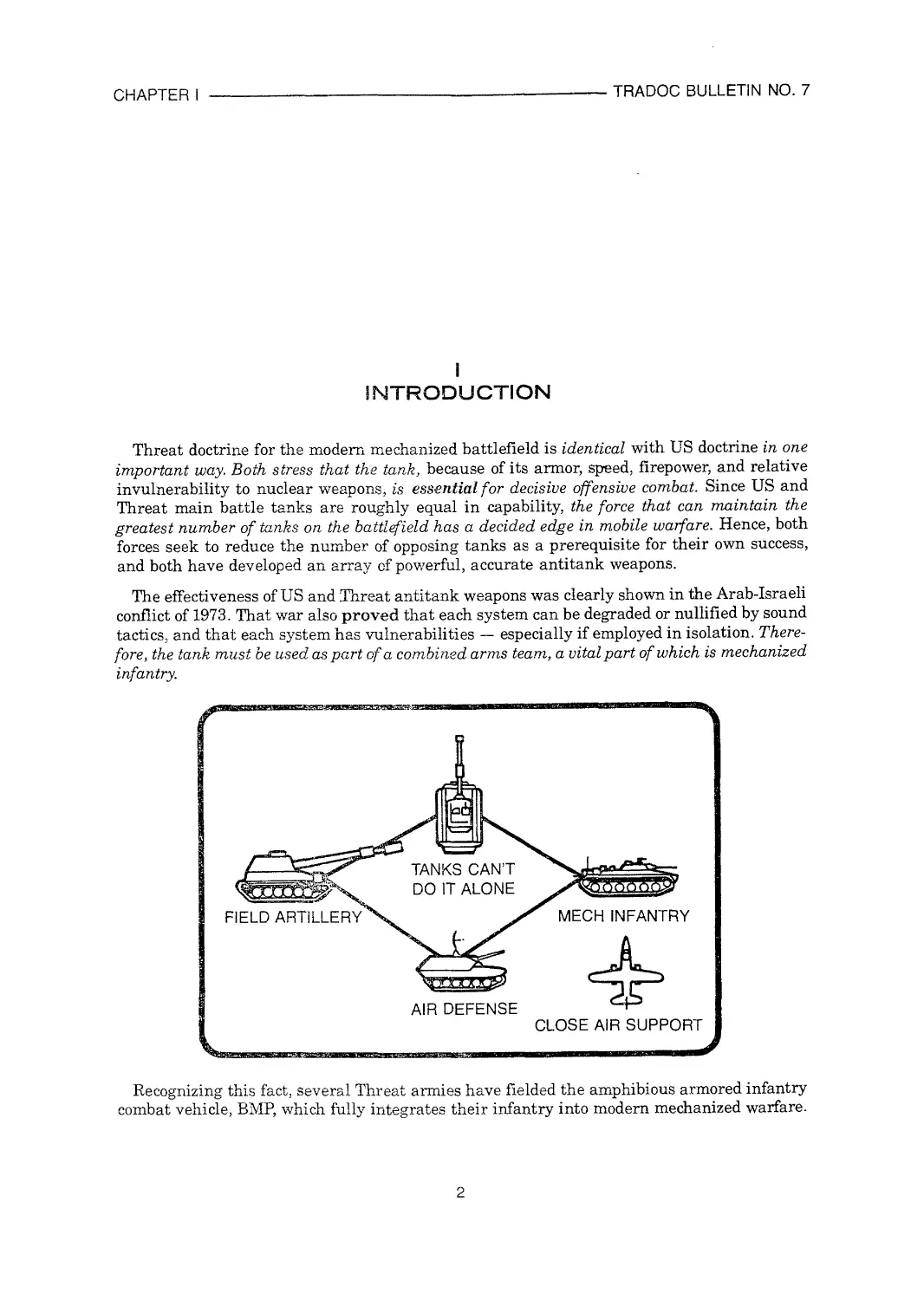
Threat doctrine for the modem mechanized battlefield is identical with US doctrine in one
important way. Both stress that the tank, because of its armor, speed, firepower, and relative
invulnerability to nuclear weapons, is essential for decisive offensive combat. Since US and
Threat main battle tanks are roughly equal in capability, the force that can maintain the
greatest number of tanks on the battlefield has a decided edge in mobile warfare. Hence, both
forces seek to reduce the number of opposing tanks as a prerequisite for their own success,
and both have developed an array of powerful, accurate antitank weapons.
The effectiveness of US and Threat antitank weapons was clearly shown in the Arab-Israeli
conflict of 1973. That war also proved that each system can be degraded or nullified by sound
tactics, and that each system has vulnerabilities — especially if employed in isolation. There-
fore, the tank must be used as part of a combined arms team, a vital part of which is mechanized
infantry.
Recognizing this fact, several Threat armies have fielded the amphibious armored infantry
combat vehicle, BMP, which fully integrates their infantry into modern mechanized warfare.
2
TRADOC BULLETIN NO. 7
CHAPTER I
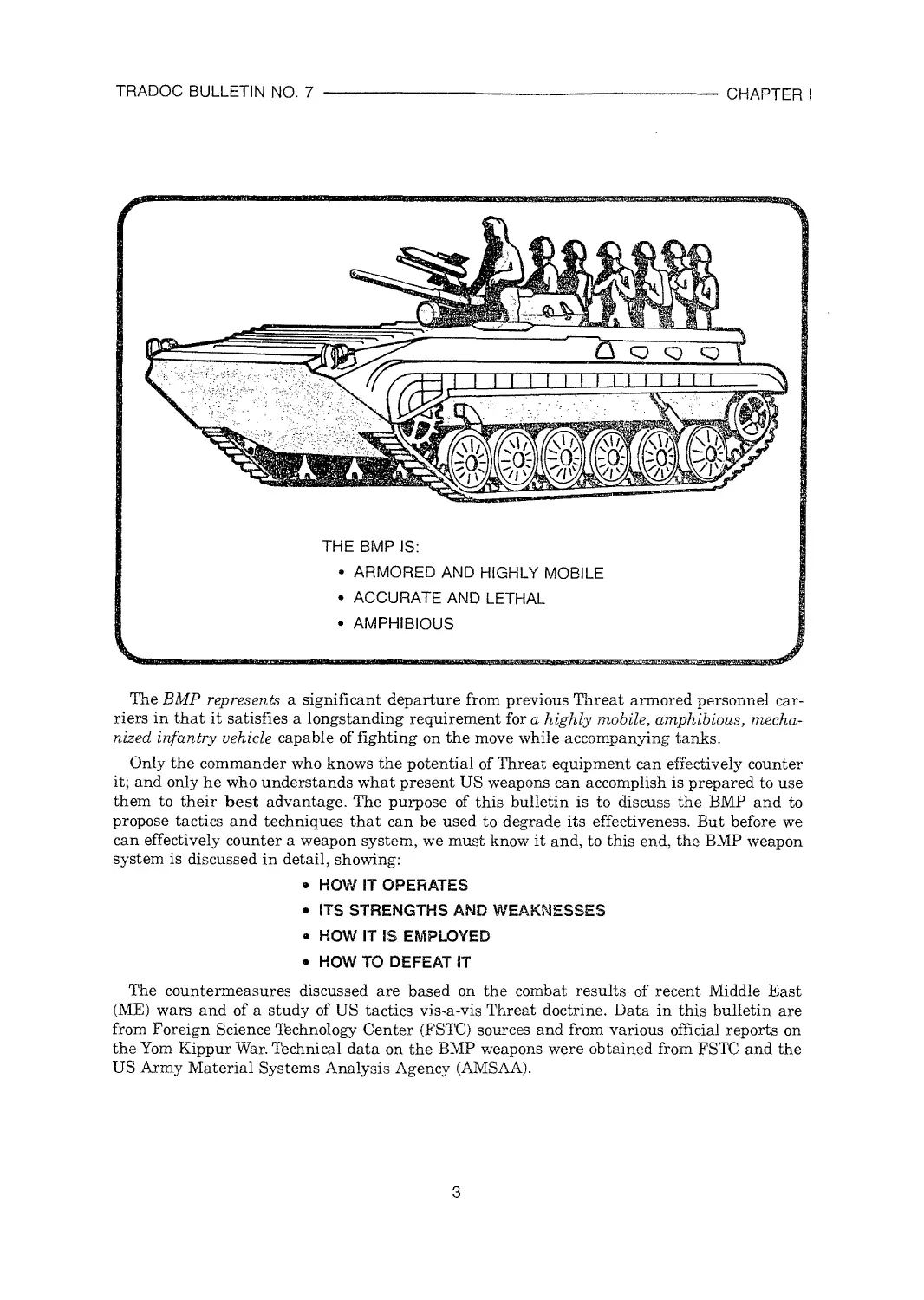
The BMP represents a significant departure from previous Threat armored personnel car-
riers in that it satisfies a longstanding requirement fora highly mobile, amphibious, mecha-
nized infantry vehicle capable of fighting on the move while accompanying tanks.
Only the commander who knows the potential of Threat equipment can effectively counter
it; and only he who understands what present US weapons can accomplish is prepared to use
them to their best advantage. The purpose of this bulletin is to discuss the BMP and to
propose tactics and techniques that can be used to degrade its effectiveness. But before we
can effectively counter a weapon system, we must know it and, to this end, the BMP weapon
system is discussed in detail, showing:
•	HOW IT OPERATES
•	ITS STRENGTHS AND WEAKNESSES
•	HOW IT IS EMPLOYED
•	HOW TO DEFEAT IT
The countermeasures discussed are based on the combat results of recent Middle East
(ME) wars and of a study of US tactics vis-a-vis Threat doctrine. Data in this bulletin are
from Foreign Science Technology Center (FSTC) sources and from various official reports on
the Yom Kippur War. Technical data on the BMP weapons were obtained from FSTC and the
US Army Material Systems Analysis Agency (AMSAA).
3
CHAPTER II
TRADOC BULLETIN NO. 7
BMP CHARACTERISTICS AND ARMAMENT
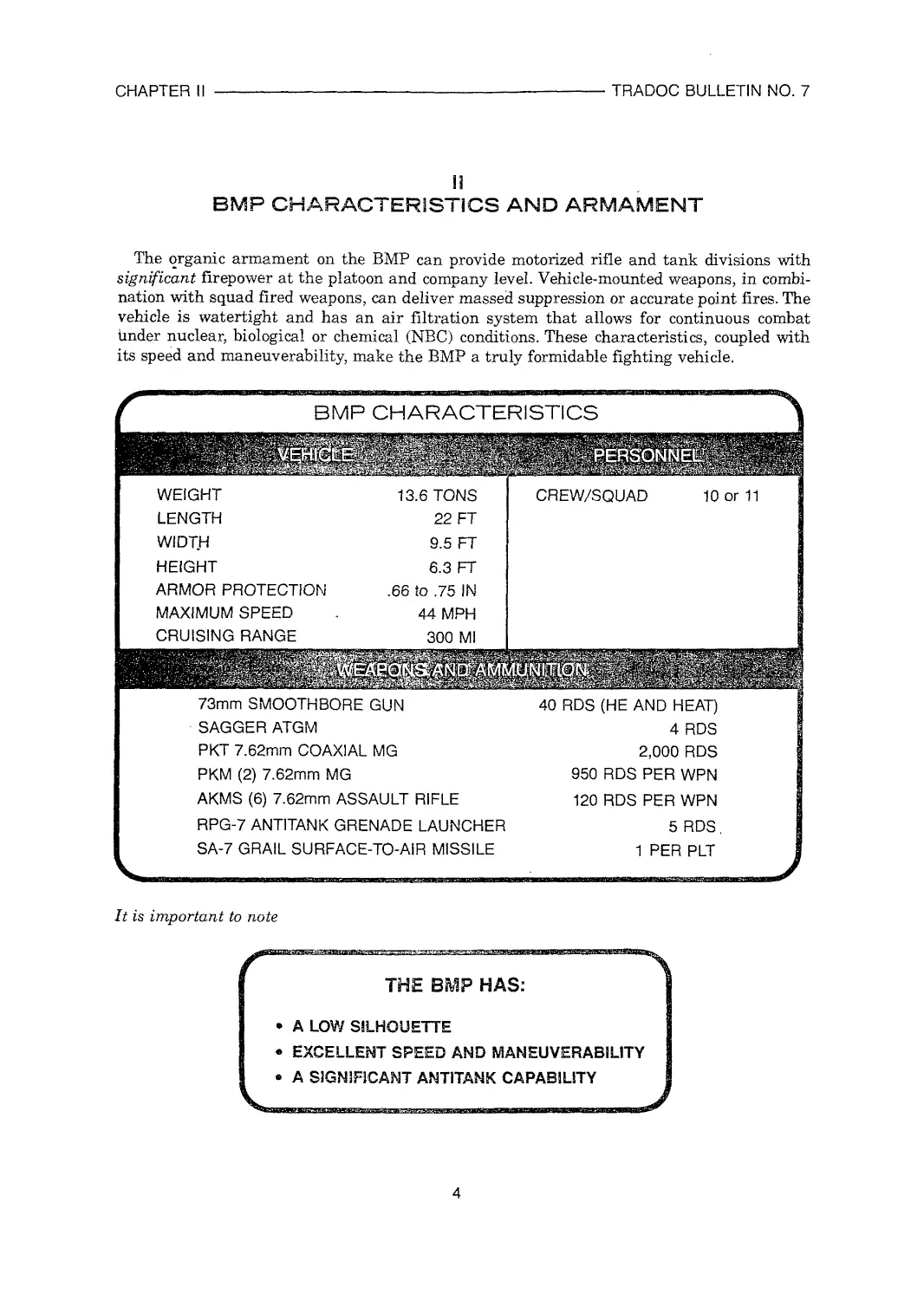
The organic armament on the BMP can provide motorized rifle and tank divisions with
significant firepower at the platoon and company level. Vehicle-mounted weapons, in combi-
nation with squad fired weapons, can deliver massed suppression or accurate point fires. The
vehicle is watertight and has an air filtration system that allows for continuous combat
under nuclear, biological or chemical (NBC) conditions. These characteristics, coupled with
its speed and maneuverability, make the BMP a truly formidable fighting vehicle.
CREW/SQUAD
10 or 11
WEIGHT
LENGTH
WIDTH
HEIGHT
ARMOR PROTECTION
MAXIMUM SPEED
CRUISING RANGE
13.6 TONS
22 FT
9.5 FT
6.3 FT
.66 to .75 IN
44 MPH
300 Ml


73mm SMOOTHBORE GUN
SAGGER ATGM
PKT 7.62mm COAXIAL MG
PKM (2) 7.62mm MG
AKMS (6) 7.62mm ASSAULT RIFLE
RPG-7 ANTITANK GRENADE LAUNCHER
SA-7 GRAIL SURFACE-TO-AIR MISSILE
40 RDS (HE AND HEAT)
4 RDS
2,000 RDS
950 RDS PER WPN
120 RDS PER WPN
5 RDS
1 PER PLT
It is important to note
THE BMP HAS:
• A LOW SILHOUETTE
• EXCELLENT SPEED AND MANEUVERABILITY
• A SIGNIFICANT ANTITANK CAPABILITY

4
TRADOC BULLETIN NO. 7
CHAPTER II
ANALYSES OF THE WEAPON SYSTEM
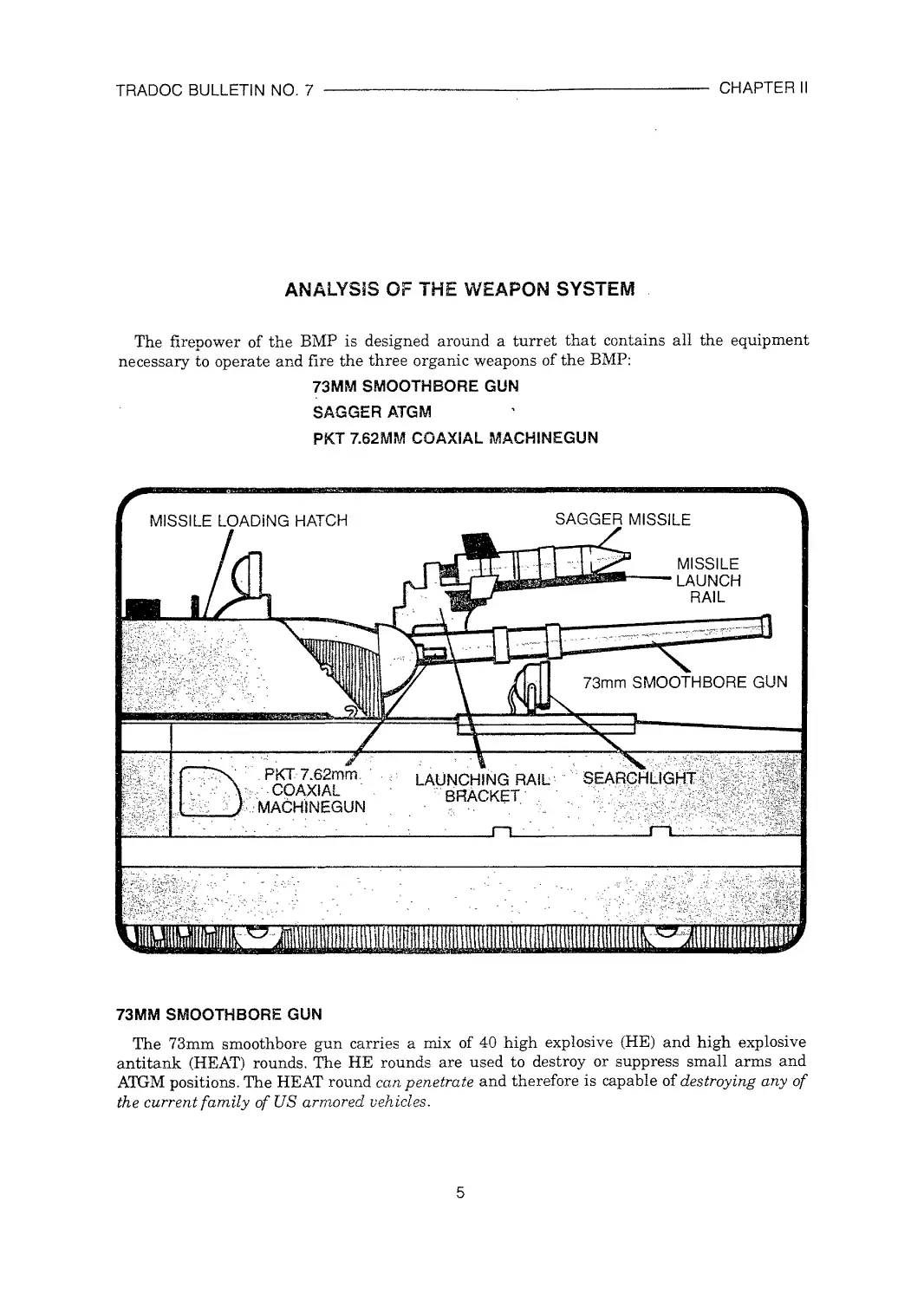
The firepower of the BMP is designed around a turret that contains all the equipment
necessary to operate and fire the three organic weapons of the BMP:
73MM SMOOTHBORE GUN
SAGGER ATGM
PKT 7.62MM COAXIAL MACHINEGUN
MISSILE LOADING HATCH	SAGGER MISSILE
73MM SMOOTHBORE GUN
The 73mm smoothbore gun carries a mix of 40 high explosive (HE) and high explosive
antitank (HEAT) rounds. The HE rounds are used to destroy or suppress small arms and
ATGM positions. The HEAT round can penetrate and therefore is capable of destroying any of
the current family of US armored vehicles.
5
CHAPTER 11
TRADOC BULLETIN NO. 7
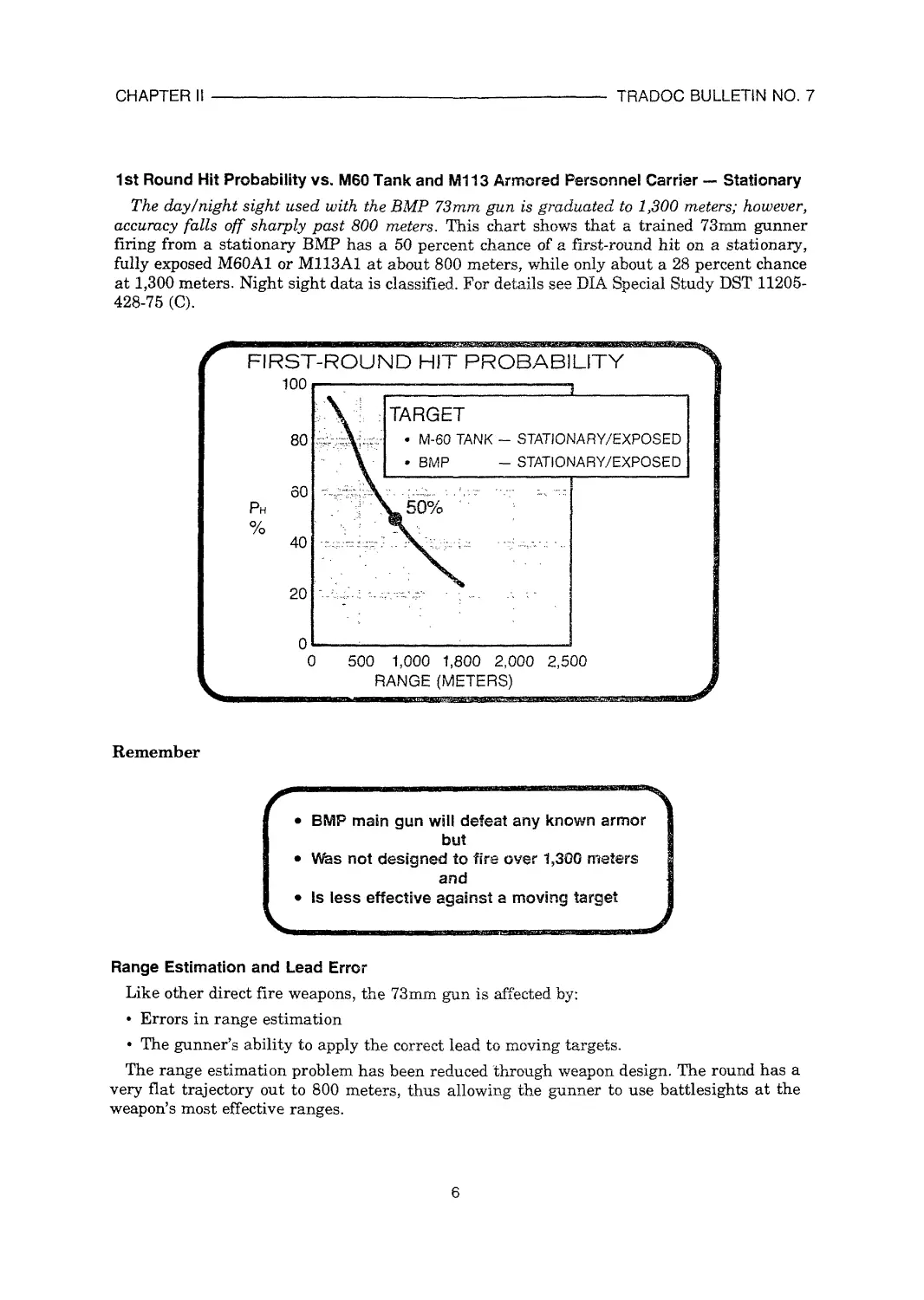
1st Round Hit Probability vs. M60 Tank and M113 Armored Personnel Carrier — Stationary
The day/night sight used with the BMP 73mm gun is graduated to 1,300 meters; however,
accuracy falls off sharply past 800 meters. This chart shows that a trained 73mm gunner
firing from a stationary BMP has a 50 percent chance of a first-round hit on a stationary,
fully exposed M60A1 or M113A1 at about 800 meters, while only about a 28 percent chance
at 1,300 meters. Night sight data is classified. For details see DIA Special Study DST 11205-
428-75 (C).
Remember
BMP main gun will defeat any known armor
but
Was not designed to fire over 1,300 meters
and
Is less effective against a moving target
Range Estimation and Lead Error
Like other direct fire weapons, the 73mm gun is affected by:
•	Errors in range estimation
•	The gunner’s ability to apply the correct lead to moving targets.
The range estimation problem has been reduced through weapon design. The round has a
very flat trajectory out to 800 meters, thus allowing the gunner to use battlesights at the
weapon’s most effective ranges.
6
TRADOC BULLETIN NO. 7
CHAPTER II
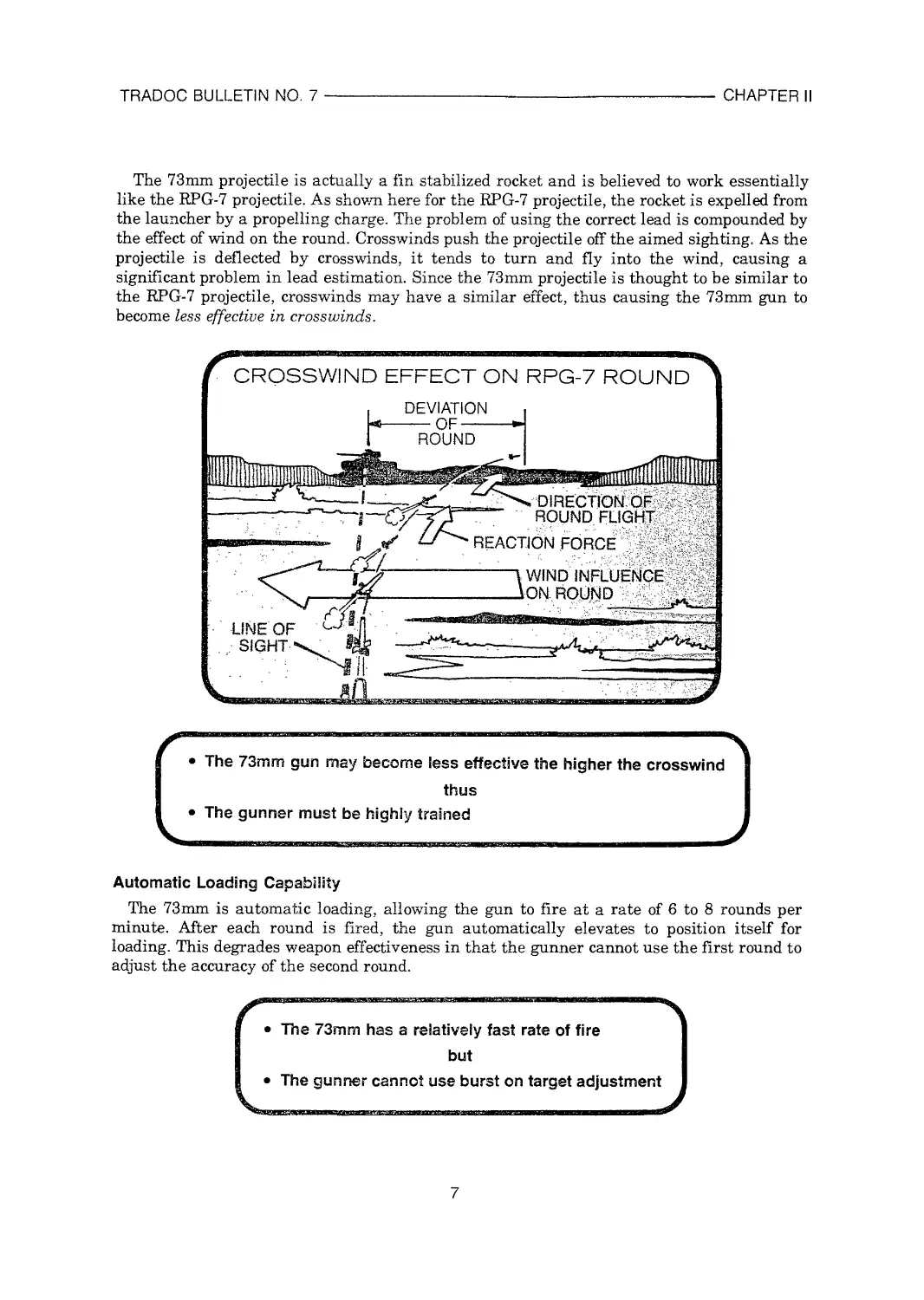
The 73mm projectile is actually a fin stabilized rocket and is believed to work essentially
like the RPG-7 projectile. As shown here for the RPG-7 projectile, the rocket is expelled from
the launcher by a propelling charge. The problem of using the correct lead is compounded by
the effect of wind on the round. Crosswinds push the projectile off the aimed sighting. As the
projectile is deflected by crosswinds, it tends to turn and fly into the wind, causing a
significant problem in lead estimation. Since the 73mm projectile is thought to be similar to
the RPG-7 projectile, crosswinds may have a similar effect, thus causing the 73mm gun to
become less effective in crosswinds.
CROSSWIND EFFECT ON RPG-7 ROUND
• The 73mm gun may become less effective the higher the crosswind
thus
• The gunner must be highly trained

Automatic Loading Capability
The 73mm is automatic loading, allowing the gun to fire at a rate of 6 to 8 rounds per
minute. After each round is fired, the gun automatically elevates to position itself for
loading. This degrades weapon effectiveness in that the gunner cannot use the first round to
adjust the accuracy of the second round.

•	The 73mm has a relatively fast rate of fire
but
•	The gunner cannot use burst on target adjustment

7
CHAPTER II
TRADOC BULLETIN NO. 7
Firing on the Move
The 73mm HE round can be fired on the move for suppression, but the accuracy is reduced
due to lack of gun stabilization. Because of this, the preferred method of fire is from the short
halt —10 to 15 seconds.
ON THE MOVE, THE 73mm GUN:
Can fire HE rounds to suppress positions
but
Is not accurate against point targets
Main Gun Dead Space
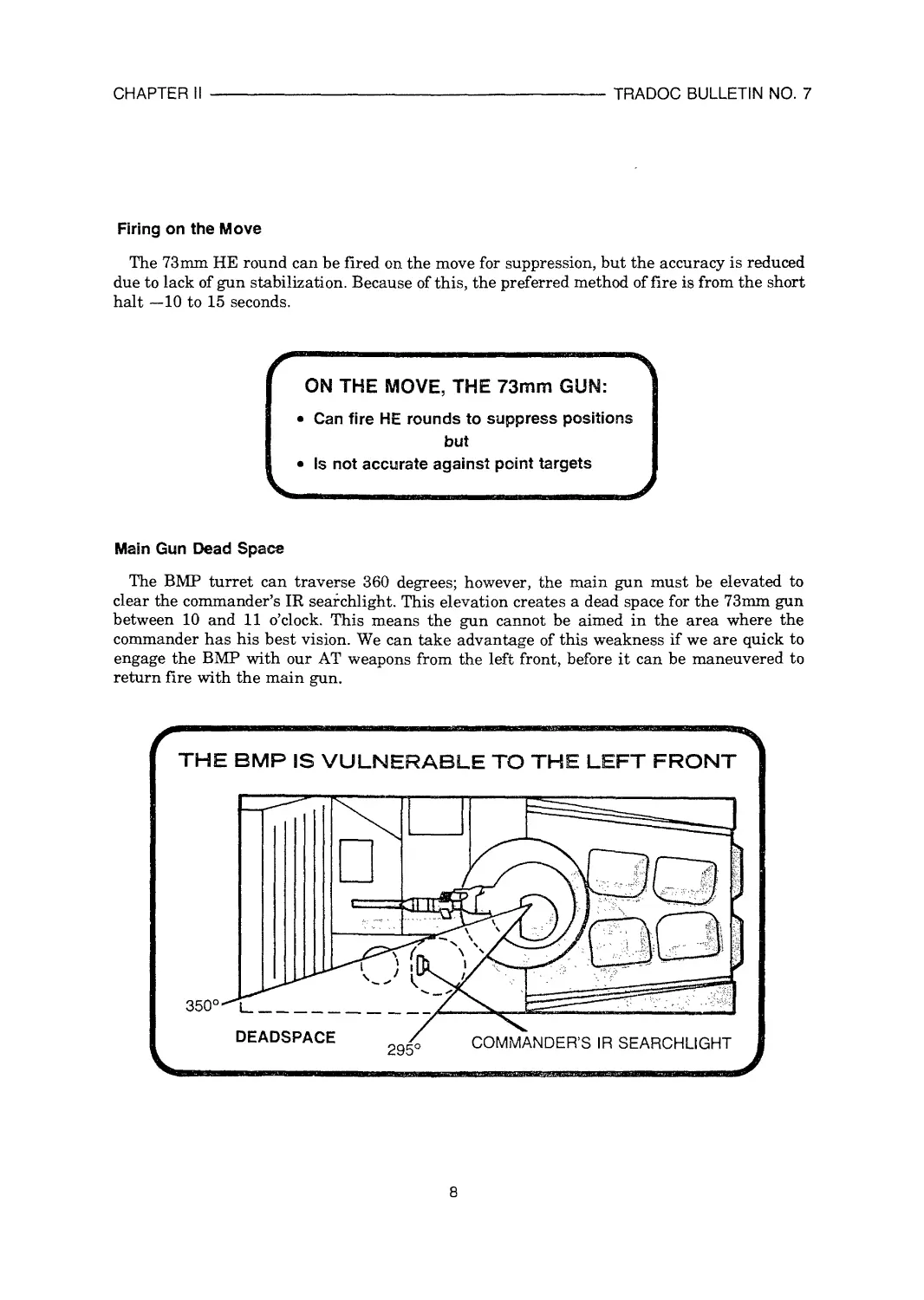
The BMP turret can traverse 360 degrees; however, the main gun must be elevated to
clear the commander’s IR searchlight. This elevation creates a dead space for the 73mm gun
between 10 and 11 o’clock. This means the gun cannot be aimed in the area where the
commander has his best vision. We can take advantage of this weakness if we are quick to
engage the BMP with our AT weapons from the left front, before it can be maneuvered to
return fire with the main gun.
n
THE BMP IS VULNERABLE TO THE LEFT FRONT
8
TRADOC BULLETIN NO. 7
CHAPTER II
Main Gun Depression
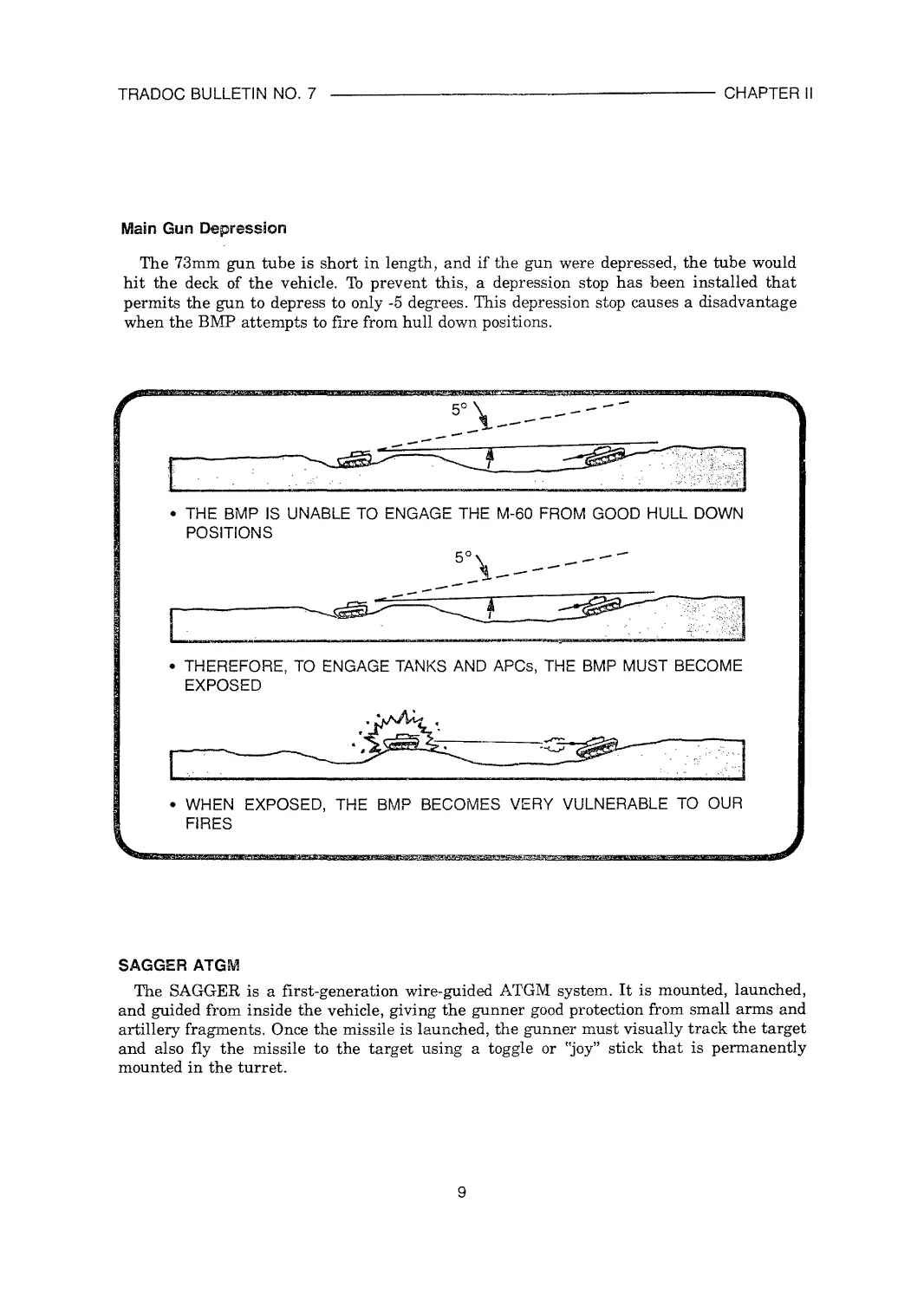
The 73mm gun tube is short in length, and if the gun were depressed, the tube would
hit the deck of the vehicle. To prevent this, a depression stop has been installed that
permits the gun to depress to only -5 degrees. This depression stop causes a disadvantage
when the BMP attempts to fire from hull down positions.
•	THE BMP IS UNABLE TO ENGAGE THE M-60 FROM GOOD HULL DOWN
POSITIONS
•	THEREFORE, TO ENGAGE TANKS AND APCs, THE BMP MUST BECOME
EXPOSED

• WHEN EXPOSED, THE BMP BECOMES VERY VULNERABLE TO OUR
FIRES
SAGGER AT GM
The SAGGER is a first-generation wire-guided ATGM system. It is mounted, launched,
and guided from inside the vehicle, giving the gunner good protection from small arms and
artillery fragments. Once the missile is launched, the gunner must visually track the target
and also fly the missile to the target using a toggle or "joy” stick that is permanently
mounted in the turret.
9
CHAPTER 11
TRADOC BULLETIN NO. 7
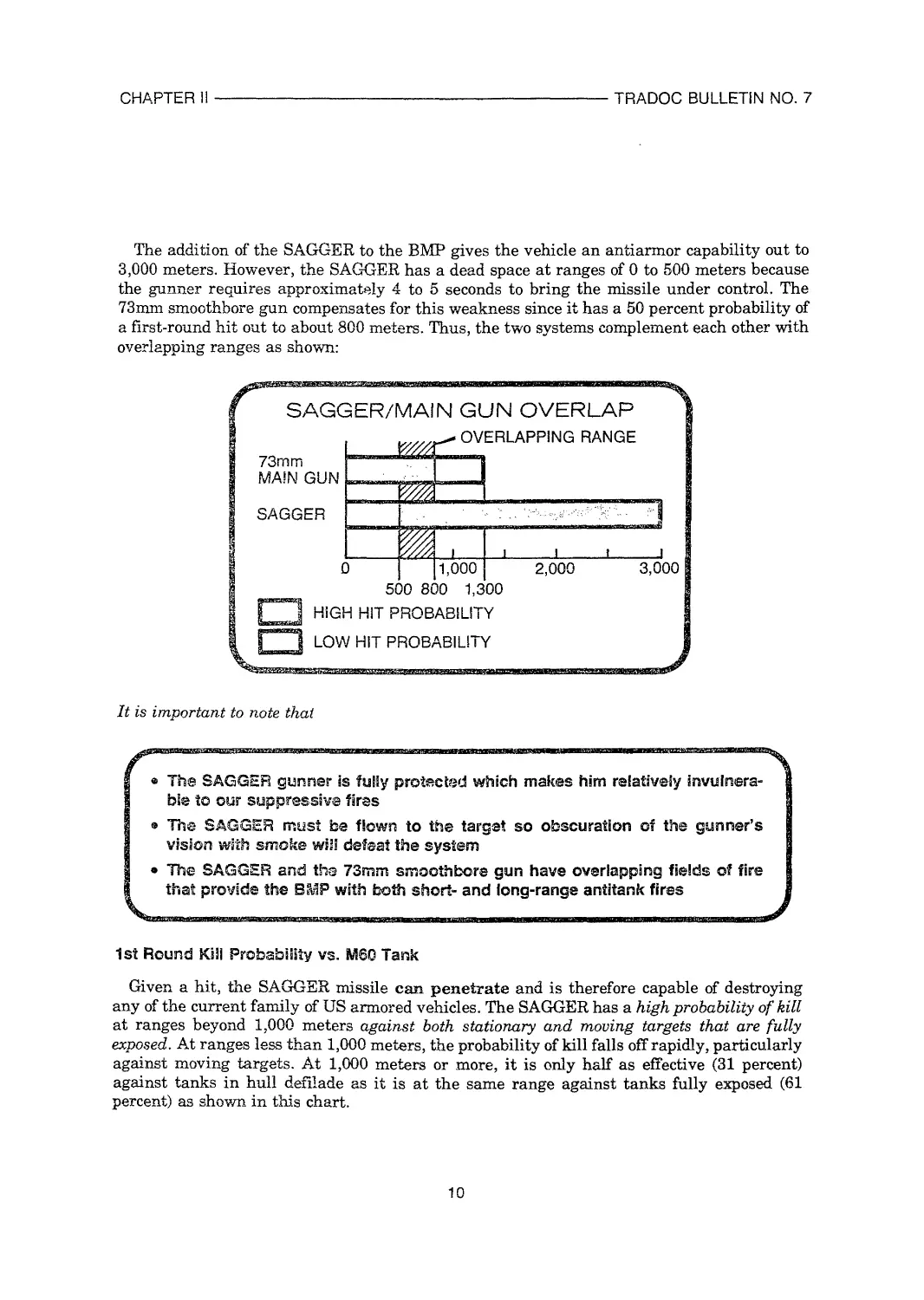
The addition of the SAGGER to the BMP gives the vehicle an antiarmor capability out to
3,000 meters. However, the SAGGER has a dead space at ranges of 0 to 500 meters because
the gunner requires approximately 4 to 5 seconds to bring the missile under control. The
73mm smoothbore gun compensates for this weakness since it has a 50 percent probability of
a first-round hit out to about 800 meters. Thus, the two systems complement each other with
overlapping ranges as shown:
It is important to note that
•	The SAGGER gunner is fully protected which makes him relatively invulnera-
bie to our suppressive fires
» Th® SAGGER must be flown to the target so obscuration of the gunner’s
vision with smoke will defeat the system
•	The SAGGER and the 73mm smoothbore gun have overlapping fields of fire
that provide the B&1P with both short- and long-range antitank fires
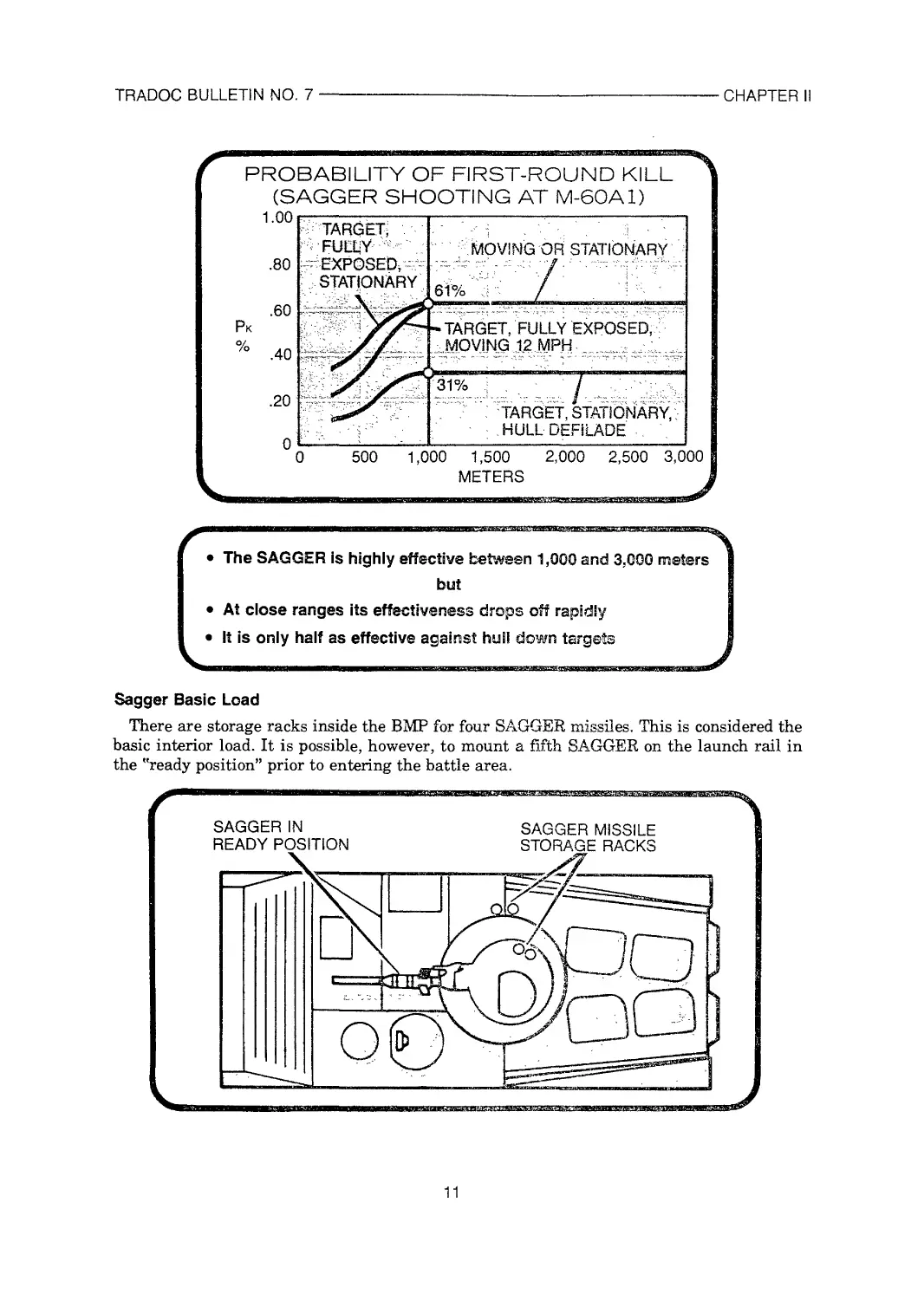
1st Round Kill Probability vs. M60 Tank
Given a hit, the SAGGER missile can penetrate and is therefore capable of destroying
any of the current family of US armored vehicles. The SAGGER has a high probability of kill
at ranges beyond 1,000 meters against both stationary and moving targets that are fully
exposed. At ranges less than 1,000 meters, the probability of kill falls off rapidly, particularly
against moving targets. At 1,000 meters or more, it is only half as effective (31 percent)
against tanks in hull defilade as it is at the same range against tanks fully exposed (61
percent) as shown in this chart.
10
TRADOC BULLETIN NO. 7
CHAPTER II
и...	1UHUW
PROBABILITY OF FIRST-ROUND KILL
(SAGGER SHOOTING AT M-60A1)
1.00
.80
TARGET,
FULLY
EXPOSED,
STATIONARY
MOVING OR STATIONARY
Pk
.60
.40
.20
61%
TARGET, FULLY EXPOSED,
MOVING 12 MPH
TARGET, STATIONARY,
HULL DEFILADE
0
0
500	1,000	1,500	2,000 2,500 3,000
METERS
The SAGGER is highly effective between 1,000 and 3,000 meters
but
At close ranges its effectiveness drops off rapidly
It is only half as effective against hull down targets
Sagger Basic Load
There are storage racks inside the BMP for four SAGGER missiles. This is considered the
basic interior load. It is possible, however, to mount a fifth SAGGER on the launch rail in
the "ready position” prior to entering the battle area.
11
CHAPTER II
TRADOC BULLETIN NO. 7
Firing the SAGGER
Because the gunner must simultaneously track the target and fly the missile, the SAGGER
must be fired while the BMP is stationary. This, coupled with the BMP’s inability to assume
a good hull down position, makes the vehicle vulnerable while firing and tracking the
SAGGER.
Remember
• The BMP must be stationary when firing and tracking the SAGGER
SAGGER Rate of Fire
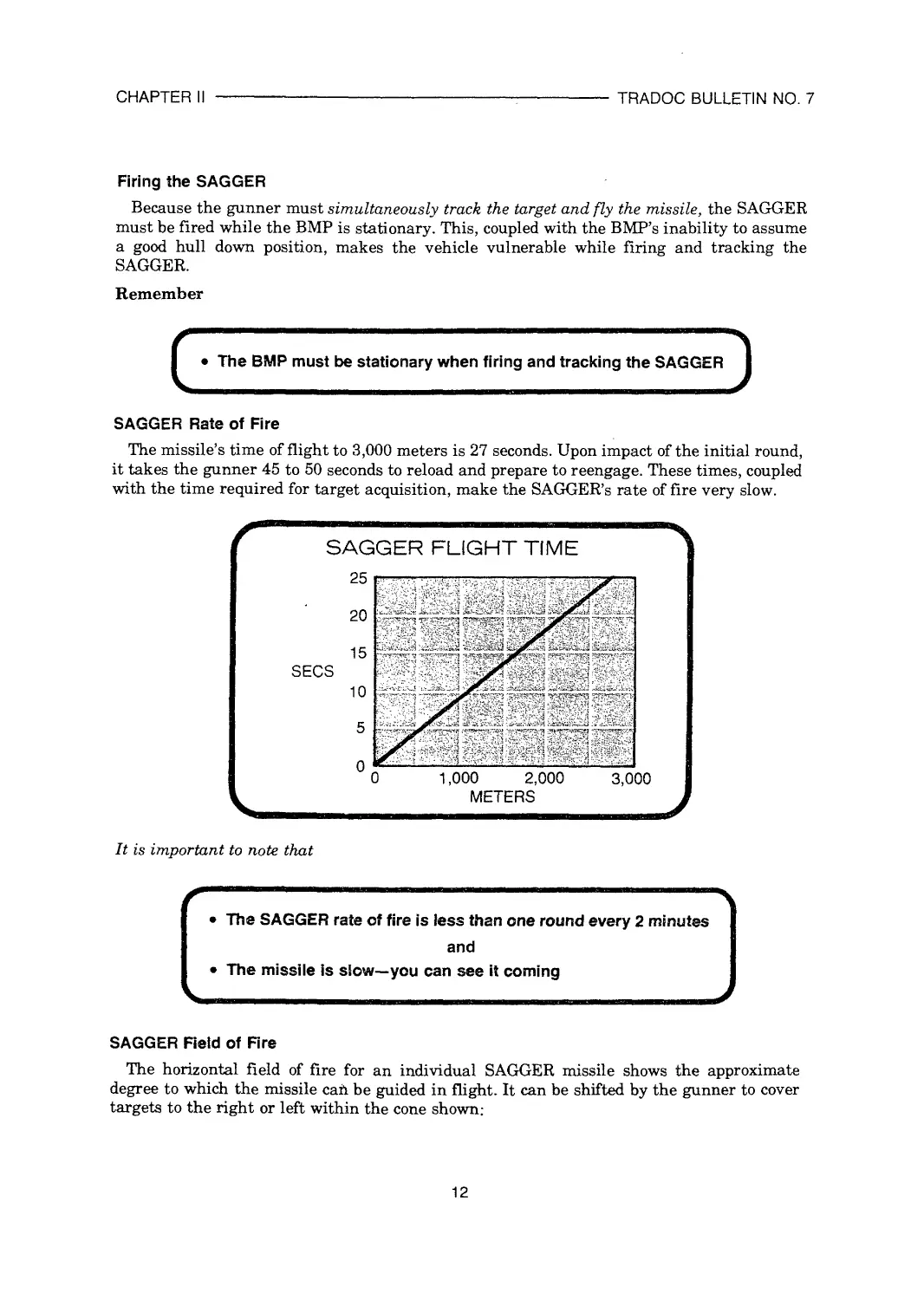
The missile’s time of flight to 3,000 meters is 27 seconds. Upon impact of the initial round,
it takes the gunner 45 to 50 seconds to reload and prepare to reengage. These times, coupled
with the time required for target acquisition, make the SAGGER’s rate of fire very slow.
SAGGER FLIGHT TIME
SECS
It is important to note that
The SAGGER rate of fire is less than one round every 2 minutes
and
The missile is slow—you can see it coming
SAGGER Field of Fire
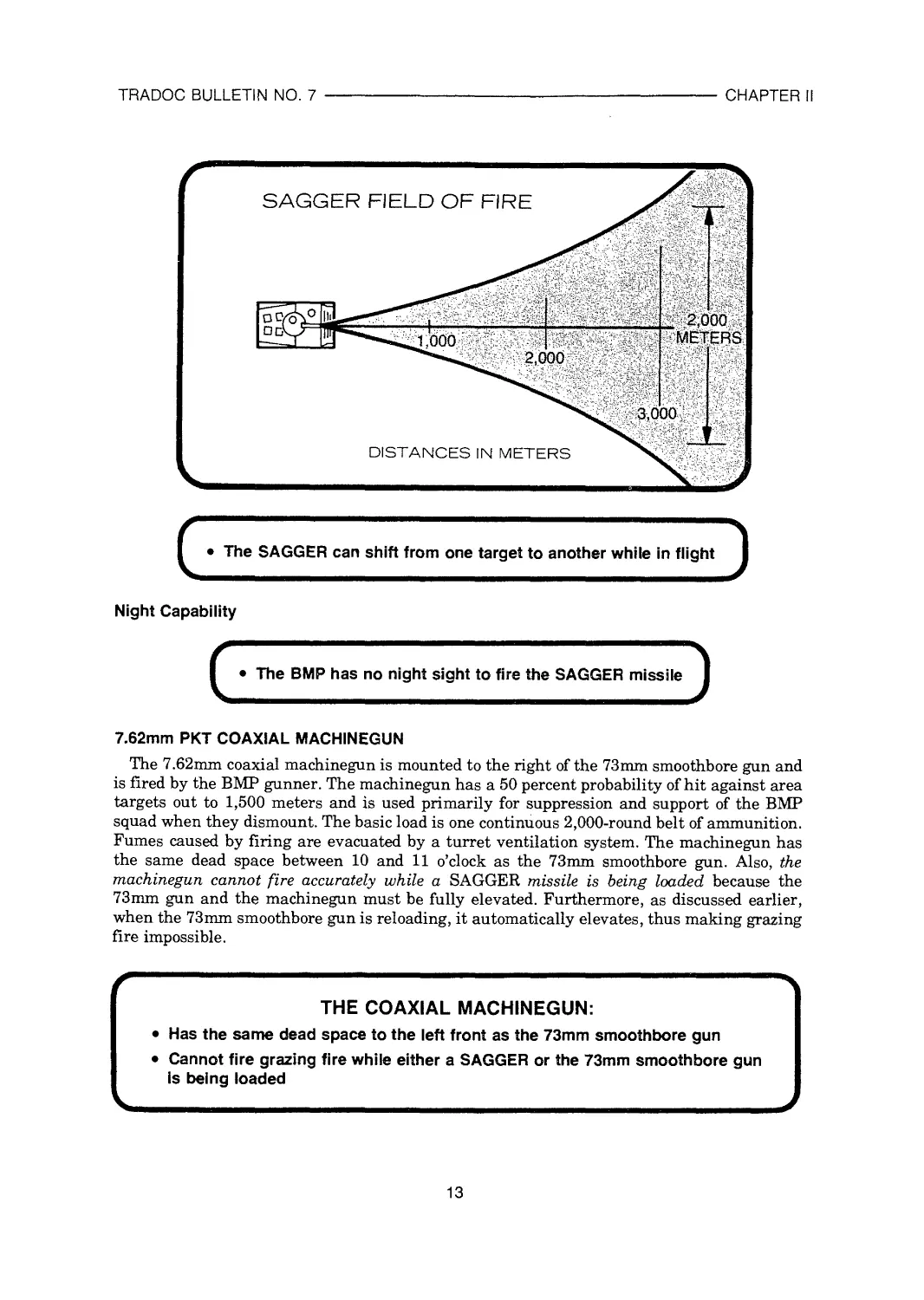
The horizontal field of fire for an individual SAGGER missile shows the approximate
degree to which the missile cah be guided in flight. It can be shifted by the gunner to cover
targets to the right or left within the cone shown:
12
TRADOC BULLETIN NO. 7
CHAPTER II
• The SAGGER can shift from one target to another while in flight
Night Capability
• The BMP has no night sight to fire the SAGGER missile
7.62mm PKT COAXIAL MACHINEGUN
The 7.62mm coaxial machinegun is mounted to the right of the 73mm smoothbore gun and
is fired by the BMP gunner. The machinegun has a 50 percent probability of hit against area
targets out to 1,500 meters and is used primarily for suppression and support of the BMP
squad when they dismount. The basic load is one continuous 2,000-round belt of ammunition.
Fumes caused by firing are evacuated by a turret ventilation system. The machinegun has
the same dead space between 10 and 11 o’clock as the 73mm smoothbore gun. Also, the
machinegun cannot fire accurately while a SAGGER missile is being loaded because the
73mm gun and the machinegun must be fully elevated. Furthermore, as discussed earlier,
when the 73mm smoothbore gun is reloading, it automatically elevates, thus making grazing
fire impossible.
THE COAXIAL MACHINEGUN:
•	Has the same dead space to the left front as the 73mm smoothbore gun
•	Cannot fire grazing fire while either a SAGGER or the 73mm smoothbore gun
is being loaded
k________________________________________________________________>
13
CHAPTER II
TRADOC BULLETIN NO. 7
PERSONNEL, INDIVIDUAL AND CREW-SERVED WEAPONS
The BMP is designed to make maximum use of the individual and crew-served weap-
ons operated by squad members while affording them good protection from small arms and
indirect fire. Organization, crew functions, and squad weapons are discussed below.
ORGANIZATION
The squad is part of a motorized rifle company and platoon.
The Motorized Rifle Company
Within a motorized rifle company there are a headquarters section and three platoons for a
total of 105 personnel mounted in 10 BMPs.
The Motorized Rifle Platoon
Within a motorized rifle platoon there are three squads, each squad being mounted in a
BMP. The total strength of the platoon is 32 men. The squads vary in strength between 10
and 11 personnel.
The Motorized Rifle Squad
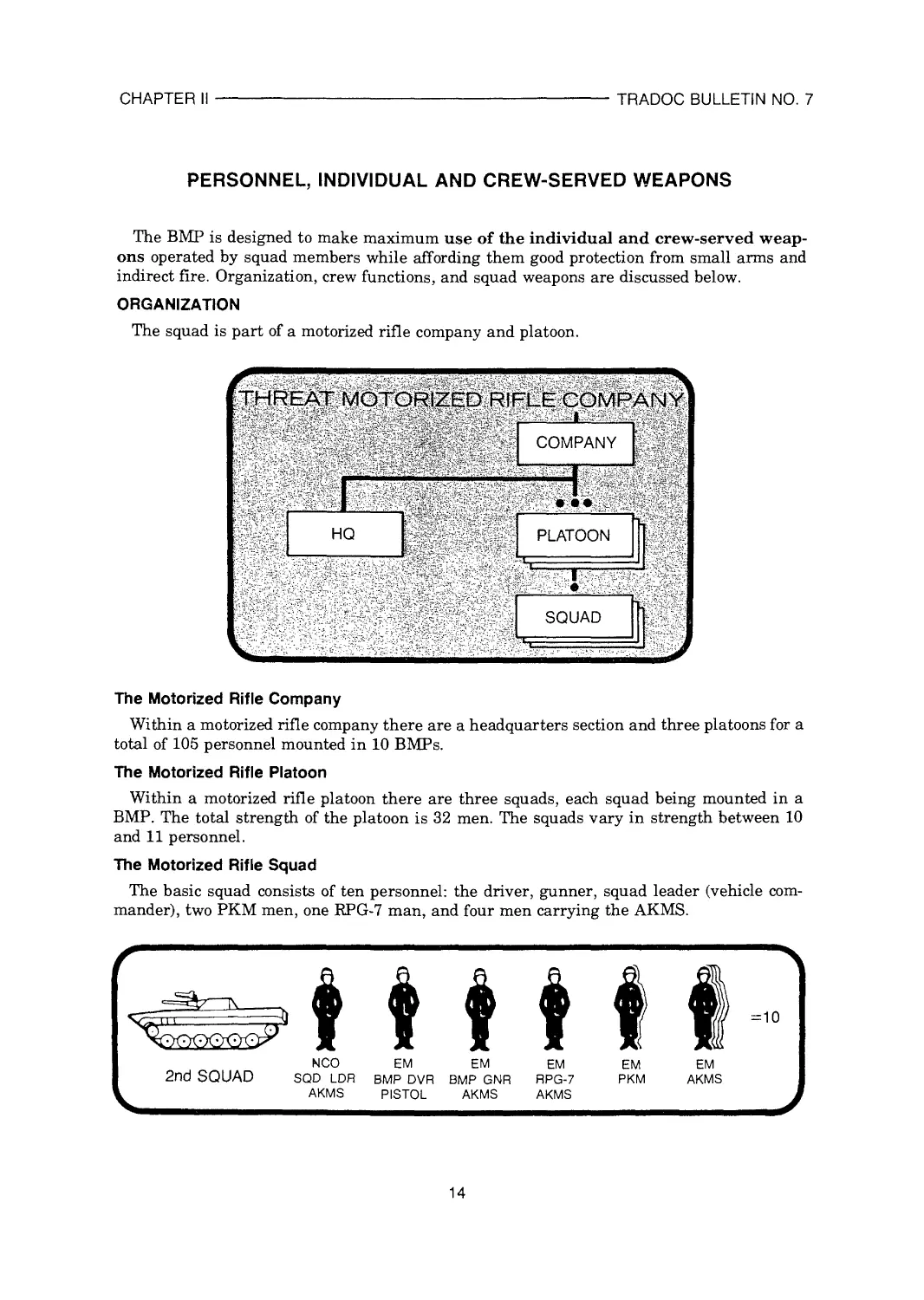
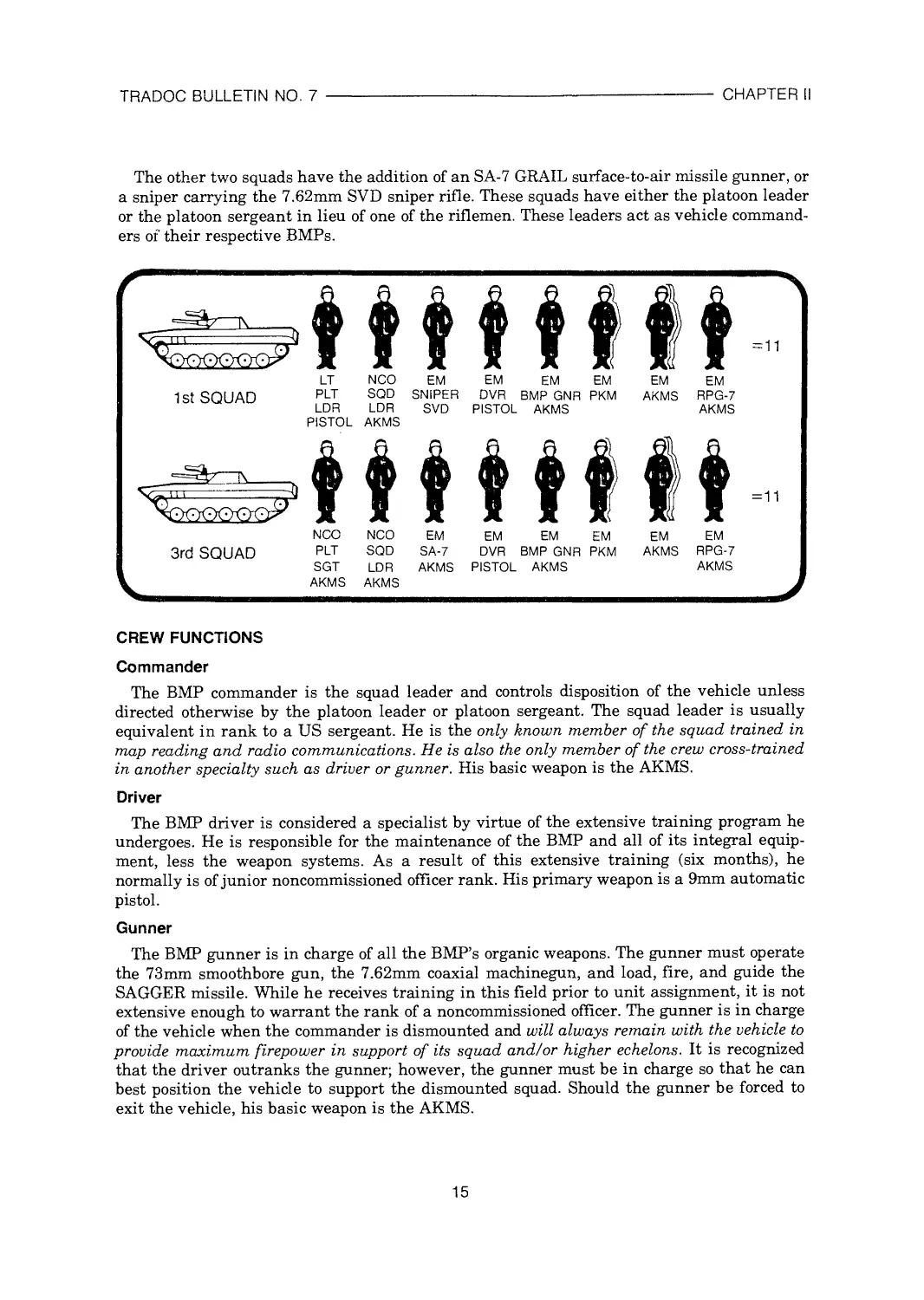
The basic squad consists of ten personnel: the driver, gunner, squad leader (vehicle com-
mander), two PKM men, one RPG-7 man, and four men carrying the AKMS.
2nd SQUAD
NCO
SQD LDR
AKMS
EM
BMP DVR
PISTOL
EM
BMP GNR
AKMS
EM
RPG-7
AKMS
EM EM
PKM	AKMS
14
TRADOC BULLETIN NO. 7
CHAPTER II
The other two squads have the addition of an SA-7 GRAIL surface-to-air missile gunner, or
a sniper carrying the 7.62mm SVD sniper rifle. These squads have either the platoon leader
or the platoon sergeant in lieu of one of the riflemen. These leaders act as vehicle command-
ers of their respective BMPs.
it
LT NCO
PLT SQD
LDR LDR
PISTOL AKMS
3rd SQUAD
NCO NCO
PLT SQD
SGT LDR
AKMS AKMS
ttttftl
EM EM EM EM EM EM
SNIPER DVR BMP GNR PKM AKMS RPG-7
SVD PISTOL AKMS	AKMS
mill
EM EM EM EM EM EM
SA-7 DVR BMP GNR PKM AKMS RPG-7
AKMS PISTOL AKMS	AKMS
CREW FUNCTIONS
Commander
The BMP commander is the squad leader and controls disposition of the vehicle unless
directed otherwise by the platoon leader or platoon sergeant. The squad leader is usually
equivalent in rank to a US sergeant. He is the only known member of the squad trained in
map reading and radio communications. He is also the only member of the crew cross-trained
in another specialty such as driver or gunner. His basic weapon is the AKMS.
Driver
The BMP driver is considered a specialist by virtue of the extensive training program he
undergoes. He is responsible for the maintenance of the BMP and all of its integral equip-
ment, less the weapon systems. As a result of this extensive training (six months), he
normally is of junior noncommissioned officer rank. His primary weapon is a 9mm automatic
pistol.
Gunner
The BMP gunner is in charge of all the BMP’s organic weapons. The gunner must operate
the 73mm smoothbore gun, the 7.62mm coaxial machinegun, and load, fire, and guide the
SAGGER missile. While he receives training in this field prior to unit assignment, it is not
extensive enough to warrant the rank of a noncommissioned officer. The gunner is in charge
of the vehicle when the commander is dismounted and will always remain with the vehicle to
provide maximum firepower in support of its squad and/or higher echelons. It is recognized
that the driver outranks the gunner; however, the gunner must be in charge so that he can
best position the vehicle to support the dismounted squad. Should the gunner be forced to
exit the vehicle, his basic weapon is the AKMS.
15
CHAPTER II
TRADOC BULLETIN NO. 7
INDIVIDUAL AND CREW-SERVED WEAPONS
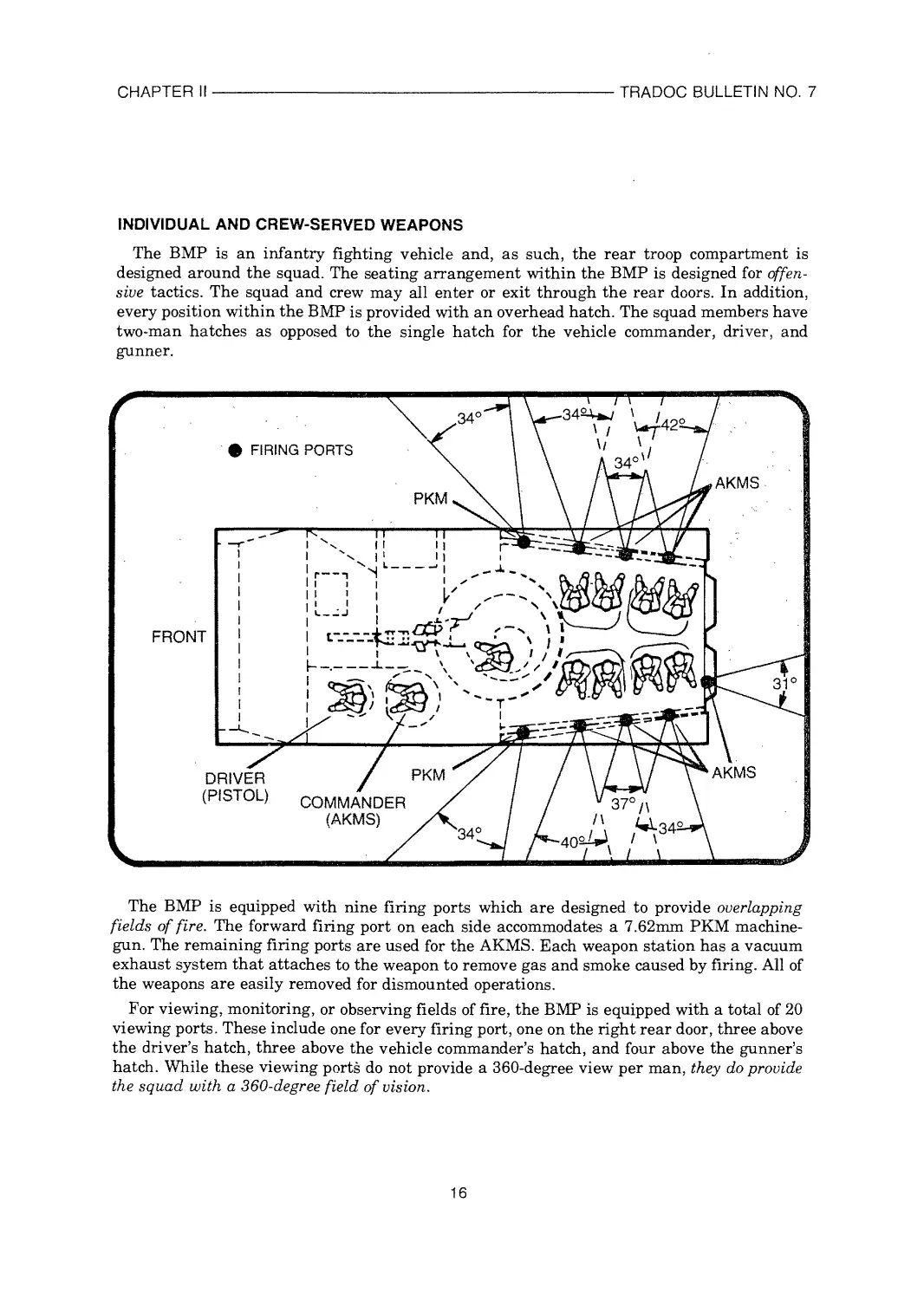
The BMP is an infantry fighting vehicle and, as such, the rear troop compartment is
designed around the squad. The seating arrangement within the BMP is designed for offen-
sive tactics. The squad and crew may all enter or exit through the rear doors. In addition,
every position within the BMP is provided with an overhead hatch. The squad members have
two-man hatches as opposed to the single hatch for the vehicle commander, driver, and
gunner.
The BMP is equipped with nine firing ports which are designed to provide overlapping
fields of fire. The forward firing port on each side accommodates a 7.62mm PKM machine-
gun. The remaining firing ports are used for the AKMS. Each weapon station has a vacuum
exhaust system that attaches to the weapon to remove gas and smoke caused by firing. All of
the weapons are easily removed for dismounted operations.
For viewing, monitoring, or observing fields of fire, the BMP is equipped with a total of 20
viewing ports. These include one for every firing port, one on the right rear door, three above
the driver’s hatch, three above the vehicle commander’s hatch, and four above the gunner’s
hatch. While these viewing ports do not provide a 360-degree view per man, they do provide
the squad with a 360-degree field of vision.
16
TRADOC BULLETIN NO. 7
CHAPTER II
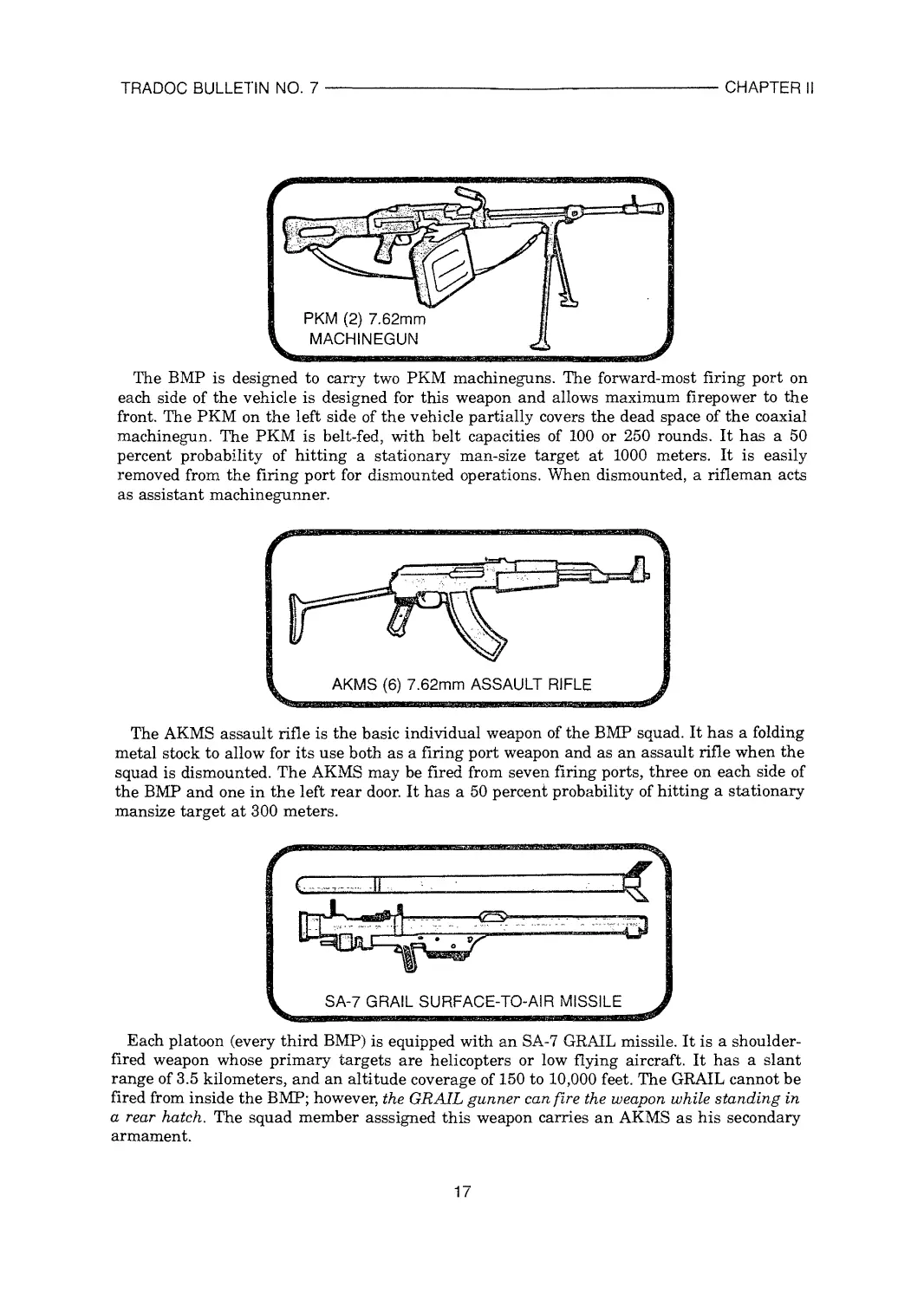
The BMP is designed to carry two PKM machineguns. The forward-most firing port on
each side of the vehicle is designed for this weapon and allows maximum firepower to the
front. The PKM on the left side of the vehicle partially covers the dead space of the coaxial
machinegun. The PKM is belt-fed, with belt capacities of 100 or 250 rounds. It has a 50
percent probability of hitting a stationary man-size target at 1000 meters. It is easily
removed from the firing port for dismounted operations. When dismounted, a rifleman acts
as assistant machinegunner.
The AKMS assault rifle is the basic individual weapon of the BMP squad. It has a folding
metal stock to allow for its use both as a firing port weapon and as an assault rifle when the
squad is dismounted. The AKMS may be fired from seven firing ports, three on each side of
the BMP and one in the left rear door. It has a 50 percent probability of hitting a stationary
mansize target at 300 meters.
Each platoon (every third BMP) is equipped with an SA-7 GRAIL missile. It is a shoulder-
fired weapon whose primary targets are helicopters or low flying aircraft. It has a slant
range of 3.5 kilometers, and an altitude coverage of 150 to 10,000 feet. The GRAIL cannot be
fired from inside the BMP; however, the GRAIL gunner can fire the weapon while standing in
a rear hatch. The squad member asssigned this weapon carries an AKMS as his secondary
armament.
17
CHAPTER II
TRADOC BULLETIN NO. 7
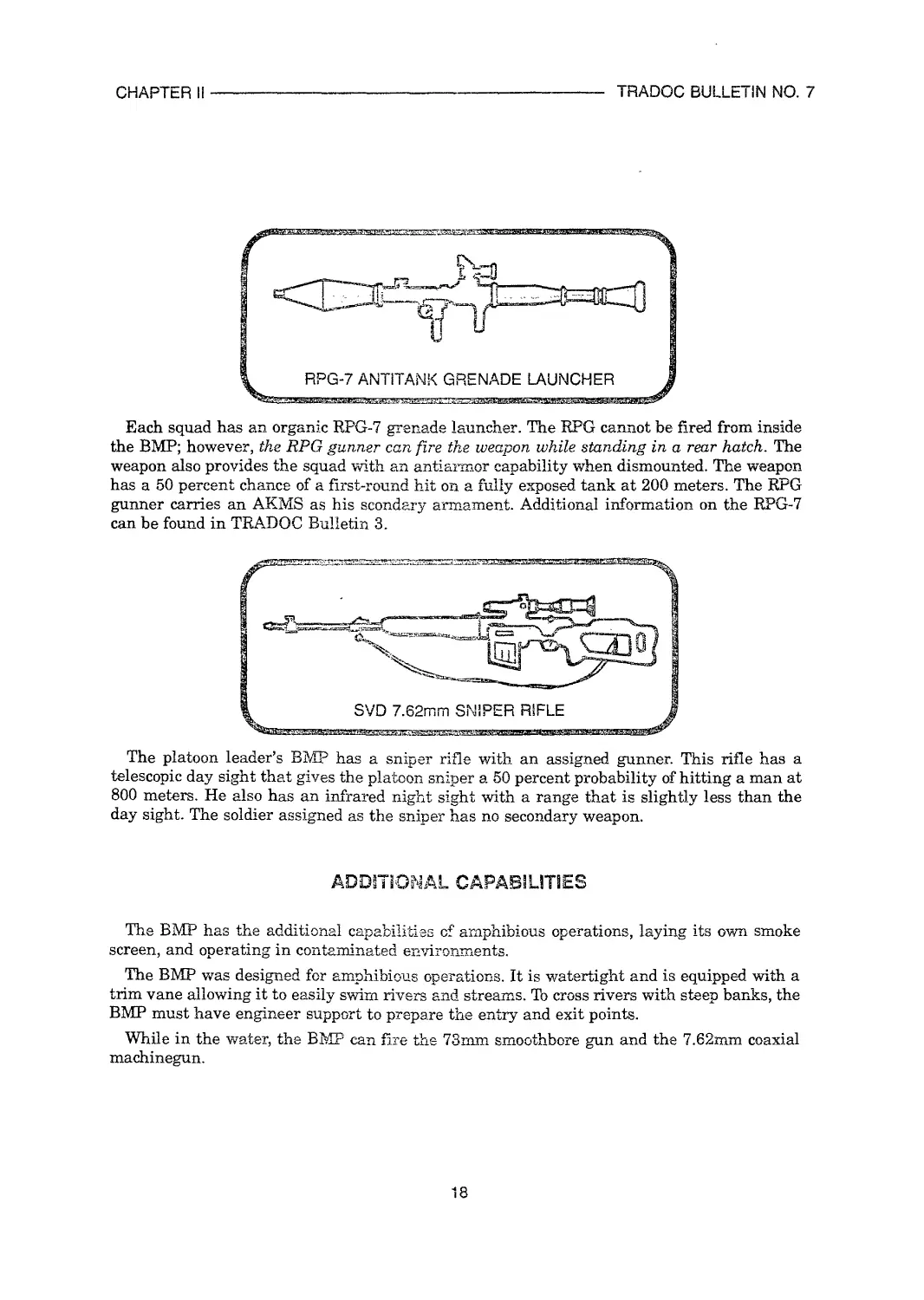
Each squad has an organic RPG-7 grenade launcher. The RPG cannot be fired from inside
the BMP; however, the RPG gunner can fire the weapon while standing in a rear hatch. The
weapon also provides the squad with an antiarmor capability when dismounted. The weapon
has a 50 percent chance of a first-round hit on a fully exposed tank at 200 meters. The RPG
gunner carries an AKMS as his scondary armament. Additional information on the RPG-7
can be found in TRADOC Bulletin 3.
The platoon leader’s BMP has a sniper rifle with an assigned gunner. This rifle has a
telescopic day sight that gives the platoon sniper a 50 percent probability of hitting a man at
800 meters. He also has an infrared night sight with a range that is slightly less than the
day sight. The soldier assigned as the sniper has no secondary weapon.
ADDHTOMAL CAPAB^UTSES
The BMP has the additional capabilities of amphibious operations, laying its own smoke
screen, and operating in contaminated environments.
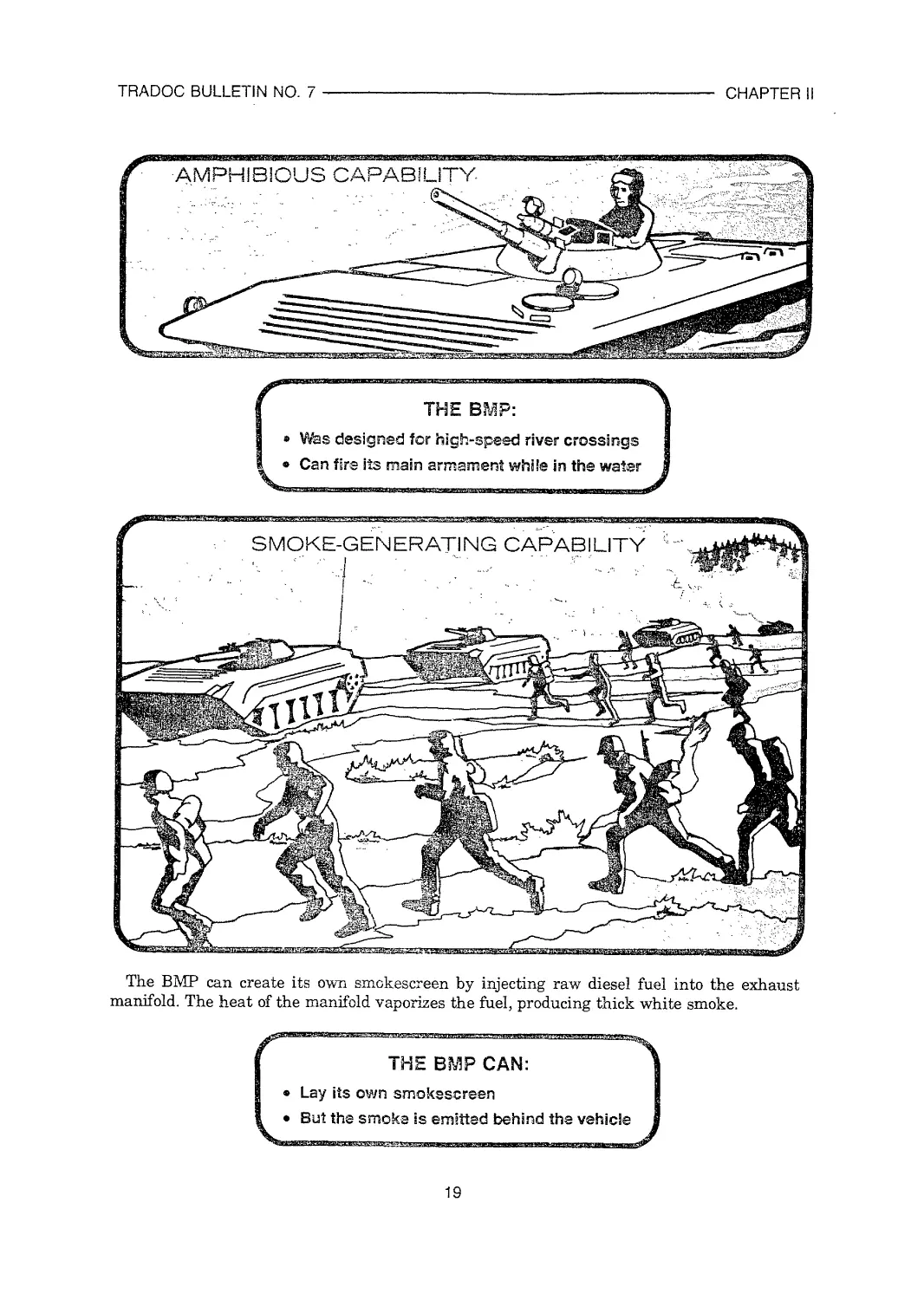
The BMP was designed for amphibious operations. It is watertight and is equipped with a
trim vane allowing it to easily swim rivers and streams. To cross rivers with steep banks, the
BMP must have engineer support to prepare the entry and exit points.
While in the water, the BMP can fire the 73mm smoothbore gun and the 7.62mm coaxial
machinegun.
18
TRADOC BULLETIN NO. 7
CHAPTER II
THE BMP:
• Was designed for high-speed river crossings
• Can fire its main armament while in the water
The BMP can create its own smokescreen by injecting raw diesel fuel into the exhaust
manifold. The heat of the manifold vaporizes the fuel, producing thick white smoke.
Г	THE BMP CAN:
I • Lay its own smokescreen
I • But the smoke is emitted behind the vehicle
19
CHAPTER II
TRADOC BULLETIN NO. 7
NUCLEAR, BIOLOGICAL, AND CHEMICAL PROTECTION
MOUNTED
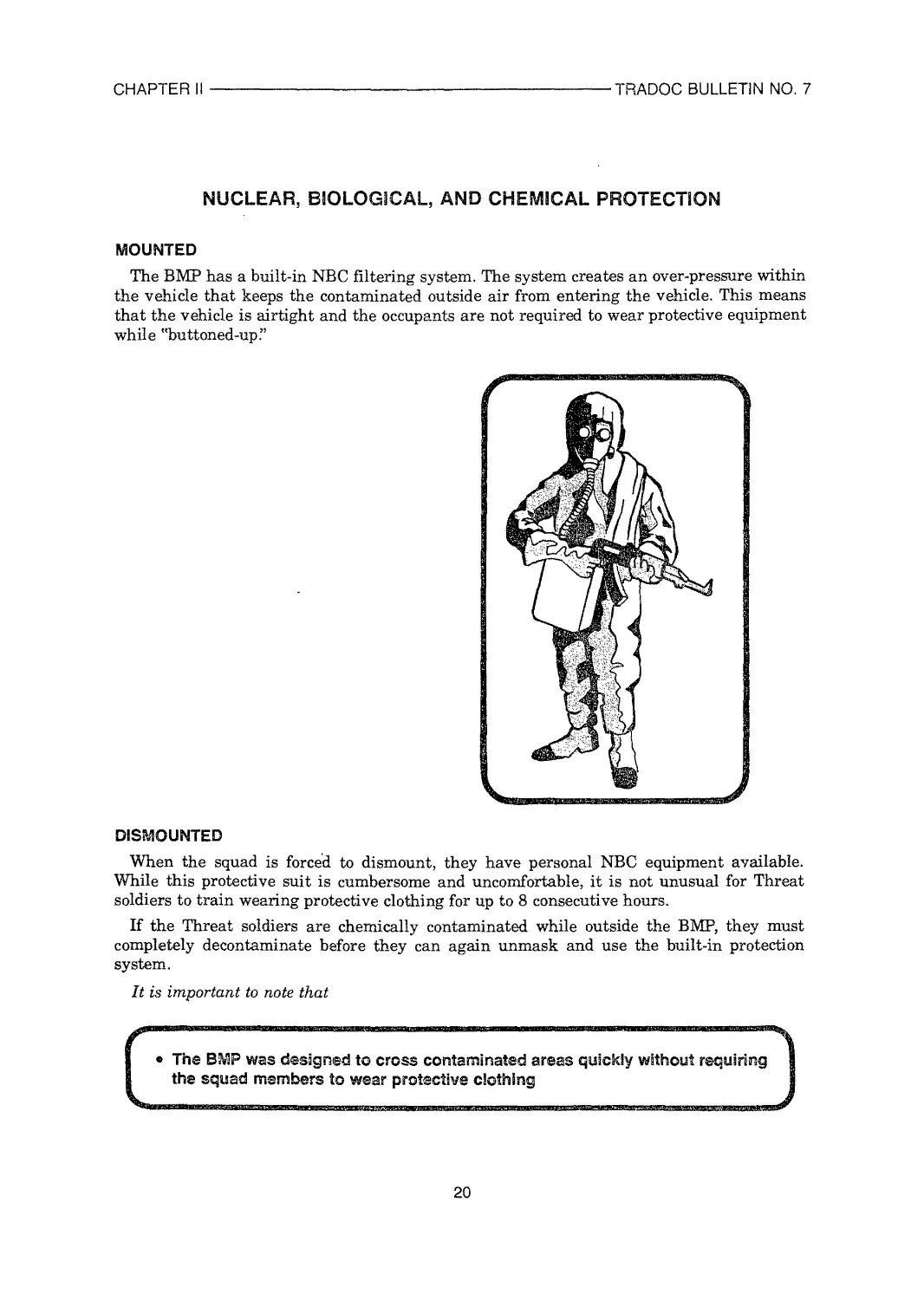
The BMP has a built-in NBC filtering system. The system creates an over-pressure within
the vehicle that keeps the contaminated outside air from entering the vehicle. This means
that the vehicle is airtight and the occupants are not required to wear protective equipment
while "buttoned-up”
DISMOUNTED
When the squad is forced to dismount, they have personal NBC equipment available.
While this protective suit is cumbersome and uncomfortable, it is not unusual for Threat
soldiers to train wearing protective clothing for up to 8 consecutive hours.
If the Threat soldiers are chemically contaminated while outside the BMP, they must
completely decontaminate before they can again unmask and use the built-in protection
system.
It is important to note that
• The BMP was designed to cross contaminated areas quickly without requiring
the squad members to wear protective clothing
20
TRADOC BULLETIN NO. 7
CHAPTER III
HI
EMPLOYMENT
The BMP was designed as an offensive weapon to accompany tanks on the battlefield,
and to provide speed, mobility, firepower and protection to the infantry squad.
The BMP’s priorities of fires in either offensive or defensive actions are:
•	SAGGER against tanks and other armored vehicles from 500 to 3,000 meters
•	73 mm main gun against APCs, tanks, and personnel within 1,000 meters
•	7.62mm coaxial machinegun against personnel and soft vehicles out to 1,500
meters
•	Individual and crew-served weapons against personnel within 1,000 meters
OFFENSIVE OPERATIONS
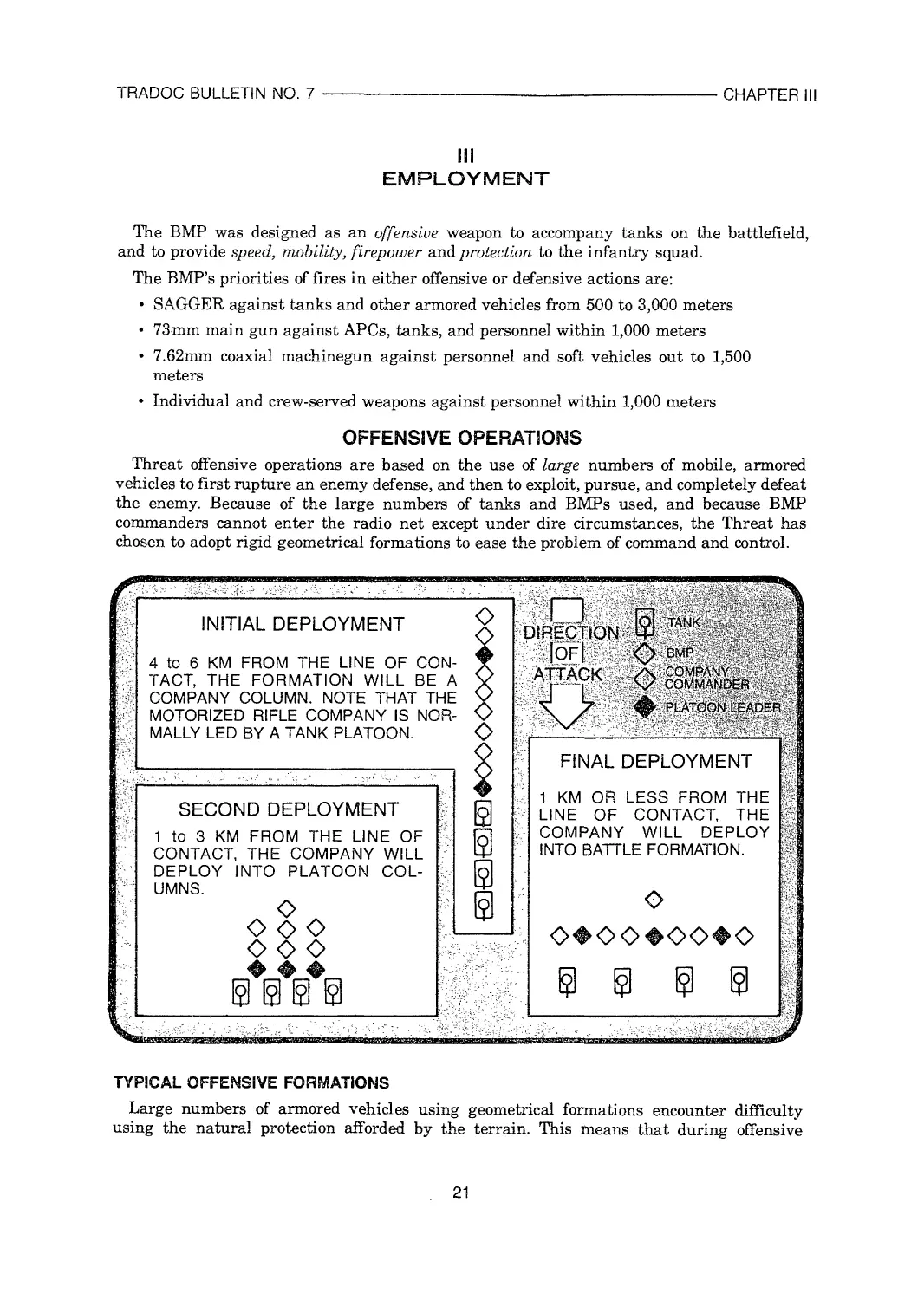
Threat offensive operations are based on the use of large numbers of mobile, armored
vehicles to first rupture an enemy defense, and then to exploit, pursue, and completely defeat
the enemy. Because of the large numbers of tanks and BMPs used, and because BMP
commanders cannot enter the radio net except under dire circumstances, the Threat has
chosen to adopt rigid geometrical formations to ease the problem of command and control.
INITIAL DEPLOYMENT
4 to 6 KM FROM THE LINE OF CON-
TACT, THE FORMATION WILL BE A
COMPANY COLUMN. NOTE THAT THE
MOTORIZED RIFLE COMPANY IS NOR-
MALLY LED BY A TANK PLATOON.
DIR
ЁСТЮМ
OF
И COMPANY " 1 '
COMMANDER
-	-4	!• 'г,	'
W PLATOON LEADER
N-	Л	•* A
FINAL DEPLOYMENT
SECOND DEPLOYMENT
1 to 3 KM FROM THE LINE OF
CONTACT, THE COMPANY WILL
DEPLOY INTO PLATOON COL-
UMNS.
1 KM OR LESS FROM THE
LINE OF CONTACT, THE
COMPANY WILL DEPLOY
INTO BATTLE FORMATION.
ОФООФООФО
TYPICAL OFFENSIVE FORMATIONS
Large numbers of armored vehicles using geometrical formations encounter difficulty
using the natural protection afforded by the terrain. This means that during offensive
21
CHAPTER III
TRADOC BULLETIN NO. 7
operations, the majority of Threat forces will be exposed, easily acquired, and will, therefore,
be very vulnerable to ATGM and tank fires.
are employed in geometrical formation normally led by tanks
Because of this
• BMPs have difficulty using the terrain, thus increasing thesr vulnerability to
our ATGM and tank fires


MOUNTED ASSAULT
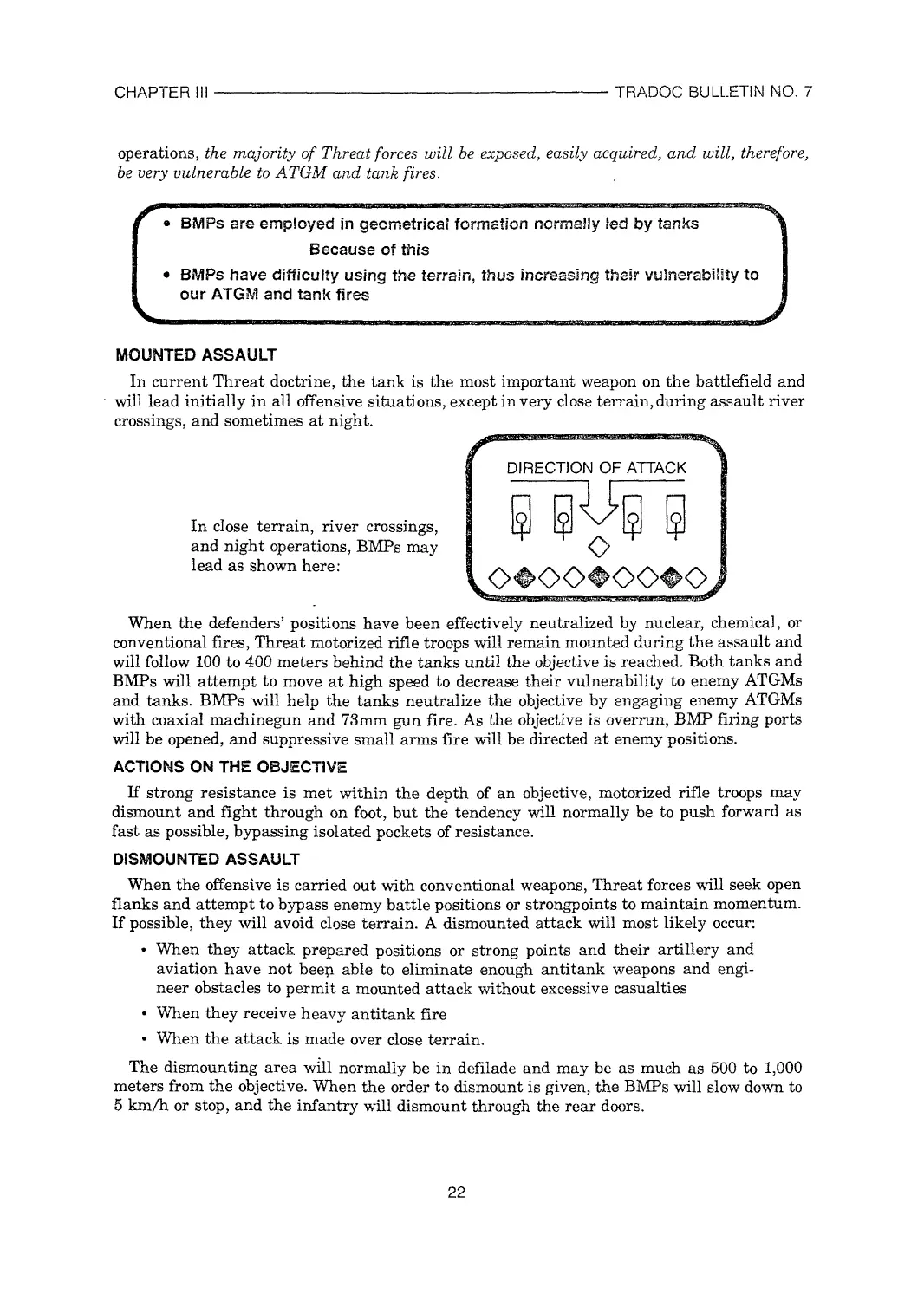
In current Threat doctrine, the tank is the most important weapon on the battlefield and
will lead initially in all offensive situations, except in very close terrain, during assault river
crossings, and sometimes at night.
In close terrain, river crossings,
and night operations, BMPs may
lead as shown here:
When the defenders’ positions have been effectively neutralized by nuclear, chemical, or
conventional fires, Threat motorized rifle troops will remain mounted during the assault and
will follow 100 to 400 meters behind the tanks until the objective is reached. Both tanks and
BMPs will attempt to move at high speed to decrease their vulnerability to enemy ATGMs
and tanks. BMPs will help the tanks neutralize the objective by engaging enemy ATGMs
with coaxial machinegun and 73mm gun fire. As the objective is overrun, BMP firing ports
will be opened, and suppressive small arms fire will be directed at enemy positions.
ACTIONS ON THE OBJECTIVE
If strong resistance is met within the depth of an objective, motorized rifle troops may
dismount and fight through on foot, but the tendency will normally be to push forward as
fast as possible, bypassing isolated pockets of resistance.
DISMOUNTED ASSAULT
When the offensive is carried out with conventional weapons, Threat forces will seek open
flanks and attempt to bypass enemy battle positions or strongpoints to maintain momentum.
If possible, they will avoid close terrain. A dismounted attack will most likely occur:
•	When they attack prepared positions or strong points and their artillery and
aviation have not beep able to eliminate enough antitank weapons and engi-
neer obstacles to permit a mounted attack without excessive casualties
•	When they receive heavy antitank fire
•	When the attack is made over close terrain.
The dismounting area will normally be in defilade and may be as much as 500 to 1,000
meters from the objective. When the order to dismount is given, the BMPs will slow down to
5 km/h or stop, and the infantry will dismount through the rear doors.
22
TRADOC BULLETIN NO. 7
CHAPTER III
The driver and gunner stay with the BMP providing supporting fires, and follow the
dismounted infantry at a distance of 100 to 400 meters.
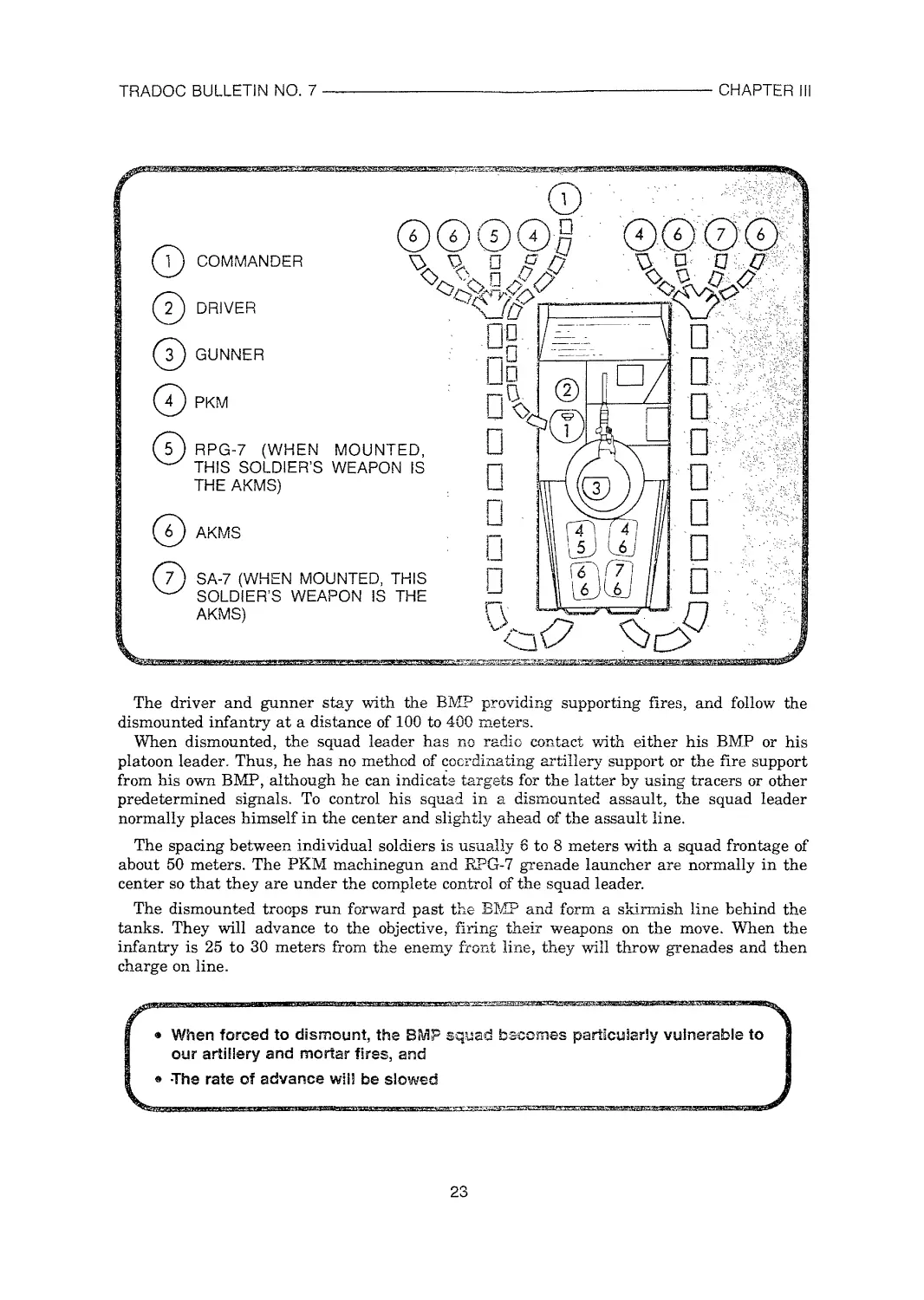
When dismounted, the squad leader has no radio contact with either his BMP or his
platoon leader. Thus, he has no method of coordinating artillery support or the fire support
from his own BMP, although he can indicate targets for the latter by using tracers or other
predetermined signals. To control his squad in a dismounted assault, the squad leader
normally places himself in the center and slightly ahead of the assault line.
The spacing between individual soldiers is usually 6 to 8 meters with a squad frontage of
about 50 meters. The PKM machinegun and RPG-7 grenade launcher are normally in the
center so that they are under the complete control of the squad leader.
The dismounted troops run forward past the BMP and form a skirmish line behind the
tanks. They will advance to the objective, firing their weapons on the move. When the
infantry is 25 to 30 meters from the enemy front line, they will throw grenades and then
charge on line.
•	When forced to dismount, the BMP squad becomes particularly vulnerable to
our artillery and mortar fires, and
« The rate of advance will be slowed
23
CHAPTER III
TRADOC BULLETIN NO. 7
DEFENSIVE OPERATIONS
The Threat assumes the defense only as a temporary measure (posture) and seeks every
opportunity to resume the offensive. Characteristics of the Threat defense are:
•	Defense in depth
•	Mutual support between positions
•	Antitank-oriented
•	Counterattacks by armor heavy forces
While the BMP was designed for offensive operations, consideration must be given to its
defensive role.
THE MOTORIZED RIFLE PLATOON
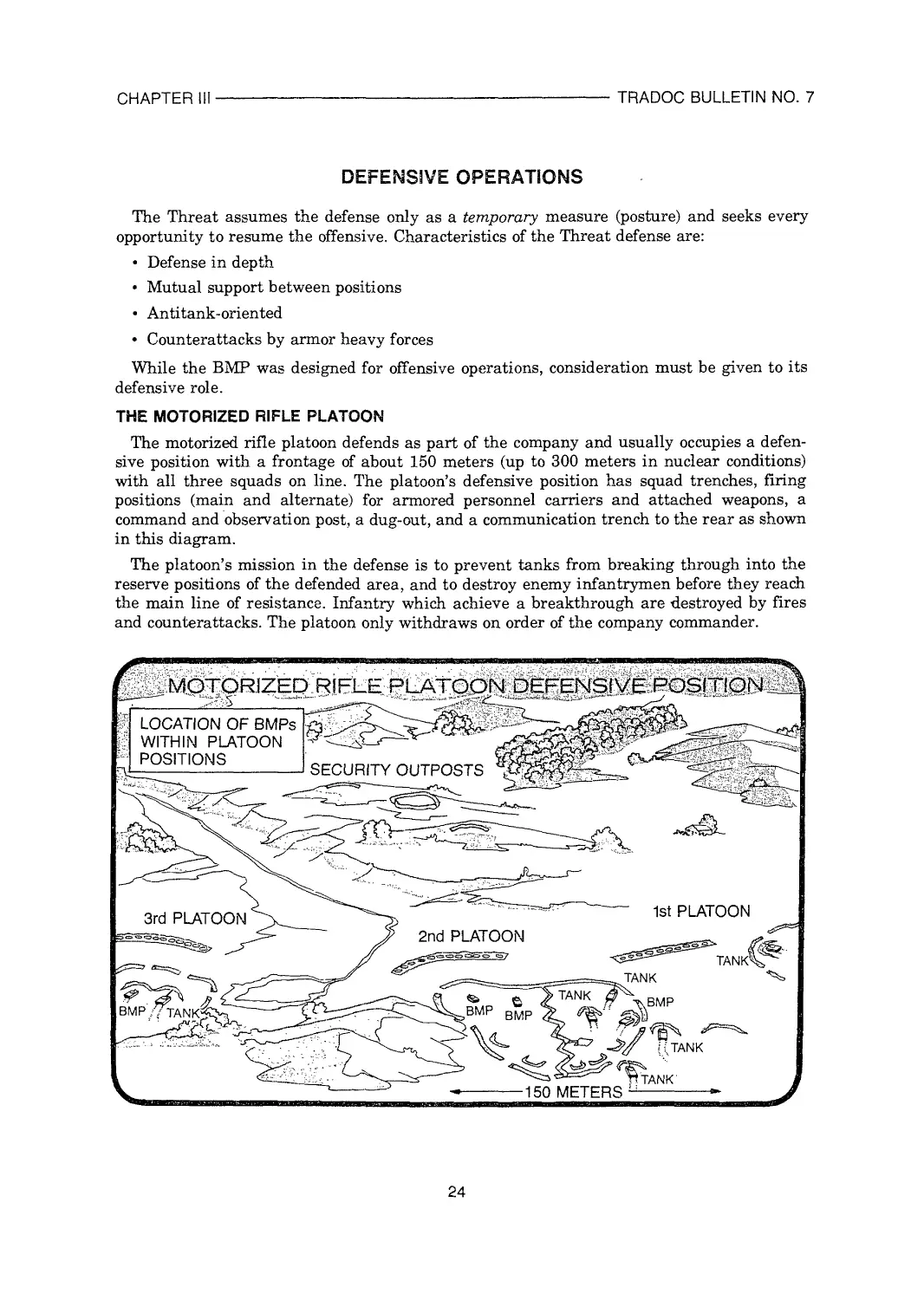
The motorized rifle platoon defends as part of the company and usually occupies a defen-
sive position with a frontage of about 150 meters (up to 300 meters in nuclear conditions)
with all three squads on line. The platoon’s defensive position has squad trenches, firing
positions (main and alternate) for armored personnel carriers and attached weapons, a
command and observation post, a dug-out, and a communication trench to the rear as shown
in this diagram.
The platoon’s mission in the defense is to prevent tanks from breaking through into the
reserve positions of the defended area, and to destroy enemy infantrymen before they reach
the main line of resistance. Infantry which achieve a breakthrough are destroyed by fires
and counterattacks. The platoon only withdraws on order of the company commander.
24
TRADOC BULLETIN NO. 7
CHAPTER III
THE MOTORIZED RIFLE SQUAD
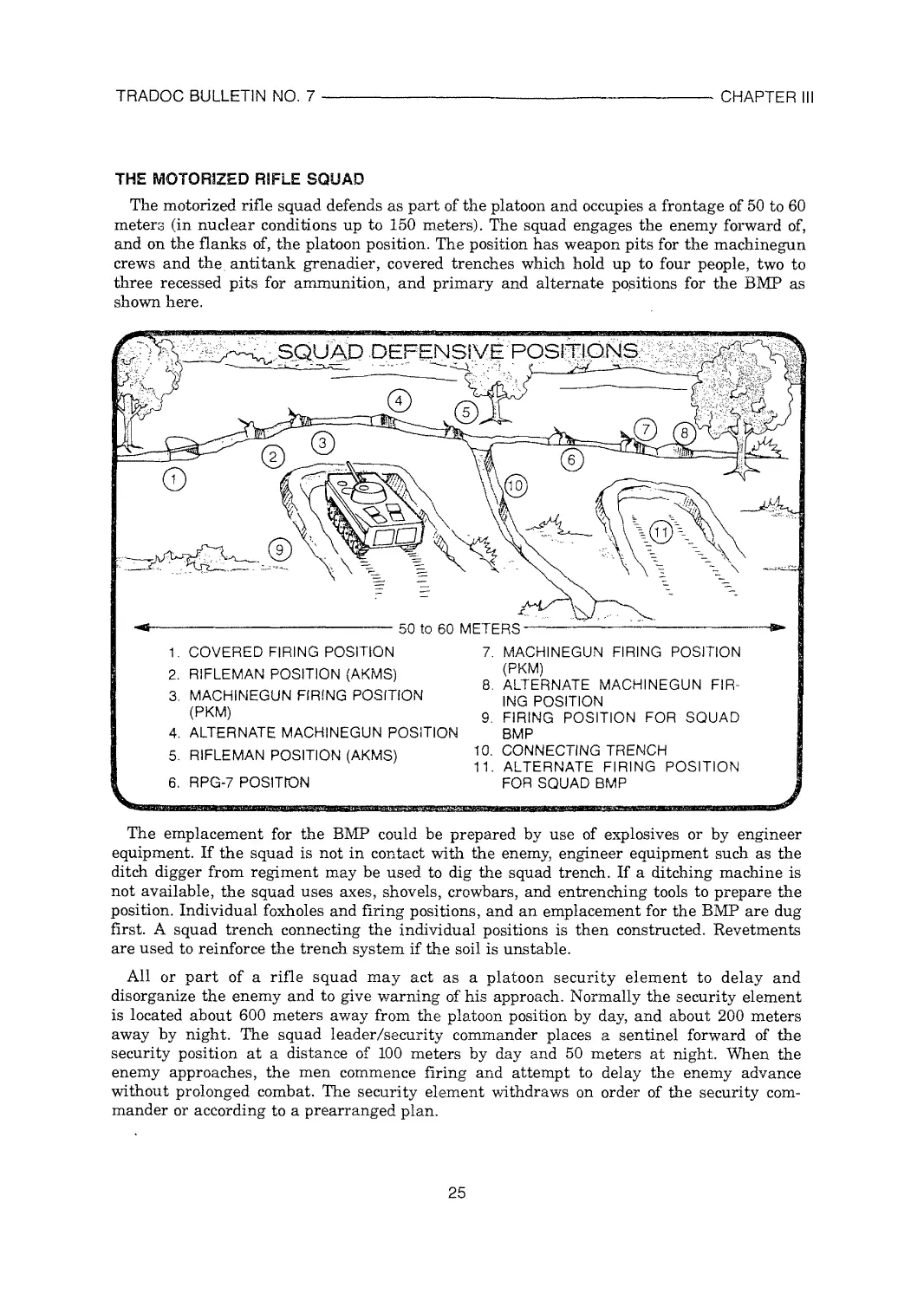
The motorized rifle squad defends as part of the platoon and occupies a frontage of 50 to 60
meters (in nuclear conditions up to 150 meters). The squad engages the enemy forward of,
and on the flanks of, the platoon position. The position has weapon pits for the machinegun
crews and the antitank grenadier, covered trenches which hold up to four people, two to
three recessed pits for ammunition, and primary and alternate positions for the BMP as
shown here.
ипдвимимйтямадмм! ..	.....
:squAd defensivepositions
50 to 60 METERS
1. COVERED FIRING POSITION
2. RIFLEMAN POSITION (AKMS)
3. MACHINEGUN FIRING POSITION
(PKM)
4. ALTERNATE MACHINEGUN POSITION
5. RIFLEMAN POSITION (AKMS)
6. RPG-7 POSITION
7.	MACHINEGUN FIRING POSITION
(PKM)
8.	ALTERNATE MACHINEGUN FIR-
ING POSITION
9.	FIRING POSITION FOR SQUAD
BMP
10.	CONNECTING TRENCH
11.	ALTERNATE FIRING POSITION
FOR SQUAD BMP
The emplacement for the BMP could be prepared by use of explosives or by engineer
equipment. If the squad is not in contact with the enemy, engineer equipment such as the
ditch digger from regiment may be used to dig the squad trench. If a ditching machine is
not available, the squad uses axes, shovels, crowbars, and entrenching tools to prepare the
position. Individual foxholes and firing positions, and an emplacement for the BMP are dug
first. A squad trench connecting the individual positions is then constructed. Revetments
are used to reinforce the trench system if the soil is unstable.
All or part of a rifle squad may act as a platoon security element to delay and
disorganize the enemy and to give warning of his approach. Normally the security element
is located about 600 meters away from the platoon position by day, and about 200 meters
away by night. The squad leader/security commander places a sentinel forward of the
security position at a distance of 100 meters by day and 50 meters at night. When the
enemy approaches, the men commence firing and attempt to delay the enemy advance
without prolonged combat. The security element withdraws on order of the security com-
mander or according to a prearranged plan.
25
CHAPTER II!
TRADOC BULLETIN NO. 7
Positions are established on key terrain to block likely enemy avenues of approach while
giving the squad maximum cover and concealment.
All-round defense is assured by preparation of primary, alternate, and supplementary
positions.
Antitank defense is provided by the BMP with its 73mm gun and SAGGER missiles, and
by the squad grenadier. A squad’s BMP may be in the middle of the defensive position, on a
flank, or up to 50 meters behind the position. Should the squad be situated along a good
armor avenue of approach, the squad could receive additional support from the battalion’s
antitank platoon or by tanks. The platoon leader would position and control any attached
antitank weapons.
Coordinated fires are planned by interlocking squad fires with the fires of adjacent units
and by covering all gaps in the squad’s sector of fire with concentrated frontal, flanking, and
oblique fires. Squad fires are also supplemented by artillery and mortar concentrations
which cover dead space and likely enemy avenues of approach. A squad is assigned both a
sector of fire and a final protective line.
CONDUCT OF THE DEFENSE
The first enemy element to probe squad defenses may be reconnaissance. The platoon
leader is authorized to fire on enemy reconnaissance patrols and, if ordered, the men will fire
from their alternate positions so as to deceive the enemy.
Defensive fires will increase in intensity as the enemy approaches the FEBA. Should the
enemy assault include tanks, antitank weapons will engage them, SAGGER at ranges out to
3,000 meters, and the 73mm gun at closer ranges. The primary objective will be to destroy
sufficient armored vehicles to cause the enemy to dismount, thus slowing his rate of advance.
Other squad members concentrate on the accompanying infantry.
Though the squad members will attempt to destroy enemy penetrations into the gaps
between squads, they will maintain their positions and concentrate on their assigned sector
of fire. If attacked from a flank, the squad will distribute its strength to combat the new
threat while continuing to cover its original sector of fire. Should enemy tanks overrun the
squad position, squad members will attempt to destroy them from the rear with hand
antitank grenades and the RPG-7.
The squad may withdraw on orders from the platoon leader. The withdrawal begins with
the riflemen who move under cover of the squad’s machineguns and the BMP. Squad mem-
bers will withdraw individually or in groups, depending upon the terrain and the enemy
situation. Simultaneous withdrawal of the entire squad normally takes place under cover of
fire from supporting units or under conditions of limited visibility.
Remember, in the deliberate defense, the BMP squad:
•	Defends as part of the motorized rifle company
•	Win establish fighting trenches for personnel and weapon systems
® Is prepared to withstand both mounted and dismounted assault
•	Is directly supported by the BMP’s antitank fires
•	Has no reserve
26
TRADOC BULLETIN NO. 7
CHAPTER IV
IV
COUNTERMEASURES
The BMP is designed to accompany tanks on the battlefield and, as such, provides all-
round protection against small arms and low velocity artillery fragments. Like any other
vehicle, weaknesses and vulnerabilities are always present. These weaknesses and vulnera-
bilities can be exploited by a variety of such active measures as:
LONG- AND MEDIUM-RANGE WEAPONS
SHORT-RANGE WEAPONS
SUPPORT WEAPONS
In addition to these active measures, the battalion task force can employ such passive
tactics and techniques as:
COVER, CONCEALMENT, SMOKE, AND SUPPRESSION
OTHER TECHNIQUES
ACTIVE MEASURES
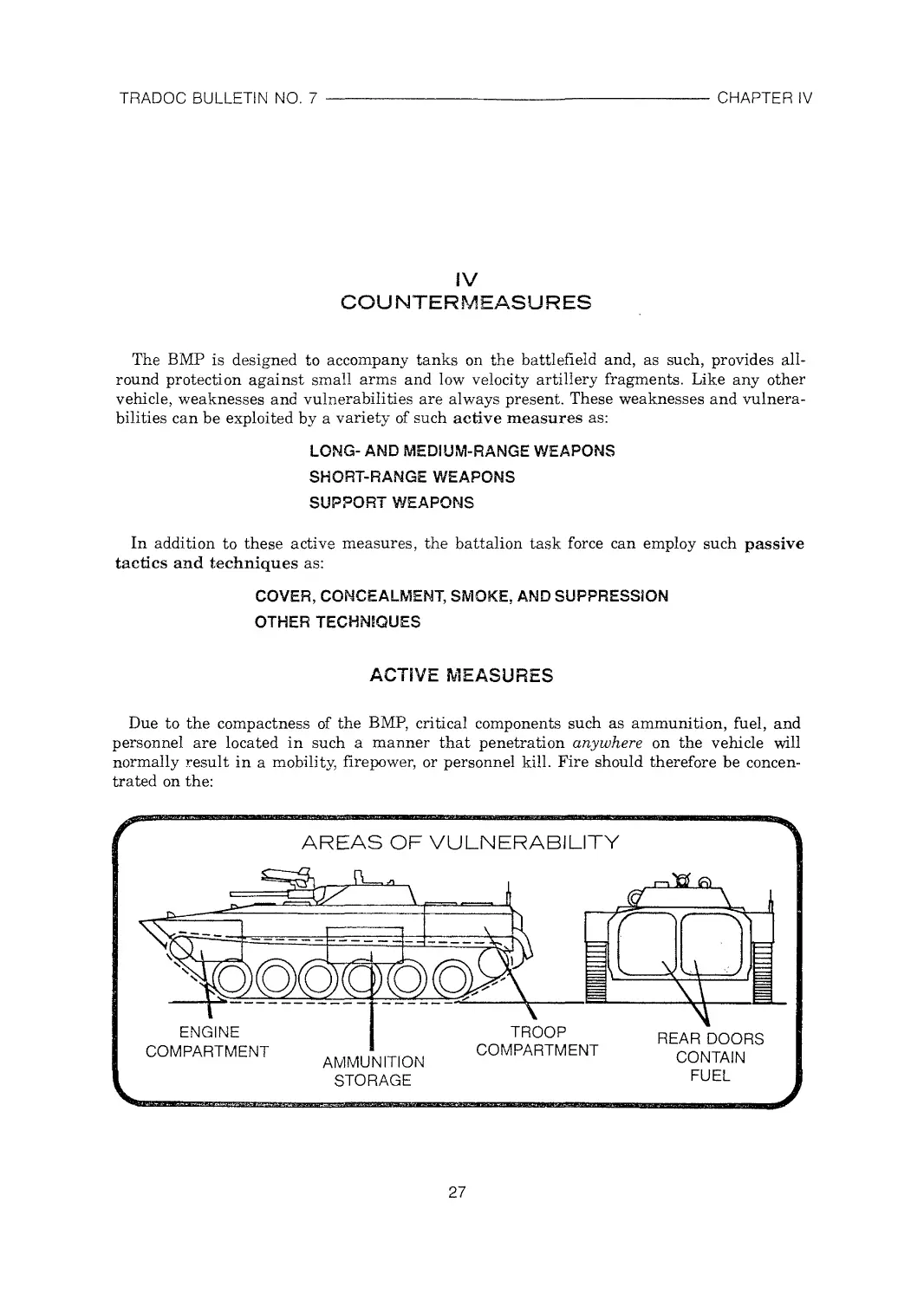
Due to the compactness of the BMP, critical components such as ammunition, fuel, and
personnel are located in such a manner that penetration anywhere on the vehicle will
normally result in a mobility, firepower, or personnel kill. Fire should therefore be concen-
trated on the:
27
CHAPTER IV
TRADOC BULLETIN NO. 7
ENGINE COMPARTMENT — The front-mounted engine is vulnerable to a
frontal or flank attack, and a penetration in this area will usually produce a
mobility kill.
AMMUNITION STORAGE AREA — A penetration in this area will usually
result in catastrophic kill.
TROOP COMPARTMENT — A penetration in this area will usually produce
casualties among the squad.
FUEL COMPARTMENT (Rear Doors) — Though diesel fuel is not highly com-
bustible, a penetration in this area will usually deplete the fuel supply, possibly
producing an eventual mobility kill.
LONG- AND MEDIUM-RANGE WEAPONS
Tanks
Given a hit, the M60A1 tank’s 105mm gun, firing either the HEAT or APDS round, will
penetrate any known Threat armor.
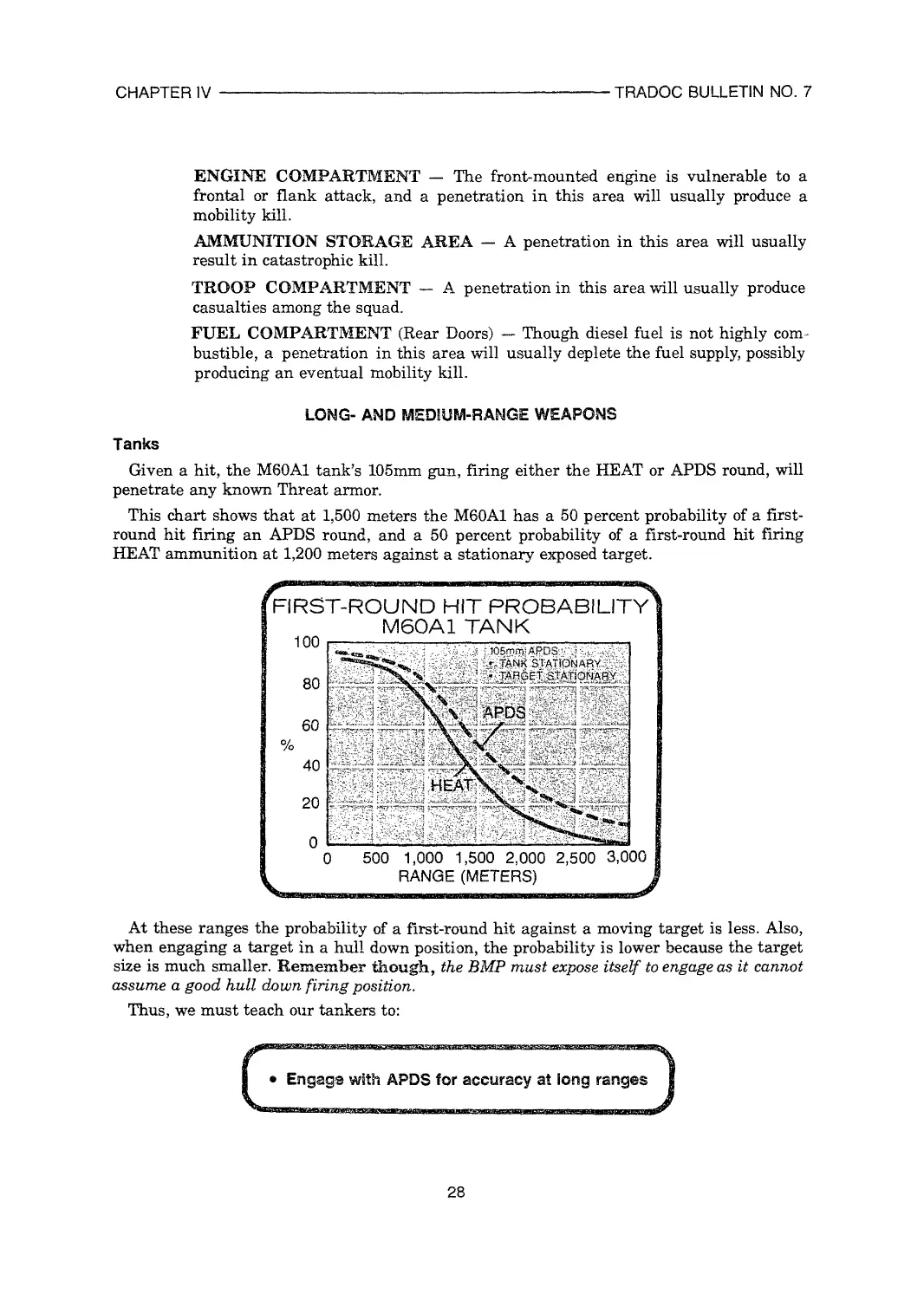
This chart shows that at 1,500 meters the M60A1 has a 50 percent probability of a first-
round hit firing an APDS round, and a 50 percent probability of a first-round hit firing
HEAT ammunition at 1,200 meters against a stationary exposed target.
At these ranges the probability of a first-round hit against a moving target is less. Also,
when engaging a target in a hull down position, the probability is lower because the target
size is much smaller. Remember though, the BMP must expose itself to engage as it cannot
assume a good hull down firing position.
Thus, we must teach our tankers to:

• Engage with APDS for accuracy at long ranges
28
TRADOC BULLETIN NO. 7
CHAPTER IV
TOW and Dragon
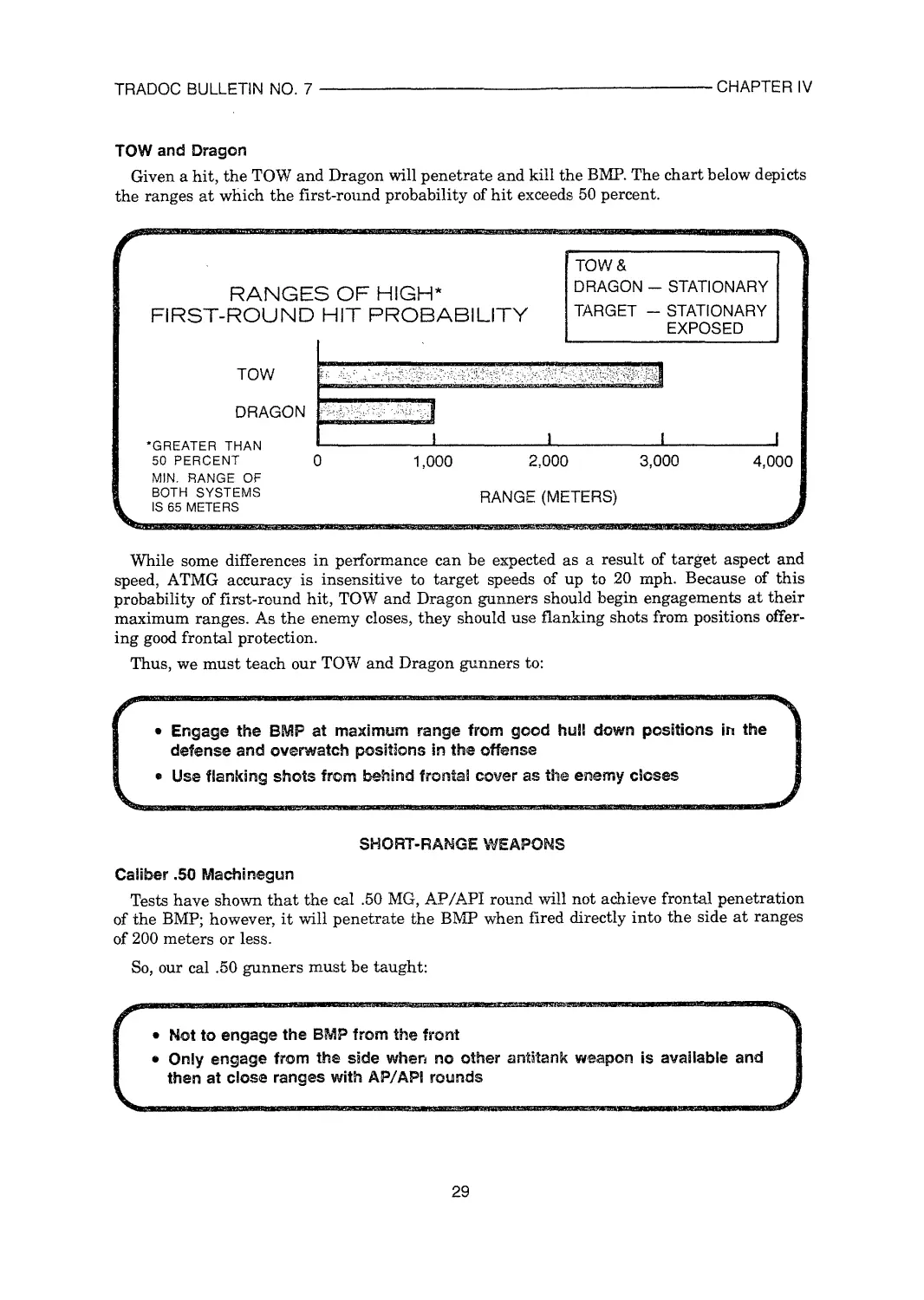
Given a hit, the TOW and Dragon will penetrate and kill the BMP. The chart below depicts
the ranges at which the first-round probability of hit exceeds 50 percent.
RANGES OF HIGH* *
FIRST-ROUND HIT PROBABILITY
TOW&
DRAGON - STATIONARY
TARGET - STATIONARY
EXPOSED
TOW
DRAGON
GREATER THAN
50 PERCENT
MIN. RANGE OF
BOTH SYSTEMS
IS 65 METERS
1,000
2,000
3,000
4,000
RANGE (METERS)

While some differences in performance can be expected as a result of target aspect and
speed, ATMG accuracy is insensitive to target speeds of up to 20 mph. Because of this
probability of first-round hit, TOW and Dragon gunners should begin engagements at their
maximum ranges. As the enemy closes, they should use flanking shots from positions offer-
ing good frontal protection.
Thus, we must teach our TOW and Dragon gunners to:
• Engage the BMP at maximum range from good hull down positions in the
defense and overwatch positions in the offense
• Use flanking shots from behind frontal cover as the enemy closes
SHORT-RANGE WEAPONS
Caliber .50 Machinegun
Tests have shown that the cal .50 MG, AP/API round will not achieve frontal penetration
of the BMP; however, it will penetrate the BMP when fired directly into the side at ranges
of 200 meters or less.
So, our cal .50 gunners must be taught:
• Not to engage the BMP from the front
• Only engage from the side when no other antitank weapon is available and
then at close ranges with AP/API rounds
29
CHAPTER IV
TRADOC BULLETIN NO. 7
LAW
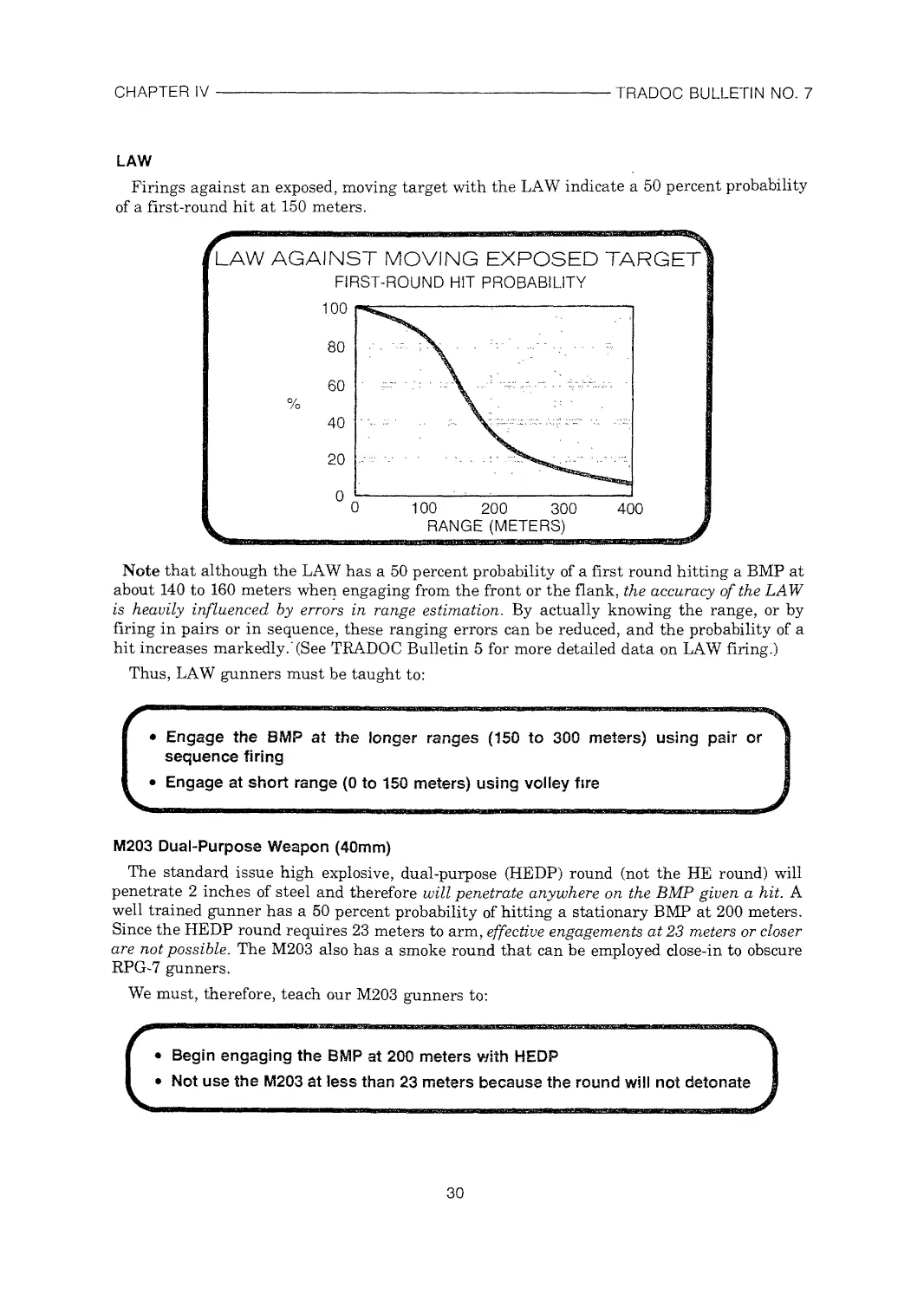
Firings against an exposed, moving target with the LAW indicate a 50 percent probability
of a first-round hit at 150 meters.
Note that although the LAW has a 50 percent probability of a first round hitting a BMP at
about 140 to 160 meters when engaging from the front or the flank, the accuracy of the LAW
is heavily influenced by errors in range estimation. By actually knowing the range, or by
firing in pairs or in sequence, these ranging errors can be reduced, and the probability of a
hit increases markedly.'(See TRADOC Bulletin 5 for more detailed data on LAW firing.)
Thus, LAW gunners must be taught to:
•	Engage the BMP at the longer ranges (150 to 300 meters) using
sequence firing
•	Engage at short range (0 to 150 meters) using volley fire
M203 Dual-Purpose Weapon (40mm)
The standard issue high explosive, dual-purpose (HEDP) round (not the HE round) will
penetrate 2 inches of steel and therefore will penetrate anywhere on the BMP given a hit. A
well trained gunner has a 50 percent probability of hitting a stationary BMP at 200 meters.
Since the HEDP round requires 23 meters to arm, effective engagements at 23 meters or closer
are not possible. The M203 also has a smoke round that can be employed close-in to obscure
RPG-7 gunners.
We must, therefore, teach our M203 gunners to:
•	Begin engaging the BMP at 200
•	Not use the M203 at less than 23
meters with HEDP
meters because the round will not detonate
30
TRADOC BULLETIN NO. 7
CHAPTER IV
M202 Multishot Rocket Launcher
The M202 fires a 66mm incendiary rocket containing a filler that bursts into flame upon
contact with air. A well-trained M202 gunner has a 50 percent probability of a first-round hit
on an exposed stationary BMP at 200 meters. Given a hit, the warhead will not penetrate,
but the flammable filler will stick to the BMP and burn. This may cause secondary fires and
achieve a mobility kill. The BMP squad may also be forced to abandon the vehicle.
Thus, the M202 gunner must know that:
•	The M202 may suppress or cause the squad to abandon the BMP
but
•	It should not be used when the LAW or M203 is available
£SQaas3ae3ama№S&ss9^smraBS39B£C90tsflSEsaBaBSEEsssaaa
Remember
When engaging the BMP with all short-range weapons, you are highly vulnerable to all
weapons except the SAGGER ATGM. So, use flanking shots from behind frontal cover.
SUPPORT WEAPONS
Mines
All standard hand-emplaced and scatterable antitank mines will kill or immobilize the
BMP.
Thus:
•	Mines should be used in the defense, but must be covered with antitank fires
® Scatterable mines should be fired on a moving formation, thus placing them in
the midst of a minefield. These fields should also be covered by antitank
weapons
Artillery and Mortars
Conventional HE artillery, either point detonating or variable time fuze, may distract the
BMP gunner causing him to miss. Smoke can be employed to obscure the BMP gunner’s
vision, especially when SAGGER is being used at longer ranges. The standard 155mm dual-
purpose, improved conventional munition (DPICM) will penetrate and defeat the BMP, given
a hit. Therefore, DPICM fires should be used against motorized infantry formations.
By application of a high density of tank and ATGM fires the BMP squad can be forced to
dismount. Once dismounted, their vulnerability will be increased by:
• Slowing their rate of advance
• Thereby, increasing engagement time
• Thus making the BMP and dismounted squad more vulnerable to a greater
number of our weapons, particularly artillery and mortars
31
CHAPTER IV
TRADOC BULLETIN NO. 7
Close Air Support
Don’t forget that the Air Force, too, will be called on to assist in defeating motorized forces,
particularly in the enemy’s second and third echelon, with such weapons as:
•	The GAU-8, 30mm gatling gun which will penetrate and defeat the BMP,
given a hit
•	Conventional bombs which, given a close proximity or direct hit, will immobi-
lize or destroy the BMP
•	Guided bombs, such as Maverick, which have a high probability of first-round
hit against the BMP and, given a hit, will destroy it.
PASSIVE TACTICS AND TECHNIQUES
COVER, CONCEALMENT, SMOKE, AND SUPPRESSION
Cover and Concealment
Tanks and mechanized forces in the attack, fighting from a defensive position or moving
from battle position to battle position, must anticipate SAGGER and 73mm gun fires.
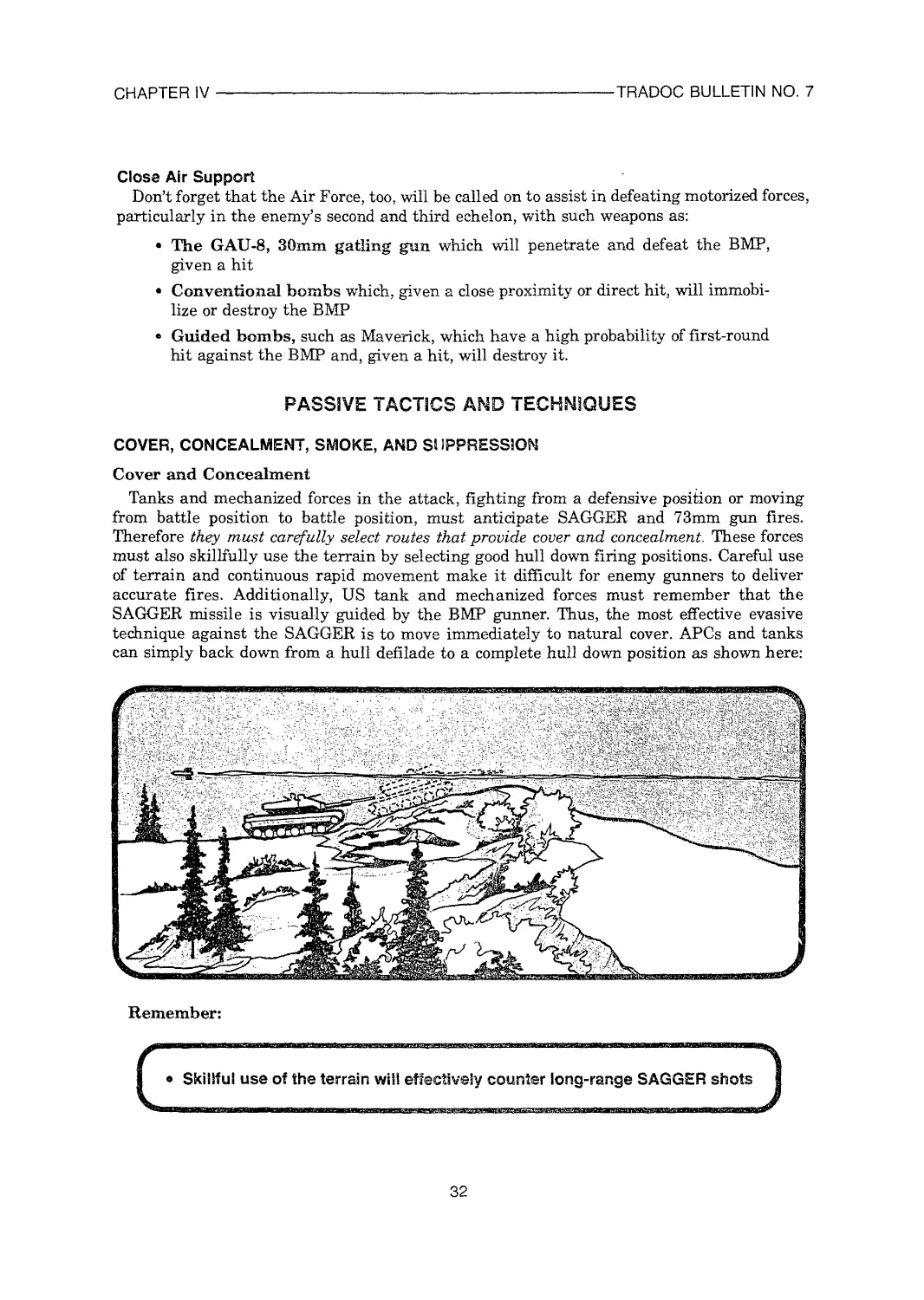
Therefore they must carefully select routes that provide cover and concealment. These forces
must also skillfully use the terrain by selecting good hull down firing positions. Careful use
of terrain and continuous rapid movement make it difficult for enemy gunners to deliver
accurate fires. Additionally, US tank and mechanized forces must remember that the
SAGGER missile is visually guided by the BMP gunner. Thus, the most effective evasive
technique against the SAGGER is to move immediately to natural cover. APCs and tanks
can simply back down from a hull defilade to a complete hull down position as shown here:
Remember:
• Skillful use of the terrain will effectively counter long-range SAGGER shots
32
TRADOC BULLETIN NO. 7
CHAPTER IV
Smoke
Obscuration is an effective counter to the BMP. Smoke delivered in front of known or
suspected BMP positions will degrade effective fire. High winds, particularly crosswinds,
may make the use of smoke difficult, but such winds may also affect the accuracy of the
73mm gun.
Suppression
When moving from battle position to battle position or in the attack, artillery, mortars,
and direct-fire suppression from overwatch positions can be used to disrupt the SAGGER
gunner.
OTHER TECHNIQUES
COUNTERING THE RPG AND 73mm GUN
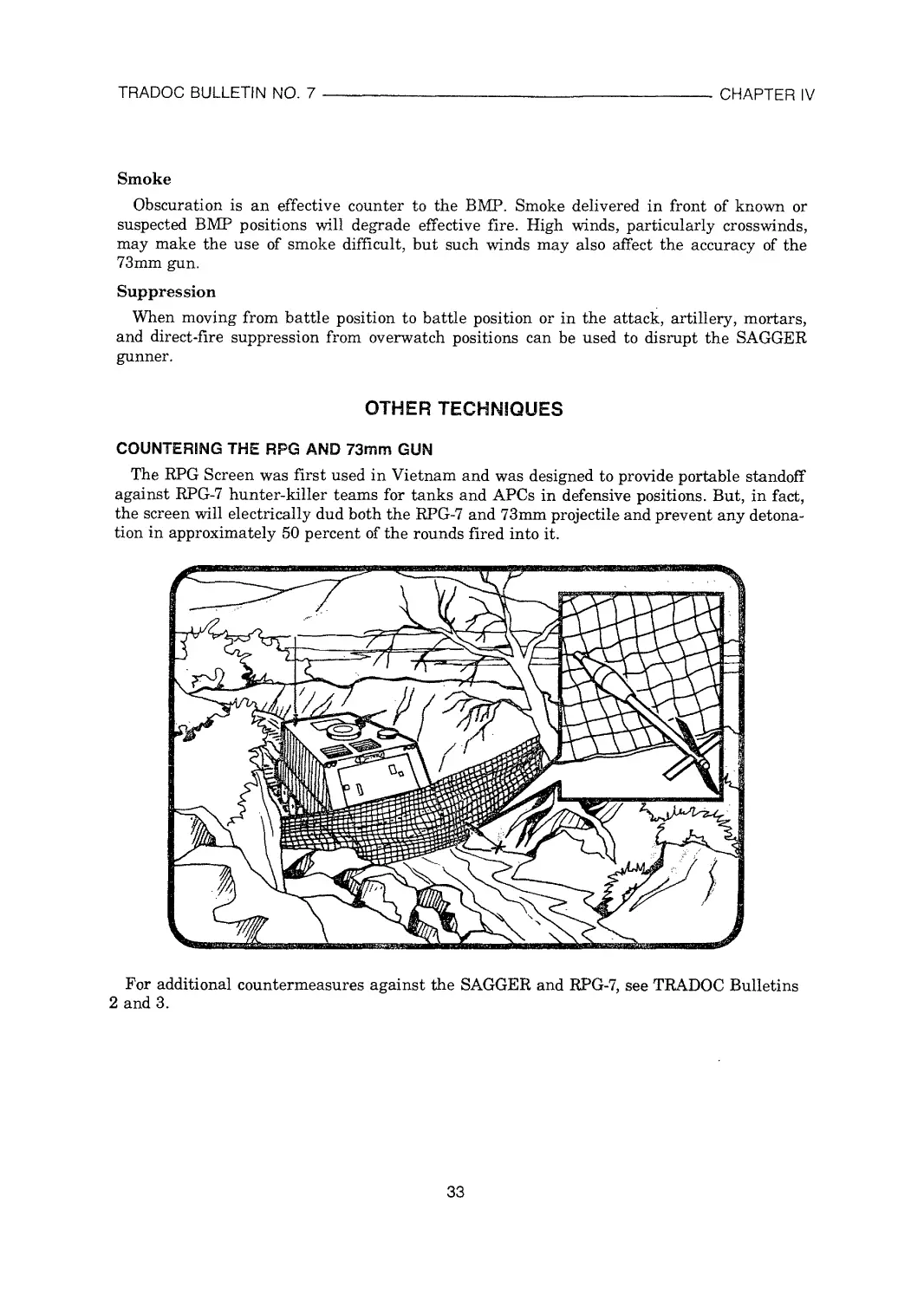
The RPG Screen was first used in Vietnam and was designed to provide portable standoff
against RPG-7 hunter-killer teams for tanks and APCs in defensive positions. But, in fact,
the screen will electrically dud both the RPG-7 and 73mm projectile and prevent any detona-
tion in approximately 50 percent of the rounds fired into it.
For additional countermeasures against the SAGGER and RPG-7, see TRADOC Bulletins
2 and 3.
33
CHAPTER IV
TRADOC BULLETIN NO. 7
FEBA
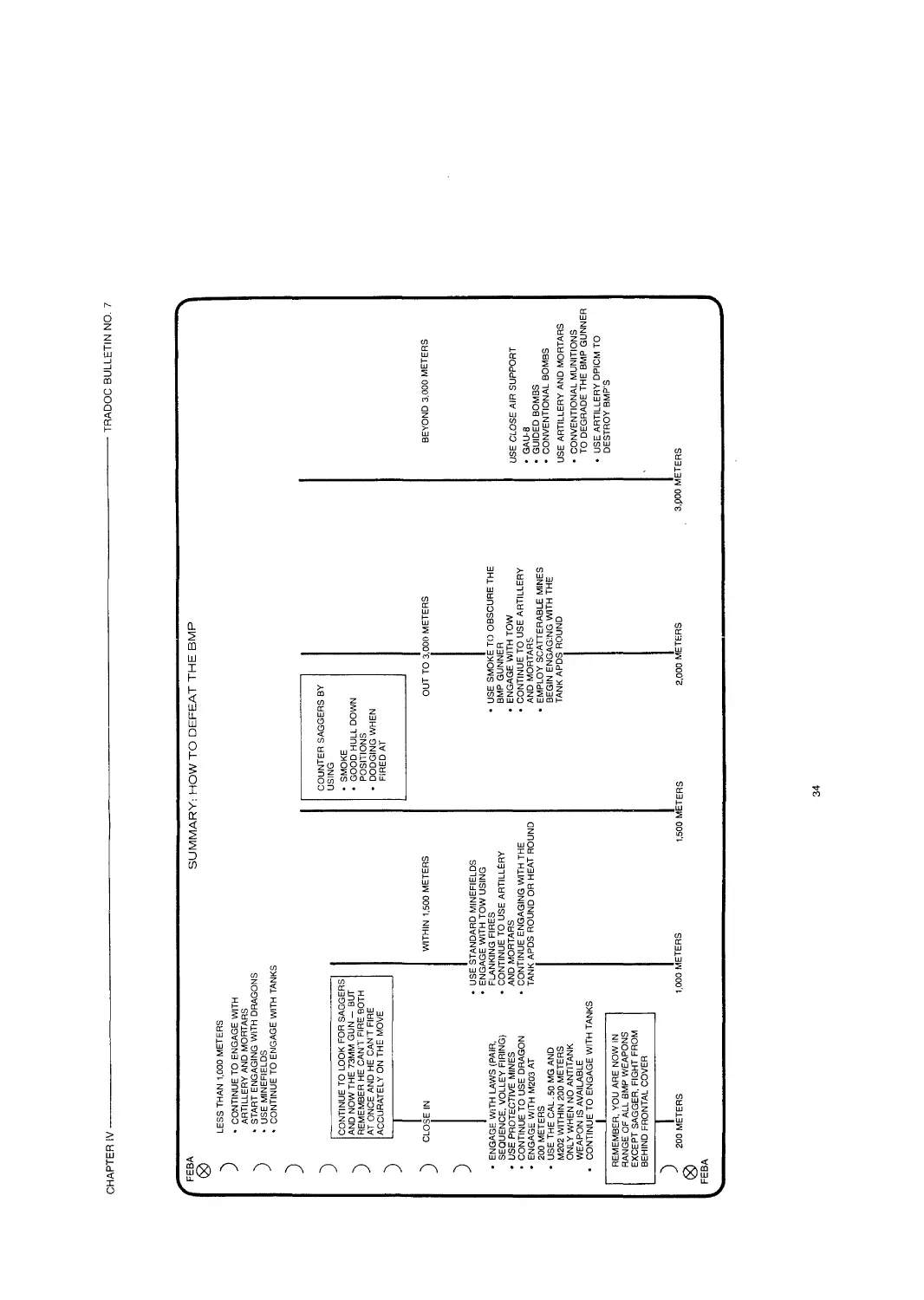
SUMMARY: HOWTO DEFEAT THE BMP
LESS THAN 1,000 METERS
• CONTINUE TO ENGAGE WITH
ARTILLERY AND MORTARS
•	START ENGAGING WITH DRAGONS
•	USE MINEFIELDS
• CONTINUE TO ENGAGE WITH TANKS
CONTINUE TO LOOK FOR SAGGERS
AND NOW THE 73MM GUN - BUT
REMEMBER HE CAN T FIRE BOTH
AT ONCE AND HE CAN'T FIRE
ACCURATELY ON THE MOVE
COUNTER SAGGERS BY
USING
•	SMOKE
•	GOOD HULL DOWN
POSITIONS
•	DODGING WHEN
FIRED AT
CLOSE IN
•	ENGAGE WITH LAWS (PAIR,
SEQUENCE, VOLLEY FIRING)
•	USE PROTECTIVE MINES
	CONTINUE TO USE DRAGON
•	ENGAGE WITH M203 AT
200 METERS
•	USE THE CAL.50 MG AND
M202 WITHIN 200 METERS
ONLY WHEN NO ANTITANK
WEAPON IS AVAILABLE
• CONTINUE TO ENGAGE WITH TANKS
REMEMBER, YOU ARE NOW IN
RANGE OF ALL BMP WEAPONS
EXCEPT SAGGER, FIGHT FROM
BEHIND FRONTAL COVER
200 METERS
WITHIN 1,500 METERS
•	USE STANDARD MINEFIELDS
•	ENGAGE WITH TOW USING
FLANKING FIRES
•	CONTINUE TO USE ARTILLERY
AND MORTARS
•	CONTINUE ENGAGING WITH THE
TANK APDS ROUND OR HEAT ROUND
1,000 METERS
1,500 METERS
OUT TO 3,000 METERS
•	USE SMOKE TO OBSCURE THE
BMP GUNNER
•	ENGAGE WITH TOW
•	CONTINUE TO USE ARTILLERY
AND MORTARS
•	EMPLOY SCATTERABLE MINES
BEGIN ENGAGING WITH THE
TANK APDS ROUND
2,000 METERS
BEYOND 3,000 METERS
USE CLOSE AIR SUPPORT
•	GAU-8
•	GUIDED BOMBS
•	CONVENTIONAL BOMBS
USE ARTILLERY AND MORTARS
•	CONVENTIONAL MUNITIONS
TO DEGRADE THE BMP GUNNER
•	USE ARTILLERY DPICM TO
DESTROY BMP'S
3.QOO METERS
FEBA
34
APPENDIX A
BMP VARIATIONS
While the BMP is relatively new, these variations have already been fielded, and it is
expected that further modifications providing for additional combat roles will also be seen in
the future.
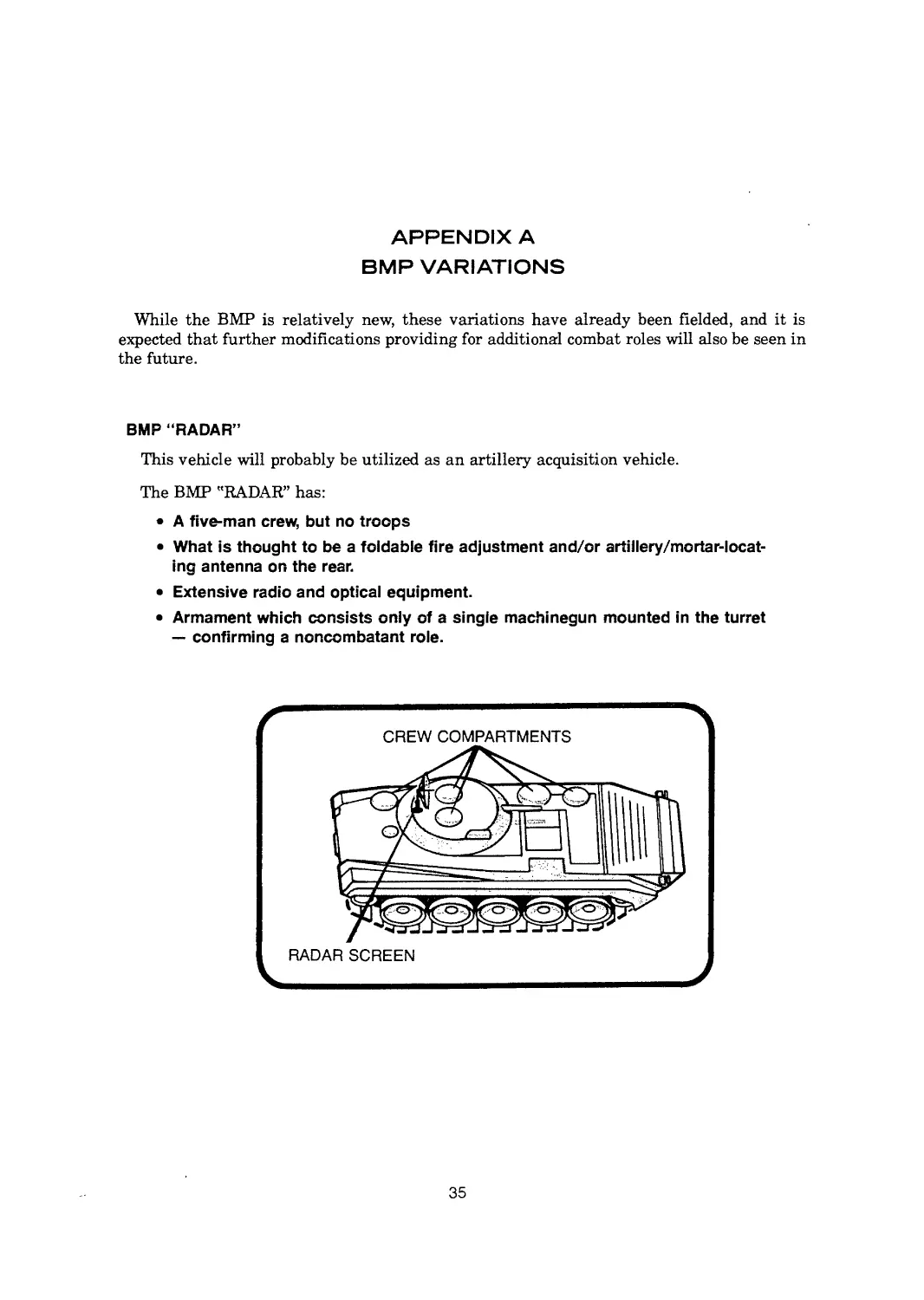
BMP “RADAR”
This vehicle will probably be utilized as an artillery acquisition vehicle.
The BMP "RADAR” has:
•	A five-man crew, but no troops
•	What is thought to be a foldable fire adjustment and/or artillery/mortar-locat-
ing antenna on the rear.
•	Extensive radio and optical equipment.
•	Armament which consists only of a single machinegun mounted in the turret
— confirming a noncombatant role.
35
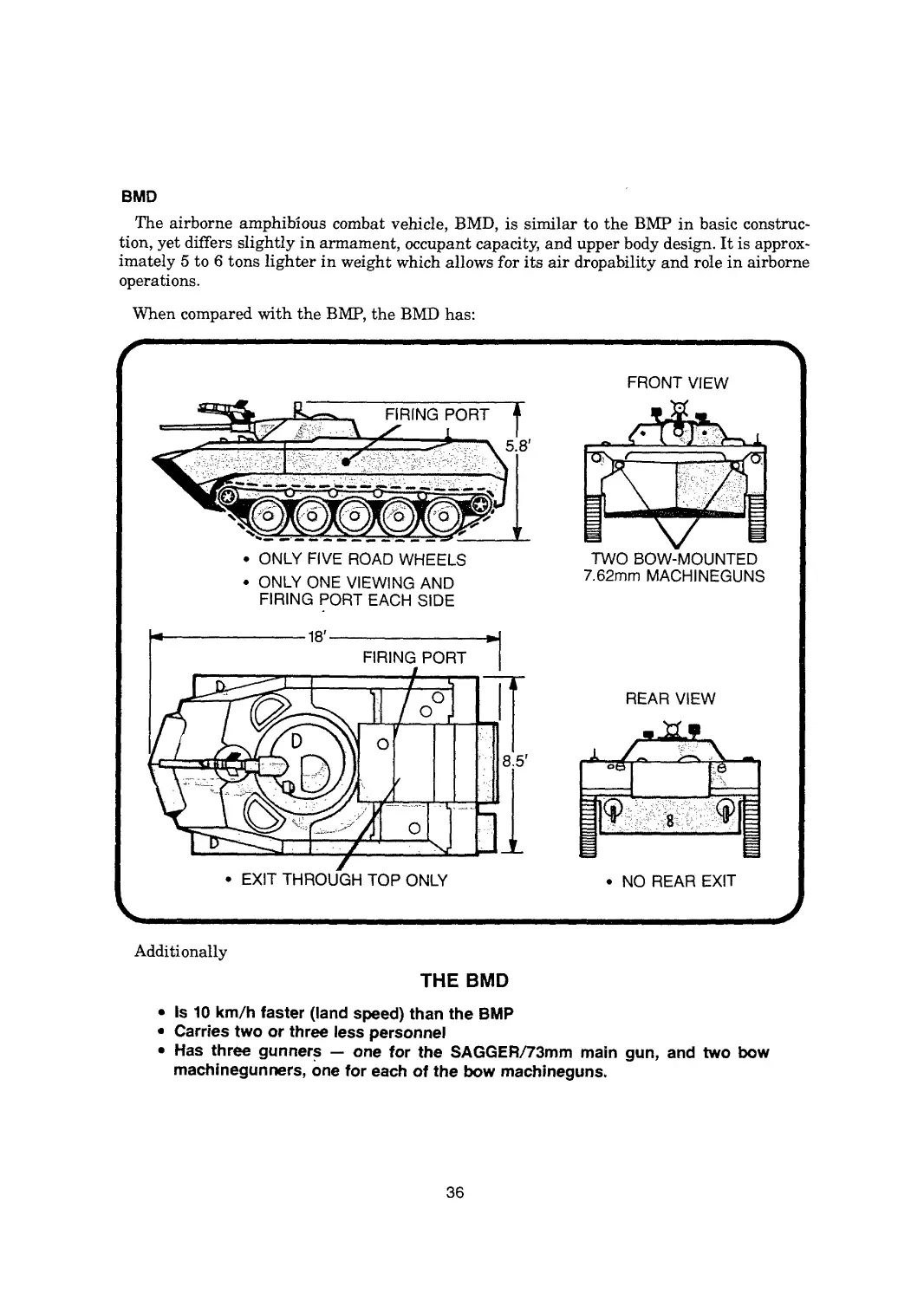
BMD
The airborne amphibious combat vehicle, BMD, is similar to the BMP in basic construc-
tion, yet differs slightly in armament, occupant capacity, and upper body design. It is approx-
imately 5 to 6 tons lighter in weight which allows for its air dropability and role in airborne
operations.
When compared with the BMP, the BMD has:
• ONLY FIVE ROAD WHEELS
FRONT VIEW
TWO BOW-MOUNTED
7.62mm MACHINEGUNS
• ONLY ONE VIEWING AND
FIRING PORT EACH SIDE
Additionally
THE BMD
•	Is 10 km/h faster (land speed) than the BMP
•	Carries two or three less personnel
•	Has three gunners — one for the SAGGER/73mm main gun, and two bow
machinegunners, one for each of the bow machineguns.
36
APPENDIX В
MANUALS AND OTHER PUBLICATIONS
THREAT DOCTRINE
DDI 1100-77-76, The Soviet Motorized Rifle Company (Defense Intelligence Agency)
FM 30-40, Handbook on Soviet Ground Forces
TC 30-102, The Motorized Rifle Company
TC 30-3, Soviet Equipment Recognition Guide
TC 30-4, The Motorized Rifle Regiment
US DOCTRINE
TC 7-1, The Rifle Squad (Mechanized and Light Infantry)
FM 7-7, The Mechanized Infantry Platoon/Squad
FM 71-1, The Tank and Mechanized Infantry Company Team
FM 71-2, The Tank and Mechanized Infantry Battalion Thsk Force
RELATED TRADOC BULLETINS
ТВ 1c, Range and Lethality of US and Soviet Antiarmor Weapons
ТВ lu, Range and Lethality of US and Soviet Anti armor Weapons
ТВ 2 c, Soviet ATGMs
ТВ 2u, Soviet ATGMs
ТВ 3 c, Soviet RPG-7, Antitank Grenade Launcher
IB 3u, Soviet RPG-7, Antitank Grenade Launcher
ТВ 4c, Soviet ZSU 23-4: Capabilities and Countermeasures
ТВ Training With LAW
ТВ Countersurveillance and Camouflage
ТВ Ou, Infantry Fighting Positions
TRAINING FILMS
Modern Battle (TF 21-4925)
The BMP — Capabilities and Countermeasures (TF 21-4993)
Infantry Fighting Positions, Part I (TVT-2E-071-INF 1-B)
Threat Tactics — The Breakthrough (TVT-2E-777-0445-B)
37
APPENDIX С
ORDERING TRADOC BULLETINS
PURPOSE
A series of TRADOC bulletins is being published by HQ TRADOC to provide commanders
timely technical information on weapons, tactics, and training techniques. The bulletins are not
intended to supplant doctrinal publications, but to supplement material on “How to fight” with data
derived from tests, recent intelligence, or other sources which probe “why?”
APPLICABILITY
TRADOC Bulletins are developed by Headquarters, TRADOC, using the most comprehensive
and current military and civilian data available. Army Training and Evaluation Programs (ARTEP),
Field Manuals (FM), and Training Circulars (TC) will continue to be the primary training refer-
ences. TRADOC Bulletins will supplement them with an explanation of why we are training in a
given manner. TRADOC Bulletins should enable commanders to better stimulate and motivate
subordinates to understand why we train the way we do.
INDEX OF SERIES
TRADOC Bulletins are cataloged in DA Pamphlet 310-3. “Index of Doctrinal, Training and
Organizational Publications." The series is numbered consecutively, and each TRADOC Bulletin
is announced at the time of printing in the information bulletin distributed to all pinpoint account
holders by the US Army AG Publications Center.
ADDITIONAL COPIES
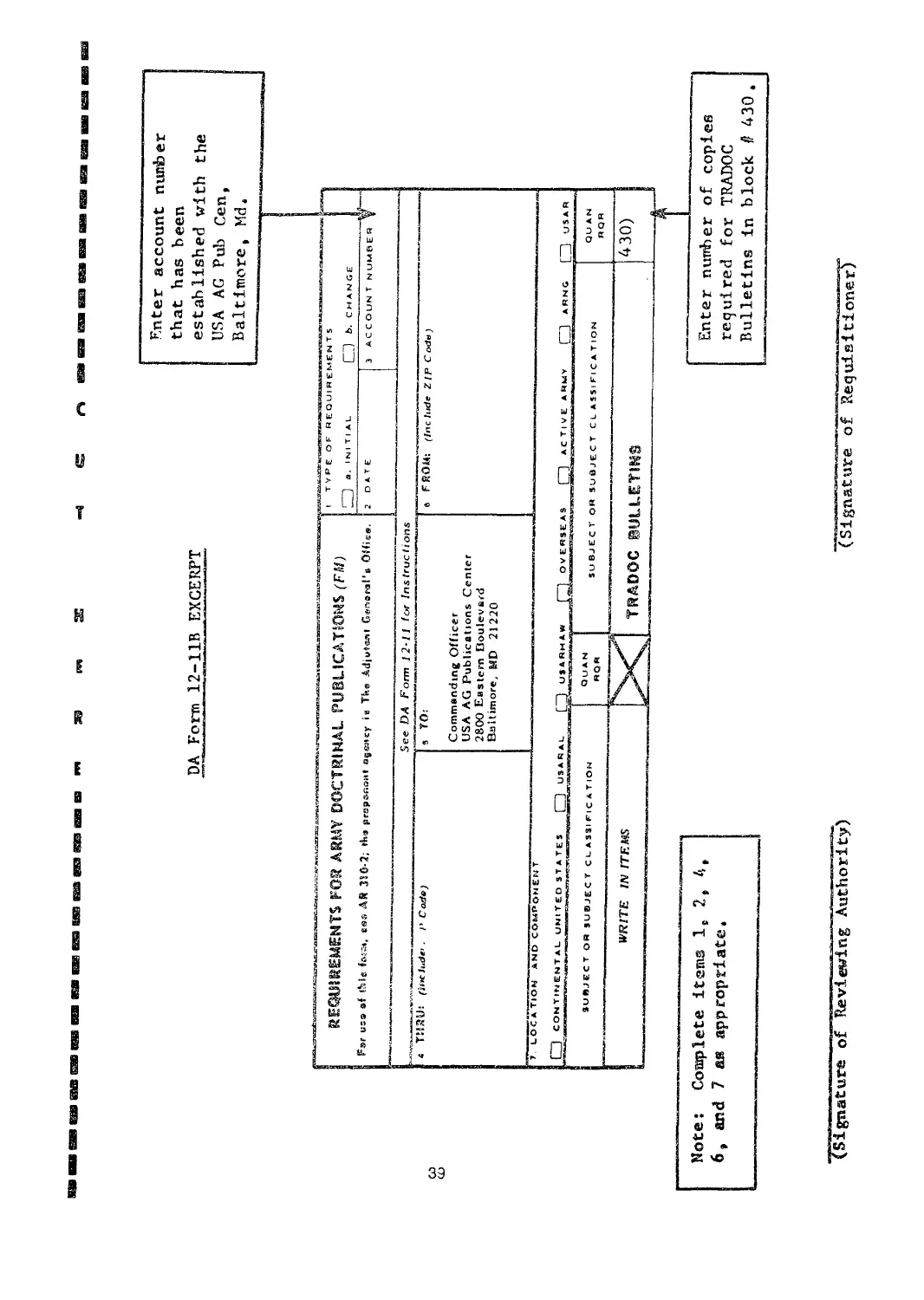
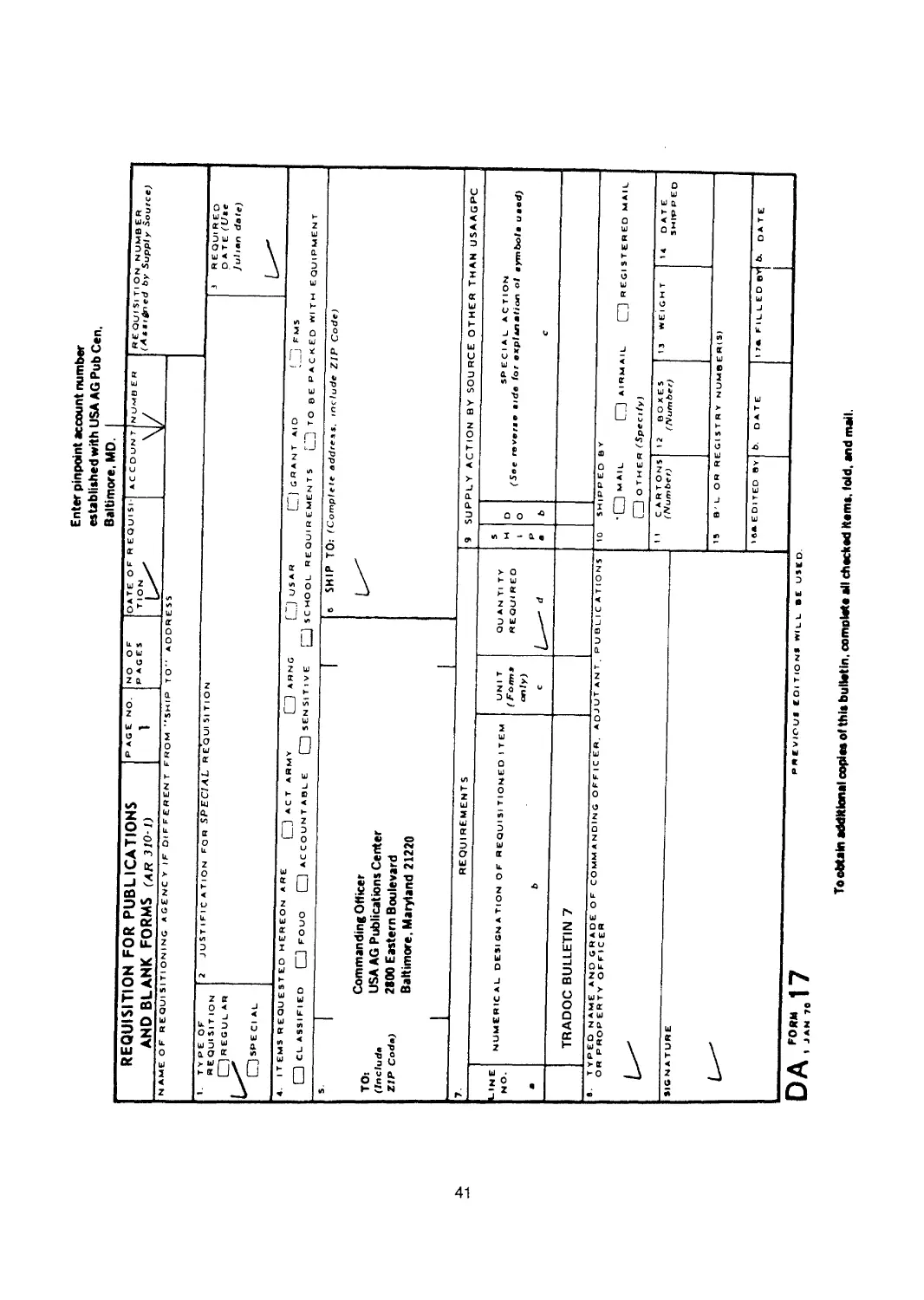
Submit DA Form 17 to order more copies of this TRADOC Bulletin.
PERMANENT DISTRIBUTION
Pinpoint account holders receiving TRADOC Bulletin Number 1 from Baltimore will automati-
cally receive two copies of all subsequent issues unless a DA form 12-11В is submitted to change
that quantity. Others desiring to be added to the permanent distribution list for TRADOC Bulletins
must submit a DA Form 12-11B. Units which are required to submit publication requests through
another headquarters should send the completed excerpt through proper authority.
REFERENCE FOR DISTRIBUTION PROCEDURES
DA Pamphlet 310-10 explains the pinpoint distribution system and how to establish or update
an existing account at the US Army AG Publications Center.
38
ВДВ ВДВ SB ВДВ SSffl B9S5 BBS Ей Бб ffiSB КЙЭ ®EJ S5S3 ^1 £S m
m
"4
C*i sa eaoa ira sea «м ess Ksa шк ea вв кеа ск №ai
<U
4 ТЙ?Ш! fiftttjfed*'* P Caito)
DA Form 12-11B EXCERPT
Enter account nunber
that has been
established with the
USA AG Pub Cen,
Baltimore, Nd*
FOB ARMY DOCTRINAL PUBUCAT5OHS (FM)
Per use ef fMe 8®s AR 310-2; ik«i prepsnoM og«»»cy ie Tk® Adjus^nf Gs^erol’s OHiee.
See DA Form 12’11 for Instructions
	5 ГО; Commending Officer USA AG Publications Center 2800 Eastern Boulevard Baltimore, MD 21220	в F ROit: (Inc hide ZIP Code)
AND COMPONENT
WRITE IN ITEMS
TRADOC BUIXSTINS
Note: Complete items lc 2
6, and 7 as appropriate*
rum ir'W^unRn i niii i , ! fmun ^in. w Tu
(Signature of Reviewing Authority)
Enter number of copies
required for TRADOC
Bulletins in block # 430
(Si^Zture'of Regt^Lei11опегУ
DEPARTMENT OF THE ARMY
OFFICIAL BUSINESS
PENALTY FOR PRIVATE USE $300
POSTAGE AND FEES PAID
DEPARTMENT OF THE ARMY
DOD-314
Commander
US Army AG Publications Center
2800 Eastern Boulevard
Baltimore, Maryland 21220
i
I
I
I
I
g
i
i
i
c
H
(Fold and mail to above)
I
I
I
I
в
i
I
s
a
i
в
a
a
a
a
a
40
Enter pinpoint account number
established with USA AG Pub Cen.
Baltimore, MD.
REQUISITION FOR PUBLICATIONS AND BLANK FORMS (ar jio-i)	page no. 1	NO OF pages	DATE О F R EQUISI- T	А с С О UN T	N имб E R
NAME OF REQUISITIONING AGENCY IF DIFFERENT FROM "SHIP TO" ADDRESS
2
REQUlSlT ION
REQUISITION NUMBER
(Assigned by Supply Source)
ITEMS REQUESTED HEREON ARE
L.J US AR
SHIP TO: (Complete address, include ZIP Code)
R E QUI R E О
TO:
(Include
ZIP Coda)
Commanding Officer
USA AG Publications Center
2800 Eastern Boulevard
Baltimore, Maryland 21220
REQUIREMENTS
(Forme
9 SUPPLY ACTION BY SOURCE OTHER THAN USAAGPC
REQUIRED
TRADOC BULLETIN 7
	II CARTONS (Number)	12 BOXES (Number)	13 WEIGHT	14 DATE SHIP PED
	15	0'L OR REGISTRY NUMBERS
	16A EDITED BY	b. DATE	IT* FILLED B*	b. DATE
DA "“.17
To obtain additional copies of this bulletin, complete all checked Items, fold, and mail.
DEPARTMENT OF THE ARMY
OFFICIAL BUSINESS
PENALTY FOR PRIVATE USE $300
POSTAGE AND FEES PAID
DEPARTMENT OF THE ARMY
DOD-314
Commander
US Army AG Publications Center
2800 Eastern Boulevard
Baltimore, Maryland 21220
I
I
I
I
I
I
I
I
I
I
I
I
I
I
c
и
T
H
(Fold and mail to above)
I
I
I
I
I
I
I
I
I
I
I
I
I
I
I
I
I
42
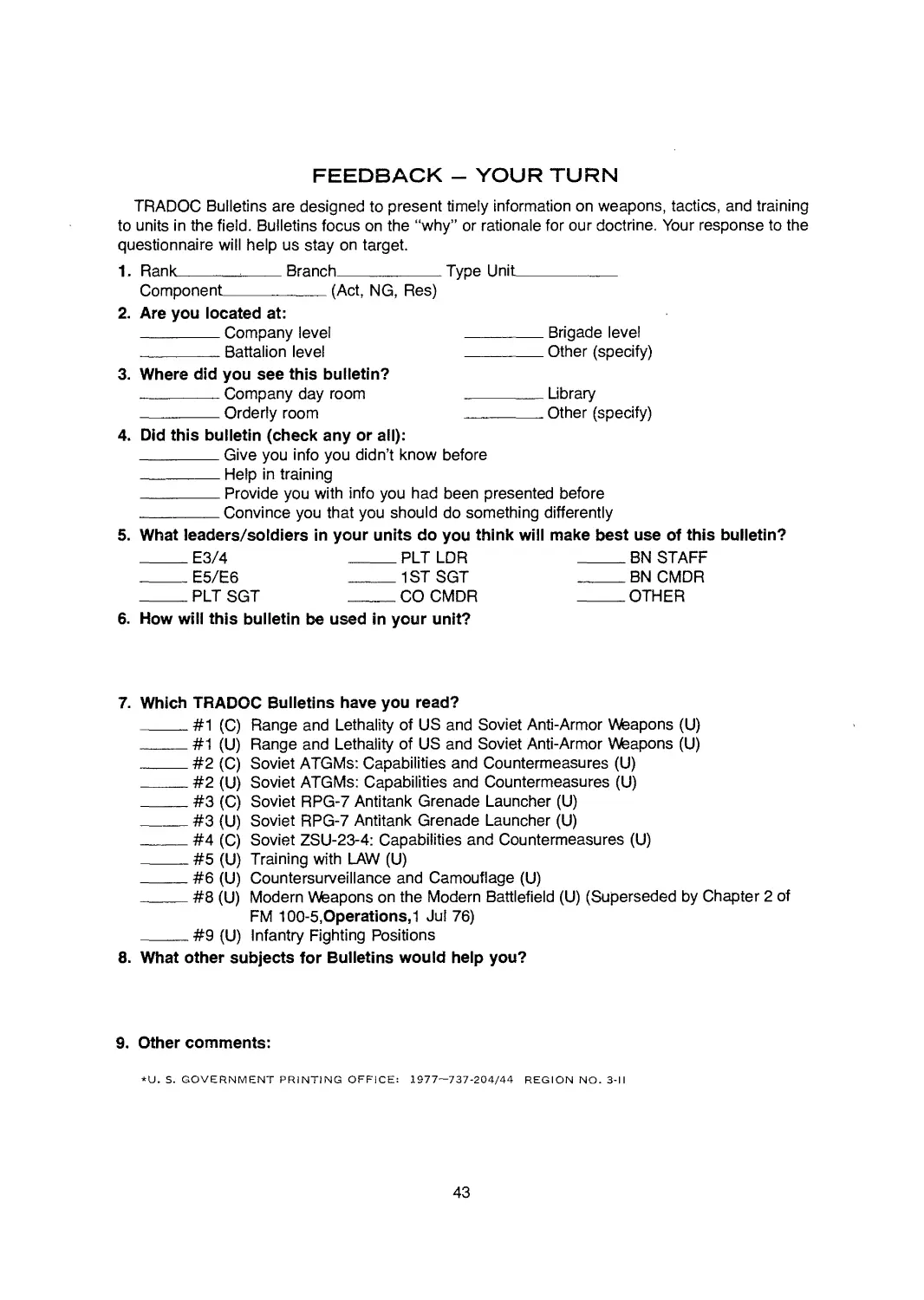
FEEDBACK - YOUR TURN
TRADOC Bulletins are designed to present timely information on weapons, tactics, and training
to units in the field. Bulletins focus on the “why” or rationale for our doctrine. Your response to the
questionnaire will help us stay on target.
1. Rank_...... . ____Branch ______________-Type Unit_____________
Component.............. (Act,	NG, Res)
Are you located at:
Company level
Battalion level
Where did you see this bulletin?
...	.....Company day room
Orderly room
Did this bulletin (check any or all):
Give you info you didn’t know before
Help in training
Provide you with info you had been presented before
Convince you that you should do something differently
What leaders/soldiers in your units do you think will make best use of this bulletin?
E3/4	PLT LDR	BN STAFF
E5/E6	1 ST SGT	BN CMDR
PLT SGT	CO CMDR	OTHER
6. How will this bulletin be used in your unit?
2.
3.
4.
5.
7. Which TRADOC Bulletins have you read?
-------#1 (C)
-------#1 (U)
#2 (0)
#2 (U)
#3 (C)
#3 (U)
-------#4 (0)
#5 (U)
#6 (U)
-..... #8 (U)
#9 (U)
Brigade level
Other (specify)
Library
Other (specify)
Range and Lethality of US and Soviet Anti-Armor Wsapons (U)
Range and Lethality of US and Soviet Anti-Armor Weapons (U)
Soviet ATGMs: Capabilities and Countermeasures (U)
Soviet ATGMs: Capabilities and Countermeasures (U)
Soviet RPG-7 Antitank Grenade Launcher (U)
Soviet RPG-7 Antitank Grenade Launcher (U)
Soviet ZSU-23-4: Capabilities and Countermeasures (U)
Training with LAW (U)
Countersurveillance and Camouflage (U)
Modern Wsapons on the Modern Battlefield (U) (Superseded by Chapter 2 of
FM 100-5,0perations,1 Jul 76)
Infantry Fighting Positions
8. What other subjects for Bulletins would help you?
9. Other comments:
*U. S. GOVERNMENT PRINTING OFFICE: 1977—737-204/44 REGION NO. 3-11
43
DEPARTMENT OF THE ARMY
OFFICIAL BUSINESS
PENALTY FOR PRIVATE USE $300
POSTAGE AND FEES PAID
DEPARTMENT OF THE ARMY
DOD-314
Commander
US Army Training and Doctrine Command
ATTN: ATCG-T (Tel: Autovon 680-2445/2972)
Fort Monroe, Virginia 23651
I
i
I
i
I
I
I
I
I
I
I
I
I
I
c
и
T
(Fold and mail to above)
I
I
I
I
I
I
I
I
I
I
I
I
I
I
I
44	|
TRADOC BULLETIN NO. 7
30 JUNE 1977
W. E. De
General, United States Army
Commanding
DISTRIBUTION:
Active Army, US AR, and ARNG: To be distributed to all DA Form 12-11 accounts (one copy each
account); plus in accordance withDAForm 12-11A, Requirements for The Rifle Co, Platoons and
Squads (Qty rqr block no. 78); Techniques of Antitank Warfare (Qty rqr block no. 181); and DA
Form 12-11B, Requirements for TRADOC Bulletins (Qty rqr block no. 430).
Additional copies can be requisitioned (DA Form 17) from the US Army Adjutant General
Publications Center, 2800 Eastern Boulevard, Baltimore, MD 21220.