/


Автор: Williams D.R.
Теги: buddhism culture spirituality japanese culture zen
ISBN: 0-691-11928-7
Год: 2005


Текст
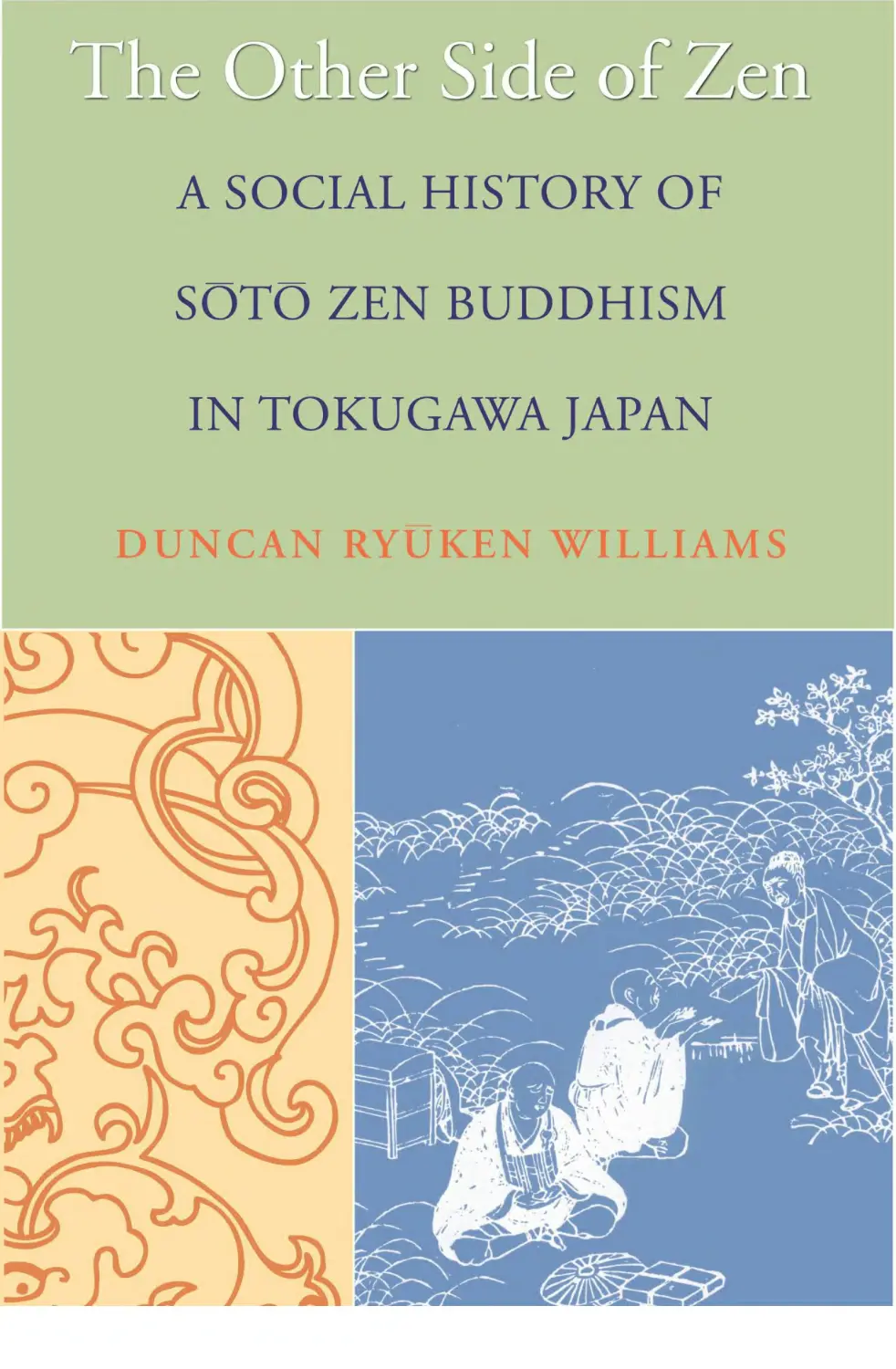
The Other Side of Zen
BUDDHISMS
A PRINCETON UNIVERSITY PRESS SERIES
E d i t e d b y S t e p h e n F. T e i s e r
The Other Side of Zen: A Social History of Sôtô Zen Buddhism in Tokugawa Japan,
by Duncan Ryûken Williams
Relics of the Buddha,
by John S. Strong
Becoming the Buddha: The Ritual of Image Consecration in Thailand,
by Donald K. Swearer
The Impact of Buddhism on Chinese Material Culture,
by John Kieschnick
The Power of Denial: Buddhism, Purity, and Gender,
by Bernard Faure
Neither Monk nor Layman: Clerical Marriage in Modern Japanese Buddhism,
by Richard M. Jaffe
Buddhist Learning and Textual Practice in Eighteenth-Century Lankan Monastic Culture,
by Anne M. Blackburn
The Red Thread: Buddhist Approaches to Sexuality,
by Bernard Faure
The Other Side of Zen
A SOCIAL HISTORY OF SÔTÔ ZEN
BUDDHISM IN TOKUGAWA JAPAN
DUNCAN RYÛKEN WILLIAMS
P R I N C E T O N
U N I V E R S I T Y
P R I N C E T O N
A N D
O X F O R D
P R E S S
Copyright ©2005 by Princeton University Press
Published by Princeton University Press, 41 William Street, Princeton, New Jersey 08540
In the United Kingdom: Princeton University Press, 3 Market Place, Woodstock,
Oxfordshire OX20 1SY
All Rights Reserved
Library of Congress Cataloging-in-Publication Data
Williams, Duncan Ryûken, 1969–
The other side of Zen : a social history of Sôtô Zen Buddhism in Tokugawa Japan /
Duncan Ryûken Williams.
p.
cm.
— (Buddhisms : Princeton University Press series)
Includes bibliographical references and index.
ISBN 0-691-11928-7 (cloth : alk. paper)
1. Sôtôshû—Social aspects. I. Title: Social history of Sôtô Zen. II. Title: Buddhism
in Tokugawa Japan. III. Title. IV. Buddhisms.
BQ9412.6 W55 2005
294.3927—dc22 2004044339
British Library Cataloging-in-Publication Data is available
This book has been composed in Sabon
Printed on acid-free paper. ∞
pup.princeton.edu
Printed in the United States of America
10 9 8 7 6 5 4 3 2 1
CONTENTS
LIST OF FIGURES AND TABLES
vii
ACKNOWLEDGMENTS
ix
NOTES ON TRANSLITERATION AND ABBREVIATIONS
xiii
ONE
Toward a Social History of Sôtô Zen
1
TWO
Registering the Family, Memorializing the Ancestors:
The Zen Temple and the Parishioner Household
13
THREE
Funerary Zen: Managing the Dead in the World Beyond
38
FOUR
The Cult of Dôryô Daigongen: Daiyûzan and Sôtô
Zen Prayer Temples
59
FIVE
Medicine and Faith Healing in the Sôtô Zen Tradition
86
CONCLUSION
The Other Side of Zen
117
APPENDIX A: NYONIN JÔBUTSU KETSUBONKYÔ ENGI
(THE ORIGINS OF THE BLOOD POOL HELL SUTRA FOR
WOMEN’S SALVATION)
125
APPENDIX B: SHINSEN GEDOKU MANBYÔEN FUKUYÔ NO KOTO
(HOW TO PREPARE AND TAKE THE WIZARD MOUNTAIN
“POISON-DISPELLING” PILL THAT CURES ALL ILLNESSES)
129
NOTES
133
GLOSSARY OF CHINESE AND JAPANESE
193
BIBLIOGRAPHY
197
INDEX
235
F I G U R E S A N D TA B L E S
Figures
FIGURE 1.
Cover of the Blood Pool Hell Sutra given during precept ceremonies
53
FIGURE 2.
Jizô talisman for women’s salvation
54
FIGURE 3.
Ususama Myôô talisman for the purification of the body-mind
and for the protection of women
55
FIGURE 4.
Dôryô scroll from the late Tokugawa period
63
FIGURE 5.
Statue of a tengu on route to Dôryô Shrine at Daiyûzan
64
FIGURE 6.
Senryûji’s Musôgan medicine wrapper
113
FIGURE 7.
Senryûji’s Benzaiten smallpox talisman
115
Tables
TABLE 1.
Tokugawa-period stone markers and pilgrimage confraternities at
Daiyûzan
69
TABLE 2.
Early Meiji stone markers and pilgrimage confraternities at Daiyûzan
69
TABLE 3.
Pilgrimage to Daiyûzan as seen in Tokugawa-period travel diaries
71
TABLE 4.
Stone markers on the road to Daiyûzan
73
TABLE 5.
Legends of Daiyûzan
75
TABLE 6.
Incidents of counterfeit Gedokuen sales in the early modern period
99
TABLE 7.
Miracle stories in the Enmei Jizôson inkô riyaku ki
108
ACKNOWLEDGMENTS
The causes and conditions that give rise to a book are innumerable, but
I would like to express my gratitude to at least some of the people who
helped me produce this manuscript. As a graduate student at Harvard University, I was launched onto the scholar’s path by Masatoshi Nagatomi,
while Helen Hardacre directed the doctoral dissertation on which much of
this book is based. Whatever contribution my research might make to the
field, I owe the greatest debt to these two distinguished scholars of Buddhist
studies and the study of Japanese religions, respectively. My training in the
study of Japanese Buddhism was enriched by Masatoshi Nagatomi’s encouragement to investigate the topic within the broader world of East Asian
Buddhism. He instilled in me a concern for placing the study of Buddhism
within cultural contexts while never losing sight of the Buddhist tradition as
a whole. Helen Hardacre taught me the importance of setting my studies on
Zen within a sociohistorical framework so as to connect the study of religion to society. She encouraged me to learn how to read Tokugawa-period
handwritten materials, which allowed me to investigate temple and local
history archives throughout Japan. With extraordinary patience and compassion, these two teachers shaped not only my research, but also my entire
outlook as a scholar.
Since the bulk of the research for this book was conducted in Japan, I
must mention several individuals who assisted me during the summers of
1993–97 as well as the more extended dissertation research period of
1998–2000 and postdoctoral work during 2002–3. I was fortunate to receive the guidance of two scholars who shared their wisdom, unpublished
documents, and invitation to attend seminars and field research trips.
Tamamuro Fumio of Meiji University, a pioneer in the study of Tokugawaperiod religions, helped me to understand Sôtô Zen Buddhism in the context
of early modern Japanese religious history by encouraging me to focus on
the lives of ordinary temple priests, temple economics, and quantitative
data. He accompanied me on numerous trips to Eiheiji and Noto Sôjiji temples and to innumerable local history archives. Hirose Ryôkô of Komazawa
University, a leading researcher of medieval and early modern Sôtô Zen history, advised me to think about the Sôtô tradition in the context of local society, patronage patterns, and regional administration. He also accompanied me on research trips to Eiheiji Temple and provided me access to
the documents held at the Sôtôshû Bunkazai Chôsa Iinkai at Komazawa
University.
A number of scholars, including Andô Yoshinori, Itô Katsumi, Kôdate
Naomi, Matsuoka Takashi, Ôwada Kôichi, Sakai Tatsurô, Tsutsumi Kunihiko, Umezawa Fumiko, and Watanabe Shôei, also helped me recognize the
significance of popular tales, narrative literature, and the cults of local
x
A C K N O W L E D G M E N T S
deities for my study. Many institutes and temples also supported my research in Japan by freely sharing original documents in their possession.
They include the Atsugishishi Hensan Shitsu, Etoki Kenkyûkai, Hakone
Chôritsu Kyôdo Shiryôkan, Higashiurashi Hensan Shitsu, Komazawa University Library, Sôtôshû Shûmuchô (headquarter offices, Bunkazai Chôsa
Iinkai, Jinken Yôgo Suishin Honbu, and Sôtôshû Sôgô Kenkyû Center), as
well as individual temples and their priests: Chôjuin (Shinohara Eiichi),
Jizôji (Asai Senryô), Kenkon’in (Shimada Taizen), and Senryûji (Sugawara
Shôei). Thanks are also due to the many individuals who helped me read
and transcribe these manuscripts, including Hiromoto Shôko, Inoue Asako,
Kuroda Hiroshi, Marufuji Tomoko, Minagawa Gikô, Tanaka Hiroshi, and
Yamamoto Akiko.
Studies in Japan were further enhanced through affiliations with the Faculty of Comparative Culture at Sophia University in 1997–98 and with the
History Department (which kindly provided a research office) at Komazawa
University during 1998–2000 and 2002–3. At Komazawa University, many
professors helped me receive access to the university’s large collection of materials on Sôtô Zen, including Kumamoto Einin, Nara Kômei, Ôtani Tetsuo,
and Sasaki Kôkan. The fellows of the Shûgaku Kenkyû Bumon of the
Sôtôshû Sôgô Kenkyû Center at Komazawa University received me warmly
and patiently answered my numerous questions. Particular thanks go to Aki
Eibun, Hareyama Shun’ei, Hirako Yasuhiro, Ikegami Kôyô, Ishijima Shôyû,
Itô Yoshihisa, Kaneko Shûgen, Kirino Kôgaku, Matsuda Yôji, Shimomura
Kakudô, and Yokoi Kyôshô.
Although errors of interpretation or translation in this book are mine
alone, the research and writing proceeded smoothly because of the insightful
comments and critiques of many people who read chapters or the entire manuscript. During the dissertation writing stage, Harold Bolitho and Charles
Hallisey constantly advised me to reflect on the significance of the project for
the fields of Japanese and Buddhist studies, respectively. Their encouragement
from the early stages helped me imagine ways in which this study might be of
interest to non-Sôtô Zen specialists. Other Harvard professors who assisted
me throughout my graduate career included Diana Eck, Christopher Queen,
and Lawrence Sullivan. Helpful suggestions also came from researchers at
other universities, including Barbara Ambros, Andrew Bernstein, William
Bodiford, Steve Covell, Richard Gardner, Hank Glassman, Steven Heine, Hiromi Maeda, Mark Mullins, David and Diane Riggs, Kate Nakai, Paul Swanson, Mary Evelyn Tucker, and Alex Vesey. Proofreaders helped me with the
writing, including Victoria James, Paula Maute, Beth Miller, and Debra Robbins. Finally, the three anonymous reviewers for Princeton University Press
provided insightful commentary that helped me reflect on the broader themes
of the volume. Special thanks goes to one reviewer in particular who provided
an exhaustive and meticulous list of corrections.
The publication process would have been impossible to navigate without
the kindness, patience, and editorial insight of Stephen Teiser, the general
A C K N O W L E D G M E N T S
xi
editor of the “Buddhisms” series, and my editor and copy editor at Princeton University Press, Fred Appel and Anita O’Brien, respectively. An earlier
version of chapter 3 was published as “Funerary Zen: Sôtô Zen Death
Management in Tokugawa Japan,” in Death Rituals and the Afterlife in Japanese Buddhism, ed. Jacqueline Stone and Mariko Walter (University of
Hawai’i Press, 2004), and chapter 5 as “How Dôshô’s Medicine Saved
Dôgen: Medicine, Dôshô’an, and Edo-Period Dôgen Biographies,” in Chan
Buddhism in Ritual Context, ed. Bernard Faure (Routledge Curzon Press,
2003). I am grateful to the editorial boards of these presses for permission
to print revised versions of those pieces.
This book was written during my time at Trinity College and at the University of California, Irvine. My colleagues in the International Studies Program at Trinity and the East Asian Languages and Literatures Department
at the University of California at Irvine were most supportive and provided
me with the time to complete this manuscript. Many thanks to Trinity’s
Nicole Reichenbach for her work as my research assistant.
I would also like to acknowledge the institutes and fellowships that made
this research possible financially: the Atsumi International Scholarship
Foundation, Bukkyô Dendô Kyôkai, Harvard Center for the Study of World
Religions, Japan Society for the Promotion of Science, Harvard Edwin O.
Reischauer Institute of Japanese Studies, Andrew Mellon Foundation,
Rocky Foundation, and Yokohama Zenkôji Scholarship.
Finally, boundless gratitude is due to the people closest to me—my Zen
teacher and my family. Ogasawara Ryûgen, abbot of Kôtakuji Temple, has
guided my Sôtô Zen priestly life while I simultaneously walked the scholarly
path. My parents, Stephen and Tsutae Williams, have been my steadfast
supporters from the earliest times, providing me with opportunities to pursue my dreams. Assistance on the Japanese materials from my mother and
on the writing in English from my father reflects their long-standing efforts
to educate me bilingually and biculturally. And last, but certainly not least,
I owe my deepest gratitude to my wife and best friend, Barbara Ambros,
who not only gave me refreshing scholarly advice when I came home with
writer’s block, but also supported the whole experience of putting together
this book through all the highs and lows, day in, day out. Endless bows.
This book is dedicated to my late brother, Nigel Williams, an inspirational human being.
N O T E S O N T R A N S L I T E R AT I O N A N D A B B R E V I AT I O N S
The modified Hepburn system is used for the romanization of Japanese
terms. Apostrophes are used only in rare cases to prevent misunderstanding
with similar transliteration or to designate discrete syllables after “n” (as in
on’aratamechô). Commonly used Japanese and Sanskrit terms and place
names do not bear diacritical marks, nor are they italicized.
Japanese names are rendered in Japanese order—surname followed by
given name, except for individuals who have chosen to adopt the Western
style. Temple names that include the suffix ji, tera, dera, in, or an (meaning
monastery, temple, subtemple, or hermitage) or shrine names that include
the suffix jinja, gû, or miya (meaning shrine) are retained as inherent to the
name. English explanatory words such as temple or shrine are added, despite the redundancy, for the convenience of the reader. The same principle
has been applied to Japanese villages, towns, and cities.
In providing dates, years are given according to the Gregorian calendar
except when part of a translated text. However, months and days are given
according to the Japanese lunar calendar system, for example, “twentyseventh day of the first month.”
Sanskrit terms follow the conventional system of transliteration, while the
pinyin system is used for Chinese terms. When referring to the Taishô
canon, the abbreviation “T” will be followed by the volume number, page,
and register (a, b, or c).
Abbreviations: Reference Works and Journals
DNBZ
DTG
EJTS
HIBK
IB
IBK
KDBK
KDBN
Dai Nihon bukkyô zensho. 151 vols. Tokyo: Bussho kankôkai,
1911–22.
Dôryôson teito gojun junshakuki. Edited by Itô Dôgaku, Chishô
Misawa, and Shôei Watanabe. Minami Ashigara: Daiyûzan
Saijôji, 1986.
Edo jidai tômon seiyô. Edited by Yokozeki Ryôin. Tokyo:
Bukkyôsha, 1938.
Hokkaidô indogaku bukkyôgaku kenkyû kiyô. Sapporo: Hokkaidô University.
Indotetsugaku bukkyôgaku. Hokkaidô: Hokkaidô Indotetsugaku bukkyô gakkai.
Indogaku bukkyôgaku kenkyû kiyô. Tokyo: Tokyo University.
Komazawa daigaku bukkyôgakubu kenkyû kiyô. Tokyo: Komazawa University.
Komazawa daigaku daigakuin bukkyôgaku kenkyûkai nenpô.
Tokyo: Komazawa University.
xiv
KDBR
KDZN
MAS
MZZK
SBCM
SK
SKK
SKKK
SSCM
SZ
SZD
T
ZSZ
T R A N S L I T E R A T I O N
A B B R E V I A T I O N S
Komazawa daigaku bukkyôgakubu ronshû. Tokyo: Komazawa
University.
Komazawa daigaku zen kenkyûsho nenpô. Tokyo: Komazawa
University.
Minami Ashigara shishi. 8 vols. Minami Ashigara: Minami
Ashigara, 1985–99.
Manji zoku zôkyô (Nihon zoku zôkyô). 151 vols. Taipei: Chûgoku bukkyôkai, 1946.
Sôtôshû bunkazai chôsa mokuroku kaidaishû 3, 4, 5, 6. Edited by
Sôtôshû Bunkazai Chôsa Iinkai. Tokyo: Sôtôshû shûmuchô,
1996–2003.
Sôtôshû komonjo. Edited by Ôkubo Dôshû. 3 vols. Tokyo:
Chikuma shobô, 1972.
Sôtôshû kenkyûin kenkyû kiyô. Tokyo: Sôtôshû shûmuchô.
Sôtôshû kenkyûin kenkyûsei kenkyû kiyô. Tokyo: Sôtôshû shûmuchô.
Sôtôshû shûhô chôsa mokuroku kaidaishû 1, 2. Edited by
Sôtôshû Shûhô Chôsa Iinkai. Tokyo: Sôtôshû shûmuchô,
1991–94.
Sôtôshû zensho. Edited by Sôtôshû Zensho Kankôkai. 1929–35.
Re-ed. 18 vols. Tokyo: Sôtôshû shûmuchô, 1970–73.
Shinpen Zengaku daijiten. Edited by Komazawa Daigaku Zengaku Daijiten Hensanjo. Tokyo: Taishukan shoten, 2003.
Taishô shinshû daizôkyô. 85 vols. Edited by Takakusu Junjirô
and Watanabe Kaigyoku. Tokyo: Taishô issaikyô kankôkai,
1924–34.
Zoku Sôtôshû zensho. Edited by Sôtôshû zensho kankôkai. 10
vols. Tokyo: Sôtôshû shûmuchô, 1974–77.
Miscellaneous
attr.
Ch.
d.
esp.
Jpn.
n.d.
n.p.
Skt.
A N D
attributed
Chinese
died
especially
Japanese
no date
no publisher
Sanskrit
The Other Side of Zen
CHAPTER 1
Toward a Social History of Sôtô Zen
Until the 1980s, scholars of Japanese Zen Buddhism in the West almost always focused on three major approaches to Zen. Zen was taken as a form
of mysticism, as an Eastern philosophy, or as a part of Japanese culture. Examining meditation, the philosophical writings of well-known Zen masters,
or “expressions of high culture” such as the Zen garden or the tea ceremony, these scholars tended to isolate the Zen Buddhist tradition from both
its sociohistorical context and the broader Japanese religious landscape in
which it was embedded. Zen was portrayed as a pure and timeless truth, untainted by the social and political institutions of medieval and early modern
Japan. Furthermore, both popular and academic writing about all three
major Japanese Zen schools—Sôtô, Rinzai, Ôbaku—presented Zen as a
unique tradition, set apart from other Japanese Buddhist and non-Buddhist
religious traditions. In the case of the Sôtô Zen school, the subject of this
book, such scholarship advanced the understanding of Zen philosophy, poetics, or meditation but failed to illuminate how the Zen school participated
in the broader social and religious landscape of late medieval and early
modern Japan. Edwin O. Reischauer, the well-known Japanologist, was one
of the first critics of these approaches. He stated in 1981, “It is ironic that
Zen philosophy, which is commonly characterized as being beyond words,
has inspired millions of words in English print, whereas Zen institutions,
though vastly important in many aspects of medieval Japanese civilization
and in no way beyond description in words, have drawn so few.”1 During
the past twenty years, a small but significant scholarly response to Reischauer’s criticism has emerged in the West. These scholars, based on the
postwar research of Japanese historians of the Zen school, have begun to
examine the establishment and development of Zen Buddhism in Japan as a
social and political institution.2
Following this newer scholarly lineage, this book uses the work of these
scholars to address the question of how Sôtô Zen managed to grow from
only several thousand temples in the early sixteenth century to 17,548 temples by the early eighteenth century and become the single largest school of
Buddhism in Japan.3 The answer to this question cannot be found in the
writings of the sect’s founder Dôgen (1200–1253), or in what is often presumed to be the sect’s primary activity, Zen meditation. Instead, the enormous growth of Sôtô Zen temples must be explained by an exploration of
the broader political and religious life of the late medieval and early modern
periods as well as the social role played by Buddhist temples in the ordinary
layperson’s life.
2
C H A P T E R
1
During early modern (1600–1867) Japan, also known as the Tokugawa
or Edo period, the Sôtô Zen sect was in certain respects distinct from other
Buddhist sects. Despite these doctrinal, ritual, and organizational characteristics, Sôtô Zen at the same time fully participated in, and indeed helped to
create, a common or transsectarian religious culture that characterized early
modern Japanese Buddhism. The key to the growth of Sôtô Zen lay in its
ability to maintain the sect’s distinctiveness and nonsectarianism simultaneously. For instance, while priests promoted the unique power of Sôtô Zen’s
healing practices and funerals, those same priests also knew that for Sôtô
Zen temples to be accepted in local society, they needed to incorporate local
deities, beliefs, and customs, as well as participate in the emerging, common
Buddhist culture of early modern Japan. Although many historians of Japanese Zen Buddhism have highlighted the distinctive aspect of the school,
such as meditation and kôan practice, the tremendous growth of Sôtô Zen
cannot be explained without equal attention to the ritual life of temples,
which, if anything, deemphasized sectarianism. Especially from the perspective of ordinary village parishioners, the skill of the Sôtô Zen priest in adapting local funerary customs, incorporating local deities at the village temple,
or fulfilling such social needs as healing the sick and praying for rain played
a far more significant role in attracting followers than Sôtô Zen’s distinctive
teachings or practices.
Although the mid-Tokugawa period saw the emergence of the so-called
sect restoration movement that promoted a form of sectarian orthodoxy
and orthopraxy, neither the study of Dôgen’s texts nor the practice of Zen
meditation took place at any more than a tiny percentage of the roughly
17,500 Sôtô Zen temples during the eighteenth century. A few elite monks
of the period may have imagined a return to the original teachings and practices of the founder, but the lived religion of the vast majority of Sôtô Zen
temple priests and their parishioners centered around practical benefits to
life in this world (genze riyaku) and the management of the spirits of the
dead in the world beyond (raise kuyô).4 Practical Buddhism, which offered
benefits in this world, and funerary Buddhism, which offered benefits for the
world beyond, became the two major pillars of Tokugawa-period transsectarian Buddhist religious life for ordinary parishioners.
When examined from this perspective, the Zen priest’s main activities,
which typically were praying for rain, healing the sick, or performing exorcistic and funerary rites, illuminate a different side of Zen. This book’s
focus on “the other side of Zen” is much like Barbara Ruch’s concept of
“the other side of culture” found in her study of medieval Japan, in which
she argues for recovering “the texture and contours of the daily life of the
great majority of medieval men and women.”5 As in Ruch’s study, I deliberately highlight some aspects of Zen while downplaying others. For instance,
I have made a conscious decision not to profile the lives and writings of certain relatively well-known Sôtô Zen masters of the Tokugawa period, such
as Manzan Dôhaku or Menzan Zuihô, important figures in the so-called
T O W A R D
A
S O C I A L
H I S T O R Y
O F
S Ô T Ô
Z E N
3
sect-restoration movement of the early eighteenth century, who in recent
years have received attention for their contributions to doctrinal studies and
their attempts to create a Sôtô Zen orthodoxy and orthopraxy.6 Although
these two monks appear in this book, I have left it up to other scholars to
discuss their place in the development of Sôtô Zen in the Tokugawa period
because such monks, however great their impact on monastic training temples, had limited impact on practices at the vast majority of temples: the
prayer and parish temples.
While not eliminating these monks from my discourse, I have “decentered” them from my account of Tokugawa-period Sôtô Zen history. Instead
of focusing on the “great masters,” this book reveals the religious life of midlevel or typical Sôtô Zen priests and the ordinary people who came into contact with them, a counterbalance to the customary approach to the study of
Japanese Zen Buddhism, in which “unique,” “great,” or “exceptional” Zen
monks have represented the entire tradition. I discuss the “great monks” primarily for contrastive purposes, to reveal the ritual and mental universes of
the majority of Zen monks and their lay followers, though avoiding an
overly simplistic dichotomy of “popular” versus “elite” Buddhism.
The truth is that the well-known “orthodox” Zen monks of the Tokugawa period were paradoxically marginal, in the sense that their rhetoric of
orthodoxy and orthopraxy had surprisingly little to do with the actual practices of most Sôtô Zen temples. In fact, as this book will demonstrate, the
vast majority of ordinary Sôtô Zen monks and laypeople never practiced
Zen meditation, never engaged in iconoclastic acts of the Ch’an/Zen masters
(as described in hagiographical literature), never solved kôans, never raked
Zen gardens, never sought mystical meditative states, and never read
Dôgen’s writings. While some Tokugawa-period monks and some modern
scholars may have construed such activities as true Zen, this study asks not
what Sôtô Zen ideally ought to have been, but what Sôtô Zen actually was,
as lived by ordinary priests and laypeople.
By deemphasizing the “great monks,” I am not making the error of trying
to recover a Zen discourse of the margins and pass it off as the mainstream.7
This study’s articulation of the Zen Buddhism of the “middle,” which is neither the “great monks” nor an oppressed marginal group, focuses on the
vast majority of ordinary Sôtô Zen priests and laypeople as a new type of
social history of Buddhism. As James Obelkevich noted in an early social
history of popular religiosity within the Christian tradition, “The older
genre [of ecclesiastical history] has traditionally been occupied with the
clergy, with the churches’ institutional machinery, and with ‘pure’ theology.
. . . The result [of new studies on popular religion], even when the explicit
concern is with church and clergy, is not so much ecclesiastical history as a
variety of social history—a social and cultural history of religion.”8
A social history of this kind necessarily involves the study of “popular religion,” a concept laden with problems. In this book, I use the term in some
contexts to mean a “common religion” shared by all members of the Bud-
4
C H A P T E R
1
dhist priesthood and laity, and at other times to refer to a religious life that
was at odds with the orthodoxies and orthopraxies advocated by the socalled great monks.9 This “common religion” included not only the beliefs
and practices shared by Sôtô Zen laypeople and clergy, but in many respects
also the aspects of religious life common across Japanese religions. Ian
Reader, for example, has attributed the growth of Sôtô Zen to its use of “the
common currency of Japanese religion rather than the restricted currency of
monasticism.”10 The complex interplay of customs, beliefs, and rituals
shared across the spectrum of Japanese religions, such as healing or funerary rituals, often served as the common denominator that bound priest to
layperson, as well as members of different sects in the same village. However, popular religion also generated tensions, contradictions, and beliefs
that were at odds with the orthodoxies of the headquarter temples or with
governmental policies on religion. This book thus explores both the continuities and disjunctions of popular Sôtô Zen within Tokugawa society. An
examination of why this topic has not received adequate scholarly investigation leads us to explore new sources and employ new methods to uncover
early modern Sôtô Zen Buddhism.
New Sources in the Study of Early Modern Sōtō Zen
New sources uncovered by researchers in the past twenty-five years have expanded our ability to imagine various aspects of Tokugawa-period Sôtô Zen
Buddhism. Valuable manuscripts—including temple logbooks, prayer and
funerary manuals, letters to and from village officials as well as the government’s Office of Temple and Shrines, death registries, miracle tales of popular Buddhist deities, secret initiation papers, villagers’ diaries, fund-raising
donor lists, and sales records of talismans—were unearthed in the 1970s
when local governments and Buddhist temples started creating archives to
house documents such as these.
Recent English-language studies on material culture and Buddhism, such
as Gregory Schopen’s Bones, Stones, and Buddhist Monks: Collected Papers
on the Archaeology, Epigraphy, and Texts of Monastic Buddhism in India
and Buddhist Monks and Business Matters: Some More Papers on Monastic Buddhism in India, and John Kieschnick’s The Impact of Buddhism on
Chinese Material Culture, have also provided models for those of us working on the historical study of “Buddhism on the ground.”11 The material
record in Japan has been expanded to include collections of nonliterary
sources such as roadside stone inscriptions left by pilgrims, talismans left in
thatched rooftops, and cemetery tombstones. These historical materials
were initially surveyed by local and prefectural governments, which began
to collect and microfilm such artifacts from temples and shrines or private
family collections for the purpose of publishing local histories. Beginning in
the 1970s, in every region of Japan down to the smallest of villages, local
T O W A R D
A
S O C I A L
H I S T O R Y
O F
S Ô T Ô
Z E N
5
governments established historical archives for the purpose of publishing
local history. Especially during the late 1980s and into the 1990s, with the
cooperation of shrines and temples (which held some of the best data for
local history), a rich trove of manuscripts was assembled, microfilmed, and
cataloged.12 Although only a very small portion of these handwritten documents have been transcribed into printed form, several million manuscripts
have been collected from Sôtô Zen temples alone. While most Western
scholars of Japanese Buddhism rarely avail themselves of these archives, I
have made a point of using both handwritten manuscripts and printed transcriptions as they most clearly reveal the daily activities of priests and lay
parishioners.
Local governments hoping to establish a special place in history for their
town or city contributed to new research by scholars of Japanese Zen history who were interested in exploring the development of Zen temples at the
local or regional level. Suzuki Taizan’s 1942 work, Zenshû no chihô hatten
(The Regional Development of the Zen School), had been the sole reference
work on the spread of Zen in local society during the medieval period.13 But
with growing scholarly interest in local history, the late 1980s and 1990s
produced a number of seminal book-length studies on local Zen. These included Hirose Ryôkô’s Zenshû chihô tenkaishi no kenkyû (1988), Hanuki
Masai’s Chûsei Zenrin seiritsushi no kenkyû (1993), Harada Masatoshi’s
Nihon chûsei no Zenshû to shakai (1998), and in English, William Bodiford’s Sôtô Zen in Medieval Japan (1993).14 In addition to these books, articles on the spread of Zen and local society have been featured in Japanese
university, local history, and religious studies journals.15
Local history projects also inspired a number of priests of Sôtô Zen temples to research and publish their own temple histories. Furthermore, starting in the mid-1980s and continuing into the 1990s, larger temples began to
assemble teams of local historians and university professors to sort through
their manuscripts. In the case of the Sôtô school, noted scholars such as Hirose Ryôkô, Ishikawa Rikizan, and Tamamuro Fumio adopted the techniques used by local historians to catalog the thousands of manuscripts held
at individual temples.16 These techniques included cataloging manuscripts
by theme (such as temple-government relations, temple founding legends,
temple economics, and parishioner registers), number coding each document, and using special envelopes for their preservation. The basic methodology for such archival preservation and cataloging came from the experience of an earlier generation’s techniques for sorting early modern political
and legal documents. The resultant temple histories, which were often published to coincide with an anniversary of the temple’s establishment or the
founding monk’s death, included such materials as documents on the temple’s first patron, land deeds from feudal lords or the Tokugawa government, the founding legend of the temple, and information on the temple’s
abbots and parishioners, cultural treasures, and the relationship of that temple to other temples.17
6
C H A P T E R
1
Individual temples’ efforts have taken place in tandem with two major
sectwide projects to catalog temple manuscripts: (1) the Zenshû Chihôshi
Kenkyûkai’s cataloging of 12,470 documents in five volumes from 1978 to
1998,18 and (2) the ongoing project of the Sôtôshû Bunkazai Chôsa Iinkai
(Committee on Surveying Sôtô School Cultural Assets), which has thus far
cataloged nearly fifty thousand documents, which have been serialized in
the Sôtô school’s official periodical, Shûhô, since 1981.19 This study draws
on hundreds of manuscripts from both the Zenshû Chihôshi Kenkyûkai and
the Sôtôshû Bunkazai Chôsa Iinkai archives, many of which have never
been studied before by either Japanese or Western researchers.
Tokugawa Buddhism
The large quantity of new sources makes a more detailed study of Tokugawa-period Sôtô Zen possible, and, more significantly, the increasing variety of materials enables the writing of an entirely new type of social history. Most archives of Sôtô Zen temple manuscripts have tended to focus
on older medieval manuscripts, especially anything by Dôgen (such as
copies of the Shôbôgenzô), philosophically oriented texts such as commentaries on Zen Master Tôzan’s “five ranks,” and other Zen masters’
“recorded sayings” (goroku). On the other hand, materials related to a
temple’s founding (patronage or legends), ritual activity (manuals or logbooks), economics (landholdings or fund-raising drives), relationships with
its parishioners (parishioner registers or letters regarding legal disputes), as
well as popular literature and art (miracle tales of Buddhist deities or mandalas) have also been more comprehensively cataloged since the mid1980s. This variety is particularly evident with Tokugawa-period materials, which number roughly ten times their medieval equivalent. Temple
fires, time- and weather-damaged paper, the nature of record keeping, and
other factors have contributed to the relative paucity of extant medieval
sources. Even within the Tokugawa period, more manuscripts are available
later in the period. While the study of medieval Japanese Buddhism suffers
in part because of a paucity and lack of variety of sources, the study of
Tokugawa-period Buddhism can be made difficult simply by the sheer volume of manuscripts available.
Despite this abundance of sources, scholars of Japanese Buddhism have
generally ignored the Tokugawa period and have focused instead on medieval Buddhism. This can be attributed, in part, to the thesis of the degeneration of Buddhism during the Edo period (Edo bukkyô darakuron) advanced by the influential historian of Japanese Buddhism, Tsuji Zennosuke,
who viewed Buddhism during the Edo or Tokugawa period as corrupt and
in decline and thus unworthy of serious scholarly attention.20 This book, in
contrast, will demonstrate that Tokugawa Buddhism was as full of vitality
during the Tokugawa period as in any previous era, if not more so. As sug-
T O W A R D
A
S O C I A L
H I S T O R Y
O F
S Ô T Ô
Z E N
7
gested by a recent study of Buddhism in Song China, another period until recently marked as an age of Buddhist decline, we must critically examine the
characterization of later periods as being in decline when contrasted with an
earlier “golden age” of Buddhism.21
While it is true that Tokugawa Buddhism cannot be characterized as a
golden age in terms of the development of new schools of Buddhist thought,
it was a period that saw the unprecedented expansion of Buddhist institutions in Japanese society. This institutional growth of Buddhism came about
due to the government’s establishment of a mandatory parishioner system in
which every Japanese family was required to register and maintain membership at a Buddhist temple (danka seido). This allegiance to Buddhism of
virtually the entire populace, even if it were at times only nominal and customary, was unprecedented in Japanese history.
The power to mandate allegiance to the Buddhist religion was derived
from a larger system of authority in which the new shôgunal government,
established by Tokugawa Ieyasu (1542–1616), stood at the head of a pyramidal structure of authority that extended from the center to the farthest
corners of Japan. In terms of the administrative of Buddhism, the new Tokugawa government’s Office of Temples and Shrines oversaw the so-called
head temple and branch temple system (honmatsu seido). Each Buddhist
sect designated a headquarter temple that was approved by the government.
With the headquarter temple at the top of a pyramid, all temples in Japan
were linked through a hierarchical network of head and branch temples to
the sectarian headquarter. This relationship was originally formed by links
between a Buddhist teacher’s temple (head temple) and his disciples’ temples
(branch temples). This linkage between two generations of temples formed
the basis for regarding a particular temple as being hierarchically superior to
another. Under the Tokugawa regime, informal lineage-based ties became
formalized, and even temples that had no lineage ties were sometimes arbitrarily placed in head and branch temple relationships. This system consolidated sectarian hierarchies for all Buddhist temples by the early eighteenth
century as the government increasingly exerted its control over Buddhist institutions. At the same time, as we shall see in chapter 2, power relations between the government and headquarter temples, between head temples and
branch temples, or between temples and their parishioners were never onesided; instead they were often negotiated and sometimes inverted in an ongoing and dynamic process.22 The major structural features of Tokugawa
Buddhism thus developed out of a secular need for control, but they also
served to create a nation of Buddhists for the first time and to establish nationwide sectarian institutions that persisted into the modern period.23
Although studies on Tokugawa Buddhism have dramatically increased in
the past twenty years, this field remains relatively unexplored compared
with the study of medieval Buddhism and other religious movements of
the Tokugawa period such as Neo-Confucianism, “Shintô” and nativism
(Kokugaku), early Christianity (Kirishitan), or the so-called new religions
8
C H A P T E R
1
that emerged at the end of the Tokugawa period.24 Recent Japanese research
on Tokugawa Buddhism focuses on particular temples, sects, monks, or
Buddhist deities and challenges the notion that Buddhism was in decline.
Reflecting the Japanese trend, Western scholars have also begun to give attention to the Tokugawa period through new book-length publications and
a surge in doctoral-level research.
The Sôtô Zen school, however, has been curiously understudied. Even
though it was one of the largest Buddhist schools during the Tokugawa period, book-length research on Buddhist traditions has mainly focused on the
Jôdo, Jôdo Shin, and Nichiren schools because of the efforts of a few prolific
scholars who have concentrated on those sects.25 Although my decision to
focus on one sect (Sôtô Zen) was based on its significance as the largest sect
of Buddhism, and the fact that covering more than one tradition of Tokugawa Buddhism would have been too unwieldy, there are drawbacks to any
sect-specific research. During the Tokugawa period, the government tried to
organize Buddhist schools by distinct sects, but sectarian lines were like
semipermeable membranes through which the ideas and practices of various
sects readily crossed. Especially in the case of Sôtô Zen, the influences of esoteric Buddhism, Shugendô, “Shintô,” mountain cults, and Onmyôdô were
particularly striking, as they shared—and sometimes accused each other of
stealing—ritual practices (see chapter 3). The medieval “esotericization”
(mikkyôka) of Sôtô Zen continued well into the Tokugawa period with mutual influences among this wide range of groups.26 With this intermingling in
mind, this book examines both the Sôtô Zen sect’s distinctive practices and
its nonsectarian participation in the broader currents of the Tokugawa period’s religious landscape.
The Other Side of Zen: A New Approach to the Study of Zen
This book consists of six chapters on the social contexts of Sôtô Zen’s
growth during the Tokugawa period. Chapter 2 begins with an examination
of the Buddhist parish temple (dankadera). In the case of Sôtô Zen, by the
mid-Tokugawa period more than 95 percent of all its temples functioned as
parish temples where parishioner funerals and memorial services constituted the primary ritual activity of the temple. Zen Buddhism, despite its
image in the West of freewheeling, aniconic Zen masters, did not operate in
a political and legal vacuum. Indeed, a key force in the growth of Sôtô Zen
was its skillful alliance and cooperation with political authorities of the
Tokugawa government (bakufu), as well as at the regional and local levels
in the establishment of these parish temples. Unlike the Jôdo Shin and
Nichiren schools, certain subgroups within which faced persecution from
authorities, Sôtô Zen temples were at the forefront of the implementation of
the state’s religious and social policies of control through the establishment
of parish temples in every region of Japan. What began initially as a gov-
T O W A R D
A
S O C I A L
H I S T O R Y
O F
S Ô T Ô
Z E N
9
ernment policy based on the fear of subversive elements in the religious
community, especially the numerically small but influential Christians, became by the 1630s a method for monitoring the entire Japanese populace
through the system of parishioner temple-registration (tera-uke seido). The
role of Sôtô Zen parish temples in the implementation of this system of governmental tracking of the population through temple-registration is examined in chapter 2, along with the development of a comprehensive system of
parish membership at such temples. Parish members had both ritual and
financial obligations to these temples, such as participation in funerary and
memorial rites and the financial support of the parish priest and temple
maintenance. Such obligations were placed on the heads of households who
represented the family unit. These affiliations continued generation after
generation, binding parishioner families to a particular sect’s temple and
providing a new legal basis by which Sôtô Zen—and any sect able to attract
large numbers of new parishioners—was able to maintain its growing number of temples.
However, the practice of funerals and memorial services for deceased relatives cannot simply be reduced to a response to a government directive but
must also be thought of as part of a deep human need for ritualizing death.
Chapter 3 is a study of “funerary Zen,” a reference to Funerary Buddhism,
the title of Tamamuro Taijô’s classic book on Japanese Buddhism and its association with death management.27 A Sôtô Zen–specific rite such as providing a deceased parishioner with a priestly ordination at the funeral appealed
to parishioners because it purportedly enabled the deceased to immediately
attain Buddhahood. At the same time, the popular notion in Buddhist and
local religious culture that the dead required a more lengthy period of rites
than simply a funeral played an equally important role in shaping Sôtô Zen
funerary practices. The transsectarian and localized aspects of funerary Zen
is illustrated through two topics: women’s damnation into the so-called
Blood Pool Hell because of the “pollution” associated with menstrual blood,
and the Thirteen Buddha Memorial Rites, which continued at intervals over
a period of thirty-three years. In both cases, the transsectarian Buddhist ideology of karma overrode Sôtô Zen-specific beliefs of immediate salvation at
death, which led a dead person’s spirit through a series of rites to a more
gradual ascendance to Buddhahood, or (as was more commonly believed) to
family ancestorhood. Chapter 3 argues that this flexibility of the Sôtô Zen
priests, who permitted wide-ranging local variation in the coexistence of
both the logic of the funeral proper and the management of the dead over
time, was precisely what made funerary Zen a key element in the growth of
the Sôtô Zen school in various provinces.
Although funerary rituals oriented toward the afterlife (raise kuyô)
played a major role in the development of Sôtô Zen Buddhism, nearly as important to its vitality were practices that provided practical benefits in the
present world (genze riyaku). Chapter 4 explores the world of Sôtô Zen
prayer temples, which were populated with local deities and rowdy pil-
10
C H A P T E R
1
grims, and charismatic lay leaders who flourished during the latter half of
the Tokugawa period. This chapter provides a detailed study of the
Daiyûzan Saijôji Temple, a prototypical prayer temple and one of the socalled three great Sôtô Zen prayer temples (sandai kitô jiin or sandai kigansho), and examines how it provided “this-worldly” benefits. Drawing on
often overlooked sources such as temple logbooks, pilgrims’ diaries, roadside stonemarkers, local legends, and minutes of pilgrimage confraternity
meetings, a colorful picture of this major Sôtô Zen temple emerges. This picture includes festivals particular to this temple that incorporate local Shintô
kami and esoteric Buddhist rituals and pilgrim groups that congregated at
the site to collect potent talismans and medicine. The success of this prayer
temple stems from its careful balance of specifically Sôtô Zen aspects of the
temple (its founder Ryôan’s legendary powers gained through meditation,
and the transformation of his disciple, Dôryô, into a powerful tengu deity)
and its incorporation of local deities and esoteric Buddhist practices.
Although most prayer temples offered a wide range of practical benefits,
such as rainmaking, the protection of fishermen at sea, or financial success,
one of the most popular benefits offered by Sôtô Zen was the prevention
and healing of illnesses. Chapter 5 presents two detailed studies: of a herbal
medicine manufactured at a Sôtô Zen-affiliated pharmacy in Kyoto (Dôshôan) and of a bodhisattva cult of Jizô faith healing at a Sôtô Zen temple in
Edo (Kôganji). These case studies not only provide a sense of the role of
Sôtô Zen institutions in Tokugawa-period medical practices but also illustrate how medical practices shaped the character of the Zen school. The
herbal medicine (Gedokuen) produced at the Kyoto pharmacy, which had
an exclusive contract with the Sôtô sect, was sold both directly to temples
and to high-ranking monks who visited Kyoto. This popular medicine,
which according to an early Tokugawa-period text was purportedly sanctioned by Dôgen, gave Sôtô Zen temples an attractive alternative to other
herbal medicines sold by other sects, such as Daranisuke, the well-known
stomach medicine promoted by the itinerant priests of Mount Kôya. These
medicines appealed to the vast majority of Japanese villagers who did not
have access to the expensive doctors of the major cities. The healing offered
by Sôtô Zen temples was not limited to the sale of medicines but extended
to faith in Buddhist deities housed at Zen temples. Kôganji Temple, commonly referred to as Togenuki Jizô, popularized the cult of the “SplinterRemoving” Jizô, whose talismans were produced at the temple and were ingested or ritually cast into a river or the sea as a prayer to the bodhisattva
for healing. In a period of rampant epidemics, when a person’s sickness was
believed to have been caused by angry spirits or their bad karma in a previous life, magico-religious therapeutics such as these played a significant role
in the social arena of a Sôtô Zen temple.
Through the study of these kinds of prayer temples and parish temples,
this book proposes a three-part explanation for the exponential growth of
the Sôtô Zen school by the mid-Tokugawa period, namely, the ability of
T O W A R D
A
S O C I A L
H I S T O R Y
O F
S Ô T Ô
Z E N
11
Sôtô Zen priests to attend to the needs of both the dead (raise kuyô) and the
living (genze riyaku) while successfully negotiating Tokugawa government
directives. To arrive at this conclusion, Buddhism is treated first and foremost as a religion (a complex of institutions, doctrines, and rituals), not a
philosophy.28 “Lived religion,” in contrast to a timeless philosophy, compels
us to examine the interrelations among religious and political institutions,
doctrines, and rituals mediated through the religious lives of actual persons.
Especially since we now have a breadth of sources, including popular literature, ritual manuals, villagers’ diaries, government records, and stone
markers, we must make the attempt to integrate the triad of ideas, institutions, and ritual. In this sense, this book prioritizes the study of Buddhists,
rather than Buddhism. To be more precise, it is a study of people’s lives in
addition to the ideas that inform them.
However, the people at the center of this study are not the extraordinary
or exalted monks recorded in the annals of Zen history. More often than
not, in the field of Zen Buddhism, accounts of great Zen masters and their
doctrines have often been strung together and then published as “the history
of Zen”—an approach rightly critiqued by John McRae as the “string of
pearls’ fallacy.” Without reference to nonmonastic institutions and popular
practices, these studies masquerade as full representations of Zen history.
This book examines the other side of Zen—the lives of ordinary clerics and
laypeople—the “little people” as the Annalists would put it.29 Just as the Annalists challenged traditional historical studies in Europe, this research challenges some of the traditional perspectives in the study of Buddhism and
Japanese religions, aiming to shift our attention from an exclusive focus on
outstanding, exceptional religious individuals and their ideologies to the
daily practices of the majority of ordinary Japanese Buddhists. I am not suggesting that doctrinal dimensions of religion, or its exemplary figures, are of
no importance, but rather that we question our tendency to place them at
the center of what constitutes the Buddhist tradition. The individuals who
searched for and experienced extraordinary spiritual insights and developed
highly sophisticated philosophical doctrines must be noted. But to suggest
that they or their doctrinal formulations are central to the Buddhist religion,
or that the broader social contexts in which they existed is irrelevant, is to
seriously misconstrue not only the Sôtô Zen tradition, but perhaps Buddhist
tradition in general.
Especially in the case of Tokugawa Sôtô Zen, there is a major disjuncture
between the doctrines, rituals, and institutions that constituted the mainstream practices of the sect and what the great monks of the day considered
as orthodox. This book attempts to demonstrate that the Zen tradition was
far more complicated, contradictory, and tension-filled than previously described. And yet, this is not a study simply replacing a focus on an elite tradition with a celebration of everything that it is not. Robert Sharf, in his recent study of Chinese Buddhism, correctly warns against a total dismissal of
the elite monks in the writing of a more popular social history: “attention to
12
C H A P T E R
1
popular practice should not serve as an excuse to ignore the products of the
elite tradition altogether.”30 Instead of ignoring the elite tradition, I have attempted to put it in perspective. By focusing on the faith and practices of the
vast majority of Sôtô Zen adherents, previously understudied popular apocryphal texts are highlighted, without denying the importance of the Buddhist scriptures of the elite tradition. What the gaze over to the other side of
Zen permits is a recognition that most Tokugawa-period Sôtô Zen Buddhists saw Zen meditation not as a practice expressing Buddhahood or an
aspect of monastic training, but as a technique for deriving esoteric powers
to save those in distress.
I have left to a future scholar the difficult task of writing a history of Zen
in which the gaps between previous understandings of the tradition and
what is presented in this book are thoroughly resolved, giving a coherency
to the sect. Part of the difficulty in writing a history of Zen in which highly
complex doctrinal theories (such as Tung-shan’s “five ranks” or Dôgen’s
theories of “being-time”) might be interwoven with themes such as salvation from the Blood Pool Hell or the worship of healing bodhisattvas as part
of one field of religious practice is that, in many respects, they fail to form a
whole. Of course, when an integrated landscape of Sôtô Zen life comes into
view, such as the esoteric power of a prayer temple’s popular festival deriving from monastic discipline (chapter 4) or the efficacy of a herbal medicine
coming from its association with Dôgen (chapter 5), it is duly highlighted to
show how the Buddhist worlds of elite and popular shared a seamless reality. But at the same time, the real success of the medieval and early modern
Sôtô Zen school lay in the fact that most of its priests ignored contradictions
and lived in multiple universes of praxis without ever having to explain or
integrate the whole. This book attempts to reveal a more disorderly and incoherent world of Zen from the one we more commonly know—the other
side of Zen.
CHAPTER 2
Registering the Family, Memorializing the Ancestors:
The Zen Temple and the Parishioner Household
Although today’s popular image of a Zen priest envisages a serene person deep in meditation, the vast majority of Tokugawa-period Zen priests
rarely practiced meditation. Excluding the meditation practice required at
specialized monastic training centers, most Zen priests spent their energies
on various ritual practices oriented toward their lay patrons. This chapter
takes up the development of parish temples (alternately dannadera, dankadera, or bodaiji), which constituted more than 95 percent of Sôtô Zen temples and comprised the primary arena for the religious life of ordinary Zen
priests and lay Zen Buddhists. Temples of this type, which became the economic and organizational backbone of all the major Buddhist sects, served
as the ritual center for death rites for generations of parishioners. Here,
priests performed funerary and memorial services, issued posthumous
names and memorial tablets for the home altar, and provided the land for
family gravestones. In addition, new Tokugawa government directives issued in the early seventeenth century banning “heretical” religions such as
Christianity established strict edicts mandating parish temple membership
for every Japanese. This state-backed authority gave sects with strong ties to
the Tokugawa government and local domainal officials an edge in expanding themselves during the early years of the Tokugawa period.1
To comprehend the rapid growth of Sôtô Zen in the Tokugawa period—
indeed, the formation of all sects—we must understand the new templeparishioner relationship that developed within the context of both the temples’ desire for a stable economic base (as vested in its hereditary parish
members) and the Tokugawa bakufu’s desire for control over both the temples and the populace. We begin this study with a rather scandalous incident
from 1786 when a Sôtô Zen priest used his authority to pressure a female
parishioner into engaging in sexual relations. The following excerpt of a letter from Towa, a female member of Chôsenji Temple (a Sôtô Zen temple in
Sagami Province) to the head of Seigen’in Temple (a higher-ranking temple
in the same province) describes a complicated three-year affair that she had
with the abbot, Tetsumei.2
Tetsumei, the abbot of my family temple, Chôsenji Temple, had been coming by
my home from time to time asking me to fix his robes. It was on one of these occasions that he made advances toward me, but I rejected them because he was a
priest. . . . As time went on, the temple had to put together its Registry of Religious Affiliation. The priest Tetsumei visited my house and told me that if I didn’t
14
C H A P T E R
2
have sexual relations with him, he would not place his seal on our family’s name
in the registry. He pointed out that this would cause a lot of trouble for my husband Matabee, and making various other threats, he pressed me to be intimate
with him. Without choice, as a thoughtless woman, I had relations with him on
numerous occasions from roughly three years ago. . . . Since Tetsumei promised
me that if the villagers learned about the affair, he would either take me in as his
mistress or escape the village with me, this relationship dragged on. . . .
Since my husband Matabee worked in the next village, I was usually concerned
about strangers coming by during the night. However, when Tetsumei and I were
secretly having an affair one evening, the two of us were blissfully unaware of
someone coughing at the front door. To our surprise, it was Matabee. I greeted my
husband as if nothing had happened and sent Tetsumei on his way. . . . Having
witnessed this affair between Tetsumei and me, my husband declared that he
wanted to see both of us severely punished. However, because Tetsumei was the
head of our family temple, Matabee decided not to report on the monk since that
would not only be looked down upon in the community, but would also insult our
ancestors. Instead, Matabee slapped me, shouting, “I will divorce you,” among
other things. Someone who heard this commotion came into the house and
calmed Matabee down. Later that evening, he returned to his workplace. . . . Once
night had fallen, I went to the temple and quietly slipped into Tetsumei’s sleeping
quarters to discuss the situation. I asked him once again to break things off, but
Tetsumei replied that despite Matabee’s discovery, and even if the affair came out
into the open, he would continue to love me. Tetsumei then promised that we
would be forever together even if we had to commit double suicide. Given this, the
affair continued.
However, one evening when Tetsumei was over at my house, my husband
Matabee caught us again. When he realized he was discovered, Tetsumei ran out
of the house. . . . Not able to overlook the affair this time, Matabee went to the
temple and told Tetsumei about his intentions to divorce me. . . . Having been
abandoned by my husband and not being able to return to my own parents’
home, the only option I could see was to go through with the promise Tetsumei
had made about us committing double suicide. On the third of the eighth month,
I took a knife from my house and headed to the village official’s house to report
what I was about to do, before heading off to Chôsenji Temple. I confronted Tetsumei and reminded him of his promise, edging closer to him with the knife. He
ran off. . . . I have had my matchmaker sign his name and place his seal along with
mine to end this letter. Please bring in Tetsumei for questioning and upon finding
out the truth, I would be grateful if you would restore my good name.
The seventh day of the eighth month, Tenmei 6 (1786)
Seals of Towa and Shichirôuemon the Matchmaker
Although there are indications that Towa may have had some affection
for Tetsumei at certain points in the affair, the letter depicts this Zen priest
as someone who abused his position of authority to force a parishioner to
engage in sexual relations with him. He not only made heavy-handed
Z E N
T E M P L E
A N D
P A R I S H I O N E R
H O U S E H O L D
15
threats but was deceptive and cowardly when confronted by both Towa and
her husband. According to Towa, the single most important factor in her
getting involved with Tetsumei was his threat to withhold the temple’s seal
from her family’s name in the Registry of Religious Affiliation. What was
the Registry of Religious Affiliation, and why was the priest’s threat to withhold the temple seal on this document so effective? An examination of the
history of this type of registry, mandated by the Tokugawa government for
every parish temple, will illuminate the ways in which Buddhist sects managed to solidify their parish membership.
Furthermore, Towa’s husband did not report the priest’s behavior the first
time he discovered the affair because he did not want to embarrass his family/parish temple priest, as that would insult his ancestors. What was the
significance of the family/parish temple priest, and why would claims
against him affect one’s ancestors? With the light shed on the role of the
parish priest at Sôtô Zen temples, the central place of such priests in maintaining order among both the living parishioners and their dead ancestors
will become clear. Within this context, I will also discuss the ritual and
financial obligations of parishioners to the temple, with a particular focus
on the assignment of posthumous ordination names. Finally, I will trace the
story of the Towa-Tetsumei incident to its conclusion, including the priest’s
side of the story, which ultimately led to villagewide threats of mass defections from the parish temple over Towa’s poor treatment. This and similar
incidents detailed below led to a gradual weakening of temple control over
its parishioners during the latter half of the Tokugawa period.
Indeed, the theme of the gradual strengthening and weakening of control
within the socioreligious landscape of Tokugawa Japan is central to understanding the establishment of a pyramid-like hierarchy of relationships between the central government (bakufu) and the domains, the government
and the temples, the head temples and branch temples, and the parish temples and their parishioners. To understand the growth of Sôtô Zen, and
Buddhism more broadly, we must first examine the historical conditions
that allowed for the establishment of socioreligious authority under the
Tokugawa shôgunate.
The Anti-Christian Campaign
The Registry of Religious Affiliation—from which Tetsumei threatened to
withhold his seal—and other temple-registration documents required by
law had their roots in the anti-Christian campaigns and ordinances of
1613–14. Christianity, which had achieved a foothold in certain regions
during the sixteenth century through the efforts of Portuguese and Spanish missionaries, was increasingly seen by the new Tokugawa regime as a
subversive force and a threat to its hegemony.3 Indeed, the first edicts
against Christianity were issued before the establishment of the Tokugawa
16
C H A P T E R
2
government under Toyotomi Hideyoshi in 1587.4 The threat of Christianity, as seen from the perspective of those who attempted to gain control
over the country, lay partly in its Biblical teachings that seemed counter to
Japan’s established religious traditions, but principally in the issue of
Christian loyalty owed to God and to the pope over Japan’s secular authority.5 This general suspicion that Christians could not be loyal members
of the new order, in addition to a series of incidents involving apparent
Christian backing of antigovernment forces,6 led the Tokugawa regime to
issue the Order to Expel the Missionaries (Bateren tsuihôrei) in the twelfth
month of 1613, banning and expelling the Jesuit bateren (padres or missionary fathers).7 In the following year, Christianity was forbidden to all
Japanese.
Ieyasu, the first Tokugawa shôgun, had ordered all nonrepentant Christians (i.e., those who would not “return” to Buddhism) to be exiled to Tsugaru (Mutsu Province), and later to be expelled to the Philippines. Léon Pagès
reported in 1869 that many former Christians had reverted to Buddhism in
the Kokura Domain in Kyûshû, some under threats from domainal authorities that Christian women would be sold into brothels.8 To check that no
Christians remained, the bakufu ordered the first Investigations of Christians (Kirishitan aratame) to be conducted by each domain. Areas with high
a concentration of Christians, such as Kyoto and Kokura, were the first to
respond with detailed reports on the situation.9 The government then ordered investigations to check the religious inclinations of suspected Christians. Each domain was mandated to send this investigation to the bakufu
to account for all the “fallen Christians” or Christians who had reverted to
Buddhism (korobi Kirishitan).10 One investigation included house checks for
suspicious Christian objects of worship carried out on 127 individuals, revealing that while 57 of them were in the clear, 70 had crosses, rosaries and
prints, medallions, or small statues of Christ and Mary. Upon completion of
such an investigation, “former Christians” had to be certified as upstanding
Buddhists, which was done through a Certification of “Toppled-Over” Status (Korobi shômon) attested to by a Buddhist temple priest and local village officials. For example, in the Shimoge District, the peasants Jôchin,
Mitsuemon, Sôgorô, and Sasuke first submitted documents saying that they
were no longer Christians. Their letters were then appended with two
certificates, one from the village’s Sôtô Zen temple, Jufukuji, and another
from village authorities verifying that the peasants’ statements were true
and that they were now parishioners of Jufukuji Temple.11 This type of
certification, in which the temple and village officials shared responsibility
for ascertaining and vouching for the status and identity of former Christians under their jurisdiction, served as the prototype for later temple registration certificates such as the one onto which Towa, the female parishioner
cited above, needed the priest Tetsumei to place his seal.
Sôtô Zen temples, like other Buddhist temples, profited from the growth
in parishioners resulting from the government-sponsored forced “rever-
Z E N
T E M P L E
A N D
P A R I S H I O N E R
H O U S E H O L D
17
sion” to Buddhism. Indeed, compared with other sects, Sôtô Zen was the
most able and willing to respond rapidly to local daimyô and bakufu campaigns by making former Christians into parishioners of hitherto small Sôtô
Zen temples. For example, in the case of former Christians in Hayami District (Kokura Domain), an area with one of the highest concentrations of
former Christians (in 1614, 786 individuals out of a total population of
roughly 1,209), 658 people (84 percent) became parishioners of the Sôtô
Zen temple Kôzen’in (Yufuin Village).12 The conversion of entire Christian
villages to the Sôtô Zen sect was not infrequent.
For example, consider the activities of the Sôtô Zen monk Suzuki Shôsan
(1579–1655),13 who helped to establish many temples in the Amakusa region of Kyûshû.14 Formerly a warrior, a retainer of the Tokugawa family, he
became a monk in 1621 and served as the first abbot of Onshinji, a Sôtô Zen
temple built by his younger brother, Suzuki Shigenari (1588–1653), in the
Tokugawa stronghold of Mikawa Province. With his younger brother’s support, he raised funds from local lords to build other Sôtô Zen temples that
served as parish temples. Shôsan had a strong vision of a new country
founded on Buddhist principles and wrote a stinging critique of Christianity, the Attack against Christianity (Ha Kirishitan), which was published in
woodblock print form after his death in 1662.15 Especially after the peasantChristian rebellion in Shimabara (Kyûshû Island) during 1637–38, which
resulted in tens of thousands of government and rebel casualties, the bakufu
and daimyô intensified Buddhist temple efforts to investigate and further
tighten their ban on Christians.16 The heads of the decapitated Christians
were hung on the perimeters of Hara Castle, gruesome demonstrations of
the consequences of disobeying the government’s new religious policies.
With the designation of Shimabara and Amakusa as special bakufu territories, Suzuki Shigenari led the anti-Christian campaign in Amakusa as the
new magistrate of the region. It was during 1642–49 that Shigenari implemented a policy, with bakufu approval, to build new temples or rebuild old
ones to keep hidden Christians in check and to promote Buddhism. In 1642
Shigenari asked his older brother, Shôsan, to come to Amakusa to help stabilize the Christian situation through the promotion of Buddhism. Over a
period of three years, Shôsan established thirty-two new Sôtô Zen temples,
at which he left handwritten copies of his Attack against Christianity. This
document was instrumental in the government policy of control in areas
with large Christian populations.17 Shôsan’s disciples continued to monitor
subversive religious activity in the Kyûshû region based at the region’s newly
established head temples: Tôkôji and Kokushôji (Sôtô Zen), and Enshôji
and Sôenji (Jôdo). With permission from local authorities, Sôtô Zen priests
actively participated in the anti-Christian campaign, in part to gain parishioners for their new temples.18
Starting in 1638, further efforts to weed out any remaining Christians
were conducted through a government system of rewards whereby anyone
who reported the whereabouts of a Christian would receive between thirty
18
C H A P T E R
2
and fifty silver coins; the report of a lay “brother” (iruman) would fetch one
hundred coins, and any Catholic priest (bateren), two hundred coins.19 The
same office of the Nagasaki commissioner to which Suzuki Shôsan had connections was instrumental in the adoption of another method to uncover
suspected Christians: the fumi-e (picture to step on). Scholars of Japanese
Christianity still dispute the origins of the fumi-e,20 but there is a consensus
that between 1620 and 1669 the practice of forcing suspected Christians to
step on an image of Jesus or Mary (the earliest versions were sacred icons,
some hand-drawn images and others woodblock prints) was organized at
the office of the Nagasaki commissioner.21 In 1669 this office commissioned
twenty copperplate fumi-e, which were more durable and could be used to
test the faith of a large number of people, especially in all the domains of
Kyûshû Island where, on specified days, all members of the nonsamurai
classes were required to step on the image to prove that they were not Christians.22 This practice continued until 1858 when it was officially abandoned.
The search for Christians was further institutionalized with a new system
of certifying every Japanese as a non-Christian and, simultaneously, as an
upstanding Buddhist. The first surveys of Christians, beginning in 1614,
were followed by a more extensive one ordered by the bakufu in 1659 in
which not only the parish temple, but the goningumi (a unit of five households sharing mutual responsibility) were required to attest to the fact that
no one in their group was a Christian.23 Certificates of temple registration
(tera-uke shômon) issued to Buddhist parishioners guaranteed the nonChristian status of the certificate. By 1671 the practice of temple investigation and registration had become near universal.24
Consequently, during the first half of the seventeenth century the vast majority of Japanese people, who had not previously had an affiliation with a
particular temple, became potential parishioners. While religious faith may
have influenced the decision to affiliate with a particular sect’s temple for a
small percentage of people, factors such as geographic proximity, social loyalties, and the priests’ ability to perform funerary rites tended to weigh more
heavily than belief in one or another set of Buddhist teachings. The Sôtô Zen
school was quicker than others to recognize these factors, and thus during
1620–50 it built thousands of new temples or upgraded existing facilities,
tightened its connections with daimyô and lower-ranking lords, and promoted its ability to perform funerals and services for parish members and
their ancestors.
While the vast majority of Sôtô Zen temples were constructed during
1540–1650,25 early founding dates are often unreliable because temples naturally tried to make it seem as if they were older than they really were, often
attributing their founding to a teacher or even “grand-teacher” of the actual
founder.26 Furthermore, for the thousands of Sôtô Zen temples that have a
sixteenth-century founding date, the “temples” were really nothing more
than small chapels, often housing a Buddhist deity, and did not have a resi-
Z E N
T E M P L E
A N D
P A R I S H I O N E R
H O U S E H O L D
19
dent priest until a Sôtô Zen priest decided to make the facility his residence.
In many cases, it was not until the implementation of the seventeenthcentury temple-registration system and the adoption of new parishioners
that small chapels transformed into what we now imagine a temple to be,
with a main gate, several halls, and a graveyard.
The Temple-Registration System
Although this practice of mandatory temple registration of all community
members, regardless of their suspected Christian affiliation, became near
universal in the 1670s, the first examples of temple registration can be found
as early as the tenth month of 1635, a few months after the bakufu ordered
the areas directly under its control to undertake such a registration.27 Since
pockets of resistance to the bakufu, the 1637–38 Shimabara rebellion being
one, continued into the 1630s, it is not surprising that the areas most closely
linked with the Tokugawa family and government, and the regions with the
largest Christian population, would respond most rapidly to the government directive.28 Indeed, one of the earliest known responses to the bakufu
order was from a Sôtô Zen temple, Sôgen’in (Ôba Village, Sagami Province), in which the abbot of the temple reported to the village head that his
parishioners were faithful Buddhist followers and not Christians.29 Village
headmen collected and submitted such certificates to domain officials in
standardized form as the Registry Investigating People’s Religious Affiliation (Shûshi ninbetsu aratamechô). I have discussed elsewhere the explosion
in parishioner certification in the following thirty years, as increasing numbers of Sôtô Zen members were officially registered and a more comprehensive temple-registration system was put into place and detailed information,
such as ages, became the norm for family entries.30
The next step in the universalization of the temple-registration system
came in the fourth month of 1669 when the bakufu banned the Nichiren
Fuju Fuse sect.31 In addition to Christians, the only other religion banned
and targeted throughout Japan was this sect of the Nichiren school, which
refused to either receive (fuju) donations from members of any other sect
of Buddhism or give (fuse) to anyone outside their strict interpretation of
Nichiren Buddhism.32 Though several daimyô also targeted other “heretical” religions such as the Ikkô (Jôdo Shin) school in Satsuma Domain,33
this order banning the Fuju Fuse sect meant that temple registration
certificates now had to include a pronouncement that the individuals were
neither Christians nor Nichiren Fuju Fuse members. At Sôgen’in, which
was the first temple in Japan to respond to this bakufu order, the new
certification style was developed later in the same month. For example, for
the registration of one Jirôbee and his family, the following certificate was
issued:
20
C H A P T E R
2
The Certification of a Parishioner
Jirôbee (plus his wife and children) of Hatori Village have been parishioners of the
Zen temple, Sôgen’in Temple, generation after generation. In accordance with the
directive, they are neither Christians nor members of the Fuju Fuse sect. If there is
any doubt about their following these outlawed teachings, I will go to any lengths
to dispel them. This [document] has been written just in case there are any questions in the future. Fourth month of 1669; Certified by Sôgen’in Zen Temple of
Ôba Village, Sagami Province (a branch temple of Sôseiji Temple, Odawara City,
Sagami Province); Further certified by: Hatori Village Head, Hachirôemon; To:
Naruse Gozaemon; Note: There is not a single mistake in the above, (signed and
sealed) Naruse Gozaemon.34
This new style of temple certification, which was based on the bakufu’s
fear of the subversive potential of both Christianity and the Nichiren Fuju
Fuse, was adopted as the standard by all Buddhist temples. Although the
Buddhist temple held primary responsibility for monitoring and reporting
on its parishioners to the village head, each village head had to gather these
certificates so that reports, called the Registry of Religious Affiliation (shûmon aratamechô), also known as the shûmon ninbetsuchô, the shûshi
aratamechô, or, less commonly, the kasû ninbetsu aratamechô, could be
compiled.35 As with the example of Jirôbee above, the temple sent the
certificate to the village headman, who in turn forwarded it for approval to
the local magistrate (Naruse Gozaemon) and on to the office in charge of religious inspection, the Shûmon aratameyaku, established by the bakufu in
1640. Since the data on each individual would pass through ever higher levels of authority, up to the bakufu itself, requiring verification each step of
the way, the temple-registration system served as one of the basic methods
for the bakufu to monitor the populace and maintain order during the
Tokugawa period. As Robert Sakai has observed, “by the early nineteenth
century religious proscription had become a minor part of a major policy
for social control.”36 This function of temple registration—to collect basic
data on individuals for the government’s monitoring efforts—tended to deemphasize religious faith as the determining factor of temple affiliation. Instead, geographic proximity to a given village temple carried greater weight
in determining sect affiliation. Because the Sôtô Zen school established more
than seventeen thousand temples (albeit many small in size) in thousands of
villages throughout Japan, rather than concentrating on a few large or prestigious temples in the major cities, it capitalized on the government demand
that every villager be legally affiliated with a temple.
A typical register compiled at the village level (by either the village head
or the goningumi)37 included a preamble, which eventually became standardized to include the statement that there was not a single Christian in the
village; if a former Christian or relative lived there, a note was added.38 This
was followed by a family-by-family directory describing the head of the
Z E N
T E M P L E
A N D
P A R I S H I O N E R
H O U S E H O L D
21
family (his age and relatives), his place of residence (and, if different, his
place of birth), and the name of his parish temple. For example, one of the
oldest such registries, the 1665 Sagami no kuni Ashigara Kamigun Chitsushimamura shûmon ninbetsu aratamechô, included the following entry
for a village headman named Bun’eemon and his family, who were parish
members at the Sôtô Zen temple Jumyôji.39
Zen Sect: Bun’eemon (Village Headman, age 64)—Place of Birth (Suruga Province); Official Place of Residence (Onkuri Tanaka Village, Suruga Province);
Parish Temple: (Jumyôji Temple, Matarame Village)
Zen Sect: Wife (age 59) [seal]—Place of Birth (Sagami Province); Official Place of
Residence (Chitsushima Village, Western Sagami Province); Parish Temple:
Jumyôji Temple, Matarame Village)
Zen Sect: Son, Gonzaemon (age 37)—Place of Birth (Suruga Province); Official
Place of Residence (Chitsushima Village, Western Sagami Province); Parish
Temple: (Jumyôji Temple, Matarame Village)
Zen Sect: Son, Shirôbee (age 29) [seal]—Place of Birth (Suruga Province); Official
Place of Residence (Chitsushima Village, Western Sagami Province); Parish
Temple: (Jumyôji Temple, Matarame Village)
Hokke (i.e., Nichiren) Sect: Wife’s Mother, Myôfuku (age 85)—Place of Birth
(Sagami Province); Official Place of Residence (Chitsushima Village, Western
Sagami Province); Parish Temple: (Myôkyôji Temple, Chahata Town, Odawara
Domain)
Total: Five people (three men, two women)40
What we can tell from this entry is that Bun’eemon served as the Chitsushima Village (Sagami Province) headman even though he was originally
from Suruga Province (where his two sons were also born). He married into
this family (which was not of sufficient high status to have a family name)
based in Sagami Province, which must have originally had some connection
to the Nichiren school (which is why the elderly mother-in-law was able to
remain a member of the Nichiren temple Myôkyôji).41 However, since
Bun’eemon was affiliated with the Sôtô Zen school, this family would
henceforth retain that sect’s affiliation. In other words, with the exception of
those marrying out of their family and thus out of the family’s lineage, the
registration system expected families to maintain whatever sect affiliation
the head of their household had chosen or, later, whatever sect affiliation the
family had “traditionally” been.
This type of religious registry continued to be compiled in virtually every
village in Japan until 1872, when the last such survey, commonly referred
to as the Jinshin koseki, was carried out under the new Meiji government.42
The system of temple registration also continued until 1871, when the new
Kosekihô (Family Registration Law) came into effect, making it mandatory
for citizens to register directly with the government instead of at the temple. Thus for the duration of the entire Tokugawa period, this practice of
temple registration legally obligated parishioners to maintain their mem-
22
C H A P T E R
2
bership at their parish temple under the threat of being branded a
“heretic,” which continued to have meaning even as the possibility of
Christian subversion of the government disappeared. This was because
government persecution of “heretical religions” (jashûmon) continued into
the eighteenth and nineteenth centuries with death sentences and torture
for those found guilty of unorthodox beliefs.43 Temple parishioners’ fear of
being branded Christian was heightened because of the legal discrimination
against and ostracism of those who were merely descendents of Christians.
The surveillance of former Christians went hand in hand with the monitoring of descendents of Christians (up to three generations for women and
five generations for men).44 For example, the bakufu reissued the order to
all domains to survey former Christians and their descendents in 1687.
This directive included the provision that, “if a person who was formerly a
Christian dies, the corpse should be packed with salt [i.e., for preservation]
so that the Commissioner Overseeing Christianity can check the body.”45
Even though an individual may have had strong faith in Buddhism, the
taint of being associated with Christianity or a descendent of Christians
meant that neither a proper nor a timely funeral would be held, since at
times the corpse of a suspected Christian was preserved in salt for up to a
month until an investigation into whether the corpse showed any signs of
Christian worship or sympathy was concluded. While living, such people
were registered every half year at the temple in a special register (Kirishitan
ruizoku koseki), and at death they were often excluded from burial in temple grounds, being buried in the mountains instead.46 Tamamuro has estimated that in 1688 there were probably about fifteen to sixteen thousand
such descendents of Christians throughout Japan.47 This fear of being
branded Christian, and the knowledge that such an association would affect living relatives as well as future descendents, consolidated the membership of the parish temple in Tokugawa Japan. The priest held complete
discretion regarding the identification of parishioners in good stead. This
coercive aspect of the temple-registration and parish temple system was the
driving force of the Towa-Tetsumei incident previously cited, wherein the
Sôtô Zen priest threatened Towa that he would not certify her family as
non-Christians and warned of the trouble it would cause her husband if she
would not have sexual relations with him.
The temple-registration system began as a means to monitor suspected
Christians, with the temple guaranteeing that those registered as parish
members either were not Christians or were no longer Christians. Yet as this
registration process was expanded to include all Japanese, it strengthened
the establishment of the local parish temple. The coercive, and later customary, aspect of this system, however, was one of the key elements that
consolidated the temple-parishioner relationship. After the Sôtô Zen school
was successful in attracting numerous parish households to its temples by
the midseventeenth century, it was able to retain this membership generation after generation through a set of ritual and economic obligations that
bound the parish household to each of its nearly 17,500 parish temples.
Z E N
T E M P L E
A N D
P A R I S H I O N E R
H O U S E H O L D
23
The Household and Family Parish Temples
Although the primary legal obligation of each parish member to his or her
temple was the periodic registration to certify that the household was not
affiliated with any of the “heretical religions,” parishioners also had a set of
generally observed economic and ritual obligations to the temple. Indeed, the
various Japanese terms for “parishioner” (dan’notsu, danna, or danka) originally had strong economic connotations, as they are derived from the Sanskrit term dâna (giving/donating/generosity) and were used in the medieval
period to refer to major temple donors.48 However, in the Tokugawa period,
while dan’notsu (or dai dan’notsu)49 continued this primary meaning, the
term danna started to refer to parish temple members in general, whether
they were major donors or not. This was in part due to the expansion of the
temple-registration system that required all Japanese (not just wealthy patrons) to be considered not as temple sponsors per se, but as certified nonChristian temple members with financial and ritual obligations.
Furthermore, this temple membership was not an individual affair, but
rather the unit of religious affiliation of the “household” (ie), an increasingly widespread unit of social organization that had its roots in the medieval period.50 Thus from the mid-Tokugawa period onward, the term
danka (though used interchangeably with danna)—which includes the Chinese character for “household”—became the dominant term for parish
households whose affiliation was passed down hereditarily. Thus once a
family registered at a particular temple, the connection to that temple continued for successive generations, during which sect changes were virtually
impossible.51 For the Tokugawa bakufu and the head temples of each sect,
the term used for this type of parish temple was dannadera or dankadera,
reflecting the reality that the vast majority (more than 95 percent) of all
temples in Japan were financially dependent on their members, as opposed
to the government, wealthy individual sponsors, pious pilgrims, or tax-free
arable land.
From the perspective of village-level government, parish temples functioned primarily as an administrative channel through which to monitor its
subjects. In contrast, for each household, the main benefits of membership
were the security of being certified as a non-Christian and the funerary and
ongoing memorial services that temples provided for all the members of
their family, from the ancestors to future generations. In this sense, the
parish temple became virtually synonymous with a funerary temple. Indeed,
while the government and the head temples employed the terms dannadera
or dankadera, parish members themselves rarely used these terms, but often
referred to their parish temple as a bodaiji or a family memorial temple, a
term rooted in the medieval period.52
As Buddhist funerary and ancestral rites for ordinary people developed in
this expanding network of parish temples, these rituals were no longer privately negotiated family affairs, as in the medieval period, but became a part
24
C H A P T E R
2
of an overarching system that tied the parish households to the temples and
the temples to the state. As Buddhist temples were mandated to perform funerary services, which for most people had previously been performed by
the family or with the cooperation of itinerant priests or other villagers,
Buddhist sects had to respond quickly to this new role. And while it was the
duty of the Buddhist temple to perform these services for each household,
parishioners were also under legal obligation to attend these rituals and pay
for them. In a document that looked like a government decree but was composed by Buddhist priests, dated the fifth month of 1613, the Definitive Regulations for Parish Members of the Sect (Gojômoku shûmon danna ukeai
no okite), the following parishioner obligations are laid out:
1. Those who do not support the temple should not be allowed to be a parishioner.
2. Even if one is a leading parish member, all parishioners are duty-bound to
visit the temple on the following occasions: the sect founder’s memorial day, the
Buddha’s memorial day, the summer ancestral festival, the vernal and autumnal
equinoctial services, and the memorial days of one’s ancestors. If [this it not observed], the temple’s seal will be withdrawn from the Registry of Religious Affiliation unless urgent reasons are reported to the office of religious affairs.
3. On the memorial day of one’s ancestors, one must invite the priest over to the
house and treat him generously. If one attempts to perform a funeral by oneself or
asks anyone other than one’s parish temple priest, that will be taken as a sign of
belief in heretical religions and will be reported. Further, one must make donations to the temple in accordance with one’s standing. In temple construction and
repairs, one must financially support the temples. Ancestral rites shall not be done
at temples of other sects. One must obey what the temples say.53
What this text emphasized to parishioners was their obligations for ritual
attendance (funerals first and foremost, but also regular temple and ancestral rites) and financial support. Whether it be to pay for rituals or temple
construction, it is clear that parishioners were not simply being asked but
were obligated to support their parish temple. Not to do so was to risk being
branded a heretic. The regulations were well known to parishioners of all
Buddhist schools because they were read aloud by the abbot at major temple festivals (the Buddha’s and founder’s memorial days, for instance) and
were recited and memorized by children at temple schools (terakoya). Indeed, many Sôtô Zen temples still hold copies of this document.
Though this stress on the financial obligation may seem overdone, the
scale of the physical construction of many of the sect’s temples that took
place after 1620 suggests that these directives succeeded in soliciting ever
greater funds for parish temples.54 The social penalties for not fulfilling the
ritual and financial obligations were heavy. While the threat of being
branded a Christian had less coercive power as time progressed, the general
rule was that a household that refused to ritually and financially participate
to the temple’s satisfaction would be temporarily taken off the Registry of
Z E N
T E M P L E
A N D
P A R I S H I O N E R
H O U S E H O L D
25
Religious Affiliation. Without the temple certification, all household individuals were “off register” (chô-hazure) and written up in what was called
the Registry of Nonhumans (Hinin-koseki). Those categorized as “nonhumans” (hinin) faced discrimination in everyday life as well as in funerary
rites. It was this harsh reality that the priest Tetsumei hinted at when he
threatened not to place his seal in the Registry of Religious Affiliation if
Towa refused sexual relations with him. To avoid the fate of being treated
worse than those of the lowest social status, virtually everyone fulfilled their
obligations to the parish temple. For those who did not donate money or
labor to the temple, a ten-year sentence of being “off register” resulted. To
get put back on the regular temple-registration list required a written apology promising never again to disobey the temple, naming a guarantor who
would vouch for the household, and offering to make a back payment on all
dues and handing over an extra punitive fee.55
However, there were not only social and monetary penalties. Sôtô Zen
priests warned of the spiritual penalties of not attending to memorial services and temple donations. In the well-known collection of morality tales,
the Inga monogatari (1658–59), by the Sôtô Zen priest Suzuki Shôsan (discussed earlier), a severely ill man is told that his illness was caused by his
negligence of parish temple affairs.
There was a retired Hakusan mountain ascetic living in Ôtsuka Village (in Edo)
named Zenzaemon. He took in his elder brother’s son as his adopted son but died
shortly thereafter, in 1632. The elder brother went to Edo to get some temporary
work, but when he returned to the village, he also died. So the adopted son took
over as the head of the household. However, this son didn’t have faith and never
held memorial services for Zenzaemon. In was then that the son started to become
frail and very ill. On the seventh day of the eleventh month of 1645, the son’s
mother came over and said the following, “Return all the household items that we
gave to you [when you were adopted in our family]! You’ve received the karma of
hungry ghosts getting so frail and ill because you didn’t properly observe the memorial services for our family ancestors.” She continued, “You must count them
one by one and return all the hoes, spades, and garments.” Astonished at hearing
this, the son asked the [Sôtô Zen] monk Honshû to perform memorial services
[for his ancestors]. Honshû went to the temple to recite sutras all day before returning to the son’s house, saying, “Come at once to the temple with a donation.”
After doing this, the sick son recovered completely.56
Suzuki Shôsan’s story highlights the activity of one of his disciples, San’ei
Honshû, who was well known as a Sôtô Zen figure who could appease
angry ghosts. In this story, Honshû was called upon by a negligent son,
whose mother told him that his misfortune stemmed from his lack of attention to his ancestors. The priest recited sutras on behalf of the ancestors, and
the son was cured after he made a financial donation to the temple. Here,
the message of the Sôtô Zen priest is clear: misfortune will befall those who
do not fulfill their ritual and financial obligations to Buddhist temples. In
26
C H A P T E R
2
this case, the spiritual misfortune of turning into a hungry ghost was
conflated with the son’s enfeebled body, which could not absorb food.
Reflecting the emergent merchant culture in the Tokugawa period, the
well-known phrase popularized during this era, jigoku no sata mo zeni
shidai (even hell’s affairs hinge on money), pointed to the “costs” even in the
afterlife. The notion of heading off misfortune in the world hereafter
through financial contributions to the temple was most evident in the purchase of posthumous ordination names (kaimyô), which were assigned to
the deceased at all Buddhist temples. Just as the social status of the living
was affected by the rapidly developing money culture, the posthumous
name reflected the individual’s social and economic status in both this world
and the next.
Costs of Buddhahood: Posthumous Names and
Social Discrimination
George Smith, a visiting Anglican bishop from Hong Kong, described the inscriptions of temple gravestones in his book Ten Weeks in Japan, published
in 1861: “A close inspection of these family mausoleums, with their areas
swept and surrounded by rows of upright monuments, gives a favourable
impression of their regard of the dead. . . . The inscriptions bore the
posthumous names given by the priests to those persons whose surviving
friends deemed it worthwhile to invite sacerdotal offices at the funeral and
to expend the customary fees on the Buddhist temples.”57 Smith correctly
observed that temple tombstones did not bear the given name of the deceased family member but a special posthumous name bestowed by a Buddhist priest who had received some form of payment. The term kaimyô is
used here in its broad Tokugawa-period sense to mean the posthumous
name given to a parishioner by the parish temple abbot at the funeral. The
original meaning of the term was a spiritual “name” (myô) written with two
Chinese characters, given to those, whether monastic or lay, who had agreed
to abide by a set of Buddhist precepts (kai).58 In the medieval period, and
among other Buddhist sects as well, the term kaimyô (lit. “precept name”)
was interchangeable with the term hômyô or hôgô (lit. “Dharma name”),
which was also written with two Chinese characters.
However, in the context of the parish temple system during the Tokugawa
period, kaimyô began to be used by parishioners to refer almost exclusively
to the posthumous names given to deceased family members, while hômyô
tended to be used for monastics (although Sôtô Zen priests continued to use
these terms interchangeably). Furthermore, although the kaimyô, strictly
speaking, referred only to the two-character precept name, as posthumous
names became more elaborate in the Tokugawa period (with names comprised of four or more Chinese characters), it became common to refer to
the entire string of characters as the kaimyô.59 This posthumous name given
Z E N
T E M P L E
A N D
P A R I S H I O N E R
H O U S E H O L D
27
at the time of the funeral acquired increasing significance both spiritually, as
a guarantee of an esteemed afterlife, and socioeconomically, forging an important link between the parish temple priest and the family.
The practice of bestowing kaimyô on lay people began during the medieval period, not within the context of the funeral, but during precept ordination ceremonies (jukai-e). Hirose Ryôkô has demonstrated that the growth
of the medieval Sôtô Zen school during this period owed much to the practice of bestowing kaimyô at mass precept ordination ceremonies held over
several days involving hundreds or even thousands of lay ordainees.60 Such
events were attractive not only because of the bestowal of the kaimyô, but
because each participant received a kechimyaku, a special Zen lineage chart
linking the newly ordained precept holder through the unbroken lineage of
Zen successors all the way back to Śâkyamuni Buddha. Medieval records
studied by Hirose show that a segment of the lay ordainees participated in
multiple mass ordination ceremonies without discouragement from the
priests. The attraction of such events probably lay in the popular belief that
the more Zen lineage charts one collected, the more talismanic protection
one would receive, and that increased participation at temple events on holy
days increased one’s chances of salvation in the afterlife.61 This association of
posthumous names and Zen lineage charts with other-worldly salvation
probably shifted the emphasis from bestowing posthumous names at funerals rather than at precept ordination ceremonies.
Indeed, in 1551 a Christian missionary observer, Cosmo de Torres, described the Zen lineage chart inscribed with the deceased’s posthumous
name as “an identification document, for which people pay a lot of money,
to go to the other world.”62 In other words, to have a posthumous name
linked to the lineage of the Buddha assured one of passage to heaven and,
according to Torres, had the talismanic power to prevent evil from disturbing the holder of the document in his or her journey in the afterlife. Perhaps
he described it in such terms because of the medieval Christian linkage of
donations to the Church and salvation in the afterlife—the notion, as Le
Goff has put it, of a “‘passport’ to the hereafter.”63 While medieval Christians may have bought their passport to heaven by leaving money to the
Church in their wills, and Chinese Buddhists achieved the same through
paying off guards in the other world,64 Tokugawa-period Buddhists assured
their place in the heavenly realms by paying for their posthumous names.
In other words, although Sôtô Zen priests may have understood the
posthumous name as first and foremost a precept name enabling the dead to
join the Buddhist order, for laypeople, the same name had a different
significance: assurance that the deceased would properly turn into a revered
“ancestor” and have a place in the heavenly realms.65
The posthumous name was significant not only because of the assurances
of a secure place in the other world, but also in its social meaning for this
world. The permanently assigned name was not only engraved on tombstones and written into the Zen lineage chart, but engraved onto one’s me-
28
C H A P T E R
2
morial tablet (ihai) and inscribed into one’s family register (kakochô, lit. the
register of the past; William Bodiford’s translation is “necrology”). Family
honor required obtaining the best possible name for the deceased. The selling of posthumous names, with its elaborate ranking of titles, became a
major source of revenue of Buddhist temples of all sects by the beginning of
the seventeenth century.66
The full posthumous name was most commonly thought of as having two
parts, with designated uses of Chinese characters to distinguish men and
women of the same rank: (1) the precept/Dharma name itself (kaimyô/
hômyô), and (2) a suffix rank name (igô), which was thought to denote the
depth of the person’s faith in Buddhism. In addition, if the person was of a
high social standing, a prefix was added by employing a specially designated
title, most often reserved for daimyô and other high-ranking families. The
general hierarchy of names was as follows:67
Prefix Titles for Persons of High Social Standing
Rank 1: Ingô (two characters plus the character “In”)68 plus Dôgô (two characters)
Rank 2: Dôgô (two characters specific to the Zen sect, also called azana)
Part 1: Precept (Kaimyô) or Dharma (Hômyô) Name (Two characters, also called
imina)
Part 2: Suffix Rank Name (Igô)
For Those With Prefix Titles
Rank 1: Daizenjômon (Male) or Daizenjôni (Female)
Rank 2: Daikoji (Male) or Shôdaishi (Female)
For Ordinary Parishioners
Rank 1: Koji (Male) or Daishi (Female)
Rank 2: Shinji (Male) or Shinnyo (Female)
Rank 3a: Zenjômon (Male) or Zenjôni (Female) [above 20 years old]
Rank 3b: Zenmon (Male) or Zen’ni (Female) [usually below 20, but not a
child]
For Children
Age 4–14: Dôji (Boy) or Dôjo (Girl)
Age 2–3: Gaiji (Boy) or Gaijo (Girl)
Age up to 1: Eiji (Boy) or Eijo (Girl)
In other words, it was not the two-character precept/Dharma name itself
that was ranked, but rather (with the exception of children) the assignment
of the prefix and suffix characters that suggested a hierarchy in the afterlife.
Although the high-rank titles were supposedly assigned to indicate the depth
of faith in Buddhism, and thus confirm the abundance of good karma that
would result in a better afterlife, such an assessment of faith could not be divorced from monetary donations to temples, especially if the donor was of
a high social standing. For example, the ingô prefix was meant to be assigned to those who demonstrated their faith in Buddhism by contributing
the funds to build a temple building (in). In other words, ranks were deter-
Z E N
T E M P L E
A N D
P A R I S H I O N E R
H O U S E H O L D
29
mined not by faith alone, but by the amount of money donated and also the
social standing an individual held during his or her lifetime.
The ability of money to override matters of faith or social standing was a
chief characteristic of the increasingly money-driven Tokugawa society. Although the official stance of the Sôtô Zen school established that peasants
could not be awarded the high-ranking Koji (Male) or Daishi (Female)
suffix titles, rich peasant families who had the means to make substantial
donations to the temple did receive such titles to honor their ancestors.69 Indeed, some temples posted prices for the various ranks or sent price lists to
parish members so that they would know the going rate of posthumous
names.70 Death was not the great equalizer in the eyes of Buddhists in the
Tokugawa period. Instead monetary contributions, in effect, determined the
social hierarchy of this world and also determined one’s fate in the next.
A small but influential circle of Sôtô Zen monks denounced the tendency
to charge parishioners for assigning high-ranking posthumous names. In
1730, for instance, Kakumon of Sûshinji Temple recorded a warning from
the influential temple Daitôin to all temples in its lineage: “Posthumous
name ranks of ‘Koji,’ ‘Daishi,’ or ‘Anju’ should not be easily given out to
someone without merit.”71 The well-known Menzan Zuihô also criticized
secret transmission manuals (kirigami) of all kinds, including one titled Ihai
daiji danshi (The Secret Manual on the Great Matter of the Ancestral
Tablets), which detailed the methods of determining posthumous names.72
But for the most part such warnings went unheeded, and the general trend
during the Tokugawa period was toward the increased commercialization of
posthumous names.73
While the stress on monetary contributions for a better posthumous name
was meant to assure a better afterlife for a deceased member of the household, it also reflected the prestige of the family members still in this world.
A high-ranking and well-chosen set of Chinese characters for an ancestor
was a point of pride, especially as by the 1640s it was customary for such
names to appear on the gravestones and memorial tablets of parishioners.
By the late seventeenth century, after the temple-registration system was
fully in place, it also became standard to write the posthumous names in the
registry of the deceased.74 Hirose Ryôkô, in his study of 13,250 posthumous
names inscribed in such registries at four Sôtô Zen temples, showed that in
northern Kantô, this practice had become widespread by the 1660s.75 This
registry was used as a tool for both ritual life and social management, as the
deceased person’s posthumous name, death date, and occasionally secular
name and age at death was listed under a particular day, used by the temple
abbot to schedule memorial services. The rank of the posthumous name
would also remind the abbot of how much to charge per memorial service
(the higher the rank, the higher the fees).76
At the same time, these registries were also used as a tool for social management and discrimination.77 As noted in the case of the abbot Tetsumei
pressuring his parishioner Towa, without an abbot’s seal at the time of tem-
30
C H A P T E R
2
ple registration, an entire household could be taken off register and written
up in a separate Registry of Nonhumans, or be assigned clearly discriminatory posthumous names in the regular registries to identify such people. If a
family failed to make adequate financial contributions to the temple (taken
as a sign that one was disloyal to Buddhism and therefore a suspected Christian or Nichiren Fuju Fuse believer), they risked being relegated to the category of nonhuman a term that originally referred to a class of people in
Japanese society associated with animal butchery, tanning, and other “polluted” work and therefore considered outcasts (eta-hinin).78 Others relegated to this separate register were former Christians (for up to five generations), criminals, homeless people, lepers, and the disabled.79
In other words, Tokugawa-period social outcasts were treated as such by
Buddhist temples as well. Although Buddhist priests were not the cause of
their social marginalization and discrimination, by placing such people off
register, they gave a semi-official sanction to the isolation of special groups
of people. Just as with the case of leprosy (which will be discussed in chapter 5), the ideology that lumped the disparate outcast groups together was
twofold. It maintained that those considered potentially threatening to the
Tokugawa order (for example, Christians, criminals, homeless people, or
those who did not contribute enough to their parish temple) needed to be
kept in check and should receive discriminatory and harsh treatment. Furthermore, those who were born into an outcast group (eta-hinin, lepers, the
disabled) had to accept discrimination because their condition was understood to be the result of bad karma accumulated in a previous lifetime. For
example, the Sôtô Zen sect used the Ten Fates Preached by the Buddha
(Bussetsu jûrai), to promote the beliefs that a short life was caused by killing
animals in a previous life (which was obviously directed toward eta-hinin,
many of whom worked as butchers or tanners); that illness was caused by
ritual impurity in a previous life, with leprosy being the archetype of such
“illness”; that poverty was the result of a failure to donate to the Buddhist
priesthood in a previous life, a warning to those who did not meet their
financial obligations to the parish temple; and that disabilities resulted from
violating the precepts.80 This was, in fact, the widely accepted interpretation
of karma during the Tokugawa period, in which a person’s present social
and economic well-being was believed to be determined by the karma accumulated in a previous life.81
Sôtô Zen priests did more than justify discrimination with ideology and
passively record outcasts in special registries. They performed discriminatory rituals and bestowed discriminatory posthumous names on outcasts as
a public act.82 For both the outcasts and the mentally disabled, the style of
the funeral service and the treatment of the corpse were clearly marked as
different from the regular style.83 The abbot did not directly participate in
such a person’s funeral, which meant that the Zen lineage chart was never
given to an outcast member of the temple.84 Further, because association
with outcasts, who were considered polluted, was deemed a cause of bad
Z E N
T E M P L E
A N D
P A R I S H I O N E R
H O U S E H O L D
31
karma, special talismans were given to relatives and villagers to protect
them from deceased outcasts.85 The earliest extant records of how to perform such discriminatory rituals date back to 1630, which exponentially increased during the course of the Tokugawa period.86
The posthumous names bestowed by priests on outcasts were also distinctive.87 Some discriminatory posthumous names (sabetsu kaimyô) were
assigned based on the use of distinctive Chinese characters:
1. Use of “outcast,” sendara or senda, derived from the Sanskrit candala or
shuda, derived from the Sanskrit śudra (the lowest of the four castes)88
2. Use of “servant,” boku (male: bokunan, female: bokujo), or “leather
worker,” kaku, which referred to outcast occupations (m: kakumon, f: kakunyo)
3. Use of “beast,” chiku, which implied “nonhuman”
These characters used to compose posthumous names clearly identified the
deceased as an outcast either in the temple register or on the family gravestones. In other cases, the reference would be more subtle, with a telltale
character or part of a character added or dropped.89
Such discriminatory names increased during the first half of the eighteenth century,90 but certain families, previously assigned such names generation after generation, bought their way out of the outcast status (though
only in regard to the temple registries and gravestones), a practice that
began in the late eighteenth century. In 1778, for example, at the Sôtô Zen
temple Chôfukuji (Maruko Village, Shinshû Province), a certain Matsuemon, who was upset because his parents had received the discriminatory
posthumous name “boku” (servant), donated a warehouse to the temple in
order to have the name changed. In fact, most parishioners of Chôfukuji
were former Jôdo Shin believers (the sect with the highest numbers of outcast members) who became Sôtô Zen parishioners at the beginning of the
temple-registration system.91 Although the Sôtô Zen sect did not have a particularly large concentration of members of the outcast community, the sect
had a disproportionately large number of temple registries that included discriminatory names. Further, based on a 1983 survey, the Sôtô Zen sect had
the highest number of discriminatory registries (5,600 Sôtô Zen, 1,771
Jôdo, 254 Tendai, and 40 Kôya Shingon) as well as gravestones with such
names inscribed (1,911 Sôtô Zen, 231 Jôdo, 12 Shingon, and 10 Tendai).92
While discriminatory practices at Sôtô Zen temples reflected the social reality of Tokugawa society, it is clear that the sect also played a role in reinforcing such discrimination, both socially in this world and spiritually in the
next. In some sense, these discriminatory ways of dealing with social outcasts (whether administratively, socially, or ritually) helped to define practices for “regular” parishioners and their dead. By setting funerary ritual
standards for ordinary parishioners through the designation of discriminatory rites for outcasts, and by setting standards for parishioner obligations
to the temple (especially financial obligations) by threatening omission from
the regular temple registry, Sôtô Zen priests managed to maintain a steady
32
C H A P T E R
2
membership in their parish temples. And yet, despite the power that was
seemingly in the hands of the priests, parishioners starting from the midTokugawa period found ways to weaken the parish temple’s control over
them and gain some decision-making power in temple affairs.
Challenges to Temple Authority from Parishioners
The force of bakufu law behind the temple-registration system, the forged
decrees regarding parishioner responsibility toward the temple, the legends
about becoming a hungry ghost if ancestral memorial services were not
properly observed, and the fear of various types of social discrimination all
served to reinforce the parish temple priest’s authority over the membership.
However, the absolute power of local temple priests of all sects began to be
challenged from both above (the bakufu) and below (the parishioners).93 It
started slowly in the latter half of the seventeenth century and gained momentum toward the end of the eighteenth and into the nineteenth century.
This chapter began with an account of the three-year affair between Towa
and the abbot of Chôsenji Temple, Tetsumei, but without revealing the conclusion of this incident. Towa, in a letter to Seigen’in Temple (Chôsenji’s
head temple) dated the eighth month of 1786, had accused Tetsumei of forcing her into sexual relations by threatening to withhold his seal from the
Registry of Religious Affiliation. Although her husband had discovered the
affair, Tetsumei, in his formal response to Seigen’in Temple’s inquiries,
steadfastly denied any relationship in a letter sent later in the same month:94
Regarding the accusations of an affair between Matabee’s wife and I (who all live
under the authority of Matsudaira Magodayû in [Hayakawa Village]) which was
forwarded by Matabee, I have no recollection of such a thing. Therefore, having
been accused of such a thing, I went to the village office to deny the allegations. I
am writing this to you to let you know that I took this step. Eighth month, 178695
Though adultery was punishable by death and Tetsumei ultimately admitted to the affair, the sequence of events that followed reflects both the
strength of the Buddhist parish temple and a gradual weakening of the temple priest’s absolute power over his parishioners.96 First, the other Sôtô Zen
temples in the surrounding villages jointly submitted two letters requesting
that the head temple take pity on Tetsumei and let the branch temples work
out a discreet agreement with Towa and her husband that would not involve
the head temple, lest it come to the attention of the bakufu’s Office of Temple and Shrines. Second, since the rumors of this affair had spread like
wildfire to Chôsenji Temple’s parishioners, a secret agreement was being negotiated that called for compensation of Towa and Matabee on condition
that the parishioners not press the issue any further.
The negotiations broke down when the villagers heard rumors that the
priest Tetsumei had been boasting that he could get away with a simple
Z E N
T E M P L E
A N D
P A R I S H I O N E R
H O U S E H O L D
33
charge of “neglect and guiltless self-indulgence” because he would pay off
the head temple. This created an uproar among even the parishioners closest to their parish temple, who threatened to end their affiliation with
Chôsenji Temple. Despite knowing the severe penalties of not obeying the
parish temple, on the seventeenth of the eleventh month, 1786, the parishioners discussed their options at a village official’s residence. The head temple had no choice but to demand a letter of apology from Tetsumei admitting to what he had done. However, while such a gesture might have been
enough in an earlier stage of the Tokugawa period, some parishioners, sensing their power, demanded that Tetsumei be removed from the abbotship of
Chôsenji Temple or otherwise face a mass desertion of the membership. One
of the parishioners, Shinzô, detailed his reasons:
The personal character of Tetsumei is exactly as described in the letter originally
sent to you (the head temple, Seigen’in) from Towa. Although you have shown
mercy to Tetsumei and decided to solve this matter privately in the village, we
have also heard rumors that temple representatives have gone to Yamamoto Senji
[the matchmaker] with money to solve this quietly. How is it possible that we
could trust a man of such character with the abbotship of our family temple,
which means he is in charge of memorial rites for our parents and ancestors?
Eventually, we too will have our funerals conducted by this man. This is completely unacceptable for we will be the butt of jokes. Even if we ignored what others thought of us, we [would nevertheless] absolutely refuse to accept him [in this
position].97
In the end, the head temple removed Tetsumei from the abbotship of
Chôsenji Temple. Although I have not been able to ascertain Tetsumei’s activities following this incident, since his punishment was simply removal
from the abbotship of this particular temple and not defrocking, he may
well have been assigned to an abbotship at a Sôtô Zen temple in a different
region. Perhaps Tetsumei’s lack of contrition caused even his staunchest allies to abandon their support, or perhaps fear at the head temple of an embarrassing full-scale investigation by the Office of Temples and Shrines
made his removal possible. Although this incident was obviously an extreme
case, it is one of an increasing number of challenges made by parishioners to
their parish temples by the latter half of the eighteenth century. As I have
discussed elsewhere, the power of the local villages to influence Sôtô Zen
temples has been a longstanding theme in the spread of the sect in rural
Japan.98 Especially with certain temples having a high turnover rate of abbots due to the so-called rotating abbot system, the ability of the wealthier
lay temple “officers” (the danka sôdai) to dictate the way in which parish
temples were managed increased during the latter half of the Tokugawa period.99 However much the socioreligious structures favored priestly authority in the first half of the period, the latent power of the local villagers to demand that temples respond to their needs asserted itself when opportunity
arose.
34
C H A P T E R
2
The absolute authority enjoyed by local temple priests was also curbed
from a different direction by regulations issued periodically by the bakufu.
The first such directive dates to 1665 when four members of the bakufu’s
Council of Elders issued the Jôjô, a five-point directive to all temples.100
These regulations included the prohibition of expensive Buddhist ceremonies that burdened parishioners. Though the directive was not consistently implemented, it reflects bakufu officials’ concerns at the growing
power of local temple priests over their parishioners and marks the beginning of a series of regulations from the top down to curb that power.
For example, sixty years later, the official bakufu record, the Tokugawa
jikki, details new directives—the 1722 Shoshû matsuji okite—issued by the
head temples of each sect to the branch temples to curb temple abuses of
power.101 Citing the laxity of local temple monks, these directives list problems such as priests holding parties at temples and discriminating against
parishioners who could not afford high fees. The directives of the Sôtô sect,
in particular, concerned the exorbitant showering of money, food, and gifts
on the temples and priests. The amount of food at post–memorial service
dinners was regulated (one soup dish and three side dishes maximum), and
the serving of alcohol to priests on such occasions was prohibited. Obligations for parishioners were also lightened by decreasing the number of
mandatory temple visits and lowering the value of required parishioner gifts
to the temple. The repeated issuance of these regulations, however, reflects
the fact that local temples routinely ignored the warnings.102
The Towa-Tetsumei incident came in the midst of such shifts in the power
dynamics between temples and parishioners. In another incident that, amazingly, involved the same Chôkokuji Temple a mere twenty-three years after
Tetsumei’s dismissal, parishioners exerted their collective authority once
again to dismiss an Sôtô Zen abbot. This time, the entire parish signed a letter dated the twenty-fifth of the sixth month, 1819, outlining fourteen
points that they found objectionable about the abbot named Gyokutan and
demanded his removal.
• When someone dies and needs a funeral, he demands exorbitant fees.
• For memorial services held at a parishioner’s home, he extravagantly comes to
even a poor house with both a young attendant priest and another attendant [to
charge more money].
• For memorial services held at the temple, even if most arrangements are made
by the relatives, if the donations are low he gets angry and orders them out.
• When we have to make offerings, he insists on 200 mon cash, two shô of rice,
and vegetables.103
• In cases of aborted or miscarried children, or infants that died in childbirth, he
charges one ryô two bu, which is far too expensive for poor households.
• For the memorial services [from the first to the thirty-third year], he demands
that we pay the prices that he writes on a signboard hung at the temple.
• Even if a baby dies before the “seventh day” [when it becomes fully human], he
Z E N
•
•
•
•
•
•
•
T E M P L E
A N D
P A R I S H I O N E R
H O U S E H O L D
35
performs a full-fledged funeral and demands that annual memorial services be
held.
One of the parishioners, Hikoemon, was severely beaten by the abbot and is
still suffering.
There are always actors at the temple and they hold their play rehearsals there.
In addition, the abbot often leaves the temple and goes out to other people’s residences to play around at night.
Calling her an “old laundry woman,” he has a young woman living with him.
He hides fish in the temple’s food containers [though he is supposed to be vegetarian].
He takes money from the parishioners and uses it to visit prostitutes.
Inviting shadow puppeteers to the temple, he holds drinking parties with young
women.104
He roams the village uncontrollably, going after young women and trampling
any young man that gets in his way.105
Obviously fearing the power of the abbot to retaliate against anyone opposing him, this letter, sent to the head temple, was signed by all the parishioners in what is called the karakasa renpanjô style; that is, a ring of seals at
the end of the letter that made it impossible to single out a leader or instigator. Since ordinary letters were signed with clear indications of social rank
(a higher-ranking person in a village would put his seal above others, for example), this way of signing the document both precluded the abbot from
taking revenge on any one individual and also demonstrated the solidarity
of the parishioners’ demand that he be dismissed. A similar letter was sent
the next day to further detail Gyokutan’s bad character. It accused him of,
among other things, impregnating the villager Gorôemon’s daughter, which
resulted in an abortion on the twentieth of the fifth month. He had paid her
for sex, all of which was arranged by Bun’eemon’s wife, with whom the
abbot had also been having an affair for some time, which prompted
Bun’eemon to divorce his wife. Here, the expectations of parishioners are
clear. They wanted the parish priest to (1) perform funerals and memorial
services, but not with undue extravagance and at inflated prices, (2) show
consideration for a family’s circumstances (being poor or having lost a
young child), and (3) refrain from philandering, drinking parties, and other
forms of “playing around.” Ultimately, the head temple of Seigen’in agreed
with the parishioners, and in the following month, Gyokutan was dismissed
as abbot of Chôkokuji Temple.
While these incidents did not cause any parishioners to annul their temple
membership, the complaints and subsequent punishments reflected the
growing power of parishioners to influence their parish temple. While the
parish temple system started to transform itself during the Tokugawa period, the overall stability it provided, in the form of political stability for the
bakufu and economic stability for the Buddhist temples, enabled it to remain the overriding framework for Sôtô Zen as well as other sects. While
36
C H A P T E R
2
the Sôtô Zen hierarchy allowed parishioners to make occasional demands
regarding alterations to ritual or abbotship changes, it firmly opposed all attempts of parishioners to quit the temple or change sect affiliations. The
growth in the number of temples and parishioners enjoyed by Sôtô Zen in
the first half of the seventeenth century could only be sustained if each of its
17,500 temples retained its membership—and with it, the steady income the
members generated.
A case that went all the way up to the Office of Temples and Shrines in
Edo illustrates the Sôtô Zen leadership’s overriding concern to maintain
temple membership. A high-ranking official of the Kumamoto Domain,
Tanaka Sahei, was a parishioner of Zenjôji Temple, a Sôtô Zen temple located adjacent to Kumamoto Castle.106 In 1737 he fell terribly ill. Though
doctors tried to cure him and Sôtô Zen priests performed prayers for him,
his illness did not subside until he met Myôonbô, a priest of the Nichiren
sect affiliated with the large Honmyôji Temple (Hôdo District, Nakao Village). Through what Tanaka considered the miraculous intervention of
Myôonbô, he was apparently cured immediately. Wanting to become a
parishioner of Honmyôji Temple out of gratitude to Myôonbô and due to
his newfound faith in Nichiren sect teachings, on twenty-third of the sixth
month, 1737, he sent a request to Zenjôji Temple to give him permission to
quit his temple so that he could join the nearby Nichiren temple. This request was immediately declined, so Tanaka wrote a second letter proposing
a compromise: he would, as an individual, leave the Sôtô Zen temple, but
his family (as represented by his adopted son who would represent the future family lineage) would remain parishioners at Zenjôji Temple. The Sôtô
Zen temple abbot responded:
In regard to the request to change sect and temple affiliation, given that our temple did nothing wrong, it is not clear whether the problem lies in our sect’s teachings, the temple, or its abbot. There has been no special reason given for leaving
our temple. Though it may seem reasonable to the individual to simply change his
sect or temple, if this individual leaves during my tenure as the abbot of the temple, it will trouble me greatly because this individual’s family has had a long and
distinguished connection to our temple as parishioners. . . . The meaning of being
a temple parishioner involves not only receiving a funeral and incense-offerings
[memorial services] at the temple, but also receiving the temple certificate showing that one is not a member of an evil sect. Therefore, it should not be possible
for one to change sect affiliation with such impunity.107
The Nichiren temple, Honmyôji, responded with its own letter to the Office
of Temples and Shrines arguing that the religious faith of the individual, not
his familial sect affiliation, should be the central factor in determining a
parishioner’s temple affiliation. Despite this appeal, which referred to the
government’s own directives that allowed for sect change, the government
sided with the Sôtô Zen temple’s claims that sect affiliation changes should
not easily be granted for heads of families. In a harsh ruling, Tanaka Sahei
Z E N
T E M P L E
A N D
P A R I S H I O N E R
H O U S E H O L D
37
was stripped of his secular title and put under temporary house arrest. What
the conclusion to this case reveals is the government’s fear of setting precedents on individual choice regarding a parish temple or sect based on factors
such as religious faith. For the Sôtô Zen temple, the idea of the stability of
its temple membership and maintenance of the status quo overrode the particulars of individual religious choice.
Once parishioners came into the Sôtô Zen fold in the late sixteenth and
early seventeenth centuries, the temple registration and parish temple systems served as mechanisms through which this stable membership could be
retained generation after generation. Though these systems began initially
as a way to control Christians and other potentially threatening religious
groups, they expanded to include virtually the entire populace. Ordinary
parishioners were obligated to their parish temple both ritually and financially not as individuals, but as members of the household (ie), which continued its hereditary membership for the purpose of memorializing ancestors.
The development of practices such as the assignment of posthumous
names and the creation of family genealogies within the temple’s ancestral
registers bound parishioner households to the temples, not necessarily out of
religious faith, but through social pressure. This coercive aspect of temple
membership, initially created and spread by Sôtô Zen priests who were affiliated with the anti-Christian campaign, was just as important to the establishment of the sect as was its appealing ritual practices. As the Tetsumei and
Gyokutan incidents illustrate, the position of the parishioners vis-à-vis the
priesthood involved a complex negotiation of power. Ultimately, however,
the economic necessity of a stable membership for the temples and an orderly
tracking of the population for the political authorities rendered it nearly impossible for parishioners to switch sects. This parish system was especially
advantageous to sects like Sôtô Zen, which managed to secure large numbers
of parish members in the early part of the 1600s. Sôtô Zen parish temples,
which comprised the vast majority of the sect’s network of temples, thus
served as the ritual and economic backbone of the Tokugawa-period Sôtô
Zen institution. With parish temple authority inextricably linked to political
authority, “funerary Zen”—to be discussed in the next chapter—had a powerful institutional setting within which it could be practiced.
CHAPTER 3
Funerary Zen: Managing the Dead in the
World Beyond
“Funerary Zen” emerged as a combination of Chinese Chan/Zen, esoteric, and Pure Land Buddhist, and localized death ritual practices in the late
medieval and early modern periods. Although funerary practices found an
institutional base in the Tokugawa government’s temple-registration policy
and the subsequent demand for parish temples, the practice of funerals and
memorial services for deceased relatives cannot simply be understood as a
response to a government directive but must also be seen as part of a deep
human need for ritualizing death.
Death rituals were the central practice at Sôtô Zen parish temples. In addition to the funeral proper, Zen priests performed memorial rites at intervals for a period of thirty-three years following a death. Large festivals for
the dead, such as the summer Obon Festival for the ancestors or the Segaki
Festival for hungry ghosts, were important events in the temple’s annual ritual calendar. Services were also performed for “hungry ghosts,” “the ancestors,” and women and children who had died during childbirth, thus universalizing funerary Buddhism in Japan by the seventeenth century. This
chapter describes the historical development of this funerary Zen and shows
how it was intimately tied to the growth of the Sôtô Zen school during the
Tokugawa period.
The Funeral: Managing the Recently Deceased
In Ten Weeks in Japan, the visiting Anglican bishop George Smith correctly
observed a fairly typical process of handling an ordinary villager’s death
during the latter half of the Tokugawa period:
When death has visited a Japanese family, the relatives of the deceased despatch
[sic] a messenger to some Budhist [sic] temple to fetch a priest, who visits the
dwelling and performs certain rites over the corpse. . . . After the departure of the
priest, the relatives cause the dead body to be washed with warm water, and make
the necessary preparations for placing it in the round circular coffin or tub in
which the corpse is deposited. . . . It is then left for a period of one to four days in
the house, during which time the priest (if the family be in good circumstances and
able to pay a fee of an itzebu [usually romanized as ichibu or “one bu” worth of
currency] or less) returns to the house and resumes his prayers and incantations,
F U N E R A R Y
Z E N
39
reciting some Budhist office with the customary beating of hollow soundingboard and the tinkling of a bell in measured time of stroke.1
Although Smith could not understand the symbolic nature of this rite, he
correctly guessed that the time between the moment of death and the completion of the funeral required the intervention of a Buddhist priest. Ordinarily, before the arrival of the priest, the body would have already been
cleaned with warm water by a family member or a close friend and placed
into a coffin dressed in a set of fresh clothes.2 At the wake itself, Sôtô Zen
priests would recite mantras in front of the deceased, including the Taiya
nenju (Prayer on the Eve of the Funeral), which involved a brief address to
the deceased, who had become an “enlightened spirit” gone (or “returned”)
to “the ocean of eternal tranquility.” The priest(s) would then recite the
names of the Ten Buddhas and various sutras, the merit of this act being
transferred to the deceased.3 The role of the priest at the wake was limited
to this brief service, which laid the groundwork for the more elaborate and
important funeral proper. The immediate family played a more important
role during the period prior to the funeral, taking care of both the deceased
and visitors to the house. On the night of the wake, for example, family
members would spend the entire night with the deceased. In some regions, a
relative would actually share the same futon with the deceased, who would
be placed in his or her bed one last time.
Depending on regional, rather than sectarian customs, the funeral proper
would then be held at either the family’s house or at the temple.4 In either
case, the time from death until the funeral marked the first of three charged
phases in the Buddhist management of the dead (the funeral, the forty-ninth
day, and thirty-third year after death). Sôtô Zen Buddhists in the Tokugawa
period followed this process common to all Buddhist sects in which the recently deceased person was both ritually purified (from the commonly held
pre-Buddhist notion of the pollution of the corpse) and deified in various
ways as an “enlightened spirit” (kakurei), a resident of a Buddhist heaven or
pure land, a “Buddha” (hotoke), or an ancestor (senzo). This shared ritual
culture is what Tamamuro Taijô had termed “funerary Buddhism” (sôshiki
bukkyô), the title of his classic work on the subject.5 Sôtô Zen priests both
participated in and helped shape this common Buddhist culture of managing the dead, but funerary Zen also had a number of unique characteristics.
The interaction between elements peculiar to the Sôtô Zen funerary approach and the cosmological and ritual aspects common to Japanese Buddhism as a whole was a dynamic process that allowed the sect to embed itself into local village life, which also had its own unique funerary customs.
At times, Sôtô Zen, generic Buddhist, and local beliefs and practices toward
death were in conflict, producing contradictory goals and rituals.6 But in the
main, the Sôtô Zen tradition accepted a multiplicity of practices and a division of labor in funerary practices in which the household (living relatives)
was obligated to observe rituals that would transform the deceased into an
40
C H A P T E R
3
ancestor. The temple was responsible for enlightening the dead, saving them
from the lower realms of existence, and sending them to a Buddha land, and
the community was in charge of neutralizing the pollution of the dead,
which affected the larger community. The ability of Sôtô Zen priests to participate actively in the broader funerary culture at the local level while still
imprinting a unique Zen mark on funerary rites was the key to its acceptance at the village level.
The Japanese Zen funeral first developed during the medieval period was
based on Chinese Chan monastic regulations (shingi), such as the 1103
Chanyuan qinggui (Jpn. Zennen shingi), which detail the procedures for
monastic funerals.7 The Japanese Sôtô Zen founder, Dôgen, did not include
funerary procedures in his ritual repertoire, so it was not until the thirdgeneration monk Gikai’s death in 1309 that the first Sôtô Zen funeral was
conducted under Chinese Chan monastic regulations.8 The first Japanese
Sôtô Zen monastic regulations, which included a section on how to perform
funerals, was the Keizan shingi.9 This text would become one of several
manuals aimed at standardizing monastic procedures in the Tokugawa period. It retained the basic Chinese Chan monastic funeral style, although it
dropped some of the Pure Land elements and added new rituals for memorializing the lay dead.10
In this earliest-known Japanese Sôtô Zen example of a standardized memorial verse for the layperson, two striking aspects appear: the use of the
word “enlightened spirit” (kakurei) to refer to the dead, who was imagined
to reside on the banks of nirvana, and the scant difference between lay and
monastic merit-transfer invocations. The term kakurei, while rarely used by
ordinary villagers of the Tokugawa period, was a standard term employed
by Sôtô Zen priests (especially in secret ritual initiation papers) to refer to
those who had undergone Zen funerary rites. Indeed, from the point of view
of the Zen priest, the purpose of the Zen funeral was to “deliver” or “return” (depending one one’s interpretation) the deceased to an “enlightened”
state. While Pure Land imagery is not completely absent from later monastic texts, and almost always present in lay interpretations of the afterlife,
official Sôtô Zen manuals tend to refer to the enlightened spirit as residing
in heavenly states such as the banks of nirvana, in a generic Buddha’s realm,
or in a vast, tranquil ocean of equanimity. However, these images competed
with the more popular Japanese Buddhist visions of the afterlife, which included both heavens (Amida’s Pure Land, Miroku’s paradise, sacred mountains) and hell-like realms (the hungry ghost realm or the various hells). The
ability of the Sôtô Zen tradition to allow both types of imagery to coexist,
without ever fully integrating them, was one reason for their early success
not only in promoting their brand of funerary Zen, but in setting the ritual
framework for other sects to copy. Sôtô Zen priests, who often incorporated
esoteric Buddhist and Onmyôdô funerary practices, even fought a lawsuit
that went all the way to the Office of Temples and Shrines with some yamabushi, who had accused the Sôtô Zen priests of stealing their rites (each
F U N E R A R Y
Z E N
41
sect often borrowed elements of funerary rites from each other).11 Although
in this sense, Sôtô Zen funerary rites were woven together with materials
from Chinese Chan, Japanese esoteric, and local folk traditions, their distinctive aspect was the posthumous priestly ordination of the layperson.
Starting from the mid- to late fifteenth century, the performance of lay funerals was a crucial element in the spread of Sôtô Zen in rural Japan, especially in combination with the establishment of the parish temple system in
the early Tokugawa period.12
MOTSUGO SASŌ: Priestly Ordination for the Lay Dead
Though the first specifically lay funeral ritual was created in the mid-Meiji
period, one of the most significant characteristics of the Tokugawa-period
Zen funeral was the ordination of a deceased layperson as a priest so that
the monastic funeral could be performed.13 Indeed, this practice of ordaining the lay dead as Zen priests was one of the very few elements of Sôtô Zen
funerals that was standardized by the early Tokugawa period, crossing Zen
lineage and regional boundaries.
While the Sôtô sect’s funerary rites were similar to those of other sects of
Japanese Buddhism of the time, one striking and unique aspect of the Zen
funeral was the posthumous granting of the priestly precepts (motsugo sasô)
and a special Zen lineage chart (kechimyaku) to the lay dead so that the
dead person would be enlightened and saved through a special posthumous
ordination. As William Bodiford has noted, “This ritual enabled the monastic last rites of China to serve laypeople in Japan.”14 In other words, one of
the important transformations in medieval Japanese Zen was the adaptation
of the Chinese Chan monastic funeral for Japanese lay patrons such that a
monastic funeral could be performed for the lay dead who would be ordained into the monastic order, albeit posthumously.15 Although the monastic funeral was originally imported from China, this Japanese Zen practice
of posthumous ordination of the lay dead allowed laypeople access to elaborate monastic rituals that ushered them into the Buddha’s realm.
After consecrating the immediate vicinity of the body, the ceremony to ordain the deceased layperson as a Zen priest would begin by washing and
outfitting the corpse with a new robe. According to the secret initiation
manual for the posthumous ordination ritual, the Motsugo sasô jukai shiki,
“For the newly dead, give the person a tonsure. The precept teacher should
provide the dead with a robe, a bowing mat, a begging bowl, the Three
Refuges, the Three Pure Precepts, and the Ten Grave Precepts. The precept
teacher should take the place of the deceased to receive these items.”16 In
other words, the officiant shaved the layperson’s hair (today, this is generally
only symbolically observed as a small clump of hair is removed) to represent
acceptance into the priesthood. The deceased was also presented with all the
necessary items of a Zen priest: a robe, a mat, and a begging bowl. Further-
42
C H A P T E R
3
more, the basic moral precepts—the sixteen articles consisting of the Three
Refuges, Three Pure Precepts, and Ten Grave Precepts—were administered
to the dead person. Here, a priest took the place of the deceased, who was
obviously unable to answer affirmatively to the question of whether he or
she would vow to keep the precepts. William Bodiford notes one explanation of how the dead could receive these precepts, as described in Motsugo
jukai sahô:
How can one posthumously become a monk?
Answer: “Neither saying ‘No’ nor ‘Yes’”
A Phrase?
“No self appearance; no human appearance.”
Explain [its meaning].
Answer: “When [something has] absolutely no appearance, it can become anything.”
Teacher: “But why does it become a monk?”
Answer: “Not saying ‘No’ and ‘Yes’ is truly to become a monk (shukke).”
A phrase?
“The sagely and the ordinary know of themselves [who they are].”17
This kôan-like dialogue is based on the idea that the inability of the dead
to answer “yes” or “no” was proof that they were indeed enlightened, reminding one of the well-known episode of Vimalakirti’s “thunderous silence.” Though such nuanced understanding of posthumous ordination
may not have been widespread among either monks or laypeople, it does
point to the more general notion that the state of being dead was equal to
the state of being a Buddha (hotoke). Indeed, one manual explicitly stated
the precept ordination’s power to immediately transform the dead into a
Buddha:
When ignorant men receive the Bodhisattva Precepts, the dust [that covers their
spirit] immediately disappears and finally the spiritual light burgeons forth. This
is why it is said that when beings receive the Buddhist Precepts, they immediately
achieve the rank of Buddha, a rank identical to that of the Buddhas of great awakening. This is what it really means to receive [the title of] son of the Buddha.18
The posthumous priestly ordination was connected both to this notion of
immediate enlightenment and to a kind of initiatory function of funerals.
Through ordination, the dead person was initiated into the Sôtô Zen lineage
in a narrow sense but at the same time was initiated as a “son of the Buddha.” In other words, the dead entered into the Buddha family, the world of
the Buddha.
This entering into the Buddhist family lineage through posthumous ordination, combined with the power of the priest magically to send the dead
into the other world, tended to demonstrate the immediate efficacy of the
Zen funeral to provide salvation. The idea of salvation (jôbutsu) literally
meant to “become a Buddha,” but the term was often used simply to mean
F U N E R A R Y
Z E N
43
a deliverance from the sufferings of this world and the hells (i.e., to be delivered to a higher realm, often imagined to be a Buddhist heaven or pure
land). The priest’s power was further symbolized in the ritual bestowal on
the dead of a special Zen lineage chart. This chart (kechimyaku) linked the
newly ordained precept holder through the unbroken lineage of Zen successors all the way back to Śakyamuni Buddha.19 Bernard Faure has written
about the meaning of receiving the kechimyaku:
The lineage diagrams thus became magical talismans in which the name of the
cleric or layperson was connected to those of past Buddhas by a red line, symbol
of the blood (and spirit) lineage to which he or she was attaching him- or herself.
Awakening is no longer the sine qua non for transmission; on the contrary, it is ritual initiation that becomes the performative act par excellence, the symbolic realization of awakening recorded by the kechimyaku. For people participating in this
ritual, the moral content of the Precepts was less important than the magical
transformation of karma that it was supposed to achieve.20
Upon ordination, the dead (or the living, if the ordination ceremony was
held while alive), would receive a special Dharma name or precept name, as
discussed in chapter 2. This name was written into a space at the bottom of
a lineage chart. Sometimes written with ink made from the abbot’s blood,
this document would often be placed in the coffin of the deceased to accompany them on their journey to the world beyond.21 Although the Zen
lineage chart was originally handed down from master to disciple as proof
of Dharma succession, the efficacy of bestowing the document on the dead
to erase evil karma and deliver them to a higher realm seems to have been
promoted by Sôtô priests by the early Tokugawa period.22
Indeed, it was not just the ordinary dead, but spirits symbolizing unfortunate fates in the afterlife—ghosts, dragon girls, snakes—that also seemed
immediately to benefit from the bestowal of the Zen lineage chart. In a
Tokugawa-period legend, Zen Master Dôgen was credited with using a Zen
lineage chart to save a woman who had turned into a wandering ghost:
The feudal lord of Echizen Province, a certain Eihei, had a concubine. Once when
Eihei was traveling, his wife took the opportunity to drown his concubine in a
nearby pond and thus killed her. The dead concubine’s spirit came upon a traveling monk and told him of her sufferings in the world beyond. She then gave him
one part of a red sleeve. Hearing about this, Eihei thought to turn his living quarters into a temple so that her spirit could be saved. He invited Dôgen to his temple and the Zen Master bestowed a Zen lineage chart on the woman’s spirit and
she was liberated. With this, Eihei decided to become a monk and later became
the founder of Eiheiji Temple.23
This folk account of the origins of Eiheiji Temple never appeared in the
older Dôgen biographies such as the Kenzeiki because it ignored some basic
facts, such as the Echizen feudal lord being from the Hatano family and
Dôgen being the founder of Eiheiji Temple. However, the theme of salvation
44
C H A P T E R
3
through the bestowal of the precepts and the Zen lineage chart was so central to Sôtô Zen efforts to demonstrate their priests’ powers of magical
salvation of those suffering in the world beyond that this legend of Dôgen’s
salvation of the concubine’s spirit eventually made its way into the nineteenth-century Dôgen pictorial narratives (eden) and biographies such as the
Teiho Kenzeiki zue.24
Sometimes such ghosts returned in a vengeful manner, but the Sôtô Zen
lineage chart apparently had the power to appease these angry spirits as
well. One example appears in the seventeenth-century popular collection of
morality tales, the Inga monogatari (by the Sôtô Zen monk Suzuki Shôsan):
A Person Who Turned into an Angry Ghost Because
He Was Killed for No Reason
A man named Abe killed his manservant for no reason. The manservant’s spirit
took the shape of a snake. Like a vengeful ghost, this spirit bothered everyone in
the Abe family. So in 1646, the Abe family called on the [Sôtô Zen] monk San’ei
to help. The monk broke down a shrine, cleared some trees, deposited a Zen lineage chart into the ground, and set up a small wooden stûpa. [All became well]
after he conducted rites [at this site] for seven days.25
Although tales of visits from ghosts from the world beyond to harass the
living or request help did not exclusively feature Sôtô Zen priests (Jôdo
priests and Tôzan shugen yamabushi often appear in these legends as well),
as Tsutsumi Kunihiko has noted, Sôtô Zen priests were featured in a disproportionately large number of such legends.26
Another motif in such salvation stories is ghosts or other spirits leaving
behind evidence that could substantiate the fact that they had been saved by
a monk. The ghost of the concubine whom Dôgen had saved left behind a
single sleeve of the flowing “ghost robe” that was commonly imagined to be
worn by ghosts. Similarly, the ghost of the feudal lord Hatano Yoshishige,
whom Dôgen, in a different legend, saved with a Zen lineage chart left behind a sleeve. While Eiheiji Temple never deigned to exhibit such otherworld objects, several Sôtô Zen temples throughout Japan, as well as a few
from other sects, exhibited ghost sleeves in an effort to demonstrate to
laypeople the power of their monks.27 Enjôji Temple (Hanamaki City, Iwate
Prefecture), for example, periodically exhibited the sleeve of a certain
Shikauchi Hyôbu, who allegedly became a ghost after his death because his
descendants did not respect his last wishes that a Sakyamuni statue be donated to the temple. Fuzan, the abbot of Sôseiji Temple in the mid-Tokugawa period, saved the ghost, and its sleeve was kept as evidence of salvation at Enjôji Temple, a branch temple of Sôseiji.28 A similar ghost’s sleeve
piece can also be found at Gankôji Temple (Ehime Prefecture), and an illustrated scroll of such a sleeve can be found at Tokushôji Temple (Niigata
Prefecture).29
Sôtô Zen temples, along with some other sects’ temples, displayed such
F U N E R A R Y
Z E N
45
mementos from the world beyond as proof of the power of their ability to
manage and save the dead. A list of Tokuunji Temple (Tôjô Village, Hiroshima Prefecture) treasures compiled in 1862 included demon and goblin
horns as evidence left by these otherworldly creatures attesting to their salvation. These treasures would occasionally be exhibited for lay believers
through public displays on certain days of the year.30 Other temples held
such mementos as animal claws and teeth (allegedly from beings saved from
their animal form), dragon scales (from dragon girls who were saved), or
crab shells (from crabs defeated by Zen masters in Dharma combat).31 The
basic message seems to have been that if Sôtô Zen priests could have saved
such lowly beings through the bestowal of precepts and the Zen lineage
chart, that power could also be transferred to ordinary human beings to
achieve postmortem spiritual liberation. The combined power of the
posthumous monastic ordination and the Zen lineage chart gave the sect a
valuable tool in recruiting potential parishioners as they displayed the
unique power of bestowing salvation via their funerary ritual. By broadening the appeal of Buddhist funerals to all classes of society in a way that
downplayed karmic merit, the Sôtô Zen sect found a way to tie monastic
powers with a powerful and quick method of salvation in the funeral rite.
Yet, as the sect began to develop the full range of rituals to manage the dead,
the Zen funeral by itself proved insufficient to garner the kind of broadbased appeal necessary to solidly establish the sect in local society. To do
that, Sôtô Zen would need to draw also on commonly accepted notions of
the afterlife that went counter to the notion of immediate salvation.
The Long Journey to Become a Buddha-Ancestor
When a person dies and is given a Buddhist funeral in Japan, it is customary for
most people to refer to the deceased as hotoke or, more honorifically, hotokesama. The Sino-Japanese character used to represent the term hotoke is also read
butsu or “buddha.” In other words, the Sino-Japanese character that means buddha [butsu] is also given the native Japanese reading hotoke. And yet, while people will speak of a deceased person as having “become a hotoke,” they do not say
that he has “become a buddha [butsu].” This difference in usage arises since the
term “buddha” originally meant “someone who has awakened to ultimate truth,”
and not merely a deceased individual.32
As the anthropologist Sasaki Kôkan suggested, one of the features of Japanese Buddhism has been the use of the Sino-Japanese character for the Buddha to refer to the dead. Ambiguities such as the use of this term hotoke allowed the Sôtô Zen sect to maintain that the dead became Buddhas and yet
still retained the characteristics of a spirit that needed management. If the
“logic of Buddhahood” functioned within the funeral rite, a parallel “logic
of spirit taming” shaped other posthumous rites.
46
C H A P T E R
3
The notion that dead spirits remained in a state of pollution and instability, needing appeasement and taming, existed prior to the advent of Buddhism in Japan and continued to hold considerable sway in the common religious imagination of Tokugawa-period people.33 While ordinary people
believed that some spirits easily found tranquility and a new residence
(mountaintops being a common resting place), many spirits were thought to
be unstable and even dangerous if appropriate ritual action was not taken to
appease them or ward them off.34 Thus the need for priestly intervention.
Buddhist priests incorporated indigenous, pre-Buddhist ideas of the unstable spirit that had not yet departed for the underworld with the Buddhist
idea of a period of a dead person’s “intermediate existence.” By the late medieval period this had created a pervasive belief that funerary rites functioned to purify the dead and to provide for their welfare, but also to escape
harm from those spirits prone to attack or possess the living, or to cause
calamities or epidemics.35 Thus a major concern of Buddhist priests came to
include managing unstable, unruly, or wrathful spirits by appeasing them
through music and dance, driving them away with bonfires, or containing
them.36 Through these rituals, people hoped to placate the spirits so that
they would be transformed into either benign ancestors or guardian spirits
who could protect the family or the village. This belief had pervaded the
Japanese religious landscape by the late medieval period and therefore oriented people toward death rituals that would be performed over a lengthy
period of time until the spirits had stabilized. This discrepant logic, seemingly in conflict with the immediate salvation of the Zen funeral, nonetheless had to coexist alongside it within the framework of funerary Zen.
The multivalence of death was succinctly captured in the term hotoke,
mentioned above, which could “signify variously buddha, ancestral spirit,
and spirit of the dead.”37 Although scholars disagree as to why and when the
term came into usage to refer to the dead, and dispute the original meaning
of “buddha,” by the Tokugawa period the doctrinal meaning of the term to
refer to an enlightened person overlapped with the popular meaning referring to the dead.38 So while the rhetoric of Zen priests focused on the fact
that their funerals would send the deceased into “the land of the Buddha,”
and enable them to “achieve the same state as the Buddha,” or “join the
Buddha’s family,” they simultaneously performed a wide range of posthumous rites premised on the fact that the “spirit” also needed to be cared for
over time. Although some scholars have argued that Sôtô Zen priests simply
“accommodated superstitious folk beliefs,” in fact, they helped to promote
the very idea of needing protracted funerary rituals.
The length of time needed for continued sutra readings and other rituals
for the dead was determined by the goal of postfuneral rituals for the dead:
to transform them into Buddhas and/or ancestors. The logic behind memorial rites, generally called tsuizen kuyô, evolved from both folk beliefs
about commemorating ancestors and Buddhist ideas about the spirits of
the dead. The folk belief was that the spirit required time to settle down
F U N E R A R Y
Z E N
47
from the upheaval of death and rid itself from death’s pollution. The Buddhist belief was that the spirit needed time and merit (produced either by
one’s own disciplines or dedicated by someone else) to cancel the heavy
weight of bad karma that the deceased had accumulated. On the one hand,
then, the goal of such funerary rites was to help the dead spirit settle down
and become purified through the ritual intercession of the living, which
transformed the polluted body into a venerated ancestor. On the other
hand, not only was the goal to help the dead join the collective ancestral
body of the household, but, through the cancellation of karma, the deceased (often dwelling in the hungry ghosts or hell realms) could transform
into the body of the Buddha or, at least, into a resident of the higher of the
six realms in Buddhist cosmology.39
The Ten Kings and the Thirteen Buddhas
Buddhist memorial and ancestral rites took their most developed form in an
elaborate series of memorial rites called the Thirteen Buddha Rites (jûsan
butsuji), which constituted the most common death ritual observed at Sôtô
Zen temples during the Tokugawa period. The rites of the Thirteen Buddhas
(jûsanbutsu) had their roots in the Chinese Buddhist belief in the Ten Kings
(jûô). Chinese Buddhist apocryphal texts, such as the Shiwang shengqijing
(Jpn. Jûô shôshichikyô), detailed the seven rituals that the descendants of the
deceased needed to perform during the first forty-nine days after death (the
traditional number of days needed for rebirth) so that the deceased might escape punishment in hell and be reborn in the heavenly realms.40 In addition
to these rituals, the belief in the Ten Kings required propitiatory rituals to be
performed for each one of the Ten Kings that guarded the hell realms. The
basic theory involved performing rites to the “protective Buddhas” who,
being the “original source” of the Ten Kings, could influence the outcome of
their judgment favorably and save the deceased from hell’s sufferings. These
ten memorial rites for the dead, based on the belief in the Ten Kings as developed in Japanese apocryphal sutras such as the Jizô jûôkyô and Jûô santansho, later became a standard part of funerary rites in the Shingon, Tendai,
Zen (both Rinzai and Sôtô), Jôdo, and Nichiren traditions.41
In the case of Sôtô Zen, the Ten Kings and Ten Buddhas belief seems to
have developed only after the time of the well-known priest Tsûgen Jakurei
(1322–91), who conducted such rituals according to his “recorded sayings.”
Paintings depicting the Ten Kings sitting in judgment over the dead were
used for ritual or didactic purposes at the old New Year celebration (the sixteenth of the first month) or during the Obon Festival in the summer, which
were times of the year that the ancestral spirits were thought to return to
this world. Enomoto Chika’s study of Ten Kings paintings at temples in the
Murayama region of Yamagata Prefecture reveals that during the Tokugawa
period, people in that region hoped to achieve salvation for their ancestors
48
C H A P T E R
3
by praying in front of such paintings.42 It is likely that rites centering on appeasing the Ten Kings took place both when ancestral spirits were thought
most likely to be present as well as on set dates commemorating a person’s
death.
While conforming to the basic idea of performing periodic rituals to the
Ten Kings and their corresponding Buddhas or bodhisattvas, during the Kamakura period Japanese Buddhists added three extra rites (the rites of the
seventh, thirteenth, and thirty-third years) and three extra corresponding
Buddhas, totaling thirteen Buddha rites.43 Though the notion of the Ten
Kings did not completely disappear, by the middle of the Tokugawa period
the Thirteen Buddha series of rites became standard at most Buddhist temples, including Sôtô Zen temples. Indeed, completing the full cycle of the
thirty-three year memorial service for one’s ancestors became a major theme
at Sôtô Zen parish temples that promoted the idea that it took thirty-three
years for the spirit to come to term into a new rebirth.44
In one example from the late Tokugawa period, the abbot of Chôjuin
Temple (Shimousa Province) related to a family why the full set of the Thirteen Buddha Rites was necessary to prevent their recently deceased head of
household from falling into the hells, or at least lessen his suffering in the
world beyond. The abbot explained that the fourteenth-day rite was necessary, for example, because the hell king of that day (Shokô-ô) had related to
him the following:
The [deceased] is suffering and crying because of the evil acts he committed toward his wife during his life. However, his death did him no good because the inheritance he left had become a source of contention among the children. Having
left behind such unfilial children, it was inevitable that he would fall into hell.
However, if a memorial service were held [on that day], it would serve as a mysterious method to save him.45
The family paid for the necessary ceremony only to be told by the abbot
on the twenty-first day that the next hell king was ready to throw the man
into hell, but if the children donated the fees for the memorial service that
day, there was still a chance that their father could be saved. Next, the family was told that they needed to pay for the thirty-fifth-day memorial service
because on this day, the deceased would be tied up in front of King Enma
with a mirror placed in front of him to reflect his past evil karma. The elaborateness of the memorial service, explained the abbot, would determine
whether the deceased would go to a Buddha land, go to a heaven, return as
a human, or be sent on to the next hell king. The abbot continued offering
this type of rationale for three years as the deceased was allegedly sent from
one hell king’s judgment to another, not only because of the his heavy
karmic weight, but also because the living descendants’ karma was not
sufficiently good to bring ultimate relief to the deceased until all the rites of
the Thirteen Buddhas were completed.
Despite the logic of the funeral (immediate salvation through the priest’s
F U N E R A R Y
Z E N
49
power to send the deceased into the company of the Buddhas), a different
kind of logic was at work with these ancestral memorial services held at the
same temple. Sôtô Zen priests first had to damn the dead to a lower realm
of existence before they could gradually, over a thirty-three-year period,
erase the karma that weighed down the dead spirit.
Within the Thirteen Buddha Rites, the forty-ninth day and the thirty-third
year were particularly charged with meaning. Until the forty-ninth day after
death, the dead spirit existed in a liminal state.46 Because the spirit was
thought to leave his or her house for either the family grave or another
world on the forty-ninth day, this was a crucial period when the pollution of
death was lifted.47 The forty-ninth day (though, as in the case of the Chôjuin
Temple case above, sometimes the thirty-fifth day) represented the juncture
at which the fate of the dead person was determined, thus making it a particularly heightened moment in Buddhist death management. Furthermore,
the day marked a sense of closure for the living, who during that period (the
minimum socially accepted time of mourning, though in certain regions
mourning lasted for up to a full year) observed special customs. Based on
the idea that the family was also affected by the pollution of the corpse, customs such as using salt for purification after the funeral or refraining from
marriage during the following year became commonplace.48
The third and final significant moment in the Buddhist management of the
dead came in the thirty-third year after the death.49 In the Sôtô Zen tradition, the practice of performing the full set of rites up to the thirty-third year
appears to have become standard by the mid-Tokugawa period, as seen in
Manzan’s Nenki saitenkô and in the scroll paintings of the Thirteen Buddhas hung in temples for ritual use.50 In esoteric Buddhist traditions, the
thirty-three years also symbolized the length of time the deceased in the
earth’s womb took to mature and be reborn as a Buddha.51
After thirty-three years of rituals, the dead person was supposed to have
become, in Buddhist parlance, fully liberated and have gone to a Buddha
land, or become a Buddha. Within the context of ancestral worship, the
thirty-third year also signified the moment when a dead person was transformed into a full-fledged ancestor of the household. Stephen Teiser, in discussing the gradual transformation of a deceased individual into an ancestor
in China, described the purpose of ancestral rites as “to effect the passage of
the dead from the status of a recently deceased, threatening ghost to that of
a stable, pure, and venerated ancestor.”52 In Japan, in contrast to China, the
ancestor was also conflated with the notion of a kami, prompting Robert
Smith to note that the thirty-third year marked a transition from “a buddha
to god.”53 Furthermore, as suggested by the practice of removing the memorial tablet of the ancestor—alternately throwing it away, placing it on the
kami-altar (kamidana), or taking it back to the Buddhist temple—the thirtythird year removed the autonomy of the individual deceased spirit, as the
personality had merged with the collective of household “ancestors”
(senzo). Robert Smith has described this whole process as one where the de-
50
C H A P T E R
3
ceased person’s “spirit is ritually and symbolically purified and elevated; it
passes gradually from the stage of immediate association with the corpse,
which is thought to be both dangerous and polluting, to the moment when
its loses its individual identity and enters the realm of the generalized ancestral spirits, essentially purified and benign.”54 Just as in the world of the living, where the household (and not the individual) was the basic religious
unit in the Tokugawa period, the dead could not retain their individuality
for too long either.
The Sôtô Zen priest’s explanation above, that the weight of karma was so
heavy that it required ritual action for thirty-three years, can also be understood as a response to the living relative’s hope that ancestors, who may have
fallen into a state of suffering, could benefit from this-world intercession. As
Jacques Le Goff suggested in regard to the Christian tradition, “From the
earliest centuries of the Church, Christians, as funeral inscriptions reveal,
hoped that a dead man’s fate was not definitively sealed at his demise, and
that the prayers and the offerings—that is, the intercession—of the living
could help dead sinners escape Hell, or, at least, benefit from less harsh
treatment.”55 Similarly, the Sôtô Zen priest acted as a mediator between the
living and the dead, and between this world and the next, resulting in a fluid
world of multiple, and sometimes contradictory, funerary practices.
The BLOOD POOL HELL SUTRA: Women’s Damnation and Salvation
One of the most striking examples of priestly mediation and intervention on
behalf of its parishioners in the afterlife was the emergent belief that Sôtô
Zen priests could save women from a particularly gruesome hell, the Blood
Pool Hell (chi no ike jigoku), through developing faith in a Buddhist scripture, the Ketsubonkyô (Chin. Xuepenjing, or the Blood Pool Hell Sutra).56
The origins of the transmission to Japan of this apocryphal sutra, a very
short, 420-character text composed in medieval China, is debated among
scholars.57 This is in part because each sect and group that propagated this
text claimed to have been the first to obtain the scripture from a Chinese
monk or through miraculous intervention. In the case of the Sôtô Zen sect,
Shôsenji Temple in Shimousa Province, which became a major center for the
cult of the Ketsubonkyô during the Tokugawa period, claimed that in 1417
the bodhisattva Jizô miraculously deposited the text in some marshes near
the temple.
According to a 1730 temple document explaining how the scripture first
appeared in Japan, a nun, who had been suffering in the Blood Pool Hell,
possessed a young girl so that she could use the girl’s body to speak to the
abbot of Shôsenji Temple about the horrors of this hell.58 According to the
text, which is translated in full as appendix A, the sufferings in this hell include, among other things, the following:
F U N E R A R Y
Z E N
51
Six times a day we come out of the pool to drink blood. If we refuse to drink it because of its horridness, frightening demons come and torture us with metal rods
before we get thrown back into the blood pool, screaming to no avail. In the
blood pool, countless insect-like creatures with metal snouts come to pierce our
skin and worm into our flesh to suck our blood, before grinding into the bone to
feast on the marrow. There are no words that could describe this pain.
The dead nun explained to the Zen priest that to recite, copy, and worship
the Ketsubonkyô was the only method to free women enduring this terrible
ordeal. After this visitation, the priest had a dream of the bodhisattva Jizô,
who told him he would find the sutra in a marsh near the temple. The priest
then conducted a seven-day ritual of reciting and copying the sutra, which
apparently freed both the young girl from the possession and the nun from
the torments of the Blood Pool Hell.59
The nun had been properly ordained, but the text makes clear that all
women, regardless of their station in this world, inevitably fell into this
gruesome hell because of the evil karma accrued from their menstrual
blood, and that of childbirth, which was thought to soil sacred beings (nature kami as well as Buddhas and monks) after seeping into the water supply.60 This belief in the damnation of all women to a specially reserved hell
was popularized by the Sôtô Zen sect and accompanied the notion that salvation from this fate was possible only if Buddhist priests and relatives of
the deceased women interceded by performing ritual activity connected with
the Ketsubonkyô, thereby petitioning Jizô for help. Just like the thirty-threeyear series of memorial services, the cult of the Ketsubonkyô within the Sôtô
Zen sect reveals two important tendencies within funerary Zen: the emphasis on gradual salvation premised on a damnation to the hell realms, and an
ever-growing universality of the ritualization of death that came to include
all women and children.
Although monks and nuns from other Buddhist traditions had been involved in the propagation of the Ketsubonkyô and its ideas—Kumano
bikuni61 in the late medieval period, and Jôdo sect monks62 in the early Tokugawa period—Sôtô Zen priests were among the most active proponents of
the sutra during the mid- to late Tokugawa period, with Shôsenji Temple,
along with Mt. Tateyama,63 being major centers of Ketsubonkyô-related activity. Shôsenji Temple64 promoted itself not only as the birthplace of the
sutra in Japan,65 but also as the locus for women’s salvation (a sign displayed
at the temple until 1970 proclaimed it to be a “Training Hall for Women’s
Salvation”).66
To highlight their ability to save women, the priests of Shôsenji and other
Sôtô Zen temples promoted the idea that women were absolutely incapable
of avoiding the Blood Pool Hell. To do this, they linked the salvific powers
of the sutra with the pervasive ideology of women’s pollution in medieval
and early modern Japan. The following Dharma lecture given by the Sôtô
52
C H A P T E R
3
Zen priest Unrei Taizen (1752–1816) in 1804, in front of two thousand men
and women at Jôanji Temple (Shima region, near Ise), makes clear the commonly held attitudes toward women:
Recently, the abbot Senjô (currently residing in Ômi Province), while he was
the abbot of Daitakuji Temple in Shinshû Province, was in charge of the construction of a large bell for the temple. Several young men were busy with the foot
bellows to make the copper bell, when a couple of young women of the village
turned up at the construction site and asked for a turn in pressing the bellows. But
when they tried to pour the molten copper into the bell mold, it turned into a solid
block. Spectators, who had gathered in quite a number, gasped when they saw
that it didn’t pour out. The head bell maker’s face turned white with worry. They
decided to try again on another day, explaining to the abbot that the process was
polluted by the presence of some women at the last attempt. Since this was why
the bell wasn’t able to be made the first time, the bell maker requested to the abbot
that no women be allowed nearby during the second try. The abbot agreed, but
when they started the process again, this time not even the fire would start, which
meant that they could not pour any molten copper. Surprised, the head bell maker
was at a total loss as to what to do.
It was then that a monk appeared, telling the bell maker to search for a copy of
the Ketsubonkyô and to place it into the bellows. He found a copy belonging to
the abbot Senjô and did as he was told. The fire started immediately and the copper began to melt. The bell maker and everyone present jumped up in joy, and before long the bell was complete. When they looked at the final product, it was a
grand bell without any flaws. Furthermore, it gave off a magnificent sound.
“All of you, listen to me carefully. The terrible nature of women’s pollution
knows no bounds, and only the Ketsubonkyô can neutralize it. That we can receive the amazing benefit of this sutra today is a blessed thing indeed. For those
who sincerely would like to receive this talisman, come and request it later
today.”67
The disruption of molding a Buddhist temple bell because of the polluting
presence of women is a motif found in well-known Noh plays such as
Dôjôji.68 In this sermon, the Zen priest delivered a straightforward message:
women are by nature polluted and, because of their pollution, offend all
things pure and sacred, such as a temple bell. Shôsenji Temple, for instance,
distributed Ketsubonkyô-related talismans to ward off women’s pollution
(see figure 1 for a Blood Pool Hell sutra cover and figure 2 for a Jizô talisman). This idea of women’s pollution, especially in connection to blood, extended beyond the Ketsubonkyô. It was an ideology widely disseminated by
Sôtô Zen priests that reflected and fueled the growing marginalization of
women during the Tokugawa period.69
Within the Sôtô sect, secret transmission documents such as the 1810
Ryûgi no daiji, for example, recommended that during precept ordination
ceremonies or any temple or shrine visit, all women should have on their
selves a special talisman with a stamp of the Three Treasures (Buddha, Dharma,
F U N E R A R Y
Z E N
53
Figure 1. Cover of the
Blood Pool Hell Sutra
given during precept
ceremonies. Shôsenji
Temple, Abiko City.
Sangha), to avoid offending the Buddha and other deities with impure menstrual blood.70 In addition, the text recommends two other talismans—one
to stop menstruation and the other to start it up again—for women to ingest
before and after a temple visit. The sect also sold other talismans to ward off
women’s pollution, mainly featuring Ususama Myôô (Skt. Ucchus
Bma, lit.
“garbage” or “leftovers”; also known as Mahâbâla, lit. “great force”), an
Indian deity known for its capacity for devouring and thus purifying all
things, which was converted to Buddhism.71 In the Japanese monastic Zen
tradition, Ususama stood as the guardian of the bathroom, but in nonmonastic circles he was known for his great powers of purification—for example, his ability to cleanse both men and women of sexual diseases was
particularly well-known (see fig. 3). In other words, though Sôtô priests
highlighted the power of the Ketsubonkyô to save women from hell, they
persuaded women of this by emphasizing their polluted nature that condemned them to the Blood Pool Hell in the next life. Salvation had damnation as its prerequisite.72
To prepare for this gendered salvation, women at Shôsenji Temple participated in a wide range of Ketsubonkyô-related ritual activities, ranging from
copying the sutra to placing it in coffins at funerals.73 Achieving rebirth in a
Buddha land, or at least avoiding the Blood Pool Hell, seems to have been
the purpose of placing the Ketsubonkyô in a woman’s coffin at the time of
her funeral or placing it in a grave of a female relative who did not receive
the sutra at the time of her death. Another ritual that involved the offering
of copies of the Ketsubonkyô at Shôsenji Temple was the river “hungry
ghost” ceremony.74 The riverside ceremony involved setting up a wooden
Jizô image with a temporary altar. After recitation of the sutra, copies of the
text would be floated down the river for the welfare of all suffering beings,
but especially for women who had died in childbirth and for miscarried or
aborted children. To demonstrate symbolically the alleviation of suffering of
those in the Blood Pool Hell, the ritual participants would pour water onto
a piece of red cloth, suspended on four bamboo poles over the river, until the
red dye had washed out.75
54
C H A P T E R
3
Figure 2. Jizô talisman for women’s salvation.
Shôsenji Temple, Abiko City.
In addition to the temple members, thousands of pilgrims visited this Sôtô
Zen center of the Ketsubonkyô cult and made donations to it from as far
away as Shinano and Mikawa provinces and Osaka and Kyoto cities by the
late Tokugawa period.76 Furthermore, to justify the prominent place that the
Ketsubonkyô teachings were taking in the Sôtô sect compared with other
sects, a document from circa 1628 recounted a legend about the appearance
of a Ketsubonkyô text at Mt. Tiantong in China, where Dôgen had trained,
thus linking the sutra with the sect’s founder.77 Although this kind of ritualization of the afterlife was at odds with the rhetoric of immediate salvation
at the funeral, by the mid- to late Tokugawa period, the ideology of gradual
salvation became a central theme in funerary Zen.
Other important aspects of Tokugawa period funerary Zen were the inclusion of more classes of people for whom death management became necessary, and the expansion of ritual practices, such as special funerary rites
for women and children who had died during childbirth.78 Rites such as
these were among the many “special circumstance” funerals for those who
had died particularly violent deaths, such as dying at sea or in a fire.79 Beginning in the late sixteenth to early seventeenth century, priests wrote a
F U N E R A R Y
Z E N
55
Figure 3. Ususama Myôô talisman for the purification of the body-mind and for the protection of
women. Sôtôshû Shûmuchô, Tokyo.
large number of manuals on how to perform childbirth death rites, a topic
not seen in medieval Sôtô Zen documents.80 Childbirth deaths were frequent, and laypeople looked to priests to perform special rites for the dead
women and their stillborn because of a popular belief that women who died
in childbirth wandered as a ghost in the “intermediary stage” after death if
the child and the mother were not “separated.”81 People thought that because such female ghosts were unable to achieve salvation, they would
haunt the living and wreak havoc on local communities out of resentment.
Most manuals of this genre therefore detailed rituals to separate the mother
and child so that both would receive proper funerary attention. These included, for example, rites to determine the child’s gender and to assign a
proper posthumous name.82 Using a magical formula, the priest would “give
56
C H A P T E R
3
birth to the child” in the coffin by “expelling the fetus.”83 Though the monk
Menzan Zuihô criticized this practice, this symbolic ritual separation of the
mother and child meant that it was no longer necessary to physically extract
the fetus by hand, thus providing a way for ordinary priests to avoid the impurity of blood and death.84
Children did not receive funerals as a general rule because children were
not thought to be fully “human”—and so deserving of a funeral—until a
certain age.85 During the Tokugawa period, however, Sôtô Zen priests were
part of the small but growing trend to provide children who died with special funerary rites and separate graves.86 The idea of young children having
spirits was also taken up in the context of government-ordered Buddhist
preaching campaigns against infanticide, especially in the Tôhoku region.
Sôtô Zen temples such as Shôonji in the Sendai Domain, under instructions
from the Office of Temples and Shrines, took a central role in preaching
campaigns at villages in the Higashiyama region aimed at warning peasants
about the evils of infanticide.87 Preaching manuals produced at other Sôtô
Zen temples, such as Rinnôji and Kôkenji, noted the prevalence of infanticide in the Tôhoku region and emphasized the evil of killing children (their
spirits would fall into hell as snakes) and the importance of having many
children to counter the popular belief that more than one or two children
would be an economic burden.88 Graphic paintings of the tortures in hells
reserved for women who committed infanticide can also be found from the
early nineteenth century, attesting to the rising consciousness of religious injunctions against killing, and economically motivated governmental pressures to increase the Japanese population.89 Here again, we can see a form of
coordination between government policies and Buddhist sectarian interests
to expand the ritualization of death to the entire Japanese population. As
Sôtô Zen priests extended their funerary services to cover special circumstances or classes of persons, including women or children, the ritual repertory finally caught up with the impetus for universalizing funerals for every
Japanese person.
But one should not simply assign the growth in funerary practices to Buddhist priests or government mandates. Indeed, many local death rituals and
innovations came from villagers and local traditions that could not always
be controlled or appropriated by either the government or Buddhist sects.
For example, near Shôsenji Temple, in the greater Abiko/Tonegawa region,
a heavy concentration of women’s associations focused on rituals to avoid
hell or painful childbirth as independent women’s networks, and participated in the Ketsubonkyô cult separate from the temple proper.90 For example, the Matsudokkô (Matsudo Association) was one such group centered
on the cult of a local deity famous for ensuring safe childbirth, the Matsudo
Daimyôjin enshrined at the Matsudo Shrine in Abiko Village. Matsudokkô
women’s associations made donations to both Shôsenji Temple and one of
its branch temples, Hakusenji, as attested to by stone markers dating to as
early as 1775.91 Both temples enshrined statues of the life-prolonging Jizô
F U N E R A R Y
Z E N
57
for help in the next world, and at the same time the women of the association also requested Matsudo Daimyôjin to help in this world, especially
with safe childbirth. Although Shôsenji Temple would have preferred a
more exclusive relationship between believers in its Ketsubonkyô cult and
the temple, they realized that most women in the region participated in multiple cults, held various views of the afterlife, and organized themselves independently of the temple into so-called associations or confraternities (kô).
Within such all-women organizations, popular hymns, such as the Ketsubonkyô wasan, Chi no ike jigoku (Blood Pool Hell) wasan, and the Nyonin
ôjô (Women’s Salvation) wasan, were sung that merged various views of the
afterlife, including those advocated by Shôsenji Temple.92 One of the reasons
that Shôsenji Temple became a major center of the Ketsubonkyô cult was
that it managed to ground simultaneously the various themes associated
with this cult—the special hell, women’s pollution, the salvific powers of
scripture and Buddhist deities, the importance of intervention by priests and
relatives in the affairs of the afterlife—both in Sôtô Zen–specific legends and
doctrines, as well as in ideas that dominated the local and transsectarian religious landscape.
The management of the dead through the Zen funeral and rites associated
with the Ketsubonkyô exposes a fundamental disjuncture in the Zen funerary system. The Zen funeral’s attraction, as suggested above, lay in the notion that through the intervention of the priest, the deceased could immediately attain a state equal to that of the Buddha. However, Ketsubonkyô
rites, along with other aspects of death management, were based on the
premise that the dead person had fallen into a realm of immense suffering
(the hungry ghost or hell realms) and needed familial and priestly intervention. In other words, if the Zen priest had been successful in sending the
dead person to a Buddha land at the funeral stage, there would be no need
for the ancestral memorial services, held on a regular timetable for up to
thirty-three years after death. One cynical view (given some support in
chapter 2) is that Sôtô Zen priests simply multiplied the number of annual
and memorial rites for the dead to force their parishioners to pay more
money to the temple, thus securing a steady income base. However, it is also
possible to understand this incongruence between funeral and other posthumous rites by recognizing that two parallel understandings of the afterlife—
one specific to the Sôtô Zen sect, the other a more locally based transsectarian view—coexisted in funerary Zen without ever being fully integrated or
explained.93 This discrepant logic of Japanese Buddhist funerary rituals was
not limited to the Sôtô Zen tradition, though the specifics of how such parallel logics were handled can reveal some sect-specificity.94
A major part of the appeal of Sôtô Zen funerary rites was the bestowal of
the Zen lineage chart and the posthumous ordination at the funeral that immediately gave the deceased membership into the Buddha’s lineage, or even
Buddhahood itself. However, the more generic notion in Buddhist and local
religious culture that the dead required a lengthier period of ritualization
58
C H A P T E R
3
played an equally important role in funerary Zen. Whether it was women’s
damnation into the Blood Pool Hell or the Thirteen Buddha memorial rites,
the heavy weight of karma explained the need for managing the dead
through a more gradual ascendance to Buddhahood or ancestorhood. It was
precisely the flexibility of Sôtô Zen priests, who permitted wide-ranging
local variation in the coexistence of both the logic of the funeral proper and
the management of the dead over time, that made “funerary Zen” a key factor in the growth of Sôtô Zen, embedding the sect into the fabric of ordinary
people’s religious life during the Tokugawa period.
CHAPTER 4
The Cult of Dôryô Daigongen: Daiyûzan and
Sôtô Zen Prayer Temples
While the creation of “funerary Zen” within the context of the Tokugawa bakufu’s new religious policies certainly stands out as chief among the
factors in the establishment of early modern Sôtô Zen, one must not conclude that Zen (or Buddhism) as a whole concerned itself solely with rituals
for the other world.1 To understand the vitality of Tokugawa Buddhism, it
is also crucial to examine the many rituals and practices that temples provided to benefit life in this world. For a farmer, this might have meant
prayers for rain; for a fisherman, prayers for safety at sea; and for a merchant, prayers for protection from theft or fire. For almost all segments of
Tokugawa society, such practical benefits (genze riyaku) were sought at
Shintô shrines and Buddhist prayer temples (kitô jiin) that featured the myriad kami, Buddhas, bodhisattva, and other members of the Buddhist pantheon noted for their prowess in the bestowal of this-worldly benefits. Sôtô
Zen Buddhists participated in this culture of protection (from disaster, illness, theft) and benefits (wealth, large catches of fish, familial harmony),
and the sect’s prayer temples became some of the best known in Tokugawa
Japan.
This chapter examines one such prayer temple, Daiyûzan Saijôji in
Sagami Province, which featured a Zen monk-turned-tengu (goblin) as its
main image of worship. Though our image of Zen often evokes a serene
monastery, Daiyûzan became a major pilgrimage center bustling with pilgrims seeking prayers for a multitude of practical benefits. Neither a serene
meditation center nor a temple dedicated to funerary rites, Daiyûzan was a
prototypical prayer temple that defied simple categorization—a world inhabited by unique local deities, rowdy pilgrims, Zen priests, and charismatic
lay leaders. The Sôtô Zen priests at Daiyûzan rarely engaged in meditation
or death rites but spent their energies on esoteric Buddhist rituals, managing
pilgrims, and selling talismans of the enshrined deity. Much like other
prayer temples and sacred mountains that flourished in the Tokugawaperiod boom in pilgrimage enabled by the newly developed highway systems,
Daiyûzan’s deity, Dôryô, drew thousands of visitors to the temple as well as
to the public exhibitions of the deity’s statue in the city of Edo. The text that
follows is a translation of a letter reaching an understanding between
Daiyûzan and some local village heads regarding a fight that occurred between drunk members of a lay association dedicated to Dôryô and local villagers during the parading of the Dôryô statue on its way to the city of Edo
60
C H A P T E R
4
for a grand public viewing. The incident reflects the powerful energies that
swirled around popular deities that brought this-worldly benefits to pilgrims, local villagers, and worshipers in Edo. The Sôtô Zen priests at
Daiyûzan were put in an ambiguous position of needing popular lay support
for its prayer temples, while simultaneously having to guard their authority
and distance themselves from boisterous worshipers such as these.
Notarized Out-of-Court Settlement Exchanged
between the Parties Involved2
Recently, a portable shrine [carrying the “spirit” of the deity Dôryô] from your
temple left for Edo to be a part of the “public viewing” (kaichô) of Dôryô Gongen
of Saijôji Temple in Sekimoto Village. This kaichô was to be held on the grounds
of Chôkokuji Temple in the Shibuya district of Edo. On the sixteenth of the
month, the portable shrine stopped at our village [Kano Village], when two men
under your employ, Tetsugorô and Bunpachi, under the strong influence of alcohol, hurt Gonzaemon, Chûemon, Inosuke, Hikôemon, and Hikojirô.3 The two
were placed under arrest, and after questioning they testified that they had been
drinking large quantities of sake. When their portable shrine had to slow down in
the village, they had some sort of disagreement with the villagers that led the two
to draw their swords and wound the five villagers. Your temple has accepted responsibility for this incident and since the five men are almost fully recovered, our
village has accepted this out-of-court settlement.4 We had a villagewide discussion
and decided that since Tetsugorô and Bunpachi were simply drunk, the wounds to
the five injured men were not life-threatening, and none of the injured bear
grudges, we do not need to take this matter to court. All the people who signed
below will not do anything to provoke ill feeling in the future. Just to be sure, we
will exchange this notarized agreement for the future.
Twenty-eighth of the second month, 18195
The Construction of a Prayer Temple
In 1819 a sixty-day public viewing (kaichô, “opening the curtain”) of a normally hidden Buddhist statue from Daiyûzan Saijôji Temple was held at
Chôkokuji Temple in Edo.6 During the Tokugawa period, Daiyûzan was the
largest Sôtô Zen temple in the Kantô region. Located in the station-town of
Sekimoto (outskirts of present-day Minami Ashigara City), Daiyûzan was
best known for its cult of Dôryô Daigongen (Dôryô, the Great Avatar), the
protective deity of the mountain temple. A statue of Dôryô, transported by
lay parishioners to Edo for public viewing, provoked the incident above.
As was common with the carrying of deities in portable shrines at festival
times, a boisterous group enlivened by large amounts of alcohol (which was
routinely offered to the deity) accompanied the Dôryô statue. This statue
was usually displayed for public viewing at Daiyûzan only during the three
annual “great festivals” (the “Taisai” held on the 27–28th of the first, fifth,
T H E
C U L T
O F
D Ō R Y Ō
D A I G O N G E N
61
and ninth months). While pilgrims flocked to Daiyûzan in the thousands on
those three occasions, the temple also held three large degaichô (public
viewing of the statue outside the temple grounds—in this case, in Edo) during the early modern period: 1784, 1819, and 1871. Although the worshipers of Dôryô caused the incident during the 1819 exhibition of the
statue in Edo, the fact that it was a sacred festival where drunkenness might
excuse normally prohibited behavior and the prestige of Daiyûzan seem to
have mitigated any anger the injured villagers may have felt.7
Daiyûzan Saijôji Temple was founded by a well-known medieval Sôtô
Zen monk, Ryôan Emyô (1337–1411)8 in 1395.9 In the latter part of the
medieval period, Daiyûzan became the center of the so-called Ryôan-ha
(Ryôan lineage), which dominated the Sôtô school in the Kantô region
through the patronage of prominent families that rose and fell in the late
medieval period, such as the Ômori, the Ôta, and the powerful Odawara
Hôjô.10 By the mid-Tokugawa period, the temple, the third largest after the
Sôtô Zen headquarter temples of Sôjiji and Eiheiji, oversaw approximately
3,800 branch temples, mainly in the Kantô region.
However, by the early Meiji period, Daiyûzan also came to be known as
one of the “three great Sôtô Zen prayer temples” (sandai kitô jiin or sandai
kigansho) along with Myôgonji and Zenpôji, or as one of the five great Sôtô
prayer temples (godai kitô jiin),11 which included, in addition to Daiyûzan,
Toyokawa Myôgonji (Inari worship—Aichi Prefecture),12 Zenpôji (Ryûjin
worship—Yamagata Prefecture), Kashôzan Ryûgein (Tengu worship—Gunma
Prefecture), and Kasuisai (Tengu worship—Shizuoka Prefecture). Its importance as a center of a major lineage tradition became overshadowed by its
renown as a center for prayers for tangible, this-world benefits.
All five of the major Sôtô Zen prayer temples developed into major centers of prayer rituals that attracted large numbers of lay believers in the late
Tokugawa and early Meiji periods. However, the worship of popular bodhisattvas and local deities, which formed the base of all prayer temples, had
already begun during the medieval period when the sect spread into local
communities, taking over small chapels of Jizô, Kannon, and Yakushi,
among others, or temples without a resident priest, especially those formerly
controlled by priests of the Tendai and Shingon schools or yamabushi,
which meant that deities such as Fudô and Yakushi predominated. Indeed,
by the Tokugawa period, deities such as Kannon, Yakushi, Jizô, and Amida
were the most common images of worship in Sôtô Zen main halls.13 Even
the Sôtô Zen temple main halls that featured Śâkyamuni Buddha, the sect’s
official image of worship, were often neglected by priests, parishioners, and
pilgrims more interested in the side halls with the more popular bodhisattvas and local kami.
The ability of such deities to provide various types of tangible “this-world
benefits” enabled Sôtô Zen temples to attract believers via priestly prayer
rituals (kitô).14 These rituals involved special recitations of sutras and
dhâran
B îs or the disbursing of talismans for a good harvest, rain (amagoi),15
62
C H A P T E R
4
or bountiful fish catches (tairyô kigan),16 and for protection from danger at
sea or from epidemic diseases. Although most temples included such prayers
as a part of their annual ritual calendar or when asked, some temples during
the Tokugawa period became so well known for the efficacy of prayers to the
temple’s deities that they came to be known as kitô jiin (prayer temples).17
At the center of Daiyûzan’s rise as a Zen prayer temple was the cult of
Dôryô. Shimazu Hamaomi noted in his 1814 pilgrim’s diary, the Hakone
nikki, “Going up from the 28-chô18 stone marker, one can see the temple
[Daiyûzan Saijôji] buildings which seem run down. . . . [But] if one climbs one
more chô, there is the Dôryô Shrine, which, compared to the run-down temple buildings, is magnificent.”19 This observation suggests the relative prosperity of the Dôryô Shrine by the nineteenth century relative to the other temple buildings located at the center of the traditional Zen temple compound.
Dôryô (more formally Myôkaku Dôryô or Dôryô Daigongen) represents
an interesting synthesis among Sôtô Zen, local kami traditions, and Shugendô.20 Before becoming the protective kami of the temple, Dôryô was a disciple of Ryôan, though prior to meeting Ryôan he trained as a shugenja
(mountain ascetic) at Miidera (head of the Tendai Jimon school) and served in
1348 as abbot of one of its subtemples, Konjôbô (later renamed Sagamibô).21
At Daiyûzan, Dôryô served in two important capacities during his eighteen years at the fledging Zen monastery: the head cook ( tenzo) and viceadministrator (kansu).22 It was in the latter post in which he raised funds for
the temple—combined with legends of his superhuman powers in preparing
the grounds for the construction of the temple—that Dôryô gained a special
place in the history of Daiyûzan. However, for the cult of Dôryô, which
spread far beyond the temple grounds, his ability as a Zen monk foreshadowed his even greater abilities as a tengu. This transformation is said to
have occurred on the twenty-eighth of the third month, 1411, following his
master’s death the previous day.23 He is said to have assembled everyone in
front of the temple’s main hall and declared that with the master gone, his
work as a monk was over, and henceforth he would ensure the safety of the
temple. According to legend, his body was then engulfed in flames as he appeared transformed and stood on a white fox to promise a life free from illness and full of riches for those who sincerely worshiped him (see figures 4
and 5). He then flew and landed on a cedar tree in front of the main hall before taking flight toward the east, never to be seen as a monk again. From
this instant on, Dôryô the Zen monk was transformed into Dôryô the
tengu24—alive eternally and dwelling at the mountain as a protector of
Ryôan’s lineage of Zen and of the people living in the region surrounding
the mountain temple.25
THE DÔRYÔ FESTIVAL
A tengu—often translated as a “long-nosed goblin”—has historically been
associated in Japanese religions both with evil powers and with great
T H E
C U L T
O F
D Ō R Y Ō
D A I G O N G E N
63
Figure 4. Dôryô scroll from
the late Tokugawa period.
Privately owned, Duncan
Williams.
beneficial powers.26 One can find the roots of the concept of tengu in Chinese translations of Buddhist canonical literature, for example, the Zhengfa
nianchu jing (Jpn. Shôbô nenshokyô; T 17, 721), in which the term tiangou
(Jpn. tengu) refers to the Sanskrit term ulka (fire in the sky or a meteor).27
The term also appeared in Chinese secular literature as a falling star that
killed people or as the name of a star constellation. Somehow from the Chinese association of tengu with a celestial phenomenon, an association developed in Japanese medieval Shugendô between the tengu as a celestial
winged being akin to the Indian garuda, and the tengu as a star that falls
onto mountains and dwells there as an evil being. On the one hand, tengu
tended to be associated with something awesome to be feared, or were
regarded as evil beings of some sort (such as a wily bird spirit or a corrupt monk). On the other hand, the association of tengu with yamabushi
64
C H A P T E R
4
Figure 5. Statue of a tengu on route to Dôryô Shrine at Daiyûzan. Photo, Duncan
Williams.
T H E
C U L T
O F
D Ō R Y Ō
D A I G O N G E N
65
(mountain ascetics) added a different image of tengu as beings with special,
superhuman powers.
Indeed, the Dôryô case suggests a conflation of the two images of the
tengu as he was apparently quite an evil monk who, under Ryôan’s Zen
training, was able to redirect his enormous powers toward doing good.28 It
was in gratitude to Ryôan and the temple that Dôryô promised to provide
benefits to those who believed in him and the institution of Daiyûzan.29 His
transformation into a tengu, rather than a standard Buddhist deity, reveals
the similarities of the Dôryô cult with two other important Sôtô Zen prayer
temples featuring mountain ascetic-type monks turning into local protective
deities: Akibadera Temple (where the shugen practitioner, Akiba Sanjakubô,
became a tengu while alive, turning into Akiba Sanjakubô Daigongen) and
Kashôzan Ryûgein Temple (where Chûhô, the disciple of the founder of the
temple, turned into a tengu protector).30
Because of the death of Ryôan and the transformation of Dôryô on the
27–28th of the third month, the 27–28th of each month became the center
of Daiyûzan’s ritual calendar. On those days each month the Dôryô Festival
was celebrated, although the “Great Festival” (taisai) for Dôryô was held
only three times a year (during the first, fifth, and ninth months). The highlight of the festival featured a rite called the Dôryô sairei or Dôryôsai (from
the late 1860s, called the Gokûshiki).31
At this ritual, held as the darkness of the night enveloped the mountainside, priests offered specially prepared rice cooked with sacred waters and
azuki beans to Dôryô in commemoration of his transformation into a tengu.
Because Dôryô was a tenzo (chief monastery cook) during his days at
Daiyûzan, the cooks of Daiyûzan (the main temple of Saijôji and the two
subtemples of Daijiin and Hôon’in) offered purified rice at the Dôryô Shrine
after climbing backward and masked up to the sacred area in total darkness.
They spent the weeks prior to the ceremony observing strict vegetarianism
and practiced climbing backward up and down the one hundred stone steps
to the shrine while wearing a mask. These priests were joined by other groups:
(1) the abbot of the temple, to whom they reported at the beginning and end
of the offering; (2) the monks in charge of caring for the founder’s hall who
assisted them (their “eyes” while masked); and (3) the mountain ascetics
who were on hand to lead the procession of ordinary monks. As this ceremony was performed, the regular monks recited sacred texts and blew
conch horns at appointed moments but were essentially onlookers to a special esoteric ritual. The lay Dôryô pilgrimage association members were the
other main group of onlookers who watched the ceremony from behind the
rows of monks.32
While the practices of purification (bathing themselves, cleansing the
wood used for cooking, and wearing white robes), recitation of esoteric
dhâran
B î, accompanied by conch horns, and Zen meditation following the
ritual were of utmost importance to the monks of Daiyûzan, for the vast
majority of the worshipers assembled the display of the ordinarily hidden
66
C H A P T E R
4
statue of the flame-engulfed Dôryô riding on a fox, and the handing out of
talismans the following morning, were the highlights of the event. Although
some pilgrims were accidental visitors to this display of the Dôryô statue,
most visitors prepared for this major outing to Daiyûzan with plenty of hannyatô (“wisdom-water” or alcohol) and anticipation of a night of gambling
until the morning ceremonies.33 For the members of the Dôryô cult, the occasion of the Dôryô Festival was a night of esoteric ceremony and celebration followed by a morning of talismans and blessings, gained through viewing the sacred statue. The efforts of ordinary people to come into contact
with this Zen monk-turned-tengu attest to the power and vitality of Sôtô
Zen prayer temples that reveal a different side of the Sôtô Zen tradition
from both the austere monasticism and funerary Zen.
The Tengu Talisman
Though the cult of Dôryô grew because of the vast array of benefits this
deity was believed to provide (especially fire prevention and healing), the
earliest evidence for its popularity outside of the temple’s immediate vicinity
lay in the rising demand for talismans printed from Daiyûzan’s so-called
Kongô Hôin (Diamond Treasure Seal) or Okanain34 (Gold Seal, as it was
more commonly called), which were handed out on the morning of the
Dôryô Festival. According to the 1648 Tôzan kaibyaku narabini kunin rôjin
no kien,35 the seal that was used to make this talisman was discovered by
two local deities, Iizawa and Yagurazawa Myôjin, who were disguised as
elderly woodcutters while assisting Ryôan in the construction of the temple.36 They came upon this sacred seal when Ryôan (or Dôryô, according to
a modern variant) was digging a well for the temple and hit upon a metallic
object. As the seal was removed from the ground, sacred water named
Kongôsui (Diamond-Water) gushed out, providing an important resource
for the water-deficient Daiyûzan.37 Although today pilgrims and nearby residents take containers up to the Kongôsui Well to obtain what they say is the
purest and most miraculous water around, during the Tokugawa period,
this water source was off-limits to everyone but a few select monks assigned
to provide offerings to Dôryô Shrine.
So while the water was not available to pilgrims, the Kongô Hôin or
Okanain talismans were a different matter. The following regulations attest
to their popularity by the mid-Tokugawa period:
Regulations for Making the Yūhō [Daiyūzan] Kongō Hōin Talisman
From olden times at Daiyûzan, the temple has given out one Kongô Hôin talisman
per person on the twenty-seventh of each month in front of the founder’s hall.
However, recently we have heard that believers in this talisman of many benefits
have been going on any given day to Daijiin and Hôon’in subtemples [of
Daiyûzan] to receive as many talismans as they request. This violation of the tra-
T H E
C U L T
O F
D Ō R Y Ō
D A I G O N G E N
67
dition surely diminishes the power of the Kongô Hôin. Tenth month, 1741; If the
Kongô Hôin is stamped and given out without following the rules, there will
definitely be repercussions not only for Saijôji, the two subtemples, and the two
administration temples, but for all the administrators and other monks who are
associated [with Daiyûzan]. Eleventh month, 1764; From: Sôneiji abbot (Jûkan)
and Ryûonji abbot (Tôgen); To: Saijôji, Daijiin, Hôon’in, Ten’ôin, and Daishôji.38
As this letter makes clear, Dôryô’s talisman had grown in popularity by
the mid-1700s, concurrent with the development of the pilgrimage to
Daiyûzan. For the two head administrative temples of the Kantô region,
Sôneiji and Ryûonji, to have gone out of their way to detail the specifications of when, where, and how many talismans were to be made—first in
1741 and again in 1764 when it was clear that the rules were not being followed39—the Kongô Hôin must have attracted increasing attention from pilgrims to Daiyûzan. For example, Mori Mozaemon records in his 1827 pilgrim’s diary Kôshin nikkichô that he bought a Kongô Hôin talisman for
seventy-two mon on the twelfth of the sixth month, showing again that the
regulations were not being followed.40 For some reason, Akutsu Shôemon
notes in his 1848 pilgrim’s diary Shinrozan dôchûki that he was able to purchase his talisman for less (twelve mon).41 The popular writer Jippensha
Ikku (1765–1839), in his 1822 Dôryô gongen Hakone gongen nanayu meguri, mentions fire and burglary prevention as the chief benefits of the
Dôryô talisman.42 The 1841 bakufu-sponsored regional survey of Sagami
Province, the Shinpen Sagami no kuni fudokikô, describes the benefits of
obtaining this talisman as “to avoid being infected during an epidemic and
to escape robbers and wild animals when walking at night.”43 The use of the
talisman to ward off diseases or treat illnesses, for example, continues to
this day with the practice of placing the Kongô Hôin on the ailing part of the
body.
The following 1821 story further illuminates how multifunctional the talisman was during the Tokugawa period:
After drinking and making merry, a Yoshiwara prostitute and her customer went
to bed. However, the prostitute turned her back to the man in the futon, saying
that she had a stomachache. The customer then told her that it seemed strange
that she suddenly had a stomachache, but that he had the famous Saijôji Okanain
(Gold Seal) on him and this talisman should, if put on her stomach, cure her.
However, instead of giving her the talisman, he gave her one gold coin. Putting the
coin on her stomach, the prostitute said “I feel somewhat better now.”44
Although this story is not about the healing powers of Daiyûzan’s talisman
but instead a funny story playing on the “gold” that can cure (the talisman)
and the “gold” that can change a reluctant prostitute’s mind (a gold coin),
it does reveal the popular perception of the talisman. For the prostitute and
her client to know that the “famous Saijôji Okanain” purportedly cured
stomachaches, there must have been a general knowledge, at least in the city
68
C H A P T E R
4
of Edo, that Daiyûzan talismans might be effective in treating ailments.
While the cult of Dôryô was not limited to healing, the popularity of this talisman by the mid-1700s seems to mark the roots of the Tokugawa-period
Dôryô boom. Of the late Tokugawa and early Meiji-period talismans that
remain, Dôryô’s powers as infused into these talismans apparently included
protection against disasters, fires, illness, and family discord.45
The Development of Pilgrimage Routes and Confraternities
How did word concerning Dôryô’s powers spread so widely that by the end
of the Tokugawa period, pilgrims to Daiyûzan traveled from near and far
and even bribed priests for talismans? The answer lies in two new developments at Daiyûzan: first, the rise of the pilgrimage confraternities (kô) in the
mid-1700s, and second, the promotion of Dôryô through public viewing of
a normally hidden statue (kaichô) both at the temple and in the city of Edo.
Pilgrimage confraternities (known as kô, kôchû, or kôsha) historically
developed as religious associations of devotees of a certain deity,46 religious
practice,47 or famous shrine, temple, or sacred mountain.48 Dôryô or Daiyûzan kô fits in both the first category (as a deity) and the third (as a pilgrimage site). Although Daiyûzan temple historians have claimed medieval
origins for the popular Dôryô cult, the earliest evidence we have for the existence of the Dôryô kô is rather late in the Tokugawa period. Since these
groups were administratively independent of Daiyûzan, the only written
record about any Tokugawa-period kô held in Daiyûzan’s archives is a
hanging scroll from 1838 that records a donation of sixty-three thousand
cedar tree saplings by the Shin Yoshiwara kô between 1765 and 1838.49
The emergence of these pilgrimage groups can also be traced from a different source: stone markers donated by kô to Daiyûzan. Although many of
these markers have crumbled away with the passing of the years or have
sunk into the ground, leaving only the very top visible, their reconstruction
by a team of researchers from Minami Ashigara City has helped us recover
the history of Daiyûzan’s kô. Of the 434 pre–World War II stone markers
found on both the mountain and the road to the mountain, 41 are from
the Tokugawa period (see tables 1 and 2), the earliest from 1631.50 Five
Tokugawa-period stone markers were donated by pilgrimage confraternities
to commemorate a gift to the temple from the kô or as a way of marking
their presence at the temple.51 The earliest of these was erected in 1782 by
the Shin Yoshiwara kô, the same group mentioned above that donated cedar
tree saplings to the temple. This group was based in the so-called Shin
(New) Yoshiwara, the well-known pleasure district of Edo that moved to its
“new” location near Asakusa in 1657 and was home to, at its peak, three to
four thousand courtesans. The kô was headed by Kanshirô, the owner of the
brothel Daikokuya, which was known around the time of the stone marker
donation for its previous proprietor, Daikokuya Shôroku, who was the first
T H E
C U L T
O F
D Ō R Y Ō
69
D A I G O N G E N
Table 1
Tokugawa-Period Stone Markers and Pilgrimage Confraternities at Daiyûzan
Year
Stone Marker No.
Donor
Origin
1782
18
1826
1864
not listed
36
1864
1867
37
40
Shin Yoshiwara kô
(65 names listed)
Gozen kô
Gojûashi kô
(45 names listed)
Seishin kôsha
Wataritemawari kô
Donation
Edo
stone marker
Nishi Kaneda
Fujisawa
Entsû Bridge
stone marker
Odawara
Edo
stone marker
8,000 trees
Note: Adapted from Minami Ashigara Survey.
supervisory official (kenban) for the pleasure-quarters’ geisha in 1779.52 Another brothel owner, Shôzaburô of Suzukiya, is also listed on the stone
marker as a donor. Sixty-three others were noted on the stone as fellow
donors, but without their names we cannot be sure if this group referred to
Yoshiwara brothel owners or the women who worked there.53 In any case,
combined with the above story of the Yoshiwara prostitute being “cured”
with Daiyûzan’s Okanain talisman, Daiyûzan must have been well known
for people in this district of Edo.
The Shin Yoshiwara kô was the first of the growing number of Tokugawaperiod pilgrimage confraternities. These, as the stone marker evidence suggests, really took off from the mid-1860s onward. Although the Shin YoshiTable 2
Early Meiji Stone Markers and Pilgrimage Confraternities at Daiyûzan
Year
Stone
Marker No.
1868
1869
1871
42
43
48
1874
1874
1875
1877
1878
1879
1880
49
50
54
58
60
65
69
1880
1880
70
72
Donor
Shinryû kô
Shinjin kô
Tokyo Kaiun kô
(200 names listed)
Shinryû kô
Isshin kô
Sugi kô
Gokûme kô
Hirasaku kô
Kanagawachô kô
Ryûhô kô
(100 names listed)
Isshin kô
Gojuashi kô
Note: Adapted from Minami Ashigara Survey.
Origin
Donation
Shimousa
Bushû Nakahirai
Tokyo
100 yen
10,000 trees
stone marker
Shimousa
Tokyo
Yoshikawa
Uraga (Sagami)
Miuragun (Sagami)
Kanagawa (Sagami)
Tsuchiya (Sagami)
100 yen
500 yen
25,000 trees
100 yen
1,000 trees
100 yen
100 yen
Tokyo
Fujisawa
stone marker
stone marker
70
C H A P T E R
4
wara kô was unusually early, this does not mean that pilgrims were not visiting Daiyûzan before the 1860s, but rather that most pilgrims were not
organized enough to leave traces of their existence. Indeed, the most likely
scenario is a two-stage development of the pilgrimage to Daiyûzan. The first
is a period spanning the late 1700s to 1860 during which pilgrimage groups
to other sacred mountains developed an interest in Dôryô and informally
visited Daiyûzan. A second stage can be seen from the mid-1860s to the
present in which independent Dôryô pilgrimage associations come into existence—growing to between 350,000 and 400,000 kô pilgrims per year (a
total of seven hundred thousand pilgrims if non-kô visitors are included).54
This first stage involved travelers to other sacred mountains, especially
Mt. Ôyama and Mt. Fuji,55 and to the hot springs at Hakone who paid their
respects to Dôryô at Daiyûzan as a part of their itinerary. The bakufu regulated travel in the Tokugawa period so that pilgrims could not cross checkpoints without a letter from a local official.56 Such permission was ordinarily granted for only one of two activities: visiting a shrine/temple on a
pilgrimage or a hot spring for a cure. Therefore it is not surprising that those
wanting to take a break from routine life would visit multiple sites of worship or combine visits to hot springs with those to shrines and temples. In
the case of Daiyûzan, travel logbooks and diaries from 1803 to 1866 (see
table 3) show that pilgrims came to worship Dôryô either before or after visiting Mt. Fuji, Mt. Ôyama, Ise Shrine, or the Hakone hot springs. The majority of these diaries were written by travelers whose primary purpose was
not to visit Daiyûzan, but someplace else. Usually a trip to Daiyûzan made
good sense both logistically (with an overnight stay at Daiyûzan’s station
town of Sekimoto) and religiously (to visit the Dôryô tengu).57
In the case of Mt. Fuji, whose pilgrimage associations grew so numerous
that the bakufu banned them periodically (in 1775, 1795, and 1814), it
would be quite natural for pilgrims from Edo City to pass through the station town of Sekimoto on their way to Fuji.58 Especially if they took the
Tôkaidô route, they could stay the night at the inns and pay their respects at
Daiyûzan before traveling on.59 These Mt. Fuji associations became the first
mass group of pilgrims to visit Daiyûzan. One such Fuji kô traveler on an
eight-day roundtrip journey from Edo noted that he worshiped at the Dôryô
Shrine and ate dumplings at a Daiyûzan tea house before heading into the
Ashigara Pass on the way to Mt. Fuji.60 Despite the slight detour involved
for Fuji kô pilgrims to stop by Daiyûzan, thousands of them made the trip
because it was only a small diversion. Especially after the institution of a
new policy at Mt. Fuji in the late eighteenth century that prohibited visitors
from descending by a different route from the way by which they ascended,
those using the Yoshida descent to the east to return to Edo had to walk
through the Ashigara Pass.61 Thus, it would be surprising if they did not stop
at Daiyûzan, which bordered the pass.62 If they followed this route back to
Edo, they would also inevitably pass by Mt. Ôyama, also increasingly visited by Fuji kô members. Even today, a stone marker donated by a Fuji as-
T H E
C U L T
O F
D Ō R Y Ō
71
D A I G O N G E N
Table 3
Pilgrimage to Daiyûzan as Seen in Tokugawa-Period Travel Diaries
Year
Name of Text
(Location Held)
Author
Travel Route Taken
1803
Fugaku seppu
(National Diet Library)
Wakuda Torajuku
1814
Hakone nikki
(Kanazawa Bunko)
Shimazu Hamaomi
1817
Fujigane nikki
(National Diet Library)
unknown
1818
Hakone yokutôki
unknown
1822
Dôryô gongen
Hakone gongen
nanayumeguri
kikô bunsho
Kôshin nikkichô
(Kanagawa Prefectural
Kôbunshokan)
(Kanagawa Kenritsu
Kyôdo Shiryôkan)
Edo—Daiyûzan—
Odawara—Mt. Fuji
Miura—Hakone—
Daiyûzan
Odawara—Daiyûzan—
Mt. Fuji
Hakone—Daiyûzan
Jippensha Ikku
Daiyûzan—Hakone
(private—Nishigai Kenji)
Mori Mozaemon
Ôiso (Kanagawa
Pref.)—Daiyûzan—
Mt. Fuji
Hachiôji—Mt. Fuji—
Daiyûzan—Mt.
Ôyama
Totsuka (Kanagawa
Pref.)—Daiyûzan—
Mt. Fuji—
Machida—Mt.
Ôyama
Mishima (Shizuoka
Pref.)—Hakone—
Daiyûzan—Mt.
Ôyama—Enoshima
Benten—Kamakura
Fuchû (Yamanashi
Pref.)—Mt. Fuji—
Daiyûzan—
Ôyama—
Enoshima—
Kamakura
Matsuda—Daiyûzan—
Odawara
Higanezan—Hakone—
Daiyûzan
1827
1828
Fuji zentei
dôchû nikki
(Sanwa City Library)
Suzuki Matsuzô
1831
Fuji tozan nikki
oboechô
(private—Nishigai Kenji)
Mori Mozaemon
1833
Hakonezan nana
onsen Enoshima
Kamakura meguri
(National Diet Library)
Jippensha Ikku
1838
Fuji Ôyama
dochû zakki
(Kanagawa Kenritsu
Kyôdo Shiryôkan)
a Fuchû villager
1838
(National Diet Library)
Rinkeibunbô Junki
(National Diet Library)
Hara Masaoki
1848
Gozanekitei
kenbun zakki jô
Tamakushige
futatsu ideyu
michi no ki
Shinrozan dôchûki
(Fujino City Library)
Akutsu Shôemon
1850
Hakone Atami
(National Diet Library)
Kenzan
1853
Ise sangû dôchû
nikki oboechô
Saigoku dôchû
nikkichô
Ise dôchû
nikki tebikae
(National Diet Library)
Tachibana
(Unakami City Library)
unknown
(Iwatsuki City Library)
unknown
Hakone kikô
(National Diet Library)
Ogawa Taidô
1839
1856
1859
1866
Odawara—Daiyûzan
—Hakone—Ise
Shrine
Daiyûzan—Hakone—
Atami
Odawara—Daiyûzan—
Hakone—Ise Shrine
Matsuda—Daiyûzan
Saigoku region
Ise Shrine—Nara—
Osaka—Konpira—
Kyoto—Zenkôji—
Daiyûzan
Hakone—Bentenzan—
Daiyûzan
72
C H A P T E R
4
sociation, the Higashimaru kô, stands at the crossroads on the old Yagura
(or Yagurazawa) trail indicating “On the left is the road to Mt. Ôyama and
on the right, the road to the Dôryô Shrine.”63 Other stone markers indicating the way to Daiyûzan (see table 4) suggest that pilgrim groups and the villages cooperated to make the various routes more accessible with markers.64
Scholars such as Ôno Ichirô have discussed this practice of Fuji kô members passing back through Daiyûzan (from about 1831) because they believed that a trip to Mt. Fuji was only “half a trip” (kata mairi); in other
words, members also needed to visit Mt. Ôyama to complete their pilgrimage.65 The concept that both mountains needed to be visited as a set, according to Ôno and others, had its roots in two folk beliefs. The first is that
Mt. Ôyama represented the male sex organ, while Mt. Fuji symbolized the
female organ. The second idea was that the two mountains were mythologically joined as older and younger sisters. Although these ideas are intriguing, there is no evidence that the term “half a trip” was ever used in the
Tokugawa period. The phenomenon of visiting Mt. Fuji and Mt. Ôyama as
a set is likely due to a simple geographic fact that those returning to Edo
from Mt. Fuji through the Ashigara Pass would have to trek past both
Daiyûzan and Mt. Ôyama. The idea of “half a trip” was probably a later explanation of this practice.66
Sources from Mt. Ôyama also indicate that pilgrims visited these sites as a
set. The earliest evidence at Mt. Ôyama is a prayer for the dedication of a
small Dôryô Shrine on the mountain from 1777.67 By 1831 a document titled
Gosaireichû shoshûnô hikaechô held by the Ôyama pilgrim lodge, the
Murayamabô, includes travel information of Ôyama kô members under the
household’s care.68 The chronicler includes a section on 5 of the 214 groups
that climbed Mt. Ôyama during that summer under Murayamabô’s purview
that also made a trip to Mt. Fuji. In addition, 2 groups appear under the entry
“Came from Dôryô,” suggesting that a small percentage of Ôyama kô members combined a trip to Daiyûzan with a trip to Mt. Ôyama. The growing
popularity of Daiyûzan, then, was inextricably linked with the growing popularity of other pilgrimage destinations such as Mt. Ôyama, Mt. Fuji, and
Hakone hot springs. As the Tokugawa-period pilgrimage boom expanded
and the “culture of movement” developed, Sôtô Zen prayer temples such as
Daiyûzan firmly embedded themselves into the larger religious landscape.69
Local Kami Legends and Daiyūzan
As if somehow to link Daiyûzan with the more famous pilgrimage site, Mt.
Ôyama, legends tying the two sites together also began to appear in the
Tokugawa period. The best-known legend attributed Ryôan’s selection of
Daiyûzan as a site for his Zen monastery to Ôyama Myôô, one of the major
deities of Mt. Ôyama. In this story, Ryôan, returning to his native Sagami
Province to look for a suitable site, was walking in the vicinity of the moun-
T H E
C U L T
O F
D Ō R Y Ō
73
D A I G O N G E N
Table 4
Stone Markers on the Road to Daiyûzan
Year
Stone
Marker
No.
1774
39
1782
Location
Donor
Notes
Hadano
Handani Sagoemon
23
Kôzu
Shin Yoshiwara
1787
21
Hiromachi
n/a
1794
1806
35
40
Hadano
Hadano
Shin Yoshiwara
Unnamed kô
1817
36
Hadano
Unnamed kô
1844
6
Odawara
Odawara Village
1848
33
Mt. Ôyama
1867
19
Hiromachi
Okada Idayû
and five other
Ôyama oshi
Reihai kô
Fudô Stone Relief
(Saijôji is
downstream)
Kô members of
Yoshiwara (including
Brothels)a and ten
other unreadable
establishments.
Women donorsb plus
another joint kô
(Yoshitokukô)
Batô Kanzeon Stone
Relief (Saijôji Road
on left)
Brothel ownersc
Nenbutsu kuyô Stone
(Saijôji to right)
Marker dedicated to
local kami, Kenrô
Daichijin (Saijôji
Road to left)
Signpost to Dôryô
Daigongen (to south)
Signpost to
Dôryô Gongen
1884
17
Iizawa
Ishiwata Nakajirô
1888
20
Hiromachi
Marufuji kô
n/a
7
Tsukahara
Harada Hisakichi
n/a
44
Matsuda
n/a
Signpost to Saijôji
Road (to left)
Signpost (Ôyama
Road to left, Dôryô
Shrine Road to right)
by Fuji pilgrimage
confraternity
Signpost (Sengokuhara to right,
Doryô Shrine to left)
by Fuji pilgrimage
confraternity
Signpost to Dôryô
Shrine
Signpost to Saijôji
(to left)
74
C H A P T E R
4
Table 4 (cont.)
Year
Stone
Marker
No.
Location
Donor
n/a
51
Yamakitachô
Fuji kô
n/a
10
Sekimoto
n/a
n/a
13
Minami Ashigara
Sugimoto
n/a
48
Yamakitachô
n/a
Notes
Signpost to Dôryô
(go down
mountain road)
Signpost of road to
Daiyûzan Dôryô
Daisatta
Signpost to Saijôji
(to right)
Signpost to Dôryô
Road (to left)
Note: Adapted from Ashigara Shidankai Survey.
a The brothels included Ryûzakiya, Nagasakiya, Kadoebiya, Daimonjiya, Shingawaya,
Owariya, Inabenya, Shinfukudaya, Shinyorozuya, Bitchûya, Sanshûya, Kawachiya, Aizumiya,
Yamatoya, Fukudaikokuya, Awaya, Koigiya, Tamaya, Tsuruyoshiya, Iseya, Yamadaya,
Daikokuya, Ôsagamiya, and Fujimiya.
b Women donors included Tatsu (of Shinyorozuya), Katô Tomi, Ozawa Masu, Ôta Taka,
Gotô Kane, Nao (of Daikokuya) and one unnamed geisha.
c The brothels included Daikokuya, Echizenya, Matsubaya, Wagokuya, Ebiya, Matsuya,
Tawaraya, Sasaya, Takeya, Izumiya, Kanaya, Tamuraya, Ôgiya, Ômiya, Surugaya, Muramatsuya, Ebisuya, Iseya.
tain when he came across a large gentleman who pointed to Daiyûzan. The
gentleman served Ryôan as a guide and recruited people from the surrounding region help build the Zen temple. Later he revealed himself to be
Ôyama Myôô, one of the deities at Mt. Ôyama. This story,70 while not in
early Daiyûzan founding legends, appears in several early Tokugawa-period
Ryôan biographies linking the two mountains (see table 5).71
Another Tokugawa-period legend makes the Daiyûzan-Ôyama connection even more explicit. An entry from the 1721 Kôgen Daitsû zenji sengoshû by Daitsû Takushû, a monk whose teacher served as the fourteenth
Daiyûzan abbot, includes the following:
According to temple lore, it is said that the Yûhô [Daiyûzan] monk Dôryô was a
“transformation body” of Sekison Daigongen, and during Zen Master Ryôan’s
abbotship at Yûhô, Sekison turned himself into a monk to guard the Dharma lineage. From a long time ago, a large rock blocked the way in a corridor at the temple. The monks didn’t know quite what to do with it, so they called on some
workers to remove it. But when the workers came, the monk Dôryô said, “Stop,
stop, I will do it.” He picked up the rock with both hands and threw it out of the
way. He grinned and left without a trace. Since then, the rock has been placed in
a sacred area and worshiped as a protective deity of the Dharma lineage.72
T H E
C U L T
O F
D Ō R Y Ō
75
D A I G O N G E N
Table 5
Legends of Daiyûzan
A
Daiyûzan Texts
Tôzan kaibyaku narabini kunin
rôjin no kien (1648)
Saijôji utsushi tozanyû kyûmeiji (1724)
Ryûtaiji rinjû nikkan (1723–34)
Daiyûzan Saijôji gokaisan engi (1737)
Saijôji engi wasan (late Edo period)
Monk Biographies
Enpô dentôroku (1678)
Nichiiki tôjô shosoden (1693)
Honchô kôsôden (1702)
Nihon tôjô rentôroku (1727)
B
C
x
D
E
F
x
x
x
x
x
x
x
G
H
x
x
x
x
x
x
x
x
x
x
x
Secular Texts
Hôjô godai jikki (1615–24)
Shinpen Sagami no kuni
fûdokikô (1841)
x
x
x
Note: The letters heading the table columns refer to the following legends:
A. Ryôan led by eagle
B. Ryôan led by Ôyama Myôô
C. Iizawa/Yagura Myôjin become Ryôan disciples
D. Nine kami promise to protect temple
E. Hakone Gongen provides water
F. Iizawa/Yagura Myôjin provide the Kongôsui
G. Mishima Myôjin provides the Kongôsui
H. Dôryô
Today, this large rock (the ittekiseki) in front of the founder’s hall is encircled with a sacred rope. For local residents of Sagami Province, it would
have been easy to connect a legend involving Dôryô and a rock with Sekison Daigongen (the great “rock” deity enshrined at Mt. Ôyama’s Afuri
Shrine). The claim in the legend was that Dôryô was actually the Mt.
Ôyama deity Sekison, who transformed himself into a monk to support and
protect Daiyûzan. These legends connecting Mt. Ôyama and Daiyûzan must
have developed in tandem with the increasing number of pilgrims visiting
both sites as priests from the two locations realized the advantage of linking
their sites with other popular pilgrimage destinations.
The motif of local deities supporting and protecting Daiyûzan seems to
have been a deliberate strategy of the temple to adapt itself to the local religious culture, on the one hand, while at the same time asserting its superiority over local deities. Indeed, this type of incorporation of local kami into
the Sôtô Zen lineage through precept giving or Dharma teaching is not lim-
76
C H A P T E R
4
ited to Daiyûzan but is a long-standing theme within the Sôtô Zen tradition,
sometimes called shinjin kedo. These deities would, in return, protect the
temple that stood within its tutelary domain or provide resources such as
water or hot springs; in other words, local non-Buddhist deities give back
something concrete in gratitude for being allowed into the Buddhist fold.73
This process exemplified the power of the Sôtô Zen priests, who would receive not only the spiritual and material protection of the local deities, but
also the patronage of the local populace impressed by their command of the
deities.
The earliest extant temple history, the Tôzan kaibyaku narabini kunin
rôjin no kien compiled by Kôkoku Eishun in 1648,74 included a number of
legend cycles telling how local and translocal deities supported and protected Daiyûzan. First, according to the temple history, two local deities,
Iizawa Myôjin (the tutelary kami of Iizawa, the village at the foot of
Daiyûzan) and Yagura [or Yagurazawa] Myôjin (the tutelary kami of eighteen villages in northern Ashigara region),75 came to Daiyûzan disguised as
old men to study the Dharma under Ryôan. Becoming convinced of Ryôan’s
greatness after a night of questions and answers in the Zen master’s quarters, the two deities lent their powers to the expansion of the new Zen temple.76 These two deities discovered both the Kongôsui water source and the
talisman seal while digging a well, providing the temple with an important
natural resource as well as the magical Kongô Hôin talisman. Furthermore,
according to the founding legend of the Sanmen Daikokuden (the ThreeFaced Daikoku Hall), a shrine located to the west of the main temple
compound, the three kami (joined as one in the form of Daikokuten) were
protective deities who pledged to provide the temple with other natural resources: Iizawa Myôjin—rice, Yagura Myôjin—firewood, Hakone Gongen—
water.77 This meant that local villagers who took care of the shrines dedicated to Iizawa and Yagura Myôjin provided Daiyûzan with offerings of
rice and firewood.78 The incorporation of local deities into the Zen fold,
then, involved not only the establishment of a relationship between Zen
Buddhist figures and local deities, but the practical involvement of local residents in the transformation of a sacred mountain into a sacred mountaincum-Zen temple.
Another legendary association of Daiyûzan with a popular pilgrimage
destination can be found in the legend of Tôzan kaibyaku narabini kunin
rôjin no kien, in which water is provided to Daiyûzan by Hakone Gongen,
the tutelary kami of Hakone, a well-known hot spring to the southwest of
the temple. In the guise of an old man, Hakone Gongen visited Ryôan during the winter of 1394 for ten days, during which time the kami received the
Buddhist precepts and a Zen lineage chart. The legend informs us that the
kami, having learned of Daiyûzan’s water shortage, funneled water from
Lake Ashinoko at Hakone to Daiyûzan through an underground waterway.
This water came to be known as the Gongensui.
As with Mt. Ôyama, it was not simply the legends, but actual travel to
T H E
C U L T
O F
D Ō R Y Ō
D A I G O N G E N
77
both sites, a combination of visits to hot springs and temples/shrines, that
became increasingly popular in the Tokugawa period.79 Travel guides explicitly making the link, such as Jippensha Ikku’s 1822 Dôryô gongen
Hakone gongen nanayu meguri kikô bunsho, and small Tokugawa-period
shrines dedicated to Hakone Gongen at Daiyûzan are indicators of this
phenomenon.80 A Hakone hot spring traveler, Hara Masaoki, in his 1839
Tamakushige futatsu ideyu michi no ki, provides a description of his travels
to Daiyûzan:
I was told by the innkeeper that “Past the Myôjindake is a temple, Saijôji. Enshrined there is Dôryô Gongen, who is even visited by people from Edo. Though
it is a six ri walk from Odawara, if one goes another three ri past this mountain,
the view is beautiful.” So I thought I must go today. So together with a guide, I left
the inn at the hour of the snake and arrived in Miyagino Village after a while and
took a rest at a house selling vegetables. . . . We finally arrived in front of the
shrine. Dôryô was once a Saijôji monk who mysteriously turned into a tengu and
has ever since been worshiped as an avatar (gongen). If one worships him sincerely, prayers will come true, and so many pilgrims visit the place. The buildings
look as though they have much work done on them by specialist carpenters. There
are many donations visible, including masks of large and small tengu.81
In other words, even casual visitors like Hara Masaoki found the time to
visit Daiyûzan’s Dôryô Shrine because of its reputation as an important site
that ought not be missed—even if only for the gorgeous view. Although his
main travel purpose was to visit Hakone hot springs, by the 1830s there
must have been sufficient promotion of Daiyûzan in the Sagami region that
a traveler like Hara would feel obliged at least to take a look.82
Independent Confraternities: Occupational and Charismatic Kō
The link between local deities and Daiyûzan, as well as the growing number
of pilgrims, enhanced the temple’s prominence in the religious topography
of Sagami Province. This first phase of the Dôryô cult and Daiyûzan pilgrimage (during which it was dependent on Mt. Fuji and Ôyama pilgrims)
was followed in the late Tokugawa period by new Dôryô-centered, independent pilgrimage associations. While groups associated with Mt. Fuji and
Mt. Ôyama tended to visit Daiyûzan during certain seasons when they were
on pilgrimage anyway, especially the summer mountain season, the independent pilgrimage groups timed their visits to Daiyûzan to coincide with
the monthly Dôryô Festival (with particular emphasis on the occasions of
the Great Festivals).83 This second-phase kô development centered around
two new types of organizations: occupational kô and kô lead by charismatic
leaders.
The Shin Yoshiwara kô, discussed above as the first independent Dôryô
kô, was the model for the new kô organized around occupations, Shin
78
C H A P T E R
4
Yoshiwara being organized around both the district after which it was
named and the brothels located there. During the late Tokugawa and early
Meiji periods, pilgrimage groups to Daiyûzan included groups of carpenters, firemen, fish market wholesalers (Uogashi kô and Kanzen kô), vegetable wholesalers (Abura kô, Takenoko kô, and Seika kô, who annually offered rape-seed oil, bamboo shoots, and fresh vegetables, respectively, to
Daiyûzan), and shopkeepers (such as Sobashô kô or soba-noodle shop owners).84 Especially for the firemen and fishermen, placing Dôryô talismans on
their bodies gave them a sense of protection from fires and drowning.85
As with the kô visiting other sacred sites, Dôryô-centered kô were organized internally on three levels: (1) a group leader or co-leader, called the kômoto (or a sendatsu), (2) group organizers, called sewayakunin (usually up
to four, depending on the size of the group), and (3) the group’s regular
members, called kôin. With most of these occupation-based kô, the group
leader and organizers collected monthly dues from the regular members and
pooled the money so that a rotating group of members (sometimes chosen
by lottery) could visit Daiyûzan on one of the festival days. This type of organizational structure is sometimes referred to as the daisankô system (a
system to send a daisan, or a representative of the group, to the site). Nationwide, these type of kô were organized for pilgrimages to Mt. Fuji, Ise
Shrine, and Kumano Shrine. This type of occupational or village-based
Dôryô kô was very similar to those confraternities dedicated to Mt. Ôyama,
Narita Fudô, Mt. Ontake, Akiba Shrine, and Kashima Shrine, all of which
operated primarily in the Kantô region centered on locally, rather than nationally, famous pilgrimage sites.86
In contrast to these kô, which members joined to strengthen ties with
other members of their profession or village rather than for strictly devotional purposes, in the late Tokugawa period there emerged kô led by charismatic leaders who emphasized strong devotional elements.87 In the case of
Dôryô kô, they were organized around a kômoto or a sendatsu (a mountain
ascetic who resided at Daiyûzan and guided pilgrims). These leaders had
particularly strong religious experiences connected to Dôryô such as dreams,
revelations, and spirit possessions, and the regular members of this “charismatic” type of kô were primarily interested in receiving the powers of
Dôryô through their leader. Although most Daiyûzan sendatsu received
their mountain ascetic training from other sacred mountains (for example,
Mt. Ontake), these religious specialists were seen as charismatic individuals
who could “channel” Dôryô’s powers to kô members in the form of healing,
counseling, and divinations, and they stood in contrast to regular kômoto,
whose functions were primarily administrative.88 These charismatic leaders
of the Dôryô cult brought the powers of the deity to the kô members, who
lived mainly in Edo.
One such Tokugawa-period charismatic kô was the Isshin kô led by the
Daiyûzan sendatsu Isshin Gyôja.89 His group grew to several hundred by the
end of the Tokugawa period and primarily attracted merchant-class Edoites
T H E
C U L T
O F
D Ō R Y Ō
D A I G O N G E N
79
such as fish market wholesalers from the Nihonbashi area and vegetable
wholesalers from the Kanda Sudachô district. The main attraction was apparently the combination of Isshin’s ability to receive revelations from
Dôryô about what a kô member should do with his or her life and his power
to perform esoteric rituals for this-worldly benefits, including healing. As
Nakagawa Sugane has suggested, charismatic men and women, who claimed
healing powers from possession by syncretic deities such as Inari, were the
forerunners of “syncretistic new religions, not unlike Tenrikyô and Kurozumikyô, popular faiths that emerged in the late Tokugawa period and won
great followings among the common people of central Japan.”90
Isshin lived into the Meiji period, and in 1887 he healed a three-year-old
girl, the daughter of prominent retailer Yamamoto Kinosuke, who had
swallowed a small piece of metal that had become stuck in her throat. After
performing esoteric rites to Dôryô, Isshin had the child drink down an
Okanain talisman with some water, which allegedly saved the girl’s life. Yamamoto Kinosuke, who eventually became head of the Isshin kô, made
great efforts to promote the group even after Isshin’s death because of his
sense of gratitude to the charismatic leader. Since they had lost their leader
who could easily communicate with Dôryô, Yamamoto first invited a Mt.
Ontake ascetic known for his ability to communicate with Dôryô to join the
group. Second, in 1902, he raised funds to rebuild the Inner Sanctuary
(Oku-no-in), positioned about 350 stone steps above Dôryô’s Shrine, where
he also installed an Eleven-Faced Kannon (Jûichimen Kannon) to which
Dôryô was said to have been devoted during his training at Miidera.91
Membership in the Isshin kô and similar kô led by other charismatic leaders grew to such a degree that buildings for the sole use of a particular kô
were built on the mountain for their members’ annual visits.92 However,
with many of these kô led by charismatic leaders, growth in membership
came to a halt under the second-generation leaders who were not prone to
possession by Dôryô and thus unable to perform divinations or perform
healing miracles.93
IGAICHÔ and DEGAICHÔ: To Reveal the Hidden Dōryō
Just as the sendatsu brought the cult of Dôryô to the people, the Tokugawa
and early Meiji Dôryô kaichô (display of the ordinarily hidden deity) cited
at the beginning of this chapter also fanned the growth of the cult. Although
the Dôryô Festival on the twenty-eighth of each month served as an igaichô
(statue display at the temple), on three occasions—1784, 1819, and 1871—
degaichô (statue display outside temple grounds) were held in the city of
Edo. By transporting the deity in a portable shrine, parading the statue
along the route all the way to the Edo, and conducting advertising campaigns in the city, Daiyûzan and their associated kô were able to expose
Dôryô to many more people than if they limited their displays and festivals
80
C H A P T E R
4
to the mountain. These public displays were, in part, due to the fact that the
journey up to the Dôryô Shrine was strenuous even for those in good health.
That Dôryô was periodically transferred to the city of Edo meant many potential worshipers who could not visit Daiyûzan for health or other reasons
would have a chance to participate in the cult.
Although several accounts of the practice of displaying a hidden Buddhist
statue (hibutsu) in Kamakura or Kyoto exist prior to the Tokugawa period,
kaichô was essentially a Tokugawa-period phenomenon, especially popular
after the late seventeenth century.94 And in terms of displays off temple
grounds, it was also primarily an Edo City phenomenon, the first such display being held in 1676 when the famous Ishiyamadera Kannon came to the
city.95 These exhibits in Edo were held at various host temples (shukudera),
the nonsectarian (though formally affiliated with the Jôdo sect) Ekôin Temple being the most popular site at which to display statues from around the
country.96 For the display of the Dôryô statue, Ekôin Temple, as the preeminent location for Edo City religious displays for all sects, was the preferred
kaichô site (the display was held there two out of the three occasions).
The government granted permission to temples to hold these exhibitions
in Edo so that the state coffers would not be depleted by constant requests
for temple repairs.97 Although fund-raising for temple rebuilding and expansion was certainly a major motivation for holding kaichô, the display
was held for other reasons as well. Since the timing of the first exhibition,
held in 1784 at Ekôin Temple, coincided with the start of kô activity at
Daiyûzan, it appears that the temple was also attempting to boost the popularity of Dôryô in Edo.98 In fact, Daiyûzan cited in its petition to the bakufu
the request of lay believers of Dôryô that a kaichô be held in Edo to alleviate people’s unease over both the Mt. Asama volcano eruption and the
Tenmei-period famines.99 The popularity of Dôryô in the city is supported
by the fact that the temple was able to reach its financial goals early and was
thus able to return the statue to Daiyûzan more than a week earlier than it
had planned.100 But two months after the exhibit, on the twentieth of the
seventh month of 1784, a severe fire swept the temple grounds, destroying
several of the main structures.101
One of the major impacts of this fire was the loss of the temple’s prayer
building, which was the ritual center for any prayer temple. Despite the
financial success of the 1784 exhibit, due to the lack of funds prayers were
held in a temporary hut for the next fourteen years. Because Daiyûzan
hoped to restore all of the buildings by the four hundredth anniversary of
Ryôan’s death, the temple priests asked the Kantô-area administrative headquarters as well as bakufu officials for permission to conduct a fund-raising
campaign at all of its 3,800 Ryôan-lineage branch temples. Although in its
request the temple stressed the significance of Ryôan’s anniversary and the
fact that it had received permission from the local domainal lord, Ôkubo
Aki, to raise funds, the bakufu rejected their request on three occasions
T H E
C U L T
O F
D Ō R Y Ō
D A I G O N G E N
81
(1800, 1802, 1804) because of the financial burdens it would place on thousands of temples.102 It was in this context that the temple planned a second
exhibit in Edo, both as a temple rebuilding fund-raiser and to commemorate
Ryôan.
This 1819 degaichô was held at Chôkokuji Temple in the Shibuya district
of Edo.103 The choice of Chôkokuji, a Sôtô Zen temple, over Ekôin was due
to the financial situation at both the home and host temples. Chôkokuji,
founded during the Tenna era (1681–83), featured a large Eleven-Faced
Kannon statue said to have been made from the same tree as the famous
Hasedera Kannon statues (in both Yamato and Sagami provinces).104 Although the temple had tried to develop a kaichô tradition and fund-raising
associations (tanomoshikô) to repay the costs of its Kannon statue, it had
lost money each time it held an exhibition and was rebuked by its head temple, Daichûji (a branch temple of Daiyûzan). However, because of the success of the 1784 Dôryô degaichô, Chôkokuji Temple was extremely confident of recouping its losses with a display of Daiyûzan’s tengu. A copy of
a letter from Chôkokuji Temple to its head temple, Daichûji Temple, written to obtain permission to host Dôryô, claimed that it would host the Daiyûzan statue in full accordance with regular kaichô rules (suggesting that its
previous Kannon kaichô had some irregularities) and that if the kaichô
failed to make a profit, it would not ask Daichûji Temple for help.105 With
this kind of commitment, Daichûji Temple was able to convince Daiyûzan
to hold its next kaichô at Chôkokuji Temple with the caveat that the funds
raised would be shared between the two parties and kept within the Sôtô
school, especially because one of Daiyûzan’s objectives for this kaichô was
to celebrate Ryôan’s anniversary and consolidate alliances with the Ryôan
lineage subtemples. The home temple’s need to raise funds for the new construction and to commemorate Ryôan’s anniversary, and the host temple’s
need to raise funds to clear debts incurred from previously mishandled
kaichô, meshed to create the 1819 degaichô.
The exhibit at Chôkokuji Temple was a financial success as both temples
worked diligently to ensure a successful outcome. One factor that contributed
to its success, in contrast to the earlier 1784 event, was the active involvement
of kô members who raised donations during the transportation of Dôryô
from Daiyûzan to Edo.106 Although the incident, in which kô members carrying the Dôryô portable shrine got into a fight with some villagers, was obviously not a part of their plan, the practice of kô members carrying the statue
and parading it both in the villages along the route and in the city of Edo was
a new strategy for spreading the word about Dôryô. While the dissemination
of information through word-of-mouth and festive parading were the main
ways in which kô members advertised the Dôryô kaichô, they also set up
wooden bulletin boards announcing the events in Edo. Although the sizes of
these billboards and their location were strictly regulated by the bakufu, this
advertising method was a key to the success of the exhibits in Edo.107
82
C H A P T E R
4
The trend toward greater involvement of kô members in the Dôryô exhibits in Edo became even clearer in the final exhibit that took place in 1871
at Ekôin Temple.108 Indeed, most of the planning for the event, which was
the largest Dôryô exhibit, was organized by kô members rather than the
temple.109 In 1870 four leaders of the Yoyogi kô110 appealed to Daiyûzan to
allow the statue to be displayed in Edo to strengthen ties between lay believers and Dôryô.111 When Daiyûzan replied positively, kô leaders and
sendatsu from around Edo gathered for a meeting at Iseya Kahyôe’s house
on the eleventh of the eleventh month of 1870 and decided on Ekôin Temple as the preferred site for the exhibit. In contrast to the 1819 kaichô,
which had the sect-specific agenda of celebrating Ryôan’s anniversary by
holding the exhibit at a Sôtô Zen temple, the lay leaders who organized the
final exhibit of 1871 chose the less sectarian Ekôin Temple.112
By 1871 many Shintô-Buddhist syncretic temples began feeling the coming of destruction and financial ruin resulting from the new Meiji government’s policy disfavoring Buddhism and separating Shintô-Buddhist combinative sites.113 In the case of Daiyûzan, partly because Shintô priests were
never involved with the management of the Dôryô Shrine, the Buddhist
priests simply changed Dôryô’s title from the Shintô-sounding “Daigongen”
to the Buddhist “Daisatta” (mahâsattva).114 This name change seems to have
had little effect on the popularity of the 1871 exhibit, which was immensely
successful. The parade, for instance, which started at Sengakuji Temple in
Takanawa and ended at Ekôin Temple, lasted three days and had a circuslike atmosphere with clowns and acrobats providing entertainment. In addition to the kô members, kabuki actors, geisha, and worshipers in tengu
masks joined the parade. This description of the event by Saitô Gesshin is
confirmed by the 1871 ukiyoe (color prints) of the Dôryô exhibition illustrated by Utagawa Yoshimori, the second-generation Hiroshige print master, where amidst the crowds and the kô flags appear a miniature Dôryô
shrine and a man in a bright red tengu mask.115 Kô members’ high level of
preparation and organization for this event can also be gleaned from these
prints. For example, the tengu fan designs on many of the participant’s costumes reveal that much time and effort were put into this event and that it
was not spontaneous, but a well-organized, affair. Indeed, the Meiji movement to separate Buddhism and Shintô inadvertently helped distinguish
Dôryô as a deity (now functioning as a purely “Buddhist” deity) and his cult
as an organization (with Dôryô kô becoming less dependent on Mt. Fuji
kô), thus rendering Daiyûzan more viable as an independent cultic center.
The cult of Dôryô at its peak, then, displayed a growing core of lay believers belonging to various types of pilgrimage confraternities outside the control of both the temple and other pilgrimage associations. This strong lay
group that cooperated with, but was not under the direct control of, the
Sôtô Zen priests is an important dimension of lay Buddhist religiosity during the late Tokugawa period.
T H E
C U L T
O F
D Ō R Y Ō
D A I G O N G E N
83
Daiyūgan: Daiyūzan and the Sale of Medicine
The late Tokugawa and early Meiji popularity of the Dôryô cult can finally
also be seen in the rising sales of Daiyûgan, a medicine inspired by Dôryô
and purportedly able to treat ailments such as diarrhea, coughs, and
phlegm. The earliest extant record of the origins of this medicine is a 1841
letter written by a pharmacist, Nakamura Tôzô, to Daiyûzan, which reads:
My ancestor [whose Dharma name is] Sôei Koji, during the Kyôhô era [i.e.,
1716–35] made a pilgrimage to the mountain [i.e., Daiyûzan]. When he got there,
Dôryô Gongen appeared to him in a dream and revealed to him the method for
making the medicine Daiyûgan. Sôei then started to distribute this medicine to
sincere believers who visited the [Dôryô] Shrine. Up until my generation, our family has been receiving your permission to sell [this medicine] at the mountain for
which we are grateful. . . . If we can get your permission to continue as before, our
entire family would be extremely grateful.
From Tôzô and relatives, Tsukahara Village
Fifth month, 1841
To: Saijôji Temple administrative offices116
It appears that Dôryô gave Nakamura Tôzô’s ancestor, Sôei Koji, the secret
ingredients of a medicine called Daiyûgan in a vision in 1716, more than a
hundred years before this letter was written. Sôei Koji was the Dharma
name of Izumiya Sakuemon (who took the name Nakamura when he married into that family), a pharmacist based in Edo (Nihonbashi yonchôme).
He became a devout believer in Dôryô when he married into the Nakamura
family, who were parishioners of Daiyûzan’s main subtemple, Tennôin.
Having received Daiyûzan’s permission to sell the medicine, Sakuemon must
have made substantial profits from its sale medicine in the city of Edo because by 1720 he made a commitment to donate a very generous amount
(three ryô) every year to Daiyûzan.117
However, the reason this letter was written was that during the previous
year the Nakamura family and the temple had argued about the pharmacy’s
sales methods. Based in Tsukahara Village at the foothill of Daiyûzan (and
no longer in Edo), the family had been rapidly expanding the sales of Daiyûgan in the late 1830s because they aggressively sold the medicine on temple
grounds rather than in their pharmacy.118 Having been at that time denied
permission to sell the medicine on Daiyûzan’s grounds any more, the family
wrote to ask for the temple’s approval once more. Their letter and other negotiations must have convinced the temple to reconsider, because a second
letter was sent from the pharmacy outlining the conditions agreed to by the
pharmacy and the temple for the medicine’s sale, which included the following four points:
84
C H A P T E R
4
1. The pharmacy would have a space on the temple grounds to sell the medicine to pilgrims only on the occasions of the great festivals (i.e., three times a
year).
2. The pharmacy would monitor the area between the Ryûmon and Entsû
Bridges every morning and evening as a service to Daiyûzan.
3. The medicine would be available for sale at the pharmacy and the local magistrate and sold to other pharmacies only after careful consideration.
4. The pharmacy would donate a yearly sum to the temple.119
With these new rules in place, Daiyûgan became a popular purchase item
for pilgrims to Daiyûzan, who had already begun to make visits to nearby
Odawara for the well-known medicine Uirô.120 Daiyûzan’s medicine, produced from nineteen traditional Chinese herbs, was sold as a small red pill
in packets of ten, after being produced in batches of 8,400 pills.121 The packets came with a short explanation of the origins of the medicine:
This mountain [Daiyûzan] is well known and respected by people as a sacred land
of the Buddhas and kami where many miraculous things occur because it is protected by Dôryô Gongen. There is no doubt that this Daiyûgan has been given to
us by Dôryô Gongen and thus has great divine powers. Believers should take this
medicine, reading the above and believing in its sacred merits. Sôshû Sekimoto,
Daiyûzan Saijôji, made with the “Diamond-Water” at Tsukahara Izumisai.
This “sacred medicine” came to rival the Kongô Hôin (Okanain) talisman
by the Meiji period as a must-purchase item for pilgrims to Daiyûzan. Both
the medicine and the talisman appeared to provide concrete proof of
Dôryô’s powers. In essence, the rise of Daiyûzan as a prayer temple providing this-world benefits was intimately tied to the temple’s ability to package
Dôryô’s miraculous powers into sacred items that could be taken home.
The emergence of the cult of Dôryô during the Tokugawa period was
thanks to both the rapid spread of new legends about the great powers of
the deity and the physical movement of the cult. This included both pilgrimages to Daiyûzan and the “transportation” of the Dôryô cult to the surrounding regions through charismatic lay leaders and exhibitions in Edo.
Different types of leadership structures oversaw different zones of Daiyûzan
and the cult of Dôryô: (1) the Zen temple compound with its Sôtô Zen
priests and Zen monastic training, (2) the Dôryô Shrine led by sendatsu and
kô leaders with the occasional assistance from the Zen priests during the
monthly Dôryô Festival, which included prayer rituals for this-worldly
benefits, (3) the Sanmen Daikokuden in which local village headmen and
Zen priests made offerings to local protective kami, and (4) the Dôryô cultic centers outside of Daiyûzan. This spatial differentiation of function and
leadership helps to explain how complex Daiyûzan was and continues to be:
a major Sôtô Zen administrative and monastic center as well as a laycentered prayer temple. If one examines the history of the various temple
structures, one can also see how the cult of Dôryô expanded from an almost
T H E
C U L T
O F
D Ō R Y Ō
D A I G O N G E N
85
invisible miniature stone Dôryô Shrine in 1672 to the appearance of a grand
Dôryô Shrine by the late eighteenth century.122 Indeed, the mid-Tokugawa
period represented a turning point in Daiyûzan’s history when it and so
many other “prayer temples” were formed as cultic centers around a deity
not found in the traditional Buddhist pantheon. This shift meant that prayer
rituals overshadowed the temple’s Zen monastic practice, so much so that in
the Meiji period a special effort was made to rebuild the training monastery,
which had become almost completely run down because donors ignored the
temple in favor of the Dôryô Shrine.123 In this regard, the cult of Dôryô was
obviously a part of the Sôtô Zen tradition and yet, in many respects, it operated apart from it as well.
The combination of new pilgrimage routes, government policies limiting
temple fund-raising, the emergence of lay organizations, and Daiyûzan’s
skill in adapting to the new religious landscape of the Tokugawa period all
accelerated this development. Although most of the larger prayer temples
within the Sôtô Zen school were founded in the medieval period, it was not
until the mid- to late-Tokugawa period that conditions emerged for their development into popular, lay-oriented centers of worship. Among the many
worldly benefits associated with Dôryô, the deity’s ability to heal (as seen
with both the Daiyûgan pill and the Kongô Hôin talisman) was one of the
chief attractions for adherents from across sectarian boundaries. In the following chapter, this important theme of medicine and healing within the
Sôtô Zen school will be examined in greater detail.
CHAPTER 5
Medicine and Faith Healing in the
Sôtô Zen Tradition
The late Tokugawa-period sale of the medicine Daiyûgan and its role in
drawing pilgrims to the Sôtô Zen prayer temple Daiyûzan illuminates the
importance of healing as a practical benefit that appealed to all classes of
Tokugawa society. Tokugawa-period medical history has often been characterized by the emergence and introduction of new and more “rational”
schools of neo-Confucian, nativist, and Western medical traditions. The majority of ordinary Japanese, however, were drawn to what some have pejoratively labeled “magical” or “superstitious” medicine sold by Buddhist
temples. In fact, certain sacred medicines thought to be imbued with the
power of the gods enjoyed a boom during the Tokugawa period. Their popularity was due in part to advertising, made possible by woodblock printing,
and partly to an increase in long-distance travel. Despite important developments in pharmacopeia, surgery, and the professionalization of doctors,
the crucial role of Buddhist priests in the sale of divinely sanctioned medicines and the public’s strong faith in Buddhist deities for healing have been
overlooked in most accounts of Japanese medical history. On the other
hand, while Buddhism has often been broadly associated with healing and
the alleviation of suffering, few studies examine concrete examples of Buddhist medicine or healing practices. This chapter details two Sôtô Zen case
studies of a burgeoning Buddhist medical culture: the “Poison-Dispelling
Pill,” a herbal medicine produced at a Kyoto pharmacy and distributed
nationwide by the Sôtô Zen sect, and the healing cult of the “SplinterRemoving Jizô,” whose worship was centered on a Sôtô Zen temple in the
city of Edo. These two examples provide a better sense of how Sôtô Zen
Buddhist institutions participated in Tokugawa-period medical practices,
and how medical practices shaped the character of Sôtô Zen Buddhism. As
suggested previously, Sôtô Zen developed separate sect-specific religious
practices, while simultaneously participating in a common Japanese religious culture. In the case of medical practices, this chapter will demonstrate how the herbal medicines produced at the Kyoto pharmacy unified
and strengthened sect consciousness, as well as how the Jizô faith-healing
cult enabled the Sôtô Zen sect to participate in practices of a transsectarian nature.
The following translated text introduces a segment of a one-page instruction sheet on how to take a medicine known as Gedokuen (or
Gedoku), the “Poison-Dispelling Pill.” Sent from Dôshôan, a pharmacy in
M E D I C I N E
A N D
F A I T H
H E A L I N G
87
Kyoto, to Ryûsanji, a Sôtô Zen temple in Sagami Province, these instructions reveal how various Chinese herbal remedies were prepared and
applied.
• For cuts, take some Gedoku in fine powdered form and lightly apply it to the
wound. It is also fine to take a tablet1 with water.
• For menstrual pains, mix 1 tablet of Gedoku into some freshly brewed hot
water and drink it. Furthermore, for headaches, hot flashes, or faintness resulting from menstruation, 1 tablet of Gedoku should be mixed with 1 bu of the
senkyû herb, 1 bu2 of the saiko herb,3 1 bu of the sanshishi herb, and 1 bu of tree
peony before taking it as above. Finally, if a woman has the symptoms of
headaches and hearing loss, she should made some sap from some ground sanshô herb, mix it into some hot miso soup, before drinking it down with the
Gedoku.
• For a cow unable to urinate, one can put the Gedoku tablet directly in its anus,
or crush 5 pills into a powder, dissolve it in water, and make the cow drink it. If
neither of these two methods works, one should mix 5 tablets with ground miso
paste and give it to the cow, which will then mysteriously recover.
Purportedly able to cure anything from simple cuts to drowning, the
power of this herbal medicine lay in its association with Dôgen, the founder
of the Japanese Sôtô Zen sect, who was allegedly given the medicine by the
daughter of the dragon king (in another variant account, a Japanese kami)
during his visit to China. Traditional medieval hagiographies of Dôgen do
not include this account, but during the Tokugawa period many versions of
the origins of this sacred medicine appeared that linked this herbal pill to
Dôgen. With both the Kyoto pharmacy and the Sôtô Zen sect able to benefit from sales of this popular medicine, the sacred origins of the pill was
emphasized to highlight its ability to cure any ailment. This “PoisonDispelling” (Gedoku) pill was purported able to cure all types of ailments
because of the sacred and potent powers distilled into the medicine by Zen
Buddhist priests. Not only did the pill allegedly cure all human ailments, the
efficacy of this herbal medicine extended to birds and cows as well. This
chapter begins with an examination of how this popular medicine came to
be associated with the Sôtô Zen school and what role it played in the growth
of the sect.
Buddhist Medicine and Dōshōan’s “Poison-Dispelling” Pill
Most Japanese, even in the latter half of the nineteenth century, relied on
Buddhist priests and healers other than physicians in times of illness. Despite the growing number of physicians, particularly in large urban centers
such as Edo, Osaka, and Nagasaki, as George Smith, the visiting Anglican
bishop from Hong Kong, observed, “Bonzes [Buddhist monks] are in
greater request than the physicians.”
88
C H A P T E R
5
The monotonous sounds of a Buddhist chaunt [sic] and beating of a hollow piece
of wood, are frequently heard from the interior of a Japanese dwelling, in which
some inmate of the household lies prostrate with fever or is afflicted with any
other of the prevalent forms of sickness. . . . Charms and incantations performed
by the priesthood are supposed to have their meritorious power; and the Bonzes
are in greater request than the physicians. . . . On other occasions we discovered
proofs of the popular mind in such cases being more impressed with the supernatural than with the physical remedies within their reach. A priest’s gratuity is
more willingly paid than a doctor’s fee.4
Buddhism has always been a religion of healing. The motif of the Buddha
as the great physician resolving all forms of physical and mental anguish is
woven throughout its history despite the fact that early Buddhist monastic
codes seems to have prohibited monks from practicing medicine.5 In his
well-known essay Byô, the Buddhologist Paul Demiéville classified Buddhist
healing practices into three types: (1) religious therapeutics (good works,
practices of worship, expiation, and meditation), (2) magical therapeutics
(mantras, incantations, and esoteric ritual), and (3) medical therapeutics
proper (dietetics, pharmacy, and surgery). He wrote, “The lines demarcating these three fields are not at all distinct. Where do ‘religious’ therapeutics
stop? All of Buddhism is a single therapeutic.”6 This observation that the religious, magical, and medical therapeutics cannot be easily demarcated also
holds true in the case of Buddhist healing practices in Japan during the
Tokugawa period.
The history of Buddhist priest and temple involvement in medical practices in Japan began with the introduction of the religion from Korea and
China.7 Not only was faith in the healing powers of the new deities imported, but the palliative qualities of herbal medicines were also introduced
at the same time. By the Tokugawa period, Buddhism had become part of
competing and mutually reinforcing systems of healing in Japan. Indeed
during the Tokugawa period, new production techniques and distribution
methods of Buddhist-inspired medicine propelled Buddhist institutions to
the forefront of the healing economy.
Historians have characterized Tokugawa-period medical practices as
influenced by two new developments that overshadowed Buddhist-inspired
medicine: (1) advances in Sino-Japanese medicinal treatment inspired by
new schools of physicians connected to neo-Confucian and nativist schools
in Kyoto and Edo, and (2) the school of “Dutch medicine” that entered
Japan through Nagasaki and developed there and in the city of Edo.8
Though these developments are significant if “newness” is the criterion for
history, medicines and medical practices related to Buddhism that existed
prior to the Tokugawa period not only continued to be popular among ordinary people but underwent new developments in both types and methods
of distribution.9 While Demiéville wrote that “all of Buddhism is a thera-
M E D I C I N E
A N D
F A I T H
H E A L I N G
89
peutic,” for the study of Tokugawa-period Japan we need to recognize that
at least some of what is “therapeutic” is Buddhist.
I have written elsewhere on the intricate connection between Buddhism
and the production of medicine in the Tokugawa period, and the link between the sale of medicine and the spread of the Sôtô Zen tradition is especially clear in the case of the herbal pill Gedokuen.10 This medicine was
linked with the healing efficacy of Buddhism through the following legend.
[The monk] Dôshô, tired from the long journey, fell terribly ill. [The Zen Master] Dôgen, worried about his condition, dabbled water on Dôshô’s face. Dôgen
then stood up on the bow of the boat and ordered the Eight Dragon Kings to listen: “[I am] the Japanese monk Dôgen, crossing the seas back to Japan. Surely
there is no reason to permit such rough waves and winds which make us ill. Make
the winds and waves calm down at once.” After he shouted these words, the
winds and the waves mysteriously subsided.
A dragon girl then emerged [from the sea]. “I am Princess Toyotama, the daughter of the Shagara Dragon King.11 The Dragon Palace is one of the six realms where
beings suffer the ‘three heats,’12 but during the era of Buddha, Monju bodhisattva
visited the Dragon Palace with a copy of the Lotus Sutra. Because of the great merits [of the sutra], Ten’ô nyorai13 predicted that an eight-year-old dragon girl would
attain salvation [from the suffering world] in the future. Oh Dôgen, now that you
have sailed here, [it is as if] a Buddha has come. I [purposely] stopped your boat at
this spot because I hoped to have this karmic encounter. Please bestow a Zen lineage chart onto me.” Thus spoke the dragon girl, tears streaming.
Feeling compassion, Dôgen gave her a scroll. This scroll was the first Zen lineage chart given to [a member of] the dragon family. It was then that the dragon
princess took out some medicine from a lapis lazuli bowl. She gave it to Dôshô,
who was near death, and he promptly recovered his health. Dôgen was amazed,
prompting the dragon girl to explain, “This medicine came from the wizard, Ruri
(Lapis Lazuli) of Wizard Mountain (Shinsenzan). On each of his visits to the
Dragon Palace, he would leave this medicine in exchange [for things from the
palace]. This medicine has now become a valued treasure of the Dragon Palace,
which I will share with you because you shared the Dharma [with me]. On this
piece of paper is the secret formula for the medicine, the Shinsen Gedoku Manbyôen (the Wizard Mountain ‘poison-dispelling’ pill). Please alleviate the ills and
sufferings of all beings with it.” Saying this, the dragon princess humbly presented
[Dôgen] with a scroll. This was the origin of the Shinsen Gedoku medicine, which
has been available from Eiheiji Temple ever since.
Dôgen and Dôshô became increasingly amazed [at what had unfolded] but turned
toward the dragon girl and chanted, “May good fortune as infinite as the sea come
to all sentient beings.” At that, the bodhisattva Kannon appeared and the dragon girl
was saved, first turning into a male. Miraculously, a single lotus petal emerged from
the waves carrying the dragon [out of the water], surrounded by clouds that formed
from the sea. Off they went, ascending above the clouds into the sky.14
90
C H A P T E R
5
This version of the legendary origins of the Shinsen Gedoku Manbyôen is
one of several variant accounts that tied the miraculous herbal pill to Zen
Master Dôgen and Dôshô, a fellow monk who purportedly accompanied
him to China. This account, from the Echizen no kuni Eiheiji kaisanki of
1689, was performed as a puppet play as part of new genres of popular literature and drama called sekkyôbushi and gidayûjôruri that recounted
Dôgen and other sect founders’ lives through pictures and performance.15
Just as with the theme of local deities bestowing gifts upon Sôtô Zen priests
and temples after receiving the Dharma from them, the salvation of the
dragon princess—a significant motif in Mahayana Buddhism—enabled the
two monks to return to Japan with a medicine from the Dragon Palace that
would henceforth be treasured in the human world.16 As Lalou has pointed
out, dragons are especially featured in pan-Buddhist literature as providers
of healing techniques, while De Visser has noted that medieval Chinese texts
claimed that there were more than three thousand types of medicine stored
in the Dragon Palace.17
Although in this account Dôshô was ill and the medicine was offered by
a dragon girl, in other variants the Zen Master Dôgen himself was the sick
person and a Japanese deity, Inari, was the provider of the medicine. For example, Menzan Zuihô’s well-known 1753 edition of Dôgen’s biography, the
Teiho Eihei kaisan gyôjô Kenzeiki, more simply known as the Teiho Kenzeiki, recounts the episode somewhat differently:
Dôgen fell gravely ill on his way back from China but had no medicines that could
be of use. Suddenly, an immortal appeared and gave Dôgen a herbal pill, after
which he immediately became better. The master asked this deity to reveal its
identity. The mysterious figure replied, “I am the Japanese kami Inari” and disappeared. The medicine became known as Gedokugan, which has been ever since
been a part of the Dôshô family heritage. . . . Dôgen then told Dôshô that this rare
and wondrous medicine had been bestowed on him by a true kami for the protection of the great Dharma, [and that] this medicine of many benefits should be distributed to temples so that they might spread the Dharma lineage.18
This story, which became the most popular account of the medicine’s origins,
was based on the earliest known version, the 1639 Dôshôan keifu, a family
genealogy of Dôshô.19 In this more detailed version, Dôgen was lying on the
ground, his “body and mind about to leave him” when an old white-haired
woman appeared out of thin air and offered a herbal pill to Dôgen’s companion, Dôshô (an illustration of this scene is in the 1817 Teiho kenzeiki
zue).20 Taking the pill from Dôshô, the Zen master recovered almost immediately. Seeing Dôgen return from the brink of death, Dôshô pleaded with
this mysterious person to reveal her identity and the formula for making this
pill. She disappeared as suddenly as she had appeared, but not before uttering the formula for the medicine and informing the monk that she was the
Japanese deity Inari in disguise.21 We are also told that this herbal pill,
Gedokugan (otherwise known as Gedokuen, or more formally as the Shinsen
M E D I C I N E
A N D
F A I T H
H E A L I N G
91
Gedoku Manbyôen), later became a part of Dôshô’s family heritage and that
it was to become instrumental in the spread of the Sôtô Zen school.22
These two variants of the origins of the medicine reveal two important
themes in the Sôtô Zen orientation toward this-world benefits. The first legend featuring the dragon girl can be understood as a part of the motif of
deities providing this-world benefits, including medicines, in return for the
sharing of the Buddhist teachings by a Zen priest. The second legend points
to another enduring theme; namely, that of Japanese kami, such as Inari, appearing in times of need to protect Zen monks, representatives of the true
Dharma in Japan. While the two legends differ in detail and emphasis, both
Dôgen’s and Dôshô’s medicine are depicted as manbyôyaku (all-purpose
medicine, literally “medicine [to cure] the ten thousand illnesses”). Unlike
most Chinese herbal medicines, which targeted particular ailments or regions of the body, the class of medicines known as manbyôyaku was said to
effect cures for any ailment if properly administered. The claims of universal efficacy often meant that these extraordinary medicines were tied to the
miraculous powers of Buddhist, Taoist, or Shintô deities or saints. Gedokuen was no different, connected in one legend to the Japanese deity Inari
and in another to the Taoist wizard/daughter of the dragon king.23 The name
of the medicine itself also suggests a strong connection to Buddhism. The
Chinese character for poison (doku) used in Gedokuen is the same one used
to express the three poisons (sandoku) of covetousness, anger, and delusion
that characterize the samsaric world.24 The medicine dissolves the poisons
that afflict the physical body to effect a cure but also serves as an antidote to
the larger affliction with the three poisons that hinder liberation.25
The motif of medical formulas being given during miraculous appearances or in dreams to priests and other faithful believers by Buddhist deities
and saints is a longstanding one in the history of sacred medicines.26 Dreams
and miracles are realms of the extraordinary where new formulas and medicines can be imagined. One of the most famous of these “Buddhist medicines” selling in the city of Edo was Kintaien, another manbyôyaku. The
formula for this sacred medicine came to an Ôbaku Zen monk, Ryôô, in a
dream in which Gyôtei, the founder of Hizen Kôfukuji, appeared with a
medicine pouch. During his days as a novice, Ryôô had undergone a very severe regimen of meditation and austerities with the result that he was almost
always in pain. It was on one particularly painful night that Gyôtei instructed Ryôô in a dream on how to make Kintaien, the medicine in the
pouch. The medicine apparently alleviated Ryôô’s pain and inspired the
monk to open what would become one of Edo’s most famous pharmacies,
Kangakuya, located in the Ueno Ikenohata Nakamichi district.27
Suzuki Akira has noted that the explosion in new medicines, especially
during the early Tokugawa period, was inspired by visions of deities such as
Yakushi, Jizô, or Kannon, who would reveal in dreams the formulas for the
concoction of herbal medicines. It was precisely during this period that one
also sees mass marketing methods used to promote the mysterious origins
92
C H A P T E R
5
and efficacy of these Buddhist medicines.28 Regardless of whether the formulas to Ryôô’s Kintaien or Dôshô’s Gedokuen actually appeared to them
in dreams or not, the claim of the medicine’s sacred origins meant that these
new medicines could suddenly appear without having had the authorization
of the orthodox medical establishment because dreams and visions of deities
could not be verified.
Government regulations concerning the production and distribution of
medicine also aided the emergence of such sacred medicines. For example,
during the Genroku period (1688–1703), the Tokugawa bakufu issued new
laws that took away exclusive rights to the production and distribution of
medicine from clan and bakufu doctors. This resulted in a diffusion of the
power to produce and distribute medicine, enabling pharmacies like
Dôshôan to take full advantage of these new laws. The result of this law can
be most clearly seen in the dramatic growth of pharmacies in the wholesale
districts of Edo and Osaka.29 In both these cities, these new venues for the
sale of medicine clustered together, providing an intensely competitive market for new and specialty medicines.
It was not only pharmacies that provided new opportunities for the production and distribution of new types and increased volume of medicine.
Buddhist temples and the Buddhist priesthood did not look idly on as the
market for medicines expanded. Temples themselves became sites for the
production and distribution of Buddhist-inspired medicines. Patients from
around the country would make trips to temples and hospices run by temples that were known for curing specific ailments, such as hemorrhoids at
the Nichiren temple Honshôji in Edo or lovesickness at Kongôshôji, a Shingon temple near Ise.30 Conversely, traveling Buddhist priests such as the
Kôya hijiri, affiliated with the Shingon Mt. Kôya, went out from their temples to make their rounds of village households much like the well-known
traveling salesmen such as the Toyama no gyôshônin.31 Carrying talismans
and the stomach medicine Daranisuke32 from Mt. Kôya, by the mid-Edo period Kôya hijiri, for example, had developed a medicine-distribution network that reached areas as far away as Sagami Province.33
While bakufu officials opened up the production and distribution of medicines, they also tried to control and regulate medicine by passing new laws
prohibiting dokuyaku (poisonous medicine) and niseyaku (imitation medicine). The sale of Buddhist-inspired medicines, such as Gedokuen, benefited
from these regulations, because as long as the medicines did not actually
poison anyone, these laws did not question a medicine’s efficacy (especially
if some form of faith in a deity was involved) and yet would guarantee a
temple or a pharmacy like Dôshôan its patent on the medicine.
Administering the Sacred Pill
While Gedokuen was considered a cure-all medicine, and its efficacy attributed to sacred origins, there were specific instructions on how to administer
M E D I C I N E
A N D
F A I T H
H E A L I N G
93
the herb for different kinds of ailments. This suggests that rather than being
simply a medicine taken on faith, Gedokuen was a part of a broader range of
Chinese herbal medicines and as such required directives on how to take it.
A document sent from Dôshôan to Ryûsanji Temple, a Sôtô Zen temple in
Sagami Province gives us an understanding of how this medicine was prepared
and administered. This document, the Shinsen gedoku manbyôen fukuyô no
koto cited at the beginning of this chapter and translated in full as appendix B,
contains instructions on how to prepare Gedokuen to treat a wide variety of
illnesses. Most entries describe ways to treat fairly routine types of ailments
such as stomachaches, colds, headaches, faintness, scurvy, and gonorrhea, although more serious, life-threatening diseases such as malaria and smallpox
are also mentioned. Typical entries include the following:
• For fatigue, take one tablet34 of the Gedoku35 and mix it with one bu36 of the
nanten leaf, one bu of aged tea leaves, one bu of incense, and a pinch of salt. For
stomachaches, chest pains, constipation, or other stomach-related discomfort,
use the same formula as above, but also add five bu of the herb kumatsuzura.37
• For influenza-related headaches, coughs, and phlegm, a mixture of eight bu of
Gedoku along with one pill-size portion of ground beefsteak plant, one bu of
dried orange peel, two bu of green tree bark, one slice of the white root of a scallion, and three ground ginger roots should be prepared. This same preparation
should be taken by those infected during mid-winter cold epidemics or those
with high fevers resulting from exposure to the wind.
• For gonorrhea, take five tablets of Gedoku and mix it in a large vat of water
with a sprig of the ikoko tree cut thirty times, ten loquat leaves without the
stems, two bu of corn, and three bu of licorice.38
With these routine ailments, the most common method of administering
Gedokuen is to combine it in a ground form with other Chinese herbal medicine ingredients, and to drink it down with water, tea, or sake. The second
way of administering Gedokuen is as a salve that is rubbed onto the afflicted
area of the body. For example, in the entry under “chest worms,” which
could refer to a range of lung ailments, the instructions are, “For chest
worms, one tablet of Gedoku should be mixed into water that has been
slightly heated with steel and imbibed. In addition, a salve made from the
same amount of Gedoku with mustard should be applied to the affected
area.”
The final section of this instruction manual lists specialized treatments
for women and also for livestock. Menopause, postpartum pains, menstrual cramps, and leucorrhea have separate entries as “women’s illnesses.” Treatments for horses, cows, and birds using this miraculous
medicine are also outlined. Gedokuen, then, was advertised not only as an
all-purpose medicine in terms of the illnesses it could cure, but as a medicine that worked with all types of people, and even horses, cows, and
other livestock. This multipurpose aspect of the medicine helped to cement
ties between the temples that sold them and the consumers, who were Sôtô
Zen parishioners.
94
C H A P T E R
5
Gedokuen was a herbal medicine with qualities shared with other Chinese
herbs, like the specificity of its administration for different ailments. It was
unique in that it was an all-purpose sacred medicine that could purportedly
cure anything from the common cold to malaria. However, why was such a
medicine specifically linked to the Sôtô Zen sect? The legend cited above of
Dôgen and Dôshô receiving Gedokuen from the Japanese deity Inari obviously holds the key to this question. This is not because the account is historically accurate, but because its authorship coincides with records of the
distribution of the pill.
Legends of Dōgen, Dōshō, and Gedokuen
The biography of Dôgen in which this account is found is the Kenzeiki, a
text compiled by the fourteenth-generation abbot of Eiheiji, Kenzei (1415–
74). Although the text was originally titled Eihei kaisan Dôgen zenji
gyôjôki, as copies after Kenzei’s death proliferated it became known simply
as the Kenzeiki or “The Record of Kenzei.”39 There are a number of extant
handwritten copies, but the story about Dôshô and the medicine Gedokuen
comes from the first printed edition of the text, the Teiho Kenzeiki (formally
the Teiho Eihei kaisan gyôjô Kenzeiki) edited by Menzan Zuihô in 1753,
which went on to eclipse all the handwritten versions.40 Kawamura Kôdô, in
his classic study on the Kenzeiki, includes six versions of the text (handcopied editions—Minshû/1538, Zuichô/1589, Empô/1680, Monsu/1694,
Gemmon/1738—and the printed edition, the Teiho/1753) in columns for
comparison. What is striking here is that none of the handcopied versions
includes the story about Dôshô and the medicine.41 Only the 1753 version of
the Kenzeiki, published roughly three hundred years after the original text,
includes this story.
The omission of such an important incident—Dôgen’s salvation from
death by a miraculous medicine—by the compilers of the earlier biographies
is simply not comprehensible when we think of the detailed accountings of
more minor incidents.42 But then how and why did Menzan come to include
this story? The answer comes in the text itself immediately following the
story where Menzan includes a lengthy explanation of the lineage of Dôshô
and how he came to accompany Dôgen to China. He clearly cites his source
for this information: the Dôshôan keifu—the family genealogy of Dôshôan—
by Dôshôan Bokujun (d. 1690), the nineteenth-generation head of the family. This family genealogy is the earliest reference of Dôshô’s (1172–1248)
connection with Dôgen.43 And since there is no evidence of the sale of the
medicine to any Sôtô Zen temples before 1600, though we cannot completely discount the existence of Gedokuen in the medieval period, it is safe
to assume that the connection between this medicine and Dôgen or the Sôtô
school is an invention of the late sixteenth or early seventeenth century.44
Bokujun was creating a genealogy for his family, like many others in this pe-
M E D I C I N E
A N D
F A I T H
H E A L I N G
95
riod, that legitimized not only his family’s heritage, by tying them to the
powerful Fujiwara, but their medicine, by relating it to sacred sources, both
Dôgen and Inari. By claiming that Dôgen instructed Dôshôan’s founder to
“distribute this medicine of many benefits to our [Sôtô Zen] temples so that
they may spread the Dharma lineage,” Bokujun clearly wanted to provide
a legitimate basis for selling the medicine to Sôtô Zen temples, especially
Eiheiji.
Legends about the origin of the medicine were not confined to the
Dôshô’an keifu or the Teiho Kenzeiki, but, as cited before, became woven
into a puppet play that added many elaborate and dramatic twists. The
playwright Yûki Magozaburô embellished Dôshô’s life with details found
nowhere else to satisfy the needs of his apparent sponsor, Dôshôan, who
would most likely have advertised Gedokuen during the breaks between the
acts.45 These details include the first two acts of the drama, which recount
how the young Dôgen was nearly assassinated by Kinoshita Shôkan, Dôshô’s
father and a servant to Dôgen’s evil stepmother who wanted to eliminate
him as a competitor for the position of family head. Dôshô is also tied to
Dôgen in the second act in which the two enter Mt. Hiei together to pursue
the Buddhist path. Training together in China, they have amazing adventures in Act 4 in which they receive teachings on Zen meditation from Bodhidharma himself (in an old man’s disguise), who later saves them from a
dangerous tiger by turning into a serpent.
All of the stories in this puppet play are, of course, not found in any of the
earlier Dôgen biographies. Through the invention of new stories about
Dôgen, the playwright made the play more appealing to a general audience.
This emphasis on the legendary powers of Dôgen in order to appeal to a
nonliterate audience reached its peak a hundred years later with the commissioning of numerous Dôgen picture scrolls, which Tsutsumi has argued
were necessary to counter the enormously popular scrolls of Shinran and
other sect founders.46 But in the case of this play, it was not only that Dôgen
was made more appealing, but also that Dôshô’s role in the life of the Sôtô
Zen sect’s founder was upgraded.
Another key feature of this play is the medicine Gedokuen, which is given
to a sick Dôshô (rather than Dôgen, as in the original) by a daughter of the
dragon king after Dôgen gives her the precepts and a Zen lineage chart.47
Not only is Gedokuen a part of their Chinese adventures, but in Act 5 the
two are instructed by the emperor upon their return to Japan to help the
poor and sick people of Kyoto by distributing their miraculous medicine.
This section of the play ends ironically when one of the first poor, ill people
they help recover with the Gedokuen (someone who is no longer able to
walk) is Dôgen’s evil stepmother, who had fallen destitute after her failed assassination attempt.
Although Gedokuen appears to have had its roots in the early medieval
period according to these legends found in the Dôshôan keifu (1639),48 the
Echizen no kuni Eiheiji kaisanki (1689), and the Teiho Kenzeiki (1753),
96
C H A P T E R
5
since neither the medicine story nor sales records of Gedokuen appear prior
to 1600, this medicine is best thought of as a Tokugawa-period “Buddhist
medicine.” Because of the explosion of new medicines in the early Tokugawa period, it is not surprising that Dôshôan—which may have been producing this herb pill since the medieval period—would want to tout the
uniqueness of their medicine by tying it to a sacred being (Inari or the
daughter of the Dragon King) and connect it to a sales base (Sôtô Zen
temples).
Broker to the Imperial Household and Pharmacy to Priests
The manner in which Dôshôan established its sales base—we should recall
that by the early 1700s the Sôtô school included more than 17,500 temples
nationwide—was not only to promote the story of the origins of the medicine, but also to use its unique position as the mediating institution between
the Sôtô Zen sect and the Kyoto-based imperial household. Although
Dôshôan functioned as a pharmacy, it is perhaps better known as the administrative go-between for the two headquarter temples of the Sôtô sect
(Eiheiji and Sôjiji) and the imperial household in Kyoto.49 The main reason
the Sôtô Zen headquarter temples needed a connection to the imperial
house was that those who became abbots of either temple required a Zen
master name (zenjigo) and a purple monastic surplice (shie or murasaki no
koromo), which could be awarded only by the imperial house.50 Indeed,
whether one was the day-to-day abbot of the headquarters or simply a
short-term (often one-day) abbot under a system called zuisse, one could not
officially move up in the Sôtô Zen hierarchy without imperial sanction.
Though one could never directly petition the imperial house, the headquarter temples of other sects dealt directly with the Tensô or Kajûji houses,
which were intermediaries for all requests to the imperial household. But in
the case of Sôtô Zen, one further buffer existed—Dôshôan.
Japanese scholars researching Dôshôan, including Tamamuro Fumio, Hirose Ryôkô, and Kumagai Chûkô, have not yet determined why and from
when Dôshôan held this special position in relation to the imperial household.51 Although we have evidence that the head of Dôshôan, because of
the family’s expertise in medicine, could use the imperially sanctioned title
of “Hôgen” by the late medieval period—a rank one below the highest,
“Hôin,” given to great doctors, craftspeople, and artists—this connection is
not sufficiently significant to have allowed it to serve as the Sôtô sect’s connection to the imperial house.52 Whatever the reason for Dôshôan’s elevation to this position, which can only be speculative until new documents are
discovered, we have clear evidence that all abbots of Eiheiji and Sôjiji went
through Dôshô’an for promotion to their ranks after 1634.53 Dôshôan
would not only handle the submission of all documents, but instruct the Zen
abbots on proper etiquette when they visited the imperial palace and pro-
M E D I C I N E
A N D
F A I T H
H E A L I N G
97
vide them with lodging during their stay in Kyoto. For these services,
Dôshôan received payment from the abbots, a cut of the total paid to the
imperial household. Though the amount increased over time, Dôshôan’s
fees were approximately two hundred pieces of gold for abbots and one
hundred pieces of silver for zuisse abbots.54 Because zuisse abbots never really served as abbots but simply received the title “former abbot of Eiheiji
(or Sôjiji),” as Sôtô Zen expanded, the number of these monks visiting
Dôshôan grew exponentially throughout the Tokugawa period. If we combine the number of zuisse abbots from Eiheiji (an average of 96 monks per
year) with those from Sôjiji (105 monks), Dôshôan would be lodging and
receiving payments from some 200 monks per year. It was to these monks
and their temples that Dôshôan sold, and/or presented as a gift, the herbal
medicine Gedokuen.
For instance, in the case of actual abbots of Eiheiji Temple, the head of
Dôshôan might present roughly one hundred pills of Gedokuen as a “goingaway gift” to the new Zen master and fifty pills to the head supervising
monk.55 As for zuisse abbots, a temple inventory dated 1759 from Kenkon’in Temple (Aichi Prefecture) states: “It has been the custom since the
abbotship of Taibi to pass down fifty Gedokugan pills from one abbot to the
next.”56 One can at least speculate, then, that while the abbots of Eiheiji or
Sôjiji may have received one hundred pills for their status and the amount of
money they paid to Dôshôan, lower-ranking temples may have received
roughly half that quantity of medicine.57 Putting aside the question of the
exact number of pills distributed, using its unique position as the intermediary to the imperial household, Dôshôan was able to promote and sell its
medicine not only to the headquarter temples, but to all midsize temples
large enough that their abbots would have the prestige of going to Kyoto for
promotion.
Direct Marketing and Counterfeit Pills
Selling and promoting Gedokuen while Sôtô Zen abbots were in Kyoto was
one sales strategy for Dôshôan, but by the mid-1700s we have evidence that
Dôshôan was selling directly to temples, even to the most low-ranking temples, abbots of which did not have to go to training monasteries, let alone
were in a position to receive imperial titles. For example, a midsize temple
such as Ganshôin Temple, a branch of Kichijôji Temple in Gosen City (Niigata Prefecture), recorded in its 1841 Sôtôshû Ganshôin shoji okite the
need for abbots to prepare 250 mon to be paid in cash for Gedokuen pills
every year.58 Direct sales in central Japan were handled through Kasuisai
Temple, a large administrative temple dealing with bakufu directives in the
Kantô region. A contract dated 1746 states that the previous abbot had
given permission to Dôshôan to sell the medicine to all branch temples of
Kasuisai Temple, including its lowest-ranked temples. The document fur-
98
C H A P T E R
5
ther informs all branch temples in the Suruga, Tôtoumi, and Mikawa regions that while Dôshôan previously needed Kasuisai Temple’s permission
to sell Gedokuen every seven years, henceforth their contract to sell medicine directly to temples would be valid for ten years.59 What this contract indicates is that Dôshôan was gradually able to sell its medicine with greater
autonomy to an ever expanding market, which included even the lowestlevel temples.
Another way to gauge the popularity and spread of the medicine is to
track the sale of imitation Gedokuen. As the medicine’s popularity grew, it
invited a corresponding growth in the sale of imitation brands or unlicensed
sales of what were purportedly Gedokuen pills. Among Dôshôan’s extant
documents, more than thirty incidents (see table 6) were recorded between
1607 and 1714, though the earliest incident involved a father and son who
were caught by Dôshôan selling fake Gedokuen pills in the Izumi region between 1592 and 1596.60 Letters sent to Dôshôan accusing certain pharmacists or medicine-hawkers of illegal behavior or signed confessions promising never again to sell imitation Gedokuen are among the extant documents.
These incidents involve either the unauthorized sale of Gedokuen (i.e., without Dôshôan’s permission), the production and sale of imitation Gedokuen,
or the sale of medicine that used names strikingly similar to Gedokuen that
were deemed violations of a kind of patent law. For example, according to
the 1640 Nise gedoku hanbai hakkaku ni yori shûchin manbyôen to kaimei
ni tsuki issatsu, the Kyoto pharmacist Myôkan and six others incurred the
anger of Dôshôan by selling a herbal pill, “Manbyôen,” with a name similar to Dôshôan’s product, and had to write a letter of apology.61 Medical
patent law violations took place especially if the medicine was popular, a
good example being the sale of the well-known medicine Akadama Jinkyôgan as “Enmei Jinkyôgan” or “Jinrikigan” by unauthorized shops during
the late eighteenth century.62
In 1663 a contract, the Dôshôan onkerai no mono kishômon, was signed
by 156 employees at Dôshôan who solemnly swore not to produce imitation
Gedokuen or assist in unauthorized sales.63 As was common with contracts
from the mid-Kamakura period onward, employees signed their name on
the back side of a special contract document called a goô hôin (“The Seal of
the King of Buffaloes”). While there are many interpretations as to the origins of the “goô,” it initially developed a reputation as a talisman protecting against epidemics and bad harvests and was issued by a number of wellknown shrines and temples, each with its own design, as early as the late
Heian period.64 However, by the mid-Kamakura period, in addition to their
talismanic value, goô hôin came to be used as sacred documents in which
one swore allegiance to a feudal lord, promised not to betray one’s co-conspirators in a peasant uprising, and, more generally, made contractual
agreements that if broken would result in illness, death, or rebirth in hell.65
The Dôshôan contract is one such document, signed on the reverse of a
goô hôin from Kumano by employees of Dôshôan who demonstrated their
M E D I C I N E
A N D
F A I T H
99
H E A L I N G
Table 6
Incidents of Counterfeit Gedokuen Sales in the Early Modern Period
Seller of Fake
Gedokuen
Year
1607
Accuser(s)
1640
Hôshôin, Kôjô,
Chôjô (priests)
Sôi and his daughter
1640
Sôji and his son
1640
1640
Pharmacist Myôkan
and 6 others
Seizaemon
Dôshôan Jin’emon
and Tôgorô
Shôzaemon and
35 others
Shinano and 25
others
none (changed name to
Manbyôen)
none (self-confession)
1640
Dôsen of Bizenya
Dôshôan Jinbei
1640
Seibei and Ninbei
Kanesaburô
1659
1664
1665
1665
Sôshun
Yasuke
Yasuke
Yasuke
Jin’emon and 4 others
Daitsûji
Gijenji
Ryûsen’in
1665
Yasuke
Keirinji
1665
Yasuke
Ryûkôin
1669
Genzô
Yôan, Chôemon
1669
Genzô
Dôshôan Kôjun
1669
1685
Takasaki Shirôbei
Kyûbei
1688
n/a
1696
1714
n/a
n/a
n/a
n/a
n/a
Dôshô
Kurôbei and 1 other
n/a
Murata Heiemon,
Ichijihachiemon
n/a
n/a
Tokuzaemon
Dôshôan Kôjun
letter to court regarding lawsuit
Dôshôan Yamauchi
Seibei
Hashimoto Genshô
none (self-confession)
Sôneiji Tennin
Dôshôan Teijun
n/a
Echiri and Yoemon
Dôshôan
Chôenji
Niemon and Mataemon
none (self-confession)
Region of Sales
near Kyoto
Kyoto, Tentô no
machi
Kyoto, Furo no
zushimachi
Kyoto, Ôkitanokôji
Higashichô
Kyoto, Gojô
Daikokuchô
Shinshû Province,
Kawanakajima
Shinshû Province,
Matsushiro
n/a
Jôshû-Gunma
Jôshû-Gunma
Jôshû-GunmaKoizumimura
Jôshû-GunmaYabamura
Yashû-TochigiHanedamura
Kyoto, Kuromondôri
Danjôchô
Kyoto, Kuromondôri
n/a
Shibaimachi
Osaka
n/a
n/a
n/a
n/a
Edo
n/a
Kyoto, Tentô no
machi
Izu
100
C H A P T E R
5
Table 6 (cont.)
Year
n/a
n/a
n/a
n/a
n/a
Seller of Fake
Gedokuen
n/a
Nakamura Genbei
Genbei
Yasuke
n/a
Accuser(s)
Seishôji Jyotei
Seigenji Chigai
Daichûji Kôzan
Ryûshinji
Seishôji Nyoshû
Region of Sales
n/a
n/a
n/a
Sano Mentorimura
n/a
seriousness by adding their fingerprints imprinted using their own blood.
Because these employees knew the formula for Gedokuen and had the trust
of the household to sell the medicine, they also pledged never to reveal the
secret formula, to uphold high business standards such as never overcharging, and to refrain from using Dôshôan’s profits for their personal affairs.
That such measures were made so explicit probably meant that prior to
1663, some employees did make unauthorized Gedokuen sales, shared the
formula with a competitor, or spent profits on prostitutes. But the 156 employees who signed this document solemnly swore that if they ever broke
these regulations, they would be severely punished by all the kami in Japan,
the most common result being to fall terribly ill or to go to hell in the afterlife. A similar document from 1607 was also signed by a former wife of the
Dôshôan head upon her divorce, attesting to the early interest to keep the
formula a household secret.66
Not surprising, given Dôshôan’s location, Kyoto-based pharmacists and
traveling salespeople were the most frequent outside offenders. However,
from as early as 1640 counterfeit Gedokuen was being sold as far away as
Shinshû Province, and in 1664–65 there were five similar incidents in Jôshû
and Yashû provinces.67 The majority of these incidents seem to have been
the work of one individual, Yasuke. According to the letters from temple informants, Yasuke visited temples such as Daitsûji, Gijenji, Ryûsen’in, Keirinji, and Ryûkôin posing as a pharmacist from Dôshôan. He not only
charged the temples for previous deliveries of the medicine by the legitimate
Dôshôan representative in the region, Ichirôbee, but sold them defective or
“fake” Gedokuen and charged them upfront. Yasuke was caught and severely reprimanded in 1667 and did not face harsh penalties only because
Handa Matazaemon and thirteen other Kyoto-based elders pleaded for
leniency.68
These reports of counterfeit sales in Kyoto seem to have been made by
members or informants of the Dôshôan household, while local Sôtô Zen
temples were the primary informants in the Jôshû and Yashû cases. Whether
it was Dôshôan employees, Sôtô temples selling the medicine, or other authorized distributors of Gedokuen, the primary interest of these parties was
to stop unauthorized sales that would cut into their profit margin. As men-
M E D I C I N E
A N D
F A I T H
H E A L I N G
101
tioned above, the pill was probably sold for a relatively high price; thus not
only cheaper imitations would damage sales receipts, but the reputation of
Dôshôan would also be tainted if the medicine was of inferior quality or if
the household could not regulate the distribution licensing.
Dôshôan did not deal with offenders independently but used the institutional and legal authority of Eiheiji, and at times the government’s Office of
Temples and Shrines. Eiheiji abbots signed contracts with Dôshôan guaranteeing the household the exclusive rights for both lodging Sôtô Zen abbots
in Kyoto and the sale of medicine to Sôtô Zen temples.69 With such agreements in hand, Dôshôan not only had the ability to sell directly to temples
but had Eiheiji’s institutional backing should any temple be associated with
unauthorized sales. Furthermore, although Dôshôan was neither a shrine
nor a temple, when an incident of counterfeit medicine sales could not be resolved between the household and the offending party, the government’s
Office of Temples and Shrines was informed and their legal authority
brought to bear. For example, in 1685 a pharmacist, Kyûbee, was taken to
the Edo “supreme court” for his part in the production of fake Gedokuen.70
By 1714 a number of incidents of unauthorized sales had also taken place in
the cities of Osaka and Edo, but the total number of incidents began to
dwindle, suggesting that Dôshôan’s efforts to regulate the sale of Gedokuen
through the issuance of licenses, informants in Kyoto and local temples, and
the legal assistance of Eiheiji and the government’s Office of Temples and
Shrines had begun to take effect. Offenders were made to write official “letters of apology,” which, like many such Tokugawa-period letters, outlined
the offense and delivered sincere apologies and pledges never to commit
such acts again.71 That these offenders were caught and that their number
went down was clearly related to the strengthening of the head temple–branch
temple system and the powers of the government and the head temples to
exercise control and implement policies that had become apparent by the
early to mid-1700s.
Selling Medicine, Strengthening the Sect
The period of a little over a hundred years when cheap imitation Gedokuen
were sold in a growing number of provinces probably represents the most
dynamic growth phase of the medicine. The market for Gedokuen seems to
have stabilized by the mid-1700s, by which point Dôshôan sold directly to
even the lowest-ranking temples, and competitors for medicine sales within
the Sôtô sect were virtually eliminated.
With the dawn of the Meiji period and the transfer of the imperial household to the new capital of Tokyo, Dôshôan’s traditional function as a mediator between the imperial house and the Sôtô Zen sect disappeared. According to the March 1880 entry in the Eiheiji nenpyô, however, Dôshôan
Katsujun (the twenty-seventh generation head) requested permission to con-
102
C H A P T E R
5
tinue selling Gedokuen to Sôtô Zen temples as such sales were the only
financial source left for Dôshôan.72 However, the forces of modernity and a
series of unfortunate mishaps spelled the doom of Gedokuen. First, Katsujun passed away the same year he sent in his request to Eiheiji. And although
permission was granted, his two sons, Ryûjû and Ryûki, both died in a
steamship accident while on their way to Kyûshû to promote the medicine.
The household, near bankruptcy, sold most of their land—a portion of
which was bought by Eiheiji—and somehow managed to continue producing the medicine until the Second World War, when the supply of the ingredients came to a halt. As mentioned above, the new postwar drug-control
laws banned the main ingredient of Gedokuen—the bulb of the Lycoris radiata herb (higanbana no kyûkon)—that effectively put a complete end to
the production of what had once been a highly popular Buddhist medicine.73
From Dôshôan, this medicine, which had gained sufficient popularity that
it invited imitators, was distributed to Sôtô Zen temples throughout Japan
for the span of the Tokugawa period. The penetration of this huge market
was based on the legend of the sick Dôgen’s miraculous recovery, the promotion of Gedokuen in Kyoto when abbots lodged at Dôshôan, and direct
sales to temples by the pharmacy. Above all, the skillful use of the Sôtô Zen
head temple–branch temple system by both Dôshôan and the headquarter
temples was a major factor in the medicine’s success. By selling medicine,
the sect was strengthened both financially and organizationally. Dôshôan
benefited tremendously by its connection to Sôtô Zen, but by the same
token, the Sôtô school also benefited from having a popular herbal pill
linked to their not-so-popular founder, which helped them participate in the
burgeoning Buddhist medical business of the Tokugawa period.
Togenuki Jizō: The “Splinter-Removing” Jizō
The best-known Sôtô Zen temple in present-day Tokyo is Kôganji Temple,
more commonly known by its main object of worship “Togenuki Jizô” (the
Splinter-Removing Jizô bodhisattva). Especially on the monthly ennichi (festival day associated with a deity), Kôganji Temple is bustling with older people, thus earning the nickname “jîsan-bâsan no Harajuku” (the Harajuku of
grandpas and grandmas, after the well-known young people’s hangout).74
An early nineteenth-century bakufu-sponsored survey of the main temples
in Edo states that Kôganji Temple was founded in 1598 by Fugaku Taijo
in the Ochanomizu district of Edo.75 Although a Jizô statue is listed in the
survey as a hibutsu (a “hidden Buddha” shown only on special occasions)
alongside a statue of Śâkyamuni (which was the main image of worship),
the popularity of this Jizô cult did not catch the attention of outsiders until
the temple moved to the Shitaya district of Edo near present-day Shinobazu
Pond.76 In its new location, this Jizô became known for performing miraculous healing and its popularity skyrocketed, especially after popular ac-
M E D I C I N E
A N D
F A I T H
H E A L I N G
103
counts highlighted these miracles. Accounts of noteworthy places in the city
of Edo, such as the 1735 Zoku Edo sunago onko meisekishi, reported a new
“hayari Jizô” (a “Jizô that’s all the rage”) at the Zen temple Kôganji, claiming, “Those gravely ill or those who have difficult-to-cure ailments, if they
get a hold of a talisman of this Jizô statue, will definitely find relief.”77
The name “Togenuki” (Splinter-Removing) Jizô is derived from the following story found in the 1822 Enmei Jizôson inkô riyakuki (A Record of
the Benefits of Printing the Image of the Life-Prolonging Jizô).78
For some time, the Zen monk Saijun had visited the Môri family household [in
the city of Edo]. In 1716 a female maid-servant employed by the family had casually placed a broken needle in her mouth while she was sewing and suddenly, accidentally swallowed the needle. The needle got stuck in her throat and then it
worked itself down to her stomach which caused her a tremendous amount of
pain. Numerous medicines and talismans were used, but to no avail. The monk,
Saijun, who was visiting at that time, said, “I have a Jizô talisman that worked a
miracle previously; I will give it to you.” With that, the female servant drank
down the talisman with some water. After a short interval, she vomited and the
talisman came out. When the talisman was taken away to be cleaned, they discovered the four-bu-long79 broken needle that had pierced the talisman. Everyone
was amazed. Since I didn’t hear of this story from just anyone, but from the monk
Saijun who came to relate and vouch for this story himself, I have included it in
this record of miraculous stories.
Although there were many other amazing things that I witnessed with this talisman, I cannot include them all here. Indeed, I had not readily talked about this
story or shown the talisman before; I do so now because the main hall at Kôganji
Temple was destroyed and needs to be rebuilt. I told this story to the abbot and
also donated a written version of it as well as copies of the talisman because there
are plans to form a large association to help rebuild the temple quickly. To these
supporters, the abbot has been giving out the miraculous talismans.
The popularity of Togenuki Jizô derived from this story in the mid-Tokugawa
period, but the cult of Jizô has its roots in the medieval period. As Manabe
Kôsai has suggested in his classic Jizô bosatsu no kenkyû,80 by the late medieval period worship of Jizô had spread widely, based not only on texts
considered to be canonical, such as the Jizô bosatsukyô or the Jizô hongankyô, but also on apocryphal texts such as the Enmei Jizôkyô, which expounded on the miraculous and limitless powers of Jizô to prolong life—
longevity being a long-standing theme associated with certain Buddhist
deities.81 The Jizô at Kôganji Temple is one such “Enmei Jizô” (LifeProlonging Jizô); in this case, because the bodhisattva prolonged the woman’s
life by removing a needle, a “splinter,” from her, hence the name “Togenuki
Jizô” (Splinter-Removing Jizô).
By the early modern period, Jizô had become pluriform, as evidenced in
the association of this deity with a multitude of Buddhas (Amida and
Mahâvairocana most commonly), bodhisattvas (Kannon or Fudô), and
104
C H A P T E R
5
other non-Japanese deities (Bishamonten or the guardian of hell, Enma), as
well as being credited as the “honji” (original source) of Japanese kami such
as Atago Myôjin, Kasuga Daimyôjin, and Tateyama Gongen. Also by this
period, Jizô had come to be associated with a variety of roles such as reviving believers from death, saving those in hell, guarding travelers, women,
and children, and, of most interest to this study, healing a wide range of diseases—particularly diseases that were difficult to cure (nanbyô) or so-called
karmic diseases (gôbyô).
To Drink and Print Talismans: Miracle Tales of the Healing Jizō
The alleged miraculous powers of Jizô to cure illnesses, revive the dead, protect people from hell, provide easy childbirth, and so forth were chronicled
in a genre of texts known as Jizô setsuwa. Although a number of these compilations of miraculous tales of Jizô have been dated to the medieval period
(such as the Jizô bosatsu reigenki),82 most of these texts—with such titles as
Jizô bosatsu rijôki (1688 by Myôdô Jôe), Jizô bosatsu riyakushû (1691 by
Myôdô Jôe), Kôshakushû (1693 by Rentai), Enmei Jizô bosatsukyô jikidansho (1696 by Hitsumu), or the text cited above, the Enmei Jizôson inkô
riyakuki (1822 by Hissai)—were compiled during the Tokugawa period.83
The story of the woman saved by drinking the Jizô talisman is one of
twenty-one miracles that are recorded in the Enmei Jizôson inkô riyakuki (A
Record of the Benefits in Printing the Image of the Life-Prolonging Jizô).84
This text was compiled in 1822 by Hissai, a Zen monk from Kyoto, and was
published in 1844 by Tokugyô, the abbot of the well-known Jôdo-affiliated
Ekôin Temple. The text records miracles associated with this “life-prolonging” Jizô dating from 1695 to 1822.85 Although the story of the woman
swallowing the needle and being saved by the talisman occurred a hundred
years previously (in 1716), the Zen monk Hissai included it at the beginning
of the collection. This was because the Sôtô Zen temple Kôganji needed to
raise funds after a devastating fire, and the talismans made from the same
printing block were distributed to donors who were told that they, too,
could prevent death and illness by drinking the Jizô talisman. Because this
text, as with all miraculous tales of deities, was compiled to fit a specific purpose, these stories cannot be read as objectively reflecting the actual Jizô
cult. However, even if we acknowledge Hissai’s intent to inspire faith for the
purpose of soliciting donations for Kôganji Temple’s reconstruction, the
precise inclusion of names, dates, and the locations of the miracles, which
could be verified by readers as they occurred not so long ago, suggests that
these stories deserve more credibility than their medieval predecessors. Unlike medieval texts such as the Jizô bosatsu reigenki, Tokugawa-period texts
like the Enmei Jizôson inkô riyakuki contain stories that resonated with the
period’s readers more as contemporary testimonials than as legends from
the medieval period.
M E D I C I N E
A N D
F A I T H
H E A L I N G
105
The curative ingesting of talismans continues to this day at Kôganji Temple, though the size of the talisman is somewhat smaller than during the
Tokugawa period.86 This practice, while not common in Japan, was certainly not limited to Kôganji Temple during the Tokugawa period. Indeed,
it is most likely that the practice of ingesting talismans in the popular cult of
Mt. Fuji during the mid-Tokugawa period influenced the Zen monk Saijun’s
advice to the woman to ingest the talisman.87 This should remind us that
Sôtô Zen priests and parishioners participated in the practices of the larger
landscape of Japanese religions during the Tokugawa period.
The miraculous Jizô healing text, in addition to recommending the ingestion of talismans or the sincere worship of Jizô to effect healing miracles, focuses on the practice of printing the Jizô talismans from the wooden printing block held at Kôganji Temple and later copied and held at temples of the
Sôtô, Jôdo, Rinzai, and Shingon sects. More specifically, the text instructs
the sick patient or a relative to hand print a total of ten thousand talismans
and scatter them in a nearby river or the sea, which is why this deity is sometimes known as Ichimantai Jizô or the “Ten Thousand Images Jizô.” The
practice of making large numbers of Buddhist images dates back to the
Heian period when aristocrats prayed for recovery from illnesses through
the commissioning of statues.88 According to the text, the reason for scattering the talismans in nearby waterways is so that fish and other sea-dwelling
“dragon and water deities” who did not ordinarily have any contact with
Buddhism can become intimate with the Dharma through Jizô melting into
the water, even if the print has traveled to the sea from far upstream. Saving
other beings, especially those who could not ordinarily come into contact
with Buddhism, brought merit to the persons performing or paying for the
ritual, the most central benefit highlighted in this cult being healing.
According to the 1822 text, the specifics of how to conduct this ritual cure
effected through faith in the Splinter-Removing Jizô included the following:
• The printing of the ten thousand talismans of Jizô should be undertaken by the
sick person him or herself. However if the illness is too grave, it is also permissible that a caretaker or a devout believer in Jizô take the sick person’s place.
• The paper that should be used for printing these talismans is a sheet of regularsized paper folded into three lengthwise and into eight along the width. This
should produce twenty-four pieces of paper. The number twenty-four is related
to the fact that the festival day for Jizô is held on the twenty-fourth of each
month. However, this rule of having twenty-four pieces need not be strictly adhered to.89
• During the process of printing, idle chatter and joking are not permitted. One
should simply intone the Jizô mantra with a sincere heart.
• When it is time to scatter the talismans into a waterway, either a river or the sea
can be chosen, whichever is more convenient. If they are many people in the
party, the talismans can be divided among them so that the Jizô mantra is recited once with every talisman put into the water. Because it may be logistically
106
C H A P T E R
5
difficult to do this with the time necessary for this ritual, it is also permissible to
recite the Jizô mantra ten thousand times back at the house. One can then go
out to a waterway and chant the sacred name as it seems fit.
• If the ritual is to take place at the beach, while there are those who say that one
should set up a small table on a boat with offerings of incense, flowers, candles,
pure water, drink, and food, or give obeisance to dragon and water deities, these
types of attention-grabbing activities should be avoided because these acts detract from the true meaning and power of the ritual. One should therefore perform the ritual as discreetly as possible.
While it was preferable, according to the text, that the sick person make ten
thousand talismans him or herself out of paper cut in twenty-four pieces and
intone “Namu Jizô Daibosatsu” (Homage to the Great Bodhisattva Jizô)
both at the time of printing and when scattering the talismans, these rules
were not rigid. If the particular circumstances of the patient made it
difficult, the text allows significant leeway both in changing the number of
talismans printed and the identity of the person printing or reciting the Jizô
mantra, under one condition—that all involved sincerely believe in the
power of Jizô. This sole condition was what saved or did not save the sick
person. This aspect of the Jizô healing cult distinguishes it from the herbal
pills discussed above. For while Gedokuen’s efficacy depended on its sacred
origins, since it was part of a larger culture of treatment through herbs, seasonings, and plants, it belonged more to what Demiéville classified as “medical therapeutics proper (dietetics, pharmacy, surgery)” than to “magical
therapeutics (mantras, incantations, esoteric ritual).” In the case of the Jizô
healing cult, sincere faith appears to be the sole criterion for recovery. The
singular importance of faith is highlighted in the following, one of the few
stories in the Enmei Jizôson inkô riyakuki that does not involve healing as
such, but the prolongation of life through revival from death.90
In the city of Osaka, a rich man had heard of the miraculous powers of the
great Jizô bodhisattva. He thought that if he had the ten thousand talismans
made, he could obtain worldly prosperity [for his family business]. He thus ordered one of his young apprentices in the business to start making the prints
though he went about his business as usual—being greedy from morning till
evening and engaging in business practices completely alien to the Buddhist path.
The young boy did as his master ordered, though reluctantly and without any religious devotion. Humming tunes and printing the talismans absentmindedly,
bored as he was with this task, he eventually printed three thousand. Of course,
humming while printing the talismans or the like is extremely disrespectful to the
bodhisattva, so the boy thought that he might at least relieve his boredom by making a few prints with a more solemn attitude and recite the sacred mantra of Jizô.
He ended up making five such talismans while intoning the sacred name.
But all of a sudden, the boy inexplicably toppled over and died. Everyone in the
household was shocked and tried to attend to him. Fortunately, soon thereafter,
the boy revived to everyone’s amazement and joy. They asked him what had hap-
M E D I C I N E
A N D
F A I T H
H E A L I N G
107
pened and he replied: “While I was printing the Jizô talismans, I felt as though I
had fallen into a deep well. I found myself in the middle of a large wild expanse
and wondered where in the world I was. Before I could make head or tail of the
situation, a blue demon came out of nowhere and captured me and tied me up. I
was so frightened that though I tried to escape, I couldn’t. It was then that I saw
several dozen monks in the distance and I called out to them for help. With an
eerie demeanor they just stood there grinning and looking on until maybe five or
six of them came over with their staffs to hit and chase off the demon. I was so relieved and wanted to thank them, but before I could say anything, one of the
monks said, ‘Your master is very greedy and is always engaged in activities alien
to the Buddhist path. Never thinking about the future, he only concerns himself
with profiting in the present. This is a sure path for falling into the realm of the
hungry ghosts.91 Make sure to relate this to your master when you return to the
saha world.’”92
The moral of this story is clearly that the talismans must be made with deep
faith, honorable intentions, and a sincere heart. This story highlights the
power of even a small number of talismans made in such a manner. If five
talismans could rescue the boy from demons and from death, the text seems
to suggest that great miracles could occur if even more talismans were
printed with a sincere heart. This story of revival from death is the most extreme example in the text. Indeed, the stories recorded describe the cure of
a wide range of illnesses: tuberculosis (2 stories), hereditary illness (2), typhoid fever (2), high fever (2), leprosy (2), stomach pains (2), inability to
urinate (1), impotence (1), skin rash (1), and eye disease (1).93
As can be seen from table 7, the illnesses that were reportedly healed
through Jizô’s miraculous powers can be categorized into two types: difficultto-cure diseases (nanbyô) and karmic diseases (gôbyô). In the difficult-to-cure
category, each miraculous tale contains similar motifs. First, an illness—
whether an ordinarily curable ailment or a normally incurable epidemic
disease—becomes life-threatening. The Jizô talisman works its miracle only
after treatments from doctors and from other Buddhist healing rituals have
proved unsuccessful. When all conventional treatments have been exhausted, the illness is considered “difficult-to-cure.” The compiler seems to
want to point out the effectiveness of Jizô’s healing power, particularly for
“last resort” situations. This emphasis clearly distinguishes the medical category of these talismans from the herbal pills discussed above. While the
herbal pills have the power to cure “any illness,” they are principally used
as remedies for more common ailments like stomach upsets, colds, and
other non-life-threatening illnesses. With the pill, there were precise instructions on how to prepare dosage and mixtures for each specific ailment. With
the Jizô talismans, there is no customization of treatment to illness, the basic
“instructions” boil down to having faith in the power of both the ritual
and—more importantly—in the power of Jizô.
Another type of disease cured by faith healing, as distinguished from
108
C H A P T E R
5
Table 7
Miracle Stories in the Enmei Jizôson inkô riyakuki
Year
Region
Person
Gender
Problem
Ritual
1713
1715
1756
1757
1761
1766
1770
1770
1770
1770
1771
1771
1776
1695
n/a
1809
n/a
1822
n/a
1812
n/a
Edo
Edo
Edo
Izumo
Izumo
Bungo
Bungo
Osaka
Osaka
Ikeda
Bungo
Osaka
Bungo
Kashû
Kyoto
Osaka
Kyoto
Kyoto
Kyoto
Kyoto
Kyoto
wife of Tatsuke
servant of Môri
Kobanawa
Shintô priest
child of farmer
monk Zenso
wife of Sajibei
merchant’s girl
unnamed man
rich merchant
4-year-old girl
apprentice boy
monk Shinkôji
Takeuchi
workman Ganô
servant
16-year-old girl
unnamed man
unnamed man
unnamed man
unnamed man
F
F
M
M
n/a
M
F
F
M
M
F
M
M
M
M
M
F
M
M
M
M
Possessed by spirit
Stomach pains
Hereditary illness
Tuberculosis
Hereditary illness
Typhoid fever
Typhoid fever
Inability to urinate
High fever
Leprosy
High fever
Died
Lost money
Leprosy
Went to hell
Tuberculosis
About to commit suicide
Impotence
Skin rash
Eye disease
Lost calligraphy
Printing
Drink talisman
Printing
Printing
Printing
Printing
Printing
Printing
Printing
Printing
Printing
Printing
Printing
Statue worship
Statue worship
Printing
Printing
Printing
Printing
Printing
Printing
herbal pills, is karmic diseases. These include illnesses that emerge either in
an individual (a disease that is the result of an individual’s bad karma) or a
family (a hereditary illness that is passed down generations because of accumulated bad karma) level. The notion of karmic diseases is, of course, not
limited to Japanese Buddhism, but as Terry Clifford has suggested in the
case of Tibetan Buddhism, “Since the effects of the karma of previous lives
may be felt in the present, some diseases are said to have a purely spiritual
or karmic cause. According to Tibetan medicine, these demand, instead,
spiritual or religious treatments to cure them on a level that parallels their
source.”94
To return to our 1822 Japanese text, the following story illustrates how
karmic diseases could be cured with faith in Jizô.
In the spring of 1695 the Jûrindô Hall at Henshôji Temple (Kashû Province)
was under construction. A great number of devoted men and women were assisting in its construction by helping carry the building materials such as soil, wood,
bamboo, and stones. A man named Takenouchi lived in the village of Ashigaru,
which was located behind Henshôji Temple. He was very poor and furthermore
he had contracted leprosy, so it was hard for him to face his neighbors with his
disfigured face. Isolated in his own hut, he nevertheless wished he could engage in
M E D I C I N E
A N D
F A I T H
H E A L I N G
109
devotional activities just like everyone else by carrying the building materials for
the new Jûrindô Hall. Reluctantly, he remained in his humble home, not wanting
to venture out to help because of his leprosy. However, he reverently intoned the
name of Jizô from the confines of his own home, regretting that his karmic burden was so heavy and sincerely owning up to all his faults.
Soon thereafter, the construction of the Jûrindô Hall was complete and everyone, rich and poor, young and old, found time to stop working so that they could
visit Henshôji for the Buddha-installation ceremony [that would officially mark
the opening of the temple]. Hearing about the opening of the temple, Takenouchi
felt an even keener wish to come closer to Jizô and, bowing deeply toward the direction of the temple, prayed to the bodhisattva. The earnestness of this man’s
faith was not lost on Jizô, and that night, Takenouchi saw an image of Jizô in a
dream. Jizô preached the Dharma to him and explained that he was afflicted with
his terrible illness because of bad karma that he had accumulated in the past. But
Jizô also told the man, “Whatever your past, if you continue to be devoted to me
with all your heart, the bad karma will immediately disappear and your illness
will gradually be cured. Indeed, if you show unswerving faith in me, you will certainly be reborn as a human being in a noble family and live a long life free from
illness. And ultimately, through faith in me, you will finally be able to cut off all
bondage to the world [and achieve final liberation].” Having received these instructions from the deity, the man carried them out and soon found that his leprosy was cured. What a wondrous miracle!
In this story, Jizô intervened to help a man suffering from leprosy induced
by bad karma in the past. For many Tokugawa-period Japanese, who believed in such karmic origins for a host of diseases (especially leprosy), it
was inconceivable that conventional medical treatment could effect a cure.
Such diseases required not so much medical attention as the removal of bad
karma. In this case, the text explains this theory of karmic diseases: Jizô
speaks directly to Takenouchi, and not only a medical recovery, but a “social recovery” too, are effected through the man’s faith.
With the case of leprosy in particular, the sufferer was burdened not only
with physical illness, but, as Takenouchi’s story suggests, with many associated stigmas. Lepers were social outcasts because of the disease. Buddhist
theories that the disease had karmic origins, in fact, contributed to the social discrimination faced by those afflicted with leprosy, though in the late
Heian and early Kamakura periods, lepers were treated at Buddhist hospices, the most famous being that run by the monk Ninshô, who had set up
a leprosaria with steam-baths at Saidaiji and Gokurakuji temples. But by the
mid-Kamakura period, the mainstream Buddhist view on leprosy had
changed.95 Many sutras of Indian origin had identified leprosy as an illness
born of bad karma accumulated in the past, and with the rise of Lotus
Sutra–based cults, the idea that leprosy was the result of speaking ill of Buddhism and of the Lotus Sutra in particular had gained firm hold.96 Both the
second and seventh chapters of the Lotus Sutra contain passages equating
110
C H A P T E R
5
illness, particularly leprosy, with speaking poorly of the sutra in a previous
life. Having offended the Dharma, such people would return in a subhuman
category. The Jizô text also seems to adopt this view, as the bodhisattva
promises Takenouchi that, “if you show unswerving faith in me, you will
certainly be reborn as a human being in a noble family and live a long life
free from illness.”
The logic behind karmic diseases, then, was that if offending the Dharma
in a previous life caused the disease, having faith in Buddhism could undo
the illness. As Michel Strickmann has noted of the Chinese Buddhist tradition, “Sacred scriptures were definitely not to be trifled with; if they can
protect against all harm and heal all manner of afflictions, they can also infect.”97 By the mid-Tokugawa period, Nichiren temples focusing on the
Lotus Sutra actively encouraged lepers to come to their temples to pray to
rid themselves of the bad karma that caused the disease in the first place
through devotion to the Lotus Sutra.98 Whether it be through devotion to a
sutra or to a bodhisattva like Jizô, there was a belief that both “karmic”
and “difficult-to-cure” illnesses lay outside the power of ordinary medical
treatments.99
Returning to table 7, we can also see how this Jizô faith-healing cult
spread from Kôganji Temple in Edo City to regions all over Japan. The
printing blocks for the Jizô talismans proliferated throughout Japan, as did
the ritual of scattering the prints into waterways. Of the twenty-one stories,
fifteen take place in or around one of the major urban centers of the period,
namely, Edo, Osaka, Kyoto, and Kanazawa (listed on the chart as Kashû);
also notable is the concentration of stories in the provinces of Izumo and
Bungo. Often, the cult spread to a new region via a traveling monk or a
merchant who donated a talisman or the printing block used to print the
talismans to a local temple. The clustering of miracle tales in these regions
can be attributed to the way in which the powers of the bodhisattva to treat
ailments spread by word of mouth. What is of interest is not only how this
healing cult became diffuse geographically, but that the cult of the healing
Jizô is clearly not in the exclusive domain of the religious specialists. The
compiler, Hissai, may or may not be reflecting a representative group with
his selections of the miraculous stories, but what we can be sure of is that
he wanted the reader to notice how Jizô responds to all that have faith,
from lepers to rich merchants, servants to farmers, and small children to
the elderly.
Faith in Jizô spread not through sectarian networks of head-branch temple structures, but through a variety of informal networks. Though the 1822
Enmei Jizôson inkô riyakuki was the product of a Zen monk named Hissai,
it was published by a Jôdo monk named Tokugyô. Likewise, although the
original woodblock for the Jizô talisman was held at the Sôtô Zen Kôganji
Temple, most of the other temples identified as having copies of the printing
block are other Sôtô Zen temples, as well as Jôdo, Rinzai Zen, and Shingon
M E D I C I N E
A N D
F A I T H
H E A L I N G
111
sect temples. In each case, the presentation of the healing Jizô would be subtly recast to conform to sectarian ideals. As a Jôdo-sect Amidist in charge of
publishing a work compiled by a Zen monk, Tokugyô, for example, felt the
need to justify his endeavor by stressing the identity of Jizô with Amida Buddha. In his epilogue to the Zen monk’s work, he writes:
Originally Jizô was known as the “Treasure-Bearing Tathagata [Buddha] of the
South,”100 but according to the deep, hidden teachings of the Renge Zammai
Sutra,101 Jizô is identified as a transformation-body of the Amida Buddha of the
highest Western Pure Land who saves all sentient beings. This is why people of
old have thought that the character “zô” in Jizô is the same as the “zô” in Hôzô
[otherwise known as Hôzô Bosatsu or Amida Buddha]. Therefore even whilst
having faith in the great bodhisattva, one should also recite the nenbutsu [the sacred name of Amida] to ensure rebirth in the Pure Land. This would be in accord
with the bodhisattva Jizô’s original intentions, as Jizô’s original identity is Amida
Buddha.
Each sect, then, interpreted this healing bodhisattva in a way palatable to its
own sectarian frameworks.
The transsectarian nature of Jizô is also emphasized within the stories
themselves. One relates the miracle of how even someone outside the Buddhist fold, a Shintô priest—the text notes that many of them are antiBuddhist—can be healed.
In the province of Izumo, there is a village called Higashiemura in the Tatenui district where a Shintô priest named Yashio lived. He was in charge of the shrine dedicated to Tonda myôjin. In his household, tuberculosis was a hereditary disease
and family members died of it generation after generation. Yashio also died of this
disease. Having no one to inherit his position, his younger brother named Shikibu
became the head of the family and changed his name to Onoe. When [Onoe]
reached the age of twenty, he also became afflicted with tuberculosis, and neither
medical treatment nor prayers produced any hopes for recovery. Generally speaking, as a Shintô believer, he had been critical of and shown animosity toward Buddhism. But having heard of the story of [this healing Jizô], he used the wooden
printing block from Kongôji Temple to make ten thousand talisman prints. He
then intoned the sacred mantra [of Jizô] and scattered the prints into the sea. In
time, his illness completely disappeared.
What this story points to is a larger phenomenon during the Tokugawa period in which cults of certain deities, most prominently Jizô, Kannon, Fudô,
Yakushi, and Inari, did not respect the denominational or “tradition”-based
temple and shrine boundaries. Each sect incorporated these popular cults—
and Sôtô Zen was a leader in this regard—to draw believers to particular
temples and their deities, as parish temples alone could not bring dynamism
to their school.
While the example of the Jizô talisman suggests that Sôtô Zen partici-
112
C H A P T E R
5
pated in a transsectarian religious culture, the example of the herbal pill
Gedokuen discussed earlier indicates the role played by medicine in
strengthening sectarian identity through head- and branch-temple hierarchies. Indeed, the history of Sôtô Zen in the Tokugawa period is driven by a
dual impulse to heighten sectarian ties on the one hand and to participate in
a common religious culture on the other. Sôtô Zen could expand into so
many regions precisely because both orientations coexisted.
We began this chapter with Demiéville’s admission that the lines of demarcation that he created for the study of Buddhist approaches to illness are
not entirely clear but are distinct enough to be broadly useful. I have also
identified two types of movements in Sôtô Zen and healing—the sectcentered medicine and the transsectarian healing cult—though they are not
completely distinct.
Senryūji Temple’s “Dream Medicine” and Smallpox Talismans
One good example of the overlapping of categories is the medical and healing practices conducted in the late Tokugawa period at Senryûji Temple, a
Sôtô Zen temple located in Komae, present-day Tokyo.102 This temple, perhaps best known for the popularity of its “Mawari Jizô” in the late eighteenth century, sold a medicine called Musôgan as well as the deity Benzaiten’s talismans for preventing smallpox.103 Musôgan, given its name
“Dream/Vision-Medicine,” probably appeared to the priest of Senryûji
Temple in a dream, though there are no extant documents on the origins of
this medicine. Unlike Gedokuen, the medicine was not a cure-all, as it purportedly treated only childhood and animal diseases. The instructions (fig.
6) that accompany the medicine read:
Musôgan—Best medicine for children with weak constitutions. Take with boiled
water that has cooled down. If taken this way, [the child] will recover from all
sickness. If your cows or horses get sick. Mix and dissolve the medicine in water
before giving it to the animal. Senryûji Temple in Izumi Village near the Tama
River in Bushû Tama District.104
In this sense, Musôgan functioned as a pill much like Gedokuen in that precise preparation was required for specific ailments.
Although this medicine was sold from the temple, both to parishioners
and to the many pilgrims who came to pay homage to their famous
“Mawari Jizô,” Senryûji Temple also offered talismans for the prevention of
smallpox to believers in the temple’s Kannon or Benzaiten statues. In a midnineteenth-century document on how to prevent smallpox, passed down
from abbot to abbot, it is clear that the Sôtô Zen priests there believed that
only faith could cure smallpox.105
M E D I C I N E
A N D
F A I T H
H E A L I N G
113
Figure 6. Senryûji’s Musôgan medicine wrapper. Senryûji Temple, Komae City.
Things to Remember for Preventing Smallpox
The following Truth should be secretly transmitted to one’s disciple. This document reveals how the Honji Shô Kanzeon responds to our needs and protects us.
When winter comes, one should take a chicken’s egg and perform prayers and incantations around it. At around six in the evening on an auspicious day, one
should pray that all human smallpox be transformed and directed into the egg.
Through this special method, a person afflicted with smallpox will become like an
egg. That is, a prayer should be said to make the afflicted person’s skin as smooth
as the egg. The benefit [of such a prayer] is that the egg will take on the pox and
the human body will recover. This method is called “bird-shining.” For a person
who is full of faith and never doubts this method is assured a life free from smallpox. But if one has the faintest doubt, for example, if one gets a fever when small-
114
C H A P T E R
5
pox is affecting people close by and one thinks it might be smallpox, then indeed
one may get smallpox. However even in this case, while the fever may remain,
there will be no scars or disfigurement from the pox. If one is actually diagnosed
with smallpox, one should take the talisman on the box (with the egg that has received prayers and incantations) outside. That talisman should be buried by the
side of the shrine to Inari, our protector-deity. Those who are not afflicted with
smallpox should always revere the talisman and the box with the egg, both of
which should be placed on their house kami shrine shelf. Senryûji Temple in Izumi
Village, of the Setagaya area in Bushû Tama district.106
This example of transferring smallpox into a chicken egg through prayer,
keeping a talisman (see fig. 7) to ward off smallpox at one’s house, and believing in the deity’s power to heal is much closer to the Jizô faith-healing
ideology.107 As Hartmut Rotermund and Ann Jannetta have discussed, epidemics such as smallpox and measles, diseases that were increasingly prevalent in the eighteenth to nineteenth centuries in Edo and other cities, gave
rise to many different forms of religious remedies to prevent epidemics similar to the Senryûji Temple case.108 For example, the rising belief in the protective powers of Sagi Daimyôjin, a subshrine deity from the Grand Shrine
at Izumo, to prevent smallpox by enshrining a talisman and a small stone
from Izumo within one’s house was a good example of this phenomenon.109
Sôtô Zen temples in other parts of Japan, such as Tokuunji Temple in Shinshû Province, upon hearing of the smallpox epidemics in the city of Edo,
also conducted special smallpox prevention ceremonies with special recitations of the Great Perfection of Wisdom Sutra.110
The Senryûji Temple smallpox prevention can therefore be thought of as
one case in a much larger phenomenon of Buddhist and other deities being
called on to cure ordinarily fatal diseases, a development that transcended
sectarianism. In this way, Senryûji Temple’s Musôgan pill is similar to
Gedokuen, while the smallpox-prevention talisman resembles the key features of Jizô faith healing. What the Senryûji Temple example suggests is the
fluidity of categories that existed at Sôtô Zen temples, defying later scholarly attempts to identify clean-cut categories. It was precisely this combined
practice of selling divinely inspired medicine and faith-based talismans that
gave dynamism to healing practices at Sôtô Zen temples.111
In thinking about the spread of Sôtô Zen and its incorporation into local
society, the demonstration of the practical benefit of healing cannot be underestimated. When the female servant of the Môri family ingested the Zen
monk’s talisman to cure what no other known therapy could heal, she accepted the Zen monk, Jizô bodhisattva, and the miraculous powers associated with them in the most direct sense possible. This type of physical incorporation of a tradition can be seen broadly in the history of religions, for
example, in Sudanese Islam, where Koranic verses written on paper with ink
made from soot and gum arabic are washed off with water that is then
drunk by the patient.112 In the Buddhist tradition, Strickmann has noted the
M E D I C I N E
A N D
F A I T H
H E A L I N G
115
Figure 7. Senryûji’s
Benzaiten smallpox
talisman. Senryûji
Temple, Komae City.
swallowing of the spell of Jângulî to protect against all forms of toxic envenomations,113 while Brown has observed the power of water to transmit
the power of Buddhism in his study of oath-taking in Sumatra and Thailand, stating, “The notion of an oath being sworn by drinking water that
has touched an object of power is well known in many areas of Southeast
Asia. . . . It implies the ability of water to absorb and transfer the ‘power’ of
an object, so that the oath-taker literally ingests this supernatural power.”114
In Japan, an early example of healing through the literal ingestion of the supernatural powers associated with Buddhism can be found in the Heianperiod text, the Genji monogatari, which relates an episode when Genji visited a holy man who prescribed the swallowing of talismans inscribed with
Sanskrit siddham to cure a recurrent fever.115 During the Tokugawa period,
Mt. Fuji pilgrimage associations imbibed healing talismans, while at Mt.
116
C H A P T E R
5
Ôyama, believers swallowed pieces of Fudô Myôô’s rope, and villagers ingested segments of the Taima mandala as a prophylatic against epidemics in
Fukushima.116 The absorption of Buddhism into the material body in these
ways suggests the physicality of Buddhist healing practices. For Sôtô Zen
temples to spread in local society, it had to participate in the work of thisworldly Buddhism, the alleviation of suffering in all its forms.
CONCLUSION
The Other Side of Zen
In Tokugawa-period Sôtô Zen Buddhism, the boundaries between this
world and the next—and between funerals and memorial services, translocal and local practices, sectarian and transsectarian institutions, medicine
and faith healing—were important and yet malleable. Sôtô Zen operated
well in this ambiguous world of multiple meanings and practices that allowed the sect to grow as a part of the larger landscape of Japanese religions
without losing its distinctiveness.
This conclusion begins with a translation of a Tokugawa-period ghost
story that took place at the Sôtô Zen temple, Jôsenji. Much like other legends of beings traversing this world and the world beyond, the story of the
young girl Kiku takes place in the in-between world that was populated by
Zen priests, Buddhist deities, ordinary villagers and townspeople, along
with ghosts and demons that were central to the Sôtô Zen tradition. Famous
monks, Zen meditation, philosophical concepts, and the “high culture” aspects of the tradition were not absent in this world, but our previous scholarly privileging of this side of Zen has obscured a far more complex and
messy picture of the “other side of Zen.”
The Young Girl Kiku and the Valuable Plate
During the Jôô era (1652–54), a powerful samurai family named Aoyama lived
near our temple. At that time, in the Yotsuya-Ôkido District [of Edo City], there
was a beautiful, willowlike girl named Kiku, the daughter of the dashing gentleman, Mukaizaki Jinnai.1 For reasons unknown, Kiku had started working [as a
maid] at the Aoyama household.2 At the residence, there was a collection of ten
plates that had long been a family heirloom, but one day, Kiku accidentally broke
one of them.3 It goes without saying that she went into a state of panic. Aoyama’s
wife, having been jealous of Kiku’s beauty for some time, used this incident to say
some terrible things about the girl to her husband. The husband did get rather
upset but ultimately decided that since it was not as much of a disaster [as his wife
made it out to be], Kiku’s punishment would consist of having a finger cut off.4 To
atone for her deed, she was also to be locked away [in a room] for a short while.
But [after a few days], Kiku could not bear her suffering any longer. So one
night, when the house guard was distracted, she escaped [from the room]. In a
sad end to her life, she plunged into the well at the edge of the house compound.5
That night, a ball of fire swept up out from the well. With a dank, warm wind
blowing, Kiku’s ghostly figure appeared. A melancholy voice began counting,
118
C O N C L U S I O N
“one, two, . . .” over and over again [up to ten]. Everyone who heard it was
scared out of their wits because it was not a sound, such as from insects of the
field, that anyone could identify. Fortunately [just then], a venerable monk [happened to come by]. He saved Kiku [from her ghostly existence by bestowing a
Zen lineage chart upon her]. But some time later, when Zen Master Funrei (the
third abbot of our temple) was engaged in evening Zen meditation, Kiku’s
ghostly figure reappeared. She had come to meet the master. He proclaimed the
following Dharma words to her, “If you want to go back to heaven again, you
must make an offering of one plate.” We have recorded this incident here as it
provides everyone with a suitable story to do good and avoid evil. Jôsenji Temple in the Kôjimachi District [Edo City].6
This condensed narrative of the origins of the worship of a special plate
at Jôsenji Temple that the ghost Kiku allegedly left behind, the lateTokugawa period The Origins of the Girl Kiku’s Plate (Kikunyo sara no
raiyu), contains many of the themes taken up in this study. From the late
seventeenth century, Jôsenji Temple held occasional public viewings of a ceramic plate that had been offered to free Kiku’s ghost.7 Just as with the public displays of the Dôryô statue at festival times at Daiyûzan Temple, the
spiritual value of this ceramic plate derived from the fact that it was concealed except on special, rare occasions. The significance of displaying
Kiku’s plate, however, also came from the fact that the people who flocked
to Jôsenji Temple saw the plate as evidence from the other world that Zen
priests were able to save those who had fallen into a miserable state in the
world beyond.8 Such salvation was framed not in terms of entering a state of
nirvana, but as a powerful disruption and reversal of the karmic spiral,
which Kiku had brought upon herself first by breaking a plate and then by
taking her own life. This act pulled her down toward the hungry ghost and
hell realms. That Kiku traveled between ghostly, heavenly, and human
realms reflected the fluidity of the Buddhist cosmos, and the point of such a
narrative for the temple must have been to highlight the power of Zen
priests to influence matters in the world beyond.
The plate also functioned like other mementos left behind by ghosts or
other suffering beings (such as ghost sleeves or fish scales) as material evidence of salvation through the bestowal of precepts or the Zen lineage
chart. Similarly, tokens of appreciation from those saved, such as the
Gedokuen herbal medicine from the dragon girl in the Dôgen puppet
play, or spring waters from the local deities at Daiyûzan, were concrete
manifestations of faith that Sôtô Zen temples could highlight to attract
and maintain parishioners. The public display and sharing of such sacralized objects allowed ordinary priests and parishioners to participate in a
religious world that did not require a special study of the writings of the
classic Zen masters or meditative experiences, but rather required faith in
the power of a small group of extraordinary Zen priests and what they
represented.
T H E
O T H E R
S I D E
O F
Z E N
119
“Ceramic Plate” and “Ordinary Plate” Priests
Turning to modern times, on a special occasion, we might bring out our
most expensive dinner service—ceramic plates usually stored safely away.
On the other hand, for regular meals, we probably use cheaper ordinary
plates. If Kiku had broken an ordinary plate, the Aoyama family may have
ignored the incident or at least meted out a lesser punishment.
Once Kiku had become a ghost, the plate that she brought from the other
world to Jôsenji Temple came to hold special value, precisely because it was
an extraordinary plate that helped her ascend to heaven. Further, among
residents of Edo, this plate became known as an object that could impart
various types of practical benefits, especially on the special days when the
plate was displayed. High value is often assigned to the rare and extraordinary, while the ordinary and routine aspects of life, crucial to day-to-day living, are not as noticeable.
In Sôtô Zen Buddhism, there have been two types of priests. First are
those endowed with extraordinary meditative powers and magical techniques who, in legends, save people, ghosts, and gods: medieval priests such
as Dôgen, Ryôan, or Gennô, and Tokugawa-period priests such as Suzuki
Shôsan, San’ei Honshû, or Funrei (featured in the Kiku story above). These
priests are what might be termed “ceramic plate priests,” extraordinary exemplars brought out of the cupboard of the Sôtô Zen tradition in times of
proselytization (such as the association of Dôgen with saving ghosts or promoting medicine), at critical junctures (such as to gain patronage from local
officials), or on special occasions (such as the Great Festival Day when
Dôryô’s power to prevent fires was heightened). I began this study arguing
against a style of Zen historiography that concentrated exclusively on such
extraordinary priests. And though I have deliberately decentered them, a social history of Sôtô Zen must include these figures. Their role in the construction of the tradition needs to be further studied, though future research
might benefit from placing them more firmly in the broader social and institutional landscape that this research has depicted.
In contrast to these special priests were the vast majority of ordinary
priests who served the bulk of the more than seventeen thousand Sôtô Zen
temples in Tokugawa Japan. These priests rarely, if ever, engaged in Zen
meditation or the study of Dôgen’s writings, but they performed the prayers
for healing or the ancestral memorial services for the ordinary parish members. These “ordinary plate priests” have been generally considered unworthy of study by Zen historians because they were so ordinary as to be negligible. In contrast, this study has tried to demonstrate that they were, in fact,
a critical force in the formation of Sôtô Zen Buddhism because they are the
ones who maintained the day-to-day contact with parishioners. It was they,
and not the extraordinary priests, who mediated disputes such as over the
fight that broke out with the drunken Dôryô association members, who dis-
120
C O N C L U S I O N
tributed talismans and medicine, prayed for rain, registered parishioners for
the village headman, gave posthumous names to the ancestors of villagers,
and held Blood Pool Hell sutra ceremonies for women’s groups. While Sôtô
Zen as an institution relied on the extraordinary priests to provide powerful
symbols of the special powers that Zen priests derived from Zen meditation,
the organization equally depended on ordinary village and town priests to
maintain the temples and the parish structures that formed the sect’s foundation during the Tokugawa period. Indeed, it was the accumulated history
of these ordinary priests that formed each temple’s Zen lineage. Over time,
even ordinary plates gain a certain value.
In this study, like Kiku, I broke some sacred plates of Zen historiography
by decentering the extraordinary Zen priests and focusing instead on the
ordinary priests who played a crucial role in the formation of the sect as a
social and cultural institution with a broad appeal. Similar to Kiku, I entered another world inhabited by ordinary priests and laypeople such as Isshin Gyôja (the charismatic pilgrim leader at Daiyûzan) or Towa (the female
parishioner sexually harassed by a parish priest). By doing so, I brought
back a new plate that might be of equal value to the older sacred plates, in
that it might better present Sôtô Zen in actual practice as a vital social institution, rather than as a static ideal.
This study of the other side of Zen highlighted the work of these ordinary
Zen priests and wove them and their parishioners into the discourse. While
hagiographical accounts of the “great monks” have tended to highlight their
superhuman abilities, by employing new types of sources such as temple diaries, letters regarding legal disputes, and fund-raising logbooks, I have tried
to present a more human picture of ordinary Sôtô Zen priests. Having to respond concretely to such social and political realities as the bakufu and head
temple regulations, local villagers’ funerary customs, and the financial imperatives of maintaining a temple, Sôtô Zen priests can be seen as complex
individuals who struggled with everyday human issues. Only when we examine the human aspects of ordinary priests’ lives can we understand the
gaps, tensions, and disconnections between such priests and legendary or
high-ranking priests.
Order and Mess
Although the validity of the dichotomies between “high and low” and “elite
and popular” religion and culture have been rightly questioned in recent
years, an all-too-easy erasure of difference, based not on empirical research
but on theory, must be equally scrutinized. The extraordinary and ordinary
priests of the Sôtô Zen world coexisted in a mutually dependent manner, in
a holistic continuum that constituted the Sôtô Zen priestly order, yet which
at other times was a disjointed, contradictory, and tension-filled mess.9 Sôtô
Zen Buddhism was able to maintain itself and grow during the Tokugawa
T H E
O T H E R
S I D E
O F
Z E N
121
period in part because “order” (whether doctrinal, priestly, or political) and
a more ambiguous and convoluted reality were rarely examined side by side.
Priests who questioned this state of affairs, such as those in the so-called sect
restoration movement, stand out precisely because they were so rare. Ordered consistency within religious traditions was simply not a priority for
most priests, whether between contradictory doctrinal positions, such as
that of the immediate salvation at the funeral and gradual care of the ancestors, or between cross-purposes within a sect mainly concerned with performing funerary and prayer rituals despite Dôgen’s advocacy of monasticism and Zen meditation. Modern scholars attempt to make sense of and
provide order to research topics, but efforts to find consistency may also
prove fruitless.
For instance, although this study differentiates between the other-world
salvation and management of the dead (chapters 2–3) and this-world
benefits (chapters 4–5), this was primarily for the heuristic purposes of distinguishing parish and prayer temples as ideal types. Such ideal typologies,
however, must ultimately give way to a much more ambiguous representation of Sôtô Zen in which this-world benefits (like medicine, healing, rain
making, and protection from disasters) interacted with and were mutually
dependent on funerary salvation or appeasement of ancestral and ghost
spirits in the other world. As we saw with the Blood Pool Hell Sutra, the
same text was employed at Sôtô Zen temples both to ensure salvation in the
next world and to erase impurities or achieve easy childbirth in this world.
Indeed, it was not simply sutras and statues at temples, but Sôtô Zen priests
themselves who stood at the precipice bordering this world and the next,
serving both the living and the dead, on both sides of that fluid boundary.
And yet, Sôtô Zen as an institution was, without doubt, consolidated during the first half of the Tokugawa period. Looser medieval forms of authority within the sect made way for more clearly hierarchical pyramidal structures, such as the head-branch temple and the regional administrative
temple systems. For the first time, these structures organized a legally and
institutionally independent Sôtô Zen order that transcended regional and
lineage boundaries to encompass the whole of Japan. This governmentmandated order, which was strengthened or weakened in accordance with
the political strength of the bakufu and the domains, molded the very foundations of the Sôtô Zen sect. In other words, while Sôtô Zen consisted of a
multiplicity of regional and lineage variations with a fluid nonsectarian dimension, it simultaneously had to operate as an institutional unit prescribed
by the Tokugawa regime.
Far from transcending historical or sociopolitical considerations, the seventeen thousand temples of Sôtô Zen were deeply enmeshed in this early
modern order. While prayer temples such as Daiyûzan or head training
monasteries such as Eiheiji served as important nodes in the Sôtô Zen temple network, the overwhelming majority of Sôtô Zen temples were smaller
parish temples. The funerary ritual life at such parish temples, based on
122
C O N C L U S I O N
the emergent idea of a parish household, was directly linked to the bakufumandated temple registration system designed to control Christians and
later to monitor the entire Japanese population. Because the Sôtô Zen sect
established a large number of temples in thousands of villages throughout
Japan, rather than concentrating on a few large or prestigious temples in the
major cities, it took advantage of every villager’s mandate to become affiliated with a temple. In fact, it was not until the implementation of this system that the physical building of what we now regard as temples became
widespread across Japan. Thus, though Sôtô Zen parish temples, along with
similar temples of other sects, served as critical elements in enforcing the
Tokugawa regime’s sociopolitical order, this order in turn helped the Sôtô
Zen sect construct its physical institutions.
The ritual duties and financial duties of temple parishioners meant that
they were not simply being asked, but were obligated, to support their
parish temple. The consequences of disobedience were harsh: defaulters
were branded as heretics or taken “off register” to be shunned as social outcasts. While the Sôtô Zen sect drew adherents through promoting the extraordinary abilities of its priests to save the dead from hell or, through the
power of its popular deities to protect the living from illness, fire, or other
disasters, we cannot ignore these initially coercive and later customary aspects of the Tokugawa-period parish temple system.
We began this study with a question: What aspects of the Sôtô Zen
school, whose temples numbered only several thousand in the early sixteenth century, enabled it to become the single largest school of Japanese
Buddhism by the early eighteenth century? The sect-specific aspects of Sôtô
Zen alone, such as Dôgen’s writings or practices such as Zen meditation, do
not answer this question. Rather, the immense growth of Sôtô Zen as an institution that transcended regional and lineage boundaries was based on a
combination of two factors that came together in the early Tokugawa period: (1) funerary Zen within the new Tokugawa legal and political imperative for temple registration, and (2) this-world benefits offered by temples
that drew on Zen motifs of meditative powers and on esoteric and generic
Buddhist themes.
Offering the powerful combination of prayer and funerary rituals within
the context of the Tokugawa bakufu’s new political order certainly promoted the growth of Sôtô Zen, as well as other sects. Although Sôtô Zen
managed to combine both factors in a particularly effective way to become
the largest single sect, temple numbers increased for all sects during the first
part of the Tokugawa period. In other words, the nonsectarian dimension of
Sôtô Zen influenced its institutional growth as much as, if not more, than elements specific to the sect. To bring order to our studies of Sôtô Zen, it is
tempting to reduce the sect to the teachings of its founder or to highlight the
distinctive character of the tradition. But it is only when we supplement
such an approach with an examination of the complex and messy participation of Sôtô Zen in the “common religion” of Tokugawa Japan that we can,
for the first time, glimpse Sôtô Zen as a “lived religion.”
T H E
O T H E R
S I D E
O F
Z E N
123
Listening to the Ghost of Kiku
New sources from the Tokugawa period have made easier the study of Sôtô
Zen as a “lived religion.” Recently discovered materials that had been lying
in cardboard boxes in temples or the attics of parishioners have shed new
light on the ritual life at Sôtô Zen temples. Indebted to the many local history and temple history projects that have emerged in the past twenty years,
the representation of the Sôtô Zen tradition offered here was made possible
by both literary texts and items from Buddhist material culture including
newly discovered letters, temple logbooks, miracle tales, villager’s diaries,
fund-raising donor lists, talismans, and tombstones. As William Bodiford
has astutely noted, “Tacit assumptions as to what is or is not ‘Zen’ have limited the manner in which scholars select and evaluate their data. . . . Most
definitions of Japanese Zen represent an idealized image of what Zen
(Ch. Ch’an) norms were supposed to have been in China.”10 The study of
Tokugawa-period Sôtô Zen has suffered not only from an idealization of
Chinese Chan norms, but also from definitions of an idealized Japanese Sôtô
Zen of the medieval period. Bodiford made great progress in re-visioning
the lived religion of medieval Sôtô Zen, and I hope this study has shed some
light on its Tokugawa-period developments.
And yet, scholars necessarily limit the fashion in which they “select and
evaluate their data.” This study, too, could have been written differently: focusing on temples in other regions, looking at the intersection of prayer and
funerary rituals instead of viewing them separately, or interspersing social
history with the practices of individual exemplar priests such as Manzan
and Menzan. It is hoped that future studies on Tokugawa-period Sôtô Zen
adopt perspectives that are different again in selecting and analyzing the
vast data that are now available from the period. The study of Tokugawaperiod Buddhism is, at times, made difficult simply by the sheer number of
manuscripts available; my choice in source selection and approach was
guided by a search for material that has been largely overlooked. Although
“the theory of Edo Buddhist degeneration” (Edo bukkyô darakuron), advanced by the influential historian of Japanese Buddhism, Tsuji Zennosuke,
had cast the period as unworthy of study, instead of searching for the great
monks and philosophical innovations during the Tokugawa period that
might counter such a view, I decided to question the very premise that those
elements ought to be the criteria for studying a Buddhist tradition in any period. Although focusing on eminent priests of the Tokugawa period for their
doctrinal or ritual innovations would have been one way of contributing to
the growing field of Tokugawa-period Buddhist studies, I opted to examine
the social and ritual dimensions of prayer and parish temples, which represented the Sôtô Zen tradition for the vast majority of ordinary priests and
lay followers of the sect.
While such an approach involved researching manuscripts and material
124
C O N C L U S I O N
culture that might be rather new and unfamiliar to some scholars of Japanese religions, Zen, or Buddhism, perhaps this study will provide some suggestions for exploring new sources in the field. Though any study of a single
sect is by its nature limited due to sectarian uniqueness and nonsectarian
commonality in Japanese religions, I have tried to provide a balanced approach that might be useful for others studying specific sectarian traditions
(Tendai, Shingon, Nichiren, Onmyôdô, Shugendô, etc.) in the larger context
of the Tokugawa religious landscape. I also hope that an understanding of
the people who are Buddhists, in addition to an understanding of the ideas
of Buddhism, will have a place in Buddhist studies in timeframes beyond the
Tokugawa period, and in regions outside Japan. Buddhism has never existed
in a sociopolitical vacuum, and its articulation within social and historical
contexts brings great depth to our understanding of the tradition. While it
may be difficult for a single study to incorporate a vast range of perspectives, the addition of the voices of ordinary monks, village officials, lay
parishioners, traveling pilgrims, and women’s associations to the words of
the eminent monks surely helps us to represent Buddhism more accurately
and fully.
The story of Kiku, the maid who broke a valuable plate and committed
suicide only to be saved by a Zen monk, was transformed into a puppet play
and comic drama during the late Tokugawa period and can be found as a
motif in other temple legends.11 Although the use of a Sôtô Zen lineage chart
to save Kiku infused this story with a specifically Sôtô Zen flavor, the socalled sarayashiki motif (where a a woman breaks a plate, commits suicide
or is murdered, and becomes a ghost) has had a transsectarian character as
part of the temple legends of Daisenji Temple (Jôdo sect, Rikuchû Province)
and Chôkyûji (Shingon sect, Ômi Province). In these legends, Kiku’s strange
voice counted, “one, two, . . . [up to ten]” over and over again. She was obsessed with the fact that she had broken the tenth plate. As stated in the
Jôsenji Temple legend above, “Everyone who heard it was scared out of
their wits because it was not a sound, such as from insects of the field, that
anyone could identify.” Only a wandering Zen priest recognized the unfamiliar sound and saved the ghost. While we scholars may or may not have
salvation in our repertoire, the ability to recognize and incorporate the less
familiar into our studies, and to represent them in an intelligible manner, is
surely a quality we ought to share with that Tokugawa-period Sôtô Zen
priest.
APPENDIX A
NYONIN JÔBUTSU KETSUBONKYÔ ENGI
(THE ORIGINS OF THE BLOOD POOL HELL SUTRA FOR
WOMEN’S SALVATION)
It is said that among the 136 hells, there is an awful one called the Ketsubon (Blood Pool) Hell that measures eighty thousand yujun. All women
fall into this hell because of their karma. This is because women have an
eight-petaled lotus flower hanging upside down between their breasts that
releases blood of five colors. The red-colored blood flows out for seven days
every month or eighty-four days out of the twelve months. This blood is
called menstrual blood (lit. monthly water, gessui) that is terribly evil and
impure. When this impure fluid touches the earth, it pollutes the earth
deities by falling on their heads and invites the punishment of the 98,072
deities. If this blood gets into waterways, it pollutes the water deities, and if
it is thrown into a mountain forest, the mountain deity is polluted. Or if
clothes stained with this blood are washed in a river, and some devout person takes that river water to boil tea or cook rice and offers it to the Buddhas and kami, such an offering will not be accepted. Because women naturally pollute the deities in this way, all women after death fall into the Blood
Pool Hell (chi no ike jigoku). Women are by nature extremely jealous and
unable to reap merit because of their evil acts, which leads after death to
their transformation into a poisonous snake. This snake has sixteen horns,
eighty-four thousand scales, and experiences the sufferings of the “three
heats” day and night. The venerable Mokuren, seeing such a figure, felt
sorry for the fate of all women. He approached Śâkyamuni Buddha begging
for a way to save women, and the Buddha responded by giving the sermon
that became the Ketsubonkyô (Blood Pool Hell Sutra). Therefore, if one accepts and recites or copies this sutra, one can be saved from falling into hell.
This sutra, given to us by the Buddha, is the only source of women’s salvation. It matters not how evil the woman is; if she accepts and recites this
sutra, she is guaranteed salvation. Not only does the sutra remove the seven
sufferings and three disasters of this world, but it provides an escape from
the state of the eight sufferings and five hindrances (of being a woman) in
the next life so that one can be reborn into the Pure Land.
I have heard that in Nakasôma District, Shimôsa Province, there is a village called Ichibu Village that used to be called Hatto Village. In this village
was a temple called Hosshôji that is known for a miraculous incident. On
the twenty-fourth of the fourth month, Ôei 24 (1417), a thirteen-year-old
girl who was a parishioner of the temple suddenly became ill and exhibited
very strange symptoms, such as becoming completely red from the waist
126
A P P E N D I X
A
down, emitting five-colored fire and smoke from the top of her head, and
writhing up and down, screaming, “I can’t stand this pain.” Her parents
were startled and worried and immediately prayed to the Buddhas and
kami. They called upon a doctor to treat her and an Onmyôdô practitioner
to divine the cause of the illness, but all to no avail. It was then that the girl
spoke, asking her parents to invite the abbot of Hosshôji Temple over because she urgently needed to make a request. Her parents immediately sent
a servant over to the temple to relate this request and had the abbot come
over to the house shortly thereafter. When he arrived, the girl went out to
greet him. Prostrating herself profusely, she said, “Oh abbot, do you know
who I am? Honored one, please do not doubt what I am about to say for I
would like to explain why things are as they are. I am the daughter of Kamakura Hôjô Tokiyori, a nun named Hosshô, the first abbess of Hosshôji
Temple. This is why my father, Tokiyori, who constructed Hosshôji Temple,
named it so. Even though I was ordained as a nun, taking pride in my family background, I did not keep the three disciplines of body, speech, and
mind. Not keeping the precepts or doing good, I spent each day foolishly.
Unfortunately, time waits for no one, and after six years I passed away.
Since the road to hell is not distinguished by whether one is rich or poor, I
am currently suffering immensely in the Blood Pool Hell, having descended
there upon death because of the evil I committed during my life. This evil
karmic destiny caused me to be reborn as a snake with sixteen horns constantly suffering the ‘three heats’ and falling back into the Blood Pool Hell.
Oh abbot, if you have any doubt about what I have just said, let me show
you some proof.” The girl then wiped her body with ten pieces of paper, and
amazingly, the paper turned crimson red. She spoke to the abbot again, saying, “Look at this! What suffering, what sadness!” She then sobbed quietly
for a while.
The abbot asked for a description of the Blood Pool Hell. The girl replied,
“Once one has been born as a woman, whether one is the daughter of an
aristocratic or daimyô family, no woman can escape this hell. This is because all women have the pollution of menstrual blood or the impure blood
of childbirth. This blood defiles not only the earth and water deities, but all
Buddhas and kami. For this, a woman falls into the hell of immeasurable
suffering after death. The sufferings in this hell include, first of all, the six
times a day we come out of the pool to drink blood. If we refuse to drink it
because of its horridness, frightening demons come and torture us with
metal rods before we get thrown back into the blood pool, screaming to no
avail. In the blood pool, countless insectlike creatures with metal snouts
come to pierce our skin and worm into our flesh to suck our blood, before
grinding into the bone to feast on the marrow. There are no words that
could describe this pain. However, at times, large five-colored lotus flowers
appear from within the blood pool saving some woman or another. Seeing
them, one gets envious. Those are women who fell into hell but, because of
the merit accrued through their good acts in their previous life, were able to
escape the torments of hell quickly. Others were able to attain release and go
N Y O N I N
J Ō B U T S U
K E T S U B O N K Y Ō
E N G I
127
to heaven because their descendants performed ceremonies for the Buddhas
and made offerings to the Buddhist priesthood. Oh abbot, I beg you for
your great compassion and that you save me from the sufferings of this
Blood Pool Hell.”
The abbot asked the girl, “What kind of meritorious acts must I do to
save you from the Blood Pool Hell?” She replied, “The Buddha taught the
Dharma in a little over five thousand sutras, but there is a sutra entitled the
Ketsubonkyô (which is a part of the Hôon Sutra). If one recites and copies
this sutra one thousand times each day for seven continuous days, not only
will it save me from the torments of hell, but it will transform this snake
body of mine. This is not for my benefit alone; all hell-dwelling women who
want to be freed from the pool’s torments should wish to receive the benefits
of this sutra, for it can immediately free one from the six daily blood drinks.
In this world, a woman should keep the sutra on her body as a protective
amulet, and when she dies she should have the sutra buried in the grave with
her. A Ketsubonshô ceremony should be observed twice a month, after the
six senses have been purified, for the benefits are great. Furthermore, if one
places this sutra in the grave mound of one’s deceased mother, wife, or
daughter, they are guaranteed to escape the sufferings of the three evil
realms and go to a Buddha land. So please go back to your temple right
away to recite and copy the sutra. If you still have any doubts about what I
said, go to the five-storied stone stûpa in front of the temple near the pine
and willow tree where I was buried, because there will be found something
miraculous.” The astonished abbot said, “I will recite the Ketsubonkyô as
you requested, but it will take me a few days to get a hold of this sutra.” The
ill girl then said, “Let me tell you how to obtain the sutra. The Jizô statue,
which is the main image of worship at Hosshôji, was donated by my father,
Hôjô Tokiyori. This Jizô has miraculous qualities so go back to the temple
immediately to pray to it.” The girl then collapsed and went to sleep. Her
illness had disappeared.
When the abbot returned to the temple, he rang the bell to gather the
monks to relate the above story. The monks went together to the five-storied
stone stûpa only to find that the base of the stûpa was red. Everyone was
completely amazed. On that very day, the monks performed a Jizôkô ceremony after which they practiced Zen meditation until eight incense sticks
had burned away. Though the regular monks fell asleep after this, the abbot
stayed awake, praying, “Namu Rokudô Nôge Jizô Gan’ô Bosatsu, please
provide me with a copy of the Ketsubonkyô so that all deluded beings can
be saved,” after which he entered into a deep state of meditation. Later, during the hours of the cow and tiger, the abbot took a short nap. In a dream,
Jizô appeared in the guise of a dignified eighty-year-old monk with a staff in
his hand who said, “Your prayers have reached me, so I will present you
with the Ketsubonkyô that has been stored in the Dragon Palace. You
should go to Taganuma Marsh early tomorrow morning.” The dream
abruptly ceased, and very early the next day, the abbot went to Taganuma
Marsh with the other monks. To their surprise, the water in the marsh sud-
128
A P P E N D I X
A
denly started to move of its own accord. The water swept up into the sky
like the waterfall at Dragon’s Gate. From the depth of the water emerged a
single white lotus flower that held within its petals a sutra scroll. The abbot
immediately thought that this was the Ketsubonkyô that Jizô had promised
in his dream. Prostrating himself in front of the sutra, he took it back to the
temple to begin, with the other monks, the recitation and copying of one
thousand sutras every day for seven continuous days. All the copied sutras
were then interred in the nun’s grave. Around midnight on the seventh day,
the abbot, the monks, as well as the temple’s parishioners all had the same
dream. In the dream appeared a beautiful woman, accompanied by the
sound of music, and flowers rained from a sky strewn with purple clouds.
She was wearing a magnificent robe and sitting on a lotus-shaped seat surrounded by halos. She uttered the following: “Because the abbot of Hosshôji recently recited and copied the Ketsubonkyô, I have not only escaped
the suffering of the blood pool, but my snake body has disappeared. I am
now able to go to the Buddha’s pure land.” The next day, when everyone at
the temple talked about their dream, not a single detail differed.
Because a copy of a sutra, namely, the Ketsubonkyô, appeared in the village, the name of the village was changed to Ichibu, “One Copy” Village.
And because the nun’s snake body was transformed, the “mountain name”
of the temple was changed to Dairyûzan, “Great Dragon Mountain.” And
finally, because the sutra came out of a spring, the name of the temple was
changed from Hosshôji Temple to Shôsenji, “True Spring” Temple, though
the remains of the old temple still exist.
Ichibu Village, Sôma District, Shimôsa Province: The First Place in Japan
Where the Nyonin Jôbutsu Ketsubonkyô from the Dragon Palace Appeared
This woodblock edition is dedicated as a prayer for the women of Bishû
Province, in the inner compound of the castle, by the thirty-second abbot of
Dairyûzan Shôsenji Temple, Seien Tairyô.
An auspicious day of the tenth month, Ansei 4 (1857), the Year of the
Snake.
APPENDIX B
SHINSEN GEDOKU MANBYÔEN FUKUYÔ NO KOTO
(HOW TO PREPARE AND TAKE THE WIZARD MOUNTAIN
“POISON-DISPELLING” PILL THAT CURES ALL ILLNESSES)
For any kind of poisoning, take one tablet of Gedoku and dissolve it in
some lukewarm water. Drink a few sips and vomit out the poison in one’s
body. After this, if one drinks the solution two or three times with hot water,
then the rest of the poison will come out during urination. For the recovery
phase, one should drink the extract taken from the ground up hakkin herb.
In addition, if one feels ill from food poisoning, for example from eating the
fugu fish, the above formula will work.
For all kinds of stomach ailments, take one tablet of Gedoku with hot,
salty water. One can also dissolve the tablet with vinegar and rub the solution into the part of the body that hurts.
For fatigue, take one tablet of Gedoku and mix it with one bu of the nanten leaf, one bu of aged tea leaves, one bu of incense, and a pinch of salt. For
stomachaches, chest pains, constipation, or other stomach-related discomfort, use the same formula as above, but also add five bu of the herb kumatsuzura.
For various types of diarrhea, take one tablet of Gedoku and mix it with
two bu of the herb kanawakara, one bu of wood incense, one bu of betelnut, five bu of licorice, ten grains of previously harvested rice, and take it as
above. But in the case of dysentery, also add one bu of shibayoki grass, one
bu of the herb tôki, or if the condition continues without abating for more
than a month, add one bu of bone marrow.
For influenza-related headaches, coughs, and phlegm, a mixture of eight
bu of Gedoku along with one pill-size portion of ground beefsteak plant,
one bu of dried orange peel, two bu of green tree bark, one slice of the white
root of a scallion, and three ground ginger roots should be prepared. This
same preparation should be taken by those infected during midwinter cold
epidemics or those with high fevers resulting from exposure to the wind.
For malaria, one tablet of Gedoku should be taken together with a cut-up
sprig from a peach tree that faces east.
For regular phlegm, one tablet of Gedoku should be taken, mixed with
the sap from eight bu of ginger roots.
For gonorrhea, take five tablets of Gedoku and mix it in a large vat of
water with a sprig of the ikoko tree cut thirty times, ten loquat leaves without the stems, two bu of corn, and three bu of licorice.
For bloating of the stomach, take one tablet of Gedoku and mix it with
two bu of white bukuryô mushrooms, one bu of bakuko incense, one bu of
130
A P P E N D I X
B
the shukushanin herb, one bu of wood incense, two bu of ginseng, and two
ginger roots. This formula will also work for water blisters.
For chest worms, one tablet of Gedoku should be mixed into water that
has been slightly heated with steel and imbibed. In addition, a salve made
from the same amount of Gedoku with mustard should be applied to the affected area.
For headaches, Gedoku in hot salty water can be taken. Also for heat
strokes it can be dissolved into aged sake and taken.
For faintness, blurry vision, or mouth chapping resulting from exposure
to the wind, drink some hot aged sake mixed with one tablet of Gedoku.
For stomach upset, use the same formula as above, but also add seven bu
of honey incense.
For jaundice, take one tablet of Gedoku and mix it with one bu of the
yomogi herb, one bu of the shingi herb, one bu of green tree bark, two bu of
red bukuryô mushrooms, and take as above.
For strokes that are not serious, one should take Gedoku with some salty
hot water.
For asthma, take one tablet of Gedoku and mix it with two bu of white
bark from the kuwa tree, one bu of apricot seed, and one bu of a large
daikon radish, and take it as above.
For illness like beriberi or gout, one tablet of Gedoku dissolved in salty
hot water should be taken. Another method is to take the Gedoku, put it in
some aged sake, and rub the mixture onto the area that hurts.
For backaches, take one tablet of Gedoku and mix it with two bu of tochû
tea leaves, two bu of Mediterranean cress, two bu of regular watercress, and
three ginger roots, and rub it in as above.
For constipation, take one tablet of Gedoku and mix it with one bu of
manin seed, two bu of peach seed, and one bu of the daiô herb, and rub it
in as above.
For tuberculosis and related ailments, take one tablet of Gedoku and mix
it with one bu of ginseng, one bu of the uyaku herb, one bu of the nanten
leaf, and take it with some high-quality aged tea.
For colic or abdominal pains, one tablet of Gedoku should be added to
sap made from crushing five bu of the flower of eggplants and the mixture
taken as above. Adding one tablet of Gedoku to two bu of blackened lacquer tree and drinking it down with some aged sake will also work. As a further note, for penile dysfunction, one can add some sap made from the
hakobe grass to the above.
For spirit possession and attacks, one should take one tablet of Gedoku
with some salty hot water.
For toothaches, one should grind up the Gedoku into very fine powder,
mix it with some aged sake, and rub this solution into the painful surfaces.
If a cavity has already appeared, one should prepare the Gedoku to fit the
size of the cavity and place it into the hole.
For pain in the shoulder, neck, and back, one should mix the Gedoku with
equal amount of nikkei incense, both in fine powder form. This mixture
S H I N S E N
G E D O K U
M A N B Y Ō E N
F U K U Y Ō
N O
K O T O
131
should be applied with some rice vinegar to the part of the body that is in
pain.
For severe cases of acne and other skin disorders, one should take one
tablet of Gedoku with some salty hot water. The same goes for a disease like
scrofula.
For spots and smaller acne, one should grind up the Gedoku into very fine
powder and mix it with some sap made from the hakobe grass and apply it.
This works for all kinds of swelling of the skin as well.
For poisonous snake or insect bites, one should grind up the Gedoku into
a very fine powder, mix it with some sap made from hakobe grass, and apply
it directly to the bite. This works for all types of bites from farm animals as
well as as dog and rat bites.
For syphilis and skin blemishes from smallpox, dissolve the Gedoku in
water and apply it to the skin. It is also permissible to drink the solution.
For welts and pus, one should mix Gedoku with an equal amount of red
azuki beans, both in fine powder, before applying. Further, for scabies, two
tablets of Gedoku in powder form should be mixed with five bu of bamboo
root oil, three bu of sesame seeds, and one bu of camphor before applying.
For skin discoloration, one should grind up one tablet of Gedoku into
very fine powder and mix it with five bu of the wadaiô herb, two bu of sulphur, and one bu of white sesame seeds. These ingredients should be thoroughly mixed together before making a paste with some rice vinegar and applying the resultant solution to the skin. For better flow of ki, this solution
will work as well.
For leprosy, one should drink one tablet of Gedoku with some hot water.
It is also possible to dissolve the Gedoku into some aged sake to apply it to
the skin.
For hair loss, put powder-form Gedoku into hair pomade before applying.
For sprains, bruises, fractures, and the like, get drunk on one tablet of
Gedoku mixed with morohaku sake.
For hemorrhoids and similar pains, one or two tablets of Gedoku should
be taken with some water. For faster results, take it with some aged sake.
For cuts, lightly apply finely powdered Gedoku to the wound. It is also
permissible to take a tablet with water.
For burns, finely powdered Gedoku should be dissolved in sap made from
the ai flower before applying.
If one gets a fish bone or some other object stuck in one’s throat, one
should take Gedoku with some salty hot water.
If one is near death from hanging, being crushed, drowning, spirit possession, freezing, or fright at coming into contact with demons, drink some hot
aged sake mixed with one tablet of Gedoku.
For menstrual pains, mix one tablet of Gedoku into some freshly brewed
hot water and drink it. Furthermore, for headaches, hot flashes, or faintness
resulting from menstruation, one tablet of Gedoku should be mixed with
one bu of the senkyû herb, one bu of the saiko herb, one bu of the sanshishi
herb, and one bu of tree peony before taking it as above. Finally, if a woman
132
A P P E N D I X
B
has the symptoms of headaches and hearing loss, she should make some sap
by grinding up some sanshô herb, then mix it into some hot miso soup before drinking it down with Gedoku.
For leucorrhea, one should take Gedoku with some salty hot water.
When menopause comes around, mix one tablet of Gedoku with two bu
of the herb tôki, one bu of the senkyû herb, and one bu of the benibana
flower, and take this solution as above.
For stomach cramps, mix one tablet of Gedoku with two bu of the herb
tôki, two bu of the senkyû herb, and two bu of the yakumô herb, and take
this solution as above.
For postpartum pains, one should drink some hot miso soup with slices of
ginger root and one tablet of Gedoku.
For general health maintenance, when convalescing after a sickness, for
recuperating after a walk on a hot day, for getting over a hangover, or for
sea sickness, one should take Gedoku with some salty hot water. The same
goes for illness resulting from drinking unfamiliar water while traveling in
another province.
For any ailments affecting a hawk, one should mix Gedoku into some
pear juice before giving it to the bird.
For a cow unable to urinate, one can put a Gedoku tablet directly in its
anus, or crush five pills into a powder, dissolve this in water, and make the
cow drink it. If neither of these two methods works, one should mix five
tablets with ground miso paste and give it to the cow, which will then mysteriously recover.
For a horse having trouble breathing or moving, Gedoku can be placed
directly onto the horse’s tongue because it is chewable. If the cold gets to the
horse and it is unable to urinate, one should mix five tablets of Gedoku with
roasted miso paste and unrefined sake and wrap this mixture in something
before giving it to the horse to eat. If it is too hot, it is permissible to add
some cool water. If the horse’s nose or throat is affected, the horse should be
given three tablets of Gedoku, twenty garlic bulbs, and some unrefined sake.
Or if the horse’s back is painful, one should mix equal amounts of Gedoku
and blackened makoshi grass with the sap of the hakoba herb before applying it to the back.
For all ailments of every type of bird and furry creature, powdered
Gedoku should be administered with hot water. In the case of cats, it can be
directly put on the cat’s tongue.
For women and children, the amounts are the same. In any case, if one
does not have any Gedoku on hand, it is fine to treat all illnesses with some
salty hot water.
Ryakutô (Kyoto) Kinoshita Dôshôan, the Seal of the Monk Tokua
NOTES
Chapter 1 Toward a Social History of Sôtô Zen
1. Edwin O. Reischauer, “Introduction,” in Martin Collcutt’s Five Mountains: The
Rinzai Monastic Institution in Medieval Japan (Cambridge: Harvard University Press,
1981), p. viii.
2. See Helen Baroni, Ôbaku Zen: The Emergence of the Third Sect of Zen in Tokugawa Japan (Honolulu: University of Hawai’i Press, 2000); William M. Bodiford, Sôtô
Zen in Medieval Japan (Honolulu: University of Hawai’i Press, 1993); Collcutt, Five
Mountains; Bernard Faure, Visions of Power: Imagining Medieval Japanese Buddhism
(Princeton: Princeton University Press, 1996); Joseph Parker, Zen Buddhist Landscape
Arts of Early Muromachi Japan (1336–1573) (Albany: State University of New York
Press, 1999). For a review essay on the history of Japanese and Western scholarship on
medieval Japanese Zen Buddhism, see Duncan Williams, “The Monastery, Popular Rituals, and the Zen Master: New Histories of Medieval Japanese Zen Buddhism,” Critical
Review of Books in Religion (1998): 255–64. William Bodiford’s monograph has special
bearing on this study because his work was the first in a Western language to present an
overview of the medieval development of Sôtô Zen. As will become clear from the upcoming chapters, in many ways, my research is indebted to his pioneering work on medieval materials. Similar English-language work in the field of China and Korea have focused on their social contexts. See Robert Buswell, Jr., The Zen Monastic Experience
(Princeton: Princeton University Press, 1992); Bernard Faure, The Rhetoric of Immediacy: A Cultural Critique of Chan/Zen Buddhism (Princeton: Princeton University Press,
1991); Chan Insights and Oversights (Princeton: Princeton University Press, 1993); The
Will to Orthodoxy: A Critical Genealogy of Northern Chan Buddhism (Stanford: Stanford University Press, 1997); T. Griffith Foulk, “The ‘Ch’an School’ and Its Place in the
Buddhist Monastic Tradition” (Ph.D. dissertation, University of Michigan, 1987); John
MacRae, The Northern School and the Formation of Early Ch’an Buddhism (Honolulu:
University of Hawai’i Press, 1986).
3. For the eighteenth-century data on temples, see the bakufu-sponsored survey of Sôtô
Zen temples in 1721, which can be found in printed text form in Kagamishima Sôjun, ed.,
Enkyôdo Sôtôshû jiin honmatsuchô (Tsurumi: Daihonzan Sôjiji, 1944; rpt. Tokyo: Meicho fukyûkai, 1980). While Sôtô Zen was the largest school of Buddhism in terms of the
number of temples, the Nishi and Higashi Honganji (i.e., Jôdo Shin) schools claimed the
largest number of parish members during the Tokugawa period. For the most recent statistics on the number of affiliated temples for each sect, see Bunkachô, ed. Shûkyô
nenkan: Heisei jûichinenban (Tokyo: Bunkachô bunkabu shûmuka, 2000), pp. 64–76.
They are listed here in order of the number of temples affiliated with each sect: Sôtô Zen
14,687; Shingon 12,407; Jôdo Shin Honganji 10,320; Jôdo Shin Ôtani 8,694; Jôdo
6,933; Nichiren 6,891; Rinzai Zen 5,726; Tendai 4,463; and Ôbaku Zen 463.
4. I have drawn on the concept of “lived religion,” though I use it in a somewhat
modified way, from David Hall’s study of American religious history. See David Hall, ed.
Lived Religion in America: Toward a History of Practice (Princeton: Princeton University
Press, 1997).
5. See Barbara A. Ruch, “The Other Side of Culture in Medieval Japan,” in Cambridge
History of Japan, vol. 3: Medieval Japan, ed. Kozo Yamamura (Cambridge: Cambridge
University Press, 1990), pp. 500–543.
6. In the English-language literature alone, there are two doctoral dissertations dealing
with figures central to the sect-reformation movement. See Lawrence Gross, “Manzan
Dôhaku and the Transmission of the Teaching” (Ph.D. dissertation, Stanford University,
134
N O T E S
T O
C H A P T E R
1
1998), and David Riggs, “The Rekindling of a Tradition: Menzan Zuihô and the Reform
of Japanese Sôtô Zen in the Tokugawa Era” (Ph.D. dissertation, University of California,
Los Angeles, 2002). Another important work is Menzan’s biography of the “eccentric”
Sôtô Zen monk, Tôsui Unkei, the Tôsui oshô densan, translated by Peter Haskel, Letting
Go: The Story of Zen Master Tôsui (Honolulu: University of Hawai’i Press, 2001). There
is also a translated work of another important figure in the “reform movement,” Tenkei
Denson: see Thomas Cleary, Secrets of the Blue Cliff Record: Zen Comments by Hakuin
and Tenkei (Boston: Shambhala Publications, 2000). On the “reform movement” in general, see Baroni, Ôbaku Zen, pp. 122–64; William Bodiford, “Dharma Transmission in
Sôtô Zen: Manzan Dôhaku’s Reform Movement,” Monumenta Nipponica 46/ 4 (1991):
423–51; and Michel Mohr, “Zen Buddhism during the Tokugawa Period: The Challenge
to Go beyond Sectarian Consciousness,” Japanese Journal of Religious Studies 21/4
(1994): 341–72, and “L’Héritage contesté de Dokuan Genkô: Tradition et conflits dans le
bouddhisme Zen du XVIIe siècle,” in Repenser l’ordre, repenser l’héritage: Paysage intellectuel du Japon (XVIIe–XIXe siècles), ed. Fréderic Girard, Annick Horiuchi, Mieko
Macé (Geneva: Librairie Droz, 2002), pp. 209–63.
7. Bernard Faure rightly acknowledges the importance of looking at the margins of
Buddhist discourse but warns, “The most creative part of Buddhist discourse might be
orginating in the margins. Thus, it is important to explore less conventional elements of
Buddhist discourse, as long as one remains aware of their marginality, and does not try to
pass them off as orthodox, or even mainstream, Buddhism.” See Bernard Faure, The
Power of Denial: Buddhism, Purity, and Gender (Princeton: Princeton University Press,
2003), p. 18.
8. James Obelkevich, ed., Religion and the People from the Middle Ages through the
Counter-Reformation: Studies in the History of Popular Religious Beliefs and Practices
(Chapel Hill: University of North Carolina Press, 1979), pp. 3–4.
9. For an important discussion of the various problems associated with the category
“popular religion,” in either its praxis (practices outside the established church structures) or its class (the religion of the nonprivileged) formulation, see Jacques Berlinerbau,
“Max Weber’s Useful Ambiguities and the Problem of Defining ‘Popular Religion’,” Journal of the American Academy of Religion 69/3 (2001): 605–26. Catherine Bell’s review of
the theoretical positions in the study of “popular religion” and its application to the study
of Chinese religions is also very helpful. See Catherine Bell, “Religion and Chinese Culture: Toward an Assessment of ‘Popular Religion’,” History of Religions 29/1 (1989):
35–57. In the context of Zen studies, Steven Heine provides an interesting overview of the
“tension model” (exemplified by Bernard Faure’s works emphasizing epistemological inconsistency) and the “continuity model” (exemplified by William Bodiford’s works on the
seamless nature of Zen and popular religiosity). See Steven Heine, Shifting Shape, Shaping Text: Philosophy and Folklore in the Fox Kôan (Honolulu: University of Hawai’i
Press, 1999), pp. 183–98.
10. The term “common currency” was first used by Ian Reader in his “Contemporary
Thought in Sôtô Zen Buddhism: An Investigation of the Publications and Teachings of
the Sect in the Light of Their Cultural and Historical Context” (Ph.D. dissertation, University of Leeds, 1983), p. 69, as a metaphor for the religious practices of the Sôtô school
common to other schools of Japanese religions. More recently, he has used the term
“common religion” to speak more broadly about the aspect of each tradition’s practices
that are not unique, but rather shared, among all religious traditions participating in Japanese religious culture. See Ian Reader and George Tanabe, Practically Religious: Worldly
Benefits and the Common Religion of Japan (Honolulu: University of Hawai’i Press,
1998), p. 20.
11. See John Kieschnick, The Impact of Buddhism on Chinese Material Culture
(Princeton: Princeton University Press, 2003), and Gregory Schopen, Bones, Stones, and
Buddhist Monks: Collected Papers on the Archaeology, Epigraphy, and Texts of Monastic Buddhism in India (Honolulu: University of Hawai’i Press, 1997) and Buddhist
N O T E S
T O
C H A P T E R
1
135
Monks and Business Matters: Some More Papers on Monastic Buddhism in India (Honolulu: University of Hawai’i Press, 2004).
12. For a useful guide to local history archives in Japan divided into two volumes, one
for western Japan and the other for eastern Japan, see Chihôshi Kenkyû Kyôgikai, ed.,
Rekishi shiryô hozon kikan sôran, 2 vols. (Tokyo: Yamakawa shuppansha, rev. ed.,
1990). The Council on the Study of Local History (Chihôshi Kenkyû Kyôgikai) surveyed
5,820 local history archives and institutes for information on their holdings and the availability of the collection to outside researchers. Helen Hardacre has demonstrated the importance of these local history archives to the systematic study of Tokugawa-period Japanese religions as a whole. See her “Sources for the Study of Religion and Society in the
Late Edo Period,” Japanese Journal of Religious Studies 28, 3–4 (2001): 227–60, and Religion and Society in Nineteenth-Century Japan: A Study of the Southern Kanto Region,
Using Late Edo and Early Meiji Gazetteers (Ann Arbor: Center for Japanese Studies, University of Michigan, 2002). Three recent doctoral dissertations have also made extensive
use of local archives in the study of Tokugawa religions: Barbara Ambros, “The Mountain of Great Prosperity: The Ôyama Cult in Early Modern Japan” (Ph.D. dissertation,
Harvard University, 2002): Hiromi Maeda, “Imperial Authority and Local Shrines: The
Yoshida House and the Creation of a Countrywide Shinto Institution in Early Modern
Japan” (Ph.D. dissertation, Harvard University, 2003); and Alexander Vesey, “The Buddhist Clergy and Village Society in Early Modern Japan” (Ph.D. dissertation, Princeton
University, 2002).
13. See Suzuki Taizan, Zenshû no chihô hatten (Tokyo: Azebô shobô, 1942; rpt.
Tokyo: Yoshikawa kôbunkan, 1983), and Sôtôshû no chiikiteki tenkai (Kyoto: Shibunkaku shuppan, 1993).
14. See Bodiford, Sôtô Zen in Medieval Japan; Hanuki Masai, Chûsei Zenrin seiritsushi no kenkyû (Tokyo: Yoshikawa kôbunkan, 1993); Harada Masatoshi, Nihon chûsei
no Zenshû to shakai (Tokyo: Yoshikawa kôbunkan, 1998); Hirose Ryôkô, Zenshû chihô
tenkaishi no kenkyû (Tokyo: Yoshikawa kôbunkan, 1988). Other book-length works on
particular regions include Ifune Manzen, Kyôdo Zenshûshi: Jushû (Machino, Yanagidaudetsu o fukumu) jiin no seiritsu o chûshin ni (Tamasu: Seisui bunko, 1972); Ôsaka
Kôshô, Akitaken Sôtôshû jiden taiyô (Akita: Mumyôsha shuppan, 1996); Akitaken
Sôtôshû hen’nenshi (Akita: Mumyôsha shuppan, 1999); Sasao Tetsuo, Akitaken Sôtôshû
kyôdanshi (Akita: Daihizenji, 1971); Kinsei Akita no tôjô zensô (Akita: Daihizenji,
1972); Takahashi Masato, ed., Shinshû no bukkyô jiin 3: Zenshû (Matsumoto: Kyôdo
shuppansha, 1986); and Takeuchi Michio, Echigo Zenshûshi no kenkyû (Tokyo: Takashi
shoin, 1998).
15. Most articles focus on the Chûbu, Tôhoku, and Kantô regions, with lesser attention
given to the Chûgoku, Kinki, Shikoku, and Kyûshû regions. For a survey of more than fifty
articles on the spread of Zen in local society, see Duncan Williams, “Representations of
Zen: A Social and Institutional History of Sôtô Zen Buddhism in Edo Japan” (Ph.D. dissertation, Harvard University, 2000), chap. 1. Although not solely on Zen, Arimoto
Masao’s Kinsei Nihon no shûkyô shakaishi (Tokyo: Yoshikawa kôbunkan, 2002) is an excellent example of this type of local and social history of Buddhism in the Tokugawa period.
16. A list of more than one hundred Sôtô Zen temple histories, which have grown in
number every decade since the 1970s, is included in ibid.
17. The two head temples, Eiheiji and Sôjiji, also produced temple histories, though the
Eiheiji project is a much larger enterprise. In the case of Eiheiji Temple, the two-volume
Eiheijishi (The History of Eiheiji), which was published in 1982, will be accompanied by
a multivolume Eiheiji shiryôhen (The History of Eiheiji: Documents Edition), with reproductions of the original handwritten manuscripts and their printed text versions (the first
volume, covering medieval Zen, appeared in 2002, with nine volumes slated for the next
seven years). This project involved not only sorting and cataloging thousands of manuscripts held at Eiheiji, but the procurement of tens of thousands of manuscripts from
more than twenty of its main branch temples. For the already published section of the his-
136
N O T E S
T O
C H A P T E R
1
tory of Eiheiji Temple, see Eiheijishi Hensan Iinkai, ed., Eiheijishi, 2 vols. (Eiheijichô:
Daihonzan Eiheiji, 1982), and Eiheiji shiryôzensho 1 (Eiheijichô: Daihonzan Eiheiji,
2002). For the history of Sôjiji Temple, see Kuriyama Taion, Sôjijishi (Yokohama: Daihonzan Sôjiji, 1965). Another major ongoing project is the collection of manuscripts related to Kasuisai Temple, one of the four bakufu-appointed Sôtô Zen liaison temples with
a special connection to the first Tokugawa shôgun, Ieyasu. This project began in 1989
with the collection of the first volume, including documents on the temple’s history from
the medieval period. The other volumes, however, focused on the Tokugawa period, including letters, diaries, and official logbooks related to Kasuisai’s role as a liaison temple
between the sect and the government. With the fifth and most recent volume published in
1998, the project has cataloged more than ten thousand manuscripts.
18. The Zenshû Chihôshi Chôsakai has been directed by Professor Hirose Ryôkô at
Komazawa University. Zenshû Chihôshi Chôsakai, ed., Zenshû chihôshi chôsakai nenpô
(Tokyo: Zenshû chihôshi chôsakai, 1978–98). Volume 1 (1978) surveyed 1,543 manuscripts from nine temples; volume 2 (1980), 1,511 manuscripts from ten temples; volume
3 (1982), 3,735 manuscripts from five temples; volume 4 (1988), 4,472 manuscripts from
seven temples; and volume 5 (1998), 1,209 manuscripts from four temples.
19. The manuscript catalogs have also been arranged regionally and compiled (though
this project is still in its infancy) into book form. See SSCM (vols. 1–2) and SBCM (vols.
3–6). Volume 1 covers the Tôkai region; vol. 2, Tôhoku and Hokkaidô; vol. 3, Kyûshû;
vol. 4, Shikoku and Chûgoku, vol. 5, Kinki; and vol. 6, Kantô.
20. See Tsuji Zennosuke, Nihon bukkyôshi 4 (Tokyo: Iwanami shoten, 1955), pp.
404–90. Other modern scholars who have discussed the issues surrounding the idea of the
degeneration of Tokugawa-period Buddhism include Gerald Groemer, “A Short History
of Gannin: Popular Religious Performers in Tokugawa Japan,” Japanese Journal of Religious Studies 27/2 (2000): 41–72; Nam-Lin Hur, Prayer and Play in Late Tokugawa
Japan: Asakusa Sensôji and Edo Society (Cambridge: Harvard University Asia Center,
2000), pp. 218–28; Shibata Minoru, “Kinsei no sezoku shugi to bukkyô,” Bukkyô shigaku 14/1 (1968): 1–15; and Wakatsuki Shôgo, “Edo jidai no sôryo no daraku ni tsuite:
Sono shorei,” KDBR 2 (1971): 5–19. Ôkuwa Hitoshi provides a summary of the efforts
of a team of scholars dedicated to overturning Tsuji’s “degeneration theory” by collecting
new documents that showed the vitality of Buddhism during the period and through the
publication of a journal, Kinsei bukkyô (Early modern Buddhism). See Ôkuwa Hitoshi,
Nihon bukkyô no kinsei (Kyoto: Hôzôkan, 2003), pp. 5–12.
21. See Peter Gregory, “The Vitality of Buddhism in the Sung,” in Buddhism in the
Sung, ed. Peter Gregory and Daniel Getz (Honolulu: University of Hawai’i Press, 1999),
pp. 2–4, and John McRae, Seeing through Zen: Encounter, Transformation, and Genealogy in Chinese Chan Buddhism (Berkeley: University of California Press, 2003), pp.
120–23, for a discussion of the historiography behind the notion of a “golden age of the
T’ang” and a “decline in the Sung.”
22. Lee Butler’s study of early Tokugawa government regulations makes a similar point
about how authority was not unidirectional. See Lee Butler, “Tokugawa Ieyasu’s Regulations for the Court: A Reappraisal,” Harvard Journal of Asiatic Studies 54/2 (1994):
528–31 and his Emperor and Aristocracy in Japan, 1467–1680 (Cambridge: Harvard
University Asia Center, 2002), pp. 198–224.
23. For a detailed English-language study of the Tokugawa bakufu’s role in establishing the institutional structure of Sôtô Zen in the seventeenth century, see Williams, “Representations of Zen,” chap. 2. For pansectarian studies of the Tokugawa government’s
policies toward religious institutions, see Nam-lin Hur, Death and Social Order in Tokugawa Japan: Buddhism, Anti-Christianity, and the Danka System (Cambridge: Harvard
University Asia Center, forthcoming); Peter Nosco, “Keeping the Faith: Bakuhan Policy
Towards Religions in Seventeenth-Century Japan,” in Religion in Japan: Arrows to
Heaven and Earth, ed. Peter Kornicki and Ian McMullen (Cambridge: Cambridge University Press, 1996), pp. 136–55; and Vesey, “Buddhist Clergy,” pp. 113–78.
N O T E S
T O
C H A P T E R
2
137
24. For surveys of the secondary literature on Tokugawa Buddhism and an analysis of
recent trends, see Hôzawa Naohide, “Kinsei,” in Nihon bukkyô no kenkyû hô, ed. Nihon
Bukkyô Kenkyûkai (Kyoto: Hôzôkan, 2000), pp. 47–61; Janine Sawada, “Tokugawa Religious History: Studies in Western Languages,” Early Modern Japan 10/1 (2002): 39–64
Bibliography: Religion and Thought in Early Modern Japan,” Early Modern Japan 10/1
(2002): 72–85; and Duncan Williams, “Religion in Early Modern Japan,” in Nanzan
Guidebook for the Study of Japanese Religions, ed. Paul Swanson et al. (Nanzan: Nanzan Institute for Religion and Culture, 2004).
25. For a full listing, see Williams, “Representations of Zen,” chap. 1.
26. On the influence of esoteric Buddhism, Onmyôdô, Shintô, and mountain cults on
the Sôtô Zen school, see Ishikawa Rikizan, “Chûsei Sôtôshû to reizan shinkô,” IBK 33/2
(1985): 26–31, “Chûsei Zenshû to shinbutsu shûgô: Toku ni Sôtôshû no chihôteki tenkai
to kirigami shiryô o chûshin ni shite,” Nihon bukkyô 60–61 (1985): 41–56; Kimura Shungen and Takenaka Chitai, Zenshû no darani (Tokyo: Daitô shuppansha, 1998); Sakauchi
Tatsuo, “Sôtôshû ni okeru mikkyô no juyô,” Shûgaku kenkyû 16 (1974): 35–40; Satô
Shunkô, “‘Chinju Hakusan’ kô (jô),” SKK 19 (1987): 114–24; “‘Hakusan’ no isô:
Sôtôshû kyôdanshi kenkyû no ichi shikô,” KDBR 19 (1988): 343–59; “Sôtôshû kyôdan ni
okeru ‘Hakusan shinkô’ juyôshi no mondai,” Shûgaku kenkyû 1/28 (1986): 148–51; 2/29
(1987): 157–60; 3/30 (1988): 168–71; “Kinsei sonraku shakai ni okeru Shugen to Sôtôshû
jiin,” Shûgaku kenkyû 1/34 (1992): 237–41; 2/35 (1993): 238–43; “‘sesshû’ no shiten
kara miru Shugen jiin to Sôtôshû jiin: Kinsei kindai, Akitahan Hinai chihô ni okeru jirei
hôkoku,” Kyôka kenshû 37 (1994): 263–68; “Kinsei Shugenja no shinkô ni miru Zen to
Shintô,” Shûgaku kenkyû 38 (1996): 234–39; “Kinsei Zenshû to Taishiryû Shintô: Kugihongi Taiseikyô to Sôtôshû Tokuô Ryôkô no shûhen,” IBK 47/1 (1998): 173–76; Tamamuro Fumio, “Sôtôshû to Shintô to no kôsho,” in Dôgen shisô no ayumi 3, ed. Sôtôshû
Shûgaku Kenkyûsho (Tokyo: Yoshikawa kôbunkan, 1993), pp. 224-47.
27. See Tamamuro Taijô, Sôshiki bukkyô (Tokyo: Daihôrinkaku, 1963).
28. This notion of religion as composed of the triad of institutions, doctrines, and rituals comes from Allan Grapard. He states, “It is clear to many of us engaged in research
in religious studies that the questions traditionally addressed by scholars in the field have
generally tended to be focused on doctrinal or philosophical issues. It would appear that
scholars of religion were content to leave the problems concerning institutions to historians, the problems of ritual to anthropologists, sociologists, and psychologists, and the
problems of interpreting the relations between ideas and institutions to intellectual historians, who for the most part rarely worked on the topic of religion.” See his “Preface: Ritual and Power,” Journal of Ritual Studies 4/2 (1990): xi.
29. On John McRae’s critique of the “string of pearls” fallacy, which describes Zen in
terms of “a sequence of individual masters like pearls on a string,” see his Seeing through
Zen: Encounter, Transformation, and Genealogy in Chinese Chan Buddhism (Berkeley:
University of California Press, 2003), pp. 10–11. One Annalist, François Dosse, has
summed up the orientation of the school as abandoning “significant periods in favor of
the daily life of little people.” See François Dosse, New History in France: The Triumph
of the Annales (Urbana: University of Illinois Press, 1994), p. 2.
30. See Robert Sharf, Coming to Terms with Chinese Buddhism: A Reading of the
Treasure Store Treatise (Honolulu: University of Hawai’i Press, 2001), pp. 9–10.
Chapter 2 Registering the Family, Memorializing the Ancestors: The Zen
Temple and the Parishioner Household
1. For a detailed study of the Tokugawa bakufu’s role in establishing the institutional
structure of Sôtô Zen in the seventeenth century, see Williams, “Representations of Zen,”
chap. 2.
2. I discovered this and other letters relating to the Tetsumei affair with Professor
138
N O T E S
T O
C H A P T E R
2
Tamamuro Fumio of Meiji University in 1997 at the Atsugi City Historical Archives.
These letters have not been cataloged but are a part of the Chôsenji monjo (Tetsumei
jiken) (1784–86) held at Seigen’in Temple, which is unfortunately not included in the Atsugi City Archives catalog, although it is also held at the city archives in microfilm form.
Professor Tamamuro has since transcribed selected portions of the letters into printed
form and published them in his Sôshiki to danka (Tokyo: Yoshikawa kôbunkan, 1999),
pp. 209–18. Sections of Tamamuro’s research have also been translated into English by
Holly Sanders in his “Local Society and the Temple-Parishioner Relationship within the
Bakufu’s Governance Structure,” Japanese Journal of Religious Studies 28, 3–4 (2001):
260–92.
3. There are many studies on the so-called Christian century and the conversion of
daimyô and those living in their domain during the sixteenth century. Two classic works
are C. R. Boxer, The Christian Century in Japan, 1549–1650 (Berkeley: University of California Press, 1951); and George Elison, Deus Destroyed: The Image of Christianity in
Early Modern Japan (Cambridge: Council on East Asian Studies, Harvard University,
1991).
4. See Adriana Boscaro, “Toyotomi Hideyoshi and the 1587 Edicts against Christianity,” Oriens extremus 20 (1973): 219–41, which, in addition to highlighting Hideyoshi’s
concern about foreign loyalty, demonstrates his concern that Christianity as a religion ran
counter to the very nature of Japan as a pantheistic (“land of many gods”) nation. Also
see Elison, Deus Destroyed, pp. 109–141.
5. On the legal aspects of the ban on Christianity, see Annô Masaki, “‘Kirishitan kinrei’ no kenkyû,” in Kinsei shakai to shûkyô, ed. Fujino Tamotsu (Tokyo: Yûzankaku,
1995), pp. 321–58.
6. For an account of the increasing anti-Christian mood of the bakufu, see Joseph
Sebes, “Christian Influences on the Shimabara Rebellion, 1637–1638,” Annals of the Jesuit Historical Society 48 (1979): 140.
7. Konchiin Sûden, the Rinzai monk and bakufu advisor on religious regulations,
drafted the Bateren tsuihôrei of 1613 before it was sent to the domains with the seal of
the shôgun, Tokugawa Hidetada. A printed version of the law can be found in Ebisawa
Arimichi, “Kirishitan bateren tsuihôrei,” Rekishi kyôiku 3/9 (1955): 87–93; and in Annô
Masaki, Bateren tsuihôrei (Tokyo: Nihon data school shuppanbu, 1989), p. 124. In his
book, Annô provides a detailed analysis of the extant variants of the law. For the larger
context of the law, see Ebisawa’s Kirishitan no dan’atsu to teikô (Tokyo: Yûzankaku,
1981), pp. 22–38; Gonoi Takashi, “Keichô jûkyûnen shôgatsu no Kyoto ni okeru Kirisutokyô hakugai ni kansuru ichi kôsatsu: Shoki bakusei to Kirisutokyô,” in Kinsei shakai
to shûkyô, ed. Fujino Tamotsu (Tokyo: Yûzankaku, 1995), pp. 385–420; and Shimizu
Hirokazu, “Bateren tsuihôrei no happu o megutte,” In Kinsei shakai to shûkyô, ed. Fujino Tamotsu (Tokyo: Yûzankaku, 1995), pp. 359–84. An English translation of the law
can be found in Boxer, Christian Century, p. 148.
8. See Léon Pagès, Histoire de la religion chrétienne au Japon depuis 1598 jusqu’à
1651 (Paris, 1869).
9. For detailed discussion of the first survey of Christians in Kyoto during early 1614,
see Toyoda Takeshi, Nihon shûkyô seidoshi no kenkyû (Tokyo: Kôseikaku, 1938), p.
115; for the same period in Kokura Domain in Kyûshû, see the collection at Kumamoto
University (Matsui-ke monjo) or the study on those documents by Tamamuro Fumio,
Sôshiki to danka, pp. 15–28. Also see Yoshimura Toyû, “Kinsei shoki Kumamotohan ni
okeru Kirishitan kisei no tenkai,” Shigaku kenkyû 149 (1980): 1–25.
10. For example, in Kokura Domain, after investigating 54 domainal retainers and
their family members and servants who confessed to being formerly Christian, a survey of
merchants and peasants was conducted for every district in the domain. According to
Kawaguchi’s study of one district in this investigation, the Shimogegun bateren montô
onaratamechô, submitted in 1614 for the Shimoge District, 127 former Christians were
reported on in detail. See Kawaguchi Kyôko, “Kirishitan korobi shômon,” Kumamoto
N O T E S
T O
C H A P T E R
2
139
shigaku 19/20 (1961): 39–69. A study of the Christian impact on Buddhist temples in the
Arima and Shimabara regions in Kyûshû is Nei Kiyoshi, “Kirishitan denrai to Arima,
Shimabara chihô no jiin” Nihon rekishi 427 (1983): 72–78.
11. This can be found in Tamamuro Fumio, Sôshiki to danka, p. 21.
12. In some cases, whole villages that were formerly Christian joined the Kôzen’in
Temple en masse. Kôzen’in Temple was one of the largest Sôtô Zen temples in the region
because of its status as a branch temple of Senpukuji Temple, a direct branch temple of
the headquarter Sôjiji Temple. See “Kokurahan jinchiku aratamechô (5)” in Dai Nihon
kinsei shiryô for a full listing of the number of former Christians in this region. For a
study of this document, see Tamamuro Fumio, Sôshiki to danka, pp. 25–27.
13. A good English-language introduction to Suzuki Shôsan’s thought and activities is
Royall Tyler’s Selected Writings of Suzuki Shôsan (Ithaca: China-Japan Program, Cornell
University, 1977), which includes translations of Shôsan’s moral tracts (Môanjô and Banmin tokuyô), a melodramatic tale (Ninin bikuni), and recorded sayings and stories of
Shôsan compiled by his disciple, Echû (Roankyô and Kaijô monogatari). Also see Arthur
Braverman, Warrior of Zen: The Diamond-Hard Wisdom Mind of Suzuki Shôsan
(Tokyo: Kôdansha International, 1994); Elison, Deus Destroyed, pp. 224–31; Herman
Ooms, Tokugawa Ideology: Early Constructs, 1570–1680 (Princeton: Princeton University Press, 1985), pp. 123–43, and “‘Primeval Chaos’ and ‘Mental Void’ in Early Tokugawa Ideology: Fujiwara Seika, Suzuki Shôsan, and Yamazaki Ansai,” Japanese Journal
of Religious Studies 13/4 (1986): 245–60; and Royall Tyler, “The Tokugawa Peace and
Popular Religion: Suzuki Shôsan, Kakugyô Tôbutsu, and Jikigyô Miroku,” in Confucianism and Tokugawa Culture, ed. Peter Nosco (Princeton: Princeton University Press,
1984), pp. 92–119.
14. There is a large body of literature on Suzuki Shôsan’s establishment of Buddhist
temples in the Amakusa region during the early Tokugawa period. See Aomori Tôru,
“Suzuki Shôsan ni okeru kinsei bukkyô shisô no keisei katei,” Bukkyô shigaku kenkyû
18/1 (1976): 1–33; Kurachi Katsunao, “Suzuki Shôsan no shisô: Bakuhansei seiritsuki no
shihai shisô ni tsuite no hitotsu no kokoromi,” Nihonshi kenkyû 155 (1975): 24–49;
Okumoto Takehiro, “Kinsei zenki no jiin fukkô undô: Suzuki Shôsan o chûshin to shite,”
Ryûkoku shidan 87 (1986): 35–56; rpt. in Nihon joseishi ronshû 5: Josei to shûkyô, ed.
Sôgô joseishi kenkyûkai (Tokyo: Yoshikawa kôbunkan, 1998), pp. 106–26; and Ôkuwa
Hitoshi, “Kinsei shoki no bukkyô fukkô undô: Suzuki Shôsan to sono shûhen,” in Nihon
ni okeru kokka to shûkyô, ed. Shimode Sekiyo Hakase Kanreki Kinenkai (Tokyo: Daizô
shuppan, 1978), pp. 219–46, and “Bakuhansei bukkyô no keisei: Suzuki Shôsan to sono
shûhen,” Ronshû Nihonjin no seikatsu to shinkô, ed. Ôtani Daigaku Kokushi Gakkai
(Kyoto: Dôhôsha, 1979), pp. 765–800.
15. For a catalog of the original manuscript and early editions of this text’s printing,
see Ebisawa Arimichi, Christianity in Japan: A Bibliography of Japanese and Chinese
Sources (Part 1, 1543–1858) (Tokyo: International Christian University, 1960), p. 45. An
English translation of the text can be found in Elison, Deus Destroyed, pp. 377–89. Also
see Fujiyoshi Jikai, “Suzuki Shôsan to kirisutokyô,” Zen bunka kenkyûsho kiyô 11
(1979): 127–47; rpt. in Suzuki Shôsan no Zen (Kyoto: Zen bunka kenkyûsho, 1984), pp.
181–202; and Katayama Shûken, “Suzuki Shôsan no chosaku oyobi jûishû ni okeru ichi
kôsatsu to Shimabarashi toshokanzô ‘Ha Kirishitan’ no shôkai,” SKKK 5 (1973):
128–29. For other Zen monks’ anti-Christian activities in support of the bakufu’s policies, see Fréderic Girard, “Discours bouddhiques face au christianisme,” In Repenser l’ordre, repenser l’héritage: Paysage intellectuel du Japon (XVIIe–XIXe siècles), ed. Fréderic
Girard, Annick Horiuchi, and Mieko Macé (Geneva: Librairie Droz, 2002), pp. 167–207,
which focuses on Sessô and Bankei in addition to Suzuki Shôsan; also see Murai Sanae,
“Bakuhansei seiritsuki ni okeru haiya katsudô: Zensô o chûshin ni,” in Kinsei shakai to
shûkyô, ed. Fujino Tamotsu (Tokyo: Yûzankaku, 1995), pp. 457–87; Ôkuwa Hitoshi, ed.
Sessô Sôsai: Zen to kokka to kirishitan (Kyoto: Dôhôsha shuppan, 1984), and “Kinsei
shoki bukkyô shisôshi ni okeru shinshôron: Sessô Sôsai ‘Zenkyô Tôron’ o megutte,” in
140
N O T E S
T O
C H A P T E R
2
Ronshû Nihon bukkyôshi: Edo jidai, ed. Tamamuro Fumio (Tokyo: Yûzankaku shuppan,
1986), pp. 157–78.
16. Both Ebisawa and Tamamuro have emphasized the significance of the Shimabara
Rebellion as a turning point that was followed by the unflagging efforts of government
officials to check on and control potential religiously based subversive elements; see Ebisawa, Kirishitan no dan’atsu to teikô, pp. 190–212; and Tamamuro Fumio, “Bakuhan
taisei to bukkyô: Kirishitan danatsu to danka seido no tenkai,” in Ronshû Nihon
bukkyôshi: Edo jidai, ed. Tamamuro Fumio (Tokyo: Yûzankaku shuppan, 1986), pp.
1–42. Joseph Sebes has reviewed the debate on whether the Shimabara Rebellion ought
to be understood as a Christian uprising joined by peasants or a peasant rebellion in
which Christianity played a part. Sebes, “Christian Influences,” 136–48.
17. For more on the relationship between Suzuki Shôsan and his younger brother,
Suzuki Shigenari, as well as other bakufu officials, see Murakami Tadashi, “Higo no kuni
Amakusa ni okeru tenryô no seiritsu katei: Daikan Suzuki Shigenari, Shigetoshi o chûshin
ni,” Komazawa joshi tanki daigaku kenkyû kiyô 3 (1969): 25–40; and Okumoto, “Kinsei zenki no jiin fukkô undo.”
18. See Murai, “Bakuhansei seiritsuki ni okeru haiya katsudô,” p. 461.
19. The sum of the reward money for bringing in suspected Christians ranged widely.
For a discussion of this practice, see Tamamuro Fumio, Nihon bukkyôshi: Kinsei (Tokyo:
Yoshikawa kôbunkan, 1987), p. 72. We might also recall here that all Jesuit missionaries
were supposed to have been expelled under the 1613 Bateren tsuihôrei, but obviously
some still remained in Japan twenty-five years later. Nam-lin Hur’s Death and Social
Order in Tokugawa Japan, chap. 1, discusses the evolution of these fees for informants.
Indeed, the history of hidden Christians (kakure Kirishitan) who managed to maintain
their faith despite the rigorous attempts to weed them out is a fascinating one. For the
ways in which Christians hid their faith, such as worshipping a Kannon statue as Mary
(Maria Kannon) or a Jizô statue with a cross discreetly engraved on it, see Matsuda
Shigeo, Kirishitan tôrô no shinkô (Tokyo: Kôbunsha, 1988). See Williams, “Religion
in Early Modern Japan,” for a listing of the Western-language literature on the hidden
Christians.
20. Officially, the bakufu’s directive to conduct fumi-e was sent out in 1629, but the
practice probably originated before the official directive. For a summary of the different
theories of the origins of the fumi-e (in both its paper and metallic versions), see Takemura Satoru, Kirishitan ibutsu no kenkyû (Tokyo: Kaibunsha shuppan, 1964), pp.
259–61.
21. For more on the Nagasaki Bugyô and the persecution of Christians, see Lane
Earns, “The Nagasaki Bugyo and the Development of Bureaucratic Rule in SeventeenthCentury Japan,” Asian Culture 22/2 (1994): 66–67.
22. In addition to Kyûshû, the practice of fumi-e was undertaken at the Kirishitan
Yashiki (the “house for Christians”) in Edo. See Takemura, Satoru, Kirishitan ibutsu no
kenkyû, p. 261.
23. On the 1659 Christian survey (Kirishitan aratame), see Tamamuro Fumio, Nihon
bukkyôshi, pp. 75–77. On the goningumi and their role in these surveys, see Hubert Cieslik, “Die Goningumi im Dienste der Christenüberwachung,” Monumenta Nipponica 7
(1951): 112–20; Hozumi Nobushige, Goningumi seido (Tokyo: Yûhikaku shobô, 1903);
and Rudolf Schüffner, Die Fünferschaft als Grundlage der Staats- und Gemeindeverwaltung und des sozialen Friedens in Japan zur Zeit der Taikwa-Reform und in der
Tokugawa-Periode (Leipzig: Harrassowitz, 1938). On the development of the goningumi
system at the local level, see Aoyama Kôji, “Kanagawakenka no goningumichô, 1–2,”
Kanagawa kenshi kenkyû 7 (1969): 40–60; 8 (1970): 39–58.
24. This time lag of roughly thirty-five years between the first surveys and the general
surveys of all provinces has been studied by Kanzaki Akitoshi, “Ryôshu to nômin:
Kenchichô to ninbetsuchô,” in Kinsei kyôdoshi kenkyûhô: Kyôdoshi kenkyû kôza 4, ed.
Furushima Toshio et al. (Tokyo: Akakura shoten, 1970), p. 149.
N O T E S
T O
C H A P T E R
2
141
25. See Hirose Ryôkô, Zenshû chihô tenkaishi no kenkyû, p. 187.
26. The survey taken by the Sôtô Zen headquarters can be broken down as follows:
temples built in the Nara/Heian period (5.3 percent), Kamakura/Muromachi/Azuchi Momoyama periods (30.4 percent), Tokugawa period (41.2 percent), and post-Meiji period
(23.1 percent). See Sôtôshû Shûmuchô, Sôtôshû shûsei sôgô chôsa hôkokusho (Tokyo:
Sôtôshû shûmuchô, 1995), p. 142. The earlier dates, because they are legendary in main
cases, must be taken cautiously. Approximately 85 percent of temples of the Jôdo and
Jôdo Shin schools were also built during the same period. See Takeda Chôshû, Minzoku
bukkyô to sosen shinkô (Tokyo: Tokyo daigaku shuppankai, 1971), pp. 69–87.
27. For a comprehensive overview of the connection between the anti-Christian campaign and the temple-registration system, see Nam-lin Hur, Death and Social Order in
Tokugawa Japan; and Tamamuro Fumio, “Kirishitan kinsei to terauke seido,” in Le vase
de béryl: Études sur le Japon et la Chine en hommage à Bernard Frank, ed. Jacqueline
Pigeot and Hartmut Rotermund (Arles, France: Éditions Philippe Picquier, 1997), pp.
581–606.
28. Indeed, as if to foresee the bakufu order, Hosokawa Tadatoshi, the daimyô of Kumamoto Domain, ordered a version of the temple-registration system several months
prior to the bakufu order because of the overwhelming number of Christians in his domain. Using a system of village administration particular to Kumamoto, the tenaga system, in which village heads reported to their representatives who in turn were accountable to domain officials, all family representatives first had to receive a temple certificate
declaring that they were not Christian before handing it to the village head (and from
there, up the bureaucratic links to the domain officials). Villages were supposed to hold
meetings twice a month in these years to weed out and gather information on suspicious
characters. For more on the tenaga and temple-registration systems in Kumamoto Domain, see Tamamuro Fumio, Sôshiki to danka, pp. 38–48. Since Kyoto was also a hotbed
of Christian activity, we can also find extant 1635 temple-registration certificates from
the Rinzai Zen temple, Nanzenji. See Fujii Manabu and Sakurai Keiyû, eds. Nanzenji
monjo, gekan (Kyoto: Nanzenji shûmu honsho, 1988), pp. 20–21.
29. This document, Kono tabi Kirishitanshû on’aratame ni tsuki danna bôzu shômon
sashiage, is part of a private collection, Mitsuhashi Monjo (Hatori Village, Fujisawa
City). It can be found in printed text form in Tamamuro Fumio, Nihon bukkyôshi, p. 62,
and translated in Williams, “Representations of Zen,” chap. 6.
30. Because of this type of data gathering on individuals throughout Japan, many social historians have examined shûmon aratamechô and documents in that genre for information on family structure, life expectancy, and population expansion. For example,
the work of Kitagawa links this type of Tokugawa-period social history to the French Annales approach; see Kitagawa Toyouji, “Dewa no kuni Murayamagun Yoshikawamura
shûshi ninbetsuchô ni yoru kazokushi no kenkyû: Anâru gakuha narabi ni Kenburiji
sukûru no shosetsu o joron to shite,” Tôyô daigaku shakaigaku kiyô 21 (1984): 217–42.
31. For the ideological aspects of the banning of various religious organizations during
the Tokugawa period, see Kikuchi Takeshi, “Kinsei bukkyô tôsei no ichi kenkyû: Ihôgi
hatto no jittai to sono haikei,” Nihon rekishi 365 (1978): 66–88. In English, see Nosco,
“Keeping the Faith,” esp. 152–53; and Ooms, Tokugawa Ideology, pp. 186–93.
32. On the Nichirenshû Fuju Fuse sect, see Aiba Shin, Fuju fuseha junkyô no rekishi
(Tokyo: Daizô shuppan, 1975); and Miyazaki Eishû, Fuju fuseha no genryû to tenkai
(Kyoto: Heirakuji shoten, 1969). In English, see Aizawa Yoichi, “Almsgiving and Alms
Refusal in the Fuju-Fuse Sect of Nichiren Buddhism with a Consideration of These Practices in Early Indian Buddhism” (Ph.D. dissertation, University of Pennsylvania, 1984);
and Kasahara Kazuo, ed., A History of Japanese Religions (Tokyo: Kôsei Publishing Co.,
2001), pp. 387–408.
33. The temple-registration system in Satsuma Domain was unique not only because of
the ban on the Ikkô (Jôdo Shin) school, but because virtually everyone was commanded
to wear wooden identification tags stating their sect affiliation. For more on this regional
142
N O T E S
T O
C H A P T E R
2
system, see Robert Sakai, et al., trans., The Status System and Social Organization of Satsuma: A Translation of the “Shûmon Tefuda Aratame Jômoku” (Honolulu: University of
Hawai’i Press, 1975), in which the “Regulations for the Investigation of Religious Sects
and Identification Tags” (the earliest version is dated 1635, though the version used here
is dated 1852) is translated in full. The regulations in Satsuma Domain differed from
those adopted by other domains. For example, “In compliance with the Bakufu proscription of Christianity, religious sect identification tags were issued long ago for the entire
population of the lord’s domain. Accordingly, the following pertain to regulations concerning Christianity and the Ikkô sect in connection with the present directive for tag inspections. Special care shall be taken in investigating Christian sects. Persons about whom
there is any doubt should be arrested immediately and reported. Moreover, the Ikkô sect,
which is prohibited within the lord’s domain, also shall be carefully investigated. Of
course, persons who are affiliated with this sect shall be reported” (p. 45). For more on
the ban on the Ikkô sect, see Hoshino Gentei, “Satsumahan no Shinshû kinsei to Honganji no dôkô,” Shinshû kenkyû 17 (1972): 16–25; “Satsumahan no shoki Shinshû kinsei seisaku,” in Bukkyô no rekishi to bunka, ed. Bukkyô Shigakkai (Kyoto: Dôhôsha
shuppan, 1980), pp. 757–84; and “Satsumahan no kenchiku shihai to Shinshû kinseisaku,” Shinshû kenkyû 28 (1984): 1–16.
34. This document, Sashi age môsu danna ukejogata no koto, is part of a private collection, Mitsuhashi Monjo (Hatori Village, Fujisawa City). It can be found in printed text
form in Tamamuro Fumio, Nihon bukkyôshi, pp. 168–69.
35. On the differences between shûmon aratamechô and kasû ninbetsu aratamechô,
see Kanzaki, Ryôshu to nômin, pp. 136–62. These registers have been sources for a
number of population studies pertaining to the social history of the Tokugawa period, especially the study of mortality rates and epidemics. For English-language research, see
Laurel Cornell and Akira Hayami, “The Shumon aratame-chô: Japan’s Population Registers,” Journal of Family History 11 (1986): 311–28; Ann Jannetta, Epidemics and Mortality in Early Modern Japan (Princeton: Princeton University Press, 1987), and “Famine
Mortality in Nineteenth-Century Japan: The Evidence from a Temple Register,” Population Studies 46 (1992): 427–43; and Kinoshita Futoshi, “Mortality Crises in the Tokugawa Period: A View from the Shûmon Aratame-Chô in Northeastern Japan,” Nichibunken Japan Review (1998): 53–72.
36. Sakai, Status System, p. 6. For a similar argument, especially as applied to the particularly strict set of control mechanisms in the Satsuma Domain, see Momozono
Keishin, “Sappan ni okeru shûmon tefuda aratame no jisshi kaisû ni tsuite,” Kadai shigaku 2 (1954): 27–33.
37. Village-level registers were organized in a number of different systems, including
the temple-to-village headman-to-magistrate-to-domainal office example cited above. But
another very important organization unit was the goningumi system, which involved five
households (goningumi) checking on and taking mutual responsibility for verifying each
household’s adherence to the law. Indeed, by the beginning of the eighteenth century, the
goningumi had begun to take over some of the functions of the temple’s certification
process. The 1684 Goningumi sadamegaki law proscribed by the bakufu put the responsibility on the five-household units to check on all members (including servants and
renters) for Christians or Fuju Fuse members. Three years later, the bakufu issued another
law applicable only to bakufu-held domains, the 1687 Domin shiokijô, which further
determined that goningumi would be responsible for carrying out the inspections once
a month. For more on these two laws, see Tamamuro Fumio, Nihon bukkyôshi, pp.
176–78.
38. The standardization of shûmon aratamechô prefaces was based on a style recommended by the bakufu “elder statesman” Ryôshu. This style first appeared in 1665, in the
oldest shûmon aratamechô from the Kantô region, the Sôshû Nishigun Nishisuji Chitsushima Kirishitan aratamechô from Odawara Domain. For discussion of this document
and Ryôshu’s role in standardizing these registries, see ibid., pp. 94–100.
N O T E S
T O
C H A P T E R
2
143
39. The religious affiliation in this village has been analyzed in detail by Tamamuro
Fumio, “Danka seido no tenkai katei: Sagami no kuni Ashigarakamigun Chitsushimamura shûmon ninbetsuchô no bunseki,” in Kinsei shakai to shûkyô, ed. Fujino Tamotsu
(Tokyo: Yûzankaku, 1995), pp. 171–88.
40. The 1665 Sagami no kuni Ashigara Kamigun Chitsushimamura shûmon ninbetsu
aratamechô is kept at Meiji University’s Keiji Hakubutsukan Museum. The section on
Bun’eemon has been published in Tamamuro Fumio, Nihon bukkyôshi, pp. 98–100. For
another English translation of this kind of register, see Wigmore’s translation of a 1683
document regarding parishioners of a Zen temple, Jôkôji, in John Henry Wigmore, ed.,
Law and Justice in Tokugawa Japan: Materials for the History of Japanese Law and Justice under the Tokugawa Shogunate, 1603–1867 (Tokyo: Kokusai bunka shinkôkai,
1969), pp. 36–38.
41. The kata-danka or han-danka phenomenon, in which a member of a household
may have a sect affiliation different from that of the head of the family, was relatively unusual. Generally, the only admissible grounds for changing sect affiliation were if, at the
time of marriage, a daughter marrying out or a son adopted into a new family adopted
the sect affiliation of that family (and thus adopted a new sect, if the new family was of a
different sect). There were also regions where men and women customarily belonged to
different parish temples (but here, it was often within the same sect: men at the head temple, women at the branch temple). However, in some exceptional cases—particularly with
Jôdo Shin and Nichiren sect believers—a person’s religious faith could be cited as a reason for sect change. This phenomenon has been discussed by Morimoto Kazuhiko,
“Fukudanka kara ikka ichiji e: Dewa no kuni Murayamagun Yamaiemura no jirei,” in
Mizoku girei no sekai, ed. Mori Takao (Osaka: Seibundô shuppan, 2002), pp. 250–69;
Noguchi Takenori, “Fukudankasei to fûfubetsu, oyakobetsu bosei: Nihon no shinzoku
kenkyû no ichi shikaku,” in Sôsô bosei kenkyû shûsei 4, ed. Mogami Takayoshi (Tokyo:
Meichô shuppan, 1979), pp. 375–403, and “Han dankasei,” in Kôza Nihon no minzoku
shûkyô 5: Minzoku shûkyô to shakai, ed. Gorai Shigeru et al. (Tokyo: Kôbundô, 1980),
pp. 124–37; Ôkuwa Hitoshi, Jidan no shisô (Tokyo: Kyôikusha, 1979), pp. 184–89, and
“Jidan seido no seiritsu katei,” in Kinsei shakai to shûkyô, ed. Fujino Tamotsu (Tokyo:
Yûzankaku, 1995), pp. 195–205; Fukuda Ajio, “Kinsei jidan seido no seiritsu to fukudanka,” Shakai denshô kenkyû 5 (1976): 32–49, and “Kinsei jidan seido to fukudanka,”
in Bukkyô minzokugaku taikei 7: Tera to chiiki shakai, ed. Togawa Anshô (Tokyo: Meichô shuppan, 1992), pp. 49–66. The phenomenon of nijû dankasei (double parish membership), where parishioners might belong to two temples in a village because of local
custom, has been explored by Sakurai Tokutarô, “Fukudankasei seiritsu no kiban: Dannadera to sokusaidera,” Shûkyô kenkyû 70/4 (1997): 290–91. Sakurai’s research focuses
on the Wakasa region in Fukui Prefecture in which monks from both a Shingon temple
(Tenmanji) and a Jôdo Shinshû temple (Ryônenji) jointly performed funerals because of
the unique division of labor between the Shingon temple, which performed prayer rituals
only, and the Jôdo Shinshû temple, which took over funeral and temple-registration
functions for parishioners of both temples. Although the bakufu had banned this practice,
a good example of how hard it was to implement in regions that customarily had more
than one affiliation can be seen in a series of mutual agreements signed by nineteen temples (of the Sôtô Zen, Shingon, and Jôdo Shin) in the Gosen region of Niigata. See an
1846 code of conduct, the Han danka ni tsuki jikata no torikime, signed by temples,
which referred to older agreements that finally developed into a set of rules about how to
treat double membership. For a printed text version of this agreement, see Gosen Shishi
Hensan Iinkai, ed., Gosen shishi: Shiryô 3, kinsei 2 (Gosen, Niigata: Gosenshi, 1997), pp.
611–13.
42. See Watanabe Masao, Miura hantô no nômin seikatsu (Kanagawa Pref.: Rôkkô
shôkai, 1979), pp. 277–78.
43. In addition to further persecution of Christians and their descendents, the campaign against the Nichiren Fuju Fuse sect continued, especially in strongholds such as
144
N O T E S
T O
C H A P T E R
2
Okayama Domain. The ban of the Fuju Fuse was first ordered in 1669 and was periodically reissued until the last official directive in 1691. The continual discovery of kakure
daimyô believers (members of the Fuju Fuse who secretly chanted the daimoku, the title
of the Lotus Sutra) in Okayama Domain caused concern for both the domain and the
bakufu. The campaign included measures to close down temples with such believers and
rebuild new Nichiren temples after the sect members recanted and testified that they no
longer held illegal mandalas or mortuary tablets of Fuju Fuse priests, which could become
objects of devotion. For more on the Okayama campaign, see Tamamuro Fumio, Nihon
bukkyôshi, pp. 242–50.
44. For a comprehensive survey of the system for identifying Christian descendents
(those who fell into this category by marriage, adoption, sibling relations, etc.), see Tamamuro Fumio, Sôshiki to danka, pp. 173–77.
45. For the procedures surrounding the salt preservation of the Christian dead, see
Gonoi Takashi, Tokugawa shoki Kirishitanshi kenkyû (Tokyo: Yoshikawa kôbunkan,
1983), pp. 117–54; and Mita Genshô, Kirishitan denshô (Tokyo: Hôbunkan shuppan,
1975), p. 177.
46. However, as Mita has noted, hidden Christians (kakure Kirishitan) had their own
methods by which to “purify” the dead who received Buddhist funerals, and they performed secret Christian funerary ceremonies. Mountain graves of Christians or their relatives had crosses engraved into the bottom section of the tombstone where no one would
see it; examples have been found in the Nagasaki region. See Mita Kirishitan denshô, pp.
176–77.
47. The section of the law on how to treat descendents of Christians at death can be
found in Tamamuro Fumio, Nihon bukkyôshi, p. 236. He includes an estimate of the
number of such people (p. 242).
48. For a general overview of the relationship between temples and parishioners, see
Kômoto Mitsugi, “Jiin to danka no sôshiki,” in Kôza Nihon no minzoku shûkyô 5: Minzoku shûkyô to shakai, ed. Gorai Shigeru et al. (Tokyo: Kôbundô, 1980), pp. 100–23. For
a case study of the Jôdo Shin tradition, see Morioka Kiyomi, Shinshû kyôdan ni okeru ‘ie’
seido (Tokyo: Sôbunsha, 1981). For English-language studies, see Kenneth Marcure,
“The Danka System,” Monumenta Nipponica 40/1 (1985): 39–67; and Vesey, “The Buddhist Clergy,” pp. 347–71.
49. See the Tokugawa-period usage in, for example, a study of wealthy patrons of the
Sôtô Zen temple, Chôkokuji, “Chôkokuji o sasaeta hitobito (dai dan’otsu),” in Azabu
Chôkokujishi, ed. Chôkokujishi Hensan Iinkai (Tokyo: Eiheiji Tokyo betsuin Chôkokuji,
1977), pp. 111–21.
50. Much secondary literature exists concerning the development of the ie (household)
in Japanese society. A few representative studies include Aruga Kizaemon, “Nihon ni
okeru senzo no kannen: Ie no keifu to ie no honmatsu no keifu to,” in Nihon no
shakaigaku 19: Shûkyô, ed. Miyake Hitoshi et al. (Tokyo: Tokyo daigaku shuppankai,
1986), pp. 86–97; Itô Kanji, “Sosen sûhai to ie,” in Sorei shinkô, ed. Akata Mitsuo
(Tokyo: Yûzankaku, 1991), pp. 371–86; Morioka, Shinshû kyôdan ni okeru ‘ie’ seido.
For English-language accounts, see Mary Nagata and Chiyo Yonemura, “Continuity, Solidarity, Family and Enterprise: What Is an IE?” in House and Stem Family in Eurasian
Perspective, ed. Antoinette Fauve-Chamoux and Emiko Ochiai (France: Proceedings of
the Twelfth International Economic History Congress, 1998), pp. 193–214; Mary Nagata, “Why Did You Change Your Name? Name Changing Patterns and the Life Course
in Early Modern Japan,” The History of the Family: An International Quarterly 4/3
(1999): 315–38; Ôbayashi Tarô, “Uji Society and Ie Society from Prehistory to Medieval
Times,” Journal of Japanese Studies 11/1 (1985): 3–27; Wakita Haruko, “Women and
the Creation of the Ie in Japan: An Overview from the Medieval Period to the Present,”
U.S.-Japan Women’s Journal English Supplement 4 (1995): 83–105, and “The Formation
of the Ie and Medieval Myth: The Shintôshû, Nô Theatre, and Picture Scrolls of Temple
N O T E S
T O
C H A P T E R
2
145
Origins,” in Gender and Japanese History, vol. 1, ed. Wakita Haruko, Anne Bouchy, and
Ueno Chizuko (Osaka: Osaka University Press, 1999), pp. 53–85.
51. However, Barbara Ambros makes a useful distinction between the use of the terms
danna/danka in the context of temple registration at parish temples (tera-uke
danna/danka) and in the context of household affiliates held by pilgrim guides (oshi) of
pilgrimage sites and sacred mountains, such as at Mt. Ôyama; see Barbara Ambros, “Localized Religious Specialists in Early Modern Japan: The Development of the Ôyama
Oshi System,” Japanese Journal of Religious Studies 28/3–4 (2001): 341–44. One can
also see the use of the term “danka” in terms of Shugen temples as “prayer temple danka”
(kitô danka). See Tanaka Yôhei, “Kinsei ni okeru shugen jiin no kaidan to kitô jidan
kankei,” Fûzoku shigaku 16 (2001): 18–31. Ôkuwa Hitoshi also makes a useful distinction among montô, danna, and danka in “Jidan seido no seiritsu katei,” pp. 192–95.
52. A comprehensive overview of parish temples can be found in Ôkuwa, “Jidan seido
no seiritsu katei,” pp. 189–228. Ôkuwa has divided scholarship on the subject into three
types: (1) studies that emphasize the role of the temples in enforcing the bakufu’s policies
for the control of its populace; (2) studies that emphasize the economic aspects of parish
temples; and (3) those that emphasize the social unit of the “household” and its connection to the temple. For an English-language study of the Tokugawa-period templeparishioner system, see Marcure, “The Danka System.”
53. This document (also known as the Tôshôgû Jûgokajô), translated here in a slightly
abridged form, can be found in Tamamuro Fumio, Nihon bukkyôshi, pp. 183–86, and in
his Sôshiki to, pp. 183–88. While this document has the air of a government directive outlining parishioner responsibilities to the parish temple, as Tamamuro Fumio has demonstrated, it was not written by bakufu officials and cannot be dated back to the fifth month
of 1613. What makes this document resemble an order from the bakufu is the reference
in its preamble to the ban on the teachings of the so-called four heretical religions: the
Bateren (Christian fathers), Kirishitan (Christians in general), Fuju Fuse (the Nichiren
“No-receiving, no-giving” school), and Hidenshû (another reference to the Fuju Fuse
sect). But these four groups were not officially banned until after the date written on the
document: the Bateren in the twelfth month, 1613, the Kirishitan in 1638, the Fuju Fuse
in 1669, and the Hidenshû in 1691. Moreover, Tamamuro argues, how could parishioner
obligations be written up in this way in 1613, when the temple-registration system was
not even operative until 1635? Since there is no record in the government’s internal
archives of the bakufu ever issuing this document, Tamamuro has concluded that this
document was most likely written not by a bakufu official, but by a Buddhist priest probably after 1691 (when the Hidenshû was banned). For Tamamuro’s arguments, see his
Nihon bukkyôshi, pp. 180–86. On similar “fake” directives such as the Stipulations for
All Temples (Sho jiin jômoku) dated 1691, see Tamamuro Fumio, “Sôtôshû to danka
seido,” in Shûkyô shûdan no ashita e no kadai: Sôtôshû shûsei jittai chôsa hôkokusho,
ed. Odawara Rinin (Tokyo: Sôtôshû shûmuchô, 1982), pp. 307–8.
54. For the growth of temple size after 1700, see Tamamuro Fumio, “Sôtôshû to danka
seido,” pp. 310–11.
55. I have relied here on Tamamuro’s research. For several case studies of households
taken off the register, see Tamamuro Fumio, Sôshiki to danka, pp. 200–202.
56. This story, “Otôto no yûrei ani ni on o nasu koto tsuketari aniyome ni tsukeru
koto,” is number 14.3 in Inga monogatari, jôkan, in Koten bunko 185, ed. Yoshida
Kôichi (Tokyo: Koten bunko, 1962). For an interpretation of the Inga monogatari as a didactic, but secularized, form of the telling of “strange and mysterious tales,” see Noriko
Reider, “The Emergence of Kaidan-shû: The Collection of Tales of the Strange and Mysterious in the Edo Period,” Asian Folklore Studies 60/1 (2001): 79–100.
57. George Smith, Ten Weeks in Japan (London: Longman, Green, Longman, and
Roberts, 1861), p. 31.
58. For an overview of the medieval Sôtô Zen interpretation of precepts, see Nakao
146
N O T E S
T O
C H A P T E R
2
Ryôshin, “Zenmon no sôgi to kaimyô jûyo,” Nihon bukkyô gakkai nenpô 63 (1998):
136–45; and Bodiford, Sôtô Zen in Medieval Japan, pp. 163–84.
59. For a more detailed discussion of the multiple usage of the term kaimyô and its historical development, see Sasaki Kôkan, “Kaimyô no shûkyô: Shakaiteki imi ni tsuite,” in
Kaimyô no imi to kinô, ed. Sôtôshû Gendai Kyôgaku Center (Tokyo: Sôtôshû gendai
kyôgaku center, 1995), p. 15.
60. Hirose’s study focused on the earliest records of mass precept ordinations held at a
Sôtô Zen temple (Kenkon’in in Aichi Prefecture): the Kechimyakushû (which covers 724
individuals from 1477 to 1488) and the Shôshichô (which covers 77 individuals in
1490–91). A somewhat later record, the Tôji zenjû sûdai no kaichô of Tokushôji Temple
(Shiga Prefecture), which provided Hirose with a point of contrast, recorded 418 individuals from 1535 to 1568. Since these records kept track of not only the individual’s new
“precept name,” but also their social background, Hirose determined that a wide range
of people (from the daimyô on down to female servants) participated in these ceremonies.
Such mass ordinations had precedents in the Rinzai school under Eisai during the fourteenth century, who established a pattern of holding such events on auspicious occasions
such as the Buddha’s birthday or a parinirvana (nehan-e) ceremony, and in the Sôtô
school under Keizan and Gasan in the fourteenth century. See Hirose Ryôkô, “Chûsei
Zen’in no unei to keizai katsudô: Owari no kuni Chitagun Kenkon’in shozô ‘ichimaigami
utsushi’ no bunseki o chûshin to shite,” Komazawa shigaku 24 (1977): 72–91, and “Chûsei Zensô to jukai-e: Aichiken Chitagun Kenkon’inzô ‘Kechimyakushû’ ‘shôshichô’ no
bunseki o chûshin to shite,” in Minzoku shigaku no hôhô (Tokyo: Yûzankaku, 1977), pp.
305–59, rpt. in his Zenshû chihô tenkaishi no kenkyû (Tokyo: Yoshikawa kôbunkan,
1988), pp. 422–81.
61. See Hirose Ryôkô, “Nihon Sôtôshû no chû, kinsei ni okeru jukai to kaimyô,” in
Kaimyô no imi to kinô, ed. Sôtôshû Gendai Kyôgaku Center (Tokyo: Sôtôshû gendai kyôgaku center, 1995), p. 62.
62. This can be found in the letter “Padre Cosmo de Torres shokan,” in Iezusukaishi
Nihon tsûshin, jô, ed. Yanagiya Teruo (Tokyo: Yûshôdô shoten, 1968), p. 23.
63. See Jacques Le Goff, Your Money or Your Life: Economy and Religion in the Middle Ages (New York: Zone Books, 1988), p. 44. For the theme of paying for salvation,
also see Francesco L. Galassi, “Buying a Passport to Heaven: Usury, Restitution, and the
Merchants of Medieval Genoa,” Religion 4 (1992): 313–26.
64. For the economics of paying for the erasure of karma in the afterlife in Chinese
Buddhism, see Hou Ching-lang, Monnaies d’offrande et la notion de trésorerie dans la religion chinoise (Paris: Institut des Hautes Études Chinoises, Collège de France, 1975).
While the practice of offering religious paper money to the gods, ghosts, and ancestors
was not found in Japan, the practice of putting a small “money bag” or coins (rokudôsen, lit. money for the six realms) in the coffin could be found in some regions of Japan.
For an extensive review of Hou Ching-lang’s work on the financial dealings between this
world and the next, see Anna Seidel, “Buying One’s Way to Heaven: The Celestial Treasury in Chinese Religions,” History of Religions 17/3–4 (1978): 419–31.
65. For more discussion of the gap between priestly and lay understanding of posthumous names, see Sasaki, “Kaimyô no shûkyô,” p. 16.
66. Although a Sôtô Zen sectwide standard on the assignment of posthumous names
did not exist, Sôtô Zen priests followed certain conventions. Manuals on how to assign
such titles and names likely began in the sixteenth century, especially among Rinzai and
Sôtô Zen circles. The earliest Sôtô Zen manual that provided guidelines for creating
posthumous names was the Shôhô shingi, which only dealt with the creation of such
names before death (gyakushû), a popular practice during the Muromachi period; see Shiina Kôyû, “Nihon Sôtôshû ni okeru kaimyô (chûsei),” in Kaimyô no imi to kinô, ed.
Sôtôshû Gendai Kyôgaku Center (Tokyo: Sôtôshû gendai kyôgaku center, 1995), p. 54.
On the Rinzai side, the Shoekô shingi, edited by Tenrin Fuin in 1565 (though not published until 1657), included a section on how to create posthumous names for memorial
N O T E S
T O
C H A P T E R
2
147
tablets. This manual was also used in the Sôtô school; see Matsumoto Kôichi, “Kaimyô
shinkô no rekishi to mondaiten,” in Kaimyô no imi to kinô, ed. Sôtôshû Gendai Kyôgaku
Center (Tokyo: Sôtôshû gendai kyôgaku center, 1995), p. 9.
67. This most common way of assigning posthumous names in the Zen school is taken
from Egaku Kyokusui, ed., Zenshû no ingô, dôgô, kaimyô jiten (Tokyo: Kokusho
kankôkai, 1989), pp. 11–13.
68. The use of the character “in” for posthumous names began during the Muromachi
period. The tendency to create high-ranking posthumous names with a long string of Chinese characters for those of high social standing was most clearly exemplified at the beginning of the Tokugawa period with the assignment of the name “Tôshô Daigongen Antokuinden Tokurensha Sûyo Dôwa Daikoji” for the first Tokugawa shôgun, Ieyasu.
69. See Tamamuro Fumio, Sôshiki to danka, p. 194.
70. Hirose has studied both temple bulletins giving price lists for posthumous names at
Jutokuji Temple (Sagami Province) from 1661 and notices sent out in 1796 from Jikôji
Temple (Mikawa Province) to inform parishioners of the going rate for the various ranks.
See Hirose, “Nihon Sôtôshû no chû,” p. 79, and also his “Mura no jiin to murabito no
kaimyô,” in Shôen to mura o aruku, ed. Fujiki Hisashi and Arano Yasunori (Tokyo:
Azekura shobô, 1997), pp. 409–11. Tamamuro has also conducted research on posthumous name rates in Kantô region temples in the early 1800s. The Sôtô Zen average fee
seems to have been around three to five ryô for the “Ingô”-level prefix, while the
“Koji/Daishi” suffix sold for roughly one ryô, the “Shinji/Shinnyo” for two kanmon, and
the “Zenjômon/Zenjôni,” or the basic two-character precept name, for one kanmon.
These rates, Tamamuro claims, are relatively high compared to rates he found at Ji sect
temples. Although it is hard to determine the market rate for these posthumous names
throughout the Tokugawa period, the general trend seems to have been a decrease in
prices for higher ranks, putting them within the reach of greater numbers of parishioners.
See Tamamuro Fumio, Sôshiki to danka, p. 196.
71. This can be found in the Kyôkokunai shingi, in SZ Shingi: 555–74.
72. For an English-language introduction to the genre of documents known as
kirigami (secret transmission or secret initiation manuals), originally slips of paper, see
Ishikawa, “The Transmission of Kirigami (Secret Initiation Documents): A Sôtô Practice
in Medieval Japan,” in The Koan: Text and Context in Zen Buddhism, ed. Steve Heine
and Dale Wright, trans. Seishû Kawahashi (Oxford: Oxford University Press, 2000), pp.
233–43. For a survey of this kind of “culture of secret transmission,” see Susan Klein, Allegories of Desire: Esoteric Literary Commentaries of Medieval Japan (Cambridge: Harvard University Asia Center, 2002), pp. 145–50. On Menzan’s critique of such kirigami,
see Matsumoto, “Kaimyô shinkô no rekishi to mondaiten,” p. 10. These critiques took
place in the context of a dialogue among key doctrinal specialists of the tradition, like
Menzan and Manzan, who, in the so-called sect restoration movement, reflected on the
correct interpretation of precepts in the Zen tradition. On this topic, see Shiina Kôyû,
“Edoki Zenkairon no tenkai,” in Kaimyô no imi to kinô Sôtôshû, ed. Gendai Kyôgaku
Center (Tokyo: Sôtôshû gendai kyôgaku center, 1995), pp. 82–87.
73. Hirose Ryôkô, in his study of 4,176 posthumous names inscribed in the temple registry at a Sôtô Zen temple in Ibaraki, showed that during the first half of the Tokugawa
period almost all the posthumous names consisted of the lowest-ranking two-character
“Zenjômon” (male) or “Zenjôni” (female) suffixes. However, from the mid-Tokugawa
period, the same suffixes with four characters began to appear. Finally, by the end of the
Tokugawa period, the four-character “Shinji” (male) and “Shinnyo” (female) suffixes became standard. The same pattern existed at Jutokuji Temple (Sagami Province), with the
low-ranking two-character “Zenjômon/Zenjôni” virtually disappearing by 1760. This
suggests that even peasants and those low on the social hierarchy could assure themselves
of a better name in the afterlife if they made suitable monetary contributions. Indeed, in
his analysis of who received higher-ranking posthumous names, Hirose discovered a correlation between property ownership and/or the size of temple donations (especially when
148
N O T E S
T O
C H A P T E R
2
temple buildings needed repair) with higher-ranking names. In line with the generally accepted practice in Japan when using data from temple registries, Hirose opted to keep the
name of the Ibaraki temple anonymous. His study of 1,500 posthumous names at a
Shingi Shingon sect temple revealed that this basic pattern of higher ranks and more elaborate naming toward the mid- to late-Tokugawa period was not limited to the Sôtô sect.
See Hirose, “Nihon Sôtôshû no chû,” pp. 66, 80–81. Also see Hirose’s “Kakochô’ kara
mita kinsei no Sueyoshimura,” In Hachijôjima Sueyoshichiku bunkazai chôsa hôkoku,
ed. Kyôikuchô (Tokyo: Kyôikuchô, 1981), pp. 121–39, and “Mura no jiin to murabito
no kaimyô,” pp. 402–3, 411–20.
74. Though the earliest kakochô can be traced to the medieval period, the standardization of these registries began in the 1650s, and their nationwide use began in the Genroku-Kyôhô era (1688–1716). Of course, since these registers were not ordered by
bakufu law, it is hard to determine the precise date at which their use became widespread.
For more on the development of the kakochô in the late medieval and early Tokugawa period, see Kyôka Kenshûjo, ed., Shûmon sôsai no tokushitsu o saguru (Kyoto: Dôhôsha
shuppan, 1985), p. 314, as well as Tamamuro Fumio, Sôshiki to danka, pp. 188–90.
These registries of the deceased, which “accounted” for the dead, came in three types: (1)
the Annual (Nenji shokei) Style: These registries recorded the funeral date of parishioners
by year, month, and day. Each successive abbot filled in new deaths during their tenure in
chronological order. (2) the Calendrical (Himekuri or Kuridashi) Style: These registries
were divided by each day of the month so that when a death occurred, it would be
recorded under the correct month and day. This type of register would be kept in the main
hall of the temple available for the priest checking up on whose memorial services needed
to be held on any given day. The format of the register was that at the beginning of each
day’s entry, a short list of the highest-ranking parishioners or abbots of the temple would
be recorded, before a general list of regular parishioners, in chronological order. (3) the
Household-by-Household (Iebetsu) Style: These registries were written for each household, adding the name of the most recently deceased to the family genealogy of the dead.
This type of registry might be held at the family residence (in the family Buddhist altar
along with the memorial tablets), or at the memorial tablet hall of the parish temple,
where this family list would be placed together with the household’s permanent tablet. It
was useful in planning ancestral memorial services, especially if combined services for
more than one ancestor were to be held. Although all three types of kakochô developed
during the Tokugawa period, the “day-of-the-month” type was used most frequently by
priests and is generally what people today refer to as kakochô. This typology can be
found in Tamamuro Fumio, Soshiki to danka, p. 190.
75. Hirose, “Nihon Sôtôshû no chû,” p. 66.
76. Although a particular person’s death anniversary would occur only once a year,
with this style of kakochô it was possible to perform a memorial service on every day that
matched the original date (i.e., twelve services per year). This style of memorial service
where family members paid a lump sum for monthly services grew in popularity during
the Tokugawa period. For example, in the case of a certain Suzuki Hirobee, his family donated one tan six se (equivalent to 1,584 square meters) of land to Jutokuji Temple in
1749 as a “monthly memorial service fee.” See Hirose, “Mura no jiin to murabito no
kaimyô,” pp. 399–406.
77. For a good English-language overview of the issue of discrimination in Sôtô Zen
registers of the dead and posthumous names, see William Bodiford, “Zen and the Art of
Religious Prejudice: Efforts to Reform a Tradition of Social Discrimination,” Japanese
Journal of Religious Studies 23/1–2 (1996): 1–28.
78. For a general overview of the literature on the status categories of hinin, kawata
(lit. “leather workers) and eta (lit. “plentiful dirt” or “full of defilement”), see Amino
Yoshihiko, “Asobi onna to hinin, kawaramono,” in Sei to mibun, ed. Miyata Noboru
(Tokyo: Shunjûsha, 1989), pp. 93–128; Gerald Groemer, “The Creation of the Edo Outcaste Order,” Journal of Japanese Studies 27, 2 (2001): 263–94; Hatanaka Toshiyuki,
N O T E S
T O
C H A P T E R
2
149
“Kawata” to heijin: Kinsei mibun shakairon (Kyoto: Kamogawa shuppan, 1992); Nagahara Keiji, “Medieval Origins of the Eta-Hinin,” Journal of Japanese Studies 5/2 (1979):
385–403; and Herman Ooms, Tokugawa Village Practice: Class, Status, Power, Law
(Berkeley: University of California Press, 1996), chap. 5. For the link between eta-hinin
and the Buddhist ideology of discrimination, see Ian Laidlaw, “The Origins and Future of
the Burakumin” (M.A. thesis, University of Otago, 2001), pp. 17–27. For discussion of
these status categories in the context of the modern liberation of such peoples, see Ian
Neary, Political Protest and Social Control in Prewar Japan: The Origins of Buraku Liberation (Manchester: Manchester University Press, 1989).
79. See Kobayashi Daiji, Sabetsu kaimyô no rekishi (Tokyo: Yûzankaku shuppan,
1987), pp. 173–75. For a discussion of religious itinerants who often came close to being
classified as “hinin” by the bakufu, see Groemer, “A Short History of Gannin.”
80. Reprinted in Sôtôshû Jinken Yôgo Suishin Honbu, ed., “Ashiki gôron” kokufuku
no tame ni (Tokyo: Sôtôshu shûmuchô, 1987), p. 4. For a discussion in English, see Bodiford, Zen and the Art of Religious Prejudice, p. 15.
81. There is now a large body of research on how this view of karma shaped social discrimination. In the case of the Sôtô sect, in particular, see Ishikawa Rikizan, “‘shôbôgenzô’ no gôron to ‘Denkôroku,’ ‘shushôgi’ no gôron,” Shûgaku kenkyû 33 (1991):
105–12; Kudô Eishô, “Sabetsu no ronri kôzô: Sôtôshû sabetsu kirigami ni okeru gô,
rinne, busshô shisô ni tsuite,” Shûgaku kenkyû 30 (1988): 131–36; Sôtôshû Jinken Yôgo
Suishin Honbu, ed. “Ashiki gôron,” and “Gô” ni tsuite: Dôgen zenji no ningenkan to buraku kaihô (Tokyo: Sôtôshû shûmuchô, 1993); Sôtôshû shûmuchô, “‘Gô’ ron ni tsuite:
Dôgen Zenji no jinkenkan to buraku kaihô,” Genshoku kenkyû 12 (1991): 6–82. For
more general studies, see Nishida Shin’in, “Sabetsu mondai kara nani ga towareteiru no
ka: Zen’aku ingaron no mondaisei ni tsuite no joron,” Shinshû Ôtaniha kyôgaku
kenkyûsho kyôka kenkyû 99 (1989): 100–158; and Zen Nihon Bukkyôkai, ed., Sabetsu
mondai to gôron ni tsuite (Tokyo: Zen Nihon bukkyôkai, 1987).
82. The issue of Japanese Buddhism and social discrimination against outcasts has received considerable attention in the last two decades. Secondary literature on this subject
includes Andachi Itsuo, Bukkyô to buraku mondai kankei shiryô shûsei, 2 vols. (Kobe:
Hyôgo buraku kaihô kenkyûsho, 1995–97); Iwaya Kyôju, “Buraku jiinsei ni tsuite no
ichi kôsatsu: Harima no kuni Shinshû kyôdan o chûshin ni,” Dôwa kyôiku ronkyû 10
(1988): 128–51; Monma Sachio, “Shûmon ni okeru sabetsu jishô,” Shûgaku kenkyû 28
(1986): 97–106; Nishiki Kôichi, “Kinsei Kantô ni okeru ‘chôri’ jidan kankei,” Chihôshi
kenkyû 219 (1989): 26–40, and “Kinsei Kantô no ‘chôri’ to dannadera: Sabetsu no
rekishiteki ichizuke o mezashite,” Buraku mondai kenkyû 98 (1989): 43–63; Saitô Manabu, “‘Buraku sabetsu to Jôdo shinshû kenkyû kôsô nôto,” Dôwa kyôiku ronkyû 10
(1988): 152–66; Yamamoto Naotomo, “Kinsei buraku jiin no seiritsu ni tsuite,” Kyoto
burakushi kenkyûsho kiyô 1/1 (1981): 80–126; 2/2 (1982): 34–62.
83. The detailed ritual prescriptions on how to perform such discriminatory funerals
were described in kirigami, such as the Hinin narabi tenkyôbyô kirigami (1611, Shinsôji
Temple, Shinano Province). This can be found in Shinano shiryô, hoi ge (Nagano: Shinano shiryô kankôkai, 1971), p. 189. Also see Ishikawa Rikizan, Zenshû sôden shiryô no
kenkyû ge, vol. 2 (Kyoto: Hôzôkan, 2001), pp. 1023–33.
84. See Ishikawa Rikizan, “Sabetsu kirigami to sabetsu jishô ni tsuite,” Shûgaku
kenkyû 27 (1985): 140.
85. For more on these talismans, see Hirose, “Nihon Sôtôshû no chû,” p. 67.
86. The Hinin indô no kirigami, which served as the manual for these rituals, increased
in number throughout the Tokugawa period. The 1630 kirigami is from Saimyôji Temple
(Aichi Prefecture); see Ishikawa Rikizan, “Chûsei Sôtôshû kirigami no bunrui shiron 4,”
KDBR 15 (1984): 153.
87. Various incidents sparked concern about discriminatory posthumous names and
rituals within the Sôtô Zen sect, especially the so-called Machida incident of 1979 when
the head of the Sôtô school, Machida Muneo, convinced delegates at the World Confer-
150
N O T E S
T O
C H A P T E R
2
ence on Religion and Peace (held in United States that year) to delete any mention of Japanese outcasts from the conference report. See Sôtôshû Shûmuchô, “Sôtôshû ni taisuru
buraku kaihô dômei no kakunin kyûdankai keika hôkoku,” Sôtô shûhô 551 (1981):
354–60, and “Buraku kaihô dômei no môshiire ni taisuru Sôtôshû no kaitôsho,” Sôtô
shûhô 573 (1983): 1–52. In English, see Bodiford, Zen and the Art of Religious Prejudice,
pp. 1–4.
88. On the use of the term “sendara” in social discrimination, see Hayashi Hisayoshi,
Bukkyô ni miru sabetsu no kongen: Sendara, etori hôshi no gongen (Tokyo: Akashi
shoten, 1997); Kudô Eishô, “Sendara sabetsu no ideologii kôzô,” Shûgaku kenkyû 40
(1998): 267–72; Taira Masayuki, “Tabous et alimentation carnées dans l’histoire du
Japon,” in Identités, marges, méditations: Regards croisés sur la société japonaise, ed.
Jean-Pierre Berthron, Anne Bouchy, and Pierre Souyri (Paris: École Française d’ExtrêmeOrient, 2001), p. 173; and Yuji Sogen, “Shûtenchû no ‘sendara’ ni taisuru gendaigo yaku
ya chûki no mondai ni tsuite,” Shûgaku kenkyû 37 (1995): 292–97.
89. For the most comprehensive analysis of ways to write the discriminatory posthumous names, see Kobayashi Daiji, Sabetsu kaimyô no rekishi (Tokyo: Yûzankaku shuppan, 1987), pp. 273–312. For a more detailed, English-language discussion, see Bodiford,
Zen and theArt of Religious Prejudice, p. 15. On discriminatory posthumous names in
general, see Matsune Taka, “Jôhôsarenakatta sabetsu hômyô,” Buraku kaihô 347
(1992): 28–36; Shiroyama Daiken, “Hôshôji kakochô sabetsu kisai e no tori kumi,” Buraku kaihô kenkyû 1 (1994): 21–27; Nichirenshû Jinken Mondai Taisaku Kaigi, ed., Sabetsu kaimyô to wa (Tokyo: Nichirenshû shûmuin, 1992); and Sôtôshû Shûmuchô, “Sabetsu kaimyô” no kaisei ni tsuite (Tokyo: Sôtôshû Shûmuchô, 1994).
90. Kobayashi Daiji, Sabetsu kaimyô no rekishi, pp. 273–79.
91. Members of the outcast community were classified as “garden sweepers” rather
than “parishioners” in Chôfukuji Temple’s temple registry. See Kizu Yuzuru, “Sabetsu
kaimyô ni zange,” Buraku kaihô 398 (1995): 85–86.
92. Tomonaga Kenzô, “Gendai no buraku mondai,” in Buraku kahôshi: Netsu to
hikari, ed. Buraku Mondai Kenkyûsho (Osaka: Buraku mondai kenkyûsho, 1989), p.
221. This number conflicts with the official number reported by the Sôtô Headquarters
(for example, only 235 registries were reported in a survey taken in 1994). The widespread nonreporting and underreporting of Sôtô Zen temples makes the headquarter’s
survey unreliable. At the same time, the numbers were perhaps inflated by the Buraku
Liberation Movement. I nevertheless use them here because even if figures were inflated,
it is not specific to a particular Buddhist school and thus allows for comparative analysis.
93. Challenges to bakufu authority at a local village level are a major theme of Herman
Ooms’s important work on village life and law, Tokugawa Village Practice, and Alexander Vesey’s study of parishioners, local society, and temple relations, “The Buddhist
Clergy.”
94. A 1688 bakufu missive, the Jiin bôsha ni nyonin kakaeokubekarazu no koto, prohibited women from living on temple grounds, even if they were the sister or mother of
the temple priest. It further prohibited any sexual relations for priests, the consequence
being execution by beheading. For this missive, see EJTS: 178. Richard Jaffe has chronicled various bakufu laws regarding clerical fornication and adultery in the eighteenth century, including such punishments as banishment to a remote island, public humiliation,
and execution. See his Neither Monk nor Layman: Clerical Marriage in Modern Japanese
Buddhism (Princeton: Princeton University Press, 2001), pp. 20–25. The best survey of
recorded cases of clerical indiscretion during the Tokugawa period is Ishida Mizumaro’s
Nyobon: Hijiri no sei (Tokyo: Chikuma shobô, 1995), pp. 153–215.
95. The original text can be found in the Chôsenji Monjo held at Seigen’in Temple.
This letter can be found in printed form, see Tamamuro Fumio, Sôshiki to danka, pp.
213–14.
96. On the social and legal history of adultery during the Tokugawa period, see Mega
Atsuko, Hanka no naka no onnatachi: Okayamahan no kiroku kara (Tokyo: Heibonsha,
N O T E S
T O
C H A P T E R
3
151
1995); and Ujiie Mikito, Fugimitsû: Kinjirareta ai no Edo (Tokyo: Kôdansha, 1997).
Bernard Faure has also written on the “clerical vices” of Buddhist priests during the
Tokugawa period and details several cases where monks who had engaged in sexual relations were executed by crucifixion in his The Red Thread: Buddhist Approaches to Sexuality (Princeton: Princeton University Press, 1998), pp. 149–50, 186–89.
97. A section of this letter can be found in Tamamuro, Sôshiki to danka, pp. 217–18.
98. See Williams, “Representations of Zen,” chap. 2.
99. On the increasing powers of the wealthy lay temple “officers” (known alternatively
as danka sôdai, dangashira, danna sôdai, or danchû sôdai) to represent the temple’s
parishioners, see Takemura Makio, “Sôdai seido no hensen ni tsuite,” Shûkyôhô kenkyû
2 (1981): 79–105.
100. The Jôjô can be found in Tamamuro Fumio, Nihon bukkyôshi, pp. 89–91. An English summary can be found in Kasahara, History of Japanese Religions, pp. 336–37.
101. Cited in Tamamuro Fumio, Nihon bukkyôshi, p. 188.
102. The excessive burdens that Buddhist temples placed on parishioners were problematized in the Okayama Domain by domainal authorities who criticized the lack of sect
choice for parishioners and the financial burdens involved for temple membership. Following the domain’s campaign to restructure Buddhist temples, begun in 1666, 57.8 percent of all Buddhist temples were destroyed, and a short-lived effort to switch to a Shintô
shrine registration system also reflected criticism of the Buddhist temples. For the
Okayama Domain’s anti-Buddhist campaign, see ibid., pp. 131–66; Tamamuro Fumio,
“Okayamahan no jisha seiri seisaku ni tsuite,” Meiji daigaku jinbun kagaku kenkyûsho
kiyô 40 (1996): 364–82, and Sôshiki to danka, pp. 100–28. For the Shintô registration
campaign in Okayama, see Maeda Hiromi, “Ikeda Mitsumasa’s Shrine Reform during
the Kanbun Period (1661–1672),” paper presented at Nov. 1999 American Academy of
Religion meeting, Boston). For attempts to introduce Shintô funerals during the early
modern period, see Endô Jun, “‘The Shinto Funeral Movement’ in Early Modern and
Modern Japan,” Nihon bunka kenkyûsho kiyô 82 (1998): 1–31.
103. Approximately 200 ounces of rice.
104. The 1714 bakufu missive, Jisha keidai no shibai narabi ni yûjo goginmi no koto,
which prohibited theatrical performances and prostitutes on temple grounds, was obviously not strictly kept. For this missive, see EJTS: 182. In a well-known incident from
1796, bakufu police officers rounded up seventy Buddhist priests in the red-light district
of Yoshiwara in an early morning raid. For more on this incident, see Hur, Prayer and
Play in Late Tokugawa Japan, p. 73.
105. The 1825 Chôsenji hôjô aitedori murakata danka no uchi yonjûrokunin fukie no
ikken by Zenbee and Kyûemon can be found in the Seigen’in monjo (Atsugishishi hensan
shitsu, microfilm no. 72).
106. Here I am relying heavily on the discussion of this case by Tamamuro Fumio,
Sôshiki to danka, pp. 203–7. The letters that went back and forth are collected in Shin
Kumamotoshishi Hensan Iinkai, ed., Shin Kumamotoshishi: Shiryôhen 3, kinsei 1 (Kumamoto: Kumamotoshi, 1996), pp. 861–70.
107. Shin Kumamotoshishi Hensan Iinkai, ed., Shin Kumamotoshishi.
Chapter 3 Funerary Zen: Managing the Dead in the World Beyond
1. Smith, Ten Weeks in Japan, p. 145.
2. For more on this cleansing practice, see Tamamuro Taijô, Sôshiki bukkyô, p. 83.
3. This can be found in the Keizan shingi (SZ 2, 449) and has been translated by Nara
Yasuaki, “May the Deceased Get Enlightenment! An Aspect of the Enculturation of Buddhism in Japan,” Buddhist-Christian Studies 15 (1995): 38–39. Satô has noted the
influence of Jôdo and Ritsu practices of Taiya nenju on this Sôtô Zen version. See Satô
Shôshi, “Shûmon sôsai girei no hensen 1,” Kyôka kenshû 33 (1990): 55.
152
N O T E S
T O
C H A P T E R
3
4. Suzuki Hikaru outlines the shift from locally based “community funerals” to the
postwar “commercial ceremonies” in her The Price of Death: The Funeral Industry in
Contemporary Japan (Stanford: Stanford University Press, 2000), see esp. chap. 2.
5. See Tamamuro Taijô, Sôshiki bukkyô, p. 83.
6. The interrelation between sectarian Buddhist and non- and pre-Buddhist funerary
practices is complex and has received substantial research from Japanese Buddhist scholars, anthropologists, and historians. Halldór Stefánsson has classified three major approaches to the study of funerals: (1) studies that emphasize the Buddhist aspect of funerals, that is, focusing on how Buddhism took over an aspect of Japanese religious life
that had previously been considered taboo (e.g., Haga Noboru); (2) studies that emphasize the non-Buddhist aspects of funerals, that is, highlighting the indigenous roots of funerary and ancestral rites (e.g., Yanagita Kunio and Takeda Chôshû); and (3) studies that
emphasize the structural or systemic aspects of funerals (e.g., Herman Ooms) to which
Stefánsson adds his approach that focuses on the collective forms of concern for the dead
(such as village-level practices). See Halldór Stefánsson, “On Structural Duality in Japanese Conceptions of Death: Collective Forms of Death Rituals in Morimachi,” in Ceremony and Ritual in Japan: Religious Practices in an Industrialized Society, ed. Jan van
Bremen and D. P. Martinez (London: Routledge, 1995), pp. 83–107. To these four approaches, I would add another: studies that emphasize the role Confucian ideas played in
forming funerary practices (e.g., Kaji Nobuyuki). For Haga Noboru’s work, see Sôgi no
rekishi (Tokyo: Yûzankaku, 1970). For Takeda Chôshû, see Sosen sûhai (Kyoto:
Heirakuji shoten, 1957) and Minzoku bukkyô to sosen shinkô. For Yanagita Kunio, see
“Senzo no hanashi,” in Teibon Yanagita Kunio 10 (Tokyo: Chikuma shobô, 1969), pp.
1–152; Sôsô shûzoku goi (Tokyo: Kokusho kankôkai, 1975); “Sôei no enkaku shiryô,”
Teibon Yanagita Kunio 15 (Tokyo: Chikuma shobô, 1969), pp. 521–52. For Herman
Ooms, see “A Structural Analysis of Japanese Ancestral Rites and Beliefs,” in Ancestors,
ed. William Newell (The Hague: Mouton, 1976), pp. 61–90. For Kaji Nobuyuki, see
Chinmoku no shûkyô: Jukyô (Tokyo: Chikuma shobô, 1994).
7. This section on Zen funerals as found in monastic regulations is largely based on the
research of Hareyama Shun’ei, Itô Yoshihisa, Kirino Kôgaku, Matsuura Shûkô,
Narikawa Mineo, Satô Shôshi, Takeuchi Kôdô, and Tsunoda Tairyû. See Hareyama
Shun’ei, “Jukai nyûi ni tsuite,” Shûgaku kenkyû kiyô 14 (2001): 127–46; Itô Yoshihisa,
“Sôtôshû kyôdan ni okeru sôsaishi: Keizan zenji no shûhen made,” Shûgaku kenkyû kiyô
14 (2001): 219–32; Kirino Kôgaku, “Shûmon no sôsô to shinkô: Dôgen zenji ni okeru
sôsôkan o megutte,” Shûgaku kenkyû kiyô 14 (2001): 177–91; Matsuura Shûkô, Zenke
no sôhô to tsuizen kuyô no kenkyû (Tokyo: Sankibô busshorin, 1969), and Sonshuku
sôhô no kenkyû (Tokyo: Sankibô busshorin, 1985); Narikawa Mineo, “Zenshû no sôsai
girei,” Aichi gakuin daigaku Zen kenkyûsho kiyô 24 (1995): 121–66; Satô Shôshi, “Shûmon sôsai girei no hensen, 1–2”; Takeuchi Kôdô, “Keizan zenji monka no sôgikan,” Shûgaku kenkyû 45 (2003): 133–38; and Tsunoda Tairyû, “Sôtôshû ni okeru sôsai no
shûgiteki igizuke,” Shûgaku kenkyû kiyô 14 (2001): 119–25. Satô compares the monastic funeral in eleven Chinese and Japanese monastic regulations. For the lay funeral, he
omits the Chinese monastic codes, since they do not address the topic of lay funerals, but
he adds two Japanese Rinzai texts as well as later Sôtô manuals in his analysis. William
Bodiford has also written an overview of medieval Zen funerary practices in his “Zen in
the Art of Funerals.” History of Religions 32/2 (1992): 146–64. He discusses the developments in Chinese Chan monastic funerals (shifts in invocations to Amitâbha to the use
of esoteric daranis like the Daihi jinshu and the Ryôgonshu, for example) and their relationship with medieval Japanese rites in his Sôtô Zen in Medieval Japan, pp. 188–89. For
an alternate view on Chan funerals, see Alan Cole, “Upside Down/Right Side Up: A Revisionist History of Buddhist Funerals in China,” History of Religions 35/4 (1996):
307–38. There is also a translation of one of the Chinese Chan monastic codes, the
Chanyuan qinggui (twelfth century); the section on monastic funerals can be found in
Yifa, “The Rules of Purity for the Chan Monastery: An Annotated Translation and Study
N O T E S
T O
C H A P T E R
3
153
of the Chanyuan qinggui” (Ph.D. dissertation, Yale University, 1996), pp. 330–40, and
also her Origins of Buddhist Monastic Codes in China (Honolulu: University of Hawai’i
Press, 2002).
8. With Dôgen’s death, his disciple Ejô simply recited the Shari raimon without performing a Chan/Zen funeral. See Bodiford’s Sôtô Zen in Medieval, p. 192.
9. For an overview of the history of the various extant copies and printed editions of
the Keizan shingi, ascribed to the fourth-generation monk Keizan Jôkin in 1324, but not
widely circulated until 1681, see Ichimura Shôhei, trans. and ed., Zen Master Keizan’s
Monastic Regulations (Tsurumi: Daihonzan Sôjiji, 1994), pp. 365–92. The 1681 edition,
edited by Manzan Dôhaku and Gesshû Sôko, is commonly called the Enpô edition of the
Keizan Oshô shingi (though earlier handwritten editions used the title Noto Tôkokusan
Yôkôzenji gyôji jijo).
10. The Chinese Chan monastic codes reflected the coexistence of Chan and Pure Land
practices, but Keizan decided to replace, for instance, the recitation to Amida Buddha
(Amida butsu jûnen) with the recitation of the Names of the Ten Buddhas (jûbutsumyô).
However, as Satô has noted, the Pure Land elements returned in later Sôtô Zen monastic
regulations as the idea of the soul going to a Pure Land after death became part of the
common culture of later medieval and Tokugawa period Japanese funerary culture. See
Satô Shôshi, Shûmon sôsai girei no hensen 1, 59. Furthermore, by the time of the funerals of the well-known Sôtô monks, Meiho in 1350 and Tsûgen in 1391, the recitations included a more elaborate set of esoteric Buddhist dhâranî and the Kômyô shingon.
11. On the incorporation of Onmyôdô ideas about directional taboos or coffin placement into Zen funerary practices, see Ozaki Masayoshi, “Sôtôshû sôsai girei to Onmyôdô,” (1) IBK 45/1 (1996): 202–5; (2) SKK 28 (1997): 219–38. Regarding the dispute
between Sôtô Zen and Honzan-ha Shugen, see Kanno Yôsuke, “Kinsei no sôryo, shugen
to mura shakai,” Komazawa daigaku shigaku ronshû 32 (2002): 65–78.
12. Scholars have widely cited Tamamuro Taijô’s account of the growth of funerary
practices in the later medieval period based on his study of funeral sermons. See Tamamuro Taijô, Sôshiki bukkyô, pp. 128–30. However, William Bodiford has correctly critiqued Tamamuro’s misleading methodology of counting page numbers in the “Zen master’s sayings” (goroku) to suggest the growing significance of funerary Buddhism and the
relative insignificance of Zen meditation. For example, pages counted as “funerary” because they are funeral sermons also make reference to Zen monastic practices, according
to Bodiford; see his Sôtô Zen in Medieval Japan, pp. 197–99. While Bodiford’s critique of
Tamamuro’s methodology is accurate, Tamamuro’s conclusions are nevertheless well
founded. Funerary practices for Sôtô Zen priests become increasingly dominant in the
late medieval and early modern period, while Zen meditation was virtually nonexistent.
However, this evidence should not be culled from sources such as goroku, but from
sources such as temple logbooks and from documents related to temple economics, although admittedly this is harder to do for the medieval period on which Bodiford and
Tamamuro concentrate.
13. See Satô’s study of two Sôtô Zen lay funerary rituals from the Meiji period, Satô
Shôshi, Shûmon sôsai girei no hensen 2, 39–53. Indeed, a clear distinction between the
three types of funerals that are currently performed (i.e., high priest, ordinary priest, and
layperson) was made for the first time in the Shôwa kaitei Sôtôshû gyôji kihan (1950) by
the Sôtô Zen headquarters.
14. Bodiford, Sôtô Zen in Medieval Japan, p. 195.
15. See William Bodiford, “Zen in the Art of Funerals: Ritual Salvation in Japanese
Buddhism,” History of Religions 32/2 (1992): 146–64.
16. For the Motsugo sasô jukai shiki, see Ishikawa (8) KDBR 17 (1986): 186, (9)
KDBK 45 (1987): 173, or Zenshû sôden shiryô no kenkyû, pp. 995–1006.
17. The English translation is Bodiford’s; see his Sôtô Zen in Medieval Japan, pp.
195–96. For the Motsugo jukai sahô and the similar Môja jukai kirigami as well as the
discussion of these two texts, see Ishikawa (2) KDBR 14 (1983) 128–29, (4) KDBR 15
154
N O T E S
T O
C H A P T E R
3
(1984): 158–59, (7) KDBK 44 (1986): 266, and “Chûsei Sôtôshû ni okeru jukai girei ni
tsuite: Shuju no jukai girei shinansho no hassei to sono shakaiteki kinô,” Bukkyô shigaku
kenkyû 32, 3 (1989): 65–66.
18. This English translation can be found in Faure’s Visions of Power, p. 64. This
kirigami, the Busso shôden bosatsukai no kechimyaku saigoku mujô no daiji, can be
found in Ishikawa, (14) KDBR 20 (1989): 129.
19. On the roots of the kechimyaku in Japanese Buddhism, see Nakao, “Zenmon no
sôsai to kaimyô juyo,” pp.145–47.
20. See Faure, Visions of Power, p. 64.
21. For the notion of the power of writing Buddhist texts in blood, see Patricia Fister,
“Creating Devotional Art with Body Fragments: The Buddhist Nun Bunchi and Her Father, Emperor Gomizuno-o,” Japanese Journal of Religious Studies 27/3–4 (2000):
232–35; and John Kieschnick, “Blood Writing in Chinese Buddhism,” Journal of the International Association of Buddhist Studies 23/2 (2000): 177–94.
22. Belief in the talismanic power of the Zen lineage chart to fight off evil spirits, robbers, and diseases also seems to have begun at about the same time. See Hirose, “Nihon
Sôtôshû no chû,” p. 63.
23. This can be found under the section titled Dôgen zenji Eiheiji konpon dô
kechimyaku ike no koto in the Getsuan suiseiki, held at Kyoto University Library. A similar text also appeared under the title Kechimyakudo rei in the 1673 Eihei kaisan Dôgen
Oshô kôroku, as well as the 1808 Kaisan Genzen Daishi kôjô denbunki, the 1811 Eihei
Dôgen zenji kôjô zue, the 1817 edition of the Teiho Kenzeiki zue, 1819 Eihei Dôgen zenji
kôjô no zu, and the (Bunka/Bunsei era) Kôsô daishi on’eden. For more on Dôgen saving
a ghost in these texts, see Tsutsumi Kunihiko, “Ano yo no shôkohin: Kinsei setsuwa no
naka no katasode yûreitan,” Setsuwa denshôgaku 7 (1999): 138–41.
24. The early nineteenth century witnessed a boom in legends of ghosts and ghost stories narrated in popular literature and performance. Midori Deguchi suggests that the
Bunka-Bunsei period was the peak of this boom; see her “One Hundred Demons and One
Hundred Supernatural Tales,” in Japanese Ghosts and Demons: Art of the Supernatural,
ed. Stephen Addiss (New York: George Braziller, 1985), pp. 15–24.
25. This story, the “Tsumi naku shite korosaru mono onrei to naru koto,” is number
10.1 in Inga monogatari, jôkan. Scholars generally agree that the hiragana syllabary version came out in either 1658 or 1659, while the katakana syllabary version appeared in
1661. For secondary literature on the Inga monogatari, see Fujiyoshi Jikai, Suzuki Shôsan
no Zen (Kyoto: Zen bunka kenkyûsho, 1984), pp. 229–56; Tsutsumi Kunihiko, Kinsei
Bukkyô setsuwa no kenkyû: Shôdô to bungei (Tokyo: Kanrin shobô, 1996), pp. 299–339,
and Kinsei setsuwa to zensô (Osaka: Izumi shoin, 1999), pp. 207–10.
26. Tsutsumi Kunihiko, Kinsei setsuwa to zensô, pp. 172-73. The need for religious
specialists to respond to ghosts, though, seems more universal, as Le Goff suggests in the
case of Christianity: “Purgatory is also a place where ghosts are sorted out. From it issue
ghosts for whom God permits or orders a brief return to earth to prove the existence of
Purgatory and to beg their dear ones to hasten their deliverance by their suffrage, as did
the usurer of Liège. They must be heeded.” See Le Goff, Your Money or Your Life, pp.
79–80.
27. Tsutsumi surveys such ghost sleeves (katasode yûrei) among temples of different
sects in his “Ano yo no shôkohin,” 138–41.
28. On the Enjôji Temple legend, see legend no. 3471 in Oikawa Jun, ed. Hanamaki
no densetsu (Tokyo: Kokusho kankôkai, 1983).
29. For the story of the salvation by the Tokushôji Temple abbot of a jealous wife who
turned into a ghost, see the “Yûrei saido eden ryaku engi” in Tokushôji Gojikai, ed.,
Tokushôji engi to jihô (Niigata: Tokushôji, 1994), pp. 18–20.
30. This list can be found as a part of the Banshôzan Kikyûhô Tokuunji yuraisho in
ZSZ, Jishi: 119–23. For a discussion of this text, see Tsutsumi, Kinsei setsuwa to zensô,
pp. 181–83.
N O T E S
T O
C H A P T E R
3
155
31. See Tsutsumi, “Ano yo no shôkohin,” pp. 133–34.
32. Sasaki Kôkan, “‘Hotoke Belief’ and the Anthropology of Religion,” trans. Norman Havens, Nihon bunka kenkyûsho kiyô 81 (1998): 41.
33. Tamamuro Taijô, among others, has identified three types of pre-Buddhist notions
of spirits (tama or rei): (1) Ikimitama (a spirit while still alive), (2) Aramitama (a “rough”
spirit who has just passed away and still in an indeterminable state), and (3) Mitama (a
good, calm spirit that has settled into a dwelling such as the top of a mountain). The
Aramitama-type of spirit required appeasement rituals. See Tamamuro Taijô, Sôshiki
bukkyô, pp. 79–80. For a fine overview of early Japanese views of death in English, see
Gary Ebersole, Ritual Poetry and the Politics of Death in Early Japan (Princeton: Princeton University Press, 1989).
34. One of best-known associations of Tokugawa-period Sôtô Zen temples (Ten’ôji,
Sôgan’in, and Zenjûji) with the belief in the deceased’s passage to and through mountain
ranges is the so-called mori no yama kuyô in the Shônai region of Yamagata Prefecture.
For more on the rites to the dead held both at the temples and the mountain ranges of the
region, see Suzuki Iwayumi, “‘shisha kuyô’ no ichi kôsatsu: ‘Mori kuyô’ o megutte,”
Shûkyô kenkyû 64/3 (1981): 289–91, and “‘Mori kuyô’ no jiin gyôjika,” Shûkyô kenkyû
69/4 (1996): 258–59; Watanabe Shôei, “Mori kuyô to Zenshû jiin ni tsuite no
ichishiten,” Shûkyô kenkyû 68/4 (1985): 210–11, and “‘Mori kuyô’ ni okeru Zenshû jiin
no ichi,” SKKK 17 (1986): 134–48.
35. See, for instance, Murayama Shûichi, Tenjin goryô shinkô (Tokyo: Hanawa shobô,
1996). Powerful people, such as Sugawara no Michizane, who had been wrongfully denied their rightful positions in society, and others holding grudges toward the living were
believed to be particularly prone to attack or to possess the living. These spirits also
included those who had suffered untimely deaths through murder, natural disasters, or
childbirth. In English, see Robert S. Borgen, Sugawara no Michizane and the Early Heian
Court (Cambridge: Council on East Asian Studies, Harvard University, 1986).
36. One method of “containing” unruly spirits can be seen in the practice of guiding
and shutting them inside special boards at the altar of the hungry ghosts; see Kawakami
Mitsuyo, “Two Views of Spirits as Seen in the Bon Observances of the Shima Region,”
Japanese Journal of Religious Studies 15/2–3 (1988): 127.
37. Sasaki Kôkan, “Hotoke Belief,” p. 46. Daimon also suggests the variability of the
term hotoke to mean buddha (as a religious term) and tama (soul/spirit as a magical
term); see Daimon Kôzen, “Anshin no tame no shûkyô gyôji no ichi kôsatsu: Sôsai o
chûshin to shite,” Kyôka kenshû 39 (1996): 129.
38. The folklorist Yanagita Kunio put forward the well-known and intriguing, though
highly implausible, thesis that the term hotoke was a degeneration of the term hotoki (a
household tablet into which the ancestors descended). Aruga Kizaemon has argued, instead, that the term was popularly used among the early medieval aristocracy to refer to
the Buddha but does not explain how this is related to the use of the term hotoke to refer
to a dead person. See Aruga Kizaemon, “Hotoke to iu kotoba ni tsuite: Nihon bukkyôshi
ichi sokumen,” in Sôsô bosei kenkyû shûsei 3, ed. Takeda Chôshû (Tokyo: Meicho shuppan, 1979), pp. 93–113.
39. On the development of the six realms (rokudô) concept in Japan, see Erika
Peschard-Erlih, Les mondes infernaux et les peintures des six voies dans le Japon bouddhique (Paris: Institut national des langues et civilisations orientales Paris 3, 1991); Barbara Ruch, “Coping with Death: Paradigms of Heaven and Hell and the Six Realms in
Early Literature and Painting,” Flowing Traces: Buddhism and the Literary and Visual
Arts of Japan, ed. James Sanford, Masatoshi Nagatomi, and William LaFleur (Princeton:
Princeton University Press, 1992), pp. 93–130; William LaFleur, The Karma of Words:
Buddhism and the Literary Arts in Medieval Japan (Berkeley: University of California
Press, 1983), pp. 26–59.
40. See Stephen Teiser’s detailed explanation of this sutra (T. 2003), which he translates as The Sutra on the Prophesy of King Yama to the Four Orders Concerning the
156
N O T E S
T O
C H A P T E R
3
Seven [Rituals] to Be Practiced Prepatory to Rebirth in the Pure Land, in The Ghost Festival in Medieval China (Princeton: Princeton University Press, 1988), pp. 182–84. For a
historical overview of the development of the worship of the Ten Kings in China, see
Stephen Teiser, The Scripture on the Ten Kings and the Making of Purgatory in Medieval
Chinese Buddhism (Honolulu: University of Hawai’i Press, 1994).
41. The cycle of rites and the Ten Kings and the Corresponding Buddha (or Bodhisattva): (1) 7th day after death: King Shinkô and Fudô; (2) 14th day: King Shokô and
Shaka; (3) 21st day: King Shûtai and Monju; (4) 28th day: King Gokan and Fugen; (5)
35th day: King Enma and Jizô; (6) 42nd day: King Henjô and Miroku; (7) 49th day: King
Taisen and Yakushi; (8) 100th day: King Byôdô and Kannon; (9) 1st year: King Tochô
and Seishi; (10) 3rd year: King Godôrinten and Amida. Early Ten Kings (jûô) rites in
Japan were based on the Japanese apocryphal sutra, the Jizô jûôkyô (Jizô bosatsu hosshin
innen jûôkyô), unlike in China where they were based on the Shiwang shengqijing (Jpn.
Jûô shôshichikyô). For a summary of the differences in Chinese and Japanese Ten Kings
beliefs, see Watanabe Shôgo, Tsuizen kuyô no hotokesama: Jûsanbutsu shinkô (Tokyo:
Keisuisha, 1989), pp. 162–63.
42. These practices continue even today at twenty-seven temples (15 Jôdo, 6 Sôtô Zen,
2 Ji, 2 Rinzai Zen, 1 Shingon, and 1 Jôdo Shin). See Enomoto Chika, “Yamagataken Murayama chihô no jigoku-e to etoki,” Etoki kenkyû 4 (1986): 16–32. A further study on
the same region was conducted by Watanabe Shôgo; see his Chûseishi no minshû shôdô
bungei (Tokyo: Iwata shoin, 1995), pp. 253–56.
43. The Thirteen Buddha Rites (Time of Ritual and Corresponding Buddha or Bodhisattva): (1) 7th day after death: Fudô; (2) 14th day: Shaka; (3) 21st day: Monju; (4)
28th day: Fugen; (5) 35th day: Jizô; (6) 42nd day: Miroku; (7) 49th day: Yakushi; (8)
100th day: Kannon; (9) 1st year: Seishi; (10) 3rd year: Amida; (11) 7th year: Ashuku; (12)
13th year: Dainichi; (13) 33rd year: Kokuzô. The thirty-three-year period was interpreted
in the Tôzan Shugen tradition, from which Sôtô Zen received much of their Thirteen Buddha Rites, as if it were a pregnancy cycle in which a person was reborn only to repeat the
cycle of life and death over and over until final nirvana (which is beyond life and death).
In the Tôzan Shugen tradition in the late medieval and early Tokugawa period, the wake
was considered the inception of the pregnancy, with each memorial rite representing different stages of nurturing in the “womb”: (1) 1st week memorial service—Fudô—1st
month of pregnancy; (2) 2nd week—Shaka—2nd month; (3) 3rd week—Monju—3rd
month; (4) 4th week—Fugen—4th month; (5) 5th week—Jizô—5th month; (6) 6th
week—Miroku—6th month; (7) 7th week—Yakushi—7th month; (8) 100 days—
Kannon—8th month; (9) 1st year—Seishi—9th month; (10) 3rd year—Amida—10th
month; (11) 7th year—Ashuku—birth into present life; (12) 13th year—Dainichi—old
person; (13) 33rd year—Kokuzô—end of birth and death. Tokugawa-period texts, such
as the Tsuizen kuyô no susume, used by yamabushi affiliated with Tôzan Shugen and Kumano bikuni nuns in their preaching (etoki), reveal that the dead males, in this system,
were thought to go into the womb of their wife (who stayed with the deceased through
the night of the wake). Once the deceased was buried, he entered the womb of the earth
and grew as an embryo (along the pattern of the memorial anniversaries) until he became
a Buddha beyond birth and death. A similar Sôtô Zen kirigami, Jutai shushô kirigami or
the Tainai sagashi no kirigami, describes this connection between posthumous enlightenment and the cycle of pregnancy; see Ishikawa Rikizan, (8) KDBR 17 (1986): 201–3. For
a detailed study of pregnancy metaphors in rebirth within the Shingon school, see James
Sanford, “Wind, Waters, Stupas, Mandalas: Fetal Buddhahood in Shingon,” Japanese
Journal of Religious Studies 24, 1–2 (1997): 1–38.
44. For the Thirteen Buddha kirigami, which explained the meaning of each Buddha at
each rite, see Ishikawa Rikizan, (7) KDBK 44 (1986): 263–65, and (10) KDBR 18
(1987): 181–91, or Zenshû sôden shiryô no kenkyû jô, pp. 411–13. For a broader study
of the spread of the cult of the Thirteen Buddhas, see Nakamura Gashun, “Jûsanbutsu
N O T E S
T O
C H A P T E R
3
157
shinkô no denpa ni tsuite: Kyoto Seiganji Jûsanbutsudô o chûshin to shite,” Mikage shigaku 12 (1987): 45–65.
45. Rev. Shinohara Eiichi, the current abbot of Chôjuin Temple, kindly gave me permission to use this untitled document.
46. The significance of the number forty-nine has a number of interpretations. For example, in medieval popular literature, the forty-ninth day corresponded to the forty-ninth
day “nails” that the guardian king of hell, King Enma, was supposed to drive into the person to keep them in hell. This led to local customs such as making soft rice cakes on that
day so that the nails would go into the cakes rather than the flesh. See Tamamuro Taijô,
Sôshiki bukkyô, p. 157.
47. Smith has noted that in certain regions of Japan, this lifting of the dead person’s
pollution, while forty-nine days for men, was shorter (thirty-five days) for women. See
Robert J. Smith, Ancestor Worship in Contemporary Japan (Stanford: Stanford University Press, 1974), p. 92. Tamamuro has also noted that the significance of the number
forty-nine was based on the Buddhist seven-day unit system, and that prior to the introduction of Buddhism, the mourning period lasted fifty days. See Tamamuro Taijô, Sôshiki
bukkyô, p. 147.
48. See Wada Kenju, “Bukkyô sôsô jibutsu no hatten hikaku kô,” KDBK 39 (1981):
30–31.
49. There are several theories about the significance of the number thirty-three; the
most popular one refers to Kannon having thirty-three transformation bodies. Another
theory points to the fact that Śâkyamuni was thirty-three years of age when he gave a sermon to Maya at Tôriten (one of the thirty-three heavens). For more discussion of such
theories, see Wada Kenju, “Bukkyô shûzoku ni arawareta kazu no kôsatsu: Kuyô shûzoku o chûshin to shite,” KDBK 28 (1970): 31–45; and Watanabe Shôgo, Tsuizen kuyô
no hoto kesama, pp. 186–90.
50. The layout of the Thirteen Buddhas differs by sect. As Watanabe has pointed out,
although nonsectarian scrolls depict all thirteen as being of equal size, the esoteric schools
usually placed Dainichi at the center, shown slightly larger. The Pure Land schools did the
same with Amida, as did the Zen schools with Śâkyamuni. See Watanabe Shôgo, Tsuizen
kuyô no hotokesama, p. 251.
51. For esoteric and Shugendô interpretations of the Earth Womb conception model of
rebirth, see Miyake Hitoshi, “Tsuizen kuyô no etoki: Tôzanha Shugen no chiiki teichaku,” Keiô gijuku daigakuin shakaikagaku kenkyûka kiyô 36 (1997): 65–68, and
Shugendô: Essays on the Structure of Japanese Folk Religion (Ann Arbor: Center for Japanese Studies, University of Michigan, 2001), p. 245.
52. Stephen F. Teiser, Ghost Festival, p. 13.
53. R. Smith, Ancestor Worship, p. 3. Smith also points out that this transformation
occurs at the fifty-year mark in a few regions of Japan, which he attributes to Shintô
influences (p. 76). Of course, in contemporary Japan, memorial rites to mark the fiftieth
or hundredth year after death are not uncommon. Harold Bolitho also remarks on the
complex feelings of the descendants of the dead during the Tokugawa period in his Bereavement and Consolation: Testimonies from Tokugawa Japan (New Haven: Yale University Press, 2003).
54. Ibid., p. 69.
55. See Le Goff, Your Money or Your Life, p. 75.
56. The Ketsubonkyô—or, more formally, the Bussetsu daizô shôkyô ketsubonkyô—
can be found in MZZK 1–87.4, 299. As in the Urabonkyô, the Buddha’s disciple
Mokuren (in most variants), after having seen the immense suffering of women in the
Blood Pool Hell, asked the Buddha for help, which resulted in the Ketsubonkyô. Women
are condemned to this hell because they “every month leak menses or in childbirth release
blood which seeps down and pollutes the earth gods. And, more, they take their filthy
garments to the river to wash, thereby polluting the river water. Later, an unsuspecting
158
N O T E S
T O
C H A P T E R
3
good man or woman draws some water from the river, boils it for tea, and then offers it
to the holy ones, causing them to be impure.” To this problem, the sutra provides a solution: “you only need to carefully be a filial son or daughter, respect the Three Jewels, and,
for the sake of your mom, hold Blood Bowl Meetings to which you invite monks to recite
this sutra for a full day, and have confessions. Then there will be a prajñâ boat to carry
the mothers across the River Nai He, and they will see five-colored lotuses appear in the
blood pool, and the sinner will come out happy and contrite and they will be able to take
rebirth in a Buddha Land.” This translation is Alan Cole’s; the entire text can be found in
Alan Cole, Mothers and Sons in Chinese Buddhism (Stanford: Stanford University Press,
1998), pp. 199–206. A somewhat different English translation of the sutra (partial) can
be found in Takemi Momoko, “‘Menstruation Sutra’ Belief in Japan,” Japanese Journal
of Religious Studies 10/2–3 (1983): 230, 232.
A number of extant Chinese, Korean, and Japanese variants are analyzed by Takemi
(p. 231). The Ketsubonkyô’s origins in China (and its Taoist versions as well) are explored
by Michel Soymié, “Ketsubonkyô no shiryôteki kenkyû,” In Dôkyô kenkyû 1, ed. Michel
Soymié and Iriya Yoshitaka (Tokyo: Shôshinsha, 1965), pp. 109–66. Extant Ketsubonkyô
texts in Japan have been cataloged and categorized most broadly into the Gankôji type,
Genshôji type (which cites childbirth blood as the reason for women falling into the
Blood Pool Hell), and the Wage type (which includes both the sutra and commentary and
cites both childbirth and menstruation as reasons). For these classifications, see Matsuoka
Hideaki, “Waga kuni ni okeru Ketsubonkyô shinkô ni tsuite no ikkôsatsu,” In Nihon joseishi ronshû 5: Josei to shûkyô, ed. Sôgô joseishi kenkyûkai (Tokyo: Yoshikawa
kôbunkan, 1998), pp. 259–64.
57. Soymié disputes the early history of the Ketsubonkyô in Japan, arguing that it was
introduced to Japan in between 1250 and 1350, while Takemi and Kôdate lean toward a
late Muromachi dating. See Soymié, “Ketsubonkyô no shiryôteki kenkyû,” pp. 137–38;
Takemi Momoko, “Nihon ni okeru Ketsubonkyô shinkô ni tsuite,” Nihon bukkyô 41
(1981): 44; and Kôdate Naomi, “Chi no ike jigoku no esô o meguru oboegaki: Kyûsaisha
to shite no Nyoirin Kannon no mondai o chûshin ni,” Etoki kenkyû 6 (1988): 53; rpt. in
Jigoku no sekai, ed. Sakamoto Kaname (Tokyo: Keisuisha, 1990), p. 668. In any case,
there is a general consensus that the sutra’s popularity did not spread until the early Tokugawa period. For English-language scholarship on the Ketsubonkyô, see Cole, Mothers
and Sons, pp. 197–214; Faure, The Power of Denial, pp. 67–81; Hank Glassman, “The
Religious Construction of Motherhood in Medieval Japan” (Ph.D. dissertation, Stanford
University, 2001), chap. 4; and “At the Crossroads of Birth and Death: The Blood-Pool
Hell and Postmortem Fetal Extraction,” in Death Rituals and the Afterlife in Japanese
Buddhism, ed. Mariko Walter and Jacqueline Stone (Honolulu: University of Hawai’i
Press, 2004); Manabe Shunshô, “Hell of the Bloody Pond and the Rebirth of Women in
the Paradise.” Indogaku bukkyôgaku kenkyû 43/1 (1994): 34–38; and Takemi, “‘Menstruation Sutra’ Belief in Japan.”
58. The earliest version of the founding legend from 1736 has been attributed to Senjô
Jitsugan (1722–1802) by the team assembled at the Sôtô Zen Headquarters; see Sôtôshû
Shûhô Chôsa Iinkai, “Shûhô chôsa iinkai chôsa mokuroku oyobi kaidai: Shôsenji,” Sôtô
shûhô 628 (1992): 410. However, as Nakano Yûshin has argued, Jitsugan’s authorship
would be highly unlikely as he would have been just fifteen years old. Since Jitsugan also
wrote in his well-known Yûkoku yoin that he received it from a monk named Ryôkan
(who is said to have gotten the text from Shôsenji Temple) during the time he was abbot
of Chôkokuji Temple (Nagano Prefecture, served 1779–92), his authorship is improbable. This text was therefore probably written by a fairly unknown Shôsenji monk prior to
Jitsugan’s time, but his name became associated with the text when the other text attributed to him, Yûkoku yoin, was well received. For this line of argument, see Nakano
Yûshin, “Sôtôshû ni okeru Ketsubonkyô shinkô 2,” Sôtôshû shûgaku kenkyûsho kiyô 7
(1994): 129–30.
59. Though the Ketsubonkyô activities at Shôsenji Temple centered around the bod-
N O T E S
T O
C H A P T E R
3
159
hisattva Jizô, most pictorial depictions of the Blood Pool Hell center on the salvific powers of Nyoirin Kannon. The association of Kannon with this particular hell not only is
founded on mandalas, but examples exist of gravestones of women with Nyoirin Kannon
engraved on the stone. For a detailed study of Nyoirin Kannon and the Ketsubonkyô, see
Kôdate Naomi with Makino Kazuo, “Ketsubonkyô no juyô to tenkai,” in Onna to otoko
no jiku 3, ed. Okano Haruko (Tokyo: Nihon joseishi saikô 6, bekkan 1, Fujiwara shoten),
esp. pp. 86–94. Another rare example that ties Jizô to the Blood Pool can be found with
the Jizô at Chatôden in Minoge Village, Kanagawa Prefecture; for this example, see Tokieda Tsutomu, “Sekibutsu to Ketsubonkyô shinkô: Ôyama sanroku Minoge no Jizôson o
megutte,” Nihon no sekibutsu 32 (1984): 27–33.
60. The notion that menstrual blood appeared in the form of a Blood Pool Hell is also
related to a broader Buddhist theory on the transference of bodily substances elsewhere,
such as to the world of the hungry ghosts, who consume spit and semen. As William
LaFleur has noted, “‘Where,’ they [the people] might ask, ‘do you suppose the shit in the
latrine eventually goes? Or the cadaver that lies exposed out in the public cemetery? Or
the semen or menstrual blood that falls from the body to the ground?’” See William
LaFleur, “Hungry Ghosts and Hungry People: Somacity and Rationality in Medieval
Japan,” in Fragments for a History of the Human Body, Part One, ed. Michael Feher
(New York: Urzone, 1989), p. 289.
61. Various scholars have studied the history of Kumano bikuni (nuns), who were also
deeply involved in spreading the notion of the Blood Pool Hell through the use of pictorial diagrams such as the Kanjin Jukkai Mandara. For example, see Faure, The Power of
Denial, pp. 250–54; Hagiwara Tatsuo, “Kumano bikuni no seitai,” in Nihon minzoku fûdoron Chiba Tokuji, ed. (Tokyo: Kôbundô, 1980), pp. 269–82; Miko to bukkyôshi
(Tokyo: Yoshikawa kôbunkan, 1983), pp. 24–63, 163–69; “Kumano bikuni to etoki,” in
Nihon no koten bungaku 3: Issatsu no kôza, Etoki (Tokyo: Yûseidô, 1985), pp. 57–67;
Hayashi Masahiko, “Kumano bikuni no etoki,” in Zôho Nihon no etoki: Shiryô to
kenkyû (Tokyo: Miyai shoten, 1984), pp. 126–46; “Etoki suru Kumano bikuni,” in Imêji
rîdingu sôso: Kaiga no hakken (Tokyo: Heibonsha, 1990), pp. 143–52; D. Max Moerman, “Localizing Paradise: Kumano Pilgrimage in Medieval Japan” (Ph.D. dissertation,
Stanford University, 1999), pp. 183–99 and Localizing Paradise: Kumano Pilgrimage and
the Religious Landscape of Premodern Japan (Cambridge: Harvard University Asia Center, 2004); and Barbara Ruch, “Woman to Woman: Kumano bikuni Proslytizers in Medieval and Early Modern Japan,” in Japanese Women and Buddhism, ed. Barbara Ruch
(Ann Arbor: Center for Japanese Studies, University of Michigan, 2002), pp. 567–75.
Hagiwara makes a rather far-fetched argument in an attempt to link the Kumano bikuni
and Shôsenji Temple (linking the Kumano bikuni supporter, Hôttô Kokushi of Myôshinji
Temple, to Hôjô Tokiyori. This link was made by Tokiyori’s daughter, the nun Hôsshôni, the founder of Shôsenji Temple, featured in the Ketsubonkyô legend above). See
Hagiwara, Miko to bukkyôshi, p. 20, and “Kumano bikuni no shimei,” in Kumano sanzan shinkô jiten, ed. Katô Takahisa (Tokyo: Ebisu kôshô shuppan kabushiki gaisha,
1998), pp. 304–9. Hank Glassman makes an important point that the performances of
stories about the Blood Pool Hell by Kumano bikuni became a major vehicle for teaching
women about not only the doctrine, but the topography of the hell. See Glassman, “At
the Crossroads of Birth and Death.”
62. Jôdo school monks in the early Tokugawa period connected their special funerary
ceremonies for women who died during childbirth to ceremonies to be used for all women
through the ideology propounded in the Ketsubonkyô. For a study of Jôdo school propagation manuals such as the 1698 Jôka shôekô hôkan, which connected funerary ritual
with faith in the Ketsubonkyô, see Kôdate Naomi, “Shiryô shôkai ‘Ketsubonkyô wage’:
Kinseiki Jôdoshû ni okeru Ketsubonkyô shinkô,” Bukkyô minzoku kenkyû 6 (1989):
59–91; and Matsuoka, “Waga kuni ni okeru,” esp. p. 269.
63. Mt. Tateyama was another major site for Ketsubonkyô ritual activities in the early
Tokugawa period because of its well-known Blood Pool Hell at the sacred mountain into
160
N O T E S
T O
C H A P T E R
3
which copies of the sutra were placed. For a detailed study of Tateyama and the Ketsubonkyô, see Kôdate Naomi, “Ketsubonkyô shinkô reijô to shite no Tateyama,” Sangaku
shugen 20 (1997): 75–84. The influence of Tendai-affiliated Shugen practitioners on the
spread of the ideas in the Ketsubonkyô, including their presence at Mt. Tateyama (a
Tendai-affiliated site), is detailed in Tokieda Tsutomu, “Chûsei Tôgoku ni okeru Ketsubonkyô shinkô no yôsô: Kusatsu Shiranesan o chûshin to shite,” Shinano 36, 8 (1984):
28–45. Here, Tokieda includes useful charts and maps of the regional spread of the faith
in Ketsubonkyô. For research on Mt. Tateyama in English, see Susanne Formanek, “Pilgrimage in the Edo Period: Forerunner of Medieval Domestic Pilgrimage? The Example
of the Pilgrimage to Mt. Tateyama,” in The Culture of Japan as Seen through Its Leisure,
ed. Sepp Linhart and Sabine Frühstück (Albany: State University of New York Press,
1993), pp. 165–94; and Anna Seidel, “Descante aux enfers et rédemption des femmes
dans le Bouddhisme populaire Japonaise: le pèlerinage du Mont Tateyama,” Cahiers
d’Extrême-Asie 9 (1996–97): 1–14. The “red-colored waters” of Mt. Tateyama, which
were related to the hot springs at the sacred mountain, reminded people of the Blood Pool
Hell. Another site where hot springs and hells were linked was Osorezan, a sacred mountain in Aomori Prefecture with a Sôtô Zen temple (Entsûji) as its official center. Though
not as well known as Tateyama for its Ketsubonkyô activities, the same practice of placing the sutra into the “hell” at Osorezan to rescue women from hell continued until very
recently. See Miyazaki Fumiko and Duncan Williams, “The Intersection of the Local and
Translocal at a Sacred Site: The Case of Osorezan in Tokugawa Japan,” Japanese Journal
of Religious Studies 28/3–4 (2001): 424–25. In China, the monthly period of Yang
Taizhen, an imperial consort to the Tang emperor Zuan Zong, was said to appear as “red
maculations” at the warm springs of Chang-an. See Edward Schafer, “The Development
of Bathing Customs in Ancient and Medieval China and the History of the Floriate Clear
Palace,” Journal of the American Oriental Society 76 (1956): 81.
64. Shôsenji Temple had not always been a Sôtô Zen temple. Founded in 1263 as a
nunnery for Hôsshô-ni, the daughter of Hôjô Tokiyori, it was named Hosshôji and nominally affiliated with the Rinzai sect until the Ketsubonkyô incident, when it was renamed.
The temple was turned into a Sôtô Zen temple in the fifteenth century by Shunpô Shûô
(d. 1506), who had been the abbot of Shinnyoji Temple (also in Shimousa Province) prior
to his changing the sectarian affiliation of the temple. As the engi chronicles, the name of
the village was also changed at the time of the Hôsshô-ni incident from Hatto Village to
Ichibu (One Section) Village because a section (the Ketsubonkyô) of the larger sutra (the
Hôonkyô) appeared in the village. The village is currently a part of Abiko City, Chiba
Prefecture. On the history of Shôsenji and Tokuô Ryôkô, see Shiina Hiroo, “Tokuô
Ryôkô to Shimousa Shôsenji,” Abikoshishi kenkyû 4 (1979): 548–62; and Satô Shunkô,
“Tokuô Ryôkô no Shintô shisô,” Shûgaku kenkyû 41 (1999): 211–16.
65. Among the extant Ketsubonkyô engi—or founding legends that explain the appearance of the sutra in Japan—all of them except one were produced at Shôsenji Temple
and contain the same basic story of Hôsshô-ni and her telling the priest how to find the
sutra at Taganuma Marsh. The version I translated from 1857, the Nyonin jôbutsu Ketsubonkyô engi, differs from the other Shôsenji Temple versions in only one respect: it
dates the Hôsshô-ni incident twenty years later, to 1417, while earlier versions date it to
1397. The earliest versions date from the eighteenth century: the 1736 Ketsubonkyô engi
and 1792 Ketsubonkyô Jizôson engi (both at Shôsenji Temple). However, it was the nineteenth-century woodblock-print book versions (kanpon) such as the 1837 Bussetsu daizô
Ketsubonkyô bon (en)gi, the 1837 Ryûgû shitsugen nyonin jôbutsu Ketsubonkyô engi,
the 1841 Nyonin jôbutsu Ketsubonkyô engi kan, and the 1857 Nyonin jôbutsu Ketsubonkyô engi (all held at Shôsenji), that enabled the increased circulation of this founding
legend that tied the Ketsubonkyô to this Sôtô Zen temple. For a partial cataloging of these
engi, see Nakano Yûshin, “Sôtoshû ni okeru Ketsubonkyô shinkô,” pp. 127–28. The one
Ketsubonkyô engi with a different explanation of the origins of the sutra in Japan is the
N O T E S
T O
C H A P T E R
3
161
1713 Ketsubonkyô Nihon ruden kaiban no yurai “‘Daizôshôkyô Ketsubonkyô wage’,”
which holds that either Jishinbô Sonsui (the founder of Mt. Seichô) or Kakugen
(Nikkôzan Jakkôji) brought the sutra back after a visit to the Palace of King Enma. For
more on these variants, see Takemi, “Menstruation Sutra,” pp. 237–38. The Shôsenji
Temple legend also spread to other Sôtô Zen temples throughout Japan, as evidenced in
extant Tokugawa-period texts that cite the legend at the following temples: Anyôji
(Hyôgo Prefecture, SBCM 5: 443); Chôanji (Chiba Prefecture, SBCM 6: 774); Eitenji
(Hyôgo Prefecture, SBCM 5: 397); Jôkeiji (Fukui Prefecture, SBCM 5: 176); Keirinji
(Kyoto, SBCM 5: 99); Shôgenji (Shimane Prefecture, SBCM 4: 296); Tôkôin (Osaka,
SBCM 5: 176); Tôkôji (Shimane Prefecture, SBCM 4: 307); Tôrinji (Fukuoka Prefecture,
SBCM 3: 23); Zuisenji (Miyagi Prefecture, SSCM 2: 121). Although the current Sôtôshû
Headquarters has tried to downplay the Ketsubonkyô, I put together the above list from
the medieval and early modern manuscript surveys of Sôtô Zen temples conducted under
the headquarters’ auspices.
66. The information on the sign can be found in Tagami Taishû, Bukkyô to sei sabetsu
(Tokyo: Tokyo shoseki, 1992), p. 203. Kôyôji Temple in Wakasa Province claimed to be
another Sôtô Zen center for women’s salvation. During the mid-Tokugawa period, the
temple started circulating a legend that a “dragon jewel” left by a dragon girl saved by a
former abbot of the temple symbolized women’s ability to be saved at the temple. For the
Kôyôji Temple case, see Tsutsumi, “Ano yo no shôkohin,” p. 133.
67. This lecture, entitled Ketsubonkyô yûshutsu inyu suishu, is part of a collection of
Dharma lectures given by Unrei Taizen at jukai-e (precept ceremonies). The collection,
the Kaie rakusôdan, can be found in printed form in SZ Zenkai, pp. 704–20.
68. See Susan B. Klein, “Women as Serpent: The Demonic Feminine in the Noh Play
Dôjôji,” in Religious Reflections on the Human Body, ed. Jane Marie Law (Bloomington:
Indiana University Press, 1995), pp. 105–6. Klein offers interesting psychoanalytical interpretations of the relationship among women, temple bells, sexuality, and salvation. For
an analysis of how this legend was spread through illustrated scroll performances, see
Hayashi Masahiko, “Bukkyô setsuwaga to etoki: ‘Dôjôji engi emaki’ no tenkai,” Komazawa daigaku bukkyô bungaku kenkyû 6 (2003): 35–59. For a translation of the engi
emaki version of the story, see Virginia Skord Waters, “Sex, Lies, and the Illustrated
Scroll: The Dôjôji Engi Emaki,” Monumenta Nipponica 57/1 (1997): 59–84.
69. The notion that women, by their very nature, faced obstacles to Buddhist salvation
is an enduring theme. On the so-called five obstacles, see Faure, The Power of Denial, pp.
62–64; and Nagata Mizu, “Transitions in Attitudes toward Women in the Buddhist
Canon: The Three Obligations, the Five Obstructions, and the Eight Rules of Reverence,”
in Japanese Women and Buddhism, ed. Barbara Ruch (Ann Arbor: Center for Japanese
Studies, University of Michigan, 2002), pp. 279–96.
70. The text of this kirigami can be found in full in Sugimoto Shunryû, Tôjô shitsunai
kirigami sanwa kenkyû narabi hiroku (Tokyo: Sôtôshû shûmuchô, 1956; rev. ed. 1982),
pp. 16–17. It is also reprinted in Sôtôshû Jinken Yôgo Suishin Honbu, ed. “Ashiki gôron”
kokufuku no tame ni (Tokyo: Sôtôshû shûmuchô, 1987), p. 134. The earliest version of
this kirigami is attributed to Yûten in 1810, though it is unclear from whom he received
this teaching, which makes it a rather late kirigami; see Sugimoto, p. 20. Takemi
Momoko, a leading scholar of the Ketsubonkyô, has noted three Niigata-area Sôtô Zen
temples that until recently distributed the sutra to women so as to “cancel” the impurity
of womanhood, enabling them to worship the Buddha in a “pure” state. Takemi, “Menstruation Sutra,” p. 243.
71. For more on the cult of Ususama, especially in the Sino-Tibetan tradition, see
Michel Strickmann, Chinese Magical Medicine (Stanford: Stanford University Press,
2002), pp. 156–61.
72. Yoshida has noted this dynamic in Mahayana scriptures in general. He suggests
that women’s salvation is predicated on the notion that “women are belittled then enno-
162
N O T E S
T O
C H A P T E R
3
bled.” See Yoshida Kasuhiko, “The Enlightenment of the Dragon King’s Daughter in The
Lotus Sutra,” in Japanese Women and Buddhism, ed. Barbara Ruch (Ann Arbor: Center
for Japanese Studies, University of Michigan, 2002), p. 303.
73. Although it was still relatively rare for women to hand-write Chinese-character sutras in the eighteenth century, extant copies by Sôtô Zen members at Shôsenji Temple attest to this practice. A 1783 sutra copy, for example, written by the mother of Matsudaira
Sagami no kami, included a prayer she wrote expressing her hope to achieve rebirth into
the Western Pure Land. See Takemi, “Menstruation Sutra,” p. 243.
74. Segaki rituals were rites dedicated to the gaki (hungry ghosts) and muenbotoke, to
feed the hungry ghosts and to console those unable to receive proper ancestral services
(such as those who did not have any descendants—i.e., those who were childless or whose
children died young—or had only unfilial descendents). Originally, segaki ceremonies
were held after large-scale natural disasters (fires, flood, earthquakes) because so many
spirits become hungry ghosts or muenbotoke on such occasions. Such hungry ghosts and
other spirits were thought to bother the living, especially during the Obon summer festival season, when ancestors and other spirits were thought to return to this world for a period of time. To appease and ease the sufferings of such spirits, though the segaki rite was
independent of Obon rites, during the Tokugawa period, segaki rituals were often held at
the same time, with households preparing a special altar for their ancestors and a different one for the other spirits. For more on the practice of segaki, see LaFleur, “Hungry
Ghosts and Hungry People”; Ozaki Masayoshi, “Segaki-e ni kansuru ichi kôsatsu,” IBK
43/1 (1994): 131–34, and SKK 26 (1995): 91–104; and Richard Payne, “Shingon Services
for the Dead,” in Religions of Japan in Practice, ed. George J. Tanabe, Jr. (Princeton:
Princeton University Press, 1999), pp. 159–65. For studies on types of muenbotoke and
ritual manuals, see Asano Hisae, “‘Muen’ no na o motsu shomotsu tachi: Kinsei sôshiki
tebikisho shôkai,” Bukkyô minzoku kenkyû 7 (1991): 1–21; Mogami Takayoshi,
“Muenbotoke ni tsuite,” in Sôsô bosei kenkyû shûsei 3, ed. Takeda Chôshû (Tokyo: Meicho shuppan, 1979), pp. 386–93.
75. See Takemi, “Menstruation Sutra,” p. 241.
76. See Kôdate and Makino, “Keysubonkyô no juyô to tenkai,” p. 111. The late Tokugawa period Kishin meibo (Donations Logbook) is also discussed in Chibaken Kyôikuchô
Shôgai Gakushûbu Bunkaka, ed. Chibaken no shitei bunkazai 8 (Chiba: Chibaken
kyôiku iinkai, 1998), p. 13.
77. This legend is included in a kirigami from Yôkôji Temple, the Kawara konpon no
kirigami, which Ishikawa dated to roughly 1628. For a printed text version of the
kirigami, see Ishikawa Rikizan, KDBR 15 (1984): 165. An English translation of the Ketsubonkyô section of the kirigami can be found in Bodiford, Sôtô Zen in Medieval Japan,
p. 207.
78. Hank Glassman has written on the theme of death in childbirth among Buddhist
schools in general, as well as on a Sôtô Zen temple in Shizuoka called Ubume Kannon
(“Birthing Woman” Kannon); see “At the Crossroads of Birth and Death.” For more on
“ubume” and “kosodate yûrei,” see Iwasaka Michiko and Barre Toelken, Ghosts and the
Japanese: Cultural Experience in Japanese Death Legends (Logan: Utah State University
Press, 1994), pp. 63–66.
79. For a study of funerals under “special circumstances,” see Namihira Emiko, “Ijô
shisha no sôhô to shûzoku,” in Bukkyô minzokugaku taikei 4: Sosen saishi to sôbo, ed.
Fujii Masao (Tokyo: Meicho shuppan, 1988), pp. 141–60.
80. The following list, first compiled by Tsutsumi Kunihiko, has been rearranged
somewhat to make it more compact. (1) “Ko haha betsubuku no kirigami”/“Haha ko
betsubuku no kirigami” (Kôrinji Temple—Sagami Province/1633 and 1636; Saimyôji
Temple—Mikawa Province/1637; Myôôji Temple—Mino Province/1659; Yôkôji Temple—Kaga Province/1687); (2) “Taijin sanbun daiji” (Kôanji Temple—Edo Fuchû /1694);
(3) “Kaitai môja otosu no kirigami”/“Kaitai môja otosu no sanwa” (Shôryûji Temple—
Musashi Province/1724; Shojôji Temple—Echigo Province/1771; Shôjurin Temple—
N O T E S
T O
C H A P T E R
3
163
1776); (4) “Taiji no kirigami” (Shôryûji Temple—Musashi Province/mid-Tokugawa period); (5) “Ko betsubuku kirigami” (Yôkôji Temple—Kaga Province/mid-Tokugawa period); (6) “Ubume môjo indô shiyaku” (Fukuzôji Temple—Mikawa Province/1845); (7)
“Taijo ketsuen daiji” (Myôgonji Temple—Ômi Province/late Tokugawa period). See
Tsutsumi, Kinsei setsuwa to zensô, p. 141. For an overview of these kirigami, see
Ishikawa Rikizan, “Kirigami denshô to kinsei Sôtôshû: ‘Betsubuku,’ ‘motsugo sasô’
kankei kirigami no kinseiteki henyô o megutte,” in Minzoku shûkyô no kôzô to keifu, pp.
298–322; Zenshû sôden shiryô no kenkyû jô, pp. 482–500; and Zenshû sôden shiryô no
kenkyû ge, pp. 995–1006.
81. See Katsurai Kazuo, “Kama no gara ni kansuru kinpi: Taiji bunri no koshû nôto,”
Tosa minzoku 30 (1976): 1–3; rpt. in Sôsô bosei kenkyû shûsei Vol. 1: Sôhô (Tokyo: Meicho shuppan, 1979), pp. 291–95; Minakata Kumakusu, “Haramifu no shigai yori taiji o
hikihanasu koto,” Kyôdo kenkyû 5/4 (1931): 245–246; Namihira, “Ijô shisha no sôhô to
shûzoku,” pp. 149–53; Sôtôshû Dendôbu Eidôka, ed., Jinken kara mita baikaryû eisanka
(Tokyo: Sôtôshû shûmuchô, 1992), pp. 46–47; Yamaguchi Yaichirô, “Shitai bunri maisô
jiken: Ninpu sôsô girei,” Minkan denshô 17/5 (1953): 50–52.
82. These secret transmission manuals also recommended quietly chanting the names
of the Ten Buddhas by reciting them into the left ear of the dead woman and drawing Sanskrit diagrams of the Five Buddhas on the face of the woman to ensure salvation. Finally,
the coffin would be closed and hit with “a branch of an eastern-facing peach tree.” For a
kirigami that explains where to draw the Sanskrit letters, the Betsubuku menjô bongyô,
see Ishikawa Rikizan, (9) KDBK 45 (1987): 178–89, or Zenshû sôden shiryô no kenkyû,
vol. 1, pp. 485–90. Another example of such a kirigami would be the Tabi taiji môja. The
motif of the peach tree being used to ward off demons or evil spirits was common in Chinese magical practices. One can find this motif in the Japanese chronicle, the Kojiki, in
which the creator deity, Izanagi, threw peaches at the denizens of the land of yomi (darkness) who were following him. See Donald Philippi, trans. Kojiki: Translated with an Introduction and Notes (Tokyo: The Institute for Japanese Culture and Classics, Kokugakuin University, 1959), p. 65. It was also thought that ghosts came in and out of the
other world through an entrance found underneath the northeast branches of a large
peach tree. See Wang Xiuwen, “Momo no densetsushi,” Nihon kenkyû 20 (2000):
125–72.
83. Tsutsumi has explored the motif of a child being born in a coffin or a grave (several well-known Sôtô Zen monks, such as Tsûgen Jakurei, were born in a grave after their
mother died in childbirth. See his “Kosodate yûreitan no genzô: Sôtôshû sôsô girei o
tegakari to shite,” Kyoto Seika daigaku kiyô 4 (1993): 244–56; rpt. in Setsuwa: Sukui to
shite no shi, ed. Setsuwa Denshô Gakkai (Tokyo: Kanrin shobô, 1994), pp. 117–42, and
Kinsei setsuwa to zensô (Osaka: Izumi shoin, 1999), pp. 133–52. On Tsûgen Jakurei’s
case, see Tsutsumi, Kinsei setsuwa to zensô, pp. 135–40.
84. The practice can also be found in esoteric and Shugen traditions. Quoted in Tsutsumi, Kinsei setsuwa to zensô, p. 146. Also see Iizuka Daiten, “Chûsei Sôtôshû ni okeru
kirigami no sôden ni tsuite,” Shûgaku kenkyû 41 (1999): 177, for Menzan’s critique of
these kirigami.
85. For discussion of the recognition, or the lack thereof, of fetuses and young children
as human during the Tokugawa period, see Helen Hardacre, Marketing the Menacing
Fetus in Japan (Berkeley: University of California Press, 1997), p. 25.
86. On the question of separate children’s graves (kobaka), whether at the regular
gravesite, under the house, or in a special children’s gravesite, see Tanaka Hisao,
“Kobaka: Sono sôsei ni shimaru ichi ni shite,” Minzoku 29 (1965): 14–24; rpt. in Sôsô
bosei kenkyû shûsei 1, ed. Doi Takuji and Satô Yoneshi (Tokyo: Meicho shuppan, 1979),
pp. 314–30. The age at which children might receive funerals is a complex issue, differing
by region. On dead children in the world beyond, see Watari Kôichi, “Osanaki môjatachi
no sekai: ‘sai no kawara’ no zuzô o megutte,” in “Sei to shi” no zuzôgaku, ed. Meiji
Daigaku Jinbun Kagaku Kenkyûsho (Tokyo: Kazama shobô, 1999), pp. 197–243.
164
N O T E S
T O
C H A P T E R
3
87. See Sawayama Mikako, “Sendaihan ryônai akago yôiku shihô to kanren shiryô:
Higashiyama chihô o chûshin ni,” in Kinsei Nihon mabiki kankô shiryô shûsei, ed. Ôta
Motoko (Tokyo: Tôsui shobô, 1997), pp. 33–127. This article includes materials from
Shôonji Temple, held at Shiraishi Hitoshi Ke Monjo, under the headings “Sendai Shôonji
akago o gai shi kyôka o su gojunkô nasare sôrô yoshi no koto,” “Shôonji ni te shichigatsu
jûhachi nichi goshutatsu gojunkô nasare sôrô yoshi no koto,” and “Taishinin akago
yôiku kanjin no hiki, aiwatasare yoshi no koto”; see pp. 111–19. Arimoto has written on
the taboo against infanticide in the Jôdo Shinshû tradition; see Arimoto Masao, Shûkyô
shakaishi no kôzô: Shinshû monto no shinkô to seikatsu (Tokyo: Yoshikawa kôbunkan,
1997), pp. 74–102. On the general question of the prevalence of infanticide in Tokugawa
Japan, see Laurel Cornell, “Infanticide in Early Modern Japan? Demography, Culture,
and Population Growth,” Journal of Asian Studies 55/1 (1996): 22–50.
88. The sermons are the 1791 Akago yôiku kanjin no hiki by Daiken (Rinnôji Temple,
held at Katô Shin’ichi Ke Monjo) and the 1811 Ikuji kyôka no bun shôryaku by Daikô
(Kôkenji Temple, held at Katô Shin’ichi ke Monjo). Both can be found in Sawayama,
“Sendaihan,” pp. 119–22.
89. A good example is a painting dated 1813 from Jôsenji Temple (Shirakawa,
Fukushima Prefecture) donated by the shogunal advisor, Matsudaira Sadanobu, to the
temple’s chief abbot for the purpose of warning the local populace of the eventual outcome of committing infanticide. See a reproduction of the painting in Itabashi Kuritsu
Bijutsukan, ed., Ano yo no jôkei (Tokyo: Itabashi kuritsu bijutsukan, 2001), pp.
24–25.
90. For a study of women’s childbirth associations in this region, see Ôshima Tatehiko,
“Koyasu jinja to koyasukô: Chibashi Hanamigawaku Hatachô,” Seikô minzoku 169
(1999): 24–29. Of course, the temple also sponsored safe-childbirth rites. There the sutra
was placed in the pregnant woman’s waistband, and after birth the seven Sanskrit characters representing Jizô were cut out of the sutra. Each Sanskrit character was drunk on
seven consecutive nights (which commemorates the seven nights the abbot copied the
sutra in the original legend). The family took back the remaining uncut section of the
sutra to the temple so that a new sutra could be obtained for the period until the mother
fully recovered.
91. For more on the Matsudôkô, see Iishiro Kazuko, “Matsudo daigongen to Matsudôkô: Shinai ni okeru nyoninkô no hensen katei o tôshite,” Abikoshishi kenkyû 9
(1985): 173–99.
92. These hymns can be found in Nakano Jûsai, “Shûmon fukyôjô ni okeru sabetsu
jishô 1: Sei sabetsu ‘Ketsubonkyô’ ni tsuite,” Kyôka kenshû 30 (1987): 288–89; or in
Tagami, Bukkyô to sei sabetsu, pp. 205–6. As Iishiro Kazuko and Seki Tadao argued, the
fire at Shôsenji Temple during the Meiwa era (1764–71) provided a catalyst for the temple to engage these women’s groups in new fundraising that focused on Ketsubonkyô activities. See Iishiro, “Matsudo daigongen to Matsudôko,” p. 193; and Seki Tadao,
“Shôsenji no bunkazai, shikô,” Abikoshishi kenkyû 10 (1986): 96.
93. In the 1990s a number of Komazawa University scholars started to highlight this
discrepancy, both doctrinally and in terms of their ritual practice (since many of them
were Zen priests serving parish temples). This theme is one aspect of a project on Sôtô
Zen funerals that was inaugurated as the first joint research project under the auspices of
the newly established Sôtôshû Center for Buddhist Studies (Sôtôshû sôgô kenkyû sentâ),
which began in April 1999. But the important point here is that the need to account for
the discrepancy, either for doctrinal consistency or as an explanation to parishioners, is a
modern, not a Tokugawa-period, problem.
94. Mariko Walter’s “Structure of the Japanese Buddhist Funeral,” in Death Rituals
and the Afterlife in Japanese Buddhism, ed. Mariko Walter and Jacqueline Stone (Honolulu: University of Hawai’i Press, 2004), details the problems inherent in this dual structure of Japanese funerary practices.
N O T E S
T O
C H A P T E R
4
165
Chapter 4 The Cult of Dôryô Daigongen: Daiyûzan and Sôtô Zen Prayer Temples
1. Alexander Vesey similarly cautions against reducing Tokugawa Buddhists to funeral
liturgists or registrars for the government. Vesey’s work focuses on temples, including
Sôtô Zen ones, as sites for the mediation of social disputes and contestations. Much like
the resolution of the fight that began this chapter, Vesey examines the role of temples in
handling village contention, including assaults, marriage disputes, and accidental fires.
His work represents an important new direction in the social history of local Buddhism
during the Tokugawa period. See Alexander Vesey, “Entering the Temple: Priests, Peasants, and Village Contention in Tokugawa Japan,” Japanese Journal of Religious Studies
28/3–4 (2001): 293–328, and “The Buddhist Clergy.”
2. This document, “Naisai torikawashi shômon no koto,” is held at Daiyûzan Saijôji
(as yet uncataloged). A printed version of the manuscript and photos of the original can
be found in Watanabe Shôei, “Edo kara Meiji made no kaichô,” in DTG, pp. 110–12.
3.Literally “sake of the gods.”
4. The text continues, “mediated by Kaizôji Temple in Hayakawa Village, Sôfukuji
Temple in Sannôhara Village, Tennôin Temple in Tsukahara Village, as well as the Tsukahara Village headman Heinosuke and his deputies Uhei and Hanemon.”
5. The text was sent to Takematsu Village Daishôji Temple, its village headman
(Kurôemon), and deputies (Kakuemon, Rinnai, Yazaemon, Riemon) by Kano Village residents, including the village representative, Tôemon; the village deputies, Yôzaemon,
Ubee, and Ichiemon; and members of the goningumi heads [of the five injured]: Gonzaemon group (Magoemon), Chûemon group (Yaheiji), Inosuke group (Riemon), Hikôemon
group (Kakuemon), Hikojirô group (Shigeuemon); goningumi heads [of the five injured]:
Gonzaemon group (Enzaemon), Chûemon group (Yôzô), Inosuke group (Yaheiji), Hikôemon group (Yôzô), and Hikojirô group (Genshichi); and the fathers of Chûemon (Hannai), Inosuke (Seiemon), and Hikojirô (Den’emon). This is followed by the seals of the
mediators, Tsukahara Village deputies (Chûemon and Uhei) and headman (Heinosuke);
Sannôhara Village Sôfukuji Temple; Tsukahara Village Tennôin Temple; Hayakawa Village Kaizôji Temple.
6. This 1819 kaichô was recorded by outside observers like Saitô Gesshin, a powerful
landowner in the Kanda district of Edo and chronicler of the Bukô nenpyô. In his diary,
in which he recorded almost all the kaichô in the city of Edo during his lifetime, he notes
that the Dôryô gongen statue from Sekimoto was on display at Chôkokuji Temple. For a
printed version, see Saitô Gesshin, Bukô nenpyô, ed. Kaneko Mitsuharu (Tokyo: Heibonsha, 1968), p. 62.
7. Temple mediation in this type of dispute was quite common. In 1738 a priest from
the Sôtô Zen temple Kôsenji mediated with village officials regarding a group of young
men from two different villages involved in a melee. Twenty years later, in 1758, some
young men became rowdy during the annual Bon festival and hurt a certain Ninsuke from
Koguma Village. Since the village headman was a parishioner of the Sôtô Zen temple
Shôzenji, the incident was resolved through the temple’s mediation. For documents related to these two incidents, see Gosen Shishi Hensan Iinkai, ed., Gosen Shishi, pp.
607–11. A similar incident in 1646, in which two drunk men killed a number of villagers
in Iinoya Village (Shizuoka Prefecture) during a festival associated with the annual summer festival dance, required the mediation of a Rinzai temple (Ryôtanji) for the two assailants to escape the death penalty. The men’s lives were spared on the condition that
they become monks at the temple. For the diary of a village official that relates this incident, see Nakai Yagozaemon, Nakai nikki (1684), in Shizuoka kenshi shiryôhen 12: Kinsei 4, ed. Shizuokaken (Tokyo: Gyôsei, 1995), pp. 685–86. Takeuchi Makoto has also argued for “the festival” as an “autonomous zone of action” in which fights are viewed
differently by government officials. He takes up the resolution of fights at the Sanja Festival of Sensôji Temple during the eighteenth century in his “Festivals and Fights: The
166
N O T E S
T O
C H A P T E R
4
Law and the People of Edo,” in Edo and Paris: Urban Life and the State in the Early
Modern Era, ed. James McClain, John Merriman, and Ugawa Kaoru (Ithaca: Cornell
University Press, 1994), pp. 384–406. The writing of social history through disputes and
local village legal practices is the hallmark of the works of Ooms, Tokugawa Village Practice; and Vesey, “The Buddhist Clergy.” Both refer frequently to the role of Buddhist temples of all sects in meditating disputes.
8. According to the 1727 Nihon tôjô rentôroku, Ryôan was from Sagami Province
(though the 1693 Nichiiki tôjô shosoden claims he was born in Hitachi Province)—born
in Kasuya Village (in present-day Isehara City)—and returned to his home province after
training with both Gasan and Tsûgen at Sôjiji and Yôtakuji, respectively. Before he
founded Daiyûzan, Ryôan served as abbot at a number of well-known Sôtô Zen temples,
including Sôneiji, Yôtakuji, and Ryûsenji. These two texts are the best-known Tokugawaperiod biographies of Sôtô Zen monks. The Nihon tôjô rentôroku, which includes the biographies of 743 Sôtô monks after Dôgen, was compiled by Reinan Shûjo as a twelvevolume work, published in 1742. The Nichiiki tôjô shosoden, which includes biographies
of Sôtô monks after Dôgen, was compiled by Tangen Jichô in two volumes in 1693. A
later addition to this text by Tokuô Ryôkô (1709; 4 vols.) and by Zôzan (1717; 4 vols.)
added the biographies of eighty and ninety monks, respectively. Both texts can be found
in printed form in the Dai Nihon Bukkyô zensho 70: 213–37; and the SZ shiden jô,
287–346. An important study on the Nihon tôjô rentôroku is Iwanaga Shôsei et al.,
“‘Nihon tôjô rentôroku’ no kenkyû (1),” KDZN 15 (2003): 145–204. For the most comprehensive study of Ryôan, see Matsuda Bunyû, Daiyûzan to gokaisansama: Ryôan
Emyô zenji no ashiato o tazunete (Minami Ashigara: Daiyûzan Saijôji, 1984.) For more
on Ryôan, see Andô Yoshinori, Chûsei Zenshû bunken no kenkyû (Tokyo: Kokusho
kankôkai, 2000), pp. 270–78; and Kumamoto Einin, “Ryôan Emyô no Saijôji kaisô ni
kansuru ichi kôsatsu,” Shûkyô kenkyû 61, 9 (1988): 199–200, and “Ryôan Emyô to sono
monka ni tsuite,” Shûkyô kenkyû 63, 4 (1990): 196–97.
9. Scholars debate the exact date of the opening of the temple. Some have suggested for
an earlier dating of 1394, but Matsuda Bunyû has convincingly argued that the zodiac
sign assigned to the founding date refers to 1395 instead. See Daiyûzan to gokaisansama,
pp. 61–62.
10. For a discussion of the theories about original sponsor of Daiyûzan (whether it be
the Ômori or the Ôta family), see Matsuda’s argument, ibid., pp. 76–82. The Tokugawaperiod history of five generations of the Odawara Hôjô family by Kôsei no Itsushishi, the
Hôjô godai jikki (also known as the Odawara Hôjôki or Odawaraki, held at the National
Diet Library), mentions the history of their patronage and the original patronage of the
Ômori in the entry for the eighth month of 1560. For a detailed study, see Odawara
Hôjôki, ed. Kishi Masanao (Tokyo: Kyôikusha, 1980). Also see Nakano Keijirô, “Ômorishi no sûbutsu seisaku to sono bukkyô bunka,” Shidan Ashigara 2 (1964): 36–44, which
discusses the role of Ansô Sôryô, the tenth-generation abbot of Daiyûzan and an Ômori
family descendant, in the completion of the Daiyûzan temple buildings.
11. For the term godai kitô jiin, see Misawa Chishô, “Daiyûzan Saijôji to itoku jintsû
Dôryô daisatta,” Shidan Ashigara 29 (1991): 8–10.
12. On the cult of Toyokawa Inari and Myôgonji, see Steven Heine, “Sôtô Zen and the
Inari Cult: Symbiotic and Exorcistic Trends in Buddhist-Folk Religious Amalgamations,”
Pacific World 10 (1994): 80–87.
13. No nationwide Tokugawa-period data on the primary images of worship exist, but
since these statues have not undergone drastic changes, the survey conducted by the
Sôtôshû Shûmuchô every ten years (since 1965) provides national data that are instructive: S´âkyamuni as the object of worship in the main hall, 47.5%; Kannon, 22.6%;
Yakushi, 7.1%; Jizô, 6.7%; Amida, 6.6%; and others. As for the worship of deities in the
other halls of the temple, where in many senses the real worship of deities occurred on
temple grounds, the worship of Jizô and Kannon can be found at 62.2% and 57.6% of
all temples, respectively. These data can be found in Sôtôshû Shûmuchô, Sôtôshû shûsei
N O T E S
T O
C H A P T E R
4
167
sôgô chôsa hôkokusho, pp. 111–13. I have, however, conducted a regional survey of
Tokugawa-period temple main images of worship. For the roughly 400 Sôtô Zen temples
in Sagami Province, the figures for the main hall images are: S´âkyamuni, 151 temples;
Kannon, 86 temples; Yakushi, 41 temples; Jizô, 39 temples; Amida, 24 temples; Kokuzô,
12 temples; Fudô, 3 temples; other deities, 2 temples.
14. For an overview of prayer temples in the Tokugawa period, see Tamamuro Fumio,
“Sôsai kara kitô e: Kinsei bukkyô ni okeru taiwa naiyô no henka,” in Fukyôsha to minshû to no taiwa, ed. Nihon Shûkyôshi Kenkyûkai (Kyoto: Hôzôkan, 1968), pp. 128–35.
15. For a good overview of rain-making prayers in the Sôtô school, see Satô Shunkô,
“Kinsei Sôtô Zensô no seiu girei.” Satô shows how Tokugawa-period Sôtô priests used
prayers derived from Buddhist canonical texts, secret transmission documents, and local
dragon deity traditions as sources for their rituals. For one such secret transmission document, see Ishikawa, “Chûsei Sôtôshû kirigami no bunrui shiron 21,” KDBK 51 (1993):
122–24. For English-language literature on rain-making rituals, the best overview of early
textual sources and practices is Brian Ruppert’s “Buddhist Rain-making in Early Japan:
The Dragon King and the Ritual Careers of Esoteric Monks,” History of Religions 42, 2
(2002): 143–74. Also see Marinus Willem De Visser’s study of dragon worship and rainmaking in his The Dragon in China and Japan (Amsterdam: Verhandelingen der
Koniklijke Akademie van Weteschappen, 1913), pp. 113–21, 178; and Sherry Fowler’s
study of dragons and rain-making in her “In Search of the Dragon: Mt. Murô’s Sacred
Topography,” Japanese Journal of Religious Studies 24/1–2 (1997): 145–62.
16. For example, by the late Tokugawa period, Zenpôji Temple in the Shônai region
(present-day Yamagata Prefecture)—one of the best-known Sôtô Zen prayer temples—
had tens of thousands of believers from coastal fishing villages along the eastern Japan
Sea coast. The phrase “Nishi no Konpira, Higashi no Zenpôji” (In the West, Konpira and
in the East, Zenpôji) was developed in the Meiji period to denote the two sites (Konpira
Shrine in Shikoku, i.e., western Japan, and Zenpôji in the east), which specialized in rituals for fishermen and seafarers. Zenpôji’s talismans, believed to both protect fishermen
from the rough seas and bring in large catches of fish, had prints of two dragon deities
(Ryûô and Ryûjo). These dragon deities had been part of the temple’s history (it was originally a Tendai temple named Ryûgeji) before the temple was converted into a Sôtô Zen
temple by Tainen Jôchin (although some temple histories attribute the conversion of the
temple to Gasan Jôkin), who enshrined the dragon deities in a Dragon King Hall (Ryûôden) in 1446. The cult of the dragon deities (ryûjin shinkô) developed into a much more
powerful aspect of this Sôtô temple’s ritual life than the main image of worship (Yakushi),
especially in the late Tokugawa and early Meiji periods, when fishing routes along the
Tôhoku sea coasts expanded dramatically. The special prayers of such temples functioned
to solve problems once they occurred (to protect the person in a dangerous situation such
as in a storm out at sea) as well as to invite good fortune (bringing in large catches of fish).
This dual function of this-world benefits is discussed in terms of yakudoke (protection
from external dangers) and kaiun (bringing good fortune) in a study of genze riyaku in
contemporary Japanese religions. See Reader and Tanabe, Practically Religious, pp.
45–46. Another important late-Tokugawa-period Sôtô Zen center known for its “protection-at-sea Jizô” was Osorezan Bodaiji on the Shimokita Peninsula. For the cult of this
Jizô, see Miyazaki and Williams, “The Intersection of the Local and Translocal at a Sacred Site,” pp. 427–30, and “Chiiki kara mita Osorezan,” Rekishi Hyôron (September
2002): 59-73; and Miyazaki Fumiko, “Reijô Osorezan no tanjô,” Kan: Rekishi, kankyô,
bunmei 8 (2002): 366–71.
17. This distinction between kitô performed at regular parish temples and those at
prayer temples (kitô jiin) that are almost exclusively run for the purpose of offering
prayers for “this-world benefits” has also been made by Abe Shinken in “Kitô ni yori
kyôka keitai no ichi kôsatsu: Daiyûzan Saijôji o rei to shite,” Komazawa daigaku
bukkyôgakkaishi 11 (1969): 29–41.
18. One chô is equivalent to 109 meters.
168
N O T E S
T O
C H A P T E R
4
19. The Hakone nikki by Shimazu Hamaomi (1814) is held at the Kanazawa Bunko.
20. Dôryô seems to have been pronounced Dôryû in rare cases such as in the
Tokugawa-period Tôkaidô meisho no banzukehyô (The Ranking of Famous Sites along
the Tôkaidô). For more on this text and the pronunciation of Dôryô as Dôryû, see Misawa Chishô, “Daiyûzan Saijôji to itoku jintsû,” p. 9.
21. For documents related to Dôryô’s training at Miidera, see the excerpts from the
Kumano sanzan genki reproduced in Daiyûzanshi, ed. Daiyûzan Saijôji (Minami
Ashigara: Saijôji, 1961), p. 17. On the connection between Sagamibô and tengu, see Ôwa
Iwao, Tengu to tennô (Tokyo: Hakusuisha, 1997), pp. 175–79.
22. See Matsuda Bunyû, Daiyûzan to gokaisansama, p. 172.
23. A variant to this story from manuscripts from Miidera states that Dôryô had already turned himself into a tengu in 1393 when he left Miidera and flew to Sagami Province. For this document, see the Onjôji gakutôdai Hokurin’in nikki in printed-text form
in Daiyûzanshi, p. 17.
24. As a tengu, Dôryô was thought of as a kami, but in the pre-Meiji period, the distinction between kami and Buddhist deities was not at all clear. However, the appellation
“gongen” used for Dôryô and his enshrinement in the Dôryôgû or Dôryô Shrine indicates
his status as a kami. After the haibutsu kishaku movement to separate Buddhism and
Shintô in the Meiji period, like many complex institutions, Daiyûzan had to designate
Dôryô as either a Shintô kami or a Buddhist deity. Though many Sôtô Zen institutions
(the best-known being the case of Akibadera, which was turned into Akiba Shrine) took
the route of designating their “mixed” deities as Shintô deities, Daiyûzan renamed Dôryô
Gongen first as Dôryô Bosatsu and then as Dôryô Daisatta (short for bodhisattva) to retain his Buddhist identity.
25. Kumamoto has also noted how the rebuilding of the Dôryô statue (in the figure of
a shô tengu) and the assignment of a special posthumous name to Dôryô, Myôkaku
Dôryô Oshô, by an anonymous monk from Ryûneiji Temple in 1850 helped consolidate
the image of Dôryô as tengu. See Kumamoto Einin, “Dôryôson to Daiyûzan Saijôji ni
kansuru rekishiteki ichi kôsatsu,” Shûkyô kenkyû 62/4 (1989): 307.
26. Also by the medieval period, two different iconographic images of the tengu
emerged: (1) the dai tengu with a red face and protruding nose and (2) the shô tengu with
a bird’s beak instead of the long nose, sometimes called karasu tengu (crow tengu). For a
good summary of the development of the figure of the tengu, see Andô Yoshinori, “Tengu
kô: Tenguzô no keiseishi,” SKK 20 (1988): 55–70; and Ôwa, Tengu to tennô. In English,
see Patricia Fister, “Tengu, the Mountain Goblin,” in Japanese Ghosts and Demons: Art
of the Supernatural, ed. Stephen Addiss (New York: George Braziller, 1985), pp. 103–28;
Marinus Willem De Visser, “The Tengu,” Transactions of the Asiatic Society of Japan
36/2 (1908): 25–99; and Haruko Wakabayashi, “Tengu: Images of the Buddhist Concepts
of Evil in Medieval Japan” (Ph.D. dissertation, Princeton University, 1995), and “The
Dharma for Sovereigns and Warriors: Onjô-ji’s Claim for Legitimacy in Tengu zôshi,”
Japanese Journal of Religious Studies 29/1–2 (2002): 35–66.
27. The Sanskrit etymology can be found in Monier Monier-Williams, SanskritEnglish Dictionary (New Delhi: Munshivam Manoharlal, 1999), p. 218.
28. A Shintô priest and Kokugaku scholar from Fuchû Rokushonomiya, Saruwatari
Moriaki, wrote in his 1832 diary, the Namaoyomi no nikki: “At Saijôji, a Sôtô Zen temple, there was a selfish, evil monk full of pernicious wisdom called Dôryô who studied
under Ryôan (who was a monk five generations after Dôgen). He eventually went to the
spirit world (makai) and became a tengu. The spirit of this tengu is worshipped at the
shrine, according to the Tôyûkô nôshô. There is a similar story about a monk, Hôshôbô,
of Mt. Myôgi of Kôzuke Province, but these stories are pretty suspicious.” This text can
be found in print form in MAS 6: 551–52.
29. The unique aspect of Dôryô was that while most associations of tengu and yamabushi are very vague, the original identity of this tengu is clear. However, there seems to
have been a shift in the Dôryô iconography from a shô tengu (bird-beaked style) as rep-
N O T E S
T O
C H A P T E R
4
169
resented by the early statue in the Dôryô Shrine (donated by Betsuzan Shôun in 1676), to
the later Tokugawa image depicting Dôryô as a long-nosed tengu (as seen in woodblock
prints). This can be partially explained by the report that during the late seventeenth century, the wings from the “bird” tengu dropped off. For more on the Dôryô tengu statuary, see Chigiri Kôsai, Zushû tengu retsuden: Nishi Nihon hen (Tokyo: Miki shobô,
1977), p. 471. This is also a good two-volume overview of tengu in Japan (a volume each
on western and eastern Japan). A Tokugawa-period banzuke (a ranking chart that used
terminology from sumo) reprinted in this volume—the Nihon Dai Tengu Banzuke—lists
the Dôryô tengu as a fourth-level maegashira of eastern Japan (p. 494).
30. For more on the cult of Akiba, see Nakano Tôzen and Shun’ei Yoshida, eds., Akiba
shinkô (Tokyo: Yûzankaku, 1998); Takei Shôgu, “Akihasan no shinkô,” In Fuji, Ontake
to chûbu reizan, ed. Suzuki Shôei (Tokyo: Meicho shuppan, 1978), pp. 202–18; Watanabe Shôei, “Zenshû jiin to Akiba shinkô to shomin: Akibadera no himatsuri o chûshin
ni,” Shûkyô kenkyû 60, 4 (1987): 333–35, “Akiba shinkô to Akiba sanjakubô no nanajûgozen ni tsuite,” Shûkyô kenkyû 63/4 (1990): 254–56, “Akiba shinkô ni okeru shinkô
taishô no ichirei ni tsuite,” Shûkyô kenkyû 69/4 (1996): 306–7, “Akiba shinkô to
daisankô no genjô ni tsuite,” Shûkyô kenkyû 71/4 (1998): 399–401, “Minzoku shûkyô
kara mita Akiba shinkô no ichi,” Shûkyô kenkyû 72/4 (1999): 323–24, “Minzoku
bukkyô to shite no Akiba shinkô to zenshû jiin ni tsuite,” Shukyô kenkyû 74/4 (2001):
353–54; Yoshida Shun’ei, “Sôtôshû ni okeru Akiba shinkô,” Shûgaku kenkyû (1992–95)
(1) 34: 242–47; (2) 35: 244–50; (3) 36: 211–16; (4) 37: 239–44, “Minkan shinkô no
kyôkagakuteki ichi kôsatsu: Akibakô no chôsa jirei kara,” Kyôka kenshû 39 (1996):
194–200. For more on Kashôzan’s tengu, see Numata Shishi Hensan Iinkai, “Kashôzan
no minzoku shinkô,” in Numatashi shi: minzokuhen, ed. Numata Shishi Hensan Iinkai
(Numata: Numata shishi hensan iinkai, 1998), pp. 973–1012; and Watanabe Shôei,
“Zenshû jiin to tengu shinkô to ichi rei: Kashôzan to Numata matsuri no baai,” Shûkyô
kenkyû 69/4 (1986): 305–6. For a comparison between Daiyûzan’s and Kashôzan’s tengu
legends, see Yamaoka Ryûkô, “Jiin engi ni mirareru tengu denshô no motif to sono imi,”
Komazawa daigaku shûkyôgaku ronshû 13 (1987): 69–74. The Kashôzan case is remarkably similar to Daiyûzan’s, and given its historical connection (the founder—
Tenson—was also the seventh-generation abbot of Daiyûzan), it would not be surprising
that the legend of a founder’s disciple turning into a tengu became a motif for the Ryôan
lineage. Furthermore, the Sanshakubô Shrine at Daiyûzan, which features the deity Iizuna
Gongen of Akibadera, is clearly the combination of two deities, Fudô and a tengu. See
Robert Duquenne, “Sanshakubô Gongen, an Aspect of Fudô Myô-ô,” Transactions of
the International Conference of Orientalists in Japan 17 (1972): 119–20.
31. The earliest reference I can find to the Dôryô festival is the Saijôji utsushi tozanyû
kyûmeiji (Gokurakuji monjo, uncataloged) of 1724. The earliest reference to the ceremony being called Gokûshiki is from the 1867 document, the Saijô rinjû kiroku
(Daiyûzan monjo, uncataloged). The best Tokugawa-period description of this festival
can be found in an 1818 entry in the Daiyûzan abbot’s logbook, the Saijô rinjû dainikkan,
which I have translated in “Representations of Zen,” chap. 3. Butsujô copied this 1818
entry during his tenure as abbot of Daiyûzan in 1867. His text includes the various rules
and regulations at Daiyûzan, a daily log of rituals held, duties of members of the temples
as well as the local villagers, and incidents that the abbot thought it proper to record. A
total of twelve extant Daiyûzan logbooks (with alternate titles such as rinjûroku, rinjû
kiroku, or rinjû nikki) exist, but this manuscript is currently held as part of the Ryûtaiji
Monjo (Aichi Gakuin University Library). A printed version is included in the ZSZ 2:
141–75, but because of numerous errors in its transcription, a new edition will be released by the members of the Bukkyô Minzokugaku Kenkyûkai at Komazawa University.
See Duncan Williams et al., ed., “Saijô rinjû dainikkan ni tsuite, “ Minzoku bukkyô
kenkyûkai kiyô 2 (2004).
32. While the major elements of the Tokugawa-period ceremony—now called
Gokûshiki—have been retained, some elements have changed. For example, the cere-
170
N O T E S
T O
C H A P T E R
4
mony now starts earlier (at 8:30 p.m.) to accommodate pilgrims who do not stay the
night. This reflects the fact that the ceremony has become more pilgrim- and yamabushioriented in the postwar period (as opposed to being primarily a monastic ceremony to
gain magical powers that happened also to include lay believers, as was the case during
the Tokugawa period). Today, the members of the Byakuekai—the main yamabushi organization made up of lay Dôryô believers—blow the conch horns, distribute the pieces
of sacred rope (which is said to “rope in” money), and sprinkle sacred water over kô
members. Instead of Zen meditation by the monks, the ceremony ends at 10 p.m. with a
Dharma talk by the abbot in the main hall. The sake drinking, though, has remained a
constant.
33. A pilgrim belonging to a Mt. Fuji pilgrimage association recorded his visit to
Daiyûzan on the 28th, expressing his astonishment at the festiveness of the kaichô at the
Dôryô Shrine. See the Fuji Ôyama dôchû zakki (1838).
34. Another variant of this talisman is “Okanoin.” In another version of this story,
found in the 1841 Shinpen Sagami no kuni fudokikô, Mishima Myôjin, rather than
Iizawa and Yagura Myôjin, led Ryôan to the site.
35. Tôzan kaibyaku narabini kunin rôjin no kien by Kôkoku Eishun (1648) is held at
Daiyûzan. A printed version can be found in MAS 8: 282–84.
36. This can be found, for example, in the Saijôji engi wasan, MAS 8: 290–93.
37. For more on the “Diamond Water,” see Shidan Ashigara, “Kongôsui,” Shidan
Ashigara 32 (1994): 92–93.
38. The regulation, the Yûhô kongô hôin okite, is among the still uncataloged Daishôji
monjo, but a printed version of the text can be found in DTG, pp. 122–23. A full translation of the text is in Williams, “Representations of Zen,”chap. 3.
39. In fact, another notice issued in 1822 repeats the same points about the number of
talismans allowed per pilgrim, which suggests that meeting pilgrims’ demands was an ongoing problem. For the 1822 notice, see Daiyûzanshi, p. 15.
40. See the entry under the twelfth of the sixth month. Mori Mozaemon’s diary of
1827 chronicling his travel to Mt. Fuji, the Kôshin nikkichô, is privately owned by Nishigai Kenji, who kindly shared this document with me.
41. The 1848 Shinrozan dôchûki by Akutsu Shôemon notes his travels on the way to
Ise Shrine.
42. Jippensha Ikku, Dôryô gongen Hakone gongen nanayu meguri (1822), is held at
the Kanagawaken kyôdo shiryôkan. A printed version was privately circulated by the
Kanagawaken kyôdo shiryôkan and also appears in Daiyû, vol. 41 (1988): 2.
43. Shinpen Sagami no kuni fudokikô, vol. 1. (rev. ed., Tokyo: Yûzankaku, 1998), p.
258.
44. Although we do not know the anonymous author of this story from 1821, it is
found under the title “Senyokô no otoshibanashi” in a collection of Tokugawa-period
short stories compiled by Miyao Shigeo, ed., Kobanashi nido no memie 8 (Tokyo:
Kobanashi hanpukai, 1933).
45. These talismans remain because, unlike most talismans (which were kept in family
altars and shrines for one year before being replaced), they were stored among the roof
beams of the Numata household in Hiratsuka City. These talismans from Daiyûzan were
numbered 4 out of a total of 322 (the vast majority being talismans from Mt. Ôyama)
kept by the family to prevent lightning from striking the roof and causing a fire. For more
on the discovery of these talismans, see Hiratsukashi Hakubutsukan Shishi Hensangakari, ed., Hiratsukashishi 12: Betsuhen minzoku (Hiratsuka: Hiratsuka, 1993), pp.
774–76.
46. For example, Kôshin kô, Inari kô, or Jizô kô.
47. For example, Nenbutsu kô or Daimoku kô.
48. For example, Ise kô, Zenkôji kô, Fuji kô, or Ôyama kô. A general survey of this
type of pilgrimage association is Sakurai Tokutarô’s Kô shûdan no kenkyû (Tokyo: Sakurai Tokutarô chosakushû 1, Yoshikawa kôbunkan, 1988). A brief, English-language
N O T E S
T O
C H A P T E R
4
171
overview of kô can be found in Lucy Itô, “Kô: Japanese Confraternities,” Monumenta
Nipponica 8 (1952): 411–15.
49. This is among the documents of the Daiyûzan monjo, which I have accessed, but
which has not yet been made public. It is, however, listed in a catalog of Daiyûzan’s holdings in Zenshû Chihôshi Chôsakai, ed., Zenshû chihôshi chôsakai nenpô, pp. 1–36. The
donation of tree saplings by individuals, kô organizations, and rotating abbots, as well as
the subsequent protection of the forest surrounding Daiyûzan, was an important way of
showing support for the temple. Although at the time of Ryôan an already sizable natural forest surrounded the temple, it grew into an extensive manmade forest (more than
half a million donated trees are still standing) because of the practice of offering tree
saplings to the temple. In addition to the Shin Yoshiwara kô example, if we examine the
number of tree saplings (mainly cedar, followed by pine) offered just by pilgrimage organizations during the Tokugawa period, we can see the significance attached to this
practice: 1806—8,000 cedar; 1806—8,000 pine; 1818—2,500 cedar; 1818—5,200 pine;
1820—10,000 cedar; 1834—52,000 cedar; 1857—10,000 cedar; 1860—10,000 cedar;
1861—50,000 cedar; 1863—10,000 cedar; 1864—10,000 cedar; 1865—10,000 cedar;
1866—3,000 pine; 1866—10,000 cedar; 1867—10,000 cedar. I compiled this list from a
general listing of tree donations in Daiyûzan Saijôji, ed. Daiyûzanshi, pp. 125–38.
50. For the full list of 434 stone markers, see MAS 8: 434–93. For a partial list, just of
stone markers from the Tokugawa period, see Nishigai Kenji, Minshû shûkyô no inori to
sugata: Maneki (Tokyo: Gyôsei, 1997), pp. 46–53.
51. In a later period, the Odawara Seishin kô left a very visible “mark” at Daiyûzan
with their donations of stone markers designating each chô (sixty steps) up the twentyeight-chô mountain. Their 1864 donation came with the following explanation etched
into the stone of the twenty-eighth-chô marker: “To get to the mountain gate, go through
a thick forest, which takes about 1,680 steps from the base of the mountain. It takes
about sixty steps to walk one chô and this is the twenty-eighth-chô marker. The Odawara
Seishin pilgrimage confraternity donated these polished stone markers out of gratitude [to
Dôryô], one at each chô. Each stone marker has a place to put burning oil to light up this
path. On festival occasions, they are lit up for all who visit.” A printed version of this inscription can be found in Daiyûzanshi, p. 106.
52. In 1657 the pleasure quarters of Yoshiwara moved from Nihonbashi to the
Asakusa District of Edo as Shin Yoshiwara. At its peak in 1858, 3,875 women were reported to be working in the district. On these numbers and the history of Yoshiwara, see
Ishii Ryôsuke, “Yoshiwara,” in Nyonin sabetsu to kinsei senmin, ed. Ishii Ryôsuke and
Arai Kôjirô (Tokyo: Akashi shoten, 1995), pp. 9–178; Cecilia Sagawa Seigle, Yoshiwara:
The Glittering World of the Japanese Courtesan (Honolulu: University of Hawai’i Press,
1993); and Yasutaka Teruoka, “The Pleasure Quarters and Tokugawa Culture,” in 18th
Century Japan: Culture and Society, ed. C. Andrew Gerstle (London: Allen and Unwin,
1989), pp. 3–32. See Seigle, p. 174, for more on Daikokuya Shôroku.
53. This stone marker was rebuilt in 1880 under the initiative of a caretaker of the Shin
Yoshiwara kô, Suzuki Kamakichi. Also named as contributors to the rebuilding of
the marker are the kô leader and owner of the brothel Nakabeerô, and a kô leader representative (kômoto sôdai) Tamaru Kitarô. Thirty other people are unnamed but listed as
contributors.
54. This estimate of the number of pilgrims is taken from Nishigai Kenji’s Minshû
shûkyô no inori to sugata, p. 44. Official figures of the number of kô (the practice of registering with the temple) did not start until the Taishô period (in 1920, 151 kô), with a
slight decline in the early Shôwa period (1930, 123 kô). Today, there are approximately
370–80 kô officially registered at Daiyûzan, with an average of 50 members per group,
although the largest kô have memberships of 800–1,000. Most postwar kô have become
more uniform in their names—usually Dôryôkô or Daiyûkô and incorporating their geographic location as part of their name. The number of informal pilgrimage groups (sampaikai or kyôkai), women’s groups, and groups from distant regions (such as Hiroshima,
172
N O T E S
T O
C H A P T E R
4
Osaka, Kyoto, Nagoya, and Fukuoka) has increased, though more than 50 percent are
concentrated in the Tokyo-Kanagawa region. On the Taishô data, see Daiyûzan, ed.,
“Gokaichô kôchû sanpai hiwari,” Daiyû jihô 1/2 (1920): 16–17. On the Shôwa 5 (1930)
data, see Watanabe Shôei, “Zenshû jiin no kaichô ni tsuite: Daiyûzan Saijôji no baai,”
SKKK 18 (1986): 123–24. On the regional distribution, see Shûkyô to Gendai Henshûbu,
“Daiyûzan o sasaeru Dôryôson no kô,” Shûkyô to gendai 4/5 (1982): 58.
55. Nishigai Kenji has noted two patterns among Fuji pilgrims: Mt. Fuji-Dôryô or Mt.
Fuji-Mt. Ôyama-Dôryô. See Mihshu shûkyô no inori to sugata, p. 46.
56. For a good survey of travel and travel restrictions in the Tokugawa period, see
Constantine Vaporis, Breaking Barriers: Travel and the State in Early Modern Japan
(Cambridge: Council on East Asian Studies, Harvard University Press, 1994), esp. pp.
137–59, for a discussion of the differences between travel permits (sekisho tegata) and
passports (ôrai tegata). Marcia Yonemoto also provides an overview of Tokugawa-period
travel and travel writing in Mapping Early Modern Japan: Space, Place, and Culture in
the Tokugawa Period (1603–1868) (Berkeley: University of California Press, 2003).
57. Two major roads led to Daiyûzan (sometimes called Saijôjimichi) during the Tokugawa period, both coming off from the Kôshûmichi (which itself is a split-off of the main
Tôkaidô highway): (1) A direct route from the Sekimoto station town, and (2) a winding
road known locally as the Odawaramichi, which went by Sumiyakijo, Nakanuma, Kano,
and Iizawa villages. For more on the transportation routes to Daiyûzan, see MAS 6: 515.
58. On the first occasion, the term Fuji kô was not specifically used, but it is clearly
used subsequently to ban the popular groups. See Tamamuro Fumio, Nihon bukkyôshi,
pp. 335–36.
59. There was, however, a dispute in 1774 as to whether Fuji pilgrims could stay at one
of the temple lodgings up at Daiyûzan or instead needed to secure a place at an inn down
at the station town of Sekimoto. This dispute—which was decided by local magistrates in
favor of Sekimoto—suggests that the economic basis of a station town like Sekimoto was
pilgrims. They could not afford to have a vital source of income siphoned off by the temple. For more on this dispute, see An’ei nenchû kakuan e rôzeki ni tsuki Sekimoto yori
wabi issatsu in MAS 8: 420–21. On a similar type of dispute at Mt. Ôyama between villager inns and oshi lodgings, see Ambros, “Localized Religious Specialists,” 344–45.
Sekimoto and other surrounding villages received privileges (such as exclusive rights to
house pilgrims or permits to use sections of Daiyûzan’s forest for fuel and fertilizer) in exchange for yearly donations of rice, help during the three major festivals and when the rotating abbots came to Daiyûzan, and contributions for temple rebuilding. On the village’s
role during large ceremonies, see Rinban kôtai sansairei nado ni okeru Sekimotomura
yakuninshû no toriatsukai ni tsuki gijôsho by Saijôji (1850), Sekimoto Jichikai Collection, which has been printed in MAS 8: 421–22. On farmers’ contributions in times of
temple rebuilding, see MAS 8: 75.
60. See the entry under the twelfth of the sixth month of Mori Mozaemon’s diary of
1831, chronicling his travel to Mt. Fuji and Mt. Ôyama, the Fuji tozan nikki oboechô.
61. On bakufu restrictions on pilgrimages in general, see Vaporis, Breaking Barriers,
pp. 198–216.
62. This point has also been observed by Hara Jun’ichirô in his “Ôyama, Fuji,
Enoshima,” Chihôshi kenkyû 274 (1998): 25.
63. This stone marker is dated as being reconstructed in 1884. It is likely that the original was from around the Bunsei period (1818–30) because the same kô built a still extant (located about 100 meters from the road marker) stone monument to “Fuji Sengen
daigongen” in 1830. For more on the Yagurazawa Road, see Yamamoto Mitsumasa,
“Sôshû Yagurazawa ôkan ni tsuite,” Kanagawa kenshi kenkyû 19 (1973): 46–56.
64. Of the sixty-four stone markers and guideposts—along seven routes that pass by
Daiyûzan (Kôzu to Tsukahara; Odawara to Kôshû; Saijôji Road; Yagurazawa Road; Mt.
Ôyama to Kaisei; Yamakitachô to Mt. Fuji; Gotemba to Mt. Fuji)—studied by the
Ashigara shidankai (Historical Society of Ashigara City), twenty-nine markers showed
N O T E S
T O
C H A P T E R
4
173
the way to Daiyûzan, while twenty-two also gave directions to Mt. Fuji and thirteen to
Mt. Ôyama. The significance of Dôryô can be seen in these stone markers as well in the
use of the term “Saijôji” during the early Tokugawa period, while “Dôryô” became the
norm by the late Tokugawa and early Meiji periods. See Ashigara Shidan Chôsa
Kenkyûbu, “Shinkô no michi: Dôhyô chôsa,” Shidan Ashigara 1 (1997) 35: 10–27; 2
(1998) 36: 10–38.
65. See Ôno Ichirô, “Seichi no settoka to shinkô no sôgô kanren,” Chihôshi kenkyû
274 (1998): 33–37.
66. This point has also been made by Hara, “Ôyama, Fuji, Enoshima,” p. 26.
67. For this prayer, see Hakusan daigongen, Dôryô daigongen jotôsai norito (1777),
Tenaka Tadashi private collection. A printed text version can be found in Isehara shishi
henshû iinkai, ed., Isehara shishi shiryôhen: Zoku Ôyama (Isehara: Isehara, 1994), pp.
179–80.
68. This can be found in Isehara shishi shiryôhen, p. 323. Both Tanaka Sen’ichi and
Hirano Eiji have analyzed this document: Tanaka Sen’ichi, “Sôshû Ôyamakô no oshi to
danka,” in Ôyama shinkô, ed. Tamamuro Fumio (Tokyo: Yûzankaku, 1992), pp. 63–90;
and Hirano Eiji, “Fujikô, Ôyamakô no junpai to yûzan,” Chihôshi kenkyû 274 (1998):
29–32.
69. On the notion of the development of a “culture of movement” in form of travel
guides, maps, travel literature, and woodblock prints depicting interesting destinations,
see Vaporis, Breaking Barriers, p. 14.
70. Ryôan was supposedly at Jikudoan Temple (currently Jikudoji) when an eagle flew
off with his robe in the direction of Ashigara and dropped it on a pine tree there. This legend was first recorded in the 1508 Gokurakuji monjo (though, as discussed above, this
dating is suspiciously early) and later cited in full in the 1693 Nichiiki tôjô shosoden jô.
The location where the eagle supposedly dropped the robe still exists and is known as the
“Kesagake no matsu.” The earliest mention of such a site can be found in the 1672 village survey—the Ashigara Kamigun Iizawamura meisaichô—which means that this legend must have existed prior to that. Barbara Ambros has pointed out the similarity of this
legend to a legend at Mt. Ôyama where its founder, the monk Rôben, was led to Kasuga
for training by an eagle, and to the famous Shinano Zenkôji story of a woman led to the
temple by a cow (ushi ni hikarete Zenkôji mairi). In this case, however, since it is an eagle,
perhaps the phrasing would be washi ni hikarete Daiyûzan.
71. Other legends featured an eagle taking Ryôan’s robe given to him by Tsûgen
Jakurei and depositing the robe at Daiyûzan. For a full survey of legends associated with
Daiyûzan, see table 5.
72. This legend is from the Kôgen Daitsû zenji sengoshû (vol. 2) by Daitsû Takushû
(1644–1715). A printed version of the Ôyama story can be found in SZ Goroku 4: 31–32.
73. For more on Zen priests and hot springs, see Duncan Williams, “Arai to iyashi no
bunka: Bukkyô to onsen,” in Nihon de mitsuketa takaramono, ed. Imanishi Shôko
(Tokyo: Kôdansha, 1999), pp. 64–65, and “Nihon bukkyô ni okeru seisui: Shingonshû
no keisusutadî,” in The Proceedings of the Fourth Symposium on Global Perspectives in
Japanese Studies: Encountering Japanese Studies Abroad (Tokyo: Ochanomizu University, 2003), pp. 219–25; Miyazaki and Williams, “The Intersection of the Local and
Translocal at a Sacred Site,” 413–21; Hirose Ryôkô, “Sôtôshû no tenkai to chiiki shakai
5–6,” Chôryû 563 (1997): 25–31; 564: 25–28; and Yokoi Noriaki, “‘sesshôseki’ densetsu
kô: Shûkyô jinruigaku no hôhô to shiza kara,” KDBR 30 (1999): 291–309, “Gennô oshô
no densetsu to onsen,” Zen no kaze 21 (2000): 68–71, “Zendera no densetsu to onsen no
bunka,” Sôtôshû kenkyûin kenkyû kiyô 30 (2000): 145–56.
For the broader theme of “shinjin kedo” (or the incorporation of kami into the Zen
fold and their support and protection given in return), see Andô Yoshinori, Chûsei Zenshû bunken no kenkyû, pp. 47–58; Enomoto Chika, “Morinji to bunbuku kagama,”
Ôtsuma joshi daigaku kiyô 26 (1994): 135–57; Hanuki Masai, “Tômon zensô to shinjin
kedo no setsuwa,” Komazawa shigaku 10 (1962): 44–51; rpt. in Chûsei Zenrin seiritsushi
174
N O T E S
T O
C H A P T E R
4
no kenkyû (Tokyo: Yoshikawa kôbunkan, 1993), pp. 335–40; Hirose Ryôkô, “Sôtô Zen
sô ni okeru shinjin kedo, akurei chin’atsu,” IBK 31/2 (1983): 233–36; rpt. in Zenshû
chihô tenkaishi no kenkyû (Tokyo: Yoshikawa kôbunkan, 1988), pp. 415–21, and Zen to
sono rekishi, ed. Ishikawa Rikizan and Hirose Ryôkô (Tokyo: Perikansha, 1999), pp.
275–84; Tsutsumi Kunihiko, “Tômon Zensô to shinrei saido setsuwa: Wakasa Kôyôji no
engi o chûshin,” Denshô bungaku kenkyû 41 (1993): 25–45, and “Zensô no hôriki:
Sôtôshû kanyo no higuruma setsuwa to kinsei kidan bungei,” Setsuwa bungaku kenkyû
28 (1993): 53–73; Yoshida Dôkô, “Den Jakushitsu Kenkô ‘Fukuan Jukai no Enyu’ kô:
‘shinjin kedo’ to ‘jukai jôbutsu’ ni tsuite,” IBK 47/1 (1998): 167–72. For an Englishlanguage treatment of this theme, see William Bodiford, “The Enlightenment of Kami
and Ghosts: Spirit Ordinations in Sôtô Zen,” Cahiers d’Extrême-Asie 7 (1993–94):
267–82.
74. Tôzan kaibyaku narabini kunin rôjin no kien by Kôkoku Eishun (1648) is held at
Daiyûzan. A printed version can be found in MAS 8: 282–84.
75. For more on Yagura(zawa) Myôjin and its shrine, see MAS 8: 246–51.
76. As can be seen from table 5, a similar legend cycle involving nine deities disguised
as old men coming to Ryôan to learn Zen meditation appears in a number of texts. Ryôan
dreams that the nine local and translocal deities and personages—Hakusan Myôri
Daigongen, Ise Tenshô Daijin, Kamakura Hachiman Daibosatsu, Hasedera Kannon
Bosatsu, Kumano Nachisan Fudô Myôô, Yagurazawa Daimyôjin, Tendôzan Nyojô Zenji,
Wachô Dôgen Zenji, and Iizawa Myôjin—became protector kami for Daiyûzan.
77. For more on this aspect of the Sanmen Daikokuden Hall, see Misawa Chishô,
“Daiyûzan Saijôji no bunkazai,” Shûkyô to gendai 4/5 (1982): 45.
78. Due to this type of relationship between the temple and the two tutelary deities,
new abbots were obliged to visit the Iizawa and Yagurazawa shrines to receive talismans
before starting their appointments as Daiyûzan abbots. See Zenshû Chihôshi Chôsakai,
ed., Zenshû chihôshi chôsakai nenpô 3, p. 12.
79. On the development of the road to Hakone and the travel diaries of hot springs visitors, see Hakone Chôritsu Kyôdo Shiryôkan, ed., “Tôji no michi” kankei shiryô chôsa
hôkokusho (Hakone: Hakone chôritsu kyôdo shiryôkan, 1997).
80. Jippensha Ikku, Dôryô gongen Hakone gongen nanayu meguri (1822), is held at
the Kanagawaken kyôdo shiryôkan. A printed version was privately circulated by the
Kanagawaken kyôdo shiryôkan and also appears in Daiyû, vol. 41 (1988): 2. In addition,
Ikku’s 1833 Hakonezan nana onsen Enoshima Kamakura meguri—which describes his
visit to Hakone hot springs before Daiyûzan—includes the following sketch of Daiyûzan:
“The Dôryô Gongen of Saijôji is well known for miraculous benefits, but especially for
the prevention of fire and burglary which has drawn many believers from near and far to
come and receive these benefits. Especially in the Eastern Capital [i.e., Edo], many kô associations have sprung up and pilgrims never seem to stop going. The temple has thus expanded and is a pleasant place to see.” This is reproduced in Tsuruoka Tokio, ed., Jippensha Ikku “Hakone, Enoshima, Kamakura dôchûki” (Tokyo: Senshûsha, 1982), pp.
26–29.
81. Tamakushige futatsu ideyu michi no ki by Hara Masaoki (1839) is archived at the
National Diet Library. A printed version can be found in Itasaka Yôko ed., Edo onsen
kikô (Tokyo: Heibonsha, 1987), pp. 127–228.
82. The connection with Hakone continued in the post-Meiji period, when the
Hôon’in subtemple at Daiyûzan was dismantled and transferred to the hot spring resort.
Under the new name, Daiyûzan Hakone Betsuin, temple construction began at a hot
springs site in 1923, though it was not completed until 1933. For more on the Hakone
Betsuin, see Daiyûzanshi, pp. 20–21.
83. For Fuji (the sixth month from the beginning to the twenty-third) and Ôyama (the
twenty-seventh of the sixth month to the seventeenth of the seventh month). For more on
the climbing season for Mt. Fuji and Mt. Ôyama, see Hara, “Ôyama, Fuji, Enoshima,” p.
26.
N O T E S
T O
C H A P T E R
4
175
84. For a fuller listing of occupational kô of the period, see Shûkyô to Gendai Henshûbu, “Daiyûzan o sasaeru Dôryôson no kô,” p. 61.
85. William Kelly discusses the dangers of firefighting in his “Incendiary Actions: Fires
and Firefighting in the Shogun’s Capital and the People’s City,” in Edo and Paris: Urban
Life and the State in the Early Modern Era, ed. James McClain, John Merriman, and
Ugawa Kaoru (Ithaca: Cornell University Press, 1994), pp. 310–31.
86. For more on the development of daisankô in Japan, see Setagayaku Kyôdo
Shiryôkan, ed., Shaji sankei to daisankô (Tokyo: Setagayaku kyôdo shiryôkan, 1992).
87. I am not the first to have noticed the relatively passive attitude of daisankô as opposed to the activities of kô led by charismatic leaders. See Yamaoka Ryûkô, “Daiyûzan
Saijôji no kô no ichi kôsatsu,” Shûkyô kenkyû 65/3 (1982): 184–85.
88. For more on kô members’ perspectives on the function of sendatsu, see ibid., p.
184. While the sendatsu in the Tokugawa and Meiji period, partly because of their limited number, tended not to form associations with other sendatsu, by the early Shôwa period associations such as the Shugenkai and the Byakuekai had strengthened their mutual
ties.
89. I have drawn heavily from the research on the Isshin kô conducted by Abe Shinken,
“Dôryôson to shomin shinkô,” Shûkyô to gendai 4/5 (1982): 38–39; and Shûkyô to
Gendai Henshûbu, “Daiyûzan,” p. 59.
90. See Nakagawa Sugane, “Inari Worship in Early Modern Osaka,” in Osaka: The
Merchant’s Capital of Early Modern Japan, ed. James McClain and Osamu Wakita
(Ithaca: Cornell University Press, 1999), pp. 180–212.
91. See the Onjôji gakutôdai Hokurin’in nikki, printed in Daiyûzanshi, p. 17, for more
on Dôryô and the Eleven-Faced Kannon. This Kannon was installed in the current Okuno-in structure in 1930. See Misawa Chishô, “Daiyûzan saijôji,” p. 45.
92. These buildings for specific kô were abandoned by the Shôwa period, and multi-kô
buildings became the norm. See Abe Shinken, “Dôryôson,” p. 38.
93. However, during the Shôwa period, the nearly extinct Isshin kô was revived under
Akinaga Masao—the third-generation kômoto—who trained at Mt. Ontake and got his
practitioner’s license there. Believing that Dôryô had spared his life while a soldier during
World War II, he initiated a postwar revival of the Isshin kô. Today, the group consists of
roughly two hundred members, divided into units (han) such as the Nihonbashi-han or
Fukagawa-han, who go to Daiyûzan in late May for a special prayer service. Afterward,
they routinely go to Atami Hot Springs for shôjin otoshi (“to drop their state of abstinence,” in other words, to get drunk and play around). The short-lived nature of many of
these kô led by charismatic leaders makes them a difficult research subject even though
they clearly represented the larger kô of the late Tokugawa and early Meiji periods. Abe
estimates there were around fifty charismatic sendatsu-led kô before World War II, most
of which have disappeared. See ibid., pp. 38–39. However, one should also note a number of charismatically led kô that turned into officially recognized temples under the Religious Corporations Law in the postwar period. They include Jigenji (formerly Jigen’an)
in Yokosuka (Kanagawa); Dôryôji in Edogawa-ku (Tokyo), started by Kameido Shinjinkô (this temple has twenty Dôryô kô even today); Dôryôsan Kôtokuji in Kosae
(Shizuoka), built in a house before being turned into a formal temple by a kô leader who
was also a Mt. Ontake sendatsu in 1953; Daiyûin in Nagakute (Aichi), whose kô leader
was possessed by Dôryô and who performed fortune telling and healing; Shinryûji in Setagayaku (Tokyo); Genjûji in Asahimachi (Okayama); Kôgenji in Kyoto; Tôkôin and
Hokkeji in Osaka. Watanabe Shôei takes up the history of Kôtokuin and Daiyûin in his
“Zenshû to minshû ni tsuite: Daiyûzan Saijôji no baai,” SKKK 13 (1981): 166–84.
94. A good overview of the concept of “hidden or secret Buddhas” (hibutsu) is Fabio
Rambelli’s “Secret Buddhas: The Limits of Buddhist Representation,” Monumenta Nipponica 57/3 (2002): 271–307. For more on Tokugawa-period kaichô, see Hiruma
Hisashi, “Edo no kaichô, Edo kaichô nenpyô,” in Edo chônin no kenkyû 2, ed.
Nishiyama Matsunosuke (Tokyo: Yoshikawa kôbunkan, 1973), pp. 273–548, and Edo
176
N O T E S
T O
C H A P T E R
4
no kaichô (Tokyo: Yoshikawa kôbunkan, 1980); Kitamura Gyôon, Kinsei kaichô no
kenkyû (Tokyo: Meicho shuppan, 1989); Watanabe Shôei, “Edo kara Meiji made no
kaichô,” pp. 110–12; and Yuasa Takashi, “Edo ni okeru kinseiteki kaichô no tenkai,”
Shikan 99 (1988): 87–98, and “Edo no kaichôfuda,” Kokuritsu rekishi minzoku
hakubutsukan kenkyû hôkoku 67 (1996): 197–224. For an account of a kaichô at a Sôtô
Zen temple in contemporary Japan, see William Bodiford, “Sôtô Zen in a Japanese Town:
Field Notes on a Once-Every-Thirty-Three-Years Kannon Festival,” Japanese Journal of
Religious Studies 21/1 (1994): 3–36.
95. There are two major sources for information on kaichô held in the city of Edo: (1)
Bukô nenpyô, a diary kept by Saitô Gesshin, the powerful town official from Edo Kanda
who was also the compiler of the Edo meisho zue, and (2) the bakufu’s record of kaichô
that were given government approval, the Kaichô sashi yurushichô.
96. Ekôin was founded by the Zôjôji Temple (Jôdo school) abbot Kioku for the repose
of the victims of the great Meireki (1655–57) fire in Edo, which killed more than 108,000
people. It grew to be one of the most popular, nonsectarian Buddhist temples in the city,
in part because it was the resting grounds of muenbotoke (deceased souls without relatives) and the place for memorial services following disasters like the fire mentioned
above as well as the 1783 Mt. Asama volcano eruption and the 1855 earthquake and fire.
Priests from all schools of Buddhism would come and recite sutras for these souls without regard to sectarian affiliation. In much the same way, kaichô held at Ekôin also
spanned all schools. Besides Ekôin, other popular “host temples” for Edo degaichô were
Eitaiji, Jôshinji, Gotokuji, and Yushima Tenjin Shrine.
97. The process of obtaining bakufu permission to hold a degaichô included, first, a
meeting of bakufu officials to assess the merits of the temple proposal, especially in regard
to whether the event was necessary for fund-raising efforts. When this hurdle was cleared,
permission was granted to hold a kaichô lasting up to sixty days after first receiving clearance from the “host temple” in Edo. For more on this process, see Watanabe Shôei,
“Edo,” p. 86.
98. This degaichô was held from the fifteenth of the third month until the fifth of the
fifth month according to the entry in the Bukô nenpyô 1, p. 214.
99. Watanabe discusses the Tenmei kaichô in detail. See ibid., pp. 98–103.
100. Watanabe has argued for the financial success of the Tenmei kaichô from another
angle, namely, the cancellation of outstanding loans from Daiyûzan subtemples to the
head temple. See ibid., pp. 96–97.
101. Reference to this fire is made in the temple history, Daiyûzanshi, p. 251.
102. In the end, Ryôan’s anniversary passed in 1810, and it was only in the following
year that they received permission to recast the main bell. Three years later, the main hall
was finally rebuilt.
103. The Bukô nenpyô 2, p. 62, includes this kaichô but fails to mention the exact
dates. Chôkokuji Temple was a midlevel Sôtô Zen temple (which later became the betsuin
for Eiheiji Temple in Tokyo).
104. This is the actual period in which the temple was officially established, taking
over an abandoned temple, Ryûun’in. The temple history claims an earlier establishment
of the temple when a small roadside Kannon shrine was converted into a temple in 1598,
but this is rather unreliable. For a history of Chôkokuji Temple, see Chôkokujishi Hensan Iinkai, ed., Azabu Chôkokujishi.
105. For a printed version of this letter, see Watanabe Shôei, “Edo,” pp. 105–8.
106. A letter remaining at Daiyûzan recorded thirty kan being raised by several Fuji kô
members along the route to Edo. For a printed version of this letter, see ibid., pp. 116–17.
107. The exact wording on the bulletin boards can be seen in MAS 8: 377–78.
Chôkokuji Temple was allowed to post a large sign just outside the temple gates, while
smaller ones with roughly the same information (of where, when, and what was being
displayed) were posted throughout Edo. For a broader study on these bulletin boards for
kaichô, see Yuasa, “Edo no kaichôfuda.”
N O T E S
T O
C H A P T E R
4
177
108. The Bukô nenpyô 2, pp. 238–39, mentions the dates of this kaichô: from the
twentieth of the third month for sixty days. Although sixty days were scheduled, because
the display was so successful the statue returned to Daiyûzan after thirty-nine days.
109. As with the 1819 degaichô, advertising was handled by the kô both through
word-of-mouth and by placards posted at prime locations. The larger placards
were placed before the Ekôin Temple gate, the mid-size ones at four sites (Nishi Ryôgoku Hirokôji, Asakusa Kaminarimon, Shitaya Sanmeabashi, Tamachi Fuda no tsuji),
and smaller ones at ten sites (including Senjôhashi, Hongô Oiwake, and Yotsuya
Ôkido).
110. They included Jinzaemon of the vegetable store Aonoya, Kyûjirô of the sweets
store Izumiya, Yasubee of the dried fish and seaweed store Mikawaya, and Chôbee of the
tailor Shitateya.
111. The original letter from the four merchants is reproduced in Watanabe Shôei,
“Edo,” p. 133.
112. The meeting records, which still exist, note how everyone stayed overnight at the
house. Although the kô ultimately responsible for this meeting was the Yoyogi kô,
sendatsu (such as Isshin, the charismatic leader described above) and kô leaders (the
Daiyûzan Dôryô daisattason Tokyo onkaichô shokiroku lists twenty-six kô representatives while the Gokaichô konseijô lists twenty-eight) from around Edo promised to cooperate at this meeting. The list included kô such as the Yoyogi, Eizokumoto, Kanda
Eizoku, Isshin, Misugi, Jinriki, Yoshiwara, Shitoku, Gozen, Suginae Uetsuke, Gokûjo,
Han’eimoto, Eikyû, Anshô, Shintoku, Tôei, Gorin, Kaiun, Shinjin, Shinsei, Eitai Gozen,
Ryôgoku Wagô, and Eifuku. This list can be found in Shôei, ibid., pp. 137–38, while the
estimate and the receipt of payment can be found on pp. 139–40.
113. For more on the Meiji haibutsu kishaku campaign in English, see Barbara Ambros, “The Mountain of Great Prosperity,” pp. 311–61; Martin Collcutt, “Buddhism:
The Threat of Eradication,” in Japan in Transition: From Tokugawa to Meiji, ed. Marius
Jansen and Gilbert Rozman (Princeton: Princeton University Press, 1986), pp. 143–67;
Allan Grapard, “Japan’s Cultural Revolution: The Separation of Shinto and Buddhist Divinities in Meiji (shimbutsu bunri) and a Case Study: Tônomine,” History of Religions
23/3 (1984): 240–65; James Ketelaar, Of Heretics and Martyrs in Meiji Japan: Buddhism
and Its Persecution (Princeton: Princeton University Press, 1990); and Tamamuro Fumio,
“On the Suppression of Buddhism,” in New Directions in the Study of Meiji Japan, ed.
Helen Hardacre and Adam Kern (Leiden: E. J. Brill, 1997), pp. 499–505.
114. The advertisements for the Meiji Dôryô degaichô referred to the deity as “Dôryô
Daisatta” or “Dôryô Bosatsu” (bodhisattva). There was probably a period of confusion
about what to rename the deity, though by the later Meiji period the temple seems to have
settled on “Dôryô Daisatta.”
115. The print master, originally named Chinpei, became a disciple of the well-known
Hiroshige and married his teacher’s daughter before being commissioned to do these
prints of the Dôryô kaichô. For more on the prints, see Iwasaki Sôjun, “‘Dôryôgû Tokyo
kaichô sankeizu’ ni tsuite,” Shidan Ashigara 12 (1974): 10–12.
116. This letter is printed in Honda Hideo, “Meijiki no Sekimotojuku to Saijôji (3),”
Daiyû 27 (1983): 22.
117. This is known from the 1720 document, Bodai no tame mainen kinsu sanryô
hônô no ken shônin, which is the earliest reference to Daiyûgan. This document is held
privately by Nakamura Toseko but cataloged as “Nakamura Tosekoshi shozô shiryô 1”
in Minami Ashigara Shishi Hensanshitsu, ed., Minami Ashigarashi shiryô shozai
mokuroku 1 (Minami Ashigara: Minami Ashigara shishi hensanshitsu, 1987), p. 38.
118. Even today, the Nakamura family owns the Daiyûgan Yakkyoku (Pharmacy) in
Tsukahara Village. Though prominently displaying a sign proclaiming the origins of the
pharmacy from the Kyôho era (1716–35), the pharmacy is today a regular Chinese herbal
medicine store, no longer selling Daiyûgan. The main reason for this was the prohibition
against the trade in endangered species as outlined in the Convention on International
178
N O T E S
T O
C H A P T E R
5
Trade in Endangered Species of Wild Fauna and Flora (Washington Convention), because
Daiyûgan apparently had orangutan liver as one of its ingredients.
119. A printed version of this letter, headed Osorenagara kakitsuke motte môshiage
tatematsuru onkoto, can be found in Honda, “Meijiki,” p. 22.
120. On the medicine Uirô, see Tokoro Rikiyo’s “Uirô uri kô,” in Sengokuki shokunin
no keifu: Sugiyama Hiroshi hakase tsuitô ronshû, ed. Tokoro Rikiyo and Nagahara Keiji
(Tokyo: Kadokawa shoten, 1989), pp. 323–37; and Suzuki Akira, Denshôyaku no jiten:
Gama no abura kara yakuyôshû made (Tokyo: Tokyodô shuppan, 1999), pp. 9–14.
121. I have relied here on the research by Honda Hideo regarding Daiyûgan’s ingredients and manufacture. See Honda, “Meijiki,” pp. 23–24.
122. On the history of the temple buildings, see Shiga Myôgen, “Daiyûzan Saijôji no
kaisô engi ni tsuite,” SKK 20 (1988): 23–28. He argues, based on maps found in the 1672
Ashigarakamigun Iizawamura meisaichô, that Daiyûzan was still primarily a training
monastery. However, by examining the temple layout shown in the 1841 Shinpen Sagami
no kuni fudokikô, for example, a clear shift can be seen in which the Dôryô Shrine and
its prayer functions on the west side of the compound become central. Shiga’s thesis,
based on temple architecture, approximates my findings on the history of kô cultic activity at Daiyûzan.
123. For an analysis of the Meiji shifts, see Yamaoka Ryûkô, “Bukkyô jiin ni okeru
shûkyôteki fukugô no ichi keitai: Daiyûzan Saijôji no jirei,” SKKK 11 (1979): 160.
Chapter 5 Medicine and Faith Healing in the Sôtô Zen Tradition
1. The original is ryû, the measuring unit for medical tablets or pills.
2. A weight equal to approximately six grams.
3. This herb is more commonly known as nozeri.
4. See Smith, Ten Weeks in Japan, pp. 92–93. By the 1860s, even in many rural areas,
those who could afford the doctor’s fee often opted for the doctor over the priest. This report, however, captures an economic reality that the vast majority of nineteenth-century
Japanese could only afford to rely on Buddhist priests and other nondoctors.
5. On the history of medicine and healing in early Buddhism and the Theravada tradition, see Hattori Toshirô, Shaka no igaku (Nagoya: Reimei shobô, 1982); Wetera
Mahinda, “Medical Practice of Buddhist Monks: A Historical Analysis of Attitudes and
Problems,” in Recent Researches in Buddhist Studies: Essays in Honour of Professor Y.
Karunadasa, ed. Kuala Lumpur Dhammajoti et al. (Colombo: Y. Karunadasa Felicitation
Committee, 1997), pp. 454–65; Jinadasa Liyanaratne, “Sinhalese Medical Manuscripts
in Paris,” in Medical Literature from India, Sri Lanka and Tibet, ed. G. Jan Meulenbeld
(Leiden: E. J. Brill, 1991), pp. 73–90; “Sri Lankan Medical Manuscripts in the Bodleian
Library, Oxford,” Journal of the European Ayurvedic Society 2 (1992): 36–40; “Buddhism and Traditional Medicine in Sri Lanka,” The Pacific World 11 (1995): 124–42;
Oda Susumu “Bukkyô to igaku,” Mitsugi to shugyô, ed. Yuasa Yasuo (Tokyo: Shunjûsha,
1989), pp. 276–319; Sukumar Sengupta, “Medical Data in the Milindapañha,” in Dr. B.
M. Narua Birth Centenary Commemoration Volume (Calcutta: Bengal Buddhist Association, 1989), pp. 111–17; Arvind Sharma, “The Relation between Disease and Karma in
the Milindapañha,” in Amala Prajña: Aspects of Buddhist Studies, Professor P. V. Bapat
Felicitation, ed. N. H. Samtani (Delhi: Sri Satgun Publications, 1989), pp. 139–49; and
Kenneth Zysk, Asceticism and Healing in Ancient India: Medicine in the Buddhist
Monastery (New York: Oxford University Press, 1991), and “New Approaches to the
Study of Early Buddhist Medicine: Use of Technical Brâhmanic Sources in Sanskrit for the
Interpretation of Pali Medical Texts,” The Pacific World 11 (1995): 143–54. Most of
these works on early Buddhism focus on the scriptural prohibition on the practice of medicine by monks and the actual practice of healing and writing of medical treatises by
monks. There is also a recent English translation of one of the major scriptures related to
N O T E S
T O
C H A P T E R
5
179
the healing Buddha, Bhaisajyaguru (Jpn. Yakushi); see Hsing Yun, Sutra of the Medicine
Buddha with an Introduction, Comments and Prayers (Hacienda Heights, CA: Buddha’s
Light Publishing, 2002). For Tibetan and Tantric traditions of medicine, see Terry Clifford, Tibetan Buddhist Medicine and Psychiatry: The Diamond Healing (York Beach,
ME: Samuel Weiser, 1984); Elisabeth Finckh, Foundations of Tibetan Medicine, vol. 1
(London: Watkins, 1978); Gerti Samel, Tibetan Medicine: A Practical and Inspirational
Guide to Diagnosis, Treating and Healing the Buddhist Way (London: Little, Brown,
2001); William Stablein, “A Descriptive Analysis of the Content of Nepalese Buddhist
Pûjâs as a Medical-Cultural System with References to Tibetan Parallels,” in Himalayan
Anthropology, ed. James Fisher (The Hague: Mouton, 1978), pp. 529–37; Vesna Wallace, “Buddhist Tantric Medicine in the Kâlacakratantra,” The Pacific World 11 (1985):
155–74; and Leonard Zwilling, “On Bhaisajyaguru and His Cult,” in Studies in the History of Buddhism, Narain A. K. ed. (Delhi: B. R. Publishing Co., 1980), pp. 413–21.
6. Paul Demiéville, “Byô,” in Hôbôgirin, Fasc. 3 (Paris: Librairie d’amérique et d’Orient, 1937) p. 225. Also see the English translation by Mark Tatz, Buddhism and Healing:
Demiéville’s Article “Byô” from Hôbôgirin (Lanham, MD: University Press of America,
1985).
7. On East Asian Buddhism and medicine, see Raoul Birnbaum, The Healing Buddha
(Boston: Shambhala Publications, 1979), and “Seeking Longevity in Chinese Buddhism:
Long Life Deities and Their Symbolism,” Journal of Chinese Religions 13–14 (1985–86):
143–76; Jean Filliozat, “La médicine indienne et l’expansion bouddhique en ExtrêmeOrient,” Journal Asiatique 224 (1934): 301–11; John Kieschnick, The Eminent Monk:
Buddhist Ideals in Medieval Chinese Hagiography (Honolulu: University of Hawai’i
Press, 1997), pp. 83–96; and Strickmann, Chinese Magical Medicine. Another excellent
study on a popular Taoist cult’s control of disease and epidemics is Paul Katz’s Demon
Hordes and Burning Boats: The Cult of Marshal Wen in Late Imperial Chekiang (Albany:
State University of New York Press, 1995).
8. See, for example, Hattori Toshirô, Edo jidai igakushi no kenkyû (Tokyo: Yoshikawa
kôbunkan, 1978); Fujikawa Yû, Fujikawa Yû cho sakushû 3 (Kyoto: Shibunkaku shuppan, 1980), pp. 62–63; or Yoshioka Shin, Kinsei Nihon yakugyôshi kenkyû (Tokyo:
Yakuji nippôsha, 1998), pp. 100–103. A recent exception is Yamada Keiji and Kuriyama
Shigehisa’s edited volume, Rekishi no naka no yamai to igaku (Kyoto: Shibunkaku shuppan, 1997). This work includes a study of the development of herbal medicines within the
esoteric Buddhist schools. See Nihonyanagi Kenji, “Nihon mikkyô igaku to yakubutsugaku,” in Rekishi no naka no yamai to igaku, ed. Yamada Keiji and Shigehisa Kuriyama
(Kyoto: Shibunkaku shuppan, 1997), pp. 545–66. For other Western-language studies of
medicine in the Tokugawa period, see Harm Beukers et al., eds., Red-Hair Medicine:
Dutch-Japanese Medical Relations (Amsterdam: Rodopi, 1991); Mieko Macé, “Evolution de la médecine japonaise face au modèle chinois: Des origines jusqu’au milieu du
XVIIIe siècle, L’autonomie par la synthèse,” Cipango: Cahiers d’études japonaises 1
(1992): 111–60; “L’anatomie occidentale et l’expérience clinique dans la médecine japonaise du XVIe au XVIIIe siècle,” in Nombres, astres, plantes et viscères, ed. I. Ang and
P. Will (Paris: Mémoires de l’institut des Hautes Etudes Chinoises 35, Collège de France,
1994), pp. 135–75; “Otsuki Gentaku (1757–1827) et la médecine chinoise,” in Mélanges
offerts à René Sieffert à l’occasion de son soixante-dixième anniversaire (Paris: Institut
national des langues et civilisations orientales/Centre d’études japonaises, 1994), pp.
397–418; “La médecine de Hoashi Banri (1778–1852): Recherche d’une médecine universelle par un naturaliste encyclopédiste de la première moitié du XIXe siècle,” in Le
vase de béryl: Études sur le Japon et la Chine en hommage à Bernard Frank, ed. Jacqueline Pigeot and Hartmut Rotermund (Arles: Éditions Philippe Picquier, 1997), pp.
405–15; “Le chinois classique comme moyen d’accès à la modernité: La réception des
concepts médicaux occidentaux dans le Japon des XVIIIe et XIXe siècles,” Daruma 4
(1998): 79–103; “La pensée médicale de l’époque d’Edo et la modernité,” in Tradition et
modernité: Quelques aspects du Japon d’Edo et de Meiji, ed. S. Murakami-Giroux and
180
N O T E S
T O
C H A P T E R
5
C. Séguy (Strasbourg: Université Marc Bloch-Strasbourg, 1998), pp. 83–109; “Japanese
Medicine and Modernity in the First Half of the 19th Century: A Case in Point, Hoashi
Banri,” in Current Perspectives in the History of Science in East Asia, ed. Kim Yung Sik
and Francesca Bray (Seoul: Seoul National University Press, 1999), pp. 504–16; “Takano
Chôei (1804–1850): Un savant pris au piège de son temps,” in Repenser l’ordre, repenser
l’héritage: Paysage intellectuel du Japon (XVIIe–XIXe siècles), ed. Fréderic Girard, Annick Horiuchi, and Mieko Macé (Geneva: Librairie Droz, 2002), pp. 449–95; Wolfgang
Michel, “On the Reception of Western Medicine in Seventeenth Century Japan,” in Higashi to nishi no iryô bunka, ed. Yoshida Tadashi and Yasuaki Fukuse (Kyoto: Shibunkaku shuppan, 2001), pp. 3–17; Ellen Nakamura, “Takano Choei and his Country
Friends: A Receptive History of Rangaku” (Ph.D. dissertation, Australian National University, 2000); Wai-ming Ng, The I Ching in Tokugawa Thought and Culture (Honolulu:
University of Hawai’i Press/Association for Asian Studies, 2000), pp. 150–67; Norman
Ozaki, “Conceptual Changes in Japanese Medicine during the Tokugawa Period” (Ph.D.
dissertation, University of California, San Francisco, 1979); and Yoshioka, Kinsei Nihon
yakugyôshi kenkyû.
9. Two works by Tatsukawa Shôji highlight the role of deities in faith healing of the period. See his Kinsei byôsôshi: Edo jidai no byôki to iryô (Tokyo: Heibonsha, 1979), and
Byôki o iyasu chiisa na kamigami (Tokyo: Heibonsha, 1993).
10. See Duncan Williams, “Temples, Pharmacies, Traveling Salesmen, and Pilgrims:
Buddhist Production and Distribution of Medicine in Edo Japan,” Supplement to the Japanese Religions Bulletin, New Series 23 (February 1998): 20–29.
11. The original has “Shakatta” Dragon King, but this is probably “Shagara,” the
main Dragon King among the eight types listed in the Lotus Sutra.
12. The sufferings of the “three heats” (sannetsu) are experienced in the beastly realm
by dragons and snakes according to the Ôjôyôshû. They are (1) the heat from extremely
hot winds and sands that burn one’s skin, flesh, and marrow; (2) the loss of shelter and
clothes caused by terrible winds; and (3) the loss of one’s child because a “golden bird”
devours the child.
13. The king of the lowest of the Six Heavens.
14. This text, Echizen no kuni Eihei kaisanki, is held by the Historiographical Institute, Tokyo University (Katei Bunko no. E22 776725). A printed version of the text appears in Yokoyama Shigeru, ed., Sekkyô shohonshû 1 (Tokyo: Kadokawa shoten, 1968),
pp. 248–70. The translated portion of the text can be found on pp. 262–66.
15. For a general overview of jôruri as a genre, see C. J. Dunn, The Early Japanese
Puppet Drama (London: Luzan and Co., 1966).
16. The Mahâyâna Buddhist motif of the “salvation of the dragon king’s daughter”
can be found in the Lotus Sutra. For more on this theme, see Faure, The Power of Denial,
pp. 91–99; Yoshida Kasuhiko, “The Enlightenment of the Dragon King’s Daughter;” and
Yoshida Yoshiyuki, “Ryûnyo no jôbutsu,” in Shiriizu, Josei to bukkyô 2: Sukui to oshie,
ed. Ôsumi Kazuo and Nishiguchi Junko (Tokyo: Heibonsha, 1989), pp. 45–91.
17. See Marcelle Lalou, “Le culte des Nâgas et la thérapeutique,” Journal Asiatique
226 (1938): 1–19; and De Visser, The Dragon in China and Japan, p. 113. Tanaka
Takako has also noted an early Tokugawa-period local history of Kyoto, the Yôshû fushi,
which relates the legend of a Muromachi-period physician who received an easy childbirth medicine from a young girl he had treated, whose real identity was a dragon living
a nearby pond. See her Sei naru onna: Saigû, Megami, Chûjôhime (Kyoto: Jinbun shoin,
1996), pp. 22–23.
18. The Teiho kenzeiki was compiled by Menzan Zuihô in 1753 as an annotated edition of Dôgen’s biography by Kenzei, the fourteenth abbot of Eiheiji Temple. The reliability of this text is debatable and discussed below.
19. The Dôshôan keifu by Bokujun (1595–1670), the nineteenth-generation head of
Dôshôan, is the official family genealogy. There are several variants, though the source
text found among the Dôshôan monjo at Eiheiji Temple is available only in manuscript
N O T E S
T O
C H A P T E R
5
181
form. Menzan quotes from the text but incorrectly identifies it as the Dôshôan keifu ki.
One major variant is the Dôshôan gansoden (The Legend of the Founder of Dôshôan); a
printed version can be found in the DNBZ 115: 559–60. Another variant of a different
monk, also named Dôshô, as recorded in the 1150 Fusô ryakki, involves the monk having gone to China in 651 and returning to Japan with a small kettle for preparing medicines (which he had received from the well-known Chinese monk, Xuan Zong, who had
picked it up during his travels to India). In De Visser’s account of the legend, it was said
that “all diseases could be cured by means of the medicines cooked in [the kettle]. One of
Dôshô’s companions, who fell ill before they left China, was cured at once thanks to the
marvelous utensil. On their way to Japan, in the midst of the ocean, the ship suddenly
stopped and did not move for seven days, while wind and waves were raging around it in
a terrible way. Then a diviner said, ‘There is something on board which is wanted by the
Sea-god. I think it is the kettle.’ First the abbot refused to give up his treasure, and said
that there was no reason why the Dragon-king should ask for it.” Ultimately, though,
Dôshô threw the kettle into the sea and storm abated, which allowed the two monks to
arrive safely back in Japan. This legend could have been one of several root sources for
the Tokugawa-period rendition of Dôshô and Dôgen, who obviously lived several centuries after these events were supposed to have taken place. See De Visser, The Dragon in
China and Japan, p. 187. For more on this Dôshô, see Hannelore Eisenhofer-Halim,
Dôshô (629–700): Leben und Werken eines japanischen Buddhisten vor dem Hintergrund der chinesisch-japanischen Beziehungen im 7. Jh (Frankfurt am Maim: Peter Lang,
1995). This theme of Buddhist powers to calm the sea and wind gods may be an old
motif. Sengupta notes a similar incident of a violent storm being calmed by the contemplations of the Indian monk Bodhisena during his sea journey to Japan in 736. See Sudha
Sengupta, “Early Buddhism in Japan and the First Indian Priest,” in Amala Prajña: Aspects of Buddhist Studies, Professor P. V. Bapat Felicitation, ed. N. H. Samtani (Delhi: Sri
Satgun Publications, 1989), pp. 423–30.
20. This picture is from the Teiho kenzeiki zue, a version of the Kenzeiki with illustrations that was re-edited in 1802 but not available until 1817. It can be found in SZ, Shiden 2. Tsutsumi argues that the illustrations enabled a much wider audience to become
familiar with Dôgen’s biography. On the history of the Teiho kenzeiki zue, see Tsutsumi
Kunihiko, “Dôgen eden no seiritsu,” in Shûso kôsôeden (etoki) shû, ed. Watanabe Shôgo
and Masahiko Hayashi (Tokyo: Miyai shoten, 1996), pp. 281–340.
21. This incident was one of a number of legends that tied Inari to the Sôtô Zen sect as
a protective deity. See Ishikawa Rikizan, “Chûsei Sôtôshû kirigami no bunrui shiron 6,”
KDBR 16 (1985): 147.
22. Although the Teiho Kenzeiki uses the name Gedokugan, in this chapter I refer to
the medicine as Gedokuen, as this is the name most commonly used in the primary
sources of Dôshôan itself. The term shinsen can be interpreted in several ways. The most
obvious is to connect it to the Taoist term shinsen (Wizard Mountain) and immortality,
as a medicine that can cure all ailments logically leads to immortality. Taoist alchemical
use of herbs and mushrooms, for instance, also suggests translating shinsen here as “immortality providing.” However, the other way to interpret the term—as something “bestowed from a kami—also makes sense here, as the medicine (or at least its formula) was
given to Kinoshita Dôshô by a deity, Inari, or a dragon-girl in a variant version. On Taoist
wizard imagery in Japan, see Janet Carpenter, “Sennin: The Immortals of Taoism,” in
Japanese Ghosts and Demons: Art of the Supernatural, ed. Stephen Addiss (New York:
George Braziller, 1985), pp. 57–80. For other medicines described with the same prefix,
see the stomach medicine Shinsen Jirigan and the restorative Shinsen Mankintan, in Aoki
Infu and Kojima Mikako, eds., Kusuri kanban (Kawajimachô: Naitô kinen kusuri
hakubutsukan, 1986), pp. 30, 39.
23. There is, of course, the longstanding Taoist interest in the “pill of longevity” or the
elixir of immortality. See J. C. Cooper, Chinese Alchemy: The Taoist Quest for Immortality (New York: Sterling Publishing Co., 1990), pp. 46–52.
182
N O T E S
T O
C H A P T E R
5
24. Another term with this type of play on Buddhist doctrine and healing within the
Sôtô school is the name of the healing Jizô bodhisattva, Togenuki Jizô, of Kôganji Temple in Edo. The term “Togenuki” literally means “splinter removing” and refers to the
story of a woman suffering with severe stomach pains after swallowing a needle or “splinter” who was miraculously cured by drinking a Jizô talisman that “removed” the needle.
This Sôtô temple skillfully used the term Toge, which was supposed to sound like Toga or
transgressions, to explain that the bodhisattva was, in fact, plucking the evil karma out of
all sentient beings.
25. As with most Tokugawa-period medicines, the formula for its production was zealously guarded, but Kinoshita Jûzô, a thirtieth-generation descendant of the Dôshôan family, revealed in a 1981 article that the main ingredient of Gedokuen was the Lycoris radiata herb (higanbana no kyûkon). In traditional Chinese medicine, this herb or flower was
used mainly for treating phlegm and inducing vomiting, but it had often been shunned
because of its classification as a poison. It was in fact outlawed by the new Japanese drugcontrol laws implemented after the Second World War. Gedokuen might have been a very
concrete expression of the Zen maxim of poisons dissolving poisons. See Kinoshita Jûzô,
“Dôshôan ni tsuite,” Sanshô 457 (1981): 66.
26. For a broad examination of the role of dreams in Buddhist revelations and miracle
stories, see Kawatô Masashi, Nihon no yume shinkô (Machida: Tamagawa daigaku
shuppanbu, 2002), pp. 228–357.
27. Ryôô was also known as Dôkaku and was a Sôtô Zen monk before becoming an
Ôbaku Zen monk according to the Nihon bukkyô jinmei jitten, ed. Washio Junkei
(Tokyo: Tokyo bijitsu, 1903), pp. 861–62. His pharmacy, Kangakuya, flourished in the
Kanbun era, and from the profits accrued from selling Kintaien, Ryôô built a sutra storage hall on an island within Shinobazu Pond and funded a number of social welfare projects. For more on Ryôô and his pharmacy, see Morimoto Sangai, “Ryôô,” Zen bunka 18
(1960): 47–50; and Yoshioka Shin, Edo no kigusuriya (Tokyo: Seiabô, 1994), pp.
230–32.
28. See Suzuki Akira, Edo no myôyaku (Tokyo: Iwasaki bijutsusha, 1991), p. viii.
29. The first pharmacy in the city of Edo was built in 1590 in the Motomachi District.
It stocked medicines for eye diseases, which were rampant in Edo. According to the 1687
Edo rokushi, the city of Edo had thirty-seven kigusuriya, but the Edo sôrokushi, printed
in 1751, lists 124 pharmacies, a number that peaked at 206 shops in 1800. See Yoshioka,
Edo no myôyaku, pp. 123, 143; also see his Kinsei Nihon yakugyôshi kenkyû, pp.
117–213.
30. Yoshioka, Kinsei Nihon, pp. 29–32.
31. For more on the development of the sale of medicines by the Toyama no gyôshônin
under the protection of the Maeda family, see Endô Kazuko, Toyama no kusuri uri
(Tokyo: Simul shuppansha, 1993). On the religious roots of the Toyama no gyôshônin,
see Nei Kiyoshi, “Toyama baiyaku to shugenja ni tsuite,” IBK 28/2 (1980): 116–17. For
more on shugenja and medicine, see Imamura Michio, Nihon no minkan iryô (Tokyo:
Kôbundô, 1983), pp. 16–22. For a study of the distribution of medicine in the Kantô area
by Mt. Ôyama oshi, see Ambros, “The Mountain of Great Prosperity,” pp. 188–91.
32. Though daranisuke was originally associated with Mt. Kôya, other regions, such
as Mt. Yoshino and Mt. Ômine, developed their own daranisuke. See Suzuki Akira, Edo
no myôyaku, p. 59; and Danitani Behei, Ômine koborebanashi (Osaka: Tôhô shuppan,
1997), pp. 118–27.
33. For a more detailed study on the development of new venues for the production
and distribution of Buddhist-inspired medicines, see Williams, “Temples,” pp. 20–29.
34. The original is ryû, the counter for medical tablets or pills.
35. Gedoku is the term generally used in this text for Gedokuen.
36. A weight measure equal to approximately six grams.
37. The text includes the reading “babensô” for this herb.
38. I discovered this manuscript among the Tokugawa-period documents held at
N O T E S
T O
C H A P T E R
5
183
Ryûsanji, a Sôtô Zen temple in Sagami Province. Though the document is not dated,
given its place among the other documents at Ryûsanji, it is probably from the mideighteenth century. The manuscript is available on microfilm at the Isehara City Archives in
Kanagawa Prefecture, cataloged in the Iseharashishi shiryô shozai mokuroku 4 (Isehara:
Iseharashi, 1990), p. 67, as “Ryûsanji shiryô no. 127.”
39. This explanation of the origins of the title Kenzeiki is found in Kawamura Kîdô,
Shohan taikô Eihei kaisan Dôgen zenji gyôjô Kenzeiki (Tokyo: Taishukan shoten, 1975),
p. 199.
40. Ibid., p. 202.
41. This story is also not found in other biographies of Dôgen, including the most logical text, the Hôkyôki, the record of his travels in China. The list of those accompanying
Dôgen given in the Hôkyôki reads, “The abbot of Kennin-ji, Myôzen, Dôgen, Kakunen,
Kôshô and others came down the Western Sea Road to sail across the ocean. Passing custom after custom, spending night after night, they passed inspection without difficulty.”
This translation is from James Kodera, Dôgen’s Formative Years in China: An Historical
Study and Annotated Translation of the “Hôkyô-ki” (London: Routledge & Kegan Paul,
1980), p. 34. The monk Kakunen has been at times identified (without any credible evidence) as Dôshô. James Kodera correctly, I think, identifies Kakunen rather as a Kenninji
Temple disciple of Myôzen (p. 150, n. 129).
42. Indeed, one important biography, the Eihei kaisan genzenji gyôjô denmonki (commonly known as the “Denmonki”), omits the figure of Dôshô altogether. Though it features a story similar to that of the puppet play version, the major differences, in addition
to the omission of Dôshô, are (1) the incident at sea happens on the way to China rather
than on the way back, (2) Dôgen doesn’t get sick, but everyone else on the boat does, (3)
two deities appear in the form of an old man (the deity of the Iwashimizu Hachiman
Shrine) and a young girl (the female deity of the Fushimi Inari Shrine) who reveal the formula to Dôgen after they heal everyone by serving the medicine in some rice gruel. For an
extended discussion of this text and the larger question of Dôgen and his relationship to
local protective deities, see Hasebe Hachirô, “Sôden ni miru ‘densetsu’ no igi: ‘Eihei
kaisan genzenji gyôjô denmonki’ o megutte,” in Dôgen zenji kenkyû ronshû: Dôgen zenji
nanahyaku gojukai daionkinen shuppan (Eiheijichô: Daihonzan Eiheiji daionki kyoku,
2002), pp. 538–64.
43. While his most commonly used Dharma name is Dôshô, his given name was Fujiwara Ryûei, and because he had received imperial land in the Kinoshita area of Kyoto
(roughly one kilometer northwest from the Imperial Household), he also was often referred to as Kinoshita Dôshô. Although the Dôshô of these texts appears to be a monk, it
is highly unlikely that he was a fully ordained monk but instead, like many doctors of his
day, was an ordained lay Buddhist who shaved his hair. On pre-Tokugawa-period references to Dôshô in diaries and other sources, see Kumagai Chûkô, “Kinoshita Dôshô ni
tsuite: ‘Korefusa Kôki’ tôjô no jigenin Dôshô kara,” Shûgaku kenkyû 39 (1997): 139–44;
and Nakaseko Shôdô, Dôgen zenjiden kenkyû zoku (Tokyo: Kokusho kankôkai, 1997),
pp. 127–32.
44. The earliest extant document suggests that Gedokuen was being made in 1578. See
Awano Toshiyuki, “Dôshôan monjo (3): ‘Kinoshita Sôko, Gotô Genjô rensho keijo’,”
Sanshô 690 (2001): 92–93.
45. The identity of the actual sponsor is not clear. While Nakano Tôzan has argued
that Eiheiji might have been the sponsor of this puppet play, it is highly unlikely to have
received Eiheiji’s imprimatur, let alone sponsorship, given that these stories are so far off
the orthodox versions of his life. The evidence that Nakano provides is that both the
thirty-second- and thirty-third-generation Eiheiji abbots (Tairyô and Tetsuô) are originally from Edo and could possibly have met the playwright, Yûki Magozaburô, who was
a resident of the city. I think that since Dôshô is given almost as much play time as Dôgen,
it is far more likely that Dôshôan itself or certainly a person looking to promote Dôshô
and/or Gedokuen was involved. For the playwright to have procured so much informa-
184
N O T E S
T O
C H A P T E R
5
tion on Dôshô—who, we must remember, did not “exist” in any record until Bokujun’s
Dôshôan keifu thirty years earlier—we must come to the conclusion that someone intending to boost the image of Dôshô was the sponsor. Nakano’s arguments can be found
in Nakano Tôzen, “Sekkyôbushi ‘Echizen no kuni Eiheiji kaisanki’ o tôshite mita Dôgen
zenji shinkô,” Kyôka kenshû 43 (1999): 49–50. For a different example of the use of performance to sell medicine, Hur’s comments on medicine sales at Sensôji Temple grounds
on special days are instructive: “Comic dramas performed by child prodigies as a prelude
to the selling of ‘cure-all’ lotions attracted crowds.” See Hur, Prayer and Play in Late
Tokugawa Japan, p. 65. Kagamishima Hiroyuki has also suggested that the Hatano family, a traditional patron of Eiheiji, could have been the sponsor of the play. Since the
Hatano family was also involved in the buying and selling of Gedokuen in Echizen Province (as noted by Suzuki Taizan), that this family could have been the sponsor is another
strong possibility. For Kagamishima’s argument, see his “Sekkyôbushi ni okeru Dôgen
zenji denki no kyakushoku: Eiheiji kaisanki ni tsuite,” Dôgen 4/3 (1937): 11. Suzuki
Taizan has deduced Hatano’s involvement with Gedokuen because of extant medicine
boxes with “Dôshôan Echizen Hatano Yakuho” written on them, which were sold until
the Taishô period; see his Sôtôshû no chiikiteki tenkai, p. 9.
46. For Tsutsumi’s argument, see Tsutsumi Kunihiko, “Dôgen eden no seiritsu”; and
“‘Dôgen eden’ to etoki,” Kokubungaku kaishaku to kanshô 64/12 (1999): 151–63. Pictorial scrolls (eden) of Dôgen were produced relatively late compared with those of the
founders of other schools of Kamakura Buddhism. See Watanabe Shôgo, Chûseishi no
minshû shôdo bungei, p. 225. For a discussion of kabuki plays featuring Dôgen, see Kumamoto Einin, “Dôgen to Tokiyori o meguru nidai no kabuki,” KDBR 33 (2002):
211–20.
47. The text has the deity as “Princess Toyotama” (Toyotama hime), the daughter of
the dragon king (ryûô no musume). Nakano Tôzen has noted in addition that two later
biographies of Dôgen—the Eihei kaisan Dôgen zenji gyôjô denbunki of 1805 and the
Eihei Dôgen zenji gyôjô zue of 1808—include stories of Dôgen being cured in China. In
the first text, Dôgen is cured by the main deity of Iwashimizu (Hachiman), and in the latter text, through Gedokuen, transmitted by Inari. See Nakano Tôzen, “Sekkyôbushi,” p.
48. See also his earlier work on this text, “Kôsôden ni okeru shomin geinô no eikyô:
Sekkyôbon ‘Echizen no kuni Eiheiji kaisanki’ ni tsuite,” Shûgaku kenkyû 11 (1969):
61–66.
48. This dating should be taken as approximate since the Dôshôan keifu by Bokujun
includes no date. However, as noted above, a close variant of the text, the Dôshôan gansoden, also by Bokujun, is dated 1639. The Dôshô’an yuishoki by Bokujun, a later text
held by Sôkôji Temple, is dated 1662 and can be found in ZSZ Shiden/Jishi 30: 109 and
SK Gekan: 323–24.
49. See Tamamuro Fumio, “‘Dôshôan Monjo’ ni tsuite,” Sanshô (1995) 622: 19–25;
623: 20–28; 624: 26–39, and also chapter 2 of his Edo jidai no Sôtôshû no tenkai (Tokyo:
Sôtôshû shûmuchô, 1999). See also Eiheijishi Hensan Iinkai, ed., “Edoki no zuisse,” in
Eiheijishi jô, chap. 5.3. This was written by Hirose Ryôkô using the same collection of
documents as Tamamuro. Although Tamamuro has written about Dôshôan as if it were
a temple—see his chapter 2, p. 65—neither Eiheiji Temple nor the bakufu considered it a
temple. If it were, it would have appeared in the so-called Enkyô Register, from which it
is absent. Also see Hirose Ryôkô’s “Chû-kinsei ni okeru Kinoshita Dôshôan to Sôtôshû
kyôdan,” in Dôgen zenji kenkyû ronshû: Dôgen zenji nanahyaku gojukai daionkinen
shuppan (Eiheijichô: Daihonzan Eiheiji daionki kyoku, 2002), esp. pp. 567–98. For more
in English on Dôshôan and its administrative functions, see Williams, “Representations
of Zen,” chap. 2.
50. This practice of the imperial house awarding “purple” (or imperial-color) robes
precedes the Tokugawa period and was imported to Japan from China.
51. One possibility advanced was the connection made through the Shimazu family,
N O T E S
T O
C H A P T E R
5
185
whose links to the imperial family are well known. As Dôshôan served as a refuge for Shimazu family members during the warring states period, the domain had awarded 300
koku of land to Dôshôan. Kinoshita Jûzô has also shown an early connection between
Dôshôan and Fukushôji Temple in Kagoshima (a large Sôtô Zen temple that served as the
parish temple for the Shimazu family). See Kinoshita Jûzô, “Dôshôan to Kagoshima Shimazuke ni tsuite,” Sanshô 535 (1988): 88–93.
52. The titles “Hôin” and “Hôgen” are also the highest ranks used among the Buddhist priesthood, but in this case, the Dôshôan heads are not being recognized as Buddhist
priests, but in their capacity as doctors or medical experts.
53. Although we have a 1628 document from Sôjiji chronicling a dispute at Dôshôan
about its legitimate heir and from whom Sôtô temples should buy their Gedokuen, we do
not have any evidence of use of Dôshôan as the go-between with the imperial household
until 1634. In other words, the sale of medicine probably preceded its function as the intermediary. For the two documents, see Eiheijishi Hensan Iinkai, ed., Eiheijishi jô, pp.
597–98. Since Ieyasu’s legal directives for Sôtô Zen issued in 1615 do not mention the
legal need to go through Dôshôan for imperially sanctioned Zen names and purple robes,
it is likely that this practice started sometime in the 1620s or ’30s, with legal recognition
of Dôshôan’s role coming only with Dôshôan Bokujun’s 1661 directive, the Nihon
Sôtôshû Eihei kaisan daizenjiha shusse no shidai. Bokujun’s directive can be found in ed.
ibid., pp. 599–600.
54. Tamamuro has worked out the calculations for actual abbots. See “‘Dôshôan
Monjo’ ni tsuite,” 624: 31. He has also estimated the total cost of obtaining a Zen master name and a purple robe for actual abbots of Eiheiji and Sôjiji to to be a little over two
thousand ryô (in present-day terms, approximately two hundred million yen or two million dollars). See his conclusions in Edo jidai no Sôtôshû no tenkai, p. 137. The calculations for the zuisse abbots, who receive the title “former abbot of Eiheiji/Sôjiji” but do
not actually serve in that capacity, has been worked out by Hirose. See Eiheijishi Hensan
Iinkai, ed., Eiheijishi jô, pp. 599–600.
55. See Tamamuro Fumio, “‘Dôshôan Monjo’ ni tsuite,” 624: 38, or his Edo jidai no
Sôtôshû no tenkai, pp. 136–37.
56. This document in not yet in print, but the original can be found in microfilm no.
241 of the “Kenkon’in monjo” at the Higashi-Ura city archives.
57. Hirose Ryôkô has also noted two cases in Jôshû Province where fifty pills were delivered to Daitsûji Temple and one hundred pills to Gigenji Temple. See Hirose Ryôkô,
“Chû-kinsei,” pp. 612–13.
58. Ganshôin Temple’s Sôtôshû Ganshôin shoji okite of 1841 is a compilation of rules
and events that each abbot ought to be aware of during the annual ritual calendar. It has
been included in Gosen Shishi Hensan Iinkai, ed., Gosen shishi, pp. 613–34. See p. 625
for information on Gedokuen.
59. Professor Sakai Tatsurô kindly gave me permission to use this document, which is
a part of the “Kasuisai monjo.” Recently, a printed version of this manuscript has been
included in Kasuisai Shiryôshû Hensan Iinkai, ed., Kasuisai shiryôshû, vol. 5 (Kyoto: Shibunkaku shuppan, 1998), p. 52.
60. On the first fake Gedokuen incident, see Awano Toshiyuki, “Dôshôan monjo (11):
‘sôchin, Matashirô rensho shojô’,” Sanshô 698 (2001): 46–47. Also see his “Dôshôan
monjo (15): ‘Jin’emon, Tôgorô rensho shôjô’,” Sanshô 702: 74–75. A partial survey of
these incidents can be found in Hirose Ryôkô, “Chû-Kinsei,” pp. 598–614.
61. The 1640 Nise gedoku hanbai hakkaku ni yori shûchin manbyôen to kaimei ni
tsuki issatsu by Myôkan and six others can be found in the Dôshôan Monjo, microfilm
no. 2164005009. Also see Hirose Ryôkô, “Chû-Kinsei,” p. 604.
62. On medicinal patent laws, see Usami Hideki, “Kinsei Yakuho no ‘shôhyô, Shôgoken’ hogo,” Shiga daigaku keizaigakubu fuzoku shiryôkan 30 (1997): 83–107, which focuses on incidents of unauthorized sales of Jinkyôgan in Hikone Province as well as Yosh-
186
N O T E S
T O
C H A P T E R
5
ioka Shin, Kinsei nihon yakugyôshi kenkyû, pp. 174–76. Also, on the history of bakufu
policies on the production and monitoring of herbal medicines, see Ôishi Manabu, Kyôhô
kaikaku no chiiki seisaku (Tokyo: Yoshikawa kôbunkan, 1996), pp. 460–506.
63. This document, written by Murakami Hisauemon and others, can be found in the
Dôshôan monjo, Microfilm 2166312017.
64. Mt. Kumano—the three-legged crow; Tôdaiji and Tôji temples—a snake or
dragon; Hachiman Shrine—a dove; Mt. Hiko—an eagle; Hasedera—a cow.
65. The history of Goô hôin is best summed up in Machida Shiritsu Hakubutsukan,
ed., Goô hôin: Inori to chikai no jufu (Machida: Machida shiritsu hakubutsukan, 1991).
On the use of these documents as contracts and the different types issued by the various
shrines and temples, see Chijiwa Haru, “Goô hôin to kishômon,” in ibid., pp. 7–14. On
Kumano’s Goô hôin, in particular, see Shimazu Norifumi, “Kumano shinkô to Nachidaki
hôin,” in ibid., pp. 120–24, and “Kumano goô hôin: Inori no gofu,” in Kumano sanzan
shinkô jiten, ed. Katô Takahisa (Tokyo: Ebisu kôshô shuppan kabushiki gaisha, 1998),
pp. 260–75. In English, see Ooms, Tokugawa Village Practice, pp. 230–33, for several village disputes that involved the use of a Kumano Goô hôin.
66. The divorce papers can be found in Awano Toshiyuki, “Dôshôan monjo (24),”
Sanshô 711 (2002): 74–75.
67. Awano Toshiyuki has looked at fake sales in Shinshû Province; see his “Dôshôan
monjo (17): ‘Bizen no kuni Dôsen Shijô issatsu’,” Sanshô 704: 68–69.
68. See Hirose Ryôkô, “Chû-Kinsei,” p. 613.
69. Among the extant contracts in the Dôshôan monjo are those by Sonkai in 1671,
Tetsuô in 1680, Yûzen in 1736, Engetsu in 1741, Ôgen in 1751, Esshû in 1755, Tankai
in 1758, Mizan in 1764, Tôgen in 1768, Taimyô in 1781, Daikô in 1786, Gentô in 1796,
Senpô in 1809, Ikai in 1814, Mankai in 1819, Daien in 1822, and Kanzen in 1845.
70. See the 1685 Sashi age môsu issatsu no koto by Kyûbee, in Dôshôan monjo,
microfilm no. 2168511014.
71. On Tokugawa-period letters of apology, see Miyahara Ichirô, “Kinsei wabishômon
no kôzô to seishitsu: Chichibu Ônomura no jirei kara,” Kokugakuin daigaku daigakuin
kiyô 29 (1997): 305–21.
72. See Kumagai Chûkô, Eiheiji nenpyô (Tokyo: Rekishi toshosha, 1978), p. 250.
73. Most of the information on the post-Meiji decline of Gedokuen is taken from Kinoshita Jûzô, “Dôshôan ni tsuite,” Sanshô 457 (September 1981): 64–67.
74. The Kôganji Jizô en’nichi is the fourth, fourteenth, and twenty-fourth of each
month.
75. The Tokugawa bakufu decided to sponsor a local historical and geographical survey in 1810 that resulted in the Shinpen Musashi no kuni fudokikô (The New Regional
and Historical Survey of Musashi Province). However, since the city of Edo was so large,
a separate Gofunai fûdoki (Regional and Historical Survey of Metropolitan Edo), which
ran to 145 volumes, was commissioned in 1826. The notes left from that project included
a separate section on shrines and temples. The entry on Kôganji Temple can be found in
Gofunai jisha bikô: Vol. 5, Ôbaku, Sôtô (Tokyo: Meicho shuppan, 1987), pp. 214–17.
76. In 1891 Kôganji Temple shifted locations again, from Shitaya to the Sugamo district of Tokyo, due to the reorganization of Tokyo by city planners. Today, in fact, the
temple is commonly called “Tokyo Sugamo Togenuki Jizô.” Tanaka has noted that when
the temple first relocated to its new Sugamo location, no one came until the abbot hit
upon the idea of putting up signs with “Togenuki Jizô this way” on the newly erected city
telephone poles. See Tanaka Masaaki, “‘ichimantai inzô Jizô kan’ôki’ no koto domo,” in
Minkan no Jizô shinkô, ed. Ôshima Tatehiko (Tokyo: Keisuisha, 1992), p. 112.
77. The Edo sunago onko meisekishi, the best-known contemporaneous local history
and survey of Edo, was compiled by Kikuoka Senryô in six volumes. Quotes from this
work and its followup edition in five volumes are included in ibid., p. 111. In some versions, the entry is reigen aru Jizô (a Jizô with “miraculous powers”) instead of hayari Jizô
(a “Jizô that’s all the rage”). For more on the popularity of Kôganji Temple in the Toku-
N O T E S
T O
C H A P T E R
5
187
gawa period, see Suzuki Kazuo, Edo, môhitotsu no fûkei: Ôedo jisha hanjôki (Tokyo:
Yomiuri shinbunsha, 1998), pp. 178–84.
78. On the various regional “Togenuki Jizô,” see ibid., pp. 184–85.
79. The needle was therefore 1.2 cm.
80. Manabe Kôsai, Jizô bosatsu no kenkyû (Kyoto: Sanmitsudô shoten, 1960).
81. Three “Jizô sutras” are commonly dealt with as a set: (1) Jizô bosatsu hongankyô
(T. 13, 777–90) or the “Sutra on the Original Vow of the Bodhisattva Jizô,” said to have
been translated from the Sanskrit into Chinese by Siksânanda (652–710) but probably of
Central Asian or Chinese origin, outlines Jizô’s past lives and the benefits of his cult (an
English translation can be found in Heng Ching, trans., Sutra of the Past Vows of Earth
Store Bodhisattva (New York: Buddhist Text Translation Society/Institute for Advanced
Studies of World Religions, 1974); (2) Jizô jûringyô (T. 13, 721) or the “Jizô Ten Rings
Sutra,” supposedly translated by Xuan Zang, which describes how Jizô will serve to save
all beings in this world until the appearance of Miroku (Maitreya), a study of which can
be found in Françoise Wang-Toutain, Le bodhisattva Ks
Bitigarbha en Chine du Ve au
XIIIe siècle (Paris: Presses de l’École Française d’Extrême Orient, 1997), pp. 16–71; and
(3) Sensatsu zen’akugyôkyô (T. 17, 901). In addition, there are quite a number of Japanese apocryphal sutra, such as the Enmei Jizôkyô or the Bussetsu Jizô bosatsu hosshin
in’en jûokyô, which eventually gained at least as much popularity as the so-called canonical versions.
Raoul Birnbaum has noted the prevalence of the life-prolonging motif in Chinese religions, particularly in the worship of Amida (longevity gained through rebirth into paradise), Yakushi (through healing powers), Kannon (through rescue from dangerous situations and with the elixir of longevity), and Fugen (healing through the recitation of the
deity’s mantra). See Birnbaum, “Seeking Longevity in Chinese Buddhism.”
82. The Jizô bosatsu reigenki was compiled by Jitsuei of Miidera in the mid-Heian period, although the fourteen-volume version (with 152 stories) edited by Ryôkan was published in 1684. For a fully annotated version of the text, see Ôshima Tatehiko, et al., eds.,
Jûyonkanbon Jizô bosatsu reigenki (Tokyo: Miyai shobô, 2002–03) 2 vols. For a partial
English translation, see Yoshiko Kurata Dykstra, “Jizô, the Most Merciful: Tales from
Jizô Bosatsu Reigenki,” Monumenta Nipponica 33/2 (Summer 1978): 178–200.
83. On Myôdô Jô’e and his Jizô miracle tale compilations, see Nishida Kôzô, “Myôdô
Jô’e: Shi no wakare,” Edo jidai bungakushi 8 (1991): 11–45; and Watari Kô’ichi, “Jô’e to
kinsei Jizô setsuwashû: ‘Enmei Jizô bosatsukyô jikidanshô’ no haikei,” Setsuwa bungaku
kenkyû 22 (1988): 1–9; “‘Jizô bosatsu riyakushû’ no sekai: Jôkyô, Genroku jidai no
minkan Jizô shinkô,” Bukkyô minzoku kenkyû 6 (1989): 39–58; “‘Jizô bosatsu rijôki’ ni
tsuite,” Meiji daigaku kyôyô ronshû 242 (1991): 39–59. Myôdô Jô’e also propagated an
apocryphal sutra, the Jizô bosatsu mujukyô, which was said to have been told in a dream
to a nun in 1684. For more on this sutra, see Watari Kôichi, “‘Jizô bosatsu mujukyô’ ni
tsuite,” Meiji daigaku kyôyô ronshû 257 (1993): 235–62. Myôdô Jô’e was also influential in the Jôdo monk Hitsumu’s compilation of the 1696 Enmei jizô bosatsukyô jikidansho. Hitsumu incorporated three Jizô stories of Myôdô Jô’e’s Jizô bosatsu rijôki and three
stories of his Jizô bosatsu riyakushû. On the Shingon-Ritsu monk, Rentai, and his
Kôshakushû, see Tsukada Akinobu, “Rentai no Kôshakushû: Kinsei shôdô setsuwa no
ichikôbô,” Bungaku ronsô 52 (1977): 76–93. For a brief introduction to these early modern Jizô setsuwa, see Manabe Kôsai, Jizô bosatsu no kenkyû, pp. 157–70. Watari Kôichi
has also provided an important account of the development of Jizô setsuwa literature
from the medieval versions to the early modern ones that developed out of temples hoping to ascribe miraculous origins to their Jizô (Jizô engishû). See Watari Kôichi, “Kinsei
Jizô setsuwashû to Jizô engi: Jûyonkanbon ‘Jizô bosatsu reigenki’ no baai,” Musashino
bungaku 33 (1986): 14–18.
84. This text is currently housed among the special collection “Kôshaku Môrike
monjo” at the Meiji University Library in Tokyo. The manuscript has been transcribed
and analyzed by Tamamuro Fumio in his “‘Enmei jizô inkô riyakuki’ ni tsuite,” Meiji
188
N O T E S
T O
C H A P T E R
5
daigaku kyôiku ronshû 243 (1992): 141–63; “Nihon ni okeru minzoku shinkô: Togenuki
Jizô shinkô,” in Rekishi no naka no minshû bunka, ed. Meiji Daigaku Jinbun Kagaku
Kenkyûsho (Tokyo: Kazama shobô, 1999), pp. 5–64; “Edo jidai no jibyô shûkyô: ‘Togenuki Jizô’ o chûshin to shite,” Kumamoto igakkaishi 72/2–3 (1999): 190–99; and “Togenuki Jizô to byôki,” in Kurashi no naka no sukui, ed. Nihon Fûzokushi Gakkai (Tokyo:
Tsukubanekai, 2000), pp. 72–108. Although Tamamuro has “Enmei Jizô” in his title, the
original text title starts “Enmei Jizôson.” For a full translation of this text into English,
see Duncan Williams, “The Healing Jizô Bodhisattva in Tokugawa Japan: The 1822
Enmei Jizôson inkô riyakuki,” Monumenta Nipponica (2004): forthcoming.
85. A major section of the text is the Ichimantai inzô Jizôson kan’ôki, a description of
which can be found in Tanaka Masaaki, “‘ichimantai inzô Jizôson kan’ôki’ (gen Sugamo
Jizô) ni tsuite,” Bukkyô minzoku kenkyû 5 (1980): 41–48.
86. The size of the talisman recorded in “A Summary of the Origins of the Printing of
the Ten Thousand Jizô Talismans” section of the Enmei Jizôson inkô riyakuki is 1 sun, 3
bu (or 3.9 cm). Today these talismans, which are still faithfully swallowed with water,
measure a full centimeter less. This discrepancy in size can be attributed in part to the loss
of the original text and wooden printing block in a fire at Kôganji Temple during the
Meiji period.
87. On the cult of Mt. Fuji and the ingesting of talismans to effect cures, see Inobe Shigeo, Fuji no shinkô (Tokyo: Kokin shoin; rpt. Tokyo: Heibonsha, 1983), pp. 319–20.
Here, sheets of thirty-two or eighty-four prints were cut up into individuals talismans.
88. For Heian-period commissioning of Buddhist statues at times of illness and epidemics, see Mimi Yiengsprukswan, “The Visual Ideology of Buddhist Sculpture in the
Late Heian Period as Configured by Epidemic and Disease,” in Bukkyô bijutsu kenkyû
ni okeru zuzô to yôshiki (Tokyo: 14th International Taniguchi Symposium, Kokusai
kôryû bijutsushi kenkyûkai, 1996), pp. 69–80. Tanaka Masaaki has pointed out, however, that the upper limit for Jizô talisman printing or statue making seems to be one
thousand during the medieval period. See Tanaka Masaaki, “ ‘ichimantai Jizô kanôki’ no
koto domo,” p. 110. Twenty-one “Sentai Jizô” are listed in Okumura Hirozumi, ed.,
Shinpen Nihon Jizô jiten (Tokyo: Murata shoten, 1989), pp. 458–59, with the vast majority of them located in present-day Tokyo, Saitama, Chiba, and Kanagawa prefectures.
The Sôtô Zen headquarters temple of Eiheiji also incorporated a “Sentai Jizôson” during the early eighteenth century. See Hirose Ryôkô, “Sentai jizôson zô,” Sanshô (May
1979): 14–15.
89. The twenty-fourth is cited in the Jizô bosatsu jissainichi (T. 85, 1300) as an auspicious day to visualize Jizô to avoid hell for one thousand kalpas. It is also found in the
seventh fascicle of the Konjaku monogatari as the en’nichi (day closely related to the particular bodhisattva) of Jizô.
90. Five miracles not involving healing are recorded. Three involve saving a person
from death, suicide, or the hell realms, and two involve Jizô helping people find something they have misplaced.
91. One of the six realms in Buddhist cosmology that is beneath the human and animal realms.
92. The saha world here refers to the “dusty” world from which the boy came.
93. This motif of returning from the dead is explored in Robert Campany’s “Returnfrom-Death Narratives in Early Medieval China,” Journal of Chinese Religion 18 (1990):
91–125.
94. Clifford, Tibetan Buddhist Medicine and Psychiatry, p. 8. Arvind Sharma, in “Relation between Disease and Karma,” pp. 147–49, has also argued that early Buddhist
texts also insist that bad karma can cause diseases, while good karma can lead to the remission of diseases, though not all diseases can be attributed to karma.
95. For an account of Ninshô’s building of facilities at various temples in both the
Kyoto-Nara and Kamakura regions, see Akizuki Suiko’s Gokurakuji Ninshô (Tokyo:
N O T E S
T O
C H A P T E R
5
189
Gyôbunsha, 1998), especially pp. 80–85, and Terabayashi Shun’s Kyûsai no hito:
Kosetsu, Ninshô (Tokyo: Tôyô keizai shinpôsha, 1998). According to Akizuki, the first
facility that Ninshô set up at Saidaiji, for example, was a yuya (steam-bath house) where
he invited lepers living at one of the seven outcast houses in the Yamato region to come
and receive daily baths. Ninshô apparently believed the minority view espoused by his
Kôfukuji Temple Yogâcâra master Hôin that leprosy, as with all phenomena, was born
from the mind and not from external karmic circumstances. Ninshô taught lepers to turn
their minds toward faith in Monju bodhisattva and in the power of hygiene through daily
cleansing at the bathhouse (which he separated for those with leprosy and without). This
suggests that he understood the communicable character of leprosy and that the symptoms could be aggravated by unhygienic conditions.
96. These include the Daijôbosatsu shôbôkyô (T. 11. 834b), the Daihôtôdaishûkyô
(T. 13. 147a), the Shô Kanzeon bosatsu shôjô dokugai darani jukyô (T. 20. 37b), and the
Daihannya haramitakyô (T. 33. 63 c). For an analysis of the view of leprosy in Buddhist
canonical and extra-canonical literature, see Nakamura Kaoru, “Bukkyô to rai (hansen
byô) (3),” Dôhô bukkyô 28 (1993): 73–140. A different view of Buddhism and leprosy
can be found in Ivette Vargas-O’Brian, “The Life of dGe slong ma dPalmo: The Experience of a Leper, the Founder of a Fasting Ritual, a Transmitter of Buddhist Teachings on
Suffering and Renunciation in Tibetan Religious History,” Journal of the International
Association of Buddhist Studies 24/2 (2002): 157–86. In addition to Nakamura’s work,
the literature on leprosy and Buddhist discrimination include Kudô Eishô, “Raibyôsha sabetsu ni ideologii kôzô: Sabetsu ideologii hihan e no kôsô,” Shûgaku kenkyû 39 (1997):
300–305; Nakano Jûsai, “‘ashiki gôron’ no kokufuku: Hansenbyô ni okeru kakuri to
danzetsu,” Shûgaku kenkyû 40 (1998): 267–72; Sôtôshû Jinken Yôgo Suishin Honbu,
ed., “Hansenshibyô ga ‘gô’ ni yoru mono to suru ‘kirigami’ no jirei,” in “Ashiki gôron”
kokufuku no tame ni, pp. 26–28. For Sôtô Zen kirigami that explain the procedure for
performing funerals for people afflicted with leprosy, see Ishikawa Rikizan, “Chûsei
Sôtôshû kirigami no bunrui shiron 4,” KDBR 15 (1984): 164–68, or Zenshû sôden
shiryô no kenkyû ge, pp. 1034–36. A separate discriminatory funeral was also held for
those who had died from tuberculosis, another disease feared because of its contagious
nature; see the manual Denshibyô danzetsu no higen, in Ishikawa Rikizan, (11) KDBK 46
(1988): 141.
97. Strickmann, Chinese Magical Medicine, p. 98.
98. I have drawn heavily on Yamamoto Shun’ichi’s history of leprosy in Japan for the
discussion of the Nichiren and Lotus Sutra–based perspectives on the disease. He argues
that the ambivalent Buddhist view of leprosy in the medieval period provided an opening
for Christian missionaries to build leprosaria to win converts in Sakai and Ôita provinces;
see Jurgis Elisonas, “The Jesuits, the Devil, and Pollution in Japan,” Bulletin of Portuguese Japanese Studies 1 (2000): 22; and Yamamoto Shun’ichi, Nihon raishi (Tokyo:
Tokyo daigaku shuppankai, 1993), pp. 7–12.
99. On rites used by Sôtô Zen monks to “treat” fox possession, see Ishikawa Rikizan,
“Chûsei Sôtôshû kirigami no bunrui shiron 21,” KDBK 51 (1993): 113.
100. In the Jizô bosatsu reigenki as well as in the Konjaku monogatari, Jizô is said to
come from the south to lead people at the time of death to the Pure Land of Miroku.
101. The Renge Zanmai Sutra’s main teaching is that Kannon had entrusted all sentient beings in the six realms to Jizô. The cult of the “Roku Jizô” (six Jizôs) developed
from the notion that Jizô had six names, one for each realm of existence.
102. There has been no research on Senryûji Temple’s medicine or smallpox prevention
talismans. The documents and talismans discussed below were kindly provided by the
current abbot of Senryûji, Sugawara Shôei, who is also a professor of Japanese history at
the Historiographical Institute, Tokyo University.
103. On Senryûji’s “Mawari Jizô” and pilgrimage associations, see Nakajima Keiko,
“Senryûji no mawari Jizô,” in Minkan no Jizô shinkô, ed. Ôshima Tatehiko (Tokyo:
190
N O T E S
T O
C H A P T E R
5
Keisuisha, 1992), pp. 121–78; and Matsuzaki Kenzô, “Mawari Jizô no shokeitai: Higashi
Nihon no mawari Jizô o chûshin ni,” Nihon bukkyô 48 (1979): 19–37.
104. This document is among the Senryûji monjo, cataloged as no. 66 in Zenshû Chihôshi Chôsakai, ed. Zenshû chihôshi chôsakai nenpô, p. 100.
105. This dating is approximate since there is no date on the document. The date can
also be inferred from its place in the Senryûji monjo collection. The earliest it could be is
approximately the 1820s, and the latest is the early Meiji period.
106. This document is among the Senryûji monjo, cataloged as no. 54 in ibid., p. 99.
107. For an earlier example of Sôtô Zen smallpox prevention based on faith in Jizô, see
the Tenneiji Temple Hôsô no mamori, in Ishikawa Rikizan, “Chûsei Sôtôshû kirigami no
bunrui shiron 21,” KDBK 51 (1993): 114. For a study on the worship of Yuo Daimyôjin,
a smallpox-prevention deity associated with the Matsudaira family, at Kaizôji Temple, see
Ôshima Tatehiko, “Yuo Daimyôjin,” in Edo shomin no tera: Kaizôjishi, ed. Samura
Ryûei and Kugai Shôkô (Tokyo: Kaizôji, 1994), pp. 89–99.
108. Ann Bowman Jannetta has shown the epidemic levels of both smallpox and
measles in her Epidemics and Mortality in Early Modern Japan. For an analysis of people’s religious understandings of smallpox and measles, see Hartmut Rotermund,
Hôsôgami ou la petite vérole aisément: Matériaux pour l’étude des épidémies dans le
Japon des XVIIIe, XIXe siècles (Paris: Maisonneuve & Larose, 1991); “Demonic Affliction or Contagious Disease? Changing Perceptions of Smallpox in the Late Edo Period,”
Japanese Journal of Religious Studies 28/3–4 (2001): 373–98; and “Krankheitsbilder in
Krankheits-Bildern: Zu den sozial-historischen Bezügen der Darstellungen der Masern
(Hashika-e),” in Buch und Bild als gesellschaftliche Kommunikationsmittel in Japan
einst und jetzt, ed. Susanne Formanek and Sepp Linhart (Druck: Literas, 1995), pp.
107–38. Rotermund’s book has more recently been translated into Japanese; see
Hôsôgami: Edo jidai no yamai o meguru minkan shinkô no kenkyû (Tokyo: Iwanami
shoten, 1995).
109. For more on Sagi Daimyôjin, see Hartmut Rotermund, Hôsôgami, pp. 35–37.
110. For the smallpox prevention ceremony at Tokuunji Temple in 1858, see Tanigawa
Zenryû, ed., Sôtôshû Fukudasan Tokuunji (Matsumoto: Tokuunji, 1993), p. 217.
111. Higuchi has noted the emergence of medicine and faith-healing as a dual system
by the late medieval period; see Higuchi Seitarô, “Chûsei ni okeru kitô to iryô,” Nihon
ishigaku zasshi 21/3 (1975): 224–36.
112. See Abdullahi Osman El-Tom, “Drinking the Koran: The Meaning of the Koranic
Verses in Berti Erasure,” Africa 55/4 (1985): 414–31.
113. In the Tantric tradition, the protective powers of Jângulî (“Jungle-Women”), as
found in the Book of the Incantations and Dhâran
Bî of the Jângulî Woman (T. 1265), appears in the form of a spell. Michel Strickmann has noted in the case of snakebites, “Jângulî’s spell is to be recited over water, which is then swallowed by the sufferer. Such water
is to be held in the mouth while the sufferer recites the spell silently seven times; then all
the root causes of the envenomation will be removed, and he will come to no harm.” See
Strickmann, Chinese Magical Medicine, p. 152.
114. Robert Brown, “The Miraculous Buddha Image: Portrait, God, or Object?” in
Images, Miracles, and Authority in Asian Religious Traditions, ed. Richard Davis (Boulder: Westview Press, 1998), p. 47.
115. See Royall Tyler, trans., The Tale of Genji (New York: Viking, 2001), p. 83.
116. On the cult of Mt. Fuji and the ingesting of talismans to effect cures, see Inobe,
Fuji no shinkô, pp. 319–20. Here, sheets of thirty-two or eighty-four prints were cut into
individual talismans. For the ingestion ritual at Mt. Ôyama, see Barbara Ambros,
“Mountain of Great Prosperity,” p. 209. Elizabeth ten Grotenhuis has also noted the
practice of eating pieces of a Taima mandala among villagers in Fukushima during the
1870s as a prophylatic against an epidemic; see her Japanese Mandalas: Representations
of Sacred Geography (Honolulu: University of Hawai’i Press, 1999), p. 13.
N O T E S
T O
C O N C L U S I O N
191
Conclusion The Other Side of Zen
1. Mukaizaki Jinnai was known as a skilled swordsman.
2. The head of the Aoyama household at this time was Aoyama Shûzen, an officer in
charge of apprehending arsonists and thieves for the Banchô District, which is why this
legend is sometime referred to as the “Banchô sarayashiki.” Other versions of this legend
state that Aoyama Shûzen caught Mukaizaki Jinnai in the act of stealing, which led to his
execution. The sixteen-year-old surviving daughter, Kiku, was thus taken into the
Aoyama household as an adopted daughter and maid servant. See Taii Yukiko, “Okiku,”
in Nihon fushigi kaku-u denshô jinbutsu dokuhon, ed. Miyazaki Miyu (Tokyo: Shinjinbutsu ôraisha, 1994), p. 210.
There are as many as forty-eight versions of this legend in various provinces throughout
Japan, clustered in Kagoshima, Miyazaki, Shimane, Hyôgo, Niigata, and Miyagi prefectures
and Tokyo City. The most comprehensive survey of the Kiku legends and their proliferation
throughout the provinces is Itô Atsushi, Nihon no sarayashiki densetsu (Fukuoka:
Kaichôsha, 2002). Most scholars have linked the “Banchô sarayashiki” story to an earlier
legend, the “Banshû sarayashiki,” which was first performed in Osaka and Kyoto as a kyôgen play in 1720. An English-language translation (or, rather, adaptation) of several versions
of this story can be found in James De Benneville, The Yotsuya Kwaidan or O’iwa Inari
(Philadelphia: Lippincott, 1917), pp. 218–35, who draws from Momogawa Jôen’s Banchô
sarayashiki as well as Byôhaku Kakuchi’s and Hôgyûsha Tôko’s texts of the same title.
3. One version of the story explains that the plate was an heirloom given to the family
by Tokugawa Ieyasu for Aoyama Shûzen’s work as an officer. See De Benneville, Yotsuya
Kwaiden, p. 221. Itô has analyzed extant “Kiku plates” and concluded that, by legend,
the “precious plates” originated from China (ten cases), Korea (three), and Europe (two).
See Itô, Nihon no sarayashiki densetsu, p. 53. He has also noted purported graves of Kiku
throughout Japan. In addition, she is enshrined as a kami at the Kiku Daimyôjin Shrine
in Usui Town (Fukuoka Prefecture).
4. Aoyama decided upon this punishment by reasoning that, as she had broken one
plate out of ten, one of her ten fingers should be cut off.
5. Other variants of the legend explain that Kiku’s anger about her treatment and her
father’s execution at the hands of Aoyama Shûzen came to a head at this point. With
Aoyama’s wife pregnant, Kiku’s last thought as she plunged into the well was to curse the
baby that was to come into the world. When the baby was born, it was missing one finger.
6. This story can be found as part of the Jôsenji ryaku engi (exact date unknown),
which is included in Nakano Takeshi, Ryaku engi shûsei 1 (Tokyo: Renseisha, 1995), pp.
160–61. Since Jôsenji Temple was closed down in 1908 and had earlier in the Tokugawa
period lost its documents due to fires, extant versions of the original text can be found
only in the “Enji sôsho” collection at the Tokyo Toritsu Chûô Library. I am basing much
of the historical background of the Kiku story on Itô, Nihon no sarayashiki densetsu, pp.
34–36, 69–71; Taii, “Okiku,” pp. 210–11; and Tsutsumi, Kinsei setsuwa to zensô, pp.
174–80. For a brief account in English, see Brenda Jordan, “Yûrei: Tales of Female
Ghosts,” in Japanese Ghosts and Demons: Art of the Supernatural, ed. Stephen Addiss
(New York: George Braziller, 1985), pp. 27–28. Jordan also provides an account of the
emergence of female ghost legends in the Tokugawa period, including the Kiku (Okiku)
legend and the most renowned, the Ôiwa Yotsuya Kaidan.
7. A variant copy of this story was discovered among the temple treasures during a
kaichô of the plate by a certain Yamazaki Yoshinari in 1819. See Tsutsumi, Kinsei setsuwa to zensô, p. 174.
8. Another version of the story has not a Zen monk, but an Amidist priest, Ryôyô
Shônin, save Kiku’s ghost through a three-week chanting of the nenbutsu, which was
capped with the priest shouting “ju” (Ten) for the tenth plate. See De Benneville, Yotsuya
Kwaidan, pp. 254–56.
192
N O T E S
T O
C O N C L U S I O N
9. This idea of reality as a mess upon which order is imposed is a Bakhtinian concept,
which Karen Smyers skillfully uses in her discussion of the variety of forms in which
the worship of Inari exists in contemporary Japan. See her Fox and the Jewel: Shared and
Private Meanings in Contemporary Japanese Inari Worship (Honolulu: University of
Hawai’i Press, 1998).
10. Bodiford, Sôtô Zen in Medieval Japan, p. 2.
11. Again, see Tsutsumi, Kinsei setsuwa to zensô, p. 175, for more on this motif.
< A D H H 6 GN
D ;
8 = > C : H :
6`^WV 9V^\dc\Zc 秋葉大権現
V`jgn X]^c»Vihj 悪霊鎮圧
VbV\d^ 雨乞い
6bV`jhV YV^`Vc 天草代官
WV`j[j 幕府
WV`j]VchZ^ 幕藩制
WV`jbVihj h]^ch]j`nd 幕末新宗教
7ViZgZc ihj^]gZ^ 伴天連追法令
7ZcoV^iZc 弁財天
WZihjWj`j 別腹
WZihj^c 別院
WdYV^_^ 菩提寺
WdhVihj`V^ 菩薩戒
7j` cZcen 武江年表
WjcgZ^ 分霊
7jgV`j `V^]d YbZ^ 部落解放同盟
7jhhZihj ZcbZ^ _^o WdhVihj`n 佛説延
命地蔵菩薩経
WjihjYVc 仏壇
X]^c_j 鎮守
X]^ cd ^`Z _^\d`j 血の池地獄
X] ]VojgZ 帳外れ
8]`d`j_^ 長谷寺
9V^]^_j 大悲呪
YV^]dcoVc 大本山
9V^_^^c 大慈院
9V^_d_^ 大乗寺
YV^`Vc 代官
YV^bn 大名
9V^bn_^c 大明神
YV^hVc` 代参講
9V^n\Vc 大雄丸
9V^noVc HV^__^ 大雄山最乗寺
YVc`V 檀家
YVc`V hYV^ 檀家総代
YVccV 檀那
YVccVYZgV 檀那寺
YVc»dihj 檀越
YVch]^ci 檀信徒
YVgVc^ 陀羅尼
YZ\V^X] 出開帳
6 C 9
? 6 E6 C : H :
9\Zc 道元
Yd`jnV`j 毒薬
9dgn 9V^\dc\Zc 道了大権現
9dgnhV^ 道了祭
9h] 道正
9h]Vc 道正庵
9h]Vc `Z^[j 道正庵系譜
ZYZc 絵伝
:Yd Wj``n YVgV`jgdc 江戸仏教堕落論
:^]Z^_^ 永平寺
:^]Z^ `V^hVc 9\Zc oZc_^ \n_ @ZcoZ^`^
永平開山道元禅師行状建撕記
:^]Z^ h]^c\^ 永平清規
Z`^Wnd 疫病
:`^c 回向院
Zc\^ 縁起
:cbV 閻魔
:cbZ^ ?^o`n 延命地蔵経
:cbZ^ _^ohdc ^c` g^nV`j `^ 延命地蔵
尊印行利益記
Zcc^X]^ 縁日
ZiV ]^c^c 穢多非人
Zid`^ 絵解き
;jY Bn 不動明王
;j_j [jhZ 不受不施
[jb^"Z 踏絵
\V`^ 餓鬼
<VhVc ?dhZ`^ 峨山紹硯
<ZYd`jZc 解毒円
<Zcc H]^ch] 源翁心昭
\ZcoZ g^nV`j 現世利益
\^YVnj _gjg^ 義太夫浄瑠璃
\Wn 業病
\d[j 護符
<d[jcV^ _^h]VW^` 御府内寺社備考
\dbV 護摩
\dc\Zc 権現
<dc\Zchj^ 権現水
\dc^c\jb^ 五人組
\d ]^c 牛王宝印
\dgd`j 語録
194
G L O S S A R Y
\dgn 御霊
\doVc 五山
\n_V 行者
]V^Wjihj `^h]V`j 廃仏毀釈
=V @^g^h]^iVc 破切支丹
=V`dcZ \dc\Zc 箱根権現
=V`jhVc 白山
]VcYVc`V 半檀家
=VccnV h]^c\nd 般若心経
]VccnVi 般若湯
]Viid 法度
]VnVg^\Vb^ 流行神
]^Wjihj 秘仏
]^c^c 非人
]^c^c `dhZ`^ 非人戸籍
]dc_^ 本寺
]dcbVihj hZ^Yd 本末制度
]dcoVc hZ^Yd 本山制度
]dcodc 本尊
=dc»^c 報恩院
=h]_^ 法性寺
=h]c^ 法性尼
]h 疱
]did`Z 仏
>X]^bVciV^ ?^o 一万体地蔵
^\V^X]d 居開帳
^]V^ 位牌
>cVg^ 稲荷
>c\V bdcd\ViVg^ 因果物語
_Vh]bdc 邪宗門
?^\Zc_^ 示現寺
_^``V^ 十戒
?^c`Zc N\d Hj^h]^c =dcWj 人権擁護
推進本部
?^eeZch]V >``j 十返舎一九
?^h]V Wj\n 寺社奉行
_^h]V YZch 寺社伝奏
?^o WdhVihj 地蔵菩薩
?^o WdhVihj gZ^\Zc`^ 地蔵菩薩霊験記
?^o WdhVihj g^nV`jh] 地蔵菩薩利益集
_gjg^ 浄瑠璃
?hZc_^ 常仙寺
_j 呪
?^X]^bZc @Vccdc 十一面観音
__^ 住持
O F
C H I N E S E
A N D
J A P A N E S E
_j`V^ 授戒
? 十王
?hVcWjihj 十三仏
`V^X] 開帳
`V^bn 戒名
`V^hVc 開山
`V_^ `^i 加持祈祷
`V`dX] 過去帳
`Vb^ 神
`Vb^YVcV 神棚
@Vc»Z^ h]dh] bVihj_^X]d 寛永諸宗末
寺帳
@Vc\Vc <^^c 寒巖義伊
`Vc»^c 監院
`Vcbdc 貫文
@Vccdc WdhVihj 観音菩薩
@VchVchZihj 関三刹
@Vchj 監寺
@Vhj^hV^ 可睡斎
@Vhj c^cWZihj VgViVbZX] 家数人別
改帳
`ViV bV^g^ 片参り
`ViVhdYZ ngZ^ 片袖幽霊
`VlV hZ\V`^ 川施餓鬼
`ZX]^Zc 結縁
`ZX]^bnV`j 血脈
`Z\VgZ 穢
@Z^oVc ?`^c 瑩山紹瑾
@Z^oVc h]^c\^ 瑩山清規
@Zc`dc»^c 乾坤院
@Zcc^c_^ 建仁寺
@ZcoZ^`^ 建撕記
`ZhV 袈裟
`Zh]^c 化身
@ZihjWdc`n 血盆経
@ZihjWdc`n Zc\^ 血盆経縁起
`^\Vc 祈願
`^\jhjg^nV き薬屋
@^`j 菊
@^`jcnd hVgV cd gV^nj 菊女皿の来由
@^cdh]^iV 9h] 木下道正
@^ciV^Zc 錦袋円
`^g^\Vb^ 切紙
@^g^h]^iVc 切支丹
@^g^h]^iVc VgViVbZ 切支丹改め
G L O S S A R Y
O F
C H I N E S E
A N D
@^g^h]^iVc gj^od`j `dhZ`^ 切支丹類族
戸籍
`^h]bdc 起請文
`^i _^^c 祈祷寺院
` 講
@W 9V^h]^ 弘法大師
`X] 講中
@\Vc_^ 高岩寺
``VihjX] 交割帳
`dbdc_d 古文書
@bn h]^c\dc 光明真言
@dc\hj^ 金剛水
`dgdW^ @^g^h]^iVc 転び切支丹
@nV ]^_^g^ 高野聖
@nVhVc 高野山
@`V^ 空海
@jbVcd W^`jc^ 熊野比丘尼
BVihjY YV^bn_^c 待道大明神
BVihjY` 待道講
bVcWnnV`j 万病薬
BVcoVc 9d]V`j 卍山道白
BVihjYV^gV HVYVcdWj 松平定信
bVihj_^ 末寺
BVlVg^ ?^o 廻り地蔵
BZ^] HdiZihj 明峰素哲
BZcoVc Oj^] 面山瑞方
B^^YZgV 三井寺
b^``n`V 密教化
b^`dh]^ 神輿
b^hZbdcd 見世物
bdc 文
bdcY 問答
bdcbZ 匁
bdcoZ`^ 門跡
bdcoZc 門前
Bg^ 毛利
bdihj\d hVh 没後作僧
bjZcWdid`Z 無縁仏
Bjh\Vc 夢想丸
CV\VhV`^ Wj\n 長崎奉行
cVcWn 難病
CVbj 6b^YV Wjihj 南無阿弥陀仏
CVbj ?^od YV^WdhVihj 南無地蔵大菩薩
cVcjh]^ 名主
C^X]^^`^ i_ h]dhdYZc 日域洞上諸祖伝
J A P A N E S E
c^hZnV`j 偽薬
Cnd^g^c @Vccdc 如意輪観音
Cnd_ 如浄
cndc^c` 女人講
D`VcV^c お金いん
D`jcd^c 奥院
dc^ 鬼
DcbnY 陰陽道
dcgnd 怨霊
dhZcWZihj 御餞別
dh]^ 御師
DhdgZoVc 恐山
ÔnVbV 大山
ÔnVbV Bn 大山明王
gV^hZ `jn 来世供養
gV`Vc 羅漢
gZ^\Zc`^ 霊験記
g^cWVc 輪番
g^c_^ 綸旨
g^c_ hZ^Yd 輪住制度
gZ^_ 霊場
g^c`V 林下
G^coV^h]j 臨済宗
gd`jYd 六道
gn 両
GnVc :bn 了庵慧明
gn]dcoVchZ^ 両本山制
gn_^c 龍神
gn cd bjhjbZ 龍王の娘
Gndc_^ 龍穏寺
GniV^_^ 龍泰寺
hVWZihj `V^bn 差別戒名
HV^_d_^ 最乗寺
HV^i <Zhh]^c 斎藤月岑
hVcYV^ `^id _^^c 三大祈祷寺院
hVc`^c `diV^ 参勤交代
HVcbZc 9V^`d`jYZc 三面大黒殿
hVcbdc 山門
hVgVnVh]^`^ 皿屋敷
hZ\V`^"Z 施餓鬼会
HZ^\Zc»^c 清源院
HZ`^\V]VgV 関ヶ原
hZ`^h]d 関所
HZ`^hdc YV^\dc\Zc 石尊大権現
HZc_ ?^ihj\Zc 千丈実巖
195
196
G L O S S A R Y
HZcgn_^ 泉竜寺
hZcod 先祖
hZee 説法
hZlVc^c 世話人
h]V`j 尺
h]^Z X]d``nd _^`Zc 紫衣勅許事件
h]^] 嗣法
h]^_`j c^X]^ 四十九日
H]^bVWVgV 島原
h]^cWjihj Wjcg^ 神仏分離
h]^c\^ 清規
H]^c\dc 真言
h]^c_^c `ZYd 神人化度
H]^ceZc HV\Vb^ cd `jc^ [Yd`^` 新編
相模国風土記稿
H]^chZc \ZYd`j bVcWnZc 神仙解毒万
病円
H]^chZc <ZYd`j BVcWnZc ;j`jn cd
@did 神仙解毒万病円服用の事
H]^c Ndh]^lVgV 新吉原
H]W\Zco 正法眼蔵
h]dcVcd`V 初七日
H]hZc_^ 正泉寺
H]dh] bVihj_^ d`^iZ 諸宗末寺掟
H]j\ZcY 修験道
h]j``Z 出家
H]jbdc VgViVbZX] 宗門改帳
H]jbdc c^cWZihjX] 宗門人別帳
H]jbdc c^cWZihj VgViVbZX] 宗門人
別改帳
h]jh]^ 宗旨
H]jh]^ VgViVbZX] 宗旨改帳
hY 僧堂
H_^_^ 総持寺
HcZ^_^ 総寧寺
hh]^`^ Wj``nd 葬式仏教
Hih] 曹洞宗
Hih] `dbdc_d 曹洞宗古文書
Hih] h]bjX] 曹洞宗宗務庁
Hih] oZch]d 曹洞宗全集
Hjb^ndh]^ bn_^c 住吉明神
hjc 寸
Hjoj`^ H]hVc 鈴木正三
IV^cZ^_^ 泰寧寺
iV^gn `^\Vc 大漁祈願
O F
C H I N E S E
A N D
J A P A N E S E
IV^nV cZc_j 逮夜念誦
IV`ZYV H]^c\Zc 武田信玄
IViZnVbV 立山
IZ^]d @ZcoZ^`^ 訂補建撕記
iZc\j 天狗
IZc`Z^ 9Zchdc 天桂伝尊
iZcgn 天領
IZciV`j_^ 天沢寺
iZcod 典座
IZcod `n`jc 典座教訓
iZgV`dnV 寺子屋
iZgV"j`Z 寺請
IZihjbZ^ 哲明
idWV 塔婆
Id\Zcj`^ ?^o とげぬき地蔵
i_^ 湯治
Id`j\VlV >ZnVhj 徳川家康
Id`j\n 得行
Id`j Gn` 徳翁良高
ig 灯籠
IdlV とわ
IdnVbV cd \ndh]dc^c 富山の行商人
Idnd`VlV >cVg^ 豊川稲荷
Ih\Zc ?V`jgZ^ 通幻寂霊
ihj^oZc `jn 追善供養
Ihj`V]VgV 塚原
Ihj_^ OZccdhj`Z 辻善之介
JhjhVbV 烏枢沙摩
j_^YZgV 氏寺
j`^nd"Z 浮世絵
jchj^ 雲水
JgVWdc`n 盂蘭盆経
NV\jgVoVlV 矢倉沢
NV`jh]^ 薬師
nVbVWjh]^ 山伏
N`_^ 永光寺
Ndh]^lVgV 吉原
n_d 遊女
nj_jc 由旬
N`^ BV\doVWjg 結城孫三郎
oV^`Z 在家
oVoZc 坐禅
OZccZc h]^c\^ 禅苑清規
OZced_^ 善宝寺
oj^hhZ 瑞世
BIBLIOGRAPHY
Primary Texts (Handwritten Manuscripts Unavailable in Printed Form)
Bodai no tame mainen kinsu sanryô hônô no ken shônin. By Izumiya Sakuemon (1720).
Nakamura Toseko private collection, Minami Ashigara Shishi Hensan Shitsu, uncataloged.
Chôsenji hôjô aitedori murakata danka no uchi yonjûrokunin fukie no ikken. By Zenbee
et al. (1819). Seigen’in Temple Archives, Atsugishishi Hensan Shitsu Seigen’in Monjo,
microfilm no. 72.
Chôsenji Monjo (Tetsumei jiken). By Tetsumei Towa et al. (1784–86). Seigen’in Temple
Archives, uncataloged.
Dôshôan keifu. By Dôshôan Bokujun (ca. 1690). Eiheiji Sanshôkai Collection, uncataloged.
Dôshôan onkerai no mono kishômon. By Murakami Hisauemon et al. (1663). Dôshôan
Monjo, microfilm no. 2166312017.
Hôsô yoke onkokoroe gaki. By Senryûji (n.d.). Senryûji Temple Collection, microfilm no.
54.
Jisha bugyô hanketsu. By Makino Etchû no Kami et al. (1741). Tentakuji Monjo,
microfilm no. 22.
Kôkatsubo. By Anonymous (1793). Daiyûzan Monjo, Komazawa University Library,
uncataloged.
Kôkatsuchô. By Anonymous (1759). Higashi-Ura City Archives Kenkon’in Temple Collection, microfilm no. 241.
Kôkatsu shinchô no bu. By Anonymous (1874–80). Daiyûzan Monjo, Komazawa University Library, uncataloged.
Kôshin nikkichô. By Mori Mozaemon (1827). Nishigai Kenji private collection, uncataloged.
Musôgan hangi. By Senryûji (n.d.). Senryûji Temple Collection, microfilm no. 66.
Nise gedoku hanbai hakkaku ni yori shûchin manbyôen to kaimei ni tsuki issatsu. By
Myôkan et al. (1640). Dôshôan Monjo, microfilm no. 2164005009.
Rokujusei chokushi Daikô Myôkaku Zenji ondôchû kudasaremono kiroku. By Daikô
Myôkaku (1848). Dôshôan Monjo, microfilm no. 2184806099.
Rokusho sôroku ikken todome. By Ryûon’in Temple (1653). Tentakuji Temple Monjo,
microfilm no. 6.
Saijôji nenban onrei shinangaki. By Anonymous (1827). Daiyûzan Monjo, Komazawa
University Library, uncataloged.
Saijôji utsushi tozanyû kyûmeiji. By Gokurakuji (1724). Gokurakuji Temple Collection,
uncataloged.
Saijô rinjû kiroku By Daiyûzan (1867). Daiyûzan Temple Collection, uncataloged.
Sashi age môsu issatsu no koto. By Kyûbee (1685). Dôshôan Monjo, microfilm no.
2168511014.
Shinsen Gedoku Manbyôen Fukuyô no Koto. By Dôshôan Tokua (mid-Edo period).
Isehara City Archives Ryûsanji Temple Collection, microfilm no. 127.
Primary Texts
Aburakôji Akai Takasada kyôki sôkan sôtô shidai. By Aburakôji (ca. 1673–80). Sôjijishi:
242 or Eiheijishi jô: 596.
An’ei nenchû kakuan e rôzeki ni tsuki Sekimoto yori wabi issatsu. By Sekimoto Village
headman et al. (1774). Daiyûzan Monjo. MAS 8: 420–21.
198
B I B L I O G R A P H Y
Banshôzan Kikyûhô Tokuunji yuraisho. By Kakuin (1446). ZSZ, Jishi: 119–23.
Bukô nenpyô. By Saitô Gesshin (1806; ed. 1850). Edited by Kaneko Mitsuharu. Tokyo:
Heibonsha, 1968, 2 vols.
Daijiin zenjichô. By Chidô Kôshô and Tesshin Goshû (1659). MAS 8 (betsuhen).
Daiyûzan Saijôji gokaisan engi. By Endô Tamemasa (1737). Endô Masuo private collection. MAS 8: 285–87.
Dôryô gongen Hakone gongen nanayumeguri. By Jippensha Ikku (1822). Kanagawaken
Kyôdo Shiryôkan. Daiyû, vol. 41 (1988): 2.
Dôshôan gansoden. By Dôshôan Bokujun (1639). Eiheiji Sanshôkai Collection. DNBZ
115: 559–60.
Dôshôan yuishoki. By Fujiwara Tokuyû/Bokujun (1662). Sôkôji Temple. ZSZ Shiden/
Jishi 30: 109; SK Gekan: 323–24.
Echizen no kuni Eiheiji kaisanki. By Yûki Magazaburô (1689). Tokyo University Katei
Bunko, microfilm no. E22 776725. Edited by Yokoyama Shigeru. Sekkyô shohonshû
1. Tokyo: Kadokawa shoten, 1968, pp. 248–70.
Eiheiji shohatto. By Anonymous (1615). SK jô: 20.
Enmei jizôson inkô riyakuki. By Hissai (1822). Meiji University Library Kôshaku Môrike
Monjo. Edited by Tamamuro Fumio. Meiji daigaku kyôiku ronshû 243 (1992):
141–63.
Fuji Ôyama dôchû zakki. By an anonymous Fuchû villager (1838). Kanagawa Kenritsu
Kyôdo Shiryôkan. Daiyû, vol. 38 (1987): 2.
Gosaireichû shoshûnô hikaechô. By Murayamabô (1831). Murayamabô Temple Collection. Isehara shishi shiryôhen zoku Ôyama. Isehara: Isehara, 1994, p. 323.
Hakone yokutôki. By Anonymous (1818). Kanagawaken Kôbunshokan, Kyôdo Kanagawa 34: 37–45.
Hakonezan nana onsen Enoshima Kamakura meguri. By Jippensha Ikku (1833).
National Diet Library. Edited by Tsuruoka Tokio. Jippensha Ikku “Hakone,
Enoshima, Kamakura dôchûki.” Tokyo: Shimpan ezôshi series 61, Senshûsha,
1982.
Hakusan daigongen, Dôryô daigongen jotôsai norito. By Anonymous (1777). Tenaka
Tadashi private collection. Edited by Isehara shishi henshû iinkai. Isehara shishi
shiryôhen: Zoku Ôyama. Isehara: Isehara, 1994, pp. 179–80.
Han danka ni tsuki jikata no torikime. By Ganjôji Temple and 18 other temples (1846).
Kôsenji Temple Collection. Edited by Gosen Shishi Hensan Iinkai. Gosen shishi:
Shiryô 3, kinsei 2. Gosen, Niigata: Gosenshi, 1997, pp. 611–13.
Hinin narabi tenkyôbyô kirigami. By Shinsôji Temple (1611). Shinsôji Temple Collection.
Shinano shiryô, hoi ge. Nagano: Shinano shiryô kankôkai, 1971, p. 189.
Hôjô godai jikki. 10 vols. By Kôsei no Itsushishi (1615–24). National Diet Library.
Edited by Kishi Masanao. Odawara Hôjôki. Tokyo: Kyôikusha, 1980.
Honkô Kokushi nikki. By Konchiin Sûden (1615–33). Matsugaoka Bunko. DNBZ
79–82.
Hôon’in zenjûchô. By Chidô Kôshô and Tesshin Goshû (1659). MAS 8 (betsuhen).
Inga monogatari. By Suzuki Shôsan (1658). Koten bunko 185. Edited by Yoshida Kôichi.
Tokyo: Koten bunko, 1962.
Jiteihô. By Jutokuji Temple (1661). Jutokuji Temple Collection. Edited by Sôtôshû
Gendai Kyôgaku Center. Kaimyô no imi to kinô. Tokyo: Sôtôshû gendai kyôgaku center, 1995, p. 79.
Kasuisai yurai ryakki. By Anonymous (1702). SK jô: 424.
Keizai mondô hiroku. By Shôji Kôji (1833). Nihon shisô tôsô shiryô 6. Edited by Washio
Junkei. Tokyo: Tôhô shoin.
Ketsubonkyô yûshutsu inyu suishu (Kaie rakusôdan). By Unrei Taizen (1804). Komazawa University Library. SZ Zenkai: 704–20.
Kikunyo sara no raiyu. By Jôsenji Temple (late Tokugawa period). Tokyo Toritsu Chûô
B I B L I O G R A P H Y
199
Library Engi Sôsho Collection. Edited by Nakano Takeshi. Ryaku engi shûsei 1.
Tokyo: Renseisha, 1994, pp. 160–61.
Kôgen Daitsû zenji sengoshû. By Daitsû Takushû (1721). SZ goroku 4: 23–128.
Kono tabi Kirishitanshû on’aratame ni tsuki danna bôzu shômon sashiage. By Sôken’in
(1635). Hatori Village, Fujisawa City Mitsuhashi Monjo. Edited by Tamamuro Fumio.
Nihon bukkyôshi: Kinsei. Tokyo: Yoshikawa kôbunkan, 1987, p. 62.
Naisai torikawashi shômon no koto. By Kano Village representatives (1819). Daiyûzan
Monjo. DTG: 110–11.
Nakai nikki. By Nakai Yagozaemon (1684). Edited by Shizuokaken. Shizuoka kenshi
shiryôhen 12: Kinsei 4. Tokyo: Gyôsei, 1995, pp. 649–771.
Nichiiki tôjô shosoden. 2 vols. By Tangen Jichô (1693). Komazawa University Library.
DNBZ (Vol. 70): 287–346 and SZ shiden 1: 191–522.
Nihon tôjô rentôroku. 12 vols. By Reinan Shûjo (1727). Komazawa University Library.
DNBZ (Vol. 70): 213–37 and SZ shiden 1: 33–87.
Nyonin jôbutsu Ketsubonkyô engi. By Seien Tairyô (1857). Shôsenji Temple Collection.
Edited by Hagiwara Tatsuo. “Ansei yonenban Ketsubonkyô engi (Abikoshi Shôsenji
shozô).” Shiryô to denshô 1 (1980): 20–22.
Padre Cosmo de Torres shokan. By Cosmo de Torres (1551). Iezusukaishi Nihon tsûshin,
jô. Edited by Yanagiya Teruo. Tokyo: Yûshôdô shoten, 1968, pp. 19–25.
Rinban kôtai sansairei nado ni okeru Sekimotomura yakuninshû no toriatsukai ni tsuki
gijôsho. By Saijôji (1850). Sekimoto Jichikai Collection. MAS 8: 421–22.
Ryûtaiji rinjû nikkan. By Butsujô (1723–34). Aichi Gakuin University Library Ryûtaiji
Temple Collection. ZSZ 2: 141–75.
Sagami no kuni Kôzagun Hatorimura Hachirôemon tô shûshiuke tegata. By Senyo
(1665). Hatori Village, Fujisawa City Mitsuhashi Monjo. Edited by Tamamuro Fumio.
Nihon bukkyôshi: Kinsei. Tokyo: Yoshikawa kôbunkan, 1987, pp. 92–93.
Saijôji engi wasan. By Anonymous (late Tokugawa period). Nakamura Toyoko private
collection. MAS 8: 290–93.
Saijô zenji rintôchô. By Chidô Kôshô and Tesshin Goshû (1659). MAS 8 (betsuhen).
Saitô Gesshin nikki. By Saitô Gesshin (1830–36). Edited by Tôdai Shiryô Hensanjo.
Tokyo: Iwanami shoten, 1997.
Sashi age môsu danna ukejogata no koto. By Hachirôemon (1669). Hatori Village, Fujisawa City Mitsuhashi Monjo. Edited by Tamamuro Fumio. Nihon bukkyôshi: Kinsei.
Tokyo: Yoshikawa kôbunkan, 1987, pp. 168–69.
Shinpen Sagami no kuni fudokikô. By Anonymous (1841). Edited by Ashida Korehito. 6
vols. Tokyo: Meichô shuppan, 1975; rev. ed., Tamamuro Fumio, Tokyo: Yûzankaku,
1998.
Shoshû kaikyû. By Anonymous (1801). Zokuzoku Gunsho ruiju 12. Tokyo: Kokusho
hankôkai, 1907, pp. 356–401.
Sôjiji shohatto. By Anonymous (1615). SK jô: 83.
Sôtôshû Ganshôin shoji okite. By Ganshôin (1841). Gosen City Archives. Edited by
Gosen Shishi Hensan Iinkai. Gosen shishi: Shiryô 3, kinsei 2. Gosen, Niigata: Gosenshi, 1997, pp. 613–34.
Sôtôshû shukke seiritsu saisho yori Eiheiji no tenshô no shidai. By Anonymous (1802).
Zokuzoku gunsho ruiju 12. Tokyo: Kokusho hankôkai, 1907.
Sôtôshû sôto shusse kaikyû kakiage. By Kansansetsu (1801). Zokuzoku gunsho ruiju 12.
Tokyo: Kokusho hankôkai, 1907.
Tamakushige futatsu ideyu michi no ki. By Hara Masaoki (1839). National Diet Library.
Edited by Itasaka Yôko. Edo onsen kikô. Tokyo: Heibonsha, 1987, pp. 127–228.
Tôzan kaibyaku narabini kunin rôjin no kien. By Kôkoku Eishun (1648). Daiyûzan Temple Collection. MAS 8: 282–84.
Yûhô kongô hôin okite. By Sôneiji and Ryûonji (1764). Daishôji Temple Collection.
DTG: 122–23.
200
B I B L I O G R A P H Y
Secondary Literature
Abe Shinken. 1969. “Kitô ni yori kyôka keitai no ichi kôsatsu: Daiyûzan Saijôji o rei to
shite.” Komazawa daigaku bukkyôgakkaishi 11: 29–41.
———. 1982. “Dôryôson to shomin shinkô.” Shûkyô to gendai 4/5: 37–41.
———. 1997. “Kaisan Ryôan Emyô zenji o shinonde.” Shidan Ashigara 35: 57–71.
Adachi Yûkô. 1982–85. “‘Shinpen Sagami no kuni fudokikô’ ni miru Sôtôshû jiin: Sono
seiritsu to bunpu o chûshin to shite.” Hadanoshishi kenkyû (1) 2: 46–100; (2) 5:
72–89.
Aiba Shin. 1975. Fuju fuseha junkyô no rekishi. Tokyo: Daizô shuppan.
Aizawa Yoichi. 1984. “Almsgiving and Alms Refusal in the Fuju-Fuse Sect of Nichiren
Buddhism with a Consideration of these Practices in Early Indian Buddhism.” Ph.D.
dissertation, University of Pennsylvania.
Akizuki Suiko. 1998. Gokurakuji Ninshô. Tokyo: Gyôbunsha.
Ambros, Barbara. 2001. “Localized Religious Specialists in Early Modern Japan: The
Development of the Ôyama Oshi System.” Japanese Journal of Religious Studies
28/3–4: 329–72.
———. 2002. “The Mountain of Great Prosperity: The Ôyama Cult in Early Modern
Japan.” Ph.D. dissertation, Harvard University.
Amino Yoshihiko. 1989. “Asobi onna to hinin, kawaramono.” In Sei to mibun. Edited by
Miyata Noboru. Tokyo: Shunjûsha, 93–128.
Andachi Itsuo. 1995–97. Bukkyô to buraku mondai kankei shiryô shûsei. 2 vols. Kobe:
Hyôgo buraku kaihô kenkyûsho.
Andô Seiichi. 1976. Fuju Fuseha nômin no teikô. Osaka: Seibundô.
Andô Yoshinori. 1988. “Tengu kô: Tenguzô no keiseishi.” SKK 20: 55–70.
———. 1998. “Daiyûzan to Dôryôsama (1).” Daiyû 72: 22–26.
———. 2000. Chûsei Zenshû bunken no kenkyû. Tokyo: Kokusho kankôkai.
Annô Masaki. 1989. Bateren tsuihôrei. Tokyo: Nihon data school shuppanbu.
———. 1995. “‘Kirishitan kinrei’ no kenkyû.” In Kinsei shakai to shûkyô. Edited by Fujino Tamotsu. Tokyo: Yûzankaku, 321–58.
Aoki Infu and Kojima Mikako, eds. 1986. Kusuri kanban. Kawajimachô: Naitô kinen
kusuri hakubutsukan.
Aomori Tôru. 1976. “Suzuki Shôsan ni okeru kinsei bukkyô shisô no keisei katei.”
Bukkyô shigaku kenkyû 18/1: 1–33.
Aoyama Kôji. 1969–70. “Kanagawakenka no goningumichô” Kanagawa kenshi kenkyû
(1) 7: 40–60; (2) 8: 39–58.
———. 1979. “Edo jidai no Sôshû no tera: Sono sûryôteki sokumen, Kôzagun no baai.”
Fujisawashishi kenkyû 12: 75–82.
———. 1979–84. “Edo jidai Sôshû no jiin.” Kanagawa kenshi kenkyû (1) 38 (1979):
1–52; (2) 40 (1979): 36–63; (3) 41 (1980): 38–59; (4) 45 (1981): 58–63; (5) 47 (1982):
56–63; (6) 49 (1983): 78–87; (7) 51 (1984): 64–73.
———. 1987–94. “Sagami no kuni Miuragun no mura meisaichô.” Miura kobunka
(2–1) 42: 61–114; (2–2) 43: 47–100; (2–3) 46: 103–52; (2–4) 47: 63–87; (2–5) 48:
51–68; (2–6) 49: 82–114; (2–7) 55: 97–124.
Arimoto Masao. 1997. Shûkyô shakaishi no kôzô: Shinshû monto no shinkô to seikatsu.
Tokyo: Yoshikawa kôbunkan.
———. 2002. Kinsei Nihon no shûkyô shakaishi. Tokyo: Yoshikawa kôbunkan.
Aruga Kizaemon. [1974]. 1979. “Hotoke to iu kotoba ni tsuite: Nihon bukkyôshi ichi
sokumen.” In Sôsô bosei kenkyû shûsei 3. Edited by Takeda Chôshû. Tokyo: Meichô
shuppan, 93–113.
———. 1986. “Nihon ni okeru senzo no kannen: Ie no keifu to ie no honmatsu no keifu
to.” In Nihon no shakaigaku 19: Shûkyô. Edited by Miyake Hitoshi, Mitsugu Kômoto, and Shigeru Nishiyama. Tokyo: Tokyo daigaku shuppankai, 86–97.
B I B L I O G R A P H Y
201
Asano Hisae. 1991. “‘Muen’ no na o motsu shomotsu tachi: Kinsei sôshiki tebikisho
shôkai.” Bukkyô minzoku kenkyû 7: 1–21.
Ashigara Shidan Chôsa Kenkyûbu. 1997–98. “Shinkô no michi: Dôhyô chôsa.” Shidan
Ashigara (1) 35: 10–27; (2) 36: 10–38.
Atsugishi Hishobu Shishi Hensanshitsu, ed. 1986. Atsugishishi: Kinsei shiryôhen 1, shaji.
Atsugi: Atsugishi.
Awano Toshiyuki. 2001. “Dôshôan monjo (1): ‘ittei yuzurijô’ (1).” Sanshô 688: 84–
85.
———. 2001. “Dôshôan monjo (3): ‘Kinoshita Sôko, Gotô Genjô rensho keijo’.” Sanshô
690: 92–93.
———. 2001. “Dôshôan monjo (11): ‘Sôchin, Matashirô rensho shojô’.” Sanshô 698:
46–47.
———. 2002. “Dôshôan monjo (15): ‘Jin’emon, Tôgorô rensho shôjô’.” Sanshô 702:
74–75.
———. 2002. “Dôshôan monjo (17): ‘Bizen no kuni Dôsen Shijô issatsu’.” Sanshô 704:
68–69.
———. 2002. “Dôshôan monjo (24).” Sanshô 711: 74–75.
Baba Hiroomi. 1990. “Saijôjiryô no daikan to jiryô hyakushô ni tsuite.” Ashigara 2:
1–22.
Barnes, Nancy J. 1989. “Lady Rokujô’s Ghost: Spirit Possession, Buddhism, and Healing
in Japanese Literature.” Literature and Medicine 8: 106–21.
Baroni, Helen J. 1994. “The Emergence of Ôbaku as the Third School of Zen in Japan.”
Supplement to the Japanese Religions Bulletin New Series 18: 1–5.
———. 1994. “Bottled Anger: Episodes in Ôbaku Conflict in the Tokugawa Period.”
Japanese Journal of Religious Studies 21/2–3: 191–210.
———. 2000. Ôbaku Zen: The Emergence of the Third Sect of Zen in Tokugawa Japan.
Honolulu: University of Hawai’i Press.
Bell, Catherine. 1989. “Religion and Chinese Culture: Toward an Assessment of ‘Popular
Religion’.” History of Religions 29/1: 35–57.
Berlinerbau, Jacques. 2001. “Max Weber’s Useful Ambiguities and the Problem of
Defining ‘Popular Religion’.” Journal of the American Academy of Religion 69/3:
605–26.
Beukers, Harm, et al., eds. 1991. Red-Hair Medicine: Dutch-Japanese Medical Relations.
Amsterdam: Rodopi.
Birnbaum, Raoul. 1979. The Healing Buddha. Boston: Shambhala Publications.
———. 1985–86. “Seeking Longevity in Chinese Buddhism: Long Life Deities and Their
Symbolism.” Journal of Chinese Religions 13–14: 143–76.
Blacker, Carmen. 1978. “The Snake Woman in Japanese Myth and Legend.” In Animals
in Folklore. Edited by J. R. Porter and W.M.S. Russell. Cambridge: D. S. Brewer for the
Folklore Society, 113–25.
Bodiford, William M. 1991. “Dharma Transmission in Sôtô Zen: Manzan Dôhaku’s Reform Movement.” Monumenta Nipponica 46/4: 423–51.
———. 1992. “Zen in the Art of Funerals: Ritual Salvation in Japanese Buddhism.” History of Religions 32/2: 146–64.
———. 1993. Sôtô Zen in Medieval Japan. Honolulu: University of Hawai’i Press.
———. 1993–94. “The Enlightenment of Kami and Ghosts: Spirit Ordinations in Sôtô
Zen.” Cahiers d’Extrême-Asie 7: 267–82.
———. 1994. “Sôtô Zen in a Japanese Town: Field Notes on a Once-Every-Thirty-ThreeYears Kannon Festival.” Japanese Journal of Religious Studies 21/1: 3–36.
———. 1996. “Zen and the Art of Religious Prejudice: Efforts to Reform a Tradition of
Social Discrimination.” Japanese Journal of Religious Studies 23/1–2: 1–28.
Bolitho, Harold. 2003. Bereavement and Consolation: Testimonies from Tokugawa
Japan. New Haven: Yale University Press.
202
B I B L I O G R A P H Y
Borgen, Robert S. 1986. Sugawara no Michizane and the Early Heian Court. Cambridge:
Council on East Asian Studies, Harvard University.
Boscaro, Adriana. 1973. “Toyotomi Hideyoshi and the 1587 Edicts against Christianity.”
Oriens extremus 20: 219–41.
Bouchy, Anne-Marie. 1983. Tokuhon, ascète du nenbutsu: Dans le cadre d’une étude sur
les religieux errants de l’époque d’Edo. Paris: E.P.H.E., Cahiers d’études et de documents sur les religions du Japon 5.
Boxer, C. R. 1951. The Christian Century in Japan, 1549–1650. Berkeley: University of
California Press.
Braverman, Arthur. 1994. Warrior of Zen: The Diamond-Hard Wisdom Mind of Suzuki
Shôsan. Tokyo: Kôdansha International.
Brown, Robert L. 1998. “The Miraculous Buddha Image: Portrait, God, or Object?” In
Images, Miracles, and Authority in Asian Religious Traditions. Edited by Richard
Davis. Boulder; Westview Press, 37–54.
Bunkachô, ed. 2000. Shûkyô nenkan: Heisei jûichinenban. Tokyo: Bunkachô bunkabu
shûmuka.
Buswell, Robert E., Jr. 1992. The Zen Monastic Experience. Princeton: Princeton University Press.
Butler, Lee A. 1994. “Tokugawa Ieyasu’s Regulations for the Court: A Reappraisal.” Harvard Journal of Asiatic Studies 54/2: 509–51.
———. 2002. Emperor and Aristocracy in Japan, 1467–1680. Cambridge: Harvard University Asia Center.
Campany, Robert. 1990. “Return-from-Death Narratives in Early Medieval China.”
Journal of Chinese Religion 18: 91–125.
Carpenter, Janet. 1985. “Sennin: The Immortals of Taoism.” In Japanese Ghosts and
Demons: Art of the Supernatural. Edited by Stephen Addiss. New York: George
Braziller, 57–80.
Chiba Jôryû. 1977. Kinsei Shinshû no ichigakushô: Shinzenin sôboku no shôgai. Kyoto:
Dôhôsha.
Chiba Jôryû, Fujii Manabu, and Tamamuro Fumio, eds. 1985. Rekishi kôron 2: Kinsei no
bukkyô. Tokyo: Yûzankaku.
Chibaken Kyôikuchô Shôgai Gakushûbu Bunkaka, ed. 1998. Chibaken no shitei
bunkazai 8. Chiba: Chibaken kyôiku iinkai.
Chigiri Kôsai. 1977. Zushû tengu retsuden: Nishi Nihon hen. Tokyo: Miki shobô.
Chihôshi Kenkyû Kyôgikai, ed. 1990. Rekishi shiryô hozon kikan sôran. 2 vols. Tokyo:
Yamakawa shuppansha.
Chijiwa Haru. 1991. “Goô hôin to kishômon.” In Goô hôin: Inori to chikai no jufu.
Edited by Machida Shiritsu Hakubutsukan. Machida: Machida shiritsu hakubutsukan, 7–14.
Ching, Heng, trans. 1974. Sutra of the Past Vows of Earth Store Bodhisattva. New
York: Buddhist Text Translation Society/Institute for Advanced Studies of World
Religions.
Chôkokujishi Hensan Iinkai, ed. 1977. Azabu Chôkokujishi. Tokyo: Eiheiji Tokyo betsuin Chôkokuji.
Cieslik, Hubert. 1951. “Die Goningumi im Dienste der Christenüberwachung.” Monumenta Nipponica 7: 102–55.
Cleary, Thomas. 2000. Secrets of the Blue Cliff Record: Zen Comments by Hakuin and
Tenkei. Boston: Shambhala Publications.
Clifford, Terry. 1984. Tibetan Buddhist Medicine and Psychiatry: The Diamond Healing.
York Beach, ME: Samuel Weiser.
Cole, Alan. 1996. “Upside Down/Right Side Up: A Revisionist History of Buddhist Funerals in China.” History of Religions 35/4: 307–38.
———. 1998. Mothers and Sons in Chinese Buddhism. Stanford: Stanford University Press.
B I B L I O G R A P H Y
203
Collcutt, Martin. 1981. Five Mountains: The Rinzai Monastic Institution in Medieval
Japan. Cambridge: Harvard University Press.
———. 1986. “Buddhism: The Threat of Eradication.” In Japan in Transition: From
Tokugawa to Meiji. Edited by Marius B. Jansen and Gilbert Rozman. Princeton:
Princeton University Press, 143–67.
Cooper, J. C. 1990. Chinese Alchemy: The Taoist Quest for Immortality. New York: Sterling Publishing Co.
Cornell, Laurel. 1996. “Infanticide in Early Modern Japan? Demography, Culture, and
Population Growth.” Journal of Asian Studies 55/1: 22–50.
Cornell, Laurel L., and Akira Hayami. 1986. “The Shumon aratame-chô: Japan’s Population Registers.” Journal of Family History 11: 311–28.
Daimon Kôzen. 1996. “Anshin no tame no shûkyô gyôji no ichi kôsatsu: Sôsai o chûshin
to shite.” Kyôka kenshû 39: 127–33.
Daiyûzan Saijôji, ed. 1920. “Gokaichô kôchû sanpai hiwari” Daiyû jihô 1/2: 16–17.
———. 1961. Daiyûzanshi. Minami Ashigara: Saijôji.
Danitani Behei. 1997. Ômine koborebanashi. Osaka: Tôhô shuppan.
De Benneville, James Seguin. 1917. The Yotsuya Kwaidan or O’iwa Inari. Philadelphia:
Lippincott.
———. 2001. [1916]. The Haunted House: More Samurai Tales of the Tokugawa. London: Kegan Paul.
Deguchi, Midori. 1985. “One Hundred Demons and One Hundred Supernatural Tales.”
In Japanese Ghosts and Demons: Art of the Supernatural. Edited by Stephen Addiss.
New York: George Braziller, 15–24.
Demiéville, Paul. 1937. “Byô.” In Hôbôgirin, Fasc. 3. Paris: Librairie d’amérique et
d’Orient, 224–70.
———. 1985. Buddhism and Healing: Demiéville’s Article “Byô” from Hôbôgirin.
Translation by Mark Tatz. Lanham, MD: University Press of America.
De Visser, Marinus Willem. 1908. “The Tengu.” Transactions of the Asiatic Society of
Japan 36,2: 25–99.
———. 1913. The Dragon in China and Japan. Amsterdam: Verhandelingen der
Koniklijke Akademie van Weteschappen.
———. 1914. The Bodhisattva Titsang (Jizô) in China and Japan. Berlin: Oesterheld and
Co.
Dosse, François. 1994. New History in France: The Triumph of the Annales. Urbana:
University of Illinois Press.
Dunn, C. J. 1966. The Early Japanese Puppet Drama. London: Luzan and Co.
Duquenne, Robert. 1972. “Sanshakubô Gongen, an Aspect of Fudô Myô-ô.” Transactions of the International Conference of Orientalists in Japan 17: 119–20.
Dykstra, Yoshiko Kurata. 1978. “Jizô, the Most Merciful: Tales from Jizô Bosatsu
Reigenki.” Monumenta Nipponica 33/2: 178–200.
Earns, Lane. 1994. “The Nagasaki Bugyo and the Development of Bureaucratic Rule in
Seventeenth-Century Japan.” Asian Culture 22/2: 63–73.
Ebersole, Gary. 1989. Ritual Poetry and the Politics of Death in Early Japan. Princeton:
Princeton University Press.
Ebisawa Arimichi. 1955. “Kirishitan bateren tsuihôrei.” Rekishi kyôiku 3/9: 87–93.
———. 1960. Christianity in Japan: A Bibliography of Japanese and Chinese Sources
(Part 1, 1543–1858). Tokyo: International Christian University.
———. 1981. Kirishitan no dan’atsu to teikô. Tokyo: Yûzankaku.
Egaku Kyokusui, ed. 1989. Zenshû no ingô, dôgô, kaimyô jiten. Tokyo: Kokusho
kankôkai.
Eiheijishi Hensan Iinkai, ed. 1982. Eiheijishi. 2 vols. Eiheijichô: Daihonzan Eiheiji.
———. 2002. Eiheiji shiryô zensho 1. Eiheijichô: Daihonzan Eiheiji.
Eisenhofer-Halim, Hannelore. 1995. Dôshô (629–700): Leben und Werken eines japanis-
204
B I B L I O G R A P H Y
chen Buddhisten vor dem Hintergrund der chinesisch-japanischen Beziehungen im 7.
Jh. Frankfurt am Maim: Peter Lang.
Elison, George. 1991. Deus Destroyed: The Image of Christianity in Early Modern
Japan. Cambridge: Council on East Asian Studies, Harvard University.
Elisonas, Jurgis. 2000. “The Jesuits, the Devil, and Pollution in Japan.” Bulletin of Portuguese Japanese Studies 1: 3–27.
El-Tom, Abdullahi Osman. 1985. “Drinking the Koran: The Meaning of the Koranic
Verses in Berti Erasure.” Africa 55/4: 414–31.
Endô Hiroaki. 1981. “Zenshû no chihô hatten: Sado chihô o chûshin to shite.” Komazawa daigaku shigaku ronshû 11: 34–53.
———. 1986. “Chûsei makki no sôran to Sôtôshû jiin no dôkô: Kita, higashi Shinano
chihô o chûshin to shite.” Chihôshi kenkyû 201: 44–56.
———. 1987. “Minami Izu ni okeru Kakusôha no tenkai: Daibaiji o chûshin o shite.”
Shûgaku kenkyû 29: 151–56.
———. 1988. “Mikawa no kuni Ryûkeiin rinjûsei to chiiki shakai: ‘shidôchô’ bunseki o
chûshin to shite.” Shûgaku kenkyû 30: 156–61.
———. 1988. “Saijôjizô ‘saijô zenji rintôchô’ ni tsuite.” Shûgaku kenkyû 31: 191–96.
———. 1989. “Sengoku daimyô Takedashi no Sôtôshû tôsei to Saijôji rinjû mondai.”
Komazawa daigaku shigaku ronshû 19: 52–61.
———. 1991. “Rinjû jiin ni okeru jûji ninmei hôhô ni tsuite.” Shûgaku kenkyû 33:
239–44.
Endô Jun. 1998. “‘The Shinto Funeral Movement’ in Early Modern and Modern Japan.”
Translation by Norman Havens. Nihon bunka kenkyûsho kiyô 82: 1–31.
Endô Kazuko. 1993. Toyama no kusuri uri. Tokyo: Simul shuppansha.
Enomoto [Shôshi] Chika. 1986. “Yamagataken Murayama chihô no jigoku-e to etoki.”
Etoki kenkyû 4: 16–32.
———. 1994. “Morinji to bunbuku kagama.” Ôtsuma joshi daigaku kiyô 26: 135–57.
Faure, Bernard. 1991. The Rhetoric of Immediacy: A Cultural Critique of Chan/Zen
Buddhism. Princeton: Princeton University Press.
———. 1993. Chan Insights and Oversights. Princeton: Princeton University Press.
———. 1995. “Quand l’habit fait le moine: The Symbolism of the Kâsâya in Sôtô Zen.”
Cahiers d’Extrême-Asie 8: 335–69.
———. 1996. Visions of Power: Imagining Medieval Japanese Buddhism. Princeton:
Princeton University Press.
———. 1997. The Will to Orthodoxy: A Critical Genealogy of Northern Chan Buddhism. Stanford: Stanford University Press.
———. 1998. The Red Thread: Buddhist Approaches to Sexuality. Princeton: Princeton
University Press.
———. 2003. The Power of Denial: Buddhism, Purity, and Gender. Princeton: Princeton
University Press.
Filliozat, Jean. 1934. “La médicine indienne et l’expansion bouddhique en ExtrêmeOrient.” Journal Asiatique 224: 301–11.
Finckh, Elisabeth. 1978. Foundations of Tibetan Medicine. Vol. 1. London: Watkins.
Fister, Patricia. 1985. “Tengu, the Mountain Goblin.” In Japanese Ghosts and Demons: Art
of the Supernatural. Edited by Stephen Addiss. New York: George Braziller, 103–28.
———. 2000. “Creating Devotional Art with Body Fragments: The Buddhist Nun Bunchi
and Her Father, Emperor Gomizuno-o.” Japanese Journal of Religious Studies 27/3–4:
213–38.
Formanek, Susanne. 1993. “Pilgrimage in the Edo Period: Forerunner of Medieval Domestic Pilgrimage? The Example of the Pilgrimage to Mt. Tateyama.” In The Culture
of Japan as Seen through Its Leisure. Edited by Sepp Linhart and Sabine Frühstück. Albany: State University of New York Press, 165–94.
Foulk, T. Griffith. 1987. “The “Ch’an School” and Its Place in the Buddhist Monastic
Tradition.” Ph.D. dissertation, University of Michigan.
B I B L I O G R A P H Y
205
Fowler, Sherry. 1997. “In Search of the Dragon: Mt. Murô’s Sacred Topography.” Japanese Journal of Religious Studies 24/1–2: 145–62.
Fujii Manabu and Sakurai Keiyû, eds. 1988. Nanzenji monjo, gekan. Kyoto: Nanzenji
shûmu honsho.
Fujii Masao and Itô Yuishin. 1997. Sôsai bukkyô: Sono rekishi to gendaiteki kadai.
Tokyo: Jôdoshû sôgô kenkyûsho.
Fujikawa Yû. 1980. Fujikawa Yû cho sakushû 3. Kyoto: Shibunkaku shuppan.
Fujiki Atsunori. 1988. “Honji matsuji keisei no ichi kôsatsu: Dairenji to Taiunji no baai.”
Niigata Kônan kôkô kenkyû shûroku 16: 1–16.
———. 1992. “Sado no kuni ni okeru Sôtôshû Tsûgenha no kyôsen tenkai ni tsuite.” Niigata Kônan kôkô kenkyû shûroku 20: 1–23.
Fujita Teikô. 1996. Kinsei Shugendô no chiikiteki tenkai. Tokyo: Iwata shoin.
Fujiyoshi Jikai. 1979. “Suzuki Shôsan to kirisutokyô.” Zen bunka kenkyûsho kiyô 11:
127–47; rpt. in Suzuki Shôsan no Zen. Kyoto: Zen bunka kenkyûsho, 1984, 181–202.
———. 1984. Suzuki Shôsan no Zen. Kyoto: Zen bunka kenkyûsho.
Fukuda Ajio. 1976. “Kinsei jidan seido no seiritsu to fukudanka.” Shakai denshô kenkyû
5: 32–49.
———. 1992. “Kinsei jidan seido to fukudanka.” In Bukkyô minzokugaku taikei 7: Tera
to chiiki shakai. Edited by Togawa Anshô. Tokyo: Meichô shuppan, 49–66.
Furuta Shôkin. 1956. Kinsei no Zensha tachi. Kyoto: Heirakuji shoten.
Futaba Kenkô, ed. 1980–81. Nihon bukkyôshi kenkyû: Kokka to bukkyô, kinsei, kindaihen. 2 vols. Kyoto: Nagata bunshôdô.
———. 1990. Nihon bukkyôshi chû. Kyoto: Nagata bunshôdô.
———. 1990. Shiryô Nihon bukkyôshi kenkyû chû: Ôtomi seiken kara kinsei. Kyoto:
Nagata bunshôdô.
Galassi, Francesco L. 1992. “Buying a Passport to Heaven: Usury, Restitution, and the
Merchants of Medieval Genoa.” Religion 4: 313–26.
Girard, Fréderic. 2002. “Discours bouddhiques face au christianisme.” In Repenser l’ordre, repenser l’héritage: Paysage intellectuel du Japon (XVIIe–XIXe siècles). Edited by
Fréderic Girard, Annick Horiuchi, and Mieko Macé. Geneva: Librairie Droz,
167–207.
Glassman, Hank. 1999. “Mokuren no sôshi: The Tale of Mokuren.” Buddhist Literature
1: 120–61.
———. 2001. “The Religious Construction of Motherhood in Medieval Japan.” Ph.D.
dissertation, Stanford University, 2001.
———. 2002. “The Nude Jizô at Denkôji: Notes on Women’s Salvation in Kamakura
Buddhism.” In Engendering Faith: Women and Buddhism in Pre-Modern Japan.
Edited by Barbara Ruch. Ann Arbor: Center for Japanese Studies, University of Michigan, 383–413.
———. 2004. “At the Crossroads of Birth and Death: The Blood-Pool Hell and Postmortem Fetal Extraction.” In Death Rituals and the Afterlife in Japanese Buddhism.
Edited by Mariko Walter and Jacqueline Stone. Honolulu: University of Hawai’i Press.
Gonoi Takashi. 1983. Tokugawa shoki Kirishitanshi kenkyû. Tokyo: Yoshikawa
kôbunkan.
———. 1995. “Keichô jûkyûnen shôgatsu no Kyoto ni okeru Kirisutokyô hakugai ni
kansuru ichi kôsatsu: Shoki bakusei to Kirisutokyô.” In Kinsei shakai to shûkyô.
Edited by Fujino Tamotsu. Tokyo: Yûzankaku, 385–420.
Goodwin, Janet. 1989. “Shooing the Dead to Paradise.” Japanese Journal of Religious
Studies 16/1: 63–80.
Gosen Shishi Hensan Iinkai, ed. 1997. Gosen shishi: Shiryô 3, kinsei 2. Gosen, Niigata:
Gosenshi.
Grapard, Allan G. 1982. “Flying Mountains and Walkers of Emptiness: Toward a Definition of Sacred Space in Japanese Religions.” History of Religions 21/3: 195–221.
———. 1984. “Japan’s Cultural Revolution: The Separation of Shinto and Buddhist Di-
206
B I B L I O G R A P H Y
vinities in Meiji (shimbutsu bunri) and a Case Study: Tônomine.” History of Religions
23/3: 240–65.
———. 1986. “Lotus in the Mountain, Mountain in the Lotus: Rokugô Kaizan Nimmon
Daibosatsu Hongi.” Monumenta Nipponica 41/1: 21–50.
———. 1990. “Preface: Ritual and Power.” Journal of Ritual Studies 4/ 2: 1–4.
———. 1993. “The Textualized Mountain—Enmountained Text: The Lotus Sutra in Kunisaki.” In The Lotus Sutra in Japanese Culture. Edited by George Tanabe and Willa
Tanabe. Honolulu: University of Hawai’i Press, 159–90.
———. 1994. “Geosophia, Geognosis, and Geopiety: Orders of Significance in Japanese
Representations of Space.” In NowHere: Space, Time, and Modernity. Edited by
Roger Friedland and Deirdre Boden. Berkeley: University of California Press,
372–401.
———. 1998. “Geotyping Sacred Space: The Case of Mount Hiko in Japan.” In Sacred
Space: Shrine, City, Land. Edited by Benjamin Kedar and Zwi Werblowsky. New York:
New York University Press, 215–49.
Gregory, Peter. 1999. “The Vitality of Buddhism in the Sung.” In Buddhism in the Sung.
Edited by Peter Gregory and Daniel Getz. Honolulu: University of Hawai’i Press,
1–20.
Groemer, Gerald. 2000. “A Short History of Gannin: Popular Religious Performers in
Tokugawa Japan.” Japanese Journal of Religious Studies 27/2: 41–72.
———. 2001. “The Creation of the Edo Outcaste Order.” Journal of Japanese Studies
27/2: 263–94.
Gross, Lawrence. 1998. “Manzan Dôhaku and the Transmission of the Teaching.” Ph.D.
dissertation, Stanford University.
Grotenhuis, Elizabeth ten. 1999. Japanese Mandalas: Representations of Sacred Geography. Honolulu: University of Hawai’i Press.
Haga Noboru. 1970. Sôgi no rekishi. Tokyo: Yûzankaku.
Hagiwara Tatsuo. 1970. “Tone chûryû chihô ni okeru Sôtôshû no hatten.” Ibaraki kenshi kenkyû 17: 23–32.
———. 1980. “Ansei yonenban Ketsubonkyô engi (Abikoshi Shôsenji shozô).” Shiryô to
denshô 1: 20–22.
———. 1980. “Kumano bikuni no seitai.” In Nihon minzoku fûdoron. Edited by Chiba
Tokuji. Tokyo: Kôbundô, 269–82.
———. 1983. Miko to bukkyôshi. Tokyo: Yoshikawa kôbunkan.
———. 1985. “Chomei Zenshû jiin no nazo to sono kaimei: Shimousa Sôneiji, Shimotsuke Daichûji no baai.” In Dôgen zenji to Sôtôshû. Edited by Kawamura Kôdô and
Ishikawa Rikizan. Tokyo: Yoshikawa kôbunkan, 250–68.
———. 1985. “Kumano bikuni to etoki.” In Nihon no koten bungaku 3: Issatsu no kôza,
Etoki. Tokyo: Yûseidô, 57–67.
———. 1998. “Kumano bikuni no shimei.” In Kumano sanzan shinkô jiten. Edited by
Katô Takahisa. Tokyo: Ebisu kôshô shuppan kabushiki gaisha, 296–309.
Hakone Chôritsu Kyôdo Shiryôkan, ed. 1997. “Tôji no michi” kankei shiryô chôsa
hôkokusho. Hakone: Hakone chôritsu kyôdo shiryôkan.
Hall, David. 1989. Worlds of Wonder, Days of Judgement: Popular Religious Belief in
Early New England. New York: Alfred A. Knopf.
———, ed. 1997. Lived Religion in America: Toward a History of Practice. Princeton:
Princeton University Press.
Hanuki Masai. 1962. “Tômon Zensô to shinjin kedo no setsuwa.” Komazawa shigaku
10: 44–51; rpt. in Chûsei Zenrin seiritsushi no kenkyû. Tokyo: Yoshikawa kôbunkan,
1993: 335–40.
———. 1968. “Chûsei Aizuryô no Zenshû shoha to sono dan’otsu.” Komazawa shigaku
15: 18–36.
———. 1974. “Zenshû no chihô hatten to kyûbukkyô.” Chihôshi kenkyû 130: 17–19.
———. 1993. Chûsei Zenrin seiritsushi no kenkyû. Tokyo: Yoshikawa kôbunkan.
B I B L I O G R A P H Y
207
———. 1994. “Chûsei, kinsei ni okeru Sôtôshû no hatten to bôshô.” Kyôka kenshû 37:
31–44.
Hara Jun’ichirô. 1998. “Ôyama, Fuji, Enoshima.” Chihôshi kenkyû 274: 24–28.
Harada Kôdô. 1988. “Sôjiji goin rinjû seido kô.” KDBK 46: 48–78.
Harada Masatoshi. 1998. Nihon chûsei no Zenshû to shakai. Tokyo: Yoshikawa
kôbunkan.
Hardacre, Helen. 1994. “Conflict between Shugendô and the New Religions of Bakumatsu Japan.” Japanese Journal of Religious Studies 21/2–3: 137–67.
———. 1997. Marketing the Menacing Fetus in Japan. Berkeley: University of California
Press.
———. 2001. “Sources for the Study of Religion and Society in the Late Edo Period.”
Japanese Journal of Religious Studies 28,3–4: 227–60.
———. 2002. Religion and Society in Nineteenth-Century Japan: A Study of the Southern Kanto Region, Using Late Edo and Early Meiji Gazetteers. Ann Arbor: Center for
Japanese Studies, University of Michigan.
Hareyama Shun’ei. 2001. “Jukai nyûi ni tsuite.” Shûgaku kenkyû kiyô 14: 127–46.
Harrison, Elizabeth. 1992. “Encountering Amida: Jôdo Shinshû Sermons in EighteenthCentury Japan.” Ph.D. dissertation, University of Chicago.
Hasebe Hachirô. 2002. “Sôden ni miru ‘densetsu’ no igi: ‘Eihei kaisan genzenji gyôjô denmonki’ o megutte.” In Dôgen zenji kenkyû ronshû: Dôgen zenji nanahyaku gojukai
daionkinen shuppan. Eiheijichô: Daihonzan Eiheiji daionki kyoku, 538–64.
Hasegawa Masatoshi. 1980. Kinsei nenbutsusha shûdan no kôdô to shisô: Jôdoshû no
baai. Tokyo: Hyôronsha.
———. 1985. Kinsei Jôdoshû no shinkô to kyôka. Tokyo: Keisuisha; rpt. Tokyo:
Hokushindô, 1988.
Hasegawa Shunpô. 1997. Gennô Zenji to Jôzaiin. Fukushima: Jôzaiin.
Haskel, Peter. 1984. Bankei Zen: Translations from the Record of Bankei. New York:
Grove Weidenfeld Press.
———. 2001. Letting Go: The Story of Zen Master Tôsui (Tôsui oshô densan). Honolulu: University of Hawai’i Press.
Haskel, Peter, and Ryûichi Abe. 1996. Great Fool: Zen Master Ryôkan—Poems, Letters,
and Other Writings. Honolulu: University of Hawai’i Press.
Hatanaka Toshiyuki. 1992. “Kawata” to heijin: Kinsei mibun shakairon. Kyoto: Kamogawa shuppan.
Hattori Toshirô. 1978. Edo jidai igakushi no kenkyû. Tokyo: Yoshikawa kôbunkan.
———. 1982. Shaka no igaku. Nagoya: Reimei shobô.
Hayashi Hisayoshi. 1997. Bukkyô ni miru sabetsu no kongen: Sendara, etori hôshi no
gongen. Tokyo: Akashi shoten.
Hayashi Jun. 1994. “Kinsei no sôkai ni kansuru ichi kôsatsu: Sô to zoku no shiten kara.”
Nihon bukkyô gakkai nenpô 59: 265–82.
Hayashi Masahiko. 1984. “Kumano bikuni no etoki.” In Zôho Nihon no etoki: Shiryô
to kenkyû. Tokyo: Miyai shoten, 126–46.
———. 1990. “Etoki suru Kumano bikuni.” In Imêji rîdingu sôso: Kaiga no hakken.
Tokyo: Heibonsha, 143–52.
———. 2000. Etoki no tôzen. Tokyo: Kasama shoin.
———. 2003. “Bukkyô setsuwaga to etoki: ‘Dôjôji engi emaki’ no tenkai.” Komazawa
daigaku bukkyô bungaku kenkyû 6: 35–59.
Heine, Steven. 1994. “Sôtô Zen and the Inari Cult: Symbiotic and Exorcistic Trends in
Buddhist-Folk Religious Amalgamations.” Pacific World 10: 75–101.
___. 1999. Shifting Shape, Shaping Text: Philosophy and Folklore in the Fox Kôan. Honolulu: University of Hawai’i Press.
Higuchi Seitarô. 1975. “Chûsei ni okeru kitô to iryô.” Nihon ishigaku zasshi 21/3:
224–36.
Hirano Eiji. 1998. “Fujikô, Ôyamakô no junpai to yûzan.” Chihôshi kenkyû 274: 29–32.
208
B I B L I O G R A P H Y
Hiranuma Yoshirô. 1957. Kinsei jiin monzenmachi no kenkyû. Tokyo: Waseda daigaku
shuppansha.
Hiraoka Jôkai. 1988. Nihon jiinshi no kenkyû: Chûsei, kinseihen. Tokyo: Yoshikawa
kôbunkan.
Hiratsukashi Hakubutsukan Shishi Hensangakari, ed. 1993. Hiratsukashishi 12: Betsuhen minzoku. Hiratsuka: Hiratsuka.
Hirose Fumihiko. 1998. “Kinsei Higashi Mikawa ni okeru ryôshu to tera to mura:
Mikawa no kuni Yanagun Nakaurimura, Sôtôshû Jikôji o jirei to shite.” Komazawa
daigaku shigaku ronshû 28: 73–84.
Hirose Nobuko. 1992. Immovable Wisdom: The Art of Zen Strategy, The Teachings of
Takuan Soho. Shaftesbury, UK: Element.
Hirose Ryôkô. 1974. “Keizan zenji ni hajimaru Sôtôshû rinjûsei ni tsuite.” Shûgaku
kenkyû 16: 93–98.
———. 1974. “Sôtôshû chihô tenkai ni kansuru ichi kôsatsu: Daichi to Higo no kuni
Kikuchishi no baai.” Komazawa shigaku 21: 38–59.
———. 1976. “Chûsei rinka zenrin no jûji hôhô: Noto Yôkôji rinjûsei no seiritsu to
tenkai.” Komazawa shigaku ronshû 6: 53–71.
———. 1976. “Sôtô Zensô no chihô katsudô: Tôtômi no kuni ni okeru Shôdô Kôsei no
katsudô o chûshin to shite.” In Chihô bunka no dentô to kôzô. Edited by Chihôshi
kenkyû kyôgikai. Tokyo: Yûzankaku, 133–64.
———. 1977. “Chûsei Zen’in no unei to keizai katsudô: Owari no kuni Chitagun
Kenkon’in shozô ‘ichimaigami utsushi’ no bunseki o chûshin to shite.” Komazawa shigaku 24: 72–91.
———. 1977. “Chûsei Zensô to jukai-e: Aichiken Chitagun Kenkon’inzô ‘Kechimyakushû’ ‘shôshichô’ no bunseki o chûshin to shite.” In Minzoku shigaku no hôhô.
Tokyo: Yûzankaku, 305–59; rpt. in Zenshû chihô tenkaishi no kenkyû. Tokyo:
Yoshikawa kôbunkan, 1988, 422–81.
———. 1978. “Kinsei Sôtôshû ni okeru rokusho secchi ni tsuite.” SKKK 10: 195–
212.
———. 1979. “Chihô zenrin no jûji seido ni kansuru ichi kôsatsu: Tôtômi Daitôin no rinjûsei.” SKKK 11: 269–84.
———. 1979. “Eiheiji jûji seido ni kansuru ichi kôsatsu: Shusse, zuisse no mondai o
chûshin ni.” Shûgaku kenkyû 21: 126–32.
———. 1979. “Kinsei Sôtôshû no rokusho setchi to sono keikô.” IBK 27/2: 369–71.
———. 1979. “Kinsei Sôtôshû sôroku jiin no seiritsu katei: Tôtômi Kasuisai no baai.” In
Kinsei bukkyô no shomondai. Edited by Tamamuro Fumio and Ôkuwa Hitoshi.
Tokyo: Yûzankaku, 85–110.
———. 1979. “Sentai jizôson zô.” Sanshô (May): 14–15.
———. 1979. “Zenshû no kyôdan unei to rinjûsei: Kaga Budaji, Echizen Ryûtakuji no
baai.” Zenshû no shomondai. Edited by Furuta Shôkin. Tokyo: Yûzankaku, 279–326.
———. 1981. “‘Kakochô’ kara mita kinsei no Sueyoshimura.” In Hachijôjima Sueyoshichiku bunkazai chôsa hôkoku. Edited by Kyôikuchô. Tokyo: Kyôikuchô, 121–
39.
———. 1982. “Chihô hatten ni tomonau Sôtôshû monpa no taiô.” Shûgaku kenkyû 24:
161–66.
———. 1983. “Shûkyô to bunka: Yûki no tera to minshû.” In Yûkishishi 5: Kinsei tsûshihen. Yûki, Ibaraki: Yûkishishi hensanshitsu, 529–639.
———. 1983. “Sôtô Zen sô ni okeru shinjin kedo, akurei chin’atsu.” IBK 31/2: 233–36;
rpt. in Zenshû chihô tenkaishi no kenkyû. Tokyo: Yoshikawa kôbunkan, 1988:
415–21, and in Zen to sono rekishi. Edited by Ishikawa Rikizan and Hirose Ryôkô.
Tokyo: Perikansha, 1999: 275–84.
———. 1983. “Yûki no tera to minshû.” In Yûkishishi 5: Kinsei tsûshi hen. Yûki: Yûkishi, 529–639.
B I B L I O G R A P H Y
209
———. 1985. “Chû-Kinsei ni okeru Sôtô zensô no kôsatsu: Tôtômi Daitôin no rinjûsei.”
Shûkyô kenkyû 27: 337–69.
———. 1985. “Chûsei kôki ni okeru zensô zenji to chiiki shakai: Tôkai Kantô chihô no
Sôtôshû o chûshin to shite.” In Dôgen zenji to Sôtôshû. Edited by Kawamura Kôdô
and Ishikawa Rikizan. Tokyo: Yoshikawa kôbunkan, 214–49.
———. 1985. “Honmatsu seido no seiritsu to tenkai: Sôtôshû.” Rekishi kôron 111/2:
54–60.
———. 1987. “Môoka chihô no jisha.” In Môokashishi 6. Môokashi: Môokashi,
643–773.
———. 1988. Zenshû chihô tenkaishi no kenkyû. Tokyo: Yoshikawa kôbunkan.
———. 1988. “Kita Kantô no gekokujô to Sôtôshû jiin: Yûkishi Tagayashi to Utsunomiyashi Hagashi no baai.” Komazawa shigaku 39–40: 5–18.
———, with Endô Hiroaki. 1993. “Isobe Anzenji, Mizuumi Fushun’in to Sôtô zenshû no
chihô tenkai.” In Sôwa no jiin 2. Sôwa: Sôwachô kyôiku iinkai, 1–39.
———. 1993. “Sôtôshû kyôdan soshiki no kakuritsu to bakufu no shûkyô tôsei.” In
Dôgen shisô no ayumi 3: Edo jidai. Edited by Sôtôshû Shûgaku Kenkyûsho. Tokyo:
Yoshikawa kôbunkan, 248–90.
———. 1995. “Nihon Sôtôshû no chû, kinsei ni okeru jukai to kaimyô.” In Kaimyô no
imi to kinô. Edited by Sôtôshû Gendai Kyôgaku Center. Tokyo: Sôtôshû gendai kyôgaku center, 59–81.
———. ed. 1997. Jikôjishi. Aichi: Jikôji.
———. 1997. “Mura no jiin to murabito no kaimyô.” In Shôen to mura o aruku. Edited
by Fujiki Hisashi and Arano Yasunori. Tokyo: Azekura shobô, 393–424.
———. 1997–98. “Sôtôshû no tenkai to chiiki shakai.” Chôryû (1) 559: 20–28; (2) 560:
26–30; (3) 561: 25–30; (4) 562: 25–31; (5) 563: 25–31; (6) 564: 25–28; (7) 565:
25–32; (8) 566: 25–29; (9) 567: 21–26; (10) 568: 20–29; (11) 569: 27–32.
———. 2002. “Chû-kinsei ni okeru Kinoshita Dôshôan to Sôtôshû kyôdan.” In Dôgen
zenji kenkyû ronshû: Dôgen zenji nanahyaku gojukai daionkinen shuppan. Eiheijichô:
Daihonzan Eiheiji daionki kyoku, 565–616.
Hiruma Hisashi. 1973. “Edo no kaichô, Edo kaichô nenpyô.” In Edo chônin no kenkyû
2. Edited by Nishiyama Matsunosuke. Tokyo: Yoshikawa kôbunkan, 273–548.
———. 1980. Edo no kaichô. Tokyo: Yoshikawa kôbunkan.
Hiruta Genshirô. 1985. Hayariyamai to kitsune-tsuki: Kinsei shomin no iryô jijô. Tokyo:
Misuzu shobô.
Honda Hideo. 1983. “Meijiki no Sekimotojuku to Saijôji (3).” Daiyû 27: 21–24.
Honganji Kikan Undô Honbu Jimukyoku. 1997. Hômyô, kakochô. Kyoto: Honganji
shuppan.
Horiguchi Hideki. 1992. “Gunmaken jiin meisaichô sakuin.” Sôbun 9: 53–106.
Hoshino Gentei. 1972. “Satsumahan no Shinshû kinsei to Honganji no dôkô.” Shinshû
kenkyû 17: 16–25.
———. 1980. “Satsumahan no shoki Shinshû kinsei seisaku.” In Bukkyô no rekishi to
bunka. Edited by Bukkyô Shigakkai. Kyoto: Dôhôsha shuppan, 757–84.
———. 1984. “Satsumahan no kenchiku shihai to Shinshû kinseisaku.” Shinshû kenkyû
28: 1–16.
Hou, Ching-lang. 1975. Monnaies d’offrande et la notion de trésorerie dans la religion
chinoise. Paris: Institut des Hautes Études Chinoises, Collège de France.
Hôzawa Naohide. 2000. “Kinsei.” In Nihon bukkyô no kenkyû hô. Edited by Nihon
Bukkyô Kenkyûkai. Kyoto: Hôzôkan, 47–61.
Hozumi Nobushige. 1903. Goningumi seido. Tokyo: Yûhikaku shobô.
Hsing Yun. 2002. Sutra of the Medicine Buddha with an Introduction, Comments and
Prayers. Hacienda Heights, CA: Buddha’s Light Publishing.
Hur, Nam-Lin. 2000. Prayer and Play in Late Tokugawa Japan: Asakusa Sensôji and Edo
Society. Cambridge: East Asian Monographs 185, Harvard University Asia Center.
210
B I B L I O G R A P H Y
———. forthcoming. Death and Social Order in Tokugawa Japan: Buddhism, AntiChristianity, and the Danka System. Cambridge: Harvard University Asia Center.
Ichimura Shôhei, 1994. Zen Master Keizan’s Monastic Regulations. Tsurumi: Daihonzan
Sôjiji.
Ifune Manzen. 1972. Kyôdo Zenshûshi: Jushû (Machino, Yanagida-udetsu o fukumu) jiin
no seiritsu o chûshin ni. Tamasu: Seisui bunko.
Iishiro Kazuko. 1985. “Matsudo daigongen to Matsudôkô: Shinai ni okeru nyoninkô no
hensen katei o tôshite.” Abikoshishi kenkyû 9: 173–99.
Iizuka Daiten. 1999. “Chûsei Sôtôshû ni okeru kirigami no sôden ni tsuite.” Shûgaku
kenkyû 41: 175–80.
Ikegami Songi. 1979. “Kinsei Nichiren kyôdan no honmatsu kankei.” In Kinsei Bukkyô
no shomondai. Edited by Tamamuro Fumio and Ôkuwa Hitoshi. Tokyo: Yûzankaku,
47–63.
Imaeda Aishin. 1961. “Nihon bukkyô no chiiki hatten: Zenshû.” Bukkyô shigaku
kenkyû 9/3–4: 2–15.
Imamura Michio. 1983. Nihon no minkan iryô. Tokyo: Kôbundô.
Imatani Akira and Takano Toshihiko, ed. 1998. Chûkinsei no shûkyô to kokka. Tokyo:
Iwata shoin.
Inobe Shigeo. 1928. Fuji no shinkô. Tokyo: Kokin shoin; rpt. Tokyo: Heibonsha, 1983.
Ishida Mizumaro. 1995. Nyobon: Hijiri no sei. Tokyo: Chikuma shobô.
Ishii Ryôsuke. 1995. “Yoshiwara.” In Nyonin sabetsu to kinsei senmin. Edited by Ishii
Ryôsuke and Arai Kôjirô. Tokyo: Akashi shoten, 9–178.
Ishikawa Rikizan. 1981. “Chûsei ni okeru Zenshû kirigami no shiryôteki kachi.” Shûkyô
kenkyû 54/3: 219–20.
———. 1982. “Chûsei Sôtôshû kirigami no denshô ni tsuite.” IBK 30/2: 742–46.
———. 1983–93. “Chûsei Sôtôshû kirigami no bunrui shiron.” (1) KDBK 41 (1983):
338–50; (2) KDBR 14 (1983): 123–55; (3) KDBK 42 (1984): 82–96; (4) KDBR 15
(1984): 152–69; (5) KDBK 43 (1985): 94–116; (6) KDBR 16 (1985): 102–52; (7)
KDBK 44 (1986): 250–67; (8) KDBR 17 (1986): 179–213; (9) KDBK 45 (1987):
167–98; (10) KDBR 18 (1987): 163–92; (11) KDBK 46 (1988): 128–55; (12) KDBR
19 (1988): 159–97; (13) KDBK 47 (1989): 157–89; (14) KDBR 20 (1989): 108–34;
(15) KDBK 48 (1990): 22–41; (16) KDBR 21 (1990): 142–68; (17) KDBK 49 (1991):
1–19; (18) KDBR 22 (1991): 24–34; (19) KDBK 50 (1992): 29–50; (20) KDBR 23
(1992): 95–126; (21) KDBK 51 (1993): 100–25.
———. 1985. “Chûsei Sôtôshû to reizan shinkô.” IBK 33/2: 26–31.
———. 1985. “Chûsei Zenshû to shinbutsu shûgô: Toku ni Sôtôshû no chihôteki tenkai
to kirigami shiryô o chûshin ni shite.” Nihon bukkyô 60–61: 41–56.
———. 1985. “Sabetsu kirigami to sabetsu jishô ni tsuite.” Shûgaku kenkyû 27: 137–42.
———. 1989. “Chûsei Sôtôshû ni okeru jukai girei ni tsuite: Shuju no jukai girei shinansho no hassei to sono shakaiteki kinô.” Bukkyô shigaku kenkyû 32/3: 60–80.
———. 1991. “‘shôbôgenzô’ no gôron to ‘Denkôroku,’ ‘shushôgi’ no gôron.” Shûgaku
kenkyû 33: 105–12.
———. 1995. “Kirigami denshô to kinsei Sôtôshû: ‘Betsubuku,’ ‘motsugo sasô’ kankei
kirigami no kinseiteki henyô o megutte.” In Minzoku shûkyô no kôzô to keifu. Edited
by Tamamuro Fumio. Tokyo: Yûzankaku, 298–322.
———. 2000. “The Transmission of Kirigami (Secret Initiation Documents): A Sôtô Practice in Medieval Japan.” In The Koan: Text and Context in Zen Buddhism. Edited by
Steve Heine and Dale Wright. Translated by Seishû Kawahashi. Oxford: Oxford University Press, 233–43.
———. 2001. Zenshû sôden shiryô no kenkyû. 2 vols. Kyoto: Hôzôkan.
Itabashi Kuritsu Bijutsukan, ed. 2001. Ano yo no jôkei. Tokyo: Itabashi kuritsu bijutsukan.
Itasaka Yôko, ed. 1987. Edo onsen kikô. Tokyo: Heibonsha.
Itô Atsushi. 2002. Nihon no sarayashiki densetsu. Fukuoka: Kaichôsha.
B I B L I O G R A P H Y
211
Itô Dôgaku, Chishô Misawa, and Shôei Watanabe. 1986. Dôryôson teito gojun junshakuki. Minami Ashigara: Daiyûzan Saijôji.
Itô Kanji. 1991. “Sosen sûhai to ie.” In Sorei shinkô. Edited by Akata Mitsuo. Tokyo:
Yûzankaku, 371–86.
Itô Katsumi. 1993. “Toshi to Zenshû jiin.” Shinagawa rekishikan kiyô 8: 51–92.
Itô, Lucy S. 1952. “Kô: Japanese Confraternities.” Monumenta Nipponica 8: 411–15.
Itô Yoshihisa. 2001. “Sôtôshû kyôdan ni okeru sôsaishi: Keizan zenji no shûhen made.”
Shûgaku kenkyû kiyô 14: 219–32.
Itô Yûshin. 1997. “Bukkyô to sôsai: Hitotsu no Nihon bukkyôron.” In Sôsai bukkyô:
Sono rekishi to gendaiteki kadai. Edited by Fujii Masao and Itô Yuishin. Tokyo:
Jôdoshû sôgô kenkyûsho, 3–22.
Iwamoto Issaku. 1997. “Daiyûzan no sugibayashi.” Shidan Ashigara 35: 72–79.
Iwanaga Shôsei et al. 2003. “‘Nihon tôjô rentôroku’ no kenkyû (1).” KDZN 15:
145–204.
Iwasaka Michiko and Barre Toelken. 1994. Ghosts and the Japanese: Cultural Experience in Japanese Death Legends. Logan: Utah State University Press.
Iwasaki Sôjun. 1974. “‘Dôryôgû Tokyo kaichô sankeizu’ ni tsuite.” Shidan Ashigara 12:
10–12.
———. 1993. “Daiyûzan Saijôji rinjûsei ni tsuite (1).” Daiyû 55: 11–16.
Iwaya Kyôju. 1988. “Buraku jiinsei ni tsuite no ichi kôsatsu: Harima no kuni Shinshû
kyôdan o chûshin ni.” Dôwa kyôiku ronkyû 10: 128–51.
Jaffe, Richard. 2001. Neither Monk nor Layman: Clerical Marriage in Modern Japanese
Buddhism. Princeton: Princeton University Press.
Jannetta, Ann Bowman. 1987. Epidemics and Mortality in Early Modern Japan. Princeton: Princeton University Press.
———. 1992. “Famine Mortality in Nineteenth-Century Japan: The Evidence from a
Temple Register.” Population Studies 46: 427–43.
———. 2001. “Disease Dissemination in the Early Modern World: Connecting East and
West.” In Higashi to nishi no iryô bunka. Edited by Yoshida Tadashi and Yasuaki
Fukuse. Kyoto: Shibunkaku shuppan, 3–17.
Jiin Honmatsuchô Kenkyûkai, ed. 1981. Edo bakufu jiin honmatsuchô shûsei. 3 vols.
Tokyo: Yûzankaku.
Jordan, Brenda. 1985. “Yûrei: Tales of Female Ghosts.” In Japanese Ghosts and Demons:
Art of the Supernatural. Edited by Stephen Addiss. New York: George Braziller,
25–48.
Kagamishima Hiroyuki. 1937. “Sekkyôbushi ni okeru Dôgen zenji denki no kyakushoku:
Eiheiji kaisanki ni tsuite.” Dôgen 4/2: 15–17; 4/3: 10–13.
Kagamishima Sôjun, ed. 1980. [1944]. Enkyôdo Sôtôshû jiin honmatsuchô. Tsurumi:
Daihonzan Sôjiji; rpt. Tokyo: Meicho fukyûkai.
Kageyama Gyôo, ed. 1956. Nichirenshû Fuju Fuseha no kenkyû. Kyoto: Heirakuji
shoten.
Kaji Nobuyuki. 1994. Chinmoku no shûkyô: Jukyô. Tokyo: Chikuma shoten.
Kamii Fumiaki. 1997. “Jôdoshû sôgishiki no hensen.” In Sôsai bukkyô: Sono rekishi to
gendaiteki kadai. Edited by Fujii Masao and Itô Yuishin. Tokyo: Jôdoshû sôgô
kenkyûsho, 51–95.
Kamstra, J. H. 1988. “Jizô on the Verge of Life and Death: The Bodhisattva-God of
Japan’s Buddhism of the Dead.” In Funerary Symbols and Religion. Edited by J. H.
Kamstra et al. Kampen: J. H. Kok, 73–88.
Kanno Yôsuke. 2002. “Kinsei no sôryo, shugen to mura shakai.” Komazawa daigaku
shigaku ronshû 32: 65–78.
Kanzaki Akitoshi. 1970. “Ryôshu to nômin: Kenchichô to ninbetsuchô.” In Kinsei kyôdoshi kenkyûhô: Kyôdoshi kenkyû kôza 4. Edited by Furushima Toshio et al. Tokyo:
Akakura shoten, 113–62.
212
B I B L I O G R A P H Y
Kasahara Kazuo. 1978. Kinsei ôjôden no sekai: Seiji kenryoku to shûkyô to minshû.
Tokyo: Kyôikusha.
———, ed. 2001. A History of Japanese Religions. Tokyo: Kôsei Publishing Co.
Kashiwahara Yûsen. 1971. Kinsei shomin bukkyô no kenkyû. Kyoto: Hôzôkan.
———. 1996. Shinshûshi bukkyôshi no kenkyû 2: Kinsei. Kyoto: Heirakuji.
Kashiwahara Yûsen and Fujii Manabu. 1973. Kinsei bukkyô no shisô. Tokyo: Zoku
Nihon shisô taikei 5, Iwanami shoten.
Kasuisai Shiryôshû Hensan Iinkai, ed. 1989–98. Kasuisai shiryôshû. 5 vols. Kyoto: Shibunkaku shuppan.
Katayama Shûken. 1973. “Suzuki Shôsan no chosaku oyobi jûishû ni okeru ichi kôsatsu
to Shimabarashi toshokanzô ‘Ha Kirishitan’ no shôkai.” SKKK 5: 128–29.
Katsurai Kazuo. 1976. “Kama no gara ni kansuru kinpi: Taiji bunri no koshû nôto.” Tosa
minzoku 30: 1–3; rpt. in Sôsô bosei kenkyû shûsei Vol. 1: Sôhô. Tokyo: Meicho shuppan, 1979, 291–95.
Katz, Paul R. 1995. Demon Hordes and Burning Boats: The Cult of Marshal Wen in Late
Imperial Chekiang. Albany: State University of New York Press.
Kawaguchi Kyôko. 1961. “Kirishitan korobi shômon.” Kumamoto shigaku 19/20:
39–69.
Kawakami Mitsuyo. 1988. “Two Views of Spirits as Seen in the Bon Observances of the
Shima Region.” Japanese Journal of Religious Studies 15/2–3: 121–30.
Kawatô Masashi. 2002. Nihon no yume shinkô. Machida: Tamagawa daigaku shuppanbu.
Kawamura Kôdô. 1975. Shohan taikô Eihei kaisan Dôgen zenji gyôjô Kenzeiki. Tokyo:
Taishukan shoten.
Kelly, William W. 1994. “Incendiary Actions: Fires and Firefighting in the Shogun’s Capital and the People’s City.” In Edo and Paris: Urban Life and the State in the Early
Modern Era. Edited by James McClain, John Merriman, and Ugawa Kaoru. Ithaca:
Cornell University Press, 310–31.
Ketelaar, James. 1990. Of Heretics and Martyrs in Meiji Japan: Buddhism and Its Persecution. Princeton: Princeton University Press.
Kieschnick, John. 1997. The Eminent Monk: Buddhist Ideals in Medieval Chinese Hagiography. Honolulu: Kuroda Institute Studies in East Asian Buddhism 10, University
of Hawai’i Press.
———. 2000. “Blood Writing in Chinese Buddhism.” Journal of the International Association of Buddhist Studies 23/2: 177–94.
———. 2003. The Impact of Buddhism on Chinese Material Culture. Princeton: Princeton University Press.
Kikuchi Takeshi. 1978. “Kinsei bukkyô tôsei no ichi kenkyû: Ihôgi hatto no jittai to sono
haikei.” Nihon rekishi 365: 66–88.
Kimura Shungen and Takenaka Chitai. 1998. Zenshû no darani. Tokyo: Daitô shuppansha.
King, Winston. 1986. Death was His Kôan: The Samurai Zen of Suzuki Shôsan. Berkeley: Asian Humanities Press.
Kinoshita Futoshi. 1998. “Mortality Crises in the Tokugawa Period: A View from the
Shûmon Aratame-Chô in Northeastern Japan.” Nichibunken Japan Review (1998):
53–72.
Kinoshita Jûzô. 1981. “Dôshôan ni tsuite.” Sanshô 457 (September): 64–67.
———. 1988. “Dôshôan to Kagoshima Shimazuke ni tsuite.” Sanshô 535: 88–93.
Kirino Kôgaku. 2001. “Shûmon no sôsô to shinkô: Dôgen zenji ni okeru sôsôkan o
megutte.” Shûgaku kenkyû kiyô 14: 177–91.
Kitagawa Toyouji. 1984. “Dewa no kuni Murayamagun Yoshikawamura shûshi ninbetsuchô ni yoru kazokushi no kenkyû: Anâru gakuha narabi ni Kenburiji sukûru no
shosetsu o joron to shite.” Tôyô daigaku shakaigaku kiyô 21: 217–42.
Kitamura Gyôon. 1989. Kinsei kaichô no kenkyû. Tokyo: Meicho shuppan.
Kizu Yuzuru. 1995. “Sabetsu kaimyô ni zange.” Buraku kaihô 398: 84–89.
B I B L I O G R A P H Y
213
Klein, Susan B. 1995. “Women as Serpent: The Demonic Feminine in the Noh Play
Dôjôji.” In Religious Reflections on the Human Body. Edited by Jane Marie Law.
Bloomington: Indiana University Press, 100–136.
———. 2002. Allegories of Desire: Esoteric Literary Commentaries of Medieval Japan.
Harvard-Yenching Institute Monograph Series 55. Cambridge: Harvard University
Asia Center.
Kobayashi Daiji. 1987. Sabetsu kaimyô no rekishi. Tokyo: Yûzankaku shuppan.
Kobayashi Masahiro. 1991. Shûmon mondai o kangaeru: Danka seido to sôzoku no
kankei. Tokyo: Daisan bunmei.
Kobayashi Yutaka, ed. 1987. Shuzenji no rekishi. Shuzenji: Nagakura shoten.
Kodama Satoru. 1976. Kinsei Shinshû no tenkai katei: Nishi Nihon o chûshin to shite.
Tokyo: Yoshikawa kôbunkan.
Kodate Chûzô. 1968. “Tsugaru Sôtôshûshi josetsu.” Hirosaki daigaku kokushi kenkyû
52: 1–14.
Kôdate Naomi. 1988. “Chi no ike jigoku no esô o meguru oboegaki: Kyûsaisha to shite
no Nyoirin Kannon no mondai o chûshin ni.” Etoki kenkyû 6: 53–76; rpt. in Jigoku
no sekai. Edited by Sakamoto Kaname. Tokyo: Keisuisha, 1990, 667–90.
———. 1989. “Shiryô shôkai ‘Ketsubonkyô wage’: Kinseiki Jôdoshû ni okeru Ketsubonkyô shinkô.” Bukkyô minzoku kenkyû 6: 59–91.
———. 1990. “‘Gikyô’ Ketsubonkyô o meguru shinkô no shosô.” Kokubungaku kaishaku to kanshô 55/8: 42–51.
———. 1991. “‘Ketsubonkyô’ to nyonin kyûsai: ‘Chi no ike jigoku no katari’ o chûshin
to shite.” Kokubungaku kaishaku to kanshô 56/5: 124–28.
———. 1997. “Ketsubonkyô shinkô reijô to shite no Tateyama.” Sangaku shugen 20:
75–84.
Kôdate Naomi with Makino Kazuo, 1996. “Ketsubonkyô no juyô to tenkai.” In Onna to
otoko no jikû 3. Edited by Okano Haruko. Tokyo: Nihon joseishi saikô 6, bekkan 1,
Fujiwara shoten, 81–115.
Kodera, James. 1980. Dôgen’s Formative Years in China: An Historical Study and Annotated Translation of the “Hôkyô-ki.” London: Routledge & Kegan Paul.
Komaru Toshio, ed. 1996. “‘Hakone yokutôki’.” Kyôdo Kanagawa 36: 37–45.
Kômoto Mitsugi. 1980. “Jiin to danka no sôshiki.” In Kôza Nihon no minzoku shûkyô 5:
Minzoku shûkyô to shakai. Edited by Gorai Shigeru et al. Tokyo: Kôbundô, 100–23.
Kouamé, Nathalie. 2000. Initiation à la Paléographie Japonaise: à travers les manuscrits
du pèlerinage de Shikoku. Paris: Langues Mondes L’asiathèque.
———. 2001. Pèlerinage et société dans le Japon des Tokugawa: Le pèlerinage de
Shikoku entre 1598–1868. Paris: École Française d’Extrême-Orient.
Kudô Eishô. 1988. “Sabetsu no ronri kôzô: Sôtôshû sabetsu kirigami ni okeru gô, rinne,
busshô shisô ni tsuite.” Shûgaku kenkyû 30: 131–36.
———. 1997. “Raibyôsha sabetsu ni ideologii kôzô: Sabetsu ideologii hihan e no kôsô.”
Shûgaku kenkyû 39: 300–305.
———. 1998. “Sendara sabetsu no ideologii kôzô.” Shûgaku kenkyû 40: 267–72.
Kumagai Chûkô. 1978. Eiheiji nenpyô. Tokyo: Rekishi toshosha.
———. 1987. “Dôshôan to Eiheiji.” Sanshô 524: 38.
———. 1997. “Kinoshita Dôshô ni tsuite: ‘Korefusa Kôki’ tôjô no jigenin Dôshô kara.”
Shûgaku kenkyû 39: 139–44.
Kumagai Tôzen, ed. 1967. Osorezan Honbô Entsûjishi. Aomori: Entsûji.
Kumamoto Einin. 1988. “Ryôan Emyô no Saijôji kaisô ni kansuru ichi kôsatsu.” Shûkyô
kenkyû 61/9: 199–200.
———. 1989. “Dôryôson to Daiyûzan Saijôji ni kansuru rekishiteki ichi kôsatsu.”
Shûkyô kenkyû 62/4: 306–8.
———. 1990. “Ryôan Emyô to sono monka ni tsuite.” Shukyo kenkyu 63/4: 196–97.
———. 2002. “Dôgen to Tokiyori o meguru nidai no kabuki.” KDBR 33: 211–20.
214
B I B L I O G R A P H Y
Kurachi Katsunao. 1975. “Suzuki Shôsan no shisô: Bakuhansei seiritsuki no shihai shisô
ni tsuite no hitotsu no kokoromi.” Nihonshi kenkyû 155: 24–49.
Kuriyama Taion. 1965. Sôjijishi. Yokohama: Daihonzan Sôjiji.
Kyôka Kenshûjo, ed. 1985. Shûmon sôsai no tokushitsu o saguru. Kyoto: Dôhôsha
shuppan.
LaFleur, William R. 1983. The Karma of Words: Buddhism and the Literary Arts in Medieval Japan. Berkeley: University of California Press.
———. 1989. “Hungry Ghosts and Hungry People: Somacity and Rationality in Medieval Japan.” In Fragments for a History of the Human Body, Part One. Edited by
Michael Feher. New York: Urzone, 271–303.
Laidlaw, Ian. 2001. “The Origins and Future of the Burakumin.” M.A. thesis, University
of Otago.
Lalou, Marcelle. 1938. “Le culte des Nâgas et la thérapeutique.” Journal Asiatique 226:
1–19.
Le Goff, Jacques. 1988. Your Money or Your Life: Economy and Religion in the Middle
Ages. New York: Zone Books.
Liscutin, Nicola. 2000. “Mapping the Sacred Body: Shinto Versus Popular Beliefs at Mt.
Iwaki in Tsugaru.” In Shinto in History: Ways of the Kami. Edited by John Breen and
Mark Teeuwen. Honolulu: University of Hawai’i Press, 186–204.
Lishka, Dennis. 1976. “Buddhist Wisdom and Its Expression as Art: The Dharma of the
Zen Master Takuan.” Ph.D. dissertation, University of Wisconsin.
———. 1978. “Zen and the Creative Process: The ‘Kendô-Zen’ Thought of the Rinzai
Master Takuan.” Japanese Journal of Religious Studies 5/2–3: 139–58.
Liyanaratne, Jinadasa. 1991. “Sinhalese Medical Manuscripts in Paris.” In Medical Literature from India, Sri Lanka and Tibet. Edited by G. Jan Meulenbeld. Leiden: E. J.
Brill, 73–90.
———. 1992. “Sri Lankan Medical Manuscripts in the Bodleian Library, Oxford.” Journal of the European Ayurvedic Society 2: 36–40.
———. 1995. “Buddhism and Traditional Medicine in Sri Lanka.” The Pacific World 11:
124–42.
McDannell, Colleen. 1995. Material Christianity: Religion and Popular Christianity in
America. New Haven: Yale University Press.
Macé, Mieko. 1992. “Evolution de la médecine japonaise face au modèle chinois: Des
origines jusqu’au milieu du XVIIIe siècle, L’autonomie par la synthèse.” Cipango:
Cahiers d’études japonaises 1: 111–60.
———. 1994. “L’anatomie occidentale et l’expérience clinique dans la médecine japonaise du XVIe au XVIIIe siècle.” In Nombres, astres, plantes et viscères. Edited by I. Ang
and P. Will. Paris: Mémoires de l’institut des Hautes Etudes Chinoises 35, Collège de
France, 135–75.
———. 1994. “Otsuki Gentaku (1757–1827) et la médecine chinoise.” In Mélanges offerts à René Sieffert à l’occasion de son soixante-dixième anniversaire. Paris: Institut
national des langues et civilisations orientales/Centre d’études japonaises, 397–418.
———. 1997. “La médecine de Hoashi Banri (1778–1852): Recherche d’une médecine universelle par un naturaliste encyclopédiste de la première moitié du XIXe siècle.” In Le
vase de béryl: Études sur le Japon et la Chine en hommage à Bernard Frank. Edited by
Jacqueline Pigeot and Hartmut Rotermund. Arles: Éditions Philippe Picquier, 405–15.
———. 1998. “Le chinois classique comme moyen d’accès à la modernité: La réception
des concepts médicaux occidentaux dans le Japon des XVIIIe et XIXe siècles.”
Daruma 4: 79–103.
———. 1998. “La pensée médicale de l’époque d’Edo et la modernité.” In Tradition et
modernité: Quelques aspects du Japon d’Edo et de Meiji. Edited by S. MurakamiGiroux and C. Séguy. Strasbourg: Université Marc Bloch-Strasbourg, 83–109.
———. 1999. “Japanese Medicine and Modernity in the First Half of the 19th Century:
A Case in Point, Hoashi Banri.” In Current Perspectives in the History of Science in
B I B L I O G R A P H Y
215
East Asia. Edited by Kim Yung Sik and Francesca Bray. Seoul: Seoul National University Press, 504–16.
———. 2002. “Takano Chôei (1804–1850): Un savant pris au piège de son temps.” In
Repenser l’ordre, repenser l’héritage: Paysage intellectuel du Japon (XVIIe–XIXe siècles). Edited by Fréderic Girard, Annick Horiuchi, Mieko Macé. Geneva: Librairie
Droz, 449–95.
Machida Shiritsu Hakubutsukan, ed. 1991. Goô hôin: Inori to chikai no jufu. Machida:
Machida shiritsu hakubutsukan.
McMullin, Neil. 1985. Buddhism and the State in Sixteenth-Century Japan. Princeton:
Princeton University Press.
MacRae, John R. 1986. The Northern School and the Formation of Early Ch’an Buddhism. Honolulu: University of Hawai’i Press.
———. 2003. Seeing through Zen: Encounter, Transformation, and Genealogy in Chinese Chan Buddhism. Berkeley: University of California Press.
Maeda Hiromi. 1999. “Ikeda Mitsumasa’s Shrine Reform during the Kanbun Period
(1661–1672).” Paper presented at November American Academy of Religion meeting,
Boston.
———. 2002. “Imperial Authority and Local Shrines: Yoshida Shinto and Its Influence
on the Development of Local Shrines.” Japanese Journal of Religious Studies 29/3–4:
325–58.
———. 2003. “Imperial Authority and Local Shrines: The Yoshida House and the Creation of a Countrywide Shinto Institution in Early Modern Japan.” Ph.D. dissertation,
Harvard University.
Mahinda, Wetera. 1997. “Medical Practice of Buddhist Monks: A Historical Analysis of
Attitudes and Problems.” In Recent Researches in Buddhist Studies: Essays in Honour
of Professor Y. Karunadasa. Edited by Kuala Lumpur Dhammajoti et al. Colombo:
Y. Karunadasa Felicitation Committee, 454–65.
Mamoru Takada. 1999. Onna to hebi. Tokyo: Chikuma shobô.
Manabe Kôsai. 1960. Jizô bosatsu no kenkyû. Kyoto: Sanmitsudô shoten.
Manabe Shunshô. 1994. “Hell of the Bloody Pond and the Rebirth of Women in the Paradise.” Indogaku bukkyôgaku kenkyû 43/1: 34–38.
Marcure, Kenneth. 1985. “The Danka System.” Monumenta Nipponica 40/1: 39–67.
Matsuda Bunyû. 1982. “Daiyûzan Saijôji no rekishi.” Shûkyô to gendai 4/5: 30–36.
———. 1984. Daiyûzan to gokaisansama: Ryôan Emyô zenji no ashiato o tazunete.
Minami Ashigara: Daiyûzan Saijôji.
———. 1995. “Shûmon ni okeru kaimyô juyô no hon’i: Bosatsukai to shite no jukai.” In
Kaimyô no imi to kinô. Edited by Sôtôshû Gendai Kyôgaku Center. Tokyo: Sôtôshû
gendai kyôgaku center, 88–92.
Matsuda Shigeo. 1988. Kirishitan tôrô no shinkô. Tokyo: Kôbunsha.
Matsumoto Kôichi. 1995. “Kaimyô shinkô no rekishi to mondaiten.” In Kaimyô no imi
to kinô. Edited by Sôtôshû Gendai Kyôgaku Center. Tokyo: Sôtôshû gendai kyôgaku
center, 7–14.
Matsune Taka. 1992. “Jôhôsarenakatta sabetsu hômyô.” Buraku kaihô 347: 28–36.
Matsuoka Hideaki. 1989. “Waga kuni ni okeru Ketsubonkyô shinkô ni tsuite no
ikkôsatsu.” Tokyo daigaku shûkyôgaku nenpô 6: 85–100; rpt. in Nihon joseishi ronshû 5: Josei to shûkyô. Edited by Sôgô joseishi kenkyûkai. Tokyo: Yoshikawa
kôbunkan, 1998, pp. 257–79.
Matsuura Shûkô. 1969. Zenke no sôhô to tsuizen kuyô no kenkyû. Tokyo: Sankibô
busshorin.
———. 1985. Sonshuku sôhô no kenkyû. Tokyo: Sankibô busshorin.
Matsuyama Zenshô. 1961. “Tôhoku chihô ni okeru Sôtôshû kyôdan seiritsu no tokushusei: Shôbôji, Eitokuji o chûshin to shite.” Nihon bukkyô 10: 38–54.
Matsuzaki Kenzô. 1979. “Mawari Jizô no shokeitai: Higashi Nihon no mawari Jizô o
chûshin ni.” Nihon bukkyô 48: 19–37.
216
B I B L I O G R A P H Y
Mega Atsuko. 1995. Hanka no naka no onnatachi: Okayamahan no kiroku kara. Tokyo:
Heibonsha.
Mertz, John. 1996. “Close Encounters of the First Kind: Jippensha Ikku, Kanagaki
Robun, and the Literary Construction of National Identity.” Asian Cultural Studies 22
(1996): 43–58.
Michel, Wolfgang. 2001. “On the Reception of Western Medicine in Seventeenth Century
Japan.” In Higashi to nishi no iryô bunka. Edited by Yoshida Tadashi and Yasuaki
Fukuse. Kyoto: Shibunkaku shuppan, 3–17.
Minakata Kumakusu. 1931–32. “Haramifu no shigai yori taiji o hikihanasu koto.”
Kyôdo kenkyû 5/4: 245–46.
Minami Ashigarashi, ed. 1990. Minami Ashigara shishi betsuhen (8): Jisha, bunkazai,
Saijôji rinjûchô. Minami Ashigara: Minami Ashigarashi.
———. 1999. Minami Ashigara shishi (6, tsûshihen 1). Minami Ashigara: Minami
Ashigarashi.
Minegishi Shûsai. 1974. “Chûsei Sôtôshû kyôdan no chihô denpa to sono juyôsô.”
Kyôka kenshû 17: 79–85.
Misawa Chishô. 1982. “Daiyûzan Saijôji no bunkazai.” Shûkyô to gendai 4/5: 42–47.
———. 1991. “Daiyûzan Saijôji to itoku jintsû Dôryô daisatta.” Shidan Ashigara 29:
8–10.
Mita Genshô. 1975. Kirishitan denshô. Tokyo: Hôbunkan shuppan.
Miura Toshiaki. 1983. Kinsei jisha meimokukin no shiteki kenkyû. Tokyo: Yoshikawa
kôbunkan.
Miyahara Ichirô. 1997. “Kinsei wabishômon no kôzô to seishitsu: Chichibu Ônomura no
jirei kara.” Kokugakuin daigaku daigakuin kiyô 29: 305–21.
Miyake Hitoshi. 1997. “Tsuizen kuyô no etoki: Tôzanha Shugen no chiiki teichaku.”
Keiô gijuku daigakuin shakaikagaku kenkyûka kiyô 36: 65–68.
———. 2001. Shugendô: Essays on the Structure of Japanese Folk Religion. Ann Arbor:
Center for Japanese Studies, University of Michigan.
Miyao Shigeo, ed. 1933. Kobanashi nido no memie 8. Tokyo: Kobanashi hanpukai.
Miyashita Hidehiko. 1998. “Tôhoku chihô ni okeru chûsei Sôtô kyôdan no tenkai no ichi
danmen: Fukushimaken sesshôseki setsuwa o chûshin to shite.” Aichi gakuin daigaku
bunkenkai kiyô 9: 75–83.
Miyazaki Eishû. 1959. Kinsei Fuju Fuseha no kenkyû. Kyoto: Heirakuji shoten.
———. 1969. Fuju fuseha no genryû to tenkai. Kyoto: Heirakuji shoten.
———, ed. 1978. Hokekyô kenkyû 7: Kinsei Hokke bukkyô no tenkai. Kyoto: Heirakuji
shoten.
Miyazaki Fumiko. 2002. “Reijô Osorezan no tanjô.” Kan: Rekishi, kankyô, bunmei 8:
356–79.
Miyazaki Fumiko with Duncan Williams. 2001. “The Intersection of the Local and
Translocal at a Sacred Site: The Case of Osorezan in Tokugawa Japan.” Japanese Journal of Religious Studies 28/3–4: 399–440.
Mizuno Hakuryû. 1975. “Bihoku chiiki ni okeru Sôtôshû kyôdan no keisei to tenkai.”
Tôkai bukkyô 20.
———. 1983. “Owari ni okeru Sôtôshû kyôdan no keisei ni tsuite.” Shûgaku kenkyû 25:
107–13.
Moerman, D. Max. 1999. “Localizing Paradise: Kumano Pilgrimage in Medieval Japan.”
Ph.D. dissertation, Stanford University.
———. 2004. Localizing Paradise: Kumano Pilgrimage and the Religious Landscape of
Premodern Japan. Cambridge: Harvard University Asia Center.
Mogami Takayoshi. [1960]. 1979. “Muenbotoke ni tsuite.” In Sôsô bosei kenkyû shûsei
3. Edited by Takeda Chôshû. Tokyo: Meicho shuppan, 1979, 386–93.
Mohr, Michel. 1994. “Zen Buddhism during the Tokugawa Period: The Challenge to Go
beyond Sectarian Consciousness.” Japanese Journal of Religious Studies 21, 4:
341–72.
B I B L I O G R A P H Y
217
———. 1997. Traité sur l’inépuisable lampe du Zen: Tôrei et sa vision de l’éveil. 2 vols.
Bruxelles: Institute Belge des Hautes Études Chinoises, 1997.
———. 2002. “L’Héritage contesté de Dokuan Genkô: Tradition et conflits dans le bouddhisme Zen du XVIIe siècle.” In Repenser l’ordre, repenser l’héritage: Paysage intellectuel du Japon (XVIIe–XIXe siècles). Edited by Fréderic Girard, Annick Horiuchi,
Mieko Macé. Geneva: Librairie Droz, 209–63.
Momozono Keishin. 1954. “Sappan ni okeru shûmon tefuda aratame no jisshi kaisû ni
tsuite.” Kadai shigaku 2: 27–33.
Monier-Williams, Monier. [1899]. 1999. Sanskrit-English Dictionary. New Delhi: Munshivam Manoharlal.
Monma Sachio. 1986. “Shûmon ni okeru sabetsu jishô.” Shûgaku kenkyû 28: 97–106.
Mori Keizô, ed. 1977. Kinsei Zenrin genkôroku. Tokyo: Nihon zusho sentâ.
Morimoto Kazuhiko. 2002. “Fukudanka kara ikka ichiji e: Dewa no kuni Murayamagun
Yamaiemura no jirei.” In Mizoku girei no sekai. Edited by Mori Takao. Osaka: Seibundô shuppan, 250–69.
Morimoto Sangai. 1960. “Ryôô.” Zen bunka 18: 45–50.
Morioka Kiyomi. 1981. Shinshû kyôdan ni okeru ‘ie’ seido. Tokyo: Sôbunsha.
Murai Sanae. 1995. “Bakuhansei seiritsuki ni okeru haiya katsudô: Zensô o chûshin ni.”
In Kinsei shakai to shûkyô. Edited by Fujino Tamotsu. Tokyo: Yûzankaku, 457–87.
Murakami Tadashi. 1969. “Higo no kuni Amakusa ni okeru tenryô no seiritsu katei:
Daikan Suzuki Shigenari, Shigetoshi o chûshin ni.” Komazawa joshi tanki daigaku
kenkyû kiyô 3: 25–40.
Murayama Shûichi. 1996. Tenjin goryô shinkô. Tokyo: Hanawa shobô.
Muromine Bai’itsu. 1965. Sôjijishi. Yokohama: Daihonzan Sôjiji.
Nagahara Keiji. 1979. “Medieval Origins of the Eta-Hinin.” Journal of Japanese Studies
5,2: 385–403.
Nagamitsu Norikazu and Tsumaga Junko, ed. 1978. Nichirenshû Fuju Fuseha dokushi
nenpyô. Tokyo: Kaimei shoin.
Nagata, Mary. 1999. “Why Did You Change Your Name? Name Changing Patterns and
the Life Course in Early Modern Japan.” The History of the Family: An International
Quarterly 4,3: 315–38.
Nagata, Mary, and Chiyo Yonemura. 1998. “Continuity, Solidarity, Family and Enterprise: What Is an IE?” In House and Stem Family in Eurasian Perspective. Edited by
Antoinette Fauve-Chamoux and Emiko Ochiai. France: Proceedings of the Twelfth International Economic History Congress, 193–214.
Nagata Mizu. 2002. “Transitions in Attitudes toward Women in the Buddhist Canon:
The Three Obligations, the Five Obstructions, and the Eight Rules of Reverence.” In
Japanese Women and Buddhism. Edited by Barbara Ruch. Translated by Paul Watt.
Ann Arbor: Center for Japanese Studies, University of Michigan, 279–96.
Nakagawa Sugane. 1999. “Inari Worship in Early Modern Osaka.” In Osaka: The Merchant’s Capital of Early Modern Japan. Edited by James McClain and Osamu Wakita.
Ithaca: Cornell University Press, 180–212.
Nakajima Keiko. 1992. “Senryûji no mawari Jizô.” In Minkan no Jizô shinkô. Edited by
Ôshima Tatehiko. Tokyo: Keisuisha, 121–78.
Nakamichi Hirochika. 1986. “Continuity and Change: Funeral Customs in Modern
Japan.” Japanese Journal of Religious Studies 13/2–3: 177–92.
Nakamura, Ellen. 2000. “Takano Choei and his Country Friends: A Receptive History of
Rangaku.” Ph.D. dissertation, Australian National University.
Nakamura Gashun. 1987. “Jûsanbutsu shinkô no denpa ni tsuite: Kyoto Seiganji Jûsanbutsudô o chûshin to shite.” Mikage shigaku 12: 45–65.
Nakamura Hajime and Ichio Kasahara, eds. 1972. Ajia bukkyôshi Nihonhen 7: Edo
bukkyô, taisei bukkyô to chika shinkô. Tokyo: Kôsei shuppansha.
Nakamura Kaoru. 1993. “Bukkyô to rai (hansen byô) (3).” Dôhô bukkyô 28: 73–
140.
218
B I B L I O G R A P H Y
Nakano Jûsai. 1987. “Shûmon fukyôjô ni okeru sabetsu jishô 1: Sei sabetsu ‘Ketsubonkyô’ ni tsuite.” Kyôka kenshû 30: 283–90.
———. 1993. “Shûmon fukyôjo ni okeru sabetsu jishô (8): Shûseijô ni miru sabetsu to
sono mondaiten.” Kyôka kenshû 36: 120–29.
———. 1998. “‘ashiki gôron’ no kokufuku: Hansenbyô ni okeru kakuri to danzetsu.”
Shûgaku kenkyû 40: 267–72.
Nakano Keijirô. 1964. “Ômorishi no sûbutsu seisaku to sono bukkyô bunka.” Shidan
Ashigara 2: 36–44.
Nakano Takeshi. 1995. Ryaku engi shûsei 1. Tokyo: Renseisha.
Nakano Tôzen. 1969. “Kôsôden ni okeru shomin geinô no eikyô: Sekkyôbon ‘Echizen no
kuni Eiheiji kaisanki’ ni tsuite.” Shûgaku kenkyû 11: 61–66.
———. 1999. “Sekkyôbushi ‘Echizen no kuni Eiheiji kaisanki’ o tôshite mita Dôgen zenji
shinkô.” Kyôka kenshû 43: 45–51.
Nakano Tôzen and Shun’ei Yoshida, eds. 1998. Akiba shinkô. Tokyo: Yûzankaku.
Nakano Yûshin [Yûko]. 1993–94. “Sôtôshû ni okeru Ketsubonkyô shinkô.” (1) Shûgaku
kenkyû 35: 269–74; (2) Sôtôshû shûgaku kenkyûsho kiyô 7: 115–38.
Nakao Ryôshin. 1998. “Zenmon no sôgi to kaimyô juyô.” Nihon bukkyô gakkai nenpô
63: 135–48.
Nakaseko Shôdô. 1997. Dôgen zenjiden kenkyû zoku. Tokyo: Kokusho kankôkai.
Nakayama Tarô. 1928. Nihon minzokugaku. Tokyo: Ôkayama shoten.
Namihira Emiko. 1988. “Ijô shisha no sôhô to shûzoku.” In Bukkyô minzokugaku taikei
4: Sosen saishi to sôbo. Edited by Fujii Masao. Tokyo: Meicho shuppan, 141–60.
Nanba Tsuneo and Katsuko Komatsu, eds. 2000. Bukkyô igaku no michi o saguru.
Osaka: Tôhô shuppan.
Nara Yasuaki [Kômei]. 1988. May the Deceased Get Enlightenment! An Aspect of the
Enculturation of Buddhism in Japan. Tokyo: Jôchi daigaku Ajia bunka kenkyûsho;
rpt. Buddhist-Christian Studies 15 (1995): 19–42.
Narikawa Mineo. 1995. “Zenshû no sôsai girei.” Aichi gakuin daigaku Zen kenkyûsho
kiyô 24: 121–66.
Neary, Ian. 1989. Political Protest and Social Control in Prewar Japan: The Origins of
Buraku Liberation. Manchester: Manchester University Press.
Nei Kiyoshi. 1980. “Toyama baiyaku to shugenja ni tsuite.” IBK 28/2: 116–17.
———. 1983. “Kirishitan denrai to Arima, Shimabara chihô no jiin.” Nihon rekishi 427:
72–78.
Ng, Wai-ming. 2000. The I Ching in Tokugawa Thought and Culture. Honolulu: University of Hawai’i Press/Association for Asian Studies.
Nichirenshû Jinken Mondai Taisaku Kaigi, ed. 1992. Sabetsu kaimyô to wa. Tokyo:
Nichirenshû shûmuin.
Nihon Bukkyô Kenkyûkai, ed. 1981. Zusetsu Nihon bukkyôshi 3: Kinsei. Kyoto:
Hôzôkan.
———. 1995. Nihon no bukkyô 4: Kinsei, kindai to bukkyô. Kyoto: Hôzôkan.
———. 2000. Nihon bukkyô no kenkyû hô. Kyoto: Hôzôkan.
Nihonyanagi Kenji. 1997. “Nihon mikkyô igaku to yakubutsugaku.” In Rekishi no naka
no yamai to igaku. Edited by Yamada Keiji and Shigehisa Kuriyama. Kyoto: Shibunkaku shuppan, 545–66.
Nishida Kôzô. 1991. “Myôdô Jôe: Shi no wakare.” Edo jidai bungakushi 8: 11–45.
Nishida Shin’in. 1989. “Sabetsu mondai kara nani ga towareteiru no ka: Zen’aku ingaron no mondaisei ni tsuite no joron.” Shinshû Ôtaniha kyôgaku kenkyûsho kyôka
kenkyû 99: 100–58.
Nishigai Kenji. 1984. Kinsei yugyô hijiri no kenkyû: Mokujiki kanshô o chûshin to shite.
Tokyo: San’ichi shobô.
———. 1997. Minshu shûkyô no inori to sugata: Maneki. Tokyo: Gyôsei.
B I B L I O G R A P H Y
219
———. 1998. “Nariwai no ba to shite no dôjadô: Nishi Sagami o chûshin ni shite.” Chihôshi kenkyû 274: 49–52.
Nishiki Kôichi. 1989. “Kinsei Kantô ni okeru ‘chôri’ jidan kankei.” Chihôshi kenkyû
219: 26–40.
———. 1989. “Kinsei Kantô no ‘chôri’ to dannadera: Sabetsu no rekishiteki ichizuke o
mezashite.” Buraku mondai kenkyû 98: 43–63.
Noguchi Takenori. [1966] 1979. “Fukudankasei to fûfubetsu, oyakobetsu bosei: Nihon
no shinzoku kenkyû no ichi shikaku.” In Sôsô bosei kenkyû shûsei 4. Edited by
Mogami Takayoshi. Tokyo: Meichô shuppan, 1979, 375–403.
———. 1980. “Han dankasei.” In Kôza Nihon no minzoku shûkyô 5: Minzoku shûkyô
to shakai. Edited by Gorai Shigeru et al. Tokyo: Kôbundô, 124–37.
Nosco, Peter. 1996. “Keeping the Faith: Bakuhan Policy towards Religions in Seventeenth-Century Japan.” In Religion in Japan: Arrows to Heaven and Earth. Edited by
Peter Kornicki and Ian McMullen. Cambridge: Cambridge University Press, 136–55.
Numata Shishi Hensan Iinkai. 1998. “Kashôzan no minzoku shinkô.” In Numatashi shi:
minzokuhen. Edited by Numata Shishi Hensan Iinkai. Numata: Numata shishi hensan
iinkai, 973–1012.
Ôbayashi Tarô. 1985. “Uji Society and Ie Society from Prehistory to Medieval Times.”
Journal of Japanese Studies 11/1: 3–27.
Obelkevich, James. 1979. Religion and the People from the Middle Ages through the
Counter-Reformation: Studies in the History of Popular Religious Beliefs and Practices. Chapel Hill: University of North Carolina Press.
Oda Susumu. 1989. “Bukkyô to igaku.” Mitsugi to shugyô. Edited by Yuasa Yasuo.
Tokyo: Shunjûsha, 276–319.
Odake Shôkyô. 1998. Shinshû to sôgi: Dôhô undô no shiten kara. Kyoto: Honganji shuppan.
Oikawa Jun, ed. 1983. Hanamaki no densetsu. Tokyo: Kokusho kankôkai.
Oinuma Seiji. 1990. “Daiyûzan meiboku no matsu.” Shidan Ashigara 28: 27–36.
Ôishi Manabu. 1994. “Kinsei Ôbakushû jiin to chiiki: Musashi no kuni Tamagun Naganumamura o rei ni.” Inagishi kenkyû 56: 1–17.
———. 1996. Kyôhô kaikaku no chiiki seisaku. Tokyo: Yoshikawa kôbunkan.
Okumoto Takehiro. 1986. “Kinsei zenki no jiin fukkô undô: Suzuki Shôsan o chûshin to
shite.” Ryûkoku shidan 87: 35–56; rpt. in Nihon joseishi ronshû 5: Josei to shûkyô.
Edited by Sôgô joseishi kenkyûkai. Tokyo: Yoshikawa kôbunkan, 1998, 106–26.
Okumura Hirozumi, ed. 1989. Shinpen Nihon Jizô jiten. Tokyo: Murata shoten.
Ôkuwa Hitoshi. 1978. “Kinsei shoki no bukkyô fukkô undô: Suzuki Shôsan to sono
shûhen.” In Nihon ni okeru kokka to shûkyô. Edited by Shimode Sekiyo Hakase Kanreki Kinenkai. Tokyo: Daizô shuppan, 219–46.
———. 1979. Jidan no shisô. Tokyo: Kyôikusha.
———. 1979. “Bakuhansei bukkyô no keisei: Suzuki Shôsan to sono shûhen.” Ronshû
Nihonjin no seikatsu to shinkô. Edited by Ôtani Daigaku Kokushi Gakkai. Kyoto:
Dôhôsha shuppan, 765–800.
———. 1979. “Bakuhansei kokka no bukkyô tôsei: Shinji kinshirei o megutte.” In Kinsei Bukkyô no shomondai. Edited by Tamamuro Fumio and Ôkuwa Hitoshi. Tokyo:
Yûzankaku, 3–22.
———, ed. 1984. Sessô Sôsai: Zen to kokka to kirishitan. Kyoto: Dôhôsha shuppan.
———. 1986. “Kinsei shoki bukkyô shisôshi ni okeru shinshôron: Sessô Sôsai ‘Zenkyô
Tôron’ o megutte.” In Ronshû Nihon bukkyôshi: Edo jidai. Edited by Tamamuro
Fumio. Tokyo: Yûzankaku shuppan, 157–78.
———. 1995. “Jidan seido no seiritsu katei.” In Kinsei shakai to shûkyô. Edited by Fujino Tamotsu. Tokyo: Yûzankaku, 189–228.
———. 2003. Nihon bukkyô no kinsei. Kyoto: Hôzôkan.
220
B I B L I O G R A P H Y
Ôno Ichirô. 1998. “Seichi no settoka to shinkô no sôgô kanren.” Chihôshi kenkyû 274:
33–37.
Ôno Shinkô. 1976. “Shitsunai denpô no hôe to dô sahôchû no kesa no atsukai kata ni
tsuite.” Shûgaku kenkyû 18: 91–96.
Ooms, Herman. 1976. “A Structural Analysis of Japanese Ancestral Rites and Beliefs.” In
Ancestors. Edited by William Newell. The Hague: Mouton, 61–90.
———. 1985. Tokugawa Ideology: Early Constructs, 1570–1680. Princeton: Princeton
University Press.
———. 1986. “‘Primeval Chaos’ and ‘Mental Void’ in Early Tokugawa Ideology: Fujiwara Seika, Suzuki Shôsan, and Yamazaki Ansai.” Japanese Journal of Religious Studies 13/4: 245–60.
———. 1996. Tokugawa Village Practice: Class, Status, Power, Law. Berkeley: University of California Press.
Ôsaka Kôshô, ed. 1996. Akitaken Sôtôshû jiden taiyô. Akita: Mumyôsha shuppan.
———. 1999. Akitaken Sôtôshû hen’nenshi. Akita: Mumyôsha shuppan.
Ôshima Tatehiko. 1984. “Yuo Daimyôjin.” In Edo shomin no tera: Kaizôjishi. Edited by
Samura Ryûei and Kugai Shôkô. Tokyo: Kaizôji, 89–99.
———, ed. 1992. Minkan no Jizô shinkô. Tokyo: Keisuisha.
———. 1999. “Koyasu jinja to koyasukô: Chibashi Hanamigawaku Hatachô.” Seikô
minzoku 169: 24–29.
———, et al., eds. 2002–03. Jûyonkanbon Jizô bosatsu reigenki. Tokyo: Miyai shobô. 2
vols.
Ôwa Iwao. 1997. Tengu to tennô. Tokyo: Hakusuisha.
Ôyagi Kogaku. 1992. Zenpôji engi kankei kôshô. Tsuruoka: Zenpôji.
Ozaki Masayoshi. 1994–95. “Segaki-e ni kansuru ichi kôsatsu.” (2) IBK 43/1: 131–34;
(3) SKK 26: 91–104.
———. 1996–97. “Sôtôshû sôsai girei to Onmyôdô.” (1) IBK 45/1: 202–5; (2) SKK 28:
219–38.
Ozaki, Norman. 1979. “Conceptual Changes in Japanese Medicine during the Tokugawa
Period.” Ph.D. dissertation, University of California, San Francisco.
Ozaki Shôzen. 1994. “Kaimyô no yakuwari ni tsuite.” SKK 25: 91–106.
———. 1995. “Kaimyô no sabetsusei no kaishô no tame ni.” In Kaimyô no imi to kinô.
Edited by Sôtôshû Gendai Kyôgaku Center. Tokyo: Sôtôshû gendai kyôgaku center,
23–29.
Ozawa Yûichi. 1998. “Daiyûzan sandô no kôhi to nijûhashuku.” Shidan Ashigara 2:
10–19.
Pagès, Léon. 1869. Histoire de la religion chrétienne au Japon depuis 1598 jusqu’à 1651.
Paris, n.p.
Parker, Joseph. 1999. Zen Buddhist Landscape Arts of Early Muromachi Japan
(1336–1573). Albany: State University of New York Press.
Payne, Richard. 1999. “Shingon Services for the Dead.” In Religions of Japan in Practice.
Edited by George J. Tanabe. Princeton: Princeton University Press, 159–65.
Peschard-Erlih, Erika. 1991. Les mondes infernaux et les peintures des six voies dans le
Japon bouddhique. Paris: Institut national des langues et civilisations orientales Paris 3.
Philippi, Donald L., trans. 1959. Kojiki: Translated with an Introduction and Notes.
Tokyo: The Institute for Japanese Culture and Classics, Kokugakuin University.
Picone, Mary. 1983. “Lineaments of Ungratified Desire, Rebirth in Snake Form in Japanese Popular Religion.” Res 5: 105–14.
Rambelli, Fabio. 2002. “Secret Buddhas: The Limits of Buddhist Representation.” Monumenta Nipponica 57/3: 271–307.
Reader, Ian. 1983. “Contemporary Thought in Sôtô Zen Buddhism: An Investigation of
the Publications and Teachings of the Sect in the Light of Their Cultural and Historical Context.” Ph.D. dissertation, University of Leeds.
B I B L I O G R A P H Y
221
———. 1989. “Images of Sôtô Zen: Buddhism as a Religion of the Family in Contemporary Japan.” Scottish Journal of Religious Studies 10/1: 5–21.
Reader, Ian, and George Tanabe. 1998. Practically Religious: Worldly Benefits and the
Common Religion of Japan. Honolulu: University of Hawai’i Press.
Reider, Noriko Tsunoda. 1999. “‘Chrysanthemum Tryst’: Remaking a Chinese Ghost
Story in Japan.” Sino-Japanese Studies 12/1: 33–46.
———. 2001. “The Emergence of Kaidan-shû: The Collection of Tales of the Strange and
Mysterious in the Edo Period.” Asian Folklore Studies 60/1: 79–100.
Riggs, David. 2002. “The Rekindling of a Tradition: Menzan Zuihô and the Reform of
Japanese Sôtô Zen in the Tokugawa Era.” Ph.D. dissertation, University of California,
Los Angeles.
Rotermund, Hartmut O. 1968. Die Yamabushi: aspekte ihres Glaubens, Lebens und ihrer
sozialen Funktion im japanischen Mittelalter. Hamburg: Hamburgisches Museum fur
Völkerkunde.
———. 1973. Majinai-uta: Grundlagen, Inhalte und Formelemente japanischer magischer Geschichte des 17–20 Jahrhunderts. Tokyo: Deutsche Gesellschaft fur Natur und
Volkerkunde Ostasiens; rpt. Hamburg: OAG, 1975.
———. 1983. Pèlerinage aux neuf sommets: Carnet de route d’un religieux itinérant dans
le Japon du XIXe siècle. Paris: Centre National de la Recherche Scientifique.
———. 1991. Hôsôgami ou la petite vérole aisément: Matériaux pour l’étude des
épidémies dans le Japon des XVIIIe, XIXe siècles. Paris: Maisonneuve & Larose.
———. 1995. Hôsôgami: Edo jidai no yamai o meguru minkan shinkô no kenkyû.
Tokyo: Iwanami shoten.
———. 1995. “Krankheitsbilder in Krankheits-Bildern: Zu den sozial-historischen Bezügen der Darstellungen der Masern (Hashika-e).” In Buch und Bild als gesellschaftliche
Kommunikationsmittel in Japan einst und jetzt. Edited by Susanne Formanek and
Sepp Linhart. Druck: Literas, 107–38.
———. 2001. “Demonic Affliction or Contagious Disease? Changing Perceptions of
Smallpox in the Late Edo Period.” Translated by Royall Tyler. Japanese Journal of Religious Studies 28/3–4: 373–98.
Ruch, Barbara A. 1990. “The Other Side of Culture in Medieval Japan.” In Cambridge
History of Japan. Vol. 3: Medieval Japan. Edited by Kozo Yamamura. Cambridge:
Cambridge University Press, 500–543.
———. 1992. “Coping with Death: Paradigms of Heaven and Hell and the Six Realms in
Early Literature and Painting.” Flowing Traces: Buddhism and the Literary and Visual
Arts of Japan. Edited by James Sanford, Masatoshi Nagatomi, and William LaFleur.
Princeton: Princeton University Press, 93–130.
———. 2002. “Woman to Woman: Kumano bikuni Proslytizers in Medieval and Early
Modern Japan.” In Japanese Women and Buddhism. Edited by Barbara Ruch. Ann
Arbor: Center for Japanese Studies, University of Michigan, 537–80.
Ruppert, Brian O. 2002. “Buddhist Rain-making in Early Japan: The Dragon King and
the Ritual Careers of Esoteric Monks.” History of Religions 42/2: 143–74.
Saitô Manabu. 1988. “‘Buraku sabetsu to Jôdo shinshû’ kenkyû kôsô nôto.” Dôwa
kyôiku ronkyû 10: 152–66.
Sakai, Robert K., et al., trans. 1975. The Status System and Social Organization of Satsuma: A Translation of the “Shûmon Tefuda Aratame Jômoku.” Honolulu: University
of Hawai’i Press.
Sakauchi Tatsuo. 1974. “Sôtôshû ni okeru mikkyô no juyô.” Shûgaku kenkyû 16: 35–
40.
Sakurai Tokutarô. 1997. “Fukudankasei seiritsu no kiban: Dannadera to sokusaidera.”
Shûkyô kenkyû 70,4: 290–91.
———. 1988. Kô shûdan no kenkyû. Tokyo: Sakurai Tokutarô chosakushû 1, Yoshikawa
kôbunkan.
222
B I B L I O G R A P H Y
Samel, Gerti. 2001. Tibetan Medicine: A Practical and Inspirational Guide to Diagnosis,
Treating and Healing the Buddhist Way. London: Little, Brown.
Sanford, James H. 1997. “Wind, Waters, Stupas, Mandalas: Fetal Buddhahood in Shingon.” Japanese Journal of Religious Studies 24/1–2: 1–38.
Sasaki Kôkan. 1993. “‘Hotoke shinkô’ no seikaku kô: Shûkyô jinruigakuteki shiten
kara.” Bunka (Komazawa daigaku) 16: 29–44.
———. 1995. “Kaimyô no shûkyô: Shakaiteki imi ni tsuite.” In Kaimyô no imi to kinô.
Edited by Sôtôshû Gendai Kyôgaku Center. Tokyo: Sôtôshû gendai kyôgaku center,
15–22.
———. 1998. “‘Hotoke Belief’ and the Anthropology of Religion.” Translated by Norman Havens. Nihon bunka kenkyûsho kiyô 81: 39–59.
Sasao Tetsuo. 1968. Kinsei Akita no Rinzai Zen. Akita: Daihizenji.
———. 1971. Akitaken Sôtôshû kyôdanshi. Akita: Daihizenji (rpt. as Akitaken ni okeru
Sôtôshûshi no kenkyû, 1978).
———. 1972. Kinsei Akita no tôjô zensô. Akita: Daihizenji.
Satô Eishin. 1980. “Sado ni okeru jiin no rekishiteki tenkai ni tsuite: Toku ni tômon jiin
o chûshin to shite.” KDBN 14: 150–53.
Satô Etsujô. 1985. “Owari nanbu chiiki ni okeru Sôtô Zen no tenkai ni tsuite.” Shûkyô
kenkyû 68/4: 216–17.
———. 1987. “Ise chihô ni okeru Sôtôshû no tenkai (2).” Shûkyô kenkyû 60/4: 336–37.
———. 1989. “Seihoku chiiki ni okeru bukkyô shoshû no tenkai ni tsuite: Sôtôshû o
chûshin to shite.” Shûkyô kenkyû 62/4: 372–73.
———. 1990. “Owari hokubu chiiki ni okeru Sôtô Zen no tenkai.” Shûgaku kenkyû 32:
211–16.
———. 1991. “Mikawa chiiki ni okeru Sôtôshû no tenkai (1).” Shûgaku kenkyû 33:
245–50.
———. 1997. “Satsuma ni okeru Sôtôshû: Shimazushi to no kankei ni tsuite.” Shûkyô
kenkyû 70/4: 261–62.
Satô Shôshi. 1990–91. “Shûmon sôsai girei no hensen 1–2.” Kyôka kenshû 33: 46–62;
34: 39–53.
———. 1991. “Tômon ni okeru zaike sôhô.” Shûkyô kenkyû 64/4: 328–30.
Satô Shunkô. 1987. “‘Chinju Hakusan’ kô (jô).” SKK 19: 114–24.
———. 1986–88. “Sôtôshû kyôdan ni okeru ‘Hakusan shinkô’ juyôshi no mondai.” Shûgaku kenkyû (1) 28: 148–51; (2) 29: 157–60; (3) 30: 168–71.
———. 1988. “‘Hakusan’ no isô: Sôtôshû kyôdanshi kenkyû no ichi shikô.” KDBR 19:
343–59.
———. 1992–93. “Kinsei sonraku shakai ni okeru Shugen to Sôtôshû jiin.” Shûgaku
kenkyû (1) 34: 237–41; (2) 35: 238–43.
———. 1994. “‘sesshû’ no shiten kara miru Shugen jiin to Sôtôshû jiin: Kinsei kindai,
Akitahan Hinai chihô ni okeru jirei hôkoku.” Kyôka kenshû 37: 263–68.
———. 1994–95. “Kinsei Sôtô Zensô no seiu girei.” Shûgaku kenkyû (1) 36: 205–10; (2)
37: 233–38.
———. 1996. “Kinsei Shugenja no shinkô ni miru Zen to Shintô.” Shûgaku kenkyû 38:
234–39.
———. 1998. “Kinsei Zenshû to Taishiryû Shintô: Kugihonji Taiseikyô to Sôtôshû
Tokuô Ryôkô no shûhen.” IBK 47/1: 173–76.
———. 1999. “Tokuô Ryôkô no Shintô shisô.” Shûgaku kenkyû 41: 211–16.
Sawada, Janine. 1993. Confucian Values and Popular Zen: Sekimon Shingaku in
Eighteenth-Century Japan. Honolulu: University of Hawai’i Press.
———. 1994. “Religious Conflict in Bakumatsu Japan: Zen Master Imakita Kôsen and
Confucian Scholar Higashi Takusha.” Japanese Journal of Religious Studies 21/2–3:
211–30.
B I B L I O G R A P H Y
223
———. 2002. “Tokugawa Religious History: Studies in Western Languages.” Early Modern Japan 10/1: 39–64.
———. 2002. “Bibliography: Religion and Thought in Early Modern Japan.” Early
Modern Japan 10/1: 72–85.
Sawayama Mikako. 1997. “Sendaihan ryônai akago yôiku shihô to kanren shiryô: Higashiyama chihô o chûshin ni.” In Kinsei Nihon mabiki kankô shiryô shûsei. Edited by
Ôta Motoko. Tokyo: Tôsui shobô, 33–127.
Schafer, Edward H. 1956. “The Development of Bathing Customs in Ancient and Medieval China and the History of the Floriate Clear Palace.” Journal of the American
Oriental Society 76: 57–82.
Schopen, Gregory. 1997. Bones, Stones, and Buddhist Monks: Collected Papers on the
Archaeology, Epigraphy, and Texts of Monastic Buddhism in India. Honolulu: University of Hawai’i Press.
———. 2004. Buddhist Monks and Business Matters: Some More Papers on Monastic
Buddhism in India. Honolulu: University of Hawai’i Press.
Schüffner, Rudolf. 1938. Die Fünferschaft als Grundlage der Staats- und Gemeindeverwaltung und des sozialen Friedens in Japan zur Zeit der Taikwa-Reform und in der
Tokugawa-Periode. Leipzig: Harrassowitz.
Schwaller, Dieter. 1988. “Der Text Mukai Nanshin der Japanischen Zen-Mönchs Chôon
Dôkai.” Asiatische Studien/Etudes Asiatiques 42: 107–119.
———. 1989. Der Japanische Ôbaku-Mönch Tetsugen Dôkô: Leben, Denken, Schriften.
Bern: Peter Lang.
———. 1996. Unreiner Zen? Zwei Texte des Ôbaku-Mönchs Chôon Dôkai (1628–
1695). Bern: Peter Lang.
Sebes, Joseph S. 1979. “Christian Influences on the Shimabara Rebellion, 1637–1638.”
Annals of the Jesuit Historical Society 48: 136–48.
Seidel, Anna. 1978. “Buying One’s Way to Heaven: The Celestial Treasury in Chinese Religions.” History of Religions 17,3–4: 419–31.
———. 1992–93. “Mountains and Hells: Religious Geography in Japanese Mandara
Paintings.” Studies in Central and East Asian Religions 5–6: 122–33.
———. 1996–97. “Descante aux enfers et rédemption des femmes dans le Bouddhisme
populaire Japonaise: le pèlerinage du Mont Tateyama.” Cahiers d’Extrême-Asie 9:
1–14.
Seigle, Cecilia Segawa. 1993. Yoshiwara: The Glittering World of the Japanese Courtesan. Honolulu: University of Hawai’i Press.
Seki Tadao. 1986. “Shôsenji no bunkazai, shikô.” Abikoshishi kenkyû 10: 93–115.
Sekiya Sôhei. 1980. “Meisatsu Daiyûzan no keiiki.” Shidan Ashigara 18: 4–8.
Sengupta, Sudha. 1989. “Early Buddhism in Japan and the First Indian Priest.” In Amalâ
Prajñâ: Aspects of Buddhist Studies, Professor P. V. Bapat Felicitation. Edited by N. H.
Samtani. Delhi: Sri Satgun Publications, 423–30.
Sengupta, Sukumar. 1989. “Medical Data in the Milindapañha.” In Dr. B. M. Narua
Birth Centenary Commemoration Volume. Calcutta: Bengal Buddhist Association,
111–17.
Seo, Audrey. 1997. “Painting-Calligraphy Interactions in the Zen Art of Hakuin Ekaku
(1685–1768).” Ph.D. dissertation, University of Kansas.
Setagayaku Kuritsu Kyôdo Shiryôkan, ed. 1992. Shaji sankei to daisankô. Tokyo: Setagayaku kyôdo shiryôkan.
Sharf, Robert. 2001. Coming to Terms with Chinese Buddhism: A Reading of the Treasure Store Treatise. Honolulu: University of Hawai’i Press.
Sharma, Arvind. 1989. “The Relation between Disease and Karma in the Milindapañha.”
In Amalâ Prajñâ: Aspects of Buddhist Studies, Professor P. V. Bapat Felicitation.
Edited by N. H. Samtani. Delhi: Sri Satgun Publications, 139–49.
224
B I B L I O G R A P H Y
Shaw, R.D.M. 1963. The Embossed Tea Kettle: Orate Gama and Other Works of Hakuin
Zenji. London: George Allen and Unwin.
Shibata Minoru. 1968. “Kinsei no sezoku shugi to bukkyô.” Bukkyô shigaku 14/1: 1–15.
Shibatsuji Shunroku, ed. 1979. Ryûô no Jishôji. Ryûôchô: Saitô kôgyô.
Shidan Ashigara. 1994. “Kongôsui.” Shidan Ashigara 32: 92–93.
Shiga Myôgen. 1987–88. “Daiyûzan Saijôji no kaisô engi ni tsuite.” SKK (1) 19: 104–13;
(2) 20: 21–35.
Shiina Hiroo. 1979. “Tokuô Ryôkô to Shimousa Shôsenji.” Abikoshishi kenkyû 4:
548–62.
Shiina Kôyû, ed. 1983. Tentokuzan Ryûsenin. Chiba: Ryûsenin.
———. 1995. “Edoki Zenkairon no tenkai.” In Kaimyô no imi to kinô. Edited by
Sôtôshû Gendai Kyôgaku Center. Tokyo: Sôtôshû gendai kyôgaku center, 82–87.
———. 1995. “Nihon Sôtôshû ni okeru kaimyô (chûsei).” In Kaimyô no imi to kinô.
Edited by Sôtôshû Gendai Kyôgaku Center. Tokyo: Sôtôshû gendai kyôgaku center,
54–58.
Shimada Hiromi. 1991. Kaimyô: Naze shigo ni namae o kaeru no ka. Kyoto: Hôzôkan.
Shimazu Norifumi. 1991. “Kumano shinkô to Nachidaki hôin.” In Goô hôin: Inori to
chikai no jufu. Edited by Machida Shiritsu Hakubutsukan. Machida: Machida shiritsu
hakubutsukan, 120–24.
———. 1998. “Kumano goô hôin: Inori no gofu.” In Kumano sanzan shinkô jiten.
Edited by Katô Takahisa. Tokyo: Ebisu kôshô shuppan kabushiki gaisha, 260–75.
Shimizu Hirokazu. 1995. “Bateren tsuihôrei no happu o megutte.” In Kinsei shakai to
shûkyô. Edited by Fujino Tamotsu. Tokyo: Yûzankaku, 359–84.
Shin Kumamotoshishi hensan iinkai, ed. 1996. Shin Kumamotoshishi: Shiryôhen 3, kinsei 1. Kumamoto: Kumamotoshi.
Shioiri Shinichi. 1985. “Honmatsu seido no seiritsu to tenkai: Tendaishû.” Rekishi kôron
111/2: 31–37.
Shiroyama Daiken. 1994. “Hôshôji kakochô sabetsu kisai e no tori kumi.” Buraku kaihô
kenkyû 1: 21–27.
Shôji Chika. 1986. “Yamagataken Murayama chihô no jigokue to etoki.” Etoki kenkyû
4: 16–32.
Shûkyô to Gendai Henshûbu. 1982. “Daiyûzan o sasaeru Dôryôson no kô.” Shûkyô to
gendai 4,5: 58–63.
Smith, George. 1861. Ten Weeks in Japan. London: Longman, Green, Longman, and
Roberts.
Smith, Robert J. 1974. Ancestor Worship in Contemporary Japan. Stanford: Stanford
University Press.
Smyers, Karen A. 1998. The Fox and the Jewel: Shared and Private Meanings in Contemporary Japanese Inari Worship. Honolulu: University of Hawai’i Press.
Somada Yoshio. 1981. “Kinsei zenki no jiin gyôsei.” Nihonshi kenkyû 223: 95–123.
Sôtôshû Dendôbu Eidôka, ed. 1992. Jinken kara mita baikaryû eisanka. Tokyo: Sôtôshû
shûmuchô.
Sôtôshû Jinken Yôgo Suishin Honbu, ed. 1987. “Ashiki gôron” kokufuku no tame ni.
Tokyo: Shûkyô to sabetsu booklet 7, Sôtôshû shûmuchô.
———. 1988. “Zenmon shôsôkun” o yomu. Tokyo: Shûkyô to sabetsu booklet 8,
Sôtôshû shûmuchô.
———. 1993. “Gô” ni tsuite: Dôgen zenji no ningenkan to buraku kaihô. Tokyo: Shûkyô
to sabetsu booklet 9, Sôtôshû shûmuchô.
Sôtôshû Kinsei Sôden Shûsei Hensan Iinkai, ed. 1986. Sôtôshû kinsei sôden shûsei.
Tokyo: Sôtôshû shûmuchô.
Sôtôshû Shûhô Chôsa Iinkai, ed. 1992. “Shûhô chôsa iinkai chôsa mokuroku oyobi
kaidai: Shôsenji.” Sôtô shûhô 628 (1992): 410–11.
Sôtôshû Shûmuchô. 1981. “Sôtôshû ni taisuru buraku kaihô dômei no kakunin kyûdankai keika hôkoku.” Sôtô shûhô 551: 354–60.
B I B L I O G R A P H Y
225
———. 1983. “Buraku kaihô dômei no môshiire ni taisuru Sôtôshû no kaitôsho.” Sôtô
shûhô 573: 1–52.
———. 1991. “‘Gô’ ron ni tsuite: Dôgen Zenji no jinkenkan to buraku kaihô.” Genshoku kenkyû 12: 6–82.
———. 1994. “Sabetsu kaimyô” no kaisei ni tsuite. Tokyo: Sôtôshû Shûmuchô.
———. 1995. Sôtôshû shûsei sôgô chôsa hôkokusho. Tokyo: Sôtôshû shûmuchô.
Soymié, Michel. 1965. “Ketsubonkyô no shiryôteki kenkyû.” In Dôkyô kenkyû 1. Edited
by Michel Soymié and Iriya Yoshitaka. Tokyo: Shôshinsha, 109–66.
Stablein, William George. 1978. “A Descriptive Analysis of the Content of Nepalese Buddhist Pûjâs as a Medical-Cultural System with References to Tibetan Parallels.” In Himalayan Anthropology. Edited by James Fisher. The Hague: Mouton, 529–37.
Stefánsson, Halldór. 1995. “On Structural Duality in Japanese Conceptions of Death:
Collective Forms of Death Rituals in Morimachi.” In Ceremony and Ritual in Japan:
Religious Practices in an Industrialized Society. Edited by Jan van Bremen and D. P.
Martinez. London: Routledge, 83–107.
Strickmann, Michel. 2002. Chinese Magical Medicine. Edited by Bernard Faure. Stanford: Stanford University Press.
Sugimoto Shunryû. 1982. [1956]. Tôjô shitsunai kirigami sanwa kenkyû narabi hiroku.
Tokyo: Sôtôshû shûmuchô.
Suwa Gijun. 1984. “Chûgoku bukkyô ni okeru keni kinzetsu no shisô no tenkai to zasetsu.” Aichi gakuin daigaku bungakubu kiyô 14: 167–85.
Suzuki Akira. 1991. Edo no myôyaku. Tokyo: Iwasaki bijutsusha.
———. 1999. Denshôyaku no jiten: Gama no abura kara yakuyôshû made. Tokyo:
Tokyodô shuppan.
Suzuki Hikaru. 2000. The Price of Death: The Funeral Industry in Contemporary Japan.
Stanford: Stanford University Press.
Suzuki Iwayumi. 1981. “‘shisha kuyô’ no ichi kôsatsu: ‘Mori kuyô’ o megutte.” Shûkyô
kenkyû 64,3: 289–91.
___. 1996. “‘Mori kuyô’ no jiin gyôjika.” Shûkyô kenkyû 69/4: 258–59.
Suzuki Kazuo. 1998. Edo, môhitotsu no fûkei: Ôedo jisha hanjôki. Tokyo: Yomiuri shinbunsha.
Suzuki Masakata. 2002. Nyonin kinsei. Tokyo: Yoshikawa kôbunkan.
Suzuki Taizan. 1942. Zenshû no chihô hatten. Tokyo: Azebô shobô; rpt. Tokyo:
Yoshikawa kôbunkan, 1983.
———. 1976. “‘Obuse gata’ ni kansuru Hirose Ryôkô kun no hanron o shashi gigi no
ichi ni oyobu: Hanron ni taisuru hanron.” Shûgaku kenkyû 18: 9–14.
———. 1978. “Mikawa ni okeru Sôtô Zen no tenkai.” Rekishi techô 6/7.
———. 1982. Kasuisai shiten: Chûtô chihô Bukkyô kyôdanshi kô, Fukuroishishi no
ikkan to shite. Fukuroi: Kasuisai.
———. 1993. Sôtôshû no chiikiteki tenkai. Kyoto: Shibunkaku shuppan.
Suzuki Yoshiaki. 1996. Kinsei bukkyô to kange: Bakuen katsudô to chiiki shakai no
kenkyû. Tokyo: Iwata shoin.
Tagami Taishû. 1992. Bukkyô to sei sabetsu. Tokyo: Tokyo shoseki.
Taii Yukiko. 1994. “Okiku.” In Nihon fushigi kaku-u denshô jinbutsu dokuhon. Edited
by Miyazaki Miyu. Tokyo: Shinjinbutsu ôraisha, 210–11.
Taira Masayuki. 2001. “Tabous et alimentation carnées dans l’histoire du Japon.” In
Identités, marges, méditations: Regards croisés sur la société japonaise. Edited by JeanPierre Berthron, Anne Bouchy, and Pierre Souyri. Translated by Pierre Souyri. Paris:
École Française d’Extrême-Orient, 165–82.
Takada, Mamoru. 1999. Onna to hebi. Tokyo: Chikuma shobô.
Takahashi Masato, ed. 1986. Shinshû no bukkyô jiin 3: Zenshû. Matsumoto: Kyôdo
shuppansha.
Takahashi Mitsugi. 1983. “‘Jizô bosatsu reigenki’ seiritsu no ichi haikei.” In Jizô shinkô.
Edited by Tokutarô Sakurai. Tokyo: Minshu shukyôshi sôsho 10, Yûzankaku, 33–44.
226
B I B L I O G R A P H Y
Takahashi Zenryû. 1980. “Honmatsu seiritsu to Tokugawa bakufu no shûkyô seisaku ni
tsuite.” In Enkyôdo Sôtôshû jiin honmatsuchô. Edited by Kagamishima Sôjun. Tokyo:
Meicho fukyûkai, 1–16.
Takano Toshihiko. 1989. Kinsei Nihon no kokka kenryoku to shûkyô. Tokyo: Tokyo
daigaku shuppankai.
Takeda Chôshû. 1957. Sosen sûhai. Kyoto: Heirakuji shoten.
———. 1971. Minzoku bukkyô to sosen shinkô. Tokyo: Tokyo daigaku shuppankai.
———. 1972. Kinsei sonraku no shaji to shinbutsu shûgô. Kyoto: Hôzôkan.
Takei Shôgu. 1978. “Akihasan no shinkô.” In Fuji, Ontake to chûbu reizan. Edited by
Suzuki Shôei. Tokyo: Meicho shuppan, 202–18.
Takemi Momoko. 1976. “Ketsubonkyô no keifu to sono shinkô.” Bukkyô minzoku
kenkyû 3: 1–9.
———. 1981. “Nihon ni okeru Ketsubonkyô shinkô ni tsuite.” Nihon bukkyô 41: 37–49.
———. 1983. “‘Menstruation Sutra’ Belief in Japan.” Japanese Journal of Religious
Studies 10/2–3: 229–46 (Translated by W. Michael Kelsey).
Takemura Makio. 1981. “Sôdai seido no hensen ni tsuite.” Shûkyôhô kenkyû 2: 79–105.
Takemura Satoru. 1964. Kirishitan ibutsu no kenkyû. Tokyo: Kaibunsha shuppan.
Takenuki Genshô. 1976. “Tanba Sonobehan ni okeru Sôtôshû kyôdan no hatten.” Hanazono daigaku kenkyû kiyô 7: 121–59.
———. 1978. “‘Daitokuji matsujichô’ ni tsuite.” Zen bunka kenkyû kiyô 10: 171–98.
———. 1979. “Kinsei ni okeru Daitokuji kyôdan: Enkyô no matsujichô o chûshin to
shite.” In Kinsei bukkyô no shomondai. Edited by Tamamuro Fumio and Ôkuwa Hitoshi. Tokyo: Yûzankaku, 145–75.
———. 1980. “Honmatsu kankei no keisei ni tsuite: Zenshû o sozai to shite.” Kinsei
bukkyô 4/4: 21–27.
———. 1986. “Kinsei gozanha kyôdan: Tenmei, Kan’ei jiin honmatsuchô o chûshin ni
shite.” In Ronshû Nihon bukkyôshi: Edo jidai. Edited by Tamamuro Fumio. Tokyo:
Yûzankaku shuppan, 271–304.
———. 1990. Kinsei Ôbakushû matsujichô shûsei. Tokyo: Yûzankaku shuppan.
———. 1990. “Ôbakushû no kenkyû: Matsujichô to sore ni miru kyôdan.” Hanazono
daigaku kenkyû kiyô 21: 34–52.
Takeuchi Kenjô. 1987. “Ise chihô ni okeru Sôtôshû no tenkai (1).” Shûkyô kenkyû 60/4:
335–36.
Takeuchi Kôdô. 2003. “Keizan zenji monka no sôgikan.” Shûgaku kenkyû 45: 133–38.
Takeuchi Makoto. 1994. “Festivals and Fights: The Law and the People of Edo.” In Edo
and Paris: Urban Life and the State in the Early Modern Era. Edited by James McClain, John Merriman, and Ugawa Kaoru. Ithaca: Cornell University Press, 384–406.
Takeuchi Michio. 1980–82. “Echigo ni okeru Sôtôshû kyôdan no tenkai ni tsuite.” (1)
Niigata kenshi kenkyû 7: 1–23; (2) Shûgaku kenkyû 24: 7–13.
———. 1987. “Chûsei Echigo no Zenshû kyôdan no tenkai ni tsuite.” Shûgaku kenkyû
29: 113–20.
———. 1989. “Chihô Zenshûshi no kenkyû: Echigo Tsumaari chihô o chûshin to shite.”
Zen kenkyûsho kiyô 27: 1–22.
———. 1998. Echigo Zenshûshi no kenkyû. Tokyo: Takashi shoin.
Tamamuro Fumio. 1968. “Sôsai kara kitô e: Kinsei bukkyô ni okeru taiwa naiyô no
henka.” In Fukyôsha to minshû to no taiwa. Edited by Nihon Shûkyôshi Kenkyûkai.
Kyôtô: Hôzôkan, 128–35.
———. 1974. “Kan’ei no shoshû matsujichô ni tsuite.” In Nihon ni okeru seiji to shûkyô.
Edited by Kasahara Kazuo. Tokyo: Yoshikawa kôbunkan, 101–30.
———. 1981. “Jiin honmatsuchô no seikaku to mondaiten.” In Edo bakufu jiin honmatsuchô shûsei. Edited by Jiin Honmatsuchô Kenkyûkai. Tokyo: Yûzankaku, 5–26.
———. 1985–86. Edoki no shûkyô tôsei. 2 vols. Tokyo: Sôtôshû shûmuchô.
———. 1985b. “Danka seido no seiritsu.” Rekishi kôron 2: 115–22.
———. 1986. Ronshû Nihon bukkyôshi 7: Edo jidai. Tokyo: Yûzankaku.
B I B L I O G R A P H Y
227
———. 1986. “Bakuhan taisei to bukkyô: Kirishitan danatsu to danka seido no tenkai.”
In Ronshû Nihon bukkyôshi: Edo jidai. Edited by Tamamuro Fumio. Tokyo:
Yûzankaku shuppan, 1–42.
———. 1987. Nihon bukkyôshi: Kinsei. Tokyo: Yoshikawa kôbunkan.
———. 1992. “‘Enmei jizô inkô riyakuki’ ni tsuite.” Meiji daigaku kyôiku ronshû 243:
141–63.
———. 1993. “Sôtôshû to Shintô to no kôshô: ‘shinpen Sagami no kuni fudokikô’ o
chûshin to shite.” In Dôgen shisô no ayumi 3: Edo jidai. Edited by Sôtôshû shûgaku
kenkyûsho. Tokyo: Yoshikawa kôbunkan, 224–47.
———. 1994. “Edo jidai ni okeru chokkyo shie, ten’e no tenkai.” Sôtôshû jinken yôgo
suishin honbu kiyô 1: 133–67.
———. 1995. “Danka seido no tenkai katei: Sagami no kuni Ashigarakamigun Chitsushimamura shûmon ninbetsuchô no bunseki.” In Kinsei shakai to shûkyô. Edited by
Fujino Tamotsu. Tokyo: Yûzankaku, 171–88.
———. 1995. “‘Dôshôan Monjo’ ni tsuite.” Sanshô (1) 622: 19–25; (2) 623: 20–28; (3)
624: 26–39.
———, ed. 1996. Nihon bukkyô no rekishi: Edo jidai. Tokyo: Kôsei shuppansha.
———. 1996. “Okayamahan no jisha seiri seisaku ni tsuite.” Meiji daigaku jinbun kagaku kenkyûsho kiyô 40: 364–82.
———. 1997. “Kirishitan kinsei to terauke seido.” In Le vase de béryl: Études sur le
Japon et la Chine en hommage à Bernard Frank. Edited by Jacqueline Pigeot and Hartmut Rotermund. Arles, France: Éditions Philippe Picquier, 581–606.
———. 1997. “On the Suppression of Buddhism.” In New Directions in the Study of
Meiji Japan. Edited by Helen Hardacre and Adam Kern. Translated by Adam Kern.
Leiden: E. J. Brill, 499–505.
———. 1999. Edo jidai no Sôtôshû no tenkai. Tokyo: Sôtôshû booklet shûkyô to sabetsu
11, Sôtôshû shûmuchô.
———. 1999. Sôshiki to danka. Tokyo: Yoshikawa kôbunkan.
———. 1999. “Edo jidai no jibyô shûkyô: ‘togenuki Jizô’ o chûshin to shite.” Kumamoto
igakkaishi 72/2–3: 190–99.
———. 1999. “Nihon ni okeru minzoku shinkô: Togenuki Jizô shinkô.” In Rekishi no
naka no minshû bunka. Edited by Meiji Daigaku Jinbun Kagaku Kenkyûsho. Tokyo:
Meiji daigaku kôkai bunka kôza, Kazama shobô, 5–64.
———. 2000. “Togenuki Jizô to byôki.” In Kurashi no naka no sukui. Edited by Nihon
Fûzokushi Gakkai. Tokyo: Tsukubanekai, 72–108.
———. 2001. “Danka seido no seiritsu to tenkai.” Kanagawa chiikishi kenkyû 19:
1–31.
———. 2001. “Local Society and the Temple-Parishioner Relationship within the
Bakufu’s Governance Structure.” Translated by Holly Sanders. Japanese Journal of
Religious Studies 28/3–4: 260–92.
Tamamuro Fumio with Ôkuwa Hitoshi, ed. 1971. Edo bakufu no shûkyô tôsei. Tokyo:
Hyôronsha.
Tamamuro Fumio et al., eds. 1977–79. Yugyô nikkan. 3 vols. Tokyo: Kadokawa shoten.
———. 1978–80. Kinsei ôjôden shûsei. 3 vols. Tokyo: Yamakawa shuppansha.
———. 1982. Zenkoku Jishû shiryô shozai mokuroku. Tokyo: Daigaku kyôikusha.
———. 1982. “Sôtôshû to danka seido.” In Shûkyô shûdan no ashita e no kadai: Sôtôshû
shûsei jittai chôsa hôkokusho. Edited by Odawara Rinin. Tokyo: Sôtôshû shûmuchô,
304–14.
———. 1979. Kinsei bukkyô no shomondai. Tokyo: Yûzankaku.
Tamamuro Taijô. 1963. Sôshiki bukkyô. Tokyo: Daihôrinkaku.
———, ed. 1967. Nihon bukkyôshi 3: Kinsei kindaihen. Kyoto: Hôzôkan.
Tanaka Hisao. 1965. “Kobaka: Sono sôsei ni shimaru ichi ni shite.” Minzoku 29: 14–24;
rpt. in Sôsô bosei kenkyû shûsei 1. Edited by Doi Takuji and Satô Yoneshi. Tokyo:
Meicho shuppan, 1979, 314–30.
228
B I B L I O G R A P H Y
———. 1978. Sosen saishi no kenkyû. Tokyo: Kôbundô.
Tanaka Masaaki. 1980. “‘ichimantai inzô Jizôson kan’ôki’ (gen Sugamo Jizô) ni tsuite.”
Bukkyô minzoku kenkyû 5: 41–48.
———. 1992. “‘ichimantai inzô Jizô kan’ôki’ no koto domo.” In Minkan no Jizô shinkô.
Edited by Ôshima Tatehiko. Tokyo: Keisuisha, 109–20.
Tanaka Sen’ichi. 1992. “Sôshû Ôyamakô no oshi to danka.” In Ôyama shinkô. Edited by
Tamamuro Fumio. Tokyo: Yûzankaku, 63–90.
Tanaka Takako. 1996. Sei naru onna: Saigû, Megami, Chûjôhime. Kyoto: Jinbun shoin.
Tanaka Yôhei. 2001. “Kinsei ni okeru shugen jiin no kaidan to kitô jidan kankei.” Fûzoku shigaku 16: 18–31.
Tanigawa Zenryû, ed. 1993. Sôtôshû Fukudasan Tokuunji. Matsumoto: Tokuunji.
Tatsukawa Shôji. 1979. Kinsei byôsôshi: Edo jidai no byôki to iryô. Tokyo: Heibonsha.
———. 1993. Byôki o iyasu chiisa na kamigami. Tokyo: Heibonsha.
Teiser, Stephen F. 1988. The Ghost Festival in Medieval China. Princeton: Princeton University Press.
———. 1994. The Scripture on the Ten Kings and the Making of Purgatory in Medieval
Chinese Buddhism. Honolulu: University of Hawai’i Press.
Terabayashi Shun. 1998. Kyûsai no hito: Kosetsu, Ninshô. Tokyo: Tôyô keizai shinpôsha.
Till, Barry, and Paula Swart. 1997. “Elegance and Spirituality of Japanese Kesa.” Arts of
Asia 27/4: 51–63.
Tôdai Shiryô Hensanjo, ed. 1968–69. Dai Nihon kinsei shiryô: Shoshû matsujichô. 2
vols. Tokyo: Tokyo daigaku shuppankai.
Tokieda Tsutomu. 1984. “Chûsei Tôgoku ni okeru Ketsubonkyô shinkô no yôsô:
Kusatsu Shiranesan o chûshin to shite.” Shinano 36/8: 28–45.
———. 1984. “Sekibutsu to Ketsubonkyô shinkô: Ôyama sanroku Minoge no Jizôson o
megutte.” Nihon no sekibutsu 32: 27–33.
Tokoro Rikiyo. 1989. “Uirô uri kô.” In Sengokuki shokunin no keifu: Sugiyama Hiroshi
hakase tsuitô ronshû. Edited by Tokoro Rikiyo and Nagahara Keiji. Tokyo: Kadokawa
shoten, 323–37.
Tokushôji Gojikai, ed. 1994. Tokushôji engi to jihô. Niigata: Tokushôji.
Tomonaga Kenzô. 1989. “Gendai no buraku mondai.” In Buraku kahôshi: Netsu to
hikari. Edited by Buraku Mondai Kenkyûsho. Osaka: Buraku mondai kenkyûsho,
154–312.
Toyoda Takeshi. 1938. Nihon shûkyô seidoshi no kenkyû. Tokyo: Kôseikaku.
Tsuji Zennosuke. 1953–55. Nihon bukkyôshi 8–10. Tokyo: Iwanami shoten.
———. 1955. Nihon bukkyôshi 4. Tokyo: Iwanami shoten.
Tsukada Akinobu. 1977. “Rentai no Kôshakushû: Kinsei shôdô setsuwa no ichikôbô.”
Bungaku ronsô 52: 76–93.
Tsunoda Tairyû. 2001. “Sôtôshû ni okeru sôsai no shûgiteki igizuke.” Shûgaku kenkyû
kiyô 14: 119–25.
Tsuruoka Tokio, ed. 1982. Jippensha Ikku “Hakone, enoshima, Kamakura dôchûki.”
Tokyo: Senshûsha.
Tsutsumi Kunihiko. 1993. “Kosodate yûreitan no genzô: Sôtôshû sôsô girei o tegakari to
shite.” Kyoto Seika daigaku kiyô 4: 244–56; rpt. in Setsuwa: Sukui to shite no shi.
Edited by Setsuwa Denshô Gakkai. Tokyo: Kanrin shobô, 1994, 117–42; rpt. as
“Kosodate yûreitan no genfûkei.” In Kinsei setsuwa to zensô. Osaka: Izumi shoin,
1999, 133–52.
———. 1993. “Tômon Zensô to shinrei saido setsuwa: Wakasa Kôyôji no engi o
chûshin.” Denshô bungaku kenkyû 41: 25–45.
———. 1993. “Zensô no hôriki: Sôtôshû kanyo no higuruma setsuwa to kinsei kidan
bungei.” Setsuwa bungaku kenkyû 28: 53–73.
———. 1996. Kinsei Bukkyô setsuwa no kenkyû: Shôdô to bungei. Tokyo: Kanrin
shobô.
———. 1996. “Dôgen eden no seiritsu.” In Shûso kôsôeden (etoki) shû. Edited by
B I B L I O G R A P H Y
229
Watanabe Shôgo and Masahiko Hayashi. Tokyo: Denshô bungaku shiryô shûsei 15,
Miyai shoten, 281–340.
———. 1999. Kinsei setsuwa to zensô. Osaka: Izumi shoin.
———. 1999. “Ano yo no shôkohin: Kinsei setsuwa no naka no katasode yûreitan.” Setsuwa denshôgaku 7: 131–46.
———. 1999. “‘Dôgen eden’ to etoki.” Kokubungaku kaishaku to kanshô 64/12:
151–63.
Tyler, Royall. 1977. Selected Writings of Suzuki Shôsan. Ithaca: China-Japan Program,
Cornell University.
———. 1984. “The Tokugawa Peace and Popular Religion: Suzuki Shôsan, Kakugyô
Tôbutsu, and Jikigyô Miroku.” In Confucianism and Tokugawa Culture. Edited by
Peter Nosco. Princeton: Princeton University Press, 92–119.
———, trans. 2001. The Tale of Genji. New York: Viking.
Udaka Ryôtetsu. ed. 1979. Edo Jôdoshû jiin shiryô shûsei. Tokyo: Daitô shuppansha.
———. 1982. “Jôdoshû no furegashira seido ni tsuite: Toku ni Shinano no kuni o
chûshin to shite.” IBK 31/1: 236–39.
———. 1983. “Shoshû Edo furegashira seiritsu nenji kô.” Taishô daigaku kenkyû kiyô
68: 59–87.
———. 1987. Edo bakufu no bukkyô kyôdan tôsei. Tokyo: Tôyô bunka.
———. 1987b. Tokugawa Ieyasu to Kantô bukkyô kyôdan. Tokyo: Tôyô bunka.
Ueba Akio. 1985. “Honmatsu seido no seiritsu to tenkai: Jôdo Shinshû.” Rekishi kôron
111/2: 49–54.
———. 1999. Kinsei Shinshû kyôdan to toshi jiin. Kyoto: Hôzôkan.
Ueda Junichi. 1986. “Chûsei chihô Zen’in no hatten ni kansuru ichi kôsatsu: Satsuma
Noda Kan’ôji no baai.” Shien 123.
———. 1995. “Zenshû ni okeru isô to iryô no mondai ni tsuite.” Zengaku kenkyû 73:
81–100.
Uemura Takayoshi. 1982. “Hiradohan ni okeru jiin seisaku to tômon jiin.” Shûgaku
kenkyû 24: 135–40.
Ujiie Mikito. 1997. Fugimitsû: Kinjirareta ai no Edo. Tokyo: Kôdansha.
Usami Hideki. 1997. “Kinsei Yakuho no ‘shôhyô, Shôgoken’ hogo.” Shiga daigaku
keizaigakubu fuzoku shiryôkan 30: 83–107.
Vaporis, Constantine. 1994. Breaking Barriers: Travel and the State in Early Modern
Japan. Cambridge: Council on East Asian Studies, Harvard University Press.
Vargas-O’Brian, Ivette. 2002. “The Life of dGe slong ma dPalmo: The Experience of a
Leper, the Founder of a Fasting Ritual, a Transmitter of Buddhist Teachings on Suffering and Renunciation in Tibetan Religious History.” Journal of the International Association of Buddhist Studies 24/2: 157–86.
Vesey, Alexander M. 2001. “Entering the Temple: Priests, Peasants, and Village
Contention in Tokugawa Japan.” Japanese Journal of Religious Studies 28/3–4: 293–
328.
———. 2002. “The Buddhist Clergy and Village Society in Early Modern Japan.” Ph.D.
dissertation, Princeton University.
Wada Kenju. 1959. “Sagami heiya ni okeru Sôtôshû no hatten ni tsuite.” Komazawa
daigaku shûkyô shakai kenkyûshohô 4: 2–13.
———. 1970. “Bukkyô shûzoku ni arawareta kazu no kôsatsu: Kuyô shûzoku o chûshin
to shite.” KDBK 28: 31–45.
———. 1973. “Sagami ni okeru bukkyô kyôdan seiritsu hatten ni kansuru kôsatsu.”
KDBK 31: 69–87; KDBR 4: 1–15.
———. 1981. “Bukkyô sôsô jibutsu no hatten hikaku kô.” KDBK 39: 21–35.
Waddell, Norman A. 1984. The Unborn: The Life and Teaching of Zen Master Bankei,
1622–1693. San Francisco: North Point Press.
———. 1994. The Essential Teachings of Zen Master Hakuin: A Translation of the
Sokkô-roku Kaien-fusetsu. Boston: Shambhala Publications.
230
B I B L I O G R A P H Y
———. 1996. Zen Words from the Heart: Hakuin’s Commentary on the Heart Sutra.
Boston: Shambhala Publications.
———. 1999. Wild Ivy: The Spiritual Autobiography of Zen Master Hakuin. Boston:
Shambhala Publications.
Wakabayashi Haruko. 1995. “Tengu: Images of the Buddhist Concepts of Evil in Medieval Japan.” Ph.D. dissertation, Princeton University.
———. 2002. “The Dharma for Sovereigns and Warriors: Onjô-ji’s Claim for Legitimacy
in Tengu zôshi.” Japanese Journal of Religious Studies 29/1–2: 35–66.
Wakatsuki Shôgo. 1971. “Edo jidai no sôryo no daraku ni tsuite: Sono shorei.” KDBR 2:
5–19.
Wakita Haruko. 1995. “Women and the Creation of the Ie in Japan: An Overview from
the Medieval Period to the Present.” U.S.-Japan Women’s Journal English Supplement
4: 83–105.
———. 1999. “The Formation of the Ie and Medieval Myth: The Shintôshû, Nô Theatre,
and Picture Scrolls of Temple Origins.” In Gender and Japanese History. Vol. 1. Edited
by Wakita Haruko, Anne Bouchy, and Ueno Chizuko. Translated by Micah Auberback. Osaka: Osaka University Press, 53–85.
Wallace, Vesna A. 1995. “Buddhist Tantric Medicine in the Kâlacakratantra.” The Pacific
World 11: 155–74.
Walter, Mariko. 2004. “Structure of the Japanese Buddhist Funeral.” In Death Rituals
and the Afterlife in Japanese Buddhism. Edited by Mariko Walter and Jacqueline
Stone. Honolulu: University of Hawai’i Press.
Wang-Toutain, Françoise. 1997. Le bodhisattva Ks
Bitigarbha en Chine du Ve au XIIIe siècle. Paris: Presses de l’École Française d’Extrême Orient.
Wang Xiuwen. 2000. “Momo no densetsushi.” Nihon kenkyû 20: 125–72.
Watanabe Kôshô. 1960. “Sôtôshû kyôdan no kinseiteki hatten: Bakufu seido to no kanren ni oite.” Hôsei shigaku 13.
———. 1963. “Kinsei Sôtô kyôdan no keisei katei: Denpô kuji o chûshin to shite.” IBK
11/1: 166–67.
———. 1965. “Kinsei jiin no sôroku kikô to deiri no kenkyû: Ôshû chiiki no Sôtôshû
rokusho no bunseki.” Komazawa daigaku shûkyô shakai kenkyûshohô 7: 16–24.
———. 1967. “Sôtôshû kyôdan no chihô sôroku to daimyô no tenpô: Ôshû Miharuyô ni
okeru rokusho sôron.” Hôsei shigaku 19: 65–73.
Watanabe Masao. 1979. Miura hantô no nômin seikatsu. Kanagawa Pref.: Rôkkô
shôkai.
Watanabe Shôei. 1980. “Zen to kitô, sono kankei ni tsuite.” Shûkyô kenkyû 55/3: 204–5.
———. 1981. “Zenshû to minshû ni tsuite: Daiyûzan Saijôji no baai.” SKKK 13: 166–
84.
———. 1981–82. “Daiyûzan Saijôji ni okeru shûkyôteki keitai ni tsuite.” Shûkyô kenkyû
(1) 64/3: 293–95; (2) 65/3: 185–86.
———. 1982. “Saijôji no nenju gyôji no ichi shiten.” Shûkyô to gendai 4/5: 51–57.
———. 1982–83. “Zenshû jiin to minshû ni tsuite (2): Nenmatsu nenshi no Saijôji o
chûshin ni; (3) Daiyûzan Saijôji no kôchû keisei ni tsuite.” (2) SKKK 14: 82–106; (3)
SKK 15: 51–74.
———. 1985. “Mori kuyô to Zenshû jiin ni tsuite no ichishiten.” Shûkyô kenkyû 68,4:
210–11.
———. 1986. “Edo kara Meiji made no kaichô.” In Dôryôson teito gojunshakuki.
Edited by Itô Dôgaku et al. Minami Ashigara: Daiyûzan Saijôji, 83–164.
———. 1986. “ ‘Mori kuyô’ ni okeru Zenshû jiin no ichi.” SKKK 17: 134–48.
———. 1986. “Zenshû jiin no kaichô ni tsuite: Daiyûzan Saijôji no baai.” SKKK 18:
114–24.
———. 1986. “Zenshû jiin to tengu shinkô to ichi rei: Kashôzan to Numata matsuri no
baai.” Shûkyô kenkyû 69,4: 305–6.
B I B L I O G R A P H Y
231
———. 1987. “Zenshû jiin to Akiba shinkô to shomin: Akibadera no himatsuri o
chûshin ni.” Shûkyô kenkyû 60/4: 333–35.
———. 1989. “Zenshû jiin no kitô to kômoto ni tsuite.” Shûkyô kenkyû 62/4: 305–6.
———. 1990. “Akiba shinkô to Akiba sanjakubô no nanajûgozen ni tsuite.” Shûkyô
kenkyû 63/4: 254–56.
———. 1995. “Zenshû kitô jiin to shomin no sesshoku ni tsuite.” Shûkyô kenkyû 68/4:
371–73.
———. 1996. “Akiba shinkô ni okeru shinkô taishô no ichirei ni tsuite.” Shûkyô kenkyû
69/4: 306–7.
———. 1998. “Akiba shinkô to daisankô no genjô ni tsuite.” Shûkyô kenkyû 71/4:
399–401.
———. 1999. “Minzoku shûkyô kara mita Akiba shinkô no ichi.” Shûkyô kenkyû 72/4:
323–24.
———. 2001. “Minzoku bukkyô to shite no Akiba shinkô to zenshû jiin ni tsuite.”
Shukyô kenkyû 74/4: 353–54.
Watanabe Shôgo. 1989. Tsuizen kûyô no hotokesama: Jûsanbutsu shinkô. Tokyo: Keisuisha.
———. 1995. Chûseishi no minshû shôdô bungei. Tokyo: Iwata shoin.
Watanabe Takeo. 1983. “Mukashi no Dôryôkôson môde to kosandô.” Shidan Ashigara
21: 5–12.
Watari Kôichi. 1986. “Kinsei Jizô setsuwashû to Jizô engi: Jûyonkanbon ‘Jizô bosatsu
reigenki’ no baai.” Musashino bungaku 33: 14–18.
———. 1987. “Jôe to kinsei Jizô setsuwashû: ‘Enmei Jizô bosatsukyô jikidanshô’ no
haikei.” Setsuwa bungaku kenkyû 22: 1–9.
———. 1989. “‘Jizô bosatsu riyakushû’ no sekai: Jôkyô, Genroku jidai no minkan Jizô
shinkô.” Bukkyô minzoku kenkyû 6: 39–58.
———. 1991. “‘Jizô bosatsu rijôki’ ni tsuite.” Meiji daigaku kyôyô ronshû 242: 39–59.
———. 1993. “‘Jizô bosatsu mujukyô’ ni tsuite.” Meiji daigaku kyôyô ronshû 257:
235–62.
———. 1999. “Osanaki môjatachi no sekai: ‘sai no kawara’ no zuzô o megutte.” In “Sei
to shi” no zuzôgaku. Edited by Meiji Daigaku Jinbun Kagaku Kenkyûsho. Tokyo:
Kazama shobô, 197–243.
Waters, Virginia Skord. 1997. “Sex, Lies, and the Illustrated Scroll: The Dôjôji Engi
Emaki.” Monumenta Nipponica 57/1: 59–84.
Watt, Paul B. 1978. “The Life and Thought of Jiun Sonja (1718–1804).” Ph.D. dissertation, Columbia University.
———. 1984. “Jiun Sonja (1718–1804): A Response to Confucianism within the Context
of Buddhist Reform.” In Confucianism and Tokugawa Culture. Edited by Peter Nosco.
Princeton: Princeton University Press, 188–214.
Wigmore, John Henry, ed. 1969. Law and Justice in Tokugawa Japan: Materials for the
History of Japanese Law and Justice under the Tokugawa Shogunate, 1603–1867.
Tokyo: Kokusai bunka shinkôkai.
Williams, Duncan. 1998. “Temples, Pharmacies, Traveling Salesmen, and Pilgrims: Buddhist Production and Distribution of Medicine in Edo Japan.” Supplement to the Japanese Religions Bulletin, New Series 23 (Februrary): 20–29.
———. 1998. “The Monastery, Popular Rituals, and the Zen Master: New Histories
of Medieval Japanese Zen Buddhism.” Critical Review of Books in Religion, 255–
64.
———. 1999. “Arai to iyashi no bunka: Bukkyô to onsen.” In Nihon de mitsuketa
takaramono. Edited by Imanishi Shôko. Tokyo: Kôdansha, 59–70.
———. 2000. “Representations of Zen: A Social and Institutional History of Sôtô Zen
Buddhism in Edo Japan.” Ph.D. dissertation, Harvard University.
———. 2004. “Funerary Zen: Sôtô Zen Death Management in Tokugawa Japan.” In
232
B I B L I O G R A P H Y
Death Rituals and the Afterlife in Japanese Buddhism. Edited by Jacqueline Stone and
Mariko Walter. Honolulu: University of Hawai’i Press.
———. 2003. “How Dôshô’s Medicine Saved Dôgen: Medicine, Dôshô’an, and EdoPeriod Dôgen Biographies.” In Chan Buddhism in Ritual Context. Edited by Bernard
Faure. London: Routledge Curzon Press, 266–88.
———. 2003. “Nihon bukkyô ni okeru seisui: Shingonshû no keisusutadî.” In The Proceedings of the Fourth Symposium on Global Perspectives in Japanese Studies: Encountering Japanese Studies Abroad. Tokyo: Ochanomizu University, 219–25.
———. 2004. “Religion in Early Modern Japan.” In Nanzan Guidebook for the Study of
Japanese Religions. Edited by Paul Swanson et al. Nanzan: Nanzan Institute for Religion and Culture.
———. 2004. “The Cult of Doryô Daigongen and Saijôji: A Sôtô Zen Prayer Temple in
Early Modern Japan.” In Title TBA. Edited by Carl Bielefeldt. Stanford: Stanford University Press.
———. 2004. “The Healing Jizô Bodhisattva in Tokugawa Japan: The 1822 Enmei Jizôson inkô riyakuki.” Monumenta Nipponica, forthcoming.
Williams, Duncan, and Barbara Ambros, eds. 2001. Local Religion in Tokugawa History. Nanzan: Japanese Journal of Religious Studies Special Issue 28/3–4, Nanzan Institute for Religion and Culture.
Williams, Duncan, et al., ed. 2004. “Saijô rinjû dainikkan ni tsuite.” Minzoku bukkyô
kenkyûkai kiyô 2.
Yamada Keiji and Shigehisa Kuriyama, eds. 1997. Rekishi no naka no yamai to igaku.
Kyoto: Shibunkaku shuppan.
Yamaguchi Yaichirô. 1953. “Shitai bunri maisô jiken: Ninpu sôsô girei.” Minkan denshô
17/5: 50–52.
Yamamoto Mitsumasa. 1973. “Sôshû Yagurazawa ôkan ni tsuite.” Kanagawa kenshi
kenkyû 19: 46–56.
Yamamoto Naotomo. 1981–82. “Kinsei buraku jiin no seiritsu ni tsuite.” Kyoto burakushi kenkyûsho kiyô (1) 1: 80–126; (2) 2: 34–62.
Yamamoto Seiki. 1979. “Kinsei Sôtôshû no honmatsu seido ni tsuite.” In Kinsei Bukkyô
no shomondai. Edited by Tamamuro Fumio and Ôkuwa Hitoshi. Tokyo: Yûzankaku,
65–84; rpt. in Dôgen zenji to Sôtôshû. Eidted by Kawamura Kôdô and Ishikawa Rikizan. Tokyo: Yoshikawa kôbunkan, 1985, 269–90.
———. 1980. “Kan’ei no shoshû honmatsuchô (Sôtôshû) ni tsuite.” Nihon Bukkyô
50–51: 50–77.
———. 1988. “Shoki Zenshû jiin no seikaku ni tsuite: Kôzuke no kuni Chôrakuji o
chûshin ni.” In Nihon shûkyôshi ronsan. Edited by Shimode Sekiyo. Tokyo: Ôfûsha,
192–215.
Yamamoto Shun’ichi. 1993. Nihon raishi. Tokyo: Tokyo daigaku shuppankai.
Yamaoka Ryûkô. 1979. “Bukkyô jiin ni okeru shûkyôteki fukugô no ichi keitai:
Daiyûzan Saijôji no jirei.” SKKK 11: 157–68.
———. 1982. “Daiyûzan Saijôji no kô no ichi kôsatsu.” Shûkyô kenkyû 65/3: 184–85.
———. 1987. “Jiin engi ni mirareru tengu denshô no motif to sono imi.” Komazawa
daigaku shûkyôgaku ronshû 13: 65–75.
Yamatoshi, ed. 1983. Yamatoshishi 2: Tsushihen kinsei. Yamato: Yamatoshi.
Yanagita Kunio. 1969. “Senzo no hanashi.” In Teibon Yanagita Kunio 10. Tokyo:
Chikuma shobô, 1–152.
———. 1969. [1931] “Sôei no enkaku shiryô.” In Teibon Yanagita Kunio 15. Tokyo:
Chikuma shobô, 521–52.
———. 1975. [1929] Sôsô shûzoku goi. Tokyo: Kokusho kankôkai.
Yasutaka Teruoka. 1989. “The Pleasure Quarters and Tokugawa Culture.” In 18th Century Japan: Culture and Society. Edited by C. Andrew Gerstle. London: Allen and
Unwin, 3–32.
Yiengsprukswan, Mimi. 1996. “The Visual Ideology of Buddhist Sculpture in the Late
B I B L I O G R A P H Y
233
Heian Period as Configured by Epidemic and Disease.” In Bukkyô bijutsu kenkyû ni
okeru zuzô to yôshiki. Tokyo: 14th International Taniguchi Symposium, Kokusai
kôryû bijutsushi kenkyûkai, 69–80.
Yifa. 1996. “The Rules of Purity for the Chan Monastery: An Annotated Translation and
Study of the Chanyuan qinggui.” Ph.D. dissertation, Yale University.
———. 2002. The Origins of Buddhist Monastic Codes in China. An Annotated Translation and Study of the Chanyuan Qinggui. Honolulu: University of Hawai’i Press.
Yokoi Noriaki. 1999. “‘sesshôseki’ densetsu kô: Shûkyô jinruigaku no hôhô to shiza
kara.” KDBR 30: 291–309.
———. 2000. “Gennô oshô no densetsu to onsen.” Zen no kaze 21: 68–71.
———. 2000. “Zendera no densetsu to onsen no bunka.” Sôtôshû kenkyûin kenkyû kiyô
30: 145–56.
Yokozeki Ryôin, ed. 1938. Edo jidai tômon seiyô. Tokyo: Bukkyôsha.
Yonemoto, Marcia. 2003. Mapping Early Modern Japan: Space, Place, and Culture in the
Tokugawa Period (1603–1868). Berkeley: University of California Press.
Yoshida Dôkô. 1998. “Den Jakushitsu Kenkô ‘Fukuan Jukai no Enyu’ kô: ‘shinjin kedo’
to ‘jukai jôbutsu’ ni tsuite.” IBK 47/1: 167–72.
Yoshida Kasuhiko. 2002. “The Enlightenment of the Dragon King’s Daughter in The
Lotus Sutra.” In Japanese Women and Buddhism. Edited by Barbara Ruch. Translated
by Margaret Childs. Ann Arbor: Center for Japanese Studies, University of Michigan,
297–324.
Yoshida Shun’ei. 1992–95. “Sôtôshû ni okeru Akiba shinkô.” Shûgaku kenkyû (1) 34:
242–47; (2) 35: 244–50; (3) 36: 211–16; (4) 37: 239–44.
———. 1996. “Minkan shinkô no kyôkagakuteki ichi kôsatsu: Akibakô no chôsa jirei
kara.” Kyôka kenshû 39: 194–200.
Yoshida Tadashi and Yasuaki Fukuse, eds. 2001. Higashi to nishi no iryô bunka. Kyoto:
Shibunkaku shuppan.
Yoshida Yoshiyuki. 1989. “Ryûnyo no jôbutsu.” In Shiriizu, Josei to bukkyô 2: Sukui to
oshie. Edited by Ôsumi Kazuo and Nishiguchi Junko. Tokyo: Heibonsha, 45–91.
Yoshimura Toyû. 1980. “Kinsei shoki Kumamotohan ni okeru Kirishitan kisei no
tenkai.” Shigaku kenkyû 149: 1–25.
Yoshioka Shin. 1994. Edo no kigusuriya. Tokyo: Seiabô.
———. 1998. Kinsei Nihon yakugyôshi kenkyû. Tokyo: Yakuji nippôsha.
Yuasa Takashi. 1988. “Edo ni okeru kinseiteki kaichô no tenkai.” Shikan 99: 87–98.
———. 1996. “Edo no kaichôfuda.” Kokuritsu rekishi minzoku hakubutsukan kenkyû
hôkoku 67: 197–224.
Yuji Sogen. 1995. “Shûtenchû no ‘sendara’ ni taisuru gendaigo yaku ya chûki no mondai
ni tsuite.” Shûgaku kenkyû 37: 292–97.
Zenshû Chihôshi Chôsakai, ed. 1978–98. Zenshû chihôshi chôsakai nenpô. 5 vols.
Tokyo: Zenshû chihôshi chôsakai.
Zen Nihon Bukkyôkai, ed. 1987. Sabetsu mondai to gôron ni tsuite. Tokyo: Zen Nihon
bukkyôkai.
Zwilling, Leonard. 1980. “On Bhaisajyaguru and His Cult.” In Studies in the History of
Buddhism. Edited by A. K. Narain. Delhi: B. R. Publishing Co., 413–21.
Zysk, Kenneth G. 1991. Asceticism and Healing in Ancient India: Medicine in the Buddhist Monastery. New York: Oxford University Press.
———. 1995. “New Approaches to the Study of Early Buddhist Medicine: Use of Technical Brâhmanic Sources in Sanskrit for the Interpretation of Pali Medical Texts.” The
Pacific World 11: 143–54.
INDEX
afterlife imagery, 40
afterlife rituals, 9. See also memorial services
Akadama Jinkyôgan, 98, 185–86n.62
Akiba Sanjakubô, 65, 169n.30
Akinaga Masao, 175n.93
Akutsu Shôemon, 67, 170n.41
Ambros, Barbara, 145n.51, 173n.70
Amida Buddha, 40, 61, 111, 157n.50, 166n.13,
167n.13, 187n.81
ancestors, 32, 38, 39–40, 46–47
ancestral rites, 23–24, 49–50
Annô Masaki, 138n.7
Ansô Sôryô, 166n.8, 10
anti-Christian campaign, 15–18, 141n.27
Aoyama Shûzen, 191n.2, 3, 4, 5
archival preservation, 5, 135n.12
Arimoto Masao, 135n.15
Aruga Kizaemon, 155n.38
bakufu. See Tokugawa government
Bankei, 139n.15
Bell, Catherine, 134n.9
Birnbaum, Raoul, 187n.81
Blood Pool Hell, 9, 12, 52–53, 125–28,
157n.56, 158n.57, 159n.59, 160n.63
Blood Pool Hell cult, 50–58, 159–60n.63
Blood Pool Hell Sutra, 50–51, 121, 125–28,
160–61n.65
bodaiji, 23
bodhisattva cult, 10, 12. See also Jizô faith
healing
Bodiford, William, 5, 28, 41, 42, 123, 133n.2,
134n.9, 152n.7, 153 nn. 12 and 17
Bokujun. See Dôshôan Bokujun
Bolitho, Harold, 157n.53
Brown, Robert, 115
Buddhahood, 9
Bukkyô Minzokugaku Kenyûkai, 169n.31
Bun’eemon, 21, 143n.40
Buraku Liberation Movement, 150n.92
Butsujô, 169n.31
ceramic plate priests, 119–20
charismatic kô, 77–79, 175n.87, 93
charismatic leaders, 79, 120, 175 nn. 87 and
93, 177n.112
childbirth rites, 51, 54–56, 162n.78
children’s funerary rites, 51, 54–56, 163n.85, 86
Chinese Buddhism: concepts and beliefs of, 27,
47, 63, 146n.64, 156n.41; influences of, 38;
life-prolonging motif in, 187n.81; mainstream versus orthodox practices of, 11–12,
123; monastic codes of, 38, 40, 41, 152n.7,
153n.10
Chinese Chan. See Chinese Buddhism
Chinpei, 177n.115
Chôfukuji Temple, 31, 60, 150n.91
Chôjuin Temple, 48, 49, 157n.45
Chôkokuji Temple, 34–35, 81, 144n.49,
158n.58, 165n.6, 176 nn. 102, 104, and 107
Chôsenji Temple, 13, 32–33
Christianity: converts to, 189n.98; edicts
against, 6, 15–16, 138 nn. 4 and 5, 142n.37;
government fear of, 9, 15–16; passports to
heaven in, 27; prayers and offerings of, 50
Christians: Buddhist reversions by, 16–17,
138n.10, 139n.12; discrimination against,
22, 142n.37; identification of hidden, 18,
140n.19, 144 nn. 44 and 46; Shimabara rebellion by, 17, 19, 140n.16; surveys of,
138n.9, 140n.23
Chûhô, 65
Clifford, Terry, 108
common religion, 3–4, 122, 134n.9
confraternities, 68–72, 77–79
Confucianism, 152n.5
continuity model, 134n.9
Council on the Study of Local History, 135n.12
Daichûji Temple, 81
Daiken, 164n.88
Daikô, 164n.88
daisankô system, 78, 175 nn. 86 and 87
Daitsû Takushû, 74
Daiyûgan, 83–85, 177 nn. 117 and 118,
178n.121
Daiyûgan Pharmacy, 177–78n.118
Daiyûzan Saijôji: founding and history of, 10,
60–62, 166 nn. 8 and 10, 174n.82,
176n.100, 178n.122; igaicho and degaicho
at, 60, 61, 79–82, 177n.108; image of worship and, 59–60, 168 nn. 24 and 28,
170n.33; kami legends and, 72–77, 75 table
5, 169n.30, 173n.71; logbooks and records
of, 169n.31, 170n.35, 176n.106; medicine
sales and, 83–85; occupational and charismatic kô and, 77–79, 175n.93; and pilgrimages and confraternities, 68–72, 171n.54,
172n.59; routes to, 172n.57, 173n.64; site
and holdings of, 171n.49, 174n.80; stone
markers of, 68–69, 69 tables 1 and 2, 73,
171n.51, 172n.64, 173n.64; talisman of,
66–68, 170n.45, 174n.78
Daranisuke, 10, 92, 182n.32
death rituals. See funerary rites; funerary Zen
Definitive Regulations for Parish Members of
the Sect, 24
degaichô, 79–82, 176n.97
236
degeneration theory, 6, 123, 136n.20
Deguchi, Midori, 154n.24
Demiéville, Paul, 88–89, 106, 112
Denson, Tenkei, 134n.6
De Visser, Marinus Willem, 90
Dharma name, 43
Dharma succession, 43
difficult-to-cure diseases, 104, 107
discrimination: against Christians, 22; in
posthumous ordination names, 27–32,
150n.89; against social outcasts, 30–31,
109–10, 148–49n.78, 149 nn. 82 and 87,
189n.96
Dôgen: “being-time” theories of, 12; biography
of, 180n.18, 180–81n.19, 181n.20, 183 nn.
41 and 42, 184n.47; Gedokuen and, 10, 87,
90–91, 94–95, 102; Ketsubonkyô text and,
54; legends about, 43–44, 89, 90, 154n.23,
184n.47; manuscripts of, 6; performances
about, 183–84n.45, 46; powers of, 119; as
Sôtô Zen founder, 1, 40, 121, 184n.46
Dôryô Daigongen, 59–85, 168 nn. 20, 21, 23,
24, 28, and 29, 169n.29
Dôryô Festival, 62–66, 77, 79, 169n.31
Dôshô, 89–91, 94–95, 181n.19, 183–84n.45,
46
Dôshôan Bokujun, 94–95, 180n.19, 184n.48,
185n.53
Dôshôan Katsujun, 101–2
Dôshôan pharmacy, 86–87, 92, 93, 94–102,
184n.49, 185n.51, 52, 53
Dosse, François, 137n.29
dragon girls, 45, 87, 89, 181n.22
dragon kings, 87, 89, 167n.15, 180 nn. 11 and
16, 181n.19, 184n.47
dream medicine, 112–16
eagle legends, 173n.70
Echû, 139n.13
Edo period. See Tokugawa Buddhism; Tokugawa government
Eiheiji Temple: abbots of, 183n.45; Dôshôan
and, 96–97, 101, 102; history and sources of,
135–36n.17, 180–81n.19; medicines of, 89,
94; origins of, 43–44
Eisai, 146n.60
Ējo, 153n.8
Ekôin Temple, 80, 81, 82, 104, 176n.96,
177n.109
Enjôji Temple, 44
Enomoto Chika, 47
esoteric Buddhism: funerary, 40–41, 49,
163n.84; influences of, 8, 38, 40, 137n.26;
medicines of, 179n.8; Thirteen Buddhas layout of, 157n.50
eta-hinin, 30, 148–49n.78
faith, 29, 106–7, 118
faith healing, 86–116, 180n.9, 190n.110
I N D E X
family register, 28
Family Registration Law, 21
Faure, Bernard, 43, 134 nn. 7 and 8, 151n.96
festivals, 10, 38, 60–61, 165–66n.7
fires and firefighting, 175n.85, 176n.96
five households system, 18, 140n.23, 142n.37
folk beliefs, 46–47
Fudô, 61, 111, 169n.30
Fugaku Taijo, 102
Fugen, 187n.81
Fuji, Mt., cult of, 105, 115, 188n.87, 190n.116
Fuji, Mt., pilgrimages to, 70–72, 71 table 3, 78,
170n.33, 174n.8, 176n.106
Fuji kô. See Fuji, Mt., pilgrimages to
Fujiwara Ryûei, 183n.42
Fuju Fuse sect, 19, 141n.32, 142n.37,
143–44n.43, 145n.53
fumi-e, 18, 140n.20, 22
funerary Buddhism, 2, 39. See also funerary
rites; funerary Zen; memorial services
funerary rites: as community rituals, 23–24; discriminatory, 31–32, 149n.83, 189n.96; family role in, 38–40; memorial services (see memorial services); for typical layperson, 38–39
funerary Zen, 38–58; development of, 40; government mandates and, 56; layperson ordination in, 40, 41–45; protracted posthumous
rituals in, 45–47; regional versus sectarian,
39–41; terms for the dead, 40, 45, 46; universalization of, 56
Funrei, 118, 119
Fuzan, 44
Gasan Jôkin, 167n.16
Gedokuen, 86–102, 181n.22; counterfeit, 97–
101, 99–100 table 6, 185n.60; Dôgen and,
10, 87, 90–91, 94–95, 184n.47; marketing
of, 97–101, 183n.45; origins of, 183n.44;
preparation of, 129–32, 182n.25
Gennô, 119
Ghost of Kiku, 117–18, 119, 124, 191 nn. 2, 3,
4, 5, 6, 7, and 8
ghost sleeves, 43, 44, 118, 154n.27
Giki, 40
Glassman, Hank, 159n.61, 162n.78
Gokûshiki, 169–70n.31, 32
goningumi, 18, 140n.23, 142n.37
Goô hôin, 98–100, 186n.65
Grapard, Allan, 137n.28
gravestones, 4, 26, 31
Gyokutan, 34–35, 37
Gyôtei, 91
Hagiwara Tatsuo, 159n.61
Hakone Betsuin, 174n.82
Hakone Gongen, 76, 77
Hakone hot springs pilgrimages, 70, 71 table 3,
72, 76–77
Handa Matazaemon, 100
I N D E X
Harada Masatochi, 5
Hara Masaoki, 71t, 77, 174n.81
Hardacre, Helen, 135n.12
Hatano family, 43, 184n.45
Hatano Yoshishige, 44
healing practices. See faith healing; medicines
Heine, Steven, 134n.9
herbal medicine. See medicines
hidden or secret Buddha, 175n.94
Hidenshû, 145n.53
Higashi Honganji, 133n.3
Higashimaru kô, 72
hinin, 30, 148–49n.78, 149n.79
Hirose Ryôkô, 5, 27, 29, 96, 136n.18, 146n.60,
147n.70, 147–48n.73, 148n.75, 184n.48,
185n.57
Hiroshige, 177n.115
Hissai, 104, 110
Hitsumu, 104
Hôjô Tokiyori, 159n.61, 160n.64
homeless people, 30
homyô. See posthumous names
Honda Hideo, 178n.121
Hosokawa Tadatoshi, 141n.28
Hôsshô-ni, 159n.61, 160 nn. 64 and 65
Hou Ching-lang, 146n.64
hungry ghosts, 40, 32, 38, 53, 118, 155n.35,
159n.60, 162n.74
Ichimantai Jizô, 105
igaichô, 79–82
Iizawa Myônin, 66, 76
Iizuna Gongen, 169n.30
Ikkô sect. See Jôdo Shin sect
immortality elixirs, 181 nn. 22 and 23
imperial household, 96–97, 101
Inari, 90, 91, 94, 95, 111, 181 nn. 21 and 22,
184n.47
Inari worship, 61, 166n.12, 192n.9
infanticide, 56, 164 nn. 87 and 89
Ise Shrine pilgrimages, 70, 71 table 3, 72, 78
Iseya Kahyôe, 82
Ishikawa Rikizan, 5
Isshin Gyôja, 78–79, 120, 177n.112
Isshin kô, 78–79, 175 nn. 89 and 93
Izumiya Sakuemon, 83
Jaffe, Richard, 150n.94
Jannetta, Ann, 114, 190n.108
Jinkyôgan, 98, 185–86n.62
Jippensha Ikku, 67, 71 table 3, 77, 170n.42,
174n.80
Jishinbo Sonsui, 161n.65
Jizô: associated with Blood Pool Hell, 50, 51,
159n.59; six realms of, 189n.101; statues of,
53, 55–56, 166n.13, 167n.13; sutras about,
187n.81; Ten Thousand Images, 105,
188n.86; transsectarian nature of, 110–11;
worship of, 61, 193
237
Jizô faith healing, 10, 86, 91, 104–12. See also
Ketsubonkyô cult
Jôdo sect: Blood Pool Hell Sutra in, 51; discriminatory posthumous names in, 31; funerary rites in, 47, 159n.62; ghost legends and,
44, 124; influence of, 151n.3; Jizô talismans
in, 105, 110, 111; research on, 8; temples in,
133n.3, 141n.26, 176n.96
Jôdo Shin sect, 8, 19, 31, 133n.3, 141 nn. 26
and 33, 142n.33, 143n.41
Jôjô directive, 34
Jôsenji Temple, 117 118, 124, 164n.88, 191n.3
Jumyôji Temple, 21
Jutokuji Temple, 147 nn. 70 and 73, 148n.76
kaichô, 60, 61, 79–82, 170n.33, 175–76 nn. 94,
95, 96, 97, 98, 99, 100, 103, and 107,
177n.108
kaimyô, 26, 146n.59. See also posthumous
names
kakochô registries, 29–30, 148n.74
Kakugen, 161n.65
Kakumon, 29
Kakunen, 183n.41
kakurei, 40
kami, 62, 72–77
Kangakuya pharmacy, 182n.27
Kannon, 61, 91, 111, 166n.13, 167n.13,
187n.81
karma: accrued by women, 51; cancellation of,
47, 146n.64; discrimination and, 30,
149n.81; disruption of, 118; memorial rites
and, 48, 49, 50
karmic disease, 10, 104, 107–10, 188n.94
Kashôzan Ryûgein Temple, 61, 65, 169n.30
Kasuisai Temple, 61, 97–98, 136n.17
Kawaguchi Kyôko, 138n.10
Kawamura Kôdô, 94
kawata, 148–49n.78
Keizan Jôkin, 153n.9, 10
Kenzai, 180n.18
Ketsubonkyô cult, 50–58, 125–28, 157–58n.56;
associated with Jizô, 158–59n.59; associated
with Nyoirin Kannon, 159n.59; Mt.
Tateyama rituals of, 159–60n.63; origins of,
159 nn. 56, 57, and 58, 160n.65
Kieschnick, John, 4
Kiku ghost story, 117–18, 124
Kikuoka Senryô, 186n.77
Kinoshita Dôshô, 181n.22, 183n.43
Kinoshita Jûzô, 182n.25, 185n.51
Kinoshita Shôkan, 95
Kintaien, 91, 182n.27
kirigami. See secret transmission manuals
Kirishitan Tashiki, 140n.22
Kitagawa Toyouji, 141n.30
Klein, Susan B., 161n.68
kôan practice, 2
Kodera, James, 183n.41
238
Kôganji Temple, 10, 102–3, 104, 105, 110,
162n.80, 182n.24, 186 nn. 74, 75, 76, and
77, 188n.86
Kôkenji Temple, 56, 164n.88
Kôkoku Eishun, 76
Konchiin Sûden, 138n.7
Kongô Hôin (Diamond Treasure Seal), 66–68,
76, 84
Koran, 114
Kôya, Mount, 10
Kôzen’in Temple, 139n.12
Kumagai Chûkô, 96
Kumano bikuni (nuns), 51, 159n.61
Kurozumikyô, 79
LaFleur, William, 159n.60
Lalou, Marcelle, 90
laypeople: beliefs shared with clergy, 4; priestly
ordination of, 41–45; typical memorial service for, 38–39
Le Goff, Jacques, 27, 50, 154n.26
leprosy, 30, 108–10, 189 nn. 95, 96, and 98
lived religion, 11, 122, 123, 133n.4
Lotus Sutra, 109–10, 180 nn. 12 and 16,
189n.98
Machida incident, 149–50n.87
magical therapeutics, 88
Mahayana Buddhism, 90, 161n.72
Manabe Kôsai, 103, 123
Manzan Dôhaku, 2, 49, 147n.72
Matsuda Bunyû, 166n.9
Matsudaira Sadanobu, 164n.89
Matsudo Daimyôjin, 56, 57
Matsudokkô women’s associations, 56,
164n.91
Matsuemon, 31
Mawari Jizô, 112
McRae, John, 11, 137n.29
measles, 114, 190n.108
medicines: causing immortality, 181n.22, 23;
East Asian, 179n.7; esoteric Buddhist,
179n.5; marketing of, 97–101, 183–84n.45;
sales of, 101–2, 182n.31; Taoist, 179n.7;
Tibetan and Tantric, 179n.5; used in Zen
healing practices, 86–116. See also specific
medicines
meditation, 2, 13, 117
Meiho, 153n.10
Meiji government, 21, 82
memorial services, 45–47; fees for, 48–49;
forty-ninth day, 39, 49, 157n.46, 47; intervals of, 38, 39, 48; thirty-third year, 39, 48,
49, 157n.49
Menzan Zuihô, 2, 29, 56, 90, 94, 123, 134n.6,
147n.72, 180n.18, 181n.19
merit transfer, 40
miracle tales, 104–12, 108 table 7, 182n.26
Miroku’s paradise, 40
I N D E X
Mishima Myôjin, 170n.34
Mitsuhashi Monjo, 141n.29, 142n.34
Mokuren, 125, 157n.56
monastic funeral rituals, 40, 41
Mori Mozaemon, 67, 170n.40, 172n.60
mountain cults, 8, 137n.26
Mukaizaki Jinnai, 117, 191n.1, 2
Musôgan, 112, 114
Myôdô Jôe, 104, 187n.83
Myôgonji Temple, 61, 166n.12
Myôkaku Dôryô. See Dôryô Daigongen
Myôkan, 98, 185n.61
Myôonbô, 36
Nakagawa Sugane, 79
Nakamura Toseko, 177n.117
Nakamura Tôzô, 83
Nakano Tôzan, 183n.45
Nakano Yûshin, 158n.58
Nichiren, 8, 19, 47, 92, 110, 124, 141n.32, 143
nn. 41 and 43, 189n.98
Ninshô, 109, 188–89n.95
Nishigai Kenji, 170n.40
Nishi Honganji, 133n.3
Ôbaku, 133n.3
Obelkevich, James, 3
Obon Festival, 38, 47, 162n.74
occupational kô, 77–79, 175n.84
Odawara Hôjô, 61, 166n.8, 10
Odawara Seishin kô, 171n.51
Office of Temples and Shrines, 7, 33, 36, 40,
56, 101
Ôiwa Yotsuya Kaidan, 191n.6
Okanain (Gold Seal), 66–68, 69, 170n.34
Okayama anti-Buddhist campaign, 151n.102
Ôkubo Aki, 80
Ôkuwa Hitoshi, 145n.51, 52
Onmyôdô, 8, 137n.26, 153n.11
Ôno Ichirô, 72
Order to Expel the Missionaries, 16
ordinary plate priests, 119–20
other-world benefits, 2, 11, 59, 60
Ôyama, Mt., 71 table 3, 72–77, 78, 116,
173n.70, 174n.83
Ôyama Myôô, 72–74
Pagès, Léon, 16
parishioner household, 23–26, 122, 144n.50
parish temples, 3, 9, 13, 23–24, 32–37, 38–45,
145n.52
pharmacies, 92, 182n.29
pilgrimage confraternities, 68–72, 77–79, 170
nn. 32, 33, 39, and 48, 171–72n.54, 172 nn.
55, 58, 59, and 61
pilgrimage routes, 68–72, 71 table 3, 85,
172n.57, 173n.64
Poison-Dispelling Pill. See Gedokuen
popular religion, 3–4, 134n.9
I N D E X
posthumous monastic ordination, 41–45
posthumous names: bestowed on lay people,
27–32, 146–47n.66, 147n.67; determined by
monetary donations, 28–29, 147n.68; determined by social status, 28–29; discriminatory,
29–31, 149n.87, 150n.89; hierarchy of,
28–29; origins of, 26–27
posthumous rites. See memorial services
prayer temples, 3, 9–11, 59–85, 121
precept name, 43
precept ordination, 27, 75, 146n.60
priestly ordination, 41–45
priests: abuses by, 13–15, 32–33, 150n.94;
adaptability of, 9; anti-Christian activities of,
139n.15; challenges to authority of, 32–37;
healing practices of, 88 (see also medicines);
types of, 119–20
Pure Land Buddhism, 38, 40, 51–56, 153n.10,
157n.50
rain-making prayers, 167n.15
Reader, Ian, 4, 134n.10
registries of the deceased, 29–30, 148n.74
Registry Investigating People’s Religious
Affiliation, 19
Registry of Nonhumans, 25, 30
Registry of Religious Affiliation, 15, 20, 24–25,
32
Reischauer, Edwin O., 1
Religious Corporations Law, 175n.93
religious therapeutics, 88
Rentai, 104, 187n.83
Rinnôji Temple, 56, 164n.88
Rinzai sect, 1, 47, 105, 110, 133n.3, 141n.28,
146n.60, 146–47n.66, 165n.7
Ritsu, 151n.3, 187n.83
roadside stone inscriptions, 4
Rôben, 173n.70
Roku Jizô, 189n.101
Rotermund, Hartmut, 114
Ruch, Barbara, 2
Ryôan Emyô: biography of, 166n.8; as
Daiyûzan founder, 61, 62, 169n.30; death
and commemoration of, 65, 80–81, 82,
176n.102; legends about, 66, 72–74, 75 table
5, 76, 173 nn. 70 and 71, 174n.76; powers
of, 119; records by, 187n.82
Ryôô, 91, 182n.27
Ryôshu, 142n.38
Ryôyô Shônin, 191n.8
Ryûsanji Temple, 87, 93, 183n.38
Ryûtaiji Monjo, 169n.31
Sagi Daimyôjin, 114
Saijun, 105
Saitô Gesshin, 82, 165n.6, 176n.95
Sakai, Robert, 20
Sakai Tatsurô, 185n.59
Sakurai Tokutarô, 143n.41
239
Śâkyamuni Buddha, 102, 125, 157n.49,
166n.13, 167n.13
salvation: through funerary rites, 42–45, 121;
of Kiku, 118, 124; paying for, 146n.63, 64;
of women, 50–58, 125–28, 161n.69, 72
San’ei Honshû, 25–26, 119
Sanmen Daikokuden, 76, 84
Saruwatari Moriaki, 168n.28
Sasaki Kôkan, 45
Satô Shôshi, 151n.3, 152n.7, 153n.10, 13
Satô Shunkô, 167n.15
Schopen, Gregory, 4
Sebes, Joseph, 140n.16
secret transmission manuals, 29, 40, 41,
147n.72, 149 nn. 83 and 86, 163n.82,
167n.15, 189n.96
sect restoration movement, 2–3, 121, 133n.6,
147n.72
Segaki Festival, 38, 162n.74
Seigen’in Temple, 13, 32, 35, 138n.2, 150n.95
Sekison Daigongen, 75
Senjô Jitsugan, 158n.58
Senryûji Temple, 112–16, 189n.102, 103
Sessô, 139n.15
Sharf, Robert, 11–12
Shikauchi Hyôbu, 44
Shimabara rebellion, 17, 19, 140n.16
Shimazu family, 184–85n.51
Shimazu Hamaomi, 62, 168n.19
Shin Yoshiwara kô, 68–70, 77–78, 171 nn. 49,
52, and 53
Shinano Zenkôji, 173n.70
Shingon sect, 31, 47, 61, 92, 105, 110–11, 124,
133n.3, 143n.41, 148n.73, 187n.83
Shinohara Eiichi, 157n.45
Shinran, 95
Shinsen Gedoku Manbyôen. See Gedokuen
Shintô, 8, 10, 59, 82, 111, 137n.26, 151n.102
Shôonji Temple, 56
Shôsenji Temple: fundraising for, 164n.92; history of, 160n.64; Ketsubonkyô cult and,
50–51, 52, 53, 56–57, 128, 158n.58,
159n.61; sutra writing in, 162n.73
Shugen, 8, 62, 63, 145n.51, 153n.11, 157n.51,
160n.63, 163n.84
smallpox talisman, 111–14, 189n.102, 190 nn.
107, 108, and 110
Smith, George, 26, 38–39, 87–88
Smyers, Karen, 192n.9
Sôei Koji, 83
Sôgen’in, 19
Sôjiji Temple, 96, 97, 135n.17, 136n.17,
185n.53
Sôtô shû Bunkazai Chôsa Iinkai project, 6
Sôtô shû Center for Buddhist Studies, 164n.93
Sôtô Zen Buddhism: as distinct from other
sects, 2; early adaptability of, 2; esotericization of, 8, 173n.73; funerary rituals of (see
funerary Zen); governmental directives and,
240
Sôtô Zen Buddhism (cont.)
13–37, 136 nn. 22 and 23, 137n.1; imperial
household relations with, 96–97, 101; and
sect affiliation changes, 36–37, 143n.41;
source materials of, 4–6, 123; and thesis of
Edo degeneration, 6, 123, 136n.20
Sôtô Zen priests. See priests
Sôtô Zen temples: in anti-Christian campaign,
17, 141n.27; discriminatory practices of,
29–32, 189n.96; growth of, 1, 2, 18–19,
141n.26; influenced by local villages, 33,
114; lay officers in, 151n.99; medicine culture in, 86–116; parish and, 8–9; prayer and,
9–11
Soymié, Michel, 158 nn. 56 and 57
spirit management, 45–47
Splinter-Removing Jizô, 10, 86, 102–12
statue making, 188n.88
Stefánsson, Halldór, 152n.6
stone markers, 68–69, 69 tables 1 and 2, 73,
171 nn. 50, 51, and 53, 172n.63,
172–73n.64
Strickmann, Michel, 110, 114–15, 190n.113
string of pearls fallacy, 137n.29
Sugawara no Michizane, 155n.35
Sugawara Shôei, 189n.102
sutras, 38–39, 46, 53, 109–10, 187n.81
Suzuki Akira, 91
Suzuki Hikaru, 152n.4
Suzuki Hirobee, 148n.76
Suzuki Kamakichi, 171n.53
Suzuki Shigenari, 17, 140n.17
Suzuki Shôsan, 17, 25, 44, 119, 139 nn. 13, 14,
and 15, 140n.17
Suzuki Taizan, 5, 184n.45
Tainen Jôchin, 167n.16
Takenouchi, 108–9, 110
Takeuchi Makoto, 165n.7
talismans: ingestion of, 104–5, 188 nn. 86 and
87, 190n.116; Ketsubonkyô cult, 52–53;
Kôganji Temple, 10, 102–12, 188n.86;
prayer ritual and, 61–62, 167n.15; printing
of, 104, 105–7; roof, 170n.45; Senryûji Temple, 112–16; smallpox, 189n.102, 190 nn.
107, 108, and 110; tengu, 66–68
Tamamuro Fumio, 5, 22, 96, 138n.2, 145 nn.
53 and 55, 147n.70, 151n.106, 153n.12,
184n.49, 187–88n.84, 190n.54
Tamamuro Taijô, 9, 39, 155n.33
Tamaru Kitarô, 171n.53
Tanaka Sahei, 35–37
Tantric medicine, 179n.5, 190n.113
Tateyama, Mt., 159–60n.63
Teiser, Stephen, 49, 155–56n.40
temple histories, 5, 135 nn. 16 and 17
temple registration system, 19–22, 122, 141 nn.
27, 28, and 33
Ten Buddhas, 39, 47
I N D E X
Ten Grave Precepts, 42
Ten Kings belief, 47–48, 156n.41
tenaga system, 141n.28
Tendai sect, 31, 47, 61, 124, 133n.3, 160n.63,
167n.15
tengu talisman, 66–68
tengu worship, 61, 62–64, 168 nn. 21 and 28,
169n.30. See also Dôryô Daigongen
Tennôin Temple, 83, 165n.4
Tenrikyô, 79
tension model, 134n.9
Tetsumei, 13–15, 22, 25, 29, 32–33, 34, 37,
137n.2
Thirteen Buddha Memorial Rites, 9, 47–50,
156 nn. 43 and 44, 157n.50
this-life benefits, 2, 11, 167n.17
Tibetan Buddhism, 108, 179n.5
Togenuki Jizô, 10, 86, 102–12, 182n.24
Tôkaidô route, 70
Tokugawa Buddhism: current study of, 123–24,
137n.24; growth of, 7; head and branch temple system of, 7, 121; mainstream versus orthodox practices, 11–12; mandated allegiance
to, 7; overview of, 6–8; viewed as corrupt,
6–7
Tokugawa government: challenges to, 150n.93;
and concern over temple abuses of power, 34,
150n.94, 151 nn. 96 and 104; and persecution of heretical religions, 19–20, 22, 139n.6;
regulations and restrictions of, 92, 151n.104,
172n.61, 176n.97, 186n.62; and survey of
temples, 133n.3, 186n.75
Tokugawa Hidetada, 138n.7
Tokugawa Ieyasu, 7, 16, 136n.17, 185n.53,
191n.3
Tokugyô, 104, 110, 111
Tokuunji Temple, 45, 114, 190n.110
Torres, Cosmo de, 27
Tôsui Unkei, 134n.6
Towa, 13–15, 22, 25, 29, 32–33, 34, 120
Toyokawa Inari, 166n.12
Toyokawa Myôgonji, 61
Toyotomi Hideyoshi, 16, 138n.4
Tôzan, 6
travel permits and passports, 172n.56
tree donations, 171n.49
Tsûgen Jakarei, 47, 153n.10, 163n.83,
173n.71
Tsuji Zennosuke, 6, 123
Tsutsumi Kunihiko, 44, 95
Tung-shan, 12
Uirô, 84, 178n.120
Unrei Taizen, 52, 161n.67
Ususama Myôô, 53, 55, 161n.71
Utagawa Yoshimori, 82
Vesey, Alexander, 165n.1
Vimalakirti, 42
241
I N D E X
Williams, Duncan, 133n.2, 135n.15,
137–38n.2, 178n.22, 182n.38
women: and childbirth rites, 54–56; damnation
and salvation of, 12, 50–58, 125–28, 157–
58n.56, 161 nn. 69 and 72, 163n.82; and
Matsudo associations, 56–57; medical treatments for, 93; purification rites for, 51–56;
special funeral rites for, 54–56, 159n.62,
163n.82
World Conference on Religion and Peace,
149–50n.87
Xuan Zong, 181n.19
Yagurazawa Myôjin, 66, 76, 174n.75
Yakushi, 61, 91, 111, 166n.13, 167n.13,
187n.81
yamabushi, 61, 63–65
Yamamoto Kinosuke, 79
Yamazaki Yoshinari, 191n.7
Yanagita Kunio, 155n.38
Yoshida Kasuhiko, 161–62n.72
Yoyogi kô, 82, 177n.112
Yûki Magozaburô, 95, 183n.45
Yuo Daimyôjin, 190n.107
Zen Buddhism, 1. See also Sôtô Zen
Buddhism
Zenjôji Temple, 36
Zen lineage chart: discriminatory practices and,
30–31; posthumous names and, 27; posthumous ordination and, 41, 43–44, 45, 57; salvation by, 118, 124; talismanic power of,
154n.22
Zenpôji Temple, 61, 167n.15
Zenshû Chihôshi Chôsakai, 136n.17
Zenshû Chihôshi Kenkyûkai, 6
zuisse system, 95, 96, 185n.54