/



Теги: self defense
Текст
                    1919
Copy 2
LIBRARY OF CONGRESS
0001^531331

-

' . ^ 8
Digitized by the Internet Archive
in 2011 with funding from
The Library of Congress
http://www.archive.org/details/selfdefenseforinOOsand
^

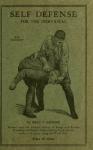
SELF DEFENSE
FOR THE INDIVIDUAL
With
Illustrations
By BILLY C. SANDOW
Revised from the Author's System of Rough and Tumble
Wrestling and Hand-to-Hand Fighting Taught by him
in the U. S. Army during the World War.
Price 50 Cents

Copyright, 1919, Billy G. Sandow
UmTO UTKO. * fT«. «M , M5HUTH, I

BILLY C. SANDOW
Physical Culture Expert ; Instructor U. S. Army
Manager and Trainer of Ed "Strangler" Lewis
Introduction
It has been necessary to revise my book on In-fighting for the U. S. Army, which was
published as a text on the subject at Camp Dix, N. J., in order to have it conform to the
needs of the civilian as a means of self-defense against the thug or thief.
That a practical method of self-defense for civilians serves a need is a well-established
fact. And that the system best adapted to one's need should be other than a knowledge
of the so-called manly art of self-defense, or boxing, is one of the lessons learned from this
great war. The students of war early discovered that boxing served no other purpose
than the double one of teaching the leads and parries of the bayonet and the building up
of a fighting spirit. It was the experience of our Allies, and later of the U. S., that there
was need for some other method of hand-to-hand fighting.
The Infantry School of Arms, Fort Sill, Oklahoma, made a study of trench warfare.
Early in 1918 it published a confidential booklet entitled "Hand to Hand Fighting," under
the authority of The Training Committee, War College Division, General Staff. It is break-
ing no confidence to quote two pertient paragraphs from the introduction. They are as
follows:
"Experience has shown that a disarmed man coming to blows in the trendies with a
disarmed enemy soldier has almost always lost his head and confined himself with striiij-

gling uselessly, because he did no1 know any blows or holds which would have sufficed until
someone came to the ai<l of our or the other of the adversaries.
"Never use your fists, as the list is the least effective of nature's weapons; it is prac-
tically impossible to put an enemy hors de combat with the fist, since the military equip-
ment protects the solar plexus, and the most violent blow on the point of the chin has no
other effect than that of cutting cleanly the skin."
These two paragraphs prove conclusively that self-defense is not boxing; that some
other form of combative skill is necessary. As proof that wrestling has long been con-
sidered a more certain and practical form of self-defense let me quote from an article by
Dr. B. F. Roller, the noted heavyweight wrestler, which appeared in the New York Herald,
Oct. 10, 1915:
"For sometime the adherents of boxing appropriated the word 'manly,' and called
boxing 'the manly art of self-defense.' As a matter of fact lighting is never justified
except in self-defense, and as self-defense anything that is necessary and effective is manly.
In my opinion, however, when self-defense is necessary there are other methods fully as
manly and much more effective than boxing."
This same former American champion wrestler challenged Jess Willard, following his
victory over Johnson, to go to the gymnasium with him, and before a jury of newspaper
men and city officials settle for all time the question of which is the better method of
self-defense — boxing or wrestling. Willard did not accept the challenge.
The author of this book had the good fortune to have his system of In-fighting taught
at Camp Mix, Camp Hancock, and at various other camps and cantonments in the U. S. A.
He was also privileged to study the various systems formerly used. In editing this book
his object has been to publish only such holds and blows as one in civil life would be called
upon to use when attacked by the bully. In short, the system explained in the following
pages is a simple and practical way of rendering helpless an opponent in the least pos-
sible time.
Attention is called to the tact that this system of self-defense is not a text book for
the clean sport of wrestling. It is a short cut to successful self-defense, and his experience
in teaching his more elaborate system for use in warfare permits him to state that the
lessons contained in this book may be learned in a period of two weeks if one devotes an
hour a day to its mastery.
It is the author's hope that those who study this system may never have need to
use it. The student must ever remember that the knowledge gained from a study of these
pages must never lie applied except when he is compelled to defend himself.
A few extracts from letters of various officers of the U. S. Army are printed on
another page. They clearly show the official military opinion of my system of In-fighting
used in the service.
(Signed) BILLY C. SANDOW.
Rochester, X. Y., January 25, 1919.
Hints for Beginners
Study the leverage and you will have no difficulty in beating your man. This system
is the most natural method, the most effective under all circumstances, and requires no
special preparation in the way of clothing.
When you are the under man keep on moving constantly, thus not only preventing
your opponent from securing a hold, but also enabling you in the change of position to
secure a good hold on him.
Go through the motions quickly and with vim, whether on the defensive or offensive.
Be as aggressive as possible, then your opportunities for success will be increased.
This system is an unsurpassed means of self-defense. Get behind your opponent as
quickly as possible as it is the safest position. In all wrestling a position behind is con-
sidered one of great advantage, especially among high class professionals. There are many
methods of getting behind; the best one is given here, namely, the go behind originated
by the author.
Under certain conditions you can convert an adversary's resistance to your own good
ends. For instance, suppose you wished to turn him to the right, force him to the left
and he, thinking that you are in earnest, will resist by exerting his strength toward his
right side. Now your moment for determined, definite action has come. Your foe is strain-
ing in the very direction you desire him to go, so, swift as a Hash of light you change
your tactics and force him to the right. Your power will thus be supplemented by his own,
if you are quick, for he will not have had time to correct his error.
Once a small man masters this system he is no longer despised, he can overcome brute
force and physical strength.
©CI.A51322

No. 1 — THE GO BEHIND
No. 1 — THE GO BEHIND ORIGINATED BY "BILLY" SANDOW
It is possible to break an opponent's leg by a quick ground throw. This is a great weapon of
attack from a standing position, and is the best defense for all front attacks.
The aggressor throws himself forward, feet first, and plants his right or left heel, as the case may
be, from the standing position used, in the opponent's ankle, kicking his feet from under him and
knocking him down with your left or right leg, as the case may be; you grapevine the victim's leg.
By grapevining is meant to lock both legs around opponent's limb, locking your own feet, at the ankle.
Then grasp the toes and ankle and apply the twist or shoot forward and apply the strangle hold.
No. 2 — THE GO BEHIND
When the aggressor is in position 4 he is out of reach of all harm and is safe!
rolls and other holds and at the same time in a position to secure any one of the
or holds.
beyond all :
many different b
Page Three

No. 3 — THE GO BEHIND
Photos No. 1 and 2 show the aggressor in the act of throwing his body forward, the throw is simi-
lar to that of a man sliding for a base.
No. -i - THE GO BEHIND
This position >lu>ws the culmination of the go behind. After throwing your opponent to the
ground, the attacker can now move forward and secure strangle and head butt from the rear, see Plate
No. 27.
Page Four

No. 5 — THE GO BEHIND
Illustrates correct position of go behind. When the aggressor strikes the opponent's ankle he
destroys the opponent's equilibrium, so this clever throw will send your opponent sprawling.
No. 6 — THE GO BEHIND
If the aggressor fails to. knock his man down he dives at the opponent's left foot, the right hand
grasps the heel on the outside, the shoulder strikes solidly against the inside of the opponent's knee,
which is grasped at the same time by the aggressor's left hand. The opponent's knee is quickly flexed
and he is forced to the ground.
Page Five

No. 7 — THE GO BEHIND
The opponent is held with your leg. The aggressor raises the left foot and plants it in the oppo-
nent's knee. This method is effective and will throw the opponent to the ground.
. kick just below the knee cap. As a
A hard blow with the flat of your foot
No. 8— THE GO BEHIND
Hooking the toe of one foot behind your opponent's ankle,
means of defense it is almost invincible if properly performed.
will break your opponent's leg.
If you merely wish to throw your opponent, just pull his ankle forward and push against his knee
until he falls backward.
Page Six

No. 9 — FRONT STRANGLE
Grab the head, bringing it forward and down; drive knee into jaw and apply full strangle hold,
driving thumb into ''Adam's apple.'' After securing strangle hold, drop opponent to ground imme-
diately so as to prohibit him from obtaining any other hold on you.
Note: — A strangle hold always means the placing of one forearm across the front of your oppo-
nent's neck. This should be strengthened by use of the other arm. The aggressor's forearm is pressed
against the neck and the thumb driven into the "Adam's apple." Complete strangulation is only a
matter of time. It takes a strangle hold but a few seconds to render a man absolutely incapable of
effective resistance.
The rear strangle can be secured in two ways. If you are face to face rush at your opponent,
butting him in the jaw or jab two fingers in his eyes; jump to his side and rear, at the same time
bringing the arm forcibly across the throat, and pull him backward, then take a full strangle hold, at
the same time drive right foot to back of opponent's right or left knee throwing him out of position and
force him to the ground and strangle.
Page Seven

No. 11— BACK STRANGLE
Bring the left arm around your opponent's neck, the forearm is brought forcibly against the
throat, now grasp the left wrist with the right hand, and pull your opponent backward.
To make the hold even more powerful, aid your arm by pushing the opponents forward with your
head and shoulders at the same time pulling backward.
Page Eight

. ■'
v-
No. 12— AEM AND LEG HOLD
In obtaining this hold, both movements are secured at the same time. To secure the leg hold,
strike down, forcing arm through crotch, then continue, the arm following through to obtain hold. With
the other hand grasp the opponent's near arm at wrist to secure leverage, your head passing under his
arm pit. The opponent is then in position to be thrown over shoulder by raising body up quickly, using
neck and back as main leverage points. The whole movement must be executed rapidly to be effective.
No. 13 — ARM AND LEG HOLD
When your man is in the position shown in Plate 13 you can throw him forward to the ground
with force enough to stun him or knock him out.
Page Nine

No. 14 — FLYING MARE
Seize opponent's wrist with both hands, step in with back to your opponent, twist arm from you
and draw it over shoulder. With arms as lever, bend forward quickly, giving your hips an upward
twitch and pull forward on the imprisoned arm. The defensive man is plunged headlong over your
shoulder.
No. 15 — BLOCK FOR WAIST LOCK FROM BEHIND
When your foe obtains the waist lock, you luck one or both of his arms between elbow and shoulder.
If only one is secured, raise shoulders and roll to that side, bringing opponent to the ground, then other
disabling holds will follow. It is very necessary that his arms be grasped above elbow or he can work
out of the hold. Be sure your opponent's feet are off the ground before you attempt to throw him, the
defensive man is then thrown sidewards over the hip of the aggressor.
Page Ten

No. 16 — ANOTHER BLOCK FOR WAIST LOCK FROM BEHIND
If your opponent's hold is low, reach back and grasp nearest foot, pull it up, straddle and sit on
he leg, at the same time using your weight. Then fall backward and at same time give foot a sharp
wist and release hold, turn quickly as opponent falls and follow up with throat attack.
No. 17 — ANOTHER BLOCK FOR WAIST LOCK
Reach up and catch hold around his neck, draw his head forward, go down on right knee and pull
opponent with you; quickly shift to a strangle hold. This is a good defense for a short man to use
when attacked from the rear.
Page Eleven

No. 18— ATTACKING LEG FROM REAR
Attack opponent from rear by grasping opponent's left ankle with your right hand, at the same
time strike him with your right shoulder and raise the leg as high as possible, throwing opponent on
his face.
Page Twelve

No. 19 — FOLLOW UP FROM No. 18
When the defensive man is brought to the ground, the attacker steps over with his right leg and
straddles and sits on the near leg of the defensive man above the knee, grasps the foot and raises up
over the attacker's leg. This plunges the head of the defensive man forward on his face. The
imprisoned leg should be drawn up as high as possible to give the longest leverage, in which position
it is possible to break the leg.
No. 20 — TOE HOLD OVER THE LEG
When the foot is forced forward as shown in plate 19 the attacker brings the opposite thigh againsl
the imprisoned leg, at the same time rolling his weight forward on the victim's foot, enabling the
attacker to hold his opponent with his limbs, attacking his throat with both hands.
Page Thirteen

When first coming to a clinch it is quite natural for an opponent to reach in for a body hold. This I
affords an excellent opportunity for you to secure the wing lock. Slip your arm over and above the'
elbow of your opponent's extended ami and jerk him toward you, keeping his arm pinned to your side. I
No. 22 — FOLLOW UP FROM No. 21
Now drive the palm of your right hand to his chin, nt the same time stepping in with your right
foot, pivoting on your left. Now bend forward, forcing your opponent backward hold your leg firmly
on the ground and bend the upper part of his body over your hips. With your back to the opponent
hold his arm tightly and closely to you. the hips are placed well under the weight of opponent. The
mistake is commonly made here in dropping to the knees before the opponent's feet leave the ground.
The proper way to execute this hold is, after turning the back to the opponent throw your hip back-
ward, forcing the opponent from you until his feet leave the ground. Then pull down on his right arm
and at the same time push violently backward against his chin, forcing him to the ground.
Page Fourteen

No. 27 — STRANGLE AND HEAD BUTT FROM THE REAR, ON THE GROUND
After throwing your opponent to the ground with the go behind, force his head back with strangle
old, at the same time butting opponent with your head. By applying full pressure on strangle hold it
impossible for an opponent to break away.
No. 28 — HAMMERLOCK
Seize wrist with both hands, giving wrist sudden twist toward
)end opponent's arm up his back by a sharp blow at the elbow.
;o break at shoulder. At the same time apply back strangle hold.
body. Raise arm and slip under:
Jerk arm up suddenly, causing it
Page Seventeen

No. 29 — BACK HAMMER
Another method of warding off straight blow or knife attack. If opponent leads with his righ
ward off the blow by blocking his arm with your left at his wrist, stepping: to his side cross your righ
a.rm over his elbow and lock your hands at his rear, force the imprisoned arm upward by applying
pressure upward at the wrist and downward on the upper part of the arm. The opponent can be heli
securely with one hand by grasping the shirt with your right hand after forcing his right up the back
This leaves your left arm free to further cripple your opponent.
Page Eighteen

Extracts From Communications of
Various Officers Dealing With
Sandow's System of In-fighting
Taught in the U. S. Army
The Division Commander fully realizes that all organizations are being taxed
under the present schedule, hut considers that a man possessing a knowledge of
"defensive wrestling" so dangerous to an enemy that the time given to this
instruction will be extremely well spent. — Headquarters 87th Division National
Army, Camp Dix, N. J., July 19, 1918. BY COMMAND OF MAJOR GENERAL
STURGIS.
The School of Wrestling and Fighting conducted by Mr. B. C. Sandow in this
division, was a decided success. — Major General Sturgis to Commanding General,
Camp Dix, N. J., July 16, 1918.
It is my belief that this course is much more valuable than boxing as an
asset to a man in a hand to hand combat, in which all rules of sportsmanship are
laid aside. — G. H. Farrell, Major Infantry, U. S. A., Commanding, to Commanding
Officer, 3rd Group MTD MGTC, Camp Hancock, Ga., ixov. 16, 1918.
I believe that this work given by Mr. Sandow is of inestimable value to a
man, both while in the service and after his return to civil life. It imparts to
the men a confidence in their ability to protect themselves on the defensive and
to put their opponent out of business when on the offensive. — John D. Austin,
Major, Infantry, U. S. A., Camp Hancock, Ga., to Commanding Officer, Nov. 25,
1918.
The bearer, Mr. B. C. Sandow, has just completed a course of instruction with
the officers of this Division which has proven of such great value that the Com-
manding General, General Sturgis, has recommended that it be taught in con-
nection with the School for Bayonet Fighting, for officers, at Ft. Sill, Okla. This
course, in his opinion, is much superior to boxing.
Mr. Sandow is an expert at this line and his course of instruction as given
at this camp, has proven extremely valuable. — A. R. Harris, Major, General Staff,
Assistant Chief of Staff, 87th Division, Camp Dix, N. J., to Commanding Officer,
Infantry School of Arms, Ft. Sill, Okla., July 23, 1918.
I think you will agree with me when I say that too much attention has been
given to boxing at the various camps, this to the exclusion of wrestling. I would
suggest that such men as Mr. Sandow and other authorities on wrestling be
utilized to give instruction at the various camps. Perhaps a selected class of
officers or civilians could be trained and then sent around to teach the system. —
J. Drain, Major, The Infantry School of Arms, Fort Sill, Okla., to Major W. B.
Loughborough, U. S. Infantry, General Staff, Washington, D. C, August 13, 1918.
I believe this course is much more valuable than boxing. — General Sturgis,
Camp Dix, N. J.

Do You Want a Good Physique?
Do You Want Perfect Health?
Do You Want to Make Life Worth Living?
OF COURSE YOU DO
SCIENTIFIC
PHYSICAL CULTURE
C, My years of experience as a professional athlete
enable me to speak with authority on Scientific
Physical Culture.
C, My course will build you up and give you a good
muscular development. This course will broaden
your shoulders, deepen your chest, develop your
arms and tone up your liver and every other organ
of your body.
C. Why pay $50 to $100 for a course of Physical
Culture when you can get a full course for $5.00?
Remember that the $5.00 covers the cost
in full for my Complete Course of
PHYSICAL CULTURE
Don't Delay. Write To-day. Send Your Weight
and Measurements
BILLY C. SANDOW
121 Gregory Street, ROCHESTER, NEW YORK
1919
B D - 7 5.

'

K^
<>
'
, • L ' *
■
uKI^
-
EL: (
ST. AUGUSTINE
GSm FLA.
^^^32084

! i :
■ll