/


Текст
.
P 232 . $1.00 *. A BANTAM BOD
.:1J TilE BEST or JUDO, diU JITSU, KARATE,.
SAVATE, YAWARA, AIKIDO, AND ATE-WAZA IN ONE
BASY -TO-LEARN, 21-DAY HOME STUDY COURSE
IIBICE TEDNER'SI
I _
I
I
.
.
...
-
TBE MOST COMPLETE BOOK ON
UNARMED SELF-DEFENSE EVER PUBLISHED!
OVER 400 ACTION PHOTOGRAPHS!
(
i
II
--.-- - -
THI ONLY BOOK WITH THE COMPLETE METHOD!
- - --
OVER 400 PHOTOGRAPHS!
-
Here is a new method of self-defense that is so simple that even a
child can learn it. It is so effective that it can be employee even
against gang attacks. Developed in the famous T egner School of
Self.Defense, it unites the best of Judo, Jiu Jitsu, Karate, Savate,
,\ikido, and Ate-Waza in one amazing, all-purpose method that can
be used in any situation.
J
r
."
1
I
,
.
All THE MOST VULNERABLE ATTACKING POINTS D HAND AND ARM
BLOWS D FOOT BLOWS 0 HOLDS AND LOCKS 0 CHOK S D
THROWS D FALLS 0 BACK-ATTACK DEFENSES 0 FIST FIGHTING
DEFENSES l ] FRONT-CHOKE DEFENSES GANG-ATTACK DEFENSES
o WEAPON DEFENSES AND MANY OTHERS.
,1
'
.
" .-
.
.\'1.
I
., ,
".
.
.
.
\..
t
I
I
- \
,
BRUCE TEGNER'S COMPLETE BOOK OF SELF-DEFENSE. THE BOOK .. .,. \
,
-- .
THAT CAN MAKE YOU DEFEND YOURSELF LIKE AN EXPERT IN THE A.
. '
.
.
ART OF SELF-DEFENSE IN ONL Y TWEi TY-ONE DAYS-! .
,
.
.\
, . .
1 I
,
FEEL BETTER! ,
INCREASE YOUR SELF-CONFIDENCE! " .
. ." .
...
ENJOY LIFE MORE! . . .
!
r
.
. .
... "'
I 1
. .. .
....
-..
..
I
'/
i '
.
..
...
.
THE AUTHOR
Bruce T egner is President of the National Judo and Karate
Association and holds the Black Belt in Judo and Karate. His
methods are used by police academies, the U.S. Army and
Marine Corps, and by Judo schools all over the United States
and Canada.
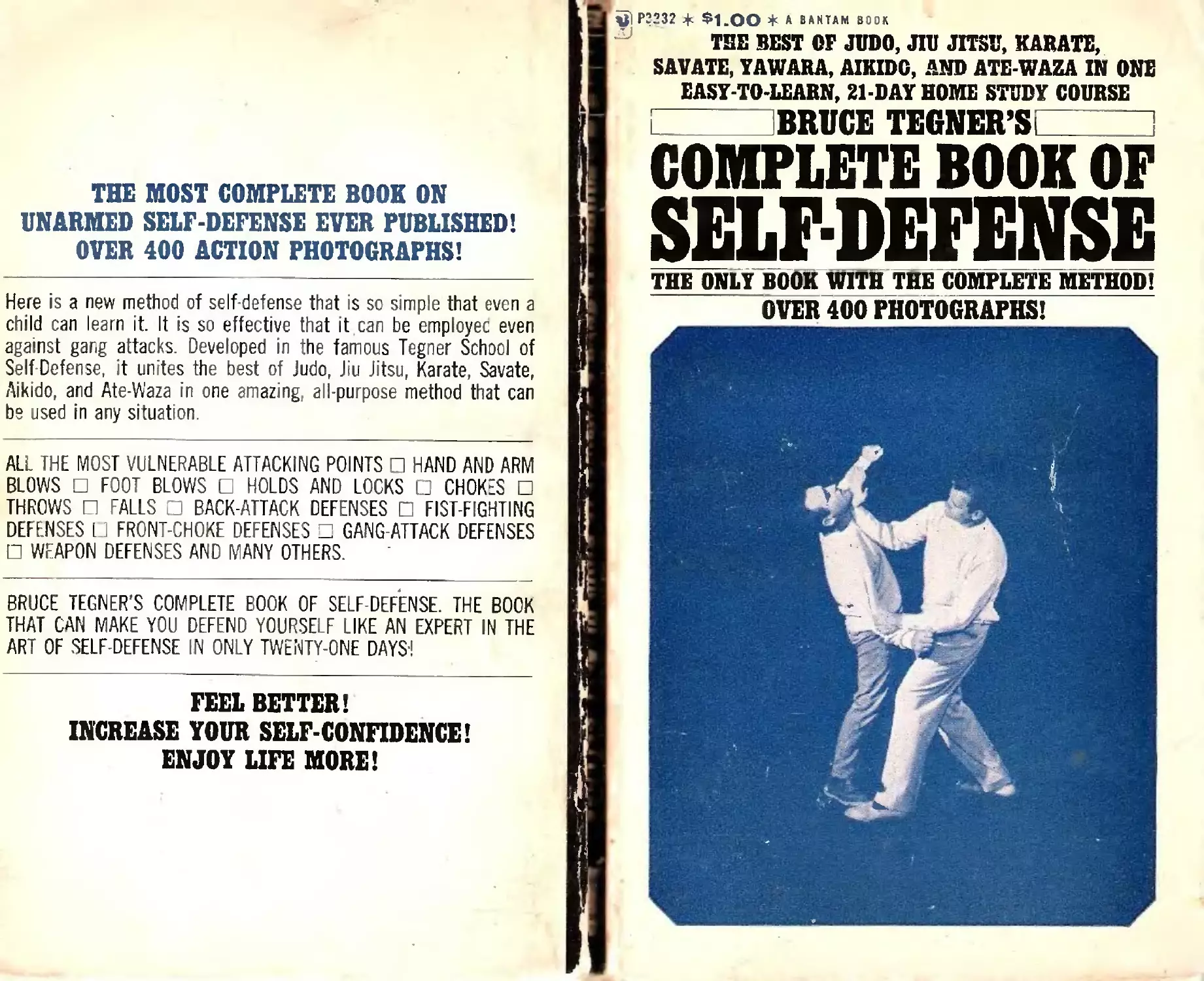
BRUCE TEGNER'S
COMPLETE BOOK OF
SELF-DEFENSE
is the first lesson plan available in book form. It is similar to
those Mr. Tegner has prepared for police and army courses.
It includes over 400 photographs, four progress tests, a chart
showing the pressure points of the body where blows are
most effective, and a complete reference index of blows,
locks and other techniques. It also rncludes special instruc-
tions on how you can teach your childJ your wife or your
friends the arts of self-defense.
.
I
)
,
,
.
.
,
-
Books by Bruce T egner
KARATE:
The Open Hand & Foot Fighting
SAVATE:
French foot & Fist Fighting
BRUCE TEGNER fYlETHOD OF SELF-DEfENSE:
The best of Judo, Jiu-Jitsur Karate Savate, Yawara, Aikido, Ate Waza
STICK FIGHTING FOR SELF-DEFENSE:
Yawara, Aikido: Canc Po lice Club, Quarter .Staff
TEACH YOUR BOY SELF-DEFENSE and SELF-CONFIDENCE
SELF-DEFENSE fOR '/yO J1EN
A Simple Method
KARATEJ VOL. 2;
Traditional forms for Sport
JUDO FOR FUN:
Sport Techniques (}de Easy
AIKIDO SElF.DEFENSE:
Holds and locks for Modern Use
JUDO-KARATE FOR lAW OFFICERS:
Defense and Control
JUDO & KARATE BELT DEGREES:
Requirenlents. Rulesl Regulations
JUDO & KARATE EXERCJSES:
Physical Conditioning for the Un-Arnled Fighting Arts
BRUCI TIOI1ER'S
-
, ,'" "t 8 0
0
... .,..
.,.
.. L
C ;;)
!
o
\ ....
,. 'V(J'"
au
ruce
e
ner
This IOh..-priced Ba/lla", Boo/...
ha"s been conlplet l}' r( S()1 in a tJ.pt" fc'lc
cle5ZK'Jed 'or ell,,)}' ,eul}ing, and \-I"OS l'r"'/ J
jrollz 'Ie ' fJlat - _ it c()nlllin" the co'"plete
text 01 lire ()Tit;itlill hartl-co'ler edirio/l_
'lOT ONI: WORD HAS BEES O\.11rIED"
BRUCE 1"EGNER'S CO 1PLEIE BOOK OF SFI f'-DEFF:SSF
A Bantam Book I pllbli 'hed h,. ClTTlll1gell)ell1 Ji"itii
Stein and DtJ,'. Pub/,"ther"t
Bruce TegncT is regarded as the most experienced in-
strllctor in America in the arts of unarn1eo se1fa.dcfense.
As the son of t\\IO An1crican JtlUo illstructors (botll his
parer1ts \\rerc Black Belt holders) he was brollght IIp tlnder
the tutelage of Oriental anti European 111asters of thc un-
3Tmed arts and actuall}' began l1is format tfHining when he
was t\\-O years old.. His traini(1g c.overed all the different
tj pes of unarnlcd fighting It . . a n10st tlnllSllal background
in an area ",here specialized training Ias thc tradition.
By the time he was fifteen 1\[r. Tcgner \vas already a pro-
fessional- instrllctor and at eventccn he aC}1icvc(1 the rank
of Second Black Belt . . . then the youngest Anlcrican to
receive this honor.
ivlr. Tegncr served in the armed forces of the United
States 3S an instrllctor in charge of training tcachers of
Jlldo and Karate for the regular ArnlY, \lilitary Police.,
ivfarincs, and special RaI1gcr llnits.
After leaving the Arl11Y -fr. 'fegner continllc<f to impr{)'ve
his tcaching mctl10ds vlith the ain1 of perfecting a S}"stcnl
\¥hich \VOl11d be 11ll)St useflll for i\rrlcricaI1s"
Ivfr. Tegner has tallght professionalI} since 1945 \rld
since 1952 has had his o\vn school in Hell} \\.ood '11crc he
has taught thousands of men, women, and children.
In addition to work at his Q\\,'TI school. l\1r. Tcgner has
devised a special c{)urse of instrllction used by la\\7 enf()fCC-
Olent agencies throughout the COllntI)r and has been cnl-
plo}'ed by the United States go,tcrnmcnt to instruct border-
patrol personnel aI1d Trc"lsury agents. o,,'ic al1d TV
studios frequently call upon binl for expert technical
advice.
BI uce Tegner is the autllor of 11 other books in the fiel(1
'-
and he considers this one his most con1pletc and lJ!J-t()-datc
text.
PR(l'TJNO I..ISTOR....
...f)le;n and Da}. eclit;olJ pltb/i.\"hed Wl'.' " /063
Ban/alll editiOrJ pllbli.ihed JU'H.ar,' 1965
ACK O",.l EDG t.1ENTS
The author 1....;sIIe3 to tlullrk Jacques Belle.\"ile.'i turd
Glen Ra,zk.el lOT (l.s. i" tillK /Jill' ill del"(ltl:UTCl( ."g
the l ch,uq"f..s in the photos i,) the lllai'l brlt.lr
ollh.s book. R jchard T (JTlfllt:,er alld l"t!\..is fr';_
.\1Q roM. Jr"!" !;ItOIi' IlJt. 'H'ork ill the clzi/iJren'.rr
seCflOll.. Alice \-fcGrlllll _\"/UJK!. Ih lechni(/lle '
in the s,:'ction JOT H'OIlU'II.
T his "lan". ("r;pl "'.c"IS prepar('i.1 [l1ldeT Lilt!
supcr"ls;on of A Uee J-[('Grillll_
fhi.'; book is dedica.tf;.t.l 10 DAN IEl SrtlECHTFR.
Cop}'r;g 1 (! 1963 by Bruce TegIJer alld Alice . tcGra(Jz.
All T.ghIS. reserved. ]\,fa part of rJJi ' b(Jok 11l1.n' bt;l
repT(Jt.lrl 'ed lIZ_ llll,\' fC}TIII or h)" lllJr IIlt;'(-/""J;.t:tJI ;lleClIl_\1'
"'Cllldl1lg 11lllllcogTl1p/z and lope rel-oTller ',';IJruut
a.. . ·
IJ rJ111.rr$lC!n In \1'rllll1g fr(HII Ille pllhli" Jrer II ('xcepl
b:, '! 'e'.l "" r ...-110 I1ltl)" (/UClltr brief PIIJ"Jtlf:(>.'f. ill il
re1.'lel 1 10 b prillted il a lnagul.il1e or lJeH"..lipflper.
For in/vr/}UllifJ11 lld(/ress:
St ;11 clIte! DII.1.. Pllb/ij"/Zt.r" . 7 Ecu.t
, . 48lh Ireel. Ne'.' ¥(Jrk 17, N. Y.
J rlb/'sh d slIPlllIIlJneOlisl..... ill tile L""ilc..l SJ ill 1/_\'
lllJd ClInt/till.
Banlalt' Books tJre pliblL\.lted b}J Bc ntalJr Book5. llle.-.. tl slIhsidlilrr
l Gro.fset &- "D. llllaPI lrJ " ll tTo.cle-lPlGrk, cO', "" .,l"K 01 tile l.i-"(}rd 'i
atrta"! n('}ol<. and the portro}"{J/ of a ba1ltClnl. i:. Ti!gi""t r d i/: Ihl'
t puted Lf)tales Patent (JOice ond ill lJt/zt'r ("oU1Jlrl .s. IPvfaTca RegislratlCl
Bantu"l Books. 11"... 271 .Wadlsoll A "e"'le Nt"#'H-' Yl"k J6. N ». York:
PRINTJ:D IN THE UNITED STATES OF A tERICA
5
.
n ro uc Ion
For m3n)' YC,tfS the arts of selt-defense \vcrc kept tllC
secret of a sn1a1) gr()up of teachers and stlldcnts \vho did
not wish the general pubJic to learn then}. In order to
ccon1plish this they <Ic,,'cloped a m}'sterilllls, difficlllt, and,
In many cases, boring teaching prOCCdlJre in \\lhich the
st.lldent spent arduous m{)nths learning the sinlp)est tech-
nIqlJCS arld \\:'as forced to JJractice then1 numberless tinlCS
before n1o'ving on to nc\v ones.
I \vas brollght UI) llildcr this Oriental n1cthod of teaching
al1d have come to realize how unsatisfactory it is for tne
American Stlldcllt of seJf-dcfcnse.
The old sty]c of training, still foI1o\\/ed b),r many in-
tructors, .den1ands an Oriental-\ 'a}'-of-life approach \vhich
IS root d In fe ldaI Asia and is totally inappropriate today.
Incredible as 11 may scem sorne tra{litional schools still
teach a technique nlcant for the sole purpose of crashin
through Samurai arn10r. .
T se ritual oriented teachers prefer to perpetuate the
tradItIonal. haTsl1 111ethods of i11struction instc3{) of tf}'ing
to modcr111ze and popularize the unarn1CC) arts. Thus the,r
prevent any but the most exceptional student from succeed-
Ing in his training.
Howe\'cr, in many" W3}"S it is more in1portant to enCOUT-
ge th . least, at.hcr tha } he r;nost, skillful to rarticipate
1? phj"stcal dctlvlty. SO It. IS \7,;tth the unarn1e(J arts. The
tImId, fearful child needs scJf-defense instruction J11Uch
Jnor thdn.. the hardy, vigorous child, and the enrichl11ent
of life 'hlch acconlpanies the learning and accon1plish-
ment that can be found through this book is n10st llsefuI to
those who lack confidence and self-esteem. Such people are
the least likely to survive the "proving" period of the
traditional method of training.
A second great dcfcct of tllC old st)1le of teaching is that
it is ased on a specific defense for cacl1 sJlccific attack,
and since there are literall}' thousands of \vaj'S of making
attacks, thollsands of tliffcrent defenses had to be learned.
The period rcqllircd to learn the Inan\' defense ..tricksJ'
.I'
nladc it impossible to ]carn anything at all practical in less
t11an several }"ec.lfs of stlldy. What I havre d()oc in nl}' school
and ha\l'e no\v put 00"'0 in this book is to develop a n1cthod
hic is useful in t)'pe f of situati()ns, rather than in specific
sItuations. fJ1US, a sillall nllll1l1er of tccl1niqucs taught in a
hort tin1e \\,tilI. achieve the sanle result as }'Cc1fS of trailling
In tIle old-fashioned ,va}'. Because of this a stlldent who has
trained for a nlonth \vith n1Y n1ethod ma ' be nluch better
prepared than a stlldent of the traditional style \vho has
trained for a year. Other modifications and m dcrnizations
which I ha\re introduced t.o nlakc the ancient arts serve us
better for our present-day needs are explained throllghollt
the text..
This book has been nInny. j1ears in preparation. The
techniques whicll are described are the result of }'cars of
tcsti?g and selection and arc the san1C that you v,'ould
receive 2S a student in nl)r school.
In teaching thousands of men, \\'OOlcn, alld childreI1,
I have seen them grow in many other \\'avs beside.;; in their
abilit}' t.o defend thcI11Sel\res. I hope th t this course \\,-ill
give )tQU, as it has given t}lem, a new sense of achicvcn1cnt
and confidence, of po\\rer and dignit}'.
BRLTCE Tr.GNER
7
6
ABOUT BRUCE TEGNER . .. . . .. .. . . . .
.
INTRODUCTION I . . . .. .. .. .. .. .. . ..
.
PRELIMINARY INSTRUCTION
By the Numbers I .. .. .. .. .. .. .. .. .. ..
I ..
Basic Stances
-
I .. .. .. .. .. . .. .. .. .. I ..
.
I Fighting Stances
.. . . .. . .. .. . .
I
Natural and Unnatural Grip
I .. . .. .. .. . ..
Length of Practice Sessions ..
.. .. .. .. .. I . ..
'"
Safety .. . .. . .. . .. .. . ..
.. .. .. . .. I
Throwing Practice - - . - - - .. .. . ..
.. .
1-1 dnd COlllJilioning .. .. .. .. .. .. .. .. . ..
..
L oordination and Accuracv Exercise .. .. I . ..
r
Hitting \vith Po\ver .. .. .. .. .. .. .. . . ..
..
Trouble Spots and Selection of rrechniques I .. ..
Don't Forgct .. .. . . . . . .. ..
.. .. ..
Use.5 of Yelling and Other Sounds .. .. " .. ..
S
6
Fist- 'ighting Defense Blocking .A..ttack and
Striking Back .. .. .. .. .. .. .. .. . . .. ..
Second Fall Basic Side Fall.. .. .. .. . .. .. .
IJip Throw Executing the Thro\\' and Learning to
Recei ve .. .. . .. .. .. .. .. .. .. .. . . .
Dun't Furg t.. . . .. .. .. .. .. .. .. .. .. . ..
THE fHJRD DAY
REVIEW INSTRUCTION: .
Straight-Arm Bar
Pushing Defense
\Vllere and Ho\v to Strike Lessons for First and
Second Days
Fist-Fighting Defense Blocking the Attack and
Strikinc: Back
IIL,-
Falls l':o. 1 and 2
Hip Throw Throwing dod Receiving
45
46
on en s
47
48
19
20
22
23
24
24
25
25
26
28
29
30
30
..
.
.
.
49
T II ESE C () N D D A ),
REVIEW INSTRUCTION: .
..
..
.
.
.
..
. ..
..
..
41
NEW INSTRUCTION:
Back-Choke Defense Finger Grip .. . . . .. .. 50
Where and H()w to Strike:
The Neck Nerve-Center Blow Extcndell Knuckle 51
The Windpipe or Adaln's Apple BJo\v Y of the
Hand. .. . .. .. .. . . . .. . .. .. .. 51
The Throat-Hollow Blo\\' Fingertips.. .. .. .. . 52
Fist-Fighting Defense Block and Thro\v .... 52
Third Fall Basic Side Roll ............ 54
Swinging-Leg Throw Basic Steps (Position Only) 55
Don 't Forget. .... "". 5 6
THE FOURTH DAY
REVIEW INSTRUCTION: .. . .. . . .. . . . .. . 57
Falls No.1, 2, 3
Straight-Arm Bar
Pushing Defense
Back-Choke Defense Finger Grip
\Vhere and I-Iow to Strike Lessons for First through
Third Day
Fi t-Fighting Defense Block and .fhrow
Hip Throw Thro\\I'ing and Receiving
S\vinging-Leg Throv..' (Position On1y)
NEW INSTRUCTION:
THE FIRST DAY
INSTRUCTION:
Straigtlt-...-\rn1 Bar . .. . .. I .. .. . .
Where and Ho\v to Strike: . ..
The Tenlple Blow Side of the Hand.. . . ..
The Bridue-of-thc-Nosc Blo\v Side of the Hand ..
-rhc Base.of-the.Nose Blo\v Side of the Hand ..
Fist-Fighting Defense Blocking the Attack ..
f.irst Fall Basic Back Fall. . ,. .
Hip Thro\v Basic Steps (Balance Only)
Do n I Forge t .. . . _" ....
.
32
33
33
34
34
35
37
38
40
..
..
-
.
..
.
..
..
..
Straight-,,:-\rm Bar
Where and Hov.' to Strike
Fist-Fighting Defense Blocking tIle Attack
First Fall
Hip Throw B,llance Only
NEW INSTRUCTION:
Pushing Defense . .. . . .. . .. . .. .. . .
Where and How to Strike;
TIle Ear Nerve-Center Blow Side l)f the Hand ..
rhe Ja\\" Nerve-Center Blo\\' .inger l ips, .. .
The Sidc-of-thc-"lcck Nerve-Center Blo\\' Side of
(he Hand .. .. .. .. .. ..
42
43
43
Wrist-Grab Defense One-Hand Grip .. .. .. _ .
\Vhere and How to Strike:
The Base-of-the-Neck BJow Side of the Hand" ..
The Inside-Joint-of-the-Elbo\'\' Blo\v Side of the
Ha n d.. I .. .... ...........
58
59
44
60
.
8
9
rrhe Forearn1-Nervc Blo\v Side of the Hand .. ..
Fist-Fighting Dcfense Double Kick, Block.
RctaJiation, and Throw. . .. .. .. . .. .. ..
Swinging-Leg Throw Completion of Thro",; and
Receiving .. .. . . .. .. ........
Don't Forget .... . ... ..
REVIEW
THE
INSTRUCTION:
.
FIFTH DAY
. . . . . .
..
..
.. ..
Fal]s No. I. 2. 3
Strai ht-Arnl Bar
Pushing Defense
Back-Choke I)efcnse Finger Grip
\Vrist-Grah Defense One-Hand Grip
Where and Ho\\' to Strike I..essons for first through
Fourth Days
Fist-Fighting Defense Fourth Day Vlork
Swinging-Leg Throw Thro\ving and Rcceiving
NEW INSTRUCTION:
Wrist Hold No. J.. .. .. .. .. .. .. .. .. .. .. ..
\\lrist-Grah Defense One-I-lan<.1 Grip .t\cross Body.
"".here and HO\\l' to Strike:
The Wrist Blow Forearm .. .. .. .. .. . .. .
The Back-()(-the-Hand BJow Extended Knuckle.
The Sidc-of-thc-Body Blow Side of the Fisl .. .
fourth Fall S[anlling Fall Back.. .. .. ..
Hent-Arn1 Hip "Throw Basic Steps (Balance ()nly) ..
Don't Forgct.. .... ". ..
First Progress Test
QlIe tlons Relating to Lessons fc.)r the First throu£3
the Fifth Days .. .......... .
,- H E S I X rHO A Y
REVIEW INSTRUCTION:
.
..
..
.
..
.
. .
.
Fal1s No. 1 through 4
Back-Choke Defense Finger Grip
Wrist Hold No. 1
Wrist-Grab Defense:
One-Hand Grip
Onc-Hand Grip Across Bod}'
Where and How to Strike Lessons for Second
through Fifth Da}'s
Fist-Fighting Defense Fourth-Day \ /ork
Bent-l\rnl Hip l.hro\v (Balance Only)
NEV'I INSTRUCTION:
Wrist Hold No.2.
.
.
.
.
.
.. .. . .
. ..
10
60
Wrist-Grab Defense Two Hands Gripping Both
Wrists . . . .. .. .. .. . . .. .. . .. ..
Where and Ho\v to Strik.e:
The Solar Plexus Rlo\\ Fist. ...
The Jawor F2ce Blow Elbo\\' Back and Elbow
Ve r t i ca I .. . .. .. . . . .. .. .. . .. ..
The Abdomen Blov.r .Extended Knuckle .. _ .
Fist-Fighting Defense Double Kick, Block)
Retaliation. and S\s.:inging-Leg rfhro\v.. .. & .
Be.nt-Arnl Hip Thro\v-Completion of Throw and
R ece i vi n g . . . . . .. . . .. . .. .. ..
Don't Forget. . . .. . .. .. . .. .. .. . . .
61
...
63
64
.
65
TI-IE SE\'ENTH DAY
REVIEW INSTRUCTION: . . . .. . . ..
.
..
.
.
66
67
Falls No. I through 4
Wrist Holds o.. 1 and 2
Wrjst-Grab Defense:
Onc-Iland Grip
One-Hand Grip .t\cross Body
T\\,o Hands Gripping Both Wrists
\Vhcre and 1lo\v to Strike I es-;ons for Third
through Sixth Da}rs
Fist-Fighting Defellse:
Hip-Throw Ending
S\vinging-Leg-Throw Ending
Bent-.."'-rm l-lip Thro'\v Throwing and Receiving
68
69
69
70
71
72
NEW INSTRUCTION:
73
Reverse Arm lock .. . .. .. .. . .. .. . . .
Wrist-Grah Defense Two Han(fs Gripping One
Wrist ....................
Where and Ho\v to Strike:
The Base-of-the-Skull Blo",' Hce1 of the Palin .
The 7th-Vertebra Blow Side of the Hand .. . ..
The Backbone Blo\v Side of the Fist. . . . .
Fifth Fall Forward Roll and Staying Do\vn.. .. .
Neck-Lock Hip Thro\v Basic Steps (Balance Only)
Don't Forget.. .. .. I . .. .. .. . . . . .. .
75
THE EIGHTH
REVIEW INSTRUCTION:.. ....
DAY
.. . .
.
..
.. .
76
Falls No. 1 through 5
Wrist Holds No.1 and 2
Reverse Arm Lock
Wrist-Grab Defense:
One-Hand Grip
77
78
79
79
80
82
82
83
84
85
86
86
86
87
88
89
90
11
j
I
One-Hand GrIp Across Body
Two Hands Gripping Both Wrists
Two Hands Gripping One Wrist
Where dnd How to Strike Lesson for Fourth
through Seventh Days
Fist-Fighting Defense:
Hip-Throw Ending
Swinging-Leg-Throw Ending
Bent-Arm Hip Thro\v Throwing and Receiving
Neck-Lock Hip Throw (Balance Only)
NEW INSTRUCT-ION:
Grab Defense Thumh Release .. . . . . - .
Where and How to Strike:
The Kidney Blo\v Extenlled Knllckle .. .. . ..
The Back-of-the-Upper-Leg Blow Inside Edge of
the Foot.. .. - .. .. . - .. - . ..
The Back-of-the-Knee Blow Outside Edge of the
Foot . .. . . .. . .. . - · . . I ..
Fist-Fighting Defense Long-Ranf!c Fist Attack - ..
Neck-Lock l-lip Thro\v Executing the Throw and
R ece i \' in g . .. . .. . .. .. . · .. .. .. .
Don 9t Forget. . . . .. .. .. .. .. .. .. .. ..
I
.
I
t
J
I
I
I
I
I
i
I
I
NINTH DAY
REV I EW
THE
INSTRUCTION: ..
.
..
.
.. .
. .
.
..
.
Falls No. 1 through 5
Grab Defense Thumb Re.lease
Wrist I-Iolds No. 1 and 2
\Vherc and HO'11 to Strike Lessons (or Fifth through
Eighth Da ls
Fist-Fighting Defense
Bent-Arm Hip Thro\\
Neck-Lock Hip Thro\v
Lon -Range Fist Attack
Throwing and Rcceiving
"rhro\ving and Receiving
NEW INSTRUCTION:
Grab Defense Thunlb Release and Arn1 Lock "
WJ1ere and HO\\' to Strike:
The Calf Blo,." Toe Kick . .. - · · .. · .
The Tendon Blo\\' Hcel Kick.. .. . .. · · ..
The InsitIe-of-the-Upper-Thigh Blo\,\' Hooking
Kick I .. .. .. . . . .. . " · · · ..
Front Choke Defense No.1.. .. .. · · .. · ..
Captured-Arm Hip Throvl Basic Steps (Balance
Onlv) . .. " .. .. .. · · .. .. .. . .
Stick or 'Club Defense O\'cr ead Attack. ..
Don"t Forget. . . .. . .. .. . - . . .. .. I
THE "r E 'J T H DAY
12
REVIEW JNSTRUCTION: ..
.
..
106
. .. -
.. - ..
..
91
92
Falls No. 1 throul2h 5
IIW'
Grab Defense Thtlmb Release and Arnl Lock
.ront-Choke Defense No. 1
Where and How to Strike Lessons for Sixth through
Ninth Days ,
Stick or Club Defense Overhead Atta.ck
Fist-Fighting Defense- I Ql1g..Range Fist Attack
Bent-Arm Hip Thro\\I Thro\ving and Receiving
Neck-Lock Hip Thro\v Thro\ving and Receiving
Captured-Arm I{ip Thro""r (B3lance On1y)
NEW INSTRUCTION:
93
Finger Pressure and Arm Lock. .. .. .. .. 107
Where and How to Strike:
1 he Inside-of-thc-Lo\ver-Thigh BIo\v Bottom of
the Foot.. . · . . .. . . . . . . 109
The Kneecap Blow Heel Kick . .. . .. . . 109
The Side-of-the-Knee Blow 15Q Angle Kick. . 110
Front-Choke Defense No.2. . . . . . . . . 110
Sixth Basic Fall -Forward Roll to Standing Position 112
Captured-Arm Hip TJ1fo\v-Completing the ThroVv'
and Receiving.. · · .. .. . . . . .. .. . 113
Don't Forget. .. . . . . . . .. .. .. 113
Second Progress Test
Questions Relating to Lessons for the Sixth through
the Tenth Davs .. . .. . . . .. . . . . 114
93
94
96
96
97
98
THE ELEVE1\JTH
REVIEW INSTRUCTION: . . .. . ..
Fa11s No. 1 through 6
lteverse Arm Lock
Finger Pressure and Arm Lock
Grab Defense TI}umb Release and Arm Lock
Front-Choke Defenses No. 1 and 2
Where and HO\I/ to Strike Lessons for Seventh
through Tcnth Days
Stick or Club Defense Overhead i\ttack
Neck-Lock Hip Throw Throwing and Receiving
Captured-Arm Hip Thro\\1 Thro\\.ing and Receiving
. 116
DAY
.. .. .
..
.
99
100
100
101
NE\,V INSTRUCTION:
Front-Choke Defense No.3. . .. .. .. . . . .. 117
\Vhere and How to Strike:
The Silinbone Blo\v Edge of the Shoe Kick .. .. 118
The Instep Blow Stamping Kick.. .. . .. .. . 119
103
104
105
13
The Anklebone 810". Edge of the Shoe Kick. .
rist-Fighting Defense-Close-In .l\ttack Block. and
Sin1ulraneol1s Blo\vs \vith Takc-do\vn . . . .
Straight-Leg Thro\\' Basic Steps (Po jtion Only)
Don't Forget. .. . . . . . . . It . . ..
'I' H E l' W F 1., F T H DAY
REVIEW INSTRUCTION: It
.
. .
.
.
..
.. ..
.. ..
.
Falls No 1 through 6
Front-Choke Defenses 1'0. 12 2, 3
\Vl1ere al1d Ho\v to Strike Lesson:s for Eighth
through Eleventh Days
Stick or Club Defense Overhead Attack
Neck-Lock Hip ThTO\V l"hrowing and Rcceiving
Captu(ed-Arnl Hip "rhro v -[hrowing and Receiving
Straight-Leg Throw (Position Only)
NEW INSTRUCTION:
Front-Choke Defense No.4. . . .. . . . .. ·
Stick or Club Defense Side Blow . .. · · .. ·
Seventh Fall -.Side Roll and Con1e Up. . It · I
Straight-Leg Throw Completion of Throw and
Receiving .. It .. "".......
Oon't F orgel _.. ..... .. .. .. . . . · .. ..
I
I
I
I
I
i
,
I
THE THIRTEENTH DAY
REVIEW INSTRUCTION: .. . .. . .. .
" "
Fans No.1, 2 3, 6, 7
Front-Choke Defenses No. J through 4
Straight-Arm Bar
.....
Pushing Defense
Back-Choke Defense Finger Grip
Stick or Club Defen e Side Blo\v
Captured-Arnl Hip Throv{ .rhrowing and Receiving
Straigllt-Leg Thro",' l"hro\ving an(1 Receiving
NEW INSTRUCTION:
Arnl-Pin Defense Back Attack - .... ...
Knife Defense Stabbing Attack . " · .. · . "
Fist-Fighting Defense Parry and FOf\Vclrd rfrip. .
Sitting-Down Throw Basic Steps (Position Only) "
Don't. Forget.. ..... . .. "
REV I EW
THE FOUR fEENTH
INSTRUCTION: .. . . " ..
.
" ..
. . .
DAY
14
119
F a lis 1\ 0 It I, 2. 3. (1.. 7
Front-Choke Defenses No.3 and 4
Arl11-Pin Defense Back Attack
Fist-I--" ighti ng Defen e Cl() c-I n Attack
Block and Sinlultaneous Blo\vs \\,.ith Take..dO\J/n
Parry and Forwar(ll"'rip
Knife Defense St,lobing Attack
Strnight-Leg Thro\v Throwing and Receiving
Sitting-DowIl Throw (Position Only)
NE\"J INSTRUCTION:
120
122
124
125
Back-Grah Dcfen.,c Under Arms . .. . .. 143
Knife Defense Slashing Atrack .. .. 144
Eighth Fall Standing and FaJI on Side & - . . . 145
c;ittiI1g-Do\vn ThroV\- C"onlJ}letion of rrhruw and
Receiving - . . . . . .. . " .. 146
.
Don't For.get _ . I . . . . I I 147
126
128
130
.r H E F I F -r FEN -r H DAY
REVIEW INSTRUCTION: .
.
148
.
.
.
.
..
.
.
..
..
132
133
Falls No.1, 2,3,7,8
Arm-Pin Defense Back ..'\ttack
Back-Grab Defense Under ,, rnlS
Reverse Arnl Lock
Finger Pressure and Arm Lock
Fist-Fighting Defense Parry and FOfYt'drd Trip
Knife Defense Stabhing and Slashing Attacks
Straight-I_eg Thro\v Thro\ving and Receiving
Sitting-Do\\'n Thro\\' rhro\ving and Receiving
EW INSTRUCTION:
Close-In Fist-Fighting Defense Block, L.eap. Kick.
and Choke.. . . . .. It . . .. . . .
Over...Arnl Lock . . .
.. . ,. . . . . . -
Circle Thro\'l Basic Steps (Position Only). . .
Don't Forget. . . .. . . . . a _ _ . .
Th i rd Progress Test
Questions Relating to Lessons for the Eleventh
thr01Jgh the Fifteenth Da}.s . . It . . ..
.
156
134
..
149
152
154
155
..
.
135
136
138
140
141
142
THE SIXTEEN I"H
:VIEW INSTRUCTION: . . . .. .
Falls No. 1,2,3,7,8
Over- -\rm Lock
-\rnl-Pin Defense Back Attack
..
DAY
158
. . .
.. .
15
I- ree Cse of AJI 1ethod" "
r)on't Forget
rr H E rf \\' E N T Y - t I l{ S 1" D l\ )'
.
. . . .
194
194
. .
re Imlnar
.
ns rue Ion
REVIEW INSTRUCTION:
.
195
In heginning }'OlJr practice sessions, YOll aJld YOllr partner
should not resist each other, or try' to avoid tile dcfcI1SC
techniques. At first )'011 \vill be learning the f()rl11 of the
techniques, and it docs not heIp either your learning process
or YOllr partl1er's to ()fTcr resistance, or to attcnlpt to out\vit
him.
Bcginl1ers ml1st think of thClllsclvcs as heginners. A
dri'ling instructor dlJCS not take you for }'OlJf first lesson
onto a bllSY frec\vay, but starts the learning process on a
deserted street. I\S YOlJr skill increases. he \'liII allow you
to dri\;-e int.o moderate traffic and then into hea\7)f traffic lS
VOll learn to handlc tIle situation. The sanlC is true of this
01
training. It. \vould he foolish for YOll to expect to learn an)'
tcchniqlJC so " e11 during the first fevv (lays tllat you could
CXCcl1te it prl)perJ}r aI1d s\viftly against l.ctllal attack. Y Oll
shoultl start \Vit]10Ut allY resistance fronl },rOllr partner. As
} Oll make progress, }four partner fl1a)' offer S0111€ l)PPO-
sition i\S }'OU nlake fllnher progress.. he Sh0111d offer nlore
resistance until YOll are able to execute [1 technique without
his cooperation.
E,,'entual1y )'OU \\7iJl achic':oc the skill, quick reaction,
speed of execution, and control of pO\}rrer \\"hich nlakes the
defense effecti\'e on the street.
Falls No- 1 through 10
Back-Choke Defense :\rm Grip
(run Defense I':ront and Back }\ttacks
Gang-i\t(ack Defcn c F-"ront Onlyr and Front and
BciCk
Fi t-Fig]1ting Defense:) ,"'lit') the Attack and. Try
Various Defenses
J lido Sparril1£ Usin All rhro\.\'s l."ct3rned
Karate Sparring -Using All :\.fcthods fronl .L\\lhere
and Ho\ f() StrikeH Section
NEW INSTRUCTION:
Fist-Fighting Defense: C.losc In ..l\ttack Kick Lock
and Spin . . . . . . . . . . . . ,
Gang-Attack Defense i\rrn Pin. Front and Back
Don't Forget . ,.. ... .....
INTRODUCTION TO TEACHING V/OMEN
AND CH I LDREN _ .."...
HOW TO TEACH SELF-DEFENSE TO A CHILD .
HOW TO TEACH SELF-DEFENSE TO A WOMAN.
196
198
200
"
201
202
210
.
I .
Fourth Progress Test
Questions Relating to Lcs ons for the Sixteenth
t11rOugh the Twentv-First Davs and to the
Lesso s on Tcachi g Self-DefeJ1 e to a Child
and to a W 0 nl an. . . .. .. . . .. .. 217
BY THE NUMBERS
NERVE CENTER CHART (Where to Strike) .
INDEX OF TECHNIQUES. or . . . . . .
ANSWERS TO PROGRESS TESTS . . or
. ..
. 220
222
You \\'ill learn best if Y"OU follow the training plan exactly
as it is l>fcSeJ1ted. First, do the techniqucs in s10\V motion
and by the nllmbers. StlJd}F the photogr lphs and compare
then1 with /hat rOll are doing. Correct an}' n1istakcs ).rou
111ake hefore going on. '''ork -along fron-i pll0tO to photo,
carefully and slowly.
\Vhen you thorougl11y understand the "pieces'" of each
defense, you may bcgi.n to perfornl tllCIll still sIo\\1"]:Y alld
v.:ithollt hesitation as a single continuous n1otion. Y Ollf aim
ShOllld be a smoot!l and accurate techrlique
\Vhen lOU can pcr[ornl a technique properly and
snloothly, you \vill be ready' to increase }TOllr speed as "veIl.
Do not rush through the first part of learning an)" tech-
niqlJC, or you will Ofl1it tl1C solid foundation of kno\v]e(Ige
\vbich is essential to deve10p your skill filII).....
. .
_ . 224
18
19
BASIC STANCES
.
'<
.
.
\
,
I
..,.....
.
-
..;
111)
- -
_4
- --
,- ,. .
. .
.
1
.
.
.o.
The natural stance is a relaxed standing
position. Your feet are shoulder..width apart
and your weight is distributed e:iua lIy on
both feet. In the natural stanc@ ycu \vill
have strong balance from side to side..
That is, if you Y/ere pushed from the side
you V/OU Id have stron rcsistanc to the
push. H()weverr in this stance you \'{ill have
poor balance to resist a push from either
the front or th back.
20
.
.
t
,
&
.
J'
"
- -- -- -
-
""
-
-
""T
a
.....
--)'
The .IITJI position gives you the
strongest balance positi(Jn that you
ca as:sume. In the "T" position
you are stronger from side to side
an,j from front to back than in any
o!her stance. If you are right-
l1anjecL your I.T'I stance Is with
your right frat pointing strai ht
fen-lard and your left foot pOinting
tc the side Your knees should be
bent s lightly, and your v/eight
di5tributed equally on both feet.
Among its advantages. the ur"
osition places the side of your
Jdy tC1.vard your opponent and
thereby offers him less target area.
:t also places you in position for
jeU"ering effective foot blo\Y5. If
Y L1 are (eft-handed. your uTrJ
position Vt"ilf be "..\lith your left feot
:JDinti ng for.'iard
,
.
,
.
.
.
.
,
,. ,
I
. ,
I
.
."
,
....
-
--
-. "' I
-..
f
4
,
,
,
- t ...
-
-
......-
J
One point ba lance
When all your weight is on one foot
you are in the v/cakest possible
position. As )IOU progress in the
cou rse. you ",'i II lea rn to avoid
placing yourself in this vulnerable
position and to take advantage of
this weakness I;\lhen your opponent
has done so.
21
FIGHTING STANCES
The fighting stances arc strong, balanced, protectivc
rcad { positions. Tn a figl1ting stancc, :YOtl are obviously
prepared for action. If, bccallse of it, your ad'versary is
persuaded to back do .n, so nllJcl1 the better. If he rcqt1ires
the persuJ.sion of p11ysical actio!}, )'OU can l11o' 'e quickly
fron1 jt.
-.
.
. .
-
...
"
.
,
-(
..
...
I
.
,
I
- - I I
I
,
.-
.
.
.
"
,
.
.
.
,
..
-
.
,
A
. A
.....
.
.
,
.d. I --.....
liT" position; your left hand is
ready to slash or bloc _ Your right
hand is ready to delhrer a kntJckle
b IOVI.
Typical Karate fighting stance: uT"
position. YDur left h 1d IS In a lo r
blocking position, YOl.Jr right tJand
is in position to deli"er an edge.of-
the.hand blow. Th is is a useful
stance when confronted by a
crouching adversary.
22
'.". \
-".. ,
.. ..
\Vhcn practicing tllC tcchniques in this c()ursc that in-
,. JIve l)locking and striking start \vith the defending partner
:1 a figt1ting stance.
NATURAL AND
.
UNNATURAL GRIP
.
.
..
I
.
11.
¥
..
,.
t
}
,
or
.
.
..
When you are instructed to
gnp vllth a natural grip,
reach fory/arc as though to
shake hands. as sho\'oJn in
the photo above. V\'l'Ielher
you are gripping cloth or a
hand, the position is the
same.
When you are instructed
to grip y.1itl1 an unnatural
grip. reach forward. as
shown by the partner at
the right. In this position
your hand Is tlJrned ever so
that the thumb points dO\\lr.
and the palm is facing out.
t',
'+ -"
....
,
-
. L
.
.
1
..
, --
"w
-
.
-
'.
. .
t.
...
.
-....
.....
. -
(
--
....&...--
T · positi(Jn: Hands in conventional
:: .'-'lg on-guard. The I'TI. position
i .es vuu strong balance, and the
. .
-:.., J:OSltlon does not reveal the
- :":1er In \...h ich you intend to
s." ke.
23
... --
,
--..
... .....
.
LENGTH OF PRACTICE SESSIONS
of subn1ission, and release instantly at the first tdp.
I
Ob\riousI:y the rnore till1C YOll can give to eacl1 practice
session and the greater tIle. freql]enc y of :he sessions, t.he:
quicker j'OU will l11astcr t}1C tec11niqllcs. As a general rl]Lc
YOlI sholiid plan to spend one }10ur covTering the techniqlle
in each d3Y' S Jesson. .A.ftcr tI1C thiTcI lesson you can practice
b)' }rourself bet\vccn the sessions of \vork \\lith j'our partner
You \llill 111ake good progress \vhcther the sessions witr
lour partner arc t\\/o da' ls or a \\ cek apart. It is hest not te
tl)7 to rush through the lessons_ Patient and stc<tlly \vork
\vill aCCOJ11 )lisI1 I1l0re than rapid half-learning.
THROWING PRACTICE
I
SAFETY
Tapping }four partner, the ground or }'OllrSelf is thl
signal for subn1ission. The first and nl(Jst important safet
rule is to release YOllf partner as soon 3S he signals_ "rhe
tcchniqtlcS which YO\J are learning in this c.ourse ha\lC heer.
effective for 01311): thOllS30ds of )'C3TS and you are no.
tf}='ing to prove tl1at tl1c)l \\'ork. It does flot clp }'OU or your
partrler if 'Oll inflict pain dllring the practice sessions.
Tapping is preferable to a verh&ll signL\l because it is 1110re
definite and because, sonletimes, as in chokes. it is easier
to tap than to t31k.
Chokes must be practiced lightl}i. E.xperiment 011 }rour-
self and YOll will see ho\\,' little pressure i neede() tf\ callst'
discomfort. Slight finger pressure on the "'ind)1ipe or the
throat hollo\\ is painflJI anti if YOlI dig yo...r fingers lightl
into your ()\'v'll neck you \\1jll understand the effectiveness
of heavier pressure,
Hand and foot blows should be practicec \vithout hurting
your partner. Touch lightIy in beginning practice an(1 learn
to pl1]] your blows as you progress. If },.ou \vish to deliver
nloderate blows in )lOlJf practice, you n1ay inlpro,'ise pad-
ding for shins and forearn1s by using to\\ cIs or other
materials. If you use padding, fasten it with bandage clamp
or adhesive tape. Do not LIse pins. Heavy bloVt's should be
practiced only against tile sa\",-dust bag.
Locks and holds n1ust be practiced witt a smooth, slo"
action. Avoid sI1appy. jerky nl0tions for locks and holds.
As YOlI acqllire skill, )tOU "'ill be able to execute the holds
and locks \vith incre(\sing speed and yet nlaintain control
and not hurt your partner. Be alert tor y our partncr.s signal
TllrowiI1g call be learned thoroughly dnd with conlptcte
safety when you fol10\\o' these directions exactl}':
Sillr! ):!Ollr practice of llll tJlrol1 ' ;'2 sloJ. ' l1l0tio'l. Skill.
n()t spee(l, ;.'t e.\WSerllial.. S'pee{J }\,'ill ClJnle 10 }'Ol.t easil}' 11 /lel1
)'011 /lave acqllired skill.
W Ile'l }'Olt start ) Ol r traillil1g, ). Ol.l rna} [JrllClice to the
point of e :eCl,i liflfj I lie 111ro \\J J }\-'irllOlll actllall)t rllrO\\'illg.
For tllis practice, ) Ol,l call l\'ork 011, all)' s'llrjace. Jl' I,en } Oll
prOCee{110 tlie (lctlill/ tl1.roJt:ilzg actioll } Oll IllllS! J.v()rk 011 a
clJslliol1ed sllrface. A grass la\\.'11 or a Sall(!)' beaclz \t-.ill clo
if } Oll {lo 'lot J1(.l e a g)"11 or Jll{/O I'!tats {It ) Ollr l/isfJOsa/..
Evel1 }ir /lel1 }'()ll llTe ill ti,e a.el1sinR llown" st{l ge of/earniJlg
tIle tlzro\1'S, )'011 1-\.:i// fleel! a CllSl,iofZetl SLi.r/ace for .filfet)'.
All experiellced srl.le/ellt, of COlirse, call fall proller/}.
J1l;tl1outI1.l.lrting Ilil11self 012 tI,e lIard slir/ace of a \vood fll)(jf
or even on ce111el11.
I
HAND CONDITIONING
Excessive toughening of the hand results in a deformed
appearance and is 110t required for practicdl self-defense.
If }'our han(ls arc \'ery sensitive and rOll \-vish to tOllgl1en
thell1 n10dcratc]v, soak thenl in salt water for ,1 fe\\' minute
ea.ch day.
24
25
-
I
COORDINATION AND ACCURACY EXERCISE
Since )70U arc depcn<.Iing on skill r t]1er tt1an on povvcr
for the succcss of the tC,cbl1iqilCS whicll Y.Oll "vi] learn in
this course, }'Oll v.,ril1 greatly increase YOllT proficiency' b}1
deveJ()pillg aCCllrac:y. Cl)()ftlination, ar1<.1 bil1ancc. One \va)'
to do this is to \vork \\"ith a moving target. YOll can make
Ol1e in the follo\vir1g \'v'ay: Using Ll solid rubber ball C:tb01Jt
three inches in dian1ctcr force a cord throllgh the center
an ice pick will norl11all}r do tl1e job and tie a k110t to
secure it. Sllspend the ball where it can swing freely a
door jamb ino(Jors, or a lree out of doors passillg the cord
throug}l an e),rclet SCTC\\' so that }'OU can var}l the height of
tI1C balJ.
I
Suspend the ball so that it is at your knee height. Practice kicking it, first
\Vlth one foot and tllen v/lth the other. In the beginning, use only a single kick
in the follO'Ning rnanner: _ _
Stand facing the b IL Pivot on your nght foot so that the side of your body
is towc1rd the baiL Lean the top part of your body back, dra\v your left reg uP.
and kick the ball Y/ith the bottom of your left foot. Immediatel after kicking
place YClur left foot on the ground so that you regain your balance.
Repeat the kick 'A'ith you r right foot" this time pilJ ting on our .Ieft foot.
Alternate single kicks se era I times_ '1/hen you can kick well In this manner.
you may proceed to practice t /o or more kicks consecutively, In the be-ginning
you may have difficulty kicking the ba 1 more than 1\\10 times conse:uti'Jely. You
may gauge your progress by the increasing ccuracy wjth " hicl1 )IOU can
do the kicking exercises.
I n a fight. no target 'h'ill be as difficult to hit as tf1e practice bal.
.
.
..
I .
.
.
.....
..
...
\
,
.
.
c
I
,
,
t
.
.
.
.
.
.....
,
...
.
I .
."
.
, .
.
c
,
.
.
-'1 "1.'" ..-,
.. :....
.
.
.
26
Suspend the small ball so th t it
is at your face height. Pr ctlce a
variety of hand blo'".s.. uSing both
hands for striking. Do not hit ..,'it1
force.. The ball need o,ly be sV/ing-
ing ently to give you adequate
practice. In t e beginning you may
be able to hit the ball accurately
3nly t\\'o or three times. As you
:'Irogress you should be ble to
increase the number of times 'ou
:an hit the target. as '/,lell as
ha'1ge from one type of blo\'1 to
another v/ithout effort.
\'/ith a moderate amount (If th is
practice continued throughout the
course, you "/ill not only learn a
varietx of blo 's and find that you
can hit easi Iy with eith#)r hand. but
you \vill a Iso find that your ,general
coordination h;as improved greatly.
-
1
- ,
-
.
\
,
.....,.
(
......, - - -
...-r-
-
.
.
.
.
---
.
...
-- .
.. ,
,
.
.",.,. C
, .
.. . .
. ...
.
.
.
.
...
Ii
....
. - -
. .
- ,
.
-. ..
-.
.
.
I
..
.
.
...
,
.
---
I
J
,
-
__ "r
.
.
,
.
10',
.
.
.
27
HITTING WITH POWER
Iost of us, even persons with 3 ratl1er slight build, ha\7C
enough po\ver to hit "lith tel1ing fl1fce h) llsing the kno\vl-
edge of where and ho\v to strike to good effect.
Norn1ally, we do not realize tl1e all10unt of p()\tver \VC liD
possess. not having the opportunity to test it. Although it
is more important to achieve aCClJracy and ski11t it is \\ ise
to practice some full-po\vcr blows during the course of the
training.
In the section SAFETY you \vill find directions for
practicing mo<.1er itel;' hca'/y blo\vs \vith y.our partner.
FuII-po\\'cr b]ows cannot be practiced this way fer the same
rCH.son that YOl1 cannot use a friend for target practice v:ith
a loaded gtlO it is too dc1ngcrous..
A hCa'ljl laundry hag or duffle bag filled with \\load
shavings or sawdust nla}r be used to practice hea\/Y blo\vs.
Suspend the bag with a strong rope or chain. (The bag will
exert a heavy pllll, so he certain that it is \vcll anchored..)
Using the fleshy part of the edge
of your hand. hit stra ight Clut at
the bag. Take a Short step forward
as you strike. This will put your
body vJeight be ind the blow. You
can feel the difference betvJcen the
force delivered in this viay and one
tha t is not if you stand in a natural
stance and hit thp bag without
taking ttle step.
Hit the ba& '1/ith an edgeoonf.the-
hand blow, tiJkin a step as you hit.
Fo1low up v/,th a knuckle blo'.v.
using your ether han:l,
.
, ,
,
,
..
,
\
-.
..... -"
"
- ..
.
..,;
.
.
,
.
,
."
--,.
.
.".
1
.. -
-.
.
-
.
.
.. .
.- .
.
.
'.:.
28
.
..
... "
!
....
\
....
(
-
"-
.
jJ
4i
.
.
-
-
-
,.
.
.-,
_.
.
-
..
.... -.. .-
.
.
-
-
-
:t he bag 'ith an @Ibow broYI
3gain t ing a step forlhard as the
- )H is de'ivered.
Fractice in order to develop a
.ar. ety of blo'NS which you can
-: Iver ." ith either hand, I f you are
"':sht-handed. stress practice with
JIoPJr left hand to increase your
skill.
Use the bag fQf practicing foot
bIOy.'s. stressing a variety of bloY/S
and alternating I'licks with your
r:ght and your reft foot. You must
be abl@ to strike these blo\\Js
without losing your balance..
For seJf-defense in a street sitlJation, low-anll-middle-area
icks are nlost pr lcticaI. In )tOllr pr"ctice session, you
should train yourself to kick 11igh as this "'ill automaticallv
gi\.e you tl1C abilit}. to kick low as ",.cll. 1oreover, it i
good practice and excellent exercise.
1
TROUBLE SPOTS AND SELECTION OF TECHNIQUES
.:\s }"OU progress, } OU will find some tcchniqllcs \vhich
-"resent a problcn1 to }.OlL fhey \vill be different for cac..ll
.-di\idua , and work which is easy for one partner to learn
mav be dIfficult for the other partner..
The first few tunes }POU try any nc\v technique it ,viII
s c strange and a\vk\vard. It is onI),r after }'OU havre made
:o sldcr'l.ble ffort that }'Oll can determine tl10se techniques
h!ch are sUIted to }'our style and those which are llot"
\-ou ",,-il] find that some techniques arc more natural for )'011
29
titan others.
Rather than wc\ste titlle trying to conql1er any single
technique \vhich continlJCS t.o give )'<')ll trouble, spend your
time perfecting the techniques YOlI prefer. YOlI will 1carn
nlore in this COllrse than lOU ever J1eed to knc\\' for prac-
tical sclf-lIefense.. TI1US it is Oll1C1) 1"}10re useful to ha've a
smaller numl1er of defenses and do the'11 \ cll thaI) it is to
ha\'e a large nunlher of defenses only partiall r learned.
DONIT FORGET . . .
DO'1', Forget is a sccti()o in each lesson to check ):OlJ on
the essential action in the day.s \\'ork. In class \ "ork, llnder
the supervision of tIle instructor" thcse are tllC points vlhich
the tcacller \vill l11akc fll0St often. The sectio11 s. therefore,
a repetition of instTllction in the lesson \vhich nlcrits )'our
special attention.
a
USES OF YELLING AND OTHER SOUNDS
Yelling and other sounds arc physical 1n<.1 psychological
aids in learning and in using self-defense techniqllcs.
As a ph)'"sical aid )'OU call COl11pare yelling t.:) the uncon-
scious grunt which most people n1ake \vhen they lift a
heavy object.. \Ve c0111n1uI11y accollllJany an extrcnle ph}'s-
ical effort \\'ith a slldden exhalation of breatll, with or
withol1t SOUI1d. The cffect of this is to tighten tllC muscles
"-
of the abttonlen and add po\vcr t{} otIC physical action.
A :ycll helps to release extra energy ,vhen it is :110st needed.
The pSj'choll}gical effects of yc.lling aTe "'"cll k110\Vn to
c\'cryone. Yelling Vv'iII SC;.lre your opponent as the \vhooping
IncJians and screaming foot soldier can testif)t. Not only
docs the yell scare }rour CnCnl)', bllt it will confllse hil11 and
give you additiol1al couragc.
e
.
Irs
a
t
_ Before beginning any practice of the exercises. rea(J the
-.roductor} materia1 CarCflJI1)'.
The. tcchni ues \vhich you \\'ill practice on the fir t dny
';'..-c neither difficult J10r conlplicated. 'fovc througll thenl
c 'lY . and gently. and. do not expect to he perfect at the
.. !nnlng. Be content If you get tile "feel ' of the -actions
- _:lng the first Jesson.
I
.
_ESSON OUTLINE
Straight-Arm Bar.
Where and ho\v to strike.
1. The Temple Blow Side of the Hand
2. The Bridge-of-the-Nose Blow Side of the Hand
_ 3. !he .Base-of-the-Nose Blow Side of the Hand
F st-Flghtlng Defense Blocking the Attack
First Fall Basic Back Fall
Hip Throw Basic Steps (Balaf'ce Only)
:on't Forget. . .
30
1st Day J 31
.
-
STRAIGHT-ARM BAR
This 1101d is used to control and sllbdue an c.pponent vlho
d()cs not threaten serious attack. The technique is not
practical against an opponent \vho is thrca ening a fist-
fighting attack, or in any other serious sitllation.. The
specific actions of the opponent are not in1portant, but the
general sitllation is one in 1J.lhich a belligerent, pl)ssibly
drunken, adversaI)' mo\res forward with a re<:ching action,
intent on pushing, pulling or grabbing y<.)u.
Remcnlber that in a great nllmbcr of attacks" :rour
adversary mllst reach out for you. It is ,It the reaching-ollt
point that )'OU sllould apply tIle arn1 bar.
.
.
" .
.,
,
.
.
..
. ,
f'
.,
-
..
..
. ,
...
... ...,..
"
..l
..
oM' .. "..
.
-;--
.
..
.
'--
-
-
.
-
1. As your partner {right) reaches
for you. use an open hand slash to
strike at the nerve center of his
forearm 'A'hich is about 21/2" below
the elbow. This reduces h is resist-
ance tCJ Y(lur next action.
2. V/ith your right hand. grasp his
right v/rist and pu I his arm
forvJard.
,
. ,
.... .
. .
.
1
\
t
, ¥
.
.
,
..
"
.
....
...
.
.
-:..
, .
,
.
-
.I Y
,
-
, "
:r
.
.
."
.
.
.
.
3. Step back with your right foot
into a uTI' position as you turn
hiS arm over so that 11 is elboVI is
towa rd you. Make a fist with your
left hand.
4. Keeping his captured arm pulfed
straight, strike starply aea inst his
eibovi "'lith the center of )lour leTt
forearm. As you strike, pull his
Y/rist UP. forcing 1 im to hiS knees.
Or you can push jor 'a rd \'t'ith )lour
left forearm and (ontrol him.
32 lIst Day
-
When practicing, nlove s]o\y'ly a.t first. Hit very lightly,
barely totlching YOllf 0PlloncI1t. As YOlJ gain greater control
of }tour o\vn n10vements ).rOll ma)l work \vith 1l10TC speed
and simulate a. heavy blow, pulling it before n1aking
contact.
WHERE AND HOW TO STRIKE
Using the side of aD open hand for slashing is nlore
effective than using a fist blo\v. \Vith it you D1ay deliver a
blow of considerable force without hurting }rour OWl1 hand,
and the blo\v has greater penetrating po\vcr and requires
ess effort..
A strong, heav)' person can hit out blinlily "'ith some
result.. As vyrc \vi]} al\vavs assume that ,,rOll arc smaller than
J
}.OlJr adversar}7 you nlust make c\'ery blow count. Striking
into the \\leak and vulnerable areas of the body is lOllr
..
compensation for less po\ver. Ren1en,l1cr a 1110derate blow
to any nerve center wiJI accon1plish far nl0rc than }'our
nlost pO\Verflll blow struck at randon1.
.
-
.
.....
.
.
.
..
...
. '
\
L
,"
\
.
1_ The Temple Blo'N. Strike about
]Jy'2u back from and slightly above
the outer corner of the eye. A
mo(jeratc blow \\lill give pa:n and
Nill stun. A hea\lY blow to this area
can result in unconsciousness. An
extremely forcefu I, sm2sh ing blow
to the temple could be fatal and
should not be used unless your life
,:; threatened.
It requires more skill antJ tra-n-
."g to deriver a fatal blow than is
genera lIy thought. Beginners lack
t'le necessa ry pOY/er, accuracy nd
skill.. \'Jhen a student has gained
the ability to strike such a blow.
he will also have achieved the
measure of control ..vhich allo\vs
him to re ulate the fCJrce and effect
f his striking pO\'ier.
2. This br()w is delivered with the
fleshy part of the outside edge of
the open hand, palm held down.
Ylard. The thumb is held against
the hand. the fingers are held
together and slightly cupped. The
arm from the elboYtI to the end of
the fingers shou Id be a straight
line, \'ihen practicing. simply touch.
the striking area li htJ)'. In actual
use. ti'e blOw is delivered with a
Y/hipping action, letting the hand
bounce back after contact.
1st Day 133
...
.
FIST-FIGHTING DEFENSE Blocking the Attack
Yau \vi11 recall that \\:c al\vays aSSllmc )tour ad\'ers3ry'
i larger ant! hca\'icr than Y'Oll are. This also n1cans tl1at his
a:-ms are longer and that he. should not be allo\\9c(f to get
\\ ithin re lch of Y'Olir chin \\..ith his fist. To ,lS5ure tile suc-
.:css of )lOUr retaliation.. you n1ust first sto}') the intclldcd
atrack. There arc three 11arts in'vol\ied in the con1pIctc fist-
fighting defense which YOll will learn in this COllrsc:
(I) stol')ping the tttack, (2) retaliation, and (3) control.
In this lessol1, the 11artncrs \\ril1 hlock onc. thCll se\'eral" then
11"lnv b]o, rs_ In a fight, YOll are not cXl1cctcd to stand and
block bl0\\S indefinitel}'_ The practice of b10ckillg is t11cant
to build IIp the efficienc,\r, accurac)r" and speed of yrOllr
-cspoI1se. At the start lOtl nla. ,.. be ,lhlc to block on]}:, one
uT t\VO blo\\"s of nlouerate SPCC(1. As Y'OlJ progress, YOll
shollid speed IIp and \'ar}r the blows until I)oth )'0U and
our partner are quick .and cffccti\lC in stopping the dttack.
...
k
3. The Bridge..of.the-Nose D o"r, A moderate biovi
to the bridge of the nose is painfuf a heavy blo\v
is extremely painful
,
. .
.
.
.
.
.
.
.
r
.
,
\
-
J
.
.
.
4. Striking \vith the fleshy part of the outside edge
of 1he hand, hit dev/n onto the oriC1ge of the nose.
''''hen prac1icing, touch li h!J)' and nlake certain
tOt3t you use only the flesh)' I protecte<l area of
your hand. In actual use. a smashing blow should
be used.
:. Partners shou Jd stand facing
a::h other. Tf1e defend ing partner
S Q','/n at the ri ht) is in ttle
-"eliminary fightIng stanc@ (ready
s"a 1ce) with h is hands in the
spring tensiont!l position_ H is left
....- nd is hooked O\ler his right
and, pulling back on it. Thp right
"' n1 stra:ns forvtard so that tension
. sults.
2. The attacking p2rtner strikes
viith his left fist aimed at the
upper part of the defending part
ner's body At the first sign of the
attack. the defen<ling partner
sh oufo re lease the spring tens ion
blo\\' to block the attacker.s fore-
arm with a sharp blow, using his
cwn forearm and blocking the bloVl
near the attacker's virist. The bJow
sl1oul be delivered in an up,yard
and out'Nard direction, During prac.
tice. only moderate blocking blo\\lS
st'ourd be used, The .attacking
p rtner "iill notice that his arm
feels weak after a few moments (Jf
this kind of prac1ice. and it wi
be read:ly understood how heavy
blocking bloY/S in actual use \..,ill
weaken an adversarY and impair r\
his fist-fighting ability. 1,1
I
1
5_ The Base-Qf.the-Nose Blow. Striking up under the nose. contrary to wide
belief. is not a dange(Ous blo'N. A moderate blo\v Y/ill cause considerable pain.
possibly a nosebleed. A hpCt\l)' blow iA'ili cause great pain. stun your .Jpponent.
and may even break the nose.
In all my experience, I have never heard of a dea:h resulting ffCJm a brOken
nose. It is quite possible that a person \ h05e nose is broken ",iU not even
Jose conscio1.Jsness. The princ:par 'Va lue of this blow is the pain and :onfusion
which result from it. Using the flesh part of the outside edge of the palm,
strike up at your opponent. In actua I use. a sharp. snappy blevi v/ith 1011<)'1\1-
thfough won jar hrs head back\l/ard.
... .,
.
.
.
I
.
.
.
.
o
. .
.
, 0
-
.
..
. .
I ,
. ,
\ ,
. ...
- -
- -
.... ..
'- . -..
.
.0 .
, , .
1 ,
,
.
\
.
-\
.
.
I
Ii
....
.
34 lIst Day
.
o .
.&
.
.
-.
,
.
.
.
FIRST FALL Basic Back Fall
This is tt1e basic back fall. It is lerlrned in preparation for
-tL - advanced falling. I.n (he first lesson. l oU should tr}'
.0 :;et the feeling ()f rolJing hack gentl)' and not thrllsting
.)r ramn1ing )'ourself back. \VJ1en y.ou are tinling tl1e sid})
= "'r-rectly, Y'ou Sl10uld ha\'c no scnsati<.)n of j<lrring }'OUf
"d l as \;OU fall.
.. ".
,
/'
.
.
-/...
..... r"
.
. .
-
,
.
.
,
"
'"
....
t
,
..
'.
,
.
-
....
......
,
.
"
.
.
...
- - -
I
3. The attacking partner directs
the s me fist blov.. but this time
",ith h is right fis.t. The defender
blocks the blc\l, as before bt:t VJith
tJ1 e left forearm.
4- The attackin par.ner directs a
fist blo..'" v/ith h IS left fist to the
IO"'Jcr part of the body, The de-
fender blocks this blo.tl by strikin
d \vnv,'ard and out orl the attacker s
forearm near the \\'rist
,
.
L
-... - ....
'\
\
.
...
Practice in the order jllst gi\;rcnw lllC attacking partner
ShOlll,} slo\vly speed up his attack a the defending p rtncr
learns to c{)pe \vith it. Fil1ally the attacking 11artncr should
n1ix blo"is and feints at varying speeds as l,r()gress is Illadc
in lrainin .
'-'
The defendillg partner should a'void blocking across his
bod}.. He ShOllld keep his c}:es on the attack i:1g partncr's
cl1cst in {)rder to anticipate tllC direction of thc- next blo\v.
"'"" l-' ;.... "-
"....
'"
.
.
Start from this seated position \',ith your
-.. -:s en your k"ees and your back slightly
l:ed.
-"
.,.
5, The attacker directs the same
blow \\lith h is right fist. The dc-
fender blocks the blot/I in the same
way as in NO. 4 but uses h Is left
forea rm.
-....
...
.. ,
, ,
r
.
. -....-... .
, '" ",.
__._ 0(
- -..
4
- ... ..
,
.
oil.
"
.
...,
"0
I
-c.
..
3. Slap the grounc \vith
...igor just before the upper
pa rt of your bacK ouches
the ground, Your head
shou'd never touch the
ground. Siappinf. should be
done 'lJlth your finKers
slightly spread and your
nal'ds slightly cuppeCL In
this 'Iia.y most of the shock
will be absorbed by your
ands- Your h.ands ,,-,ill
bounce UP after makin
contact Yiith the grOlJnd.
-
(
.--
--
, .
......
...,...
-
-
-.-
: 311 back gent I)'. Iteeping your back
... n"'ed. Raise your arms. IJre;Jaring to slap
....e ground, and keep your head for.var _
.
.
I
..
1st Day 37
. ...
.
.....
.
HIP THR.QW Basic Steps (Balance Only)
The Hip Throw is the basic body throw. It has the
advantage of taking your opponent off the ground and
gi\Jing )tQU great control.
In Photo No- I, the partners stand facing each other.
.
-
,
.
.
.
.
<
.j
.
......
."
..,
--
(
.
.
.
-
t
,.
.,
,
I
- .....
.. .
f.
-
...-
.
. ,
. .......
.. ... _ r _...-
,..
-
.
.
'1'
.
..
.
. '"
.
..
1. Partners stand a ing each other
in the starting position. The partner
on the right is the thrower, and t e
partner on the left is the receiver.
2. The tnrO.Her steps o.iago ally
cr()ss his OV/n body with his _ left
foot and places his left foot in
front of the receiver's left foot,
with his toes pointing to Ya d the
recei\'er. This is the beginning of
the pivot..
38 I 1st Day
Each partner holds the other wit11 Ilis rigllt hand grasping
cloth dt the lapel (or lapel area) and his left. hand hollling
the cloth at the elbow arca. Stlldy tile photo for proper
placement. This st<lrting position \"ill be used for all throws
in which a normal thro\ving stance is indicated.
- . .
"10.
.
.
.
.f.
.
.. "
.
\
.
.. -
. .-
.
\
.
.
.
(
.-
/-
11
.
.
\
..
}
..
,
.
I
..
....
I
I
.
(
.
I
-
. "f I
- -
,
.'
.
:-, .,10. ..
3. The thro\yer shifts his 'A'eight to
he ban of his left foot and plyots
, a counter-cIQck\' ise direction.
-e rnoves his body around 3nd
ste,ps when he is directly in front
;f the receiver's body, Both the
'rovlerrS feet are noy; cirectJy in
"ont of the receiverls feet. As the
J;ivot is executedt the tflro\ver.s
.ight arm circles around the re-
ceiver's ",'aist_ V\rhen his feet are
- correct position and his arr."1 is
... round the receiverls Y/aist, the
:-:rower bends his knees so that
- is hip is on the front of the
p:ceiver's th'f:h and then leans the
pper part of his bod)' to the left.
4. lIJith his arm firmly around the
re ce i "'e r' s ...'a 1st.. th e th rOl/'e rei amps
ti"e receiver's body against his oV/n
and slo.f\'fy pulls the receiver onto
his right hip by pulling forward and
around with his left hand 3nd for-
v/ard with his right arm. The
th rovler should move his hips
slightly against the receiverls
th ighs. thus breaking the receiver's
balance and mak!ng his feet leave
the ground.
1st Day I 39
DON'T FORGET
. In the Straight-Arm Bar, the essential action is keeping
the arm straight and turned over so that the elbow is up.
When practicing, don't strike, just press at the elbow. In
actual use, strike hard.
. Touch lightly when practicing Where and How to Strike.
Use the fleshy part of the edge of the hand, not the bony
edge or fingers.
. Blocking is a snappy, bouncing action. Avoid trying to
push at the attacking ann. Avoid hitting across the body.
Use your left arm to block his right arm and your right arm
to block his left arm.
. When you are practicing how to fall, your head should
never touch the ground. Your hands should slap in close
to your body before your upper back touches the ground.
Use a gentle, rolling back motion in the faU, and avoid
driving or thrusting yourself backward.
. When balancing yourself for the Hip Throw, your knees
must be slightly bent and pointed outward. Your weight
must be distributed equally on both feet.
e
econ
a
Begin by I" viewing I"iefly everything in the first day's
lesson. You w1l1 need this review for the first fc\v lessons in
order to help )'?U retain \vhat }rOll have learned. As }'OU
pro.gress, you \\'111 find that you rerncr11ber more and m{)rc
easIly.
LESSON OUTLINE
Review Instruction:
Straight-Arm Bar (p. 32)
Where and How to Strike
F!st-Fighting Defense Blocking the Attack (p 35\
FI.rst Fall (p. 37) · I
Hip Throw (Balance Only) (p. 38)
.
New Instruction:
Pushing Defense
Where and How to Strike:
1. The Ear Nerve-Center Blow Side of the Hand
2. The J w Nerve-Center Blow Fingertips
3. The Slde-of-the..Neck Nerve-Center Blow Side of
the Hand
Fist..Fighting Defense Blocking the Attack and Striking
Back
St;cond Fall Basic Side Fa II
Hip Throw Executing the Throw and Learning to Receive
Don't Forget. . .
40 lIst Day
2nd Day. 41
PUSHING DEFENSE
Use this simple defense whet1 stronger tactics vlould not
be Cl}lprOpriatc. TI1is is a sitllation in \vhich ,.our opponent
is not attcmpti11g t() harn1 or injure ;ou hut is being offel1-
si\re. and anI10 ling. I requently iOll \vill finu tl1at tllis tj'pC
of person \-vill back do\vn if }"<)ll speak to him in a firnl and
al1thoritative manner; if he will r10t be persuaded,. you can
llse the Pushing Defense.
I
,
.
...
.
.
.
. ....
.
.
. ,
,
.\\
.
.. '.. :...
- .
... .
'v
-
. .
. .
..
J
...
.
.
....
"-
"
\
. .
"
.
,
.
. .
..
.
,
-
-
"
---- -
,
-
.
1. The attacking partner (shown at
the right) pushes at his opponenfs
chest.
2. The defending partner clamps
both hands o\'er the attacking
partner.s hand. The clamp is ap.
pi ied on the back of the hand I not
on the ..."rist or fingers. He then
locks the pushing hand tight into
his chest. stepping back v/ith the
right foot into the ..TH position for
s tro ng ba lance_
. , ,
..
.
.
..
,
. ....-1:
.
I
".
.
-....
..
.
,
-
. '"
..
, .
. . .
I .
. .
,
..
.
.
-
. .. ..
. .
.
,.,--
.. '.
- -
.
..
Co.
. . -
3. A close...up of the hand position.
-
4. The defender applies pressure
by bo\\'ing forvlard from the waist,
using his chest to lever the
captured fingers backward.. thus
forcing his oppcnent down. Bending
the knees \\li II make the action
more eHective. A snapping bOdy
motion tan drive the opponent to
the ground.
\Vhen practicing, the partners
should do this in slO\"J motion. Be
sure to release Instantly Y/hen your
partner taps his submission
I
42 2nd Day
\
WHERE AND HOW TO STRIKE
1. The Ear Ner\le-Center Blow"
The ner\le-center area is in the
little hollo\y under the ear
lobe. The direction of the blo\"J
should be in't...ard and up VJith
the target point the tip of the
lobe. ThIs Is a jarring, painful
blow. It IS not dangerous, but
It can be very effective. I call
this a &lrelease" blow because
after you strike, your adversary
villi often let go of any grip he
may have on you.
. .
,
.
2. Deliver the blo\'/ from the
side, viith the edge of your
hand, and your palm up.
.r..
.
... .
I
. '
.
. .
..
...
.
.
.
.
" .....
. .
.
,
. """ .
- ..
....
.. -..
.
,
.
. . .
...
,
. .
- J
..
.
-
..
.
... -
.
. .
.
.
.
" . . .
,
.
,
1
,
.
3. The Jaw Nerve.Center Blow.
There is another nerve-center
under the jav.'. inside, not on.
the jay' bone.
.
..
.,
,
,
...
,
,
,
.
.
.
.
\
.
.
- .
,
. -
.
......
.
,.
-.
.
2nd Day I 43
,
.
,
.
.
.
.. . ,
. .
.
.
.
. . -
J
.
1
J
,
.
,
. .
,
.
'\
.
.
44 I 2nd Day
\
IIfr
.
...
--
. .
,
.,..
" .
I.
4. Strike with your firJ2ertiDs,
your palm toward y)U and yocr
hand sligh t:y cuppej. This is a
painful biovi \IJhen !OU are \Iery
close to you r adver;ary b\Jt not
dangerous. Strike ",ith your
fingertics only \\-hea the target
area is a soft par of the body.
FIST-FIGHTING DEFENSE
Blocking Attack and Striking Back
This is a continuation of the
started in the first da},r s lesson.
Fist-Fighting Defense
4-
,
.
t.
.
- ""'"
.
.
.
"
, ...
- "1
....
.
.
.
.
.
--
.
,.".
!
.
I
5. The Side-of-the-Neck Ner\'e.
Center 810\'1. Thert is a heavy
concentration of n n.res and
impc.rtant veins an:l arteries
located in the side C1 the neck
halfway belvleen t e ear and
shoulder. A moderite blo\'!
there will result ir Ereat pain
and stun your advErsary. A
forcefu I b 10\" to the side of the
neck may ca use u rconsc i o s..
1ess, with '/er)' rt-Ie da nger of
injury or lasting il effect.
The side of the 1eck is an
idea I ta reet becau e it is
an open a rea. not 1C1rmally
guardedr and also because it
is e>:ccptionally vulnerable to
blo\vs without ha\lflg the oan-
ger of permanen:l Injuring
your opporent.. An opponent
ivho cannot be sutdued Y/ith
pain, Le" a drunk. a -n'ildly
enraged person e\'en someone
under the inTluenc! of a drug,
can be controlled ithotJt re.
sorting to dangeroos tactics by
being struck in thEi area.
.......
--.
-
-.....
.
-
,..
"
" -
""-
-_..-
.
.
. .. ..
10..
.
..
....
..»-- -
-
1. The defending partner (right) blocks a single blo\v or a two-fist attack.
\
2. Tile defending partner coun:er-
attacks \\lith an open..hand blOYI to
one of the nerve centers.
3. The defending partner fOlioV/S
through vlith a knuckle bro\v into
the abdomen. Simu late sharp kicks
into shins 1f/itt1 edge of shoe.
.. \'
,
'\
,
-
".
,
--
.
I .
.
.-
,
./ -
.
-
- -
_ J>
....._ I
I
...
.
.
..
\
.
6, Deliver the blo" from the
side with the edgE (If your
hand. your palm tJJ_
(
.....
.
.
..
..
.
,,
.q.
......
- -
......
.
.. ... ..
HIP THROW
Executing the Throw and Learning to Receive
. Tllis thro\v i CXCcllted \\:ith three distinct nll1tions dOl1e
slmultan ollsly. ahhough they are described here as sepa-
- ..Ite nlotlons. \\'hcn lOll unocrstarld \-",hat tllC three n10tions
_re. ).OU nlay practice thcnl as 011e continllOlJS actil)n. Start
\A. ith tllC position shoV ln in Photo 1\0. 4 (page 39).
SECOND FALL Basic Side Fall
This fall and the first fall are excellent \" lr:11-Up exer-
cisc,;, and }'Oll Inaj do thcnl for a nlinllte e ch day or
before every practice session.
-The cnd positioll of this fall is also llscc..l in advanced falls
to the side.
,
.
,
I
I
.... '10.
.
,
-
I
.....
.
.
I
,
"
.- -
.
..
-
-- -
,
-4
-
1. Starting position. lie flat on your back, your head off the ground. your right
hand in front of your fate
)I-
,
,
.
.
-.
f' _
1
-
I
f ..
.
\.
.
- -
.
:...
--
.JI
t( .
J'
,-
. .
.
.
."
\
f
.
,
..
f
"
,
\. ": ...
........ .
'"'-
....
w :' Straighten your nees Y/lth
-. 'ty actloni (b) Ha'Je both arms
. : :rlbe a circle. pulling to the
-.:: (c) ,1a e sure that the uppe r
.. _114, turns to folio.,,, and assist the
-:. on of the arms,
2. Be sure te help your partner hit
tile gro nd ently by maintainin£
you gn around his viaist ana
easing him off your hip. Practice
the thro\,.s on a suitable surface,
such as a laY/n, beach. thick rug
or g)'m ma t. I
4. \'Jhen )'cur partner is in the
pr per end position. release" the
Y alst hold and step back into a
strong barance position. Notice that
both partners maintaif1 the sleeve
grip th roughO'"'t the throw. \',hen
you h ve learned the proper falling
t chnlquesJ the vJaist grip will be
discarded.
.
I
I
I
......
. ,
- -
......
2. Roll gentl 10 'our right side. bringing your left leg O\ler your right leg and
preparing your right hand to slap the groLJnd.
,
I
3. Complete the gentle roll until you are I)'ing full on the right side, \..".Ih your
f'lBht leE extended and your nead off the ground. The bottom of your Jeft foot
and your right hand should hi! the ground simultaneously. From t, is position
roll ()ver gently to your left s de, hitting the gro nd \\lith your leU h2nd and
:he bottom of your riCht foot. Repeat the rolling hack and forth until you have
the feel of the rollins and slappinq action and are hitting '.vith the proper hard
and foot- Work slo\'t'ly at first, eradually increasing your speed as your
coord ination of tnese actions improvEs.
.:. W".en your partner is on the
Jund. c.ontinue to hold him at the
.; s and at the sleeve unt-I he is
. e correct ending position.
'::0 No.3. Second Fall (page 6).
"""-
...
(
-
,
.....
..
- -
-
...
.,
t
...
"
4
-.
. --
....
'--
\
-
-.
....
,
-..-
. .
,
--
.."...
--
- \
.
... .
,
.
. -
610
"
46 I 2nd Day
.
--
w.
1
..,. & )
.
DON'T FORGET
· In the Pushing Defense, use a firm clamp on the back of
the hand. Bend from the waist to get pressure on the
finge . ..
· In practicing Where and Ho\\r to Strike. be gentle and
cautious.
· In the fist-fighting strike-back practice, pull your
punches.
· Second Fall: Y OUf head should never touch the ground.
Your hand and foot slap the grollnd at the same time. Keep
your arnl straight for the slap. .
· Hip Throw: Don't drop or flmg your artne to t _c
ground. Let hilTI do\vn gently. and correct his endIng POSI-
tion before COlltinuing..
e
.
Ir
a
I
From now on, your sessions should begin with the First
an<1 Second Falls for warn1-lJp, plus an:r other falls that arc
specified for re\7iew \vork.
Be:u in mind that you are still in the beginning stages of
your training. As you begin to realize how easy these teeh-
niques are, you wiJ1 be tempted to try them against stronger
resistance. Don't! Be patient and you will make the best
progress. You are learning not figl1ting.
LESSON OUTLINE
I
Review Instruction:
Straight-Arm Bar (p. 32)
Pushing Defense (p. 42)
Where and How to Strike Lessons for First and Second
Days
Fist-Fighting Defense Blocking the Attack and Striking
Back (p. 45)
Falls No.1 and 2 (p. 37, 46)
Hip Throw Throwing and Receiving (p. 47)
f
New Instruction:
Back-Ct1oke Defense Finger Grip
Where and How to Strike:
1. The Neck Nerve-Center Blow Extended Knuckle
2. The Windpipe or Adamls Apple Blow Y of the Hand
3. The Throat-Hollow Blow Fingertips
Fist-Fighting Defense Block and Throw
Third Fall Basic Side Roll
Swinging-Leg Throw Basic Steps (Position Only)
Don't Forget. . .
48 I 2nd Day
3rd Day I 49
BACK-CHOKE DEFENSE Finger Grip
The great virtue of [his defense i!> its simplicity. Evcn a
child \vl)uld find it an effective llcfcnsc against a:1 3(tlI1t"s
attack.
WHERE AND HOW TO STRIKE
. -"
,..."""
. ...
..
...
.
-..
,:t
,
.
.2
-1
,
.
.
.
.
. ,
1. The. Neck Nerve.Center Blow.
There IS a vertical neck muscle on
either side of the v/indpipe. The
nerve is loealed in the center of
this muscle. A light I:IIO'N to it YJili
cause pain and result in soreness.
The bloYI should be directed at a
45C1 angle.
J"
..-
..
.
"
\
.
.
.
-
. "
.
., "
.
.
.
\
--
,
-
..
-r-
.
,
2. As the defender. you sl10uld grip
both of the attacker s I Htle fingers.
It is best to grip the lit:lc fingers.,
because they are ordinari 11 not
used for choking and so are easier
to grab. and the pa In :::aused by the
action is just as. effecti\'e agai nst
the little fingers as aga'nst any
other. It is possible to use this
defens.e by grippl ng 3n other
finger t hot-vever.
4, 1aintaininE your grip on the
captured finger. kick h1rply into
the attacker.s shin \\lith the bottom
of your shoe..
When practicing. pull your kick
and touch your partner slightly. In
actual use, you should continue to
kick until your i3dversary is
subdued.
II.
".
I.-
..
t
.
.
....
.
. .
- -
I
I
I, In a surprise attack from the
rear. your opponent grips your
throat \\lith his fingers_ digging into
your windpipe.
3. Pull sharply (]n either of the
captured finger . bend iog it back-
'.vard. V,tIen practicing you sh()u Id
do th is very slo\vly- In actual uset
if the action is quic and sh:a rp
enough!' it is possible to dislocate
the finger. AS you jerk the iinger..
turn to prepare yourself tCJ kick the
attacker.
.
.
.
.
..
.
1-
'a..... ..
..
.
J .
t
I
I
.
.
.
,.
-
. .
--
o
,
..
o.
3. The W indpipeJ or Adarn's Apple
E '(",.,.. Avoid stnking the V\'inapipe
nless )'our life is threatened.
A t,ealJY blo", there can be fata..
A .rIght blo\y or squeezing acti on
will subdue an adversary who is
Jtherwise insensitive t() pain"
,
.
. '
,
. ...
..
.-
, - .:::I
or ...
,
.
-
..
50 I 3rd Day
.
."
...
I
,
.
.
.,
..
2. ....'l1en )IOU strike. the center
knuckle should be extended_ An
extended knuckle blow should be
used only into soft areas of the
body. A digging motion vii II produce
moderate pain; a jabbing blow
e)(treme pain. '
\-
-
"
-
,
.
4. Use the &lY" of the open hand
for this blo"". This is not as
dangerCJus as a side-of-the-hand
blow or fist. because the pressure
Is spread over a "iider area.
3rd Day 51
....,..
..
,
... .......
l1li '.
-
.
. .
.
. . .
(.
,.,.. \
-.. .....
.
I*- ,-- --
. ..
\
,
\
"
'\
,.....
.
'II
.
,
.
,
,
,
'10
.
5w The Throat-Hollo," Blo'.". This,
too, is a danR.erous blovi, and you
should not use it un les.s your life
is tt1reatened.
6. T e blo\\I is made by pushing the
finge rtips into the ho!1oJlt at the
base of the neck. A light. diEEing
motion vii II resL-lt in considerable
pa in. Avoid a he2vy blo\'J.
Note: Use only the efort required
to stop and subdue your opponent.
There is no necess;ty or justifi...
cation fCir v:oJent and dangerous
techniques unless your life is
th reate ned.
FIST-FIGHTING DEFENSE
-Block and Throw
After blocking and rcta1iating \vith hand antI foot b1o\ys,
complete the defensive action in 3. fist fight by subduing.
YOllr adversary Vv'i tll a. tllfO'\¥.
Quite possibly you will have stopped the fi:;;t-fighting
attack when you have blocked your opponent's lows (see
the first day's lesson). Sometimes the fight continucs to the
stage of striking and kicking (see the second day's lesson).
Less often you will be forced to finish the fight with a
thro\v. Plltling )'otlr advcrsar : on the ground is 11()th a
physical and a psychological victory. You should learn the
fltll action as if it \vere Ilcccssclry in every case so that ).Oll
can carry throllgh to the cnd if necessary.
The situation \vill ucternlinc ho\-v your ddvcrsarv is to
J
be thro\\'n. If YOll are mainly concerned rjtll a I)S cho-
logical victory, you may lower him to the ground, support-
ing part of his weight as he goes over. If you are dealing
\Jy'ith a n10re serious attack, you n1ay eitl1er thro\" )'our
adversary with ordinary force or dash him heavily to the
grOtlI1d.
Note: Never attcmpt a throvv itll0Ut t1sillg the vleaken-
ing techniques first. Unless you t.ake the fight O"Jt of your
adversary, it is very difficult and impractical to tlY to throw
52 I 3rd Day
him. _ Only a p rson with many years of training in Judo
cl)u1d mo\'c qtllCkly enotlgh for £1 thro\:v' against an experi-
enced street fi hter. In the movies the villains go flying
over the heroes shoulders because they arc paid to do so,
but }:'Oll Ilad better be n10re careful and less Sh()\V}'.
,
.
,......
..
- .-
......
-
.
_10
-
- ,
" ott;..
.w
II..
t.
. 4
.
,
- .........
.
. ,
,
.
,
,
.
IIC
-
-
.
-
...
""""
"'-
- -
..
1. You have already stopped your
adversa ry's attack 't. ith blocking
and have kicked and struck in
retaliatiol1- When your opponent is
obviously v/eakened by these
actions, but not yet subdued. you
an continue. Gnp h is sleeves or
t.s arm if he is nClt wearing a shirt
or jacket.
. Pivot on the ba II of your left
Tact. and place your right foot in
front of his right foot \\'hile slidinE
YC'U an,., around his wa ist as you
Jrn.
Your feet should nO'Il" be di-
rectly in front of h is feet. Your
· rI@t!s shou Id be ent so tttat your
4. With both arms: pull your
opponent cnto your hip as
described in the Hip ThtrDw.
2. Spread and lock your opponentls
arms out and begin to break his
ba I nce by turning h i body. As YOu
do ..hIs. place your left foot in
!ront o hi.s left fo{)t. \vith your
-oes pOinting to the left as you
prepare for the pivot.
flip is against h;s thigh. tlovi bend
to the left with the upper part of
your body.
.
--..
.
,
..
\
,..,.,.
r
.,
. ....",.
.
..
.
'\
. .
.
,
-
.- .
---
-
.
.
THIRD FALL Basic Side Roll
\\lhether or D()t YOlI intcl)d 10 go on into Sport Jlldo, }'OU
should practice this fall. As a safel)7 fall it is superior to
otl1cr types of rolling faJls. If lOU intend to praclice thrO\Jtl-
.
ing \vith your partner, )/ou \-vill need this fall so that Y.ou
ma)T receive the thro\\'s safelv and without disconlfort.
1. starting position. Place your
feet shoulder-\\lidth apart, Y/ith
your toes pointing slightl)' out\"Ja rd.
Your right hand should be placed
on tile ground directly in front of
you. forming a triangle \\'ith your
feet.. Your ",eight should be dis..
trabuted equally on bo tI feet and
the right hand. Place )our left
hand in the center of .he triangle
\vith YOLJr left eibovi p)inting out
at a 45° angle. Both y)ur arms
should be bent slightl 1 but held
Ii rrn.
. .
-
--,
.......
"
.
'\
.
. .
"
.
, -
.
._ -
.
,
-
-
-
-
-
..
- - ..
.
.
.
. . ,
.
. ,
, . .
, .
.. . t
, . .
... . .
. -
. .
.
"
,1;)
.
'1/
.
2. Start your roll by shifting your
\veight onto your right hand and
left foot. Raise your right-foot.
3. Tuck your head in so that it
does not touch the ground as you
roll over. NO\-I roll gentl)' over your
left forearm, upper aim, and
shouldcL
I
.
.
I
5. Continue the actio1 until you
finish on. your right s de. slapping
vlith your right hand :Jnd left foot.
Th is IS the ending de;cribed in the
second fa II.
4. Continue the roll slowly across
your back.
,
.,
1IIt!...... - - -t.
- - .
- -
.
- . - .
-
..-
.
.
-
. ..
. oj)
--
....
....
.
.. - ..
.
. j
.
-
-
i
;.
.
t
'-\,
.... ....
,.. '\.
.
-- -
- .
.
"
A
..
v
-,.
...
SWINGING-LEG THROW Basic Steps (Position Only)
.
.
, .
t .. );
. .
.
...
,
..
a -
, .. )
,
--
-
.
- - -...
.." .., . -
r .
........
--
. ,.
.
II
.
-
,
""'-
,
...
,
-
.
_. The partners assume the basic
artlne position for the thro\y.
-t-e partner sho'A'n at the right is
re thro'n'er.
2. The thro'A'er steps f()rv ard \,-,ith
h is left foot, placing it beside the
receiver's right foot As the th rovler
takes this step, he sl10uld tV/ist the
receiver's body back and around
thus \"eakenin his balance. r
. .
.
I.
, \
--...
..
c;:
)"
...
.
.
\.
.
,
-
-
...
A
,
\
.
.... -
.
. ."".
-
.
..
-
.
-
.
--
.
)t
-
3 '.IJith the receiver novl badlY
:alanced.. the thro,,.,er stints the
--revi bY. swinging his right leg up.
...
4. Th thrower brings his right leg
daY/n In back of the receiver's right
leg t the calf. lifting it slightly
off t...e ground. Simultaneously the
thro'Ner mO./es his arms and upper
body down and around to keep the
receiver in motion and off balance.
"hi is a ,fine thrc. for use in self-defense. A small pcrSOrl can mand e it
..asll)'. V/ltl10Ut having to carry his opponent's \\lcight. (:;
3rd Day I 55
-..
DON'T FORGET
· When practicing the Back-Choke Defense, use an eas}.
motion. In a fight, jerk the finger back sharply.
· \\'here and How to Strike. No injury to the extended
knuckle is possible when striking into soft parts of the
bod),r .
· Do not use any blow to the windpipe unless your life is
threatened_
· It is easy and ter11pting to thro\\' 11ard once you have
your partner in position. Don't. Remen1ber it will be his
tllrn to practice thro\ving next.
· Third Fall: Don't let YOllT head touch the ground at any.
tin1C in this fall. Keep }"Ollr left arm firm and bent; don t
let it bllck1e or you \viII bang your sh{}ulder. Slap t11c mat
hard 'W'itl1 your hand and foot. Stay in position and let )rour
partner check to see tllat YOll llave finished correctly.
· Swinging-Leg Throw: Break }'our opponent's balance
before swinging your leg. Follo\v through \vith the s\vinging
leg, hitting calf-ta-calf.
e
our
a
In review vlork, although :you are not to expect speedy
performance of the defenses, you should practice con1plete
actions without hesitations bet\\'een steps. If }'Oll are going
too fast, your technique will be sloppy. If this happens,
slow down to a pace that allows you to do tllC exercise
smoothly.
LESSON OUTLINE
.
Review Instruction:
Falls No. I, 2, 3
Straisht-Arm Bar (p. 32)
Push I ng Defense (p. 42)
Back-Choke Defense Finger Grip (p. 50)
Where and How to Strike Lessons for First through Third
Day
Fist-Fighting Defense Block and Throw (p. 53)
Hip Throw Throwing and Receiving (p. 47)
Swinging-Leg Throw (Position Only) (p. 55)
.
New Instruction:
Wrist-Grab Defense One..Hand Grip
Where and How to Strike:
1. The Base-of-the-Neck Blow Side of the Hand
2. The Inside-Joint-of-the-Elbow Blow Side of the
Hand
3. The Forearm-Nerve Blow Side of the Hand
Fist-Fighting Defense Double Kick, Block, Retaliation,
and Throw
Swinging-Leg Throw Completion of Throw and Receiving
DDn't Forget. . .
S6 I 3rd Day
4th Day J 57
.
a..
...
-
,
. '¥II
.
-
. .
...
,
WRIST-GRAB DEFENSE
One...Hand Grip
Having your wrist grabbed is 110l in itself
attack, but }"Oll Il111St learn to escape ql1ickly
ftlrtl1cr <:lggrcssive actio1).
.
.;I
.
.);
J
,
"--a
'r ·
.
-
. -
.. ,- -- ..:.
f. . ,'"
.
-
-
.
,
"
- .---
..
.....
"
.
"
. .
.
.
.
.
. .
,
.
.
..
...
-
.
..,
o
"
o
1, The attac ing partner. shown at
the left. grabs the \ rist of the
defending p rtner"
..
a serious
to a\roid
'" ..
..
...
..
......... - - ....
-.,.
2. The defender sho rd prace his
free hand. palm down, on the
attacke(s grabbing \vrist_
3. Maintaining this placement of
his free hand. the defender should
jerk his captured hanc in and up to
effect its release. The movement in
anc up viClrks agairlst the thumb
anc forefirger, the weakest part of
t"e attacker's grip. I n order to
learn this properl)'. the defender
should do th is in sl O \I motion.
v/ithout resistance from his
r.artner.
"'"'
,
1 '),. .
.
.
. .
\
.
-
.
e -
.. -
.
..
58 14th Day
.
....
--
.
- -
-
,
..
I
I
,
.
, .
.-
,
..
\
t. I
.....
-
,
.
...-
.,4
..
.
,-
\
.
(
I
.
.
.
.
.
)
,. .
.
.
- -
- '
-
, "
.
" y-
. __0,
.
......-.JIIIIIIIiIItIoT-
.. 0
.
. _r
.
.
.....
.
.
,
.
....
- e
- ...
.
.
.
-
-
.
-
...-
-
o
,
.
.
.
\
.
.
..
\
.
. ,
--
.\
....
,
.
.-
A
-
,
..
."
-
,
.
I
4. The defender nov/ Jerks his freed
hand across his body, pushing
against his opponenes wrist to keep
it down.
5. If necessa ry, the defender may
finish the defense w'ith a cross-
bo:1y. edge-of...the..hand bioi" to the
ner\i centers in the head or neck.
WHERE AND HOW TO STRIKE
,
L
o
,
A --- ..... .
-.
It ...,. -
.
,. -:
.,A .'"
....
- ..-
-... . .
.
.
.
,
o
-
-
. -
..
o
1, The Base-of-the-Neck Blow.
Strike the neck where the shoulder
,j neck join. A moderate bloYI Is
palnfulj a forceful blollN can numb
the entire arm. Th is is not a
dangerous area to strike, and yet
a moderate blow can be very
effective.
2. Deliver the blo\\I ",ith an open
hand. the edge of your handr palm
turned in. A vertical. chopping
action is best..
4th Day 59
I '
....
J"\
J
'.
\
1
I
'I
.
1
I
.
( 7"- "
.
.
"- .
J "
.-'
."
..
..... ,.
- ....
.
.
v "tIio
3. The Inside-Jolnt.of-the..Elbo\v
BIO\'/. Striking here has .a double
effect This is a np ve center and
therefore pain v/ill rcsu It, and a
sharp b lovi ",ill bend the arm.
4. Slash dov/nvtard with the side
{If the hand.
.
"
J
"
\
-.....
. .
.
,
"\.
...
\.
-
J
" ""
".
...
5, The Forearm-Nerve Blo'N. The
nerve is about 21,--2.' down from the
elboY/. If you extend your rm, you
v/ill find the nerve cen1er Just
below the crest of the mound of
the muscle. A heavy blow there
tan numb or temporarily paralyze
the forearm and hand.
6. Deli\ler this bloVi 'I\'i:h your open
hand. using a sharp and snappy
mOV€ll1ent.
so 14th Day
.
FIST-FIGHTING DEFENSE Double Kick, Block.
Retaliation, and Throw
I consider this combination to be the nlost effective and
versati]c <.icfcnsc against a ntln1ber of criotls frontc-tl
attacks.
It does not matter \\r)l3.t specific type of attack is being
used (the sole exception is \\'capons. an(f thCjr arc taken 11p
later in this cOllfse) t al1d }'OU <.10 11()t l1cl""C to lose precious
tinlC dctcrl11ining the attacker's specific intent. ASSUl11C th lt
someone is coming at )rOll \vitll ob\r'iollSI},' aggrcssi\iC inten-
tions. Your defel1se SllOldJ begin bcf()TC he has a.pproacl1cd
close enough to 11it you with his fist.s.. ()f to grab or touch
}10U. Your defense \vill alwa ,'s he nl()rC effecti\:e if YOLI start
it before )"OU arc ill range of a fist blo\v..
.
.
.
.
.,. .. . .t),
I .
,
,
....
"
r
\,
.
..
.
- . .
"
""'It
.... ....
.
.
-
..
-
..
"
.
,
.
.
'
"
........
. .
.
.
.
--
..
1. When your attacker gets IIIithin
I(u king range, but before he is in
fist-fighting range, turn your body
to the side, and kick v/ith the
bottom of your shoe into his knee.
',"hen practi cin g. be ca refu I to
.tll your kick. Approximately 65
: JJnds of pressure is sufficient to
: .slocate the knee and you ha1Je
- Jch ereater force "d,en you use
your full kicking pOINer.
2_ Place your kicking leg behind
you. and turn to kick \vith your
o1her foot into the shin.
Note: At any point In th is
combination defense, you may find
that your adversary is ready to stop
his attack. When he is subdued, you
must not continue the reta liatlon,
HO\avever, you should learn the full
defensel so that YOL have the
abi J Ity to carry through.
4th Day I 61
.
,.
,
J'"
"
,
.
.
.
.
,
,
...
J
.
\
"
I
.
,
."
--.
"-
.....
I'
,
{
.
. .-
.
....
.
-
-
i
!
.
..
....
.
,
,
,
,-
..
.
.
.
....
_ ___ r
.
. .
.
t _
"-"""'"
.
..-
"
-
.
.
3. Assume that your adversary v/ill
try to deli'Jer fist blo'aNS. and bLock
both of his arms.
4. Continue ycur defmse del ivering
hano and foot blows s multaneously.
Not only \\Iill they hurt your .
opponent but they \\lill confuse hJS
attack by making him unable to
guard a II the places that are being
hit at the same time.
.
I
t
..
'-
_tt
...
.
,
.
r
.
I . -,
-
.
..
-
-
..
5, By no\v your adversary should be
considerably \'Jeakened. You can
finish the defense ""Jith .a hip ttJro,/(.
.
..
I
.
.
62 14th Day
-
t
,
-
"
SWINGING-LEG THROW
Receiving
.
-
,
-
,
r
'T"'"
I _
.......
Completion of Th row and
..
-,
- "'- ......
-..
J
...5
2. During practice. maintaIn your
£rip on the receiver.s lapel and
sl eve to ease his fall.
.
-
.
,
....
.
..........
.
..
.
"
.
.
..
.
-
-
1. Execute this thro\y by a \'igorous
swin ing-Ieg action. hitting the
receiver 'with your calf to his calf.
f olloVJ through v:ith your kick to
lift his kitked leg hlgn. Continuous
h',lis.t-ancf-ttJrn ann movement is..
essentiar fo, a succ ssfu' tn, ow_
.
3. \Vhen the ,eceiver is able to fall
properly. the thrOY/er shour release
the lapel grip as the throw' IS
executed.
.
...... - .
'0
.
.
I
-
- -
-
J
-
-
.... .....
...!J' :..,. ..J
/'
"'-
..
..'"
.
I
....
...
.
.
. ,
-- . -
.
-
DON'T FORGET
. Wrist-Grab Defense: Be Sllre to \vithdra\v your hand
across your body in order to protect your face and be ready
to strike back.
. \Vherc and How to Strike: To find exactly the rig11t spot,
dig into the area with your thumb until your partner feels
some sensation of pain.
r
I
r
I
.
-
e
.
I
a
I
I
I
I
I
t
It is better to 00 all tllC rcvie\\ \'lork ql1ickly rather than
to attcnlpt to perfect an}t single tecJlniquc. )' (JlJ are still in
the beginnillg stages of }:our stlUjy, and }'Oll Sh()llId I10t
demand too much of )loursclf.
I
I
I
I
1
.
I.
II
Ie
I ·
lESSON OUTLINE
I
Review Instruction:
Falls No. 1,2,3
Straight-Arm Bar (p. 32)
Pushing Defense (p. 42)
Back-Choke Defense Finger Grip (p. 50)
Wrist-Grab Defense One-Hand Grip (P. 58)
Where and How to Strike Lessons for First through
Fourth Days
Fist-Fighting Defense Fourth-Day Work
Swinging-Leg Thro\'1 Thro\ving and Receiving (p. 63)
New Instruction:
Wrist Hold No. 1
Wrist-Grab Defense One-Hand Grip across Body
Where and How to Strike:
1. The Wrist Blow Forearm
2. The Back-of-the-Hand Blow Extended Knuckle
3. The Side-of-the-8ody Blow Side of the Fist
Fourth Fall Standing Fall Back
Bent-Arm Hip Thro\v Basic Steps (Balance Only)
Don't Forget. . .
64 14th Day
5th Day 65
I
I
.
.
.
Wrist Hold No. 1
"f art'" attacks hc(dn \\pith a reacl1iI1 gcstllrc. If ',.Oll learn
.. '-" ....--
tt) c()pe \\'itn tne reaching nrtl1 heforc y'ollr ad\:crsary' has
tOLlcllcll YOU, V(,)ll \\'i11 then ne {.Icaling \vith an 1 :Jsicr sitll-
. .I .
..ltior1. It (Iocs 110t n1attcr if ).')lIT opponent intends to gral>..
poke" pltll, 0r sIal) he J11l1St reactl Ollt to start his attack.
,...lnle; Tllis is an eJ.ccrivc defense agaillst an anl c.,\.ing or
.... - -
in ul tiilg ()pponent.. ()n \\r110 d()c J10t tilrcat n scriolls
har111. Do not attCtn}1t holding techniques \vhcn the attacker
is violent.
..
1
,
.
.
)0
.
.
I
. .
:"i-'"
.
,
\
'".
& ,
.
-
--
1, The att3c ing partner, left
redches for the defender, The
defending pa rtner strz es at the
fore£lrm ner\.e ..:;cn(er .-:i th a side-
of.the..t1and blo,-/, thus distracting
and v/eaker.inA; the attacker.
2. The dt fender thould then grip
the attacker's hand, placing 11 is
thumb on the back of the hand,
his fingers into the palm.
...
"
.
?
.
'\
.
. .
'\
01'"
'-
"
\
.,
r
.
-
,
..
"
..
-
3, The cfender takes the same
grip '..vith his right hand. He i
no',v hold ing the attacker's hand
with a natural glip,
.
4. The defen{Jer sncu 1(1 place his
right elboVi into his opponent's
neck. simultaneously t king a step
\vith his right foot that places him
at his opponent.s ri ht side.
Pressure is applied by loc ing the
secured hand into the jefence('s
chest_ pushing into the atta.:kerls
neck and tVii stinp; h is secured ha nd
in a counter..clock.\'ise directio'1.
The defender can finist the de.ense
by executing the Swin ing.Leg
Throl/( .
66 15th Day
WRIST-GRAB DEFENSE One-Hand Grip across Body
..
,-,.
--
..
-
.
AiL
I'f;
-
-
I
"-
,
.
-
...- -- - ..--
..
-
\
.
....
.
-
- - .
..
It.-. ....t:;._
.
,
"
I. The attacking partner. sho'"...n
left. grips your ..\'rist 1/\ Ith one
hand, across your body. First make
a fist of your captured hdnd,
2, ThenJ \" it:J ycur free- hand. reach
over your partner's arm and grip
your Q\\ln captured fist. Jerk aO"Nn
,
;
,
--
£y.-
...
-
,
.
....
3. Ordin2rily this jerky dO'Nn\Vard
mati on y iH caJse your opponent to
oppose it b an tpward movement_
Using this muscular reactj{)n to
your advantage. pul1 your captured
hand up with a snappy action, If
yo u pull a c ra ss yo u r b::Jd '. it Vi i :I
place his hand in such a position
that the 'h'eakest part of his grip is
at the point .."here you are effect.
ing Y:JJr release. If you do th is in
very slo,-, nlotion. you ",'ill under-
stand the actiQn.
-
-
.
.
-
,
,.
J
. '
.
.....
.
-
-.-...
,
.
.
.
.
.
.A
...
-
,
.
.-
...
... .- ...
,
"
, .
.
.
, ..
. .
'\0,..
...
:I
'.
-
.
- --
--
,
.
. .
.
,
.
.
.,
.
..
...
..
. .
. .
.
..
. ,
.
.. .
--
..
.
...,: '\.
'-. In addition to givi ng you an easy
release. the cross-body acticn puts
'our hi:nd in position for a quick
counterblD'lIl, if necessary. and
places you in a strong defensi\'e
position.
WHERE AND HOW TO STRIKE
, '
.
..
'.y
. ,
. .
-
.
1
. .
,
,
.
'"
,
.
-.
,
.
...
\
I
-
#-
.
..- - --
1. The VJnst Blo\-'I. A moderate b 10\'1
can cause numbing; a heav)' blo 1
c.an if.,mobil iZE the hand tempo-
rarily,
68 5th Day
C. I
\
3. The Back-of-the-Hand Blow,
Strike into the back of the
hand using an extendec c.enter
knuckle. This is a painful bloVi
and is excellent for effecting
release if the opponent is
gripping or grabbing,
-
.
J
-
-r
.
....
'-
.
......
...
-
.
-
.
..
., .
, .
,
..
..
--
-..
5, You may continue with stmul-
taneous hand biov/s t3 suboue your
opponent.
4. The Sideooof-the..Body Blow.
Strike in an upv/ard direction
under the las.t rib. You can find
the proper spot by pOking
yourse Ii or your partner '.'/ith
your w;nger.
(
i
iI
"
.
,
5. For this blo\v use the side
of your fist. The blo\.J lT1a ' also
be struck using the si e-of-the-
hand slash or the extended
knuckle.
\
.. ).
,
,
\
,
I
..
2. Strike 'lith the center of the
forearm at the Y/rist. It does not
require great accuracy 10 make sc
of th is blow.
.
-
, I .
,
. -
{ --
..
. ,
-.
\ . -
-
, .
"
- -
,
.'
.
.. -
.
-
.
,
i"
.
.
---
-
-- I[
....
.
.
. .
,
..
..-..
..
..
.)
- r
.
.
.
-
. .
J
,
-,..
J
.
I
,
5th Day I 69
..
,
.
--
.
.
FOURTH FALL Standing Fall Back
This is an a(!vancetl fornl of the First Fa11. It is useful jf
Y'0U are ru hcd, thrO\\ln, or trip back\vard.
---
'-
.
-
-
-
..,
-
1. Ste back with your left foot
and extend YC:l.r arms to ma inta in
balance.
2. lean forv/ard as though you II/ere
about to touch your toes-
..
..-....
- .
-
-......... .-
..
...
'- I
--d
.. -
)
'"
3. Sit as close to your heel and as
close to the ground as possible.
Raise your arms to prepare to slap
the mat. Curl your back.
4. Fa II back gently-do not thrust
or drive )'ourself back-slapping
the mat at a 45Q anEle to your hed)'
as }lour belt touches it. Be sure
that )lour heaJ does not touch the
mat.
70 5th Day
BENT-ARM HIP THR.QW Basic Steps (Balance Only)
The Bcnt-.L rnl l-lip Throw is a variation of tllC basic Hip
Thro\\!". It allu\\"s you to tI1r(J\ l un ll(i\,rcrsar}' \VhC)n1 )'OU
ha,.c alrerld}' gri)J]lCd ,virhout C11(il1ging }.ollr hdnd position.
To the. beginner it \vi11 seem Illl1Cl1 n1l1rc a\vkwaru than the
basic thro..,,", bllt its ad\ral1tages \vill 11c neJted as training
I' r[) gresses.
.
,
-
r
.
.
.
I. Partners face each other in a
natural stance and prepare to
execute the thro...v. The partner at
the right is the throvlcr.
2. The tl1ro\ver places his left foot
in front of the recei'.'er's left foot
and starts to pi'Jot.
+
.
. '"
. f
.
I ",,- .-
-
" ..
"
'Y.
....
"'>r-
,
-
3. Without releasing his nght-hand
grip on the receiver's lapel. the
th rO\'ler corr.pletes his pi1Jotr pldces
his rieht ell:,o.-J under the receiver's
rig t Cirmpit ar.d bentls his knees..
4. The "hrO'Ner pulls the recei'ler
Qrita h is hip b ' straighte'1ing his
knees slightly as he pulls do,-,n and
around '/lith h is left hand vt'h i Ie the
bent right arm pulls up and
fon-/a rd.
5th Day 71
I
DON'T FORGET
· Wrist Hold o. 1: Be sure rour t1lumbs are side-b)"-side
at tIle hack of )'.our opponent.s hand" Pressure hOllld be
111ainJ,r from VOUf hod}" Illotion, rather t11an fronl }"Ollf
"
fir1l!ers.
· \\'rist-Grab Defense: PuJI aeras') YOllf bod)., \\ ith a jerky,
sn£lpDY motion. If your adversar}' is ver) strong, a kick into
11is shi11 \\.-ill aid in effecting tIle rclc sc..
· W}lcre and How t6 Strike: Rcmcn1ber to practice all
11Io,"'s first \vith one haIld and then the other"
· Bent -Ar111 Hi p Thro\v: Lock }'our elbo\v firl111}7 into "rOllr
partner's arnlpit. In a properl y balanced position tOll should
easily Sllpport YOl1r partner's weight. \\'hen the tIpper part
of YOllr body lcans to the left, YOllT 11artner should be on
Y'Ollf Ilip.
First Progress Test
This is a test of the general kno\\..lc(igc }10l1 ha\..c acqllired
l1p to this point in the training. After YOtl have marked
'Vl)lJT ans\\ ers, check then1 \vith the correct ans\:vcrs on
..
page 224. F()r each questiOJl there is only one proper
,1nSVler..
1. Of the Basic StancesJ the best stance for a strong
position for defense or attack is:
A. Natural Stance.
B. uT" Position.
C. One-Point Balance.
2. A fighting stance puts you into strong balance and
gives you protection from attack. A fighting stance
shows your adversary that:
A. You are a tough guy and an expert.
B. You are confused and are trying to trick him.
C. You are obviousfy prepared for action.
3. The natural grip can best be compared to:
A. Shaking hands.
B. Pushing a doorbell.
C. Thumbing a ride.
4. An unnatural grip can best be described as:
A. The opposite of the natural grip.
B. The natural grip turned backwards.
C. The opposite of pushing a doorbell.
5. Striking and kicking at a suspended ball is training
for:
A. Power and accuracy.
B. Coordination and accuracy..
c. Power and exercise.
6. Striking and kicking at a heavy bag is training for:
A. Power and accuracy.
8. Coordination and accuracy.
C. PO'Ner and exercise.
72 15th Day
73
7. Safety in practice requires:
A. Moderate pressure and tapping for submis-
.
sion.
B. Smooth, slo v action and pul1ing your blo\\lS
and kicks.
C. Everything in A and B.
8. The straight-arm-bar technique calls for pressure to
be applied:
A. DOYJn at the elbow.
B. Up at the elbow.
C. From the side.
9. The side-of-the-neck bloV'1 should be:
A. Delivered vvith a high kick.
B. Relied on because the neck is an ideal target
'Nith little danger of injury.
C. Avoided because of the great possibility of
. .
I n Jury.
10. In executing the Swinging-Leg Thro you mus: kick
back, hitting calf-to-calf. The kick must be exe-
cuted:
A. After the opponent's balance is broken.
8. Before his balance is broken.
C. In order to break his balance.
e
.
IX
a
In }:our rcvic\\' v;ork you should no" begin t() (Ieternline
\ :hic11 tcchniqlJeS st:it YOll be t and \\'hich Y'l1U seClll to do
V\ itl) t!le greatest case ano cCJnfitll.ncc. \"hile } OU bLlild OJ1
the tec)lniqllcs \\.hicll }-OU like best, C()lltilllle to re\ii \\i the
tcchniql1cs \v}1ich 1.1re not LiS appealing.
LESSON OUTLINE
Review Instruction:
Falls No.1 through 4
Back-Choke Defense Finger Grip (PI 50)
Wrist Hold No.1 (p. 66)
Wrist-Grab Defense
One-Hand Gri p (p. 58)
One-Hand Grip across Body (p. 67)
Where and How to Strike Lessons for Second through
Fifth Days
Fist-Fighting Defense Fourth-Day Work
Bent-Arm Hip Thro'N (Balance Only) (p. 71)
New Instruction:
Wrist Hold No.2
Wrist-Grab Defense TV/o Hands Gripping Both Wrists
Where and How to Strike:
1. The Solar Plexus S:ow Fist
2. The Ja\'" or Face Blow Elbow Back and Elbow
Vertica I
3. The Abdomen Blow Extended Knuckle
Fist-Fighting Defense Double Kick, Siock, Retaliation,
and Swinging-Leg Throw
Bent-Arm Hip Throw Completion of Throw and Receiving
Don't Forget. . .
74
6th Day I 75
WRIST HOLD NO. 2
The use of this \V'rist hold is tl1e sallle as for the first v.}rist
hold (page 66). Do not attempt to tlSe it as 1 defense
against a serious attack.
WRIST-GRAB DEFENSE Two Hands Gripping Both Wrists
T? re cat, having your wrist or wrists grabbed in this
fdshlOn IS not particularly dangerous but yOU will be
partially immobilized and must learn' to effect a quick
reJease_
...
.
..
"
..
\
. ,
, .
. .
-
-
.
-
....
'"
/,
t
.
,
-1"'-
-.
:$>')-
.,
. .
.
.--.,
I
---..
,
..
-
-
-
-
- -
-
--
/
."
..
..."
-
.....
.
-
-
-
..
.
-
-.
1. You r oppone nt. shown at the r.eft,
reaches out with an unnatura I gnp
as if to grab and t..vist. You should
slash at his elbow to \veaken and
distract him.
2. \"lith your slashing h3rd grip his
hand \vith an unnatu ral grip,
- --
-
...
,
2. Using a snappy. jerking action
s'.\'ing both your arms Dur1i\'ard fo r
to six inrhes. Your opponent's
natural reaction \viU b to resist
)'our out',','ard thrust by pushing
Inv/ard.
4. PulJ your arms up and out at a
45° angle
1. Your opponent. sho\...n at the
left. grips both your wrists with
a natural grip. r
3. Using the force of l1is inv/ard
push, jerk your hands in and IJp
aga inst his thumbs, tile \veakest
part of h is grip.
\ .". ..
f
J.... .
. ... , ..
.
\ .
..
-
, ,. . !. ,, .
..
, IJ .
-
I .. ..
"- .. -'
..
\, --.
.....
- -
- , "-
...... ,.
-- "..
.
3. As you raise his hand. apply an 4. R ise his captured .and O\ler his .
-
unnatLiral grip \ ith YOJr other head and appl}' pressur by bending -
r his wrist back and turnIng it crock- ......
hand..
wise. As you ap IY ,'/rist pressure. .
step forvt'ard. '/tJ ich v.ill put your -- - )
- ,
opponent Into a. ',,'elk, sff. 3Iance -... . i
position.
.
\ ,
j .
76 16th Day J
- ..
...... --
. ...... - -
.
"
..I
..
-
-
,
,
...
.
-.
,
-
..
..
--
- .....
.
...
.
...
,
.
.
..
o
,
.
"
....
...
...
.
$.
"\
'"
...
\
\
,
"" "
.
\
5. If necessar)'. yo\: na}J reBliate
tv stnkin dO'lln across his =srms
ihi Ie deli erin8 a high blov( ..yjth
your other hand.
3. If your opponent is behind you
you may stri e straight into his ·
soJBr prexus with your elbo..'",
eeping the palm up for greatest
effectiveness, To deliver an up "Ja rd
elbo.v bro'.'J into the solar plexus
from this position. drcp your t-and
and drive your elbo'J/ up'Nard and
back.
..
4. A front elbo\v blolJl to the solar
plexus can be made straigh , as
sho'."iJn. or up".ta rd, by use of a
s;-ljn g ng-elbo'''. bf OVJ.
WHERE AND HOW TO STRIKE
.
'\
.
&
.
It
'-
.
--
.
1. The Solar Plexus 810\'1- Strike
into the solar plexus. 't/here. the
ribs part. A straight bloVJ vIlli cause
m{)derate pain and can nock the
\vind out of your opponent or rnake
him nauseated. Striking up\vard
\vith force Y/ill affect tl1e heart.
liver. and lungs. A heavy blow
directed lIpy,ard should be used .
only in case of violent attack as It
may cause serious injury and can
elJen be fatal..
78 6th Day
"1
. .
"
.
.
a
---'"
..... .
..
.
..
,
,.
...... ---
...,..
-
i J
a
t
- .
I
.
1. For a str3 ight blo'A", strike v[t
your fist into the solar plexus.
.
-
o.
5. The Ja\'/ or Face Blo.v. A hori..
zontar bloV'1 "lith the elbo\v into the
javi (or face) is done \v:th a circular
r" oti 011..
6. The Abdomen Blo",-,. You can
strike into the abdomen (about t./r'o
inches belolJl the telt), using an
extended knuckle blc\-I. A modelate
blow can be very painful. and a
heavy brovi can cause internal
Injunes.
6th Day I 79
FIST-FIGHTING DEFENSE Double Kick, Block,
Retaliation, and Swinging-Leg Throw
This i a conlp1ete dcfense against a fist-fighting attack
and differs from the previous fist-fighting dcfen c onl) b)-
finishing with the Swinging-l cg Throw. As this particular
combination of techniques is essential for a g()I.)u strcet-
fighting defensc, you cannot pr..\ctice it too much. The
finishing throw. if necessary, is the least important parr of
the defcnse. If you ever need to llse this llefensc in a fight.
you will find that t e first kicks and blO\ s will srop almost
all att(lcks. 'l he thrOYl is tallght to give )-OU au{litional
ecurity' .
....
" 4-
. .
.
..
....
.
'-,.,
...
" ..
-
T -- .
.,
_. ,
-
JIo
i'
-.?
--
3. \'.'hen your adversary is obviously
hurtl deliver a kick into h is shins
and block both his arms simul-
taneously.
..
..,.
...
.. .,-J -
.. ..
. ""-
.
... .
l
" .
. ,
. -
, ... 1. Tile man on the riRht
\" ""
..... assumes a fightirg stance.
- w- oJ
. ..
.
. . .., _..;,:...A
- - .
. ... "
-
_A-r
"
.
.
,
-
--
"""-
-
I
\ .,
"
r
, ...
,,-. ..,
i
,.
.. , -
""
.\
.#"\-
-
-
-
--
---
,
..\
,
.
..
2. Before YOl.lf dversary j5ets
\vithin fist-stnki1g range, k.ick
into his knee or thigh and
continue kicking unti. he is
vJeat<ened.
I
-
-
- .
-
.. ,..,.
-
.
.
--
I
,,-.. .:;
J
-
.
",
--
.
....-
-,
-
,
-
. -
--
I
1
.
to_
-.
.
..
4. & 5.. N?w, apply the Y,inRing-Leg Tllro\v. Start by v/eakening your
adversary s calancer uSing a parm..of..the-hand tlo\v up uncer his ja'lJ Dr
Y.of.the-hand blo\\' Into his throat (p- 51)1 as shown In Photo No.5.
..
,
.
..
..
80 16th Day
6th Day 81
-
.
.
,
I
--
- ",--- f
-'
r
.
I
,
,
I
.
..
t
,
..
.
BENT-ARM HIP THROW Comp1etion of Throw and
Receiving
.
.
e
even
a
"
\..
.
,"
I.
.
In the rc\-ie\\- \'lork!l Y.CJU SJ10ll1d nl)\\" in trod lice the
clement of surprise. PrC\7iOlISI}p.1"OU an (I }rOllf partner h.1've
dcfen.d d and at acked with prearranged techniques. \Vhen
practIcIng sllrprlsc at.tacks, }'Oll \\ ill soon disco\.cr ) our
\\reak spots and be able to give them greater attention.
..
\
..
t;f'
"
"
LESSON OUTLINE
.
1. TI1 is th row is executed by a
simultaneo\Js use of se"leral moves-
Thou h described separatel)'. they
shoul(, be done as onc. (a) Spring
up onto the balls of your feet.
(b) Pull YO Jr C1pponent down and
around v/itl1 your left hand and
for..vard v..ith thp bent arm. (C) Your
body shoulrl move arou_nd to folloYI
ana assist the arm action.
2. As a beginn r, you shculd
maintain your grip "-lith both han s
to ease the fa II of the rece iver.
Then step back " lith your right foot
into a strong ba lance position.
Review Instruction:
FaJis No.1 through 4
Wr st Holds No.1 and 2 (p. 66, 76)
Wrist-Grab Defense:
One-Hand Grip (p. 58)
One-Hand Gri ac:ross Body (p. 67)
Tv/o Hands GrIPPln Both Vrists (p. 77)
V'/hert? and How to Strike Lessons for Third through
Sixth Days
Fist-Fighting Defense:
Hi -T rov, Ending (p. 53)
SV lnglng Leg-Throw Ending (p. 80)
Bent-Arm Hip Throw Throwing and Receiving (p. 82)
New Instruction:
Reverse Arm Lock
vVrist-Grab Defense Two Hands Gripping One Wrist
Where and Ho\v to Strike:
1. The Base-of-the-Skull Blow Heel of the Palm
2. The 7th-Vertebra Blow Side of the Hand
.3. The Backbone Blow Side of the Fist
Fifth Fall orward Roll and Staying Do"'n
Neck-Lock HIp Throw Basic Steps (Balance Only)
Don't Forget. . .
DON'T FORGET
. Wrist Lock No.2: Pressure fillst be applied by the
dOllble action of bending and t\visting. A fc " kicks into
the shin ,vitI assist }fOl1 to COI1trl11 a resisting Oppl)nept.
. \\'rist-Grab Defense: Faking a kick can be 11scflll here.
You may need to use the muscle reaction twice to confuse
hin1 sufficientl v.
. \\'}lcre anti Ho\v to Strike: W11cn practicing ,vith j;our
partner, simulate the blo\\.s a,d touch lightly at the proper
place in the proper way. Practice all thc blo\\s against the
bag, working to develop a snappy blo\\'. Instead of thud-
ding into the bag, deliver your blows so that they bounce
bc1Ck. Your ainl is to develop s}Jeed, forIll, and dCCl1rac)'
rather than brute force.
82 '6th Day
7th Day I 83
REVERSE ARM LOCK
Y Oll can counter a high, reaching attack very \vel] using
tl1is arnl lock. As \".ith all locks, it is not 3(tvisable to use it
in a real fight, but it is of '.'aille against a taller ad\'crsary
attCJ11pting to an no)'. or bully' you.
WRIST-GRAB DEFENSE Two Hands Gripping One Wrist
..
....."
'Ii
"
.
..... ..
.. ,.. ",...
,,-, .
.
. .
.....
I -
, .".
A
-
.
.. - Jd .
. .
.
.
.
.
1 .
.
,
.
.. '"
.
r
1. The attacking. partner stown at
the left. makes a high) grabb,ng
motion. The defendinE partner
stashes up at the reaching arm
and steps in with his (eft foot at
th-e same time.
2. .The defending partner grips the
attacker's 'Nrist "\lith his left hand,
using the unnatural grip. and
slashes into the attacker's elbovl
y/ith his right hand \l/i h enollgh
force to bend the arm.
1. The attacking partrer, sh D',\ln at
the left. grabs one wrist of the
defending partner, using both
hand s.
.. The defending partner makes a
f,st of the c ptured hand and jerKs
down. This .,,,ill create a muscle
reaction. and the attacking partner
v,UI push up
...
....
-,
-
..
j..
.
.
.....
-
.
-
-
.
..'1'\
-
I
,
,
..r
\
3. With his right hal1d. the defende:-
reaches under attacker's right arm
and grips his o\vn left hand. He can
then appl,' pressure by pushing the
attackerls arm back and dow'n as
he bO"'/s fOr".IIard frcm the \vaist.
If the attacker still offers resist...
ance, the defender :an kick into
his shin vlith his right foot or step
in v.'ith his ri ht foot, placing it
back of the attacker's foot, and
thus put the attack r in a very
awk\vard off..balancf position. No\'I
the defender can eeSily apply the
S.NinRing-Leg Thro\v, or simply force
the attacker to the ground..
.. -1.
""" ...
-
-
, .
\ \ II
\
\
..
. . ..
. .
.
..
. ..
I .
,
.- '
.
, .
I
3 & 4. Using the force of his pus')
up. he efender jerks up and
across his body, brealt;ing the grip
8y pulling acrcss the bodv the
defender is a:orkin a arn"srt the
weakest part of the attacker.s grip
-the thumbs-and ends in a good
defensIve position. Photo No. 4_
5, If necessary the defender can
retaliate '.vi..h hand and foot blows.
I
84 17th Day
7th Day 85
WHERE AND HOW TO STRIKE
,
-
.
1_ The Ba se-of-tl1e-Sku I I Blo.\" - A
moderflte blavi \.,ill immobilize your
adversary.. Avoid a very hea'JY blow
except in defense f your 1if . for
it is pos.sible 10 cau e serious
injury using your full pO\'/er. The
effect is the same as in v.'hip-Ia!)h.
<
I
..
..
.
.
2. Strike upward 'I/ith the heel of
the palm. This type at blo'Vl is also
very effective for striking up under
the cll in.
I
.
"
..
"
\
;-
3. The 7th-Vertebra Blo'lJ. Strike at
the 7th vertebra VJhich is \\leakly
supported. It is possible to dislo(1ge
tile bone by using a hea\lY blo..v.
Th is is a serious injury, and a
heavy blo.." should be used only
In defen e of your life. A mocerate
blovl to this area \vill immobilize
your ad \Ie rsa r'l.
e6 17th Day
..
(
...
,
\
\
j
4. Any of the do\.,n.\'ard blows can
be used against this rea. A side-
of-the-hand bJQw. as shov,'n.. OJ the
side-of the.fist or elboiv blo':: '.vill
be effective.
.
,
.
.....
.
,
-
....
. ,
.
) .
5. The Backbone BIOYI. Str;ke
bet'.'icen the shou Ider blades, A
po,.verful blolN to th is area can iar
the heart, causing e>:treme pai n or
unconsciousness.. A moderate blo\\I
VI i II be pa i nful.
.
..
'II
.
\
.
6. This biovi can also be celivered
with the side of tne fist or with
the elbow.
FIFTH FALL Forward Roll and Staying Down
This fall is useful wllcn you (\re thrtlst forv,'ar(l and
cannot _ roll ov.cr and .lJI? to 3 standi11g position. It gi\!cs
l)rotectl on agaInst an InJur)l to l'()llr head or the b lse of
}"our spIne.
.
\
r
I
....
.
-
.
} ,
. ..
,
J.....
.
I
-
,
2. Tuck your head in and shift your
v/eiEht from your feet to your
hands. Slo'I,ly continue shifting
your vleight U'ltil you roll over.
Your "ead shourd be kept tucked
in, and Y:)!Jr shoulders should touch
the ground before the rest of your
bod)'. Do not thrust or dri\'e
yourself over; the nlotion should be
a gentle and smooth roll.
.
I
1. Place you r feet shoulder-\'Jidth
part; J:1lace your hands abDut 18
Inches In fran of your feet
pulntlng your fingers out to'the
side
.
..
3 The full bollo11 of vour feet
ShOLfd hit the grou1d..1 v,ith 'our
hands out at a 45<:' angle.. Your
hands nd feet shou Id slap at t e
same time. Do not Jet YOl:r hip or
head touch the J!round tiroughout
the fa II. If you find that ycu are
not finishing the fall properly. first
assume the correct end ing position
so that you get the ufeel" of how
you should be ending
(
-""",t -
A.
.. ,
-
,
t
7th Day I 87
NECK-LOCK HIP THROW Basic Steps (Balance Only)
This thro\v is parlicularl).' e1Tecti\re against a tall oppo-
nent. The partners start by' facing each other in a natural
stance.
,
I
--
I
,
1-
..
- .
-.... .
"""-\.
c .....
I
.
t
.
./
..f
-
..
,
\
"t!\ ....
--"!'
-
.
. .
t
.
);,
.
.
.....
- ..
-
a
...
,
.
........:.. ..;...
..."r
..
"
-
1.. The thrower ( t the ri ht) steps
across his body. places his left foot
in front of the receiver's left foot
(as in the Hip Thro.'/). and befins
is. pivot. His right arm should be
In positicn to slip around the
receiver's neck.
2. The thro'A'er completes the
pivot. his arm around the r"ecei'.'er's
neck _
3. The thrOlJ/er bends his knees so
that his hip is below the receiver's
th "gh, and leans the upper part of
h is body to the left.
4. The thr()wer pulls the receiver
onto his hip by straightening his
legs and pulling forward YJith his
right arm while l1is left arm pulls
around and down..
DON'T FORGET
· Reverse Arm Lock: Keep }'our opponent.s arnl bent; do
not alto",' it to straighten. Apply' the pressure back and
do\vn.
· Fifth r""all: Don't let your head tOllCh the grotlod.. Use
a gentle roll, not a thrust to gel over . Your kl1CCS should
be bent at the end of the fall.
· Neck-lAck Hip Thro\\': The action of the right arnl is
pulling ove.r and do',,'n. Tl1c left arnl pulls around and
down. Get }'our hip dovln to your partner!ls thighs for an
easy lift to thro\ving position.
I
I
88 17th Day
7th Day I 89
e
.
I
a
GRAB DEFENSE Thumb Release
It is a good idea to learn defenses that are prac(ical
Elgainst a group of attacks. I e;..trning a specific defense for
each sJ)ecific ,lttack is 11ighl}' inlpractical hccallse there are
literally tl1ous.mds of dijTerent ways of attacking. It is much
better to learn a sn1al1 nllillber of defenses \\thicI1 \viJI be
llscflll in nlan}t sitllations. There are, J10\V \:cr. some sitll-
ations \\'hich are so COlnn10n as t() be best countered b,\r a
· J
specIal defense. The fo]]o\\"ing is just such a situation.
For the most cffccti\7e use of 11and bl0\\:s \tersatility is
essential. You s110uld practice ever l t)'pe of h]o\\ lOU ha,,'e
learned agaiI1st the \'arious nerv"e centers" Onl}' by trying
the blo\\ls against all the areas, and alternating your right
and left hands, \vill 1l0U be able to determine the most
practical t)lpe of blo\\ for ).our actual U5e. As \vith the
,'arious t)"pes of techniqlle sho'h'n in the course, you will
soon find that you have favorite blo\\;"s.. \Vithout neglecting
the blows you find less easy to do, stress the pract ice of
:your best blows so that you gain a strong repertoire of
effective ways of striking.
A
..'i
..
......
..
I.
"
LESSON OUTLINE
I
Review Instruction:
Falls No.1 through 5
Wrist Holds No.1 and 2 (p. 66, 76)
Reverse Arm Lock (p. 84)
Wrist-Grab Defenses:
One..Hand Grip (p. 58)
One-Hand Grip across Body (p. 67)
Two Hands Gripping 80th Wrists (p. 77)
Two Hands Gripping One Wrist (p. 85)
Where and How to Strike Lessons for Fourth through
Seventh Days
Fist-Fighting Defense:
Hip-Tt1row Ending (p. 53)
Swinging..Leg-Throw Ending (p. 80)
Bent..Arm Hip Throw Thro\ving and Receiving (p. 82)
Neck-Lock Hip Throw (Balance Only) (p. 88)
- \
....
..
..-
,
..
....
&-.
1. Tf'!e attacking partner, sho\vn at
the right, grabs the defending
partner's lapel "iith a natural grip,
2. The defender dlaVJS his body
back and grips the grabbing \"rist
with h is left hand. using the
unnatura I grip.
New Instruction:
I
J
I
Grab Defense Thumb Release
Where and How to Strike:
1. The Kidney Blow Extended Knuckle
2. The Back-of-the-Upper-leg Blow Inside Edge of
the Foot
3. The Back-of-the-Knee Blow Outside Edge of the
Foot
Fist-Fighti ng Defense
Neck-Lock Hip Throw
Receiving
-
- 3. The defender purrs back to keep
- the attacker's rm extended, places
the heel of the palm of h is right
hand over the attacker's bent thunlb
and sQueezes, The pressure should [)
be applied nlain')' against the
thumhnaiL
I
Long-Range Fist Attack
Executing the Throw a1d
..
. .
-
--
Don't Forget. . .
90 18th Day
8th Day 91
.
..
.. .
JJ
,
.
,
9'
,
4. This is the action of forcing the
thumb sho\\ln in the close-up. This
hold should be practiced very
SIO\'lly. 1t/hen it is done imgr{)l)erlYI
there is little result; \',hen it is
done properly. it wi II cause a great
deal of pain and care must be
taken not to injure the attacking
partner durinE practice.
.....
-
..
-
- -
.
-
.
.
1fT If'
.
.
.
.
.
1Ir
-
,
5. The pa in that this technique \ ill
cause should be sufficient to
prevent further action on tbe
a ttacker's part.. \\Ihpn his grab is
released, he should be pushed
aVlay 'IIi th both hands.
.
- ....
. .
.
. .
3. !he. Back-of.the-Upper..Leg 810,'1.
Stnke Jnto the n1uscle in this area.
I t is tJetter to use a kick rathe r
than to attempt a hand t lovl_ You
c n kick \vith force into this spot
without danger of serious injury to
YQur adversary. The resu rt may be
a muSCle spasm (Charley horse)
which can jncapacitate the leg for
a fev, hOurs and up to selJeral days.
WHERE AND HOW TO STRIKE
1. The Kidney B 10\'/. Tl1e kid neys
are about 2 inches above the belt
I inc and about 2 inch es to each
side of the backbone. A bla.,:
directed up'Nard just under the last
rib \vill re.ac:h the kidney area..
A rnoderate blo\v to a kidney will
ta e much of the fight out of your
adversary and a hea\'y IJIO\\I can
cause seYlou internal injury. You
hOJld use such a blow only if
your life is in danger..
.
.
.
.
.
.
f':
-
---
...
.
. -
..
92 8th Day
2. Strike \'Jith your exten{ed
Ir;nuckle. eeping Y{Jur palm up.
rv1ake a fist and e>:tend the center
knuckle. By using an extended
knuckle, you concentrate :he power
of the blo'l.' in a small area, thus
giving it additional force..
"
.- -
-
,
.
- ""
.
.
..
-
"
5.. The Back-of.the-Knee BJow. A
kick into the back of the knee can
cause knee sprain. The purpose of
this kick is to break )'Clur ad',er..
ryrS balance, and it may even put
him on the ground.
-
-
.
..
... --
\
"-
'Y-
,\:-
"C
-
-
.
........ ...a
. -'
..
-
"
".
,
4. Ki cs.; 'A'i th th e ins ide edg e of
your shoe. The hard leather ecli:e
vIiI( add consider&3bJe pO\\ler to
)'ou r kick.
...
'"
.
.....
,
,
.
,
.
..
6. The bJow may also be delivered
'with the outside edge 0; the shoe.
I ts effect is the same as \ ith the
inside edge.
8th Day 93
. .
-
I
II
I
I
,
.
.
,
.1
,
,...
t
,.
,..;, .
.
.
.
-
...
-
.
.
,
t
I
FIST-FIGHTING DEFENSE LDng-Range Fist Attack
"
Wilen "OU are threatened b"r a fist fi htcr from a distance
--
bC\(l1nU his arJll react1, VOll s110uld react \vith '-Qllf strtlni!cst
.. ..r .. ""'"
dcfcnse kicking. Y Oll rnay' take a fightillg stance f:lnd tT}'
to reason \\Aith v'our adv rsarv.. It is n(.)t at all lln"ikcl\.T that
J
he \vilI be dissuadctl by; }'Ollr obviollS readiness :0 fight in
a st\'le to ",-hiell he is l1naccustomcd. Ho\vcyer. do not
J
"raste tirnc trying to rC3son \vith an op}Joncnt whJ is intent
on attacking_
.
ilL
...
..,...,
.
l
\
,
t'
...-
..
- -- ..
. - - , I
-' - -st
.... .L
- ,
f
.
-
\ .
- .
.....
.
,
. .
\;-.
... -
.
.....
, . ,.,
........
-
.... ---
"""-
.
4. After kickinBt tf1ere y/i It normally
be a recoi I actIon. Place your kick-
rng foet on the ground imme:Hctery,
then turn and prepare for a second
kick.
5. Your second kick should be
delivered into the lovler part of
your ad lersar)"s body, preferab I)'
the knee.
........
-
. ,
""
\..
- -... .......
-
-
-
-
..... ....
.
r ,
.....
_ ..J
.
--
. ....,.,.
-
1. Your adversary threatens a fist
attack but is too fa r from you to
hit unless he fakes at least one
step. At the first sign of threat,
assume a fighting stance.
2. As your adversar approaches,
jump to the side. Pu;h off Y/ith
YCiur right foot. and. lTaft.;ng a big
leap. land on your left foot. leap
to the outside of his stnking arm.
111 is will place you wt of reath.
, .
\.
,
j
11'
I
1\
.
.
A
....' ,- -
....-J
,
"'
...
3. As scen as you land on your left
foot, your right foot ShOLld kick
into your opponent v/i h a hooking
kick. strike \-/ith the bottom of your
foot or v/ith YOtJr toe. Lean your
body well away from the opponent
so that you are completely out of
his fis range.
... ,.
..
.
. '-
... .
--. .
..
- - , -
a_
A" ,
-
" i"
I
I
. & 7. This kicking action should completely subdue your opponent. Ho\-,everjl
If necessary, YOf..J should be able to cOntinue by applying the Straigh t-Arm Bar
\\lhich you have already learne:f.. I
. -
.
-
,
..
...... .....---
-
.
)
.
.
..
-
..
. '.
. ,
"
,
.-. -
94 18th Day
"
-:
I
.
I
f
J
I
8th Day I 95
NECK-LOCK HIP THROW Executing the Throw and
Receiving
e
.
In
a
. ,
1'<
. · J
.
.."-
-
. .
-
I. The Il1ro\', is executed by perform-
inR several actions simultaneously.
All of them are required for a
successful thnn.v_ They are described
here as separate actions so that
you can easily understand them;
(a) The th rO\'Jer springs up onto the
ba lis of h is fee ti (b) his right fore-
arm pushes forv/a rd sharplJ' as his
left hand pulls around to the left;
and (c) his body turns to assist and
follo\v the arm action.
DON'T FORGET
· Grab Defense Thlln1b Rclease: If there is space! take
a flill step back to plIlt your l)ppOncnt ofT 11alLl:1ce. ""hen
applying pressllre, use the entire hUlld for the squeezing
action.
· \Vhcrc and H \\,r to Strike: 111 practice, do not strike at
the ki(lncj1s. A pressing Llction is sufficient for training
pllrposcs.
· Long-Range Fist At\ack: Kick before ),rOllf a,J\rersary is
,.,..ithin arnl's reach. B,' lookin at his chc-st ,:rOll can deter-
-
Inine which han{} ne \vil1 l1se for the attack and \\:hen he
,vi11 move as the first inclication of nlovenlcr:t and the
direction are first ,\pparent in the c.hest cIrca. TrY''' to n10\:e
to the side of your Oppt)T1cnt "'11Cn threatened b}l a fist
attack. T\vo kicks are generally sufficient to l1iscollrage an
adv.ersaIJr bllt be prcparcc.i for as man)l as are needed. Do
not rllsh in for the arnl lock until )'our opponent is
ob\-riOllsly' \\:,eakcncd.
· Neck-Lock Hip Thro\v: Do 110t fti11g j our pa:-rner oO\\ln
in practiciI1g tl1is t}1rO\\. Y Ol! call not offer 11im ,my support
and must therefore he especial]}' carefld to observe the
safety flJlcs. You snould have a g()od surface for practicing
this throw.
2. The recei,,'er ends n Fall No.2.
Both men maintain slee' e grips.
The thro.ver holds firnty with his
left hand and pulls UP to ease the
fa II of the receiver. T1e receiver
maintains a sleeve grip \vith his
right hand. also easing his faU,
The partner ,vho receives the thro'lv
should stay in the e:1cHng position
until 11'1e thrO'Ner checks and
corrects the ending pJsitlon.
For those \'v"ho \\,rish to concentrate on throwino teet}-
o
niql1es a ne\v n1cthod of practicing may novv. be llsed. \\'}lCt}
tl1e partners take tlJrnS nl0\'ing into IJosition for a thro\\t'
\vithout saying in ad"r()I1CC \".hich one the}: arc going to lJSe.
it is called Give al1U T'akc Practice. The partner \\-'110 is
being thro\vn should \'lork as acti,,'cly at falling properly
as his partner does at thro\villg properly.. The thrO\\ling
partner shollid aI\va) s finish in a strong b"llanced nTn
-
position; the partner \\'ho is rece.ivillg ShOt11d end in a good
protected position. Con1pare y.ollr positions \\-ith the pll0tOS
to check the endings and then correct an',. l11istakes.
I
I
I
I
......
...
...
-
......
.- -
" "
.
... "f'
I A/I=
. .
. - . -
"
LESSON OUTLINE
Review Instruction:
Falls No.1 through 5
Grab-Defense Thumb Release (p. 91)
Wrist Holds No.1 and 2 (p. 66, 76)
Where and How to Strike Lessons for Fifth through
Eighth Days
Fist-Fightin Defense
Bent-Arm HIp Throw
Neck-lock Hip Throw
Long-Range Fist Attack (p. 94)
Throwing and Receiving (p. 82)
Throwing and Receiving (p. 96)
New Instruction:
Grab Defense Thumb Release and Arm Lock
Where and How to Strike:
1. The Calf Blo"v Toe Kick
2. The Tendon Blow Heel Kick
3. The Inside-of-the-Upper-Th-gh Bloy/ Hooking Kick
Front-Choke Defense No. 1
Captured-Arm Hip Thro\v Basic Steps (Balance Only)
Stick or Club Defense Overhead Attack
{
I
I
Don't Forget. . .
96 18th Day
9th Day I 97
GRAB DEFENSE Thumb Release and Arm Lock
This defense, a continuatioll fron1 tI1C prC\,rjolls lesson.
gives j'Oll a cor11p]ctc defense techniquc. It is possible tl1at
the thlll11lJ release al<.1 nc. \\ill be sllfficient; if 1101.. Y'Oll 111ft)'
LIse the arm lock f(Jr a fi)lish.
.
'"
-
.
"
.
...
.....:
-
.
..
-
.........'
.
..
--
--
I
.
,
-
.
. .
,
.
.
.., -
.
'" (, 1 -r"
.
. .
.
...
,
.
-
"
.
.. -<
.
-
--
1. Use the thumb release techniQue
described on pc:=ge 91. Extend your
opponenes held l1and and push it
across his body.
2_ Turn his extended arm so that
his elboYI is up and begin to pull it
under your left arnl.
....
..
-.
3_ As you take a step -n ..Iith your
left foot. continue to pull hi!;; 3rm
and clamp it firm Iy under your arm.
Your upper arm shCluld hold his
upper arm into your bod)'.
r
J
.v_ 0lil;
-
,
/'
..
.
p.-
,
"\
.
.
-
98 19th Day
.
- .
I
. - . --
.
.
'\....
. ...
4
.
.
.
"
.
. - "
.
.
i .
.
.
1 ,
" .
. 0\
4. This is a close-up of the tech-
nique. Note that your opponent's
arm is completely extended and
held tightly into your body at the
upper arm. You should be leaning
back slightly but not on your
opponent. For add itiona' painfu I
pressure, you shoufd release the
thumb. place your right hand on
the back of his held hand. £lnd
push back.
WHERE AND HOW TO STRIKE
..
.
.,
- -
-I'
-
........
-
..,
.
---
-
-
--
.
1. The Calf 810\'1. You tan kick
forcefully at the calf \Yithout fear
of doing serious injury. A heavy
kick can cause a cramp in the leg
muscle and temporarily put your
opponent out of action.
..
-
./ >#0
..
.
\.
,
'\
.
,
.
."
r
.
I"
.
...'
'!III .,..... _
----
.
" .
.
,
,
,
,
-
, .
-
.
.
.
5. To apply fu'l pressure, raise his
held "/rist andr usinR le'/eraRe,
press on his LIpper ar'11. Novi \vith
both of your hands raise his l1eld
hand up and to'tvard your head.
,'lith this action you can take your
opponent to the ground.
.
.
..
.... --
-
r-
,. -
-
.
. .
..
.
.
,
..
. ",r
"
2. Under usual circumstances, you
will be wearing shoes. Usin the
toe gives excellent penetration. The
dra\'/back to this type of Ilick is
that more accuracy is reQuirec:l than
when you use an edge-of-the-foot [)
kick. If you are barefoot. use the
ba II of your foot v{hen kicking.
9th Day t 99
f
..
t-.,
......
-
..
.,
..
"
I
....
.
" \
" - -
,J
. -
- a
)" ... 'I.
} - - "
, .
.
..
\
'\
. - -
"
,
" .....
" "" .
"'
. -
""
FRONT-CHOKE DEFENSE NO. 1
An10ng the common attacks for Ylhich we \vill tedch
specific defenses dre tl1e front choking t}1IJCS of attack.
Although the defenses \vil1 be referred to as defenses
against choking, the} are usefuJ for many ot}ler reaching
types of attack.
Remen1bcr that this is not a punching defense but a
reaching defense. \\'hctI1cr }'our ad\;ersar}' intcnd!\ to choke
)'OU, grab :rou ",ith hoth hands.. or pull or pllSh }'QU, jTOl1
can use this defense. It is a]\vavs hest to react before ':-Ollr
J
adversary. actlJall)' has his llands on }"ou.
-
I
,
."/'
I
.,
. . . .
. .
3. The Tendon 8ro\"/, Strike just
above the heel. Serious injury is
unlikely. but striking at the tendon
will hamper your ad'JersaryPs foot
acti en,
4. Kicking with the heel Df the
shoe is an effective method. As you
practice the variety of kicks at a II
areas. you will find that the heel
kick is ideal when your ad\.'ersary
is behind you. For icking Int:> the
tendon, the side-of.the-shoe kick is
also recommended_
.
"
. .
.
.
I . .
.
..
. . -.....- II
'
\ --.. --"
'
- . J--
.
:...
,
¥
--
-. ........
..
..
I
.
-
.
.
'-
. -
.,-"
..
f
-
I
-
.
"
.
..
-
...
.
"\
'"
-..
.
. ".
.
-
.
,
.
...
-
,
.
- _ JlJ
..
- .
-
_.
,.,......,.. .
-
.
,
,
..
,
I
5. The Inside-of.the-UDPeraThigh
810Y/. There is a healJY concentr.a..
ti on of nerves in th is area. and a
fulf-po'.ver kick can temporarily
paral1'7e the leg. A Moderate bro.....
is very painful.
6. A hook-type kick usin2 the toe,
a knee kick, or a ha1d blo ' using
the exten ed knuckle is effective in
th is a rea.
,
-
.
.
" -
....
,
..
.
.
...
,
..
.
I
,
, .
.
I do not advocate kicking into the groin. A man instinctively pr,)tects hirr.self
there. and a street fiRhter will anticipate the kick and put up a good defense
against it. He \'Vi II not so easily anticipi'te your other kicks and w II be less
able to handle hem. There are many other more readi Iy accessible striking
areas which do net involve the danger of serious and permanent injury. yet
effectively subdue your adversary
I. The attacking partner, shoY/n at
the ri ht. cho es the defend ir.g
partner with a straight-arm choke.
2. The defending artner clasps his
hands together "/ithout interlacing
is fingers, holdin his. elbows out
sllghtly and bringing his hands up
with force bchveen hiS adversary's
arms,
1 00 19th Day
9th Day 1101
,
.
· f
.
I .J
"'..-:.
.
- I
.,.
. Th is is a close-up of the essential
action. The defender.s hands come
up directly between his oppone1t's
elbows. his forearm striking his
opponent's forearms to effect
reJease.
CAPTURED-ARM HIP THROW Basic Steps (Balance
Only)
E\'cn v.lhcI1 no c10th is a\7ailahlc for gripl,ing, this t}'11C
of hip thro\v is effect j\le. Y Oll n1tlst learn to do the tl,ToW
\\-hen )10U ha\.e ln 0I'poncnt ,".rllD is not dressed for ,\;-OlJf
...
c-on'vcIlicnce.o After doing this t}-lfO\\l as sI10,\rn }lractice it
\\'"hen )Four IJartl1er is not \vcaring a jacket.
The partners start in a natural stancc facing each other.
The partner sho\\'n at the rigllt (toes the tJ1TO\,:jng.
.
,
,
.
......
..
.....
.
. .
.
, .
. .; J
. .
. . ,
1_ The thrCJwer s.teps across.
-......
.. starting tc pi'Jot. His right hand is I
, ..
. . in a position to s\'/ing under the -.
I
. receiverls right arm.
..
.:1 - , -
) .
.
.. .}
. .
..
" ,.. .
. "
.
" ..
, , .. \.
. ...,
...
.-
- "
-- - .. . r
.
--
-'7.
-. ...
.
-
. -
, "-' " I
2, The thro\'/er completes his pivot .
.. -1lJfP
. -.... and grips the cloth at the receivefs
-... ,
.. right arm just belo""1 the shoulder.
.. -......
- ."
.
.. ... : .- .
.0-
... ,... ..
. . . ,
.. ..
.... - .
- '" ..
. . " .
..
. , .
. - . .
, . --. . -
I -
--- "
-. .
... , " , -.
... . . ,
,
" .
.'" ,
. .
\
-
, ,
..
I , I
..
. -
. 3. The thro'Ner bends his knees to -r
-
. .... place hIs hip 'C\y on the re:eiverls
. .
-. - .. ... ,
,.. .... . thigh. and leans the upper art of
.
. .
his body Jeft.
I a
... /
- -
-
.
t r .
.
/ .
4. The defender carries throu so 5. The defender follc'tvs the release
that his clasped hands are hiE at by reta liating \I/ith a clasped-hands " .
the completion of t,e action. blovi onto his opponent's nose. .
Whe practicing. the defender ." ,
should only simulate the retaliating
"- 4. By stra ighten1ng his legs and
bIO\\'. because receiv ng the actual .
...
blow is painful. In use, full power !=lull ing 1on.,ard \vith both arms, the ,
should be used to break the choke, throv/er can puU the receiver ont{)
and a crashing (Jownward blow to his hip.
.
retaliate..
"-' .. "
, .
.
- .
.
,
&. .
.
I
102 f 9th Day
9th Day I 1 03
STICK OR CLUB DEFENSE Overhead Attack
A stick exte11ds tile attacking ar01 and is usuall}r part of
a long-range attack. TI1e stick. club.. or sin1ilar \\rCap(1ll is
less dangerous wilen YOll are close t() it than \\;he,n Y'Oll step
back; therefore, this defense is base<..l on stepping into YOlir
ollponent. This is one of the very rare sitllations in \N hich
stepping in close to the adversary is recoo1nlended.
...
"
.
,
I .
,
.
,
.
.
.
.
"'
,
-'-
.
"
...
-'"'
---
.
-
.
..
, ,
..
10
-
.
.
,
, .
..
...
..
\.
.
- -- -}.
.
.
.
-- ..II
1. The adversary. sholNn a t the
right. attacks '""i1h an overhand
bloVI.
2. The defending pa ner steps in.
crosses his arms o\'er his head.
firmly Jocks his forearms, ard
blocl-is the attackerls \ risL
.. .
...
.
"
...
- .
-
.
3. After blocking the blo\v. the
defending partner grips the
attacker's Y/rist with his right
ha nd.
.
.
.
I
.
.
.
t ... _,
""j
1041 9th Day
,
. -
-
..
,
,
I
.,.
-
r
-
...".
' "'.
- - .
---
.. .
.
ItJ
.
...,
,
.
.
.
...
,
...
.
, .
.
- ...
.
- -
.
\
. ,
.
.....
\.. - ..
- . ...
--
"-
'- - -1
.
-
-
-
.
-
.. . \
. .
.
.
.
.
.
.
.
,
.
.
.
,
.
,"'.
, .
-
-- ..
4. The defender pulls the captured
arm dov;,n and extends it. turning
the attacker's elbo\'J up and step-
ping back with the right foot.
5_ The defender appl ies the
StraiEht...Arm Bar. He may use
pushing pressure, as taught e3rlier.
Qf may smash dQlNn on the elboy/.
Use of a stick or a club would
indicate a 'Jicious attackl one \vhich
\\'Quld justify the more selJere
reta liation.
.
DON'T FORGET
· In Gi\'e and I akc Practice the partners shollld not
"strong-arnl ' each other bllt \vork smoothlv and \\'ith as
""""' J
little rnUSClllar effort as possible.
· Thllnlb Release and Arm lock: Pldl the attacker's arl11
out straight, and clamp it firnlly jllto the side of )Tour body'.
· Front-Choke Defense: YOlI nlust spread )rOllr arm
enough to act as a \vcdge. The releasing bl0,.... Sl10uld start
lo\v and cnll high.
· Stick Defense: Keep }rour eye on the \veapon, and step
in ucep UIltler it. Keep }'OlJf forearms locked ftrml}t as )tQU
h1l1Ck the blow.
· Captured-,\rI11 Hip Throw: It i!\ COl11111on error to at-
tempt to pull }'Ollf opponent over your head. The direction
in \\'hich 11C n10ves is across }'our UI)pcr art11. Onl}' in the
1110vics, where the llillain is paid a good salaI}', is it possible
to thro\v tile bad guy' spectacularly. over the head. If }'Oll
tr}" it in real life! you v¥rill find }.our partner draped ,l\vk-
wardly on your back.
9th Day 1105
e
en
a
FINGER PRESSURE AND ARM LOCK
This is one of the simplest and most practical tcchniques
possiblc It is intended for llse \\lhen t}1C attclck is not \rio-
]cnt clnd \\, i]l sllbdue an anno):,ing or bull}liJlg Opp<'JIlent r110
is reaching Olll to push, pull, or grab Y'Oll.
Ho\v )l(JU tllillk about your trailling is as iI11portant as
ho\v YOll trlll!]. A 111Cl1 tal rc\,'ic\v of the tccl1niqlles )r(1U arc
learning \vi)) prepare }:Oll for llsing then1 on the street.
Y QU ShOllld ilnagil1C variol1s sit uati()ns an() n1entdllv rcvic\\'
-" J
the dcfellses }'QU V\- Ollid LIse. T11iJ1k of street defen-scs £IS
being di\'ided into tvvo categ()rics: (1) the SiI11ple defenses
appropriate to sitllatifHls thaI are Si111pl}r anno),.ing.. anll
(2) the stronger defenses and retaliatioIl jllstified by seriolls
attacks.. As }'OU distil1gl1isll bet"-'ccn these Sitll1tio11S, Oll
\vilI find yourself 111akiI1g proper responses in (lur training
.
practice.
#
"
.
LESSON OUTLINE
1. The attacking partner, shO'Nn
at the right, reach s out. The
defending partner slashes into
the forearm nerlJe center.
. ..I
Review Instruction:
Falls No. 1 through 5
Grab-Defense Thumb Release and Arm Lock (p. 98)
Front-Choke Defense No.1 (p. 101)
Where and How to Strike Lessons for Sixth through
Ninth Days
Stick or Club Defense Overhead Attack (p. 104)
Fist-Fighting Defense Long-Range Fist Attack (p. 94)
Bent-Arm Hip Throvy Throwing and Receiving (p. 82)
Neck-Lock Hip Throw Throwing and Receiving (p. 88)
Captured-Arm Hip Throw (Balance Only) (p. 103)
...
-
.
-
-'\,..
.
. .
Ne\v Instruction:
Finger Pressure and Arm Lock
Where and Hav{ to Strike:
1. The Inside.of-the-Lower-Thigh Blow The Bottom
of the Foot
2. The Kneecap Blow Heel Kick
3. The Side-of-the-Knee Blow 450 Angle Kick
Front..Choke Defense No.2
Sixth Fall Foroard Roll to Standing Position
Captured-Arm Hip Throw Completing the Throw and
Receiving
,
. .
.
.. ,
,.
2. The slash should weaken
the attacker's arm, alJo\'/ing the
defender to grip tis fingers
""Ith the right hand, alnlost as
though to shake hands. HOVl-
ever, only the fingers. not the
full handJ 2re grabbed.
..
)
. ,
,
. -
.
..
-
L
.. ,
., -
.
-
,
.
,
, """"-
- 1-
...
Don't Forget . . .
..
106 ; 10th Day
10th Day 1107
. WHERE AND HOW TO STRIKE ..
.
",
-,
3. The defender turns the
attacker's hand palm up. YJith
, l1is left hand he grips the
, attackefs v-'rist. 'J/ith :1oth
hand he pulls the attacker's - ....- .
. . ..e
. T .. ...
arm straight and raises it, -
,
lJending the finge-s back.
.
t I
.
. I
. .
j . ..
1.. The I nside-of-the..Lo'A'er-Thigl1
.
.
Blow. The effect of strikiflg ., -
here is the same as for the .,.
''\.
pper th igh are . .
-
,.,j,
,
. .
. .
. .
. ,
. 4. Full pressure is applied by
continuin 10 bend the at- ..r
. tacker's fingers b3Ck as the .
" ..
defender places his le t elboYI
under the attackerls elbo'A'.
, ,.., Both the defenderJs hands hold
.
,. the captured hanc firm. The
deferder may \valk his oppo.
. . nent back\\lard in this hold if
. he \\lishes to.
Le 1 . .,. . .--'
. . , .
. ..
,
.
2. Strike at the arch "''lith the .
..
.
bottom of your foot. If the foot ,
.
is held horilofltal, IOu \vill have .
, .
.
, a greater chance 0 hitting the
. .
r . target, even though }Iou may .........
- -- .
.. . , .
. .
nQt do so "r\'ith perfect a
I .
.
. accuracy
, "
..,.. .
.. f
- 5. & 6.. Ordinarily, this tech-
. .
, . .
\.. nique ",'ill control and end a
,., .. simp:e attack.. If the attacker
I becomes more belligerent, the
. defender may continue in this
fash ion: ra ising his arm. still
I maintaining finge" pres ure, h@
I steps around clockwise VJith
his right foot, placing himself
at hiS opponent's side. 'Nlth his
.- back toward him. as in Photo
-i No.. 6. The defencpr applies
. pressure by levering his arm . The Kneecap Blow. Kicking \.
dClV\'n and across T'lIS O\\ln bod '. Into the knee or kneecap is
. extremely effective fer immo-
. . , . He then raises hi3 left shoulder
under the attacke('s armpit. bilizing an adversarr' AP roXi. .
-,J - , ,
- ..
mater)' 65 pounds 0 .stri ing
force V/ill cislocate the knee )
Joint. Even a fraiJ person has
enough kicking poy,er to stop .
.
a much larger and stronger
:, Clpponent.
.
.
1 DB I 10th Day
lOth Day 1109
-
i. "'..
.
.
. .
a
-
-4" to"'
.
"..-
- - . 1"" a-...a..
...
"
,
.
.
,
....
..
..
.
.
\-
}
.
t
.
, .
I
.
.'
.
.
. -
....
'I
i
.
,
. .
.
.
.
.
..
..
.
-
- -
- ....: --
...,
4, The Side.of.the-Knee Blo',\'. Kic.k
","ith the boitom of your foot into
the knee. using a 45 angle for
best result.
"
.
5. Ki k at the kneecap Vi ith a
stamping kick. using your heel. If
the attack is from the rea r, this is
a good kickJ although a Inore
precise aUTl is required for an
effective blo"l.
, -.If
--
,
. .
.
-
,
)
.
.
_6 P'-
.
,
.
FRONT-CHOKE DEFENSE NO.2
Four ttcfcIlses \viI] be gi\len for tlSe against a front CllOkc
nd Sil11ilar attacks. Aftcr practiciI1g all of thCI11" choose the
()ne you like best lnd concentrate on learning to react \vith
speed anll precision.
,
.
1
.
.
.
.
"
. "'
-
..
.
-
2. The defender smashes dOY/n on
the forearm nerve center. In
practice stop just short of actual
h itti ng.
3. This photo shov.'s a close-up of
the biov/. The hands are kept firm
but not rigid. The thumb is held
against the side of the hand. The
fleshy part of the edge of the hand
is used for striking.
... .
.
'- . I
t
.
,
.
t
,
.
.
9'
f:
-
.
. ,
.
,
-
.{ .
. .
-
.
..
a
,
. , .
.
9...
, .. ..
.
-- '. ." '.
.
. " ---......
.
- ---
-
-
-
. .
"
. -
.
"
.
1. The attacking partner, sho\'/n at
the right, chokes ,-vith c stra ight..
arm c oke. Tile detencHng partner
raises both his hands for a side.of.
the-hand blo 'J.
'.
.
......
-
-.
110 lOth Day
.,
.
,
.
...
- -...
--
..-
.
.
. .
. ..
. ' .
.
.
.
. .
.
..
.
a
4. After effecting a re lease. the
defender can strike into any of the
nerve centers in the upper b()dy.
A fingertip stab into the neck
muscle is sho\vn.
10th Day 1111
.
..
.
..
.
...
.
. .
..
I
.
SIXTH BASIC FALL Forward Roll to Standing Position
TI1e function of this fall is to prepare }"OU for learning
n10re advanced rolling falls.
The starting and ending posilions for this fall are the
san1e: Standing in a relaxed stance! the feet shoulder-\\"idth
apart, the \vcight (Iistributed equalljr on both feet.
"-
".
,
....
,
- -
. -
- -. ...
,
.
-
,
. ...
"\.
.
"'"
--
.
1. Fold your arms and place them
on your head to protect it. Squat
IO.1i to the ground. Tuck your
head in.
2. Place your folded arms on the
ground. as close to your feet as
possible. throwing your weight
forliard. As you begin your roll.
push with your feet to assist your
forward motion_
.
.
... ...
..-
.
-
'"
J
"""
.....
\0- -
.,
--- - .
...,
'"
'....... ... ...
....
.
.
.
.
-
3. As you start to come out of the
r()II, fl ing your arms stra ight out to
2ive you momentum to continue UP
into a standing positron..
112 I 10th Day
-
CAPTURED-ARM HIP THROW
and Receiving
Complet ng the Throw
. .
\ "
1'.-
\
- ,
--
\.
'-'-
,
.
I' .
.
.
.
.. ,
,
.
.
.
\
.
, .
..
..
.
.
-
.
-
-
-
.
.
)"
.
.
.
.
.
.
_ A.
. .
.. .
T'
1. Execute the throvJ v/ith three
simultaneous motions: (a) spring up
onto the balls of your feet, (I) pull
dO'AJn and around (describing a
cirCle) \'1lth both arms; and (c)
rotate your upper body to foliovi
and assist your arm motion,
2. Until the receiver Is experienced
in taking the fall, the throvler
should maintain a firm rip with
both hands on the reCel\1er's right
sleeye or arm, being su re to pu II
up to ease the action of the fall.
The thro\yer should check and
correct the ending position of the
rece Ive r.
f
i
,
I
,
J
DON'T FORGET
I
· Finger Pressure and Arnl Lock: If }'OU cannot grasp all
the fingers. grasp at least t\'lO. Use y"011r body' to appl)'
pressllre agairlst therr). Be \ery careflll \\-hen practicing, bllt
in actual use )'ou n1ay use a snapping action.
· Front-Choke Defense: The fingers of the striking hands
.... -
are held together. A \roid striking ,\ ith the b011 l portion of
the side of 'lour hand.
· Sixth Fall: Don't leap or jump into this fall; roll into it.
lOth Day 1113
Second Progress Test
7. The long-range fist attack aflows you to take a de-
fensive position:
A. Before you rush your opponent to apply your
defense.
B. Before you turn and run.
C. Before your opponent is within striking range.
8. When you are attacked with a stick or club, your
best action is:
A. Move out of range; block the attack; apply an
arm lock.
B. Move in close to your opponent; block and
counter.
C. Leap up; grab the club; t vist it out of his
.
gr I p.
9. Kicking into the knee is a good defense against a
serious attack. At what angle should you kick for
best results? How much pressure is normally re-
quired to dislocate the knee if it is kicked at the
proper angle?
A. At a 45' angle, 65 pounds of pressure.
B. At a 90° angle, 45 pounds of pressure.
C. At a 450 angle, 90 pounds of pressure.
10. Safety measures must be observed when practicing
throws. A beginner should be thrown \vith special
care. As an important safety measure, the thro\lver
should:
A. Keep one arm held tight around the receiver's
neck afld pull up so that the head does not
touch the -mat.
B. Tell the receiver, just before he hits the mat,
to relax and slap the mat with force.
c. Maintain a firm grip on the receiver's sleeve
and lapel to ease the fair.
AnsJ.vers 011 page 224.
f
1. Falling techniques which require that you slap the
mat to absorb shock are timed so that 1he slap is
done:
A. Just before the body hits the mat.
B. Just as the body hits the mat.
C.. Just after the body hits the mat.
2. 'Nhen executing the Hip Throw:
A. Only the arms are used.
B. The arms are used for pulling as you twist
your body and spring up.
C. The arms describe a circle, and the feet
remain firmly on the ground.
3. A small person can escape from a wrist-grab because
of:
A. Muscle reaction.
B. Deception and distraction.
C. Reflex action.
4. For a complete fist-fighting defense, the order of
action against the oncoming attack is:
A. Block the attack; weaken the opponent;
th raY/.
B. Move in to meet the attack; employ all
methods of defense and attack until the op-
ponent is subdued.
C. Use long-range kicks; block the blows before
reta I iati ng.
5. A bloYJ delivered into the solar plexus in an upper
direction should be used only:
A. Late at night. on a dark street.
B. In case of a violent attack.
C. If you are bigger than your opponent.
6. For safety, the proper ending of the Fifth Fall is:
A. Head up, hip dowrl; slap at sides of the body;
hands and feet slapping simultaneously.
B. Shoulders and feet touching the matI legs
straight; slap at sides.
C. Hands and feet slap simultaneously; hip and
head up.
I
114
115
e
even
a
Y Oll are now at tl1c half-\vay pOilll in j'our trai11ing and
should be a'W'are of those techniques which are :11tlst suit-
able for you and those \.vhich "Oll can elinlinate. As this
decision \\lill be different for each il1di\ridUdl, ])artners
sl10llld I10t attenl}Jt to influence each other. Since you are
being ShO\\J"11 nlan)' nl()fC techniques than jiOll \vi!l ever need
for practical defense.. it is \,/isc for you to chc.ose tl10SC
\vhich \"tork best for lOU an() intensify yollr training if1
thenl.
.
LESSON OUTLINE
I
t
Review Instruction:
Falls No.1 through 6
Reverse Arm Lock (p. 84)
Finger Pressure and Arm Lock Cp. 107)
Grab-Defense Thumb Release and Arm Lock (1=. 98)
Front-Choke Defenses No.1 and 2 (p. 101, 110)
Where and How to Strike Lessons for Seventh through
Tenth Days
Stick or Club Defense Overhead Attack (p. 104)
Neck-Lock Hip Throw Throwing and Receiving (p. 96)
Captured-Arm Hip Throw Throwing and Receiving
(p. 113)
New Instruction:
Front-Choke Defense No.3
\JV'here and How to Strike:
1. The Shinbone Blow Edge-of-the-Shoe Kick
2. The I nstep Blow Stamping Kick
3. The Anklebone Blow Edge-of-the-Shoe K ck
Fist-Fighting Defense: Close-In Attack Block and
Simultaneous Blows with Take..dov/n
Straight-Leg Throw Basic Steps (Position Only)
Don't Forget. . .
116 I 11 th Day
FRONT-CHOKE DEFENSE NO. 3
, ,
.
..
'.
....
-
J.
,
-
.
.
.
.
.....
\,..
"
-
...
,
.
.
j-
;:t
. ..
.
f
,
,.,.
-
.
..
.'\.
.
.
..
....
,,, --
.I'
,
......
-
1. The attacking partner. sho",n at
the right. cnokes v/ith the stra ight-
arm choke.
t
I
f
I
.
.
2. 3_ Striking Y/ith the heels of
his pa Ims, the defending partner
hits sharply at his opponenes
wr is ts_ A close -up is s h o,,-vn in
Photo N{).. 3. At the beginning of
ractice, the defender strikes \\lith
one hand and follo\\'s quickly VJith
the other. With progress. blo\vs
should be struck v/it., both h.ands
simultaneously, The hands should
be cupped IJ/ith the fingers held
together.
.-
.:.
....
.
t-
...
./
,
.
,
11th Day 11 7
'Ii
- . o . "
. ".
. .
. J. ... .-
I \ . . .
.. . . '\.
. ",. .. ,
.
I \
.
, 3. The Instep 8fo\\'. The top of ....
\ .
... the foot is the target area. .. ,
. .
- A moderate blow can cause
great pain and will hinder the "-
ability to walk. A heavy kick . . 0
. can break the small bones in .
- - .. .
- -.
. . the arch of the foot.
.. .
, .
.
.
-. -
\ .
.
o . -. . . .
-
.
, - 0 tt
.,.
. . -
. . -
-. -,,- . .- .. .
-- ..-.
..
r
.
"
.
.
.
. -
-
...
-
.
o ....
.
.
..
.
.
-
4. The blow is delivered by
stamping dO"llyn \\lith the arch or
with the heel of the shoe.
, 0
-
.
4. The defender foliOl//S throu h
\Vlth a snappy action in order to
force the attacker's hands out.
5. The defender reta liates Y/ith
simultaneous edge-of..the-hand
s:lashes into his oPJ:onent's neck,
,
o '.
.
.
-.
.
o'
gr,.
.
.
.
o .
.
.
.
5. The Anklebone 810\'/. The
kick should be delivered to the
top of the round bone at the
outside of the foot and also at
the inside of the foot.. Kicks
to this area are very painful
although there is little danber
o injury from even a heavy
kick. The paIn Y/ill often stop
an a ttack or distract the
attacker and arlo'" the defender
to continue a subduing defense.
- .
- - I
...
.... '" ..
J
.
. 0
. -
;,,!'
...... .. .
., .
.' , ..
.. . .
\
.
.
-
,
.
'... ,
0
WHERE AND HOW TO STRIKE
".
1
..",.,.'"
'....-
.
)
\
"-.
.
I
.
......
'.
.
,..
.
.
. - -
.:.
.
-
-----. ..--
\
,
.
-
.....
. ,
.
1. The Shinbone BI(I".v. The shinbone
extends from the knee to h e instep
and because it is extrerrlel sensi-
ti'Je it is an ex.cellent target for
kicking. Even a moderate blo'N
causes great pain and a heavy blo\v
can incapacitate an adversa ry. In
spite of this there is no danger of
permanent serious injury. It has the
additional advantage of being an
easy, accessible target, very dif-
ficult for your ad\'ersary to defend.
2, An outside edge..of-the...shoe blo\"
to the sh in is ideal. FoUo\\' through
by scraping dow.n the length of the
shin.
.
--
-
-
6. This sha.'ls a kick viith the
outside edge of the shoe. Many
of the foot b:o\alS are effective
in this area.
.
.
. .
.
.
".
.
....
.
.
.
,
.
11 8 I 11th Day
11 th Day I 119
..
"
.
.....
....
.
,
.
.".
-I
FIST-FIGHTING DEFENSE: Close-in Attack Block and
SimultaneDus Blows with Take-down
Quick response is csseIltial for defending against a fist
attack close in.. The fist-fighting defenses \\'hich Y'()U h l\re
already learned are usefld in situations \\ here }'QU 113ve had
sOlne \varning of the attack. ] n a rushing 3:1d Ollt-of-fist-
rallgc att3ck, :YOlJ \\'ill ha\'e tinlc to respond \vith }:l1l1r
strongest detense first kicking. III d close-in fist-fighting
attack, there is less likelihood of fore\varning and }Jracticc
in blocking blov,'s (as shov./n in Photo No.1) bccon1cs the
llasic C]clllcnt in blli){li ng d good dcfeIlsc.
4. After weakening or stun-
nIng his adversary, the de-
fender grabs the attacker's
lead arm and spIns him
around so that his back is
toward the defender.
.
..
, ,
.
,
. -
- ....-
'\
t
..
10 --'f
,
r
,
.
I.
.,
\
a
.
.....
.
'-
.....-.
. ,
." (
' "
.
I. The attacking partner hits out
with one or botfi fists. The exact
type of attack is not important.
The defending partner should block
both arms \\'ith l1is forearms. As
he impro'Jes the defending partner
should try blocking \\lith a side-
of.the-hand bloy/. If the attacking
partner hits "lith O(lly one fist, the
defender blocks tllal arm and gets
in a positi on to block the second
bl(),a,l. Blocking s oul(j not be done
across the bodYi tl1e attacker's
< nght arm IS ahr..:ays blocked by the
defender's left arm. and vice versa,
.._ \f/ith practrcf, th defender /i II
respond automatically to a fis.t blo\v
by blocking. Attacking partner,
r i gh t.
..,
'\r.
-
.
.. -
.
-.
.
c
,
..
.
.--- .
-
.I
.......
.
.
.
.
I
......
.
..
,
.... -
-
.£
'"
.
..
. ,
-"
a
.
,.
'--
. '10
.
.
.
.
"'-.
-
.
"-'
........
-
. ,
-
.....
-
-
..
--
P.
,
.... -
"
..
L
...
_'0
It
.
..
\
..
.
..- --
5. If necessary I the defender can
gr p thp attacker's collar firm Iy anc
continue striking.
..
- .-
..
--"7
-
\.
.. "
.
.
-
f "
.
,
.
.
.....
-
-- ..
..
.
2.. & 3. After blocking, the defender retaliates immediately ';,:it, three simul-
taneous blo\vs, It is important to use T REE bJo\-.,s. The a\lp.rag person migh
be able to stop one retal iating b low; a trained fi hter can stop hvo blo....Js:
but no one can cope with three simultaneous bl();.,s! The photo) ShOVi two
combinations of tnple blows. Any of several combinations may be practi e(L
It is best to strike into lhrtH separate in-eas: t1it high with one hand.. into the
middle vlith the other hand end 10\11 v..ith the kick,
120: 11th Day
,
..'"
,
.."..
.
.
. .
.
---
..
..
"'
I -.
.
'\
a
,.
.
-
.
.
....
-;i
,
"
..
..
..
.
.
6. Kickine into the back of the
attacker's knee and .pull ing doV\'n on
h is collar viiI! take him to the
ground.
11th Day 1121
STRAIGHT-LEG THROW Basic Steps (Position Only)
..
I
I
.
- -.
a_ _
- .
a ,
'. .
.
..
I """- ,
. ,
- . .. ,
.
.-.
,
<"
-.
. 4
\...-
1\ .
....
.. -..
.
. .
,
.
,
. "J .. ,
" . .
.
r ....... - -'"
. ---.-.-
- .- 0
. " ........
J- . . . . .
" .
. ........ -
........ . - -- - - - .
". - ...
-,
.
. .
>fI
,
.
. 0 .
" . . {
- .
- - " -...- .
" . .
. .
. -
- .. , ,
. .
.
. . .
- -
. .. . - 4J
,
...
,
.
1. Partners stand facing each
other l10lding at the sleeve and
lapel in the usual starting position.
2. Tile throY/er,. show'l) at the right.
turns his left foot so that it points
aVJay from the receiver at a 450
angle_
3.. Putting his lIeight to his left
foot. the thro\ver raises his right
foot. As he dces this. he pu lis the
receiver into a vJeak balance
position by pu IJlng for\'Jard at the
re eiverrs right sleeve and pushing
back at the receiverls left lapel.
4. The thro\ver places his right
foot (ankle-tD-ankle} at the re.
ceiver"s right foot. The th rOY/er
bends his left leg slightly but
keeps his r;ght leg firm and
straighta As the tl1ro\ver places his
foot dov,n. he continues the arm
action, pulling the receiver in the
direction of his cllest, further
vieakening the receiverls balance.
ThroughO:Jt the action most of the
throVierJs \veight is on his left foot.
,
I
122 I 11th Day
11th Day 1123
.
DON'T FORGET
· Front-Choke Defense: Keep your thumbs alongside of
your hand. If you allow tIle thumbs to point out, }rou may
hurt them. The direction of the snappy blow is slightly
upward.
· Fist-Fighting Defense: In your training be sure that you
YELL as you hit! As soon as you have ,risibly 'Neakened
your adversary, spin IliJ11 around. The faster you place him
with his back to }'OU, the easier it is to finish the defense.
· Straight-L.eg ThTO\' : YOllr ankle should be locked to
your opponent's ankle with your right leg straight and stiff.
Lean far to the left with the upper part of your body.
e
we
a
- -
,
Judo, Karate, and Jujitsu methods ha\'e been etfecti,'c
for thousands of years and properl}' applied they \,,:ill work
for you. Ne\'er try. to show what j OU know nlerely to sat-
isfy the curiosity of your friends. The techniques arc for
actllal llse and cannot reall}' be demonstrated \virhollt the
strong possibility of )'Qur hurtiIlg SOl11eone. These methods
of self-defense arc not a garne and should aI\va)ls be treated
with respect.
LESSON OUTLINE
I
Review Instruction:
Falls No.1 through 6
Front-Choke Defenses Nos. 1,2,3 (p. 101, 110, 117)
Where and How to Strike Lessons for Eighth through
Eleventh Days
Stick or Club Defense Overhead Attack (p. 104)
Neck-Lock Hip Throw Throwing and Receiving (p.. 96)
Captured-Arm Hip Throw Throwing and Receiving
(p. 113)
Straight-Leg Throw (Position Only) (p. 122)
.
..
I
I
I
I
New InstructiDn:
Front-Choke Defense No. 4
Stick or Club Defense S ide Blow
Seventh Fall Side Roll and Come Up
Straight-Leg Throw Completion of Throw and Receiving
Don't Forget. . .
124'llth Day
12th Day 1125
FRONT-CHOKE DEFENSE NO.4
\\'ith this defense }'OU will have been gi\,ren four defenses
against a front choke al1d silnilar attacks. Prncticc each of
the fotlf until you are certain \,.hich are best for )"Ollr st};le
of work, and then concentrate on tllCITI.
.
.".
(;
-'9
..
-
..
.
,
- -'\.
.
,
-.....
, ----
. "
. \
.
\r,.-
-
.
-
"",,-. : - ..
.. - '\oJ
-
x ...
'I ..
.
-_..
......
"\
.
.
""
-
-- -
,.
.
.....
.
.
.....
.
..
- ---
.
.
,
4. Continue pressing his elbov.'s.
and push him back 'With a contin-
uous action.
-
, ..
-
..
.
.
..
.
.
-
.
.
. .
.
.
... ..
.
.
.
- .
.
I. The attacking partner, ShO"NJ1 at
tho right, apiJl ies a straight-arm
choke,
2. VVith your llanos cJpped. psess
in at his elbo\l/s. holding your
elbows high.
..
"
,
,
'1"'\;
,
"--
-
6. To tr"p him fon'/ard maintain
your grip on his arms. and pull him
over. You may take him do\y" by
continuing the f(}n-'ard pull, keeping
your left leg firm and straight. and
t'A'isting yotJr body dov.'n and
around to your right.
.
..
3. Th is is a close-up, Pressing in I
at his eibov/s (the weakest part of
the grip) stops the ch oking
pressure.
r
,
1261 12th Day
.
...
.
.
"t.. ...
""'"
.
. . --"y>'
. .
, - .
. . .
.:v-
.
....
.
-.
- . ..,
- -
.
. .
..
, ,
..
5. Grip the cloth at h is elbo' vsJ and
ra ise his arms as you step in front
of h.m 't\llth your left foot.
'.
,
'\
..
....
.
.
.
. ,
.
,
. -
, .
...
-.
. -
, ,
...-
,
. .
..
.. .-
. .
. .
.
, .
.
.
...
.
.:...
--, '-
. . .. .
'\
.
- .
..
.
"-
...
..
. -
"
.
12th Day 1127
STICK OR CLUB DEFENSE Side Blow
,
o'
.
.
.
.
. 1tt- ,
. .
. ,
....
.
.
"
,
)..
l "
.
-
i
....
,-
. .
-. - .
...
- --
..
-
.
.
..
..
..
. .
.
..
.
..
.
---.
..
.
.
.
.
-
.-
.
.
I
,
. .
.
-
.
.
-
-.
--- I
..
-.# .
... \
... .
- -
-
-
...", .
.
.
. "" I!!IIo. .
..... r
- - ... --
..
- ..
.
..
I
.-:
.
41.
"-
2.. Step fa r in 'A'ith your left foot
to get inside the vleapcn.. With the
center of your forearms block his
striking arm at his upper arm and
his forearm.
1. By the \vay he holds his stick or
club!, you can tell that the attacker
is getting read)' to swine in a
wild. roundhouse action"
t
..
I
..
.
-
.
..
1 -
..
..
-
II'-.
-0"
..
..
..
.
.
.....
.
....
...
'"
-
,
.
4. Take a second long step in \vith
:-,our r:ght fo()t as you reach under
is held arm '",ith your ritht arm.
Place th e bony part of your right
forea rm at the nerve center about
4 inches above his elboY\' at the
tack of his a rm, and appl" pressuro
by pull ing forv/ard "lith your right
arm as you p:rsh on his held v.'rist
,-lith your left hand_
5. If )IOU find it necessary to take
him dovJn froln this DOS ition. vlace
your right leg in a Straight-leg
Throvi position, thro'IIing him back
o\'er your leg.. The throl'" IS effectec1
by pulling him around, back. a.,d
dO\'/r] \vith your Jeft hand, and by
push ing him with your right arm
and shoulder,
.
.
.
-
3. Grip his \vrist with your left
hand. At this point. if he still
res ists. kick into his lower leg to
d-stract and v/eaken him.
J,.
..-
.
.
-
128 12th Day
12th Day' 129
.
- -
.
f
-
I
I
SEVENTH FALL Side Roll and Come Up
Rolling and cooling up is excellent for exercising and for
safety practice.. If you plan to continue in Sport Judo it is
essential to do this fall properly or if y'ou and }'.our partner
merely \ ish to emphasize throwing techniqlles fOT self-
defense.
Falling techniques present a speciaJ difficll1t? for some
stl1dents. Do not be lliscouraged if YOll are among them.
There are n1an},r people who never learn the falls com-
pletely a.nd yet have a great proficiency in street defense.
,
1. Starting position. Take one step
forward with )'our left foot. Place
your hands in position to touch the
mat in the following manner. The
fingers of your left hand are
pointed toward )'ou and your left
eibovi is pointed away from )IOU;
your right hand is held next to
your left hand VJith the fingers
pointed in the direction of tile roll;
. your arms are he Id firm, forming a
circle.. If yoo th ink of your a rms as
beine a v/heel over 'tvhich you are
rolling the rest of your bo1jYI you
\yi II have the proper idea of th is
fa II.
, -
-
...
\
Altllough this fall is done as a smooth cc)ntinuous
motion, it is not necessary'" for good form to do it fast. The
slap should be done as you rol].
.
t. .
,
.
4... ocr
. ,
- \
..
\..... ........ .....
.. . .
.. . ". .
. \
.
.
-
,
.
.
"
, .. .:...
...-....;.
; t-\
- .
.
.
.
-
.
.
,
.
.
...
.
.
4: As you comprete this roll, your
nght eg should be tuclt.ed in. your
left foot ready to touch the mat.
and your right hand getting ready
to lafJ.
5. The roll is ccmpleted. The stap
should absorb the impact and help
tD drive you up onto your feet.
. .
,
,
.
,
- .
...
.
.
.
.
.
.
. to.
.
..
2. Place our hands on the mat, .
tuck )lour head in, shift your -A'eight
to.,./a rd your left foot and hand.
ra ise your right leg, and start to
lose your balance over your left
shouldeL Do not fl ing yourself
fOI\\lard, Tl1is should be an easy
roll over.
,
.
-
. .
&
.
...
.
3. The direction of the roll Is over
your forearm. upper arm. and
sh'Julder. As you go o,,'er start to
curl your right leg.
,
---_Ar
-
-
....
130 I 12th Day
-,
\
'Iioo
.
,
-
. .
.
.
.
6. Finish in a standing position.
turring to face the spot 'I/here 'ClU
started the faU. Assun1e a stronLF
0;,,0
balance stance.
..
12th Day 131
STRAIGHT-LEG THROW Completion of Throw and
Receiving
. -
..
,
-
.-
. .
.
. ,
....
- ..
,
-
. . '
.
1. To place the receiver in
position for t e throw, the
thrower pulls him into his
chest and locks h:m there
Y/ith his arms. His right leg
is kept firnlly locked at the
rp.cei\ler s right leg. ankle-
to-ankle.
4. Wjth more advanced
trainin . the thro\ver may
release his lapel grip \vhen
the thro',v is executed, but
. should maintain his sleeve
grip throughout practice.
The thro..,'er should check
and correct the end ing
position of the receiver..
- .
, ,...
..
...
-
.
I .
- -
-
. . .
.. . , -
.. -
.
,
,
,
I
.-
.
-
.
.
.
'"
,
,
--....... . l)o
.
. .
.
..
I -
.
,
il -
.
,
,....,.
.
?.. To e>:ecute the th rOlh'.
the thro..\'cr h'lists the
receiver's body SITiuply.
causing h itn to trip O'Jer
the thro\ er.s loc ,ed leg.
DON'T FORGET
· Front-Choke Defense: Don't let )rOl1f thllnlbs point
d()\vn; keep thenl next to lOllr forefingers. Keep }"OlJr
elbo\\"s high. Press ill first antI then a" I{l)' in a continuous
.
act Jon.
· Stick Defense: Block botl1 the forearm and the upper
drn1. not just one of then1. Step f"f in \vith ),rOllf left foot.
Don't block the stick, block the arln.
· Seventh Fall: Keep }'our arms rOllnded and firm.. If )tOll
allo\v )lOlJr arms to collapse as }rou tOUCll the nlat, YOll will
bang Y'Qur shoulder.. TlICk lollr head in to avoid touching
tl1e mat. Curl }"our legs to assist }'OU in rising tl) ,..our fect.
· Straight-Leg Thro"r: To break } our 0IJpOncnt's balance,
pull hin1 in to your chest first: then t\vist llis body' and
finish the throv,1.
.
.
- ..
.
.-
..
.
""""""'"
.
,
"
"
'"
,
3. In th e early stages of
practice the thro'.-,rer helps
the receiver by maintaining
a EfJP on his lapel and
sleeve,
-'
..
.
'\.
,
.
.
.
..
.
.- -
-
.
132 12th Day
12th Day 133
.
Ir een
a
e
You may not al\va}'s be in a position to defend }'ourself
from }'our strong side so YOll ShOllld practice all self-defense
techniques Vv.ith both the right and the left hands as \vell
as against right- and left-handed attacks.. Learn [0 use both
the hands and the feet for striking si01ultaneollsly. True
versatility COl11CS fron1 lltilizing both. rather than frOJ11
learning a great number of tccl1niques.
LESSON OUTLINE
o
Review Instruction:
Falls No.1, 2, 3, 6. 7
Front-Choke Defenses No.1 through 4 (p- 101,110, 117.
126)
Straight-Arm Bar (p. 32)
PushIng Defense (p. 42)
Back-Choke Defense Finger Grip (p. 50)
Stick or Club Defense Side Blow (p. 128)
Captured-Arm Hip Throw Throwing and Receiving
(p. 113)
Straight-Leg Throw Throwing and Receiving (p. 132)
New InstructiDn:
Arm-Pin Defense Back Attack
Knife Defense Stabbing Attack
Fist-Fighting Defense Parry and Forward Trip
Sitting-Down Throw Basic Steps (Positiot1 Only)
Don't Forget. . .
134 I 13th Day
ARM-PIN DEFENSE Back Attack
,
:r
.
-r
... .....
;;-
o¥
-
,
...
'\
I
. .
--
-.
.
..
- '\
.
2_ Weaken the attacker with hand
and foot blo\\'s. Shovln in this photo
are the bottom of the foot stamp-
ing back into the shin or knee and
a si(Je-of-the-han slasfl into the
thiRh. For th;s 3ction you Cnn use
a number of other blo'Ns \'1hich you
have already learned, for instance
edge-of-the-shoe kicking intc the
shin and scrapirg dO\"/n. stamping
onto the inst PJ etc,
...
.
.
A
.
...J
.
, .....
1. The attacking partner. sho\lJn at
the leftt grabs .ou from the rear
and pins your arms
..,.
4
1./
I
.. .....
-
-
\
...
,
.-.-
..
-
i
...
.
,
'J ....
. -.-.-
-
, "1et. ..,
,
... .. .-
3. & 4. \"hen you have su!fic.ient.l)' w 2kened your adversary so that h is grip is
_Ies strong, turn to one s de. Th._s will further weaken his grip on the side to
,'which. Y0I:I turn. Although I may Increase the strenftt1 of his grip on your other
m. It will allo\v you to slide the captured arm au of his grip. as shovln in
rhoto No.4.
13th Day i 1 35
.
\'
..
..
.
. 'to
.
.
..
.
i
.
,
, t.c
...
.
.
,.
"'
.
..
'"
..
-
. ,
..
. .
-
,
-
.
1
.
- -
-
. ,
..
.
.
.
.
-
I
.
.
.
.
-
.
..
.'
\,
.
.
.
.
,
.
.
,
.
. .
.
..
,
. .
.
.
..
"
..
.....
..
..
..
-
4
.
.
\
..
..
.... --
..
I
,
.
5. Strike back \vitl1 an elbow blov.'
into the attacker's face. This should
effect a complete release.
6.. Turn to face your ad.versary.. Be
ready to folio'''' through with
additional blo.....s if nece sary tCi
subdue l1im.
.
,
.....
.,
..
.
-
.
.
-"--
, .
.
KNIFE DEFENSE Stabbing Attack
If a man threatens you \vith a knife, he probably inten<.1s
to kill or maim you" A person \vho carries a knife is usuall y
experienced in ho\v to llse it, so DONwT tr:f to block, grab,
parry', or grapple "'ith hiol. TIlis defense may be used
against other clJtting \VCapl1ns, such as an ice pick, a beer-
can opener, a broken bottle, etc. If )70U can, thro\v some-
tIling at your adversary or strike }1inl ,'vith a chair or an}"-
tl1ing else l1and:y, and run away if possible. If, ho\\:e\lcr,
you are in a confined are-a or :your adversary is in veI1r
close, yeu must make a defense!
-
. .
'"
. ...
.
. -"-
.
.
.
"
,
\ , . . .
-
.
. ,
.
-
.
.
....
,..
. .
. . .
-
2. As )'our adversary starts to stab.
push off ',vith your right fect. taking
a long leap to the side of the attack-
ing hand. If you leap in the opposite
direction, his arm movement can
foJlow you mere easily. A leap at
45° angle is best, and v/ill place
)'0\.1 t<J the side and slightly to the
rear of you!" adversary.
3. The leap and the kick \\lhich
follo\vs are a cortlnuous action.
As soon as you land on your left
foot, kick v/ith great force \vith
your right foot at the attacker's
right knee. Practice fer a Quick
leap and kick so that your foot
hi ()VI reaches h is knee before
he can turn to face your net",
position.
r
...
. .
. -
..
...
A
I
- t
..,..
.
One kick, \\'ith ,-tll }lQllf force. COllld stop the attack, bllt
\otl fillst continue \vith kick_s, nlo\ling arollnd to his back,
llntil }'OU are ccrt(lin that he is subdl1Cd.
After )'ou have practiced the defense as described abO\lC
execute it in the follo\ving manner: At the first sign of
attack, leap straigllt back. This action \viII dra\v tile attacker
out, revealing the exact style and motion of his knife thrust..
.. t the second stab, leap to the side and cxeclltc the kick
s",'iftl)1 and "'ith force.
",," "
.
-
".
.
. . -
.
, .
.
.
. ...
It.. "
......
1. Your partner threatens you "'lith
a knife. A rubber n ife should always
be used for practice.
13th Day I 137
136 113th Day
FIST-FIGHT DEFENSE Parry and Forward Trip
Parr),ring is useful when the fist attack is nlddc frum out
of striking range. A parr ' (lcfense is especially llseful
against a powerful advcrSar}F as }'OU divert tre power of
the attacker's fist, rather than stop it.
,
.
-
J .. lit. "1_ ..,.
- ,
..... .....
.
4. Because of your parrying
actiCin.. the attacker '-viII prob-
-- ably be offbalance. Grip the
cloth at his right shoulder and
move him along in the diret::tion
. of his O\\ln for\yard movement.
.' 0
-.. .
.. Simultaneously, kick into his
.. " o.
--- . shin Ylith your right foot. Using
- . "-
}
.. thp bottom of your foot is most
t 'A'
effective, but a side-of-the-shoe
.
l<iCk can a ISO be used.
1. v rhen the threat of a fist
attack is made out of fist range
, it means that your ad\ers ry
.
. cannot hit you unless he t2kes
A a least one step in. First
& assume a street-fightirg stance,
-.
I have fou t'Jd that a gr3at
number of threats of fttack
are stopped JNhen the fighting
stance is taken becau e the
I - street fighter or inari y fights
- -
on Iy th ose he fee Is he can
"'
\ ... easily bc.at. He may bf cCinfused
and distracted from his purpose
",
by the SOght of th is intended
vlctirn preparing to fi ht h;m
in a style \"ith v.'h ich 1C is
unfarn il iar.
. A
, .
°0
...
....,
,
...
,
,
..,c ,
""
,
.,
'"
I: .
,
""
10
,
.tt'"'\.,
-
-
- . ..
.
-
.(0
.
"-t .
.
""...,.
..
--...
...
...
2, As the .. ttacker strikes out.
step to the side. and :lodge
'A'ith your body to avoid the
blo\"'l. At the same 1irre, strike
af.1:a inst his forearm \":Ifh the
palm of your hand. ctk3nging
the direction of his bOil", Use
a snappy acti on to pa"ry.
...
- ...
"
...
,
5. & 6. The combination of the
tripping lfiick and the forward
pu I:ing motion shou Id take the
attacker down. \Vhen you feel
that he is falling, place your
right foot dOJ"rn firmly and get
Into a strong.. balar.ced position,
as in Photo No.6. The attacker
shotJld novi be completely under
control. If necessary I be ready
to continue \Ylth hand and foot
b 10 W S or
.
.
.
...
. --
-
\. .
-
.... -.:;. '..,g
... ..-:fIJ'
.
.....
.
..
.
l'"
..
,
.
.
,
.
. .
.
..
-
r '
. '-
-
..
.
.. ." f
--'---- ..----
"...
,
- -
.
-- .
,
-
.
.
.
.
-
..
.;
..,
3. Retal iate immediately by
striking "Nlth any of our hand
b I o ",IS , Sho'. n is an wen.hand
blo\v to the side of tIe neck
.
..
-
--.J
1IiIIi
J'o
."
---
--- --
-
138 '13th Day
13th Day 1139
- -
SITTING-DOWN THROW
Basic Steps (Position Only)
.
'\< .
,
"
J-
_eo -
.x.
.-...J
\
-
...
.
.
.
-
-:'--- -
.- -
.
"
. ......
.
..-
-
..
01
...
..,
1. Tile partners as.sume the basic
stance for starting the throw"
Thrower, left.
..
,
,
.
.
.
?
,
. I '"
....
. .
,
.
-l
:.
.
.
.
,
"
,
\
'..
-
"
.
-
.
"
3. The ttlrOi\'er turns his body.
clockv/ise a quarter turn. pulling
the receiver off balance as he
places his rip:ht foot on the
receivefs left instep.
140 t 13th Day
-
.
.
. ,
,
.
,
-"
.
.
/
I
-- -
,
2. The throv.'er sidesteps v,ith his
left foot. pointing it :o".\lard the
receiver at a d5° angte.
)
t.,..
\or
)
,
.
. .
.
r-
.
....
.
--
4. 111e thrO\ver sits down off .to the
side. I'\ot in fl'"ont of the receiver.
and. as he sits :10'1/1. pulls the
receiver do 'n and f3rward.
Because this throw places )'OU on the ground. it is recom-
mended for street defense onlv when vou arc in danecr of
.., ......
being pushed do\\.rn an}r\\"ay, or \vhen }tollr ad\'crsarv is
leaning so far forward thtit it is caS}T to thro\v him. It is a
sit11ple thro\v because jrOU do not Sllpport his vleight while
doing it.
DON'T FORGET
.
· Arnl-Pin Defense: Do not attelllpt a release until }TOl1r
1d\' ersar)r is noticcabl l \vcakcncd. Turn to face hinl quickly
\\ heli 'vall aTe released.
"'
· Parr ljng Fist-Fighting Attack: Make sure } ()ll mo\.'e
.our head and body Ollt of range of the attacking fist.
Practice the first part of this defense on both sides (right-
..1 Jd Icft-11and attacks) until )POU can quicklJ and easily
1arl}r blo,"- . TIle proper parry' is tIle es elltia] part of tile
jefense..
· Knife Defense: Don't jllnlp 1.0 the side prenlaturely. If
l)ll jump hefore he has attack.ed.. the: att3ckcr \vill simply
.'_rn to face )/Oll in 'lour ne\ t position. Don't nl0VC in to
"ur ad"rersar}i or tT}' to take the knife a\1la)' until YOll
- ..1../e subdlled hil11 \-\ ith kicking blo\ rs.
· Sitting-Do\\'n Thro\v: Do not sit <.I{)\vn liircct1" in front
-
:: .our opponent for the throw. Step to the side so t}lat YOll
ill avoid having him fall on top of )-'Oll. Keel) )"Ollr foot
:r:11)- IJlaccd high on his instep. As )rou )o\\"er )'()llrsclf,
:- g 11ilTI do\V"n \vith you. If }"ou keep )tour arms c-xtcnticd
c the thro\v is bcglln, it will a11o\v )lour opponent to rcnlain
f:1::ding. If }'Oll keep YOlir arms bent and in close to YOlir
'- j -. he nlust follo\v y()ur action as }"ou go dow"n.
,
. .
13th Day 1141
BACK-GRAB DEFENSE Under Arms
It is always assumed that your adversary is stronger and
larger than you are. Therefore to try to struggle out of his
grip would be useless.
, ,.
.
:--......
...
..
.
e
our een
a
-
,
') '..
"
1. The attacking partner grips you
around the waist, leaving your arms
free.
. ....
,
Before beginning this lesson, re-read the chapter of
"Preliminary Instructions." It will be of vall:e to efres
your mind on some of the important elements III thIS
- .
training.
,
,
., -
.
.
.
LESSON OUTLINE
.
.
.
.
t,
, - .-.
.
.
-.
,
...
.
'
.
-
.
,
-
,
.
.
.
.
Review Instruction:
Falls No. I, 2, 3, 6, 7
Front-Choke Defenses No.3 and 4 (p. 117, 126)
Arm-Pin Defense Back Attack (p. 135)
Fist-Fighting Defense: Close-!n Attack Block and
Simultaneous Blows with Take-down (p. 120)
Parry and FolVt'ard Trip. (p. 138)
Knife Defense Stabbing A tack (p. 136 .
Straight-Leg Throw Th o vlng and Receiving (p. 132)
Sitting-DavIn Throw (Position Only) (p. 140)
.
.;
.
-
..
.
,
,
I
-
J
-....- -.. . .. ..
.
.
.
. . .
.
..
.
,... . .
.
.
,
-
.....,.
; . ... .
.
,
.
"
.
.
..
.
New Instruction:
Back-Grab Defense Under Arms
Knife Defense Slashing Attack
Eighth Fa II Standing and Fallon Side . .
Sitting-Do\vn Throw Completion of Throw and Receiving
.....
.
r
Don't Forget · · ·
..
: & 3. Jab into the back of the attackerls hand nerve center \-/ith an
;I-:ended knuckle bloY/. and at the same time kick into his shin. It may require
__eral kicks to \e.teaken him so that he partially loosens his hold. When you
- the grip loosen. clasp your hands together (do not interl2ce your fingers),
.. - to see your target. and strike at his face "lith an elbow blo'Al to effect a
- --'ete release (Photo No.3.).
II
I
142 I 14th Day
14th Day 1143
KNIFE DEFENSE Slashing Attack
The n1ain difference in your defense against a slashing
attack and a stahhing attack is the direction of )70ur leap.
EIGHTH FALL Standing and Fallon Side
This advanced form of falling onto your side is a good
safety fall. If you fall, or are pushed, trip or slip on a hard
surface, executing this fall could save you a. broken bone.
Slapping tile grollnd as )'Oll fall absorbs the shock of the
initial impact. Thollgh sl apping the side\valk \vill sting YOllr
hand, that is preferable to a broken arm.
.
.
4
c
II,
\.
t
.
.
-
.
,
.
I
\
f.
--II.
. . - ..,..
,
..
'f
,
I
.
..."..
'""'
,.
,
-
.
"It
.. -
.
h
-
..
.
11-
-
.
,
.
........... .
.
Jt.
.....
...
a
'.
-
.
,
.
a .
...
,
.
,
.
-
-t;
-
-. _.
. ..
.. -
a .
1. Standing in a relaxec stance,
-oint your left fOClt to the side.
r
. . .
.
-
..
- -
.
..
-.
.
..
.
.
1. Your ad-versary's posture will
in (He ate that he is preparing to
slash rather than statJ with his
Y/eapon..
2.. As he begins the s ...ecp.ing .
motion leap back b.I pushing with
your lead foot and j.Jmp out of
range of the \1t'eapoDI landing on
your rear foot.
__.....1. ..0:10
2" Shift your \veight to your left
foot. bring your right leg up across
your bod,. and swing your right
hand up.
a
3. Lean your upper body '!.'ell back
and out of range. After the v,papon
has passed you. kitk the at a ke(s
knee \\lith your leac foct. Timing IS
important- Your kic< sh()uld be de-
livered after his sl shing arm has
gone b)' )'OU and bBore he can
reco\ler to attark a ainl Your first
I-iick may not isabe h!m I but it.
vii II at least dlstra<t him from hIs
attack enough to alow you to
de I iver a second ki.:k. Do not
attemnt to grab bl ck. parry, or
grapple \vith the knf2 hand untrl
you have definiteIY'A'eakened you:
adversary,
When you ha\'e practiced the
dejense as taught above. you should
practice leaping ba:k once 10 dr ...
out your adversary and then beg1n
your kicking defen e after the
second leap.
.. .
-
,
.
.
-.
-. ...
- ---
..
I
-
.- .
.
'\
..
. -
)10.
..
_.
- -.
. - .
-
-
"
'"
-
- .
'"
.....
"
,
.
. .
.
.
. . .
. .
,
-
--
.
.. , .1
..
4. Y/hen you are as close to the
m.at as you ca n be Y/ithout falling,
gently roll back on your r-ght side
As )lQur hip touches the fTlat. your
riiht hand slaps. Your feet should
be raised ana your head should not
touch the mat.
Do not thrust or drive yourself
to the ground. The action should be
cvntinuous and easy. Smoothness
is essential.
. .
. -
_ Ii@f yourself, bendini your
. --;- as if preparing to sit
:0 } ur left heel. Your right
should continue its s"Ning up..
.
144 14th Day
14th Day 1145
."
- "
..
.
A. '.
..
I
..
SITTING-DOWN THROW Completion of Throw and
Receiving
..
..
..-
.
-
.
-
.-
-
..
..
.
1, The th rovler executes the throv.' by cont.inu ing
the dovlnward pull with his arms. Note: This .th O\'1
must tie practiced in slo\'1 motion at the b glnnlng.
Tile thro\ver VIii I not actually throw but \\'111 go
through the motions while the receiver caref!.llly
prepares to fall properly..
..
2. The receiving partner places his
hands on the mat as in the Seventh
rail tucking his head in and rolling
ove; his arms, The throwing part...
ner. In beginning practice. does not
fling the receiving partner o\'er,
blJt assists him by guiding him
over. 1n actual user the th ro\ver
thrusts with his arms and kicks up
and over "lith his riRht foot.
-
'-
.
.
..
.
.
...,
.
..
"'"
146 I 14th Day
..
,
.-
-
-
C"-
.
I
..
--
r ...
...
.I \
...c.. _ .
-""'
-
.--
.
...
\
-....
.-
,
T
.
\
-
- ....
..,.
-
.
-,.-.
.
....
,.
.
.
.6'
---
3. & 4. The receiving partner continues the motion of the Seventh Fa II. ending
b;- slapping the ground. curring his legs" and, usir.g the momentum of tile roll.
comes up on his feet in a standing position.
.
DON'T FORGET
· Back-Grab Defeflse: Bend for\vard slight1}' for the elbow
10\\r and tUff1 \rOllr head to see vour target.
'" ,,-
· Knife Defense: Fillphasize leaping practice to huild lip
!::.e distance )'OU Ccln leap. ,\s \-'OU 01 a)' have to leap l \....ice
:fore kicking, }-'ou shoul<.1 be SlIfe to land in a \veJI-
- Iance.d p{}sitil1n.
· Eightl1 Fall: Don -t fall £ro111 a standing position. Ease
.,,-ourself do\".n as 10\v as possil}lc before rolling. 0011 'It let
"ur 11eau tOllcll rIle grollIlu. Fall un }'uur side, Ol11 on }'c ur
-;., k.. Keep }lour arm extended for the s]aI1; do nt)t t1cnd it
- you \vill fall on } our elbo\\'.
· Sitting-Do\vn Thrl)v.r: Sit to tIle side of j'Ollr partller. Do
t pull lollr pilrtner down on top of YOll. but afr to the
_ :' :Josite side.
....
.
.
.
- -
14th Day 1147
e
.
I
een
CLOSE-IN FIST-FIGHTING DEFENSE Block, Leap, Kick,
and Choke
Because kicking is best against a serious attack and
because it is always better to stay out of fist range, your
first choice of defense even in close quarters should be the
procedure taught below. Needless to say, if you are not
able to leap back after blocking your opponent9s attack,
jrOU must reI}' on one of the other close-in defense rnethods.
.
a
t
1\' ·
'T
.
1
I
You should be able to defend yourself even \vhen )'Oll
do not have the llse of your hands. To help develop this
versatility, create a handicap for }'ourself by" putting your
han(ls behind your back (gripping your \vaist band). As
your partner Sil11111ates a fist attack, leap back, kick at his
legs, and cirL.le to his rcar. Keep n10\ -iI1g, continl1ing your
kicks, so that you arc behind him. A moving target is
harder to hit, and } Oll arc in position for trong defense.
, ,
.-. "
-
. .-
...". -
1. The attacking partner. sl1o\vn at
the right, 1hreatens a fist attack
within hitting range.
..
-
..
-
r
.
...
.
-
....
LESSON OUTLINE
..
.
Review Instruction:
FaJis f\Jo. I. 2. 3. 7. 8
Arm-Pin Defense Bact< Attack (p. 135)
Back-Grab Defense Under Arms (p. 143)
Reverse Arm lock (p. 84)
Finger Pressure and Arm Lock (p. 107)
Fist-Fighting Defense Parry and Forv/ard Trip (p. 138)
Knife Defense Stabbing and Slashing Attacks (p. 136,
144)
Straight-Leg Throw Throwing and Receiving (p. 132)
Sitting-Down Throw Thro'Ning and Receiving (p. 146)
,
,
.
.
,...
....
'. "
,.,.
.
f ..
-
,
,
.
./
- . , .
- ... ,
"., .
... \
... -
--.,
-. \
.
-
.. - -
. -
'-
-
---
,
..
"-t
New Instruction:
Close-In Fist-Fighting Deferlse Block, Lea:), Kick, and
Choke
Over-Arm Lock
Circle Throw Basic Steps (Position Only)
.._ -
.
"
...
&.
...
-
3. Leap straight back. pushing off
with your lead foot and land ing on
your rear foot. This leap should
take you completely out of his fist
range and make it imposslbJe for
him to hit y(]u without taking a
step in.
-
2. Block both his arms "lith your
forearms, striking from the inside
in an outward direction.
Don't Forget. . .
148 15th Day
15th Day I 149
e . ,
-
.
.,
...
. .
--- 4. hnmediately kick into the
-.. attacker's middle or Icg 3 rea-
I -1 In training it is gODd to prac-
tice kickinlt abo' c the be It area
in order to increase your gen-
I
. -- - .. era I kiCking proficielcy. On the
,
- -
street. kick into tt:e knee or
e
, belo\v. There will be almost no
opporttJnlty for your adlJerSary
to catch or bluck your kick if
. it is 10''1. QPJly ad"..rarced stu-
.. dents should attempt tligtler
- kicking techniques in an actual
. fi gh t.
.
i
.
,
..
..
"
..
'\
.., f
- . ... ,... ' -
,
.. ,
- I . .
"- '\
. . .."..,.
..
.
- ...
.-
I
.
.... ..-.... -
..
....
.
..-
.
- --..
,
5. Tern and deliver quickly a
second kick into the leg area..
There is a good reason for turning
your bedy and using your other foot
for the second kick. ";hen you kick
a solid object, there is norma lIy
a recoil which ",'i II tend to knock
you off your balance. Deliberately
planting the kicJ.iing foot on the
ground and kickin for 1he second
time with the other foot gives you
a stronger stance th3n if you
attempt h'lo kicks V/i!h the same
foot.
6. \A/hen the a..tacker is vlsjbly
'.J/eakened. grip his leading arm.
and spin him so that l1is back is
to'l./a rd 'i ClU .
1
I
ISO I 15th Day
-
-
t
4
.
.J
"
.
..
.
-
.
':"'--
.
.,..
-
'-
,
.
.
I
.
.-.I:-y
-- -
-
\
- .,
/
.
....
..
-
-
"-
-
..
..,-
.
.
,
- .
.
,. .
.
. ..
"---'
- ....- .
"
,
,
.
" .
7- Maintaining your grip on h is arm
and pulling him back off balance.
sta rt the choke restraint v/ith your
free arm.
8. To execute the choke, lock your
forearm into his th roat and grip the
cloth at his shou IdeL Apply pres-
sure by pulling back and around
\'1ith your choki,g arm as you pull
his sleeve out to the side.
15th Day 1151
.,
....
"
.
'"
I
OVER-ARM LOCK
This is an exce1lent hold for conlplete control of an
annoying adversary you want to renlOVe fron1 a room.
It is not practical to use it against a violent attack.
.
..
.'
\
.
,
.
.
.
,
.
'-.
--
.
.
.
.
.
"",.
.
1. When the attacker, left,
reaches out, slash into l1is
fClrearm nerve c nter Y/lth
sufficient force to numb his
arm, stepping to h is right side
with your left foot as you
s la sh .
.. .-.I
". '
'"
.
'.
..
.
.
.
. . -
". t
...
.....
- .
.
.
.
.'
.
-. Lever his arm up his back, using
the action of both your arms.; at
the same time, turn your boay so
hat you are facing his side.
....
.
;
,
. ..
,
-
.
,
"
.
-
.
. .
..... -
.
,
f'
r
"
\
.: " App I y pres su re by I{)cki ng
.. s held arm into your arms
"':J forcing up against his
" ist.
;'t th is point you can control
.. Jr adversary and either Y/alk
- ' 4Jherever you want or take
m to the ground by lo'wering
: ...rs 1f onto )'our knee.. Be
: ry ca:-efu I because by snap...
: -& up with both your arms
1..._ can dlsrocate his shoulder.
..J
/. \,
-- I-k
i
.
-
...
. .
\
,f
,
.
.
,..
.
. -
"0
-
..
-
2. With your left hand, grip his
right V/rlst, Usi ng a r.atural grip.
Your right hand should reach over
his held arm.
3. CClntlnJe to reach over his held
arm and then around it to grip
your O\'..n left \'/rist, using an
un natura I grip_
152 I 15th Day
-
;
-
.
.
.
.
-"
-
.
")
.... A............-
---
..-
,
... .
.
...
.
t
.
--
.
.
.
-
:
.
5. ""aintain your Ilofd and step
back with )'our right foot taking
a -IT PI position. I
,
"
.
.
"'
.
...
....,.
..
..
.
--
........-
--
-
II
.
..
.
15th Day 1153
-s
,
I
CIRCLE THROW Basic Steps (Position Only)
As with the Sitting-Down Throw, this throw has the
disadvantage of placing you on the ground.
Howe\'er, it has the same advantage of being easy to
apply if your adversary is pushing you back ()r if you are
in danger of losing your balance backward. 1n that case,
}FOU should make the best of the situation by grabbing your
adversary" and using the Circle Throw.
'.
"
.
.
'. <..
-
.
"
. "
..
... .
.--
,
,
.
-
"I
.....
..
.
"
, '
.
,
.
.
,
.
"
-,
. '\
.
. .
,
.
..
1.
oO"
...
-.
.
..
....
,
..
"
,
. .
-.
.
.
. .
,
4
...
. ..
.
,
I
""
"
,.....
"
.
,
.
..........- .
_.
..
. .
-
"
..
,
"
.
,
.
-
-",
3. As the thrower starts to sit on
the grcund. he places his right foot
at the receiver's belt..
4.. The thrower lowers himself to
the ground. sitting as clClse to his
feft heel as possible.. As he con-
tinues d()wn. he pulls the receiver
do\vn..
--
..
.
"
,
.
.
...
..
\
.
,
" -w" _ .
. -
At this point in your training you should not conlplete
the throw. Stop at the point \vherc you are scated and the
recei\'er is leaning ,veil fOIVIard.
-
.
.
,
--. ..
-. ... - --
"
..
,
. .. .
DON'T FORGET
· Over-Arm Lock: \Vhen yOU reach over the held arnl,
.:-rab }rour o\vn wrist. Bend }'our opponent"s hel(i arlll with
r th }'Ol1f drnlS. When )lOU ha\-e the hold, lock it in tight.
\faintain a good "T'" position.
· Close-In Fist-Fighting Defense: If lOU ha\le \varning of
3 fist attack, get out of tllC \\'a}' before your opponent is in
-- itting range. If it is a sllrprise attack. b10ck before leaping.
:>0 not attempt to complete the defense until }'OU ha\re
.,\ eakencd vour ad \7crsa r\' \\lit}l kicks.
· Circle Throw: Step in deep bct\vcen the receiver's feet
- ore you start to sit. Do not drop do\vn to the sitting
sition abrllptly. Sit do",rn easiI)'o.
..
.
-_ t
'-- --
.... -
,
..
. . "
.
.. .>
1. The partners start in 8 natural
stance.
2_ The thro\ver. sho'Nn at the left,
steps in deep betNeen the re. ..
celverts feet. V/hen the thro\ver IS
in under the center of gravity of
tl1e receiver I it is easier to break
his balance.
154 I 15th Day
15th Day 1155
.
Third Progress Test
1. Blocking should be your first action when threatened
by a close-in fist attack. Block in tt-e following
manner:
A. Block your opponent's 1eft arm ""lith your right
arm across. Block his right arn with your
right arm down.
B. Block his right arm with your left arm. Block
his left arm with your right arm.
C. Block with your right arm against his rightt
and with YOlJr left arm against his left arm.
2. The Straight-Leg Throw is a tripping type of throw.
No body weight need be carried by the :hrower, and
the throw can be executed at arm's length. For these
reasons, the Straight-Leg Throw is particularly use-
ful to these people:
A. Smaller persons; long-legged persons.
8. People with long arms and short legs; tall
persons with short legs. .
C. Small persons with tong arms; persons with
thin legs.
3. In the Seventh Fall the direction of the ro11 is:
A. Over your neck, across your back, and up on
your feet.
B. Over your forearm, upper arm, and shoulder.
C. Over your arm, across your shoulder, and
onto your back.
4. Defendi ng against a stick attack, side blow, requires
that you:
A. Block the forearm and step in deep with your
left foot.
B. Block his upper arm and step n deep with
your right foot.
C. BlocL{ his forearm and his upper arm and step
in deep with your left foot.
5. Ttle Parry Fist-Fighting Defense is:
A. Ideal for use against a very powerful adver-
sary because it can stop the pOV\Jer of his fist.
B. A defense against a long-range power fist
atta ek.
C. A defense against a close-in fist attack by
which you divert the power of his fist.
6.. Don't try to block, grab, parry, or grapple with a knife
attacker. The best defense against a knife attack is:
A. Run away, if at all possible.. If you cannot
run, kick.
B. Try to talk yourself out of the situation and
call the police.
C. As soon as you see the danger of attack, rLJsh
YOLJr attacker and use kicks and slashes
7. The Sitting-Down Throw is primarily a thro for
Sport Judo. Under certain circumstances it may be
used to good effect in street defense. aile condition
for its use in street defense is:
A. You are sitting on the ground and do not wish
to stand up to defend yourself.
B. You are in danger of being pushed down.
C. Your opponent is losing his balance back-
ward..
8. The best v/ay to learn throwing techniques is:
A. Resist as completely as you can your part-
ner's attempts to throw you.
B. Try the throws on people who do not expect
them.
c. Work sJowly getting the feel of each action
a nd learn the proper way to fa II as we I r.
9. When confronted by a belligerent person who wants
to fight:
A. Act meek and cower down. Your adversary
will have pity on you.
B. Attack first. Put up a strong, tough appear-
ance.
C. Be arert. Figh( only if necessary.
:J. The parry defense against a long..range fist attack
has an advantage over blocking because:
A. You divert the attack instead of stopping it.
B. You do not have to make contact with your
opponent.
C. Parrying injures the opponent's arms.
A 'lJ1-rers 0'1 page 224.
I
156
.
157
I
.
IX een
a
e
I
.
The first leap out of a danger area can mean a great deal
to }'Ol1 Vv'}len making a defense against the nlost seriolls
attacks. Practice leaping for {Iistance and for in1proving
YOl1r balance when YOll land.
LESSON OUTLINE
Review Instruction:
Falls No. 1,2,3. 7, 8
Over-Arm Lock (p. 152)
Arm-Pin Defense Back Attack (p. 135)
Back-Grab Defense Under Arms (p. 143)
Close-in Fist-Fighting Defense Block, Leap, Kick. and
Choke (p. 149)
Knife Defense Stabbing and Slashing Attacks (p. 136,
144)
Straight-Leg Throw ThrovJing and Receiving (p. 132)
Sitting-Down Throw Throwing and Receiving (p. 146)
Circle Throw (Position Only) (p. 154)
I
New Instruction:
Back-Grab Defense Over Arms
Gang-Attack Defense Front and Back
Circle Throw Completion of Throw and Receiving
I
I
DDn't Forget. . .
.
.
158 I 16th (Jay
-
BACK-GRAB DEFENSE Over Arms
"
J
-.
. .
a-
.
1. The attacking partner grabs
you from the rear, .mmobilizing
your arms.
.
, . a
.".
\.
.
_ J-
-
.
.
"
f.....
-..
-
"
I
.
-...
2= I"'e ken him by kickin£ into
tus shin nd slashing into his
th1eh. ThIs should considerably
reduce the power cf his grip.
..
-.
3. Clas your hands tcgcther
(do J10t Interlace your fingers)
and take a deep breath, forcing
your elboYlS out. This act ion
should break the attacker's grip
or expand it enoLJgh to allc\v
you to continue this defense.
.,.
10 _
".
4. Exhale Quickly. turn and
sride do"'" and out fro';' be-
h./ en his arms. ImmediatelY
deliver an elbovi b 10"1 into his .
solar ple)::JS or abdomena Then
step back and a .'ay frem your
adversary. ready to continue
\vith further hand and foot
bfo't.'s, if necessary.
..
.
,
.
.
.
-.,
,
........ ...
a
"
- -
.
- -
- -
'\
--
,.
-
...
,
.
-
"':tf
.
t-
'"
-'\
.. ...
. - -..
.
. ,
.
.,
.
.
.
--
...
.
.
". \
"
-'\.
,
.
r
'.
...
--
t
.
.. .
.
.
I
I
16th Day i 159
I
GANG-ATTACK DEFENSE Front and Back
r
-
2. Use your strongest defense
in the direction of your weakest
area; in th is case it is to the
rear. If the opponent to the
front is considerably larger,
. ou sh u d I<ick at him first.
F r trarnlng purposes. kick
high. On the street, kick into
the shin or knee. Block the
arms of the opponent to the
front, or slash into the neck
or upper area if his arms are
not up_
.,.
.
eo
..
I
,
. . - .
,
.
"'-.
" . .
.
\. 't \ ..
. ;. .
-
.
.
, .
.
-..
\
- .
.
---- -
.
t
.
&
.
,
--
, .
i
II
1. TViO OPP one nts th re a te n to
alIa ell you, one on either sidr
'\
.,
.
.
.
I
Individuals \J...'ho lack confidence \vill attack in a gang.
Once YOll ullderstand the gang men1bcrs' attitude YOll \vill
be better able to cope witl1 theln. Do not try to reason or
plead \,.ith a gang, for the}' \'JOllld not be attacking a single
individllal if thc)1 \vcrc reas()nable. The sadistic pleasure
\vhich a gang is looking f()f depen(ls on the helplessness of
their intended victim and an)lOne "'ho puts up the slightest
all10llnt of skilled resistance has a goocl chance of escaping
a beating. Fear 011 the part of the intended victilll onljr
ill creases the sal1istic p1easure \\'hich they seek: oppositi(1n
will discourage them. YOll III list attack first. Unless )-OU do.
}'QU v.,rill be attLlcked simultaneousl}' fil1d find j oursclf in
the \\'orst position possibler YOll nlust attack eitl1er the end
person closcst to Y'ou!, t he largest person, or the leader.
\\'heI1 }.'ou attack.. ) Oll n1l1st nlO\'C qlJickly to the outside of
tl1e gang. Do not allo,"' ):ourself to be callght betv/ccn two
people. Do fl0t attack Ilcad-on. Attack fr()nl the side and
\vork around to tile rear. EI11p}1aS!ZC kicking dnd }'clling as
}'"our most inlportant technique. FrOt11 reports \ ;rhich l1avc
con1e fro III 01}- stuocnts, n1any intended gang 1)cati11gs ha\:-c
been stoI)ped \\-hen the intencle(l \,'ictin-) has visibl:y hurt one
person ill the gdng. Gang nlembers \\-"ho attack an individ-
ual are not bra\"e pco 11c.. and they do not ordinariJ}- expect
to get I1llrt. If there appears to be a chance that tllC)' \vill
get hllft. the}" may disperse..
... :I
.....
.
...
\ ..
-
I
3. After kick Ing and slashing.
reverse your attack and kick
IO""J and slash high. It may
require several s\IJitches of this
sort to \veaken your t\'.'o OIJPO
nents. Do not try the finish
untlr you have ftr t ,veakened
your opponents.
. \l
\
.
-
.
I
..
.. ...,.
"1.-:
'.
. . -<
.
....
- ...
..
. ..
. ,
,
..I'-
I l ..... - t
- .
.
. $.. L
f
- .
. .
.
..
. ,
.
- .......... .
. --
. . .
"'"
.
.
\...1 '.. __
,.,
--
(
-,:.
-
--
- 1 5. r. ove to the side Df y ur n arest opponent. grip the cloth at his
...: cer or upper arm. and fling h 1m at the other opponent as shc\'/n in
......- 1110 5
_.._ r... .
1 GO 16th Day
16th Day 1161
,
-
I
I
I
I
t
I
...
...
-
.,.,
-
.
,
--
7--
, ",
....
......
"
I
-.;.
.
.
.
- -
, \\
\ \
. ,
.
.
':.
.
.
6. & 7. Leap to the side 2nd continue to kick. first at one opponent and then
at the other, as in Photo No.7, until they are on the groJnd. Do not try to
grapple vijth them.
Note: EveIl when you have subdllCd }.OUf opponents, he
careflll not to \'".alk into a trap as tl1ey could have friend
nearby. I_eave the area as qllickJy as )lOU can and be or:
guard.
CIRCLE THROW CDmpletion ()f Throw and Receiving
,
,
1..
\
....
er-'" Ij
.......
.
- .......
.-
.
.
.
..
-
,..".-
.
.\
..-\
\
. .
t
,
\
.
1
,.
.
"II
.....
.
-- .........
-
1. The thro\yerr on the mat. has
the receiver in position for com..
pleting the Circle Throw. The
thro\ver keeps his knee bent. The
receiver has his left foot for'Nard
and is leading Y/ith his left arm.
The hands and arms of the receiver
are in position for the Seventh
Fall. Remember: For the time being
the thrower Goes thrcugh the
motions only of th rov/inR.. The
receiver actua lIy takes his o.."n fall
until both partners have de'Jeloped
good rolling..fatl techniQlJes.
2. Keeping the knee bent the
thro\ver simLla:es the throv/ing
form by puJling '.vith both his arms
very gently e,ver his right sh Guider
as his foot describes a half circle.
The receiver shou:d get ready to
place his hands down on the mat
and raise his right Ifg to assist hit
easy motion over.
162 I 16th Day
.
.
,
3, 4. & 5. The receiver loses his
balance and tucks h is head in.
Photos No.4 and 5 sho\v the com.
pletion of this gentle, rolling fall,
and the receIver ready to finish In
a standing position. The receiver
should be sure that his arms do
not buckle but act as a sl ight prop.
His right leg is curled for the
proper form of the fall. The head
and shoulder of the receiver should
not bang the mat. and there should
be no sens.ation of jarring or
bumping when the fa II Is done
well. Siow-motfon practice is best.
Beginning students should guard
against the tendency to thrust
themselves over.
-
- -........
-
.
. ..
. .
-
.
.
\
\.
I
.
{
oR' "'-
.
r
.--
.
.
.
.
-....
, , ...
0(. ...
,
\
. -
. "\
.
.
,\,
C
,
.
,
..
. -
.
' J
.4.
.
. ,
.
,
.
.
,
.
....
..
.
,
,
"
.
.
.\-ote.- The throw is technically proper when the receiver
:5 thro\vn straight over and back.. I have found that begin-
==:1g students learn better if they' are al1o 'e(1 to throw to
· e side until the nlcchanics of throwing arc dOl1e with
.. ...5e .,
16th Day I 163
DONtT FORGET
· Over-Arm Grab: Do not try to struggle to effect a re-
lease. \Veaken your opponent before }"Oll attel11pt the finish
techniques.
· Gang-Attack Defense: Take the initiative. Alternate
your attacks so tl1at l1either opponent recovers Sllfficicntly
to regain an ad\7antage.
· Circle Throw: Do not stiff-leg your partner by straight-
ening YOllr right leg he will fall on you if )lOU do. Do not
drag him onto the n1at; guide hio1 o\'cr. Once he is on 11is
\\"ay over, let go. You will make it difficult for him to fall
properly if }'OU hang on.
e
even een
a
Do everything you can to avoid fighting. If you are
:orced to fight, fight to win. Be a1ert when )'OU are in a
s [uation which has a'lY possibility of danger. A ]onely
'Lreet otTers more danger tt1an a \vell-]it busy thorollghfare.
Certain neighborhoods in your to\vn offer more potential
- .3nger than others know \vhere they are and behave
- cordillg1y .
ESSON OUTLINE
r
eview Instruction:
Falls No.1, 2,3,7,8
Fist-Fighting Defense:
1. Hip-Throw Ending (p. 53)
2. Swinging..Leg-Throw Ending (p. 80)
Close-in Fist-Fighting Defense Block, Leap, Kick, and
Choke (p. 149)
Knife Defense Stabbing and Slashing Attacks (p. 136,
144)
Back-Grab Defense Over Arms (p. 159)
Gang-Attack Defense Front and Back (p. 160)
Sitting-Down Thro ' Throwing and Receiving (p. 146)
Circle Throw Throwing and Receiving (p. 162)
.
t
I
I
I
I
.
ew Instruction:
Bent-Arm Lock Rear
Knife Defense Threat of Attack
Ninth Fall Forward Fall from Knees
Sweeping-Foot Throw Basic Steps (Position Only)
- n't Forget. . .
164 1 16th Day
17th Day 1165
BENT-ARM LOCK Rear
As previously noted, ann locks and similar techniques
should be used for control of an annoying cpponent, but
not against a serious or dangerous attack. This arm lock,
vlith its choke finish, is very effective.
.
., ,
.
.
.
. .
.
,
.,
.
. - ...
..
.
.,.
- .
..
..
,,-
..
.
;
..
.....
-
,
f
- ,
'\
..
,
.
,
- """"
.
.
--
3. Pull forward \vith your right
-and as you push the attacker's
- Id arm back 'Ni1h your left hand.
s )'OU push an::l pull, take a deep
:"p in '-'lith your left foot.
4. When the attacker's arm is
pushed past his body, tv/ist his arm
up his back with your left arm,
continuing your slight IOrY/ard pull
\\lith your right hand.
.
.>\ . =--
.
\.
;.
1. The attacking partner, shown
at the left, reaches out to\vard
YQu. tt is intention may be to
grab. push or pull, or to use
any other annoying tactic..
Slash into the nerve center of
the reaching arm v/ith your
left hand.
.
"'
.
.
.
II
,
J.
r.
..\
,
.
I
..
.-
\ tI
,
-
J\
,
...
'"
-'
\.
. \'"
.
..
.... -
"' \1 .
.
... '
,
1
2. After slashing. grip the ciotti
at his upper arm with your
right hand, using an unnatural
gnp. Your left hand should..
remain in the place where It
has slashed.
.
,
-
"':--
.
ff
'"
..
,
= Step back \'Jith your right foot
3 ::;ng your left arm behveen the
.:lcker's back and the forearm of
-.. captured arm as you step. Grip
-: cloth at his elbo\v ",'ith your
nand. lock his held arm firmly
:.. Neen your left forearm and ycur
:= - -y.
6. If necessary you ma)' apply the
choke finish to th is arm lock by
releasing your right-hand grip and
pUlling back against his neck viith
your right forearm. An alternate
finish (not show'n) is to maintain
the arm lock 'ta"ith your left arm
and pull back at his collar for good
control. Ma intain a strongly bal-
anced HT" position.
r
,-
166117th Day
17th Day 1167
,"""
.
,
.
-
'-
.
\
.
,
'.
...
. ,
KNIFE DEFENSE- Threat of Attack
In only one instal1ce do I suggest a grappling type of
defense against a knife if the knife is being held station-
ary and you cannot leap back. If the atlacke:- wants your
money only, do not be foolhardy. gi'iC it up. If your life
is being threatened, obviously YOll ffillst make some attempt
at defense. The essential prelin1inary to executing this
defense is DISTRACTION.
.
,
,
.
..
".....
\
-
.'
. .
.
. . T
---1'<1"""
:- -
.
, .
.
,
"'. -
.
.
.
. .,
.
.
.
.
.-_ I
.
. ,
.. ,
---
-
.
. .
. .
.
.
-
Ii
, I: .
.
. .
. , ..
-
.
:..1-" - ,Jt
. -
.
. - ,
, -
,
.
.
- ,
.
.
.
-
.
- .
.
.
.
Keeping your arm stiff. poke
- : right hand into the attacker's
__:s or throat.
5. When you have hurt the at-
tacker, reach under his he'd arm
"lith your right hand and take a
firm grip.
-.-J.
-
.
-
-
. .
"
",#., .
1. The attacking partner simulates
a knife threat Y/ith the knife held
at your body. Use a rubber knife
for tra ining.
.
I
-
- -
-
'10
-
\ \ .
, . I Ii
,
.
.. "-
'-. "" . .
.... .
. ..
,
. ,
. . .
. . -
..
.
. ..
.. -"-
. ..
-
.
..
.....
-
.
{
, . .
. -
. .
. ..
,
. - . .
.
. . .
- . ....
.
- . I
. .
. - v .
-
., .. .
.
. .
"Y
.... ...
Co
...
,.-
,
....
.
"'- - ",..
,
...
I
.
.
t
-
-
,I.,.
-
...
.
,
.
2, A slight hand movement y,hich
may serve to distract. Talking to
your advers.ary, making eye mOIJe..
ments. or slightly shifting your feet
may also serve to distract. Distrac..
ti()n should be subtle, or you may
startle him into using his weapon.
3. V/ith your left h.3nd. Quickly grip
his wrist and stiffen )'Clur arm. Turn
your body av a from the knife.
6. To completery immobilize his
knife hand. apply the Arm lock
with Th mb Release, which you
learned on the Ninth Day. Only at
th is point should you take away his
weapon.
I
168 I 17th Day
17th Day 1169
NINTH FALL Forward Fall from Knees
The advanced fOfln of this fall is taught for safety onl)".
It has no practical application in either sp()rt or self-defense
\vork. It can be used to avoid injur)' \1v'he-n you are pushed
or tripped forward onto a hard surfac,e. hen you first
practice this fall, execute it . as shown In. this lesson. The
ad,,"anced form of the fall \Vlll be taught In a later lesson.
SWEEPING-FOOT THROW Basic Steps (Position Only)
This throw requires finesse and is one of the classic
throws used in Sport Judo.. With proper timing of the sweep
and proper use of the arms for a twisting action, your
,. dversary \vill go down with very little effort on your part.
\'-hen you can execute this throw etnciehtly, you can apply
it \ lith good effect in street defense.
f .,..
..'.
,
\
.
I
"
.-
,
-
-
-
--
.
1
.
. ,
. .
.
"1
"'
...
-
]
.
-
I
,
.
J.
......
.
-
-
"
...
.
..
1.. Assume the starting position
shown here on a mat or on the
grass"
2. Fall forward eas Iy. Do not
thrust yourselt As fOU lose your
balance for.-.rard. bring )lour hands
up in front of your face.
....
...
.
,
r oJ
.'
"
-
.
- ..
,
\
.
I
. .
.,
.-.__ -..II
..,.... -
- .-11
- y
-. -
. .
I
I
3. Do l'I()t aiiovi your elbows to
land first. Slap the mat "\lith
your full forearms and hands.
Your hands should be directly
[n front of your face. elbows
pointing out. Do not land on
your wrists as this is exactl)'
"",hat you are trying to avoid.
Your stomach should be off the
ground.
,
-
,.
-
.
..-
. .
'"¥'-
,.
-....
..
-
..
- Start in the usual position for
-. '",'ing practice. The thro\ver is
....n at the right.
2. Rock your opponent with an arm
motion so that all his Yt.eight is on
one foot. Practice this until you
have the feel Df it When you have
him balanced v/eU onto his left
foot. turn your feat so that the
entire bottom of it is ready to
sy'eep at his ankle.
I
"-
'"
.
..--
-
__ .oIL i .
r ,-"\..",:.,
, .
I
17th Day I 171
170 117th Day
.
.
.
.
\
-
.
-
.
...
.-
"
.
.
;:10,.
.
,
e
.
I
een
a
-
- -
....
.
;.
.
-
.
..
.
,
.
I
,
.
....0.- .
.
...
...
3. With the bottom of your left
foot. sweep at h is ankle until you
have the proper timing. You will
quickly realize that ,,,hen you try
to sweer too soon or too late, his
foot wil sti II be planted doy'" too
firmly for y()ur sweep to be
effective_
4. When you have learned to rock
your opponent off balance and can
time your sweeping act.on well,
combine the rocking and sweeping
action. and continue with;: twist
around and down \vith your arms
to effect the throv/. For the time
being, merely take your partner
well off balance and stop t,ere.
l)ractice the hand alld foot blows in front of a mirror.
\Vhen you are doing them properly, they will look good as
v,relJ as fee] right.
LESSON OUTLINE
DON'T FORGET
Review Instruction:
Fa rs No.1, 2, 3, 7, 9
Wrlst..Grab Defense All Four Types (p. 58, 67, 77, 85)
Grab Defense Thumb Release and Arm Lock (p. 98)
Over-Arm Lock (p. 152)
Be t-Arm Lock Rear (p. 166)
K!llfe Defense Thre t of Attack (p. 168)
Cffete !hrow Throwing and Receiving (p. 162)
SVLieepJng-Foot Throw (Position Only) (p. 171)
ew Instruction:
Fist-Fighting Defense Parry and Take-down
Gun Defense Back Attack
Sweeping- oot Throw Completion of Throw and
Receiving
Judo Sparring Using Tf1roY/s for Give-and..Take Practice
Free Use of All Basic Throws
I
I
· Bent-Arm Lock Rear: Be sure your opponent7s arm is
pushed "reII behind him before bending it. Lock his l1eld
arm in firmly so that he cannot vlriggle free of }'OllT holel.
Use any of the hand or foot blows to assist }rOlJ in the
action.
· Knife Threat: Do not attempt any action u11til YOll have
distracted the attacker's attention fronl his \veapon. Stiffen
YOllf arm vlllen gripping 11is knife hand. Use foot blo\\ls in
addition to hand blows. Take the knife a\\--ay as soon as it
is safe to do so.
· Ninth Fall: Fall easil}7. Do not thnlst yourself do\vn.
Slap hard. Don't catch yourself on your wrist .
I
I
I
---on't Forget. . .
I
172 I 17th Day
18th Day I 173
FIST-FIGHTING DEFENSE Parry and Take-down
Blocking is an idea] deiense for close-in fist fighting.
Howe\'er, if ;'our adversar}T is one or t\\ro steps a\va)' and
punches from that distdnce, his blo\\' will have his ft111 bod.y
weight behind it and will be very difficult to block. In thIs
situation parI)Ting is an excellent defense because it \\ i]l not
oppose the attack but divert it. You should de\ e]op the
ability to parry both right- and left-hand blo\\rs.
"
,
. .
..
,
..
... iI#
,
.
, " \..
' I
:
J 1
.
"
.
),
.
-
.
. '. ...
-
-
, .
.....
.
'. ":.
--
.....
..
-
, --
. f'- \
\
- . ..
.
, n
.
I
1. The attacking partner, shown
at right. simu lates astra ight
punch as the defending partner
parries the attacking arm a .
the wrist. Simul taneously wltn
the parry and Y/ithout moving
his feet. the defender hould
twist his body to the side out
of fist riJnge, Cup the parrying
hand vt'ith the fingers together,
and strike \vith the hee I of the
palm or Y'ith the pa 1m (not the
fingers) against the attacker.s
v/rist or f{)rearm, Parry v. ith a
sharp, snappy motion. Do not
try t,:) push his arm away
.
.
....
.
.
.
.
-
.
.
:..t
iI
£. By parrying the fist blo"'" the
defender hould be ab(e to turn the
attacJ.ier somev/hat to the side.
Strike immediately with a hand
blo\v into the midd e area- Fcot
blo'fis can also be used_
174 IIBth Day
-
,
.
".
.
.' ,
.
-
.
""'I
,
.
-
,
.
. \,
,
. .
--
-
t
. "
-
..
--
.
-.
..
.
.
.
-
,
. ,
,
.
- .
....
w .
. -
.,.- -
-
........
,
..
-
-
-
.
"'-..
.'
. ,
'"
f,
.' 1: .. ....
,
,
.
..
-
.'
3. When his oppone:1t is visibly wea ened by hand and fOfJt blows, the
defender should step behind him, grip his coUar with the right hand and
stamp into the back of his knee v';th the right foot. The simultaneous pulling
back and kick into the knee will break the attacker's balance and the take-
do\vn ca n be made.
GUN DEFENSE Back Attack
DO NOT A TTE fPT ANY DEFE SE against an
armed attack if your adversary only wants to take money
from }TQll. If. however, your life is threatened and you
call110t reason with or escape from }-rour assailant, )lOU nll1st
attempt a defense.
.
..
. .
.. . ..
T
"
..
-
_.
. -
1, If you are threatened by some-
one \vlth a gun behind YOUr it is
normar for you to glance around.
As )IOU do so. observe y'lhich hand
is holding the gun. That is impor-
tant in making the best defense.
.. -.
,
, .
...
-
18th Day J 175
"" '
W'
,
.
. ,
,
.
,
, .0
.
.
.
-
-
SWEEPING-FOOT THROW Completion of Throw and
eceivjng
-
\
,.I
'v-
,
-
. .
...
o ,
.
-..
-- "'
....
.
.
r
-
.
"
,
-
-- .
,J
.
2. DISTRACT. Unless you use a
subtl@ distracting motion, you may
startle your adversary into shoot-
ing, or put him on guard. If you
do not use a distracting motion,
it is very dangerous to attempt
your defense .."hile his full atten-
tion is on his y.'eapon. If the
attacker reaches out to touch )Iou,
this is the time to make your
defense, but if he does not, you
may have to create your own dis-
traction. The photo sho\ s a sf Ight
finger \vriggling to distract. Shuffling
the feet can also distract.
3. Turn your body in ttle direction
of the hand holding the gun.
Because nine out of ten people are
right-handed "\Ie sho\y the 2un
held in the right hand. As you turn.
snap your right hand back to strike
at the attacker's forearm, diverting
it from your body. The attacker's
normal wrist action \.,111 n,t aHoy/
him to point the gun at YCIU easily
from this posrtion.
....
-
.
- -
-
...f9'
- ---.-.
.
.
,.
-
.
then )lCU have sy'ept his foot
- :aken your partner off balance.
J shQuld tV/ist the upper part of
· bed)' by pushinR around and
ra with your right hand as you
- ' a round and do'lV" \vith you r
. hand..
t
.
.
,
.
2. When your partner is en the
\.,ay down" gi\Ie a final thrust up
'",ith your s\'/eeping foot and thpn
put tl1at foot dov/n firmly to rega in
your balance. \Vhen the receiver
feels both h is feet leave the mat
he should prepa re to slap the
ground..
.
.
..
.
.
..-('0
..
,
.
.
.
.
.
,
.
.
.
...
, "'w- -
..
...
.
" ,
- -
t
I
".
-
\
-
.
,
-
-.
" .....
. . -
-
.
.. ....
.....
...
..
I
...
'If
,
. ...
.
,
.
-
""'--
. ,
.
.
.......
...
-
,
...
.
..
--
--
4. & 5. Pivot in so that you are behind the gun and close to your adversar)'.
Here you are momentaril) safe.. Capture his v/rlst be ""een your fore rm anti
upper arm to keep it immobile, You may then move In for stabbl1g flnge
hiows to his eyes or \vindpipe (justified in this situation), or you ma)' stnke
sharply with your forearm against his th r t, _as sh v'n in Phf?to No.. 5.. If you
pull sharply back on his held arm as you hit Into his throat. It Is possible to
dislocate his elbow. Only \\lhen he is hurt and subdued should you take a\l/ay
his weapon.
- .I':. n beginning pract ce, you shoLJld maintain your hOld en your opponent's
- and 'aper to ease his fall. The receiver should finish in the position of
Se:ond Fall. When oth of you are more expj)rienccd, you \..'ill maintain
5, deve gnp.. but \'/111 release your grip on the 'apeol of the receiver as in
:- ... . 4. You should assume a strongly balanced .IT" position at th
- - !tron of the th row..
178 I 18th Day
18th Day, 177
I
JUDO SPARRING USING THROWS FOR GIVE-AND-TAKE
PRACTICE Free Use of All Basic Throws
To acl1ieve a \rersatile use of the throv 's YOll l11a)' prac-
tice in Judo sparring fasllioll. Keep in nlind that thro\\='ing
techniques aTe not absoltltel)' necessary' for strong street-
defense. Ho\ve".er, for those people who \vish to de\fe1op
thro\ving abilit)7, or to prepare for ad\lanced training in
Judo, sparring is the best wa)t to practice.
Sparring is the next step be}'ond give-and-tak.e thro\ving
from a standing position. Both )lOU and your partner stan
ill n1otion, holding on to each otl1cr in the usual n1anncr
for throwing practice. Sliding YOlif feet a]mo t as thOllgh
;'ou were daIlcing is the itlcal way to Jl10Ve.. Your arn1S
sh.ould he constantly pl11ling and t\visting ),iOllf partner in
the dttempt to pllt hinl ill a "'cak.. off-balance position-
Do not jerk or muscle your way into the thIO\¥. Gentle but
constant guiding nl0tions arc better than strong-arm at-
tempts. In Judo sparring )tOU shoulcl not try to pit l our
strength against YOllr partner's strength, but rather to test
YOl r skill. Your ability to react Qllickly, to recognize the
thro\v 'hich ca be llsed in anJl of the off-balance posi-
tions, to execlltc the thro\vs in good fornl this is the
essence of proper sparring practice.
e
.
Ine een
a
_ESSON OUTLINE
DON'T FORGET
· Fist-Fighting Defense Parry and Take-{.io\,\'n: Duck
YOlJf head out of )lOUr adversary's fist range and parry. a:
his forearnl. Do not parr}r at his upper arm.
· Glln Defense Back Attack: Detertnine v.rhich hanc
holds the glln. DISTRACT. Go into action qllickly. De
not try to hold hin1; hllrt him.
· Sweeping-Foot Thro\\t: S\\ cep at }'our OPPollenf!s ankle.
not higher. Use the arm t\\/ist after the s\veep, not before.
;eview Instruction:
Falls No. 1,2,3,7, 9
Wrist Holds No.1 and 2 (pI 66, 76)
Fist-Fighting Defense Parry and Take-down (p. 174)
Gun Defense Back Attack (p. 175)
Krtife Defense Thre t of Attack (p. 168)
Circle !hrow Throwing and Receiving (p. 162)
SY'eeplng- oot Throw Throwing and Receiving (p. 177)
Judo Sparring Using Throws in Lessons 1 through 6
=w Instruction:
Straight-Arm Lock and Finger Pressure
Gang-Attack Defense Front
Tent" Fall Forward Fall from Standing
Knee-Block Throw Basic Steps {Position Only}
- ....t Forget. . .
178 18th Day
19th Day 1179
I
STRAIGHT-ARM LOCK AND FINGER PRESSURE
I
I
J
.
- . .
I ,.
,
\
.
.
-.
(
.
\ ,
,.
.
.
- -..
.
1. The attacking partner, shown
at the riEht, reaches out to
begin an annoying type of
I attack. The (jefen<ling partner
should stril-ie at the nerve in
his opponent's forearm. Use the
left hand for th is s1ash.
.
- .
.
.
..- .
. . ./'.r .
f
. ,
.,
,
. - ,
2. Follow th-1 slash immediately ,
. ,.
by gripping :he attacker's . I .
,
fingers \\'ith your right hand. - -;:.
..
.... ..
t.. '\
,
-
.
...
, "' ,
-
-
"
... t .
-- ,.- ..
-
. - -
-- .
-
..
... --
.-..
..
-
."
.
"
J .
& Ra ise his heJd arm w.th your
!;ht hand. keeping it extended.
;=,ach o...er and around Y/ith
:Jr left handJ and grip the
: "' h at your own chest.
("
..
,
-
r
.
3. Extend his held arm.. Reach
o\le r his held ar m VI i th your I eft
hand. You may strike into the
side of his head \\lith your
elboYI to reduce his resistance.
I
.
-,
,J.J
..
-
.... v-
.
5. App y pressure by levering
his held arm down ()ver the
Don)' part of your left forearm
so that it presses against the
nerve midviB)' between his
shoulder and elbow lift up
with your left forea rm as you
p.ull d() n and back with your
right hand.
.
-
.
-
--
,
1
180 I 19th Day
19th Day 1181
"
GANG ATTACK DEFENSE Front
Two or more opponents moving in to attack you from
the front will ordinarily not expect any attack from }'OU.
If you are certain the attack is coming and you cannot
avoid it move quickl}' to gain the ad\7antage of slJrprise.
You will only ",-aste precious time if you plead elT argue..
,
.
.
.
,..
'}
..
..
.."... c:
"'
J
,
.
-
-
1. You are confronted by two
or more opponents. coming at
you at the same ti me 0 Though
only two opponents are shown
here, th is methJd is practical
against three or four opponents
s well. At the first indication
of danger, get into strong
balance position preparatory to
leaping-
... -
.
""" ....
"- -' ,
...
...
-
- -
. .
,
.
-.
.. .
... .
.
..
i-.
....
.
. .
....
-
.-
4. Folio", v/ith add itiona I kicks
and hand blo\vs to weaken the
same opponent furlher. The
action described in these fcur
photos must be done very
ickly. as he second opponent
will be moving in \-Jhile this is
happening.
,, ,,-
.
....
.
-.
-.
..
""" . ,'" -
,
..
-
"--
. . 'r
. ":
. "
.
. -
."
-
.
..... - ..
.
. . -
,
""
-....
- "
.
.
"
'""'-
. "
--- .
.
.
I
. , -
,..
.
..
-
. .
" }
'(
.-
.
,
.
r
.. \
.
t
.
-
)--
I
I
...
-
2_ Leap off to :he outside of
the attacking I1fOUp.
5. Throvi your weakened oppo-
nent into the nearest second '"'
opponent.
. I
(t
-
.
"
-
-
'V.
.
... -
....
."
-
3. Immediately kick at the
closest opponent. A waist.h igh
kick is sl10v/n In this photo.
This is for training purposes
only as it helps )'ou to develop
your abi lity to kick and regain
our balance. I n a fight, kick
IntCl the knee or shin.
It
.
" ...
.
-
........ 4
"""
.
\: ""'-
.
.......
-
--
.
.
--
'.
. ",
..
, . " ..... . o .
- 0" ,
.-
. .
.
I .
.
.
t .
- -
. -
. -. -...
.
6. leap o.ff to the side of your next , ,
o .
opponent and 1eliver kicks with " \ , \ I . .
force nd speed. FolJo',y this proce- .
\ .. -t4 , .
dure, If necessary. against any
other opponents. There is little "j - . t .. 0
r (' " - .
likelihood that you will find it t J · .
.
neces5ary to repeat 1I1is procedure
e-
more than once.
...... ..
a
1821 19th Day
19th Day I 183
TENTH FALL Fornard Fall from Standing
This is an advanced form of the Ninth Fal1 The finish
is similar to that of the Ninth Fall, except that here the
knees are off the rnat.
KNEE-BLOCK THROW Basic Steps (PDsition Only)
\Vhen an opponent is rushing tow'ard you, YOl] may be
able to use this tripl1ing type of throw \vithollt any pre-
linlinary striking techniques. Your opponent's balance
ShOllId be broken \vell forward if you attempt this thro\v
in Judo sparring practice..
:a.
\
.
..
0'
,
,
....
.
.
I
t
\.
.
" "fl.""""'--
...
.
>'tl"
-
I
,
"0 1
.
,
1
. ,
1. You and your artner start
in the usual starting position
for a throw, The thrower is
sh()wn at the right..
.. .
---.,-
.
.
.
.
,
.
. .
.
. )t,
I
. .
.
.
. .
.
- ..
---
.
,
-
,
,
.
-
. ..
..
.
4 ...
. 0
1. In the starting position your
feet are shoulder-width apart. Lose
your balance forward and s.wing
your arms up.
...
..
-
"
._1l1li
.
..
''I'-
'I.
.
.
.,.
. ..
2. As you go for'Nard, have your
hands In position for Iapping the
mat
.
\
..
'"
.
r
-
"
.. -I ....
I
.
.
..
.
.'
.
4
, .
..
.
..-.. -
-
- .
-
':'
-
-
---
3. Slap \vith the full length of
your forearm from hand to
elbow. Do not allo..... the elboy/ .
to touch first. Do not bend
your hands so that your wrists
make contact with the mat.
Sial) Y/ith your hands Slightly
cupped. your eibovis pointing
out to the side. Your hands
should be directly in front of
)lour face. Only your hands,
forearms, and feet touch the
mat at the finish of this fall.
.1
,
1
"
.
.....
-
......
-
.
.
1-
.
-
. .
.....
')"
2. The thrower should puJl forward
to break the receiver's ba lance.
. s the recei'Jer comes forward, the
thrower should sidestep with his
right foot and get his left foot
ready to trip.
3. The throv.'er continues pulling
forward at the receiver and places
the bottom of his left foot at the
receiver's kneecapA When the re-
ceiver starts to go over, stop.
.
.... ..
184 I 19th Day
19th Day I 185
.
DON7 FORGET
· Straight-Arnl Lock and Finger PreSS11re: Do not g:ip
your opponent s fingers at the tips. Get a good, firn: grip.
The bony part of YOl1! left forcann must press at IllS arnl
\-vell abo've the elbo\\r. His upper am1 should cross YOlJf
forearm at a right angle.
· Gang Attack Defense Front: Avoid being cornered.
Leap to the outside of the g oup and attack the per on
closest to lOl1: do 110t charge Into the group. Concentrate.
on kicking rather than on hand blows. Thro\v the \veak-
encd opponent directly at the next nearest opponent, do
not just fling him. .
· Tcnth Fal): Do not let }Four wrists or clbo1A'S hIt firs!.
· Knee-Block Thro\v: As you sidestep, poi:1t )rour rlgl1t
foot at the rcccive.r to give you tIle best balance. Both your
knees should be slightly bent.
e
.
wen Ie
a
I
'1
.
The techniques which have been presented in this course
are suitable for the majority of stlldents. As an individual,
however, you should feel free to be flexible in the applica-
tion of wbat you have learned. Variations which seem help-
ful are totally acceptable and you can both learn a great
deal and have fun by experilnenting with different com-
binations of techniqu..es.
LESSON OUTLINE
Review Instruction:
Falls No.1, 2, 3, 7, 10
Straight-Arm Lock and Finger Pressure (p. 180)
Gang-Attack Defense Front (p. 182)
Gun Defense Back Attack (p. 175)
Stick or Club Defenses Overhead Attack and Side
Blow (p. 104, 128)
Front-Choke Defenses No.1 through 4 (p. 101, 110,
117, 126) \
Sweeping-Foot Throw Throwing and Receiving (p. 177)
Knee-Block Throw (Position Only) (p. 185)
Judo Sparring Using Throws in lessons 2 through 8
New Instruction:
Back-Choke Defense Arm Grip
Gun Defense Front Attack
Knee-Block Throw Completion of Throw and Receiving
Karate Sparring Using Slashes, Kicks, and Blocks at
Nerve Centers for Give-and..Take Practice; Free
Use of All Methods
Don't Forget. . .
186 19th Day
20th Day 1187
BACK-CHOKE DEFENSE Arm Grip
In the nlovies WhCll the hero is choked fron1 behind, he
simply throws the vil1ain o\'er his shoulder. This is spec-
tacular and unfortllnatel}', con1pletely iInpractical in a
fight. It is VCf)r difficult to do such a throw without increas-
ing the choking pressure "'hen )tOllr balance is broken
back""oard and there is a strong grip on your throat. The
follo\,, ing defense t hOYleVer can be used.
-.:
.
.
-
..
.....
.....
...
.
1.. Your partner simulates
a choke attack. Tl1is attack
is commonly ca lied I mug.
ging. "
. a.
-.... -,
I .
.
.
-
. ,
.
.
o
,
i..
\. J> e-
o
,
-
A
2, Relieve the press.ure tly
gripping the attacker's
choking arm '-'lith both
hands. Grip with one hand
at his \\'rist and with the
other at the crook of his
elbow. Turn your head into
his elbow to relie\le ores-
sure at your windpipe. jerk
do\vn on his chokinR arm
with both your hands. This
is done as one quick.
snappy action.
--
.
,-
.....
--.
5. Maintaining your hold on
the attacker's armL duck
dOY/n and step witn your
left foot to place yourself
behind your opponent. Your
right foot should not movc.
-
----
,
-
'1_.
.
, -
o
.
.
o
.
- .
. ,
. - -'
. ....
.
.
0
. . .
, ....r
. . ,
. .
..
, -
0 .
( .
, 0 . .
.
. .
1 J"
..
.
'-
,
.
.
t
-.
"
4. \'Jhen you have diverted
his attention to the pain in
his Jeg. jerk doy,n again_
This shouJd completely
break the choke. On the
str'eet, you should kick with
force. scrape do't\ln his
shin, and stamp doy-'n hard
(Into his instep, Intra ining
you should simulate this
action to protect your
partner.
-
.
- ....
-..
-I.
-I
t
-
.
.i.::
7. Take a step back 'Nith
your right foot to assume
a strongly balanced UT"
position. r,'aintain your grip
at his wrist. eeping his
arm twisted up. Release the
grip with your right hand.
and apply a choke v/ith
your forearm_
-
o
.A
3 After )"ou ha\le somewhat
rei ieved the pressure,
weaken your opponent by
kicking Into his shin and
stamping onto his instep.
188 I 20th Day
'"
.
.
.
.
.
1
"'.
.
.If
»
r:
°
. ,.
.. f
. .
..
o
,
. .. . .
. .
.
,
,
, .
.. ,
,
..
-
.
.
..
.
.
t:
,
..
.
..
. . -
i"
.
G. Pu II your head free and
tNist his arm behind him
and up.
, . .
.
.
.,.
.
t..
o
.-
.
o
...
.#
20th Day I 189
GUN DEFENSE Front Attack
The introduction to the defense for an armed attack
fronl behind applies to this sitllarion as well. Do not at-
tempt an)r defense against a gun threat if }rOll can aV(Jid it.
Only if your life is threatened should }rou take actioD.
..
I
-
,.
...
0lil
e
.
,
:.
I
,
'II
..
I
I
,
t
...:
j
,
.
.
. ..
.-"
-
.. .
.
.
.
.
.
,
.
.........
....
...
" -
.
-
-
.
.....
.
..
...."
-
.
3. Your primary object is to stop
the action of the gun. Using a
swift, snappy movement reacl1 with
your left hand and grasp the un
and gun hand. Lock your fingers
over the hammer because -.\!hen it
IS imrrobll ized the gun cannot be
fired. Keep the muzzle pointed aVlay
from your body, and hold :your left
arm stiff and firm,
.
.
.
..
--
. -.>--
.-
..
.. -
.
.
-
-
, -
. ..
...
- ... ....
-
.
a ..
- .
r.
..
....".
r-
-
" ;..
--
-
.
.
1. The attacker. sholNn at the
. right. threatens a gun attack from
the front. HIs style of holding the
gun is amateurish. indica ting that
you are probably dealing with
someone y(ho ma)' be very nervous.
Subtle distractions are. therefore,
even more ilnportant because he
could be startled into using his
weapon if your movements are too
obvious..
2. Shown here is a finger-wiggling
distraction to divert ,is attention
from his gun.
5, After )Iou have hurt your assail..
anti )IOU may take away hiS un.
Keepinl5 your left hancJ o'Jer the
hammer, grasp his "'fist.
190 [20th Day
. .
-
-
\
- ,
.
.
.
,
.
. -
.
. ..
.
.
. .
,
.L
.V
.a
..
e.
.
..
. I
. 4 -.J
. ...
.
4. The instant tha t you have im-
mobilized tis weapon. begin your
countc!-attack using finger-stdbbing
blo'n's Into your assailant's eyes
and throat.
\
--="
- -
-
-
-
,
..
'-,
,
.
\, .
-
--'
,..... ----
.
a
,
. ,
...
.
........ ..
.&. _
.
.
,
..
.
-
.
20th Day 1191
.
..
, . ..
.
,
.
\
..
--
---
.
..
.
...
.
..
0"
,
," --
6.. T\\list the assairant's l1eld arm
up and back. making certain that
the muzzle of the gun remains
pointed away f(em you.
8. Y()U are now in a PCisitian to
disarm your ssailant and throv,
him. The w apon should be taken
awav before you exetute the throw..
You can also use the gun butt to
strike in o your assailant's face.
192 20th Day
KNEE-BLOCK THROW Completion of Throw and
Receiving
-
.
.
-
.
"
1. V\f11en the receiverls balanre has
been completely brokenJ' use a
sln'eeping motion of your foot to
assist your arms and body '.vhich
provide the principal action for
this throw. Tv/ist around and do\vn
to describe a circular movement
\vith your arms. Your body follows
the same movement.
.
-"
,
.
{:-
,
.0
\
,
.
.
0'"
- ...
7.. When you have bent your assail.
anfs a rm ""ell back, step I' ..vith
)lour right foot to place it behind
his right foot, breaking his balance
back\vard.
-
. .
-
.
.. . \t- 4-
.
. .
, .
-, '-.
"
. .
..
, . .
.....
,. " .--
-... -
-
'"
.. IlL ,
.. .
. --- - ,
. ,
.
-
-. '"
, ....
-,. .... ... ..
-
- -...
-- "
-
.. #-
- .
,
.
2 1."hen you begin practicing this
..,rowJ to ease the fall maintain
our grip on the receiver's sleeve
..-cI lapel throughout. The receiver
iould keep his grip at your sleeolle
-roughout and finish v/ith the
Second Fall.
3, V.'hen you are more experienced.
you should release the lapel grip
and step back into a strong liT"
position at the completion of the
thrO'N. You and vour partner should
ma intain the sleeve grip through-
out_
'"'0
..
...
.
. !.. °
20th Day I 193
KARATE SPARRING Using Slashes, Kicks, and Blocks at
Nerve Centers for Give-and-Take Practice; Free Use of
All Methods
VOll can nt)\v hegin to practice basic Karate sparring.
It is higllly llnlikcly that Y()lJ \\"ill cnCfl1ntcr a Karatc-
trai11C(1 OlJIJ011cnt in a street fight.. Thcrc.folc in }'()llf Karate
sparring, };OU 111l1St Jl0t think of }'OllrSclf tJS preparing tl)
fight SOl11conc \\- ho has training Sil11ilar (0 yours As vtith
Judo sparring, Y'ou are Sill1pl)r tcstillg your ,-lbi!ity to react..
lollr vcrsati1ity, ant.i }.Ollr technical skill.
Y Oll and ,.our partJ1er ShOldd take a fi l1ting stallce and
move abollt as you attempt to llelivcr and hlock 11anu
hlo\\o's. \\:ork slo\\rI),r cnoLlg}l so that j;OU retain control of
rour blo\vs ancl can Sll)P jllSt llCf lJre I11aki ng C011tact. Yau
should 111akc cont ct in blocking onl}'. As y()U llc\'cloIJ skill
in Karate spaTring YOll \vjll be <lblc to \\rcrk faster an«.l still
pull your blows wit hin an inch or h,,"'o of landing. A void
fdce or tllroat blo\vs, and do not llSC kicks.
e
wen
.
- Irs
a
The SlJCCeSS of your training can be measured to a great
extent b}l ho,"' iT'freqll.elztl,!i } Oll \\,ill rzeed 10 l.lse 1lle tecl,-
niCJ.I.i:S }'Oll 11ti've lel1rllell.. "lith the confidence of } our
tralnlng to back l.oU UIJ, ),rOll \vil1 disco\'er that Vt..)U have
much greater control of sitllations which olight prC\riO\I Iv
have resulted in physical violencc. Even the tonc of vou"r
voice will clearly indicate that you do not wish to fight: but
that }trOtJ arc qllite prepared if necessary to fight and ",'ill..
If an obnoxious person raises his voice, lo\ver yours.
Remember that there arc many kinds of courage. ""hen
}TOU can accept the idea of walking 3.\\'ay fronl a fight. y()tl
have achiev"ed a disciplil1e which adds to ).our character.
Kno'Wing that.Y9l1 couldJ if necessary, SLlbdtlC an adversary,
)'Oll may decline to do so with dignit},r \ lllencvcr }{OlJ h vc
that opportunity. Ne\'er retaliate bc'vond the nc d of tl1C
sitl1ation. Defend YOllrself \vith honor:
LESSON OUTLINE
DON'T FORGET
. Back-Choke Defense: First, tllrn 'lOJr head into the
.
crook of the attacker's el1)o\\i to rclic\:c t e prcssllre. Stanlp
and kick before g\. ing into fl1rthcr action. Do 1)01 attempt
haJ1d bJo\vs before the choke is brt)ken YOlir hands are
needed tC) st{}P t}1e choking pressllre.
. Gl1n Defense Front ...Attack: L nder no CirClJrnstancc
attempt any" action until YOll ha\ c ta1<cll the attacker's
attenlioI1 from his v;capon; tl-.cn 1110VC qllickl l. Once }70l1
h3ve grasped his l1and anli glln, keep the muzzle pointcd
awa}' frool }'Oll. Do n()t take the glln 3\Va}' until after }'Otl
hav'e hlIrt him.
. Kncc-Block Thro\v: Do not kick YOJr partner's knee;
pJace your foot there and use a s\\lceping action.
Review Instruction:
Falls No.1 through 10
Back-Choke Defense Arm Grip (p. 188)
Gun Defense Front and Back Attacks (p. 175, 190)
Gang-Attack Defense Front Only and Front and Back
(p. 160, 182)
Fist-Fighting Defenses Vary the Attacks and Try Various
Defenses
Judo Sparrin Using All Throws learned
Karate Sparring Using All Methods from uWhere and
How to Strike" Section
New Instruction:
Fist-Fighting Defense
Spin
Gang-Attack Defense
Close ln Attack Kick, Lock, and
Arm Pin, Front and Back
Don't Forget. . .
194 20th Day
21st Day 195
,
-
.
.
.
.
FIST-FIGHTING DEFENSE: CLOSE-IN ATTACK Kick
Lock, and Spin
.
..
..
...
-
.
L\\
4.)
.......
.
,
.
,
.
..
-"'-.
,
..
'-
.
.
'l
,
.,,-,
-
.
.
-
.,
.
-
- .-
-
.
)
..
&.
.
..
.
-- . ---
__A
. -
..
. ..
,
.
.
. ..,
.
-.
_.
...
'\:'-
.
.
.
.
.
.
-
...
.
1. The attacking partner, sho''\'n at
the right. sln1ulates 3 close-in fist
attack.
2. As ci rcumstancES do not ailoYI
)'OU to leap out of range of his fist.
block his blow out'/ard.
-
.
- , .
,
.
. .
-
.
,
I .
.
,
..
......
.
..
,
.
..
"-
. ---
- -
\.
"'"'
..
,
.
..
-"
. -
..
.
"\
-
........
-
...
.
.
.
. .
.
. .
..
.....
. .
-
....
-
3. Immediately block the o her arm
\vhether or net it is striking. I n a
fight you \'/ould fose time if you
Viere to \vait for h is second bloiV
and then bloc:k it. In your training.
al\vays assun1e there will be a
follow-up blO\Yr and be prepared
to b lock it.
196 I 21st Day
4.. Grip th2 cl>th at both the
.2ttackefs elb,)vIS or his elbQ\Ys
themselves. a1d th rust his arms
out. Keep YOu. arms rigid. This
will immobi'i his arms for a
moment so th1t you may continue
your defense.
.
.
r
-
.
"-, .
...
,
-
..
-1If"
-.:
,
"-
-". .
..
..
,
.
""""
:,
..
.
..
.
-
}.... ...
..
, .
'*-
c:
r . 'r\-_
.
-.
-
-
--
...... - .
.
-
.
.-
-
\.
.
- .
-....
.
.
.
.. -
. .-
... J l _
-
, ....,
-
-
.
-
,
,
.. .
.
.. .
.
.
Ii
".
.
...
t:
10
_.-
. -,
, .
-.y ..
-v
..
..
..
-
- .
. -
..
.
.....
...
-
5: & 6. t{i k your adyer.sary as many times as needed to hurt him. Use various
kinds of kicks-the InSide and outside edge-of-the-shoe kicks, and the toe,
bottom. and heel kicks. Slash. stamp. scrape. etc. Alternate your right 2nd left
foot for kicking so that he \yi II be confused as vie II as hurt.
..
-
, -
--
.
.
.
;
.
, If-
,.
s.c;'01
.\-..
L.
T ."
T;
r
.
.
"
"'"
"""
-
.. -
I
P:
......
..... """""
, -
-
.
.
.
-....-...
..
,
...""
.
,
..
I
,
.
-
.
,.
-..l...
.......
-
.
",u ..
."
.
...,.. .
...
7. Twist your adversary sharp'y so
that his back is tov/ard )IQU.
8. Continue \yjth hand anCJ foot
blows until your opponent is com-
pletely subdued.
21st Day,'97
-
I
.
.
I
I
I
-
..
,
GANG-ATTACK DEFENSE Arm Pin, Front and Back
- 1'.
"- .:"
1.
f I
{
I I
,. I "
1 .
.
...
.,."
..
1. You are held from behind by
one member of a gang. wh He
another threatens to attack.
.
.. l
,
,
, ,
. ,
\ .
\\ I
.
\. .\ . .....
l .
".
-=.
-
..
2. USing the opponent beh ind for
supoort. kick at the other attacker..
In training practice kick high; in 8
fight YOu should kick beth high
and 10\1/, viherever an opening
appears.
198 21st Day
..,
}t -
t --
..
-
.
- .
.
.. h
- ----., .
«"" /
/
.
.
-.
- .
)0,_
-'.. ,...
-
,
. ..
. .
-.
.
.
\
. "
..
"
.
. If )0. I
-
.. -
. 4 ' 10 .
-
,
.
,
/'"-
.
... -
,
t
.
\
\
.
"it..
-
\-
.
.
-. .
.
. .. -..&.-.
. ".
-
.
..
.
-..
..
..
. .
"
3. & 4. When you have hurt the opponent In front of you. strike \I'ith back
i\icks and slashes at the person holding you. This defense should Y/eaken the
person hold ing you sufficiently to allo\1f your escape. as sho''''n in the photo on
the right. You can then retal iate viith hand bloIA"S.
.
5. When y:)u are completely free.
leap off to the side :itnd be ready
to use I<icks aga inst either oppo..
nent.
,
-
,.
.4A
f
-
..
E
.
-;
-
...
.
--
'II!,.
,
-
--
--
.,. .
t
.
.. . \
... - . 1
"'" .t
. w:.
.
". .
.I
. ..
.
. .
.
.
.
\
-
.
.
. .
,
21st Day 1199
DONfT FORGET
· Fist-Fighting Defense.: GriIJ the cloth t the attackcr.s
elbo\1:s. or the elbo",'s thenlselvcs, and lock his arnlS out
\vith your arnlS rigid. Start };our kicking before he can
escape.
· Gang-Attack Defense: Since the opponent holding you
is I10t 11urting you, but only" restraining ) U, kick to the
front first.
.
n ro UC Ion
o
.
eac In
omen an
.
I ren
No\v that Y'Oll ha\'c finished this home-stlld l COllrsc, )70ll
ha\'e learned considerabl}' 1110rc than you need to knovl for
effccti\:oe self-defense.
It is norn1al for StlldclltS to f,lvor SOI11e of tl1e techniques
over l)thers.. Since we all h(t\;c different types of IJodics and
Jiff crcnt \va}9s of llsing thell1 for phy ica] action, it is logical
that \ve should find SOl11C techniques better Slliteu to Ollr
ersonal st}'le than others. If }'Qll have achic\rcu real skill
:n only Ilalf of the defenses in the COllfse!! }'OU have a good
"'eserv'c for practicallise.
You ma}' continlle bey'ond the coursc, practicing the
Jcfcnses for exercise, coordiI1atioll, and body toning.
Perhaps the best l11ethod of increasing }"our skill is to
:nstrllct a nc\v partncr. r.his \viII fLlrtller s(JIidif): YOl1r
,nowJedge and give };Oll. in addition, tl1C l11aI\;"cJous satis-
f3ction of teaching.
If )'OU cont:nuc to practice \ lith )"ol1r original partncr.
.Ol1 n1<l}" in1provisc combinations of defenses baseu on YOllr
favorite techniques and pI lctice for speed alld I)fCcisioll.
Instructing a \,,"onlan qr a child is llifferent from iJlstruct-
:ng or practicing Vv.ith a ne\v n1alc partner. With a nc\¥
:nale partner, I,aticnce is important, bllt ,rou rnllst develop
:1C-\V skills (and extraordinaI)' IJaticnce) if lOll lrc to be a
()oc.l instrllctor for a \VOnlan or a child. In fact, the success-
flll training of a \VOn1an or a child can be taken as an
::1dication of your ability to teach v,el) and is an accon1-
plishtnent of vlhich you may be proud.
In the following sections j'OU \vill find special nlaterial
\\Which \'v'i]l help you in this t} pe of instruction.
200 I 21st Day
201
ow
o
eac
dOllhIe standard relating to ph ysic lI violcncc. At scho(JI at
cflurch!, in books "'e teach {1ur children that fighting is had;
ho\vever the glorification of \.'iolence \vhich our cl1ildren
see on TV and in movies, cartoons, and "coI11ic'" hooks
mlJst out\veigh \\'iser gllidance. The boy \.vho \vants to a\'oid
fighting needs stronger moral support than \\'C gi\,'e him to
ha,,-e the confidence of having a principled position. As
inte11igent adults, we do not adll1ire men whose onl}i one
response to an arg\Jnlcnt is a pllnch in the nose. At the
same time \\:-e pity tl1C nlan \vhose OJ11)'. response to a IJllnch
in the Ilose is to rtln a\\7ay. It is inl]1ortant that YOlJ make
it clear to your c}1i1d tl1at j'OU do not want hinl to be an
aggressive, bull}'ing person ho\vever e\,rery child Sh01t1ll be
able to stop an attack, and.. if necessary, sllbdue l1is ad\'cr-
sary. "lith that abilit}' to gi\?c him confidence }'our child
nla}' evell decline to figl1t and do so \ iith dignity.
There arc children \\>'ho find fighting so repllgnant that
although they can learn to stop an attack, they \vill not
retaliate. Such children must n(}t he forced to pllSh be}'ond
their natllral inclination" liappil:r, stOPI1ing the attack is
very. often sufficient to put dn end to bull}."ing.
e -
e ense
o a
.
I
PATIENCE, TEACHER: Wl1ctl1cr or not }lOU have
achic'\lcd a high degree of proficicnC)i in sclf-(lefcn e skills
} Oll call tcach your child. The abilit l to tcacll does not.
_ J
nccessaril)7 accornpan}' the abi 1 it}'" to perform the skill
which is being taught. There are many professional foot-
ball and basketball coaches \\ ho cannot pla:l tIle games
nearly as well as the athletes they are instructing and there
are music teachers who cannot perform as well as their
students. It is possible therefore for you to teach jrour child
before y.ou have become an expert in the unarlTIcd arts
yourself.
Understanding and patience "'lill be your most important
tools in teac11ing successfully. Although the learning proc-
e.ss requires patie.nce, teactling reqllires e\ren greater pa-
tience and a constant attelnpt by the teacher to understand
the student"s prob1en1s and to Q\'ercome them.
ENCOURAGEMENT IS IMPORTANT
CONFIDENCE AND MORAL SUPPORT FOR THE
PEACEABLE CHILD
Surprisingly the cllild \\.ho benefits most fronl learning
Judo-Karate self-defense is the child who is rl.:>t ph),rsicaII)T
aggrcssi\ e and \vho sh} s awa}r from fighting for it is to this
child that the confidence and self-esteem that he f2ains can
-.
be most inlportaI1t. TIle child \.vho is either afr id to defend
hinlsclf or physically 11nable to slIfTers intcnsel . \,-hcn he is
forced to run from a fight or lose it. The sma11 bO}' has
obvious disadvantages; however. even the tall timid bov is
4... _ , ...
constantly pltt upon 0)' ()ther cllildren \vho kno\\1 his \:veak-
ness. Stich a child is frequentl}r doubly ashamed of hinlself
once for the hlll11i1iation he suffers .at the hands of other
YOllngsters, and again for not con1ing up to ,,,'hat he feels
are )lour standards.
Unfortllnately the societ)' in vlhich "'C live has a pecllliar
Encoura.ge the chil(1 throughout the training. and rcnlen1-
ber that if he has difficlllt:r in learning" }"OllT Cllcouragcnlent
is needed all the nl0re. Any.one can learn the techniqllcs in
this COllrse. vfenta]ly retarded children and pll):sically
handicapped children (including blind children), as well
as \'ery bright children with seriolls 11foblcnls of mind-bo(ly
coordination hdVC mastered them. Doctors and teachers
report that these children ha\'e gLlincd gr at advrantagcs
from their training, whether the l ha\'c achieved a high
()egree of proficiency or 113ve mastered only a fe,\! simple
techniques for lirnited use. \Vhatever the problem confront-
illg the child ,,,,honl j'OU \\o'ish to teach, he can learn if }'OU
are sllfficiently patient and encouraging.
AI\vay's phrase )tour instruction in positi\o"c tcrn1S. Avoid
saying, 'That is \vrong. ' Say, instead, "The proper v.ray
to do that . . . " You may eJ1COurage the child by praising
effort or ilnprovement but do not praise falsel}' because
this will undermine YOllr position of allthority. Avoid a
critical tone, and nlake corrections in a nlatter-of-fact
manner.
.
202
203
THE SECRET WEAPON
At the beginning of the training, especiall)', }.ou 111ust
make the chilli lln<.lerstand that he is not to "pla ' \vith his
new kno\\:lcdge and sho\'v' off to other children \\t'hat he has
learned. If he tries it tllO soon he ll18V not sllcceed and
. '
will ]?se confidence in the practicality of his techniques-
ExplaIn that \vhat he is learning is his "secret \\-eapon ' to
be used when needed. If he gives a\vay the secret, he ,viII
lose the advantage of surprise in making his defense.
and controlled, strong sunulated bIo\vs.
It is I]ot required tllal you train a child in a Judo or
Karate suit, but it does add a feeling of authenticity to the
training and is a ps}rchological aid if he has to change into
a uniform.
WHAT TO TEACH A CHILD
KICKING IS JUSTIFIED FOR DEFENSE
The accusation of being a "poor sport' is one vlhic11
children greatly fear" In jllstifj.'ing the use of kicking for
street defense it is necessary to point Ollt tile fact that there
arc no hQlleeJ1Sberr 1 rules" in street fighting, Sporting rules
apply to contests \\'hich are controlled and supervised, not
to bulI}'"ing and vicious attacks. A bullv has violated e\ er\l
J
concept of sportslnanship "Then he attacks an un\villing and
seemingly helpless person, and he is not entitled t the
protection of the rules he has ignored.
Y OllT o\vn jt1dgmcnt \viII have to determine \vhat is Sllit-
able for YOllr child to learn.. The circumstances of his
e'veryday encounters and his aptitllde and his preferences
of techniques must be taken into account. The special
section of ' lork for chil(lrcn in this chapter is based on
comnlon situations which are encolU1tered bv cllil(fren n10re
often than b)r adlllts. In addition to these special tech-
niquest }rou should take the child sIo\vly. through all the
lessons in this COl1fse, eliminating those things \\'hich your
good sense tel]s vou are not Ilccessarv.. Be sure to teach
J J
only the striking areas and methods of striking \vhich are
covered il1 this section for children.
Unless )rour child demonstrates a higher degree of apti-
tllde.. }TOl1 should be satisfied to teach him one or t.\VO simple
arm locks.. Tile falls arc useful for safety, bllt need not be
learned for good street defense. Conce.ntrate on a fevl
thro\\9s, enlphasizing a front and a back tripping-t}'pe throw
for practical liSC. \'ery timid or fearful cl1iIdrcn should not
be thrown, or ShOll1d be thro' tn only after the}T have J11ade
good progress in their training and ha\'c dcnl0nstrated a
,,'itlingness to learn ho,",' to recei\.re.
TEACHING HINTS
It is best to gi,'e a child verba] instructions rather than
denlonstratillg with ).rollr hands. If the child b,lS con1C tt)
dislike ph}ysical contact, he will not respond \veII to being
handled while he is tr}'ing to learn. If ).rOll need to move
him into position, use a funl, bllt not rOl1gh, action..
Obse ve all t.he Sa ct :- Rtl es as given in the Prclio1inar}'
InstructIon. A "rery tlIllld C}111d should be al.o\ved to inflict
SonlC slight pain on his p,lrtner or instructo:- to indicate to
him that the techniqlJeS are effective. As 1e gaiI1s confi-
dence, he \\"ill be able to take slight pain l1inlsclf, but }rou
n1ust be very careful not to let him be h'Jrt b)/ careless
pressure in the beginning or )rou \y"ill create a serious resist-
ance to further training.
Usuall}' :you can judge a child's progress bv his n1anncr
of gripping. At the start of the training) if he' is instructed
to grip his partner, he is likely. to do so with a rigid, inflex-
ible hold, or ,,,,"ith a soft, lifeless hand. As he gains con-
d nce., he \vill be able to use a firnl, controlled grip. Other
Indications of confidence are a strongly balanced stance
WHERE AND HOW TO STRIKE
Teaching a lilnited ntlmber of techniques to a child is
better than tI}'ing to tcach hil11 nlan}' tec1111iques. Most
sitllations \\=-ith \vhich a bov must (leal can he halldled if he
.
kno\vs a few striking methods \-\lith his hands and feet and
has learned a dozen striking areas froln the front and a
half-dozen from the rear. TIle \Vays to Strike have been
chosen because they are the n10st versatilc, and chilltrcn
can learn thelTI easily. The Places to Strike have been
chosen because a clJild can 11it \vith full force and great
effectiveness at these areas without danger of serio s or
. .
perrnanentln]Ury.
205
204
SII?/KING METHODL : Hand BJo\vs. Te:ich the sidc-
of-the-haI1d blo\v, the extended-knuckle blo\\' , the hcel-of-
the-palm hlow and the eJbo\v b1o\v. Practice rning first one
hand and then the other. Efficiency. \'li]l be achie've(1 \vhen
both hands can be llsed eqllallJr \\Tell. Practice the four types
of bJO\\lS against tIle sllspellded ball for cooTliination and
against the bag for full release of po\\-Jer.. In ?ractice \vith
his partner t.he child ShOllld only simulate fhe blo\vs and
barely" make contact.
WlIERE TO STRIKE: Teacll (lnlv these areas for strik-
.
.ing. The\l are sufficient fOT children..
- '"
Frol1t: Unller car" Sillc of neck, neck muscle (do not
teach windpipe), ShOlll(ler n1llsclc clho r, forearm,
\vrist, back of haIld, l1t1Clcr last rib, straigf1t into stonl-
ach (do not teach up\vard hlo\\' into storJaCl1), 11PI)cr
thigh, lO\\1'cr thigh, s}lin, <lnklc, instep. Rear: Side of
neck, shoulder n111scle, thigh, calf, ankle.
As you teach, Jet the chi1d try the \lariolls types of bI0\VS at
all the striking areas to find the ones \".hich \vork bes: for
him. Emphasize striking at the forcarnl nerve center and
the shol11der muscle.
KICKING J\1ETHODS: Use the botton"l, edges, and hecl
of the s11oe. If barefoot, v/ork \"lith the botton of the foot
using the heel or ball of the foot. Emphasize kick.s to the
shin. Practice coordinatioll aI1d balal1ce b}T kicking at the
suspended ball_ Practice fllil po\\'er kicks (and retl1rn to
b,llance) by kicking at the bag.
SPECIFIC DEFENSES FOR CHILDREN
HEADLOCK: Sho'.-'n in pl1oto is the front headlock. The
same defense as is sho'.,'n here can be easily csed
against a rear headlock, or for a front bea rhug. VJhen
grab:>ed, the <1efender should avoid trying to stru sle
or YiriBRle free. V e always assume that the bully IS
larger than the boy defending; therefore. stren th will
not solve the proolem. The defender should strike \'/ith
the extended knuckle into one or both sides of the
opponent. striking just under the last rib. It is also
possible to strike into the tf1igh \\lith extended
knuckles. If th is is not enough to obtain release, he
should kirk into the attacker's shin or stamp Gown on
h is instep.
After effecting his release. the defender sl10uld stand
up straight, and step back CJut of range of the ClPPO-
nent's fists. He should be alert for a second attack
and be prepa red to kick and slash in retaliation if
necessary.
.
)f
Ji. }
-
.
.
--
.....
......
206
-
.
.-
.
"
.
..
! "
4V
,
. ,
"""!!
,
..
.
..
,
..
. ..
(
.-
.. -.
- . l... -
.,..
"
IA
",...,
-
,
.
.
.
'-
..
,
. , ........ ..
.. .
- .
-
...
..
I
. .
....
...
.
-- \
HAIR-PULLING FROM THE REAR: \Vhen the opponent pulls hair, photo (left). the
(1efender should put both hands on the top of the pL lIing hand and press down.
This \\lill relieve the paIn. Keeping the hands pressed (50\yn. he should then
kick back into the attacker.s shin photo (right)" to divert his attention from
the hair pullinga At th is point it is possible to take the pulling hand ,PNay and
turn to face the attacker. ready to continue the defense. if necessary- If the
hair-pulling hand is held 'Nhile the turn is done it is simple to continue ".vith
a Vrrist lock or armlock.
. \
...:
""-
.
'"
.
GRABBING FROM THE REAR: If the opponent attacks
from the rear, regardless of specific intent he ma)l be
punch ing the shoulder or trying tu pur I a notebook
a\'1ay or slapping or grabbing from the back;. the
simultaneous slash and kick is tile best defense. as in
photo. Only the head needs te be turned so that the
opponent can be seen. The first kick may be enough to
change the opponentrs mind about attacking. but one
should .alv/a}'s be alert for further action. After the
kick and slasfl retaliation, the defender should turn to
face the aggressor and be ready to continue his
defense if needed.
-
,
'-
..-
L
.
'-
....
-
.
.
. ,
--
207
.
, . } . -
. . ...-- ......
-
.. ... .
'/11
, .
..
. . ..
. , f' )
.
.
, -
'" . '" .
.... . f
. . .' ,
--.,.' . . (
. -- ... .
, , ...
.. ......
- -
- .... ....
.-( .
.
SITTING-O:,J-CH EST HOLDDO\VN: To repeat. \ve alv/ays expect that the bu lIy \vill
be larger than the defend;ng boy.. Therefore. to attenlpt to 'Niggle or struggle
out of this hold is simply a waste of enerEY. Photo (left; sha"ls the basic hold-
dO'A'n and the first step of the defense: the legs are dr;-Plln up as far as
possible, and there is a sudden brjd(!in of the back. These actions sh()uld be
accomDanied by a loud yell shouted into the opponent's face. The bridging.
v hich throws the opponent's weight for\yard and the yelling.. vihich startles
him. should be done simultllneousfy. The next .s.tep, photo (right) is done
v/ithcut hesitation.. When the defender has brought the opponent forW\'ard b)'
the bridging action, he should push ..vith one fO:Jt as he b.'/ists his \'/hole body
to the left (in this photo the right foot is push ing). thr w'ing t e attacker off
to the side. When the attacker has been throY/n off. tt is feet shou Id be oushed
a\vay immec.1iately so that he cannot kickl and the defender should slide
himself around to the attacker's "ead where he ",'ill be in a good position to
slas.. .at his arlT's and neck if "ecessary. The c1efender shoula get up as soon
as he is complete Iy free.
FIST-FIGHTING: Sometimes it is possible to step a fist-fighting attack If the
defending boy assumes a Judo-Karate fighting stance, as shCJ\'.n in pilato ,Ieft)_
A DUlly is not eager to take on someone who may hurt him. Photo (right) sho','s
how to bJock both arms if fist blc;'-Is are attempted. It is best to blcck both
arms cyen though the opponent may hit '/\Iith only a sint1e blo',IIL If this does
not conlplet ly stop the attack, kicking and slash ing seve ral tirnes wi II.
- -
- -
.
.
-..........
--
"
.
..
.....
A
- -
..
DEFENSES FROM THE GROUND
.-.
.
I
.
-"'"
/'
...
'"
.........
.
.....
BASIC RULE: If the defending boy has fallen or has
been pusl1ed and finds himself on the grou!1d with an
opponent mo\t'ing in to strike. he should remain on the
fround as lang as the opponent is within kicking or
striking range.. Keepirg his head off the ground. the
arms and hands should be used to position the body so
that tile opponent is ne\'er allov/ed to get near the
head, as sho\vn in photo. The defender s feet should be
a imed at the attacker. If the attacker tries to move
around to the side. the defender should pivot on the
srrall of his back. pushi1g "'lith his hands. so th t his
feet remain pointed at the attacker. The defender
should kick \\flth force at his adversary's shins an:::l
knees.. The kicking action should be continued until the
attacker is hu It or retreats. The defender should not
get up 'n'hile the attacker is still close to him and
should al\vays get up facing his opponent. Under no
circumstance should he turn his back "'hile his oPPo"
nent is within striking range. It is ah"ays best to be
prepareeJ for further kickS and slashes if necessary.
... -
)
".
SITTING-ON-BACK HOlDDOWN: Photo (above. left)
sho 's the opponent sitting on the back of the defend.
ing boy ","ith the defender's arms pinned back Again,
energy should not be wast d in trying to struggJe Or
viiggle free. VJith his free hand. the defender should
reach over and push at he captured hand. as in photo
(;lbove). At the same time!, he should roll slightr ' to
the right side, .The opponent wi,!1 no.rmally .resist that
motion by leaning to the oppos te side. USing the
attacker s bOrJy motion to the left side. the defender
should pull his right feot up. push \'Yith the bottom of
his right foot as he twists his entire body suddenly to
thro\y the attacker off h is back, as in photo (left). As
he tV/ists the defender should yell and when he is free,
he should immediately slide away. getting to his feet
vhen he is out of striking range.
..._-;-... : .. -11
"'"'
'......
.
.
"..
".
.
--.,
. - .,.,..
o.
- -
.........
-.-
-
-r ..
.
.
- -
A
.
,
j -
' .
'". \j
. .
.
...
"
. .
. -
, .
. .
- .
.-y
.
-
,
. ,
--
.......
'"'
208
209
.
ow
o
eac
in the nlost vl11ncrablc possible position.
When teaching a \Vom,tll, }rOllf first instrllction should
be: never turn }'Ollf b ck on tn ad\rers3ryr! If danger is
sllspected, turn to face it. T'hat very act may' avert al1
attack.
,\\'hen she tllrns arollnd to look, she. nlay finll one of
these things to be trtlC:
1. There is a person behind her, but it is quite oh"viollc;ly
someone vr'ho jllst hapPclls to be going in the Sa01e {)irec-
tion.. (An abnormally fearflll person 'il1 see dallger in any
situation; a reas()oable IJerson is capable of making a jlllig-
n1cnt about \vbat constitlltcs danger 2nll \VhHt docs not.)
2. There is someone bcllind 11cr ,\:,hosc manner or
appearance callses enollgh Sllspicion of (1angcr that she
must be alert. B} knov.'ing this beforehal1d s}1e has the
ad\J'antage of a preciolls moment il1 v.rhich to plan her
action. A 11) tJliI1g she docs is llctter than nothing. She nlay
suddenl}? cross the street and start ,,\'alking in the opposite
direction. Or she may go to a place where there is a light
showing and ask for adnlission even if it is a private
house. If s11c is carrying a pllrse, she ShOltid open it alld
put her hand inside to give t11c ilnpression that she is
carr}'ing a \veapon. If there is danger, and she allows her-
self to be attacked frOIl1 the rear J a "poman has placed
herself in tl1e \vcrst possible position to make a (lefense.
Ho\ve\1er, c\"en in this situation she should. be trained to
defend herself.
e
-
e ense
o a
o
an
Using no greater strength than she does every. da y for
her household work a Vlon1an can learn to defend herself.
Only a sn1al1 assortnlent of Jlldo-Karate tecllniqucs is
necessary for self-defense, but the n1cthod of trail1ing and
the selection of tecl111iqlles arc of utlnost in1p rtancc.
Attacks on ,,,.omen are llslIally filade b)' n1cn \,.110 do not
expect any kind of skilled (Iefense. The. llnprcparcd WOlllan
v,ril) struggle, plll1 hair, or beat her fists against the at.tacker"s
cllest in a vdin effort to defend 11erself.. The attempt to
struggle \vill have no effect tIle attacker mllst be Sl1pposcd
to have greater strength than the \\roman. Pulling hair has
some effect, bllt not cno\lgh to stop a determinc(l nlan and
the beating of fists on his C}lCSt is 3 total waste of cnergy
However, a "ntashcr.. can casH}' be discollragcd. A
knllckle to the back of his hand, a simple \\'rist lock, stcp-
]Ji11g on his instep \vith high hcc1s any of these \\rill \\:,oTk
'''Tonders. Wit11 a small selection of hanti an(1 fOl}l blo\vs
and a knowledge of a fe\\! nerve centcrs a ronlan is well
prepared to deal '"'lith an anno}.ing man.
THE PURSE ARSENAL
Fright. \vhich is dllC to a total lack of prcparellness, CaJ1
C3l1se il11ffiObilit},. Proper training should give a '''lonlan the
con1posure ' lhich \viII allow her jlldgment to function even
in times of crisis. The confidence \vhich can be gained fronl
training Cdn by itself avert an attack as the '}lay in \\'hicn
a \\taman \V d] ks on the street can indicate her state of
mind. There is no ITIore tcrrif}'ing situatioI1 for a Vlonlan
than to im3ginc that she is in danger and }ret not 11avc the
cOllragc to look. She fin(!s herself on a loncly street hears
footsteps or shltfl1ing behind her, and dares not turn
around. Because she has no \va}' of conrcnding with
dant:;er, she is afraid to face it and therefore Ica\rcs herself
III e\'el),r \voman's purse there is a little arsenal of conl-
n10n articles \Vl1ich may be llsed for defense. Lipstick, a
conlb. a cOlllpact are likely to be in a \\'oman.s pllfSC at
all times. Let her practice 11itting \\lith an}t of these articles.
Ranuonl striking out v,,'ill not be I1early so effcctive as one
or t\\"O blo\vs aimed at the proper spot, and therefore tllis
practice shol11d be done at specific striking areas. Other
\veapons a\'ailablc in her purse may include a fingernail fiJe,
a nlirror or a pen. In the event of serious deadly attack, if
a woman can ptlt her hands on such an important weapon
and strike into the throat or eyes she may save her life.
It is important to make a V'Cf}T clear distinction between the
kinds of blo\vs \vhich ma}'. be used for defense against an
annoying opponent \nd against one who is vicious or
violent.
THE BEHAVIOR OF CONFIDENCE
210
211
WHAT TO WEAR FOR INSTRUCTION
Casualt comfortable clothes should be \vorn by the
",,'onlan student when her training is start.ed. As she makes
progress, she should alternate training periods in these
clothes and in 11er street v.lear. The kind of shoes she ,vears
most often for street dress should be v¥'orn for kicking
practice.. High heels are an excellent aid to kicking, and
special practice should be done if this is the t)'pe of shoe
she \vears frequentl}r. Use the sllspended ball for practice
in coordination and balance. Low kicks, at knee-height and
at the shin, arc best for )JracticaI use. If the \Von1an has
great difficulty learning to kick \\1ith her high-heeled shoes,
train her to take her shoes off at the first indication of
danger. She can then use the shoe to good advantage as a
hand \,reapon.
.' '-
WHAT TO TEACH WOMEN
As a ""Onlan does not need to knOYl a great n1any
tecl1niques, it is best to teach her a limited nllmber and let
her achieve proficiency in t11Cll1. Tcach her the methods of
striking and kicking as outlined in the children's section.
Add to that the stabbing finger blo\vs into t11e e yes and the
side-of-the-hand blow across the \vindpipe, for use in
defense of her life.
In c]10osiIlg the techniqlles ,,,hiel} sl1e S}10lJld learn, you
should be guided by her preference and her abi"ity to learn.
There is a \vide variation ill these n1atters, and you nlust
approach tl1is \vithout any preconceptions. Do not compel
your \\rOnlan stlldent to learn t11e tcchniques IllDst" favored
by )lOll. Go throllgl1 the COllrse, and offer l1cr all tIle
techniqlles in an introdllctof}' fashion. Skip those \vhich she
does not like, and concentrate on those which she prefers.
Do not o\'en\orhelm her b}' moving too quickl}r or insisting
that she learn too nluch.. SJle is much better prepared to
face danger if she. kno\vs six things \vcll than if she has
half-learned sixt)r techniqllcs.
YELL!
Y Oll have read many ne\\'spaper accounts \vhich saj'
H. . . neighbors were attracted to the scene by the
screams . . . t As an aid in n1aking her defense, and as a
defense measure abovc, yelling is of particular importance
to your \\oloman student. In your training, place a heavy
en1phasis on yelling as blo\vs are practiced.
212
.
...
I
.
.-
"
,
.
,
\--
, \
..
- ..
-. ---
.
Struggling or pushing is the
usual r1defense-t rtlade by a
woman '.vho has had no tra ining.
Her adversary IHho is larger.
has reater strength and more
weight making this action a
waste of energy.
f -
_ A __ _
.
.
"
. I
.
. '\.
.
- "
...
. ...,
-t
"
..
" .
..
,
."
'\
-
..-
...,-
"
-J
.
.
"
.
11
.
...
J&.
" .
In exactly the same situation,
using self..defense techniques
a Vioman may effecti'Jel)' defend
herself with hand arid foot
blo\ s. Even a minimum training
program \./ilJ greatly develop
her abi I ity,
-..
.
.....
- "
4 .....
.
.
. .
213
.
I '\
"
.
.."
If'
.. .
-
\ --
. )
.... I,
. .
.
...
--
"'J
.
.
..
..
,
.
-;
.
-
.
..
.
. ..
.
I.
-
.-
-.
...
.
I
.
.
--
.
"...... ..
,.....
,
.
--
.
.
..
r 1ft
.
.
t
.
,
. .
t ,
\1: , .
. ..."
"'" -
I ..
-
.
An arm lock and a wrist hold of her choice should be part of tte training.
These should .be taught. not for use against B vicious attackp but as handy
control techniques... An Insistent man. perhaps drunk. who is net amena le to
reason. may be handled in this manner..
Using a small number of techniques to best advantage. a \'/oman can stop an
attack. .retaliate. and even take her opponent dO\\lnt if necessary. The throws
best sUited for use by women are the front tripping-type throYI or the back
throv/s shown here. Throwing should be preceded by hand and foot blo".vs to
distract and weaken the attacker
.
\
"
r
\ .
1-
....,. t'-
..
,...... oJ
, '.
-
-
. " .
.
. \ .,
(1
-
.
-
/>0
.
.
.
.
j
7
c
. :
,.
.
\ t'
."
..
".
.
.
.,
.
.
. .
..
L
-
, -
"
.
..
-
,
.,
f-
.,
f' '
I
--
. .
-
-
.
.
--
.
-
.
..
-
.
...
..
,
.
"
, .
a
....
-
, .
"'-
-..
-'
-
.
.
.
1
.....
\
.
I
'9
.
.
214
215
..
.
.
-
,.
,
. .
. ..
..
.
...
.
'II
,.
'-- u t
.
...
A defense against a back choke using the most simple, effectivE techniGues-
the one.finger grip to effect release. fcHowed by an elbow blo\" and stamp
on the instep.
c
.
-
..
..
'\ ,,
-.
. .
.I
{ , . .....,
,
'\
. .. . , " .
.. ,
.
..,
1
\
216
7
-
...
-I
'\: "'
- ..
\ "
.
;,
I
.
,.
.-
"
t
.\
Fourth Progress Test
-
1. Although it is preferable to avoid grappling with a
knife attacker, and to use a leap-and-kick defense
instead, you can grip the knife hand:
A. When the knife is stabbing straight in.
B. When you are sure the knife is dull.
C. When the knife is stationary.
2. A method of testing your ability to react, and your
technical skill as well, is:
A. Get into a fight.
B. Practice with your partner under conditions
of street fighting.
C. Practice Judo and Karate sparring.
3. When being choked. your first action should be to:
A. Relieve the choking pressure.
B. Wound your adversary.
C. Distract your opponent.
4. The final and most useful aim of all your training is:
A. Lightning-fast reactions.
B. Knowing that you can defend yourself and
having the confidence which allows you to
avoid a fight 'vvhenever possible.
C. The ability to defend from any position.
5. The most important techniques to learn are:
A. High kicking.
B. A variety of those you prefer.
C.. Throwing and take-downs.
..
,
217
6. You should never make a defense against an armed
attack un1ess YOLJr life is threatened. If you are
required to defend yourself, your actual cefense
must always be preceded by:
A. A verbal threat,
B. Pretense of a fist attack.
C. Distraction.
7. The most effective self-defense method is:
A. A combination of techniques from all the
arts.
B. Karate.
C. Aikido-Yawara.
8. I n order to teach a ch i Id, you must fi rst:
A. Overcome his cowardice.
B. Assure him of your confidence in him.
C. Teach him to tolerate physical pain.
9. The techniques which you should teach a child are:
A. Everything he is able to learn.
B. Only the mildest defenses.
C. A selection of techniques based on his ability
and appropriate to his need.
10. In addition to kicking and striking, a VJoman should
learn about:
A. The purse arsenal.
B. Sport Judo.
C. Karate sparring.
.
en IX
N E R V E C E N T ERe H ART (Where to Strike)
INDEX OF TECHNIQUES
Answe.rs 011 p ge 224.
ANSWERS TO PROGRESS TESTS
218
NERVE CENTER CHART I
FRONT
STRIKING AREA
(The letters indicate striking areas
on dral.ting at rigt.t.)
(Numbers indicate the degree of
pain, resu Iting from bloVis to the
area. See key at 10Vier r:ght.)
light medium heavy
blow blow blow
a. Temple 3 4 5
b. Nose 2 3 4
c. Ear 1 2 3
d. Under jaw 1 2 3
e. Neck muscle 1 2 3
f. Side of neck 2 3 4
g. Windpipe
(Adam's
apple) 3 4 5
h. Shoulder
muscle 1 2 3
i. Hollow of
th roat 3 4 5
j. Solar plexus 2 3 4,5
k. Side, Just be-
10Vi last rib 1 2 3
I. Lower
abdomen 2 3 4,5
m. ElboYl joint,
inside 1 2 3
n. Forearm 1 2 3
o. Wrist 1 2 3
p. Back of hand 1 2 3
q. Fingers 1 2 3
r. Upper and
lower thigh 1 2 3
s. Knee 2 3 4
t. Shin 2 3 4
u. Ankle 1 2 3
v. Instep I 2 3
220
WHERE
. - J
k-
--m
n-
p---
---
._- r
-----
-- ------ t
TO STRIKE
f-
------ J
BACK
STRIKING AREA
(The letters indicate striking areas
on drawing at left.)
(N mbers indicate the degree of
pain, resulting from blows to the
area. See key below.)
light medium heavy
blow blow blow
-9
-8
a. Base of skull 3 4 5
b. Center of
neck 2 3 4
C. 7th ve rte t ra
(at base of
neck) 3 4 5
d. Back (center,
between shoul-
der blades) 2 3 4
e. Kidney 3 4 5
f. Back of arm 1 2 3
g. Back of elbow
joint 1 2 3
h. Back of upper
leg 1 2 3
i. Back of knee 1 2 3
j. Calf 1 2 3
k. Tenc!on
(Achilles'
heel) 1 2 3
KEY TO DEGREE Of PAIN
1. MCiderate pain.
2. Sharp pain.
3. Stunning and/cr numbing. Stun-
ning may result from blO'o'ls in
the head and neck area. It in-
terferes seriouSly with adver-
sary's ability to react. Numbing
prevents use of limbs for pe-
riods from several seconds up to
seVera I hours.
4. Te.mporary paralysis or uncon-
sCiousness. Temporary paralysis
can last for minutes or hOUIS.
5. Severe injury, possible perma-
nent ;njury, or fatality. This
degre of retaration is Justified
only In the face of II vicious
attack in which your life is
endangered.
221
v
WHERE TO STRIKE
Front
Ankle, 119
Abdomen. 79
Ear. 43
Elbow, 60
Forearm, 60
Hand, 69
Instep, 11 Y
Jaw, 43. 79
Knee. 109. L 10
Neck. 44, 51
Nose, 34
Shin. 118
Shoulder, 59
Side, 69
Solar Plexus. 78
HOW TO STRIKE
INDEX OF
r empie, 33
Thigh. 100. 109
Throat. 52
Windpipe. 51
Wrist. 68
Back
Backhone. 6
Head, 6
Heel. 100
Kidney, 92
Knee. 93
Leg, 93, 99
(Also sCe chart OIl page 220.)
The page number given here \\liU tell you where to find the
instruction in thc sections "HOW A},IO WHERF TO STRIKE."
The pagt: numhers in parenthesis will tell you ,,,here to find
lldditinllal examples of this type of .striking method in the text.
Hand and Arm Blows Side of hand (open hand) 32.
3ct, 43, 4.\, 59: 60, 86
"Y" of Hand. 51 ( 1)
Clasped hands, 102
Elbow, i9 (66) (136)
Extended knuckle. 51. 69. 92
( 143 )
Finger tips, 44. 52 (] 11)
Fist, 69. 78 (45) (86)
Forearm, 68 (32) (105)
(176)
Heel of Palm, 86 (62) (81)
(117)
DEFENSES
Foot Blows
Bottom of Foot, 11)9, 110,
119 (50) (121)
Edge of Foot, 93. 118
Heel. 100. 110
Toe, 99 (94) (100)
Back Attacks
Arm pin, 135, 136
Back chokes, 50, 188, 189
Back grabs, 143. 159
Fist fighting defenses
Close-in, 35, 36,45,53,80.
120, 149, 196
Long range, 61, 94, 138, 174
222
Front choke defenses
101,1 JO, ILL, 117, 118, 126,
127
Gang attack defenses
160,161,162,182.183.198.
199
TECHNIQUES
HOLDS AND LOCKS
Bent rCar arm-lock, 166
Finger pressure ami arm lock.
107, 108
Ovcr-arm lock, 152, 153
Revcrse arm lock, 84
CHOKES
I 5 I, 167
TH ROWS
Bent arm hip throw. 71, 82
CaplUrcd arm hip thro\v. 103.
113
Circle throw, 154. 162
Hip throw, 38.39.47
Knee hlock throw, 185, 193
FALLS
Basic On Back, 37
Basic Side Fall, 46
Rasic Side Roll, 54
Forward Roll and Stay DO\vn.
87
Forward Fa]) from Knees. 170
Forward Fall from Standing.
184
Grab defenses
91,92.96,98
Pushing defense
42
Straight arm bar, 32
Straight arm lock and finger
pressure. 180. 181
Wrist holds, 66, 76
Neck lock hip throw. 88.96
Sitting down throw. 140. 146
Straight leg thro\\l, 122, 132
Sweeping foot throw. 171. 177
Swinging leg throw. 55. 63
Forward Roll to Standing
Position, 112
Side Roll to Standing Position.
130
Standing and Fall on Back, 70
Standing and Fall on Side, 145
Weapons defenses
Gun. 175,176.190.191. 192
Knife. 136, 137. 144.168. 169
Stick (duh). ]04. 105, 12R,
129
Wrist grab defenses
58.67.77,85
223
ANSWERS TO PROGRESS TESTS
224
First Progress Test
1. B.
2. C.
3. A.
4. A.
5. B.
6. C.
7. C.
8. A.
9. B.
10. A.
Second Progress Test
1. A.
2. B.
3. A.
4. C.
5. B.
6. C.
7. C.
8. B.
9. A.
10. C.
Third Progress Test
1.B.
2. A.
3. B.
4. C.
5. B.
6. A.
7. B.
8. C.
9. C.
10. A.
Fourth Progress Test
1. C.
2. C.
3. A.
4. B.
5. B.
6. C.
7. A.
8. B.
9. C.
10. A.