/





Текст
                    MAXIM SILENT FIREARMS CO.,
HARTFORD, CONN.
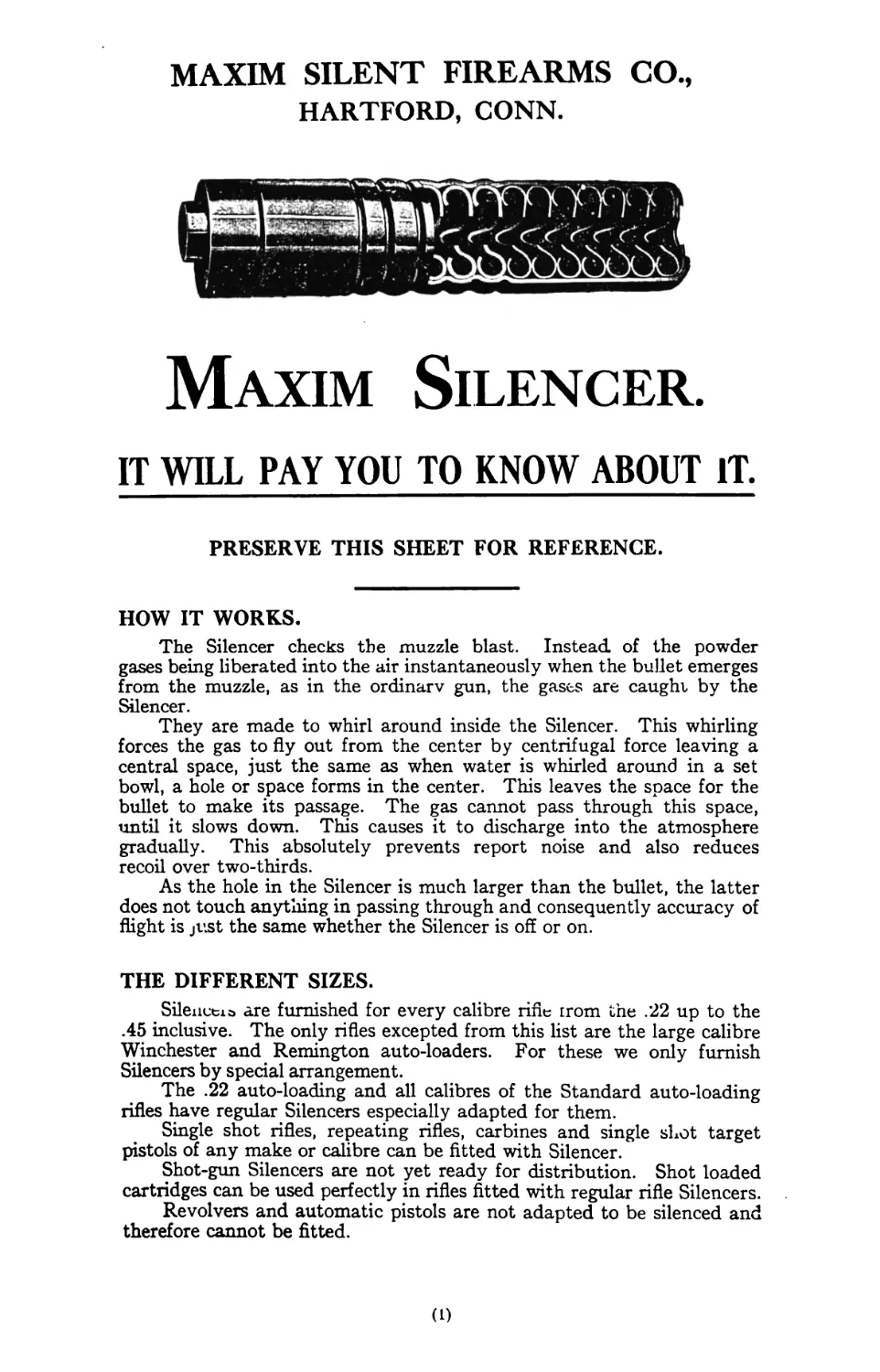
Maxim Silencer.
IT WILL PAY YOU TO KNOW ABOUT IT.
PRESERVE THIS SHEET FOR REFERENCE.
HOW IT WORKS.
The Silencer checks the muzzle blast. Instead of the powder
gases being liberated into the air instantaneously when the bullet emerges
from the muzzle, as in the ordinary gun, the gases are caught by the
Silencer.
They are made to whirl around inside the Silencer. This whirling
forces the gas to fly out from the center by centrifugal force leaving a
central space, just the same as when water is whirled around in a set
bowl, a hole or space forms in the center. This leaves the space for the
bullet to make its passage. The gas cannot pass through this space,
until it slows down. This causes it to discharge into the atmosphere
gradually. This absolutely prevents report noise and also reduces
recoil over two-thirds.
As the hole in the Silencer is much larger than the bullet, the latter
does not touch anything in passing through and consequently accuracy of
flight is just the same whether the Silencer is off or on.
THE DIFFERENT SIZES.
Silence are furnished for every calibre rifle irom the .22 up to the
.45 inclusive. The only rifles excepted from this list are the large calibre
Winchester and Remington auto-loaders. For these we only furnish
Silencers by special arrangement.
The .22 auto-loading and all calibres of the Standard auto-loading
rifles have regular Silencers especially adapted for them.
Single shot rifles, repeating rifles, carbines and single shot target
pistols of any make or calibre can be fitted with Silencer.
Shot-gun Silencers are not yet ready for distribution. Shot loaded
cartridges can be used perfectly in rifles fitted with regular rifle Silencers.
Revolvers and automatic pistols are not adapted to be silenced and
therefore cannot be fitted.
Rifle
Coupling
Silencer
HOW THE .22 CAL. IS ATTACHED.
For an .22 cal. rifles or single shot pistols the Silencer can be imme-
diately attached by means of a Coupling which drives onto the end of
the barrel forward of the front sight. The cut shows this. The Coupling
is a small thimble having the threads by means of which the Silencer is
screwed on. Spacers accompany it so that a tight driving fit can be
obtained no matter what size the gun barrel is. Various sizes Couplings
are furnished (See List of .22 Calibre Couplings) so that only a few
spacers are necessary. The round Coupling drives onto either octagon
or round barrels perfectly. A small thimble covers the threads of the
Coupling when the Silencer is off and gives the barrel a finished appear-
ance. A .22 outfit consists of a Silencer, one Coupling of any size desired,
several spacers and a Barrel Sleeve or Thimble and full instructions.
HOW THE 25-20 CAL. AND 32-20 CAL. IS ATTACHED.
These are equipped in the same way as
tne .22 except that to positively lock the
Coupling on the barrel a locking pin is used
in the Coupling. (See Cut.) A small groove
has to be filed in the bottom of the barrel
forward of the front sight to pass this locking
pin. Only round barrels can be fitted this
way. Octagon barrels must be turned down
round forward of the front sight, or what is
better still must be threaded.
.25-20 and .32-20 Coupling.
HOW ALL OTHER CALIBRES ARE ATTACHED.
The best wav to attach any Silencer is to have the gun barrel
threaded forward ot the front sight. As is apparent, this emiiely avoids
a Coupling with its cost, weight and appearance. The barrel sleeve
covers these threads when the Silencer is off and makes the barrel thus
fitted look the same as a regular barrel. It makes a first class job in
every way. By removing the sleeve, the Silencer can be attached b]£ a
single twist of the wrist. It is not a difficult job for any machinist to
do the threading if the instructions accompanying each Silencer are
observed. The threading dcfes not injure the gun barrel, or the shoot-
ing, or the strength of the gun in any way whatsoever (See Cut.)
In ordering new guns, the dealer should always remember to order part
of them to come threaded to take Silencer. Then Silencer can be at-
tached at any time. It also helps sell the gun.
The above cut shows the barrel sleeve and threaded barrel.
When the sleeve is on, the barrel has the appearance of a regular barrel.
(2)
THE NEW HIGH POWER COUPLING.
For those who are situated where
they cannot have the barrel threaded
we furnish a High Power Coupling.
(See cut-)
This; Coupling consists of a thimble carrying the threads for attach-
ing the StTerttyr» a taper locking grip- which encircles; the barrel and a
hexagon locking nut for tightening the grip- It can be attached to the
round barrel rifles only. Each make and model of rifle has its own
special CoupEng and in ordering this information! must always be guvenu
The front sight has to be driven out to- pass the locking nut onto the
barrel. The sight is driven back into* its place after the locking nut is
on. The barrel sleeve covers the threads when the Silencer is off and
gives a finished appearance.
Where rifles or carbines have the tubular magazine running all the
way out to the end of the barrel, it is necessary to- shorten the maga-
zine two and one-half inches- This is easily done on all rifles, and does
not seriously reduce the magazine capacity
HOW MUCH IT REDUCES THE NOISE.
The Silencer absolutely annuls all of the noise of the report, as can
easily be understood from its construction. It also- reduces the recofll
over two-thirds. The reason for this is that there is a very strong tend-
ency for the Silencer to be blown off the end of the gun. This tendency
amounts to a forward pull on the gun barrel. This forward pull counter-
balances part of the backward kick of the gun barrel.
The only noise the Silencer does not control is the noise made out
in the air beyond the gun by a high velocity bullet in its flight. This
noise is a crack” like the crack of a whip and not a “whistle” or a
“shriek” as is commonly supposed. The noise is made in the wake of
the bullet and is caused by the same thing that causes the air to crack
when a whiplash is snapped.
This noise cannot be avoided when the bullet velocity is high no
matter how quiet we make the gun. Where strictly noiseless bullet
flight is wanted in addition to a noiseless shooting gun, modified ammuni-
tion has to be used. We furnish this at the same price as regular ammuni-
tion. Its velocity is 1100 feet per second and a heavy bullet is used so
as to keep up the striking energy notwithstanding the reduced velocity.
It is very accurate up to 350 yards. We furnish it in all calibres in
which center-fire cartridges are used.
.22 LONG AND .22 W. R. F. CARTRIDGES.
Some times a .22 Long and a .22 W. R. F. cartridge will be found
which has a bullet velocity high enough to make the bullet noise. .22
Short and .22 Long rifle of the regular velocities are always quiet. There
is no way to stop the noise of the .22 Long and the .22 W. R. F. bullet.
The best thing to do is to try a different make of ammunition until you
get one which gives quiet bullet flight.
BLACK OR SEMI-SMOKELESS POWDERS.
With smokeless powder the Silencer never needs any more clean-
ing than to jar it to shake out any unburned powder grains which may
collect. With black or semi-smokeless it must be cleaned. One way is
to use hot water, placing the Silencer under the hot water faucet in a
sink, and letting the water flow through. In half an hour it will be.
cleaned. If desired a quick and very thorough cleaning may be accom-
plished in a few minutes by using the Solvents made expressly for this;
purpose by Frank A. Hoppe, Philadelphia, Pa., or the Tri-Products
Co., Olean, N. Y.
(3)
.22 AUTOMATIC AMMUNITION.
Some times an ammunition will be found which will clog the breech
action of the .22 automatic Winchester rifle with unbumed grains of
powder. All makes of ammunition do not do this. If trouble is experi-
enced try another make and the trouble will be entirely overcome.
ACCURATE SHOOTING.
The hole in the Silencer is considerably larger than the diameter of
the bullet. If the Silencer is any where nearly in line with the barrel,
the bullet cannot touch in passing through. If, however, the alignment is
so bad that all the clearance is used up and the bullet touches, its flight
will be disturbed and it will not shoot accurately. A light touch toe-
small to be noticed is enough. To correct it, the easiest way is to i-1'
with a round file where the bullet is touching and get the necessarv
clearance. This does not injure the Silencer, as the size of the hole s
not important.
DIFFERENT SIGHTING WITH SILENCER.
The addition of the weight of the Silencer changes the vibratic?.
of the barrel in a high power rifle.. This causes a change in the sighting
when the Silencer is used. Usually the sight has to be moved slight r-
to the right, or if the rifle has windage adjustment on the rear sight
correction can be made here.
BULLET STOP TARGET BOX.
A real novelty for which there is a large demand is our Bullet Stop
Target Box. It is a double compartment box, the larger compartment
being filled with dry sand and the smaller with cotton waste. It stops
the bullet of even a powerful rifle and does so without noise. The double
compartment feature and the waste prevents sand leaking out even
after the front of the box is riddled with repeated shooting. The front
cloth is easily replaced. The box will last forever. It has natural oak
finish and can be set up any where, indoors or out.’
MODEL 15 U. S. GOV. SILENCER.
This is the Silencer issued by the War Department to the National
Guard. It needs no coupling and can be attached to the U. S. Govern-
ment Springfield rifle immediately, by simply removing the front: sight
blade. It is sold to private owners of the Springfield rifle and also to
individual members of tne National Guard.
(4)
PRICES.
Net Retail
.22 calibre Silencer outfit complete including
Coupling, and Barrel Sleeve with full
instructions for attaching......................... $5.00
Extra .22 cal. Coupling only.................. 1.00
Extra .22 cal. Barrel Sleeve................... .25
.25-20 cal. Silencer outfit complete including
Coupling and Barrel Sleeve with full
instructions for attaching................ 7.00
Extra .25 cal. Coupling only.................. 1.00
Extra .25 cal. Barrel Sleeve................... .25
.32-20 Cal. Silencer outfit complete including
Coupling and Barrel Sleeve with full
instructions for attaching................ 7.00
Extra .32 cal. Coupling only.................. 1.00
Extra .32 cal. Barrel Sleeve................... .25
High Power Silencer and Barrel Sleeve only .	7.00
High Power Coupling only, any cal. with full
instructions for attaching................ 2.50
Official U. S. Gov. Silencer for Gov. Spring-
field Rifle............................... 8.50
Patent Bullet Stop Target Box for Indoor
Shooting.................................. 3.50
Adapting barrels to receive Silencer and fur-
nishing Barrel Sleeve..................... 2.00
TERMS.
All deliveries f. o. b. Harttord, Conn., and all Silencers are sold by
us and licensed only upon the express condition that there shall be no
deviation from the prices here given without our written consent.
ORDER THROUGH YOUR REGULAR JOBBER.
INSTRUCTIONS FOR EQUIPPING A .22 CAL. RIFLE.
First. — Examine end of barrel and Coupling making sure they
are clean and free from metal filings.
Second. — Remove the Spacers which will be found in the Coup-
ling when it is received. Insert as many spacers as are necessary to make
Coupling just start over extreme end of rifle barrel. Special care should
be taken to see that the thin shims do not fold over. It should only
be possible to start Coupling onto barrel about one eighth inch.
Third. — Twist Coupling and Silencer around until groove in
bottom of Silencer comes in line with bottom of rifle. With a wood
mallet rap the end of the Silencer until coupling is tight on barrel.
Then remove Silencer from Coupling, taking care not to move the latter,
and with mallet drive Coupling hard home. Coupling is not home until
a sharp blow with the mallet gives a solid sound and feeling.
Note. — If the rifle is a Winchester or Marlin Repeater, with
underneath tubular magazine, the Silencer is turned bottom side up
when the magazine is to be filled (see illustration)
(5)
INSTRUCTIONS FOR THREADING RIFLE BARREL.
1.	The following are the regular threads used on the various calibre
Silencers:
.22 cal. уъ 20 thread.
.25 cal. 20 thread.
.30 cal. to .35 cal. inclusive ^r, 20 thread.
.38 cal. and .40 cal. .614r, 20 thread.
.44 cal. and .45 cal. Цг, 20 thread.
2.	The neck of the Silencer will be found to contain a counterbored
portion }/% deep, and the outside diameter of the thread. There
should be an unthreaded space on the barrel to fit this counter-
bore. This is very important as it is this fit that insures the
correct alignment of the Silencer on the gun barrel. The illus-
tration shows thic unthreaded portion.
3.	The fit of the threads should be just loose enough to enable the
Silencer to be screwed on without difficulty by hand. The
shoulder on the gun barrel should just bring the Silencer so that
the groove in the bottom points straight down.
4.	The thread in the Silencer will be found to be interrupted. If the
thread on the gun barrel is interrupted on opposite comers to
correspond, the Silencer can be dropped into place and fastened
by a single quarter turn.
5.	If the bore in the Silencer aligns with the bore of the gun barrel, the
bullet cannot possibly touch the Silencer after it leaves the gun
barrel. The bore of the Silencer is larger than the diameter
of the bullet and ample clearance is therefore given.
INSTRUCTIONS FOR ATTACHING HIGH POWER COUPLINGS.
The coupling consists of three pieces: — The Body, the Split
Sleeve, and the Lock Nut.
1.	Dis-assemble the Coupling by unscrewing the lock.nut and remov-
ing from it the split sleeve.
2.	To attach to rifle: — Remove the iront sight and pass the lock nut
over the barrel, having the threaded end point toward the muzzle.
3.	Pass the split sleeve over the barrel, taking care to see that the little
projection on the sleeve points towards the muzzle.
4.	Pass the body of Coupling onto the end of the gun barrel and force
on until it bottoms firmly. Rap it with a piece of hard wood.
5.	Engage the projection on the split sleeve in the slot of coupling body.
6.	Screw up the lock nut as tight as possible by means of an 8* wrench,
TAKING PARTICULAR CARE TO SEE THAT PROJEC-
TION ON SPLIT SLEEVE DOES NOT DISENGAGE FROM
SLOT IN COUPLING. Use a Kttle oil or grease on surface of
split sleeve and threads.
7.	Replace the front sight
(6)
The Coupling consists of four pieces: — The Body, the Split Sleeve»
the Locking Nut and the Nut Case.
1.	Dis-assemble the Coupling by unscrewing the locking nut and removing
from the nut the split sleeve, and separating the nut from its case.
2.	To attach to rifle, first take out the front sight. Slip the nut case
over the end of barrel with the marked end towards the rear.
3.	Slip the locking nut over the barrel and into its nut case matching
up the numbers.
4.	Slip the split sleeve over the barrel, taking care to see that the little
projection on this sleeve points TOWARDS THE MUZZLE.
5.	Slip the body of Coupling over the end of barrel and force down till
it bottoms firmly.
6.	Bring the projection on split sleeve to a position so that it WILL
ENGAGE in slot of Coupling body.
7.	Screw up the locking nut as tight as possible by means of a 6r or 8r
wrench, taking care to see that the split sleeve does not disen-
gage from slot in body of Coupling. Use a little oil or grease
on the outer surface of the taper sleeve and threads.
8.	Replace the front sight.
INSTRUCTIONS FOR ATTACHING MODEL 15 SILENCER
TO U. S. SPRINGFIELD RIFLE.
The Coupling consists of five pieces:—The Body, the Two Halves of
Taper Sleeve, with Spring for holding the two latter in place and the Nut.
1. Dis-assemble by unscrewing the Nut and removing the halves of
the Taper Sleeve.
2.	Remove small screw which holds front sight dovetail in place,
and remove front sight. This permits Nut to be slipped over
sight block and onto gun barrel. Replace front sight dovetail
and screw.
3.	Pass Silencer on to gun barrel and force home until end of slot in
Silencer is within jV of front sight block on barrel.
4.	Place two halves of Taper Sleeve around barrel and snap Spring
into groove so as to hold the halves in place. Be sure and have
small projection on one of the halves engage in slot of Silencer.
Also be sure that the other half sleeve has it£ thicker end toward
muzzle of rifle.
5.	Screw up Nut onto Silencer as tightly as possible by means of a
wrench. Use a little oil on outer surface of Taper Sleeve and on
threads.
LIST OF .22 CAL. COUPLINGS.
Rifles.	Name of Coupling. Inside Diam.
Stevens “Reliable” Model 42. Stevens “Diamond” Model 43.	4A	.431 (approx. Д)
Stevens “Little Scout” Model 14 Stevens “Maynard Jr.“ Model 15. Quackenbush.	2A	.515 full)
Stevens “Little Krag.” Marlin Model 20, Oct. bbl. Marlin Model 25, Rd. Bbl. Winchester Model 1902, S. S. Rd. Bbl. Winchester Model 1903, Auto., Rd. Bbl. Winchester Thumb Trigger, S. S.	A	.586 (approx. H)
(U
Rifles.	Name of Coupling. Inside Diam.
Savage Model 1909, Rd. Bbl. Hopkins & Allen, Model 22, Rd. Bbl. Remington, Model R. W. S. S., Rd. Bbl. Remington, Model 12, No. 1, Rd. Bbl.	A Short	.586 (approx. H)
Winchester, Model 1906, Rd. Bbl. Marlin Model 1892, Rd. Bbl. Marlin, Model 1897, Rd. Bbl.	A Short, Flatted	.586 (approx. H)
Stevens “Ideal Ladies” Model, No. 56. Stevens Model 044 И- Savage Model 1904, Rd. Bbl. Savage Model 1910, Rd. Bbl. Hopkins & Allen, Model 822 and 832, Round Barrel. Remington, Model 6, S. S., Rd. Bbl.	2B	.615 (% scant)
Stevens New Model No. 40. Stevens New Model Vernier, No. 40И- Stevens “Crack Shot,” No. 16. Stevens' ‘Off Hand,” No. 35. Colt Repeater, Oct.	2B Short	.615 (% scant)
Savage Model 1911. Remington R. W. S. S., Oct. Bbl. Batavia Automatic. Stevens Gallery, No. 80, Rep. Marlin Model 1892, Oct. Bbl. Marlin Model 1897, Oct. Bbl.	F	.629 (^.full)
Stevens Visible Loading Model 70.	F Short, Flatted	.629 (Vs full)
Stevens “Favorite,” No. 17 Hopkins & Allen Model 922, Rd. Bbl. Hopkins & Allen, Model 4922, Rep. Nos. 2 and 3, Oct. Bbl.	В Short	•679 (H scant)
Remington Model 12, No. 2 and 3, Oct. Bbl. Winchester Model 1890, Oct. Bbl. Savage Model 1903, Oct. Bbl.	В	.679 (H scant)
Savage Model 1905, Rd. Bbl. Winchester Model 1904, S. S., Rd. Bbl.	C	.692 (H full)
Remington Model 4, S. S., Oct. Bbl.	C Short	.692 (H full)
“Winder Musket.”	G	.710 (Ji full)
Hopkins & Allen, Model 1922, Oct. Bbl. Winchester S. S., No. 1 Barrel, 24-inch, Rd. and Oct. indiuster, S. S., No. 1 Barrel, 2G-i;.ch, Rd. and Oct.	H	.7S5 (approx. H)
Stevens, Model, No. 44. Stevens “Ideal,” No. 44И- Stevens “Ideal Range,” No. 45. Hopkins & Allen, Light Weight Schuetzen.	E	.828 (H full)
Special.	D	.880 У> full)
Hopkins & Allen, Heavy Weight Schuctzen. Winchester S. S., No. 3 Barrel, 24-inch and 26-inch, Rd. and Oct.	I	.937
Winchester S. S., No. 4 Barrel, 24-inch and 26-inch, Rd. and Oct.	J	1.080 (1Л full»
(8)