/



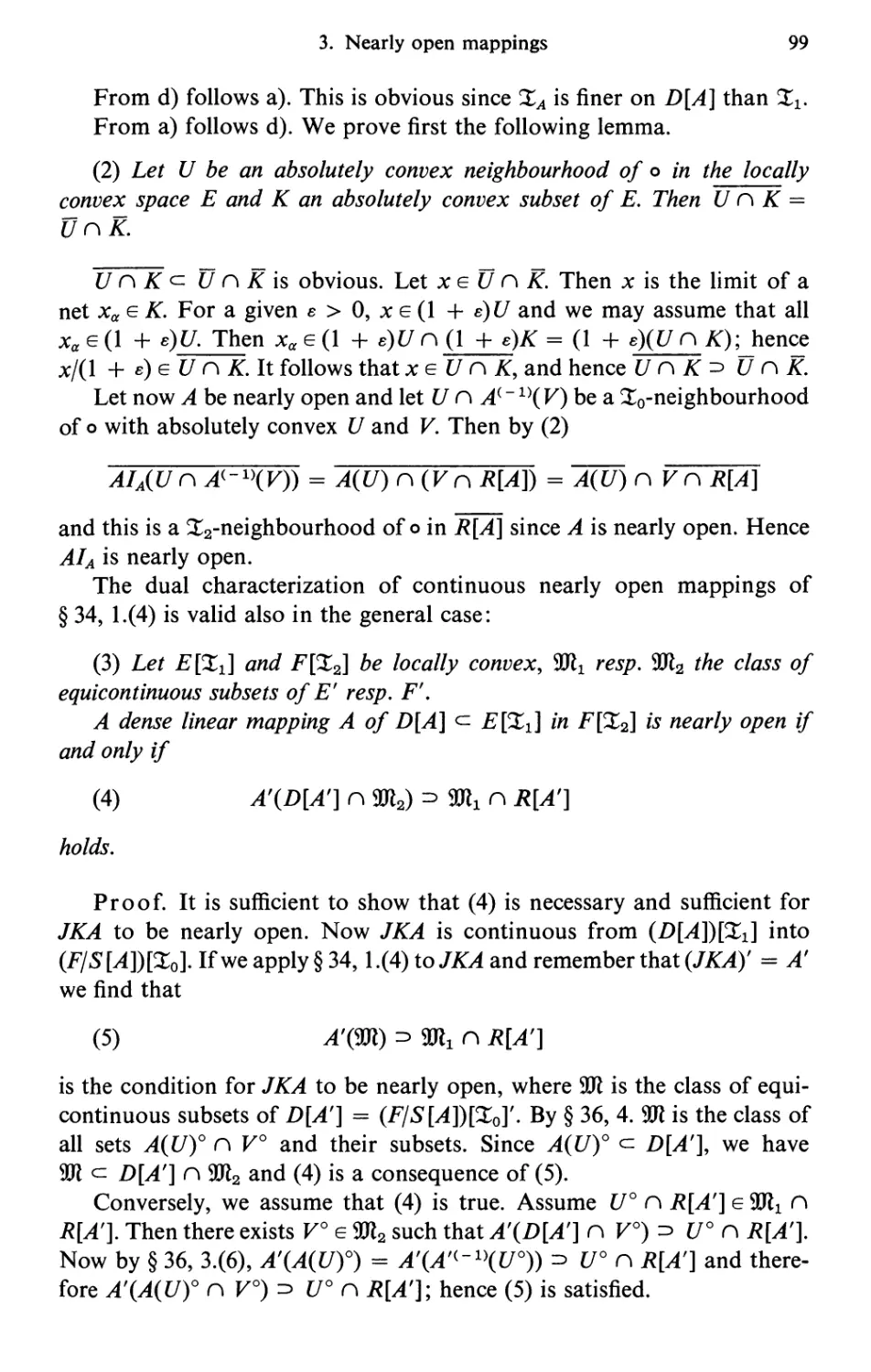
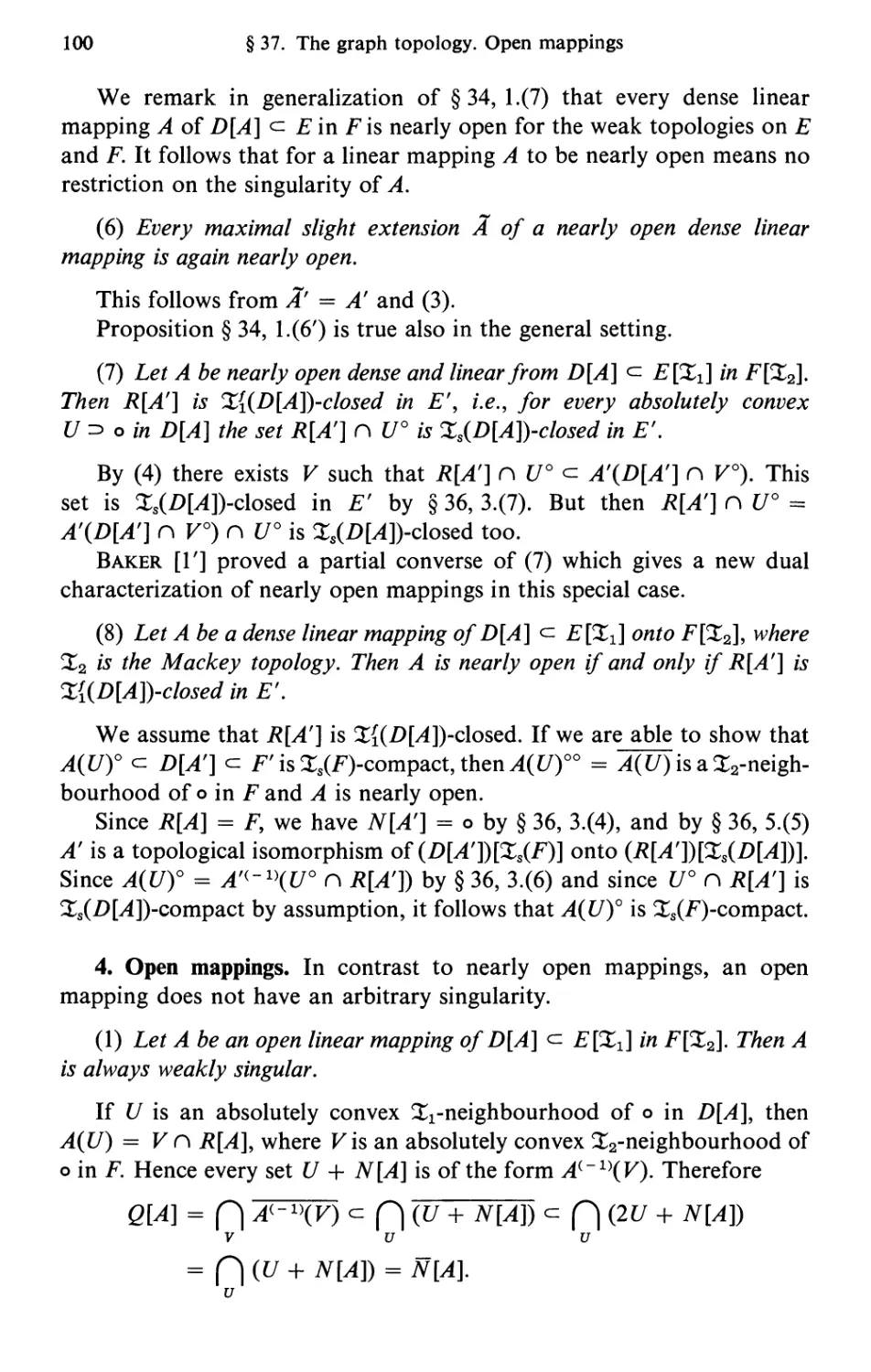
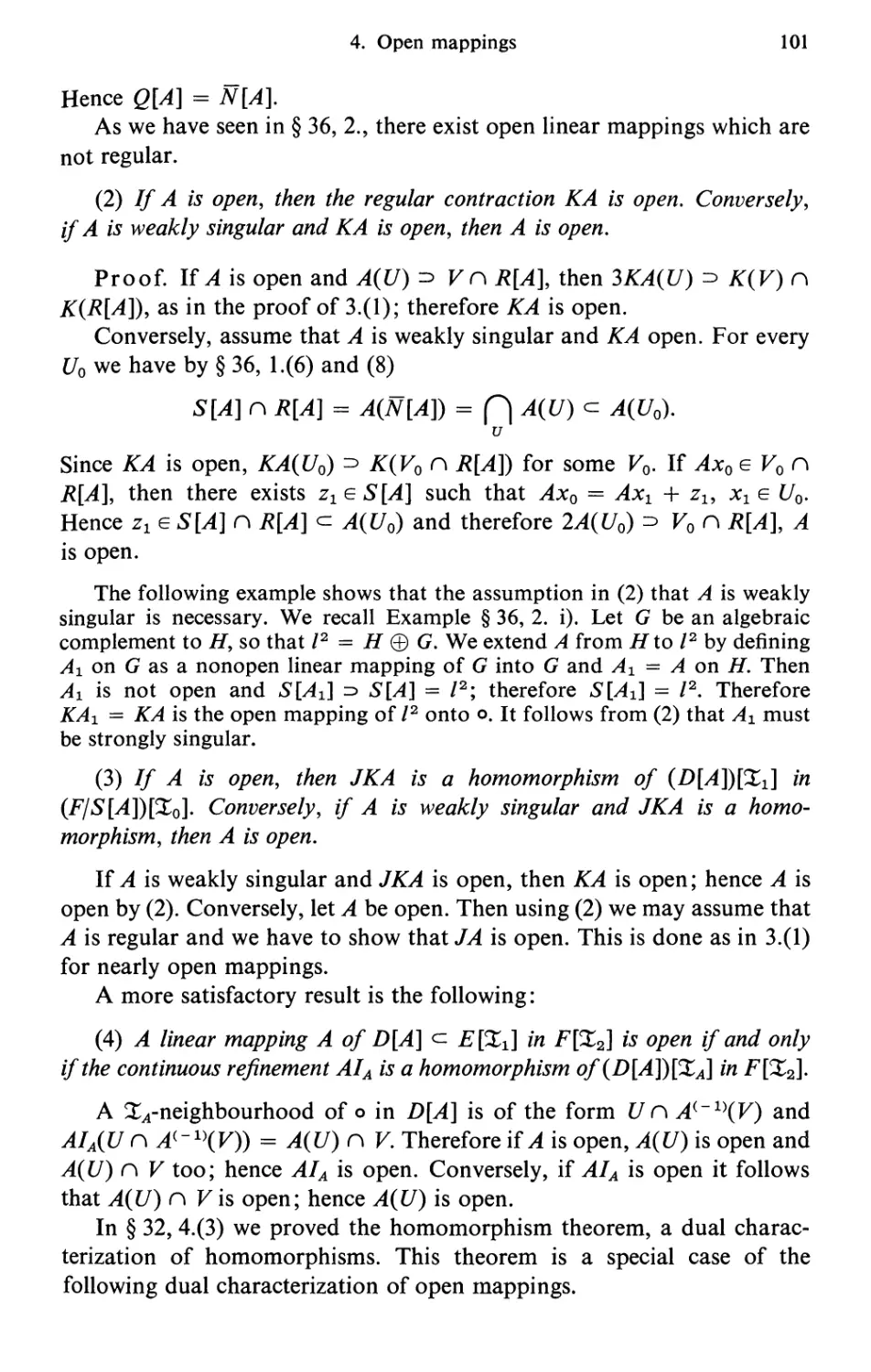
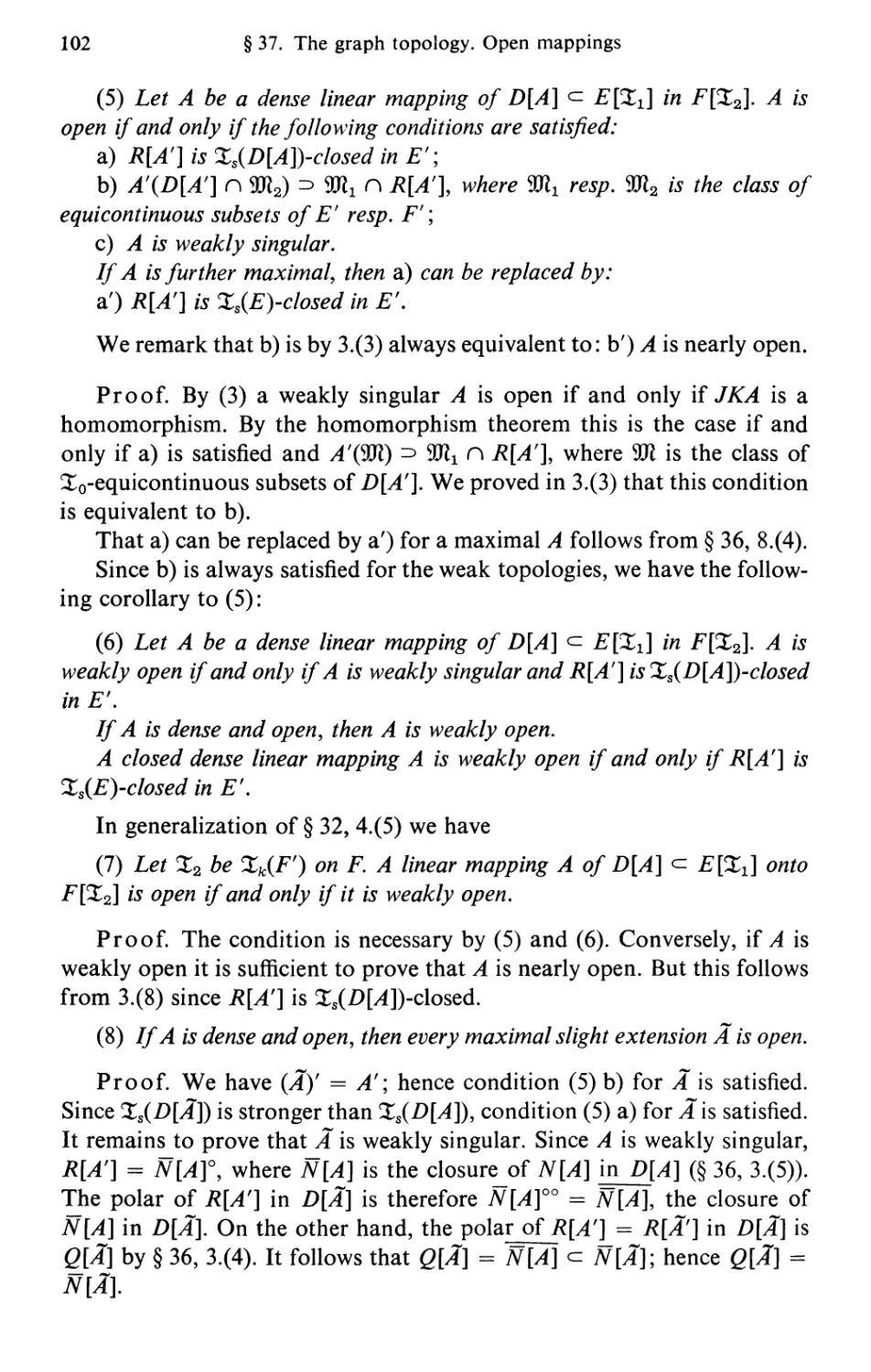
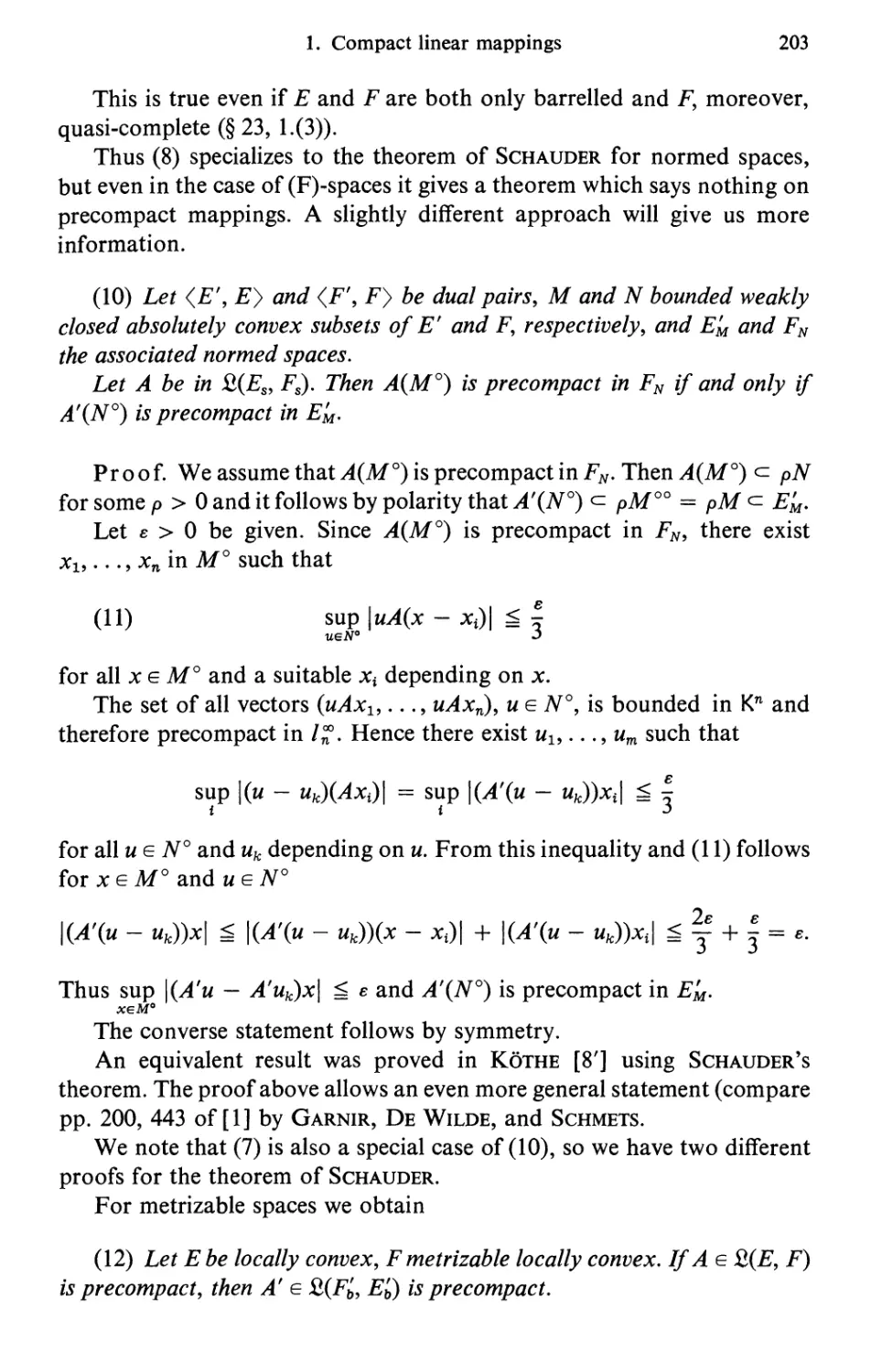
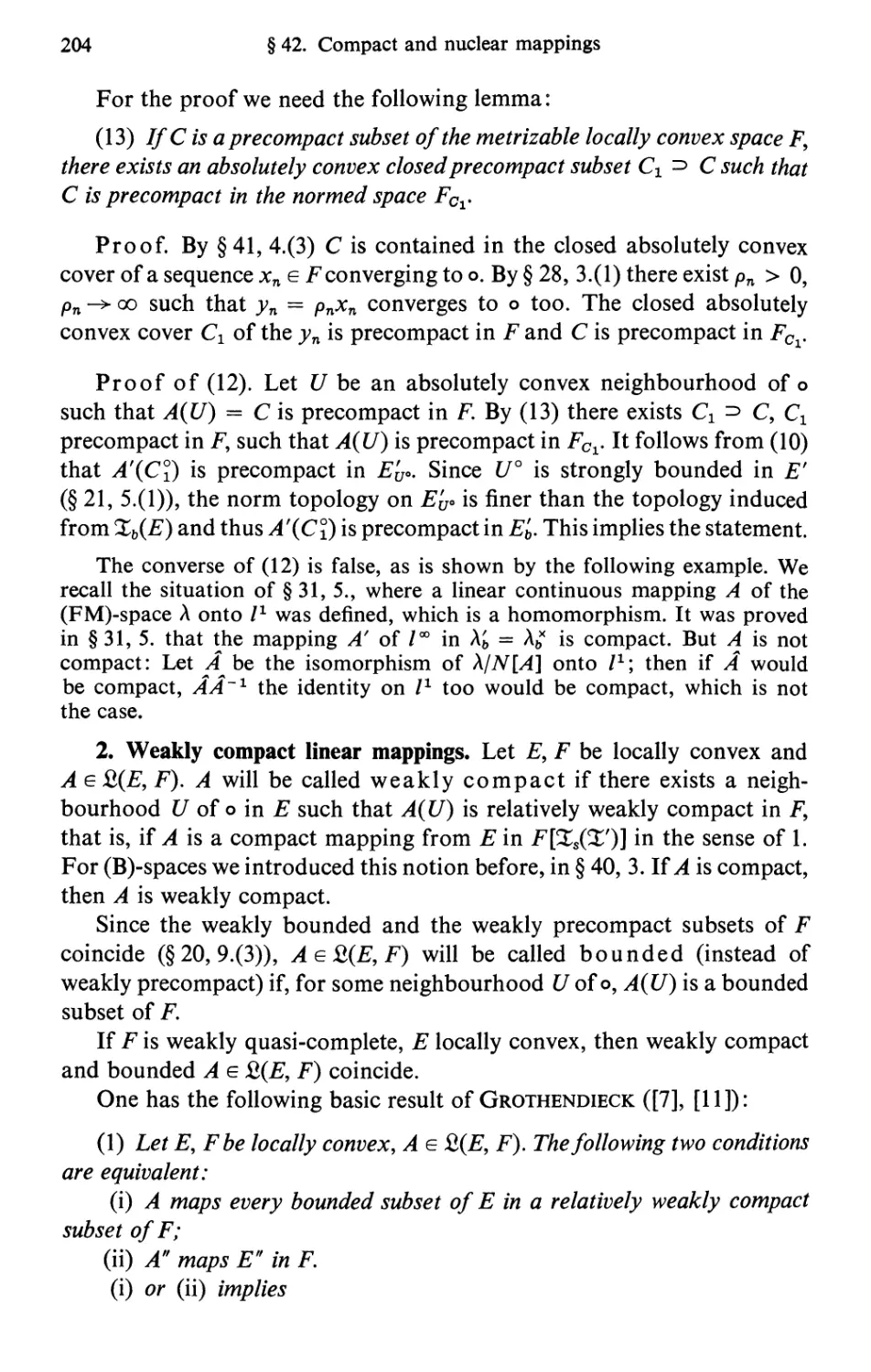
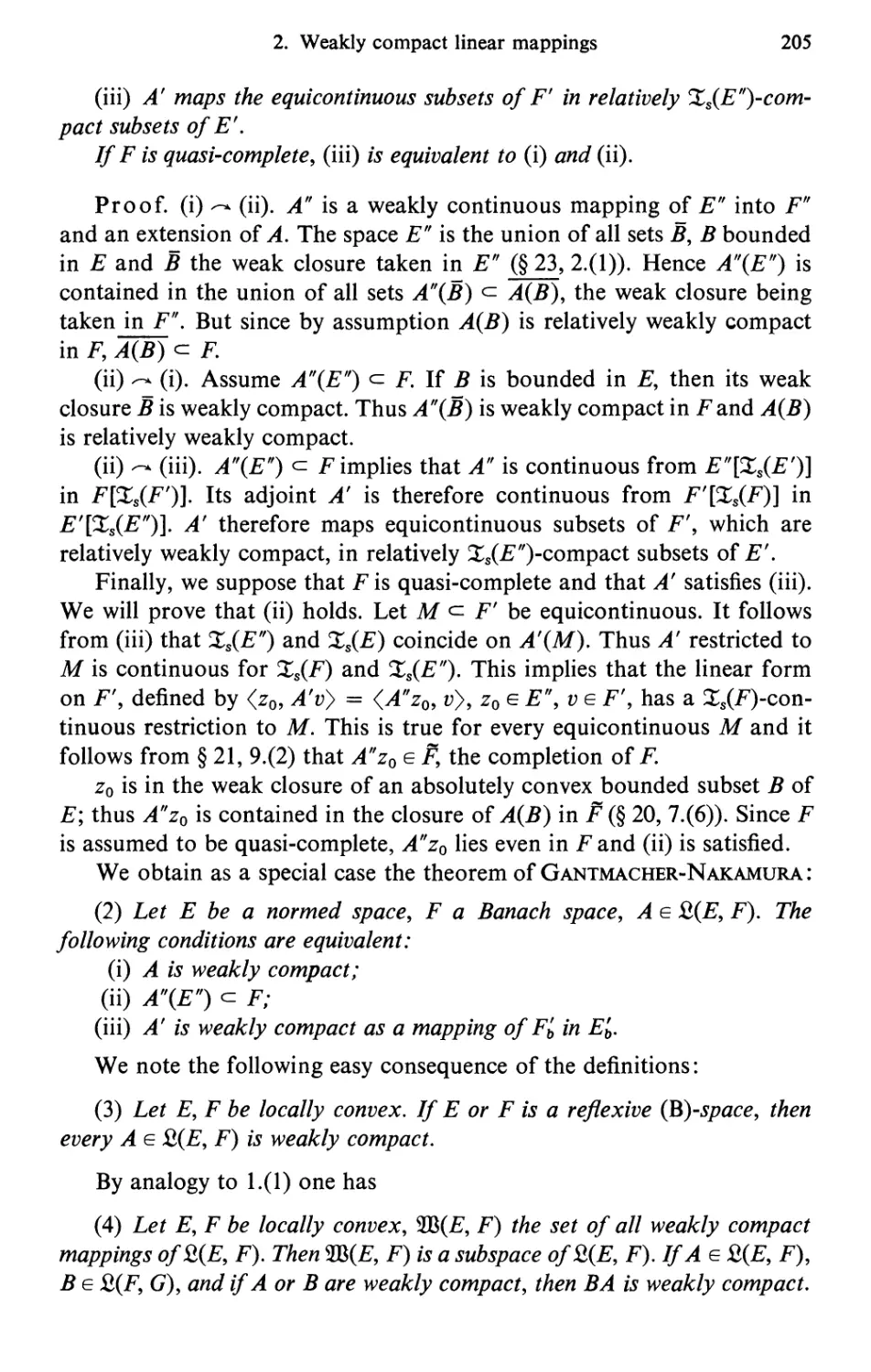
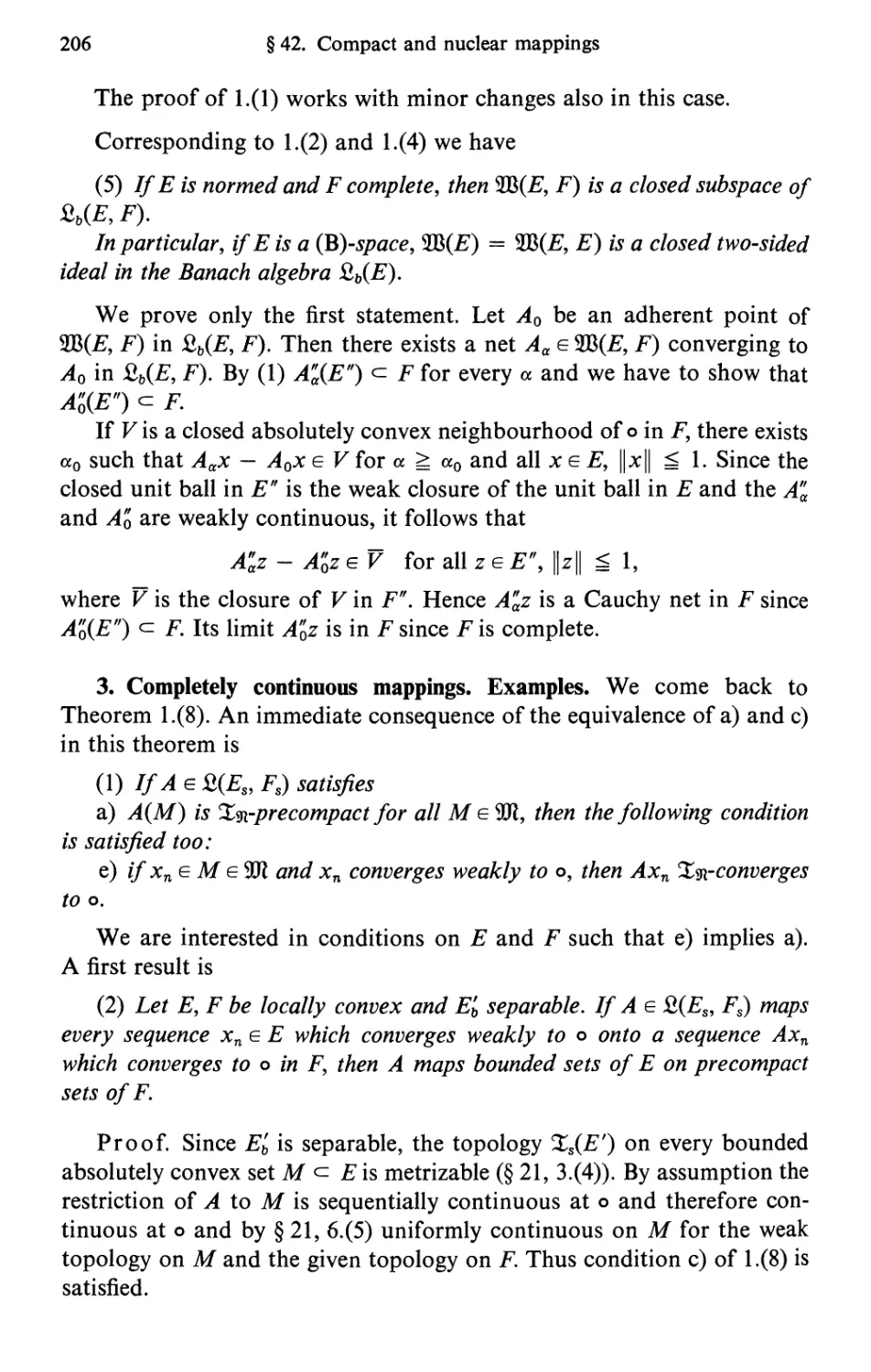
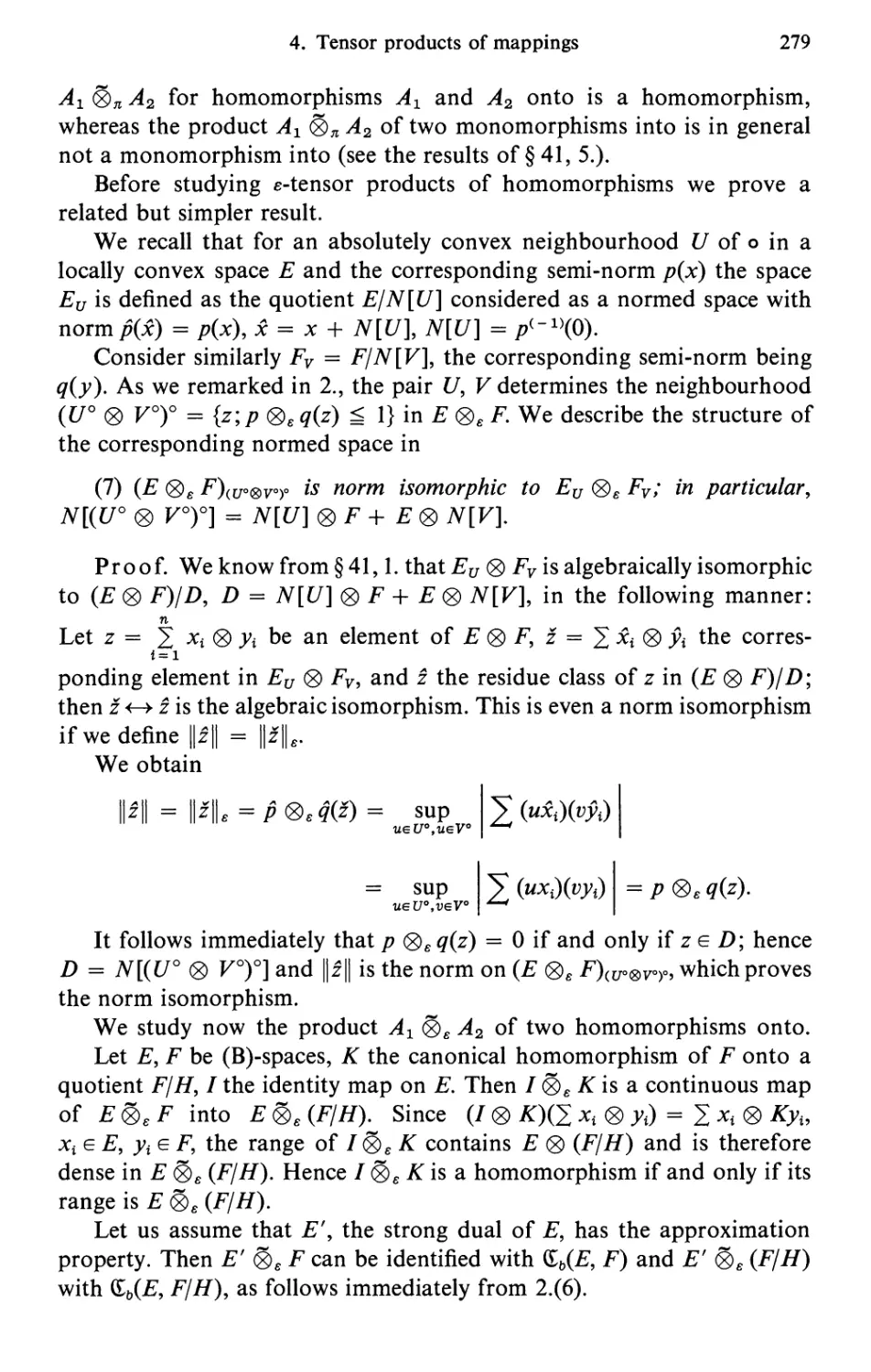
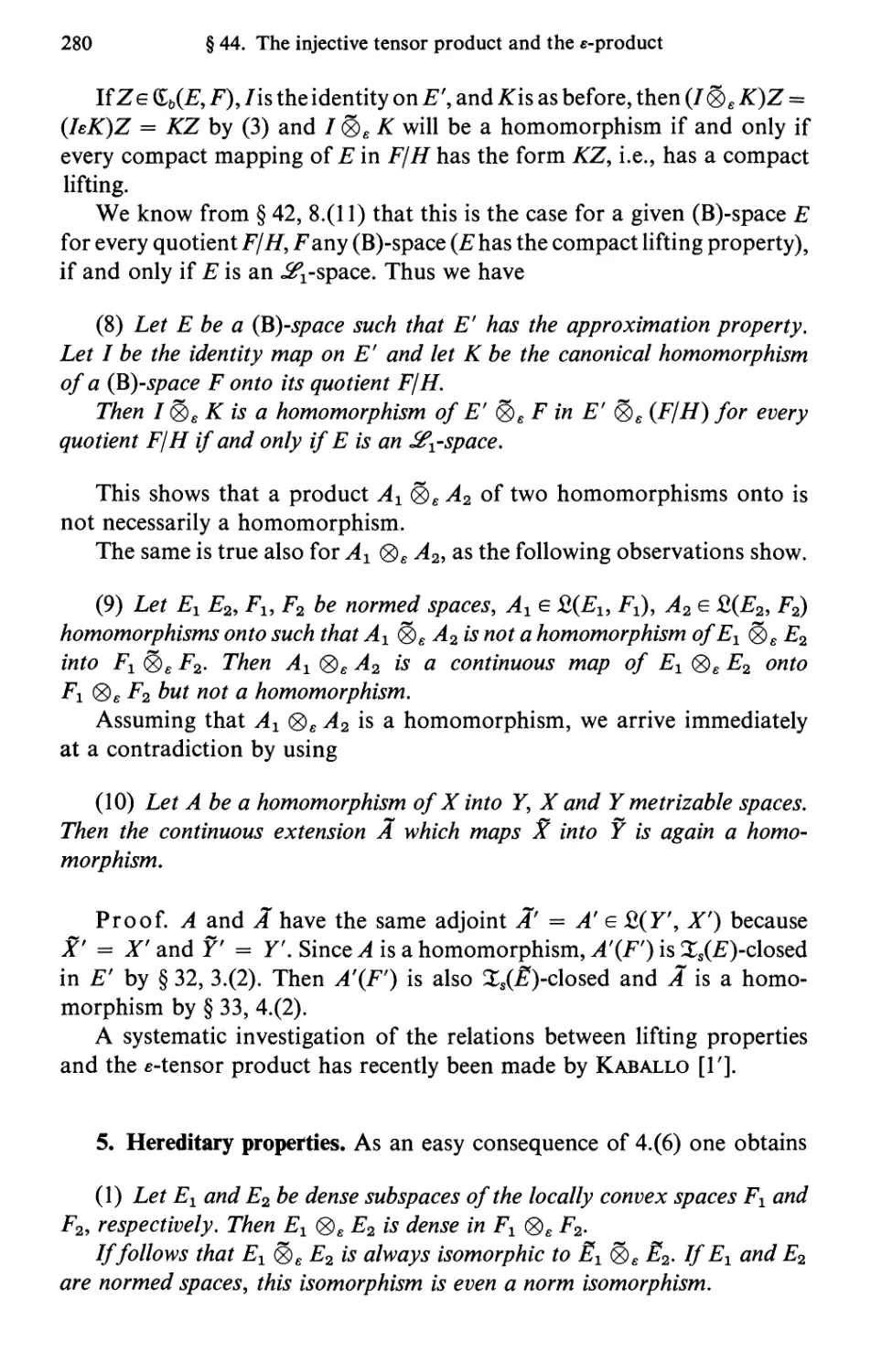
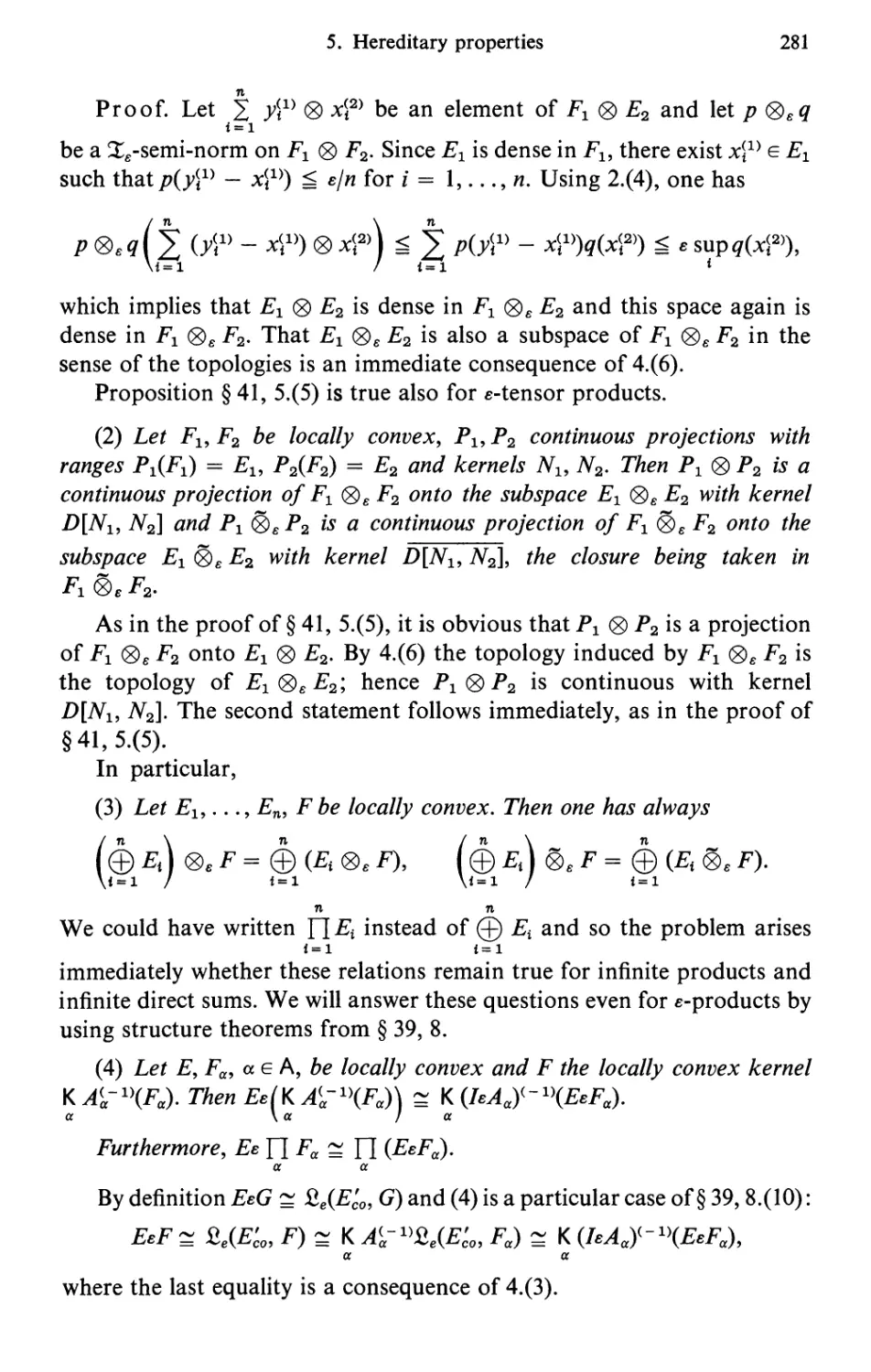
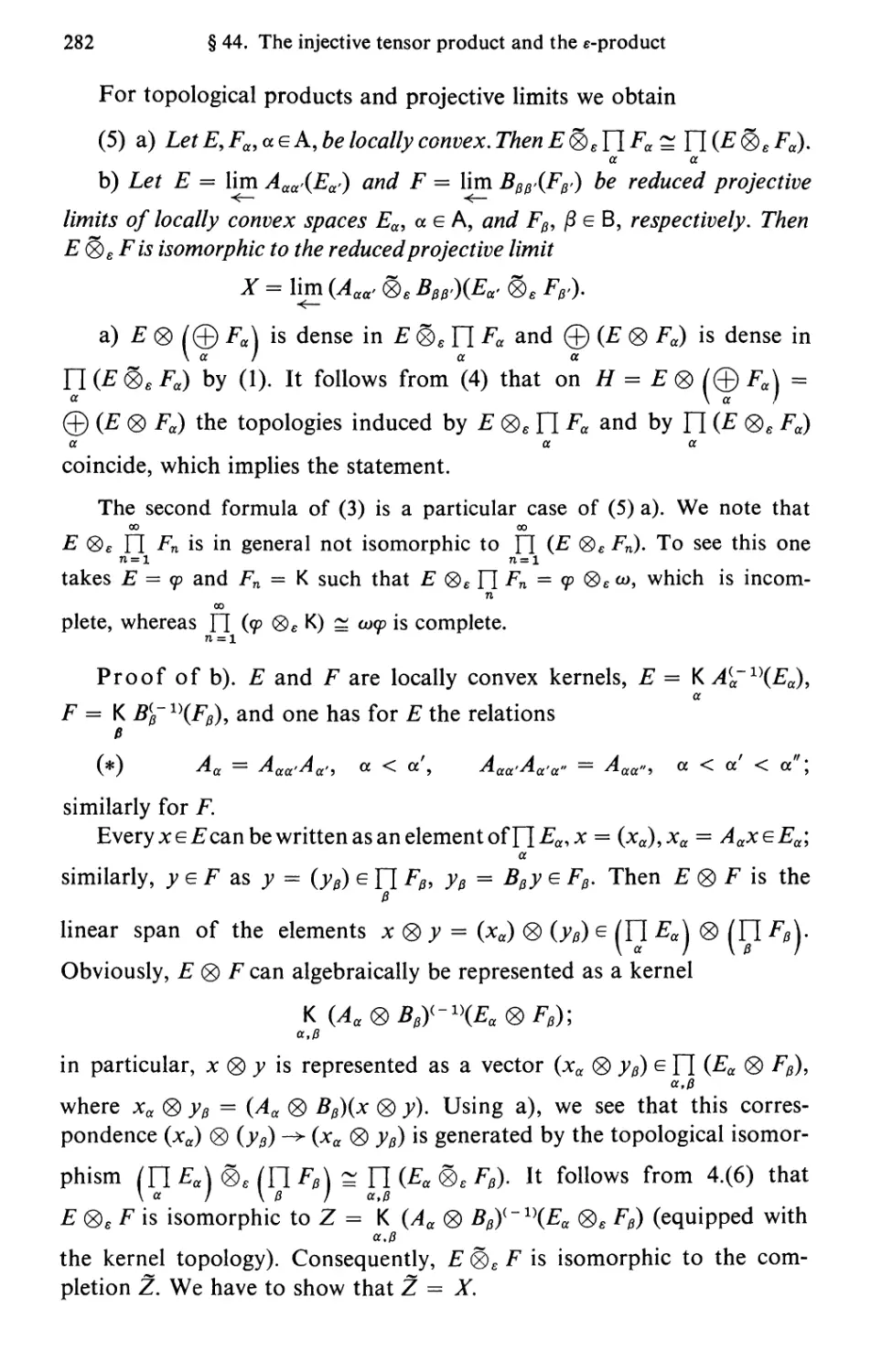
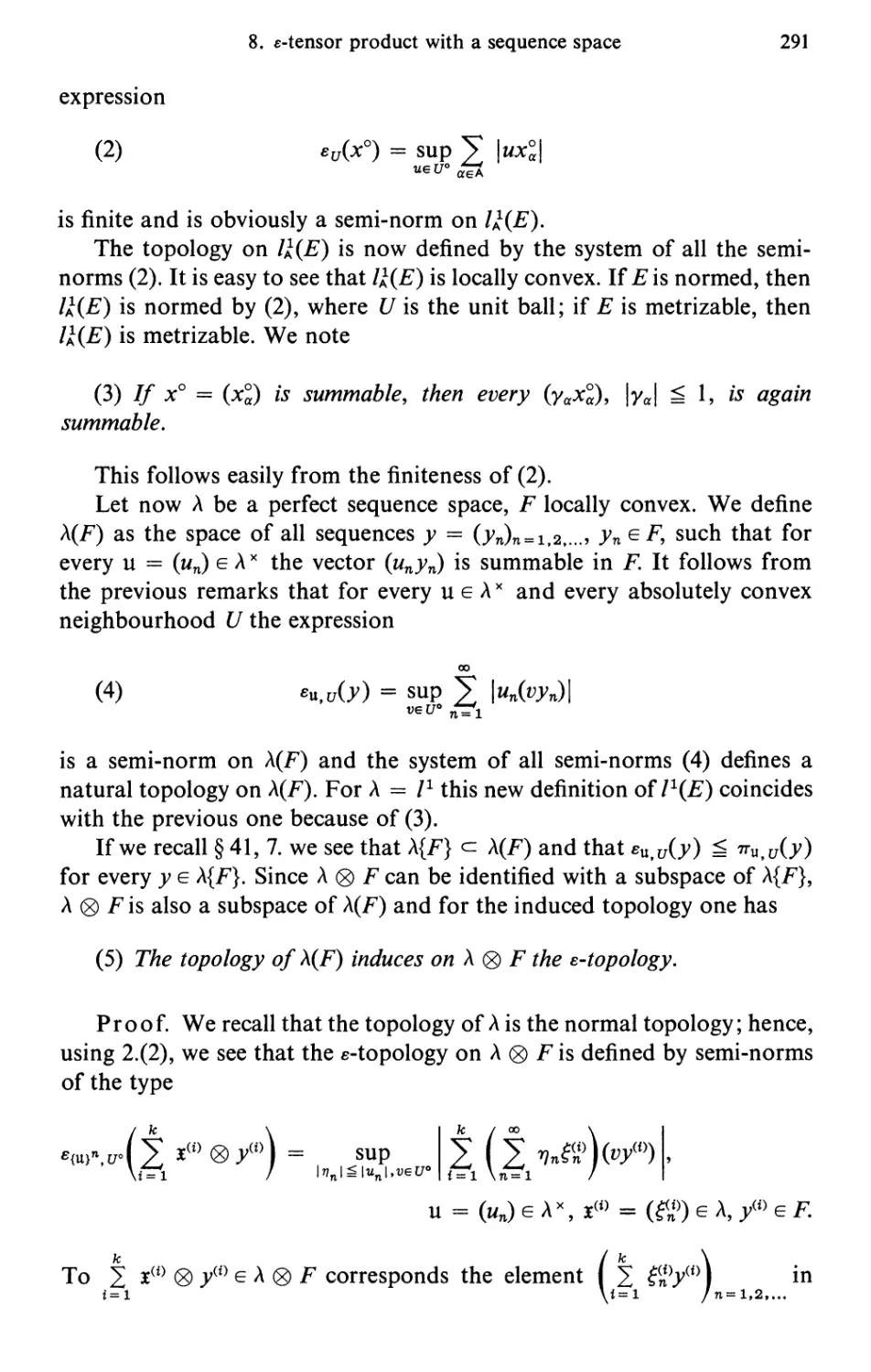
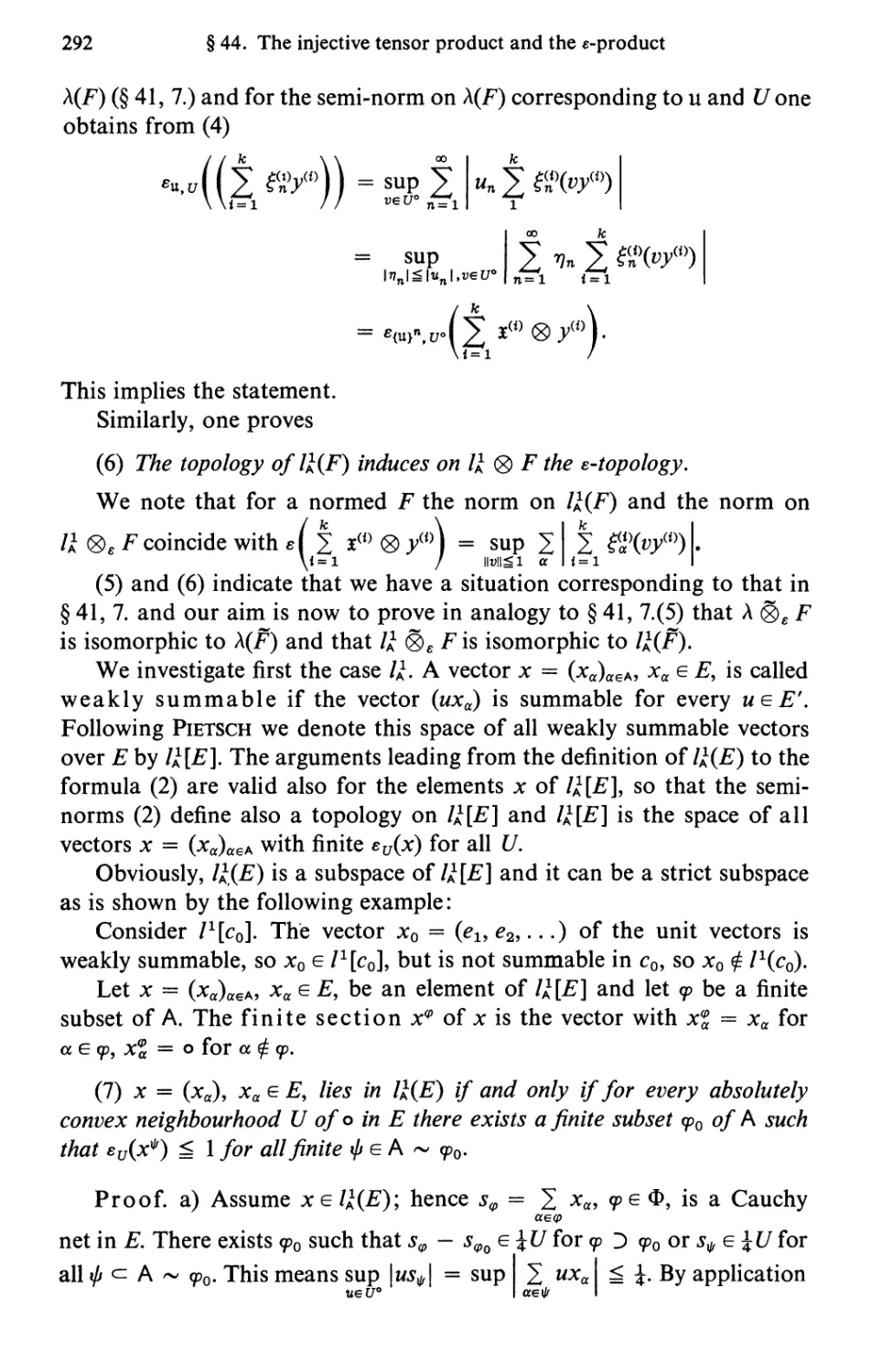
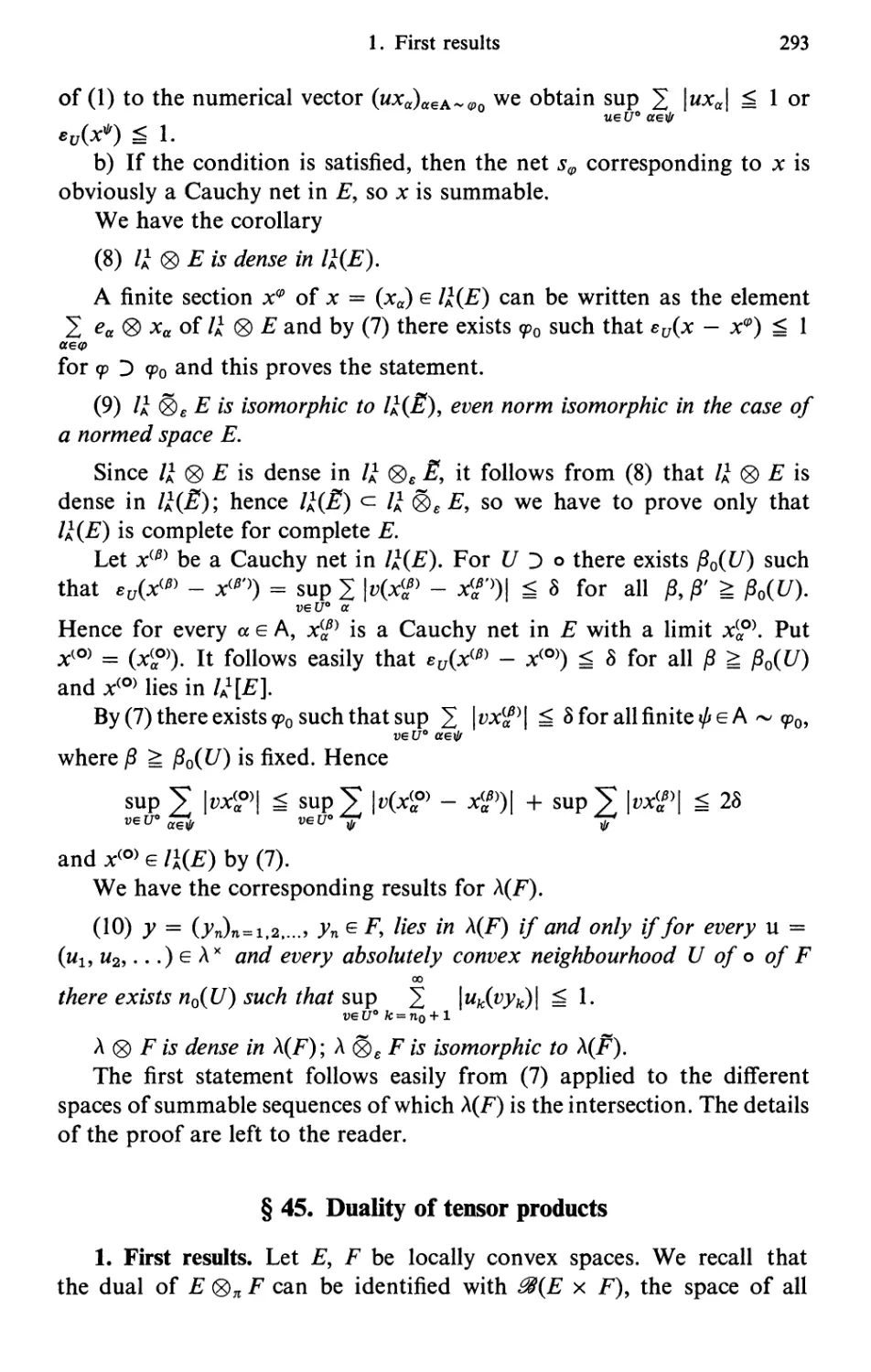
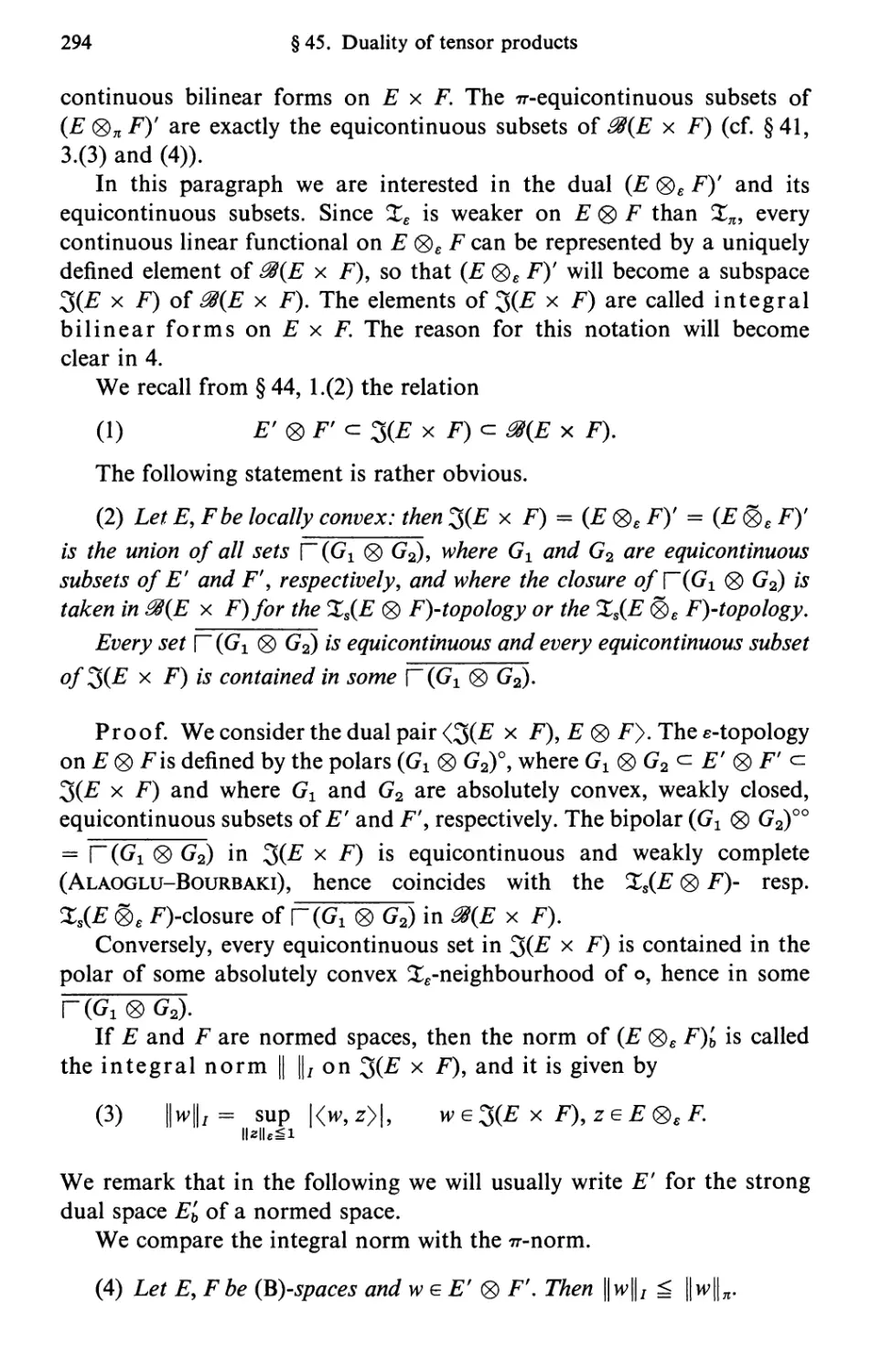
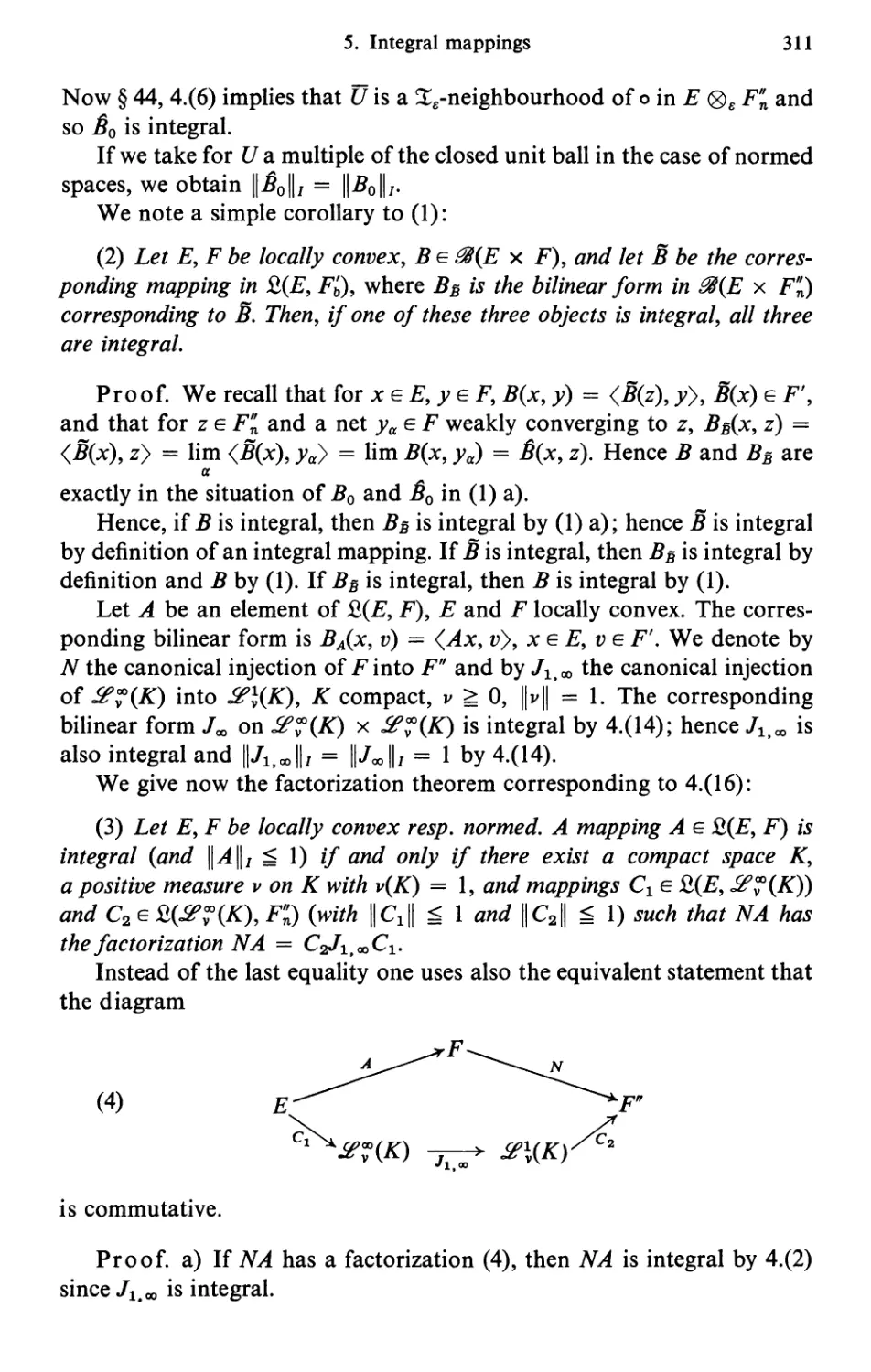
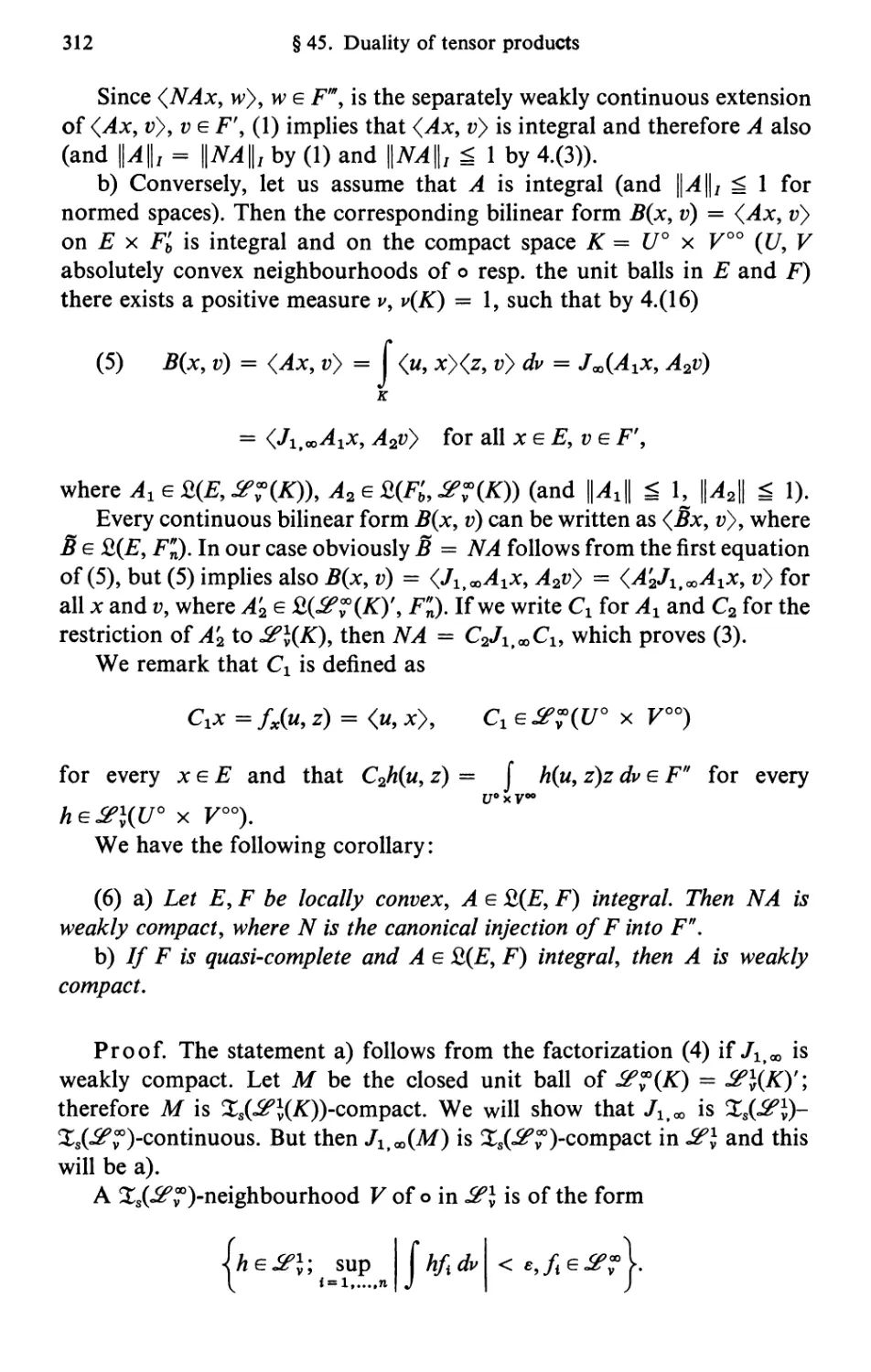
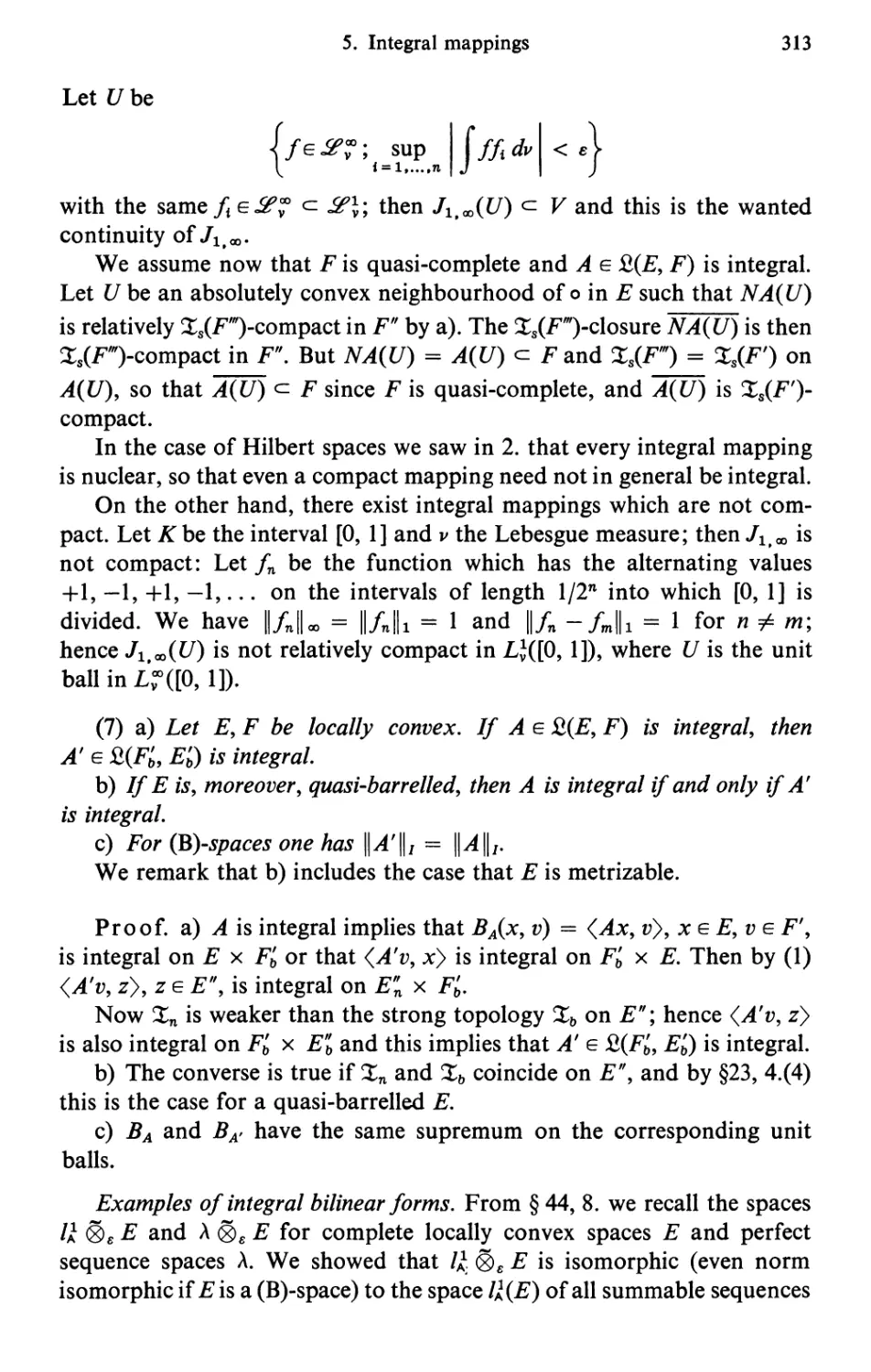
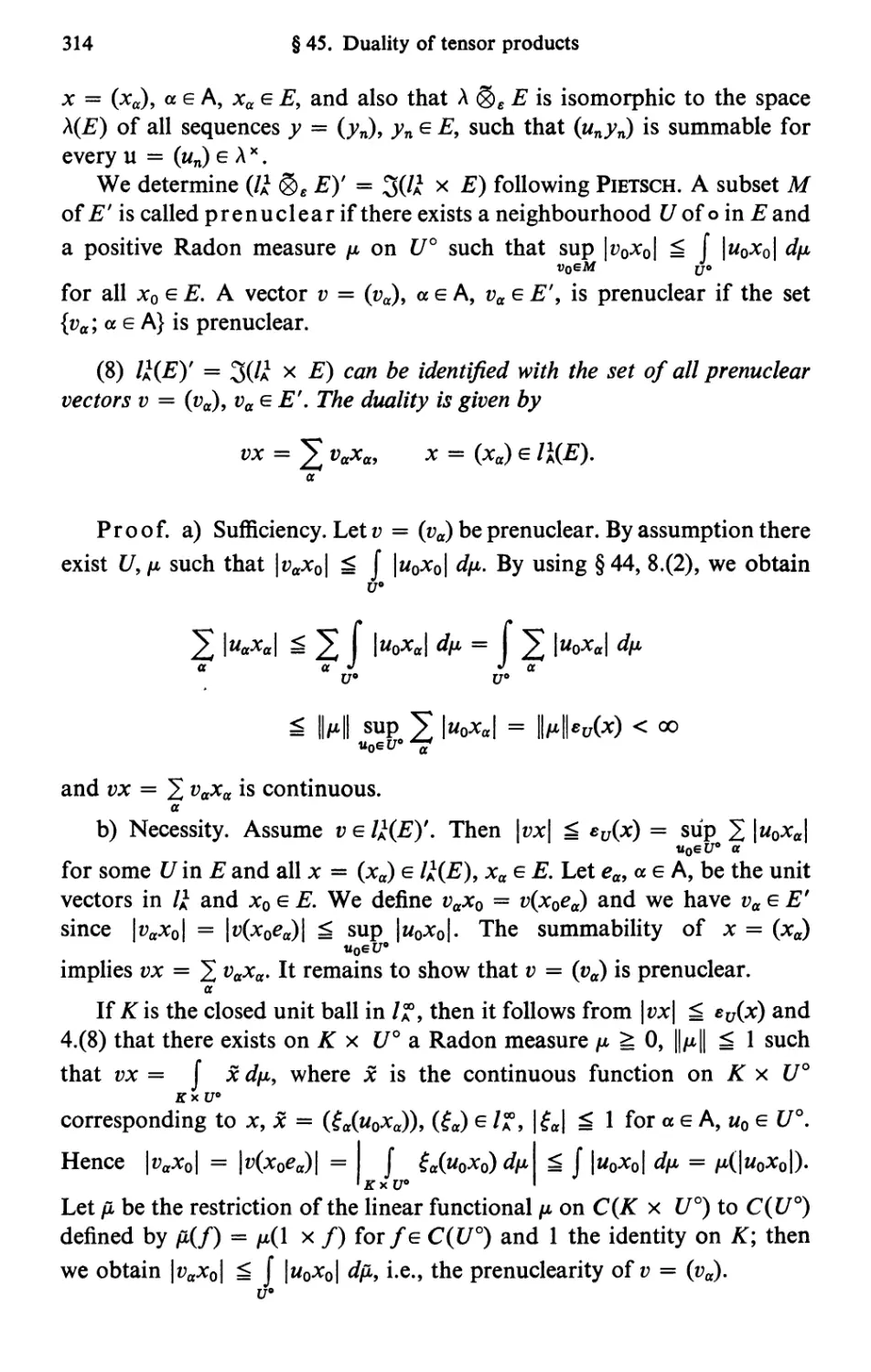


Текст
                    Grundlehren der mathematischen Wissenschaften 237
A Series of Comprehensive Studies in Mathematics
G. Kothe
Topological
Vector Spaces II
Springer-Verlag New York Heidelberg Berlin
Grundlehren der
mathematischen Wissenschaften 237
A Series of Comprehensive Studies in Mathematics
Editors
S.S.	Chern J.L. Doob J. Douglas, jr.
A.	Grothendieck E. Heinz F. Hirzebruch E. Hopf
S. Mac Lane W. Magnus M.M. Postnikov
W. Schmidt D.S. Scott
K. Stein J. Tits B.L. van der Waerden
Managing Editors
B.	Eckmann J.K. Moser

Gottfried Kothe
Topological Vector
Spaces II
Springer-Verlag
New York Heidelberg Berlin
Gottfried Kothe
Institut fur Angewandte Mathematik
der Johann-Wolfgang-Goethe Universitat
Frankfurt am Main
Federal Republic of Germany
AMS Subject Classification (1980): 46-02, 46 Axx, 46 Bxx, 46 Cxx, 46 Exx
Library of Congress Cataloging in Publication Data
Kothe, Gottfried, 1905-
Topological vector spaces.
(Grundlehren der mathematischen Wissenschaften 159, 237)
Translation of Topologische lineare Raume.
Bibliography: p.
1. Linear topological spaces. I. Title. II. Series.
QA322.K623	515'.73	78-84831
With 2 illustrations.
All rights reserved.
No part of this book may be translated or reproduced
in any form without written permission from Springer-Verlag.
© 1979 by Springer-Verlag New York Inc.
Printed in the United States of America.
987654321
ISBN 0-387-90440-9 Springer-Verlag New York Heidelberg Berlin
ISBN 3-540-90440-9 Springer-Verlag Berlin Heidelberg New York
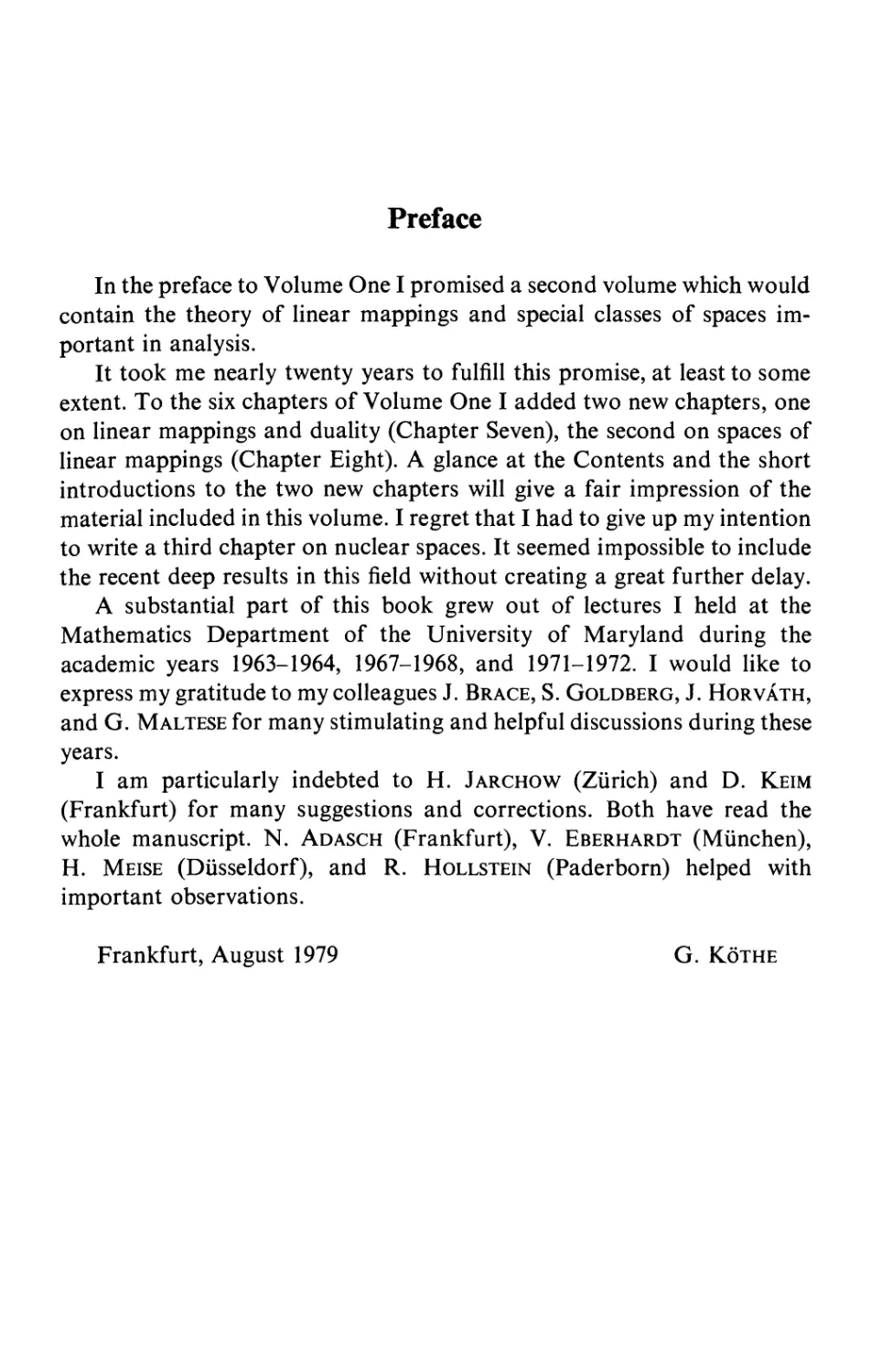
Preface
In the preface to Volume One I promised a second volume which would
contain the theory of linear mappings and special classes of spaces im-
portant in analysis.
It took me nearly twenty years to fulfill this promise, at least to some
extent. To the six chapters of Volume One I added two new chapters, one
on linear mappings and duality (Chapter Seven), the second on spaces of
linear mappings (Chapter Eight). A glance at the Contents and the short
introductions to the two new chapters will give a fair impression of the
material included in this volume. I regret that I had to give up my intention
to write a third chapter on nuclear spaces. It seemed impossible to include
the recent deep results in this field without creating a great further delay.
A substantial part of this book grew out of lectures I held at the
Mathematics Department of the University of Maryland during the
academic years 1963-1964, 1967-1968, and 1971-1972. I would like to
express my gratitude to my colleagues J. Brace, S. Goldberg, J. Horvath,
and G. Maltese for many stimulating and helpful discussions during these
years.
I am particularly indebted to H. Jarchow (Zurich) and D. Keim
(Frankfurt) for many suggestions and corrections. Both have read the
whole manuscript. N. Adasch (Frankfurt), V. Eberhardt (Munchen),
H. Meise (Dusseldorf), and R. Hollstein (Paderborn) helped with
important observations.
Frankfurt, August 1979	G. Kothe

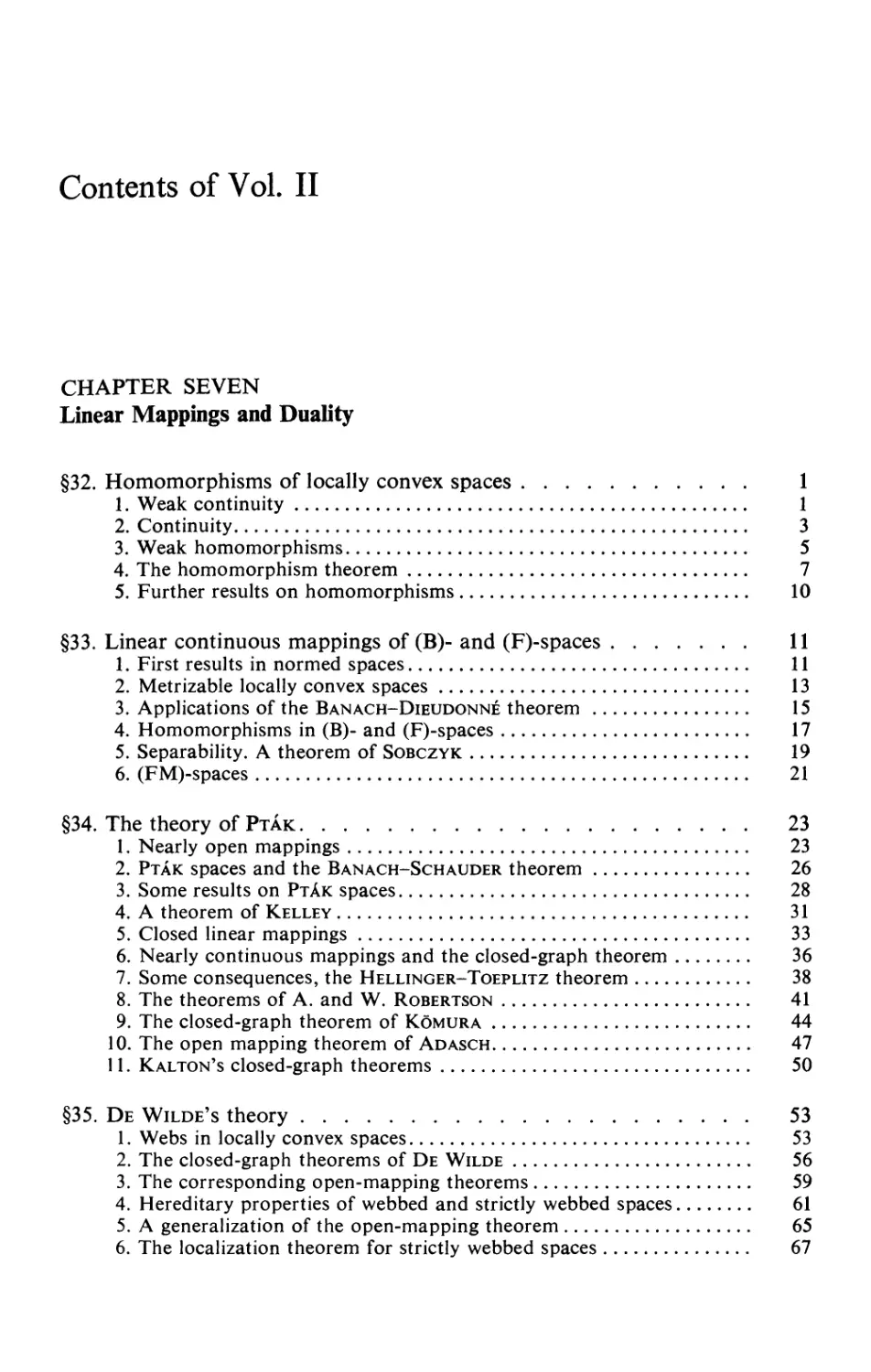
Contents of Vol. II
CHAPTER SEVEN
Linear Mappings and Duality
§32	. Homomorphisms of locally convex spaces......................... 1
1.	Weak continuity.............................................. 1
2.	Continuity................................................... 3
3.	Weak homomorphisms........................................... 5
4.	The homomorphism theorem..................................... 7
5.	Further results on homomorphisms............................ 10
§33	. Linear continuous mappings of (B)- and (F)-spaces............. 11
1.	First results in normed spaces.............................. 11
2.	Metrizable locally convex spaces............................ 13
3.	Applications of the Banach-Dieudonne theorem ............... 15
4.	Homomorphisms in (B)- and (F)-spaces........................ 17
5.	Separability. A theorem of Sobczyk.......................... 19
6.	(FM)-spaces................................................. 21
§34	. The theory of Ptak............................................ 23
1.	Nearly open mappings........................................ 23
2.	Ptak spaces and the Banach-Schauder theorem................. 26
3.	Some results on PtAk spaces................................. 28
4.	A theorem of Kelley......................................... 31
5.	Closed linear mappings...................................... 33
6.	Nearly continuous mappings and the closed-graph theorem....	36
7.	Some consequences, the Hellinger-Toeplitz theorem........... 38
8.	The theorems of A. and W. Robertson......................... 41
9.	The closed-graph theorem of Komura.......................... 44
10.	The open mapping theorem of Adasch.......................... 47
11.	Kalton’s closed-graph theorems.............................. 50
§35	. De Wilde’s theory............................................. 53
1.	Webs in locally convex spaces............................... 53
2.	The closed-graph theorems of De Wilde....................... 56
3.	The corresponding open-mapping theorems..................... 59
4.	Hereditary properties of webbed and strictly webbed spaces.	61
5.	A generalization of the open-mapping theorem................ 65
6.	The localization theorem for strictly webbed spaces......... 67
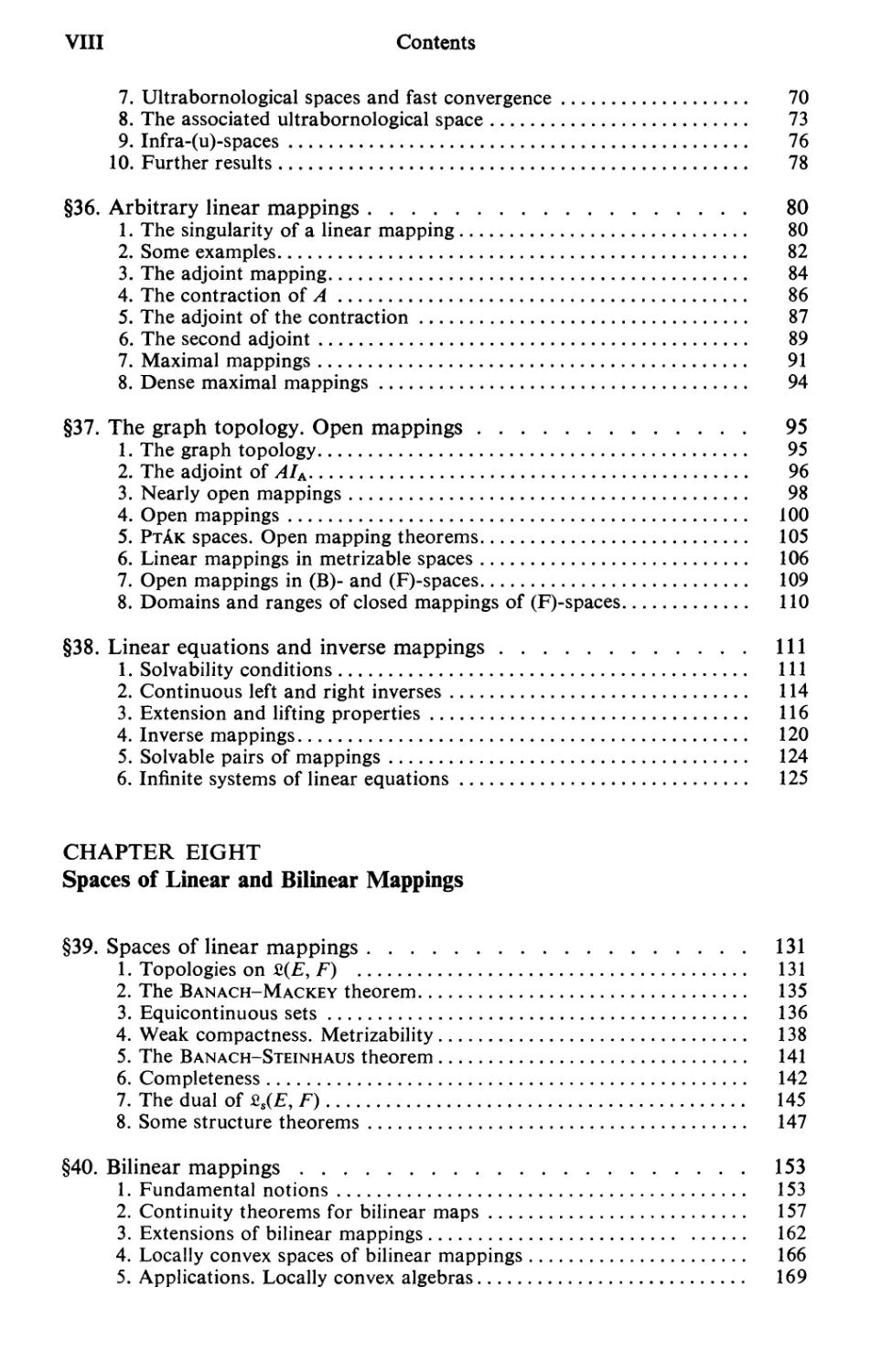
VIII
Contents
7.	Ultrabornological spaces and fast convergence.................... 70
8.	The associated ultrabornological space........................... 73
9.	Infra-(u)-spaces................................................. 76
10.	Further results................................................... 78
§36	. Arbitrary linear mappings........................................... 80
1.	The singularity of a linear mapping............................... 80
2.	Some examples.................................................... 82
3.	The adjoint mapping.............................................. 84
4.	The contraction of J............................................. 86
5.	The adjoint of the contraction................................... 87
6.	The second adjoint............................................... 89
7.	Maximal mappings................................................. 91
8.	Dense maximal mappings............................................ 94
§37	. The graph topology. Open mappings................................... 95
1.	The graph topology................................................ 95
2.	The adjoint of AIa............................................... 96
3.	Nearly open mappings.............................................. 98
4.	Open mappings................................................... 100
5.	PtAk spaces. Open mapping theorems............................... 105
6.	Linear mappings in metrizable spaces............................ 106
7.	Open mappings in (B)- and (F)-spaces............................ 109
8.	Domains and ranges of closed mappings of (F)-spaces.............. 110
§38	. Linear equations and inverse mappings.............................. Ill
1.	Solvability conditions........................................... Ill
2.	Continuous left and right inverses.............................. 114
3.	Extension and lifting properties................................. 116
4.	Inverse mappings................................................ 120
5.	Solvable pairs of mappings....................................... 124
6.	Infinite systems of linear equations............................ 125
CHAPTER EIGHT
Spaces of Linear and Bilinear Mappings
§39	. Spaces of linear mappings....................................... 131
1.	Topologies on £(E, F) ........................................ 131
2.	The Banach-Mackey theorem..................................... 135
3.	Equicontinuous sets........................................... 136
4.	Weak compactness. Metrizability............................... 138
5.	The Banach-Steinhaus theorem.................................. 141
6.	Completeness.................................................. 142
7.	The dual of £S(E, F).......................................... 145
8.	Some structure theorems....................................... 147
§40	. Bilinear mappings............................................... 153
1.	Fundamental notions........................................... 153
2.	Continuity theorems for bilinear maps......................... 157
3.	Extensions of bilinear	mappings............................... 162
4.	Locally convex spaces of bilinear mappings.................... 166
5.	Applications. Locally	convex	algebras....................... 169
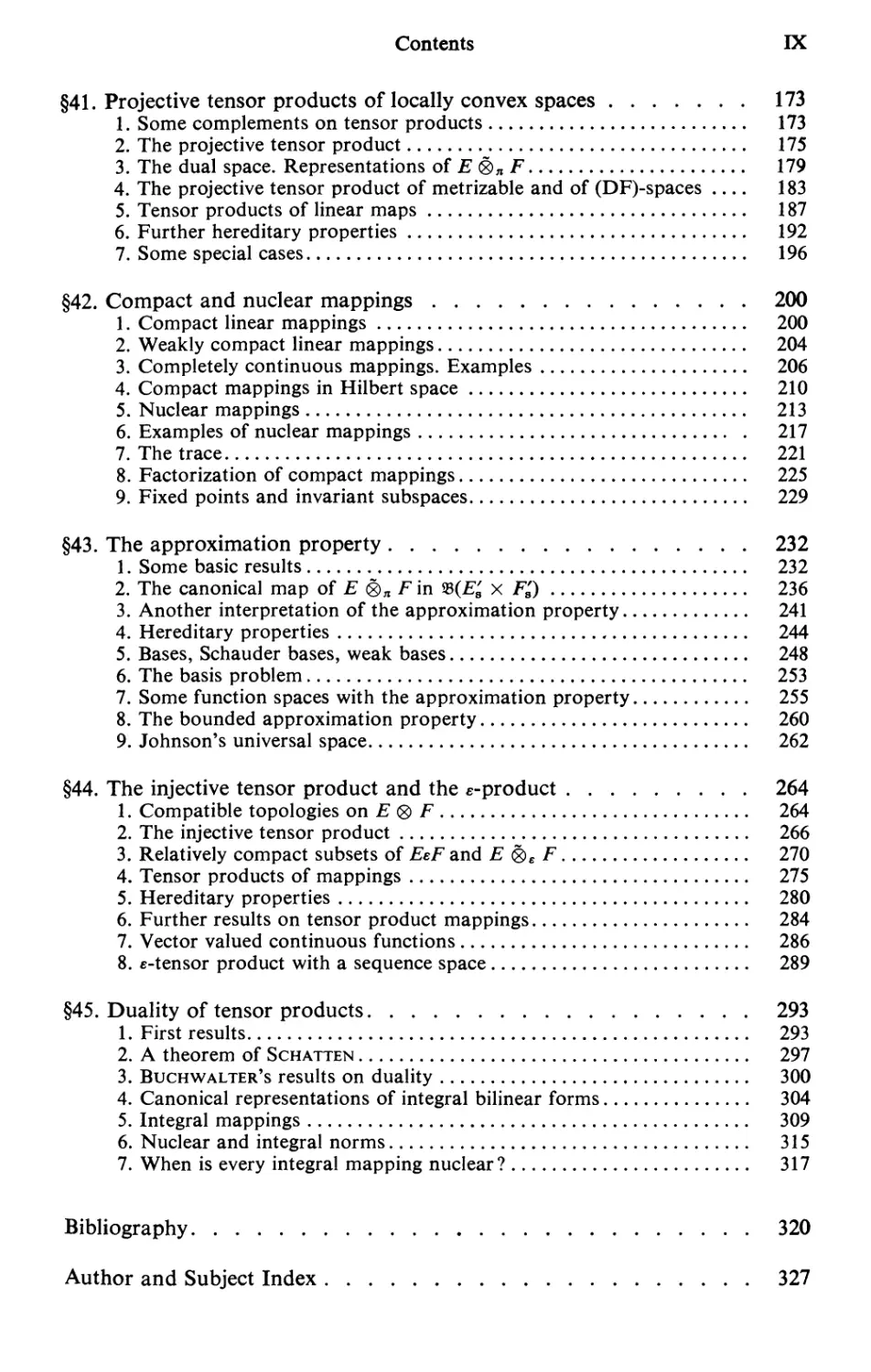
Contents	IX
§41	. Projective tensor products of locally	convex spaces................... 173
1.	Some complements on tensor products................................ 173
2.	The projective tensor product...................................... 175
3.	The dual space. Representations of E 0„ F.......................... 179
4.	The projective tensor product of metrizable and of (DF)-spaces ....	183
5.	Tensor products of linear maps..................................... 187
6.	Further hereditary properties...................................... 192
7.	Some special cases................................................. 196
§42	. Compact and nuclear mappings......................................... 200
1.	Compact linear mappings............................................ 200
2.	Weakly compact linear mappings..................................... 204
3.	Completely continuous mappings. Examples........................... 206
4.	Compact mappings in Hilbert space.................................. 210
5.	Nuclear mappings................................................... 213
6.	Examples of nuclear mappings....................................... 217
7.	The trace.......................................................... 221
8.	Factorization of compact mappings.................................. 225
9.	Fixed points and invariant subspaces............................... 229
§43	. The approximation property........................................... 232
1.	Some basic results................................................. 232
2.	The canonical map of E F in ®(E' x F')............................. 236
3.	Another interpretation of the approximation property............... 241
4.	Hereditary properties.............................................. 244
5.	Bases, Schauder bases, weak bases.................................. 248
6.	The basis problem.................................................. 253
7.	Some function spaces with the approximation property............... 255
8.	The bounded approximation property................................. 260
9.	Johnson’s universal space.......................................... 262
§44	. The injective tensor product and the e-product....................... 264
1.	Compatible topologies on E 0 F..................................... 264
2.	The injective tensor product....................................... 266
3.	Relatively compact subsets of EeF and E F.......................... 270
4.	Tensor products of mappings........................................ 275
5.	Hereditary properties.............................................. 280
6.	Further results on tensor product mappings......................... 284
7.	Vector valued continuous functions................................. 286
8.	е-tensor product with a sequence space............................. 289
§45	. Duality of tensor products........................................... 293
1.	First results...................................................... 293
2.	A theorem of Schatten.............................................. 297
3.	Buchwalter’s results on duality.................................... 300
4.	Canonical representations of integral bilinear forms............... 304
5.	Integral mappings.................................................. 309
6.	Nuclear and integral norms......................................... 315
7.	When is every integral mapping nuclear?............................ 317
Bibliography................................................................. 320
Author and Subject Index..................................................... 327

Contents of Vol. I*
CHAPTER ONE
Fundamentals of General Topology
§1	. Topological spaces............................................ 1
§2	. Nets and filters.............................................. 9
§3	. Compact spaces and	sets.................................... 16
§4	. Metric spaces................................................ 23
§5	. Uniform spaces............................................... 29
§6	. Real functions on topological spaces......................... 38
CHAPTER TWO
Vector Spaces over General Fields
§7	. Vector spaces................................................ 48
§8	. Linear mappings and matrices................................. 59
§9	. The algebraic dual space. Tensor	products.................... 69
§10	. Linearly topologized spaces................................. 82
§11	. The theory of equations in E and	E*...................... 101
§12	. Locally linearly compact spaces............................ 108
§13	. The linear strong topology	113
CHAPTER THREE
Topological Vector Spaces
§14	. Normed spaces.............................................. 123
§15	. Topological vector	spaces.................................. 144
§16	. Convex sets................................................ 173
§17	. The separation of	convex sets. The Hahn-Banach theorem ....	186
* Abbreviated.
хп
Contents
CHAPTER FOUR
Locally Convex Spaces. Fundamentals
§18	. The definition and simplest properties of locally convex spaces . . 202
§19	. Locally convex hulls and kernels, inductive and projective limits of
locally convex spaces............................................ 215
§20	. Duality................................................... 233
§21	. The different topologies on a locally convex space.........254
§22	. The determination of various dual spaces and their topologies . . 275
CHAPTER FIVE
Topological and Geometrical Properties of Locally Convex Spaces
§23	. The bidual space. Semi-reflexivity and reflexivity.........295
§24	. Some results on compact and on convex sets................ 310
§25	. Extreme points and extreme rays of convex sets............ 330
§26	. Metric properties of normed spaces........................ 342
CHAPTER SIX
Some Special Classes of Locally Convex Spaces
§27	. Barreled spaces and	Montel spaces......................... 367
§28	. Bornological spaces....................................... 379
§29	. (F)- and (DF)-spaces...................................... 392
§30	. Perfect spaces............................................ 405
§31	. Counterexamples............................................424
Bibliography......................................................437
Author and Subject Index......................................... 447
CHAPTER SEVEN
Linear Mappings and Duality
Continuous linear mappings between locally convex spaces are the subject
of § 32. The most important result is the homomorphism theorem in § 32, 4.
For (B)- and (F)-spaces much more can be said. § 33 contains a detailed
investigation of these cases culminating in the homomorphism theorems for
(B)- resp. (F)-spaces in § 33, 4. A lifting property for separable locally convex
spaces leads to the theorem of Sobczyk.
The following two paragraphs contain an exposition of some of the results
on open-mapping and closed-graph theorems. § 34 starts with Ptak’s ideas
and ends up with Komura’s closed-graph theorem and Adasch’s open-
mapping theorem for barrelled spaces. Many other results are included, given
by Kalton, Kelley, and the Robertsons. § 35 gives an account of De Wilde’s
theory of webbed spaces and his closed-graph theorems, which are especially
useful in applications. An optimal closed-graph theorem for ultrabornological
spaces is obtained in § 35, 9.
Arbitrary linear mappings are studied in § 36. The introduction of the
notion of the singularity and the regular contraction of a mapping reduces the
investigation to the case of closable (regular) or even continuous mappings.
A duality theory and an extension theory are presented. A second method of
investigating arbitrary linear mappings uses the graph topology (§ 37). Both
methods are applied to nearly open and open mappings. The open-mapping
theorems obtained in this way are more general than the previous theorems.
The cases of (B)- and (F)-spaces are treated in § 37, 7.
§ 38 contains applications to systems of linear equations, the existence and
continuity of left, right, and two-sided inverse mappings, and an introduction
to the problems of extending and lifting linear mappings.
§ 32. Homomorphisms of locally convex spaces
1. Weak continuity. Volume I contains very little information on linear
mappings. We will now enter into a more systematic investigation of this
topic and begin by recalling some of the basic facts.
Let E, F be topological vector spaces; then £(£, F) is the vector space
of all continuous linear mappings of E into F. Any A e £(£, F) has by
§15,4. the natural decomposition
(1)	A = JAK,
2	§32. Homomorphisms of locally convex spaces
where К is the canonical homomorphism of E onto E/N[A], A is a con-
tinuous one-one linear mapping of E/N[A] onto A(E), and J is the
embedding of A(E) into F. The product JA will be denoted by A.
A is a topological homomorphism of E into F if every open subset M
of E has an image A(M) which is open in A(E). If A is also one-one, then
A is a topological monomorphism. If further A(E) = F, then A is a
topological isomorphism.
We will frequently omit “topological” when there is no danger of
misunderstanding.
(2)	A e £(F, F) is a homomorphism if and only if one of the following
conditions is satisfied: (a) A maps every neighbourhood of о in E onto a
neighbourhood of о in A(E); (b) A is an isomorphism; (c) A is a mono-
morphism.
The simple proof is left to the reader.
We consider now locally convex spaces E and F. Let E' and F’ be their
duals. We replace the initial topology on E resp. F by the weak topology
X8(Er) resp. XS(F'). We proved in § 20, 4. the basic result
(3)	A linear mapping A of E into F is weakly continuous if and only if the
adjoint A' maps F' into E'.
A is weakly continuous if and only if A' is weakly continuous.
The weak topology on F' resp. E' is the topology XS(F) resp. XfJE).
An equivalent formulation for (3) is
(4)	A linear mapping AofE into F is weakly continuous if and only iffor
every closed hyper plane Нэ о in F the inverse image A{ ~ 1)(/T) is closed in E.
Proof. A hyperplane H in F containing о is given by an equation
r(j>) = 0, where г is a linear functional in Fand H is closed if and only if
veF' (§15, 9.(1)). The inverse image Л(-1)(Я) is determined by их =
v(Ax) = (A'v)x = 0. It is therefore closed if and only if и = A'v is an
element of E'. Now (3) follows from (2).
For a weakly continuous mapping A of E into Fand its adjoints we have
(5)	A(Ef = Л(£)° = Я[Л'],
A\F'Y = AfF'Y = Я[Л],
where Я[Л] denotes the kernel of A. This is an immediate consequence of
the relation v(Ax) = (A'v)x, v g F', x g E.
By taking polars on both sides of (5) we get
(6)	Л(Ё) = Я[Л']° = ЯМ']1,
Л'(Г) = Я[Л]° = ЯМ]1.
2. Continuity
3
We make the following remarks: i) Every Ле£(£, F) is weakly con-
tinuous (§ 20, 4.(5)) and therefore has a weakly continuous adjoint, ii) In
particular, (5) and (6) are true for continuous A too. iii) In (6) the closure
of Л(Е) may be taken in the initial topology of For in the weak topology;
the closure of A'(F') is always the Xs(F)-closure.
An immediate consequence of (6) is
(7)	The range A(E) of A is (weakly) dense in F if and only if = o.
The range A'(F') of A' is weakly dense in E' if and only if А[Л] = о.
The relations (5) are also contained as special cases in the following
proposition.
(8)	Let A be a (weakly) continuous mapping of E into F. Then
(9)	A(M)° = A'(~1}(M°) holds for any subset M of F, and
(10)	Л(’1)^°) = A'(N)Qfor any subset N ofF'.
Relation (9) was proved in Volume I, § 22, 7.(1). Replacing A by A' in (9)
and using weak duality gives (10).
We give an application of (4).
(11)	Let E be locally convex and suppose that every sequentially closed
hyperplane containing о in E is closed. If A is a linear and sequentially
continuous mapping of E into a locally convex space F, then A is weakly
continuous.
Proof. Let H => (o) be a closed hyperplane in F. Suppose xn e A( ~ ^(H)
and xn x0 e E. Then Axn Ax0 and Ax0 e Я; thus x0 e A( ~ 1)(H). There-
fore Л(-1)(Я) is sequentially closed and by hypothesis closed. The state-
ment now follows from (4).
The assumption in (11) is satisfied for the weak dual F'[IS(E)] of a
separable (F)-space E because of the theorem of Banach-Dieudonne
(§21,10.(7)).
2. Continuity. If A is continuous, then it is weakly continuous. The
converse is not true. It is not difficult to get an exact description of the
situation.
If E is locally convex, E' its dual, then a general method introducing
other locally convex topologies on E is the following (§ 21, 1.). Choose a
total and saturated class 9Л of weakly bounded subsets of £', and let
be the topology of uniform convergence on the sets of 9Й.
(1) A weakly continuous linear mapping of E into F is continuous in the
sense of on E andX^ on F if and only if Л'(ЗЛ2) <= ЗЛ1Ф
4
§ 32. Homomorphisms of locally convex spaces
Proof. The sets V = M2, M2gJR2, form a base of Xgj^-neighbour-
hoods of о in F. By 1.(10) we have	= ^(-1)(AQ = A'(M2)0.
Therefore Л(-1)(К) is an -neighbourhood in E if and only if A'(M2) e 9Jli.
We have already treated the special case in which both topologies are
the Mackey topologies, in § 21, 4.(6); for the sake of completeness we state
it again:
(2)	Weakly continuous and ^-continuous linear mappings of E into F
coincide.
Two other special cases of (1) are given in
(3)	Every weakly continuous linear mapping A of E into F is strongly
continuous and Zb*-continuous.
The first statement follows immediately from (1) since every weakly
bounded subset M of F' has an image A\M) in E' with the same property.
is the topology of uniform convergence on the strongly bounded
subsets of the dual space. Let N be strongly bounded in F'. Then we have
for any bounded set M in E
sup |(Л'м)х| = sup |м(Лх)| < oo
xeM.ueN
since A(M) is bounded in F. But then A’(N) is strongly bounded in E' and
(1) gives the desired result.
Observe that a strongly continuous mapping need not be weakly
continuous. Since the dual space to £[Xb(£')] is in general larger than £',
there even exist strongly continuous linear functionals which are not
weakly continuous. The same argument is valid for the topology Xb*.
(4)	If A e £(£, F), then A' is weakly continuous, strongly continuous,
^-continuous, and Zc-continuous.
Since A' is weakly continuous, all the statements with the exception of
the last one follow immediately from (2) and (3). Now Xc is the topology
of precompact convergence (§21,6.) and by §15, 6.(7) the continuous
linear image A(M) of a precompact set M is again precompact; hence A'
is Xc-continuous by (1).
By § 5, 4.(4) it is often sufficient to define a continuous linear mapping
only on a dense subspace:
(5)	Let E and F be topological vector spaces where F is complete. Then
every A e £(£, F) has a uniquely determined linear and continuous extension
A defined on the completion Ё of E, A g £(Д F).
3. Weak homomorphisms
5
In § 17, 6.(6) we proved for normed spaces that A" is an extension of A
which maps the bidual E" into the bidual F" and satisfies ||Л"|| = ||Л||.
For locally convex spaces E and F we have the following situation:
(6)	a) Let A e £(£, F) be given. Then the double adjoint A" of A is an
extension of A which maps the bidual E" into the bidual F" and A" is con-
tinuous in the sense of the natural topologies on the biduals.
b) A” is also continuous for the topologies ZS(E') andZs(F') on E" and
F", respectively, and A" is the uniquely determined weakly continuous
extension of A to E".
a)	A' is strongly continuous by (4), so it is in £(F', E'), where E', F'
denote the strong duals. The adjoint A" is thus a mapping of (E'f = E"
into F" which is an extension of A.
By § 23, 4. a neighbourhood base of о for the natural topology Xn(F') on
E" consists of the sets U°°, U an absolutely convex neighbourhood of о in
£[X], where the last polar is taken in E".
Starting with Л(С7) c= F, we have V° <= A(Uf = A’^tTfAfV0) c= UQ,
U°° c= A'(V°)° = A"^1^00), and this means A"(U°°) c= V°°, so that A"
is continuous.
b)	A is also weakly continuous and the weak continuity of A” follows
as in a) if we use weak neighbourhoods U, V. Since E is weakly dense in
E", A" is the uniquely determined extension of A to E".
3.	Weak homomorphisms. We begin with a proposition on arbitrary
homomorphisms,
(1)	If A is a homomorphism of the locally convex space F[XJ into the
locally convex space F[X2], then A'(F') is weakly closed in E'.
Let u0 be a point of the weak closure of A'(F'). For all z e N[Л] we
have uoz = 0 by 1.(6). If we define I (Ax) = uox, then / is therefore a
uniquely determined linear functional on A(E). It is continuous: U =
{x; |wox| < e} is an open ^-neighbourhood of о in E; since A is open,
A(U) = Vis a ^-neighbourhood of о in A(E). Therefore |/(Лх)| < e for
all Ax e V.
By the Hahn-Banach theorem / has an extension vQ e F' and vQ(Ax) =
uQx for all x e E; hence w0 = A’vQ and A'(F’) is weakly closed.
If Xi and X2 are the weak topologies, the converse of (1) is also true:
(2)	A e £(£, F) is a weak homomorphism if and only if A'(F') is weakly
closed in E'.
6
§ 32. Homomorphisms of locally convex spaces
Proof. Since A is continuous it is weakly continuous. So we have
only to prove that A is weakly open if A'(F') is weakly closed.
Let U be an absolutely convex open weak neighbourhood of о in E.
Since A(U + 7У[Л]) = A(U), we may assume U Л^[Л]. Then t/° <=
7У[Л]° = A'(F') = A'(F'). Now U° is bounded and finite dimensional in
A’(F'f so U° is contained in the absolutely convex cover of finitely many
щ e A\F'\ i = 1,..., k. If Uo denotes the open weak neighbourhood of
о in £ given by |М|%| < 1, i = 1,..., k, then Uo <= U. There exist e F’
such that щ = A'Vi. Let К be the open weak neighbourhood of о in F given
by |tv| < 1, i = 1,..., k. From v^Ax) = (A'v^x = щх follows x e Uo
for all Ax eV; therefore A(W) A(Uq) ° V n A(E); A is weakly
open.
(3)	A homomorphism A e £(E, F) is always a weak homomorphism.
This is an immediate consequence of (1) and (2). We list some special
cases:
(4)	a) A e £(£, F) is a weak monomorphism if and only if A'(F’) = E'.
b)	A is a weak homomorphism with weakly closed range if and only if
this is true for A'.
c)	A is a weak monomorphism with closed range if and only if A' is a
weak homomorphism of F' onto E'.
d)	A is a weak isomorphism if and only if A' is a weak isomorphism or
if and only if A(E) = F and A’lfF') = E'.
e)	A is one-one and A(E) = F if and only if A' is a weak monomorphism
onto a weakly dense subspace of E'.
f)	A is a weak homomorphism with dense range in F if and only if A' is
one-one and A'(F') is weakly closed.
Proof, a) follows from (2) and 1.(7), b) by applying (2) to A and A',
c) from a) and b), d) from c) and 1.(7), e) from a) and 1.(7), and f) from
(2) and 1.(7).
We remark that the range of a homomorphism is in general not closed.
For example, the injection J of a normed space E into its completion
E / E is a monomorphism with range dense in Ё but different from Ё.
Applying e) to J’ we see that J' is one-one and J'{E') = E'; but J' is not
a weak isomorphism, since it is the identity on E'[Zs(E)] and maps it on
£'№)]•
However, if A is a monomorphism of a complete E into F, then the range
A(E) is closed in F, since A(E) is isomorphic to E and therefore complete.
This generalizes to homomorphisms in the following way:
4. The homomorphism theorem
7
(5) Let A be a homomorphism of in F[X2]. The range A(E) is
closed if (E/N [Л])[£1] is complete.
In particular, A(E) is closed if A is a monomorphism and E is complete.
Examples. 1) Let J be the injection of a subspace Я[Х] of E[I] into E.
J is a monomorphism; therefore ((4) a)) J\E’) = H'. If we identify FT with
E'/HL (§ 22, 1.), then J' is the canonical mapping of E' onto E’/HL.
If H is closed, then J' is a weak homomorphism ((4) c)), where the weak
topology on E’/HL is Х3(Я). If H is not closed, J’ is not a weak homo-
morphism.
2) Let Я be a closed subspace of £, К the canonical homomorphism of
E onto E/H. Then K' is by (4) b) and f) a weak monomorphism of (E/H)'
into E'. If we identify (E/Hf with Я1 <= E', then K' is the injection of
Я1 in E' (§ 22, 2.).
3) By 1.(1) a continuous linear mapping A of E into Fhas the natural
decomposition A = JAK. The corresponding decomposition of A' is
(6)	A' = ЛГ'2'J'.
Is this the natural decomposition of A' as a weakly continuous mapping
of F' into £'?
By 1) J' is the canonical mapping of F' onto A(E)’ = F’jA(E)L =
F'/N\A'} and this is a weak homomorphism if and only if Л(£) = Л(£).
This is a first necessary condition. K' is, by 2), the injection of ЯЦ]1 =
A'(F') in £', so we find that A'(F') = A'(F') is a second necessary condi-
tion. If both these conditions are satisfied, then A' is a weak isomorphism
of F'/N[A'] onto A'(F') = (E/N [A])'. Thus we obtain
(7)	(6) is the natural decomposition of A' if and only if A is a weak
homomorphism with closed range.
4.	The homomorphism theorem. In 3.(2) we gave a dual characterization
of weak homomorphisms. Our aim is now to prove a corresponding
theorem for arbitrary homomorphisms.
(1)	Let A be a weak homomorphism of the locally convex space FflJ
into the locally convex space F[X2] and let<iSl1 resp.$Jl2 be the class of equi-
continuous subsets of E' resp. F'. If A is Xi-X2-o/?ew, then Л'(Ш12) =>
JRi n Л'(Г') = {M, e 9Jli; Mr <= Л'(Г')}.
Proof. It is sufficient to prove this for an arbitrary absolutely convex
and weakly closed set Mt e n A'(F') since A'(Ff) is weakly closed by
3.(1). The polar Ml is a closed ^-neighbourhood of о in E. Since A is
Si-X2-open, A(MI) contains a closed ^-neighbourhood of о in A(E),
8
§ 32. Homomorphisms of locally convex spaces
М2 A A(E), where M2 e 9R2 is absolutely convex and weakly closed in F'.
Applying A(~v to A(M{) М2 n A(E) gives MJ + А[Л] => А(-1}(М^ =
A'(M2)° (1.(10)). But M,c:A'(F'); hence MJ => А[Л] by 1.(5) and
therefore MJ = MJ + А[Л] => A'(M2)°. Taking polars in E' we obtain
Mi с Л'(М2). Now M2 is weakly compact by the theorem of Alaoglu-
Bourbaki; therefore Л'(М2) is closed, so finally M± <= Л'(М2).
(2)	Let A be a weak homomorphism of £[Хг] into F[X2]. If A'(2R2) =>
5JRi n A\F'f then A is Zr-^-open.
We have to show that for every 2^-neighbourhood U of о in E there exists
a ^-neighbourhood К of о in Fsuch that A(U) => Vn A(E). It is sufficient
to prove this for U absolutely convex and closed and U => А[Л] since
A(U + А[Л]) = A(Uf Now U° = Mr is in and Mr c= А[Л]° =
A'(F') (here we used 3.(2)); therefore by assumption there exists M2 e 9R2
such that Mi <= Л'(М2). By 1.(10) we have MJ => Л(-1)(М£) and applying
A on both sides we get yl(Mj) = A(U) => MJ n A(E), showing that A is
Xi-X2-open.
Combining (1), (2), and 3.(2) we have (Grothendieck [11])
(3)	Homomorphism theorem: Let E and F be locally convex and 9Л1
resp.yjl2 be the classes of equicontinuous sets in E' resp. F'.
A linear continuous mapping A of E in F is a homomorphism if and only
if a) A'(F") is weakly closed in E', b) Л'(Ш12) SRi n A'(F').
If we use (1), (2), and 2.(1) we get the slightly different version
(4)	A weak homomorphism A of E in F is a homomorphism if and only
ifAfW^) =50li n A\F'f
The case of the Mackey topologies is of special interest.
(5)	Let £[Xi] and F[X2] be locally convex and let X2 be the Mackey
topology Xk(F').
A linear continuous mapping A of E onto F is a homomorphism if and
only if A is a weak homomorphism or if and only if A'(F') is weakly closed.
Every weak homomorphism of E onto F is a ^-homomorphism onto F
and conversely.
First proof. The condition in the first statement is clearly necessary.
Conversely, if A is a weak homomorphism onto F, then by 3.(4) c) A' is a
weak monomorphism of F' onto A'fF') and condition b) of (3) is satisfied
since every absolutely convex and weakly compact set M in A'(F') is the
image of the set Л'(-1)(М) with the same properties in F'. Hence the first
statement in (5) is a special case of (3).
4. The homomorphism theorem
9
If andX2 are both Mackey topologies, then a weak homomorphism
is a linear Xte-continuous mapping (§ 21, 4.(6)) and the second statement
in (5) is included as a special case in the first.
Second proof. Let A e £(£, F) be a weak homomorphism onto F;
then A is a weak isomorphism of E/N[A] onto E On E, Xx is coarser than
Zk(E') and by § 22, 2.(3) the quotient topology Xfc on E/N[A] is identical
with the Mackey topology Xte(7V[^]°). Therefore Xx is coarser than
Xfc[7V[^4]°] on E/N[A], so that the weak isomorphism A maps Xx onto a
topology XI on F which is coarser than Zk(F'). Now the image A(U) of a
Xi-open neighbourhood of о in £ is an open X'i-neighbourhood of о in £
and therefore also an open Xte(£')-neighbourhood of o. This means that A
is open, and, since by assumption A is continuous, that A is a homo-
morphism.
If we combine 3.(4) c) with the second statement of (5), we find
immediately
(6)	Let Abe a weakly continuous linear mapping of E into F Then A' is
a^-homomorphism of F' onto E' if and only if A is a weak monomorphism
with closed range.
The first statement of (5) is no longer true for arbitrary weak homo-
morphisms of £ into £. The following example of Bourbaki shows that
even a weak monomorphism with a dense range need not be a Xte-homo-
morphism.
Let £=<?,£' = co, and let z be an element of (£')* which does not
lie in <p. Let £ be the subspace ф [z] of (£')*• On £ and £ we define the
topology Xs(co), so that £' = £' = co. Since co is bornological, the linear
functional z is not bounded on all bounded subsets of co. Therefore the
class of all absolutely convex and Xs(£)-compact subsets of co is a strict
subclass of the class of allXs(£)-compact subsets of co. Since the latter class
coincides with the class of all bounded subsets of co, the Mackey topology
on <p is strictly finer than the Mackey topology on £ restricted to <p. Now,
let J be the injection of <p into £. Since /'(£') = £' = co, J is a weak
monomorphism onto the dense subspace <p of £, but it is not a Xfc-homo-
morphism.
We note an application of (5):
(7)	Let A be a monomorphism of the complete semi-reflexive space E in
the semi-reflexive space F. Then A' is a strong homomorphism of F' onto E'.
By 2.(4) A' is a continuous mapping of £'[Xb(£)] onto £'[Xb(£)]. Since
£ and £ are semi-reflexive, the strong topologies on Ef and £' coincide
10
§ 32. Homomorphisms of locally convex spaces
with the Mackey topologies. Hence A" = A and, since E is complete,
AfE) is closed and therefore Xs(^ )"cl°sed *n F- By applying (5) to A we
obtain (7).
5.	Further results on homomorphisms. So far we have investigated homo-
morphisms for topologies on E and F which are compatible with the dual
systems <E', £> and <F', F>. The situation becomes more involved when
we include the strong topology. We give first two examples.
1. I1 is a subspace of Z2. We equip both spaces with the norm topology of
Z2. Let J be the injection of Z1 into Z2. Since (Z1)' = (Z2)' = Z2, J' is the identity
on Z2 and is weakly continuous but is not a weak isomorphism of Z2[XS(Z2)]
onto Z2[XS(Z1)]. However, J' is a strong isomorphism since X^Z1) and Xb(Z2)
coincide on Z2.
This shows that there exist strong isomorphisms which are weakly con-
tinuous but are not weak isomorphisms.
2. Let E be locally convex and H be a closed subspace of E such that the
topology ib(E') is strictly finer on E/H than	we constructed such an
example in § 31, 7. Let К be the canonical homomorphism of E onto E/H.
It is a weak but not a strong homomorphism. The adjoint K' is the injection
of (E/H)' = HL into E'. If resp. $R2 is the class of weakly bounded
subsets of E' resp. then A?'(%) =	This means that К
satisfies the analogous assumptions in 4.(4) and yet is not a strong homo-
morphism.
The homomorphism theorem is therefore no longer true for topologies
which are strictly finer than the Mackey topology.
But it is possible to give a dual characterization of monomorphisms in
the general case.
(1) Let E and F be locally convex and(!St1 g resp. 9Jl2 ° 8 saturated
classes of weakly bounded subsets of E' resp. Ff. A map A e£(£, F) is a
monomorphism of £[1^] in £[2яп2] if and only if the following conditions
are satisfied:
i) Л'(ЭЛ2)<=	________
ii) every e is contained in some A\M?f M2 g ЭЛ2.
g is always the class of all bounded subsets of finite dimension, soX$ is
the weak topology.
Proof, a) Necessity. For i) this is a consequence of 2.(1). Let be
an absolutely convex weakly closed subset in Since A is open, there
exists an absolutely convex and weakly closed M2 e 9Jl2 such that A(M%)
M2 n A(E), so applying Л(-1) gives Ml Л'(Л/2)°. From this follows
Л'(М2)°° = AfM^) M,.
1. First results in normed spaces
11
b) Sufficiency. From i) and 2.(1) it follows that A is Xan^X^-con-
tinuous. From ii) it follows that IJ Л'(Л/2) ° U = £'; thus
______	M2eSR2
A'(F') = E' and A is one-one. It remains to prove that A isX^-Xgj^-open.
But, given e 9Jlx, there exists M2 e 9Jl2 by ii) such that <= Л'(Л/2).
Therefore MJ Л'(М2)° = Л("1)(М2°) and Л(М?) MQ2 n Л(£).
We have the following special cases of (1):
(2)	Let A be a continuous linear map of E in F, E and F locally convex.
A' is a strong resp. Xc-monomorphism of F' in E' if and only if every
bounded resp. precompact subset M2 of F is contained in the closed image
A{M^) of a bounded resp. precompact set in E.
This follows from (1) since A' is weakly continuous from F' in E' and
A" = A satisfies i), because bounded resp. precompact sets have images
with the same properties (§ 15, 6.).
We close with some remarks on extensions of homomorphisms.
(3)	Let E, F be locally convex and A e £(£, F), and let H be a dense
subspace of E. If the restriction of A to H is a homomorphism resp. mono-
morphism of H in F, then A has the same property.
Proof. Note first that FT = E', A and its restriction have the same
adjoint A', and the equicontinuous sets in E' are the same for H and E.
Thus, since A'(F') is Ts(//)-closed in £', it is also 2yF)“cl°sed. The state-
ment follows now from 4.(3).
(4)	Let Abe a homomorphism of £[Xx] in F[X2]. Assume that the natural
topologies Xln resp. X2n on E" resp. F" are coarser than the Mackey topo-
logies on E" resp. F". Then A" is a homomorphism of E"[Xln] in F"[X2n]-
By 2.(6) A" is continuous from E"[Xln] in F"[X2n]. By our assumption
on the topologies (E")' = E', (F")' = F', and the adjoint to A" is Af. Since
A is a homomorphism, A'(Ff) is Xs(£)-closed and therefore also XS(E")-
closed. So condition a) of 4.(3) is satisfied and condition b) is satisfied by
A; and by the definition of the natural topologies A" therefore satisfies
b) also.
§ 33. Linear continuous mappings of (B)- and (F)-spaces
1.	First results in normed spaces. So far we have investigated linear
maps in general locally convex spaces. Much more information is available
in the metrizable case, as we will see in this paragraph. We begin with some
remarks on normed spaces.
12
§33. Linear continuous mappings of (B)- and (F)-spaces
Let E and F be normed spaces and A e £(E, F). Then A has a norm
|| Л || which was defined in § 14, 1.
Let A = JAK = AK be the natural decomposition of A (§ 32, 1.(1)).
We have ||J|| = 1 for the injection J of Л(Е) into F and ЦЕ’Ц = 1 for the
canonical homomorphism of E onto EIN\A\. We have also
(1)	Mil = Mil = IK
Trivially, Mil = Mil an^ Mil = PIlMllMII = Mil- Since Ax = Ax for
every x e x e E/N[A], it follows M*ll = Mil inf|M|| = Mil Mil for all x
xex
and so ||Л||	||Л||, which proves (1).
If A is a monomorphism of the normed space E into the normed space
F, then Л(-1) is a continuous and therefore bounded map of A(E) onto E.
From this follows
(2)	A e £(E, F), E and F normed spaces, is a monomorphism if and only
if A is bounded from below, i.e., there exists m > 0 such that ||Лх|| лп || at ||
for all хе E.
Obviously we may define m by ||Л(-1)|| = I Im.
The fundamental Banach-Schauder theorem (§ 15, 12.(2)) applied to
(B)-spaces E and F says that A e £(E, F) is a homomorphism if and only
if the range Л(Е) is closed in F.
We give two examples to show that this is no longer true if E or F is
normed but not complete.
a)	Let E be normed and not complete and let J be the injection of E
into Ё. Then J is a monomorphism but J(E) is not closed in Ё.
b)	Let E be I1 and F be I1 but with the norm of /2. Then the identity
map of E onto F is continuous and onto but not a monomorphism. F is
normed but not complete.
Note that the range of a homomorphism between Banach spaces or
even (F)-spaces is always closed; this follows from § 32, 3.(5) and the
completeness of the quotient spaces of (F)-spaces. The real difficulty lies
in the converse statement and it will be our aim to find more general
classes of spaces for which the analogue of the Banach-Schauder
theorem is true.
We now apply the duality theory of § 32 to the case of normed spaces.
(3)	Let E and F be normed spaces and A a homomorphism of E in F.
Then A' is a strong homomorphism of F' in E'.
Proof. Af is weakly and strongly continuous (§ 32, 2.(4)). The equi-
continuous sets in Ef and F' are the subsets of the multiples of the unit ball.
Since A is a homomorphism, it follows from condition b) of § 32, 4.(3) that
2. Metrizable locally convex spaces
13
if Mis the closed unit ball in F', then A'(M) contains a ball of A'(F'). A' is
therefore open in the sense of the strong topology.
The converse of (3) is true in the following form:
(4)	Let E be a (B)-space, F a normed space, and A e £(£, F). If A' is a
strong homomorphism, then A is a homomorphism with closed range.
Proof. By assumption there exists a closed ball N in F such that
A’(N°) => M° n A'(F'), where M is the closed unit ball in E. Applying
Л'(-1) we get № 4- А[Л'] 13 Л'(-1)(М°) = Л(М)°. Taking polars gives
N n A(E) <= A{M). Hence N n A(E) = N n A(M). Since A(M) is abso-
lutely convex and F normed, one has N n A(M) = N n A(M). It follows
from N n A(E) = N n A(M) that the image A(M) of the unit ball is
dense in the ball N n A(E) of A(E).
Repeating the argument in the second part of the proof of the Banach-
Schauder theorem and using the completeness of E, one finds that
Л((1 4- e)M) covers the ball N n A(E); therefore A is open. That A has
closed range follows from the completeness of E/N[A].
As an example, in § 37, 6. will show that (4) is false if we suppose E
to be only normed.
2.	Metrizable locally convex spaces. We begin with an elementary
characterization of homomorphisms.
Let E and F be locally convex and A e £(£, F). We say that A is
sequentially invertible if for every sequence yn e Л(£) converging to
zero there exists a sequence xn e E such that Axn = yn and xn -> o.
(1)	Let E and F be metrizable locally convex spaces. A e£(£, F) is a
homomorphism if and only if A is sequentially invertible.
Proof. A is a homomorphism if and only if A is an isomorphism of
£/А[Л] onto Л(Е). Both are metrizable. If A is a homomorphism and
yn = Axn -> o, then xn -> 6. But there always exist xn e xn such that
xn -> o, as can be seen by a diagonal procedure outlined in the proof of
§ 22, 2.(7). Therefore A is sequentially invertible.
On the other hand, if yn = Axn -> о and xn -> o, then Axn -> 6 and
xn -> 6, so ?Г(_1) is continuous and A is an isomorphism.
Our next result will be an application of the homomorphism theorem
of § 32, 4. The topology of a metrizable locally convex space E is always
the Mackey topology Xfc(£) (§ 21, 5.(3)). If Я is a linear subspace of E,
then H is metrizable in the induced topology Xfc(£') and therefore Xfc(£')
coincides with Ifc(H')-
(2)	The topologies Xfc(£') and X AH') coincide on each subspace H of a
metrizable locally convex space E.
14
§33. Linear continuous mappings of (B)- and (F)-spaces
Remark. By § 22, 2. the equality of Xfc(E') and	may be
formulated in the following way: If G is a weakly closed subspace of £',
where E is metrizable locally convex, then every absolutely convex weakly
compact subset of E'/G is the canonical image of an absolutely convex
weakly compact subset of E'.
(3)	Let F, F be locally convex, F metrizable, and A e £(£, F). Then A
is a homomorphism if and only if A is a weak homomorphism. IfE and F are
both metrizable, then homomorphisms, weak homomorphisms, and ^-homo-
morphisms coincide.
It is sufficient to prove the first assertion. If A e £(£, F) is a weak
homomorphism, then it is in £(£, A(E)) and is a weak homomorphism
onto Л(£). By (2) the topology on Л(£) induced by the topology of F is
the topology Xfc(/4(E)'). By § 32, 4.(5) A is then a homomorphism onto
Л(Е), hence a homomorphism in F.
By 1.(3) A' is a strong homomorphism if A is a homomorphism of
normed spaces. This is no longer true even for (F)-spaces. A positive result
is the following special case of § 32, 4.(7):
(4)	If A is a monomorphism of the reflexive (F)-space E into the reflexive
(JFfspace F, then A is a strong homomorphism of F' onto E'.
Counterexamples. 1) In § 31, 5. an (FM)-space E = A[X] was constructed
with a nonreflexive quotient space E/N[A]. The canonical mapping AT of E onto
E/N[A] is a homomorphism, but the injection K' of (Е/А[Л])' = N[Л]1 into
E' is not a strong homomorphism, since the strong topology of N[Л]1 is
strictly finer on А[Л]Х than the strong topology of E.
2) In §31,7. we constructed a separable nondistinguished (F)-space
H = A[X] which is a closed subspace of an (F)-space E. The topology Xb(E)
on E'IHL is strictly finer than ХЬ(Я). The injection J of H into E is a mono-
morphism, but the canonical mapping J' of E' onto E'IHL is not a strong
homomorphism.
The natural question whether A is a X^-homomorphism whenever A is a
homomorphism has a negative answer even for (B)-spaces, as the following
example shows.
By § 22, 4. there exists a closed subspace H in Z1 such that Z1/# is iso-
morphic to Z2. No weakly compact subset M in I1 has the closed unit ball of
Г^Н as canonical image K(M). Hence K' is a weak monomorphism of Я1 into
Z00 but not a Xfc-monomorphism since condition b) of § 32, 4.(3) is not satisfied.
On the other hand, the following converse of the question holds:
(5)	Let E, F be (JF)-spaces and let A e £(E, F). If A is a ^-homo-
morphism, then A is a homomorphism.
Since A is a weak homomorphism, A(E) is closed and the assertion
follows from the Banach-Schauder theorem.
3. Applications of the Banach-Dieudonne theorem
15
In § 21, 6. we defined on E' the topology Xc of uniform convergence
on the precompact subsets of E, This topology is more appropriate for
studying duality relations for homomorphisms than the topologies Xb or
as the following theorem shows.
(6)	Let £, F be (F)-spaces. A e £(£, F) is a homomorphism if and only
if A is a Zc-homomorphism.
Proof. Xc is coarser than Zk on Ef and F' by § 21, 6.(1). Therefore,
if A is a Xc-homomorphism, A is a weak homomorphism and A a homo-
morphism (Banach-Schauder theorem).
Conversely, let A be a homomorphism. Then A(E) is closed and A is
Xc-continuous by § 32, 2.(4). To see that A satisfies condition b) of § 32,
4.(3) it is enough to show that every compact subset M of Л(£) is the
image of a compact set of E. To this end note that A is an isomorphism,
so Л(-1)(М) is compact in Е/?/[Л]. By § 22, 2.(7) there exists a compact
set ЛЛ с E such that Kfhf) = A^^M) and therefore M = AK(M±) =
A(M1). This completes the proof.
Tc denotes the topology on E of uniform convergence on the strongly
compact sets of £'. This is the topology Xb in the sense of § 21, 7.
(7)	Let E and F be (fty-spaces. A e £(£, F) is a homomorphism if and
only if A is a ^-homomorphism.
If A is a Xc-homomorphism, then, since is weaker than the Mackey
topology, A is a weak homomorphism and so by (3) a homomorphism.
Conversely, if A is a homomorphism, then A(F") is weakly closed and A
is by 1.(3) a strong homomorphism. From § 22, 2.(7) it then follows that
condition b) of § 32, 4.(3) is satisfied. By § 32, 2.(4) A" is ^-continuous
and therefore A as the restriction of A" to E is also ^-continuous. Thus
by § 32, 4.(3) A is a Xc-homomorphism.
3.	Applications of the Banach-Dieudonne theorem. In § 28, 3. we
introduced the notion of local convergence (or Mackey convergence). Let
N be a subset of a locally convex space E. We say that N is locally
closed (or closed for the Mackey convergence) if the limit of every
locally convergent sequence of elements of N belongs to A. We say that a
linear mapping A of E in F is locally sequentially invertible if for
each sequence yn e Л(£) which converges locally to о there exists a sequence
хпе E which converges locally to о and such that Axn = yn.
We need the Banach-Dieudonne theorem for the proof of the
following result on homomorphisms.
16
§33. Linear continuous mappings of (B)- and (F)-spaces
(1) Let Ebe an(F)-space, F a metrizable locally convex space. A e£(E, F)
is a homomorphism if and only if A'(F') is either locally closed in E'[%S(E)]
or strongly sequentially closed.
Proof, a) If A is a homomorphism, then A'fF') is weakly closed, so
A\F’) is locally closed and strongly sequentially closed.
b) Assume A'(F') locally closed. Let M be an absolutely convex,
weakly closed, and weakly bounded subset of E'. Then M is weakly
compact by §21, 5.(4), hence (E')M = E'M is a (B)-space by §20, 11.(2).
Since the set N = A'(F') n M is closed in Em, it follows that E^ is a
(B)-space too.
We next prove that N is weakly compact. F' is the dual of a metrizable
space and therefore the union of a sequence <= C2 c • • • of absolutely
convex and weakly compact sets Cn. Each set Nn = A'(Cn) n M is weakly
oo
compact and hence closed in E'N. Obviously E7 = U n^n and it follows
n=l
from Baire’s theorem that one of the sets nNn contains a ball of E'N.
Therefore there exists p > 1 such that N pNn; hence N = pNn n M,
and N is weakly compact.
Since this is true for every M, it follows from § 21, 10.(5) that A'(F')
is weakly closed. Hence A is a weak homomorphism and by 2.(3) a homo-
morphism.
с) M is strongly bounded by the theorem of Banach-Mackey; there-
fore the norm convergence in E'M is stronger than the strong convergence
in E'. Hence A'(F') is locally closed if it is strongly sequentially closed.
We can now generalize 1.(4) to
(2)	Let E be an (F)-space, Fa metrizable locally convex space, A e £(E, F).
If A' is a strong homomorphism, then A is a homomorphism.
It is sufficient to show that A'(F') is weakly closed in E', and by § 219
10.(5) this will be true whenever every weakly bounded subset В of A'(F')
is contained in a weakly compact subset of A'(F').
We have A' = A'K, where A' is by assumption a monomorphism of
(F77V[?l'])[Tb(F)] in E'[37(E)] with range A\F'). We remark that К and
A' are also weakly continuous. FfIN[A'] is the dual of the metrizable
space Л(Ё) and (Е7А[Л'])[2Ь(Л(Ё))] is the strong dual of ДЁ). By § 22, 2.
the topology Xb(F) on F'/N[A'] is stronger than 37(Л(Е)), whereas XS(F)
and XS(A(E)) always coincide.
Since E is complete, В is strongly bounded in E'; hence Л'(-1)(Е) is
bounded in (F7A[?f])[Sb(F)] and therefore in (Е7А[Л'])[2Ь(Л(Ё))].
Since A(E) is metrizable, тГ(-1)(Е) is relatively weakly compact by § 21, 5.
and therefore contained in a weakly compact subset C of F'/N[A']. Hence
A'(C) is weakly compact and contains B.
4. Homomorphisms in (В)- and (F)-spaces
17
(3)	Let E and F be (Ef spaces, A e £(£, F). A is a homomorphism if A'
is either a) locally sequentially invertible or b) strongly sequentially invertible
or c) weakly sequentially invertible,
a) We must show that if a sequence un e A\F'} converges locally to w0,
then u0 belongs to A(F'). Let vn be elements in F'/N[A] such that A'vn = un.
Now vn is weakly Cauchy; for if not there would exist (nb гщ) -> (oo, oo)
such that vni — vmi 4> о weakly. But uni — um. -> о locally so, by assump-
tion, there exist zi e F’ with Azx — uni — umi and zt -> о locally. Thus for
K: Ff -> F'IN\A'] we would have Kz{ = vni — vmi and, since К is weakly
continuous, this would show vni — vmi -> о weakly, which is a contradiction.
The weak Cauchy sequence vn e F'/N[A] is weakly bounded and, since
A(E) is an (F)-space, relatively weakly compact, so vn has a weak limit vQ
and finally A'v0 = u0.
The same arguments give the proofs in the cases b) and c).
In the case a) we have also the converse result.
(4)	Let E and F be barrelled spaces, A a homomorphism of E into F.
Then A is locally sequentially invertible.
Proof. Let uneA\F') be a local null sequence. There exists an
absolutely convex, weakly closed, and weakly bounded set C <= £' such
that un e pnC, pn -> 0, pn > 0. Since A is a homomorphism, there exists
by § 32, 4.(3) an absolutely convex, weakly closed, and weakly bounded
subset В c: F' such that A(B) о C n A(F'). Since un e PnC, there exist
vn e pnB such that Avn = un and vn is a local null sequence.
From (3) and (4) we infer
(5)	Let E and F be (F)-spaces, A e £(£, F). A is a homomorphism if and
only if A is locally sequentially invertible.
As we will see in § 33, 5., the corresponding theorem for case c) in (3)
will be true only for separable spaces.
Remark. If E, Fare (B)-spaces, A e £(F, F), and A a strong homomorphism,
then A is strongly sequentially invertible; hence A is a homomorphism by (3).
Thus 1.(4) follows also immediately from (3).
The results of this section were proved by the author for echelon spaces in
his paper [6].
4.	Homomorphisms in (B)- and (F)-spaces. We collect some of the
results of § 33, 2.^4. in two main theorems.
(1)	Homomorphism Theorem for (^-Spaces: Let E and F be (B)-spaces,
A a continuous linear mapping of E into F. The following properties of A are
equivalent:
a)	A is a homomorphism*,
18
§33. Linear continuous mappings of (B)- and (F)-spaces
b)	A is a weak homomorphism;
c)	A(E) is closed;
d)	A' is a strong homomorphism;
e)	A' is a weak homomorphism;
f)	A\F') is weakly closed;
g)	Л'(Г') is strongly closed;
h)	A' is aHc-homomorphism;
i)	A is a ^c-homomorphism.
Proof, a) and b) are equivalent by 2.(3), a) and c) by the Banach-
Schauder theorem, a) and d) by 1.(3) and 1.(4), c) and e) by § 32, 3.(2),
b) and f) too, d) and g) by § 32, 2.(4) and the Banach-Schauder theorem
for Л', a) and i) by 2.(7), and finally a) and h) by 2.(6).
(2)	Homomorphism Theorem for (F)-Spaces: Let E and F be fF)-spaces,
A a continuous linear mapping of E into E The following properties of A are
equivalent:
a)	A is a homomorphism;
b)	A is a weak homomorphism;
с)	Л(£) is closed;
d)	A' is a weak homomorphism;
e)	A'fF') is weakly closed;
f)	A'(F') is locally closed or strongly sequentially closed;
g)	A' is aXc-homomorphism;
h)	A is sequentially invertible;
i)	A' is locally sequentially invertible.
The proofs for the equivalence of properties a) to e) and a) and g) are
the same as in the case of Theorem (1). The equivalence of a) and f)
follows from 3.(1); a) and h) are equivalent by 2.(1), a) and i) by 3.(5).
Remark. We define three further properties of A : a) every bounded
set M A(E) is contained in the image A(N) of a bounded set N of E;
fl) resp. y) the same property for weakly compact resp. compact subsets
of A(E). We prove that A is a homomorphism if it has one of these
properties; and for this it is sufficient to show that A has property h).
Let yn e A(E), yn~+o; then there exist pn -> oo such that pnyn ->o by
§ 28, 1.(5). The set consisting of the pnyn and о is bounded, weakly com-
pact, and compact in A(E). By a), fl), or y) there exist zn e E such that
Azn = pnyn and the zn are bounded in E. But then (l/pn)zn converges to о
and An(l/pn)zn = yn. Hence A has property h).
Observe that homomorphisms of (F)-spaces need not always have
5. Separability. A theorem of Sobczyk
19
property a) (cf. §31,5.) nor property fl) (cf. § 22, 4.). On the contrary, a
homomorphism always has property y), as follows from § 22, 2.(7). So y)
could be added to our list in (2).
5.	Separability. A theorem of Sobczyk. If E is locally convex and
separable and if TV is a countable dense set in E, we know (§21, 3.(3) and
(4)) that the topologies XS(F) and IS(7V) coincide on every equicontinuous
subset M of E' and that on M the weak topology is metrizable. Therefore
M is weakly closed if it is weakly sequentially closed. Using the Banach-
Dieudonne theorem we proved in §21, 10.(7) that if E is a separable
(F)-space, every convex subset of E' is weakly closed if it is weakly
sequentially closed.
Finally, we proved in § 32, 1.(11) that if E is a separable (F)-space and
A is a weakly sequentially continuous linear mapping of E' into a locally
convex space F, then A is weakly continuous.
Taking the scalar field К for F we see that every weakly sequentially
continuous linear functional on E’ is continuous. This is a special case of
the following general result:
(1)	Let E be locally convex, separable, and complete. Then every weakly
sequentially continuous linear functional on E' is weakly continuous.
This is an immediate consequence of Grothendieck’s result (§21,
9.(4)) and the metrizability of the equicontinuous sets in E'.
We now prove the following “lifting” property of separable spaces:
(2)	Let E be locally convex and separable, H a closed subspace. If йп is
an equicontinuous sequence weakly convergent to о in EfH0, then there exist
un g un such that un is equicontinuous and weakly convergent to о in E'.
By § 22, 1. an equicontinuous set in EfHQ is contained in a set of the
form K(U°), U an absolutely convex neighbourhood of о in E, and К is
the canonical mapping of E' onto F'/H°. We will show that if un g K(U°),
then there exist un g 2U° with the desired properties.
We remark first that there are vn g un, vn g U°. Assume the sequence
У1, У2, • • • to be dense in E. We need the following
Lemma. Let e > 0 andy19..., уk be given. Then there exists N(e) > 0
such that for every n N(e) there exists wneU° H° and |(t>n + wn)yj e,
1 i k.
Proof. We assume the contrary. Then there exists a subsequence vn of
vn such that
(3)	|(^n + w)j>J > £ for all w g U° n H° and a certain integer j g [1, к].
Since U° is weakly compact and metrizable, there exists a subsequence
v'n of v'n converging weakly to u0 g U°. Since by assumption v^ converges
20
§ 33. Linear continuous mappings of (B)- and (F)-spaces
weakly to o, it follows that u0 = o. Therefore u0 g U° n H° and, taking
w = — uQ in (3), we obtain a contradiction. The lemma is proved.
To prove (2) we determine now M < N2 < • • • such that for every
n Nk there exists	g U° n H° such that \(vn + и#0) .Pi I l/к for
i k. Taking wn = о for 1 n N19 wn = w^ for N± < n й N2,
wn = 42) for N2 < n N3 and so on, we have
|(rn +	1 for all n > N19
\(vn + wn)b| 1 and |(pn + wn)^2|	| for all n > N2, and so on.
This means that un = vn + wn converges to zero in the weak topology
generated by the dense sequence j^i, y2,.... Since un g wn, un g 2U° and
2U° is weakly compact, this means un converges to о in the sense of ZS(E)
and (2) is proved.
(4)	Corollary: Let E be a separable (B)-space, H a closed subspace. If
uneE'IH° converges weakly to 6 and ||wn|| r, then there exist uneun,
||wn|| 2r such that un converges weakly to о in E'.
We are now able to prove the result mentioned at the end of 3.
(5)	Let E and F be (F)-spaces, F separable. A g £(F, F) is a homo-
morphism if and only if A' is weakly sequentially invertible.
In view of 3.(3) we have to prove only that the condition is necessary.
We may suppose that Af is a weak homomorphism of Ff into £'. Suppose
wnGy4'(F') converges weakly to о in £'. Then Л'(-1)мп = vn converges
weakly to d in Ff/N[Af]. Since Fis an (F)-space, the sequence vn is equi-
continuous; by (2) there exist therefore vn g vn converging weakly to о with
A'vn = un.
(2) is not true for nonseparable (B)-spaces, as the following example
shows. Consider E = and H = c0 and the sequence en of unit vectors
in E'lFT = I1. The sequence en converges to о weakly but not in the norm.
By § 31, 2.(3) it is therefore not the canonical image of any sequence in F'
converging weakly to o.
If J is the injection of c0 into /да, then J' is a weak homomorphism but
not weakly sequentially invertible.
We give an application of (4).
(6)	Let A be a monomorphism of c0 into a separable (ffyspace E and
H = A(c0). Then A has a left inverse ВеЩЕ, c0) such that || В ||	2||Л-1||.
Proof. A' is a weak and strong homomorphism of F' onto I1 with
kernel H° and Af is a weak and strong isomorphism of EfH0 onto I1. The
sequence en of the unit vectors in I1 converges weakly to о and therefore
6. (FM)-spaces
21
also the sequence un = A'{ 1}en converges weakly to о in EjH°. We have
||йп||	= ||(2)'<-«|| = IKJ-1)! = И-Ч1 = г,
where A' = (Ay follows from § 32, 3.(7) and (Л)'(-1) = (A-1)' from
(С-1)'= (C')-1 for any isomorphism (if I = CC1 = С~гС then
1= (С-'УС = C'(C-*yy
From (4) follows the existence of a sequence unEun, ||wn||	2r, un
weakly convergent to о in E' and A'un = en.
If we now define Bx for every x e E as the sequence (wfcx), then Bx e c0,
||Px|| = sup \ukx\ 2r||x||, and finally BA = / since
BAen = (ukAef)k = ((A’uk)e„)k = (eke^k = en for n = 1, 2,....
The following result of Sobczyk [2] is now an easy consequence:
(7)	Let E be a separable (Jfyspace and H a closed subspace isomorphic
to Cq. Then H has a topological complement.
If H is norm isomorphic to c0, there exists a projection P of norm 2
of E onto H.
Proof. Let A be the monomorphism of c0 in E inducing the isomor-
phism A on H. Let В be the left inverse with ||Б||	2||Л-1||. The product
P = AB is a continuous projection of E onto H: We have P(E) <=
A(c0) = H and, on the other hand, if G 7/, then = Ax0, x0 e c0, and
Py0 = A(BAxq) = Ax0 = j0; hence P(E) = Я, P2 = P. The kernel of P
is a topological complement to H.
If A is a norm isomorphism, then ||Л|| = 1, ||Л-1|| = 1, ||P|| g
Milieu 2.
(8)	The upper bound 2 for ||P || in (7) is sharp.
We have c = c0 © [e], where e = (1, 1,...). Let P be a projection of c
ontoc0andPe = у = (yr, y2,.. .)ec0« For every n we have || 2 2 ~ e|| = t
but since P^2 fet — e) = 2 % et — у and yk 0 we are able to choose
n so large that Ц2 2 ~ ^|| = 2 — e. From this follows ||P||	2 — e;
hence ||P||	2.
Theorem 2 is stated in Grothendieck [11 ]; the idea of the proof comes
from Kothe [6]. For (6) and (7) compare Kothe [4']; for an even shorter
proof see Veech [Г].
6.	(FM)-spaces. Because of § 27, 2.(5) the results of 5. apply to (FM)-
spaces which are separable. There is another important property of
(FM)-spaces. Let E and F be (FM)-spaces and A e £(£, F). Contrary to
22
§ 33. Linear continuous mappings of (B)- and (F)-spaces
the situation for arbitrary (F)-spaces, we show that the adjoint A' of a
homomorphism A is always a strong homomorphism (as in the case of
(B)-spaces).
In an (FM)-space E the bounded subsets coincide with the relatively
compact subsets; hence Xb(£) coincides with XC(E) on E'. Therefore in
4.(2) condition g) can be read as: A' is a strong homomorphism.
Without repeating the whole list of equivalent properties of 4.(2) for
(FM)-spaces we record this result in
(1) Let E and F be (FMfspaces. A e £(£, F) is a homomorphism if and
only if A’ is a strong homomorphism.
By a theorem of Dieudonne (§ 27, 2.(8)) a locally convex space E is
the strong dual of an (FM)-space if and only if it is barrelled and has a
countable fundamental system of absolutely convex compact subsets.
These spaces are (M)-spaces, are reflexive, and their duals are (FM)-spaces.
Hence the homomorphism theorem for (FM)-spaces can be interpreted as
a theorem on homomorphisms of the dual spaces. From 4.(2) and (1)
follows in particular a theorem of Banach-Schauder type.
(2) Let E and F be barrelled spaces with countable fundamental systems
of absolutely convex compact sets. A continuous linear mapping AofE into F
is a homomorphism if and only if A(E) is sequentially closed.
This theorem applies, for example, to the spaces H(9I) of locally
holomorphic functions of § 27, 3. and 4. and to the co-echelon spaces of
type (M)of§30, 9.
The counterexamples in 2. show that the Banach-Schauder theorem
is not true for continuous linear mappings of the strong duals of arbitrary
(F)-spaces. Grothendieck [10] constructed an example showing that (2)
is false even for the strong duals of separable reflexive (F)-spaces. The
example is closely related to the example in § 31, 5.
Let a(fe) be the vector (a$}) such that = jk for i < к and dff = ik
for i fc, where /,/, к = 1, 2,.... We may write a(fc) in the form
fc-i
a(fc) = (ЬГ^ЛЧ (к + 1)4...),
where = (lfc, 2fc, 3fc,...), e = (1, 1, 1,...).
Let A be the echelon space of pth order, p > 1, defined by the steps
a(/c), and Ax the a-dual which is a co-echelon space of pth order (§ 30, 8.).
A consists of all vectors x = (xiy) such that
(1)	2 l^’l |Xy|* < oo, A: =1,2,....
M=1
1. Nearly open mappings
23
Ax consists of all u = (wiy) such that
(2)	2	< °°
i,j=l
for some k, where 1/p + 1/q = 1.
With the norms corresponding to (1) A is an (F)-space and by § 30, 9.(1)
even an (FM)-space. Ax is the dual of A and an (M)-space for the strong
topology.
(00	oo	\
2	2 xi2, • • • I defined for
every x g A. We prove first that Ax is an element of Zp.
Let d = (p15 p2> • • •) be an element of lq and let n be (n, n,...). We show
that 6 is an element of Ax. For this we choose к such that kqjp > 1.
Then
2 H/Ч-<2/p|^|<2 < 00• For i < к we have
fj=i
2 мя"e,pityiQ = 2 f°r z - 2 _g/pir/ie = i~kqip2 Ы9-
j	j	j	j
Since n g Ax, fj x = 2 vixu is absolutely convergent. Therefore
i.j=l
(з)	их = 2vj 2= d(^x) =	< °°
i i
for all x e A and all d g lq. Hence Ax g lp.
By (3) we have A'x> = f) and A' maps lq = (/p)' in Ax = A'; hence A
is weakly continuous and therefore continuous from A into /р. A' is one-one
and A'(lq) is the subspace of Ax consisting of all n. If a vector u =
(u, u,...) is an element of A', then it must satisfy (2) for some k. But then
we have 2 \uj\q < 00 and A is in A'(lq). Since a weak adherent point of
Л'(/д) must be of the form (u, u,...), we find that Л'(Л) is weakly closed
in A'. But then A is a homomorphism of A onto lp. Now the unit ball in lp is
bounded but not compact; therefore it cannot be the image of a bounded
set in A, since these sets are all relatively compact. From § 32, 4.(3) it
follows that A' is not a strong homomorphism of lq in A' though A'(lq}
is weakly closed.
A is an (FM)-space with /p, a reflexive (B)-space, as quotient space, and
there exist weakly compact sets in lp which are not canonical images of
weakly compact sets in A.
§ 34. The theory of PtAk
1. Nearly open mappings. For arbitrary locally convex spaces the homo-
morphism theorem (§ 32, 4.) gives necessary and sufficient conditions for
a continuous linear mapping to be a homomorphism. In the case of
24
§ 34. The theory of PtAk
(F)-spaces we have the much stronger theorem of Banach and Schauder.
Ptak [4] made the first successful attempt to extend this theorem to a
larger class of spaces. We give here an exposition of his ideas and later
developments which include generalizations of the closed-graph theorem.
PtAk’s starting point is an analysis of the classical proof of the
Banach-Schauder theorem (cf. § 15,12.). Assuming A(E) to be not
meagre in F, one proves first that A(U) is a neighbourhood of о in
A(E) = F, where U is a neighbourhood of о in E. Secondly, one shows
that A(U) itself is a neighbourhood of о in F.
The following notion will help to describe the situation. Let £, F be
locally convex and A a linear mapping of E into F. Call A nearly open
if for every neighbourhood U of о in E the closure A(U} in Fis a neighbour-
hood of о in A(E).
An equivalent definition is: A is nearly open if the closure of A(U} in
A(E} is a neighbourhood of о in A(E) for every neighbourhood U of о in E.
If we look again at the proof of the Banach-Schauder theorem, the
following two questions are very natural:
a) What conditions on F assure that a linear continuous mapping A
of a locally convex space E onto F is always nearly open ?
P) Can one characterize the spaces E with the property that a linear
continuous and nearly open mapping A of E into an arbitrary locally
convex space F is always open ?
The answer to question a) is easy:
(1)	The barrelled spaces F are characterized by the following property:
Every linear (or every linear continuous} mapping A of an arbitrary locally
convex space E onto F is nearly open.
Proof, a) Let F be barrelled, A linear from E onto F. If U is an
absolutely convex neighbourhood of о in £, then A(U} is absorbent and
absolutely convex. Consequently, A(U} is a barrel and therefore a neigh-
bourhood in F.
b) Let I be the identity mapping of F[Ib(F')] onto ^[£]; then I is
continuous. We assume that I is nearly open. Then a barrel Tin F[I] is a
strong neighbourhood of о in Fand, as I(T) is also al-neighbourhood, so
F[I] is barrelled.
The first part of the proof of the Banach-Schauder theorem is a
special case of (1) if we show that a nonmeagre subspace of an (F)-space
is barrelled. This will be an immediate consequence of (2).
In § 4, 6. we called a subset M of a metric space E meagre in E if M is
the union of countably many nowhere dense sets. This notion of meagre-
ness is meaningful in topological vector spaces too, and we have
1. Nearly open mappings
25
(2)	A nonmeagre linear subspace H of a locally convex space £[I] is
barrelled in the induced topology I and dense in E.
00
Let T be a barrel in H. Then H = (J nT. Since H is not meagre in £,
_ n=l
T is not nowhere dense in £; hence T is a closed neighbourhood of о in E.
Since T is closed in Я, T = Tn Я is a neighbourhood of о in Я [I] and
Я is therefore barrelled. That Я is dense in E follows from E = (J nT.
n= 1
A locally convex space which is not meagre in itself is called a Bai re
space. As a corollary of (2) we have
(3)	Every locally convex Baire space is barrelled.
We now turn to question Д) and begin with the dual characterization
of continuous nearly open mappings.
(4)	Let T[Xl] and T[I2] be locally convex spaces,УЛу resp.$R2 the class
of equicontinuous sets in E' resp. F'.
A linear continuous resp. weakly continuous mapping A of E into F is
nearly open resp. continuous and nearly open if and only if Л'(ЭЛ2) ° ®li n
Л'(Т') resp. Л'(Ш12) = SJli n Л'(Т').
The statement for weakly continuous mappings is a consequence of the
statement for continuous mappings and § 32, 2.(1). So we need prove only
the continuous case and then the theorem is obviously in close analogy to
the homomorphism theorem (§ 32, 4.(3)).
Proof, a) Assume А'(УЯ2) H A'(F') and let U be an absolutely
convex neighbourhood of о in E. We must show that A(U) is a ^-neigh-
bourhood of о in A(E). By the theorem of bipolars we have A(U) =
A(U)°°. NowX(l/)° = A^-^U0) = A'^-^U0 n A'(F')); since by assump-
tion there exists M2 e S0l2 absolutely convex such that A'(M2)	U° n Л'(F')>
we have A(U)° <= A’^AfM^) = M2 + Я[Л']. Hence A(U) = A(Uf°
(M2 -I- Я[Л'])° = M2 n A(E) and this is a ^-neighbourhood of о in
ж.
b) The condition is necessary. Let A be continuous and nearly open
and let e SDlj n A'(F') be absolutely convex and weakly closed in A'(F').
By assumption A(M£) => M2 n Л(Т) for some absolutely convex and
weakly closed M2 e Ш12. Taking polars in F' we have
ACMir = Л(М°)° <= (M2° П Ж))° = (M°2 n Я[Л']°)° = M2 + Я[Л'].
On the other hand, A(MTf = A'^M™) = A'^MJ, since M°f n
Л'(Т') = because is weakly closed in A'(F'). Hence Л4"^^) °
M2 + Я[Л']. If we apply A’ to this inequality, we get ^(^"^(MQ) = Mr
on the left side and A\M2 + Я[Л']) <= A'(M2 + А[Л']) = A'(M2) on the
right side. Therefore <= Л'(М2) = Л'(М2) since M2 is weakly compact.
26
§ 34. The theory of PtAk
Comparison of (4) with the homomorphism theorem gives
(5)	A linear continuous and nearly open mapping A of E into F, E and F
locally convex, is open if and only if A\F') is weakly closed.
Another important consequence of (4) is the following proposition:
(6)	Let Л g£(£[Ii], £[I2]) be nearly open. Then for every weakly
closed absolutely convex^-equicontinuous set in Ef the set M± n Af(Ff)
is weakly closed in Ef.
By (4) Mr n A'(Ff) is contained in a weakly compact set A'(M2). But
then Mi n A'(F') = Mi n Л'(М2) is also weakly compact because it is
the intersection of two such sets and therefore weakly closed in E'.
Remembering the definition of the topology 27 and the characterization
of 27-closed sets in § 21, 8., we have the following equivalent formulation
of (6):
(6') If A e £(£[Ii], £[X2]) is nearly open, then A'(F') isX(-c/osed in £'.
For the weak topology we have
(7)	Every weakly continuous linear mapping is nearly weakly open.
This follows from (4) since Л'(ЭЙ2) =>9Jli n Л'(£') if 9Jli andS0l2 are
the classes of all bounded subsets of finite dimension.
2. Ptak spaces and the Banach-Schauder theorem. The results of 1.
and question Д) suggest the following definitions.
A locally convex space £[I] is called a Ptak space (or ^-complete)
if every 27-closed linear subspace of £' is weakly closed. £[I] is called an
infra-Ptak space (or £r-complete) if every weakly dense 27-closed
linear subspace of E' coincides with £'.
Every Ptak space is an infra-Ptak space. It is an unsolved problem
whether there exist infra-Ptak spaces which are not Ptak spaces.
(1) Every infra-Ptak space is complete.
If Я is a 27-closed linear subspace of £' of co-dimension 1, it is either
weakly closed or weakly dense in £'. The second case cannot happen by
definition of an infra-Ptak space. The assertion follows now from §21,
9.(6).
We can now give a complete answer to question Д) of 1. (cf. PtAk [4J).
(2) a) A locally convex space E is a Ptak space if and only if every
continuous linear and nearly open mapping A of E into an arbitrary locally
convex space F is a homomorphism.
2. Pt&k spaces and the Banach-Schauder theorem
27
b) A locally convex space E is an infra-Ptak space if and only if every
one-one continuous linear and nearly open mapping A of E into an arbitrary
locally convex space F is a monomorphism.
Proof, i) Let £ be a Ptak space, A continuous linear and nearly open.
Л'(£') is I{-closed by 1.(6') and therefore weakly closed. By 1.(5) A is a
homomorphism.
Observing that in the case b) Л'(£') is weakly dense in E' because A is
one-one, the same argument will show that A is open if E is an infra-Ptak
space.
ii) Let £[I] be locally convex andSUl the class of equicontinuous subsets
of E'. We assume that E is not a Ptak space; E' has therefore a Inclosed
but not weakly closed subspace H. By § 22, 2.(1) the topologies ZS(E) and
Х(Я') coincide on Я; hence the injection J of Я[Х(Я')] into £'[IS(^)]
is a weak monomorphism. J' is the canonical homomorphism К of
£№')] onto H'[XS(H)] = (£/H°)[Xs(H)].
Since H is 2/-closed, 9Й n H is a saturated class of absolutely convex
and Xs(£/^°)-compact subsets of Я = (£/Я°)[18(Я)]'; therefore Эй n H
determines a topology X' on El FT which is compatible with the dual pair
<Я, El FT"). It follows from K’ = J that n Я) = Эй n H and from
1.(4) that К is a continuous and nearly open mapping of £[I] onto
(£/Я°)[1']. Since H is not weakly closed, К is not open.
In the same way one constructs a nearly open but not open continuous
injection on E whenever E is not an infra-Ptak space.
From (2) and 1.(1) follows immediately Ptak’s generalization of the
Banach-Schauder theorem:
(3) Every linear continuous mapping of a Ptak space onto a barrelled
space is a homomorphism.
Every one-one linear continuous mapping of an infra-Ptak space onto a
barrelled space is an isomorphism.
The classical Banach-Schauder theorem follows from (3) in the
following way. We proved in 1. that if Л(£) is not meagre in F, then A(E)
is barrelled. By § 21, 10.(5) every (F)-space is a Ptak space; hence A is a
homomorphism.
The Ptak spaces E are characterized by the property that the linear
continuous and nearly open mappings of E onto any locally convex space F
are always open. It is natural to ask whether this remains valid for a larger
class of spaces E by putting restrictions on the space F. We give two
examples.
Husain [Г] called a locally convex space £[X] a B^j-space if a
2/-closed subspace H of £' is weakly closed if in H all weakly bounded
28
§ 34. The theory of PtAk
subsets are I-equicontinuous. Husain proved the following proposition:
(4) Every linear continuous mapping of a B(fF)-space F[I] onto a
barrelled space is a homomorphism.
The Bf^fspaces are characterized by this property.
Proof. Let be a F(JQ-space, F[X2] be barrelled, and A e Q(E, F).
By 1.(1) A is nearly open and therefore A'(F') is Inclosed. Now Af is a
weak monomorphism. The class SUl2 of equicontinuous subsets of F' con-
sists of all weakly bounded subsets since F is barrelled. Therefore Л'(ЭЙ2)
is the class of all weakly bounded subsets of A'(F'). We have Л'(ЭЙ2) =
SUli n A'(F') by 1.(4); hence the weakly bounded subsets of A'(Ff) are
equicontinuous. Since E is a ^(JQ-space, A’(F') is weakly closed and A
is a homomorphism by 1.(5).
If, conversely, F[I] is not a FfJQ-space, then there exists a 27-closed
but not weakly closed subspace of E' in which all weakly bounded subsets
are equicontinuous. A repetition of the arguments in the second part of
the proof of (2) leads to a nearly open but not open mapping of F[I] onto
the barrelled space (£/H°)[Ib(H)].
It is also possible to characterize the locally convex spaces £[£] with the
property that every linear continuous and nearly open mapping of E onto
a locally convex space with the Mackey topology is a homomorphism. The
characterizing property is the following: Let H be a 27-closed subspace of
E' such that the equicontinuous sets in H coincide with the weakly compact
absolutely convex sets and their subsets; then H is weakly closed in E'.
The proof is left to the reader.
3.	Some results on Ptak spaces. Our first result is a new characterization
of infra-Ptak spaces.
(1)	£[I] is an infra-Ptak space if and only if there is no strictly coarser
locally convex topology Xi on E with the property that the ^-closure of a
^-neighbourhood of о is always a ^-neighbourhood.
Proof. The condition is necessary, since the identity map of £[I] onto
£[2a] is continuous and nearly open and hence an isomorphism by 2.(2) b).
Conversely, we suppose that the condition is satisfied and that A is a
one-one continuous and nearly open mapping of E onto a locally convex
space F[Ii]. We may identify E and F so that A is the identity map of
F[I] onto 2Г[2\]. Then for A to be nearly open means exactly that Ii
satisfies the condition of the theorem. Ii therefore coincides with I and A
is an isomorphism. By 2.(2) b) £[I] is an infra-Ptak space since it is
sufficient to consider only mappings onto locally convex spaces F.
3. Some results on Ptdk spaces
29
We next investigate the hereditary properties of Ptak spaces.
(2)	Every quotient of a Ptak space is a Ptak space.
Conversely, a locally convex space is a Ptak space if all its quotients are
infra-Ptak spaces.
Proof, a) Let EfH be a quotient of the Ptak space E and A a con-
tinuous linear and nearly open mapping of £/Я into the locally convex
space F. If К is the canonical homomorphism of E onto EjH then the
mapping AK of E into Fis continuous. If U is an open neighbourhood of о
in E, then K(U) is a neighbourhood of о in E/H and A(K(U)) = (AK)(U)
is, by assumption, a neighbourhood in F. Therefore AK is nearly open
hence open since £ is a Ptak space. But then A too is a homomorphism
and the first assertion follows from 2.(2).
b) The proof of the second statement is analogous. If A is linearly
continuous and nearly open, then the map A of EIN [A] into F is also
nearly open; since EIN[A\ is an infra-Ptak space A is open, and hence A
is also.
Using 2.(1) we conclude
(3)	Every quotient of a Ptak space is complete.
Every homomorphism A of a Ptak space into a locally convex space F
has a range A(E) which is a Ptak space in the topology induced by F.
A complete locally convex space with a noncomplete quotient space is
therefore never a Ptak space. We saw in § 31, 6. that the locally convex
direct sum of countable many spaces c0 is an example for this situation.
Hence there exist strict (LB)-spaces which are not Ptak spaces and an
inductive limit of a sequence of Ptak spaces is in general not a Ptak space.
(4)	Every closed subspace H of an infra-Ptak space resp. Ptak space is
again an infra-Ptak space resp. Ptak space.
Proof, a) Let £ be a Ptak space, H a closed subspace, J the injection
of Яш £. Then J' is the canonical homomorphism £of£' onto EfHo = FT.
Let L be a subspace of £'IH° such that all subsets (U n H)° n L are
Xs(^)-Cl°sed, where U is an absolutely convex neighbourhood of о in £
and the polar (Un H)° is taken in H'. We have to show that L itself is
Xs(^)-closed in E'IH°.
We first consider the subspace £(-1)(£) of £' and prove that U° n
£(-1)(£)isalways weakly closed. We have J( Un Я) U,J(UnH)°^ U°,
hence U° n £<~1>(£) = U° n J(U n H)° n £<-1)(£). From § 32, 1.(9) it
follows that JfUc\Hf = /^((Un Я)°); therefore J(U n H)° n
K^-^L) =	n Я)° n L). By assumption (U n Я)° n L is
30
§ 34. The theory of PtAk
Xs(#)-closed and, since ZS(H) = Xs(£) on EftT, it follows that
г\ г\ E) is Xs(£)-closed in E'. Hence UQ C\ К{~1}(Е) is
always weakly closed and, since E is a Ptak space, K{~ n(L) is weakly closed
in £".
Finally, L = £(£(-1)(£)) is weakly closed in E'[H° since К is a weak
homomorphism, so the complement of X’(-1)(L) in E' is weakly open and
L is the complement of the weakly open image of the complement.
b) The proof for infra-Ptak spaces is contained in a) if one considers
only subspaces L which are weakly dense in EfH0. It follows then that
ЛГ(-1)(Л) is also weakly dense in E': The polar L° of L in H is o. Every
усК^Е? lies in H since K(~iy(E) H° and	H°° = H.
From uy = 0 for all и e	therefore follows йу = 0 for all й eL.
Hence у eL° = о and ЛГ(-1)(Л)° = о.
We know that all (F)-spaces are Ptak spaces. Ptak [4] proved
(5)	Let E be an (F)-space. Then £"[X] is a Ptak space for every locally
convex topology X between Xc(£) andXjfE). The strong dual of a reflexive
(JE)-space is a Ptak space.
We have (E'[X])' = E. It is sufficient to prove that every Xz-closed
subspace Я of £ is closed. Let z be in Я; then z is the limit of a bounded
sequence xn e H. The xn are contained in an absolutely convex compact
and therefore X-equicontinuous closed subset M of E. Since H n M is
closed by assumption, z is in H and therefore H is closed.
From (5) it follows that a Ptak space need not be quasi-barrelled.
(6)	If £[X] is a complete locally convex space and if and Zlf coincide
on E', then £[X] is a Ptak space.
Proof. Under our assumptions Xz coincides with X° because of § 21,
9.(7), so Xz is a topology compatible with the dual pair <£", £>, and
therefore aXz-closed subspace of E' is weakly closed.
On the other hand, it follows from (6) that if a complete £[X] is not
a Ptak space, then the topologies Xz andX^ are different on £", so thatXz
is not a locally convex topology.
Every a)d is a Ptak space since every linear subspace of a)d = <pd is
weakly closed. It follows from (5) that is a Ptak space since it is the
strong dual of the reflexive (F)-space ш. In connection with (6) it is of
interest to note that it was proved in § 21, 8.(2) that on <pd = a)d, d 2*4
the topologies Xz and Xz/ are different.
<pd	is complete and every quotient space is complete, but <pd for d 2**o
is even not an infra-Ptak space. By (4) it will be sufficient to prove this for
d = 2*4 By § 9, 5.(5) ш has the algebraic dimension 2*4 it is therefore
possible to find a one-one linear mapping A of onto ш. Since the
4. A theorem of Kelley
31
topology on <pa is the finest locally convex topology, A is continuous. But
A is not a monomorphism so that by 2.(3) <pd is not an infra-Ptak space.
We remark that it follows from (6) that the topologies and Zlf on
<p'd = <*>а are different.
We give now an example of a topological product of two Ptak spaces
which is not a Ptak space. We observed in § 27, 2. that the spaces <ра> and
a)(p are (M)-spaces. They are dual to each other; therefore the absolutely
convex and compact subsets form a fundamental set of equicontinuous
sets. As was shown in Hagemann [1] and Kothe [2], a subspace of <pa> or
аир is closed if it is sequentially closed. The same argument as in the proof
of (5) shows now that a 27-closed subspace of <ра> or a><p is closed. Therefore
(pa> and аир are Ptak spaces. The product <pu> © axp is not a Ptak space
since it has quotients which are not complete (cf. § 23, 5.).
4.	A theorem of Kelley. Let (£(£) be the class of all absolutely convex
closed subsets of a locally convex space £[X]. We define a uniform struc-
ture U on <£(E) in the following way. Let U be an absolutely convex
neighbourhood of о in £ and denote by Nv the class of all pairs (A, B),
where A and В are in £(£) and such that А с: В + U and В A + U.
These Nv are the vicinities of a base of a uniformity U on (£(£). U is
Hausdorff since from A cz В 4- U for all U follows A B, and therefore
A = В by symmetry.
£[I] is called hypercomplete if the uniform space (£(£) is complete.
Kelley [2'] proved that this is the case if and only if E' has the Krein-
Smulian property, i.e., every absolutely convex subset C of E' is weakly
closed whenever all C n U° are weakly closed in £'. A hypercomplete
space is therefore a Ptak space; the problem of the existence of a Ptak
space which is not hypercomplete seems to be open. But there is a closely
related characterization of Ptak spaces.
We consider decreasing nets Ca, a e A, in (£(£), so that Ca Cfi if
a Such a net is called scalar if with each Ca of the net, every pCa,
p > 0, is also a member of the net. We say that (£(£) is scalarly com-
plete if every decreasing scalar Cauchy net has a limit in (£(£).
If the decreasing net Ca, a e A, has a limit C in (£(£) and if U is an
absolutely convex neighbourhood of о in £, then we have C c Q + U
for all p /3O(C7). From this follows
c c Q Q (ca +	= p| Q (G + t/) = Q ca.
U a	a U	a
On the other hand, Ca с C + U for sufficiently large a and hence
П Q c p Hence if a decreasing net Ca has a limit C in (£(£), then
a
32
§ 34. The theory of PtAk
C = C| Ca. In particular, if Ca is scalar, then C = Q Ca is a closed
a	a
subspace of E.
We prove now the theorem of Kelley:
(1) A locally convex space £[X] is a Ptak space if and only if&(E) is
scalarly complete.
£[I] is an infra-Ptak space if and only if every decreasing scalar Cauchy
net Ca such that Q Ca = о has the limit о in (£(£).
a
Proof, a) Let £ be a Ptak space and Ca, ae A, bea decreasing scalar
Cauchy net in (£(£) with Q Ca = C. We take polars C° in E' and set
H = U C°. Since (pCa)° = (l/p)Ca, we see that Я is a subspace of E' and
a
H° = c.
Let U be a closed absolutely convex neighbourhood of о in E. Since Ca
is a Cauchy net, there exists p g A such that Q <= Ca + U for all a p.
Since Ca is decreasing, this is true for all a g A; therefore (Ca + U)° c C%
for all a. It follows that i(C° n U°) (Ca + U)° <= C°0 H; hence
H n U° c= 2C% с H. Since C£ is weakly closed, the weak closure of
H r\ U° is contained in H and H n U° itself is weakly closed. Since £ is a
Ptak space, H is weakly closed and H = C°.
Finally, it follows from H n U° 2C°0 that Q <= 2(H n U°)° =
+ U) H° + 3U = C + 3U, and this means that Ca converges
to C.
b)	If £ is an infra-Ptak space, we have to consider only Cauchy nets
Ca such that Q Ca = o. Then H = |J C° is weakly dense in £' and it
follows as in a) that H = £' and from U° = H n U° 2Cp it follows
that Q ci 2U; this is the convergence of Ca to o.
c)	We assume that every decreasing scalar Cauchy net converges in
(£(£). Let Я be a 2/-closed subspace of £'. We have to prove that H is
weakly closed.
Let U be any absolutely convex closed neighbourhood of о in £;
then the sets (U° n Я)° form a decreasing scalar net in (£(£). Since
u (U° n Я) = Я, 0 (JJ° n Я)° = я°.
и	и
We prove first that this is a Cauchy net. Let V, W be two neighbour-
hoods of o; then using the fact that H is 2/-closed, we conclude that
(V° n Я)° + 2W (V° c\Hf + W => ((F° n Я)°° n PF°)°
= (V° n H n W°)° => (FF° n Я)°.
For all F, W c we therefore have (Га Я)° с (Г А Я)° + U and
this is the Cauchy condition.
5. Closed linear mappings
33
By assumption (U° n H)° converges to H°; hence for any given U
there exists V such that (Г n H)° <= H° + U. Therefore
H n U° = (H° + U)° c (K° n H)°° =V°r\H^H
and U (Я n U°) = H с H, showing H is weakly closed.
и
d)	If we assume that every scalar Cauchy net Ca with p| Ca = о
a
converges and if H is 27-closed and weakly dense in then the net
(U° n H)° has the intersection о and the proof in c) then shows that
H = E' so that E is an infra-Ptak space.
(1) permits a simple proof of 3.(4). If Я is a closed subspace of a Ptak
space, then every decreasing scalar Cauchy net Ca on H has the limit
Pl Ca in Я; therefore Я too is a Ptak space.
a
We give also a new proof for the completeness of an infra-Ptak space E
based on (1). We assume that E is not complete and that z is an element
of Ё ~ E. We consider the sets [z] + U, where [z] is the line through о and
z and U any closed absolutely convex neighbourhood of о in Ё.
We prove first that [z] + U is closed in Ё. If [z] c U this is trivial.
Assume fiz^U for \ft\ nQ. By § 15, 6.(10) the sets {az + w; |a| fc, и g U}
are closed. If t is in [z] + U but not in [z] + Я, then t + U must contain
elements az + w, wg U, |a| arbitrary large. But then (a±z + Wi) — (a2z + w2)
would be in 2U, and (ax — a2)z g 4C7, which contradicts ftz ф U, \ft\ n0,
for suitably chosen a15 a2.
The sets [z] + U obviously form a scalar Cauchy net in (£(£) with
limit [z], We consider now the net consisting of the sets ([z] + U) n E.
It is a decreasing Cauchy net in (£(E) with intersection о and our proof
will be complete if we can show that о is not a limit of this net. We choose
U such that о ф z + U and V such that (z + U) n V is empty. Let W c: U;
then there exists у g E such that z — у g W, so у g (z + W) n E <= z + U.
Therefore for no W <= U ([z] + W) n E is contained in V n E = о +
V n E; hence о cannot be the limit of the Cauchy net.
5. Closed linear mappings. As we saw in § 15,12., the classical closed-
graph theorem is a simple consequence of the Banach-Schauder theorem.
So we can expect a generalization of the closed-graph theorem which is a
counterpart to Theorem 2.(3). But it will not be a simple consequence
of 2.(3).
We begin with a study of mappings with a closed graph. We note first
that this notion generalizes that of a continuous mapping.
(1)	Every continuous mapping A of a Hausdorff topological space Rx in
a Hausdorff topological space R2 has a closed graph.
34
§ 34. The theory of PtAk
The graph G(A) consists of all pairs (x, Ax) e R± x R2, where xe R±.
Assume (y, z) g G(A) and z / Ay. There exist in R2 neighbourhoods U of
z and V of Ay such that U n V is empty. Since A is continuous, there exists
a neighbourhood W of у with A(fF) <= V. Then the neighbourhood
W x U of (y, z) contains no point of G(A) and this contradicts (y, z) e G(A).
A mapping with a closed graph will be called for short a closed
mapping in the following. This is unfortunately in contradiction with the
use of the word defined in § 1,7., but it will be always clear from the
context in which sense the word is used.
A closed linear mapping A of E in F may be not weakly continuous,
and then A' will not map every element of F' into an element of E'. If A is
a linear mapping of E in F, then the set of all v e F' such that A'v is an
element of E' is a linear subspace of F' and is called the domain (of
definition) D[A'] of A'. It is easy to determine D[A']:
(2)	Let E, F be locally convex, A a linear mapping of E into F. The
domain D[A'] of A' in F' is the union |J A(U)°, where U is any absolutely
и
convex neighbourhood of о in E.
Proof. If veA(U)° c F', then sup |г?(Лх)| = SUP = 1 and
A'v e E'; hence A(U)° <= D[A'].
Conversely, if v g D[A'], A'v g E' and there exists an absolutely convex
U such that sup |(Л'г)х|	1. But this means v g A(U)°.
xeU
We can now establish the following useful characterization of closed
linear mappings.
(3)	Let A be a linear mapping of the locally convex space F[Ii] in the
locally convex space F[I2]. Then the following properties of A are equivalent:
a)	A is closed',
b)	D[A'J is weakly dense in F' ;
c)	there exists a locally convex Hausdorff topology X2 on F which is
coarser than I2 and such that A is continuous from F[IX] in F[I2].
Proof, i) b) follows from a). Let G(A) be the closed graph of A. Let
z / о be an element of the polar D[A']° in F. Then (o, z) is not an element
of G(A). Since G(A) is a closed linear subspace of F x F, it follows from
the Hahn-Banach theorem that there exists (w, v) g E' x F' such that
(4)	<(w, v), (x, Ax)) = их + v(Ax) = 0 for all x g E
and
(5)	<Su, v), (o, z)> = vz = 1.
5. Closed linear mappings
35
From (4) follows A'v = — w; hence v e D[A']. But this contradicts (5)
because z g /)[Л']°. Therefore /)[Л']° = о.
ii) c) follows from b). We assume that Я = D[A'] is weakly dense in
F'. If we equip Fwith the Hausdorff topology Х8(Я), then A is continuous
from £[2XE')] in ^[2S(7/)] by § 32,1.(3) and therefore continuous from
in F[Is(tf)].
iii) a) follows from c): Let A be a continuous linear mapping of £[Ii]
in Г[Хг], 22 coarser than I2 but still Hausdorff. Then G(A) is Xi x X2-
closed, hence 3\ x X2-closed.
We note some useful corollaries.
(6)	Let A be a closed linear mapping of the locally convex space £[Ii]
in the locally convex space F[X2]. If we replace I2 by a stronger locally
convex topology S2, then A remains closed.
(7)	The kernel N[A\ of a closed linear mapping A is closed. The linear
mapping A is closed if and only if A is closed.
Proof. The first statement follows from (3) c), since Я[Л] is the kernel
of a continuous mapping.
If A is continuous as a mapping of £[Ii] in F[X2], then A is continuous
from (£/Я[Л])[21] in F[I2]; hence A is closed as a mapping of
(Е/Я[Л])[21] in F[I2]. The converse follows in a similar way.
(8)	Let A be a continuous linear mapping of a dense subspace H of the
locally convex space E in the complete locally convex space F. If A has a
closed graph in E x F, then H = E.
Proof. Let x0 be an adherent point of H in E and xae H a net con-
verging to x0. Then Axa is a Cauchy net in F and has a limit _y0 since F is
complete. Hence (xa, Axa) has the limit (x0, j>0) and is in G(A). Therefore
xoe H and H = E.
(9)	Let Ij. and T2 be two locally convex topologies on E. Then the
identity mapping I of onto E[I2] is closed if and only if there exists
on E a locally convex topology I coarser than Xi andT2-
I is closed by (3) c) if and only if there exists a locally convex topology
2 c I2 on E such that / is continuous. But this means I <= 2^ and I <= I2.
The following example shows that even under rather strong assump-
tions the closed-graph theorem will not be true. We constructed in 3. a
one-one continuous and nearly open mapping A of <pd9 d = 2*4 onto
which is not a monomorphism. Its inverse has a closed graph since A has
36
§ 34. The theory of PtAk
a closed graph, but Л(-1) is not continuous. Both spaces have very nice
properties: is a reflexive (F)-space; is complete, reflexive, barrelled,
and bornological. A(~iy is even nearly continuous in the sense of the next
section.
On the other hand, the following special case is a simple consequence
of (3).
(10)	Every closed linear mapping A of a locally convex space into a)d,
d any cardinal, is continuous.
The proof uses the fact that the topology I = on E = a>d is
minimal in the sense that there exists no strictly coarser locally convex
topology on E: From X it follows that £[IX]' is weakly dense in
£[I]' = <pd. But in <pd every linear subspace is weakly closed; hence
= <pd andli Is(<Pd).
Assume now A closed. Then by (3) there exists a locally convex
topology Ii c= $ on u)d such that A is continuous into o>d[Ii]. But 2^ = I
and A is continuous.
6. Nearly continuous mappings and the closed-graph theorem. Let E and
F be locally convex. A linear mapping A of E in F is called nearly
continuous if the closure Л(-1)(К) of the inverse image of every neigh-
bourhood V of о in F is a neighbourhood of о in E.
This notion is closely connected with the notion “nearly open”: If A
is a one-one linear mapping of E onto F, then A is nearly continuous if
and only if Л(-1) is nearly open.
The following proposition is a counterpart to 1.(1).
(1)	The barrelled spaces E are characterized by the following property:
Every linear mapping A of E into an arbitrary locally convex space F is
nearly continuous.
Proof, a) Let E be barrelled, V an absolutely convex neighbourhood
of о in F. Then Л(-1)(К) is absolutely convex and absorbent, hence
Л(-1)(И) is a barrel and a neighbourhood of о in E.
b) The second half follows from the second half of the proof of 1.(1)
by considering 7(-1) instead of I.
We will need the following generalizations of § 32, 1.(9) and (10):
(2)	Let Abe a linear mapping of the locally convex space E in the locally
convex space F and let H = D[A'].
Then for every absolutely convex neighbourhood U of о in E
(3)	A(Uf = A'^KU0)
6. Nearly continuous mappings and the closed-graph theorem
37
and for every absolutely convex neighbourhood V of о in F
(4)	A{~1\V)° = A\HC\ V°),
The proof of (3) is almost trivial: veA(U)° means |г(Лх)|	1 or
|(J'p)x| 1 for all x g U and this means A'v g U° or v e Л'(-1)((7°). We
remark that A(Wf <= н by 5.(2).
We prove now (4). Let ve H n V° and и = A'v. For each у g V n Л(£)
and x g A(" 1)<y we have
= |(Л'г>)х| = |wx| 1.
Hence A'(Hn V°) c A^Vf.
Conversely, let wg A(~1\V)°. This means |wx| 1 for all xeA(~1}y,
where у runs through V n A(E). If we put vy = их, x g A{~^y, then v is
uniquely defined on AfE) since и is zero on Л(-1)(о). By the Hahn-Banach
theorem v has an extension onto F such that |vy| 1 for all у g V. It
follows from v(Ax) = vy = их for all x g E that A'v = w; hence v g H c\ V°,
ueAfHn F°), and Л(-1)(К)° <= A'(ffn V°).
We give now the dual characterization of nearly continuous maps.
(5)	Let E and F be locally convex,resp.yjl2 the class of equicontinuous
sets in E' resp. F'. A linear mapping A of E in F is nearly continuous if and
only if A\H пШ12) с where H = E>[A'].
That A is nearly continuous means that for every absolutely convex
neighbourhood V of о in F there exists a closed absolutely convex neigh-
bourhood U of о in E such that Л(-1)(К) U. This is equivalent to
A^-^Vf c u° and this by (3) to A'(H n V°) <= U°.
(6)	A nearly continuous mapping A is continuous if and only if D[A'] = F'.
This is an immediate consequence of (5) and § 32, 2.(1).
(7)	If A is nearly continuous from £[Ii] in F[I2], then H = D[A'] is
^-closed in F'.
We have to prove that H n V° is weakly closed in F' for every abso-
lutely convex neighbourhood К of о in F. By (5) we have A'(H n K°) <= U°
for some absolutely convex closed neighbourhood U of о in E. Hence
Hr\ V° c A'^A'(Hc\ V°) c A'(~ly(U°) = A(U)°by(3). Now A(U)° <= H
by 5.(2); hence H n V° = A(U)° n V° and H n V° is weakly closed in F'.
We are now able to prove PtXk’s counterpart to 2.(2) b): 8
(8) A locally convex space F is an infra-Ptak space if and only if every
linear nearly continuous and closed mapping A of a locally convex space E
into F is continuous.
38
§ 34. The theory of PtAk
Proof, a) Suppose that F is an infra-Ptak space. If A satisfies the
conditions, then £>[A'] is Inclosed in F' by (7) and weakly dense in F'
by 5.(3). But then E>[A'] = F' and A is continuous by (6).
b) We assume that F' contains a Inclosed weakly dense subspace
H / F'. If I' is the topology of uniform convergence on the sets H n U°,
U a ^-neighbourhood of о in F, then by 2.(2) b) the identity mapping I of
F[I2] onto ^[X'] is nearly open but not open. The inverse mapping /(-1) is
nearly continuous but not continuous and /(-1) has a closed graph since I
is continuous.
From (1) and (8) follows now the closed-graph theorem corresponding
to 2.(3):
(9) Every closed linear mapping of a barrelled space E in an infra-Ptak
space F is continuous.
Remark. The topology of F may be replaced by any weaker locally
convex topology since the graph remains closed also for the original
topology on F.
7. Some consequences, the Hellinger-Toeplitz theorem. Before
giving some applications of the closed-graph theorem we will prove that
in 6.(9) the class of barrelled spaces E cannot be replaced by a larger class
(cf. Mahowald [Г]).
(1) If every closed linear mapping of the locally convex space F[I] into
an arbitrary (B)-.space is continuous, then F[X] is barrelled.
First proof, i) Let Tbe a barrel in F; then its Minkowski functional
q(x) is a seminorm on E by § 16, 4.(6). The kernel NT = Q XT of q is
A>0
closed in E. We denote by ET the quotient EINT with norm q(x) = q(x}
and by ET the completion of Fr; ET is a (B)-space.
ii)	The canonical mapping К of E onto ET is a closed linear mapping
of E into ET.
К is a homomorphism of E onto (F/7Vr)[2]. Since T NT is closed in
E[I], E ~ T is open and hence T = K(T) is I-closed since it is the com-
plement of K(E ~ T) and thus T is a barrel in (E/7Vr)[X]. Using 5.(7)
we see that we have only to consider the case NT = {o}.
Then К is the identity map of E[I] onto E[2/], I' the norm topology
defined by T as closed unit ball. Let U be a о-neighbourhood base of E[I]
consisting of absolutely convex U; then {U + (1/h)F; U e U, n g N} defines
the о-neighbourhood base of a locally convex topology on E which is
Hausdorff since Q (U + (l/n)T) = Q (l/n)T = {o}. Clearly, c I and
U,n	n
% X.
7. Some consequences, the Hellinger-Toeplitz theorem
39
It follows from П (T + U + (1/и)Т) = Q [(« + l)/n]T = T that T is
U,n	n
Хо-closed and §18, 4.(4) c) implies that the completion Ет = F[X'] is
continuously embedded in the completion 7?[Т0]- Hence К is continuous
as map of F[X] in ET equipped with Xo and К is closed as map of £[I]
in ET equipped with X' 50 by 5.(6).
iii)	By ii) and our assumption the mapping К of E into ET is con-
tinuous and the inverse image T of T = K(T), the closed unit ball in ET,
is a neighbourhood of о in £, £[X] is barrelled.
Second proof (Wilansky [Г]). We begin with the remark that the
space Cb(R) of all bounded continuous functions f on a Hausdorff topo-
logical space A is a (B)-space for the norm ||/|| = sup |/(z)|. The proof
teR
given in § 14, 9.(1) for compact R is valid in the general case too.
Let now Tbe a barrel in E, T° its polar in E' equipped with£s(F), and
let F be Cb(T°). For any x e E we define fx by fx(x') = (x, x'y. Since T is
absorbent one has fxE F and A: x \->fx is a linear map of E in F.
The topology Xp of pointwise convergence on T° (§ 24, 5.) is weaker
than the norm topology on F and A is continuous as a map of E in F[XP]
since A is obviously continuous from F[XS(F')]	К follows from
5.(3) c) that A is closed as a map of E in the (B)-space F; hence A is con-
tinuous by assumption. Therefore the inverse image of the unit ball in
Cb(T°) is a neighbourhood of о in E. This means that
fxeE, HAII = sup |<x, x'>|	1) = T°° = T
L	x'eT°	J
is a neighbourhood in E.
We remark that we will show in 9. that the class of infra-Ptak spaces
of 6.(9) is not the largest class for which the closed-graph theorem remains
valid.
We now apply 6.(9) to a problem on complementary subspaces. We
prove first the following proposition:
(2)	Let the locally convex space E be the algebraic direct sum E =
H± © H2 of two closed subspaces. Then the projection P of E onto with
kernel H2 is a closed linear mapping of E into itself
Proof. G(P) consists of all the elements (xx + x2, xx), xx e Ях, x2 e H2.
(u19 u2) e E' x E' is in (7(P)° if wxxx + wxx2 + w2xx = 0 for all xx e 7fx,
x2 e H2. For xx = о we obtain wx e H2; hence wxxx + w2xx = 0 or
ux + u2 e Ях or u2 = — wx + v, v e	Therefore G(P)° consists of all
elements (wx, — wx + vf wx e H2, v e	Similarly, G(P)°° = G(P) since
Ях and H2 are closed.
40
§ 34. The theory of PtAk
From (2) and 6.(9) follows immediately
(3)	Two algebraically complementary closed linear subspaces and H2
of a barrelled infra-Ptak space are topologically complementary.
This includes the case of (F)-spaces, for which the result was proved in
§15, 12.(6).
The Banach-Schauder theorem 2.(3), even in a more general version,
is also an easy consequence of 6.(9):
(4)	Every closed linear mapping A of a Ptak space E onto a barrelled
space F is open.
Proof. By 5.(7) the mapping A of E/N[A] onto F is closed. The
inverse mapping A(~1} of F onto the Ptak space E/N[A] is also closed and
is continuous by 6.(9). Therefore A and A = KA are open.
Contrary to the classical case, the open-mapping theorem is here a
corollary to the closed-graph theorem, but the converse is not true. We
will find that this relation between the two theorems is true also in other
cases.
Another consequence of the closed-graph theorem is a generalization
of the Hellinger-Toeplitz theorem.
(5)	Let E be barrelled, F infra-Ptak, and A a linear mapping of E into F
such that A' is defined on a total subset M of F'. Then A is continuous.
Proof. D[A'] contains the linear hull of M\ hence L>[A'] is weakly
dense in F'. Thus A is closed by 5.(3) and continuous by 6.(9).
Hellinger andToEPLiTZ [1] proved the following: Let 21 = (tfifc)bean
infinite matrix such that for every i e I2 the vector 2Ii = ( 2 <hkxk,
\k = l
0°	\
2 a2kxk, • • • I exists and is again in I2. Then 21 is the matrix representing
k=l	/
a continuous endomorphism of I2. This is a special case of (5), where
E = F = I2 and M is the set of the unit vectors ep since 2Tep is the pth row
a(p) of 21, which lies in I2 because 2 aPkxk < 00 for all x E I2-
k=l
This classical version of the Hellinger-Toeplitz theorem was
extended to all normal sequence spaces in Kothe-Toeplitz [2] and leads
to a similar result which is not included in (5).
Let A, p be two normal sequence spaces containing <p and Ax, px their
a-duals (§ 30, 1.). Let A be a linear mapping of A in /x continuous in the
sense of Is(^ *) and X^A6 x )• Denote Atk by ak and let 21 be the matrix with
columns ak = (aik). Obviously, Aek = 2Iefc = ak if we write the vectors
efc, ak as columns. Every element i e A is the weak limit of its sections
n	n
in = 2 xk%k', hence A is the weak limit of the sequence 2Iin = 2 xk&k- By
i	i
8. The theorems of A. and W. Robertson
41
§ 30, 5.(1) 2Iin is coordinatewise convergent to Ax e /x; the zth coordinate
of Ax is equal to j aikxk. Therefore Ax can be calculated as the product
fc = i
Ш of the matrix 41 = (alk) with the column i. Since A is normal, it follows
that J |ajfcxfc| < oo for every i.
к
(6)	Every weakly continuous linear mapping of A into p is represented
by a uniquely determined infinite matrix 21.
The generalization of the Hellinger-Toeplitz theorem to sequence
spaces is the following converse to (6).
(7)	Let A, /x be normal sequence spaces containing <p. Every infinite
matrix 21 = (aifc) such that 2Ii e /x for every x e A defines a weakly and
^-continuous mapping of A in p.
Proof. By assumption 2 Wk < 00 f°r every ieA; therefore the
fc = i
nth row a(n) of 21 is an element of Ax since A is normal. Let d = (rb r2,...)
be an element of /Xх and t)n the «th section of d. Then u(n) = i?xa(1) 4-
+ t?na(n) is in Ax and d(2Ii) = lim un(2Ii) = lim u(n)i. The sequence u(n) is
therefore weakly Cauchy in Ax and has a limit u by §30, 5.(3). Since
ui = u(2Ii) for all i e A, it follows that the adjoint to 21 maps px in Ax.
But then 21 is weakly continuous and hence continuous in the sense of
Xfc(Ax)and Xfc(/xx). 8
8. The theorems of A. and W. Robertson. The generalizations 2.(3)
and 6.(9) of the Banach-Schauder theorem and the closed-graph theorem
are rather asymmetric in their assumptions since, as we have seen, the
class of barrelled spaces is large and the class of Ptak spaces small. There-
fore the usefulness of these theorems in analysis is rather limited. So the
question arises whether it is possible to replace the barrelled spaces by a
smaller class and the Ptak spaces by a larger class.
The first theorems in this direction were given by A. and W. Robertson
[Г] as an application of Ptak’s theory. They proved the following closed-
graph theorem:
(1) Let E be a locally convex hull 2 of Baire spaces Ea9 F a
a
00
locally convex hull IJ Bn{F^ of a sequence of Ptak spaces Fn. Then every
n = 1
closed linear mapping A of E in F is continuous.
Remark. The hull topology on F may be replaced by any weaker
locally convex topology since the graph of A remains closed in the hull
topology.
42
§ 34. The theory of PtAk
Proof, i) Bn is continuous from Fn in F by definition of the hull
topology. Hence the kernel A[2?n] is closed in Fn and Fn/N[Bn] is again a
Ptak space. We may therefore assume that Bn is one-one.
ii) We consider first the case that E itself is a Baire space. It then
follows from E = A(~iy(F) = J Л(-1)(/?п(Гп)) that one of the sets
n = 1	_
A^^tBntFn)) = Я is not meagre in E and therefore H coincides with E.
Let Ao be the restriction of A to H. Then Cn = В^“1)Л0 is a linear
mapping of H in Fn. We define a continuous injection J of E x Fn into
E x F by J(x, y) = (x, Bny). Because G(A) is assumed to be closed,
therefore, J(“n(G(^)) = G(Cn) is also closed in E x Fn. Since H is
barrelled by 1.(2) and since Fn is a Ptak space, it follows from 6.(9) that
Cn is continuous from Я into Fn. But then Я = Eby 5.(8) and Cn e£(E, Fn),
Ao = A. Therefore as the product of two continuous mappings A = BnCn
is continuous.
iii) Consider now the general case E = 2 ^4a(Ea). If Л is the con-
tinuous mapping Ja(x, y) = (Aax, y) of Ea x F into E x F, then
Л-1)(^(^)) = G{AAa) and G(AA^ is closed in Ea x F. By ii) every
AAa is continuous and hence A is also, by § 19, 1.(7).
We make the following remark:
(2)	Let Ebe a locally convex hull 2 AfE^ and H a closed subspace of E.
a
Then E/H is the locally convex hull 2 KAfE^, where К is the canonical
mapping of E onto EjH.
WehweEfH = K(JE) = ^KAa{Ea). Since Е(ГаЛ(1/а)) = raKAa(Uaf
the quotient topology of E/Я coincides with the hull topology.
The second theorem is the corresponding Banach-Schauder theorem.
(3)	Let E be the locally convex hull IJ BffEf) of a sequence of Ptak
n = 1
spaces En, F the locally convex hull 2 of Baire spaces Fa.
a
Then every closed resp. continuous linear mapping A of E onto F is open
resp. a homomorphism.
Remark. The hull topology on E may be replaced by any weaker
locally convex topology as in (1).
Proof. By (2) we may assume that A is one-one. Since G(A) is closed,
the graph <7(Л(-1)) of the inverse mapping is closed too. It follows from
(1) that Л(-1) is continuous and A is open.
All the spaces 2 >4a(Ea), Ea Baire spaces, are barrelled; they constitute
a subclass of the class of all barrelled spaces. On the other hand, the class
8. The theorems of A. and W. Robertson
43
of spaces IJ Bn(Fnf Fn Ptak spaces, contains all Ptak spaces but also
n- 1
spaces which are not Ptak spaces, as we have seen in 3.
We know that every (F)-space is a Baire space. There exist normed
spaces which are Baire spaces but are not (B)-spaces. For an example
compare Bourbaki [6], Vol. II, p. 3, Ex. 6.
That the class of Baire spaces is rather large is shown by the fact that
a topological product E = П Ea of (Ffspaces Ea is a Baire space. We
aeA
indicate the proof: If Mi is a sequence of nowhere dense subsets of E, then
there exists a sequence x(fc) e E and closed absolutely convex neighbour-
hoods £7(fc) of о in E such that x(fc + 1) + t/(fc+1) cz x(fc) 4- U(k) and
(x(fc) + C/(fc)) n Mk = 0. Let U^a\ n = 1, 2,..., be a fundamental
sequence of absolutely convex and closed neighbourhoods of о in Ea. We
can construct the neighbourhoods C7(fc) in such a way that for a denumer-
able subset В = {£n ^2,. . .} c A we have
Пк	00
PI	f]	^,ppe.
i = l	/=nfc+l	a£B
But then the projections x£fc) of x(k) onto П Efii form a Cauchy sequence
with a limit x(Bo). If z is any element of П Ea, then x(o) = (x(BO), z) is con-
tained in all x(fc) 4- U(k) and is therefore not in (J hence E is not
t = i
meagre.
We note the following important special cases of (1) and (3). Every
(LF)-space satisfies the assumption for E and for Fin (1) and (3). Therefore
(4)	a) Every closed linear mapping of an fLFfspace into an (LF)-space
is continuous.
b) Every linear continuous mapping of an (LF)-space onto an (JJF)-space
is a homomorphism.
We remark that (4) b) was first proved for strict (LF)-spaces by
Dieudonne and Schwartz [1] and for (LF)-spaces by Kothe [9].
Similar to 7.(3) we have
(5)	Two algebraically complementary closed linear subspaces of an
(LFfspace are topologically complementary.
A locally convex space E is called ultrabornological if it can be
represented as the locally convex hull 2 ^a(^a) of (B)-spaces Ea. E always
a
has a representation of the simpler form E = 2 Fa, where the Fa are again
(B)-spaces. To see this one replaces Aa(Ea) by Aa(Ea/N[Aa]); then Fa =
Ea!N{Aa\ is again a (B)-space and Aa is the injection Ia of Fa in E. By
44
§ 34. The theory of PtAk
§ 28, 4.(1) every ultrabornological space is bornological. Conversely, every
sequentially complete bornological space is ultrabornological (§ 28, 2.(2)).
The following theorem is included in (1) and (3):
(6)	Every closed linear mapping of an ultrabornological space into an
(LF)-space is continuous.
Every continuous linear mapping of an (LE)-space onto an ultraborno-
logical space is a homomorphism.
Remark. This is Theorem В of Grothendieck ([13], p. 17) except that
in Theorem В the graph of the mapping is supposed to be only sequentially
closed. We will come back to this question in § 35.
Grothendieck constructed in [10] an example of a continuous linear
mapping A of a reflexive (LF)-space onto a closed subspace of a reflexive
(LF)-space such that A is not a homomorphism.
9. The closed-graph theorem of Komura. There is a more direct
approach to the closed-graph theorem for barrelled spaces by Komura [1],
which leads to its sharpest possible form, which was given by Valdivia
Urena [Г]. Adasch developed these ideas further in his papers [2']-[5'].
We give here a short exposition of some of their results.
Let E be locally convex. Then the strong topology %b(E') on E is in
general not compatible with the dual pair <£', £>. We give a necessary
and sufficient condition for the compatibility.
We denote by H the Is(^)“Quasi“cl°sure °f a subspace H of E' in the
algebraic dual £*. H is identical with the weak quasi-completion of H
since £* is weakly complete (§ 23, 1.).
(1)	£&(£') is compatible with (E'9 E) if and only if E' is quasi-closed in
E*\XfE)\.
This follows immediately from § 23, 1.(3) and § 23, 6.(4).
£[ХЬ(£')] is a barrelled space with dual Ё' by (1). We call it the
barrelled space associated to £[1] and denote Tb(E') by V. We
remark that 2? depends only on <£', £>, not on I.
It is obvious from (1) that 2? is the coarsest barrelled topology on E
which is finer than Z.
The topology H can also be constructed in the following way. We
define the topology Xa for every ordinal a: 2^ = X, Xa + 1 is the strong
topology on £[Xa], and for a limit ordinal ft is the union of all Ia,
a < p. It follows by transfinite induction (§ 23, 2.(1)) that E[Xa]' is con-
tained in Ё' for every a; hence every is coarser than 2?. There exists a
first ordinal у such that Xy + 1 = Xy and £[Xy] is then barrelled; therefore
Xy = 2?.
9. The closed-graph theorem of Komura
45
(2)	If A is a continuous linear mapping of a barrelled space E in a locally
convex space F[2], then it remains continuous if we replace X by V.
Proof. If T is a barrel in F, then A{~X\T) is a barrel in E since A is
continuous; A is therefore continuous from E in F[Ib(F')] = F[X2].
Using the above construction of 2? and transfinite induction the statement
becomes obvious. (2) can be proved also in the following way: Use § 32,
2.(1), then extend A' to F' by § 23, 1.(4); then the adjoint of this mapping
has the desired property, again by § 32, 2.(1).
A locally convex space E is called an (s)-space if H n E' = H (the
weak closure taken in £') for every subspace H of E'\ E is called an
infra-(s)-space if H n Ef = E' for every H weakly dense in E'.
We have the following characterization of infra-(s)-spaces:
(3)	A locally convex space F[X] is an infra-(f)-space if and only if
24 = 2? for every locally convex topology X on E.
Proof. If 24 X, then H = F[24]' is a weakly dense subspace of
Ef and E[24]' = H- If £[X| is an infra-(s)-space, we have H n E' = E',
hence H =E'\ therefore £[2?] and £[24] have the same duals. Since
these spaces are barrelled, it follows that 24 = 2Л Assume, on the other
hand, that 24 = 2? for every Z. If H is weakly dense in £', then
H = £[24(Я)]' and XfH) = 24 <= S. From £[24] = £[2?] it follows
that H = £'; hence H n Ee = E' and £[X] is an infra-(s)-space.
We are now able to prove Komura’s version of the closed-graph
theorem:
(4)	a) Every closed linear mapping A of a barrelled space E in an
infra-(f)-space F[X] is continuous.
b) The infraAffspaces are characterized by this property.
Proof, a) There exists a locally convex topology 24c 2 such that
A is continuous from E into F[Xx]. By (2) A is also continuous from E
into F[24]. But by (3) F[24] = F[2?] and X <= 2?; hence A is continuous
into F[X].
b) Let F[X] be a space with the property given in a) and let 24 be a
locally convex topology on F such that 24 <= I. Then 24	2?. The
identity mapping I of F[24] onto F[X] is closed since Xx 24 and 24 <= Z
(5.(9)). By assumption I is continuous and by (2) I is also continuous from
F[24] onto F[2?]. Therefore 24 о V and we conclude 24 = V; hence
F[I] is an infra-(s)-space by (3).
This shows that the class of infra-(s)-spaces is maximal for the closed-
graph theorem for barrelled spaces.
We list some properties of infra-(s)-spaces and (s)-spaces.
46
§ 34. The theory of PtAk
(5)	If E[X\ is an infra-(f)-space and <= I, 2^ locally convex on E,
then £[11] is an infra-(f)-space.
This is a trivial consequence of (3).
(6)	Every closed subspace H of an infra-(f)-space F is an infra-(f)-space.
Let E be barrelled, A linear from E in H, and G(A) closed in E x H;
then G(A) is closed in E x F and by (4) a) A is continuous. Hence H is an
infra-(s)-space by (4) b).
(7)	Every Ptak space is an (s)-space; every infra-Ptak space is an
infra-(f)-space.
Let H be a subspace of £', £[T] a Ptak space. We show that H n E'
is 27-closed. If U is an absolutely convex neighbourhood of о in £, the
set H n U° is weakly bounded in H. If the net xaE H n U° converges
weakly to x0 e £', then x0 e H and xQ e U° since U° is weakly compact.
Therefore xoeHn U° and Hn U° is weakly closed. Since £[2J is a
Ptak space, it follows that H n E' = H and £[X] is an (s)-space.
The same proof is valid for infra-Ptak spaces, but this case is also a
consequence of (4) and 6.(9).
(8)	Every barrelled (sfspace is a Ptak space; every barrelled infra-
(sfspace is an infra-Ptak space.
If E is barrelled and H a subspace of £', then H is 2/-closed if and
only if H is weakly quasi-complete, H = Я. If E is, moreover, an (s)-space,
then H = H = H; hence £ is a Ptak space.
The same argument settles the case of a barrelled infra-(s)-space. The
associated barrelled space £[2?] of an infra-(s)-space £[X] is not always
infra-(s); Eberhardt [3'] gave an example in which even £[Xb(£')] is not
infra-(s). Adasch [5'] and Eberhardt [T] proved the following weaker
result.
(9)	If E[X] is an infra-(s)-space, then £[2?] is complete.
Proof. By §21, 9.(6) it is sufficient to prove that every (^У-closed
subspace H of co-dimension 1 in (£[2?])' = £' is weakly closed in £'. In
£' all weakly closed and weakly bounded sets M are equicontinuous and
therefore weakly compact. All H n M are therefore weakly closed and
weakly compact, H = H, and H is weakly quasi-complete.
Since H has co-dimension 1 it is weakly closed or weakly dense in £'.
We assume that H is weakly dense in £' and will reach a contradiction.
H 4- £' is either H or £'. In the first case we would have E' <= H,
£' <= H = H, which is impossible. Therefore H + Ef = £' and E'fH =
£'/£' г» H by § 7, 6.(6), so that Ff = £' n H has co-dimension 1 in £'.
10. The open mapping theorem of Adasch
47
Therefore E' = [t?0] © H1 and we have also Ё' = [t?0] © Я by § 7, 6.(2).
Assume that H1 is weakly dense in E'. Since £[X] is an infra-(s)-space,
it follows that Йх n Ee = E'; hence = H n E' = £', which is a
contradiction. Therefore = E' n H is weakly closed in E', since it has
co-dimension 1.
Next we prove that [t?0] © H1 is weakly quasi-complete. This is true
for [r0] and H±. Let В be an absolutely convex weakly bounded subset
of [r0] © Hi with elements и = pv0 + v, v e H1. Assume there exist
un = pnvQ + Vn in В such that pn / 0, \Pn\ ->oo. Then v0 + vn/Pn is
weakly convergent to о and v0 is the weak limit of a sequence of elements
of ffi- But this is in contradiction to the weak quasi-completeness of Йг.
Hence every weakly bounded subset В is contained in a set Br © B2, B±
compact in [t?0], B2 weakly compact in Ях. Therefore B± © B2 is compact
for the product topology, which is finer than XfE) on Br © B2 and
therefore coincides with this topology. Hence [t?0] © Йг is weakly quasi-
complete.
Since E' <= [t?0] © H19 [t?0] © Й, must coincide with the quasi-
completion [t?0] © Я of E'. From Йл H it follows that Ях = Я. Now
Я is weakly dense in E'\ therefore v0 6 Я. But Я = Й± = Ях; therefore
v0 e Ях, the closure taken in E'. But v0 e E’ and therefore v0 6 Ях n
£' = Ях, since Ях is weakly closed in £'. This is a contradiction.
We remark that the topological product of two (s)-spaces need not be
an (s)-space. This follows from the example at the end of 3., since ya> and
амр are barrelled Ptak spaces and the barrelled space <pa> © акр is not a
Ptak space, therefore not an (s)-space by (8).
In Kothe [2], § 7, Satz 2, a weakly dense strict subspace Я of <pa> © акр
is constructed which is sequentially closed. Using the fact that a subset is
weakly compact if it is weakly sequentially compact (§ 30, 6.(1)), one sees
that Я is ^-closed and therefore (<pw © акр)' = акр@ <pa> is not an infra-
Ptak space. Since акр © (pa> is barrelled, we see that the product of two
infra-(s)-spaces may not be an infra-(s)-space again.
10.	The open mapping theorem of Adasch. We need two propositions
on (s)-spaces.
(1)	a) Every quotient of an (sfspace is an (sfspace.
b) A locally convex space E is an (s)-space if and only if every quotient
of E is an infra-(s)-space.
Proof, a) Let L be a closed subspace of the (s)-space £[!]; then
(£/£)' = L° £' and L° (E/L)* <= £*._For a subspace Я of L° the
weak quasi-completion Й is the same in L° and in £', since Xs(£) and
XfEfE) coincide on (E/L)*. Since £ is an (s)-space, Й n E' = Я and the
48
§ 34. The theory of PtAk
weak closure H of Hin Ef is also the weak closure in L°. Finally, П n L° =
П n £' n L° = H and E/L is an (s)-space.
b) Let Я be a subspace of then it is weakly dense in a weakly
closed subspace of the form L° = (E/Lf. Since E/L is an infra-(s)-space,
H n L° = L° = H, where the weak closure is taken in Ef. We have seen
in the proof of (a) that H is also the weak quasi-completion of H in E'
and, since H n Ee H, we have H n Ef = Я, so that E is an (s)-space.
(2)	Every closed subspace H of an (sfspace E is an (sfspace.
Let L be a closed subspace of H. Then H/L is a closed subspace of E/L.
Since E/L is an infra-(s)-space, H/L is an infra-(s)-space by 9.(6) and the
statement follows from (1) b).
We now prove Adasch’s open mapping theorem for barrelled spaces.
(3)	a) Every closed linear mapping A of an (sfspace E onto a barrelled
space F is open.
b) The (sfspaces are characterized by this property.
Proof, a) By (1) a) it is sufficient to consider closed mappings which
are one-one. But then 9.(4) a) applies to Л(-1) and from the continuity of
Л(-1) it follows that A is open.
b) We assume first that every one-one closed linear mapping A of £[X]
onto a barrelled space F is open. Let Xx be a locally convex topology on E
such that Xx <= X. Then the identity mapping I of £[Xx] onto £[X] is
closed, so 7(-1) is open by assumption; hence I is continuous. By 9.(2) I is
continuous from £[ХЦ onto £[Х*]; hence Xi => 3* On the other hand,
Xi Xfc; therefore Xi = X* and £[X] is an infra-(s)-space by 9.(3).
Let now E/H be a quotient and A a one-one closed linear mapping of
E/H onto a barrelled space F. Let К be the canonical homomorphism of E
onto E/H} then A = AK is by 5.(7) a closed mapping of E onto F and by
assumption open. But then A is open too and therefore E/H is an infra-
(s)-space. (3) follows now from (1) b).
(3) b) says that the class of (s)-spaces is the maximal class of spaces E
for which the open mapping theorem for closed linear mappings of E onto
any barrelled space is true.
With the results of the last two sections it is also possible to improve
Theorems 8.(1) and 8.(3) of Robertson. We formulate the analogue to
8.(1) and indicate the proof; the theorem corresponding to 8.(3) is left to
the reader.
(4) Let Ebe a locally convex hull 2 AafE^ of Baire spaces Ea, Fa locally
a
oo
convex hull IJ Bn(Ff) of a sequence of (sfspaces Fn. Then every closed
n = 1
linear mapping A of E in F is continuous.
10. The open mapping theorem of Adasch
49
The only change in the original proof occurs in ii). One proves again
that (7(Cn) is closed in E x Fn. But then Cn is continuous by 9.(4) and
from 9.(2) it follows that Cn is continuous from H into Fn[2£]. By 9.(9)
this space is complete and it follows again from 5.(8) that Cn e £(£, Fn[2£])
and Ao = A. But then Cn is also in £(£, Fn) and the proof continues on
the same lines as in 8.
Valdivia Urena [3'] has given different generalizations of (4) which
are based on his results on subspaces of infra-(s)-spaces and (s)-spaces. A
typical one is the following: If a subspace of finite or countable co-
dimension of a locally convex space E is an infra-(s)-space, then E itself
is an infra-(s)-space.
It follows from 9.(5) that there exist many infra-(s)-spaces which are
not infra-Ptak spaces; the weak dual of an (F)-space is an infra-(s)-space
but not an infra-Ptak space, since it is not weakly complete. But at the
moment we know no example of an infra-(s)-space which is not an infra-
Ptak space for a stronger topology.
Again there is no example of an infra-(s)-space which is not an (s)-space.
It follows from 9.(5) and (1) b) that an (s)-space remains an (s)-space if we
replace the topology by a weaker locally convex topology and the class of
(s)-spaces is strictly larger than the class of Ptak spaces.
We recall the result 2.(4) of Husain. He determined the class of
B(^)-spaces as the maximal class of spaces E for which every continuous
linear mapping of E onto a barrelled space is open. It follows immediately
that every (s)-space is a B(^)-space. Sulley [Г] gave an example of a
B(^)-space which is not an infra-(s)-space.
Remark. Consider the dual pair <F, B> = <<pd, <pd>, where d 2«o, and
take XS(F) for the topology on E. Then E is a B(^)-space, since the only
subspaces H of E' = F in which every weakly bounded subset is equicon-
tinuous are finite dimensional and therefore weakly closed. Now F = E* = wd;
therefore the associated barrelled topology on E is Xb(wd) and in this topology
E is by 3. not an infra-Ptak space. Eberhardt [3'] has shown that Е[Х8(Г)]
is an infra-(s)-space.
Adasch gave in his paper [4'] a generalization of PtAk’s theory
(including the refinements treated in 8. and 9.) to general topological
vector spaces. The barrelled spaces are replaced by the ultrabarrelled
spaces which were introduced by W. Robertson [2]. The notions of Ptak
spaces, infra-Ptak spaces, (s)-spaces, and infra-(s)-spaces are easily general-
ized to topological vector spaces. The duality methods which we used in
this exposition had to be replaced by new methods which go back to
Kelley’s paper [Г] and are partly included in 4.
The paper [Г] of Persson was of some importance for Adasch’s work.
For earlier results and references to the literature see Husain’s book [Г].
50
§ 34. The theory of PtAk
11.	Kalton’S closed-graph theorems. We use the following notation.
If F is a locally convex space, ^Z(F) will denote the class of all locally
convex spaces E for which every closed linear mapping of E into F is
continuous. If j/ is a class of locally convex spaces F, is the inter-
section of all ^Z(F), Fg j/.
We recall Mahowald’s theorem (7.(1)); if Si denotes the class of all
(B)-spaces, then this theorem says that ^z(^) consists of all barrelled
spaces. If JSP denotes the class of all infra-Ptak spaces, then it follows
from 6.(9) that is again the class of all barrelled spaces.
Let resp.	denote the class of all separable (B)-spaces resp. all
separable infra-Ptak spaces. Kalton [Г] determined ^z(^s) and
and obtained new closed-graph theorems which have applications in
summability theory.
We need some basic facts on separability and metrizable spaces.
If a (B)-space E is separable, then the weak topology on the closed
unit ball of Ef is metrizable (§ 21, 3.(4)). We prove the converse.
(1)	Let E be a normed space. If the closed unit ball of E' is metrizable
in the weak topology, then E is separable.
By assumption there exist finite dimensional bounded absolutely
convex sets <= A2 c • • • in E such that Q An = o. If L(A) is the linear
n = l
span of A = 0 An, then L(A)° = o; hence £(Л) = E and E is separable.
n = l
We need the following lemma of general topology.
(2)	Let M be a compact metrizable space and let the Hausdorff space N
be the continuous image f(M) = N of M. Then N is metrizable.
Proof. f(M) is compact and will be metrizable by § 7, 6.(3) if it has a
countable base of open sets. If O19 O2,... is such a base on M, then all
the finite unions V = ОП1 и • • • и ОПк determine also a countable base on
M. Since f is continuous and closed (§ 3, 2.(5)), the set V = N ~
f(M ~ V) = V) is open in N and it will be sufficient to prove that
the V determine a base of open sets in N.
Assume G open in N andpeG. Then/(“ x\p) is compact and c=/( “ 1)(G')
and there exists V such that /(-1)(р) c V c: /(-1)(G). We have only to
verify that then p e V <= G.
Assume p$~f(~V). Then pef(~V) and p = f(qf q ф V, so
^e/(-1)(p), which contradicts /(-1)(р) c V. Hence p g V. From V
f-^G) it follows that ~/(-1)(G), /(- V) => /(~/(-1)(G)) = ~G,
and ~/(~ V) <= G; hence V <= G.
11. Kalton’s closed-graph theorems
51
We recall that if M is an absolutely convex subset of a locally convex
space £[X], then X induces on M a uniquely determined uniformity
(§28, 5.(3)).
We note further:
(3)	A uniform space is metrizable if and only if its completion is metriz-
able.
This is a consequence of § 6, 7.(1) and the definition of the vicinities of
the completion.
(4)	Let E be locally convex. Every weak Cauchy sequence une E' is
contained in an absolutely convex weakly closed, weakly precompact, and
weakly metrizable subset of Ef.
It is sufficient to prove for the Xs(^)-quasi-completion E' that every
weakly convergent sequence un with limit u0 is contained in an absolutely
convex, weakly compact, and weakly metrizable subset of E'. Introduce
v0 = u0 and vn = un — u0, n = 1,2,.... Then vn converges weakly to о
in E' and N = Г{г0,	...} is the Xs(c0)-Xs(£)-continuous image of the
closed unit ball К of I1 in E' (§ 20, 9.(6)). But К is weakly compact and
Xs(co)-metrizable; therefore N is weakly compact and XsCE)"metrizable by
(2). Since w0, w15 u2,... are elements of IN, the statement follows.
We will also use the following lemma.
(5)	Let E, F be locally convex, A a closed linear mapping of E in F.
D[A'] is weakly sequentially closed in F' if E' is weakly sequentially complete.
Let vn g D[A'] be weakly convergent to v0 g F'. Then un = A’vn is a
weak Cauchy sequence in E' which has a limit u0 g E' by assumption. For
every x g E
(A'v0)x = v0(Ax) = lim vn(Ax) = lim (A'vn)x = uox.
Consequently, A'v0 = uoe E' and v0 g £[Л'].
We now prove Kalton’s first theorem.
(6)	Let E be locally convex. The following statements are equivalent:
a) £[Xfc(£')] G ^г(~^); b) £[Xfc(£')] e ^z(co); с) E' is weakly sequentially
complete.
Proof, b) follows immediately from a).
We remark that c0 is isomorphic to c and therefore &l(c0) = &\c).
We assume now that £[Xfc(£')] e &l(co) and prove c).
Let un be a weak Cauchy sequence in £'. We define a linear mapping A
of £ in c by Ax = (wnx). If the net xa converges in £[Xfc(£')] to x0 and if
Axa converges to y0 in c, then wnxa -> wnx0 for every n\ hence y0 = Ax0
and A is closed. A is continuous from £[Xfc(£')] in c by assumption.
52
§ 34. The theory of PtAk
Recall that the continuous linear functionals en on c defined by eny = yn
for у e c converge weakly to v0 g c' defined by voy = lim yn (§ 14, 7.).
n-*00
Consequently, un = A'en converges weakly to w0 = Я'г0 G E'which is
defined by uox = lim unx. Hence E' is weakly sequentially complete.
The last step of the proof follows from the following closed-graph
theorem:
(7)	Let E be locally convex and Ef weakly sequentially complete. Every
closed linear mapping A of E in a separable infra-Ptak space F is continuous
from £[3fc(£')] in F.
Proof. D[A'] is weakly dense and by (5) sequentially weakly closed in
F'. If U is an absolutely convex neighbourhood of о in F, then U° is
weakly compact and weakly metrizable. The set U° n D[A'] is weakly
sequentially closed and therefore weakly closed. Since F is an infra-Ptak
space, it follows that D[A'] = F' and A is weakly continuous and therefore
continuous from £[Xfc(£')] in F.
We remark that by § 30, 5.(3) every perfect sequence space has property
c) of (6).
The next theorem determines the whole class ^z(c0).
(8)	£[X] is in tfl(c0) if and only if every weak Cauchy sequence in E' is
equicontinuous.
Proof, a) Assume E [I] e l(c0) and let un be a weak Cauchy sequence
in £'. Define A by Ax = (unx) as in the proof of (6). It follows again that
A is continuous. Consequently, ||Лх|| = sup \unx\ К < co for the
n
elements x of some absolutely convex neighbourhood U of о in E and this
means the equicontinuity of the sequence un.
b) Conversely, if every weak Cauchy sequence in E' is equicontinuous,
then E' is weakly sequentially complete and £[Ifc(£')] is in ^z(c0) by (6).
Hence, if A is a closed linear mapping of £[I] in c0, it is closed as a
mapping of £[Xfc(£')] in c0 and continuous by (6). Therefore Af maps the
sequence en g I1 which converges weakly to о into the sequence A'en = un
which again converges weakly to o. By assumption the set M = {u19 w2, • • •}
is equicontinuous in £'. Therefore ||Лх|| = sup |еп(Лх)| = sup \unx\ 1
n	n
for x g M ° and A is continuous from £[X] in cQ.
The separable analogue to Mahowald’s theorem is the following
theorem of Kalton.
(9)	The classes	^l(C[0, 1]), and coincide and consist
of all locally convex spaces £[X] with the property that every weakly
bounded, weakly metrizable, absolutely convex set В in E' is equicontinuous.
1. Webs in locally convex spaces
53
Proof. If	then £g<^(C[0, 1]) and £g<^(^s), since
every separable (B)-space is isometric to a subspace of C[0, 1] (§ 21, 3.(6)).
Now we assume that £g^z(^s) and that В is a weakly bounded
absolutely convex subset of E' which is metrizable for XS(E). The set
B° c E is a barrel and the space EB° constructed as in the proof of
Mahowald’s theorem (7.(1)) is a normed space and <JEB, EBf> is a dual
pair. In the sense of this duality the norm topology on EBo is the strong
topology Zb(EB). The dual (EB°)f is equal to (J nB°°, where BOQ is the
polar of B° in (£Bo)*. Algebraically, (EB<f is identical with E/B1 = E/(EB)°
and on EB the topologies Is(£) and ZS(EB°) = XS(E/Br) coincide. В is
therefore metrizable for the topology Is(£Bo). Since B°° is the completion
of В for Is(^b°), it follows from (3) that B°° is weakly metrizable. Conse-
quently, EBo is separable by (1).
The canonical mapping К of E onto EB° is closed as a mapping of E in
EB. by 7.(1). Since EB° is a separable (B)-space, К is continuous by our
assumption. Therefore £°, the inverse image of the unit ball £(£°), is a
neighbourhood of о in £ and В is equicontinuous.
The last step of the proof is the closed-graph theorem:
(10)	Let £[I] be a locally convex space with the property that every
weakly bounded and weakly metrizable absolutely convex set В in E' is
equicontinuous and let F be a separable infra-Ptak space. Then every closed
linear mapping A of E in F is continuous.
A weak Cauchy sequence un e E' is by (4) contained in a set В which
is by assumption equicontinuous. It follows that £' is weakly sequentially
complete and £[Xfc(£')] g ^г(У^) by (6). A closed linear mapping A of £
in £ is therefore continuous from £[2^(£')] in £. Let V be a closed
absolutely convex neighbourhood of о in £. Then V° is weakly metrizable
and so is A'(F°) by (2). By our assumption on £ the set A'(V°) is equi-
continuous; hence A'(V°)° = Л(”1)(К°°) = Л(-1)(К) is a neighbourhood
of о in £ and A is continuous.
For further results and examples see Kalton [Г].
§ 35. De Wilde’s theory
1. Webs in locally convex spaces. When in 1954 Grothendieck stated
his Theorem В (compare § 34, 8.(6)), he conjectured that this theorem
should be true for a much larger class of spaces than the class of (LF)-
spaces.
His conjecture said, in particular, the following: The class of spaces £
is now the class of ultrabornological spaces, a subclass of the class of
54
§ 35. De Wilde’s theory
barrelled spaces, and we are looking for spaces F such that the closed-graph
theorem for mappings from any E into F is true. This is the case for F a
Banach space, as we know. The closed-graph theorem should remain valid
if one performs any one of the following operations on Banach spaces F:
taking closed subspaces, quotients, countable products, countable locally
convex sums, and a finite number of iterations of these basic operations.
This conjecture was first solved in 1966 by Raikow [Г] using ideas of
Slowikowski [Г], [2']. At about the same time L. Schwartz [2'] gave a
new version of the closed-graph theorem, which was generalized by
Martineau [Г], [2']; this new version included also a positive answer to
Grothendieck’s conjecture. Finally, in 1967 De Wilde [Г], [2'], [3'] gave
a solution by a method which can be understood as a refinement of the
classical methods of Banach. We give here an exposition of De Wilde’s
approach and some of the consequences.
We start with the fundamental notion of a web in a locally convex
space E. Let iK = {Cni..nJ be a class of subsets Cni.nfc of £, where к
and n19..., nk run through all the natural numbers. iK is called a web
if it satisfies the relations
00	00
(w) E = СП1, Cni...........Пк-1 = |^J Cni..nic
ni = 1	П1 = 1
for к > 1 and all n19..., nk.1.
If all sets of a web are closed or absolutely convex, we say that the web is
closed resp. absolutely convex.
A web TFisaweboftype^ora ^-web if the following condition is
satisfied: For every fixed sequence nk, к = 1,2,..., there exists a sequence
of positive numbers pk such that for all Afc, 0 Xk pk9 and all xk e
the series J Xkxk converges in E.
i
We remark that if this is the case, then J Xkxk is convergent in E
k = l
also under the weaker assumption that |Afc| pk for all к. This follows
for real Afc by considering the sequences Aj1’, A^,... and Af, A2 ,..., and,
moreover, the sequences 9?A1? 5RA2,... and 5Ab 3A2,... in the complex
case (we use the usual definitions A+ = sup (A, 0) and A~ = (—A)+ for
A real).
It is obvious that the existence of a ^-web in E means a rather weak
kind of sequential completeness of E, Conversely, we have
(1)	A web iE' = {Сщ>_,П}с} on E is a tf-web if for every fixed sequence
nk9 к = 1, 2,..., there exists a sequence pk > 0 such that every sequence
pkxk, where xk e Cnit_>n/c, is contained in an absolutely convex bounded and
sequentially complete subset M of E.
1. Webs in locally convex spaces
55
Proof. We define pk = 2 Then for 0 Afc pk we have Afc = ykp,k
and 2 № = I- Since zk = pkxk g M and M is absolutely convex and
1	00
sequentially complete, 2 ykzk converges in E and iE' is a ^-web.
i
We will also use another kind of web. A web iE* is called strict if it
is absolutely convex and if for any sequence nk9 к = 1,2,..., there exists
a sequence pk > 0 such that for all xk g Cni...n and all Afc, 0 Xk pk,
00	00
the series 2 Afcxfc converges in E and 2 Afcxfc is contained in Cni.nic for
1	Л-0
all k0 = 1, 2,....
Obviously, a strict web is a ^-web. Conversely, we have
(2)	IfiE' is an absolutely convex and closed ^-web on E, then W is strict.
By the definition of a ^-web we are able to choose the sequence pk for
the given sequence nk such that 2 Pk = 1- Then for xk g Cni.........nfc and
k = 1
k0 + N
0 Xk pk the sum 2 Afcxfc is always contained in Cni...........nico, since this
fco
set is absolutely convex and 2 is in Cni nje because Cni n/e is
closed.
We remark further:
(3)	Let iE = {Cni> . be a ^E-web or a strict web on E. If pk are the
numbers corresponding to the sequence СП1>_>П]с9 к = 1, 2,..., and if U is
a neighbourhood of о in E, then there exists k0 such that pkCni.....njc <= U
for к k0.
Proof. Assume this is not true for a given U. Then there exist infinitely
many ki and xki g Cni....njCi such that pklxkl ф U. If we define Ay = for
00
j = kt and Ay = 0 and Xj arbitrary in Cni......nj for j / ki9 then 2
i = 1
converges in E, which contradicts the fact that Xkjxkj does not converge to o.
We give a first example.
(4)	On every (F)-space E there exists a strict web.
Let If => U2 • • • be a fundamental sequence of absolutely convex
к
and closed neighbourhoods of о in E. We define Cni,...nfc = A nff. Then
j = i
condition (w) is obviously satisfied. We take pk = l/(2knk) for a given
sequence nk. Then for 0 Afc pk it follows that Xkxk g (l/2k)Uk for
every xkeCni nte; hence 2	£ Uko and 2 A/Л converges in E.
k0	1
Therefore W = {Cnb..„nJ is an absolutely convex and closed ^-web, which
is strict by (2).
56
§ 35. De Wilde’s theory
We introduce the following terminology. A locally convex space £[X]
in which there exists a ^-web will be said tobeawebbedspace;if there
exists a strict web on £[X], then we say £[X] is a strictly webbed
space. The hereditary properties of these classes of spaces will be studied
in detail in 3.
2. The closed-graph theorems of De Wilde. In his work [3'] De Wilde
gave many versions of the closed-graph theorem. We will restrict our
exposition to the cases which are the most important for applications.
Let E and Fbe locally convex; a linear mapping A of E into Fis called
sequentially closed if its graph G(A) is sequentially closed in E x F.
In view of the applications it is certainly important to have the closed-graph
theorem in the stronger form that A is continuous if it is only sequentially
closed.
We now give the first theorem of this kind; in its proof the basic ideas
of De Wilde’s approach become very clear.
(1) Every sequentially closed linear mapping A of an (F)-space E into a
webbed space F is continuous.
Proof, i) Let 1F = {Cni....nJ be a ^-web on F. From l.(w) it follows
that
E = U ^1,(C„1), A^\Cnt...........= J A^\Cni..............пк)
Пх = 1	nte=l
for к > 1 and all n19..., nk_±
Now E is an (F)-space. Using Baire’s theorem we find пг such that
Л(-1)(СП1) is not meagre in £, then n2 such that Л(-1)(СП1>П2) is not meagre
in £, and so on. Therefore we have a sequence n19 n2,... such that every
Л(-1)(СП1..nfc) is not meagre in £.
Let V be an absolutely convex and closed neighbourhood of о in F.
Since Л(-1)(СП1..nte) = U ^(-1)(Qi....пк n rnVf there exists mk such
m— 1
that Л(-1)(СПь. n mkV) is not meagre in £. Since 1F is a ^-web, there
exist pk > 0 such that J Xkzk converges in F for all Afc, 0 Afc <; pk9 and
fc=i
all zk e СП1„..П|с. We determine vk e (0, pk] such that, for a given e > 0,
2	e, and we define Mk = А{~1}(укСП1^^>Пк n vkmkV). Mk is again
fc=i
not meagre in £.
ii) We treat first the case of an absolutely convex iF (this includes all
strictly webbed spaces). The reader should be aware of the close analogy
2. The closed-graph theorems of De Wilde
57
of this proof with the classical proof of the Banach-Schauder theorem
in §15,12.	_
In our case the sets Mk are absolutely convex and Mk contains an
interior point and therefore an absolutely convex neighbourhood C7(fc) of o.
We may assume t7(fc) <= Uk, where U± U2 ° • • • is a given fundamental
sequence of absolutely convex neighbourhoods of о in E.
From E = 0 иЛ(-1)(К) and Baire’s theorem it follows again that
________n=l
Л(-Х)(К) contains a neighbourhood of о of E. Hence the continuity of A
will follow from Л(-Х)(К) <= (1 + е)Л(~Х)(К).
To prove this assume x0 g A<~ly(V). There exists xx e Л(-1)(К) such that
x0 — xx 6 C7(X) <= M19 there exists x2 e such that x0 — хг — x2 e C7(2) c M2,
n	00
and so on. Since x0 — 2 xk e ^(n) c Un, we have x0 = 2 xfc. By
fc=i	fc=i
construction Ae V, Axk + 1g A(Mk) <= vkmk V for к 1 and also
00
Axk + 1 e vkCni.njc. Therefore 2 Axk converges in F and its limit y0 lies
fc= i
in V + ( 2 V c (1 + e)K Since A is sequentially closed, Ax0 = y0
and хое(Г + е)Л(“Х)(К).
iii) The general case of an arbitrary ^-web is a little more complicated.
In this case there exist xk e Mk and absolutely convex neighbourhoods
U(k) <= Uk such that Mk xk + t7(fc). Again it will be sufficient to prove
that Л("Х)(К) cz (1 + 2в)Л(-Х)(К).
Assume x0 e A(~ X)( V). There exists yr e A( ~ X)( V) such that x0 — y± e U(X)
and we have x0 — Ji + xx e M±. Having constructed y19..., yk-19 we
find yk e Mk-.1 such that
к	к-1	к	к
x0 - у yt+ 2 xt e c u>c and xo - 2 y* + 2x*e
11 11
By construction Axi e VfCni>_>nt for all i 1; therefore 2 ^xi converges
00
in F. Similarly, Ayi+1 e щСП1.nt for all i 1 and 2 converges in F.
Furthermore, since Ay± e V9 Ayi + 1 e	and ЛХ|Ер^К for all
к	к -1
i 1, and since V is closed, 2^Л — 2 ^xt converges to an element
i	i
к	k-1
y0 e (1 + 2e) V. But 2 Ух — 2 xi converges to x0, so, since A is sequentially
i	i	________
closed, we have again Лх0 = y0 and A(~iy(V) <= (1 + 2е)Л(“Х)(Ю-
As a corollary to (1) we obtain now De Wilde’s closed-graph theorem
for ultrabornological spaces:
(2) A sequentially closed linear mapping of an ultrabornological space E
into a webbed space F is continuous.
58
§ 35. De Wilde’s theory
Let £ be 2 Ла(£а), £а a (B)-space. By § 19, 1.(7) it is sufficient to prove
that all mappings AAa of Ea in £are continuous. By (1) this will be true
if every AAa is sequentially closed.
But this is trivial: Assume that xn -> x0 in Ea and that AAaxn -> y0 in
£. Since Aa is continuous, we have Aaxn -> Aax0 in £ and, since A is
sequentially closed, it follows AAaxn -> y0 = AAax0.
So far we treated the case of a sequentially closed mapping. If one
supposes that the mapping is closed, Theorems (1) and (2) are valid in a
more general setting. The analogue to (1) is
(3)	Let E be locally convex and Fa webbed space. If A is a closed linear
mapping defined on a nonmeagre subspace E[A] of E and Л(£[Л]) <= F,
then A is continuous and D[A] = E.
That A is closed means here that its graph G(A) is closed in £ x £
(not only in D[A] x £).
Proof. The proof proceeds as the proof of (1) with the difference that
now D[A] = 0	We find again the sets Mk and elements
Пх = 1	_
xk e Mk such that Mk => xk + Uw for some absolutely convex neigh-
bourhood U(k) in £ Furthermore, we construct, as in iii), for a given
x0 E A^^F) the elements g Л(-1)(К), yk e Mk_19 such that
к	к-1	к	к
*0 - 2 + 2е cz<fc> and х° ~ 2 у* + 2 х«е
11 11
оо	оо	к	к-1
As in iii), we prove 2 Ay к E F, 2 Axt e F, and that 2 Ayt — 2 Axt
ii	ii
converges to an element y0 e (1 + 2e)K
к	k-1
But we are not able to prove that 2 Л — 2 xi converges to x0, since
i	i
in £ we have no fundamental sequence of neighbourhoods of o. Instead
of this we will show that (x0, Уо) E <7(Л) = G(A). From this it then follows
again that Ax0 = y0 and Л(-1)(К) <= (1 + 2e)A(~1\F). Since D[A] =
О тЛ(-1)(К) is not meagre in £, it follows from Baire’s theorem that
m = 1___
Л(“1)(И) contains a neighbourhood of о of £. This is true also for
Л(-1)(К) <= D[A]; hence £[Л] = £ and A is continuous.
We prove, finally, that (x0, y0) e G(A). Let LZ, W be fixed absolutely
к	к ______
convex neighbourhoods of о in £ resp. F. Since x0 — 2 Ti + 2 xt E Mk c
i	i
к	к
Mk + U, there exists tk e Mk such that x0 — 2 Ti + 2 xi ~ h e for all
i	i
3. The corresponding open-mapping theorems
59
к = 1,2,.... From the definition of the Mk it follows that the sequences
Atk and Axk converge to о in F. Therefore
7o - A ^2 yt - 2 e W for к £ k0.
Hence
(x0, Jo) - (2 + 2^ " ^^(2 ~ 2%i “ ^))	W>>
	for к kOi
so that (x0, To) £ G(A).
We made no assumption on E in (3) but, if E has a nonmeagre sub-
00
space H, then E itself is a Baire space, since from E = (J Mi9 nowhere
1=1
00
dense in £, would follow H = |J (Mt n Я), МгС\ H nowhere dense in E.
1=1
Therefore (3) is a slight generalization of
(4)	Every closed linear mapping of a Baire space E into a webbed space
F is continuous.
The proof of the following closed-graph theorem is similar to the
proof of (2):
(5)	A closed linear mapping A of a locally convex hull E = 2 ^a(Fa)
a
of Baire spaces Ea in a webbed space F is always continuous.
3.	The corresponding open-mapping theorems. The first three theorems
are easy consequences of 2.(2), 2.(3), and 2.(5). The first one is of the
Banach-Schauder type.
(1)	Every continuous linear mapping A of a webbed space F onto an
ultrabornological space E is a homomorphism.
We will show in 4. that every quotient of a webbed space is again a
webbed space (4.(3)). Therefore we may assume that A is one-one. But
then Л(-1) satisfies the conditions of 2.(2) and is therefore continuous from
E onto F; hence A is an isomorphism.
An analogous proof using § 34, 5.(7) and 2.(3) leads to
(2)	If A is a closed linear mapping of the webbed space F onto a non-
meagre subspace A(F) of a locally convex space E, then A is open and
A(F) = E.
In the same way one deduces from 2.(5)
(3)	Every closed linear mapping A of a webbed space F onto a locally
convex hull E = 2 -^a(Fa) °f Baire spaces Ea is open.
a
60
§ 35. De Wilde’s theory
We remark that (1) is a special case of (3) and that (1) is not the full
counterpart to 2.(2) because in the case of an ultrabornological space one
expects an open mapping theorem for an A which is only sequentially
closed. To prove such a theorem it is necessary to use again De Wilde’s
refinement of the classical method. We prove first
(4)	Let A be a linear mapping which is defined on a subspace D of a
webbed space F and which maps D onto a nonmeagre subspace A(D) of the
(F)-space E. If G(A) is sequentially closed in F x E, then A is open and
A(D) = E.
Let = {Cnit_nk} be a ^-web on F Since Л(Е) = U A(Cni n D)
ni = l
is nonmeagre in E, we find again using Baire’s theorem (recursively) a
sequence n2,... such that Л(СПь...>Пк n D) is nonmeagre in E. Let V
be an absolutely convex neighbourhood of о in F; then there exists mk
such that A(Cnitn D n mkV) is not meagre in E. Since iK is a ^-web,
00
there exist pk > 0 such that 2 ^кУк converges in F for all Afc, 0 Xk pk9
fc = i
and all yk e Cnb...>nfc. We determine vk e (0, pk) such that 2	= £ f°r
a given e > 0 and we define Mk = vk(Cni.Пк n D n mkV). By construc-
tion A(M^ is not meagre in E. Hence there exist xk e Mk and neighbour-
hoods U{k} of о in E such that A(M^ Axk + U{k\ We suppose
L/(fc) <= Uk9 where Uk9 к = 1, 2,..., is a fundamental sequence of neigh-
bourhoods of о in E.
00
Since A(D) = |J nA(D n V) is nonmeagre in E, it follows from
n = 1______________________
Baire’s theorem that A(D n V) contains a neighbourhood of о of E. It
remains therefore to prove that A(D n K) <= (1 + 2e)A(D n V) because
then A(D) = E follows.
To do this we follow the method of part iii) of the proof of 2.(1).
Assume y0 e A(D n K). There exists z± e D n V such that y0 — AzT e U(1)
and then y0 — Azr + e ^(AF). Having constructed z19..., we
find zk e Мк_± such that
к	к -1	к	к	____
y0-^Azk + 2 Ахь е <= ик and у0 - 2	+ 2 Ах* 6 А(мк),
11 11
к = 1,2,....
к	к-1
Clearly, 2 Azk — 2 Ахк converges to у0 in Е. Using the same arguments
i	i
к	k—1
as in 2.(1) iii), one shows that 2 zk — 2 xk E & converges in F to an
i	i
element x0 g (1 + 2e)K Since A is sequentially closed in F x E, x0 e D,
and y0 = Ax0, hence A(L> n V) <= (1 + 2e)A(D n K).
4. Hereditary properties of webbed and strictly webbed spaces
61
Now we are able to prove the open mapping theorem for ultra-
bornological spaces.
(5)	A sequentially closed linear mapping A of a webbed space F onto an
ultrabornological space E is open.
We write E in the form E = J Ea, Ea a (B)-space (compare § 34, 8.).
Since Л(Е) = E, we have algebraically F = ^A^^fE^ = 2 Fa. The
restriction Aa of A to Fa is sequentially closed in F x Ea and maps Fa
onto Ea. By (4) Aa is open. Let V be an absolutely convex and open
neighbourhood of о in Fa\ then Va = V n Fa is a neighbourhood of о in
Fa and Aa(Va) Ua, where Ua is a neighbourhood of о in Ea. Since
A(F) is absolutely convex and since A(F) Aa(Fa), it follows that
A(V) ° [~aUa and this is a neighbourhood of о in E. Hence A is open.
The same proof can be used for the more general version:
(6)	Let A be a linear mapping of the subspace D of the webbed space F
onto the ultrabornological space E. If G(A) is sequentially closed in F x E,
then A is open.
4.	Hereditary properties of webbed and strictly webbed spaces. Our aim
is to prove that the classes of webbed resp. strictly webbed spaces are stable
under the operations mentioned in Grothendieck’s conjecture and thus
give a positive answer to this conjecture.
(1)	Every sequentially closed subspace H of a webbed resp. strictly
webbed space E is webbed resp. strictly webbed.
If IF* = {СП1'_'Пк} is a web on E, then #2 = {Cnit.„>nfc n H} satisfies
condition l.(w). We remark that in the definition of a web it is not required
that the sets Cnb.„>nfc have all to be nonempty. satisfies the additional
conditions for a ^-web resp. a strict web since H is sequentially closed.
(2)	If A is a sequentially continuous linear mapping of E in F and if
1F = {Cni....nJ is a strict resp. &-web on E, then {A(Cnit_tnje)} is a strict
resp. 4>-web on A(E).
The proof consists in the trivial verification of the definitions. (2) has
the following corollaries:
(3)	Every quotient of a webbed resp. strictly webbed space is webbed
resp. strictly webbed.
(4)	If E[X] is a webbed resp. strictly webbed space, this is true also for
E[X'], where X' is a locally convex topology weaker than X.
62
§ 35. De Wilde’s theory
A result in the other direction is
(5)	Let £[X] be a webbed resp. strictly webbed space. Then the associated
bornological space £[XX] and the associated barrelled space have the
same property.
This theorem is a particular case of a stronger theorem which we will
prove later (cf. 8.(5)).
00
(6)	The topological product E =П Д of a sequence of webbed resp.
i = 1
strictly webbed spaces is again a space of this type.
Proof. Let {C^. be the web on Ep. We define a web on E in the
following way: We set Dni = x E2 x E3 x • • • for all n± = 1,2,....
Then we set
= ^*пьП2 * СпСП X E3 X • • • >
where the pairs (w2, n{f) may be denoted by one index n2 = 1,2,.... The
next step is
^П1,(п2,п^1))(пз,п^1\п(12)) = ^*П1^П2,пз * ^*n(11),n^1) * ^*n(12) * E± X • • • J
where again (и3, n(2 \ n(2y) may be replaced by one index Я3, and so on. It is
clear that condition l.(w) is satisfied; hence	is a web on E.
It remains to prove that this web is of type # resp. strict when this is
the case for all the webs on the Д. We begin with the assumption that all
the	are ^-webs.
Let n2 = (и2, n^}\ .. .,nk = (nk, «fcli,..., n(i~lyf ... be a fixed
sequence of indices. There exist by assumption numbers pk > 0 such that
2 converges in E± for 0 Xk pk and x(k1} e ; there exist,
k = 1
00
furthermore, numbers p^ > 0 such that 2 converges in E2 for
k = l
0 Xk p(;f and x^2) e ..............and so on.
We define p± = p±, p2 = inf (p2, p^f p3 = inf (p3, p(2X), p(x2)),.... Assume
now xk = (x^, x(k2\ ...) e £>П1,я2,...,як and 0 5 Xk pk; then it follows by
00
our construction that 2 ^kx<k} converges in Ep for everyp and this means
fc=l	00
that 2 ^kXk converges in the topological product П Д- This settles the
k=l	i=l
case of a ^-web.
Assume now that all the webs	are strict. Then they
are absolutely convex and {£>тл2,...лк} is also absolutely convex. By
definition of the we have then 2 Kx^ e	2 Afc-42) e Cm nw ,
ka	ka	te° ~ 1
4. Hereditary properties of webbed and strictly webbed spaces
63
and so on. Therefore 2 Afcxfc is in Рщл2,...лл f°r all = 1,2,.... Hence
the web	is strict-
By § 19, 10.(3) every topological projective limit is topologically iso-
morphic to a closed subspace of a topological product; hence it follows
from (1) and (6) that
(7)	A topological projective limit £[X] = lim Anm(Em[Xm]) of countably
many webbed resp. strictly webbed spaces is of the same type.
We now prove
(8)	The topological inductive limit £[X] = lim En[£n] of a sequence of
webbed resp. strictly webbed spaces £n[Xn] is of the same type.
By assumption Ep has a ^-web resp. strict web {C^2.,nJ and we have
to construct a web on E = Q Ep.
p = i
We define Dni = Eni and Z>m,...,nfc =	for all natural numbers
n19 n2,.... Obviously, {Dni.....nk} is a web on E. Assume that all
are ^-webs. Then for a fixed sequence и1? n2, n3,... there exist p2, p3,...
such that 2 converges in Eni for all Afc, 0 Afc Pk, and all
2
xke <= Eni. Choosing p± > 0 and x± in Eni arbitrary, the con-
00
vergence of 2 Akxfc in Eni and therefore in E follows. Hence {Dni............Пк}
k = 1
is a ^-web.
If the	are all strict, then £ Xkxk e C^„„n for all k0 2
fc0
and for k0 = 1 we have Dni = Eni, so nothing is to prove in this case.
Hence {Z>m,...,nfc} is strict.
From (6) and (8), applied to the case of a locally convex direct sum, and
from (3) and § 19, 1.(3) it follows immediately that
(9)	The locally convex hull EfX] = 2 Лп(Еп[Хп]) of countably many
n = 1
webbed resp. strictly webbed spaces is again a webbed resp. strictly webbed
space.
De Wilde’s closed-graph theorem 2.(2) for ultrabornological spaces
and the hereditary properties for webbed and strictly webbed spaces we
have proved so far give a complete solution of Grothendieck’s conjecture.
For strictly webbed spaces we have an additional hereditary property.
(10)	Let E be a space with a strict web IT = {Cnit_>nJ. Then the linear
hull L(Cnit ,.>ztp) of any set Cni,_tnp is again a strictly webbed space.
Since Cnit,..,nfc is absolutely convex, it is obvious that the sets
-^7711.771/	^1^711.7lp,77lb...,77l2>	^1, ^2? • • •	1,2,...,
64
§ 35. De Wilde’s theory
define an absolutely convex web on £(Cni>...,n ). Let the sequence m2,...
be given and let pk > 0 be the sequence associated to the sequence л1?..., nP9
m2i m3i... in E. Then we define pk = pP + k-! as the sequence associated
with m1( m2,... in L(Cni...n ). If xk e	..m(c and 0 S Ak pk,
00	00
then J Xkxk converges in E and, since is strict, we have 2 e
fc=l	k=l
^iCni,...,np c= £(Cni>...,np) and ^2
and the web	is strict.
,ntfc0
,71 p > ТП2 •
The question whether the strong dual of a webbed space is again
webbed seems to be open. But there are some results in this direction.
(11)	The strong dual of a metrizable space E is strictly webbed.
Let U1^ U2 • • • be a fundamental sequence of neighbourhoods of о
in E. Then E' = Q t/° and E' is complete for the strong topology by
§ 21, 6.(4). We define Cnb.„>nfc = UQni for all nu n2,.... This gives an abso-
lutely convex web on E'. We choose pk > 0 such that 2 Pk = L Then
k = l
for 0 Xk pk and xk e we have 2 G since is strongly
k0
complete. Hence E' is a strictly webbed space.
We remark that by using (4) we may replace the strong topology on
E' by any weaker locally convex topology.
A (DF)-space has by definition (§ 29, 3.) a fundamental sequence of
bounded absolutely convex sets. Using the same arguments as in the proof
of (11), we find
(12)	Every sequentially complete (fTFyspace is a strictly webbed space.
Finally, we prove the following very useful result:
(13)	The strong dual E' of a locally convex hull E = 2 Л(Д) of a
i = 1
sequence of metrizable spaces Et is strictly webbed.
From § 19, 2.(3) and (4) it follows easily that E can be written as the
locally convex hull of the metrizable spaces EJN\AX] injected in E. We
assume therefore that E is given as a locally convex hull of the form
00
E = 2 4 4 metrizable.
i=l
Let Utff щ = 1, 2,... be a fundamental sequence of absolutely convex
к
neighbourhoods of о in Ef. Then we define Cni>...,nfc = Q (U^)°, where
the polar is taken in E'. Every ueE' is bounded on a neighbourhood
of о of Ej; it is therefore contained in some (U^)0 and hence E' = Q Cni.
«1 = 1
5. A generalization of the open-mapping theorem
65
Similarly, we have Cni..nk_1= U Cni........nk and therefore = {Cni......nJ
/Ifc = 1
is an absolutely convex and closed web on E'.
To see that iE is a ^-web we use 1.(1) with pk = 1: A sequence
uk e СП1„_Пк, к = 1, 2,..., is equicontinuous on every Ef since uk g (Е^)°
for к z; therefore the set {z/J of all uk, к = 1, 2,..., is contained in
some (C7^)°. But then {z/J <= ( Г and Г U£\ is a neighbourhood
of о in E by definition of the hull topology. It follows that {z/J is equi-
continuous in E' and is therefore contained in an absolutely convex and
weakly compact set in E' which is sequentially complete. Hence LE is a
^-web. From 1.(2) it follows that IE is strict.
De Wilde proved in [4'] other hereditary properties for webbed spaces.
Compare also De Wilde [6'].
5.	A generalization of the open-mapping theorem. Kato proved in [Г]
the following generalization in the case of two Banach spaces E and F:
If A is a closed linear operator from D E onto a subspace A(D) of finite
co-dimension in F, then Л(£>) is closed and A is open. Goldberg gave a
more general version of this theorem in [Г] and I showed in [7'] that even
for A(D) of denumerable co-dimension the theorem remains true and it
follows in this case that A(D) always has finite co-dimension. De Wilde
examined this question in [4'] in the frame of his theory. He proved
(1)	Let E[Xi] be a webbed space, F[I2] ultrabornological resp. a locally
convex hull of Baire spaces, and let A be a sequentially closed resp. closed
linear mapping of a subspace D of E in F[I2].
If A(D) has the algebraic complement H in F and if /7[X'] is a webbed
space for a locally convex topology X' ==> X2 on H, then A is open, A(E) and
H are closed and topologically complementary in F, and X' = X2 on H.
Proof. The product EflJ x ЕГ[Х'] is a webbed space by 4.(6). We
define a mapping A of D x H onto F by setting A(x, z) = Ax + z for all
x e D, z g H.
A is sequentially closed resp. closed in E x H x F. We prove this only
for the first case. Assume that (x, z, y) g С(Л). Then there exist xn g D,
znE H such that xn -> x g E, zn -> z g H, and Axn + zn -> у g F. Therefore
A(x, z) = Ax + z = у and A is sequentially closed. From 3.(6) resp. 3.(4)
it follows now that A is open. If If is a ^-neighbourhood of о in D and
U2 a ^'-neighbourhood of о in H, there exists a ^-neighbourhood V
of о in F such that Л(С/Х x C/2) = Л(С7Х) + U2 V. It follows that
66
§ 35. De Wilde’s theory
^4(^i) ° И n A(D) and therefore A is open. Since (Afjfi) + U2)
H = U2 Kn H, X' must be weaker than X2 on H, and since X' X2
by assumption, we have X' = X2 on H.
Finally, we prove that the projection P of F onto H with kernel A(D)
is continuous. Let U2 be given in H and let A{U1 x C/2) => V; then
P(V) c P(A(U1 x U2)) = P(A(U1) + U2) = U2, so P is continuous.
Hence H = P(F) is closed and A(D) = (I — P)(F) is closed too and a
topological complement for H in F.
We have the following special case:
(2)	Let E be a webbed space, F ultrabornological resp. a locally convex
hull of Baire spaces and A a sequentially closed resp. closed linear mapping
of a subspace D of E in F.
If A(D) has finite or denumerable co-dimension in F, then A is open,
A(D) is closed and every algebraic complement H of A(D) is a topological
complement of A(D) and X2 coincides on H with the strongest locally convex
topology.
Proof. If I' is the strongest locally convex topology on H, then H[X']
is topologically isomorphic to 99 and this is a webbed space by 4.(8). The
proposition follows immediately from (1).
The result of Kato is obviously contained in (2). The result that A(D)
never has denumerable co-dimension is a special case of
(3)	Let E be a webbed space, F ultrabornological and metrizable, and A
a sequentially closed linear mapping of a subspace D of E into F. If A(D) has
at most countable co-dimension in F, then A is open and A(D) closed and of
finite co-dimension.
This follows immediately from (2) since Fhas no subspace topologically
isomorphic to 99 since 99 is not metrizable.
We note some consequences of (1) concerning the existence of com-
plementary subspaces.
(4)	Let £[2J be ultrabornological or a locally convex hull of Baire spaces.
If E is the algebraic direct sum E = H1 © H2 of two subspaces which are
webbed spaces for the induced topology, then /Л[1] and //2[X] are closed
and topologically complementary.
This follows by applying (1) to the continuous injection of H1 into E.
Especially interesting is the following result of De Wilde:
(5)	Let E be a webbed space which is also ultrabornological or a locally
convex hull of Baire spaces.
a)	If E is the algebraic direct sum E = H2 of two sequentially
6. The localization theorem for strictly webbed spaces
67
closed subspaces, then H1 and H2 are closed and topologically complementary.
b)	Every sequentially closed subspace H of E of at most denumerable
co-dimension in E is closed and has a topological complement which is finite
dimensional or isomorphic to 9?.
Proof, a) is a special case of (4) since H19 H2 are webbed spaces by
4.(1). Applying (2) to the injection of H into E gives b). (5) a) is a sharper
result for (LF)-spaces than § 34, 8.(5), since (LF)-spaces are ultraborno-
logical and webbed spaces by 4.(9). On the other hand, (5) a) does not
include the corresponding result (§ 34, 7.(3)) for barrelled Ptak spaces.
This raises the general question of the relation between Ptak’s and
De Wilde’s results. We first remark that <pd for d = 2*o is not a webbed
space, since there exists a closed linear mapping of to onto <pd which is not
continuous (compare § 34, 5.) and co is certainly ultrabornological. Next
we remember that <pw and a><p are Ptak spaces, even (s)-spaces, but 9x0 © амр
is not even an infra-(s)-space (compare § 34, 9.). On the other hand, it
follows from the hereditary properties in 4. that «pto © to<p is a webbed
space. There exist therefore barrelled webbed spaces which are not infra-
(s)-spaces. As we will see in 6., the Ptak spaces tod, d > X0) are not webbed
spaces; therefore theorem § 34, 8.(1) of A. and W. Robertson is not con-
tained as a special case in the otherwise much stronger result 2.(2) of
De Wilde. It follows that the class of webbed spaces does not contain all
locally convex spaces F for which a closed linear mapping of an ultra-
bornological space E into F is always continuous.
Therefore the results of § 34 are not contained in the results of De Wilde,
but his theory gives more information in many problems. Since the topo-
logical product of two Ptak spaces need not be a Ptak space, the proof of
(1) cannot be applied when E and H are Ptak spaces. Nevertheless, for a
Ptak space E and A(D) of finite co-dimension in a barrelled space F (2)
was proved by Kothe [7'] using a different method.
6. The localization theorem for strictly webbed spaces. Let A be a
sequentially closed linear mapping of an (F)-space E into a webbed space F.
It is natural to ask whether something can be said of the relation of A(E) or
A(B), В bounded in E, to a given web iK in E. The answer is simple for
strict webs and contained in the following localization theorem of De Wilde.
(1) a) Let E be an (Ffspace and F a space with a strict web IF* =
{Qi,...,nfc}> A a sequentially closed linear mapping of E into F.
Then there exists a sequence nk and a sequence Uw of neighbourhoods
of о in E such that A(U6 * * * * * * * * (k)) <= Cni>_>nte for every к = 1,2,.... Hence
A(E) <= E(Cnit . _>nfc) for every к and if В is a bounded subset of E there exist
> о such that A(B) <= akCnit,„tnkfor every k.
68
§ 35. De Wilde’s theory
b) The same statement holds if A is defined on a nonmeagre subspace D
of a Baire space E and G(A) is closed in E x F.
The proof of a) follows the lines of the proof of 2.(1) ii). There exists
a sequence nk such that Л(-1)(СП1.Пк) is not meagre for every k. Since iK
is strict, the СЛ1.njc are absolutely convex and there exist pk > 0 such
that 2 4^ e Cni....nico for all Xk e [0, pfc] and all yk g Cni.nit.
We define Mk = pkA(~1)(Cni.....nic); then Mk contains a neighbourhood
L/(fc) of 0. It will be sufficient to prove Mk <= Л(-1)(СП1>...>Пй), since then
A(U{ky) <= cni..nfc. Assume x0 e Mk. Then there exists xk e Mk such that
— xkE U(k + 1) <= Mk+1. Next we find xfc + 1 g Mk + 1 such that x0 — xk —
xk + 1 e U(k + 2) and so on. We have x0 = 2 л\ + Р if we assume U(k) <= Uk9
p = 0
where Uk is a fundamental sequence of neighbourhoods of о in E. Since
Axk+Pe Pk+pCni.....nfc+p, we have j0 = 2 Axk+peCni.............nic. Since A is
p = 0
sequentially closed, y0 = Ax0 and x0 e A(~1)(Cni.nk).
The proof of b) is analogous to the proof of 2.(3): The construction of
xk + p is the same as before, but in this case one shows that (x0, Уо) e G(A) =
G(A). Let (L/, PF) be a given neighbourhood of о in E x F. We have
xQ — 2 xk+p E Mk+m + i <= Mk + m + 1 4- U; therefore there exists tk + m<E
p = 0
Mk+m+1 such that x0 - 2 xk+p - tk+me U. Since Atk+m converges to о
P — 0
m
with m -> oo, we have y0 — 2 ^Xk + P ~ Atk + m e PF for w nQ. Hence
p = о
(xo,jo)-(2 xk + p + tk + m,A( 2 Xk + P + ^+m))e(t/, PF), and (x0, y0)E
____	\p = Q	\p = 0	//
G(A).
00
Let F be an (LF)-space IJ FnfXn]« In 4.(8) we constructed a strict web
n= 1
on Fsuch that Dn = Fn. From (1) a) it follows that there exists
n such that A(E) <= Fn. Hence A is closed from E into Fn and therefore
continuous. So we see that the localization theorem contains as a special
case Theorem § 19, 5.(4) of Grothendieck.
The statement in (1) concerning the images of bounded sets is true in
the following very general version:
(2) a) Let Abe a sequentially closed linear mapping of the locally convex
space E into the space F with the strict web iT = {Cnit^^njc}. For every
absolutely convex bounded and sequentially complete set В in E there exist
a sequence nk and a sequence ak > 0 such that A(B) <= afcCni>_>nfc for
к = 1,2,....
b) If F is a space with the strict web = {Cnit_>nJ, then for every
6. The localization theorem for strictly webbed spaces
69
absolutely convex bounded and sequentially complete set В of F there exist
sequences nk and ak > 0 such that В cz акСп^ ,.tnkfor к = 1, 2,....
Proof. The space EB = U nB is a Banach space and the restriction
n = 1
of A to EB has a sequentially closed graph in EB x F, so a) follows from
(1) a). For E = F and A = I, b) follows from a).
Another application of the localization theorem is
(3)	A strictly webbed space E which is a Baire space is an (F)-space.
If we apply (1) b) to the identity mapping of E into E, there follow
the existence of a sequence nk and a sequence Uw of neighbourhoods of о
in E such that U(k) Cni.......nfc for every к = 1,2,.... If U is any neigh-
bourhood of о in E, there exists pk > 0 such that pfcCni5...>nfc <= U for some
к by 1.(3); hence pkU{k} <= Uand the topology of Eis given by the multiples
of the C7(fe), which means that E is metrizable.
If xn is a Cauchy sequence in £, there exists a subsequence xnj such that
x„,+1 - xniePlcU(lc) c pfccnii...>nfc and xni + Д(х„,+1 - xnj) converges.
The sum is the limit of the sequence xnj and therefore the limit of the
sequence xn; hence E is complete.
It follows that a topological product of more than countably many
(B)- or (F)-spaces is never a strictly webbed space, since these spaces are
Baire spaces (§ 34, 8.).
For ^-webs the situation is more complicated. One obtains in this case
(4)	a) Let E be an (Ffspace and Fa space with a tf-web IF = {Cni>. _nfc},
A a sequentially closed linear mapping of E into F.
Then there exists a sequence nk and a sequence U{k) of neighbourhoods
of о in E such that A(U(k)) <= Г Cni„. .tnkfor every к = 1,2,....
b) The same statement holds if A is defined on a nonmeagre subspace D
of a Baire space E and G(A) is closed in E x F.
The proof follows the same pattern as the proof of (1). One defines
Mk = рьА^^С^,..„nfc) and there exists e Mk such that Mk => yk + Uw
for some LFk\ Then one has to show that Л(-1)(1—Cni>	c (1 + 2e) x
Л(-1)(Г“СПь._nfc). This is done in a similar way as in 2.(1) iii) resp. 2.(3).
The details are left to the reader (compare De Wilde [3'], p. 48).
With (4) b) it is possible to repeat the first part of the proof of (3) and
we obtain
(5)	A webbed space E which is a Baire space is metrizable.
It follows, in particular, that cod for d > Xo is not a webbed space.
70
§ 35. De Wilde’s theory
7.	Ultrabornological spaces and fast convergence. We introduced ultra-
bornological spaces in § 34, 8. as spaces which have a representation as a
locally convex hull £[I] = 2 £a[Ia] of (B)-spaces Ea. An ultraborno-
a
logical space is bornological and barrelled (§ 27, 1.(3)). Every sequentially
complete bornological space is ultrabornological; therefore every (F)-space
is ultrabornological. Our intention is to collect further information on
ultrabornological spaces. We begin with some characterizations.
We say that an absolutely convex bounded subset В of a locally convex
space £[I] is a Banach disk if the normed space EB is a (B)-space with
В as closed unit ball (in § 20, 11. we said that В is complete in itself).
(1)	£[I] is ultrabornological if and only if £[I] is the locally convex
hull 2 £B, where В runs through the Banach disks in E.
в
Let £[I] be the locally convex hull E = J Ea of Banach spaces Ea, The
a
closed unit ball Ba of Ea is a Banach disk in £; hence E = 2 EBa.
Let В be any Banach disk in E. The injection EB -> E is continuous.
Since the hull topology of J EB is the finest locally convex topology on E
в
such that these injections are continuous, it follows that the identity
mapping 2 EB -> E = 2 EB is continuous. In the same way one shows
В	a a
that the identity mapping J EBa -> J EB is continuous. Hence J EBa and
a a В	a a
2 EB define the same locally convex space.
в
(2)	£[I] is ultrabornological if and only if E [I] is the locally convex hull
2 EK, where К runs through the absolutely convex compact subsets of E.
к
Every К is a Banach disk and therefore 2 Ek is ultrabornological.
к
Assume now that E is ultrabornological. Then £[I] = 2 В the Banach
в
disks in E. Let I' be the topology of 2 EK. We have to prove that I and I'
к
coincide. Obviously I' I. It will be sufficient to prove that every abso-
lutely convex set U which absorbs all К absorbs all В too. Assume that U
does not absorb the Banach disk B. Then there exists a sequence xn e В
such that xn $ n2U. The set C consisting of all xn/n and о is compact in EB
and its absolutely convex and closed hull ГC in EB is a set K. There exists
therefore a > 0 such that ГC <= all; hence (xn/ri) e all, xnE anU for all
n, which is a contradiction.
We introduced in § 28, 3. the notion of local convergence. The following
notion (De Wilde [3']) is a sharpened form of local convergence. A
sequence xn of elements of a locally convex space £[I] is said to be fast
convergent to x0 in E if there is an absolutely convex compact set К <= E
such that xn and x0 lie in EK and such that xn converges to x0 with respect
7. Ultrabornological spaces and fast convergence
71
to the norm of EK. A sequence xn which is fast convergent to о is called a
fastconvergentnull sequence. It is obvious that every fast convergent
sequence is locally convergent.
In complete analogy to the characterization (§ 28, 3.(2)) of bornological
spaces one obtains
(3)	£[X] is ultrabornological if and only if every absolutely convex set
M which absorbs all the fast convergent null sequences is a ^-neighbourhood
of о in E.
We will need the following slight improvement of § 28, 3.(1).
(4)	In an (F)-space E every sequence xn convergent to xQ is fast convergent
to Xq.
If xn is fast convergent to x0 in the locally convex space F, there exist
pn > 0, lim pn = oo, such that pn(xn — x0) is fast convergent to o.
Proof. If yn~>° in the (F)-space, there exist pn > 0 such that
lim pn = oo and рпУп~>° by §28, 1.(5). The closed absolutely convex
hull К of all pnyn is compact in E and obviously ||kU 0 in the norm
of EK. This is the first statement for a sequence converging to o. If xn -> x0
in £, then there exist positive pn -> oo such that all pn(xn — x0) lie in an
absolutely convex compact set К and ||xn — х0||я -> 0. If Kr is the ab-
solutely convex hull of К and the set {«x0, |a|	1}, then K± is compact
by § 20, 6.(5) and all xn and x0 lie in 2Kr and again ||xn — Xoll^ 0-
The second statement follows from § 28, 1.(5).
We point out that the last part of our proof shows also that in a locally
convex space a sequence xn is fast convergent to x0 if and only if xn — x0
is fast convergent to o.
Remark. It follows from the first part of (4) that xn is fast convergent
to x0 in E if and only if there exists a Banach disk В in £ such that xn
converges to x0 in the (B)-space EB. Hence the notion of fast convergence
in E depends only on the dual system <£', £>.
From (1), (2), and (3) follows
(5)	A locally convex space £[Xfc(£')] is ultrabornological if and only if
every linear functional on E is continuous which is bounded
on every Banach disk of £, or
b) on every absolutely convex compact subset of E, or
c) on every fast convergent null sequence of E.
72
§ 35. De Wilde’s theory
For linear mappings we obtain
(6)	Let Abe a linear mapping of an ultrabornological space E in a locally
convex space F. A is continuous if and only if
a)	A maps fast convergent null sequences in fast convergent null
sequences, or
b)	A maps fast convergent null sequences in bounded sequences.
The conditions are necessary. We prove that b) is sufficient. If И is a
neighbourhood of о in F and xn is a fast convergent null sequence in E,
then V absorbs the bounded sequence Zxn; hence Л(-1)(И) absorbs xn.
By (3) A(~iy(F) is a neighbourhood of о in E.
We conclude this section with some remarks on the hereditary properties
of ultrabornological spaces.
(7)	The locally convex hull £[X] = J Ла(£а[Ха]) °f ultrabornological
a
spaces £a[Xa] is an ultrabornological space.
In particular, every quotient of an ultrabornological space is ultra-
bornological and the locally convex direct sum © £a[Ia] of ultraborno-
logical spaces is ultrabornological.
The first statement follows from the definition of an ultrabornological
space and § 19, 1.(6). Another proof uses (2) and follows the argument of
the proof of § 28, 4.(1).
From (7) it follows too that the topological product of a finite number
of ultrabornological spaces is ultrabornological. In the general case one
proceeds as in the case of bornological spaces. One obtains the following
version of the Mackey-Ulam theorem (§ 28, 8.(6)):
(8)	The topological product of d ultrabornological spaces is ultra-
bornological if d is smaller than the smallest strongly inaccessible cardinal.
Proof. This follows from the fact that is ultrabornological for these
d and the result corresponding to § 28, 8.(3) a), i.e., that a product П
of d ultrabornological spaces is ultrabornological if a>d is ultrabornological.
The proof of this result is the same as for § 28, 8.(3) a) with the only
difference that one uses instead of §28, 8.(1) the following proposition:
If the topological product E = П Ea of ultrabornological spaces Ea is
a
not ultrabornological, there exists a discontinuous linear functional on E
which is bounded on all Banach disks and vanishes on @ Ea.
a
For the proof we remark that by (5) a) there exists a discontinuous и
which is bounded on all Banach disks. Next we prove that и vanishes on
the direct sum of all but finitely many Ea. Assume the contrary. Then there
exists a sequence xk e @ Ea such that uxk = к and the elements xk are
a
8. The associated ultrabornological space
73
nk
contained in finite sums © Еауо with pairwise disjoint sets of indices
7=1
{a(ifc)>J = !>•••> Then E contains the Banach disk В consisting of all
00
elements J J |yfc| 1, and и is not bounded on B, which is a
k= 1
contradiction.
The linear functional vanishing on © Ea is now constructed as in
§ 28, 8.(1). For a different proof of (8) compare De Wilde [7'].
8.	The associated ultrabornological space. Let £[X] be locally convex.
Let 2? be the locally convex topology defined by the family of all absolutely
convex sets which absorb all Banach disks В of £ as a system of neighbour-
hoods of o. Evidently, £[XU] is the locally convex hull J EB and ultra-
B
bornological. It follows from 7.(2) that £[2?] is identical with J EK, where
к
К is any compact Banach disk in E.
We have 2 c 2? and 27 is the weakest ultrabornological topology on
E which is stronger than X; £[27] is called the ultrabornological
space associated with £[X]. If £' = (£[£])' and if Xi is compatible
with the dual system <£', £>, then Xu = X?.
Obviously Xw Xх, where Iх is the associated bornological topology
on £, and Xй => Xf, where Xf is the associated barrelled topology; since
£[XU] is barrelled, Xu => X and X* is the weakest barrelled topology with
this property.
(1)	If A is a linear continuous mapping of an ultrabornological space E
into the locally convex space F[X], then A remains continuous if we replace
X by Xu.
Let V be a ^-neighbourhood of о in F; then V absorbs all fast con-
verging null sequences in Fand by 7.(5) Л( “ 1}( F) absorbs all fast convergent
null sequences in £; hence Л(-1)(И) is a neighbourhood of о in £ by 7.(5).
From the definition of £[XU] and 7.(5) follows
(2)	(£[2?])' consists of all linear functionals m(1) on E which are bounded
on all fast convergent null sequences of E or which are bounded on all Banach
disks of E.
By Xc/(£) we denote the topology of uniform convergence on all fast
convergent null sequences of £. If C is the set consisting of the elements
of a fast convergent null sequence, then its closed absolutely convex cover
Г(С) is a compact subset of some £B, where В is a Banach disk in £. The
sets f“”(C) and their subsets constitute the saturated class XR0 defining the
topology Xc/(£) on £' = (£[X])'.
74
§ 35. De Wilde’s theory
(3)	Let £[I] be locally convex and E' its dual. Then £[2?]' is the
completion E' of £"[Ic/(£)].
Proof. By Grothendieck’s theorem (§21, 9.(2)) E' consists of all
linear functionals w(2) on E such that the restrictions on every Г(С) are
weakly continuous. Such a w(2) is always a i/(1) in the sense of (2).
Conversely, let w(1) be given and а Г(С). Г(С) is compact in some £B,
В a Banach disk. Now w(1) is bounded on В and therefore continuous on
EB in the sense of the norm topology of EB. Since and Is(£")
coincide on the compact set Г(С), w(1) is weakly continuous on Г(С) and
therefore a m(2).
As a consequence we obtain a characterization of ultrabornological
spaces in close analogy to that of bornological spaces (§ 28, 5.(4)).
(4)	A locally convex space £[I] is ultrabornological if and only ifX is
the Mackey topology and E' is %cf(E)-complete.
Proof. If E is ultrabornological, then E' is Ic/-complete by (2). If,
conversely, E' is Ic/-complete, then, as in the proof of (3), £' consists of
all w(1) in the sense of (2) and E is ultrabornological by 7.(5).
We now apply our results on ultrabornological spaces to webbed
spaces. The following theorem is due to M. Powell [Г].
(5)	If E[X] is a webbed space, then its associated ultrabornological space
£[2?] is again webbed.
Proof. Let £[I] have the ^-web iK = {Cni........nJ. Then for a fixed
sequence n19 n2,... there exist real numbers pk > 0 such that J Xkxk
k=l
converges in E for all xk e Cni>_>nfc and all Xk such that |Xte| pk9 к = 1,
2,... (compare the remarks in 1. following the definition of a ^-web).
Let xk e Cnit_tnk be a given sequence. Then the sequence pkxk converges
to о in £[X]. Hence K9 the absolutely convex closed cover of the sequence
pkxk, is compact in E (it is weakly compact by an argument analogous to
that in § 20, 9.(6), therefore complete and hence compact by § 20, 6.(3)).
Let £[Ii] be the locally convex hull of all the spaces EK. Then £[Ii]
is ultrabornological and Ii => I, hence => 2? and E [2?], is webbed if
uEflJ is webbed.
But this is nearly obvious: Take the same web iK = {Cni....nJ and the
OO
real numbers <jk = pk/2k instead of pk. Then J М/Л, xk E Cni,...,nfc and
k=l
\p,k\ g CTfc, converges in EK and therefore in
It follows that all webbed spaces can be obtained from the ultra-
bornological webbed spaces by weakening the topology.
8. The associated ultrabornological space
75
Taking into account the remark preceding (1), it is now clear that (5)
implies Theorem 4.(5).
Recalling the definition of fast convergence we realize that the last part
of the proof of (5) includes also the following statement:
(6)	If iK = {Cni,...,nfc} is a %-web of the webbed space £[X] and
n19n2,... a fixed sequence, there exists a sequence vk > 0 such that every
00
series 2 Mfc ™fast convergent in £[X], where xk e Cni....,nfc and \p,k\ ak.
k = 1
This fact enabled De Wilde to give a sharper form to his closed-graph
theorem for ultrabornological spaces.
We say that a linear mapping A is fast sequentially closed if the graph
G(A) is closed for fast convergence in E and in F.
We begin with a simple case.
(7)	A linear fast sequentially closed mapping A of an ultrabornological
space E into an (F)-space F is always continuous.
Proof. Let К be absolutely convex and compact in E. Then the
restriction AK of A to EK is sequentially closed by 7.(4); therefore AK is
continuous from EK into F. By 7.(2) E is the locally convex hull of the EK
and therefore A is continuous.
The general theorem is the following.
(8)	A fast sequentially closed linear mapping A of an ultrabornological
space E into a webbed space F is continuous.
As in the proof of (7), it is sufficient to prove this for a (B)-space E.
We indicate the necessary changes in the proof of 2.(1) to arrive at this
new version. One has only to replace the numbers pk by the numbers vk
00
determined in (6) and to realize in part ii) of the proof that then 2 Axk
k= 1
is fast convergent in F. Since £ is a (B)-space, the convergence of 2 xk is
i
fast anyway.
The corresponding open-mapping theorem is
(9)	A fast sequentially closed linear mapping A of a webbed space F onto
an ultrabornological space E is open.
The details of the proof are left to the reader.
De Wilde showed in [5'] that the following characterization of ultra-
bornological spaces corresponds to the characterization (§ 34, 7.(1)) of
barrelled spaces by Mahowald.
(10)	If every linear fast sequentially closed mapping of the locally convex
space £[I] into an arbitrary (B)-space is continuous, then £[I] is ultra-
bornological.
76
§ 35. De Wilde’s theory
The converse is a special case of (7).
Proof. By 7.(3) it is sufficient to prove that an absolutely convex set U
which absorbs all fast convergent null sequences is a ^-neighbourhood of
о in E.
As in the proof of § 34, 7.(1), we introduce the normed space Еи = E[NV
and its completion Ev. It will be sufficient to prove that the canonical
mapping J of E into Ev is continuous, because then the inverse image of
the open unit ball in Ev is open and contained in U.
By assumption J is continuous if its graph is fast sequentially closed in
E x Ev. Let xn e E be fast convergent to xQ and let Jxn converge to _y0 in
Ёи. There exist pn > 0, lim pn = oo, such that pn(xn — x0) is fast con-
vergent to o. But then U absorbs the sequence pn(xn — x0) and therefore
Jxn converges to Jx0 in Еи. It follows that = Jx0 and J is fast sequentially
closed.
9.	Infra-(u)-spaces. Let be a class of locally convex spaces. In
analogy with the notation introduced in § 34, 11., will denote the
class of all locally convex spaces F for which every closed linear mapping
of an F e j/ into Fis continuous. If j/ is the class of all barrelled spaces,
then Komura’s closed-graph theorem (§ 34, 9.(4)) says that ^?r(^r) is the
class of all infra-(s)-spaces.
Let now be the class of ultrabornological spaces. De Wilde’s results
show that the class of webbed spaces is contained in the class but
there exist spaces in ^r(^0 which are not webbed spaces. We will try to
determine ^r(^0- At the same time we will solve the following problem:
What is the maximal class of spaces F, for which the closed-graph
theorem for mappings of any (B)-space into a space F holds?
These results have been found independently by Eberhardt [2'],
Grathwohl [T], and Powell [Г] in 1972. But they may also be developed
as special cases of a more general theory sketched by Komura in his paper
[1] of 1962. We will not give here an exposition of his general theory; it is
given in detail by Powell [Т]. The existence of such a theory will become
plausible to the reader by observing the close analogy between the following
and § 34, 9. and 10.
(1)	The classes ^r(^) and ^r(^0 coincide.
We have only to prove that an Fe$r($) *s also contained in ^r(^0-
Let E be ultrabornological, F = 2 the Ea (B)-spaces and Ia the
canonical injection of Ea in F. Let A be a closed linear mapping of F into
Fe^(^). Then every Aa = AIa is a closed mapping of Ea into F and
9. Infra-(u)-spaces
77
continuous since Fe^r(<^). But then A is also continuous and our state-
ment follows.
We say that the locally convex space £[I] is an infra-(u)-space if
Xi = 2? for every locally convex topology on E such that <= I.
Corresponding to Komura’s closed-graph theorem we obtain
(2)	The class ^r(^0 consists of all infra-(u)-spaces.
If we replace the associated barrelled topology 2? by the associated
ultrabornological topology 2? and recall 8.(1), then the proof of § 34, 9.(4)
changes into a proof of (2).
The open-mapping theorem connected with this closed-graph theorem
can be easily obtained.
We say that a locally convex space is a (u)-space if all its quotients
are infra-(u)-spaces. We leave it to the reader to verify that the proof of
Adasch’s open-mapping theorem (§ 34, 10.(3)) may be used in our case
too and that one obtains
(3)	a) Every closed linear mapping A of a (yfspace E onto an ultra-
bornological space F is open.
b) The (yf-spaces are characterized by this property.
It follows from 3.(1) that every webbed space is a (u)-space.
We make some remarks on these new classes of spaces.
(4)	If £[I] is an infra-(u)-space resp. (u)-space and if Ii <= J, then
£[Ii] is again such a space.
This follows easily from the definitions.
(5)	Every closed linear subspace of an infra-(u)-space resp. (ufspace is
again such a space.
The proofs of § 34, 9.(6) and § 34, 10.(2) can be used also in this case.
(6)	Every quotient of a (yfspace is a (y)-space.
Proof. Let E be a (u)-space and EfH a quotient. A closed subspace
of EjH is of the form L/Я, where L is closed in £, and by § 15, 4. the
quotient (EIH)l(LjH) is isomorphic to ЕЩ which is an infra-(u)-space by
assumption. It follows that E/H is a (u)-space.
This is nearly all that is known on hereditary properties in contrast
to the subclass of webbed spaces. The statement corresponding to § 34,
9.(9) is false since there exist (LB)-spaces which are not complete (§31, 6.)
and such a space is a webbed space and therefore an ultrabornological
infra-(u)-space.
78
§ 35. De Wilde’s theory
If £[X] is a webbed space, then £[XU] is again a webbed space by 8.(5).
But there exist infra-(u)-spaces £*[1] such that £[2?] is not infra-(u) (see
Eberhardt [3'], Section 1).
Our definition of infra-(u)-spaces corresponds to the characterization
of infra-(s)-spaces given in § 34, 9.(3). These spaces were defined by using
a property of the dual. Such a dual characterization is possible also for
infra-(u)-spaces.
(7)	£[X] is an infra-(\i)-space if and only if for every weakly dense
subspace H of E' the completion of Я[1С/(£[15(Я)])] coincides with E', the
completion of £'[XC/(£[I])].
This follows from the definition of an infra-(u)-space, from 8.(3), and
from the fact that it is sufficient to consider only the 2^ <= I of the form
Ii = 2ЦЯ), where H is weakly dense in E'. We remark that the topology
depends not only on the vector space E but also on the topology
on E.
Finally, we mention another case of Komura’s general theory. Let Ж
be the class of normed spaces and $8(9 the class of bornological spaces.
Then ^Г(Ж) = ^Г(ЖР) and this class is very small. It was thoroughly
investigated by Eberhardt [2'].
10. Further results. We did not follow here the method employed by
many authors (De Wilde [3'], Raikow [Г]) to prove “two-sided” closed-
graph theorems or, what is the same, closed-graph theorems for linear
relations. This method has the advantage that a closed-graph theorem and
an open-mapping theorem are special cases of one single theorem for a
linear relation. But since these theorems are rather abstract and seem to
have no interesting applications, we preferred our elementary approach.
We note some additional results. In his paper [8'] De Wilde proves the
following: Let E and Fbe topological vector spaces and H a subspace of E
of finite co-dimension. If A is a linear mapping of H into F with a graph
closed in H x F, then A is the restriction to Я of a closed linear mapping
from E into F. From this theorem follows: If every closed linear mapping
of E into the fixed space Fis continuous, then this property holds also for
the subspaces of E of finite co-dimension.
In [7'] De Wilde studies the following problem: Let the class & of
spaces F be fixed; for example, & is the class of infra-Ptak-spaces or the
class of strictly webbed spaces. Let be again the class of all spaces E
such that the closed-graph theorem is true for mappings of E in every Fin
Does contain all the topological products of its elements? The
answer is positive in both of these cases and in others.
10. Further results
79
Macintosh [1'] gave a version of the closed-graph theorem which is
not contained in the previous results.
(1) Let F[X] be a sequentially complete locally convex space, Z the
Mackey topology, and let F'[Xb(F)] be complete. Let F be a semi-reflexive
webbed space.
Then every sequentially closed linear mapping A from E in F is continuous.
Proof. The associated bornological space F[XX] = Er is ultra-
bornological and from the closed-graph theorem 2.(2) it follows that A is
continuous from E± into F. Hence A' is continuous from F'[Xb(F)] into
E[[Tb(F)] (the bounded sets in E and Ex are the same).
Since E'[Xb(E)] is complete, E' is a closed subspace of £’1'[Xb(£)] and
its inverse image D[A'] = Л'(-1)(Е') is therefore a closed subspace of
F'[W)].
Since F is semi-reflexive, Xb(E) coincides with 2^(F) on F' and L>[A']
is therefore a weakly closed subspace of F'. Hence D[A'J = F', since
D[A'] is weakly dense in F' as the domain of definition of the adjoint of a
closed mapping. Therefore A' is weakly continuous from F' into E' and
A is weakly continuous from E into F. Since every weakly continuous
mapping is continuous for the Mackey topologies, our statement is proved.
An interesting consequence of (1) is the following result (see De Wilde
[3'], p. 99).
(2) Let E and F be (F)-spaces and A a weakly sequentially closed linear
mapping from E' into F'. Then A is weakly continuous.
Proof. E'[Xfc(E)] is sequentially complete by §21, 6.(4). Its strong
dual is E, which is complete. The space F'[XS(F)] is a webbed space by
4.(11) and 4.(4). Since Fis barrelled, F'[XS(F)] is semi-reflexive by §23,
3.(1). A is sequentially closed for the topologies Xfc(E) on E' and ZfF)
on F'; therefore (1) applies and A is continuous and also weakly con-
tinuous.
As we said at the beginning of this paragraph, we followed here mainly
the ideas of De Wilde. A short exposition of the methods of Schwartz
and Martineau is contained in an appendix to the book [Г] of Treves. A
detailed version of this theory and the connections with the theory of
De Wilde are given in De Wilde [3'] and [9'].
Recently W. Robertson [Г] developed a systematic theory based on
the ideas of Kelley (compare § 34, 4.), which leads to a very general but
rather abstract closed-graph theorem which contains many of the theorems
of §§ 34 and 35 as special cases. This theory is valid also for non-locally
convex spaces. Different kinds of webbed spaces are also considered in the
frame of this theory.
80
§ 36. Arbitrary linear mappings
§ 36. Arbitrary linear mappings
1. The singularity of a linear mapping. In our study of the properties
of linear continuous mappings of locally convex spaces we were led more
and more to consider noncontinuous linear mappings and to investigate
their properties. Our intention was to show that many of these mappings
are really continuous but we encountered also examples where this was not
the case. Noncontinuous mappings play an important role in Hilbert space
theory. So the question seems very natural: Is it possible to develop a
systematic theory of arbitrary linear mappings of locally convex spaces ?
The following exposition will be based on papers of Adasch [Г], Browder
[Г], and myself [3'].
Let A be a linear mapping defined on a subspace D[A] of the locally
convex space £[Хх] with the range Я[Л] = A(D[A]) in the locally convex
space F[X2]. If the domain of definition D[A] is dense in £[Xi], then we
say A is dense or densely defined.
We do not assume that A is continuous. It is natural to describe the
discontinuity of A at the point о in the following way. Let U = {17} be the
filter of all X-neighbourhoods of о in D[A]. The images A(U) of all the U
generate a filter Л(Ц) in F. We say that the set of all adherent points of
Л(Н) is the singularity 5[Л] of A at the point о or, for short, the
singularity of A. If A(U) denotes the closure of A(U) in F, then we have
(1)	SW = Cl W
(2)	S [A] is a closed subspace of F.
Proof. Since it is sufficient to take only the intersection of all abso-
lutely convex A(U), 5[Л] is absolutely convex and closed. If xe
p > 0, then px e P| A(pU) = 5[Л]; hence 5[Л] is a linear subspace.
и
Using nets instead of filters, we have (compare § 2, 4. and 5.)
(3)	5[Л] is the set of all у e F such that there exists a net xa e D[A]
converging to о and Axa converging to y.
This is equivalent to
(4)	S [A] is the set of all у e F such that (o, y) e G(A), G(A) the graph
of A in E x F.
We say that a linear mapping A is regular if 5[Л] = о and singular
if 5[Л] / о. From (4) it follows that A is regular if and only if G(A) is the
graph of a linear mapping A. This mapping is obviously a closed linear
mapping in our former terminology and A is the uniquely determined
1. The singularity of a linear mapping
81
smallest closed extension of A: In Hilbert space theory a linear mapping
which has a closed extension is called closable; hence “regular” and
“closable” are equivalent notions and we will use “closable” for
“regular” too.
If A is continuous, then the kernel А[Л] of A can be defined in the
following way: Let 93 = {V} be the neighbourhood filter of о in F[X2].
The inverse images Л(-1)(К) <= D[A] define the inverse filter A(~ 1}(93)
in D[A\. Let Л(-1)(К) be the closure of ^’^(Hin D[A\. Then Q Л(-Х)(Г)
is the set of adherent points of Л(-1)(93) in D[A] and this set is identical
with 7V[/4] since А[Л] is closed in D[A],
For an arbitrary A we define now Q Л(-1)(К) = Q(A) as the
УеЗЗ
extended kernel of A. Analogously to (2) one has
(5)	Q[A] is a closed linear subspace of Т>[Л][Хх].
We have the following connection between 5[Л] and Q[A]:
(6)	Q[A] = Л<-%$[Л]),	A(Q[A]) = 5[Л] n Я[Л].
Proof. We have A(U) = Q (A(U) 4- F) and therefore
Уе 93
Л<-%!>[Я]) = л<-х’(р| Q (A(U) + П)
= A A <U +
U V
Since A{~V(V) => МЛ], Л<-Х)(Г) + #[Л] = A'-^V); hence
Л<-Х>(5[Л]) = Q Cl (U +	= Cl Л‘-1>(К) = Q[A].
V U	V
The second formula in (5) follows immediately from the first.
By analogy to (4) one has
(7)	Q[A] is the set of all x e Dpi] such that (x, o) g G(A).
By (6), xe Q[A] if and only if Лхе5[Л] and this is equivalent to
(o, Ax) e G(A). Since (x, Ax) e G(A), (x, Ax) — (o, Ax) = (x, o) g G(A) if
(o, Ax) g G(A) and conversely.
Obviously, Q[A] => А[Л] and, since Q[A] is closed in D[A], we have
also Q[A] => А[Л], the closure of А[Л] in D[A],
We say that A is weakly singular if Q[A] = А[Л] and strongly
singular if А[Л] / Q[A]. It follows from (5) that if A is regular, then
Q[A] = А[Л]; hence in our terminology a regular mapping is also weakly
singular.
82
§ 36. Arbitrary linear mappings
For Я[Л] we have the relations
(8)	Л(Я[Л]) = p| A(U\ Я[Л] =
It is sufficient to prove the second formula which follows from
Л(С/)) = Q (U + МЛ]) = ЛГ[Л].
Let us point out that Е[Л] and Q[A] are not really dependent on the
topologies Z2 but only on the dual systems <EZ, £> and <FZ, F>. This
is obvious for Е[Л] from (4), since the closure G(A) of G(A) is the same
for all admissible topologies on E and F. It follows for Q[A] from (6).
2.	Some examples, i) Let i = 1, 2,..., be an orthonormal basis of
I2. We write this basis also as a double sequence eik, i,k= 1,2,.... Let
H be the linear space of all finite linear combinations of the eik. On
H = 1>[Л] we define A by Aeik = for all i and k. A is a dense linear
transformation of H <= I2 into I2. Clearly, Л(Я) = H.
We determine the singularity of A. Let U be the closed unit ball in H;
N	n
then A(U) = H: Every x = 2 eik£k with 2 I6J2 < 1 is in U and
N	k = 1	1
Лх =	2 Zk is, for suitably chosen N, £k—an arbitrary multiple of et.
i
Since the same is true for every multiple of U, we have Q Л(1/) = H. By
1.(8) we have D[A] = H = Я[Л]; therefore Q[A] = Я[Л] since Q[A] <=
D[A]. Hence A is weakly singular. Since A(U) = /2, we have Е[Л] = /2;
in this case the singularity is the closure of the range of A.
We remark that A is an open mapping of H I2 into I2 since A(U) = H
is a neighbourhood of о in A(H) = H. We have here an example of a dense
open weakly singular and not regular linear mapping of a (B)-space into
itself. Obviously, Я[Л] / Я[Л].
ii)	Let D[A] = H c I2 as in i). We define Л(п) on H by Awekn+j = ej
for j > 0, 1,..., n — 1. Then A{n\H) = [e1?..., en] and by using similar
arguments as in i) we find
5[Л(П)] = AW(H) = [eb..., en], Q[A(n)] = N[A(n)] = Я.
Л(п) is open, weakly singular, not regular, and of и-dimensional range
which coincides with the singularity. So this is an example where 5[Л(П)]
is of finite dimension n.
iii)	We give now examples of strongly singular linear mappings of
(B)-spaces.
Let E be a (B)-space and let Л be a one-one linear mapping of E onto
itself which is not continuous. (7(Л) is not closed by the closed-graph
theorem; hence there exists (o, y) e G(A), у / о. Е[Л] / о follows now
2. Some examples
83
from 1.(4), Q[A] / о by 1.(6). Since 7V|\4] = о, 7V|\4] = о and A is
strongly singular.
We give a concrete example. Let H be the linear span of the unit
vectors i = 1, 2,..., in cQ and define A on H by Ae{ = (i + l)ef. Let G
be an algebraic complement to Я, cQ = H © G. For the construction of
G one has to use Zorn’s lemma. It is possible to do it in such a way that
yo) = (1, 1/22, 1/32,...) is an element of G. We define A on G by Ay = у
for every у e G. Obviously, A is then defined on c0, A is one-one and onto
c0 and noncontinuous.
We determine an element of 5[Л]. Let U be the closed unit ball in cQ.
For every natural number N there exists k(N) such that ||)4O) — yo)|| < 1/N
for all к k(N\ where j4o) = (1, • • •, 1/&2, 0, 0,...) is the fcth section of
yo). For к k(N) all elements Л(^О) — Уо)) are therefore contained in
(1/Я)Л(£7). Since уГ g H and yo) g (7, one has
Л(ЛО) - yo)) = АуГ - Уо) = (1, 1/2,..., 1/fc, 0, 0,...) - (У°> - уГ).
It follows that z(o) = (1, 1/2, 1/3,...) is contained in (1/7V)?4(£7) for every
N and therefore z(o) g 5[Л]. The element t4(-1)z(o) is / о and in Q[A].
iv)	Let Ai be the restriction of A in iii) to Т>[ЛХ] = H © [Уо)]. Then
A± is densely defined in c0, the range = Т>[ЛХ]. It follows from iii)
that S[A] / o. Therefore Аг is a singular mapping of Z>[A] <= c0 into c0.
We prove now that QIA^ = o, which means that Аг is weakly singular.
Let U be the closed unit ball in cQ, UQ = U n Z>[A]. Since Я[А] =
it is sufficient to prove that no x0 g x0 / °, is contained in
all A^XeUo), e > 0.
We may assume x0 to be of the form x0 = z0 4- УО), z0 g H. An
element у of eUQ has the form у = z + Ayo), z = (z19 z2,...) g H, and
we have |zn + (A/n2)| e for all n = 1, 2,....
We have to show that there exists e > 0 such that the inequality
||xQ — A(z + А/О))|| < 8 has no solution z + Ayo) g eUQ for some 8 > 0.
If Nq is sufficiently great, the Mh coordinate of xQ is equal to l/№ for
n Nq since z0 e H. We have therefore for all N NQ
A
ZN +
дг2 № F	n2
< 8 and
8.
From the second inequality it follows that zN = — (A/7V2) + z'N, |z^| e;
from the first we obtain then |A + (1/7V)| < 87V 4- 7V(7V 4- l)e. For
N = No and TV = 7V0 4- 1 we obtain two inequalities for A which have no
common solution A for sufficiently small e and 8.
From Q[At] = о and 1.(6) we conclude that S[A] n = о; no
point / о of the singularity lies in the range of Av
84
§ 36. Arbitrary linear mappings
3.	The adjoint mapping. The usefulness of 5[Л] and QfA] will become
clear at this point, when we investigate whether some kind of duality
theory can be developed for arbitrary linear mappings A.
We make the additional assumption that DfA] is dense in F[XJ and
hence (2>[^])[Хх]' = E'. The domain of definition of A' is then the set
DfA'] of all v e F' such that A'v is an element of E'. Interpreting A as a
linear mapping of DfA] in F and applying § 34, 5.(2) we obtain
(1)	D{A’] = U A(uy,
176U
where U is a basis of absolutely convex neighbourhoods of о in
and the polars A(U)° are taken in F'.
An easy consequence is
(2)	If A is a dense linear mapping of DfA] <= E into F, then
DfA'Y = 5[Л] and Щ7] = 5[Л]\
where DfA'] is the weak closure of DfA'] in F' and orthogonality relates
to the dual pair <JF', Fy.
The first relation follows from (1) and
D[AT = (и = Cl = Cl ЖГ = 5[Л].
\ и / и	и
The second relation follows immediately from the first.
As example i) of 2. shows, DfA'] may consist only of the element o.
For 5[Л] = о, (2) specializes to
(3)	A dense linear mapping of DfA] <= E into F is regular (closable)
if and only if DfA'] is weakly dense in F'.
The classical relations between kernels and ranges of A and A' in the
continuous case are contained in the following theorem:
(4)	Let Abe a dense linear mapping of DfA] <= F[XJ into F[X2], A' the
adjoint mapping of DfA'] <= F' into E'. Then
а)	^[Л]1 = А[Л'] and = А[Л']\
where orthogonality is defined by (F', Fy and Л[Л] is the closure in F[X2]j
b)	Я[ЛТ = QfA] and Ж] = QM1.
In this case orthogonality is defined by (E', />[Л]> and Л[Л'] is the Х5(Т>[Л])-
closure of in E'.
3. The adjoint mapping
85
Proof, a) If v e ^[Л]1, then v g L>[A'J by (1) and even v g 7V[^4'] since
v(Ax) = (A'v)x = 0 for all xe D[AJ. The converse is also true; hence
^[Л]1 = А[Л']. The second statement in a) follows by polarity.
b) Assume x g D[AJ. If x g Я[Л']х, then (A'v)x = 0 for all v g D[A']
or v(Ax) = 0 for all v g DfA'J; therefore Ax g £>[Л']х. By (2) Ax g 5[Л]
and x g Л(-1)(5[Л]) = Q[AJ. Conversely, if xg Q[A], then by reversing
the argument it follows that x g ^[Л']1. Polarity gives the second equa-
tion b).
The following corollary is obvious:
(5) A is weakly singular if and only if the polar to А[Л'] in DfA] coincides
with А[Л].
The range of A is dense in F[X2] if and only if A' is one-one. The range
of A' is XfD[A\)-dense in E' if and only if A is one-one and weakly singular.
The relations (4) are special cases of the following proposition which
corresponds to § 32, 1.(9):
(6) Let A be a dense linear mapping of D[A] <= £[Xi] into F[X2].
Then a) DfA'J n A[M]° = Л'(-1)(М°) for every subset M of DfAJ;
b) DfA] n A'(N)° = Л(-1)(А°) for every subset N of DfA']. In a) the
polars are taken in F' resp. E'; in b) in E resp. F.
We prove a): v g A(M)° is equivalent to 3{v(Ax)	1 for all x g M.
If therefore v g DfA'], then 9i(A'v)x 1 or A'v g M° or v g A'^^M0).
By reversing the argument one obtains a). The proof of b) is analogous.
By applying § 34, 6.(4) to A as a mapping of DfA] in F we obtain 7 8
(7) Let A be a dense linear mapping of DfA] <= £[2^] into FfX2]. For
every absolutely convex and closed neighbourhood V of о in F one has
Л("1)(К)° = A'(DfA'] n V°),
where the first polar is taken in E'. The sets A'(DfA'] П F°) are therefore
XfDfA])-closed in E'.
We have the following corollary on the structure of £[Л'] which
corresponds to (1):
(8) Let A be a dense linear mapping of DfA] <= £[Xx] into FfX2]. Then
Л[А'] = IJ
where 93 is a basis of absolutely convex neighbourhoods of о in F.
This follows from Я[Л'] = J A\DfA'] n F°).
86
§ 36. Arbitrary linear mappings
4.	The contraction of A. We recall that if A is a closed linear mapping
of the locally convex space E[Xi] into the locally space F[X2], there
exists on F a weaker locally convex topology X2 such that A is continuous
as a mapping from £[Хх] into F[X2] (§ 34, 5.(3)). Is a similar statement
true for arbitrary linear mappings?
Let A, as before, be a linear mapping defined on a linear subspace
D[A] of Е[Хх] with values in F[X2]. Since 5[Л] is closed, the quotient
F/S[t4] exists and is locally convex for the quotient topology X2. If К is
the canonical homomorphism of F onto F/(5[^]), then KA is a linear
mapping of £>[Л] <= E[Xx] into (F/S[Л])[Х2].
(1)	KA is regular and #[ЕЛ] = Q[A].
Proof. We have 5[AL4] = Q KA(U). The canonical image of
______	и	____
F ~ A(U) in F/5[^] is open and has the complement KA(U) since
ОД) 5[Л]. Therefore KA(U) = KA(U). From this follows 5[X4] =
Pl K(A(U}). Now if у is an element of the residue class у g K(A(U)),
then ye ~A(U) since АЩ) 5[Л]. Hence Q К(ДйУ) =	=
и	и
ОДЛ]) = о.
The second statement follows by 1.(6) from
(ОД-^о) = Я("1)(Л:<-1)(о)) = Л<-ОДЛ]) = Q[A\,
Therefore we call KA the regular contraction of A. If A is regular
KA = A.
We come back to our problem. Clearly, there exists a finest topology
Xo on F with a basis of absolutely convex neighbourhoods of о such that
Xo с 22 and A is continuous from (^[Л])[Хх] into F[X0]. When is Xo
locally convex, i.e., Hausdorff?
Let W be an absolutely convex X0-neighbourhood of o. By assumption
there exists an absolutely convex ^-neighbourhood И of о such that
W V and an absolutely convex Xi-neighbourhood U of о in D[A]
such that W => A(U). Hence W => Г(A(U) и V). The class of all these
sets Г(Л(£7) и V) is then obviously a ^-neighbourhood basis of о in F.
Since i(A(U) + К) <= Г(ОД) и V) <= A(U) + Ffor U, Vabsolutely
convex, the class of all sets A(U) 4- V is also a X0-neighbourhood basis
of о in F,
The topology Xo is Hausdorff if and only if the intersection of all
neighbourhoods of о is o. But
Cl Cl (A(U) + V) = Cl Ж) = 5[Л].
U V	и
Therefore Xo is Hausdorff if and only if A is regular. In the general case
5. The adjoint of the contraction
87
we obtain a locally convex topology precisely on F/S[^], but this means
we have to consider KA instead of A. Therefore we have
(2)	Let A be a linear mapping of DfA] <= F[Xx] into F[X2] and let К
be the canonical homomorphism of F onto Г/5[Л]. Let Xo be the topology
on F/S[^4] defined by the neighbourhood basis of о consisting of all sets
K(A(U) + K), where U and V are absolutely convex Xx- resp. ^-neigh-
bourhoods of о in DfA] resp. F. Then Xo is the finest locally convex topology
on F/S[?4] weaker than X2 and such that KA is continuous from DfA]
Е&] into (F/SL4])[X0].
Recall that KA, the regular contraction, is defined as the mapping from
DfA] <= F[Xx] into (F/5[^])[X2], To avoid misunderstandings we will
write from now on JKA for the mapping in (2), where J is the identity
mapping of (F/S[^])[X2] onto (F/S[Л])[Х0], and will call JKA the
continuous contraction of A.
As a special case we obtain
(3)	Let A be a linear mapping of DfA] <= F[Xx] into F[X2]. Then A is
regular if and only if there exists a locally convex topology Xo с X2 on F
such that A is continuous from (/>[Л])[Хх] into F[X0].
This contains the corresponding result (§ 34, 5.(3)) for closed linear
mappings and we remark that we have given a precise description of the
finest topology Xo with these properties.
5.	The adjoint of the contraction. We make the additional assumption
on A that DfA] is dense in E[Xx]. The regular contraction KA is then a
dense linear mapping of DfA] <= £[Xx] into (F/S[^])[X2]. The adjoint
(KA)' is therefore a linear mapping of Z)[(AL4)'] c: (F/S[^])[X2]' into E'.
Now the canonical homomorphism К of Fonto F/S[^] has as adjoint the
natural injection/ of (F/S[^])' into F'(§ 22, 1.) and/(F/S [Л]') = S^]1 =
DfA']. Furthermore,
(1)	/(/)[(/C4)']) = DfA'] and (KA)' = A'L
Proof. For all v g (F/S|>4])' and all x g DfA] we have
fv, KAx) = <Jv, Ax) and <fKA)'v, x) = (A'lv, x).
Hence (KA)'v is in E' if and only if A'lv is in E'. From this follows the
statement.
If one treats / as an identification, then (1) becomes
(2)	A and the regular contraction KA have the same adjoint, A' = (KA)'.
88
§ 36. Arbitrary linear mappings
We determine now the adjoint of the continuous contraction JKA.
(JKA)’ is a mapping of (F/S[^])[X0]' into E'. J' is the canonical
injection of (F/5[^])[X0]' into (F/5[^])[X2]'; hence IJ' is the canonical
injection of (Е/5[Л])[Х0]' into F'. We have the following proposition:
(3)	Let A be a dense linear mapping of DfA] <= F[XJ in F[X2]. Then
IJ'((F/SfA])fZQ]') = IJ'(Df(JKA)']) = DfA'] and (JKA)' = A'U'.
If we identify (£/5[Л])[Х0]' DfA'] by IJ', then A and its continuous
contraction JKA have the same adjoint A'.
We have to prove only the first identity, because the second identity
follows then from
<w, JKAxy = (A'IJ'w, x>
for all X G DfA] and all w e (F/SM])[X0]'.
We have DfA'] = IJ A(U)° by 3.(1). If 93 is a basis of absolutely
C7eU
convex Хо-neighbourhoods of о in F, then it follows that
niA'i = U U w)°n K°)-
L7eU Ve®
By the definition of To in 4., the sets JK(\~(A(U) и V)) constitute a
basis of absolutely convex X0-neighbourhoods of о in (F/5[/4])[X0]. Its
dual space can be written therefore as
IJ J JK(r(A(U) и V))° = J IJ	n V°).
U V	U V
If we now apply IJ', we obtain J J (A(U)° n V°) = DfA'].
и v
(3)	enables us to apply our previous results on the adjoints of con-
tinuous mappings to the general case.
(4)	Let Abe a dense linear mapping of DfA] <= F[XJ in F[X2]. Then A'
is a continuous linear mapping of (£L4'])[XS(F)] into £'[XS(£[^])].
A' = (JKA)' is by (3) weakly continuous from (£[Л'])[Х8(Е/£[Л])] in
£'[XS(£[^])]. Since DfA'] ^[Л]1 <= F', the topology Х8(Е/5[Л]) coin-
cides by § 22, 2.(1) on DfA'] with XS(F).
We consider now the case that A' is a homomorphism.
(5)	Let Abe a dense linear mapping of DfA] <= £[Xi] in F[X2]. Then A'
is a homomorphism of (£[Л'])[Х8(£)] in £'[Х8(£>[Л])] if and only if £[Л] +
£[Л] is closed in F.
By § 32, 3.(2), A' = (JKA)' is a homomorphism if and only if F[JAL4] =
RfKA] is closed in (£/£[Л])[Х5(£[Л'])]. Assume £[£Л] closed in Е/£[Л]
6. The second adjoint
89
for Ss(Z>L4']). Then it is closed for X2 and KS~ 1)(Л[7С4]) = Е[Л] + S[Л]
is closed in F.
Conversely, if Е[Л] + Е[Л] is closed in F, then Е(Е[Л] + Е[Л]) =
7?[FS4] is closed in (Е/Е[Л])[12]. By 3.(4) a), F[7G4] is the polar in Е/Е[Л]
of М(ЕЛ)'] = 7У[Я'] с 5[Л]\ But 7У[Л'] <= D[A'], so that E[AL4] is also
the polar of N[A'] in the sense of the dual system <JD[A'], Е/Е[Л]> and
is therefore Xs(Z>[^'])-closed.
The next proposition considers the case that KA and JKA coincide.
(6)	Let A be a dense linear mapping of £>[Л] <= F[XJ in F[X2]. If the
regular contraction KA is continuous, then L>[A'] is weakly closed in F'.
Conversely, if L>[A'] is weakly closed in F', then KA is weakly continuous
from (Т>[Л])[2Ж)] in (F/S[^])[Xs(F')].
IfE and F are metrizable, then D[A'] is weakly closed in F if and only
if KA is continuous.
Proof. If KA is continuous, then (KA)' = A’ is defined on the dual
of (F/S [Л])[Х2], which coincides with 5[Л]° in F'.
If, conversely, D[A'] is weakly closed in Fz, then D[A'] = Е[Л]° by
3.(2); hence IS(Z>[^]) = ^[Л]°) = ZS(F’) on F/S [A] and the statement
follows from (4).
Finally, if E and Fare metrizable, the topologies on £>[Л] and F/S[Л]
are Mackey topologies and weak continuity of KA therefore implies
continuity.
6.	The second adjoint. We begin with some remarks on closed linear
mappings. The situation is now more general than in § 34, 5., since we
suppose only that A is defined on a linear subspace D[A] of E[Xi] and
that its graph G(A) is closed in Е[1Х] x F[X2].
The kernel of a regular (closable) mapping is closed in D[A], as we
have seen in 1. For closed mappings we have the sharper result
(1)	If A is a closed linear mapping of £)[Л] c F[IX] in F[I2], then
#[Л] is closed in E.
If хае7У[Л] <= £>[Л] and xa^xeE, then Axa о in F; therefore
(x, o) e G(A) = G(A).
By (1) A can be written as AK, К the canonical homomorphism of E
onto E/N[A], and one has
(2)	A is a closed linear mapping of D[A] (E/TV^Ptij in F[I2].
Proof. H = 7У[Л] x о is closed in F x Fand G(A) is the image of G(A)
by the canonical mapping of E x F onto (Е/7У[Л]) x F = (E x F)/H.
90
§ 36. Arbitrary linear mappings
Since G(A) is closed in E x Fand G(A) => H, we have that G(A) is closed
in (E/NfA]) x F.
We recall that if A is regular, then A has a closed extension A such that
G(A) = G(A).
We showed in 5.(4) that for a densely defined A the adjoint A' is con-
tinuous from (Z>[?1'])[XS(F)] into E'[^S(E[T])]. What happens when we
replace XS(Z>M]) by the stronger topology XS(E) ?
We denote by *(7(Л) the subspace of F x F consisting of all (Ax, x),
x e Р[Л].
(3)	Let A be a dense linear mapping of £>[Л] <= F[Xi] in F[X2]. Then
С(Л)1 = fG(— A'). Hence A' is a closed linear mapping of DfA'] F[XS(F)]
in E'fXs(E)].
G(A)1 consists of all (u, v)e E' x F' such that <(w, v), (x, Ax)) =
их + v(Ax) = 0 for all xe DfA]. Then и = — A'v and ve DfA']. Con-
versely, (—A'v, v) e С(Л)1 for all v e DfA']; hence С(Л)1 = *<7(— A').
(4)	Let A be a dense regular linear mapping of DfA] <= FfXJ in F[X2].
Then A and its closed extension A have the same adjoint, A' = A'.
WehaveG(Z) = G(^)andby (3)Ч7(-Л') = С(Л)1 = С(Л)1 = 'С(-Л').
From this and 5.(4) follows a slight improvement of 5.(4) for regular
mappings.
(5)	Let A be a dense regular linear mapping of DfA] <= F[XJ in F[X2].
Then A' is continuous from (Z>[^4'])[Xs(7r)] in E'[£S(£>M])].
These results show that there are different ways to define the second
adjoint of a regular dense mapping A. In this case DfA'] is weakly dense
in F' by 3.(3). If A' is considered as a continuous mapping from
DfA'] [XS(F)] in E'[Xs(E[t1])], as in 5.(4), then its adjoint A" coincides
with A, which maps (E')' = DfA] in DfA']' = F.
If we consider A' as in (5) as a continuous mapping from (Z)[T'])[XS(F)]
in E'[XS(E[T])], then (A')' coincides with A, which maps DfA] in F.
Finally, we may consider A' as in (3) as a closed linear mapping of
DfA'] c F'[XS(F)] in E'[XS(E)]. Since DfA'] is weakly dense in F', we are
able to apply (3) to A' and we find G(—A')1 = {G((Ajj. Since lG(—A') =
G(A)1, we conclude that G((A')') = G(A)L1 = G(A) = G(A). Hence again
(ЛУ = A.
(6)	Let A be a dense regular mapping of DfA] <= E[Ti] in F[X2]. Then
A' is a dense closed linear mapping of DfA'] <= F'[XS(F)] in E'[XS(E)]. The
adjoint of A' is A.
7. Maximal mappings
91
For dense closed linear mappings A we have full duality by (6). The
interpretation of A' as a closed linear mapping is more symmetric than the
interpretation as a weakly continuous mapping and we will use this
approach to duality in the general case too.
Let A be now a dense linear mapping of £>[Л]	£[1^ in F[I2]. Then
D[A'] is weakly dense in (£/£[Л])' = Spl]1 by 3.(2). We recall that the
regular contraction KA maps £>[Л] in £/5[Л] and that (KA)' = A'. If we
apply (6) to KA, we obtain
(7)	Let A be a dense linear mapping of D[A] <= £[XJ in F[X2] with
the singularity £[Л]. Then A' is a closed linear mapping of D[A'] <=
(*S’[^4]-L)[^Xs(F)] in £'[XS(£)] and the adjoint A" coincides with KA, the
closed extension of KA.
It is therefore natural to ask for a characterization of those A which
have a closed regular contraction. We treat this problem next.
7.	Maximal mappings. If A is regular, then G(A) is the graph G(A) of
the closed extension A of A. If A is not regular, then G(A) is not the graph
of a linear mapping. But it is possible that A has an extension A such that
G(A) <= G(A) <= G(A). We say that A is a slight extension of A. A
slight extension A of A is maximal if it has no proper extension which
is a slight extension of A.
If A has no proper slight extension, we say that A is maximal.
(1)	Every linear mapping A of D[A] £[Xi] in F[X2] has a maximal
slight extension A.
Proof. Let 9Л(Л) be the class of all subspaces G of £ x F such that
G(Aj G G(A), where G contains no (o, y)9 у o. $Ш(Л) ordered by
set theoretic inclusion satisfies the assumption of Zorn’s lemma (§ 2, 2.(2)).
There exists therefore a maximal G and if we define Ax = у for every
(x, y) e G, then A is a maximal slight extension of A.
We denote by HA the image of G(A) under the projection of £ x F
onto £. Then we have
(2)	If A is a maximal slight extension of A, then D[A] = HA. A is
maximal if and only if D[A] = HA.
By definition of a slight extension, £[Л] <= HA. We assume there
exists xqeHa ~ Let y0 e F be such that (x0, y0) e G(A). It is easy
to see that G(A) © [(x0, j©] is in $Ш(Л). So A is not maximal. For a
maximal slight extension A we have therefore D[A] = HA.
92
§ 36. Arbitrary linear mappings
(3)	If A is regular there exists only one maximal slight extension, the
closed extension A. If A is not regular and if D[A] is a proper subspace of HA
there exist infinitely many different maximal slight extensions of A.
Assume A to be regular. Since D[A] = HA, A is a maximal slight exten-
sion of A. If A is another maximal slight extension, then (o, Ax — Ax) e
G(A) and hence Ax = Ax.
If A is not regular, then 5[Л] / о. If x0 e HA ~ D[A], there exists, as
in the proof of (2), fa, Уо) e G(A) and by Zorn’s lemma one constructs
a maximal slight extension A such that G(A) G(A) © [fa, To)]- If
:е5[Л], z / o, then (o, z) e G(A) and fa, y0 + pz)eG(A) for every
p / 0. Using these elements instead of fa, y0) one finds infinitely many
different maximal slight extensions of A.
(4)	S[T] = S[A]for every maximal slight extension A of A.
This follows immediately from 1.(4).
(5)	All maximal slight extensions have the same extended kernel Q[A],
which is the set of all x e E such that (x, o) e G(A). If A is maximal, Q[A] is
closed in E.
By 1.(6), Q[A] consists of all x e D[A] such that (x, o) e G(A). But
D[A] = HA, the projection of G(A) onto E. From this follows the first
statement. The second is immediate, since the set of all (x, o) e G(A) is
closed in E.
The relation between Q[A] and Q[A] is not obvious. Since Q[A] is
closed in E, the closure Q[A] of Q[A] in E is contained in Q[A]; but Q[A]
can be a proper subspace of Q[A], as the example below will show.
We are now able to answer the question raised at the end of 6.
(6)	Let A be a linear mapping of D[A] ° E into F. The regular con-
traction KA is closed if and only if A is maximal.
Proof. Let A be maximal. Then Z>[T] = D[KA] = HA by (2). Let H
be the closed subspace о x 5[Л] of E x F. Then G(A)!H consists of all
(x, Ky), where (x, y) e G(A). It is therefore obvious that G(A)IH G(KA).
But since G(A) => H, G(A)IH is closed and it follows that G(KA) =
G(A)[H. Hence HKA = HA and KA is maximal by (2) and closed by (3).
Conversely, if KA is closed, KA is maximal, E[KA] = HKA, and
Hka = HA, as we have seen. From D[KA] = L)[A] = HA it follows that
A is maximal.
(7)	Let A be a linear mapping of L>[A] c E into F and A a maximal
slight extension of A. Then the regular contraction KA of A is the closed
extension KA of KA, where in both cases К is the canonical homomorphism
of F onto F/S[A].
7. Maximal mappings
93
That К is the same follows from (4). That KA is a slight extension of
KA follows from G(KA) = G(A)IH = G(A)[H = G(KA). From (6)
follows kA = KA. _______________
Let Ga be the image of G(A) under the projection of E x F onto F.
Corresponding to (2) we have
(8)	If A is maximal, then Я[Л] + 5[Л] = GA.
This is trivial for closed A. If A is arbitrary, x e D[A], z e S[T], then
(x, Ax + z) = (x, Ax) + (o, z) e G(A); therefore Я[Л] + 5[Л] <= GA. As-
sume now A to be maximal and (x, y) e G(A). Then xeHA= D[A];
hence Ax is defined and (x, y) — (x, Ax) e G(A), y- Axe 5[Л]; therefore
уеЯ[Л] + 5[Л].
The following example of constructing maximal slight extensions is
due to Adasch. We recall the linear mapping A± of Example 2. iv). AT is
defined on Z>[/4J = H @ [/o)] ° c0, where y(o) = (1, 1/22,..l/«2,...).
Let z(o) = (1, 1/2,..., l/«,...) and
y \2	1 (n + 1)«2 n2 J
The space E resp. F is defined as the subspace of c0 such that
E = D[A] ® [УЧ resp. F = D[A] © [z(o)].
We proved in 2. that 7?[A] =	[z(O)] с:	and QIA^ = o, so
that AT is weakly singular.
Since D[Ai] has co-dimension 1 in E, either Ar is maximal or Z>[A] = E
for every maximal slight extension Ar of Alt We use (5) to determine
Qtfi].
Let y(2) be the &th section of y(2) = (1/2,..., l/[(« + 1)и2],...). Then
j42) e H and y(2) — /o) converges to ya\ Since Л1(еу^2) — yo)) converges
to o, the element (yw, o) is in and y(1) e 6tA]- If t = z + Ау(1) with
ze£)[A] is any element of QtA^], then t — Aj>(1) e QfAfl n E[A] =
Q[A] = о and therefore Q[AT] = [j(1)]. Hence Ar is not maximal and
QIA^ is a proper subspace of gfAJ. We define the extension AT of Аг by
Л1фу(1) = z(o). Since (y(1), o) e G(A±) and (o, z(1)) e <= G(A±), we have
G^A^ <= G(A±) and Аг is a maximal slight extension of AT.
We have А[Л] = о, £[A] = b(1)], 5[A J - S[A] = [z(o)]. The first
statement is trivial. We proved the second statement. The third statement
follows from A^QIA^) = S[JTj n = S[A] using 1.(6).
Obviously, the maximal slight extension Аг is strongly singular. If we
define the extension by A^-1) = o, then it is easy^to see that AT is ajso
a maximal slight extension of A±. But in this case QIA^ = [z(o)] =
hence Ax is weakly singular.
94
§ 36. Arbitrary linear mappings
Therefore a maximal slight extension of a weakly singular mapping
may be weakly singular or strongly singular.
8. Dense maximal mappings. We now make the additional assumption
that £>[Л] is dense in £[Xi]. We know then that the adjoint A' exists and
we study the consequences of maximality for the duality properties.
(1)	Let Abe a dense linear mapping of D [A]	E into Fand A a maximal
slight extension of A. Then A' = A'.
This follows from *G(—A') = G(A)1 = G(A)1 using 6.(3).
Conversely, we have
(2)	An extension A of a dense linear mapping A is a maximal slight
extension of A if A' = A' and D[A] = HA.
Since *G(— A') = С(Л)1 = G(A)f we have G(A) = G(A) and the state-
ment follows from 7.(2).
The duality properties of dense maximal mappings are listed in the
following theorem:
(3)	Let Abe a dense maximal linear mapping of £>[Л] <= in ^[ЗУ-
Then A' is a closed linear mapping of D[A'] <= (S[Л]1)^^)] in £'[IS(£)]
and (A')' coincides with the regular contraction KA of A.
The following duality relations hold:
a)	D[A'] = (J A(U)°, U a ^-neighbourhood base of о in £>[Л];
[Jell
b)	Я[Л'] = (J A(~iy(V)°, 33 a ^-neighbourhood base of о in F;
Ve®
с)	£[Л] = D[KA] = HA = U A'(W)°, 2B a ^^-neighbourhood
We2B
base of о in D[A'];
d)	7?[AL4] = (J Л'(-1)(У)°, X a XfJEyneighbourhood base of о in Ef.
XeX
The polars in a), b), c), d) are taken in F', E', E, Г/5[Л] respectively. The
relation d) can be replaced by
d') 7?[Л] + 5[Л] = Ga = (J Л'(-1)(У)°, where the polars are now
XeX
taken in F.
Proof. The first statement is implied by 6.(7) and 7.(6); a) is 3.(1);
b) is 3.(8). c) follows from a) applied to A’ instead of A. Similarly, d)
follows from b) applied to A' and from 7.(2). Finally, d') follows from
d) by applying K{~1} to both sides and from 7.(8).
The following proposition will be useful later:
(4)	Let A be dense and maximal. Then the Is(.Enclosure of Я[Л'] in E'
coincides with the Zs(D[A})-closure.
1. The graph topology
95
Assume that this is not the case. Then there exists u0 which is in the
Is(^n])”cl°sure but not in the Xs(£)-closure of £[Л']. There exists
x0 e E ~ £>[Л] such that woxo / 0 but (Л'г)х0 = 0 for all v e D[A']. Hence
<(—A'v, v), (x0, o)> = (— A'v)x0 + vo = 0 for all v e D[A'].
Therefore (x0, °) e *G(-A')1 = G(A) and xQ e Q[A] D[A] by 7.(5),
which is a contradiction.
§ 37.	The graph topology. Open mappings
1.	The graph topology. So far we investigated arbitrary linear mappings
A of D[A] E[XJ in F[X2] by weakening the topology on F and intro-
ducing the continuous contraction to represent the continuity properties
of A.
There is another way to study arbitrary mappings A. Instead of
weakening the topology on Fone introduces on D[A] a stronger topology
so that A becomes continuous. More precisely, we have the following
proposition:
(1)	Let Abe a linear mapping of £>[Л] <=:	in F[X2]. IfViisa base
of absolutely convex ^-neighbourhoods U of о in D[A] and 93 a base of
absolutely convex ^-neighbourhoods of о in F, then the class of all U n
A(~1)(V) is a neighbourhood base of a locally convex topology Хл on £>[Л].
Хл is the coarsest topology Тл ==> such that A is continuous from
(£>H])[SJ into F[X2].
It is obvious that the class of all U n Л(-1)(К) defines a locally convex
topology Тл on £)[Л] which is stronger than and such that A is con-
tinuous.
Assume that X' is a locally convex topology on D[A] with these
properties. Then there exist ^'-neighbourhoods W19 W2 of о such that
W1 c U and A(W2) с V. But then W1C\W2^ UnA^^V); hence
I' Хл.
Тл is called the graph topology on D[A] since
(2)	(£>[Л])[Хл] is isomorphic to G(A).
The isomorphism is defined by P(x, Ax) = x. That it is topological
follows from P(fU x V)n G(A)) = U n A^^V).
If Xi is defined on E by the system of seminorms pa, X2 on F by the
system qfi, then Тл on £)[Л] is given by the system max (pa(x), q^Ax)) or
[pa(x)r + q0(Ax)r]llr, 1 r < 00.
96
§ 37. The graph topology. Open mappings
If E and F are normed spaces, then A will be continuous for the norm
||х||л = ||*|| + M*|| on D[A], the so-called graph norm. If E and F
are metrizable locally convex spaces, then Тл is a metrizable topology on
We have the following corollary to (2):
(3)	Let A be a linear mapping of D[A}<^ E in F, where E and F are
complete locally convex spaces.
Then A is closed if and only if (7>[Л])[Хл] is complete. If A is regular
{closable) and A its closed extension, then D[A] is the completion of
Proof. If G(A) is closed in E x F, G(A) is complete and by (2)
(£>[Л])[Хл] is complete and conversely. The second statement follows from
G(A) = G(A) and (2).
We denote by IA the identity mapping of (7)[Л])[Хл] onto (£>[Л])[Х1].
We say that AIa is the continuous refinement of A and we have to
distinguish between A and AIa from now on.
It is easy to determine Тл in Examples § 36, 2. i) and ii). We leave the
details to the reader.
2.	The adjoint of AIa. Since Тл is finer than Xi on D[A], the adjoint
ГА is the canonical injection of D[A]' = (£>[Л])[Х1]' into D[AIa]' =
(£>[Л])[Хл]'. We give a more detailed characterization of £>[Л7л]'.
(1)	Let A be a linear mapping of £)[Л] <= £[2\] in F2- Let Vibe a base
of absolutely convex and closed ^-neighbourhoods U of о in D[A] and ® a
base of absolutely convex and closed ^-neighbourhoods V of о in F. Then
(2)	D[AIa}’ = |J |J (U° +
U V
where the polars are taken in D\AIA]r or in the algebraical dual 7>[Л]*.
The class of sets U° 4- Л(-1)(И)° is a fundamental system of XA-equi-
continuous subsets of D[AIAy.
Proof. A fundamental system of ^-equicontinuous sets is given by
the polars (U n Л(-1)(К))° of the ^-neighbourhoods U n Л(-1)(К) of о
in D[AIa]. Since Gand A(~V(F) = (Л7л)(-1)(К) are closed absolutely con-
vex sets in D[AIa], it follows from §20, 8.(10) that (G n Л(-1)(К))° =
Г(С/°и ^-^(K)0), the Xs(Z>H])-closure taken in L>[AIa]'.
We have|(t7° + A^Vf) c r(G° и А{~1у(У)°) <= u° + A^Vf.
Since G° is Is(^[^])“comPact and Л(-1)(К)° Is(^M])“cl°sed, the set
G° + Л(-1)(И)° is £5(7)[Л])-closed by § 15, 6.(10). It is therefore possible
to replace \~(G° и A(~ly(V)°) by Г~(С7О и Л(-1)(К)°) in the inequality and
2. The adjoint of AL
97
it follows that
|(U° + Л(-Х)(К)°) g: (Un Л<-Х)(Г))° C U° + Л(-Х)(К)°.
This proves (2).
It is convenient to give our result in another form. For v e F' the
expression v(Ax) defines a linear functional on D[A\ which we denote by
v о A. This is an element of the algebraic dual £>[Л]*. Since AIa is con-
tinuous and (Л7л)' maps F' in Е[Л7л]', we have v(Ax) = v(AIax) =
((AIAyv)x; hence v°A = (AIa)'v. By § 34, 6.(4) we have Л(“Х)(К)° =
(Л7л)(-Х)(К)° = (Л7л)'(К°). It follows therefore from (2) that
(3)	D[AIa]' = D[A]f + F'o A = D[A]' + Е[(Л7л)'].
If A is densely defined, then D[A]' = E’.
We assume now that D[A] is dense in E[XJ and investigate the
relations between A' and (Л7л)'.
(4)	A' is the restriction of (AIAf to E' and the following relations hold:
W] = А[(Л/л)'];	Е[Л'] = Е[(Л7л)'] n Е'.
If veD[A'], then (A'v)x = v(A/ax) = ((AIa)'v)x for all хе/)[Л];
hence A'v = (Alffv. If (Alffw = 0, then >г((Л7л)х) = w{Ax) = 0 for all
x e Е[Л]; hence w e L>[A'], A'w = o. Obviously, Е[Л']	R[(AIa)'] n E'.
Conversely, let we E',u = (AIa)'v, v e F'. Then их = (fAIf)'v)x = v(Ax)
for all x e D[A]; therefore v e D[A'], и = A'v e Е[Л'].
(5)	Let Е[(Л7л)'] be the TfD[A])-closure of R[(AIa)'] in D[AIa]'. Then
Е[(Л7л)'] = А[Л]° + F' о A = //[Л]1 * 3 * * 6 + Е[(Л7л)'], where А[Л]° is the
polar of 7У[Л] in E'.
By § 32, 1.(6) Е[(Л7л)'] = А[Л/л]°, the polar taken in D[AIa]'. Using
(3) we find that w = w + yo Л is orthogonal to А[Л] if and only if
<w, 7У[Л]> + <v ° А, 7У[Л]> = <w, 7У[Л]> = 0, which is the case for every
w e 7У[Л]° and every v e F'.
These results and the following proposition are due to Adasch [Г].
(6) Let A be a dense linear mapping of D[A] <= E[2\] into F[X2]. Then
Е[(Л7л)'] is Xs(D[A])-closed in D[AIa]' if and only if R[A'] is ZS(D[A])-
closed in E' and A is weakly singular.
If Е[(Л7л)'] is closed, then Е[(Л7л)'] = А[Л]° + Е[(Л7л)'] by (5);
hence 7У[Л]° с Е[(Л/л)'] n Е' = Е[Л'] by (4). We proved in § 36, 3.(4)
that Е[Л'] = Q[A]°, where the polar is taken in E'; therefore Е[Л']
А[Л]° => Q[A]° = ЁЁЛ7]. Hence Е[Л'] is Xs(£>[^])-closed in E' and
А[Л]° = Q[A]°. Taking polars in Е[Л] we find А[Л] = Q[A]; A is
weakly singular.
98
§ 37. The graph topology. Open mappings
Conversely, let A be weakly singular and Fpf] Xs(Z>M])-closed in E'.
Then Я[Л'] = А[Я]° and Я[(Л7л)'] = Я[Л'] + Я[(Л7л)'] = Л[(Л7л)']
by (5).
3.	Nearly open mappings. As a first application of our general theory
of linear mappings we investigate nearly open mappings, which were
introduced in § 34, 1., where the continuous case, in particular, was studied.
We repeat the definition. A linear mapping A of £>[Л] <= F[Ii] in
F[I2] is nearly open if for every absolutely convex Ix-neighbourhood U
of о in £>[Л] the closure A(U) in F is a ^-neighbourhood of о in Fpl].
(1)	Let Abe a linear mapping of £>[Л] c F[Ii] in F[I2]. The following
statements are equivalent:
a)	A is nearly open;
b)	the regular contraction KA is nearly open;
c)	the continuous contraction JKA is nearly open;
d)	the continuous refinement AlA is nearly open.
Proof. From a) follows b). Let £7 be an absolutely convex neighbour-
hood of о in £>[Л]. By assumption A(W) Kn F|\4] for some open
absolutely convex neighbourhood К of о in F KA will be nearly open if
we show that
3KA(U) => 3K(AtUf) K(V)n F(F[^]).
If Ky e K(V) n F(F[?1]) we are able to choose у eV such that у =
Axq + z0, where x0 e D[A], z0 e 5[Л]. Then Ax0 e V + 5[Л]. Since
5[Л] <= Л(Т7), we have Ax0 e V + Л(£7) <= Л(С/) + 2K Hence AxQ =
AxT + e U,z1e2V. Therefore z± e 2(V n 7?[Л]) c 2A(U). It follows
that Ax0 = Axi + Zi e 3A(C7) and у = Ax0 + z0 e 3A(U) + 5[Л]. Finally,
Ку e ЗК(Диуу
From b) follows a). If U is given there exists by assumption V such
that KA(U) => K(Vn А[Л]). Now A(Uj => 5[Л]; therefore K(A(U)) is
closed in F/S[A] and we have K(A(U)) => K(V n Л[Л]). If у e V n Л[Я],
there exists zx e 5[Л] such that у = + z1? j^i e A(fJ\ But zx e A(fJ\
Therefore у e 2A(W) and 2A(fJ} V n Fpl]; A is nearly open.
From b) follows c). It is sufficient to assume that A is regular and
nearly open. Let A(U) V n Я[Л], U and V absolutely convex. Then
AfU) => Г"(Л(С7) и (Vn K[A])) = Г(Л(£/) и V) n Я[А].
But Г(Л(С7) и V) is a ^-neighbourhood in F; hence J A is nearly open.
From c) follows b). If J A is nearly open, then A is nearly open, since
Io is weaker than I2.
3. Nearly open mappings
99
From d) follows a). This is obvious since 1Л is finer on D[A] than Ip
From a) follows d). We prove first the following lemma.
(2)	Let U be an absolutely convex neighbourhood of о in the locally
convex space E and К an absolutely convex subset of E. Then U n К =
UC\K.
U n К c U n К is obvious. Let x e U n K. Then x is the limit of a
net xa e K. For a given e > 0, x e (1 + e)U and we may assume that all
xa e (1 + e)U, Then xa e (1 + e)C7n (1 + e)K = (1 + g)(C7 n F); hence
x/(l + e) g U n K. It follows that x e U n К, and hence U n К U n K.
Let now A be nearly open and let U n Л(-1)(К) be a I0-neighbourhood
of о with absolutely convex U and V. Then by (2)
Л/л(С7 n Л(-1)(К)) = Л(С7)п(КпЯ[Л]) = ДС7) n V n Я[Л]
and this is a I2-neighbourhood of о in 7?[Л] since A is nearly open. Hence
AIa is nearly open.
The dual characterization of continuous nearly open mappings of
§ 34, 1.(4) is valid also in the general case:
(3)	Let £[Ii] and F[I2] be locally convex, SRi resp. SR2 the class of
equicontinuous subsets of E' resp. F'.
A dense linear mapping A of /)[Л] <= £[1г] in F[I2] is nearly open if
and only if
(4)	A'(D\A'] n SR2) SRX n Я[Л']
holds.
Proof. It is sufficient to show that (4) is necessary and sufficient for
JKA to be nearly open. Now JKA is continuous from (1)[Л])[11] into
(F/S [Л]) [Io]. If we apply § 34,1 .(4) to JKA and remember that (JKA)' = A'
we find that
(5)	A'(№) => SRX n Я[Л']
is the condition for JKA to be nearly open, where SR is the class of equi-
continuous subsets of D[A'] = (Г/5[Л])[10]'. By § 36, 4. SR is the class of
all sets A(L7)° n V° and their subsets. Since A(U)° c L)[A'], we have
SR c D[A'] n SR2 and (4) is a consequence of (5).
Conversely, we assume that (4) is true. Assume U° n 7?[Л'] e SRi и
Л[Л']. Then there exists V° e SR2 such that A'(D[A'] n K°) UQ n Я[Л'].
Now by § 36, 3.(6), A'(A(U)°) = AfA’^KUy) U° n Я[Л'] and there-
fore A'(A(U)° n V°) U° n jR[A']; hence (5) is satisfied.
100
§ 37. The graph topology. Open mappings
We remark in generalization of §34, 1.(7) that every dense linear
mapping A of D[A] c E in F is nearly open for the weak topologies on E
and F. It follows that for a linear mapping A to be nearly open means no
restriction on the singularity of A.
(6)	Every maximal slight extension A of a nearly open dense linear
mapping is again nearly open.
This follows from A' = A' and (3).
Proposition § 34, 1.(6') is true also in the general setting.
(7)	Let A be nearly open dense and linear from D[A] £[Xi] in F[2y.
Then £[Л'] is %{(P\A\)-closed in E', i.e., for every absolutely convex
U о in D[A] the set £[Л'] n U° is HfD[A])-closed in E'.
By (4) there exists V such that £[Л'] n U° <= A'(D[A'] n V°). This
set is X,(Z)|/l])-closed in E' by § 36, 3.(7). But then 7?[Л'] n U° =
A'(D[A'] n K°) n U° is Xs(Z>[y4])-closed too.
Baker [Г] proved a partial converse of (7) which gives a new dual
characterization of nearly open mappings in this special case.
(8)	Let Abe a dense linear mapping of D[A] <= £[IX] onto £[I2], where
I2 is the Mackey topology. Then A is nearly open if and only if £[Л'] is
^{{D[A])-closed in E'.
We assume that £[Л'] is I{(Z)[/l])-closed. If we are able to show that
A(U)° c d[A'] c f' is X,(F)-compact, then^(£)°° = ~A(U) is a ^-neigh-
bourhood of о in F and A is nearly open.
Since £[Л] = F, we have N[A'] = о by § 36, 3.(4), and by § 36, 5.(5)
A' is a topological isomorphism of (Z)[t4'])[Is(F)] onto (£[Л'])[28(£[Л])].
Since A(Uf = A’^fU0 n £[Л']) by § 36, 3.(6) and since U° n £[Л'] is
X;(Z)|/l])-compact by assumption, it follows that A(U)° is Is(F)-compact.
4.	Open mappings. In contrast to nearly open mappings, an open
mapping does not have an arbitrary singularity.
(1)	Let A be an open linear mapping of D[A] cz £[Xx] in F[I2]. Then A
is always weakly singular.
If U is an absolutely convex ^-neighbourhood of о in D[A], then
A(U) = V n £[Л], where V is an absolutely convex ^-neighbourhood of
о in F. Hence every set U + JV[^4] is of the form Л(-1)(И). Therefore
Q[A] = p| A^\V) p (U + ЛГ[Л]) g p (2U + МЛ])
v	и	и
= C\(U+ ЛГ[Л]) = ЛГ[Л].
4. Open mappings
101
Hence Q]A] = 7У[Л].
As we have seen in § 36, 2., there exist open linear mappings which are
not regular.
(2)	If A is open, then the regular contraction KA is open. Conversely,
if A is weakly singular and KA is open, then A is open.
Proof. If A is open and Л(С7) => Кпад then 3KA(U) => K(V) n
K(R[A]), as in the proof of 3.(1); therefore KA is open.
Conversely, assume that A is weakly singular and KA open. For every
Uq we have by § 36, 1.(6) and (8)
5[Л] n Л[Л] = Л(/7[Л]) = A(U) A(U0).
u
Since KA is open, KA(Uq) => K(VQ n Л[Л]) for some Ko. If AxQ e Vo n
7?[Л], then there exists zr e 5 [Л] such that AxQ = Axr 4- z15 хг e UQ.
Hence Zi e 5[Л] n А[Л] <= Л(С70) and therefore 2Л(1/0) => Vo n Я[Л], A
is open.
The following example shows that the assumption in (2) that A is weakly
singular is necessary. We recall Example § 36, 2. i). Let G be an algebraic
complement to H, so that I2 = H © G. We extend A from Я to I2 by defining
A-l on G as a nonopen linear mapping of G into G and A± = A on H. Then
Ai is not open and 5[A] => 5[Л] = I2; therefore 5[Л1] = I2. Therefore
KA± = KA is the open mapping of I2 onto o. It follows from (2) that A± must
be strongly singular.
(3)	If A is open, then JKA is a homomorphism of (£)[Л])[Х1] in
(F/S[^])[I0]. Conversely, if A is weakly singular and JKA is a homo-
morphism, then A is open.
If A is weakly singular and JKA is open, then KA is open; hence A is
open by (2). Conversely, let A be open. Then using (2) we may assume that
A is regular and we have to show that J A is open. This is done as in 3.(1)
for nearly open mappings.
A more satisfactory result is the following:
(4)	A linear mapping A of /)[Л] <= £[2^] in F[I2] & open if and only
if the continuous refinement AIa is a homomorphism of (1)[Л])[1л] in F[X2].
A 2^-neighbourhood of о in /)[Л] is of the form U n Л(-1)(К) and
AIa(U n Л(-1)(К)) = A(U) n V. Therefore if A is open, A(U) is open and
A(W) n V too; hence AIa is open. Conversely, if AIa is open it follows
that A(U) n V is open; hence AfU) is open.
In § 32, 4.(3) we proved the homomorphism theorem, a dual charac-
terization of homomorphisms. This theorem is a special case of the
following dual characterization of open mappings.
102
§ 37. The graph topology. Open mappings
(5)	Let A be a dense linear mapping of D[A] <= £[Ii] in F[I2]. A Is
open if and only if the following conditions are satisfied:
а)	Я[Л'] is XfD[A})-closed in E';
b)	A'(D[A'] n SUi2) ®?i n 7?[Л'], where SUli resp. ЯЛ2 is the class of
equicontinuous subsets of E' resp. Ff;
c)	A is weakly singular.
If A is further maximal, then a) can be replaced by:
а') 7?[Л'] is HfEfclosed in E'.
We remark that b) is by 3.(3) always equivalent to: b') A is nearly open.
Proof. By (3) a weakly singular A is open if and only if JKA is a
homomorphism. By the homomorphism theorem this is the case if and
only if a) is satisfied and Л'(ЭЛ) => ЭЛх n А[Л'], where 9Л is the class of
lo-equicontinuous subsets of DfA']. We proved in 3.(3) that this condition
is equivalent to b).
That a) can be replaced by a') for a maximal A follows from § 36, 8.(4).
Since b) is always satisfied for the weak topologies, we have the follow-
ing corollary to (5):
(6)	Let A be a dense linear mapping of D[A] <= £[Xi] in F[X2]. A is
weakly open if and only if A is weakly singular and is%,fD\A\)-closed
in E'.
If A is dense and open, then A is weakly open.
A closed dense linear mapping A is weakly open if and only if А[Л'] is
HfEfclosed in E'.
In generalization of § 32, 4.(5) we have
(7)	Let I2 be Xk(F') on F. A linear mapping A of D[A] <= £[Ii] onto
F[I2] is open if and only if it is weakly open.
Proof. The condition is necessary by (5) and (6). Conversely, if A is
weakly open it is sufficient to prove that A is nearly open. But this follows
from 3.(8) since Я[Л'] is Is(Z>[/l])-closed.
(8)	If A is dense and open, then every maximal slight extension A is open.
Proof. We have (A)' = A'; hence condition (5) b) for A is satisfied.
Since 18(Т)[Л]) is stronger than 18(Т)[Л]), condition (5) a) for A is satisfied.
It remains to prove that A is weakly singular. Since A is weakly singular,
Я[Л'] = 2У[Л]°, where N[A] is the closure of 7У[Л] in DfA] (§ 36, 3.(5)).
The polar of 7?[Л'] in DfA] is therefore 7У[Л]°° = 7V[/4], the closure of
N[Л] in DfA]. On the other hand, the polar of А[Л'] = А[Л'] in DfA] is
QfA] by § 36, 3.(4). It follows that QfA] = NfA] <= N[A]; hence QfA] =
TV [2].
5. Ptak spaces. Open mapping theorems
103
We conclude with two simple but useful results on the range of an
open mapping.
(9)	Let Abe a closed dense and one-one linear mapping of D[A] <= Е[Хх]
in F[X2]- If A Is °Pen and E complete, then £[Л] is closed in F.
A(~r) is continuous from (£[Л])[Х2] onto (£>M])[Xi]. Let xa be a net
in D[A] such that Axa converges to y0 in F. Then xa is a Cauchy net in
D[A] with a limit x0 e E. Since С(Л) is closed, x0 e E)[A] and AxQ =
Уо e ^[Я].
(9)	is a special case of
(10)	Let A be a dense maximal open linear mapping of D[A] <= Е[1Х]
in F[I2]. If E/N[Л] is complete, then £[Л] 4- £[Л] is closed in F.
By § 36, 7.(5), 7V[/1] is closed in E, so EjN[A] exists. The regular
contraction KA is closed and dense. By § 36, 6.(2), the mapping KA of
D[KA\ <= EIN[KA] = EIN[A} in F/S[/1J is closed. By (9), F[/C4] = F[/C4]
is closed in F/S[Л] and therefore F(-1)(F[AL4]) = £[Л] 4- SM] is closed
in F.
5.	Ptak spaces. Open mapping theorems. We generalize some of our
previous results on Ptak spaces.
A linear mapping A of D[A] <= £[Xi] in F[X2] is nearly continuous
(§ 34, 6.) if for every ^-neighbourhood V of о in F the closure Л(-1)(И)
of Л(-1)(К) in D[A] is a Xi-neighbourhood U of о in D[A].
If D[A] is dense in E[Xi], then the class of all equicontinuous subsets
of (£[Л])[Х1]' = E' coincides with the class of all equicontinuous
subsets of £[Xi]'. Hence Propositions § 34, 6.(5) and § 34, 6.(7) read
as follows:
(1)	Let A be a dense linear mapping of D[A] <= F[Ii] in F[X2]. A is
nearly continuous if and only if A'(D[A'] n $Jl2) c 9J?i. If A is nearly
continuous, D[A'] is ^-closed in F'.
For the weak topologies the condition in (1) is always satisfied, therefore
(2)	Every dense linear mapping of D[A] E in F is nearly continuous
in the sense of the weak topologies on E and F.
From (1) and A’ = A' follows
(3)	If A is dense and nearly continuous, then every maximal slight
extension A of A is nearly continuous.
We generalize the characterization of homomorphisms of Ptak spaces
given in § 34, 2.(2) to open mappings.
104
§ 37. The graph topology. Open mappings
(4)	Let E be a Ptak space, F locally convex, and A a maximal weakly
singular linear mapping of D[A] E in F.
If A is nearly open, then A is open and £[£Л] is closed in F/S [Л].
____We can assume that D[A] is dense in £; otherwise we replace E by
L>[A], which is also a Ptak space.
Since A is nearly open, condition b) of 4.(5) is satisfied. A will be open
by 4.(5) if £[Л'] is Is(£)-closed in £'. By 3.(7) all sets £[Л'] n U° are
Is(^l/4])-closed and hence 3X£)‘cl°sed. The U° are also the polars of
neighbourhoods of E since D[A] is dense in E. Since £ is a Ptak space, it
follows that £[Л'] is weakly closed in £'.
That £[AL4] is closed follows from 4.(10) since every quotient of a Ptak
space is complete.
By § 34, 1.(1) every linear mapping onto a barrelled space is nearly
open; hence (4) contains as a special case the following open-mapping
theorem:
(5)	Let E be a Ptak space, F barrelled. Then every maximal weakly
singular mapping of D[A] <= £ onto F is open.
This generalizes the open-mapping theorem § 34, 7.(4), which resulted
as a corollary to the closed-graph theorem § 34, 6.(9), whereas (5) is a
consequence of the dual characterization of open linear mappings.
We list two further corollaries to (4):
(6)	Let E be a Ptak space, F locally convex, and A a closed linear
mapping of D[A]^ E in F. Then £[Л] is meagre in F or A is open and
£[Л] = £.
If U is an absolutely convex neighbourhood of о in D[A], then £[Л] =
0 nA(CJ). If £[Л] is nonmeagre in £, then A(U) is a neighbourhood of о
n= 1
in £. But then A is nearly open and hence open by (4) and £[Л] = £.
(7)	Let E be a Ptak space, F locally convex, and A a dense and weakly
singular maximal linear mapping of D[A] cz £[1!] onto £[Xfc(£')]. If P[A']
is ^{-closed in E', then A is open.
The assumption £[Л'] is I{-closed means that every set £[Л'] n U°,
where U is a Xi-neighbourhood in £, is X,(£)-closed. Since U° =
(U n £[Л])° and since on U° Xs(£) and 18(£[Л]) coincide, every
£[Л'] n U° is X,(Z)|/l])-closed in £'. By 3.(8) A is nearly open and by
(4) open.
We investigated in some detail the behaviour of arbitrary linear map-
pings with the intention of understanding better the meaning of the
closed-graph theorems and the open-mapping theorems.
5. Ptak spaces. Open mapping theorems
105
If one does not make any assumption on a linear mapping Л, then
possibly 5[Л] о and there is no way to prove that A is continuous except
in the case where £ is a space with the strongest locally convex topology.
Hence the natural assumption will be that A is regular (closable) and
this is a necessary condition. If D[A] = E, then this means that A is closed.
If £И] is a subspace of £, then the assumption that A is regular is more
general. But if we have a closed-graph theorem which says that every
closed linear mapping A of D[A] <= E in F is continuous, then these
theorems remain true if we replace “closed” by “regular.” This is obvious
since the closed extension A is continuous by the closed-graph theorem
and then A is continuous as a restriction of Л. The situation for the open-
mapping theorems is different. Here the intention is to prove that a linear
mapping A is open. The assumptions made on A in the open-mapping
theorems in § 34 and § 35 (compare § 34, 10.(3), § 35, 3.) are that A is closed
or sequentially closed. But these assumptions are not necessary, as we have
seen, since there exist open linear mappings which are not regular.
The natural and necessary assumption is obviously that A be weakly
singular. We succeeded in (5) in generalizing the open-mapping theorem
for Ptak spaces and barrelled spaces (§ 34, 7.(4)) to weakly singular
maximal linear mappings. We ask if a similar generalization is possible in
other cases. We give two examples.
We recall Adasch’s closed-graph theorem (§ 34, 10.(3)) that a closed
linear mapping A of an (s)-space £ onto a barrelled space £ is open. It can
be generalized to
(8)	A weakly singular maximal linear mapping of an (s)-space E onto a
barrelled space F is open.
The regular contraction KA is by § 36, 7.(6) a closed linear mapping of
£ onto £/£[Л] which is again a barrelled space. By Adasch’s theorem KA
is open and by 4.(2) A is open.
We recall De Wilde’s theorem (§35, 3.(6)): A sequentially closed
linear mapping A of D[A] <= £, £ a webbed space, onto an ultraborno-
logical space £ is open.
We prove the following variant:
(9)	Let Ebe a webbed space, F ultrabornological. Then a weakly singular
maximal linear mapping of D[A] E onto F is open.
By § 36, 7.(6) the regular contraction KA is closed and by De Wilde’s
theorem KA is open and hence A.
An example in 6. will show that in (4), (5), (8), and (9) it is not possible
to drop the assumption that A is maximal.
For further results see Baker [1'], [2'] and Browder [Г].
106
§ 37. The graph topology. Open mappings
6.	Linear mappings in metrizable spaces. In this case more information
is available.
(1)	Let E and F be normed spaces and A a dense linear mapping of
D[A\ <= E in F.
a)	A is nearly continuous if and only if A' is strongly continuous.
b)	A is nearly open if and only if A' is strongly open.
c)	If E is a (ffyspace and A, moreover, weakly singular and maximal,
then A is open if and only if A' is strongly open.
Proof, a) By 5.(1) A is nearly continuous if and only if A'(D[A'] n ЭЛ2)
<= 9Jli. But this means that the image of the closed unit ball of E[A'] is
contained in a multiple of the closed unit ball of E'.
b)	By 3.(3) A is nearly open if and only if A'(D[A'] n ЭЛ2) => n
7?[Л'] and this means that the image of the unit ball of E[A'] contains a
multiple of the unit ball of 7?[Л'].
c)	follows from b) and 5.(4).
Let L be an infinite dimensional vector space on which there are
defined two inequivalent norms ||x|| x ||x|| such that L with norm ||x||
is a (B)-space Fand with norm ||x|| x a normed space E. Then the identity
mapping I of E onto F is continuous but not an isomorphism. I is nearly
open by §34, 1.(1) and Г is strongly open by (1). Since Г is strongly
continuous, Г is a strong isomorphism. This is the counterexample
mentioned at the end of § 33, 1. It shows too that (1) c) is false if we
assume E only to be normed.
We remark that the definition of a strictly finer norm on a Banach
space F seems possible only by using Zorn’s lemma. Let F = I2 and
{xa}, a e A, be an algebraic base of I2 such that ||xa || = 1 for every a. For
n	n
x = 2	defines ||x||i = 2 |£J- One verifies easily that || x|| г
||x|| and that these norms are inequivalent. For details cf. Goldberg [1'],
II.1.10.
We use this example also to obtain the counterexample mentioned at
the end of 5. Let Ё be the completion of the normed space E. Then I is a
dense continuous linear mapping of D[7] = E <= Ё onto F. Its closed
extension / is a homomorphism of E onto F. Hence I is not maximal but
otherwise satisfies the assumptions of A in 5.(4), 5.(8) and (9) and is not
open.
We give some conditions for the continuity of linear mappings.
(2)	Let E and F be (F)-spaces, A a dense closed linear mapping of
L)[A] E in F. The following properties of A are equivalent:
a)	A is continuous',
b)	A is nearly continuous',
6. Linear mappings in metrizable spaces
107
c)	D[A\ = E;
d)	П[Л'] = F'.
IfE and F are (f£)-spaces, one has the further equivalent property:
e)	A' is strongly continuous.
Proof. If we consider A as a mapping of D[A] in Fand if we assume
b), then A is continuous by § 34, 6.(8); hence a) and b) are equivalent.
From § 34, 5.(8) it follows that a) implies c); conversely, c) implies a) by
the closed-graph theorem, a) and c) imply d) and d) implies a) by § 36, 5.(6).
If E and F are (B)-spaces, then b) and e) are equivalent by (1) a).
We now investigate open mappings.
For normed spaces we have an elementary characterization of open
mappings which generalizes § 33, 1.(2).
(3)	Let E, Fbe normed spaces and A a linear mapping of D[A] <= E in F.
Then A is open if and only if there exists m > 0 such that
||Лх||	w||x|| for all x e D[A],
where x is the residue class of x in £)[Л]/А[Л].
We remark that А[Л] is not necessarily closed in D[A], so ||x|| =
inf II x' II may be 0 for x / 6.
X'ex + NW]
Proof, a) Assume A to be open. There exists p > 0 such that for
у e A(D[A]), Hj’II = 1, there exists xe D[A], ||x|| p, such thatj> = Ax.
Hence ||Лх||	(l/p)||x||	(l/p)||x|| for all x e/)[Л].
b) Conversely, assume ||Лх||	>и||х||. Then if у e A(D[A]), Ц^Ц = 1,
there exists x such that 1 = ||Лх|| (m — e) ||x|| for a given e > 0; hence
||x|| l/(m — e) and the image of the ball of radius l/(m — e) in D[A]
contains the unit ball in Л(/)[Л]) and A is open.
(4)	Let E and F be metrizable locally convex spaces, A a linear mapping
of D[A] <= E in F. A is open if and only if A is sequentially invertible.
Proof. A is open if and only if the continuous refinement AIa is a
homomorphism of (£>[Л])[2л] in F[I2] (4.(4)). The space (1)[Л])[1л] is
again metrizable by 1. Therefore A is open if and only if AIa is sequentially
invertible (§ 33, 2.(1)).
Assume AIa to be sequentially invertible. Then it is clear that A is
sequentially invertible. Conversely, assume A to be sequentially invertible.
Let yn e A(D[A]) converge to o; then there exist xn о in D[A] such that
Axn = yn- But then (xn, Axn) -> о in E x F and this means that xn con-
verges to о in the sense of 2Л; hence AIa is sequentially invertible.
We give three further characterizations of open mappings.
108
§ 37. The graph topology. Open mappings
(5)	Let E, F be metrizable locally convex spaces, A a dense linear
mapping of D[A] <= E in F. A is open if and only if A is weakly open.
Proof. If A is open, then it is weakly open by 4.(6). Assume now that
A is weakly open. We consider A as a mapping Ao of D[A] <= E onto
H = (Е[Л])[Х2]. Then A is open if and only if Ao is open, and A is weakly
open if and only if Ao is weakly open, since Is(//') and IS(E') coincide
on H. It follows from 4.(7) that Ao is open, since X2 induces on H the
Mackey topology.
(6)	Let E be an (F)-space, F metrizable locally convex, A a dense,
maximal, and weakly singular linear mapping of D[A] <= E in F. A is open
if and only if Е[Л'] = A'(D[A']) is locally closed in E'[XS(E)] or strongly
sequentially closed in E'.
The conditions are both necessary by 4.(5). It remains to prove that if
is locally closed, it is Is(E)-closed, since then A is weakly open by
4.(5) and open by (5).
Let L/x => t/2 о ... and => V2 => • ♦ • be neighbourhood bases of о
in D[A] resp. E Then the sets Wn = К {A{U^ и Kn) are a neighbour-
hood base of о for the topology Io on Е/Е[Л] (cf. § 36, 4.) and (Е/Е[Л])[10]
is metrizable. Let (Е/Е[Л])[10] be the completion. The continuous con-
traction JKA of A has a continuous extension В which maps Е[Хх] in
(FIS[A])[X0]. Now (F/EMD^o]' = (F/S[A])[X0]' = D[A'] by § 36, 5.(3)
and therefore B' = (JKA)' = A'. By assumption A'(D[A']) = E[E'] is
locally closed as a subspace of E'[XS(E)]; it follows therefore from § 33,
3.(1) that В is a homomorphism and A'(D[A']) is Is(E)-closed.
(7)	Let E and F be (F}-spaces, A a dense maximal and weakly singular
linear mapping of D[A] <= E in F. A is open if and only if A' is 3f-open.
Proof, a) A is open if and only if the regular contraction KA is open.
The topologies for A' are XC(F) and XC(E), and the topologies for (KAf = A'
are ХС(Е/Е[Л]) and XC(E). But XC(F) and ХС(Е/Е[Л]) coincide on ЕИ]1
D[A']; it will therefore be sufficient to consider the case that A is closed.
b)	Let A be closed and A' Xc-open. The Xc-topologies on E' and F'
are weaker than the Mackey topologies; therefore D[A'] is Xc(F)-dense
in F'. Therefore A' is weakly dense and weakly closed and A" exists and
coincides with A. It follows from 4.(5) that Е[Л"] = Е[Л] is closed in F
and from 5.(5) that A is open.
c)	Conversely, let A be open and closed. Then A' is a dense and closed
linear mapping of D[A'] <= F'[XC(F)] in E'[XC(E)]. We verify the condi-
tions of 4.(5).
1. Open mappings in (B)- and (F)-spaces
109
We have again A" = A and А[Л"] is 2s(F)-closed; therefore we have
only to prove A(D[A] n SRJ =5 ЗЛ2 n А[Л], where resp. ЭЛ2 is the
class of relatively compact subsets of E resp. F. Since А[Л] is closed, it is
sufficient to show that every absolutely convex and compact subset M2 of
7?[Л] is the image of a set M± <= E with the same properties. By § 21, 10.(3)
M2 is the closed absolutely convex cover of a null sequence yn. Since A is
sequentially invertible by (4), there exists a null sequence xn e Р[Л] such
that Axn = yn. Since A is closed, the closed absolutely convex cover MY
of the sequence xn is a compact subset of D[A] and A(MJ = M2.
7.	Open mappings in (B)- and (F)-spaces. As in the continuous case in
§ 33, 4., we collect the main results on open mappings in two theorems.
(1)	Let E and F be (JX)-spaces and A a dense closed linear mapping of
D[A] <= E in F. The following properties of A are equivalent:
a)	A is open',
b)	A is nearly open;
c)	A is weakly open;
d)	Л[Л] is closed',
e)	A' is strongly open',
f)	A' is weakly open',
g)	A' is Zc-open;
h)	] is weakly closed',
i)	Л[Л'] is strongly sequentially closed',
j)	there exists m > 0 such that ||Лх||	w||x||, x e EIN [A],
If A is dense, maximal, and weakly singular, all this remains true if we
replace d) by
d') А[Л] + 5[Л] is closed.
We prove the second statement, which includes the case of a closed A.
a) and b) are equivalent by 5.(4), a) and c) by 6.(5), a) and e) by 6.(1), a)
and g) by 6.(7), and a) and j) by 6.(3).
d') follows from a) by 5.(4). Conversely, if А[Л] + 5[Л] is closed, then
A[AL4] is closed in Г/5[Л] and KA is open by 5.(5) when we consider KA
as a mapping on A[AL4]. Finally, A is open by 4.(2); hence a) follows from
d').
The equivalence of h) and i) with a) is a consequence of 6.(6).
We show, finally, the equivalence of d') and f): A' is open as a mapping
of (^M'])[XS(F)] in £"[XS(E)] if and only if A' is open as the mapping
(KA)' of D[A'] <= (5[Л]°)[Х8(Г/5[Л])]. As such it is dense and closed as
the adjoint of the contraction KA. Since KA is closed, we have (КА)" = KA
and by 4.(6) (KA)' = A' is weakly open if and only if A[AL4] is weakly
closed in F/SfX]. But this means d').
по
§ 37. The graph topology. Open mappings
(2)	Let E and F be (F)-spaces and A a dense closed linear mapping of
E>[A] <= E in F. The following properties of A are equivalent:
a)	A is open*,
b)	A is nearly open;
c)	A is weakly open',
d)	Л[Л] is closed',
e)	A is sequentially invertible;
f)	A' is weakly open',
g)	A' is Zc-open;
h)	Л[Л'] is weakly closed',
i)	Я[Л'] is locally closed or strongly sequentially closed.
If A is dense, maximal, and weakly singular, all this remains true if we
replace d) by
d') Л[Л] + 5[Л] is closed.
The proofs given for (1) are valid also in this case. The equivalence of
a) and e) follows from 6.(4).
In the case of (FM)-spaces we have, by analogy to § 33, 6.(1),
(3)	Let E and F be (FM)-spaces and A a dense, maximal, and weakly
singular linear mapping of E in F. Then A is open if and only if A' is strongly
open.
We omit the trivial proof.
8.	Domains and ranges of closed mappings of (F)-spaces. Not every
subspace of an (F)-space F is the range of a closed linear mapping of
another (F)-space E in F. It is possible to give an intrinsic characterization
of the subspaces which are the range of a suitable closed linear mapping.
We say that a locally convex space £[X] is an (F)*-space if the asso-
ciated barrelled space E[V] is an (F)-space (§ 34, 9.).
(1)	A subspace H of the (F)-space F[X] is the range A(E) of a continuous
linear mapping of an (F)-space E[X'] in F if and only if Я[Х], X the topology
induced on H by X, is an (F^-space.
If Я[Х] is an (F)*-space, then the injection of Я[Х*] in F[X] is con-
tinuous and has the range H.
Assume, conversely, that H = AfE), A e £(E, F). Without loss of
generality we may suppose that A is one-one. We consider A as a mapping
of E[Z'] on Я[Х]. Since E[X'] is barrelled, A is also continuous as a
mapping of E[Z'] onto Я[Х*] by § 34, 9.(2). But then it is a one-one
continuous mapping of an infra-Ptak space onto a barrelled space and
therefore an isomorphism by § 34, 2.(3); hence Я[Х{] is an (F)-space.
For the larger class of closed linear mappings the result is the same.
1. Solvability conditions
111
(2)	Let E, F be (F)-spaces and A a closed linear mapping of Р[Л] <= E
in F. Then А[Л] is an (Ff-space.
The continuous refinement AIa of A is by 1.(3) a continuous mapping
of the (F)-space (£>[Л])[Хл] in F and А[Л/л] = А[Л], and so Я[Л] is an
(F)*-space by (1).
(3)	Let E and F be (F)-spaces. Let D <= E be the domain of definition
of a closed linear mapping in F; then D is an (Ff-space and the graph
topology XA coincides with the associated barrelled topology of D.
We know from 1.(3) that /)[ХЛ] is an (F)-space and Хл => Ii, the
topology induced on D by the topology Xi of E. It follows from § 34, 9.
that the associated barrelled topology Xi is weaker than XA on D. There-
fore the identity mapping I of (Т>[Л])[Хл] onto (Р[Л])[Х1] is continuous
and it follows again from § 34, 2.(3) that / is an isomorphism, which proves
the statement.
If D is a subspace of £[X] which is an (F)*-space, then the identity
mapping I of D <= £[X] onto Z>[X4] is closed and D is a domain of defini-
tion of a closed linear mapping; hence the class of all these domains is
again the class of all subspaces of E which are (F)*-spaces.
A subspace which has a countable but not finite algebraic dimension is
not an (F)*-space.
The class of range spaces of linear operators in Hilbert spaces has been
studied in detail (cf. Fillmore and Williams [I']).
§ 38. Linear equations and inverse mappings
1. Solvability conditions. Let A be a linear mapping of the locally
convex space E in the locally convex space F. For a given element y0 e F
(1)	Ax = y0
is called a linear equation and the problem is to find all solutions
x e E which satisfy (1). If y0 = ° we have the homogeneous case and А[Л]
is the set of all solutions. In the inhomogeneous case y0 / ° all solutions
are given by x0 + z, z e А[Л], where x0 is one solution of (1).
The first problem is therefore to give necessary and sufficient conditions
for the existence of one solution of (1) or, equivalently, to give necessary
and sufficient conditions for the given y0 to belong to the range of A.
We use again duality arguments.
(2)	Let E and F be locally convex and A a dense regular linear mapping
of £)[Л] <= E in F. (1) is solvable in D[A] if and only if l(A'v) = vy0,
v e D[A'], defines on А[Л'] a XS(D[A])-continuous linear functional.
112
§ 38. Linear equations and inverse mappings
Proof. If x0 e D[A] and AxQ = y0, then v(Ax0) = (A'v)x0 = vy0 for
all v e D[A'] and x0 is a Xs(Z)[T4])-continuous linear functional on £' and
hence on Л[Л'].
Conversely, if / is uniquely defined and Xs(Z)[/l])-continuous on £[Л'],
then it can be continuously extended on £' by the Hahn-Banach theorem
and is therefore generated by an x0 E £[Л]. It follows from (A'v)x0 =
v(Axq) = vy0 for all v e D[A'] that Ax0 = y0 since D[A'J is weakly dense
in D' by § 36, 3.(3).
We remark that we can replace in this proof Х8(/)[Л]) by any locally
convex topology on Er which is compatible with the dual pair <£', 7)[Л]>.
We formulate our result for the case Х^(Т>[Л]) in the following way:
(3)	Let E and F be locally convex spaces and A a dense regular linear
mapping of D[A] <= E in F. The equation (1) is solvable in D[A] if and only
if there exists an absolutely convex and XfE'fcompact subset К of D[A]
such that
(4)	|ry0| sup |(A'v)x) for all v e D[A'].
xeK
If (A) is satisfied, (1) has a solution x0 e K.
We have only to prove the last statement: p(u) = sup \ux\ is a semi-
xeK
norm on £'. (4) says that |Z(w)| p(u) on Л[Л']. The extension ux0 of
7(w) can be chosen such that |ux01 p(u) on E'. But then xQ e K°° = K.
If E and F are reflexive (B)-spaces and A e £(E, F), y0 e A(E) if and
only if there exists r > 0 such that |vy01 r\\A'v|| for all ve F' and then
(1) has a solution x0 with ||x0|| = r.
The following solvability condition was given by Cross [Г]:
(5)	Let E and F be locally convex and A a dense regular linear mapping
of D[A] <= E in F (1) is solvable for y0 / о if and only if A'(L>[A'] n [^0]°)
is a strict subspace of A'(D[A']), where in both cases the closure is the
XfD[A])-closure.
Proof, a) Necessity. We assume that AxQ = y0, x0 e D[A], and that
A'(D[A'] n [j^o]°) = £[Л']. For v e D[A'] n [^0]° one has 0 = ry0 =
v(Ax0) = (A'v)x0. But then ux0 = 0 also for all и e A'(D[A'] n |>0]°);
hence ux0 = 0 for all и e Л[Л']. From (A'v)xQ = v(Ax0) = 0 for all
v e D[A'] follows Ax0 = °, which is a contradiction.
b) Sufficiency. We assume that A'(D[A'] n [j>0]°) is a strict subspace
of Л[Л']. There exists v0 e D[A'] ~ [jPo]0 such that A'v0 ф A'(D[A'] n |>0]°).
We assume roTo = 1- Using the Hahn-Banach theorem we obtain
x0 e D[A] such that v0(Ax0) = (A'v0)x0 = 1 and v(Ax0) = (A'v)x0 = 0
for all v e D[A'] n [j>0]0.
1. Solvability conditions
113
We prove that this x0 is a solution of (1). We have
D[A'] = (DM'] n Ы°) © [г0].
On D[Af] we have v0(Ax0) = 1 = voyo and v(Ax0) = 0 = vy0 for all
v e L)[A'] n [jo]°- Since D[A'] is weakly dense in F', it follows that
Ax0 = To-
The following problem is closely related to the linear equation (1). Let
£ be a locally convex space and M = {ua}, a e A, an infinite set of elements
of E'. The problem is whether the system of equations
(6)	uax = ya, a g A,
where ya are given real or complex numbers, has a solution x e E. One
has the following result:
(7)	The system of equations (6) is solvable if and only if there exists an
absolutely convex weakly compact subset К in E such that
where the flk are arbitrary real resp. complex numbers and uai,..., uan are
n arbitrary different ua.
If we define	then I is a uniquely defined and
Xfc(£)-continuous linear functional on the linear span of M if and only if
(8) is satisfied. By extension of / onto E' we obtain a solution х0 e К of (6).
(7) includes as special cases two classical results of Hahn [2].
(9)	Let {ya}9 a e A, be an infinite set of real resp. complex numbers,
{xa}, a e A, a set of elements of a (ff>)-space E. The system of equations
UXa = ya, a E A,
has a solution u0 in E' such that ||w0|| M if and only if
n	n
РкУак = M flkXajc ’
1	1
n = 1,2,...,
for arbitrary real resp. complex flk and n arbitrary different xa.
(10)	Let E and F be reflexive (ffyspaces. Then (6) has a solution x0 e E,
INI = M if and only	&Ma)e||/or arbitrary fa.
If E is not reflexive (10) is not true in general. For a finite number of
equations one has the following classical result of Helly [2].
114
§ 38. Linear equations and inverse mappings
(11)	Let Ebe a normed space, u19.. .,un elements of E', y19..., yn real
resp. complex numbers. Then the system of linear equations
u-Kx = yk, к = 1,..n,
has for every e > 0 a solution xe such that ||x£|| S M + e if and only if
1
1
for arbitrary real resp. complex numbers
Proo	f. Denote by H the polar of the linear space [w1?..., wn]. Then
E/H is of dimension n and (EIHf can be identified with [w1?..., wn]. The
system of equations
= 7i, i = 1,..., n, x e EjH,
has by (10) a solution x0, ||x0|| M9 if and only if	Л/Ц 2 РкЦк ||
for all ftk. If this condition is satisfied there exists xE e x0 such that ||xe||
|| Xq || + £ = M + £ and xE is a solution of the original system of equations.
2.	Continuous left and right inverses. The results of 1. are rather general
but not very satisfactory. The existence of a solution of an equation
Ax = y0 is proved by using the Hahn-Banach theorem and is therefore
nonconstructive, and for a different y0 one has to verify the conditions
again. One would prefer to have an explicit formula which gives immedi-
ately a solution for every possible j>0.
Before treating this problem in generality we consider first the con-
tinuous case.
Let £[Xi] and F[X2] be locally convex spaces and A e£(E, F). We
remark that
(1) A e £(£, F) is an isomorphism if and only if there exists В e £(F, £)
such that
(2)	BA = IE, AB = IF.
If A is an isomorphism, then В = Л(-1) is continuous and satisfies (2),
and if (2) is satisfied with A and В continuous, then A is an isomorphism
by §1, 7.(2).
We recall from § 8, 4. that В is uniquely determined by (2) and is called
the inverse Л"1 2 of A.
Hence, if A is an isomorphism, A ~ is the unique solution of Ax = y0
for every y0 e F.
2. Continuous left and right inverses
115
If В e £(F, E) satisfies the relation BA = IE, then В is called a
continuous left inverse of A; analogously Ce£(F, E) is a con-
tinuous right inverse of A if AC = IF. One has the following theorem:
(3)	Let E and F be locally convex and A e £(E, F).
a)	A has a continuous left inverse if and only if A is a monomorphism
and A(E) has a topological complement in F.
b)	A has a continuous right inverse if and only if A is a homomorphism
of E onto F and А[Л] has a topological complement in E.
Proof, a) Let Ee£(F, E) be a left inverse to A, BA = IE. It follows
that A is one-one and А[ЛЕ] = N[B], Since (AB)2 = A(BA)B = AB, AB
is a continuous projection. It follows from A(E) => (AB)(F) => A(BA)(E) =
A(E) that the range of AB is A(E) and A(E) is closed as the range of a
continuous projection. The kernel 7V[E] of AB is then a topological
complement to A(E). Finally, A is an isomorphism of E onto A(E) by (1)
since the restriction Bo of В to A(E) satisfies B0A = IE and AB0 = /Л(£).
The conditions are also necessary: Let P be a continuous projection
of F onto A(E) and В = A 'P. Then В e £(F, E) and BA = IE.
b)	Let AC = IF, C e £(F, E). Then C is one-one and CA is, as before,
a continuous projection of E onto C(F) with kernel А[Л]. Hence C(F) is
a topological complement to А[Л]. The mapping A can be considered
as a continuous mapping of C(F) onto F. It has the continuous inverse C
and is therefore an isomorphism of C(F) onto F; finally, A is a homo-
morphism of E onto F.
The conditions are sufficient: Let P be a continuous projection of E
with kernel А[Л]. Identifying E/N[A] with the subspace P(E), we define
Ce£(F, E) by C = PA'1 and have AC = IF.
If В is a continuous left inverse to A, then all continuous left inverses
to A are given by В + D, D e &(F, E) and A[Z>] => A(E). Similarly, if C
is a continuous right inverse to A, then all right inverses to A are given by
C + G, G e £(F, E), G(F) <= А[Л].
The importance of the existence of left resp. right inverses for solving
equations is obvious: If there exists В such that BA = IE and if у0 e Е[Л],
then x0 = By0 is the unique solution of Ax = y0.
If AC = IF, then Ax = y0 is solvable for every y0 e F and x0 = Cyo
is a solution. The solution is not uniquely determined if 7V[^4] o. A
different right inverse will in general give a different solution.
If A e&(E, F) has a left inverse В e £(F, E), then A'B' = IE', hence
B' is a right inverse to A' and the transposed equation A'v = и has the
solution v = B'u e F' for a given и e E'. Similarly for right inverses C.
116
§ 38. Linear equations and inverse mappings
We remark that our problem was first stated and solved in Hilbert
space by Toeplitz [Г]. Using § 33, 1.(2) we have in this case
(4)	A e £(/j) has a continuous left inverse if and only if A is bounded
from below.
A e £(/2) has a continuous right inverse if and only if P[A] = Fd.
la is a space with the property that every closed subspace has a topo-
logical complement. We listed in § 31, 4. all known locally convex spaces
G with this property. Eberhardt [4'] discovered some new spaces G. It
follows from (3) that every monomorphism A of a locally convex space E
with Е[Л] closed in G has a continuous left inverse. Similarly, every
homomorphism A of a space G onto a locally convex space F has a
continuous right inverse.
We leave it to the reader to formulate the theorems for the different
spaces G. We remark further: If in (3) Л(Е) resp. N[^] has finite dimension
or finite co-dimension, the left resp. right inverse exists.
Fortunately, these are not the only cases where the existence of
continuous left resp. right inverses can be proved, as we will see in 3.
3.	Extension and lifting properties. The Hahn-Banach theorem shows
that it is always possible to find a continuous extension of a continuous
linear functional defined on a subspace of a locally convex space to the
whole space. Simple examples show that it is in general not possible to
extend continuously a continuous linear mapping of a subspace H <= E
in F to a mapping of E in F.
We prove that this problem is closely related to the problem of the
existence of a continuous left inverse.
(1)	Let H be a closed linear subspace of a locally convex space E. Then
the following properties are equivalent:
a)	there exists a continuous projection P of E onto H;
b)	every continuous mapping A of H in a locally convex space F has a
continuous extension A mapping E in F;
c)	every monomorphism Ar of a locally convex space X in E with range
H has a continuous left inverse If.
Proof. The equivalence of a) and c) is by 2.(3) a). If P exists, then
A = AP is a continuous extension of A. Finally, we assume b); let J be the
identity mapping of H <= E onto F = H and J a continuous extension to E.
Then is a continuous projection of E onto H since JJ1 = IH.
If the spaces involved, E, F, X, are all (B)-spaces, we have, moreover,
(2)	The following properties are equivalent:
a)	there exists a continuous projection P of norm ||P || A of E onto H\
3. Extension and lifting properties
117
b)	every A has an extension A such that ||Л || А||Л ||;
c)	every monomorphism Ax has a left inverse В such that ||B||	Л|| A± 11|.
Proof. That b) and c) follow from a) is trivial from the construction
of A resp. (cf. 2.(3)). a) follows from b) since J~ is a projection on H
and || J ~ || = A. Finally, let / be the injection of //in E, В its left inverse,
||В|| A; then P = IB is a projection on H and ||P|| A. Hence a)
follows from c).
It was the extension problem that attracted attention first and the
following result was the starting point. It is essentially due to Phillips [1].
(3)	Let H be a linear subspace of the locally convex space £[X] and
A e £(H, la )• Then A has an extension A e £(£, /®).
If E is a normed space, then there exists A such that ||Л|| = ||Л||.
Proof. There exists an absolutely convex neighbourhood U of о in E
such that || Az||	1 for all z e U C\ H. Now Az = у is an element (ya),
a e A, of I™- If we define ya = uaz, then ua is a linear functional on A(H)
such that \uaz\ 1 for z e U C\ H. Every ua has an extension ua on E such
that \uax\ 1 for xe U. The linear mapping Ax = (uax), a e A, is an
extension of A and ||Лх||	1 for x e U.
The result for normed spaces is included in our proof.
We have the following corollary:
(4)	Let E be a locally convex space and H a closed subspace isomorphic
to Id - Then there exists a continuous projection P of E onto H.
If E is a (fty-space and H a closed subspace norm isomorphic to l°f then
there exists a projection P of E onto H such that ||P || = 1.
Proof. Let J be the isomorphism of H <= E onto / ® and J its extension
by (3). Then J ~ is a continuous projection of E onto H which has norm 1
when J is a norm isomorphism.
We leave it to the reader to formulate the equivalent statements b) and
c) of (1) resp. (2) in our case.
This result motivated the following definition: A (B)-space E is called
a /\-space if it has the following property: If X is a (B)-space which
contains E as a closed subspace, then there exists a projection P of X on E
with ||P|| A. /J is a Pi-space in this terminology.
(5)	The following conditions are equivalent:
a)	E is a PK-space;
b)	let F, X be (f£)-spaces, X E; then every A e £(E, F) has a con-
tinuous extension Ae£(X, F) such that ||Л|| А||Л ||;
c)	let F, Y be (^-spaces, Y F; then every A e £(F, E) has a con-
tinuous extension Ae&(Y, E) such that ||Л||	А||Л||.
118
§ 38. Linear equations and inverse mappings
The equivalence of a) and b) follows from (2). We assume a) and
A e£(F, E). Then there exists such that E <= Z® and A e £(F, I™). By
(3) A has an extension А e£(K, Z®), ||Л|| = ||Л||. If P is a projection of
Z? onto E, ||P || A, then A = PAe&(Y,Ef ||2|| АЦЛ ||.
Conversely, we assume c). The identity I on E has an extension
7е£(У, E), ||71|	A, I2 = 7; thus 7 is a projection of Y on E.
The class of Pi-spaces was determined by Goodner [Г], Nachbin [3],
and Kelley [Г] in the real case and by Hasumi [Г] in the complex case.
A (B)-space is a Pi-space if and only if it is norm isomorphic to a space
C(E) of all continuous functions on a compact Stonean space K\ a
Hausdorff topological space is Stonean if the closure of every open set is
again open. A relatively short proof of this result was given by Kaufman
[1].
Intensive research has been done on PA-spaces and related extension
problems. We refer the reader to the work of Lindenstrauss [Г] and the
expository papers of Nachbin [Г] and Kothe [6'].
A previous result, the theorem of Sobczyk (§ 33, 5.(7)) and § 33, 5.(6),
is another example belonging to this kind of problem, which says: If //is
a closed subspace of a separable (B)-space E and H is norm isomorphic to
c0, then there exists a projection of norm 2 of E onto H.
For other examples of (B)-spaces with this “separable extension
property” see Baker [3'].
Conversely, recently Zippin [Г] proved that a separable infinite
dimensional (B)-space which is complemented in every separable (B)-space
containing it is isomorphic to c0.
If we use only the structure of locally convex spaces and not the richer
structure of (B)-spaces, we obtain analogous problems which can be
formulated in the following way.
Let jaZ be a class of locally convex spaces. A space E e jaZ is called
jaZ-detachable if it has the following property: Let X be any space in jaZ
and H a subspace of X isomorphic to E; then H has a topological com-
plement in X.
If jaZ is the class LP of all locally convex spaces, then Z? is ^-detachable
by (4). For other results compare Kothe [6'].
We will now establish an analogous relation between the existence of a
continuous right inverse and the lifting of certain linear mappings.
Let A be a continuous linear mapping of E into the quotient F///. We
call ylliftableinEif there exists 5e£(E, F) such that A = KB, where
К is the canonical homomorphism of F onto F//Z.
(6)	Let E be locally convex and E/H a quotient. Then the following
properties are equivalent:
3. Extension and lifting properties
119
a)	there exists a continuous projection P of E with kernel H;
b)	every continuous linear mapping A of a locally convex space X in E/H
is liftable in E;
c)	every homomorphism of E with kernel H onto a locally convex
space F has a continuous right inverse.
Proof. Assume a). We have P = PK, P an isomorphism of E/H onto
P(E). Furthermore, KP is the identity on E/H. Let A be a continuous
linear mapping of X in E/H. Then A = (KP)A = K(PA) and В = PA is
the lifted mapping, so b) is true. Assume now b). Let I be the identical
mapping of E/H, J its lifting in E, I = KJ. Then P = JK is a continuous
projection of E with kernel H. The equivalence of a) and c) follows by
2.(3) b).
If all spaces E, X, F are (B)-spaces we have the sharper corollary
(7)	The following properties of E and its quotient E/H are equivalent:
a)	there exists a continuous projection P of norm ||P || A of E with
kernel H\
b)	every A е£(У, E/H) has a lifting В such that ||B|| ЛЦЛ ||;
c)	every homomorphism Ar of E onto F with kernel H has a right inverse
C such that || C ||	All^f1!].
Proof, b) and c) follow from a) by the construction of В resp. C in
(6) resp. 2.(3). a) follows from b) since P = JK, as in the proof of (6).
Finally, let К be the canonical homomorphism of E onto E/H. By c) it has
a right inverse C of norm A. Then P = CK is a projection of norm A
of E with kernel H and a) follows from c).
A (B)-space E will be called an Яд-space if it has the following
property: Let У be a (B)-space with a quotient X/H norm isomorphic to
E; then there exists a projection P of X with kernel H and ||P || A.
Using (7) one obtains other equivalent definitions of an Яд-space.
Let j/ be a class of locally convex spaces. Ее sJ is called lift able in
if for every X esJ and a quotient X/H isomorphic to E there exists a
continuous projection of X with kernel Я.
The following simple result is essentially due to Kothe [1'].
(8)	Every / J is liftable in the class of(B)-spaces. Every / J is an H1 + e-space
for any e > 0.
Proof. Let I be an isomorphism of l\ onto X/H, X a (B)-space. We
construct a lifting J of I in the following way.
120
§ 38. Linear equations and inverse mappings
If ea is a unit vector in /J, then Iea = xa e XJH. For a given e > 0
there exists xa e xa such that ||xa||	||xa|| + e = ||7|| + e. We define J by
Jea = xa. J is a continuous linear mapping of /J in X since
Therefore ||J||	||7|| + e and I = KJ\ J is a lifting of I.
P = JI~1 2 3Kis a continuous projection of X with kernel H. This proves
that /J is liftable in the class of (B)-spaces.
If I is, moreover, a norm isomorphism, \\P ||	1 + e and /J is an
7f1 + e-space.
Grothendieck proved in [14] the following counterpart to the result
on Pi-spaces. There exists no -space. Every (B)-space which is a
/71 + fi-space for every e > 0 is norm isomorphic to an /J.
Kothe proved in [5'] that every (B)-space which is liftable in the class
of (B)-spaces is isomorphic to an /j. The proof relies on results of
Pelczynski [1'] on complemented subspaces in Z1.
For further results on liftable spaces compare Kothe [5'] and
Lindenstrauss [1'].
4.	Inverse mappings. Let E and F be locally convex and A a linear
mapping of D[A} E in F. If 7У[Л] = о, then the inverse mapping Л(-1)
defines a linear mapping of Я[Л] onto D[A], We will denote it by A'1.
So far we have used this notation only in the case where D[A] = E and
Я[Л] = F (cf. 2.). Again we have
(1)	A~rA = Тщаъ AA~r = IR[A}
and the inverse Л-1 is uniquely determined by (1) if it exists. We note
further that G(A~1) = lG(A).
From § 36, 3.(5) it follows immediately that
(2) A weakly singular dense linear mapping A of D[A] <= E in F has an
inverse A'1 if and only if А[Л'] is XfD\A\)-dense in E'.
It is of special interest to know when A ~1 is continuous.
(3) A linear mapping A of E[A] <= P[Ii] in F[I2] has an inverse A~r
which maps (Л[Л])[12] continuously onto (2)[Л])[11] if and only if A is
one-one and open.
This is trivial. (3) shows that the continuity of A -1 is equivalent to the
openness of Л, and this has been one of the problems we investigated
thoroughly before. We will therefore make only some remarks on this
subject and leave it to the reader to reformulate our previous results on
open mappings as statements on the existence of a continuous inverse.
4. Inverse mappings
121
We list first some general facts.
(4)	Let A be a dense linear mapping of D[A] <= E[Ii] in F[I2] and
SRi resp. SR2 the class of equicontinuous subsets of E' resp. F'.
A has a continuous inverse A~r if and only if а) Е[Л'] = E' and
b) A'(P\A'] n Wl2) => Wk n Е[Л'].
In particular, A has a weakly continuous inverse A~r if and only if
Е[Л'] = E'.
By (3) we have to prove that these conditions are equivalent to the fact
that A is one-one and open. But this follows immediately from § 37, 4.(5)
since Е[Л'] = E' implies by § 36, 3.(5) that A is weakly singular and,
conversely, any open mapping is weakly singular. The last statement
follows from § 37, 4.(6).
(5)	Let Abe a dense linear mapping of D[ A] <= E, E locally convex, onto
a locally convex space F[Ifc(F')]. Then A has a continuous inverse A~r if
and only if Е[Л'] = E'.
This follows from (4) and § 37, 4.(7).
(6)	A dense linear mapping A of a locally convex space E into a metriz-
able locally convex space F has a continuous inverse Л"1 if and only if
А[Л'] = E'.
This is a special case of (5) since A(E) is metrizable and its topology is
therefore 1^(Л(Е)').
As another example let us mention De Wilde’s open-mapping theorem,
Theorem § 35, 3.(5). It says: A sequentially closed one-one linear mapping
A of a webbed space F onto an ultrabornological space E has a continuous
inverse A -1.
For the existence of (Л')-1 we have the following condition:
(7)	Let A be a dense linear mapping of E in F, where E and F are locally
convex spaces. The inverse (A')~1 exists if and only	is dense in F.
This is an immediate consequence of § 36, 3.(4) a).
We remark that this includes the case where D[A'] consists only of the
element o.
(8)	Let A be a dense linear mapping of E in F, both locally convex.
If A and A' have inverses, then (Л-1)' = (Л')"1-
Е[Л] is dense in F by (7); hence Л-1 is a dense linear mapping of
Е[Л] <= FinE. By §36, 6.(3) we have (^(Л"1)') = Ч^-Л'1)0 = С(-Л)°.
122
§ 38. Linear equations and inverse mappings
Again by § 36, 6.(3) G(—A)° = *G(A'). By assumption A too has an
inverse and therefore <7((Л')-1) = ^(Л'); and, finally, 6((Л-1)') =
<7((Л')-1), which includes the statement.
By analogy to the second statement of (4) we have
(9)	Let Abe a dense linear mapping of D[A] <= E in F. The mapping A
of (Z>[^'])[IS(F)] onto (Л[Л'])[^з(^И])] has a continuous inverse (Л')"1
if and only if R[A\ + 5[Л] = F.
This is a special case of § 36, 5.(5).
If A is, moreover, maximal we have a better result:
(10)	Let A be a dense maximal linear mapping of D[A] <= E in F. Then
(Л')-1 is weakly continuous if and only if R[A] + 5[Л] = F. In particular,
if A is a dense closed linear mapping of D[A] <= E in F, then (Л')-1 is
weakly continuous if and only if ^[Л] = F.
Proof. The weak topologies are IS(E) on Л[Л'] and 2S(F) on D[A'].
Since IS(^[^D is weaker on Я[Л'] than IS(E), it follows from (9) that the
condition Я[Л] + 5[Л] = Fis sufficient.
We assume that A is weakly open. Since (KAf = A, this means that
the closed linear mapping KA has an adjoint which is dense and closed as
a mapping from D{A] <= (S[Л]1)^^/^MB in E'[IS(E)]. It is also open.
Since A is maximal, KA is closed and therefore (KA)" = KA. By § 37, 4.(6)
F[/C4] is Xs(‘S'^]1)-closed in F/S [Л]. It follows from (7) that Е[ХЛ] = F
and this means Е[Л] + 5[Л] = F.
We now investigate the strong continuity of (Л')"1, which is always to
be understood in the sense of Xb(E) resp. Ib(F) on Е[Л'] resp. D[A'].
(11)	Let E be locally convex, F quasi-barrelled, and A a dense linear
mapping ofD[A] <= E in F. If (A)-1 exists and is strongly continuous, then
R[A] = F and A is nearly open.
Proof. Е[Л] = F follows from (7). By § 37, 3.(3) we have to show that
A(D[A] n SR2) => SRi n А[Л']. This is equivalent to (Л')-1^ n Я[Л'])
<= D[A'] n 3Jl2. Every M еУЛ1 n Е[Л'] is relatively weakly compact in
E' and therefore strongly bounded. Since (Л')-1 is strongly continuous,
(Л')-1(АТ) is strongly bounded in F'. Since Fis quasi-barrelled, (Л')-1(М) 6
D\A] n ЭЛ2.
As a corollary we obtain the following generalization (Mochizuki [1'])
of the theorem of Banach-Hausdorff :
(12)	Let E be a Ptak space, F quasi-barrelled, and A a dense closed
linear mapping of D[ A] <= E in F. If {A) ~1 exists and is strongly continuous,
then A is open and Е[Л] = F.
4. Inverse mappings
123
This follows from (11) and § 36, 5.(4).
The converse of (12) is not true even for (F)-spaces E and F, as is
shown by Counterexample § 33, 2. 1), where A? is a homomorphism onto
E/N[A] but (jK')-1 is not strongly continuous.
Closely related to (12) is
(13)	Let E be semi-reflexive, F locally convex, and A a dense closed
linear mapping of D [A] <= E in F. If (A')-1 exists and is strongly continuous,
then Л[Л] = F.
By assumption (Л')-1 is continuous from (F[^'])[Ite(£)] in F'[2b(F)].
Every continuous linear mapping is weakly continuous. Since
(A[/l'])[Ite(£)]' = E/R[A']°, the weak topology on А[Л'] is XS(E) and
the weak topology on F'[Ib(F)] is 2S(F"). Since IS(F") is stronger than
XS(F), it follows that (Л')-1 is weakly continuous. Л[Л] = F follows now
from (10).
The following two results of Krishnamurthy and Loustaunau [Г]
have some interest in connection with the remark after (12).
(14)	Let £'[2b(E)] be metrizable and F barrelled or sequentially com-
plete. If A is a dense linear mapping of D[A] <= E onto F, then (A')'1 exists
and is strongly continuous.
(Л')-1 exists by (7) and maps the metrizable space (А[Л'])[1Ь(Е)] onto
(Р[Л'])[2Ь(Г)]. We assume that (Л')-1 is not continuous. Then there exists
a sequence A'vn e А[Л'] which converges strongly to о such that the
sequence vn is not strongly bounded (§ 28, 3.(4)). From Л[Л] = F and
(A'vf)x = vfAx) 0 for all x g D[A} follows the weak convergence of
vn to o. But under the assumptions on F every weakly bounded set in Fr is
strongly bounded, and this is a contradiction.
(14)	applies in particular to (DF)-spaces E.
(15)	Let A be a dense linear mapping of the distinguished space E into
the locally convex space F. If the strong dual F'[Ib(F)] is an infra-(f)-space
andifR[A] = FandR[A'] = Ef, then (A')-1 exists and is strongly continuous.
Since Е[Л] = F, (A'fl1 exists and maps Л[Л'] = E' onto D[A'] <= Ff.
By § 23, 7.(1) E'[2b(E)] is barrelled. The graph G(A') is weakly closed
(§ 36, 6.(3)) and therefore (Л')-1 is a closed linear mapping of the barrelled
space E'fXb(E)] in the infra-(s)-space F'[2b(F)]. By Komura’s closed-graph
theorem (A')~1 is continuous.
(15)	is true in particular for semi-reflexive spaces E.
We close with some results on normed spaces and (B)-spaces. It follows
immediately from § 37, 7.(1) that for a dense closed linear mapping A of a
(B)-space E into a (B)-space F, (Л')-1 exists and is strongly continuous if
and only if Л[Л] = F.
124
§ 38. Linear equations and inverse mappings
The next result is a trivial consequence of § 37, 6.(1) b).
(16)	Let E and F be normed spaces and A a dense linear mapping of
D[A] <= E in F. Then (Л')-1 exists and is strongly continuous if and only if
A is nearly open and Л[Л] = F.
We remark that by (14) in the case that F is a (B)-space it is sufficient
to assume for A that Л[Л] = F.
(17)	Let E and F be normed spaces and A a dense linear mapping of
D[A] <= E in F. The following two statements are equivalent:
а)	Л[Л] = Fand A~r exists and is continuous;
b)	Л[Л'] = E' and (Л')-1 exists and is strongly continuous.
Proof, a) implies that A is open; hence by (16) (A')-1 exists and is
strongly continuous. Finally, Л[Л'] = E' follows from (6).
Assume now b). (6) implies the existence and continuity of Л-1 and
Л[Л] = F follows from (7).
The results presented here may look rather unsystematic and accidental.
But they are the main tools in the theory of state diagrams for linear
mappings first developed by Taylor [2] for continuous mappings of
Banach spaces, then by Goldberg [Г] for closed mappings of Banach
spaces and by Krishnamurthy [Г] and Krishnamurthy and Loustaunau
[Г] for mappings of locally convex spaces. The reader will find there a
systematic theory of the connections between the properties of the range
and the inverse of A and the same properties of Af.
5. Solvable pairs of mappings. The following problem has its origin in
the theory of partial differential equations and was treated systematically
by Browder [Г]. We give here only one of his results and follow the
method used by Goldberg [Г].
Let £, Fbe locally convex and Ao, Ar two dense linear mappings of E
in F. We assume that Ar is an extension of AQ, Ao <= A19 that Ao is one-one,
and that Л[ЛХ] = F. We are looking for a linear mapping A such that
Ao <= A <= A19 A is one-one, and Я[Л] = F.
We give a purely algebraic construction of such an A. Let
(1)	E = Ш] © Eo, F = Л[Л0] © Fo,
where £0, Fo are algebraic complements. We define 7)[Л] as
(2)	D[A] = Р[Л0] © (Fo n /f1^))
and A by
(3)	Afa + x2) = А0Х! + Arx2 for %! g £>[Я0], x2 g Eo n 4-1)(F0).
6. Infinite systems of linear equations
125
We remark that the sum in (2) is direct: For x e £>[Л0] n (Eo n Л(1"1)(Е0))
we have Aox = Aj_x e R[Ло] n FQ = o. Since Ao is one-one, x = o.
Clearly, Ao <= A <= ЛР We show that A is one-one. Let A(xj_ + x2) =
AQx1 + Агх2 be o; hence Ло%1 = — A±x2. Since Aoxr e Е[Л0] and — Агх2 e Fo,
it follows that AQxr = о and therefore = o. From A±x2 = о and
x2 $	follows x2 = o; hence A is one-one.
Finally, Л[Л] = F: Let у be an element of F, then у = Аохг + z,
z e Fo. Since Л[ЛХ] = F, there exists x2 e such that A±x2 = z,
x2 e A^fFo). There exists x3 e А[Лх] such that x2 - x3 e Eo n ^“^(Fo);
hence x2 — x3 e D[A] and A(x2 — x3) = Ax2 = z. Finally,
у = А(хг + (x2 - x3)) and у e Л[Л].
The construction of A depends on Eo and Fo, but if these complements
are given, A is uniquely determined. We leave the details to the reader.
(4)	If Aq1 is continuous, Ar closed and the decompositions (1) topo-
logical, then A is closed.
Assume я? +	£>[Л0], x2 e Eo n Ai 1(FQ), and A(x“ + x2)^y.
We have to prove that xe D[A] and у = Ax. Since A A± and Ar is
closed, A±x = y. Now Ax“ e Е[Л0] and Ax2 e Fo and it follows from (1)
that Axl -> y± e Е[Л0] and Ax2->y2EFQ, у = y± 4- y2. Since Aq1 is
continuous, Xi converges to an element x± e £>[Ло], Ax± = 'y1. Hence x2
converges to an element x2eE0 since Eo is closed. Now Ax is closed;
hence Arx2 = y2 and therefore Хг^ГЧ^о) and x2 e D[A]. But then
x e D[A] and Ax = y.
The pair (Ao, A±) is called solvable if A has, moreover, a continuous
inverse Л-1. Since A is one-one, it is sufficient to prove that A is open. If
we apply § 37, 5.(6) we find the following rather large classes of solvable
pairs:
(5)	Let E be a Ptak space, F locally convex, and Ao c Ar two dense
linear mappings of E in F such that Aq1 exists and is continuous and such
that Ax is closed and F^] = F. Assume, further, that there exists a topo-
logical decomposition (1).
Then there exists a one-one linear mapping A such that Ao с A A19
Е[Л] = F, and such that A~r exists and is continuous. 6
6. Infinite systems of linear equations. We begin with some elementary
facts. In particular, we present the results of Eidelheit [1'], [2'], which
give a complete answer for a special type of systems of linear equations.
Let E be an (F)-space defined by the sequence of semi-norms pr (x)
p2(x) We consider the system of equations
(1) щх = Ci, щ e Er, Ci real resp. complex, i = 1,2,....
126	§ 38. Linear equations and inverse mappings
We say that (1) is fully solvable if (1) has a solution x e E for every
sequence c = (cb c2,...). The problem is to find conditions for the щ
which are necessary and sufficient for the full solvability of (1).
If we define Ax = (upt, u2x,...), then A is a linear mapping of E into
co. Since the щ are continuous, it is easy to see that A is a continuous linear
mapping of E into co. The full solvability of (1) is therefore equivalent to
Л(£) = co. Since E and co are (F)-spaces, (1) is fully solvable if and only if
A is a homomorphism of E onto co.
The adjoint A' is the linear mapping of <p into E' defined by
/ n \ n
a Viey = 2 ViU>-
The homomorphism theorem for (F)-spaces (§ 33, 4.(2)) implies that (1) is
fully solvable if and only if A' is one-one and locally sequentially invertible.
Since the bounded sets in 99 are finite dimensional, this means that a sequence
A 'v™, v™ e 99, converges locally to о in E' if and only if the v™ are uniformly
bounded in length and converge coordinatewise to o.
Eidelheit introduces the order n(u) of ueE' as the smallest n such
that |ux| Mpfx) for all xeE and some M > 0. If Un is the closed
neighbourhood of о defined by pn(x) 1, then n(u) is also the smallest n
such that и e E'u°n in our terminology.
We formulate now Eidelheit’s theorem.
(2)	The system (1) is fully solvable if and only if the following conditions
are satisfied:
i)	the ui9 i = 1,2,... are linearly independent}
ii)	for every natural number m there exists a natural number rm with the
r
following property: Let и = J v^ be any linear combination with vr / o.
1
Ifn(u) m9 then r rm.
Proof, a) Necessity. If (1) is fully solvable, A' is one-one and hence
i) is satisfied. Assume that ii) is false. Then there exists for some m a
sequence w(fc) = A'v™ such that |w(fc)x| Mkpm(x) and the v™ are not
bounded in length. But the multiples (\IMkk)u™ then converge locally to o,
which leads to a contradiction since the corresponding sequence (\IMkk)v™
in 99 has unbounded length.
b)	Sufficiency, i) implies that A' is one-one. From ii) it follows that for
every sequence u™ = A'v™ which converges locally to о in E' the v™ are
uniformly bounded in length and therefore coordinatewise convergent.
Hence A' is locally sequentially invertible.
Eidelheit applied (2) to the infinite system of equations
(3)	О-гк^к ^ki I 2, . . . ,
k-1
6. Infinite systems of linear equations	127
where the aik and ck are given numbers. We assume in the following that for
every к there exists at least one aik / 0. This is no restriction on the generality.
We are first looking for solutions x = (x1? x2,...) of (3) such that
2 |^гЛ| < 00 for every i or solutions in the sense of absolute con-
fc = i
vergence. The space of all these x is the (F)-space E defined by the semi-
norms pm(x) = 2 (2	™ = 1,2,..., and the	= 2 Ък*к
define elements of E'. So we have a special case of (2) and we obtain
(4)	The system (3) is fully solvable in the sense of absolute convergence
if and only if the following conditions are satisfied:
i) the rows a{ of the matrix (aik) are linearly independent',
ii) for every natural number m there exists a natural number rm with the
r
following property: Let 2 v^i be any linear combination with vr / o. If for
some M > 0
2	= M 2 1^1 fork = 1,2,...,
i=1	; = 1
then r rm.
The proof is obvious; we remark only that the equivalence of
| (2 viaijx j = Mpm(x) to the system of inequalities in ii) can be seen by
taking x = ek9 к = 1,2,....
There is a second problem connected with (3). We now allow as
00
solutions all sequences x such that the sums 2 aikxk are convergent for
k= 1
all i = 1,2,... or solutions in the sense of conditional convergence. We
will show that the space of all these x is again an (F)-space and that
therefore (2) can be applied.
Let the sequence b = (Z?b b2,...), all bk / 0, be given and let p. be the
00
space of all sequences x = (xb x2,...) such that 2 converges. We
k = l
In	I	n
2 bkxk on /г. If x e /x and sn = 2 bkxk, then
1	I	1
Jx = s, s = ($!, s2,...) is a convergent sequence and J is a norm isomor-
phism of p onto c and /x is a (B)-space.
We determine //. We saw in § 14, 7. that a continuous linear functional
00
v on c is of the form vs = 2	+ vo Um sk and ||y||	1 if and only if
k=l	k-*<x>
2 |^fc|	1. Since in /x every x is the limit of its sectionsand ^=>99, every
k = 0
element of /x' is of the form wx = 2 wkxk = 2 Ukbkxk. The closed unit
k = l	k = l
ball in /x' will consist of all w = J'v, ||y||	1. We determine all и =
(u19 u2,...) which correspond to the v, ||u||	1.
128	§ 38. Linear equations and inverse mappings
If x is defined by bpxp = 1, bkxk = 0 for к / p, then Jx is the sequence
5 with Si = 0 for i < p, sk = 1 for к p and we have
oo
WX = Up = VS = 2 vk + Vo.
p
oo
Consequently, vp = up — up + 1 for p 1. Hence 2 vp = ur — lim un and,
1	n-*00
since Ui = J vp + v0, we conclude that v0 = lim un. Therefore
1	n-*oo
(5)	[i/ consists of all w = (щЬи u2b2,.. .)such that 2 \uk ~ w/c + i| < °o.
k = 1
The closed unit ball in p consists of all w such that
|«i - W2| + |u2 - u3| 4------h |lirnun| 1.
We come back to (3). Let F be the space of all sequences x such that
2 aikxk converges for all i = 1, 2,.... F is metrizable for the semi-norms
fc=l	n
qfx) = sup 2 fykXk ,7 = L 2,.... Let x(n) be a Cauchy sequence in F.
n I к = 1 I
If we delete in x e F all coordinates xk for which ajk = 0, then the remain-
ing sequence x0) lies in a Banach space Pj with norm ^(x0)) = qfx). The
sequence x{$ has a limit x$O) which is also the coordinatewise limit. It
follows that x(n) converges coordinatewise to a sequence x(o) which is the
limit of x(n) in F, So F is an (F)-space.
It is obvious that 2 is a continuous linear functional on F for
/с = i
every i = 1,2,.... So we are in the situation of (2).
We introduce the increasing sequence of semi-norms Pi = q19 p2 =
max (p1? q2f.... If Vk is the closed unit ball corresponding to pk, then
If = Vi9 U2 = V± n V2,... are the closed unit balls corresponding to
p19p2,.... The polars in F’ are t/J, U°2 = Г(П w V°2),... (§ 20, 6.(5),
§ 20, 8.(10)). It follows now from (5) that F^ consists of all sequences of
the form
(6)	(мцЛц, w12a12,...) 4- • • • 4- (umlami9 um2am2,...),
2 1мл _ M* + il < °°> j =
fc = l
Eidelheit’s theorem takes now the form
(7)	The system (3) is fully solvable in the sense of conditional convergence
if and only if the following conditions are satisfied:
i) the rows a{ of the matrix (aik) are linearly independent}
ii) for every natural number m there exists a natural number rm with the
6. Infinite systems of linear equations
129
following property: Let 2 viat be any linear combination with vr o. If
T
2 ад is of the form (6), then r rm.
i = l
There is quite a literature on these and related questions. For further
references see my own paper [6] and especially Niethammer and Zeller [Г].
CHAPTER EIGHT
Spaces of Linear and Bilinear Mappings
The set £(F, F) of all continuous linear mappings of E in F, where both E
and F are locally convex, is a vector space. If F = K, then £(F, F) = E' and
so it is obvious that there are many possibilities to define a locally convex
topology on £(F, F). This is done in § 39 and by adapting the methods of
Volume I it is possible to obtain generalizations of some classical theorems as
the Banach-Mackey theorem and the Banach-Steinhaus theorem. The
relation between equicontinuous and weakly compact subsets of £(F, F) is a
little more complicated than in the case of dual spaces.
Bilinear mappings B(x, y), (x, y) g E x F, and B(x, y) g G are studied in
§ 40. If G = K, then we speak of bilinear forms on F x F. These notions were
introduced in § 15, 14.; §40 contains now a systematic study. The notion of
hypocontinuity which lies between separate continuity and continuity of a
bilinear mapping is a very useful tool in studying bilinear mappings. The
fundamental results are the continuity theorems in § 39, 2. To extend bilinear
mappings continuously is quite a difficult task (§ 39, 3.).
In § 41 we investigate the projective tensor product E ® л F and its com-
pletion E ®nF,E and F locally convex. We follow Grothendieck’s ideas and
methods. Results for special classes of spaces are given and different properties
are studied in detail. Some problems remain unsolved.
As a necessary preparation to the investigation of the approximation
property we treat in § 42 compact mappings, in particular the subclass of
nuclear mappings. §42, 1. contains some basic properties of compact map-
pings; § 42, 2. is interested in weakly compact mappings. A lot of examples are
given, including Hilbert-Schmidt mappings in Hilbert space. There exists a
canonical mapping ф of Eb F in £(F, F) for (B)-spaces E and F. The
0-images in £(F, F) are defined as the nuclear mappings of E in F. The space
of all nuclear mappings 91(F, F) is a normed space relative to the nuclear norm
|| ||v. If ф is one-one, Z g Eb F, then ||0(Z)||V = ||Z||n. In §42,8. the
method of factoring mappings is applied to compact mappings and we are led
to the class of 00-spaces of Lindenstrauss and Pelczynski. § 42, 9. contains
the fixed point theorem of Schauder-Tychonoff and the theorem of
Lomonosov on the existence of invariant subspaces.
§ 43 investigates the approximation property. Important equivalent formu-
lations are given: a) This property of E and the property that ф is one-one
from Eb E in £(F) are equivalent for (B)-spaces F; b) the c-tensor product
F 0e Fand the с-product EeF are introduced in § 43, 3. and a (B)-space F has
the approximation property if and only if F F = FcFfor every (B)-space F.
Hereditary properties of the approximation property are obtained in § 43, 4.
Enflo’s example of a separable (B)-space not having the approximation
1. Topologies on £(E, F)
131
property is only mentioned; we suppose its existence and we give in §43, 9.
Johnson’s example of a separable (B)-space without the approximation
property and therefore without a basis. A few results on the existence of a basis
and some remarks on the bounded approximation theory give only some idea
of a vast field of recent research.
e-products and е-tensor products of locally convex spaces are studied in
detail in § 44. In contrast to the projective tensor product there seems to be
little known in this case, most of it due to L. Schwartz. I have tried to add
some details to this picture but many questions remain open.
One question was investigated very carefully by Grothendieck, namely,
the determination of the dual space of E F. This is the space 5(E, F) of
integral bilinear forms on E x F, which we study in § 45. To every such form
corresponds a continuous mapping which is also called integral. In the case
of Hilbert space Schatten proved that 3(E, F) can be identified with E' ®»F'-,
hence integral and nuclear mappings coincide in this case. Our last theorem in
§ 45 (Theorem § 45, 7.(6)) generalizes Schatten’s result to (B)-spaces, where E
is arbitrary, F reflexive. This theorem of Grothendieck relies on a deep
theorem on vector measures which we state without proof.
§ 39. Spaces of linear mappings
1. Topologies on &(E, F). Let E and F be locally convex and £(E, F)
be the vector space of all continuous linear mappings of E in F. In § 21, 1.
we defined topologies on E’ = £(E, K) in a systematic way. We follow
these methods in our more general case.
In the sequel SR will always be a class of bounded subsets M of E with
the properties
а)	SR is total in E, i.e., IJ M is total in E;
МеЗЛ
b)	if and M2 are in SR, then и M2 is in SR.
We call SRsaturatedifit has the further properties
c)	if M e SR, then pM e SR for every p > 0;
d)	if M e SR and N <= M, then TV e SR;
e)	if Л/i, M2 are in SR, then Г(M± и M2) is in SR.
The saturated cover of SR will be denoted by SR.
Let £(E, E) and SR be given. If M e SR and К is a neighbourhood of о
in E, we define U(M, V) as the set of all A e £(E, E) such that A(M) <= V.
As we will see immediately, these sets V) are a neighbourhood base
of о of a vector space topology on £(E, E) and we will write £эл(Е, E)
for this topological vector space. Хщ is called the topology of SR-conver-
gence on £(E, E).
(1)	£яп(Е, F) is locally convex.
i)	Every U(M, V) is absorbing since, given A e £(E, E), one has
A(M) <= pV for some p > 0 because M is bounded, and thus (l/p)A e
U(M, V).
132
§ 39. Spaces of linear mappings
ii)	If V is absolutely convex, and A2 in U(M, V), then c^A^M) 4-
a2A2(M) <= a±V + a2V <= V for laj + |a2|	1; hence U(M, V) is abso-
lutely convex.
iii)	U(M19 KJ n U(M2, V2) U{M1 и M2, n K2); hence we have
a filter base.
iv)	pU(M, V) = U(M, pV) for V absolutely convex and p > 0.
v)	is Hausdorff: If A e Q U(M, V), then A(M) c V for all
M,V
M, V; hence Л|и^)сС|^=о and therefore A = о since SR is total.
We have the following generalization of § 21, 1.(4):
(2)	The topologies Xm and Xfii on £(F, F) coincide. Two topologies 2W
and 2лш2 on £(F, F) coincide if and only if^Slx = SR2-
Proof. Enlarging SR so that c) and d) are satisfied evidently does not
change the topology. The same is true for e), since for every closed abso-
lutely convex V we obtain UiyiMx и Л/2), V) = и(М± и М2, V).
The second statement of (2) follows from § 21, 1.(4) and the first half
of the following lemma:
(2') F'[2^n] is topologically isomorphic to a complemented subspace
of SWF, F).
F is topologically isomorphic to a complemented subspace H2 of	F).
Proof, a) We define the mapping f of F'[%in] with range H1 c
SWF, F) by fu = и ® y0, where y0 ° in F and (w ® y0)x = (ux)y0.
We choose v0 e F' such that voyo = 1 and define the mapping Kr of
SWF, F) into by K±A = v0A.
One has K^fu = Kfu ® y0) = (vQyQ)u = w, or K^f = IE>, the
identity on F'. Then	= J1K1 is a projection of £®i(F, F) onto Ef.
We leave it to the reader to check that f and K1 are continuous. It
follows that Ji is a topological isomorphism of F'fXm] onto If <= SWF, F).
b) By a similar argument one obtains the second statement of (2') by
using the mapping J2 of F onto H2 <= SWF, F) defined by J2y = uQ® y,
u0 / o, from F', and the mapping K2 of SWF, F) into F defined by
K2A = Axq, where woxo = 1.
We remark that our notation is in accordance with § 9, 7.
Ian can be described by semi-norms. If {pa(^)}, a e A, is a system of
semi-norms defining the topology of F, then is defined by the system
of semi-norms
(3)	Рм,а№) = sup ра(Ах), a e A, M e 2R,
xeM
1. Topologies on £(E, F)
133
or by the system
(4)	Pm,n(^)= suP |HXy)|, M g 9Л, N equicontinuous in F'.
aeM,vcN
The set {A;pM>a(A) 1} is obviously identical with U(M, V), where
V = {y; pa(y) = И- Hence U(M, V) is I^-closed if V is closed in E
We list some important particular cases of Define g, Я, (£, 8*, 8,
as in § 21 as, respectively, the classes of all finite, absolutely convex and
weakly compact, precompact, strongly bounded, and bounded subsets of
£; then the corresponding topologies will be denoted by Is, 2^, Xc,
Xb«, and 2b, and the corresponding spaces by £,S(E, F), £fc(£, F), &C(E, F),
£b,(E, F), and £b(£, F).
It is usual to call Xs, 2C, Xb, respectively, the topologies of simple,
precompact, and bounded convergence. These are the weak, precompact,
and strong topologies in the special case £(£, К) = E'.
In the same way we will use the simpler notations Es, E's, and so on
for E[%.(£')]> £'[£sC£)L and so on.
We say that 9Л covers £ if IJ M = E or, equivalently, if 2R => g.
МеЗЛ
The following remarks will be useful.
(5)	If 9W covers E, then the mapping A -> AxQ, where xQ is a fixed
element of E, is continuous from £эл(£, F) in F.
If И is a given neighbourhood of о in Fand if x0 e M e 9Л, then AxQ e V
for all A e U(M, V).
(6)	If SR covers E and V is a closed neighbourhood of о in F, then
U(M, V) is closed in Sis(E, F) (simply closed).
Let Ao be an adherent point of U(M, V) in £S(E, F). Then for each
хе E Aox is by (5) an adherent point of the Ax, A e U(M, V), in F. If
x are in M, then the Ax are in V; hence Aox e V and A0(M) V. But this
is the statement to be shown.
We recall that we introduced in § 14, 6. in the case of normed spaces E, F
the uniform norm topology on £(E, F). Obviously, this is the topology of
bounded convergence in the case of normed spaces.
Let E, Fbe locally convex. We denote by L(E, F) the space of all linear
(not necessarily continuous) mappings of E in F(in Volume I we used the
notation S(E, F)). Obviously, £(E, F) <= L(E, F). We introduce now a
topology on L(E, F) such that this inclusion will become topological:
&S(E, F) <= LS(E, F).
We define again the ^-neighbourhoods U(M, V) of о as the sets of all
A e L(E, F) such that A(M) <= V, where M is a finite subset of E and V is
a neighbourhood of о in F. It is straightforward to verify that LfE, F) is
locally convex and that ZfE, F) LS(E, F).
134
§ 39. Spaces of linear mappings
It is rather obvious that for classes 2R strictly larger than 3 the space
L^fE, F), defined in the same way, will no longer be Hausdorff.
We determine the structure of LS(E, F). Let {xa}, a e A, be a linear
base for E. For each xa define Axa to be some element of F. Extending this
map linearly we obtain a well-defined linear map A from E in F. In fact all
linear maps from E in F arise in this way. Hence LfE, F) can be identified
algebraically with FA = П 7^, where Fa = F. This identification is a
a
topological isomorphism if we equip FA with the product topology and
the topology on F is the given locally convex topology.
We remark that the topology of E does not directly enter in the
definition of but that the size of the space £(£, F) depends on the
topology of E. We recall that £(£, F) is always a subspace of £(ES, Fs) and
that this space coincides with F), where F has any locally convex
topology between Xs and It follows that there are many topologies on
the space £(ES, Fs) which depend not only on the class SR of subsets of E
but also on the class St of subsets of F' determining the topology on F.
The following definitions take care of this situation.
Let <£', £> and <F', F) be two dual pairs and let £(ES, Fs) be the
space of all weakly continuous linear mappings of E in F. Let SR be a total
class of weakly bounded subsets of E as before and SI a total class of
weakly bounded subsets of F'. Define again, for M e SR and N e SI,
C/(M, A°) as the set of all A e £(ES, Fs) such that Л(М) <= №. The
topology defined by these neighbourhoods of о on £(ES, Fs) will be denoted
by and	Fs) will be the corresponding locally convex space,
if it exists.
We will also use the notations £b*tb*(E, F), and so on, according
to the conventions introduced after (4).
(7)	Fs) is locally convex if SR or SI contains only strongly
bounded sets.
The proof of (1) can be repeated except for the proof that U(M, №) is
absorbing. Assume M strongly bounded in E and A weakly bounded in F'.
Let A be in £(ES, Fs). Since A is weakly and hence strongly continuous,
A(M) <= p№ for some p > 0 and U(M, №) is absorbing.
Assume now M weakly bounded and N strongly bounded. Then A(M)
is weakly bounded and by the definition of a strongly bounded set (§ 20,11.)
there exists p > 0 such that A(M) <= p№. Again U{M, №) is absorbing.
The adjoint mappings A' to the A e £(ES, Fs) determine the space
£(F', E's) of all weakly continuous linear mappings of F' in £' and we
have under the assumptions of (7)
(8)	The spaces й^^{Е5, Fs) and	E's) are isomorphic under the
correspondence AA’.
2. The Banach-Mackey theorem
135
This follows from = pNtM(A')9 since the semi-norms (4) deter-
mine again the topology £3^.
This generalizes the fact that ||Л|| = ||Л'|| in the case of normed spaces.
2.	The Banach-Mackey theorem. Let <E2, Fx> be a dual system;
then this theorem says that a Banach disk in E± resp. E2 is always strongly
bounded (§ 20, 11.(3)). It follows that in a locally convex space E weakly
bounded and ^-bounded sets coincide and that, if E is sequentially com-
plete, even weakly bounded and strongly bounded sets in E resp. E'
coincide.
It is easy to find the generalizations of these results for the spaces
£(E, F).
(1)	Let E, F be locally convex. Then every simply bounded subset P of
£,(E, F) is Zb*-bounded.
If P is simply bounded, then for every хе E and every equicontinuous
set N <= F'
sup |г(Лх)| = sup |(Л'г)х| < 00.
AeP,veN
Hence the set (J A'(N) is weakly bounded in E'. If M is strongly bounded
AeP
in E, it follows that
sup |(Л'г)х| = sup |г(Лх)| < 00•
AeP, veN, xeM
But this means A(M) <= p№ for all A e P; thus P is bounded in £b*(E, F).
Using the Banach-Mackey theorem we obtain two corollaries.
(2)	Let E, F be locally convex. Then every simply bounded subset P of
£(F, F) is bounded for the uniform convergence on Banach disks.
We say that a locally convex space E is locally complete if every
bounded subset is contained in a Banach disk. E is locally complete if it is
sequentially complete.
(3)	If E is sequentially complete or locally complete, then every simply
bounded subset P of £(F, F) is ^-bounded.
As a special case of (3) we obtain the so-called “principle of uniform
boundedness”:
(4)	Let E be a (Wy space, F a normed space. A subset P of £(F, F) is
Xb-bounded, i.e., sup ||Л|| < oo, if and only if sup ||Лх|| < oo for every
AeP	AeP
хе E.
136
§ 39. Spaces of linear mappings
This is nothing new; we proved this theorem even more directly in
§ 15, 13.(2').
For a single continuous linear mapping the Banach-Mackey theorem
implies
(5)	Let E or Fbe sequentially complete or locally complete and A e £(F, F).
Then if B± is a bounded subset of E and B2 any weakly bounded subset of F',
sup |г(Лх)| < °0-
Proof. It follows from the assumptions that either B± (and therefore
Л(ВХ)) is strongly bounded or that B2 is strongly bounded.
We prove now a similar result for bounded sets of mappings which is
sharper than (1) for the spaces £(£s, Fs).
(6)	Let P be a subset of £(ES, Fs). If
sup |г(Лх)| = p(v, x) < oo for every x e E, v e F',
AeP
then
(7)	sup |i>G4x)| = a(N, M) < oo
AeP,veN,xeM
for every strongly bounded set N <= F', M <= E.
Or, equivalently, every simply bounded subset P of £(ES, Fs) is also
bounded in £bM*(Fs, Fs).
Proof. It follows from (1) that a simply bounded subset P <= £(ES, Fs)
is £b*-bounded; hence (J A(M) is (weakly) bounded in F for every
4eP
strongly bounded M <= E. But every bounded subset of Fis also Ib»-bounded
in F; thus (7) is satisfied.
As a corollary we obtain
(8)	Let E and F be sequentially complete or locally complete. Then every
simply bounded subset of £(ES, Fs) is bounded in £,btb(Es, Fs), i.e.,
sup |г(Лх)| <
AeP,veN,xeM
where N is weakly bounded in F', M bounded in E.
3.	Equicontinuous sets. We proved in § 15, 13.(1) that a set H c
£(F, F) is uniformly equicontinuous if it is equicontinuous at the point o;
for simplicity we will call such a set “equicontinuous.”
This means that for every neighbourhood V of о in F there exists a
neighbourhood U of о in E such that A(U) <= V for all A e H or H(U) =
u A(U) с V.
AeH
3. Equicontinuous sets
137
We remark that the absolutely convex cover of an equicontinuous set
is again equicontinuous.
(1)	Every equicontinuous subset H of £(E, F) is bounded for every
locally convex topology on £(E, F).
Proof. Let U(M, V), M bounded, be a lan-neighbourhood of о in
&n(E, F). By assumption there exists in E a neighbourhood U of о such
that H(U) <= V. Since M is bounded in E, M <= pU for some p > 0 and
it follows that	py or H <= pU(M, V); thus H is I^-bounded.
We recall that the theorem of Banach (§ 15, 13.(2)) states, conversely,
that a simply bounded set H <= £(E, F) is equicontinuous if E is complete
metrizable and F is any topological vector space. We obtain now the
following general theorem for the locally convex case.
(2)	Let E be barrelled, F locally convex. A subset H of £(E, F) is equi-
continuous if and only if it is simply bounded.
The condition is necessary by (1). Assume now Я to be simply bounded
and xe E. Then there exists p = p(x, V) > 0 such that pAx e V for all
A e H, ka given neighbourhood of о in F. Hence the set В = Q A(~iy(F)
AeH
is absorbing in E. If V is absolutely convex and closed, then В has these
properties too; thus В is a barrel in E. Hence В is a neighbourhood of о
in E and it follows from H(B) <= V that H is equicontinuous.
We remark that the class of barrelled spaces is the maximal class of
locally convex spaces E for which (2) remains true: Assume (2) to be true
for the space E and all locally convex spaces F. If we take F = K, then
£(E, К) = E' and it follows from (2) that every weakly bounded subset
of E' is equicontinuous. But then the topology on E is the strong topology
and E is barrelled.
(3)	Let E be quasi-barrelled, F locally convex. A subset H of £(E, F) is
equicontinuous if and only if it is Xb-bounded.
If H is Ib-bounded and M a bounded subset of E, then there exists
P = p(M, V) > 0 such that PA(M) <= V for all AeH. The set В =
Q 24(-1)(F) is for V absolutely convex and closed again a barrel which
AeH
absorbs now all bounded sets; В is therefore a neighbourhood of о in E
and H is equicontinuous since H(B) c y.
Since a locally convex space E is quasi-barrelled if and only if the
equicontinuous sets in E' coincide with the strongly bounded subsets, the
class of quasi-barrelled spaces is the maximal class of spaces E for which
(3) is true. Recall that every bornological space is quasi-barrelled (§ 28.
1.(1)).
138
§ 39. Spaces of linear mappings
We give a dual characterization of equicontinuous sets. By H' we
denote the set of all A' e £(F', E's), where AeH.
(4)	H <= £(F, F) is equicontinuous if and only iffor every equicontinuous
set N <= F' the set H'(N) is equicontinuous in E'.
Let V be an absolutely convex and closed neighbourhood of о in F. If
H is equicontinuous there exists an absolutely convex and closed neigh-
bourhood U of о in E such that HfU) V. By polarity, using § 32, 1.(9),
we obtain Я'(И°) ° thus the condition is necessary. Conversely, if
V° is the given equicontinuous set in F' and <= U°, using polarity
again we have H(U) <z J/; hence the condition is sufficient.
Again for arbitrary locally convex E, F we have
(5)	H <= £(F, F) is Zb-bounded if and only if H' is equicontinuous in
W, Eb).
If H is ^-bounded and В is a given absolutely convex and closed
bounded subset of E, then H(B) <= C, where C is an absolutely convex
and closed bounded subset of F. By polarity we obtain <= B° and
this is the equicontinuity of H'. Using polarity again we obtain H(B) <= C;
thus the condition is also sufficient.
We note the following corollaries.
(6)	Let E be quasi-barrelled, F locally convex. H <= £(F, F) is equi-
continuous if and only if H' is equicontinuous in £,(F'b, Eb).
This is a consequence of (3) and (5).
(7)	Let E be quasi-barrelled and sequentially complete or locally com-
plete, F locally convex. H <= £(F, F) is simply bounded if and only if H' is
equicontinuous in £,(F'b, Eb).
This follows immediately from (3) and 2.(3).
4.	Weak compactness. Metrizability. We recall that an equicontinuous
subset of E' is always weakly relatively compact. This is the Alaoglu-
Bourbaki theorem (§ 20, 9.(4)). We will see that this is no longer true for
equicontinuous subsets Я of a space £(F, F).
We proved in § 21, 3.(3) that on an equicontinuous set M in E' the
topologies IS(F) and IS(7V) coincide, where Я is a total subset of E. The
proof uses the Alaoglu-Bourbaki theorem. Nevertheless, the result is
true in general.
(1)	Let H be an equicontinuous subset of £(F, F) and let N be a total
subset of E. Then the topology Xs of simple convergence on E and the
topology <XS(N) of simple convergence on N coincide on H.
4. Weak compactness. Metrizability
139
Proof. Since equicontinuous sets remain equicontinuous by transla-
tion, we may assume that о e Я, so that we have to compare only
neighbourhoods of о in H.
Let M be a finite subset {x19..., xn} of E, V an absolutely convex
neighbourhood of о in F, and U(M, V) the corresponding ^-neighbour-
hood. It will be sufficient to determine a finite subset G of N and a p > 0
such that H n U(G, PV) <= U(M, V).
There exists U о in E such that H(U) <= К Since N is total in E,
there exist linear combinations z< = 2 аи<Угк of elements yik e N such
k=l
that Xi — zf g |E for i = 1,..., n. We now define G to be the set of all
yik and put p = l/2(r, where ст > 0 is such that zf e стГ”G for all i =
1,..n. Then if A e U(G, pV) we obtain Azt and from A e H it
follows that A(Xi — e Thus Ax{ e V for all A e H r\ U(G, pV) and
(1) is proved.
Our next theorem is a straightforward generalization of § 21, 6.(2).
(2)	Let H be an equicontinuous subset of £(E, F). Then the topologies
Xs and Xc coincide on H.
Again we assume о e H. We consider a ^-neighbourhood E(C, K) of
o, where C is a precompact subset of E and V is an absolutely convex
neighbourhood of о in E Let U be a neighbourhood of о in E such that
H(U) <= V. Since C is precompact, there exists M = {x19..., xn} <= E
such that C <= IJ (*t + We define now the ^-neighbourhood
U(M, %V) and the statement will follow from U(C, V) =э H n U(M, %V).
Let A be in H n U(M, |F). An arbitrary element у of C has the form
у = xk + z, ze-JE, therefore Ay = Axk + Aze^V +	= V. Thus
A e E(C, K).
We recall from 1. that £S(E, F) can be considered as a subspace of
LS(E, F) which is isomorphic to a topological product FA.
(3)	Let H be an equicontinuous subset of £(E, F) and let H be the
closure of H in LfE, F). Then H <= £(E, F) and H is again equicontinuous.
Let Ao be an adherent point of H in LfE, F). If V is an absolutely
convex and closed neighbourhood of о in F, then there exists a neighbour-
hood U => о in E such that H(U) <= V. For each fixed x e U the element
Aox is an adherent point of H(x) in F. Since V is closed, AQx e V. Hence
A0(U) <= V and the result follows.
(4)	Let E, F be locally convex and F quasi-complete. Assume that 9Л
covers E. Then every closed equicontinuous subset H of £эл(Е, F) is complete
in &ir(E, F).
140
§ 39. Spaces of linear mappings
Proof. LS(E, F) = F* is quasi-complete as a topological product of
quasi-complete spaces. Hence the weak closure Я of Я in LS(E, Ff which
is bounded, is ^-complete. By (3) Я <= £s(£, F). From 1.(6) and § 18, 4.(4)
it follows that Я is ^-complete. Since Я <= Я is ^-closed, H is
^-complete.
We are now able to prove Grothendieck’s generalization of the
Alaoglu-Bourbaki theorem.
(5)	Let £, F be locally convex. The following properties of Q(E9 F) are
equivalent:
a)	every equicontinuous subset H of £(£, £) is relatively ^-compact;
b)	every bounded subset of F is relatively compact.
Proof, b) a). The closure Я of Я in £S(E, F) is equicontinuous by
(3) and complete by (4). Since every bounded subset of FA is relatively
^-compact, Я is ^-compact in £(£, £).
a) b). We use an indirect proof and assume that £ contains a
bounded but not relatively compact subset B. We will construct an equi-
continuous subset H <= £(£, £) which is not relatively ^-compact.
For every у e £ let u0 0 у be the linear mapping of £ in £ defined by
(w0 0 y)x = (uox)y, where uQ / ° is a fixed element of £'. Let H be the
set of all u0 0 y9 у e B.
H is equicontinuous: Given a neighbourhood V о in F, there exists
P > 0 such that aB <= у for all a, |a| p. If Я is a neighbourhood of о
in £ such that |wox| p for all x e Я, then (u0 0 y)(U) = u0(U)y с V
for all у e £; thus Я is equicontinuous.
Я is not relatively Xs-compact: Choose xQ e £ such that woxo / 0- The
map A Ax0 of £S(E, F) in Fis continuous (1.(5)), so if Я were relatively
Xs-compact, then Я(х0) would be relatively compact in F. But since
Я(х0) = (иохо)В, this is not the case; thus Я is not relatively ^-compact.
We now prove some results on metrizability and separability.
(6)	Suppose that SR is saturated. Then £®?(£, F) is metrizable if and only
if F is metrizable and there exists a sequence <= M2 <=•••, Mk e SR,
such that every set M is contained in some Mk.
Proof. If the conditions are satisfied and V1'=> V2 • • • is a neigh-
bourhood base of о in F, then the Я(МЬ yt)9 i = 1, 2,..., constitute a
^-neighbourhood base of о in £®t(£, F).
Assume now that£an(E, F) is metrizable. Recall from the proof of 1.(2')
that Е'Ряи] is isomorphic to a subspace of £$n(£, F). Hence Е'[Тзл] is
metrizable. Let Ях Я2 => • • • be a neighbourhood base of о in £'[X®i];
then the polars Mx =	<= M2 = U2 <= • • • in E are in SR and every set
M g SR is contained in some Mk.
5. The Banach-Steinhaus theorem
141
Similarly, F is isomorphic to a subspace of £эд(Е, F) and therefore
metrizable: Let u0 / ° be a fixed element of E'; then we define for every
у e F the map (w0 ® y)x = uQ(x)y. Let G be the subspace of £яи(Е, E)
consisting of all u0 ® y. The correspondence и0 ® у -> у is an algebraic
isomorphism of G onto F. Let К be a closed absolutely convex neighbour-
hood of о in Eand M e SR. Then G n U(M, V) consists of all и0 ® у such
that py g F, p = sup | wox|. Hence the isomorphism is topological.
xeM
(7)	Let E be separable, F metrizable. Then the topology of simple
convergence is metrizable on every equicontinuous subset H of £(E, E).
Let N be a countable set dense in E and ZS(N) the topology of simple
convergence on N. It follows from (6) that £(E, F) is metrizable for XS(N)
and from (1) that H is metrizable for Xs.
(8)	If E and F are separable and N is a countable dense set in E, then
£(E, E) is separable for the topology ZS(N).
Proof. Let P be a countable set dense in F. If Na = {x15 ..., xk} is a
finite subset of N and P$ a finite sequence zb ..., zk of elements of P, there
exists a mapping Aa(3 e £(E, F) such that Aa(3Xt = z<, i = 1, ...,&, as can
easily be seen. The set 21 of all these Aa/3 is countable and Xs(W)-dense in
£(E, E): Let A e £(E, E) and U(Na, F) be given, V a neighbourhood of
о in F. If Axi = yt for Xi e Na, there exists z^P such that уг — z< e F. For
Pp the sequence zb..., zk it follows that (A — Aafi)xt = yt — zf e V or
that Aafi e A + U(Na, F).
(9)	Let E be separable and F separable and metrizable. Then every
equicontinuous subset H of &(E, F) is separable and metrizable for the
topology <ZS.
Let N <= E be countable and dense. By (8) £(E, E) and hence H is
X;(7V)-separable. But ^XS(7V) and Xs coincide on H by (1). Xs is metrizable
on H by (7).
5.	The Banach-Steinhaus theorem. The classical theorem (§ 15,
13.(3)) considers sequences of continuous linear mappings of a complete
metrizable space into a topological vector space. The general theorem for
locally convex spaces is now an easy consequence of previous results.
(1)	Let E be barrelled and F locally convex. Let Aa, a e A, be a net in
£(E, E) such that for every xe E the net Aax is bounded in F and converges
to an element Aox e F. Then Ao e fl(E, F) and the convergence of Aa to Ao
is uniform on every precompact set in E, Aa —> Ao in йс{Е, F).
142
§ 39. Spaces of linear mappings
Proof. The set H of all Aa is equicontinuous by 3.(2). Ao is, as the
Ts-limit of the net Aa, in H <= £(£, F) and by 4.(3) Ao e £(£, £). Finally,
by 4.(2) Aa converges to Ao in the topology Xc.
We give a second version of the Banach-Steinhaus theorem.
(2)	Let E be barrelled, F locally convex and complete. Let Aa, at \ be
a simply bounded net in й(Е, F) such that Aax is a Cauchy net in F for all
x of a total subset N of £. Then Aa ^-converges to a mapping Ao e £(£, £).
The set Я of all Aa is again equicontinuous and Aa is a Ts(;V)-Cauchy
net in H <= £(£, £). It follows from 4.(1) that Aa is a Cauchy net for the
topology Zs. Since £s(£, £) <= £s(£, F) = FA and FA is complete, the net
Aa has a limit Ao in LfE, £). By 4.(3) Ao is in £(£, F) and, again by 4.(2),
Ao is the Xc-limit of Aa.
Remark 1. In (2) it is sufficient to suppose that F is sequentially
complete if we consider a simply bounded sequence An which is ^XS(7V)-
Cauchy.
Remark 2. If one supposes in (1) and (2) only that £ is quasi-
barrelled, then one has to assume that the net Aa is Xb-bounded in £(£, F)
to obtain similar results (compare 3.(3)). The exact formulation is left to
the reader.
Remark 3. Husain [2'] calls a locally convex space £ countably
barrelled if every weakly bounded subset of £' which is the union of
countably many equicontinuous sets is itself equicontinuous. This is
equivalent to the following property of £: Every barrel which is the inter-
section of countably many absolutely convex closed neighbourhoods of о
is itself a neighbourhood of o.
The Banach-Steinhaus theorem in both versions (1) and (2) is true
for sequences An e £(£, F) if £ is countably barrelled.
One has only to show that the set H of all An is equicontinuous; the
rest of the proof remains the same. If we look at the proof of 3.(2), we see
00
that В = P| Лр1)(К) is a barrel which is the intersection of countably
n = 1
many absolutely convex closed neighbourhoods of о in £ and therefore a
neighbourhood of о in £; hence H is equicontinuous. 6
6. Completeness. If £ is a normed space and F a (B)-space, then
£b(£, F) is complete, as we proved in § 14, 6.(5). The completeness of
£$n(£, F), in general, does not even depend on the completeness of £.
(1) Let E be locally convex, F locally convex and complete. Then
£$n(£, £) is isomorphic to й^{Ё, F), where SR denotes the class of subsets
of Ё consisting of all closures M in Ё of the sets M e SR.
6. Completeness
143
Proof. Every Ле£(Е, F) has a uniquely determined continuous
extension A from E to Ё and the topologies Зэд and 2Ж on £(Д F)
obviously coincide.
In contrast to this we obtain
(2a) Let E, F be locally convex. If ftm(E, F) is complete, then F is
complete.
By 1.(2') F is isomorphic to a complemented, hence closed, subspace
of £яп(Е, F). This implies the completeness of F.
Therefore, if we are interested in complete spaces £эд(Е, F), we have
to assume that F is complete.
One obtains a second necessary condition as a consequence of 1.(2').
(2b) Let E, Fbe locally convex. If £эд(Е, F) is complete, then Е'[2лщ] is
complete.
These two necessary conditions are sufficient in many cases, as the
following theorem of Grothendieck [11] shows.
(3)	Let E, F be locally convex and assume that the topology on E is the
Mackey topology. If^Ti is a class of bounded subsets of E which covers E
and if F and Е'[2лщ] are complete, then £эд(Е, F) is complete.
Proof. Let Aa, ae A, be a Cauchy net in £®i(E, F). Then Aax is a
Cauchy net in Fby 1.(5) and has a limit AQx since Fis complete. Obviously,
Ao e L(E, F). Since Aa is a Cauchy net for the convergence Aa -> Ao
is uniform on every M e SR. It will be sufficient to show that Ao is weakly
continuous, since weak continuity implies continuity because the topology
on E is Mackey’s topology. Ao is weakly continuous if A'ov e E' for every
reF. Since Aa-^A0 uniformly on every Me SR, it follows that ua =
A'av e E' converges uniformly on every M e SR to u0 = A'ov. Since Е'[2лщ]
is complete, u0 e E'.
We remark that we may replace the assumption that E has Mackey’s
topology by the weaker assumption that £(E, F) contains all weakly
continuous linear mappings of E in F The proof remains unchanged.
We remark further that if we assume Fonly to be quasi-complete in (3),
then £эд(Е, F) is quasi-complete. The proof remains the same; we have
only to consider Cauchy nets Aa which are bounded in E.
As a special case we obtain
(4)	If E is bornological, F is complete (quasi-complete) locally convex,
and SR contains all sets consisting of local null sequences in E, then £эд(Е, F)
is complete (quasi-complete).
The topology of a bornological space E coincides always with 3fc(E')
(§ 28, 1.) and Е'[3яп] is complete by § 28, 5.(1).
144
§ 39. Spaces of linear mappings
(4)	can be proved directly in a simpler way: As in the proof of (3), one
shows that Ла-> Ao uniformly on every M eSR; hence Ao is continuous
on every M, especially on every local null sequence, and from § 28, 3.(4) it
follows that Ao is continuous.
(5)	IfE is barrelled, F is quasi-complete, and SR covers E, then fyfji(E, F)
is quasi-complete.
If E is quasi-barrelled, F is quasi-complete, then &b(E, F) is quasi-
complete.
Proof. Let E be barrelled and Я a closed bounded subset of £эд(E, F).
Then H is simply bounded and equicontinuous by 3.(2). H is complete by
4.(4).
The second result follows similarly from 3.(3).
(6)	If E is a (DF)-space and F complete, then &b(E, F) is complete.
Proof. A Cauchy net Aa has a Xs-limit Ao ^L(E, F) which is con-
tinuous on the bounded sets of E. From § 29, 3.(7) it follows that Ao is
continuous on E and therefore in £(E, F).
We are now interested in the completion of a space £sr(F, F). For the
simple topology we obtain
(7)	The completion of QS(E, F), F complete, is LS(E, F).
As we have seen in 1., £S(E, F) is a subspace of LfE, F) and LS(E, F) =
FA is complete as a topological product of complete spaces. It remains to
prove that £(E, F) is Xs-dense in LS(E, F). But this follows easily from the
fact that for AoeL(E, F) there always exists A e £(E, F) such that
Axi = AqXi for a finite set of given elements xt e E.
For the general case we reproduce a construction of Adasch [6'] which
generalizes a result of A. and W. Robertson [2'].
We assume again that F is complete and that SR covers E and we
consider £®t(E, F).
Let G be a subspace of L = L(E, F). We denote by G(M, V) the set of
all A e G such that Л(М) <= к, where M e SR and К is a neighbourhood
of о in F. We define
(8)	H =	(£(£•, F) + L(M, K)).
MeSLR, V
Clearly, £(E, F) = £ <= H <= L. It is easy to check that Я is a linear
subspace of L. We define the topology Хэд on H by taking all sets H(M, V)
as neighbourhoods of о in H. By checking the proof of 1.(1) we see that
Хэд is a locally convex topology on H if we show that every set H(M, V)
is absorbing in H.
7. The dual of £S(E, F)
145
Suppose Ao e Я; then by (8) Ao =	+ A2, A± e £, A2 e L(M, V/2).
Obviously, A2e H and Ao — A2 = Ar is contained in pH(M9 K/2) for
some p 1. Therefore Ao = A, + A2ep(2H(M, K/2)) <= PH(M9 V);
thus H(M9 V) is absorbing and Я [Хэл] locally convex and contains
£яп(Е, F) as a subspace.
(9)	Я [Хэл] is the completion of £эл(Е, E).
We prove first that £ is dense in H. Let Ao e H and H(M9 V), V abso-
lutely convex, be given. Again Ao = A± + A2, A± e £, A2eH(M, 7);
hence Ar = Ao — A2e Ao + Н(М, V) and £ is dense in H.
Secondly, we have to show that Я [Хэл] is complete. A Хэл-Cauchy net
Aa in H has a pointwise limit Ao in L(E, E). We have to prove that Ao e H
and that Aa converges to Ao in the sense of Хэл-
Let V be absolutely convex and closed. Then L(M, V) is Xs-closed in
L(E, E). There exists a0 such that Aa — A0 e Н(М, V) L(M, V) for
a, p a0- For the pointwise limit Ao it follows that Ao — A0 e L(M9 V)
for p a0. Hence Ao e A^ + Е(М, И) = A<f> + A^ + Е(М, F), e £,
42)e£(M, K), and thus Ao e £ + L(M, 27). This and (8) imply that
Ao e H and, since Ao — A0 e H(M9 V) for P a0, the net Aa Хэл-соп-
verges to Ao.
The result of A. and W. Robertson is the special case £эл(Е, E) =
Е'[Хэл].
(10)	Let E be locally convex and suppose that 9Л covers E. Then the
completion of Е'[Хэл] is the intersection Q (E' + M°)9 where M° is the
polar of M taken in the algebraic dual E*. 7
7. The dual of £S(E, E). We give a concrete representation of the dual
of £S(E, E) for arbitrary locally convex spaces E, E.
For x e E, v e F'9 <w, A) = v(Ax) defines a continuous linear func-
tional w on £S(E, E), as follows immediately from the definition of Xs on
£(E, F). More generally, all the expressions
(1)	<w, Л> = 2 vi(^xi)> xi e E, vtE F'9
define elements w of (fls(E, F))'.
We prove now that every continuous linear functional has such a
representation. The proof of 6.(7) shows that £S(E, E) is dense in LfE9 F);
hence £S(E, F)' = LS(E9 F)'. We saw in 1. that LS(E9 F) is isomorphic to
FA in such a way that every A eUf F) is represented as an element
C4-Xa)aeAj where is linear l^ase • TThe du&l. is	a? cc ?
aeA
146
§ 39. Spaces of linear mappings
and thus every w e (FA)' is of the form <w,	= 2 ^a{G4*ai), which proves
our statement.
We have to use the tensor product to obtain from (1) the isomorphic
representation of L's. The correspondence (v9 x) —> v(Ax) is a bilinear
mapping of F' x E into £'. By § 9, 7.(2) it defines a linear mapping of
F’ ® E into L's given by 2 vi ® xi where w is defined by (1). This
mapping is onto, as we have proved.
We prove that it is also one-one. An element / о of Ff ® E can be
r
written as 2 vi ® хь r > 0, where the e F' and the xt e E are linearly
independent (§ 9, 6.(8)). Let ук9 к = 1,..., r, be elements of F such that
^Ук = ^ik for all z, к = 1,..., r (§ 9, 2.(7a)). Since L(E, F) consists of all
linear mappings of E in F, there exists Ao e L(E, F) such that A0Xi = yi9
i = 1,..., r. It follows that <w, Ao) = 2 vi(^oxi) = r 0. This con-
i = l
eludes the proof of
(2)	Let E9 F be locally convex. Then the dual of £S(E, F) can be identified
with F’ ® E if we define the linear functionals by the formula
Vi ® X‘>A/> = 2 V<(AXi)
for V vt ® xt e F’ ® E and A e £(E, F).
i = l
As a corollary we obtain
(3)	Let E, F be locally convex and a saturated class of relatively
weakly compact subsets of E which covers E. Then the dual of £$щ(Е, Fs)
is F’ ® E.
Obviously, £эд(Е, Fs) = fyfji(ES9 Fs) and this can be written as
2$n,s(ES9 Fs) in the sense defined in 1. By 1.(8) 2^ifS(ES9 Fs) is isomorphic
to £s.an(F', E's) by transposition. Now QS(F'S9 Е'[%щ]) <= £s,an(F', E's) <=
LS(F'S9 E'[%m]); hence QS(F'S9 E'[%m]) is dense in £s>9n(F', ЕЭ and both
have the same dual. By (2) the dual to £S(F'S9 Е'[2лщ]) is E ® F'9 since
(E'[%n])' = E.
To the isomorphism A -> A of £эд(Е, Fs) onto £s,®t(F', E') corres-
ponds the isomorphism w -> w' of the continuous linear functionals given by
<>', A’> = <^2, Xi ® Vi’ A’^ = 2 Xi(A'Vi) = 2 Vi(AXi)
= <2v' ®Xi’A^ = A^’
which proves our statement.
8. Some structure theorems
147
This is our first example of the determination of the dual of a space of
linear mappings, which is in general a rather difficult task. The notion of
the tensor product of vector spaces arises quite naturally in the discussion
and the later investigation of this notion has here its first motivation.
8. Some structure theorems. We studied in § 22, 7. the duals of locally
convex hulls and kernels and their topologies. We consider now the more
general situation of £(E, E), where E or Eis a locally convex hull or kernel.
Let E be the locally convex hull E = J Aa(JEa) and F locally convex.
a
A linear mapping В of E in F is continuous if and only if all BAa are
continuous linear mappings of Ea in F (§ 19, 1.(7)).
If we define TaB = BAa, then Ta is a linear mapping of £(E, F) in
£(Ea, F) and £(E, F) is, in the sense of § 19, 6., the kernel К T<-X)(£(Ea, E))
of the Tj“X)(£(Ea, E)).
We assume now that the £(Ea, E) have topologies Хэда, where SRa is a
class of bounded subsets of Ea. Then again in the sense of § 19, 6. £(E, E)
will be the locally convex kernel К Т<-1)(£эла(Еа, E)) and the kernel
a
topology I of £(E, E) can easily be determined: A Хэ^-neighbourhood
Wa of о in £япа(Еа, E) consists of all Ba such that Ba(Mf) <= Va9 where
Ma e 5Ra and Va is a neighbourhood of о in E. Hence the corresponding
X-neighbourhood Т^~1У(И^а) consists of all В such that B(Aa(Ma)) <= Va.
The finite intersections of the T^^Wa) determine a X-neighbourhood
base of о in £(E, E).
From this follows
(1) Let E be the locally convex hull E = J Ла(Еа), E locally convex,
a
Let SRa be a class of bounded subsets of Eafor every a and let SR be the class
of all finite unions of sets contained in |J Ла(Ш1а). Then £эд(Е, E) is the
a
locally convex kernel of all the T{a~ 1)(£<та(Еа, E)), where TaB = BAa for
В e £(E, E).
We remark that X$n = Xs if all Хэла = Xs.
We state two corollaries. 2 3
(2) If E = © Ea and Flocally convex, then &wi(E, E) = П £эда(Еа, E),
a	a
where SR is the class of all finite unions of sets contained in IJ SRa.
a
For = Is, Ifc, for all a, we have = Xs, 2^, respectively.
(3) Let H be a closed subspace of E and К be the canonical mapping of E
onto E/H. Then	F) = К 77< “ 1>(£ял(Д F)), where = F(3R) and
ТВ = BKfor В e &E/H, F).
148
§ 39. Spaces of linear mappings
T is an isomorphic injection of Q$i(E/H9 F) onto the subspace of £эд(Е, F)
consisting of all A vanishing on H.
The situation is more involved if we assume E to be a locally convex
kernel. We suppose first that E is a topological product П Ea and F locally
a
convex. Let В be an element of £(E, F), Ba the restriction of В to Ea, Pa the
projection of E onto Ea. Then for x = (xa) e E we have Baxa = (BP^x
and BaPa = BPa is in £(E, F). If only finitely many Ba are / o, then
Д Ba{ e ©	and В = Д BaiPai e £(E, F). Thus we have
(4)	£ (П => ©
\ a	J a
But in general © £(Ea, F)Fa is a proper subspace of £(П Ea, F).
This is illustrated by the following example.
Let E = F = ш and let us write w as П Kn, where Kn is the scalar
U=1
oo
field K. Then every В e © £(Kn, o>) has finite dimensional range, but the
n= 1
identity mapping from £(<o, w) does not.
But there is a case in which we have equality in (4).
(5)	Let E be the topological product Y\Ea of a class of locally convex
a
spaces Ea and F a locally convex space with a fundamental sequence
Ci ° C2 ° - • of bounded subsets. Then
Ж F) = И = © Ж«,
\ a	J a
Assume that there exists a В e £(E, F) such that infinitely many
restrictions Ean, n = 1,2,..., are different from o. Then there exist
xan e Ean such that yn = Banxan = Bxan ф Cn for every n. The set N of
all xan is a bounded subset of П Ea, but B(N), the set of all yn, is by
construction unbounded in F, which contradicts the continuity of B. Hence
£(E, F) c= © £(Ea, F)Fa and (5) follows from (4).
The topological situation is even more complicated. If SRa is a class
of bounded subsets of Ea defining the topology Хэда on £(Ea, F), then it is
natural to introduce on E = П Ea the class SR of bounded subsets con-
sisting of all products M = П Ma e SRa. We denote the topology Хал
on £(E, F) by X and the hull topology on © £эда(Еа, F) by X'.
a
(6)	Under the assumptions of (5) the topology X' of © £$na(Ea, F) is
a
finer than the topology X of £эд(Е, F).
8. Some structure theorems
149
Let W = W(M, V) be a X-neighbourhood of о in £WF, F), where
M = П Ma e Wla, and И a neighbourhood of о in F. Let Wa be the
neighbourhood W(Ma, K) in £эда(Еа, K). Then W' = Wa is a X'-neigh-
a
bourhood of о in © 2уяа(Еа, F). It is sufficient to prove W' <= W. An
element of W' has the form ^caBa, BaEWa, 2Ы 1. Hence
2 caBa(Ma) <= V. For the corresponding В e £(E, F) we obtain B(M) =
2 caBaPa(M) = 2 caBa(Ma) <= V; hence W' <= W.
For our next proposition we need the following lemma on (DF)-spaces.
(7)	Let Vn, n = 1, 2,..be a sequence of absolutely convex closed
neighbourhoods of о in the (DF)-space F. Then there exist pn > 0, n = 1,
00
2,..., such that V = Q pnVn is a neighbourhood of о in F.
n= 1
Using condition b) of the definition of a (DF)-space (§ 29, 3.), we see
that it is sufficient to prove that V absorbs every set of a fundamental
sequence Q <= C2 ° • • of bounded subsets of F
We choose pn such that pnVn ==> Cn (==> Cn-1 =>...□ Q for и = 1,
/с-1
2,.... Then there exists a <jk9 0 < vk 1, such that Q pnVn ==> <jkCk and
n = l
it follows that Q pnVn = F => vkCk9 which proves the statement.
n= 1
(8)	Let E be the topological product П En of countably many locally
n = 1
convex spaces En and F a (fTF^-space. Then £эд(Е, F) and © 2уяп(Еп, F)
n=l
are isomorphic.
In particular, £b(E, F) = © £b(En, F) and £c(£, F) = © £c(En, F).
n=1	n=1
Since we proved in (6) that X' is finer than X, we have to show that
every X'-neighbourhood W' of о contains a X-neighbourhood of o.
Recalling § 18, 5.(8), we can assume that W' is of the form © Wn, where
n= 1
Wn = W(Mn, Vnf Mn e 9Jln, and Vn is an absolutely convex and closed
neighbourhood of о in F.
Applying (7) to the sequence of neighbourhoods Vn, we obtain
Fn) = W(PnMn, PnVn) о W(PnMn, F)
and it follows that W’ © W(pnMn, F). Hence it is sufficient to
n= 1
consider X'-neighbourhoods of the form Wf = © W{Mn, F).
n = l
150
§ 39. Spaces of linear mappings
Define W = W(M, V)9 where M = П Mn c E. Then PFis a X-neigh-
n = 1
bourhood of о in £(E, F). Let В be in W; then Pn(M) = Mn <= M and
к
BPn(M) = Bn(Mn) <= V. Hence <= W(Mn. V) and 2 Pn, the element
n = 1
corresponding to B, lies in W'. Thus W <= W'.
We remember from § 19, 6.(4) that a subspace Я of a locally convex
space E can be written as a special case of a locally convex kernel, H =
К J(-1)(E), where Jis the injection of Я into E. From analogy one would
expect the relation
(9)	£(Я, F) = £(E, F) J
for any locally convex F.
We prove (9) for a complemented subspace Я. Let E be Я © and
F, Fi be the projections of E onto Я resp. vanishing on resp. Я.
Then from (1) follows £(E, F) = £(Я, F)F © £(Я1? F)P1. Multiplying by
J from the right proves (9).
Now we suppose only that Я is a closed subspace of E. If (9) were true,
every A e £,(H, F) would have a representation A = BJ9 where В e £(E, F)
is a continuous extension of A from Я to E. But such an extension exists
for every Fif and only if Я is complemented in E (§ 38, 3.(1)).
On the other hand, if Я is dense in E and if F is complete, then every
A = BJ, where В is the uniquely determined extension of A from Я to £,
and in this case (9) is true and J is an isomorphism of £(E, F) onto
£(Я, F).
We are now well prepared for the negative result in the general case
of a locally convex kernel E = К A(a~ 1}(Ea). It can be identified with a
a
subspace £ of the topological product П Ea (§ 19, 6.) and for any locally
a
convex F we have £(E, F) => @ £(Ea, F)Aa. The elements of the direct
„ a
sum are restrictions to E of the elements of £(П Ea, F), but in general
there will be many other mappings contained in £(E, F).
We turn now to the dual situation and begin with the case that F is a
locally convex kernel F = К Л(а-1)(Еа). A linear mapping В of a locally
convex space E into F is continuous if and only if all mappings AaB are
continuous, i.e., AaB e £(E, Fa) (§ 19, 6.(6)). Hence we have linear mappings
Aa such that Aa£(E, F) <= £(E, Fa) and therefore £(E, F) = К A(a~ 1}(£(Е, Fa))
algebraically. In particular, £(E, П Eaj = П £(E, Fa) since every П Pa,
Ba e £(E, Fa), obviously defines a continuous mapping of E in П Fa.
Now let ЯЛ be a class of bounded subsets of E defining the topology
Хэл on £(E, F) and the £(E, Fa). We prove that the kernel topology X on
К A(a~ 1}(йэл(Е, Fa)) coincides with the topology Хэл on £(E, F).
a
8. Some structure theorems
151
A neighbourhood Wa of о in £эл(Е, Fa) consists of all Ba such that
Ba(M) <= Va, where МеЭИ and Va is a neighbourhood of о in Fa. The
corresponding ^-neighbourhood A^^W^) consists of all В such that
B(M) <= Л(а-1)(Ка); this is a Хяп-neighbourhood of о in £(E, F) and every
^-neighbourhood of о in £(E, F) contains a finite intersection of neigh-
bourhoods of this type. This concludes the proof of
(10)	Let E be locally convex and F the locally convex kernel К A(a~ X)(Fa).
a
Let ЯЛ be a class of bounded subsets of E. Then &wi(E, F) is the locally
convex kernel К A(a~ 1)(йдл(Е, Fa)).
In particular, £an(E, П Fa j = П &n(E, Fa).
If Я is a subspace of F, J the injection of H in F, then £эд(Е, H) =
К</(-1)(£ед(Е, F)) and J(£au(E, H)) is the subspace of £an(E, F) consisting
of all В with range in FL
Next let F be a locally convex direct sum @ Fa. We have always
a
(11)	яЯфГ.) => ©£(£,Fe),
\ a / a
к
since for Bai e £(E, Fa<) the finite sum 2 Fai can be identified with an
element of £(E, © Faj. But in general the equality sign in (11) is false.
To see this take E = F = tp and write F = tp = @ Kn, Kn = K. The
n= 1
equality sign in (11) would imply that every В e £(<?, tp) has a finite dimen-
sional range, but this is not true for В the identity.
Nevertheless, there is a counterpart to (8).
(12)	Let Ebe a metrizable locally convex space and F the locally convex
OO
direct sum © Fn of countably many locally convex spaces Fn.
n= 1
Then 2b(E, F) s © 2b(E, FJ and Sic(E, F) © £c(£, Fn).
n=l	n=l
We prove first that £(E, F) = © £(E, Fn). Let 5e£(E, F); then
n = 1
Bn = PnB e £,(E, Fn), where Pn is the projection of F onto Fn. We have to
prove that only a finite number of the Bn are different from o. Assume that
this is not the case. Then there exists a sequence x}- e E such that Bn.x} / o,
where nj -> oo. Since E is metrizable, there exist p}- > 0 such that the set
C = {piXi, p2x2,...} is bounded in E. But B(C) is not bounded in F by
§ 18, 5.(4), in contradiction to the continuity of B.
This settles the algebraic part and we remark that this proof remains
valid also in the general case of any locally convex direct sum @ Fa.
152
§ 39. Spaces of linear mappings
For the second part of the proof we remark that if M19 M2,... is a
sequence of bounded subsets of E, there exist pn > 0 such that M =
00
IJ pnMn is again bounded. The analogous statement for precompact
n = l
subsets Mn follows from § 21, 10.(3) in the same way.
Let ЯЛ be in the following the class of bounded resp. precompact
subsets of E. Let X be the topology of £^(E, F) and X' the topology of
© £ед(Е, Fn). Let PF be a X-neighbourhood of о of the form W(M, V),
n= 1
where M e 9И and V = © Vn, Vn a neighbourhood of о in Fn. It follows
n = 1
again from § 18, 5.(8) that these V define a neighbourhood base of о in E
к
A Be W can be written as В = 2 PnB = 2 Fn, Bn e £(E, Fn), and from
n= 1
B(M) <= © Vn follows Bn(M) <= vn or Bn e W(M, Vn). Since W =
n= 1
°°	fc ~
@ PF(M, Vn) is a X'-neighbourhood and every 2 Bn e W defines a
В e PF, it follows that X' ==> X.
00
Conversely, let PF' = © PF(Mn, Fn) be a X'-neighbourhood (we use
n = l
again § 18, 5.(8)). We determine the pn > 0 in such a way that Q pnMn = M
n = l
is in 9И and let PF be the X-neighbourhood W^M, © pnFn.^ Then for
£ ° PF we have Bn(M) <= PnFn, Bn(pnMn) <= PnFn, Bn(Mn) <= Fn; hence
2 Bn e Wf and X Zf.
n
We remark that if we assume E and the Fn in (11) to be (F)-spaces,
then the statement that £(E, F) = © £(E, Fn) is a special case of
n= 1
Grothendieck’s theorem, Theorem § 19, 5.(4). Its general form says that
й(е, IJ Fn1 = |J £(E, Fn), where F = J Fn is the inductive limit of
(F)-spaces Fn and E is an (F)-space.
For an arbitrary locally convex space E and a locally convex hull
F = 2 Aa(Fa) we always have £(E, F) @ Aa(£(E, Fa)), but equality
«	a
will be an exception.
We verify this statement in the simple case F/Я = KF, where К is the
canonical homomorphism of F onto F/Я. £(E, FIH) = E(£(E, F))
would mean that every A e £(E, FIH) has a representation A = KB with
В g £(E, F) (A is liftable in F). And this is true for every E if and only if
Я is a complemented subspace of F (§ 38, 3.(6)).
We indicate some examples. We use the notations and results of
§ 13, 5. and § 23, 5. on spaces of countable degree, especially that these
spaces are all reflexive, so that their topology is always the strong topology.
1. Fundamental notions
153
Using (10) we obtain
(13)	= £dL,n kJ	(Kn = К).
\ n=l J n=l
Using (2) we obtain
(14)	£(,(93,93) = fiJ© Kn, 93j ~ П £d(Kn, 93) ~ <093,
\n=l J n=l
(14)	is also an immediate consequence of (13) and 1.(8).
(15)	*>) = £>(© Kn, <0) = П Wn, Ч s to.
\n=l	/	n=l
(16)	£d(t0, 9>) = S>bL>, © kJ = © £b(to, Kn) by (12).
\ n=l	/	n=l
In the same way we obtain the following isomorphisms:
£ь(9>, анр) _ акр, Qbfspi У§ * * * * ***) = coqxo, £ь(а>, axp) =
£b(ct>, gxt>) <paxp and £b(<po>, <ры) 2^ анракр,
and from this by 1.(8)
£b(a><p, акр) ~ axpaxp.
We are also able to settle the case £b(<pw, o><p), since
00	00
£d(93to, <093) ~ [“[ £d(ton, a><p) ~	(1093),, ~ <093;
n=1	n = 1
but our methods fail in the case £b(<*xp, which remains undetermined.
§ 40. Bilinear mappings
1. Fundamental notions. Bilinear mappings and bilinear forms were
briefly introduced in § 9, 7. and studied again for metrizable spaces in
§ 15, 14., where the important Theorem § 15, 14.(3) of Bourbaki was
proved.
We will now make a more systematic study of this topic which will
become useful in the theory of tensor products. Nearly all results presented
here are due to Bourbaki and Grothendieck.
Let £, F, G be locally convex. We denote by B(E x F, G) the vector
space of all bilinear mappings В of E x F in G and by B(E x F) the
vector space of all bilinear forms mapping £ x F in K.
154
§ 40. Bilinear mappings
For В g B(E x F, G) we define Bx e L(F9 G) by Bx(y) = B(x9 y)9 x e E9
у e F9 and By e L(E9 G) by By(x) = F(x, у). Further, let В e L(E9 L(F9 G))
be defined by Bx = Bx and В e L(F9 L(E9 (7)) by By = By.
Conversely, if В e L(E9 L(F9 G)), define В e B(E x F, G) by
B(x, y) = (Bx)(y) = Bxy
and, if В e L(F, L(E, G)), define В e B(E x F, G) by
'	B(x, y) = (By)(x) = Byx.
Hence the correspondences and B-+ В are one-one and onto and
we obtain the algebraic isomorphisms
(1)	B(E x F9G) L(E9 L(F9 G)) L(F9 L(E9 G)),
(1')	B(E x F) L(F, F*) L(F, F*).
We recall that a bilinear mapping В of E x F in G is continuous if it
is continuous as a mapping of E x F in G or, as one says, if it is con-
tinuous in both variables simultaneously.
We denote the vector space of all continuous bilinear mappings of
E x F in G by ^(F x F, G) and by ^(F x F) we denote the space of all
continuous bilinear forms.
It is obvious what equicontinuity of a set H of bilinear mappings
means and by § 15, 14.(1) it is only necessary to check continuity or equi-
continuity of bilinear mappings at the point (o, o) e F x F.
В e B(E x F, G) is separately continuous if Bx and By are continuous
for all x, y9 i.e., if Bx e £(F, G) and By e £,(E9 G) for all x, y. It is obvious
that every continuous bilinear mapping is separately continuous.
We denote the vector space of all separately continuous bilinear
mappings of F x F in G by 93(F x F, G)9 and 93(F x F) denotes the
space of all separately continuous bilinear forms.
The correspondences B-+ B~+ В generate the following algebraic
isomorphisms:
(2)	®(F x F, G) £(F, S,s(F9 G))	£(F, £s(^, Q);
(2')	®(F x F) £(F, F's) £(F, E').
Proof. Since 93(F x F, G) is symmetric in F and F, it will be sufficient
to prove the first isomorphism in (2).
a)	If В e 93 (F x F, G), then В e L(E9 £(F, G)). We must show that В
is continuous from F in £S(F9 G). Let <%(M9 W) be a given neighbourhood
of о in £S(F, G)9 where M is a finite subset of F and W a neighbourhood of
о in G. By separate continuity of В there exists a neighbourhood U of о in
F such that B(U9 M) <= W. This means B(U)(M) <= W or, equivalently,
1. Fundamental notions
155
BX(M) <= W for all x e U, Hence Bx g PF) for all x e U. Thus
B(U) <= ^(M, PK) and В e 2(E9 2s(F9 G)),
b)	If В e £(E, £8(Л <?)), then В e B(E x F9 G)9 where В is defined by
B(x9 y) = B(x)(y). We must show that В is separately continuous.
Obviously, Bx = B(x) e £,(F9 G). Let у be an element of F and ^({y}, W)
a neighbourhood of о in £S(F9 (7). Since В is continuous, there exists a
neighbourhood U of о in E such that B(U) <= ^({y}, W). This means
B(x9 y)EW for all x e U or By(U) <= W and By e £(F, G).
Remark. For bilinear forms the isomorphism £(E, F')	£(F, E') of
(2') consists in taking adjoints: By definition
B(x9 y) = <y, Bx) = < J>, x)
for all x e E and all у e F = (F'sy thus В = S'.
The following example shows that in general a separately continuous
bilinear form В will not be continuous.
Let E be locally convex and of infinite dimension and let E' be its dual.
We consider the canonical bilinear form B(u9 x) = их mapping E's x E
on the scalar field К. В is separately continuous since Bu = ueE’ is
continuous on E and Bx = x is weakly continuous on E'.
But В is not continuous: Let U be an absolutely convex weak neigh-
bourhood of о in E' and M a subset of E such that |wx| 1 for all и e U
and all x e M. It follows that M is contained in t/° and therefore finite
dimensional. Therefore M can never be a neighbourhood of о in E and В
is not continuous.
We now define a type of continuity for bilinear mappings which lies
between separate continuity and continuity and was introduced by
Bourbaki [2].
Let SR, 31 be classes of bounded subsets of E resp. Fwith the properties
a), b) of § 39, 1. A separately continuous bilinear mapping В of E x Fin
G is said to be SR-hypocontinuous if for every МеУН and every
neighbourhood W of о in G there exists a neighbourhood V of о in F such
that B(M9 V) <= PK.
Note that В is SR-hypocontinuous if and only if for every M e SR the
collection {BX9 x e M} is equicontinuous in £(F, G).
Similarly, 3l-hypocontinuity of В means that the collection {By;y e N}
is equicontinuous in £(E, G) for every N e 31.
Finally, В is (SR, 3l)-hypocontinuous if it is both SR- and Sl-hypo-
continuous.
We remark that SR resp. St can be replaced by its saturated cover
SR resp. St without changing the notion of hypocontinuity. This is an
immediate consequence of the following proposition, (3) a) or b).
156
§ 40. Bilinear mappings
The strongest type of hypocontinuity occurs when SR and JI are the
classes 93 of all bounded subsets of E resp. F. In this case we say that В is
hypocontinuous.
It is obvious that separate continuity and (5, 8?)-hypocontinuity are
equivalent, where is the class of finite subsets.
Every continuous bilinear mapping is SR-hypocontinuous and Sl-hypo-
continuous for every class SR resp. SI.
We denote the space of all SR-hypocontinuous resp. (SR, ^-hypo-
continuous bilinear mappings of E x F in G by Х(<ЗЯ\Е x F, G) resp.
Х(ал’^)(Е x у? q and by X(E x f q the space of all hypocontinuous
bilinear mappings.
For bilinear forms we use the notations Х(9Л)(^ x X(aJl,9l)(£ x F),
and 3£(E x F).
In (1) and (2) we characterized the linear mappings В and В corres-
ponding to a bilinear resp. separately continuous bilinear mapping B. We
have similar results for hypocontinuous mappings.
(3)	a) В g 93(E x F, G) is УЛ-hypocontinuous if and only if В maps F
continuously in £эл(£, G). Therefore X(W(E x F, G) and £(F, £<jr(E, G))
are algebraically isomorphic.
b) В g 93(E x F, G) is УЛ-hypocontinuous if and only if В maps every
M g SR into an equicontinuous subset of £(F, G).
Proof, a) If В g Х(9Л)(Е x F, G), then, given M g SR and Wb о in G,
there exists Keo in F such that B(M, V) <= W. So	<= W and
thus B(V) is contained in the neighbourhood U(M, W) of о of £<jr(E, G).
Therefore В g £(F, £<щ(Е, G)).
Conversely, if J g £(F, £<щ(Е, G)), then, given U(M, Wf there exists
V в O such that B(V) <= U(M9 W). So B(V)(M) <= W and E(M, V) <= W.
Therefore В g X(9Ji)(E x F, G).
b) B(M, V) <= IK if and only if F(M)(K) <= W. So В g X«(F x F, G)
if and only if B(M) is an equicontinuous subset of £(F, G) for every M g SR.
If we replace in the last argument M by a neighbourhood U of о of E
we obtain for bilinear forms
(4)	В g 93 (E x F) is continuous if and only if В maps some neighbour-
hood U of о in E into an equicontinuous subset of F' or if and only if В maps
some neighbourhood V of о in F into an equicontinuous subset of E'.
An important property of hypocontinuity is stated in
(5)	a) If Be Х(9Л)(Е x F, G), then В is continuous on every set M x F,
МеУЛ.
2. Continuity theorems for bilinear maps
157
b) If В g Х(9Л,91)(Е x F, (7), then В is uniformly continuous on every set
M x TV, Mg9JI, TVg 9L
Proof, a) Let (x0, y^)E M x F. We must find neighbourhoods of o,
U9 Kin E resp. F, such that B(x9 y) — B(x0, y0) g Wfor all (x, y) g (M x F) n
((x0, Xo) + (t/ x K)). We use the identity
(6) B(x9 y) - B(x0, уо) = F(x, у - j>0) + B(x ~ x09 уо).
Let W be a neighbourhood of о in G. Since В is 9Jl-hypocontinuous,
there exists Vb о in E such that B(M9 V) <= hence B(x9 у — у0)е
for x g M9 у — y0£ V.
Since ByQ is continuous, there exists t/э о in E with B(U9 y0) <= fW.
Thus if x g M9 x — x0 g t/, then B(x — x0, Xo) e |IK and from (6) follows
B(x9 У) ~ £(*o> Xo) e for x e M9 x — xoe U9 у — уо g V9 which
proves a).
b) Let x, x be in M9 y9 у in TV. There exist neighbourhoods U9 V such
that B(U9 N) <= iW and B(M9 V)c^. Then it follows from (6) that
for x — x g U and у — у g V9
B(x9 y) - B(x9 y) g B(M9 V) + B(U9 N) c W9
and this is the uniform continuity of В on M x TV.
Remark. We say that Eg93(Ex F, G) is sequentially con-
tinuous if x(n) x(o) in E and y(n) -> /o) in F implies always E(x(n), j/n))
2?(x(O), x(o)) in G.
If the class ЯЛ of bounded subsets of E contains all convergent sequences
(for instance, if ЯЛ is the class of all compact subsets of £), then it follows
from (5) a) that every ЭИ-hypocontinuous bilinear mapping is sequentially
continuous.
Examples. 1) Let E be locally convex and B(u9 x) = их the canonical
bilinear form on E'b x E. Then В is (9Л, SR)-hypocontinuous, where 9Л is the
class of all equicontinuous subsets of Ef and Л the class of all bounded subsets
of E.
2) If E is barrelled, then их is hypocontinuous on E'b x E. This is a special
case of the previous example.
3) Let E be an (F)-space which is not a (B)-space. Then их is hypo-
continuous and sequentially continuous on E'b x E. But их is not continuous:
The neighbourhoods U of о in E are unbounded and therefore sup |wx| = oo
ueB°,xeU
for every U and every bounded subset В of E.
2. Continuity theorems for bilinear maps. We introduced different
notions of continuity for bilinear mappings in 1. If we investigate not only
one but a whole set of bilinear mappings, we will have to use the corres-
ponding notions of equicontinuity.
158
§ 40. Bilinear mappings
Let Я be a family of separately continuous bilinear mappings
Be %5(E x F, G). We say that Я is separately equicontinuous if the
family {Bx, Be H} resp. {By, Be H} is equicontinuous in £(E, G) resp.
£(E, G) for every x e E, у e F.
Let SR be a class of bounded subsets of E. H is SR-equi hyp о con-
tinuous if, given M еУЛ and РКэо in (7, there exists V => о in F such
that B(M, V) c W for all В e H.
If SR is a class of bounded subsets of E, then SR-equihypocontinuity
is similarly defined.
Я is (SR, Sl)-equihypocontinuous if it is both SR- and SLequihypo-
continuous. H is equihypocontinuous if it is (®, 93)-equihypocon-
tinuous, where 93 is the class of all bounded subsets.
We recall the theorem of Bourbaki (§ 15, 14.(3)). It says in the locally
convex case that a separately continuous bilinear mapping of a product
of two (F)-spaces in a locally convex space is always continuous.
It is possible to weaken the assumptions a little and to arrive at our
first continuity theorem:
(1)	Let E and F be metrizable barrelled spaces and let G be locally
convex. Then
a)	every В e 93 (E x E, G) is continuous, and
b)	a family H <= 5S(E x F, G) is equicontinuous if and only if the set
H(x, у) = {E(x, у); В e H} is bounded in G for each fixed (x, у) e E x F.
The proof is the same as for § 15, 14.(3) with the only difference that
the theorem of Banach is used in the form § 39, 3.(2).
A slightly different version of (1) is
(2)	Let E and F be metrizable barrelled spaces and G locally convex.
A family H <= 5S(E x F, G) is equicontinuous if and only if it is separately
equicontinuous.
This follows easily from (1) b): Let H be separately equicontinuous
and (x, y) e E x F given. Then to W э о in G there exists V э о in F such
that E(x, V) <= W for all В e H. If у e pV, p > 0, then Я(х, у) e pW.
Thus Я(х, у) is bounded in G and the condition of (1) b) is satisfied.
We remark that, conversely, if this condition is satisfied, separate equi-
continuity of H follows from the theorem of Banach (§ 39, 3.(2)).
We will now drop the metrizability assumption and look at the case of
general barrelled spaces.
(3)	Let F be barrelled and E, G locally convex. Then
a)	every separately continuous bilinear mapping В of E x F in G is
2. Continuity theorems for bilinear maps
159
^-hypocontinuous, where ® is the class of all bounded subsets of E, and,
more generally,
b)	every separately equicontinuous subset H of ®(£ x F, G) is %5-equi-
hypocontinuous.
Proof, a) By 1.(2) the corresponding mapping В of £ in £S(F, G) is
continuous; thus the image B(M) of a bounded subset M of E is simply
bounded in £S(F, G). By the theorem of Banach (§ 39, 3.(2)) B(M) is
equicontinuous in £(F, G). Hence there exists V э о in F such that
B(M)(V) = B(M, V) <= W, where IV во in G is given. But this is the
S-hypocontinuity of B.
b)	The same proof will work if we show that the set H(M) =
{Bx ; В e H, x e M} is simply bounded in £S(F, G). But this follows
immediately from
(4)	Let H be a subset of ®(£ x F, G), E, F, G locally convex. If H is
separately equicontinuous, then the corresponding set H in £(£, £S(F, G))
is equicontinuous.
This can be proved by applying the arguments of part a) of the proof
of 1.(2) to H instead of to В e ®(£ x F, G).
As an immediate consequence of (3) we obtain the second continuity
theorem:
(5)	Let E, F be barrelled, G locally convex. Then
a)	every В e ®(£ x F, G) is hypocontinuous, and
b)	every separately equicontinuous subset H of ®(£ x F, G) is equi-
hypocontinuous.
If £ is a reflexive (F)-space which is not a (B)-space and F = E£, then
E'b is barrelled by §23, 3.(4); Example 1.3) shows that the canonical
bilinear form on £b' x £ is not continuous. Hence it is not possible to
replace “hypocontinuity” by “continuity” in (5).
The exceptional character of a continuity theorem of type (1) is made
clear by the following proposition, which is another version of 1.(4).
(6)	Let E, F be locally convex. The following statements are equivalent:
a) every separately continuous bilinear form on E x F is continuous;
b) for every A e £(£, F') there exists a neighbourhood U of о in E such
that A(W) is equicontinuous in F'.
It is obvious that b) is a rather strong condition for the pair E, F.
The following method reduces the study of bilinear mappings to that
of certain sets of bilinear forms.
Let £, F, G be locally convex and В e B(E x F, G). If w is an element
of G', then wB(x, y) = <w, B(x, y)) is a bilinear form wB on £ x F. If M
160
§ 40. Bilinear mappings
is a subset of G' and H a subset of B(E x F, (7), we denote by MH the
set of all wB, w e M, В e H. If A is a set of complex numbers, |A| will
denote sup |a| or +oo.
aeA
The method is now described by the following two lemmas.
(7)	В e BfE x F, G) is separately continuous if and only if all sets MB,
M an equicontinuous subset of G', are separately equicontinuous in ®(£ x F).
Let x be a fixed element of E and W any absolutely convex and closed
neighbourhood of о in G. Then the following statements are equivalent:
a) to PF there exists a neighbourhood К of о in F such that B(x, V) <= PF;
P) to PF there exists a neighbourhood F of о in Fsuch that | PF°F(x, F)|
1.
From this and the corresponding equivalence for a fixed у in Ffollows (7).
(8)	H <= B(E x F, G) is equicontinuous resp. Wfl-equihypocontinuous if
and only if all sets MH, M an equicontinuous subset of G', are equicontinuous
resp. yjl-equihypocontinuous in ®(£ x F).
The proof is similar to that of (7) using the following equivalences:
a)	B(U, V) <= PF for all В e H if and only if | W°B(U, F)|	1 for all
BeH;
b)	B(M, F) <= PF for all В e H if and only if | W°B(M, F)|	1 for all
BeH
We relate now the results of Grothendieck [10], [11] on bilinear map-
pings of (DF)-spaces.
A linear mapping A of E in F is called bounded if there exists a
neighbourhood U of о in E such that AfU) is a bounded subset of F. A
class H of linear mappings is called equibounded if there exists t/эо
such that H(U) = IJ A(U) is a bounded subset of F
AeH
(9)	Let E be a (F)F)-space, F metrizable locally convex. Then every
A e £(£, F) is bounded and every equicontinuous subset H of £(£, F) is
equibounded.
Let Fi => F2 => • • • be a neighbourhood base of о in F Then every set
Un =	^(-1)(Fn) is a neighbourhood of о in E. By § 39, 8.(7) there
AeH
exists a neighbourhood U of о in E such that U <= pnUn for suitable
pn > 0. Hence H(U) <= pnVn and H is equibounded.
(10)	Let E, F be fDF)-spaces and G locally convex. A bilinear mapping
В e 93(£ x F, G) is continuous if and only if В is hypocontinuous. A set
H <= 93(£ x F, G) is equicontinuous if and only if it is equihypocontinuous.
It follows from (8) that it is sufficient to prove this for a set H c
93(£ x F).
2. Continuity theorems for bilinear maps
161
Let H be an equihypocontinuous subset of £(£ x F). Then for every
absolutely convex bounded subset M of F there exists a neighbourhood
U of о in E such that \H(U, M)\	1. From this follows H(JJ) <= M°,
where H is the set of all B, Be H. Hence H is an equicontinuous subset of
£(£, F&). Since F£ is an (F)-space, H is equibounded by (9). Hence there
exists an absolutely convex neighbourhood Ur of о in £ such that Я(£х)
is bounded in Fb'. Since £ is a (DF)-space, If is the union of a sequence Kn
of absolutely convex bounded subsets of £; thus Я(Я1) = U
n- 1
Using again the equihypocontinuity of H, there exists Vn э о in F such
that \H(Kn, Fn)| 1; hence <= VQn and is equicontinuous in
F'. Therefore HfUf, as the strongly bounded union of a sequence of
equicontinuous subsets of F', is itself equicontinuous (compare the
definition of a (DF)-space in § 29, 3.). Hence H is equicontinuous in
®(£ x F).
For an analogous theorem see also § 45, 3.(3).
Combining (10) with (5) we obtain the following counterpart to (2):
(11)	Let E, F be barrelled (T>Y)-spaces, G locally convex. Then every
ВеЪ(Е x F, G) is continuous and every separately equicontinuous subset
H of ®(£ x F, G) is equicontinuous.
(11)	applies to the case where £ and F are the strong duals of distin-
guished (F)-spaces (§ 29, 4.(3)). For the strong duals of arbitrary (F)-spaces
we have a weaker result which will follow from
(12)	Let £, F, G be locally convex. Then every separately weakly con-
tinuous bilinear mapping from E' x F' into G is strongly hypocontinuous.
Moreover, every separately weakly equicontinuous set H of bilinear
mappings from E' x F' into G is strongly equihypocontinuous.
By (8) we need only prove the assertion for bilinear forms. So let
Яе®(£' x F') be separately equicontinuous. Then H is an equicon-
tinuous set in £(£s, Fs). Let M be an absolutely convex weakly bounded
subset of E'. Then H(M) is weakly bounded in F and therefore an equi-
continuous subset for F'b. Hence there exists a strong neighbourhood V of
о in F' such that |Я(М)(К)|	1 or \H(M9 V)\	1. But this implies the
strong equihypocontinuity of Я with regard to Er. Interchanging the roles
of E' and F' completes the proof.
As a direct consequence of (10) and (12) we obtain
(13)	Let E, F be (Ffspaces and G locally convex. If H is a set of
separately weakly equicontinuous bilinear mappings of E' x F' in G, then
H is strongly equicontinuous.
162
§ 40. Bilinear mappings
3. Extensions of bilinear mappings. We have seen (§ 39, 6.(1)) that a
linear continuous mapping A e £(£, F) has a uniquely determined con-
tinuous extension A e £(£, F) if F is complete. We are interested in the
corresponding questions for bilinear mappings.
(1)	Let E, F, G be locally convex and Eo resp. Fo a dense subspace of E
resp. F. If В is a separately continuous bilinear mapping of E x F in G
which vanishes on Eo x Fo, then В is identically о on E x F.
Proof. For a fixed x e Eo, Bx(y) = о for all у e Fo. Continuity of Bx
implies Bx(y) = о for all у e F. Therefore By(x) = о for all x e £0, у e F.
Now continuity of By implies By(x) = о for all x e £, у e F
(1)	says that if an extension of В from £0 x Fo to £ x F exists, this
extension is uniquely determined?
There is no difficulty with continuous bilinear mappings, as the
following proposition shows.
(2)	If В is a continuous bilinear mapping of E x F into a complete
space G, then there exists a uniquely determined continuous extension В to
Ё x F.
If H is an equicontinuous set of bilinear mappings, then H = {B; Be H}
is also equicontinuous.
Proof. The uniqueness follows from (1). We construct an extension
in the following way. For a fixed x e £, Bxe £(F, G). It has a continuous
extension Bx e £(F, G). This defines an extension of В to £ defined on
£ x F. We want to show that В is (i) bilinear and (ii) continuous.
(i) Bilinearity: В is linear in the second variable by definition. Linearity
in the first variable follows from
B(ai%i + a2X2, y) = lim B^a^ + a2X2, yf)
p
= lim B(x1? yf) + a2 lim B(x2, yf)
в	n
= аДх15 y) + a2B(x2, y),
where у e F and у = lim y$, y$ e F.
(ii) Continuity: There exist neighbourhoods U of о, V of о in £ resp. F
such that B(U, V) c W, where IT is a given closed neighbourhood of о in
G. Let V be the closure of V in F; then by taking limits in F we obtain
V) <= W.
В is a continuous bilinear mapping of £ x Fin G. Proceeding in the
same way we extend Ё to a continuous bilinear mapping В of £ x Fin G.
The second statement of (2) is nearly obvious: If B(U, V) <= Wfor all
3. Extensions of bilinear mappings
163
В g H9 then B(U, V) <= W for a closed IT by the first part of the proof and
this is the equicontinuity of H.
In the case of bilinear forms on arbitrary locally convex spaces £, F,
(2) enables us to identify x F) and x F) as vector spaces for
which equicontinuous subsets are preserved.
The assertion of Proposition (2) is no longer true if we replace “con-
tinuous” by “separately continuous”, as is shown by the following
example.
Let E = F = <p be endowed with the 100-norm and define B(x, y) = 2 *пУп
n = 1
for x = (xn) g and у = (yn) g <p. В is separately continuous, since Bx is
continuous on 9): || Вд; || = 2 |xn|, if xk is the last nonvanishing coordinate
n = l
of x. Since <p is dense in c0, the continuous extension Bx of Bx to <p x c0 is
given by Bx(y) = f x„yn = B(x, у), у = (yn) e c0.
ж	n = l
But Bis not separately continuous since By is not continuous: The sequence
x(n) = (1,..1/V«, 0, 0,...) is bounded in <p, since ||x(n)|| = 1, but for
у = (1, 1/V2, 1/V3,.. .) g c0 we have B(x(n), y) = 1 + • • • + (1/n) -> oo.
Nevertheless, it is possible to extend hypocontinuous bilinear mappings
in a modest way, as was shown by Bourbaki [6].
(3)	Let F, F, G be locally convex and G quasi-complete. Let Eo be a
dense subspace of E and SR a class of bounded subsets M of Eo which covers
Eq and with the property that the class SR of the closures M in E covers E.
Then every bilinear УЯ-hypocontinuous mapping В of Eq x F in G has a
uniquely determined ^Sl-hypocontinuous extension В on E x F.
A corresponding statement is true for SR-equihypocontinuity.
Proof. By assumption every element of E is contained in a set M and
E is therefore contained in the quasi-completion of Fo. It follows from
§23, 1.(4) that every By, yeF, has a uniquely determined continuous
extension By to E and thus B(x, y) = Byx is a mapping of E x F in G,
linear on E by definition and linear on F as in the proof of (2).
That В is ЭЛ-hypocontinuous follows now easily. For given M e SR and
W cz G there exists V <= F such that B(M, V) <= W. Taking W closed in
G, it follows that B(M, V) <= W. Thus В is separately continuous and
SR-hypocontinuous.
We can go one step further.
(4)	Let F, F, G be locally convex, G quasi-complete. Let Eo resp. Fo be
a dense subspace of E resp. F and SR resp. SI a class of bounded subsets of
Eq resp. Fq which cover Eo resp. Fo and with the property that the class
SR resp. SI of the closures M resp. N in E resp. F covers E resp. F.
164
§ 40. Bilinear mappings
Then every bilinear (5R, ^-hypocontinuous bilinear mapping В of
Eo x F0 in G has a uniquely determined (SR, ty-hypocontinuous extension
В on E x F.
A corresponding statement is true for (SR, 3l)-equihypocontinuity.
Proof of (4). We apply (3) and obtain an ЭЛ-hypocontinuous exten-
sion В defined on £ x Fo. В is Sl-hypocontinuous; thus for N e 51 and a
closed W => о in G there exists £ => о in £0 such that B(U, N) <= PF. By
taking limits of bounded nets in £0 we obtain an (SR, 9l)-hypocontinuous
extension В of В which satisfies our statement.
If we extend В first to Eq x F and then to £ x F, we obtain the same
bilinear mapping, since by (1) the extension is uniquely determined.
We discuss a result similar to (3) which appears as Lemma C in
Grothendieck [13], p. 26. It concerns the extension of a separately
weakly continuous bilinear form from £ x £ to £" x F.
The topology on the bidual E" will be £n, the topology of uniform
convergence on the equicontinuous subsets of £' (§23,4.); the weak
topology on £" will be Ss(£')-
(5)	Let E, F be locally convex. Then
a)	a hypocontinuous bilinear form В on E x F is separately weakly
continuous and has a uniquely determined separately weakly continuous
extension Ё to E" x F,
b)	if H is an equihypo continuous set of bilinear forms on E x F, then
H = {Ё; В e H} is (®, ty-equihypocontinuous on E" x F, where ® is the
class of the weak closures in E" of the bounded sets in £,
c)	if H is an equicontinuous set of bilinear forms on E x F, then H is
equicontinuous on E" x F.
Proof. If В is separately continuous on £ x F, then by 1.(2') Bx e F'
and By e E' and thus В is separately weakly continuous on £ x F Since
£ is XXBO-dense in £", By has а £Х£Э“сопйпиои8 extension Ёу to £".
Every z e E" is the	°f a bounded net xa e E (§ 23, 2.(3)); there-
fore Ёу2 = lim Byxa. Hence B(z, y) is defined by lim B(xa, y) on £" x F
a	a
and is Xs(^,)-Continuous on E".
Now we use hypocontinuity. For M bounded in £ there exists V в о in
F such that |B(M, K)|	1. If M denotes the Ss(£,)-Cl°sure of M in £",
it follows from the weak continuity on £" that |B(M, K)l = L If z g Ж
then \Ё(?, К)|	1, B2 e F'; hence B2 is £sCF)"continuous on F. Since the
M cover E" by § 23, 2.(3), Ё is separately weakly continuous. That Ё is
uniquely determined follows from (1); hence a) is proved.
If H is equihypocontinuous, there exists V э о in F such that
\H(M, V)\	1 for a given bounded subset M of £ and U в о in £ such
3. Extensions of bilinear mappings
165
that \H(U9N)\	1, N a given bounded subset of F. By a) follows
\H(M9 K)|	1 and \H(U9 A)|	1, which proves b).
_ Finally, \H(U9 V)\	1 follows from \H(U9 F)|	1 by a). Since
U = U°° if U is absolutely convex in £, this proves the equicontinuity
of H on E" x F9 the topology on E" being Zn.
It is in general not possible to extend Ё from E” x F to E" x F" so
that it remains separately weakly continuous. We consider the following
example (Grothendieck).
Let В be the canonical bilinear form их on E' x E9 E a (B)-space, E' its
strong dual. В is continuous on E' x E9 hence separately weakly continuous
in the sense of Xs(£") on E' and XS(E') on E. The extension В to E' x E"
according to (5) coincides with the canonical bilinear form on E' x E" and is
continuous on E' x E" and separately continuous on F'fXXF")] x £"[Х5(£')].
The problem is now to extend В to Em x E" in such a way that the
extension is again separately weakly continuous in the sense of is(£") and
XS(E')- Since the Xs(£")-continuous extension of Bz = z from E' to EM is
uniquely determined, the only possible extension of В is the canonical bilinear
form B(w9 z) = wz on Em x E". But Bw = w g E'" is Xs(F')-continuous on
E" if and only if w g £'.
Hence our problem has a negative answer except in the trivial case where
E is reflexive.
It is interesting to see what happens when we reverse the order of exten-
sions. We obtain first by (5) the separately continuous extension B(w, x) of
B(u9 x) = их to E’,//[XS(F//)] x £[XS(£')]. If ua g E' Zs(E") converges to w in
E'"-9 then B(w9 x) = lim uax = wx. We recall (§31, 1.(10)) that Em = E' © E1.
a
Let P be the continuous projection of Em onto E', then wx = (Pw9 x) and
thus B(w9 x) = (Pw)x. The only possible extension of В to Em x E" is then
B(w9 z) = (Pw)z. Obviously, В coincides with В on E' x E" but В is not
continuous on £W[XS(F")] x E"{Zs(E')\9 since there exists no such extension
of В as we have seen.
Nevertheless, the extension from E x F to E” x F" is possible for a
large class of bilinear forms on (B)-spaces E9 F. A mapping A g £(£, F)
is called weakly compact if A(K) is relatively weakly compact in F,
where К is the closed unit ball of E. Let В be a continuous bilinear form
on E x F. ThenBe&(E9 F'b). We say that В is weakly compact if В
is weakly compact. This means that B(K) is relatively X5(^, )“comPact *n F-
(6) A continuous and weakly compact bilinear form В on the product
E x F of two (ffyspaces E9 F has a uniquely determined extension В which
is separately continuous on £''[£s(£)] x ^IXU7')]-
Proof. We have B(x9 y) = (Bx)y for all x g £, у g F, where В g £(£, F£).
By § 32, 2.(6) the double adjoint B" g £(£", Fb) is the uniquely deter-
mined Xs(£9“^s(Fz,)-continuous extension of В to E".
166
§ 40. Bilinear mappings
We define B(z, t) = (B"z)t for z g E\ t g F". If za XfE'fcQKNQXgQs to
z0 g £", then B"za Ts(F")-converges to B'% g F"; hence B(z, t) is XS(F')-
continuous in z for fixed t g F".
Let К be the closed unit ball in £; then by assumption B(K) cz C,
where C is Xs(F")-compact in F - The unit ball of E” is the Xs(F')‘cl°sure
£ of Fin E” and so B"(K) c= B(K) <= Gand therefore B"(E”) <= F'. Hence
if z g E" is fixed, B(z, t) = (B"z)t is Xs(F')-continuous in t.
The uniqueness of В is obvious.
4.	Locally convex spaces of bilinear mappings. We introduced different
spaces of bilinear mappings. There exist natural topologies on these spaces
which we will now consider.
Let £, F, G be locally convex and ®(£ x F, G) the space of separately
continuous bilinear mappings of E x F in G. Let 9Л resp. 91 be a class of
bounded subsets of E resp. F which covers E resp. Fand satisfies condition
b) of § 39, 1. Let M g SR, N e 91, and let PF be a neighbourhood of о in G.
Then we define N, W) as the set {B g ®(£ x F, G); B(M, N) <= W}.
Obviously, N, W) is absolutely convex if Wis absolutely convex. The
intersection N19 Wr) n W(M2, N29 PF2) contains и M2, и N29
PFX u PF2). From this it follows easily that the class of all W(M9 N9 W) is
a neighbourhood base of о of a topology defined on ®(F x F, G)
by endowing each Bo g ®(£ x F, G) with the neighbourhoods Bo +
^(M, N9 W). is Hausdorff: If Bo ± o, then there exists (x, y) g E x F
such that F0(x, y) = w / o. If w $ W9 then Bo $ W(M9 N9 W) for an
M э x and an N э у.
We write ®зл^(£ x F, G) for ®(£ x F, G)[Xsm,^]« If 9Л and 91 are
the classes g of all finite subsets, we call the topology X$,$ the simple
topology Xs and write also ®S(F x F, G). If SR resp. 91 is the class ® of
all bounded subsets of E resp. F, then X®,® = X& is the bibounded
topology and we write ®&(£ x F, G).
We remark that Хзл.эт remains unchanged if we replace SR, 91 by their
saturated covers SOT, 91.
Unfortunately, Хзл.эт is in general not locally convex. By § 18, 1.(1)
this depends on whether the sets ^(M, N9 W) are all absorbent or not.
Assume that for Bo g ®(£ x F, G) the set BQ(M9 N) is not bounded in G;
then there exists a neighbourhood W => о in G such that Bq(M9 N) is not
contained in any multiple of PF; thus ^(M, TV, PF) does not absorb BQ.
Conversely, if Bq(M9 N) is bounded in G, ^(M, N9 W) contains a multiple
of Bo. Therefore
(1)	A subspace X of ®эд,^(£ x F, G) is locally convex if and only if
the sets B{M9 N) are bounded in G for every Bel and every M g 9Л and
Ne%
4. Locally convex spaces of bilinear mappings
167
The problem can be reduced to bilinear forms.
(2)	®a«,gi(£ x F, G) is locally convex if and only if ®эд,^(Е x F) is
locally convex.
Proof. Assume that ®эдг^(Е x F) is locally convex. Let В be any
element of 93(E x F, (7); then wBe ®(E x F) for every w e G'. The set
wB(M, N) is bounded in К by (1) for every M e N e 91. Hence B(M, N)
is weakly bounded or bounded in G. Again by (1) ®зл,эт(Е x F, G) is
locally convex.
Conversely, if z0 о is a fixed element of G and В e ®(E x F), then
the correspondence B—> Bz0 maps ®«щ ^(£ x F) isomorphically onto a
subspace of 93зл,эт(Е x F, G) and, if this space is locally convex, it follows
that ЗЗялtji(£ x F) is locally convex.
Using previous results on spaces of linear mappings we obtain sufficient
conditions for local convexity.
(3)	®яп,*п(Е x F, G) is locally convex if a) Ш1 or 91 consists only of
strongly bounded subsets, or b) if the closed absolutely convex bounded
subsets of Ml or 91 are Banach disks, or c) if E or F is locally or sequentially
complete.
We have only to show that a), the weakest condition, is sufficient. By
(2) we need only consider ®зл,эт(Е x F). Now 93(£ x F) is by 1.(2')
algebraically isomorphic to £(E, F') and this space is identical to £(£s, F').
One checks immediately that by this isomorphism B—> B, the topology
on £(£s, F') corresponding to is the topology introduced in
§39, 1. From § 39, 1.(7) it follows now that a) is sufficient.
We consider a special case which will be needed later. We denote by ®
the class of equicontinuous subsets of the dual E' of a locally convex space
£. The corresponding equicontinuous resp. bi-equicontinuous
topology X© resp. Xg g will be denoted by Xe and, correspondingly, we
will write £e(E', F) resp. ®e(E' x F', G) for the space endowed with this
topology. From (3) we obtain immediately
(4)	Let E, F, G be locally convex. Then 95e(E's x F', G) is locally convex.
In the case of bilinear forms we have
(5)	Let E, F be locally convex. Then SRe(E's x F's) is topologically
isomorphic to йе{Е'к, F) and ®e(E' x F') is complete if and only if E and F
are complete.
Proof. ®(E' x F^) is by 1.(2') algebraically isomorphic to £(£«, Fs)
and this space is identical with £(Е^, F). That the topologies correspond
follows from the equivalence of \B(M, A)|	1 and B(M) <= A ° for equi-
continuous absolutely convex M, N.
168
§ 40. Bilinear mappings
The statement on completeness follows from § 39, 6.(2a), (2b), (3).
Let us now consider spaces of hypocontinuous and continuous bilinear
mappings. Since these are subspaces of the spaces of separately continuous
bilinear mappings, we expect better results.
(6)	Let £, F, G be locally convex and let SR resp. 31 be a class of bounded
subsets of E resp. F which covers E resp. F. Then the spaces
x F, G),	x F, G), ^m^E x F, G)
are always locally convex.
It is enough to prove the first case.
But by the definition of SR-hypocontinuity the set B(M,
is bounded in G for every В e Х(9Л)(£ x F, G) and by (1) X!^(B x F, G)
is locally convex.
(7)	X$$n(F x F, G) is topologically isomorphic to £jr(F, £эд(£, G)).
We proved in 1.(3) a) that X™(F x F, G) and £(F, £®i(£, G)) are
algebraically isomorphic by the correspondence B—>B. The neighbour-
hood ^(Af, N, W) of о in Х^^(£ x F, G) consists of all В such thaj:
B(M, N) W. The corresponding set in £(F, £эд(£, G)) consists of all В
such that B(N)(M) <= W and this is the neighbourhood <%(N, U(M, JV))
of о in £<n(F, £эд(£, G)). This implies the assertion.
Remark. By 1.(2) ®(£ x F,G) is algebraically isomorphic to
£(F, £S(F, G)) and by the same procedure the topology can be
carried over from ®(£ x F, G) to £(F, £s(£, G)) and we denote it again
by In general, £jr(F, £зл(£, G)) will be a proper subspace of
W, ад, <?)).
As a consequence of (7) we obtain
(8)	Let £, F be barrelled, G quasi-complete. Then ®(£ x F, G) =
X(£ x F, G) and ®зл,$п(£ x F, G) is locally convex and quasi-complete for
SR resp. SI covering E resp. F.
Proof. One has always ®(£ x F, G) => Х(9Л)(£ x F, G) X(£ x F, G).
From 2.(5) it follows that the three spaces coincide for E and F barrelled.
ЗЙ^(£ x F, G) is isomorphic to £jr(F, £эд(£, G)) by (7). The assertion
follows by applying twice § 39, 6.(5).
The Banach-Mackey theorem is true for bilinear mappings in the
following version.
(9)	Let E and F be sequentially or locally complete and G locally convex.
Then every simply bounded subset H of ®(£ x F, G) is Xm. ^-bounded for
the arbitrary class SR resp. SI of bounded subsets of E resp. F which covers
E resp. F.
5. Applications. Locally convex algebras
169
Proof, a) We remark that by (3) с)	x F, G) is locally convex.
We reduce the problem to the case of bilinear forms. If W is an absolutely
convex closed neighbourhood of о in G, then for given M e 9Л, N e 5R the
statements H(M, N) <= W and \	N)\	1 are equivalent. This
means that H is Тэд ^-bounded in ®(E x F, G) if and only if all sets QH,
Q equicontinuous in G', are ^-bounded in ®(E x F).
Hence, if all ^-bounded subsets of ®(E x F) are Ism.^-bounded, the
same is true for the subsets of ®(E x F, G).
b) Let H be simply bounded in ®(E x F). Now ®(E x F) is alge-
braically isomorphic to £(E, F'g) = 2(ES, F') and H, the subset of £(ES, F's)
corresponding to H, is simply bounded in £(ES, F'). As we saw in the
proof of (3), ®an,9i(F x F) is topologically isomorphic to £®i^(Es, F').
Now § 39, 2.(8) implies that H, and therefore H, is lan.^-bounded.
We close with a result of Grothendieck [10] on (DF)-spaces.
(10)	Let E, Fbe (JJF)-spaces,G locally convex, Ha subset of Ъ(Ех F,G).
If H is the union of a sequence of equicontinuous sets Hn and if H is bounded
for the bi-bounded topology, then H itself is equicontinuous.
Proof. By using 2.(8) and part a) of the proof of (9) one reduces (10)
to the case of bilinear forms. By 2.(10) it is sufficient to prove that H is
equihypocontinuous.
Let Hn be the corresponding subset of £(E, F£). If M is bounded in F,
then the equicontinuity of Hn implies that Hn(M) is equicontinuous in F'.
From the assumption that H is bounded in ®&(E x F) it follows that
H(M) is strongly bounded in F'. Hence, by the definition of a (DF)-space,
H(M) = 0 Hn(M) is equicontinuous in F'; thus there exists Vbo in F
n = 1
such that \H(M, У)\	1. Therefore H is Ж-equihypocontinuous in the
first variable. By repeating this argument for the second variable we obtain
that H is equihypocontinuous.
5.	Applications. Locally convex algebras. So far we have considered
£(E) = £(E, E) only as a vector space and £эд(Е) as a locally convex
space. If we introduce the product or composition BA of two mappings
as a further operation in £(E), then £(E) becomes an algebra over К with
unit element I as in the case of normed spaces (§ 14, 6.). Obviously, the
composition BA can be considered as a bilinear mapping of £(E) x £(E)
into £(E). If E is a normed space, then this mapping is continuous on
£b(E) x £b(E) (§ 14, 6.(7)). But this will not be true in the general case
£эл(Е), E any locally convex space.
We introduce the following generalization of the notion of a normed
algebra. A real or complex algebra A endowed with a topology I is said
170
§ 40. Bilinear mappings
to be locally convex if the underlying vector space A[Z] is locally
convex and if the multiplication yx of two elements is separately con-
tinuous.
With this definition we obtain
(1)	Let E be locally convex and JR a saturated class of bounded subsets
covering E such that Л(9Л) <= JR for every A g £(£). Then fyjjfE) is a
locally convex algebra with unit element.
We have to prove that the product BA is separately continuous. Let W
be the neighbourhood W(M, V) in %jr(E), M g JR, and Va neighbourhood
of о in E. Let В be fixed and U э о such that B(U) <= V. If A is contained
in W{M, U) or A(M) <= U, then BA(M) <= V or BA g W(M, V). Hence
BA is continuous in the first variable.
Now let A be fixed and A{M) = g JR. If Be W{M19 V), then
BA g W(M, V) and this is the continuity in the second variable.
As a consequence of (1), we see that for every locally convex E the
corresponding algebras 2S(E), £k(E)9 £&*(£), and £b(£) are locally convex
(for the definitions compare § 39, 1.); the case £b*(£) follows from § 32,
2.(3).
It is possible to develop spectral theory in a locally convex algebra A [X]
(compare Neubauer [1'], [2']; Waelbroeck [L], [2']) if in A multiplication
is bounded, i.e., if the product MN = {ух; у g M9 xe N} of two bounded
subsets of A[Z] is always a bounded subset of A[T]. One has the following
sufficient condition:
(2)	If the locally convex algebra A[Z] is locally or sequentially complete,
then multiplication in A[T] is bounded.
Proof. From the assumption and 4.(3) c) it follows that ®Ь(Я x A, A)
is locally convex and from 4.(1) that for every separately continuous
bilinear mapping В the sets B(M9 N) are bounded, where M and N are
bounded subsets of A. This is true in particular for B(y9 x) = yx.
Neubauer ([Г], 8.8) gives an example of a commutative locally convex
algebra which contains a sequence xn converging to о such that x% is unbounded.
If the bilinear mapping yx is sequentially continuous, i.e., if yn-^°
and xn -> о imply ynxn о in A[T], then multiplication in A[T] is bounded.
This follows immediately from § 15, 6.(3). Also one sees easily that the
boundedness of multiplication is equivalent to: If xn о and yn o, then
ynxn is bounded.
From 2.(1) and 2.(11) we obtain
(3)	If the locally convex algebra Я [I] is barrelled and metrizable or
barrelled and a (DF)-space9 then multiplication in A[T] is continuous.
5. Applications. Locally convex algebras
171
In the general metrizable case one has
(4)	Zf A[%] is a metrizable locally convex algebra with bounded multi-
plication, then multiplication in A[T] is continuous.
It is sufficient to prove that yx is sequentially continuous. We assume
the converse. Then there exist xn о, yn -> о such that ynxn ф V, where V
is some neighbourhood of о in A. By § 28, 3.(1) there exists a sequence
pn->oo, Pn > 0 such that pnxn-^o. But then рпУЛ^рпУ and this
contradicts the assumption that multiplication in A is bounded.
After these remarks on locally convex algebras we come back to
multiplication of mappings. One has the following generalization of (1):
(5)	Let E, F, G be locally convex. The product BA, В e £(F, G),
A e £(£, F) is a separately continuous bilinear mapping of fyssvfF, G) x
fyffifE, F) in fymfE, G) if ^CUfi) <= 4Jl2for every A e £(E, F); resp. ЭЛ2
is a class of bounded sets covering E resp. F.
The proof of (1) can be immediately adapted to this more general
situation.
From (5) and the remarks after (1) it follows that in many important
cases the multiplication BA is separately continuous.
We give an example to show that sequential continuity of BA is a more
difficult problem.
Let Is be a Hilbert space in its weak topology. Then £S(Z?) is a locally convex
algebra by (1). Let Cik = (cik) be the infinite matrix with cik = 1 and cn = 0
for (j, /) Ф (i, k). Then Cln and Cnl converge to о in £S(Z?), but the product
ClnCni = Си does not.
As the remark at the end of 1. shows, sequential continuity of the
product will follow from hypocontinuity properties of the bilinear mapping
BA. We note the following general result (Grothendieck [11]).
(6)	We assume the situation described in (5). Let ф be the class of all
subsets H of £(E, F) such that H(M) e УЯ2 for every M e Then BA is
(®, ty)-hypocontinuous, where ® is the class of all equicontinuous subsets
of £(F, G).
Proof, a) We show first that BA is CB-hypocontinuous. Let IF' be a
neighbourhood of о in G) and let Q be an equicontinuous subset
of £(F, G). We must find a neighbourhood of о in SwifE, F) such that
Q°U <= 1F, that is, BAEiF for all В e Q and all AeW.
Let iF be iF(M, W), where	and IF is a neighbourhood of о
in G. Since Q is equicontinuous in £(F, G), there exists V => о in F such
that Q(V) <= W. Define = <%(M, F). Then for all A e and all В e Q
we have В(Л(М)) <= E(K) <= W. So BA e1F and QW <= 1F.
172
§ 40. Bilinear mappings
b) BA is ф-hypocontinuous in the second variable. Let be defined
as before and H e Sp. We have to find a neighbourhood F' of о in £$r2(F, G)
such that F'H <= Now H(M) = Ng 1R2 and we define F' as F(N, W).
Then for В g F and A e H we have BA(M) <= B(N) <= W, so FH c
We have the following corollaries:
(7)	a) If SJli = 9R2 = 3» the class of all finite subsets, then BA is
^-hypocontinuous from £,S(F, G) x £S(E, F) in 2S(E, G);
b) If ЭЛх = ЭЛ2 = ®, the class of all bounded subsets, then BA is
((£, ty-hypocontinuous from 2b(F, G) x £,b(E, F) in йь(Е, G), where SR is
the class of all bounded subsets of £,b(E, F);
c) If JRi = ЭЛ2 = (£, the class of all precompact resp. all compact
subsets, then BA is (G, ^-hypocontinuous from £,$(F, G) x £&(£, F) in
£c(E, G), where SR is the class of all precompact resp. compact subsets of
£C(F, F).
Proof, a) If Я is a finite subset of £(£, F) and M a finite subset of E,
then H(M) is a finite subset of F; thus g $R2. The statement follows
now from (6) since g <= ф.
b) If Я is a bounded subset of £b(E, F), then for any bounded subset
M of E the set H(M) = (J A(M) is a bounded subset of F, so we have
AeH
again a special case of (6).
c) If Я is a precompact resp. compact subset of £&(E, F) and M is a
precompact resp. compact subset of E, then Я x M is precompact resp.
compact. The bilinear mapping (A, x) -> Ax of £&(E, F) x E in F is
(^-hypocontinuous in the second variable. Therefore (A, x) -> Ax is
continuous on £&(£, F) x M by 1.(5) a). Hence H(M) is precompact resp.
compact in F. Thus SR с: ф and (6) proves the statement.
We are now able to deduce sequential continuity of BA by using
1.(5) a). If Q is an equicontinuous subset of £(F, G), then BA is continuous
on Q x £S(E, F) by (7) a). If F is barrelled, then every simply bounded
subset of £(F, G) is equicontinuous (§ 39, 3.(2)). Hence
(8)	Let E, G be locally convex, F barrelled. If An->o in £S(E, F) and
Bn->o in £,S(F, G), then BnAn -> о in й8(Е, G).
Using (7) b) and the continuity of BA on £b(F, G) x Я, Я a bounded
subset of £&(E, F), we obtain
(9)	Let E, F, G be locally convex. If An—> о in £b(E, F) and Bn-> о in
£b(F, G), then BnAn о in &b(E, G).
Similarly, we obtain from (7) c)
1. Some complements on tensor products
173
(10)	Let E, F, G be locally convex. If An -> о in й&(Е, F) and Bn-+o in
£a(F, G), then BnAn -> о in £s(E, G).
There exist similar theorems for converging nets.
§ 41. Projective tensor products of locally convex spaces
1.	Some complements on tensor products. We defined in § 9, 6. the
tensor product E ® F of two vector spaces E, F as the quotient A/Ao,
where A(E x F) is the space of all formal linear combinations of elements
(x, y) of E x F and Ao is defined as the linear subspace generated by the
elements of the form § 9, 6.(1).
We consider the canonical mapping of A = A(£ x F) onto A/Ao =
E ® F. Its restriction to E x F is called the canonical bilinear
mapping x of E x F into E ® F and we have x(C*> у)) = x ® T- We
remark that x(E x F) generates E ® F in the sense that E ® F consists
of all finite sums of elements of x(E x E).
We have to change some of the notations used in § 9 to conform to the
notations introduced in § 39 and § 40. We exemplify this in reformulating
the fundamental relation § 9, 7.(2) between bilinear mappings and linear
mappings of tensor products.
(1)	Let E, F, G be vector spaces, В e B(E x F, G), the space of all
bilinear mappings of E x F in G. Then В = Bx, where В e L(E ® F, G),
the space of all linear mappings of E® F in G. Conversely, if Be L(E ® F,G),
then В = Bxe B(E x F, G).
The correspondence B-> В is an algebraic isomorphism of B(E x F, G).
and L(E ® F,G).
If we combine (1) with § 40, 1.(1), we obtain the identities
(2)	B(x ® у) = B(x, у) = (Bx)y = (By)x, x e E, у e F.
They define the algebraic isomorphisms
(3)	L(E ® F, G) BfE x F,G)^ L(E, L(F, G)) L(F,L{E, G)).
In the case of bilinear forms we obtain
(4)	(E ® F)* B(E x F) E(E, F*) E(F, £*).
We see that the notion of tensor product gives a third possibility of
considering a bilinear mapping as a linear mapping.
The tensor product can be characterized by the following universal
mapping property.
174
§ 41. Projective tensor products of locally convex spaces
(5)	Let E, Fbe fixed vector spaces and H a vector space with the following
properties:
a)	there exists a bilinear mapping xi of E x F into H such that xi(E x F)
generates H;
b)	if В is a bilinear mapping of E x F in a vector space G, then В = B^i,
where Br g Е(Я, G).
Then there exists an isomorphism AofE® F onto H such that Xi = Ax,
where x is the canonical bilinear mapping of E x F in E ® F.
Proof. It follows from (1) that E ® Fhas properties a) and b). In (1)
take G = H and В = xi; then there exists A g L(E ® F, H) such that
Xi = ^X-
Interchanging the roles of E ® F and H, one finds from a), b) an
A± g L(H, E ® F) such that x = Axi- Therefore x = A^X and Xi =
AA^. The first relation means that A±A is the identity on y(E x F).
Since y(E x F) generates E ® F, it follows that ArA = IE®F. Similarly,
AA± = IH. Thus A and A± are isomorphisms and especially xi = A-
In § 9, 7. we introduced the tensor product A ® В of two linear
mappings A g E(E, ЕД В g E(F, FJ. We repeat the definition: The map-
ping (A, B) defined by
(A, B)(x, y) = (Ax) ® (By), x g E, у g F,
is a bilinear mapping of E x F into E± ® F±. We denote the corres-
ponding linear mapping of E ® Finto Er ® F± by A ® B, thus:
(6)	A ® B(x ® y) = (Ax) ® (By), xe E, ye F.
We determine the structure of the kernel of A ® B, Let M be a subspace
of E and N a subspace of N. We denote by D[M, TV] the subspace of
E ® F generated by all elements x ® y, where x is in M or у is in N;
D[M, N] = M®F+E®N.
(7)	Let A, В be linear mappings of E onto E± and F onto F19 respectively.
Then A ® В is a linear mapping ofE®F onto Er ® Fr. The kernel
TV[_4 ® E] is the space D[N19 N2], where N± = TV[/t], N2 = TV[E],
Proof. The first statement is trivial. It is also clear from (6) that
N = N[A ® E] =5 D[N19 TV2] = L>. We prove now the converse.
Let К be the canonical mapping of E ® F onto (E ® F)/D. Let x
and x' be in the same residue class x e E/N±; then x®y — x'®y =
(x — x') ® у e D. Thus K(x ® У) = K(x’ ® y). Analogously, K(x ® y)
= K(x ® y') if у and y' are in the same residue class у e F/N2 and we
conclude easily that К defines a bilinear mapping KQ(x, y) on E/N1 x F/N2.
2. The projective tensor product
175
If A = AK19 where Kr is the canonical mapping of E onto and
similarly В = BK2, we obtain for x± = Ax, = By that
K(x ® y) = E0(x,j)) = ЛГоС^"1*!,	= ^o(xi,Ti),
where Bo is a bilinear mapping of E± x F± onto (E ® F)ID. But then
Е0(хг, Ti) = A)(*i ® Ti)> Bo G L(E± ® F±, (E ® E)/D). It follows that
Е0(хг ® Ti) = B0((A ® B)(x ® t)) = K(x ® y).
Hence if z g TV, then B0((A ® E)z) = о = Kz or z g D[N±, N2].
We give a second proof: There exist direct decompositions E =
G © N[Л], F = H © N[E], and for x g E, у g F we have
x + у = (x1 + x2) ® (t1 + y2)	(x1 g G, x2 g 7V[/1],	j/1 g	H, y2 g N [E ])
= X1 ® y1 + [x1 ® y2 + X2 ® j/1 + X2 ® y2]
= x1 ® y1 + t, teD = Р^[Л], TV[E]].
Hence E ® F = G ® H + D. This sum will be direct	and	we	will	have
N <= D if we prove (A ® B)z / о for every z g G ® H,	z /	o.
n
z has a representation z = 2	® Ть и = h with linearly independent
i=l
Xt in G and linearly independent yt in H (§ 9, 6.(8)). Since A and В are
one-one on G and H, respectively, the Axt in E± and the Byt in F± are
linearly independent and so are the Axt ® Byt in E± ® F± by § 9, 6.(5).
Hence (A ® B)z = 2 ^~xt ® Byt / o.
i = l
We remark
(8)	TV[/t ® E] = Z>[7V[y4], N[E]] is true for arbitrary linear mappings
A, B.
We have only to replace Er, F± in (7) by the ranges Е[Я] and E[E];
this does not affect the kernels.
We note the following corollary to (7):
(9)	Let K± resp. K2 be the canonical mapping of E onto EIN± resp. F onto
E/7V25 where Nr, N2 are subspaces of E and F, respectively. Then K± ® K2
is a linear mapping of E ® F onto E/Nj. ® FjN2 which induces the canonical
isomorphism z -> (Ег ® E2)z of (E ® F)/D[N1, N2] onto E/N± ® FfN2.
(10)	Let f, J2 be isomorphisms of M, N into E and F, respectively. Then
Ji ® J2 Is an isomorphism of M ® N into E ® F.
This follows immediately from (8). (10) is also equivalent to § 9, 6.(7).
2. The projective tensor product. If E and F are locally convex spaces,
the problem arises immediately how to define a locally convex topology
on E ® Fin a natural way. If E and F are normed spaces, one is similarly
176
§ 41. Projective tensor products of locally convex spaces
interested in suitable norms on E ® F. It was this problem which was
first investigated by von Neumann for E and F Hilbert spaces and later
by Schatten for arbitrary normed spaces (Schatten [Г]). The tensor
products of locally convex spaces were treated in Grothendieck’s thesis
[13], which is the main source of the following exposition. We refer the
reader also to the expositions in Schaefer [Г], Schwartz [Г], and
Treves [Г].
As we will see in § 44, there are many “natural” topologies on E ® F,
but not all of the same importance in applications. We start with the
projective topology on E ® F.
We will use the following notation. If A and В are subsets of E and F,
respectively, then A ® В will denote the set of all a ® b, a e A, b e B. This
definition introduces a certain abuse of notation, since E ® F, where E
and F are vector spaces, is not exhausted by the elements of the form
x ® у, x e E, у e F; E ® F contains all finite sums of these elements too.
Our idea is now to define a finest locally convex topology on E ® F
such that the canonical bilinear mapping у of E x F into E ® F is con-
tinuous. Let U, V be absolutely convex neighbourhoods of о in E and F,
respectively; then U x К is a neighbourhood of о in £ x E Thus the
absolutely convex cover \~(U ® V) of U ® V = x(U x V) should be a
neighbourhood of о of this topology and one expects that the class of all
these sets will provide a neighbourhood basis. We prove first
(1) [~(U ® V) is absorbing. If p andq are the semi-norms corresponding
to U and V, then [~(U ® V) defines the semi-norm
p ® q(z) = inf У P(xt)q(yt), zeE® F,
i=l
n
where the infimum is taken over all representations z — 2 x{® yfinE ® F.
i = l
Proof. We show first that \~(U ® V) is absorbing. Let z =
be an element of E ® F. Observe that
n
2 Xt ® Уг
i=l
x’t = s e U’ y'i= < x e V
P(xf) + 8	z q(yt) + 8
for every 8 > 0 and hence х\® y\E U ® V.
Given e > 0 we may choose 8 sufficiently small such that
(2)z =
(p(xf) + 8)(^(^) + 8)xJ ® Д p(Xi)?Oi) +

Thus [~(U ® V) is absorbing.
2. The projective tensor product
177
Since \~(U ® V) is absolutely convex, it defines a semi-norm r(z) on
E ® F. We will show that r(z) = p ® q(z).
Now r(z) = inf A, zg X[~(U ® V). It follows from (2) that r(z) g
Л> 0
2	Since this is true for every representation of z as a sum of
<=i
elements of the form x ® y, we obtain
n
(3)	r(z) g inf У p(xt)q(yt) = P0 q(z).
i = l
Conversely, suppose zeX\~(U ® V). Thenz =	®	= 1,
qty'k) 1, ak 0, 2 ak < A. For this particular representation we have
2 P^x'My'k) 2 «к A and hence p ® q(z) = inf 2 p(Xi)q(yi) A.
This is true for every A with z g АГ“((7 ® K); thus p ® q(z) r(z). From
(3) follows, finally, r(z) = p ® q(z).
(4)	There exists a finest locally convex topology Хл on E ® F for which
the canonical bilinear mapping x of E x F into E ® F is continuous. The
class of all sets [~(U ® K), where U, V are absolutely convex neighbourhoods
of о in E and F, respectively, is a ^-neighbourhood base of о in E ® F.
or 77 is called the projective topology on E ® F and E ® F
equipped with this topology will be denoted by E ®л F and called the
projective tensor product of E and F. If I15I2 are the topologies
on E and F, respectively, one writes also = 3^ ®л X2.
Proof of (4). By (1) the sets [~(U ® F) are absorbing and absolutely
convex and Г“(СЛ ® Fi) п Г(^2 ® F2)	Г((&1	® (Ki n F2)).
Therefore {\~(U ® F)} is a filter base on E ® F which defines a locally
convex topology. That this topology is Hausdorff will follow from
(5)	(E ®n Ff => E' ® F' and (E' ® F', E ® F) is a dual pair.
Proof. Let ueEf, veF'. There exist continuous semi-norms p(x),
q(y) such that |u(x)|	p(x), |у(т)| = <1(у)- By § 9, 7.(2) every element of
E* ® F* defines a linear functional on E ® F. In our case we have
|(w ® v)z\ =
n
(и ® v) У Xi ® yt
i = l
^p(Xi)q(yi)-
2 (Mx*)(^i)
This is true for every representation of z; therefore
(6)	\(u ® v)z\ p ®q(z)
and this proves the first statement.
Now for the proof that is Hausdorff and the second statement of
(5) it will be sufficient to construct for a given z / о in E ® Fa w e E' ® Ff
178
§ 41. Projective tensor products of locally convex spaces
such that wz / o. By § 9, 6.(8) there exists a representation z = £ xi ® Уь
where the and the yt are linearly independent. Choose ue E' with
w(xx) = 1, w(%i) = 0 for i / 1 and v e F' with	= 1. Set w = и ® v.
Then wz = 1.
We remark that if we take not all the absolutely convex neighbourhoods
of о in E and F but only neighbourhood bases Ua, a e A, V09 ft e B, then
the class of all \~(Ua ® Vf) is a neighbourhood base of о in E ®n E Cor-
respondingly, if {pa}, {q0} are directed systems of semi-norms determining
the topologies of E and F, respectively, then the pa ® q0 form a directed
system of semi-norms determining on £ ® F.
From this remark and (4) follows
(7)	If E and F are metrizable locally convex spaces with defining semi-
norms p± p2 • and q± q2 , respectively, then E ®nF is
metrizable with defining semi-norms p-t® q± P2® #2 = • • • •
If E and F are normed spaces with norms p and q, respectively, then
E ®nF is a normed space with norm p ® q.
This norm is called the projective norm or 77-norm on E ® F
and will be denoted by || ||л.
The semi-norms p ® q have the following properties.
(8)	Let E, F be locally convex and p, q continuous semi-norms on E and
F, respectively. Then
a)	p ® q(x ® y) = p(x)q(y) for хеЕ, у e F;
b)	Let N19 N2 be the kernels of p and q, respectively. Then the kernel N
of it = p ® q is D[N±, N2], which is therefore a closed subspace of E ®n F.
If p, q, 77 are the quotient norms on EIN±, F/N2, (E ® F)//)^, N2], then
(9)	= ”(?) = p® q(z')
for every z e E ® F, where z is its residue class in (E ® F)ID and z is the
corresponding element in E/N± ® FjN2.
Proof, a) Choose linear functionals ueE', veF' with u(x) = p(x),
Kt) = #(t)> and |w(x')| p(xf), |Kt')I = ^(У) f°r x'e E, y'e F
(Hahn-Banach). Then
p ®q(x®y) p(x)q(y) = u(x)v(y) = и ® v(x ® y) p ® q(x ® y),
the last inequality being a consequence of (6).
b) We proved in 1.(9) that z->z' = (K± ® K2)z is an algebraic
isomorphism of (£ ® F)ID onto E/N1 ® FfN2. We have тт(г) = о for
every t e D[Nr, N2] since tt(x ® у) = о if x e or у e N2. It follows that
7r(z + /) = 7r(z) = 7r(z) and 77 is a semi-norm on (E ® F)/D.
3. The dual space. Representations of E F
179
Now p ® q is a norm on Е/Л\ ® F/N2 by (7) and, if fi(z) = p ® q(z')
for every z e E ® F, then is also a norm and the kernel of tt is D.
Thus we have only to prove that ir(z) = p ® q(z') for every z e E ® F.
If z has the representation z = 2 xi ® Уь then z' =	® K2)z has the
representation z’ = 2 Л ® Уг in Е/Л\ ® F)N2. If, conversely, a represen-
tation z' = 2 А ® A is given, then it follows by 1 .(9) that z = 2 ® Tt +
where e xi9 e yi9 and teD. From this and 2 РСчМЮ = 2 ААЖтЭ
it follows that tt(z) = p ® q(z').
We will be interested also in the completion of a projective tensor
product E ®л F. We will denote this completion by E ®л F, If E and F
are normed spaces, then E ®л Fis a (B)-space for the тт-norm. If E and F
are metrizable spaces, then E ®л Fis an (F)-space by (7).
Let E, F be locally convex. The algebraic isomorphism 2 xi ® Tt
^yt® xt of E ® F onto F ® E (§ 9, 6.) generates a topological isomor-
phism of E ®л F onto F ®ЛЕ and of E ®л F onto F ®л E.
If E and F are normed spaces, these isomorphisms are even norm
isomorphisms.
In this sense the тт-tensor product is commutative.
It is also associative: The natural algebraic isomorphism of (E ® F) ® G
and E ® (F ® G) generates the natural topological isomorphisms
(E®nF) ®nG	E®n(F®nG) and (Е®л F) ®л G ? Е®л (F®, G).
3. The dual space. Representations of E ®л F. We recall from 1.(1) the
algebraic isomorphism В В of L(E ® F, G) and B(E x F, G). If E, F, G
are locally convex, we are interested in the continuous linear mappings В
of E ®л Fin G. What are the corresponding bilinear mappings В of E x F
in G? We obtain
(1)	A linear mapping В of E ®nF in G is continuous if and only if the
corresponding bilinear mapping В = Bx of E x F in G is continuous. Thus
£(E ®л F, G) is algebraically isomorphic to &(E x F, G).
We remark that (1) is true also for E ®л F if G is complete, since then
£(E®,F,G) = &(E®nF9G).
Proof of (1). Suppose В continuous. Then the continuity of % implies
that В = Bx is continuous. Conversely, assume В continuous. If W is an
absolutely convex neighbourhood of о in G, there exist U9 V such that
B(U x V) <= W. ThusE(G® V) <= W and this implies B(ffU ® V)) <= W
since W is absolutely convex.
Similar to 1.(5) is the following characterization of the projective tensor
product.
180
§ 41. Projective tensor products of locally convex spaces
(2)	Let E, F be fixed locally convex spaces and H a locally convex space
with the following properties:
a)	there exists a continuous bilinear mapping xi of E x F into H such
that xi(E x F) generates H;
b)	if В is a continuous bilinear mapping of E x F in a locally convex
space G, then В = В±Х1, where Br e £(Я, G).
Then there exists an isomorphism A of E ®л F onto H such that xi = Ax,
where x is the canonical bilinear mapping ofExF into E ® F
It is easy to adapt the proof of 1.(5) to the present situation.
As a special case of (1) we obtain
(3)	The dual of E ®nF and E ®nF can be identified with &(E x F).
The duality <^(E x F), E ®л F) is expressed by
<B, z> =	®	z =
(4)	The equicontinuous subsets of (E ®л F)' = (E ®nF)' are the equi-
continuous sets of bilinear forms on E x F.
V~(U ® V)° consists of all В such that |<E, F(U ® K)>|	1. The
corresponding set of bilinear forms В = Bx consists of all В e ^(E x F)
such that \B(U x V)\	1. This implies the statement.
(5)	E' ® F' is XS(E ® Ffdense in &fE x F).
This follows from 2.(5).
We consider now the case that E, F, and G are normed spaces. A
continuous bilinear mapping В of E x F in G has the natural norm
||E|| = sup ||E(x, y)||- This norm defines the bibounded topology
llxll^ 1,113/11^1
on <^(E x F, G) (§40,4.). Obviously, ||x|| = 1 for the canonical
bilinear mapping of E x F into E F (1) and (3) can be improved in
the following way.
(6)	If E, F,G are normed spaces, then the correspondence B-^ В = Bx
defines a norm isomorphism of £b(E ®л F, G) onto &bfE x F, G).
The strong dual (E ®л F)b = (E ® л F)b is norm isomorphic to &b(E x F)
and to £b(E, FO-
Proof. Let z = 2 ® yt be in E ®л F From ||Ez|| = ||2 B(xi9 X)|| =
PH 2 1МНЫ1 follows ||Bz|| ll^llllzh. Thus ||B||	||<
Conversely, ||5(x, j)|| = ||B(x ® у)|| g ||J?||||x ® у||я = ||B||||x||h||;
hence || E ||	|| E||. The last statement follows from the fact that \B(U, V)\ 1
3. The dual space. Representations of E F
181
is equivalent to |B(U) V\ 1, where U and V are the unit balls in E and F,
respectively, and В is the linear mapping of E in F£ corresponding to B.
Let E, F be locally convex. E ® F can be considered as a space of
continuous linear mappings: For A = (x, y) we define Ле£(Е', F) by
Au = (ux)y, и e E'. The bilinear mapping A A generates a linear
mapping ф(А) = A of E ® F in £(E', F). Every A has finite rank. The
mapping ф is one-one, which becomes obvious when one uses linearly
independent and yt in the representation of A, A = 2 xi ® Л-
Conversely, if A e £(E', F) has finite rank, A can be written as Au =
n
2 аг(и)Уь where the yt are linearly independent. There exist щ e E' such
i = l ~
that Ащ = yi and e F' such that v{yk = 8ik. It follows that
ai(w) = <X, Au) = (A'vi9 u) = (xi9 u), where xt e E.
Thus A corresponds to A = 2 xi ® Tt-
(7)	Let E, F be locally convex, A = 2 xi ® yt e E ® F. Then
Au = (uXi)yi9 и e E',
defines an element ф(А) = A e £(Eg, F) and ф is an algebraic isomorphism
of E ® F with the subspace of all maps of finite rank in &(E'S, F).
Correspondingly, one obtains
(8)	Let E, F be locally convex, A =	® vtE E' ® F'. Then
Ax =	(wjx)^, x e E,
defines an element Ф(А) = A e £(E, F's) and ф is an algebraic isomorphism
of E' ® F' with the subspace of all maps of finite rank in £(E, Fg).
In connection with (5) the following corollary to (8) is of interest.
(9)	If E or F is equipped with the weak topology, then
(E F)'	^(E x F) E' ® F'.
It is sufficient to prove that if В e ^(E x F), the corresponding map
Be £(E, F's) has finite rank. But by §40, 1.(4) ^(E x F) is isomorphic
to the subspace of £(E, F's) consisting of all В which map a neighbourhood
of о into an equicontinuous set in F'. If Fhas the weak topology, such an
equicontinuous set is finite dimensional; thus В has finite rank.
We note as a special case
(10)	(E' ®л F'ky &(E'S x F'k)^E®F^ @(E'S x F's) (E's ® л Ffsf.
We obtained in (7) a straightforward interpretation of the elements of
E ® F as linear mappings. Is such an interpretation also possible for the
elements of E ® л F?
182
§ 41. Projective tensor products of locally convex spaces
We investigate first the case where E, F are (B)-spaces. The injection
Ф(А) = A of E ® F in £(E', F) is a continuous injection of E F into
£b(E£, F). To prove this we remark first that an element of finite rank in
£(£', F) is also continuous from Eb into F. The continuity of ф follows
now from
110(^)11 = И11 =	= sup 112 (wXi)^|| 2 INI bill,
since this implies ||Л|| <; Щ|я = inf 2 ||*i|| ||Ti||> the infimum being taken
over all representations of A.
&b(E'b, F) is complete; thus ф can be continuously extended to E F
and we obtain
(11)	If E and F are (Wy spaces, the canonical continuous injection ф of
E ®nF in Qb(E'b, F) has a uniquely determined extension to a continuous
linear mapping ф of E ®nF in £b(E'b, F).
We will see later that in some exceptional cases ф may fail to be one-one.
Now let E, F be locally convex. By (10) E ® F can be identified with
&(E'S x Fg), which is a subspace of ®(E' x F0, the space of separately
continuous bilinear forms. Is it possible to extend the injection of E ® F
in ®(Es x Fs) to a mapping of E ®л Fin ®(Е£ x F^)?
We equip ®(E' x F's) with the bi-equicontinuous topology Xe (§ 40, 4.)
and obtain first
(12)	The injection of E ®л F into S8e(Es x F's) is continuous.
It is sufficient to prove that the canonical bilinear mapping : (x, y) -»
B(u, v) = (ux)(vy) of E x F in ®e is continuous. Let M9 N be absolutely
convex equicontinuous subsets of E' and F', respectively. One checks
immediately that Xi(M° x A °) is contained in the Xe-neighbourhood
{B; \B(M, N)\	1} of о in Se.
By §40, 4.(5) ®e(E' x F') is topologically isomorphic to £е(Е£, F);
thus the canonical injection of E ®л Finto £е(Е£, F) is continuous too.
Again by § 40, 4.(5) ®e(Es x F') and £е(Е£, F) are complete if and
only if E and F are complete. From this and (12) we obtain
(13)	Let E and F be complete locally convex spaces. Then the canonical
injection ф of E ®л F in *!Be(Efs x F's) resp. йе{Ек, F) has a uniquely deter-
mined continuous extension ф to E ®л F.
Again there is the problem whether ф is an injection or not. We give
the following criterion which is of interest compared with (5):
(14)	Let E and F be complete locally convex spaces. The canonical
mapping ф of E ®nF in ®e(Es x F's) is one-one if and only if E' ® F' is
XS(E ®л F)-dense in &(E x F) = (E ®л F)'.
4. The projective tensor product of metrizable and of (DF)-spaces
183
We prove first
(15)	<w ® v, By = 0(£)(w, v) = B(u, t>),
where В e E ®л F, ue E', v e F', and В = ф(В) e %5(Efs x F').
This is trivial for В e E ® F because of the duality <E' ® F', E ® F>.
If В = 2>lim Ba, Bae E ® F, then ф(Ва) ф(В) in ®e and (15) follows
by continuity.
Now ф is not one-one if and only if there exists а В / о such that
0(E) = о or by (15) а В / о which is orthogonal to E' ® F' in the duality
<^(E x F), E ®л Fy, where ^(E x F) E' ® F'. This implies the
statement.
4.	The projective tensor product of metrizable and of (DF)-spaces.
Grothendieck [13] obtained a concrete representation of the elements
of E ® л F for metrizable locally convex spaces E and F. His method was
simplified by A. and W. Robertson [2'] and A. Pietsch [2']. We start
with a result on normed spaces.
(1)	Let E and F be normed spaces, z an element of E ®л F. Then for
every e > 0, z has a representation
oo
(2)	z = 2 An(*n ® J'n), Xn e E, ||xn||	1, yn e F, ||k||	1,
n=l
and 2 lAn| 1И|Я + e.
n—1
Proof. We choose zne E ® F with ||z — zn||^ < (l/2n + 2)e for n = 1,
2,.... Then Hzi||я < ||z||* + e/2and |ЩЛ < (l/2n + 1>for tn = zn + 1 - zn,
n = 1,2,.... From the definition of the projective norm follows by
induction the existence of representations:
Z1
zi = 2	® у^>
i= 1
ln + 1
tn = 2 AA%i ®
INI g i, hJI 1,2 N < kL + */2,
1
kdl i, 11л11 i, ^IM <(i/2n+1>,
*n+l
Clearly, z = zr + tr + t2 + • • • and (2) follows easily,
oo	oo
We remark that 2 Ri(^i ® Тд||л = 2 Rd; thus the series (2) is
i = 1	i = 1
absolutely convergent. Conversely, every absolutely convergent series
00 ~
2 x'n ® Уп defines an element of E ® л F
n=l
184
§ 41. Projective tensor products of locally convex spaces
For the metrizable case we need a generalization of § 21, 10.(3) due to
A. and W. Robertson. Their proof is elementary, whereas § 21, 10.(3) was
obtained as a corollary of the Banach-Dieudonne theorem.
(3)	Let F be a dense subspace of a metrizable locally convex space E and
M a precompact subset of E. Then there exists a sequence xn of elements of
F converging to о such that every element x of M has a representation
x = S with 2 |An| 1.
n= 1
Proof. Let || ||i || ||2	• • • be a sequence of semi-norms defining
the topology on E. Since M is precompact and F dense in E, there exists a
finite set Nr F such that for every x e Л/, ||x — x(1)||i	(l/2)(l/23) for
some x(1) e N±. Recalling that a finite union of precompact sets is again
precompact, one obtains successively finite sets N29..., Nn, such that
-----------------
for every xe M and suitable x(l) e Nt. We note that
(4)	ll^lln-! ||x - X<!>---------
+ ||X _ XO)--------x<"->||n_1 < 1.1-
Let y(n) = 2nx<'n) for every x(n) e Nn. The sequence consisting first of
the elements j>(1), followed by the elements /2) and so on, converges to о
in F because of (4) and (3) follows from
x = x(1> + x<2> +... = 1 У» + 1 у» + ....
Remark. If E is normed, then for every e > 0 the xn in (3) can be
chosen so that ||xn||	(1 + e)y, where у — sup ||x||.
xeM
We use the inequalities
||x - X(1)|| < and IIх - x<1>--------------x<n)ll <	2^2
in the same construction.
(5)	Let M be a compact subset of E ®nF, where E and F are metrizable
locally convex. Then there exist null sequences xneE,yneF such that every
element z of M has a representation
z = 2 An(Xn ® Уп), 2 lAnl -L
4. The projective tensor product of metrizable and of (DF)-spaces
185
Proof. By (3) there exists a null sequence zneE®nF such that
every z e M has a representation z = 2 MA> 2 ImJ = 1- Let Pi® q±
p2 ® ^2 = • • * be a sequence of semi-norms defining the тт-topology on
E ®л F. For r = 1,2,... we determine kr such that pr ® qr(zn) < 1/r for
n kr. For n < k19 zn can be written as a finite sum zn = 2 pm(^ni ® Упд,
xni e E, yni e F, 2 W = L For kr n < kr + 1 there exists a representa-
tion zn = 2 vni(xn( 0 yni),Pr(xni) < 1/Vr, qr(yni) < 1/Vr, and 2 |vnf| g 1.
i	i
oo
Thus z = 2 Mn 2 ^ntC^ni ® Ki)- Reindexing the xni and yni using dictionary
n — 1	i
oo
order, we obtain sequences converging to o. Since 2 2 ImaJ = 1, z has
n=l i
the desired representation.
Remark. (5) shows that every compact set in E ®nF, E and F
metrizable, is contained in a compact set of the form Г (Q ® C2), where
Ci and C2 consist of sequences converging to o.
As a special case of (4) we obtain
(6)	Let E and F be metrizable locally convex. Then every z e E ®nF
has a representation
oo
? = 2	0 k)> 2 N - ls
n= 1
where xn and yn are null sequences in E and F, respectively.
Suppose that M and N are bounded subsets of the locally convex spaces
E and F, respectively. Then Г~ (M ® N) is bounded in E ®л F. It is natural
to ask if all bounded subsets of E ®nF are contained in subsets of this
form.
Recall that the bibounded topology Xb>b on ^(E x F) = (E ®л F)' is
given by the neighbourhoods of o,
^(M, N, 1) = {B e ^(E x F); \B(M, #)|	1},
where M, N are bounded subsets of E and F, respectively. Now
\B(M, A)|	1, \B(M ® N)\	1,	\B(T(M® N)\	1
are equivalent; therefore Ib b is defined by the polars of the sets
r(M®N) <= Е®ЛЕ
Therefore our problem is equivalent to the question: Is the strong
topology Ib(E ®л F) on ^(E x F) identical with Ibb?
The answer is yes in the case of normed spaces (3.(6)); for E and F both
metrizable the question seems to be open; in general the answer is no, as
186
§ 41. Projective tensor products of locally convex spaces
we will see by an example in 6. For (DF)-spaces we have
(7)	IfE and Fare (DYfspaces, then E ®л Fand E ® л Fare (T)F)-spaces.
If Cn and Dn are fundamental sequences of bounded sets in E and F, respec-
tively, then Г" (Cn ® Z>n) is a fundamental sequence of bounded sets in E ®л F.
The strong topology on (E ®nF)' and the bibounded topology on
x F) coincide.
To prove the last statement we have to show that the canonical
isomorphism of Д/Е x F) onto (E ®л F)'b is continuous. The bibounded
topology on ^(E x F) has a neighbourhood base of о of the form
<%(Cn, Dn, 1) = {B; \B(Cn, Z>n)| g 1}, n = 1, 2,.... Therefore ^b(E x F)
is metrizable and bornological. Thus it will be sufficient to show that every
sequence Bn converging to о in &fE x F) is a bounded set in (E ® л F)b.
By § 40, 4.(10) the set {E1? B2,...} is equicontinuous in ^(E x F), hence
equicontinuous in (E ®л F)' by 3.(4), thus bounded in (E ®л Ffb.
It follows that E ®nF and E ®nF have fundamental sequences of
bounded subsets and by § 40, 4.(10) condition b) of the definition of a
(DF)-space (§ 29, 3.) is satisfied too and (7) is proved.
From (7) we obtain further properties of the projective tensor product
of two (DF)-spaces.
(8)	Let E and F be (jyFfspaces. Then
a)	if E and F are barrelled, E ®nF and E ®KF are barrelled,
b)	if E and F are quasi-barrelled, E ®л F is quasi-barrelled and E ®nF
is barrelled,
c)	if E and F are bornological, E ®nF is bornological,
d) if E and F are (fAfspaces, E ®nF is an (fA)-space.
Proof, a) Let H be a IS(E ®л F)-bounded subset of ^(E x F). By
3.(4) we have to show that H is an equicontinuous set of bilinear forms on
E x F. The assumption means that \H(x, y)| < oo for every (x, y)e E x F.
Then for every xe E the set Я(х) is bounded in F' and therefore H(x) is
equicontinuous in F' since F is barrelled. Similarly, for every у e F the
set H(y) is equicontinuous in E'. Thus H is separately equicontinuous
and by § 40, 2.(11) H is equicontinuous. This proves a) for E ®л F. That
E ®л F is also barrelled follows from § 27. 1.(2).
b)	Now we have to show that a Ib(E ®л F)-bounded subset H of
^(E x F) is equicontinuous. For M, N bounded subsets of E and F,
respectively, \H(M, N)| < oo. It follows that is strongly bounded
in F'. Since Fis quasi-barrelled, Й(М) is equicontinuous in F' and there
exists a neighbourhood V of о in F such that \H(M, F)|	1. Similarly,
there exists a neighbourhood U of о in E such that \H(U, N)|	1. Thus
H is equihypocontinuous and by § 40, 2.(10) equicontinuous.
5. Tensor products of linear maps
187
c)	Bornological spaces are quasi-barrelled; thus E®nF is quasi-
barrelled by b). Recalling §28, 1.(3), we see that we have to prove that
every locally bounded linear functional В on E ®л F is continuous. Let В
be the bilinear functional on E x F corresponding to B. Then \B(M, 7V)|
< oo for every pair M, N of bounded subsets of E and E, respectively. The
same argument as in b) proves that В is a continuous bilinear form; thus
В is continuous on E F.
d)	If E and F are (M)-spaces, then E F is barrelled by a). We have
to prove that every bounded subset N of E ® л F is relatively compact. If
Cn, Dn are fundamental sequences of bounded subsets in E and F, respec-
tively, then Г (Cn ® Dn) is a fundamental sequence of bounded subsets
in E ®л F; thus N <= (Cn ® Dn) for some n. By assumption Cn, Dn are
precompact; hence Cn ® Dn = x(Cn x Dn) is precompact and l~(Cn ® Dn)
is compact.
5.	Tensor products of linear maps. Let E19 E2, F19 F2 be locally convex.
For e £(Eb FJ, A2 e £(E2, F2) the mapping
(A19 A2)(x19 x2) = (AxO ® (A2x2), Xi e Eb x2 e E2,
is a bilinear continuous mapping of Ег x E2 into Fx F2. The corres-
ponding linear map of Ег E2 in F± F2 defined by
A± ® A2(xt ® x2) = (Л1Х0 ® (Л2х2)
is continuous by 3.(1). The kernel jVMi ® A2] is equal to Р^[Л1], Л^[Л2]]
by 1.(8).
(1)	Ar ® A2 has a uniquely determined continuous extension Ar ®л A2
which maps E± ®л E2 in F± ®л F2.
If E1? E2, F1? F2 are normed spaces, then
(2)	НА® Л2\\ = ||Л ®л л2|| = Ш111ЛЦ,
where the norms of A± ® A2 and A± ®л A2 are taken in £(Ei E2, Fj F2)
and £(Ei ®л E2, Fi F2), respectively. This is easy to see: The norm of
the bilinear mapping (A19 A2) is ЦЛ ||Л2|| and by 3.(6) this norm is equal
to ||Ai ® Л2||.
Our first result is
(3)	If A19 A2 are homomorphisms onto Fr and F2, respectively, then
Ai 0 A2 is a homomorphism of Er ®л E2 onto Fr ®л F2 with kernel
ZWA], tfH2]].
188
§ 41. Projective tensor products of locally convex spaces
The range of ® A2 is Fr ® F2. If Г(t/x ® U2) is a neighbourhood
of о in Ei E2, there exist neighbourhoods V19 V2 of о in Fr and F2,
respectively, such that Л/С/О V19 A2(U2) => V2. Thus
Ar ® Л2(Г(СЛ ® t/2)) => r(Fi ® F2)
and Ar ® A2 is open.
As an immediate corollary we obtain
(4)	The п-product EIM ®л F/N of two quotients is isomorphic to the
quotient (E ®л F)/D[M, А].
Our next result states that the тт-tensor product of two complemented
subspaces is a complemented subspace of the тт-tensor product. More
precisely,
(5)	Let F19 F2 be locally convex spaces, P19 P2 continuous projections
with ranges Pi(F^ = E1? P2(F2) = E2, and kernels N19 N2. Then Pr ® P2
is a continuous projection of Fr ®л F2 onto the subspace Er E2 with
kernel D[Nr, TV2] and P± ®л P2 is a continuous projection of Fr ®л F2 onto
the subspace Er ®л E2 with kernel D[Nr, N2], where the closure is taken
in Fi ®л F2.
Proof. Pr ® P2 is continuous, has the range Ex ® E2, and reproduces
the elements of Er ® E2. Hence Pi ® P2 is a continuous projection of
Fi F2 onto Er ® E2. We denote Er ® E2 equipped with the topology
induced by Fr ®л F2 by (Er ® Е2)л and show that (E± ® Е2)л is isomorphic
to Er ®л E2. If Ji, J2 are the injections of E19 E2 into Fi and F2, respec-
tively, then f ® J2 is the continuous injection of Er ®л E2 in Fr ®л F2;
thus the topology of E± E2 is finer than the topology of (E± ® Е2)я.
Conversely, if we consider Pr andP2 as elements of £(Fi, Ex) and £(F2, E2),
respectively, thenPr ® P2 is a continuous map of Fr ®л F2 onto Er ®л E2;
hence its restriction to (Er ® Е2)л is continuous and the topology of
(Ei ® Е2)л is finer than the topology of Er E2.
This proves the first statement and Fr ®л F2 is the direct topological
sum Ei ®л E2 © D[Ni, N2]. Since the completion of such a sum is the
sum of the completions, Fr ®л F2 = Er ®л E2 © D[N19 N2] and this
implies the second statement.
In (5) we have an example of a result on projective tensor products
which remains true for the completed tensor products. This is not the case
for the result (3) on homomorphisms in general, as we will find out now.
We prove first
(6)	Let E, F be locally convex. Then
a)	the injection J of E ®nF into Ё ®nF is a monomorphism on a dense
subspace, and therefore E ®nF and Ё ®nF are isomorphic,
5. Tensor products of linear maps
189
b)	if Er is dense in E, F± dense in F, then the topology on E± ® F±
induced by E ®nF coincides with the topology of Er
c)	if E and F are normed spaces, ||J|| = 1 and E®nF and Ё ®ЛЁ are
norm isomorphic.
Proof, a) We remark first that if а	x F) = (Ё®лЕу
vanishes on E ® F, it vanishes on Ё ® F; thus E ® F is dense in E ®л F.
By the homomorphism theorem (§ 32, 4.(3)) and 3.(4) J is a mono-
morphism if and only if J' maps &(Ё x F) onto &(E x F) and equi-
continuous sets onto equicontinuous sets. If В e ^(£ x F), then it follows
from <2?, J(x ® у)У = (fB, x ® y) that J'В is the restriction of В to
E x F. From § 40, 3.(2) follow now the required properties of J'.
b) is an easy consequence of a), and c) follows from ||J'|| = 1.
We are now able to prove
(7) Let A19 A2 be homomorphisms of E19 E2 onto dense subspaces of
Fr and F2, respectively. Then Ar ® A2 and Ar ®л A2 are homomorphisms
of E± ®л E2, E± ®л E2 onto dense subspaces of F± ®л F2 and F± ®л F2,
respectively.
The kernel ТУ[ЛХ ®л A2] is the closure D of Р^[ЛХ], TV[>42]J in Er ®л E2.
If E19 E2 are metrizable and A± and A2 homomorphisms onto Fr and F2,
respectively, then A± ®л A2 is a homomorphism onto Fr ®л F2.
Proof, a) By (3) A = A± ® A2 is a homomorphism of Ег ®л E2 onto
^i(^i) ®л Л2(Е2). By (6) b) this is a dense subspace of Л ®л F2 equipped
with the induced topology; thus A± ® A2 is a homomorphism in F± ®л F2.
It follows from § 32, 5.(3) that A = A± ®л A2 is also a homomorphism
of	®л E2 in F± ®л F2.
b)	A and A have the same adjoint A' and, since A is a homomorphism,
the range of A' is D1, D the kernel of A, and the kernel of A is P11, which
is D by the theorem of bipolars.
c)	If E19 E2 are metrizable, Ег ®л E2 is an (F)-space, Ег ®л E2/D is
complete, the range of Ar ®л A2 is complete and dense in F± ®л F2 and
coincides therefore with F± ®л F2.
It follows from the last argument that Ar ®л A2, where A19 A2 are
homomorphisms onto F± and F2, respectively, will be a homomorphism
onto F± ® л F2 if and only if the quotient (E^ ®л E^/D is complete.
We obtain the following corollary:
(8)	Let E and F be metrizable, E/M and F/N two quotients. Then
EIM ®л F/N is isomorphic to (E ®л F)/D[M, TV].
IfE and F are normed spaces, this isomorphism is a norm isomorphism.
190
§ 41. Projective tensor products of locally convex spaces
The first statement is an immediate consequence of (7) for A19 Л2, the
canonical maps onto the quotient spaces.
For normed spaces we write A = ®n A2 as A = AK, where К is
the canonical homomorphism of E ®nF onto (E F)/D. We have to
show that A is a norm isomorphism. We note that by 3.(6) the normed
spaces (E F)'b and &b(E x F) can be identified.
Let В e ^{E/M x F/A). We have
B(x, у) = <Д x ® y> = <Д A(x ® j>)> = (А'В)(х ® у) = (Л'В)(х, y)\
hence A'В has the same norm in ^(£ x F) as В in &(E{M x F/N).
Therefore Af = JA', where A' is a norm isomorphism of 08(EIM x F/N)
onto a subspace of &(E x F) which is norm isomorphic to ((£	F)/D)'
by § 22, 3.(1) b) and J is the injection of this subspace into &(E x F).
Thus A is a norm isomorphism.
Another proof follows from the norm isomorphism of (E F)ID and
EIM F/N, which is a consequence of 2.(8) b).
Let now E19 F± be subspaces of E, F and let Jb J2 be their injections
into E and F, respectively. f and J2 are monomorphisms. Then J = f ® J2
is the injection of Er F± into E ®л Fand Jis continuous, but in general
not a monomorphism, so that the topology of E± F± is in general
strictly finer than the topology induced by E ®n F.
We study this question in some detail. We denote f J2 by J. Our
first result is
(9)	J and J are monomorphisms if and only if every equicontinuous subset
If of^E. x Fr) is the set of restrictions to Er x F± of an equicontinuous
subset H of &(E x F).
If E and F are metrizable, it is necessary and sufficient that every
B± e ^(E± x F±) be the restriction of a Be &(E x F).
Proof. As in the proof of (6), we use the homomorphism theorem
(§ 32, 4.(3)) and see that J and J are monomorphisms if and only if every
equicontinuous subset H1 of ^(E1 x Fx) is contained in the image J'(H)
of an equicontinuous subset H of &(E x F). Let Be^(E x F). It
follows from <Д J(xx ® x2)> = (J'B, xx ® x2> for xx e E19 x2 e F± that
B± e ^(E1 x Fi) corresponding to Д = J'В is the restriction of В to
E1 x Fx.
In the metrizable case one has only to prove that J is a weak mono-
morphism (§ 33, 2.(3)), and this is the case if and only if J\@(E x F)) =
^(Fx x Fx).
Let us now assume that E and F are normed spaces. Then f and J2 are
5. Tensor products of linear maps
191
norm isomorphisms into E and F, respectively. In this case one has
(10)	J and J are norm isomorphisms if and only if every continuous
bilinear form on Er x F± is the restriction of a continuous bilinear form
В on E x F such that ||B|| = ||BX||.
Assume that J is a norm isomorphism and let Br e ^(E± x Ex). Then
B1J~1 is defined on J{E± Ex), ||BX|| =	By Hahn-Banach
7?XJ-1 has a linear extension В to E ®nF such that ||7?|| = ||EX||. Thus
Br is the restriction ofx F) to E± x F± and ||EX|| = ||B||.
Conversely, if the condition is satisfied, then J is a norm isomorphism,
since
||Л||Я = sup |<5,Jz>| = sup z>| = sup |<ЛЬ z>| = ||г||л
IIBIIS1	IIBIISl	IIBJISI
(9) and (10) are the dual formulations of our problem. We give now
some positive and some negative results.
(11)	a) Let E, F be locally convex and E" be the bidual equipped with
the natural topology Xn. Let f be the canonical injection of E into E" and I
the identity on F.
Then the injection J = f ® I of E F in E" F and the mapping
J = of E ®KF in E” F are monomorphisms.
b) If moreover, E and F are normed spaces, then J and J are norm
isomorphisms.
We remark that if E is quasi-barrelled, then E” is the strong bidual
(§23, 4.(4)).
Proof. We recall § 40, 3.(5) c). Let H1 be an equicontinuous subset of
^(E x F). Then |ЯХ(?7, L)l = 1 for suitable neighbourhoods U в о, V в о
in E and F, respectively. By using weak continuity in the first variable one
extends every B± e H1 to a В defined on E" x F such that |B(EO°, F)|	1.
a)	follows now from (9).
b)	follows in the same way from (10).
(12) Let J19 J2 be monomorphisms. If Jfflfj andJ2(E2) are complemented
in E and F, respectively, then J = f ® J2 and J = J2 are mono-
morphisms.
This is a corollary to (9), but also to (5).
In the case of normed spaces Ex <= E, F our problem is equivalent to
an extension problem for linear continuous mappings. We recall the norm
isomorphism of &b(E x E) and £b(E, 7%) of 3.(6). ABX e^(Ex x F) will be
the restriction of a 7? e ^(E x E) if and only if the corresponding mapping
7?x of Ex in Fb has a continuous extension to a mapping В of E in Fb.
This remark is useful in the proof of the following result of Schatten [Г].
192
§ 41. Projective tensor products of locally convex spaces
(13) Let E, F be (B)-spaces such that E'b is a subspace of F. Let be the
injection of Eb in F, I the identity on E. Then J =	I and J =
are monomorphisms of Eb E in F ®nE resp. Eb	E in F ®nE if and
only if Eb is complemented in F.
The condition is sufficient by (12). Assume, conversely, that J is a
monomorphism. Then by the preceding remark the identity /e %(E’b, Eb)
has a continuous extension Ze £(F, Eb) and JxZis a continuous projection
of F onto Eb since (JXZ)2 = fl-
We remark that if Jx is a norm isomorphism, then J and J are norm
isomorphisms if and only if there exists a projection of norm 1 of Fonto Eb.
Using the examples of § 31, 3., it is now easy to construct many counter-
examples : A closed reflexive noncomplemented subspace of a (B)-space F
can always be written as £'. Then by (13) the injection of Ef ®n E into
F ®n E is not a monomorphism.
6.	Further hereditary properties. Let E be a locally convex kernel
К Л^-1)(Еа), where a belongs to a directed set of indices A and there exist
for a < a' linear mappings Aaa> e £(Fa,, Fa) such that
(1)	Aa Aaa'Aa'9 Aaa'Aa'a" — Aaa„ for	cc <c cc
is satisfied. We suppose, moreover, that K4'W is reduced, i.e.,
Aa(E) is dense in Ea for every a.
By § 19, 8.(1) a neighbourhood base of о of the kernel topology on E
is given by the sets	where Ua is a neighbourhood of о in Ea.
Let F be similarly a reduced locally convex kernel К X)(F3) with addi-
tional maps B00> e &(F0f, Ff) satisfying the relations corresponding to (1).
Then
(2)	E ®KF is identical with a reduced locally convex kernel
К (Aa® B0f~1\Ea®nFfi)
a,0
with the additional maps Aaa> ® B00> e 2(Ea^	F0>, Ea F0) satisfying
the relations corresponding to (1).
Proof. It is obvious that E ® Fean be written as
К (Л® Bff-»(Ea®F,)
a,0
and that the mappings Aaa> ® B00, satisfy the relations corresponding
to (1). Since Aa(E) is dense in Ea and B0(F) is dense in F0, it follows
that (Aa ® Bf)(E ® F) is dense in Ea ®л F0 and the locally convex
kernel К (Aa ® В0)(~1У(Еа ®л F0) is reduced.
We denote by Хл the topology of E ® n F and by X the topology of the
6. Further hereditary properties
193
locally convex kernel К (Aa 0 B^	F0). We have to prove that
а,в
XK and I coincide. Let {Ua}, {Fe} be bases of absolutely convex open
neighbourhoods of о in Ea and F09 respectively. Then the sets W =
Г (A(a~ 1}(U^ ® B^~ 1)(K/J)) define a ^-neighbourhood base of о on E ® F;
similarly, the sets W' = (Aa ® ВД)(-1)(Г(Ua ® F#)) define a X-neighbour-
hood base of o.
Any z e W has the form z = 2	® Уь 5 Rd = h xi E
yt g B^CVp); hence (Aa 0 B0)z g Г(Ua 0 V0), W <= W' and Хл is finer
than X.
We prove the converse first for the particular case that Aa(E) = Ea,
B0(F) = F0. Since Ua, F0 are absolutely convex and open, one has for any
z' e PF' that (Aa ® B0)z' =	0 vj9 p = 2 Ы < h Щ e Ua9 g V0.
By assumption there exist x'G^(a-1)(t7a),^'.GB^_1)(^) such that
(Aa ® B0)(z' — 2 ^Xj ® y'j) = °- Hence z' = 2	® X) + where t
is in the kernel of Aa ® B$. Now 2 mX*/ ® y'j) E pVF and it follows from
1.(8) that t e eW for every e > 0, in particular for e = 1 — //. Thus
z' g W and W' <= PF, X is finer than Xn.
In the general case Aa(E) and B$(F) are dense in Ea and 7^, respectively,
and Aa{E) 0 B0(F) is dense in Ea F0. We have to prove that every W'
is contained in a PF. But
W' = {Aa0B^\r{Ua0F^
= (Aa ® B0y-» (r(Ua ® V0) n (Л(£) ® B0(F)))
and by 5.(6) b)
F(Ua ® F.) n (Aa(E) 0 B0(F)) cz r(U' ® F'e),
where U'a, V'B are suitable open neighbourhoods of о in Aa(E) and B^(F),
respectively. It follows now from the result in the particular case that
W' <= (Л ®	® F^)) cz ПЛ^Ж) ® ^"1)(^)), which is
easily seen to be a set of type W.
In the terminology of Grothendieck and Schwartz the locally convex
kernels of the type considered above are called “projective limits” and the
hereditary property (2) for “projective limits” was the reason for using the
term “projective tensor product.” We use the term “projective limit” in a
more restricted sense, as we pointed out in § 19, 8., and the hereditary
property (2) is not true for projective limits in our sense. We will give an
example at the end of 6.
Our next result deals with completed тт-tensor products of two locally
convex kernels.
Let E and Fbe two reduced locally convex kernels with all the properties
assumed above and, moreover, in reduced form. Then
(3)	E ®nF is isomorphic to the reduced projective limit
lim (Лаа/ Вр^)(Еа'	FQ/).
194
§ 41. Projective tensor products of locally convex spaces
We prove this in two steps, a) By (2) we have
E F = К (Aa ®	Ffi).
а,в
This space is, by § 19, 8.(1), topologically isomorphic to a subspace of the
projective limit G = lim (Aaa> ® BBB>){Ea> Ff), the isomorphism being
defined by the mapping z (zaB) = ((Aa ® B^z) from E ®nF into
П (Ea F0). G is reduced, since (Aa ® B0)(E ® F) is dense in Ea FB.
a0
We prove that E F is dense in G. Let z in G and \~(Ua ® FB) be a
neighbourhood of о in Еа®лЕв; then there exists by assumption a
z(o)eE®KF such that
- z^er{Ua®VB)orz - z(o)e(Aa ® B0f-»(r(Ua ® VB)),
which by § 19, 8.(1) proves the assertion.
b) The second step is an immediate corollary of
(4)	Let E = lim AaB(EB) be a reduced projective limit; then Ё is isomorphic
to the reduced projective limit lim AaB(Efy where AaB is the continuous
extension of AaB e £(E^, Ea) to AaB e £(Ё0, Ea),
We remark first that the relations Aa0A0v = Aav, a < p < y, are easy
consequences of the relations AaBABv = Aav (one uses the adjoints).
Secondly, E is topologically isomorphic to a subspace of lim AaB(EB) and
the same argument as in the proof of (3) shows that E is even a dense
subspace. Finally, § 19, 10.(2) concludes the proof.
(5)	For arbitrary locally convex spaces Ea and FB and arbitrary sets of
indices К = {a}, В = {/3} one has the isomorphism
(п ®»(п £4 = n
\aeA /	\0eB / (a^)GAxB
It is sufficient to prove (П Ea j ® л F П (Ea E) for a locally
convex F.
We consider © Ea as a subspace of П Ea in the obvious way; then
a	a	_
H = (© £«) ® F is a X-dense subspace of (П Eaj ®n F, where X is
the tensor product topology. H can be identified algebraically with
© (Ea ® F), which is dense in П (Ea F) in the sense of its topology
a	a
X'. If we prove that X and X' coincide on H, then the statement follows
from the completeness of both spaces.
Let Ua, Fbe absolutely convex neighbourhoods of о in Ea and F, respec-
tively. As X-neighbourhoods of о on Я we take the sets W consisting of all
m
z = 2 Ai(xJ“1) + • • • +	+ zt) ® yt, 2 |\|	1,	6 Ua yt e V,
i-	1
Zi 6 © E0, where n is fixed, m arbitrary. As X'-neighbourhoods of о
6. Further hereditary properties
195
on H we use the sets W' of all elements t = 2 *(a)> t(aj) e r~(Uat ® K),
t^ E Eq ® F,ft / aj-,j = 1, . . ., П.
One has W <= Wf, since z e W can be written as z = 2 t{a\ where
= XpdfP ® yt e Г(Uaj ® K). Conversely, W' <= (n + 1) IF since for
t e Wf, t = 2 *(a) one has Fa? e [“(Uaj ® K) <= W, j — 1,..n, and
2 e W. Hence X and X' coincide on H.
0*<xj
i=l...n
For locally convex hulls one does not have results of the same generality.
(6)	a) Let E be the locally convex hull 2 Ea of an arbitrary class of
aeA
locally convex spaces Ea and let F be a normed space. Then (2 F is
isomorphic to (Ea F).
a
b) Let E = 2 En, En locally convex, and let F be a (E)lF)-space. Then
n = 1
( 2 En) P is isomorphic to 2 (En ®я F).
a)	It is easy to check that H = (2 Ea^ ® F can be considered alge-
braically as the linear span 2 (Ett ® F). We write (2 Ett) = Я[Х]
a
and 2 (Ett F) = 7/[X']. The space Ea F is continuously imbedded
in H[X] and Я[Х']. Since X' is the hull topology on H, it follows that
X' => X.
It will therefore be sufficient to show that every X'-equicontinuous set
M <= (Я[Х'])' is X-equicontinuous. Every В e M is a linear functional on
H, hence a bilinear form on (2 Ef) x F. It follows from the remark after
the proof of § 19, 1.(7) that the restrictions of the В e M to Ea F form
an equicontinuous set Ma of bilinear forms. Thus, if V is the unit ball in F,
there exists a neighbourhood Ua of о in Ea such that \Ma(Ua, K)|	1.
But then \M(U, K)|	1 for U = Г Ua and M is X-equicontinuous.
b)	The proof is analogous. We find Un in En, Vn in F such that
|Mn(t7n, Fn)| 1 for n = 1,2,.... By § 39, 8.(7) there exist pn > 0 such
that Q pnVn = К is a neighbourhood of о in F. Hence
n= 1
Mn(— Un, Й g 1 and \M(U, V)\	1 for U = Г - Un-
\Pn /	n = 1 Pn
Since a locally convex direct sum @ Ea is complete if and only if all
Ea are complete (§ 18, 5.(3)), we obtain
(7) Under the same assumptions as in (6) a), (© Fa) F and
@ (£a F) are isomorphic, and under the same assumptions as in (6) b),
a
196
§ 41. Projective tensor products of locally convex spaces
(© En)	and © (£n F) are isomorphic.
\n=l /	n=l
As an example we investigate a> 99. By (5) we have
<*>®л<Р = (п <P £ P7 {(etK) 99).
\i = l J	i = l \	J
If we denote by ... the unit vectors in 99, we see that every element z
of co ®n <p can be represented by a double sequence z = (f^ ® fk),
co ®л 99 contains only elements such that gik = 0 for к kQ for some kQ
independent of i, whereas every z is in co ® л 99 for which gik = 0 for
к k(i\ where k(i) depends on i. Hence co ®л 99 is incomplete and we
have an example of a тг-product of two projective limits which is not a
projective limit.
Similarly, if M, N are bounded (compact) sets in co and 99, respectively,
then r(Af®7V) contains only elements z such that |£ifc| Rik and
gik = 0 for к kQ. On the other hand, every set of elements z with
Ы Rik and gik = 0 for к k(i) is bounded and compact in co ®л <p.
Thus in co ®л 99 the sets Г (M ® TV), M and N bounded (compact), do not
contain all bounded (compact) subsets.
By 3.(6) (co 99)' = co' ® 99' = 99 ® co. We leave it to the reader to
verify that the strong dual (99 ® co)& is the topological direct sum of a
sequence of spaces isomorphic to co (a space isomorphic to 99C0) and that
the bibounded topology Zbb on 99 ® co is the topology so that
((99 ® co)b)' = co ®л 99 and (99 ® co)[Xbb]' = co ®л 99.
We remark finally that (7) b) is no longer true if F is an (F)-space. We
00	/ 00	\
take again co 99 and write 99 = © Kb ~ K. Then co ®л (©KJ is
t=i	v = i /
a space of type C099, whereas © (Kt ® n co) coincides with co ®л 99 and is of
i = l
type 99C0. Not only are the topologies induced on co ® 99 different; even the
dual spaces are different.
7. Some special cases, a) Pietsch gave in [Г] a concrete representation
of Л ®л F, where A is a perfect sequence space, F arbitrarily locally convex,
which we reproduce here.
The topology on A will be the normal topology, defined by the elements
u of Ax and the corresponding semi-norms pu (§ 30, 2.). The topology on
Fis given by a neighbourhood base {U} of o, U absolutely convex, qv the
associated semi-norm.
We define A{F} as the space of all sequences у = (yn), yn e F, such that
2 ипУп converges absolutely in F for every u = (wn) e Ax, which means
n= 1
7. Some special cases
197
that 2 Wtfu(jn) < 00 for every u e Ax and every Ue{U}. An equivalent
n = 1
condition is that the sequence (qu(yn)) is in A for every U e {U}.
The topology X on X{F} is defined by the semi-norms
= 2 1“"'^’ y=On)eAtF}> U6 Ax, Ue{U}.
n = 1
(1)	The completion of X{F} is X{F}.
The proof is standard: A Cauchy net y(a) = (/na)) is a Cauchy net in
every coordinate and the sequence consisting of the coordinatewise limits
in F is the limit of y(a\
Let (pF denote the space of all sequences (yn), yn e F, such that yn = °
for n greater than some n0. Obviously, X{F} => (pF and
(2)	(pF is dense in X{F}.
This is obvious since there exists always a section
Уп°> = (yi,---,yn0, °, °, •••)
such that 7ru,u(y — y*"»’) = 2 Iмп|?и(к) < E- Every у e A{F} is the limit
n0 + 1
of its sections.
For i = (xn) e A and yo) e F we define the map (i, /o))	(xn<y(o))
of A x F in X{F}. It is bilinear and induces therefore a linear map
2 *(f) ®	= ( 2 of A ® F in X{F}. J is one-one, which
becomes obvious if one chooses the y(i} linearly independent in F.
(3)	J is an isomorphism of А	F onto a dense subspace of X{F} such that
(4)	7Tu,u(Jz) = P\1 ® qu(zf zeX®„F.
к
Proof. If z = 2 *(<) ® y(i), then
t = i
00	/	\
= 2	*№) ^22iMnikwa
n = l	\i = l	J	n i
Since pu ® qv(z) = inf 2 ( 2x |«n|	and since 7rn>u(Jz) is
independent of the particular representation of z as a sum, it follows that
7TUfU(Jz) pu® qu(z)-
Next we show that pu ®	for z ey ® F or, equiva-
lently, Jz e (pF. For the unit vector en e A and yn e F, J(yn ® yn) is the
sequence with only the nth member yn different from o. One has
Pu ® qu(tn ® К) = |«пкс/(к) =	® A))-
198	§ 41. Projective tensor products of locally convex spaces
An arbitrary element of (pF has the form 2 tn ® к) and one has
/ N	\ N	/	N	\
Рн®<1и\У en®jn) s 2	=’’u.t/U 2 сп®а|-
\n=l	J	n=l	\	n=l	/
Therefore (4) is true for z e у ® F. Since у ® F is dense in A ® F and (pF
is dense in X{F} by (2), (4) follows by continuity for every z e A ® F.
Finally, J(A 0 F) (pF is dense in A{F}.
As an immediate consequence of (1) and (3) we obtain
(5)	A ® л F can be identified with A{F}.
In particular, I1 ® л F for complete F can be identified with the space
F{F} of all absolutely summable sequences у = (yn), yn e F. The topology
is given by the semi-norms л-[Д» = 2 <1и(Уп)> Ue{U}, a neighbour-
n = 1
hood base of F.
It is interesting to note (compare 3.(13)) that
(6)	The canonical mapping ф of A ® л F, F complete, into , F) is
one-one.
Let z = 2 en ® Уп e <P ® F, Then 0(z) is the mapping u -> 2 wnjn,
n=1	n=1
where u = (wb u2,...) e Ax. Since every у = (yn) e X{F} is the limit of its
sections Упо} and, since ф is continuous, we obtain Ф(у)(и) = 2 wn<yn.
—	.	n = 1
Thus ф(у) = о if and only if у = о.
We leave it to the reader to verify the following representation of A{F}'.
It consists of all sequences v = (rn), vn e F', such that there exists an
absolutely convex neighbourhood U э о in F and a u e Ax with vn e |un\ U°
for every n. The duality is given by <r, y) = 2 vnyn. The bilinear func-
71 — 1
tional В corresponding to v is given by B(i, y0) = 2 хп(рпУо)-
n= 1
The reader should also reconsider the example in 5. as a particular
case of these results.
b) The same method can be applied to obtain a representation of the
spaces L^tli ®л F, where Fis a real resp. complex locally convex space and
Lxtli is the (B)-space of all equivalence classes of absolutely ^-summable
real resp. complex functions f on the locally compact space X and p a
positive Radon measure on X. The norm is defined by ||/'|| x = f |/(T) | dp.
X
We assume some elementary facts on integration theory. We treated a
particular case in § 14, 10.
7. Some special cases
199
Let 5 be the subspace of Lxtll consisting of the equivalence classes of
n
all simple functions a(z) on X, a(z) = 2 where the are real resp.
i = 1
complex numbers and the Xi are the characteristic functions of pairwise
disjoint measurable sets As in the case of § 14, 10., it easily follows
that 5 is dense in Lxtll.
n
Next we consider the functions of the form s(t) = 2 хМУъ teX,
i = l
yi e F, where the xt again belong to pairwise disjoint measurable sets and
are determined only almost everywhere. It is easy to see that the set of all
these F-valued “functions” is a vector space; we equip it with the topology
X defined by the semi-norms
(7)	iru(s) = У р(А)чи(уд = f qu(s(t)) du,
i=1 i
where qv is a semi-norm on F corresponding to a neighbourhood U of a
neighbourhood base {U} of о in F, and ^(Л) is the measure of /j. It follows
immediately from (7) that I is Hausdorff.
We denote this locally convex space by S{F} and its completion by
LitM{F}. This space is called the space of absolutely /x-summable
F-valued functions. A justification for this terminology will be given
below.
Our aim is to prove that Lxtll ®л F is isomorphic to L1,M{F}. 5 is a
normed space as a subspace of The mapping (о-, у) -> ay of 5 x F
in S{F} is bilinear and therefore generates a linear map J of 5 ® Fin S{F}.
J is one-one because for linearly independent y{ e F, J(2 &i ® yd =
2 aiyi = ° if and only if all = о in 5.
We prove now that J is an isomorphism of 5 ®nF into S{F}. Let
z = 2 аг ® Уг- Then from
”u(J?) = j	dp 2 Mi«p(ji)
follows 77u(Jz) inf 2 INIitfcXK) = P ® 4u(z), where p is the norm in
т i
n
Conversely, every Jz = 2 ЗД can be written as 2 ХкУк = Л 5 Xfc ® X V
i = l	к	\к	J
where the Xk belong to pairwise disjoint measurable sets and we have
P ® 4u(z)	2 pUi^uty'k) = <lu(Jz) dfj. = irv(Jz).
Thus iTutJz) = p ® qu(z) and J is a topological isomorphism. Since 5 is
dense in LxtU, S ®л Fis dense in L1 ®л Fand, by the definition of Lxtfi{F},
200
§ 42. Compact and nuclear mappings
we obtain
(8) For every locally convex space F we have the isomorphism Lxtfl ®nF
If F is a (Jfyspace, this is a norm isomorphism.
This elegant proof was given by Schaefer [1'], III, 6. 4. We introduced
L1 in § 14,10. as the completion of its subspace of continuous functions.
We could have introduced L1 also as the completion of 5. We then gave a
concrete representation of the elements of L1 as classes of measurable
functions f for which j |/(/)| dt < oo. If F is a (B)-space, one can do
exactly the same and we find a representation of the elements of LxtU{F}
as classes of F-valued functions f for which now ”(/) = J 11/(011 Ф has
X
to be < oo (for detailed information see Bourbaki [7], Chap. IV). Hence,
in the case of (B)-spaces F, the terminology introduced above is completely
justified.
For arbitrary locally convex Fthe situation is more complex. There are
cases in which not all elements of Lxfll{F}, F complete, are representable
as classes of F-valued functions.
§ 42.	Compact and nuclear mappings
1.	Compact linear mappings. Let E and F be locally convex spaces. A
continuous linear mapping A of E in F is called precompact resp.
compact if there exists a neighbourhood U of о in E such that A(U) is
precompact resp. relatively compact in F.
Every A 6 £(E, F) of finite rank is obviously compact.
If F is quasi-complete, then every precompact A is compact.
The identity I on E is precompact if and only if E is finite dimensional
(§15, 7.(1)).
We denote by (£P(E, F) resp. (£(E, F) the set of all precompact resp.
compact A g £(E, F).
(1)	(£P(E, F) resp. &(E, F) is a subspace of £(E, F). If A e £(E, F),
В g £(F, G), and if A or В is precompact resp. compact, then BA is pre-
compact resp. compact.
Proof. Let Ль A2 g (£p(E, F) resp. (£(E, F). There exist neighbour-
hoods t/1? U2 of ° such that ^i(Gi) and A2(U2) are precompact resp.
relatively compact. Then (а^! + a2/t2)(Gi n t/2) <= «^(СЛ) + a2A2(U2)
and this, by § 15, 6.(8), is again a precompact resp. relatively compact set.
1. Compact linear mappings
201
The second statement follows from the fact that the continuous linear
image of a precompact resp. compact set is again a precompact resp.
compact set.
(2)	If E is normed and F locally convex, then &P(E, F) is a closed sub-
space of £b(E, F).
If F is, moreover, quasi-complete, then (£(£, F) is closed in S,b(E, F).
It is sufficient to prove the first statement. This is a special case of the
following lemma:
(3)	Let УЯЬе a class of bounded subsets of E defining a locally convex
topology on H(E, F), E, F locally convex. The set H of all A g £(£, F)
such that A(M) is precompact for every M еУЯ is closed in £од(£, F).
Let Ao be an adherent point of H in £эд(£, F), M еУЛ. If U is an
absolutely convex neighbourhood of о in F, there exists AeH such that
Aqz eAz+E for all z e M. Since A(M) is precompact, there exist
x1?..., xn in E such that Л(М) <= |J (Axt + E). It follows that
i = l
y4()Z e Az + E (AXi + E) 4- E c AXj + 2E
n
for some i; thus A0(M) <= (J (Axt + 2E), which implies that A0(M) is
i=l
totally bounded for every M e or that Ao e H.
(4)	If E is a (ty-space, then (£(£, £) = £(£) is a two-sided closed ideal
in the Banach algebra Hb(E).
This follows from (1) and (2).
In general, (£(£) is not closed: Take £ = co, where co is the (F)-space
endowed with Zb(<p). Let In be the mapping Inn = xn, x g co and xn the «th
section of x. Then In is of finite rank and therefore compact. It is easy to see
that In converges to the identity I in £b(u>) and I is not compact.
We study now the duality properties of precompact and compact
mappings. Recall that on £', denotes the topology of uniform con-
vergence on the precompact subsets of £.
(5)	Let E, F be locally convex. If A e S*(E, F) is precompact, then
A' e £(Fc, E'c) is compact.
Proof. Let E be an absolutely convex neighbourhood of о such that
C = A(E) is precompact. Then C° is a neighbourhood of о in F'. We have
C° = А'^ЧЕУ, thus Л'(С°) <= E° and E° is ^-compact by § 21, 6.(3).
202
§ 42. Compact and nuclear mappings
An (M)-space E is quasi-complete and reflexive, is again an
(M)-space, and every bounded subset of an (M)-space is relatively compact.
From this and (5) follows immediately
(6)	Let E and F be (fAy spaces. A e £,(E, F) is compact if and only if
A' g £(7% £0 is compact.
This is nearly obvious. A deeper result is the first duality theorem for
compact mappings, the theorem of Schauder:
(7)	Let E, F be normed spaces. A e &(E, F) is precompact if and only if
A' g £(Fb', Eb) is compact.
We obtain it as a corollary of the following theorem of Grothendieck
which generalizes § 21, 7.(1):
(8)	Let (E', E) and <JF', F} be dual pairs, 9R a saturated collection
of weakly bounded subsets M of E which cover E, 91 a similar collection
of subsets N of F'; finally, let A be a weakly continuous linear mapping of
E in F. Then the following statements are equivalent:
a)	A(M} is Hyi-precompact for all M g 9R;
b)	Л'(А) is Hjji-precompact for all N g 91;
c)	the restriction of A to every M g 9R is uniformly continuous for the
topologies XS(E') on E and Zyt on F';
d)	the restriction of A' to every N g 91 is uniformly continuous for the
topologies XS(E) on Ff and on E'.
Proof. It follows from § 32, 2.(1) that a) is equivalent to the statement
that A' is a (uniformly) continuous mapping of F'[IC(F[I^])] in E'[2^r],
where Ic(F[X*r]) is the topology of uniform convergence on the I^-pre-
compact subsets of F. Every N g 91 is I^-equicontinuous in F' F[Isr]'
and by §21, 6.(2) the topologies IS(F) and Ic(F[Ijr]) coincide on N.
Therefore the restriction of A' to N is uniformly continuous for the
topologies IS(F) on F' and on E'. Thus a) implies d).
We assume now d). Every N e 91 is weakly precompact as an equi-
continuous subset of F' <= F[2/r]'. It follows from d) that A'(N) is
Зяп-precompact. Thus d) implies b).
By symmetry, b) implies c) and c) implies a) and this concludes the
proof.
If one takes for 9R and 91 the classes of strongly bounded subsets in the
normed space E resp. F', (7) becomes a special case of (8).
For (F)-spaces we obtain from (8)
(9)	Let E, F be (Fyspaces. A g £(E, F) maps all bounded sets into
relatively compact sets if and only if A g £(Fb, E^) has the same property.
1. Compact linear mappings
203
This is true even if E and F are both only barrelled and F, moreover,
quasi-complete (§ 23, 1.(3)).
Thus (8) specializes to the theorem of Schauder for normed spaces,
but even in the case of (F)-spaces it gives a theorem which says nothing on
precompact mappings. A slightly different approach will give us more
information.
(10)	Let {Ef, E} and (F', F} be dual pairs, M and N bounded weakly
closed absolutely convex subsets of E' and F, respectively, and E'M and FN
the associated normed spaces.
Let A be in £(£s, Fs). Then A(M°) is precompact in FN if and only if
A'(№) is precompact in Em-
Proof. Weassumethat is precompact in FN. Then A(M°) pN
for some p > 0 and it follows by polarity that A'(№) <= pM°° = PM <= E’M-
Let e > 0 be given. Since A(MQ) is precompact in FN, there exist
%i,..., xn in M° such that
(11)	sup \uA(x - X|)|
ue№	О
for all x e M° and a suitable xt depending on x.
The set of all vectors (uAxr,..., uAxn), и e №, is bounded in Kn and
therefore precompact in /„ . Hence there exist u1,...,um such that
sup |(u - иО(Лх4)| = sup \(A'(u - Mfc))xf| g |
for all и e № and uk depending on u. From this inequality and (11) follows
for x e M° and ue №
E
\(A'(u - uk))x\ \(A’(u - uk))(x - X()| + \(A’(u - Wfc))x,| g J + j = e.
Thus sup \(A'u — A’uk)xl e and A’(N°) is precompact in E'M.
xeM°
The converse statement follows by symmetry.
An equivalent result was proved in Kothe [8'] using Schauder’s
theorem. The proof above allows an even more general statement (compare
pp. 200, 443 of [1] by Garnir, De Wilde, and Schmets.
We note that (7) is also a special case of (10), so we have two different
proofs for the theorem of Schauder.
For metrizable spaces we obtain
(12)	Let E be locally convex, F metrizable locally convex. If A e й{Е, F)
is precompact, then A' e H(Fb, E'b) is precompact.
204
§ 42. Compact and nuclear mappings
For the proof we need the following lemma:
(13)	If Cis a precompact subset of the metrizable locally convex space F,
there exists an absolutely convex closed precompact subset Cr C such that
C is precompact in the normed space FC1.
Proof. By § 41, 4.(3) C is contained in the closed absolutely convex
cover of a sequence xn e F converging to o. By § 28, 3.(1) there exist pn > 0,
pn -> oo such that yn = pnxn converges to о too. The closed absolutely
convex cover Cr of the yn is precompact in F and C is precompact in FCv
Proof of (12). Let U be an absolutely convex neighbourhood of о
such that A(U) = C is precompact in F. By (13) there exists Ci => C, C±
precompact in F, such that A(U) is precompact in FC1. It follows from (10)
that A'(Cl) is precompact in E'u*. Since U° is strongly bounded in E'
(§ 21, 5.(1)), the norm topology on E{j° is finer than the topology induced
from Zb(E) and thus A'(Cl) is precompact in Eb. This implies the statement.
The converse of (12) is false, as is shown by the following example. We
recall the situation of § 31, 5., where a linear continuous mapping A of the
(FM)-space A onto I1 was defined, which is a homomorphism. It was proved
in § 31, 5. that the mapping A' of 100 in Aj> = Abx is compact. But A is not
compact: Let A be the isomorphism of A/TVpl] onto Z1; then if A would
be compact, AA~1 the identity on Z1 too would be compact, which is not
the case.
2. Weakly compact linear mappings. Let E, F be locally convex and
A g£(E, F). A will be called weakly compact if there exists a neigh-
bourhood U of о in E such that A(U) is relatively weakly compact in F,
that is, if A is a compact mapping from E in F[IS(27)J the sense of 1.
For (B)-spaces we introduced this notion before, in § 40, 3. If A is compact,
then A is weakly compact.
Since the weakly bounded and the weakly precompact subsets of F
coincide (§ 20, 9.(3)), A e £,(E, F) will be called bounded (instead of
weakly precompact) if, for some neighbourhood U of o, A(U) is a bounded
subset of F.
If F is weakly quasi-complete, E locally convex, then weakly compact
and bounded A g £(F, F) coincide.
One has the following basic result of Grothendieck ([7], [11]):
(1) Let E, Fbe locally convex, A g £(F, F). The following two conditions
are equivalent:
(i) A maps every bounded subset of E in a relatively weakly compact
subset of F;
(ii) A" maps E" in F.
(i) or (ii) implies
2. Weakly compact linear mappings
205
(iii)	A' maps the equicontinuous subsets of F' in relatively ZS(E'^-com-
pact subsets of E'.
If F is quasi-complete, (iii) is equivalent to (i) and (ii).
Proof, (i) ~ (ii). A" is a weakly continuous mapping of E" into F"
and an extension of A. The space E" is the union of all sets В, В bounded
in E and В the weak closure taken in E" (§ 23, 2.(1)). Hence Л"(Е") is
contained in the union of all sets A"(B) <= A(B), the weak closure being
taken in F". But since by assumption A(B) is relatively weakly compact
in F, A(B) c= f.
(ii)	(i). Assume A"(E") <= E. If В is bounded in E, then its weak
closure В is weakly compact. Thus Л"(Е) is weakly compact in Eand Л(В)
is relatively weakly compact.
(ii)	~ (iii). Л"(Е") <= E implies that A” is continuous from E"[IS(£')]
in F[IS(F')J. Its adjoint A' is therefore continuous from F'[XS(F)] in
E'[IS(E")L A' therefore maps equicontinuous subsets of F', which are
relatively weakly compact, in relatively Is(E*)-compact subsets of E'.
Finally, we suppose that Fis quasi-complete and that A' satisfies (iii).
We will prove that (ii) holds. Let M <= F' be equicontinuous. It follows
from (iii) that IS(E") and IS(E) coincide on Л'(М). Thus A' restricted to
M is continuous for XfF) and IS(E")- This implies that the linear form
on F', defined by <z0, A'v) = <A"z0, v), z0 e E", v e F', has a Is(F)-con-
tinuous restriction to M. This is true for every equicontinuous M and it
follows from § 21, 9.(2) that A"z0 e F, the completion of F.
z0	is in the weak closure of an absolutely convex bounded subset В of
E; thus A"z0 is contained in the closure of A(B) in F (§ 20, 7.(6)). Since F
is assumed to be quasi-complete, A"z0 lies even in Fand (ii) is satisfied.
We obtain as a special case the theorem of Gantmacher-Nakamura:
(2)	Let E be a normed space, F a Banach space, A e &(E, F). The
following conditions are equivalent:
(i)	A is weakly compact;
(ii)	Л"(Е") c= F;
(iii)	A' is weakly compact as a mapping of F{, in Е'ъ.
We note the following easy consequence of the definitions:
(3)	Let E, F be locally convex. If E or F is a reflexive (fFyspace, then
every A e Sl(E, F) is weakly compact.
By analogy to 1.(1) one has
(4)	Let E, F be locally convex, 2B(E, F) the set of all weakly compact
mappings of £(E, F). Then 2B(E, F) is a subspace of &(E, F). If A e £(E, F),
В e £(F, G), and if A or В are weakly compact, then BA is weakly compact.
206
§ 42. Compact and nuclear mappings
The proof of 1.(1) works with minor changes also in this case.
Corresponding to 1.(2) and 1.(4) we have
(5)	IfE is normed and F complete, then 2B(F, F) is a closed subspace of
W,F).
In particular, if E is a (B)-space, 2B(F) = 2B(F, E) is a closed two-sided
ideal in the Banach algebra &b(E).
We prove only the first statement. Let Ao be an adherent point of
2B(F, F) in £b(F, F). Then there exists a net Aa e 2B(F, F) converging to
Ao in £b(E, F). By (1) A"(E") <= F for every a and we have to show that
A'q(E") <= F
If V is a closed absolutely convex neighbourhood of о in F, there exists
a0 such that Aax — Aox e V for a a0 and all x e E, ||x||	1. Since the
closed unit ball in F" is the weak closure of the unit ball in E and the A”a
and A'o are weakly continuous, it follows that
Anaz - A^zeV for all z e E", ||z||	1,
where V is the closure of V in F". Hence A«z is a Cauchy net in F since
Л'о(£") <= F. Its limit A'oZ is in F since Fis complete.
3. Completely continuous mappings. Examples. We come back to
Theorem 1.(8). An immediate consequence of the equivalence of a) and c)
in this theorem is
(1)	If A e £,(ES, Fs) satisfies
a) A(M) is X<s\-precompact for all M еУЛ, then the following condition
is satisfied too:
e) if xn e M e and xn converges weakly to o, then Axn Zyt-converges
to o.
We are interested in conditions on E and F such that e) implies a).
A first result is
(2)	Let E, F be locally convex and Eb separable. If A e &(Es, Fs) maps
every sequence хпе E which converges weakly to о onto a sequence Axn
which converges to о in F, then A maps bounded sets of E on precompact
sets of F.
Proof. Since Fb is separable, the topology IS(F') on every bounded
absolutely convex set M E is metrizable (§ 21, 3.(4)). By assumption the
restriction of A to M is sequentially continuous at о and therefore con-
tinuous at о and by § 21, 6.(5) uniformly continuous on M for the weak
topology on M and the given topology on F. Thus condition c) of 1.(8) is
satisfied.
3. Completely continuous mappings. Examples
207
A second result is
(3)	Let E be a reflexive (F)-space or a semi-reflexive strict (LF)-space,
F metrizable locally convex, A e SflEs, Fs). Then A maps bounded sets of E
onto relatively compact sets of F if the weak convergence of xn to о in E
implies Axn -> о in F.
Proof. Let M be a bounded subset of E. Since Fis metrizable, it is
sufficient to show that A(M) is relatively sequentially compact. Let Axn,
n = 1, 2,..., be a sequence in Л(М); then the set {x1? x2? • • •} c Af is
relatively weakly compact and by §24, 1.(3) and (4) there exists a sub-
sequence xnj which converges weakly to an element x0 e E. The sequence
xnj — Xq converges weakly to o; thus by assumption Axnj Ax0 in F and
A(M) is relatively sequentially compact.
We consider now the case where E and F are (B)-spaces. A e Q(E, F)
is called completely continuous if A maps weakly convergent
sequences into norm convergent sequences. A is completely continuous if
A maps every sequence which converges weakly to о into a sequence which
converges to о in the norm.
It follows from (1) that every compact A is completely continuous.
As an immediate consequence of (2) and (3) we obtain
(4)	Let E, F be (B)-spaces. If E'b is separable or if E is reflexive, then
completely continuous and compact A e £,(E, F) coincide.
The injection J of I1 into I2 is completely continuous but not compact:
Jis continuous by § 14, 8.(9) and weak and norm convergence of sequences
in I1 coincide (§ 22, 4.(2)); thus J is completely continuous. The set of all
Ci, i = 1, 2,..., is contained in the image of the unit ball of I1 and this set
is not relatively compact in I2.
The same argument shows that for any cardinal d the injection J of l\
into I2 is completely continuous. That Jis not compact follows for d > Xo
immediately from
(5)	A precompact A e £(E, F), E and F locally convex, F metrizable,
has a separable range.
00
A(E) = U иЛ(17), where A(U) is precompact in F and A(U) is
n= 1
relatively compact in the completion F. By § 4, 5.(2) A(W) is separable.
Another consequence of 1.(8) is
(6)	Let E, F be (Jfy-spaces, F separable. A e Q(E, F) is compact if and
only if the XfF)-convergence of a sequence vn e F' implies always the strong
convergence of A'vn in E'.
208
§ 42. Compact and nuclear mappings
Proof. By 1.(8) A is compact if and only if the restriction of A' to the
unit ball M of F' is uniformly continuous for the topologies IS(F) on M
and Ib(F) on Ef. From the separability of Fit follows that M is metrizable
for IS(F) and, as in the proof of (2), the sequential continuity of A' on M
implies uniform continuity.
In /J weak and norm convergent sequences coincide. It follows imme-
diately that for arbitrary (B)-spaces E, F every A e £(£, /J) and every
A e 2(1 a, F) is completely continuous.
We see from (4) that if E is reflexive or if E'b is separable, then every
A e 2(E, la) is compact.
We note some results for c0.
(7)	For any fB)-space F a weakly compact A e £(c0, F) is always
compact.
Proof. A' is weakly compact in 2(Fb, I1) by 2.(2). In I1 weakly
compact sets are compact (§ 22, 4.(3)); thus A' is compact. Finally, A is
compact by Schauder’s theorem 1.(7).
If F is reflexive, then every A e £(c0, F) is weakly compact since the
bounded sets in Fare relatively weakly compact. Thus (7) implies: Every
continuous linear mapping of c0 in a reflexive (W)-space is compact.
This result can be slightly improved.
(8)	Let F, F be (ffyspaces, Eb separable, F weakly sequentially complete.
Then every A e 2(Es, Fs) is weakly compact.
Proof. A bounded set M c E is metrizable for IS(F') and %S(E')-
precompact. Therefore every sequence xn e M contains a weak Cauchy
sequence xn/. Since F is weakly sequentially complete, the weak Cauchy
sequence Axnj has a limit in F and thus A(M) is relatively weakly sequen-
tially compact. By the theorems of Smulian and Eberlein (§ 24, 3.(8))
A(M) is relatively weakly compact.
Using (7) we have the special case
(9)	Every continuous linear mapping of c0 in a weakly sequentially
complete (ty-space F is compact.
The following interesting result is due to Pitt [Г].
(10)	Let 1 p < r < oo; then every A e 2(T, lp) is compact.
Proof. We denote by Pn (resp. Qn) the projection of lr (resp. lp)
which maps every element x = (x1? x2,...) onto its «th section (x1?..., xn,
0, 0,...). Setting Ап>т = (I — Qn)A(I — Pm) we have the decomposition
(11)	A = An,m + QnA(I - Pm) + (I - Qn)APm + QnAPm.
3. Completely continuous mappings. Examples
209
We need the following fact:
(12)	lim \QnA(I - Pm)|| = 0 for every n = 1, 2,....
7П-* OO
This is easy to prove: QnA is of finite rank and has therefore a represen-
tation QnAx = 2 <«i, yt 6 Щ e (/r)' = lrl/r + 1/r' = 1. Hence
i
QnA(I - Pm)x = 2 <(J - x>yi. From lim ||(Z - P^W = 0 for
1	m-*oo
every i follows (12).
In (11) the three last mappings are of finite rank. If ||ЛЛьт|||	0 for
two sequences ni9 гщ of integers, then A will be compact as the limit of a
sequence of mappings of finite rank.
We assume that A is not compact. Then there exists 8 > 0 such that
Mn.mll > 8 for every n, m.
Let a = (ai, a2, • • •), “i > 0, be an element of Г, ||a||r = 1, which does
not lie in lp (compare § 14, 8. for the construction of such an element),
and let ei9 i = 1, 2,... be a sequence of positive numbers such that
oo
< 8/2 and 2 aiet = c < oo.
< = i
There exists in Г an element x(1) = (x^,..., x^1/, 0, 0,...), ||x(1)||r = 1,
such that || Лх(1)||р > 8 and there exists пг such that the nxth section y{1} of
Лх(1) satisfies || УХ)|| p > 8 and z(1) = Лх(1) — УХ) satisfies ||z(1)||p < £X.
It follows from (12) that there exists m2 > mr such that || QnrA(I — Pm$ ||
< e2. There exists in Г an element x(2) = (0,..., 0, x^+1,..., x^, 0, 0,...),
||x(2)||r = 1, such that || ЛП1>т'х(2)||р > 8. Since Pm'X(2) = o, it follows from
(11) that
Лх<2> = Ani^ + QniA(I - Pm$x™ = Ani^ + s<2>,	||^(2)||P < e2.
We choose now n2 > n± such that the n2th section
У2) = (о,...,о,л21)+1,...,Л22), о, о,...)
of Ani m'x(2) satisfies ||У2)||Р > 3 and z(2) = Ani m'X(2) — /2) satisfies
к2Ъ < e2. Then > ||y2>||P - ||j(2)||p - ||>||p > 8 - 2e2.
We continue this construction by induction and obtain a sequence
x(<), || x(i) || r = 1, of elements of Г with nonoverlapping nonzero coordinates
and this is true also for the corresponding sequence ||У°||Р > 3, in /р.
The sequence tn = cqx(1) 4--------1- anx(n) is bounded in /r, since
/ n mi	\1/t	/ n
ua= 2 <4 2 i< = (2«0 ii«iu-
mj + l	'	\1	/
210
§ 42. Compact and nuclear mappings
For the corresponding sequence Atn = 2	+ •y(0 + z<0) one obtains
(n	\	00
2 a? |1/p — 2 2 thus Atn is unbounded by our assumption
1	/	1
on a. But this is a contradiction since A is continuous.
In contrast to (10), the canonical injection of /p in /г, 1 p < r < oo,
is not compact. This follows as in the example after (4) from the fact that
the set of all ег, i = 1, 2,..., is not relatively compact in Г.
For compact mappings between ZAspaces see Rosenthal [Г].
Kato [1'] introduced the following notion: Let E, F be (B)-spaces,
A g £(E, F). Then A is called strictly singular if A has no bounded inverse
on any infinite dimensional subspace of its range.
Every compact A is strictly singular, but the converse does not hold. The
strictly singular endomorphisms of a (B)-space E constitute a two-sided closed
ideal in Qb(E). For the theory of strictly singular mappings we refer the reader
to Goldberg [1'], Lacey and Whitley [1'], and Pelczynski [2'].
There exist (B)-spaces E with the property that every weakly compact
A g £(£, F), F any (B)-space, maps every weakly compact set in a compact
set of F. Such an Ehas the Dunford-Pettis property. Examples for these
spaces are the spaces C(K), К compact, and Li(/x), /x any measure. There exists
a rather deep theory of these and related spaces and their weakly compact
mappings. We refer the reader to Grothendieck [7], Edwards [Iх], Chap. 9,
and, for further references, to Batt [1'].
4.	Compact mappings in Hilbert space. We assume that the reader is
familiar with the elements of Hilbert space theory. We denote the scalar
product of two elements x, у of a (real or complex) Hilbert space by (x, y).
The following representation of compact mappings of Hilbert spaces is a
consequence of the spectral theory of compact symmetric operators.
(1)	Let H19 H2 be Hilbert spaces, A e £(ЯХ, Я2) compact and not of
finite rank. Then there exist orthonormal systems {en}9 n = 1,2,..., in
and {fn}, n = 1, 2,..., in H2 such that
(2)	Ax An(x, ^п)Уп> % Нъ
n= 1
where Ал > 0 and An -> 0.
Proof. Since A is compact, A*A is compact too and positive, where
Л* denotes the adjoint in the sense of the scalar product. It follows from
spectral theory that there exists an orthonormal sequence of eigenvectors
en, n = 1,2,..., and eigenvalues A£ > 0, A£ -> 0 such that
A*Ax = 2 e^en-
n-1
4. Compact mappings in Hilbert space
211
A* A is zero on the orthogonal complement H of the closed subspace
spanned by all the en. But then A is zero too on H: Take у e H and suppose
Ay o. Then (Ay, Ay) = (y, A*Ay) / 0. But this would imply A*Ay / o.
Therefore we have a representation Ax = 2 (X en)Aen. Define now
n = 1
fn = (1/Ап)Лел. Then Ax = 2 X(X en)fn and our proposition will be
71=1
proved if we show that {fn} is an orthonormal system. But
(fi,fk) = (V1^, Afc- 4ek) = Xf~1Xk1(A*Aef, ek) = Xi~1Xk1(Xfel, ek) = 8jfc.
(3)	Conversely, every mapping A e £(ЯЬ Я2) which has a representation
(2) with An > 0, An —> 0 is compact.
к	oo
Let Ak be £ An(x, en)fn; then ||(Л - Лп)х||2	2 A2|(x,en)|2
n = 1	n = к + 1
e21| at||2 if | An|	e for n > k(e). Thus A is compact as the limit of the An in
Ж н2).
From this proof and (1) follows immediately
(4)	Let H19 H2 be Hilbert spaces. Then every compact A e £b(#i, Я2)
is the limit of a sequence of mappings of finite rank.
The An of (2) are called the singular values of A and the non-
increasing sequence of all singular values of A is uniquely determined by A.
The representation (2) can be written in a different way using linear
forms instead of scalar products for the coefficients of the fn.
The scalar product (x, y) in Hilbert space H is linear in x for у fixed;
thus it defines a linear functional (y, x> = (x, y), where у is uniquely
determined. One calls у the conjugate element to y. There exists an
orthonormal basis {ea}, a e A, of H such that for x = 2 У — 2
a	a
(x, y) = 2	= <У, X>.
a
Since this is true for all xeH, it follows that у = 2 the co-
a
efficients of у are the conjugates of the coefficients of y.
The following properties of the mapping у -> у are immediate con-
sequences :
(«ib + «2b) = «1У1 + «2У2, У = У, (x, у) = (X, y), ll/ll = ||y||.
Hence the conjugate system {v0} of an orthonormal system {v0} is again
an orthonormal system. For the basis {ea} one has, obviously, ea = ea and
(x, ea) = <x, ea>.
212
§ 42. Compact and nuclear mappings
It follows from these considerations that we can replace the represen-
tation (2) by the representation
(2 )	Ax =	хУ/ы % Ях,
n = 1
where en and fn are orthonormal sequences in H1 and H2, respectively,
An > 0, An->0.
We consider a subclass of the class of all compact linear mappings of
Hilbert spaces. Let Яь H2 be Hilbert spaces. A e £(ЯХ, H2) is called a
Hilbert-Schmidt mapping if, using orthonormal bases {ea} in Ях and
{fp} in H2, we have
ми® = 2 к^«,л)12 <
at0
||Л||h is the Hilbert-Schmidt norm of A and we have ||Л|| ЦЛЦ^
for every Hilbert-Schmidt mapping:
мм = a(2	2 i^im^ii (2 i^i2F (2
\ a / a	\ a /	\ a	J
= МММ-
The norm ||Л||Л is independent of the special choice of the orthonormal
bases, since
(5)	2 к^л)12 = 2 мм2 = 2 mw-
a,0	a	0
(5)	implies that A is Hilbert-Schmidt if and only if Л* is Hilbert-
Schmidt and we have |U*||ft = Щ|л.
From (2 ||U + Ж||2)1/2 (2 ЦХЦ2)1'2 + (2 IM2)1'2 follows
|U + B\\h Щ1 h + || В || h; thus the sum of two Hilbert-Schmidt mappings
is again a Hilbert-Schmidt mapping. Together with ЦаЛ||л = |a| ||Л||^ for
a complex, this shows that the class §(Hi, H2) of all Hilbert-Schmidt
mappings A e £(ЯХ, Я2) is a normed space.
It is even a (B)-space: A Cauchy sequence Ar is a Cauchy sequence
in £(ЯХ, Я2) and has therefore a strong limit Ao and it follows from
2 II Ur - 4X11 e for r, s r0 that 2 II Ur - ^oX|| e; thus
Ao e$(ЯХ, Я2) and |Uo - 4||^ 0.
If we define (A, B) = 2 (Aea, Bea) for A, Be $(ЯХ, Я2), then (A, B)
a
is a scalar product such that ЦЛЦ^ = (A, A)112. The proof is straight-
forward.
We collect these facts in the following proposition:
(6)	Let H19 H2 be two Hilbert spaces, {ea} an orthonormal basis of
5. Nuclear mappings
213
If we introduce in §(Я1? Я2) the scalar product (Л, B) = 2 (Яеа, Bea),
a
then §(Я1? H2) is a Hilbert space. The Hilbert-Schmidt norm ||Л||Л =
(A, A)1/2 is stronger than the norm ||Л|| of A in £Ь(Я1, Я2).
We remark that (A, B) is independent of the choice of the basis {ea},
since the Hilbert-Schmidt norm is independent and the scalar product can
be expressed as a linear combination of norms.
Every continuous linear mapping A of finite rank is a Hilbert-Schmidt
mapping, since there exists an orthonormal basis {ea} such that only a
finite number of the Aea are / o.
If A is Hilbert-Schmidt, then it follows from 2 Mea||2 < 00 that only
a
for countably many a can Aea be different from o. Thus we may suppose
00
that A is of the form Ax = 2 <X Then Ap defined by Apx =
n= 1
p
2 <x, епУАеп is of finite rank and A is the limit of Ap in $(ЯХ, Я2). This
n = 1
implies in particular that A is compact.
(7)	$(ЯХ, Я2) is the completion of the space of linear continuous map-
pings of finite rank for the Hilbert-Schmidt norm. §(Я1? Я2) consists of
compact mappings. $(Я) is a two-sided ideal in £(Я).
We have only to prove the last statement. If A e $(ЯЬ Я2), В e £(Я2, Я3),
then ||W = 2II Wl2 PI2 2 MM2 = Ц2ФМ112; thus |p< g
p II |M||h. If A e $(Я2, H3), В e £(ЯХ, H2), then by (5)
IIW = 2 И*Л*Л||2	p||2M||l
в
and || ЛВ || ^	||Л|| h || В ||. The assertion is a special case of these results.
(8)	A compact mapping A e й{Нг, Я2) is Hilbert-Schmidt if and only
if IL < °°> where the are the singular values of A. Moreover, ||Л||Л =
vTa2.
i
If A is compact, it has a representation (2), so that Aet = Xif and
Mil2 = 2 by (5), which implies the statement.
5.	Nuclear mappings. We establish the connection with the results of
§ 41. We showed in § 41, 3.(13) that for complete locally convex E, F there
exists a canonical mapping ф of E F in £е(Е^, F) which has a con-
tinuous extension ф to E F. If A = 2 хг ® yi £ E ® F, then ф(А) = A
is given by Au = 2 These A are of finite rank. If A e E F, then
214
§ 42. Compact and nuclear mappings
A is the limit of a net Aa, Aa of finite rank, in the topology of uniform
convergence on the equicontinuous subsets of E'. It follows from 1.(3) that
A maps every equicontinuous subset of Ef onto a relatively compact
subset of F. Hence
(1)	Let E, F be complete locally convex spaces. Every Ле E ®KF
defines an A e £е(Е^, F) which maps equicontinuous sets of E' in relatively
compact subsets of F and A is the Xe4imit of mappings of finite rank.
By § 41, 3.(11) we have as a special case
(2)	Let E, E be (bfspaces. Every Ле E ®л F defines a compact mapping
A e Qb(Ef, F) which is the Xb-limit of mappings of finite rank.
It will be interesting to study more closely the class of these compact
mappings. So far we have defined them only for the special case where the
first space is a dual space. It is easy to deal with the general case.
Let E, E be (B)-spaces. An element Л = J щ ® yt of Ef ® F generates
i ~
a mapping ф(Л) = A e £(E, E) by defining Ax = J («<х)^ for x e E, so
i
that ф is an algebraic isomorphism of Ef ® E with the subspace of all maps
of finite rank in £(E, E).
The injection ф of Ef ®л F in £b(E, E) is continuous since one has
||ф(А)|| = || Л ||	М||л, as in the proof of § 41, 3.(11). Therefore
(3)	Let E, F be (Bfispaces. The canonical continuous injection ф of
Ef ®л F in £b(E, E) has a uniquely determined extension to a continuous
linear mapping ф of Ef®nF in Qb(E, E).
As before we obtain
(4)	Let E, F be (B)-spaces. If Ле Ef ®KF, then the corresponding
mapping ф(Л) = Ae £(E, E) is compact as the Xb-limit of mappings of
finite rank.
The subspace ф(Е’ь ®л E) of £(E, E) is called the space 5П(Е, E) of all
nuclear mappings of the (B)-space E into the (B)-space F. The nuclear
mappings were introduced by Grothendieck.
We have the following characterization:
(5)	Let E, F be (B)-spaces. A e £(E, F) is nuclear if and only if A has
a representation
(6)	Ax = 2 K(unx)yn, uneE', ||wn|| S l,y,eF,
n = 1
IlKlI 1, £ N < oo.
n= 1
5. Nuclear mappings
215
Proof. If A = ^r(z), ze E'b®nF9 then z has a representation z =
2 An(wn ® y^) by § 41, 4.(1), and then 0(z) has the representation (6) by
n= 1
_	°0
continuity of ф. Conversely, from (6) it follows that z = 2 Anwn ® yn is
i
an element of F by the remark following § 41, 4.(1).
We introduce the nuclear norm Щ|у as the infimum of the sums
2 | An| taken over all representations (6) of A. If ф is one-one, then by
n= 1	_
§ 41, 4.(1) ||Л||Р = ||z||n, where A = 0(z) and 5П(£, F) is norm isomorphic
to E'b F, If ф is not one-one, then the nuclear norm is the quotient
norm of (Еъ ®я F)/N9 where N is the kernel of Ф, and 5П(£, F) is norm
isomorphic to (Ef, F)/N.
There is a second characterization of nuclear mappings. Assume that
A e £(E, F) has a representation
(7)	Ax = 2 (й»*)Л, йпеЕ', yneF, 2 II «п IIII Лп II < <»•
n = 1	n = 1
If one defines un and yn by un = ып/||й„[|, yn = Л/II All, then from (7)
follows a representation (6) with An = ||wn|| ||yn||> so that J |A„| =
2 II«nil IIЛII- Conversely, (6) may be written as (7) by setting if — Xnun
andyn = yn; then 2 ||Л|| ||yn|| g 2 |A„| < oo, since ||wn|| g 1, ||y„|| S 1.
П= 1
Thus the nuclear norm can also be defined by
(8)	Mllv = inf 2 IIMIIM
where the infimum is taken over all representations (7).
(9)	a) If A e ЩЕ, F), В e £(F, G), then BA e 9t(£, G) and ЦВА ||„ g
MIIML.
b) IfBe£(E,F),AeW(F,G),thenABeW(E,G)andtiABHv MllvMII-
Proof, a) If A is represented by Ax = 2 (wn^)?nand 2 II wn IIIIКII =
n=1	n= 1
|| Я || v + e, then BA is represented by BAx = 2 (unx)Byn and 2 II Mn IIII Byn ||
MIKMIlv + e).
b) ABx = 2 (w„(-8x))yn = 2 ((5'un)x)yn; hence
M^llv 2 РЧИЫ1 MIKMIlv + 4
(10) Let E, Fbe (B)-spaces. Then <Jl(E, F) is the completion of the space
of linear continuous mappings of finite rank for the nuclear norm.
91(E) = 9l(E, E) is a two-sided ideal in 2(E).
216
§ 42. Compact and nuclear mappings
This is an easy consequence of (4), the norm isomorphism 5П(Е, F) ~
Щ®яЖап(1 (9).
It will be important to generalize the notion of nuclear mapping to the
case where E and F are normed spaces. We use now (6) as the definition
in this more general situation. It is obvious that the set 5П(Е, F) of all
nuclear mappings is again a vector space and that it is a normed space for
the nuclear norm ||Л || v defined as above, and one always has Щ| ||4||v.
It follows from (7) that every nuclear A is the v-limit of a sequence of
mappings of finite rank and therefore precompact. The range A(E) is
always separable (3.(5)).
Since (9) is true also for normed E and F, 5П(Е) is again a two-sided
ideal in £(£).
If F is a (B)-space, then 5R(E, F) and 5П(Д F) can be identified, since
every A e £(E, F) has a uniquely determined extension A to Ё and
Mllv = H^llv In this case 5R(E, F) is a (B)-space for the nuclear norm.
If Fis normed and not complete, then 5П(Е, F) is obviously a subset of
5П(Е, F). That this injection is a norm isomorphism was proved by Pietsch.
(11) Let E, F, G be normed spaces and F dense in G. If A e £(E, F) is in
5R(E, G), then A e 5R(E, F) and the nuclear norms coincide; ||Л||у = Щ|?.
Proof, a) For every zeG and e > 0 there exists a sequence yneF
such that z = 2 л and 2 h»ll (1 + e)||z||.
n= 1	n=1
To prove this we choose Xе with II * — XII = (l/2n + 1)e||z|| and set
У1 = yi, Уп = y'n- y'n-1 for n > 1. Clearly, z = lim= 2 Уп- Also
n=l
hill = (1 + 5)И and Ubll + 2*)SHZII-
It follows that
2 Ihnll ^[1 + 2 + «(2рт+2 ijlkll a + е)1И1-
b) Suppose now A e 5П(Е, G). So A has a representation Ax =
2 (unx)zn, where un e E', zn e G, and 2 1Ы11Ы| g ||Л||? + e. Using a),
n= 1
we can write zn = 2 Утп, where ymneF and 2 h*»ll (1 + £ЖИ-
m = 1	m
Hence
Л-X = 2	2	= 2 2 ^итп^)Утп9 umn = wn*
n=l \m=l J n=lm=l
6. Examples of nuclear mappings
217
Now
=2w2iib.nii
n m	n	m
2 WIG + e)K|| g (1 + e)(H? + e).
n
Since e > 0 is arbitrary, ЩЦ* Щ|?. The inverse inequality is trivial
since the infimum defining Щ|? is taken over more representations than
the infimum defining ||Л||у. Thus ||Л||у = ||Л||?.
We close this section with the following result.
(12) a) Let E, F be normed spaces. If A e £(E, F) is nuclear, then the
adjoint A' is nuclear and ||Л'||Р	||Л ||v.
b) If F is a reflexive (ffyspace and if A' is nuclear, then A is nuclear and
M'lL = MIL-
Proof, a) Let>4 e 91(£, F), Ax = 2(«п^)а,2 1ЫНЫ1 MIL + e-
If veF, then v(Ax) = (unx)(vyn) = (A’v)x = [2 (v/n)«n]*- Therefore
Л'г = (ynv)un and 2 Mnllhnll MIL + £-
But this means that A' e 9l(F', E') and ||Л' || v Щ|р.
b) If A' e ?l(F', E'), then A" e Q(E", F) is nuclear by a) and so is the
restriction A of A" to E, since A = A"J, where Jis the canonical injection
of E into E". Using a) and (9) b), we obtain ||Л||Р	||Л"||Р||7|| = M"||v <
||Л'||у and, since ЦЛ' || v ||Л || v, the statement follows.
We remark that we proved in (12) a) that
(13) If A = Ф\ 2 un ® yn), 2 un ® yn e Ei F, then
A' = П 2 Tn ® и»),	2 Tn ® “n e F®л Ei.
\n=l	/ n=l
For a deeper result on the adjoint of a nuclear mapping see 7.(8).
6.	Examples of nuclear mappings. We study nuclear mappings A
between Hilbert spaces If, H2. Since A is compact, A has a canonical
representation of the form 4.(2) with positive singular values An.
The nuclear mappings have the following characterization:
(1)	Let If, H2 be Hilbert spaces and A e &(ff, H2) compact with a
representation
(2)	Ax = 2 AnM, en)fn,
n= 1
218
§ 42. Compact and nuclear mappings
where {en}, {fn} are orthonormal sets in and H2, respectively, and | An| ->0,
An complex.
Then A is nuclear if and only if 2 I An| < oo, and Щ|у = 2 Rn|-
n=1	n=1
Proof. If a compact A has a representation (2) such that 2 W < oo,
then A is nuclear and M||v g 2 I ^n| • We have only to recall that (x, en)
n = 1
can be replaced by <ёл, x>.
Conversely, let A be nuclear; then A has a representation
(3)	Ax = 2 y-n(x, gn)hn,
n=l
||gn|| <; 1, ||йп||	1, 2 l^nl < oo. A always has a representation of
the form (2), at least its canonical representation. We will show that
2 | An| g 2 Ы; then, by the definition of the nuclear norm, Щ|у =
n=l	n=l
2 | An| and (1) follows.
n=l
The following proof is due to S. Simons.
From (2) we have Aep = Xpfp, which by (3) is equal to J pn(ep, gn)hn;
n
therefore
(4)	Ap = P'nipp) ^n)(^n, fp)-
n= 1
From this follows
(5)	2 |AP| ^22mmm(Wp)I
P= 1	P n
= 22 (Ы 1/2im ?.)|хы1ВЫ1)
P n
/	\1/2 / \1/2
22Ni(ep,gn)i2 22Im»ikwp)|2
\pn	J \ p n	/
/ \1/2 / \1/2
= 2 i^ni 2 i(^^n)i2	2 i^i 2 к^л)12
\n	p	/	\ n	p	/
/ \1/2 / \1/2
(2^iiig»ii2) (2imim2)
since ||gn||	1, Ц/Ц £ 1.
We note that if a compact A e £(Я) has a spectral decomposition
Ax = 2 Pn(x, un)un, where {un} is an orthonormal system, then by (1) A
6. Examples of nuclear mappings
219
is nuclear if and only if J |^n| < oo, and Mllv = 2 ImJ = 2 where
n
An, n = 1, 2,..., are the singular values of A.
From (1) and 4.(8) it follows that every nuclear mapping A between
Hilbert spaces is Hilbert-Schmidt and that ||Л||	||Л||Л	||Л||У.
The connection between nuclear and Hilbert-Schmidt mappings is very
close, as the following two propositions show.
(6)	The product of two Hilbert-Schmidt mappings A and В is nuclear
and\\AB\\v
Let H19 H2, H3 be Hilbert spaces, A e $(H2, H3), В e ^(H19 H2). Since
В is compact, it has a separable range, and if {fn} is an orthonormal
basis of then Bx = 2 (7?x,/n)/n and A&x = 2 (Bx>fn)Afn =
2 (x, В*/П)Л/П. Therefore
n
/	\1/2 /	\l/2
M*h 2 ll5*AII МАИ (2 ll^/nll2) (2 MAU2)
Conversely,
(7)	Every A e 4t(H19 H2) is the product of two Hilbert-Schmidt mappings.
Let (2) be the canonical representation of А, ЦЛ||v = 2 Define
n
Ai e £(Ях, H2) by Aj.x = 2 Ai/2(x, en)fn for x e HY and A2 e £(Я2) by
A2y = 2 А^/2(у,/п)/п for у g T/2; then Л = Л2ЛХ and Mill» = VJX =
IIA2\\h, so that Mllv = |M2|MMi||n.
A similar factorization is possible for general nuclear maps.
(8)	Let A be nuclear from the normed space E into the (ffyspace F. Let
1 < p < oo, 1/p + 1/^f = 1, e > 0. Then A = CB9 where В e £(E, /p),
CeW’,n and Mil £ (Mllv + e)1/₽, ||C|| < (Mllv + e)1/e.
Proof. A has a representation Ax = 2 ^n(anx)yn, ||un||	1, ||yn|| = 1,
2 |An| Mllv + We define В by
Bx = (| An|1/P(unx))n=1>2>3.....
From ||5x||	||x||(S lAn|)1/p = (IMIIv + £)1/PMII follows the statement for
B. Let C be defined by
C(^„) = 2 fn|An|^n, (^)e/p.
n= 1
220
§ 42. Compact and nuclear mappings
Since F is complete, this has a meaning and
/ \llp / \
koi 2 i^iiAni1/4 (21^1”) (2 n) (ми» + e)1/,ii(«ii-
Hence C e £,(lp, F) and CBx = Ax.
As our second example we study nuclear mappings between spaces I1.
Let E be a (B)-space of all x = 2 xn^n, ||*||i = 2 |*n| < 00; similarly,
n= 1
letFbethe(B)-spaceofallj’ = f ymfm, ||y ||i = f | /ra| < oo, xn,yme K.
m=l	m=l
An A e Si(E, F) can be represented by an infinite matrix 21 = (amn), where
the amn are defined by Aen = 2 amnfm. Since the image of the bounded
m= 1
00
set of all en is bounded, continuity of A is equivalent to 2 |«mn| = M for
m — 1
some M < oo and all n.
(9) A g F) represented by the matrix 21 = (amn) is compact if and
only if lim sup 2 l^ml = 0-
m-*oo n i = m
Proof. A is compact if and only if the set of all the Aen = 2 amnfm
m = 1
is relatively compact. The statement follows now from § 22, 4.(3).
(10) Ae £(£', F) represented by the matrix 21 = (ятл) is nuclear if and
only if 2 sup l^mnl < 00 and this expression is the nuclear norm of A.
m= 1 n
Proof, a) Suppose A nuclear; then A has a representation
Ax =	(w(fc)x)/fc), w(/c)g£", j?(/c)gF, IIII °° II /fc) II i = Mllv + e-
We denote by e' the elements of E' defined by е[ек = 8<fc, i, к = 1,2,...;
the definition of f\ e F' is similar. If w(fc) = 2 wkfc)^n> /fc) = 2 №fn,
n=l	n=l
then A is represented by the matrix (amn), where
amn = fm(Aen) = 2 (umen)(fmym) = 2 и™У™-
Jc = l	k = l
Now
sup |amn| = sup 2 “nW
n	nV
211«<юи-ш
к
and
2SUPlflmn| 2 11М<*)|1”11>'<'Й||1 = Mllv + e-
m n
1. The trace
221
Therefore 2 sup |aOTn| ||Л||У < oo.
m
b) Conversely, assume 2 SUP |«mn| < 00 f°r = (amn) e £(E, F).
m n
Denote by am the element J amn^n of E'. Then Ax = 2
n=1	m=1
where amx = 2 Wn* From this representation of A follows ||Л||У
n = l
2 Ikmhll/mlli = 2 sup |amn| < CO. Thus A is nuclear and Щ|„ =
m	m=l n
2 sup |amn|.
m = 1 n
7.	The trace. Let E be a (B)-space. By § 41, 3.(6) the dual of Е'ь ®n E
can be identified with the space ^(Eb x E) of all continuous bilinear
forms on E'b x E. If we take specifically the canonical bilinear form
(w, x) = <w, x> = ux,ue E’9 xeE9 then we obtain a continuous linear form
on E£ ®n E which is called the trace tr z of the element z e E'b ® л E.
By definition tr (и ® x) = их. If z has a representation
(1)	Z = 2 АЛ ® Xn, Hll 1, IWI 1, 2 lA"l = llZh + *’
n = 1
then it follows by continuity that
(2)	tr Z	^п(^п^п),
n=l
the convergence being absolute, and obviously |tr z| ||г||я.
The trace does not depend on the special representation (1) of z. If the
canonical mapping 0 of E'b ®n E in £(E) is one-one, then we define the
trace of a nuclear mapping Ax = 2 ^n(unx)xn by
tr A = tr ( 2 An“n ® Xn) = 2 An(»nX„).
\n=l	/ n=l
If 0 is not one-one, the trace of a nuclear mapping may not be uniquely
defined.
In any case the mapping of Е'ь ®n E in £(E) is one-one, so that the A
of finite rank always have a uniquely determined trace.
(3)	If the trace is uniquely defined for the nuclear mappings of £(E),
E a (B)-space9 then tr {AB) = tr (BA) for A9 В in 41(E).
Assume
Ax= 2 (wnx)x„,2 ll“n||||x„|| < CO, Bx = 2 (fnx)/n,2 1ЫШ1 < oo;
n=l	n=l
then an easy calculation shows that
oo oo
tr (BA) =22 (vmxn)(unym) = tr (AB).
m = ln=l
222
§ 42. Compact and nuclear mappings
We consider again the case of Hilbert spaces. Anticipating the general
discussion in § 43, we show that the trace is uniquely defined in Hilbert
space.
A (B)-space E has the approximation property if ф(Е' ® £),
the space of all continuous linear mappings of finite rank, is dense in
_______________________________________________________________
It is sufficient to prove that the identity I is in the closure 0(£' ® E)
in £c(£): Let Bg£(£) be given and assume that the net Aa converges
to I, where Aa g 0(£' ® £). Now every BAa is of finite rank, so it will be
sufficient to prove BAa—^B. Given the neighbourhood U(M9 V)9 M
compact in £, there exists a neighbourhood W such that B(W) <= V. Then
(BAa - B\M) <= B(W) <= К if (Aa - 7)(M) <= W.
(4)	Every Hilbert space H has the approximation property.
Proof. Let £ be a compact subset of H and U the closed unit ball
with radius e > 0. There exists a finite set {x19..., xm} such that К c
(J (%i + U). Let G be the linear span [xb ..., xm] and P the orthogonal
i=l
projection of H onto G. If x g K9 then x = xt + yi9 yt g U, for some i9
Px = Xi + Pyi9 and therefore ||x — Px|| e for all xeK. This means
that I еф(Н' ® H) с £С(Я).
(5)	For a Hilbert space E the mapping ф of Е'ь ®K E on 9l(£) ° £(£)
is one-one. The trace is uniquely defined for all nuclear mappings in £(£).
Proof. We remark that £, £', £" can be identified. By § 41, 3.(14) it
is sufficient to show that ф(Е ® E) is Xs(£ ® я £)-dense in ^(£ x £).
An element z of E ®ЛЕ has a representation z = 2	® Уп>
||xn|| -^0, ||j>n|| -^0, and 2 lAn| 1 (§41, 4.(6)). Let К be the compact
set consisting of о and all xn9 C = {y19 y2,...} and U = eC°. Let
Be^(E x £) and В the corresponding mapping in £(£); then by (4)
there exists Ae E ® E such that (В — Л)(£) <= eC°. It follows that
\<B- A9z>I =
00
2 W - A)(xk, yk)
fc= 1
00
2 Afc((5 - Л)хк)Л
k=l
Hence £ ® E is Is(£ ®л £)-dense in ^(£ x £).
We give a second proof of the uniqueness of tr A on 5R(£), £ a Hilbert
space, without using (5) but, instead, elementary results given in 6.
7. The trace
223
00
Let A be nuclear and Ax = 2 en)fn its canonical representa-
n = 1
tion with the singular values An > 0 and || A ||v = 2 'V We define tr0 A =
n= 1
2 An(/n, en) = 2 (Aen, en). If A = ftz), z = 2	® У™, 2 k(n)U x
n=1	n=1	n=1	n
||J?(n)|| < oo, the uniqueness of the trace will follow from
00	00	00
(6)	tr0 A = 2 (Леп, en) = 2 (x<n)> yn)) = 2 <x<n>’ ^<n)>= tr z-
n = l	n=l	n=l
Proof of (6). We remark first that tr0 A = 2	t?a), where {va} is
a
any orthonormal basis of E*. It is obvious that we can enlarge the orthogonal
system en to an orthonormal basis ua such that tr0 A = 2 G4wa, wa). By
a
6.(7) we write A as the product А2Аг of two Hilbert-Schmidt mappings;
then 2 G4wa> wa) = 2	-4*wa) = (Ль Л*), the scalar product defined
a	a
in 4.(6). But this is independent of the choice of the orthonormal basis.
We take now as basis the basis {ea} introduced in 4. for which ea = ea
and (x, ea) = <x, ea}. We write xa = (x, ea) for every xe E. The double
sum in
tr z = 2 <*(n)> ^(n)> = 2 2
n=l	n=l a
converges absolutely, since
2 |4П%П)| ||x0,)||||/n>|| and 2 llx<n)ll II-У00II < °0-
a	n=l
On the other hand, (Aea, ea) = | 2 <*(л)> еаУу(п), ea) = 2 x(an)j7(an); there-
\n=l	/ n=l
fore tr0 A = 2 (4ea, ea) = 2 2 х(ап)У(ап)- Since this double sum converges
a	a n= 1
absolutely it equals tr z.
(6)	implies that tr A = tr0 A is a linear functional on $R(E) and from
the definition of tr A and 6.(1) follows |tr Л| Ml|v> the continuity of
the trace.
Let E, F now be arbitrary (B)-spaces, ^(E, E) the dual of E F. We
show that the bilinear form <B, z>, В e &(E, F), z e E 0Л F, can be
expressed by using the trace.
As before, we denote by В the element of £(E, E^) corresponding to В
(§41, 3.(6)). Let I be the identity on E. Then by §41, 5.(1) B®nI is a
224
§ 42. Compact and nuclear mappings
continuous mapping of E ®л F in F'b ®л F determined by the mapping
В ® I of E ®л F in Fb ® F. We have
(B ® I)(x ® y) = (Bx) ® у for x e E, у e F;
hence
tr ((B ® I)(x ® >0) = (Bx)y = B(x9 y) = <B,x® y>.
By continuity this implies the formula
(7)	<B, z> = tr ((B ®л I)z)9 В e &(E x F), ze E®n F,
which is valid for (B)-spaces E and F.
Grothendieck [13] used (7) to obtain the following result, closely
related to 5.(12), on nuclear maps:
(8)	Let E, F be (Wyspaces and suppose that the canonical mapping ф of
E" ®n E' in £(E') is one-one. Then A e £(E, F) is nuclear if and only if
A' e &(F'9 E') is nuclear and ||Л||У = ||Л'||v.
We remark that E'9 E", F' are always equipped with the strong
topology and considered as (B)-spaces.
Proof, a) If A is nuclear, then A' is nuclear by 5.(12) a). We assume
now that A' e £(F'9 E') is nuclear. By 5.(3) A' = ф(г)9 z e F" ®л E'. We
will prove that the nuclearity of A' implies z e F ®л E', z = 2 Уп ® wn.
n= 1
Then
x(A'v) = (unx)(vyn) = v(Ax) for all x e E9 v e F'.
This implies A = 0(2 un ® yn)9 ^un® ynE E' ®n F\ hence A is nuclear,
b) To prove that z e F ®n E' we remark that F ®л E' is a closed sub-
space of F" ®л E'9 so it will be sufficient to show that <B, F ®л E'} = 0
implies <B, z} = 0 for every В e &(F" x E').
For the corresponding В e Q(F"9 E") we have B(F) = о and by (7)
<B, z> = tr t9 t = (В ®n I)z e E" ®л E'.
It will be sufficient to show that t = о or, by the assumption on E" ®л E',
that T = 0(Z) e £(£') is o.
z has a representation z= 2	® u(n) e F№ ®л E'; hence t =
n=1
2 C&(n)) ® uw and by 5.(13) we have for all x" e E"
T’x" = (uwxr,)(Bzw).
Since A’ = ф(г) = 0(2 z(n) ® w(n)), A" = 0(2 a(n) ® ^(n)) and BA"x" =
2 (w(n)x")(Bz(n)). Hence Г = BA".
8. Factorization of compact mappings	225
Now A is compact and by 2.(1) we have Л"(£") <= F. Since B(F) = o,
it follows that T' = о and so T = o.
c) By 5.(12) a) M'||v m|v. Since Л"(Е") <= F, A is the restriction
of A" to E and ||Л|к	||4'||v follows as in 5.(12) b).
We will prove in § 43, 2.(7) that the assumption in (8) is equivalent to
the assumption that Ef has the approximation property.
8.	Factorization of compact mappings. Terzioglu [3'] gave the follow-
ing characterization of precompact mappings between normed spaces.
(1)	Let E9 F be normed spaces. A e £(E, F) is precompact if and only if
A satisfies an inequality of the form
(2)	||Лх|| sup \unx\ for all x g E9 where uneE', lim ||wn|| = 0.
n	n
Moreover, Щ| = inf sup \\un\\9 where the infimum is taken over all sequences
n
uneE' satisfying (2).
Proof, a) Assume A precompact; then A' is compact by 1.(7). Let V
be the closed unit ball of F; then A'(F°) is relatively compact in E' and
contains only elements и with ||w||	||Л'|| = ||Л||. By §41, 4.(3) and the
remark following this proposition there exist elements wne£', ||wn||
Щ| 4- e, lim ||wn|| = 0 such that every ueA\V°) has a representation
и = 2 fA, 2 Ifni L Therefore for v e F'
n= 1
||Лх|| = sup |(Л'г)х| sup |wnx|
llvll^l	n
and (2) is proved.
It follows that Щ1 sup ||wn|| Щ1 + e> which implies the second
n
statement.
b) We assume now that A satisfies (2). We define В e £(E, c0) by
Bx = («1%, u2x,...). Obviously, \\B|| = sup ||wn||. If U is the closed unit
n
ball in E, then B(U) is contained in the set К of all vj = (^n) e c0 such that
|^n| <; ||wn||. Since ||wn|| -> 0, it is easy to see that К is totally bounded in
c0, so that В is compact. If Я = B(E)9 then В is precompact as a mapping
of E onto Я.
We define now on Я a mapping C e Q(H9 F) by C(Bx) = Ax for all
BxeH. Since ||C(Bx)|| = ||Лх|| sup \unx\ = ||Ex||, Cis well defined on
Я and || C ||	1. Thus we have a factorization A = CB9 where В is pre-
compact. It follows from 1.(1) that A is precompact and (1) is proved.
226	§ 42. Compact and nuclear mappings
We note the following facts:
(3)	a) A subset M of c0 is relatively compact if and only if it is contained
in the normal cover of an element t; = (fn) g c0.
b) If E is a (B)-space, then a compact A e £(E, c0) has a representation
Ax = (щх, u2x, ...), where un e E' and ||wn|| -> 0.
We leave the proof of a) to the reader. That ||wn|| ->0 in b) follows
from a) by contradiction.
If A is precompact, then from the proof of (1) follows the existence of
a factorization A = CB, ||B||	||Л|| + e, ||C||	1, where В is pre-
compact. By a slight modification we will obtain a factorization in two
precompact mappings.
Since ||wn|| -> 0, there exist pn 1, pn -> oo such that for u'n = pnun we
have ||W;|| —> 0 and sup ||w„|| = sup ||wn||. If we define Ar by Arx =
(u[x, u2x, ...) e cQ for x g E, then В = BrA19 where Br is the diagonal
transformation BJ; =	d2^2, • • •) in £(c0) and where dn = l/pn -> 0,
dn 1. By (3) b) Br is compact in £(c0) and precompact as a mapping of
A^E) onto B(E). A is now the product A2Ar = (СВ^АГ of two pre-
compact mappings and we obtain the following factorization theorem
(Randtke [2'], Terzioglu [3']):
(4)	Let E, F be normed spaces, A precompact in £(E, F). Let e > 0 be
given. Then there exists a linear subspace H of c0 such that A = A2A19
H), A2e£(H,F), Ar and A2 precompact, ЦЛ Щ| + e,
11ЛЦ 1.
In this general case we have H = A^E). If F is a (B)-space, we replace
H = Ar(E) by its closure Я in c0J then Ar is compact in £(E, Я), A2 has
a continuous extension A2 to H, and we obtain in this way a factorization
A = A2Ar in two compact mappings through a closed subspace of c0.
It is natural to ask in what cases a precompact A g £(E, F) has a
precompact factorization through c0, not only through a subspace of c0.
A sequence yn in a normed space Fis called weakly summable in
F if sup 2 I vyn\ < °°> where v g F'. A mapping A g £(E, F), E and F
IIVII^I n=l
normed spaces, is called infinite-nuclear if it has a representation
00
(5)	Ax = 2 (unX)yn, uneE', lim ||wn|| = 0, and the sequence yn is
n= 1	n
weakly summable in F. From
||Лх|| = sup v(y(unx)yn\ (sup|wnx|| sup T |ryn|
8. Factorization of compact mappings
227
follows
(6)	Mil (sup ||wn||j sup 2 l»Al-
This implies that every linear mapping of finite rank is infinite-nuclear and
that every infinite-nuclear mapping is precompact as the Ib-limit of
mappings of finite rank.
(7)	If A is infinite-nuclear from E in F, E and F normed spaces, and if E
is a subspace of the normed space X, then A has an infinite-nuclear extension
A e £(Z, F).
Proof. By Hahn-Banach there exist continuous extensions un of un
to X such that ||wn|| = ||wn||. Then Az = %(unz)yn, z e X, answers the
n
question.
If one defines the infinite-nuclear norm ЦЛЦ® by
inf (sup ||un||) sup У
\ n / llvll^l n
where the infimum is taken over all representations (5), then ||Л|Ц° =
Mll“-
The problem raised above has the following solution:
(8)	A precompact linear mapping A e £(E, F), E and F normed spaces,
has a precompact factorization through c0 if and only if A is infinite-nuclear.
Proof, a) Assume that A = A2Ar, Ахей(Е9с^ and precompact,
A2 g £(c0, F). By (3) Ar has a representation Arx = (щх, u2x,...),
uneE', lim ||wn|| =0. Let e15 e2,... be the unit vectors in c0; then
n
Ax = A2\ 2 (Wn^)^nl = 2 (unx)yn, Уп = To see that A is infinite-
\n=l	/ n=l
nuclear we have only to prove that the sequence yn is weakly summable
in F. Now A2v e I1 for every v e F', so
sup У |pyn| = sup у IM2VKI sup МИ1 = M2II < °0-
llvllSl-T	llull^l"—	IMS1
We remark that we did not use that A2 is precompact.
b) Conversely, if A has a representation (5), A can be factored in two
precompact mappings Ar e £(E, c0), A2 e £(c0, F). This follows from
writing A as Ax = 2 ((PnWn>)(l/pn)K> where the pn 1, pn->oo are
chosen such that || pnun|| -> 0 and ||(1/рп)л11	0.
These results can be used to characterize an interesting class of
(B)-spaces F. One says that F has the compact extension property
228
§ 42. Compact and nuclear mappings
if a compact linear mapping from a subspace Я of a (B)-space X into F
has a compact linear extension mapping X into F. Similarly, F has the
Со-extension property if every compact A e £(Я, F), H <= c0, has
an extension A e £(c0, F) (A does not have to be compact).
(9)	Let F be a (B)-space. The following properties of F are equivalent:
a) F has the cQ-extension property;
b)	every compact A e &{X, Ff X a normed space, has a compact
factorization through cQ;
c)	compact and infinite-nuclear linear continuous mappings from X into F
coincide for every normed space X;
d)	F has the compact extension property.
Proof. Suppose a) and consider a compact A e £(У, F). By (4) A has
a compact factorization A = Л2Л1, Ar e &{X9 Hf A2 e £(H, F), where
H <= c0. Now A2 has an extension A2 e £(c0, F) so that A = A2Ar. By
the first part of the proof of (8) it follows that A is infinite-nuclear; hence
a) implies c). By (8) we see that b) and c) are equivalent, c) implies d)
because of (7). Trivially, d) implies a).
For this theorem and further results compare Randtke [Г], [2'], [3']
and Terzioglu [4'], [5'].
It is clear from § 38, 3.(5) that every PA-space, A 1, satisfies condi-
tion a) and therefore has the compact extension property. Lindenstrauss
proved in [Г] that a (B)-space X has the compact extension property if
and only if the strong bidual X" is a PA-space for some A 1.
Another very satisfactory characterization of our class of (B)-spaces
was given later also by Lindenstrauss. We need some definitions.
For two isomorphic (B)-spaces E and F the distance coefficient
d(E,F) is defined as inf (||F|| ||T-1||), where the infimum is taken over
all isomorphisms T of E onto F
A (B)-space is called an £FP A-space for some A 1,1 p oo, if for
every finite dimensional subspace F of F there is a finite dimensional
subspace G F such that d(G, 1%) A, where n is the dimension of G.
E is called an JFp-space if it is an JFp>A-space for some A.
These spaces were introduced by Lindenstrauss and Pelczynski [Г]
and their theory has been developed very rapidly during the last years
(Lindenstrauss-Tzafriri [Г]).
We formulate now Lindenstrauss’ theorem:
(10)	A (B)-space has the compact extension property if and only if it is
an space.
For the proof we refer the reader to Lindenstrauss and Rosenthal
[Г]. We state also a dual result of the same authors.
9. Fixed points and invariant subspaces
229
A (B)-space E has the compact lifting property if for any quotient
X/Z of (B)-spaces every compact A e £(£, X{Z) has a compact lifting
A e £(E, X), i.e., A = KA, where К is the canonical homomorphism
X-+ x/z.
(11)	A (Bfspace has the compact lifting property if and only if it is an
Ht^-space.
9.	Fixed points and invariant subspaces. Fixed point theorems are the
main tool in nonlinear functional analysis. We will present here only one
of these theorems, the Schauder-Tychonoff theorem, which we will
apply immediately.
We need a simple fact on finite dimensional convex sets.
(1)	Let К Z о be a compact subset ofPn; then the closed convex cover
_	n + 1
C(K) consists of all convex combinations J ppq, J = 1, pt 0 of
i = l
n + 1 arbitrary points of K. In particular, С (К) = С (K).
We proceed by induction. (1) is true for a compact set К on the line,
because C(K) is then a closed interval whose endpoints are in K. We
assume (1) to be true for all dimensions ^n — 1. Let К be compact in Pn.
If C(K) is contained in a hyperplane, the statement is true. If C(K) is
not contained in a hyperplane, it is a convex body (see the remark preceding
Example 1 in § 16, 2.), so every point of the boundary of C(K) lies in a
supporting hyperplane (§ 17, 5.(1)).
Let x be a point of С (K) different from the point ре К and let q be a
boundary point of С (K) which lies on the half-line from p through x but
not between p and x. The point q belongs to a supporting hyperplane H of
G(K) and lies therefore in	By assumption q is a convex
combination of n points ..., pn of К n H, so x is a convex combination
of p, pu..., pn.
We borrow from topology Brouwer’s fixed point theorem:
(2)	Let К be a nonvoid convex compact subset of Kn and у a continuous
mapping of К into K. Then has a fixed point x0 e K, i.e., <p(xo) = x0.
We apply (2) to locally convex spaces.
(3)	Let A be a convex subset of the locally convex space E and let f be
a continuous map of A into a compact subset К of A which is contained in
a finite dimensional subspace H of E. Then f has a fixed point.
Proof. The convex cover С (K) of К is compact by (1) and contained
in A. The restriction off to G(K) has a fixed point by (2).
230	§ 42. Compact and nuclear mappings
(4)	Let Abe a convex subset of E, К relatively compact in E and К <= A.
For every absolutely convex closed neighbourhood U of о in E there exists a
continuous mapping f of К in a finite dimensional compact subset of A such
that f(x) — xe U for all xe K.
m
Proof. There exist x19...9xm in К such that U (x; + It/).
Let p be the semi-norm corresponding to U. The function a/x) =
max (0, 1 — p(x — x^) is continuous on E and for every x e К at least
one af(x) is / 0. If we write ft(x) = аг(х) / J aj/x), then the function
I k = l
m
f(x) = 2 Pt(x)xi defined and continuous on K. Every /(x), x e K, is a
i=l
convex combination of xb ...., xm, so f(K) is contained in the convex
cover of {xi,..., xm}, which is a compact subset of A.
Consider finally f(x) - x = 2 А(х)(х, ~ x) for xe K. If $(x) / 0,
i = l
then afx) / Oandp(x — xf) < 1 or xt — x e U. This implies/(x) — x e U.
We prove now the fixed point theorem of Schauder-Tychonoff
(compare Landsberg [Т] to our exposition).
(5)	Let E be locally convex and A a convex subset of E. Then every
continuous map <p of A into a compact subset of A has a fixed point.
Proof. Let t/be an absolutely convex closed neighbourhood of о in E.
Since К = <p(A) is relatively compact in A, there exists a continuous map-
ping/ of К in A with the properties statecj in (4). In particular,/(^(x)) —
<?(x) e U for all xe A. We write fv for the mapping/° of Л into A and
obtain fv(x) — <p(x) e U for all x e A. The map fu satisfies the assumptions
of (3), so there exists xv e A such that futxf) = xv.
If we write Lf U2 for Lf => If then Ыха)} is a net in К which has
an adherent point z in A, since К is relatively compact in A. This means
that for every absolutely convex neighbourhood V of о in E there exists a
cofinal subset <p(xV') such that ^(x^) — z e V for all U'. For every V we
choose U’ = U(V) such that U(V) <= V. If we set Utff) U(V2) for
Vi ° ^2, then {99(хщУ))} is a net converging to z.
Now since U(V) <= V9 we have <p(x) — /щу/х) e V for all хеЛ; in
particular, ^хЩу)) — xU(V) e V. Together with z — e V9 this
implies z — xu(v) e 2V or lim xU(V> = z. Since is continuous, it follows
v
that <p(z) = z.
Let E be locally convex, A e £(£*). A closed subspace H of E, different
from о and E, is a nontrivial invariant subspace of A if A(H) <= H.
Aronszajn and Smith [1'] proved in 1954 that every compact A e £(£),
9. Fixed points and invariant subspaces
231
E a complex infinite dimensional (B)-space, has a nontrivial invariant
subspace. This result has been generalized in many ways, but even in the
case of E = I2 it is not known whether every A e £(/2) has a nontrivial
invariant subspace. Recently Lomonosov [Г] proved a very strong result.
We reproduce it here in an even more general version due to Lindenstrauss
which was communicated to us by Dugundji.
(6)	Let E be a complex infinite dimensional locally convex space, let
A, В in £(£*), A / о and compact, В XI for every complex X and В
commuting with A. Then the set R of all C e £(E) commuting with В has a
common nontrivial invariant subspace.
Proof, a) There exists xQe E with AxQ / °. Let V be an absolutely
convex and closed neighbourhood of о in E such that AxQ $2V. Let U be
an absolutely convex and closed neighbourhood of о such that A(U) <= V
and A(U) is relatively compact in E.
For 5 = Xq + U we have Л(5) = AxQ + A(U) <= Ax0 + V and it
follows from Ах0 ф 2V that Л(5) л V is void. Thus о ф A(S) and оф S.
b)	We assume now that R has no common nontrivial invariant sub-
space. Then for any _y0 e 4(S) the set F(y0) = {Cy0; C e A} is dense in E,
since F(y0) is invariant for R and _y0 / о. Therefore x0 e F(y0) and for
every e A(S) there exists Co e R such that Coyo — xoe %U, U a given
absolutely convex neighbourhood of о in E. Let p be the semi-norm
corresponding to U. The set Mo = {у e E; p(CQy — x0) < 1} is open
and contains y0 g A(S). Since A(S) is compact, there exist finitely many
sets Mi = {y,p(Ciy — x0) < 1}, i = 1,.. .,m, covering A(S).
c)	We proceed now by analogy to the proof of (4). The function
____________________________________________________ m
щ(у) = max(0, 1 — p(Ciy — x0)) is continuous on A(S); 2 ^ify) / 0
fc=i
for every у e A(S) since p(Cty — x0) < 1 for at least one i. If we write
Pi(y) = «Ay)/ 2 “fc(j) and g(y) = 2 Pi(y)Ciy, then g is a continuous
/ fc=l	f=l
function from A(S) in E.
g(y) is a convex combination of the Cty which have coefficients
Pity) / 0 only if Cty is in x0 + U = S, so that g(A(S)) <= S. Since A(S)
is compact, g(A(S)) is compact and g о A is a continuous mapping of 5
into a compact subset of 5. It follows from (5) that there exists zoeS such
that g(Az0) = z0 and z0 / ° by a).
d)	Consider now the continuous linear mapping Aox = 2 Pi(AzQ)CiAx,
i=l
x e E, which is compact and satisfies Aozo = g(Az0) = z0. Let H =
{z; Aoz = z}. This is a closed linear subspace, different from о and E since
232
§ 43. The approximation property
Ao / /. Moreover, H is finite dimensional since H <= Л0(Е) and Ao is
compact.
Since В commutes with every Q and with A, we have B(H} с Я,
because Bz = BAoz = A0Bz for every z e H.
Therefore В has an eigenvalue A with a closed eigenspace HK / E. For
every x e HK and every С e Я we have
XCx = CXx = CBx = BCx.
Thus C(HA) <= ff for every C e R. This is a contradiction to the assump-
tion in b).
§ 43. The approximation property
1. Some basic results. Let E and F be locally convex. It will be con-
venient to write g(£, F) for the space of all continuous linear mappings of
finite rank of E in F. We recall that g(E, F) = ^(E' ® F), where the
canonical map ф is defined by
n	n
Ax = Ф(А)х = 2 (.uix)yi f°r A = 2 ut ® yi9 щ e E', yt e F, x e E.
i= 1	i = 1
If no difficulties arise we will identify A and A and g(E, F) and E' ® F.
In accordance with § 42, 7. we say that a locally convex space has the
approximation property if g(E) is dense in £C(E), where Xc is the
topology of uniform convergence on all precompact subsets of E. This is
Grothendieck’s definition. L. Schwartz and Hogbe-Nlend use a slightly
different notion: Let Tco be the topology of uniform convergence on all
convex compact subsets of E Schwartz defines the approximation
property of E by requiring that g(E) is dense in £C0(E). We call this the
weak approximation property. If E is quasi-complete, then and
Xco coincide on £(E). Thus one obtains the same notion for quasi-complete
spaces, but a weaker notion for the general case.
To prove the approximation property for E it is sufficient to show that
the identity I is a Xc-adherent point of 5(E). The proof given in § 42, 7. for
(B)-spaces covers the general case.
(1)	Let E, Fbe locally convex. If E has the approximation property, then
5(E, F) is dense in £C(E, F) and 5(F, E) is dense in HC(F, E).
Proof, a) Assume 4e£(E,F), К precompact in E, V a circled
neighbourhood of о in F. There exists a neighbourhood U of о in E such
that A(U) с к Since E has the approximation property, there exists
1. Some basic results
233
В e 5(E) such that x — Bx e U for all x e K. It follows that Ax — ABx e V
and this means that AB e 5(E F) is in the neighbourhood A 4- W(K, V)
of A, so that A is in the closure of g(E, F) in £C(E, F).
b) Assume A e £(F, E), К precompact in F, U a neighbourhood of о
in E. Then A(K) is precompact in E and there exists Ее 5(E) such that
x — Bx e U for all x e A(K), or Ay — BAy e U for all у e K. From
BA e 5(F, E) the statement follows.
(2)	Let H be a dense subspace of a locally convex space E. If E has the
approximation property, then H has it also.
In particular, E has the approximation property if its completion Ё has it.
Proof. Let К be a precompact subset of H, U an absolutely convex
closed neighbourhood of о in H, U the closure of U in E By assumption
there exists w = 2 щ® x^e E' ® E such that (w — Z)(E) <= (1/2) L7. Let
i = l
M > 0 be such that |wjx| M < oo for all i = 1,..., n and all x e K.
n
Choose Zj e H such that e (1/2иМ)С7 and define t = 2 ui ® zi E
i = l
Ef ® H = IT ® H. One has
(t — I)x = (t — w)x + (w — F)x for x e K.
Since
(Г — w)x = (WiX)(zj — Xj) e nM ° | and — e |
it follows that (t — T)(K) c U.
The proof of the approximation property for a locally convex space
can be reduced to the case of (B)-spaces in the following way.
(3)	The locally convex space E has the approximation property if E has
a fundamental system of absolutely convex neighbourhoods U of о such that
all the (Jfyspaces Ev have the approximation property.
Proof. By (2) it is sufficient to assume that all Еи have the approxima-
tion property. Recall that Ец = E/N(U), N(U) = p(-1)(°), wherep is the
semi-norm corresponding to U. If we take U to be open, then K(U) is
the open unit ball in Ev, К the canonical map of E onto Ev. One has
U = K^^KfUf).
Let C be precompact in E; hence E(C) is precompact in Ev. Now by
n
assumption there exists В = 2 ui ® Ext E (EuY ® Eu such that BKx —
i = 1
Kx e K(U) for all x e C. Obviously, can be identified with an element of
234
§ 43. The approximation property
E' and щКх = щх. Thus BKx — Kx = 2 (u^Kxi — Kxe K(U). Apply-
ing E(-1) to both sides we obtain Ax — xe U for all xeC, where
A = 2 Щ ® Xt e 3(E).
We proved in § 42, 7.(4) that every Hilbert space has the approximation
property. It follows from (3) that
(4)	A locally convex space E has the approximation property if it has a
fundamental system of absolutely convex neighbourhoods U such that every
Ёи is a Hilbert space.
(3) implies that it will be important to study first the approximation
property of (B)-spaces. The following two propositions were obtained by
Grothendieck [13].
We proved in § 42, 4.(4) that every compact mapping between Hilbert
spaces is the Xb-limit of a sequence of mappings of finite rank. This is a
special case of
(5)	The following statements are equivalent:
a)	the (Bfspace E has the approximation property;
b)	let F be any (B)-space. Then every compact A e £(F, E) is the
Zb-limit of a sequence of continuous mappings of finite rank.
Proof, i) Assume a) and let A e £(F, E) be compact and let V be the
closed unit ball in F. Then A(F) is relatively compact in E. By assumption
there exists В e 3(E) such that || Ex — x || e for all x e A(F). This means
that ЦЕЛ - A|| e, BA e 3(F, E); hence 3(F, E) = (£(F, E).
ii) We assume b). Let C be a compact subset of E. By § 42, 1.(13) there
exists an absolutely convex compact subset D of E such that C cz D and C
is compact in the (B)-space ED. Let К be the canonical map of ED in E It is
compact and one-one, so K\E'} is weakly dense in (ED)' and therefore also
Xc(ED)-dense. It follows that K\E\ ® E is dense in (ED)' 0 E in the
sense of the topology of 2C(ED, E). By assumption there exists В e (Ed)' ® E
such that ||Ex — Xx|| e/2 for all xe D cz ED. If we determine
Ao e K'(E') 0 E such that || Aox — Ex|| e/2 for all x e C cz D, then
||Лох — Xx|| e for all x e C.
Let Ao be 2 (K'ui) ® Xj and A = 2 ® x<; then by identifying Kx
i	i
and x we obtain ||Лх — x|| e for all xe C, where A e ^(E).
(6)	The following statements are equivalent:
a)	the strong dual E' of the (B)-.space E has the approximation property;
b)	let F be any (fty-space. Then every compact A e £(E, F) is the
Xb-limit of a sequence of mappings of finite rank.
1. Some basic results
235
Proof, i) Assume a). Let A e 2(E, F) be compact. Then A' is compact
in £(F', E') and Л'(РТ) is precompact in E', where W is the closed unit
ball in F'. By assumption there exists 2 wt ® щ e E" ® E' such that
i
||2 (WitA'v^Ui — A'v\\ e for all ve W. Now w^A'v) = (A"Wi)v and it
follows from A"(E") <= F that Л'Ч = yt e F (§ 42, 2.(1)). Let В be
2 Щ ® yt e Ef ® F; then Bf = 2 ® Щ and we have ||B' — A'|| e,
which implies ||B — Л|| e.
ii) We assume b). By (5) it will be sufficient to show that every compact
A e £(F, E') is the Ib-limit of a sequence of elements of F' ® E'. The
adjoint A' e £(E", F') is compact and so is its restriction A'Q e £(E, F').
For a given e > 0 there exists by b) an element 2 Щ ® vz e E' ® F' such
that ||2 (u^Vi — Ло%|| e for all x e E, ||x||	1.
Since A is continuous, A' is continuous for the topologies IS(E'), XS(F)
on E" resp. F'. It follows that ||2 (uiz)vi ~ A'z\\ = e for all zgE", ||z||	1,
and this implies ||2 vt ® ui ~ ^11 = e-
We note the following corollary to (5) and (6):
(7)	Let E, F be (Jfyspaces. If E' or F has the approximation property,
then every compact A e £(E, F) is the Zb-limit of a sequence of continuous
mappings of finite rank.
The problem whether every compact mapping between (B)-spaces is the
Ib-limit of mappings of finite rank was raised by Banach. By (5) this is
equivalent to the question whether every (B)-space has the approximation
property. For a long time a positive answer was expected. Grothendieck
made in [13] a deep analysis of this problem. He found many equivalent
formulations and consequences but no solution. He conjectured a negative
answer.
Only recently Enflo [Г] succeeded in constructing counterexamples.
His ingenious but highly complicated methods were simplified to some
degree by Davie [1']. We state their results without proofs.
(8)	Every lp, 2 < p < co, has a closed subspace which is a separable
reflexive (B)-space not having the approximation property.
Also, c0 has a closed subspace without the approximation property.
We note that Grothendieck proved in [13] that if there exists a
(B)-space without the approximation property, then there exists a closed
subspace of c0 without the approximation property.
We remark that recently Szankowski [!'] proved (8) also for lp,
1 p < 2.
The construction of the examples in (8) is very involved and there is
no simple definition of these spaces. But we will give in 9. an example of a
(B)-space without the approximation property which has a nice definition.
236
§ 43. The approximation property
2.	The canonical map of E ®n Fin 23(Eg x F'y We recall the problem
raised in § 41, 3.: Let E, Fbe complete locally convex spaces. There exists
a continuous injection ф of E ®n F in 23e(Eg x Fg). It has a continuous
extension ф to E ®n F. When is this canonical map ф one-one?
The key to this problem is the approximation property. We treat first
the case of (B)-spaces. We need some auxiliary results.
In accordance with § 41, 7., we denote by c0{F}, F a (B)-space, the set
of all sequences у = (yb y2,.. •), Л G F, Ц^Ц -> 0. We introduce the norm
|| j/1| = sup || yn||. Using the elementary methods of § 14, 7., one sees easily
n
that c0{F} is a (B)-space. It is also straightforward to show (§ 14, 7.(11))
that its strong dual can be identified with ^{F'}, the space of all v =
(ri, v2,.. Ff, 2 ||rf|| < oo, equipped with the norm ||r|| = 2 II ||•
The duality </1{F'}, c0{F}> is given by the bilinear form <r, y) = 2 vnyn-
We note (§ 20, 9.(5))
(1)	The closed unit ball К = {г; ||г|| = 2 ИМ = 1} of F{F'} is
Xs(c0{F})-compact.
We use this fact in the proof of
(2)	Let E, F be (fi\spaces. The dual of £C(E, F) can be identified with
a quotient of E ®n F'.
Proof, a) We show first that every zeE®nFf defines a ^-con-
tinuous linear functional on £(E, F). By § 41, 4.(6) z has a representation
z = Д XiXi ® Vi, Xi e E, ||XiII 0, Vi e Ff, ||г<||	1, Д I Ail = i-
We recall (§ 41, 3.(6)) that (E ®n Fy can be identified with <^(E x F')
and £(£, F"), so that we have the dual system <£(E, F"), E ®n F') and,
since £(E, F) can be identified with a subspace of £(E, F"), every z defines
uniquely a linear functional <Л, z> = 2 'Mi(A) on £(F, F).
i=l
Let C be the closed absolutely convex cover of the xi9 i = 1,2,..., and
V the closed unit ball in F. We remark that C is compact in E. Let W be the
neighbourhood of о in £C(E, F) consisting of all A such that A(C) <= V.
Then one has for all A e W
|<л,2>| 2 WHA)I 2 lA‘l = 1
i=l	i=l
and thus z is Ic-continuous on £(E, F).
Since £(E, F) is a subspace of £(E, F"), the polar £(E, F)° in E ®n Ff
may be different from zero, so that not E ®n F' itself but the quotient
H = (E ®л F')/£(E, F)° is a subspace of £C(E, F)'.
2. The canonical map of E Fin ®(ES' x Fs')	237
b) We prove that, conversely, every Ic-continuous linear functional
w on £(E, F) is given by an element of H.
One has |<w, Л>| lforall?lofaIc-neighbourhoodPF={y4;74(C)c= F},
where C is absolutely convex and compact in E and V is the closed unit
ball in F. We recall that £S(E, F)' = E 0 F' (§ 39, 7.(2)), so that E ® Ff is
a subspace of H. Since one has <Л, x ® r> = v(Ax) for x ® v e C ® V°,
it follows that W can be written also as (C ® F°)°, the last polar being
taken in £(E, F).
We have E 0 F' с H cz £(E, F)*, the algebraic dual of £(E, F). Now
w e W° = (С ® Г)°° = Г (C ® K°), where the last polars in the first
two expressions and the IS(£(E, F))-closure are taken in £(E, F)*. Our
statement will be proved if we show that Г~(С ® K°) is contained in H.
Since E is a (B)-space, we can assume that C is the closed absolutely
convex cover of a sequence x2,..., ЦхЛ -> 0. All ® vi9 vt e V°, are
in C 0 V° <= Я and if K± denotes the set of all zeH, where z = 2	0 vi9
i=l
Vi e F°, 2 I Ail 1, then we have Г(С ® T/°) cz Kr c= r(C® F°). If we
show that KA is Ts(£(£> F))-compact, then K± = Г (C ® V°) and this set
is contained in H.
We define a mapping J of /^F'} into H by Jv = J(v19 v2,...) = z,
where z is the residue class in H of z = 2 xi ® Vi in E 0n F' and Xt is the
i = l
sequence defining C. It is easily verified that J(E), К the closed unit ball in
F{Ff}, is K19 so that Kr will be ZS(£(E, F))-compact by (1) if Jis continuous
for the topologies IX^ofT7}) on F{F'} and Is(£(£> F)) on H.
Suppose ^fce£(E,F). Since ||xj ||-^0, the sequence j(/c) = (Akx19Akx2,...)
lies in c0{F} and one has
<У<м, ») = 2 Vi(AkXi) = A 2 Xi 0 vt = <Л, Jv).
i=l	i=l
Let V± be the TS(£(E, F))-neighbourhood {z; |<^fc, z>| e, k = 1,..., m}
in Hand Lf theXs(c0(F))-neighbourhood {r; |<yfc), r>| e, k = 1,..., m}
in /^F'}; then J(t/i) c Vx. Thus Jis weakly continuous and (2) is proved.
The proof of (2) yields the following particular case:
(3)	If E, F are (B)-spaces, F reflexive, then £C(E, Ff can be identified
with E 0Л Ff.
We recall from § 42, 7. the problem of the existence of the trace of a
nuclear mapping. It has the following solution:
(4)	Let E be a (ffyspace. The trace of every nuclear mapping of £(E) is
uniquely defined if and only if E has the approximation property.
238
§ 43. The approximation property
Proof. Let 0 be the canonical map of E' ®ЛЕ in £(E). Then the
uniqueness of the trace is obviously equivalent to the statement
(*)	0(z) = о implies tr z = 0 for every z e Ef ®л E.
The approximation property of E is equivalent to: Every ue£,c(Ey
which vanishes on Ef ® E <= £(E) vanishes on the identity 7e£(E).
Using the representation of £C(E)' determined in (2), we obtain the
following version of the approximation property of E:
(**	) If z e E ®nEf vanishes on Er ® E, z vanishes on I e £(E).
We note
(5)	tr z = <7, z> for every ze E ®л E\
since for z = 2 xn ® wn, xn e E, une E', we have tr z = 2 unxn =
n=l	n=l
2wn(/xn) = <7,z>.
Furthermore, one has
(6)	0(z) = о if and only if ze (Ef ® Ef <= E ®л E'.
To see this recall that 0(z)x = 2 (unx)xn, thus <w ® x, z> =
n= 1
2 (wxn)(wnx) = <w, 0(z)x>, и e E', x e E. Thus 0(z) = о means z e (E' ® Ef.
Now we assume (*). Let z be in (E' ® Ef. Then 0(z) = о by (6) and
tr z = о by (*). (5) implies <7, z> = 0, so (**) is satisfied.
Conversely, suppose (**) and let 0(z) = о for z e E ®л E'. Then
z e (£' ® Ef by (6) and <7, z> = 0 by (**). (5) implies tr z = 0 and (*) is
proved.
We will now answer the question raised at the beginning of this section
for the case of (B)-spaces.
(7)	Let E be a (B)-.space. Each of the following properties is equivalent
to the approximation property:
a)	the canonical map ф of E' ®л E into £(E) is one-one;
b)	for every (fifspace F the map ф of F' ®л E into £(F, E) is one-one;
c)	for every (B)-space F the map ф of F ®ЛЕ into £,(F', E) is one-one.
Proof. We show that c) implies b): It follows from c) that the map ф
of F' ®л E into £(F", E) is one-one. Now £(F", E) can be identified with
a subspace of £(F, E) and then ф coincides with the canonical map of
F' ®л E into £(F, E) which is therefore one-one.
Obviously, b) implies a) and a) implies (*), so that it follows from (4)
that each of a), b), and c) implies the approximation property.
2. The canonical map of E F in %(E'3 x F'3)	239
It remains to prove that c) is a consequence of the approximation
property. Let z = J yn ® xn, yn e F, xn e E, be an element of F ®nE
_ n=1 _
such that 0(z) = o, where 0(z) is the corresponding nuclear mapping in
SfiF', E). We have to prove that z = о or that <F, z> = 0 for every
E) = (F®nE)'.
Let В be the mapping in £(F, E') corresponding to B. According to
§ 42, 7.(7), <F, z> = tr (B ®K F)z, where t = (B ®n I)z e E' ®K E. Let 0(f)
be the corresponding nuclear mapping in £(F). Then it follows from
oo
ф(1)х = 2 ((ВУп)х)хп = 2 (Уп(В'х))хп = ф(г)(В'х), хеЕ,
п= 1
that 0(f) = 0(z)B'. Thus 0(f) = о since 0(z) = о. Now E has the approxi-
mation property and by (4)(*) we conclude that tr t = (B, z> = 0.
£b(F', E) can be identified with a subspace of &b(F' x F') by defining
B(y, u) = u(Bv) for В e £(F', E), veF', ueE'. Thus we have also a
canonical map ф of E ®K Finto £%(F' x E').
00	,-u-
Let us remark further that to z = J xn ® yn e E ®n F corresponds
n = l
the mapping Bv = 2 (^n)*n in £(F', E) and the mapping Bu =
n= 1
2 (ихп)Уп in £(F', F); thus u(Bv) = v(Bu) = B(v, w), В and В are
n=l
adjoint to each other, and z В is one-one if and only if z В is one-one.
From (7) c) and these remarks follows
(8)	If one of the (Wyspaces F, F has the approximation property, then
the canonical maps ф of E ®KF into &(F' x E') or SL(F", E) or £,(E', F)
are one-one.
Similarly, one has
(9)	If one of the f&)-spaces F', E has the approximation property, then
the canonical map of F' ®nE in £(F, F) is one-one.
Proof. By (8) the canonical map of F' ®n E in £(F", F) is one-one
and £(F", F) is a subspace of £(F, F) (compare the proof of (7)).
We note the following improvement of (2):
(10)	If one of the (J£)-spaces F', E has the approximation property, then
the dual of &C(E, F) can be identified with E ®n F'.
Proof. Let ф be the canonical map of F' ®nE in £(F, F) with
Ф(?)У = Ф\ 2 Vn ® xn) у = 2 (vny)Xn- As in (6), 0(z) = O if and only if
\n=l	/ n=l
240
§ 43. The approximation property
ze(E' ® F)°, E' ® F <= Z(E, F). Since (E' ® F)°	&(E, F)°, the polars
being taken in F' 0% E, it follows from (9) that £,(E, F)° = o, which is the
statement with F' E instead of E ®nF'; but these are isomorphic.
We come back to the general problem raised at the beginning of 2. We
need the following useful remark:
(11)	Let U be an absolutely convex neighbourhood of о in the locally
convex space E and let К be the canonical mapping of E onto the normed
space Ец. Then J = K' is the injection of (Ef)' in E' onto Ef and J is a
norm isomorphism of (Ef)' and Ef.
This follows from (KU)Q = J-^U0).
(12)	Let Ebe a complete locally convex space with a fundamental system
of absolutely convex neighbourhoods U of о such that every Еи has the
approximation property.
Then for every complete locally convex F the canonical map ф of E ®nF
in %}(E'S x F's) is one-one.
Proof. By § 41, 3.(14) it is sufficient to show that E' ® F' is Is(£ ® л F)-
dense in &(E x F) = (E Ff.
Let В be in &(E x F). Then \B(U, K)l = 1 for some U of the funda-
mental system of neighbourhoods of E and some absolutely convex
neighbourhood К of о in F. Let K19 K2 be the canonical mappings of E
onto Ец and F onto Fv, respectively. Then B(x, y) depends only on the
residue classes ffx and K2y, so that Bfl^x, K2y) = B(x, y) defines a
B± e ^(Еи x Fv). By § 40, 3.(2) B± has a uniquely determined continuous
extension Br e x Fv).
The mapping К =	® K2 of E Finto Ёи Fv has by § 41, 5.(1)
a continuous extension К =	® n K2 which maps E ® n F in Ev ®n Fy.
From the definition Bf^x, K2y) = (B19 K(x ® y)) = <B, x ® y) follows
immediately <БЬ Kz) = (B, z} for every z e E ® F, and the continuity of
B19 В, К implies
(13)	<Bb Kzy = <B, z> for every ze E ®nF.
Since Ец has the approximation property, it follows from (8) that the
canonical map of Ец ®nFv in &((Ef)' x (Fv)') is one-one and by §41,
3.(14) (Ef)' ® (Fy)' is Zs(Eu ®n Fv)-&msQ in @(Ёи x Fv).
Therefore, if e > 0 and zb..., zk e E ®л F are given, there exists
w e (Ef)' ® (Fv)' such that
(14)	|<w - B^Kzf] 8,	i=l,...9k.
3. Another interpretation of the approximation property	241
Let w be, in particular, и ® v, и g (Ец)', v g (Fy)'. Then (11) implies
<W	® Г, K(x ® j)> = <W, ^1%><Г, K2y) = <J1W, x)^J2v, y)
= <J(u ® v),X ® y>,
where J = «Л ® J2 maps (Evy ® (Fy)' into E{y> ® Fy* <= E' ® F'. From
this follows by continuity for every w g (Ev)' ® (Fvy and every z e E ®KF
the relation <w, Kz; = <Jw, z>, Jw g E' ® F'. By this relation and (13) we
rewrite the inequalities (14) in the form |<Jw — B9 zf>| c, i = 1,..., k.
Thus В is in the IS(F ®K F)-closure of Ef ® F'.
3.	Another interpretation of the approximation property. The tensor
product E ® F of two locally convex spaces E and F is algebraically a
subspace of 23e(F' x F'), which is isomorphic to £e(Ffc, F) and £e(Ffc, F)
by § 40, 4.(5). Instead of introducing the тг-topology on E ® F, as we did
in 2., we will consider E ® F as equipped with the topology of the bi-
equicontinuous topology and we will try to determine the closure E ® F
of E ® F in 23e(F' x F'), £e(Ffc, F), and £e(Ffc, F). This will lead us to a
new interpretation of the approximation property of F.
Ify4eF®F<= ®(F' x F'),then the corresponding mapping
is of finite rank and maps the equicontinuous subsets M of F' in relatively
compact sets in F Similarly, A g £(Ffc, F) maps the equicontinuous sets N
of F' in relatively compact sets in F Moreover, these maps are weakly
continuous, where in 3. the weak topology on a dual F' will always mean
ZS(E).
We note
(1)	If a weakly continuous linear mapping A of E' in F maps every equi-
continuous set M of E' in a precompact set A(M) in F, then A(M) is always
relatively compact.
M is contained in a weakly compact set ; A(Mf) is weakly compact
and therefore complete. Hence A(M) is relatively compact.
The following proposition gives different characterizations of the map-
pings considered in (1).
(2)	Let A be a weakly continuous linear mapping of F' in F, and A'
the adjoint weakly continuous mapping of F' in E. Then the following
properties are equivalent:
a)	A maps the equicontinuous subsets M of E' in relatively compact
sets in F;
b)	A' maps the equicontinuous subsets N of F' in relatively compact
sets in E;
c)	A e £(E'O, F), where Ico is the topology of uniform convergence on
the convex compact subsets of E;
242
§ 43. The approximation property
d)	Л'е£(£'о, E);
e)	the bilinear form A(u, v) = (Au, v) = (u, A'v) is (®, ty-hypocon-
tinuous on E'co x F'c0, where ® is the class of equicontinuous subsets.
Proof. The equivalence of a) and b) is a consequence of §42, 1.(8)
if we use (1).
Suppose a) for A. If N <= F' is given, TV equicontinuous, there exists by
b) a convex compact С <= E such that A\N) <= C. Hence А(~1У(№) => C°,
A(C°) <= № and this means A e й(Е'С0, F). Conversely, assume A e £(£c'o, F).
Then A is weakly continuous. Furthermore, every weakly closed equi-
continuous M is Ic-compact (§ 21, 6.(3)); hence IC0-compact, and therefore
A(M) is compact, so that A satisfies a).
The equivalence of d) with a) and b) follows by symmetry.
We prove now that a), b), c), d) imply e). If A e &(E'C0, F) and
A' e £(FC'O, £), then A is separately continuous for the weak topologies
and for the topologies Zco since A and A' are the mappings corresponding
to A (§ 40, 1.(2')). Furthermore, if the equicontinuous set M <= £' is given,
there exists an absolutely convex and compact set C such that A(M) <= C
or \A(M, C°)|	1, and this is the hypocontinuity of A with respect to the
class of all M. By symmetry it follows that A is (G, (g)-hypocontinuous.
Conversely, assume that В is ((£, (E)-hypocontinuous on £c'o x Fc'o.
Since В is separately continuous, the corresponding mappings В from £p0
in (JFc0)' = F and В from F'co in (E'cof = £ are weakly continuous (§ 40,
1.(2')). By assumption there exists for every equicontinuous set M <= £' an
absolutely convex compact set Cin Fsuch that | B(M, C°)| = \(B(M), C°>|
1; thus B(M) <= c and В satisfies a). Similarly, В satisfies b).
We determinedin (2) the subspaceX((b(£)(Fc'o x Fc0) of %5(E'S x F')and
showed that the corresponding spaces of linear mappings are £(£c'o, F) c
£(££, F) and £(Fc0, B) <= £(K, £). Using the notations of § 40, 4., the
correspondences В В generate the topological isomorphisms
(3)	^\E'O x F'o) ~ £e(£'o, F) £e(F'o, £).
In the notation introduced by Schwartz in [3'] these isomorphisms take
the form
(3')	e(£, F) EeF FeE.
EeF = £e(£c'o, F) and FeE = &e(F'C0, E) are called the e-products of
the spaces £ and F and e(£, F) is the space X(®*e)(Ec'o x F'o), whose
elements В are called the e-hypocontinuous bilinear forms on
Bco x Fco.
3. Another interpretation of the approximation property
243
We also introduce the notation E ®E F for E ® F equipped with the
topology induced by the topology of 23e(£' x F') and call E ®EF the
c-tensor product of E and E The completion of E®eF will be
denoted by E ®E F. This notion will be studied in detail in § 44.
(4)	EeF is a closed subspace of £,e(Ek, F). The closure of E ®E F in
!ie(Ei, F) is a subspace of EeF,
Since E ® F £(E'O, F), by (2) we have only to prove the first state-
ment. But this is an immediate consequence of (1) and § 42, 1.(3) applied
to £e(El, F).
We recall that Ste(Ek, F) is complete if and only if E and Fare complete
(§ 40, 4.(5)). This implies the following particular case of (4):
(5)	If E and F are complete locally convex spaces, then E ®eF is a
closed subspace of the complete space EeF,
We are now able to formulate and prove the following result of
Grothendieck and Schwartz:
(6)	a) Let E be locally convex. E has the weak approximation property
if and only if F ® E is dense in FeE for every locally convex F.
b) If E is quasi-complete, then E has the approximation property if and
only if F ® E is dense in FeE for every locally convex F.
We have to prove only a) (see the remarks at the beginning of 1.).
i) Sufficiency. Take F = E'co. Then (£c'0)c0 = Ey, where Iy is the
topology of uniform convergence on the convex relatively IC0-compact
subsets of E'. Every weakly closed equicontinuous subset of E' is (Zc- and
therefore) IC0-compact; hence Zy = ZC0(E'C0) is finer than the original
topology I on E. Thus £(£, £) c £(£y, £). A fundamental system of the
equicontinuous subsets of (E’c(y = £ is given by the convex relatively
compact subsets of £; hence £e(£y, £) = £e((£c'o)co, £) = E'coeE induces
on £(£, £) the topology Ico. Thus £co(£) is a subspace of E'coeE, By
assumption £' ® £ is dense in E'coeE', hence £' ® £ is dense in £co(£)
and £ has the weak approximation property.
ii) Necessity. By assumption there exist Aa e £' ® £ such that Aa -> I
in £co(£). Let В be an element of FeE = £e(£c0, £). Let N be an equi-
continuous subset of £'. Then B(N) is relatively compact in £ by (2) and
from (AaB — B)(N) = (Aa - I)(B(N)) it follows that AaB e F ® E con-
verges to В in FeE. Thus £ ® E is dense in FeE.
(5) and (6) imply the corollary
(7) Let E and F be locally convex and complete. If E or F has the
approximation property, then E ®E F = EeF, which means that E ®eF
244
§ 43. The approximation property
consists of all weakly continuous linear mappings of E' in F which map
equicontinuous subsets of E' in relatively compact sets in F.
For (B)-spaces E, F one obtains a sharper result. We remark first that
in this case £e(Ffc, E) is the space of all weakly continuous mappings A
of F' in E equipped with the strong topology Ib generated by the norm
||Л||. Moreover, FeE = £b(Fc', E) is the subspace of £b(Ffc', E) consisting
of all weakly continuous and compact mappings.
(8) A (B)-space E has the approximation property if and only if F ® E
is dense in &b(Ffk, E) = FeE or F ®eE = FeE for every (JX)-space F, which
means that every weakly continuous compact mapping of F' in E is the
Zb-limit of weakly continuous mappings of finite rank.
Proof. Because of (6) we have only to prove sufficiency, and by 1.(5)
this will be done if we show that every compact В e £(F, F) is the Ib-limit
of mappings of finite rank.
We take B" e £(F", E") which is a weakly continuous extension of В
and satisfies F'(F") <= F by § 42, 2.(1). В is compact and weakly con-
tinuous in the sense of Zs(F'f ZS(E'). Hence B" e £((F")C, F) = F'eE, and
therefore by our assumption applied to F' and F it follows that B" and also
its restriction В is the Ib-limit of mappings of F' ® F.
We note that Bierstedt and Meise proved in [Г] that also in (6) b)
it is sufficient that F ® F be dense in FeE for every (B)-space F.
4. Hereditary properties. Since the discovery of Enflo the interest in
the hereditary properties of the approximation property has increased. We
recall that 1.(2) is a first result of this kind.
The examples of Enflo and Davie (1.(8)) show that there exist even
separable reflexive (B)-spaces (the spaces If 2 < p < oo) which have the
approximation property but have a closed subspace without this property
(for the approximation property of lp see 7.).
A positive result in this direction is
(1)	If the locally convex space E has the approximation property, so has
every complemented closed subspace.
Proof. Let F = H @ H' be the direct topological decomposition, P
the projection of F onto H with kernel H'. The restriction of P to H is the
identity on H. By assumption there exists an A e £(F) of finite rank such
that for a given precompact subset К of Я one has (A — P)(K) U @ U',
where U and U' are given absolutely convex neighbourhoods of о in Я and
Я', respectively. Since Px = x for every xe K, one has (AP — P)(K) c
U® U' and P(AP - P)(K) = (PAP - P)(K) <= U, which is the state-
ment, since PAP is of finite rank on Я and P is the identity on Я.
4. Hereditary properties
245
(2)	The locally convex direct sum E = @ Ea of locally convex spaces Ea
a
has the approximation property if and only if all Ea have this property.
The necessity follows immediately from (1). We prove sufficiency. It
follows from § 18, 5.(4) that a precompact subset К of E is contained in a
set Kai ©• •-® Kan, Kajc precompact in Eak. Let U be a given neighbour-
hood of о in E. It contains a sum If ©• • •© Un, where Uk is a neigh-
bourhood of о in Ea.. By assumption there exists z(fc) = 2	® x(ik\
i
u(k) g Eak, x(k) g Eafc, such that (z(fc) — I^x^ g Uk for all x(fc) g Kak, where
Ik is the identity on Eak. Identifying the u{k) in the obvious way with
elements of E', one obtains ( 2 z<fc) “ e ©• • •© C/n for all x g AT,
\fc=i	/
which implies the statement.
(3)	The topological product E = Y\Ea of locally convex spaces Ea has
a
the approximation property if and only if all Ea have this property.
Necessity follows from (1). Conversely, let AT be a precompact sub-
set of E. It is contained in a set П Ka, Ka precompact in Ea. Let U be
a
a neighbourhood of о in E. We may suppose U to be of the form U =
| П Uai) x П Ea, Ф a finite set of indices. We put П Eai = Еф,
\а<еФ / а^Ф	cqe®
П Uai = иф9 П xai = *ф- Applying (2) to £ф we find Аф g 8г(£ф) such
а|бФ	«|€Ф
that (Лф — /ф)хф g иф for all хф g П Kai. We extend Аф to an A g %(E)
о^еФ
be defining Axa = о for all xa g Ea, а $ Ф, and we obtain (A — I)x g U
for all x g K.
It follows from (2) and (3) that all cod, and all spaces of countable
degree (§ 23, 5.) have the approximation property.
We proved in § 42, 7.(4) that every Hilbert space has the approximation
property. By (3) every topological product of Hilbert spaces also has the
approximation property. In this case one can say more:
(4)	Every subspace E of a topological product F = f[Ha of Hilbert
a
spaces Ha has the approximation property.
Since a finite product of Hilbert spaces is isomorphic to a Hilbert
space, F has a fundamental system of neighbourhoods U of о such that
every Fu = Fv is a Hilbert space. Then {V} = {E n U} is a fundamental
system of neighbourhoods of о in E. Let p be the semi-norm on F corres-
ponding to U. For у g E the mapping у + 7V(K) ^~>y + N(U) of Ev in
Fu is one-one and even a norm isomorphism since p(y + МЮ) =
p(y + N(U)) = p(y). It follows that Ev is a Hilbert space and 1.(3)
implies the statement.
246
§ 43. The approximation property
(5)	Let E be the strict inductive limit lim En of a sequence Ex <= E2 <= • • •
of locally convex spaces such that every En is a proper closed subspace of
En + 1. If all En have the approximation property, then E has it.
Proof. By § 19, 4.(4) every precompact subset К of E lies in some Ek
and is precompact in Ek. Let U be an open neighbourhood of о in E; then
Uk = U n Ek is a neighbourhood of о in Ek. By assumption there exist
n
щ g Ek, х{ g Ek such that 2 (ц*)*< — x g Uk for all x g K. Let щ be
1=1
Hahn-Banach extensions of the щ to E\ then (2 щ® x{ — I)x g U for
all x g K.
(5)	is closely related to the following proposition (Hogbe-Nlend [2'],
Bierstedt and Meise [Г]):
(6)	Let E be the locally convex hull 2Ia(Ej) of locally convex spaces Ea,
a
Ia the injection of Ea in E. Suppose further that every absolutely convex and
compact subset of E is contained in some Ea and is compact in Ea.
Then E has the weak approximation property if all Ea have the weak
approximation property. If E is, moreover, quasi-complete, E has the
approximation property.
Proof. Let U be an absolutely convex neighbourhood of о in E, К an
absolutely convex compact subset of E. Then by assumption К lies in some
Ea and has there the same properties. Ua = U n Ea is a la-neighbour-
hood of о in Ea and by assumption there exist щ g E'a, xt g Ea, such that
2 (щх^ — x e Ua for all x g K. Now Ia is an injection; therefore I'fE')
i = i
is weakly dense and even Ico-dense in E'a. It follows that there exist g E'
such that |(Wi — uj)x\ e for all xeK and i = \,...,n. We choose
n
e > 0 such that 2 e Ua for all ai9 |aj e. Then we obtain for
i = i
2	® x, gE' ® E
2 (Wi ® Xi)x - x = 2(Ui® Xi)x - x + 2 ((^1 - Ui)x)Xi e Ua + Ua<= 2U.
Let E be a locally convex kernel К A^^Ea), where the a form a
a
directed set A of indices and there exist for a < a' linear mappings
Aaa, E £(£«', Ej) such that
y4a Aaa'Aa', Aaa'Aa'a" Aaa" for oc <c <c <x .
The Ea may be arbitrary locally convex spaces. By § 19, 8.(1) a neigh-
bourhood base of о of the kernel topology on E is given by the sets
^a-1)(^a)> where Ua is a neighbourhood of о in Ea.
4. Hereditary properties
247
We will further suppose that E is reduced, that is, that AfE) is dense
in Ea for every a. A special case of such a locally convex kernel is any
reduced projective limit lim	of locally convex spaces Ea.
(7) A reduced projective limit lim A(a~ 1)(Ea) or, more generally, a reduced
locally convex kernel E = К A^KE^ with the properties stated above has
the approximation property if all Ea have this property.
Proof. Let AT be a precompact subset of E and Л(а-1)(С7а) a neighbour-
hood of о in E. Since Aa g SfE, Ea), the set Aa(K) is precompact in Aa(E),
which is dense in Ea. Using 1.(2), we find vt g £«, Аахг g Aa(E), such that
2 (0г(Аах))АаХ1 — Aax g Ua for every x e K. Now vfAax) = (А'м)х, where
i
Aa g SjEas, ^s); hence A'aVi = ще E' and we obtain
2 (щх)Аахг — Aax g Ua for all x g K.
i
Therefore
2 (WiX)Xj — x g A^KUj) for all x g K.
i
There are some results on dual spaces.
(8) Let E be a (ffyspace. If the strong dual E' has the approximation
property, then E has the approximation property.
In particular, a reflexive (B)-space E has the approximation property if
and only if E' has it.
Proof. If E' has the approximation property, then by 2.(9) the
canonical mapping of E' E in £(£) is one-one. By 2.(7) this implies
the approximation property of E.
By 1.(8) lp, 2 < p < oo, has a closed subspace which does not have the
approximation property. It follows from (8) by duality that lq, i/p +
1/q = 1, has a quotient which does not have the approximation property.
Hence a quotient of a separable reflexive (B)-space with the approximation
property does not always have this property. Not every quotient of I1 has
the approximation property (§ 22, 4.(1)).
We remark that it follows also from Enflo’s counterexample and a
theorem of Pelczynski [3'] that there exists a separable (B)-space with a
basis which therefore has the approximation property (see 5.) such that its
strong dual is separable and does not have the approximation property. 9
(9) Let E be quasi-complete locally convex. If E'c is also quasi-complete
and has the approximation property, then E has the approximation property.
248
§ 43. The approximation property
Proof. Let C be absolutely convex and compact in E, К absolutely
convex, and Ic-compact in E'. There exists A e £(E'C) of finite rank such
that (A — I)(K) cz c°. By duality we have (A' — I)(C) <= K°, where
A' e ’Sf.E) and K° is a ^-neighbourhood of о in E (see proof of 3.(6)).
Since is finer than the topology I of E, this implies the approximation
property of E.
(10)	Let £[I] be quasi-complete, Z the Mackey topology. If E'c is quasi-
complete and E has the approximation property, then E'c has the approxima-
tion property.
If Z is the Mackey topology, then Z = Zy; hence E[I] = (E'cyc and
the statement follows from (9).
We recall that Z = Zy is the same as Z = Z°° or that E[I] is polar
reflexive (§ 23, 9.).
Combining (9) and (10) we obtain
(11)	Let £[1] be locally convex and quasi-complete, where Z is the
Mackey topology, and let E'c be quasi-complete. Then E has the approxima-
tion property if and only if E'c has this property.
As a particular case we have by § 23, 5.(3)
(12)	A reflexive locally convex space E has the approximation property
if and only if E'c has this property.
By § 27, 2.(1) every (M)-space E is reflexive and in this case E'c is the
strong dual E'b.
Using Enflo’s counterexample, Hogbe-Nlend [T] gave an example of
an (M)-space which does not have the approximation property.
5.	Bases, Schauder bases, weak bases. Let £[1] be locally convex. A
sequence (xn) of elements of E is called abasisofEif every xe E has
a unique representation of the form x = 2 an(x)xn, an(x) e K. The
n = 1
к
convergence of this sum means that the partial sums Skx = 2 tin(x)xn
n= 1
converge to x in the sense of Z.
(xn) is a weak basis of E if it is a basis for the weak topology ZS(E').
The (weak) basis (xn) is called a (weak) Schauder basis if an(x)
is a continuous linear functional on E for every n.
A basis (xn) is called equicontinuous if the set of corresponding
projections Sk, к = 1, 2,..., is equicontinuous in £(E).
(1)	Let E be a locally convex space with an equicontinuous basis (xn)-
Then E has the approximation property.
5. Bases, Schauder bases, weak bases
249
Proof. The set H consisting of I and all Sk is also equicontinuous.
The sequence Skx converges to lx = x for every x e E. But on Я £(£)
the topologies and Xc coincide (§ 39, 4.(2)) and thus Sk converges to I
in £c(£).
As a consequence of the Banach-Steinhaus theorem we have, in
particular,
(2)	Let E be countably barrelled (which includes barrelled}. If E has a
Schauder basis, then E has the approximation property.
The set {Sk} is simply bounded and therefore equicontinuous in £(£)
(§ 39, 5.); hence the statement follows from (1).
The following result is a little stronger.
(3)	If a countably barrelled space £[£] has a weak Schauder basis, this
basis is a Schauder basis and E has the approximation property.
Again the set H = {SJ и {/} is an equicontinuous subset of £(£). The
sequence Skx converges to x in the sense of I for all x which are finite
linear combinations of the xn. The space N of all these x is dense in E.
This means that Sk converges to I in £(£) in the sense of 2S(7V). By § 39,
4.(1) 2S(7V) and coincide on Я; therefore Skx -> x in the sense of I
for every x and the basis is a Schauder basis.
Banach proved that a basis of a (B)-space is always a Schauder basis.
This result was generalized to (F)-spaces by Newns [Г]. Banach proved,
further, that a weak basis of a (B)-space is always a basis. Bessaga and
Pelczynski (see Edwards [Г], p. 453) generalized this result to (F)-spaces.
We will prove here the result of Banach and Newns and a recent rather
general weak basis theorem of De Wilde [3'] which contains the Bessaga-
Pelczynski result as a particular case.
(4)	(Banach-Newns) A basis (xn) in an (F)-space E is always a
Schauder basis.
Proof. Let p^x} P2W • be a sequence of semi-norms defining
(fc	\
2 afx)Xj I.
1	/
Since Skx converges to x for every x, one has always p*(x} < 00 and
pn(x) Pn(x). It is trivial to check that is again a semi-norm on E and
the topology I* defined by the sequence p^(x) ^*(x)	• is metrizable
and finer than I.
It follows from
|an(x)|^fc(xn) = Pk(an(x)x^ = pk(Snx - Sn-ix) 2p*(x)
that |an(x)| 2= Cp*(x) for a к for which pte(x„) / 0. Thus every linear
functional an is I*-continuous. If E[I*] is complete, then £[£*] and £[£]
250
§ 43. The approximation property
are isomorphic by the Banach-Schauder theorem; hence an is then also
continuous on £[X], which is our statement.
So we have to show that £[X*] is complete. Let yn be a X*-Cauchy
sequence. Since an is X*-continuous, an(7i)> ^(^2),... is a Cauchy
к
sequence in К and therefore has a limit tn. We will prove that 2 tnxn
n= 1
X-converges to an element yeE and that у is the X*-limit of yn.
Let p be one of the pk and p* the corresponding X*-semi-norm. Since
yn is X*-Cauchy, there exists r0 for a given e > 0 such that
2	£ for all n > m and all s > r r0.
\k = m	/
e for all n > m and all r r0.
Р\Ут ~ У) = sup
Taking the limit s -> 00 we obtain
(5)	^(2 а>с(Уг)хк - 2 ^хк
\k = m	m
((n
2 ак(Ут)Хк I = £ for all n > m m0, mQ
m	/
n	\
2 tk*k I < for П >
m	/
m mQ. Since such an inequality is true for every ph it follows that
n
2 tkxk is X-Cauchy; thus it has a X-limit with the basis representation
1
У = 2 6Л = 2 an(y)xn in E.
n=l	n=l
Now it follows from (5) for m = 1 and all n that
ak{yT}xk - 2 6Л ) e for Г Й r0,
or у = X*-lim yr.
Using his closed-graph theorem, De Wilde [3'] was able to prove the
following weak basis theorem:
(6) Let E be bornological, sequentially complete, and strictly webbed.
IfE has a weak basis (xn), then it is a Schauder basis and E has the approxi-
mation property.
a)	The first part of the proof is similar to the first part of the proof of
(4). Let {pa} be the set of semi-norms corresponding to a neighbourhood
base {Ua} of о of the topology X of E. We define p*(x) = sup pa(Skx) =
к
(к	\
2<Фп| as before; then pa(x) p*(x) and one verifies again
1	/
that {p%} is a system of semi-norms defining a neighbourhood base {U%}
of о of a topology X* D X on E.
5. Bases, Schauder bases, weak bases
251
We will show that £[X*] is a webbed space. The identity mapping Z of
£[X] onto £[X*] is closed since I* => X. Now £[X] is ultrabornological
and £[X*] is webbed; thus it follows from § 35, 2.(2) that I is an isomor-
phism and I* = X. But an(x) is X*-continuous as in the proof of (4);
hence an(x) is X-continuous. The last statement follows then from (2).
b)	It remains to prove that £[X*] is webbed. Let = {Cni...........nJ
be a strict web on £[X]. For every xeE we introduce the set B(x) =
F{x, S]X, S2x,...}, which is absolutely convex, closed, and bounded in E.
Since E is sequentially complete, it is clear that B(x) is also sequentially
complete.
It is proved in § 35, 6.(2) b) that for every B(x) there exists a sequence
nk of integers and a sequence of positive numbers ate, к = 1, 2,..., such
that B(x) <= afcCni> <>nfc for all k.
For the following it will be convenient to replace iK by another strict
web, W = {C'ni.....nJ, on E which has the property that we can suppose
ak = 1 for all k. This can be done in the following way.
We define
= WiCni,	where n[ =	n±\
^711,^2 = Cn[ ^2^711,n2>	^2 = (^2> ^2)9 • • •>
~ Cn[,...,nk.. 1	^k^nlt...,пк9 ^k ~ (в^к9 ^fc)>
and so on. These sets are absolutely convex. The defining relations for a web,
00	00
(w) E = |^J Cn',..., Cn'>t т = |^J Cn'.................nj^,
n'L = 1	nk = 1
follow easily from the corresponding relations for iK. It remains to show
that W = {Cn'......n'k} is strict.
Now iK is strict. That means that for every fixed sequence nk there
exists a sequence pk > 0 such that for all Afc, 0 Ate pk, and all
zk e Cni,...,nk the series 2 Afczfc converges in E and 2 \<Zk is contained in
1	k0
cni...nk0 for every k0.
Consider a fixed sequence nk = (mk, nk) and define p'k = pkfmk, where
the pk correspond to the nk in the web #7 Suppose 0 Xk p'k and
4 e Ci;...n'k. Then 0 g Xk g Pk for Xk = X'kmk and zk = zk/mk e Cni„..nt,
since	c mkCni.....nk. It follows that £ Xkzk = % Xkzk converges in
E. Moreover, £ Xkzk = £ Xkzk e Cni.....n <= m,Cni....„ for ally k0, since
ko
iK is strict. This implies 2 Kz’k £ Cn'lt...,n'k0 by the definition of Cn'lt...n'k^
Hence is a strict web on E.
252
§ 43. The approximation property
Finally, if B(x) акСП19.„Пк and if ak mk, mk an integer, then
fc
£(*) c Д mjCni.....n, c C'ni.....n'k, where nj = (my, nj).
Therefore we may suppose that there exists a strict web = {Cni.........nfc}
on E such that for every x e E there exists a sequence nk of integers such
that B(x) c cni....nk.
c) Let be the set of all x e E such that B(x) <= Cni..............nit. It is
trivial to check condition (w), so iK* = {C^....nfc} is a web on E. It remains
to prove that is of type in £[£*].
Let nk be a fixed sequence and pk the sequence of corresponding
numbers for the web We suppose the pk decreasing and < 1. It will be
sufficient to prove that for Xk e [0, pk] and zk e .....nfc the series 2
converges in £[£*].
We remark first that by the definition of B(x) the elements zk9 S^,
S2zk,... are all contained in Cni...nfc; hence 2 Kzk and 2 ^kSmzk converge
in £[£] to elements у resp. ym for all m = 1,2,....
Our aim is now to prove that ym = Smy and that ym converges weakly
N	N
to y. By definition 2 Kc$izk = 2 а/Л(а)*1 converges to уг; hence
ic=i	i
oo	NN
У1 = ft*i, where ft = 2 а/А<а)- Similarly, 2 Afcam(zfc)xrn = 2 *kSmzk -
i	ii
N
2\Sm-iZk converges to ym - ym-i‘, thus ym - ym-i = with
1
oo	m
— 2 Afc^m(^fc)« It follows that ym = 2 ft^i- Because (xn) is a weak basis
i	i
it will be sufficient to show that ym converges weakly to y, since then it
follows from the uniqueness of the basis representation that ym = Smy.
Let и be an element of E'. We write
u
A
В
^^2 ^k^mzk Ут
l«O - Jm)|
+ sup
m
c.
We show first that for a given e > 0 we can choose No such that A and
C are e/3 for N No. We recall that the sequence pn < 1 is decreasing,
that 0 Xk pg, and that zk e C*lt_nk or B(zk) c= Cni............nfc. Hence
У - 2	= 2	=	+ 1 2 A^Zfc’ Afc = Pfc for к N + 1.
1	Я+1	N+l
6. The basis problem
253
Since iK is strict, we have
oo	N
^kzk £ Cjii,...,nN + i and у ^kzk £ Pn +	+
N+l	1
N
Similarly, ym - 2 XkSmzk e pN + 1Cni..n„ + 1.
Now let U be a neighbourhood of о in £[£] such that |wx| e/3 for
x e U. By § 35, 1.(3) there exists No such that pN+1Cni..nN + 1 <= U for all
TV No. For such an N obviously A e/3 and C e/3.
N	/N	\
We fix N No and observe that 2 ^kSmzk =	2 I converges in
i	\i	/
N	4
m weakly to 2 hence for m sufficiently large one has В e/3. It
i
follows that ym converges weakly to y.
d) We come to the last step of De Wilde’s proof. We showed that
N
Ут = $my for every m. We use this to prove the I*-convergence of 2 \A
to у in the following way. One has again
У	/. ^kzk £ Pn 4-1 Сщ nw 4. i >	$тУ
£ Pn +	+
N = 1,2,....
Let p be a continuous semi-norm on E and let N be such that p(x) e for
x e PN+iCni...nN + 1. Then it follows that
/ N
p*
N
This shows that 2 converges in £[1*].
i
In § 35, 4. one can find classes of spaces which satisfy (6). For example,
it follows from § 35, 4.(8) that a weak basis of a sequentially complete
(LF)-space is always a Schauder basis.
6. The basis problem. If the locally convex space E has a basis (xn),
then the finite rational resp. complex rational linear combinations
N
2 »nxn are dense in E; therefore
n = 1
(1)	A locally convex space with a basis is separable.
The basis problem, “Does every separable (B)-space possess a basis?,”
was raised by Banach in his book [3] and was solved in the negative by
Enflo [Г]. He constructed separable (B)-spaces which do not have the
approximation property. By 5.(2) and 5.(4) such a space has no basis.
254
§ 43. The approximation property
During the forty years between the statement of the basis problem and
its negative solution, bases of (B)-spaces and their properties have been
studied intensively and the results of these investigations are of great
importance for the finer structure of (B)-spaces. Detailed expositions are
given in Lindenstrauss-Tzafriri [Г], [2'], McArthur [Г], Marti [Г],
and Singer [Г].
Our interest is at the moment limited to the fact that it follows from
the existence of a basis in a (B)-space that the space has the approximation
property.
It is trivial to check that the unit vectors define a basis in c0 and in
lp, 1 p < oo, so these spaces have the approximation property.
The space c of convergent sequences (§ 14, 7.) has a basis consisting
of the unit vectors and the vector e = (1, 1,...). The space 700 is not
separable and therefore has no basis. But 100 has the approximation
property, as we will see in 7.
Bases in the spaces C[0, 1] and Lp[0, 1], 1 p < oo, have been con-
structed by Schauder (cf. Singer [Г], I § 2); hence these spaces have the
approximation property.
The (F)-space has the unit vectors as a basis; the (F)-space Я(®),
where ® is the open unit disc in the complex plane, has 1, z, z2,... as a
basis (cf. § 27, 3. for the definition of Я(®)).
It seems to be unknown whether the (B)-space ЯВ(®) of all functions
analytic on the open unit disc and continuous on the closed unit disc has
a basis. But it has the approximation property (see 7.).
A large class of sequence spaces with a basis is given in
(2)	Let Л [I] be a perfect sequence space, where X is the normal topology
Xn or the Mackey topology S*(AX). Then the sequence ex, e2,... of unit
vectors is an equicontinuous basis of A[I] and A[I] has the approximation
property.
Proof. Every i = (xb x2, • • •) e A is the Х-limit of its sections
*n = H---------Ь xnzn by § 30, 5.(8) and § 30, 5.(10), and xn = eni, where
en e Ax; hence eb e2,... is a Schauder basis of A[I].
A neighbourhood base of о is given by the set of all normal closed
neighbourhoods U of o. This is trivial for the normal topology and follows
from § 30, 6.(2) for the topology Ifc(Ax). Therefore U contains with i its
sections xn = Snt and Sn(U) <= U for n = 1,2,... means that the basis
(en) is equicontinuous. The last statement in (2) follows from 5.(1).
We proved in § 30, 5.(11) that every perfect A[I], where X is the normal
or the Mackey topology, is sequentially separable, i.e., every element
is the limit of a sequence of elements belonging to a fixed countable subset
of A.
1. Some function spaces with the approximation property
255
By a similar argument one proves the following sharpened form of (1):
(3)	A locally convex space E with a basis is sequentially separable.
00
Let (xn) be the basis and x a fixed element in £, x = 2 an(x)xn. Then
n= 1
the Snx and the an(x)xn = Snx — 5n_iX are contained in an absolutely
convex bounded subset В of E. Determine the (complex) rational numbers
p({n), i = 1,2, ...,n9 such that |</fn)| = |«t(x) — p(in)| = (1/и2)|аХх)|. One
has then
X -	= (x - Snx) + a^xt.
Let U be an absolutely convex neighbourhood of о in E. Then there exists
n
nQ such that for n n0, x — Snx e U/2 and also 2 CTin)*i e ^/2, since
i
n	n
2 vtn)Xi e B/n. Hence the countable sets of all 2 pixv> pi rational, n = 1,
1	i=l
2,..., is sequentially dense in E.
The importance of sequential separability is demonstrated by the
following result of Kalton [2']:
(4)	The barrelled space a>d, d = 2*4 is separable but not sequentially
separable. wd has the approximation property but no basis.
A sequentially separable space contains at most 2**o elements, but <od
contains 2d elements (§ 9, 5.). Hence <od is not sequentially separable and
has no basis by (3). It has the approximation property by 4.(3). A proof
of the curious fact that cod is separable can be found in Henriques [Г],
where other closely related facts are given.
Bases of barrelled spaces were investigated for the first time by
Dieudonne [Г].
7. Some function spaces with the approximation property. We treat first
the case E = C(K), where К is any compact topological space.
(1) Let R be a normal topological space and U19 ..., Un open sets such
n
that R = {J Ui. Then there exist n continuous functions <p19.. .9<pn on R
i=l
with values in [0, 1] such that
(2) 2 9>t(*) = 1 for xt R and щ(х) = 0 for xe R ~ If.
i=l
Such a system {<p19 ..., <pn} is called a partition of unity on R.
Proof, a) We show first that there exist open sets O19...,On such
that Oi <= (f c If and (J (f = R.
i = l
256
§ 43. The approximation property
The set R ~ Q is a closed subset of U±. By § 3, 7.(N') there exists an
2
open set Oi such that R ~ |J	<= Ux. Again O± и U2 u- • •
2
и Un = R. Repetition of this procedure proves the existence of O19..., On.
b) By Urysohn’s lemma (§ 6, 4.(1)) there exists a continuous function
on R with values in [0, 1] such that 0£(x) = 1 on and 0f(x) = 0 on
n
R ~ Ui. It is obvious that the functions = 0f/0, where 0=20* satisfy
(2) and have values in [0, 1].
We note that the support of <pb supp <pi9 is contained in (supp f is
the closure of the set {x e R\f(x) Ф 0}).
(1) is true in particular for compact spaces R (§ 3, 7.(2)).
(3)	C(K) has the approximation property.
Proof. Let {99 J be a partition of unity on and Xi e supp z = 1,...,«.
n
We define the corresponding mapping A e g(C(Af)) by Af = fix^.
Obviously, Щ| = sup ЦДЛ 1; hence the set H of all these mappings
11/11 1
is equicontinuous in £(C(AQ). If I is the identity of £(C(AQ), then H и {1}
is equicontinuous and and Xc coincide on this set. Therefore it will be
sufficient to prove that I is a Is-adherent point of H.
Let e > 0 and f19.. C(K) be given. Since К is compact, there
m
exists a finite covering К = IJ Uj9 Uj open, such that every fx has an
/=1
oscillation e on every Uj. Let {<pj} be a corresponding partition of unity
and A the corresponding mapping. Then by (2)
II fi - Л/ill = sup /(x) - 2
XGK	;=1
sup 2 «PyWI/W -/iCOI e, i=l,...,k,
so that 7 is a Is-adherent point of 77.
Let R be a locally compact space, C(R) the vector space of all con-
tinuous functions on R. Let {Ka}9 a e A, be a fundamental system of
compact subsets of R. The topology of compact convergence on C(R) is
then defined by the system of semi-norms pa(f) = sup |/(x)|.
xtKa
Let Jafbe the restriction of/e C(R) to Ka. Then Ja maps C(R) onto
C(7fa), as follows easily from § 6, 4.(5). One checks immediately that C(R)
is the reduced projective limit lim J(a-1)(C(7fa)). Thus (3) and 4.(7) imply
(4)	C(R), R locally compact, has the approximation property.
7. Some function spaces with the approximation property
257
Let R be a locally compact space which is not compact but countable
at infinity (§ 3, 6.) and let be the space of all continuous functions on
R with compact support. If К is a compact subset of R we denote by X\K)
the (B)-space of all f e with supp f <= К and ||/|| K = sup |/(x)|. One
xeK
equips JT(A) with the hull topology of 2 M\K). Since R is countable at
к
infinity there exists a fundamental sequence K± <= K2 c • • • of compact
sets such that Kn + 1 is a neighbourhood of Kn for every и, Я = (J Kn, and
n= 1
Jf(R) = lim This inductive limit is strict by § 19, 4.(1) and com-
plete by § 19, 5.(3).
(5)	Let R be locally compact, noncompact, and countable at infinity.
Then has the approximation property.
Proof. Let M be a compact subset of :%\R). By § 19, 4.(4) M lies in
some JT(^n) and is therefore compact in JT(/Q. It will be sufficient to
define for a given e > 0 an A of finite rank which maps JT(7?) into
rf\Kn + 1) such that |(Л/)(х) — /(x)| e for all x e Kn+1 and all f e M.
Let J/be the restriction of/e JT(A) to ^n + 1. Obviously, J maps JT(7?)
continuously in C(KnJr^) and J(M) is compact in C(^n + i). By (3) there
exists В e g(C(7^n + 1)) such that
(6)	|(B(J/))(x) - (#)(x)| г for all + 1 and/eM.
Let a(x) be a continuous function on R with values in [0, 1], identically 1
on Kn and identically 0 on R ~ Kn+1. We define A = a(x)BJ, then
A e ^(JT(A)), and it follows from (6) that |(Л/)(х) — /(x)| e for all
x e Kn + 1 and f e M, since supp f e Kn.
We remark that by a refinement of the method of proof of (3) it is also
possible to prove the approximation property for К a compact
subset of R (see Bierstedt [Г]). Then (5) follows from this result and 4.(6).
We give another application of (3). Let S be a completely regular space
and CB(S) the space of all continuous and bounded functions f on S
equipped with the norm ||/|| = sup |/(x)|. Clearly, CB(S) is a (B)-space.
We denote CB(S)' by 9Л(5) as in the case of a compact 5 (§ 24, 5.).
We define the mapping Ф(х) = (where Sx(f) = /(%)) of S into the
unit ball of 9Л(5). Ф is one-one and one has ||8X|| = 1 for any x e 5 as a
consequence of § 6, 6.(V).
(7)	Ф(5) equipped with Zs(CB(S)) is homeomorphic to S.
Proof. A weak neighbourhood of 8Xo consists of all	such that
K8* - sxo)/il < e or !/*(*) ~/»(xo)| < s, i = 1, • • •> П. Since the / are
258
§ 43. The approximation property
continuous, this is true for some neighbourhood of x0. Hence Ф is con-
tinuous.
But Ф is also open: Let {/J, a e A, be the set of all continuous functions
on 5 with values in [0, 1]. The set of all [fa< 1] is a base of open sets in 5
(§ 6, 6.). The set of all и e 9Л(5) such that </a, w> = w(/a) = 1 is a closed
hyperplane in 9Л(5). This hyperplane cuts Ф(5) in {3X; 8x(/a) = 1}, which
is the complement of Ф([/а < 1]) = {3*; 3*(/a) < 1} in Ф(5). Hence
ф([А < 1]) is open.
Let ftS be the weak closure of Ф(5) in 9Л(5). Since ftS is contained in
the weakly compact unit ball of 9Jl(5), ftS is a compact space. It follows
from (7) that ftS can be considered as a compact extension of S and S is
dense in pS.
One calls fiS the Stone-Cech compactification of 5.
We use this construction in the following proposition:
(8)	Let S be completely regular. Then CB(S) is norm isomorphic to
C(J3S) and has the approximation property.
Every f e CB{S) has a continuous extension to fiS which has the same
norm. Conversely, every continuous function on $S is bounded and has a
restriction to 5 with the same norm. The last statement follows from (3).
(9)	I has the approximation property for every cardinal d.
Proof. The elements of Z“ are of the form i = (£a), where a runs
through an index set A with cardinality d. We consider A as a discrete
topological space and A is therefore completely regular. Hence Z" is the
space CB(A) and (8) implies the statement.
We indicate a direct proof: Let A = Ax и • • и An be a partition of A
into n disjoint subsets and щ a fixed element of Af. Let e(Af) be the charac-
teristic function of Af which is an element of Z“. Then A defined by
Ax = 2 is in 3(Z") and ||Л|| = 1; hence the set Я of all these A is
equicontinuous. It is easy to determine A in such a way that || AXj — xy|| e
for a finite set of e Z“. Hence I is a Is-adherent point of H and the
statement follows as in the proof of (3).
The same method, which goes back to Phillips [1], will also settle the
case of ZAspaces. We will consider these spaces in greater generality than
in § 14, 10. and refer the reader to Bourbaki [7] for detailed information.
Let A be a locally compact space and p a positive Radon measure on R.
Then LP(R, p) is the (B)-space of equivalence classes of functions on R which
are /х-integrable in the ^th power with the norm ||/||p = (J |/|p dp^1,p. We
7. Some function spaces with the approximation property
259
note that the subspace of all continuous functions with compact
support is dense in LP(R, p).
(10)	LP(R, p), 1 p < oo, has the approximation property.
Proof. Let К = Kr u- • -u Kn be a decomposition of the compact
subset К of R in disjoint relatively compact subsets, m = гщ =
and let Xi be the characteristic function of Then we define the mapping
Af = 2 (J fXi	which obviously lies in g(Lp). From Holder’s
inequality it follows with / = fxi that


Hence
И/l ]> ll/.ll^rllpXi and j M/l” /2 Ф
= 2 ин-
Therefore ||Л||	1 and the set of all A is equicontinuous.
Let now /(1),... ,/(m) be given functions in X\R) and let XT be a com-
pact set containing the support of all these f(k\ We decompose К in
disjoint relatively compact subsets, К = Kr и • • • и Kn, such that the
oscillation of all f(k) on every K, is e/m1/p. Let A be the mapping corres-
ponding to this decomposition of K.
One checks easily that for every x e К one has | Af(k\x) — /(fe)(x)|
e/w1/p; hence ||Л/(/с) — /(fe)||p e for к = 1,..., m. This implies that the
identity I is an adherent point of the equicontinuous set of all mappings A
for the topology of simple convergence on JT(7?) and therefore I is
adherent point for Ic also (§ 39, 4.(1) and (2)).
The space L°°(7?, /л), R locally compact, consists of the equivalence
classes of all locally measurable functions and locally almost everywhere
bounded functions on R and is a (B)-space with the norm Ц/Цоо =
inf{c; |/(x)| c locally almost everywhere}.
(11)	L°°(7?, /л) has the approximation property.
This can be proved directly with the method indicated in the second
proof for I a . It is also an immediate consequence of the norm isomorphism
of L°°CR, p) with a space C(K), К compact, which can be obtained as the
Gelfand representation of the Banach algebra L°°(7?, p) defined by point-
wise multiplication.
260
§ 43. The approximation property
(12)	The (ty-space Ф the open unit disc in the complex plane,
has the approximation property.
Proof. To/еЯВ(ф) one introduces fn(z) = /(z/(l + l/л)). One has
||/n|| ll/ll and fn-^fin the norm. Let Tknfbe the Zcth partial sum of
the Taylor expansion of fn at the point z = 0. Then Tkn is of finite rank,
\\Tkn\\	1 and || W- /II IIW- All + ll/n - /И - for k, n suffi-
ciently large. This implies the statement.
We remarked in 5. that it is unknown whether ЯВ(Ф) has a basis.
Most of the examples in 7. can be found in Grothendieck [13],
Phillips [1], and Schwartz [Г].
8.	The bounded approximation property. In 7. we proved the approxima-
tion property for some (B)-spaces. In every case we showed that for a given
compact set К and e > 0 there exists A g %(E) with ||Л||	1 such that
|| Лх — x|| e for all xeK. This sharper form of the approximation
property is called the metric approximation property. If A g %(E)
can always be chosen such that Щ| A, then E is said to have the
А-metric approximation property. E has the bounded approxi-
mation property if it has the А-metric approximation property for
some A.
A (B)-space E with a Schauder basis always has the bounded approxi-
mation property, since the set {Sn} of 5.(2) is equicontinuous. It follows
from the proof of the theorem of Banach-Newns (5.(4)) that it is possible
to introduce an equivalent norm on E such that ||Sn||	1 in this new
norm, so that E has the (l-)metric approximation property.
Recently, Figiel and Johnson [1'] constructed a separable (B)-space E
which has the approximation property but not the bounded approximation
property and thus has no basis. They use Enflo’s counterexample and
Pelczynski’s result cited before 4.(9). E can be chosen to have a separable
conjugate E' and in this case the authors show that there exists a non-
nuclear mapping A g £(£) whose adjoint A' is nuclear in £(£")•
It is not known whether there exists a separable (B)-space without a
basis but with the metric approximation property.
If one follows the reasoning of the proof of 1.(1), one obtains easily
(1)	Let E, F be (B)-spaces. If E has the metric approximation property,
then the unit ball of %(E, F) is Xc-dense in the unit ball of 2b(E, F) and the
unit ball of 3r(F, E) is Xc-dense in the unit ball of Qb(F, E).
Grothendieck proved in [13] some deep results on the metric approxi-
mation property that are based on some facts on bilinear integral forms,
which will be considered in § 45.
8. The bounded approximation property
261
One of his results was proved in a more elementary way by Johnson
[Г]. We reproduce his proof.
Let E, Fbe (B)-spaces. We recall from 3. that £b(Ek, F) is the space of
all weakly continuous mappings A of F' in Fand the topology is given by
the norm Mil- If F is finite dimensional, then £b(Ffc, F) contains only
mappings of finite rank and we have in this case £b(Ffc, F) = E F. We
need the following lemma:
(2)	Let F, F be (JXy spaces, F finite dimensional. Then (F F)" =
F"®eF
We remark that X' resp. X" always means the strong dual resp. strong
bidual of X. The proof of (2) will be given in § 45, 1.(11).
(3)	Let F, F be (B)-spaces, F finite dimensional, and H a finite dimen-
sional subspace of E'. Suppose A e £b(F', F) = E" ®eF, 8 > 0. Then
there exists В e йъ{Ек, F) = F ®eF such that В coincides with A on H
and\\B\\ M|| + 8.
Proof. H ® F' is a finite dimensional subspace of (F F)'. By (2)
A is an element of (F F)" and it defines on H ® F' a linear functional
with norm MII. We apply Helly’s theorem (§ 38, 1 .(11)) to this situation
and find an element В of F F = £b(Ffc, F) which coincides on H with
A and has norm ||F|| Mil + 8.
We are now able to prove
(4)	Let Ebe a (ty-space. If E’ has the X-metric approximation property,
so has F.
A reflexive (fi)-space E has the X-metric approximation property if and
only if E' has this property.
Proof. We assume that F' has the Л-metric approximation property.
If Wi,..., um e E' and e > 0 are given, there exists then A e g(F') such
that Mil A and \\Auk — uk\\ e/2, к = 1,..., m. By (3) there exists
В 6 g(F') = F ® Ef such that В coincides on H = [u±,..., um] with A
and ||B|| Mil + 3 A + 8 for a given 8 > 0. We put C = [A/(A + 8)]F;
then || C || A. For a suitable 8 one has
(5) \\Cuk - wk||S
B \ + b)Uk Uk
S - wfc|| + 8||wfc||
< e e
= 2 + 2 =
Thus I is Is-adherent point of the convex set of all Ce F ® E' with
bound A. The adjoints С' e E' ® Ее %(E) determine also a convex set
262
§ 43. The approximation property
M with bound A. (5) implies |wfc(C'x — x)| e, к = 1,..., m, for a fixed
x, ||x||	1; hence x is a weak adherent point of the set {C’x} of all C'x,
C' g M. Since M is convex, it follows from § 20, 7.(6) that x is also a
strong adherent point of {C'x}. This means that there exists C'o e M such
that || С'ох — x||	> 0 given. Thus I is Is-adherent point of M.
Since M is equicontinuous, the statement now follows from § 39, 4.(2).
9.	Johnson’s universal space. Shortly before Enflo discovered his
counterexample, Johnson constructed in [2'] a (B)-space C[ with the
property that if Ci has the approximation property, then every separable
(B)-space has the approximation property. Since this is not the case, C[ is
another example of a (B)-space which fails to have the approximation
property. C[ has also another interesting property, so we present this
example in detail.
We recall the notion of the distance coefficient d(E, F) = inf (||T|| \\T~11|)
of two isomorphic (B)-spaces from § 42, 8.
(1)	There exists a sequence Gn, n= 1,2,..., of finite dimensional
(fty-spaces with the following property: For every finite dimensional (fty-space
Fandevery e > 0 there exists n0 such that dim Cno = dim Fandd(F, GnQ) <
1 + £.
It is sufficient to construct such a sequence for all Fof a fixed dimension
N > 0. The norm p(x) of F defines a continuous function on the 7V-dimen-
sional Euclidean unit ball К = {x; ||x||2	1}. Since C(K) is separable,
the subset of all norms p(x) is also separable (§ 4, 5.(1)), so there exists a
sequence of norms /h,p2, • • • such that |p(x) — /?fc(x)| for all x g К
and some к depending on p and
Let G19 G2,... be the sequence of TV-dimensional (B)-spaces with the
norms Pi,p2,... and let I be the identity map of F onto Gk. The closed
unit ball U of F is contained in pK for some p > 0. For у g U we have
therefore p(y) = pp(y/p), where у/p g K; hence pk(y) p(p(y!p) + ej
1 + pe±. This implies ||/||	1 + pe±.
The closed unit ball V of Gk is contained in 2pK\ Otherwise there would
exist an x with ||x||2 = 2p, pk(x) 1, and p(x) 2, which contradicts
|p(x) — pfc(x)| 2рЕг for small enough. The same reasoning as before
shows that ||/-1||	1 + 2p£lt For small enough ||/||||7-1|| will be
< 1 + e, which implies the statement for a fixed dimension N.
Let C\ be the space /1(Gn) of all sequences x = (xn), xn g Gn, ||x|| =
2 ||xn|| < oo. Its strong dual is the space Ci = /°°(С„) of all и = (un),
UntG’n, ||w|| = sup ||wn|| < oo.
9. Johnson’s universal space
263
We need the following lemma of Johnson:
(2)	Let F, F be (B)-spaces and A e £(F, F). Let Fa, a e A, be a net of
subspaces of F, directed by inclusion, such that U Fa = Fo is dense in F.
Assume, further, that for every a there exists Ba e £(Fa, F) such that
ABa = IFa and lim sup ||Ba|| = A < oo.
a
Then A' is an isomorphism of F' into E' with inverse S, ||5|| A, and
there exists a projection P of E' onto A'(F') such that ||P||	А||Л||.
The method of proof is rather interesting; it uses a compactness argu-
ment going back to Lindenstrauss.
We extend Ba to Ba defined on Fo by setting Bay = о for у e Fo ~ Fa.
Then Ba is a noncontinuous and even nonlinear map of Fo in F.
Let К be the one-point compactification of the scalar field K. We
define Sa by (Sau)y = u(Bay) for every we F' and every у eFo. Sa is a
mapping of F' into KFo. The net Sa, a e A, is contained in the compact
space (KFo)F' and has therefore an adherent point S. Thus for every a e A
and every neighbourhood U of S there exists an a = a'(a, U) a in A
such that Sa< is contained in U. The set В of all /3 = (a, U) is directed by
setting (ab Uj) (a2> U2) if a2 and If => U2. Hence all Saw, ft e B,
form a net over В which converges to S. This implies
(Su)y = lim (5a>^u)y = lim u(BaX^y) for every у e Fo, и e E',
0	0
where the limit is taken in K.
Now every у lies in some Fa and so Ba>^}y = Ba^0)y for /3	/30, where
My) is (a> ^7) f°r some U. It follows that
(Su)y = lim u(Ba.wy).
0^0О(У)
Recalling lim sup ||Fa|| = A < oo we see that the limit is always finite and
a
it follows also that (Su)y is a bilinear form. More precisely,
|(5w)y| lim |и(ЛаЧЙ)у)| g lim sup ||5a||Mhll>
0	a
so S e £(F', Fo) and ||51| A. Extending every Su from Fo to F we obtain
5 e £(F', F') such that ||5|| A.
Furthermore, (SA'v)y = lim {A' v){Ba4^y) = lim v(ABa^0)y) = vy for
0
every у e Fo, v e F', which implies SA' = IF„
Finally, P = A'S is the projection of E' onto A'(F'), ||P|| АЩ|.
Now we prove the following universal property of C[:
(3)	Let F be a separable (fS)-space of infinite dimension. Then the strong
dual F' is norm isomorphic to a complemented subspace H of C[ and H is the
range of a norm one projection of C±.
264
§ 44. The injective tensor product and the e-product
Proof. Let Fi cz f2 <= • • • be a sequence of subspaces of F such that
dim Fn = n and IJ Fn = Fo is dense in F. By (1) there exists an л-dimen-
n=l
sional space Gfc(n) and an isomorphism Tn of Gfc(n) onto Fn such that
||Tn|| = 1 and ЦТ-1!!	1 + l/и. Let A e £(Cb F) be defined by Ax =
А(х1г x2,...) = Д rnxWn), xn e Gn. Then ||Лх||	||xfc(n)||	|| x|| im-
plies Щ| 1. We now define 2?n =	1 e Q.(Fn, С±) and have lim ||Bn|| = 1
n
and ABn = IFn,
It follows from (2) that A' is an isomorphism of F' into with
inverse S and that ||Л'|| = ||5|| = 1, so A is even a norm isomorphism
of F' onto a subspace H of The projection P = AS of C{ onto H has
norm one.
(4)	The (B)-space does not have the approximation property.
We assume that C[ has the approximation property. Then by (3) and
4.(1) every strong dual of a separable (B)-space has this property and by
4.(8) so does every separable (B)-space. This contradicts Enflo’s result.
§ 44. The injective tensor product and the e-product
1.	Compatible topologies on E ® F. We introduced in § 41, 2.(4) the
тт-topology on the tensor product E ® F of two locally convex spaces E
and F. This was done in a rather natural way and we studied the properties
of E ®л Fand its completion E ®л F In § 43, 3. we were led to introduce
the е-tensor product E ®eF and so we obtained a second topology on
E ® F. Thus the problem arises of finding a nice class of topologies on the
tensor products E ® F of locally convex spaces which will contain the
Tr- and the e-topology as particular cases.
Following Grothendieck [13] we will say that a locally convex
topology on E ® F is compatible with the tensor product if it
satisfies:
a)	the canonical map % of E x F into (F ® F)[IJ = E ®XF is
separately continuous;
b)	every и ® v, и e F', v e F', is in (F F)';
c)	if G± <= E' is equicontinuous on F and G2 <= F' is equicontinuous
on F, then G± ® G2 cz F' ® F' is equicontinuous on F ®T F.
The meaning of a) is clear from
(1) Condition a) implies (F ®x F)' <= 93(F x F), the space of separately
continuous bilinear forms.
1. Compatible topologies on E ® F
265
Proof. We assume a). Let x0 be an element of £ and W an absolutely
convex neighbourhood of о in £	£. Then there exists a neighbourhood
V о in £	such that y(x0, Ю	= *o ® V ° Ж Hence, if Be(E	£)'
and |B(I7)|	e, then, using the notations of § 41, 1.(1), we have
I£(*0, j)| = |-Sx(x0, JOI	= 1^0 ® jOI e for all у e V
and B(x, y)	is continuous at о	in the second variable. Using the	same
argument for the first variable, it follows that В is a separately continuous
bilinear form.
We note that conditions a) and b) together imply
(2)	£'&£'<= (£	£)' c ®(£ x £).
Another definition of the compatible topologies on £ ® £ is contained in
(3) A locally convex topology on E ® £ is compatible if and only if
it is a topology Злщ of uniform convergence on a class of subsets M of
®(£ x £) satisfying the following two conditions:
a) every M e 9W is separately equicontinuous, i.e., for every xoe E the
set M(xq) is equicontinuous in F' and for every yoe F the set	is equi-
continuous in E';
ft) 9W contains all sets Gr ® G2, where Gr and G2 are equicontinuous
subsets of E' and F', respectively.
Proof, i) We suppose that is compatible. A class 9W defining
consists of all equicontinuous subsets of (£	£)' and it follows from
condition c) that condition ft) is satisfied.
Let Й be an equicontinuous subset of (£ ®TF)'; then |Л^(РТ)|	1
for some neighbourhood W of о in £	£. It follows now from condition
a) that we can choose an absolutely convex neighbourhood Lof о in £such
thatx(x0, V) <= W. Then |Л^(х0 ® У)\	1 or equivalently |M(x0)(L)|	1,
M(x0) <=z V°; hence M(x0) is equicontinuous in £'. This is condition a).
ii) Conversely, assume a) and ft) to be satisfied. Obviously, ft) implies
b) and c) and is Hausdorff. It remains to prove a). It is sufficient to
show that for a given x0 e £ and a given neighbourhood W of о in £	£
there exists a suitable neighbourhood Г of о in £ such that x0 ® V <= W.
We can assume W = M °, where M is absolutely convex and separately
equicontinuous by a). It follows that M(x0) is equicontinuous in £'; hence
there exists a V such that |M(x0)L|	1, |M(x0 ® K)|	1, so that
Xq ® V <= W.
The compatible topologies on £ ® F have the following important
property:
(4)	Every subspace x0 ® £, x0 o, of E £ is isomorphic to F; every
subspace E ® yQ, yQ / o, of E ®TF is isomorphic to E.
266	§ 44. The injective tensor product and the e-product
Proof. We denote the topology ofFby I. The subset fi ={(xoj);jeF}
of E x F is obviously homeomorphic to F[I]. The map у of F± onto
x0 ® Fis one-one and continuous by property a); hence <= J on x0 0 F.
Conversely, let V be an absolutely convex closed neighbourhood of о in F,
u0 g E', uoxo = 1; then u0 ® V° is a IT-equicontinuous subset of E' ® F'
and (w0 ® У°)° H (x0 ® F) = x0 ® V is a ^-neighbourhood of о in
x0 ® F. Thus I on x0 ® F and = I implies the statement.
Obviously, there is a finest compatible topology on the tensor product
E ® F of two locally convex spaces, the topology of uniform convergence
on all separately equicontinuous subsets of ®(F x F). This topology is
called the inductive tensor product topology and E®inF is
the inductive tensor product of E and F.
An immediate consequence of (1) and (3) is
(5)	Iin is the finest locally convex topology I on E ® F such that the
canonical map x°f E x Fin (F ® F)[I] is separately continuous. The dual
(F ®in F)' can be identified with ®(F x F).
There is a close connection between the inductive and the projective
tensor product. We recall (§ 41, 2.(4)) that is the finest locally convex
topology on F ® F such that у is a continuous bilinear mapping of
F x F into F F. This and the fact that every set G± ® G2 is an equi-
continuous set of linear forms on F F show that is compatible with
the tensor product and obviously weaker than Iin. Both topologies
coincide in the following cases:
(6)	Let E and Fbe locally convex. The inductive and the projective tensor
products E ®in F and E ®nF coincide if a) F and F are both barrelled and
metrizable, or b) if E and F are both barrelled fDF)-spaces.
Proof. The continuity theorems § 40, 2.(2) and § 40, 2.(11) assure that
®(F x F) = <^(F x F) in the cases a) and b) and that separately equi-
continuous sets and equicontinuous sets of ®(F x F) coincide. Recalling
§ 41, 3.(4), we see that this implies the identity of and Iin.
So far the inductive tensor product did not have many applications in
analysis. For further details we refer the reader to Grothendieck’s thesis
[13], p. 73.
2.	The injective tensor product. Let F ® F be the tensor product of two
locally convex spaces. It follows from the definition that there exists a
weakest compatible topology on F ® F, the topology of uniform
convergence on the class of all sets G± ® G2 ° F' ® F', where G\ and G2
are equicontinuous subsets of F' and F', respectively. is Hausdorff and
is called the injective or e-topology on F ® F and F F is the
2. The injective tensor product
267
n
2
i = 1
injective tensor product or е-tensor product of E and F. We
will see in a moment that this notion coincides with the е-tensor product
we introduced in § 43, 3. Again E ®eF will denote the completion of
E®eF.
Evidently we have
(1)	Let E and F be locally convex spaces. The topology of E F is
determined by the system of semi-norms
(2)	eG1,G2(z) = SUp |(U ® V)z\ = SUp У (uXtXvyd ,
u<g)V6G1(g)G2	(u,v)gG1 x G2
n
where z = У	F and G19 G2 are equicontinuous subsets of E'
i=l
and F', respectively.
If E and F are normed spaces, then E ®eF has a natural norm, the
e-norm, defined by
(3)	e(z) = ||z||e = sup |(w ® v)z\ = sup
If U, V are the closed unit balls of E and F, respectively, then W =
(£7° ® V°)° is the closed unit ball {z; e(z) 1} of E ®e F.
Let the topologies on E and F be given by the systems of semi-norms
{p} and {q}, respectively, and let G± be the polar of U = {x e F; p(x) 1}
and G2 = V°, V = {ye F; q(y) 1}; then we will also write
£GltG2(z) = p ®eq(z).
We note further that for bases {U}, {V} of absolutely convex neighbour-
hoods of о in E and F, respectively, {Ж} with W = (U° ® V°)° is a base
of absolutely convex neighbourhoods of о in F F.
From (2) follows immediately
(4)	p ® y) = p(x)q(y) forxeE^eF
(see the corresponding relation §41, 2.(8) a) for the projective tensor
norm).
(5)	If E and F are metrizable locally convex spaces with defining semi-
norms p2 = • • ’ and q± q2 , respectively, then E ®eF is
metrizable with defining semi-norms pr	p2 ®eq2 = • • • and E®eF
is an (F)-space.
This is trivial and corresponds to § 41, 2.(7).
Let us remark that it is unknown whether F ®e F or F ®eF are
always (DF)-spaces if F and F are (DF)-spaces, contrary to the situation
for the ^-tensor product (§ 41, 4.(7)).
268
§ 44. The injective tensor product and the ^-product
Let us now establish the connection with § 43, 3. We know that E ® F
can be algebraically imbedded in ®(E' x F'). The element В of %}(E'S x F')
corresponding to В = 2 xt ® У г is defined by B(u, r) = 2 (wXi)(^K>. The
topology on E ® F is given by the neighbourhoods
{BeE® F; ® G2)B\	1}.
The bi-equicontinuous topology on ®(E' x F') is given by the neigh-
bourhoods {Ee®(E' x F's), \B(G1, G2)\	1}. Obviously, and
coincide on £ ® F
This implies that we may define E ®e F also as the subspace E ® F of
®(E' x Fs) equipped with the topology induced by Ie. This we did in
§43, 3.
We introduced there also the e-product EeF of two locally convex
spaces which is closely related to the е-tensor product. For the convenience
of the reader we recall some of the results of § 43, 3. which are fundamental
in the study of the properties of the injective tensor product and the
e-product of two locally convex spaces.
EeF consists of all weakly continuous mappings of E' in F which map
equicontinuous subsets of E' in relatively compact sets in F and the
topology on EeF is Ie, the topology of uniform convergence on the equi-
continuous subsets of E'.
E ®s F is the subspace of EeF consisting of all weakly continuous
mappings of finite rank. If E and F are complete spaces, then EeF is
complete and contains E ®e F as a subspace and E ®eF = EeF if E or F
has the approximation property (§ 43, 3.(7)).
If E and F are (B)-spaces, then EeF can be identified with £b(Ec', F),
the space of all weakly continuous compact mappings of the (B)-space E'
in F and E ®e F is the closed subspace of £b(Ec, F) consisting of all
mappings which are Ib-limits of weakly continuous mappings of finite
rank. We recall that the topology Ib on EeF = £b(Ec, F) is defined by
the norm Щ|, A e £(E', F).
If, moreover, E or F has the approximation property, then every
weakly continuous compact mapping is in E ®e F (§ 43, 3.(7)).
The following result is a useful corollary.
(6)	Let E and F be f&)-spaces. Then E'eF is norm isomorphic to the
subspace &b(E, F) of 2b(E, F) consisting of all compact mappings and
Ef ®e Fis the space of all compact mappings which are Zb-limits of mappings
of finite rank.
If moreover, Ef or F has the approximation property, then E' ®e F =
W F).
2. The injective tensor product
269
Proof. We recall that E'eF can be identified with £b((E")c, F), the
space of all linear continuous compact mappings of E” in F which are
also IX^-^sCFTcontinuous. Let A be in (£(F, F). Then A" is a con-
tinuous and Xs(£9-£S(^9-Continuous map of E" in F" (§ 32, 2.(6)). From
Schauder’s theorem (§42, 1.(7)) and §42, 2.(1) it follows that A" is a
compact mapping of E" in F; hence A" e S,b((E")c, F).
Clearly, the map J: A A" of (Sb(F, F) into 2b((E")c, F) is one-one
and a norm isomorphism because of ||Л"|| = ||Л||. Finally, the map J is
onto since every Ao e £d((£")c> F), Ao / o, has a restriction A / о to E
which is in (£(£, F) and AQ = A" (§ 32, 2.(6)). This proves Cb(F, F) = E'eF.
The remaining statements of (6) are immediate consequences of the
remarks preceding (6) and of § 43, 1.(7).
There is another connection with the results of § 43. Since is the
weakest compatible topology on E ® F, the identity map ф of E ®л F
onto E F is continuous and its extension ф to a map of E ®л F into
E ®e F is also continuous. If E and F are both complete locally convex
spaces, then E ®e F is a subspace of ®e(Fs x F') or £е(£^, F). In this
case the problem whether ф is one-one is identical with the problem
treated in § 43, 2., where we have seen that the solution depends on the
approximation property of the spaces involved.
We note that, in general, E ®s F will not be contained in EeF. It follows
from 1.(4) that E®SF^ E®SF\ therefore in E®SF there will lie
mappings with a range which is not contained in F, but EeF consists only
of mappings of £' into F.
Similar to (5) is
(7)	If E and F are metrizable locally convex spaces, then EeF is metriz-
able; if E and F are (fF)-spaces, then EeF is an (f^fspace.
We leave the proof to the reader.
We close with the following useful proposition of Schwartz:
(8)	If E and F are quasi-complete locally convex spaces, then EeF is
quasi-complete.
Proof. Let Вa, a e A, be a Cauchy net on a bounded subset N of
&e(E'C0, F) (§ 43, 3.). Then by § 39, 1 .(5) Bau is a Cauchy net on the bounded
subset N(u) of F for every ue E' and has a limit BQu e F by assumption.
Hence Bo e L(E', F).
By § 43, 3.(2) it will be sufficient to show that Bo is weakly continuous
and that it maps every equicontinuous subset M of E' in a relatively
compact subset of F.
270
§ 44. The injective tensor product and the e-product
By § 43, 3.(3') EeF is isomorphic to FeE and this isomorphism takes
Ba into its adjoint B'a = Bae E); hence Ba is a Cauchy net on N'
and, as before, Bav has a limit Bov e E for every ve F' and BQ e L(Ff, £).
From v(Bau) = (Bav)u follows v(BQu) = (BQv)u or BQ = B'o and it maps
F' into E. Now §20, 4.(1) implies that BQ is weakly continuous; thus
Boe£(£;,Fs).
£e(£co, F) is a subspace H of £e(£s, Fs). It follows from the equivalence
of a) and c) in § 43, 3.(2) that § 42, 1.(3) can be applied and we see that
BQ(M) is precompact in F for every equicontinuous M. Since F is quasi-
complete, it follows that B0(M) is relatively compact.
3.	Relatively compact subsets of EeF and E ®SF. We start with some
simple observations on bounded subsets of EeF.
We recall from § 43, 3. that e(£, F) ~ EeF can be written as
X(eG,(£)(F'o x Fc'o), the space of e-hypocontinuous bilinear forms on
Feo x F'co with the topology of uniform convergence on the sets
M x N, where M and N are equicontinuous subsets of Ef and F', respec-
tively. One has the isomorphisms § 43, 3.(3) and if В e X, then В and
В = В' are the corresponding elements in £e(Fc'o, F) and £e(Fc0, E),
respectively.
(1) Let E and F be locally convex and M and N arbitrary absolutely
convex equicontinuous subsets of E' and F', respectively. A subset H of
^'®\E'C0 x F'co) = e(E, F) is bounded if and only if one of the following
equivalent conditions is satisfied:
a)	\H(M9 7V)| = k(M, TV) < oo for every pair M, N;
b)	is a bounded subset of F for every M;
к
c)	H(N) is a bounded subset of E for every N;
d)	H is an e-equihypocontinuous subset of Э^®(Е'Ь x F&).
Proof, a) is an immediate consequence of the definition of the
topology on e(E, F); b) and c) are obviously equivalent formulations
of a) in EeF and FeE, respectively. It remains to prove the equivalence of
d) with the boundedness of H.
i)	We show first that X((b(£)(Ec0 x F'c0) <= Х((£,(£)(Еь x F&): A bilinear
and separately continuous form В on E'co x F'co is e-hypocontinuous if for
given equicontinuous sets M and N in Ef and F', respectively, there exist
always IC0-neighbourhoods If Кof о in E' and F' such that\B(M, K)|	1
and \B(U,N)\	1.
Since every ^-neighbourhood of о is a ^-neighbourhood of o, it is
obvious that В is also separately continuous and e-hypocontinuous on
Еъ x Fb.
3. Relatively compact subsets of EeF and E F
271
ii)	Let H <= e(E, F) be е-equihypocontinuous in Х((£,(£)(Еь x E&). Then
there exist ^-neighbourhoods Vx of о in F' such that \H(M, Fx)| 1 for
a given equicontinuous M in E'. An arbitrary equicontinuous N <= E' is
strongly bounded; hence there exists к > 0 such that N c kVY and
\H(M, jV)| \H(M, &Kl)| к < oo for every N. This implies a).
iii)	Assume, conversely, that H is bounded in c(E, F). By b) H(M) is a
bounded set B2 in F. It follows that	B2y\ = |Я(М, B2)\ 1.
Similarly, Br = H(N) is bounded in E and \H(B^, N)\ 1. Both in-
equalities together imply the е-equihypocontinuity of Я in Х((£,(£)(£^ x E&).
We note that for (B)-spaces E,F z subset H of E ®s F or EeF is
obviously bounded if and only if the elements of H are uniformly bounded
in norm.
We give now a characterization of the relatively compact subsets of
EeF and E F, essentially due to Schwartz [3'], p. 22.
(2)	Let E, F be locally convex and quasi-complete and H a subset of
e(E, F) = X(eG,(£)(Eco x F'c0). Then the following statements are equivalent:
i)	H is an e-equihypo continuous subset of e(E, F);
ii)	H is equicontinuous in EeF = £e(Ec0, E) and H is equicontinuous in
FeE = Qe(F'o, E);
iii)	is relatively compact in F for every equicontinuous subset M
of E' and H(N) is relatively compact in E for every equicontinuous subset
NofF';
iv)	H is relatively compact in EeF.
Proof, a) i) and iii) are equivalent: i) means that for given absolutely
convex, weakly closed equicontinuous subsets M and TV of E' and E',
respectively, there exist absolutely convex closed neighbourhoods V and W
of о in E'o and Fc'o, respectively, such that
(3)	|Я(М, IF)| 1,	\H(V9N)\	1.
Since V = C°, W = Z)°, where C and D are absolutely convex and com-
pact in E and F, respectively, the inequalities (3) are equivalent to
<=	D and H(N) <= C, and this is iii). Conversely, if iii) holds,
D	and C H(N) can always be chosen absolutely convex and
compact since E and F are quasi-complete; hence (3) follows from iii).
b)	ii) and iii) are equivalent: By § 39, 3.(4) Я is equicontinuous if and
~	да
only if for every equicontinuous N <= Ff the set H'(N) = H(N) is equi-
continuous in (ЕсоУ = E. This is equivalent to H(N) <= C, where C is
absolutely convex and compact in E. This is for a quasi-complete E the
second condition of iii). Similarly, the equicontinuity of Я is equivalent
to the first condition of iii).
272
§ 44. The injective tensor product and the «-product
c)	iv) implies iii): Let Я be a compact subset of £e(£co, F) and M an
absolutely convex, weakly closed equicontinuous subset of E'. We equip
M with the topology Ico(£). Then M is compact for Ico(£) since it is
Is(F)-compact (§21, 6.(3)). flfM) will be compact in F if the mapping
J(B, u) = Bu of &e(F'C09 F) x Af[XC0(F)] in Fis continuous.
Let № be a given neighbourhood of о in F and BQ e £, w0 g M fixed.
We take as the neighbourhood of BQ the set BQ + U, where
U = {B; B(M) <= %№}.
There exists an absolutely convex compact set С <= E such that B0(C°) c
%№ and we take (w0 + C°) n M as a ^-neighbourhood of w0 in M. The
continuity of J in (Bo, w0) is now a consequence of
J(B0 + U, (w0 + C°) n M) <= BQ((uQ + C°) n M) + U((u0 + C°) n M)
<= Bouo + B0(C°) + U(M) <= Bouo + №.
Since EeF is isomorphic to FeE, iv) implies that H is relatively compact in
FeE and it follows similarly that H(N) is relatively compact for every
equicontinuous N <= F', which is iii).
d)	iii) implies iv): We recall from § 39, 1. that £S(E'CO, F) <= LfE', F)
= F\ where is the simple topology on L(E', F) and A the index set
of a linear basis {ua}, a e A, of Ef. Every set H(ua) is relatively compact in
Fby iii); hence H, as contained in the topological product of these sets in
FA, is relatively compact in FA. By ii) H is equicontinuous in &(Ec0, F) and
by § 39, 4.(3) the Is-closure Я of Я in FA is contained in £(Е'С0, F) ; hence
Я is equicontinuous and Is-compact in £(£c0, F).
But Я is also Ic-compact by § 39, 4.(2). We have to prove that Я is
Ie-compact in £(FC'O, F) and this will be obvious if we show Ic on
£(F'O, F).
Let TV be a weakly closed equicontinuous subset of £'. Then N is
weakly compact and IC0-compact. Thus the class of all equicontinuous
subsets of Ef is a subclass of the class of all precompact subsets of E'co and
Xc => Ze on £(F'O, F).
For complete locally convex spaces E and F the completed e-tensor
product E F is a closed subspace of the complete e-product EeF
(§ 43, 3.(5)). Hence we have the following corollary to (2):
(4)	Let E and F be complete locally convex spaces. A subset H of E®eF
is relatively compact if and only if the following condition is satisfied:
iii)	H{M) is relatively compact in F for every equicontinuous subset M
of E' and H(N) is relatively compact in E for every equicontinuous subset
NofF'.
3. Relatively compact subsets of EeF and E F
273
Note. The following example shows that in (2) in ii) and iii) we need both
conditions. Let E be a (B)-space. Following the remarks in the proof of § 43,
4.(10), the spaces (E'c)'c and E can be identified. We consider £((£')', E) =
£(E). The set H = {Ле£(Е); ||E||	1} is equicontinuous in £(E), but for
every x Ф о, x e E, the set H(x) is obviously not relatively compact in E.
From b) in the proof of (2) it follows that Я is not equicontinuous in £(E', Ec).
Similarly, only the second condition of iii) is satisfied.
We have E ®SF ~ F ®SE and E (F ®s G) ~ (E ®e F) ®s G for
the completed е-tensor product. The isomorphism EeF ~ FeE was stated
in § 43, 3.(3'). That the e-product is also associative will be proved now.
(5)	Let E19 E2, E3 be locally convex. Then E1£(F2eF3) is isomorphic to
(E1eE2)eE3. In the case of (ty-spaces there exists even a norm isomorphism.
Proof. Let T(w1? w2, w3) be a trilinear form on (EiKo x (E2)'o x (E3)c0.
Such a T is called e-hypocontinuous if the following conditions are
satisfied: To given equicontinuous subsets E{, M2 <= E2 there exists
a neighbourhood W3 of о in (E3)fC0 such that \T(M 19 M2, W3)\ 1;
similarly, there exist W19 W2 such that \T(W\, M2, Af3)| 1 and
|T(M1? W2i M3)\	1 for given M19 M29 M3.
We denote by e(E1? E2, E3) the space of all e-hypocontinuous trilinear
forms on (Б])™ x (E2)'o x (E3yco equipped with the topology Xe of
uniform convergence on all products x M2 x M3 of equicontinuous
sets. A fundamental set of ^-neighbourhoods of о is given by the sets
{F; |T(M19 M2, M3)\	1} with M2, M3 given.
Since e(E1? E2, E3) is symmetric in its arguments and since EeF
e(E, F), it will be sufficient to prove that e(E1? E2, E3) and E^efE^ E3)) =
£e((^i)co, e{E2, E3)) are topologically isomorphic.
To every T(w1? w2, w3) e e(E1? E2, E3) corresponds a T which maps
Wi e Ei into a bilinear form Тщ on E2 x E3 defined by (Twi)(w2, w3) =
T(w1? w2, w3). It follows from |(Tw1)(M2, PF3)| = |T(wb M2i W3)\	1 and
\(T(uyy)(W2, M3)|	1 that TWi ee(E2, E3). Obviously, T is linear on Ei
and it follows from \T(W19 M2, M3)\ = |(ДИ^))(Л/2, M3)|	1 that T
maps in the ^-neighbourhood {B\ |B(M2, M3)| 1} of о in e(E2, E3).
Hence f corresponding to T is an element of £((Ex)c0, e(E2, E3)).
Conversely, every T e fi^Ei)^, e(E2, E3)) defines a trilinear form
T(Wi, w2, w3) = (Twi)(w2> w3). We have to show that Tis e-hypocontinuous.
It is obvious that for given M29 M3 there exists such that 17(1^, M29 M3)\
1. We prove the two other conditions. By § 43, 3.(2) a) f maps a set
into a relatively compact subset of e(E2, E3) which is by (2) e-equihypo-
continuous. Hence there exist W29 W3 such that \(Т{МУ)){М29 PF3)|	1
and |(7(M1))(IF2, M3)|	1, which implies the e-hypocontinuity of T. Thus
every T corresponding to a T is in e(ET, E2, E3).
274
§ 44. The injective tensor product and the e-product
Finally, it follows from the equivalence of \T(M19 M2, M3)\	1 and
M3)| <; 1 that the topologies on both spaces coincide.
If Fb E29 E3 are (B)-spaces, then the spaces are in this way even norm
isomorphic.
The bounded subsets of an e-product were determined in (1). For some
classes of locally convex spaces sharper results can be obtained.
Let Bb B2 be absolutely convex bounded subsets of the locally convex
spaces E and F, respectively, BJ, B2 their polars in F' and F', respec-
tively. Using the dual pair <F' ® F', e(F, F)> with the bilinear form
2 ui ® vi, = 2 B(ui9 one identifies (B? ® B2)° with the set
{Beb(F, F); sup |B(w, v)\	1} = {Beb(F, F); \B(B°19 B°2)\	1}. Hence
(Bi ® B2)° is obviously an equicontinuous set of bilinear forms on
E'b x F&. Since an equicontinuous set in F' or F' is always strongly
bounded (§ 21, 5.(1)), (B? ® B2)° is also е-equihypocontinuous on Eb x Fb9
thus bounded in e(F, F) by (1). Conversely, a subset of e(F, F) which is
an equicontinuous set of bilinear forms on E'b x Fb is always contained
in some (В? ® B2)0. Therefore
(6)	Let E, F be locally convex. The class of all sets (В? ® B2)0 and their
subsets (where B19 B2 are bounded subsets of E and F, respectively) coincides
with the class of all bounded subsets of c(F, F) which are equicontinuous sets
of bilinear forms on Eb x Fb.
The following result is due to R. Hollstein.
(7)	Let E, F be (JF)-spaces. The bounded subsets of e(E9 F) or of E ®eF
coincide with the subsets of the sets (В? ® B2)0, where B± and B2 are
arbitrary absolutely convex bounded subsets of E and F, respectively, and
where the polar of BJ ® B2 is taken in e(E, F) resp. E ®SE
Proof. By (1) a bounded subset H of e(F, F) is an e-equihypo-
continuous subset of X((£,(£)(Fb x Fb). Since F and F are barrelled, the
equicontinuous subsets of F' and F' coincide with the weakly bounded
subsets and by § 20, 11.(3) with the bounded subsets of Eb and Fb. Hence
H is an equihypocontinuous subset of X(Eb x Fb). Now Eb and Fb are
(DF)-spaces and by § 40, 2.(10) H is equicontinuous on Eb x Fb. The
statement follows now from (6).
For (DF)-spaces one has similarly
(8)	Let F, F be complete (J5F)-spaces, Вг <= B2 c • •• and Cx c
C2 c • • • fundamental sequences of bounded sets in E and F, respectively.
Then
(в? ® cd° <= (B2° ® c°2f <=...
4. Tensor products of mappings
275
is a fundamental sequence of bounded sets in e(E, F) resp. E ®eF (the
polars are taken as in (7)).
Consequently, the strong duals of EeF and of E ®SF are metrizable.
We prove this only for e(E, F) EeF. A bounded subset H of e(E, F)
is by (1) an е-equihypocontinuous subset of Х((Ь(£)(Еь x F&), where Ej, and
Fb are (F)-spaces (§ 29, 3.(1)). It follows from the definitions that an
е-equihypocontinuous set of bilinear forms is separately equicontinuous
on E& x F^. Using § 40, 2.(2), we see that H is equicontinuous and the
statement follows now from (6).
A similar result holds for relatively compact subsets:
(9)	Let E, F be (FySpaces. The relatively compact subsets of e(E, F) or
E F are the subsets of the sets (C± ® C2)°, where C19 C2 are absolutely
convex and compact in E and F, respectively, and where the polar of CJ ® C2
is taken in e(E, F) or in E F.
Proof. A relatively compact subset H of e(E, F) is by (2) an e-equi-
hypocontinuous set of bilinear forms on E'c x F'. Since the equicontinuous
subsets of E' and F' are the bounded subsets, H is an equihypocontinuous
set of bilinear forms on E'c x F'. By a theorem of Hollstein (§ 45, 3.(4))
H is equicontinuous on E'c x F'. Hence there exist absolutely convex and
compact G с: E, C2 <= F such that
H <= (CJ ® C°2f = [в g e(E, F); sup \B(u, r)|	11
Conversely, every set К = (Cj ® C2)° is relatively compact: К is
equicontinuous on E' x Fc', hence equihypocontinuous and, finally,
relatively compact by (2).
If E and F are complete and if every bounded subset of E and F is
relatively compact, then this is true also for e(E, F) and E F, as follows
immediately from (1) and (2). In particular,
(10)	IfE and Fare (JFM)-spaces, then EeFand E Fare (JFM)-spaces.
4. Tensor products of mappings. Let E19 E2, F19 F2 be locally convex,
g £(E1? Fi), A2e&(E2,F2). In §41,5. we defined the linear map
Ar ® A2 of Ei ® E2 into Fi ® F2.
The following proposition corresponds to § 41, 5.(1) and (2).
(1) Ar ® A2 is a continuous linear mapping of Er E2 into Fr F2
and AT ® A2 has a uniquely determined continuous extension AT®e A in
&(E1	E2, Fi F2). If all the spaces are f&)-spaces then Mi ® A21| =
Mi ^г|| = Mill * МгЦ-
276
§ 44. The injective tensor product and the «-product
Proof, a) Let G19 G2 be absolutely convex equicontinuous subsets of
Fi and F2, respectively. Then ^l(Gi) and A'2(Gf) are equicontinuous
subsets of El and E2, respectively (§ 32, 1.(10)). One has
(A'iVi ® A'2v2,	xt ® y() = <уг 0 v2,	Лй ® Azyt>
for all xt e Ey, уг e E2,	e Glf v2 e G2, and this implies that for every
n
z = J Xi ® e (AitGJ ® ^2(^2))° the image (Ar ® A2)z is contained in
(Gi ® G2)° <= Fx F2; hence Ar ® A2 is continuous.
b) For (B)-spaces one has
Ml ® ЛЦ = sup |OX ® v2, (A± ® л2)г>|
l|v1ll»l|v2ll^l»l|2|le=l
= sup ® A2v29 z)\ MiII • M2II
and, conversely,
Ml ® A2\\ sup K^i ® v2, Arx± ® Л2х2>| = Mill • M2L
llxJIJI^dlVillJIVall^l
We give another interpretation of the map At ® A2. We recall that
Ex E2 can be identified with 3fe(Ex, E2), the space of all weakly con-
tinuous mappings of finite rank of E{ into E2.
If z = 2	® *i2) is an element of E± E2, then the corresponding
i=l
Z e Зге(£{, E2) is defined by Zu = 2 (wx<1))x(i2), w e E[. To A± ® A2
i = l
corresponds the map
((A, ® A2)Z)v = У (КЛх^ХЛх^)
i=l
= 2 ((A'^x^A^-) = A2ZA[v, v e Fl.
i=l
Hence, if we consider Аг ® A2 as a map of 3re(Fi, F2) into Se(Fb F2), it
has the form
(2)	(Лг ® A2)Z = A2ZAf19 Z e 5e(£{, E2)
and is continuous by (1).
Formula (2) suggests that the domain of definition of Аг ® A2 may
be enlarged. Indeed one has 3
(3) For all Z e E1eE2 resp. for all Z e &e((Ei)k, F2), (2) defines a con-
tinuous linear map of ЕгеЕ2 in FreF2 resp. of	Ef) in £e((Fi)fc, F2).
4. Tensor products of mappings
277
Proof, a) We verify first that A[ e ft((Fl)C0, (E[)co) if e Q(E19 FJ.
Let C be absolutely convex and compact in E1; then D = A^C) has the
same properties in F19 and from A^C) <= D follows A'^D0) c C°, which
is the statement.
If Z g E1eE2 = £e((Fx)'C0, £2), it follows now that A2ZA\ is the product
of three continuous mappings, hence is continuous from (Fi)'co in F2 or
A2ZA-l e F]eF2.
Similar arguments with 2* instead of Ico show A^A^ e £e((Fx)i, F2)
for Ze £e((£x)i, F2).
b) It remains to prove the continuity of Ar ® A2 in both cases. A
Xe-neighbourhood of о in £e((Fx)c0, F2) is defined by W = {У; Y(M) V},
where M is an equicontinuous subset of F{ and V a о-neighbourhood in F2.
Now N = ^i(Af) is equicontinuous in £x and there exists a ©-neigh-
bourhood U in E2 such that A2(U) <= V. But then the Ar ® ^2-image of
Wr = {Z; Z(7V) c: U} is contained in W since A2ZA'fM) <= V.
The same argument settles the second case.
It is natural to introduce the notation A±eA2 for the map defined by (2)
from E1eE2 into FxeF2.
The second mapping of (3) has another interpretation. We recall from
§ 40,4.(5) that	E2) is isomorphic to ®e((Fx)' x (£2)'). Let
В e £e and В e ®e be corresponding elements. The bilinear form in
®e((Fx)' x (F2)s) corresponding to (A± ® A2)B e F2) is given by
v^tAzBA'JvJ = (A2v2)(B(A'1v1)) = B(A{v19 A'2v2)
(using (2) and § 40, 1.(1')).
Introducing the notation Ar KI A2 for the second case of (3) and the
isomorphic situation for bilinear forms, we have
(4)	((Л1 К A<^B)(y19 ^2) = B(AiV19 A2v2),
where Ar e £(Fx, Fx), A2 e £(£2, F2), В e ®e((Fx)' x (£2)'), e Fx, v2 e F2;
hence (At К A2)B g £e(Fx)'s x (F2)'s.
We also write A± ®s A2 for Аг ® A2 considered as a map of Er ®e E2
in Fx F2. With these notations we have
(5)	Let E19 F2, F19 F2 be locally convex, AT e £(£x, Fx), A2 e £(£2, F2).
If Ar and A2 are one-one, then Аг ®e A2, AreA2, and Ax К A2 are one-one.
If E19 E29 F19 F2 are complete, then also Ar ®e A2 is one-one.
Proof. By § 43, 3. one has Er ®s E2 <= EreE2 <= £e([Efyk, E2) =
^((E^s x (F2)s) and Er ®s E2 <= EreE2 in the case of complete spaces.
Hence all the mappings considered are restrictions of Аг К A2 and it will
be sufficient to prove that Аг К A2 is one-one.
278
§ 44. The injective tensor product and the e-product
It follows from the assumption that ^i(F0 and A2{F^ are weakly dense
in Ei and E2, respectively. Let us assume that ((Ar KI Л2)В)(г1? v2) = 0
for all v± e Fi, v2 e F2. Since B(w1? w2) is weakly continuous in each variable,
(4) implies that B(w1? w2) = 0 for all иг e Ei, u2 e E2. Hence A± К A2 is
one-one from ^((EO' x (E2)') in %e((Fi)'s x (F2ys).
An analogous important result is
(6)	Let Ei, E2, Fi, F2 be locally convex, Ar e £(Eb F^), A2 e £(E2, F2).
If Ai and A2 are monomorphisms, then Аг A2, Аг ®s A2, AieA2, Ar К A2
are also monomorphisms.
If Ei, E2, Fi, F2 are normed spaces and А г and A2 are norm isomorphisms
in Fi and F2, respectively, then Ar ®s A2, Ai ®e A2, AxeA2, Аг К A2 are
also norm isomorphisms.
In particular, if Hi and H2 are subspaces of Er and E2, respectively, then
Hi H2 can be identified with the subspace Hi ® H2 of E± ® E2 equipped
with the topology resp. norm induced by Er ®e E2.
Proof. If Ai ®€A2 is a monomorphism resp. a norm isomorphism,
then its continuous extension Ar ®s A2 has these properties too. Using
the same argument as in the foregoing proof, we see that we have to
consider again only the case Аг К A2.
Ai is a monomorphism if and only if Ai maps the class of all equi-
continuous subsets of Fi onto the class of all equicontinuous subsets of Ei
(§ 32, 4.). Thus a ^-neighbourhood of о in ®e((£i)s x (E2)') can be
assumed to be of the form U = {B; |	Л2((72))|	1}, where G±, G2
are equicontinuous subsets of Fi and F2, respectively. Using (4), we see
that Be U if and only if (Ai К A2)Be V = {C; |C(Gb G2)|	1}, where
C e ^((FO' x (F2)'). Hence Аг К A2 is open and a monomorphism by (3).
In the case of normed spaces we take as G15 G2 the closed unit balls
in Fi, F2 ; then -^(GO and ^2(G2) are the closed unit balls in Ei and E2,
U is the closed unit ball in %e(.(Fi)'s x (E2)'), and (Аг К A2)(U) is the
closed unit ball in the range of At К A2; in particular, we have
||(^i ИЯ2)5|| = sup \J3(A'1v1, A'2v2)\ = sup |j?(wb w2)| = ||B||,
IIVjH.II^IISl	IIUjIl.llUjIlSl
so that Ai К A2 is a norm isomorphism.
Speaking of “injections” instead of “monomorphisms,” the tensor
products Ai ®e A2 and Аг ®s A2 of two injections are again injections
and so (6) is the reason for using the term “injective tensor product” for
the е-tensor product.
We will see later in 4. that the product A± ®s A2 of two homomorphisms
onto will in general not be a homomorphism of Ег ®e E2 in Fi ®e F2. Thus
we have a kind of dual behaviour of e- and тт-tensor products, since
4. Tensor products of mappings
279
Лл A2 for homomorphisms and A2 onto is a homomorphism,
whereas the product Ai A2 of two monomorphisms into is in general
not a monomorphism into (see the results of § 41, 5.).
Before studying е-tensor products of homomorphisms we prove a
related but simpler result.
We recall that for an absolutely convex neighbourhood U of о in a
locally convex space E and the corresponding semi-norm p(x) the space
Ец is defined as the quotient E/N[U] considered as a normed space with
norm p(x) = p(x), x = x + jV[C7], 7V[t7] = p(-1)(0).
Consider similarly Fv = F/NfV], the corresponding semi-norm being
q(y). As we remarked in 2., the pair U, V determines the neighbourhood
(U° ® V°)° = {z; p ®e q(z) 1} in E ®e F. We describe the structure of
the corresponding normed space in
(7)	(E F)(CZoOyo)o is norm isomorphic to Ev ®e Fv; in particular,
N[(U° ® П°] = A[C7] ® F + E ® 7V[F].
Proof. We know from § 41,1. that Ev ® Fv is algebraically isomorphic
to (E ® F)/D, D = N\U\® F + E ® N[V\, in the following manner:
Let z = 2 xi ® Уг be an element of E ® E, z = 2	® Уг the corres-
i = l
ponding element in Ev ® Fv, and z the residue class of z in (E ® E)/E;
then z <-> z is the algebraic isomorphism. This is even a norm isomorphism
if we define ||z|| = ||z||e.
We obtain
PH = ||z||e = p ®eq(z) = sup
ueU°,ueV°
2 (m^)(^)
= sup
ue U°,veV°
2 (uxt)(vyt)
= p®e q(z).
It follows immediately that p ®eq(z) = 0 if and only if z e D; hence
D = N[(U° ® K°)°] and ИII is the norm on (E ®e Е)(г7о0Уо)О, which proves
the norm isomorphism.
We study now the product A± ®e A2 of two homomorphisms onto.
Let E, F be (B)-spaces, К the canonical homomorphism of F onto a
quotient F/H, I the identity map on E. Then I ®e К is a continuous map
of E®eF into E ®e (F/H). Since (Z ® E)(2 *i ® у/) = 2 xi ® fy»
Xi e E, yte E, the range of I ®e К contains E ® (F/H) and is therefore
dense in E ®e (F/H). Hence I ®e К is a homomorphism if and only if its
range is E ®e (F/H).
Let us assume that E', the strong dual of E, has the approximation
property. Then E' ®e F can be identified with (£d(E, F) and E' ®e (F/H)
with (£b(E, F/H), as follows immediately from 2.(6).
280
§ 44. The injective tensor product and the e-product
If Z e <£b(E, F), Zis the identity on £", and Ал s as before, then (I ® e K)Z =
(JeK)Z = KZ by (3) and I ®e К will be a homomorphism if and only if
every compact mapping of E in F/H has the form KZ, i.e., has a compact
lifting.
We know from § 42, 8.(11) that this is the case for a given (B)-space E
for every quotient F/H, Zany (B)-space (E has the compact lifting property),
if and only if E is an o^-space. Thus we have
(8)	Let E be a (JXpspace such that E' has the approximation property.
Let I be the identity map on Ef and let К be the canonical homomorphism
of a (fYpspace F onto its quotient F/H.
Then I ®e К is a homomorphism of E' ®e F in E' {F/H) for every
quotient F/H if and only if E is an £\-space.
This shows that a product ®e A2 of two homomorphisms onto is
not necessarily a homomorphism.
The same is true also for A± A2, as the following observations show.
(9)	Let E± E2, F19 F2 be normed spaces, Ar e £(Eb Fj), A2 e £(E2, F2)
homomorphisms onto such that A± ®e A2 is not a homomorphism of Er ®e E2
into F± F2. Then Ar ®e A2 is a continuous map of E± E2 onto
Zi F2 but not a homomorphism.
Assuming that Ar ®e A2 is a homomorphism, we arrive immediately
at a contradiction by using
(10)	Let Abe a homomorphism of X into Y, X and Y metrizable spaces.
Then the continuous extension A which maps % into Y is again a homo-
morphism.
Proof. A and A have the same adjoint A' = Af e £(У', Xf) because
ft' = A"'and Y' = Y'. Since A is a homomorphism, A'(F') is 2s(^)’cl°sed
in E' by § 32, 3.(2). Then A\F') is also 2s(^)’cl°sed and A is a homo-
morphism by § 33, 4.(2).
A systematic investigation of the relations between lifting properties
and the c-tensor product has recently been made by Kaballo [Г].
5.	Hereditary properties. As an easy consequence of 4.(6) one obtains
(1)	Let E± and E2 be dense subspaces of the locally convex spaces Fr and
F2, respectively. Then Er E2 is dense in Fr F2.
If follows that Er	E2 is always isomorphic to Ёг ®e Ё2. If Ex and E2
are normed spaces, this isomorphism is even a norm isomorphism.
5. Hereditary properties
281
Proof. Let 2 У<1) ® xi2) be an element of F± ® E2 and let p ®eq
be a Je-semi-norm on Fr ® F2. Since Ег is dense in E15 there exist х{1У e E±
such thatр(У<1) —	= £ln for i = 1,..., и. Using 2.(4), one has
P W1’ ~ x<(1)) ® х‘2>) = 2 p^‘1> “ xi^(x^ = e sup<7W2)),
\i = l	J i=l	1
which implies that Ex ® E2 is dense in Fr ®e E2 and this space again is
dense in F± ®e F2. That Er ®e E2 is also a subspace of F± ®e F2 in the
sense of the topologies is an immediate consequence of 4.(6).
Proposition § 41, 5.(5) is true also for е-tensor products.
(2)	Let E15 F2 be locally convex, Pr, P2 continuous projections with
ranges PfjF^ = Eb P2(E2) = E2 and kernels Nr, N2. Then Pr ® P2 is a
continuous projection of Fx ®e F2 onto the subspace Ег ®e E2 with kernel
D\NX, TV2] and PY ®eP2 is a continuous projection of Fr ®e F2 onto the
subspace E± ®e E2 with kernel D[Nr, TV2], the closure being taken in
Л f2.
As in the proof of § 41, 5.(5), it is obvious that P± ® P2 is a projection
of F± ®e F2 onto Ei ® E2. By 4.(6) the topology induced by F± ®e F2 is
the topology of Ех®еЕ2; hence Pr ® P2 is continuous with kernel
E[7V15 TV2]. The second statement follows immediately, as in the proof of
§41, 5.(5).
In particular,
(3)	Let Ei,..., En, F be locally convex. Then one has always
(© Ei\ ®e F = ® (Ei ®e Ff | © Et| ®e F = @ (Ei ®e Ff
\i = l /	i=l	\<=1 /	i=l
n	n
We could have written instead of © Et and so the problem arises
1 = 1	i=l
immediately whether these relations remain true for infinite products and
infinite direct sums. We will answer these questions even for e-products by
using structure theorems from § 39, 8.
(4)	Let E, Fa, a e A, be locally convex and F the locally convex kernel
К A^-^Fj). Then EelKA^FjfX ^(hA^-^EeF.).
a	\ a	J a
Furthermore, Ее П Лг = П (EeFj).
a	a
By definition EeG s £e(ec'o, G) and (4) is a particular case of § 39,8.(10):
EeF £e(£'o, F) s К A^^E^, Fa) s К (leAJ-^EeF^
a	a
where the last equality is a consequence of 4.(3).
282	§ 44. The injective tensor product and the e-product
For topological products and projective limits we obtain
(5)	a) Let E, Fa, at A, be locally convex. Then E ®E П Fa fl (E ®> e Fa).
a	a
b) Let E = lim Aaa (Ef) and F = lim B^Ff) be reduced projective
limits of locally convex spaces Ea, a e A, and F0, ft e B, respectively. Then
E®eF is isomorphic to the reduced projective limit
X = Inn (Aaa> ®e Bw)(Ea. ®e Ff).
a) E ® (© Faj is dense in E ®E П Fa and @ (E ® Fa) is dense in
П (E ®e Fa) by (1). It follows from (4) that on H = E ® (© Faj =
© (E ® Fa) the topologies induced by E ®e П Fa and by П (F ®e Fa)
a	a	a
coincide, which implies the statement.
The second formula of (3) is a particular case of (5) a). We note that
00	00
E ®E П Fn is in general not isomorphic to П (E ®E Fn). To see this one
n=i	n=l
takes E = cp and Fn = К such that E П Fn = cp ®E co, which is incom-
n
oo
plete, whereas П (<p K) co® is complete.
n = l
Proof ofb). E and F are locally convex kernels, E = К Л(а-1)(Еа),
F = К Bf~ 1}(ЕД and one has for E the relations
0
(*) Aa	ct < ct , Aaa'Aa'a" Aaa"9 ct ct ct ,
similarly for F.
Every xe Ecan be written as an element of ПЕа,х = (xa),xa = AaxeEa;
a
similarly, у e F as у = (yf) e П F^, y$ = В$у e F^. Then E ® F is the
0
linear span of the elements x ® у = (xa) ® (yf) е(ПЕа) ® p/i).
Obviously, E ® F can algebraically be represented as a kernel
К (Aa®B^-^(Ea®F^
a,0
in particular, x ® у is represented as a vector (xa ® yf) e П (Ea ® ЕД
a,0
where xa ® y0 = (Aa ® BeXx ® y). Using a), we see that this corres-
pondence (xa) ® (yf) (xa ® y0) is generated by the topological isomor-
phism (П Fa} ®E (П Fn j П (Fa ®E Ff). It follows from 4.(6) that
E ®E F is isomorphic to Z = К (Aa ® Bf)(~1}(Ea ®e Ff) (equipped with
а.в
the kernel topology). Consequently, E ®£ F is isomorphic to the com-
pletion Z. We have to show that Z = X.
5. Hereditary properties
283
We introduce Y = lim (Aaa> ® B^fE^ ®e F0>). This projective limit
exists since the relations of type (*) for the mappings Aa ® B0 and
Aaa> ® B00, are immediate consequences of these relations for E and F. It
follows, as in part a) of the proof of § 41, 6.(3), that Z is contained and
dense in Y and that Y is reduced. Finally, §41, 6.(4) implies that Z =
Y = X and that X is reduced.
(0°	\	/ 00	\
© Fn) resp. E ® e I © Fn)
n=l	/	\n=l /
is in general different from © {EeF^ resp. © (E ®e Fn).
n=1	n=1
We use the known structure of cp, a> and § 39, 8.(14) and verify that
co ®e ср = a>ecp = £ь(995 93) — <*>cp
00
and that for <? = © Kn, Kn = K, and a>n = a>
n = 1
oo
oo
© (a> 0e Kn) = © (a>n Kn) = © Qb(<p, Kn) = © шп = <pa>.
n = 1	n=1	n= 1	n = 1
One has £(<?, <?)=>© £(<p, Kn) by § 39, 8.(11) and in our case the sign => is
n = l
(00	\
© Kn)
n = 1	/
00
is different from © (o> ®e Kn).
n = l
co is an (F)-space and, in view of our counterexample, the following
positive result is quite interesting.
(6) Let E be a (DFfspace, F^ F2,.., locally convex spaces. Then one
has the following isomorphisms: Eel © Fn\	Q)(EeFn),E ®e I © Fn \
\n=l /	n=l	\n=l /
© (£ 0£ Fn), and £®e F„j S ф (E 0e Fn).
n=1	\n=l / n=l
Proof. The first statement reads £e^Ec'o, © Enj © £e(E'o, Fn)
and looks similar to § 39, 8.(12).
We note the following fact on (DF)-spaces E, which is an immediate
consequence of § 39, 8.(7):
(*) Let M19 M2,... be a sequence of equicontinuous subsets of E';
then there exist pt > 0 such that M = |J is again equicontinuous
i = l
in E'.
284	§ 44. The injective tensor product and the e-product
Using § 39, 8.(11) and (*), one shows, as in the proof of § 39, 8.(12),
that £лЕ'С0, © Fn) = © £(Eco, Fn). Again by using (*) for the class 9JI
\ n=l / n=l
of equicontinuous subsets of E', one deduces the identity of the topologies
on both spaces, as in the second part of the proof of § 39, 8.(12).
The second statement of (6) is a simple consequence of the third
statement.
We remarked in the proof of (5) a) that the two spaces in the last
statement of (6) are algebraically identical, which implies that they are
also topologically identical.
L. Schwartz [3'] proved the following result:
(7)	Let E and F be locally convex.
a)	If E and F have the weak approximation property, then EeF has this
property.
b)	If E and F are quasi-complete and have the approximation property,
then EeF has the approximation property.
c)	If E and F are complete and have the approximation property, then
E ®e F has the approximation property.
We prove first a) and use § 43, 3.(6) a). We have to show that G ® (EeF)
is dense in Ge(EeF) for every locally convex space G. Since E has the weak
approximation property, G ® E is dense in GeE*, hence (G ® E) ® F is
dense in (GeF) ® F. Since F has the weak approximation property,
(GeE) ® F is dense in (GeE)eF. The associativity of ® is trivial and the
associativity of e was proved in 3.(5); hence G ®(E ® F) is dense in
Ge(EeF), which implies that G ® (EeF) is dense in Ge(EeF). Thus a) is
proved.
b)	follows from a) and 2.(8), c) follows from b) and EeF = E ®eFm
this case.
We note without proof the following result of De Wilde [3'], p. 79:
(8)	Let E be an (F)-space and Fa complete webbed resp. strictly webbed
space. Then E ®e F is again webbed resp. strictly webbed.
6. Further results on tensor product mappings. For the тг- and the
е-tensor product we investigated quite thoroughly under what conditions
the product Aj_ ® A2 of two homomorphisms is again a homomorphism.
Obviously, there are many questions of this type and we will answer a few
of them (the easy ones) here.
(1) Let Er,E2, F1,F2 be locally convex spaces, Ar e Q(E1,F^,A2 e й(Е2, F2).
If Ai and A 2 are compact, then Ai ®nA2 is a compact map of Er ®n E2 into
Fi ® л F2.
6. Further results on tensor product mappings
285
Proof. We have Л/СЛ) с Cn Л2(С72) ° Cz for suitable neighbour-
hoods C715 U2, where Сь C2 are compact subsets of Fb F2. Since the
canonical map x of F± x F2 in Fr ®n F2 is continuous, the subsets G ® C2
and Г (Ci ® C2) of Fr ®n F2 are compact. The statement follows from
(A,	Л2)(Г(С/1 ® U2y> <= FWJJJ ® Л2({72)) <= rCQ ® C2).
(1)	and the next proposition were proved for (B)-spaces by Holub [2'].
(2)	Let Ely E2, F19 F2 be complete locally convex spaces, Ar g ЩЕ^ FJ,
A2 g £(F2, F2). If A]_ and A2 are compact, then A1eA2 and Ar ®e A2 are
compact mappings of ExeE2 in F1eF2 and Er ®e E2 in Fr ®eF2, respectively.
Proof. Since E®eF is a complete subspace of EeF for complete
spaces, it will be sufficient to prove (2) for the e-product.
By assumption there exist absolutely convex weakly closed equi-
continuous subsets Mi ° E[, M2 E2 and compact sets Q <= F19
C2 <= F2 such that Л1(М?) <= C19 A2(M°2) c C2.
Recalling 3.(2), it will be sufficient to determine a ©-neighbourhood W
in E1eE2 = £e((j^i)co, F2) such that its image Й = (Л1сЛ2)(Ж) has the
property that H(Gr) is relatively compact in F2 for every absolutely convex
weakly closed equicontinuous Gr F{ (this is half of condition iii) in
3.(2)), and then to show also that H(G2) is relatively compact in F±
for every absolutely convex weakly closed equicontinuous G2 <= F2, where
H= H' <= £e((FX, Fi).
We define W = {Z e Е1ЁЕ2\Z(MJ <= M2}; then H = {A2ZA'19 Z g Ж}.
Let us determine A^A'i/Gj). Since ЛХ(М?) ° C19 one has Л^(С1)
Mi° = Mx. For some p > 0 one has Gr <= pCl; hence Л'1((71) cz pMr.
Therefore for every Z g W we have A^A'fG^ c pC2 or H^G^ <= pC2;
/7((?i) is relatively compact in F2.
By transposition we get
W' = {Z';Z'(M2) <= Mi} and H' = {Л^'Л2; Z' g W'}
and the same argument proves that Hf(G2) is relatively compact in F±.
We recall from § 42, 5. the definition of a nuclear mapping and of the
nuclear norm. The following proposition is due to Holub [Г].
(3)	Let E19 E2, F±, F2 be normed spaces and A! g £(£i, FJ, A2 g £(£2, F2).
If Ai and A2 are nuclear mappings, then А! ®л A2 and A± ®e A2 are also
nuclear mappings and one has
||Л1 ®я A21| v	Mill у||Л2||у,	М1®еЛ2||у = MlIlvMallv-
286	§ 44. The injective tensor product and the e-product
Proof. Recalling § 42, 5.(7) and (8), we see that there exist representa-
tions of and A2 of the form
AiX1 = 2 (.UnX^yk, x1eE1,u1neE'1,y1nEF1, 2 MIIIIXII Mill» +
n= 1
Л*2 = 2 (“nX2)^, x2 e Ea, u2 e Ea, y2n eF2, 2 Mil Wil Mali» +
n = 1
m
Consequently, for 2 xl ® x? e Er0 E2 one has
i=l
/ m	\ m / oo	\	/ oo
(A ® ^2)^2	®	= 2 f 2	® f 2 (икХк)Ук
= 2 (м ®«“) 2 w ® *?)) w ® yi)
n,k=l \	i=l	J
and this double sum is absolutely convergent in the 77- and the e-norm since
М®«ЖМ®/Ж = hill Mil hill II ^11 = M<8MlbW<8Wlle
and
2 hill Mil hill Wil = (2 hillMll)(2 hilllhkll)
n,k=l	\n=l	J \k = l	J
(Mill, + e)(M2||v + e).
It follows that Ai 0 A2 is nuclear on 0 E2 for both norms and so
are the continuous extensions A± 0Л A2 and Ar 0e A2. The inequalities
for the nuclear norms are obvious.
More and deeper results on tensor product mappings A± 0 A2 of
(B)-spaces are contained in Holub [Г], [2'], [3']. Even the cases where Ar
and A2 are unbounded have been thoroughly investigated in connection
with spectral theory. We refer to the work of Ichinose [Г], [2'].
7. Vector valued continuous functions. We study an important class of
examples for the c-tensor product.
Let X be a locally compact Hausdorff space, E a locally convex space.
We denote by C(X, E) the space of all continuous functions on X with
values in E. Its natural topology is the topology of compact convergence
on X defined by the semi-norms pK{f) = sup p(j\t)f where К is a compact
teK
subset of X and p is a semi-norm of a system of semi-norms defining the
topology of E,
(1) C(fX, E) is complete if and only if E is complete.
7. Vector valued continuous functions
287
Proof. If Eis complete and iffa is a Cauchy net in C(X, E), then fa(t)
is a Cauchy net in E for every fixed t g X and it has a limit point
Since the convergence fa -> f0 is uniform on compact subsets, it follows
that /о is continuous and C(X, E) is complete.
Conversely, if C(X, E) is complete and xa is a Cauchy net in E and
<p(t) = 1 on X, then <p(f)xa = xa is a Cauchy net in C(X, E) which has a
limit in C(X, E) and also in E, so E is complete.
If E is an (F)-space and X is countable at infinity, then C(T, E) is an
(F)-space. If E is a normed space and X compact, then C(X, E) is normed
with norm ||/|| = sup ||/(0||.
teX
We consider now C(X) ® E. The mapping (<p, x) -> f(t) = <p(t)x of
C(X) x E into C(X, E) is bilinear; therefore it generates an algebraic
(n	\	n
2	® xil	=	2	?<(/)*<•
i=l	/	i = l
By assuming the linearly independent one verifies that ф is an algebraic
isomorphism. In this way C(X) ® E can be identified with the subspace
of C(X, E) consisting of all functions on X having their range in a finite
dimensional subspace of E.
One can say much more:
(2) а) ф is an isomorphism of C(X) ®e E on a dense subspace of
C(X, E).
b) If E is complete, then C(X) ®e E is isomorphic to C(X, E),
c) If E is a (ffyspace and X is compact, then C(JX) ®e E is norm
isomorphic to C(X, E).
Proof, i) We show first that C(X) ® E is dense in C(X, E). Let
f e C(X, E) be given, К a compact subset of X, p a continuous semi-norm
on E. We note that there exists a compact subset Kr of X which contains
an open neighbourhood of K. Let O19..., Om be a finite open cover of K±
such that
sup p(f(ti) - e, j =
tl»t2eO;
and let ф19..., фт be a corresponding partition of unity on KT (§ 43, 7.(1))
and a e C(X), 0 a(t) 1, where a = 1 on К and a = 0 outside K±.
m
Then epi = ф{а e C(X), <Pi = a. We choose a fixed tk e Ok for every
i = l
к = 1,..., m. Then g(t) = 2	® Ah) e C(X) ® E and for every t e К
k=l
288
§ 44. The injective tensor product and the ^-product
we have
p(/W	- g(t» =	%(')(/(') -Ж)))
2	sup pvw ~ ae =e
k^l	se0/c
or pK(f - g)	e.
ii) Next we show that ф is a topological isomorphism. Let A?be a com-
pact subset of X. Consider the subset PK of C(X)' consisting of all point
measures 8t, teK. The absolute polar of PK is UK = {/; sup |/(7)|	1}
teK
and GK = Г(РК) = Uk is an absolutely convex, weakly closed, equi-
continuous subset of C(Xy. If К varies over all compact subsets of X we
obtain a class {GK} defining the topology of C(X).
Let p be a continuous semi-norm on E and Gp the polar of {x e E;
p(x) 1} in E'. For the semi-norms defining the c-tensor product topology
on C(X) ® £ we now obtain
eGK,G
sup 2 м(<Рг)<Х %i> = sup
ueGK,ueGp	u.er(PK),u^Gp
sup
tkeK,ueGp,2^k\^l
2 <8b ViXu, xt>
= sup
teK,ueGp
Consequently, eGjc,0>1(2 <Pi ® *«) = sup |2	w><«> x(>| = supp(/(t)),
teK,ueGp	teK
where f(t) = 2	= Ф(2 <Рг ® *t). This proves a).
iii) b) is an immediate consequence of (1) and a). In the case c) our
proof shows that the isomorphism of C(X, E) is even a norm isomorphism,
so c) is true also.
We consider the particular case E = С(У), Y locally compact. Then
(2) shows that C(X, C(Y)) is isomorphic to C(X) ®e С(У). There is a
better result:
(3) Let X, Y be locally compact Hausdorff spaces. Then C(X) ®e С(У)
is isomorphic to C(X x Y). If X and Y are compact, this isomorphism is
even a norm isomorphism.
We have to prove the (norm) isomorphism C(X x У) C{X, CfY)).
Let tp = cp(s, t) be in C(X x У). We define <ps e С(У) by <ps(t) = <p(s, t)
and ф by $(s) = <ps. We will show that ф e C(X, С(У)). This means that
8. e-tensor product with a sequence space
289
for e > 0 and a compact subset K2 of Y there exists a compact neighbour-
hood K± of So e X such that pKf<ps - <pSQ) = sup \<ps(t) - <pSQ(t)\ e for
all s e Kx. But if K{ is a compact neighbourhood of s0 in X, then 99(5, 0 is
continuous on K[ x K2 and the existence of follows from the com-
pactness of K[ x K2.
Conversely, every element of C(X, C(Y)) is the image of an element
of C(X x У). Hence <p $ is an algebraic isomorphism of C(X x У)
onto C(X, C(Y)). That it is also a topological resp. norm isomorphism
follows from
sup \<p(s, 01 = sup I sup |<p,(OI I = sup Pk^(s)).
(s,t)eK1xK2	se/q \teK2	/ seK'1
The next statement follows immediately from (2) b), § 43, 7.(4) and
5.(7) c):
(4) Let X be locally compact, E complete locally convex. Then C(X, E)
has the approximation property if E has this property.
Extensive use of the e-product and the е-tensor product has been made
by Schwartz in his theory of vector valued distributions and recently by
Bierstedt [Г] and Bierstedt and Meise [2'] in their theory of vector
valued functions.
8.	е-tensor product with a sequence space. In § 41, 7. we found a con-
crete representation of Л ®л E for arbitrary perfect sequence spaces A and
an arbitrary locally convex space E. Following again Pietsch [Г], [2'], we
will now obtain a similar representation of A E.
Let A be a set of indices. The class Ф = {99} of all finite subsets 99 of A,
partially ordered by inclusion, forms a directed set. Let E be a locally
convex space and x = (xa)aeA, xae E\ then the vector x is called sum-
mable if the net Sq, 99 e Ф, s^ = 2 xa, is a Cauchy net in E. It has a limit
ae<p
s = lim Sy in Ё (not necessarily in £); s is called the sum 2 xa of the
<p	aeK
vector x = (xa).
It is easy to see that for A = N, the set of natural numbers, the sum-
mability of a sequence x = (x19 x2,...), xn e E, is equivalent to the
unconditional convergence of 2 xn-
n = 1
If E = K, the real or complex field, one has in generalization of a
classical result of Riemann :
(1)	A vector x = (xa)aeA of real resp. complex numbers is summable if
and only if it is absolutely summable, i.e., x e Tf
290
§ 44. The injective tensor product and the e-product
Tfsup |5да| = M, then ||x||i = 2 W = 4M.
Феф	a
Proof, a) Let x = (xa) be summable with sum s. Then there exists
<p0 e Ф such that |s — s^l 1 for all <p 2 <pQ. Now let <p be arbitrary in Ф.
Then
k<p| 2^a
аеф
2 Xg	2 Xa
фиф0	Фо~Ф
$Фиф0	+ p $Фо~Ф
1 + и + Ko~j 1 + и + 2 w = 7 < °°-
aea>o
Hence sup IsJ = M < 00.
<реФ
If the xa are real numbers, then
2 n =
аеф
2 x*
ха>Ъ,аеф
2
xa< 0,аеф
g 2M.
For complex xa one has
2 ixai 2 w*«)i + 2 №)i 4M’
аеф	аеф	аеф
and this implies J |xa| 4M < 00.
aeA
b) Conversely, if 2 W < °°, then xa / о only for countably many
aeA
a e A. Thus one has only to consider the case of an absolutely summable
sequence (xb x2,...). It is easy to see that such a sequence is summable.
Thus /д is the space of all summable scalar vectors x = (xa)aeA, and
this space has a natural topology defined by the norm ||x||i = 2 W-
aeA
Let now E be a locally convex space. We denote by 11(E) the space of
all summable vectors x = (xa)aeM xa e E. This space has also a natural
topology, as we will see now.
Let x° = (x„) be an element of l£(E). Consider the set В <= E of all
2 /X |ya| < 1,?еФ. For everyueE' the vector (wXa)aeA is summable
аеф
in К and therefore absolutely summable by (1). Then
аеф
аеф
UX°a\ 2 lMX«l
aeA
< OO.
Hence В is weakly bounded and therefore bounded in E.
Let U be an absolutely convex neighbourhood of о in E. Then |uy|
p < 00 for и e U°9 у e B. For every <p e Ф there exist ya, aE<p, such that
<fw, 2 УЛ^> = 2 lwxa| = p. Therefore for every x° = (x°) e/А (E) the
\ аеф / аеф
8. е-tensor product with a sequence space
291
expression
(2)	£u(x°) = sup У Iux°a\
ueU°
is finite and is obviously a semi-norm on Ц(Е).
The topology on /a(F) is now defined by the system of all the semi-
norms (2). It is easy to see that /ДЕ) is locally convex. If E is normed, then
//(£) is normed by (2), where U is the unit ball; if E is metrizable, then
l£(E) is metrizable. We note
(3)	If x° = (x°) is summable, then every (yaXa), |ya| = 1, again
summable.
This follows easily from the finiteness of (2).
Let now Л be a perfect sequence space, F locally convex. We define
A(F) as the space of all sequences у = (^n)n = i,2...., Уп E E, such that for
every u = (wn) e Ax the vector (unyn) is summable in F. It follows from
the previous remarks that for every u e Ax and every absolutely convex
neighbourhood U the expression
(4)	eu,p(j) = sup 2 l«n(f/»)l
wo* n=l
is a semi-norm on A(F) and the system of all semi-norms (4) defines a
natural topology on A(F). For A = I1 this new definition of l\E) coincides
with the previous one because of (3).
If we recall § 41, 7. we see that X{F} <= A(F) and that eUtU(y) = тги>[7(^)
for every у e A{F}. Since A ® F can be identified with a subspace of A{F},
A ® Fis also a subspace of A(F) and for the induced topology one has
(5)	The topology of X(F) induces on A ® F the e-topology.
Proof. We recall that the topology of A is the normal topology; hence,
using 2.(2), we see that the e-topology on A ® Fis defined by semi-norms
of the type
X(i) ®	= sup
\i=l	/ hnl^|un|,ueC7’>
к / °°	\
2 (2
f=l \n=l	/
u = (un) e Л *, x(i) = (£?) e Л, e F.
To j x(i) ® yf) e A ® F corresponds the element
i- 1
fc	\
2	in
i=l	/n=l,2,...
292
§ 44. The injective tensor product and the e-product
A(F) (§ 41, 7.) and for the semi-norm on A(F) corresponding to u and U one
obtains from (4)
&>(<)))
veU
к
Un 2 ^n(vy<{>)
1
= sup
l^nl^|un|,veCJ°
oo	к
2 vn 2
n=l	i=l
This implies the statement.
Similarly, one proves
(6)	The topology of 11(F) induces on ll ® F the E-topology.
We note that for a normed F the norm on /A(F) and the norm on
/a1 F coincide with J 2 х(0®У°) = sup 2 I 2 £(aW(0) L
\i=l	/ llvll^l a H=1	I
(5) and (6) indicate that we have a situation corresponding to that in
§ 41, 7. and our aim is now to prove in analogy to § 41, 7.(5) that A F
is isomorphic to A(F) and that ll Fis isomorphic to 11(F).
We investigate first the case Ц. A vector x = (xa)aeA, xa e F, is called
weakly summable if the vector (uxa) is summable for every ueE'.
Following Pietsch we denote this space of all weakly summable vectors
over E by //[F], The arguments leading from the definition of 11(E) to the
formula (2) are valid also for the elements x of ll [F], so that the semi-
norms (2) define also a topology on ll[F] and Z/[F] is the space of all
vectors x = (xa)aeA with finite £u(x) for all U.
Obviously, 11(E) is a subspace of ll[F] and it can be a strict subspace
as is shown by the following example:
Consider Z1^]- The vector x0 = (e19 e2,...) of the unit vectors is
weakly summable, so x0 E Z1 [c0]> but is not summable in c0, so x0 ф F(c^).
Let x = (xa)aeA, xa e F, be an element of // [FT] and let 99 be a finite
subset of A. The finite section хф of x is the vector with хф = xa for
a e 99, Xa = O for аф cp.
(7)	x = (xa), xa e F, lies in H(E) if and only if for every absolutely
convex neighbourhood U of о in E there exists a finite subset <p0 of A such
that еи(хф) 1 for all finite ф e A ~ cp0.
Proof, a) Assume xe 11(E); hence = 2	6 Ф, is a Cauchy
аеф
net in F. There exists <p0 such that — зФо e £U for 99 D <p0 or s# e for
all ф <= A ~ 99O. This means sup |us^| = sup 2 uxa I i- By application
ueC7°	I aei/r I
1. First results
293
of (1) to the numerical vector (иха)абА~Фо we °btain sup J |wxa| 1 or
ueU° aety
*и(х*)	1.
b) If the condition is satisfied, then the net corresponding to x is
obviously a Cauchy net in E, so x is summable.
We have the corollary
(8)	// ® E is dense in 11(E),
A finite section хф of x = (xa) e l£(E) can be written as the element
2 ea ® xa of /д ® E and by (7) there exists <p0 such that ец(х — хф) 1
аеф
for <p D <po and this proves the statement.
(9)	/д ®e E is isomorphic to 11(E), even norm isomorphic in the case of
a normed space E.
Since li ® E is dense in // ®e E, it follows from (8) that Ц ® E is
dense in li(£); hence 11(E) <= /А ®e E, so we have to prove only that
Ц(Е) is complete for complete E.
Let x(/J) be a Cauchy net in l£(E), For U D о there exists )%(£/) such
that еи(х^ — x(in) = sup 2 k(x(/) — x(/9)|	8 for all Po(U),
veU° a
Hence for every a e A, x(/} is a Cauchy net in E with a limit x(aO). Put
x(O) = (x(aO)). It follows easily that ец(х(/0 — x(O))	8 for all ft fto(U)
and x(O) lies in /Ах[£].
By (7) there exists <p0 such that sup 2 I I 8 for all finite ф e A ~ <pQ,
veU° aerlf
where ft £o(^) is fixed. Hence
SUp У l^XaO)| = SUP V |г(х(аО) - Х(/})| + SUP T
veU° a£lf	veU°^	if
and x(o) e l\(E) by (7).
We have the corresponding results for A(F).
(10)	у = (к)п=1.2...., Уп E F, lies in X(F) if and only if for every u =
(u19 u2,...) g Xх and every absolutely convex neighbourhood U of о of F
oo
there exists n0(U) such that sup 2 lwk(rA)| = L
veU° к = n0 + 1
A ® F is dense in X(F); X®£ F is isomorphic to X(F).
The first statement follows easily from (7) applied to the different
spaces of summable sequences of which A(F) is the intersection. The details
of the proof are left to the reader.
§ 45. Duality of tensor products
1. First results. Let E, F be locally convex spaces. We recall that
the dual of E ®nF can be identified with &(E x F), the space of all
294
§ 45. Duality of tensor products
continuous bilinear forms on E x F. The тг-equicontinuous subsets of
(E ®nFy are exactly the equicontinuous subsets of &(E x F) (cf. §41,
3.(3) and (4)).
In this paragraph we are interested in the dual (E Ff and its
equicontinuous subsets. Since is weaker on E ® F than every
continuous linear functional on E ®e F can be represented by a uniquely
defined element of &(E x F), so that (E ®e F)' will become a subspace
3(E x F) of &(E x F). The elements of x F) are called integral
bilinear forms on E x F. The reason for this notation will become
clear in 4.
We recall from § 44, 1.(2) the relation
(1)	E' ® F' c 3(E x F) c ^(E x F).
The following statement is rather obvious.
(2)	Let E, Fbe locally convex: then 3(E x F) = (E ®e F)' = (E ®e F)'
is the union of all sets Г (Gi ® G2), where Gr and G2 are equicontinuous
subsets of E' and F', respectively, and where the closure of\~(G1 ® G2) is
taken in &(E x F) for the ZS(E F)-topology or the <^,fJE F^y topology.
Every set I- (Gx ® G2) w equicontinuous and every equicontinuous subset
of^(E x F) is contained in some Г (G\ ® G2).
Proof. We consider the dual pair <3(£ x E ® F). The e-topology
on E ® Fis defined by the polars (Gx ® G2)°, where Gr ® G2 <= E' ® F' <=
3(E x F) and where Gx and G2 are absolutely convex, weakly closed,
equicontinuous subsets of E' and F', respectively. The bipolar (Gx ® G2)°°
= Ж ® G2) in 3(£ x F) is equicontinuous and weakly complete
(Alaoglu-Bourbaki), hence coincides with the XfE ® F)- resp.
IsCE F)-closure of Г (G± ® G2) in ^(E x F).
Conversely, every equicontinuous set in ^(E x F) is contained in the
polar of some absolutely convex ^-neighbourhood of o, hence in some
r(Cx ® G2).
If E and F are normed spaces, then the norm of (E F)£ is called
the integral norm || ||z on ^(E x F), and it is given by
(3)	1М/= sup |<w, z>|, we^(E x F), zeE®eF.
II z|| e=1
We remark that in the following we will usually write E' for the strong
dual space E£ of a normed space.
We compare the integral norm with the тг-norm.
(4)	Let E, F be (Wyspaces and w e Ef ® F'. Then ||w||z	||и>||л.
1. First results
295
Proof. Let we£", veF, z= 2 xk ® Укe E ® F. Then by the
k=l
definition of the e-norm we have |<w ® f, Z>| g ||w||||t>||||z||£. If w =
m
щ ® vt, then |<w, z>|	(£ l|w|M|f||i)l|z||e.
Let us suppose that we have a representation of w such that 2 IIw II i II II t <
||w||я + e; then it follows that ||w||z = sup |<w, z>| < ||м>||я + e. Since
IlSlIg 2= 1
there exists such a representation of w for every e > 0, we conclude that
М/ ll<-
We make the useful observation
(5)	Let E, F be (fi)-spaces. Then E' F', E' ®e F', and E'eF' can be
norm isomorphically embedded in &b(E x F) = (E ®л F)' = &b(E, F').
Proof. By § 41, 3.(6) &b(E x F) and Qb(E, F') are norm isomorphic.
Furthermore, by § 44, 2.(6) E'eF' is norm isomorphic to ^b(F, F') <=
flb(F, F'). The other statements are immediate consequences.
Remark 1. If, moreover, E or F has finite dimension, then E®nF =
E ®л F and (E ®л F)'b = £b(E, F') = E' ®e F' by (5).
Remark 2. If E and F both have finite dimension, then E ®nF and
E' ®e F', similarly E ®eF and E' ®n F', are the strong duals of each
other.
Next we consider the case that E and F are locally convex and E of
к
finite dimension к, E = © It follows from § 41, 6.(5) that E ®n F is
i = l
к
isomorphic to © (Ke^ ®л F). Now ®л F =	® F is by § 44, 1.(4)
i = l
к
isomorphic to F; hence E ®л F is isomorphic to Fk = П Л, Fi = F
i=i
Similarly, using § 44, 5.(3), we get E ®s F £ Fk, so we have
(6)	Let E, F be locally convex, E k-dimensional. Then one has the
isomorphism E ®nF £ Fk £ E ®e F.
By taking strong duals we obtain
(7)	(E ®e F)i (E ®л F)'b (Fk)'b (Fb)k ^E®nF^E®e Fi,
where the central isomorphism can be found in § 22, 5.
We recall the definition of the natural topology on the bidual F"
of a locally convex space F (§ 23, 4.). By using § 22, 5.(1) we see that the
equicontinuous sets of (Fk)' = (Fi)k coincide with the subsets of products
296
§ 45. Duality of tensor products
of equicontinuous subsets of F'; hence ((F")n)fc = ((Fky)n. Taking duals
in (7) and using (6), we obtain the isomorphisms
(8)	(E ®£ Ffn (E Fyn ((Fky)n ((F'')ny
^E®nF"n^E®s Ft
These results are nearly trivial. For (B)-spaces the situation is much
more delicate because in this case we are interested in norm isomorphisms
and not only in isomorphisms as in (6), (7), and (8).
(9)	Let E, F be (Byspaces, E of finite dimension. Then
(E ®£ F)b = 3fE x F) = E' ®„ F',
where equality means norm isomorphisms.
Since £b(E, F) = E' ®£ F, one has equivalently £b(E, F)b = E ®л F'.
We reproduce a proof for the second statement due to Lotz [2'].
a)	Since E is finite dimensional, we have
E ® F' = E" ® F' c 3(£' x F) c £(F', F') = E ® F',
so that every w e £b(E, F)' is an element of E ® F' and |M|Z || vp||л by (4).
b)	Next we construct for a given e > 0 a topological isomorphism of
flb(E, F) into a space lm(F), where m depends on e.
The unit sphere S of Eis compact; therefore for given e > 0 there exists
a set M£ = {хь..., xm} <= S such that S <= U (*i +	being the
i = l
closed unit ball of E. Then U = C(S) <= C(M£) + eU. If x'o is a given
element in U, then for к = 1,2,... there exist ak e C (M£) and xk e U such
that = ak + exk. This implies x'o = 2	[1/(1 — e)]C(Me),
fc=i
since C(M£) is closed. Hence U <= [1/(1 — e)]C(Mfi).
Now let /“(F) be the (B)-space with the elements ..., ym), yt e F,
and ||(Fi, - • - > Fm)|| = sup ||^|| (see §26,8.). For every A e £(E, F) we
define<7(Л) = (Лх15..., Axm) e lm(F). Obviously, ||/(Л)|| = sup ||Лх{||
i
sup ||Лх|| = ||Л||, so J is linear and continuous.
11X11^1
Clearly, we have (1 — e)UC(M£); hence for A e £(E, F)
(1 - £)MII = sup M*ll g sup Mzll = sup M-M = ||Л4||
xe(l-e)U	seC(Me)	x(eMg
holds. Therefore
(10)	(1 - e)MII	IIJ^II Mil,
J is an isomorphism of flb(F, F) on a closed subspace of 1^(Е).
2. A theorem of Schatten
297
c) Take w e £b(E, F)' = JfE' x F) = (E ® F')/ (see a) and Remark 1);
||w|| = 1. We define w' on the closed subspace J(£(E, F)) of lm(F) by
O', JA) = О, Л>. The inequality 1	||w'||	1/(1 — e) is an easy
consequence of (10).
is the strong dual of 1™(F) (this is nearly obvious; see also § 26, 8.
for related proofs). Using Hahn-Banach, we obtain a norm-preserving
extension w of w’ to lm(F) and w is of the form w = (v19..., £m), e F',
m
1 PH = £ IIM 1/(1 - «)• Hence
<w, A) = <m>, JA) = <м>, (Ахг,Axm)>
= У г((Лх() = ХУ Vi ® xb a) = <w, A).
i=l	\ i	/
m
Therefore w e E ® F' is represented by an element w = 2	® of
E ® F' such that 2 ||M kill = 1/(1 “ «)• Therefore ||w||„ 2 IIM kill
1/(1 — e). Our arguments are true for every e > 0; hence we have
|| ур||л	1 = || w||z. This, together with a), gives ||и>||я = || w||z and this
implies (9).
We note the corollary
(11) Let E, F be (fi)-spaces, E of finite dimension. Then
(E ®e Ff = E®e F" and Qb(E, Fy = S>b(E, F").
Proof. (E ®e F)b = E' ®n Ff, (E' ®я F')b = &b(E' x F') = E ®e F"
and £b(E, F) = E' ®e F, &b(E, Fy = E' ®e F" = £b(E, F"). This is Lemma
§43, 8.(2).
2. A theorem of SCHATTEN. The results of 1. will certainly not be the
final answer to our problem of characterizing 3(F x F). The first im-
portant result in this direction is due to Schatten [2'], who settled the
case of Hilbert spaces by using Hilbert space methods. His main result
corresponds to 1.(9).
(1)	If E, F are Hilbert spaces, then 3/(F x F) is norm isomorphic to
E' ®я F'.
Proof, a) We will use a representation of Hilbert space mappings by
diagonal mappings going back to Kothe [9'].
We recall the polar decomposition of any A e £(E, F). The mapping
C = (A*A)1/2 e 2(E) is nonnegative, (Cx, x) 0, and one has
||Cx||2 = (Cx, Cx) = (C2x, x) = (A*Ax, x) = (Ax, Ax) = ||Лх||2.
298
§ 45. Duality of tensor products
From this it follows that the equation UCx = Ax defines unambiguously
an isometry U of C(E) into F since
(UCx, UCx) = (Ax, Ax) = (Cx, Cx).
Extending U to C(E) and defining U = 0 on C(E)\ we find a partial
isometry U e й(Е, F) and A = UC is the polar decomposition of
A e %(E, F).
oo
b)	We determine now a decomposition of C. Let C = J A dPA be the
o-
spectral decomposition of C, where PA is continuous in A from the right.
Since C 0, one has Рл = 0 for A < 0. For A 0 we write A = S(A)<p(A),
where
8(A) = 2n	for 2n	<	A	2n+1,	n = 0, ±1, ±2,..., 8(0) = 0,
99(A) = A/2n	for 2n	<	A	<; 2n + 1,	и = 0, ±1, ±2,...,<p(0) = 1.
Observe that 1	99(A)	2	and 1/2	1 /99(A) 1 for A 0. We define
P = J 99(A) dPA; then
0-
00
0-
oo
Finally, we define D = J 8(A) dPA. By the rules of the functional calculus
0-
we obtain immediately the decomposition
C = PD = DP, A = UPD,
where D e й(Е, F) is a diagonal mapping since D can be written as
D = 2 2n(P2n+1 - Л").
n= - 0O
c)	We need the representation A = UPD in a more concrete form.
The kernel of D is PQ(E) and its orthogonal complement (I — Pq)(E) =
2 (P2n+1 - Pzn)(E) has an orthonormal base {ea}, a e A, such that
Dea = Xaea with Aa = 2n for ea e (P2n+1 — Ръп)(Е)- We write UPea =
then Aea = Aa/a and we have
(2)	Ax = 2 \x(*, ea)fa for X e E, Aa 0,
a
where only countably many (x, ea) are / 0.
We note that {fa} is not necessarily an orthogonal system, but ||/a|| =
||l/Pea|| 1 ||P II 2.
2. A theorem of Schatten
299
Every ea is in the range £>(E); hence PeaePD(E) = C(E) and
= DP~1(E) <= D(E) = DPP-\E) <= DP(E) = C(E)
and so Р~геа e C(E). We define ga = UP~1eae F and observe ||ge|| g
ЦР-11|	1. Since U is an isometry on C(E'), we obtain the relations
(3)	WJ = (С/Р-Ч, UPea) = (P~^Pea} = (e„ ea) =
With these facts from Hilbert space theory the proof of (1) will now be
straightforward.
d)	Suppose В e 3(£ x F) &(E x F). The corresponding В =
A e F') has by (2) a representation
Ax =	A«(x, ea)fa = 2 A«<*«, x>/«> xe E, eae E’,fae F’.
a
We use the notations of § 42, 4. and recall that {Ja}, a e A, is an ortho-
normal system in E'. It follows that for у e F
B(x, y) = (Bx")y = 2 Аа<ё«, X></a, У>
a
= 2 A^x> е«)(л7Л A« = °> 7«e F-
a
Since Be%(E x F), we have |<F, z>|	||P||7 < oo for all zeE®F,
IkIU i-
Consider now an element z = 2	® where Ф is a finite subset
0еФ
of A and where the g0 e F' are defined as before. Then one has
||z||s S sup У \<U, eBXv, ge>\
||ull=Bl,llv|| 1 у
sup (2 l<“’ e«>l2) SUP (2 l<r’^>l2) •
lluii^l y-g	J llv||=iivy	/
Clearly, 2 |<w, вд>|2	1. Also
/3
2 i<^>i2 = 2 i<^>ia = 2 к*, ^"4>i2
13	0	0
= 2i<(^'1)'^4ez,>i2 i,
0
since ||(P “х)'U'v\\	1. It follows that ||z||e	1 and (3) implies
|<5,Z>| = 25(^>^) = 22 A“^’ ea)(gB,fa) = 2 A« =
0 n ..
0еФ
0 a
Since 2 ай = II-SII/ f°r every Ф, we have 2 Aa РЦ/ < °0-
0&Ф	a
300
§ 45. Duality of tensor products
It follows that A = В is nuclear and В can be identified with the
element 2 \Аёа ® fa) of E' ®n F' since Hilbert space has the approxima-
te
tion property. Thus ^(E x F) is algebraically a subspace of E' ®n F'.
e)	Conversely, assume 2C еЕ'which means that = В^еЩЕ.Р')
is nuclear. By § 42, 6.(1) Br has a representation Br = 2 ^n<en, х></л, У)
n= 1
with An 0 and {en} and {fn} orthonormal systems in E' and F', respec-
tively, such that || Bi || л = Ц^Цу = 2 ^n- We conclude, as in d), that
n= 1
|| z || e	1 for every z = ^ep®f0EE®F and one verifies, as in d),
II^L = Millv = 2 An 1 ||2M,.
n = l
Since pi||7 H-Sj||л by 1.(4) for all e E’ ® F', we have Ц^Ц, = ||5j||„
on E' ® F'. But then for every B± e Ef ®л F' follows
Il-Sih = lim
m-*’ oo
= lim
m
Xn(fn ® fn)
n = 1
m
2 Xn(en ®fn)
n= 1
- lim У An
Л m-»0O n = 1
, = РИ/.
This and the result of d) imply the algebraic and norm isomorphism of
3/E x F) and E' ®л F’.
From (1) and § 41, 3.(6) we obtain the theorem of Schatten:
(4)	Let E and F be Hilbert spaces. Then E®eF is the subspace of all
compact mappings of Sib(E', F). Its strong dual ^j(E x F) coincides with
E' ®л F', the space of all nuclear mappings in £(E, F'), and the тт-погт
coincides with the nuclear norm v.
The strong dual of E' ®л F', which is the strong bidual of E ®e F,
coincides with &b(E' x F') = йь(Е', F), the space of all continuous linear
mappings of E' in F.
We observe that if E and F are reflexive (B)-spaces, (4) shows that
E ®eF, E ®л F, and £b(E, F) need not be reflexive spaces.
On the other hand, (4) shows also that in the case of Hilbert space the
integral and the тг-norm coincide on 3(£> E). This is not true in general
as we will see in 6.
3.	BUCHWALTER’s results on duality. We give an exposition of recent
results of Buchwalter [Г] on a duality between e- and тг-tensor products
of (F)- and (DF)-spaces. Bierstedt and Meise [2'] have pointed out that
by using the e-product instead of the е-tensor product it is possible to drop
3. Buchwalter’s results on duality
301
the assumption of the approximation property in one of Buchwalter’s
theorems. We will show that this is possible also in the second theorem.
The first duality theorem of Buchwalter says
(1)	Let E, F be (F)-spaces; then (£ F)'c = E’ceF'c and (E'ceF'cyc =
E&nF.
Proof. By § 41, 3.(3) we have (£ ®n £)' = <^(£ x £). On the other
hand, it follows from § 43, 3.(3) and from the polar reflexivity of (F)-spaces
(§ 23, 9.(5)) that £>F' = Х™К(Е'УС x (£')D = #™\E x F), the space
of (®, ®)-hypocontinuous bilinear forms on £ x F (where ® is the class
of all relatively compact subsets of £ resp. F). Since every separately
continuous bilinear form on E x F is continuous (§ 40, 2.(1)), it follows
that X(G’G)(E x F) = <^(£ x F); thus (£	F)' and E'ceF'c coincide
algebraically.
Using the remark following § 41, 4.(5), we see that Zc on (£	F)' is
the topology of uniform convergence on the sets C± ® C2, where Cx and C2
are relatively compact subsets of £ and F, respectively. But this topology
coincides with the topology Xe of bi-equicontinuous convergence, since
the equicontinuous subsets in E and F for E'c and F', respectively, are the
relatively compact subsets. But Ze is also the topology on E'ceFfc\ hence
E'ceF'c = &e(E x F) = (£®^F)'. By polar reflexivity we obtain ((E®nF)')c
= E®nF and this implies the second statement in (1).
The proof of the second duality theorem needs some preparation.
Adasch and Ernst [Г] call a locally convex space E[X] locally
topological if it has the following property: An absolutely convex
set U c £ is a ^-neighbourhood of о in £ if M n U is a ^-neighbourhood
of о in M for every bounded subset M of £ containing o.
£ is called ог-locally topological if £ has, moreover, a funda-
mental sequence c M2 <= • • • of absolutely convex bounded sets.
By § 29, 3.(2) every (DF)-space is ог-locally topological.
(2)	Let E be а-locally topological with the fundamental sequence c
M2 c ... of absolutely convex bounded subsets. Let Un, n = 1, 2,..., be a
sequence of absolutely convex neighbourhoods of о in E.
OO
Then U = Q (Uk + Mk) is a neighbourhood of о in E which is absorbed
k=l
by every Un, n = 1,2,....
Proof. One has Um + Mm Mn for m n; hence U n Mn
I Pl C4) n Afn is for every n a neighbourhood of о in Mn and U is a
\fc=i /
neighbourhood in £. From U c Un + Mn <= (1 + pn)Un for suitable
pn > 0 follows the second statement.
302
§ 45. Duality of tensor products
Hollstein [Г] proved the following generalization of § 40, 2.(10):
(3)	Let E, F be а-locally topological spaces and let H be an equihypo-
continuous set of bilinear mappings of E x F into the locally convex space G.
Then H is equicontinuous.
Proof. Let Mn,Nn, и =1,2,..., be fundamental sequences of
bounded subsets of E and F, respectively. Let W be an absolutely convex
neighbourhood of о in G. Then there exist neighbourhoods Un, Vn of о in
E and F, respectively, such that
H(Un9 Nn) <= W9 H(Mn9 Fn) cz W.
It follows that H(Un + Mn, Nn n Vn) cz 2W9h( Q (Uk + Mk)9 Nn n Kn)
\fc=i	/
c 2 PF for all и = 1,2,....
U = Q (Uk + Mk) is a neighbourhood of о in E by (2) and we have
k=l
H(U9 Nnr\ Fn) c 2W for all n. Since F is ст-locally topological, V =
| (Nn n Vn) is a neighbourhood of о in F. Hence H(U9 V) c 2IF; H is
n=l
equicontinuous.
If Fis an (F)-space, then by the Banach-Dieudonne theorem (§21,
10.(1)) the topology Zc coincides on E' with the topology given by the
absolutely convex sets which intersect all bounded sets containing о in
^-neighbourhoods of o. Hence E' is ст-locally topological and we note
as a particular case of (3)
(4)	Let E9 F be (F)-spaces, H an equihypocontinuous set of bilinear forms
on E'c x Fc'. Then H is equicontinuous.
We are now able to prove the second duality theorem of Buchwalter
[1']:
(5)	Let E, Fbe (F)-spaces. Then (EeF)'c = E'c F'c and (E'c F'cyc =
EeF.
Proof, a) EeF = ^e(E' x F'). By § 43, 3.(3) EeF = 3^\E'C x F').
The equicontinuous subsets of E'c and F' are the bounded subsets; hence
3E(®’G)(Ec x F'c) = 3Ee(Ec x Fc), the class of all hypocontinuous bilinear
forms on E'c x Fc. It follows from (4) that 3te(E'c x F') = &e(Ec x F'),
the class of all continuous bilinear forms on E' x F'.
b) E' ® F' is dense in (EeF)'. A ^-neighbourhood of о in &e(E'c x F'c)
is of the form {Bc&e-9 \B(M x 7V)|	1}, where M and N are bounded
3. Buchwalter’s results on duality
303
subsets of E' and F', respectively. Therefore
{Л; \B(u, r)|	1} = {E; |<E, и ® г>| g 1}
is a ^-neighbourhood; hence и ® v is, for и e Ef, v e F', a ^-continuous
linear form on EeF by a) and E' ® F' c (EeF)’.
EeF is an (F)-space by § 44, 2.(7); hence ((EeF)c)c = EeF by § 23, 9.(5).
We consider H = Ef ® F' as a subspace of (EeF)c- Then Я° = о in
((EeF)')c = EeF and (EeF)'c = H°° is the Xc-closure Я of Я in (EeF)'c.
c) We determine the topology Zc on (EeF}’. The relatively compact
subsets of EeF are by § 44, 3.(2) the е-equihypocontinuous subsets of
X(G’G)(E' x Fc'), which coincide with the equihypocontinuous subsets, and
hence by (4) with the equicontinuous subsets of &(JE'C x F^). Using § 41,
3.(4), we see that Xc coincides with the тг-topology on E’c ® F'c\ hence
E'c ®л F'c (EeF)c. Since (EeF)' is complete by § 44, 2.(7) and § 21, 6.(4),
we have E'c ®n F’c (EeF)'c. Using b), we obtain (EeF)' = E' ®л F'c.
The second statement in (5) follows by taking the duals in the first
statement and equipping them again with the topology Ic.
(6) If E or F has the approximation property, then E'ceF'c = E’c®e F’c
in (1) and EeF = E ®e F in (5).
This is a consequence of § 43, 3.(7) in both cases, recalling that E' and
F'c are complete for (F)-spaces E and F.
The theorems resulting from (1) and (5) by using (6) are the original
theorems of Buchwalter.
The duality established by (1) and (5) can be described in the following
way. Denote by (^) the class of all (F)-spaces. (^) contains with two
spaces E and F the completed тг-tensor product E ®nF and the e-product
EeF by § 44, 2.(7). Next we construct for every E the Jc-dual E'; then we
have a one-one correspondence of (^) and the class (^c) of all Ic-duals
of (F)-spaces. If we take once more the Jc-dual, then we come back to
E = (E')'c g (^). It follows immediately from (1) and (5) that (^') con-
tains with G and Я the spaces G ®ЛН and GeH and that taking Xc-duals
of spaces interchanges the completed тг-tensor product and the e-product.
It seems remarkable that for this duality it is essential to use the e-product
and not the completed е-tensor product.
Next we consider the class (^^) of all (FM)-spaces, which is a subclass
of (J^). The topology Ic on E' coincides with the strong topology and
by § 27, 2.(2) Eb is a (DFM)-space, i.e., a (DF)-space which is also an
(M)-space (we note that a (DFM)-space is always complete by § 29, 5.(3)).
Conversely, if F is a (DFM)-space, then F^ = Fb is an (FM)-space by
§ 29, 3.(1) and again § 27, 2.(2).
304
§ 45. Duality of tensor products
Thus by taking the strong duals we obtain a one-one correspondence
between the classes and (^^^). The duality theorem (5) takes the
following form:
(7) If E and F are in then EeF is in If E and F are in
(£^u^), then E ®nF is in	Furthermore,
i) (EeFyb = E'b ®n Fbfor E, F in
ii) (£ ®л F)'b = EbeF'bfor E, F in
Proof. By § 44, 3.(10) FeFis an (FM)-space and i) follows immediately
from (5). Reading i) from the right, one sees that the completed тг-product
of two (DFM)-spaces is again a (DFM)-space and ii) is a consequence of
the second equality in (5).
This is only half of the duality we expect to be true for (FM)- and
(DFM)-spaces. Unfortunately, we do not know whether E ®л F is again
an (FM)-space if E and F are (FM)-spaces or, equivalently, whether EeF
of two (DFM)-spaces is again a (DFM)-space. A positive answer would
give the full duality. A partial solution of this problem was recently given
by Hollstein [2'].
4. Canonical representations of integral bilinear forms. Let A be an
element of £(E, F), where £ and F are locally convex. Then BA(x, v) =
<Лх, p>, x g E, v e F', is a continuous bilinear form on £ x Fb. We say
that A is an integral mapping if BA(x, v) is an integral bilinear form
on £ x Fb. We denote by £Z(E, F) the vector space of all integral mappings
of E in F.
If the spaces involved are normed, one introduces again the integral
norm (cf. 1.(3)) on £z(£, F):
(1)	M||/= pjz = sup |<БЛ, z>| = sup
iizii.gi	-i
2 vt(Axi)
i
In the case of (B)-spaces the correspondence A -> BA gives a norm
isomorphism of £Z(E, F) into x F'). Since E' ® F" c 3(£ x F') by
1.(1), it is obvious that in general the image of £Z(E, F) is a strict subspace
of 3(£ x F').
Results on integral bilinear forms can be translated into results on
integral mappings. A first example is
(2)	Let B(yx,y2) be an integral bilinear form on F± x F2 and let
Ai e £(Eb Fj), A2 e £(E2, F2). Then the bilinear form C(x19 x2) =
B(A1x1, A2x2) on Ei x E2 is integral.
For normed spaces one has ||C||7	||>41||||^2||||2?||/.
Proof. В can be considered as a continuous linear form on Fx ®e F2.
4. Canonical representations of integral bilinear forms	305
Now Л1 ® A2 is a continuous mapping from E± ®e E2 in Fr ®s F2
(§44, 4.(1)). This implies the first statement; the second follows from
Mi ® ^all = MIII М21| •
The version for integral mappings is
(3)	Let В be an integral mapping from F± into F2, e £(E1? FJ,
Л2 e £(F2, E2). Then the mapping A2BAxfrom Er in E2 is again integral.
For normed spaces one has ||^42^41||z = Mill Mali Mil/-
Proof. The bilinear form corresponding to В is v2), y^Ft,
v2 g F2, and (2) gives the result in the form C(x19 u2) = (BA^, A2u2),
where x± e Elf u2 g E2.
The use of the term “integral” is justified by a representation of the
elements of ^(E x F) due to Grothendieck [13] which we now discuss.
The space C(K) of all continuous functions on a compact topological
space К is a (B)-space for the sup norm; its strong dual ЯЛ(Е) is the space
of all (Radon) measures p on K. For f e C(K) one writes </*,/> =
к
Now let E, F be locally convex and Gr and G2 weakly closed equi-
continuous subsets of E' and F', respectively. Then Gi is SsCE)“comPact>
G2 is Js(^)"comPact> and Gi x G2 is compact for the product topology
ZS(E) x ZS(F). The spaces C(G± x G2) and x G2) are well defined.
E ® F is embedded in &(E'S x Fs') by § 41, 2.(5) and § 41, 3.(3); thus
every element z of E ® F is a continuous bilinear form on E's x F' and
has therefore a restriction z to G± x G2 which lies in C(Gi x G2). Since
the elements of E®SF are on G± x G2 uniform limits of elements of
E ® F, each ze E®SF has a restriction z to Gr x G2 which lies in
C(Gi x G2). This implies the relation (cf. § 44, 2.)
(4)	£g1(g2W = sup |(w ® v)z\ = sup \z(u, v)\
w®veG1®G2	(u,v)eG1 x G2
= ||z||G1xG2, zeE®eF,
where the last norm is the sup norm in C(G1 x G2).
Now let p be an element of 9Л(б\ x G2). We define a linear functional
w on E ®s F by
(5)	w(z) = p(z) = J z dp for every ze E®eF.
Gi x G2
It follows from (4) that
(5')
|w(z)| HMI = ||mII®g1,g2(z);
306
§ 45. Duality of tensor products
hence w g (E F)' and the bilinear form B(x, y) g 3(F x F) representing
w is integral with
(6)	B(x, y) = w(x ® j) = J (ux)(yy) dp, x e E, у e F.
Gi x G2
We will now prove that, conversely, every w g (E F)' resp.
В e 3(F x F) has an integral representation (5) resp. (6).
(7)	i) Let E, F be locally convex, G± and G2 weakly closed equicon-
tinuous subsets of E' and F', respectively. Then the equicontinuous subset
Г (<7i ® G2) of^ (E x F) is the set ofall bilinear forms (6) with p e	x (72)
and ||p|| 1. The corresponding elements of (E F)' are given by (5).
ii) If moreover, G± and G2 are circled, then we obtain all elements of
Г ((7i ® (72) by using only positive measures p with ||^||	1.
Proof, i) If w has the form (5) and ||/lc||	1, then |w(z)| eG1KGfz)
by (5'); hence wg F((7i ® (72)°° = T((7i ® (72) (using the duality
<3(F x F),F®eF>).
Conversely, let w be in F(C?i ® (72). This is equivalent to |w(z)|
eG1xG2(^)- We define w(z) = w(z) for the restriction z of z to Gx x (72. It
follows from (4) that |w(z)|	||z|| and thus w(z) is well defined on the
subspace H = {z; z e E ®s F} of C((7i x (72). Using Hahn-Banach, one
extends w to a measure p on (7i x (72 such that ||^c||	1 and one has
w(z) = w(z) = p(z) = J z dp for all z e E F.
Gfj x G2
Thus w has a representation of the form (5) with ||^c||	1 and (6) follows.
ii) The point measure	is a positive measure on (7i x (72 of norm 1.
Let D be the set of all	(u, v)eG1 x (72. We denote by D the set of
all restrictions of the to the subspace H of C(G1 x (72). We
have Ь Hf and Г ((7i ® (72j	H'.
Obviously, Г(Д)0 = {ze H; ||z||	1} = F((7i ® (72)°, the polars
being taken in H, so that Г (j5)°° = Г" ((7i ® (72) in H', where the closure
is the Xs(#)-closure in H'. G± and (72 are circled by assumption. It follows
from the bilinearity of z that for every complex a, |a|	1, и e Gr, v e G2,
<«S(u,V), Z> = az(u, V) = Z(au, v) = <§(aM.v), Z>.
Since au e G±, it follows that Ь is also circled; hence Г(b) = Q(b) and
Г (Ь) = С (Ь) for the Xs(7/)-closure. The subset C (D) of 2R((7i x (72)
consists of positive measures of norm 1 and is compact and closed for
the topology ZS(C(C1 x (72)). Let К be the canonical mapping of
4. Canonical representations of integral bilinear forms
307
9Jl(Gi x G2) onto its quotient H'. Since К is weakly continuous, K( C (D))
is Xs(#)-compact and we have K( C (D)) = C (D) = Г (D) = Г (Gi ® G2).
This means that every Д e Г (Gi ® G2) can be represented by a e C (D),
||/41|	1, fi 0. Such a fi is a Js(^(^i x G2)-limit of positive measures
and therefore positive.
For normed spaces (7) can be replaced by
(8)	If E and F are normed spaces, then every w e x F) has a
representation
(8') w(z) = /c(z) = J z dfi, fi positive on Ul x U2, ||w||7 = \\fi\\,
u°*u°
U± and U2 being the closed unit balls in E and F, respectively.
Proof. It is sufficient to prove this for a w of norm ||w||7 = 1. Then
all the statements follow from (7) except ||/c|| = 1. But (7) implies ||/x||	1
and it follows from (5') that ||w||7	||/c||.
We note an important example. Let AT be a compact space, v a positive
Radon measure on K, ||v|| = v(K) = 1. The formula
(9)	Jo(fg)=jf(t)g(t)dv, f and g in C(K\
к
defines a bilinear form on C(K) x C(K).
(10)	The bilinear form (9) is integral on C(K) x C(K) and ||J0|b =
M = 1-
Proof. The mapping t-> embeds К into the unit ball of 9Jls(^)-
Let fi be a measure on K. We define the measure p on К x AT by
/х(Л) = J h(t, t') dp = J h(t, t) dfi, heC(K*K).
к*к	к
(9) can be written in the form
(9')	W,g) = j <8t,fX^,g> dv.
KxK
This is a special case of (6) and therefore (9') defines an integral bilinear
form on C(K) x C(K) and a linear functional on C(K) C(K). We
remark that v is again positive, ||v|| = v(K x K) = v(K) = 1, and we note
that Jo depends only on К and v; finally, ||J0|b = ||v|| = 1.
308
§ 45. Duality of tensor products
We know from § 44, 7.(3) that C(K x K) = C(K) C(K); hence
(ii)	ыс(к) x c(K)) = (c(K) ®e c(K))'b = c(k x куь
= УЛ(К x K).
We use this example to give a representation of an integral bilinear
form B(x, y) e ^(E x F) which is slightly different from (6). Let B(x, y)
be defined by (6) for К = (7i x G2 and d/i = dv, v(K) = 1 (this is no
restriction, since we may replace К by any positive multiple pK). Then we
introduce the mappings e 2(E, C(K)) and A2 e £(F, C(K)) defined by
Агх: (и, v) -> (их), A2y: (и, v) -> (vy),	(u, v) g Gx x G2.
Using (6) and (9), we obtain
(12)	B(x, y) = J (ux)(vy) dv = -ЦАтус, A2y),
Gi x G2
where ve3B(G1 x G2), v(Gx x G2) = 1.
We note that in the case of normed spaces one has always ЦЛ S 1
and ||Л2||	1.
If f and g are arbitrary elements of JF?(K), К compact, the measure v
on К positive and ||v|| = 1, then
(13)
к
is a bilinear form on .5?“(X) x &™(K) and, similar to (10), we have
(14)	is integral on x ^(K) and ЦЛ, ||z = 1.
Proof. We show first that
|<J„ z>| g ||z||e for all z = ^ft ® g, e
Since the simple functions on К are dense in &?(К), we will assume that
the fi and gt are simple functions.
n
A simple function has the form s = 2 where the щ are complex
n
numbers and ym. is the characteristic function of Mi and К = (J is a
i = l
disjoint union of sets of positive measure v(M^.
If s' = is a second simple function on K, then s + s' =
2 («i + P^Xmikn, is again a simple function (we omit sets Mi n Nj with
measure 0).
Using this remark, we see that it is sufficient to prove |<Ло, z>|	||z||e
5. Integral mappings
309
for elements of the form z' = 2 Уря(хмр ® Xn4)> where К x К =
P»<Z
U Mp x Nq is a union of disjoint sets of positive measure.
p,q
From (13) and v(K) = 1 follows

2	Xm,(0Xw,(0 dv
2 Ур« dv
P,q J
sup |yP4|.
P»q
Next we prove
(15)
llz'lls = sup |у,,|.
p,q
The unit ball of &i(K) is weakly dense in the unit ball of o2?®(X)'; hence
for w, v e &\(К) one has

= sup
f «(OKO 2 Ур«Хм»(0х«,(^) d(y x v)
J	P.O
2 Ур«Хм,(0хя,(О
P.q
= sup |yp<z|.
If we choose и = [l/v(Afr)]yMr and v = [1/v(Ns)]xns> we have |<w ® v, z'>| =
|SyPQ<w, Xmp><v, XNe>l = Yrs, which implies (15). Thus we have proved
Uooll; 1.
For z = 1 ® 1 one has /«(I, 1) = v(K) = 1 and (14) follows.
We use Joo for a representation of integral bilinear forms similar to (12).
(16) Let E, F be locally convex (normed) spaces. В e &(E x F) is integral
(and ЦБ Ц/ 1) if and only if there exists a compact space K, a positive
Radon measure v on К with v(K) = 1, and mappings Ar e S1(E, &y(K)),
A2 e £(F,JF?(K)) (with H^ill 1 and ||Л2||	1) such that
(17) B(x, y) = Ja(A1X> Azy) = | А^хЮА^уЮ dv.
К
Proof. If (17) is true, then В is integral by (2) since is integral by
(14). If the spaces are normed, then \\B Ц/ 1 follows again by (2).
Conversely, if В is integral we have the representation (12), which is for
К = G± x G2 a representation (17) since A± and A2 may be considered as
mappings into &V(K) instead of C(K) (with norms 1 in the case of
normed spaces E and F).
5. Integral mappings. The results of 4. on integral bilinear forms can
be translated into factorization theorems for integral mappings.
310
§ 45. Duality of tensor products
We need an extension property of bilinear forms. Let E, F be locally
convex spaces. It follows from § 40, 3.(5) that a continuous bilinear form
В e x F) is separately weakly continuous on E and F, respectively,
and that В has a uniquely determined extension^ to E x Fn,Be@(E x F„)
which is again separately continuous on E for IS(E') and on F" for XS(F').
We recall the definition: 6(x, z) = lim F(x, ya), where ya g F is a net
a
weakly convergent to z g F".
(1)	Let E, F be locally convex.
a)	Bo g ^(F x F) is integral if and only if g &(E x F„) is integral,
where Xn denotes the natural topology of the bidual.
Moreover, if E and F are normed spaces, then ||j§0||/ = ||Д)||ь so that
^fE x F) is norm isomorphically embedded in 5z(F x F").
b)	The subspace E ®eF is X£$(E x Ffydense in E ®e F”n.
Moreover, if E, F are (B)-spaces, then the closed unit ball U of E ®e F
is XS(3(E x F))-dense in the closed unit ball V of E ®e F".
Proof, i) We assume that Bo is integral, i.e., continuous on E F".
By § 44, 4.(6) the restriction Bo of Bo to E ®e F is again integral.
ii)	We prove b) first for locally convex E and F. Every element of
д
E ®e F^ is of the form 2	® zi9 *i e E, zte F". It is sufficient to show
i = l
that every x ® z is the Xs(3(£ x F))-limit of a net x ® ya, where ya g F
By § 23, 2.(3) z is the Is(F')-limit of a bounded net yaEF and for every
Fg5(F x F), B(x, y) = Bx(y) is weakly continuous in y; therefore
lim Bx(ya) = Bx(z) = B(x, z). Hence x ® ya ZS(3(E x F))-converges to
x ® z and b) is true for locally convex E and F.
We have also shown that every Be$(E x F) has a Xs(3(£ x F))-
extension to E ®e F”n which coincides with Ё.
iii	) Let E, Fbe (B)-spaces. Then the closed unit ball of (F F)" is the
Xs(3(^ x F))-closure of C/by § 23, 2.; hence U will be Xs(3(^ x £))-dense
in V if we prove E ®e F" <= (F ®e Ff.
Now F F" = (J H ®e F", where His a finite dimensional subspace
H
of F and H ®e F" = (H F)" by 1.(11). If Y <= X for (B)-spaces, then
Y” X” canonically; hence H ®e F" c (F ®e F)" and E®eF” =
IJ H ®e F" <= (F F)" and this proves b).
H
iv	) We assume now that Bo is integral. Then Bo is Xs(3(^ x ^-con-
tinuous on F Fand there exists an absolutely convex ^-neighbourhood
U of о in F ®e F such that sup |<E0, 5>| = 1. Bo has by b) the uniquely
seU
defined Xs(3(£ x F))-continuous extension to F ®e F^ and one has
also sup |<Д, O| = 1 for the Xs(3(^ x F))-closure U of U in F FJ.
teU
5. Integral mappings
311
Now § 44, 4.(6) implies that U is a ^-neighbourhood of о in £ ®e F"n and
so BQ is integral.
If we take for U a multiple of the closed unit ball in the case of normed
spaces, we obtain || II/ = ||Bo||p
We note a simple corollary to (1):
(2)	Let £, £ be locally convex, В e &(E x £), and let В be the corres-
ponding mapping in &(E, Fl,), where Bg is the bilinear form in &(E x £")
corresponding to B. Then, if one of these three objects is integral, all three
are integral.
Proof. We recall that for x g £, у e £, B(x, y) = <B(z), y), B(x) g £',
and that for z g £" and a net yae F weakly converging to z, B%(x, z) =
(B(x), z) = lim <B(x), ya) = lim B(x, ya) = £(x, z). Hence В and Bg are
a
exactly in the situation of Bo and Bo in (1) a).
Hence, if В is integral, then Bg is integral by (1) a); hence В is integral
by definition of an integral mapping. If В is integral, then Bg is integral by
definition and В by (1). If Bg is integral, then В is integral by (1).
Let A be an element of £(£, £), £ and £ locally convex. The corres-
ponding bilinear form is BA(x, v) = (Ax, v), x g £, v g £'. We denote by
N the canonical injection of £into £" and by J1>00 the canonical injection
of &y(K) into &l(K), К compact, v 0, ||v|| = 1. The corresponding
bilinear form on JFf(K) x JFf(K) is integral by 4.(14); hence J1>00 is
also integral and ||J1>001|; = ||Ло ||z = 1 by 4.(14).
We give now the factorization theorem corresponding to 4.(16):
(3)	Let E, F be locally convex resp. normed. A mapping A g £(£, £) is
integral (and Щ|/	1) if and only if there exist a compact space K,
a positive measure v on К with v(K) = 1, and mappings C± g £(£, JF?(K))
and C2 g £(^v°°(£), F") (with ЦСЛ 1 and ||C2||	1) such that NA has
the factorization NA = C2Ji,aaC1.
Instead of the last equality one uses also the equivalent statement that
the diagram
is commutative.
Proof, a) If NA has a factorization (4), then NA is integral by 4.(2)
since Ji<00 is integral.
312
§ 45. Duality of tensor products
Since (NAx, w>, и’ g Fm, is the separately weakly continuous extension
of <Лх, v>, v g F', (1) implies that <Лх, r> is integral and therefore A also
(and Mil; = ||2V< by (1) and ||2V<	1 by 4.(3)).
b) Conversely, let us assume that A is integral (and ЦЛЦ/ 1 for
normed spaces). Then the corresponding bilinear form £(x, v) = <Лх, v)
on E x F’b is integral and on the compact space К = UQ x V°° (U, V
absolutely convex neighbourhoods of о resp. the unit balls in E and F)
there exists a positive measure v, v(K) = 1, such that by 4.(16)
(5)	B(x, v) = (Ax, v) = J (u, x)(z, v) dv = J^{Arx, A2v)
к
= (f.^A^, A2v) for all x e E, v g F',
where Ag£(£,^v°°(£)), Л2 g £(F', ^»(£)) (and ||A||	1, ||Л2||	1).
Every continuous bilinear form B(x, v) can be written as (Bx, v), where
В g £(£, F^. In our case obviously В = NA follows from the first equation
of (5), but (5) implies also B(x, v) = (JltOaA1x, A2v) = <Л2/ЪооЛ1Х, r> for
all x and v, where A2 g £(^(£)', F"). If we write Cx for and C2 for the
restriction of A2 to LFfK), then NA = C2Ji>00Ci, which proves (3).
We remark that Cx is defined as
Gx = fx(u, z) = (и, x), C\ g &?(U° X F°°)
for every x g E and that C2h(u, z) = j h(u, z)z dv g F" for every
UoxV°°
he^(U° x F°°).
We have the following corollary:
(6)	a) Let E, F be locally convex, A g £(£, F) integral. Then NA is
weakly compact, where N is the canonical injection of F into F".
b) If F is quasi-complete and A g £(£, F) integral, then A is weakly
compact.
Proof. The statement a) follows from the factorization (4) if J1>00 is
weakly compact. Let M be the closed unit ball of	}(£)';
therefore M is Is(<^i(^))-compact. We will show that J1>00 is Xs(^i)~
Is(o£T)-continuous. But then Ji>00(M) is Xs(^J°)“comPact *n and this
will be a).
А Х5(^“^neighbourhood V of о in is of the form
h g ; sup
i = l,...,n
J hf dv

5. Integral mappings
313
Let U be
/e ; sup
\ffidv
< e
with the same f elF? <= then Л.ДСЭ с V and this is the wanted
continuity of Ji.oo.
We assume now that F is quasi-complete and A g £(£, F) is integral.
Let U be an absolutely convex neighbourhood of о in £ such that NA(U)
is relatively Xs(^w)“comPact in F" by a). The Xs(^w)“cI°sure NA(U) is then
Is(Fw)-compact in F". But NA(U) = A(U) <= F and XfF"') = XS(F') on
A(U), so that A(U) <= £ since £ is quasi-complete, and A(U) is IS(F')-
compact.
In the case of Hilbert spaces we saw in 2. that every integral mapping
is nuclear, so that even a compact mapping need not in general be integral.
On the other hand, there exist integral mappings which are not com-
pact. Let К be the interval [0, 1] and v the Lebesgue measure; then Jloo is
not compact: Let fn be the function which has the alternating values
+1, —1, +1, —1,... on the intervals of length l/2n into which [0, 1] is
divided. We have ||AII« = ||/n||i = 1 and ||/n -/m||i = 1 for n / m;
hence JltO0(U) is not relatively compact in £j([0, 1]), where U is the unit
ball in £"([0, 1]).
(7)	a) Let E, F be locally convex. If A g £(£, £) is integral, then
A' g £(F^, £&) is integral.
b)	If E is, moreover, quasi-barrelled, then A is integral if and only if A'
is integral.
c)	For (fi)-spaces one has 1174'11/= ||Л||/.
We remark that b) includes the case that £ is metrizable.
Proof, a) A is integral implies that BA(x, v) = <Лх, v), x g £, v g £',
is integral on £ x Fi or that (A'v, x> is integral on Fi x £. Then by (1)
(A'v, z), z g £", is integral on E"n x Fi.
Now is weaker than the strong topology on £"; hence (A'v, z)
is also integral on F'b x E"b and this implies that A' g £(F£, E'b) is integral.
b)	The converse is true if and coincide on £", and by §23, 4.(4)
this is the case for a quasi-barrelled £.
c)	BA and BA> have the same supremum on the corresponding unit
balls.
Examples of integral bilinear forms. From § 44, 8. we recall the spaces
/a E and A £ for complete locally convex spaces £ and perfect
sequence spaces A. We showed that /д E is isomorphic (even norm
isomorphic if £ is a (B)-space) to the space Za(£) of all summable sequences
314
§ 45. Duality of tensor products
x = (xa)9 a e A, xa e E, and also that A E is isomorphic to the space
A(£) of all sequences у = (yn), yn e E, such that (unyn) is summable for
every u = (wn) g Ax.
We determine (/2	E)' = 3W x E) following Pietsch. A subset M
of £' is called prenuclear if there exists a neighbourhood U of о in E and
a positive Radon measure /x on U° such that sup |t’oxo| = / I woxo|
VqGM	{jo
for all xoe E. A vector v = (ya)9 a g A, va e E', is prenuclear if the set
{va; a e A} is prenuclear.
(8)	/а(£)' = ЗС/д1 x E) can be identified with the set of all prenuclear
vectors v = (va), va e E'. The duality is given by
= 2 v“Xa’ x = (x“) G
Proof, a) Sufficiency. Let г = (va) be prenuclear. By assumption there
exist U9 /x such that |vax01	f |uoxQ| dp. By using § 44, 8.(2), we obtain
u°
21«л1 = 2	= 2 i“°Xaidfi
a	a J	J a
U9	U°
и su₽ 21= 1ЫМ*) < °°
tioeU° V
and vx = 2 vaxa is continuous.
a
b) Necessity. Assume v e ll(Ef. Then |rx| ev(x) = sup 2 Iwoxa|
uoeU° a
for some U in E and all x = (xa) e IjfE), xa e E. Let ea, a g A, be the unit
vectors in l£ and x0 E E. We define vaxQ = v(xoea) and we have va e E'
since |rax0| = |Kxo^a)| = sup |woXo|. The summability of x = (xa)
uoeU°
implies vx = 2 vaxa- It remains to show that v = (va) is prenuclear.
a
If К is the closed unit ball in Z®, then it follows from |гх| ea(x) and
4.(8) that there exists on К x U° a Radon measure /x = 0, ||/x||	1 such
that vx = J x dp, where x is the continuous function on К x U°
KxU°
corresponding to x, x = (£а(иоха))9 (fa) g l™9 fa| 1 for a g A, w0 g L7°.
Hence |rax0| = Mxoea)| = J fa(wo^o)^M f |woXo| dp = /x(lwo*o|)-
* К x U°
KxU*
Let p be the restriction of the linear functional p on C(K x U°) to C(U°)
defined by p(f) = p(l x /) for f e C(U°) and 1 the identity on K; then
we obtain |rax0| J |woxo| dp9 i.e., the prenuclearity of v = (va).
uQ
6. Nuclear and integral norms
315
Let A be a perfect sequence space such that Xх is the normal hull of
vectors u = (wn), where all un / 0. By definition (§ 44, 8.) A(£) is the
intersection of the spaces Au(£) consisting of all vectors x = (xn), xn e £,
such that (unxn) is summable in E for the chosen u. Obviously, Au(£) is
isomorphic to P(£) by a diagonal transformation. Using (8), one sees
easily that A(£)' consists of all vectors (гя/ия), where {rn} is a prenuclear
set in £' and u = (wn) is some element of Ax, where all un / 0.
6.	Nuclear and integral norms. Let £, £ be (B)-spaces, A a nuclear
mapping from £ in £. In generalization of 1.(4) one has
(1)	Every nuclear A is integral and ||Л||/	||Л||У.
Proof. Since A is nuclear, there exists for any 8 > 0 a representation
A = 2 Un®yn, uneE', yneF, such that £ ||un||||yn|| < (Mllv + 8).
n=l	n=l
By 4.(1) we have
Mill = m sup
2 vi(Ax>)
We write un = ||u,||i4 yn = ||к||Уп, and obtain
2 v{(Axf) = 2
i=l	i=l
00
t>i 2 (ипх<)Уп
n = l
2 IIм" ii ii 2 (1,<>'")(м"х‘) = 2 ii m" ii ii
n=l	i	n=l
since | Д Gv»)(«n*i)| || Д ® xt||£ 1. This implies ЦЛЦ, < Mllv + s
for every 8.
In fact, in the most important cases one has even ||Л|| v = ||Л||/. This
is a consequence of the following characterization of the metric approxi-
mation property due to Grothendieck [13]:
(2)	Ear a (fi)-space E the following statements are equivalent:
a)	£ has the metric approximation property;
b)	for any (JS)-space F the canonical map of E®nF into ^fE' x £') =
(£'	£')ь is a norm isomorphism.
Proof, a) implies b). We recall that (£	F)' = ^(£ x £) so that
<^(£ x £), £ Fy is a dual pair. It follows from 1.(5) that the closed
unit ball V of £'	£' is contained in the closed unit ball U of ^b(E x £).
316
§ 45. Duality of tensor products
Using a) and § 43, 8.(1), one sees that for a given e > 0, a given com-
pact set К E, and a given A e £b(E, F') = &b(E x F), Щ| 1, there
exists a	= E' ®e F', ||E|| 1, such that ||(Л - E)(E)|| £.
Since Be V, this implies that V is XS(E ® F)-dense in U or U = V = K°°,
where V denotes the IS(E ® F)-closure of V in &(E x F).
This implies U° = V° in E ® F; hence the тг-unit ball U° in E ® F
coincides with the Xb(E' ®e F')-unit ball VQ in E ® F, which means that
E ®л F is norm isomorphically embedded in 3/(F x F'). By completing
E ®л F to E ®л F we obtain b).
b)	implies a). The closed unit ball Vx of E' ®e E" is contained in the
closed unit ball W of &b(E x E') by 1.(5). The assumption b) implies that
the canonical mapping of E ®л E' into 3i(E' x E") — (Ef ®e E")b is a
norm isomorphism. Using polarity in <E ®л E', E' ®e Е"У and in
<E ®л E', &(E x E')>, we obtain as the closed unit ball in E ®л E' in
the first case and in the second case W°. Hence one has Fi° =	= W,
where means the ZS(E ® Enclosure in ^(E x E').
Using 5.(1) b), we see that the closed unit ball Vo of E' ®e E is
ZS(3(E' x E))- and therefore also ZS(E ® E')-dense in Vr; hence Vo is
ZS(E ® E')-dense in W, which is by § 41, 3.(6) also the closed unit ball in
£b(E, E").
We have to show that Vo is Xc-dense in PF0 = W n £(E, E). So far
we have proved that Wo is the ZS(E ® Enclosure of Vo in £(E, E). We
recall from § 39, 7.(2) that £S(E, E)' = E' ® E; hence ZS(E ® Ef) is the
weak topology on £S(E, E), whereas Xs is the simple topology. Hence
Vo — for Xs on £(E, E). Since Wq is equicontinuous in £(E, E), Xs and
coincide on Wo (§ 39, 4.(2)), which finally implies a).
As a corollary we state
(3)	For a (B)-space E the following statements are equivalent:
a)	E' has the metric approximation property;
b)	for every (B)-space F the canonical map f of Ef ®л F into 3/(E x F')
is a norm isomorphism.
N
Proof. We assume a). If w = 2 un ® Уп G E' ®л F, then fwe
n = 1
N
3j(E x F') is defined for x ® v e E ® F' by (7iw)(x ® v) = £ (unx)(vyn).
n = l
The canonical injection I2 of ^fE x F') into ^(E" x F') is a norm
isomorphism by 5.(1) a) and /2Л is a norm isomorphism by (2); hence f is
also a norm isomorphism.
From b) it follows that /2Л is a norm isomorphism of E' ®л F into
2u(E" x F') and, using (2), we obtain a).
7. When is every integral mapping nuclear ?
317
(4)	IfE' has the metric approximation property, any integral A g £(£, F)
is nuclear and Щ|у = Щ|л = Щ|;.
Proof. A can be identified with an element Л of E' Fand ||4||v =
||Я||я. The corresponding bilinear form <Лх, r> is in 3(£ x F') and (3) b)
implies ||Л||У = MIL = ||Л||;.
In the same way as (2) implies (3), (3) implies
(5)	For a (ty-space E the following statements are equivalent:
a)	Ef has the metric approximation property;
b)	for every (ty-space F the canonical map of E'	F' into 5/(F x F)
is a norm isomorphism.
The following example shows that in general 9l(F, F) is a strict
subspace of S,l(E9 F) even if the nuclear norm of the elements of 9l(F, F)
coincides with the integral norm.
Following the remarks preceding 5.(7), we see that the integral mapping
Jlt00 of £®([0, 1]) into £}([0, 1]) is not nuclear; on the other hand,
(£®([0, 1])') has the metric approximation property (see Grothendieck
[13], p. 185) and we have the situation described in (4).
7.	When is every integral mapping nuclear? We saw in 6. that this is not
always the case. Nevertheless, in the case of Hilbert spaces integral and
nuclear mappings coincide; this is Schatten’s result 2.(4). So one looks
for a generalization of Schatten’s theorem. The first decisive results were
given in Grothendieck’s thesis [13]. So far these theorems have been
proved only by using rather deep results on vector measures. During the
last years some geometric properties of (B)-spaces have been found which
are equivalent to the measure theoretic properties involved. All this material
has been collected in the very recent book of Diestel and Uhl [1'].
We will here indicate only a few of the first important results of
Grothendieck.
Let К be a compact space, F a (B)-space, /x a positive measure on K,
mW < oo. We introduced in §41, 7. the space Lr^F} of all absolutely
/х-summable F-valued functions as the completion of the space S{F} of all
m
F-valued simple functions s(t) = 2 Х&)Уь where t g K, yt g F, and xt the
i = l
characteristic functions of the /х-measurable sets of a decomposition
К = 0 Kt, Ki<-\K} = 0 for all i * j.
For f g £|tJF} there exists therefore a sequence of simple functions sn
such that ||/- jn|| = 7t(/- 5n) = J ||/(t) - sn(t)||
К
318
§ 45. Duality of tensor products
For a simple function s(t) the integral j s(t) dp is defined as J p^Kfiyi
К	i = 1
and for f(t) by lim J sn(t) dp if sn тг-converges to /. This integral is called
n к
the Pettis-integral.
An F-valued function g on К is called ^-measurable if there exists
a sequence sn of simple functions such that lim ||g(/) — 5n(r)|| = 0
n
/z-almost everywhere. We are now able to understand the meaning of the
following theorem (for a proof see Grothendieck [4'], p. 234):
(1)	(Dunford-Pettis-Phillips). Let К be compact, p a positive
measure on К, p(K) < oo, E a (fi)-space, T a weakly compact linear
mapping from Lr^ into E.
Then there exists a p-measurable E-valued function g(t) on К such that
(2)	||g(0|| \\T\\forallteKand
(3)	T/ = f g(t)f(t) dp for allfeL^.
К
(1)	will be needed in the proof of Grothendieck’s theorem:
(4)	Let E, F, G be (fi)-spaces. If A e £(£, F) is integral, В e £(F, G) is
weakly compact, then BA e 2{E, G) is nuclear and
(5)	||БЛ||^ pllMII,.
Proof. We assume that ЦЦ/ = 1. Using the factorization 5.(3) for A,
we obtain the following diagram:
G
or BA = B"NA = B,,C2Ji^C1, where К is a compact space, p a positive
measure on K, p(K) = 1, and || Ci|| 1, ||C2||	1. We remark that by
assumption В maps the unit ball of Finto a weakly compact subset of (7;
hence B" is again weakly compact from F" into G (§ 42, 2.(1)) and
В = B"N.
Now T = B"C2 is weakly compact from into G and has by (1) a
representation Tf = J g(t)f(t) dp, feL^iU, g eL^u{G} = L^u ®n G. The
К
last identity follows from § 41, 7.(8).
7. When is every integral mapping nuclear?
319
Since К is compact, Lr^ = (Z,^)' <= hence 7V100 is the restric-
tion of T from to Lr^. One has 7УЬоой = j gh dp for every h g Lf,*
к
and TJ^ooGLr^&xG <= SHLr^G). It follows that TJl aD is nuclear
since Lr^ has the approximation property (§ 43, 7.(10)) and one has
||TJ1(ooIL = ||7V1(00||v by a remark after §42, 5.(6). Hence BA = TJi(00Ci
is also nuclear.
We investigate the norms. We recall from §41, 7. the norm of g in
LUG} and find ||771>e>||v = ||g||, = J ||g(0|| Ф J ||T|| ф ||T|| by
(2). Furthermore, one has ||&4||y ||7’A,e>||v||C1|| ||T|| ||Б"|| =
Mil \\в II M||i, which proves (5).
As a corollary to (4) we obtain a generalization of Schatten’s theorem:
(6)	Let E and F be (JS)-spaces; let F, moreover, be reflexive. Then integral
and nuclear mappings A of E in F coincide and one has ||Л ||; = ||Л ||v. Hence
ytfE, F) is norm isomorphic to SHJE, F).
Take for В in (5) the identity on F; then ||Л ||v ЦЛ || z by (5) for every
integral mapping and 6.(1) implies ||4||v = ||Л||7.
Another immediate corollary to (4) is
(7)	Let E, F, G be (ty-spaces. If A g £(£, F) and В g £(F, G) are
integral, then BA g £(F, G) is nuclear.
(6) is not the best result available. Fundamental for the understanding
of the situation is a vector measure theoretical notion, the so-called
Radon-Nikodym property of (B)-spaces. We refer the reader again to
the book of Diestel and Uhl [Г], where this situation is explained in
detail and with all the interesting ramifications in the different parts of
Banach space theory.
In the second part of his thesis [13] Grothendieck developed the theory
of nuclear spaces which grew out in a natural way of his theory of tensor
products and of nuclear mappings. This theory has been made into a
theory in its own right with many deep results. Unfortunately, it seemed
impossible to include an adequate presentation of this theory also in this
volume. We refer the reader to the book of Pietsch [10'] and a forthcoming
book of Mitiagin.
Bibliography
Adasch, N.: [Г] Uber unstetige Abbildungen von lokalkonvexen Raumen.
Diplomarbeit, Frankfurt, 1968.
— [2'] Tonnelierte Raume und zwei Satze von Banach. Math. Ann. 186, 209-
214 (1970).
— [3'] Eine Bemerkung uber den Graphensatz. Math. Ann. 186, 327-333
(1970).
— [4'] Der Graphensatz in topologischen Vektorraumen. Math. Z. 119, 131-
142 (1971).
— [5'] Vollstandigkeit und der Graphensatz. J. reine angew. Math. 249, 217-
220 (1971).
— [6'] Uber die Vollstandigkeit von LO(E, F). Math. Ann. 191,290-292(1971).
—, and Ernst, B.: [1'] Lokaltopologische Vektorraume I. Collectanea Math.
25, 255-274 (1975); II. ibid. 26, 13-18 (1975).
Aronszajn, N., and Smith, К. T.: [1'] Invariant subspaces of completely
continuous operators. Ann. Math. 60, 345-350 (1954).
Baker, J. W.: [1'] On a generalized open-mapping theorem. Math. Ann. 172,
217-221 (1967).
— [2'] Operators with closed range. Math. Ann. 174, 278-284 (1967).
—	[3'] Projection constants for C(S) spaces with the separable projection
property. Proc. Amer. Math. Soc. 41, 201-204 (1973).
Batt, J.: [1'] Die Verallgemeinerungen des Darstellungssatzes von F. Riesz
und ihre Anwendungen. Jahresber. DMV14, 147-181 (1973).
Bierstedt, K. D.: [1'] Gewichtete Raume vektorwertiger Funktionen und das
injektive Tensorprodukt. J. reine angew. Math. 259, 186-210 (1973).
—	, and Meise, R.: [1'] Bemerkungen uber die Approximationseigenschaft
lokalkonvexer Funktionenraume. Math. Ann. 209, 99-107 (1974).
—	[2'] Induktive Limites gewichteter Raume stetiger und lokalholomorpher
Funktionen. J. reine angew. Math. 282, 186-220 (1976).
Browder, F. E.: [1'] Functional analysis and partial differential equations I.
Math. Ann. 138, 55-79 (1959).
Buchwalter, H.: [1'] Produit topologique, produit tensoriel et c-repletion.
Bull. Soc. Math. France Мёт. 31-32, 51-71 (1972).
Cross, R. W.: [1'] Existence theorems for linear equations in an infinity of
unknowns. Quart. J. Math. Oxford 14 (2), 113-119 (1963).
Davie, A. M.: [1'] The approximation problem for Banach spaces. Bull.
London Math. Soc. 5, 261-266 (1973).
Dean, D. W.: [Г] The equation L(E, JT**) = L(E, JQ** and the principle of
local reflexivity. Proc. Amer. Math. Soc. 40, 146-148 (1973).
Bibliography
321
De Wilde, M.: [Г] Sur le theoreme du graphe ferme. C.R. Acad. Sci. Paris
265, 376-379 (1967).
—	[2'] Theoreme du graphe ferme et espaces a reseaux absorbants. Bull. Soc.
Math. Roumaine 11 (59), 2, 224-238 (1967).
—	[3'] Reseaux dans les espaces lineaires a semi-normes. Mem. Soc. Royale
Sci. Liege 18 (5), 2, 1-144 (1969).
—	[4'] OpSrateurs ouverts et sous-espaces complementaires dans un espace
ultrabornologique. Bull. Soc. Royale Sci. Liege 38, 454-458 (1969).
—	[5'] Ultrabornological spaces and the closed-graph theorem. Bull. Soc.
Royale Sci. Liege 40, 116-118 (1971).
—	[6'] Quelques proprietes de permanence des espaces a reseau. Bull. Soc.
Royale Sci. Liege 39, 240-248 (1970).
—	[7'j Vector topologies and linear maps on products of topological vector
spaces. Math. Ann. 196, 117-128 (1972).
—	[8'] Finite codimensional subspaces of topological vector spaces and the
closed graph theorem. Arch. Math. 23, 180-181 (1972).
—	[9'] Closed Graph Theorems and Webbed Spaces. Pitman, London, 1978.
Dieudonn£, J.: [1'] On biorthogonal systems. Michigan Math. J. 2, 7-20
(1953).
Diestel, J. and Uhl Jr., J. J.: [Г] Vector Measures. Math. Surveys No. 15,
Amer. Math. Soc., Providence, Rhode Island, 1977.
Eberhardt, V.: [1'] Der Graphensatz von A. P. und W. Robertson fur
j-Raume. Manuscr. Math. 4, 255-262 (1970).
—	[2'] Durch Graphensatze definierte lokalkonvexe Raume. Dissertation
Munchen, 1972.
—	[3'] Einige Vererbbarkeitseigenschaften von B- und Br-vollstandigen
Raumen. Math. Ann. 215, 1-11 (1975).
—	[4'] Beispiele topologischer Vektorraume mit der Komplementarraum-
eigenschaft. Arch. Math. 26, 627-636 (1975).
Edwards, R. E.: [1'] Functional Analysis. Theory and Application. Holt
Rinehart and Winston, New York, 1965.
Eidelheit, M.: [Г] Zur Theorie der Systeme linearer Gleichungen. Studia
Math. 6, 139-148 (1936).
—	[2'] Zur Theorie der Systeme linearer Gleichungen (II). Studia Math. 7,
150-154 (1938).
Enflo, P.: [Г] A counterexample to the approximation problem in Banach
spaces. Acta Math. 130, 309-317 (1973).
Figiel, T., and Johnson, W. В.: [Г] The approximation property does not
imply the bounded approximation property. Proc. Amer. Math. Soc. 41,
197-200 (1973).
Fillmore, P. A., and Williams, J. P.: [Г] On operator ranges. Advances in
Math. 7, 254-281 (1971).
Garnir, H. G., De Wilde, M., and Schmets, J.: [Г] Analyse fonctionelle.
Tome I. Birkhauser Verlag, Basel, 1968.
Goldberg, S.: [Г] Unbounded Linear Operators. McGraw-Hill, New York,
1966.
Goodner, D.: [1'] Projections in normed linear spaces. Trans. Amer. Math.
Soc. 69, 89-108 (1950).
Grathwohl, M.: [1'] Ultrabornologische Raume und der Graphensatz.
Dissertation Frankfurt, 1974.
322
Bibliography
Grothendieck, A.: [1'] Resume de la theorie metrique des produits tensoriels
topologiques. Bol. Soc, Mat, Sao Paulo 8, 1-79 (1956).
— [2'] Sur certaines classes de suites dans les espaces de Banach et le theoreme
de Dvoretzky-Rogers. Bol, Soc. Mat. Sao Paulo 8, 80-110 (1956).
— [3'] La theorie de Fredholm. Bull. Soc. Math. France 84, 319-384 (1965).
— [4'] Topological Vector Spaces. Gordon and Breach, New York, 1973
(English translation of Grothendieck [11]).
Hasumi, M.i [Г] The extension property of complex Banach spaces. Tohoku
Math. J. 10, 135-142 (1958).
Henriques, G.: [1'] Ein nicht d-separabler linearer Unterraum eines d-sepa-
rablen tonnelierten Raumes. Arch. Math. 15, 448-449 (1964).
Hogbe-Nlend, H.: [1'] Les espaces de Frechet-Schwartz et la propriety
d’approximation. C.R. Acad. Sci. Paris (A) 275, 1073-1075 (1972).
— [2'] Techniques de bornologie en theorie des espaces vectoriels topo-
logiques. Lecture Notes 331, 84-162 (1973).
Hollstein, R.: [1'] a-topologische Raume und projektive Tensorprodukte.
Collectanea Math. 26, 239-252 (1975).
— [2'] (DCF)-Raume und lokalkonvexe Tensorprodukte. Arch. Math. 29,
524-531 (1977).
Holub, J. R.: [1'] Tensor product mappings I. Math. Ann. 188, 1-12 (1970).
— [2'] Compactness in topological tensor products and operator spaces.
Proc. Amer. Math. Soc. 36, 398^06 (1972).
— [3'] Tensor product mappings II. Proc. Amer. Math. Soc. 42, 437-441
(1974).
Horvath, J.: [Г] Topological Vector Spaces and Distributions. Vol. I. Addison-
Wesley, Reading, Massachusetts, 1966.
Husain, T.: [Г] The Open Mapping and Closed Graph Theorem in Topological
Vector Spaces. Friedr. Vieweg, u. Sohn, Braunschweig, 1965.
— [2'] Two new classes of locally convex spaces. Math. Ann. 166, 289-299
(1966).
Ichinose, T.: [1'] On the spectra of tensor products of linear operators in
Banach spaces. J. reine angew. Math. 244, 119-153 (1970).
— [2'] Operators on tensor products of Banach spaces. Trans. Amer. Math.
Soc. 170, 197-219 (1972).
Johnson, W. B.: [1'] On the existence of strongly series summable Marku-
schewich bases in Banach spaces. Trans. Amer. Math. Soc. 157, 481-486
(1971).
— [2'] A complementary universal conjugate Banach space and its relation
to the approximation problem. Israel J. Math. 13, 301-310 (1972).
Jorgens, K.: [1'] Lineare Integralgleichungen. Teubner, Stuttgart, 1970.
Kaballo, W.: [Г] Liftingsatze fiir Vektorfunktionen und das e-Tensor-
produkt. Habilitationsschrift, to be published.
Kalton, N. J.: [l'j Some forms of the closed graph theorem. Proc. Cambridge
Phil. Soc. 70, 401-408 (1971).
— [2'] A barrelled space without a basis. Proc. Amer. Math. Soc. 26, 465-466
(1970).
Kato, K.: [1'] Perturbation theory for nullity, deficiency and other quantities
of linear operators. J. d'Analyse Math. 6, 273-322 (1958).
Kaufman, R.: [1'] A type of extension of Banach spaces. Acta Sci. Math.
Szeged 27, 163-166 (1966).
Bibliography
323
Kelley, J. L.: [Г] Banach spaces with the extension property. Trans. Amer.
Math. Soc. 72, 323-326 (1952).
— [2'] Hypercomplete linear topological spaces. Michigan Math. J. 5, 235-246
(1958).
—, and Namioka, I.: [Г] Linear Topological Spaces. Van Nostrand, New
York, 1963.
Kothe, G.: [Г] Das Reziprokentheorem fur zeilenabsolute Matrizen. Monats-
hefte Math. Phys. 47, 224-233 (1939).
— [2'] Homomorphismen von (F)-Raumen. Math. Z. 84, 219-221 (1964).
— [3'] General linear transformations of locally convex spaces. Math. Ann.
159, 309-328 (1965).
— [4'] Uber einen Satz von Sobczyk. Anais Fac. аёпс. Porto 44, 1-6 (1966).
— [5'] Hebbare lokalkonvexe Raume. Math. Ann. 165, 181-195 (1966).
—	[6'] Fortsetzung linearer Abbildungen lokalkonvexer Raume. Jahresber.
DMV6Z, 193-204 (1966).
—	[7'] Die Bildraume abgeschlossener Operatoren. J. reine angew. Math. 232,
110-111 (1968).
— [8'] Zur Theorie der kompakten Operatoren in lokalkonvexen Raumen.
Portug. Math. 13, 97-104 (1954).
— [9'] Die Gleichungstheorie im Hilbertschen Raum. Math. Z. 41, 153-162
(1936).
Krishnamurthy, V.: [Г] On the state diagram of a linear operator and its
adjoint. Math. Ann. 141, 153-160 (1966).
—, and Loustaunau, J. O.: [1'] On the state diagram of a linear operator and
its adjoint in locally convex spaces I. Math. Ann. 141, 176-206 (1966).
Lacey, E., and Whitley, R. J.: [Г] Conditions under which all the bounded
linear maps are compact. Math. Ann. 158, 1-5 (1965).
Landsberg, M.: [1'] Uber die Fixpunkte kompakter Abbildungen. Math. Ann.
154, 427-431 (1964).
Lindenstrauss, J.: [Г] Extension of compact operators. Mem. Amer. Math.
Soc. 48 (1964).
—, and Pelczynski, А.: [Г] Absolutely summing operators in spaces and
their applications. Studia Math. 29, 275-326 (1968).
—, and Rosenthal, H. P.: [1'] The spaces. Israel J. Math. 7,325-349(1969).
—, and Tzafriri, L.: [1'] Classical Banach spaces. Lecture Notes 338 (1973).
— [2'] Classical Banach spaces I: Sequence spaces. Ergebnisse Math. 92 (1977).
Lomonosov, V. L: [Г] Invariant subspaces for the family of operators which
commute with a completely continuous operator. Functional Analysis Appl.
7, 213-215 (1974).
Lotz, H. T.: [Г] Lectures on topological tensor products, linear mappings and
nuclear spaces. Notes, University of Illinois, 1971. Notes prepared by
A. Peressini.
— [2'] Grothendieck ideals of operators on Banach spaces. Notes, University
of Illinois, 1973. Notes prepared by A. Peressini and D. R. Sherbert.
Loustaunau, J. O.: [1'] On the state diagram of a linear operator and its
adjoint in locally convex spaces II. Math. Ann. 176, 121-128 (1968).
McArthur, C. W.: [Г] Developments in Schauder basis theory. Bull. Amer.
Math. Soc. 78, 887-908 (1972).
Macintosh, A. : [1'] On the closed graph theorem. Proc. Amer. Math. Soc.
20, 397-404 (1969).
324
Bibliography
Mahowald, M.: [Г] Barrelled spaces and the closed graph theorem. J. London
Math. Soc. 36, 108-110 (1961).
Marti, J. T.: [Г] Introduction to the theory of bases. Springer Tracts in
Natural Philosophy 18 (1969).
Martineau, А.: [Г] Sur le theoreme du graphe ferme. C.R. Acad. Sci. Paris
263, 870-871 (1966).
—	[2'] Sur des theoremes de S. Banach et L. Schwartz concernant le graphe
ferme. Studia Math. 30, 43-54 (1968).
Mochizuki, N.: [Г] On fully complete spaces. Tohoku Math. J. 33, 485-490
(1961).
Nachbin, L.: [Г] Some problems in extending and lifting continuous linear
transformations. Proc. Symp. Linear Spaces, Jerusalem, 1961, pp. 340-350.
Neubauer, G.: [Г] Zur Spektraltheorie in lokalkonvexen Algebren. Math.
Ann. 142, 131-154 (1961).
—	[2'] Zur Spektraltheorie in lokalkonvexen Algebren II. Math. Ann. 143,
251-263 (1961).
Newns, W. F.: [1'] On the representation of analytic functions by infinite
series. Phil. Trans. Royal Soc. London (A) 245, 429-468 (1953).
Niethammer, W., and Zeller, К.: [1'] Unendliche Gleichungssystem mit
beliebiger rechter Seite. Math. Z. 96, 1-6 (1967).
Pelczynski, А.: [Г] Projections in certain Banach spaces. Studia Math. 19,
209-228 (1960).
—	[2'] On strictly singular and strictly cosingular operators I, II. Bull. Acad.
Sci. Math. Astr. Phys. 13, 31-41 (1965).
— [3'] On James’s paper “Separable conjugate spaces”. Israel J. Math. 9,
279-284 (1971).
Persson, A.: [1'] A remark on the closed graph theorem in locally convex
spaces. Math. Scand. 19, 54-58 (1966).
Pietsch, A.: [1'] Zur Theorie der topologischen Tensorprodukte. Math. Nachr.
25, 19-31 (1963).
— [2'] Nukleare Lokalkonvexe Raume, 2nd ed. Akademie-Verlag, Berlin, 1969
(English: Nuclear Locally Convex Spaces. Springer-Verlag, Berlin and New
York, 1972).
Pitt, H. R.: [Г] A note on bilinear forms. J. London Math. Soc. 11, 171-174
(1936).
Powell, M.: [1'] On Komura’s closed-graph theorem. Trans. Amer. Math.
Soc. 211, 391-426 (1975).
Raikow, D. A.: [1'] Double closed-graph theorem for topological linear
spaces. Siber. Math. J. 7, 287-300 (1966).
Randtke, P. J.: [Г] Characterization of precompact maps, Schwartz spaces
and nuclear spaces. Trans. Amer. Math. Soc. 165, 87-101 (1972).
— [2'] A factorization theorem for compact operators. Proc. Amer. Math. Soc.
34, 201-202 (1972).
— [3'] A structure theorem for Schwartz spaces. Math. Ann. 201, 171-176
(1973).
Robertson, A. P. and W. J.: [1'] On the closed graph theorem. Proc. Glasgow
Math. Ass. 3, 9-12 (1956).
— [2'] Topological vector spaces. Cambridge Tracts 53 (1964).
Robertson, W.: [Г] On the closed graph theorem and spaces with webs. Proc.
London Math. Soc. 24 (3), 692-738 (1972).
Bibliography
325
Rosenthal, H. P.: [Г] On quasi-complemented subspaces of Banach spaces
with an appendix on compactness of operators from Lp(/x) to Lr(y). J. Func-
tional Analysis 4, 176-214 (1969).
Schaefer, H.: [Г] Topological Vector Spaces. Macmillan, New York, 1966.
Schatten, R.: [Г] A theory of cross-spaces. Ann. of Math. Studies 26
(1950).
— [2'] Norm ideals of completely continuous operators. Ergebnisse Math. 27
(1961).
Schwartz, L.: [Г] Produits tensoriels topologiques d’espaces vectoriels
topologiques. Espaces vectoriels topologiques nucteaires. Applications.
Seminaire Schwartz 1953-1954. Faculte des Sciences de Paris.
— [2'] Sur le theoreme du graphe fermS. C.R. Acad. Paris (A) 263, 602-605
(1966).
— [3'] ThSorie des distributions a valeurs vectorielles (I). Ann. Inst. Fourier 7,
1-141 (1957).
Singer, I.: [Г] Bases in Banach Spaces I. Springer-Verlag, Berlin and New
York, 1970.
Slowikowski, W.: [1'] On continuity of inverse operators. Bull. Amer. Math.
Soc. 67, 467-470 (1961).
— [2'] Quotient spaces and the open mapping theorem. Bull. Amer. Math.
Soc. 67, 498-500 (1961).
Sulley, L. J.: [Г] On B(X) and Bx(X) locally convex spaces. Proc. Cambridge
Phil. Soc. 68, 95-97 (1970).
Szankowski, А.: [Г] Subspaces without approximation property. Israel J.
Math. 30, 123-129(1978).
Taylor, A. E., and Halberg, C. J.: [Г] General theorems about a bounded
operator and its conjugate. J. reine angew. Math. 198, 93-111 (1957).
Terzioglu, T.: [Г] Die diametrale Dimension von lokalkonvexen Raumen.
Collectanea Math. 20, 49-99 (1969).
— [2'] On Schwartz spaces. Math. Ann. 182, 236-242 (1969).
— [3'] A characterization of compact linear mappings. Arch. Math. 22, 76-78
(1971).
—	[4'] On compact and infinite-nuclear mappings. Bull. Soc. Math. Roumaine
14, 93-99 (1970).
—	[5'] Remarks on compact and infinite-nuclear mappings. Math. Balkanika
2, 251-255 (1972).
Toeplitz, О.: [Г] Die Jacobische Transformation der quadratischen Formen
von unendlich vielen Veranderlichen. Gottinger Nachr. 1907, 101-109.
Treves, F.: [1'] Topological Vector Spaces, Distributions and Kernels. Academic
Press, New York, 1967.
Valdivia Urena, M.: [Г] El teorema general de la grafica cerrada en los
espacios vectoriales localmente convexos. Rev. Real Acad. Cienc. Madrid
52, 3, 545-551 (1968).
— [2'] El teorema general de la aplicacion abierte en los espacios vectoriales
topoldgicos localmente convexos. Rev. Real Acad. Cienc. Madrid 52, 3,
553-562 (1968).
— [3'] Sobre el teorema de la grafica cerrada. Collectanea Math. 27, 51-72
(1971).
Veech, W. A.: [1'] A short proof of Sobczyk’s theorem. Proc. Amer. Math.
Soc. 28, 627-628 (1971).
326	Bibliography
Waelbroeck, L.: [Г] Le calcul symbolique dans les algebres commutatives.
J. Math, Pares Appl, 33, 147-186 (1954).
— [2'] Note sur les algebres du calcul symbolique. J, Math, Pures Appl, 37,
41-44 (1958).
Wilansky, А.: [Г] On a characterization of barrelled spaces. Proc. Amer.
Math. Soc. 57, 375 (1976).
Wong, Y. С.: [Г] Nuclear spaces, Schwartz spaces and tensor products.
Notes, Department of Mathematics, The Chinese University of Hong
Kong.
Zippin, M.: [Г] The separable extension problem. Israel J. Math. 26, 372-387
(1977).
Author and Subject Index
|A|i 160
/11	^2 187
/li 0g /I2 277
/li 0e /I2 275
/lie/12 277
/li Ю /I2 277
Adasch, N. 1, 44, 46, 47, 48, 49, 80,
93, 97, 144, 301
Adasch’s open mapping theorem 48
approximation property 222, 232
Aronszajn, N. 230
associated barrelled space 44
associated ultrabornological space 73
@s 50
E-complete 26
Er-complete 26
78
E(X)-space 27
B(E x F), B(E x F, G) 153
^(E x F), ^(E x F, G) 154
®(E x F), 23 (E x F, G) 154
23эд,Э1(Е x E, G) 166
<^9JI,$r(E x F, (7) 168
?(S) 258
Baker, J. W. 100, 105, 118
Baire space 25, 43
Banach, S. 235, 249, 253
Banach disk 70
Banach-Mackey theorem 135, 168
Banach-Steinhaus theorem 141,
142
basis 248
— problem 253
Batt, J. 210
Bessaga, C. 249
bibounded topology 166
bi-equicontinuous topology 167
Bierstedt, K. D. 244, 246, 257,
289, 300
bounded approximation property
26
bounded mapping 160
Bourbaki, N. 9, 43, 153, 155, 163,
200, 258
Browder, F. 80, 105, 124
Buchwalter, H. 300, 301, 302, 303
CE(5) 257
C(X, E) 286
(£(E, F) 200
(£P(E, F) 200
Wo), W) 51
50
^(^),	^l(^s) 50
^r(^), ^r(^"),
canonical bilinear mapping x 173
Со-extension property 228
closable 81
closed for the Mackey convergence
15
closed mapping 34
compact extension property 227
compact lifting property 229
compact mapping 200
compatible topology 264
completely continuous 207
conjugate element 211
continuity theorems 158, 159,
160, 161
continuous contraction 87
continuous left inverse 115
continuous refinement 96
continuous right inverse 115
countably barrelled 142
Cross, R. W. 112
d(E, F) 228
D[M, N] 174
Davie, A. M. 235, 244
328
Author and Subject Index
dense mapping 80
densely defined mapping 80
detachable 118
De Wilde, M. 1, 53, 54, 56, 65, 66,
67, 69, 70, 73, 75, 78, 79, 203,
249, 250, 253, 284
De Wilde’s closed-graph theorem
57
304
(DFM)-space 303
Diestel, J. 317, 319
Dieudonne, J. 22, 43, 255
distance coefficient 228
domain of definition 34
duality theorems of Buchwalter
301, 302
Dugundji, J. 231
Dunford-Pettis property 210
167, 242
F 44
E> 74
E®XF 177
E®nF 179
E F, E F 243
E ®in F 266
EeF, e(E, F) 242
e-hypocontinuous bilinear form 244
e-hypocontinuous trilinear form 272
e-product 242
е-tensor product 243
e-topology 266
Eberhardt, V. 46, 49, 76, 78, 116
Edwards, R. E. 210, 249
Eidelheit, M. 125, 126
Enflo, P. 130, 235, 244, 247, 248,
253, 260, 262, 264
equibounded 160
equicontinuous basis 248
equicontinuous topology 167
equihypocontinuous 158
Ernst, B. 301
extended kernel 81
FA 134
(^),	303
(F^-space 110
fast convergent 70
-----null sequence 71
Figiel, T. 260
Fillmore, P. A. Ill
finite section 292
fully solvable 126
Gantmacher, V. 205
Garnir, H. G. 203
Goldberg, S. 65, 106, 124, 210
Goodner, P. 118
graph topology 95
Grathwohl, M. 76
Grothendieck, A. 8, 19, 21, 22, 44,
53, 54, 61, 63, 68, 120, 130, 131,
140, 143, 152, 153, 160, 164, 165,
169, 171, 176, 183, 193, 202, 204,
210, 214, 224, 232, 234, 235, 243,
260, 264, 305, 315, 317, 318, 319
/fA-space 119
212
Hagemann, E. 31
Hahn, H. 113
Hasumi, M. 118
Hellinger, E. 40
Hellinger-Toeplitz theorem 40, 41
Helly, E. 113
Henriques, G. 255
Hilbert-Schmidt mapping 212
Hilbert-Schmidt norm 212
Hogbe-Nlend, H. 232, 246, 248
Hollstein, R. 274, 302, 304
Holub, J. R. 285, 286
homomorphism theorem 8
-----for (B)-spaces 17
-----for (F)-spaces 18
Husain, T. 27, 28, 49, 142
hypercomplete 31
hypocontinuous 155, 166
50
{G(A) 90
Ichinose, T. 286
inductive tensor product 266
--------topology 266
infinite-nuclear 226
— norm 227
infra-Ptak space 26
infra-(j)-space 44
infra-(w)-space 77
injective tensor product 266
injective topology 266
Author and Subject Index
329
integral bilinear form 294
integral mapping 304
integral norm 294
invariant subspace 230
3(E x F) 294
Johnson, W. B. 131, 260, 261, 262
257
Kaballo, W. 280
Kalton, N. J. 1, 50, 51, 52, 53, 255
Kalton’s closed-graph theorems
50, 51, 53
Kato, K. 65, 66, 210
Kaufmann, R. 118
Kelley, J. L. 1, 31, 32, 49, 79, 118
Komura, Y. 1, 44, 45, 76, 78
Komura’s closed graph theorem 45
Kothe, G. 17, 21, 31, 40, 43, 47,
67, 118, 119, 120, 203, 297
Krein-Smulian property 31
Krishnamurthy, V. 123, 124
H(E) 290
H[E] 292
H{F} 198
Li^LUF} 199
LP(R, 258
^°°(F) = £°°(E, M) 259, 308
^,-space, ^р.л-space 228
£(E,F) 133
£(E, F) 1
&(E, F) 304
£an(E,F) 131
fyjR&CEs, Fs) 134
A{F} 196
A(F) 291
А-metric approximation property
260
Lacey, E. 210
Landsberg, M. 230
liftable 118
lifting property 19
Lindenstrauss, J. 118, 120, 130,
228, 231, 254, 263
Lindenstrauss’ theorem 228
linear equation 111
localization theorem 67
locally closed 15
locally complete 135
locally convex algebra 170
locally sequbntially invertible 15
locally topological 301
Lomonosov, V. I. 130, 231
Lotz, H. T. 296
Loustaunau, J. O. 123, 124
McArthur, C. W. 254
Macintosh, A. 79
Mackey-Ulam theorem 72
Mahowald, M. 38, 50, 52, 53, 75
Marti, J. T. 254
Martineau, A. 54, 79
maximal slight extension 91
Meise, R. 244, 246, 289, 300
metric approximation property 260
Mitiagin, B. S. 319
Mochizuki, N. 122
78
Ж(Е, F) 214
Nachbin, L. 118
Nakamura, M. 205
nearly continuous 36
nearly open 24
Neubauer, G. 170
Neumann, J. von 176
Newns, H. F. 249
Niethammer, W. 127
nuclear mapping 214
nuclear norm 215
open mapping theorem of Adasch
47, 48
p 0 q 176
7r-norm 178
Рл-space 117
ф 181
partition of unity 255
Pelczynski, A. 120, 130, 210, 228,
247, 249, 260
Persson, A. 49
Pettis-integral 318
Phillips, R. S. 117, 258, 260
Pietsch, A. 183, 196, 216, 289,
292, 314, 319
Pitt, H. R. 208
Powell, M. 74, 76
precompact mapping 200
330
Author and Subject Index
prenuclear 314
principle of uniformed boundedness
135
projective norm 178
projective tensor product 177
projective topology 177
Ptak, V. 1, 23, 24, 27, 30, 37, 41,
49, 67
Ptdk space 26
Q[A] 81
Radon-Nikodym property 319
Raikow, D. A. 54, 78
Randtke, P. J. 226, 228
reduced locally convex kernel 192
regular contraction 86
regular mapping 80
Riemann, B. 289
Robertson, A. and W. 1, 14, 48,
49, 67, 79, 144, 145, 183, 184
Rosenthal, H. P. 210, 228
5[Л] 80
(s)-space 45
ст-locally topological 301
saturated, saturated cover 131
scalar net 31
scalarly complete 31
Schaefer, H. 176, 200
Schatten, R. 131, 176, 297, 317
Schauder, L. 130, 202, 254, 269
Schauder basis 248
Schmets, J. 203
Schwartz, L. 43, 54, 79, 131, 176,
193, 232, 243, 260, 271, 284, 289
separately continuous 158
sequentially closed mapping 56
sequentially continuous 157
sequentially invertible 13
sequentially separable 254
Simons, S. 218
simple topology 133, 166
simply closed 133
Singer, I. 254
singular mapping 80
singular values 211
singularity of A 80
slight extension 91
Slowikowski, W. 54
Smith, К. T. 230
Sobczyk, A. 1, 19, 118
space of absolutely /z-summable
F-valued functions 199
Stone-Cech compactification 258
strict web 55
strictly singular 210
strictly webbed space 55
strongly singular mapping 81
Sulley, L. J. 49
Szankowski, A. 235
%a 95
Xb 166
Xc 201
%cf 73
Zco 232
Xe 167
Ze 268
266
Хэл 131
Хэл,$Л 166
хя 177
Xs 166
Xе 44
Xм 73
Taylor, A. E. 124
Terzioglu, T. 225, 226, 228
theorem
— of Dunford-Pettis-Phillips 318
— of Gantmacher-Nakamura 205
— of Grothendieck 143, 202
— of Hausdorff-Banach 122
— of Kelley 32
—	of A. and W. Roberson 41
—	of Schatten 300
—	of Schauder 202
—	of Schauder-Tychonoff 230
—	of Sobczyk 21
Toeplitz, O. 40, 116
tr (trace) 221
Treves, F. 79, 176
Tychonoff, A. 130
Tzafriri, L. 228
76
(w)-space 77
Uhl, J. J. 317, 319
ultrabornological 43
Urysohn, P. 256
Author and Subject Index
331
Valdivia Urena, M. 44, 49
Veech, W. A. 21
2B(E, F) 205
Waelbroeck, L. 170
weak approximation property 232
weak basis 248
weak Schauder basis 248
weakly compact bilinear form 165
weakly compact mapping 204
weakly singular mapping 81
weakly summable 226, 292
web 54
— of type <8 54
webbed space 56
Whitley, R. J. 210
Wilansky, A. 39
Williams, J. P. Ill
X(^)(ExF, G) 156
x F) 156
X(®W(e x F, G) 156
x F) 156
X(ExF, G) 156
X(E x F) 156
x F, G) 168
Zeller, K. 129
Zippin, M. 118

Grundlehren der mathematischen Wissenschaften
A Series of Comprehensive Studies in Mathematics
A Selection
114. Mac Lane: Homology
131. Hirzebruch: Topological Methods in Algebraic Geometry
144.	Weil: Basic Number Theory
145.	Butzer/Berens: Semi-Groups of Operators and Approximation
146.	Treves: Locally Convex Spaces and Linear Partial Differential Equations
152.	Hewitt/Ross: Abstract Harmonic Analysis. Vol. 2: Structure and Analysis for
Compact Groups. Analysis on Locally Compact Abelian Groups
153.	Federer: Geometric Measure Theory
154.	Singer: Bases in Banach Spaces I
155.	Muller: Foundations of the Mathematical Theory of Electromagnetic Waves
156.	van der Waerden: Mathematical Statistics
157.	Prohorov/Rozanov: Probability Theory. Basic Concepts. Limit Theorems.
Random Processes
158.	Constantinescu/Cornea: Potential Theory on Harmonic Spaces
159.	Kothe: Topological Vector Spaces I
160.	Agrest/Maksimov: Theory of Incomplete Cylindrical Functions and their
Applications
161.	Bhatia/Szego: Stability of Dynamical Systems
162.	Nevanlinna: Analytic Functions
163.	Stoer/Witzgall: Convexity and Optimization in Finite Dimensions I
164.	Sario/Nakai: Classification Theory of Riemann Surfaces
165.	Mitrinovic/Vasic: Analytic Inequalities
166.	Grothendieck/Dieudonne: Elements de Geometric Algebrique I
167.	Chandrasekharan: Arithmetical Functions
168.	Palamodov: Linear Differential Operators with Constant Coefficients
169.	Rademacher: Topics in Analytic Number Theory
170.	Lions: Optimal Control of Systems Governed by Partial Differential Equations
171.	Singer: Best Approximation in Normed Linear Spaces by Elements of Linear
Subspaces
172.	Biihlmann: Mathematical Methods in Risk Theory
173.	Maeda/Maeda: Theory of Symmetric Lattices
174.	Stiefel/Scheifele: Linear and Regular Celestial Mechanic. Perturbed Two-body
Motion—Numerical Methods—Canonical Theory
175.	Larsen: An Introduction to the Theory of Multipliers
176.	Grauert/Remmert: Analytische Stellenalgebren
177.	Fliigge: Practical Quantum Mechanics I
178.	Fliigge: Practical Quantum Mechanics II
179.	Giraud: Cohomologie non abelienne
180.	Landkof: Foundations of Modern Potential Theory
181.	Lions/Magenes: Non-Homogeneous Boundary Value Problems and Applications
I
182.	Lions/Magenes: Non-Homogeneous Boundary Value Problems and Applications
II
183.	Lions/Magenes: Non-Homogeneous Boundary Value Problems and Applications
III
184.	Rosenblatt: Markov Processes. Structure and Asymptotic Behavior
185.	Rubinowicz: Sommerfeldsche Polynommethode
186.	Handbook for Automatic Computation. Vol. 2. Wilkinson/Reinsch: Linear
Algebra
187.	Siegel/Moser: Lectures on Celestial Mechanics
188.	Warner: Harmonic Analysis on Semi-Simple Lie Groups 1
189.	Warner: Harmonic Analysis on Semi-Simple Lie Groups II
190.	Faith: Algebra: Rings, Modules, and Categories I
191.	Faith: Algebra II, Ring Theory
192.	Mallcev: Algebraic Systems
193.	Polya/Szego: Problems and Theorems in Analysis I
194.	Igusa: Theta Functions
195.	Berberian: Baer*-Rings
196.	Athreya/Ney: Branching Processes
197.	Benz: Vorlesungen liber Geometric der Algebren
198.	Gaal: Linear Analysis and Representation Theory
199.	Nitsche: Vorlesungen liber Minimalflachen
200.	Dold: Lectures on Algebraic Topology
201.	Beck: Continuous Flows in the Plane
202.	Schmetterer: Introduction to Mathematical Statistics
203.	Schoeneberg: Elliptic Modular Functions
204.	Popov: Hyperstability of Control Systems
205.	Nikollskii: Approximation of Functions of Several Variables and Imbedding
Theorems
206.	Andre: Homologie des Algebres Commutatives
207.	Donoghue: Monotone Matrix Functions and Analytic Continuation
208.	Lacey: The Isometric Theory of Classical Banach Spaces
209.	Ringel: Map Color Theorem
210.	Gihman/Skorohod: The Theory of Stochastic Processes I
211.	Comfort/Negrepontis: The Theory of Ultrafilters
212.	Switzer: Algebraic Topology—Homotopy and Homology
213.	Shafarevich: Basic Algebraic Geometry
214.	van der Waerden: Group Theory and Quantum Mechanics
215.	Schaefer: Banach Lattices and Positive Operators
216.	Polya/Szego: Problems and Theorems in Analysis II
217.	Stenstrom: Rings of Quotients
218.	Gihman/Skorohod: The Theory of Stochastic Processes II
219.	Duvaut/Lions: Inequalities in Mechanics and Physics
220.	Kirillov: Elements of the Theory of Representations
221.	Mumford: Algebraic Geometry I: Complex Projective Varieties
222.	Lang: Introduction to Modular Forms
223.	Bergh/Lofstrom: Interpolation Spaces. An Introduction
224.	Gilbarg/Trudinger: Elliptic Partial Differential Equations of Second Order
225.	Schutte: Proof Theory
226.	Karoubi: К-Theory. An Introduction
227.	Grauert/Remmert: Theorie der Steinschen Raume
228.	Segal/Kunze: Integrals and Operators
229.	Hasse: Number Theory
230.	Klingenberg: Lectures on Closed Geodesics
231.	Lang: Elliptic Curves: Diophantine Analysis
232.	Gihman/Skorohod: The Theory of Stochastic Processes III
233.	Stroock/Varadhan: Multi-dimensional Diffusion Processes
234.	Aigner: Combinatorial Theory
235.	Dynkin/Yushkevich: Markov Control Processes and Their Applications
236.	Grauert/Remmert: Theory of Stein Spaces
237.	Kothe: Topological Vector Spaces II
238.	Graham/McGehee: Essays in Commutative Harmonic Analysis
239.	Elliott: Probabilistic Number Theory 1
240.	Elliott: Probabilistic Number Theory II