/























































Текст
                    COLLECTION
Bescherelle
Les verbes
anglais
6 000 verbes et Leurs composés
des tabLeaux de conjugaison
un index compLet
HATIER

COLLECTION BESCHERELLE
Us verbes
anglais
Formes et emplois
Gilbert Quenelle
Didier Hourquin
HATIER

AVANT-PROPOS
Le Bescherelle des verbes français a rendu, c'est notoire, d'immenses services - et il
continue d'en rendre - à des générations de professeurs et d'étudiants désireux de trouver
un guide sûr dans l'incroyable dédale de nos conjugaisons multiples et variées. Pensons
aux perplexités de l'étudiant non francophone (sans compter les incertitudes et les doutes
des francophones !) en découvrant que le verbe français du premier groupe le plus anodin
- le verbe « aimer », par exemple - ne compte pas moins de trente-cinq formes différentes
pour l'ensemble de ses temps. Le verbe « aller », champion des verbes irréguliers, n'en a,
il est vrai que deux de plus, mais il donne à l'élève la joie de découvrir dans sa conjugaison
pas moins de trois racines distinctes, tirées du latin (ire et vadere ayant fourni deux sources
incontestables, mais la racine de l'infinitif « aller » restant à ce jour controversée quant à
ses origines). Oui, sans aucun doute, le Bescherelle s'imposait !
La nécessité de concevoir un Bescherelle des verbes anglais était a priori moins évidente.
Même si la linguistique de l'anglais et les études grammaticales quelque peu sérieuses n'ont
pas de mal à montrer l'absurdité de la réputation de facilité parfois attribuée à la grammaire
anglaise (et qui va jusqu'à l'affirmation pour le moins surprenante que la langue anglaise n'a
pas de grammaire !), il reste vrai que la morphologie du verbe anglais, comparée à celle du
verbe français est d'une singulière pauvreté. Le verbe ///ce, comme le verbe love, les deux
principaux équivalents de notre verbe « aimer », n'a que quatre formes en tout pour
conjuguer tous les temps à toutes les personnes et pour produire les deux formes impersonnelles
non conjuguées : like, likes, liked, liking. Et il en est ainsi de la grande majorité des verbes,
qui se contentent des trois suffixes -s. -ed, et -ing. Mais, dira-t-on, vous oubliez les verbes
irréguliers, qui sèment la terreur chez nos élèves francophones, petits et grands. La belle
affaire ! L'équivalent go de notre épouvantable verbe « aller » - avec ses trente-sept formes
et ses trois racines - ne peut aligner que quatre formes distinctes : go, went, gone et going.
Et le recordman toutes catégories be ne dépasse pas huit ! Quelle pauvreté ! Et quelle
audace de vouloir nous apprendre à conjuguer les verbes anglais ! C'était apparemment une
gageure et une entreprise un peu vaine.
Conception maquette : Yvette Heller
Adaptation maquette et mise en page : Isabelle Vacher
Dessins : Coredoc
©HATIER-Paris-Juin 1997
Toute représentation, traduction, adaptation ou reproduction, même partielle, par tous procèdes, en tous pays, faite sans
autorisation préalable est illicite et exposerait le contrevenant à des poursuites judiciaires. Réf. : loi du 11 mars 1957,
alinéas 2 et 3 de l'article 41. Une représentation ou reproduction sans autorisation de l'éditeur ou du Centre Français
d'Exploitation du droit de Copie (3, rue Hautefeuille, 75006 Paris) constituerait une contrefaçon sanctionnée par les
articles 425 et suivants du Code Pénal.
ISSN 0990 3771 - ISBN 2-218-71747-6
e

Il faut pourtant féliciter les Editions Hatier d'avoir voulu montrer qu'un guide de type
Bescherelle pouvait être tout aussi utile pour traiter, en dépit des apparences trompeuses,
de la grande complexité du verbe anglais. Il faut surtout se réjouir que l'on ait fait appel pour
cela à la compétence reconnue d'un Gilbert Quenelle, angliciste sûr et auteur talentueux de
nombreux ouvrages pédagogiques. Avec son collaborateur Didier Hourquin qui lui a apporté
entre autres choses le précieux appui d'un traitement informatique des verbes anglais, il
s'est d'abord appliqué à concevoir pour l'anglais une démarche sensiblement différente et
bien adaptée aux réalités du système verbal anglais, tout en conservant les vertus de rigueur
et d'exhaustivité de l'original (sans prétendre vouloir tout traiter).
Les utilisateurs de l'ouvrage seront reconnaissants aux auteurs d'avoir ainsi
considérablement réduit la partie consacrée aux traditionnels •< tableaux de conjugaison » qui sont, nous
venons de le voir, beaucoup moins utiles ici que pour le français et d'avoir en revanche
analysé avec soin, dans la première partie intitulée « Grammaire du verbe », les trois phénomènes
fondamentaux qui expliquent la richesse de significations et la vraie difficulté du système
verbal anglais, malgré la relative pauvreté morphologique : le jeu subtil des temps et des
aspects, celui de la modalité (grâce au rôle important des auxiliaires modaux), le rôle émi-
nent que jouent en anglais les très nombreux verbes à particules dont on trouve une liste
dans l'inventaire alphabétique de la troisième partie.
Le grand mérite de Gilbert Quenelle et de Didier Hourquin est d'avoir réussi à rassembler dans
un seul volume une riche information qui fait parfois l'objet d'ouvrages spécialisés pour traiter
un seul des éléments (comme, par exemple pour les verbes à particules ou pour le temps et
l'aspect). Ils l'ont fait en tenant compte d'un vaste public non spécialisé, simplement désireux
de comprendre tout en apprenant à puiser dans le vaste réservoir des verbes anglais.
Denis Girard
Inspecteur général honoraire
de l'Éducation nationale
e

SOMMAIRE
Grammaire du verbe 9
Temps et aspects .. ... 10
À savoir 10
Présent - avenir - présent perfect - prétérit - pluperfect 12
Tableau récapitulatif 22
Auxiliaires ordinaires : be, hâve, do, let . 24
À savoir 24
Be - hâve - do - let 26
Auxiliaires modaux . 34
À savoir ... . . .... 34
Shall / should - will / would - can / could, may / might -
ought to/must/need/dare 36
Tableau récapitulatif 44
Verbes à particules : les verbes 46
À savoir .... 46
Be - stand - go - corne - run - fall - take - get -
put - set . .. 48
Verbes à particules : les particules 58
À savoir .... 58
À la recherche du sens . 60
Up - out - in - down - on - over - with - to - from -
about - around / round - vingt autres particules 62
Formation des verbes 74

Compléments du verbe . ... 76
À savoir . .. 76
Forme en -ing - infinitif - style indirect 78
Le passif . ... 84
Tableaux de conjugaison 87
Tableaux des temps 88
Présent - prétérit - présent perfect - pluperfect - futur -
futur antérieur - conditionnel présent - conditionnel passé ... 88
Prononciation 96
Modifications orthographiques .... 97
Tableau des contractions 98
Comment poser une question ? .... 100
Lestags 102
Tableau des verbes irréguliers .104
U2323 115
Index général ... 115
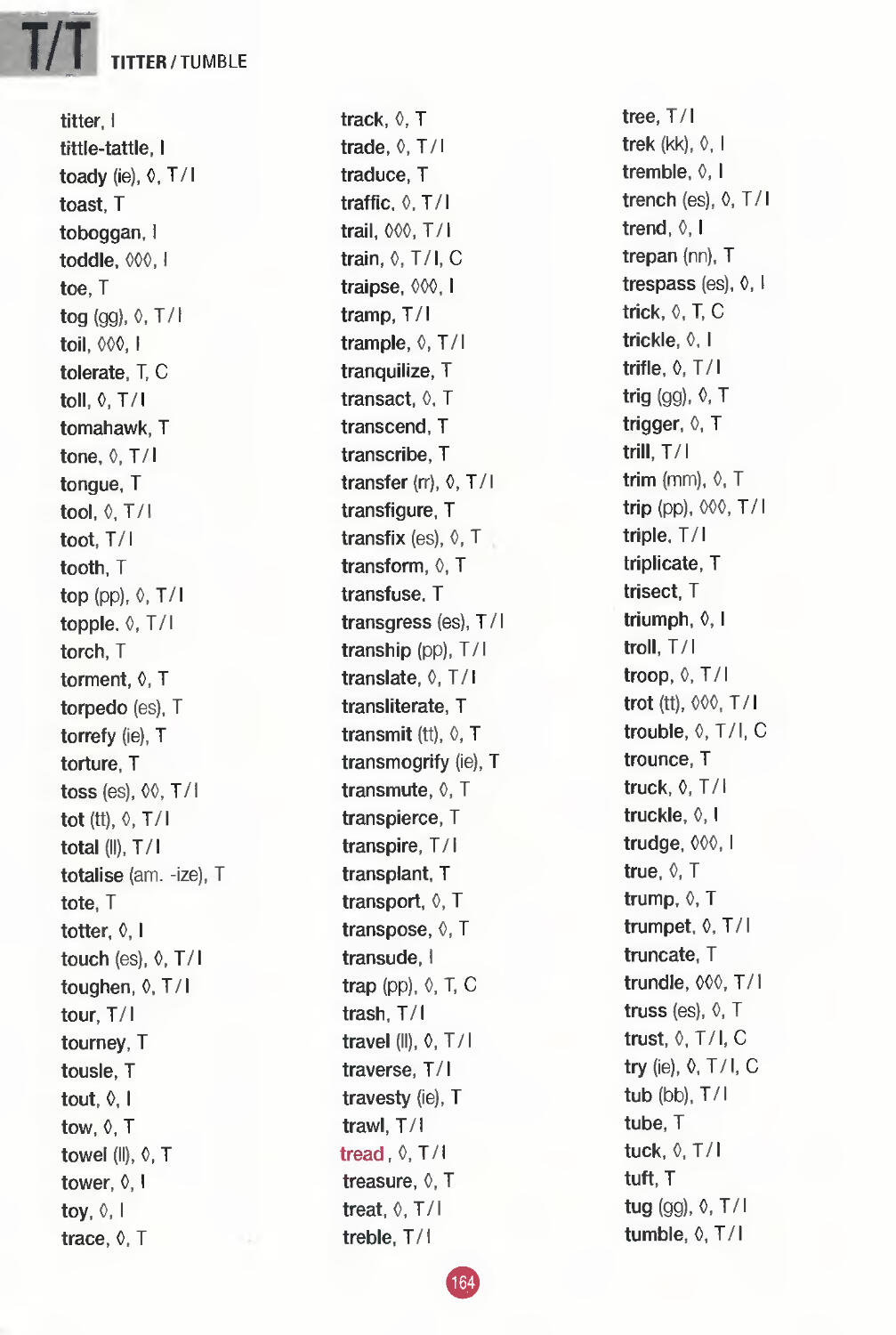
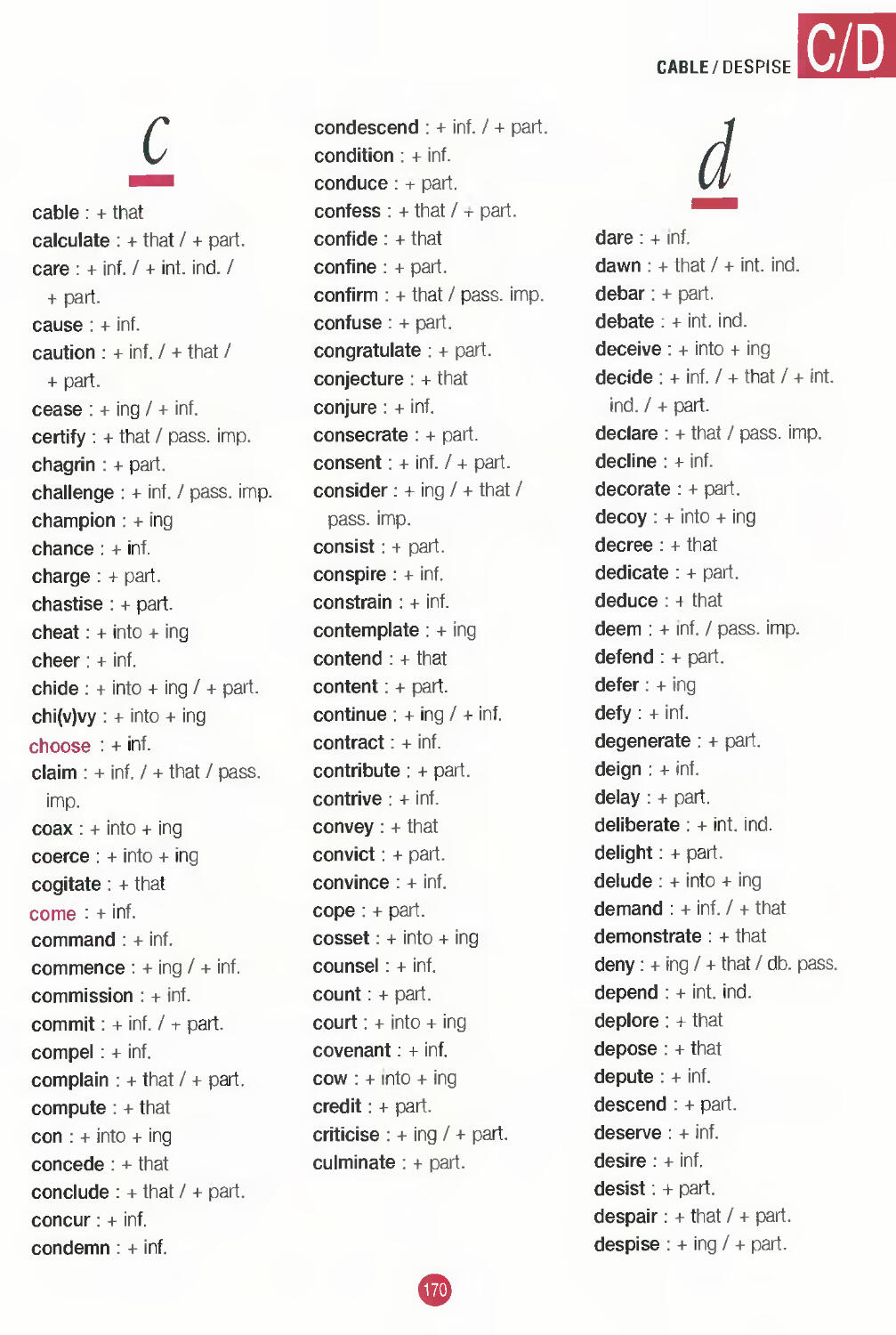
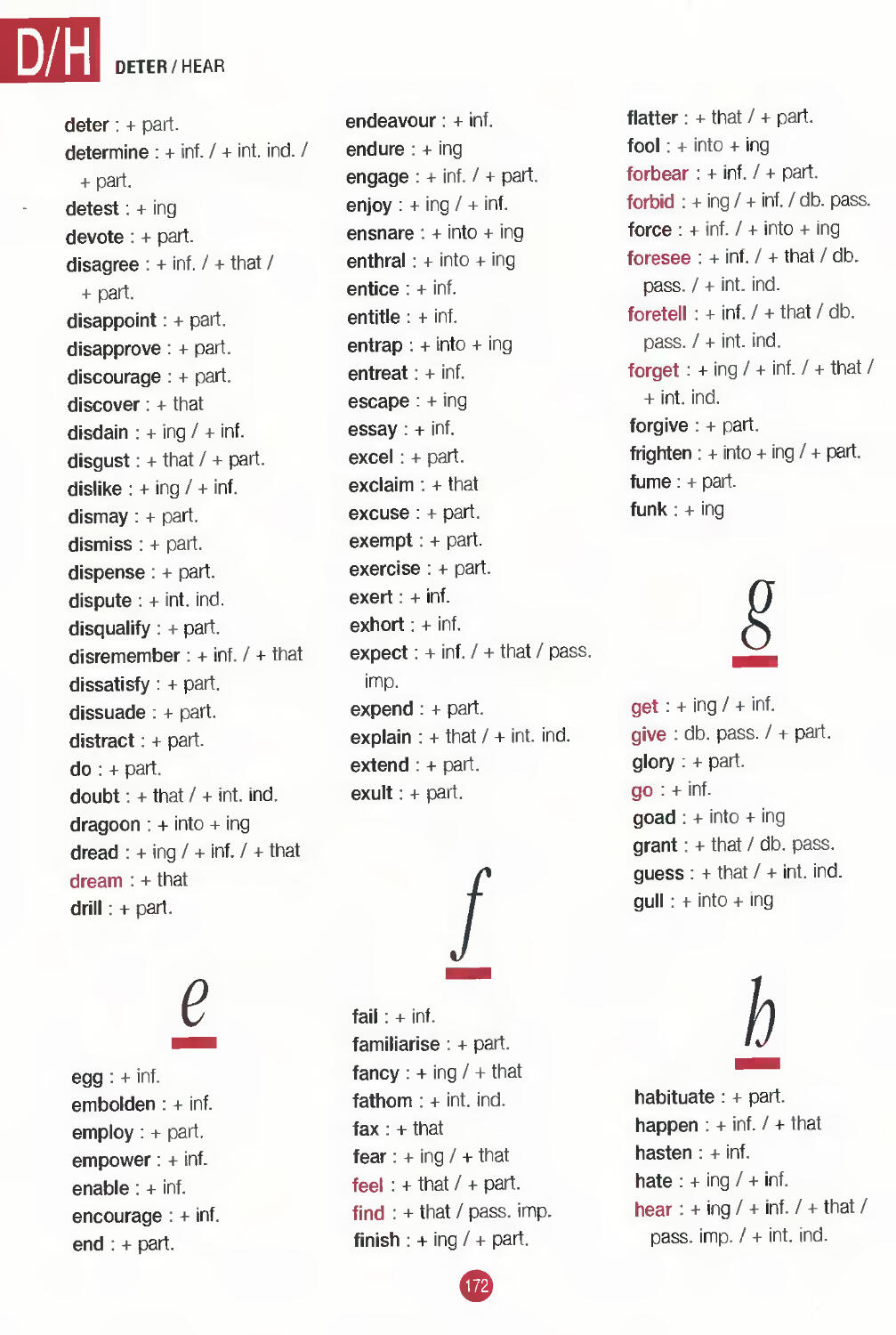
Verbes à complémentation 169
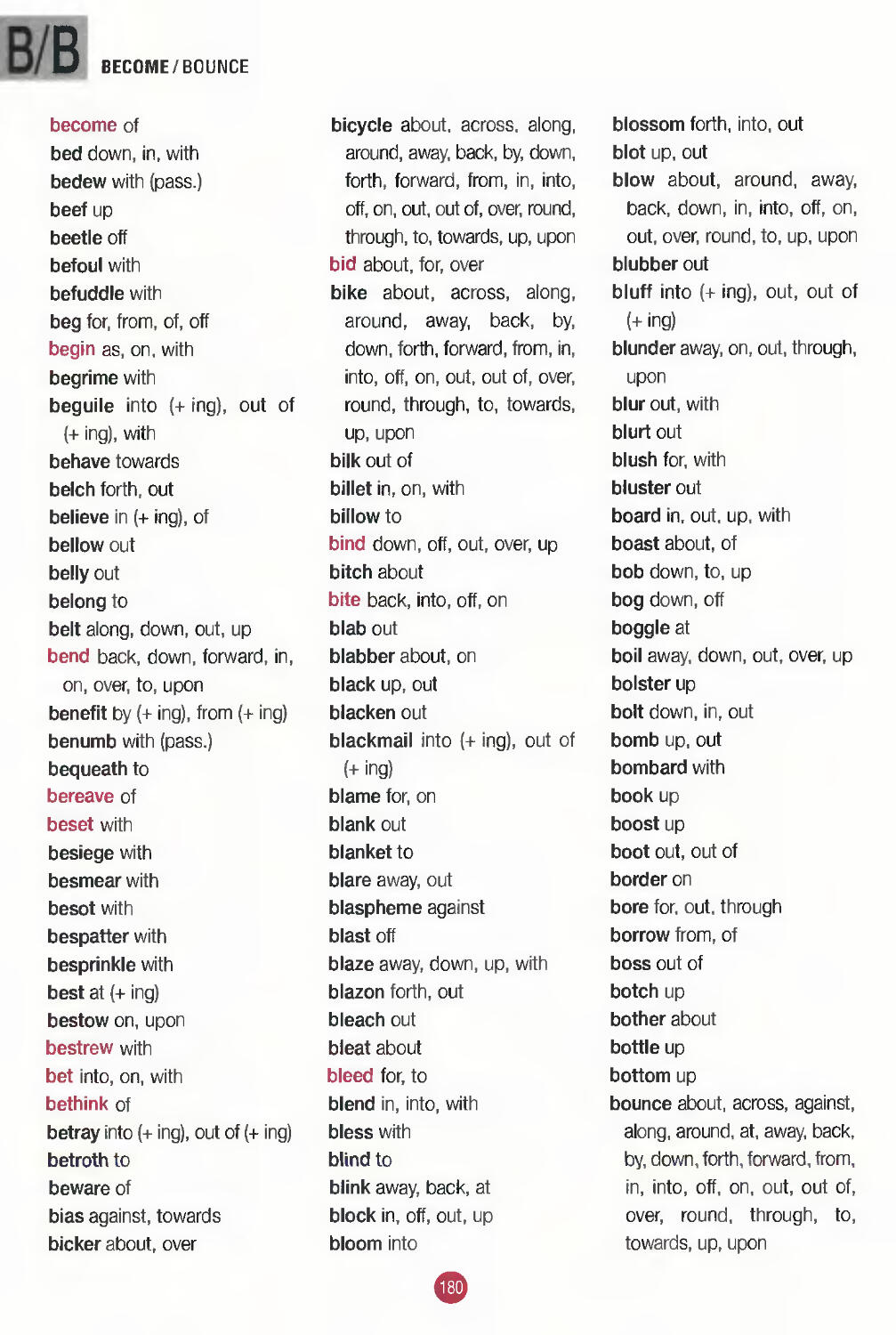
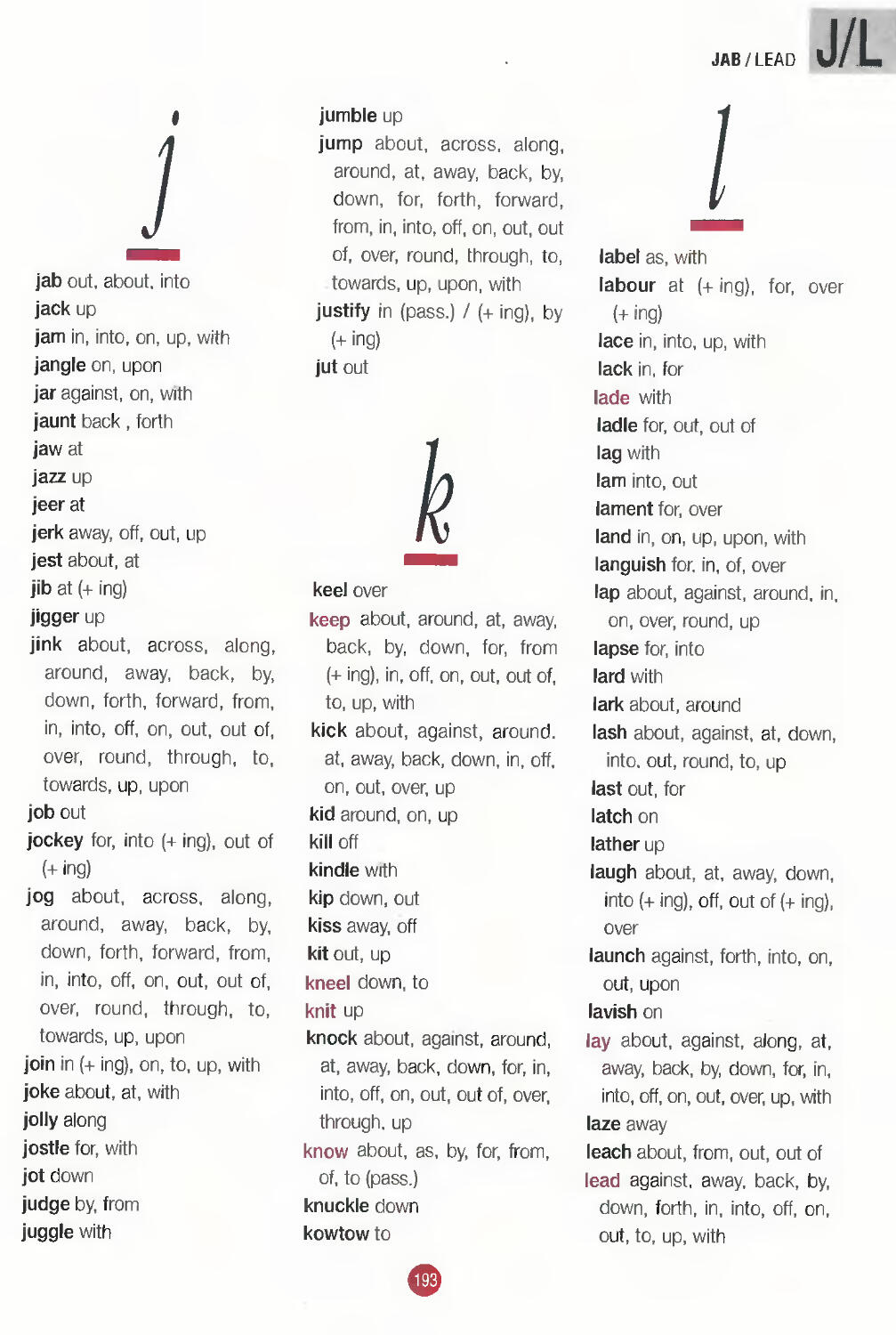
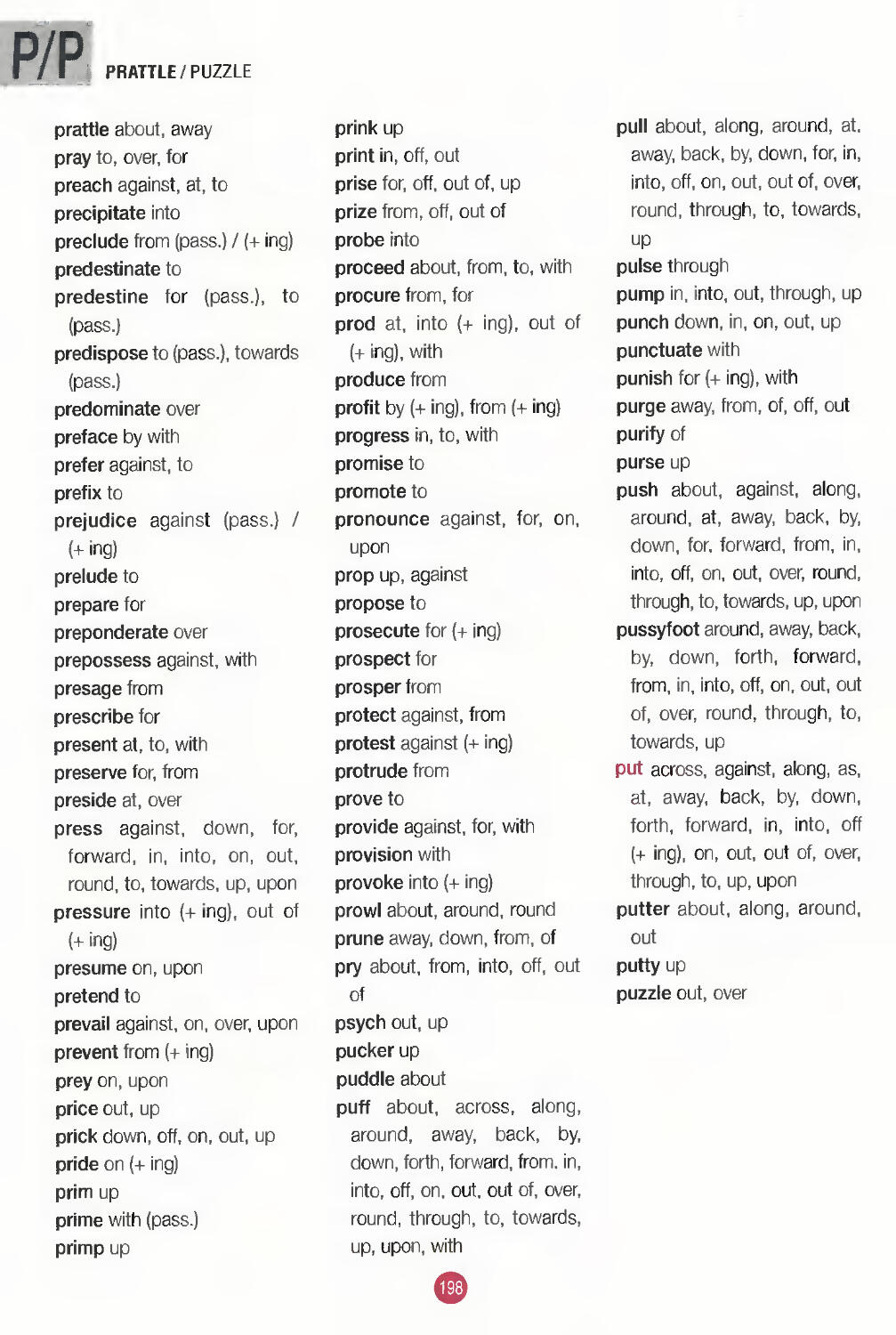
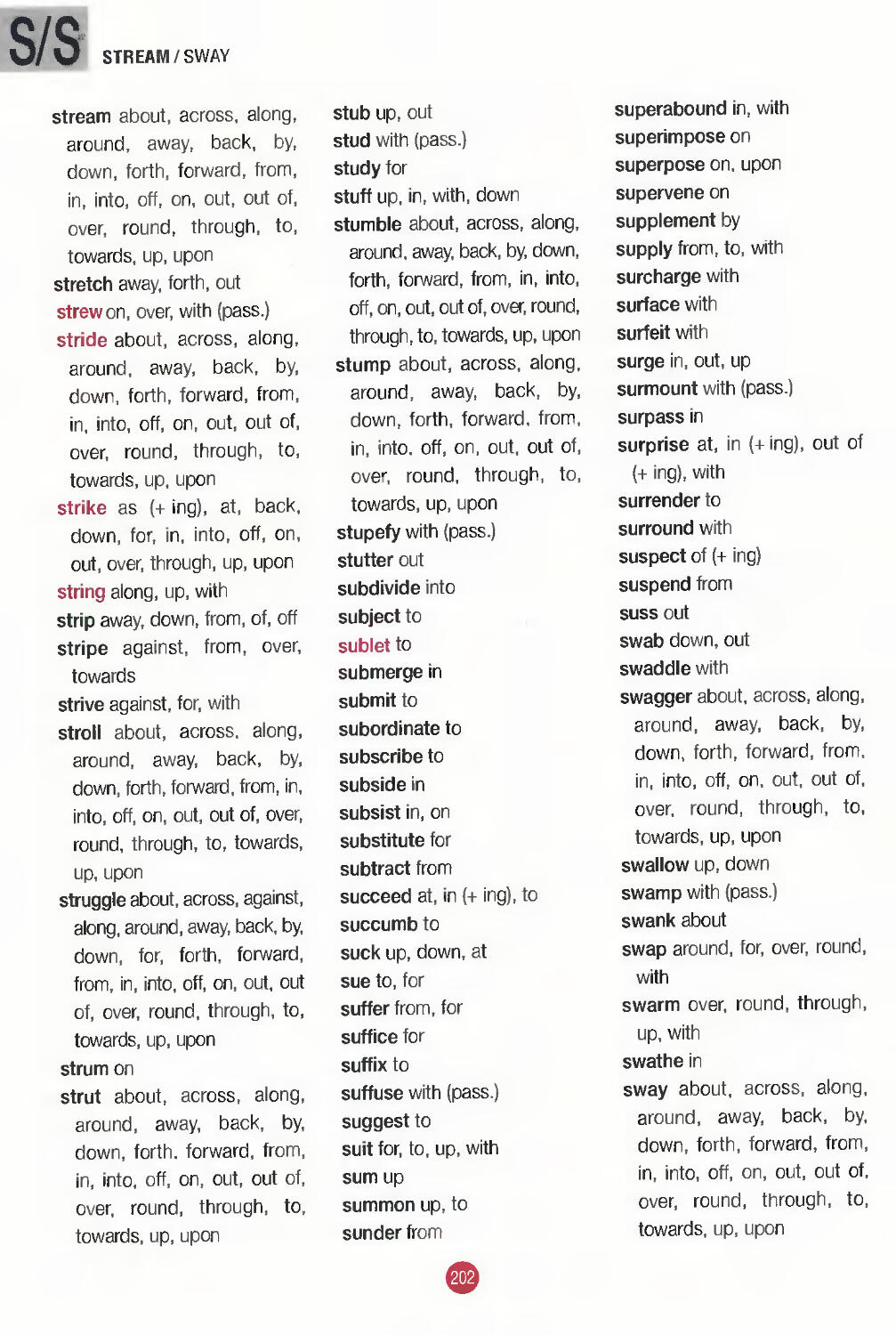
Verbes à particules 177
Verbes irréguliers 213

COMMENT UTILISER CE LIVRE V
Le Bescherelle n'est ni un livre de grammaire classique, ni un dictionnaire : c'est un outil
de travail complémentaire qui vise à susciter une réflexion. Son utilisation permet de mieux
comprendre la grammaire du verbe anglais comme le produit d'un système de pensée
différent du système de pensée français.
En anglais, un petit nombre de formes verbales permet d'exprimer un grand nombre de sens.
En effet, la personne qui parle (le locuteur) peut nuancer une même forme selon la durée
relative de l'action (aspect) et selon son état d'esprit du moment (modalité).
De plus, grâce à l'emploi de particules, l'anglais peut multiplier à l'infini les formes et les sens
à partir des formes de base.
À partir de ces constats, trois types d'outils sont proposés au lecteur, selon ses besoins du
moment.
H La grammaire du verbe
Elle permet d'analyser avec une précision suffisante la valeur des temps et des aspects du
verbe en anglais en général et de ses auxiliaires ordinaires et modaux.
Elle explique aussi la formation et le sens des verbes à particules, la place et le sens des
principaux types de compléments du verbe ainsi que l'importance de la forme passive.
Le texte est construit en doubles pages articulées en paragraphes courts auxquels il est facile
de se reporter. Deux synthèses donnent une vue d'ensemble sur les temps anglais et sur la
modalité.
BLes tableaux
Ils présentent de manière synthétique toutes les formes possibles de la conjugaison, les
contractions et les différents types de verbes irréguliers.
BLes index
L'index général comprend tous les verbes (6 000 environ), réguliers, et irréguliers, simples ou
à particules. Une telle richesse exclut la possibilité d'introduire toute traduction des verbes
dans cet index.
Il a été enrichi des verbes nouvellement entrés dans la langue d'aujourd'hui.
Il est complété par des index spécifiques :
• index des verbes à complémentation ;
• index des verbes à particules ;
• index des verbes irréguliers.
Pour chaque catégorie, un renvoi est prévu aux pages correspondantes de la grammaire du
verbe et des tableaux.
o

LISTE ALPHABÉTIQUE DES POINTS DE GRAMMAIRE ABORDÉS
About
Ago .
Always + forme en -ing
Around .
Aspects
Auxiliaires modaux
Auxiliaires ordinaires .
Avenir .
8e able to ....
8e allowed to
fie going to ...
Beto
Be .
Been/gone
Can
Capacité
Corne
Compléments du verbe
Conditionnel ...
Conjugaisons
Conseil...
Contractions
Could...
Dare
Devoir/obligation
Do .
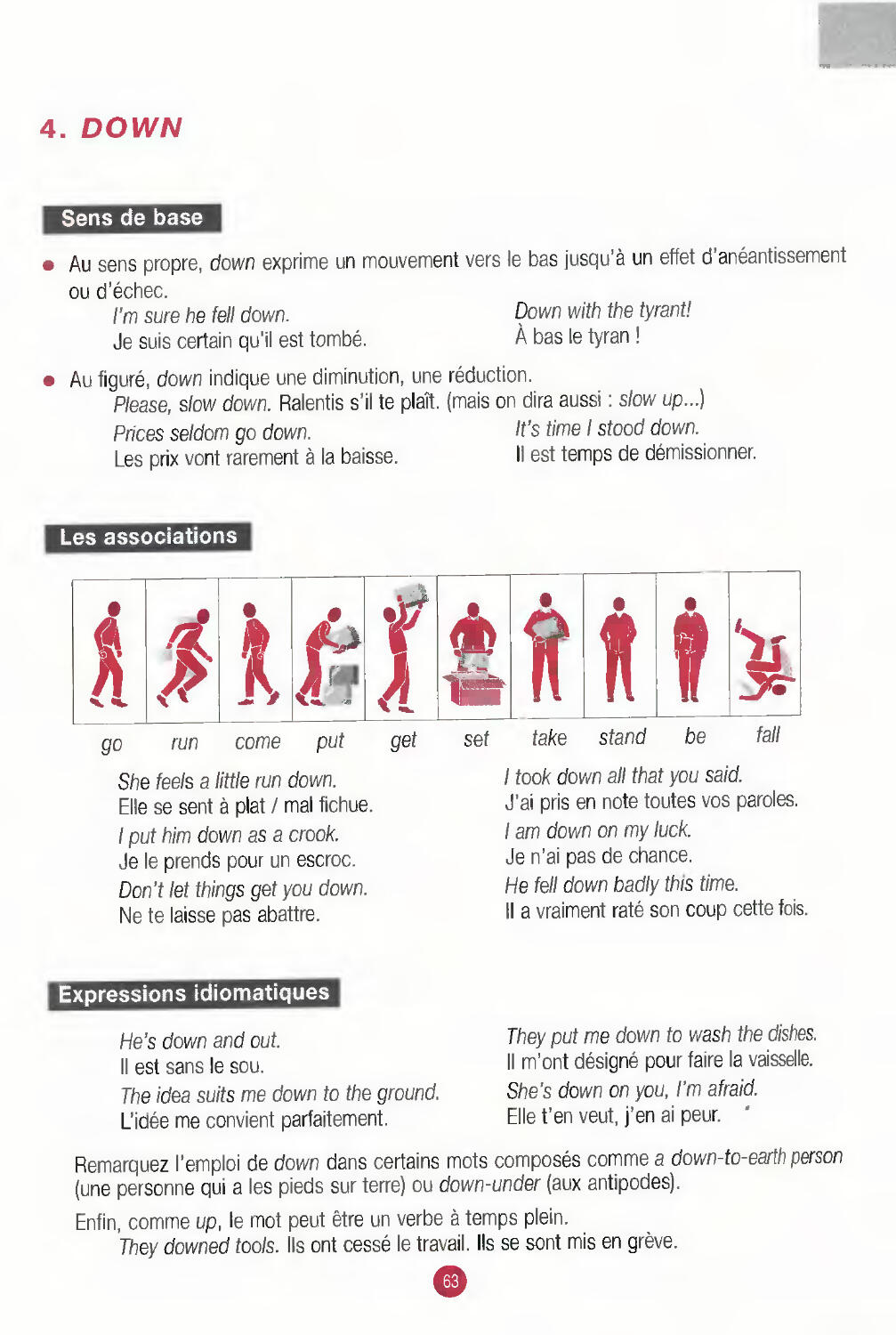
Down
Faire ....
Faire faire .
Fa//
For
Forme d'insistance .
Forme fréquentative
Forme simple ou progressive ?
Gef
G/Ve
71
18,82
13
71
10-11,
22-23
34-35,
44-45
24-33
14
40
41
14
15,42
24, 26-27,
48
26
40, 44-45
40. 44-45
51
76-83
37,39
88-95
32, 37,
44-45
98-99
40, 44-45
43
35, 37,
42, 44-45
30-31
65
29
28
53
16.73
30
39
13
70
55,85
85
Had better
Hâve . . .
Hâve to
If ..
Il y a
In
Infinitif ou -ing ?
Interdiction . .
Let ....
Make/have ..
Make/do
May/might
Modalités
Modifications orthographiques .
Must ...
Nécessité
Need
Obligation ...
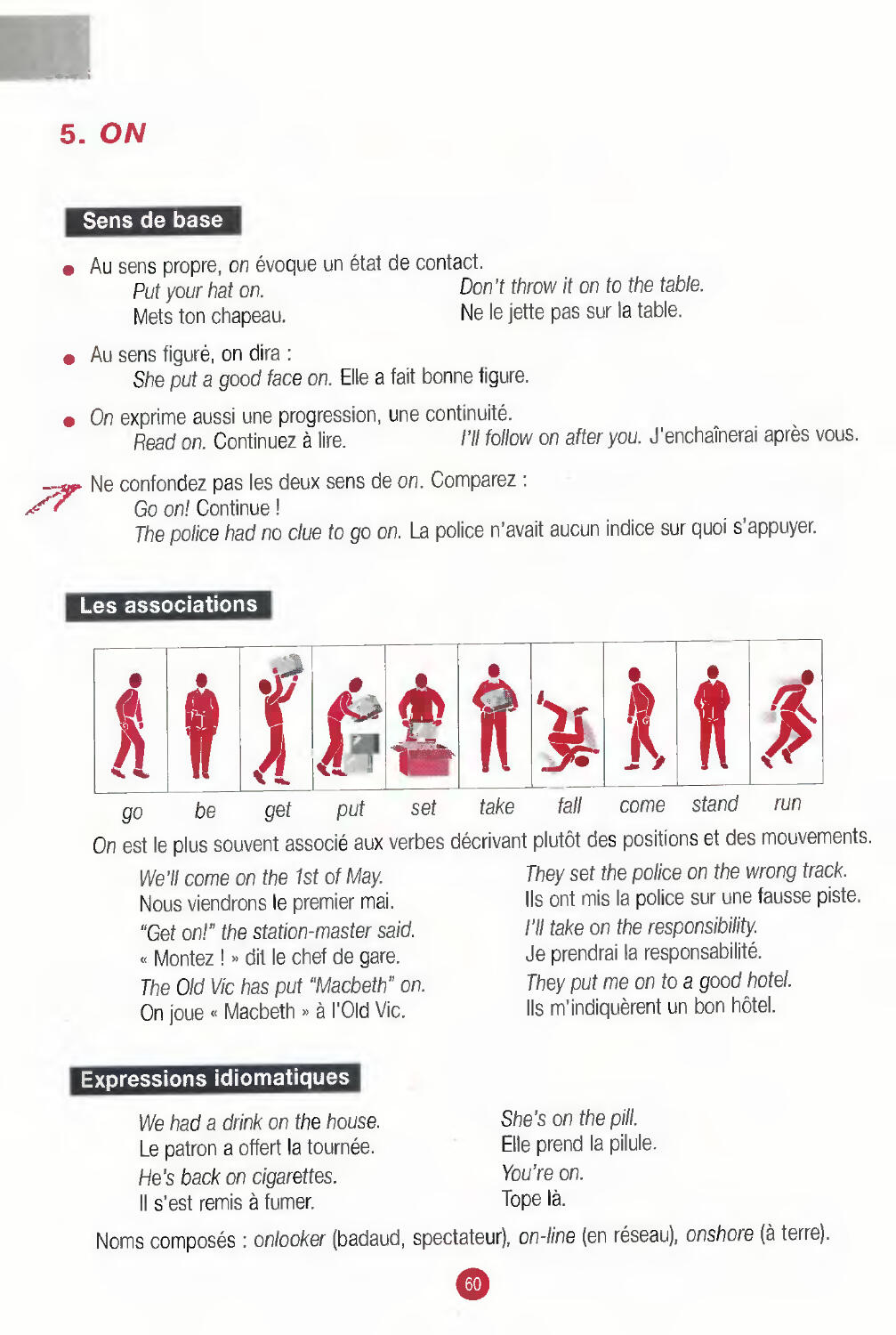
On
« On » (équivalent du français « on »)
Ought to.
Ouf .
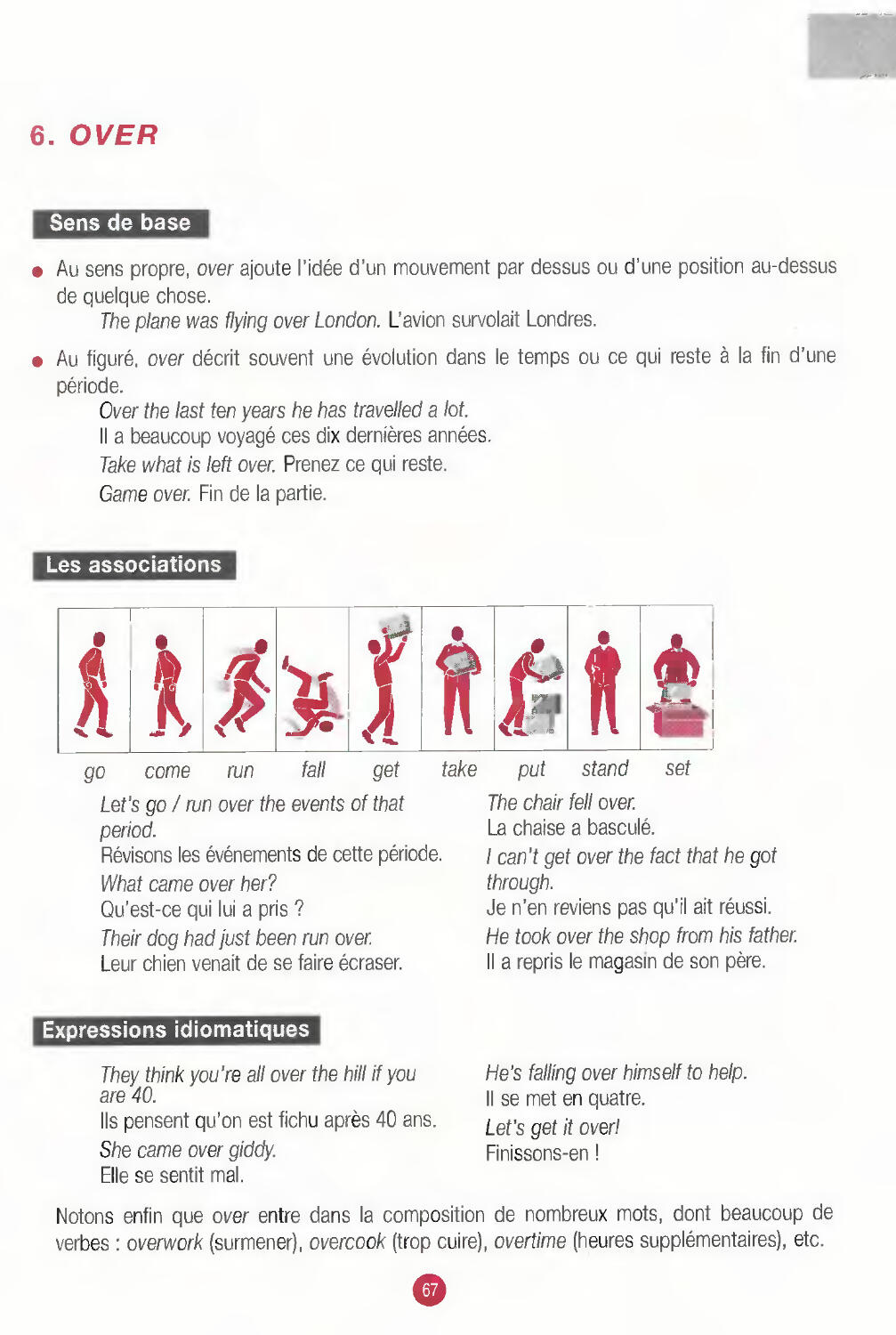
Over ...
Particules
Passe
Passif...
Permission
Place des particules ..
Pluperfect.
Préfixes ....
Prépositions
Présent
Présent perfect
Prétérit
Prétérit modal .
Probabilité
Prononciation
Put
25
. 28-29
15,42
37,39
18,27
64
78-81
36, 44-45
32-33
. 24,28
25
40-41,
44-45
34
. 97
42, 44-45
42, 44-45
43
42, 44-45
66
. 84
42, 44-45
63
67
46-47,
58-73
. 16-21
84-85
40-41,
44-45
59
20-21
75
58
12-13
16-17
18-19
19
41.42,
44-45
96
56
o

LISTE ALPHABÉTIQUE DES POINTS DE GRAMMAIRE ABORDÉS
Question tags .. 102-103
Questionnement 100-101
Rather 29, 101
Redoublement consonne finale 97
Réponses courtes ... 102
Reprises : n'est-ce pas 102
étonnement, constatation
aussi, non plus, contradiction
Round 71
Run . 52
Set 57
Shall/should .. 36, 37, 44-45
Since 16
Stand 49
Style indirect 82
Suffixes ... .... 74
Suggestion 36-41,44-45
Tags 102-103
Take 54
Temps . .... 10
There is 27
To 69
Transitif/intransitif .... 76
Up . .... 62
Usedto 18
Verbes irréguliers 104-113
Will/would ... 38-39, 44-45
With 68
O

Grammaire
du verbe

TEMPS ET ASPECTS
•••
À SAVOIR
Il y a temps (time) et temps (tense)
Pour évoquer le temps qui passe, qui s'écoule du passé au présent et du présent à l'avenir,
c'est-à-dire le temps chronologique (en anglais : time), les langues se servent de formes
appelées temps grammaticaux (en anglais : fenses).
Par exemple, pour le temps chronologique du passé, le français a le choix entre les quatre
temps grammaticaux que sont l'imparfait, le passé simple, le passé composé et le plus-que-
parfait. L'anglais, lui, dispose de trois temps grammaticaux : le présent perfect, le preterite
(en français : prétérit) et le pluperfect.
y Deux pièges à éviter
• D'abord, il n'y a pas de correspondance parfaite, à l'intérieur de chacun des deux systèmes,
entre temps chronologique et temps grammatical.
On peut utiliser, par exemple, en anglais comme en français, un temps grammatical du présent
pour parler de l'avenir.
What are you doing tomorrow?
Que faites-vous demain ?
• D'autre part, il n'y a pas de parallélisme entre les deux systèmes de temps grammaticaux
français et anglais pour la même tranche de temps. Par exemple, pour traduire le verbe dans
la situation suivante du passé :
When she saiv him in London...
on peut se servir :
- soit du passé composé (quand e//e l'a vu), si le moment de la rencontre n'est pas précisé
par le contexte ;
- soit du passé simple (quand elle le vit), si les circonstances sont par ailleurs précisément
indiquées ;
- soit de l'imparfait (quand elle le voyait) si cette rencontre est habituelle.
©

La durée et l'aspect
Les Anglais ne ressentent pas le temps qui passe comme les Français. Ils ont presque toujours
le sentiment que les temps chronologiques (le passé, le présent et l'avenir) sont liés l'un à
l'autre dans une même durée, alors que les Français ont tendance à les séparer plus nettement
entre eux.
C'est pourquoi, quand nous cherchons à comprendre un verbe anglais, il nous faut tenir
compte de ce qu'on appelle son aspect : la durée de l'événement (action ou état) qu'il
exprime, le fait qu'il vient de commencer, qu'il se répète ou pas. Cette notion, le verbe
français ne peut l'exprimer tout seul ; il faut lui adjoindre une expression appropriée.
Par exemple, pour reprendre la situation précédente :
When Margaret saw him in London ne was speaking to a policeman.
Quand Margaret le vit à Londres, il parlait avec un agent de police,
la forme was speaking donne à penser que cette conversation avait commencé avant que
Margaret ne le voie et qu'elle a sans doute continué après. Ce que le français pourra rendre
en adjoignant au verbe une expression comme « être en train de ■ : Quand elle le vit, il était
en train de parler à un agent de police.
Mais regardons les choses de plus près pour chacun de ces temps qui se succèdent dans le
temps chronologique time.
©

1. LE PRESENT
Le temps chronologique du présent s'étend en anglais bien avant et bien après ce qu'en
français on nomme le moment présent ; c'est pourquoi les formes pouvant exprimer ce
présent time sont nombreuses.
La forme en -ing
• La forme en -ing (ou continuous) montre concrètement, dans sa durée, une action en cours
relativement longue, dont on ne précise ni quand elle a commencé, ni quand elle s'achèvera.
l'm reading a book by Agatha Christie.
Je suis en train de lire un livre d'Agatha Christie.
Plusieurs adverbes ou expressions adverbiales peuvent préciser le temps chronologique .
now, today, this week, for the time being, etc.
• À cet aspect peut s'ajouter l'expression d'une modalité (cf. p. 34), par exemple une supposition
dans :
He must be reading it too.
Il doit (être en train de) le lire aussi.
En résumé, la forme en -ing me permet de « m'impliquer » dans la description de l'action.
La forme simple
En employant cette forme, l'anglais quitte le concret du moment présent, comme si l'action
était « vue d'en haut », pour parler :
• d'un trait caractéristique d'un personnage ;
He reacfe s/cw/y. Il lit lentement.
• d'une habitude (le présent simple est alors accompagné d'un adverbe comme often, never,
generally, usually, always, ou autres expressions appropriées) ;
On Sundays he usually reads in bed.
Le dimanche, il lit au lit.
• d'une référence à une autorité (the dictionary I Shakespeare says...) ;
Some grammar books call this the simple présent.
Certaines grammaires appellent ceci le présent simple.
• d'un règlement, d'un usage ;
The law forbids photocopying books.
La loi interdit de photocopier les livres.
The British send their greeting cards in the beginning ofDecember.
Les Britanniques envoient leurs cartes de vœux début décembre.

• d'une « vérité éternelle », en dehors de ma responsabilité.
B/'rds ofa feather flock together. Qui se ressemble s'assemble.
En résumé, la forme simple me permet de parler de l'action avec détachement, comme
si je n'y étais pas directement impliqué.
Forme simple ou en -ing ?
Des verbes comme know, love, believe, remember, think, etc. ne résultent pas d'une action
volontaire mais expriment des processus mentaux, indépendants de la volonté. Dans ce
sens, ils ne peuvent pas être employés à la forme en -ing.
I think I love you.
Je pense que je t'aime, [think = « avoir l'impression de »)
I feel you're right.
J'ai le sentiment que tu as raison.
Mais quand le verbe prend la valeur d'une action, la forme en -ing redevient possible.
What are you doing? l'm thinking about you.
Que fais-tu? Je pense à toi. (ici, think = « évoquer », « réfléchir », et résulte d'une
démarche volontaire)
■ïfrTTÎfïïl
Telle est la souplesse de l'anglais que pour exprimer sa manière de voir à un moment donné, un
Anglais se donne le droit d'inverser les rôles convenus et habituels des formes simple et en -ing.
• On trouvera un présent en -ing pour décrire, avec une nuance de regret, de reproche, ou
d'irritation, une action habituelle.
He's always borrowing my books!
II faut toujours qu'il m'emprunte mes livres !
• On trouvera un présent simple pour décrire une action en cours dans le présent, au lieu de la
forme en -ing, à condition que cette action soit brève, et pour ne pas donner l'impression
d'une sorte de « ralenti ».
/ pur my pen down and get up: someone /s knocking at the door.
Je pose mon stylo et je me lève : on sonne à la porte.
Le temps, d'un coup d'œil...
--/y--*^-'--^yy '//~y~ '■" 1—y~~ */-—/* ■►
It rains a lot hère.
Itjs rainingnow.

2. L'AVENIR
L'anglais n'a pas de forme spécialisée pour exprimer l'avenir, mais emprunte différentes
formes verbales, accompagnées d'adverbes ou de compléments de temps comme soon,
tomorrow, shortly...
Formes en -ing
Next week l'm visiting the National Ga/tery.
La semaine prochaine, je visite/je visiterai la National Gallery.
l'm going to Write a book about English painting.
Je vais écrire un livre sur la peinture anglaise.
People are going fo like it.
Les gens vont l'aimer.
Avec le présent en -ing et la formule be going to, l'avenir est considéré comme presque
réalisé, tant l'intention d'agir est forte, ou la probabilité ou l'imminence de l'action marquée.
La forme en -ing, une fois encore, actualise le sens, rend plus concrète l'action envisagée.
C'est « comme si c'était fait ».
Forme simple
OK...I get up ear/y and work hard.
Bon, je me lève tôt et travaille dur.
Ici, comme toujours, la forme simple me montre plus en recul. L'action est envisagée comme
imminente puisqu'elle paraît fermement décidée, mais d'une manière plus abstraite, comme
si quelqu'un d'autre avait pris la décision. C'est « comme ça que cela doit se passer ».
L'auxiliaire will
We'll write I we'll be writing to you. On vous écrira.
Will est ici un simple auxiliaire du futur. La forme simple et la forme en -ing sont à peu près
équivalentes, la forme en -ing étant plus concrètement imaginable, la forme simple
mentionnant seulement l'action comme devant se réaliser.
Les nuances modales
1/1/e will write to you soon.
m Si iv/7/ est mentionné en toutes lettres et non sous sa forme contractée, il prend une valeur
modale et induit ici une nuance du type : « Vous pouvez compter sur moi. » À l'expression du
futur, will ajoute une notion de volonté : « Soyez assuré que nous vous écrirons bientôt. »
©

• D'autres modaux comme can, may, might, etc. (cf. p. 40-41) placés dans un contexte de futur
avec des adverbes appropriés (tomorrow, next month, etc.) permettent eux aussi d'exprimer
l'avenir.
/ may write a chapter tonight.
Il se peut que j'écrive un chapitre ce soir.
/ might write a chapter tonight.
Il se pourrait que j'écrive un chapitre ce soir.
Dans ce même cadre, on peut placer :
• be to et l'infinitif, qui exprime une obligation inéluctable, provenant par exemple, d'un
emploi du temps « imposé » ;
/ am to write the first chapter next week.
Il est prévu que j'écrive le premier chapitre la semaine prochaine.
• hâve to et l'infinitif, qui suggère une obligation moins impérative.
/ hâve to write soon.
Il faut que j'écrive bientôt.
MMÈMMÊ
• En français, nous employons deux futurs dans une même phrase.
Je partirai quand il viendra.
• En anglais, le verbe de la subordonnée de temps est dans ce cas au présent
/ shail go when he cornes.
m Mais, dans une interrogative indirecte, il n'est pas surprenant de trouver, en anglais comme
en français, le futur dans les deux propositions.
/'// ask him when he will corne.
Je lui demanderai à quelle heure il arrivera.
Le temps, d'un coup d'œil...
--- [ ^—/.//—. ,
Tonight l'm iistening to the weather forecast.
It!s going to rain soon.
It will ipn tonight.
It might rain tonight.
Le choix de la forme ne dépend pas du moment où se produira l'action mais de la manière dont
elle est envisagée.

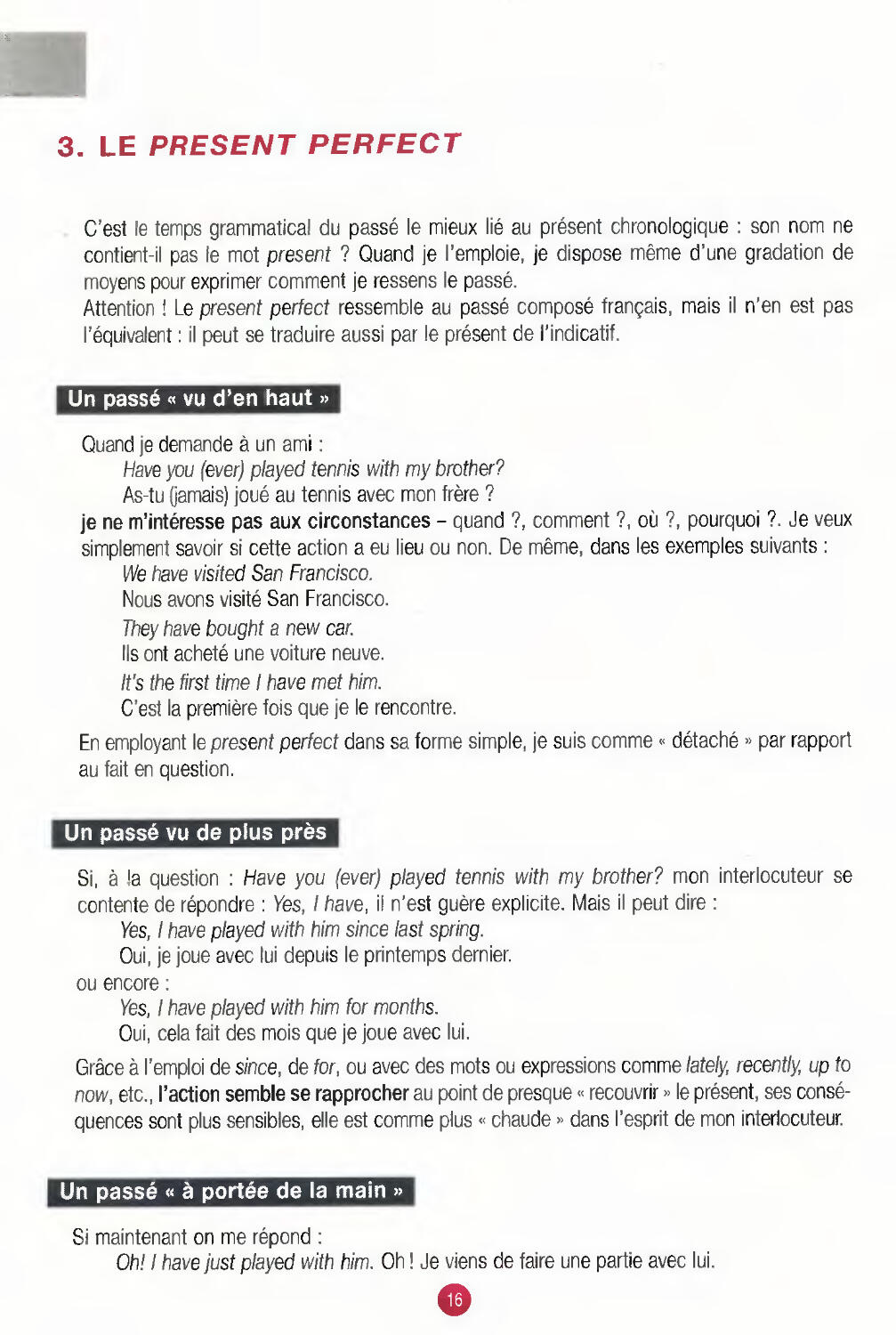
3. LE PRESENT PERFECT
C'est le temps grammatical du passé le mieux lié au présent chronologique : son nom ne
contient-il pas le mot présent ? Quand je l'emploie, je dispose même d'une gradation de
moyens pour exprimer comment je ressens le passé.
Attention ! Le présent perfect ressemble au passé composé français, mais il n'en est pas
l'équivalent : il peut se traduire aussi par le présent de l'indicatif.
Un passé « vu d'en haut »
Quand je demande à un ami :
Hâve you (ever) played tennis with my brother?
As-tu (jamais) joué au tennis avec mon frère ?
je ne m'intéresse pas aux circonstances - quand ?, comment ?, où ?, pourquoi ?. Je veux
simplement savoir si cette action a eu lieu ou non. De même, dans les exemples suivants :
We hâve visited San Francisco.
Nous avons visité San Francisco.
They hâve bought a new car.
Ils ont acheté une voiture neuve.
It's the first time i hâve met him.
C'est la première fois que je le rencontre.
En employant le présent perfect dans sa forme simple, je suis comme « détaché » par rapport
au fait en question.
Un passé vu de plus près
Si, à !a question : Hâve you (everj played tennis with my brother? mon interlocuteur se
contente de répondre : Yes, / hâve, il n'est guère explicite. Mais il peut dire :
Yes, I hâve piayed with him since last spring.
Oui, je joue avec lui depuis le printemps dernier,
ou encore :
Ves, / hâve piayed with him for months.
Oui, cela fait des mois que je joue avec lui.
Grâce à l'emploi de since, de for, ou avec des mots ou expressions comme lately recently, up fo
now, etc., l'action semble se rapprocher au point de presque « recouvrir » le présent, ses
conséquences sont plus sensibles, elle est comme plus « chaude » dans l'esprit de mon interlocuteur.
Un passé « à portée de la main »
Si maintenant on me répond :
Oh! I hâve just played with him. Oh ! Je viens de faire une partie avec lui.
©

le passé est si proche qu'il touche le présent, le joueur est, pour ainsi dire, encore essoufflé.
De même dans, par exemple : It hasjust rained (sous-entendu : le sol est encore humide) ou
/ hâve just poured your tea (sous-entendu : bois-le tant qu'il est chaud).
Un passé... présent
La forme en -ing permet à un Anglais d'exprimer plus concrètement son opinion qu'avec la forme
simple qui, pour l'expression du passé comme pour celle du présent, reste un peu abstraite...
Ainsi, pour traduire : «J'ai joué au tennis», / hâve been playing tennis exprime plus d'effort
que / hâve played.
I hâve been playing a good match.
J'ai joué une excellente partie,
ne peut être dil qu'avec chaleur, alors que / hâve played a good match, est bien moins
vraisemblable. De même dans :
You hâve been smoking againl
Tu as encore fumé !
ou :
/ hâve been working for ten hours.
Sous-entendu : C'est long ! Il n'est même pas nécessaire d'ajouter riard.
Au lieu de dire : Hâve you played tennis with him? on aurait pu aussi poser la question : Did
you play tennis with him?
Dans ce cas, mon interlocuteur a en tête une date qu'il peut donner. Il se sert du preterite,
autre temps grammatical du passé, qui introduit une valeur différente.
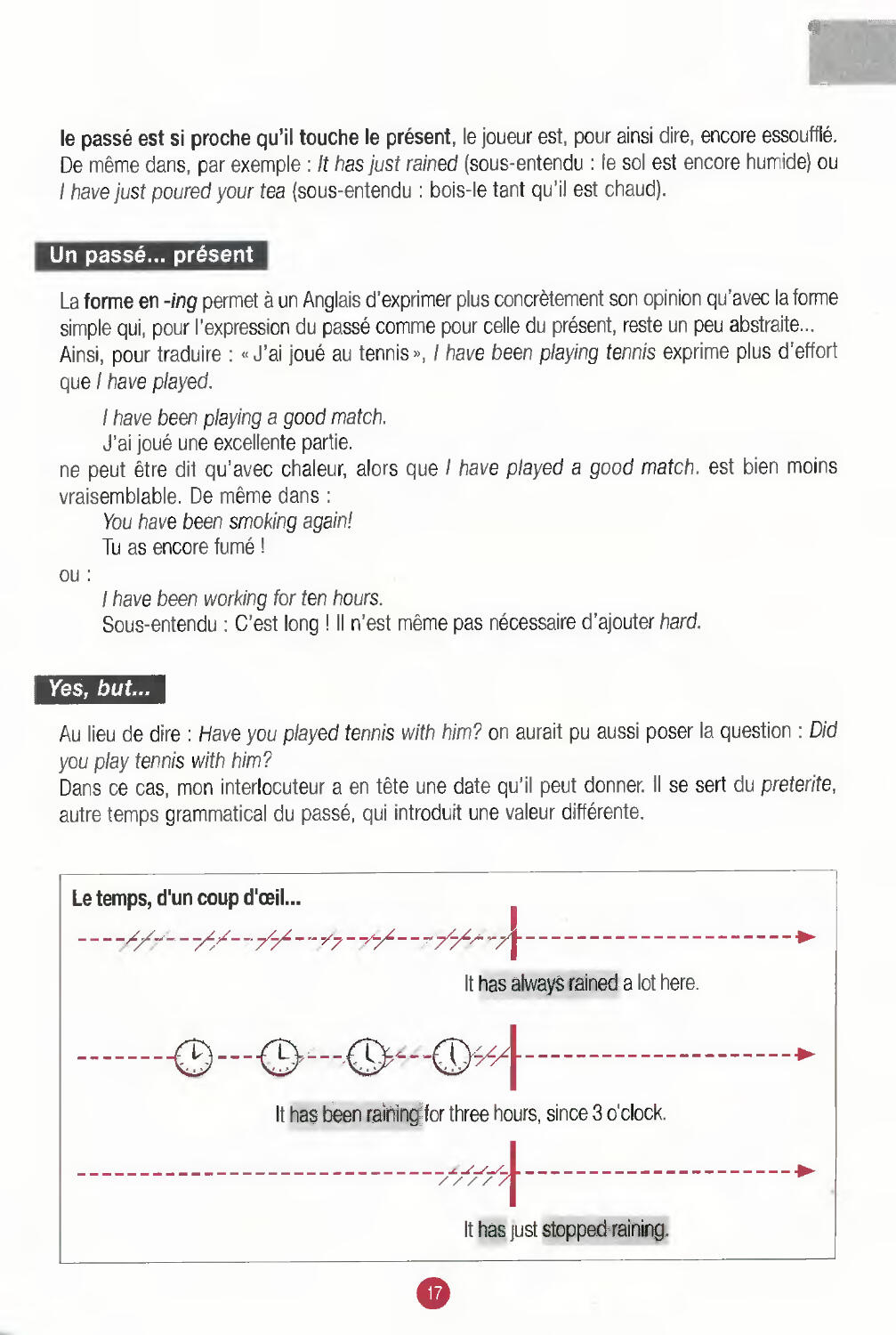
Le temps, d'un coup d'œil...
It has always rained a lot hère.
o-o-<&'--®*4 -
It has been raîiiingïfor three hours, since 3 o'clock.
\
It has just stoppedraining.
©

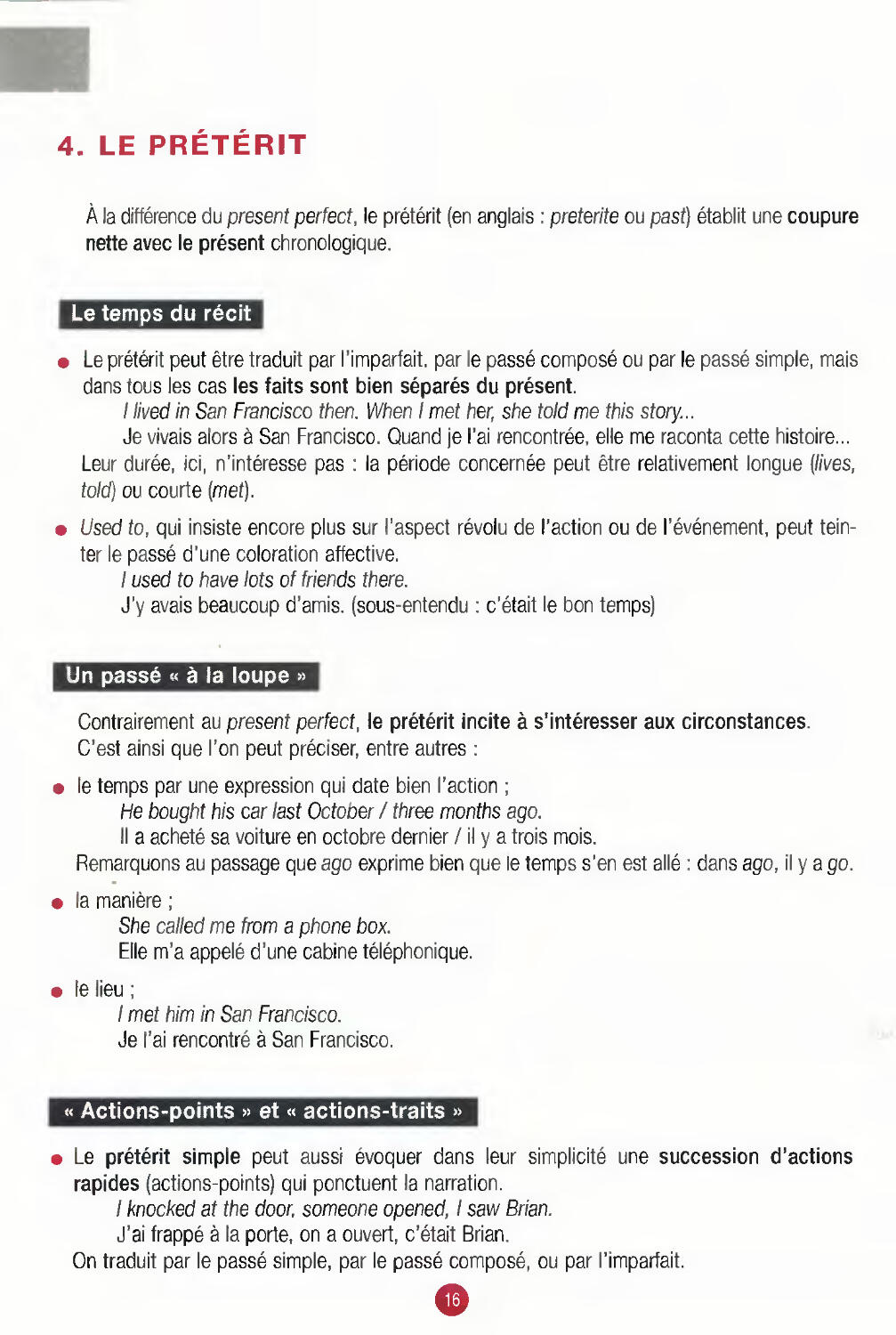
4. LE PRÉTÉRIT
À la différence du présent perfect, le prétérit (en anglais : preterite ou past) établit une coupure
nette avec le présent chronologique.
Le temps du récit
• Le prétérit peut être traduit par l'imparfait, par le passé composé ou par le passé simple, mais
dans tous les cas les faits sont bien séparés du présent.
/ lived in San Francisco then. When I met her, she told me this story...
Je vivais alors à San Francisco. Quand je l'ai rencontrée, elle me raconta cette histoire...
Leur durée, ici, n'intéresse pas : la période concernée peut être relativement longue (lives,
told) ou courte (met).
• Used to, qui insiste encore plus sur l'aspect révolu de l'action ou de l'événement, peut
teinter le passé d'une coloration affective.
/ used to hâve lots of friends there.
J'y avais beaucoup d'amis, (sous-entendu : c'était le bon temps)
Un passé « à la loupe »
Contrairement au présent perfect, le prétérit incite à s'intéresser aux circonstances.
C'est ainsi que l'on peut préciser, entre autres :
• le temps par une expression qui date bien l'action ;
He bought his car last October I three months ago.
Il a acheté sa voiture en octobre dernier / il y a trois mois.
Remarquons au passage que ago exprime bien que le temps s'en est allé : dans ago, il y a go.
m la manière ;
She called me from a phone box.
Elle m'a appelé d'une cabine téléphonique.
• le lieu ;
/ met him in San Francisco.
Je l'ai rencontré à San Francisco.
« Actions-points » et « actions-traits »
• Le prétérit simple peut aussi évoquer dans leur simplicité une succession d'actions
rapides (actions-points) qui ponctuent la narration.
/ knocked at the door, someone opened, I saw Brian.
J'ai frappé à la porte, on a ouvert, c'était Brian.
On traduit par le passé simple, par le passé composé, ou par l'imparfait.
©

La forme en -ing, au contraire, décrit une action qui s'inscrit dans une durée (action-trait).
"What were you doing, at ten p.m., when I tried to call you?" "I was working."
« Que faisais-tu hier soir, à dix heures, quand j'ai essayé de t'appeler ? » « Je travaillais. »
La forme en -ing avec le prétérit a donc la même valeur qu'avec le présent.
On peut utiliser la forme en -ing pour l'expression du futur dans le style indirect.
He told me ne was going on holiday in a week's time.
Il m'a dit qu'il partait en vacances dans une semaine.
On peut introduire une modalité quand, au lieu de dire simplement
The house stood on the hill.
La maison se dressait sur la colline,
on ajoute une nuance affective.
My parents' house was standing on the hill, you know.
Tu sais, c'est la maison de mes parents qui était sur la colline.
Le prétérit modal
Les emplois de la forme simple et de la forme en -ing ne surprennent plus quand on en a bien
compris le fonctionnement, mais ils sont plus subtils quand il s'agit d'exprimer une modalité
particulière. Par exemple, le prétérit, appelé prétérit modal, est d'usage après as if, as though,
ou encore dans It's time... ou / wish...
It's time we left. I wish he came.
Il est temps que nous partions. Je voudrais qu'il vienne.
C'est le subjonctif français qui correspond à ces attitudes subjectives.
Le temps, d'un coup d'œil...
-0-©~~©^-©^-GM -
It started raîning three hours ago.
-O-CSKO-'-O--®-!-
It.raïned for two hours, from 2 to 4.
■ »
was coming back when it started raining.
.__§k^-^-^-À- ]-
I came bacR when it started raining.

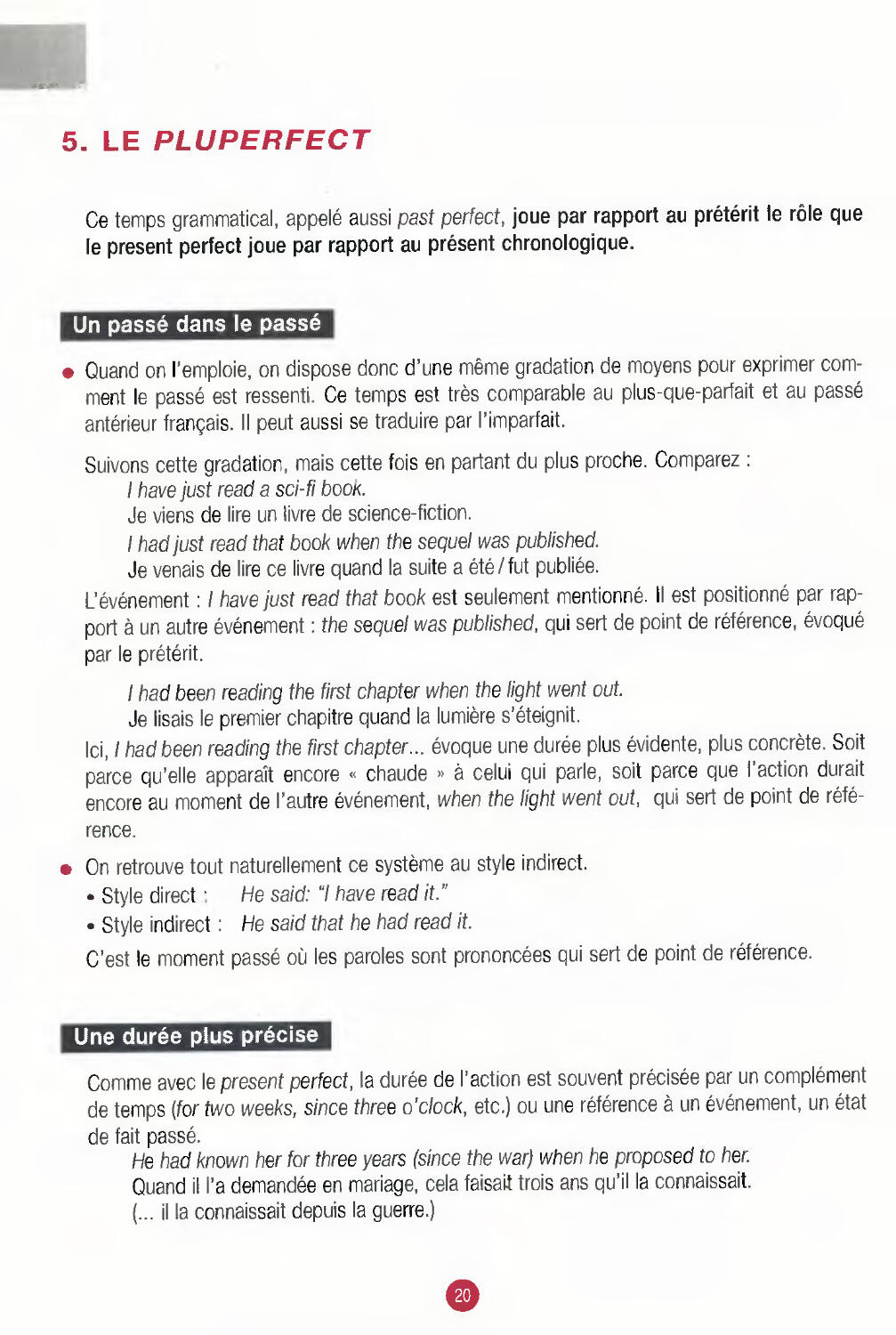
5. LE PLUPERFECT
Ce temps grammatical, appelé aussi past perfect, joue par rapport au prétérit le rôle que
le présent perfect joue par rapport au présent chronologique.
Un passé dans le passé
• Quand on l'emploie, on dispose donc d'une même gradation de moyens pour exprimer
comment le passé est ressenti. Ce temps est très comparable au plus-que-parfait et au passé
antérieur français. Il peut aussi se traduire par l'imparfait.
Suivons cette gradation, mais cette fois en partant du plus proche. Comparez :
/ hâve just read a sci-fi book.
Je viens de lire un livre de science-fiction.
/ hadjust read that book when the sequel was published.
Je venais de lire ce livre quand la suite a été/fut publiée.
L'événement : / hâve just read that book est seulement mentionné. Il est positionné par
rapport à un autre événement : the sequel was published, qui sert de point de référence, évoqué
par le prétérit.
/ had been reading the first chapter when the light went out.
Je lisais le premier chapitre quand la lumière s'éteignit.
Ici, / hadbeen reading the first chapter... évoque une durée plus évidente, plus concrète. Soit
parce qu'elle apparaît encore « chaude » à celui qui parle, soit parce que l'action durait
encore au moment de l'autre événement, when the light went out, qui sert de point de
référence.
• On retrouve tout naturellement ce système au style indirect.
• Style direct ■ He said: "I hâve read if."
• Style indirect : He said that he had read it.
C'est le moment passé où les paroles sont prononcées qui sert de point de référence.
Une durée plus précise
Comme avec le présent perfect, la durée de l'action est souvent précisée par un complément
de temps {for two weeks, since three o'clock, etc.) ou une référence à un événement, un état
de fait passé.
He had known her for three years (since the war) when he proposed to her.
Quand il l'a demandée en mariage, cela faisait trois ans qu'il la connaissait.
(... il la connaissait depuis la guerre.)
^

Un passé qui s'éloigne à l'infini
It was after the Flood, but the Earth had not dried yet.
Le Déluge avait cessé mais la Terre n'avait pas encore séché.
Le pluperfect modal
Comme le prétérit, le pluperfect peut avoir une valeur modale (cf. p. 19).
/ wish he had corne.
J'aurais aimé qu'il vienne, je regrette qu'il ne soit pas venu.
Le temps, d'un coup d'oeil...
..^//^//^^/-/^ 1
I had never seen such rain before I arrivedin this country.
..._.^ç©.^(^^ 1
It had been raining for two hours when I decîded to come back
I had.just gone out when it started raining*
^

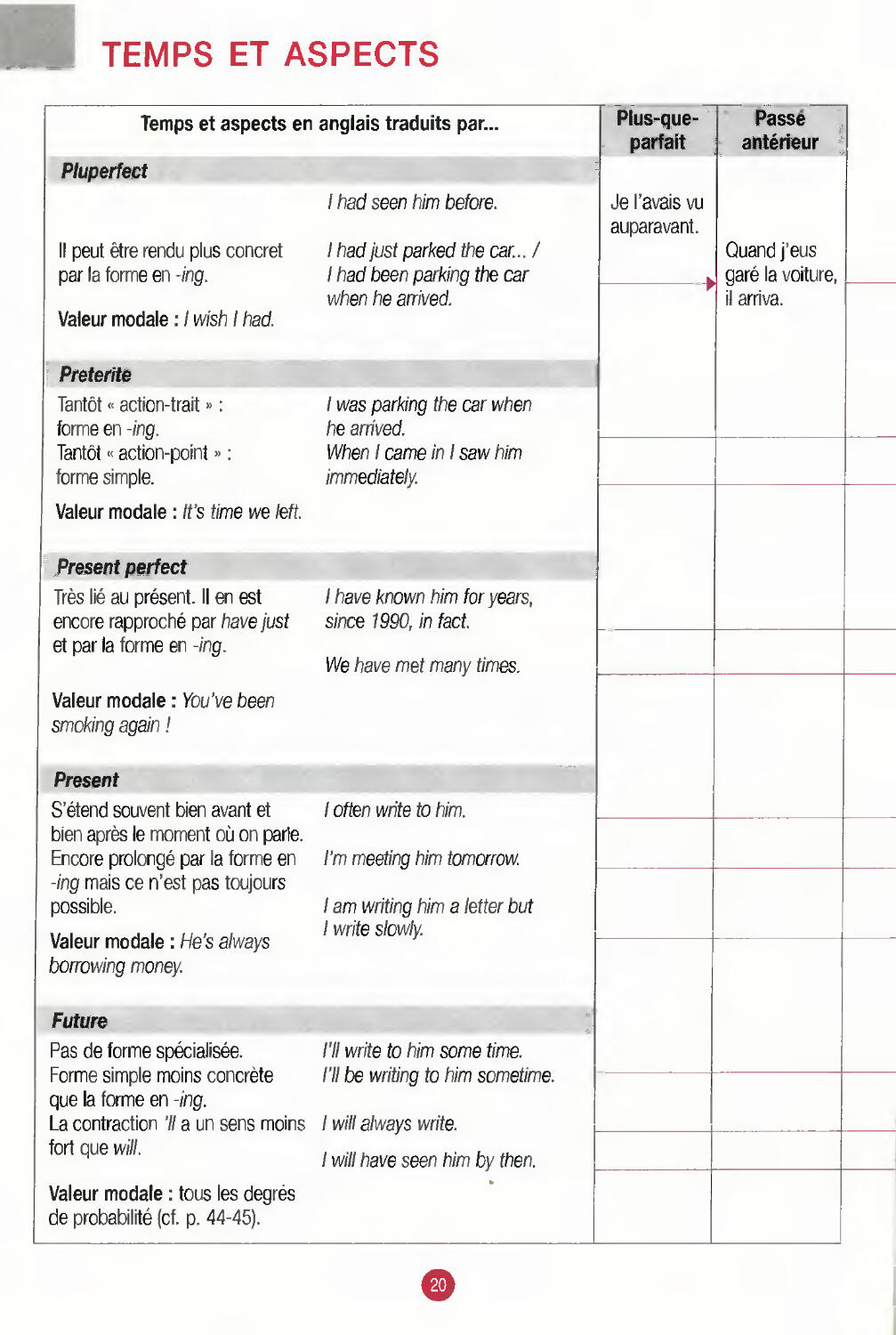
TEMPS ET ASPECTS
Temps et aspects en anglais traduits par..
Pluperfect
Il peut être rendu plus concret
par la forme en -ing.
Valeur modale : / wish I had.
I Preterite
Tantôt « action-trait » :
forme en -ing.
Tantôt « action-point » :
forme simple.
Valeur modale : It's time we lett.
* Présent perfect
Très lié au présent. Il en est
encore rapproché par havejust
et par la forme en -ing.
Valeur modale : You've been
smoking again !
Présent
S'étend souvent bien avant et
bien après le moment où on parle.
Encore prolongé par la forme en
-ing mais ce n'est pas toujours
possible.
Valeur modale : He's always
borrowing money.
I had seen him before.
I hadjust parked the car... I
I had been parking the car
when he arrived.
I was parking the car when
he arrived.
When I came in I saw him
immediately.
I hâve known him for years,
since 1990, in fact.
We hâve met many times.
I often write to him.
l'm meeting him tomorrow.
I am writing him a letter but
I write slowly.
Future
Pas de forme spécialisée.
Forme simple moins concrète
que la forme en -ing.
La contraction '// a un sens moins / will always write.
fort que will.
l'Il write to him some time.
l'Il be writing to him sometime.
I will hâve seen him by then.
Plus-que-
parfait
Je l'avais vu
auparavant.
Valeur modale : tous les degrés
de probabilité (cf. p. 44-45).
Passe
antérieur
Quand j'eus
garé la voiture,
I arriva.
^

TABLEAU RECAPITULATIF
—t
t
Passé
com osé
Je garais la
voiture quand
il est arrivé.
Quand je suis
arrivé, je l'ai vu
tout de suite.
Nous nous
sommes vus
souvent.
Passé simple
Quand j'arrivai,
je le vis tout de
suite.
Imparfait
Je venais de
garer la voiture
quand il arriva.
Je garais la
voiture quand
il arriva.
Présent
Je le connais
depuis des
années, en fait
depuis 1990.
Je lui écris
souvent.
Je vais le
rencontrer demain.
Je suis en train
de lui écrire
mais j'écris
lentement.
Futur
antérieur
Je l'aurai vu
d'ici là.
Futur simple
Je le rencontrerai
demain.
Je lui écrirai un
jour.
J'écrirai toujours,
c'est certain.

AUXILIAIRES ORDINAIRES
BE, HAVE, DO, LET
•••
À SAVOIR
Certains auxiliaires - be, hâve, do et let - sont employés pour former la conjugaison des
autres verbes. D'autres, dits auxiliaires modaux, donnent au verbe une « couleur » qui permet
à celui qui parle de traduire ses intentions.
Emplois en tant qu'auxiliaires
• Be permet de construire toutes les formes en -ing.
What are you doing tomorrow?
We'll be writing to you. (cf. p. 14)
Il sert le passif (cf. p. 84).
/ was born before you. Je suis né avant toi.
/'// be laughed at. On se moquera de moi.
• Hâve contribue à la formation de tous les temps composés (cf. p. 16-17 et 20-21).
• Le présent perfect.
Hâve you ever obeyed your parents? Avez-vous jamais obéi à vos parents ?
• Le pluperfect.
He had only met her three times before he proposed to her.
Il ne l'avait rencontrée que trois fois quand il lui a demandé sa main.
Mais il y a des situations plus complexes qui nécessitent aussi l'emploi de be.
What hâve you been doing? Qu'est-ce que tu fabriquais encore ?
• Do est de règle pour toutes les formes interrogatives et négatives d'un verbe ordinaire à la
forme simple (cf. tableaux p. 88-89).
• Let est au service de l'impératif.
Let us go! I Let's go! Allons ! Let him go! Qu'il parte !
Emplois en tant que « suppléants »
• Be s'associe de plus à hère et there : il permet de constater un état de fait.
77?ere are no cloués in the sky today. Il n'y a pas de nuages dans le ciel aujourd'hui.
• Hâve remplace make pour exprimer la cause.
/ had my watch repaired. J'ai fait réparer ma montre.
©

Hâve donne ici à la phrase un sens passif, mais il peut aussi lui donner un sens actif.
/ had fou / made) Dan repair my watch.
J'ai fait réparer ma montre par Dan.
They had Bill teach Marie some English.
Ils ont demandé à Bill d'enseigner un peu d'anglais à Marie.
• Let peut, comme hâve, prendre une valeur de cause.
They let Bill teach Marie some English.
Ils ont laissé Bill enseigner / Ils ont demandé à Bill d'enseigner un peu d'anglais à Marie.
They let him go. Ils l'ont laissé partir.
Emplois à part entière
• Chacun de ces auxiliaires ordinaires peut aussi se comporter comme un verbe à part entière.
6e est le verbe d'état par excellence, capable d'exprimer l'âge (He is 13. Il a treize ans.) ou
l'état physique ou mental (/ am fine. Je vais bien.).
Hâve est l'égal de take quand on dit : Hâve a cup oftea. (Prenez une tasse de thé.) ou / had
a good tirne. (J'ai passé un bon moment.)
Do est aussi le rival de make et s'en distingue en plusieurs circonstances. On dit to do business
(faire des affaires) et to make a bargain {taire une affaire).
l'm making an exercise which you will do tomorrow.
J'élabore un exercice que vous ferez demain.
Let a le sens de « louer ».
My house is to let.
• Par voie de conséquence, certains auxiliaires peuvent être... auxiliaires d'eux-mêmes.
Don't do that! Ne faites pas ça !
He has had his day II a eu son heure de gloire.
• Comme de nombreux autres verbes à part entière, ils peuvent aussi s'adjoindre diverses
particules (cf. p. 46).
6e : Are you up? Tu es levé ?
Hâve : Can I hâve my book back? Puis-je récupérer mon livre ?
Do : They did away with the witnesses. Ils se sont débarrassés des témoins.
Let : Don't let me down. Ne me laisse pas tomber.
Emplois comme auxiliaires modaux
8e, hâve et do permettent même d'exprimer la modalité.
/ am to write the first chapternext week. (cf. p. 15)
Il est prévu que j'écrive le premier chapitre la semaine prochaine.
You had better write to thank them. I do like grammar. {do = forte insistance)
Tu ferais mieux de leur écrire pour les remercier. La grammaire me passionne.
©

I
1. BE
Be joue un rôle très important pour les verbes anglais : il participe à leur fonctionnement et il
est riche de valeurs propres. D'où la place qu'il tient dans les dictionnaires.
Verbe auxiliaire
• Grâce à ses huit formes différentes, pleines (/ am, he /s, they are, etc.) et contractées [l'm,
he's, they're, etc.), et avec l'aide de hâve, has, had, ce verbe intervient presque partout dans
la conjugaison, simple et en -ing (cf. tableaux p. 88-95).
• Il est à la base de la voix passive (cf. p. 84), comme équivalent du français « on », par
exemple.
/ hâve been fired. On m'a renvoyé.
Verbe suppléant
• Employé avec go, be fait concurrence à hâve. Comparez :
• He's gone I He is gone: the door is locked.
Il est parti : la porte est fermée à clé.
• He's just gone I He has just gone.
Il vient de partir.
Dans la première phrase, is gone exprime un état résultant d'une action, d'un événement.
Dans la seconde, has gone est un simple présent perfect.
• Attention : les deux formes contractées sont identiques. Ainsi la phrase : He's gone to Leeds
se comprend-elle :
• He is gone to Leeds. (sous-entendu : il y est parti définitivement, il n'en reviendra pas)
• He has gone to Leeds. (sous-entendu : il y est parti, mais il en reviendra)
Seul le contexte peut nous renseigner.
• Ne confondez pas non plus has been avec has gone.
He's been to Leeds I He has been to Leeds.
Il est allé à Leeds. (sous-entendu : il en est revenu)
• Emploi avec hère et there.
Hère they are. Les voilà.
7ihere are ten peopie. Il y a dix personnes.
Ces emplois (constatation d'un état de fait) peuvent parfois surprendre si l'on se place
dans une logique française, mais sont cohérents dans l'esprit des Anglais : be se conjugue
« normalement » sans être perturbé par la présence de hère ou there.
There being nobody else...
Comme il n'y avait personne d'autre...
@

Shouldn't there be a policeman hère?
Ne devrait-il pas y avoir un policier ici ?
Tom, could you please help me? There's a good boy!
Tom, sois gentil, tu peux m'aider ?
• It is est proche de there is, pour exprimer :
• La distance : How far is it to London? On est à combien de Londres ?
• Le temps qu'il fait : It is foggy II y a du brouillard.
• La durée : It is five years since he left. (Surtout pas tkere-is.) Cela fait cinq ans qu'il est parti.
Verbe à part entière
• 8e désigne ici un état, au sens plein du terme. Pensez au fameux : 7b be, or not to be de
Shakespeare. C'est ainsi qu'il peut exprimer :
• L'âge.
How old are you?
• La condition physique.
How are you? I am fine, thanks.
• Le fait d'exister.
Shakespeare is the best playwright that ever was.
Shakespeare est le meilleur dramaturge de tous les temps.
• Quand la phrase est sans ambiguïté, avec when, if, though, uniess, until, on peut omettre
verbe et sujet.
When a boy, be used to be quite mischievous.
Quand il était jeune, il était très espiègle.
• On voit donc que dans cet emploi, be peut être classé avec d'autres « verbes d'état » comme
appear, become, feel, get, go, grow, mate, seem, smell, sound, taste, etc.
• Attention, on dira :
There was fet non thero woro) ten minutes to wait.
Il y avait dix minutes d'attente, (sous-entendu une période de dix minutes,
que l'on ne compte pas précisément)
There's good children! (et non There arc)
Soyez sages, les enfants !
• Notez par ailleurs que le français « il y a » ne se traduit pas automatiquement par fbere is I
there are.
What's the matter?
Qu'est-ce qu'il y a ? Qu'est-ce qui se passe ?
0

2. HAVE
Hâve n'a que quatre formes pleines : hâve, has, had et having, mais attention aux formes
contractées affirmative et négative, qui peuvent être confondues avec celles de be : he's peut
se comprendre he is ou he has (cf. p. 26).
Verbe auxiliaire
Il permet de former le présent perfect et le pluperfect de tous les verbes ordinaires (cf.
tableaux p. 90-91).
Hâve you finished your tea?
Tu as fini ton thé ?
Verbe suppléant
• Hâve a un emploi « causatif » qui le rapproche de make.
I had (ou made) Dan repair my watch.
J'ai fait réparer ma montre par Dan.
• Mais attention à certaines ambiguïtés. Considérez la phrase :
He had his watch stolen.
Détachée de son contexte, elle peut signifier, au sens passif :
On lui a volé sa montre,
et, au sens actif :
II a fait voler la montre de quelqu'un par quelqu'un d'autre.
• Attention aussi à l'ordre des mots. Comparez :
He had his hair eut.
Il s'est fait couper les cheveux.
He had eut his hair.
Il s'était coupé les cheveux.
Verbe à part entière
• Le premier sens plein de hâve est un sens statique : la possession.
He has a phone in his car. Do you hâve one?
Il a un téléphone dans sa voiture. Et vous ?
• Le deuxième sens plein est dynamique et exprime plusieurs notions équivalentes de :
• prendre
He is having a bath.
Il est en train de prendre un bain.
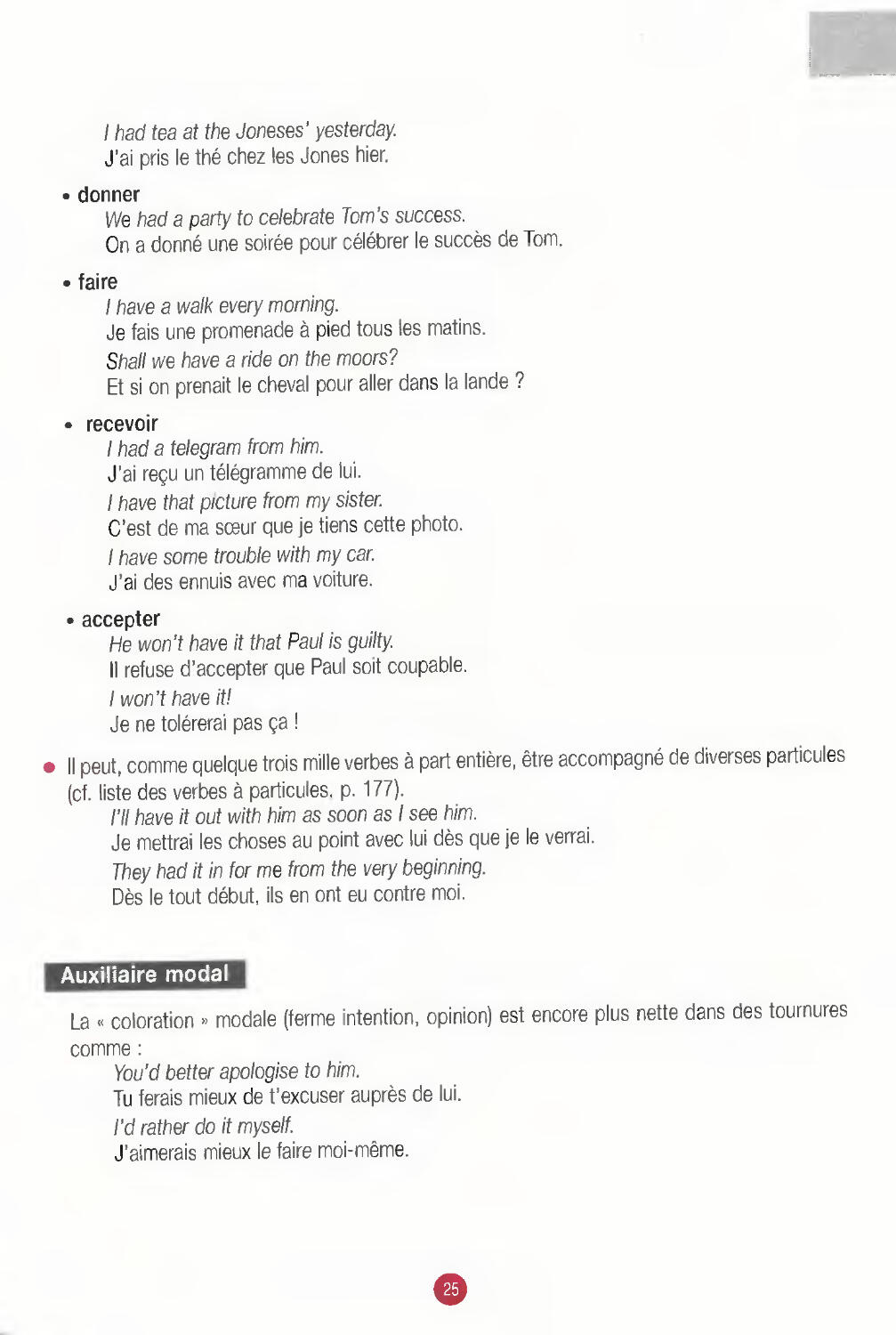
©

/ had tea at the Joneses yesterday.
J'ai pris le thé chez les Jones hier.
• donner
We had a party fo celebrate Jom's success.
On a donné une soirée pour célébrer le succès de Tom.
• faire
/ hâve a walk every morning.
Je fais une promenade à pied tous les matins.
Shall we hâve a ride on the moors?
Et si on prenait le cheval pour aller dans la lande ?
• recevoir
/ had a telegram from him.
J'ai reçu un télégramme de lui.
/ hâve that picture from my sister.
C'est de ma sœur que je tiens cette photo.
/ hâve some trouble with my car.
J'ai des ennuis avec ma voiture.
• accepter
He won't hâve it that Paul is guilty
Il refuse d'accepter que Paul soit coupable.
I won't hâve it!
Je ne tolérerai pas ça !
• Il peut, comme quelque trois mille verbes à part entière, être accompagné de diverses particules
(cf. liste des verbes à particules, p. 177).
/'// hâve it out with him as soon as I see him.
Je mettrai les choses au point avec lui dès que je le verrai.
They had it in for me from the very beginning.
Dès le tout début, ils en ont eu contre moi.
Auxiliaire modal
La « coloration » modale (ferme intention, opinion) est encore plus nette dans des tournures
comme :
You'd better apologise to him.
Tu ferais mieux de t'excuser auprès de lui.
l'd rather do it myself.
J'aimerais mieux le faire moi-même.

3. DO
Do a cinq formes pleines : do pour l'infinitif et le présent (mais does à la troisième personne
du singulier), did au prétérit, done au participe passé, doing à la forme en -ing. Ses formes
contractées sont sans ambiguïté : don't. doesn't. didn't. Il se partage à peu près également
entre son rôle d'auxiliaire et son rôle de verbe à part entière.
Verbe auxiliaire
Do et did ne font que marquer le temps et la troisième personne aux formes simples interrogative
et négative (cf. tableaux p. 88-89).
Does I Did John play the piano?
Verbe suppléant
• Dans une question ou une réponse, do évite la répétition du verbe
You speak better than I do. So does she.
Vous parlez mieux que moi. Elle aussi.
They speak German. Oh, do they?
Ils parlent allemand. Vraiment ?
She plays the piano, doesn't she?
Elle joue du piano, n'est-ce pas ?
Does she play well? Yes, she does. I No, she doesn't. I No, she does not.
Elle joue bien ? Oui. / Non.
Remarquez que la forme pleine does not donne plus de force à la négation. On pourrait
traduire par : Oh non !
• Do peut prendre une valeur emphatique, qui exprime un premier degré de modalité.
He did say it.
Il l'a bien dit.
John does play the piano beautifully
John joue du piano vraiment merveilleusement, (on insiste sur le sens - l'excellence du
jeu du pianiste)
He owns or did own a piano.
Il possède, ou du moins possédait jadis, un piano, (on insiste sur le temps - le passé)
De même avec l'impératif.
Do tell him that he'll be welcome. Dis-lui bien qu'il sera le bienvenu.
Comme vous avez pu le constater dans les exemples, on peut, à l'écrit, souligner do et did
pour bien indiquer qu'il s'agit d'une forme d'insistance. À l'oral, c'est une inflexion de la voix
qui les met en valeur.
^

Verbe a part entière
• Do a de nombreux emplois d'usage courant avec le premier sens de « faire » en général.
What are you doing?
Ces emplois très variés, peuvent être :
• Transitifs :
Do the méat (couper la viande), do one's teeth (se brosser les dents), do one's hair (se coiffer),
do one's shoes (cirer ses chaussures), etc.
• Intransitifs :
/ can't do without you. Je ne peux vivre sans toi.
Do as you would be done by Ne faites pas aux autres ce que vous ne voudriez pas qu'on
vous fasse.
Parmi ces emplois, un bon nombre appartiennent à la langue familière : He's done for! (Il est
fichu !), You've been done. (Tu t'es fait avoir.)
N'oubliez pas que le traditionnel Hou/do you do? n'est plus une question puisqu'on y répond
par la même formule de politesse (à ne pas confondre avec How are you? qui attend
généralement une réponse comme l'm fine, thanks...)
• Do et make
On dit do business mais mate a bargain, comme nous l'avons observé plus haut. Do et make
sont souvent proches, mais non interchangeables. Make exprime plutôt l'activité elle-même,
d'une manière concrète, avec le sens original de « fabriquer ». Do exprime plutôt le résultat
de cette activité.
Comparez :
• To make money (gagner de l'argentj, to make mistakes (faire des fautes), to make the best
ofit (en tirer le meilleur parti), etc.
• To do one's duty (faire son devoir), to do one's best (faire de son mieux).
Autres emplois
Bien qu'il ne puisse pas être employé comme auxiliaire modal, do peut être, comme be ou
hâve, très prolifique comme verbe à particules (cf. liste, p. 177) et, à ce titre, exprimer une
certaine modalité. Voyez par exemple :
/ couid do with a cup of tea.
Je prendrais bien une tasse de thé.
Well done, Jim!
Bravo, Jim !
It isn't done.
Cela ne se fait pas.
sT

4. LET
Avec let, nous nous rapprochons du domaine des verbes ordinaires : son rôle d'auxiliaire est
en effet mineur par rapport à ses emplois à part entière et ses possibilités d'association avec
des particules pour former de nombreux composés.
Il n'a que trois formes : let, lets et letting.
Verbe auxiliaire
• Let auxiliaire ne sert qu'à former le mode impératif.
Let him stay hère!
Qu'il reste ici !
Don't lethimget out!
Qu'il ne sorte pas !
Let's go to the cinéma.
Allons au cinéma.
Let them forget it.
Qu'ils oublient tout cela.
Il s'agit moins, on le voit, d'un ordre que d'un conseil, d'une suggestion, d'une invitation.
• Très employé à la première personne du pluriel, qui implique celui qui parle dans l'action
proposée, tef est beaucoup plus rare à la première personne du singulier, pour exprimer comme
un encouragement qu'on se donnerait à soi-même.
Let me think....
Réfléchissons... Voyons...
La troisième personne du singulier et du pluriel exprime une sorte de vœu ou parfois un
acquiescement, une résignation.
En somme, on trouve dans toutes ces formes une valeur modale, parfois un souhait, plutôt
qu'un ordre.
Let them be happy! May they be happy!
Qu'ils soient heureux !
• À la forme négative, /ef existe dans un registre littéraire :
Let us net waste our time.
Ne perdons pas notre temps,
et dans un registre familier avec do et you :
Don't let me catch you again!
Que je ne t'y reprenne pas !
@

Verbe à part entière
• Le sens de base de ce verbe irrégulier (let - let - let) est « laisser, permettre ».
Who let you into the house?
Qui vous a fait entrer dans la maison ?
• De ce sens, on passe à celui de « louer ».
My house /s now to let.
Ma maison est à louer, maintenant.
Un emploi intransitif est alors possible.
A house that would let easily...
Une maison qui se louerait facilement...
Le mot existe aussi comme substantif dans :
l'm looking for a short let for my flat.
Je cherche à louer mon appartement pour une courte période.
• Let garde un peu de son sens impératif, dans par exemple :
Let me help you. Don't let him go out!
Permettez que je vous aide. Ne le laissez pas sortir !
Let me tell you (h/s... Let him in!
Laissez-moi vous dire ceci... Faites entrer !
Locutions verbales
Let est riche d'emplois avec :
• Des adjectifs.
Let him alone. Laisse-le tranquille.
Lethimloose/free. Libérez-le.
• Des particules (cf. p. 58-73).
He let the cat out of the bag.
Il a vendu la mèche.
The engine let out a cloud of smoke.
La locomotive cracha un nuage de fumée.
Don't let me down.
Ne me laisse pas tomber.
Don't let on about the meeting.
Ne dites rien sur cette réunion.
You don't know what you're letting yourself in for.
Vous ne savez pas dans quoi vous vous engagez.
^

AUXILIAIRES MODAUX
•••
À SAVOIR
Il s'agit d'une dizaine d'auxiliaires qui, associés aux verbes simples ou composés, réguliers
ou irréguliers, expriment la modalité, c'est-à-dire l'attitude d'esprit de celui qui parle,
autrement dit son humeur (moocf en anglais).
Comparez :
Do you want some tea?
qui n'est qu'une sèche demande de renseignement, et :
Would you like some tea?
qui exprime plus de chaleur et de sollicitude.
Caractères communs
À la différence de be, hâve, do et let, les modaux ne peuvent pas être utilisés seuls comme
verbes à part entière.
À ce titre :
• ils ne sont jamais précédés de to ;
• ils ne sont suivis que d'un infinitif sans to ;
• leur forme interrogative se fait par simple inversion du sujet ;
• ils ne prennent pas de s à la troisième personne du singulier ;
• ils ne sont jamais précédés d'un auxiliaire ordinaire.
Peu de formes mais beaucoup de sens
Shall et should, will et would, can et could, may et might, must et ought to : les formes sont
relativement peu nombreuses.
Mais les sens et les emplois sont très diversifiés - il y a par exemple deux emplois de should -
et se recouvrent partiellement d'une forme à l'autre. On n'étudiera que les principaux
modaux, en les séparant en trois groupes selon l'attitude de celui qui parle (le « locuteur »).
0

Shall I should, will I would
Avec ces auxiliaires, on imagine l'action comme si elle était réalisée. Il faudra pourtant
distinguer shall I should, qui impliquent davantage l'idée d'un devoir à accomplir, et will/
would qui ont plutôt le sens de « vouloir ». Dans les deux cas, on observera des modalités
plus ou moins fortes.
Par exemple will est plus fort dans :
/ will see him today Je le verrai aujourd'hui, (sous-entendu : j'en ai la ferme intention)
que dans :
Will you corne for a drink? Voulez-vous prendre un verre avec moi ?
Can I could, may I might
L'action paraît alors beaucoup plus libre : tout semble possible. Sa réalisation va dépendre
des capacités du sujet, personne ou chose, de l'existence d'une opposition ou d'une
autorisation extérieure, ou des circonstances qu'il va rencontrer sur sa route.
Par exemple si on dit :
/ may go fo England next year.
Il se peut que j'aille en Angleterre l'an prochain,
on est encore incertain, mais moins incertain que si l'on dit :
/ might go to England next year.
Il se pourrait que j'aille en Angleterre l'an prochain.
Must, ought to, should, hâve fo, be to
Ici, l'action est placée sous le signe de l'obligation dont la source peut être intérieure ou
extérieure au sujet. Nous avons déjà rencontré hâve to et be fo, p. 15.
Par exemple, quand je dis :
/ hâve to read this book.
c'est parce qu'on me l'a demandé, alors que :
/ must read this book.
supposerait que c'est un acte que je m'impose à moi-même.
• Attention aux formes négative et interrogative : par exemple, la forme négative de / hâve to
go to England to practise modals n'est pas l-bavo not to go mais / don't hâve to go...
• En français aussi, bien sûr, nous disposons de moyens d'exprimer la modalité. Mais ce sont
plus souvent des expressions que de simples auxiliaires. D'où, en anglais, toujours plus de
rapidité, mais aussi parfois plus d'ambiguïté.

1. SHALL
Shall ne se rencontre plus qu'assez rarement dans la langue quotidienne actuelle. Ses trois
emplois principaux peuvent être classés d'après la modalité qu'ils expriment, dans un ordre
croissant.
Simple auxiliaire du futur
Tomorrow I shall be 25.
Demain j'aurai 25 ans.
Cet emploi, où shall est contracté en '//, est réservé à la première personne du singulier et du
pluriel. Il se confond aussi avec will, à la forme simple et à la forme continue : We'll be wnting
toyou. (cf. p. 14)
À la forme négative, il devient shall not ou plus souvent shan't.
We shan't be there before lunch.
Nous n'y serons pas avant le déjeuner.
Proposition polie
Shall we dance? Vous dansez ?
Réservé à la forme interrogative, shall traduit, sur un ton poli, une proposition ou une offre
d'aide.
Shall I open the window?
Voulez-vous que j'ouvre la fenêtre ?
l'Il take three of them, shall I?
Je vais en prendre trois, d'accord ?
Ordre impérieux ou interdiction formelle
They shall not pass!
Ils ne passeront pas !
Cet emploi, un peu archaïque, aux deuxième et troisième personnes du singulier et du pluriel
se rencontre souvent dans la Bible.
Thou (= You) shalt (=shallj not kill.
Tu ne tueras point.
On le trouve encore aujourd'hui dans des textes de loi.
The fine shall not exceed £100.
L'amende ne devra en aucun cas dépasser 100 livres.
Il permet aussi d'exprimer une ferme détermination.
Vou shall obey him! (sous-entendu : pas question de ne pas lui obéir I)
@

2. SHOULD
Should est plus courant et plus complexe. Il peut s'employer à toutes les personnes. Il se
contracte en 'd, qu'il ne faut pas confondre avec la contraction de had.
Futur dans le passé
On l'emploie surtout dans les interrogatives indirectes. Comparez :
/ don't know when we shall meet again. Je ne sais pas quand on se reverra.
/ didn't know when we should meet again. Je ne savais pas quand on se reverrait.
Souhait, conseil, obligation
/ should be on holiday by now! Je devrais déjà être en vacances !
/ should write fo thank them. Je devrais leur écrire pour les remercier.
Shouldn't you go and see her? Est-ce que vous ne devriez pas aller la voir ?
À ces emplois peut s'ajouter l'expression du regret ou du reproche.
/ should hâve written to him. J'aurais dû lui écrire.
They should hâve told you, shouldn't they? Ils auraient pu te prévenir, non ?
Probabilité (moyenne)
He should win the game. Il devrait gagner la partie.
That shouldn't be John. It's too early Ce ne devrait pas être John. Il est trop tôt.
Conditionnel
/ should I l'd go with you if you invited me.
J'irais avec vous si vous m'invitiez.
/ should hâve gone with you if I had had time.
Je serais allé avec vous si j'avais eu le temps.
f Dans ces emplois on pourrait tout aussi bien utiliser would au lieu de should.
Dans la langue châtiée, en début de phrase, should renforce le caractère hypothétique de la
situation : Should he change his mind... Au cas (peu probable) où il changerait d'avis...
■■HH.lM.Miil
It is surprising that he should be so ignorant. C'est étonnant qu'il soit si ignorant.
Let's go now, lest he should/ for fear that he should change his mind.
Allons-y maintenant, de peur qu'il change d'avis.

3. WILL / WOULD
Will et would ont plus de caractères communs que shall et should et seront étudiés parallèlement.
Will. dans son sens actuel, contient l'idée de volonté, de désir.
C'est ainsi qu'on dira de quelqu'un : He has a strong will. (Il a une forte volonté.)
Cela se retrouve dans le proverbe : Where there is a will there is a way. (Vouloir, c'est pouvoir.)
Ce qui conduit à commencer l'étude par le sens le plus fort.
Volonté, ordre, ferme intention
/ wij[ see him today.
Je le verrai aujourd'hui, (sous-entendu : j'y suis décidé)
On insiste en utilisant la forme pleine, que l'on prononce fermement. (Comparez avec : /'// see
him, qui n'est qu'une forme neutre et indique un simple futur.)
De même pour exprimer un refus :
Little Tom won't go to bed before nine o'clock.
Le jeune Tom refuse de se coucher avant neuf heures.
My car won't start.
Ma voiture refuse de démarrer.
Il existe d'ailleurs un verbe à sens plein, d'un emploi relativement rare : will (vouloir) pour dire par
exemple : It is as God wills. (Comme Dieu le veut.) ou to will somebody's happiness (vouloir le
bien de quelqu'un).
Au passé, on peut dire :
/ called him but he wouldn't answer.
Je l'ai appelé mais il n'a pas voulu répondre.
Invitation, requête
Will you please sit down?
Voulez-vous vous asseoir ?
Won't you corne with us?
Et si vous veniez avec nous ?
L'emploi de would permettra de se montrer plus poli, plus prévenant.
Would you mind closing the window?
Puis-je vous demander de fermer la fenêtre, s'il vous plaît ?
Would you please sit down?
Veuillez vous asseoir...
@

Supposition, conjecture
She'll be about 70. Elle doit avoir 70 ans.
Who's calling at this time of day? That will be the milkman.
Qui frappe à cette heure du jour? Ce doit être le laitier.
It would hâve been about 10 p.m. when she came.
Elle a dû venir vers 10 heures du soir.
Répétition, habitude
C'est ce qu'on appelle la « forme fréquentative », parfois difficile à rendre en français.
Every time I start speaking, she will interrupt me.
Chaque fois que je commence à parler, il faut qu'elle m'interrompe.
Boys will be boys.
Un garçon, c'est toujours un garçon.
N'employez dans ce sens que la forme pleine, pour ne pas confondre avec le simple futur.
Au passé, faites la différence entre would et used to.
He would smoke a lot, then.
À cette époque, il fumait beaucoup.
Would laisse supposer qu'il recommencera peut-être à fumer, alors que He used to
impliquerait qu'il a sans doute définitivement cessé de fumer.
Les valeurs propres de would
Futur dans le passé.
Comparez :
He says that he'll corne back.
Il dit qu'il reviendra.
He said that he'd corne back.
Il a dit qu'il reviendrait.
Auxiliaire du conditionnel.
• Présent.
He would go with you ifyou asked him.
Il irait avec toi si tu le lui demandais.
• Passé.
He would hâve gone with you if you'd asked him
Il serait allé avec toi si tu le lui avais demandé.
Pour would comme pour should, la forme pleine n'est obligatoire que dans les questions et
les réponses du type : Yes, I should... Yes, I would...

4. CAN I COULD, MAY/MIGHT
Can/could et may/might introduisent l'idée que la réalisation de l'acte envisagé va dépendre
soit des capacités de la personne ou de la chose, soit des autres à qui on demande une
permission, à qui on fera une suggestion, soit des circonstances, ce qui déterminera une échelle
de probabilités.
Capacité : can I coula
• Au présent et au passé.
/ could drive for hours before the accident, but now i can't.
Je pouvais conduire pendant des heures avant l'accident, mais maintenant je ne peux plus.
Aux autres temps, on utilise be abte to.
l'Il never be able fo read ail this! Je ne pourrai jamais lire tout ça !
Au passé, could et be able fo peuvent avoir un sens légèrement différent. Comparez :
When I was young, I could drive for hours...
Quand j'étais jeune je pouvais conduire pendant des heures....
...but yesterday I wasn't able to drive for more than one hour.
...mais hier je n'ai pas réussi à conduire pendant plus d'une heure.
Dans la première phrase, could exprime plutôt une capacité permanente, tandis que dans la
deuxième, il s'agit d'une circonstance particulière, à un moment donné.
• Ces auxiliaires sont particulièrement employés :
• Avec les verbes de perception.
Can you hear me? se traduit simplement par : Vous m'entendez ?
• Pour exprimer un savoir-faire.
She can speak Italian. Elle parle l'italien.
• Retenons enfin que la forme négative peut exprimer une impossibilité ou un fait hautement
improbable.
He can't be deadi C'est impossible ! Il n'est pas mort !
Permission : can I could I may I might
• Au présent, ils s'emploient pour demander une permission, selon la progression suivante :
can < cou/d < may < might. Comparez :
Can 1/could II may I borrow your book? Je peux / Pourrais-je / Puis-je Remprunter ton
livre ?
Might, lui, s'emploie avec le sens de permission seulement :
• Au style indirect pour rappeler des paroles passées.
He said you might borrow his book. Il a dit que tu pouvais emprunter son livre.
©

I
• Pour exprimer un excès de politesse teinté d'ironie.
Might I borrow your book? Pourrais-tu me faire l'honneur de me prêter ton livre ?
• Au passé et au présent, on pourra utiliser l'équivalent be allowed to, avec encore une fois une
nuance.
When I was younger I could stay up until 10 o'clock.
Quand j'étais jeune, j'avais le droit de veiller jusqu'à 10 heures.
Yesterday I was allowed to stay up until midnight.
Hier soir, j'ai eu le droit de veiller jusqu'à minuit.
Ici encore, l'équivalent be allowed to insiste plus sur le caractère circonstanciel, momentané,
de la modalité.
• Dans les autres cas, seul un équivalent est possible.
/ don't know ifhe'll be allowed to/ifhe'll hâve the right to corne.
Je ne sais pas s'il aura le droit de venir.
—&* Attention : si la forme négative can't peut exprimer un refus, la forme négative de may ou
*^ could serait mustn't.
You can't /mustn't corne.
Je t'interdis de venir.
Suggestion : can I could I might
We can /could go to the cinéma.
Nous pouvons/pourrions aller au cinéma.
Les deux formulations sont à peu près équivalentes, mais could est plus courant
Can et could peuvent s'accompagner d'une vraie hypothèse.
We can go to the cinéma, if you feel like going out.
Nous pouvons aller au cinéma, si tu as envie de sortir.
Might peut laisser planer un léger doute.
We might go to the cinéma... (Peut-être pourrait-on...)
Probabilité : can I could I may I might
• Can, could, may et might permettent une gradation du plus au moins probable selon
l'appréciation de celui qui parle.
He can win the game : il a toutes les chances de gagner la partie.
He could win the game : pourquoi pas, mais cela va dépendre.
He may win the game : ce n'est pas exclu.
He might win the game : il y a vraiment peu de chances.
• Si l'appréciation porte sur une action en cours, ils sont suivis de la forme en -ing.
He can /could /may /might be working.
• Au passé : He can /could/may/might hâve missed his bus.
©

5. OUGHT TO I MUST I NEED I DARE
Avec ces modaux, la réalisation de l'acte paraît obligée. Cette obligation peut venir du sujet
lui-même, ou des autres, ou encore d'une loi morale supérieure. Il n'est donc pas étonnant
que ces auxiliaires expriment aussi des degrés de probabilité plus élevés.
Obligation : ought to/must
I ought fo write to my father.
Je devrais écrire à mon père.
Le sens est proche de : / should write (cf. p. 37).
• Pour exprimer une nécessité plus forte, on aura recours à must, au présent, si elle est
d'origine interne.
/ must read this book.
II faut que je lise ce livre.
(sous-entendu : c'est un acte que je m'impose à moi-même, j'en ai décidé ainsi)
• Si cette nécessité vient de l'extérieur, on utilisera un équivalent comme hâve to.
I hâve to read this book. (sous-entendu : parce qu'on me l'a demandé).
• Hâve (got) to, be to, be obliged to sont des formules presque équivalentes qui peuvent
servir à d'autres temps que le présent.
y&r Attention ! Il y a deux réponses possibles à la question : Do you think I must wait for her?
* No, you don't hâve to (wait). ou No, you needn't (wait).
Non, ce n'est pas nécessaire.
No, you mustn't.
Non, je te l'interdis.
• Pour exprimer une probabilité moyenne, il existe un deuxième emploi de ought to.
They ought to be hère soon.
Ils devraient bientôt arriver.
• Si l'on emploie must, il s'agit même d'une quasi-certitude.
It must be very cold outside.
Il fait certainement très froid dehors.
jppr La forme négative serait : It can't be cold outside (c'est impossible qu'il fasse froid...).
©

• Au passé :
He must hâve borrowed this book from Jane.
Il a certainement emprunté ce livre à Jane.
• Il existe un nom correspondant à ce sens.
This book is a must.
Il faut absolument lire ce livre.
Neecf et dare
Ils ont tous les deux un emploi modal et un emploi à part entière.
• L'emploi de neecf modal est limité en anglais moderne aux seules formes négative et interro-
gative.
You needn't wait for me.
Inutile de m'attendre.
Neecf / wait for you?
Faut-il que je t'attende ?
• Need, verbe ordinaire, régulier, a le sens de « avoir besoin ».
/ cfon'f need to read this.
Je n'ai bas besoin de lire ceci.
This car needs to be repaired/needs repairing.
Cette voiture a besoin d'une réparation.
When I needed some acV/ce, / always called him.
Quand j'avais besoin d'un conseil, je l'appelais toujours.
• Dare modal obéit aux mêmes usages, avec le sens de « oser ».
How dare you say such things?
Comment osez-vous dire des choses pareilles ?
How dare you!
Vous avez du culot !
/ cfare not speak to him.
Je n'ose lui adresser la parole.
• Comme verbe ordinaire, régulier, dare peut être suivi de l'infinitif avec ou sans to.
I don't dare (to) go atone.
Je n'ose pas y aller seul.
/ cfare say she's about 40.
Je lui donne dans les 40 ans.
©

AUXILIAIRES MODAUX
Modalités
Suggestion,
invitation
Interdiction
Conseil,
souhait,
obligation
Probabilité plus
ou moins grande
Impossibilité,
fart très improbable
Volonté,
ferme intention
Supposition,
conjecture
Répétition, habitude,
forme fréquentative
Capacité
Permission
Shall
Shall we dance?
They shall
not pass!
Should
1 should write
to them.
He should win
the game.
mn
Will you please
sit down?
You will speak
to nobody!
1 will see him
today.
That will be
the milkman.
He will talk for
hours.
Would
Would you
please sit
down?
He wouldn't
answer.
It would hâve
been about 10.
He would
smoke a lot
then.
Ce tableau ne reprend que les principaux exemples d'emplois des dix principales modalités analysées.
o

i
TABLEAU RÉCAPITULATIF
Can Coula May Might Oughtto Must
We can go
to the cinéma.
He can win
the game.
He can't be
dead!
1 can drive,
(ou am able to)
Can 1 borrow
your book? (ou
Am 1 allowed to)
We could go
to the cinéma.
He could be
working.
1 could drive
for hours.
Could 1 borrow
yourbook?
He may hâve
won the game.
May 1 borrow
yourbook?
We might go
to the cinéma.
He might win
the game.
He said you
might borrow it.
1 ought to write
to them.
They ought to
be there soon.
You mustn't
smoke hère.
1 must read
this book.
fou hâve to)
He must be
reading
your book.
Observez les modalités les plus nuancées et les auxiliaires les plus sollicités Une richesse qui ne va pas sans
ambiguïté.
©

V E
R B E
L E
S
S
PARTI
V E R B
•9«
CUL
E S
E S
A SAVOIR
La moitié des verbes anglais sent beaucoup plus riches de sens qu'il ne le paraissent.
Comment en profiter ?
Richesse d'un seul verbe
» Prenons, un verbe très courant, comme go. Il peut signifier :
• se déplacer
We've gone tpree miles from the station.
Nous avons fait cinq kilomètres depuis la gare.
• évoluer
How are things going at the sea-side?
Comment ça va au bord de la mer ?
• convenir
Thèse coiours don't go with your new shoes.
Ces couleurs jurent avec tes nouvelles chaussures.
Observons-le maintenant au centre d'un « carrefour » de phrases possibles et cherchons-en
le sens, en commençant par when.
When
Whère
Why
How
do you go
up?
down?
away?
home?
back?
from?
Quand montez-vous ?
Quand descendez-vous ?
Quand partez-vous ?
Quand allez-vous chez vous ?
Quand retournez-vous ?
Même si toutes les combinaisons ne sont pas possibles (on ne peut poser la question When
do you go from?), les sens du verbe se multiplient grâce à l'association de petits mots
invariables.
À l'origine, ce sont le plus souvent des adverbes comme out, ou des prépositions comme
from, mais parfois aussi des noms comme home, ou des adjectifs. Par souci de simplification,
nous les appellerons ici particules.
o

Certains verbes, très « prolifiques », peuvent s'associer ainsi à dix, vingt particules différentes
pour former des phrasal verbs ou « verbes à particules ». Richesse d'autant plus grande que
chaque association peut avoir parfois plusieurs acceptions !
Richesse de trois mille verbes
À côté de go, existent de nombreux verbes de mouvement comparables, comme walk
(marcher), move (se mouvoir), glide (glisser), flow (couler), etc. Ils sont prêts à s'associer avec à
peu près les mêmes particules.
He shuffled back to his bed.
Il regagna son lit en traînant des pieds.
Sur plus de six mille verbes que compte la langue anglaise, environ trois mille,
particulièrement productifs, peuvent s'associer chacun à cinq, dix, vingt, voire plus de trente particules
différentes, si bien que l'ensemble des « verbes à particules » ainsi formés atteint un total
d'une douzaine de mille.
Comment les utiliser ?
Devant un tel foisonnement de sens, il ne faut ni se « jeter à l'eau » en espérant deviner le
sens juste, ni recourir systématiquement au dictionnaire.
Nous proposons plutôt l'approche suivante :
- apprendre à reconnaître les verbes « de base » (cf. la liste, page 115) ;
- étudier de plus près une dizaine de verbes parmi les plus utiles et les plus « prolifiques » :
leur sens de base, les particules avec lesquelles ils s'associent le plus souvent, et quelques
expressions idiomatiques courantes mais pas toujours prévisibles ;
- étudier particulièrement une dizaine de particules parmi les plus usuelles : nature, fonction,
place, ainsi que quelques expressions idiomatiques.
L'immense terrain occupé par ces verbes ne saurait être entièrement couvert, mais au moins
ces indications vous aideront-elles à ne pas vous perdre.

1. BE
Le verbe de base
Nous avons étudié be comme « auxiliaire » et « suppléant » (cf. p. 26-27). Nous avons observé
qu'il est aussi un verbe à part entière. Dans cet emploi, c'est le verbe d'état par excellence,
qu'on peut rapprocher de verbes comme appear, become, feel, look, etc.
Les particules
• 6e compte donc parmi les verbes pouvant s'associer à un grand nombre de particules qui lui
donnent son dynamisme. Les dictionnaires spécialisés dénombrent un très grand nombre de
cas. Les autres classent plus souvent les expressions avec chaque particule, puisqu'elles
conservent avec be leur sens propre. L'ordre de fréquence est à peu près le suivant.
•
S
_J
/^
JLi
ouf
on
up
off
ar
over under down
• La particule a parfois une valeur adverbiale.
Is the nail in? The tide is out.
Le clou est-il enfoncé ? C'est marée basse.
• Elle a parfois aussi une valeur prépositionnelle.
Is she on a diet? On the pill?
Est-ce qu'elle suit un régime ? Est-ce qu'elle prend la pilule ?
• Parfois adverbe et préposition s'associent.
It's up to me.
Cela dépend de moi.
6e off with you!
Allez-vous-en !
Expressions idiomatiques
That's him ail over.
C'est tout-à-fait lui.
—It's ail over with him.
Il est fichu.
He's always at her.
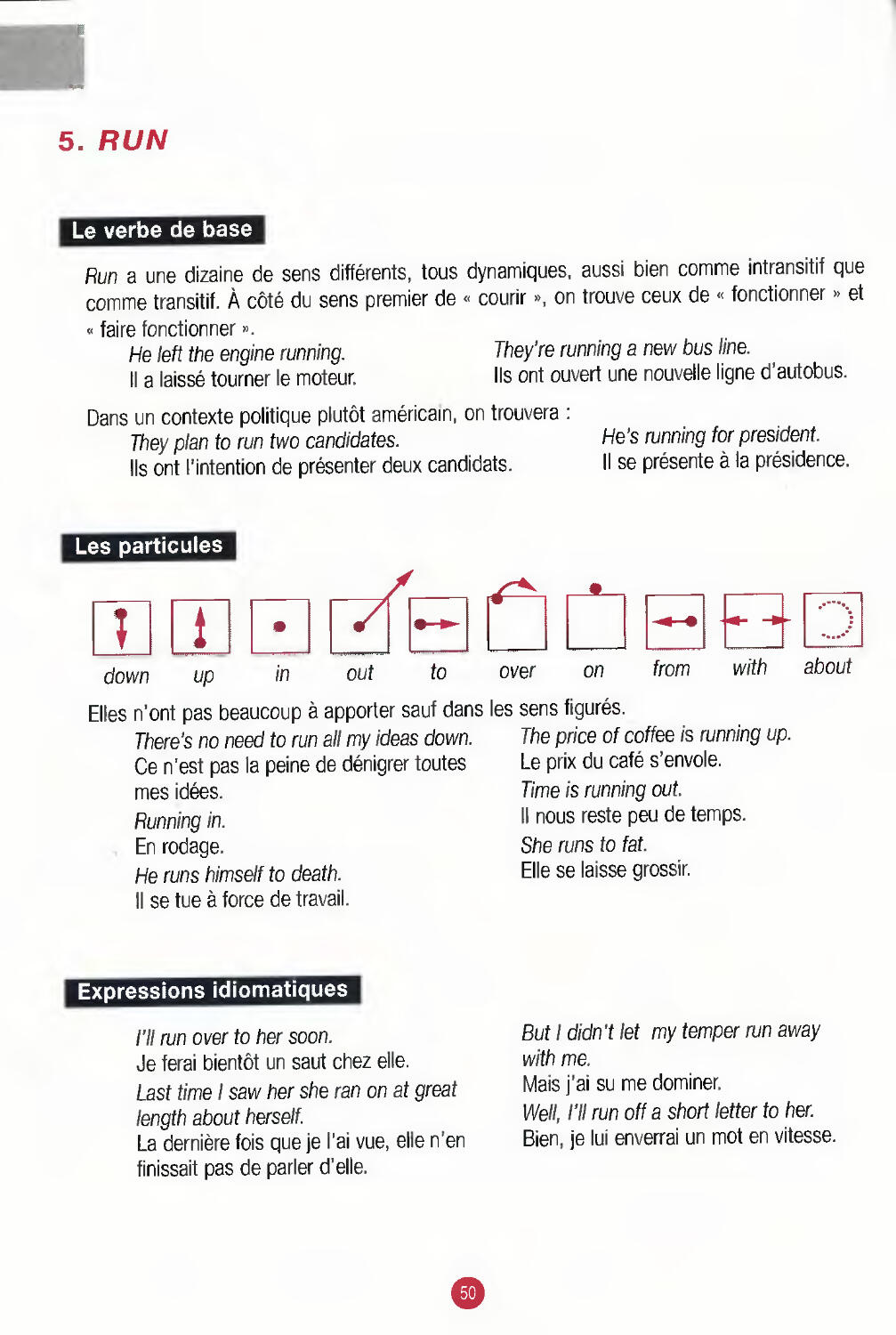
Il la harcèle sans cesse.
Why are you down on me?
Pourquoi m'en voulez-vous?
He's beyond caring.
Il ne s'en fait plus du tout.
He is under the water.
Il n'est pas très bien en ce moment.
©

2. STAND
Le verbe de base
Stand est aussi un verbe de position. Il exprime l'idée d'« être » mais la prolonge : c'est « être
debout », « s'élever », « se dresser », « se maintenir » pour les êtres vivants et pour les
choses, au propre et au figuré, aux emplois transitif et intransitif.
He sfood the child on the chair. The child has learnt to stand now.
Il a mis l'enfant debout sur la chaise. L'enfant sait se tenir debout maintenant.
Les particules
Comme pour be, chacune d'elles greffe sur le verbe son sens propre pour préciser la position
ou suggérer un mouvement.
rvfm
rf=*s
1
B
ouf
up
on
upon
over about down
to
from with
To, from et with servent souvent à préciser un mouvement par rapport à quelqu'un ou quelque
chose d'autre. Toutes les autres particules - auxquelles on peut ajouter by, off et for - sont
utilisables à peu près à égalité d'emploi.
They stood up when he came in.
Ils se sont levés quand il est entré.
He stood down in her faveur.
Il s'est désisté en sa faveur.
His figure stood ouf on the landscape.
Sa silhouette se détachait du paysage.
He stands up for human rights.
Il défend les droits de l'homme.
He won't do anything good if I don't
stand over him.
Il ne fera rien de bon si je ne suis pas
sur son dos.
Ail the soldiers are standing by.
Tous les soldats sont en état d'alerte.
Expressions idiomatiques
If he hits you again, stand up to himl
S'il te frappe encore, fais-lui face !
She stood me up.
Elle m'a posé un lapin.
Notons au passage des noms composés comme a stand-in (un remplaçant, une doublure), ou
a standby (une personne sur qui on peut compter).
/ doubf very much that her story will stand
up to questioning.
Je ne suis pas du tout sûr que son histoire
tiendra si on l'interroge.
©

3. GO
Le verbe de base
Go a deux familles de sens plutôt dynamiques.
• L'une est de valeur concrète : « aller », « se rendre à », « fonctionner ».
WeVe gone fhree miles.
Nous avons fait cinq kilomètres.
• L'autre est de valeur abstraite, figurée :
7hese colours don't go.
Ces couleurs jurent.
How are things going?
Comment ça va ?
« convenir », « devenir ».
He's going bald.
Il devient chauve.
Les particules
on
down
out
to
up
•
1
. v'~ t ^
:>BB
over about with from
Les emplois les plus nombreux se font avec on et down qui soulignent la continuité, l'inflexion
ou l'arrêt d'un mouvement, au propre et au figuré.
What's going on hère?
Qu'est-ce qui se passe ici ?
The idea didn't go down well.
L'idée n'a pas été bien reçue.
On trouve aussi, associés à go, d
de particules.
go bad : mal finir
go slow : faire une grève perlée
Work goes with success.
Le travail va de pair avec le succès.
She goes about with a soldier.
Elle sort avec un soldat.
assez nombreux adjectifs ou noms qui jouent ainsi le rôle
go easy : y aller doucement
go halves : partager
Expressions idiomatiques
That won't go down with me.
Ça ne prendra pas avec moi.
He's going in for président.
Il est candidat à la présidence.
He went out when he saw the blood.
À la vue du sang, il perdit conscience.
She's going ail out in her studies.
Elle se donne à fond dans ses études.
Go for itl
Fonce !
Will he go up?
Va-t-il passer dans la classe supérieure ?
And then the balloon went up
Et c'est alors que les ennuis ont commencé.
@

4. COME
Le verbe de base
Corne a essentiellement un sens dynamique, propre (venir, arriver) et figuré (devenir).
Corne and hâve a drink! Corne fo think of it, you're right.
Viens prendre un verre ! Tout bien pesé, tu as raison.
7b corne and go. Corne what may.
Aller et venir. Advienne que pourra.
Les particules
~:
DB0fflÛ
^
B
fo
up
out down
on
over from about with
He often cornes up with good ideas.
Il sort souvent de bonnes idées.
• Très nombreuses sont les associations avec quatre particules de mouvement : fo, up, out et
down, aux sens propre et figuré, avec des particules adverbiales ou prépositionnelles, et
assez souvent les deux successivement.
Ptease come up fo me.
Montez me rejoindre, s'il vous plaît.
How did the issue come up in the first place?
D'abord, comment se fait-il que la question soit
venue sur le tapis ?
• Peu d'emplois avec les autres particules. Citons cependant :
7e// me how it ail came about. Explique-moi comment tout ça s'est produit.
• À noter ici encore l'usage assez fréquent de noms ou d'adjectifs jouant le rôle de particules
adverbiales.
come a//Ve : s'animer come home : « redescendre sur terre »
come good : bien finir malgré tout come full circle : changer complètement
come true : se réaliser d'avis
Expressions idiomatiques
She came down with the flu. Come off it!
Elle a attrapé la grippe. À d'autres ! Mon œil !
Your idea came in handy Come on!
Votre idée s'est avérée utile. Tu plaisantes !
À noter un nom composé : a comeback (un retour sur scène) qui est passé en français.
@

5. RUN
Le verbe de base
Run a une dizaine de sens différents, tous dynamiques, aussi bien comme intransitif que
comme transitif. À côté du sens premier de « courir », on trouve ceux de « fonctionner » et
« faire fonctionner ».
He left the engine running. They're running a new bus Une.
Il a laissé tourner le moteur. Ils ont ouvert une nouvelle ligne d'autobus.
Dans un contexte politique plutôt américain, on trouvera :
They plan fo run two candidates.
Ils ont l'intention de présenter deux candidats.
He's running for président.
Il se présente à la présidence.
Les particules
;
1
•
—/ 1 i^i r*-) i m m 1
S -*- -*-.--* •"'•)
down up
out
to
over on from with about
Elles n'ont pas beaucoup à apporter sauf dans les sens figurés
There's no need to run ail my ideas down.
Ce n'est pas la peine de dénigrer toutes
mes idées.
Running in.
En rodage.
He runs himself fo death.
Il se tue à force de travail.
The price of coffee /s running up.
Le prix du café s'envole.
Time is running out.
Il nous reste peu de temps.
She runs to fat.
Elle se laisse grossir.
Expressions idiomatiques
/'// run over to her soon.
Je ferai bientôt un saut chez elle.
Last time I saw her she ran on at great
length about herself.
La dernière fois que je l'ai vue, elle n'en
finissait pas de parler d'elle.
But I didn't let my temper run away
with me.
Mais j'ai su me dominer.
Well, l'Il run off a short letter to her.
Bien, je lui enverrai un mot en vitesse.

6. FALL
Le verbe de base
Fall exprime évidemment, au sens propre, un mouvement vers le bas, une chute. Au sens
figuré, il évoque une sorte de commencement.
l'm going to fall asleep. He Ml silent.
Je vais m'endormir. Il se tut.
es particules
00
in out
off
/
t
on
from
to
with
down
over
about
On peut ajouter à ces particules, à la place de up, des mots comme away, back ou behind.
• In peut avoir une valeur adverbiale aussi bien que prépositionnelle, au sens propre et au sens
figuré.
The roof has fallen in. She fell in love with him immediatefy.
Le toit s'est effondré. Elle est immédiatement tombée amoureuse de lui.
His cheeks hâve fallen in.
Ses joues se sont creusées.
• Fall out n'exprime pas seulement une sorte de chute, de retombée. Il rend aussi l'idée d'arriver,
de devenir.
Everything fell out as we had hoped.
Tout s'est passé comme nous l'espérions.
• Les emplois avec on sont multiples, selon le lieu de la « chute ».
He always seems to fall on his feet. He fell on his knees and thanked God.
Il semble toujours retomber sur ses pieds. Il tomba à genoux et remercia Dieu.
Expressions idiomatiques
Mosf married people fall out over money
La plupart des couples ont des querelles
d'argent.
He fell for her immediatefy.
Il tomba amoureux d'elle immédiatement.
Ail the guests fell about when he told
them his story.
Tous les invités éclatèrent de rire quand il
leur raconta son histoire.

7. TAKE
Le verbe de base
Les sens issus de take (prendre) sont nombreux. Citons :
• mener
He'll take you to the station. Il vous conduira à la gare.
• consommer
Do you take sugar in your tea? Vous mettez du sucre dans votre thé ?
• utiliser
it takes two people to do thisjob. Il faut deux personnes pour faire ce travail.
• soustraire
Take two from six... Six moins deux...
• occuper
Take a seat, please. Asseyez-vous, s'il vous plaît.
• choisir
What are you taking next year, maths or physics?
Tu choisis quoi, l'an prochain, les maths ou la physique ?
• contenir
This bus takes 50 people. Ce bus a une capacité de 50 personnes.
Les particules
up in out to on from over with about down
off into
Pour mieux prendre conscience de la diversité des sens, regardons de plus près take up.
Who will take breakfast up to your mother? Ali the children took up the song.
Qui montera le petit-déjeuner à ta mère ? Tous les enfants ont repris en chœur.
When did you first take up golf? l'Il take you up on that.
Quand t'es-tu mis au golf ? Je vous prends au mot.
Expressions idiomatiques
Shall we take in Eton? I think people will take to the streets.
On passe par Eton ? Je pense que les gens vont descendre dans la rue.
Don't take it out on me!
Ne t'en prends pas à moi !
Noms composés : takeaway food (plats préparés), the take-home pay (le salaire net).
o

8. GET
Le verbe de base
• Verbe transitif, get a de nombreux sens issus du premier : « obtenir >
Did you get the bread? Tu as acheté le pain ?
• Le plus remarquable est dit « causatif ».
/ must get my hair eut. Je dois me faire couper les cheveux.
• Comme intransitif, il a souvent un sens « résultatif ».
He's getting old. Il vieillit.
Les particules
Elles sont nombreuses à s'accrocher à ce verbe, exprimant des mouvements divers et abstraits.
mm
V
-
eut in into on up
off
She must hâve got out ofbed on the
wrong side.
Elle a dû se lever du pied gauche.
The scandai has got out.
Le scandale a éclaté.
He gof off with a fine.
Il s'en est tiré avec une amende.
/ couldn't get a word in.
Je n'ai pas pu placer un mot.
They got into trouble.
Ils se sont attiré des ennuis.
B
^
fo with over about
(ajround
The car had difficulty getting up the
slope.
La voiture n'arrivait pas à monter la
pente.
/ can't get over the tact that he got
through.
Je n'en reviens pas qu'il ait réussi.
Let's get down fo work.
Mettons-nous au travail.
She knows how fo gef (ajround people.
Elle sait s'y prendre avec les gens.
Expressions idiomatiques
He's always getting at me. He's always getting up fo mischief.
Il ne cesse de s'en prendre à moi. Il ne peut s'empêcher de faire des bêtises.
He's getting on for 50. l'Il get my own back on him.
Il approche la cinquantaine. Je lui rendrai la monnaie de sa pièce.
Encore quelques noms composés : fhe getaway (la fuite), a get-together (une réunion).

9. PUT
Le verbe de base
Put n'a le plus souvent que le sens de « poser », « mettre ».
He put a lot of money in real estate.
Il a placé beaucoup d'argent dans l'immobilier.
Le sens peut aussi être figuré.
How shall I put it? Let's put it he is innocent.
Comment dire ? Mettons qu'il soit innocent.
Les particules
Out, que l'on peut associer à off, de même que in et up sont de loin les plus fréquentes. From,
over, about sont quasi absentes, remplacées par away, back et through.
/
/
out
off
m
in
i
up
»
on
lîh
down
with
m »
fo
away
^
back
/'
through
Don't forget fo put out I off the fire.
N'oublie pas d'éteindre le feu.
She's always putting herself out for them.
Elle se met touiours en quatre pour eux.
Put it off till tomorrow.
Remets ça à demain.
My accident put me off swimming.
Mon accident m'a dégoûté de la natation.
"He's loyal," she put in.
« Il est loyal, » fit-elle remarquer.
Posters hâve been put up ail over the town.
On a collé des affiches dans toute la ville.
The argument he put up is not valid.
L'argument qu'il a avancé ne tient pas.
Can you put on the light?
Peux-tu allumer ?
Don't put on an English accent.
Ne fais pas semblant d'avoir l'accent
anglais.
/ put down my name for the mixed
doubles.
Je me suis inscrit pour le double mixte.
He put his mistake down to overwork.
Il a attribué sa faute au surmenage.
Expressions idiomatiques
Iwon'tputup withthis!
Je ne le tolérerai pas !
Can you put me up for the night?
Vous pouvez me loger pour la nuit ?

10. SET
Le verbe de base
Set peut être considéré comme terminant une série d'actes. Comparez : gef (obtenir une
chose), take (la prendre), put (la mettre quelque part) et enfin set (l'installer).
Au sens propre :
My village is set on the top of a Nil.
Mon village est situé au sommet de la colline.
Au sens figuré, set a parfois une valeur causative.
It set me thinking. Cela m'a donné à réfléchir.
She had her hair set.
Elle s'est fait faire une mise en plis.
Les particules
Elles ne modifient pas beaucoup le sens premier, déjà « fixé » (set), mais elles le précisent ou
l'infléchissent.
h r n r n rn^Q ^
up
off
out
to
on
upon
He set up in business in Liverpool.
Il a monté une affaire à Liverpool.
They set up house together.
Ils se sont mis en ménage.
The dress does not set off her eyes.
Cette robe ne met pas ses yeux en valeur.
Corne before wmter sets in.
Viens avant que l'hiver ne s'installe.
down against at back
They set to with their fists.
Ils en sont venus aux mains.
Shall I set you down at the corner?
Je vous dépose au coin de la rue ?
Set it down on my account.
Mettez ça sur mon compte.
Set on, quant à lui, entre dans de nombreuses expressions.
Set something on foot. Set one's hands on something.
Faire démarrer. Prendre possession de quelque chose.
Expressions idiomatiques
It's no use her setting her cap on him: he's on/y set on his work
Elle a bien tort d'essayer de vouloir mettre le grappin sur lui : il ne s'intéresse qu'à son travail.
He'll never set the Thames on fire. Il n'a pas inventé la poudre.

VERBES À PARTICULES
LES PARTICULES
•••
À SAVOIR
Ces petits mots (ou groupes de mots), associés à un grand nombre de verbes, forment de
multiples expressions verbales {phrasal verbs). de sens très variés.
Nature de la particule
• Elle peut être un adverbe.
/ can't put the lid on, the box is foo full.
Je ne peux pas mettre le couvercle, la boîte est trop pleine.
• Ce peut être une préposition, qui donc introduit un complément.
Put the plates gently on the table, please.
Mettez les assiettes doucement sur la table, je vous prie.
• Le même verbe peut être suivi d'un adverbe, puis d'une préposition.
/ know who put him up fo cheating. Je sais qui l'a poussé à tricher.
• La particule peut être aussi, mais plus rarement, un pronom comme it, qui devient donc ainsi
une sorte d'adverbe.
He took it out on John. He lords it.
Il s'est défoulé sur John. Il agit en martre.
• Ce peut être encore un adjectif, ou un nom.
/ hope my dreams will corne true. J'espère que mes rêves se réaliseront.
When will you phone home? Quand téléphoneras-tu chez toi ?
• Le verbe, enfin, peut être suivi de plusieurs mots, traditionnellement associés, et former des
« idiomatismes ».
He has a tendency fo gef above himself.
Il a tendance à avoir une trop bonne opinion de lui-même.
Silence fell when the subject got beyond a joke.
Le silence se fit quand le sujet devint trop sérieux pour en plaisanter.
@

ImmSUiSiUI
La fonction la plus apparente et la plus commune de la particule est de dynamiser le verbe
de base.
• Elle le dynamise d'autant plus nettement que le sens de ce verbe est plus vague. C'est le cas,
par exemple, de get, avec lequel elle prend son sens plein.
Hegotupat ten o 'dock. He gof on the chair and jumped.
Il se leva à dix heures. Il monta sur la chaise et sauta.
/'// get off at the next stop.
Je descendrai (du train, du métro, de l'autobus, etc.) au prochain arrêt.
• Lorsque le verbe est déjà porteur d'une idée de mouvement, celui-ci est précisé par la particule.
C'est le cas, par exemple, de drive, de walk ou dejump.
He first drove to the station, then (drove) away, then (drove) back and finally decided
to drive home.
D'abord il roula vers la gare, s'en éloigna, revint en arrière et enfin décida de revenir chez lui.
• Elle peut même transformer un verbe de position en verbe de mouvement.
/'// lie down for a while. Je vais m'allonger un moment.
• Quelques verbes formés à partir du nom d'un objet n'existent pas sans particule.
The boat keeled over. Le bateau chavira, (a keel = une quille)
• Avec un verbe intransitif, la particule se place presque toujours immédiatement après le verbe.
Come in and sit down. Entrez et asseyez-vous.
Parfois elle se place en tête de phrase, pour insister sur la rapidité du mouvement.
Off we go. Et nous voilà partis.
• Avec un verbe transitif, il convient de faire la différence entre particule adverbiale et particule
prépositionnelle.
• Particule adverbiale.
Si le complément est un groupe nominal court, on la trouve soit avant, soit après.
Bring up the chair. Bring the chair up. Remonte la chaise.
Si le complément est un pronom, elle est toujours placée après.
Bring it up. Remonte-la.
Elle ne peut se trouver séparée du verbe par un complément long.
Bring up the chair that you put yesterday in the garden.
Remonte la chaise que tu as mise hier dans le jardin.
• Particule prépositionnelle.
Elle se place évidemment avant le complément, sauf dans une proposition relative et à la
forme interrogative.
This is the person (whomj I brought the chair for. Who(m) shall I give the chair to?
Voici la personne pour qui j'ai apporté la chaise. À qui vais-je donner la chaise ?

À LA RECHERCHE DU SENS
B23IE1SÏ3
Ce qui rend la recherche du sens plus difficile, c'est que les particules peuvent non seulement
caractériser un mouvement ou un état, mais se rapporter à des êtres animés aussi bien qu'à
des objets, et donner au verbe un sens concret, propre, ou un sens abstrait, figuré. Il faut
donc essayer de repérer, d'après le contexte, dans quelle direction fonctionne la particule.
Le fonctionnement le plus simple
Ce n'est pas tant le verbe que le rôle de la particule qui pose problème. On donnera donc la
priorité à celle-ci en traduisant d'abord le résultat de l'action exprimée par la particule. On
traduira ensuite le verbe qui décrit la manière dont l'action est accomplie.
She ran (ûpTI He swam lacross I the river.
■*
Elle |monta) en courant. Il |traversa la rivière à la nage
Les idiomatismes
» Dans l'usage, la fonction dynamisante de la particule n'est pas toujours clairement reconnais-
sable. Les dictionnaires généraux, selon leur ambition, donnent, à la suite de chaque verbe
ordinaire, une liste d'emplois avec telle ou telle particule. Il existe aussi plusieurs dictionnaires
spécialisés dans les Phrasal Verbs. Seul le recours à ces ouvrages permettra d'élucider le sens
de certains verbes à particule : si le sens de go up est évident, auriez-vous pu deviner, par
exemple, celui de make up ?
She spends a lot of time making herself up.
Elle passe beaucoup de temps à se maquiller.
He's made up the whole story.
Il a inventé toute l'histoire.
IVe'ff hâve fo make up for lost time.
Il nous faudra rattraper le temps perdu.
Let's make it up!
Si on faisait la paix ?
Make up your mind.
Décide-toi.
@

Nous avons retenu dix particules très fréquentes, qui feront l'objet d'une étude détaillée dans
les pages suivantes. Les voici dans leur ordre de fréquence : 1. up, 2. ouf, 3. in, 4. down,
5. on, 6. over, 7. with, 8. fo, 9. from, 10. about I (ajround.
OVER
He's going
over the wall.
•
UP
He's going up ,
the stairs. yi |
She's going with
him from the door
to the stairs.
FROM WITH TO
ON OUT
He's on the ladder.
He's going out.
•
He's in
ABOUT/AROUND
He's going about / around.
Pour les vingt autres particules les plus fréquentes, cf. p. 72.
@

1. UP
Sens de base
Up exprime le plus souvent un mouvement, dans le sens concret vers le haut, ou une
position « en hauteur », pour les êtres vivants comme pour les choses. Dans les sens abstraits et
figurés, il s'agit plutôt de mouvements ou de positions approchant d'un paroxysme, de la
perfection, de l'achèvement d'une action.
He threw the bail up. Il a jeté la balle en l'air.
He drove up the street. Il remonta la rue en voiture.
Les associations
J >
tînt
1r
corne run take set be stand go get put
fall
I like watching the sun corne up.
J'aime voir le soleil se lever.
He's quite taken up with her.
II ne pense qu'à elle.
The ship has run up the red flag.
Le navire a hissé le drapeau rouge
/'// take that up with him.
Je lui en parlerai.
Expressions idiomatiques
Don't try to corne up!
N'essaie pas de faire le malin !
It's up to you to décide.
C'est à toi de décider.
What is he up to?
Qu'est-ce qu'il fabrique ?
Cette particule est si robuste qu'elle peut même assumer le rôle d'un verbe à elle toute seule
/ upped and told her what I thought of her.
Sans plus attendre, je lui dis ce que je pensais d'elle.
Retenez le nom composé setup, qui signifie « situation » ou « installation ».
/ don't like that setup at ail. Programme setup.
Je n'aime pas du tout l'allure de tout ça. Installation du logiciel.
He's up to no good.
Il prépare quelque sottise.
/ don't feel up to it.
Je ne m'en sens pas le courage.
He's well up in grammar.
Il connaît à fond la grammaire.
@

2. OUT
Sens de base
Au propre comme au figuré, ouf apporte l'idée de <
The bail is out.
La balle est sortie du terrain.
He lives out of town.
Il ne vit pas en ville.
dehors », de « à l'extérieur =
Out with It!
Dis ce que tu as à dire !
Hefeels outofit.
Il se sent en marge.
Les associations
ttttnnu
get put
set
fall
stand take corne
90
run
Elles se font surtout avec les verbes rendant compte de positions et de mouvements de
personnes ou de choses, en particulier get.
The news hasjust got out.
La nouvelle vient de paraître.
Les sens sont nombreux avec be.
The secret is out.
On a vendu la mèche.
We've run out ofpetrol.
On est tombés à court d'essence.
That wasn't what I set out to do.
Ce n'est pas ce que je voulais faire initialement.
Our apple tree is out.
Notre pommier est en fleurs.
It came out that he was penniless.
Il s'avéra qu'il était sans le sou.
Expressions idiomatiques
L'expression fall out, par exemple, a de quoi surprendre. À côté du sens de « retombée
nucléaire », elle a le sens de « se passer », « arriver », « avoir pour résultat ».
It so fell out that they were not to meet again.
Il se trouva qu'ils ne devaient plus se rencontrer.
Fall out a aussi le sens de « se quereller ».
They fall out every two weeks but their quarrels never last
Ils se font une scène tous les quinze jours mais leurs disputes ne durent jamais.
On retrouve ce mot comme préfixe dans de nombreux composés : outdated (suranné),
ouf//Ve (survivre), etc. (cf. p. 75).

3. IN
Sens de base
i Avec in, il s'agit surtout de décrire des positions à l'intérieur d'un lieu, d'une période, de
circonstances.
Is there somebody in? Il y a quelqu'un ?
Corne in! I Get in! Entrez !
i II y a beaucoup d'emplois au figuré.
We're in the money Nous sommes riches.
Les associations
t t
H
*
n
*
fr
be stand fall
take
run
set
get put corne go
Il n'est pas étonnant de voir cette particule le plus souvent utilisée avec les verbes de
position be et stand, ainsi qu'avec fall.
I fall in very well with your plans. Votre décision cadre avec mes projets.
Autres exemples :
/ wasn't in on it.
Je n'étais pas dans le coup.
The train is in.
Le train est en gare.
We took in Stratford on our way home.
Nous avons visité Stratford au retour.
He didn't take in the situation.
Il n'a pas bien compris la situation.
He's got in with bad company
Il a de mauvaises fréquentations.
/ pur in three hours a day looking after
him.
Je consacre trois heures par jour à m'oc-
cuper de lui.
She has corne in first.
Elle a le premier prix.
He doesn't go in for reading very much.
Il ne s'intéresse pas beaucoup à la lecture.
The rain has set in for the night.
Il va pleuvoir toute la nuit.
Expressions idiomatiques
She is in.
Elle a été élue.
He was in for the teacher.
Il était dans les petits papiers du professeur
o

4. DOWN
Sens de base
> Au sens propre, down exprime un mouvement vers le bas jusqu'à un effet d'anéantissement
ou d'échec.
l'm sure he fell down. Down with the tyrant!
Je suis certain qu'il est tombé. À bas le tyran !
Au figuré, down indique une diminution, une réduction.
Please, slow down. Ralentis s'il te plaît, (mais on dira aussi : slow up...)
Priées seldom go down. It's time I stood down.
Les prix vont rarement à la baisse. Il est temps de démissionner.
Les associations
i
j >
*
mm
go run corne put
She feels a little run down.
Elle se sent à plat / mal fichue.
/ put him down as a crook.
Je le prends pour un escroc.
Don't let things get you down.
Ne te laisse pas abattre.
get
%
set
take stand be
fall
I took down ail that you said.
J'ai pris en note toutes vos paroles.
/ am down on my luck.
Je n'ai pas de chance.
He fell down badly this time.
II a vraiment raté son coup cette fois.
Expressions idiomatiques
He's down and out.
Il est sans le sou.
The idea suits me down to the ground.
L'idée me convient parfaitement.
They put me down to wash the dishes.
Il m'ont désigné pour faire la vaisselle.
She's down on you, l'm afraid.
Elle t'en veut, j'en ai peur. '
Remarquez l'emploi de down dans certains mots composés comme a down-to-earth person
(une personne qui a les pieds sur terre) ou down-under (aux antipodes).
Enfin, comme up, le mot peut être un verbe à temps plein.
They downed tools. Ils ont cessé le travail. Ils se sont mis en grève.

5. ON
Sens de base
• Au sens propre, on évoque un état de contact.
Put your hat on. Don't throw it on to the table.
Mets ton chapeau. Ne le jette pas sur la table.
• Au sens figuré, on dira :
She put a good face on. Elle a fait bonne figure.
• On exprime aussi une progression, une continuité.
Read on. Continuez à lire. /'// follow on after you. J'enchaînerai après vous.
-&> Ne confondez pas les deux sens de on. Comparez :
^' Go on! Continue !
The police had no due to go on. La police n'avait aucun indice sur quoi s'appuyer.
Les associations
«X.
*
ut
go be get put set take fall corne stand run
On est le plus souvent associé aux verbes décrivant plutôt des positions et des mouvements.
We'll corne on the 1st of May. They set the police on the wrong track.
Nous viendrons le premier mai. Ils ont mis la police sur une fausse piste.
"Gef on/" the station-master said. l'Il take on the responsibility.
« Montez ! » dit le chef de gare. Je prendrai la responsabilité.
The Old Vie has put "Macbeth" on. They put me on to a good hôtel.
On joue « Macbeth » à l'Old Vie. Ils m'indiquèrent un bon hôtel.
Expressions idiomatiques
She's on the pill.
Elle prend la pilule.
You're on.
Tope là.
Noms composés : onlooker (badaud, spectateur), on-line (en réseau), onshore (à terre).
We had a drink on the house.
Le patron a offert la tournée.
He's back on cigarettes.
Il s'est remis à fumer.
@

6. OVER
Sens de base
• Au sens propre, over ajoute l'idée d'un mouvement par dessus ou d'une position au-dessus
de quelque chose.
The plane was flying over London. L'avion survolait Londres.
• Au figuré, over décrit souvent une évolution dans le temps ou ce qui reste à la fin d'une
période.
Over the last ten years he has travelled a lot.
Il a beaucoup voyagé ces dix dernières années.
Take what is left over. Prenez ce qui reste.
Game over. Fin de la partie.
Les associations
toit éî
1 '
go corne run fall get
Let's go I run over the events of that
period.
Révisons les événements de cette période.
What came over her?
Qu'est-ce qui lui a pris ?
Their dog hadjust been run over.
Leur chien venait de se faire écraser.
take put stand set
The chair fell over.
La chaise a basculé.
/ can't get over the tact that he got
through.
Je n'en reviens pas qu'il ait réussi.
He took over the shop from his father.
Il a repris le magasin de son père.
Expressions idiomatiques
They think you're ail over the I
are 40.
lifyou
Ils pensent qu'on est fichu après 40 ans.
She came over giddy
Elle se sentit mal.
He's falling over himself to help.
Il se met en quatre.
Let's get it over!
Finissons-en !
Notons enfin que over entre dans la composition de nombreux mots, dont beaucoup de
verbes : overwork (surmener), overcook (trop cuire), overtime (heures supplémentaires), etc.

7. WITH
Sens de base
• With ne peut être qu'une particule prépositionnelle. Elle est très utilisée, à cause de la
diversité de ses sens.
• Initialement, elle indique l'accompagnement, la
et choses.
Who(m) do you live with?
Avec qui vivez-vous ?
l'm with you in what you say.
Je suis d'accord avec vous.
Les associations
With est employée avec pratiquement tous
suite d'une autre particule.
Corne on, don't be old-fashioned,
get with it.
Allons, ne sois pas vieux jeu,
sois dans le coup.
Try to get on weil with him.
Essaie de te mettre bien avec lui.
Expressions idiomatiques
Oh, get away with you!
Allons ! Je ne vous crois pas !
Are you with me?
Vous me suivez ? / Vous me comprenez ?
Gef with it! He's lying to you!
Ouvre les yeux ! Il te ment !
Remarquez enfin les verbes withdraw (retirer),
withdrawal (retrait)...
la relation, et jusqu'à l'harmonie entre personnes
What kind of petrol do you fill it with?
Avec quel genre d'essence faites-vous
le plein ?
verbes les plus prolifiques, et très souvent à la
Hâve you got enough work to be getting
on with?
Avez-vous assez de travail pour vous
occuper ?
Yesterday I fell in with a party of climbers.
Hier, j'ai rencontré un groupe
de grimpeurs.
Couldn't you put up with him?
Ne pourriez-vous pas vous entendre
avec lui ?
r), withstand (supporter) et les noms dérivés :
Mais le sens peut s étendre jusqu'à exprimer, entre autres :
• La manière : He did it with great care (avec grand soin).
• Le moyen : / saw it with my own eyes (de mes propres yeux).
• La cause : He cried with joy (de joie).
• Le temps : With the years he's getting wiser (les années passant..
les

8. TO
Sens de base
To illustre, au propre comme au figuré, la direction d'un mouvement et éventuellement son
aboutissement.
You should go to the dentist's. He's our ambassador to Belgium.
Vous devriez aller chez le dentiste. Il est notre ambassadeur en Belgique.
On voit qu'un Anglais imagine plus précisément ce mouvement qu'un Français. De même
dans les exemples suivants.
It is a quarter to four. One person to a room.
Il est quatre heures moins le quart. Une personne par pièce.
Remarquez que to est traduit en français par des formulations utilisant des prépositions différentes.
Les associations
J>
t wt 11
go corne take get put
I hâve corne fo the last chapter.
J'en suis au dernier chapitre.
She has taken to drinking.
Elle s'est mise à boire.
How can I get it to him?
Comment le lui faire parvenir ?
run
set stand
Trains running to London hâve been delayed.
Les trains à destination de Londres ont du retard.
The soldiers stood to attention.
Les soldats se mirent au garde-à-vous.
Hâve you been to London?
Êtes-vous allé à Londres ?
/'// put I set him to work. Je vais le mettre au travail.
Expressions idiomatiques
What wouid you say to a béer?
Que diriez-vous d'une bière ?
Hère's to you!
À la vôtre !
There's nothing to it.
Rien de plus facile.
He's gone to the dogs.
Il va être ruiné.
The Prime Minister has decided to go to
the country.
Le Premier Ministre a décidé de lancer
des élections générales.
They realty went to town on it.
Ils y ont vraiment mis le paquet.
He's just corne to.
Il vient de reprendre connaissance.
©

9. FROM
Sens de base
From ne peut être que préposition.
i Au sens propre, il marque un point de départ, souvent associé à to, qui peut désigner un point
d'arrivée. Il est alors souvent traduit par « de », « depuis ».
From nextweekon...
À compter de la semaine prochaine...
Judging from appearances...
Apparemment...
A portrait painted from life. Un portrait
Where are you from?
D'où êtes-vous ?
From what I hâve heard...
D'après ce que j'ai entendu dire.,
l'après nature.
précède d'autres prépositions comme behind, above, over there.
Les associations
t
*
t
t
i
«JL
*
take fait stand go corne
The vicar took his text from St Mark's
Gospel.
Le curé a extrait son texte de l'Évangile
selon St Marc.
He has stolen $10 from his mother.
Il a volé dix dollars à sa mère.
run put set
Let's shelter from the rain hère.
Abritons-nous de la pluie ici.
7e// him this from me.
Dis-lui ceci de ma part.
Expressions idiomatiques
Don't drink from the bottle, please.
Ne buvez pas à la bouteille.
Keep him from talking to her.
Empêchez-le de lui parler.
He does not know good from evii.
Il ne fait pas la distinction entre le bien
et le mal.
Can you tell pudding from porridge?
Tu sais faire la différence entre
du pudding et du porridge?
©

10. ABOUT I AROUND I ROUND
Sens de base
Ces particules apportent à peu près le même sens à la majorité des verbes de notre liste
« non loin », « autour », « aux alentours ».
She is somewhere about. He walked about the lake.
Elle n'est pas loin. Il a fait le tour du lac.
Ce qui justifie le sens de about associé souvent à 5e :
She was about to call the police. Elle était sur le point d'appeler la police.
Les associations
*!
*
ttit
«t
#
fall take
go corne get run
I always go about by bus.
Je circule toujours en bus.
Your birthday will soon corne around.
Ce sera bientôt ton anniversaire.
Stories hâve been getting round about him.
Des rumeurs ont couru à son sujet.
Who's been putting about thèse stories?
Qui a fait courir ces bruits ?
put
set
be stand
What about me?
Et moi, alors ?
No, it's the other way around.
Non. c'est dans l'autre sens.
While you're about it, will you fix me
a cup of tea?
Pendant que tu y es, tu peux me faire
une tasse de thé ?
Expressions idiomatiques
How do you go about getting permission?
Comment s'y prend-on pour avoir
l'autorisation ?
She fainted but soon came round.
Elle s'évanouit mais reprit vite conscience.
There's something about that g/ri/
Cette fille a un je ne sais quoi...
They often argue but it does not take
them long to corne around.
Ils se disputent souvent mais ils ne mettent
pas longtemps avant de se réconcilier.
He was greatly put out about this event,
and yet he's been around!
L'événement l'a beaucoup troublé, et
pourtant il n'est pas né d'hier !
Un mot composé intéressant : / don't know his whereabouts. (Je ne sais où il est exactement.)
©

11. VINGT AUTRES PARTICULES
Elles peuvent être adverbe ou préposition. Elles sont ici données dans l'ordre alphabétique,
accompagnées de leur sens de base, d'un exemple et d'une expression idiomatique.
Above : au-dessus, en haut (plus haut qu'avec over).
It will cost above £100. This is above me.
Ça coûtera plus de 100 livres. C'est trop compliqué pour moi.
Across : de l'autre côté d'une ligne ou d'une surface.
She lived across the street. He couldn't get it across to me.
Elle vivait de l'autre côté de la rue. Il n'a pas pu me le faire comprendre.
Against : contre ; contraire de with.
Agatnst ail logic, she agreed.
Contre toute logique,
elle a été d'accord.
Along : mouvement le long d'une ligne.
There were trees along the road.
Des arbres longeaient la route.
Apart : à côté, à l'écart.
It came apart in my hands.
Ça s'est démonté tout seul.
At : indique une position et, éventuellement, une idée d'hostilité.
He feels at home hère. He threw stones at passers-by.
Il se sent chez lui ici. Il jetait des pierres sur les passants.
Away : éloignement, absence.
D/'cf you take my book away?
Tu as emporté mon livre ?
Back : en arrière.
He isjust back from holiday
Il vient de rentrer de vacances.
He put money by against his retirement.
Il a mis de l'argent de côté en prévision
de la retraite.
Corne along, children!
Venez, les enfants !
You can't tell them apart.
On ne peut pas les distinguer l'un de l'autre.
Right away.
Immédiatement, tout de suite.
It was as far back as 1800.
Ça remontait à l'année 1800.
Before : en avant dans le temps, dans le lieu, dans l'ordre ; contraire de after.
You should hâve told me before. He appeared before the court.
Tu aurais dû me le dire avant. Il comparut devant un tribunal.
By : position ou mouvement à côté d'un repère.
He rushed by me.
Il est passé à côté de moi en courant.
It 's difficult but we'll get by.
C'est difficile mais nous y arriverons.
©

• For : vers une destination, un but, un désir, une certitude.
/ took something for the flu. We're in for it!
J'ai pris quelque chose contre la grippe. Ça va barder !
• Forth : mouvement vers l'avant (proche de forward).
He was walking back and forth. He brought forth many ideas.
Il marchait de long en large. Il a proposé des idées intéressantes
• Into : mouvement vers l'intérieur, changement d'état.
The car crashed into a wall. l'm not into it.
La voiture s'est écrasée contre un mur. Ça n'est pas mon truc.
• Like : comparaison entre deux états ou mouvements.
It smells like petrol. What's she like?
Ça sent l'essence. De quoi a-t-elle l'air ?
• Of : marque des rapports comme l'origine, la possession, la cause.
What do you think of him ? What do you think of this ?
Que pensez-vous de lui ? Qu'en dis-tu ?
• Off : interruption, éloignement, contraste avec on.
The farm is off the road. Good bye, l'm off.
La ferme est à l'écart de la route. Au revoir, je m'en vais.
• Past : mouvement près de ou au-delà.
He ran past me. He is past caring.
Il est passé près de moi en courant. Il n'en a plus rien à faire.
• Through : traversée par l'intérieur, à travers.
/ saw him through the window. He got through ail his exams.
Je l'ai vu par la fenêtre. Il a été reçu à tous ses examens.
• Under : sous, au-dessous.
He is under 40. Look under "plumbers".
Il a moins de 40 ans. Cherche dans la rubrique « plombiers >
• Within I Without : à l'intérieur / à l'extérieur.
/'// do it within the week. I can't do without this book.
Je le ferai dans la semaine. Je ne peux me passer de ce livre.

FORMATION DES VERBES
•••
Comme les noms ou les adjectifs, les verbes sont souvent des « hybrides ». Tantôt ils se sont
formés à partir de mots appartenant à une autre catégorie par simple conversion ; tantôt ils
sont le résultat de l'addition de deux mots, c'est une composition ; tantôt ils sont créés à
l'aide d'un préfixe ou d'un suffixe, et l'on parle de dérivation.
Par conversion
• C'est encore un caractère de l'anglais que d'avoir, par exemple, la possibilité de passer du
nom bottle, au verbe to bottle (mettre en bouteille) et même au verbe à particule to bottle up
qui, au figuré, signifie « contenir », « refouler ».
He bottled up his anger. Il a ravalé sa colère.
He's coated the cake with sugar. He /s keen on being sirred.
Il a enrobé le gâteau de sucre. Il tient à se faire appeler Monsieur.
7ïfie wound had skinned over. He was knifed by some madman.
La blessure s'était cicatrisée. Il a été poignardé par un fou.
• L'anglais peut passer, de même, de l'adjectif au verbe.
Calm down They emptied ail the bottles.
Calme-toi. Ils ont vidé toutes les bouteilles.
Notez qu'il y a parfois cependant un changement d'orthographe comme dans advice (des
conseils) qui devient fo advlse, ou un déplacement de l'accent, comme dans a 'présent qui
devient fo pre'sent.
Par composition
Les exemples en sont plus rares, mais un Anglais peut toujours en créer, du moment qu'il se
fait comprendre.
The car backfired. He sleepwalks.
Le voiture pétaradait. Il est somnambule.
The plan backfired. He spends his time daydreaming.
Le projet a échoué. Il ne cesse de rêvasser.
Par dérivation
• Suffixes
Certains sont d'origine française, comme -ise (-ize en américain) : nationalise, « nationaliser ».

Un grand nombre, en -en, ont un sens réfléchi ou passif, et sont construits à partir d'adjectifs.
Ils appartiennent au langage concret des couleurs, des dimensions, des formes, très riche en
anglais.
The sky darkened. Her loving words softened him.
Le ciel s'assombrit. Ses paroles aimantes l'ont apaise.
They hâve broadened the street. This will quieten him. .
On a élargi la route. Cela le tranquillisera.
• Préfixes
• Dis-, dont le sens est négatif.
/ disagree with you: you are distorting the meaning ofmy words.
Je ne suis pas d'accord avec vous, vous dénaturez mes paroles.
• fte-, qui, comme en français, marque la répétition ou le retour.
He reappeared in the meetings as soon as he was reappointed.
Il a reparu dans les réunions dès qu'il a été réintégré.
• Mis-, qui souligne une erreur.
/ don't know if I was misled or misunderstood.
Je ne sais pas si on m'a envoyé dans la mauvaise direction ou si on m'a mal compris
• Over-, qui marque un excès.
"/ am overworked." "Oh, corne on! Don't overdo it."
« Je suis surmené. » « Oh, ça va ! N'en fais pas trop ! »
• Un- (défaire).
They unearthed the body and uncovered the truth about the murder.
Ils déterrèrent le corps et découvrirent la vérité sur le meurtre.
• Under- (contraire de over-).
They underestimated his strength and so underwent a crushing defeaf.
Ils ont sous-estimé sa force et donc subi une cinglante défaite.
• In- (ou en-) et inter-.
We'll hâve to inquire about why he does not interact with his environment.
Il faudra chercher pourquoi il n'y a pas d'interaction entre lui et ce qui l'entoure.
• Sub-
The storm subsided. La tempête se calma.
• Trans-.
He was transfixed with fear. Il fut pétrifié de peur.
• For- a le sens de away dans, par exemple, forbid.
They forbid him to see anyone. Ils lui interdisent de voir qui que ce soit.
• Fore- a le sens de in front of, en avant.
You should hâve foreseen it: you had been forewarned about it.
Vous auriez dû le prévoir : on vous avait prévenu.
• Counter-.
They counteracted by throwing stones. Ils ont riposté en jetant des pierres.
0

compléments du verbe
•••
À SAVOIR
Qu'ils soient groupe nominal ou groupe verbal, les compléments du verbe forment un système
aussi diversifié et étendu que le système des particules.
Verbes transitifs et verbes intransitifs
• Verbes transitifs
Tell me, hâve you read this book ?
Dites-moi, est-ce que vous avez lu ce livre ?
Est transitif tout verbe qui, comme read ici, peut être suivi d'un complément d'objet direct.
• Verbes intransitifs
Corne in and sit down. Entrez et asseyez-vous.
Les verbes corne in et sit down sont intransitifs car ils ne peuvent jamais avoir de complément
d'objet direct.
• De nombreux verbes peuvent être transitifs et intransitifs.
He has adapted his book for the stage.
Il a adapté son livre pour la scène.
She refused to adapt.
Elle a refusé de s'adapter.
Verbes transitifs avec un complément
• Le complément est un groupe nominal.
Très nombreux sont les verbes simples complètes directement par un groupe nominal ou par
un pronom. La syntaxe, dans ce cas, ne pose pas de problème.
Hâve you read ail thèse books? Yes, I hâve read them ail.
Avez-vous lu tous ces livres ? Oui, je les ai tous lus.
La construction est plus complexe en ce qui concerne la place du complément quand il s'agit
de verbes à particules (cf. p. 59).
• Le complément est un groupe verbal.
Il existe plusieurs types de complémentation, chacune apportant sa nuance particulière.
• Infinitif avec to.
/ want him to corne at once.
Je veux qu'il vienne tout de suite.
©

• Infinitif sans to.
I heard him open the door.
Je l'ai entendu ouvrir la porte.
• Forme en -ing.
I can't resist asking the question.
Je ne résiste pas à l'envie de poser la question.
• Préposition suivie d'une forme en -ing.
We agreed about talking it over later.
Nous sommes tombés d'accord pour en reparler plus tard.
• Complétive introduite par that, en particulier au style indirect.
He said that he was delighted by the idea.
II a dit qu'il était ravi de cette idée.
• Interrogative indirecte.
He wondered why she looked so angry.
Il se demanda pourquoi elle avait l'air tellement fâchée.
• Verbe au prétérit modal (cf. p. 19).
/ wish you were hère.
Je regrette que tu ne sois pas ici.
Verbes transitifs avec deux compléments
• Complément d'objet + complément d'attribution.
You gave your friend a strange answer.
You gave a strange answer to your friend.
Vous avez donné à votre ami une étrange réponse.
Remarquez la place du complément d'attribution your friend selon que l'on emploie la
préposition to ou non.
Autres verbes de cette catégorie utilisant :
• fo : bring, offer, play, promote, read, sell, send, teach, write.
• for : look, bring, buy. catch, choose. find. get, pay, reach.
• from : buy, steal.
• Attribut du complément d'objet.
Reading makes me happy.
La lecture me rend heureux.
Love makes me another man.
L'amour fait de moi un autre homme.
L'attribut du complément d'objet peut être un adjectif (happy) ou un groupe nominal (another
man).
Trois de ces constructions font l'objet des pages qui suivent : la forme en -ing, l'infinitif et
le style indirect.
©

1. LA FORME EN -/A/G
ESI
Avec la forme en -ing, l'action est souvent vue de manière concrète. Dans beaucoup de cas,
cette forme exprime une attitude personnelle envers l'action concernée :
• Soit plutôt favorable.
/ enjoy going to the cinéma...
J'aime beaucoup aller au cinéma...
• Soit plutôt défavorable.
...but I avoid watching horror films.
...mais j'évite de voir des films d'horreur.
• Soit neutre.
Hâve you ever considered spending some time in England?
Avez-vous jamais envisagé de passer quelque temps en Angleterre ?
• Construction directe
/ wouidn't fancy being in her shoes.
Je n'aimerais pas être à sa place.
Cette construction est adoptée par de très nombreux verbes comme enjoy, appreciate, avoid,
detest, dread (craindre), consider, etc.
• Après une préposition
He would benefit from spending some time in an English-speaking country
Cela lui ferait du bien de passer quelque temps dans un pays anglophone.
Parmi les verbes de ce type, les plus fréquents sont consent to (consentir à), congratulate on
(féliciter de), reproach for/with (reprocher de), think of (envisager), agrée about (être d'accord
pour), etc.
• Avec un complément interposé ou, plus souvent, un génitif
/ enjoy John I him coming to talk with me.
I enjoy John's I his coming to talk with me.
J'aime quand John / il vient bavarder avec moi.
jC*Notez quelques expressions courantes bâties sur ces structures :
/ don't mind, l'm keen on, I can't bear, I can't stand, it's no use, it's no good, it is(n'tj worth, etc.
I can't bear his talking ail the time.
Je ne supporte pas son bavardage permanent.
It's no use buying another book than this one.
Cela ne sert à rien d'acheter un autre livre que celui-ci.
©

• Apres des verbes exprimant une perception
/ can smell something burning
Je sens qu'il y a quelque chose qui brûle.
Can you hear that bird singing in the distance?
Entends-tu cet oiseau qui chante au loin ?
He felt a spider creeping up his leg.
Il sentit qu'une araignée grimpait le long de sa jambe.
Look at that horse running in the meadow.
Regarde ce cheval qui court dans le pré.
-^«•Remarquez l'emploi bien particulier de la forme en -ing associée aux particules into et ouf of
<^' après certains verbes exprimant la manière dont on peut influencer quelqu'un (info pour
persuader et ouf of pour dissuader) :
coax (câliner), pressure (faire pression), reason (faire entendre raison), shock, badger
(importuner), etc.
We'li talk him into accepting your offer.
Nous allons lui parler pour le persuader d'accepter votre offre.
He laughed her out of applying for the job.
À force de moquerie, il l'a dissuadée de se présenter pour cet emploi.
The news of the earthquake shocked me out of spending my holiday in Los Angeles.
La nouvelle du tremblement de terre a été un tel choc que j'ai renoncé à passer mes
vacances à Los Angeles.
She coaxed me into offering her a new ring.
À force de câlineries, elle a obtenu que je lui offre une nouvelle bague.
He badgered her out oflearning to drive.
Il l'a importunée jusqu'à ce qu'elle renonce à apprendre à conduire.
Notez qu'une fois encore le verbe indique le moyen, et la particule le résultat (cf. p. 60).

2. L'INFINITIF
Avec l'infinitif, l'action est vue le plus souvent d'une manière plus abstraite. L'action est
achevée, considérée plutôt dans son résultat. Bon nombre de ces verbes expriment, grâce à
l'infinitif, le désir de voir l'action achevée, le but atteint.
wmm*
m Sans to
• Après des verbes de perception.
Did you hear I see him open the door?
Vous l'avez entendu / vu ouvrir la porte ?
• Après make, exprimant la notion de « faire faire ».
He made her do ail the housework.
Il lui faisait faire toutes les tâches ménagères.
• Avec to
• Construction directe.
/ can't afford to go to the cinéma every evening.
Je n'ai pas les moyens d'aller au cinéma tous les soirs.
/ want I wish / hope fo buy a new car.
Je veux / je souhaite / j'espère m'acheter une voiture neuve.
• Avec un complément interposé, après des verbes comme allow, order, beg, want, etc.
/ want them to be ready at one o'clock.
Je veux qu'ils soient prêts à une heure.
m Infinitif ou forme en -ing ?
Vous avez sans doute remarqué que certains verbes se construisaient tantôt avec une forme
en -ing, tantôt avec un infinitif. Le choix se fera selon que vous considérez l'action d'une
manière concrète, dans sa réalisation (employez alors la forme en -ing) ou d'une manière
abstraite, en considérant l'action achevée, dans son résultat (avec l'infinitif).
o

Comparez par exemple :
Hâve we taken off? I didn't feel the plane move.
On a décollé ? Je n'ai pas senti l'avion bouger.
The plane is about to take off. I can feel if shuddermg.
L'avion va décoller. Je le sens vibrer.
Dans le premier exemple, seul le résultat de l'action, terminée, compte (l'avion a décollé et je
ne l'ai pas senti) tandis que dans le deuxième, c'est la vibration, en ce moment, de l'avion,
qui m'avertit.
De même pour d'autres verbes exprimant la perception, comme listen, see, watch, feel,
notice, etc.
• On peut aussi considérer qu'avec la forme en -ing, on se tourne plutôt vers le passé tandis
qu'avec l'infinitif on se tourne plutôt vers l'avenir, par exemple dans l'expression d'une
intention. Comparez :
Last time I met her I remember asking her about her grandmother's health.
La dernière fois que je l'ai rencontrée, je me rappelle lui avoir demandé comment allait
sa grand-mère.
Next time I meet her I must remember fo ask her about her grandmother's health.
La prochaine fois que je la rencontrerai, il faut que je pense à lui demander comment va
sa grand-mère.
Dans le premier cas, je me souviens d'une action passée, tandis que dans le deuxième, je fais
référence à une action que je dois accomplir, et qui appartient donc à l'avenir.
Cette remarque concerne aussi :
• Des verbes comme advise, intend, propose, suggest, recommend, etc.
/ advise arriving early.
Je conseille d'arriver tôt. (sous-entendu : j'ai toujours, jusqu'à présent, été de cet avis)
/ advise you to arrive early.
Je vous conseille d'arriver tôt. (sous-entendu : à la séance où vous comptez aller)
• Des verbes exprimant une opinion.
/ hâte missing the beginning ofa film.
Je déteste rater le début d'un film, (sous-entendu : et il en a toujours été ainsi)
/ would hâte fo miss the beginning of this film.
Je détesterais manquer le début du film. (... que je compte aller voir)
o

■
3. LE STYLE INDIRECT
Le style indirect permet de rapporter les paroles d'autrui. Deux constructions sont possibles.
Complétive introduite par that
• La construction est simple, similaire au français, si vous rapportez, au présent grammatical,
des paroles qui viennent d'être prononcées.
He says that he is delighted with your offer.
Il dit qu'il est ravi de votre proposition.
He admits that he has not finished yet.
Il admet ne pas avoir encore fini.
• Mais si vous introduisez votre phrase par un verbe au passé, un certain nombre de
transformations s'imposent. Observez le passage du style direct au style indirect quand les
paroles que l'on rapporte sont :
• Au présent.
"/ am delighted with her offer."
He said that he was delighted with her offer.
Il a dit qu'il était ravi de sa proposition.
• Au présent perfect.
"I haven't finished yet."
He added that he hadn't finished yet.
Il ajouta qu'il n'avait pas encore fini.
• Au prétérit.
" / met him twenty years ago. "
He announced that he had met him twenty years before.
Il annonça qu'il l'avait rencontré vingt ans auparavant.
• Au pluperfect.
7 hadjust finished when the bell rang."
He mentioned that he hadjust finished when the bell had rung.
Il signala qu'il venait de finir quand la cloche avait sonné.
• Au futur.
TU phone you as soon as I know the answer."
He said that he'd phone me as soon as he knew the answer.
Il a dit qu'il me téléphonerait dès qu'il connaîtrait la réponse.
r Remarquez l'emploi du prétérit après l'expression de temps as soon as, « parallèle » à
l'emploi du présent après un verbe au futur (cf. p. 15).
0

• Accompagnées d'un auxiliaire modal.
"/ may décide to corne later," he said.
He said that he might décide to corne later.
Il a dit qu'il pourrait décider de venir plus tard.
"You must do as t like, " he said.
He reminded me that I had to do as he liked.
Il me rappela que je devais faire ce qu'il voulait.
Interrogative indirecte
Vous retrouverez là les mêmes règles, tout en faisant attention au passage de la forme
interrogative à la forme affirmative.
"Why did you décide not to sp&ak to her?"
I asked him why he had decided not to speak fo her.
Je lui ai demandé pourquoi il avait décidé de ne pas lui parler.
"Will you bring the pudding you hâve made?"
She asked him if he would bring the pudding he had made.
Elle lui demanda s'il apporterait le pudding qu'il avait préparé.
Yes, but...
En anglais courant, vous pourrez utiliser indifféremment :
She said that John lived in New York.
She said that John lives in New York.
La deuxième phrase, où le présent grammatical n'a pas été transformé en prétérit, insiste plus
sur le fait que les paroles que l'on rapporte correspondent toujours à une réalité au moment
où l'on parle. Il est implicite que John vit encore à New York au moment où on parle. Dans le
cas contraire, seule la première phrase est possible.
©

LE PASSIF
•••
Cette forme est plus importante et plus fréquente en anglais qu'en français. Elle permet de
donner la première place à qui subit l'action chaque fois qu'on le désire. Le choix entre la
voix active et la voix passive est, ici encore, de la responsabilité de celui qui parle.
Structure de base
• La structure de base est : sujet + auxiliaire be + participe passé (+ by + complément).
/ was engagea by Smith in 1995. J'ai été embauché par Smith en 1995.
• Cette tournure peut s'utiliser à tous les temps : passé, présent, futur.
/ will be engaged if ne is satisfied with the job interview.
Je serai embauché s'il est satisfait de mon entretien.
• Elle n'est pas incompatible avec la forme en -ing.
I am being tested on my proficiency. On est en train de vérifier ma compétence.
• Elle peut aussi s'accompagner de modaux.
/ might be engaged as eariy as next month.
II se pourrait qu'on m'engage dès le mois prochain.
• Elle peut s'associer aux divers types de complémentation vus précédemment.
/ couldn't stand waiting longer.
Je ne supporterais pas d'attendre plus longtemps,
• Dans le cas d'un verbe à particule, celle-ci reste accolée à son verbe de base.
/ think my credentials will be accounted for.
Je pense qu'on tiendra compte de mes références.
In my previousjob I was never taken care of.
Dans mon emploi précédent, on ne s'est jamais occupé de moi.
• Dans tous les cas, c'est l'auxiliaire be qui prend la marque du temps ou de la modalité.
• Le complément d'agent introduit par by n'est utilisé que si l'on tient à identifier l'auteur de
l'action.
Sens : traduction du français « on »
Le passif permet d'attirer l'attention sur qui subit l'action plutôt que sur son auteur. Il est donc
normal de préférer le passif quand la phrase à la voix active aurait pour sujet :
• Un pronom personnel indéterminé : they (ils, les gens).
He has been fired.
Il a été renvoyé. Il s'est fait renvoyer. On l'a renvoyé.

• Un pronom indéfini (someone, somebody...).
Hisjob has been taken over. On l'a remplacé sur son poste.
• Un nom avec un sens général.
Inefficient employées are not thought much of.
On n'apprécie pas beaucoup les employés incompétents.
Autres emplois
• Construction de say et des verbes de sens voisin (think, believe, report, etc.)
À la tournure :
People say that lie has been fired for incompétence.
il faudra, à moins de vouloir insister sur people, préférer l'une des deux formules suivantes :
It is said that Smith has fired him for lack of proficiency
On dit que Smith l'a renvoyé pour incompétence.
Smith is said to hâve fired him for lack of proficiency.
On dit de Smith qu'il l'a renvoyé pour incompétence.
La première tournure permet de rendre la cause encore plus vague, la seconde met le sujet
en pleine lumière. Il y a, dans les deux cas, une nuance d'incertitude que l'on peut traduire
en français par un conditionnel :
Smith l'aurait renvoyé pour incompétence.
• Le passif avec get
Get, avec son sens lexical « devenir », exprime plus fortement le changement d'état que be.
He got fired when they saw he was not fit for the job.
Il a été renvoyé dès qu'ils ont vu qu'il ne convenait pas pour le poste.
• Le double passif
Comparez :
My job has been given to Mr Johnson. I Ur Johnson has been given myjob.
On a donné mon poste à Mr Johnson.
Cette seconde tournure est très souvent employée car c'est la personne qui devient à
nouveau le centre de la phrase. Elle est propre à des verbes exprimant un rapport d'un individu
à un autre : give, offer, bring, buy, tell, ask, teach, etc.
Au passif, les verbes suivis, à la voix active, de l'infinitif sans to, récupèrent leur préposition.
Comparez :
They made him do my work. He was made to do my work.
They saw her leave the manager's office. She was seen to leave the manager's office.
On pourra dire aussi : She was seen leaving the manager's office.
©

Tableaux
de conjugaison
• Tableaux des temps1 88
Prononciation 96
Modifications orthographiques 97
• Tableau des contractions 98
Comment poser une question ? 100
Lestags 102
• Tableaux des verbes irréguliers 104
1. Remarque :
- Les formes interro-négatives s'utilisent de préférence contractées.
- Les voix passives du futur, du futur antérieur et du conditionnel en
-ing sont ■< mécaniquement possibles » mais inusitées.
o

PRESENT
Présent simple
forme affirmative
VOIX ACTIVE
Présent continu
forme affirmative
I ask
he / she / it asks
we / you / they ask
forme interrogative
do I ask?
does he / she / it ask?
do we / you / they ask?
forme négative
I do not ask
he / she / it does not ask
we / you / they do not ask
forme interro-négative
do I not ask?
does he / she / it not ask?
do we / you / they not ask?
Présent simple
forme affirmative
I am asked
he / she / it is asked
we / you / they are asked
forme interrogative
I am asking
he / she / it is asking
we / you / they are asking
forme interrogative
am I asking?
is he / she / it asking?
are we / you / they asking?
forme négative
I am not asking
he / she / it is not asking
we / you / they are not asking
forme interro-négative
am I not asking?
is he / she / it not asking?
are we / you / they not asking?
VOIX PASSIVE
Présent continu
forme affirmative
am I asked?
is he / she / it asked?
are we / you / they asked?
forme négative
I am not asked
he / she / it is not asked
we / you / they are not asked
forme interro-négative
am I not asked?
is he / she / it not asked?
are we / you / they not asked?
I am being asked
he / she / it is being asked
we / you / they are being asked
forme interrogative
am I being asked?
is he / she / it being asked?
are we / you / they being asked?
forme négative
I am not being asked
he / she / it is not being asked
we / you / they are not being asked
forme interro-négative
am I not being asked?
is he / she / it not being asked?
are we / you / they not being asked?
o

PRÉTÉRIT
VOIX
Prétérit simple
forme affirmative
I asked
he / she / it asked
we / you/they asked
forme interrogative
did I ask?
did he / she / it ask?
did we / you / they ask?
forme négative
I did not ask
he / she / it did not ask
we / you / they did not ask
forme interro-négative
did I not ask?
did he / she / it not ask?
did we / you / they not ask?
Prétérit simple
forme affirmative
I was asked
he / she / it was asked
we / you / they were asked
forme interrogative
was I asked ?
was he / she / it asked?
were we / you / they asked?
forme négative
I was not asked
he / she / it was not asked
we / you / they were not asked
forme interro-négative
was I not asked?
was he / she / it not asked?
were we / you / they not asked?
Prétérit continu
forme affirmative
I was asking
he / she / it was aksing
we / you / they were asking
forme interrogative
was I asking?
was he / she / it asking?
were we / you / they asking?
forme négative
I was not asking
he / she / it was not asking
we / you / they were not asking
forme interro-négative
was I not asking?
was he / she / it not asking?
were we / you / they not asking?
Prétérit continu
forme affirmative
I was being asked
he / she / it was being asked
we / you / they were being asked
forme interrogative
was I being asked?
was he / she / it being asked?
were we / you / they being asked?
forme négative
I was not being asked
he / she / it was not being asked
we / you / they were not being asked
forme interro-négative
was I not being asked?
was he / she / it not being asked?
were we / you / they not being asked?
VOIX PASSIVE
©

PRESENT PERFECT
Présent perfect simple
forme affirmative
VOIX ACTIVE
Présent perfect continu
forme affirmative
I hâve asked
he / she / it has asked
we / you / they hâve asked
forme interrogative
hâve I asked?
has he / she / it asked?
hâve we / you / they asked?
forme négative
I hâve not asked
he / she / it has not asked
we / you / they hâve not asked
forme interro-négative
hâve I not asked?
has he / she / it not asked?
hâve we / you / they not asked?
I hâve been asking
he / she / it has been asking
we / you / they hâve been asking
forme interrogative
hâve I been asking?
has he / she / it been asking?
hâve we / you / they been asking?
forme négative
I hâve not been asking
he / she / it has not been asking
we / you / they hâve not been asking
forme interro-négative
hâve I not been asking?
has he / she / it not been asking?
hâve we / you / they not been asking?
Présent perfect simple
forme affirmative
VOIX PASSIVE
Présent perfect continu
forme affirmative
I hâve been asked
he / she / it has been asked
we / you / they hâve been asked
forme interrogative
hâve I been asked?
has he / she / it been asked?
hâve we / you / they been asked?
forme négative
I hâve not been asked
he / she / it has not been asked
we / you / they hâve not been asked
forme interro-négative
I hâve been being asked
he / she / it has been being asked
we / you / they hâve been being asked
forme interrogative
hâve I not been asked?
has he / she / it not been asked?
hâve we / you / they not been asked?
hâve I been being asked?
has he / she / it been being asked?
hâve we / you / they been being asked?
forme négative
I hâve not been being asked
he / she / it has not been being asked
we / you / they hâve not been being asked
forme interro-négative
hâve I not been being asked?
has he / she / it not been being asked?
hâve we / you / they not been being asked?
^

PLUPERFECT
Pluperfect simple
forme affirmative
VOIX ACTIVE
Pluperfect continu
forme affirmative
I had asked
he / she / it had asked
we / you / they had asked
forme interrogative
had I asked?
had he / she / it asked?
had we / you / they asked?
forme négative
I had not asked
he / she / it had not asked
we / you / they had not asked
forme interro-négative
had I not asked?
had he / she / it not asked?
had we / you / they not asked?
Pluperfect simple
forme affirmative
I had been asking
he / she / it had been asking
we / you / they had been asking
forme interrogative
had I been asking?
had he / she / it been asking?
had we / you / they been asking?
forme négative
I had not been asking
he / she / it had not been asking
we / you / they had not been asking
forme interro-négative
had I not been asking?
had he / she / it not been asking?
had we / you / they not been asking?
VOIX PASSIVE
Pluperfect continu
forme affirmative
I had been asked
he / she / it had been asked
we / you /they had been asked
forme interrogative
had I been asked?
had he / she / it been asked?
had we / you / they been asked?
forme négative
I had not been asked
he / she / it had not been asked
we / you / they had not been asked
forme interro-négative
I had been being asked
he / she / it had been being asked
we / you / they had been being asked
forme interrogative
had I been being asked?
had he / she / it been being asked?
had we / you / they been being asked?
forme négative
had I not been asked?
had he / she / it not been asked?
had we / you / they not been asked?
I had not been being asked
he / she / it had not been being asked
we / you / they had not been being asked
forme interro-négative
had I not been being asked?
had he / she / it not been being asked?
had we / you / they not been being asked?
o

FUTUR
Futur simple
forme affirmative
I / we shall ask
he / she / it will ask
you / they will ask
forme interrogative
shall I / we ask?
will he / she / it ask?
will you / they ask?
forme négative
I / we shall not ask
he / she / it will not ask
you / they will not ask
forme interro-négative
VOIX ACTIVE
Futur continu
forme affirmative
shall I / we not ask?
will he / she / it not ask?
will you / they not ask?
I / we shall be asking
he / she / it will be asking
you / they will be asking
forme interrogative
shall I / we be asking?
will he / she / it be asking?
will you / they be asking?
forme négative
I / we shall not be asking
he / she / it will not be asking
you / they will not be asking
forme interro-négative
shall I / we not be asking?
will he / she / it not be asking?
will you / they not be asking?
Futur simple
forme affirmative
VOIX PASSIVE
Futur continu
forme affirmative
I / we shall be asked
he / she / it will be asked
you / they will be asked
forme interrogative
shall I / we be asked?
will he / she / it be asked?
will you / they be asked?
forme négative
I / we shall not be asked
he / she / it will not be asked
you / they will not be asked
forme interro-négative
shall I / we not be asked?
will he / she / it not be asked?
will you / they not be asked?
I / we shall be being asked
he / she / it will be being asked
you / they will be being asked
forme interrogative
shall I / we be being asked?
will he / she / it be being asked?
will you / they be being asked?
forme négative
I / we shall not be being asked
he / she / it will not be being asked
you / they will not be being asked
forme interro-négative
shall I / we not be being asked?
will he / she / h not be being asked?
will you / they not be being asked?
^

FUTUR ANTERIEUR
Futur antérieur simple
forme affirmative
VOIX ACTIVE
Futur antérieur continu
forme affirmative
I / we shall hâve asked
he / she / it will hâve asked
you / they will hâve asked
forme interrogative
shall I / we hâve asked?
will he / she / it hâve asked?
will you / they hâve asked?
forme négative
I / we shall not hâve asked
he / she / it will not hâve asked
you / they will not hâve asked
forme interro-négative
shall I / we not hâve asked?
will he / she / it not hâve asked?
will you / they not hâve asked?
I / we shall hâve been asking
he / she / it will hâve been asking
you / they will hâve been asking
forme interrogative
shall I / we hâve been asking?
will he / she / it hâve been asking?
wili you / they hâve been asking?
forme négative
I / we shall not hâve been asking
he / she / it will not hâve been asking
you / they will not hâve been asking
forme interro-négative
shall I / we not hâve been asking?
will he / she / it not hâve been asking?
will you / they not hâve been asking?
Futur antérieur simple
forme affirmative
VOIX PASSIVE
Futur antérieur continu
forme affirmative
I / we shall hâve been asked
he / she / it will hâve been asked
you / they will hâve been asked
forme interrogative
shall I / we hâve been asked?
will he / she / it hâve been asked?
will you / they hâve been asked?
forme négative
I / we shall not hâve been asked
he / she / it will not hâve been asked
you / they will not hâve been asked
forme interro-négative
shall I / we not hâve been asked?
will he / she / it not hâve been asked?
will you / they not hâve been asked?
I / we shall hâve been being asked
he / she / it will hâve been being asked
you / they will hâve been being asked
forme interrogative
shall I / we hâve been being asked?
will he / she / it hâve been being asked?
will you / they hâve been being asked?
forme négative
I / we shall not hâve been being asked
he / she / it will not hâve been being asked
you / they will not hâve been being asked
forme interro-négative
shall I / we not hâve been being asked?
will he / she / it not hâve been being asked?
will you / they not hâve been being asked?

CONDITIONNEL PRESENT
VOIX ACTIVE
Conditionnel présent simple
forme affirmative
I / we should ask
he / she / it would ask
you / they would ask
forme interrogative
should I / we ask?
would he / she / it ask?
would you / they ask?
forme négative
I / we should not ask
he / she / it would not ask
you / they would not ask
forme interro-négative
should I / we not ask?
would he / she / it not ask?
would you / they not ask?
Conditionnel présent continu
forme affirmative
I / we should be asking
he / she / it would be asking
you / they would be asking
forme interrogative
should I / we be asking?
would he / she / it be asking?
would you / they be asking?
forme négative
I / we should not be asking
he / she / it would not be asking
you / they would not be asking
forme interro-négative
should I / we not be asking?
would he / she / it not be asking?
would you / they not be asking?
VOIX PASSIVE
Conditionnel présent simple
forme affirmative
I / we should be asked
he / she / it would be asked
you / they would be asked
forme interrogative
should l / we be asked?
would he / she / it be asked?
would you / they be asked?
forme négative
I / we should not be asked
he / she / it would not be asked
you / they would not be asked
forme interro-négative
should I / we not be asked?
would he / she / it not be asked?
would you / they not be asked?
Conditionnel présent continu
forme affirmative
I / we should be being asked
he / she / it would be being asked
you / they would be being asked
forme interrogative
should I / we be being asked?
would he / she / it be being asked?
would you / they be being asked?
forme négative
I / we should not be being asked
he / she / it would not be being asked
you / they would not be being asked
forme interro-négative
should 1 / we not be being asked?
would he / she / it not be being asked?
would you / they not be being asked?
o

CONDITIONNEL PASSE
Conditionnel passé simple
forme affirmative
I / we should hâve asked
he / she / it would hâve asked
you / they would hâve asked
forme interrogative
VOIX ACTIVE
Conditionnel passé continu
forme affirmative
I / we should hâve been asking
he / she / it would hâve been asking
you / they would hâve been asking
forme interrogative
should I / we hâve asked?
would he / she / it hâve asked?
would you / they hâve asked?
forme négative
I / we should not hâve asked
he / she / it would not hâve asked
you / they would not hâve asked
forme interro-négative
should I / we not hâve asked?
would he / she / it not hâve asked?
would you / they not hâve asked?
should I / we hâve been asking?
would he / she / it hâve been asking?
would you / they hâve been asking?
forme négative
I / we should not hâve been asking
he / she / it would not hâve been asking
you / they would not hâve been asking
forme interro-négative
should I / we not hâve been asking?
would he / she / it not hâve been asking?
would you / they not hâve been asking?
Conditionnel passé simple
VOIX PASSIVE
forme affirmative
I / we should hâve been asked
he / she / it would hâve been asked
you / they would hâve been asked
forme interrogative
should I / we hâve been asked?
would he / she / it hâve been asked?
would you / they hâve been asked?
forme négative
I / we should not hâve been asked
he / she / it would not hâve been asked
you / they would not hâve been asked
forme interro-négative
should I / we not hâve been asked?
would he / she / it not hâve been asked?
would you / they not hâve been asked?
Conditionnel passé continu
forme affirmative
I / we should hâve been being asked
he / she / it would hâve been being asked
you / they would hâve been being asked
forme interrogative
should I / we hâve been being asked?
would he / she / it hâve been being asked?
would you / they hâve been being asked?
forme négative
I / we should not hâve been being asked
he / she / it would not hâve been being asked
you /they would not hâve been being asked
forme interro-négative
should I / we not hâve been being asked?
would he / she / it not hâve been being asked?
would you / they not hâve been being asked?

PRONONCIATION
Terminaison du présent (troisième personne du singulier)
• Elle se prononce [s] :
après les consonnes [f] (laughs), [k] (blinks), [p] (graspsj, [t] (lifts) et [6] (smooths).
• Elle se prononce [z] :
- après les consonnes [v] (loves), [g] (bangs), [b] (disturbs), [A] (bings), [1] (travels), [m] (seems),
[n] (abandons), [5] (bathes) ;
- après une voyelle, le plus souvent [i], (carries) ;
- après les diphtongues [ei] (plays), [ai] (sighs), [au] (bows), [ai] (annoys).
• Après les consonnes [s], [z], [3], [T], il serait difficile de prononcer immédiatement le son [s].
Les Anglais prononcent donc [iz], comme dans convinces, advises, changes, washes.
Dans certains cas, cela impliquera une modification orthographique.
Terminaison du passé des verbes réguliers (ed)
• Elle se prononce le plus souvent [d] :
loved, banged, disturbed, travelled, seemed, abandonned, bathed, carried, played, sighed,
bowed, annoyed...
• Mais elle se prononce :
- [id] après [t] (lifted) et [d] (handed) ;
- [t] après [f] (laughed), [k] (blinked), [p] (grasped), [s] (convinced), [J] (washed).
o

MODIFICATIONS ORTHOGRAPHIQUES
Terminaison de la troisième personne du singulier
• La terminaison -y devient -/es : carry -» cames.
• La prononciation [iz] se manifeste par l'ajout d'un e de soutien devant le s final :
pass -» passes, watch -> watches, buzz -> buzzes.
Terminaison des verbes réguliers (ed)
• La terminaison -y devient -ied : carry -» cam'ed.
• On n'ajoute que le -d après les verbes se terminant en -e : love -» loved.
Terminaison en -ing
• La terminaison -e est remplacée par -ing : love -» loving.
• La terminaison -/e devient -y/ng : //e -» /y/ng.
Redoublement de la consonne finale
Le redoublement a lieu :
• quand le verbe ne comporte qu'une seule syllabe et que la consonne finale est précédée d'une
seule voyelle courte :
beg -» begged, begging
• quand le verbe a plusieurs syllabes dont la dernière est accentuée et que la consonne est
immédiatement précédée d'une seule voyelle courte :
admit -» admitted, admitting
Toutes ces modifications sont indiquées dans l'Index général, p. 115.
o

TABLEAU DES CONTRACTIONS
Forme affirmative
auxiliaire be
1 am
he is
we are
auxiliaire hâve
1 hâve
he has
we hâve
1 had
auxiliaire do
l'm
he's
we're
l've
he's
we've
l'd
auxiliaires shall /will
1 shall
he will
ru
he'll
auxiliaires should 1 would
1 should
he would
1 should hâve
he would hâve
l'd
he'd
1 should've
he would've
auxiliaire can
auxiliaire could
auxiliaire must
auxiliaire might
auxiliaire ought fo
Forme
'1 am not
he is not
we are not
1 was not
we were not
1 hâve not
he has not
we hâve not
1 had not
1 do not
he does not
he did not
1 shall not
he will not
1 should not
he would not
1 should not hâve
he would not hâve
1 cannot
1 could not
1 must not
1 might not
1 ought not to

négative
Forme interro-négative
l'm not
he isn't/he's not
we aren't/ we're not
1 wasn't
we weren't
1 haven't
he hasn't
we haven't
1 hadn't
1 don'1
he doesn't
he didn't
1 shan't
he won't
1 shouldn't
he wouldn't
1 shouldn't hâve
he wouldn't hâve
1 can't
1 couldn't
1 mustn't
1 mightn't
1 oughtn't to
am 1 not?
is he not?
are we not?
was 1 not?
were we not?
hâve 1 not?
has he not?
hâve we not?
had 1 not?
do 1 not?
does he not?
did he not?
shall 1 not?
will he not?
should 1 not?
would he not?
should 1 not hâve?
would he not hâve?
can 1 not?
could 1 not?
must 1 not?
might 1 not?
ought 1 not to?
aren't 1? (fam.)/ain't 1? (fam.)
isn't he?
aren't we?
wasn't 1?
weren't we?
haven't 1?
hasn't he?
haven't we?
hadn't 1?
don't 1?
doesn't he?
didn't he?
shan't 1?
won't he?
shouldn't 1?
wouldn't he?
shouldn't 1 hâve?
wouldn't he hâve?
can't 1?
couldn't 1?
i
mustn't 1?
mightn't 1?
oughtn't 1 to?

COMMENT POSER UNE QUESTION ?
Il vous faudra faire la différence entre deux types de questions : les questions fermées, pour
lesquelles on attend une réponse par yes ou no et les questions ouvertes, qui suggèrent de
répondre de façon circonstanciée.
Questions fermées
• Dans le cas d'un verbe ordinaire au présent ou au prétérit, l'ajout de l'auxiliaire do ou did, en
début de question, est indispensable.
Do you go out with him?
Est-ce que tu sors avec lui ?
Does she like this book?
Est-ce qu'elle aime ce livre ?
Did they Write to him?
Lui ont-ils écrit ?
• Inutile d'ajouter un auxiliaire si la phrase en contient déjà un, qu'il s'agisse de be, de hâve ou
d'un modal : une simple inversion suffit.
Are you going with him?
Allez-vous avec lui ?
Has she read this book?
A-t-elle lu ce livre ?
Must you really go now?
Vous devez vraiment partir maintenant ?
Dans le cas de plusieurs auxiliaires, l'inversion ne porte qu'entre le premier d'entre eux et le sujet.
Could they hâve missed their train?
Se pourrait-il qu'ils aient raté leur train ?
• Si vous attendez plutôt une réponse positive, utilisez la forme interro-négative, en accolant n't
à l'auxiliaire.
Don't you like him?
Tu ne l'apprécies pas ?
Hasn't she bought a new dress?
N'a-t-elle pas acheté une nouvelle robe ?
Shouldn't they be hère now?
Ne devraient-ils pas être arrivés ?
v Attention toutefois à la place de la négation, juste avant le verbe, si la forme n'est pas
contractée.(cf. tableau p. 98).
Does he not like tea?
N'aime-t-il pas le thé ?
sT
^)

Questions ouvertes
• Elles requièrent toujours un mot interrogatif. qui peut être :
- un adverbe ou une expression adverbiale :
When do you go fo London?
Quand allez-vous à Londres ?
Why didn't you tell him about it?
Pourquoi ne lui as-tu pas dit ?
How did you like the film?
Qu'as-tu pensé du film ?
r How peut aussi être placé devant un adjectif ou un adverbe.
How far can she run?
Jusqu'où peut-elle courir ?
How long hâve they been reading?
Depuis combien de temps lisent-ils ?
How good are you a\ English?
Quel est votre niveau en anglais ?
How well can heswim?
Quel est son niveau en natation ?
- un pronom interrogatif complément :
Who(m) did you meet in London?
Qui as-tu rencontré à Londres ?
What does ne hâve to do in London?
Que doit-il faire à Londres ?
- un pronom interrogatif sujet (il n'y a alors ni inversion du sujet, ni emploi de do/does/did) :
Who will go to London with me?
Qui ira à Londres avec moi ?
What happened?
Que s'est-il passé ?
• Si la question comporte un verbe à particules, celle-ci se place :
- en début de question :
To whom will you offer this book?
À qui offriras-tu ce livre ?
- ou, de préférence, en fin de question :
Who will you offer this book to?
• Enfin, si la question porte sur un choix entre deux choses ou deux personnes, c'est le pronom
which qui s'impose.
Which would you rather hâve dinner with, Jack or Jim?
Avec lequel préférerais-tu dîner, Jack ou Jim ?
(Q)

LES TAGS
Pour éviter de répéter inutilement un verbe, l'anglais possède une série de structures qui, toutes
construites à partir d'auxiliaires, permettent aussi bien de répondre brièvement à une question que
d'exprimer des réactions.
Elles se placent à la fin d'une question ou d'une phrase affirmative, d'où leur nom de fag qui désigne
en anglais l'extrémité de quelque chose (par exemple tfie fag Une : le dernier vers d'un poème).
Réponses courtes
Do you know the Joneses? Yes, I do. I No, I don't.
Vous connaissez les Jones ? Oui. / Non.
Haven't you already met them? Yes, I hâve. I No, I haven't.
Ne les avez-vous pas déjà rencontrés ? Oui. / Non.
Can you see fhaf free in the distance? Yes, I can. I No, I can't.
Vous voyez cet arbre au loin ? Oui. / Non.
Reprises interrogatives
C'est l'équivalent du français « n'est-ce pas ? » ou, dans une langue moins soutenue, •• hein ? ».
• Phrase affirmative -> fag interro-négatif.
She/7a knows them, doesn't she?
Sheila les connaît, n'est-ce pas ?
You went with him, didn't you?
Tu es allé avec lui, n'est-ce pas ?
You can hear me, can't you?
Vous m'entendez, n'est-ce pas ?
• Phase négative -> fag interrogatif.
You won't leave me, witt you?
Tu ne me quitteras pas, hein ?
David shoutdn't be hère, should rie?
David ne devrait pas être là, n'est-ce pas ?
** L'intonation varie selon qu'il s'agit d'une simple demande de confirmation (intonation
descendante) ou d'une demande de renseignement (intonation ascendante).
• Phrase à l'impératif -» fag interrogatif.
Open the door, will you?
Ouvre la porte, veux-tu ?
Let's hâve dinner, shall we?
Et si nous dînions ?
** Une intonation descendante insistera sur le caractère impérieux de l'ordre donné.

■
Réactions
• Étonnement
Le tag traduit des expressions comme « Tiens ? », « Vraiment ? », <• Vous croyez ? », « Ah oui ? »...
- Phrase affirmative -» tag interrogatif.
"He can swim very fast." "Can he ?"
« Il nage très vite. » « Ah bon ? »
- Phrase négative -> tag interro-négatif.
"He didn't know this." "Didn't he?"
« Il ne savait pas ça. » « Vraiment ? »
r L'auxiliaire du tag est accentué. L'intonation sera montante pour exprimer la surprise,
descendante pour exprimer le doute ou l'indifférence.
• Constatation
Le fag traduit des expressions comme « Eh oui ! », « C'est bien vrai », « Bien sûr ! »
"He adores tea. " "So he does. "
« Il adore le thé. » « Ça, tu peux le dire ! »
À ne pas confondre avec le fag suivant : (so + auxiliaire + sujet).
• « Moi aussi... » « Moi non plus... »
- Phrase affirmative -> so + auxiliaire + sujet.
"l'd tike a nice cup of tea. " "So would I. "
« J'aimerais une bonne tasse de thé. » « Moi aussi. »
"He reads a lot." "So does Ann."
« Il lit beaucoup. » « Anne aussi. »
- Phrase négative -» neither + auxiliaire + sujet.
7 can'f see them." "Neither can I."
« Je ne les vois pas. » « Moi non plus. »
• Contradiction
- Phrase affirmative -> tag négatif.
TU go with them." "I won't."
« J'irai avec eux. » « Pas moi. »
- Phrase négative -» fag affirmatif.
"/ don't like this film." 7 do."
« Je n'aime pas ce film. » « Moi, si. »
r Attention à never, hardly, qui ont un sens négatif.
"I hâve never read such a good book." "Neither hâve I."
« Je n'ai jamais lu un aussi bon livre. » « Moi non plus. »
7 can hardly imagine anything better." "Neither can I."
« Je ne peux rien imaginer de mieux. » « Moi non plus. »
^)

TABLEAUX DES VERBES IRRÉGULIERS
Définition
• La majorité des verbes anglais ont très régulièrement quatre formes : like, likes, liked, liking.
• Moins de deux cents verbes sont dit « irréguliers » parce qu'ils ont des formes spéciales pour
le prétérit et le participe passé : begin, begins, began, begun, beginning.
La voyelle centrale marque le changement essentiel : elle peut rester la même aux trois temps ;
elle peut aussi changer une ou deux fois.
Classement
• C'est ce fait qui détermine notre classement et pourra aider à la mémorisation. On distinguera
trois catégories, en symbolisant la voyelle (ou diphtongue) centrale du présent par A, celle du
prétérit par B et celle du participe passé par C :
1. Trois voyelles semblables : hit, hit, hit atteindre, frapper
2. Deux voyelles semblables : cling clung clung s'accrocher
run ran run courir
3. Trois voyelles différentes : begin began begun commencer
• Secondairement, la terminaison peut également varier.
Le d de l'infinitif peut se changer en f : build, built, built (construire).
Ou encore on peut observer l'addition d'un n : break, broke, broken (casser).
Mémorisation
Vous pourrez ainsi vous servir de ces groupements par ressemblance. Vous trouverez la liste
complète page 213.
• Il peut vous être utile de savoir que les verbes irréguliers concernent généralement :
- des activités vitales et quotidiennes, liées à la survie : eaf, drink, sleep, build, dwell...
- des mouvements et activités du corps : see, smell, lie, run, swim, make...
- des relations humaines de communication : say, speak, tell, teach, team...
- des relations humaines de lutte pour la vie : beaf, fight, hit, strike...
- des relations humaines commerciales : bid, buy, sell...
• Sachez d'autre part que :
- plusieurs de ces verbes sont rares ;
- dans d'assez nombreux cas, une forme faible en ed est possible :
- tous les verbes nouveaux - il en naît chaque année - rejoignent la forme rassurante des
verbes réguliers en ed.
(^>

TROIS VOYELLES SEMBLABLES : AAA
A
[i]
hit
knit
quit
slit
split
rid
bid
build
gild
spill
[e]
bet
let
set
shed
spread
bend
tend
rend
send
spend
dwell
smell
spell
[A]
eut
shut
thrust
m
put
[0]
cost
A
[i]
hit
knit (knitted)
quit
slit
split
rid (ridded)
bid (bade)
built
gilt (gilded)
spilt (spilled)
[e]
bet
let
set
shed
spread
bent
lent
rent
sent
spent
dwelt
smelt (smelled)
spelt (spelled)
[A]
eut
shut
thrust
M
put
M
cost
A
H
hit
knit (knitted)
quit
slit
split
rid (ridded)
bid (bidden)
built
gilt (gilded)
spilt (spilled)
[e]
bet
let
set
shed
spread
bent
lent
rent
sent
spent
dwelt
smelt (smelled)
spelt (spelled)
[A]
eut
shut
thrust
M
put
[0]
cost
atteindre, frapper
tricoter1
quitter
fendre, inciser
fendre
débarrasser2
offrir (prix), ordonner
bâtir
dorer3 (rare)
répandre (liquide)
parier
laisser, permettre, louer
placer
verser (larmes, sang)
étendre, répandre
courber
prêter
déchirer (rare)
envoyer
dépenser, passer (temps)
habiter
sentir (nez)
épeler
couper
fermer
enfoncer
mettre
coûter
l.knit : régulier au sens propre (a knitted sweater), irrégulier au sens figuré (a well-knit plot : une
conspiration bien ourdie).
2. rid : surtout employé au participe passé : to get rid of (se débarrasser de).
3. gild : le plus souvent faible.
^)

TROIS VOYELLES SEMBLABLES ". AAA
A
M
beat
[31]
burst
hurt
burn
gird
learn
M
broadcast
cast
forecast
[oi]
spoil
[œ]
hâve
[ei]
grave
lade
make
lay
pay
A
[i:]
beat
[31]
burst
hurt
burnt (burned)
girt (girded)
learnt (learned)
M
broadcast
cast
forecast
[oi]
spo/7t (spoiled)
[œ]
had
[ei]
graved
laded
made
laid
paid
A
M
beaten
[31]
burst
hurt
burnt (burned)
girt (girded)
learnt (learned)
[a:]
broadcast
cast
forecast
[oi]
spoilt (spoiled)
[œ]
had
[ei]
graven (graved)
laden (laded)
made
laid
paid
battre1
éclater
faire mal
brûler
ceindre (rare)
apprendre
diffuser
lancer2
prévoir
gâter, gâcher
avoir
graver
charger
fabriquer
poser à plat
payer
1. beat : le participe passé est beat dans dead-beat (crevé de fatigue) (fam )
2. cast : surtout au sens figuré.
fâ)

TROIS VOYELLES SEMBLABLES : AAA
[o:]
saw
[m]
strew
m
hew
[ou]
mow
show
sow
sew
M
sawed
[ui]
strewed
Gui]
hewed
[ou]
mowed
showed
sowed
sewed
[01]
sawn (sawed)
[m]
strewn (strewed)
[jui]
hewn (hewed)
[ou]
mown (mowed)
shown (showed)
sown (sowed)
sewn (sewed)
scier
joncher
tailler à la hache
faucher
montrer
semer
coudre
Dans cette catégorie, le participe passé est le plus souvent devenu aussi régulier La forme irreguliere
est quelquefois conservée pour l'adjectif.
On peut y ajouter des formes isolées comme :
- wrought (de to work : œuvrer) dans wrought iron : le fer forgé,
- shaven dans a clean-shaven face : un visage bien rasé,
- molten (de fo melt : fondre) dans molten lead : plomb fondu,
- rotten (de fo rof : pourrir) dans rotten eggs,
alors que les participes passés à valeur verbale sont réguliers.
^

DEUX VOYELLES SEMBLABLES : ABB
A
H
cling
dig
fling
sling
slink
spin
stick
sting
string
swing
wring
win
M
hang
[ai]
strike
[ai]
Me
chide
hide
light
slide
[ai]
shine
[ei]
say
B
[A]
clung
dug
flung
slung
slunk
spun
stuck
stung
strung
swung
wrung
won
[A]
hung (hanged)
[a]
struck
W
bit
chid
hid
lit
slid
[o]
shone
[e]
said
B
[A]
clung
dug
flung
slung
slunk
spun
stuck
stung
strung
swung
wrung
won
[A]
hung (hanged)
[A]
struck
W
bitten/bit
chidden
hidden/hid
lit
slid
W
shone
[e]
said
s'accrocher
creuser
lancer, jeter
lancer (fronde)
aller furtivement
tournoyer
coller
piquer (insecte)
enfiler1
(se) balancer
tordre
gagner
pendre 2
frapper3
mordre
gronder
cacher
allumer4
glisser
briller5
dire6
1. string : on utilise le participe passé régulier dans stringed instruments (instruments à cordes).
2. hang : le verbe est régulier dans le sens de : exécuter par pendaison.
3. strike : au sens figuré, le participe passé peut être stricken.
4. light : le participe régulier est employé comme une épithète : a lighted candie. Le participe passé
irrégulier s'emploie après be (the candie is lit) et dans les composés (floodlit : illuminé).
5. shine : le verbe est régulier dans : fo shine shoes (cirer des chaussures).
6. say : la voyelle est courte [sed] au prétérit et au participe passé, alors qu'elle est longue dans gain-
say (contredire).
^)

DEUX VOYELLES SEMBLABLES : ABB
A
M
lead
read
bleed
breed
feed
flee
speed
bereave
cleave
leave
deal
dream
lean
leap
mean
creep
feel
keep
kneel
meet
sleep
sweep
weep
M
stand
understand
[e]
sell
tell
[UI]
shoe
/ose
shoot
B
[e]
led
read
bled
bred
fed
fled
sped (speeded)
bereft (bereadedj
cleft (cleaved)
left
dealt
dreamt (dreamed)
leant (leaned)
leapt (leaped)
meant
crept
felt
kept
knelt
met
slept
swept
wept
M
stood
understood
[ou]
sold
told
M
shod
lost
shot
B
[e]
led
read
bled
bred
fed
fled
sped (speeded)
bereft (bereaved)
cleft (cleaved)
left
dealt
dreamt (dreamed)
leant (leaned)
leapt (leaped)
meant
crept
felt
kept
knelt
met
slept
swept
wept
M
stood
understood
[ou]
sold
told
[o]
shod
lost
shot
mener
lire
saigner
élever (bêtes)1
nourrir
fuir2
(se) hâter
dépouiller (rare)
fendre3
laisser, quitter
distribuer
rêver
s'appuyer
sauter
signifier
ramper
ressentir
garder
s'agenouiller
(se) rencontrer
dormir
balayer
pleurer
être debout
comprendre
vendre
raconter
ferrer4
perdre
tirer (armes)
1. breed : quand il s'agit d'enfants : bring up.
2. flee : à l'infinitif, on emploie plutôt fly away.
3. cleave : emplois courants du participe passé cloven, dans cloven hoof (sabot/pied fourchu), de
cleft dans to be in a cleft stick (être dans une impasse).
4. shoe : pour les personnes, s'emploie surtout au participe passé {well shod : bien chaussé).
^)

DEUX VOYELLES SEMBLABLES : ABB
B
T. get
[ai]
bind
find
grind
wind
[ou]
clothe
[ou]
hold
[ia]
hear
[i:]
beseech
seek
teach
[i]
bring
think
[ai]
buy
fight
[œ]
catch
[i]
sit
spit
[e]
forget
get
tread
[au]
bound
found
ground
wound
[œ]
clad (clothed)
[e]
held
M
heard
loi]
besought (beseeched)
sought
taught
M
brought
thought
M
bougAïf
fought
[M]
caug/it
M
saf
spaf
[3]
forgof
gof
frod
[au]
bound
found
ground
wound
M
c/ad (clothed)
[e]
/ie/d
[a:]
heard
[31]
besought (beseeched)
sought
taught
[31]
brought
thought
[31]
boug/if
foug/if
[3:]
cat/g/it
saf
spaf
[3]
forgof (forgotten)
got
trodden
lier
trouver
moudre
enrouler
vêtir (rare)
tenir
entendre
implorer
chercher
enseigner
apporter
penser
acheter
combattre
attraper
être assis
cracher
oublier
obtenir1
piétiner
: goffen = obtained, become (américain). Dans les composés : forget -» forgotten (britannique),
^)

DEUX VOYELLES SEMBLABLES : ABB /AAB
b
B
M
cleave
heave
speak
steal
weave
freeze
M
choose
[ei]
awake
break
wake
[ai]
lie
[es]
bear
tear
swear
wear
[ou]
clove/cleft (cleaved)
hove (heaved)
spoke
stole
wove
froze
[ou]
chose
[ou]
awoke
broke
woke (waked)
[ei]
lay
[31]
bore
tore
swore
wore
[ou]
cloven/cleft (cleaved)
hove (heaved)
spoken
stolen
woven
frozen
[ou]
chosen
[ou]
awoken
broken
woken (waked)
[ei]
lain
[o:]
born/borne
torn
sworn
worn
fendre
soulever1
parler
dérober
tisser
geler
choisir
éveiller
casser2
réveiller3
être couché 4
(sup)porter5
déchirer
jurer
porter, user (vêtements)
B
[e]
swell
[ai]
shrive
[ia]
shear
[e]
swelled
[ai]
shrived
[ia]
sheared
[ou]
swollen (swelled)
[i]
shriven (shrived)
[31]
shorn (sheared)
enfler
confesser
tondre
1. heave : le verbe n'est irrégulier que dans la langue des marins {to heave the anchor : lever l'ancre).
2. break : le participe passé broke est employé dans un sens familier : fauché.
3. wake : régulier parfois en américain.
4. Ile : régulier dans le sens de mentir.
5. bear : to be born = naître (verbe passif).
©

DEUX VOYELLES SEMBLABLES : ABA
B
[A]
run
W
become
corne
forgive
give
[i:]
eat
M
see
M
be
[31]
fall
M
draw
withdraw
[ei]
mistake
shake
take
undertake
[ei]
slay
[ou]
blow
grow
throw
[au]
know
M
ran
[ei]
became
came
[ei]
forgave
gave
[e]
ate
[oi\
saw
[0]
was (were)
[e]
fell
[in]
drew
withdrew
M
mistook
shook
took
undertook
M
slew (slayed)
[ui]
blew
grew
threw
[ju:]
knew
[A]
run
[A]
become
corne
[i]
forgiven
given
[«]
eaten
M
seen
M
been
M
fallen
M
drawn
withdrawn
[ei]
mistaken
shaken
taken
undertaken
[ei]
slain
[ou]
blown
grown
thrown
[au]
known
courir
devenir
venir
pardonner
donner
manger1
voir
être
tomber
tirer
(se) retirer
se tromper
secouer
prendre
entreprendre
assassiner
souffler
croître
jeter
savoir
1. eat : ate est prononcé [et] en Grande-Bretagne et [eit] aux Etats-Unis.

TROIS VOYELLES DIFFÉRENTES : ABC
H
B
M
[a]
begin
swim
ring
sing
spring
drink
shrink
sink
stink
[ai]
arise
drive
strive
thrive
ride
stride
smite
Write
rise
[ui]
do
[ou]
go
[ai]
fiy
began
swam
rang
sang
sprang
drank
shrank
sank
stank
[ou]
arose
drove
strove
throve (thrived)
rode
strode
smote
wrote
rose
[i]
did
[e]
went
M
flew
begun
swum
rung
sung
sprung
drunk
shrunk
sunk
stunk
M
arisen
driven
striven
thriven (thrived)
ridden
stridden
smitten
written
risen
[A]
done
[o]
gone
[ou]
flown
commencer
nager
sonner1
chanter
bondir
boire 2
se rétrécir3
sombrer4
puer
survenir
conduire
s'efforcer
prospérer
chevaucher
enjamber
frapper
écrire
se lever
faire
aller
voler (air)
1. ring . régulier dans le sens de : encercler.
2. drink : le participe passé drunken est utilisé comme épithète fa drunken man) mais on dit : he is
drunk.
3. shrink : de même shrunken : ratatiné.
4. sink : de même sunken : creux Ooues, yeux).
^)

Index général
Abréviations utilisées
T transitif
I intransitif
A auxiliaire
C verbe à complémentation (voir liste des verbes à
complémentation p. 169)
0 verbe pouvant s'associer avec 1 à 10 particules
00 verbe pouvant s'associer avec 11 à 20 particules
000 verbe pouvant s'associer avec plus de 20 particules
(voir liste des verbes à particules p. 177)
Les verbes irréguliers sont en couleur (voir liste des verbes
irréguliers p. 213).
Entre parenthèses, sont indiquées les modifications
orthographiques.
• bb, gg, II, rr, tt... = redoublement de la consonne finale :
Jbeg -» begged/begged/begging
• ie = y final remplacé par ie au présent (3e pers. du sing.)
et au passé :
carry -» carries / carried
• es = e ajouté au présent (3e pers. du sing.) :
harrass -> harrasses
• yi = ie devient y devant ing :
die -» dying
fâ)

A/A1
ABANDON/ALCOHOLISE
a
abandon, 0, T, C
abase, T
abash (es), 0, T
abate, T/l
abbreviate, 0, T
abdicate, T/l
abduct, T
abet (tt), 0, T
abhor (rr), T, C
abide, 0, T/l
abjure, T
abnegate, T
abolish (es), T
abominate, T, C
abort, T/l
abound, 0,1
abrade, T
abridge, T
abrogate, T
abseil, I
absent, 0, T
absolve, 0. T
absorb, 0, T, C
abstain, 0, I, C
abstract, 0, T
abuse, T
abut (tt), 0, I
accède, 0,1
accelerate, T/l
accent, T
accentuate, T
accept, 0, T, C
access (es), 0,1
acclaim, T
acclimatise (am. -ize), 0, T/l
accommodate, 0, T
accompany (ie), T
accomplish (es), T
accord, 0, T/l
accost, T
account, 0, T, C
accredit, 0, T
accrue, 0,1
accumulate, T/l
accuse, 0, T, C
accustom, 0, T, C
ache, 0,1, C
achieve, T
acidify (ie), T
acidulate, T
acknowledge, 0, T, C
acquaint, 0, T
acquiesce, 0,1
acquire, T
acquit (tt), 0, T
act, 0, T/l
activate, T
actuate, T
adapt, 0, T/l
add, 0, T/l, C
addict, 0, T, C
addle, T/l
address (es), 0, T
adduce, T
adhère, 0,1
adjoin, T/l
adjourn, 0, T/l
adjudge, T
adjudicate, 0, T/l
adjure, T, C
adjust, 0, T/l
ad-lib, T/l
administer, 0, T/l
administrate, T
admire, 0, T
admit (tt), 0, T, C
admix (es), T/l
admonish (es), T, C
adopt, 0, T
adore, T, C
adorn, 0, T
adulate, T
adulterate, T
adumbrate, T
advance, 0, T/l
advantage, T
adventure, T/l
advert, 0,1
advertise, 0, T/l. C
advise, 0, T/l, C
advocate, T, C
aerate, T
affect, 0, T
affiliate, 0, T
affirm, 0, T, C
affix (es), 0, T
afflict, 0, T
afford, T, C
afforest, T
affront, T
âge, T/l
agglomerate, T/l
agglutinate, 0, T/l
aggrandise (am. -ize), T
aggravate, T
aggregate, T/l
aggrieve, T
agitate, 0, T/l
agonise (am. -ize), T/l
agrée, 0, T/l, C
aid, T, C
ail, T/l
aim, 0, T/l, C
air, T
airmail, 0, T
alarm, 0, T
alcoholise (am. -ize), T

ALERT/ASTOUND
alert, 0, T
alienate, 0, T
alight, 0,1
align, 0, T/l
allay, T
allège, T, C
allegorise (am. -ize), T/l
allevlate, T
alliterate, T/l
allocate, 0, T, C
allot (tt), 0, T, C
allow, 0, T, C
alloy, T
allude, 0,1
allure, 0, T
ally(ie), 0, T/l
alphabétise (am. -ize), T
alter, T/l
alternate, 0, T/1
amalgamate, 0, T/l
amass, T
amaze, 0, T
amble, 000,1
ambush (es), T/l
ameliorate, T/l
amend, T/l
americanize, T
amortise (am. -ize), T
amount, 0,1, C
amplify (ies), T
amputate, T
amuse, 0, T, C
aneesthetise / anesthetise
(am. -ize), T
analyse, T
anathematise (am. -ize), T
anatomise (am. -ize), T
anchor, T/l
anforise (am. -ize), T
anger, T
angle, 0, T/l
anglicise (am. -ize), T
animadvert, 0, T
animalise (am. -ize), T
animate, T
annex (es), 0, T
annihilate, T
annotate, T
announce, 0, T, C
annoy, 0, T
annul (II), T
annunciate, T, C
anoint, 0, T
answer, 0, T/l, C
antagonise (am. -ize), T
antedate, T
anticipate, T, C
ape.T
apologise (am. -ize), 0,1, C
apparel, T
appalatise (am. -ize), 0, T/l
appeal, 0,1, C
appear, 0,1
appease, T
append, 0, T
appertain, 0, I
applaud, T
apply(ie), 0, T/l, C
appoint, 0, T, C
apportion, 0, T
appose, 0, T
appraise, T
appreciate, T/l, C
apprehend, T
apprentice, 0, T
apprise, 0, T
approach (es), 0, T/l
approbate, 0, T
appropriate, 0, T
approve, 0, T, C
approximate, 0, T/l
arbitrate, 0, T/l
arc, 0,1
arch(es), 0, T/l
argue, 0, T/l, C
arise, 0,1
arm, 0, T/l
armour (am. -or), T
arouse, 0, T
arraign, 0, T, C
arrange, 0, T/l, C
array, T
arrest, T
arrive, 0,1
arrogate, 0, T
arrow, T/l
article, T
articulate, T/l
ascend, T/l
ascertain, T
ascribe, 0, T
ask.O, T/l, C
aspirate, T
aspire, 0,1, C
assail, 0, T
assassinate, T
assault, T
assemble, T/l
assent, 0,1
assert, T, C
assess (es), 0, T
asseverate, T, C
assign, 0, T
assimilate, 0, T/l
assist. 0, T/l, C
associate, 0, T/l, C
assort, 0, T/l
assuage, T
assume, T, C
assure, 0, T, C
asterisk, T
astonish (es), 0, T, C
astound, T

A/B
1 %J_ ATOMISE/BEACON
atomise (am. -ize), T
atone, 0, T, C
atrophy, (ies), 1
attachas), 0, T/l
attack, T
attain, 0, T/l
attempt, T, C
attend, 0, T/l
attenuate, T/l
attest, 0, T/l, C
attire, 0, T
attitudinise (am. -ize), 1
attract, 0, T
attribute, 0, T
attune, 0, T
auction, 0, T
audit, T
audition, 0, T/l
augment, T/l
augur, T/l, C
auscultate, T
authenticate, T
author, T
authorise (am. -ize), T, C
autodecrement, T
autograph, T
autoincrement, T
auto-index (es), T
automate, T
automatise (am. -ize), T
avail, 0, T/l
avalanche, 1
avenge, 0, T
aver(rr), T/l, C
average, 0, T/l
avert, 0, T
avoid, T, C
await, T
awake, 0, T/l
awaken, 0, T/l
award, 0, T
awe, 0, T
axe, T
1
A
n
u
^™
baa, 1
babble, 0, T/l
baby (ie), T
baby-sit(tt), T/l
back, 0, T/l
back-comb, T
backdate, 0, T
backfire, 1
back-order, T
backslide, 1
backspace, 1
backtab (bb), 1
backtrack, 1
badger, 0, T, C
baffle, T
bag(gg),0,T/l
bail, 0, T
bait, 0, T, C
bake,T/l
balance, 0, T/l
baie, 0, T
balk, 0, T/l
bail, 0, T/l
ballast, T
balloon, 1
ballot, 0, 1
bamboozle, 0, T, C
ban (nn), T
band, 0, T/l
bandage, 0, T
bandy (ie), 0, T
bang, 0, T/l
banish (es), 0, T
bank, 0, T/l
bankroll, T
bankrupt, T
banquet, T/l
bant, 1
banter, T/l
baptise (am. -ize), T
bar (rr), 0, T, C
barb, T
barbarise (am. -ize), T/l
barbecue, T
barber, T
bard, T
bare, 0, T
bargain, 0, 1
barge, 000, T/l
bark, 0, T/l, C
barrack, T
barrel, T/l
barricade, 0, T
barter, 0, T/l
base, 0, T
bash (es), 0, T
bask, 0,1
bastardise (am. -ize), T
baste, T
bat (tt), 0, T/l
batch (es), 1
bath, T/l
bathe, 0, T/l
batten, 0, T/l
batter, 0, T/l
battle, 0,1
bawl, 0, T/l
bay, 0,1
bayonet, T
be, 000, l/A
beach (es), T/l
beacon, T

BEAD/BLASPHEME
bead, T/l
beagle, I
beam, 0, T/l
bear, OOT/I, C
beard, T
beat, OOT/I, C
beatify (ie), T
beautify (ie), T
beckon, 0, T/l
become, 0, T/l
bedldd), 0, T/l
bedaub, 0, T
bedeck, 0, T
bedevil (II), T
bedew, 0, T
bedizen, T
beef, 0, T/l
beep, T/l
beetle, 0,1
befaU T/l
befit (tt), T
befoul, 0, T
befriend, T
befuddle, 0, T
beg(gg),0,T/l,
begetftt), T
begin(nn), 0, T/l, C
begrime. 0, T
begrudge, T
beguile, 0, T, C
behave, 0, I
behead,T
behold T
behove, T, C
belay, T/l
belch, 0, T/l
belie (yi), T
believe, 0, T/l
belittle, T
'I. C
l\, C
bell, T
bellow, 0, T/l
belly(ie), 0, T/l
belong, 0,1
belt, 0, T/l
bemoan, T
bemuse, T
bench (es), T
benchmark, T
bend, 0, T/l
benefit, 0, T/l, C
benumb, 0, T
bequeath, 0, T
berate, T
bereave, 0, T
berry (ie), I
berth, T/l
beseech(es), T, C
beseem, T/l, C
beset(tt), 0, T
besiege, 0, T
beslobber, T
besmear, 0, T
besmirch (es), T
besot (tt), 0, T
bespangle, T
bespatter, 0, T
bespeak T
besprinkle, 0, T
best, 0, T
bestir (rr), T
bestow. 0, T
bestraddle, T
bestrew; 0, T
bestride, T
bet(tt), 0, T/l, C
betake, T
bethink 0, T, C
betide*. T/l
betray, 0, T
betroth, 0, T
better, T/l
bevel (II), T/l
bewail, T
beware, 0, T/l
bewilder, T
bewitch (es), T
bias (es), 0, T
bicker, 0,1
bicycle, 000,1
bid(dd), 0, T/l, C
bide, T/l
biff.T
bifurcate, T/l
bike, 000,1
bilk, 0, T, C
bill, T
billet, 0, T
billow, 0,1
bind 0, T/l, C
birch (es), T
bisect, T/l
bitch (es), 0,1
bite, o, T/l
bivouac, T
blab(bb), 0, T/l, C
blabber, 0, T
black, 0.T/I
blackball, T
blacken, 0, T/l
blacklist, T
blackmail, 0, T, C
blâme, 0, T
blanch (es), T/l
blank, 0, T
blanket, 0, T
blare, 0, T/l, C
blasphème, 0, T/l
* Betide n'existe qu'à l'impératif (3e personne du singulier) : Woe betide those who... Malheur à ceux qui..

BLAST/BROIL
blast, 0, T, C
blather, T/l
blaze, 0, T/l
blazon, 0, T
bleach (es), 0, T/l
blear, T
bleat, 0, T/l. C
bleed, 0, T/l
bleep, T/l
blemish (es), T
blench (es), T
blend, 0, T/l
bless (es), 0, T
blether, T/l
blight, T
blind, 0, T
blindfold, T
blink, 0, T/l
blister, T/l
blitz (es), T
bloat, T/l
block, 0, T/l
blockade, T
blood, T
bloom, 0,1
blossom, 0,1
blot(tt), 0, T/l
blotch(es), T/l
blow, 00, T/l
blubber, 0, T/l
bludgeon, T
blue, T
bluff, 0, T/l, C
blunder, 0, T/l
blunt, T
blur (rr), 0, T
blurt, 0, T, C
blush (es), 0,1, (
bluster, 0,1
board, 0, T/l
boast, 0, T/l, C
l\, C
boat, T/l
bob(bb), 0, T/l
bode, T/l
bodge, T
bog(gg),0,T/l
boggie, 0, I
boil, 0, T/l
bolster, 0, T
boit, 0, T/l
bomb, 0, T/l
bombard, 0, T
bond, T
bone, T
boo, T/l
boob, I
book, 0, T/l
boom, T/l
boomerang, I
boost, 0, T
boot, 0, T
bootleg(gg), T/l
bootstrap (pp), T
booze, I
border, 0, T/l
bore, 0, T/l
borrow, 0, T
boss (es), 0, T
botanise (am. -ize), I
botch (es), 0, T
bottier, 0, T/l, C
bottle, 0, T
bottle-feed, T
bottom, 0, T/l
bounce, 000, T/l
bound, 0, T/l
bouse/bowse, 0, T
bow, 0, T/l
bowdierise (am. -ize), T
bowl, 0, T/l
box (es), 0, T/l
brace, 0, T/l
bracket, T
bragfgg), 0, T/l, C
braid, T
brain, T
brake, I
branch (es), 0, Il I
brand, 0, T
brandish (es), T
brave,T
brawl, I
bray, I
braze, T
brazen, 0, T
breach (es), T/l
bread,T
break, 00, T/l
breakfast, 0,1
breast, T
breast-feed, T
breathalyze, T
breathe, 0, T/l
breech (es), T
breed, 0, T/l
breeze, 0,1
brew, 0, T/l
bribe, 0, T, C
brick, 0, T
bridge, 0, T
bridle, 0, T/l
brief, T
brigade, T
brighten, 0, T/l
brim (mm), 0, T/l
bring, 00, T, C
brisk, 0, T/l
bristle, 0, T/l
broach (es), 0, T
broadcast, T/l, C
broaden, 0, T/l
brocade, T
broil, T/l
(^)

CTCTO"CTCTCTCTCTCTCTCTCTCTCTCTCTCTCTCTD-CTCTCTCTO"0"CTO"0"0"0"0"0"0"
CQ CQ
» O
cd "_
3 " —
CQ_ (p
CD
2 ■ sr ". sr
3 3
■D ~
= = = = 5F /7T — CQ CQ 3! 3! Q. Q.
>< 2> O. " , -^ l8 O. CQ „ 5> 5> CQ CQ
•= ^ O H o - " CD CQ J* _-■ CD ~
CD ** N .'-' 0 O _-i CQ o J
*3t -^-^OH
a » g- m
o
^
o
H
^.
—
5-
o-
P
_o
S.
S>
m
CD
■âT
3
tT ET ET
3 3 3
S S S.
3 O" ^
CD _,
o CD H
O
K S) D Si U D
2. CD y. CD CQ S =■
•2" o -m o -"> P -">
O
1^
ce it c ir
>< c c c
B> N - =f
m -ST ° S
C/) CD - Cfl
. L Q, _) C/>
co'CfO'ao'o'tTO'a
Ceeeeeee — '-
Ô Ô S ■ a * =* "
. >< a » jr ^.
c a c a er a
- s
II
o -I
CD "I
£2- ^
-* ? E E ë i- I & g. 1-
» & K S
P 3
o
ai
S
3
élise (
o
tt>
■ç^
e"
.3
_o
—1
o
a>
■d.
<'
ate, T
o
tt>
■D
tio
p
H
O
tt>
■D
tai
p
H
O
tt>
■D
£2.
;e (am.
o
tt>
■D
itu
late, 1
o
tt>
■D
ita
lise (a
o
tt>
■D
er,
o
tt>
■D
itate, '
o
tt>
■D
T?
P). 0, ■
o
tt>
3
<
(sa) ss
o
tt>
3
^
—1
ni d s) ni d d
3 3 3 3 3 3
.»* O O O 3 3
_. "D O 3 O S
■» - - _, - i ^ I P ÉE
ï-.o^-|.»»oj
^ —I Ûl _ CD
incel
s
0
inaliz
p
<>
? S
> 3-
a.
H
3
S
<9
=
0
3
p
0
3
0
c
flage,
3
y
ji
H
<
_CD
O
tt>
librate,
0
tt>
Iculate,
i Ho
tÇ. cd -S. R"
_ o
o
>
30

o
CD
l
O
CD
Ilar,
o
CD
lebr
o
CD
de,
o
CD
ase,
o
B>
S
o o o
s s s
o =: CD
5- " .o - -
o -I o O
151
II
H
0
B>
CA
,■+
rate,
0
B>
CA
*^
gâte
0
O
en
Ja.
00,
0
B>
CA
CA
erol<
0
B>
CA
3"
CD'
O
B>
CA
3"
"CD"
Su*
Cl
a
CA
.CD
H
O
B>
CA
O
ade,
"uiumm
CD
CD CD
O
O 3
S2.
O
^ o œ —
=f -_ CD _ ■=>
O —I —
H .0 i O
3 -i
0
3"
CD
apen, T/l
0
3"
0}
uffeur, T
0
3"
tu
tter, 1
0
3"
B>
t (tt), 0, 1
O
3"
CD
stise, 0, T, C
0
3"
EU
sten, T
0
3"
B>
se, 0, T
0
3"
B>
rter, T
0
3"
B>
rt, 0, T
0
3"
B>
rm, 0, T/l
0
3"
B>
rge, 0, T/l, C
0
3"
B>
racterise (am.
0
3"
B>
r (rr), T/l
0
3"
B>
peron, T
0
3-
eu
T3
O
3"
B>
nt, T/l
0
3"
B>
nnelise (am. -1
0
3"
B>
nnel (II), 0, T
0
3-
CD
nge, 00, T/l
0
3"
B>
nce, 0, T/l, C
0
3"
B>
mpion, T, C
0
3"
B>
mp. 0. T/l
0
3"
B>
mfer, T
0
3"
eu
Ilenge, T, C
0
3"
B>
Ik, 0, T
0
3"
B>
ir, T
0
3"
B>
in-smoke, T/l
0
3-
CD
in, 0, T
0
3"
B>
grin, 0, T, C
0
3"
B>
ffer, 0, T/l
0
3"
B>
ff, T
0
3-
eu
fe, 0, T/l
0
CD
2.
ify (ie), 0, T, C
0
CD
2.
ificate, T
0
CD
3
tuplicate, T
0
CD
3
tuple, T
0
CD
3
S?
s
0
CD
3
en
£
0
CD
3
en
Q
o ai o i"
-s -
00000
c c c
g g cq
<> 3E
— _ O
II.
IS
î
I
000
2. 5
CA O U^
S 3"
— o
-H .«■
.H
O
ïlpIîIIIIStSI
~ S. H o i _» -° Z ™ -m .0 H o
_i — O _. —
00000
3- 3- 3" 3" 3"
CD CD CD CD CD
O O O O CD
*■ *■ *■ *■ r*
en -d 3 ~
g 2. I -o -°
3 S S -H H
H H H - -
O

s?
<Q O -*
IS!
m
it
ii
— — w
CD O
!.t
O
o
CD
H>
nse, 1
o
CD
H>
o
tu
w, 0, T
o
H>
=t
ïer, 0,
o
0)
W
sify (i<
o
H>
«
'(sa) s
o
H>
W
P
O
O
B>
en
h (es),
o
CD
3.
fy (ies
o
H>
T3
(PP).
O
H>
3
k, T/l
o
H>
mp, 0,
o
H>
mour (;
2.
amber,
0,1
2.
aim,
<>
_—1
O
2.
ack,
H
2.
vilise
ai
im. -ize)
2.
te, 0,
H
2.
rcum
<
CD
nt, T
o
rcum
ribe, 0,
o
rcum
3
0}
vigate,
o
rcum
cise, T
o
rcula
te,
1/1'0
2.
rcula
e (am. ■
o
rcle,
<>
1/1
o
pher,
H
^
O
catrise
CD
3
n'
o -
S. :
CD
■ .
o —
ni
o o o
o o o
CD CD Q.
a .1 5
o .° -2.
O
o
o
n
P
o
o
n
die
o
o
o
o
o
o
o
o
F
o
o
o
3T
<•>
O
o
(T
ble
o
o
Bl
"S"
o
o
H>
O'I
o
o
H>
a
o
o
H>
rseï
o
o
0>
»
!IIiî!î!II!î|!!l!f!f|
- | ¥ :- ¥ o H H -" S - <> "• -o o -H o 8 8 "■ C,
—I o ^ o I? , _ ^~
O
o o
o o
3 3
TJ T3
3> ÇD
CD
SI
il
lllinillillli
CD o en ^
- o»
.o -H o =
5- » "
—I O) P
3
H>
O O
O O
3 3
3 3
CD CD
3 3
CD
CD
ai
o o o
o o o
3 3 3
Se?»
S> 3. o
p. _) o
o o
3 3 3
cr o- o-
5' « -
_^ O ^ ^
O
i!
<D S
O <
W
— CD
a> o> o> o>
°"|
Ie-
» i

c/c:
COMPETE/CONVOY
compete, 0,1
compile, T
complain, 0,1, C
complément, T
complète, T
complicate, 0, T
compliment, 0, T
comply (ie), 0,1
comport, 0, T/l
compose. 0, T
compost, T
compound, 0, T/l
comprehend, T
compress (es), 0, T
comprise, 0, T
compromise, 0, T/l
compute. T, C
computerise (am. -ize), T
con (nn), 0, T, C
concatenate, 0, T
conceal, 0, T
concède, 0, T/l, C
conceive, 0, T/l
concentrate, 0, T/l
concentre, T/l
concern, 0, T
concert, 0, T/1
conciliate, T
conclude, 0, T/l, C
concoct, T
concrète, T/l
concur (rr), 0,1, C
concuss (es), T
condemn, 0, T, C
condense, T/l
condescend, 0,1, C
condition, 0, T, C
condole, 0,1
condone, T
conduce, 0,1, C
conduct, 0, T
cône, T
confabulate, I
confect, T
confederate, 0, T/l
conter (rr), 0, T/l
confess (es), 0, T/l, C
confide, 0, T/l, C
configure, T
confine, 0, T, C
confirm, 0, T, C
confiscate, 0, T
conflate, T
conflict, 0,1
conform, 0, T/l
confound, 0, T
confront, 0, T
confuse, 0, T, C
confute, T
congeal, T/l
congest, T/l
conglomerate, T/l
congratulate, 0, T, C
congregate, T/l
conjecture, T/l. C
conjoin, T/l
conjugate, T/l
conjure, 0, T/l, C
conk, 0, T/l
connect, 0, T/l
connive, 0,1
connote, T
conquer, T
conscript, 0, T
consecrate, 0, T, C
consent, 0,1, C
conserve, T
consider, 0, T, C
consign, 0, T
consist, 0, I, C
console, 0, T
consolidate, T/l
consort, 0, I
conspire, 0, T/l, C
constipate, T
constitute, T
constrain, 0, T, C
constrict, T
construct, 0, T
construe, 0, T/1
consult, 0, T/l
consume, 0, T
consummate, T
contact, T
contain, 0, T
containerise (am. -ize), T
contaminate, T
contemplate, T, C
contend, 0, T/l, C
content 0, T, C
contest, 0, T/l
continue, 0, T/l, C
contort, T
contour, T
contract, 0, T/l, C
contradict, T
contrast, 0, T/1
contravene, T
contribute, 0, T/l, C
contrive, T, C
contrai (II), T
controvert, T
convalesce, 0,1
convene, T/l
conventionalise (am. -ize), T
converge, 0, T/1
converse, 0,1
convert, 0, T
convey. 0, T, C
convict, 0, T, C
convince, 0, T, C
convoke, T
convoy, T

3. ri. 3 g Q.
i -5 "o - >
S o -° =
o "_
o
uch (es
8
ET
3
O
8
ÇA_
S"
8
—1
8
1
8
f
8
-H
O
n
c
«
o
a
o
n
C
8
C
CQ
ta
8 8
SE. 2 S. (B
S- =
8OOOO00000QQ
ooooooooooo
SS373T3T3T3T3T3J,J,0
<<CT](1 ° -S 73
=■ •=- sr cd - ^ 3. a. cd
- o S. - -" o I * f
O -
O O
o o
73 -—
O O O
o o o
O O 3
■ -i s.
o
imi
o
•*
a
S_
o
o
^
B>
<
P
O
O
^
B>
te,
H
O
^
B>
CA
3
"CD"
O
■^
B>
3
*■
O
O
-^
B>
3
P
O
SSSSS3°2°°°°
33Q.OOO-_<.5
P | -• cf "' B» ¥ * o
h 1 - - -: - h -° -^
o o o o o o o
o o o o
<
ÎS.
J*
—1
<
CD
-i
o
—1
^.
<
CD
3
B>
I
_0
c
3.
3
B>
3.
fa|
c
p.
■
-H
~^-.
c
TA
£
P
_o
-1
C
"D
3T
P
o
—i
c
3
^+
CD
—t
€
O
^
*■
C
3
^+
CD
—t
s
CD
cq'
C
3
p*
CD
-*
S
s.
,—
£
3
1-4-
CD
-r
2>.
3
-^
C
3
i-*
CD
^
CA
cq'
3
C
3
*+
CD
^
73
2.
g
C
3
^*
CD
■^
"D.
O
i-+
C
3
r*
CD
^
"D
cd"
H. "2. 3 3
. . O CD P
"= O
S.»
o
o
c
-ï
CD
3
and
o
o
c
-ï
CD
rfe
O
o
c
-ï
CD
C?
CD
O
O
n
3
o
o
o
i
_o
o
o
-
o
o
i
sa)
o
o
}-SS
c5
o o o o o
o
CA
CA
-rel
CD
c5
o
CA
CA
nb-
CD
CA
o
CA
CA
-pe
rfor
o
CA
CA
hat
o
3"
O
CA
«
-ex
&>
3
6
CA
CA
eut
3
o
CA
CA
03-
3
3
CD
O
CA
«
-ch
CD
O
7T
O
CA
CA
bre
CD
Q.
d
CA
CA
bra
o
P
6
CA
CA
sa)
<>
5
73
IPP)
o
JIIIS
-H -H <> -H A>
O O O O
CA CA "D 3 3
ÇA "D "D *" CQ
II
■hI"
CD CD
CA "ÇJ
II
^= CD CD
_ o ."
& C» CD "i »
3 ■=■ i -H -
111
O

, CRUCIFY / DECONFIGURE
crucify (ie), T
cruise, 1
crumble, 0, T/1
crumple, 0, T/l
crunch (es), 0, T/l
crusade, 0,1
crush (es), 0, T/l
crust, 0, T/l
cry (ie), 0, T/1
crystallise (am, -ize), T/l
cube, T
cuddle, 0, T/l
cudgel (II), T
eue, 0, T
cuff.T
cull, 0, T
culminate, 0,1, C
cultivate, T
cup (pp), 0, T
curb, 0, T
curdle, T/l
cure, 0, T
curl, 0, T/l
curry (ie), T
curse, 0, T/l
curtaïl, 0, T
curtain, 0, T
curve, T/1
cushion, T
customise (am. -ize), T
eut (tt), 00, T/l
cycle, 000,1
1
A
II
\j\
^™
dab (bb), 0, T
dabble, 0, T/l
dally (ie), 0,1
dam (mm), 0, T
damage, T
damn, T
damp, 0, T
dampen, 0, T/l
dance, 000, T/l
dandle, T
dangle, 0, T/l
dapple, T/l
dare*, T/A, C
darken, T/l
darn, T
dart, 000, T/l
dash(es), 00, T/l
date, 0, T/l
daub, 0, T
daunt, T
dawdle, 0, T/l
dawn, 0,1, C
daydream, 0,1
daze, T
dazzle, T
deactivate, T
deaden, 0, T
deafen, T
deal.O, T/l
de-allocate, T
de-archive, T
de-assign, T
debar (rr), 0, T, C
debark,T/l
debase, T
debate, 0, T/l, C
debauch (es), T
debilitate, T
débit, 0, T
deblock, T
debouch (es), 1
debrief, T
debug (gg), T
debunk, T
decaffeinate, T
decalcify (ie), T
decamp, 0,1
decant, T
decapitate, T
decapsulate, T
decarbonise (am. -ize), T
decay, T/l
decease, 1
deceive, 0, T/l, C
decelerate, T/l
décentralise (am. -ize), T/1
décide, 0, T/l, C
décimalise (am. -ize), T,
decimate, T
decipher, T
deck, 0, T
declaim. 0, T/l
déclare, 0, T/l, C
declassify (ie), T
décline, T/l, C
declutch (es), 1
décode, T
decoke, T
decolonize. T
decolourise (am. -orize), T
décompose, T/l
decompress (es), T
deconfigure, T
* Dare se comporte ou bien comme auxiliaire, ou bien comme verbe à part entière (voir p. 43).
(^)

deconsecrate, T
decontaminate, T
decontrol (II), T
decorate, 0, T, C
decorticate, T
decoy, 0, T, C
decrease, 0, T/1
decree, T, C
décrément, T
decript. T
decry (ie), T
décuple, T/l
dedicate, 0, T, C
deduce, 0, T, C
deduct, 0, T
deed, 0, T
deem, T, C
de-emphasise (am. -ize), T
de-energise (am. -ize), T
deepen, T/l
deep-fry, (ie), T
de-expedite, T
deface, 0, T
defalcate, I
defame, T
default, 0, T/l
defeat, T
defecate, I
defect, 0,1
défend, 0, T, C
defer(rr), T/l, C
défile, I
define, 0, T
deflagrate, T/l
deflate, T
deflect, 0, T/l
deflower, T
defoliate, T
deforest, T
deform, T
defraud, 0, T
defray, T
defreeze , T
defrock, T
defrost, T
defuse, T
defy (ie), T, C
degauss (es), T
degenerate. 0,1, C
dégrade, T
dehumanise (am. -ize), T
dehumidify (ie), T
dehydrate, T
de-ice, T
deify (ie), T
deign, T, C
deinstall, T
deject, T
delay, 0, T/l, C
delegate, 0, T
delete, 0, T
deliberate, 0, T/l, C
delight, 0, T/l, C
delimit, T
delineate, T
deliver, 0, T
delouse, T
delude, 0, T, C
déluge, 0, T
delve, 0,1
démagnétise (am. -ize), T
demand, 0, T, C
demarcate, T
demean, T/l
démilitarise (am. -ize), T
démise, 0, T
demist, T
démobilise (am. -ize), T
démocratise (am. -ize), T/l
demolish (es), T
démonétise (am. -ize), T
demonstrate, 0, T/l, C
DECONSECRATE /DEPUTISE I
démoralise (am. -ize), T
demote, 0, T
demount, T
demultiplex (es) T
demur (rr), 0, I
dénationalise (am. -ize), T
dénature, T
denazify (ie), T
dénicotinise (am. -ize), T
denigrate, T
denominate, T
denormalise (am. -ize), T
dénote, T
denounce, 0, T
dent, T
dénude, 0, T
deny (ie), 0, T, C
deodorise (am. -ize), T
deoxidise (am. -ize), T
deoxygenate, T
départ, 0, T/l
dépend, 0,1, C
depersonalise (am. -ize), T
depict, T
depilate, T
deplenish (es), T
deplete, 0, T
déplore, T, C
deploy, T/l
depolarise (am. -ize), T
depopulate, T
déport, T
dépose, 0, T/l, C
deposit, 0, T
déprave, T
deprecate, T
depreciate, T/l
depress (es), T
deprive, 0, T
députe, 0, T, C
deputise (am. -ize), 0, T/l

Q.
1
2
^
P-
Q.
a
CD
J1
—1
Q.
a
EU
3-
•H
Q.
a
ÇU_
„—"
-
Q.
a
3"
■çô"
Q.
CD
CA
e_
—4,
C
CÂ"
Q.
CD
a
C
o
^-*
Q.
CD
CA
r+
S
^s
—1
Q.
CD
CO
rt._
5'
P
o
Q.
CD
CA
J3
C
tu
3
Q.
CD
CA
■D
O
3
Q.
Q.
CD
CA
■D
O
o
a.
CD
CA
■o
ise, (
Q.
SB
■D
tu
tch
Q.
SB
■D
tu
3"
■o
Q.
SB
o
lat
CD
Q.
CD
CA
*■
~
H
Q.
CD
CA
7T
2
S
Q.
CD
CA
ist
_o
Q. Q. Q.
|HM"?*I*Z
Q.
CD
CA
CD
rve,
•H
Q.
CD
CA
CD
rt,T
^
Q.
CD
CA
CD
nsiti
en
m
Q.
CD
CA
CD
CQ
B
ca
tu
Q.
CD
CA
CD
crate,
Q.
CD
CA
O
•3
1
Q.
CD
CA
O
ribe,
o
a.
CD
CA
O
'pua
o
Q.
CD
CA
O
ant,
_o
Q.
CD
CA
n
aie,
•H
Q.
CD
CA
tu
linat
.CD
Q.
CD
•*
O
gâte
"
a.
CD
3.
<
P
<>
—1
a.
CD
3.
s
p
Q.
CD
3
CD
strie
-
Q.
CD
S
tu
l'ai
Q.
CD
S
tu
nge,
H
Q.
CD
tu
l'I!
o
- o
o
3 H
O
11
en A S' "
SU ~ 3 "S"
Q.
(□,
5-'
tu
lise
Q.
CO
CD
CA
-
H
Q.
CQ
CQ
s-
^^
Q.
3!
c
CA
P
•H
Q.
a;
s
s
a
CA Si. ».
Q. Q. Q.
3! P. 5'
|ff||îî
CD
CD
— o o
— o -
CD
Q.
CD
<
.1
_o
H
Q.
CD
<r
ote,
_o
.H
Q.
CD
<r
olve
o
Q.
CD
<r
italise
CD
Q.
CD
<r
ise,
•H
D-
<B
^
il (II),
<>
—1
a.
CD
<r
iate,
o
—
Q.
CD
<r
elop
o
Q.
CD
<r
asta
.<?
"_,
Q.
CD
<r
alue
—i
Q.
CD
<r
alua
_CD
—1
Q.
CD
update
-
Q.
CD
i
unders
o
Q.
CD
F+
une.
H
Q.
CD
i-*
rain,
H
^
Q.
CD
c*
ract,
_o
—1
our,
Q.
CD
*+
onat
.CD
H
Q.
CD
F+
hron
.CD
H
Q.
a
hrea
p.
H
Q.
CD
**
est.
H
O
Q.
CD
,-*■
CD
-^
3
3'
CD
Q.
CÂ
O
O
mpose, T
Q.
CA
O
O
mmode, T
Q.
CA
O
O
mfit, T
Q.
CÂ'
0
0
lour (am. -
Q.
ca'
0
lose, T
Q.
ca'
0
laim, T
Q.
CÂ'
O
ipline, T
Q.
CÂ'
0
3"
arge, 0, T,
Q.
CÂ'
0
CD
rn, 0, T
Q.
CÂ'
0
tu
rd, T/l
Q.
ca'
o-
c
rse, T
Q.
ca'
o-
c
rden, 0, T
Q.
CÂ'
o-
C
1 '(pp) p
0.
CÂ'
o-
CD
lieve, 0, T
Q.
CÂ'
o-
tu
r (rr), 0, T
Q.
CÂ'
o-
tu
nd, T/l
Q.
CÂ'
tu
<
ow, T
Q.
CA-
tu
CA
semble, T
Q.
CÂ'
0>
rrange. T
Q.
CÂ'
tu
rm,T/l
Q.
CÂ'
tu
■D
prove, 0, '
g.
CÂ'
tu
■0
propriate,
Q.
«'
tu
■0
point, 0,1
Q.
ca"
tu
■0
pear, 0,1
a.
CÂ'
ai
=
ow, T
a.
CÂ'
tu
ca
ree, 0,1, C
Q.
CÂ'
tu
Q.
vantage, ~
Q.
CÂ'
tu
o-
use, 0, T
Q.
CÂ'
tu
ET
le, T
Q.
rty 1
(ie), 0, T/l
Q.
a'
2
=t, 0, T
Q.
■5'
3-
a
hongise (a
.—. CD
■o -
- -1 O
Q.
3
(nn), 0, ■
a
3
pie, T/l
a.
3'
inish (e;
a.
3'
(mm), 0
a.
c
te, 0, T
a.
Ily-dally (i
Q.
5T
te, 0, T/
H — Su-

DISCONCERT/DOLLY
disconcert, T
disconnect, 0, T
discontinue, T/1
discord, 0,1
discount. T
discourage, 0, T, C
discourse, 0,1
discover, T, C
discrédit, T
discriminate, 0, T/l
discuss (es), 0, T
disdain, T, C
disembark, 0, T/l
disembarrass (es), 0, T
disembowel, T
disenable, T
disenchant, T
disencumber, 0, T
disenfranchise, T
disengage, 0, T/l
disentail, T
disentangle, 0, T/1
disestablish (es), T
disfigure, T
disfranchise, T
disgorge, T/l
disgrâce, T
disguise, 0, T
disgust, 0, T, C
dish (es), 0, T
dishonour (am, -or), T
disillusion, T
disincline, T/l
disinfect, T
disinherit, T
disinstall, T
disintegrate, T/l
disinter (rr), T
disjoint, T/l
dislike, T, C
dislocate, T
dislodge, 0, T
dismantle, 0, T
dismast, T
dismay, 0, T, C
dismember, T
dismiss (es), 0, T, C
dismount, 0, T/l
disobey, T
disorder, T
disorganise (am. -ize), T
disorientate, T
disown, T
disparage, T
dispatch (es), 0, T
dispel (II), T
dispense, 0, T/l, C
disperse, T/l
dispirit, T
displace, T
display, T
displease, 0, T
disport, T
dispose, 0, T/l
dispossess (es), 0, T
disprove, T
dispute, 0, T/l, C
disqualify (ie), 0, T, C
disquiet, T
disquieten, T
disregard, T
disremember, T, C
disrobe, T/l
disrupt, T
dissatisfy (ie), 0, T, C
dissect, T
dissemble, T/l
disseminate, T
dissent. 0,1, C
dissimulate, T/l
dissipate, T/l
dissociate, 0, T
dissolve, 0, T/l
dissuade, 0, T, C
distance, T
distemper, T
distend, T/l
distillfam. distiipi]), T/l
distinguish (es) 0, T/l
distort, T
distract, 0, T, C
distrain, 0,1
distress (es), T
distribute, 0, T
distrust, T
disturb, T
disunite, T
ditch(es), T/l
dither, I
divagate, 0,1
dive, 0, I
diverge, 0,1
diversify (ie). T
divert, 0, T
divest, 0, T
divide, 0, T/l
divine, T
divorce, 0, T
divulge, 0, T
dizzy, (ie), T
do (es), 00, T/A, C
dock, 0, T/l
docket, T
doctor, T
document, T
dodder, 0,1
dodge. T/l
doff, T
dog (gg), T
dogmatise (am. -ize), I
dole, 0, T
doll, 0, T
dolly (ie), 0, T

D/E
DDMESTICATE/ELIDE
domesticate, T
domicile, T
dominate, 0, T/l
domineer, 0,1
don (nn), T
donate, 0, T
doodle, I
doom, 0, T
dope, 0, T
dose, 0, T
doss (es), 0,1
dot (tt), 0, T
dote, 0,1
double, 0, T/l
double-check, T/l
double-glaze, T
double-park, T/l
doubt, 0.T/I, C
douse, T/l
dovetail, 0, T/l
dowel (II), T
down, T
downgrade, T
download, T
downshift, T
dowse, I
doze, 0,1
draft, 0, T
drag(gg), 0, T/l
draggle, T/l
dragoon, 0, T, C
drain, 0, T/l
dramatise (am. -ize), T
drape. 0, T
draw, «0, T/l
drawl, 0, T/l
dread, T, C
dream, 0, T/l, C
dredge, 0, T/l
drench (es), 0, T
dress (es), 0, T/l
dribble, T/l
drift, 0,1
drill, 0, T/l, C
drink, 0, T/l
drip (pp), T/l
drive, 000, T/l
drivel (II), 0, I
drizzle, 0,1
drone, 0, T/l
drool, 0,1
droop, 0, T/l
drop(pp), 00, T/l
drown, 0, T/l
drowse, 0, T/l
drub (bb), T
drudge, I
drug (gg), T
drum (mm), 0, T/1
dry(ie), 0, T/l
dry-clean, T
dub (bb), 0, T
duck, 0, T/l
duel (II), I
duff, T
dull.0, T/l
dumbfound, T
dummy (ie), T/l
dump, 0, T
dun (nn), 0, T
dung, T/l
dunk, 0, T/l
dupe, T
duplicate, T
dust, 0, T
dwarf, T
dwell, 0, I
dwindle, 0,1
dye, T/l
dyke, T
dynamite, T
e
earmark, 0, T
earn, T
earth, 0, T/l
ease, 0, T/l
eat, 0.T/I
eavesdrop (pp), 0,1
ebb. 0,1
écho (es), 0, T/l
éclipse, T
économise (am. -ize), 0, T/l
eddy (ie), I
edge, 0, T/l
edify (ie), T
edit. 0, T
editorialize, I
educate, 0, T
educe, 0, T
efface, T
effect, T
effervesce, I
egg, 0, T. C
ejaculate, T
eject, 0, T
eke, 0, T
elaborate, 0, T/l
elapse, I
elate, 0, T
elbow, 0, T/l
elect, 0, T
electrify (ie), T
électrocute, T
electrolyse, T
electroplate, T
electrotype, T
elevate. 0, T
elicit, T
elide, T

ELIMINATE/ENTRAP
eliminate, 0, T
elongate, T/l
elope, 0,1
elucidate, T
élude, T
emaciate, T
emanate, 0, I
emancipate, 0, T
emasculate, T
embalm, T
embank, T
embargo (es), T
embark, 0, T/l
embarrass (es), T
embattle, T
embed (dd), 0, T
embellish (es), 0, T
embezzle, T
embitter, T
emblazon, 0, T
embody (ie), 0, T
embolden, T, C
embosom, 0, T
emboss (es), T
embower, T/l
embrace, 0, T/l
embroider, T
embroil, 0, T
embus (ss), T/l
emcee, T
emend, T
émerge, 0,1
emigrate, 0,1
émit (tt), 0, T
emote, I
empanel (II), T
empathize, I
emphasise (am. -ize), T
employ, 0, T, C
empower, T, C
empty (ie), 0, T/l
emulate, T
emulsify (ie), T
enable, T, C
enact, T
enamel (II), T
enamour (am. -or), 0, T
encage, T
encamp, T/l
encapsulate, T
encase, 0, T
encash (es), T
enchain, T
enchant, 0, T
encipher, T
encircle, T
enclave, T
enclose, 0, T
encode, T
encompass (es), 0, T
encore, T
encounter. T
encourage, 0, T, C
encroach (es), 0,1
encrust, 0, T
encumber, 0, T
end, 0, T/l, C
endanger, T
endear, 0, T
endeavour, I, C
endorse, 0, T
endow, 0, T
endue, 0, T
endure, T/l, C
energise (am. -ize), T
enervate, T
enfeeble, T
enfilade, T
enfold, 0, T
enforce, 0, T
enfranchise, T
engage, 0, T/l, C
engender, T
engineer, T
engorge, 0, T/l
engraft, 0, T
engrave, 0, T
engross (es), 0, T
engulf, 0, T
enhance, T
enjoin, 0, T
enjoy, T, C
enlarge, 0, T/l
enlighten, 0, T
enlist, 0, T/l
enliven, T
enmesh (es), 0, T
ennoble, T
enquire, 0, T/l
enrage, T
enrapture, T
enrich (es), 0, T
enrol (II). 0, T/l
ensconce, 0, T
enshrine, 0, T
enshroud,T
enslave, T
ensnare, 0, T, C
ensue, 0,1
ensure, 0, T
entail, 0, T
entangle, 0, T
enter, 0, T/l
entertain, 0, T
enthral (II), 0, T, C
enthrone, 0, T
enthuse, 0,1
entice, 0, T C
entitle, 0, T, C
entomb, 0, T
entrain, T/l
entrance, T
entrap (pp), 0, T, C
@

E/E
ENTREAT/EXPROPRIATE
entreat, 0, T, C
entrench (es), T
entrust, 0. T
entwine, 0, T/l
enucleate, T
enumerate, T
enunciate, T
envelop, 0, T
envenom, T
envisage, T
envy (ie), T
epitomise (am. -ize), T
equal (II), 0, T
equalise (am. -ize), T
equate, 0, T
equilibrate, T/l
equip (pp), 0, T
equivocate, I
eradicate, T
erase, 0, T
erect, T
erode, T
err, 0, I
error, I
eructate, I
erupt, 0,1
escalate, T
escape, 0, T/l, C
eschew, T
escort, 0, T
espouse, T
espy (ie), T
essay, T, C
establish (es), 0, T
esteem, T
estimate, 0, T
estrange, 0, T
etch(es), 0, T/l
éternise (am. -ize). T
etherise (am. -ize), T
eulogise (am. -ize), T
evacuate, 0, T
évade, T
evaluate, 0, T
evanesce, I
evangelise (am. -ize), T
evaporate, 0, T/l
even. 0, T
evict, 0, T
évince, T
eviscerate, T
evoke, T
evolve, 0, T/l
exacerbate, T
exact, 0, T
exaggerate, T/l
exalt, T
examine, 0, T
exasperate, 0, T
excavate, T
exceed, 0, T/l
excel(ll), 0, T/l, C
except, 0, T
excerpt, 0, T
exchange, 0, T
excise, T
excite, 0, T
exclaim, 0, T/l, C
exclude, 0, T
excogitate, T
excommunicate, T
excoriate, T
excrète, T
excruciate, T
exculpate, T
excuse, 0, T, C
execrate, T
exécute, T
exemplify (ie), T
exempt, 0, T, C
exercise, 0, T/l, C
exert, T, C
exfoliate, T
exhale, T/l
exhaust, T
exhibit, T
exhilarate, T
exhort, T, C
exhume, T
exile, 0, T
exist, 0,1
exit*, I
exonerate, 0, T
exorcise, 0, T
expand, 0, T/l
expatiate, 0,1
expatriate, 0, T
expect, 0, T, C
expectorate, T/l
expedite, T
expel (II), 0, T
expend, 0, T, C
expérience, T
experiment, 0,1
expiate, T
expire. T/l
explain, 0, T, C
explicate, T
explode, 0, T/l
exploit, T
explore, T
export, 0, T
expose, 0, T
expostulate, 0,1
expound, 0, T
express (es), 0, T
expropriate, 0, T
* Exit ne s'emploie qu'à la troisième personne du singulier du présent, au théâtre : Exit Hamiet. Hamiet sort.
@

EXPUNGE/FLAIL
expunge, 0, T
expurgate, 0, T
extemporise (am. -ize), T/l
extend, 0, T/l, C
extenuate, T
extériorise (am. -ize), T
exterminate, T
externalise (am. -ize), T
extinguish (es), 0, T
extirpate, T
extol (II), T
extort, 0, T
extract, 0, T
extradite, 0, T
extrapolate, T
extravasate, I
extricate, 0, T
extrude, 0, T
exude, T/l
exult, 0, I, C
eye, 0, T
fabricate, T
face, 0, T/l
facet. T
facilitate, T
factorise (am. -ize), T
fade, 0, T/l
fag(gg),0,T/l
fail, 0, T/l. C
faint, 0,1
fake, 0, T/l
fall, «0,1
falsify (ie), T
falter, 0, T/l
familiarise (am. -ize), 0, T, C
fan (nn), 0, T
fancy (ie), T, C
fantasise (am. -ize), 0,1
fare, 0,1
farm, 0, T/l
farrow, T/1
fart, I
fascinate, T
fashion, 0, T
fast, 0,1
fasten, 0, T/l
father, 0, T
fathom, 0, T, C
fatigue, T
fatten, 0, T/l
fault, T
favour (am. -or), 0, T
fawn, 0, T/l
fax, 0, T, C
fear, 0, T/l, C
feast. T/l
feather, 0, T/l
feature, 0, T
federate, T/l
feed, 0, T/l
feel, 0, T/l, C
feign, T/l
feint, I
felicitate, T
fell, T
fence, 0, T/l
fend, 0, T/l
ferment, T/1
ferret, 0, T/l
ferry (ie). 0, T/l
fertilise (am. -ize), T
tester, T/l
festoon, 0, T
fetch (es), 0, T
fête, T
fetter, T
feud, 0,1
fib (bb), I
fictionalize, T
fiddle, 0,1
fiddle-faddle, I
fidget, 0,1
field, T/l
field-test, T
fig, o. t
fight, 00, T/l
figure, 0, T/l
filch (es), 0, T
file. 0, T
filibuster, I
fill, 0, T/l
fillet, T
fillip, T
film, 0, T/l
filter, 0, T/l
finalise (am. -ize), T
finance, T
find, 0, T, C
fine, 0, T
finesse, T/1
fine-tune, T
finger, T/l
finish (es), 0, T/l, C
fire, 0, T/l
firm, 0, T/l
fish(es), 0, T/l
fissure, T/l
fit (tt), 0, T/l
fix(es), 0, T/l
fizz (es), 0,1
fizzle, 0,1
flabbergast, 0, T
flag(gg),0,T/l
flagellate, 0, T
«ail. T/l

F/F,
FLAKE/FRET
flake, 0, T/l
flambé, T
flame, 0,1
flank, 0, T
flap(pp), 0. T/l
flare, 0, T/l
flash (es), 0, T/l
flatten, 0, T/l
flatter, 0, T, C
flaunt, T/l
flavour (am. -or), 0, T
flay, T
fleck, 0, T
flee, 0, T/l
fleece, T
fleet, I
flesh(es), 0, T/l
flex(es), T/l
flick, 0, T/l
flicker, 0,1
flinch (es), I
fling, 00, T/l
flip(pp), 0, T/l
flirt, 0, T/l
flit (tt), 0,1
float, 0, T/l
flock, 0, I
flog (gg), 0, T
flood, 0, T/l
floor, T
flop (pp), 0, I
flounce, 0,1
flounder, 0,1
flour, T
flourish (es), T/l
flout, T
flow, 0,1
flowchart, T
flower, I
fluctuate, I
fluff, 0, T
flummox, T
flunk. 0. T/l
fluoresce, I
flurry (ie), T
flush(es), 0, T/l
fluster, 0, T/l
flûte, T
flutter, 000, T/l
fly (ie), 000, T/l
foal. T/l
foam, 0, I
fob (bb), 0, T
focus(es), 0, T/l
fodder, T
fog(gg),T/i
foil. T
foist, 0, T
fold, 0, T/l
follow, 0, T/l
foment, T
fondle, T
fool, 0, T/l, C
foot, T
footle, 0,1
forage, T/l
foray, I
forbear, 0, T/l, C
forbid (dd), T, C
force, 0, T, C
force-feed, T
ford.T
forebode, T
forecast, T
foreclose, 0, T/l
foregather, 0,1
forego, T
foreordain, T
foresee, T, C
foreshadow, T
foreshorten, T
forespace, I
forestall, T
foretell, T, C
forewarm, T
forfeit, T
forgather, 0,1
forge, T/l
forget (tt), 0, T/l, C
forgive.0, T, C
forgo (es), T
fork, 0, T/l
form, 0, T/l
formalise (am. -ize), T
format, T
formulate, T
fornicate, I
forsake,T
forswear, T
fortify (ie), 0, T
forward. 0, T
fossilise (am. -ize), T/l
foster, T
foui, 0, T/l
found, 0, T
founder, I
fox (es), T/l
fracture, T/l
fragment, T/l
frame, 0, T/l
frank, T
fraternise (am. -ize), I
fray, T/l
frazzle, T
freak, 0,1
freckle, T/l
free, 0, T
freeze, 0, T/l
freight, T
frenchify (ie), T/l
fréquent, T
freshen, 0, T/l
fret (tt), 0, T/l

IfiJfii
(D
-S" -CD- -° -«=>
ind.T
inctioi
^
imble,
ime, C
"-i -°
ilmina
(D
ilfil (II)
H
tel (II),
H
idge,
_o
iddle,
-H
3 3
II
§ 3 3- m
».3ïîl?U^
S 3 9. ,2 -= « <°
—I H _° »
o o o
3
:—' n)
— S
-tD ■éô' •= -""
O
O
111
Hll
m en en (û (û
îi
(Q
(D
SU
3
en
<t>
o>
3
tn
a
N
(D
en
o>
w
w
en
a
S
en
o>
3
O
(D
en
EU
1001
m *û. (û
CD Q.
en (Q
as'
—I o
lu (û [û (û
-O _l —
n
lin
CDCDCDCDCDCDCDCDOîIUIUEUEUa)
— — — — — — — fl)NNNSS —
H -_ o 3 g- _0 -_ -o
(D (D
S 3
(Q
I S a * s
(D O
O
o
J2- £71
_ en

tQ(0(û(0(ÛO(0(û(01û(Û(Û(01ûtûlû(0(û!û(ûtÛlû(0!û!ûtQ(0!ûlûlO(01û!ûtQlû(0(û!ûtQ(û(0
^3^r!r!r5Z!i:3^^^^ooooooooooooooo33^-?-?rs'?r?rs'?r?r=;='
(fl « T3 "O 3 3 =* :$ O. O. O. O
— — — r+ -p - e: ~
(D
(D B
5T
s|oooooo
o
i
§
2:
S
irge, <
<j>
H
3
o
H
O
(fl
_(D
O
-H
O 3
-° H
■a8
- •
o
—
cr su . a> a U-
— a. œ s "
O O
o —I o —
o
O
(Q(Û(Û(Û(Û(Û(Û(Û!Q(Û(ÛO (û(û(Û(Û(ÛO(Q(Û(Û!Û(Û(Û(Û!Û(Û(Û(ÛtD!Q(Û'ÛtÛ(Û(ÛIÛ(Û (Q (O (O
=
o
-H
lillOti
3
(D
iffaw
lide,
—i -
H
iess
(es),
lard,
o
—i
larar
itee,
unt,
1/1
If
roooooooo
D"< <<CCCCC
. - . (D r* in ^ 3 o
2 U o .T *■> P - p. =■
N •"*■ T3 TJ
fi- $ * 5- =È S- .<S
OS "
='=;=' (D(D(DEI)B)EI) g 1 Ci
3-_2'<<t>a>R<< < a: ■*
■—■ p
O —
O
a
3
en
'00
1/1
a
=
9=
H
—
S
=
2-.
cap
(PP)
a.
3
P-
o
-H
S
I
I
o - H S o -H - - <9
"Il
(Q(Û(Û(Q(ÛtÛ(Û(Û!Û(Û(Û(Q
IsThIs^Iî
3 T3 J
3
3
O

HANKER/HUNGER
hanker, 0, I
happer. 0,1, C
harangue, T/l
harass (es), T
harbour (am. -or), T
harden, 0, T/l
hare, 0,1
hark, 0,1
harm, T
harmonise (am. -ize), 0, T/l
harness (es), 0, T
harp, 0,1
harpoon, T
harrow, T
harry (ie), T
harvest, T/l
hash (es), 0, T
hasten, T/l, C
hatch(es), 0, T/l
hâte, T, C
haul, 0, T/l
haunt, T
hâve, 00, T/A
hawk, 0, T/l
hazard, T
haze, 0, T
head, 0, T/l
headline, T
heal, 0, T/l
heap, 0, T
hear, 0, T/l, C
hearten, 0, T/l
heat, 0, T/l
heave, 0, T/l
heckle, T
hector, T, C
hedge, 0, T/l
heed,T
hee-haw, I
heel, 0, T/l
heighten, T
hellénise (am. -ize), T/l
help, 00, T/l, C
hem (mm), 0, T
henna, T
herald, T
herd, 0, T/l
hesitate, 0,1, C
hew, 0, T
hex (es), T
hibernate, I
hiccup (pp), I
hide, 0, T/l
higgle, I
highlight, T
hijack, T
hike, T/l
hinder, 0, T, C
hinge, 0, T/l
hink, T
hint, 0, T/l, C
hire, 0, T
hiss(es), 0, T/l
hit(tt), 0, T/l
hitch(es), 0, T/l
hitch-hike, 00, T/l
hive, 0, T/l
hoard, 0, T
hoax (es), 0, T, C
hobble, 00, T/l
hobnob (bb), 0,1
hock, T
hocus (ss), T
hocus-pocus (ss), T/l
hoe, T
hog(gg), T/l
hoick, T
hoist, 0, T .
hoke, 0, T
hold, 00, T/l
hole, 0, T/l
holiday, I
hollow, 0, T/l
home, 0, T
homogenise (am. -ize), T
hone, T
honeymoon, I
honour (am. -or), 0, T, C
hoodwink, 0, T, C
hoof, 0, T/l
hook, 0, T/l
hoop, T
hoot, 0, T/l
hoover, T
hop(pp), 000, T/l
hope, 0, T/l, C
horn, 0, I
horrify (ie). T
horse, 0,1
horsewhip (pp), T
hose, 0, T
hospitalise (am. -ize), T
hound, 0, T
house, 0, T
housetrain, T
hover, 0,1
howl, 0, T/l
huckster, T/l
huddie, 0, T/l
huff, T/l
fiug (gg), T
hulk. I
hull, T
hum (mm), 0, T/l
humanise (am. -ize), T
humble, T
humbug (gg), 0, T, C
humidify, T
humiliate, 0, T, C
humour (am. -or), T
hump, 0, T
hunch (es), 0, T
hunger, 0, I

HUNKER/INFEST
hunker, 0,1
hunt, 0, T/l
hurdle, T/l
hurl, 0, T
hurrah, T/l
hurry(ie). 00, T/l
hurt,T/l
hurtle, 0, T/l
husband,T
hush(es), 0, T/l
husk, T
hustle, 0, T/l, C
hybridise (am. -ize), T
hydrate,T
hydrogenate, T
hydrogenise (am. -ize), T
hydroplane, I
hype, 0, T
hyphen,T
hyphenate, T
hypnotise (am. -ize), 0, T, C
hypothesise (am. -ize), T/l
I
ice, 0, T
ice-skate, I
idéalise (am. -ize), T
identify (ie), 0, T
idle, 0,1
idolise (am. -ize), T
ignite, T/l
ignore, T
illuminate, 0, T
illumine, T
illustrate, 0, T
imagine, T, C
imbibe, T/l
imbricate, T/l
imbue, 0, T
imitate, T
immaterialise (am. -ize), T
immerse, 0, T
immigrate, 0,1
immobilise (am. -ize), T
immolate, T
immortalise (am. -ize), T
immunise (am. -ize), 0, T
immure, T
impair, T
impale, 0, T
impanel (II), T
impart, 0, T
impeach (es), 0, T, C
impede, T
impel (II), 0, T, C
impend, 0,1
imperil (II), T
impersonate, T
impinge, 0,1
implant, 0, T
implement, T
implicate, 0, T
implode, T/l
implore, T, C
imply (ie), T, C
import, 0, T, C
importune, T/l
impose, 0, T/l
impound, T
impoverish (es), T
imprecate, 0, T/l, C
impregnate, 0, T
impress (es), 0, T, C
imprint, 0, T
imprison, 0, T
improve, 0, T/l
improvise, T/l
impugn, T
impute, 0, T
inaugurate, T
incapacitate, 0, T, C
incarcerate, 0, T
incarnate. T
incense, T
inch (es), T
incinerate, T
incise, T
incite, 0, T
incline, 0, T/l
include. 0, T, C
incommode, T
inconvenience, T
incorporate, 0, T/l
increase, 0, T/l
incrément, T
incubate, T/l
inculcate, 0, T
inculpate, T/l
incur (rr), T
indemnify (ie), 0, T
indent, 0, T/l
index (es), T
indicate, T
indict, 0, T, C
indispose, 0, T, C
individualise (am. -ize), T
indoctrinate, 0, T
indorse, T
induce, 0, T, C
induct, T
indulge, 0, T/l, C
industrialise (am. -ize), T
inebriate, T
infatuate, 0, T
infect, 0, T
infer (rr), 0, T, C
infest, 0, T

INFILE/INVOKE
VI
infile, T
infiltrate, 0, T/1
inflame, T/l
inflate, 0, T
inflect, T
inflict, 0, T
influence, T
inform, 0, T/l, C
infringe, 0, T/l
infuriate, T
infuse, 0, T
ingest, T
ingraft, 0, T
ingratiate, 0, T
ingurgitate, T
inhabit, T
inhale, T/l
inhere, 0,1
inherit, 0, T
inhibit, 0, T, C
inhume, T
initial, T
initialise (am. -ize), T
initiate, 0, T
inject, 0, T
injure, T
ink, 0, T
inlay, 0, T
innovate, 0, T/l
inoculate, 0, T
input, T, 00
inquire, 0, T/l, C
inscribe, 0, T
inseminate, T
insert, 0, T
inset (tt), 0, T
insinuate, 0, T, C
insist, 0,1, C
inspect, T
inspire, 0, T, C
install, 0, T
instantiate, T
instigate, T, C
instil (II), 0, T
institute, 0, T
institutionalize, T
instruct, 0, T, C
instrument, T
insufflate, T
insulate, 0, T
insuit, T
insure, 0, T
integrate, 0, T/l
intend, 0, T, C
intensify (ie), T/l
inter (rr), T
interact, 0,1
interbreed, 0, T/l
intercalate, T
intercède 0,1
intercept, T
interchange, 0, T
intercommunicate, I
interconnect, T/l
interdepend, I
interdict, 0, T, C
interest, 0, T, C
interfère, 0,1
interfile, T
interfold, T
interject, T
interlace, 0, T/l
interlard, 0, T
interleave, 0, T
interline, T
interlink, 0, T/l
interlock, T/l
interlope, I
intermarry (ie), 0,1
intermediate, 0,1
intermingle, 0, T/1
intermit (tt), T/l
intermix (es), T
intern, 0, T
internalize, T
internationalise (am. -ize), T
interpenetrate, T
interpolate, T
interpose, 0, T/l
interpret, 0, T/l
interrelate, T
interrogate, 0, T
interrupt, T
intersect, 0, T/l
intersperse, 0, T
intertwine, T/l
intervene, 0,1
interview, 0, T
interweave, 0, T/l
intimate, 0, T, C
intimidate, 0, T
intone, T
intoxicate, 0, T
intrigue, 0, T/l
introduce, 0, T
intrude, 0, T/l
intrust, 0, T
inundate, 0, T
inure, 0, T
invade, T
invalid, 0, T
invalidate, T
inveigh, 0,1
inveigle, 0, T, C
invent, T
invert, T
invest, 0, T/l
investigate, T
invigilate, I
invigorate, T
invite, 0, T, C
invoice, T
invoke, 0, T
(^)

I/K
INVOLVE /KOWTOW
involve, 0, T, C
iodise (am. -ize), T
ionise (am. -ize), T
irk, T, C
iron, 0, T/l
irradiate, T/l
irrigate, 0, T
irritate, T
isolate, 0, T
issue, 0, T/l
italicise (am. -ize), T
itch (es), 0,1, C
itemise (am. -ize), T
itinerate, I
t
i
jab(bb), 0, T/l
jabber, T/l
jack, 0, T
jacket, T
jacknife. T/l
jag (gg), T
jam (mm), 0, T/1
jangle, 0, T/l
japan (nn), T
jar(rr), 0, T/l
jaunt, 0, T
jaw, 0, T/l
jazz (es), 0, T/l
jeer, 0, T/l
jell, I
jelly(ie), T/l
jeopardise (am. -ize), T
jerk, 0, T/l
jest, 0,1
jet (tt), T/l
jettison, T
jib (bb), 0,1. C
jibe, I
jig(gg), T/l
jigger, 0, T
jiggle, T
jilt, T
jingle, T/l
jink, 000,1
jitter, I
job(bb), 0, T/l
jockey, 0, T/l, C
jog(gg), 000, T/l
joggle, T/l
join, 0, T/l, C
joint, T
joke, 0,1
jolly (ie), 0, T
jolt, T/l
josh (es), T/l
jostle, 0, T/l
jot (tt), 0, T
journalise (am. -ize), T/l
journey, I
joust, I
jubilate, I
judder, I
judge, 0, T/l
jug (gg), t
juggle, 0, T/l
jumble, 0, T
jump, 0, T/l
junk, T
justify (ie), 0, T, C
jut (tt), 0,1
juxtapose, T
k
k.o., T
kart, I
kedge, T
keel, 0, T/l
keep, 00, T/l, C
key, T
keyboard, T
keypunch,T
keystroke, T
kick, 00, T/l
kid(dd), 0, T/l
kidnap (pp), T
kill, 0, T
kindle, 0, T/l
kink, T/l
kip (pp), 0,1
kiss(es), 0, T/l
kit (tt), 0, T
knead,T
kneecap (pp), T
kneel, 0,1
knife, T
knight, T
knit (tt), 0, T/l
knock, 00, T/l
knotftt), 0, T/l
know, 0.T/I, C
knuckle, 0,1
kowtow, 0,1
^

LAAGER/LODGE
/
laager, I
label (II), 0, T
labour (am. -or), 0, T/l, C
lace, 0, T/l
lacerate, T
lack, O.T/I
lacquer, T
lactate, I
ladder, T/l
lade, 0, T
ladle, 0, T
lag(gg), 0,171
laicise (am. -ize), T
lallylag, (gg), I
lam, (mm), 0, T/l
lamb, I
lambast/e, T
lame, T
lament, 0, T/l
laminate, T/l
lampoon, T
lance, T
land, 0, T/l
languish (es), 0,1
lap(pp), 0, T/l
lapidate, T
lapse, 0,1
lard, 0, T
lark, 0,1
lash(es), 0, T/l
lasso (es), T
last, 0, T/l
latch(es), 0, T/l
lath, T
lather, 0, T/l
latinise (am. -ize), T
lattice, T
laud, T
laugh, 0, T/l, C
launch(es), 0, T/l
launder, T/l
lavish (es), 0, T
lay, 00, T/l, C
layer, T
laze, 0.T/I
leach(es), 0, T/l
lead, 00, T/l, C
leaf, 0, T/l
league, 0, T/l
leak, 0, T/l
lean, 0, T/l
leap, 0.T/I
learn, 0, T/l, C
lease, 0, T
leash (es), T
leather, T
leave, 00, T/l, C
leaven. 0, T
lecture, 0, T/l
leech (es), T/l
leer, 0,1
left-justify (ie), T/l
légalise (am. -ize), T
legislate, 0,1
legitimate, T
lend, 0, T, C
lengthen, 0, T/l
lessen, T/l
let(tt), 0.T/A, C
letter, T
level (II), 0, T/l
lever, 0, T
levigate, T
levitate, T/l
levy (ie), 0, T
liaise, 0,1
libel (II), T
liberate, 0, T
license, 0, T, C
lick, 0, T
lie (yi), 00, T/l
lie (yi), 0,1
lift, 0, T/l
ligature, T
light, 0, T/l
lighten, T/l
like, T, C
liken, 0, T
lilt.T/l
limber, 0, T/l
lime, T
limit, 0, T, C
limp, 0, I
line, 0, T/l
linéarise (am. -ize), T
linger, 0,1
link, 0, T/l
lionise (am. -ize), T
liquefy (ie), T/l
liquidate, T
liquidise (am. -ize), T
lisp, 0, T/l
list, T/l
listen, O.T/I, C
litigate, T/l
litter, 0, T/l
live, 00, T/l
liven, 0, T/l
load, 0, T/l
loaf, 0,1
loan. 0, T
loathe, T, C
lob(bb), 0, T/l
lobby (ie), 0, T/l
localise (am. -ize), T
locate, T/l
lock, 0, T/l
lodge, 0, T/l
^

LOFT/MEET
loft, T
log(gg), o,T/i
loiter, 0,1
loll, 0, T/l
long, 0,1, C
look, 00. T/l, C
loom, 0, 1
loop, T/l
loose, 0, T/l
loosen, 0, T/l
loot,T/l
lop(pp), 0, T/l
lope, 000, 1
lord,T
lose, 0, T/l
lot (tt), T/l
louden, T
lounge, 0,1
lour, 0, T/l
louse, 0, T
love, T, C
low, T/l
lower, 0, T/l
lubricate, T
luff, 0,1
lug (gg), 000, T
lull, 0, T/l, C
lumber, 0. T
lump, 0, T/l
lunch (es), 0, T/l
lunge, 0, T/l
lurch (es), 1
lure, 0, T, C
lurk, 0, 1
lust, 0,1
lustre, T/l
lute, T/l
luxuriate, 0,1
lynch (es), T
/J/J/1
ni
\\v
™"
macadamise (am. -ize), T
mace, T
macerate, T/l
machinate, T/l
machine, T
madden, 0, T
maffick. 1
magnétise (am. -ize), T
magnify (ie), T
mail, 0, T
maim, T
maintain, 0, T, C
major, 0,1
make, 00, T/l. C
malign, T
malinger, 1
maltreat, T
man (nn), 0, T
manacle, T
manage, 0, T/l, C
mandate, T
manducate, 1
mangle, 0, T
manhandle, T
manicure, T
manifest, T
manifold, T
manipulate, T
manœuvre, 0, T/l
mantle, 0, T
manufacture, T
manumit (tt), T
manure, T
map (pp), 0, T
mar (rr), T
maraud, T/l
marble, T
march (es), 0, T/l
margin, T
marinate, T
mark, 0, T/l, C
market, T/l
maroon, T
marry (ie), 0, T/l
marshal (II), 0, T
martyr, T
martyrise (am. -ize), T
marvel (II), 0, 1, C
mash (es), 0, T
mask, 0, T
masquerade, 0, l
mass(es), T/l
massacre, T
massage, T
mast, T
master, T
masticate, T/l
masturbate, T/l
mat (tt), T/l
match (es), 0, T/l
mate, 0, T/l
matérialise (am. -ize), T/l
matriculate, 1
matter, 0,1, C
mature, T/l
maul, 0, T
maunder, 1
maximise (am. -ize), T
may, A
mean, 0, T, C
meander, 1
measure, 0, T
mechanise (am. -ize), T
meddle, 0,1
médiate, 0, T/l
medicate, T
meditate, 0, T/l, C
meet 0, T/l

MELD/MISUNDERSTAND
meld, T/l
mellow, T/l
melt, 0, T/l
memorialise (am. -ize), T
mémorise (am. -ize), T
menace, T
mend, T/l
menstruate, I
mention, 0, T, C
meow, I
mercerisé (am. -ize), T
marchandise, T/l
merge, 0, T/l
merit, T
mesh (es), 0, T/l
mesmerise (am. -ize), 0, T, C
mess (es), 0, T/l
metabolise (am. -ize), T
métal (II), T
métallisé (am. -ize), T
métamorphose, 0, T/l
mete, 0, T
meter, T
metrify, (ie), I
mew, I
miaow, I
microfilm, T
micturate, T/l
midwife, T
miff, T
might, A
migrate, 0, I
mike, I
mildew, T/l
militarise (am. -ize), T
militate, 0,1
milk, T/l
mill, 0, T/l
mime, T/l
mimic, T
mince, 0, T/l
mind, 0, T/l, C
mine, 0, T/l
mingle, 0, T/l
miniaturise (am. -ize), T
minimise (am. -ize), T
minister, 0,1
minor, T
mint, T
minute, T
mire, T/l
mirror. T
misapply (ie), T
misapprehend, T
misappropriate, T
misbecome, T
misbehave, I
misbrand, T
miscalculate, 0, T/l
miscall, T
miscarry (ie), I
miscast, T
misconceive, 0, T/l
misconduct, T
misconstrue, T
miscopy (ie), T
miscount, T/l
miscue, T
misdate, T
misdeal, T/l
misdeem, T
misdirect, T
misdo, (es), T
misdoubt, T
misesteem, T
misestimate, T
misfeed, T
misfile, T
misfire, I
misfit(tt), T/l
misgive, T
misgovern, T/l
mishandle, T
mishear, T
mishit, (tt), T
misinform, T
misinterpret, T
misjudge, T
misknow, T
mislabel (II), T
mislay, T
mislead, T
mismanage, T
mismatch (es), T
mismate, T
misname, T
misnumber, T
misplace, T
misplay, T
misprint, T
misprize, T
mispronounce, T
mispunch (es), T
misquote, T
misread, T
misreckon, T
misreport, T
misrepresent, T
misroute, T
misrule, T
miss (es), 0, T/l, C
missort, T
misspeU T
misspend, T
misstate, T
mist, 0, T/l
mistake, 0, T
mistime, T
mistranslate, T
mistreat, T
mistrust, T
mistype, T
misunderstand, T
^

IlIïlIIlIilIII
3 <9 S = P w
- 01 .-<
° ê. ~~' ^ _° -=-
3 3 3
o o o
O 3 3
° 2T
— "O CD
O ■<
3 3
CD =:
I.!
5.-
o
-*
—i
(□
CD
_-*
H
CD
S;
VI
CD
><
O
O
Q.
Q.
I!
1 H
11*
_ ^ ^ CD
f |Î
H
3 3 3
3 3 3
O O n'
3 3 3. 3
g ? S S ?
"--^ —! "S" I —'
n"
N_
(D
S
s),
§■■
3
H
S-1
0)
(D
C/)
C
(D
tD iH-
ÏHUHIlli«Hllil!iiM-
-o "I ^ - H H:î^l H "° H ^ H H i
3 3 3 3 3
lîïlîi
333333333
CD
IllIIÏIÏ11
CD
CD
01
^ - -° —I ^ ZT P
CD
5
?
CD
igh
1_
CD
(Q
O
S'
CD
IQ
CD
O
5*
CD
IQ
S
<
CD
(Q
01
CD
CD
CD
g=
.«
CD
CD
P
H
CD
O
7T
—1
CD
O
%
1
.CD _, -
"il lllll
. ;_, s- g. = -_ Ê.
CD
o ■_,
- 3
5
3
Kf
P
5
a-
s
s
a
«■
5
13
e
s.
01
3
P
o
a a
.— <Q
o 55"
' (O.
Isa
3 ±. ~
lllll

113
E
O.
CD
m
o
c
-^
co'
3"
O
=*.
,-*
*<
"S
o
=r.
o
<B
O
s?
p
o
o
1
3^
-œ
o
tari;
(S
o
10
3"
f
O
co
(B
jO
o
3,
3
a>
W-
o
o
10
<B
O
O
O.
CQ
m
o
3
CO
ç_
_S-'
o
3
TJ
C
CO
o
3
3-
a
o o o s
3 o O
a o &
tfiitf
PI
_:r o- & S- S _ »
o p S ? -'• ? P
_i o ëj' _i -° —i -°
h 5. -" -
il!
o
II
.H
O
•S. =* 3 3
o o
m m
O
=s 9-
5 S- S a i
o
CT
trude, 0
o
CT
test, T
o
cr
tain, 0,
o
cr
struct, 1
o
CT
sess (es
o
CT
serve, 0
o
CT
scure, 0
o
cr
literate,
o
cr
lique, 1
o
cr
lige, 0,1
o
cr
ligate, T
o
cr
jurgate,
o
cr
jectify, (
o
cr
ject, 0, "
o
cr
fuscate,
o o
cr oi
>< _
1^
fît!
O O O O O
O O O O
—h ^
t (tt),
ank,
—i —i
^î
ght,
—i
tfac
P
—i
a.
o
(es
~r-*
a
»
1
o
ô
S
8
-ST
O
3
■n
©■
o
01
co
co
"CD"
cr
S
a.
~
cr
3
<
P
"
cr -
S ;
£ "
&
S 5- E. =
<D S S. K
O
V)
o
liât
P
o
o
co
o
lat
p
o
^
■n
3"
01
3
—1
O
-^
3
01
3
(D
3
—1
O
-*
(□'
nat
P
o
^
iental
:e,T.
o
-^
(Q
01
nis
f
o
3
Q.
(D
O
—\
O
3
Q.
01
3-
H
O
2
O
3"
est
rate,
o
■^
bit
—\
^^
o
ate, 1
o
"Ct
?■
0,1
fffîi
o
p
^ o
O -
o
cr
—i
en

<\J OUTJOCKEY/
outjockey, T
outlast, T
outlaw, T
outline, T
outman (nn), T
outmanœuvre, T
outmatch (es), T
outnumber, T
outpace, T
outperform, T
outplay, T
outrace, T
outrage, T
outrange, T
outrank, T
outreach, T
outride, T
outrival, T
outrun (nn), T
outrusk (es), T
outscore, T
outshine, T
outsmart, T
outsoar, I
outspan (nn), T
outspeak, T
outspend, T
outspread, T
outstand, T
outstare, T
outstay, T
outstretch (es), T
outstrip (pp), T
outtalk, T
outthink, T
outvie (yi), T
outvote, T
outwear, T
outweigh, T
outwind, T
outwit (tt), T
outwork, T
over, T
overachieve, T
overact, T/l
overawe, T
overbalance, T/l
overbear, T
overbid (dd), T/l
overbook, T
overbuild, T
overburden, 0, T
overcall, T
overcast, T
overcharge, T/l
overcloud, T/l
overcome, 0, T
overcrowd, 0, T/l
overdo (es), T
overdose, T
overdraw, T
overdress (es), T
Overdrive, T
overeat, I
overestimate, T
overexcite, T
overexert, T
overextend, I
overfeed, T/l
overflow, 0, T/l
overfly (ie), T
overgraze,T
overgrow, T/l
overhand, T
overhang, T/l
overhaul, T
overhear, T
overheat, T/l
overindulge, T
overink, T
overkill, I
overlap (pp), T/l
overlay, 0, T
overleap, I
overlie (yi), T
overlive, T
overload, T
overlook, T
overmaster, T
overmatch (es), T
overpass (es), 0, T/l
overpay, T
overpersuade, T
overpitch (es), I
overplay, T
overpower, 0, T
overpraise. T
overproduce, T
overrate, T
overreach (es), T/l
override, T
overrule, T
overrun (nn), 0, T/l
overscore, T
oversee, T
oversell, T
overset (tt), T
oversew, T
overshadow, T
overshoot, T
overslaugh, T
oversleep, I
overspend, T
overspill, I
overstate, T
overstay, T
oversteer, I
overstep (pp), T
overstock. 0, T
overstrain, T
overstress (es), T
overstrew, T
overstuff, T
^

OVERTAKE/PELT
O/P.
overtake, T
overtask, T
overtax (es), T
overthrow, T
overtop (pp), T
overtrade, I
overtrump, T
overturn, T/l
overvalue, T
overweary (ie), 0, T
overweigh, T/l
overweight, T
overwhelm, 0, T
overwind, T
overwinter, I
overword, I
overwork, T/l
overwrite, T
owe, 0, T, C
own, 0, T
oxidise (am. -ize), T/l
oxygenate, T
P
pace, 000, T/l
pacify (ie), T
pack, 0, T/l
package, T
pad (dd), 000, T
paddle, T/l
padlock, T
page, 0, T
paginate, T
pain, T, C
paint, 0, T/l
pair, 0, T/l
pal (II), 0,1
palatalise (am. -ize), T
palaver, I
pale, 0,1
palisade, T
pall, 0,1
palliate, T
palm, 0, T
palpate, T
palpitate, I
palter, 0,1
pamper, T
pan(nn), 0, T/l
pancake, I
pander, 0, T/l
panel (II), T
panhandle, T/l
panic, T/l
pant, 0, T/l
pantomime, T/l
paper, 0, T
parachute, 0, T/l
parade, T/l
paraffin, T
paragraph, T
parallel, T
paralyse, T
paraphrase, T
parboil, T
parcel (II), 0, T
parch (es), 0, T/l
pardon, 0, T, C
pare. 0, T
parenthesise (am. -ize), T
park, T/l
parlance, I
parley, 0, I
parody (ie), T
parole, T
parry (ie), T/l
parse, T
part, 0, T/l
partake, 0,1
participate, 0,1
particularise (am. -ize), T/l
partition, 0, T
partner, 0, T
pass(es), 00, T/l
paste, 0, T
pasteurise (am. -ize), T
pasture, T/l
pat (tt), 0, T
patch (es), 0, T
patent, T
patrol (II), T/l
patronise (am. -ize). T
patter, 0,1
pattern, 0, T
paupérise (am. -ize), T
pause, 0,1
pave, 0, T
paw, 0, T
pawn, T
pay, 00. T/l, C
peach (es), 0, T/l
peak, 0,1
peal, 0, T/l
pearl, I
pebble, T
peck, 0, T
peculate, I
pedal(ll), T/l
peddle, T/l
pee, I
peek, 0,1
peel, 0.T/I
peep, 0,1
peer. 0,1
peeve, T
peg(gg),0,T/l
pelt, 0, T/l

p/p'
PEN/PLOT
pen (nn), 0, T
pénalise (am. -ize), 0, T, C
pencil (II), T
penetrate, 0, T/l
pension, 0, T
people, 0, T
pep (pp), 0, T
pepper, 0, T
perambulate, T/l
perceive, T, C
perch (es), 0, T/1
percolate, 0, T/l
percuss (es), T/1
perfect, T
perforate, 0, T/l
perform, 0, T/l
perfume, T
perish (es), 0, T/l
perjure, T
perk, 0, T/l
permeate, 0, T/l
permit (tt), 0, T/l, C
permute, T
perorate, I
peroxide, T
perpend. T
perpetrate, T
perpetuate, T
perplex (es), T
persécute, T
persévère, 0, I, C
persist, 0,1, C
personalise (am. -ize), T
personate, T
personify (ie), T
perspire, I
persuade, 0, T, C
pertain, 0,1
perturb, T
peruse, T
pervade, 0, T
pervert, T
pester, 0, T, C
pestle, T/l
pet (tt), T
peter, 0,1
pétition, 0, T
petrify (ie), T/l
pettifog (gg), I
phase, 0, T
philander, 0,1
philosophise (am. -ize), 0,
phone. 0, T/l
photograph, T/l
photoset (tt), T
photostat (tt), T
phrase, T
picaroon, T
pick, 0, T/l
picket. T/l
pickle, T
picnic,I
picture, 0, T
piddle, I
pièce, 0, T
pierce, 0, T/l
pig (gg). o, i
pigment, T
pile, 0, T/l
pilfer, 0, T/l
pillage, T/l
pillory (ie), T
pillow, 0, T
pilot, 0, T
pimp, 0, I
pin (nn), 0, T
pinch (es), 0, T/l
pine, 0,1
ping, I
pinion, 0, T
pink, 0, T
pioneer, T/l
pip (PP). T
pipe, 0, T/l
pique, 0, T
pirate, T
pirouette, I
piss (es), 0, T/l
pit (tt), 0, T
pitch(es), 0, T/l
pitchfork, T
pith, T
pity (ie), T
pivot, 0, T/l
placard, T
placate, T
place, 0, T
plagiarise (am. -ize), T
plague, 0, T
plait, T
plan (nn),0, T/l, C
plane, 0, T/l
planish (es), T
plank, 0, T
plant, 0, T
plash (es), I
plaster, 0, T
plasticise (am. -ize), T
plate, 0, T
platinise (am. -ize), T
platitudinise (am. -ize), I
play, 000, T/l, C
pleach (es), T
plead, 0, T/l
please, T
pleat, T
pledge, 0, T, C
plight, T
plink, T
plod (dd), 000, I
plonk, 0. T
plop (pp), I
plot (tt), 0, T/l, C
^

o
o o
o o
o n ai
o ~o -a
(U (U (U
(A (A
■o -a
rmine
ete
■o
f
T/l,
ict
TJ
H>
ose, (
isp
■D
o;
inate
N
■a
C
(A
O
_ JS . O
O
o
0.0.0.0.0.0.0.0.0.0.0.
il
° . s
.-Êil
«
tt
o jg.
o. c
(U
li
C 0) =3 rn -2£ m _ W (A
<D(AO.go£>.= (A
■=-=o!:(0(0(0 oo
EEooo.q.q.q.o.__.
g) q) g) g) g) g) (P Q) 03 03 Q)
0.0.0.0.0.0.0. O. O. O. '
o
âge.
(A
£
o.
cribe,
(A
£
o.
o
ent,
(A
£
a
_
erve
CA
£
a.
.se
-shrin
£
a.
o"
ide,
(A
£
a.
o Si
ô, _ro _ro ^> c
■a s «s o
a. a.
o o
a. a.
t t t »
o o o o
Q. Q. Q. Q.
(A (A
O O
a. a.
II
L j! „; ° O OJ.
.-JJ*.
st-syi
o
a.
stulal
o
o.
sture
o
o.
t
o
o.
tter, <
o
o.
(U
O O
O. O.
lîll!
c c c S C >.
CQ (Q (Q (0 CO (0
0.0.0.0.0.0.0.0.0.0.0.
tff
ai
(0
a>
^
a.
<u
en
rrani
m
<u
i_
a.
t—
ede.
o
£
o.
a>
+*
ipita
o
a>
^
o.
o
lude
o
a>
^
o.
iiliîiiii
J2 3
o. o.
r I «" s" s'
o
o _
o. o.
(0 (U <U <U
E(U £
13 s
^^J£^ = = = = = = =t ç
2> « >. -Ç
0.0.0.0.0.0.0.0.
o i-
O. !_ o"
_- à
_ o o
o o o
o. o. o.

o
EH-
ÏÎ
o"
Dve,
^
o.
&
ï
o.
s
î
o.
£
I
c
o.
o
ï
i:
o.
o
I
^
Q.
O
o.
■o
o
E
a
<n
Q.
o
s£
u
</)
o.
8
f
U)
o.
.s
I
3
O.
£
1
2
Q.
1
3
O.
ddle, C
3
a
8
O
3=
2
a.
O) -5 .2: = = .=- J2 J2
l'a
J
. -s
U. «j
0,1
<u
J£
as
!r>
^
el(l
fc
t
o"
Q.
t
n),l
L.
C
(es)
nch
13
ncti
ture
u
C
M
■s
.!2
£
T/I
*J
£
—-
'(dd
■—■
o.
te, 1
m
o.
O) s _- .2
O.O.O.O.O.O.O.O.O.O.O.O.O.O.O.O.O.O.O.O.O.O.O.O.
t!
eer
LE
P
m
u
V)
o
O)
o
o
(lillil)
gram
o
^
Q.
O
gress (es),
o
L.
O.
o
l'I'O
hibit,
o
^
o.
1/1'0
ject,
o
^
o.
lapse, 1
o
^
o.
-iii-
anise
letari
o
^
o.
te, 1
lifera
o
^
o.
h-
long,
o
^
o.
menade, 1
o
^
o.
—■-
, 0,T/
mise,
o
^
o.
1-
o
mote
o
^
o.
O
h-"
mpt,
o
^
o.
ate, T
mulg
o
^
o.
1—
ce, 0,
noun
o
k_
o.
of, T
o
k.
o.
l'0'(
P(PP
o
1»
o.
-^-
ndise
paga
o
^
o.
te, T/
paga
o
^
o.
h-
pel (Il
o
^
o.
1—
y de),
phes
o
^
o.
o
o
_ E
o
S S - !B
.2 t <n «
s o o o
O. O. Q. O.
2 2 S 2
o. o. a o.
_- o
p -
in
iiiliiï;
(A (A (A (A
ââlûâûâ
Q.
</>
O
^
o.
Q.
</>
o
i-
o.
+-
(A
O
^
O.
k_
%
O
^
o.
O
Q.
VI
Q)
+J
O
^
O.
o
_1
CE
PRESORT/PU
.
MM
ri, T
eso
)K
o.
(es), 00, T/I, C
ess
^
o.
ure, 0, T C
ess
^
o.
h-
-
urise (am. -ize
ess
w
o.
estore, T
^
a.
ress (es), 1
esti
^
o.
me, 0, T/I, C
esu
^
o.
ppose. T, C
esu
w
o.
O'I/l'O'PU
etei
^
o.
'mit, T
etei
o.
etext, T
^
o.
h-
t
i
i-
O.
il, 0,1
eva
w
o.
ricate, 1
eva
o.
o
h-"
o
eve
o.
0,1
s-
c
a
h-
o
a>
o
o.
1/1'0
o.
e,T/l
ickl
o.
O'I'O
ide,
^
o.
mm), 0, T
E
^
o.
l'O'
a>
E
'l_
o.
, 0, T/I
o.
E
o.
O -ÔT
O
O
O _
O
a
s I s s
III!
Ili
O.O.O.O.O.O.O.O.O.O.O.O.O.O.O.O.O.O.

PURPORT/READY
purport, T, C
purpose, T, C
purr, I
purse, 0, T
pursue, T
purvey, T
push(es), 000, T/l
pussyfoot, 00,1
put (tt), 000, T/l, C
putrefy (ie), T/l
putt, T/l
putter, 0,1
putty (ie), 0, T
puzzle, 0, T/l, C
!
quack, I
quadrate, T/1
quadruple, T/l
quaff, T
quail, 0,1
quake, 0,1
qualify (ie), 0, T/1
quantise (am. -ize), T
quarantine, T
quarrel (II), 0,1, C
quarry (ie), T
quarter, T
quash (es), T
quaver, I
queen, T/l
queer, T
quell, T
quench (es), T
query (ie), 0, T, C
question, 0, T, C
queue, 0,1
quibble, 0,1
quicken, 0, T/l
quicksilver. T
quiesce, I
quiet, 0, T/l
quieten, 0, T/l
quilt, T
quintuple, T/l
quip(pp), T/l
quirt, T
quit (tt), 0, T/l, C
quiver, 0, T/l
quiz (zz), T
quod, T
quoin, T
quote, 0, T
I
rabbet, T
rabbit, 0,1
race, 000, T/l
rack, 0, T
racket, 0,1
raddle, T
radiate, 0, T/l
radio, T/l
radiograph, T
raffle. T
raft, 0, T/l
rag (gg), T
rage, 0,1
raid, T
rail, 0, T/l
railroad, 0, T, C
rain, 0, T/l
rainproof, T
raise, 0, T
rake, 0. T
rally(ie), 0, T/l
ram (mm), 0, T
ramble, 0,1
ramify (ie), T/1
ramp, 0,1
rampage, 0,1
ranch (es), I
randomise (am. -ize), T
range, 0, T/l
rank, 0, T/l
rankle, 0,1
ransack, 0, T
ransom, T
rant, I
rap(pp), 0, T/l
râpe, T
rarefy(ie), T/l
rase, T
rasp, 0, T/l
rat (tt), 0,1
rate. 0, T/l
ratify (ie), T
ratiocinate, I
ration, 0, T
rationalise (am. -ize), T
rattle, 000, T/l
ravage, T
rave, 0,1
ravel(ll), 0, T/l
raven, T/l
ravish (es), T
raze, 0, T
razz (es), T
reabsorb, T
reach (es), 0, T/l
react. 0,1
read, 00, T/l, C
readjust, T
ready (ie), T

R/R
REALISE/RE-ERECT
realise (am. -ize), 0, T, C
ream, 0, T
reanimate, T
reap, 0, T
reappear, I
reapply (ie), 0, T/l
reappoint, T
reapportion, T
rear, 0, T/l
rearm, T
rearrange, T
reason, 0, T/l, C
reassemble, T/l
reassert, T
reassess (es), T
reassign, T
reassume, T
reassure, 0, T
reawaken, T/l
rebate, I
rebel (II), 0, I, C
rebind T
reboot, T
rebore, T
rebound, 0,1
rebroadcast T
rebuff, T
rebuild T
rebuke, 0, T, C
recalculate, T
recalibrate, T
recall, 0, T, C
recant, T/l
recap (pp), T/l
recapitulate, T/l
recapture, T
recast 0, T
recède, 0,1
receipt, T
receive, 0, T
recess (es), T/l
recharge, T/l
rechristen, T
reciprocate, T/l
recite, 0, T/l
reck, 0,1
reckon. 0, T/l. C
reclaim, 0, T
recline, 0, T/l
reclothe, T
recognise (am. -ize), 0, T
recoil, 0,1, C
recollect, T/l, C
recommence, T/l
recommend, 0, T, C
recommission, T
recommit (tt), T
recompense, 0, T, C
recomplement, T
recompute, T
reconcile. 0, T
recondition, T
reconfigure, T
reconnect, T
reconnoitre, T/1
reconquer, T
reconsider, T, C
reconsolidate, T
reconstitute, T
reconstruct, 0, T
reconvene, T
reconvert, T
recopy (ie), T
record, 0, T
recork, T
recount, 0, T. C
recoup, 0, T
recover, 0, T/l
recreate, T
recriminate, 0,1
recross (es), T/l
recrudesce, I
recruit, 0, T
rectify (ie), T
recultivate, T
recuperate, 0,
recur (rr), 0,1
reçut (tt), T
redact. T
redden, T/l
rede, T
redecorate, T
redeem, 0, T
redeploy, T
redial (II), T
redirect, 0, T
rediscover, T
redistribute, T
redo (es), T
redouble, T/l
redound, 0,1
redraft, T
redraw, T
redress (es), T
reduce, 0, T/l, C
reduplicate, T
re-echo (es), T/l
re-edit, T
re-educate, T
reef. 0, T
reek, 0,1
réel, 0, T/l
re-elect, T
re-embark, T/l
re-emerge, I
re-employ, T
re-enable, T
re-enact, T
re-engage, T
re-enlist, T/1
re-enter, T/1
re-equip (pp),
re-erect, T
T/l
«, T

RE-ESTABLISH/REMEMBER
re-establish (es), 0, T
reeve, 0, T
re-examine, T
reface, T
refan (nn), T
refashion, T
refasten, T
refeed, T
refer(rr), 0, T/l
référée, T/l
refile, T
refill, 0, T
refine, 0, T/l
refit (tt), T
reflate, T
reflect, 0, T/l, C
refloat, T
refold, T
reforge, T
reform, T/l
refract, T
refrain, 0,1, C
reframe, T
refresh (es), 0, T/l
refrigerate, T
refuel (II), 0, I
refund, 0. T
refurbish (es), T
refurnish (es), T
refuse, 0, T/l, C
réfute, T
regain, 0, T
regale, 0, T
regard. 0, T
regenerate, T/1
regig (gg), T
regigger, T
regild, T
régiment, T
register, 0, T/l
regorge, T/l
regrade, T
regress (es), 0,1
regret (tt), T, C
regrind, T
regroup, T/l
régularise (am. -ize), T
regulate, 0, T
regurgitate, T/1
rehabilitate, T
rehandle, T
reharden, T/l
rehash (es), T
rehear, T
rehearse, T
reheat, T
rehouse, T
reign, 0,1
reignite, T
reimburse. 0, T
reimport, T
reimpose, T
rein, 0, T
reincarnate, T/l
reincorporate, T
reinflate, T
reinforce. 0, T
reingratiate, 0, T
réinitialise (am. -ize), T
reinitiate, T
reinsert, T
reinstall, T
reinstate, 0, T
reinsure, T
reintegrate, 0, T
reinter (rr), T
reinterrogate, T
reintroduce, T
reinvent, T
reinvest, T/1
reinvigorate, T
reinvite, T
reissue, T
reiterate, T
reject, T
rejoggle, T
rejoice, 0, T/l, C
rejoin, 0, T/1
rejoint, T
rejuvenate, T/l
rekey, T
rekindle, T/1
relabel (II), T
relapse, 0,1
relate, 0, T/1, C
relax (es), 0, T/1
relay, 0, T
re-lay, T
relearn, T
release, 0, T
relegate, 0, T
relent, I
relet (tt), T
relieve, 0, T
relight, T/l
reline, T
relink. T
relinquish (es), T
relish (es), T, C
relive, T
reload, T
relocate, T
rely (ie), 0, I
remain. 0, I, C
remainder, T
remake, T
remand, 0, T
remark, 0, T/l, C
remarry (ie), I
rematch, T
remedy (ie), T
remelt, T/l
remember, 0, T/l, C

R/R
REMILITARISE/ RESTORE
remilitarise (am. -ize), T
remind, 0, T, C
reminisce, 0.1
remit (tt), 0, T
remodel (II), T
remonstrate, 0, T/1, C
remould, T
remount, T/l
remove, 0, T/l
remunerate, 0, T
rename, T
rend, 0, T
render, 0, T
rendezvous (es), I
renege, 0,1
renew, T/l
renounce, T
renovate, T
rent, 0, T
renumber, T
reoccupy (ie), T
reopen, T/1
reorder, T
reorganise (am. -ize), T/l
repackage, T
repaginate, T
repaint, T
repair, T
repaper, T
repatriate, T
repay.O, T
repeal. T
repeat, T/l, C
repel (il), 0, T
repent, 0, T/l, C
repeople, T
rephrase, T
repine, 0, I
replace, 0, T
replant, T
replaster, T
replate, 0, T
replay, T
repleat, T
replenish (es), 0, T
replicate, T
replot (tt), T
replug (gg), T
reply(ie), 0, T/l, C
repolish (es), T
report, 0, T/l, C
repose, 0, T/l
reposition, T
repossess (es), T
repot (tt), T
reprehend, 0, T, C
represent. 0, T, C
repress (es), T
reprieve, T
reprimand, 0, T, C
reprint, 0, T
reprise, T
reproach (es), 0, T, C
reprobate, T
reprocess (es), T
reproduce, 0, T/l
reprogram (mm), T
reproof, T
reprove, 0, T, C
republicanise (am. -ize), T
republish (es), T
repudiate, T
repuise, 0, T
repurchase, T
repute, 0, T, C
request, 0, T, C
require, 0, T, C
réquisition, 0, T
requite, 0, T
reread, T
reroute, T
rerun (nn), T
resaddle, T
rescale, T
reschedule, T
rescind, T
rescue, 0, T
research (es), 0, T/l
reseat, T
resect, T
resell, T
resemble, T
resent, T, C
reserve, 0, T
reset (tt), T
resettle, 0, T/l
reshape, T
reship (pp), T
reshoe, T
reshuffle, T
réside, 0,1
resign, 0, T/l, C
re-silver, T
resist, T/1, C
resole, T
résolve, 0, T/l, C
resort, 0,1, C
resound, 0,1
respect, 0, T
respire, T/l
respite, T
respond, 0, T/l
respool, T
respray, T
ressource, T
rest, 0, T/l
restack, T
restart. T/l
restate, T
restitch (es), T
restitute, 0, T
restock, 0, T
restore, 0, T

RESTOW/ROOK
restow, T
restrain, 0, T, C
restrict, 0. T, C
restring, T
resuit, 0,1, C
résume, T/1, C
resurface, T
resurge, 1
resurrect, T
resuscitate, T/1
ret (tt), T
retail, 0, T
retain, 0, T
retake, T
retaliate, 0,1
retard, T
retch (es). 1
retell, T
retemper, T
reticulate, T/l
retighten, T
retile, T
retire, 0, T/l
retool, T
retort, T, C
retouch (es), T
retrace, T
retract, T/1
retrain, T/l
retranslate, T
retransmit (tt), T
re-tread, T/l
retread, T
retreat, 0, T/l
retrench (es), T
retrieve, 0, T
retrim (mm), T
retroact, 0,1
rétrocède, T/l
rétrograde, 1
retrogress (es), 1
retry (ie), T
returf, T
return, 0, T/l
reunite, 0, T/l
rev (vv), 0, T/1
revaccinate, T
revalorise (am. -ize), T
revalue, T
revarnish (es), T
reveal, 0, T, C
revel (II), 0,1, C
revenge, 0, T
reverberate, T/1
révère, T
révérence, T
reverse, T/1
revert, 0,1, C
review, T
revile, 0, T/l
revise, T
revisit, T
revitalise (am. -ize), T
revive. T/1
revivify (ie), T
revoke, T/l
revolt, 0, T/l, C
revolutionise (am. -ize), T
revolve, 0, T/l
reward, 0, T, C
reweigh, T
rewind, T
rewire, T
reword, T
rewrite, T
rhapsodise (am. -ize), 0,1
rhyme, 0, T/l
rib (bb), T
rice, T
rick, T
ricochet (tt), 1
rid (dd), 0, T
riddle, 0, T
ride, 000, T/l
ridge, T/1
ridicule, T
riffle, T
rifle, 0, T
rig (gg), 0, T
right, T
rile, T
rind, T
ring, 0, T/l
ring, 0, T/l
rinse, 0, T
riot, 1
rip(pp), 0, T/l
ripen. T/l
riposte, 1
ripple, T/l
rise, 0,1
risk, 0, T
rival (II), T
rivalise (am. -ize), 0,1
rive, T/l
rivet, 0, T
roam, 0, T/l
roar, 0, T/l
roast, T/1
rob (bb), 0, T
robe, T/l
rock. 0, T/l
rocket, 0,1
roister, 1
roll, 00, T/l
rollick, 1
romance, 1
romanise (am. -ize), T/l
romanticise (am. -ize), T/l
romp, 0,1
roneo (es), T
roof, 0, T
rook, T
^

R/S
ROOM/SCISSOR
room, 0, I
roose, T
roost, I
root, 0, T/l
rootle, T/1
rope, 0, T/l
roster, T
rot (tt), 0, T/l
rotate, T/l
rotavate, T
rototill, T
rouge, T
rough, 0, T
round, 0, T/1
rouse, 0, T/1
rout, 0, T/1
route, 0, T
rove, 0, T/l
row, 000, T/l
rub(bb), 00, T/l
rubber, T
rubberise (am. -ize), T
rubberneck, I
ruck, 0, T/l
ruckle, 0, T/l
ruddy (ie), T
rue, T
ruff, T/l
ruffle, 0, T
ruggerdize, T
ruin, T
rule, 0, T/l
rumble, 0,1
ruminate, 0, T/1
rummage, 0, T/l
rumple, T
run(nn), 000, T/l
rupture, T/l
rush (es), 000, T/l, C
russianise (am. -ize), T
rust, 0, T/l
rusticate, T/l
rustle, 0, T/l
rut (tt), T/l
S
sabotage, T
sack, T
sacrifice, 0, T
sadden, T/l
saddle, 0, T
safeguard, 0, T
sag (gg), 0,1
sail. 000, T/l
sain, T
salaam, T/l
salivate, I
sally (ie), 0,1
sait, 0, T
salute, 0, T
salvage, 0, T
salve, T
sample, T
sanctify (ie), T
sanction, T
sand, 0, T
sandbag (gg), T
sandpaper, T
sandwich (es), 0,
sanforize, T
sanitize, T
sap (pp), T/l
saponify (ie), T/l
sashay, 000,1
sass (es), T
sate, T
satiate, 0, T
satin, T
satirise (am. -ize), T
satisfy(ie), 0, T/l
saturate, 0, T
sauce, T
saunter, 0,1
sauté, T
savage, T
save, 0, T/l
savour (am. -or), 0, T/l
savvy (ie), T
saw, 0, T/l
say,0, T/l, C
scab (bb), 0,1
scaffold, T
scald, T
scale, 0, T/l
scallop, T
scalp, T
scam (mm), T/1
scamp, T
scamper, 000,1
scan (nn), T/1
scandalise (am. -ize), 0, T
scant, T/1
scar(rr), 0, T/l
scare, 0, T, C
scarf, T
scarify (ie), T
scarper, T
scat (tt), T
scatter, 0, T/1
scavenge, T/l
scent, 0, T
s(c)heip (pp), T
s(c)hmooze, I
schedule, 0, T, C
schématise (am. -ize), T/l
scheme, 0, T/l, C
school, 0, T, C
scintillate, I
scissor, T

SCOFF/SHELTER
S/S
scoff, 0,1
scold, 0, T/l, C
scoop, 0, T
scoot, 0,1
scope, 0, T
scorch (es), 0, T/l
score, 0, T/1
scorn, T, C
scotch (es), T
scour, 0, T/1
scourge, T
scout, 0, T/l
scowl, 0,1
scrabble, 0, l
scrag (gg), T
scram (mm). I
scramble, 000, T/1
scrap (pp), T
scrape, 0, T/1
scratch (es), 0, T/1
scrawl, 0, T/l
scream, 0, T/l
screech (es), T/l
screen, 0, T
screw, 0, T/l
scribble, 0, T/1
scribe, T/l
scroll, 0, T/l
scrounge, 0, T/l
scrub(bb), 0, T/l
scrummage, T
scrump, T
scrunch (es), T/l
scruple, I, C
scrutinise (am. -ize), T
scud (dd), 000,1
scuff, 0, T/l
scuffle, 0,1
seuil, T/l
sculpt, T/l
sculpture, 0, T
scum (mm), T/1
scupper, T
scurry (ie), 000, I
scutter, T
scuttle, 000,1
scuzz (es) 0, T
scythe, T
seal, 0, T
seam, 0, T
sear, T
search (es), 0, T/l
season, 0, T/l
seat, 0, T
secede 0,1
seclude, 0, T
second, 0, T
second-guess (es), T/l. C
secrète, T/l
section, 0, T
sécularise (am. -ize), T
secure, 0, T/1
sedate, T
seduce, 0, T, C
see, 00, T/l, C
seed, T/l
seek, 0, T/l, C
seem, I, C
seep, 0,1
seesaw, I
seethe, 0,1
segment, T/l
segregate, 0, T/1
seise, 0, T/l
seize, 0, T/l
sélect, 0, T
sell, 0, T/l
sémaphore, T
send, 00, T/l
sensé, T, C
sensitise (am. -ize), T
sentence, 0, T
sentimentalise (am. -ize), T/1
separate, 0, T/l
sequester, T
sequestrate, T
sérénade, T
sérialise (am. -ize), T
sermonise (am. -ize), T/l
serrate, T
serve, 0, T/1
service, T
set(tt), 000, T/l, C
settle, 0, T/l
sever, T/l
sew, 0, T/l
sex (es), T
sextuple, T/l
shack, 0, T/l
shackle, 0, T
shade, 0, T/l
shadow,T
shaft, 0, T, C
shake, 0, T/l
shall, A
sham (mm), T/l
shamble, 0,1
shame, 0, T, C
shampoo, T
Shanghai, 0, T, C
shape, 0, T/l
share, 0, T/l
sharp, T
sharpen, T/l
shatter, T/l
shave, 0, T/1
shear, 0, T/l
sheathe, 0, T
shed (dd), 0, T
sheer, 0,1
sheet, 0, T
shell, 0, T/l
shelter, 0, T/l

o ,-=.
~ h- S <>
a
— Si
-S
(D (D
— _^ r— O O 03
~ I- <? •- *?£
— O
...„ „j!ïli!îïî!iïîl!
+-" I— o o —
~> E
^llïl-.
E *
Q. (/) +- *3
^ ^r ^ v-> v-> '—. — — — — — — -. . -.-
&Hd
8
B S S Ë S °l
</)</)(0</)(0</)W(/)(/)(/)
CD
O
V)
tu
■o
V)
•
■o
■tf)
eu
>
eu
en
o
sf
Û>
£
O)
'53
9 - o- „. _ & ;. o- p
1- ^-" N .- >. S _; - I
_- « c » £ iS = °
— _ CUt=OQ.Q.3-b-râ
aB<!£E> E E E E E c,£_ _
'to 'to 'to '</) '« "vt 'tô "vt 'Th "vt '« '</) '</) '« '« '« ^ '</) '</) '« tf) '« '« « en
j-r - ra ra
î!§i
O) O) O) O)
-ili O
o
o -.
elve, T/l
-C
tf)
_
epherd, 0
-C
tf)
O
ield, 0, T,
-C
tf)
ift, 0, T/l
-C
tf)
*=^
illy-shally
£
tf)
immer, 1
£
tf)
in (nn), 0,
■c
tf)
ine. 0, T/
^
</)
ingle, T
■c
tf)
inny, T
-C
tf)
1-
Î
.9-
^
V)
ipwreck, T
x:
V)
irk, T/l
x:
V)
irr, T
x:
V)
it (tt), 1
c
V)
—
iver, 0, Jl
sz
tf)
oal, T/l
-C
tf)
O
ock, 0, T,
-C
tf)
oe, 0, T
.£
(/)
oo,0, T/l
-C
V)
—^
■oot 00, T
x;
(/)
r—
o"
I
£
V)
0) o" O =-
^iiimn
o"
I0W, V
-c
tf)
o
ower
-C
tf)
red (dd)
-C
tf)
O
riek,
-C
tf)
^
rill, T
-C
tf)
—
rimp,
£
tf)
O
irink
^
</)
i-
irive
^
</)
g
rivel
-C
V)
o
!
x:
V)
1
x:
W
co

(A
3
ûï
O
ÇA.
C
ÏA
3"
ÏA
C
r (rr]
ÏA
C
1
CA
C
3
U)
C
.3
w.
c
ice,
en
c
ta
en
O
_S
en
o
f
en
o
1
(AÏA(AtAÏA(A(AÏA(A (AtA (A
I O CD O ^£,
-i - Ui -
8
sss &&§■ s**
H o 3 .«> 8 t -o - 8 -1 ~
II
(A (A (A tA (A
» * S
o o o o
3. o —| —l
o —
llffll
ttfl
CA
o H
cncncncncncncncncncn
O O O
O O CQ
r* -o ~.
o cq s « y a
■a -o
a> _
■ T3
o -a
osa;"
en
neeze, 0.
en
neer, 0,1
en
neak, 00"
en
natch (es
en
narl, 0, T
en
nare, T
en
nap (pp),
en
nake, 1
en
■(66) 6bu
en
naffle, T
en
muggle,
en
mudge, "
en
i
(A
mother,
(A
mooth. C
(A
mooch ((
(A
moke, 0,
(A
3.
CD
O
(A
mirk, 1
(A
mirch (eï
ÏA
mile, 0,1
ÏA
melt, T
ÏA
3
o
ÏA
mear, 0,
ÏA
matter, 1
tA
mash (es
ÏA
marten,(
ÏA
mari, 0,1
ÏA
marm, 0,
ÏA
î
.a ^ — -
— S> H
en
o
5=
o
-1
en
o
S.
en
a;
en
CD
tu
^
en
o
Uth, 1
en
o
use, <
en
o
H
en
o
up, 0,
en
o
>'pun
en
o
|
en
o
o
en
o
rrow,
en
o
(dd)d
en
o
othe,
en
O
.a
o
en
o
Ive, T
en
o
liloqu
en
o
lidify
en
o
licit, <
en
o
lemni
en
o
le,T
en
o
Idier,
en
o
Ider,
en
o
lace.
en
o
ften, ■
en
o
(PP)P
en
o
ck, 0,
en
o
cialiS'
en
o
ber, C
en
o
b(bb)
en
o
ar, 1
HIIIIIIIII
5> <> râ- S
ÎH -'
3 ^
CD
CQ
1 =
O O
_ eo
I

s/s"
SPACE/STASH
space, 0, T
spade, 0, T
span (nn), T
spangle, 0, T
spank, 0. T
spar (rr), 0,1
spare, 0, T
sparge, T
spark, 0, T/l
sparkle, 0,1
spatter, 0, T/l
spawn, 0. T/l
spay, T
speak, 0, T/l
spear, 0, T
spécialise (am. -ize), 0, T/l
specify (ie), T, C
speck, T
speckle. T
spectacle, T
speculate, 0,1
speech if y (ie), I
speed, 0, T/l
spell, 0, T
spend, 0, T
spew, 0, T/l
spice, 0, T
spiel, 0, T/l
spike, T/l
spile, T
spill, 0, T/l
spin (nn), 0, T/l
spiral (II), 0, I
spirit. 0. T
spit(tt), 0, T/l
spit (tt), T
spite, T
splash (es), 0, T/l
splatter, 0, T
splay, 0, T/1
splice, T
spline, T
splint. T
splinter, 0, T/l
split(tt), 0, T/l
splodge, T/1
splotch (es), 0, T
splurge, 0,1
splutter, C, T/l
spoil, 0, T/l
spoke, T
sponge, 0, T/l
sponsor, T
spook, T
spool, T
spoon, 0, T/l
spoon-feed, T
spoor, T/l
sport, 0, T/l
spot (tt), T
spotlight, T
spouse, T
spout, 0, T/l
sprain, T
sprawl, 0,1
spray, 0, T/l
spread, 0, T/l
sprig (gg), T
spring, 0, T/l
sprinkle, 0, T
sprint. 000, I
sprout. 0, T/l
spruce, 0, T
spud (dd), T
spur (rr), 0, T
spurn, T
spurt, 0, T/l
sputter, C.T/I
spy(ie). 0. T/l
squabble, 0, T/l
squall, I
squander, 0, T
square, 0, T/l
squash (es), 0, T/l
squat (tt), 0,1
squawk, T/l
squeak, 0, T/l
squeal, I
squeeze, 0, T/l
squelch (es), T/l
squiggle, T/l
squint, 0, T/l
squire, T
squirm, 0, I
squirrel, 0. T
squirt. 0. T/l
squish (es), T/l
stab(bb), 0, T/l
stabilise (am. -ize), T
stable, T
stack, 0, T
staff, T
stage. T
stagger, 000, T/1
stagnate, I
stain, 0, T/l
stake, 0, T
stale, T/l
stalk, 0, T/l
stall, T/l
stammer, 0, T/l
stamp, 0, T/l
stampede, 0, T/l
stand, 000, T/l, C
standardise (am. -ize), T
staple, T
star (rr), 0, T/1
starch (es), 0, T
stare, 0, T/l
start, 00, T/l, C
startle, 0, T
starve, 0, T/l, C
stash (es), 0, T
^

STATE/SUBSUME
state, T, C
station, 0, T
stave, 0, T
stay, 00, T/l
steady(ie), 0. T/l
steal, 0, T/1
steam, 0, T/l
steel, 0, T
steep, 0, T/l
steepen, T/l
steer, 0, T/l
stem (mm), 0, T/1, C
stencil (II), T
sténotype, T
step(pp), 00, T/l
stéréotype, T
sterilize, T
stet (tt), T
stew, 0, T/l
stick, 00, T/l, C
stickle, 0, T/l
stickle, T, C
stiff, T
stiffen, 0, T/l
stifle, T/l
stigmatize, T
still, T/l
stimulate, 0, T
sting.O, T/l, C
stink.O, T/l
stint, 0, T
stipple, T
stipulate, 0, T/l
stir(rr), 0. T/l
stitch(es), 0, T/l
stock, 0, T
stockade, T
stockpile, T/l
stoke, 0, T/l
stomach, T
stomp, 000, I
stone, T
stonewall, I
stooge. 0.1
stoop, 0, T/l
stop (pp), 00, T/l, C
stopper, T
store, 0, T
storm, 0, T/l
stove, T
stow, 0, T/l
straddle, T/l
strate, T
straggle, 000,1
straighten, 0, T/l
strain, 0, T/l
strand, 0, T/l
strangle, T
strangulate, T
strap (pp), 0, T
stratify (ie), T
stray, 000,1
streak, 000, T/l
stream, 000, T/l
streamline, T
strengthen, T
stress (es), T
stretch (es), 0, T/l
strew, 0, T
stride,000, T/l
stridulate, I
strike.OO, T/l. C
string, 0, T
strip(pp), 0, T/l
stripe, 0, T
strive, 0,1, C
stroke, T
stroll, 000,1
strop (pp), T
struggle, 000,1
strum (mm), 0, T/l
strut (tt), 000,1
stub (bb). 0. T
stucco (es), T
stud (dd), 0, T
study(ie), 0, T/l
stuff, 0, T
stultify (ie), T
stumble, 000,1
stump, 000, T/l
stun (nn), T
stunt, T/l
stupefy (ie), 0, T
stutter, 0, T/l
style, T
stylize, T
stymie/stymy (ie), T
sub (bb), T
subcontract, T/l
subdivide, 0, T/l
subdue, T
subedit, T
subject, 0, T
subjoin, T
subjugate, T
sublease, T/l
sublet (tt), 0, T/l
sublimate, T
submerge, 0, T/l
submit(tt), 0, T/l, C
subordinate. 0. T
suborn, T
subpoena, T, C
subrent, T
subrogate, T
subscribe, 0,1
subserve, T
subside, 0,1
subsidize, T
subsist, 0,1
substantiate, T
substitute, 0, T/l
subsume, T

S/T
SUBTEND/TABULATE
subtend, T
subtilize, T/l
subtitle, T
subtract, 0, T
suburbanize, T
subvert, T
succeed, 0. T/l. C
succour, T
succumb, 0,1
succuss (es), T
suck, 0, T/l
suckle, T/l
sue, 0, T/l
suffer, 0, T/l
suffice, 0, T/1
suffix (es), 0, T
suffocate, T/l
suffuse, 0, T
sugar, T
suggest, 0, T, C
suit, 0, T
sulk, 1
sully (ie), T
sulphur, T
sum (mm), 0, T
summarise (am. -ize), T
summer, 1
summon, 0, T, C
summons (es), T
sun (nn), T
sunbathe, 1
sunder, 0, T
sup(pp), 0, T/l
superabound, 0,1
superannuate. T/l
superheat. T
superimpose, 0, T
superintend, T
superpose, 0, T
supersaturate, T
superscribe, T
supersede, T
supervene, 0,1
supervise, T/l
supplant, T
supple, T
supplément, 0, T
supplicate, T/l, C
supply (ie), 0, T
support,T
suppose, T, C
suppress (es), T
suppurate, 1
surcharge, 0, T
surf, 1
surface, 0, T/l
surfeit, 0, T/l
surge, 0,1
surmise, T, C
surmount, 0, T
surname, T
surpass (es), 0, T
surprise, 0, T, C
surrender, 0, T/l
surround, 0, T
surtax (es), T
survey, T
survive. T/l
suspect, 0, T, C
suspend, 0, T
suss (es), 0, T, C
sustain, T
swab (bb), 0, T
swaddle, 0, T
swagger. 000.1
swallow, 0, T/l
swamp, 0, T
swank, 0,1
swap (pp), 0, T/l
swarm, 0,1
swat (tt), T
swathe, 0, T
sway, 000, T/l
swear, 0, T/l, C
sweat, 0, T/l
sweep, 000, T
sweeten, T/l
swell, 0, T/l
swelter, 1
swerve, 0, T/l
swig (gg), 0, T
swill, 0, T
swim (mm), 000, T/l
swindle, 0, T
swing, 000, T/l
swink, 1
swipe, 0, T/l
swirl, 000, T/l
swish (es), 0, T/l
switch(es), 0, T/l
swivel(ll), 0, T/l
swoon, 1
swoop, 0,1
swop (pp), T/l
swot(tt), 0, T/l
syllogize, 1
symbolize, T
sympathize, 0,1
synchronize, T/1
syncopate, T
syndicate, T
synthétise, T
syringe, T
system(at)ise, T
t
1
l
\l
^™
table, T
taboo. T
tabulate, T

TACK/
tack, 0, T/l
tackle, 0, T
tag(gg),0,T/l
tail, 0, T/l
tailor, 0, T
taint, 0, T
take, 000, T/l, C
talk, 00, T/l, C
tally(ie), 0, T/l
tame, T
tamp, 0, T
tamper, 0,1
tan (nn), T/l
tang, T/l
tangle, 0, T/l
tango, 1
tank, 0,1
tantalize, T
tap(pp), 0, T/l
tape, T
taper, 0, T/l
tar (rr), T
tarriish (es), T/l
tarry (ie), 1
tart, 0, 1
task, 0, T
taste, 0, T/l
tat(tt), T/l
tattle, 1
tattoo, T
tauten, T/1
taw, T
tax (es), 0, T, C
taxi, 0,1
teach(es), T/l, C
team, 00, T/l
tear, 00, T/l
tease, 0, T
tee, 0, T/l
teem, 0,1
teeter, 1
teethe, 1
telecast, T/l
telecopy, 0, T
telegraph, 0, T/l
téléphone, 0, T/1
télescope, 0, T/l
télétype, 0, T
télévise, T
télex, 0, T
tell, 00, T, C
temper, 0, T
temporise (am. -ize), 0,1
tempt, 0, T, C
tend, 0,1, C
tend, T
tender, 0, T/1
tense, 0, T/l
term, T
terminate, 0, T/l
terrace, T
terrify (ie), 0, T, C
test, 0, T
testify(ie), 0, T/l, C
tether, T
thank, 0, T, C
thatch (es), T
thaw, 0, T/l
theorize, 0, T/l
thicken, 0, T/l
thieve, T/l
thin(nn), 0, T/l
think,00, T/l, C
thirl. T
thirst, 0, 1
thole, T
thrash (es), 0, T/l
thread, 0, T
threaten, 0, T/l, C
thresh (es), T
thrill, 0, T/l
thrive 0, 1
throb (bb), 0,1
throng, 0, T/l
throttle, 0, T
throw, 00, T/l
thrust, 00, T/l
thud (dd), 0,1
thumb, 0, T
thump, 0, T/l
thunder, 0, T/l
thwack. T
tick. 0, T/l
ticket, T
tickle, T/l
tide, 0,1
tidy(ie), 0, T/l
tie(yi), 0.T/I
tighten. 0. T/l
tile, T
till, T
tilt, 0, T/l
timber, T
time, T, C
tin (nn), T
tincture, T
ting, T/l
tinge, 0, T
tingle, 0,1
tinker, 0, T/l
tinkle, T/l
tin-plate, T
tinsel (II), T
tint, T
tip(pp), 0, T/l
tipple, 1
tiptoe, 000,1
tire, 0, T/l, C
tithe, T
titillate, T
titivate. T/l
title, T
titrate, T
^

T/T
TITTER/TUMBLE
titter, I
tittle-tattle, I
toady (ie), 0, T/l
toast, T
toboggan, I
toddle, 000,1
toe, T
tog(gg),0,T/l
toil, 000, I
tolerate, T, C
toll, 0, T/l
tomahawk, T
tone, 0, T/l
tongue, T
tool, 0, T/l
toot, T/l
tooth, T
top(pp), 0, T/l
topple. 0, T/l
torch, T
torment, 0, T
torpédo (es), T
torrefy (ie), T
torture, T
toss(es), 00, T/l
tôt (tt), 0, T/l
total (II), T/l
totalise (am. -ize), T
tote, T
totter, 0,1
touch(es), 0, T/l
toughen, 0, T/l
tour, T/l
tourney, T
tousle, T
tout, 0,1
tow, 0, T
towel (II), 0, T
tower, 0,1
toy, 0,1
trace, 0, T
track, 0, T
trade, 0, T/l
traduce, T
traffic. 0.T/I
trail, 000, T/l
train, 0, T/l, C
traipse, 000,1
tramp, T/l
trample, 0, T/l
tranquilize, T
transact, 0. T
transcend, T
transcribe, T
transfer (rr), 0, T/l
transfigure, T
transfix (es), 0, T
transform, 0, T
transfuse. T
transgress (es), T/l
tranship (pp), T/l
translate, 0, T/l
transliterate, T
transmit (tt), 0, T
transmogrify (ie), T
transmute, 0, T
transpierce, T
transpire, T/l
transplant, T
transport, 0, T
transpose, 0, T
transude, I
trap (pp), 0, T, C
trash, T/l
travel (II), 0, T/l
traverse, T/l
travesty (ie), T
trawl, T/l
tread.0, T/l
treasure, 0, T
treat, 0, T/l
treble, T/l
tree, T/l
trek (kk), 0,1
tremble, 0,1
trench (es), 0, T/l
trend, 0,1
trépan (nn), T
trespass (es), 0,1
trick, 0, T, C
trickle, 0.1
trifle, 0, T/l
trig (gg), 0, T
trigger, 0, T
trill, T/l
trim (mm), 0, T
trip(pp), 000, T/l
triple. T/l
triplicate, T
trisect, T
triumph, 0,1
troll, T/l
troop, 0, T/l
trot (tt), 000, T/l
trouble, 0, T/l, C
trounce, T
truck, 0, T/l
truckle, 0,1
trudge, 000,1
true, 0, T
trump, 0, T
trumpet. 0, T/l
truncate, T
trundle, 000, T/l
truss (es), 0, T
trust, 0, T/l, C
try(ie), 0, T/l, C
tub(bb), T/l
tube, T
tuck, 0, T/l
tuft.T
tug(gg),o,T/i
tumble, 0, T/l
®

TUMEFY/UNPACK
tumefy (ie), T/l
tune, 0, T/l
tunnel (II). 0, T/l
tup (pp), 1
turf, 0, T
turn, 00, T/l
tussle, 0,1
tutor, 0, T
twaddle, 1
twang, T/l
tweak, T
tweet, 1
twiddle, 0, T
twig (gg), T
twin (nn), T
twine, 0, T/l
twinge, 1
twinkle, 0,1
twirl, T/l
twist, 0, T/l
twit (tt), 0, T
twitch (es), T/1
twitter, 1
two-time, T
type, 0, T/l
type-cast, T
type-set, (tt) T
typewrite, T/l
typify (ie), T
tyrannise (am. -ize), ô, T/l
A 1
U
Vl/
^
ulcerate, T/l
ululate, 1
umpire. T/l
unallocate, T
unbalance, T
unbar (rr), T/l
unbend, T/l
unbind, T
unblock, T
unbolt, T
unbosom, 0, T
unbuckle, T
unburden, 0, T
unbutton, T/l
uncap (pp), T
unchain, T
unclasp, T
unclench (es), T
uncloak, T
unclog (gg), T
unclothe, T
uncoil, T/l
uncork, T
uncouple, T
uncover, T
uncross (es), T
uncurl, T/l
undeceive, 0, T
underbid (dd), T
undercall, T
undercharge, T
undercut (tt), T
underdo (es), T
underestimate, T
underfeed, T
undergird, T
undergo (es), T
underlie (yi), T
underline, T
undermine, T
underpin (nn), T
underplay, T
underquote. T
underrate, T
underscore, T
undersell, T
undershoot, T
understand, 0, T/l, C
understate, T
understudy (ie), T
undertake, T
undervalue, T
underwrite, T
undo (es), T
undock, T/l
undress(es), T/l
undulate, T/l
unearth, T
unfasten, 0, T
unfit (tt), 0, T, C
unfix (es), T
unfold, 0, T/l
unfreeze, T
unfrock, T
unfurl, T/l
unhand, T
unharness (es), T
unhinge, T
unhook, T
unhorse, T
unify (ie), 0, T
unité, 0, T/l
unkink, T/l
unknot (tt), T
unlace, T
unlash (es), 0, T
unlatch (es), T
unleash (es), 0, T
unlive, T
unload, 0, T/l
unlock, T
unloose, T
unman (nn), T
unmask, T/l
unmoor, T/l
unnerve, T
unpack, T/l
^

UNPICK/VITIATE
unpick, T
unpin (nn), 0, T
unplug (gg), T
unquote, 1
unravel (II), T/l
unreel, T/l
unriddle, T
unrobe, T/l
unroll, T/l
unsaddle, T
unsay,T
unscramble, T
unscrew, T/l
unseal, T
unseat, T
unsettle, T
unsex (es), T
unshackle, T
unsheathe, T
unship (pp), T
unsling. 0. T
unsnarl, T
unstick, T
unstitch (es), T
unstop (pp), T
unstrap (pp), 0, T
unstring, T
untangle. T
untether, T
unthread, T
untie (yi), T
untuck, T
untwine, T
untwist, T/l
unveil, T
unwind, T/l
unwrap (pp), T
unyoke, 0, T
up (pp), T
upbraid, 0, T, C
upchork, T
update, T
upend,T
upgrade, 0, T
uphold, T
upholster, ô, T
uplift. T
uproot, 0, T
upset (tt), T/l
upshlft, 1
upstage, T
upturn, T
urbanize, T
urge, 0, T. C
urinate, 1
use, 0, T, C
usher, 0, T
usurp, 0, T/l
utilize, 0, T
utter, T
1!
Il
V
^™
vacate, T
vaccinate. 0. T
vacillate, 0,1
vacuum, T/l
vail, T
valet, T
validate, T
value, 0, T
vamoose, I
vamp, 0, T/l
vandalize, T
vanish (es), 0,1
vanquish (es), T
vaporize, T/l
vapour (am. -or), 0, I
variegate, T
varnish (es), T
vary(ie), 0, T/l
vat (tt), T
vaticinate, T/l, C
vault, 0. T
vaunt, T/l, C
veer, 0, T/l
veg (gg), 0,1
vegetate, I
veil, T
vein, T
vend,T
veneer, T
venerate, T
vent, 0, T
ventilate, T
venture, 0, T/l, C
verbalize, T
verge, 0.1
verify (ie), T
versify (ie), T/l
vest, 0, T/l
vet (tt), T
veto (es), T
vex (es), 0, T
vibrate, T/l
victimize, T
victual (II), T/l
vie(yi), 0, T/l
view, T
vignette, T
vilify (ie), T
vindicate, 0, T
vintage, T/l
violate, T
visa, T
visit, 0, T
visualize, T
vitalize, T,
vitaminize, T
vitiate, T
^

mmmm1
a. ~
* a
1^
— - o
P CD
O —
<
o
yage.
<
o
w, T,
<
o
uchs;
<
o
uch ((
<
o
te, 0,
<
o
mit, 0
<
o
luntei
<
o
Iley. 1
<
o
latiliz
<
o
id, T
<
o
i 'aoi
o s,
o
_— ^- o
O ~ H
<
o
cite
-^
a
p
<
o
cali
N
CD
-H
<.
e?'
iseï
o
j-t-
—1
<.
*r'
rify
-=i
&
<
=■■
I
^
a
<o
<
rify
ie)
~
IHilillillIUltllUeseis
_, O _, CD <=
S
tu
terprool
S
tu
ter, 0, T
S
tu
tch (es),
S
tu
ste, 0, T
S
tu
ssail, T
S
tu
sh (es), ■
S
tu
rrant, T
S
tu
rp, T/l
S
tu
rn, 0, T,
S
tu
rm, 0, T
S
tu
rehouse
S
tu
rd, 0, T
S
tu
rble, T/
S
tu
r (rr), 0,
S
tu
nt, 0, T/
S
tu
ngle, 0,
S
tu
ne, 1
S
tu
nder, 0,
S
tu
Itz (es), ■
S
tu
Ilow, 0,
S
tu
Hop, T
S
tu
.=
o
—1
*"i!l!!I!|i!!!i5IÏ!lli!il!I!li!SI!M*iss
o -
o co
-^ ^-, CD

w/z
' Im WIGGLE/ZOOM
wiggle, T/l
wile, T
will*, T, C
wilt, 1
win(nn), 0, T/l
wince, 0,1
wind, 0, T/l
wind, T
window, T
wing, T/l
winge, T
wink, 0, T/l
winkle, 0, T
winnow, 0, T
winter, 0, T/l
wipe, 0, T
wire, 0, T
wise, 0, T
wish(es), 0, T/l, C
withdraw, 0, T/1
wither, 0, T/l
withhold, 0, T
withstand, T
witness (es), 0, T/l
witter, 0, T
wobble, 0,1
wolf, 0, T
womanize (am. -ize), 1
wonder, 0, T/l, C
woo, 0, T, C
woof, 1
word, T
work, 00, T/l, C
worm, 0, T
worry (ie), 0, T/l
worsen, 1
worship (pp), T/l
worst, T
would, A
wound, 0, T
wrangle, 0, 1
wrap (pp), 0. T
wreak, T
wreathe, 0, T/1
wreck, T
wrench (es), 0, T
wrest, 0, T
wrestle, 0, T/l
wrick, T
wriggle, 000, T/l
wring, 0, T
wrinkle, 0, T/l
write, 00, T/1, C
writhe, 0, 1
wrong, T
•V
A,
*/l
^™
x, 0, T
xerox, 0, T
x-ray, T
fl)
/
y
J
^■a
yacht, 1
yackety-yak, T
yak, 1
yammer, 0, 1
yank, 0, T/l
yap (pp), 0,1
yarn, 1
yaw, 1
yawn, T/l
yawp, 1
yean, 1
yearn, 0,1, C
yeast, 1
yell, 0, T/l
yellow, T/l
yelp, 1
yen (nn). 1, C
yield, 0, T/l
yip (PP). 1
yock, 1
yodel (II), 1
yoke, T
yomp, 1
york, 1
yowl, 1
rV
7
Aj
^™
zap (pp), 000, T/1
zazz, 0, T
zéro (es), 0, T/l
zigzag (gg), 000, T/
zing, 0, T/l
zip(pp), 000, T/l
zone, 0, T
zonk, 0, T/l
zoom, 000, T/l
' Ne pas confondre l'auxiliaire et le verbe to will (vouloir, léguer). Voir p. 38.
^

Verbes à
complémentation
Type
forme en ing
infinitif (avec ou
sans to)
proposition
infinitive
proposition
complétive
introduite par that
prétérit modal
double passif
passif impersonnel
interrogative
indirecte
particule into ou
ouf of + ing
autres particules
+ ing
Abréviations utilisées
Exemple
/ like reading.
1 want to go.
1 want you to corne.
1 know that 1 can
speak English well.
1 wish he were hère.
1 was given a book.
He is said to...
1 asked him what
he was doing.
They laughed her
out of coming.
1 agrée about
doing this.
Abréviation
+ -ing
+ inf.
+ that
+ prêt. mod.
db. pass.
pass. imp.
+ int. ind.
+ into + -ing
+ part.
Pour la grammaire des verbes à complémentation, voir
p. 76-85.

ABANDON/BUSY
a
abandon : + ing
abhor : + ing / + inf.
abominate : + ing
absorb : + part.
abstain : + part.
accept : + inf. / + that
account:+ part.
accuse : + part.
accustom : + part.
ache : + inf.
acknowledge : + ing / + that /
pass. imp.
add : + that
addict : + part.
adjure : + inf.
admit : + ing / + that
admonish : + inf.
adore : + ing / + inf.
advertise : + that / pass. imp.
advise : + ing / + inf. / + that
advocate : + ing / + inf. / + that
affirm : + that
afford : + inf.
agrée : + inf. / + that / + part.
aid : + inf.
aim : + part.
allège : + that / pass. imp.
allocate : db. pass.
allot : db. pass.
allow : + inf. / db. pass.
amount : + part.
amuse : + part.
announce : + that / pass. imp.
annunciate : + that
answer : + that / db. pass. /
+ part.
anticipate : + ing
apologise : + part.
appeal : + inf.
apply : + inf. / + part.
appoint : + inf.
appreciate : + ing / + inf. /
+ that
approve : + part.
argue : + that / + part.
arraign : + part.
arrange : + inf.
ask : + inf. / + that / db. pass.
aspire : + inf.
assert : + that
asseverate : + that
assist : + inf. / + part.
associate : + part.
assume : + inf. / + that /
pass. imp.
assure : + that / db. pass.
astonish : + that / + part.
atone : + part.
attempt : + inf.
attest : + that / pass. imp.
augur : + that
authorise : + inf.
aver : + that
avoid : + ing
b
badger : + into + ing
bait : + into + ing
bamboozle : + into + ing
bar : + part.
bark : + that
bear : + ing
beat : + into + ing
beg : + inf.
beguile : + into + ing
begin : + ing / + inf. / + part.
behove : + ing
believe : + that / pass. imp. /
+ part.
benefit : + part.
beseech -. + inf.
beseem : + inf.
bet : + that
bethink : + that
bid : + inf.
bind : + inf.
blab : + that
blackmail : + inf. / + part.
blare : + that
blast : + that
bleat : + that
blubber : + that
bluff : + into + ing
blurt out : + that
blush : + inf.
boast : + that
bother : + inf.
brag : + part.
bribe : + into + ing
bring : + inf. / db. pass.
broadcast : + that
browbeat : + into + ing
bulldoze : + into + ing
bully : + into + ing
burn : + inf.
burst : + inf.
bust : + part.
busy : + ing
^)

CABLE/DESPISE
I
c
cable : + that
calculate : + that / + part.
care : + inf. / + int. ind. /
+ part.
cause : + inf.
caution : + inf. / + that /
+ part.
cease : + ing / + inf.
certify : + that / pass. imp.
chagrin : + part.
challenge : + inf. / pass. imp.
champion : + ing
chance : + inf.
charge : + part.
chastise : + part.
cheat : + into + ing
cheer : + inf.
chide : + into + ing / + part.
chi(v)vy : + into + ing
choose : + inf.
daim : + inf. / + that / pass.
imp.
coax : + into + ing
coerce : + into + ing
cogitate : + that
come : + inf.
command : + inf.
commence : + ing / + inf.
commission : + inf.
commit : + inf. / -i- part.
compel : + inf.
complain : + that / + part.
compute : + that
con : + into + ing
concède : + that
conclude : + that / + part.
concur : + inf.
condemn : + inf.
condescend : + inf. / + part.
condition : + inf.
conduce : + part.
confess : + that / -r part.
confide : + that
confine : + part.
confirm : + that / pass. imp.
confuse : + part.
congratulate : + part.
conjecture : + that
conjure : + inf.
consecrate : + part.
consent : + inf. / + part.
consider : + ing / + that /
pass. imp.
consist : + part.
conspire : + inf.
constrain : + inf.
contemplate : + ing
contend : + that
content : + part.
continue : + ing / + inf.
contract : + inf.
contribute : + part.
contrive : + inf.
convey : + that
convict : + part.
convince : + inf.
cope : + part.
cosset : + into + ing
counsel : + inf.
count : + part.
court : + into + ing
covenant : + inf.
cow : + into + ing
crédit : + part.
criticise : + ing / + part.
culminate : + part.
à
dare : + inf.
dawn : + that / + int. ind.
debar:+ part.
debate : + int. ind.
deceive : + into + ing
décide : + inf. / + that / + int.
ind. / + part.
déclare : + that / pass. imp.
décline : + inf.
decorate : + part.
decoy : + into + ing
decree : + that
dedicate : + part.
deduce : 4 that
deem : + inf. / pass. imp.
défend : + part.
defer : + ing
defy : + inf.
degenerate : + part.
deign : + inf.
delay : + part.
deliberate : + int. ind.
delight : + part.
delude : + into + ing
demand : + inf. / + that
demonstrate : + that
deny : + ing / + that / db. pass.
dépend : + int. ind.
déplore : + that
dépose : + that
députe : + inf.
descend : + part.
deserve : + inf.
désire : + inf.
desist : + part.
despair : + that / + part.
despise : + ing / + part.

Il
DETER/HEAR
deter : + part.
détermine : + inf. / + int. ind. /
+ part.
detest : + ing
dévote : + part.
disagree : + inf. / + that /
+ part.
disappoint : + part.
disapprove : + part.
discourage : + part.
discover : + that
disdain : + ing / + inf.
disgust : + that / + part.
dislike : + ing / + inf.
dismay : + part.
dismiss : + part.
dispense : + part.
dispute : + int. ind.
disqualify : + part.
disremember : + inf. / + that
dissatisfy : + part.
dissuade : + part.
distract : + part.
do : + part.
doubt : + that / + int. ind.
dragoon : + into + ing
dread : + ing / + inf. / + that
dream : + that
drill : + part.
egg : + inf.
embolden : + inf.
employ : + part.
empower : + inf.
enable : + inf.
encourage : + inf.
end : + part.
endeavour : + inf.
endure : + ing
engage : + inf. / + part.
enjoy : + ing / + inf.
ensnare : + into + ing
enthral : + into + ing
entice : + inf.
entitle : t- inf.
entrap : + into + ing
entreat : + inf.
escape : + ing
essay : + inf.
excel : + part.
exclaim : + that
excuse : + part.
exempt : + part.
exercise : + part.
exert : + inf.
exhort : + inf.
expect : + inf. / + that / pass.
imp.
expend : + part.
explain : + that / + int. ind.
extend : + part.
exult : + part.
/
fail : + inf.
familiarise : + part.
fancy : + ing / + that
fathom : + int. ind.
fax : + that
fear : + ing / + that
feel : + that / + part.
find : + that / pass. imp.
finish : + ing / + part.
flatter : + that / + part.
fool : + into + ing
forbear : + inf. / + part.
forbid : + ing / + inf. / db. pass.
force : + inf. / + into + ing
foresee : + inf. / + that / db.
pass. / + int. ind.
foretell : + inf. / + that / db.
pass. / + int. ind.
forget : + ing / + inf. / + that /
+ int. ind.
forgive : + part.
frighten : + into + ing / + part.
fume : + part.
funk : + ing
«
get : + ing / + inf.
give : db. pass. / + part.
glory : + part.
go : + inf.
goad : + into + ing
grant : + that / db. pass.
guess : + that / + int. ind.
gull : t- into + ing
h
habituate : + part.
happen : + inf. / + that
hasten : + inf.
hâte : + ing / + inf.
hear : + ing / + inf. / + that /
pass. imp. / + int. ind.

HECTDR/NOTICE
hector : + into + ing
help : + inf.
hesitate : + inf.
hint : + that
hoax : + into + ing
honour : + inf.
hoodwink : + into + ing
hope : + inf. / + that / pass.
imp.
humbug : + into + ing
humiliate : + into + ing
hustle : + into + ing
hypnotise : + into + ing
l
imagine : + ing / + inf. / + that
/ pass. imp. / + int. ind.
impeach : + part.
impel : + inf.
implore : + inf.
imply : + that
import : + that
imprecate : + that
impress : + that
include : + ing
indict : + part.
indispose : + part.
induce : + inf.
indulge : + part.
infer : + that
inform : + that
inhibit : + part.
inquire : + int. ind.
insinuate : + that
insist : + that / + part.
inspire : + inf.
instigate : + inf.
instruct : + inf. / pass. imp.
intend : + ing / + inf.
interdict : + ing
interest : + inf. / + part.
intimate : + that
inveigle : + into + ing
invite : + inf.
involve : + ing / + part.
irk : + inf.
itch : + inf.
i
jib : + part.
jockey : + part.
join : + part.
justify : + ing / + part.
k
keep : + ing / + part.
know : + that / pass. imp. /
+ int. ind.
/
labour : + part.
laugh : + into + ing
lay : + that
lead : + inf.
learn : + inf. / + that
leave : + inf.
lend : + part.
let : + inf.
license : + inf.
like : + ing / + inf.
limit : + part.
listen : + part.
loathe : + ing / + inf.
long : + inf.
look : + inf. / + ing
love : + ing / + inf.
lull : + into + ing
lure : + into + ing
m
maintain : + that
make : + inf.
manage : + inf.
mark : pass. imp.
marvel : + that
matter : + that
mean : + inf. / + that / pass.
imp. / + part.
meditate : + ing
mention : + that / pass. imp. /
+ int. ind.
mesmerise : + into + ing
mind : + ing
miss : + ing
motion : + inf.
n
need : + ing / + inf.
neglect : + inf.
nerve : + inf.
note : + that / + part.
notice : + that

OBJECT/REMEMBER
O
object : + that / + part.
obligate : + inf.
oblige : + inf.
observe : + that
occupy : + ing
occur : + that
offer : + inf. / db. pass.
omit : + inf. / + that
opine : + that
oppose : + ing / + part.
order : + inf. / + that / db. pass.
owe : + inf.
P
pain : + inf.
pardon : + part.
pay : + inf. / db. pass.
pénalise : + part.
perceive : + that
permit : + ing / + inf. / + that
persévère : + part.
persist : + part.
persuade : + inf. / + that
pester : + inf.
plan : + inf.
play : + part.
pledge : + inf.
plot : + inf.
plume : + part.
point : + that
postpone : + ing
praise : + part.
pray : + inf. / + that
preclude : + part.
predict : + that / pass. imp. /
+ int. ind.
prêter : + ing / + inf.
préjudice : + part.
premise : + thaï
prépare : + inf.
présage : + that
prescribe : + inf.
press : + inf.
pressure : + inf. / + into + ing
présume : + inf. / + that /
pass. imp.
présuppose : + that / pass.
imp.
prétend : + inf. / + that
prevent : + part.
pride : + part.
print : + that
privilège : + inf.
proceed : + inf.
prod : + into + ing
profess : + inf.
profit : + part.
prohibit : + inf.
promise : + inf. / + that / db.
pass.
prompt : + inf.
prophesy : + that / + int. ind.
propose : + ing / + inf. /
+ that
proscribe : + ing
prosecute : + part.
protest : + part.
prove : + that / pass. imp. /
+ int. ind.
provoke : + inf. / + into + ing
punish : + part.
purport : + inf.
purpose : + ing / + inf.
put : + part.
puzzle : + int. ind.
9
quarrel : + part.
query : + int. ind.
question : + that / + int. ind.
quit : + ing
railroad : + into + ing
read : + that / db. pass.
realise : + that
reason : + that / + into + ing
rebel : + part.
rebuke : + part.
recall : + ing / + that
reckon : + that / pass. imp. /
+ part.
recoil : + part.
recollect : + ing
recommend : + ing / + inf. /
+ that
recompense : + part.
reconsider : + ing
recount : + that
reduce : + part.
reflect : + that / + int. ind.
refrain : + part.
refuse : + inf.
regret : + ing / + inf. / + that
rejoice : + inf. / + part.
relate : + that / + int. ind.
relish : + ing
remain : + inf. / + that
remark : + that
remember. + ing / + inf. /
+ that / pass. imp. / + int. ind.

REMIND/TRY
remind : + inf. / + that / + int.
ind. / + part.
remonstrate : + that
repeat : + that
repent : + ing
reply : + that
report : + that / pass. imp.
represent : + int. ind.
reprimand : + part.
reproach : + part.
reprove : + part.
repute : pass. imp.
request : + inf. / + that
require : + ing / + inf.
resent : + ing
resign : + part.
resist : + ing
résolve : + inf.
resort : + part.
restrain : + part.
restrict : + ing
resuit. + that / + part.
résume : + ing
retort : + that
reveal : + that
revel : + part.
revert : + part.
revolt : + part.
reward : + part.
rush : + into + ing
say : + that / pass. imp. /
+ int. ind.
scare : + into + ing
schedule : pass. imp.
scheme : + inf.
school : + inf.
scold : + part.
scorn : + ing / + inf.
scruple : + inf.
second-guess : + that / + int.
ind
seduce : + into + ing
see : + ing / + inf. / + that /
+ int. ind.
seek : + inf.
seem : + inf. / + that
sensé : + that
set : + part.
shaft : + into + ing
shame : + into + ing
Shanghai : + into + ing
shield : t- part.
shock : + mf. / + into + ing
show : + that / db. pass. /
+ int. ind.
shrink : + part.
sicken : + part.
signal : + inf.
smell : + ing / + that
specify : + that
stand : + ing
start : + ing / + inf. / + part.
starve : + into + ing
state : + that
stem : + part.
stick : + part.
stickle : + that
sting : + into + ing
stop : + ing / + inf. / + part.
strike : + that / + part.
strive : + inf.
submit : + that
subpoena : + inf.
succeed : + part.
suggest : + ing / + that
summon : + inf.
supplicate : + inf.
suppose : + that / pass. imp.
surmise : + that
surprise : + inf. / + part.
suspect : + inf. / + that /
+ part.
suss : + that / + int ind
swear : + inf. / + that
t
take : + that / + part.
talk : + part.
tax : + part.
teach : + inf. / + that / db.
pass. / + int. ind.
tell : + inf. / + that / db. pass. /
+ int. ind.
tempt : + inf. / + part.
tend : + inf.
terrify : + into + ing
testify : + that
thank : + part.
think : + inf. / + that / pass.
imp. / + int. ind. / + part.
threaten : + inf.
time : + int. ind.
tire : + part.
tolerate : + ing
train : + inf.
trap : + into + ing
trick : + into + ing
trouble : + inf.
trust : + inf. / + that
try : + ing / + inf.

UNDERSTAND/YEN
u
understand : + that / + int. ind.
unfit : + inf.
upbraid : + part.
urge : + inf. / + that
use : + part.
V
vaticinate : + that
vaunt : + that
venture : + inf.
volunteer : + inf.
vote : + that / + part,
vouchsafe : + inf.
vow : + inf. / + that
w
y
viager : + that
wait : + inf.
want : + inf.
warn : + inf. / + that / + part.
watch : + ing / + inf.
weary : + part.
wheedle : + into + ing
whisper : + that
will : + inf. / + that
wish : + inf. / + prêt. mod.
wonder : + int. ind.
woo : + into + ing
work : + part.
write : + inf. / + that
yearn : + inf.
yen : + inf.

Verbes
à particules

A/A
ABANDDN/APPORTION
Cet index comprend les verbes susceptibles de s'associer aux 30 particules les plus courantes,
classées par ordre alphabétique.
Pour la grammaire des verbes à particules, voir p. 46.
L'abréviation (pass.) signale les verbes qui, avec la particule indiquée, sont généralement utilisés
au passif.
L'abréviation (+ ing) indique que la particule peut être suivie d'un verbe à la forme en -ing.
d
abandon to
abash about (pass.)
abbreviate to
abet in
abideat, by, in, with
abound in, with
absent from
absolve from, of
absorb in (pass.) / (+ ing)
abstain from (+ ing)
abstract from
abut on, against
accède to
accept as
access to
acclimatise to
accommodate with, to
accord with, to
account to, for (+ ing)
accredit to
accrue to, from
accuse of (+ ing)
accustom to (pass.) / (+ ing)
acknowledge as
acquaint to (pass.), with (pass.)
acquiesce in, to
acquit of
act as, for, on, out, up, upon
adapt as, for, from, to
add up. in, to, on
addict to (pass.) / (+ ing)
address to
adhère to
adjourn for, to
adjudicate in, on
adjust to
administer to
admire for
admit of, to
adopt as
adorn with
advance on, to, towards, upon
advert to
advertise for
advise about, of, on, with
affect at (pass.)
affiliate to, with
affirm to
affix to
afflict with (pass.)
agglutinate to
agitate for
agrée on (+ ing), to (+ ing),
upon (+ ing), with
aim at (+ ing), for
airmail to
alert to
alienate from
alight from, on, upon
align with
allocate to
allot to
allow for, in, into, of, out,
through, to, up
allude to
allure to
ally to, with
alternate with
amalgamate with
amaze at (pass.)
amble about, across, along,
around, away, back, by, down,
forth, forward, from, in, into,
off, on, out of, out, over, round,
through, to, towards. up. upon
amount to (+ ing)
amuse at (pass.) / (+ ing), by
(pass.) / (+ ing), with (pass.) /
(+ ing)
angle for, towards
animadvert on, upon
annex to
announce to
annoy about (pass.), at (pass.)
anoint with
answer back, for (+ ing), to
apologise for (+ ing), to
appal (I) at (pass.), by (pass.)
appeal against, for, to
apçear ai, toc. in. on
append to
appert ai n to (+ ing)
apply to (+ ing)
appoint for, to
apportion to

appose to
apprentice to
apprise of
approach about, to
approbate of (+ ing)
appropriate to, for
approve of (+ ing)
approximate to
arbitrate in, on, for
arc around, away, back, down,
into, over, round, through,
towards, up
arch over
argue about (+ ing), against,
back, down, for, in (+ ing), out
of (+ ing), over (+ ing), with
arise for, out of
arm against, for, with
arouse from
arraign for (+ ing)
arrange about, for, with
arrive in, at
arrogate to
ascribe to
ask about, back, for, in, of,
out, over, round, to, up
aspire to
assail with
assent to
assess at, in, upon
assign to
assimilate into, to, with
assist in (+ ing), with, at
associate in (+ ing), with
assort with
assure against
astonish at (pass.)
atone for (+ ing)
attach to
attain to
attend on, to, upon
attest to
attire in, with
attract to
attribute to
attune to
auction for
audition for
avail of
avenge of
average out
avert from
awake from, to
awaken from, to
award to
awe at (pass.)
babble out
back away, down, in, off, out, up
backdate to
badger into (+ ing), out of
(+ ing)
bag up
bail out
bait into (+ ing), with
balance against, out, with
baie out
balk at (+ ing)
bail up
ballot against (+ ing), for (+ ing)
bamboozle into (+ ing), out of
(+ ing)
band against
bandage up
bandy about
APPDSE/BECKON fjl
bang about, against, around,
away, down, into, on, out,
up, upon
banish from
bank on, up, with
bar from (+ ing), in, out, up
bare of
bargain about, away, for, on,
over, with
barge about, across, along,
around, away, back, by, down,
forth, forward, from, in, into,
off, on, out, out of, over, round,
through, to, towards, up, upon
bark at
barricade against, in, into, out,
out of, with
barter away, for, with
base on (+ ing)
bash about, in, up, upon
bask in
bat around
bathe in
batten back, down, on, upon
batter about, back, in, up
battle against, for, on, out, over,
with
bawl out. for
bayât
be about, against, along,
around, at, away, back, by,
down, for, in, into, off, on, out,
out of, over, round, through,
up, upon, with
beam to, with
bear against, away, down, in,
off, on, out, to, up, upon, with
beat about, against, at, back,
down, in, into (+ ing), off, on,
out, to, up, upon
beckon m, to

B
BECOME/BOUNCE
become of
bed down, in, with
bedew with (pass.)
beef up
beetle off
befoul with
befuddle with
beg for, from, of, off
begin as, on. with
begrime with
beguile into (+ ing), out of
(+ ing), with
behave towards
belch forth, out
believe in (+ ing), of
bellow out
belly out
belong to
belt along, down, out, up
bend back, down, forward, in,
on, over, to, upon
benefit by (+ ing), from (+ ing)
benumb with (pass.)
bequeath to
bereave of
beset with
besiege with
besmear with
besot with
bespatter with
besprinkle with
best at (+ ing)
bestow on, upon
bestrew with
bet into, on, with
bethink of
betray into (+ ing), out of (+ ing)
betroth to
beware of
bias against, towards
bicker about, over
bicycle about. across. along,
around, away, back, by, down,
forth, forward, from, in, into,
off, on, out, out of, over, round,
through, to, towards, up, upon
bid about, for, over
bike about, across, along,
around, away, back, by,
down, forth, forward, from, in,
into, off, on, out, out of, over,
round, through, to, towards,
up, upon
bilk out of
billet in, on, with
billow to
bind down, off, out, over, up
bitch about
bite back, into, off, on
blab out
blabber about, on
black up, out
blacken out
blackmail into (+ ing), out of
(+ ing)
blâme for, on
blank out
blanket to
blare away, out
blasphème against
blast off
blaze away, down, up, with
blazon forth, out
bleach out
bleat about
bleed for, to
blend in, into, with
bless with
blind to
blink away, back, at
block in, off, out, up
bloom into
blossom forth, into, out
blot up, out
blow about, around, away,
back, down, in, into, off, on,
out, over, round, to, up, upon
blubber out
bluff into (+ ing), out, out of
(+ ing)
blunder away, on, out, through,
upon
blur out, with
blurt out
blush for, with
bluster out
board in, out. up, with
boast about, of
bob down, to, up
bog down, off
boggie at
boil away, down, out, over, up
bolster up
boit down, in, out
bomb up, out
bombard with
book up
boost up
boot out, out of
border on
bore for. out. through
borrow from, of
boss out of
botch up
bottier about
bottle up
bottom up
bounce about, across, against,
along, around, at, away, back,
by, down, forth, forward, from,
in, into, off, on, out, out of,
over, round, through, to,
towards, up, upon
^)

BOUND/CASH
B/C
bound away, with
bow away, with
bowl along, out, over
box in, off, up
brace up
brag about (+ ing). of (+ ing)
branch off, out
brand on, with
brazen out
break away, back, down, in,
into, off, out, through, to, up,
with
breakfast on, off
breathe down, in, into, on, out,
upon
breeze in, through
brew up
bribe into (+ ing), out of (+ ing)
brick in, up
bridge over
bridle at, up
brighten up
brim over
bring about, along, around,
away, back, down, forth,
forward, in, off, on, out, over,
round, through, to. towards,
up, upon
brisk up
bristle up, with
broach to, with
broaden out
brood about, on, over, upon
browbeat into (+ ing), out of
(+ ing)
brown off
browse on, through
brush away, down, off, over, up
brutalise with
bubble over, up
buck off, up
buckle down, to, up
budget for
buffet with
bug out
bugger about, around, off, up
build in, into, of, on, out, over,
up, upon
bulge out
buik up
bulldoze into (+ ing), out of
(+ ing)
bully into (+ ing), out of (+ ing)
bum about, along, around
bump against, into, off, up
bunch up
bundle away, into, off, out. up
bung down. in, up
bunk up
buoy up
burden with
burn down, for, into, off, out,
to, up, with
burp into
burrow into, out of, through
burst forth. in, into, on, out,
through, upon, with
bury in
bust out, up
bustle up
busy with (+ ing)
butt in
butter up
button through, up
buttress up
buy back, in, off, out, over, up
buzzoff
c
cable to
cadge from, off
cage up
cajole into (+ ing), out of (+ ing)
cake with
calculate for (+ ing), on (+ ing),
upon (+ ing)
call about, away, back, by,
down, for, forth, forward, in,
into, off, on, out, over, round,
to, up, upon
calm down
camp out, up
campaign against, for
canalize into
cancel out
cannon into, off
canvass for
cap with
capitalise on
capture from
care about (+ ing), for
career about, across, along,
around, away. back, by,
down, forth, forward, from,
in, into, off, on, out, out of,
over, round, through, to,
towards, up, upon
carp at
carpet with
carry about, along, around,
away, back, down, forward,
in, off, on, out, over, through,
with
carve up, out
cascade from, into, out, over, to
cash up, in
©

c/c:
CAST/COGITATE
cast about, around, away.
back, down, in, off, on, out,
over, round, up, upon
catch at, in, on, out, up
cater to,for
caution about (+ ing), against
(+ ing)
cave in
cavil at
cease from
cède to
censure for
center in, on, round
certify to
chafe to
chaffer over, with
chagrin at (pass.) / (+ ing)
chain down, to, up
chalk up, out
champ at
chance on, upon
change back, down, for, in,
off, out of, over, round, to,
up, with
channel off
charge across, along, around,
away, back, by, down, for
(+ ing), forth, forward, from,
in, into, on, out, out of. round.
through, to, towards, up,
upon, with (+ ing)
charm with
chart out
chase about, around, down,
up
chastise for (+ ing)
chat up
cheat into (+ ing), at, out of
(+ ing)
check back, in, off, on, out,
over, through, up
cheek up
cheer for, on, up
cheese off
chew away, on, out, over, up,
upon
chide for (+ ing)
chime in
chip in, away
chisel in, out of
chivvy into (+ ing), out of (+ ing)
choke back, down, off, out of,
up, with
choose as, for, from
chop about, around, away,
down, into, off, round, up
christen after
chuck about, against, around,
at, in, off, out, up
chuckle over, at
chug about, across, along,
around, away, back. by,
down, forth, forward, from,
in, into, off, on, out, out of,
over, round, through, to,
towards, up, upon
churn into, out, to, up
circle about, around, over,
round
circulate about, around, over,
round
circumscribe to
cite for
daim against, back, for, from
clamber up, over
clamour against. back, for
clamp up
clap in, into, on, out, to, up
clash against, on, over, with
clasp to
class with
clatter about
claw at
clean down, of, off, out, up
clear away, of, off, out, up,
with (pass.)
cleave to
click for, with
climb down, in, on, out, out of,
over, up
cling to
clip on, out
dock in, off, on, out, up
clog up, with
clop about, across. along,
around, away, back, by,
down, forth, forward, from,
in, into, off, on, out, out of,
over, round, through, to,
towards, up, upon
close about, around, down, in.
off. on, out, round, up. upon,
with
closet with (pass.)
clothe in, with
cloud over, up
clown about, around
club down, to, with
cluck over
due in, up
cluster around, round
clutch at, to
clutter up, with
coach for
coast along
coat with
coax into (+ ing), out of (+ ing)
cock up
coerce into (+ ing), out of
(+ ing)
coexist with
cogitate over (+ ing), upon
(+ ing)
^)

cohabit with
coil around, down, round, up
coin to
coincide with
collaborate with, on
collate with
collect up, from, for
collide with
collocate with
colour in, up
comb for, out, through
combat against, for, with
combine against, with
corne about, across, along,
around, at, away, back, by,
down, for, forth, forward,
from, in, into, of, off, on, out,
out of, over, round, through,
up, upon, with
commence as, on, with
commend to, for
comment on, upon
commentate on
commiserate with
commission for
commit for, on, to (+ ing)
commune with
communicate about. on, with
commute for. from, in, to
compact of (pass.)
compare with, to
compass by (pass.), with
(pass.)
compel from
compensate for
compete against, for, in, with
complain about (+ ing), of, to
complicate with
compliment on
comply with
comport with
compose of (pass.)
compound with
compress in
comprise of (pass.)
compromise with
con into (+ ing), out of (+ ing)
concatenate to
conceal from
concède to
conceive as, of
concentrate at. on, upon
concern about, in, over, with
concert with
conclude with (+ ing)
concur in, with
condemn to, for, as
condescend to (+ ing)
condition to
condole with
conduce to (+ ing), towards
(+ ing)
conduct away, out
confederate with
confer on, upon, with
confess to (+ ing)
confide in, to
confine to (+ ing)
confirm in
confiscate from
conflict with
conform to, with
confound with
confront with
confuse about (pass.) / (+ ing),
with
congratulate on (+ ing), upon
(+ ing)
conjure away, up, with
conk out
connect to, up, with
connive at, with
COHABIT/CORDON V/
conscript into
consecrate to (+ ing)
consent to (+ ing)
consider as
consign to
consist in (+ ing), of (+ ing),
with
console with
consort with
conspire against, with
constrain from
construct for, of, out of
construe as, with
consult about, with
consume away, with (+ ing)
contain for
contend against, for, over, with
content with (+ ing)
contest against, for, with
continue with
contract out, in, with, for
contrast with
contribute to (+ ing), towards
convalesce for
converge on
converse about, on, with
convert from, into, to
convey to
convict of (+ ing)
convince of
convulsé with (pass.)
cook up, out
cool down, off, out
coop up
cooperate on, with
co-opt to
copto
cope with (+ ing)
copulate with
copy down, out
cordon off

C/D
CORK/DAUB
cork up
correlate to, with
correspond about, to, with
cosherup
cosset into (+ ing), out of
(+ ing)
cost out
co-star in
cotton to, on
couch in
cough down, out, up
count against, as, down, for,
from, in, off, on (+ ing), out,
to, up. upon (+ ing), with
counter with
couple on, up, with
course through
court into (+ ing), out of (+ ing)
covenant for, with
cover against, for, in, over, up,
with
cow into (+ ing), out of (+ ing)
cower away, back, down,
forward
cozen into (+ ing), out of (+ ing)
crab about, against, along,
around, at, away, back, by,
down, for, forward, from, in,
into, off, on, out, over, round,
through, to, towards, up, upon
crack up
cram up, in, with, for
crâne forward
crank up
crash about, around, down, in,
out, with
crave for
crawl to, with
cream off
crease up
crédit for (+ ing), to, with (+ ing)
creep about, across, along,
around, away, back, by,
down, forth, forward, from,
in, into, off, on, out, out of,
over, round, through, to,
towards, up, upon
crib from
cringe before, from (+ ing), to
cripple with (pass.)
criticise for (+ ing)
crook up
crop up, out
cross in, off, out, over, with
crouch down
crow over
crowd in, into, out, round, with
crown with (pass.)
crumble up, away
crumple up
crunch up, down
crusade for, against
crush down. in. into, out. to,
up
crust over
cry down, for, off, out, over, to,
up
cuddle up
eue in
cull out, from
culminate in (+ ing)
cup round
curb down, up
cure of
curl up
curse with (pass.)
curtail of
curtain off
eut about (pass.), across, along,
at, away, back, down, for,
from, in, into, off, out, through,
to, up, with
cycle about, across, along,
around, away, back, by,
down, forth, forward, from,
in, into, off, on, out, out of,
over, round, through, to,
towards, up, upon
d
dab at, off, on, out
dabble at, in, with
dally over, with
dam up
damp down, off
dampen off
dance about, across, along,
around, away, back, by,
down. forth, forward, from,
in, into, off, on, out, out of,
over, round, through, to,
towards, up, upon, with
dangle about, around, from,
round
dart about, across, along,
around, at, away, back. by,
down, for, forth, forward,
from, in, into, off, on, out, out
of, over, round, through, to,
towards, up, upon
dash about, across, along,
around, away, back, by,
down. for, forth, forward,
from, in, into, off, on, out, out
of, over, round, through, to,
towards, up, upon
date back, from
daub on, over, up, with

DAWDLE/DISGUISE
D/D
dawdle along, away, over
dawn on, upon
daydream about
deaden with (pass.)
deal at, by, in, out, with
debar from (+ ing)
debate about, in, on, upon, with
débit against, to, with
decamp from
deceive in, into (+ ing), with
décide on (+ ing), for, upon
(+ ing), against (+ ing)
deck out, up, with
déclame against
déclare against, for, off, on, to
decorate with, for (+ ing)
decoy into (+ ing)
decrease from
dedicate to (+ ing)
deduce from
deduct from
deed over, to
deface of
default on
defect from, to
défend against, from (+ ing)
define as
deflect from
defraud of
degenerate into (+ ing)
delay in (+ ing)
delegate to
delete from
deliberate about, on, over, upon
delight at (+ ing), by (pass.), in
(+ ing), with (pass.)
deliver from, of, over, to, up
delude into (+ ing), out of (+ ing)
déluge with
delve into
demand from, of
démise to
demonstrate to
demote from, to
demur at, to
denounce for, to
dénude of
deny to
départ from
dépend on, upon
deplete of
dépose to
deposit with, on
deprive of
députe to
deputise as, for
dérive from
derogate from
descant on, upon
descend from, into, on, to
(+ ing), upon
describe as, to
design for
designate as
desist from (+ ing)
despair of (+ ing)
despatch to
despise for (+ ing)
despoil of
destine for (pass.)
detach from
détail for, off
deter from (+ ing)
détermine on (+ ing), upon
(+ ing)
detract from
develop from. into
deviate from
devil for
devolve on, upon
dévote to (+ ing)
devour with (pass )
dice away, with
dictate to
diddle out
die away, back, by, down, for,
from, in, of, off. out, with
differ about, from, in, on, with
differentiate from
dig at, down, for, in, into, out,
over, up
digress from
dilate on, upon
dilute with
dim down, out, up
din in, into
dine at, off, on, out
dip in, into,to
direct to
dirty up
disabuse of
disagree about, on, over, with
disappear from, to
disappoint at (pass.), in (+ ing),
with
disapprove of (+ ing)
disbar from
disbelieve in
disburden of
discern from
discharge from, into
disconnect with (pass.), from
discord with
discourage from (+ ing)
discourse on, upon
discriminate against, from
discuss with
disembark from
disembarrass from, of
disencumber from
disengage from
disentangle from
disguise as, in, with
^>

DISGUST/EGG
disgust at (+ ing), by (pass.),
with
dish out, up
dislodge from
dismantle of
dismay at (+ ing) / (pass.)
dismiss as, for (+ ing), from
dismount from
dispatch to
dispense from (+ ing), to, with
displease with, at (pass.)
dispose of, towards (pass.)
dispossess of
dispute against, at, over, with
disqualify for (+ ing)
dissatisfy at (pass.) / (+ ing),
with
dissent about, from
dissociate from
dissolve in, into
dissuade from (+ ing)
distinguish from
distract from (+ ing)
distrain upon
distribute over. round, to
divagate from
dive in, into, off
diverge from, to
divert from, to, with
divest of
divide by, from, into, off, on,
out, with
divorce from
divulge to
dizzy by, with
do about, as, by, down, for, in,
of, out, out, over, to, up, with
(+ ing)
dock off
dodder along
dole out
doll up
dolly in, out
dominate over
domineer over
donate to
doom to (pass.)
dope out, up
dose with
doss around. down. up
dot about, around, with
dote on, upon
double as, over, up, with
doubt of
dovetail into
doze off
draft out. to
drag at, away, down, in, into,
off, out, through, up
dragoon into (+ ing)
drain away, from, into, of, off, out
drape in, over, round, with
draw at (+ ing), away, back,
down, for, forth, from, in. into,
off, on, out, over, to, up, upon
drawl out
dream about, away, of (+ ing)
dredge up, for
drench in (pass.), with
dress down, for, out, up
drift along, away. in. off, out,
towards
drill in, down, into
drink away, down, in, off, to, up
drive about, across, along,
around, at, away, back, by,
down, for, forth, forward,
from, in, into, off, on, out, out
of. over. round, through, to,
towards, up, upon
drivel on, about
drizzle down
drone out
drool over
droop down
drop across, around, away,
back, by, down, in, into, off,
on, out, over, round, through.
to, up
drown out, in
drowse off, away
drum in, into, on, out of, up,
upon
dry off, out, up
dub in
duck down, into, out
dull up
dump down, on
dun for
dunk in
dust down, off, out
dwell at, in, on, upon
dwindle away, down, to
earmark for
earth up
ease up, off, round, of
eat away, in, into, off, out, out
of, through, up
eavesdrop on
ebb away
écho back, with
économise on
edge away, out, with
edit out
educate for, in
educe from
eggon

eject from
eke out
elaborate on
elate with (pass.)
elect as, to, with
elevate to
eliminate from
elope with
emanate from
emancipate from
embark for, on, upon
embed in
embellish with
emblazon with
embody in
embosom in, with
embrace in
embroil in
émerge from
emigrate from, to
émit from, into
empathize with
employ at, for, in (+ ing)
empty out, in
enamour of (pass.), with
encase in
enchant by, with
enclose in, with
encompass with
encourage in
encroach on, upon
encrust with
encumber with
end by (+ ing), in, up, with
(+ ing)
endear to
endorse with
endow with
endue with
enfold in
enforce on
engage in (+ ing), to, with
(pass.)
engorge with
engraft in. into. upon
engrave on, upon, with
engross in (pass.)
engulf in (pass.)
enjoin on
enlarge on, upon
enlighten on
enlist in
enmesh in (pass.)
enquire about, for, into, of
enrichi with
enrol (I) for, in
ensconce in
enshrine in
ensnare into (+ ing), out of
(+ ing)
ensue from, on
ensure against, from
entail on
entangle in (pass.), with
enter by, for, in, into, on, up,
upon
entertain with, to
enthral (I) into (+ ing), out of
(+ ing), with (pass.)
enthrone in
enthuse over, about
entice away, from, into, to
entitle to (pass.)
entomb in
entrap into (+ ing)
entreat of
entrust to, with
entwine about, around, round,
with
envelop in
equal in
equate to, with (pass.)
EJECT/EXPERIMENT L.
equip with, for
erase from
err from
erupt into
escape from, out of, to
escort to, from
establish in
estimate at
estrange from (pass.)
etch away, in
evacuate to. from
evaluate at
evaporate down
even off, out, up
evict from
evolve from, out of
exact from
examine in, on
exasperate at (pass.), by
exceed by, in
excel at (+ ing), in
except from
excerpt from
exchange with, for
excite in
exclaim at, against
exclude from
excuse for (+ ing), from (+ ing)
exempt from (+ ing)
exercise in (+ ing)
exile from
exist by
exonerate from
exorcise from, out of
expand into, on
expatiate on, upon
expatriate from
expect from, of
expel from
expend in (+ ing), on (+ ing)
experiment in, on, upon, with
©

r I EXPLAIN / FLOAT
explain away, to
explode with
export to
expose to
expostulate with
expound to
express as, in, to
expropriate from
expunge from
expurgate from
extend across, over, to (+ ing)
extinguish by (pass.)
extort from, out of
extract from
extradite from
extricate from
extrude from
exult at (+ ing), in (+ ing), over
eye with
_/
face about, away, down,
forward, off, out, round, with
fade away, back, down, for, in,
into, out, up
fag away, out
fail in. of
faint away, from, with
fake out, up
fall about, around, at, away,
back, by, down, for, from, in,
into, off, on, out, out of, over,
through, to, towards, upon
falter out
familiarise with (+ ing)
fan out
fantasise about
fare forth
farm out
fashion from, on, out of, to,
upon
fast from
fasten down, off, on, to, up,
upon
father on, upon
fathom out
fatten on, out, up
favour with
fawn on, upon
fax back, from, to,
fear for
feather out
feature in
feed back, in, into, off, on, to,
up (pass.), upon, with
feel about, for, like (+- ing), out,
out of, towards, up, with
fence in, off, out, with
fend for, off
ferret about, around, out
ferry across, over
festoon with
fetch back, in, out, over, round,
to, up
feud with
fiddle about, away, with
fidget about, with
fig out (pass.), up (pass.)
fjght about, against, back,
down, for, off, on, out, over,
through, to, with
figure in, on, out, to, up
filch from
file away, down, for, out
fill away, in, out, up, with
film over
filter out, through
find against, for, in, out
fine down, for (+ ing)
finish in, off, up (+ ing), with
(+ ing)
fire at, away, back, into, off,
on, over, up, upon, with
firm up
fish for, in, out, up
fit for, in. into. on, out, round,
to, up, with
fix for, on, over, up, upon, with
fizz up
fizzle out
flabbergast by (pass.)
flag down
flagellate for (+ ing)
flake out
flame out, up, with
flank on, upon, with
flap about, around, away
flare back, out, up
flash about, around, at, back.
forward, on, out, through,
up, upon
flatten out, in
flatter on (+ ing)
flavour with
fleck with
flee away, from, to
flesh up, out
flick away, off, over, through
flicker out
fling about, around, at, away,
back, down, in, into, off, on,
out, to, up
flip over, through
flirt with
flit about, through
float about, around, in, on,
round, through, upon
©

flock in, into, round, to
flood in, into, out, with (pass.)
flop about, around, down, into
flounce in, out
flounder about, around, through
flow from, in, into, out, over,
to, with
fluff up. out
flunk out
flush away, from, off, out, up,
with
fluster up (pass.)
flutter about, across, along,
around, away, back, by,
down, forth, forward. from,
in, into, off, on, out, out of,
over, round, through, to,
towards, up, upon
fly about, across, along,
around, away, back, by,
down, forth, forward, from,
in, into, off, on, out. out of,
over, round, through, to,
towards, up, upon
foam at, up, with
fob off, on, with
focus on
foist in, into, off, on
fold away, back, down. in. up
follow about, in, on, out,
through, up, upon
fool about, around, away, into
(+ ing), out of, with
footle about, around
forbear from (+ ing)
force down, from, into (+ ing),
on, out, upon
foreclose on
foregather with
f orget about
forgive for (+ ing)
fork out, over, up
form from, into, up
fortify with, against
forward to
foui up
found on, upon
frame in, up
freak out
free from, of
freeze in, off, out, over, to, up
freshen up
fret about, into, on, over, upon
frig about, around
frighten away. from (+ ing),
into (+ ing), off, out of (+ ing)
fringe with (pass.)
frisk about
fritter away
frog-march along, away, by,
in, off, out of, to, towards
frolic about
front on, to, towards, upon
frost over, up
froth up, with
frown at, down, on, upon
fry up
fuck about, around, off, round,
up
fudge on
fulminate against
fumble for, with
fume at (+ ing)
funk at
funnel into
fur up
furbish up
furnish to, with
fuse with
fuss about, around, over, up
fuzz out
FLOCK/GEAR I /
gabble away, off, on, out
gad about, around
gain in, on, over, upon
gallivant about, off, around
gallop about, across, along,
around, away, back, by,
down, forth, forward, from,
in. into, off, on, out, out of,
over, round, through, to,
towards, up, upon
galumph about, across, along,
around, away, back, by,
down, forth, forward, from,
in, into, off, on, out, out of,
over, round, through, to,
towards, up, upon
galvanise with
gamble away, on
gambol about, across, along,
around, away, back, by,
down, forth, forward, from,
in, into, off. on, out, out of,
over, round, through, to,
towards, up, upon, with
game away
gang up
gape at
garb in
garner up, in
garnish with
gasup
gasp at, for, out
gather from, in, round, to, up
gaze about, at, on, out, round,
upon
gear down, to. up

G/H
GEN/HAPPEN
gen up
généralise about, from
generate from
get about, across, along,
around, at, away, back, by,
down, for, from, in, into, off,
on, out, oui of, over, round,
through, to, up
gibe at
giggle over, at
ginger up
gird up, on. for
girdle about, around, round
give away, back, for, forth, in,
off, on, out, over, round, to,
up (+ ing), upon
glance, at, back, down, off,
over, round, through
glare at, down
glass in, over
glaze in, over
gleam with
glean from
glide about, around, away,
back, down, from, in, into,
off, on, over, through, to,
upon, round, out of, by,
along, towards, forward,
forth, across
glisten with
glitter over, with
gloat over
glory in (+ ing)
gloss over
glow with
glower at
glue down, on, to
glut with
gnaw at, away, on
go about, across, against,
along, around, at, away,
back, by, down, forth,
forward, from, in, into, off,
on, out, out of, over, round,
through, to, towards, up,
upon, with
goad in (+ ing), on, out of
(+ ing)
gobble down, up
goggle at
goof around, off, up
goose up
gorge with, on
gossip about, of
gouge out
grab for, away, at
grâce with
grade up, down
graduate from, in, with
graft in, on, upon
grant to
graph out
grapple with
grasp at
grass on
grate on
gravitate to, towards
graze on
greet with
grieve about, for, over
grin at
grind away, down, in, into, on,
out, to, up
gripe about, at
groan with
groom for
grope about, around, for
ground in (pass.), on
group about, around, round
grouse about, at
grout in
grovel in, to
grow back, down, from, in,
into, on, out, out of, over, up,
upon
growl out
grub about, around, up
grumble about, at, over
guarantee against, for
guard against, from
guess at
gull into (+ ing), out of (+ ing)
gulp back, down
gum down, on, up
gun down
gurgle with
gush forth, from, out, over,
with
gussy up
guzzle down
b
habituate to (+ ing)
hack around, down, off, out,
up
haggle about, for, over, with
hail from
hallo to
ham up
hammer at. down, in, into, on,
out
hard back, down, in, off, out,
over, round, to, up
hang about, around, back, by,
down, from, off, on, out,
over, round, up, upon, with
hanker for
happer to, on, upon
^

harder in, off, to (pass.) /
(+ ing), up
hare off
hark at
harmonise with
harness up, to
harp on, about
hash out, over, up
hatch out
haul down, in, on, over, up
hâve about, against, around,
at, away, back, by, down, for,
in, off, on, out, over, to, up,
upon, with
hawk about, round
haze over
head back, for, in, into, off,
out, towards, up
heal up, over, of
heap on, up, upon, with
hear about, from, of, out,
through
hearten up
heat up
heave about, in, on, to, up
hector into (+ ing), out of
(+ ing)
hedge against, in
heel over, back
help along, back, down,
forward, in, into, off, on, out,
over, to, up
hem in, about, around, round
herd into, with
hesitate for
hew down, out
hide away, from, in, out, with
hinder from (+ ing)
hinge on, upon
hint to, at
hire out
hiss at, off
hit against, at, back. in, out,
up, upon
hitch up, to
hitch-hike across, along,
around, away, back, from,
in, into, on, out, out of,
through, to, towards
hive off
hoard up
hoax into (+ ing), out of (+ ing)
hobble across, along, around,
away, back, forth, forward,
in, into, off, out, out of,
through, to
hobnob with
hoist up
hoke up
hold against, at, back, by,
down, for, forth, in, off, on,
out, out of, over, to, up, with
hole in, out, up
hollow out
home in
honour for (+ ing), with
hoodwirk into (+ ing), out of
(+ ing)
hoof out
hook up, on
hoot down, off
hop about, across, along,
around, away, back, by,
down, forth, forward, from,
in, into, off, on, out, out of,
over, round, through, to,
towards, up, upon
hope in, for
horn in
horse about, around
hose down
hound down, out
HARDEN/IMBUE i I
house up
hover over, round
howl down, with
huddle up
hum with
humbug into (+ ing), out of
(+ ing)
humiliate into (+ ing), out of
(+ ing)
hump over
hunch up (pass.)
hunger for
hunker down
hunt down, for, out, over,
through, up
hurl about, around, at, away,
down, into, out
hurry along, away, back,
down, forward, in, into, off,
on, out, up
hurtle down, along
hush up
hustle on, into (+ ing), out of
(+ ing)
hype up
hypnotise into (+ ing), out of
(+ ing)
I
ice over, up
identify with
idle about, around, away
illuminate with
illumine with
illustrate with
imbue with (pass.)
^

1/ I IMMERSE/ITCH
immerse in
immigrate into
immunise against
impale on
impart to
impeach for (+ ing)
impel to
impend over
impinge on, upon
implant in, into
implicate in
import from, into
impose on, upon
imprecate on, upon
impregnate with
impress by, on, upon, with
imprint on, with
imprison in
improve in, on, upon
impute to
incapacitate from (+ ing), for
incarcerate in
incite to
incline forward, to, towards
include in, out
incorporate in, into
increase for, in, to
inculcate in
indemnify against, for
indent for
indict for (+ ing)
indispose for (+ ing), towards
indoctrinate with
induce in
indulge in (+ ing)
infatuate with (pass.)
infect with
infer from
infest with
infiltrate into, through
inflate with
inflict on
inform on, against, of
infringe on, upon
infuse into, with
ingraft into, upon
ingratiate with
inhere in
inherit from
inhibit for (+ ing)
initiate into
inject into, with
ink in, over
inlay with
innovate in
inoculate against, with
input into
inquire about, for, into, of
inscribe with
insert in, into
inset in, into
insinuate into
insist on (+ ing), upon
inspire in, into, with
install in
instil in. into, with
institute against, into, to
instruct in, of
insulate from
insure against, for, with
integrate into, with
intend in, for, as
interact with
interbreed with
intercède with, for
interchange with
interdict from (+ ing)
interest in (pass.) / (+ ing)
interfère in, with
interlace with
interlard with
interleave with
interlink with
intermarry with
intermingle with
intern in
interpose in
interpret as
interrogate about
intersect by, with
intersperse with
intervene in
interview about
interweave with
intimate to
intimidate into (+ ing), out of
(+ ing)
intoxicate with (pass.)
intrigue against, with
introduce into, to
intrude into, on, upon
intrust to, with
inundate with (pass.)
inure from, to
invalid out
inveigh against
inveigle into (+ ing), out of
(+ ing)
invest in, with
invite in, out, over, round, to
invoke on, for, upon
involve in (pass.) / (+ ing), with
(pass.)
iron out
irrigate with
isolate from
issue as, forth, from, out of, to,
with
itch for
^

JAB/LEAD
J/L
]
jab out, about. into
jack up
jam in, into, on, up, with
jangle on, upon
jar against, on, with
jaunt back, forth
jawat
jazzup
jeer at
jerk away, off, out, up
jest about, at
jib at (+ ing)
jigger up
jink about, across, along,
around, away, back, by,
down, forth, forward, from,
in, into, off, on, out, out of,
over, round, through, to,
towards, up, upon
job out
jockey for, into (+ ing), out of
(+ ing)
jog about, across, along,
around, away, back, by,
down, forth, forward, from,
in, into, off, on, out, out of,
over, round, through, to,
towards, up, upon
join in (+ ing), on, to, up, with
joke about, at, with
jolly along
jostle for, with
jot down
judge by, from
juggle with
jumble up
jump about, across, along,
around, at, away, back, by,
down, for, forth, forward,
from, in, into, off, on, out, out
of, over, round, through, to,
towards, up, upon, with
justify in (pass.) / (+ ing), by
(+ ing)
jut out
/
k
keel over
keep about, around, at, away,
back, by, down, for, from
(+ ing), in, off, on, out, out of,
to, up, with
kick about, against, around.
at, away, back, down, in, off,
on, out, over, up
kid around, on, up
kill off
kindle with
kip down, out
kiss away, off
kit out, up
kneel down, to
knit up
knock about, against, around,
at, away, back, down, for, in,
into, off, on, out, out of, over,
through. up
know about, as, by, for, from,
of, to (pass.)
knuckle down
kowtow to
label as, with
labour at (+ ing), for, over
(+ ing)
lace in, into, up, with
lack in, for
lade with
ladle for, out, out of
lag with
lam into, out
lament for, over
land in, on, up, upon, with
languish for. in, of, over
lap about, against, around, in,
on, over, round, up
lapse for, into
lard with
lark about, around
lash about, against, at, down,
into. out, round, to, up
last out, for
latch on
lather up
laugh about, at, away, down,
into (+ ing), off, out of (+ ing),
over
launch against, forth, into, on,
out, upon
lavish on
lay about, against, along, at,
away, back, by, down, fa, in,
into, off, on, out, over, up, with
laze away
leach about, from, out, out of
lead against, away, back, by,
down, forth, in, into, off, on,
out, to, up, with

L/M
LEAF/MARK
leaf out, through
league against, with
leak away, in, out, to
lean against, back, down,
forward, on, out, over, to,
towards
leap at, forward, in, into, out,
out of, up
learn about, by, from, of, off,
up
lease back, out
leave about, around, at, down,
for, in, off, on, out, out of,
over, to, up, with
leaven with
lecture about, at, for, on, to
leer at
legislate against, for
lend out, to (+ ing)
lengthen out
let by, down, in, into, of, off,
on, out, through, up
level against, at, down, off,
out, up, with
lever against, out, up
levy on, upon
liaise with
liberate from
license for (pass.)
lick off, up
lie about, along, at, back, by,
down, in, off, on, out, over,
through, to, up, with
lie about, to
lift down, from, off, up
light up, with
liken to, with
limber up
limit to (pass.) / (+ ing)
limp along
Une up, with
linger about, around, on, over
link to, up, with
lisp out
listen for, in, out, to (+ ing)
litter about, around, down, up
live at, by, down, for, in, off, on,
out, out of, over, to, up, with
liven up
load down, into, up, with
loaf about, around
loan to
lob along, at
lobby against, for, through
lock away, in, into, on, out, up
lodge against, at, in, with
log off, on, out, up
loiter about, around, away, in,
over
loll about, around, back, out
long for,
look about, around, at, away,
back, down, for, in. into, on,
out, over, to, up, through,
upon, round, towards
loom up
loose from, off
loosen up
lop away, off
lope about, across. along,
around, away, back, by,
down, forth, forward, from,
in, into, off, on, out, out of,
over, round, through, to,
towards, up, upon
lose at, by, in, on, out, over, to
lounge about, against, along,
around, away
lour at, on, upon
louse up
lower at, on, upon
luff up
lug about, across, along,
around, away, back, by,
down, forth, forward, from,
in, into, off, on, out, out of,
over, round, through, to,
towards, up, upon
lull into (+ ing), out of (+ ing)
lumber along
lump along
lunch in, off, out
lunge at
lure away, into (+ ing), on, out
of (+ ing)
lurk about, around
lust for
luxuriate in
m
madden with (pass.)
mail to, from
maintain at
major in
make at, away, down, for,
from, in, into, of (pass.), off,
on, out, over, round, towards,
up, with
man with
manage with
mangle up
manluvre across, around, into,
out of, through
mantle with, over
map up, out
march along, away, by, in, off,
out of, to, towards
mark up, out, in, with, down,
for, off

MARRY/NUZZLE
M/N
marry into, off (pass.), to
(pass.), up, with (pass.)
marshal out, in
marvel at
mash up
mask out, with
masquerade as
match up, with, against
mate with
matter to
maul about, around
mean by (+ ing), for, to
measure against. off, out, up,
with
meddle in, with
médiate between, in
meditate on, upon
meet up, with
melt away, down, in, into
mention in, to
merge in, into, with
mesh with
mesmerise into (+ ing), out of
(+ ing)
mess up, about, around
métamorphose into, to
mete out
migrate from, to
militate against
mill about, around
mind out
mine out
mingle in, with
minister to
miscalculate about
misconceive of
miss out
mist up, over
mistake about (pass.), for
mix up, in, with
moan about
mock up, at
model on, upon
modulate to
moisten with
monkey about, around, with
mooch about
moon about, around, away
mop down, up
mope about, around, away
moralise about, on, over
motion away, to
mould from, out of
mount on, to, up
mourn for, over
move about, across, along,
around, away, back, by,
down, forth, forward, frorn,
in, into, off, on, out, out of,
over, round, through, to,
towards, up, upon
mow down
muck about, along, in, out,
through, up
muddle about, along, around,
on, through, up
muddy up
muffle up
mug up
mulet of
mull over
multiply by
murmur against, at
muscle in
muse about, on, over, upon
muster up
mutiny against
muzz around, away, back, by,
down, forth, forward, from,
in, into, off, on, out, out of,
over, round, through, to,
towards, up
n
nag at
rail back, down, on, to, up
name as, to
narrow down
navigate about, across, along,
around, away, back, by,
down, forth, forward, from,
in, into, off, on, out, out of,
over, round, through, to,
towards, up, upon
negotiate about, for, over, with
neighbour with
nerve for
nest in
nestle down, up
nettle at (pass.)
nibble at
nick up, in
niggle over
nip at, in, off
nod off, to
noise about, around
nominate for, to
nose about, around, into, out,
round
notch up
note for (pass.) / (+ ing)
notify to, of
nourish with
numb with (pass.)
number off, with
nurse along, through
nurture on
nuzzle against, up

0/P
OBJECT/PERCH
0
object to (+ ing)
oblige by, to (pass.), with
obscure from
observe on, to, upon
obsess with (pass.)
obtain for, from
obtrude on, upon
occupy in (+ ing), with
occur to
offend against, with
offer for, to, up
officiate as, at
ogle at
omit from
ooze out, away
open into, off, on, out, to, up
operate against, from, on
oppose to (pass.) / (+ ing)
opt for, in, out
order around, at, from, in, off,
out, up
originate from, in, with
oscillate about, around
osculate with
oust from
overburden with
overcome by (pass.), with (pass.)
overcrowd with (pass.)
overflow with
overlay with
overpass in
overpower with (pass.)
overrun with (pass.)
overstock with
overweary with, of (+ ing)
overwhelm by (pass.), with
(pass.)
oweto
own to, up
Ê
pace about, across, along,
around, away, back, by,
down, forth, forward, from,
in, into, off, on, out, out of,
over. round, through, to,
towards, up, upon
pack away, down, in, into, off,
out, up, with
pad about, across, along,
around, away, back, by,
down, forth, forward, from.
in, into, off, on, out, out of,
over, round, through, to,
towards, up, upon, with
page up
paint in, on, out, over, upon
pair off, up, with
pal up
pale at
pall on, upon
palm off
palter with
pan out, in, for, off
pander to
pant for, out
paper over
parachute down
parcel up, out
parch up, with
pardon for (+ ing)
pare down, off
parley with
part from, over, with
partake jn, of
participate in, with
partition off
partner off
pass along, away, back, by,
down, for, forward, from, in,
into, off, on, out, out of, over,
round, through, up
paste up
pat down, on
patch up
patter about, around
pattern with, on, upon
pause on, upon
pave with
paw about, around
pay away, back, by, down, for,
in, into, off, out, over, to, up,
with
peach on
peak out
peal out
peck up, at
peek at
peel away, back, off
peep at, into, out, over,
through
peer about, around, at, in,
out, through
peg down, out
pelt along, at, down, out, with
pen in, up
pénalise for (+ ing)
penetrate into, through, to,
with
pension off
people with
pepup
pepper with
perch on
^

percolate through
perforate into
perform on
perish by, from, in, with
perk up
permeate through, with
permit in, into, of, out, through,
up
persévère in (+ ing), with, at
persist in (+ ing), with
persuade of
pertain to
pervade with
pester with
peter out
pétition for
phase in, out
philander with
philosophise about
phone for, in, up
pick at, away, from, in, off, on,
up
picture to
pièce up
pierce through
pig out
pile in, into, off, on, out, up,
upon, with
pilfer from
pillow on
pilot in, into, out, through
pimp for
pin against, back, down, on,
to, up
pinch back, off, out
pine away, for, over
pinion to
pink out
pipe away, down, in, into, up,
with
pique on
piss about, around, off
pit against, with (pass.)
pitch forward, in, into, on, out,
up, upon
pivot on
place at, back, down, in, on,
out, to, with
plague with
plan for, on, out
plane away, down, off
plank down, on, out
plant in, on, out, with
plaster down, on, over, up,
with
plate with
play about, against, along,
around, as, at (+ ing), back,
by, down, for, forward, in, off,
on, out, over, round, through,
to, up, upon, with
plead against, for, with
pledge to
plod about, across, along,
around, away, back, by,
down, forth, forward, from,
in, into, off, on, out, out of,
over, round, through, to,
towards, up, upon
plonk down, out
plot against, on, out. with
plotz around
plough back, in, into, on, out,
through, -up
plow back, in, into, on, out,
through, up
pluck from, off, out, up
plug in, up
plume on
plump against, down, for, out,
up
plunge down, in, into
PERCOLATE/PRATE JJ_J
plunk down, for
ply with, across
poach on, for
point at, down, off, out, to,
towards, up
poise on, over
poison against
poke about, along, around, at,
forward, in, into, out, round,
through, up
polish up, off
pollute with
ponder on, over, upon
poop out
pop across, along, back,
down, in, into, off, on, out,
over, round, up
pore on, over, upon
portion out, to
pose as, for
posh up
possess by (pass.), of (pass.)
post away, from, on, to, up
postpone to
postulate for
pot up, at
potter about, around
pounce on, upon
pound along, at. down, in,
into, on, out, up
pour across, along, away,
back, down, forth, in, into,
off, on, out, over, through,
with
powder with
power by (pass.), with (pass.)
powwow about
practise on, upon
praise for (+ ing), up
prance about, around
prate about

I j PRATTLE/PUZZLE
prattle about, away
pray to, over, for
preach against, at, to
precipitate into
preclude from (pass.) / (+ ing)
predestinate to
prédestine for (pass.), to
(pass.)
prédispose to (pass.), towards
(pass.)
predominate over
préface by with
prefer against, to
pref ix to
préjudice against (pass.) /
(+ ing)
prélude to
prépare for
preponderate over
prepossess against, with
présage from
prescribe for
présent at, to, with
préserve for, from
préside at, over
press against, down, for,
forward, in, into, on, out,
round, to, towards, up, upon
pressure into (+ ing), out of
(+ ing)
présume on, upon
prétend to
prevail against, on, over, upon
prevent from (+ ing)
prey on, upon
price out, up
prick down, off, on, out, up
pride on (+ ing)
prim up
prime with (pass.)
primp up
prink up
print in, off, out
prise for, off, out of, up
prize from, off, out of
probe into
proceed about, from, to, with
procure from, for
prod at, into (+ ing), out of
(+ ing), with
produce from
profit by (+ ing), from (+ ing)
progress in, to, with
promise to
promote to
pronounce against, for, on,
upon
prop up, against
propose to
prosecute for (+ ing)
prospect for
prosper from
protect against, from
protest against (+ ing)
protrude from
prove to
provide against, for, with
provision with
provoke into (+ ing)
prowl about, around, round
prune away, down, from, of
pry about, from, into, off, out
of
psych out, up
pucker up
puddle about
puff about, across, along,
around, away, back, by,
down, forth, forward, from. in,
into, off, on, out, out of, over,
round, through, to, towards,
up, upon, with
pull about, along, around, at.
away, back, by, down, for, in,
into, off, on, out, out of, over,
round, through, to, towards,
up
puise through
pump in, into, out, through, up
punch down, in, on, out, up
punctuate with
punish for (+ ing), with
purge away, from, of, off, out
purify of
purse up
push about, against, along,
around, at, away, back, by,
down, for, forward, from, in,
into, off, on, out, over, round,
through, to, towards, up, upon
pussyfoot around, away, back,
by, down, forth, forward,
from, in, into, off, on, out, out
of, over, round, through, to,
towards, up
put across, against, along, as,
at, away, back, by, down,
forth, forward, in, into, off
(+ ing), on, out, out of, over,
through, to, up, upon
putter about, along, around,
out
putty up
puzzle out, over

1
quail at
quake with
qualify as, for
quarrel about, for (+ ing), over,
with
query with
question about
queue up
quibble about, over
quicken up
quiet down
quieten down
quit of
quiver with
quote from
r
rabbit on
race about, across, against,
along, around, away, back,
by, down, for, forth, forward,
from, in, into, off, on, out, out
of, over, round, through, to,
towards, up, upon, with
rack up, with (pass.)
racket about
radiate from
raft down
rage against, at, out, through
rail against, at, in, off, on
railroad into (+ ing), out of
(+ ing), through (pass.)
rain down, in, off (pass.), on,
upon
raise from, to, up, with
rake about, around, in, off,
out, over, round, through, up
rally from, on, round
ram down, into, through
ramble on
ramp about, around
rampage about, along, around
range against, frorn, in, over,
through, to, with
rank with, as
rankle with
ransack for
rap at, on, out, over, with
rasp out
raton
rate as, at, for (+ ing), up, with
ration out
rattle about, across, along,
around, away, back, by,
down, forth, forward, from,
in, into, off, on, out, out of,
over, round, through, to,
towards, up, upon
rave over, about, at, against
ravel out
raze out
reach back, down, for, forward,
into, out, to, towards, up
react to, on, upon, against
read about, around, as, back,
for, from, in, into, of, out, out
of, over, round, through, to,
up
realise from, on
ream out
reap from
reapply upon
rear up
QUAIL/REFER
reason against, from, into
(+ ing), out of (+ ing), with
reassure on, about
rebel against at (+ ing)
rebound from, on, upon
rebuke for (+ ing)
recall to
recast in
recède from
receive as, from, into
recite to
reck of
reckon as, for, from, in, on
(+ ing), to, up, upon, with
reclaim from
recline on
recognise as, by, from
recoil on, for (+ ing), upon
recommend to
recompense for (+ ing)
reconcile with, to
reconstruct from
record from, on
recount to
recoup for
recover from
recriminate against
recruit from, into (+ ing)
recuperate from
recur to
redeem from
redirect to
redound to, on
reduce by, from, in, to (+ ing)
reef in
reek of, with
réel back, from, in, off, out,
up
re-equip with
reeve through, to
refer back, to

R/R REFILL/RING
refill with
refine on, upon
reflect in (pass.), on, upon
refrain from (+ ing)
refresh with
refuel with
refund to
refuse to
regain from
regale with
regard as, with
register as, for, in, on, with
regress to
regulate by
reign over
reimburse for, to
rein back, in, up
reinforce with
reingratiate with
reinstate in
reintegrate in
rejoice at, in (+ ing), over
rejoin to, with
relapse in
relate to
relax in, into
relay out, to
release to, from
relegate to
relieve from, of
rely on, upon
remain at, away, down, in,
off, on
remand for, to
remark on, upon
remember as, in, to
remind of (+ ing)
reminisce about, with
remit to
remonstrate about, with
remove from
remunerate for
rend from, in, to
render up, to, down, for, into
renege on
rent at, out, to
repay by, for, with
repel from
repent of
repine at. against
replace with, by
replate with
replenish with
reply to, for
report back, for, on, out, to,
upon
repose on. upon
reprehend for (+ ing)
represent to, as
reprimand for (+ ing)
reprint in, from
reproach for (+ ing), with
(+ ing)
reproduce in, from
reprove for (+ ing)
repuise from
repute as
request from, of
require of
réquisition as, for, from
requite with
rescue from
research into, on
reserve for
resettle to
réside in
resign to (pass.) / (+ ing), from
résolve into, on
resort to (+ ing)
resound in, through, with
respect for
respond to
rest up, in, with, on, from.
upon, against
restitute to
restock with
restore to
restrain from (+ ing)
restrict to (pass.) / (+ ing)
resuit in (+ ing), from
retail to. for. at
retain on, over, upon
retaliate on, upon, against
retire from, in, on, to
retreat from, to
retrieve from
retroact against
return for. from. to
reunite with
rev up
reveal to
revel in (+ ing)
revenge on, upon
revert to (+ ing)
revile at, against
revolt against (+ ing)
revolve about, around
reward for (+ ing)
rhapsodise about, over
rhyme with
ridof
riddle with
ride about, across, along,
around, away, back, by,
down, forth, forward, from,
in, into, off, on, out, out of,
over, round, through, to,
towards, up, upon
rifle through
rig out. up
ring about, around
ring about, back, for, in, off,
out, round, through, up, with
^)

RINSE/SCORE
R/S
rinse down, out
rip across, away, down, from,
in, into, off, out, to, up
rise from, in, up
risk on
rivalise with
rivet to, on
roam about, around
roar at, down, out, with
robof
rock about, around
rocket in
roll about, along, around,
away, back, by, down, in, off,
on, out, over, round, up
romp about, through
roof in, over
room with
root about, for, in, out, to, up
rope in, into, off, up
rot away, off, out
rough in, out, up
round down, in, into, off, on,
out, up, upon
rouse from, to
rout out
route by, through
rove in, over
row about, across, along,
around, away, back, by,
down, forth, forward, from,
in, into, off, on, out, out of,
over, round, through, to.
towards, up, upon
rub against, along, away,
down, in, into, off, on, out,
through, up
ruck up
ruckle up
ruffle up
rule against, off, on, out, over
rumble off
ruminate about, on, over,
upon
rummage about, around, for,
out, up
run about, across, against,
along, around, away, back,
by, down, for, forth, forward,
from, in, into, off, on, out, out
of, over, round, through, to,
towards, up, upon, with
rush about, across. along,
around, away, back, by,
down, forth, forward, from,
in, into, into (+ ing), off, on,
out, out of, over, round,
through, to, towards, up,
upon
rust away, in
rustle up
S
sacrifice to
saddle on, up, upon, with
safeguard against
sag down
sail about, across, along,
around, away, back, by,
down, forth, forward, from,
in, into, off. on, out, out of,
over, round, through, to,
towards, up, upon
sally forth, out
sait out, with, down, away
salute with
salvage from
sand down
sashay around, away, back,
by, down, forth, forward,
from, in, into, off, on, out, out
of, over, round, through, to,
towards, up, upon
satiate with
satisfy with (pass.), of
saturate with (pass.)
saunter across, along, back,
into, out, out of, to
save for, from, up
savour of
saw down, into, off, through,
up
say about, against, for, of, on,
out, over, to
scab over
scale down, to, up
scamper about, across, along,
around, away, back, by,
down, forth, forward, from,
in, into, off, on, out, out of,
over, round, through, to,
towards, up, upon
scandalise by (pass.)
scar over
scare away, into (+ ing), off,
out of (+ ing)
scatter about, around, round,
with
scent out
schedule as
scheme for
school in, to
scoff at
scold for (+ ing)
scoop out, up
scoot away, off, over
scope out
scorch along
score for, off, out, over, up
^

' U, SCOUR/SHOP
scour about, around, away,
for, off, out
scout about, around, out
scowl at
scrabble about
scramble about, across,
along, around, away, back,
by, down, for, forth, forward.
from, in, into, off, on. out, out
of, over. round, through, to,
towards, up, upon
scrape away, by, in, off, out,
through, up
scratch about, along, away,
from, out, up
scrawl over
scream down, for, out, with
screen out, from, off
screw down, on, out of, to, up
scribble away, down
scroll off, on, out
scrounge on
scrub away, down, out, round,
up
scud about, across, along,
around, away, back, by,
down, forth, forward, from,
in, into, off, on, out, out of,
over, round, through, to.
towards, up, upon
scuff up
scuffle through, with
sculpture out of
scurry about, across, along,
around, away, back, by,
down, forth, forward, from,
in, into, off, on, out, out of,
over, round, through, to,
towards, up, upon
scuttle about, across, along,
around, away, back, by,
down, forth, forward, from,
in, into, off, on, out, out of,
over, round, through, to,
towards, up, upon
scuzz out
seal up, off
seam up, with (pass.)
search for, out, through
season with
seat on
secede from
seclude from (pass.)
second to (pass.)
section off
secure against, from
seduce from, into (+ ing), out
of (+ ing)
see about, across, against,
around, as, back, in, into. off,
out, over, round, through, to,
up
seek out, from, for, into
seep away, in, through
seethe with
segregate against (pass.), from
seise of, with
seize on, up, upon. with (pass.)
sélect from, for, as (pass.)
sell at, down, for, on, out, to, up
send up, out, in, to, on, from,
over, down, about, for, into,
off, away, around, back,
round, along, forward, forth.
across
sentence to
separate from, into, off, out, up
serve as, for, in, on, out, round,
to, up, with
set about (+ ing), across,
against, along, at, back, by,
down, for, forth, in, into, off,
on, out, over, through, to, up,
up, upon, with (pass.)
settle up, in, with, to, on,
down, upon
sew up
shack along
shackle with (pass.)
shade from, in, into
shaft into, out of
shake down, off, out, out of,
up, with
shamble along
shame into (+ ing), out of (+ ing)
Shanghai into (+ ing)
shape into, to, up
share in, out, with
shave off
shear away, of (pass.), off
sheathe with
shed on, over, upon
sheer off
sheet down, in
shell out
shelter from
shepherd around, in, into, on,
out, out of
shield against (+ ing), from
(+ ing)
shift from, to
shin down, up
shine at, on, out. over, through,
upon. with
ship out, off
shiver with
shock into (+ ing), out of (+ ing)
shoe with (pass.)
shoo away, off
shoot at, away, down. for, from,
in, into. off, out, through, to,
up, with (pass.)
shop around, on, round
^

SHORE/SLOG
rs/s
shore up
shoulder in, into, out, out of
shout about, at, down, for, out
shove about, against, along,
around. at, away, back. by,
down, forward, in, into, on,
out, over, to, towards, up
shovel down, in, into
show around, down, in, into,
off, out, out of, over, round,
through, to, up
shower on, upon, with
shriek out, with
shrink back, from (+ ing), up
shrivel up
shroud in
shrug off
shuck off
shudder at, with
shuffle about, across. along,
around, away, back, by,
down, forth, forward, from,
in, into, off, on, out, out of,
over, round, through, to,
towards, up, upon
shut up, out, in, to, on, down,
off, upon, of (pass.)
shuttle from, to
shyat
sick up
sicken at, for, of (+ ing)
side against, with
sidle about, across, along,
around. away. back, by,
down, forth, forward, from, in,
into, off, on, out, out of, over,
round, through, to, towards,
up, upon
sieve out, through
sift out, through
sigh about, away, for, over
sign away, for, in, off, on, out,
over, up
signal to
silhouette against (pass.)
silt up
simmer down, with
sin against
sing along, away, out, to, up,
with
single out
sink back, down, in, into, to
siphon on
sit about, around, at, back, by,
down, for, in, on. out. through,
to, up, upon
size up
skate over, around, round
skelter around, away, back, by,
down, forth, forward, from, in,
into, off, on, out, out of, over,
round, through. to, towards,
up, upon
sketch out, in
skim off, over, through
skimp for
skin over, through
skip about, across, along,
around, away, back, by,
down, forth, forward, from, in,
into, off, on, out, out of, over,
round, through, to, towards,
up, upon
skirmish with
skirt along, around, round
skitter around, away, back, by,
down, forth, forward, from, in.
into, off, on, out, out of, over,
round, through, to, towards,
up, upon
skive down, off
slack about, off
slacken away, off, up
slag off
slam down, in, on, to
slant against, towards
slap down, on, up
slave at, over
sledge about, across, along,
around, away, back, by,
down, forth, forward, from,
in, into, off, on, out, out of,
over, round, through, to,
towards, up, upon
sleep around, away, in, off, on,
out, over, through, with
sleuth around
slew around, round
slice in, on, through, up
slick down, up
slide about, across, along,
around, away, back, by,
down, forth, forward, from,
in. into, off, on, out, out of,
over, round, through, to,
towards, up, upon
slim down
sling up, out, at
slink off, away
slip away, back, by, down,
from. in, into, off. on, out, out
of, over, through, up
slit up
slither about, across, along,
around, away, back, by,
down, forth, forward, from,
in, into, off, on, out, out of,
over, round, through, to,
towards, up, upon
slob about, around
slobber over
slog about, across, along,
around, away, back, by, down,
^)

s/s:
SLOP/SPRING
forth, forward. from, in, into,
off, on, out, ouf of, over, round,
through, to, towards, up, upon
slop about, around, out, over
slope down, off, towards, up
slosh on, about, around
slot in
slouch about, across. along,
around, away, back, by,
down, forth, forward, from, in,
into, off, on, out, out of, over,
round, through, to, towards,
up, upon
slough off, over
slow down, up
sluice down, out
slump down, over
slur over
slush in, up
smack down (pass.)
smack of
smarm down, over, up
smart for
smarten up
smash against, in, up
smear on, with
smell at, of, out, up
smile at, on, upon
smiteon, upon, with (pass.)
smoke out, up
smooth away, back, down, in,
on, out, over
smotherin, up, with
smoulder with
smuggle, in, out, through
snap at, back, off, on, out. out
of, up
snarl at, up
snatch at, away, from, out of, up
sneak about, across, along,
around, away, back, by,
down, forth, forward, from,
in, into, off, on, out, out of,
over, round, through, to,
towards, up, upon
sneer at
sneeze at
sniff up, out, at
snip off
snipe at
snitch on
snoop around, into
snort at
snow up, in (pass.), off
snuff out
snug down
snuggle down
soak in, into, off, out, through,
up, with
soap down
sob out
sober down, up
sock away, in (pass.)
sod off, over, up
soften up
soldier on
solicit for
soot up
sop up
sorrow about, at, over
sort out
sound out, off
soup up
souse in, with
sowwith
space off. out
spade up
spangle with
spank along
spar with
spare for
spark off
sparkle with
spatter on, over, up, with
spawn from
speak about, against, for,
from, of, on, out, to, up,
upon
spear up
spécialise in
speculate about, in, on
speed along, up
spellfor, out
spendfor, in, on, up (pass.)
spew forth, out, up
spice up, with
spill out, over
spin along, off, out, round
spiral down, up
spirit away, off
spit at, back, in, on, out, up,
upon
splash about, around, down,
on, over, up, with
splatter about, around, over,
with
splay out
splinter off
splitinto, off, on, up
splotch with
splutter out
spoilfor
sponge away, down. from, off,
on, out, up
spoon out, up
sport with
spout from, off
sprawl about, out
spray on, with
spread about, around, on, out.
over, to
spring at, back, from, on, out,
to, up, upon
^

SPRINKLE/STREAK
S/S
sprinkle with
sprint about, across. along,
around, away, back, by,
down, forth, forward, from,
in, into, off, on, out, out of,
over, round, through, to,
towards, up, upon
sprout up
spruce up
spur on
spurt out
sputter out
spy into, on, out, upon
squabble about, over
squander away, on, upon
square away, off, round, up.
with
squash in, up
squat down
squeak by, out, through
squeeze by, from, in, out,
through, up
squint at
squirm out of, with
squirrel away
squirt out, in
stab in, at
stack up
stagger about, across, along,
around, away, back, by,
down, forth, forward, from,
in, into, off, on, out, out of,
over, round, through, to,
towards, up, upon
stain with (pass.)
stake out, on, upon
stalk out, in, into, out of,
along
stammer out
stamp as, on, out, upon, with
stampede for, in, towards
stand about. across. against,
along, around, as, at, away,
back, by, down, for, in, off,
on, out, out of, over, to, up,
upon
star in
starch up
stare out, down. at
start up, out, in, with, on, from,
over, for, off, away, back, out
of, as (+ ing)
startle out of
starve for, into (+ ing), out, out
of (+ ing)
stash away
station in, on, at
stave in, up
stay at, away, back, by, down,
for, in, off, on, out, out of,
over, to, up
steady down
steal away, from, over
steam into. off, out, over, up
steel against, for
steep in
steer for, in, through, towards
stem from (+ ing)
step back, down, forward, in,
into, off, on, out, over, up,
upon
stew in
stick about, around, at, by,
down, for (pass.), in, into, on,
out, to (+ ing), up, with
stickle at
stiffen up
stimulate in, to
sting into (+ ing), out of (+ ing)
with (+ ing)
stink of, out, up, with
stint of
stipulate for
stir about, around, in, to, up
stitch up
stock up, with
stoke up
stomp about, across, along,
around, away, back, by,
down, forth, forward, from,
in, into, off, on, out, out of,
over, round, through, to,
towards, up, upon
stooge about, around
stoop to, down
stop at, away, by. down. for,
from (+ ing), in, off, on, out
of, over, to, up, with
store away, in, up
storm at, in, out
stow away, into, with
straggle about, across, along,
around, away, back. by,
down, forth, forward, from,
in, into, off, on, out, out of,
over, round, through, to,
towards, up, upon
straighten out, up
strain at, away, off, on, through
strand on
strap down, in, on
stray about, across, along,
around, away, back, by,
down, forth, forward, from,
in, into, off, on, out, out of,
over, round, through, to,
towards, up, upon, with
streak about, across, along,
around, away, back, by,
down, forth, forward, from,
in, into, off, on, out, out of,
over, round, through, to,
towards, up, upon, with
^

STREAM/SWAY
stream about, across, along,
around, away, back, by,
down, forth, forward, from,
in, into, off, on, out, out of,
over, round, through, to,
towards, up, upon
stretch away, forth, out
strewon, over, with (pass.)
stride about, across, along,
around, away, back, by,
down, forth, forward, from,
in, into, off, on, out, out of,
over, round, through, to,
towards, up, upon
strike as (+ ing), at, back,
down, for, in, into, off, on,
out, over, through, up, upon
string along, up, with
strip away, down, from, of, off
stripe against, from, over,
towards
strive against, for, with
stroll about, across. along,
around, away, back, by,
down, forth, forward, from, in,
into, off, on, out, out of, over,
round, through, to, towards,
up, upon
struggle about, across, against,
along, around, away, back, by,
down, for, forth, forward,
from, in, into, off, on, out, out
of, over, round, through, to,
towards, up, upon
strum on
strut about, across, along,
around, away, back, by,
down, forth. forward, from,
in, into, off, on, out, out of,
over, round, through, to,
towards, up, upon
stub up, out
stud with (pass.)
study for
stuff up, in, with, down
stumble about, across, along,
around. away, back, by, down,
forth, forward, from, in, into,
off, on, out, out of, over, round,
through, to, towards, up, upon
stump about, across, along,
around, away, back, by,
down, forth, forward. from,
in, into. off, on, out, out of,
over, round, through, to,
towards, up, upon
stupefy with (pass.)
stutter out
subdivide into
subject to
sublet to
submerge in
submit to
subordinate to
subscribe to
subside in
subsist in, on
substitute for
subtract from
succeed at, in (+ ing), to
succumb to
suck up, down, at
sue to, for
suffer from, for
suffice for
suffix to
suffuse with (pass.)
suggest to
suit for, to, up, with
sumup
summon up, to
sunder from
superabound in, with
superimpose on
superpose on. upon
supervene on
supplément by
supply from, to, with
surcharge with
surface with
surfeit with
surge in, out, up
surmount with (pass.)
surpass in
surprise at, in (+ ing), out of
(+ ing), with
surrender to
surround with
suspect of (+ ing)
suspend from
suss out
swab down, out
swaddle with
swagger about, across, along,
around, away, back, by,
down, forth, forward, from.
in, into, off, on. out, out of,
over, round, through, to,
towards, up, upon
swallow up, down
swamp with (pass.)
swank about
swap around, for, over, round,
with
swarm over, round, through,
up, with
swathe in
sway about, across, along,
around, away, back, by,
down, forth, forward, from,
in, into, off, on, out, out of,
over, round, through, to,
towards, up, upon
^

SWEAR/THROW
S/T
swear out, in, on, for, off, at,
upon, by
sweat for, off, out
sweep about, across, along,
around, away, back, by,
down, forth, forward, from,
in, into, off, on, out, out of,
over, round, through, to,
towards, up, upon
swell out, up, with
swerve from
swig at, off
swill down, out
swim about, across, along,
around, away, back, by,
down, forth, forward, from,
in, into, off, on, out, out of,
over, round, through, to,
towards, up, upon
swindle out of
swing about, across, along,
around, away, back, by,
down, forth, forward, from,
in, into, off, on, out, out of,
over, round, through, to,
towards, up, upon
swipe at
swirl about, across, along,
around, away, back, by,
down, forth, forward, from,
in, into, off, on, out, out of,
over, round, through, to,
towards, up, upon
swish off, through
switch back, from, off, on, out,
over
swivel round
swoop on, upon
swot for, up
sympathise with
/
tack about, down, on, to
tackle about, on, over
tag along, on, out
tail away, back, off, on
tailor to
taint with (pass.)
take about. across, against,
along, around, as, at, away,
back, by, down, for, from, in,
into, off, on, out, out of, over,
round, through, to (+ ing), up
(+ ing), upon
talk about, around, at, away,
back. down, for, into (+ ing),
of, on, out, out of (+ ing),
over, round, through, to, up,
upon
tally with
tamp down
tamper with
tangle up (pass.), with
tank up
tap at, down, for, in, off, on,
out
taper off
tart up
task with
taste of
tax with (+ ing)
taxi up, down, along
team up
tear about, across, along,
around, at, away, down,
from, in, into, off, out, to, up
tease out
tee off, up
teem in, with
telecopy to
telegraph to
téléphone in, to
télescope into
télétype to
télex to
tell about, against, by, from,
of, off, on, over, to, with
temper against
temporise with
tempt from, in (+ ing), out of
(+ ing), to
tend towards
tender for
tense up, for
terminate at, in
terrify into (+ ing), out of (+ ing)
test for, out
testify against, for, to
thank for (+ ing)
thaw out
théorise about
thicken up
thin down, out
think about (+ ing), back, for,
of (+ ing), on, out, over,
through, to, up, upon
thirst for
thrash about, around, out,
through
thread through
threaten with
thrill with, to (pass.), at (pass.)
thrive on, upon
throb away, with
throng in, into, out
throttle back, down
throw about, around. at, away,
back, down, in, into, off, on,
out, over, to, up, upon
^)

f I _ THRUST/TROUBLE
thrust against, at, away, back,
down, forward, from, in, into,
on, out, through, towards,
up, upon
thud against, into
thumb through
thump on, out
thunder against, out
tick away, off, over
tide over
tidy up, out away
tie up, in, with, to, on, down,
into, back
tighten up
tilt back, up
tinge with
tingle with
tinker about, around, with
tip in, into, off, out, over, up,
with
tiptoe about, across, along,
around, away, back. by,
down, forth, forward, from,
in, into, off, on, out, out of,
over, round, through, to,
towards, up, upon
tire of (pass.) / (+ ing), out
toady to
toddle about, across. along,
around, away, back, by,
down, forth, forward, from,
in, into, off, on, out, out of,
over, round, through, to,
towards, up, upon
tog up, out
toil about, across, along,
around, away, back, by,
down, forth, forward, from,
in, into, off, on, out, out of,
over, round, through, to,
towards, up, upon
toll for
tone down, in, up
tool up
top off, out, up
topple down, from, over
torment with (pass.)
toss up, in, down, about, for,
into, off, away, around, back,
at
tôt up
totter in, into, out, out of, to
touch down, for, in, off, on, to,
up, upon
toughen up
tout about, around, as (pass.),
for
tow away
towel down, off
tower over
toy with
trace back, out, over, to
track down, in, up
trade down, for, in, off, on, upon
traffic in
trail about, across, along,
around, away, back, by,
down, forth, forward, from,
in. into, off, on, out, out of,
over, round, through, to,
towards, up, upon
train up, on, for, upon
traipse about, across, along,
around, away, back, by,
down, forth, forward, from,
in. into, off, on, out. out of,
over, round, through, to,
towards, up, upon
trample down, in, on, out, upon
transact with
transfer to, from
transfix with (pass.)
transform into
translate in, to, from
transmit to
transmute in
transport to, with (pass.)
transpose into
trap in, into (+ ing)
travel by, from, in, on, over, to
tread down, in, into, on, out,
upon
treasure up
treat as. for, of, to
trek to
tremble at, for, from, with
trench on, towards
trend to, towards
trespass against, on, upon
trick into (+ ing), out, out of
(+ ing), up
trickle away, down, in, into,
out, out of
trifle away, with
trig out, up
trigger off
trim away, down, off
trip about, across. along,
around, away, back, by,
down, forth, forward, from,
in, into, off, on, out, out of,
over, round, through, to,
towards, up, upon
triumph over
troop
trot about, across, along,
around, away, back, by,
down, forth, forward, from,
in, into, off, on, out, out of,
over, round, through, to,
towards, up, upon
trouble with (pass.), over,
about, for
^)

TRUCK/WAIT
T/W
truck in, for
truckle to
trudge up, out, in, to, on, from,
over, down, about, into. off,
away, around, back, through,
upon, round, out of, by,
along, towards, forward,
forth, across
true up
trump up
trumpet forth
trundle about, across, along,
around, away, back, by,
down, forth, forward, from,
in, into, off, on, out, out of,
over, round, through, to,
towards, up, upon
truss up
trust in, with. to, for
try for, on, out, over
tuck up, in, down, into, away
tug at
tumble down, for, into, off, on,
out, over, to, upon
tune up, out, in
tunnel into, through
turf out
turn about, against, away,
back, down, from, in, into,
off, on, out, round, to,
towards, up, upon
tussle with
tutor in
twiddle with
twine around, round
twinkle with
twist around, into, off, round,
up
twit with
type as, in, out, up
tyrannise over
u
unbosom to
unburden to, ot
undeceive of
understand by
unfasten from
unfit for
unfold to
unify into, with
unité in, into, with
unlash from
unleash on, upon
unload on, upon
unpin from
unsling from
unstrap from
unyoke from
upbraid with, for (+ ing)
upgrade to
upholster in, with
uproot from
urge along, forward, on, to,
upon
use as, for, to (pass.) / (+ ing), up
usher in, into, out, out of
usurp from
utilise for
V
vaccinate against
value as, at, for
vamp up
vanish away, from
vapour about
vary from. in, to, with
vault over
veerto, from, off, round
veg out
vent on, upon
venture forth, on, out, upon
verge into, on, upon
vest with
vex at (pass.), with
vie for, in
vindicate to, for
visit on, upon, with
vociferate against
volunteer for (+ ing)
vomit out
vote against (+ ing), down, for
(+ ing), in, on, through, upon
vouch for
w
waddle about, across, along,
around, away, back, by,
down, forth, forward, from,
in, into, off, on, out, out of,
over, round, through. to,
towards. up, upon
wade about, across, along,
around, away, back, by,
down, forth, forward, from,
in, into, off, on, out, out of,
over, round, through, to,
towards, up, upon
waffle about
wager on
wail over, for
wait about, around, for, in, on,
out, up, upon
^)

JMfl WAKE/WOUND
wake from, to, up
waken from, to
walk about, across, along,
around, away, back, by,
down, forth, forward, from,
in, into, off, on, out, out of,
over, round, through, to,
towards, up, upon
wall up, in, on, round
wallow in
waltz about, across, along,
around, away, back, by,
down, forth, forward, from,
in, into, off, on, out, out of,
over, round, through, to,
towards, up, upon
wander about, around, from,
on
wangle out of
want back, in
war against, over
ward from, off
warm over, up
warn about, against (+ ing), of,
off
wash away, down, off, out,
over, up
waste away, on
watch for, out, over
water down
wave about, around, at, away,
on, to
wean from
wear away, down, off, on, out,
through, up, upon
weary with, of (+ ing)
weather through
weave from, in, through
wed to (pass.)
wedge in, up
weed out
weep about, away, for, over
weigh against, down, in, on,
out, up, upon, with
weight against, down
weird out
welcome back, in, to, with
weld on, throughout, together
well out, over, up
welter in
wend about, across along,
around, away, back. by,
down, forth, forward, from,
in, into, off, on, out of, out,
over, round, through, to,
towards, up, upon
wet down, off, out
whack off, up
wheedie into (+ ing), out, out
of (+ ing)
wheel about, around, away, in,
out, round
wheeze out
while away
whip about, across, along,
around, away, back, by,
down, forth, forward, from,
in, into, off, on, out, out of,
over, round, through, to,
towards, up, upon
whirl about, across, along,
around, away, back, by,
down, forth, forward, from,
in, into, off, on, out, out of,
over, round, through, to,
towards, up, upon
whirr about, across, along,
around, away, back, by,
down, forth, forward, from,
in, into, off, on, out, out of,
over, round, through, to,
towards, up, upon
whisk away, off
whisper about, around
whistle for, up
white out
whittle down
whoop up
wick away
widen out
wig out
will to, away
win out, over, away, around,
back, at, through, round
wince at
wind back, down, in, into, off,
on, through, up
wink at, away, back
winkle out of
winnow oui
winter in, over
wipe up, out, over, off, away
wire up, in, for, off
wise on, to
wish away, for, on, upon
withdraw from, in
wither away, up
withhold from
witness to
witter about
wobble about, around
wolf down
wonder about, at
woo away, into (+ ing), out of
(+ ing)
work against, as, at (+ ing),
away, by (pass.), in, into, off,
on, out, over, round, through,
to, towards, up, upon
worm in, out of, through
worry about, along, at, out,
over, through
wound in
^)

WRANGLE/ZOOM
wrangle over, about
wrap around, in, round, up
wreathe about, in (pass.), into,
round
wrench from, off
wrest for, off
wrestle into, with
wriggle about, across, along,
around, away, back, by,
down, forth, forward, from,
in, into, off, on, out, out of,
over, round, through, to,
towards, up, upon
wring out, from
wrinkle up
write against, away, back,
down, for, in, into, of, off, on,
out, to, up, upon
writhe at
X
xout
xerox to
l
yammer for
yank at, away, in, off, on, out,
up
yap away
yearn for
yell for, out, with
yield to, up
l
zap about, across, along,
around, away, back, by,
down, forth, forward, from,
in, into, off, on, out, out of,
over, round, through, to,
towards, up, upon
zazzup
zéro in
zigzag about, across, along,
around, away, back, by,
down, forth, forward, from,
in, into, off, on, out, out of,
over, round, through, to,
towards, up, upon
zing past
Zip about, across, along,
around, away, back, by,
down, forth, forward, from,
in, into, off, on, out, out of,
over, round, through, to,
towards, up, upon
zone for, off
zonk out
zoom about, across, along,
around, away, back, by,
down, forth, forward, from,
in, into, off, on, out, out of,
over, round, through, to,
towards, up, upon
^

Verbes
ir régulier s

ARISE/ BREAK
Vous trouverez une classification des verbes irréguliers p. 104.
a
arise arose arisen
awake awoke (awaked) awoke (awaked)
b
baby-sit
backslide
be
bear
beat
become
befall
beget
begin
behold
bend
bereave
beseech
beset
bespeak
bestrew
bestride
bet
betake
bethink
bid
bind
bite
bleed
blow
bottle-feed
break
baby-sat
backslid
was/were
bore
beat
became
befell
begot
began
beheld
bent
bereft (bereaved)
besought (beseeched)
beset
bespoke
bestrewed
bestrode
bet
betook
bethought
bade/bid
bound
bit
bled
blew
bottle-fed
broke
baby-sat
backslid
been
born/bore
beat/beaten
become
befallen
begotten
begun
beheld
bent
bereft (bereaved)
besought
beset
bespoken
bestrewn (bestrewed)
bestridden
bet
betaken
bethought
bidden/bid
bound
bit/bitten
bled
blown
bottle-fed
broken
w
^)

BREAST-FEED/DWELL
breast-feed
breed
bring
broadcast
build
burn
burst
buy
breast-fed
bred
brought
broadcast
built
burnt (bumed)
burst
bought
breast-fed
bred
brought
broadcast
built
burnt (burned)
burst
bought
c
caretake
cast
catch
chide
choose
cleave
cling
clothe
come
cost
countersink
creep
crossbreed
crosse ut
eut
caretook
cast
caught
chid (chided)
chose
cleft (clove/cleaved)
clung
clad (clothed)
came
cost
countersank/countersunk
crept
crossbred
crosse ut
eut
d
deal
defreeze
dig
do
draw
dream
drink
drive
dwell
dealt
defroze
dug
did
drew
dreamt (dreamed)
drank
drove
dwelt
^
caretaken
cast
caught
chidden (chided)
chosen
cleft (cloven/cleaved)
clung
clad (clothed)
come
cost
countersunk
crept
crossbred
crosse ut
eut
dealt
defrozen
dug
done
drawn
dreamt (dreamed)
drunk
driven
dwelt

«s
o
M -o «
O O a .3 ii
ç
g
§
orne
£3
O
a>
.g
o
e-fed
p_
o
cast
g)
o
gone
S?
o
seen
S?
o
5
ai
o
O)
o
CD
u
o
c
a>
.i
OJ
o
i-
o
oj
o
?
m
en
O
c
o
■s
u>
o
o -22 .= J o
û) O «
ÇC CD o S
S 2
p <D CD CD CD a;
c .2 =5"
_ CD Ë CD
ca o ê =
Oî OT OT OT
»
03
CD
U
O)
"S
o
u>
■n1
-o
.<-»
=
<^>
llllllf^l
£ w
«.-g. O
IlSIIfffll
oo
0 0)0)0)

gird
give
go
grave
grind
grow
girt (girded)
gave
went
graved
ground
grew
girt (girded)
given
gone
graven (graved)
ground
grown
GIRD/KNOW
h
hang
hâve
hear
heave
hew
hide
hit
hold
hurt
hung (hanged)
had
heard
hove (heaved)
hewed
hid
hit
held
hurt
hung (hanged)
had
heard
hove (heaved)
hewn (hewed)
hidden
hit
held
hurt
inlay
input
inset
interbreed
interweave
inlaid
input
inset
interbred
interwove
inlaid
input
inset
interbred
interwoven
k
keep
kneel
knit
know
kept
knelt
knit (knitted)
knew
kept
knelt
knit (knitted)
known

ç.
CD
"O
<2
=o
ë
CO
s
■ .
■n *=
III
■D
CD
O.
CO
_ÇD
^j
O.
CO
CD
CD
(learn
■£
b
CO
œ
"S
3c0nJn3t!c+J>
tt3tt3CDCDCDCDCDCDCDtt3
CD T3 C Q. fc > "a
ttîCDCDCDCDCDCDCDCD
I
.« i s
s g
12 0"U"D^ CD JI JI ^ iS J
ÎI
Ë E E E 'E 'E E E E E E E E E E E "E "E E E
CD T3
.. .Q O "O "O 1+= CT
"Sï r/i en en en en en
y W UJ
Ë E E E E "E "E 'E E "E E E E E E E E E E E
CD
CO
b
cz
a)
b
fp
m
E
bec
b
ISBO
b
dea
b
o
-a *±! D) r r ^ ™ ii
co ço
CD P
E E
CD CD »
Q. Q. "co
co co ii:
5252525252525252525252525252
E E E E 'E 'E E '
E E E E

0
OUTBID/OVERSEW
outbid
outbreed
outdo
outfight
outgo
outgrow
outride
outrun
outshine
outspeak
outspend
outspread
outstand
outthink
outwear
overbear
overbid
overbuild
overcast
overcome
overdo
overdraw
Overdrive
overeat
overfeed
overfly
overgrow
overhang
overhear
overlay
overlie
overpay
override
overrun
oversee
oversell
overset
oversew
outbade/outbid
outbred
outdid
outfought
outwent
outgrew
outrode
outran
outshone
outspoke
outspent
outspread
outstood
outhought
outwore
overbore
overbade/overbid
overbuilt
overcast
overcame
overdid
overdrew
overdrove
overate
overfed
overflew
overgrew
overhung
overheard
overlaid
overlay
overpaid
overrode
overran
oversaw
oversold
overset
oversewed
outbid/outbidden
outbred
outdone
outfought
outgone
outgrown
outridden
outrun
outshone
outspoken
outspent
outspread
outstood
outthought
outworn
overborne
overbid/overbldden
overbuilt
overcast
overcome
overdone
overdrawn
overdriven
overeaten
overfed
overflown
overgrown
overhung
overheard
overlaid
overlain
overpaid
overridden
overrun
overseen
oversold
overset
oversewn (oversewed)

OVERSHOOT/REFEED
overshoot
oversleep
overspend
overstrew
overtake
overthrow
overwind
overwrite
overshot
overslept
overspent
overstrewed
overtook
overthrew
overwound
overwrote
overshot
overslept
overspent
overstrewn (-strewed)
overtaken
overthrown
overwound
overwritten
p
partake
pay
photoset
prepay
pre-shrink
put
partook
paid
photoset
prepaid
pre-shrank
put
partaken
paid
photoset
prepaid
pre-shrunk
put
q
quit
quit (am.) / quitted
quit (am.) / quitted
read
rebind
rebroadcast
rebuild
recast
reclothe
reçut
redo
redraw
reeve
refeed
read
rebound
rebroadcast
rebuilt
recast
reclad/clothed)
reçut
redid
redrew
rove (reeved)
refed
read
rebound
rebroadcast
rebuilt
recast
reclad/clothed)
reçut
redone
redrawn
rove (reeved)
refed

regrind
rehear
re-lay
relearn
relet
remake
rend
repay
reread
rerun
resell
reset
retake
retell
retread
rewind
rewrite
rid
ride
ring
rise
run
s_
saw
say
see
seek
sell
send
set
sew
shake
shear
shed
shine
shoe
shoot
reg round
reheard
re-laid
relearnt (relearned)
relet
remade
rent
repaid
reread
reran
resold
reset
retook
retold
retrod
rewound
rewrote
rid (ridded)
rode
rang
rose
ran
sawed
said
saw
sought
sold
sent
set
sewed
shook
sheared
shed
shone
shod
shot
reg round
reheard
re-laid
relearnt (relearned)
relet
remade
rent
repaid
reread
rerun
resold
reset
retaken
retold
retrodden
rewound
rewritten
rid
ridden
rung
risen
run
sawn (sawed)
said
seen
sought
sold
sent
set
sewn (sewed)
shaken
shorn (sheared)
shed
shone
shod
shot

KÂ SHDW/SWELL
show
shrink
shrive
shut
sing
sink
sit
slay
sleep
slide
sling
slink
slit
smell
smite
speak
speed
spell
spend
spil!
spin
spit
split
spoil
spoon-feed
spread
spring
stand
steal
stick
sting
stink
strew
stride
strike
string
strive
sublet
swear
sweep
swell
showed
shrank
shrove (shrived)
shut
sang
sank
sat
slew (slayed)
slept
slid
slung
slunk
slit
smelt (smelled)
smote
spoke
sped (speeded)
spelt (spelled)
spent
spilt (spilled)
spun
spat
split
spoilt (spoiled)
spoon-fed
spread
sprang
stood
stole
stuck
stung
stank
strewed
strode
struck
strung
strove
sublet
swore
swept
swelled
shown (showed)
shrunk
shriven (shrived)
shut
sung
sunk
sat
slain
slept
slid
slung
slunk
slit
smelt (smelled)
smitten
spoken
sped (speeded)
spelt (spelled)
spent
spilt (spilled)
spun
spat
split
spoilt (spoiled)
spoon-fed
spread
sprung
stood
stolen
stuck
stung
stank
strewn (strewed)
stridden
struck/stricken
strung
striven
sublet
sworn
swept
swollen

SWIM/
swim
swing
swam
swung
swum
swung
t
take
teach
tear
telecast
tell
think
thrive
throw
thrust
tread
type-cast
type-set
typewrite
took
taught
tore
telecast
told
thought
throve (thrived)
threw
thrust
trod
type-cast
type-set
typewrote
taken
taught
torn
telecast
told
thought
thriven (thrived)
thrown
thrust
trodden
type-cast
type-set
typewritten
u
unbend
unbind
unclothe
underbid
undercut
underdo
underfeed
undergird
undergo
underlie
undersell
undershoot
understand
undertake
underwrite
undo
unfreeze
unbent
unbound
unclad
underbid/underbade
undercut
underdid
underfed
undergirt (girded)
underwent
underlay
undersold
undershot
understood
undertook
underwrote
undid
unfroze
unbent
unbound
unclad
underbid/underbidden
undercut
underdone
underfed
undergirt (girded)
undergone
underlain
undersold
undershot
understood
undertaken
underwritten
undone
unfrozen

UNSAY/ WRITE
unsay
unsling
unstick
unstring
unwind
uphold
upset
unsaid
unslung
unstuck
unstrung
unwound
upheld
upset
unsaid
unslung
unstuck
unstrung
unwound
upheld
upset
w
wake
waylay
wear
weave
weep
win
wind
withdraw
withhold
withstand
wring
write
woke (waked)
waylaid
wore
wove
wept
won
wound
withdrew
withheld
withstood
wrung
wrote
woken (waked)
waylaid
worn
woven
wept
won
wound
withdrawn
withheld
withstood
wrung
written
Imprimerie Herissey - Évreux nc 87669
Dépôt légal : 18361 - Août 2000