/






Текст
                    Space Exploration: History, Achievements, and the Future
Introduction
Space exploration is the investigation of outer space through the use of astronomy and
space technology. Since ancient times, humans have studied the night sky, but it was only in
the 20th century that we developed the technology to leave Earth and explore space
directly.
Space exploration has led to extraordinary scientific discoveries, technological innovations,
and a new understanding of our place in the universe.
Early History
The Space Race
The modern era of space exploration began with intense competition between the United
States and the Soviet Union during the Cold War, known as the Space Race:
•
1957: The Soviet Union launches Sputnik 1, the first artificial satellite
•
1961: Yuri Gagarin becomes the first human in space aboard Vostok 1
•
1969: NASA’s Apollo 11 mission lands Neil Armstrong and Buzz Aldrin on the Moon
•
1971: The Soviet Union launches Salyut 1, the first space station
•
1981: NASA launches the first Space Shuttle mission
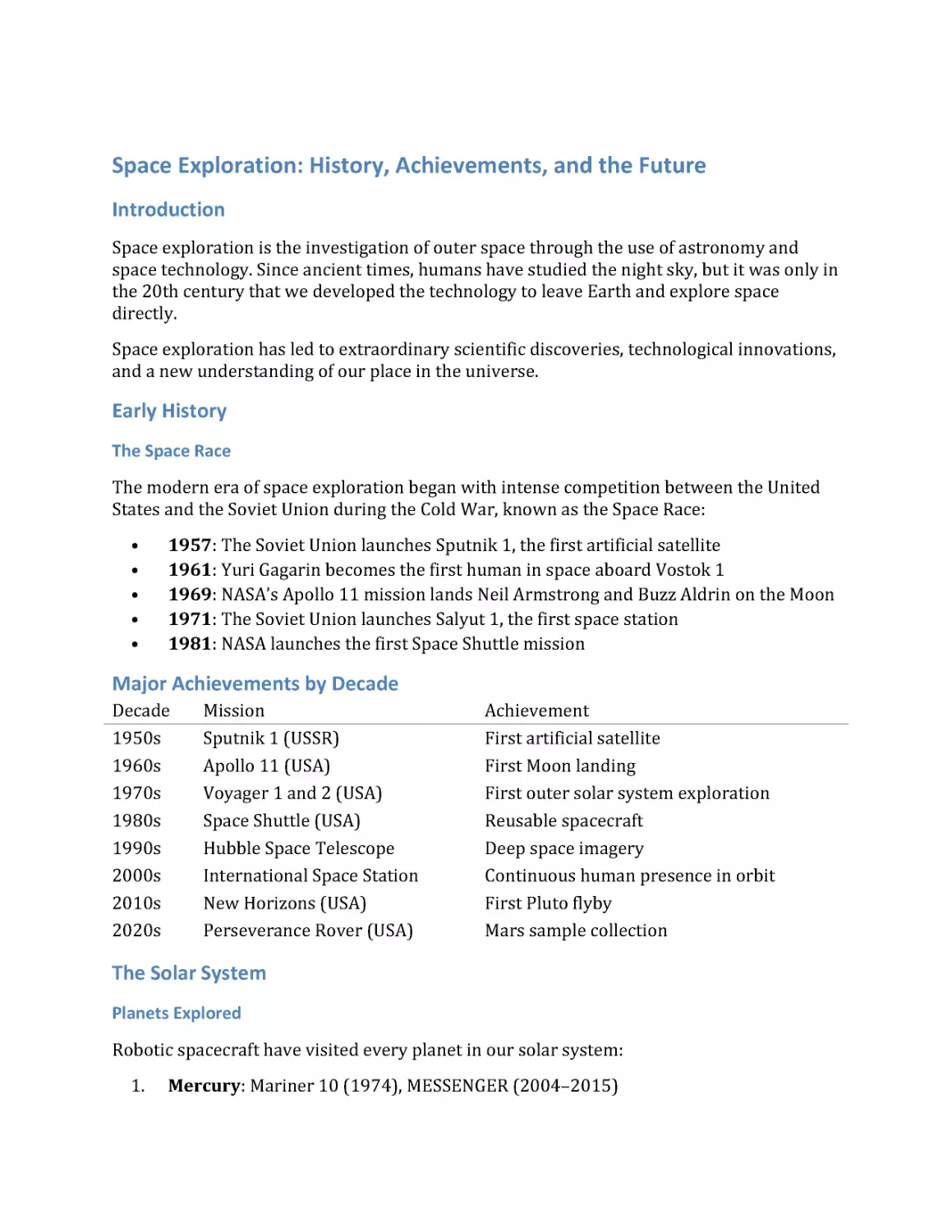
Major Achievements by Decade
Decade Mission
Achievement
1950s
Sputnik 1 (USSR)
First artificial satellite
1960s
Apollo 11 (USA)
First Moon landing
1970s
Voyager 1 and 2 (USA)
First outer solar system exploration
1980s
Space Shuttle (USA)
Reusable spacecraft
1990s
Hubble Space Telescope
Deep space imagery
2000s
International Space Station
Continuous human presence in orbit
2010s
New Horizons (USA)
First Pluto flyby
2020s
Perseverance Rover (USA)
Mars sample collection
The Solar System
Planets Explored
Robotic spacecraft have visited every planet in our solar system:
1. Mercury: Mariner 10 (1974), MESSENGER (2004–2015)

2. Venus: Venera program (USSR), Magellan (1989)
3. Mars: 50+ missions, currently Perseverance and Ingenuity
4. Jupiter: Pioneer, Voyager, Galileo, Juno
5. Saturn: Pioneer 11, Voyager, Cassini (13-year mission)
6. Uranus and Neptune: Voyager 2 (only spacecraft to visit)
Key Discoveries
•
Water ice confirmed on Mars, the Moon, and many moons of outer planets
•
Europa (Jupiter’s moon) may have a liquid ocean beneath its ice
•
Titan (Saturn’s moon) has lakes of liquid methane
•
Thousands of exoplanets discovered beyond our solar system
Current Space Programs
Government Agencies
•
NASA (USA): Artemis program — returning humans to the Moon by 2026
•
ESA (Europe): Mars Express, Gaia, upcoming JUICE mission to Jupiter
•
Roscosmos (Russia): Soyuz launches, Luna program
•
CNSA (China): Tianwen-1 Mars mission, Tiangong space station
•
ISRO (India): Chandrayaan Moon missions, Mangalyaan Mars orbiter
Commercial Space
The private sector has transformed space exploration:
•
SpaceX: Falcon 9 reusable rockets, Dragon crew capsule, Starship development
•
Blue Origin: New Shepard suborbital flights, New Glenn orbital rocket
•
Virgin Galactic: Space tourism flights
•
Rocket Lab: Small satellite launches
Future Missions
•
2026–2030: NASA Artemis Moon base construction
•
2030s: First crewed Mars mission (NASA or SpaceX)
•
2040s: Potential asteroid mining operations
•
2050+: Permanent human settlement on Mars
Why Explore Space?
Space exploration benefits humanity in multiple ways:
•
Scientific knowledge: understanding the universe and our origins
•
Technology spinoffs: GPS, weather satellites, memory foam, water purification
•
Inspiration: motivating young people to pursue STEM careers
•
Planetary defense: detecting and deflecting asteroid threats
•
Long-term survival: ensuring humanity’s future beyond Earth

Conclusion
Space exploration has taken humanity from watching the stars to walking on the Moon and
sending robots to Mars. As technology advances and new players enter the field, the
coming decades promise even more remarkable achievements — from permanent Moon
bases to the first steps on Mars.