/


Теги: общие вопросы лингвистики, литературы и филологии языки мира
ISBN: 978-5-905554-38-4


Текст
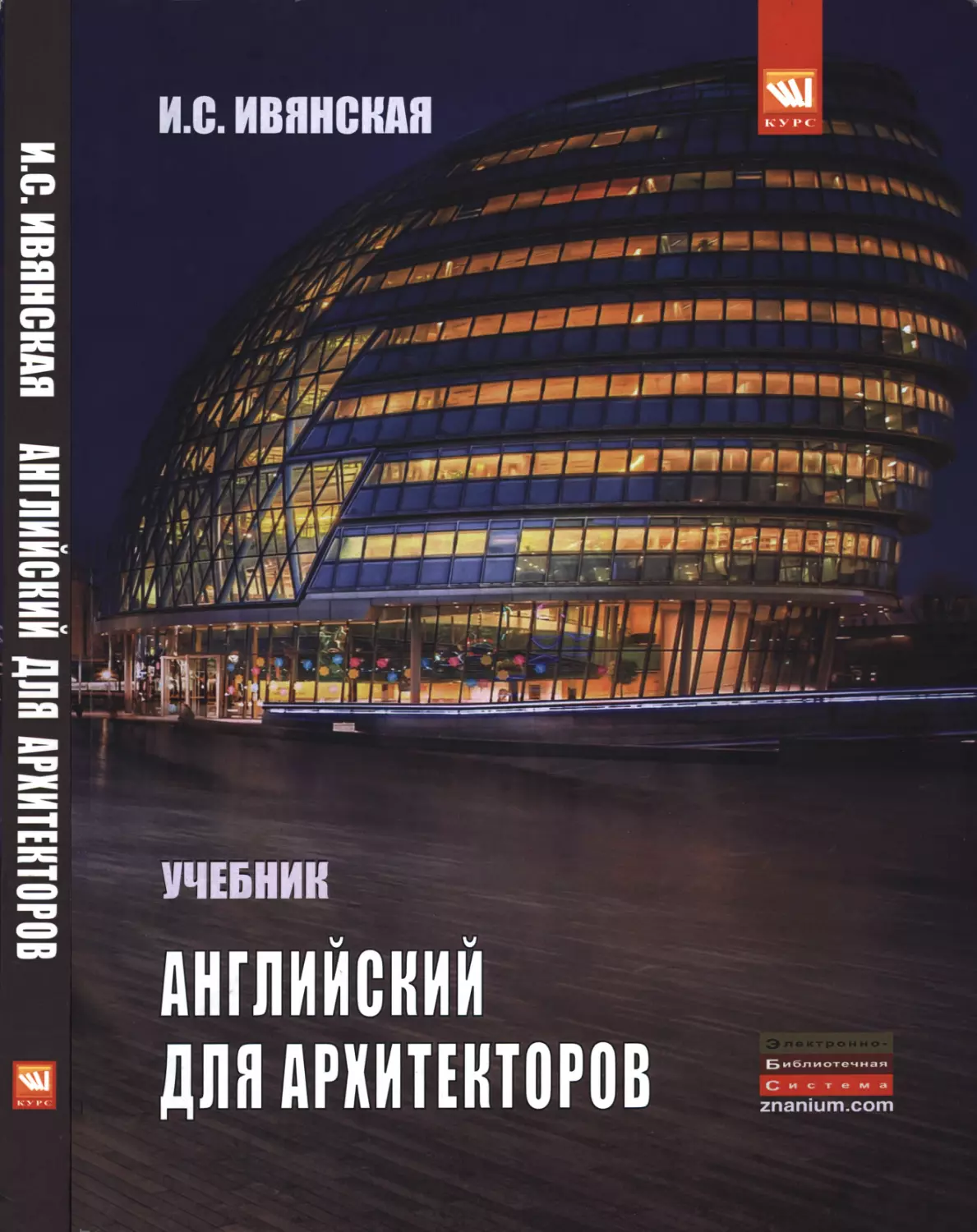
                    И.С. Ивянская
АНГЛИИСКИИ
ЯЗЫК
для
АРХИТЕКТОРОВ
Издание второе, переработанное и дополненное
Допущено УМО по образованию в области архитектуры в качестве учебного пособия для студентов вузов обучающихся по направлению
«Архитектура»
znanium.com
Соответствует Федеральному государственному образовательному стандарту 3-го поколения
МОСКВА
КУРС
ИНФРА-М
2014
УЧЕБНИК

УДК 802.0 ББК 81.2 И17
ФЗ
№436-ф3
Издание не подлежит маркировке в соответствии с п. 1 ч. 1 ст. 11
Ивянская И.С.
Английский язык для архитекторов: учебник / И.С. Ивянская. — 2-е изд., перераб. и доп. — М. : КУРС : ИНФРА-М, 2014. — 400 с. — DOl 10.12737/989 (www.doi.org).
ISBN 978-5-905554-38-4 (КУРС, print)
ISBN 978-5-16-009139-6 (ИНФРА-М, print)
ISBN 978-5-16-100089-2 (online)
Учебник разработан в соответствии с программой по иностранному языку для неязыковых вузов.
Учебник состоит из девяти тематических разделов и включает много пояснительных иллюстраций и упражнений. В приложении находятся дополнительные тексты, грамматический справочник и словари по тематике «Архитектура» и «Градостроительство».
Учебник предназначен для студентов высших учебных заведений, занимающихся подготовкой бакалавров и магистров по направлениям «Архитектура» и «Градостроительство». Он может быть использован для самостоятельного усовершенствования уровня знаний в профессиональной сфере и может быть полезен для архитекторов и строителей и всех, интересующихся архитектурой.
УДК 802.0 ББК 81.2
ISBN 978-5-905554-38-4 (КУРС, print)
ISBN 978-5-16-009139-6 (ИНФРА-М, print) ISBN 978-5-16-100089-2 (online)
© КУРС, 2014

ВВЕДЕНИЕ
Учебник предназначен для обучения студентов английскому языку по специальности «Архитектура». Цель учебника научить студентов читать и понимать литературу, переводить нужные материалы и обсуждать темы по специальности. Учебник включает много иллюстраций. Он состоит из девяти тематических разделов:
0 — Архитектурное образование (вступительный раздел).
1 — Москва (история Москвы и памятники московской архитектуры, включая современные).
2 — Лондон (история Лондона и памятники лондонской архитектуры, включая современные).
3 — Строительные материалы, конструкции, части зданий.
4 — Архитектура древнего мира (Греции и Рима).
5 — Европейские стили.
6 — Факторы, влияющие на архитектуру, типы зданий, типы жилых зданий, типы городов.
7 — Творчество знаменитых зарубежных и русских архитекторов (Баженов, Казаков, Жолтовский, Щусев, Райт, Корбюзье, Фостер).
8 — Ландшафтная архитектура, экологичная архитектура, энергосберегающая архитектура.
Каждый тематический раздел включает тексты для изучающего и просмотрового чтения, предтек-
стовые и послетекстовые упражнения для обучения пониманию текста, составлению резюме, извлечению информации, лексические и грамматические упражнения, продуктивный и рецептивный словарь к текстам. Обычно текст А предназначен для ознакомительного чтения, В — для изучающего. В случае необходимости к тексту даются примечания.
Учебник также включает следующие разделы: UNIT IX (дополнительные тексты к каждому предыдущему разделу), UN IT X (тексты по темам студенческих проектов), краткий грамматический справочник, алфавитный англо-русский словарь, алфавитный русско-английский словарь, тематические словари англо-русские (thematic English-Russian vocabulary (housing), Greek architectural terms, Gothic architectural terms) и русско-английские (алфавитный русско-английский словарь (жилье), алфавитный русско-английский словарь русских архитектурных терминов). Наличие словарей поможет вести беседу и делать сообщения на нужную архитектурную тему. Тексты по темам студенческих проектов включают материал наанглийском и русском языке, вопросы на английском языке, позволяющие описать свой проект.
Список слов с транскрипцией для продуктивного и рецептивного усвоения дается после каждого текста, а в конце пособия общий список слов. Слова в текстах первого раздела приводятся в порядке их употребления в тексте и в случае необходимости с примерами. В последующих разделах — в алфавитном порядке к тексту. В случае нестандартного образования грамматических форм, они указываются. В приложении дается таблица наиболее употребительных в архитектурных текстах нестандартных глаголов.
Грамматический справочник охватывает как продуктивную грамматику, так и рецептивную, необходимую для понимания архитектурных текстов. Даются правила перевода сложных случаев. В упражнениях в разделах указывается нужный параграф грамматического справочника — цифра или две с точкой, стоящие после знака §, означают номер главы справочника, следующие цифры, разделенные запятыми — номера параграфов, например, Грам. справ. § 3. 3,4,5 означает Глава 3, параграфы 3,4 и 5, а Грам. справ. § 8. 6. 2 — Глава 8, параграф 6, Continuous.
В алфавитном англо-русском словаре римской цифрой обозначается раздел, арабской — номер задания, буквами А, В и др. конкретный текст, в котором слово встречается в первый раз и поэтому было вставлено в список слов данного раздела. Для текстов, предназначенных для письменного перевода со словарем, лексика не дается (за исключением слов, которые студент может не найти в обычном словаре), т.к. студенты должны научиться работе с обычным словарем.
В словаре жирным шрифтом выделены слова для продуктивного использования, простым — для узнавания в тексте, без указания номера раздела и текста — слова школьной лексики или один раз встречающиеся в пособии для облегчения понимания текста. Add — слова из дополнительного списка, необходимые для обсуждения темы. Цифра со скобкой « 1 )» означает часть речи, цифра с точкой «2.» — еще одно значение слова.
Учебник может быть использован не только студентами архитектурных институтов и факультетов, но и всеми интересующимися архитектурой и желающими иметь возможность читать литературу в оригинале и вести беседу на архитектурные темы.
Введение
3

СПИСОК СОКРАЩЕНИИ
а = adjective — прилагательное A.D. = of our era ['югэ] — н.э.
A. 	М. = in the morning — (... часов) утра add = additional — дополнительный adv = adverb — наречие
attr = attribute — определение
B. 	C. ['bi:'si:] = before Christ [kraist] — до н.э. с = circa ['s3:ks] — около (о дате)
cj = conjunction — союз
e.g. = for example — например esp = especially — особенно
etc. = et cetera [et'setra] — и т.д.
ft = foot, feet — фут
i.e. = that is, it means — т.е.
in = inch — дюйм
n = noun — существительное
ord. num. = ordinary numerical — порядковое числительное
P.M = in the afternoon — (... часов) дня
pref = prefix — приставка
pi — plural — множественное число
p.p. = past participle
prep — preposition — предлог
pron. indef. = pronoun indefinite — неопределенное местоимение sing = singular — единственное число v — verb — глагол
Грам. справ. — грамматический справочник
греч. — греческий
косв. — косвенный
миф. — мифологический
нем. — немецкий
п — падеж
преим. — перимущественно
тж. — также
фр. — французский
4
Список сокращений

UNIT О
ARCHITECTURAL EDUCATION
Упражнение 1. Прочтите текст и ответьте на следующие вопросы:
1. 	Where are architects trained in Russia? 2. What is École des Beaux Arts? 3. When was the first architectural department founded in Moscow? 4. When was the Moscow Architectural Institute founded?
ARCHITECTURAL EDUCATION IN RUSSIA
In Russia architects are trained at many engineering institutes which have architectural faculties and at some special architectural and artistic institutes. In foreign countries they are taught either at engineering or artistic schools, e.g. École des Beaux Arts* in Paris.
In 1866 an architectural department was founded at the Moscow School of Painting, Sculpture and Architecture*. In 1930 architectural faculties of a number of Moscow institutes were united, establishing Higher Architectural and Building Institute (VASI)*. In 1933 it was renamed the Moscow Architectural Institute.
ПРИМЕЧАНИЯ
1. École des Beaux Arts — Эколь де Боз Ар, Школа изящных искусств
2. Moscow School of Painting, Sculpture and Architecture — Училище живописи, ваяния и зодчества
3. Higher Architectural and Building Institute (VASI) — Высший архитектурно-строительный институт (ВАСИ)
Упражнение 2. Прочтите текст и составьте его план.
MOSCOW ARCHITECTURAL INSTITUTE (STATE ACADEMY)
The Institute is situated in the centre of Moscow in Rozhdestvenka Street. It is set back from the street with a fountain in front. It seems to be a three-storey building, but in fact there are more storeys. Looking at the façade we see that the wall is decorated with portraits of famous architects and over the windows there are triangular and segmental pediments.
Entering the Institute through a draft lobby the visitor sees a vast entrance hall with cloakrooms and stairs leading up. On different floors there is an exhibition hall, assembly hall, rector’s and prorectors’ offices, dean’s offices, classrooms, gymnasium, etc. There are several faculties at the Institute: the Faculty of General Training (at which first and second year students study), the Faculty of Fundamentals in Architecture (third and the fourth year students) and the Faculty of Specialization (the fifth and sixth year students).
Besides these faculties there is also an evening department (or faculty), post-graduate courses (aspirantura), refresher or extension courses, and preliminary courses.
At the preliminary or preparatory courses those who want to enter the Institute prepare for the entrance examinations.
The evening department was established in 1958. Students work in the day-time and study in the evening or on Saturdays.
The Institute has a six years’ course. Students specialize in residential, civic and industrial buildings, town planning, restoration of historic buildings, etc. The key subjects are principles of architectural design,
UNIT 0 • Architectural education
5

painting, artistic drawing, history of art and architecture, perspective and shadow projection. Students study also one of foreign languages.
The academic year lasts from September to July consisting of two terms or semesters (the day department) and of three trimesters (the evening department). At the end of each term or trimester students have to take exams. Each year students spend some time on practice.
Упражнение 3. Ответьте на следующие вопросы:
1. At what Institute do you study? 2. Where is your Institute situated? 3. What can you say about its building, its facade? 4. What faculties are there at the Institute and at what faculty (department) do you study? 5. What year student are you? 6. What subjects do you study? 7. What is your favourite subject? 8. What can you say about the academic year? 9. Has the Institute a four years’ course? 10. Who is your dean (assistant dean)? 11. Where is your dean’s office situated? 12. Why did you decide to enter your Institute?
Упражнение 4. Опишите историю своего института, его расположение и здание. Упражнение 5. Расскажите о своем институте и об учебе в нем.
WORDS (ENGLISH-RUSSIAN)
academic /school/ year — учебный год administrative [administrativ] office — учебная часть artistic drawing, free hand drawing — рисование, рисунок assembly hall [a'sembli ha:l] — актовый зал assistant dean, vice-dean [,vais'di:n] — заместитель декана auditorium ^oidi'tamam] (pi тж. -ria) n — зрительный зал basement ['beismant] n — подвал
be in the (first) year, be a (first) year student — учиться на (первом) курсе
break [breik] n — перерыв
buffet ['bufei] n, refreshment-room n — буфет
building n — здание; civic ['sivik] building — гражданское здание, industrial [in'dAstrial] building — промышленное здание, residential [,rezi'denj(a)l] building — жилое здание canteen [kæn'tirn] n — столовая (в учебном заведении) civic ['sivik] building — гражданское здание classroom ['kla:srum] n — аудитория (помещение) cloakroom ['klaukram, -ru:m] n — гардероб compulsory [kam'pAls(a)ri] а — обязательный
course [ko:s] n — 1. курс лекций, обучения; 2. pi курсы; post-graduate courses — аспирантура, preliminary [prThmin(a)ri] courses, preparatory [pri'pærat(a)ri] courses — подготовительные курсы, refresher courses [rTfreJaka:siz], extension courses [ik'sten/(a)nko:siz] — курс(ы) повышения квалификации; курс(ы) усовершенствования, переподготовки
dean [di:n] n — декан (факультета); vice-dean [,vais'di:n], assistant dean — заместитель декана dean’s office — деканат
department [di'partmont] n — отделение, факультет; кафедра; evening department, evening faculty — вечернее отделение, вечерний факультет department, chair n — кафедра
design [di'zain] n — проект; решение; pregraduation design — преддипломный проект, sketch design — клаузура, thesis ['0i:sis] (diploma) design — дипломный проект draught [dra:ft] lobby — тамбур
6
Architectural education

drawing n — черчение, рисование, чертеж, рисунок; artistic drawing, free hand drawing — рисование, рисунок, engineering drawing, technical drawing — черчение, чертеж engineering drawing, technical drawing — черчение, чертеж enter ['enta] v —1. входить (в); 2. поступать (в) entrance examinations — вступительные экзамены entrance hall ['entransho:l] — вестибюль
evening department — вечернее отделение, вечерний факультет
exam [ig'zæm] (in ...) — экзамен (по ...); take exams — сдавать экзамены, pass exams — сдать экзамены, fail in the exam (in) — провалиться на экзамене exhibition hall [/eksi'bij(a)n ho:l] — выставочный зал
extension courses [ik'stenJ(a)nko:siz] — курс(ы) повышения квалификации; курс(ы) усовершенствования, переподготовки
faculty ['fæk(3)lti] n — факультет; the Faculty of General Training — факультет общей подготовки, the Faculty of Fundamentals in Architecture —факультет фундаментальной подготовки, the Faculty of Specialization — факультет специальной подготовки fail in the exam (in) — провалиться на экзамене finish school — окончить школу first-aid room — медпункт
free hand drawing, artistic drawing — рисование, рисунок graduate programme — выпускающая кафедра
graduate ['grædjueit] from the Institute — окончить высшее учебное заведение gymnasium [djim'neiziam] (pi -sia, -s [-z]) n — гимнастический зал
hall [ho:l] n — зал; assembly hall [a'sembli ho:l] — актовый зал, entrance hall ['entranshod] — вестибюль; exhibition hall [/eksTbiJ(a)n ho:l] — выставочный зал history of architecture — история архитектуры history of art — история искусства industrial [in'dAStrial] building — промышленное здание key [ki:] a — ключевой, главный laboratory [labüratri] n — лаборатория lavatory [Tæv3t(a)ri] n — уборная, туалет lettering ['let(a)rir)] n — шрифт library ['laibr(9)ri] n — библиотека mark [ma:k] n — отметка measured ['me39d] drawings — обмеры office ['üfis] n — кабинет, офис; dean’s office — деканат optional ['ор/(э)пэ1] a — необязательный; факультативный painting n — живопись pass exams — сдать экзамены
pediment ['pediment] n — фронтон; triangular pediment — треугольный фронтон, segmental pediment — лучковый фронтон
perspective and shadow projection [ps'spektiv and'Jaedau pra'd3ekj(a)n] — начертательная геометрия
post-graduate courses — аспирантура
practice ['præktis] n — практика
preexam, pretest [,pri:'test] n — зачет
pregraduation design — преддипломный проект
preliminary [pri'limin(a)ri] courses — подготовительные курсы
preparatory [pri'pær9t(a)ri] courses — подготовительные курсы
pretest [,pri:'test], preexam n — зачет
principal ['prinsopl] a — главный
UNIT 0 • Architectural education
7

principles of architectural design — основы архитектурного проектирования reading room — читальня
refresher courses [ri'freJVkorsiz], extension courses [ik'stenJ(3)n'ko:siz] — курс(ы) повышения квалификации; курс(ы) усовершенствования, переподготовки refreshment [ri'frejmant] room — буфет registration [,red3i'streij(a)n] office — канцелярия residential [,rezi'denj(a)l] building — жилое здание restoration of historic buildings — реставрация исторических зданий sculpture ['skAlpt/э] n — скульптура, ваяние sketch design — клаузура
spacial (spatial) ['speij(a)l] and three-dimensional composition — объемно-пространственная композиция
specialize ['spejalaiz] v in — специализироваться в
staff [sta:f] room — комната преподавателей, кафедра (помещение)
staff office [' staff, ofis] — отдел кадров
stairs n — лестница
student’s book, record book — зачетка
subject ['sAbd3ikt] n — предмет; compulsory subject [kam'pAls(a)ri 'sAbd3ikt] — обязательный предмет (обучения), key [ki:] subject — основной предмет, optional subject ['DpJ(9)narsAbd3ikt] — факультативный предмет
take exams — сдавать экзамены
technical drawing, engineering drawing — черчение, чертеж term [t3:m] n — семестр
the number of candidates for each vacancy — конкурс thesis ['0i:sis] (diploma) design — дипломный проект thrice [örais] a year, three times a year — трижды, три раза в год town planning — градостроительство trimester [tr(a)i'mest9] n — триместр
twice [twais] a year, two times a year — дважды, два раза в год vast [va:st] а — обширный, огромный vice-dean [,vais'di:n], assistant dean — заместитель декана wash v in, tint v — отмывать workshop ['w3:kjbp] — мастерская
year Цз:] n — год; курс (обучения); in the first year — на первом курсе
СЛОВАРЬ РУССКО-АНГЛИЙСКИЙ
актовый зал — assembly hall [s'sembli Ьэ:1] аспирантура — post-graduate courses аудитория (помещение) — classroom ['klœsrum] библиотека — library ['laibr(9)n] буфет — buffet fbufei], refreshment [ri'frejmant] room ваяние, скульптура — sculpture ['skAlptJa] вестибюль — entrance hall ['entranshod] вечернее отделение — evening department вступительные экзамены — entrance examinations входить (в) — enter ['enta] выпускающая кафедра — graduate programme выставочный зал — exhibition hall [/eksi'bij(9)n ho:l] гардероб — cloakroom ['klaukram, -ru:m]
8
Architectural education

гимнастический зал — gymnasium [d3im'neiziam] (pi -sia, -s [-z])
градостроительство — town planning
гражданское здание — civic ['sivik] building
дважды, два раза в год — twice [twais] a year, two times a year
декан (факультета) — dean [di:n]; заместитель декана — vice-dean [,vais'di:n], assistant dean деканат — dean’s office
дипломный проект — thesis ['0i:sis] (diploma) design живопись — painting
жилое здание — residential [,rezi'denj(a)l] building
зал — hall [ho:l]; актовый зал — assembly hall [a'sembh ho:l]; выставочный зал — exhibition hall [,eksi'bif(9)n ho:l]; зрительный зал — auditorium ^ordi'torriom] (pi тж. -ria) заместитель декана — vice-dean [,vais'di:n], assistant dean зачет — preexam, pretest [,pri:'test] зачетка — student’s book, record-book
здание — building; гражданское здание — civic ['sivik] building; жилое здание — resident tial [,rezi'denj(9)l] building; промышленное здание — industrial [in'dAstnal] building зрительный зал — auditorium [p.di'torriam] (pi тж. -ria) история архитектуры — history of architecture история искусства — history of art кабинет — office
канцелярия — registration [/red3i'streij(9)n] office
кафедра — 1. department, chair; 2. (помещение, комната преподавателей) — staff [sta:f] room клаузура — sketch design
конкурс (вступительный) — the number of candidates for each vacancy
курс 1. (лекций, обучения) — course [ko:s]; 2. pi курсы; подготовительные курсы — preliminary [pri'limin(9)ri] courses, preparatory [pri'paer9t(9)ri] courses, курс(ы) повышения квалификации; курс(ы) усовершенствования, переподготовки — refresher courses [ri'frej9'ko:siz], extension courses [ik'sten/(9)n,k9:siz]; 3. курс (год обучения) — year [)з:]; на первом курсе — in the first year лаборатория — laboratory [la'bDratri] мастерская — workshop ['w3:kjDp] медпункт — first-aid room
начертательная геометрия — perspective and shadow projection [рэ spektiv and'Jædau ргэ^зек/(э)п] необязательный; факультативный — optional ['ор/(э)пэ1] обмеры — measured ['me39d] drawings обширный, огромный — vast [va:st]
объемно-пространственная композиция — spacial (spatial) ['speij(9)l] and three-dimensional composition
обязательный — compulsory [k9m'pAls(9)ri]
окончить высшее учебное заведение — graduate ['grædjueit] from the Institute, окончить школу — finish school
основы архитектурного проектирования — principles of architectural design отдел кадров — staff office ['sta:f,Dfis]
отделение — department [di'partmant]; вечернее отделение — evening department
отметка — mark [mark]
отмывать — wash in
офис, кабинет — office ['ofis]
перерыв — break [breik]
подвал — basement ['beismant]
подготовительные курсы — preliminary [pri'limin(9)ri] courses, preparatory [pri'pær9t(9)ri] courses
UNIT 0 • Architectural education
9

поступать (в) — enter ['enta] практика — practice ['præktis] преддипломный проект — pregraduation design
предмет — subject ['sAbd3ikt]; обязательный предмет (обучения) — compulsory subject [kam'pAls(a) ri 'sAbd3ikt]; основной предмет — key [ki:] subject, факультативный предмет — optional subject ['DpJ(a) nal'sAbd3ikt]
провалиться на экзамене — fail in the exam (in)
проект, проектирование — design [di'zain]; дипломный проект — thesis ['6i:sis] (diploma) design; преддипломный проект — pregraduation design
промышленное здание — industrial [in'dAStrial] building
реставрация исторических зданий — restoration of historic buildings
рисование, рисунок — artistic drawing, free hand drawing
сдавать экзамены — take exams
сдать экзамены — pass exams
семестр — term [t3:m]
скульптура, ваяние — sculpture ['skAlptJa]
специализироваться (в) — specialize ['spejblaiz] (in)
столовая (в учебном заведении) — canteen [kæn'ti:n]
тамбур — draught [dra:ft] lobby
трижды, три раза в год — thrice [örais] a year, three times a year
триместр — trimester [tr(a)i'mesta]
уборная, туалет — lavatory [Tævat(o)ri]
учебная часть — administrative [administrativ] office
учебный год — academic (school) year
учиться на (первом) курсе — be in the (first) year, be a (first) year student факультативный — optional ['DpJ(a)nal]
факультет — faculty ['fæk(a)lti]; факультет общей подготовки — the Faculty of General Training, факультет специальной подготовки — the Faculty of Specialization; факультет фундаментальной подготовки — the Faculty of Fundamentals in Architecture
фронтон — pediment ['pediment]; лучковый фронтон — segmental pediment; треугольный фронтон — triangular pediment
черчение, чертеж — drawing, engineering drawing, technical drawing читальня — reading room шрифт — lettering [Tet(a)rirj]
экзамен (no ...) — exam [ig'zæm](in ...); сдавать экзамены — take exams, сдать экзамены — pass exams, провалиться на экзамене — fail in the exam (in)

UNIT I
MOSCOW
1. 	HISTORY OF THE CITY OF MOSCOW
Упражнение 1. Прочтите следующие слова.
A. о, ow [эи] old, cold, told, Moscow
о 	[л] won, some, come, cover, above, mother
ou, ow [au] town, house, proud, found, surround
ou [л] country, double, trouble
our [a] favour, labour
ea [i:] increase, please
ea, ear [ю] appear, near, clear, fear, area
ее, ei, ie [i:] free, decree, receive, chief, believe
eau [ju:] beauty
ch [k] chronicles, school
ch [tj] chief, chair
ph [f] geography, physics
kh [h] Astrakhan, Chekhov
B. although [о:Г9эи] — хотя, conquest ['kürjkwest] — победа, principality [/pnnsa'pælati] — княжество, rampait ['ræmpœt] — (крепостной) вал
Упражнение 2. Прочитайте следующие слова, имеющие общий корень со словами русского языка, и догадайтесь об их значениях. Полностью ли они совпадают?
Kazan [кл'гагп], Peter I = Peterthe First, Muscovite [’rmvskavait], Ivan [aivn], European [Juara'pkan], chronicle ['kraniklj, title [ taitl], Tatar ['tenta], fortress ['fo:tras], domination [^Dmi'neijn], Astrakhan [,æstra'kæn, -hæn], Kremlin ['kremlin]
Упражнение 3. Расскажите по-английски все, что вы знаете об истории Москвы.
WORDS ТО BE USED
capital ['kæpitl] n — 1. столица; 2. капитель. London is the capital of England, take [teik] (took; taken) v — брать; take (its) name from — быть названным по... The street takes its name from the river; take place — произойти, take part in — принимать участие в
bank [bæpk] n — берег (реки, канала). The building is situated on the bank of the Neva-River both [Ьэи0] 1) a — оба; 2) cj — both ... and ... — как ..., так и ..., и ..., и ... Both Moscow and St. Petersburg are industrial cities.
found [faund] v — основывать; учреждать; создавать. The city was founded in the 18th century, for the first time — впервые, at first — сначала. I read this book for the first time two years ago. At first I did not want to take this book, but then I decided to read it.
increase [m'kri:s] v — увеличивать. He increased his principality.
add [æd] v — прибавлять; присоединять, пристраивать; addition [a'dij(a)n] n — прибавление, дополнение, пристройка; in addition (to) — к тому же, кроме того. Не added a room to his house, under prep — под, у, при. I study under this professor. It was built under Ivan Kalita, free [fri:] 1) a — свободный 2) v = liberate ['libsreit] — освобождать. The town was freed in 1944 divide [di'vaid] v (into) — делить (на). The city was divided into 4 parts.
UNIT I • Moscow
11

surround [sa'raund] v, enclose [in'klauz] v — окружать. The town was surrounded with stone walls, earth [э:0] n — земля; земной шар. The house was built of earth. We live on the Earth, area ['еэпэ] n — площадь, зона, область, сфера; to cover an area (territory) of — занимать площадь в ... The town covers an area of 40 sq. km. The area of the house is 50 sq. m.
square [skwea] 1) n — 1. квадрат; 2. площадь (города). Red Square. The room is 4 sq.m, in area. The room is a 4 m. square (квадрат со стороной 4 м); 2) a — квадратный
population [/popju/leiJ(a)n] n — население. The population of the town is over 100,000 people, like [laik] 1) a — подобный, похожий 2) prep — так; как кто-л.; как что-л. 3) cj — как, подобно. Like other Russian towns it has a kremlin in the centre, circular a — круглый, кольцевой
radial-circular a — радиально-кольцевой. It has a radial-circular plan.
anniversary [,æni'v3:s(3)ri] n — годовщина
celebrate ['sebbreit] v — праздновать. To celebrate the anniversary
Упражнение 4. Прочтите текст и напишите его план.
Упражнение 5. Найдите в тексте абзацы, в которых говорится, где находится Москва, кто ее основал, сколько ей лет, когда она окончательно стала столицей независимого княжества.
HISTORY OF THE CITY OF MOSCOW*
Moscow, the capital of the Russian Federation, is situated in the centre of the European part of the country. It takes its name from the River Moskva, on whose both banks it was built.
The name of Moscow appeared in the Russian chronicles for the first time in 1147. The Grand Prince Yury Dolgoruky founded the city of Moscow. For more than a century Moscow remained an unimportant village of the Suzdal Principality. In 1272 it became a small principality when Daniel, Alexander Nevsky’s son, became the Moscow prince. Daniel increased his appanage (udel) by the addition of Kolomna, and thus became the founder of Muscovite Russia.
Under Ivan Danilovich Kalita (1328 — 40) Vladimir became united with Moscow and in 1328 Kalita obtained from the Tatars the title of Grand Prince.
Under Ivan III, in 1480, central Russia was finally freed from the Tatar domination, but it was Ivan the Terrible who* completed the task of liberation by his conquest of Kazan and Astrakhan in 1552 and 1556.
In 1713 Peter I transferred the capital from Moscow to St. Petersburg but in 1918 Moscow became the capital of the country again.
Old Moscow was divided into four parts: 1 ) the Kremlin* or the fortress, 2) Kitai-gorod, the chief centre of trade, situated between the Kremlin and the White-Town, 3) Bely-Gorod or White Town, which took its name from the white wall which surrounded it (it was built in 1587), 4) Zemlanoi-Gorod or Earth-Town, which surrounded the three others and was enclosed by a rampart of earth.
Now Moscow covers an area of about 3000 sq. km. and has a population of over 11 million people. Like many other old Russian towns Moscow was built on a radial-circular plan. In 1997 Moscow celebrated its 850th anniversary.
ПРИМЕЧАНИЯ
1. Обратите внимание на употребление артикля и предлога в словосочетании the city of Moscow — город Москва
2. it is (was).... who (that) — именно ... It was Pushkin who wrote this poem. — Именно Пушкин написал это стихотворение. It is Moscow that is the capital of the Russian Federation. — Именно Москва — столица Российской Федерации. It was in 2003 that this house was built. — Этот дом был построен именно (только, уже) в 2003 г.
3. The Kremlin fkremlm] — Кремль (Московский), a kremlin — (любой) кремль
12
1. History of the city of Moscow

Упражнение 6. Вставьте предлоги или союзы, если необходимо. Переведите на русский язык.
1. We study ... Professor N. 2. The city is divided ... many parts and covers an area ... 400 sq. km. 3. It takes its name ... the artist who lived there. 4. The city was built... a radial-circular plan. 5. The city ... N. was founded ... the banks ... two rivers. 6. The city was founded ... Prince Vasily. 7.1 was in Kiev ... the first time ... 2001. 8. The city was built... Peter I. 9.... other houses in this street it was built long ago.
(), by, for, from, in, into, like, of, on, under
Упражнение 7. Напишите предложения со следующими словосочетаниями.
То cover an area, on a radial-circular plan, to surround, to found, to divide into.
Упражнение 8. Переведите на^нглийскцй язык.
Петербург был основан в 18-м веке Петром I. И был назван в честь своего основателя. Город расположен на берегу реки Нева недалеко от моря. В 1713 году Петр перенес столицу в Петербург, но после революции в 1918 году Москва снова стала столицей. Сейчас Петербург часто называют культурной столицей страны.
Упражнение 9. Напишите антонимы к словам unimportant, far, old, after, unlike.
Упражнение 10. Переведите на русский, обращая внимание на “it was... who (that)”.
I. It was Kazakov who built a palace in the Kremlin. 2. It was Peter I who founded St. Petersburg. 3. It was in the I5,h century that Ivan III freed Russia from the Tatar domination. 4. It was Suzdal that was the capital at first, not Moscow.
Упражнение 11. Переведите на русский язык, обращая внимание на подчеркнутые слова.
I. London is the capital of England. 2. The Corinthian capital is very beautiful. 3. Kiev is situated on the banks of the Dnieper. 4. The State Bank is situated in the centre of Moscow. 5. Did Yury Dolgoruky found Moscow? 6.1 found the book under the table. 7. It was built under Ivan IV. 8. What are you speaking about? 9. There are about 20 museums in this area. 10. Both houses are old. 11. Both the street and the park are very beautiful. 12. I have no free time. 13. I am not free. 14. This area is free of traffic (движение, транспорт). 15. The Prince freed his country.
Упражнение 12. Переведите на русский язык и напишите соответствующие русские слова (от этого же корня). Есть ли разница между значением русских и английских слов? Какая?
Capital, centre, city, prince, title, domination, chronicles
Упражнение 13. Переведите на русский язык, обращая внимание на местоимения, притяжательный падеж и число существительных (см. Грам. справ. § 4. 2, § 2, 2. 3, 4, 6).
1.1 	like my friend’s house. It is nice. 2.1 like my friends’ house. 3. This is Ann and Pete’s book. It is very interesting. 4. The Doctor Ivanov’s house is new. 5. The children’s room is big. 6.1 see them. 7. They see us. 8. Give me this book. 9. Alexander Nevsky's victory.
Упражнение 14. Вставьте местоимения в нужной форме или существительные в нужном падеже (см. Грам. справ. § 2. 6, §4. 2, 3).
I. This is (мой брат). 2. This is (его дом). 3. This is (мой брат) house. 4. I see (его/ брата). 5. I see (его/дом). 6. This is (их) house. 7. I see (их). 8. This is (ее) book. 9. I see (ее). 10. (Она) is on the table.
Упражнение 15. Подберите формы ед. и мн. числа одного слова и объясните, как они образованы (см. Грам. справ. § 2. 2):
boy, pen, capitals, country, wives, boxes, area, banks, areas, capital, boys, countries, bank, wife, pens,
box.
UNIT I • Moscow
13

Упражнение 16. Напишите формы множественного числа для словоформ единственного числа и наоборот (см. Грам. справ. § 2. 2):
cities, family, schools, girl, dogs, cat, watch, fox, leaves, church.
Упражнение 17. Исправьте план, поставив все пункты в логическом порядке, и укажите, все ли они соответствуют тексту.
1. The situation of Moscow. 5. Peter I.
2. Its foundation. 6. Parts of old Moscow.
3. Moscow — a village of Pskov Principality. 7. Foundation of the Muscovite State.
4. Present Moscow. 8. Ivan Kalita.
2. 	CATHEDRAL OF THE ASSUMPTION (USPENSKY)
Упражнение 1. Прочтите следующие слова и переведите их.
metropolitan [,metra'pDlit(9)n] interior [m'tiaria]
tsar [za:] though [<3эи]
century ['sentf(9)ri] width [wid0]
patriarch ['peitriark] grandeur ['græn(d)39]
façade [fa'sard] icon ['aikon]
Упражнение 2. Прочтите следующие слова.
а [а:] — past, last, father, rather, ask, arcature, facade a [d:] (a +1))— all, altar, fall -ture [t/э] — picture, feature, future, arcature ea [i:] — sea, feature
Упражнение 3. Переведите следующие предложения на русский язык, обращая внимание на сказуемые (пассивные и активные формы) (см. Грам. справ. § 8. 8, § 9. 1).
1. Не can call her. 2. Не may be called the best student of the group. 3.1 asked you to go with me. 4. I was asked to go with him. 5.1 advised you to study English. 6.1 was advised to study English. 7. He told me a story. 8. A story was told by him. 9. He told me to go home. 10. He was told by me to go home.
WORDS TO BE USED
famous [feimas] a (for) — знаменитый (чем-либо). He is famous for his buildings, church ['tjartf] n — церковь. The church was built last year, cathedral [кэ'0Ыг(э)1] n — собор. This cathedral is an old building, main [mein] a — главный, основной. It is the main street of the town.
crown [kraun] v — 1. короновать; 2. увенчивать. The church is crowned with five bulbous domes, dome [daum] n, cupola ['kjurpala] n — купол, глава; bulbous dome ['bAlbas-], onion dome ['Anjan-] — луковичный купол, луковичная глава
chapel ['tjæp(a)l] n — часовня, придел (в русских церквях). Some Russian churches have several chapels.
bury ['beri] v — хоронить. He was buried in this cathedral.
rather ['raröa] adv — довольно; rather than — скорее ... чем. It is rather cold.
admire [9d'ma(i)a] v — любоваться; восхищаться; выражать восторг
construct [kan'strAkt] v — строить; construction [kan'strAkJ(a)n] n — строительство; to be under construction — строиться, быть в стадии строительства; reconstruct ['rirkans'trAkt] v — реконструировать
advise [ad'vaiz] v — советовать. I was advised to read this book.
copy [ küpi] arcature [’arkat/a] height [hait] religious [rTlid39s] portal [ parti]
14
2. Cathedral of the Assumption (Uspensky)

feature ['fi:tja] n — особенность; (характерная) черта. What Russian features can we see in this building?
design [di zain] 1) n — проект; 2) v — проектировать. Who designed this building? style ['stall] n — стиль. What is the style of this building?
composition [,kompa'ziJ(a)n] n — композиция. What can you say about the composition of this building?
complete [kom'plkt] v — заканчивать, завершать. The construction was completed, be of the same (width) — быть одной (ширины). These two streets are of the same width, aisle [ail] n — боковой неф, неф
nave [neiv] n — главный неф. If we say that a cathedral has three aisles, it means that it has one nave and two side aisles.
apse [æps] n — апсида. This cathedral has only one apse.
pillar ['pila] n — столб, колонна; (зд.) столп. In Russian churches there are often four pillars, column ['kütam] n — колонна
support [so'port] 1) n — поддержка; опора 2) v — поддерживать at mid-height — на середине (высоты)
arcature ['arkatjs] n — аркатура. Arcature decorates the façade at mid-height, deeply recessed [ri'sest] portal — перспективный портал. He entered the chapel through the deeply recessed portal.
WORDS TO BE UNDERSTOOD
huge ['hju:d3] a — огромный. The ceiling was supported by huge columns, shore [Jo:] n — берег (моря, озера); побережье
Упражнение 4. Прочтите текст и напишите его резюме на английском (или русском) языке.
Упражнение 5. Прочтите текст и ответьте на следующие вопросы:
1. 	What was Russia’s main cathedral? 2. How was it used? 3. Why would it be called a chapel in the West?
4. 	Why did Fieravanti go to Vladimir? 5. Is the Moscow Assumption Cathedral like the Vladimir Cathedral?
UNIT I • Moscow
15

CATHEDRAL OF THE ASSUMPTION (USPENSKY)
The most famous of the Kremlin churches is the Cathedral of the Assumption* or the Cathedral of the Dormition*. It was Russia’s main cathedral. From the 15th century the Russian tsars were always crowned in it, the Church metropolitans and the Moscow patriarchs are buried here. It is rather small — in the west it would be called* a chapel rather than a cathedral. The fine situation of the cathedral, its bulbous domes, and interior grandeur* make* everybody admire it.
The construction of this cathedral was begun in 1326 under the Grand Prince Ivan Danilovich Kalita by Peter, the metropolitan of Moscow, who may be called its founder. When the Italian architect Aristotele Fieravanti* was asked by Ivan III to reconstruct the old church in 1475, he was advised to go to Vladimir and study the Uspensky Cathedral, built in 1158. Fieravanti visited also Rostov, Yaroslavl, and the shores of the White Sea. Thus the Italian architect got first-hand information on Russian religious architecture and understood the main features of its traditions. So though the cathedral was designed by an Italian architect and engineer, its style and composition are Russian and Orthodox*.
The Moscow cathedral was completed in 1479; it is like the Vladimir cathedral, but is far from being a literal copy*. The two cathedrals are of the same width, but the Moscow one is much longer; the Moscow cathedral has three aisles and five apses, the Vladimir cathedral has five aisles and three apses. The Moscow cathedral has six pillars, four of which — huge circular columns — support the central cupola, which is surrounded with four smaller cupolas. The façade is decorated at mid-height with a band of arcatures and a deeply recessed portal.
ПРИМЕЧАНИЯ
1. Assumption [3'sAmpJ(a)n], Dormition [do:'miJ(a)n] — Успение
2. would be called — назвали бы
3. grandeur ['grænd33] — 1. величие; 2. великолепие; пышность
4. to make fmeik] (made) — 1. делать; 2. заставлять делать. Не made a mistake. Не made his brother go there. He was made to go there
5. Aristotele Fieravanti — Фьораванти Аристотель ( 1420— 1486), итальянский инженер и архитектор, прозванный Аристотелем за его знания
6. Orthodox ['otGadüks] — православный
7. literal сору [Titr(a)l 'küpi] — буквальная копия
ADDITIONAL WORDS
altar ['o:lta] n — алтарь (престол) decorate v ['dekareit] — украшать
drum [drAm] n — барабан; blind drum — глухой барабан; windowed drum — световой барабан fresco ['fresksu] n — фреска icon ['aïkün] n — икона icon-painter n — иконописец
paint [peint] 1) n — краска; окраска 2) v — 1. красить, окрашивать; 2. писать красками painting ['peintir)] n — 1. живопись; 2. картина; роспись; 3. окраска sanctuary [/særjktJ'u(3)ri] n — алтарь (алтарное пространство); святилище slit-like window — щелевидное окно
Упражнение 6. Поставьте прилагательное или наречие в нужную форму с союзом than, если требуется, (см. Грам. справ. § 3. 3,4, 5).
1. 	This book is much that one (interesting). 2. There are now much ... buildings... there were ...
(many, early). 3. This cathedral is that one (old). 4. It is the ... cathedral in the country (old).
16
2. Cathedral of the Assumption (Uspensky)

Упражнение 7. Переведите на английский язык, обращая внимание на степени сравнения (см. Грам. справ. § 3. 3, 4, 5).
1. Это одно из самых красивых зданий в Москве. 2. Эта улица намного длиннее той. 3. В Москве больше церквей, чем в Петербурге? 4. Новая апсида больше и лучше старой. 5. Москва более древний город, чем Петербург. 6. Самая широкая улица в Москве — Садово-Сухаревская (88 м), самая длинная — Профсоюзная (14,8 км), самое теплое место — район Балчуг. 7. Успенский собор древнее других кремлевских соборов.
Упражнение 8. Переведите на русский язык.
1.1 want to have first-hand information on this building. 2. This area is rather small. 3.1 was told to write two exercises. 4. We were made to do it again. 5. They were advised to reconstruct the building. 6. The square is a 10 m. square.
Упражнение 9. Переведите на русский язык, обращая внимание на причастия (см. Грам. справ. §9. 2).
1. The architect building this chapel is very famous. 2. The chapel built by this architect is huge. 3. The domes crowning the cathedral were constructed 40 years ago. 4. The cathedral crowned with 5 cupolas was built by a famous architect.
Упражнение 10.
a) Переведите на русский язык, обращая внимание на модальные глаголы (см. Грам. справ. §8.П).
I. I can write this text now. 2. Can you speak English? 3.1 can’t speak with you now. 4. A man must build a house. 5. Must he read this text? 6. He mustn’t go there. 7. May I go there?
b) Переведите на английский язык, обращая внимание на модальные глаголы (см. Грам. справ. § 8. 11).
1. Кто может придти завтра? 2. Он должен увенчать собор куполами. 3. Я не могу сделать это, я должен заниматься. 4. Вы не должны курить (smoke) здесь.
Упражнение 11. Подберите синонимы к следующим словам: to construct, territory, huge, circular, cupola.
Упражнение 12. Переведите на русский язык, обращая внимание на подчеркнутые слова.
I. What place in Moscow do you like best? 2. This church is not like two other ones. 3. Moscow tsars were crowned in the Assumption Cathedral. 4. The cathedral is crowned with five cupolas. 5. This man looks rather like a boy than an old man, he is rather small. 6. He lives not far from Red Square. 7. The house is (a) square in plan. 8. Who made it? 9. The mother made her son read the book. II. Who was made to reconstruct the house?
' Упражнение 13. Поставьте глагол в следующих предложениях в утвердительную, вопросительную и отрицательную формы (см. Грам. справ. § 8. 5, 6, 8, 9).
a) во все лица Present Indefinite и Past Indefinite действительного залога.
1.1 usually (work) at home. 2. I (speak) English
b) во все возможные лица Present Indefinite и Past indefinite страдательного залога.
3. 	I (build) a house 4.1 (ask) to do it
c) Поставьте глагол в следующих предложениях во все лица Present Indefinite и Past Indefinite, в утвердительную, вопросительную и отрицательную формы (см. Грам. справ. § 8. П).
5.1 (can) speak English.
UNIT I • Moscow
17

Упражнение 14. Откройте скобки, поставив глаголы в нужную форму (см. Грам. справ. § 8. 6,
8, Ю).
1. The church .... five years ago. The architect ...the church five years ago. It... by him (to build). 2. The child ... a story. He ...to go to London.... me where you are going (to tell). 3. Do not... me what to do. She ... to play volleyball (to advise).
Упражнение 15. Вставьте подходящее слово.
1. Moscow is situated on the ... of the Moskva-River. I shall go to the ... of the Black Sea. (bank, shore).
2. We entered the .... In the centre there was a small wooden ... (altar, sanctuary). 3. What is the name of this.... The ... of this... is very small (area, square).
Упражнение 16. Сгруппируйте слова согласно их значению: водное пространство, опора, помещение, искусство, строительный материал, конструктивные элементы помещения.
River, apse, pillar, room, fresco, sea, painting, support, lake, nave, wall, stone, aisle, ceiling, column, wood, floor, window, door
Упражнение 17. Образуйте глаголы от следующих существительных, переведите их (см. Грам. справ. § 14. I). Приведите примеры.
Group, form, visit
Упражнение 18. Напишите соответствующие русские слова. Есть между русскими и английскими словами разница в значении?
Architect, reconstruct, visit, information, religious, architecture, tradition, design, engineer, style, composition, Orthodox, copy, apse, circular, column, central, cupola, façade, arcature, fragment, fresco, prince, construction, interior, patriarch, metropolitan, master, icon, artist, altar, situation
Упражнение 19. Укажите, согласны ли вы со следующими предложениями. Если нет, исправьте.
I. Russian tsars were buried in the Assumption Cathedral. 2. Fieravanti was advised to go to St. Petersburg.
3. He went to Rostov and other towns to build churches there. 4. The Assumption Cathedral is a typical Russian cathedral.
Упражнение 20. Постройте диалог об Успенском соборе как диалог между Иваном III и Фьораванти или жителями Владимира и Москвы. Укажите типично русские особенности его архитектуры.
3. 	CATHEDRAL OF THE ARCHANGEL MICHAEL AND CATHEDRAL OF THE ANNUNCIATION
TEXT A
Упражнение 1. Прочтите следующие слова и переведите их на русский.
A. Archangel [/а:к/етбз(э)1] Michael f'maikl] Milanese [,пп1э'т:г]
anonymous [a'mmimss] intimate ['intimit] genealogical [/d3i:nj9,lod3ik(a)l]
iconostasis [.aika'nDStasis] detail ['di:teil] zakomara
B. ch — [k] — archangel, archivolt, Michael ch — [J] — niche, machine
er, ir, ur [э:] — certain, girl, church
a, ai — [ei] — patron, archangel, main, saint, paint, contain air — [еэ] — air, pair, repair
18
3. Cathedral of the Archangel Michael and Cathedral of the Annunciation

-ize — [aiz] — realize, baptize ph — [f] — physics, phonetics -sure [39] — treasure, measure, pleasure
Упражнение 2. Прочтите следующие слова, обращая внимание на сочетания букв.
shch — щ — Shchusev, Vereshchagin, Blagoveshchensky zh — ж — Zhukov, Zhilardi yo — ё — Rublyov
ye — e — Yerevan, Ryleyev, Dmitriyevich у — ы, ый, ий — Ryleyev, Chorny, Belinsky
WORDS TO BE USED
dedicate ['dedikeit] (to) v — посвящать. The church is dedicated to St. John, original [э'пбзп(э)1] a — 1. оригинальный; 2. первоначальный
wood [wud] n — 1. лес; 2. дерево (как материал), древесина. The house was built of wood, wooden ['wudn] a — деревянный
timber ['timbo] 1) n — лесоматериал; строевой лес 2) a — деревянный forest ['forist] n — лес tree [tri:] n — дерево
scallop-shell ['skülap/el] n — раковина (архит. деталь). He used scallop-shells in the zakomaras. decorate ['dekareit] v (with) — украшать, декорировать; decoration ^deko'reijn] n — 1. украшение; убранство 2. архит. декор, наружная и внутренняя отделка
pilaster [piTæsta] n — пилястр. The room is decorated with pilasters, contain [kan'tein] v — содержать в себе, вмещать
rectangle ['rek,tærjgl] n — прямоугольник; rectangular [rek'tærjgjula] a — прямоугольный comice ['ko:nis] n — карниз. The façade is crowned with a comice.
order ['o:da] 1) n — 1. порядок; последовательность; 2. приказ; 3. ордер; 2) v — приказать
3) 	in order to — для того, чтобы
tomb ['tu:m] n — могила, надгробие, гробница; склеп; могила с надгробием
WORDS ТО BE INDERSTOOD
adapt [a'dæpt] v — приспособлять predecessor ['prndiseso] n — предшественник treasure [Чгезэ] n — сокровище sacristy ['sækristi] n — ризница
Упражнение 3. Прочтите текст “Cathedral of the Archangel Michael”, напишите его план на английском языке и резюме на русском.
Упражнение 4. Ответьте на следующие вопросы:
1. 	Why was the cathedral dedicated to the Archangel Michael? 2. What was the difference between the new and the old one? 3. Was the new cathedral built in the Italian style? 4. How was the cathedral used?
CATHEDRAL
OF THE ARCHANGEL MICHAEL
The cathedral dedicated to the Archangel Michael was originally built of wood in the middle of the 13th ■ century and was rebuilt of stone in 1333 to be used as the burial place for the Moscow princes, the Archangel Michael being their patron saint*.
UNIT I • Moscow
19

I 	n 1505 I van 111 decided to build a new and larger cathedral near the Assumption and Annunciation* Cathedrals.
The new cathedral was to be designed by the Milanese architect Alevisio Novy*. Like Fieravanti before him, he was told to use the basic features of Russian church planning in the new cathedral (it is a six-columned and five-domed church), but in the exterior decoration he used Italian architectural forms of the 15th century, which were adapted and reworked by Russian artists later (e.g*. scallop shells in the zakomaras). The cathedral stands on a stone base.
Архангельский собор. Фотография 1883 г. . .
The lower storey is decorated with pilasters and arcatures containing small windows. The upper storey is divided into rectangles crowned with cornices. Novy treated the zakomaras as purely decorative features by converting them into scallop-shell niches.
Ivan 111 placed in this cathedral the remains of the earlier princes who had been buried in an older church built by Ivan Kalita. Russian tsars were buried here until the time of Peter the Great. Along the walls the tombs of princes and tsars, from the founder of Moscow to the predecessor of the founder of St. Petersburg, are situated in the genealogical order (only Boris Godunov is absent: he is buried in Zagorsk).
The sacristy and library of the cathedral contain some of the great treasures of Russian religious art.
ПРИМЕЧАНИЯ
1. patron saint ['peitr(a)n'seint] — святой покровитель
2. Annunciation [9/nAnsfeiJ(a)n] — Благовещение
3. Alevisio Novy — Алевиз Новый (Алевиз Фрязин) — архитектор конца XV — начала XVI вв. По происхождению итальянец. Приехал в Москву в 1504 г. из Милана по приглашению Ивана III.
4. e.g. = for example — например
Упражнение 5. Выпишите из текста А. все случаи употребления пассивного залога и переведите предложения на русский язык (см. Грам. справ. § 8. 8).
Упражнение 6. Переведите предложение на русский язык, обратив внимание на глагол to have (см. Грам. справ. § 8. 12).
Ivan 111 placed in this cathedral the remains of the earlier princes who had been buried in an older church.
20
3. Cathedral of the Archangel Michael and Cathedral of the Annunciation

TEXT В
WORDS TO BE USED
certain ['sarin] a — некоторый, определенный
domestic [ds'mestik] a — 1. домашний; 2. внутренний; отечественный; 3. жилищный replace [n'pleis] v — замещать, заменять. The columns replaced the pilasters. The pilasters were replaced by the columns.
differ [difa] (in ... from) v — различаться, отличаться. The new cathedral differs in the number of statues from the old one.
resemble [rTzembl] v — походить, иметь сходство
damage ['dæmid3] v — наносить ущерб; повреждать. The porch has been damaged and is to be repaired.
repair [п'реэ] v — ремонтировать
porch [po:tJ] n — крыльцо; портик. The porch was added later.
engaged [in'geidjd] column — связанная колонна (полуколонна, четвертная или трехчетвертная колонна). The engaged columns decorate the interior.
archivolt [a:kivault] n — архивольт. Arches have archivolts.
carve ['ka:v] v — вырезать (по дереву, кости); высекать (из камня). The monument is carved out of marble.
private ['praivat] a — частный; личный
crossing ['kmsir)] n — 1. пересечение; 2. перекресток; 3. средокрестие
(plan) with a cross inscribed in a rectangle and with a dome over the crossing, cross-domed — крестовокупольный. Traditionally Russian churches are cross-domed, tiered [tiad] a — ярусный. I like multitiered churches.
gilded ['gildid] a — позолоченный. Russian churches often have gilded domes, iconostasis [^aika'nDStasis] (pi -ses) n — иконостас
introduce [,mtr 'dju:s] v — 1. представлять, знакомить; 2. вводить в употребление; привносить; применять; 3. вводить; вставлять (into)
Упражнение 7. Прочтите текст “Cathedral of the Annunciation” и напишите его план на английском языке.
Упражнение 8. Найдите абзацы, описывающие историю собора, его архитектурные особенности, указав типично русские, его отличие от других кремлевских соборов.
Упражнение 9. Прочтите текст и сократите его — выпишите самые важные предложения.
CATHEDRAL OF THE ANNUNCIATION
( Blagoveshchensky)
The cathedral was built as the domestic church of the tsars and grand princes of Muscovy* by Pskov architects in 1482—1490 replacing the original one founded by Grand Prince Vasily Dmitriyevich in 1397. It was here that the tsar and his family celebrated their weddings.
It differs in certain details from the other two main cathedrals of the Kremlin. The central cubical element, crowned by five cupolas, resembles the Vladimir Assumption Cathedral. However, here the Pskov architects introduced a new architectural motif — the kokoshnik, which became very popular later.
In 1547 the cathedral was damaged by a fire. While it was being repaired, open porches were added to three of its sides. At the same time an anonymous Italian built the deeply recessed portals with their engaged columns, pilasters, and archivolts and decorated the walls with the richly carved ornament.
The cathedral is much smaller and of more intimate character than the two other cathedrals, being the private chapel of the tsars (they were married and baptized in it). The plan is a cross inscribed in a rectangle
UNIT I • Moscow
21

with a dome over the crossing. It is four-columned with three apses. The interior is richly decorated. The many-tiered gilded iconostasis has a number of icons by Andrei Rublyov and Theophanes the Greek*, Prokhor and Daniil Chorny, the famous master icon-painters of the late 14th and 15th centuries. Some frescoes were painted in 1508 by a team of painters headed by Theodosius, son of Dionysius. The altar is elegant and richly adorned.
ПРИМЕЧАНИЯ
1. Muscovy ['mAskavi] — Московское государство; Московия
2. Theophanes [0i'o:faniz] — Феофан Грек, иконописец (30-е гг. XIVв. — после 1405 г.)
Упражнение 10. Найдите в текстах А и В соответствующие английские слова.
Предшественник, иконостас, четырехстолпный, крестовокупольный, перспективный портал, возглавляемый, пилястр, связанная колонна, пристроить, архивольт, повредить, отремонтировать, деталь, резной, крест, пересечение, глава, апсида, придел, средокрестие
Упражнение 11. Перечислите все виды опор и укажите, чем они отличаются друг от друга.
Упражнение 12. Выскажите свое согласие или несогласие со следующими предложениями и исправьте ошибку, если она есть (It is right/true/wrong/untrue; 1 am afraid it is ...; I agree with it; I don’t agree/disagree with it, because ...).
A. 1. Pilasters differ from engaged columns in size. 2. The capital crowns the column. 3. Scallop-shells were very popular in Old Russia. 4. Kokoshniks were introduced by Italian architects.
B. 1. The Cathedral of the Archangel Michael looks like Italian cathedrals. 2. It was used as a burial place of the Moscow princes. 3. The Blagoveshchensky Cathedral was built by a Milanese architect. 4. It is the largest of the three Kremlin cathedrals.
Упражнение 13. Переведите на русский язык, обращая внимание на подчеркнутые слова (см. Грам. справ. § 8. 8, 12, § 9. I).
I. 	The house was built of wood. 2. The house is built of wood. 3. The house is to be built of wood. 4. The house was tobe built of wood. 5. The house will be built of wood. 6. A chapel was to be added to the cathedral.
Упражнение 14. Переведите на русский язык следующие предложения, обращая внимание на употребление Continuous (см. Грам. справ. § 8. 6. 2).
I. 	When he came I was reading a book. 2. She is drawing a house now. 3. At five o’clock we were going home. 4. We were thinking about our project, while he was working at it. 6. When the church was being repaired, some new details were added to it.
22
3. Cathedral of the Archangel Michael and Cathedral of the Annunciation

Упражнение 15. Вставьте предлоги, если они нужны.
I. The stone church is like ... the wooden one. 2. The façade is decorated .... a portico. 3. The church is
crowned ... 22 cupolas. 4. The statue is carved granite. 5. This new cinema differs ... size ... the old one.
(), by, from, out of, with
Упражнение 16. Подберите синонимы к следующим словам.
То ornament, ornamentation, cupola, resemble, wooden.
Упражнение 17. Переведите на русский язык, обращая особое внимание на подчеркнутые слова.
I. This building is very original in style. 2. The original building had two storeys, but now a new storey has been added to it. 3. The Chapel of Henry VII is in Westminster Abbey. 4. There are nine chapels in St. Basil’s Cathedral. 5. The house was built for the Prince of Rostov. 6. This is the house of the Prince of Wales (Уэльс) 7. The private chapel of the prince is surrounded by a garden.
Упражнение 18. Объясните способ образования следующих слов и переведите их (см. Грам. справ. § 15).
1. founder, designer, admirer 4. four-columned, three-aisled, five-pointed, five-domed
2. width, length, height, breadth, depth, death 5. burial
3. triangular, rectangular 6. rework, reconstruct, rebuild
Упражнение 19. Напишите соответствующие русские слова и укажите, отличается ли их значение от английских: fresco, decoration, adapt.
Упражнение 20. Переведите следующие предложения на русский язык.
I. It was here that the prince founded the city. 2. It is here that the cathedral is to be founded. 3. It was during the war that the chapel was damaged. 4. It is he who repaired the church. 5. He is to come tomorrow. 6. The house is to be built near the sea.
Упражнение 21. Переведите предложения на русский язык, обращая внимание на глагол to have (см. Грам. справ. § 8. 12).
1. I have a book. 2. Не has read this book. 3. I have seen this film. 4. I have not been there. 5. When I came home he had already finished his work. 6. He asked this architect to build a new house for him because he liked the houses which had been built by this architect.
Упражнение 22. Напишите следующие предложения в логическом порядке.
1. The Grand Prince built stone buildings there in the 16th century. 2. It is a masterpiece of Russian architecture. 3. The church occupies a splendid place on the bank of the Moskva-River. 4. The name of Kolomenskoye appears in documents of the early 14th century. 5. The earliest of these was the Church of the Ascension (Вознесение). 6. It stands on a high podklet and is remarkable for its composition.
Упражнение 23. Напишите все слова, означающие:
1. части здания, церкви; 2. религиозные здания; 3. строительные материалы; 4. формы; 5. декоративные детали; 6. типично русские архитектурные детали.
Упражнение 24. Опишите один из пройденных соборов или другой русский собор или церковь, обращая внимание на архитектурные (особенно русские) детали, воспользуйтесь вопросами как примерным планом.
1. Where, when and by whom was it built? 2. To whom is it dedicated? 3. How was and is it used? 4. In what style is it built? Prove it. 5. Of what material was it built? 6. What is its plan? 7. Into what parts is it divided? 8. What can you say about its façade, domes, portal, decoration?
UNIT I • Moscow
23

Упражнение 25. Сравните кремлевские соборы, что у них общего и чем различаются.
Упражнение 26.
A. Переведите следующие слова:
Milanese, Chinese, Japanese, Vietnamese, Burmese.
B. Прочтите анекдот и скажите, что вы думаете о характере действующих лиц.
Once an American lady was speaking with a Vietnamese gentleman. The lady was very proud to be an American. She asked the Vietnamese: “What“— ese "are you? Chinese, Japanese, Vietnamese?” The gentleman answered: “And what“— anky ’’are you? Yankey, monkey, donkey?” (donkey — осел).
4. 	BOLSHOI THEATRE AND CATHEDRAL OF CHRIST THE SAVIOUR
Упражнение 1. Прочтите следующие слова и укажите, есть ли в русском языке слова, имеющие тот же корень:
sculptural ['skAlptJr(a)l] dozen ['dAzn] diameter [dai'æmita]
Christ [kraist] Biblical ['biblik(a)l] Saviour ['seivja]
acoustics [a'ku:stiks] baroque [ba'rauk] Apollo [a'pDlau]
Упражнение 2. Объясните, от каких слов, каким способом образованы слова sculptural, Saviour, Biblical.
TEXT А
Упражнение 3. Прочтите текст о Большом театре, напишите его план на английском языке и ответьте на следующие вопросы.
1. Who built the theatre? 2. Does the reconstructed building differ from the old one and how?
WORDS TO BE USED
consider [kan'sida] v — рассматривать, считать; принимать во внимание. It is considered the best example of the baroque style. Let us consider this problem, considerable [kan'sid(a)rabl] a — значительный
end [end] n — конец; at the end (beginning) of... — в конце (начале) чего-либо; in the end — в конце (концов)
erect [i'rekt] v — устанавливать; воздвигать, сооружать. The theatre was erected in the centre of the city, restore [rTsto:] v — восстанавливать
portico ['po:tikau] n — портик. Porticoes were often used in Greece, splendid ['splendid] a — великолепный
quadriga [kwa'dri:ga] (pi -gae [-gi:]) n — квадрига (двухколесная колесница, запряженная четверкой лошадей) The theatre is crowned with a quadriga, art [a:t] n — искусство; artist ['a:tist] n — художник
respect [rTspekt] n — 1. уважение; 2. отношение; in respect (of), with respect (to) — что касается; in all respects — во всех отношениях
detail ['di:teil] n — подробность; деталь
baroque [Ьэ'гэик] n — барокко. In Russia Moscow or Naryshkin baroque was widely used, face [feis] v — 1. быть обращенным (к чему-л., в сторону чего-л.); 2. облицовывать. The building was faced with stones.
facing ['feisirj] n — наружная отделка; облицовка
moulding ['mauldir)] n — 1. лепнина; 2. облом, рельеф. The ceiling in the palace is decorated with mouldings. Greek orders differ in mouldings.
24
4. Bolshoi Theatre and Cathedral of Christ the Saviour

auditorium [,o:di'tDriam] (pi —ria [гю]) n — зрительный зал. The auditorium accommodates (houses) 500 spectators.
accommodate [a'komadeit] v — предоставлять жилье; размещать; вмещать
house [hauz] v — 1. обеспечивать жильем; 2. вмещать
fountain [’fauntin] n — фонтан. There is a fountain in front of the Institute.
WORDS TO BE UNDERSTOOD
while [wail] cj — пока, в то время как. Write this exercise while I am reading the text, spectator [spek'teita] n — зритель
BOLSHOI THEATRE
Theatre Square is justly considered one of the finest squares in Russian architecture. At one end of the square the famous Bolshoi Theatre was erected between 1821 and 1824 by architects O. Beauvais* and others. The theatre was damaged by fire in 1853 but was soon restored by architect A. Kavos*. The famous eightcolumned portico is crowned with a splendid quadriga with Apollo, god of the arts, by sculptor P.K. Klodt*. In all other respects A. Kavos changed considerably the features of the original building. The details in the wall divisions are somewhat dry, while the interior of the theatre was given a baroque facing of unparalleled beauty. Red plush and extraordinarily rich gilt* mouldings are the main features of the auditorium, which has good acoustics. Nowdays it can accommodate 2,900 spectators. In 1826 a fountain was set up in the square opposite the theatre and in 1835 this had a sculptural group by Vitaly* added to it.
ПРИМЕЧАНИЯ
1. Beauvais (Bove) — Бове Осип (Иосиф) Иванович (1784- 1834), архитектор
2. Kavos — Кавос Альберт Катеринович (1801 — 1863), строитель императорских театров
3. Klodt — Клодт Петр Карлович (1805 — 1867), крупный русский скульптор
4. gilt [gilt] = gilded — позолоченный
5. Vitaly — Витали Иван Петрович (1794 —1855), русский скульптор
TEXT В
WORDS ТО BE USED
embankment [im'bærjkmsnt] n — набережная. The embankment runs along the river.
commemorate [ka'memareit] v — отмечать (годовщину). The building was erected to commemorate (in commemoration of) the victory.
commemoration [ks,mem3'reijn] n — празднование (годовщины); in commemoration of — в память о...
structure fstrAktJa] n — здание, сооружение, строение, конструкция
construct [kan'strAkt] v — строить, сооружать; воздвигать; construction [kan'strAkJn] n — 1. строительство, стройка; 2. строение, здание; to be under construction — быть в стадии строительства, строиться
foundation [faun'deij(a)n] n — 1. основание; учреждение; 2. фундамент. The foundation was laid two years ago.
lay [lei] (laid) v — класть; положить
consecrate ['künsikreit] v — освящать; consecration [,kDnsi'kreiJ(a)n] n — освящение. The consecration of the cathedral took place last year.
UNIT I • Moscow
25

marble ['ma:bl] n — мрамор
band [bænd] n — лента, полоса. The wall was decorated with a band of arcature. relief [ri'lirf] n — рельеф; bas relief [,ba: ri Ti :f] — барельеф
run [глп] (ran; run) v — 1. бегать; бежать; 2. простираться, тянуться. The street ran from the square to the river.
swimming-pool ['swimir)'pu:l] n — открытый бассейн для плавания. The cathedral replaced the swimming pool.
site [sait] n — место, участок; building site — строительная площадка.ТЬе chapel was built on the original site.
mural [/mju(3)rol] 1) n — фреска, стенная живопись; 2) a — стенной. The church was decorated with murals.
WORDS TO BE UNDERSTOOD
event [Tvent] n — событие
enormous [i'no:mas] a — громадный, огромный, грандиозный edifice fedifis] n — здание; сооружение. This edifice is a beautiful building, explode [ik'splaud] v — взрывать(ся)
Упражнение 4. Прочтите текст о храме Христа Спасителя и ответьте на следующие вопросы:
1. What is the size of the cathedral? 2. By whom was it built and decorated? 3. Do we see the original building?
CATHEDRAL OF CHRIST THE SAVIOUR
The Cathedral of Christ the Saviour is situated in the city centre, not far from the Kremlin, on the high bank of the Moskva-River (Kropotkinskaya Embankment). Built in commemoration of a great event in Russian history the glorious victory over Napoleon’s army in 1812, the structure was to be built in accord with* the architectural composition of the Kremlin, Moscow’s historical centre, and was modeled on the Kremlin
Cathedrals of the Assumption and the Archangel Michael.
Its size is enormous: it is 103 m high, its area is 6,805 sq. m., and the central dome’s diameter is 25.5 m. The construction of this grand edifice which could accommodate 10,000 people went on for dozens of years. The foundation was laid in 1839, the construction work completed in the 1880s* and the consecration of the cathedral took place in 1889 after which daily services began there.
The cathedral designed by K. Thon* was richly decorated. A marble band with bas reliefs showing Biblical scenes ran along the facades, above the portals. The murals inside were painted by the famous Russian artists V. Surikov*, V. Vereshchagin*, K. Makovsky* and others.
In 1931 the cathedral was exploded, later a swimming pool was situated on this site. In the 1990s the cathedral was completely reconstructed on the original site. It looks exactly like the original structure, though the latest methods and materials have been used.
ПРИМЕЧАНИЯ
1. in accord [a'ko:d] with — в соответствии с
2. in the 1880s —в восьмидесятые годы девятнадцатого века
3. Thon — Тон Константин Андреевич (1794—1881), русский архитектор
4. V. Surikov — Суриков Василий Иванович (1848—1916), великий русский художник-реалист
5. V. Vereshchagin — Верещагин Василий Васильевич ( 1842— 1904), выдающийся русский живописец-баталист
6. К. Makovsky — Маковский Константин Егорович (1839—1915), русский живописец
26
4. Bolshoi Theatre and Cathedral of Christ the Saviour

Упражнение 5. Вставьте предлоги, если они нужны.
1. It is a nice building ... all respects. 2. This chapel was erected ... commemoration ... the 15th anniversary. 3.... first he wanted to build a wooden house, but ...the end decided to erect a stone one. 4. There was a door... the end ... the corridor. 6. The street ran ... the river... the park ... the main square.
[at, from, in, near, of, to|
Упражнение 6. Переведите на русский язык (см. Грам. справ. § 5. 1,2, 3).
In the 50s of the 19th century; in 1950; in 5 years; 325.178 meters; 325,178 meters; the area of the house is 10 sq. m.; the area of the house is a 10 m. square; in the early 21s1 century; in the late 20<h century, in the mid 19th century.
Упражнение 7. Подберите синонимы к следующим словам и словосочетаниям.
Enormous, erect, to house, fresco, edifice, in the late 20th century, to construct
Упражнение 8. Переведите на английский язык.
1. Здание должно было быть построено на участке в конце улицы в 30-х годах. 2. В конце концов, здание перестроили. 3. Собор должен был быть увенчан 5 главами, но, в конце концов, его увенчали только одной. 4. Город был основан в конце 13 в.
Упражнение 9. Найдите слова того же корня в русском языке и укажите, совпадают ли их значения или это «ложные друзья переводчика».
Original, artist, structure, construction
Упражнение 10. Объясните образование следующих слов (от каких слов и каким способом): unparalleled, considerably, completely, modeling, Saviour, artist (см. Грам. справ. § 14).
Упражнение 11. Переведите предложения на русский язык, обращая внимание на глагол to have (см. Грам. справ. § 8. 12).
1. Who has done it? 2. He has a brother. 3. He built a new house because the old one had been damaged. 4.1 went to London last year because I had never been there.
Упражнение 12. Опишите Большой театр.
Упражнение 13. Посмотрите на иллюстрацию храма Христа Спасителя и опишите его, обращая внимание на типично русские черты его архитектуры.
5. 	MOSCOW METRO
Упражнение 1. Прочтите следующие слова и переведите их.
A. qu- [kw] quite question quality quantity
-que [k]
unique [ju:'ni:k] picturesque [,pikt/a'resk] grotesque [grsu'tesk] Leonardesque [lens'desk]
B. natural ['nætjr(s)l] Altai [a:l'tai]
variety [vs'ra(i)sti] hall [ho:l]
vestibule ['vestibju:l]
WORDS TO BE USED
station ['steij(a)n] n — станция underground [,Ands'graund] a — подземный; the underground n — метрополитен
granite [ graenit] massive ['mæsiv]
UNIT I • Moscow
27

palace ['pælis] n — дворец royal ['roi(a)l] a — королевский as well as — так же как hall [ho:l] n — зал mosaics [ma(u)'zenk] n — мозаика
stained glass ['steind gla:s] — витраж, окрашенное стекло execute ['eksikjurt] v — 1. исполнять; выполнять; 2. казнить outstanding [aut'stændirj] a — выдающийся stainless steel [ ' steinlis ' sti : 1 ] — нержавеющая сталь
instead [in'sted] prep — взамен; вместо (of). He used stainless steel instead of stone, exhibit [ig'zibit] v — выставлять (на выставке и т.п.); exhibition [,eksi'bij(a)n] n — выставка perfect ['p3:fikt] a — совершенный, безупречный, прекрасный urban ['з:Ьэп] a — городской
light [lait] 1) n — свет; освещение; 2) а — легкий, светлый; 3) v (Ut или lighted) — 1. освещать;
2. 	зажигать
flat [flæt] а — плоский, ровный roof [ru:f] n — крыша polygonal [poTigonl] a — многоугольный shape [ Jeip] n — форма; очертание; вид
tum [t3:n] 1) n — 1. поворот; 2. очередь; in its tum — в свою очередь; 2) v — 1. вертеть(ся), поворачивать(ся); 2. (in)to становиться, превращаться (в)
about [a'baut] 1). prep — 1. (в отношении места) вокруг, по; при; около; 2. о, относительно 2) adv — 1. (в отношении времени) около (for about fifteen minutes, he is about thirty — ему около тридцати лет); 2. (перед обозначением меры и числа) около; почти (about fifteen roubles; about 5 years) foot [fut] (pi feet) n — 1. нога; ступня; 2. подножие; 3. фут (= 30,48 см) capital ['kæpitl] n — капитель latter [Tætaj a — последний (из упомянутых)
former [Тэ:тэ] а — 1. прежний, бывший; 2. первый (из вышеупомянутых) source [so:s] n — источник
WORDS TO BE UNDERSTOOD
adorn [s'dom] v — украшать
magnificent [mæg'nifisnt] a — великолепный, пышный
award [a'woid] v — присуждать (что-л.), награждать (чем-л.). Не was awarded the first prize, prize ['praiz] n — приз, премия, награда
Упражнение 2. Прочтите текст “Moscow Metro” и ответьте на следующие вопросы:
1. When was the Moscow underground built? 2. How were the stations decorated? 3. What architects and artists designed them? 4. What materials were used in the Moscow metro?
Упражнение 3. Напишите резюме текста на английском или русском языке.
MOSCOW METRO
Moscow's metro stations called the “underground palaces” of Moscow are another attraction of the city. It is not an exaggeration as their interiors demonstrate almost royal splendour. Used in their decoration are more than twenty varieties of marble coming from the Urals*, Altai, Central Asia*, the Caucasus* and Ukraine* as well as labradorite*, granite, porphyry*, rhodonite*, onyx* and other natural stones. The magnificent halls and vestibules are adorned with sculpture, bas-reliefs, mosaics, paintings, stained glass panels and murals executed by the best artists. It was built between the 1930s and the 1950s, but work is still going on.
28
5. Moscow metro

The Moscow underground was designed and built by outstanding Soviet architects. Mayakovskaya metro station opened in 1938, built by architect A. Dushkin*, is considered one of the most beautiful. Its underground vestibule is supported by metal columns faced with granite and stainless steel instead of usual massive supports. Mosaics in the cupolas were made after the sketches of A. Deineka*. In 1937 Mayakovskaya station was awarded the Grand Prix* at the International Exhibition in Paris. At the same exhibition Moscow’s metro stations of the first line were given a prize for perfect urban design.
Kropotkinskaya Station is on the first line and was opened on the 14th of May 1935. Its flat roof is supported by light pillars. Its architects A. Dushkin and Y. Lichtenberg paid a great attention to these pillars. Polygonal in shape, at a height of about thirty feet they change smoothly into capitals with somewhat turned back edges*. The lamps hidden by the edges of the capitals make the latter seem to be sources of light themselves.
The metro stations Mayakovskaya, Kropotkinskaya, Teatralnaya, Novoslobodskaya, Mir Prospect and Kurskaya-Radialnaya are fine examples of the architecture from the 1930s to the 1950s.
ПРИМЕЧАНИЯ
Kropotkinskaya Station
1. the Urals ['ju(a)ralz] — Урал
2. Central Asia ['sentr(a)l 'eija] — Средняя Азия
3. the Caucasus ['korkssas] — Кавказ
4. Ukraine [ju:'krein] — Украина
5. labradorite [,laebra'd3:rait] — лабрадор
6. porphyry ['po:firi] — порфир
7. rhodonite ['raudanait] — родонит
8. onyx [ oniks] — оник
9. A. Dushkin — Алексей Николаевич Душкин (1903—1977), советский архитектор
10. A. Deineka — Александр Александрович Дейнека (1899—1969), советский художник, скульптор
11. Grand Prix ['grænd 'pri] — гран-при, большой приз
12. Y. Lichtenberg — Яков Григорьевич Лихтенберг (1899-1982), советский архитектор
13. somewhat turned back edges — края, несколько загнутые назад
Упражнение 4. Вставьте предлоги если нужно.
1. The archture runs ... a height.
3 	metres. 2. The palace was built... his design. 3. We decided to use columns instead ... pilasters. 4. She is... 5 years old. 5. What are you speaking...? 6. She was awarded ... the second prize. (), about, after, at, of
Упражнение 5. Объясните способ словообразования слов: comparatively, themselves, stainless, attraction, national, massive, natural, splendour.
Упражнение 6. Подберите синонимы к словам splendid, adorn, shape.
Упражнение 7. Перечислите: а) строительные материалы, б) части здания, в) опоры.
Упражнение 8. Подберите соответствующие русские слова (того же корня) и укажите, отличаются ли они по значению от английских: sketch, lamp, urban, prize, vestibule, artist, unique, palace, natural, capital, execute, massive.
Упражнение 9. Объясните, почему некоторые географические названия употребляются с артиклем, а другие без (см. Грам. справ. §1.3).
The Urals, Central Asia, the United States, Great Britain, the Caucasus, Moscow, the Moskva-River
Упражнение 10. Ответьте на вопрос: Which of the metro stations do you like best? Why?
UNIT I • Moscow
29

6. 	ZUYEV CLUB
AND CENTROSOYUZ BUILDING
Упражнение 1. Прочтите следующие слова и переведите их.
cement [si'ment] mass [mæs] auditorium [,o:di'tori9m]
office ['dûs] spiral ['spai9r(a)l] weather ['weôa]
physical [Тшк(э)1]
TEXT A
WORDS TO BE USED
space ['speis] n — 1. пространство, место; 2. расстояние; 3. космос
gymnasium n — I.[d3im'neizi9m] (pl -sia, -siums [-ziamz]) — гимнастический зал; 2. [gim'ncuziam] (pi -siums [-ziamz]) — гимназия staircase ['steakeis] n — лестница glazed [gleizd] a — застекленный comer ['кэ:пэ] n — угол; angle ['ærjgl] n — мат. угол different ['dif9r(a)nt] a — другой; различный, разный spiral ['spai9r(9)l] 1) n — спираль; 2) a — спиральный floor [fb:] n — 1. пол; 2. этаж; 3. междуэтажное перекрытие level ['levl] n — уровень
finish [ finij] 1) n — 1. окончание, конец, финиш; 2. отделка; 2) v — 1. кончать; 2. отделывать factory ['fækt(9)ri] n — фабрика; завод
seat [si:t] 1) n — место (для сидения); 2) v — усадить, посадить; this hall seats 5000 — этот зал вмещает 5000 человек.
WORDS ТО BE UNDERSTOOD
series f'siarnz] n — серия, ряд
education [/edju:'keij(9)n] n — образование; воспитание activity [æk'tiviti] n — деятельность emphasize ['emfasaiz] v — подчеркивать
Упражнение 2. Прочтите текст о клубе Зуева и укажите на английском языке, какие черты клуба напоминают промышленные здания.
Упражнение 3. Ответьте на следующие вопросы:
1. 	What was the purpose of building this club? 2. Who was its architect? 3. How many people does the club seat?
ZUYEV CLUB
It was built in 1929, being one of the series of clubs and cultural centres. It was a new type of building, used for political meetings, educational and mass cultural activities and for the organization of physical education for industrial workers. The clubs were to have auditoriums, space for spare time* activities, gymnasia, children’s rooms.
Ilya Golosov placed the spiral staircase in a glazed circular shaft* at one corner of the building. He used many elements taken from industrial architecture (e.g.* emphasized the different
30
6. Zuyev Club and Centrosoyuz building

floor levels, used grey cement finish), because at that time it was believed that workmen’s clubs were to resemble factories.
The auditorium seating 950 is one of the biggest in club architecture of the period.
ПРИМЕЧАНИЯ
1. spare time [ ' spes' taim] — свободное время
2. shaft [Ja:ft] — шахта
3. e.g. = for example — например
TEXT В
WORDS TO BE USED
restaurant ['rest(a)ro:r)] n — ресторан ramp [raemp] n — пандус plane [plein] n — плоскость plate glass — зеркальное стекло
pilotis ['pailstis, pib'tis] n — опоры, «ножки» под зданием
stilt ['stilt] n — опора (под зданием)
car parking — стоянка
terrace roof — эксплуатируемая крыша
load-bearing [laud'besnrj] а — несущий; non-loadbearing а — не несущий
no longer — больше не.... It is a new building по longer.
strip window — ленточное окно
extend [ik'stend] v — простирать(ся); тянуть(ся)
cantilever ['kænti,li:vd] n — консоль
WORD ТО BE UNDERSTOOD
enclose [in'klauz] v — окружать, огораживать
Упражнение 4. Прочтите текст о здании Центросоюза, ответьте на вопросы.
1. 	What kind of building is the Centrosoyuz building? 2. Is it a large building? 3. What characteristic features of Le Corbusier’s architecture do we see in this building? 4. Are all five points used in the Moscow building in the same way as in European buildings?
CENTROSOYUZ BUILDING (Central Union of Consumer Societies)*
The office building for the Centrosoyuz was built by Le Corbusier* in 1936. The building contains offices for 3500 people, a social club with a large auditorium, restaurant and gymnasium. It embodies* many of the characteristic features of Le Corbusier’s architecture, e.g. ramps, glass walls, striking contrast between
the smooth planes of plate glass and those of* stone walls, etc. — i. e. his famous five points.
1. Pilotis or the building on columns (stilts). The building is in the air, above the ground. The place under the building can be used for a garden, car parking or playground for children in bad weather. Unfortunately in this building the ground floor, originally designed as parking space, was later enclosed.
2. The flat or terrace roof and roof gardens.
3. The free plan. The walls are load-bearing no longer. The plan is not a slave of load-bearing walls. The rooms on different floors can be of different sizes.
UNIT I • Moscow
31

4. A long or strip window. Windows can now run from one edge of the façade to the other.
5. The free façade. The columns are set back from the façade towards the interior. The floor extends outward as a cantilever. The facades are only light membranes.
ПРИМЕЧАНИЯ
1. Consumer Societies [kan'sju:ms sa'saiatiz] — потребительские общества
2. Le Corbusier [1э ko:'bu:ziei] — знаменитый архитектор Ле Корбюзье (1887—1965)
3. to embody [im'bDdi] — воплощать, олицетворять
4. that/ those of — употребляется, чтобы не повторять уже употребленное существительное Упражнение 5. Найдите в обоих текстах.
а) существительные с нестандартным образованием множественного числа, какие еще подобные существительные вы знаете (см. Грам. справ. § 2.4)?
б) существительные в притяжательном падеже и переведите словосочетания с ними на русский язык (см. Грам. справ. §2.6)
в) предложения с to be в функции модального глагола, переведите на русский язык (см. Грам. справ. § 8. 12 )
Упражнение 6. Объясните образование следующих слов и словосочетаний.
Different, education, cultural, load-bearing, non-loadbearing, terrace roof, playground, car parking, unfortunately, strip window, massive
Упражнение 7. Подберите русские слова с тем же корнем, что у следующих английских слов, и укажите разницу в значении, если она есть.
Cement, physical, mass, auditorium, gymnasium, spiral, period, series, circular, cultural, activities, organization, ramp, restaurant, finish, industrial, political, meetings, type, club, centre, social, office
Упражнение 8. Подберите синонимы к следующим словам, укажите разницу в значении, если она есть.
То run along, to accommodate, stilt, floor
Упражнение 9. Напишите все прилагательные, которые вы знаете, означающие превосходное качество.
Упражнение 10. Укажите разницу в значении между следующими словами.
Plan — plane, area — square
Упражнение 11. Переведите на русский язык, обращая внимание на подчеркнутые слова.
I. There are any old buildings here no longer. 2. The Kremlin towers are like those of Italy. 3. When was the work finished? 4. The vestibule is beautifully finished. 5. The façade is divided into three planes. 6.1 like the plans of these buildings. 7. The window is big, so the room is light. 8. Wood is lighter than stone. 9. It was believed that workmen’s clubs were to resemble factories. 10. Who placed the playground here? 11. It is a good place for a playground.
Упражнение 12. Выпишите все термины и словосочетания, которые нужны для описания театра, кинотеатра и т.п.
Упражнение 13. Переведите на английский язык.
Этот кинотеатр находится в центре города. Он построен в 50-е годы. Зрительный зал рассчитан на 300 мест. Здание напоминает великолепный дворец.
32
6. Zuyev Club and Centrosoyuz building

7. 	MOSCOW UNIVERSITY AND "PUSH KIN SKY" CINEMA
TEXT A
Упражнение 1. Прочтите следующие слова и переведите их на русский язык, acre ['eiko] ceramic [sTræmik] classic ['klæsik] colonnade [kob'neid]
WORDS TO BE USED
be located [lau'keitid] — находиться, быть расположенным
district ['distrikt] n — район
acre [’eika] n — акр (около 0,4 га)
tower ['tana] n — башня
reach [ri:tf] v — 1. достигать; 2. простираться
wing [wir)] n — 1. крыло; 2. флигель (дома)
hostel ['hDst(a)l] n — общежитие
flat [flæt] n — квартира (в одном уровне) (брит.)
entrance ['entr(a)ns] n — 1. вход; 2. поступление (в институт)
Упражнение 2. Прочтите текст об университете и опишите его, ответив на следующие вопросы.
1. Where is the University situated? 2. When and by whom was it built? 3. How large is the site? 4. How high is the main building and by what is it flanked? 5. What can you say about its finishing and decoration?
MOSCOW UNIVERSITY (new building)
The new building of the Lomonosov University is located on the Vorobyovy Hills. The University complex is the dominating element in the southwestern district. It was constructed in 1949—53 by Rudnev, Chernyshov and others. The site covers an area of 79 acres. The main building whose central tower reaches a height of 32 storeys, is flanked to the right and left by two 18-storey wings containing hostels for students and flats for professors. The exterior is finished in ceramics. The colonnade to the main entrance is classic. The design of the entrance hall, vestibules, and staircases resembles the interiors of royal palaces with their classical columns, rich marbles and mosaics.
TEXT В
WORDS TO BE USED
serve [s3:v] v — служить
background ['bækgraund] n — фон, задний план; foreground [Torgraund] n — передний план; in the foreground — на переднем плане; against the background of — на фоне чего-либо equip [Tkwip] v — снаряжать; оборудовать (with) side [said] n — сторона, бок; on the side of — сбоку от lead [li:d] (led) v — вести overpass ['auvapais] n — эстакада span [spæn] v — перекрывать
impressive [im'presiv] a — производящий глубокое впечатление simplicity [sim'plisiti] n — простота
UNIT I • Moscow
33

Упражнение 3. Прочтите текст о кинотеатре «Пушкинский» и ответьте на вопросы.
1. Where is it situated? 2. How is used? 3. By whom was it designed? 4. What auditoria are there?
“PUSHKINSKY CINEMA (ROSSIYA)”
A good example of modem Soviet architecture is the “Pushkinsky” Cinema. The modem forms of architecture of this cinema and the huge glass facade serve as a background for the famous monument to the great Russian poet Alexander Pushkin. The main auditorium, which seats 2,500, is on the first floor and is equipped to show ordinary, wide screen and panorama films. On the ground floor are two auditoria seating 2000 each. They are used for newsreels and documenentaries. On the three sides of the main lounge on the first floor is a terrace which leads to the main entrance. It is in the form of an overpass spanning the street. The auditorium is air-conditioned. The architecture of this building is impressive in its simplicity, modem lines and monumental form.
It was designed by Sheverdyayev and others (1960). Originally it was called “Rossiya”, but some years ago it was renamed after Pushkin.
Упражнение 4. Объясните образование следующих слов и словосочетаний и переведите их. Southwestern, glass facade, entrance hall, overpass, air-conditioned, monumental, simplicity, terrace roof
Упражнение 5. Подберите соответствующие русские слова с этим же корнем и укажите разницу в значении, если она есть.
Equip, element, dominate, complex, acre, ceramic, colonnade, classic, modem, cinema, film, terrace, line, monumental, monument
Упражнение 6. Подберите синонимы к следующим словам, укажите разницу в значении, если она есть: to construct, to be located, huge.
Упражнение 7. Подберите антонимы к следующим словам: right, background, unglazed, unfortunate, non-loadbearing, to finish.
Упражнение 8. Вставьте предлоги и переведите предложения на русский язык.
1. The chapel is located'... the background. 2. The river is seen the background the hills. 3. The monument-ppYury Dolgoruky is situatedVY. the centre ^ftMoscow.
Упражнение 9. Укажите разницу в значении между следующими словами:
reach — rich, side —site — sight, cinema — film, tree — wood
Упражнение 10. Переведите на русский язык, обращая внимание на подчеркнутые слова.
1. The flat is situated on the ground floor. 2. The site is flat. 3. There are a lot of trees in the park. 4. There is car parking at the side of the building. 5. The floor is wooden. 6. The river isjiow under the ground.
Упражнение 11. Опишите какой-либо московский театр или кинотеатр, указав месторасположение, архитектора, время постройки, размеры, архитектурные особенности и т.д.
against, in, of, to

UNIT II
LONDON
1. 	HISTORY OF LONDON
Упражнение 1. Прочтите следующие интернациональные слова и названия и переведите их на русский.
Thames [temz] Britain ['britn] Edward ['edwsd]
museum [mju(:)'ziam] era [Тэгэ] national ['пае/п(э)1]
viking ['vaikir)] Scandinavia [,skændi'neivj3]
WORDS TO BE USED
ancient ['ein/(a)nt] a — древний; старинный, старый arch [a:tj] n — арка
borough ['Ьлгэ] n — 1. город, имеющий самоуправление; 2. городской район (в Лондоне и НьюЙорке)
bum (down) [Ьз:п] (burnt) v — 1. жечь, сжигать; 2. гореть
соте [клт] (саше; come) v — 1. приходить, приезжать; 2. становиться, стать (начало действия) consist [кэп'sist] v — 1. состоять из (of); 2. заключаться в (in) department store [di'partmant 'sto:] — универсальный магазин destroy [dis'troi] v — уничтожать; разрушать
divide [dTvaid] v — делить (into — на); division [di'vi3(a)n] n — деление; разделение goods [gudz] n pi — товары
have [haev] (had) v — 1. иметь; 2. с последующим инфинитивом: должен, должна и т.п. she has to go there — она должна пойти туда
important [im'po:t(a)nt] а — важный, значительный independent [, indépendant] а — независимый island ['ailond] n — остров
leave [li:v] (left) v — 1. уезжать, уходить; уезжать (куда-л. — for); 2. оставлять masonry ['meisnri] n — каменная или кирпичная кладка quality ['kwolati] n — качество
settler ['setla] n — поселенец; settlement fsetlmant] n — поселение shop [Jop] n — 1. магазин (в Англии); 2. мастерская, цех
since [sins] 1) prep — 1. с. I have not seen him since 1960 — я не видел его с 1960 года. 2. с тех пор как. Where have you been since I saw you last? — Где вы были с тех пор, как я видел вас в последний раз? 2) cj — так как, поскольку. I do not know where he is since I have not seen him for a long time. — Я не знаю, где он, т.к. я не видел его давно.
store [sto:] n — 1. магазин (в Америке); 2. склад traffic ftræfik] n — движение, сообщение; транспорт
Упражнение 2. Прочтите текст и найдите абзацы, описывающие:
1. 	The first settlers in Britain. 2. The Romans in Britain. 3. Vikings and the Normans in Britain. 4. The modem city of London.
Упражнение 3. Напишите резюме на русском или английском языке к тексту об истории Лондона.
UNIT II • London
35

Упражнение 4. Ответьте на следующие вопросы:
1. 	Who ruled in Britain? 2. What can you say about William? 3. Is Anglo-Saxon influence on London seen today? 4. Why are there many French words in the English language? 5. What was the result of the Great Fire? 6. Into what parts is London divided?
HISTORY OF LONDON
The first settlers were Britons*, Piets*, Scots* and others. Hundreds of years before our era the Britons came to live on the banks of the Thames, and founded there a settlement. In the first century A. D.* the Romans* conquered Britain, and it remained a Roman province for 400 years.
In the 5th century the Romans had to leave Britain and the Germanic* tribes (the Angles* and the Saxons*) came from the continent.
They established seven Anglo-Saxon kingdoms in Britain. The Anglo-Saxon architecture was characterised by masonry walls and round arches. Its influence on London is hardly seen today, as the wooden town with ancient buildings was burnt in the ninth and tenth centuries.
In the ninth century Vikings* (Danes* and Normans*) began to invade the island. When the Danes were driven away Edward the Confessor* became the king (1024—1066) and made London the capital of the country (it had been the capital of one of the kingdoms).
In 1066 came the Normans with William the Duke of Normandy*, they defeated* the English army. William was called the Conqueror after that and became the King of England. The Normans had come from Scandinavia and conquered the northern part of France, which came to be called Normandy because of it. These Normans spoke the French language and that’s why there are so many French words in the English language (which is a Germanic one).
London saw many fires, plagues. In December 1664 the Great Plague* broke out. In September 1666 the Great Fire* took place, 420 streets, 13,000 houses, 89 churches were burnt down.
The modem city of London is not one city that has become larger through centuries, it consists of a number of former independent cities, towns and villages. Greater London* covers 580 sq. km. and stretches for nearly 30 miles from north to south and from east to west. It comprises the City and 32 boroughs; and since 1965 to 1996 was governed by the Greater London Council (GLC)*'. The City is only one square mile in area, stretching from the Tower to Fleet Street, and only ten thousand people live there. The River Thames divides London into two parts known as the north bank and the south bank. The division between «the City», «the West End»* and «the East End»* is much more important. In the West End are the finest theatres, cinemas and concert halls, the largest museums, the largest department stores, and the most famous shops. The name «West End» came to be associated with wealth, and goods of high quality.
1 Before 1965 London was governed by London County Council (LCC)* and since 2000 it has been governed by the Greater London Authority (GLA — Управление Большого Лондона).
36
1. History of London

ПРИМЕЧАНИЯ
1. Britons ['britnz] — бритты
2. Piets [pikts] — пикты
3. Scots [skots] — скотты
4. A.D. = of our era — нашей эры
5. Romans ['гэшпэпг] — римляне
6. Germanic [с1зз:'тэешк] — германский; Germanic tribes — германские племена;
7. Angles ['ærjglz] — англы
8. Saxons ['sæksnz] — саксы
9. Viking ['vaikirj] — викинг
10. Danes [deins] — датчане
11. Normans ['пэ:тэпг] — норманны
12. Edward the Confessor [kan'fesa] — Эдуард Исповедник. Умер в 1066
13. William the Conqueror ['wiljom 9п'ког)к(э)гэ] — Вильгельм Завоеватель (1027—1087), король Англии (1066—1087), до этого герцог Нормандии
14. defeat [di'fi:t] — наносить поражение, разбивать
15. Great Plague ['greit 'pleig] — Великая чума
16. Great Fire ['greit 'faia] — Великий пожар
17. Greater London — Большой Лондон
18. Greater London Council (GLC) — Совет Большого Лондона
19. London County Council ['Lmdan'kaunti'kaunsl] — Совет Лондонского графства
20. West End ['west'end] — Уэст-Энд (аристократический квартал Лондона)
21. East End ['kst'end] — Ист-Энд
Упражнение 5. Прочтите следующие предложения и укажите, в каких местах они могут быть вставлены в текст.
1. This original London was built at the place where now St. Paul’s Cathedral is situated. It is the oldest part (with a history of almost two thousand years), Westminster being six hundred years younger.
2. In the second century the Romans built a wall round the settlement, making it into a city. Only some fragments of it remain now. The Romans built long straight roads, many of them met at the point where London Bridge now stands, and they built there the first bridge in London.
3. The Roman temples were tom down for building materials: St. Paul’s Cathedral was founded in 604, being built with ample use of Roman stone.
4. The Normans called the city London.
5. The capital was badly damaged during World War II, many buildings were destroyed and now there are a lot of modem buildings in London (e.g. Post Office Tower, Hilton Hotel, Vicker’s Building, etc.).
6. The streets in the City are narrow and the traffic is slow.
7. The port of London is to the east of the City. Here are miles and miles of docks. This is the East End of London, unattractive in appearance, but very important for the country’s commerce.
Упражнение 6. Найдите в тексте все случаи употребления глагола to have, переведите предложения на русский язык и объясните его функцию в данном предложении (в значении «иметь», как вспомогательный глагол для образования перфектных времен, как модальный глагол со значением «должен, вынужден») (см. Грам. справ. § 8. 12).
Упражнение 7. Переведите следующие предложения на русский язык, обращая внимание на разницу в значении эквивалента модальных глаголов to have и to be и другие значения этих глаголов (см. Грам. справ. § 8. 12).
UNIT II • London
37

1.1 	have to get up early today, since I am to meet my friend at 7 o’clock A.M. 2. You do not have to finish this work today at night, as you are to give it to me only in a month. 3. The architects had to reconstruct this building as some of its parts had been damaged. 4. Are you to go to the Institute today? — Oh, I did not want, but I have to go, because I have left my book there. 5. He had to go to the Institute, because he had left his book there. 6. The house is to be built in two years.
Упражнение 8. Найдите в тексте предложения в пассивном залоге и переведите их (см. Грам. справ. § 8. 8).
Упражнение 9. Вставьте предлоги или послелоги' (например, down), если они нужны, переведите предложения на русский язык.
1. 	The house consists... three rooms. 2. The cathedral burnt... two years ago. 3. Whçn did you leave ... Kiev ... Moscow? 4. When did you come ... Kiev ... Moscow?
[(), down, for, from, of, to ]
Упражнение 10. Подберите синонимы и укажите разницу в значении между ними, если она есть. Round, to stretch, nearly, to tear down, to leave for, to come, ancient, to come to live in, since.
Упражнение 11. Подберите антонимы: wide, B.C., to leave for, ancient.
Упражнение 12. Укажите разницу в значении между следующими словами: 1. в значении «забыть»: to leave — to forget (I have left my book at home. I have forgotten to take it. Don’t forget to do it.); 2. to leave — to live; ages — century; latter — later — letter.
Упражнение 13. Объясните образование следующих слов (от каких слов и каким способом): kingdom, conqueror, settlement.
Упражнение 14. Подберите соответствующие русские слова и укажите, отличаются ли они по значению от английских: province, fragment, continent, museum, national, gallery, concert, hall, hotel, associate, city.
Упражнение 15. Переведите на русский язык, обращая внимание на подчеркнутые слова.
1. 	What is your age? 2. It was built in the Middle Ages. 3. I haven’t seen you for ages. 4. Go to the left.
5. 	He left Moscow two days ago. 6. He is a former student of the Institute. 7.1 want to visit my brother and sister. The former lives in Tver and the latter in Pskov. At first I shall go to Tver, and later to Pskov. 8. I was in Vologda foGhe first time in 2000.9. The city of Moscow is more than 800 years old. 10. Not many people live in the City. 11. Greater London, Greater Moscow, Great Fire, Great Plague. 11.1 have not seen him since January. 12.1 can’t visit you since I am ill.
Упражнение 16. Прочтите следующие предложения и скажите, согласны вы с ними или нет, начиная с “You are right”ttnH “You are wrong”(B последнем случае исправьте их).
I. 	London was founded in the 6th century B.C. 2. There are few French words in the English language.
3. The capital was badly damaged during the Second World War. 4. The first settlers were the Germans.
Упражнение 17. Определите в каких предложениях нужно употребить обороты there is, there are (см. Грам. справ. § 12).
1. 	В городе много новых домов. 2. Новые дома расположены в центре города. 3. В доме 5 комнат.
4. Столовая находится на первом этаже. 5. В лесу много старых деревьев. 6. В группе 15 человек.
1 Послелог — служебное слово, подобное предлогу, но стоящее не перед другим словом (существительным), а после него (глагола) (см. Грам. справ. Глава 7).
38
1. History of London

Упражнение 18. Переведите на английский язык.
Город Киев — древнейший из крупных русских городов. Он прозван «матерью русских городов». Город расположен на берегах реки Днепр (the Dnieper). Он очень красив. Киеву больше (over) 1000 лет. В 6—7 вв. на месте Киева существовало поселение. В то время на территории теперешней Украины (the present Ukraine) жили славянские (Slav) племена. Киев видел много войн и пожаров. В конце 11 в. ряд русских городов, например, Киев, Новгород и другие, был захвачен варягами или норманнами, которые пришли из Скандинавии. В 1240 г. город Киев был захвачен татарами (the Ta(r)tars). В результате (из-за) войн многие здания были разрушены, особенно сильно пострадали (были повреждены) деревянные дома. Но и сейчас в Киеве существуют многие древние здания, например, собор Св. Софии. Он был построен при Ярославе Мудром (the Wise) в 1037 г. Сильно пострадал Киев во время Второй мировой войны. После войны здания были восстановлены. В 1934 г. Киев стал столицей Украинской республики и ее самым большим промышленным центром. Он занимает площадь около 700 кв. км. Сейчас Киев — столица независимого государства.
2. 	WESTMINSTER
TEXT А
Упражнение 1. Прочтите следующие слова и переведите их:
Elizabeth [i'lizabaö] Conqueror ['копк(э)гэ] total ['tautl] close [klaus] (to) to close [klauz] mosaic [mau'zeiik]
St. Paul’s [san(t) 'pa:lz] breadth [bredG]
present ['preznt] Edward [edwad] Thames [temz] poet ['pauit] neo- [,ni:au] altar ['a:lta] to alter ['o:lta] bury ['beri]
bomb [Ьшп] tomb [tu:m] polygonal [paTiganl] Latin [Taetin] monastery ['mDnast(a)ri] chief [tji:f] honour ['Dna]
Henry ['henri]
WORDS TO BE USED
abbey [aebi] n— аббатство
choir ['kwaia] n — хор, пространство в церкви между алтарным пространством и средокрестием, иногда включает и алтарное пространство
close [klaus] (to) adv — близко (HO close [klauz] v — закрывать) cruciform ['kru:sifo:m] a — крестообразный
date [deit] from v— вести начало от...; относиться (к определенной эпохе)
destroy [dis'trai] v — разрушать
fan-vault(ing) ['fæn,va:lt(ir))] n — веерный свод
hardly ['ha:dli] adv — 1. едва; 2. едва ли
high [haï] а — 1. высокий; 2. главный; high altar — главный алтарь Latin cross [Tætin'kros] — неравноконечный крест; Greek cross — равноконечный крест monastery ['mDnast(a)ri] n — монастырь (мужский); convent fkonv(a)nt] n — монастырь (преим.) женский, nunnery ['плпэп] n — женский монастырь (употребляется без названия) monument ['nrnnjumant] (to) n — памятник; монумент pendant ['pendant] n — подвеска
pointed ['paintid] a — 1. остроконечный; 2. стрельчатый; pointed style = Gothic ['gD0ik] — готический
represent ^repri'zent] v — изображать, представлять
UNIT II • London
39

rise [raiz] (rose; risen) v — подниматься, возвышатьсягове window [jauz'windau] — окно-роза total ['tsutl] a — (все)общий; полный
transept ['trænsept] n — трансепт, поперечный неф готического собора vault [vo:lt] n — свод; fan-vaulted — с веерообразным сводом wonderful ['wAndaf(a)l] а — удивительный, замечательный
WORDS ТО BE UNDERSTOOD
battle ['bætl] n — битва; сражение
chevet ['Jevei] n — венец, алтарное полукружие или апсида с круговым обходом и лучеобразно расположенными часовнями или другими помещениями
Упражнение 2. Прочтите текст о Вестминстерском аббатстве и ответьте на следующие вопросы.
1. 	Why is the Westminster Abbey called so? 2. When was it built? 3. How was it used? 4. What typically Gothic features do we see in it? 5. What French features do we see in it? 6. What did Nelson want to say by his words “Victory or Westminster Abbey”? Do you know the Russian equivalent of these words?
WESTMINSTER ABBEY
Westminster Abbey is situated in the city of Westminster, close to Westminster Palace, not far from the Thames. The first church was founded in 616 and was called Westminster, because there was already a minster* — St. Paul’s in the City of London. The city of Westminster took its name from this church. This church was destroyed by the Danes, and in 1050 Edward the Confessor built a new one. It was rebuilt and enlarged afterwards. The present building dates largely from the time of Henry III*.
It is built in the form of a Latin cross and is a cruciform structure consisting of a nave and aisles, transepts with aisles, and choir of polygonal form with chapels, the eastern chapel is known as Henry VII’s* chapel. The western towers were added in the 18th century from the designs of Wren*.
In the centre a low square tower hardly rises above the roof. The main entrance is in the north transept. The total length of the church is 53 ft. The breadth of the nave is 38 ft. 7 in. and its height almost 102 ft.
The interior is a wonderful example of the pointed style. The choir, with radiating* chapels, follows French models forming a chevet. The fine fan-vaulted roof, with its carved stone pendants, is the most beautiful architectural feature of Henry VII ’s Chapel. The high altar was designed in 1867, the mosaic represents the Last Supper*. The rose window of the south transept dates from 1902.
Westminster Abbey was a monastery, but under Queen Elizabeth I* it became the Church of St. Peter in Westminster. Since William the Conqueror almost all English Kings and Queens have been crowned in the Abbey and so there is a special Coronation Chair*.
The abbey is used as a burial place for the nation’s most famous men. It was considered to be a great honour to be buried in Westminster Abbey: Nelson* is known to have said* before one battle “Victory or Westminster Abbey”. There is a special Hall of Heroes. In one comer, called Poets’ Comer, poets are grouped together. Dickens, Kipling and many others are buried there. There are monuments to Shakespeare, Bums, Byron, W. Scott, Thackeray and the American poet Longfellow. Near the east end there are tombs of many kings (from Edward the Confessor) and queens.
40
2. Westminster

ПРИМЕЧАНИЯ
1. minster fminsto] — собор, большая церковь
2. Henry III — Генрих III, 1216—72, Плантагенет
3. Henry VII — Генрих VII, 1509—47, Тюдор
4. Sir Christopher Wren ['kristofa'ren ] — Кристофер Рен, великий английский архитектор (1632-1723)
5. radiating ['reidiatirj] — расходящийся лучами
6. the Last Supper — Тайная Вёчеря
7. Elizabeth I — Елизавета I Тюдор (1533—1603), королева — (1558—1603), восстановила англиканскую церковь
8. Coronation Chair ^kDra'neiJn'tJeo] — Коронационное кресло, используется во время коронации
9. Nelson ['nels(o)n] — Нельсон Горацио (1758—1805), английский адмирал, был смертельно ранен в морском сражении у мыса Трафальгар, Испания
10. he is known to have said ... — известно, что он сказал... (сложное подлежащее; перфектный инфинитив означает предшествование) (см. Грам. справ. § 9.1, § 10.1).
ADDITIONAL WORDS
1. pinnacle ['pinokl] n — пинакль
2. turret [ЧдгП] n — башенка
3. buttress ['bAtros] n — контрфорс
4. flying buttress — аркбутан
5. pediment ['pedimont] n — фронтон; open work pediment, high pediment — вимперг
TEXT В
Упражнение 3. Прочтите следующие слова и переведите их:
to wind [waind] a wind [wind] bomb [Ьшп] House of Lords
WORDS TO BE USED
bridge [brid3] n — мост
connect [ks'nekt] (with) v — соединять (c)
exact [ig'zækt] a — точный
fly [fiai] (flew; flown) v — 1. летать; 2. развеваться (о флаге) indicate ['indikeit] v — указывать; показывать member [rnembs] n — 1. член; 2. деталь, элемент row [гэи] n — ряд
sit [sit] (sat) v — 1. сидеть; 2. заседать; sitting n — заседание
UNIT II • London
41

Упражнение 4. Прочтите текст о Вестминстерском дворце и ответьте на следующие вопросы:
1. 	Where is the palace situated? 2. How was it used and how is it used now? 3. What parts does it consist of? 4. How many towers are there? 5. What is Big Ben?
Упражнение 5. Напишите резюме текста на русском или английском языке.
WESTMINSTER PALACE WITH THE HOUSES OF PARLIAMENT
Westminster Palace is situated on the bank of the Thames near Westminster Bridge.
For many centuries English kings lived in Westminster Palace. It was many times rebuilt. The new building was erected in 1840—1850 from the designs by Sir Charles Barry*. This neo-gothic building extends for 940 feet along the Thames.
The Parliament sat in a part of this palace from the time of Edward III (1312—77).
The two Houses of Parliament are situated at different ends of the building. At the House of Commons’* end rises the high Clock Tower (318 feet) with Big Ben in it, and at the House of Lords’* end — the Victoria Tower*.
The House of Lords is decorated in the richest Gothic style, it seats 550 members. The House of Commons is new as it was terribly bombed in World War II and rebuilt in 1950. There are 660 members, but it seats only 400, as not all the members attend every sitting. There are two rows of benches in the Hall: the Government on one side, the Opposition — on the other.
A light in the Clock Tower by night and union flag* (Union Jack) flying from the Victoria Tower by day indicate that the “House” is sitting.
Big Ben is one of the largest clocks in the world and it takes two hours a week to wind it up.
The face is 22 feet across. The time is always exact, as it is connected with Greenwich*. It was called after Benjamin Hall, the Chief Commissioner of Works* at that time, who was a very tall man, and whose nickname was Big Ben.
fclVER ТКагП-ES
\
Црелйгъ'б
»teöidence
River tenRAc e
■ ôommoitf lift«. Aries
LoRd'ôcommitteÂcxm Load's LiwiARies
“vJ

r-T
42
2. Westminster

ПРИМЕЧАНИЯ
1. Sir Charles Barry ['tjarlz'bæri] — Чарльз Барри (1795—1860), архитектор
2. the House of Commons — палата общин
3. the House of Lords — палата лордов
4. Victoria Tower — Башня Виктории (названа в честь британской королевы Виктории)
5. Union Flag, Union Jack [ ju:njan d3æk] — государственный флаг Соединенного королевства Великобритании и Северной Ирландии
6. Greenwich ['дпшбз] — Гринвич
7. the Chief Commissioner of Works — главный смотритель работ
Упражнение 6. Вставьте предлоги, если они нужны.
1. 	The abbey dates ... the 11th century. 2. The cathedral is built... the form ... a cross. 3. It was built... Queen Mary. 4. Close... the theatre there is a monument... Henry III. 5. The park is connected... the square ... a short street. 6. The park is called... M. Gorky. 7. The street extends... 1 km.
( ), after, by, for, from, in, of, to, under, with Упражнение 7. Подберите синонимы к словам: indicate, chief, to name.
Упражнение 8. Объясните образование следующих слов (каким способом они образованы и отчего) и переведите их:
A. large — to enlarge, rich — to enrich, able — to enable, circle — to encircle, danger — to endanger, dear — endear, noble — to ennoble, slave — to enslave, throne — to enthrone, tomb — to entomb
B. burial, national, rebuilt, government, sitting, neo-Gothic, pointed, length, breadth, height
C. Дайте примеры слов, образованных с помощью приставки ге-.
Упражнение 9. Подберите соответствующие русские слова и укажите, отличаются ли они по значению от английских: bomb, opposition, coronation, hero, poet, group, special, model, mosaic, chief.
Упражнение 10. Укажите разницу в значении между следующими словами: monastery — convent — nunnery; to attend — to visit.
Упражнение 11. Напишите все: 1) названия религиозных зданий; 2) прилагательные, означающие качество, и переведите их.
Упражнение 12. Переведите на русский язык, обращая внимание на подчеркнутые слова.
I. Since 2000 I have lived in Moscow. 2. Since you are ill, you must remain at home. 3. Everybody is présentât the lesson. 4. At present I study at the Institute. 5. Use this verb in the Present Tense. 6. The present building dates from the 15lh century. 7. The church is crowned with a cross. 8. We must cross the street here. 9. The palace is situated near the street crossing. 10. There are frescos above the crossing. 11. The tsar’s crown was put on the table. 12. The tsar was crowned in the cathedral. 13. The house is very small, it houses only two people and two rooms. 14. The House of Parliament houses a library. 15. Wash your face. 16. The room faces the south. 17. The wall is faced with wood. 18. The clock has a face. 17. Take the book. 18. It took me one hour to come to the Institute. 19. The village took its name from the famous writer who had lived there.
Упражнение 13. Переведите на русский язык предложения со сложным подлежащим (см. Грам. справ. § 9. 1).
1. 	Не is known to live in Moscow. 2. He is known to have lived in Moscow. 3. He is said to be building a house. 4. He is said to build many houses. 5. He is said to have built a house. 6. He was said to have built good houses. 7. He is believed to be a good architect 8. He is wanted to come here. 9. He was seen to be dancing.
UNIT II • London
43

Упражнение 14. Задайте все возможные вопросы к следующим предложениям.
1. The street extends for 1 km. (4) 2. The old architect built a stone monastery in the centre in 1914 (8).
Упражнение 15. Опишите Вестминстерское аббатство, обращая особое внимание на готические детали.
Упражнение 16. Отгадайте загадку. What has a face, two or three hands; it has no feet, but can go.
3. 	TOWER AND PALACES
TEXT A
Упражнение 1. Прочтите следующие слова и переведите их.
Concentric [kan'sentrik] fortification [JortifTkeiJn] Conqueror ['kor)k(a)ra] tower [Чаиэ]
WORDS ТО BE USED
age [eid3] n — 1. возраст; 2. (часто pi) разг. долгий срок; 3. век; период, эпоха castle ['ka:sl] n — замок ditch [ditJ] n — ров
encircle [in's3:kl] v — окружать, опоясывать execute ['eksikju:t] v 1. казнить; 2. выполнять fortress ['fortras] n — крепость
hexagon ['heksagan] n — шестиугольник; hexagonal [hek'sæganl] n — шестиугольник keep [ki:p] 1) n — донжон, центральная укрепленная часть замка; 2) keep (kept) v — сохранять, хранить
occupy ['ükjupai] v — 1.занимать (дом, квартиру); арендовать; 2. занимать (пространство, время)
prison ['prizn] n — тюрьма
pull down [pul] v — сносить (здания)
regular fregjula] a — правильный, регулярный
remain [ri'mein] v — оставаться
sights [salts] n pi — достопримечательности
size [saiz] n — размер, величина; объем
zoo [zu:] n — зоопарк
WORD TO BE UNDERSTOOD
moat [maut] n — ров (с водой)
Упражнение 2. Прочтите текст о Тауэре, ответьте на следующие вопросы.
1. 	Where is the Tower situated? 2. Who built and rebuilt the Tower? 3. What is situated in the centre of the Tower? 4. How was it used? 5. What is it now?
TOWER OF LONDON
One of the most famous sights of London — the Tower — is situated on the north bank of the Thames, near Tower Bridge.
In the eleventh century William the Conqueror pulled down an old fortress and on its site built a castle to live in and it has grown into the Tower. It was not built at one time. Now the Tower looks like a number of buildings of all ages and sizes. The square building in the centre (the keep) with four little corner towers is called the White Tower, though it is not white now. It is the oldest part begun about 1078 by William the
44
3. Tower and palaces

Conqueror. It rises 90 feet, and its walls are 15 feet thick. William Rufus* or William II began to build the inner bailey* with thirteen towers, twelve of which remain, but a large part was remodelled by other kings.
The present Tower covers an irregular hexagonal area encircled by a deep ditch (it was under Richard Coeur de Lion* that this moat was dug), now it is dry. It is a concentric castle with two lines of fortifications which surround the inner bailey. The inner bailey is, in its turn, enclosed by an outer bailey and wall with eight towers.
The Tower was used as a fortress, palace, prison, royal Zoo. Many people were executed just outside the Tower or in the Tower Green*. Now it is a museum. The two upper floors of the White Tower are occupied with the Armoury*. The Crown Jewels* are also kept in the Tower (Wakefield Tower).
ПРИМЕЧАНИЯ
1. William Rufus ['ru:fss] — Вильгельм II Рыжий, 1056—1100, сын Вильгельма Завоевателя
2. bailey ['belli] — двор замка
3. Richard I Cœur de Lion ['ritJad,k3:d9Ti5:r)] — Ричард Львиное Сердце (1189—99)
4. Tower Green — лужайка Тауэр-Грин в Тауэре, где казнили аристократов
5. Armoury ['а:шэп] — арсенал, оружейная палата
6. Crown Jewels ['kraim'd3u:olz] — королевские регалии
TEXTS В
Упражнение 3. Прочтите следующие слова и переведите их:
Buckingham ['Ьлкщэт] bought [bo:t] James [d3eimz]
Whitehall ['waitho:!] official [a'fi/l]
UNIT II • London
45

WORDS TO BE USED
buy [bai] (bought [bo:t]) v — покупать
court [kort] n — 1. суд; 2. двор (тж. короля); 3. спорт, корт; площадка figure [ figs] n — 1. цифра; 2. рисунок (иллюстрация); 3. фигура fortress ['fortras] n — крепость memorial [ma'morrial] n — памятник
move [murv] v — 1. двигать; 2. двигаться; 3. переезжать, переселяться over ['auva] prep — 1. над; вокруг; через; 2. свыше, более picturesque [piktja'resk] а — живописный state [steit] n — 1. государство; 2. штат; 3. состояние, положение surmount [sa'maunt] v — (преим. passive) увенчивать
Упражнение 4. Прочтите тексты о дворцах и скажите, какая функция у них была общей.
Упражнение 5. Ответьте на следующие вопросы:
1. 	What did the palaces take their names from? 2. How are they used now? 3. Which palace is used as a royal residence now?
WHITEHALL* PALACE
The Westminster Palace became old and when Henry VIII (1492—1547) saw a beautiful house — the present Whitehall*, called York house, he took it for himself. It was renamed Whitehall House and in the 16th century the English kings lived there, but in 1700 it was burnt down.
ПРИМЕЧАНИЕ
Whitehall ['waithorl] — Уайтхолл (сейчас улица в Лондоне, на которой расположены правительственные учреждения)
ST. JAMES’S PALACE
At about the same time when Henry VIII took the York House and turned it into Whitehall Palace, he took also a house in St. James’s Park and built a palace there, called St. James’s Palace. It is a very picturesque building. The Royal family and the Court moved to this palace in 1700 and lived there for nearly 150 years. Now International Conferences are held in St. James‘s.
BUCKINGHAM PALACE
At the West end of St. James’s Park is Buckingham Palace.
It takes its name from the Duke of Buckingham’s house which occupied this site and was bought by George III (1760—1820).
The Palace was begun under George IV in 1825 from the designs of John Nash*. Since 1837 it has been used as the official London home of the King.
The white marble memorial to Queen Victoria surmounted by the figure of «Victory» in front of the Palace was erected in 1911.
The Palace houses a fine sculpture gallery, library, throne room, state ball room and picture gallery. The gardens extend over 40 acres. The Royal standard* flying over the Palace indicates that the Queen is in residence.
46
3. Tower and palaces

ПРИМЕЧАНИЯ
1. John Nash ['dsDn'næJ] — Джон Нэш, английский архитектор, 1752—1835
2. Royal standard ['roi(a)l'stændad] — королевское знамя, штандарт
Упражнение 6. Найдите в текстах предложения с существительными в притяжательном падеже, переведите их (см. Грам. справ. § 2. 6).
Упражнение 7. Вставьте предлоги или послелоги (см. Грам. справ. § 7), если они нужны.
1. The house is to be pulled... 2. The castle is surmounted... a tower. 3. The memorial covers... an area
... 20 sq. m.
( ), by, down, of
Упражнение 8. Образуйте множественное число от существительных и объясните его образование (см. Грам. справ. § 2. 4).
Building, square, prison, palace, fortress, fort, size, age, box, residence, gallery, ditch, number, tower, city, castle, place, house, site, family, library, park, auditorium
Упражнение 9. Напишите основные формы следующих глаголов: keep, dig, meet, begin, hold, rise.
Упражнение 10. Подберите синонимы к следующим словам: to pull down, to surmount, memorial, to cover an area, ditch, to surround, close to.
Упражнение 11. Подберите антонимы к следующим словам: upper, over, far from.
Упражнение 12. Объясните образование следующих слов (от каких слов и каким способом они образованы): to rename, memorial, fan-vaulted, to remodel, irregular, hexagonal.
Упражнение 13. Перечислите все: А. Термины, характерные для готической архитектуры Б. Прилагательные, означающие качество.
Упражнение 14. Подберите соответствующие русские слова и укажите, отличаются ли они по значению от английских: memorial, ball, figure, residence, throne, state, standard, museum, to occupy, official.
Упражнение 15. Переведите на русский язык, обращая внимание на подчеркнутые слова:
I. What is the number of the house he lives in? 2. A small (great) number of buildings were destroyed during the war. 3. Almost all nouns (существительные) have two numbers both in Russian and English.
4. The monument was executed last year. 5. Many people were executed in the Tower Green. 6. The tower is in a bad state. 7. There are many states in Europe. 8. Texas is one of the USA states. 9. There is a court in front of the building. 10. The court is in a new building. 11. The Royal court moved to a new palace. 12. Five is a figure. 13. The book contains a lot of figures. 14. She has a good figure. 15. The standard is high above the palace. 16. The standard of living is not high. 17. The standard lamp is a floor lamp. 18. Where do you keep your books? 19. The keep of the castle is very ancient. 20. lie turned to the right. 21. He turned out to be right. 22. They did it in turn. 23. He studied well and turned into a good architect. 24. There are 4 towers in the castle. 25. The Tower is situated close to Tower Bridge.
Упражнение 16. Переведите следующие предложения на русский язык.
I. It was William the Conqueror who built the Tower. 2. It is the square building in the centre that is called the White Tower. 3. It was the oldest part that was begun in 1078.4. It was in 1078 that the oldest part was begun.
5. It was in the Tower Green that people were executed. 6. It was towers that decorated the building.
UNIT II • London
47

Упражнение 17. Укажите разницу в значении между следующими словами: sight — site — side, corner — angle, figure — drawing, century — age.
4. 	ST. PAUL'S CATHEDRAL
Упражнение 1. Прочтите следующие слова и переведите их.
double ['dAbl] column ['külam] aisle [ail]
front [frAnt] national ['пае/п(э)1] ton [tAn]
St. Paul’s [s9n(t)'po:lz]
façade [fa'sa:d] statue ['stætju:] pedestal ['pedistl] Latin [Taetin]
WORDS TO BE USED
angle ['агдд(э)1] n — угол; at right angles — под прямым углом
approach [a'prsutj] v — приближаться, подходить (to approach something)
ball [Ьэ:1] n — шар
bell tower — колокольня
commission [ka'mijn] v — давать заказ (особ, художнику) coupled ['клрШ] а — спаренный drum [drAm] n — барабан
flight [fiait] n — лестничный марш; пролет лестницы grave [greiv] n — могила
ground plan ['graundplæn] — план первого этажа здания lantern [Tæntan] n — фонарь masterpiece ['marstspirs] n — шедевр
plain [plein] a — простой; одноцветный, без узора; гладкий; ровный
principal ['prmsspl] а — главный, основной
slab [slæb] n — плита (строительная)
step [step] n — 1. шаг; 2. ступень, ступенька
Упражнение 2. Прочтите текст о соборе Св. Павла и напишите резюме.
Упражнение 3. Прочтите текст и напишите его план.
Упражнение 4. Ответьте на следующие вопросы:
1. Where is the cathedral situated? 2. Is it the first church built on this place? 3. To whom is the cathedral dedicated? 4. Why was Wren commissioned to build it? 5. How long did he build it? 6. Is it very large? 7. Is it a Catholic church? 8. Why did he have to use the plan of a Latin cross? 9. What orders were used in the cathedral? 10. What can you say about its towers? 11. Why did national heroes begin to be buried here in the 18th century? 12. Whose monuments are there? 13. Why is there no monument to Wren in the cathedral?
ST. PAUL’S CATHEDRAL
St. Paul’s Cathedral is situated not far from the Thames in the City on the site that knew several earlier churches dedicated also to St. Paul. After the Great Fire of London in 1666 Christopher Wren* was commissioned to build a new (the present) cathedral. This masterpiece took Wren 35 years to build (from 1675 to 1710). It is the fourth or the fifth largest cathedral in the world and the principal Protestant* church of England.
Wren had to make some changes in his original plan: he wanted the cathedral to be built in the style of the Renaissance*, and his first design was in the form of a Greek cross, but the public wished at least the ground plan of the Old English cathedral to be followed, and he had to use the form of a Latin cross.
48
4. St. Paul's Cathedral

The present building is 152 m. long and 36 m. wide. The exterior is very effective. The facades have two Orders, the lower Corinthian* and the upper Composite*. The aisles are only one storey high. The western façade, approached by a broad flight of steps, has a central two-storey portico, the lower part of which consists of 12 coupled Corinthian columns and the upper of 8 Composite columns. On each side of the facade is a bell tower with statues of the four Evangelists* at the angles. The left (north) tower contains the largest (17 tons) bell in England (“Great Paul”).
A drum of two sections, the lower with Corinthian, the upper with Composite columns, is crowned with a dome. On the top of the lantern is a ball with a cross.
When in the 18th century Westminster Abbey became overcrowded with monuments, the English people began to bury their national heroes in St. Paul’s. Many famous Englishmen are buried there, among them Wellington*, Nelson*, Wren. Wren’s grave is marked by a plain marble slab with words in Latin “If you want to see my monument, look around you”.
Nelson seems to have hoped to be buried in Westminster Abbey as before one battle he said “Victory or Westminster Abbey”.
ПРИМЕЧАНИЯ
1. Sir Christopher Wren ['kristafa'ren] — Кристофер Рен, великий английский архитектор (1632—1723)
2. Protestant ['prDtist(a)nt] — протестантский
3. the Renaissance [ra'neisns] — эпоха Возрождения, Ренессанс
4. Corinthian [кэ'ппбюп] — коринфский
5. Composite ['kompazit] — композитный
6. Evangelists [Tvæn(d)3(a)lists] — евангелисты, авторы четырех евангелий: Матфей, Марк, Лука, Иоанн
7. Wellington ['wehr)tan] — герцог Веллингтон (Уэллингтон) Артур Уэлсли (1769—1852), английский полководец, победил Наполеона в сражении при Ватерлоо
8. Nelson ['nels(q)n] — знаменитый адмирал Горацио Нельсон (1758—1805)
ADDITIONAL WORDS
font [font] n — купель
reredos [ riadDs] n — декоративная перегородка за алтарем
Упражнение 5. Прочтите текст и укажите, куда можно вставить следующие предложения.
1. The first cathedral was founded in 604 by Ethelbert1, King of Kent, and destroyed by fire in 1087. It was dedicated to S. Paul. The second was burnt down and rebuilt several times in Gothic Style.
2. Above the second row of the portico columns, above the pediment (which contains a relief showing St. Paul) rises a statue of St. Paul with St. Peter and St. James on his right and left.
3. The ball can hold ten or twelve persons. In the dome the Whispering Gallery2 is situated. One can hear what is whispered at the other end of the gallery.
4. The statue of Nelson stands on a pedestal decorated with allegorical figures.
1 Ethelbert ['e0alb3:t] — Этельберт, король Кента, 560-616.
2 Whispering Gallery [,wisp(a)nij'gælari] - «Галерея шепота», акустический свод (резонирующий слова, сказанные шепотом).
1 bell tower
2 nave
3 transept
4 projection of wispering gallery
5 font
6 re redos, high altar
7 Lord Nelson
8 choir
ар , о so
> о ao 190130 aoofgrr
•S o & so во m”" ( fj)
SCALf rot* PLAN
'»'PLAN
UNIT II • London
49

Упражнение 6 Переведите на русский язык предложения со сложным подлежащим и дополнением. Объясните употребление перфектного и пассивного инфинитивов в следующих предложениях (см. Грамм, справ. § 9. 1, § 10).
1. 	The public wished at least the ground plan of the Old English cathedral to be followed. 2. Christopher Wren was commissioned to build a new (the present) cathedral. 3. He seems to have come from Moscow.
4. 	The building seems to have been built by this architect. 5. He wanted the cathedral to be built in the style of the Renaissance. 6. Nelson seems to have hoped to be buried in Westminster Abbey.
Упражнение 7. Вставьте предлоги, если они нужны.
1. 	The cathedral is decorated ... arcatures... midheight ...the walls. 2. The chapel was erected... Gothic style. 3. The monument... the architect was marked ... words ... English. 4. The museum is overcrowded ... pictures. 5. Flowers grow close ... the monument... the poet. 6. The garden is situated... front... the house.
7. 	There are statues ... the angels ... the chapel. 8. The church was erected ... the form ... a circle. 9. We approached ... the cathedral.
( ), at, in, of, to, with
Упражнение 8. Сгруппируйте синонимы, указав разницу в значении, если она имеется: to hold, tomb, broad, to construct, to contain, to destroy, to house, principal, to comprise, grave, chief, to build, to bum down, to pull down, to erect, to tear down, main, wide.
Упражнение 9. Переведите на русский язык, обращая внимание на подчеркнутые слова.
1. 	It is the second longest street in the town. 2. We live in the third largest town in the country. 3. He is the fourth oldest student in the group. 4. The column consists of four drums. 5. There is a drum under the dome. 6. The capital is plain. 7.1 don’t like the plan of this house. 8. The two houses are situated on the same plane. 9. This is the principal question. 10. He has no moral principles. 11. Every man has two feet. 12. The house is situated at the foot of a hill. 13. The area of the house is 60 square feet. 14. This step is very high. 15. He made several steps.
Упражнение 10. Объясните образование следующих слов (от каких слов и каким способом они образованы): overcrowded, masterpiece, building, national.
Упражнение 11. Подберите соответствующие русские слова и укажите, отличаются ли они по значению от английских: principal, number, to decorate, front, column, figure, allegorical, pedestal, national, person, gallery, statue, section, form, style, ton.
Упражнение 12. Сгруппируйте слова согласно их значению.
Castle, size, column, marble, fortress, stone, concrete, town, height, statue, department store, portico, pediment, market, metal, terracotta, picture, drum, tower, village, width, city, drawing, museum, monument, armoury, work of art, relief, shop, gallery, capital
Упражнение 13. Переведите следующий текст на английский язык и перескажите его.
Вестминстерский собор расположен к югу от улицы королевы Виктории. Он является главной католической (Catholic) церковью Англии. Собор существует с конца 19-го века. Он построен архитектором Бентли (Bentley) в византийском (Byzantine) стиле. Здание украшено мрамором и мозаикой. Так как колокольня имеет высоту 86 м, внутри предусмотрен лифт. Здание очень большое, и его главный неф самый широкий в Англии.
Упражнение 14. Опишите Собор Св. Павла.
50
4. St. Paul's Cathedral

5. 	TRAFALGAR SQUARE AND HYDE PARK CORNER
TEXT A
Упражнение 1. Прочтите следующие интернациональные слова и имена и переведите их.
Napoleon [пэ'рэийэп] Trafalgar [tra'fælga]
restaurant ['resterai]] Charles Barry ['tjcdz'bæri]
hotel [hau'tel]
WORDS TO BE USED
lifesize, life-size(d) [/laif'saiz(d)] a — в натуральную величину (о портрете, статуе и т.п.) lay out [lei] (laid) v — разбить (парк, сад), проложить (улицу, площадь) steeple ['sti:p(a)l] n — шпиц, шпиль kind [kaind] n — сорт, вид
TRAFALGAR SQUARE
The square was laid out by Sir Charles Barry and named after the famous battle of Trafalgar, where Nelson in 1805 saved England from Napoleon, but was killed. In the centre of the square stands Nelson’s Column supporting his statue erected in 1843. The column is 44 m high and the figure is 5 m high, that is three times life-size. On the four sides of the base are reliefs in bronze showing Nelson’s greatest victories. The four bronze lions were added in 1867. The Church of St. Martin-in the Fields*, with its great Corinthian portico and high steeple, was designed by James Gibbs*, Wren’s pupil in 1721—25 to replace the old church that Henry VIII had erected in the fields. The north side of the square is occupied by the famous National Gallery. The central part of the building with its fine Corinthian columns and the dome was erected in 1832—38 and was enlarged afterwards. The Gallery contains one of the finest collections in the world.
All kinds of political demonstrations take place on this square, people speaking from the plinth of Nelson’s column.
Упражнение 2. Прочтите текст “Trafalgar square” и перечислите сооружения, находящиеся на ней.
ПРИМЕЧАНИЯ
1. Church of St Martin-in-the-Fields — церковь Св. Мартина-в-полях
2. James Gibbs ['d3eimz'gibz] — Джеймс Гиббс, английский архитектор, 1662—1754
TEXT В
Упражнение 3. Прочтите следующие слова и переведите их.
island ['aitand] statue ['stætju:]
quadriga [kwo'drirgs] bronze [branz]
WORD TO BE USED
triple [ tripl] a — тройной
Упражнение 4. Прочтите текст “Hyde Park Corner” и объясните, почему он так называется.
UNIT II • London
51

Упражнение 5. Переведите письменно текст с помощью словаря.
HYDE PARK CORNER
Hyde Park Corner is situated to the west of Green Park at the entrance to Hyde Park*. Several streets lead to it, Piccadilly connects it with Piccadilly Circus*. It is a very pleasant place with Wellington Arch in the middle and Hilton Hotel in the background. The triple archway, designed in 1828, serves as gateway to the park. Wellington Arch, designed in 1846, formerly stood in another place, now it is situated in the central island away from the traffic. The arch takes its name from a statue of Wellington, which formerly stood on top of the arch. The bronze group representing Peace in the quadriga was added in 1912.
Hilton Hotel was built by the American architect Hilton in 1961. It is 300 ft high and contains about 500 bedrooms, restaurants, bars and other public rooms.
ПРИМЕЧАНИЯ
1. Hyde Park Comer — Гайд-парк-корнер, площадь в Лондоне
2. Circus ['s3:kas] — брит, серкес или сиркус (в названиях), Oxford Circus — Оксфорд-серкес, круглая площадь с радиально расходящимися улицами
Упражнение 5. Вставьте предлоги, послелоги или союзы, если они нужны.
1. 	The park was laid... near... the river. 2. The park is named... Gorky. 3. The town took its name... the river. 4. It is situated close... the square. 5. The tower serves... a gateway... the park. 6. The gateway leads... the building situated... the background. 7. There is a statue... the entrance ... the palace.
( ), after, as, at, from, in, out, to Упражнение 6. Подберите синонимы.
Before, to contain, formerly, afterwards, to make bigger, cupola, fine, to build instead of, to erect
Упражнение 7. Объясните образование следующих слов (от каких слов и каким способом они образованы).
Formerly, gateway, archway, doorway, bedroom
Упражнение 8. Подберите соответствующие русские слова и укажите, отличаются ли они по значению от английских.
Plinth, political, demonstration, public, bar, restaurant, square
Упражнение 9. Вставьте подходящие по смыслу слова и переведите на русский язык.
1.1 	want to take... in the conference. 2. When will the conference take... ? 3. It... me twenty minutes to get home. 4. The tower... its name from the queen who built it. 5. The picture... a river in the ....
Упражнение 10. Опишите Красную площадь или какую-нибудь другую.
6. 	LONDON BRIDGES AND PARKS
Упражнение 1. Прочтите следующие слова и переведите их.
caught [ko:t] hectare ['hekta:] [-tea] granite ['grænit]
reason ['ri:z(a)n] Mall [mo:l] landscape [Tændskeip]
52
6. London bridges and parks

TEXTS A
WORDS TO BE USED
railway ['reilwei] n, railroad ['reilroud] n (амер.) — железная дорога boundary [/baund(a)ri] n — граница
only ['ounli] 1) adv — только; 2) the only a — единственный necessary ['nesis(a)ri] a — необходимый, нужный choose [tfu:z] (chose; chosen) v — выбирать watch [wotj] v — наблюдать, следить; смотреть because of [bi'küz sv] — из-за, вследствие
piece [pi:s] n — 1. кусок, часть; 2. отдельный предмет, штука; a piece of work — произведение project 1) n ['prt>d3ekt] — 1. проект, план; программа (строительства и т.п.); 2. строительный объект, осуществляемое строительство; 2) v [pro^ekt] — 1. проектировать; составлять проект, план;
2. 	выдаваться, выступать dark [da:k] а — темный fashion ['fæjn] n — стиль, мода
drawbridge [ dro:brid3] n — подъемный мост, разводной мост footbridge ['futbrid3] n — пешеходный мостик
responsible [ri'spDnssbl] а — ответственный, несущий ответственность (to — перед кем-л.) pass [pars] v — 1. идти; проходить; проезжать; 2. проходить мимо, миновать stop [stop] v — 1. останавливать, задерживать; 2. останавливаться; 3. (с инфинитивом) остановиться, чтобы we stopped to speak — мы остановились, чтобы поговорить; 4. ( с герундием) переставать we stopped speaking — мы перестали разговаривать raise [reiz] v — поднимать
Упражнение 2. Прочтите тексты о лондонских мостах и скажите, какой из них самый интересный и почему (с вашей точки зрения), у какого трагическая история (в каком абзаце об этом говорится), где говорится о дальнейшей судьбе моста.
LONDON BRIDGES
Not counting railway bridges there are altogether fifteen bridges across the Thames within the boundaries of the former County of London*. Of these Westminster Bridge, London Bridge, and Tower Bridge are the best known. London Bridge was the only bridge over the river until 1739.
LONDON BRIDGE
The first London bridge was built by the Romans not far from the place where the Tower is situated now. They established a fort and soon found that a bridge was necessary to cross the river, so they chose the narrowest place not far from their settlement.
UNIT II • London
53

The first bridge was built of wood. In the early 13th century the first bridge of stone was finished, but in 1212 a great fire broke out on the south side of the river not far from the end of the bridge. Hundreds of people* ran across the bridge, or stood on it, in order to watch the fire. At last the fire caught the south end of the bridge itself and then because of a strong wind its north end also began to burn, so the people were in a position of great danger between two fires. A panic began. Hundreds jumped into the water. About 3,000 people perished (burnt or drowned) that day!
After that the bridge had to be rebuilt, and it is this bridge generally called the Old London Bridge, which is the most interesting of all. It really was a wonderful piece of work. On each side were houses which projected out above the water. The houses formed a street, which was very narrow and dark because the upper storeys of the houses were built out toward each other, as was the fashion in those days. There were shops on the ground floors of the houses. In the middle of the bridge was a drawbridge. At the south end of the bridge there was a great gate on which the heads of the executed people were set on poles*.
A new bridge was designed by John Rennie*, and finished by his sons in the 19th century. It was pulled down in 1832. When this bridge in its turn became old, it was sold to the USA in 1968 and a new bridge was constructed in 1973.
ПРИМЕЧАНИЯ
1. County [ ' kaunti] of London — Лондонское графство (административная единица, существовавшая до 1965, когда оно было заменено Большим Лондоном)
2. hundreds of people — сотни людей, ср. two hundred people — две сотни людей
3. to set on poles [paulz] — помещать на столбы
4. John Rennie ['d3tm'rem] — Джон Ренни, шотландский архитектор, 1761—1821, построил несколько мостов в Лондоне
TOWER BRIDGE
The Tower Bridge is situated near the Tower of London.
It was opened in 1894. Sir J.W. Barry* was responsible for the design, and the architectural details are the work of Sir Horace Jones*. The gateway of the city has two Gothic towers, rising to a great height. They are connected by two bridges. The upper is a footbridge, over 150 feet high. The lower is on the level of the roadway, across it passes all the traffic. It is so low over the water that if a large ship comes up, the traffic has to stop. It takes about two minutes to raise the twin drawbridges. The twin steel towers are faced with granite and Portland stone*.
ПРИМЕЧАНИЯ
1. John Wolfe-Barry ['bæri] — Джон Волфи-Берри, 1836—1919, английский инженер
2. Horace Jones ['lmras'd3aimz] — Гораций Джонс, английский архитектор, 1819—87
3. Portland stone ['poTland'staun] — портлендский камень (строительный известняк)
TEXT В
Упражнение 3. Прочтите следующие слова и переведите их.
hectar ['hektea] Buckingham ['Ьлкщэт] orator ['ürata]
remove [ri'mu:v] triumphal [trai'Amfl] Mall [mæl]
54
6. London bridges and parks

WORDS TO BE USED
be fond of [fond] — любить
hunting ['hAntirj] n — охота
lane [lein] n — 1. переулок; 2. полоса дороги
triumphal [trai'Amf(9)l] a — триумфальный
artificial [,a:ti'fif(a)l] а — искусственный
pond [pond] n — пруд; водоем, бассейн
join [d30in] — соединять; связывать
junction [^злг)(к)Дэ)п] n — 1. место, точка соединения или пересечения; скрещение; 2. скрещивание (дорог); распутье; перекресток; 3. слияние (рек)
landscape gardener [,lændskeip'ga:dn9] — специалист по декоративному садоводству; дизайнер садов, цветников и т.п.
Упражнение 4. Прочтите текст о лондонских парках и напишите краткое резюме. Упражнение 5. Напишите план текста.
LONDON PARKS
There are very many parks in London. One of the reasons is the fact that English kings were fond of hunting.
The most famous is Hyde Park. It stretches from Park Lane in the east to Kensington Gardens in the west and covers an area of 158 hectares. The park was laid out under Henry VIII (the first half of the 16th century).
In the north-east corner of the park Marble Arch is situated. It takes its name from the Carrara marble* from which it is made. This triumphal arch was designed by John Nash* (erected in 1828 in front of Buckingham Palace and removed from there in 1851). Near Marble Arch one can see the Speakers’ Corner with the “soap-box preachers”*: they are all kinds of orators who speak to the people (if there are any who wish to listen to them) about all sorts of things, standing sometimes on a soap-box.
Hyde Park and Kensington Gardens are really one piece of ground divided by a lake called the Serpentine*. This park was also laid out under Henry VIII. The Serpentine is an artificial lake, it was formed in the 18th century of a number of ponds. The lake is crossed by a bridge designed by John Rennie in 1826.
Green Park is situated between Buckingham Palace, Piccadilly, Constitution Hill and the Mall. Artists display their pictures and drawings in this park. At the west end of the park, at the junction of Piccadilly and Constitution Hill, is the Hyde Park Corner. Green Park is joined to St. James’s Park. It was turned into a park under Henry VIII, and under Charles II it was laid out by Le Nôtre*, the celebrated French landscape gardener. In 1827—29 it was changed by John Nash. In the park there is a very beautiful lake with a lot of birds.
In London there are many more parks — Regent’s Park, with the Zoological Gardens, Victoria Park, New Gardens (Botanic Gardens) and others.
ПРИМЕЧАНИЯ
1. Carrara [кэга:гэ] marble — каррарский мрамор
2. John Nash [ d3Dn'nasJ] — Джон Нэш, английский архитектор, 1752—1835
3. “soap-box preachers” ['saupboks'priitjbz] — ораторы, выступающие на «ящиках из под мыла», как на импровизированных трибунах
4. the Serpentine ['s3:psntam] — Серпентин (озеро в Гайд-парке), дословно «змеевидное озеро»
5. Le Nôtre André— французский ландшафтный архитектор Андре Ле Нотр, 1613—1700
UNIT II • London
55

Упражнение 6. Вставьте предлоги или послелоги, если они нужны.
1. The arch is decorated ... reliefs. 2. The street was laid the thirties. 3.... the background we see a
memorial... a great poet. 4. The centre ... the square is occupied ... an arch. 5.... front... the palace a statue was erected. 6. This church is built... the Gothic style. 7. This bridge dates... the second half... the 17lh century. 8. He is listening ... his teacher. 8.1 am fond ... drawing.
( ), by, from, in, of, out, to, with
Упражнение 7. Укажите разницу в значении следующих слов: piece — peace, to raise — to rise, ground — land — earth, angle — angel, principal — principle.
Упражнение 8. Переведите на русский язык.
A. обращая внимание на подчеркнутые слова. 1. It is his only building because he built only this building. 2. There are three Greek architectural orders. 3. He ordered to build a beautiful palace. 4. It was built at his order. 5. Everything is now in order. 6. In order to be able to found his state, he had to conquer other states. 7. He could not erect the statue because he had no good material. 8. He could not erect the statue because of bad material.
B. 1. It is this bridge generally called the Old London Bridge, which is the most interesting of all. 2. It is Charles Barry who built the Parliament. 3. It was in the 15th century that this cathedral was built. 4. It is in Moscow that the Kremlin is situated. 5.1 want you to design a house for me. 6.1 know him to live in Moscow.
7. 	He is known to live in Moscow. 8.1 like you to sing.
Упражнение 9. Объясните образование следующих слов (от каких слов и каким способом): railway, roadway, footbridge, drawbridge.
Упражнение 10. Подберите соответствующие русские слова и укажите, отличаются ли они по значению от английских: panic, form, project, reason, fact, hectare, triumphal, sort, orator, landscape.
Упражнение 11. Напишите все слова, означающие:
I. building materials; 2. works of art; 3. places where works of art are kept; 4. buildings; 5. parts of a building, details.
Упражнение 12. Напишите основные формы глаголов: run, catch, set, sell, choose, break, speak.
Упражнение 13. Переведите на английский язык.
1. Улица делит город на две части. 2. Улица ведет к площади и соединяет ее с парком. 3. Дворец был спроектирован известным архитектором и заменил старые маленькие дома. 4. Чтобы облицевать дом, ему потребовалось 3 дня. 5. Чтобы облицевать дом, ему потребовалось много материала.
6. 	Город окружен рекой. 7. Музей основан в конце 19-го века. 8. Мраморная арка так названа, потому что она построена из мрамора. 9. Эта территория похожа на парк.
Упражнение 14. Прочтите следующие числа по-английски и по-русски (см. Грам. справ. § 5.1,3). 1.5; 1,500; 2.375; 2,375; 10,684; 5.485
Упражнение 15. Опишите какой-нибудь мост по картинке.
Упражнение 16. Опишите какой-нибудь парк.

UNIT III
BUILDING MATERIALS, STRUCTURES AND PARTS OF BUILDINGS
1. 	BUILDING MATERIALS
TEXT A
Упражнение 1. Прочтите следующие слова и переведите их на русский язык.
aesthetic [i:s'0etik] transport ['transport] artificial [,a:ti'fijl]
vary ['ve(a)ri] cement [si'ment]
natural ['naetj(a)ral] to manufacture [,mænju'fæktja]
WORDS TO BE USED
adobe [a'daubi] — преим. амер. 1) n — саман, кирпич воздушной сушки (с соломой); 2) а — глинобитный
bake [beik] v — сушить на солнце; обжигать (кирпичи)
brick [brik] n — кирпич; adobe brick — саман, саманный кирпич; mud-brick ['mAdbrik] — сырец; sunburnt brick — кирпич воздушной сушки, необожженный кирпич, сырцовый кирпич; baked brick — обожженный кирпич; face (facing) brick — лицевой кирпич, облицовочный кирпич brickwork ['bnkw3:k] n — кирпичная кладка clay [klei] n — глина
condition [kan'dijn] n — 1. условие; 2. состояние depend [di'pend] v — зависеть (on, upon — от) determine [dTt3:min] v — определять
hard [hard] а — твердый, жесткий; harden ['hardn] v — делать(ся) твердым; твердеть, застывать lath [1а:6] п — планка; дранка; рейка
lime [laim] n — известь; limestone ['laimstaun] n — известняк lime [laim] n — липа
mix [miks] v — смешивать, мешать; mixture ['mikst/э] n — смешивание, смесь
mortar ['morta] n — (известковый) раствор; строительный раствор
mud [mAd] n — грязь; слякоть; ил, тина; глина
mud brick — киппич-сырец, необожженный кирпич
pebble ['peb(a)l] n — голыш, галька, булыжник
post [paust] n — столб
sand [sænd] n — песок
timber ['timba] n — лесоматериалы; timberframed a = half-timbered a — фахверковый vary ['veari] v — менять(ся), изменять(ся)
be composed [kam'pauzd] of — состоять (из) frequent ['frirkwant] a — частый
Упражнение 2. Прочтите текст, скажите, о чем он и ответьте на следующие вопросы:
1. 	What does the use of building materials depend on? 2. What determines the cost of building materials?
3. 	What kinds of stone do you know? 4. What is cement composed of? 5. What is concrete composed of?
WORDS TO BE UNDERSTOOD
UNIT III • Building materials, structures and parts of buildings
57

BUILDING MATERIALS (PART 1)
The use of building materials is determined by their cost, their structural and aesthetic qualities.
Cost depends on how the materials are extracted or manufactured and conditions of transport. Cost of transport varies with distance, and determines how the building shall depend on local materials.
STONE. The distinction must be made between natural and artificial stone. The principal variety of artificial stones is brick, or baked clay. In hot countries it is not necessary to bake or burn bricks. So they use adobes or mud-bricks (sun-dried, unfired bricks of clay and straw).
MORTAR. Mortar is also an artificial material. The elementary type is the mortar composed of soil mixed with water, which hardens as it dries. To this chopped straw* is sometimes added. This was used in the Middle Ages in the absence of brick, in many timber-framed houses, to fill in the spaces between the posts and laths.
Mortars of lime and cement are more frequently used. The former is a mixture of lime and sand. Cement is a lime, mixed with sand and water; it becomes extremely hard on exposure to air*. Concrete is a mixture of sand, cement and water with pebbles of various sizes, though never larger than an egg.
ПРИМЕЧАНИЯ
1. chopped straw ['tjopt'stro:] — рубленная солома
2. exposure [ik'spat^a] to air — выставление на воздух
TEXT В
Упражнение 1. Прочтите следующие слова и переведите их на русский язык.
elastic [Tlæstik] resource [ri'sors] facade [fa'scud]
mass-production [,mæs ргэ'dAkJn] local [Taukl] result [ri'zaIî]
component [kam'paunant] method [’meOad]
WORDS TO BE USED
according [a'kordirj] (to) adv — соответственно advantage [9d'va:ntid3] n — преимущество (of, over — над)
appearance [a'piar(a)ns] n — 1. появление; 2. (внешний) вид, наружность; 3. видимость
beam [bi:m] n — балка
danger ['dein(d)39] n — опасность
diminish [di'minij] v — уменыпать(ся)
distinguish [di'stirjgwiJ] v — различать; отличать
drawback [ dro:bæk] n — недостаток
fireproof ['fa(i)9pru:f] a — несгораемый; огнеупорный; fireproofing ['fa(i)9pru:fir)] n — придание огнестойкости
flexible ['fleksabl] a — гибкий framework [Treimw3:k] n — каркас, остов furniture [Тз:пП/э] n — мебель
iron ['a(i)9n] n — железо; cast-iron [/ka:st'a(i)9n] n — чугун; wrought-iron [/ro:t'a(i)9n] — кованое железо
oak [эик] n — дуб
pine [pain] n — сосна
prefer [рпТз:] v — предпочитать
prevent [pri'vent] v — мешать, препятствовать (from — чему-л.); не допускать, предотвращать,
rot [mt] v — гнить; портиться
rust [rASt] 1) n — ржавчина; 2) v — ржаветь
58
1. Building materials

WORDS TO BE UNDERSTOOD
acquire [a'kwa(i)a] v — приобретать, достигать bar [ba:] n — брусок, кусок, полоса; стержень direct [ds'rekt] а — прямой entire [in'tais] a — полный, целый extract [ik'strækt] v — добывать
grade [greid] n — степень; ранг, класс; звание, качество, сорт lower ['1эиэ] v — снижать(ся), понижать ore [о:] п — руда
pour [ро:] v — лить(ся), наливать (into)
primarily ['praimr(a)li] adv — первоначально, прежде всего, первым делом, главным образом relatively [relativli] adv — относительно, сравнительно, соответственно ugly ['Agli] а — уродливый, безобразный
variable ['veariabl] а — изменчивый, непостоянный, переменный
ADDITIONAL WORDS
ash [æj] n — 1. ясень; 2. зола, пепел
beech [bi:tj] n — бук
birch [b3:tj] n — береза
carbon ['ка:Ьэп] n — углерод, уголь
cedar ['si:da] n — кедр
chestnut ['tJesnAt] n — каштан
elm [elm] n — вяз, ильм
fir [f3:], fir-tree ['f3:tri:] n — ель
walnut ['wo:lnAt] n — орех, древесина орехового дерева wattle and daub ['wotland'darb] — глинобитный
Упражнение 4. Прочтите текст и ответьте на следующие вопросы:
1. What are the main timber materials? 2. What can be done with timber? 3. What are advantages and drawbacks of timber, iron and reinforced concrete? 4. What is reinforced concrete?
Упражнение 5. Прочтите текст и напишите его резюме на русском языке или английском.
BUILDING MATERIALS (PART 2)
TIMBER. The main kinds of timber are oak and pine, chestnut, elm, beech, ash, and walnut, according to local resources. Timber is the only material with which an entire house may be built — framework (posts and beams), facing of the facades and inside walls, floors and roofing, doors and windows, and even the greater part of the furniture. Timber has many advantages, e.g. it is easily worked, and it allows the easy massproduction of component parts which lowers the cost considerably. It also has its drawbacks, e.g. it can rot. The danger of fire is much diminished by the process of fireproofing.
IRON. Under the heading* of iron three materials should be distinguished — cast iron, iron and steel. Cast-iron is the direct result of the smelting* of ore in the blast furnaces*. It is used primarily for vertical supports, pillars or columns.
Iron is obtained by oxidizing* white-hot cast-iron. Iron has various drawbacks. It expands* when hot. It has to be painted often to prevent rust. It is not fire-proof.
Steel is iron combined with 1 or 2% of carbon. It is harder and more elastic than iron and (almost) does not rust.
REINFORCED CONCRETE. Reinforced concrete is a combination of concrete and iron. Bars of iron of variable thickness are placed in a wooden mould*. Into this mould is poured liquid* concrete, which hardens.
UNIT III • Building materials, structures and parts of buildings
59

The advantages of reinforced concrete are many. It can be prepared anywhere by workmen of a grade relatively easy to find. Iron enclosed in cement does not rust, and cement enclosing iron becomes as flexible as the iron itself, that is to say, the whole acquires qualities which neither iron, nor concrete have. But the external appearance is frankly ugly and above all, concrete cannot be repaired.
ПРИМЕЧАНИЯ
1. heading ['hedirj] n — рубрика
2. smelting ['smelt irj] n — плавка, плавление; smelt [smelt] v — плавить, выплавлять (не путать с smelt [smelt] past и p. p. от smell — пахнуть)
3. blast furnace ['bla:st,f3:nis] — домна
4. oxidize ['üksidaiz] v окислять(ся); оксидировать
5. expand [ik'spænd] v — расширяться
6. mould [msuld] n — (литейная) форма, изложница
7. liquid ['likwid] а — жидкий
Упражнение 6. Переведите на русский язык.
Chopped straw, timber-framed house, that is to say, expansion, harden, rust, fire-proof, fireproofing, other than clay, white-hot
Упражнение 7. Ответьте на следующие вопросы:
1. From what points of view is each material discussed? 2. What determines structural qualities of building materials? 3. What are the main types of stone? 4. What is mortar and how is it used? 5. What is a timberframed house and in what countries are such houses common? 6. What is timber remarkable for? 10. What are its advantages and drawbacks? 8. Was it commonly used in Russia and why? 9. What main kinds of iron do you know? 10. What is the difference between them? 11. Does iron always rust? 12. How can we prevent iron from rusting? 13. What is reinforced concrete? 14. Does its production require qualified workers? 15. What are its advantages and drawbacks? 16. What material do you prefer?
Упражнение 8. Назовите строительные материалы и названия деревьев. Посмотрите в словаре названия незнакомых материалов.
Larch, mahogany, maple, fir, birch, cedar, squared log, baulk, ashlar
Упражнение 9. Подберите синонимы к следующим словам: ferroconcrete, half-timber house, to face, wood, masonry, mud-brick.
Упражнение 10. Назовите все слова, означающие ухудшение качества.
Упражнение 11. Назовите все прилагательные и глаголы, которые употребляются при описании здания.
Упражнение 12. Переведите на английский: фахверк, например, саман, дерево.
Упражнение 13. Скажите, какие определения соответствуют следующим терминам.
I. Adobes; 2. half-timber; 3. wattle and daub
1. Descriptive of buildings in which walls were made of a wood frame structure filled with wattle and daub or masonry materials. 2. Unburnt, sunbaked bricks or blocks about 45 x 10 sm containing straw chopped to about 15 sm length as reinforcement in Central America, southwest USA, and other semi-dry regions 3. A very common form of primitive construction, consisting of a sort of basket-work of twigs between upright poles then plastered with mud.
60
1. Building materials

Упражнение 14. Обсудите в виде диалога качества кирпича и дерева или других материалов, доказывая, что выбранный вами лучший.
2. 	STRUCTURE
TEXT А
Упражнение 1. Прочтите следующие слова и переведите их.
principle ['prmsapl] principal ['prmsapl] internal [шЧз :nl] basic ['beisik] external [ik'st3:nl] foundation [faun'deij(a)n]
load [loud] loadbearing non-loadbearing both [Ьэиб] post [paust]
element ['elimant] structure ['strAktJa] horizontal [,hDri'zDntl] column ['kolam] carry fkæri]
WORDS TO BE USED
cover ['кдуэ] v — закрывать; покрывать; накрывать; covering ['клу(э)пг)] n — покрытие, перекрытие
deck [dek] n — настил, платформа
panel ['pænl] n — 1. панель; 2. филенка; 3. панно
truss [trAs] n — ферма
vault [va:lt] n — свод; barrel-vault ['bæral,va:lt] — цилиндрический свод; fan-vault(ing) ['fæn/vo:lt(ir))] — веерный свод; groin [groin] vault, groined vault, cross vault — крестовый свод; ribbed (rib) vault — ребристый свод
Упражнение 2. Прочтите текст и найдите в нем ответы на следующие вопросы:
1. 	What kinds of elements are used in buildings? 2. What elements can be both loadbearing and enclosing? 3. Is an enclosing element always non-loadbearing? 4. What are the principal kinds of loadbearing elements and of covering?
ELEMENTS OF BUILDINGS
The elements of a building carrying loads are called loadbearing elements (members). There are vertical loadbearing elements (walls, supports, columns and foundations) and horizontal loadbearing elements (tmsses, panels, decks and beams).
The elements of a building enclosing it or its parts are called enclosing elements. They are external and internal walls, floors, roofs, etc.
Some elements can be both loadbearing and enclosing at the same time (e.g. walls).
The two basic problems of structure are those of support and covering. Walls, pillars, columns, and posts are supports. The principal kinds of covering are ceilings, vaults and roofs.
TEXT В
Упражнение 3. Прочтите следующие слова и переведите их.
either['aida] double ['dAbl] massive ['mæsiv]
combination [ , kümbi ' neijn] contact [ ' kontækt] zigzag [ ' zigzæg]
WORDS TO BE USED
bed [bed] n — 1. кровать; постель; ложе; 2. грядка, клумба; 3. русло (реки); 4. ряд, слой = course = layer; 5. постель, верхняя или нижняя грань кирпича board [bo:d] n — доска
UNIT III • Building materials, structures and parts of buildings
61

course [ko:s] n — 1. ряд камней, кирпичей, горизонтальный ряд кладки = layer ['leia] = bed; 2 курс; направление; 3. курс (лекций, обучения, лечения); (НО — курс — год обучения = year) curtain wall ['кз:Ш-] — навесная стена
cut [kAt] (cut) v — 1.резать; разрезать; срезать; 2. высекать; резать (по камню)
incline [in'klain] v — наклонять(ся)
joint [d3Dint] n — место соединения, шов
lining boards — вагонка
log [lüg] n — бревно
pattern ['pætn] n — 1. рисунок, узор (на материи и т.п.); 2. образец, пример; 3. модель, шаблон rustication [/rAsti'kei/(a)n] n — рустовка, кладка (выступающими камнями) self-bearing [, self bear щ] а — самонесущий single [ sirjgl] а — один; единственный
stonework ['staunw3:k] n — каменная кладка; каменные работы wallpaper ['wo:l,peip3] 1) n — обои; 2) v — оклеивать обоями
WORDS ТО BE UNDERSTOOD
band [bænd] n — лента; sawtooth band — зубчатая лента breadthwise ['bredOwaiz] adv — в ширину header ['hedo] n — тычок lengthwise [TerjOwaiz] adv — в длину
saw [so:] 1) n — пила; 2) v (sawed [so:d]; sawed, sawn) пилить, распиливать; sawtooth ['so:tu:0] (pi—teeth [ti:0]) n — зуб пилы stretcher ['stretjo] n — ложок
Упражнение 4. Прочтите текст и напишите его резюме на английском или русском языке.
Упражнение 5. Прочтите текст и ответьте на следующие вопросы:
1. 	What functions has the wall? 2. What kinds of wall do you know? 3. Of what materials can the walls be made? 4. How are the stones and bricks laid in walls? 5. What are stonework and brickwork? 6. What is rustication? 7. What kinds of brick do you know? 8. What are headers and stretchers? 9. How can walls be finished? 10. What patterns are used in Russia?
WALLS
The wall has a double function: it encloses the building and at the same time supports the covering. It can be loadbearing, enclosing, non-loadbearing (curtain and self-bearing wall). It can be made either of a single type of material (stone, brick or wood), or of a combination of different materials.
Stone walls. The stones are laid in courses or beds. The points of contact between two stones are called joints. The construction in stones is called the stonework. One of the kinds of stonework is rustication. It is masonry cut in massive blocks separated from each other by deep joints.
Brick walls. Bricks can be put breadthwise or lengthwise, e.g. one course lengthwise, another breadthwise, or, in the same course, two bricks lengthwise, one behind the other, plus one breadthwise; many other combinations are possible. As bricks can be laid in the masonry in different ways, they are called headers and stretchers. A header is a brick laid so that only the end is seen on the face of the wall. A stretcher is a brick laid so that only the side is seen on the face of the wall. The brick courses are separated by thick
J J 1
w
:T - “1
.
■] Ш1
,
Г] ,йг-щ
F
Jaa
ХПП1Г
62
2. Structure

beds of mortar. There are many different kinds of bricks: glazed brick, coloured brick, burnt brick, sun-dried or adobe brick, face brick.
Wooden or timber walls. The external walls can be built e.g. of logs, panels, and internal walls — of boards. Walls are often painted, wallpapered or faced with lining boards.
In Russia decorative brick and wooden bands are used to adorn the building; different patterns are used, e.g. a sawtooth band of inclined brick (porebrik) or a zigzag pattern (begunets), etc.
Упражнение 6. Переведите предложения на русский язык, обращая внимание на подчеркнутые слова.
1. 	The Moscow Architectural Institute is the principal one of its kind in Russia. 2. Every man must have his principles. 3. Both books are interesting. 4. Both Moscow and St. Petersburg are big cities. 5. Of course I shall go there. 6. The red brick course is above the two black brick courses. 7.1 like the History of Architecture course. 8. He is a first year student. 9.1 like to walk in a wood. 1Ö. The house is built of wood. 11. This is a wooden house. 12. In Russia there is much timber because there are a lot of woods. 13. This is a timber house. 14. The structure is built of timber. 15. There are three floors in the building. 16. The book fell to the floor. 17. The window is glazed. 18. The wall was decorated with glazed bricks. 19. The bed is made of timber. 20. Near the house there is a flower bed. 21. One of the sides of the brick is called the bed.
Упражнение 7. Переведите следующие слова и сгруппируйте синонимы и антонимы.
Adobe, breadthwise, brickwork, chief, course, double, header, horizontal, to lay, layer, lengthwise, loadbearing, main, masonry, non-loadbearing, principal, to put, single, stonework, stretcher, sun-dried brick, timber, vertical, wood
Упражнение 8. Ответьте на следующие вопросы:
1. 	What kinds of brick do you know? 2. How can bricks be put? 3. What are the principal kinds of covering? 4. What are the principal elements of a building? 5. What elements of a building carry loads?
Упражнение 9. Объясните способ образования следующих слов и переведите их на русский язык.
Unconnected, horizontal, sun-dried, non-loadbearing, unwrought, self-bearing, lengthwise, breadthwise, sunburnt, brickwork, stonework, unworked
Упражнение 10. Переведите следующие предложения на английский язык.
I. 	Я учусь на первом курсе. 2. Я студент первого курса. 3. Этот курс очень интересный. 4. Нижние два ряда несущей стены выложены из камня, а верхние из кирпича.
Упражнение 11. Назовите все значения следующих слов. Дайте примеры.
Bed, sunburnt, glazed, floor, wood, structure, construction
Упражнение 12. Прочтите текст и укажите, в чем его различие с основным.
UNIT III • Building materials, structures and parts of buildings
63

TYPES OF WALLS
Walls are of three types:
1 ) load-bearing walls — supporting themselves plus the weight of floors or other walls above;
2) self-bearing walls supporting themselves only, they are one storey high;
3) curtain walls — requiring intermediate supports within a storey height.
3. 	PILLARS AND COVERING
TEXT A
Упражнение 1. Прочтите следующие слова и переведите их на русский язык.
circular ['s3:kjula] coupled ['клрШ] decorative ['dekorativ] polygonal [pa'lig(a)nl] section ['sekjn] style [stail]
diameter [dai'æmita]
series ['siari:z] triumphal [trai'Amfl]
isolated ['aisaleitid] obelisk ['Db(a)lisk] post [paust]
half [ha:f]
monolith ['monaliG] pier [pia] quarter ['kwo:ta] e.g.
WORDS TO BE USED
base [beis] n — база (колонны)
column: engaged [in'geid3d] (attached [a'taet/t]) column — связанная колонна, приставная колонна; half column (semicolumn, demicolumn) — полуколонна; quarter column — четвертная колонна; three quarter column — трехчетвертная колонна; coupled ['клрШ] = twin columns — парные (двойные) колонны; freestanding column — отдельно стоящая колонна covering ['клу(э)гц)] n — покрытие depend [di'pend] v — зависеть (on, upon — от) freestanding [,fri:'stændir)] a — свободно стоящий, отдельно стоящий pier [рю] n — 1. столб 2. простенок pilaster [pi'læsta] n — пилястр; pilaster strip — лопатка place: in the first place — во-первых; in the second place — во-вторых save [seiv] v — 1. спасать; 2. беречь, экономить (время, деньги, труд, силы и т.п.) saving ['servir)] n — экономия, section ['sekfnj n — (поперечное) сечение, разрез semicircular ^semi'ss^juld] а — полукруглый shaft [Ja:ft] n — ствол (колонны)
solid ['solid] а — 1. твердый (не жидкий, не газообразный); 2. сплошной, массивный (не полый) span [spæn] 1) n — пролет (моста); расстояние между опорами (арки, свода); 2) v — перекрывать (об арке, крыше и т. п.); соединять берега (о мосте) subdivide [,SAbdi'vaid] v — подразделять(ся) top [tüp] n — верхушка, вершина; at the top (of) — на верху twin [twin] a — двойной; сдвоенный, спаренный
attach [a'tætj] v — прикреплять, прикладывать gap [gæp] n — промежуток, интервал
Упражнение 2. Прочтите текст и ответьте на следующие вопросы:
1. What can be used instead of a non-loadbearing wall? 2. What section has a column? 3. What is an engaged column? 4. What is the difference between a half-column and a pilaster? 5. What parts does a column consist of?
WORDS TO BE UNDERSTOOD
64
3. Pillars and covering

COLUMNS AND PILLARS
If the wall has only to support and not to enclose, it can be replaced by a series of small supports, columns or piers, joined together only at the top. The saving of material is considerable.
The column of a circular section is the simplest kind of support. When in stone it may consist of a single block (monolith), or of drums. Usually it consists of three parts — the base, the shaft, and the capital. Columns can be of different types. In the first place it depends on their style (e.g. Doric, Ionic, Corinthian*, etc.). In the second place they can be subdivided into freestanding columns and columns that are elements of the building. The free-standing column can be a triumphal column, i.e. be a monument, obelisk. Usually it is situated in the centre of a square, e.g. the Alexandriisky Column in St. Petersburg. If the column is not freestanding, it can be circular, polygonal in section and engaged. The engaged column is attached to the wall. It can be a half column (if it projects one half its diameter, so it is semicircular), a quarter column and a three quarter column. The engaged columns are usually only decorative. There are also coupled or twin columns.
The simple, isolated support of wood or concrete (post) is generally square in section. The pillar is a pier, a post or a column.
The pier is a solid masonry support.
The pilaster is an engaged rectangular pier with a capital and base.
The pilaster strip is a pilaster without base and capital To span the gap between two supports, either a stone or wooden beam or a series of smaller stones or pieces of wood (arch) are used.
Alexandriisky
Pillar,
Dvortsovaya
Square,
St. Petersburg
ПРИМЕЧАНИЕ
Doric pdorik] — дорический; Ionic [aTünik] — ионический; Corinthian [кэ'ппвюп] — коринфский
TEXT В
Упражнение 3. Прочтите следующие слова и переведите их на русский язык:
mansard ['mænsa:d] drainage ['dreinid3] asphalt ['æsfælt]
zinc [zirjk] equipment [i'kwipmant] aluminium [,æla'miniam]
coupled ['L\pld] lead [li:d] v — lead [led] n
WORDS TO BE USED
bear [bea] v (bore; borne) — носить; нести
ceiling n — потолок; nailed up from below to beams — подшивной (потолок, прибитый снизу к балкам); stretched — натяжной (им можно легко и быстро скрыть все недостатки существующего перекрытия, т.к. он скрывает трещины, пятна или защищает базовый потолок от влажности и протечек); suspended ceiling — подвесной copper ['küpa] n — медь
dormer (window) [,do:ma('windau)] n — слуховое окно
empty ['em(p)ti] a — пустой
ensure [in'/ua] v — обеспечивать, гарантировать
felt [felt] n — толь, рубероид
furniture ['f3:nitja] n — мебель
gable ['geib(a)l] n — щипец (в отличие от фронтона не отделяется от стены карнизом) hide [haid] v (hid; hid, hidden) — прятать(ся)
UNIT III • Building materials, structures and parts of buildings
65

lead [led] n — свинец
link [lirjk] v — соединять, связывать, смыкать (together, to) loft [toft] n — чердак
roof [ru:f], roofing n — крыша, кровля; gable(d) roof ['geib(9)ld] — двускатная; hipped roof [hipt] — четырехскатная крыша; mansard roof ['mænsa:d] — мансардная крыша; monopitched roof — односкатная крыша; pitched roof [pitjt] = sloping roof — наклонная крыша slate [sleit] n — сланец, шифер
slope [stoup] 1) n — наклон, склон, скат; 2) v — клониться; иметь наклон; sloping ['stoupirj] а — наклонный, покатый
surface ['s3:fis] n — поверхность
tile [tail] n — 1. черепица; 2. кафель, изразец, плитка
transverse [trænz'v3:s] а = cross — поперечный
unit ['ju:nit] n — агрегат, секция, блок, узел, элемент
Упражнение 4. Прочтите текст и ответьте на следующие вопросы:
1. What is a roof, a ceiling, a floor, a vault? 2. Look at the pictures of roofs and say what kinds they are.
COVERING
To span an empty space roofs, ceilings, floors and vaults are used.
The roof. Roofs protect buildings from rain and snow. To ensure drainage roofs are usually sloped. The sloping surface of the roof is called a "slope". Depending on the shape and number of the slopes roofs may be flat roofs (with a very small fall), monopitched roofs, pitched roofs or gable(d) roofs, hipped roofs (sloping on all four sides), mansard roofs, etc.
In a sloping roof there can be a loft. On the roof there are often dormer windows.
Roofs can be covered with tiles, slates, felt, aluminium, copper, zinc, lead, or asphalt.
ROOFS (see also Упражнение 11)
The ceiling. To cover a room, beams of stone, wood, iron or reinforced concrete are thrown from one wall to another. These transverse (or cross) beams are then linked together at the right angle by other shorter beams. The ceilings can be suspended, nailed up from below to beams, stretched (which hide all defects).
The floor. Floors are horizontal elements bearing the load of people, furniture and equipment, supported by walls or columns and dividing the building into storeys.
The vault. It is masonry covering an area which uses the principle of the arch. It spans large spaces by the use of small units, not difficult to put together.
Упражнение 5. Подберите соответствующие русские слова и укажите, есть ли разница в значении.
Circular, section, square, isolate, base, drainage, monopitched, demicolumn, protect
Упражнение 6. Сгруппируйте слова, имеющие общие корни или приставки, переведите их и объясните, как они образованы.
66
3. Pillars and covering

Circle, polygonal, octagon, semicircular, demi-season, isolated, polyglot, subdivide, circular, structure, join, demicolumn, isolation, superstructure, pentagon, polyclinic, joint, divide, super, circular, half column, semicolumn, substructure
Упражнение 7. Переведите на русский язык, обращая внимание на подчеркнутые глаголы (см. Грам. справ. § 8. 12).
1. 	I have to do it today, because tomorrow I shall have no time. 2. I am to do it today, because I have promised it to my friend. 3. 1 want to have dinner at home. 4. He is a student. 5. Where is he now? 6. The house was built two years ago.
Упражнение 8. Сгруппируйте синонимы, укажите, есть ли между ними разница в значении.
Attached, circular, column, connect, cross, coupled, demicolumn, engaged, floor, form, freestanding, half-column, inclined, isolated, link, of a square section, pillar, pitched, round, semicolumn, shape, sloping, square in section, storey, transverse, twin
Упражнение 9. Переведите следующие предложения на русский язык, обращая внимание на подчеркнутые слова.
A. 1. There is a dormer on the roof. 2. There is a loft in the roof. 3. There is a small window in the storey under the roof.
B. 1. What streets lead to the square? 2. This is made of lead. 3. The room is square. 4. This is not a circle, it is a square. 5. Go to the right. 6. You are right. 7. The buildings stand ar right angles to each other. 8. The buildings were placed at right angles. 9. He felt pain (боль). 10. The roof is covered with felt. 11. Moscow is a capital. 12. The column has a capital. 13. A great number of new structures were built last year. 14. Nouns in Russian and English have two numbers: Singular and Plural. 15. We study in room number 2.16.1 have a number of books in English. 17. The space can be light or dark depending on the number of windows. 18. To build a new house we have to save money. 19. A small number of people were saved after the catastrophe. 20. How many slopes has this roof? 21. The roof slopes to the ground. 22. The floor is wooden. 23.1 live on the first floor.
Упражнение 10. Вставьте предлоги, если нужно.
1. 	What does the cost of the house depend ...? 2. What are the two rooms connected ...? 3. There are two dormer windows ... the roof.
( ), on, with
Упражнение 11. А. Перечислите строительные материалы.
A. Назовите формы (например, круглый, плоский), дайте примеры.
B. Определите виды крыш на рисунке, объясните по-английски, чем они различаются.
Упражнение 12. Перескажите текст, ответив на следующие вопросы.
A. 1. When can supports replace the wall? 2. What supports can be used? 3. Why are they used? 4. What does a column consist of? 5. What are the main kinds of column? 6. What is the difference between them?
B. 1. What is a roof? 2. Of what materials can it be made? 3. What kinds of roof do you know? 4. What are ceilings made of? 5. What kinds of ceiling do you know?
Упражнение 13. Объясните по-английски следующие термины: pilaster, pilaster-strip, capital, column.
4. 	ARCHES
TEXT A
Упражнение 1. Прочтите следующие слова и переведите их на русский язык.
Segment ['segmant] evolution [,i:va'lu:Jn] figure ['figs]
segmental [seg'mentl] monolithic [yniDnaTi0ik] basis ['beisis]
UNIT III • Building materials, structures and parts of buildings
67

WORDS TO BE USED
achieve [э ' t/i:v] v — достигать, добиваться arc [a:k] n — дуга
carry ['kæri] v — 1. везти, перевозить; 2. нести
curve [k3:v] 1) n — кривая; 2) v — гнуть, сгибать; изгибать(ся); curved [k3:vd] a — кривой, изогнутый, искривленный
draw [dro:] v (drew [dru:]; drawn [dro:n) — чертить
edge [ed3] n — край
e.g. = for example — например
i.e. = that is — т.е.
intersect [,mta'sekt] v — пересекать(ся); intersection [,ints'sekj(a)n] n — пересечение; intersecting — пересекающий(ся)
keystone ['kirstaun] n — замковый камень lintel [ ' lintl] n — перемычка окна или двери opening ['эир(э)пц)] n — проем segmental [seg’menti] a — сегментный
spring [sprirj] n, springing Une — линия пят. Линия начала изгиба арки, линия опоры пятовых камней на импосты
successful [sak'sesfl] а — успешный
voussoir [vu:'swa:] n — клинчатый кирпич или камень
wedge [wed3] n — 1. клин; 2. что-л. клинообразное
Упражнение 2. Прочтите текст и выпишите термины, необходимые для описания арки.
ROMAN ARCHES
The Romans needed large buildings. They used stone, brick and concrete as building materials. Their architecture had the round arch as its basis. The arch is a curved member that is used to span an opening and to support loads from above. The arch formed the basis for the evolution of the vault. The Roman arch is a round arch drawn from a single centre, formed in a continuous curve. The arch can be called a curved lintel. Its construction depends essentially on the wedge. In the Figure a series of wedge-shaped blocks — i.e. ones in which the upper edge is wider than the lower edge — are set flank to flank*. These blocks are called voussoirs. The central voussoir is called the keystone. The point from which the arch rises from its vertical
supports is known as the spring, or springing line. The curve in an arch may be semicircular, segmental (consisting of less than one-half of a circle), or pointed (two intersecting arcs of a circle), and noncircular curves can also be used successfully.
In masonry construction, arches have several great advantages over horizontal beams, or lintels. They can span much wider openings, and this can be achieved using small, easily carried blocks of brick or stone rather than by a massive, monolithic stone lintel. An arch can also carry a much greater load than a horizontal beam can.
ПРИМЕЧАНИЕ
flank to flank [flaerjk] — бок о бок, рядом
68
4. Arches

ADDITIONAL WORDS
abutment [э'ЬлйпэШ] — пята; нижняя поверхность нижнего (пятового) камня арки impost [Tmpaust] n — импост; пята арки или свода radius ['reidias] n (pi radii ['reidiai]) — радиус
extrados [ek'streidüs] n — верхняя выпуклая поверхность между пятами арки или свода intrados [in'treidüs] n (pi тж. без измен.) — внутренняя поверхность арки от пят до замка
TEXT В
Упражнение 3 Прочтите следующие слова и переведите их на русский язык
exploit [ik'sploit] a contrast ['küntraist] to contrast [кэп'treust] elliptical [Tliptikl]
false [foils]
Egypt ['id3ipt]
Arab [’ærob] midpoint ['midpoint]
aqueduct ['ækwidAkt] triumphal [trai'Amf(o)l] popularize ['popjuloraiz] victory ['vikt(o)ri]
WORDS TO BE USED
attic ['ætik] n — 1. мансарда; чердак; 2. аттик
case [keis] n — случай; in case of — в случае
clad [klæd] p.p. — облицованный
dressing ['dresirj] n — отделка, очистка; шлифовка
engineering [/en(d)3i'nionr)] n — инженерное искусство; техника
enter ['ento] v — 1. входить; 2. поступать (в институт)
exist [ig'zist] v — существовать
ground [graund] n — 1. земля; почва; грунт; 2. pi сад, парк при доме; 3. участок земли; спортивная площадка (тж. sports ground) hill [hil] n — холм
medieval [,medTi:vl] a — средневековый mosque [mDsk] n — мечеть
originate [э'гк^эпей] v — 1. давать начало, порождать; создавать; 2. брать начало, происходить, возникать (from, in — от чего-л. from, with — от кого-л.)
rely [ri'lai] v — полагаться, доверять, быть уверенным (on, upon)
scale [skeil] n — масштаб; размер; large-scale [,la:d3'skeil] а — 1. крупномасштабный; 2. широкий, массовый (о жилищном строительстве и т.п.) skill [skil] n — искусство, мастерство, умение
suit [s(j)u:t] v — удовлетворять требованиям; подходить, устраивать, годиться; соответствовать, подходить; suitable ["sjuitabl] (for) а — подходящий, соответствующий, годный value ['vælju:] 1) n — ценность 2) v — ценить
various ['vearias] a — различный, разный, разнообразный; разносторонний
WORDS ТО BE UNDERSTOOD
extensive [ik'stensiv] a — обширный, пространный lateral [Tætr(a)l] a — боковой
uniform [ juinifoim] a — единообразный; однообразный; однородный
Упражнение 4. Прочтите текст В, придумайте для него название и напишите его план по английски.
Arches were known in ancient Egypt* and Greece* but were considered unsuitable for monumental architecture and were little exploited. The Romans*, by contrast, used the semicircular arch in bridges, aqueducts, and large-scale architecture. In most cases they did not use mortar, relying simply on the preci-
UNIT III • Building materials, structures and parts of buildings
69

sion of their stone dressing. The Arabs popularized the pointed arch in their mosques. Medieval Europe made great use of the pointed arch, which constituted a basic element in Gothic architecture. In the late Middle Ages the segmental arch was introduced. This form and the elliptical arch had great value in bridge engineering. One of the most ancient kinds of arch is a corbel arch* or false arch: it is masonry built over a wall opening by uniformly advancing courses* from each side until they meet at midpoints.
It is sometimes said that the arch originated with the Romans. But the arch itself they did not originate, they applied it with great skill and success to various structures.
i 	Corbel arches
The Arch of Constantine* is a triumphal arch. It was erected to commemorate Constantine I’s victory over Maxentius* on October 28, 312. Dedicated in 315, it is the latest of the existing triumphal arches in Rome, from which it differs by spolia*, the extensive reuse of parts of earlier buildings. The arch is 21 m high, 25.7 m wide and 7.4 m deep. It has three archways, the central one being 11.5 m high and 6.5 m wide, the lateral archways 7.4 m by 3.4 m each. The lower part of the monument is built of marble blocks, the top (called attic) is brickwork clad with marble. A staircase formed in the thickness of the arch is entered from a door at some height from the ground, in the end towards the Palatine Hill*.
«- The Arch of Constantine seen from Via Triumphalis
ПРИМЕЧАНИЯ
1. Egypt [Td3ipt] — Египет
2. Greece [gri:s] — Греция
3. the Romans ['гэшпэпг] — римлянине
4. corbel ['кэ:Ы] arch — ложная арка = false arch
5. advancing [ad'va:ns irj] course — выдвигающийся вперед горизонтальный ряд кладки
6. Constantine ['konst(a)ntam] I — Константин I, римский император (ок. 260—337)
7 	. Maxentius — Максенций, Марк Аврелий Валерий, римский император (306—312), проиграл в 312 г. битву за власть в Риме
8. spolia is a modern art-historical term used to describe the re-use of earlier building material or decorative sculpture on new monuments — сполия
9. The Palatine Hill ['pælatain] — Палатинский холм. It is the centermost of the seven hills of Rome and is one of the most ancient parts of the city of Rome.
Упражнение 5. Переведите на русский язык.
1. 	It is sometimes said that the arch originated with the Romans. 2. The room is entered from the staircase.
3. 	It was erected to commemorate the victory.
Упражнение 6. Объясните способ образования следующих слов и переведите их на русский язык. Midpoint, noncircular, successful, unsuitable
Упражнение 7. Сгруппируйте слова по значению А — синонимы, В — антонимы.
A. apply, brickwork, carry a load, clad, faced, lateral, lined, masonry, side, support a load, use
B. circular, double, single, successful, uncircular, unsuccessful
70
4. Arches

Упражнение 8. Перечислите все виды арок и части арок.
Упражнение 9. Подберите объяснения к терминам.
l.aqueduct
I. central voussoir
2. attic
2. channel for supplying water
3. extrados
3. storey above the wall cornice
4. intrados
4. the exterior curve of the visible face of the arch
5. keysone
5. the inner curve or face of an arch
6. voussoir
6. wedge stone
Упражнение 10. Укажите соответствующие русские и английские названия арок:
I. Арка двухпролетная
l. arch formed of voussoirs
2. Арка зонтичная
2. bell arch
3. Арка клинчатая
3. broken arch
4. Арка колоколообразная
4. bulbous arch, onion-like arch
5. Арка ложная
5. corbel(ed) arch
6. Арка лопастная
6. elliptical arch
7. Арка луковичная
7. foiled arch, cusped arch, lobed arch
8. Арка подковообразная
8. horseshoe arch
9. Арка полукруглая, полуциркульная
9. pointed arch
Ю. Арка разорванная
10. ribbed arch
11. Арка ребристая, нервюрная
11. semicircular arch
12. Арка стрельчатая, готическая
12. three-centered arch
13. Арка трехлопастная
13. trefoil arch
14. Арка трехцентровая
14. triumphal arch
15. Арка триумфальная
15. two-span arch
16. Арка эллиптическая, коробовая
16. umbrella arch
Упражнение 11. Начертите какую-нибудь арку или принесите картинку арки и опишите ее.
5. 	VAULTS
Упражнение 1. Прочтите следующие слова и переведите их на русский язык.
tunnel ['Uni] nervure ['пз:у)'иэ] region ['п:бз(э)п]
Morocco [шэ'гокэи] voussoir [vur'swa:] Europe ['juarap]
Turkey ['t3:ki] conical ['kDnikl] curvature ['k3:vatja]
radiate ['reidieit] Middle Ages [,midi'eid3iz] labour ['leiba]
economy [i'kDnami] castle ['ka:sl]
WORDS TO BE USED
barrel vault ['bæralvorlt], wagon ['wæg(a)n] or tunnel ['Uni] vault — цилиндрический свод blind vault ['blaindva:ltj = corbel vault
concave [kon'keiv, kan-] a — вогнутый; convex ^kon'veks] a — выпуклый conical ['komk(a)l] a — конический
corbel ['ka:b(a)l] arch (corbel vault) — ложная арка (ложный свод)
UNIT III • Building materials, structures and parts of buildings
71

curvature ['k3:vatj9] n — изгиб, кривизна, курватура
equal ['i:kw(a)l] 1) a — равный; 2) v — равняться, быть равным
groin vault ['gromvo:lt], groined vault — крестовый свод
occur [э'кз:] v — случаться, происходить, встречаться
provide [pra'vaid] v — снабжать; обеспечивать, предусматривать (for)
radiate [ ' reidieit] v — расходиться из центра подобно радиусам
rib n, nervure п — ребро крестового свода, нервюра
right [rait] а — 1. правый; 2. верный; 3. прямой (о линии, угле); at right angles — под прямым углом star vault (stellar vault) — звездчатый свод voussoir vault — клинчатый свод
WORDS ТО BE UNSERSTOOD
exploit [ik'spbit] v — 1. эксплуатировать; 2. использовать
lieme [li'3:n, li'ean] n — лиерна (дополнительное ребро готического свода)
slightly ['slaitli] adv — слегка, немного
tiercerone [[tia'sem] n — тьерсерон (дополнительное ребро, идущее от опоры и поддерживающее лиерну посередине)
ultimate ['Altimat] а — последний, конечный; окончательный umbrella [лт'Ьге1э] n — зонтик
Упражнение 2. Прочтите текст и напишите его резюме на русском или английском языке. Упражнение 3. Выпишите из текста названия видов сводов.
VAULTS
The term is given to the covering over a space with stone or brick in arched form.The simplest kind of vault is that known as the barrel, wagon or tunnel vault, which is generally semicircular in section: it is a series of arches placed side by side, i.e., one after another.
Barrel vaults are known from Ancient Egypt, and were used extensively in Roman architecture. Early barrel vault designs occur in northern Europe, Turkey, Morocco and other regions. In medieval Europe the barrel vault was an important element of stone construction in monasteries, castles and other structures.
A groin vault or groined vault (also sometimes known as a double barrel vault, intersecting vault or cross vault) is a vault produced by the intersection at right angles of two barrel vaults. Sometimes the arches of groin vaults are pointed instead of round. Groin vault construction was first exploited by the Romans. It reached its ultimate expression in the Gothic architecture of the Middle Ages.
A rib vault or ribbed vault, Gothic vault is any vault reinforced by masonry ribs.
A fan vault is a concave conical vault whose ribs, of equal length and curvature, radiate like the ribs of a fan.
hêrmventi
In addition to these kinds there are many others. The main of them are star vault (or stellar vault, star-ribbed vault, lierne vault), umbrella vault, voussoir vault, conical vault, blind vault or corbel vaulting (a masonry roof constructed from opposite sides or a circular base, by courses projecting slightly inward until they meet).
72
5. Vaults

Упражнение 4. Вставьте предлоги, если они нужны.
1. The arch is very old ... comparison ... the vault. 2. The vaults intersect. vault. 3. The building is square ... section. 4. The columns stand side ... side. 5 ... a voussoir vault. 6.... addition ... brick stone was exploited, at, by, in, instead of, to, with
Упражнение 5. Сгруппируйте слова по значению (синонимы).
Barrel vault, blind vault, corbel vault, cross vault, double barrel vault. Gothic vault, groin vault, groined vault, intersecting vault, lierne, lierne vault, nervure, rib, rib vault, ribbed vault, star vault, star-ribbed vault, stellar vault, tunnel vault, wagon vault
Упражнение 6. Подберите правильные переводы к данным терминам (может быть несколько вариантов).
Веерный свод, готический свод, звездчатый свод, зонтичный свод, клинчатый свод, конический свод, крестовый свод, лиерна, ложный свод, нервюрный свод, ребро, цилиндрический свод
Barrel vault, conical vault, corbel vault, cross vault, fan vault, double barrel vault, Gothic vault, groin vault, groined vault, intersecting vault, lierne, nervure, rib, rib vault, ribbed vault, star vault, star-ribbed vault, stellar vault, tunnel vault, umbrella vault, voussoir vault, wagon vault
Упражнение 7. Перечислите все виды сводов, которые вы знаете.
6. 	FOUNDATIONS AND OPENINGS
TEXT А
Упражнение 1. Прочтите следующие слова и переведите их на русский язык.
comfort ['Lvmfat] portal [po:tl] foundation [faun'deijn]
half-glazed [,ha:f'gleizd] panel [pænl] method ['meOad]
deeply recessed portal ['di:pli ri'sest'po:tl]
WORDS TO BE USED
cast in-situ ['karstin'sitju:], cast-in-place — залитый на месте, монолитный fence [fens] n — забор, изгородь, ограда, ограждение gate(s) [geit(s)] n — ворота
glaze [gleiz] v — вставлять стекла; застеклять; glazed [gleizd] a — застекленный, half-glazed [,ha:f 'gleizd] а — застекленный наполовину; fully glazed a — полностью остекленный; glazing ['gleizir)] n — остекление; single ['sirjgl], double ['блЫ], triple [ tripl] glazing — одинарное, двойное, тройное остекление, floor-to-ceiling glazing — остекление от пола до потолка gravel ['græv(a)l] n — гравий leaf [li:f] (pi leaves [li:vz]) n 1. лист; 2. створка
prefabricated [pri:'fæbrikeitid] a — изготовленный заводским способом; сборный rock [rok] n — 1. скала, утес, камень; 2. горная порода shallow ['Jælou] а — мелкий, не глубокий
strip [strip] n — длинный узкий кусок; полоса; лента; полоска; strip foundation — ленточный фундамент; strip window — ленточное окно
term [t3:m] 1) n — 1. термин; 2. семестр, триместр; 3. срок; 4. pi личные отношения; 5. обыкн. pi условия; in terms of — с точки зрения; 2) v — называть
.. right angles forming a cross . They used an umbrella vault
UNIT III • Building materials, structures and parts of buildings
73

WORDS TO BE UNDERSTOOD
distribute [dis ' tnbju:t] v — распределять polish ['poll/] v — полировать subsoil ['sAbsoil] n — подпочва veneer [va'nia] v — обклеивать фанерой wicket [wikit] n — калитка
kinds of foundation and door
foundation [faun'deijn] n — 1. фундамент; основание, основа; 2. основание (города и т.п.); pile [pail] foundation — свайный; raft [ra:ft] foundation — сплошной; ring [rir)] foundation — кольцевой; slab [slæb] foundation — сплошной; strip [strip] foundation — ленточный
door [do:] n — дверь; boarded [bo:did] door — досчатая; flush [Ал/] door — гладкая, плоская, щитовая дверь, находящаяся на одном уровне, заподлицо; folding ['fouldir)] door — створчатая, складная; hinged [hin(d)3d] door — на петлях; multileaf door ['mAltili:f] — (много)створчатая; panelled ['pænld] door — филенчатая; sliding ['slaidirj] door — скользящая, раздвижная; solid ['solid] door — сплошная; цельная; swing door [,swir)'do:] — вращающаяся дверь; дверь, открывающаяся в любую сторону (обыкн. двустворчатая); panelled ['pænld] door — филенчатая
ADDITIONAL WORDS details of doors and windows
architrave ['œkitreiv] n = surrounds [sa'raundz] n — наличник hinge [hind3] n — петля (дверная) jamb [d3æm] n — косяк (двери, окна)
muntin ['mAntin] n — горбылек (оконного, дверного переплета)
panel ['pænl] n — панель, филенка; top panel — верхняя филенка; middle panel — средняя филенка; bottom panel — нижняя филенка
rail [reil] n — поперечина, перекладина, горизонтальная обвязка; рейка, брусок ; top rail — верхняя обвязка дверного полотна или оконного переплета; frieze rail — средняя обвязка; lock rail — средняя (замковая) обвязка, средник; middle rail — средняя обвязка; bottom rail — нижняя обвязка stile [stall] n — боковой брусок (двери или оконной рамы); shutting stile, lock stile — замковый обвязочный брус; hanging stile, hinge stile — навесной обвязочный брус
Упражнение 2. Прочтите текст и ответьте на следущие вопросы:
1. 	What is the foundation? 2. What foundations do you know? 3. What does the kind of foundation depend on? 4. What is the difference between prefabricated and cast-in-place foundations? 5. What kinds of door do you know? 6. How can the door be finished?
FOUNDATIONS
The foundations are the part of a building which is (usually) under the ground and on which the walls or columns rest, distributing the main load of the building to the ground.
The kind of foundation depends on the conditions of the ground (or subsoil). Subsoil may be rock, gravel, sand or clay.
There are strip, pile, raft, ring, and other kinds of foundation. They may be prefabricated or cast-in-situ, deep or shallow.
DOORS
According to the method of opening, doors may be termed hinged, sliding, folding, or swing doors. According to the number of leaves they can be single, double or multileaf doors.
Panelled door 1. surrounds, architrave; 2. top rail; 3. shutting stile, lock stile;
4. 	hanging stile, hinge stile; 5. top panel; 6. frieze rail, middle rail; 7. muntin;
8. 	middle panel; 9. lock rail; 10. bottom panel; 11. bottom rail
74
6. Foundations and openings

According to their structure they can be paneled, flush or boarded doors. Doors can be glazed, halfglazed, solid etc. Flush doors may be veneered and polished or just painted.
In external walls draught lobbies* are sometimes provided to increase comfort.
The fence has gates and wickets.
Palaces and churches have beautiful portals, very often they have deeply recessed portals.
ПРИМЕЧАНИЕ
draught lobby ['drarftTobi] — тамбур
TEXT В
Упражнение 3. Прочтите следующие слова и переведите на русский язык.
panoramic [,pæna'ræmik] ventilate ['ventileit] pavilion [pa'vilian ]
façade [fa'sa:d] balcony ['baslk(a)ni] pediment ['pedimant]
kosyashchatoye volokovoye
WORDS TO BE USED
arrange [a'rein(d)3] v — 1. приводить в порядок, располагать; 2. устраивать(ся); arrangement [a'rem(d)3mant] n — 1. приведение в порядок, расположение, классификация; 2. устройство
balcony [Ъае1к(э)ш] п — балкон, лоджия; projecting balcony — балкон; recessed balcony — лоджия
bay window ^bei'wmdsu] n — эркер (обычно на несколько этажей)
curtain ['кзДп] 1) n — занавеска; 2) v — занавешивать
entrance hall ['entranshod] — вестибюль; холл; прихожая
fenestration [,feni'strei/(a)n] n — распределение окон в здании
fix [fiks] v — укреплять; закреплять; прикреплять; fixed а — неподвижный, закрепленный frame [freim] n — рама, каркас oriel ['atrial] n — эркер на один этаж
pane [реш] п — оконное стекло, кусок стекла (в оконном переплете) projection [pra'd3ekjn] n =1. pavilion [pa'vilian] n — ризалит; 2. выступ
view [vju:] 1) n — 1. поле зрения, кругозор; 2. вид; пейзаж; 3. взгляд, мнение, точка зрения;
2) 	v — осматривать
ADDITIONAL WORDS (WINDOW AND ITS DETAILS)
window ['windau] n — окно; bay window [,bei'windau] — эркер (обычно на несколько этажей); picture window ['piktja'windau] — панорамное окно; sash-window ['sæJ, windau] — подъемное окно; sliding window ['slaidirj'windau] — скользящее, раздвижное окно; ventilating window ['ventileitirj'wmdau] — форточка
pediment ['pedimant] n — фронтон; semicircular [,semi's3:kjula] pediment — полукруглый, лучковый; triangular [trai'ærjgjula] pediment — треугольный, broken ['braukan] pediment — разорванный, half-pediment — полуфронтон
elements of windows: window post, standard, vertical rod — вертикальный брус, вертикальная обвязка; horizontal rod — горизонтальный, поперечный брус; transom ['træns(a)m] n — 1. поперечный брус, 2. фрамуга; sill — подоконник; window-ledge — наружный подоконник
window and door furniture ['f3:mtja] n — фурнитура; оконный или дверной прибор; magnetic catch — магнитная защелка; casement fastener [-fa:sna] — шпингалет; handle ['hændl] n — ручка; hinge [hmd3] n — петля; knob [nob] n — круглая ручка; latch [lastJ] n — дверной замок с задвижкой и защелкой, щеколда; запор, задвижка; защелка; шпингалет; window catch — оконная задвижка, шпингалет
UNIT III • Building materials, structures and parts of buildings
75

*♦*
blind [blaind] n — штора
casement ['keismant] n — створный оконный переплет
double-glazing unit, double-pane unit — стеклопакет
fanlight ['fænlait] n — 1. веерообразное окно (над дверью); 2. фрамуга
glass block [,gla:s'bk>k] — стеклоблок
glazing bar ['gleizirj'ba:] — горбыль, горбылек
jamb [d3æm] n — косяк (двери, окна)
louvers [Tu:v3z] n pi — жалюзи
mullion ['тлйэп] n — средник
sash ['sæj] n — переплет (подъемный)
shutter [ jAts] n — ставень
sill, cill [sil] n — подоконник
spandrel ['spændral] n — часть стены от перемычки нижнего окна до подоконника верхнего
surrounds [sa'raundz] = architrave ['a:kitreiv] — наличник
top-hung sash, transom ['træns(a)m] n — фрамуга
ventilating window, fresh-air shutter, ventlight — форточка
window box — наружный ящик для цветов
Упражнение 4. Прочтите текст и ответьте на следующие вопросы:
What is this text about? 2. Where are foundations, doors and windows used in the building? 3. What materials are they made of? 4. What kinds of window are used in Britain and are used or were used in Russia?
5. 	What do you think, why Russian windows are called krasnoye, kosyashchatoye and volokovoye?
Упражнение 5. Переведите текст письменно со словарем.
WINDOWS
A window consists of a window frame, glazed casements (side hung) or sashes (vertically sliding), a sill, an external sill. Windows can be opening, fixed, vertically or horizontally pivoted*, top-, bottom- or sidehung, or sliding. The windows can consist of one, two or three leaves; in the latter case the middle one is fixed. They usually have a number of lights and single, double or triple glazing (used in warm, temperate* and very cold climates respectively). Each light is glazed with a pane. Windows can be made of glass blocks (usually in staircases, entrance halls, etc). If the window is large there can be horizontal or vertical glazing bars (mullions or transoms).
In order that the room can be ventilated, windows can have small glazed casements within the main casement (ventlights) and transoms.
Sometimes the wall is fully glazed; there can be also floor-to-ceiling glazing. The arrangement of windows in the exterior walls of a building is called fenestration. Sometimes rooms have picture windows, i.e. the main
large windows from which panoramic beautiful views open and which j usually have only one pane.
Over the windows pediments are often used. They can be semicircular, triangular, broken pediments, half-pediments, etc. Very often the window has surrounds.
1. 	window frame; 2. transom; 3. casement; 4.sill;
5. 	jamb; 6. ventlight
76
6. 	Foundations and openings

broken pediment t
semicircular pediment t
half-pediment t
The windows can have shutters, louvers or blinds; at night they can be curtained. On the facade of the building we can see balconies, bay windows, oriels (one-storey bay windows) and projections or pavilions (projecting parts of the facade either in the centre or symmetrically at the ends). Balconies can be projecting or recessed.
1. Окно с фрамугой, закрепленной вверху top-hung window; 2. Окно с фрамугой, закрепленной внизу bottom-hung window; 3. Окно со створкой side-hung window; 4. Окно со створкой, вращающейся горизонтально horizontally pivoted window; 5. Окно со створкой, вращающейся вертикально
vertically pivoted window
In old Russian wooden houses (izbas) two kinds of window were used: krasnoye or kosyashchatoye window and volokovoye window. The krasnoye window is a window with a frame with jambs. The volokovoye window is a small window cut in two logs (half in the upper one and part in the lower one) and covered with sliding shutters (voloks)
volokovoye window î
krasnoye window t
ПРИМЕЧАНИЯ
1. pivot ['pivot] v — вращаться
2. temperate ['temp(d)rot] a — умеренный (о климате и т.п.)
UNIT III • Building materials, structures and parts of buildings
77

Упражнение 6. Объясните способ образования следующих слов и переведите их на русский язык.
Ventlight, entrance hall, opening, surroundings, multileaf, panelled, prefabricated, top-hung, bottomhung, side-hung, arrangement
Упражнение 7. Переведите следующие слова на русский язык, назовите слова от этого же корня в русском языке и укажите, есть ли разница в значении между английскими и русскими словами.
Furniture, rail, panel, hall, projection, ventilation, term, prefabricate
Упражнение 8. Переведите предложения на русский язык, обращая внимание на подчеркнутые слова.
1. 	The room is light, because there are large lights in the window. 2. We see light at the end of the tunnel.
3. 	The light of the sun. 4. The wall is painted light-blue. 5. He decided to light a lamp. 6. light industry; light rain. 7. The house is lighted by electricity 8. He is opening the door with a great opening. 9. The door is glazed with glass. 10. The stiles are of wood. 11. The house is built in the Russian style. 12. The structure is built of large panels. 13. The panelled door consists of several panels, rails and stiles. 14. Will you go there by rail or by air? 15. The window is surrounded by surrounds. 16. The foundation of London took place at an unknown date. 17. The house has strip foundations. 18. “Foundations” is an architectural term. 18. It is a very short term. 19. Architects must dictate terms to builders. 20. Now he is a fifth term student. 21. We are on good terms with him. 22. Such walls are termed self-bearing.
Упражнение 9. Укажите все значения следующих слов: light, case, opening, glazed, rail, panel, term, foundation.
Упражнение 10. Вставьте подходящие слова в нужной форме.
1. 	All... in the window are.... 2.... is a building material. 3. Some of the... in the windows were broken.
to glaze, glass, light, pane
Упражнение 11. Ответьте на следующие вопросы:
1. 	What is the difference between “pane” and “light”? 2. What is the difference between casement and sash windows? 3. What do the following terms mean: picture window, ventilating window, fully-glazed, prefabricated, fenestration?
Упражнение 12. Опишите окно и дверь в аудитории.

UNIT IV
ANCIENT ARCHITECTURE (GREEK AND ROMAN)
1. 	GREEK ARCHITECTURE
TEXTS A. ORDERS TEXT A. A.
на русский язык.
classic ['klæsik] post [paust] architrave ['œkitreiv] capital fkæpitl]
WORDS TO BE USED
Упражнение 1. Прочтите следующие слова и переведите их
Diameter [dai'æmita] Greece [gri:s]
modification ^niDdifi'keiJn] Greek [gri:k]
fundamental [,fonda'menti] to combine ['kmnbam]
entablature [en'tæblatja] proportion [pra'pa:Jn]
architrave ['a:kitreiv] n — архитрав
develop [dTvelap] v — 1. развивать(ся); 2. застраивать; development [dTvelapmant]; n — 1. развитие; 2. застройка
distinct [di'stirj(k)t] (from) a — отличный (от других) entablature [en'tæblatja] n — антаблемент frieze [fri:z] n — фриз
include [m'klu:d] v — 1. заключать, содержать в себе; 2. включать
lintel ['lintl] n — перемычка окна или двери; post and lintel system — стоечно-балочная система moulded [mauldid] a — рельефный, профилированный tympanum, ['timpanam] (pi -s [-z], -na) n — тимпан
variety [va'ra(i)ati] n — 1. разнообразие; 2. ряд, множество (of); 3. сорт, вид, разновидность varyfveari] v — 1. менять(ся), изменять(ся); 2. разниться
WORDS ТО BE UNDERSTOOD
embody [im'bDdi] v — воплощать ornate [o:'neit] a — богато украшенный
Упражнение 2. Прочтите тексты об ордерах архитектуры и ответьте на следующие вопросы:
1. 	What is the main principle of the Greek architecture? 2. How many orders do you know? 3. Why did architects begin to combine orders? 4. What are the main parts of orders? 5. What are the main parts of entablatures?
6. 	What are the main parts of columns? 7. What is the difference between the Ionic and Corinthian Orders?
Упражнение 3. Прочтите текст и переведите его письменно.
ORDERS OF ARCHITECTURE
The three orders, or styles of building, used by the Greeks, were the Doric*, the Ionic* and the Corinthian*, all embodying the fundamental principle of Greek architecture, the post and lintel system.
The Corinthian was a later modification of the Ionic, the only difference being the capital. The Doric Order was the simplest, the Corinthian the most ornate. In the early years of their development the Doric and Ionic Orders were distinct, but then architects began to combine them to achieve beauty and variety. The Romans added the Tuscan* and Composite*, thus completing the five orders of architecture.
UNIT IV • Ancient architecture (Greek and Roman)
79

An “order” in classic architecture consists of the vertical column or support, including base and capital, and the horizontal entablature, or part supported. The latter is divided into architrave, or the lowest part, frieze, or the middle part and cornice, or the upper part. The proportion of column and entablature vary in different “orders”, as do* also mouldings and ornaments.
The pediment has a tympanum usually ornamented with sculpture.
ПРИМЕЧАНИЯ
1. Doric [ dürik] — дорический
2. Ionic [ai'Dnik] — ионический
3. Corinthian [ka'rinGian] — коринфский
4. Tuscan ['tAskan] — тосканский
5. Composite ['kmnpazit] — сложный, композитный
6. do — глагол to do может употребляться вместо предыдущего глагола, чтобы не повторять его, в данном случае to vary
Упражнение 4. Переведите на английский язык.
Карниз, антаблемент, колонна, облом, орнамент, архитрав, стиль, стоечно-балочная система, капитель, база, сочетать (комбинировать), поддерживать, поддерживающая часть, фриз, поддерживаемая часть
Упражнение 5. Переведите на русский язык и приведите примеры употребления.
The latter — later, principal — principle, moulding of the column — moulding in this London palace, development of the country — development of the town, the only chapel — only the chapel
TEXT A. В DORIC ORDER
Упражнение 6. Прочтите следующие интернациональные слова и названия и переведите их.
Sicily ['sis(a)h] massive ['mæsiv] triglyph ['traighf]
entasis ['entasis] monolithic [,mona'liGik] conical ['konikl]
stereobate ['steriabeit] metope ['metaup] soffit ['sofit]
abacus ['æbakas] interval [Tntavl] sculpture ['skAlptJa]
intercolumniation [intake / 1лтш ' eij(a)n]
WORDS TO BE USED
abacus ['æbakas] (pi -es [-iz], -ci [-sai]) n — абак(а), верхняя часть капители channel ['tjænl] n — желобок, швеллер
correspond [,kora'spDnd] v — соответствовать ( to); согласовываться
convex [,kDn'veks] a — выпуклый
echinus [i'kainas] (pi —ni [-nai]) n — эхин
either... or ['aiöa ... 'о:] — или ... или, либо... либо
flute [flu:t] n — каннелюра
gutta [ gAta] (pi —ae [i:]) n — гутга, капля
intercolumniation [/intaka/lAmm'eiJ(a)n] n — интерколумний
metope ['metaup] n — метоп(а)
narrow ['nærau] a — узкий
sharp [Ja:p] а — острый
temple ['tempi] n — храм (языческий, не основной религии или храм науки и т.п.) time [taim] n — 1. время; 2. раз triglyph ['traighf] n — триглиф
80
1. Greek architecture

WORDS TO BE UNDERSTOOD
alternate ['o:ltaneit] v — чередовать(ся) annulet ['aenjulat] n — поясок колонны, ремешок arris ['æris] n — (острое) ребро
corona [кэ'гэипэ] (pi обычно —пае [ni:]) n — венчающий карниз drop [drop] n — капля, капелька
entasis ['entasis] (pi entases ['entasirz]) n — энтазис, выпуклость колонны mutule ['mju:tju:l] n — мутул
см. также, если потребуется, "Thematic English-Russian Vocabulary (Greek Architectural Terms)"
Упражнение 7. Прочтите текст о дорическом ордере и ответьте на следующие вопросы:
1. 	Where was the Doric Order originally used? 2. What parts does the Doric Order consist of? 3. What elements does each member of the Doric Order include?
Упражнение 8. Прочтите текст и напишите его план на английском языке.
DORIC ORDER
The Doric Order, the most simple and massive, was developed in Doris*, a district in the middle part of Greece. The principal Doric temples were in Greece, Sicily* and South Italy, as the Greeks had colonies there. One of the most famous examples is the Parthenon*, Athens* (454—438 BC).
The Doric column stands without a base on a stereobate usually of three steps, and, including the capital has a height of from 4 to 6.5 times the diameter at the base. The circular shaft, diminishing at the top, can be either monolithic or be built in drums and is divided as a rule into 20 shallow flutes or channels separated by sharp “arrises”. The shaft has a slightly convex profile called the “entasis”.
Doric Order 1. acroterion 2. tympanum 3. entablature 4. (c). corona 5. frieze 6. architrave 7. mutule
8. 	guttae 9. (b). triglyph 10. (b). metope 11. tenia 12. (a), régula 13. column 14. capital 15. abacus 16. echinus 17. shaft. 18. annulets. 19. trahelion. 20. hypotrahelion 21. flute 22. arris (d). soffit with mutules and guttae
The capital consists of annulets, echinus and abacus. The abacus is a square, unmoulded slab which crowns the echinus and forms the topmost member of the capital.
The Doric entablature is supported by the columns, and has three main divisions:
UNIT IV • Ancient architecture (Greek and Roman)
81

The architrave or principal beam is of considerable depth and has only one plane (in the Ionic and Corinthian Orders it is usually divided into three planes). Separating this from the frieze is a flat moulding called the tenia, and under this, at intervals corresponding to the triglyphs, is a narrow band called the régula with six guttae (or small conical drops).
The frieze is formed of triglyphs with three vertical channels which alternate with metopes or square spaces, often ornamented with groups of fine sculpture. The triglyphs Come over each column, and there was usually one over each intercolumniation.
The cornice, the upper or crowning part consists of some mouldings and the corona or vertical face. The soffit or sloping underside of the cornice has mutules. These are used above each triglyph and each metope, and are usually ornamented with eighteen guttae, in three rows of six each.
ПРИМЕЧАНИЯ
1. Doris ['düris] — Дорида, горная область в средней части Греции
2. Sicily ['sisili] — о-в Сицилия
3. Parthenon ['рагбтэп] — Парфенон
4. Athens ['æôanz] — г. Афины
Упражнение 9. Найдите в тексте слова, имеющие общий корень с соответствующими русскими словами и переведите их.
Упражнение 10. Переведите на русский язык предложения, обращая внимание на подчеркнутые слова.
1. 	The cathedral was crowned with golden cupolas. 2. The tsar was crowned in this cathedral. 3. The entablature has several members. 4. He is a party member. 5. This time he came in time. 6. The column has the height from 8 to 9 times the diameter at the top.
Упражнение11. Подберите к следующим словам из данного текста: а) синонимы, б) антонимы.
а) member, sloping underside, vertical face, principal beam, drop, round, include, well-known, main
б) narrow, vertical, unmoulded, deep, built in drums, at the base
TEXT A. C IONIC ORDER
Упражнение 12. Прочтите следующие интернациональные слова и переведите их.
mutule ['mju:tju:l] torus ['torras] spiral ['spair(a)l]
scotia [’skaufa] volute [va'lurt] stylobate ['stailabeit]
WORDS TO BE USED
dentil ['dentil] n — дентикула, зубчик, сухарик
remarkable [n'markabl] а — 1. выдающийся; 2. замечательный, удивительный; to be remarkable (for) — выделяться чем-л. volute [va'lurt] n — волюта
WORDS ТО BE UNDERSTOOD
cushion ['kuf(a)n] n — подушка fascia ['feija] (pi тж. -iae) n — фасция fillet ['ftlit] n — ремешок, полочка mutule ['mjurtjurl] n — мутул
82
1. Greek architecture

scotia ['skauja] n — скоция
torus ['torras] (pi tori ['torrai]) n — торус
Упражнение 13. Прочтите текст об ионическом ордере и ответьте на следующие вопросы:
I. 	Where was the Ionic Order developed? 2. Are the main examples only in Greece? 3. Does the Ionic capital resemble the Doric one? 3. What is the difference between the Doric and Ionic entablatures?
IONIC ORDER
The Ionic Order was developed in Ionia* and the principal examples are in Greece (e.g. the Erechtheion* 420-393 B.C.) and in Asia Minor*. It is less massive than the Doric and is remarkable for the volute capital.
Ionic columns have twenty-four flutes separated by fillets and not by arrises or sharp edges as in the Doric column.
The moulded base usually consists of an upper and lower torus, divided by a scotia and fillets.
The capital consists of a pair of volutes or spirals connected by the cushion, sometimes plain and sometimes ornamented.
The Ionic entablature varies in height. It consists of:
1. architrave, usually formed as a triple fascia, in three planes;
2. frieze, sometimes plain, but often ornamented by a band of continuous sculpture (sometimes there is no frieze);
3. cornice, with no mutules, but usually with dentil ornament, crowned by the corona and a moulding.
Ionic Entablature from the Temple of Pulias
nt Priene.
Ionic column: l. abacus 2. cushion
3. 	volute 4. eye 5. echinus 6. flute
7. 	fillet 8. scotia 9. torus
ПРИМЕЧАНИЯ
1. Ionia [ai'aunja] — Иония, ионическое побережье Малой Азии, о-ва в Ионическом море
2. Erechtheion, Erechtheum ['erek'9i:am] — Эрехтёйон
3. Asia Minor ['eija'maina] — п-ов Малая Азия
UNIT IV • Ancient architecture (Greek and Roman)
83

Упражнение 14. Подберите из данного текста к следующим словам: а) синонимы (слова или словосочетания), б) антонимы.
а) sharp edges, volute
б) less, plain, upper, triple
TEXTS A. D
CORINTHIAN ORDER, TUSCAN ORDER, COMPOSITE ORDER
Упражнение 15. Прочтите следующие интернациональные слова и переведите их.
stylobate ['stailabeit] character ['kærakta] symmetric(al) [sTmetrik(l)]
acanthus [э'kænGas] designer [dfzaina] triumphal [traf Amfl]
bronze [bronz] idea [afdia]
WORDS TO BE USED
acanthus [a'kænôas] (pi -ses [-siz], acanthi [a'kænGai]) n — акант bell-shaped ['beljeipt] a — колоколообразный egg-and-dart ['egand'da:t] — ионики
см. также Thematic English-Russian Vocabulary (Greek Architectural Terms)
WORDS TO BE UNDERSTOOD
basket ['barskit] n — корзина maiden ['meidn] n — девица, девушка
Упражнение 16. Прочтите текст о коринфском ордере и укажите, какие предложения соответствуют тексту, а какие нет, исправьте неправильные.
I. 	The Parthenon was built in the Corinthian Order. 2. The Corinthian Order was widely used in Greece.
3. 	It has a bell-shaped capital. 4. The capital is decorated with volutes. 5. The entablature is divided into three parts.
CORINTHIAN ORDER
The Corinthian Order was less used by the Greeks than either the Doric or Ionic Order. One of the examples is the Olympieion*, Athens ( 174 B.C. — 117 A.D).
The Corinthian column, with base and shaft resembling the Ionic, is generally about ten times its diameter in height, and like the other orders was placed on a stylobate.
The distinctive feature is the capital. This symmetrical bell-shaped capital is clothed in acanthus leaves (two tiers of eight leaves).
Callimachus*, a worker in Corinthian bronze, is sometimes credited* with being the original designer of this capital, and, according to Vitruvius*, he obtained the idea from observing a basket over the grave of a Corinthian maiden covered by a tile and surrounded by acanthus leaves, which formed volutes.
The Corinthian entablature is usually about one-fifth of the height of the order, resembling the Ionic, with the usual triple division of architrave, frieze and cornice (but with additional carved moulding).
ПРИМЕЧАНИЯ
1. Olympieion — Олимпейон, храм Зевса Олимпийского
2. Callimachus [ka'lûmakas] — Каллимах
Corinthian Ci pi ta I with Entablature from the Pantheon at Rome.
84
1. Greek architecture

3. is credited — считается, что
4. Vitruvius [vi'tru:vias] — Витрувий, римский архитектор и теоретик архитектуры, работал в 46—30 гг. до н.э.
TUSCAN ORDER
The Tuscan Order is a simplified version of the Doric Order, about 7 diameters high, with base, unfluted shaft, and simply moulded capital, and with a simple entablature. Columns are usually widely spaced and of short proportions.
COMPOSITE ORDER
Tuscan column
Composite capital
The Composite Order of the Romans is a mixed order, it has a capital which is a combination of the Corinthian and Ionic capitals (the volutes of the Ionic Order with the leaves of the Corinthian order), it also has an echinus with egg-and-dart ornamentation between the volutes. The column of the Composite Order is ten diameters high. The order was used largely in triumphal arches to give them an ornate character.
Упражнение 17. Переведите на русский язык.
A. the latter — later, much time — many times, plane — plain, he lives in Moscow — he leaves Moscow — green leaves, widely spaced
B. He was credited with being the original designer of this masterpiece.
Упражнение 18. Напишите все значения следующих слов: face, to face, drum, step, capital, development, moulding.
Упражнение 19. Переведите на английский язык следующие слова и словосочетания.
A. балка, значительный, выступ, ярус, ярусный, плита (строительная), плитка (черепица), храм (Афины), храм (Василия Блаженного), добиться красоты и разнообразия, стоечно-балочная система
B. абака, антаблемент, архитрав, база, волюта, каннелюра, капитель, карниз, колонна, метопа, облом, ствол, тимпан, триглиф, фриз, фронтон, эхин
Упражнение 20. Вставьте предлоги, послелоги или союзы, если нужно.
I. 	The temple is remarkable ... its size. 2. It was built... the 5th ...the 6th century. 3. I want to go ... Italy
... France. 4. According ... Vitruvius it is an archaic building. 5. It was burnt a result... the war. 6. The
conflict ... the two countries resulted ... a war. 7. The war resulted ... the conflict ... the two countries.
8. 	... the entablature there are three members. 9. Columns are divided ... three principal parts ... a rule.
10. 	Columns consist... three parts.
(), and, as, between, down, for, from, in, into, of, or, to
Упражнение 21. Объясните образование следующих слов, переведите их: simplified, fluted, unfluted, unmoulded, moulding, bell-shaped, tiered, triumphal, combination, development, variety.
Упражнение 22. Переведите на русский язык, обращая внимание на подчеркнутые слова.
I. 	The central square in a Greek town is called agora. 2. The square slab over the echinus is called abacus. 3. The building is square in plan. 4. Everything is in order. 5. Architects began to combine orders in order to
UNIT IV • Ancient architecture (Greek and Roman)
85

achieve beauty. 6. The Corinthian entablature has the triple division of the architrave like the Ionic entablature. 7. The architect projected two temples in the capital and later one in a small town, the latter having no temple. 8. The capital projected over the shaft. 9. Originally the Corinthian capital was designed by Callimachus. 10. This temple is very original.
Упражнение 23. Переведите на английский язык, обращая внимание на степени сравнения (см. Грам.справ. § 3. 3, 4, 5).
1. 	Коринфский ордер самый красивый. 2. Ионический ордер красивее дорического. 3. Ионическая колонна намного выше дорической и имеет больше каннелюр. 4. У этого храма меньше колонн, чем у Парфенона.
Упражнение 24. Откройте скобки, поставив глагол в нужной форме (см. Грам. справ. § 8. 8).
1. The entablature... into architrave, frieze and cornice (to divide). 2. The temple... by columns (to surround). 3. The column ... by a capital (to crown). 4. Three orders... in this building (to use). 5. The capital ... from the shaft by the trahelion [tra'helian] (to separate). 6. The spaces... by columns (to separate).
Упражнение 25. Напишите основные формы следующих слов (см. Грам. справ. §3. 3-5):
A. less, lowest, simplest, better, worst, least
B. wrote, built, taken, founded, found, buried, run, laid
Упражнение 26. Напишите форму ед. числа следующих слов, сгруппировав их по способу образования мн. числа (а — ае [i:], um — а [э], us — i [ai], is —es [i:z]) (см. Грам. справ. § 2.4). Abaci, acanthi, acroteria, antefixae, axes, echini, entases, guttae, gymnasia, radii, teniae, tori, tympana
Упражнение 27. Напишите по-английски и прочтите следующие дроби (см. Грам. справ. § 5.
3): 1/10, 3/5, 1/2, 1/15,4/5, 1/8.
Упражнение 28. Найдите, куда в описание Дорического ордера можно вставить следующее предложение.
The shaft terminates in the hypotrahelion [haipotra'helian] usually formed of three grooves in archaic examples and later of one groove, and immediately above it is the continuation of the fluted shaft known as the trahelion or necking.
Упражнение 29. Подберите к указанным терминам соответствующие определения из рамки. Abacus, annulets, architrave, arrises, base, drum, echinus, flutes, stereobate, volutes
a circular element of the column shaft; a projecting element under the Doric abacus; a square, unmoulded slab; horizontal fillets; sharp edges; spirals; the lowest part of the column; the lowest part of the entablature or its principal beam; the platform under a temple consisting of three steps; vertical channels
Упражнение 30. Задайте все возможные вопросы к следующим предложениям.
1. Му friend lived in Moscow for two years. (7) 2. He decorated many temples in Greece. (6)
TEXTS В TEMPLES
TEXT B. A PARTHENON
Упражнение 1. Прочтите следующие интернациональные слова и переведите их на русский язык.
triple [Тпр(э)1] peripteral [pa'ript(a)ral] to mask [ma:sk]
octastyle ['oktastail] museum [mju'zi:am] stereobate ['steriabeit]
86
1. Greek architecture

Venetians [vs'nûjnz] constructive [kan'stn\ktiv] Christian [/kristj(3)nz] pedestal ['pedistl]
statue ['stætju:] tympanum ['timpsnsm] tympana ['timpano] pi portico ['рэ:Нкэо]
acroteria [,эекгэ(и)Чепэ] antefixae ['æntifiksi:] winged [wirjd]
WORDS TO BE REMEMBERED
convert [ksn'v3:t] (into) v — превращать; переделывать in = inch [in(t)J] n — дюйм (= 2,5 см) ivory ['aiv(a)ri] n — слоновая кость
naos ['neiüs] n — наос (главное помещение античного храма, в котором обычно стояла статуя) opisthodomos [a^isGs'daumas] n — опистодом (помещение за наосом, не сообщающееся с ним и имевшее вход с противоположной стороны)
pronaos [pra'neias] n — пронаос (полуоткрытая часть греческого храма, между входным портиком и наосом)
pure [pjua] а — чистый; беспримесный row [гэи] n — ряд
ruins ['ru:mz] n pi — развалины, руины; ruin v — разрушать; уничтожать
ambulatory [/æmbju'leit(a)ri] n — амбулаторий, галерея для прогулок; крытая галерея apex ['eipeks] (pi -xes [-ksiz], apices [ eipisi:z]) n — 1. верхушка, вершина; 2. конек крыши chamber ['tjeimba] n — палата convert [kan'v3:t] v — превращать
marvelous ['mcuvlas] a — изумительный, удивительный; необыкновенный octastyle ['üktsstail] n — октастиль (портик с восемью колоннами) peripteral [рэ'пр1(э)гэ1] а — окруженный колоннами, периферический precious ['prejas] а — драгоценный
Упражнение 2. Прочтите текст о Парфеноне и укажите, в каких абзацах говорится об истории строительства, о строительных материалах, плане, его позднейшей истории.
Упражнение 3. Прочтите текст и напишите его план на английском языке.
The Parthenon is an example of pure Doric. Its beauty is mainly in its constructive lines and in harmony of its proportions.
The Parthenon was begun on the Acropolis* in 447 B.C.* under Pericles*. It was dedicated to Athena Panhenos*, the virgin Athena. Ictinus* and Callicrates* were the architects, and Pheidias* was the master sculptor.
The whole building was of marble, but the roof beams were of wood. The temple is peripteral octastyle in plan (i.e. it is surrounded with columns and has porticoes with eight columns) and stands on a stereobate of three steps.
The unbased columns support entablatures which have the usual divisions of architrave, frieze and cornice. The joints of the marble roof slabs above the cornices were masked by carved antefixae. The pediments decorated the roof at each end of the temple, and had acroteria at the apex and lower angles. The tympana in the pediments were filled with the finest sculpture of Pheidias.
The principal doorway on the east led from the pronaos into the naos, which had two rows of ten Doric columns 3 ft. 8 in. in diameter with sixteen flutes. To the west of the naos was the Parthenon or virgin's
WORDS TO BE UNDERSTOOD
PARTHENON
UNIT IV • Ancient architecture (Greek and Roman)
87

chamber, from which the temple took its name. It was entered from the opisthodomos by a large doorway. The whole temple was encircled by an ambulatory 9 or 11 ft. wide.
Parthenon now Parthenon at the time of Pericles
Near the western end of the naos stood the famous statue of Athena Parthenos, one of the most marvelous works of Pheidias, supporting a winged victory in her right hand. It was a statue of gold and ivory, about 40 feet high including the pedestal. The gold details could be removed in case of danger. The face, hands and feet were of ivory, and the eyes of precious stones.
In the 6th century A.D.* the Parthenon was converted into a Christian church, in 1456 it was converted into a mosque. In the 17th century it was badly damaged during the war with the Venetians and so it still lies in ruins. In 1801 many sculptures were removed to the British Museum.
ПРИМЕЧАНИЯ
1. the Acropolis [э'kropalis] n — афинский Акрополь
2. B.C ['bi:'si:] = before Christ [kraist] — до н.э.
3. Pericles [periklaz] — Перикл, ok. 490—429 до н.э., вождь афинской демократии в период ее расцвета
4. Athena Parthenos [a'0i:na'pa:0i:nas] — Афина Парфенос, Афина Девственница
5. Ictinus [ik'tinas] — Иктин, афинский архитектор эпохи Перикла (Ув. до н.э.), один из величайших архитекторов того времени
6. Callicrates [ka'likratnz] — Калликрат, афинский архитектор эпохи Перикла
7. Pheidias (Phidias) ['fi:dias] — Фидий, греческий скульптор (V в. до н.э.), один из самых значительных и авторитетных мастеров древнегреческой скульптуры эпохи классики
8. A.D. ['ei'di:] = of our era [Т(э)гэ] — нашей эры
Упражнение 4. Вставьте предлоги, если нужно.
1. The temple was dedicated ... Athena. 2. It was built.. Ictinus ... Pericles. 3. The cathedral is built... marble. 4. The statue ... ivory stood ... the end ... the naos. 5. The portico was encircled ... columns. 6. The ancient church was converted... a Christian cathedral.
(), at, by, into, of, to, under
Упражнение 5. Укажите, каким способом были образованы следующие слова и переведите их: unbased (column), winged (statue), to encircle.
88
1. Greek architecture

Упражнение 6. Начертите в тетрадках план Парфенона и укажите, где какие помещения находятся.
Упражнение 7. Опишите Парфенон, пользуясь написанным вами планом.
TEXT В. В ERECHTHEION
Упражнение 8. Прочтите следующие слова и переведите их на русский язык, caryatid [,kæri'ætid] harem ['harrirm]
Poseidon [po'said(a)n] guardian ['gardian]
WORDS TO BE REMEMBERED
share [Jea] v — делить, разделять (с кем-л. что-л.)
shrine [frain] n — 1. рака; гробница, усыпальница; 2. храм, место поклонения, святыня, святилище
WORDS ТО BE UNDERSTOOD
Й| antefix ['æntifiks], antefixa [-fik'sa], pl -ae [i:] n — антефикс (резная вертикально стоящая 1$. фигурная карнизная черепица античного храма, прикрывающая стыки плоской кровельной черепицы)
female ['firmed] а — женский
misfortune [mis'fo:tJ(a)n] n — беда, неудача, несчастье
magazine ^mæga'zirn] n — 1. склад боеприпасов; вещевой склад; 2. пороховой погреб; 3. иллюстрированный журнал
powder ['panda] n — порох
suffer f'sAfa] v — страдать; испытывать, претерпевать
Упражнение 9. Прочтите текст об Эрехтейоне и ответьте на следующие вопросы:
1. When and where was it built? 2. Why is its plan irregular? 3. Was it similar to other Greek temples?
4. 	How many shrines has it? 4. Does it he now in ruins?
Упражнение 10. Прочтите текст и напишите его резюме.
ERECHTHEION
Porch of Caryatides
Erechtheion
UNIT IV • Ancient architecture (Greek and Roman)
89

План Эрехтейона (по Стерлину)
1. Колонны простиля
2. Святилище Афины
3. Святилище Бута
4. Святилище Гефеста
5. Святилище Эрехтея-Посейдона
6. Святилище Посейдона
7. Портик кариатид
The temple designed in the 5th century B.C. stands on the Acropolis north of the Parthenon, on the site of an older temple. The temple was irregular in plan because of the sloping site and unusual as it consisted of three shrines and had no side colonnades. The eastern part contained the shrine of Athena Polias*, guardian* of the city, the western one contained those of Erechtheus* and Poseidon; Athena thus sharing her temple with other gods (there are different versions of the plan and the names of gods). There are three porticoes (the eastern, northern and southern) the southern being called the Caryatid Portico or portico of the Maidens because of the six draped female figures of Caryatids. These figures, 7 ft. 9 in. high (i.e. one half larger than life size), support the entablature, instead of columns.
The main building is crowned with an entablature, 5 ft. high, with the usual triple division of architrave, frieze and cornice. The pediments have acroterion ornaments and antefixae.
Like the Parthenon the Erechtheion suffered many misfortunes, including at least two fires. After the Roman period it was used as a Christian church, a Turkish harem and a powder magazine.
ПРИМЕЧАНИЯ
1. Athena Polias [a'0i:na'pDli9s] — Афина Полиас, покровительница города
2. guardian ['gœdian] — покровитель
3. Erechtheus [Trek0ju:s]— Эрехтей, афинский герой, впоследствии царь, введший культ Афины
Упражнение 11. Переведите с русского языка на английский.
Акротерий, антефикс, антефиксы, колоннада, крылатая победа, наос, опистодом, пьедестал, посвященный, склад, содержать, фронтон
Упражнение 12. Объясните, каким способом образованы следующие слова и словосочетания: unbased, winged, encircle, misfortune, unusual, life size, irregular.
Упражнение 13. Переведите на русский язык.
I. 	The naos was entered through a portico. 2. The left wing contained a museum of Pushkin, the right one contained that of Lermontov. 3. The portrait of the boy is one half larger than life size.
Упражнение 14. Подберите соответствующие определения к указанным терминам.
acroterion
the space between two adjacent columns
intercolumniation
ornament at the comer of the roof
magazine
sanctuary of a classical temple, containing the cult statue of the god
metope
the inner portico at the rear of the naos of a classical temple
naos
a storage especially for explosives, e.g. powder
opisthodomos
the panel between triglyphs
triglyph
Doric ornament consisting of vertical bands separated by grooves
90
1. Greek architecture

Упражнение 15. Выберите из рамки английские слова, соответствующие подчеркнутым русским, и переведите предложения.
I. 	Комната чистая. 2. Статуя сделана из чистого золота. 3. Река отделяет парк от собора. 4. Река делит город на 2 части. 5. Шерлок Холмс и доктор Ватсон делили одно жилище. 6. Парфенон был разрушен из-за склада с порохом. 7. Мне нравится этот журнал.
clean, to divide, magazine, pure, to separate, to share
Упражнение 16. Опишите Эрехтейон или какой-нибудь другой греческий храм, обращая особое внимание на детали, характеризующие его стиль.
Vkjie Я ih* Ternie «f Tlic*r«4 bl AUm«c.
2. 	ROMAN ARCHITECTURE
TEXTS A. DOMESTIC ARCHITECTURE PARTI
Упражнение 1. Прочтите следующие слова и переведите их.
Suburban [sa'b3:b(3)n] contrast (n) ['kün treust] contrast (v) [кэп'treust] group [gru:p] residence ['rezid(9)ns]
Roman Empire ['гэшпэп'етраю ]
remove [ri'mu:v] court [ko:t] altar ['э:кэ]
impluvium [im'phuviam] compluvium [kam'pluiviam] quadrangular [kwo'dræogjula]
concrete ['kor)kri:t] balcony ['baelkani] palatial [pa'leijl] degrade [di'greid]
WORDS TO BE USED
atrium ['aetriam] (pi тж. -ia) n — атриум
basin ['beisn] n — бассейн, резервуар; водоем
block of flats — многоквартирный дом (брит.)
chimney ['tjimni] n — труба (дымовая или вытяжная); дымоход
common ['кшпэп] а — общий
country house [/L\ntrThaus] — загородный дом с поместьем domus п — домус
dwelling ['dweliri] n — жилище, односемейный дом, квартира, жилая единица insula ['insjula] (pi -ае [i:]) n — инсула
UNIT IV • Ancient architecture (Greek and Roman)
91

living room ['livirjrum] n — гостиная, общая комната modest ['rmxlist] a — скромный multistorey [,mAlti'sto:ri] a — многоэтажный numerous ['nju:m(a)ras] a — многочисленный owner fauna] n — владелец
peristyle fperistail] n — перистиль (колонны, окружающие здание или внутренний двор) quadrangular [kwo'dræggjula] а — четырехугольный suburban [sa'b3:b(a)n] а — пригородный
tenement ftenamant] n — арендуемое помещение; квартира (снимаемая семьей); tenement block ftenamant'blDk] — доходный дом; tenant ['tenant] n — жилец villa ['vila] n — вилла
WORDS TO BE UNDERSTOOD
empire ['empa(i)a] n — империя essential [I'senjl] — весьма важный, ценный merely ['miali] adv — только; просто
palatial [pa'leijl] a — 1. дворцовый; 2. роскошный, великолепный reception room [ri'sepjriru:m] — гостиная, приемная
Упражнение 2. Прочтите текст, разбейте его на части и озаглавьте их.
Упражнение 3. Прочтите текст и напишите его план на английском языке.
While Greek architecture is characterized by post and lintel system, i.e. orders consisting of vertical columns and horizontal entablatures, Roman architecture is characterized by the use of rounded forms (arch, vault and dome). In Rome the column was often degraded to merely decorative uses, while the wall became the essential element.
In domestic architecture three types were developed, the domus (private family residence of modest to palatial proportions), the insula (multistorey block of flats or tenement block), and the villa (suburban or country house).
i Domus. 1. Vestibule; 2. Atrium; 3. В edroom; 4. Living room;
5. Peristyle; 6. Dining room; 7. Service entrance; 8. Exedra
a
92
2. Roman architecture

In contrast to the insula, which housed numerous families, the domus was a single-family dwelling with an atrium (a quadrangular court) and peristyle. The domus was usually of one storey only and inward looking, the rooms being grouped around the atrium. It was entered by the door of the house and served as the common meeting place for the family. In Roman times the hearth* was situated in the atrium. During the Roman Empire, the room became the office of the owner of the house. Traditionally, the atrium had the altar to the family gods, the Lares*. The atrium had a marble basin known as the impluvium, which was situated in the centre of the room under the opening in the roof called the compluvium which provided light and served as a chimney. The rain fell through it into the impluvium. Near the atrium was an open living room (the tablinum).
Sometimes at the back of the house there was a garden (peristylium) surrounded by side buildings and covered colonnades. The great house had a kind of entrance hall (vestibule) raised above the street and approached by stairs. In later Roman houses, a second storey became usual. The street facade was plain and
ПРИМЕЧАНИЯ
1. hearth [ha:0] — очаг
2. the Lares [Ta:ri:z] — лары, души предков
PART II
Упражнение 4. Прочтите следующие слова и переведите их на русский язык.
limit ['limit] labour fleiba] practical [præktik(a)l]
reservoir ['rezsvwa:] collapse [ka'læps] reflect [ri'flekt]
UNIT IV • Ancient architecture (Greek and Roman)
93

Insula
<*4***d Нею»
A typical insula:
1. shop; 2. lightwell; 3. well; 4. latrine; 5. balcony
sanitary ['saenit(a)n] commercial [кэ'тз:/(э)1] fountain ['fauntin]
economically [Jika'mmiikli] asymmetrical [,eisi'metnkl]
WORDS TO BE USED
apartment [a'partmant] n — 1. комната, апартаменты, жилье; 2. (амер.) квартира estate [i'steit] n — 1. имение, поместье; 2. площадка жилой или промышленной застройки facilities [fa'silitiz] n pi — все, что нужно для какой-либо цели; учреждения; заведения; средства обслуживания
housing ['hauzip] n — 1. собир. дома, жилье; 2. жилищное строительство inhabit [in'hæbit] v — жить, обитать, населять
land [lænd] n — 1. земля, суша; 2. страна; территория; 3. земельный участок; землевладение law [b:] n — закон
supply [sa'plai] n — снабжение; поставка; water supply ['wo:t9Sd,plai] — водоснабжение workshop ['w3:kjDp] n — мастерская; цех
94
2. Roman architecture

Упражнение 5. Прочтите текст (упр. 6) и озаглавьте его.
Упражнение в. Прочтите текст и ответьте на следующие вопросы:
1. 	What were insulae? 2. Who lived in insulae? 3. Was there water supply in the whole building? 4. Were villas often built on sloping sites?
The insulae were largely tenements providing economically practical housing where land values and density of population were high. Distinct from the domus, the upper-class private residence, they were inhabited primarily by the labouring class. Insulae were constructed of brick covered with concrete and were often five or more storeys high in spite of laws limiting them to 68 feet, and then 58 ft. The street level characteristically housed artisans*, workshops and commercial establishments. The residences above were reached by an interior common staircase, receiving light and air from the street and an inner court. Many insulae were encircled with balconies of wood or concrete. Pumping devices* could raise water only to lower apartments; tenants of higher apartments had to use public water and sanitary facilities. Cheap construction and a limited water supply caused frequent collapses and serious fires.
The Latin word “villa” meant an estate, complete with house, grounds, and subsidiary buildings. Roman villas frequently were asymmetrical in plan and were built with elaborate terracing on hillsides; they had long colonnades, towers, fine water gardens with reflecting pools and fountains, and extensive reservoirs for water supply.
ПРИМЕЧАНИЯ
1. artisan [,a:tTzæn] — ремесленник
2. pumping devices ['pAmpirjdTvaisiz] — приспособление для подачи воды (насос)
Упражнение 7. Подберите синонимы к следующим словам: enclose, running water, storey.
Упражнение 8. Переведите следующие словосочетания и предложения на русский язык:
A. sanitary facilities, children facilities, preschool facilities, sport facilities, shopping facilities, traveling facilities
B. domestic servants, domestic animal, domestic affairs, domestic economy, domestic life, domestic architecture
C. 1. The room was entered by a corridor. 2. The house was reached by a road.
Упражнение 9. Объясните образование следующих слов.
Residence, suburban, palatial, multistorey, covered, roofed, rounded, axially, quadrangular, outer, encircle, owner, complexity, hillside, establishment, water supply
Упражнение 10. Переведите на английский язык: в отличие, купол, свод, комплювий.
Упражнение 11. Найдите слова с тем же корнем в русском языке.
Domestic, degrade, characterize, contrast, collapse, compluvium, impluvium, balcony
Упражнение 12. Укажите разные значения (или омонимы) следующих слов: fire, shop, story, house.
Упражнение 13. Прочтите следующие тексты и сравните их информацию с основным текстом, укажите, куда их можно вставить в текст.
A. With the developing complexity of the domus (a larger residence), however, the kitchen and hearth were removed to other positions, and the atrium began to function as a reception room and as the official centre of family life. By the end of the Roman Republic, one or more colonnaded courts were added in the larger houses.
UNIT IV • Ancient architecture (Greek and Roman)
95

В. Insulae in Ostia. Planned on three or four floors with strict regard for economy of space, they depended on light from the exterior as well as from a central court. Independent apartments had separate entrances with direct access to the street. Since Ostia was a typical town of the 1st and 2nd centuries A.D and was almost a suburb of Rome itself, it is supposed that insulae at Rome would have similar features. Shops might line the street front of either domus or insula.
Упражнение 14. Сравните информацию следующих двух текстов: какая информация повторяется, какая дополнительная? Есть ли противоречия?
A. The most famous of villas is Hadrian’s ['heidrianz] Villa at Tivoli, begun about AD 123. It was a sumptuous residence with parks and gardens on a large scale. The unevenness of the site necessitated large terraces and flights of steps. There are remains of great brick and concrete structures. The buildings, which covered an area about two miles in length, were reproductions of celebrated structures the emperor had seen in his travels. Its buildings were designed to follow the natural lay of the land and included baths and bath buildings, libraries, sculpture gardens, theatres, pavilions, and private suites. Significant portions of the complex have survived to modem times.
B. Hadrian’s villa was the largest and most sumptuous imperial villa in the Roman Empire. It was begun about AD 118 and took about 10 years to build. It lies in a plain below the hill town of Tivoli. The villa contained palaces, libraries, guest quarters, baths, and two theatres. The remnants of many great brick and concrete structures remain. All the buildings are Roman in style and method of construction, though with Greek names. Covering approximately 7 square miles, the complex was more an imperial garden city than a traditional villa.
Упражнение 15. Переведите текст упр. 14 письменно со словарем.
Упражнение 16. Ответьте на следующие вопросы и используйте ответы, как план для описания римских жилых зданий.
1. 	How many types of Roman domestic buildings do you know? What are they? 2. Did poor and rich people live in similar dwellings? Prove it. 3. How many storeys had different kinds of residential buildings?
4. 	What can you say about heating, lighting and water supply? 5. What did different dwellings contain?
TEXT B. ROMAN TEMPLES
Упражнение 1. Прочтите следующие слова и переведите их
Pantheon ['раепвюп] cella ['sels]
isolate [ ' aisaleit] antiquity [æn ' tikwati]
podium ['paudiam] façade [fa'sard]
result [ri'zAlt]
WORDS TO BE USED
cella ['seta] (pi —lae) n — целла compare [kam'pea] v — сравнивать (with) except [ik'sept] prep — исключая, за исключением, кроме rest [rest] 1) n — 1. отдых; 2. the rest — остаток; 2) v — 1. отдыхать; 2. опираться survive [sa'vaiv] v — 1. пережить; 2. продолжать существовать, сохраняться
WORDS ТО BE UNDERSTOOD
govern ['длуэп] v — править, управлять
reduce [ri'djurs] v (обыкн. to) — снижать; уменьшать, понижать, ослаблять, уменьшать, сокращать relation [ri'leij(a)n] n — отношение
substitute ['sAbstitjurt] v (for) — заменять, замещать, использовать вместо Упражнение 2. Прочтите текст и напишите его план на английском языке.
compass ['клтрэв] platform ['plætfo.m] orientation [,o:nan'teiJn]
96
2. Roman architecture

Упражнение 3. Прочтите текст о римских храмах и сравните их с греческими.
ROMAN TEMPLES
Baalbek: Axonometrie View
Roman temples differed in many important respects from those of the Greeks. For a comparatively low foundation on which a colonnade rests with three steps all around the structure, the Romans substituted a high
platform or podium with a flight of steps on the entrance facade. Greek temples were isolated from other buildings and almost always faced east and west; those of the Romans were turned to all points of the compass*, their orientation governed by their relation to other buildings. This resulted in the entrance facade being emphasized and the entrance portico being deepened. The cella was wider, and the colonnade that surrounded the Greek temple was often reduced to a row of engaged, or applied, columns or pilasters along the cella walls, except on the entrance facade.
1) Tempi« of Jupiter The Romans built many circular temples. The greatest surviving
2) Foiecouit circular temple of antiquity, and in many respects the most
4) Hexaptiud Fowoiut and PropyUea important Roman building, is the Pantheon* in Rome.
3.
4.
ПРИМЕЧАНИЯ
points of the compass — по сторонам света Pantheon ['pænôion, pæn'Gnan] — 1. (Pantheon) Пантеон, «храм всех богов»; 2. пантеон, место погребения знаменитых людей Jupiter ['d3u:pita] — Юпитер sacrificial [,sækrTfiJ(a)l] — жертвенный
Упражнение 4. Объясните способ образования следующих слов: deepen, entrance, foundation, comparatively, comparison.
Упражнение 5. Напишите синонимы; applied columns, to be oriented, to replace, naos.
Упражнение 6. Укажите все значения следующих слов face, rest.
Упражнение 7. Переведите следующие словосочетания (см. Грам. справ. § 2.7): entrance portico, facade entrance, entrance facade.
TEXT C. PANTHEON
Упражнение 1. Прочтите следующие слова и переведите их.
symbolic [sim'bülik] identity [ai'dentati]
niche [ni:J] rotunda [rau'Unda]
WORDS TO BE USED
coffer ['küfa] n — кессон
date [deit] 1) n —дата, число (месяца); 2) v — восходить (к определенной эпохе) (from) destroy [di'stroi] v — разрушать; уничтожать
UNIT IV • Ancient architecture (Greek and Roman)
97

line [lain] 1) n — линия; 2) v — 1. проводить линии; 2. выстраивать(ся) в ряд, в линию; 3. устанавливать, тянуться вдоль (чего-л.) recessed [ri'sest] а — заглубленный
reign [rein] 1) n — царствование, власть; 2) v — царствовать, царить, господствовать water garden — сад с бассейнами, в которых растут водные растения weight [weit] n — вес
WORD ТО BE UNDERSTOOD
sunken ['sAijkan] a — заглубленный
Упражнение 2. Найдите в тексте о Пантеоне абзацы, описывающие его историю и теперешнее здание.
The Pantheon (Latin Pantheon, from Greek Pantheon, meaning “Temple of all the Gods”) is a building in Rome which was originally built as a temple to the seven deities* of the seven planets in the state religion of Ancient Rome, but which has been a Christian church since the 7th century. It is the best-preserved of all Roman buildings and the oldest important building in the world with its original roof intact. It has been in continuous use throughout its history. Although the identity of the Pantheon's primary architect remains uncertain, it is largely assigned to Apollodorus* of Damascus.
Facade of the Pantheon The interior in the 18th century
•* гшмш.
The original Pantheon was built in 27 B.C — 25 B.C under the Roman Empire, during the third consulship of Marcus Vipsanius Agrippa*, and his name is inscribed on the portico of the building. It was originally built with adjoining baths and water gardens. Agrippa’s Pantheon was destroyed along with other buildings in a fire in 80, and the present building dates from about 125, during the reign of the Emperor Hadrian*.
The Pantheon consists of a rotunda about 142 feet in diameter surrounded by concrete walls 20 feet thick, in which alternate circular and rectangular niches. The Great Eye or oculus*, about 28 feet across, at the crown of the dome at the dome's apex, is the source of all light and is symbolic of the sun. Its original circular bronze cornice remains in position. The oculus also serves as a cooling and ventilation method.
Floor plan of the Pantheon
98
2. Roman architecture

The interior features sunken panels (coffers — decorative recessed panels), which originally contained bronze star ornaments. This coffering was not only decorative, but also reduced the weight of the roof. The interior was lined with precious marbles.
ПРИМЕЧАНИЯ
1. deity ['di:iti] n — божество
2. Apollodorus of Damascus [a^pDlsd'oiras av ds'mæskas] — Аполлодор из Дамаска, греческий инженер, архитектор, скульптор (2-ой век н.э.)
3. MarcusVipsaniusAgrippa ['ma:kds э'дпрэ] — Марк Випсйний Агрйппа (63 до н. э. — 12 до н. э.), римский государственный деятель и полководец
4. Hadrian [' heidnan] (Publius Aelius Traianus Hadrianus) — Адриан, римский император (117—138)
5. oculus l'okjulss] (pi -li (ai)) — 1. круглое окно; 2. отверстие в вершине купола
Упражнение 3. Вставьте предлоги, если нужно:
1. 	The temple dates... the 15th century. 2. It was constructed ... the reign ... William I. 3. The right street is wide ... contrast... the left one. 4. The cupola is ... 50 feet... diameter.
about, from, in, of, to
Упражнение 4. Переведите на русский язык, обращая внимание на подчеркнутые слова (см. Грам.справ. § 8. 6. 3; § 9. 1; § 10. 2).
1. 	It is sometimes said that the arch originated with the Romans. 2. He is said to have been a very good architect. 3. It was said he was a good architect. 4. It was said he had built the temple 5 years before. 5. He was said to have built the museum 5 years before. 6. The interior features sunken panels (coffers), which originally contained bronze star ornaments. 6. The window faces the south. 7. The wall is faced with panels.
8. 	The room is lined with tiles. 9. The street is lined with small houses. 10. The line is very long.
Упражнение 5. Подберите синонимы к следующим словам: to be lined, sunken.
Упражнение 6. Опишите какой-нибудь римский храм.

UNITV
EUROPEAN STYLES
1. 	ROMANESQUE ARCHITECTURE
TEXT A
Упражнение 1. Прочтите слова и переведите их.
Romanesque [,rauma'nesk] island ['ailand]
concept ['künsept] buttress ['bAtras]
transept ['trænsept] continent ['ktmtinant]
Byzantine [bTzaentain] cylindrical [saTindrikl]
Pan-European [/pænju(a)ra'pian] France [fra:ns]
reign [rein] keep [ki:p] typical ['tipikl] cruciform ['kru:sifo:m] stylistic [staTlistik]
WORDS TO BE USED
comprise [kam'praiz] v — 1. включать, заключать в себе, охватывать; 2. содержать describe [di'skraib] v — описывать, изображать modem ['nmdn] а — современный require [n'kwaia] v — требовать
WORDS TO BE UNDERSTOOD
chancel ['tja:ns(a)l] n — алтарь (алтарное пространство, включая хор) conceive [kan'si:v] v — задумывать
contemporary [кэп'етр(э)гэп] (with) a — современный (чему-л.) designation Ldezig'neijn] n — имя; название invention [in'venjn] n — изобретение
powerful fpauafl] a — 1. сильный, могучий, мощный; 2. могущественный
radial ['reidiol] a — радиальный
similar (to) ['sim(a)l9] a — подобный (чему-л.)
Упражнение 2. Прочтите текст и напишите его резюме.
Упражнение 3. Ответьте на следующие вопросы:
1. 	Why is this style called Romanesque? 2. Why can it be considered as Pan-European? 3. How was this style called in England and why? 4. Why had the walls to be stronger and how did it influence architecture?
5. 	What were its characteristic features in different countries? 6. How long did it last?
ROMANESQUE
The term Romanesque*, like many other stylistic designations of periods in architecture, was not a term contemporary with the art it describes, but a modern one.
The Romanesque style appeared in Western Europe in the early 11th century, based on Roman and Byzantine elements. It was characterized by massive walls, round arches, powerful barrel vaults and groin vaults and cruciform piers supporting vaults. The new concept of stone vaulting required stronger walls for support. So it was necessary to build strong, thick walls with narrow openings. Romanesque appears to have been the first Pan-European style since Roman imperial architecture; examples are found in every part of the continent. It lasted until the appearance of Gothic architecture in the middle of the 12th century.
100
1. Romanesque architecture

It was called the English Norman style in England, because it appeared there after the Norman* occupation of the island in 1066 and was widely used in the last part of the 11th and 12th centuries — 1066— 1189 and comprised the reigns of several kings. In England Norman architecture is massive, and the typical features are semicircular arches, huge cylindrical piers, flat buttresses, and large, strong, simple keeps, e.g. the White Tower in London, similar to the architecture of Normandy*.
The chief plan for the east end of Romanesque churches conceived in France was the staggered plan*: with chapels situated radially along the apse or ambulatory, because more altars were needed.
In Germany another system was found, i.e. the church could have two transepts, two chancels, and two apses. They used two different systems of alternating supports (square piers and columns): simple alternation — 1 column (circular) is followed by 1 pier (rectangular) and double alternation — 2 piers stand between columns.
ПРИМЕЧАНИЯ:
1. Romanesque ^rauma'nesk] — романский стиль
2. Normans ['normanz] — норманны, («северные люди»), северогерманские племена (датчане, норвежцы, шведы). В X в. захватили север Франции, получивший поэтому название Нормандия
3. Normandy ['no:mandi] — Нормандия
4. staggered plan ['stægad] — план с кольцевым обходом — амбулаторием и расположенными радиально часовнями
TEXT и
Упражнение 4. Прочтите слова и переведите их:
to house [hauz] castle ['ka:sl] imperial [im'piarial]
Christ [kraist] mile [mail] Celtic ['keltik]
WORDS TO BE USED
bay [bei] n — пролет (между колоннами и т.п.), травея bend [bend] n — сгиб, изгиб
clerestory ['kli9st(9)ri] n — верхний ряд окон над боковыми нефами
cluster ['kUsta] v — собираться группами; clustered column — пучковая колонна
drive [draiv] n — подъездная дорога
influence [Tnfluans] 1) n — влияние, воздействие (on, upon, over — на); 2) v — влиять master-mason [/ma:sta'meis(9)n] n — квалифицированный каменщик relics ['reliks] n pi — реликвии, останки scale [skeil] n — масштаб
strengthen ['strerjOn] v — усиливать(ся), укреплять(ся) superstructure ['s(j)u:p9,strAktj9] n — надстройка surpass [sa'pcus] v — превосходить
triforium [traTfo:ri9m] (pi -ia) n — трифорий (узкая галерея над боковыми нефами под скатом крыши боковых нефов)
WORDS ТО BE UNDERSTOOD
carriage [kærid3] n — экипаж, коляска
exquisite [ik'skwizit] a — изысканный, утонченный
grandeur ['græn(d)39] n — грандиозность; великолепие; пышность
peninsula [pa'ninsjula] n — полуостров
Упражнение 5. Прочтите текст и напишите его план на английском языке.
UNITV • European styles
101

Упражнение 6. Прочтите текст и ответьте на вопросы:
1. 	Where is the Durham Cathedral situated? 2. Why was it built? 3. When was it built? 4. What was used there on a grand scale? 5. What can you say about the nave? 5. Whose head is carved on one of the walls?
6. 	How is the shrine of St Cuthbert decorated? 7. How are the walls strengthened? 8. How many aisles are there? 9. What did Wyatt want to do? 10. Why does this Norman cathedral display not only Norman features?
11. 	What do you think about Wyatt? 6. Where is the Galilee Chapel situated?
DURHAM CATHEDRAL
Durham* is situated in the north of England, 256 miles from London. The Cathedral of Christ and the Blessed Virgin Mary* (995) and the castle (1072) are situated on a narrow peninsula formed by a bend of the river. The Durham Cathedral was built to house the relics of St Cuthbert*. It is the finest example of Norman architecture in England. In 998 the first stone church was completed. In 1093 the church was rebuilt and became a Benedictine* abbey. This Norman building remains with numerous additions.
In its strength and grandeur the Anglo-Saxon building ( 1096— 1133) remains unsurpassed in England and outside it. It is the first example of ribbed stone vaulting on a grand scale. The nave ( 1099— 1128) is one of the finest Romanesque interiors in Europe. Massive cylindrical piers alternate with the clustered shafts. The easternmost bay was remodeled during the 13th century. This was done by the master-mason Richard
A — Crossing Tower В — Chapterhouse C — Crypt D — Kitchen E — Dormitory F — Chapel of the nine Altars
1. Galilee Chapel
2. Tomb of the \fenerable Bede
3. Information Desk
4. North Door Entrance with doorknocker
5. Font
6. North Aisle
7. South Aisle
8. Crossing
9. North Transept
10. South Transept
11. High Altar
12. Tomb of St Cuthbert
13. Bishop’s throne
14. Deanery
15. Cathedral Library
16. Prison
17. Restaurant, Bookshop
18. Treasury
of Farheim, whose head is carved on the wall arcade. It is one of the effective works of the 13th century and houses the shrine of St. Cuthbert. It is decorated with beautiful carving and a rose window. The walls are strengthened with flying buttresses under the roof of the triforium level. The famous Galilee Chapel* (added
102
1. Romanesque architecture

in 1175), of the finest late Norman work, projects from the west end. This exquisite creation of the later 12th century is divided into five aisles by arcades. The twin western towers are Norman to the clerestory level, and were raised to the present height during the 13th century, so their superstructures and the central tower ( 1474) are Gothic.
Durham suffered greatly at the hands of Wyatt*, the first and the least informed of the 19th century restorers, who designed the weak rose-window at the east end. He wanted to pull down the Gallilee, to make a carriage drive to the west front.
Galilee Chapel
ПРИМЕЧАНИЯ
1. Durham ['ёлгэт] — Дарем (город и графство в Англии)
2. the Blessed Virgin Mary ['blesid'v3:d3in'me(s)ri] — Пресвятая Дева Мария
3. St Cuthbert [st'L\0bat] — Катберт, епископ Нортумберленда, VII в. Много сделал для распространения христианства в Англии
4. Benedictine [,benf diktin] — бенедиктинский
5. Galilee Chapel ['gælili:'tjæp(3)l] — часовня у западного конца церкви
6. Wyatt [waist] — Джеймс Уайет, английский архитектор, 1747—1813 гг.
Упражнение 7. Объясните образование следующих слов, переведите их: restorer, rose-window, master-mason, unsurpassed
Упражнение 8. Подберите соответствующие определения к данным словам.
barrel vault
(also sometimes referred to as a double barrel vault or cross vault) a vault produced by the intersection at right angles of two barrel vaults.
chancel
also known as a tunnel vault or a wagon vault
groin or groined vault
donjon
keep
sanctuary of a church including the choir
nave
transverse aisle crossing the nave
transept
the main aisle
bay
a large medieval circular ornamental window
clerestory
a number of columns grouped together
clustered columns
an upper zone of a wall with windows
master-mason
a qualified mason
rose window
a regularly repeated spatial element defined by beams, ribs or columns
UNIT V • European styles
103

Упражнение 9. Переведите следующие слова на английский язык.
Термин, крестообразный, черта, столб, остров, правление, контрфорс, донжон, поперечный неф, боковой неф, главный неф, апсида, аркбутан, чередовать, цилиндрический свод, крестовый свод, алтарь, алтарное пространство
Упражнение 10. Вставьте предлоги, если нужно.
I. The Romanesque style was not contemporary... Rococo. 2. This new chapel is similar... the old one.
3. 	This building is referred ... as the Old House. to. with
Упражнение 11. Сгруппируйте синонимы по значению, укажите, есть ли между ними разница.
Ambulatory, call, called, categorize, chancel, column, cross-shaped, cruciform, describe, designation, donjon, gallery, in the reign of, keep, known as, main tower, name, named, pier, post, refer to as, referred to as, sanctuary, support, under
Упражнение 12. А. Прочтите текст, расположите абзацы в логическом порядке и укажите, какая в нем имеется новая информация по сравнению с основным текстом. В. Переведите текст письменно со словарем.
In England the style which was developed had been created in Normandy in the 11th century. The Normans by then had lived in the north-west France for a hundred years and from being Viking adventurers had become rulers of a large territory. They had conquered England, replacing there Northern invaders who had come before them. The Norman style in architecture, a variety of the early Romanesque style in the West, strongly influenced France in the 11th century; in England it made more than that: it made English medieval architecture.
One important fact pointed out by the stylistic similarity of buildings across Europe is the relative mobility of medieval people. Contrary to many modem ideas of life before the Industrial Revolution, merchants, nobles, knights, artisans, and peasants crossed Europe and the Mediterranean (Emedita'remisn] — средиземноморский) world for business, war, and religious pilgrimages, carrying their knowledge of what buildings in different places looked like.
The Romanesque was not confined only to architecture; it was accompanied by changes in design for woodworking seen, for example, in chests and cupboards. The Romanesque style attempted to revive the styles of the art of classical antiquity, but it also drew heavily on ancient Christian Celtic and Byzantine arts.
These Romanesque styles originated in Normandy and became widespread in north western Europe, particularly in England, which contributed considerable development and has the largest number of surviving examples.
The term Norman architecture is used to categorise styles of Romanesque architecture developed by the Normans in the various lands under their dominion or influence in the 11th and 12th centuries. They introduced large numbers of castles and fortifications including Norman keeps, and at the same time monasteries, abbeys, churches and cathedrals, in a style characterised by rounded arches (particularly over windows and doorways) and massive proportions.
Упражнение 13. Назовите основные черты романского стиля и опишите данный или другой собор в этом стиле.
2. 	GOTHIC ARCHITECTURE
TEXT А
Упражнение 1. Прочтите и переведите следующие слова.
synthesis ['sinöasis] aesthetic [i:s'0etik] patron ['peitr(a)n]
expert ['eksp3:t] engineer [,en(d)3i'nia] motif [mau'ti:f]
104
2. Gothic architecture

massive ['mæsiv] air-conditioning ['eskan^ijnirj] geometrical [,d3i:9'metnk(l)] buttress ['bAtrss]
sculpture ['skAlptJa] specialization [/spej(s)lai'zeijn] phase [feiz]
perpendicular [,p3:p(3)n'dikjuta]
ornament ['ornamant] Edwardian [ad'wo:dian] technical [’teknikl] pointed ['paintid]
WORDS TO BE USED
curvilinear [,k3:vi'lini9] a — криволинейный flying buttress ['flanp'bAtras] — аркбутан high open work pediment — вимперг
light [lait] n — световой проем; окно; two-light window — окно с двумя проемами
pinnacle ['pinakl] n — пинакль
rectilinear [,rekti'linia] a — прямолинейный
rib-vault ['ribva:lt] n — ребристый свод
sexfoil ['seksfoil] n — шестилистник
spire ['spa(i)a] n — шпиль, шпиц
stage [steid3] n — 1. фаза, стадия, период, этап; 2. сцена
tracery [' treis(a)ri] n — готический ажурный каменный оконный переплет, массверк
installation [jnsta'leijn] n — установка; сборка lancet ['la:nsit] а = pointed — стрельчатый majority [ms^Drati] n — большинство
Упражнение 2. Прочтите текст о готическом стиле и напишите его план на английском языке.
Упражнение 3. Прочтите текст о готическом стиле и ответьте на следующие вопросы:
1. 	What features characterize this style? 2. Are all these features innovations? 3. How did the architect’s role change at that time? 4. What can you say about the interior? 5. What were the main stages of the style in different countries?
Gothic of the 13th century in Europe was slowly developed from Romanesque architecture. Its main features were flying buttresses, pinnacles and rib-vaults. Not one of them is the Gothic invention. What was new, however, was the combination of these motifs, for a new aesthetic purpose. The Gothic is based on a co-operation between artist and engineer, and a synthesis of aesthetic and technical qualities. It is the beginning of specialization, and now the patron is not an architect, the architect is not a builder, the builder is not a mason, saying nothing about the heating engineer, the air-conditioning engineer, the electrical installation expert.
Inventions of the Gothic style were the tracery and spire. Often two-light windows are crowned by a circle with a sexfoil ornament. Very popular were high open work pediments over door and window openings. Gothic cathedrals on the continent were richly ornamented with sculpture and carved ornaments. In England the majority of sculpture was destroyed under Cromwell*.
The most famous examples are the cathedrals of Chartres* and Rheimes*.
The style which was developed in England is just as exquisite as that of the French cathedrals, and at the same time typically English, known under the name of Early English. It is less massive than the Norman.
The 13th century English style was also called Lancet, First Pointed or Early Plantagenet*. The 14th century English style is known as Decorated, Geometrical and Curvilinear, Middle Pointed, Edwardian, or Later Plantagenet. The late 14lh and 15th century English style is called Perpendicular (it has upright lines of the window tracery), Late Pointed, Rectilinear, or Lancastrian*. So while for the Continent the terms Early,
WORDS TO BE UNDERSTOOD
GOTHIC STYLE
UNIT V • European styles
105

High and Late Gothic* indicate the three chief stages, the French middle stage is called Rayonnant*, the late phase is called Flamboyant*, in England tradition has preferred a division into three Gothic stages: Early English, Decorated and Perpendicular.
ПРИМЕЧАНИЯ
1. Cromwell [ ' kromwal] — Оливер Кромвель, 1599—1658, крупнейший деятель английской буржуазной революции XVII в., лорд-протектор
2. Rheims [ri:mz], Chartres [Jartr] — знаменитые соборы эпохи расцвета французской готической архитектуры в Реймсе (1210) и в Шартре (1194—1260)
3. Plantagenet [plæn'tæd3anit] — Плантагенет, относящийся к династии Плантагенетов, 1154—1399 (Генрих II, Ричард I Львиное сердце, Иоанн Безземельный, Генрих III, Эдуарды I, II, III, Ричард II)
4. Lancastrian [lærj ' kæstrian] — относящийся к династии Ланкастеров, 1399—1461, включала Генрихов IV, V, VI
5. Early, High and Late Gothic — Ранняя, Высокая или Зрелая и Поздняя готика
6. Rayonnant ['reianant] — лучистый (о стиле)
7. Flamboyant [flæm'baiant] — «пламенеющий» (название стиля поздней французской готики)
WORDS FOR THE PICTURE
cusp [Lvsp] n — треугольный выступ орнамента с внутренней стороны арки dagger ['dæga] n — заостренный мотив в каменном узоре
mouchette п — мушет, овальный орнамент решетки готического окна
hoodmold ['hudmauld] n — слезник; сандрик reticulated [ri'tikjuleitid] а — сетчатый trefoil ['trefoil] n — орнамент в виде трилистника
TEXT В
Упражнение 4. Прочтите и переведите следующие слова.
Anglican ['ærjglik(a)n] religious [nTid3as] monastery ['mDnast(a)ri]
abbot ['æbat] Benedictine ^beni'diktin]
WORDS TO BE USED
circle ['s3:kl] n — круг; окружность
market [ ma:kit] n — рынок
octagon ['oktag(a)n] n — восьмиугольник
parish ['pærij] n — церковный приход; parish church — приходская церковь purpose ['p3:pas] n — цель, назначение
quantity ['kwontati] n — 1. количество; 2. большое количество
WORDS TO BE UNDERSTOOD
abbot ['æbat] n — аббат; настоятель монастыря marsh [ma:J] n — болото, топь
106
2. Gothic architecture

Dane [dein] n — датчанин; датчанка
present [preznt] a — теперешний, настоящий; современный; существующий derive [di'raiv] v — получать, извлекать holy ['houli] a — священный, святой
Упражнение 5. Прочтите текст и напишите его план на английском языке.
Упражнение 6. Прочтите текст и ответьте на следующие вопросы:
1. 	Where is the Ely Cathedral situated? 2. Why is it called so? 3. What is its history? 4. What material is it built of? 5. How large is it? 6. What is its plan like? 7. What is the style of the nave? 8. What is the oldest surviving part? 9. By what is the central tower surmounted? 10. By what is the cathedral entered? 11. What Gothic styles are used in the cathedral? 12. Why was it built not in one style?
Ely* Cathedral (the Cathedral Church of the Holy and Undivided Trinity* of Ely) is the seat of the Anglican Bishop* of Ely.
Ely is a cathedral city and market town in Cambridgeshire*, England. It stands on the west (left) bank of the Ouse*, upon the Isle* of Ely, which rises some sixty feet above the level of the surrounding marshes. It derives its name from the quantity of eels* in the waters about it.
A religious house was founded here in 673. In 870 the Monastery was destroyed by the Danes, and it remained in ruins till 970, when a new Benedictine Monastery was founded here.
The foundation of the present cathedral was laid by its first abbot, Simeon*, in 1083. The cathedral, built of limestone, is a cruciform structure, 537 ft long and 190 ft across the great transepts. The nave is Norman throughout. The main transepts crossing the nave below the central tower are the oldest surviving part of the cathedral. The tower which is 215 ft high, is surmounted by a Decorated Octagon with side turrets and was altered and strengthened in the Perpendicular period. In front of the tower projects the western porch, by which the cathedral is entered. It is a perfect example of Early English style. In 1322 the Norman central tower, erected by Abbot Simeon, fell, destroying three western bays. It was restored in the form of the present octagon. The octagon, completed in 1328, is the principal feature in the unusual general appearance of the cathedral. The Lady Chapel* is a beautiful example of Decorated work. It served from 1566 as a parish church.
ELY CATHEDRAL
West front of Ely Cathedral, including the West Tower (1174—97)
The Octagon
UNIT V • European styles
107

K=qr
J 2
Back
4 4 V 0cta9°r'
IXTransept f[j Transept Transept
• • 4 Octagon 4П*”1
LHOctagon -» I стадо ^
(above centre ^ *
j: : j—
i* ♦ ? ♦ f
Fromage
(masks) To Castle Gale
Cottages -»
The Perpendicular style is represented by windows and some other details. There are also some splendid chantry chapels* and tombs in this style. Between 1845 and 1884 the cathedral was restored.
ПРИМЕЧАНИЯ
1. Ely ['i:li] — г. Или
2. Anglican Bishop ['ær)glik(a)n'bi/ap] — англиканский епископ
3. Undivided Trinity ['trinati] — Неделимая Троица
4. Cambridgeshire [кеппЬг^з/ю] — графство Кембриджшир
5. Ouse [u:z] — река Уз
6. Isle [ail] of Ely — Айл-оф-Или
7. eel [i:l] — угорь
8. Simeon ['simian] — Симеон
9. Lady Chapel ['leidi/tj’æp(a)l] — часовня богоматери (в храме)
10. chantry ['tjamtri] chapel — часовня, сооруженная на вклад
Упражнение 7. Замените подчеркнутые слова синонимами.
1. Не came to be appreciated for his talent. 2. The castle derives its name from the street in which it is situated. 3. The church is encircled with columns and is entered through a lancet arch. 4. The multitier tower is very high.
Упражнение 8. Объясните образование следующих слов, переведите их: trefoil, sexfoil, sexagon, pentagon, octagon, quadrangle, quadrangular, triangle, triangular, strengthen, curvilinear, rectilinear.
Упражнение 9. Закончите следующие предложения, выбрав нужное слово, поставив его в нужную форму, и переведите предложения на русский язык.
1. We ... a house near the river. 2. Peter I... the city of St. Petersburg. 3. The ... of Ely is much smaller than the ... of London. 4. The table stood in the ... of the room. 5. The streets cross at right... 6. One of the ... typical of the Gothic style is the ... arch. 7. The roof is... with some ... 8. The ... is the ... aisle. 9. Gothic of the 13th century in Europe was slowly developed from ... 10. The rib-vault was not a Gothic....
angle, central, city, corner, crown, find, found, invention, nave, pinnacles, pointed, Romanesque, town
108
2. Gothic architecture

Упражнение 10. Переведите на русский, обращая внимание на подчеркнутые слова.
I. 	In the middle of the tower there was a rose-window. 2. The castle rose to the height of 50 meters.
3. 	He found a good solution. 4. The king decided to found a monastery.
Упражнение 11. Напишите все значения следующих слов: light, project.
Упражнение 12. Подберите определения к словам: roof, plan.
Упражнение 13. Назовите все слова, означающие:
I. 	form; 2. kind of chapel; 3. building material; 4. parts of a church; 5. religious buildings; 6. styles;
7. 	synonyms to the words construct, alter
Упражнение 14. Вставьте предлоги, если нужно.
I. 	Не went back ... England to work ... home. 2. Many churches were built... the continent. 3. The cathedral wall is divided ... three parts. 4. The style is known ... the name of Early English. 5. He built two chapels ... the same time. 6. The window is crowned ... a sexfoil ornament. 7.... the beginning... the year the buttress fell down ... the ground. 8. It appeared ... the first time in Germany.
at, by, for, into, of, on, to, under
Упражнение 15. Укажите разницу между следующими словами: alter — altar, altar — sanctuary — chancel, Romanesque — Roman.
Упражнение 16. Переведите на английский названия стилей: декоративный стиль, ланцетовидный стиль, украшенный стиль, романский стиль, готический стиль, римский стиль, перпендикулярный стиль.
TEXT С
Упражнение 17. Переведите письменно со словарем текст, разделите его на смысловые части и дайте им названия.
The various technical and visual innovations appeared for the first time combined into a Gothic system at St. Denis*. The new type of architect who could build St. Denis and the later French and English cathedrals was the master craftsman. Master masons had of course existed before, but their status now began to change. In the earlier medieval centuries the names of the designers were not important. However, during the 12th
and, above all, the 13lh centuries the importance of the individual grew, and personality came to be appreciated. Sometimes the names of the architects were recorded on the pavement of the naves.
One of the great master masons of the early Gothic style is William of Sens*, architect of the choir of Canterbury* Cathedral — a work as revolutionary in England as St. Denis was in France. A fire had destroyed the old choir in 1174. Architects, both French and English, were invited. Among them was William of Sens, a man of great abilities and a most skilled workman in wood and stone. He was chosen for restoration. The work went on for four years. At the beginning of the fifth year William, while on scaffolding, fell down to the ground from a height of fifty feet. He was badly hurt. Lying in bed, he gave orders “what was first and what last to be done”. But soon he went to France to die at home. New Gothic features appeared in the interior. An invention of the Gothic style
<- St. Denis
UNIT V • European styles
109

Canterbury Cathedral
was the tracery. At Rheims, for the first time, we find bar tracery* as against plate tracery*. The stress now rests on the lines of the pattern, not on the surface of the wall. Each two-light window is crowned by a circle with a sexfoil ornament. Many towers carried or were designed to carry spires. The spire is the creation of the Gothic mind. Romanesque spires are no more than pyramids or conical roofs! The spire over the south tower of Chartres Cathedral is the first in France, that of the Oxford Cathedral the first in England.
ПРИМЕЧАНИЯ
1. St. Denis [sntde'ni] — аббатство Сен Дени, Франция, 1140—44
2. William of Sens ['wiljam av 'sa:n] — Уильям (Вильям) из Санса (Франция), проектировщик и мастер-каменщик, умер в 1180 г.
3. Canterbury ['kæntab(a)ri] г. Кентербери, Кент, Великобритания
4. tracery ['treis(a)n] n — готический ажурный каменный оконный переплет; bar tracery — узор переплета из переплетающихся элементов; flowing tracery — узор из плавных сложных кривых, переходящих одна в другую; plate tracery — узор прорезанный в тонком каменном заполнении верхней части окна
Упражнение 18. Опишите собор в Или или другой готический собор.
3. 	RENAISSANCE
TEXT А
Упражнение 1. Прочтите и переведите следующие слова.
social ['saufl] classical ['klæsikl] pioneer [,pa(i)d'nid]
climatic [klaCmætik] westwards ['westwadz] start [start]
WORDS TO BE USED
factor ['faekta] character ['kærakta] classic ['klæsik]
employ [im'pbi] v — 1. употреблять, использовать, применять; 2. предоставлять работу; employment [im'pbimant] n — 1. применение, использование; 2. занятость (рабочей силы) painted glass window, stained [steind] glass window — витраж pair [pea] n — пара
pitch [pit/] 1) n — уклон, скат, наклон, покатость, угол наклона; 2) v — иметь наклон pitched [pit/t] а — (резко) наклонный, имеющий крутой уклон
regard [ri'gard] — 1) n (for) — 1. внимание, забота, уважение; (к), 2. отношение; 2) v — рассматривать; считать
Renaissance [ra'neisns] n — эпоха Возрождения, Ренессанс revival [rTvaivl] n — возрождение; оживление rough [rAf] а — неровный, шершавый грубый, неотесанный spread [spred] (spread) v — 1. простираться; 2. распространять(ся)
110
3. Renaissance

WORDS TO BE UNDERSTOOD
cling [klirj] (clung) v (часто cling to) — оставаться верным
due to [dju:] (употр. как prep) — благодаря
especially [is'pejli] adv — особенно, главным образом
predominant [predominant] a — преобладающий, доминирующий
root [ru:t] n — корень
start [start] v — начинать
Упражнение 2. Прочтите текст и ответьте на вопросы:
1. When and where did the Renaissance style of architecture appear? 2. Due to what factors did it differ in different countries? 3. Why did the Renaissance style of architecture start in Italy? 4. What can you say about Renaissance vaulting?
Упражнение 3. Прочтите текст и напишите его план на английском языке.
The word Renaissance (French for “rebirth”) was first used to define the historical age in Italy, and in Europe in general, that followed the Middle Ages, spanning roughly the 14th through the 16th century. The principal features were the revival of learning based on classical sources.
The Renaissance of Classic architecture, which started in Italy early in the fifteenth century, spread westwards throughout all countries. It differed in different countries due to the following factors: geological, climatic, social and historical.
Italy, which was still rich in her ancient Roman monuments, was naturally the pioneer in the Renaissance movement, especially as the Gothic style had never taken firm root in a country which had always clung to her old traditions. The two old systems produced a style which, though it might be Gothic in construction, was outwardly Classic in character. The important characteristic of this new style was the employment of the Classic Roman Orders of architecture, which were now reintroduced after nearly 1,000 years. The five orders were used both constructively and decoratively. Columns and entablatures appear in new combinations for use in buildings designed to meet the requirements of the day. This style has formed the basis of most modem architecture. The general characteristics vary in each country.
Plans were arranged with special regard for symmetry. The bays are covered with barrel or cross vaults and with a central dome. Painted glass windows were used widely. Towers are rarely used, when they occur they are symmetrically placed, usually in pairs. The dome is a predominant feature externally. Pediments are of low pitch, due to the classic influence, or semicircular, sometimes filled with sculpture.
Some of the most famous examples of the style are in France: the Palais du Louvre*, Paris (1546—1878), Palazzo* Pitti, Florence (1489), the Palace of Facets*, Moscow (1487—91).
RENAISSANCE STYLE
ПРИМЕЧАНИЯ
1. Palais ['pælei] фр. — дворец
2. Louvre [lu:vr] — Лувр
3. Palazzo [paTætsa] — палаццо, дворец
4. Palace of Facets [ ' fæsits] — Г рановитая палата
TEXT В
Упражнение 4. Прочтите и переведите следующие слова.
aqueduct ['ækwidAkt] atmosphere ['ætmssfia]
arch-headed [,a:tj'hedid] public ['рлЬйк]
test [test] series ['siari:z]
UNIT V • European styles
111

WORDS TO BE USED
brief [bri:f] a — короткий, недолгий
brief [bri:f] n — проектное задание
exhibition Leksi'bijn] n — выставка
prevail [pri'veil] v — преобладать, господствовать
rusticated ['rAStikeitid] a — рустованный
span [spæn] v 1) n — расстояние между опорами (арки, свода); 2) v — перекрывать (об арке, крыше, времени и т. п.); соединять берега (о мосте) unite [ju'nait] v — соединять(ся), объединять(ся)
WORDS ТО BE UNDERSTOOD
aperture ['æpat/a] n — отверстие, проем
maintain [mein'tein] v — 1. поддерживать; удерживать; сохранять; 2. содержать reminiscent [,remi'nisnt] а — напоминающий (of); вызывающий воспоминания rival f'raivl] n — соперник severe [si'vis] a — строгий, суровый
withstand [wrô'stænd] (withstood) v — противостоять, выдержать
Упражнение 5. Прочтите текст Palazzo Pitti и найдите, в каких абзацах дается ответ.
1. Why is the Palazzo named so? 2. Its architecture is described. 3. How is it used?
Упражнение 6. Прочтите текст и напишите его резюме на русском или английском языке.
PALAZZO PITTI
The Palazzo Pitti (sometimes called the Pitti Palace) is a vast mainly Renaissance palace in Florence, Italy. It is situated on the south side of the River Amo. The core* of the present palazzo dates from 1458 and was originally the town residence of Luca Pitti, an ambitious Florentine banker. It was bought by the Medici* family in 1539 as the official residence of the ruling families of the Grand Duchy* of Tuscany.
In the 19th century, the palazzo served for a brief period as the principal royal palace of the newly-united Italy. In the early 20lh century, the palazzo was given to the Italian people by King Victor Emmanuel III*; and its doors were opened to the public as one of Florence’s largest art galleries. Today, housing several minor additions, it is fully open to the public.
"-The Palazzo Pitti, an exhibition centre and tourist attraction. Photographed in 2005
112
3. Renaissance

The original palazzo, though impressive, would have been no rival to the magnificence of the Florentine Medici residences in terms of its size. Whoever* the architect of the Palazzo Pitti was, he was moving against the contemporary flow of fashion. The rusticated stonework gives the palazzo a severe and powerful atmosphere, reinforced by the several times repeated series of arch-headed apertures, reminiscent of a Roman aqueduct. This original design has withstood the test of time, and its influence has been maintained and continued during the latest additions to the palazzo.
ПРИМЕЧАНИЯ
1. core [ко:] — сердцевина; внутренность, ядро
2. Medici ['meditji] — Медичи, олигархическое семейство, правившее во Флоренции вXIII—XVIII вв.
3. duchy [ dAtJi] — герцогство
4. Victor Emmanuel III (Italian: Vittorio Emanuele III) was King of Italy (29 July 1900 — 9 May 1946)
5. whoever [hu'eva] (косв. n. whomever) — кто бы ни, который бы ни ( см. Грам. справ. § 14. 6).
Упражнение 7. Закончите следующие предложения, выбрав нужное слово (или слова).
1. 	The windows were filled with ... glass. 2. The Roman examples were ... in other countries. 3. All buildings must.... the requirements. 4. The ... arches were used .... 5. The high columns produced an effect of....
6. This is a ... buttress. 7. This design is solved successfully .... money, but badly... size.
flying, followed, in terms of, meet, no longer, painted, pointed, stained, verticality
Упражнение 8. Вставьте предлоги, если нужно, и переведите предложения.
1. 	Architecture ... houses should meet.... the requirements. 2. The country is rich ... stone. 3. According ... him the cathedral was built... the early 15th century ... special regard ... lighting rather than ... symmetry.
4. 	This building is very interesting ... terms ... the building materials.
(), by, for, in, of, to, with
Упражнение 9. Подберите синонимы (А) и антонимы (В) к следующим словам или словосочетаниям.
A. effect, attention to, painted glass, in the early 15th century, near, nearly, start, from the point of view
B. verticality, numerous, round arch, begin
Упражнение 10. Прочтите по-английски и по-русски следующие числа (см. Грам. справ. § 5. 3):
1,000, 	1.005, 25.348, 25,328.
Упражнение 11. Переведите на русский язык следующие предложения, обращая внимание на подчеркнутые слова, приведите свои примеры (см. Грам. справ. § 14. 6).
1. 	However expensive this material was, he decided to use it. 2. Whatever he saw, he wanted to copy it.
3. 	Whatever building he saw, he wanted to copy it. 4. Whenever it was built, it is a beautiful building. 5. Wherever I go, I take my photo camera with me. 6.1 don’t know, who the architect of this cathedral is, however I know, whoever he is, he is a genius.
TEXT C
Упражнение 12. Переведите письменно со словарем текст Palazzo Strozzi.
PALAZZO STROZZI
Palazzo Strozzi* is a palace in Florence, Italy. According to Giorgio Vasari* it was begun in 1489 by Benedetto da Maiano* for Filippo Strozzi the Elder*, an unfortunate rival of the Medici who had come back to the
UNIT V • European styles
113

city (he had been banned by the Medici as a young man, together with all his family, due to the opposition of his relative Palla Strozzi* against Cosimo de Medici*) and desired the most magnificent palace to reassure his family prominence. A great number of other buildings were acquired and demolished to provide enough space for the new construction. Giuliano da Sangallo* the Younger is known to have provided a wooden model. Filippo Strozzi died in 1491, long before the construction’s completion in 1538. Duke Cosimo I de’ Medici confiscated it the same year, returning it to the Strozzi thirty years later.
Palazzo Strozzi is a splendid example of civil architecture with its rusticated stone, inspired by the Palazzo Medici-Riccardi, but with more harmonious proportions. Unlike the Medici Palace, which was sited on a corner lot, this building, surrounded on all four sides by
streets, is a free-standing structure.
The palazzo has mullioned* windows and a magnificent cornice, typical of the Florentine palaces of the time. It was left incomplete by Cronaca*, who continued the construction of the palace until 1504. Also by Cronaca is the courtyard. The famous wrought-iron lanterns decorate the corners of the palace exterior.
Today the palace is used for international expositions like the annual Antique Show, the Italian High Fashion shows and other cultural and artistic events.
ПРИМЕЧАНИЯ
1. Palazzo Strozzi — Палаццо Строцци
2. Giorgio Vasari (1511—1574) was an Italian painter and architect, known for his famous biographies of Italian artists — Джорджо Вазари
3. Benedetto da Maiano ( 1442—1497) was an early Italian Renaissance sculptor — Бенедетто да Майано
4. Filippo Strozzi the Elder (1428—1491) was an Italian banker and statesman, a member of the rich Strozzi family of Florence — Филиппо Строцци Старший
5. Palla di Onorio Strozzi (1372—1472) was an Italian banker, politician, philosopher and philologist — Онорио Строцци
6. Cosimo I de Medici ['ko:z i:m эи da 'meditfi] (1519—1574) was the first Grand Duke of Tuscany, ruling from 1537 to 1574, during the waning days of the Renaissance — Козимо Медичи
7. Giuliano da Sangallo ['d3u'lia:na da sen'gcd эи] (c. 1443—1516) was an Italian sculptor, architect, and military engineer active during the Italian Renaissance — Джулиано да Сангалло
8. A mullion is a structural element which divides adjacent window units — средник.
9. Simone del Pollaiuolo Cronaca ( 1457—1508) was a Florentine architect — Симоне Поллайоло Кронака
Упражнение 13. Обсудите характерные черты Ренессанса и опишите какой-нибудь дворец.
4. 	BAROQUE
TEXT А
Упражнение 1. Прочтите и переведите следующие слова.
monotonous [ma'nDt(a)nas] defect ['di:fekt, di:'fekt] Baroque [Ьэ'гэик]
standardize fstændadaiz] reaction [n'aekjn] figure [Tigs]
regulation [,regjt/lei/n] interior [in'tiaria] critic [' kritik]
WORDS TO BE USED
114
create [kri'eit] v — создавать demand [di'mamd] v — требовать
4. Baroque

drawing ['drorirj] n — 1. рисование; черчение; 2. рисунок, чертеж freedom [ТгЫэт] n — свобода lattice ['lætis] n — решетка
over-elaboration ['3UV3i/læb9/reiJ(3)n] n — чрезмерная разработка, украшательство
parquetry ['pœkitri] n — паркет, паркетный пол
scroll [skraul] n — завиток
spite [spait]: in spite of — несмотря на
strict [strikt] a — строгий
treat [tri:t] v — 1. обращаться, обходиться; относиться; 2. обрабатывать; treatment ['trktmant] n — обработка
twisted [ ' twistid] a — переплетенный; витой wavy ['weivi] a — волнистый
WORDS TO BE UNDERSTOOD
clumsy ['kUmzi] a — 1. неуклюжий, неловкий; неповоротливый; 2. грубый foothold [Tuthauld] n — точка опоры, плацдарм harshly ['ha:Jli] adv — грубо, резко, строго
noble ['пэиЫ] а — прекрасный, замечательный; превосходный, величественный tired ['ta(i)9d] а — усталый; (I am) tired of...— (мне) надоело
Упражнение 2. Прочтите текст Baroque Style и объясните причину появления стиля, основные его черты и историю развития в разных странах.
BAROQUE STYLE
The Baroque (French, bizarre* or fantastic) was a new phase of architectural development, which, in later Renaissance times appeared in Rome and afterwards spread throughout Europe. It is sometimes called the Rococo* style, and appeared in the 17th century, when the true Renaissance had submitted to the formal rules and monotonous regulations of Classicists, e.g. Palladio*. The Baroque was perhaps chiefly the result of reaction from Classic forms as standardized by Palladio. The men of the free cities of Italy loved freedom and would not submit to the strict rules in art. They demanded freedom in plan, in design, and in ornament. Thus the Renaissance style passed into Baroque with columns with twisted shafts, often placed in front of pilasters with cornices round them, and surmounted by clumsy curved pediments, huge wavy scrolls, and flying figures. It was often characterized by over-elaboration of scrolls, curves, and carved ornament. The Baroque movement, in spite of its many defects, has perhaps been treated too harshly by critics.
The Baroque was not popular in Florence, the birth-city of the Renaissance style, for she was still full of grand churches and noble palaces in this style. In Rome the Baroque appeared when architects had become tired of the old and purely Classic forms and wanted to have something new.
In Russia the Baroque was created by Bartolomeo Rastrelli*. He was 16 when he came to Russia. He learnt at the construction sites of St. Petersburg and became a famous architect, the designer of many magnificent palaces and churches in the Russian capital.
The Winter Palace is Rastrelli’s masterpiece. Rastrelly himself made the drawings and plans of the palace, designed the carvings, sculptures, lattices, parquetry, interiors and furniture. In Moscow Naryshkin or Moscow baroque was used, e.g. in the famous church at Fili.
ПРИМЕЧАНИЯ
1. bizarre [bTza:] — странный, причудливый
2. Rococo [гэ'кэикэи] — стиль рококо
3. Palladio, Andrea [paTeidis] — Палладио, Андреа (1508—1580), выдающийся итальянский архитектор, предшественник классицизма в архитектуре
UNIT V • European styles
115

4. 	Rastrelli Bartolomeo — Растрелли, Варфоломей Варфоломеевич (1700—71), выдающийся русский архитектор, представитель русского барокко.
Упражнение 3. Объясните образование следующих слов и переведите их.
Treatment, over-elaboration, parquetry, wavy, stony, sunny, carving, construction
TEXTS В
MOSCOW BAROQUE
Упражнение 4. Прочтите следующие слова и переведите их. sponsor ['spDnso] gilding ['gildirj] podklet
boyar [bD'ja:] strengthen ['strerj0(9)n] half-column
iconostasis [.aika'nDStasis] effect [i'fekt] quadrangle ['kwodrærjgl]
fruit [fru:t] facet ['fæsit] whole [haul]
WORDS TO BE USED
basement ['beismant] n — 1. подвал; (полу)подвал; 2. основание, фундамент
lobe [laub] n — лепесток, доля, лопасть
octagon ['Dktag(a)n] n — восьмиугольник, восьмерик
openwork ['aup(a)nw3:k] n (attr) — ажурный
quadrangle['kwodrær)gl] n — четверик
WORDS TO BE UNDERSTOOD
lace [[leis]] n — кружево
slender ['slenda] a — тонкий, стройный
Упражнение 5. Прочтите текст, напишите его резюме на английском языке.
Упражнение 6. Выпишите из текста основные характерные черты московского барокко.
CHURCH OF THE INTERCESSION* AT FILI
The church of the Intercession at Fili is one of the most impressive late 17,h century buildings in Russia. Erected in 1693 and sponsored by Naryshkin, an uncle of Peter the Great and one of the most powerful boyars of the time, the church is famous for its perfection and finish. It is the best existing example of Moscow Baroque. The Naryshkins built so many excellent buildings on their estates during the 1690s that this style is known as the Naryshkin Baroque, Baroque being the term applied to European art of the early 17th to the mid 18th century and created in Russia by Bartolomeo Rastrelli. The church is famous for its centrical*, four-lobed and tiered composition. The multi-sectional cruciform church forms a remarkable unity while remaining unusually picturesque. The slender five-tiered building is growing out of a high basement surrounded by branching open staircases which rise up to an open gallery on an arcade taking the place of the podklet, the raised base common in the old style of church building. This type of church is the octagon on the quadrangle: the two lower tiers are quadrangles (with semicircular apses for the altar and the side-chapels) and the upper three tiers are octagons.
116
4. Baroque

The white-stone details, emphasized by the red brickwork of the walls, are of great importance in the decorative appearance of the church. Its large half-columns emphasize the corners of the cruciform section of the church and the ribs of the octagon. White-stone cornices and pediments of the numerous windows decorate the building. Their complex forms form the frame for the whole building and resemble lace. The effect is strengthened by the gold faceted domes, openwork crosses and windows.
The interior is no less beautiful than the exterior. A huge carved iconostasis reaches up to the vaults. Black was used as the background to the splendid carving with its twisted lines, and carved fruit, and this naturally increased the brilliant decorativity of the gilding.
ПРИМЕЧАНИЯ
1. Intercession [,int3'sejn] — Покров (богоматери)
2. centrical ['sentrikl] — центричный
Упражнение 7. Переведите письменно на русский язык текст Church of the Intercession at Fili.
Упражнение 8. Переведите следующие предложения на русский язык, обращая внимание на подчеркнутые слова.
1. 	The Naryshkins built it in the 1690s. 2. The branching open staircase was very beautiful. 3. Their complex forms form the frame for the building. 4. The octagon on the quadrangle was very often used in Russian architecture. 5. The ramp took the place of the staircase. 6. The architect is known to have provided a wooden staircase. 7. She is known to be designing a house now.
Упражнение 9. Вставьте, если требуется, предлоги.
1. 	The building is famous ... its modem forms. 2. It has projecting balconies ... all four sides. 3. The staircase rises up ... the top floor. 4. The lift takes the place ... a staircase. 5. The beauty of the building is emphasized... white-stone pediments.
(), by, for, of, on, to
Упражнение 10. Объясните значение следующих слов и словосочетаний, переведите их на русский, дайте примеры: centrical building, half-columns, the octagon on the quadrangle, fivepointed, podklet, faceted, background, openwork, staircase, three-tiered, four-lobed.
Упражнение 11. Переведите с русского языка на английский: термин, придел, пятилепестковый, трехъярусный, позолота, пятиугольник, отделка, четверик, восьмерик, центричный, ажурный.
Упражнение 12. Укажите все значения следующих слов: term, chapel, project, finish, octagon, quadrangle.
Упражнение 13. Назовите все слова означающие форму чего-либо.
Упражнение 14. Вставьте слова (некоторые слова могут оказаться лишними и, наоборот, возможны варианты).
I. 	This old church is ... in plan. 2. It is no ... famous ... the ... one. 3. The ... chapel was built in the ...
4. 	The belltower is much the chapel. 5. The... churches can be octagonal.
centric, cruciform, higher, highest, latter, less, new, than, 1950, 1950s
UNIT V • European styles
117

Упражнение 15. Укажите разницу между следующими словами, переведите их на русский язык, than — then; carved — curved — covered; vaults — volutes, furniture — situation
Упражнение 16. Опишите церковь Покрова в Филях.
Упражнение 17. Прочтите текст и опишите церковь, указав, в каком стиле она построена, докажите это, сравните с другими памятниками, скажите, согласны ли вы с утверждениями автора текста.
Dubrovitsy, the picturesque place near the town of Podolsk (20 km from Moscow to the South), is famous for a baroque church — the Church of Our Lady of the Sign (Знаменская) dating from the late 17th century. Its Italian-style architecture with numerous decorative details and realistic sculpture is quite unusual in Russia of that historical period. In fact, according to some documents, Prince Boris Alekseyevich Golitsyn, who owned this area, sent for 100 Italian masters to build it. The church was founded in 1690, the time of Peter the Great. This remarkable tower, surmounted by a great gold tiara ([ti'cura] тиара — тройная корона Римского папы) and cross, stands as a monument over the beautiful Pakhra River to the unknown Italian artists who built it.
Упражнение 18. Ответьте на следующие вопросы:
1. What is Dubrovitsy famous for? 2. What time does the church date from? 3. What can you say about its decorative details? 4. What is it crowned with? 5. Is it typical of Russian churches? 6. What are Russian churches usually crowned with? 7. What can you say about its plan? 8. In what style was it built in fact?
9. 	What other Russian churches have the same plan?
5. 	CLASSICISM AND PASHKOV MANSION
TEXT A
Упражнение 1. Прочтите и переведите слова.
Classicism ['klæsisiz(a)m] Neoclassicism [,ni:au'klæsisiz(a)m]
Упражнение 2. Переведите текст письменно со словарем.
CLASSICISM
Classicism in architecture means principles that emphasize the correct use not only of Roman and Greek, but also of Italian Renaissance models.
118
5. Classicism and Pashkov mansion

The last phase of European classicism, in the late 18th and 19th centuries (1750—1830), characterized by monumentality, strict use of the orders, and sparing application of ornament, is often known as Neoclassicism, in order to distinguish it from the classical architecture of Ancient Rome or of the Renaissance. The centre of international Neoclassicism was Rome, but the leading actors were French, German or English.
Palladianism is a mode of building following the strict Roman forms according to the rules of the Italian Renaissance architect Andrea Palladio, particularly in England in the 18th century.
Classicism is characterized by flatter roofs, horizontal lines; there are often circles, right angles and squares in the facade.
TEXT В
WORDS TO BE USED
belvedere ['belvodio] n — бельведер outstanding [aut'stændirj] a — выдающийся
WORDS TO BE UNDERSTOOD
secular ['sekjuls] a — мирской, светский sober ['sauba] a — умеренный, спокойный
Упражнение 3. Прочтите текст Pashkov House и укажите черты классицизма, использованные в нем, ответьте на вопросы
1. What is Bazhenov’s most outstanding masterpiece? 2. Where is it situated? 3. What is it remarkable for? 4. What parts does it consist of? 5. What crowns the wings and the central part? 6. Why is it called Pashkov House? 7. What did it house in the 19th century and what does it house now?
PASHKOV HOUSE
At the very end of Mokhovaya Street a luxurious palace of white stone stands on a hill across from the Kremlin. It was built between 1784 and 1786 by Bazhenov, one of Moscow's best architects. This splendid building, the architect's most outstanding masterpiece is regarded as Moscow's most beautiful secular building. Its combination of the strict, sober lines of antiquity with the Moscow style of patterning makes it a masterpiece of the unique Russian classicism. It is remarkable for its architectural details and interesting plan, its two wings being linked to the central block by elegant galleries. The wings are crowned with beautiful pediments; the central part is topped with a belvedere. This palace was known as the House of Pashkov, since it was commissioned by the rich landowner Pashkov and was named after him. It was used as a “city-estate” mansion. In the 19th century it housed the Rumyantsev Museum which had, among other things, Russia’s best library.
Упражнение 4. Переведите на русский язык: “city-estate” mansion, patterning, landowner. Упражнение 5. Опишите Pashkov House, обращая внимание на черты классицизма.
UNIT V • European styles
119

6. 	ROCOCO
TEXT A
Упражнение 1. Прочтите следующие слова и переведите их.
pastel ['pæst(a)l isolated ['aisaleitid]
emphasis ['emfasis] integration [,inti'grei/(a)n]
smooth [smu:ö] niche [ni:J]
podklet aisle [ail]
fantastic [fæn'tæstik] elegant ['eligant] principal ['prinsapl] ornament ['o:namant]
WORDS TO BE USED
apply [a'plai] v — касаться, относиться; быть приемлемым; применять; употреблять
graceful ['greisfl] а — грациозный, изящный
lack [læk] n — недостаток, нужда; отсутствие (чего-л.)
marquetry ['mœkitri] n — маркетри, инкрустация по дереву
projecting semicircular section — ризалит
rocaille [ro'kai] n (фр.) — рокайль, искусственный грот или раковина, характерный для стиля рококо, мотив орнамента; стиль рококо, орнамент в виде раковины taste [teist] n — вкус
treatment ['trirtmant] n — трактовка, подход, обработка undulating [,Andju'leitir)] а — волнообразный unify ['jumifai] v — объединять
WORDS ТО BE UNDERSTOOD
fluid ['flu:id] a — текучий
jagged ['d3ægid] a — зубчатый, зазубренный
pierce [pias] v — пронзать, протыкать, прокалывать
refine [ri'fain] v — делать(ся) более изящным, утонченным; усовершенствовать robust [rau'bASt] а — крепкий, здоровый; сильный; грубый, грубоватый shell [Jel] n — раковина
whimsical ['wimzikl] a — прихотливый, фантастический, причудливый
Упражнение 2. Прочтите текст Rococo Style и ответьте на следующие вопросы:
1. 	When did this style appear? 2. What features are typical of Rococo architecture?
ROCOCO STYLE
Rococo = French Rocaille is a term applied to Renaissance ornament in which rock-like forms, fantastic scrolls, and crimped* shells are used widely.
During the period of Enlightment* (about 1700 to 1780) various kinds of post-Baroque* art and architecture appeared. A principal kind, known as Rococo, refined the robust architecture of the 17th century to suit elegant 18th century tastes. Bright colours were replaced by pastel ones. Relief was replaced by smooth masses with emphasis only at isolated points. Churches and palaces still exhibited an integration of the three arts (architecture, sculpture and painting). Interiors became more graceful. Rococo architects obtained unified spaces, emphasized structural elements, and reduced column sizes to a minimum. In churches, the ceilings of side aisles were raised to the height of the nave ceiling to unify the space from wall to wall.
ПРИМЕЧАНИЯ
1. crimped [krimpt] — гофрированный, волнистый
2. enlightment [in'laitmant] — просвещение.
3. post- [paust-] — после, позднее (во времени)
120
6. Rococo

Упражнение 3. Прочтите тексты о рококо и укажите, какая в них дается дополнительная информация по сравнению с предыдущим текстом, а какая повторяется.
1. The Rococo style of art appeared in France in the early 18th century as a continuation of the Baroque style. The word Rococo is seen as a combination of the French rocaille, or shell, and the Italian barocco, or Baroque style.
Rococo features: 1. Continuous undulating curves. 2. Twisting naturalistic ornament in marquetry and metal. 3. Whimsical interpretation of mainly classical designs, characterized by carved shells and S-shapéd curves. 4. Lack of symmetry (asymmetrical). 5. Restless, fluid movement. 6. Fanciful treatment of forms in nature: attenuated sprays (тонкие веточки), pierced and jagged scallop shells, flower garlands, flickering flames.
2. Exotic motifs from the Near and Far East, esp. China. Freely modeled forms, often combining natural elements, e.g., animals, shells, and leaves with scrolls.
TEXT В
Упражнение 4. Прочтите следующие слова и словосочетания, переведите их. service building reign [rem] elegant ['eligant]
popular ['pDpjuld] series ['siari:z] plasticity [plæ'stisati]
scheme [ski:m] manifestation [,mænife'steijn] typical ['tipikl]
WORDS TO BE USED
adjoin [э'0зэт] v — примыкать, прилегать, граничить bright [brait] a — яркий; блестящий broken pediment — разорванный фронтон courtyard ['ko:tja:d] n — внутренний двор
device [di'vais] n — 1. устройство; приспособление; 2. способ, средство, прием even [i:vn] 1) а — 1. ровный, гладкий; 2. четный; 2) adv — даже evident ['evid(s)nt] а — очевидный, явный mansion ['mænjn] n — особняк
native [' neitiv] a — 1. родной; 2. (to) присущий, свойственный once [wAns] adv — 1. (один) раз; 2. некогда, когда-то; однажды shade [Jeid] n — 1. тень; 2. оттенок, нюанс; stand out (against) v — выделяться, выступать (на фоне)
Упражнение 5. Прочтите текст Apraksin Family Mansion и напишите его резюме на русском или английском языке.
Упражнение 6. Ответьте на вопросы:
1. 	When and where was it built? 2. Why is it called Apraksin mansion? 3. In what style was it built and why? 4. Which facade is illustrated in the picture: the street or courtyard one? 5. What features of this palace are typical of Russian architecture of the mid- 18,h century? 6. What three arts were used in the mansion?
Упражнение 7. Переведите текст письменно и выпишите термины, характерные для рококо.
APRAKSIN FAMILY MANSION
A mansion once belonging to the Apraksins is situated in Pokrovka Street. It has been restored and now looks just as it did when completed in the reign of Empress Elizabeth. The elegant portico columns, windowframes and sculptural details with their characteristically fanciful shapes stand out against the emerald*-blue of its walls. The palace was built in 1766 at a time when rococo was still very popular in Moscow. The unknown architect provided the building with such a quantity of porticoes and so uneven are its walls that it is difficult to see its real shape.
UNIT V • European styles
121

In addition, he has introduced a whole series of devices to increase its decorativity and plasticity; in one place narrow niches cut into the stylobates below the columns, in another broken pediments (which look particularly fine above the porticoes), and in a third place windows of different sizes.
The building is no less effective from the courtyard side where the facade is broken in the centre by a projecting semicircular section and the third floor has large round windows absent on the street side. The bright painting was not only typical of the mid-18th century, but reflected the Russian love of bright colours in architecture so evident in work of the late 17th century. Colour increased the sensation of gaiety and luxury* native to baroque, particularly in its rococo manifestations. The house has wings at either end, while on the right it is adjoined by a connected group of service buildings. It is also typical of Moscow buildings in the mid-18th century. The Apraksins’ house is perhaps the only surviving example of its kind in Moscow which can tell us much about domestic architecture of the rococo period, rococo being post-Baroque art (pastel shades, diffused light*, integration of the three arts, continuous decorative schemes, column sizes reduced to a minimum).
ПРИМЕЧАНИЯ
1. emerald ['emsr(a)ld] — изумруд
2. luxury [ТлкДэ)п] — роскошь
3. diffused light [di'fju:zd'lait] — рассеянный свет
Упражнение 8. Подберите антонимы к: even, known.
Упражнение 9. Вставьте предлоги или послелоги, если нужно.
1. The mansion belongs ...the last century. 2. It was built.... the reign ...Peter I. 3. The columns stand... ... the wall. 4. The architect provided the building ...good heating. 5. The decorative detail is typical... Rococo.
6. 	The porticoes were designed... either end... the temple. 7. The size was reduced ... the usual one. 8. The forest adjoins ...the site.
( ), against, at, in, of, out, to, with
Упражнение 10. Подберите синонимы к следующим словам или словосочетаниям: in the reign of, evident, circular, podklet.
Упражнение 11 Назовите все значения или омонимы для следующих слов: still, even, wing, only, kind, shade, finish, light.
Упражнение 12. Назовите определения, которые могут употребляться со следующими словами: pediment, light.
Упражнение 13. Найдите в тексте английский эквивалент для термина «ризалит».
Упражнение 14. Прочтите следующие слова, обращая внимание на чтение “ch” — [к], Ц], [tj]> приведите, если знаете, другие примеры. Объясните причину такого произношения.
Archangel, archivolt, chair, chalet, champagne, character, Chartres, chevet, choir, Christian, chronicles, chronology, church, machine, Michael, niche, parachute, patriarch, scheme, school, teach
122
6. Rococo

Упражнение 15. Переведите на английский язык.
В 1930-х годах, в середине 1940-х годов, в начале XXI в., в середине XIX в., в конце XIII в.
Упражнение 16. Опишите особняк Апраксиных.
7. 	ART NOUVEAU
TEXT А
Упражнение 1. Переведите текст письменно с помощью словаря.
ART NOUVEAU
Art Nouveau* (French for “new art”) is an international style of art, architecture and design that peaked in popularity at the beginning of the 20th century (1880—1914) and is characterized by highly-stylized, flowing, curvilinear designs often incorporating floral and other plant-inspired motifs.
Its name differed in different countries: Jugendstil* in Germany and the Netherlands, named after the avant-garde periodical Jugend (“Youth”), Mtoda Polska (“Young Poland” style) in Poland, and Sezessionsstil (“Secessionism”*) in Vienna. In Russia, the movement revolved around the art magazine Mir iskusstva (“World of Art”). In Italy, Stile Liberty was named after the London shop, Liberty & Co. In Spain, the movement was centred in Barcelona and was known as modernisme, with the architect Antoni Gaudi as the most noteworthy practitioner. Art Nouveau was also a force in Eastern Europe, with the influence of Alfons Mucha* in Prague and Moravia and Latvian Romanticism (Riga, the capital of Latvia, is home of over 800 Art Nouveau buildings). The entrances to the Paris Metro designed by Hector Guimard* in 1899 and 1900 are famous examples of Art Nouveau. One of the famous architects working in this style was Victor Horta* (1861—1947), a Belgian architect, he is referred to as “undoubtedly the key European Art Nouveau architect.”
ПРИМЕЧАНИЯ
1. Art Nouveau [,a:(t)nu:'v9u] фр. — стиль «модерн» (художественный и архитектурный стиль конца XIX — начала XX вв.)
2. Jugendstil — Югендштиль
3. Secessionism — стиль Сецессиона
4. Alfonse Maria Mucha (Альфонс Муха) (1860—1939) was a Czech painter and decorative artist
5. Hector Guimard (Эктор Гимйр) (Lyon, 1867 — New York, 1942) was an architect, who is widely considered today to be the most prominent representative of the French Art Nouveau movement of the end of the nineteenth and beginning of the twentieth centuries
6. Victor Horta (Виктбр OpTâ) ( 1861—1947) — бельгийский архитектор и дизайнер
TEXT В
Упражнение 2. Прочтите следующие слова: picturesque, Shekhtel, Ryabushinsky.
WORDS TO BE USED
banisters ['baenistsz] n pi — перила (лестницы)
floral ['Пэ:гэ1] a — цветочный растительный
flowing [Т1эшг)] a — плавный; гладкий
grill [gril] n — решетка
offset [,Df'set] v — оттенять
railing ['reilirj] n (часто pi) — ограда
sash [sæj] n — оконный переплет, подъемное окно
wrought iron [/ro:t'a(i)an] — кованое железо
UNIT V • European styles
123

Упражнение 3. Прочтите текст Ryabushinsky’s House, напишите его резюме на русском или английском языке и выпишите характерные признаки модерна, использовавшиеся в нем.
RYABUSHINSKY’S HOUSE
At the comer of Malaya Nikitskaya and Spiridonovka Streets stands a mansion built for Ryabushinsky, one of the great industrialists of the pre-Revolutionary Russia. It was built between 1902 and 1906 by F. Shekhtel*, one of the most important architects of the period. In its exterior and decorative elements both inside and out, this building was an amalgam* of all the characteristics of art nouveau at that particular stage of its development (asymmetry, coloured materials, stained glass, grilles, balconies, wrought iron, and bay windows).
The architect has built a house whose asymmetrical shape helps to form a rather picturesque harmony. The large windows occupy an important position in the smooth-glazed* brick facade, creating an interesting effect and making it rather difficult to tell how many floors there are. Equally original are the window sashes decorated with a pattem of interweaving* tree branches. A broad mosaic frieze of coloured flowers, a favourite theme of the style moderne, encircles the upper parts of the walls and is offset by the projecting cornices which clearly demonstrate the properties of the new materials such as steel and concrete employed by the architect. The rhythmic flowing lines of the wrought iron grillwork* on the balcony above the porch and the railings in the garden are a typical manifestation of art nouveau. The same kind of wrought iron has been used in the interiors too. For example, the banisters of the main staircase from the hall to the top floor are wrought in the shape of sea monsters. The chief impression the building gives is one of movement. The architectural lines seem not so much to outline this or that form as to run and flow through all parts of the building.
ПРИМЕЧАНИЯ
1. Shekhtel — Федор Осипович Шехтель ( 1859— 1926X известный русский архитектор
2. amalgam [a'mælgam] n — 1. амальгама; 2. смесь
3. smooth-glazed a ['smurö'gleizd] — гладкий, глазированный
4. interweave [,inta'wi:v] (interwove; interwoven, interweaved [-d]) v — переплетаться
5. grillwork — декоративная металлическая решетка
Упражнение 4. Переведите на русский язык.
While, the domestic architecture, device, offset, stained glass, window sashes, bay window
Упражнение 5. Подберите синонимы к следующим словам: employed, style moderne, broad, lattice.
Упражнение 6. Переведите на русский язык, обращая внимание на подчеркнутые слова.
1. 	Now one can admire the projecting window in the house projected by this architect. 2. This projecting balcony was added later. 3. The latter was projected in the modem style.
Упражнение 7. Опишите Дом-музей Рябушинского, обращая особое внимание на черты модерна.

UNIT VI
FACTORS, TYPES OF BUILDINGS AND CENTRES OF POPULATION
1. FACTORS INFLUENCING ARCHITECTURE
TEXTS A
Упражнение 1. Прочтите и переведите следующие слова.
tundra ['Undra] landscape [Tæn(d)skeip] protect [pra'tekt] the Caucasus ['korkasas] accumulate [a'kjurmjaleit] gallery ['gæl(a)n] arrangement [a'rein(d)3mant] produce [pra'djurs]
lighting [Taitip] distance ['dist(a)ns] Eskimo ['eskimau] local ['laukl] device [di'vais]
Asia [ eija]
igloo [Tglu:] relief [ri'li:f]
orient ['ornent] wind [wind] transport ['trænsport] natural ['nætjr(a)l] ordinary ['o:dn(a)ri] heating ['hirtirj] earthen ['з:0п]
WORDS TO BE USED
branch [bra:n(t)J] n — ветвь; ветка canopy ['kænapi] n — навес
choice [tjois] n — выбор, отбор; choose [tju:z] (chose [tjauz]; chosen f'tjauzn]) v — выбирать direction [da'rek/n] n — 1. руководство; 2. направление fireplace ['fa(i)apleis] n — камин, очаг
heating ['hi: tip] n — отопление; central heating Lsentral'hirtir)] — центральное отопление; local heating [JaukThirtip] — местное отопление ice [aïs] n — лед local [Taukl] a — местный mountain ['mauntin] n — гора pile [pail] n — свая
protection [pra'tekjn] n — защита, охрана
solution [sa'lurjn] n — решение, разрешение (вопроса и т.п.)
stove [stauv] n — печь, печка
palm [pa:m] n — пальма
pisé-walled [,pi:zei'warld] a— глинобитный
reed [ri:d] n — тростник, камыш
straw [stra:] n — солома
thatch [öaetj] 1) n — 1. соломенная или тростниковая крыша, крыша из пальмовых листьев;
2. 	солома или тростник (для кровли); 2) v — крыть соломой или тростником whether ['weöa] cj — ли
Упражнение 2. Прочтите текст и напишите его резюме на русском или английском языке.
Упражнение 3. Ответьте на следующие вопросы:
1. 	Why does the orientation of rooms and buildings depend on the climate? 2. How does the climate influence the walls and roofs? 3. What kinds of balconies can be used in the building and what is the differ¬
UNIT VI • Factors, types of buildings and centres of population 125
WORDS TO BE UNDERSTOOD

ence between them? 4. How can the rooms be heated? 5. How does the climate influence the choice of building materials? 6. What other factors influence the choice of building materials? 7. What natural and made-man materials do you know?
GEOGRAPHICAL POSITION AND CLIMATE
The orientation of rooms and buildings depends on the climate: the house is to be built in such a way that it can provide maximal or minimal natural lighting in rooms. Windows are protected by canopies, curtains, blinds, louvres. The orientation of buildings depends also on the direction of winds, the relief and landscape.
The climate (whether it is warm or cold) influences the thickness of walls, sizes of windows, glazing (ordinary, double and even triple), form of the roof (flat or sloping — to prevent snow from accumulating), arrangement of terraces, balconies (projecting or recessed), galleries, both for the protection against the sun, and for the protection against the wind, the solution of heating problems (central or local heating, electric devices, gas, stoves, fireplaces), structure and choice ofbuilding materials. In the warm climate it is possible to build wattle and daub or mud houses and adobe houses.
In the north the Eskimos build houses of ice (igloo). Such houses are impossible in Africa, and in tundra the house built of palm tree branches is impossible. The quality of ground influences the choice of type of foundation; it is possible that it can be necessary to build a house on piles.
BUILDING MATERIALS
At first people built houses out of natural materials (clay, sand, wood, stone, and earth). A roof was covered with earth, straw, reed (forming an earthen or thatch roof). Then people began to produce unburnt brick. Such materials, as concrete, came to be used too.
As a rule, houses were built of local materials, especially houses of ordinary people. It became easier to carry building materials over great distances with development of transport. In the countries rich in woods (Russia, Scandinavia) people built basically of timber. In the mountains of the Caucasus people built out of stone. In Central Asia pisé-walled structures (i.e. constructed of a wattle fence and covered with clay) and structures of sun-dried brick were widely used.
TEXTS В
Упражнение 4. Прочтите и переведите следующие слова.
progress V [prau'gres]
progress n ['praugras]
peoples ['pi:plz]
people [ pi:pl]
identical [ai'dentikl]
primitive society ['primat iv sa/sa(i)ati]
polygamy [paTigami] Caucasian [kor'keizian] conception [kan'sepjn] aqueduct ['ækwidAkt] skyscraper ['skaiskreipa]
communicate [ka'mju:mkeit]
castle ['ka:sl] morals [mDr(a)lz] palm [pa:m] religious [ri'lid3as] skeleton ['skelit(a)n]
WORDS TO BE USED
contribute [kan'tribju:t] v — способствовать custom ['kAstam] n — обычай
126
1. Factors influencing architecture

fortified ['fo:tifaid] a — укрепленный rear [пэ] a — задний, расположенный сзади
result [ri'zAlt] 1) n — результат, следствие; 2) v — 1. происходить в результате (from); 2. иметь результатом, приводить к (in)
sewerage ['su:9rid3] n — канализация
strange [strem(d)3] a — 1. чужой; чуждый; незнакомый, неизвестный; 2. странный, необыкновенный; удивительный; stranger ['strem(d)39] n — чужестранец, чужой; незнакомец; посторонний (человек)
WORDS ТО BE UNDERSTOOD
approximately [Vproksimatli] adv — приблизительно, приближенно, почти consequently ['künsikwantli] adv — следовательно; поэтому; в результате threat [0ret] n — угроза
Упражнение 5. Прочтите текст и напишите его резюме на русском или английском языке.
Упражнение 6. Ответьте на следующие вопросы (по всей теме):
1. What factors influence the planning of houses? 2. What can prevent the sun from getting into the house?
3. 	Why are different kinds of glazing used? 4. What kind of glazing is used in England, in the north of Europe?
5. 	What kinds of balconies do you know? 6. What can you say about building materials and their connection with the climate and geographical regions? 7. What is the connection between technical progress and housing? 8. Why should a house in the Moslem countries have many rooms? 8. What were the results of war threats?
TECHNICAL PROGRESS
With the appearance of new building materials and new kinds of structure (for example, vaults) it became possible to build higher and larger buildings. The invention of lift and metal skeleton contributed to increasing the height of buildings and number of floors. It also made it possible to build skyscrapers. The invention of glass resulted in increasing the sizes of windows and replacing mica* and the bull bladder* with it.
CUSTOMS AND MORALS
The planning of a house and the quantity of rooms are influenced by customs and religious conceptions. In Moslim* countries where polygamy is authorized*, each wife should have her own room. Some North Caucasian peoples think that a daughter-in-law* should not communicate with her father-in-law and consequently rooms of young husbands and wives were at some distance from the central part of the house. Usually people do not want a stranger to be able to see what is going on in the house, so it was placed in the rear of the garden or a court yard, and the facade was oriented not to the street.
REQUIREMENTS AND PUBLIC POSITION OF THE OWNER
Requirements grew with the growth of culture and technical progress, as well as with that of material well-being and social standing of the owner. There was no sewerage either in the primitive society or in the Middle Ages. Aqueducts were built already in Rome. In a primitive society all people lived either in one and the same house or in approximately identical houses. Both hovels* of the poor*, and mansions, and palaces of the rich could be built later in the same town. War threat demanded strengthening dwellings — castles and fortresses were built, in Russia princes built kremlins, in the Caucasus they built fortified residential towers.
ПРИМЕЧАНИЯ
1. mica ['maika] — слюда
2. bull bladder ['bul'blæda] — бычий пузырь
3. Moslim ['mDzlim] — мусульманский
UNIT VI • Factors, types of buildings and centres of population
127

4. authorize ['oiôaraiz] — разрешать
5. daughter-in-law ['d3:td(r)inb:] — жена сына, невестка, сноха
6. hovel ['hüvl] — лачуга, хибара
7. the rich — богатые, the poor — бедняки («прилагательное» с определенным артиклем переводится соответствующим существительным во множественном числе)
Упражнение 7. Найдите в рамке английские термины и объяснения, соответствующие русским. Может быть несколько эквивалентов.
Адоба, глинобитный дом, иглу, кирпич-сырец, необожженный кирпич, саманный кирпич
adobe; brick not burnt in the kiln (печь для обжига кирпичей), but dried up in the sun; house constructed of a wattle fence and covered with clay; ice-block house; igloo; mud house; pisé-walled house; snow-block house; sun-dried brick; wattle and daub house
Упражнение 8. Найдите в рамке синонимы. Может быть более одного эквивалента.
A. replaced В, skeleton, to be influenced by, to replace A. with B. as a result, to result in
A. was used instead of B, to depend on, to lead to, to use B. instead of A. consequently, frame
Упражнение 9. Подберите английские слова, соответствующие русским.
A. балкон, двойное остекление, естественное освещение, каркас, количество, лоджия, местное отопление, наклонная крыша, одинарное остекление, остекление с пола до потолка, плоская крыша, толща стены, тройное остекление, центральное отопление
amount, central heating, double glazing, flat roof, floor to ceiling glazing, frame, local heating, natural lighting, number, ordinary glazing, projecting balcony, quantity, recessed balcony, sloping roof, sunlight, skeleton, thickness of the wall, triple glazing
B. невестка, сноха, зять, свекор, тесть, свекровь, теща, деверь, шурин, свояченица brother-in-law, daughter-in-law, father-in-law, mother-in-law, sister-in-law, son-in-law
Упражнение 10. Вставьте подходящее слово (в нужной форме). Может быть более одного варианта. Переведите на русский язык.
1. The Government should pay attention to the requirements and needs of.... people, not only to those of the elite ([iTi:t]). 2.1 don’t like him — he is too..., and 1 like clever people. 3. This problem is not difficult, it is very..., it is... to... it. 4. What have you....? Will you try to find a...? 5.1 have already made a.... I’ll prepare this design. 6. Very many new buildings will be built here:... residential... administrative ones. 7. The... revolves round the sun. 8. In the primitive society houses were often made of.... 9. The column fell to the...
10. 	The ... under the house was bad so they had to take measures to provide piles under the ... floor. 11. The space ship approached the ... and ... near the sea. 12. Russia is our native .... 13. The ... house was built near a .... 14. People bum... in the fireplace. 15. Houses built of... are economic. 16.1 like these green.... 17. We shall build the chapel... out of stone ... of brick. 18. The quality of these tiles is very bad; we can use them ... for the floor... for the walls. 19. The quality of these tiles is very bad; we cannot use them... for the floor... for the walls.
and, both, common, to decide, decision, easy, earth, either, forest, ground, to land, land, neither, nor, or, ordinary, simple, solution, to solve, timber, tree, wood, wooden
Упражнение 11. Переведите предложения на русский язык, обращая внимание на подчеркнутые слова (см. Грам. справ. §1.3).
1. 	Both the rich and the poor want to live in good houses. 2. The young as well as the old do not want strangers to prevent them from living as they want. 3. The cost of materials grew with that of labour. 4. The
128
1. Factors influencing architecture

new design made it possible to build the house either of stone or of wood. 5. 1 prefer neither this nor that department store. 6. I do not know whether he is a good architect. 7. Today the weather is good.
2. 	TYPES OF BUILDINGS
TEXT A
Упражнение 1. Прочтите и переведите следующие слова.
cafeteria ^kæfs'tiaria] sanatoria ^sæna'toma] sanatorium ^sæna'tomam] academy [a'kædami] institution [,insti'tju:Jh]
character ['kærakta] hostel ['hDStl] hotel [^hau'tel] military [/milit(a)ri] mass [mæs]
café ['kæfei] restaurant frestaront] college ['kolid3] hospital ['hüspitl] classified ['klæsifaid]
WORDS TO BE USED
apartment hotel, extended-stay hotel — гостиница для длительного проживания, апарт-отель canteen [kæn'tiin] n — буфет, столовая (при заводе, учреждении и т.п.)
cinema ['sinama] n — кинотеатр; drive-in cinema — драйв-ин (кинотеатр с заездом на машинах), multi-screen cinema — многоэкранный кинотеатр, wide-screen cinema — широкоэкранный кинотеатр civic fsivik] а — гражданский
civil fsivl] а — гражданский (невоенный, не уголовный), церк. мирской creche, crèche [kreij] n — ясли
employee [jmpbi'i:] n — служащий, работающий по найму; employee facilities pi — бытовки
entertainment [,enta'temm3nt] n — развлечения, увеселения
health centre ['helG senta] — поликлиника
kindergarten [kindagaitn] n — детский сад
leisure [Теза] n — досуг
library [Taibr(a)ri] n — библиотека
maison(n)ette [,meiza'net] n — двухэтажная квартира
public ['рлЬйк] a — общественный
residential [,rezi'denjl] a — жилой
terminal ['t3:mml] n — конечная станция; конечный пункт; вокзал
catering ['keit(a)nr)] n — общественное питание
dilapidated [di'læpideitid] a — полуразрушенный, полуразвалившийся; ветхий, обветшавший lodging ['lod3ir)] n — 1. жилище; 2. pi (снимаемая или сдаваемая) комната, комнаты; квартира refreshment room [ri'fre/mant] — буфет shabby [ Jæbi] a — запущенный, захудалый, убогий
Упражнение 2. Прочтите текст и ответьте на следующие вопросы:
1. According to what principles can we divide buildings into different groups? 2. Can these groups be subdivided? 3. What other buildings or classes can you add?
Buildings can be classified according to different principles, e.g. the building material they are constructed of (wood, brick, concrete, ice), the number of storeys, the place they are situated in (in the country, in a
WORDS TO BE UNDERSTOOD
PARTI
UNIT VI • Factors, types of buildings and centres of population
129

village, under the ground or water, in mountains, in a wood, near water), their condition (new, modem, dilapidated, shabby, old, be in ruins), etc.
According to their character and purpose buildings are divided into residential, civic or industrial classes. RESIDENTIAL buildings are blocks of flats or maisonettes and houses.
CIVIC and PUBLIC buildings can be divided into several classes. They are public lodging buildings (hostels, apartment hotels and hotels), medical establishments (e.g. hospitals, sanatoria, health centres), educational establishments and children facilities (schools, colleges, institutes, academies, kindergartens, crèches), administrative offices, shopping facilities (shops in Britain or stores in the USA, department stores, covered markets), entertainment, cultural and leisure institutions (clubs, theatres, concert halls, cinemas, museums, art galleries, libraries), sports buildings and structures (stadiums, sport halls), religious or cult buildings (cathedrals, churches, temples, chapels, mosques), transport facilities (bus stations, railway stations, terminals) etc. There are different kinds of cinema, e.g. wide-screen cinemas, multi-screen cinemas, drivein cinemas. Catering facilities include restaurants, cafés, cafeterias, canteens, refreshment rooms.
TEXT В
WORDS TO BE USED
elevation [,eli'veijn] n — 1. фасад; 2. вертикальная плоскость
fast-to-build a — быстровозводимый
intelligent [in'telid3(9)nt] building — «умное» здание
loft [loft] n — 1. чердак; 2. амер. верхний этаж (торгового помещения, склада) modular type — модульный тип
multiplex ['mAltipleks] n — мультиплекс, торгово-развлекательный комплекс service industry — сфера обслуживания
Упражнение 3. Прочтите текст и ответьте на следующие вопросы:
l.What is the difference between industrial and industrialized buildings? 2. What is the difference between apartment blocks, apartment hotels and loft apartments? 3. What is an intelligent building?
PART II
INDUSTRIAL buildings are factories, plants or mills, workshops, agricultural buildings, industrial warehouses, car repair shops etc. (besides production areas they usually contain also offices and employee facilities). There should also be service industry buildings.
INDUSTRIALIZED buildings. The mass production of building parts can be found as early as in the late 18th century in England. It was greatly developed in the 19th century both in England and the USA. However, it was not until the 20th century that the idea of industrialized building systems based on massproduced factory-made prefabricated units for the construction of repetitive, identical buildings was discussed.
INTELLIGENT buildings. They are the buildings in which computers are used in the building management systems. Security, energy, structural maintenance and repair are monitored by computers.
Now city authorities begin to build “modular type” multi-functional centres, fast-to-build modem buildings situated within walking distance from the housing, apartment hotels (or extended-stay hotels), loft apartments (loft apartments are apartments that are generally built into former industrial buildings), multiplexes.
Designing buildings architects prepare several drawings: general view, front, back and side elevations, plans, cross (transverse) and longitudinal sections. They pay attention to orientation of the building, land coverage.
Упражнение 4. Переведите на русский язык и объясните по-английски, что означают следующие термины:
Apartment hotel, loft apartment, drive-in cinema, multiplex, extended-stay hotel, employee facilities, cultural & leisure institution (or Cultural and Leisure Centre or cultural-leisure center), service industry, within walking distance, fast-to-build, modular type multi-functional centers
130
2. Types of buildings

Упражнение 5. Переведите на английский язык.
Учреждение культуры модульного типа. Быстровозводимые красивые здания. Культурно-образовательные и культурно-досуговые учреждения вблизи жилья. Бытовки. Предприятия сферы обслуживания. Детские учреждения. Дошкольные учреждения. Торговые заведения. Находиться в пешеходной доступности
Упражнение 6. Переведите на русский язык, обращая внимание на “it was ... that” (см. Грам. справ. § 8. 10).
1. It was a new crèche that he built last year. 2. It was last year that he built a new crèche. 3. It was he who built a new crèche. 4. It was in Moscow that he built a new crèche. 5. It was not until the 20th century that such buildings began to be erected.
Упражнение 7. Переведите на русский язык.
Loft apartments are apartments that are generally built into former industrial buildings. “Loft-style” may also refer simply to developments where a street-level business occupies the first floor while apartment “lofts” are placed above the first floor.
Упражнение 8. Объясните, каким образом образованы следующие слова.
A. factory-made, prefabricated
B. employee; trainee [,trei'ni:] — проходящий подготовку, обучение; стажер, практикант; addressee [,ædre'si:] — адресат
Упражнение 9. Опишите различные виды зданий и скажите, какие вы предпочитаете проектировать и почему.
3. 	RESIDENTIAL BUILDINGS
TEXT А
Упражнение 1. Прочтите и переведите следующие слова.
house [haus] n to house [hauz] v
tenement blocks because of
comparatively [kam'pærativli] cooperative [kau'op(a)rativ]
control [kan'trsul]
rehouse [,ri:'hauz] v start [sta:t] produce v [prs'djurs]
WORDS TO BE USED
authority [o:'0Drati] n — 1 (обыкн. pi the authorities) — власти; 2. авторитет, вес, влияние condominium [,kDnda'mmi9m] n — 1. кондоминиум, совладение, кооперативный жилой дом, в котором квартиры принадлежат владельцам как частная собственность; 2. квартира (в таком доме) council ['kaunsl] n — совет; town council городской (или муниципальный) совет, мэрия own [эип] 1) а — собственный; 2) v — владеть; иметь,
past [pa:st] 1) а — прошлый, минувший; 2) adv — мимо; 3) prep — мимо, после, за rent [rent] 1) n — арендная плата; квартирная плата; 2) v — 1. брать в аренду, нанимать; 2. сдавать в аренд у
restriction [ri'strikjn] n — ограничение village ['vilid3] n — деревня; село
UNIT VI • Factors, types of buildings and centres of population
131

WORDS TO BE UNDERSTOOD
rehouse [,ri:'haus] v — переселять в новые дома
subject 1) n ['sAbd3ekt] — 1. тема; предмет разговора; сюжет; 2. предмет, дисциплина; 3. грам. подлежащее; 4. подданный; 2) a ['sAbd3ekt] — 1. подчиненный, подвластный; 2. подверженный (to);
3) 	v [sob'd3ekt] — 1. подвергать (воздействию, влиянию и т.п.); 2. подчинять whereas [wea(r)'æz] cj — тогда как
Упражнение 2. Прочтите текст о жилых зданиях и напишите его план на английском языке.
Упражнение 3. Прочтите текст и ответьте на следующие вопросы:
1. 	In what residential buildings do people in England and Russia live mostly? 2. When did flats appear in England?
RESIDENTIAL BUILDINGS
In cities and towns of Russia people live mostly in blocks of flats, whereas in small towns and villages they live mostly in houses.
In England even in cities comparatively few people live in blocks of flats or maisonettes, large families with children preferring to live in houses with gardens.
In Britain there have existed flats as a dwelling type for perhaps the past century and a half (starting with the “tenement blocks” of flats for rehousing workers around 1860). However it was not till after the Second World War that flats as a dwelling type were produced in large numbers.
People can live in their own or private houses, in privately rented houses or flats, in local authority Council houses or flats, in condominiums or cooperative buildings and in dwellings occupied because of employment. A condominium is a building or building complex, usually residential, in which each unit is individually owned but subject to group control and restrictions.
Упражнение 4. Вставьте подходящие по смыслу слова.
1. Не works at the Town 2. There are two rooms in my... 3. The bedrooms occupy the second level
in my... 4.1 have no flat. So I have to... a flat. 5.1 prefer to live in a house with a ....
council, flat, garden, maisonnette, to rent
TEXT В
Упражнение 5. Прочтите и переведите следующие слова.
cottage ['kDtid3] villa ['vita] popular ['popjuta]
patio ['paetiau] L-shaped terrace ['teras]
illusion [Т1и:зп] rectangular
Упражнение 6. Прочтите текст о типах односемейных домов и опишите их типы. Упражнение 7. Переведите текст письменно на русский язык
WORDS ТО BE USED
access ['ækses] n — проход; подход accommodation [a,kDma'deiJ(a)n] n — помещение bed-sitter (house) — однокомнатный дом
border ['borda] 1) n — граница; край; кайма, бордюр; 2. v — граничить (on, upon — с)
conditioned [kan'dijnd] а — 1. обусловленный; 2. кондиционированный
cottage ['kDtid3] — коттедж
detached house [di'tætjt'haus ] — отдельный дом
132
3. Residential buildings

duplex ['dju:pleks] house (амер.) — спаренный дом
exception [ik'sepjn] n — исключение; with the exception of = except — за исключением party wall [,pa:ti'wD:l] — стена, разделяющая части здания, брандмауэр patio-house ['pætiau-J, (amer. — court house) — дом с внутренним двориком, патио public house [,pAblik'haus] = pub n — трактир, кабак, пивная, пивной бар semi- ['semi-] pref — полу-
semi-detached house — квартира в спаренном доме stepped [stept] а — ступенчатый, со сдвигом
terrace house = terraced house (amer. — row house, town house) — квартира в блокированном доме
WORDS ТО BE UNDERSTOOD
adequate ['ædikwat] a — соответствующий, адекватный, отвечающий требованиям
gentry ['d3entn] n — джентри, нетитулованное мелкопоместное дворянство
occasionally [a'kei3n(a)li] adv — изредка, время от времени; подчас, порой
split level [/split'lev(a)l] а — (построенный) на разных уровнях (о доме, квартире и т.п.)
split-level house — дом с перепадом уровня
warehouse ['weahaus] n — товарный склад
TYPES OF HOUSES
A house is a dwelling built on the ground for one family (but there are some exceptions, e.g. public house, warehouse, Houses of Parliament, etc.). In America a house is any residential building.
There are houses of different types.
A split-level house is a house with a split level, conditioned by the fall of the site, i.e. the ground floor is stepped to follow the slope. (Fig. 1)
A patio-house (American — court house) has an enclosed inner court, bordered by rooms (on two or more sides) facing it. The most popular type of patio-house is an L-shaped house. (Fig. 2)
A cottage is a dwelling in the country.
A villa is a rich house in the country.
A mansion is a rich man’s house.
A country house is a big mansion in the country generally built by the rich gentry during the last two or three centuries.
Houses can be grouped in different ways: a house can stand by itself or be joined to others.
A detached house is a house that stands alone on the site. (Fig. 3)
A semi-detached house is one of a pair of houses sharing one common wall or party wall. Such houses are cheap, provide adequate accommodation and, being surrounded on three sides by space, give the illusion of being a detached house. In America such houses are termed duplex houses. (Fig. 4)
A terrace house or terraced house is one of a row of houses under one roof sharing dividing walls. Rear access* is usually through the house. Usually a house is rectangular in plan (Fig. 5), but occasionally there occur L-shaped houses and patio-houses. (Fig. 6, 7) In America such houses are called row houses, town houses. If the house has only one room it is called a bed-sitter (house).
ПРИМЕЧАНИЕ
rear access [,ria'ækses] — зд. проход во двор
Fig. 1 Split-level houses
UNIT VI • Factors, types of buildings and centres of population
133

Fig. 2 Patio houses
Fig. 4 Semidetached pair
□
□
□
Fig. 5 Terrace houses Fig. 6 L-shaped terrace houses Fig. 7 Patio terrace houses
Fig. 8 Terrace houses Fig. 9 Stepped terraces in straight rows (stepped down a
hillside)
Fig. 10 Stepped terraces Fig. 11 Stepped (stepped in plan) terraces (at an angle
to the street)
Fig. 12 Stepped terraces (with Fig. 13 Linked terrace houses Fig. 14 Linked stepped terrace dog tooth stepping) houses
TEXT C
Упражнение 8. Прочтите и переведите следующие слова.
garage Гдэега:з] [дэ'гк1з] burning ['Ьз:шг)]
service rooms
telephone ['telifaun] refrigerator [ri'frid3areita] Copenhagen [/кэир(э)п'Ье!д(э)п]
discuss [dTskAs] cylinder gas ['silinds'gæs] full services
gas supply ['gæssa,plai]
bath [ba:0] (pi baths [ba:9z, ba:0s])
air-conditioning cooking ['kukirj] central heating
134
3. Residential buildings

WORDS TO BE USED
cooker [кикэ] n — плита; gas [electric] cooker — газовая [электрическая] плита equipment [i'kwipmant] n —оборудование
fire [ fa(i)a] n — топка, печь, камин; electric fire — электрическая печка; электрический камин full services — наличие всех современных удобств
furniture ['famitjs] n — 1. мебель, обстановка; 2. фурнитура; оконный или дверной прибор; fitted furniture, built-in furniture — встроенная мебель
heater ['hi:ta] n — нагревательный прибор; обогреватель heating ['hi:tirj] n — отопление hillside ['hilsaid] n — склон горы или холма install [in'stod] v — устанавливать
overlap [,3uva'læp] v — частично покрывать; заходить один задругой; перекрывать range [rein(d)3] n — кухонная плита (т.ж. kitchen range)
refuse disposal ['refju:sdis'p3uz(3)l] (refuse chute ['refju:sju:t] ) — мусоропровод sanitation [/sæni'teij(a)n], canalization [/kænalai'zeij(3)n], sewerage ['s(j)u:(a)rid3] n — канализация
shower ['Java] n — душ
sink [sirjk] (тж. kitchen sink) n — кухонная раковина, мойка solid fuel ['sDlid'fju:al] — твердое топливо steep [sti:p] a — крутой straight [streit] a — прямой
WORDS TO BE UNDERSTOOD
coal [kaul] n — (каменный) уголь
dog-tooth stepping — чередующийся сдвиг
extract hood ['ekstrækthud] — вытяжка
microwave oven ['maikraweiv'Av(a)n] — микроволновка
oil stove ['oilstsuv] — керосинка
portable appliance ['portabl 3'pla(i)3ns] — портативный ( переносной) прибор sanitary ['sænat(a)ri] a — санитарный, гигиенический
terraced houses 1. блокированный дом; 2. террасные дома; террасированные дома; дома, расположенные на склоне; крыша нижнего (или ее часть) служит террасой для верхнего toilet bowl ['toilitbsul] — унитаз washbasin [-'beis(3)n] — умывальник
ziggurat houses ['zigsræt'hausiz] — зиггуратный (зиккуратный) дом Упражнение 9. Прочтите текст, разделите его на основные части и озаглавьте их.
TYPES OF HOUSES (CONTINUATION)
In a terrace houses may be joined in various ways. They may stand in straight rows (Fig. 8) or in stepped terraces. Such terraces may be stepped down a hillside (Fig. 9) or stepped in plan to follow the curve of the road (Fig. 10); they may be situated with each house at an angle to the street (Fig. 11) or with dog-tooth stepping. (Fig. 12)
Linked terrace houses instead of sharing a party wall are connected by links formed of garages, service rooms, etc. (Fig. 13). Linked stepped terraces also occur. (Fig. 14)
Terraces may be of any practical length; e.g. in Copenhagen there is even a row of forty eight houses. Terraced houses are used on very steeply sloping sites, where the upper dwelling overlaps the lower one and uses its roof as an open terrace. (Fig. 15)
UNIT VI • Factors, types of buildings and centres of population
135

а—фрагмент застройки; 6—Г-обрАзияя » плане блок-кмртира; а—разрез по склону
Fig. 15. Terraced houses
Fig. 16. Ziggurat houses
Ziggurat houses are terraced houses built upon a flat site with a space below used usually for garages, shops, etc. Such houses are much discussed, but seldom built.
Various services are provided in houses, e.g. they should have space heating. They can be heated by stoves or fireplaces (e.g. before the Second World War in Britain houses were built with fireplaces, often one to each room), by portable appliances (if no fireplace was installed in the room) e.g. electric fires or other heaters. Local central heating can be provided burning oil, gas or solid fuel (e.g. wood). Cooking is by electricity or gas, so food can be prepared on a range, in an oven, on oil stoves, or on cookers using electricity or cylinder gas (if there is no gas supply), or in a microwave oven. The dwelling may have full services, which include central heating, hot water supply, cold water supply, refuse disposal (refuse chute), gas and electricity supply, sanitation, air-conditioning, ventilation system. The dwelling may be on telephone, there is usually a refrigerator, fitted furniture, sanitary and kitchen equipment: bath, shower, wash basin, toilet bowl, cooker and sink (single or double), extract hood. On the house roof there are usually chimneys. There can be an additional room in the roof.
Упражнение 10. Вставьте предлоги, послелоги или союзы, если нужно, и переведите на русский язык.
I. 	There was a high storey... the roof and an additional room ... the sloping roof. 2. Two houses are situated ... very steeply sloping sites. 3. They stand ... straight rows. 4. The buildings are used ... garages. 5. The houses are joined ... various ways, e.g. they can be stepped ... plan to follow ... the curve ... the road. 6. The terraces may be stepped ... a hillside. 7. The street may be ... any practical length. 8. The chapel stands ... an angle... the cathedral.
( ), as, at, down, for, in, of, on, to, under
136
3. Residential buildings

Упражнение 11. Подберите соответствующие названия в русском и английском языках (может быть несколько вариантов).
баллонный газ; батарея; блокированные дома; блокированные дома со сдвигом; блокированный дом, соединенный служебными помещениями; водопровод; водоснабжение; встроенная мебель; вытяжка; газовая (электрическая) плита; газовая колонка; газоснабжение; горячее водоснабжение; дворец; деревенский дом; дом; дом в поместье; дом для проведения конца недели; дом с перепадом уровня; дом с чередующимся сдвигом; дом-усадьба; душ; зиггуратный (зиккуратный) дом; дом, расположенный под углом к улице; инфраструктура; канализация; коммуникации; микроволновая печь; мойка; мусоропровод; нагревание (отопление) помещения и воды; наличие всех современных удобств; однокомнатный дом; односемейный дом; особняк; отопление; отопление через пол (потолок, стены); паровое (водяное) отопление; печка; печь; плита; половина дома, рассчитанного на две семьи (с отдельными входами); раковина; спаренный дом; телефон (иметь телефон); уборная; удобства; умывальник; унитаз; холодное водоснабжение; электроснабжение
bed-sitter house; built-in furniture; canalization; cold water supply, cooker; country house; cylinder gas, duplex house, gas; electricity; extract hood; fitted furniture; floor (ceiling, wall) heating; full services; gas (electric) cooker; gas heater; gas supply; heating; hot water supply; house; house at an angle to the street, house with a dog-tooth stepping; infrastructure; linked terrace houses, mansion, microwave oven, palace; radiator; refuse chute; refuse disposal; row houses, running water; sanitation; semi-detached house; semidetached pair, services; sewerage; shower; sink; space and water heating; split-level house; steam (water) heating; stepped terraces; stove; terrace houses, to be on telephone, toilet bowl, town houses, village house; wash basin; water closet; water supply; week-end house; ziggurat house
Упражнение 12. Выпишите слова и словосочетания из упражнения 11, разделив их по значению на: типы домов, удобства, оборудование.
TEXT D
WORDS ТО BE REMEMBERED
half-timber house — фахверковый дом
horizontal row of logs or baulks [bo:ks] (squared timber) — венец (горизонтальный ряд бревен или бруса)
infilling [Tnfilir)] n — заполнение log house — бревенчатый дом paneled house — щитовой дом
sectional house — сборный дом из объемных элементов squared-timber house — брусовый дом timber-framed and paneled house — каркасно-щитовой дом timber-framed house — дом с деревянным каркасом, фахверковый дом
Упражнение 13. Прочтите и переведите текст письменно.
STRUCTURE OF HOUSES
Houses can be built of brick, adobe, concrete, timber, reed, palms etc. Timber houses can be paneled, sectional, timber-framed, squared-timber orbe built of logs.
Paneled houses are assembled on the site from prefabricated panels. Sectional houses are assembled from prefabricated room-sized sections. Timber-framed houses have a wooden frame often with boarding or prefabricated (usually wooden) panels; in the latter case the structure can be termed timber-framed and paneled. If the timber frame is filled with some kind of infilling the structure can be also termed a half-timber structure.
UNIT VI • Factors, types of buildings and centres of population
137

Squared-timber houses are built of rectangular timber baulks and log houses are built of round logs. The structure of such houses consists of horizontal rows of logs or baulks.
Упражнение 14. Ответьте на следующие вопросы:
1. 	What kinds of buildings do you know? 2. What kinds of houses do you know? 3. Where are they usually built? 4. What influences the choice of the house type? 5. What services are provided in houses? 6. What kinds of heating can be used? 7. What equipment is there usually in the kitchen and in the bathroom? 8. What do you prefer: a separate bathroom and a w.c. or a combined bathroom and w.c.? 9. What kinds of structure are used in wooden houses? 10. What is the difference in meaning of the word “house” in Britain and America and the Russian word «дом»? 11. What is the difference between a house, flat, maisonnette and dwelling; baulk and log? 12. What supplies and fuels, kinds of wall do you know? 13. What meanings have words “service(s)”, “panel(ed)”, “step(ped)”, “a term”, “terms”, “to term”, “terrace”, «плита, плитка»?
Упражнение 15. Вставьте, если нужно, предлоги.
I. 	The frame is filled ... some kind ... infilling. 2. Paneled houses are assembled ... the site ... prefabricated panels. 3. There is an attic ... the high pitched roof. 4. Is your flat... telephone? 5. People prepare food ... a range. 6. The house is equipped ... fireplaces, often one ... each room. 7. Buildings can be... any practical length and ... different heights. 8. The house is placed ... an angle ... the street. 9. Linked terrace houses
sharing a party wall are connected... links formed... garages and service rooms. 10. The detached house
is rectangular... plan. 11. Houses can be grouped... different ways: stand alone or be joined... others. 12. The split level is conditioned ...the fall... the site.
( ), at, by, from, in, instead of, of, on, to, with
Упражнение 16. Вставьте подходящие слова:
l. 	Stoves bum ... fuel. 2. Occasionally there ... L-shaped houses. 3. The ... level is conditioned by the ...
of the site. 4. Linked terrace houses instead of are connected by links. 5. Terraces may be a hillside
or stepped to follow the ... of the road. 6. Houses under one roof... dividing or party walls. 7. Ziggurat
houses are much ..., but seldom built. 8. Modem houses have ... services. 9. If the frame is filled with some kind of infilling the structure can be termed a....... or....... structure.
curve, discussed, fall, full, half-timber, in plan, occur, party wall, share, sharing, slope, solid, split, stepped, stepped down, timber-framed
TEXTE
WORDS TO BE USED angular ['ærjgjula] a — угбльный, угловой
bed-sitter(flat), efficiency flat [Tfijnsi'flæt], studio apartment ['stjmdiaua, pa:tmant] (амер.) — однокомнатная квартира (с маленькой кухней)
block of flats, flats, block of maisonnettes (брит.)1, apartment house (block) (амер.) — многоквартирный дом; balcony access block, gallery access block — галерейный дом; corridor access block — коридорный дом; low-rise block — малоэтажный дом; point block, tower block — точечный дом, башенный дом; slab, slab block — протяженный дом; staircase access block — секционный дом; tenement ['tenamant] block — доходный дом cellular ['seljula] a — ячеистый combined [kam'baind] a — совмещенный
duplex ['dju:pleks] apartment (амер) = maison(n)ette [,meiza'net] (брит) — квартира в двух уровнях (с внутренней лестницей)
high-rise [,haTraiz] а — многоэтажный; высотной застройки lavatory [Tævat(a)ri] n — уборная, туалет  11 block of flats, flats — многоквартирные дома с квартирами в одном уровне, a block of maisonnettes — с квартирами в двух уровнях.
138
3. Residential buildings

low-rise ['louraiz] a — малоэтажный, невысокий, низкой застройки
lower ground floor — этаж на склоне, частично находящийся ниже уровня земли
medium-rise ['mbdiam'raiz] а — средней этажности
mention ['menjn] v — упоминать; ссылаться на
number of storeys — этажность
penthouse ['penthaus] n — пентхаус, фешенебельная квартира на крыше небоскреба; надстройка на крыше
self-contained flat — отдельная квартира с собственным входом с улицы semibasement ['sem^beismant] — полуподвал
shared flat — квартира, которую по взаимному согласию снимают больше одного человека (не члены одной семьи)
studio-apartment — квартира-студия, однокомнатная квартира Упражнение 17. Прочтите текст, разделите его на несколько частей и озаглавьте их.
Упражнение 18. Прочтите текст и ответьте на следующие вопросы:
I. 	How are buildings subdivided according to their heights? 2. What do blocks consist of and what kind of flats and superstructure can they have? 3. What are American terms for the British “flat” and “maisonnette”? 4. How many rooms can flats contain? 5. What balconies and windows can be in flats? 6. What is a shared flat? 7. What is a self-contained flat? 8. What plans can blocks have? 9. How are blocks subdivided according to the way of access? 10. How can maisonnettes be situated in a block? II. Why is it possible to economize using maisonnettes?
BLOCKS OF FLATS
Blocks can be of different heights: low-rise, medium-rise or high-rise. Under the building there can be a basement or semibasement. If the block is situated on a sloping site, there can be a lower ground floor. On the roof there may be a penthouse. Sometimes not the whole block has the same number of storeys: a tall slab may rise from a broad base of service and communal rooms and shops.
first floor ground floor
basement
subbasement
first floor ground floor
lower ground floor
Fig. 17. Floors of a building (cross sections)
Blocks consist of flats or maisonnettes or flats and maisonnettes.
□_
n
П П ,
fün
У
у
Fig. 18. Maisonette blocks
UNIT VI • Factors, types of buildings and centres of population
139

Fig. 19. Blocks of flats and maisonettes
A one-room flat is called bed-sitter, efficiency flat or studio apartment. The number of rooms in a flat can be different, but Englishmen usually mention the number of bedrooms, e.g. “a two-bedroom flat”. Flats can have recessed or projecting balconies and bay windows and oriels.
Sometimes two or three friends rent a flat together, such flats are called shared flats. A self-contained flat is a flat which has its own entrance from the street.
The plan of blocks maybe straight, angular, cellular, stepped, cruciform, L-shaped, T-shaped, U-shaped, Y-shaped etc. According to their length and height they may be slab or point blocks (slabs being long rectangular blocks, comparatively low).
Blocks are also subdivided into staircase access blocks, balcony access blocks (or gallery access blocks) and corridor access blocks according to the way of approaching flats.
X
X
Fig. 20. Staircase access block
Fig. 22. Corridor access block
Maisonnettes may be placed either next to each other in straight rows or they can be interlocked in section to economize on the number of access galleries: lifts stop at alternate floors or even at every third floor to serve the galleries or corridors. If the block contains both flats and maisonnettes, they can be placed on different floors or share the same floors. Tiers of maisonnettes can be placed one above the other to form a multistorey slab, (see Fig. 18)
Maisonnettes are not used in staircase access blocks.
Apartment is the American word for a flat; duplex apartment — for a maisonnette.
Упражнение 19. Объясните разницу между терминами, обозначающими различные виды домов, квартир в домах, этажей, планов, балконов и т.д. Дайте определения и переведите на русский. Встречали вы в литературе пример shared dwelling?
140
3. Residential buildings

Упражнение 20. Напишите следующие термины, разделив их на две колонки: британские и американские.
Apartment, apartment house, block of flats, court house, duplex apartment, duplex house, elevator, first floor, flat, ground floor, lift, maisonnette, patio house, row house, semi-detached pair, storey, story, street car, subway, terrace house, tram, underground.
Упражнение 21. Назовите все различные виды планов.
Упражнение 22. Выпишите соответствующие названия в русском и английском языках (может быть несколько вариантов).
alternate floor, angular, apartment, apartment house (block), balcony access block, basement, bath, bathroom, bay-window, bedroom, bed-sitter (flat), bed-sitter (house), block of flats, block of maisonnettes, cellular, circular, cooker, corridor, corridor access block, cruciform, dining-room, double glazing, duplex apartment, efficiency flat, first floor, flat; flats, floor-to-ceiling glazing, gallery access block, glazing, ground floor, half-timber house, high-rise development, I-shaped, kitchen, lavatory, lavatory and bathroom combined, living-room, log house, lower ground floor, low-rise development, L-shaped, maisonnette, medium-rise development, ordinary glazing, oriel, paneled house, pentagon, penthouse, point block, range, rectangular, round, second floor, sectional house, self-contained flat, semibasement, semicircular, shared flat, shower, sink, sitting-room, slab, slab block, staircase access block, stepped, straight, studio apartment, study, tenement block, tile, timber-framed and paneled house, timber-framed house, toilet bowl [baul], tower block, triangular, T-shaped, U-shaped, walk-up, w.c., water-closet, wash stand, Yshaped
башенный дом, бревенчатый дом, ванна, ванная, вилкообразный, второй этаж, высотная застройка, галерейный дом; Г-образный, гостиная, двойное остекление, двутавровый, двухэтажная квартира, дом без лифта, дом с деревянным каркасом, доходный дом, душ, кабинет, каждый второй этаж, каркасно-щитовой дом, квартира; квартира в двух уровнях (с внутренней лестницей), квартира, которую по взаимному согласию снимают больше одного человека (не члены одной семьи), коридор, коридорный дом; крестообразный, круглый, кухня, малоэтажная застройка, многоквартирный дом, многоквартирный дом с двухэтажными квартирами, одинарное остекление, однокомнатная квартира, однокомнатный дом, остекление, остекление с пола до потолка, отдельная квартира с собственным входом с улицы, пентхаус, первый этаж, плита (кухонная), плита (строительная), плитка, П-образный, подвал, полукруглый, полуподвал, протяженный дом; прямой, прямоугольный, пятиугольник, раковина, санузел, сборный дом из объемных элементов, секционный дом; совмещенный санузел, спальня, среднеэтажная застройка, столовая, ступенчатый, тавровый, Т-образный, точечный дом, третий этаж, трехлучевой, трехугольный, тройное остекление, уборная, угольный, умывальник, унитаз, У-образный, фахверковый дом, фешенебельная квартира на крыше небоскреба, щитовой дом, эркер (в несколько этажей), эркер (в один этаж), этаж на склоне (частично находящийся ниже уровня земли), ячеистый
Упражнение 23. Выпишите слова и словосочетания из упражнения 21, разделив их по значению на: типы домов, квартир, оборудование, помещения, окна, остекление, формы, этажи, британские и американские термины.
Упражнение 24. Прочтите и переведите на русский: с., i.e., e.g., etc., B.C.,A.D., P.M.,A.M., P.S.
Упражнение 25. Опишите дома, изображенные на картинках. Выберите один из них. Объясните, почему вы предпочли его и закажите архитектору (другому студенту) построить его для вас, или продайте дом клиенту, (см. VI. 3., X.V., Thematic English-Russian Vocabulary (Housing), Тематический русско-английский словарь (Жилье).
UNIT VI • Factors, types of buildings and centres of population
141

4. 	TYPES OF CENRES OF POPULATION
TEXT A
Упражнение 1. Прочтите следующие слова и переведите их на русский язык.
borough ['Ьлгэ] huge [hju:d3] settlement ['setlmant] megalopolis [,megd'lop(d)lrs]
charter [' tja:ts] parliament ['pculamant] status ['steitas] state
conurbation [,kDn3:'beiJn] differentiate [,difa'renjjeit] Greater London self-government
WORDS TO BE USED
community [ka'mju:nati] n — 1. местность, населенный пункт, округа; 2. община
farming communities — фермы, сельские местности
density ['densati] n — плотность (населения)
metropolis [ma'trt)p(a)lis] n — столица, крупнейший город
neighbourhood fneibahud] n — 1. соседство; 2. микрорайон
public service — коммунальное обслуживание, сфера обслуживания, государственная служба rural ['гиэг(э)1] а — сельский, деревенский suburb ['sAb3:b] n — пригород
hamlet ['hæmlat] n — деревня, деревушка
loose [lu:s] a — свободный; loosely [Tu:sli] adv — свободно
range [rein(d)3] (from) v — простираться; тянуться (от)
Упражнение 2. Прочтите текст и укажите разницу между различными видами поселений.
People live in urban areas (cities, towns, megalopolises, metropolises, capitals, centres of population) and rural areas (villages, hamlets, and farming communities).
A town is a community of people ranging from a few hundred to several thousands (occasionally hundreds of thousands), although it may be applied loosely even to huge metropolitan areas. They can have low or high density. Usually, a “town” is thought of as larger than a village but smaller than a “city”, though there are exceptions to this rule. A city is an urban settlement with a particularly important status which differentiates it from a town. It is a large and important town; in England a town is given special rights in self-government by a charter from the King. The City is the part of London, very small in area, which in olden days had walls round it and is now a banking and commercial centre. A borough is a town or city that has power of selfgovernment; in England it is a town that sends one or more members to Parliament. London and New York are divided into boroughs. A suburb is a district just outside a town. A village is a small group of houses in the country, larger than a hamlet, but smaller than a town or city. Villages are generally located in rural areas. A hamlet is a rural community, that is a small settlement, it is too small to be considered a village.
A capital is the main centre of a country or a state. A metropolis is a capital or laige centre. A megalopolis is a large urban region formed by chains of metropolitan regions. A conurbation is a group of towns linked together.
Towns and cities can be divided into boroughs, districts or neighbourhoods.
Упражнение 3. Переведите следующий текст со словарем письменно. Сравните его информацию с текстом “Town”.
1. 	Old English burges a fortified settlement, an enclosed piece of land. The words “city” and “village” came into English from Latin via* French. “Town” and “borough” are of native Germanic origin. In Old
WORDS TO BE UNDERSTOOD
TOWN
142
4. Types of cenres of population

English and Old Scots, “Town” originally meant a fortified municipality, whereas a borough was not fortified. But that distinction did not last long, and “Edina Burgh” or “Edinburgh” |'edlnb(q)rq| — modernly called a “city” — was a fortified “town” from its founding.
In modem American English, a town is usually a municipal corporation that is smaller than a city but larger than a village. In some cases, “town” is an alternate name for “city” or “village” (especially a larger village). Sometimes, the word “town” is short for “township”. In general, towns can be differentiated from townships, villages, or hamlets on the basis of their economic character, in that most of a town’s population will tend to derive their living from manufacturing industry, commerce, and public service rather than primary industry such as agriculture or related activities.
A medieval city may have possessed as few as 10,000 inhabitants; today some consider an urban place of fewer than 100,000 as a town, even though there are many officially designated cities that are very, very much smaller than that.
City is primarily used to designate an urban settlement with a large population. However, city may also indicate a special administrative, legal, or historical status. In the United Kingdom, a city is a settlement with a charter from the Crown, giving that settlement city status.
2. 	Villages have been the usual form of community for societies that practice agriculture, and even for some non-agricultural societies. Towns and cities were few, and were home to only a small proportion of the population. The Industrial Revolution caused many villages to grow into towns and cities; this trend of urbanisation has continued, though not always in connection with industrialisation.
In the United Kingdom, hamlets are traditionally defined ecclesiastically as a village or settlement that usually does not have its own church. Hamlets may have been formed around a single source of economic activity such as a farm, mill, mine or harbour that employed its working population. Some hamlets, particularly those that have a medieval church, may be the result of the depopulation of a village.
ПРИМЕЧАНИЕ
via ['vais] prep — через; через посредство
TEXT В
Упражнение 4. Прочтите следующие слова и переведите их на русский язык.
Versailles [vea'sail] Washington ['woJTrjtan] Egypt [Td3ipt]
Baroque [Ьэ'шк, Ьэ'гэик] Renaissance [ra'neisns] regular ['regjuta] agora ['аедэгэ] (pi тж. —rae) forum [Тэ:ram] (pi тж. fora) city-state
contribution [^Dntri'bjurjn] scheme [ski:m] satellite ['saetalait] limited [Timitid] hexagonal [hek'saeg(a)nl] irregular [i'regjula] focal axes garden-city
acropolis [a'kmpahs] (pi. acropoleis [a'krapalais])
medieval [,medi'i:v(9)l] radial ['reidial] originate [a'ridjaneit] circus ['s3:kas] ancient ['einj(a)nt] star-shaped linear [Tima] city
WORDS TO BE USED
clear [klia] v — очищать(ся); расчищать, сносить
focal [Taukl] a — центральный, основной
gridiron [,grid/a(i)an] plan — прямоугольная планировка
means [mi:nz] n pi — (часто употр. как sing) средство; способ
thoroughfare ['ÖArafea] n — оживленная улица; главная артерия (города)
town hall — ратуша
zoning [zaunirj] n — зонирование
UNIT VI • Factors, types of buildings and centres of population
143

Упражнение 5. Прочтите текст “Types of towns according to their plans” и выпишите все названия видов городской планировки.
Упражнение 6. Ответьте на следующие вопросы:
1. Where do irregular plans occur? 2. In what countries were regular plans used? 3. What was in the centre of different towns? 4. What is a radial-circular plan and where does it occur? 4. When did the starshaped plan appear? 5. What is the difference between a square and a circus (a circle)? 6. What is the difference between agora and forum?
TYPES OF TOWNS ACCORDING TO THEIR PLANS
The most ancient towns had irregular plans, but even in ancient Egypt there appeared the first signs of a regular plan.
In ancient Greece the regular town plan continued to develop. The city-states had gridiron plans with main streets as focal axes and the acropolis and agora as the centre. Landscape played a very important part in Greek town planning and architecture.
In Rome the town plan tended to be regular (gridiron plan) with a forum at the intersection of the two main streets.
Medieval towns had irregular plans. They developed from the old squares. The City of London is an example of such a town.
More often their occurred the radial-circular plan form. The centre of the town was a castle or monastery and the streets ran radially from it. If the town stood on the bank of a river or the shore of a lake the street plan took the form of a fan. With the growth of the town new walls were built farther from the centre, and old ones were cleared out to form circular streets. In old Russia many towns also had radial-circular planning with a kremlin or monastery in the centre (e.g. Moscow, Novgorod).
In the Renaissance the town was star-shaped with radial streets or had gridiron planning. In the centre was the town hall, cathedral or market square. In the Baroque period there was also radial planning with two or three streets fanning from the cathedral or monument (Versailles, Petersburg and Washington).
In France squares were triangular, square or hexagonal in plan and even for the first time included circuses.
The British contribution is the satellite town. Each satellite town has the means of employment for a large proportion of its population. It is similar in character to the garden-city.
At the beginning of the 20th century zoning structure came into being.
The “Linear city” originated in Spain. The general principle is the construction of a city for a limited depth on each side of a very wide thoroughfare.
Another scheme was devised in the USSR by some teachers of the Moscow Architectural Institute in the late 1920s. Its principal feature is that the zones run parallel to each other.
Упражнение 7. Найдите формы множественного числа, соответствующие формам единственного числа и переведите их (см. Грам. справ. § 2. 3, § 2 .4):
Singular: minimum, automaton, gymnasium, formula, cactus, crisis, forum, vacuum, pro'pylaeum, agora, rhombus
Plural: fora, propylaea, automata, cacti, agorae, vacua, minima, crises, rhombi, gymnasia, formulae
Упражнение 8. Напишите формы един, числа следующих существительных, например, echini— echinus, и переведите их (см. Грам. справ. § 2. 3, § 2. 4).
A: data, memoranda, minima, bacteria, gymnasia, candelabra; formulae, faunae, antennae; phenomena, automata; gladioli, nimbi; crises, theses, neuroses, iconostases
B: cacti, ellipses, bases, sarcophagi [-d3ai], herbaria, vacua, propylaea, rhombi, maxima, trapezia, nimbi, axes, nuclei, pleurae
144
4. Types of cenres of population

Упражнение 9. Задайте все возможные вопросы к следующим предложениям:
1. Ancient towns had irregular plans. (6) 2. The first regular plans appeared in Egypt. (6) 3. This young architect designed semidetached houses in the village a year ago. (9) 4. Such plans were used in towns at that time. (6) 5. Landscape plays an important part in town planning. (7)
УпражнениеЮ. Переведите следующие предложения на английский язык.
1. Самые древние города имели регулярную прямоугольную планировку. 2. В греческих городахгосударствах улицы служили главными осями, а акрополь или агора — центром города. 3. Ландшафт играл важную роль в греческой архитектуре. 4. Здание расположено на пересечении двух магистралей. 5. Радиально-кольцевые планы городов не встречались в то время. 6. Старые здания были снесены и заменены новыми. 6. Часто встречались звездообразные и веерообразные планы городов.
7. 	Если город находился на берегу озера, план принимал форму веера. 8. Сначала я прочел книгу о Египте, а потом о Греции. 9. Впервые я прочел эту книгу о Египте 5 лет назад, с тех пор я ее перечитывал много раз.
TEXT С
Упражнение 11. Прочтите следующие слова и переведите их на русский язык.
Washington ['wojirjtsn] Manhattan [mæn'hætn] Bronx [bror)(k)s]
Vasiliyevsky Island borough ['Ьлгэ] avenue ['ævanju:]
designate ['dezigneit] admiralty ['ædmr(a)lti] direction [da'rekjn]
WORDS TO BE USED
boulevard ['bu:l(a)va:(d)] n — бульвар mainland ['meinbnd] n — материк
Упражнение 12. Переведите письменно текст на русский язык.
PLANS OF SOME CITIES
Moscow has radial-circular planning with the Kremlin in the centre, radial thoroughfares, Garden and Boulevard Circles.
St. Petersburg is a regular city. It has a system of 3 radial Prospekts (avenues) stretching from the Admiralty. The mainland part of the city has “fan” planning while some districts have gridiron planning (e.g. Vasiliyevsky Island.)
Cities in Russia are divided into districts.
London built originally as a Roman military camp had a gridiron plan with 6 roads. It united many urban and rural areas and now consists of a number of boroughs (32 in Greater London plus the City).
In America gridiron planning is used.
The city of Washington is divided into four quarters, each designated by its direction from the centre, i.e. Northeast (NE), Northwest (NW), Southwest (SW) and Southeast (SE). Streets running north and south are numbered, e.g. First Street, Second Street etc. Streets running east and west are lettered, e.g. E Street, F Street. The lettered and numbered streets are crossed by avenues named after the Union States, e.g. Virginia Avenue. Meeting streets and avenues form circles, e.g. Washington Circle.
New-York consists of five boroughs. The most important of them is Manhattan Island which is subdivided into downtown (from the southern end of the island to 29th Street), midtown (the centre of the island from 20th Street to Central Park) and uptown (from Central Park to the Bronx)’.  11 As a rule all American cities are divided into downtown (the business section) and uptown (residential areas) In England “down” and “up” mean “from the centre” and “to the centre” respectively. In the USA the meaning is just the opposite.
UNIT VI • Factors, types of buildings and centres of population
145

Упражнение 13.Определите часть речи подчеркнутых слов и переведите предложения на русский язык.
I. 	It is a Chinese fan. 2. Streets fan from the square. 3. What use did he make of it? 4. I seldom use this pen. 5.1 do not like this place. 6. He decided to place two columns in the centre. 7. The streets do not form a square. 8. What is the form of this square? 9. The streets cross forming a circle 10. The town took the form of a cross in a circle. 11. The plan provides for an industrial zone. 12. The plan is zoned. 13. The house is lighted by electricity. 14. We need more light. 15. The room is light. 16. How many letters are there in the English alphabet? 17. A great number of old buildings have been cleared out. 18. There are lettered and numbered streets in Washington. 19. The glass is clear. 20. Everything is clear. 21. Today is a clear day.
Упражнением. Переведите следующие словосочетания (см. Грам. справ. § 2. 7):
Street plan, plan form, town population, market square, square market, glass window, window glass, city garden, garden city, comer room, room comer, table lamp, table leg, floor lamp, lamp post
Упражнение 15. Задайте все возможные вопросы к следующим предложениям.
1. Cities in Russia are divided into districts. (4) 2. In America gridiron planning is used. (4) 3. New-York consists of five boroughs. (5) 4. The mainland part of the city has “fan” planning. (6)
Упражнение 16. Переведите на английский язык.
Москва имеет радиально-кольцевую планировку. 2. Много зданий было снесено. 3. Город состоит из районов. 4. Улица тянется от центра города до реки. 5. Улица, идущая с севера на юг, широкая и обсажена деревьями.
Упражнение 17. Скажите, где бы вы предпочли жить в большом, или небольшом городе, деревне и почему.

UNIT VII
FAMOUS ARCHITECTS
1. BAZHENOV AND TSARITSYNO
TEXT A
Упражнение 1. Прочтите и переведите следующие слова на русский язык.
construction [kan'strAk/n] financial [faf næn/1] commission [ka'mijn] model ['modi]
business ['biznas] reason ['ri:zn] classicism [/klæsisiz(a)m] gigantic [d3ai'gæntikl
political [pa'litikl] tradition [tra'dijn] ensemble [am'scumbl] tragic ['træd3ik]
WORDS TO BE USED
attached [a'taetjt] to — при carry ['kaeri] out v — выполнять
cornerstone ['ka:nastaun] n — угловой камень, краеугольный камень discover [di'sLwa] v — делать открытия, открывать interrupt [,mta'rApt] v — прерывать
sketch [sketj] 1) n — эскиз, набросок; 2) v — рисовать эскизы, делать наброски success [sak'ses] n — успех
WORDS ТО BE UNDERSTOOD
abandon [a'bænd(a)n] v — покидать, оставлять, отказываться (от) extant [ek'stænt] а — сохранившийся, существующий в настоящее время newly ['nju:li] adv — недавно, заново, вновь
Упражнение 2. Прочтите текст и составьте его план на английском языке.
Упражнение 3. Ответьте на следующие вопросы:
1. 	Were Bazhenov’s parents rich people? 2. What did he like to do when he was a boy? 3. Where did he study? 4. Was he a talented man? 5. Were all his projects carried out? Why not? 6. Which of his works do you know?
VASILY IVANOVICH BAZHENOV (1737-99)
Bazhenov was the son of a poor church deacon* and studied for the priest-hood*, but it was soon discovered that his talents lay elsewhere. The boy was drawing, sketching and carving all the time. He began to study at the gymnasium attached to the Moscow University (1755) and then at the newly opened school of architecture at the Academy of Fine Arts in St. Petersburg. On graduation in 1760 he worked with Rastrelly, and then was chosen to be one of the first pensioners* to be sent by the Academy to Paris for additional study. There he studied under famous architects, and was greatly influenced by the 18th century classicism. In 1768 he went to Italy to study architecture.
On his return to Russia in 1765 he was given several commissions which he carried out successfully. In the 1770s Bazhenov became the first Russian architect to create a national architectural language since the 17th century tradition interrupted by Peter I. Bazhenov’s early success was followed by a tragic professional and private life. His two main construction projects were abandoned for political or financial reasons. Before his death, he asked his children to stay aside* from the construction business.
UNIT VII • Famous architects
147

His great design not to be carried out was nothing less than reconstruction of the Kremlin as a gigantic triangular palace enclosing the existing buildings and churches. The empress (Catherine II) liked the project. In 1769 work was begun on the preparation and clearing of the site, but the cornerstone was not laid until 1773. Had the work been completed*, no edifice could have been compared with it. Work was progressing slowly, and Catherine began thinking of other projects and other architects. In 1775 she ordered to stop the work. Of the entire project, nothing remains except the large wooden model and drawings.
Pashkov House is Bazhenov’s most conspicuous extant building and one of Moscow’s most graceful and handsome residential ensembles.
1. deacon ['di:k(a)n] — дьякон
2. priest-hood ['pri:sthud] — духовный сан
3. pensioner ['penjna] — стипендиат
4. stay aside ['steia'said] — отказываться (от)
5. Had the work been completed — если бы работа была закончена (см. Грам. справ. § 13)
Упражнение 4. Укажите куда в текст нужно вставить следующие отрывки.
1. There were no suitable quarters in the Kremlin or in all Moscow, to accommodate the empress and her court on her visit to the old capital.
2. The Petersburg Academy gave him the title of Academician. Soon, however, his star began to decline. French architects were the reigning architectural figures in the capital. Bazhenov was sent to the old capital of Russia, Moscow.
Упражнение 5. Переведите на русский язык следующие предложения, обращая внимание на форму глагола (см. Грам. справ. § 13).
1. Were he ill, he would be at home. 2. Had she finished reading this book, she would have given it to you. 3. Were the building painted, it would look new. 4. Were there central heating, it would be warm there.
5. 	Had he finished the work, he would have told us about it and would have got money for it.
Упражнение 6. Объясните образование следующих слов: sketching, graceful, successfully, clearing, additional.
Упражнение 7. Переведите на русский язык следующие предложения:
1. The cornerstone was not laid until 1773. 2. He wanted to clear nothing less than the Kremlin. 3. Work was progressing slowly. 4. His design not to be carried out was a great edifice. 5. His talents lay elsewhere.
ПРИМЕЧАНИЯ
TEXT В
Упражнение 8. Прочтите и переведите следующие слова на русский язык.
Reserve [rTz3:v] dominant ['dominant] report [ri'po:t] ensemble [on'smnbl] pergola ['рз:д(э)1э] alpinist ['ælpinist] recreation [, rekri ' eijn ]
residence ['rezid(a)ns] identical [ai'dentikl] inspect [in'spekt]
Turkey ['t3:ki] cascade [kae'skeid] training ['treinirj] dendropark [den'dropœk]
Neo-Gothic ^ппэи'довйс] enthusiastic [m'0ju:ziaestik] Biryulyovo pavilion [pa'vilian] ruin ['ru:in] grotto ['gratae] scheme [ski:m]
WORDS TO BE USED
adjacent [a'd3eisnt] (to) a — примыкающий, смежный, соседний arbour ['a:ba] n — беседка (увитая зеленью)
148
1. Bazhenov and Tsaritsyno

careful ['keafl] a — 1. заботливый, проявляющий заботу (for, of); 2. осторожный 3. точный, аккуратный
dimension [d(a)Tmenf(9)n] n — 1. измерение; 2. pi размеры, величина
fail [feil] v — 1. потерпеть неудачу; не иметь успеха; 2. провалить(ся) на экзаменах
greenhouse [gri:nhaus] n — теплица, оранжерея
insist [in'sist] (on, upon) v — настаивать (на чем-л.), настойчиво утверждать master plan — генплан
object 1) n — ['Dbd3ikt] 1. предмет; вещь; 2. цель 2) [sb'd3ekt] v — возражать, протестовать (to, against)
pergola ['рз:д(э)1э] n — беседка или крытая аллея из вьющихся растений, пергола
pond [pond] n — пруд; водоем
recreation [,rekri'eijn] n — развлечение, отдых
reserve [ri'z3:v] n - заповедник
train [trein] v — воспитывать, учить(ся), тренировать(ся); training ['treinirj] обучение, тренировка train [trein] n - поезд
WORDS ТО BE UNDERSTOOD
commuter [ks'mjurta] n — житель пригорода, работающий в городе и ежедневно ездящий на работу поездом, автобусом и т. п.
intend [in'tend] v — 1. намереваться, иметь в виду; 2. предназначать (for)
particular [pa'tikjula] n — частность; подробность, деталь; in particular — в особенности, в частности
praise [preiz] v — хвалить
residence ['rezid(s)ns] n — резиденция
scatter ['skæts] v — разбрасывать (on, over)
Упражнение 9. Прочтите текст и напишите его план.
Упражнение 10. Ответьте на следующие вопросы:
1. When and where was the museum founded? 2. From what time was the estate known? 3. Why did Catherine buy this estate? 4. Whom did she commission to build a palace? 5. What did he begin to build?
6. 	What was the first plan like? 7. What was to be added according to the second plan? 8. What was it to be decorated with? 9. What did Catherine insist on? 10. Why did Catherine order to pull the palace down?
11. 	Whom did she commission to build the palace after it? 12. Why did Kazakov fail to build it either? 13. What structures were there in the park? 14. In what state were they? 15. What was done in 2005—2007? 16. What is there in the park now?
TSARITSYNO
Tsaritsyno museum in Moscow (near Tsaritsyno Metro Station and commuter suburb train station) was founded in 1984 in the park of the same name. The estate is known from the late 16th century. In 1775 it was bought by Empress Catherine the Great, as she wanted to build a country residence near Moscow. She commissioned Bazhenov to design a Neo-Gothic palace. Work began the following year, and went on until 1785. Bazhenov began construction with small buildings, gates and bridges.
In summer of 1775 Bazhenov prepared the first plan of Tsaritsyno. It had numerous neo-Gothic, country style houses scattered on a carefully planned "natural" landscape. The second was "completely non-classical" master plan approved by Catherine in spring of 1776. This time Bazhenov added a dominant main palace, designed as two identical buildings connected by a greenhouse. One wing was intended for Catherine, another for her son Paul. Bazhenov planned to decorate Tsaritsyno with traditional Russian coloured tiles, izraztsy, but Catherine objected and insisted on a simpler red (brick walls), white (ornaments) and yellow (glazed roof tiles) colour scheme. Governor Jacob Bruce, who inspected Tsaritsyno in 1784, sent Catherine an enthusiastic report praising, in particular, bridges and landscaping.
UNIT VII • Famous architects
149

In 1785 the palace almost complete was inspected by the empress. She did not like it, for it was an almost perfect copy of the palace built for her son Paul, the future Paul I. She ordered the palace to be partly pulled down, and placed the project in the hands of Matvey Kazakov. But the palace remained unfinished: Kazakov failed to complete its construction either because of the war with Turkey.
Tsaritsyno was the only 18,h-century architectural ensemble of such dimensions in Russia. Around the palace, in the park there are a number of pavilions, pergolas, arbours, artificial grottos, decorative bridges, and a Russian Orthodox church, as well as a modern recreation centre. For a long time most buildings were ruined (and alpinists used them for training). Now in Tsaritsyno there is a history and architecture museum, a landscape park with an adjacent forest, the Biryulyovo dendropark, and a cascade of the Tsaritsyno ponds. In 2005—2007 most buildings were "completed": rooftops, interiors and decorations were added.
Упражнение 11. Переведите следующие предложения на русский язык, обращая внимание на подчеркнутые слова.
1. 	In the town of N. he laid out the landscape park of thesame name. 2. He built a country residence.
3. 	She went on reading until it stopped raining. 4. In the park we saw country style houses scattered on a
150
1. Bazhenov and Tsaritsyno

carefully planned "natural" landscape. 5. One house was intended for a small family. 6. She insisted on a simpler red, white and yellow colour scheme. 7. We have read his enthusiastic report praising the design. 8. She ordered the fortress to be partly pulled down. 9. The design was placed in the hands of another architect.
10. 	But that architect failed to complete its construction either. 11. For a long time most bridges were ruined.
Упражнение 12. Объясните образование следующих слов, назовите английские слова того же корень: carefully, greenhouse, residence, suburb.
Упражнение 13. Подберите синонимы к следующим словам: object, pull down, continue, erect. Упражнение 14. Назовите разные виды stations.
Упражнение 15.Назовите все значения слова object, сравните с русским, прочтите вслух следующие предложения:
1.1 	do not know the names of these objects. 2. What’s the object of doing that? 3. The object of his life is creating an ideal town. 4. He failed in his object. 5. I don’t object to going for a walk.
Упражнение 16. Выпишите названия всех сооружений в парке и используйте их при описании парка в Царицыне и других парков.
2. 	KAZAKOV AND PETROVSKY PALACE
TEXT A
Упражнение 1. Прочтите и переведите следующие слова на русский язык:
Neoclassical [,ni:au'klæsikl] reign [rein] hospital ['Imspitl]
Senate ['sénat] clerk [kla:k] rotunda [rau'Unda]
portico ['po:tikau] classicist ['klæsisist] Muscovite ['nuskavait]
WORDS TO BE USED
core [ko:] n — ядро
degree [di'gri:] n — 1. степень; 2. звание, ученая степень; 3. градус disappear ^disa'pia] v — исчезать hospital [ hüspitl] n — больница, госпиталь rotunda [rau'Unda] n — ротонда
WORDS TO BE UNDERSTOOD
earn [з:п] v — зарабатывать
influential [дпПи'еп]!] a — влиятельный, важный
travel ['trævl] v — путешествовать, ездить
Упражнение 2. Прочтите текст и напишите его резюме.
Упражнение 3. Ответьте на следующие вопросы:
1. 	Was Kazakov a Romanesque style architect? 2. In whose reign did he live and work? 3. What did he build? 4. Why were most of his works destroyed? 5. What was his education? 6. Did it differ from Bazhenov’s?
7. 	What are the main features of his works?
UNIT VII • Famous architects
151

MATVEY FYODOROVICH KAZAKOV
Matvey Fyodorovich Kazakov (1738—1812) was a Russian Neoclassical architect. He was one of the most influential Muscovite architects during the reign of Catherine II, completing numerous private residences, two royal palaces, two hospitals, Moscow University, and the Kremlin Senate. Most of his works were destroyed by the Fire of 1812; they were later rebuilt with various degrees of alteration.
Kazakov was born in Moscow. His father was a government clerk and a former serf who earned his freedom by serving in the Navy*. When Kazakov was twelve years old, he joined the architectural school of Dmitry Ukhtomsky*, where he worked and studied until 1760.
In 1768, Kazakov joined Vasily Bazhenov’s Great Kremlin Palace project. Both architects were the same age — 30 years old — but had very different educations. Bazhenov received a formal European education, while Kazakov learned his trade repairing Kremlin relics and never traveled far from Moscow.
Numerous private houses built by Kazakov shaped the city before 1812. These were very simple classicist structures consisting of a symmetrical rectangular core with a portico and very modest exterior decoration. "Kazakov’s Moscow" disappeared in the fire of 1812; the few surviving houses were later altered, rebuilt or torn down.
Kazakov’s legacy* remains in public buildings, country palaces and churches. Kazakov’s main works, unlike Bazhenov’s, are almost invariably centered around Kazakov’s trademark* rotunda halls.
ПРИМЕЧАНИЯ
1. serf [S3:f] — крепостной
2. Navy ['nervi] — военно-морской флот
3. Dmitry Ukhtomsky — Дмитрий Васильевич Ухтомский (1719—1774), главный архитектор Москвы
4. legacy [Tegasi] — наследство; наследие
5. trademark ['treidmœk] — отличительный знак
Упражнение 4. Объясните образование следующих слов: influential, alteration, trademark.
Упражнение 5. Подберите синонимы к следующим словам: shape, pull down, alter, round.
Упражнение 6. Подберите антонимы к следующим словам: erect, modest, exterior, survive, appear, unlike, unsymmetrical, earlier, public buildings, few, council house.
TEXT В
Упражнение 7. Прочтите и переведите следующие слова на русский язык.
flight [fiait] lucarne [lu:'ka:n] magnificent [mæg'mfïsnt]
pinnacle ['pinakl] castle ['ka:sl] overnight [,ai)va'nait]
pseudo-Gothic [/sju:da(u)gD0ik] Neo-Gothic ^nimu'goGik]
WORDS TO BE USED
lucarne [lu:'kam] n — люкарна, слуховое окно (обычно круглое) obvious ['obvias] а — очевидный, явный, ясный
trim [trim] 1) n — украшение; отделка; 2) v — 1. приводить в порядок 2. подстригать; обтесывать, отделывать, украшать
WORDS ТО BE UNDERSTOOD
appropriate [a'praupriat] a — подходящий, соответствующий (to, for) borrow ['borau] v — занимать, заимствовать (of, from — у кого-л.)
152
2. Kazakov and Petrovsky Palace

dumpy ['dAmpi] a — кряжистый, коренастый journey ['ёзз:ш] n — поездка, путешествие minor ['mama] a — незначительный; второстепенный plenty ['plenti] n — (из)обилие; множество
Упражнение 8. Прочтите текст и напишите его резюме.
Упражнение 9. Ответьте на следующие вопросы:
1. 	When was the palace built? 2. Why was it called itinerary ([ai'tmrari] — путевой) palace? 3. When was it burned down? 4. Does it look out as it did originally? 5. What rooms were there originally? 6. In what style was the palace built? 7. What features of different styles did Kazakov use in this palace? 8. What stands out against the red walls?
PETROVSKY PALACE
Petrovsky Palace was begun in 1776 and officially completed on November 3, 1780 (though it is likely that construction continued for a few years afterwards). This palace was intended to be the last overnight station of royal journeys from St. Petersburg to Moscow. Catherine visited it once, in 1785; Paul I abandoned it; Napoleon burned it down. The palace was restored in the 1830s and again in 1874 with minor alterations.
The red-brick castle with white details originally had two royal apartments on the first floor and plenty of service space on the ground floor with a central rotunda hall. The term "Gothic” is not exactly appropriate here, since Kazakov borrows heavily from Naryshkin Baroque and earlier Russian themes like the oversized bottle-shaped* pillars by the main entrance.
Petrovsky Palace, main hall
UNIT VII • Famous architects
153

Though the building was erected by an architect whose buildings are mostly classical, it is, in fact, an example of Pseudo- or Neo-Gothic. Its most obvious motives are pointed arches and pinnacles over the windows, pre-Petrine details from the 17,h century and other decorative details. The palace is surmounted by a dome with lucarne-type windows set into Gothic kokoshnik arches and is surrounded by a high brick wall with towers. In the centre of the palace is a Russian-type porch supported on imitation* old Russian dumpy pillars with a wide flight of steps. The magnificent white stone trim stands out clearly against the dark red brick walls.
1. bottle-shaped — бутылкообразный
2. imitation [,imi'teijn] n — 1. подражание, имитирование, копирование, имитация; 2. attr. подце-
Упражнение 10. Объясните образование следующих слов: bottle-shaped, overnight, oversized, prepetrine.
Упражнение 11 Подберите синонимы к следующим словам: trim, broad, cupola, plenty, surmount, before Peter (architecture), magnificent, adjoining, feature.
Упражнение 12. Подберите антонимы к следующим словам: narrow, post-Petrine, plenty, high, pointed arches.
Упражнение 13. Переведите на русский язык следующие словосочетания:
I. oversized bottle-shaped pillars 2. last overnight station of royal journeys 3. pre-Petrine building
Упражнение 14. Назовите все значения следующих слов: original, flight, stand (out), step.
Упражнение 15. Вставьте предлоги или послелоги, если необходимо.
1. The house is adjacent... the forest. 2. The adjacent... house is very small. 3. The blue details stand... ... the background ... the wall. 4.1 insist... this. 4. He went... painting the wall... she came home. 5.1 like this house,... particular, its recessed balcony. 6. The house consists... 5 rooms. 7. He travels far... Moscow.
8. 	He joined ... the project. 9. It is obvious that, ... fact, that is a magnificent building. 10. The church is surmounted... a cupola. 11. A wide flight... steps leads... the door.
( ), against, by, from, in, of, on, out, to, until
Упражнение 16. Опишите Путевой петровский дворец, его историю, опишите иллюстрацию, типичные детали.
ПРИМЕЧАНИЯ
льный
3. 	ZHOLTOVSKY
Упражнение 1. Прочтите и переведите следующие слова на русский язык.
tutor ['tju:td] concentrate ['künsntreit] prize [praiz]
Zholtovsky
technology [tek'mjlad3i] academic [,æka'demik] title [ ' taitl]
enough [I'n/tf] dominant ['dominant]
Shchusev
154
3. Zholtovsky

WORDS TO BE USED
job [d3Db] n — работа, труд; должность
key [ki:] 1) n — ключ; 2) attr. — основной, ключевой; главный
search [s3:tj] 1) n — поиск; 2) v — искать (for)
WORDS TO BE UNDERSTOOD
accept [эк'sept] v — принимать
accomplished [o'kAmpli/t] a — совершенный, получивший хорошее образование
affect [a'fekt] v — (воз)действовать (на что-л.); влиять
apprentice [a'prentis] n — ученик, подмастерье
elder ['elda] n — старший, старейшина
experience [ik'spiarians] n — (жизненный) опыт
leave [li:v] n — отпуск
outspoken [aut'spauk(a)n] a — искренний, откровенный, прямой
supervise [su:pavaz] v — смотреть, наблюдать (за чем-л.); надзирать
used to [u:s(t)tu] + неопред, форма — бывало (повторяющееся в прошлом действие)
Упражнение 2. Прочитайте текст и напишите его план на английском языке.
Упражнение 3. Ответьте на следующие вопросы:
1. What was Ivan Vladislavovich Zholtovsky? 2. What can you say about his education and interests?
3. 	Why did he often take leaves? 4. When did he start his teaching activity? 5. Why did he dislike Art Nouveau?
6. 	What was his trademark? 7. What did he design together with Shchusev? 8. What were his awards?
IVAN VLADISLAVOVICH ZHOLTOVSKY
Ivan Vladislavovich Zholtovsky (1867—1959) was a Russian-Soviet architect and educator. He worked primarily in Moscow since 1898 till his death. An accomplished master of Renaissance Revival before the Russian Revolution of 1917, later he became a key figure of Stalinist architecture. He entered the Academy of Arts in Saint Petersburg at the age of 20. Degree studies took 11 years till 1898 — as he had not enough money, Ivan used to take long leaves working as apprentice for the Saint Petersburg architectural firms. By the time of graduation, Zholtovsky had a first-rate practical experience in design, technology and project management. He became a tutor in architecture at the Stroganov Art School in Moscow — a part-time job that allowed plenty of time for professional practice.
From the very start, he joined the "traditionists" revival group (ретроспективисты), placing himself against then-dominant Art Nouveau (Russky Modem). His search for classic excellence took some time, as he was equally affected by Russian classicism and Italian Renaissance. While Neoclassical revival was at this time the second largest school in Russia (in high demand in Saint Petersburg, less so in Moscow), the Renaissance influence was unique to Zholtovsky, and will remain his trademark style until his death.
Practice, educator’s work and outspoken public activity in artistic world earned him the Academic title as soon as 1909. By the time of 1917 Revolution, when he was reaching the age of 50, Zholtovsky was already considered a master builder, an elder in his profession. As after the Revolution little was built, he concentrated on education teaching at VKhUTEMAS and urban planning studies. He worked together with Shchusev at the project of All-Russian Agricultural Exhibition. Together with Shchusev Zholtovsky supervised the first master plan for redevelopment of Moscow.
In 1940, already 73 years old, Zholtovsky accepted the chair of Moscow Architectural Institute (MARCHI). In summer 1945, the state founded Zholtovsky School and Workshop, where he would work till his death. In 1950 Zholtovsky was awarded Stalin Prize, second class.
Упражнение 4. Объясните употребление времен в предложении (см. Грам. справ. § 7. 5).
When he was reaching the age of 50, Zholtovsky was already considered a master builder.
UNIT VII • Famous architects
155

Упражнение 5. Переведите следующие словосочетания.
First-rate solution, All-Russian Agricultural Exhibition, master builder, as soon as, then-dominant style, part-time job, used to go, take Degree studies, accepted the chair
Упражнение 6. Объясните образование следующих слов: first-rate, part-time, traditionist, educator, graduation, excellence, redevelopment, Academic, artistic, outspoken.
Упражнение 7. Вставьте предлоги, частицы, наречия, если нужно:
1. Не entered... the Institute ...the age... eighteen. 2. The architect was awarded... the State Prize. 3. He searched... a good solution. 4. It remained his trademark style ... his death. 5. She told him ... go ... the Institute, ... soon... she came ... home. 6. She used... paint her house... every year.
( ), as, at, of, for, to, until
Упражнение 8. Переведите следующие предложения, обращая внимание на подчеркнутые слова.
1. Не will leave Moscow next month. 2. His leave will be this month. 3. He used his pen doing this work.
4. 	He used to play football every evening. 5. His search for an appropriate solution took a lot of time. 6. He searched for an appropriate solution for a long time.
Упражнение 9. Переведите текст письменно со словарем. Скажите, на каком варианте английского языка (британском или американском) написан этот текст.
After 1945, Zholtovsky personally designed only three apartment houses in Moscow. The best known, a 1949 Bolshaya Kaluzhskaya building is an interesting illustration of Zholtovsky’s shift from elite to the masses, an attempt to bring mass construction to the levels of quality expected of Stalinist architecture and his own Renaissance style. All apartments in this building are relatively small, with two rooms yet with plenty of storage space. Floor plans deliberately discouraged conversion of small-family units to overcrowded multifamily kommunalki (the kitchen is accessible only through the family rooms). Zholtovsky’s favorite flat walls (no bay windows, no setbacks) and modest application of Florentine canon fit the purpose quite well.
In 1948, 80-year-old Zholtovsky became the subject of a witch-hunt (once again). Zholtovsky lost the chair of MARCHE In February 1949, a "professional round table" branded his Bolshaya Kaluzhskaya House as formalist, condemned Zholtovsky’s educational efforts, and virtually excommunicated him from practice for a year. Suddenly, fortune turned around, and in March for the same building that had been ostracized a year before he was praised.
Упражнение 10. Обсудите творчество И.В. Жолтовского.
4. 	SHCHUSEV
Упражнение 1. Прочтите и переведите следующие слова на русский язык.
archaeological [,a:kia'lod3ikl] restaurant ['resteront] laureate ['b:nat]
Kazan [ka:'za:n]
WORDS TO BE USED
passenger ['pæsm(d)3a] n — пассажир science ['sa(i)ans] n — наука
WORDS TO BE UNDERSTOOD
booking office ['bukir^Dfis] n — билетная касса
Orient ['amant] n — восток
waiting room ['weitirjru:m] — зал ожидания
156
4. Shchusev

Упражнение 2. Прочитайте текст и напишите его план.
Упражнение 3. Прочитайте текст и укажите, соответствуют ли ему следующие предложения, начиная с It is true..., It is quite right..., It is not quite right..., It is wrong, because..., It is a mistake....
1. Shchusev graduated from the Stroganov Art School. 2. He went to Paris to study architecture. 3. He was interested only in construction. 4. It took him 14 years to design the Kazan Terminal. 5. In the Kazan Terminal the architect combined Russian architectural features with those of the West. 6. The terminal was given features common to Baroque. 7. The tower is like the Suymbek Tower in the Kazan Kremlin. 8. The terminal is a single structure. 9. He was praised for his work.
Упражнение 4. Ответьте на следующие вопросы:
1. Where did he study architecture? 2. What was he an admirer of? 3. Was he a good architect? 4. What were his interests? 5. What are his most important works? 6. How much time did it take him to finish the Kazan Terminal? 7. Why did he use Oriental features in the terminal? 8. How was he awarded for his work?
ALEKSEY VICTOROVICH SHCHUSEV
Shchusev was a graduate of the Russian Academy of Fine Arts. He was sent to study to Paris. A member of the Russian Archaeological Society, a student and admirer of Russian national architecture, he was one of the most gifted of his profession — a happy combination of the learned archaeologist, practical builder, and artist. He designed the Kazan Terminal, the Academy of Sciences, the Lenin Mausoleum, etc in Moscow.
It took Shchusev 14 years to complete the Kazan Terminal (1912—26). In designing it the architect combined the best national forms of ancient Russian architecture with those of the Orient. So the terminal was given features common to Moscow Baroque, while the tower resembled the Suymbek Tower in the Kazan Kremlin. The passenger waiting rooms and booking offices, restaurants, etc do not form a single structure, but are a group of different-sized buildings, linked by the tower over the main entrance.
In 1941 he was awarded the State Prize First Class and named Laureate of the State Prize in architecture.
Упражнение 5. Найдите в тексте предложения в пассивном залоге и переведите их (см. Грам. справ. § 8. 8).
Упражнение 6. Объясните образование следующих слов и назовите однокорневые слова: graduation, admirer, student, different-sized.
Упражнение 7. Найдите в тексте интернациональные (заимствованные из других языков) слова и переведите их, укажите на разницу в значении, если она есть.
UNIT VII • Famous architects
157

Упражнение 8. Переведите на русский язык.
1. Student and admirer of architecture; 2. It took him 5 years to build his house; 3. Passenger waiting rooms; 4. Different-sized buildings; 5. This feature was common to all terminals of that time.
Упражнение 9. Переведите текст на английский язык.
Щусев победил на конкурсе на комплекс зданий Казанского вокзала в Москве, и в конце 1911 года его официально утвердили главным архитектором строительства. Казанский вокзал зодчий строил почти 30 лет, начиная с 1913 года. Для этого он переехал из Петербурга в Москву. По замыслу заказчика, поддержанного архитектором, живописность композиции всего сооружения, состоящего из многочисленных объемов (elements), напоминающих целый городок, украшенный башней и часами, отражала характер старой Москвы. Щусев задумал вокзал не только как функциональное здание, но и как произведение архитектуры, призванное украсить и Каланчевскую площадь, и Москву. Декор вокзала, решенного в смелых железобетонных конструкциях, напоминает мотивы древнерусского нижегородского, астраханского и рязанского зодчества, а также — Башню Сююмбеки в Казанском кремле. Использование белокаменного декора на краснокирпичном фоне стен выполнено в духе русского барокко XVII века (нарышкинского барокко).
Первая мировая война, затем революция, гражданская война прервали строительство на несколько лет. Считается, что в 1926 году был завершен первый этап строительства, а второй в 1940 году. В 50-е годы был построен подземный зал для пригородных пассажиров, имеющий выход в метрополитен. В 1990 году были построены новые залы ожидания, переходы от поездов к станциям метро и на Комсомольскую площадь. Подземный тоннель, соединяющий все три железнодорожных вокзала Комсомольской площади, стал самым протяженным в столице. Сегодня вокзал является одним из крупнейших в Европе.
Упражнение 10. Опишите Казанский вокзал.
Упражнение 11. Расскажите биографию и опишите творчество Щусева или другого русского (российского) архитектора.
5. 	LE CORBUSIER
TEXT А
Упражнение 1. Прочтите и переведите следующие слова на русский язык.
urbanist ['3:banist] commentator ['kömanteita] pseudonym ['sjuidanim] realize ['rialaiz] parliament ['parlamant] Europe fju(9)r9p]
pioneer ^раЩэ'шэ] criticize ['kntisaiz] career [кэ'пэ] scheme [ski:m] sector ['sekta]
administration [ad^mis'treijn]
Switzerland ['switsaland] monolith ['monaliG] decade ['dekeid] Marseilles [ma:'sei] unique [ju:'ni:k]
Le Corbusier [1э ko:'bu:ziei]
WORDS TO BE USED
attempt [9'tem(p)t] — 1) n — попытка; 2) v — пытаться, пробовать, делать попытку citizen ['sitiz(9)n] n — 1. гражданин; гражданка; 2. горожанин; горожанка crowded ['kraudid] а — переполненный, битком набитый distant ['dist(a)nt] а — дальний; далекий
layout [Teiaut] n — расположение; планировка; план, разбивка, разметка (сада и т.п.) realize [ ' rialaiz] v — 1. представлять себе; понимать (ясно, в деталях) ; 2. осуществлять; выполнять (план, намерение)
158
5. Le Corbusier

WORDS TO BE UNDERSTOOD
adopt [a'düpt] v — принимать
ancestor ['aensesta] n — предок
present [pri'zent] v — представлять, являть собой
Упражнение 2. Прочтите текст о Шарле Эдуарде Жаннере и напишите его резюме на русском или английском языке и план на английском языке.
Упражнение 3. Ответьте на следующие вопросы:
1. What was Le Corbusier? 2. Was Le Corbusier his real name? 3. How long did his career last? 4. What was his purpose in architecture? 5. What buildings did he design? 5. In what countries did he work? 8. What did he build in Moscow? 9. Did he design only buildings?
CHARLES-ÉDOUARD JEANNERET*
Charles-Édouard Jeanneret or Le Corbusier (1887—1965), (French, bom Swiss*), who chose to be known as Le Corbusier was an architect, designer, urbanist, writer and painter, famous for being one of the pioneers of what now is called Modem architecture or the International style. He was bom in Switzerland and became a French citizen in his thirties.
Le Corbusier adopted his pseudonym in the 1920s, allegedly* deriving it in part from the name of a distant ancestor, "Lecorbésier".
He was a pioneer in studies of modem design and was dedicated to providing better living conditions for the residents of crowded cities. Later commentators have criticized Le Corbusier’s monoliths as soulless and expressive of his arrogance* in pioneering his form of architecture.
His career spanned five decades, with his buildings constmcted throughout central Europe, India, Russia, and in North and South America. He was also an urban planner, painter, sculptor, writer, and modem fiimiture designer.
His most famous works are Villa Savoye*, France, Notre Dame du Haut*, France, buildings in Chandigarh*, India.
After World War II, Le Corbusier attempted to realize his urban planning schemes on a small scale by constructing a series of "Unités d’Habitation*" (the housing units) around France. The most famous of these was the Unité d’Habitation of Marseilles (1946—1952).
In the 1950s, a unique opportunity to build an ideal city on a grand scale presented itself in the construction of Chandigarh, the new capital for two Indian states and the first planned city in India. Le Corbusier designed many administration buildings including a courthouse, parliament building and a university. He also designed the general layout of the city dividing it into sectors.
ПРИМЕЧАНИЯ
1. Charles Édouard Jeanneret — Шарль-Эдуард Жаннере
2. Swiss [swis] — швейцарский, швейцарец
3. allegedly [oTed3idli] — будто бы, якобы; как утверждают
4. arrogance ['ærag(a)ns] — высокомерие, надменность, самонадеянность
5. Villa Savoye — вилла Савой в Пуасси, 1930
6. Notre Dame ^nautra'dcr.m] du Haut — капелла Нотр-Дам-дю-0 в Роншане, Франция, 1950-1955 гг.
7. Chandigarh — Чандигарх, город в Индии
8. Unité d’Habitation — жилая единица
Упражнение 4. Найдите в тексте предложение с have и объясните его употребление (см. Грам. справ. § 7. 6, 12).
UNIT VII • Famous architects
159

Упражнение 5. Переведите предложения на русский язык, обращая внимание на подчеркнутые слова.
1. The architect pioneered this style. 2. He was praised for pioneering the new method of building.
3. 	I realize that he is a good architect. 4. Not all of his designed have been realized.
Упражнение 6. Объясните образование следующих слов и назовите слова с этим же корнем: soulless, layout, courthouse, criticize, powerful.
Упражнение 7. Назовите английские слова от того же корня, что и следующее французское слово: Unité.
Упражнение 8. Подберите синонимы или варианты с тем же значением к следующим словам: the Second World War, urban planner, scheme, contain, realize.
TEXT В
WORDS TO BE USED
double-height a — двусветный laundry ['b:ndri] n — прачечная nursery ['n3:sri] n — ясли
paddling pool ['pædlnjpu:l] — «лягушатник» (мелкая часть бассейна для детей)
WORDS ТО BE UNDERSTOOD
alive [a'laiv] a — живой; существующий bakery ['beik(a)ri] n — пекарня, булочная cleaning ['klimirj] n — чистка, уборка
reclaim [rTkleim] v — поднимать (целину, заброшенные земли); проводить мелиорацию
Упражнение 9. Прочтите текст Unités d’Habitation и ответьте на следующие вопросы:
1. When did Le Corbusier build the Unités d’Habitation? 2. Where did he build them? 3. Which is the most famous? 4. How many storeys and dwellings are there? 5. Are there flats there? 6. What and how many dwelling types are there? 7. What does the building stand on? 8. Are there double-height rooms? 9. What services are provided there? 10. Where does a ramp lead to? 11. What types of balconies (single or doubleheight; projecting or recessed) are there? 12. Did Le Corbusier use his "five points of architecture" in this building?
UNITÉS D’HABITATION
In the thirties and later Le Corbusier built his most famous residential buildings — the Unités d’Habitation in a number of towns and cities of Europe. The Unité d’Habitation at Marseilles was built in 1947—52. It is a 17-storey building resting on powerful pillars (pilotis) which leave the ground free for cars. The dwellings are mostly built on two levels (maisonettes). The block contains 337 dwellings of 23 dwelling types built for both large families and single persons. The living rooms extend through both storeys, having a double height of 16 feet and glass walls. The other rooms are only 8 feet high. In the building there are three staircases with lifts in the centre. At levels 7 and 8 the common services are provided: different shops, laundry, bakery, cleaning services, post office, restaurant, etc. On the top floor there is a kindergarten and nursery for 150 children. From it a ramp leads to the roof terrace with a shallow swimming pool and an area for gymnastics.
160
5. Le Corbusier

Most of Le Corbusier’s "five points of architecture" from the 1920s are alive and used in the Unité: the strong pilotis creating circulation space below, the free facades now with a pattern of single- and doubleheight balconies projecting from fifteen different types of dwellings, and the roof terrace used for recreation instead of the lost land below the building.
Упражнение 10. Прочтите текст "Marseilles Unité d’Habitation", сравните его с предыдущим текстом и ответьте на следующие вопросы:
1. What new information is there? 2. Does the second text contradict the first one? 3. Is everything clear to you? 4. Are the same rooms and facilities called in the same way in both texts? 5. Are both texts written in the same version of the English language?
MARSEILLES UNITÉ D’HABITATION, developed with Corbusier’s designers Shadrach Woods and George Candilis, comprises 337 apartments arranged over twelve stories, all supported by large pilotis. The building also incorporates shops, sporting, medical and educational facilities, a hotel, and a gastronomic restaurant. The flat roof is designed as a communal terrace, a running track, and a shallow paddling pool for children. The roof, where a number of theatrical performances had taken place, underwent renovation in 2010. It has unobstructed views of the Mediterranean and Marseilles.
Inside, corridors run through the center of the long axis of every third floor of the building, with each apartment occupying two levels, and stretching from one side of the building to the other, with a balcony. Unlike many of the inferior prefabricated blocks it inspired, which lack the original’s generous proportions, communal facilities and parkland setting, the Unité is popular with its residents and is now mainly occupied by upper middle-class professionals.
The building is constructed in béton brut (rough-cast concrete), as the hoped-for steel frame proved too expensive in light of post-War shortages.
Упражнение 11. Назовите соответствующие британские и американские варианты для следующих слов: этаж, квартира, двухэтажная квартира.
Упражнение 12. Переведите на русский язык следующие словосочетания.
Double height room, roof terrace, post office, service industry, educational facilities, communal facilities, running track, the hoped-for steel frame
Упражнение 13. Переведите на русский язык, обращая внимание на подчеркнутые слова.
I. The swimming pool is situated near the post-office. 2. The roof is supported by 6 posts. 3. What is his post? — He is the chief of this office
Упражнение 14. Обсудите (в виде диалога) жилые единицы в Марселе.
6. 	FRANK LLOYD WRIGHT AND THE GUGGENHEIM MUSEUM
Упражнение 1. Прочтите и переведите следующие слова на русский язык.
European [Juara'pkan] elevator ['eliveita] industrialist [in'dAStrialist] horizon [ha'raizn]
idea [ai'dia] spiral ['spair(a)l] patron ['peitr(a)n] prairie ['ргеэп]
mile [mail] reflect [ri'flekt] skylight ['skailait] Wright [rait]
WORDS TO BE USED
elevator ['eliveita] n — лифт (амер.)
fit [fit] 1) a — годный, подходящий; 2) v — соответствовать, годиться frank [frænk] — откровенный, искренний ribbon ['пЬ(э)п] п — лента; узкая полоска
UNIT VII • Famous architects
161

WORD TO BE UNDERSTOOD
curl [кз:1] v — виться
Упражнение 2. Прочтите текст и ответьте на следующие вопросы:
1. Why is Wright called the greatest American architect? 2. What is the difference between buildings in America and England? 3. How is Wright’s architecture called and why? 4. Was he proud of his work? 5. Why did he say that he was always frank? 6. What are his most famous buildings? 7. What is the Guggenheim Museum like? 8. Is it a big building?
Упражнение 3. Прочтите текст и укажите соответствуют ли тексту следующие предложения.
1. Wright is called the greatest American architect because he built in classical style. 2. His ideas have been forgotten. 3. His buildings correspond to the environment. 4. He preferred vertical lines in his buildings.
5. 	He thought that brick had to look like brick. 6. A well-known writer commissioned him to build the museum. 7. Paintings are hung on sloping walls.
FRANK LLOYD WRIGHT
Frank Lloyd Wright is called the greatest American architect because he started an American style in architecture. Most of the architecture in the United States before Wright was really European, not American. Wright’s buildings have their own style. His ideas are still being used in the United States and in other parts of the world.
His buildings fit their purpose and the land around them. He uses horizontal parallel lines while in England they preferred vertical lines that formed right angles with the horizon. He believed that the architecture had to be honest and concrete had to look like concrete, not like stones and bricks. He is the father of Organic architecture.
He was bom in 1869 and died in 1959. He built his famous Prairie Houses, e.g. Kaufman House or “Falling Water”, the Larkin office building, the Guggenheim Museum and many other buildings. All his buildings are functional and have their own style. His houses are often called “prairie houses” because their lines are similar to those of the prairies parallel to the horizon.
He said about himself “I am Frank Lloyd Wright, America’s greatest architect” and “Maybe I was not always right, but I was always frank”.
THE GUGGENHEIM MUSEUM
In 1937, Solomon Guggenheim, industrialist, patron of art and music, asked Wright to design a museum to house contemporary art. In the late 50s (1959) the museum was opened. From the street, the building
<- View of the museum from Fifth Avenue
«- The skylight in the center of the museum
An interior
162
6. Frank Lloyd Wright and the Guggenheim Museum

looks approximately like a white ribbon curled into a cylinder. The windowless exterior reflects the spiral form of the interior. In the building visitors take an elevator to the top floor and then walk down three quarters of a mile of continuous curving ramp. The ramp increased in diameter from 100 ft. at the ground level to 129 ft. at the topmost level. The paintings are hung on the sloping walls and are lit mainly by daylight from the vast dome above. The exhibition area accommodates 1,500 people and the auditorium in the basement seats 277. For Wright the museum was a symbol of freedom and beauty.
Упражнение 4. Объясните употребление использованного времени в следующем предложении (см. Грам. справ. § 8. 8).
His ideas are still being used.
Упражнение 5. Подберите синонимы к следующим словам: begin, to name, large, cupola, lift.
Упражнение 6. Объясните образование следующих слов: European, daylight, sloping, painting, curving, windowless, skylight, basement.
Упражнение 7. Расскажите о творчестве Ф. Райта и о музее Гуггенхейма.
Упражнение 8. Расскажите о каком-нибудь другом здании, построенном Ф. Райтом.
7. 	NORMAN FOSTER
TEXT А
Упражнение 1. Прочтите и переведите следующие слова на русский язык.
Manchester ['mæntjista] Yale [jeil] UK [ju:'naitid'kir)dam]
Hong Kong ['Imrj'kDr)] Shanghai ['Jærj'hai] Tokyo [Чэикюи]
Baltic ['bo:ltik] millennium [miTeniam]]
Упражнение 2. Прочтите текст и напишите его резюме на русском или английском языке. Озаглавьте текст. Переведите текст письменно со словарем.
Norman Robert Foster was bom in Manchester in June 1935. He was naturally gifted and performed well at school. At the same time he took an interest in architecture, particularly in the works of Frank Lloyd Wright (1867—1959) and the Modemist master Le Corbusier.
At 21 years of age he began his architectural studies at Manchester University. He won practically every prize and scholarship available. A number of these enabled him to visit Europe and study its architecture.
Foster’s academic successes at Manchester won him a Henry Fellowship to pursue graduate studies at Yale University, USA. There he met Richard Rogers and they began a life-long friendship. After graduating from Yale, Foster travelled throughout the United States for a year, and returned to England in 1962.
In 1967 Norman formed Foster Associates, now known as Foster & Partners.
An important early breakthrough for Foster’s own practice was the Willis Faber & Dumas headquarters in Ipswich, UK. This was a pioneering piece of social architecture completed in 1974. The client was an insurance company. Foster was able to bring fresh creativity and innovation to a building type long thought to have been fully investigated by other architects. This was proof positive that a major talent had arrived, and led to further commissions.
Among these was the 50-storey Hong Kong and Shanghai Bank headquarters (Hong Kong, 1979—86), at the time mmoured to be the most expensive building ever constructed. The building was innovative in that whereas a traditional skyscraper would be built outwards from a central solid core, Foster placed the loadbearing masts and stmts on the exterior of the building. This allows the central space to serve as a vertical daylit atrium, providing natural light and considerable drama to each office floor. The concept was so
UNIT VII • Famous architects
163

successful that Foster re-used elements of it in the designs for the Commerzbank headquarters in Frankfurt, the earthquake-proof Century Tower in Tokyo, and the Millennium Tower once proposed for the site of the bombed Baltic Exchange in the City of London.
TEXT В
Упражнение 3. Переведите текст письменно со словарем.
FOSTER IN THE CITY OF LONDON
Foster’s impact on the skyline and cityscape of London is considerable. The Baltic Exchange site was used for the 180-metre Swiss Re Insurance headquarters. This is Foster’s second-tallest building in London after the 200-metre HSBC tower at Canary Wharf. Foster & Partners designed City Hall — the Mayor of London’s new offices — along with a further office development directly adjacent to Tower Bridge. They co-designed the London Millennium Bridge with engineer Chris Wise and the eminent sculptor Sir Anthony Caro, and are currently working on the Wembley Stadium redevelopment in collaboration with HOK Sport.
TEXT C
Упражнение 4. Переведите текст письменно со словарем.
THE REICHSTAG, BERLIN
Foster’s work has by no means been confined to the British Isles. Perhaps the most prestigious commission completed to date was the rebuilding of the Reichstag — the German parliament building in Berlin. This was part conservation project, part new build.
The original building dates from 1884. It had been ravaged by fire and by war, and remained forlorn and neglected until the decision was made to relocate the German parliament from Bonn to Berlin during the 1990s. Foster rose to the challenge in style, successfully preserving the original exterior, the 19th century frescoes and the Soviet-era paintings, while creating an entirely new interior
164
7. Norman Foster

suitable for housing the parliament of a nation far into the 21st century.
True to Foster’s ongoing dedication to "green" architecture', the finished building is entirely energy self-sufficient, burning only renewable fuels such as rapeseed oil to provide both heating and electricity, and storing excess heat deep below ground in summer, ready for use in winter. The new parliament is crowned with an enormous glass dome, which simultaneously makes historical reference to the building’s original 76-metre dome, and acts as an evocative symbol of democracy. The dome is accessible to the public, and the German people are welcome to enter and to gaze out across their city or down from the helical access ramps into the main chamber, to watch their parliament in session.
TEXT D
Упражнение 5. Напишите резюме текста на русском или английском языке.
THE PRESENT DAY
Today Foster & Partners are one of the very largest architectural practices in the world, employing roughly 500 people. They maintain offices in Hong Kong and Berlin, along with their headquarters on the South Bank of the Thames next to Battersea Park — the studio itself being a Foster creation. The firm’s output is phenomenal and shows no sign of abating.
As quickly as the buildings roll out, the honours and awards roll in. Foster was knighted in 1990, and in 1993 was awarded the prestigious Royal Gold Medal by the Royal Institute of British Architects. In 1998 his American Air Museum building at Duxford, UK, was awarded the Stirling Prize, while in 1999 he became both a Pritzker Laureate and a Life Peer, assuming the title of Lord Foster of Thames Bank.
Of course, in a practice with such a prolific turnover of projects, it would be unrealistic to expect one man to design each and every building the firm creates. Despite his talents, Norman Foster is no exception, and these days is content to oversee the work of his team and his senior partners.
Foster ceaselessly travels, frequently in aircraft piloted by himself, casting a watchful eye over his numerous projects. His ambition is to reduce energy consumption.
Упражнение 6. Каковы главные черты архитектуры Н. Фостера?
Упражнение 7. Опишите здание Фостера, которое вам больше нравится.
Упражнение 8. Расскажите о творчестве вашего любимого архитектора.
1
Green Architecture is a term used to describe economical, energy-saving, environmentally-friendly, sustainable development.

UNIT VIII
LANDSCAPE ARCHITECTURE, ECOLOGICAL ARCHITECTURE, ENERGY EFFICIENT ARCHITECTURE
1. LANDSCAPE ARCHITECTURE
TEXT A
Упражнение 1. Прочтите и переведите на русский язык следующие слова.
aesthetic [i:s'0etik] ecological [,i:ka'lDd3ikl] produce fprodju:s] to produce [pra'dju:s] incorporate [in'ka:p(a)rat] corporate ['ko:p(a)ratj psychology [saTkolad3i] civil [ ' sivl]
generate ['d3enareit] detailed ['di:teild]
systematic Lsista'mætik] process ['prauses] visual fvizu(a)l] practitioner [præk'tijna] botany ['bDt(a)m] aspect [aespekt] activities [aek'tivatiz] degrade [di'greid] idea [ai'dia] contract ['küntrækt]
WORDS TO BE USED
social ['saufl] intervention Linta'venfn] infrastructure ['infra,strAktJa] geology [d3iDlad3i] contribution Lkontri'bjurjn] audit ['o:dit] resource [rTza:s] concept ['künsept] technical ['teknikl] specification [,spesaft'keijn]
campus ['kæmpas] n — кампус, территория университета, колледжа или школы (двор, городок ит.п.)
earth science — землеведение
environment [in'vair(a)nmant] n — окружение, окружающая обстановка, окружающая среда green [gri:n] а — 1. зеленый; 2. связанный с движением защитников окружающей среды, поддерживающий движение защитников окружающей среды; 3. экологичный
industrial design — художественное конструирование, промышленная эстетика infrastructure [Tnfra,strAktj9] n — инфраструктура proposal [pra'pauzl] n — предложение
reclamation Lrekls'meijn] n — 1. освоение (неудобных, целинных, заброшенных земель); мелиорация; 2. утилизация, использование отходов
resource [rTzo:s] n — 1. (обыкн. pi) возможность, способ, средство; 2. (обыкн. pi) ресурсы, средства restoration L resta'reijri] n — восстановление; реконструкция, реставрация
WORDS ТО BE UNDERSTOOD
assessment [a'sesmant] n — оценка
horticulture ['ho:tikAltja] n — садоводство; огородничество
inquiries [in'kwairiz] n — (обыкн. pi) расследование, следствие; запрос; исследование
investigation [m,vesti'geijri] n — 1. (научное) исследование; 2. расследование, следствие
involve [in'volv] v — повлечь, влечь за собой
issue [ i/u:] n — проблема
management ['mænid3mant] n — управление
outcome ['аШклт] n — результат, последствие
166
1. Landscape architecture

practitioner [præk'tijna] n — практикующий review [ri'vju:] v — обозревать; осматривать scope [skaup] n — масштаб
specifications [,spesafi'keijnz] n pi — задание, технические требования visual ['vizu(a)l] a — зрительный, видимый, наглядный witness ['witnas] n — свидетель
wilderness ['wildanis] n — дикая местность; девственная природа
Упражнение 2. Переведите текст письменно со словарем. Выпишите термины, необходимые для описания ландшафтной архитектуры. Используйте при обсуждении эти термины.
LANDSCAPE ARCHITECTURE
Landscape architecture is the design of outdoor and public spaces to achieve environmental, sociobehavioral, and/or aesthetic outcomes. It involves the systematic investigation of existing social, ecological, and geological conditions and processes in the landscape, and the design of interventions that will produce the desired outcome. The scope of the profession includes: urban design; site planning; town or urban planning; environmental restoration; parks and recreation planning; green infrastructure planning and provision; and private estate and residence landscape master planning and design; all at varying scales of design, planning and management. A practitioner in the profession of landscape architecture is called a landscape architect.
Landscape architecture incorporates aspects of: botany, horticulture, the fine arts, architecture, industrial design, geology and the earth sciences, environmental psychology, and ecology. The activities of a landscape architect can range from the creation of public parks and parkways to site planning for campuses and corporate office parks, from the design of residential estates to the design of civil infrastructure and the management of large wilderness areas or reclamation of degraded landscapes such as mines or landfills*. Landscape architects work on all types of structures and external space — large or small, urban, suburban and rural, and with "hard" (built) and "soft" (planted) materials, while integrating ecological sustainability. The most valuable contribution can be made at the first stage of a project to generate ideas with technical understanding and creative flair for the design, organization, and use of spaces. The landscape architect can conceive the overall concept and prepare the master plan, from which detailed design drawings and technical specifications are prepared. They can also review proposals to authorize and supervise contracts for the construction work. Other skills include preparing design assessments, conducting environmental assessments and audits, and serving as an expert witness at inquiries on land use issues.
ПРИМЕЧАНИЕ
landfill [Tændfil] n амер. — 1. закапывание мусора, отходов; (тж. sanitary landfill); 2.свалка мусора, мусорная свалка
Упражнение 3. Перечислите все виды planning и переведите их на русский язык.
Упражнение 4. От каких слов образованы следующие слова и каким способом, переведите их: Creative, detailed, environmental, outdoor, review, valuable
Упражнение 5. Переведите на английский язык: землеведение, изящные искусства, землепользование.
Упражнение 6. Ответьте на следующие вопросы:
1. What is landscape architecture? 2. What does a landscape architect do? 3. What subjects does landscape architecture incorporate? 4. What public spaces do you know? 5. What do “hard” and “soft” materials mean?
UNIT VIII • Landscape architecture, ecological architecture, energy efficient architecture
167

Упражнение 7. Подберите синонимы к следующим словам: recreation, urban, outcome, rural.
TEXT В
Упражнение 8. Прочтите и переведите на русский язык следующие слова.
focus ['faukas]
Chinese [,tjai'ni:z] Japanese [,d3æpa'ni:z] regional ['гЫзпэ1] charm [tja:m] manicured ['mænikjuad]
flora ['fb:ra] golf course ['gDlfka:s] safari [sa'fcm]
Alpine ['ælpain] symmetrical [sTmetrikl] rhododendron [,rauda'dendr(a)n]
facilities [fa'silatiz] botanical [ba'tænikl] theme [0i:m]
elegance ['eligans] fountain [Tauntin] giraffe [d3i'ra:f]
WORDS TO BE USED
arboretum [,a:ba'ri:tam] (pi тж. -ta) n — 1. древесный питомник; 2. дендрарий clip [klip] v — обрезать
focal point['faukTpoint] — композиционный центр kitchen garden [,kitjin'ga:dn] = vegetable garden — огород knot garden ['nDt,ga:dn] — сад с регулярно разбитыми клумбами lake [leik] n — озеро
nation ['neijn] n — народ, нация; государство, страна path [pa:0], pi paths [pa:öz] n — тропинка, тропа; дорожка
preserve [prTz3:v] = reserve [rTz3:v] 1) v — сохранять, охранять, оберегать, хранить; 2) n — заповедник
public garden = public square — сквер
rain garden — сад, растения в котором поливаются дождем, либо благодаря разным уровням земли, либо через отверстия в потолке safari [sa'fa:ri] park — парк сафари
sense [sens] n — 1. чувство; ощущение; 2. смысл, значение
topiary f'taupiari] n — 1. искусство фигурной стрижки садовых деревьев; 2. сад с подстриженными деревьями
bloom [blu:m] n — цвет, цветение
prune [pru:n] v — обрезать; подрезать (деревья и т.п.)
species ['spi:Ji:z] n (pi без измен.) — род; порода, вид, разновидность
vegetable garden [,ved3(i)tab(a)Tga:dn] = kitchen garden — огород
Упражнение 9. Прочтите текст и ответьте на вопросы:
1. Why do architects lay out different recreation facilities and parks? 2. What facilities and parks do they lay out? 3. What is a formal park? 4. What is a landscape park?
People need recreation facilities. So architects lay out different parks, gardens, public squares (or public gardens). Very popular are theme parks, natural parks, safari parks, nature preserves, arboretums, botanical gardens, historic gardens, rain gardens, topiary gardens, knot gardens, playgrounds, golf courses, and other sports facilities. There are also many other kinds of gardens and parks. E.g. there is a set of garden types based on either a historical period of the nation, such as Chinese garden, Italian garden and Japanese garden, or on national or regional flora, for example American garden. Gardens may also focus on and be named after
WORDS TO BE UNDERSTOOD
PARKS AND GARDENS
168
1. Landscape architecture

agroup of plant species, such as a rhododendron garden, rose garden. Sometimes they take their names from what grows or is grown in them, e.g. vegetable garden (= kitchen garden).
A formal garden (or a French, or regular garden) is remarkable for its sense of elegance and charm. The formal garden is symmetrical on all sides and has perfectly pruned borders that encircle beds or form geometric configurations. Flowers are in bloom most of the time and well manicured. Topiary plants are a popular part of a formal garden clipped into geometric shapes or shapes like animals, fish and other objects. A focal point is important in a formal garden and can be a fountain or a cool pool. They also contain statues and other ornamentation. Garden paths are common in a formal garden as well as garden benches.
Landscape or English garden is a park with irregular plantation of trees, usually on undulating ground with winding waterways designed to realize a natural landscape
Упражнение 10. а) Прочтите и переведите список видов парков и садов, данных в упражнении I, укажите, есть ли среди них синонимы; определите, для каких из них дано описание в II;
Ь) 	объясните (по-английски), что означают все эти виды.
I. alpine garden, Biblical garden, botanical garden, container garden, cottage garden, desert garden, English garden, flower garden, French landscape garden, hanging garden, kitchen garden, knot garden, native plant garden, public garden, rock garden, roof garden, rose garden, sculpture garden, sustainable garden, topiary garden, vegetable garden, wildlife garden, zoological garden
***
IL 1 gardening is the practice of growing plants exclusively in containers instead of planting them in
the ground. Pots, traditionally made of terracotta, but now more commonly plastic, and window boxes have been the most commonly seen.
2  garden is a garden which takes advantage of rainfall and stormwater (ливневая вода) to water plants
growing lower (due to the fall of the ground) or through openings in the ceiling.
3  garden, also called English landscape park usually included a lake, sweeps of gently rolling lawns
set against groves (рощи) of trees, and recreations of classical temples, Gothic ruins, bridges, and other picturesque architectural features, designed to recreate an idyllic pastoral landscape replacing the more formal, symmetrical Garden à la française of the 17th century as the principal gardening style of Europe.
Parterres of the Orangerie of the Château of Versailles
4 formal garden, also called jardin à la française (garden in the French style), is a style of garden based
on symmetry and the principle of imposing order over nature. It reached its apogee in the 17th century with the creation of the Gardens of Versailles, designed for Louis [ Tu:i] XIV by the landscape architect André Le Nôtre. The style was widely copied by other courts of Europe.
5. 	... is the horticultural practice of training of live perennial (многолетний) plants, by clipping the foliage and twigs of trees, shrubs and subshrubs to develop and maintain clearly defined shapes, perhaps geometric or fanciful; and plants which have been shaped in this way. It can be an art and is a form of living sculpture.
UNIT VIII • Landscape architecture, ecological architecture, energy efficient architecture
169

6.. 	.. sometimes known as a wildlife park, is a zoo-like commercial tounst attraction where visitors can drive in their own vehicles or ride in vehicles provided by the facility to observe freely walking animals. The main attractions are frequently large animals from Sub-Saharan Africa such as giraffes, lions, rhinoceros, elephants, zebras, and antelopes.
7 garden where plants which are mentioned in the Bible grow.
8.. 	.. garden is a distinct style of garden that uses an informal design, traditional materials, dense plantings, and a mixture of ornamental and edible
plants, perennial and annual.
9.... park is an amusement park organized round an idea or a group of ideas. Ideas or themes from history, geography are represented by buildings, statues. The term may also be used to refer to open-air archi-
toward ran garden teCtUral mUSeumS.
Knot Garden
Rain garden in permeable soil
Topiary
<- Rain gardens are depressed or “bowl-shaped”
landscaped areas that function as miniature wetlands. Typically planted with wildflowers and other native vegetation, a rain garden provides a place for stormwater to infiltrate, allowing approximately 30% more water to soak into the ground
Упражнение 11. Найдите английские эквиваленты русским терминам.
Веточка, прут; густая растительность; дикий; листва; многолетний; направлять рост растений; наружный ящик для растений; обрезать; однолетний; полукустарник; съедобный
Annual ['ænju(a)l]; clip [klip]; dense [dens] planting; edible ['edabl]; foliage ['fauliu^]; perennial [рэ'reniai]; subshrub ['sAbJrAb]; train [trein]; twig [twig]; wild ['waild]; window box
Упражнение 12. Подберите: а) синонимы к следующим словам: member, sort, broad, prune, vegetable garden;
170
1. Landscape architecture

б) 	антонимы: fauna ['fame], natural, wide.
Упражнение 13. Объясните образование следующих слов, приведите подобные примеры. Japanese, national, regional
Упражнение 14. Напишите все значения (или омонимы) для следующих слов: plant, since, member, kind.
Упражнение 15. Переведите следующие словосочетания и предложения, обращая внимание на подчеркнутые слова.
I 	I like to grow different kinds of plants. 2. He works at a metallurgical plant. 3.1 planted roses last year.
4. 	He is a very kind man. 5. It is very kind of you to help me. 6. I have not seen him since last month since he was not in Moscow. 7. He is a member of our group. 8. Beam is a constructive member.
TEXT C
Упражнение 16. Прочтите и переведите на русский язык следующие слова:
idealize [ai'dialaiz] pastoral ['pa:str(a)l] popular ['pDpjula] isolated ['aisaleitid] wind [wind] to wind [waind]
ruin ['ru:in] advantage [ad'va:ntid3] alley['æli] canal [ka'nael]
Palladian [pa'leidian]
idyllic [Tdilik] exotic [ig'zDtik] parterre [pa:'tea] pagoda[pa'gaudd] winding ['waindirj]
WORDS TO BE USED
countryside ['Lvntrisaid] n — сельская местность
grove [grauv] n — роща, лесок
lawn [lo:n] n — лужайка, газон
parterre [pa:'tea] n — партер, цветник
rolling ['raulirj] a — холмистый
spring [sprig] n — источник, родник
stream [stri:m] n — поток, река, ручей
winding [wamdig] a — извилистый
WORDS TO BE UNDERSTOOD
eliminate [Thmmeit] v — уничтожать, ликвидировать extensive [ik'stensiv] a — обширный, пространный
gently [gentil] adv — 1. мягко, нежно, кротко; тихо; 2. спокойно; осторожно; умеренно mock [шок] а — поддельный
Упражнение 17. Прочтите текст и напишите его план на английском языке.
Упражнение 18. Ответьте на следующие вопросы:
1. Is the English garden a formal garden? 2. How else is it called? 3. Why is it called the English garden?
4. 	When did it appear? 5. What garden did it replace? 6. Does it occur only in England? 7. Why is it called the landscape garden? 8. What did it include? 9. How was it simplified? 10. What did it try to create? 11. Was a Japanese house built in England as early as 1738? 12. Was the Chinese style popular only in England?
UNIT VIII • Landscape architecture, ecological architecture, energy efficient architecture
171

ENGLISH GARDEN
The English garden, also called English landscape park is a style of landscape garden which appeared in England in the early 18th century, and spread across Europe, replacing the more formal, symmetrical French garden of the 17th century as the principal gardening style of Europe.
It is an informal garden lacking symmetry. These gardens attempt to imitate nature with winding paths, naturally shaped ponds, plantings in informal masses etc. This design is the opposite of the formal garden.
The English garden presented an idealized view of nature. It usually included a lake, gently rolling lawns set against groves of trees, and recreations of classical temples, Gothic ruins, bridges, and other picturesque objects of architecture, designed to recreate an idyllic pastoral landscape.
The later contribution was to simplify the garden by eliminating geometric structures, alleys, and parterres near the house and replacing them with rolling lawns and extensive views out to isolated groups of trees, making the landscape seem even larger. It was an attempt to create an ideal landscape out of the English countryside with artificial lakes and canals to transform streams or springs into the illusion that a river flowed through the garden.
The English Garden style also had the advantage of requiring fewer gardeners, and was easier to maintain, than the French garden and it spread to the Continent.
The Kew Gardens Pagoda at the Royal Botanic Gardens at Kew, London
As early as 1738 a Chinese house was built, starting a fashion for exotic architecture in gardens. In the gardens pagodas and Chinese houses came to be built. The Anglo-Chinese Garden style became popular in the late 18th century, and Chinese pavilions appeared in English gardens all across Europe.
The style also spread rapidly to Russia, where in 1774 Catherine the Great adapted the new style in the park of her palace at Tsarskoye Selo, complete with a mock Chinese village and a Palladian bridge.
Упражнение 19. Подберите синонимы к следующим словам: to eliminate, curvilinear, to copy, to attempt, to transform, formal garden, English garden.
Упражнение 20. Объясните образование следующих слов: recreation, simplify, countryside, gardener, requirement, picturesque, informal.
Упражнение 21. Напишите все значения (или омографы — слова, пишущиеся одинаково) для следующих слов: spring, wind.
Упражнение 22. Переведите следующие предложения, обращая внимание на подчеркнутые слова.
I. It makes the landscape seem more natural. 2. It came to be used very often. 3. It was easier to maintain the park this year, than the last one. 4. The house was built as early as 1798.
172
1. Landscape architecture

Упражнение 23. Распределите следующие слова по группам в зависимости от их значения.
Avenue, bank, block of flats, cat, church, circus, crocodile, crossing, dog, forest, giraffe, grove, house, lake, lane, lawn, lion, ocean, pagoda, path, pond, pool, river, sea, shore, spring, square, stream, street, temple, tenace houses, tiger, wood
Упражнение 24. Сравните английский и французский парки.
Упражнение 25. Переведите письменно со словарем следующий текст.
NATIONAL PARKS OF RUSSIA
According to the law on the protected areas of Russia, national parks are areas of land and water devoted to nature protection, ecological education, and scientific research. They contain sites of particular ecological, historical and aesthetic value. Regulated tourism is permitted.
The area of each park is divided into zones according to various functions. There should be a strictly protected area managed as a zapovednik (natural preserve), and also recreational and buffer zones in which economic activity is allowed, such as tourism, traditional land use, and various forms of agriculture and forestry.
2. 	ECOLOGICAL ARCHITECTURE
TEXT A
Упражнение 1. Прочтите и переведите на русский язык следующие слова:
planet ['plænit] regulate ['regjuleit] anatomy [a'nætami] erosion [Traten] Hippocrates [hTpDkratiiz]
cycle fsaikl] ecology [TkDlad3i] genetics [d3a'netiks] Haeckel fhekal] hierarchy ['haircuki]
generate ['d3enareit] medicines ['medsnz] gene [d3i:n]
Aristotle ['aenstD,t(a)l] ecosystem ['i:kq(V),sIstqm]
WORDS TO BE USED
human [ hjurman] a — человеческий scientific [,sa(i)an'tifik] a — научный soil [soil] n — почва
sustain [so'stein] v — поддерживать, подкреплять
well-being wel'birir)] n — благополучие; процветание, благосостояние
WORDS TO BE UNDERSTOOD
behaviour [bi'heivja] n — поведение, манеры feedback ['fi:dbæk] n — обратная связь food [fu:d] n — пища, питание; еда, корм treatise ['trirtiz] n — трактат
Упражнение 2. Прочтите текст и ответьте на следующие вопросы:
1. What does ecology mean? 2. Who was the first to use this term? 3. Who was among the earliest to study the natural history of plants and animals? 4. Why is ecology important for people?
Упражнение 3. Переведите текст письменно со словарем.
UNIT VIII • Landscape architecture, ecological architecture, energy efficient architecture
173

ECOLOGY
Ecology (from Greek: oTxkoç, "house"; -Xoyia, "study of) is the scientific study of the relation of living organisms to each other and their surroundings. Ecosystems are defined by a network of individuals that arrange into a self-organized and complex hierarchy of pattern and process. Ecosystems create a biophysical* feedback between living (biotic)* and nonliving (abiotic)* components of an environment that generates and regulates the biogeochemical cycles of the planet. Ecosystems provide goods and services that sustain human societies and general well-being. Ecosystems are sustained by biodiversity within them. Biodiversity is the full-scale of life and its processes, including genes, species and ecosystems forming lineages that integrate into a complex and regenerative spatial arrangement of types, forms, and interactions.
Ecology is a sub-discipline of biology, the study of life. The word "ecology" ("oekologie") was coined in 1866 by the German scientist Ernst Haeckel (1834—1919). Haeckel was a zoologist, artist, writer, and later in life a professor of comparative anatomy. Ancient philosophers of Greece, including Hippocrates and Aristotle, were among the earliest to record notes and observations on the natural history of plants and animals; the early rudiments of modem ecology. Modem ecology mostly branched out of natural history science that flourished in the late 19th century. Charles Darwin’s evolutionary treatise and the concept of adaptation as it was introduced in 1859 is a pivotal cornerstone in modem ecological theory.
Ecology is not synonymous with environment, environmentalism, natural history or environmental science. Ecology is closely related to the biological disciplines of physiology, evolution, genetics and behavior. An understanding of how biodiversity affects ecological function is an important focus area in ecological studies. Ecosystems sustain every life-supporting function on the planet, including climate regulation, water filtration, soil formation, food, medicines, erosion control, and many other natural features of historical, spiritual or scientific value.
ПРИМЕЧАНИЯ
1. biophysics ^baiau'fiziks] — биофизика
2. biotic [bar'ntik] — жизненный, живой, биотический; взаимозависимый
3. abiotic [,eibai'otik] — абиотический; неживой; нежизненный
Упражнение 4. Объясните образование следующих слов: biotic, abiotic, biophysical, feedback, well-being, sub-discipline, cornerstone.
TEXT В
Упражнение 5. Прочтите и переведите на русский язык следующие слова:
drainage ['dremid3] barrier ['bæria] debate [dTbert] flora ffb.ra]
financial [fai'nænjl] technology [tek'nDlad3i] container [kan'tema] fauna [Тэ:пэ]
membrane ['membrem] module ['mDdju:l] absorb [ab'sa:b] photovoltaicf ' fautauvol ' teiik]
WORDS TO BE USED
black water — сточная вода (из туалета)
cause [ko:z] 1) n — причина, мотив (for); 2) v — быть причиной, причинять, вызывать
cool roof — неотапливаемая крыша, холодная крыша
fauna [Тэ:пэ] n (pi -ае, -as [-az]) — фауна
flood [fhvd] n — наводнение
flora [Т1э:гэ] n (pi -ae, -as [-az]) — флора
graywater, greywater — сточная вода (не из туалета), которую можно вернуть в оборот green roof — зеленая крыша harm [ha:m] n — вред; ущерб
174
2. Ecological architecture

improve [im'pruiv] v — улучшать(ся) layer ['leia] n — слой living roof — живая крыша
plant [pla:nt] 1) n — растение; 2) v — сажать (растения)
planting ['plœntir)] n — насаждение, озеленение
pot [pDt] n — цветочный горшок
refer [n'f3:] v — относиться
shingle ['Jirjgl] n — кровельная дранка; гонт
sod [sod] roof — дерновая крыша
vegetation [,ved3a'teijn] n — растительность
waterproof ['wo:tapru:f] a — водонепроницаемый, непромокаемый
wildlife ['wail(d)laif] n — живая природа (лес, поле, пустыня, океан и их обитатели)
WORDS ТО BE UNDERSTOOD
combat ['kmnbæt] v — сражаться, бороться (against — против чего-л.; for — за что-л.) concern [kan's3:n] v — касаться, иметь отношение
environmentalism [m/vairan'ment(3)lsam] n — энвайронментализм (учение об окружающей среде)
habitat ['hæbitæt] n — родина, место распространения, среда обитания (животного, растения); естественная среда
heat island effect — тепловой остров, тепловой купол (над городом) manage ['mænid3] v — руководить, управлять trend [trend] n — тенденция
urban heat island (UHI) — городская территория, в которой значительно теплее, чем в сельской местности
***
sustainable [sa'steinabal] — 1. устойчивый; жизнеспособный; 2. (экологически) устойчивый, экоустойчивый (не наносящий ущерба окружающей среде)
ecologically sustainable development — экологически устойчивое развитие
sustainable agriculture — экологически рациональное сельское хозяйство, устойчивое сельское хозяйство
sustainable economic growth — устойчивый экономический рост
sustainable forestry — экологически рациональное лесопользование, устойчивое лесопользование sustainable use of natural resources — рациональное использование природных ресурсов sustainability [sa,steins'bilati] — устойчивость; устойчивое развитие
ecological / environmental sustainability — экологическая устойчивость, устойчивость окружающей среды (предполагает поддержание экологической целостности и запасов природных ресурсов) economic sustainability — экономическая устойчивость financial sustainability — финансовая устойчивость
the Royal Award for Sustainability — Королевская премия за устойчивое развитие (государственная награда в Великобритании; вручается предпринимателям)
Упражнение 6. Прочтите текст и напишите его резюме на русском или английском языке.
Упражнение 7. Прочтите текст и ответьте на следующие вопросы:
1. What is sustainable landscape architecture? 2. What does it include? 3 Why is the design of a sustainable urban drainage system very important? 4. What roofs are sustainable? 5. What roofs are referred to as “green roofs”? 6. What is a “container garden” 7. How is greywater used? 8. What else does the living roof serve?
9. 	What is the sod roof covered with? 10. What are the two types of green roofs?
UNIT VIII • Landscape architecture, ecological architecture, energy efficient architecture
175

SUSTAINABLE LANDSCAPE ARCHITECTURE
Sustainable landscape architecture is a category of sustainable design concerned with the planning and design of outdoor space.
This can include ecological, social and economic aspects of sustainability. For example, the design of a sustainable urban drainage system can improve habitats for fauna and flora; improve recreational facilities, because floods cause severe financial harm.
The design of a green roof or a roof garden can also contribute to the sustainability of a landscape architecture project. The roof will help manage surface water, provide for wildlife and provide for recreation. Green roof is a roof of a building that is partially or completely covered with vegetation, planted over a waterproofing membrane. It may also include additional layers such as a root barrier and drainage and irrigation systems. (The use of “green” refers to the growing trend of environmentalism and does not refer to roofs which are merely colored green, as with green roof tiles or roof shingles.) On the sod roof sod is planted.
The term green roof may also be used to indicate roofs that use some form of "green" technology, such as a cool roof, a roof with solar thermal collectors or photovoltaic modules. Green roofs are also referred to as eco-roofs, vegetated roofs, living roofs.
Container gardens on roofs, where plants are maintained in pots, are not generally considered to be true green roofs, although this is an area of debate. Rooftop ponds are another form of green roofs which are used to treat greywater.
Also known as “living roofs”, green roofs serve several purposes for a building, such as absorbing rainwater, providing insulation, creating a habitat for wildlife, and helping to lower urban air temperatures and combat the heat island effect (An urban heat island (UHI) is a metropolitan area which is significantly warmer than its surrounding rural areas).
There are two types of green roofs: intensive roofs, which are thicker and can support a wider variety of plants but are heavier and require more maintenance, and extensive roofs, which are covered in a light layer of vegetation and are lighter than an intensive green roof.
Упражнение 8. Используйте словосочетания c sustainability и sustainable при обсуждении ландшафтной архитектуры. Объясните (по-английски), что они означают.
Упражнение 9. Объясните образование следующих слов: waterproofing, greywater, rainwater, container, rooftop.
Упражнение 10. Переведите на русский язык, обращая внимание на подчеркнутые слова.
I. The church is lower than the tower. 2. The architect had to lower the roof. 3. There are many plants in the garden. 4. This tree was planted last year.
Упражнение 11. Какие виды крыш вы знаете? Опишите их по-английски. Какая разница между ними?
sod roofs
3. 	ENERGY EFFICIENT ARCHITECTURE
TEXT A
Упражнение 1. Прочтите techniques [tek'ni:ks] control [kan'traul] traditional [tr9'dijn(a)l]
и переведите на русский язык следующие слова.
filter [Tilts] terminal [Тз:тт1]
fluorescent [fb:'resnt] energy ['enad3i]
illumination [i,lu:mi'neifn] mechanism ['mekaniz(a)m]
176
3. Energy efficient architecture

WORDS TO BE USED
by means of — посредством, при помощи efficiency [i'fiJ(o)nsi] n — эффективность
efficient [i'fif(a)nt] a — эффективный; energy-efficient [/en9d3ii'fij(a)nt] a — энергосберегающий hemisphere ['hemisfia] n — полушарие
need [ni:d] 1) n — необходимость, недостаток, нехватка; 2) v — нуждаться (в чем-л.); иметь потребность, требоваться
network [ netw3:k] n — сеть
renewable [n'nju:ab(a)l] a — восстановимый, возобновляемый (о природных ресурсах и т.п.) restrict [rTstrikt] v — ограничивать; ставить предел
shade [Jeid] 1) n — тень; 2) v — заслонять от света; затенять ; shading ['Jeidir)] n — затенение skylight ['skailait] n — верхний свет; застекленная крыша, фонарь waste [weist] n — отбросы, отходы
WORDS ТО BE UNDERSTOOD
amount [a'maunt] n — количество attain [a'tein] v — достигнуть, добиться awning ['э:пц)] n — навес, тент bulb [Ьл1Ь] n — лампочка capture ['kæptja] v — захватывать effort ['efat] n — усилие gain [gern] n — увеличение goal [gaul] n — цель, задача
humidity [hjVmidati] n — сырость, влажность; влага relieve [riTi:v] v — облегчать, уменьшать (тяжесть, давление) stale [steil] а — несвежий, спертый
Упражнение 2. Прочтите текст и напишите его резюме на русском или английском языке.
Упражнение 3. Прочтите текст и ответьте на следующие вопросы.
1. What is the goal of efficient energy? 2. What must be done to achieve and maintain a comfortable temperature and illumination? 3. What is the most important goal of sustainable architecture? 4. What does HVAC stand for? 5. To what does it refer? 6. How are they provided for? 7. What is EfW? 8. What is the aim of passive solar building design? 9. What does the active solar design use? 10. What methods are used to warm or cool the building?
EFFICIENT ENERGY USE Parti
Efficient eneigy use, sometimes simply called eneigy efficiency, is the goal of efforts to reduce the amount of energy required to provide products and services. For example, insulating a home allows a building to use less heating and cooling energy to achieve and maintain a comfortable temperature. Installing fluorescent lights or natural skylights reduces the amount of energy required to attain the same level of illumination compared to using traditional incandescent light bulbs*. Energy efficiency and renewable energy are said to be the twin pillars of sustainable energy policy.
Energy efficiency over the entire life cycle of a building is the single most important goal of sustainable architecture. Architects use many different techniques to reduce the energy needs of buildings and increase their ability to capture or generate their own energy.
HVAC stands for heating, ventilation and air conditioning and refers to the equipment, distribution network and terminals used either collectively or individually to provide fresh filtered air, heating, cooling
UNIT VIII • Landscape architecture, ecological architecture, energy efficient architecture
177

and humidity control in a building. Site and building orientation have some major effects on a building’s HVAC efficiency.
The energy recycling technologies can effectively recapture energy from waste hot water and stale air and transfer that energy into incoming fresh cold water or fresh air.
Waste-to-energy (WtE) or energy-from-waste (EfW) is the process of creating energy in the form of electricity or heat from the incineration* of waste source.
Passive solar building design allows buildings to use the energy of the sun efficiently without the use of any active solar mechanisms. Typically passive solar building designs incorporate materials that retain heat effectively and strong insulation that works to prevent heat escape. Active solar design uses electrical or mechanical equipment, such as pumps and fans.
Low energy designs also require the use of solar shading, by means of awnings, blinds or shutters, to relieve the solar heat gain in summer and to reduce the need for artificial cooling. In the northern hemisphere a large number of south-facing windows are installed to collect direct sun while restricting the number of north-facing windows. Certain window types, such as double or triple glazed insulated windows with gas filled spaces provide much better insulation than single-pane glass windows.
ПРИМЕЧАНИЯ
1. incandescent [^nkaen'desnt] light bulb — лампа накаливания
2. incineration [in^ina'rei/n] — сжигание; кремация
Упражнение 4. Объясните образование следующих слов: distribution, cooling, skylight, efficiency, renewable, recapture, heating, shading, incoming.
Упражнение 5. Подберите синонимы: goal, amount, wet, need.
Упражнение 6. Замените подчеркнутые слова. Поставьте заменяющие слова в нужную форму. Возможны варианты. Переведите на русский язык.
Low energy design stands for the design that saves energy. 2. Site and building orientation have effects on a building’s HVAC efficiency. 3. Efficient energy use is the goal of efforts to reduce the amount of energy required to provide products and services. 4. HVAC means heating, ventilation and air conditioning.
5. 	Renewable energy is said to be very important.
aim, energy efficiency, influence, it is said that, mean, purpose, quantity, refer to, signify, stand for
Упражнение 7. Переведите на русский язык, обращая внимание на подчеркнутые слова.
1. Waste water stands for water from baths, sinks, toilets. 2. Energy efficiency is the most important goal of sustainable architecture. 3. The energy recycling technologies can effectively recapture energy from waste hot water. 4. Renewable energy is said to be necessary. 5. We need new materials. 6. Do you need to go there?
TEXT В
Упражнение 8. Прочтите и переведите на русский язык следующие слова, excess [ik'ses] convert [kan'v3:t] solar ['sauta]
WORDS TO BE USED
avoid [a'void] v — избегать
light shelf — световая полка
loss [Ids] n — потеря убыток; ущерб
178
3. Energy efficient architecture

WORDS TO BE UNDERSTOOD
coniferous [k3'nif(3)ros] a — хвойный
deciduous [di'sidjuas] a — лиственный, листопадный
evergreen ['evagrim] a — вечнозеленый
fossil fuel ['fbslf'ju:al] — ископаемое топливо
heating plant ['hi:tirj,pla:nt] — отопительная установка
pump [рлшр] n — насос; помпа
ratio ['reijiau] (pi -os [-auz]) n — отношение, пропорция; коэффициент; соотношение sprawl [spro:l] v — растянуть(ся)
Упражнение 9. Прочтите текст и напишите его резюмена русском или английском языке.
Упражнение 10. Прочтите текст и ответьте на следующие вопросы:
1. What prevents excess solar gain in summer? 2. What kinds of plants do you know? 3. What protects against cold wind? 4. What is important for sustainable architecture in cold countries? 5. What kinds of energy do you know? 6. What is the difference between solar and passive energies? 7. Why are multi-winged building designs often avoided?
EFFICIENT ENERGY USE Part II
Preventing excess solar gain by means of solar shading devices in the summer months is important. Deciduous trees are often planted in front of windows to block excessive sun in summer with their leaves, but allow light through in winter when their leaves fall off. Louvers or light shelves1 are installed to allow the sunlight in during the winter (when the sun is lower in the sky) and keep it out in the summer (when the sun is high in the sky). Coniferous or evergreen plants are often planted to the north of buildings to protect against cold north winds.
In colder climates, heating systems are a primary focus for sustainable architecture. In climates with four seasons, an integrated eneigy system will increase in efficiency: when the building is well insulated, when it is sited to work with the forces of nature, when heat is recaptured (to be used immediately or stored), when the heat plant relying on fossil fuels or electricity is greater than 100% efficient, and when renewable energy is used.
light shelves
Active solar technologies are employed to convert solar energy into usable light, heat, cause air-movement for ventilation or cooling, or store heat for future use. They use electrical or mechanical equipment, such as pumps and fans, to increase the usable heat in a system. Solar energy collection and utilization systems that do not use external energy, are classified as passive solar technologies.
In passive solar building design, windows, walls, and floors are made to collect, store, and distribute solar energy in the form of heat in the winter and reject solar heat in the summer. This is called passive solar design or climatic design because, unlike active solar heating systems, it doesn’t involve the use of mechanical and electrical devices.
The key to designing a passive solar building is to take advantage of the local climate. Elements to be considered include window placement (fenestration) and glazing type, thermal insulation, and shading. Pas¬
1 A light shelf is an architectural element that allows daylight to penetrate deep into a building. This horizontal light-reflecting overhang is placed above eye-level and has a high-reflectance upper surface.
UNIT VIII • Landscape architecture, ecological architecture, energy efficient architecture
179

sive solar design techniques can be applied most easily to new buildings, but existing buildings can be adapted or modified.
Low energy buildings typically have a very low surface area to volume ratio to minimize heat loss. This means that sprawling multi-winged building designs (often thought to look more "organic") are often avoided to be replaced by more centralized structures.
Windows are placed to maximize the input of heat-creating light while minimizing the loss of heat through glass, a poor insulator.
Упражнение 11. Объясните образование следующих слов: multi-winged, maximize, insulator, renewable, usable, excessive.
Упражнение 12. Подберите антонимы к следующим словам: maximize, passive, gain.
Упражнение 13. Переведите на русский язык следующие словосочетания.
1. Take advantage of the climate; 2. elements to be considered; 3. a very low surface area to volume ratio;
4. 	renewable energy; 5. are often avoided to be replaced by more centralized structures.
Упражнение 14. Опишите energy efficient architecture и energy-efficient landscape design.

UNIT IX
ADDITIONAL TEXTS
TO UNIT I. MOSCOW
TEXT A. THE CATHEDRAL OF THE INTERCESSION Упражнение 1. Прочтите текст и напишите его резюме на русском или английском языке.
Упражнение 2. Ответьте на следующие вопросы:
1. Why did Ivan the Terrible decide to build this church? 2. Who built it? 3. Of what material is it built?
4. 	What is the popular name of the cathedral and why? What is the form of the plan like? 5. What typically Russian features are there?
THE CATHEDRAL OF THE INTERCESSION OF THE VIRGIN
ON THE MOAT (Pokrovsky chto na rvu)
The Cathedral of St. Basil stands on the southeast end of Red Square. It is uniquely medieval Russian in form, technique, and decoration.
It is a votive*church built by Ivan IV to commemorate the conquest of Kazan. With the church as the central, dominant element, he planned eight smaller but separate churches of wood, replaced later by masonry, each with its own altar and iconostasis, dedicated to a saint whose feast day coincided with one of the days of the eight important victories over the Tatars.
Begun in 1553, the cathedral was finished and consecrated in 1560. It was designed by Russian architects Barma and Postnik Yakovlev. In 1588 another church was added on the northeast side to house the grave of St. Basil the Blessed, afterwards the whole cathedral came to be named after him.
Basically the cathedral is a cross-shaped church, around a square centre — the main church, over which rises the central tower with a shatyor (high octagonal pyramidal roof) and crowned with a gilt cupola. At each arm of the cross, along the principal axes, are four octagonal churches (or chapels). Four smaller, lower in height churches (two square and two of irregular outline) are along the diagonal axes. All these elements are placed over a tall vaulted substructure — the typical Russian podklet. The pyramidal belfry at the southeast corner is separated from the church.
The main church is of stone and brick and covered with stucco. Originally it was white, but in the 17th century it was painted. The church is decorated with interspaced (v perebezhku) tiers of ornate kokoshniki. The eight cupolas are all different in design.
The external gallery is approached by covered staircases with porches topped with small pyramidal spires. It forms a sort of ambulatory (gulbishche).
UNIT IX • Additional texts
181

ПРИМЕЧАНИЕ
Votive fvautiv] — вотивная, т.е. построенная по обету
Упражнение 3. Подберите синонимы или антонимы к следующим словам: cross-shaped, at first, brick and stone, smaller, dominant, belfry, topped.
Упражнение 4. Выпишите интернациональные слова и укажите, есть ли у них разница в значении с русскими словами.
Упражнение 5. Опишите собор Василия Блаженного.
TEXT В.1. КОЛОМЕНСКОЕ. ДЕРЕВЯННЫЙ ДВОРЕЦ
Упражнение 1. Прочтите текст и опишите дворец. Пользуйтесь «Тематическим алфавитным русско-английским словарем терминов по русской архитектуре».
КОЛОМЕНСКОЕ
Наиболее ярким примером деревянной дворцовой архитектуры был дворец в селе Коломенском под Москвой. Построенный в 1667—1668 гг. мастерами Семеном Петровым и Иваном Михайловым, он был частично перестроен в 1681 г. Саввой Даментьевым, заменившим башню-повалушу царских хором новой столовой избой. Спустя 100 лет после его постройки дворец был разобран «за ветхостью»
Коломенский дворец состоял из семи хором: для царя, для царевича, для царицы и четырех для
План дворца
из
Дворец в Коломенском (Ш7—1691 tt.) Москвы
а — юго-восточный фаcuti
б — северо-восточный фасад;
а — план etopoto пажа Хоромы
1 — чара;
2 — царевича;
3 — царицы;
4 — царевен
182
То UNIT I. Moscow

царевен. Все хоромы были связаны переходами между собой, а также с подсобными помещениями и дворцовой церковью. Каждые из этих хором были трех- или четырех-этажными, состояли из ряда клетей со своими сенями, наружными крыльцами и разнообразными покрытиями — шатрами, поставленными нередко по два и по три, простыми и крещатыми, бочками и кубами. Живописности и сложности композиций здания отвечала обработка фасадов, где были богато украшены резьбой подзоры кровель, крыльца, галереи и наличники окон. В хоромах царя, царицы и царевича фасады были обшиты тесом, что в народной деревянной архитектуре тогда не применялось.
Окруженный каменной оградой, дворец вблизи мог быть обозреваем только по частям, и то одна, то другая часть его приобретала значение композиционного центра, создавая разнообразные, сменявшие одна другую картины, объединенные между собой повторением деталей. Единству архитектурного облика дворца способствовала и композиция фасадов всех хором, с мощными нижними этажами-подклетами, со стенами, прорезанными волоковыми и красными окнами, с более легкими благодаря применению только красных окон вторыми этажами и совсем легкими третьими этажами — чердаками с каркасными стенами и сплошным рядом окон, разделенных тонкими стойками. Такая композиция фасадов наделяла хоромы большой легкостью, а сложность плана и объемной композиций, разнообразие покрытий, богатство наружных украшений и раскраска в разные цвета этих украшений и крыш придавали дворцу сказочное великолепие.
TEXT В.2. KOLOMENSKOYE. THE ASCENSION CHURCH
Упражнение 2. Прочтите текст, напишите его резюме на русском или английском языке и опишите Вознесенскую церковь.
THE CHURCH OF THE ASCENSION IN KOLOMENSKOYE
The Church of the Ascension was built in 1532 on the imperial estate of Kolomenskoye, near Moscow, to celebrate the birth of the prince who was to become Tsar Ivan IV (“the Terrible”). It was consecrated with great pomp in September 1532. One of the earliest examples of a traditional wooden shatyor-roofed church on a stone and brick substructure, it had a great influence on the development of Russian ecclesiastical architecture.
The Church of the Ascension is of great town-planning importance. It dominates the surrounding architectural structures and unites all the elements of the estate. It is also a unique architectural and artistic monument as one of the earliest shatyor-roofed churches in Russia and as such the progenitor of subsequent architecture.
The church is situated in the Kolomenskoye estate, first recorded in 1339, when it belonged to Ivan Kalita, Grand Prince of Moscow. By the 16th century it had become a fortified stronghold. The palace complex was added later, in the 17th century, and it continued in use as an imperial residence and estate until the 1917 Revolution.
The ground plan of the church is in the form of a Greek equalarmed cross, with raskrepovkas (small protrusions) in the facade on either side. It is unusual as it has no apse. It is constructed on a high basement podklet, with an upper open gallery surrounding the church.
Three wide stairways with porches lead to the gallery from the north, west, and south; they are covered with vaulted roofs. There are small chambers under the north and south porches, two of which have fluted columns of brick and white limestone. Under the west porch
UNIT IX • Additional texts
183

there is the entrance to the main room of the basement; the semi-circular portal preserves the original white limestone decor of half-columns on fluted bases. The massive vertical pillar rising from the basement is in three sections. The lower part is a cube (chetverik) with several protruding entrances (pritvors); it serves as the base of an octagon (vosmerik) with walls that go smoothly up to the octagonal pyramidal roof, which is crowned by a cupola on a drum. The principal element of the facades — the pointed pediments above the arches of the basement, the strong lopatki (flat vertical protrusions on the walls — pilaster strips) with decorative arrows between the carved network over the pyramidal roof — were intended to lead the eye upwards to the cupola and its cross.
The interior of the church is small, as the walls are 3-4 m thick.
Упражнение 3. Переведите следующие предложения на русский язык, обращая внимание на подчеркнутые слова:
1. By the 16th century it had become a fortified stronghold. 2. The architect who was to become very famous later was very young at that time.
TO UNIT II. LONDON
TO UNIT 11.6. LONDON BRIDGES
Westminster Bridge and the Palace of Westminster
A. Westminster Bridge is a road and foot traffic bridge over the Thames River between Westminster and Lambeth, in London, England. The present bridge, opened in 1862, is the second on the site and replaced an earlier bridge that had opened in 1750 and had become too old. Westminster Bridge is a sevenarch wrought iron bridge which has Gothic detailing by Charles Barry (the architect of the Palace of Westminster). It is the only bridge over the Thames that spans seven arches and is the oldest bridge in the central area of the river Thames.
B. Millennium Bridge. The design of the bridge was the subject of a competition organized in 1996 by Southwark council. The winning entry was a design
from Arup, Foster and Partners and Sir Anthony Caro. Due to height restrictions, and to improve the view, the bridge’s suspension design had the supporting cables below the deck level.
The bridge has two river piers and is made of three main sections of 81 m, 144 m and 108 m (North to
South) with a total structure length of 325 m; the aluminium deck is 4 m wide. The eight suspension cables are tensioned to pull with a force of2,000 tons against the piers set into each bank — enough to support a working load of5,000 people on the bridge at one time. Construction began in late 1998 with the main works beginning on April 28,1999. The bridge was completed at a cost of £18.2 per meter (£2.2 m over budget) and opened on June 10,2000 (2 months late) but unexpected lateral vibration (resonant structural response) caused the bridge to be closed (for some time) on June 12 for modifications. The movements were produced by the numbers of
Millennium Bridge and St.Paul’s Cathedral
Упражнение 1 . Переведите письменно на русский язык, пользуясь словарем.
184
То Unit II. London

pedestrians (90,000 users in the first day, with up to 2,000 on the bridge at any one time). The bridge was on the route of a major charity walk* and it was an exceptionally fine day. The initial small vibrations encouraged (or even obliged) the users to walk in synchronization with the sway, increasing the effect even when the bridge was comparatively lightly loaded at the beginning of the day. This swaying motion earned it the nickname the Wobbly Bridge
ПРИМЕЧАНИЕ
charity walk — благотворительный поход (благотворительная организация выделяет деньги на благотворительные цели в зависимости от пройденного расстояния)
Упражнение 2. Переведите на английский язык.
Висячий мост, ванта, одновременно, победить в конкурсе, победивший на конкурсе проект, ограничение высоты
Упражнение 3. Опишите один из этих мостов.
ТО UNIT III. BUILDING MATERIALS, STRUCTURE AND PARTS OF BUILDINGS
TO UNIT 111.1. BUILDING MATERIALS TEXT A
Упражнение 1. Прочтите текст и напишите его план на английском языке и резюме на русском или английском языке.
Упражнение 2. Дайте названия всем трем частям.
THE BUILDERS’ MATERIALS AND TOOLS
I
“Man is a tool-using animal — without tools he is nothing, with tools he is all”.
Thomas Carlyle*
In the early Middle Ages the builder had only the raw materials provided by nature: stone for castle construction and cathedral vaults; timber, usually oak, for the great roofs: mud, reed and straw for the peasants’ houses, whose walls consisted of twigs, supported on a wooden framework and covered both sides with mud.
Glass was scarce and not available for domestic use; windows (the word means “wind eye”) were small holes for admitting air and letting the smoke out, usually they were “glazed” with mica.
The tools were axe, saw and hammer, the axe being the carpenter’s main tool, for the saw was thought a contemptible innovation.
Stone for important buildings and timber-framing for humbler buildings continued to be a rule for centuries. So much timber was used, that here was a constant danger of fire and in London, after a fire in 1212, a new rule had to be introduced: “whosoever wishes to build, let him, as he loves himself and his goods, roof not with reed, nor rush, nor with any manner of Utter, but with tile only, or shingle or boards”.
In 1778 a cast iron bridge spanning 100 feet across the River Severn* was built.
The Crystal Palace* (1851) was a building almost entirely of iron and glass, far larger than any cathedral. Everyone was enthusiastic — except the architects (it had been designed by Paxton, a horticulturist*, and the architects considered it not “a work of architecture”, but “a conservatory”.
Nothing, however, was going to prevent the engineers from using iron and steel, for they realized how useful they were. From this time therefore dates the split between architects and engineers. But two other
UNIT IX • Additional texts
185

significant developments had taken place — for the first time vast spaces could be enclosed without internal supports, and the system of a structural frame independent of walls had been introduced.
New materials were so numerous that only a few can be mentioned here, such as reinforced concrete, invented in France in the nineties, synthetic wall-boards, plastics, plywood, aluminium, rubber and asbestos.
II
Now the number of building materials is increasing.
Among them are building materials which nature provided: stone (limestones and sandstones, slate and flint), timber (oak, pine, maple, birch, cedar} and to this list we might add, although they are not strictly speaking natural materials, the clay products — brick and tile.
Other materials man does not find ready for use, but prepares in his blast-furnaces*, factories and laboratories. Ever since the primitive man took the first step in the Bronze Age these materials have increased as technical knowledge increased. What are these materials? Those known for many centuries included copper and bronze, lead and iron, and glass. Those which we learnt to produce later are steel and aluminium and many alloys, e.g. stainless steel. In a separate category are such surfacing materials as linoleum, wall-boards, asbestos sheet. Mention, too, should be made of plastics. The increased production of these materials has had a profound effect on architecture.
III
Préfabrication, in the sense of preparing parts of a building in advance and then fitting these together on the site, has of course, existed in the past. In the 16th century carpenters first prepared large sections of timberframed buildings before these were “reared”* into position. In Moscow there existed a market where one could buy prefabricated parts. The Crystal Palace was, however, perhaps the first large structure built entirely of parts prefabricated in factories distant from the site. Now préfabrication implies mass-production, which means that great economies can be made in the production of windows, doors, precast beams or kitchen and bathroom units. It brings a higher standard of living and still allows flexibility of design.
ПРИМЕЧАНИЯ
1. Thomas Carlyle ['tomas ka:'lail] — English historian and essayist, 1795—1881 — Томас Карлайл
2. Severn ['sevan] — p. Северн
3. Crystal Palace ['knstl'pælas] — Хрустальный дворец
4. horticulturist [,ho:ti'kAlt/(a)rist] — (ученый) садовод
5. blast furnace ['bla:st'f3:nis] — домна
6. rear [пэ] — воздвигать, устанавливать
Упражнение 3. Вы согласны с определением человека, данном Thomas Carlyle? Вы знаете какие-нибудь другие определения, можете ли добавить что-нибудь?
Упражнение 4. Переведите на русский язык.
A. “Whosoever wishes to build, let him, as he loves himself and his goods, roof not with reed, nor rush, nor with any manner of litter, but with tile only, or shingle or boards”
B. Domestic use, domestic architecture, domestic affairs; to realize, to date, axes, prefabricated.
Упражнение 5. Выпишите из текста все названия строительных материалов.
Упражнение 6. Назовите названия всех конструктивных элементов и все определения, используемые с этими элементами и строительными материалами.
Упражнение 7. Переведите следующие определения и скажите, каким словам они соответствуют.
1. Minerals that crystallize in thin, easily separated layers resistant to heat and electricity; layers are transparent.
186
To Unit III. Building materials, structure and parts of buildings

2. To produce components or units prior to their installation at the site, usually at a mill or plant away from the site.
3. A composite material which consists essentially of a binding medium within which are embedded fragments of aggregate, it can be prefabricated or produced in situ (i.e. cast-in-place or poured-in-place).
4. An exhibition building constructed mainly of iron and glass in Hyde Park, London for the great exhibition of 1851.
TEXT В
Упражнение 8. Прочтите текст “Cyclopean masonry” и укажите, какие из следующих предложений не соответствуют ему, исправьте их.
1. This text is about the use of brickwork. 2. This masonry was called Cyclopean because the stones were very big. 3. The name comes from Italy. 4. The stones were always of the same size. 5. The stones were unworked.
CYCLOPEAN* MASONRY
Cyclopean masonry is a type of stonework found in Mycenaean* architecture, built with huge stones, roughly fitted together with minimal space between adjacent stones and no use of mortar. The stones are typically unworked, but are sometimes roughly worked with a hammer, and the gaps between stones are often filled in with smaller stones.
The most famous examples of Cyclopean masonry are found in the walls of Mycenae, and the style is characteristic of Mycenaean fortifications. Similar styles of stonework are found in other cultures.
The term comes from the classical Greeks’ belief that only the mythical Cyclopes* had the strength to move the huge stones that made up the walls of Mycenae.
Some definitions of the Cyclopean style:
1. The first style, which is the oldest, consists of unwrought* stones of various sizes in which the gaps are, or were, filled with small stones.
2. The second is characterized by polygonal stones, which fit into each other with precision.
3. The third style is characterized by work made in courses, and by stones of unequal size, but of the same height. This category includes the walls of Mycenae and the Lion Gate.
4. The fourth style is characterized by horizontal courses of masonry, not always of the same height, but of stones which are all rectangular. This style is common in Attica*. Now archaeologists would classify it as ashlar* and it is not considered cyclopean.
ПРИМЕЧАНИЯ
1. Cyclopean [,saiklau'pi:3n] — циклопический; громадный, гигантский
2. Mycenae [mai'skni:] — г. Микены
3. Cyclops ['saiklüps] (pi —pes, -ses [-siz]) — греч. миф. циклоп (великан)
4. wrought [ro:t] past и p. p. устаревшее от work
5. Attica ['ætika] — Аттика (область в Греции)
6. ashlar ['æjla] — тесаный камень
UNIT IX • Additional texts
187

TO UNIT 111.2. STRUCTURE
TEXT A WORDS
generation [,d3ena'reijn] n — поколение moss [mDs] n — мох nail [neil] n — гвоздь oakum ['aukam] n — пакля
season ['si:zn] — выдерживать, сушить (лесоматериал на воздухе)
Упражнение 1. Прочтите текст и ответьте на следующие вопросы:
1. What picturesque forms did Russia develop? 2. Why are there few old wooden buildings? 3. Why were many wooden forms used later in masonry buildings? 4. What tools were used in building? 5. How were logs used? 6. What is a “srub” like? 7. What can you say about the klet??
Упражнение 2. Переведите текст письменно, пользуясь словарем.
RUSSIAN WOODEN STRUCTURES
Centuries ago, in her “wooden age” Russia originated and perfected certain forms and techniques which enabled her to develop an architecture distinguished by picturesqueness and decoration. Those forms were the pyramidal spires (shatry), the “bochka” and “cube” roofs.
There is no whole wooden building of any importance remaining from either the pre-Christian era or the period from the eleventh century1. But judging from the structures dating from the 17th to the 19th century, we can see that the builders of northern Russia employed their own structural methods and created many characteristic architectural forms.
The development of Russian wood architecture is a fascinating story of the mutations and combinations of the various forms: the rectangle and the polygon; the ogee barrel vault, and the shatyor roof, the tiered bell-towers and cupolas. In the period of the rise of Moscow this development was so influential that the history of Moscow architecture is, to a great degree, that of the translation and adaptation of wooden architectural forms to masonry structures.
Using the axe, without the aid of the saw1  2 and without the use of metal nails, the ancient Russian builder erected very complex structures. Since all construction was of timber, the very nature of the material established certain practices and evolved definite building methods and forms. The timber was usually pine, not always seasoned and generations of practice had taught that with such material the structure was best built by laying the logs horizontally, one on top of the other.
The basic form in Russian wooden construction is the box-like rectangular frame (srub)3 formed by round logs laid in rows and interlocking at the corners. Each log is somewhat hollowed on the lower surface, to fit down in one below, and the spaces between them are filled with moss or oakum, thus making the walls proof against cold and moisture. Each row of logs forms, as the Russians call it, a venets (crown) and the entire pile of them rising to the desired height is called srub. Exterior surfaces of the logs are left in the round; the interior surfaces are axe-hewed to smoothness, hewed so expertly as to seem sawed. The assembled box-like structure comprising floor, doors and windows is called klet4.
The frames are square or oblong in plan. Their dimensions are limited by the length of the timbers. The rectangular klet was the unit of wooden construction forming the principal elememt of the Russian peasant’s
1 The lack of early examples is partly to be explained by the perishable nature of wood, partly by the fires which frequently devasted Russian towns and villages.
2 Saws were unknown until the 18th century.
3 Derived from the Russian verb, rubit — to cut, to hew with an axe, srub is a structure formed of axe-hewed logs.
4 The primarily meaning of klet is enclosure, that is, a fully assembled, rectangular or polygonal unit; however it also means a part of the house or a unit of planning or structural system. The peasant’s hut consisted of one or two units, and the house of the well-to-do, the mansion or the palace, consists of a number of these units.
188
To Unit III.2. Structure

house, the izba. It was covered by a gabled roof, and in olden times had no ceiling1. In the development of Russian wooden architecture this simple izba had a great importance.
TEXT В
Упражнение 3. Прочтите текст и ответьте на следующие вопросы:
1. What types of roofing were used in Russian architecture? 2. What is the difference between bochka and kreshchataya bochka? 3. With what can the cube roof be superimposed?
RUSSIAN WOODEN ROOFING
Bochka roof or simply bochka (Russian: бочка ) is the type of roof in the traditional Russian architecture that has a form of half-cylinder with elevated and sharpened upper part resembling the sharpened kokoshnik.
The intersection of two bochkas forms a so-called kreshchataya or cruciform bochka. Cube roof is a wooden roof square in plan with four identical silhouettes on the facades resembling bulbous domes.
TEXT C
Упражнение 4. Прочтите текст о деревянной крыше и опишите типичную русскую избу с самцовой крышей (см. также «Алфавитный русско-английский словарь терминов по русской архитектуре»).
САМЦОВАЯ КРЫША
Самцовая крыша или безгвоздевая крыша в деревянном зодчестве — конструкция крыши, в которой тес укладывается на горизонтальные бревна (слеги). Снизу кровельные тесины поддерживает выдолбленное бревно-поток, опирающееся на «курицы». В коньке кровельные тесины прижаты охлупнем.
Крыша «с гнетами и огнивами» — деревянная крыша по типу самцовой, в которой ниже конька укладываются продольные бревна (гнеты), врезанные концами в доски (огнивы) со стороны фронтонов. При усыхании древесины вся конструкция сжимается, приобретая монолитность.
Водотечник — выдолбленное в виде желоба бревно, укладываемое на кокоры куриц и служащее для отвода воды с кровли и опорой для нижних концов кровельных тесин.
Гнеты — элемент крыши с «гнетами и огнивами»; бревна на обоих скатах укладываются сверху. На фронтоне через доски-огнивы гнеты соединяются друг с другом в единую конструкцию.
Кокора — загнутый конец курицы; комлевая часть ствола хвойного дерева, вырубленного вместе с одним из корневищ, растущих перпендикулярно к стволу.
1 The gable roof is covered with long overlapping boards or with shingles.
UNIT IX • Additional texts
189

1 — охлупень; 2 — полотенце; 3 — причелина;
4 — самец; 5 — красное, косящатое окно; 6 — волоковое окно; 7 — водотечник; 8 — курица; 9 — слега; 10 — тес
Крыла с ‘тегами' и 'огнивами' 1 - *н*т, 2 -огнива
Курица — ствол (ели) с одним ответвленным корнем, образующим крюк. Курицы укладываются на слеги крыши и используются в качестве стропил при устройстве безгвоздевых кровель.
Огнива — элемент крыши с «гнетами и огнивами»; доски, соединяющие гнеты со стороны фронтона.
Охлупень, шелом — бревно с выбранным снизу пазом. Охлупень прикрывает верхний (коньковый) стык тесин деревянной кровли. Комлевая часть охлупня, выходящая на фасад дома, украшается резным изображением коня или птицы.
Самцы — бревна в щипце.
Слеги — горизонтально положенные бревна, образующие подкровельную конструкцию. Слеги врубаются через бревно по скатам фронтона.
Упражнение 5. Обсудите русскую деревянную архитектуру, ее основные черты, термины.
ТО UNIT Ш.З. PILLARS AND COVERING
TEXT А
Упражнение 1. Переведите текст письменно со словарем и ответьте на вопрос: What surprises us
in this column?
THE IRON PILLAR OF DELHI
The iron pillar of Delhi*, the capital city of India, is one of the world’s foremost metallurgical curiosities. The pillar is almost seven metres high and weighs more than six tons with 93 cm below the ground. It was erected in 375—413. The pillar is the only remaining piece of the Hindu temple, which stood there before being destroyed to build a mosque. The pillar is made up of 98% iron of pure quality. It has attracted the attention of archaeologists and metallurgists as it has withstood corrosion for the last 1600 years, despite harsh weather. The pillar is a testament to the high level of skill achieved by ancient Indian workers. The pillar bears an inscription in Sanskrit* which states that it was erected in honour of the Hindu god, Vishnu. A fence was erected around
The iron pillar of Delhi
190 To Unit III.3. Pillars and covering

the pillar in 1997 because people were damaging the pillar. There is a popular tradition that it was considered good luck if you could stand with your back to the pillar and make your hands meet behind it.
ПРИМЕЧАНИЯ
1. Delhi ['deli] — Дели
2. Sanskrit ['saenskrit] — санскрит
TEXT В
Упражнение 2. Прочтите текст и укажите, какая в нем дается новая информация по сравнению с текстом “Covering”.
ROOFING
The roof is the top covering of a building intended to shed water off the building and to prevent it from accumulating on top. To achieve this goal, roofs may be highly pitched (sloped) or low sloped in form. Low sloped roofs are commonly found on industrial/commercial type structures. Pitched roofs are the primary design found on residential buildings.
Cool roofs and green roofs are becoming increasingly popular. Cool roofs are defined as having both high reflectivity* and high emissivity*. Green roofs have soil placed over the waterproofing membrane in which plants and even trees are planted.
There are also flat roofs, sloping roofs, hip(ped) roofs, gable(d) roofs, conical roofs, mansard roofs, wedged* roofs, terrace roofs. The Russian wooden roof can be “samtsovaya” roof and high pyramidal roof (shatyor roof).
ПРИМЕЧАНИЯ
1. reflectivity [,ri:flek'tiviti] — отражательная способность; коэффициент отражения
2. emissivity ^emi'siviti] — излучательная способность
3. wedged [wed3d] — клиновидный
TO UNIT 111.4. ARCHES
TEXTS A
TRIUMPHAL ARCHES OF PARIS TEXT A.A
Упражнение 1. Прочтите текст “Triumphal arch on the Square of Star” и ответьте на следующие вопросы:
I. What is a triumphal arch? 2. What can it commemorate? 3. Are there such arches in Moscow? 4. Can you describe the arch on the Place de l’Etoile? 5. What is a quadriga? Have you seen any quadrigae? Where?
6. 	Describe the Triumphal Arch on the Square of Star (time, place, reason of construction, size, architect, architectural features, and its present use).
WORDS
equestrian [i'kwestrian] — конный represent ['repri'zent] v — изображать
engraving [in'greivin] n — гравюра attic ['ætik] n — аттик
UNIT IX • Additional texts
191

TRIUMPHAL ARCH ON THE SQUARE OF STAR (Arc de Triomphe. Place de l’Etoile*)
A triumphal arch is a structure in the shape of a monumental archway, usually built to celebrate a victory in war. The arch is invariably a free-standing structure, quite separate from city gates or walls. In its simplest form a triumphal arch consists of two pillars connected by an arch, crowned with a superstructure or attic on which a statue or a quadriga might be put or which can have commemorative inscriptions.
More elaborate triumphal arches have side archways, typically a pair.
Napoleon* decided to erect two triumphal arches in Paris in 1806 as the monuments to the glory of French arms*. One of them was erected on the Place de l’Etoile (since 1970 — the Place Charles de Gaulle)*.
The cornerstone of the arch was laid on August 15, 1806. Architect J.F. Chalgrin* was in charge of the construction. After his death in 1811 another architect continued the work. The construction was finally completed during the reign of King Louis-Philippe*. On the inner walls of the arch are carved the names of 558 generals who participated in the
From the top of the arch you can see the entire city. The grave of the Unknown Soldier is located under the central vault of the arch. Military parades begin here.
The arch is 50 m high and 45 m wide. It is decorated by reliefs made by famous French sculptors and representing the most significant moments of the Wars of the French Revolution and the Napoleonic Wars.
In 1840 the funeral procession accompanying the remains of Napoleon I to the capital passed under this arch.
In 1885 the triumphal arch was covered by black crepe for an entire day as a token of mourning for the great French writer Victor Hugo, son of a Napoleonic general. Under the arch passed the processions accompanying the presidents of France on their final journey.
ПРИМЕЧАНИЯ
1. Place = Square; (франц.) Arc = Arch, Etoile — Этуаль (Звезда)
2. Napoleon [пэ'рэийэп] — Наполеон
3. arms [a:mz] n. pi. — оружие
4. Charles de Gaulle [дэ:1] — Шарль де Голь (1890—1970), французский политический и государственный деятель, основатель во время второй мировой войны в эмиграции объединения «Сражающаяся Франция», основатель и первый президент Пятой республики
5. Jean-François-Thérèse, Chalgrin — Шальгрен Жан Франсуа (1739—1811)
6. Louis-Philippe ['lu:i'filip] I — Людовик-Филипп, французский король (1830—1848)
TEXT А. В
Упражнение 2. Прочтите текст Triumphal Arch on the Square of Carrousel и напишите его план на английском языке.
TRIUMPHAL ARCH ON THE SQUARE OF CARROUSEL (Arc de Triomphe du Carrousel)
In 1802, during the Peace of Amiens*, in commemoration of the great victories of French arms, it was decided to erect a triumphal arch in Paris on the model of the arches of ancient Rome. Architects Charles Percier (1764—1838) and F.L. Fontaine (1762—1853) supervised the construction. It was begun in February 1806 on the Place du Carrousel, separating the Louvre and the Gardens of Tuileries. The name of this square
Triumphal Arch
on the Place de l’Etoile. Engraving
battles of these wars.
192
To Unit III.4. Arches

comes from the festive equestrian competitions of the royal court in the seventeenth century, which were the ancestors of modern military parades.
The arch of Septimus Severus in Rome was taken as the example and two architects erected an arch 14.60 m high, 17.60 m long, and 10 m wide. Eight soldiers of different armies crown the pillars; and allegories and scenes of the victories of Napoleon’s army at Ulm and Austerlitz are depicted on the bas-reliefs.
In April 1808 the Quadriga was erected on the top of the arch. Until this time, it had decorated the façade of Saint Mark’s church in Venice. In the thirteenth century, this antique sculpture had been taken to Venice after the capture of Constantinople.
After the Restoration, the Quadriga was brought back to Venice, and since that time the arch has been crowned with the sculptural group made by F.J. Bosio ( 1768— 1853), 3 metres in size. These four horses convey the goddess Victory, symbol of the Restoration, accompanied by allegorical figures.
ПРИМЕЧАНИЕ
Peace of Amiens — Амьенский мир, мирный договор, заключенный 25 марта 1802 года в Амьене между Францией, Испанией и Батавской республикой с одной стороны и Англией с другой. Завершил войну между Францией и Англией 1800—1802 годов
Упражнение 3. Переведите следующие предложения на английский язык. Если можете, напишите больше одного варианта.
1. Арка имеет высоту три метра. 2. Площадь города — 100 кв. км. 3. Колонна имеет высоту два метра. 4. Этот храм был построен по образцу греческих храмов.
TEXT В
Упражнение 4. Прочтите текст “Triumphal arch in Moscow” и выполните следующие задания:
Describe the arch (time, history, place, reason of construction, size, architect, architectural features). Is it crowned by a quadriga? Compare it with the arches in Paris.
TRIUMPHAL ARCH IN MOSCOW
In the middle of 1814 a wooden Triumphal Arch was built beside the Tver Gates for the solemn meeting of the victorious Russian troops returning from West Europe. The monument became dilapidated quickly and twelve years later, in 1826, the decision was made to replace the wooden Triumphal Arch with a stone one. The famous Russian architect Osip Bove worked at a new variant for almost two years, it was adopted in April 1829.
The ceremony of laying the corner stone took place the same year on August 17. A bronze plaque* was bricked up in the base of the future monument with the inscription: “These Triumphal Gates are built in token of the memory of the triumph of Russian warriors* in 1814”. It took five years to build the Triumphal Arch (the first and only monument erected after the war of 1812 in Moscow that was in the form of an arch). Only on September 20, 1834 was the construction completed and this monument reflected the military power, glory and greatness of Russia and the heroism of its victorious soldiers.
UNIT IX • Additional texts
193

The Triumphal Arch stood near the Tver Gates for 102 years. In 1936, the Soviet government decided to re-plan the square near the Belorussian Terminal and widen it to relieve transport traffic between Gorky Street and Leningrad Highway. The Triumphal Arch was pulled down.
In 1966 the Moscow Soviet decided to reconstruct the Triumphal Arch on a new site. The architects, artists and engineers were to reconstruct the initial appearance of the monument using preserved measurements, drawings and photographs and filling in the missing ornamental elements.
The sculptural restorers studied carefully the materials in the archives and prepared the plaster casts and moulds for the details, which needed to be re-cast anew. More than 150 models, each an exact copy of a restored decorative element, were prepared.
Nowadays the Triumphal Arch stands on Victory Square, not far from the Poklonnaya Gora, forming a united historical-memorial complex with the panorama museum “Battle of Borodino”, the “Kutuzovskaya Izba” (Kutuzov’s Hut) and the other monuments nearby.
It is built, not as a set of gates with a passage through them, but as a free-standing monument with transport traffic flowing around it on both sides.
The base of the monument is formed by a one-span* arch with six pairs of 12-meter-high cast-iron pillars of splendid Corinthian Order, arranged around two supports (or pylons). Between each pair of pillars, in the niches formed by them, you can see on high pedestals the powerful cast figures of warriors.
The arch is crowned by the chariot of Glory*, which seems to be flying over the attic of the arch. Six horses draw the chariot. In the chariot proudly stands the winged goddess of Victory. With the laurels raised high in her right hand she crowns the victors.
In the centre of the attic, above the road, you can see memorial plaques with inscriptions on both sides of the arch. The walls of the arch are faced with white stones. The arch is remarkable for the skillful combination in one monument of varied materials and contrasting colors — black cast-iron moldings* and white stone.
ПРИМЕЧАНИЯ
1. plaque [plæk, pla:k] — дощечка, пластин(к)а с фамилией, названием учреждения и т.п.
2. warrior ['wons] — воин
3. one-span — однопролетный
4. chariot of Glory ['tjæriat av'gbrri] — колесница славы
5. moulding ['mauldirj] — (зд.) украшение
Упражнение 4. Переведите следующие предложения на русский язык:
1. A bronze plaque with inscriptions was bricked up in the base of the future monument.
2. They were to reconstruct the initial appearance of the monument using preserved measurements, drawings and photographs and filling in the missing ornamental elements.
Упражнение 5. Опишите московскую триумфальную арку.
ТО UNIT III.5. VAULTS Упражнение 1. Переведите текст письменно со словарем.
DOME AND CUPOLA
Dome is an architectural term, correctly applied only to a spherical or spheroidal vault, the horizontal plan of which is always a circle. It may be supported on a circular wall, as in the Pantheon at Rome; or on a
194
To Unit III.5. Vaults

drum, as in the later Byzantine churches and generally so in the Renaissance styles; orbe carried over a square or polygonal area, in which case the base of the dome is connected to the lines of the main wall by pendentives, squinches, corbels or a series of concentric arches, or two of these combined. Its section may be semicircular, pointed, ovoid or segmental; in the latter case it is usually termed a cupola.
A dome can be considered as an arch which has been rotated around its vertical axis. A small dome can be constructed of ordinary masonry, held together by friction and compressive forces. Larger domes have all been built as double domes, with inner and outer shells. Many domes are topped by a lantern, a structure with openings (or windows) to admit light in the interior.
Domes can be of different kinds, e.g. saucer and onion domes.
A saucer dome is the architectural term used for a low pitched shallow dome. Described geometrically as being of circular base and a segmental (less than a semicircle) section. They are seen occasionally in Byzantine churches and mosques.
The onion dome resembles more than half of a sphere, exemplified by Saint Basil’s Cathedral in Moscow and the Taj Mahal. Such domes are found mostly in eastern architecture, particularly in Russia, Turkey, India, and the Middle East.
In Russia churches are very often crowned with one or several domes, even 22 in number. Besides onion or bulbous domes, semicircular or hemispheric domes, helmet-shaped or helmeted domes occur too.
Упражнение 2. Подберите правильные переводы к данным терминам (может быть несколько вариантов).
барабан световой, барабан глухой, глава глухая, глава луковичная, глава полусферическая, глава световая, глава шлемовидная, купол готический, купол двойной, купол зонтичный, купол конический, купол луковичный, купол плоский, луковица
blind dome, blind drum, bulbous cupola, bulbous dome, conical dome, double dome, helmet-shaped dome, hemispheric dome, onion dome, onion-shaped dome, pointed dome, saucer dome, semicircular dome, umbrella dome, windowed dome, windowed drum
Упражнение 3. Объясните на английском языке значение терминов из упражнения 2 и скажите, в каких странах или в каком периоде (стиле) они употреблялись.
Four Courts, Dublin, Tadj-Mahal. India St. Basil’s Cathedral,
with a saucer dome with onion domes
UNIT IX • Additional texts
195

TO UNIT 111.6. DOORS AND WINDOWS
TEXT A
Упражнение 1. Переведите письменно текст “Doors” с помощью словаря.
DOORS
Whether they swing, slide, or slam, doors satisfy a lot of human needs. They provide privacy and security. Changing door designs also say a great deal about the life and times of the people behind the doors.
In America’s early, precarious days of colonial settlement, doors were built with more attention to strength than beauty. Heavy timbers, joined by crossed planks, were held in place with iron hinges and latches. Doors had little, if any, embellishment; the handcrafted ironwork was the only ornament, and windows in doors were rare. Style did not become a significant consideration until the more civilized times of the eighteenth century when Georgian architecture opened the door to an expansive menu of Classical details. For architects of the period, the main entrance was the main feature of the façade. Doors were set in the center and framed with Greek and Roman columns and pediments. Columns of every Classical order and pediments of varying shapes — triangular, rounded, segmental, or open at the top — were formally arranged to complement the symmetry of the exterior design. Fanlights above and sidelights on either side of the door filled entrance halls with light while maintaining privacy and security.
Упражнение 2. Ответьте на следующие вопросы:
1. What human needs do doors satisfy? 2. How were doors built in America’s early days of colonial settlement? 3. When did this style become a significant consideration? 4. What was the key feature of the façade for Georgian architecture? 5. What pediments were used? 6. How were entrance halls lighted?
Упражнение 3. Скажите, соответствуют ли следующие предложения тексту. Если нет, исправьте их.
1. Changing door designs also say a great deal about the life and times of the people behind the door.
2. 	In America’s early, precarious days of colonial settlement, doors had rather rich embellishment. 3. Style did not become a significant consideration until the more civilized times of the eighteenth century.
TEXT В
Упражнение 4. Прочтите текст “Windows” и выпишите основные факты на английском языке.
WINDOWS
Bringing light into buildings is the window’s function. Every detail of window design, from the size and shape of the pane to the clarity and color of the glass, affects the atmosphere inside a building and the connection to the outside world.
Glassmaking was an art practiced by the Egyptians as early as 3500 B.C. It was the Romans who developed clear glass and began to use it — sparingly* — in the windows of important buildings. In ordinary buildings in Europe mica* was used in windows. German craftsmen developed techniques for producing larger panes of glass in the eleventh century, but glazed windows were a great luxury, reserved for palaces and churches, up to the late Middle Ages.
Paul Revere House (1676), Boston. Diamond-paned casement windows are medieval European features carried over to colonial American buildings
196
To Unit 111.6. Doors and windows

European settlers brought the first glass windows to America. The northern American dwellings needed shelter from the elements* and had no openings except for doors. The pueblos and adobe homes of the Southwest had small openings in stone to allow air circulation while keeping the heat out. The timber homes of the early colonists had small, thick panes of glass. Many houses were built with diamondpaned windows. The earliest type was a casement window that opened from side hinges.
Today’s sash or double-hung window* is not a modern invention. The modern style with separate top and bottom sections owes its origin to an obscure British law of 1709 that regulated building construction in London. At the time, windows had always been placed flush to the outside walls, held in place with wooden pins. For purposes of public safety, the law required that windows be recessed four inches*, sitting more deeply into the interior of the façade. This modification created a large window sill. It took another twenty years for sash windows to become a prevalent feature in most homes, in the process the modern window was born.
But the forces of fashion were also at work in the eighteenth century and led to more elaborate designs. The three-part Palladian window crowned with a fanlight, named for the Italian classical architect Andrea Palladio, became a key feature of Georgian* and Federalist* buildings.
ПРИМЕЧАНИЯ
1. sparingly ['spearirjli] — скудно, недостаточно
2. mica ['maika] — слюда
3. the elements — стихия
4. double-hung window — подъемное окно с двумя подвижными переплетами
5. recessed four inches — углубленный на 4 дюйма
6. Georgian ['бзэ:бз(э)п] — георгианский, стиль времени, эпохи одного из английских королей Георгов
7. Federalist ['fed(a)r(a)list] — федеральный стиль — стиль классического возрождения в США (примерно 1790—1830)
Упражнение 5. Ответьте на следующие вопросы:
1. What brings light into buildings? 2. How old is the art of glassmaking? 3. Who developed clear glass and began to use it in the windows of important buildings? 4. What was the earliest type of window in America? 5. What is the origin of the modern style windows with separate top and bottom sections? 6. What can you say about the Palladian window?
Упражнение 6. Скажите, соответствуют ли следующие предложения тексту. Если нет, исправьте их.
1. Glassmaking was an ancient art practiced by the Egyptians as early as 2500 B.C. 2. German craftsmen developed techniques for producing larger panes of glass in the eleventh century. 3. Spanish settlers brought the first glass windows to America. 4. Many early homes were built with diamond-paned windows 5. Today’s sash or double-hung window is not a modern invention. 6. The three-part Palladian window, named for the Italian architect Andrea Palladio, became a key feature of Gothic buildings.
UNIT IX • Additional texts
197

TO UNIT IV. ANCIENT ARCHITECTURE
TO UNIT IV.1. GREEK ARCHITECTURE
Упражнение 1. Прочтите текст о типах греческих храмов и сравните их.
TYPES OF GREEK TEMPLES
Greek temples differ in the number of columns which surround them and the place they are situated. If the temple has no columns or pilasters it is called an astylar or an astyle. But usually there are columns or pilasters which can be situated on one side or on all four sides of the temple, they can stand in one or two rows. Usually the temples are rectangular, but they can also be circular. The terms defining the type of the temple depend on the number of columns, their place and the shape of the building.
Храм в двойных “вантах" антах
Простиль Амфипростнль
Периптер
Псеадолериптер
Псевдодиптер
Диптер
Моноптер
Типы греческих храмов
This diagram compares different types of basic Greek temples, styles that were generally adopted into Roman architecture as well: Temple in Antis, Double Anta, Prostyle, Amphi-Prostyle, Peripteral, Pseudoperipteral, Dipteral, Pseudodipteral, Monopteral and Tolos.
The earliest and simplest design is the temple in antis with a naos and simple pronaos made from projections of the side walls — antae ( anta = a rectangular pilaster attached to a wall). It is also known as a distyle or distyle in antis (di = two, stylos = column). Next is the double anta which repeats the same layout front and back.
When a full row of columns appears in the front of the temple, it is called a prostyle. If a full row of columns appears in the back as well, it is an amphiprostyle (prostyle on both ends).
The peripteral style of temple became the standard style from the second half of the 7th century on. This is the style most people are familiar with and associate with ancient Greek religion and architecture. Here a single row of columns (colonnade) runs around all four sides of the temple. During the classical period the usual format was to have 6 columns on either end and either 12 or 13 columns along either side. A few earlier peripteral temples had 15 columns along the sides.
198
To Unit IV. Ancient architecture

A Hellenistic and Roman form of this shape is the pseudoperipteros, where the side and rear porches are indicated only by engaged columns or pilasters directly attached to the external naos walls.
More elaborate was the dipteral style of temple where a double row of columns runs around all four sides. This allowed for the construction of a much larger porch around the naos.
There was also the pseudodipteral style in which the inner colonnade was left out and just a single row stood around the naos, giving the impression of having two colonnades. Sometimes a pseudodipteros did not lack the inner colonnade, but had engaged columns instead of it, so it had porches of double width. Both the dipteral and pseudodipteral typically had 8 columns along the front and back.
Circular temples form a special type. If they are surrounded by a colonnade, they are known as peripteral tholoi. A comparable structure is the monopteros, which, however, lacks a naos.
To clarify ground plan types, the defining terms can be combined, producing terms such as: peripteral double anta temple, prostyle in antis, peripteral amphiprostyle etc.
Column number terminology
An additional definition is determined by the number of columns at the front.
technical term
number of columns at front
distyle
2 columns
tetrastyle
4 columns
hexastyle
6 columns
octastyle
8 columns
decastyle
10 columns
Very few temples had an uneven number of columns at the front, e.g. nine columns (enneastyle), and of five columns (pentastyle).
Упражнение 2. Определите типы различных греческих храмов (по иллюстрациям).
Упражнение 3. Начертите планы следующих храмов:
• Distyle in antis describes a small temple with two columns at the front, which are set between the projecting walls of the pronaos or porch.
• Amphiprostyle tetrastyle describes a small temple that has columns at both ends which stand clear of the naos. Tetrastyle indicates that the columns are four in number.
• Peripteral hexastyle describes a temple with a single row of peripheral columns around the naos, with six columns across the front.
• Peripteral octastyle describes a temple with a single row of columns around the naos, with eight columns across the front.
• Dipteral decastyle describes a temple with the naos surrounded by a double row of columns with ten columns across the entrance front.
TO UNIT IV.2. ROMAN ARCHITECTURE
Упражнение 1. Прочтите следующие слова и переведите на русский язык.
colosseum ^kolo'snam] amphitheatre ['æmft'Gidtd]
emperor ['етр(э)гэ] gladiator ['glædieita]
UNIT IX • Additional texts
199

Упражнение 2. Прочтите текст и переведите его письменно со словарем.
COLOSSEUM
The giant amphitheatre built in Rome under the Flavian* emperors was begun sometime between A.D. 70 and 72 during the reign of Vespasian*; the structure was officially dedicated in A.D. 80 by Titus* in a ceremony that included 100 days of games. Later, in A.D. 82, Domitian* completed the work by adding the uppermost storey. Unlike earlier amphitheatres, which were nearly all dug into convenient hillsides for extra support, the Colosseum is a freestanding structure of stone and concrete, measuring 620 by 513 feet (190 by 155 m) overall and seating 50,000 spectators. It was the scene of thousands of hand-to-hand combats between gladiators, of contests between men and animals, and of many larger combats, including mock sea battles, animal hunts, executions and dramas based on Classical mythology.
The Colosseum remained in use for nearly 500 years with the last recorded games being held there as late as the 6th century — well after the traditional date of the fall of Rome in 476. Although it is now in a severely ruined condition due to damage caused by lightning, earthquakes and stone-robbers, the Colosseum is one of the finest surviving examples of Roman architecture. It is one of modem Rome’s most popular tourist attractions. The surviving part of the outer wall’s monumental façade comprises three storeys of superimposed arcades crowned with a tall attic, pierced by windows interspersed at regular intervals. The arcades are framed by half-columns of the Doric, Ionic and Corinthian Orders, while the attic is decorated with Corinthian pilasters. Each of the arches in the second- and third-floor arcades framed statues.
Original façade of the Colosseum The Colosseum by night:
exterior view of the best-preserved section
ПРИМЕЧАНИЯ
1. Flavian ['fleiyjan] — относящийся к династии трех римских императоров Флавиев (69—96 гг.)
2. Vespasian [ves'pei3jn] — Веспасиан Флавий
3. Titus ftaitas] — Тит Флавий
4. Domitian [do'mijian] — Домициан Флавий
Упражнение 3. Укажите разницу между словами: lightning — lighting.
ТО UNIT IV.3. BYZANTINE ARCHITECTURE
Упражнение 1. Прочтите следующие слова и переведите их на русский язык.
emphasize ['emfasaiz] medieval [,medi'i:v(3)l] empire ['empa(i)9] Sophia [s9u'fa(i)a] diameter [dai'aemits] Seville [sa'vil]
mosaic [ma(u),zenk] Ottoman ['ütaman] patriarch ['peitrm:k] earthquake ['3:0kweik] triumph ['traismf] Istanbul [,istaen'bu:l]
Bible ['baib(a)l] icon ['aikün] minaret ^ming'ret] solve [sdIv] scene [si:n]
200
To Unit IV.3. Byzantine architecture

Упражнение 2. Прочтите тексты о Византии и Св. Софии и ответьте на следующие вопросы:
What is the other name of the Byzantine Empire and when was it used? 2. What features were characteristic of Byzantine architecture? 3. What architectures were influenced by Byzantine architecture? 4. Was Hagia Sophia named after a saint?
TEXT A
THE BYZANTINE EMPIRE AND ITS ARCHITECTURE
The Byzantine Empire* is the term used since the 19,h century to describe the Greek-speaking Roman Empire of the Middle Ages, centered around its capital of Constantinople*. In certain specific contexts, usually referring to the time before the fall of the Western Roman Empire, it is also often referred to as the Eastern Roman Empire.
Byzantine architecture emphasized the dome, the arch and, in the middle and late periods, the “crossin-square” ground plan. Church interiors were decorated with mosaics and paintings depicting saints and scenes from the Bible. The formal elements of Byzantine architecture exerted a significant influence on Ottoman* architecture, and Byzantine architecture and architectural decoration were further developed in medieval and early modern Russian architecture. More generally, Byzantine artistic traditions, including icon-painting, influenced the art of Orthodox* communities in southeast Europe, Russia, and the Middle East. In the 19th and 20th centuries architects in Europe and the United States revived Byzantine forms in a style that is known as the Neo-Byzantine*.
TEXT В
HAGIA SOPHIA
Hagia Sophia*, (the Church of) Holy Wisdom, is also known as Sancta Sophia in Latin and Ayasofya (Museum) in Turkish. Although it is sometimes called “Saint Sophia” in English, it is not named after a saint named Sophia — the Greek word sofia means “wisdom”. It is a former Eastern Orthodox church converted to a mosque in 1453 by the Turks, and converted into a museum in 1935.
It is located in Istanbul*, Turkey. Hagia Sophia is traditionally considered one of the greatest buildings in history and one of the greatest surviving examples of Byzantine architecture. Its decorated interior with mosaics and marble pillars was of great artistic value. It was to remain the largest cathedral for 1,000 years up until the completion of the cathedral in Seville*.
History
Hagia Sophia was the seat of the Orthodox patriarch of Constantinople. Nothing remains of the first church that was built on the same site in 360. Following the destruction of the first church, a second was built by Constantius II*, but was burnt to the ground during the Nika riots* of 532. It was rebuilt with incredible speed so that in 537 Justinian* was able to dedicate it to the Holy Wisdom. The dome collapsed after an earthquake in 558 (the structure has been severely damaged several times by earthquakes); its replacement fell in 563. After the great earthquake in 989, which ruined the dome of St. Sophia, the Byzantine government sent for the Armenian architect Trdat* who was commissioned to repair the damage.
Interior of the of Hagia Sophia, June 1994
UNIT IX • Additional texts
201

During the Latin Occupation (1204—1261) the church became a Roman Catholic cathedral. After the Turks invaded Constantinople, Hagia Sophia was converted to a mosque in 1453. For 500 years the principal mosque of Istanbul, Ayasofya served as a model for many of the Ottoman mosques. In 1935, under the orders of Turkish president Kemal Atatürk*, Hagia Sophia was turned into the Ayasofya Museum.
Description
Hagia Sophia is a vast rectangle, 250 feet by 230 feet. The main body of the church has surrounding aisles, 50 feet wide, vaulted and galleried. The aisles are separated from the central area by very beautiful colonnaded screens. Hagia Sophia is covered by a central ribbed dome with a diameter of 31 meters ( 102 feet) and 56 meters high, slightly smaller than the Pantheon’s. The dome seems rendered weightless by the unbroken arcade of arched windows under it, which help flood the colourful interior with light.
The dome is carried on pendentives* — four concave triangular sections of masonry which solve the problem of setting the circular base of a dome on a rectangular base. At Hagia Sophia the weight of the dome passes through the pendentives to four massive piers at the corners. Between them the dome seems to float upon four great arches. The space covered by the dome is extended to east (liturgical end) and west (entrance) by large semi-domes. These in turn open out into the semicircular spaces called exedrae*.
All interior surfaces are sheathed with polychrome marbles, green and white with purple porphyry and gold mosaics, encrusted upon the brick. On the exterior, simple stuccoed walls reveal the clarity of vaults and domes.
The Islamic minarets were added later.
A section of the original architecture of Hagia Sophia
ПРИМЕЧАНИЯ
1. Byzantine [b(a)Tzæntam] Empire — Византия
2. Constantinople [/kDnstaentTn9up(9)l] — г. Константинополь
3. Ottoman ['otaman] — оттоманский, турецкий
4. Orthodox ['o:0adoks] — православный
5. Neo-Byzantine [/ni:9(u)b(a)Tzaentam] — нео-византийский
6. Hagia Sophia ^hægia sau'fa(i)a], Holy Wisdom — Св. София, Святая Мудрость
7. Istanbul [,istæn'bu:l, -'bul] — г. Стамбул, столица Оттоманской империи с 1453 г.
8. Seville [sa'vil] — г. Севилья
9. Constantius II — Констанций II (Флавий Юлий Констанций), римский император (337—361)
10. Nika riots — Восстание «Ника», народное восстание в столице Византии Константинополе 11—17 января 532 г. Название получило от клича—пароля восставших «Ника!» («Побеждай!»). Восстание было вызвано налоговым гнетом, притеснением властей, церк. политикой императора Юстиниана I. Почти половина города сгорела, погибли примерно 30000 человек.
11. Justinian [d3A'stmian] — Юстиниан I, византийский император (463—565)
12. Trdat — армянский архитектор Трдат (около 950—1020)
13. Kemal Atatürk — Мустафа Кемаль Ататюрк; (1881—1938), турецкий политик, первый президент Турецкой республики. Настоящее имя — Гази Мустафа Кемаль-паша. 24 ноября 1934 года турецкий парламент присвоил ему имя «Ататюрк» (отец турков).
14. Pendentive — парус (свода)
15. exedra ['eksidra] (pi — гае) — апсида, ниша, экседра
Упражнение 3. Подберите изданных слова с одинаковым или близким значением.
Be destroyed, be ruined, become, change into, chief, collapse, convert into, demi-column, dig, encircle, enclose, excavate, half dome, half-column, main, principal, reveal, semi-column, semidome, show, surround
202
To Unit IV.3. Byzantine architecture

Упражнение 4. Объясните образование следующих слов, переведите их.
Semidomed, semicircular, rededicated, weightless, unexampled, dome-headed, rectangular, arched, verticality
Упражнение 5. Вставьте нужные предлоги.
1. The cathedral is referred ... as a masterpiece. 2. The building was turned ... a museum. 3. The site was converted... a park.
Упражнение 6. Напишите все значения следующих слов: term, former, turn.
Упражнение 7. Подберите соответствующие определения к указанным терминам.
cross-in-square
a curved roof structure spanning an area
dome
a form of surface decoration consisting of small pieces of stone or wood
groundplan
a Muslim church
mosaic
a sphere covering a semicircular area, e.g. an apse
mosque
a square building divided by four columns in the centre
pendentives
an exterior finish, a fine plaster used for decoration
semidome
concave triangular sections of masonry permitting the placing of a circular dome over a square room or an elliptical dome over a rectangular room
stucco
the plan of the lower floor
Упражнение 8. Укажите разницу в значении слов, дайте примеры: solve — decide.
Упражнение 9. Вставьте пропущенные слова.
1. Hagia Sophia is traditionally ... one of the great buildings. 2. The ... of the dome passes through the pendentives to four massive.... 3. The interior... crowned by the main dome. 4. The dome... on pendentives.
considered, is, is carried on, piers, weight
Упражнение 10. Переведите на русский язык, обращая внимание на подчеркнутые слова.
1. It was to remain the largest cathedral. 2. The Byzantine government sent for the Armenian architect Trdat who was commissioned to repair the damage. 3. Hagia Sophia was the seat of the Orthodox patriarch of Constantinople.
Упражнение 11. Обсудите характерные особенности византийской архитектуры и опишите церковь Св. Софии.
ТО UNIT V. EUROPEAN STYLES ТО UNIT V.2. GOTHIC ARCHITECTURE
TEXT A
Упражнение 1. Прочтите текст и напишите его резюме на русском или английском языке.
Упражнение 2. Прочтите текст и ответьте на вопросы:
I. Where is the town of Canterbury situated? 2. What happened to the first churches on that site? 3. Why was the new church enlarged in the 11th century? 4. When and by whom or under whom was the cathedral built? 5. What architects took part in the construction of the cathedral? 6. What French and English features can we see in the cathedral? 7. What stones were used in the building? 7. What was destroyed or added later?
UNIT IX • Additional texts
203

8. 	What historical events are connected with the cathedral? 9. What was Thomas Becket and what happened to him? 10. Is the place in the north-west transept the real place of Thomas Becket’s murder? 11. What can you say about the nave? 7. What styles are seen in the cathedral? 12. What are its remarkable features?
CANTERBURY CATHEDRAL
The town of Canterbury is situated in Kent, 62 miles of London. The archbishop* of the Canterbury Cathedral of Christ Church is primate* of all England.
The first basilican church was founded as a Benedictine Monastery on the site of a Romano-British church in 597 under Ethelbert*, the Saxon* King of Kent whose wife Bertha was a Christian. It was burnt by pagan invaders and by fire. It was destroyed again at the time of the Conquest*. Work on a new cathedral and a Benedictine abbey was begun in 1070, completed seven years later. It was not long before this church became too small for the seat of the primate and a choir of over a hundred monks*; so the eastern part was enlarged and remodeled between 1096 and 1115. Much was again destroyed by fire in 1174. A Frenchmen, William of Sens*, was chosen as master-mason for the reconstruction. The degree of French influence in the design of the new choir is not clear. The stone was brought from Caen* by sea and river. Some people describe it as “not quite the character of the Cathedral at Sens“, others as “made in France”. The fact remains that, in 1174 William of Sens took up the work of rebuilding and in 1178 he fell from a scaffold. Then another William*, the Englishman, carried on the work and completed it in 1184.
One sees French elements in the Canterbury designs — the great projection of the buttresses, the characteristic lancets, coupled columns etc., there is at the same time much that is indigenous and prophetic of the English vernacular architecture of the next century: employment for the first time of brown Purbeck* marble for detached shafts and string-courses etc. It seems that the work represents a compromise, not uncharacteristic of English cathedral art, between the wishes of the patrons, the tastes of a French mastermason, and the instincts of native craftsmen.
Canterbury Cathedral
A N»v*
В Sue of Becket'» murder C Choir
0 Presbytery
E North-east Transept F South-east Transept G Trinity Chapel H Corona ("Becker's Crown )
1 Treasury
J St Andrew's Chapel К St Anselm's Chapel L Howtetana Library
M Water tower N Library
0 Chapter House P Lady Chapel
Q St Michael's Chapel
1 South-west entrance
2 Font
3 Pulpit
4 Cho* Screen
5 Tomb ol Lady Margaret Hofland. Ead ol Somerset Duke ol Clarence
6 Archbishop's throne
7 Tomb ol Archbishop Chichele
8 Tomb ol Archbishop Boucluer
9 Tomb ol Henry IV
10 Tomb ol Oean Wotton
11 Miracle Window
12 Tomb ol Cardinal Pole
13 Site of the Becket Shrine Irom 1220 to' 1531
14 Tomb ol Cardinal Odet de Coligny
15 Tomb Ы the Black Prince
204
To UNIT V. European styles

Four years before the fire of 1174 the most significant event in the medieval history of the cathedral had occurred. On the 29th of December 1170 Thomas Becket *, appointed archbishop by Henry II, whose friend he had been, was killed by four Henry’s knights inside the cathedral.
Four years later Thomas was canonized and so appeared the cult of St Thomas the Martyr*. Thousands of pilgrims came to Canterbury for 300 years to see his shrine.
In 1376 a new nave began to be constructed. The Perpendicular central tower, begun in 1495, is the most important feature of the exterior. It rises in two storeys to a height of 235 ft from the ground. The Perpendicular nave is flanked with massive buttresses, rising in tiers. The south-west tower is an original Perpendicular structure, while the north-west was copied from it in 1834—40, replacing the Norman tower which had carried a spire and had become unsafe. The cathedral has double transepts, and the projecting chapel east of the south-east transept is known as Anselm’s tower. The circular eastern chapel was built by William the Englishman and is known as the Corona or Becket’s crown. In the choir (late 12th century) arches are both round and pointed, a remarkable illustration of the transition between the Norman and Early English. In the centre of the T rinity Chapel, situated behind the altar, stood the shrine of St. Thomas of Canterbury. It was destroyed under Henry VIII in 1538. The north-west transept is said tobe the actual scene of his murder, the spot where he fell is shown on the floor, but this part of the building is of later date than the tragedy.
ПРИМЕЧАНИЯ
1. archbishop [, a:tj'bijap] — архиепископ
2. Primate ['praimit] — церк. примас; Primate of All England — примас всей Англии (титул архиепископа Кентерберийского)
3. Saxon ['sæks(3)n] — 1) ист. сакс; 2) (древне)саксонский
4. Ethelbert [еОэШэД] — Этельберт, король Кента, 560—616 гг.
5. Conquest ['körjkwest] — завоевание, покорение, the Conquest — ист. Завоевание Англии норманнами (в 1066 г.)
6. monk [шлрк] — монах
7. William of Sens ['wiljam 3v 'sa:n] — Уильям (Вильям) из Санса (Франция), проектировщик и мастер-каменщик, умер в 1180 г.
8. Caen stone [kam] — Кайенский камень добывался в Нормандии и широко применялся в английской средневековой архитектуре
9. William of Wykeham ['wiljsm 3v 'wiksm] — Уильям из Уикхема, основатель «перпендикулярного» стиля английской готики, 1367—1404 гг.
10. Purbeck marble ['рз:Ьек'та:Ь(э)1] — пурбекский мрамор (с острова Пурбек, используется с XII в.
11. Thomas Becket ['tomss'bekit] — Томас Беккет, английский политический деятель, 1118—70 гг., архиепископ Кентерберийский, убит по негласному приказу Генриха II. После покаяния за убийство Генрих победил шотландцев; победа была приписана покровительству Беккета, и он был объявлен святым.
12. Martyr ['marts] — мученик
Упражнение 3. Вставьте предлоги или союзы, если они нужны.
1. Flying buttresses were characteristic... English cathedral art. 2.... this century brown Purbeck marble was employed ... the first time ... building churches. 3. This building is ... a later date ... that one. 4. ... this monastery we see a transition ... the Norman and Early English styles. 5. The town ... N. is situated ... Kent, 26 miles ... London. 6. It was destroyed ... Henry VIII. 7. The choir was built... a young architect and is known ... the oldest one. 8. This picture was copied ... an original... Rubens.
( ), as, between, by, for, from, in, of, on, than, under
UNIT IX • Additional texts
205

Упражнение 4. Найдите в тексте эквиваленты следующим словосочетаниям:
1. назначен архиепископом; 2. в ...г. произошло самое значительное событие; 3. был выбран мастером-каменщиком для реконструкции; 4. незадолго до; 5. закончен семь лет спустя; 6. во время завоевания норманнами; 7. он был сожжен захватчиками-язычниками; 8. был основан как монастырь бенедиктинцев; 9. первая церковь в форме базилики; 10. говорят, что первый трансепт был ...
Упражнение 5. Опишите собор в Кентербери, обращая внимание на его готические особенности, план. Сравните с описанием в V.2 стр. 109-110 упр. 17.
TEXT В
Упражнение 6. Прочтите текст «Английская готическая архитектура» и перескажите по-английски.
АНГЛИЙСКАЯ ГОТИЧЕСКАЯ АРХИТЕКТУРА
Термин «английская готика» условен, поскольку понятие «Англия» входит в употребление только с XVI в. Английская готика в целом отличается от французской или германской большим рационализмом, простотой, тектоничностъю.
Собор воздвигался не в центре города, а за городом, где помещался монастырь. Он гармонично вписывался в пейзаж, служивший ему живописным обрамлением, и потому разрастался в первую очередь не в высоту, а вширь, чтобы вольготнее расположиться на лоне природы. Вместительными были романские постройки, которые не требовали коренной перестройки. Усилия английских зодчих сосредоточивались чаще на декоративной, а не на конструктивной стороне нового искусства, нередко они как бы надевали на романское ядро готические одежды.
Даже главное требование готики — устремленность к небу — английские зодчие постарались выявить по-своему. Воздвигая соборы все более вытянутыми в длину, они снабжали их стрельчатыми дугами, многократно повторяющимися в окнах, и таким же изобилием вертикальных переплетов с добавлением третьей башни, уже не фасадной, а расположенной над средокрестием.
Главным средоточием соборного строительства в Англии сделались крупные аббатства, как например, Вестминстерское, в городах и сельской местности были распространены приходские церкви. Характерные черты английской готики обозначились достаточно рано. Уже Кентерберийский собор имел ряд существенных отличий от французских построек: у него было два трансепта, один короче другого. Сдвоенный трансепт стал впоследствии отличительной чертой соборов Линкольна, Уэльса, Солсбери, в которых самобытность готической архитектуры Англии выступила наиболее отчетливо.
Солсберийский собор (Salisbury ['so:lzb(a)n] Cathedral) — готический собор Девы Марии который, будучи возведен в своей основной части всего за 38 лет, считается чистейшим образцом английской готики. Он был заложен в 1220 году, освящен в 1258 году и окончательно достроен в начале XIV века. 123-метровый шпиль собора -| самый высокий в Англии.
206
То UNIT V. European styles

Упражнение 7. Опишите собор в Солсбери, сравните его с собором в Кентербери.
TEXT С
Упражнение 8. Прочтите текст о Шартрском соборе и напишите его план.
Упражнение 9. Ответьте на следующие вопросы:
1 	.Where is the cathedral situated? 2. What style is it an example of? 3. When was it built and consecrated?
4. 	Was it the first cathedral built on this site? 5. Is it in a bad state now? 6. Has it changed greatly since the 13th century? 7. Has it a typical Catholic plan? 8. How many aisles are there? 9. Is there a chevet consisting of radiating chapels? 10. What windows and portals are there? 11. Are the two towers similar? 12. Why are there huge buttresses?
CHARTRES CATHEDRAL
The medieval Cathedral of Our Lady of Chartres, (French: Cathédrale Notre-Dame de Chartres), a Catholic cathedral located in Chartres, about 80 kilometres southwest of Paris, is considered one of the finest examples of the French High Gothic style. The current cathedral, mostly constructed between 1193 and 1250 was consecrated in 1260. It is one of at least five that have occupied the site since the town became a bishopric in the 4th century.
What makes the cathedral special from an art historical viewpoint is its exceptional state of preservation. The majority of the original stained glass windows survive intact, while the architecture has seen only minor
changes since the early 13th century.
The plan of the Gothic cathedral is a Latin cross with three aisles, a short transept and an ambulatory. The rounded east end has five semi-circular radiating chapels. The transept has on both sides large rose windows, flanking towers and sculptured deeply recessed portals.
ambulatory
transept
porch
apsidal chapels
narthex
transept
porch
crossing side aisle
quadripartite vault
west portal
side aisle
apse
choir
UNIT IX • Additional texts
207

The high nave is supported by double flying buttresses. The building’s exterior is dominated by heavy buttresses and flying buttresses, while the west end is dominated by two contrasting spires — one, a 105 metre plain pyramid dating from the 1140s, and the other a 113 metre tall early 16th century Flamboyant spire on top of an older tower. Buttresses were used as a structural element that determined the overall external appearance of the building. They were necessitated by the unprecedented size of the clerestory windows and the height of the nave.
Упражнение 10. Переведите текст на английский язык.
Собор получил название Нотр-Дам де Шартр. Это был первый в истории Франции собор, посвященный деве Марии. Расположенный на высоком холме, выполненный в готическом стиле собор сохранился практически нетронутым до наших дней.
Собор выполнен в виде трехнефной базилики. С западной стороны к собору примыкают две башни, высотой около 90 метров. Башни разные, северную украшает ажурный шатер, свойственный позднему готическому стилю. Южная башня, в которой находится старая колокольня, выполнена в едином стиле с основным зданием собора. Западный фасад собора украшают три каменных барельефа.
С северной и южной стороны храма расположены два огромных, диаметром 13 метров, круглых окна, вошедших в историю искусства под названием «роза». В проемах окон выставлены цветные витражи.
Упражнение 11. Опишите Шартрский собор.
ТО UNIT V.3. RENAISSANCE
TEXT А
RENAISSANCE IN DIFFERENT COUNTRIES
Упражнение 1. Прочтите тексты о Ренессансе в разных странах, сравните их и ответьте на следующие вопросы:
I. What country do you discuss? 2. Where did the style appear? 3. What type of building is it famous for?
4. 	Was it subdivided into some periods? 5. What typical features were used in it? 6. What are the most famous examples?
ITALIAN RENAISSANCE
The Renaissance of the 15th century in Italy had its birth in Florence, where a type of palace-building was developed, to which huge blocks of rusticated masonry give an unusually massive and rugged appearance. The typical palace was built round an internal court, similar to a Roman atrium or a medieval cloister, surrounded by an arcade supporting the walls of the upper storeys. There is a general absence of pilasters as decorative features in the façades, which are therefore called “astylar”*.
208
To Unit V.3. Renaissance

Some of the most famous examples are Palazzo Riccardi*, Florence (1430), Palazzo Strozzi*, Florence (1489), Palazzo Farnese*, Rome (1534), St. Peter, Rome (1506—1626), the Doge’s Palace*, Venice*.
ПРИМЕЧАНИЯ
1. Astylar [a'staila] — без колонн и пилястр
2. Palazzo [pa'lætsa] — палаццо, дворец
3. Palazzo Riccardi — Палаццо Риккарди
4. Palazzo Strozzi — Палаццо Строцци
5. Palazzo Famese [pa'lætsafa.'neisei] — Палаццо Фарнезе
6. Doge’s Palace [' davd^iz-] — Дворец Дожей
7. Venice fvenis] — Венеция
FRENCH RENAISSANCE
The Renaissance style in France can be divided into three periods:
The Early Period — 1461—1589 or 16th century. The special character of this period lies in the combination of Gothic and Renaissance features to form a picturesque ensemble.
The Classical Period — 1589—1715 or 17th century. Characteristic details — free use of the Orders, fanciful scrolls, nymphs, wreaths, shells and cupids, carried out in stucco and papier-mâché, they were applied not only to walls and ceilings, but also to furniture.
The Late Period — 1715—93 or 18th century. There appeared features of the Baroque style.
Some of the most famous examples are the Palais du Louvre*, Paris (1546—1878), the Palais des Tuileries*, Paris (1564—1680)
ПРИМЕЧАНИЯ
1. Palais ['pælei] фр. — дворец
2. Louvre [lu:vr] — Лувр
3. Palais des Tuileries ['twklari] — Дворец Тюильри
GERMAN RENAISSANCE
The style was introduced into Germany from France about fifty years after it had taken root in that country, and may be roughly divided into three periods:
The Early Renaissance 16th century, chiefly consisting of Renaissance additions to Gothic structures. The Middle Renaissance — 17th century, less Gothic and more formal in character, includes a number of town halls.
The Late Renaissance — 18th century, including the Baroque style, during which the Orders were used in new combinations. German Renaissance is remarkable for picturesqueness and variety in grouping and grotesque ornament, partly due to French influence.
Some of the most famous examples are the Rathaus*, Bremen (1612), the Frauenkirche*, Dresden (1726—45, destroyed during the war).
ПРИМЕЧАНИЯ
1. Rathaus — нем. ратуша
2. Frauenkirche — нем. Фрауэнкирхе (название церкви, разрушенной во Второй мировой войне)
ENGLISH RENAISSANCE
From Italy, where it had its origin about 1400, the Renaissance movement travelled to the sister Latin country of France; to Germany, which welcomed the new movement to the Netherlands, and to Spain. Not until a century after its birth in Florence did it make its first appearance in England in the famous Tomb of
UNIT IX • Additional texts
209

Henry VII (1512—18) and afterwards it was used in magnificent country mansions and town houses of the substantial professional and trading families which were rapidly forming England’s new nobility.
Elizabethan* architecture is a transition style with Gothic features and Renaissance details.
Jacobean* architecture inherited Elizabethan traditions, but the regularity of classic columns and entablatures replaced the picturesque irregularity of Elizabethan architecture.
Stuart* architecture and Georgian* architecture — their characters were chiefly dominated by individual architects, e.g. Christopher Wren.
ПРИМЕЧАНИЯ
1. Elizabethan [i/liza'bi:0(a)n] — елизаветинский, относящийся к эпохе английской королевы Елизаветы I
2. Jacobean [^заекэ'Ьюп] — относящийся к эпохе английского короля Якова I
3. Stuart ['stjuat] — относящийся к эпохе английских королей династии Стюартов
4. Georgian ['d3o:d3(i)an] — георгианский, относящийся к эпохе английских королей Георгов
TEXT В.
Упражнение 2. Прочтите тексты В и С, выпишите архитектурные термины, обсудите различия в стилях.
COMPARATIVE ANALYSIS
OF THE GOTHIC AND RENAISSANCE STYLES IN EUROPE
The following table gives the main differences between the Gothic and Renaissance styles in Europe.
GOTHIC
RENAISSANCE
A. Plans. Plans were largely the result of the various necessary parts arranged for convenience rather than for symmetry.
Interiors are planned in oblong bays covered with rib vaulting or with open timber roofs.
Aisles are divided into numerous bays and this repetition gives an appearance of length.
Towers, often covered with spires, are freely used and emphasize the verticality of the design. They occur as single western towers, towers over the crossing, twin western towers, and even in groups of nine.
B. Walls are often constructed of rubble masonry not laid in horizontal courses. According to Medieval practice, materials are in small pieces.
Gables are steep, pierced with windows and finished either with stone parapets or ornamented timber bargeboards.
Skylines are characterized by rising towers and numerous pinnacles.
A. Plans. Plans were arranged with special regard for symmetry, produced by similarity of pans on either side of central axial lines.
Interiors are planned in square bays covered with barrel or cross vaults and with a central dome.
Aisles are divided into few bays and this gives an appearance of spaciousness.
Towers are rarely used, when they occur they are symmetrically placed, usually in pairs. The dome is a predominant feature externally.
B. Walls. Walls are often constructed of rubble masonry, accurately laid in horizontal courses. According to Roman practice, materials are in large blocks.
Pediments are of low pitch, due to the classic influence, or semicircular, sometimes filled with sculpture.
Skylines are characterized by horizontal cornices and balustrades.
210
To Unit V.3. Renaissance

GOTHIC
RENAISSANCE
C. Openings. Arcades of pointed arches are characteristic, and in cloisters are filled with tracery.
Windows are divided by vertical mullions and horizontal transoms, and are often of enormous size for the display of painted glass.
D. Roofs. Vaulting was developed by means of the pointed arch and depends for effect on the beauty of curve of the numerous ribs.
Open timber roofs are beautiful features of the style, especially in England, both in royal palaces and parish churches.
E. Columns. Columns were used structurally, the classical proportions were not observed.
Projecting vertical buttresses, emphasized by their deep shadows, moulded pinnacles, steep roofs, towers, and spires, all produce an effect of verticality.
G. Ornament. Ornament generally was founded on medieval mysticism and Christian subjects.
The human figure determined the scale both for statues and for doorways. The statues are architectonic in character.
Stained glass is the coloured glory of the style.
C. Openings. Arcades of semicircular arches appear in courtyards and street architecture.
Windows usually followed Classic lines and remained small and were unbroken by mullions and transoms, no painted glass.
D. Roofs. Vaulting was characterized by semicircular vaults without ribs and depends for effect on coloured painting.
Timber roofs are no longer left open, but are lined internally with plaster ceilings, horizontal or arched, and enriched with plastic decoration.
E. Columns. Classical orders were again used and their proportions standardized.
Projecting horizontal cornices casting deep shadows, with balconies and moulded string bands, all combine to produce an effect of horizontality.
G. Ornament. Ornament generally was founded on Classical mythology and pagan subjects.
The human figure was not the unit of scale*, either for statues or for doorways. Statues are not an integral part of the structure.
Fresco painting gives the coloured mural decoration of the style.
ПРИМЕЧАНИЕ
unit of scale — масштабная единица
TEXT С
COMPARATIVE ANALYSIS
OF THE EARLY RENAISSANCE AND LATE RENAISSANCE STYLES IN EUROPE
EARLY RENAISSANCE
LATE RENAISSANCE
A. Plans. House plans are often E- or H-shaped with central entrance and two side wings. Sometimes they are rectangular or of a fanciful shape. Characteristic features are the great hall, road staircase and long gallery. Gardens were often laid out in a formal manner.
B. Walls. Facades, in brick and stone, are picturesque in character and often had the Classic Orders one above the other.
A. Plans. Plans are regular with exaggerated symmetry and an imposing façade. Square houses sometimes had a top-lit saloon. The oblong houses usually were divided into three parts, with a hall, saloon and stairs in the central one. Sometimes houses had fine formal gardens.
B. Walls are of stone, sometimes covered by stucco. Pediments and hipped roofs take the place of gables.
UNIT IX • Additional texts
211

EARLY RENAISSANCE
LATE RENAISSANCE
C. Openings. Arcades were introduced into the larger houses. Windows have vertical mullions, horizontal transoms, and leaded glass. They became flat-headed instead of arched. Oriel windows and bay-windows are also used.
D. Roofs. Steep sloping roofs, sometimes covered with tiles or stone slabs, were still used as well as flat lead-covered roofs. They had Gothic gables or low Classic pediments.
E. Columns. The columns of the five Orders were reintroduced, but were seldom correct in design and proportion.
F. Ornament. The carved ornament is often a mixture of Gothic and Renaissance forms. “Strap”* ornament is often used.
C. Openings. Arcades, formed of columns of Classic proportion are often used, especially in the larger mansions. Windows became smaller and sash windows were introduced. They were frequently crowned with pediments.
D. Roofs. Sloping roofs were often hipped without gables. Dormer windows took the place of the windows in the gables of the Jacobean period.
E. Columns. Columns were designed according to the Classic proportions. They were used in church porticoes, country mansions, and public buildings.
F. Ornament. From the carved ornament all trace of Gothic influence disappeared. Walls and ceilings were sometimes painted.
ПРИМЕЧАНИЕ
“Strap” ornament — орнамент из переплетающихся полос
Упражнение 3. Ответьте на следующие вопросы:
1. When and where did the Renaissance style of architecture appear? 2. Due to what factors did it differ in different countries? 3. Why did the Renaissance style of architecture start in Italy? 4. Why has this style formed the basis of most modem architecture? 5. What can you say about Renaissance vaulting? 6. Were the gables steep in the Renaissance buildings?
Упражнение 4. Закончите следующие предложения, выбрав нужное слово из рамки, и переведите предложения:
1. The windows were filled with ... glass. 2. The Roman examples were ... in other countries. 3. All buildings must.... the requirements. 4. The ... arches were used ... 5. The high columns produced an effect of... 6. Bricks were laid in horizontal... 7.1 am a second ... student. 8. This is a... buttress.
courses, flying, followed, meet, no longer, painted, pointed, verticality, year
Упражнение 5. Вставьте предлоги из рамки, если нужно.
1. Architecture of houses should meet... the requirements. 2. The country is rich ... stone. 3. According ... him the cathedral was built... the early 15th century... convenience rather than ... symmetry ... special regard ... lighting. 4. It was done ... means ... columns. 5. Is the Gothic column similar... the Renaissance one? 6. ...whom is this church dedicated? 7. It is a memorial... a famous poet. 8. The inner court is surrounded ... a group ... rooms. 9. He insisted ... it. 10. The column is applied ... the wall. 11. The cathedral is famous ...its beauty.
( ), by, due to, for, in, of, on, to, with
Упражнение 6. Переведите на русский язык, обращая внимание на подчеркнутые слова.
1. The ornaments were carved in stone. 2. The ground was covered with snow. 3. It was underlined by a curved line. 4. The subject of this picture is very original. 5. What subject do you know better? 6. I did not study at the preparatory courses. 7. The course runs for two years. 8. There are two horizontal courses of stone.
212
To Unit V.3. Renaissance

Упражнение 7. Подберите синонимы (А) и антонимы (В) к следующим словам.
A. effect, fresco, attention to, painted glass, in the early 15lh century, near, nearly, begin
B. verticality, numerous, pointed arch, begin
Упражнение 8. Прочтите по-английски и переведите на русский следующие числа: 1,000; 1.005; 25,348; 25,328.
Упражнение 9. Назовите все типы окон, крыш, форм, строительных материалов.
Упражнение 10. Подберите определения к следующим терминам и переведите их.
I. A layer of masonry units running horizontally. 2. An object consisting of two vertical and two horizontal pieces (four arms). 3. The place in a church where the nave crosses the transept under the dome.4. A small pointed tower. 5. A cross which has a vertical arm much longer than the horizontal one. 6. A member consisting of an architrave, frieze and cornice. 7. A curved roof structure. 8. A board which hangs from the projecting ends of a roof, partly covering the gable.
bargeboard, cross, crossing, course, dome, entablature, Latin cross, pinnacle
TO UNIT V.4. BAROQUE
TEXT A
Упражнение 1. Прочтите и переведите слова:
Hercules ['h3:kjuli:z] nymph [nimf] triton ftraitn] niche [ni:J]
Упражнение 2. Прочтите текст “Zwinger” и скажите, перестраивался ли Цвингер за время своего существования и как он использовался.
Crown Gate
ZWINGER
The Zwinger is Dresden’s most famous landmark. This baroque complex of pavilions and galleries was — like many of the city’s most prominent buildings — commissioned by Augustus the Strong, elector of Saxony*.
The name "zwinger" means "interspace"* and originates from its location between former city fortifications. The fortifications were no longer needed and provided readily
UNIT IX • Additional texts
213

available space for its plan. The Zwinger, with its large inner courtyard, was used for court festivities, tournaments and fireworks.
The complex was built between 1710 and 1732 after a design by Matthäus Daniel Pöppelmann* in collaboration with sculptor Balthasar Permoser*. The Zwinger includes six pavilions connected by large galleries. One of the most impressive pavilions, the sculptured Rampart Pavilion*, is topped by a statue of Hercules.
The best known feature of the Zwinger is the Crown Gate*, a baroque gate topped by a large crown. The statues in the gate’s niches represent the four seasons. Near the Rampart pavilion is the Nymphenbad*, a small enclosed courtyard with a baroque fountain featuring numerous statues of nymphs and tritons.
The building was mostly destroyed by the carpet bombing raids of February 13—15, 1945. The art collection had been evacuated before, though. After the war, in a referendum, the people of Dresden voted to restore the building and generally preferred to rebuild the glories of the city, instead of having the ruins bulldozed to make way for the architecture of socialist realism then prevalent in the German Democratic Republic.
ПРИМЕЧАНИЯ
1. Augustus ['o:gAstas] the Strong, elector of Saxony — Август Сильный, курфюрст саксонский (1694-1733)
2. interspace [Tntaspeis] — промежуток, интервал
3. Matthäus Daniel Pöppelmann — Матеус Даниэль Попельман, немецкий архитектор ( 1662—1737)
4. Balthasar Permoser — Бальтазар Пермозер, немецкий скульптор (1651—1732)
5. Rampart Pavilion — Павильон на валу (rampart ['ræmpœt] — крепостной вал)
6. Crown Gate — Коронные ворота
7. Nymphenbad — Купальня нимф
Упражнение 3. Прочтите абзац и укажите, не противоречит ли он основному тексту, какая новая информация приводится в нем и куда его можно вставить в основной текст.
The location was formerly part of the Dresden fortress of which the outer wall is conserved. The name derives from the German word Zwinger (outer ward of a concentric castle); it was for the cannons that were placed between the outer wall and the major wall. The Zwinger was not enclosed until the neoclassical building by Gottfried Semper ['gDtfri:d 'sempa] called the Semper wing was built to host the art gallery.
Cannons — пушки, ward [word] — внутренний дворик (замка, крепости).
Упражнение 4. Выпишите из текста интернациональные слова и сравните их значение с соответствующими русскими словами.
TEXT В
Упражнение 5. Прочтите текст и перескажите его. Сравните церковь в Уборах с другими аналогичными храмами.
ЦЕРКОВЬ В УБОРАХ
Центрический многоярусный храм с лепестковым основанием, выдающийся памятник московского барокко.
Храм Спаса Нерукотворного Образа в селе Уборы был построен в 1694—1697 гг. в вотчине графов Шереметевых.
В 1610 г. граф Иван Петрович Шереметев получил это село, совершенно брошенное и бедное, в приданое за своей женой, княжной Марфой Васильевной Волконской. При его внуке, Петре Васильевиче Шереметеве, в Уборах в 1673 г. была сначала поставлена небольшая деревянная церковь Спаса Нерукотворного. В 1694 г. Шереметев заказал постройку новой каменной церкви уже известному тогда зодчему Якову Григорьевичу Бухвостову. Строительство планировали окончить уже
214
То Unit V.4. Baroque

к 1695 г., но зодчий, постоянно уезжавший в Рязань на строительство Успенского собора, сорвал сроки, из-за чего по требованию заказчика оказался в заключении и был даже приговорен к битью кнутами. Но Шереметев, к тому времени уже чувствовавший себя очень плохо, сам же ходатайствовал перед царем о помиловании зодчего, так как опасался, что подобное наказание надолго отодвинет сроки завершения строительства. К сожалению, владелец села так и не дождался завершения строительства роскошного храма — он умер в том же 1697 году, когда и было окончено строительство. Внутренняя отделка была завершена только к 1700 г.
Первоначальным планом зодчего была постройка храма, сходного с построенным в 1684—1688 гг. Успенским храмом в с. Петрово-Дальнее (Дурнево). Это был необычный для своего времени по композиции храм: его четверик скрывали широкие округленные притворы. Но, вероятно, после возведения храма Покрова в Филях Шереметев потребовал изменения плана и постройки сходной с Филевской церквью.
В итоге была построена высокая стройная церковь, состоящая из основания-четверика и поставленных на него трех уменьшающихся восьмериков. Высокий четверик окружен тремя округлыми притворами, прежде увенчанными главами (сняты в у" 1842 г.). В среднем восьмерике устроена колокольня; на верхний,
г лЩк.pF^\ такой маленький, что его можно было бы назвать барабаном, постав-
~Г 3jf$f лена небольшая луковичная главка, украшенная звездами. Окружает
;.^Цд1г чк*./ храм гульбище с невысоким парапетом.
Jf у Окна обрамляют очень красивые и сложные по исполнению
наличники в виде растительного орнамента, характерного для московского барокко. Не гладкие, а резные также и колонки на углах восьмериков. Грани восьмериков украшены узорчатыми резными фронтонами.
В советское время резное внутреннее убранство было уничтожено, а уникальный иконостас сожжен прямо в храме. Церковь долго простояла заброшенной; в 1990-х гг. ее снова передали верующим.
ПРИМЕЧАНИЯ
Спас нерукотворный — Saviour Not-Made-By Hands граф — count
заключение — imprisonment кнут — whip помилование — pardon
см. также «Алфавитный русско-английский словарь терминов по русской архитектуре».
UNIT IX • Additional texts
215

ТО UN UT V.5. CLASSICISM
TEXT A
Упражнение 1. Прочтите текст “Pantheon in Paris”, ответьте на следующие вопросы:
1. What does the word “Pantheon” mean? 2. What was it like when it was built and what is it now?
3. 	What is its the plan like? 4. What do we see on the façade?
PANTHEON IN PARIS
Originally Pantheon meant a temple to all goods. The Pantheon in Paris was built as the Church of St. Genevieve [^ena'vnv, ,3envi'eiv] by Jacques Soufflot in 1775. It was renamed after the Revolution and has been known ever since as the Pantheon. It is now a mausoleum for national heroes.
The plan of the building is cruciform. The dome rises high above a plain wall (originally it had windows, filled in after 1791). Inside a series of domes rests on piers and columns, creating a most effective perspective of arches. The interior is lit from above by the dome situated above the crossing.
On the facade we see a great portico with six Corinthian columns. They are crowned by an entablature consisting of an architrave, sculptured frieze and cornice. Above the entablature there is a wonderful pediment decorated with sculpture. The drum is encircled by Corinthian columns. Above the drum there is a big dome with windows and a lantern.
Упражнение 2. Опишите Пантеон.
TEXT В
Упражнение 3. Прочтите текст о Концертном зале в Берлине и опишите его.
KONZERTHAUS BERLIN
The Konzerthaus Berlin, once called the Schauspielhaus Berlin (Theatre) is a concen hall situated on Gendarmenmarkt* Square in the central district of Berlin. The building’s predecessor, the National-Theatre was destroyed by fire in 1817. The hall was redesigned by Karl Friedrich Schinkel* between 1818 and 1821. Stairs lead to the portico with six Ionic fluted columns. They are crowned by an entablature consisting of an architrave, frieze and cornice. Above the entablature there is a wonderful pediment decorated with reliefs. The top storey is also crowned by a pediment with reliefs in the tympanum. In front of the building we see a sculptural group. The two pediments and walls are also decorated with statues.
ПРИМЕЧАНИЯ
1. Gendarmenmarkt — Жандармен маркт
2. Karl Friedrich Schinkel — Карл Фридрих Шинкель (1781 — 1841), немецкий архитектор
216
То Unut V.5. Classicism

TO UNUT V.7. ART NOUVEAU. ANTONI GAUDI
Упражнение 1. Прочтите следующие слова и переведите их на русский язык.
Art Nouveau [,a:(t)nu:'vau] Commission [кэ'пи/(э)п] precedent n ['president] precedent a [pri'si:dnt] evangelist [i'vaen(d)3(9)list] ambitious [æm'bijas]
basilica [ba'zilika] unique [ju:'ni:k] innovative ['inaveitiv] surreal [sa'rial]
Jesus ['d3i:z9s] apostle [a'pDsl]
chevetf'Jevei]
Barcelona [,ba:s9'l9im9] career [кэ'пэ] avant-garde [,æva:r)'ga:d] apsidal [æp'sidal] UNESCO [jur'neskau]
Упражнение 2. Прочтите текст и напишите его резюме на русском или английском языке.
Упражнение 3. Прочтите текст и ответьте на следующие вопросы:
1. What was Antoni Gaudi? 2. In what style did he work at first? 3. In which style was he the leader?
4. 	What is his most famous work? 5. Why did it take so much time to build it? 6. Is the construction completed? 6. How large is it to be? 7. What is its plan? 8. How many facades is it to have? 9. Why is it a UNESCO World Heritage Site?
ANTONI PLÀCID GUILLEM GAUDI I CORNET
Antoni Gaudi (1852—1926) was a Spanish architect who worked during the Modernisme (Art Nouveau) period but became famous for his unique and entirely original style.
He designed his first major commission in Barcelona using a Gothic Revival style that set a precedent for his future work. Over the course of his career, Gaudi developed a curving, almost surreal design style which established him as the innovative leader of the Spanish Art Nouveau movement. Gaudi’s form of Gothic architecture drew admiration from other avant-garde artists. In his later years he devoted his life to his Sagrada Famllia.
The Basilica de la Sagrada Famflia (Basilica of the Holy Family) is a large Roman Catholic church in Barcelona. Although incomplete, the church is a UNESCO World Heritage Site*, and in November 2010 was consecrated.
Though construction of Sagrada Familia had commenced in 1882, Gaudi took over in 1883, transforming the project — combining Gothic and curvilinear,
Art Nouveau forms with ambitious structural columns and arches. The style of la Sagrada Familia is variously likened to Spanish Late Gothic, Spanish Baroque and to Art Nouveau. He designed it to
UNIT IX • Additional texts
217

Passion Facade
have 18 towers, 12 for the 12 apostles, 4 for the 4 evangelists, one for Mary and one for Jesus.
At the time of his death in 1926, less than a quarter of the project was complete. The construction progressed slowly as it relied on private donations and was interrupted by the Spanish Civil War (1936 to 1939) — only to resume progress in the 1950s. It is to be completed in 2026.
The church plan is that of a Latin cross with five aisles. The transept has three aisles. La Sagrada Familia is short in comparison to its width, and has a great complexity of parts, which include an ambulatory with a chevet of seven apsidal chapels, a multitude of towers and three portals, each widely different in structure as well as ornament. The plan of this church has an unusual feature: a covered passage or cloister which forms a rectangle enclosing the church and passing through the narthex of each of its three portals. The Evangelists' spires will be surmounted by sculptures of their traditional symbols: a bull (St. Luke), a winged man (St. Matthew), an eagle (St. John), and a lion (St. Mark). The central spire of Jesus Christ is to be surmounted by a giant cross. The completion of the spires will make Sagrada Familia the tallest church building in the world as well as the church with the tallest spire in the world.
The Church will have three grand facades: the Nativity façade to the East, the Passion facade to the West, and the Glory facade to the South (yet to be completed). The Nativity facade was built before work was interrupted in 1935 and bears the most direct Gaudi influence. It is divided into three porticos separated by two large columns.
Construction of the Passion began in 1954, following the drawings and instructions left by Gaudi for future architects and sculptors. There are a lot of figures including the figure of Christ on the crucifix. The
facade is supported by six large and inclined columns, there are three porticos. Each of the four towers is dedicated to an apostle.
The Glory Facade, which began to be constructed in 2002, will be the largest and most monumental of the three. It will be the principal facade and will offer access to the nave.
ПРИМЕЧАНИЕ
фасад Рождества Христова
фасад Страстей Христовых
1 - апсида
2 — обходная галерея
3 — главный неф
4 - средокрестие
5 — трансепты
6 — фасады
7 - часовни
8 — ризницы
9 - KAvaTD
World Heritage Site — объект Всемирного наследия
218
То Unut V.7. Art nouveau. Antoni gaudi

Упражнение 4. Напишите архитектурные термины, соответствующие русским терминам. Апсида, апсидальный, арка, базилика, башня, (боковой) неф, венец, главный неф, гульбище, клуатр, колонна, крест, криволинейный, крытая галерея, модерн, наклонный, нартекс, неравноконечный крест, портал, поперечный неф, портик, придел, притвор, прямоугольник, пятинефный, равноконечный крест, распятие, ризница, средокрестие, трансепт, фасад, хор, хоры, часовня, шпиль
Упражнение 5. Переведите текст на английский язык.
На иллюстрации (плане) показано взаимное положение основных элементов храма Святого Семейства. Эта пятинефная церковь спланирована в форме латинского креста, образованного пересечением главного нефа с трехнефным трансептом. Необычайно большая по размеру апсида, включает семь часовен и обходную галерею за хором. Окружающий здание клуатр должен будет соединить все фасады церкви: южный фасад Страстей Христовых, восточный фасад Славы и северный фасад Рождества Христова. Сооружение будет увенчано восемнадцатью башнями. Двенадцать из них, по четыре на каждом фасаде, высотой от 98 до 112 метров, будут посвящены двенадцати апостолам. Четыре 120-метровых башни над средокрестием в честь Евангелистов окружат центральную 170-метровую башню Иисуса, а чуть меньшая по размерам колокольня Девы Марии будет расположена над апсидой.
Упражнение 6. Опишите церковь Саграда Фамилиа.
ТО UNIT VI. FACTORS
VI.1. FACTORS INFLUENCING ARCHITECTURE
TEXT A
Упражнение 1. Прочтите текст и озаглавьте его.
Упражнение 2. Прочтите текст и ответьте на следующие вопросы:
I. Why couldn’t British architects use new foreign styles without changes? Give examples. 2. What was the difference between English and French entrances and why? 3. What were the English roofs like and why?
***
The English climate, with its winds and rain, had always its effect upon the plan and certain features of buildings. When a new style was introduced, the dull English climate caused it to be adapted to the northern use. Thus while great western portals were typical features of French cathedrals, porches in England were generally planned in the side aisles and were deep and narrow, so as to act as screens against the wind. The general dullness of the climate and the absence of strong sunlight contributed to the increased size of traceried windows which in the late Gothic often stretched across the whole width of the nave. The high-pitched roof to throw off snow and rain was another result of climatic conditions. The influence of climate was operative in the Renaissance as in former periods. In order to admit light, large windows still continued to be used, especially in the early period, in contrast to those of Italy. A growing desire for comfort, coinciding with the more general use of coal as fuel in the reign of Charles I, brought about the introduction of a fireplace in each room, while chimneys continued, as in Tudor period, to be important symmetrical features of the external design, instead of being disguised as in Italy.
Упражнение 3. Напишите слова того же корня, объясните их образование и переведите их на русский язык: dull, contribution, symmetry, introduce, sunlight, climatic, type, absent, traceried.
Упражнение 4. Вставьте, если нужно, предлоги, наречия, частицы или союзы из рамки внизу.
I. The windows ... these wooden houses are ... a good quality ... contrast ...those ... the stone ones.
2. 	The desire... a new house was very strong. 3. His design coincided... mine. 4. We decided to use reinforced
UNIT IX • Additional texts
219

concrete instead ... brick. 5. The path stretched... the whole width ... the garden. 6. They contributed much ...the beauty ... the town. 7. We need a kind ... fuel suitable ... the weather. 8. The roof was ... be higher ... throw ... snow. 9. The fence was adapted ... act... screens ... the wind. 10. It was typical... this style. 11. He had to study much ... order ...become a good architect.
( ), across, against, as, for, in, of, off, to, with
Упражнение 5. Назовите все прилагательные, означающие размеры и форму.
Упражнение 6. Назовите виды топлива.
Упражнение 7. Подберите синонимы к следующим словам.
То desire, a desire, in the reign of Charles I, timber, to hide, to have its effect upon
Упражнение 8. Подберите антонимы к следующим словам.
Former, early, wide, flat roof, front wall, presence
Упражнение 9. Вставьте подходящие слова из рамки.
1. In Russian villages people use ... as fuel. 2. In the cathedral there is only one ... and four side ..., so there are five ... altogether. 3. We had to close all windows because of the strong.... 4. There was a tall... in front of the house. 5. This... chapel was built in the ... of Peter I.
aisle, nave, rain, reign, tree, timber, wood
TEXT В WORDS
chest [tjest] n — ящик; сундук
comforter ['Lunfata] n — стеганое ватное одеяло
felt [felt] n — фетр; войлок; кошма
fur [fa:] n — мех
grating ['greitirj] n — решетка
hearth [ha:0] n — очаг
nomad ['naumæd] n — кочевник
portable ['pa:tab(a)l] a — портативный, переносной; ручной; передвижной; съемный; складной; разборный; транспортабельный
utensil [ju:'tens(a)l] n — посуда, утварь
Упражнение 10. Прочтите текст “The yurta” и напишите его план на английском языке.
THE YURTA
One of the brightest manifestations of the material culture of the Kyrgyz people is the portable dwelling — yurta. It is the summit of nomad architecture and handicrafts. The yurta perfectly fits the nomad’s way of life: softness, structure simplicity, portability, all the year round operations are its invariable qualities.
220
To UNIT VI. Factors

The yurta consists of a wooden skeleton, assembled from several grating walls, above which the yurta’s dome is erected on the poles. The felt mats are placed against the walls and the felt of various shape and dimensions covers the whole yurta’s skeleton.
The arrangement of the dwelling space in the yurta is extremely interesting. It is divided into several parts: the place opposite the yurta’s entrance is the most honourable. It is for the guests, and elder men of the family. Here the comforters, felts, carpets, fur and other outer clothing are piled on the chests. The men’s side is to the left from the entrance part of the yurta. This is the place for the middle-aged and young men. The right part of the yurta belongs to women, here the utensils and foodstuff are located. The hearth is in the centre of the yurta.
Упражнение 11. Прочтите текст и задайте вопросы ко всем абзацам.
Упражнение 12. Опишите юрту, докажите, что она соответствует местным природным условиям и ответьте на следующие вопросы:
I. Where else are yurtas used? 2. What other peoples have their traditional houses?
TO UNIT VI.3. TYPES OF RESIDENTIAL BUILDINGS
TEXTS A. TYPES OF HOUSES
TEXT A.1
Упражнение 1. Прочтите текст и ответьте на следующие вопросы:
I. Of what material were Russian houses mainly built and why? 2. What influenced the plan of the court and the house?
TYPES OF RUSSIAN HOUSES
In the Russian North there were a lot of forests, and consequently much timber. So the main building material was wood. As winters were cold, courts usually adjoined houses and were covered so people did not have to go out, if they wanted to go into the yard. There were three main house types depending on the position of the court: koshel house, brus house, glagol house.
The koshel house was a house in which a large covered yard containing cattle sheds, lofts, storerooms adjoined the living quarters (izba) at the long side. It was the most ancient type of wooden house. The whole structure is covered by one gable roof. It is unsymmetrical: the short steep slope is above the living quarters, and the longer and less steep one is above the yard.
The brus house is a house with a covered yard behind the living quarters, the two sections sharing a symmetrical pitched roof.
UNIT IX • Additional texts
221

The glagol house is a house in which the yard is placed at the right angle to the living quarters, forming an L-shaped plan, that’s why it is called a “glagol” house after the old name of the Russian letter “Г”.
Упражнение 2. Опишите типы русских домов в зависимости от плана дома и двора.
TEXT А.2
Упражнение 3. Прочтите текст “Izba” и обсудите основные черты русской избы.
IZBA
The izba is a heated chamber, in its earliest and simplest forms lacking a chimney, the windows serving as an outlet for smoke. For protection against cold and dampness, door and window openings were reduced to a minimum. Living quarters of the well-to-do were on the uppwer floor (gornitsa1) built over a substructure called the podklet1  2. The lower part was reserved for the servants, livestock, and the storing of provision. Large houses consisting of several units and two or three floors were called khoromy (mansion) or dvorets (palace).
The simplest form of roof was the gable, but the Russian craftsman, who was fond of the picturesque, was quick to see possibilities for modifications which evolved from the simplest, low-pitched roof of the common hut to the peaked gables and ogee-shaped, pyramidal, and multi-domed roofs of the great churches. Shaping the profiles of the gables, the carpenter was able to give the roof almost any desired form. Thus it was not long before he evolved the ogee-section roof, the so-called bochka. (See figures and texts “Kolomenskoye. Wooden Palace” IX to Unit I В 1, “Russian Wooden Structures” IX to Unit VA, B)
1 Derived from дога (mountain), hence gornitsa — upper-storey room.
2 From pod, meaning in Russian “under”, hence podklet means the structure under the klet.
222
To Unit VI.3. Types of residential buildings

The end of the ridge beam overhanging and crowning the front gable was usually carved, in the shape of a fantastic bird’s head, the head of a goat or deer, or usually, the head of a horse. The opposite end of the ridge beam was shaped in the form of a tail.
The gables were skillfully decorated with the polotentses (“towel-and-tassel” boards) suspended from the ridge and masking the bargeboard joints, the ends of the top ridge beam and eave elements.
The windows became the focus for rich decoration that often extended several feet on each side of it, sometimes over the entire height of the building. In brick buildings the windows might be set into fancifully arched frames, decorated with coloured tiles. The izba window was also adorned with carved and painted ornament.
Carved wooden chimneys are characteristic of many houses.
The stairway, also, was a functional and decorative element of the Russian izba, especially of the houses of the well-to-do. In Russia, of old, the role of the exterior stairway was not limited to the merely practical function of affording a way of getting up to or down from the upper floors of the house. The stairway and its landings served as a setting for the display of hospitality. On the landing the formal welcoming of guests and visitors took place and it was there that the ceremony of bidding them goodbye was performed.
TEXT A.3
Упражнение 4. Переведите текст письменно со словарем.
Kubuswohnungen, or cube houses, are a set of innovative houses built in Rotterdam and Helmond in the Netherlands, designed by architect Piet Blom in 1984. The houses in Rotterdam are located on Overblaak Street, and beside the Blaak Subway Station. Blom tilted the cube of a conventional house 45 degrees, and rested it upon a hexagon-shaped pylon. There are 38 small cubes and two so called "super-cubes", all attached to each other.
As residents are disturbed so often by curious passers-by, one owner decided to open a "show cube", which is furnished as a normal house, and is making a living out of offering tours to visitors.
The houses contain several floors:
• ground floor entrance;
• first floor with living room and open kitchen;
• second floor with two bedrooms and bathroom;
• top floor which is sometimes used as a small garden.
The walls and windows are angled at 54.7 degrees. The total area of the apartment is around 100 sq. m, but around a quarter of the space is unusable because of the walls that are under the angled ceilings.
Cube Houses
UNIT IX • Additional texts
223

TEXTS В. BLOCKS OF FLATS
TEXTS В
WORDS
landing ['laendirj] n — лестничная площадка
per [рз:] prep — на (каждого): per floor — на этаж
Упражнение 5. Прочтите тексты о многоквартирных домах и напишите их резюме на русском или английском языке.
Упражнение 6. Прочтите тексты о многоквартирных домах и ответьте на следующие вопросы:
1. How are flats approached in different blocks of flats and maisonnettes? 2. What are their advantages and disadvantages? 3. What are their plans? 4. How many dwellings are there per landing? 5. What staircases are provided there? 6. How large are galleries in gallery access blocks?
TYPES OF BLOCKS OF FLATS
Blocks of flats are subdivided into staircase access blocks, balcony access blocks and corridor access blocks according to the way of approaching flats.
TEXT B. 1
STAIRCASE ACCESS BLOCKS1
In such blocks the flats are approached from a staircase and the block consists of some “sections” (or parts) with flats grouped round this staircase (with lifts if necessary).
Such blocks are the most widely used in Russia. In Britain they are less widely used.
Usually “sections” are rectangular in plan, but sometimes more complicated shapes are used in order to improve insolation, to increase the number of flats per landing, etc: stepped, cruciform, T-shaped, and Y-shaped.
Blocks of flats can be built with two, three, four and more flats per landing. Blocks with one flat to each landing are rarely built because they are uneconomic. The most popular type abroad is a two-flat landing, because each flat has two aspects, through ventilation and good insolation, but it is expensive.
TEXT B. 2
BALCONY ACCESS BLOCKS (fig. 1, 2, 3)
Blocks with gallery access have the advantage of two aspects and through ventilation (because the dwellings extend through the whole width of the block). They also contain a greater number of dwellings per staircase than blocks with staircase access. The disadvantages of the balcony access flats are their unsuitability for cold climates, and the overshadowing and overlooking from the access gallery. To avoid the latter drawbacks the kitchen, hall and bathroom can be placed on the gallery side and the habitable rooms on the other side. In the case of a maisonnette the latter may be placed on the upper floor.
The access gallery can run the whole length of the block or up to the end flats. The staircase can be either projecting (this type occurs more often) or can be contained within the block. There may be two staircases for fire escape.
The plan of the block can be U-, L-, and Y-shaped. Maisonnettes can be served by galleries on alternate or every third floor.
The public gallery is usually 1.1 or 1.4 m. wide. In England blocks occasionally have very wide public balconies (e.g. 2.5 m. wide) called streets. They form ideal places for daily social intercourse and are convenient for furniture removal and even milk trolleys.
1 In Russian they are called “sectional”, but in English a sectional house refers to a detached house with prefabricated room-size elements.
224
To Unit VI.3. Types of residential buildings

TEXT В. 3
CORRIDOR ACCESS BLOCKS (fig. 4)
In such blocks flats are situated on both sides of the corridor. The advantage of these blocks is a great number of flats per staircase, especially important in multistorey buildings with small flats. Because of the great width of the blocks the perimeter of external walls is small, and they can be built in any climatic zone. The disadvantage is single aspect and as a result poor insolation.
Blocks are built either with projecting or built-in staircases. Usually the staircase is situated in the centre of the building. Corridors can be either lit from the ends, through the staircase or artificially lit.
Corridor access blocks can be “hotel-type” blocks, intended mainly for single persons and small families. There occur also staircase and corridor access blocks, e.g. one built by Zholtovsky near Smolenskaya Underground Station.
One famous example of the corridor access block is that built by Le Corbusier in Marseilles in 1949 (see VII.4.B).
Fig. 1. Gallery access blocks with different types of galleries
Fig. 3. Gallery access block with two staircases
X
Fig. 4. Corridor access block
UNIT IX • Additional texts
225

TEXT В. 4
TOWER OR POINT BLOCKS
Towers are multistorey blocks with only one staircase. They are very important in all densely populated urban areas. Their advantages are low ground coverage, short circulation, the fact that they accommodate more inhabitants per unit of area of land they occupy and also decrease the cost of municipal infrastructure. The disadvantage is large external wall perimeter.
In these blocks frame, in-situ concrete, large-panel or large-block construction is used. In England point blocks are built in combination with slab blocks. In plan the shape of the tower blocks can be rectangular, cruciform, twin-tower, T-shaped, Y-shaped etc.
Упражнение 7. Подберите для следующих английских слов и словосочетаний соответствующие им русские варианты в рамке.
Alternate or every third floor, built-in staircase, density, density of development, double aspect, double orientation, end wall, ground coverage, habitable room, “hotel-type” block, inhabitant, land coverage, overshadowing and overlooking, rooms per landing, per unit of area of land, projecting staircase, single aspect, single orientation, staircase and corridor access blocks, through ventilation, twin tower
внутренняя лестница, выносная лестница, двусторонняя ориентация, дом гостиничного типа, жилая комната, житель, излишние затенение и просматриваемость, каждый второй или третий этаж, комната на лестничную площадку, на единицу площади, односторонняя ориентация, парноблочный башенный дом, плотность застройки, плотность населения, площадь застройки, секционно-коридорный многоквартирный дом, сквозная вентиляция, торцовая стена
TEXTS С WORDS
continuous fenestration — ленточное окно deal [di:l] n — еловая или сосновая доска distemper [di'stempa] v — красить клеевой краской dye [dai] v — красить, пропитать краской fairfaced а — (материал) не требующий отделки heart unit — сантехническая кабина linings, lining boards n pi — вагонка lock [bk] v — запирать(ся ) на замок parquet ['pa:k(e)i] n — паркет
plumbing ['pLvmir)] n — водопроводная система, прокладка труб
pram [præm] n — детская коляска
skis [ski:] n pl — лыжи
sledge [sled3] n — сани, салазки
stain [stem] v — красить, морить
transparent [træns'pær(a)nt] а — прозрачный, просвечивающий varnish ['va:nij] v — лакировать, покрывать лаком washing ['wojirj] n — белье (стирающееся, выстиранное)
Упражнение 8. Прочтите тексты и ответьте на следующие вопросы:
1. What communal facilities can be provided in blocks of flats and in houses? 2. Where are they situated?
3. 	What do full services include? 4. Which of them can be in houses? 5. What can we see on the roofs of the buildings? 6. What can we see on the facades? 7. How can different parts of the buildings be finished?
226
To Unit VI.3. Types of residential buildings

TEXT C.1
COMMUNAL FACILITIES
Communal facilities can be provided in the basement, on the ground floor or on the roof. They may be: communal laundries sometimes with a special place for drying washing; tenants’ stores, cycle stores, pram stores, stores for skis and sledges, garages, recreation areas and children’s play space; restaurants. In England lockable pram stores are usually provided in the entrance hall. In the stair hall or corridors there can be letter delivery racks, electricity meters and refuse chutes.
TEXT C.2
SERVICES AND EQUIPMENT
Modern blocks of flats and sometimes houses have full services. They include space and water heating, water supply, refuse disposal, gas and electricity supply, sewerage, ventilation systems. In industrial housing prefabricated plumbing or heart units are often used.
Fitted equipment includes built-in cupboards and furniture plus sanitary fittings for the bathroom, lavatory and kitchen: toilet bowl, bath, shower, wash basin, cooker and sink (single or double). Many flats are on telephone.
TEXT C.3
FINISHING AND APPERANCE
On the buildings there can be chimneys, penthouses, dormer windows. Buildings can have projecting or recessed balconies and sometimes bay windows or oriels increasing the area of the dwellings and improving lighting conditions. The fenestration depends on the type of building and daylight standard requirements. Sometimes even roofs are glazed, e.g. in industrial buildings and studios.
Roofs of houses are usually pitched or monopitched. Roofs of multistorey buildings are often flat, and those of industrial buildings are often provided with skylights.
External walls can be plastered, faced with boarding, linings, tiles, fairfaced or painted. Facades can have continuous fenestration or be fully glazed.
Interior walls can be plastered, painted, distempered or papered. Parquet floors are polished, deal floors in Russia are usually painted, but in the UK they are often stained (i.e. coloured with a transparent dye and then polished or varnished). Ceilings are usually whitewashed.
Упражнение 9. Переведите на русский язык следующие слова и словосочетания.
Daylight standard requirements, to paper walls, lockable, polished floors, whitewashed ceiling and stoves, monopitched roofs, faced with boarding
Упражнение 10. Заполните пропуски, вставив слова из рамки.
I. I like ... photos. 2. What colour will you use for... walls. 3. The ceiling is.... 4. My dress is... 5. In the cathedrals... windows are used. 6. Floors are usually... or....
белить — whitewash, красить — colour; красить (о поверхности ) — paint, о ткани, пряже и т.п. (пропитывать) — dye, о дереве (морить), стекле — stain
Упражнение 11. Опишите жилые здания с точки зрения удобств, обслуживания, внешнего вида, отделки.
UNIT IX • Additional texts
227

TO UNIT VI.4. TYPES OF SETTLEMENTS AND TOWNS
EXAMPLES OF TOWNS
TEXT A
ROEHAMPTON ESTATE
Упражнение 1. Прочтите текст "Roehampton Estate" и ответьте на вопросы:
I. Is Roehampton a town? 2. Where is it situated? 3. Who was the architect and to what organization did he belong? 4. Was the site greatly changed? 5. What buildings are there? 6. How high is the density? 7. Are there lifts in all buildings? 8. Why do some buildings recall buildings by Le Corbusier?
Упражнение 2. Прочтите текст, напишите резюме на русском или английском языке.
ROEHAMPTON ESTATE
Roehampton Lane. London. London County Council Architect Hubert Bennett and others
Roehampton is probably the finest low-cost housing development in the world, and as it accommodates some 9,500 people, it is almost one of the largest. The area (formerly the grounds of five Victorian houses), adjacent to Richmond Park, provided an ideal site with superb trees and uneven topography. Every tree, every natural feature was used wherever possible. The buildings consist of a variety of high and low types, with large 10- and 11-storey point (freestanding, high) blocks and slab blocks accommodating more than half the population and 4-storey walk-up buildings containing maisonettes roughly one third. The other units are 2- and 3-storey terrace blocks. There are altogether some 2,611 dwellings, with a population density of 110 people to a built-up acre. The 11 -storey blocks dominate the entire development. The 25 point blocks have (in the newer west groups) two two-bedroom and two one-bedroom flats per floor. They are well-planned inside and handsome outside. The five large slab buildings (in the north corner of the development recall Le Corbusier’s unités with their mass raised on pilotis, with their two-storey maisonettes with loggias (galleries), their bold scale and rough concrete. All the dwellings in these buildings are of the balcony-access, twobedroom, maisonette type and are 12 feet wide and 38 feet deep, including loggia. They cost approximately 2,350 pounds apiece. Raising them on stilts created wet-weather play-areas for the children. The four-storey walk-ups also contain maisonette, balcony-type dwellings, but they are wider ( 16 feet) than those in the slabs and contain three bedrooms. Besides a big shopping centre there are neighbourhood department stores.
TEXT В
Упражнение 3. Прочтите текст "Tapiola Garden City" и ответьте на вопросы:
1. Where is Tapiola situated? 2. Why is it called Garden City? 3. When was the competition held? 4. Who won the competition? 5. Into what parts is the town divided? 6. What buildings are provided there? 7. What is the density? 8. What residential buildings are there? 9. What industry is there? 10. Why is it considered one of the finest suburban developments in Europe?
TAPIOLA GARDEN CITY
Tapiola (5 miles W of downtown Helsinki) Aame Ervi, chief architect
Tapiola is a lovely, well-planned town to the west of Helsinki and separated from it by a picturesque series of islands and bays. A competition for its design was held in 1953 and won by Aarne Ervi. Tapiola is divided into three residential zones well separated by green belts. Each zone has 4,000 to 6,000 inhabitants,
228
To Unit VI.4. Settlements and towns

26 to 30 people per acre. Each residential unit has its own shopping facilities and schools, but an over-all town center with a 14-story office building, stores, theater, large restaurant and church will soon be commenced. In addition to the 15,000 population ofTapiola itself this center will serve 15,000 people of the surrounding neighborhood. Buses provide 15-minutes service to downtown Helsinki. Housing varies from single-family detached houses to 11-story apartments, with 3- to 4-story walk-ups predominating. Each dwelling, even those in tall apartments, has its own garden. Intimate contact with nature, freedom from traffic, a human scale were all prime considerations in planning the housing. A limited amount of light industry is being built; this will employ some 15% of the population. A central plant provides heat and hot water. One of the finest suburban developments in Europe.
Упражнение 4. Сравните условия жизни в Roehampton и Tapiola и обсудите их.
Упражнение 5. Составьте список видов домов.
Упражнение 6. Подберите А синонимы и В антонимы.
A. per acre, downtown, commence, finish
B. in addition to, downtown, center, commence, uneven
Упражнение 7. Укажите на каком варианте английского языка (британском или американском) написан этот текст. «Переведите» следующие слова на другой вариант.
Apartment, neighborhood, center, story, elevator, theater, store
TEXT C
Упражнение 8. Прочтите текст и напишите его план.
HOW ТО PLAN A TOWN
Britain, far from being a “decadent democracy”, is a Spartan country. This is mainly due to the British way of building towns, which dispenses with* the reasonable comfort enjoyed by all the other weak and effeminate* peoples of the world.
The English plan their towns in such a way that these replace the discomfort of steel breast-plates* of medieval soldiers, hair-shirts of priests* of the Middle Ages and nail-carpets of Indian yogis*.
Now I should like to give you a little practical advice on how to build an English town. The aim is to mislead foreigners.
1. First of all, never build a street straight. The English love privacy and do not want to see one end of the street from the other end. Make sudden curves in the streets and build them S-shaped, the letters L, T, V, Y, W and О are also becoming increasingly popular. It would be a fine tribute* to the Greeks to build a few 0, 4* and Q — shaped streets; and it would be a compliment to the Russians to use the shape of Я and I am sure the Chinese would be glad to see some Chinese letter-shaped streets.
2. Never build houses of the same street in a straight line. The British have always been a freedom-loving people and the “freedom to build in a muddle*” is one of their most ancient civic rights.
3. Now there are other camouflage possibilities in the numbering of houses. Primitive continental peoples put even numbers on one side, odd numbers on the other, and you always know that small numbers start from the north or west. In England you have this system, too, but you may start numbering your houses at one end, go up to a certain number on the same side, then continue on the other side, going back in the opposite direction.
You may leave out some numbers, or you may continue the numbering in a side street; you may give also the same number to two or three houses.
But many people refuse to have numbers altogether, and they choose names. It is very pleasant, for example, to find a street with three hundred and fifty totally similar bungalows and look for “The Bungalow”. Or look for “Seven Oaks” and find a house with three apple-trees.
UNIT IX • Additional texts
229

4. Give a different name to the street wherever it bends; but if the bend is so sharp that it really makes two different streets, you may keep the same name. If on the other hand, street has been built in a straight line it must be called by many different names (High Holborn, New Oxford Street, Oxford Street and so on).
5. As some clever foreigners would be able to learn the way about even under such circumstances, some further precautions* are necessary. Call streets by various names: street, road, place, mews*, crescent*, avenue, rise*, lane, way, grove*, park, gardens, alley, arch, path, walk, broadway, promenade, gate, terrace, vale*, view, hill etc.
All sorts of streets and squares of the same name can be in one neighbourhood: Belsize Street, Belsize Park, Belsize Garden, Belsize Yard, Belsize Arcade etc. On the contrary, you can place a number of streets of exactly the same name in different districts.
6. Street names should be painted clearly on large boards. Then hide these boards carefully. Place them too high or two low, in shadow and darkness, upside down or inside out.
After “How to Be an Alien” by George Mikes
ПРИМЕЧАНИЯ
1. dispense with [dis'pens] — обходиться (без чего-л.)
2. effeminate [i'fern mit] — изнеженный
3. breast-plate ['brestpleit] — нагрудник (кирасы)
4. hair-shirt [,hea'j3:t] of priests [pri:sts] — власяница (священника)
5. Yogi, yogi ['jaugi] — йоги
6. tribute ['tribju:t] — честь
7. muddle [niAdl] — неразбериха; беспорядок
8. precaution [pri'ko:J(a)n] — предосторожность
9. mews [mju:z] — конюшни
10. crescent ('kres(a)nt] — полумесяц
11. rise [raiz] — холм
12. grove [grauv] —роща, лесок
13. vale [veil] — дол, долина
Упражнение 9. Ответьте на следующие вопросы:
1. What do you think about this text? 2. Have you seen such examples here?
TEXT D
Упражнение 10. Прочтите текст об Изборске, обсудите его и опишите церковь Св. Николая.
ИЗБОРСК
В тридцати с небольшим километрах по шоссе к западу от Пскова лежит большое село Изборск, знаменитое своей древней крепостью. Его называют еще Старый Изборск, чтобы отличать от расположенного на несколько километров севернее Нового Изборска, который возник уже в XIX в. как станция строившейся тогда железной дороги. Печорский район Псковской области, к которому относится Изборск, находится на западном краю России, на границе с Эстонией.
Изборск — одно из древнейших русских поселений, упоминаемое в «Повести временных лет», под 862 годом в рассказе о призвании княжить на Руси трех варяжских братьев, из которых по легенде, «старейший Рюрик седе в Новегороде, а другой Синеус на Беле-озере, а третий Трувор в Изборьске».
Никольская церковь на городище. XVII в.
230
То Unit VI.4. Settlements and towns

Эти места были обитаемы, по свидетельству археологов еще в эпоху неолита. Район богат хорошими строительными материалами. Было из чего строить поселившимся здесь славянам (the Slavs [slarvz]). По преданию, первоначальное название было — Словенск, по имени основавшего это поселение новгородца Словена, но закрепилось Изборск — имя рано погибшего Избора, сына Словена. Считается, что Изборск древнее Пскова, чем очень гордятся местные жители.
Основные достопримечательности Изборска — древняя каменная крепость, Никольский собор — XIV в., церковь Сергия — XVII в., часовня иконы Корсунской Богоматери — XIX в.
Изборск раскинулся на равнине (flatland ['flætlænd]) и застроен в основном деревянными одноэтажными домами недавней постройки, но среди них есть и более древние избы, срубленные из огромных бревен, с архаичными системами покрытия, с пристроенными к ним каменными хозяйственными постройками и оградами с арочными воротами. На северо-западе открывается великолепный вид на Изборскую котловину (basin, depression) с Городищенским озером, которое соединяется с речкой Сходницей и Мальским озером, расположенным дальше к северо-западу.
У восточной оконечности подковообразного вала стоит Никольская церковь, построенная уже во времена, когда городище (ancient settlement) утратило свое значение, хотя, возможно, на этом месте раньше стояла другая церковь.
Всего в полукилометре от городища к востоку, на каменистом мысе (cape [keip]) Жеравьей горы, в самом начале XIV века поставлена была каменная крепость. За время своего существования она неоднократно укреплялась новыми, более мощными, оборонительными сооружениями. В плане крепость представляет собой неправильный треугольник со скругленными углами.
TEXT Е
Упражнение 11. Прочтите текст и расскажите на английском языке все, что вы знаете о Дубне.
DUBNA
Dubna is a small town in the North of Moscow Region. It is placed just there where Moscow Canal flows into the Volga River. The town is well-known in Russia and abroad as a city of science, due to Joint Institute for Nuclear Research, placed there. It is young as it was 50 in 2006, and yet it is old because the first settlements date back to the most ancient times. The territory on which Dubna is located may be called an artificial island. The town was built up by the hard work of the people who created it, as well as by the outstanding minds of those for whom it was created. Today our town is a world-famous scientific center that has added five new elements to the Mendeleyev Periodic Table. It has a brilliant past and, we are convinced, a great future. Dubna attracts scientists and industrialists, singers and dancers, film makers and painters, sportsmen, lovers of under-ice fishing.
Упражнение 12. Опишите свой родной город.
ТО UNIT VII. FAMOUS ARCHITECTS ТО UNIT VII.2. KAZAKOV
Упражнение 1. Переведите следующий текст на русский язык письменно с помощью словаря.
1. THE KREMLIN SENATE. Kazakov built the Senate Buildings in 1776—87. The triangular structure is centered around the Rotunda Hall, which has a diameter of 24.6 metres. The inner court is divided by connecting wings into three segments; two small segments and one large pentagon. The triangular plan was dictated by the fact that the site was between the Kremlin wall, the former Chudov Monastery and
231
Senate from Red Square UNIT IX • Additional texts

the Arsenal building. The dominant feature of the composition is the large circular senate chamber (83 feet in diameter and 90 feet high). The two upper storeys he placed on a rusticated substructure, including them in one order of flat pilasters, and crowning them with a handsome cornice. The main facade is fronted with a four-columned Ionic portico. Its dome originally carried a St. George statue, then a statue of Justice which was destroyed by French troops in 1812. Later, the state flag flew from the dome, as seen from Red Square.
Senate 1776—1787. Rotonda / Photo. The mid 1980s.
2. 	ASSEMBLY OF THE NOBILITY (later dubbed "House of Unions") was built as a clubhouse between 1784 and 1790. Despite numerous exterior alterations (the last from 1903—1908), the Column Hall (1784— 1787) inside is very close to Kazakov’s original. The hall is named after 28 internal Corinthian columns, all wood with white faux marble finish. It has the best acoustics in Moscow and has always been a prime stage for classical music. In the Soviet era, it housed party congresses and Lenin’s and Stalin’s funeral services.
TO UNIT VII.5. LE CORBUSIER Упражнение 1. Переведите текст письменно со словарем.
CHANDIGARH
The name Chandigarh translates as "The Fort of Chandi". The name was coined from an ancient temple called Chandi Mandir, devoted to the Hindu Goddess Chandi, present in the city’s vicinity.
The initial plan had two phases: the first for a population of 150,000 and the second taking the total population to 500,000. The city plan is laid down in a grid pattern. Le Corbusier divided the city into 47 rectangular units called "sectors" (each sector measures 800 x 1200 m.) each representing a theoretically self-sufficient neighbourhood with space for living, working and leisure: with its own market, places of worship, schools and colleges — all within 10 minutes walking distance from within the sector. The sectors were linked to each other by a road and path network developed along the line of the 7 Vs*, or a hierarchy of seven types of circulation pat¬
232
To Unit VII.5. Le Corbusier

terns. At the highest point in this network were the VI, the highways connecting the city to others, and at the lowest were the V7s, the streets leading to individual houses. Later a V8 was added: cycle and pedestrian paths.
The plan delineated sectors from 1 to 47 (now more), with the exception of 13 (Number 13 is considered unlucky). The Assembly, the secretariat and the high court, all located in Sector 1 are the three monumental buildings designed by Le Corbusier in which he showcased his architectural genius to the maximum. The city was to be surrounded by a 16 kilometer wide greenbelt that was to ensure that no development could take place in the immediate vicinity of the town, thus checking suburbs and urban sprawl; hence is famous for its greenness too.
On 15 July 2007, Chandigarh became the first Indian city to go smoke-free. Smoking at public places was strictly prohibited and considered as a punishable act by Chandigarh Administration. That was followed up by a complete ban on polythene bags in the year 2008.
ПРИМЕЧАНИЕ
the 7 Vs — от франц. vois — дорога.
ТО UNIT VII.6. FRANK LLOYD WRIGHT
WORDS
batten ['bætn] n — 1. деревянная или металлическая рейка; 2. половая доска blend [blend] (blended [-id], blent) v — 1. смешивать(ся); 2. сочетаться, гармонировать; 3. незаметно переходить из... в...
boulder ['boulds] n — 1. валун; 2. галька eaves [i:vz] n pi — карниз; свес крыши excision [ik'si3(a)n] n of — отказ от
overhang 1) n ['auvahærj] — выступ, свес; 2) v [,auva'hær)] (overhung [,эиуэ'11лг)]) — выступать над чем-л., нависать, выдаваться, свешиваться
overrule [,auva'ru:l] v — 1. отвергать, отклонять предложение; 2. брать верх promote [pra'maut] v — продвигать, поддерживать, поощрять, стимулировать
Упражнение 1. Прочтите текст, напишите его план на английском языке и придумайте заглавие.
Упражнение 2. Прочтите текст и ответьте на следующие вопросы:
1. What was Frank Lloyd Wright? 2. What did he build? 3. What types of houses did he build? 4. What were the characteristic features of Prairie houses? 5. What does the word Usonian mean? 6. What were the characteristic features of Usonian houses? 7. Are Prairie and Usonian houses similar? 8. Who were owners
of Usonian houses? 9. Were these houses expensive? 10. What is the second name of the Fallingwater? 11. Why has this house these names? 12. What are the characteristic features of Fallingwater? 13. Why was it necessary to restore the house? 14. How is it used now?
***
The Frederic C. Robie House in Chicago is widely considered Frank Lloyd Wright's finest example of the Prairie style.
It was built in 1909
Frank Lloyd Wright (bom Frank Lincoln Wright, June 8, 1867 — April 9, 1959) was an American architect, interior designer, writer and educator, who designed more than 1,000 projects, which resulted in more than 500 completed works. Wright promoted organic architecture (exemplified by Fallingwater), was a leader of the Prairie School movement of architecture (exemplified by the Robie House), and developed
UNIT IX • Additional texts
233

the concept of the Usonian home (exemplified by the Rosenbaum House). His work includes original and innovative examples of many different building types, including offices, churches, schools, skyscrapers, hotels, and museums. Wright also often designed many of the interior elements of his buildings, such as the furniture and stained glass.
Frank Lloyd Wright revolutionized the American home when he began to design "Prairie" style houses with low horizontal lines and open interior spaces. Furniture was either built-in or specially designed. Prairie houses were designed to blend in with the flat, prairie landscape. The first Prairie houses were usually plaster
with wood trim or sided with horizontal board and batten. Later Prairie homes used concrete blocks. Prairie homes can have many shapes: square, Lshaped, T-shaped, Y-shaped, and even wheel-shaped.
Usonian house
Prairie style houses usually have these features:
Low-pitched roof
Overhanging eaves
Horizontal lines
Central chimney
Open floor plan
Clerestory windows
Fallingwater
In 1936, during the USA depression, Frank Lloyd Wright developed a simplified version of Prairie architecture called Usonian'.
Usonian houses most commonly featured flat roofs and were mostly constructed without basements, completing the excision of attics and basements from houses.
Intended to be highly practical houses for middle-class clients, and designed to be run without servants, Usonian houses often featured small kitchens — called "workspaces" by Wright — that adjoined the dining spaces. These spaces in turn flowed into the main living areas, which also were characteristically outfitted with built-in seating and tables. As in the Prairie Houses, Usonian living areas focused on the fireplace. Bedrooms were typically isolated and relatively small, encouraging the family to gather in the main living areas.
One of Wright’s most famous private residences was built in Pennsylvania from 1934 to 1937 — Fallingwater or Kaufmann House — for Mr. and Mrs. Edgar J. Kaufmann. It was designed according to
Usonia (pronounced [ju'saun ia]) is a word used by American architect Frank Lloyd Wright. The word Usonia is an abbreviation for United States of North America.
234
To Unit VII.6. Frank lloyd Wright

Wright’s desire to place the occupants close to the natural surroundings and it is well-known for its connection to the site; it is built on top of an active waterfall which flows under part of the building. The fireplace in the living room integrates boulders found on the site and upon which the house was built.
The construction is a series of cantilevered balconies and terraces, using limestone for all verticals and concrete for the horizontals. The house costs $155,000, including the architect's fee of $8,000. Kaufmann's own engineers argued that the design was not sound. They were overruled by Wright, but the contractor secretly added extra steel to the horizontal concrete elements. In 1994, Robert Silman and Associates examined the building and developed a plan to restore the structure. In the late 1990s, steel supports were added under the lowest cantilever.
Fallingwater was the family's weekend home from 1937 to 1963. In 1964, it was opened to the public as a museum.
Упражнение 3. Скажите, от каких слов образованы следующие слова: revolutionize, simplify, exemplify.
Упражнение 4. Переведите на русский язык, обращая внимание на подчеркнутые слова.
1. Designed to be run without servants Usonian houses often featured small kitchens. 2. These spaces in turn flowed into the main room outfitted with built-in seating and tables. 3. The kitchen was focused on the fireplace. 4. He desired to place the occupants close to the natural surroundings. 5.The detached house is built on top of an active waterfall. 6. His own engineers argued that the design was not sound.
Упражнение 5. Переведите на русский язык и сравните с информацией основного текста.
Wright’s residential designs were "Prairie Houses" because the design is considered to complement the land around Chicago. These houses featured extended low buildings with shallow, sloping roofs, clean sky lines, suppressed chimneys, overhangs and terraces, using unfinished materials. The houses are credited with being the first examples of the "open plan". Windows whenever possible are long, and low, allowing a connection between the interior and nature, outside, that was new to western architecture and reflected the influence of Japanese architecture on Wright.
Gone were the features of Victorianism — dormers, gables, wasted heights, and the traditional damp cellar. In their place came a spacious room on the ground floor that gave access to the terraces and gardens. Wright eliminated the high-pitched roof with its sharp, narrow chimneys and dark attics. He replaced the typical fireplace, artificially inserted in a papered wall, with deep-set wide fireplaces of sculptured masonry. Now customary parlour became a great living space often with dining-room and library combined.
TO UNIT VII.7. ARCHITECT NORMAN FOSTER
TEXT A
Упражнение 1. Прочтите текст и напишите его резюме на русском или английском языке.
NORMAN FOSTER
The 170-storey Millennium Tower in Tokyo is the tallest building in the world (840 meters). It “makes its own power and consumes its own waste” stated the project description. It incorporates natural ventilation, hanging gardens and solar power.
Sir Norman worked also in Russia, e.g. the renovation of the Novaya Gollandiya Island in St. Petersburg.
Novaya Gollandiya. St. Petersburg. Russia. 2005 UNIT IX • Additional texts
235

The Novaya Gollandiya project will include a complex system of natural ventilation and energy-saving features.
In 2006 Norman Foster exhibition was opened at the Pushkin State Museum of Fine Arts which included 200 original drawings, architectural models, photos and video material as well as a biography of Norman Foster.
Упражнение 2. Прочтите следующие тексты и обсудите здания на английском языке.
TEXTS В
FOSTER IN RUSSIA
1. Проект «Новая Голландия» на островке Новая Голландия в центре Санкт-Петербурга Нормана Фостера предполагает строительство музея истории острова; художественной галереи шедевров мирового искусства; Дворца фестивалей с концертным залом на две тысячи зрительских мест и крытого амфитеатра натри тысячи мест для проведения мероприятий на открытом воздухе. В соответствии с условиями конкурса, на территории острова можно разместить «многофункциональный комплекс с оригинальным архитектурным решением, включающим ансамбль исторического памятника». Общий объем инвестиций в строительство на острове площадью 7,2 га должен составить не менее 300 млн. долларов. С победителем конкурса заключен договор сроком на 99 лет. Срок реализации инвестпроекта определен в семь лет.
2. Проект «Хрустального острова» в Нагатинской пойме (flood-lands) — очередное произведение одного из самых дорогостоящих архитекторов мира — англичанина Нормана Фостера. «Хрустальный остров» — это невероятных размеров (почти 2,5 млн кв.м.) культурно-деловой центр, который планируется разместить на юге Москвы, в Нагатинской пойме, между проспектом Андропова и Москвой-рекой. Это полуостров (peninsula), образованный старым и новым руслами реки (river-bed). Сейчас его половина активно застраивается зданиями технопарка. На второй части предлагается разместить гостиницы, апартаменты, офисы, фитнес-центр, кинотеатр, театр, подземные парковки. Весь этот стандартный набор функций будет упакован в башню с распластанным по земле основанием. Круглая нижняя часть диаметром 600 метров будет обитаемой. Правда, только до уровня 150 метров. Венчать здание будет ажурный шпиль, сравнимый по высоте с останкинской «иглой» —
450 метров. На отметке 300 метров разместится смотровая площадка (кстати, она будет лишь немного ниже смотровой галереи на Останкинской башне — 335 метров). Напротив здания появится новая станция метро, которая уже проектируется.
Упражнение 3. Переведите следующий текст письменно со словарем.
TEXT С
SWISS RE TOWER
The Swiss Re tower is nicknamed the Gherkin or Cucumber for its tall, rounded, pickle-like form.
This architectural wonder stands on a relatively small plot of land with an area of only 0.57 hectares ( 1.4 acres). Space has been made available on its ground floor for exclusive shops, and other areas open to
236
To Unit VII.7. Architect Norman Foster

the public have also been planned. Towering above this there are 36 floors of office accommodation, each with an average area of 1,400 square meters (15,000 square feet) that can be partitioned as required, and served by a total of 16 high-speed elevators.
Re Tower captivates the imagination due to its futuristic but functional shape. This first architectural wonder of the third millennium, now nearing completion, simply cried out for advanced construction technologies.
Office of Swiss RE. London. 1997—2004
Sightseers on the Thames river boats rub their eyes in disbelief. A new ecological skyscraper known as "30 St. Mary Axe" which, in fact, is its address, is transforming the skyline not far from St. Paul’s Cathedral. The building is the creation of Lord Norman Foster, Britain’s star architect who also designed the glass cupola, complete with pedestrian walkways, placed on the roof of Berlin’s Reichstag several years ago. Rising to a height of 180 meters (590 ft), between time-honored bank and insurance head offices in London’s financial district, the new tower has a total of 36 floors, 15 of which will be occupied by the British headquarters of the Swiss Reinsurance Company "Swiss Re”, the building’s owner.
An outer shell of double-glazed panels gives the building a scaly appearance. Aluminium profiles with a total weight of 760 tons support 46,000 square meters (500,000 square feet) of glass and 34,000 square meters (365,000 square feet) of aluminium sheeting. The convex, double-skin facade, produced by curtain walling specialists Schmidlin of Switzerland, is fastened directly to the skeleton of the tower, a structure containing 10,000 tons of steel. 1,800 cubic meters (63,500 cubic feet) of concrete were poured to complete the core of the building.
TO UNIT VIII. LANDSCAPE, ECOLOGICAL AND ENERGY EFFICIENT ARCHITECTURE
TO UNIT VIII.1. LANDSCAPE ARCHITECTURE
TEXT A
Упражнение 1. Прочтите следующие слова и переведите их на русский язык, delphinium [deTfiniam] clematis ['klemstis, klTmeitis] canonical [ka'nDnikl]
WORDS
climbing plant ['klaimirj'plarnt], climber ['klaima] n — вьющееся растение crazy paving ['kreizTpeivii]] — мощение без подбора камней
UNIT IX • Additional texts
237

edible ['edabl] a — съедобный
herb [Ьз:Ь] n — трава, растение (особ, лекарственное) hollyhock ['hmlilrok] n — штокроза розовая interstice [in't3:stis] n — промежуток; щель, расщелина
monopteros [ma'noptoros] n — моноптер (античный храм, круглый в плане, в виде сквозной перекрытой колоннады)
pansy ['pænzi] n — анютины глазки
shrub ['/глЬ] n — куст; shrubbery ['/гаЬ(э)п] п — кустарник thyme [taim] n — тимьян, чабрец
Упражнение 2. Прочтите текст и ответьте на следующие вопросы:
1. What were the types of English gardens? 2. What was characteristic of English landscape gardens?
3. 	Did they differ from European "English" gardens? 4. How did the English garden change in the early 19th century? 5. What was the continental English park like at that time? 6. What was the second type of English garden? 7. What is a modern-day cottage garden?
CHARACTERISTICS OF THE ENGLISH GARDEN
The European "English garden" is characteristically on a smaller scale and more filled with "eye-catchers" than most English landscape gardens: grottoes, temples, tea-houses, belvederes, pavilions, imitation ruins, bridges and statues, though the main ingredients of the landscape gardens in England are sweeps of gently rolling ground and water, against a woodland background with clumps of trees and groves.
The dominant style was revised in the early 19th century to include more "gardenesque" features, including shrubberies with gravelled walks, tree plantations to satisfy botanical curiosity, and, most notably, the return of flowers, in planted beds. This is the version of the landscape garden most imitated in Europe in the 19th century. The outer areas of the "home park" of English country houses retain their naturalistic shaping. English gardening since the 1840s has been on a more restricted scale, closer and more allied to the residence.
The canonical European English park contains a number of Romantic elements. Always present is a pond or small lake with a bridge. Overlooking the pond is a round or hexagonal pavilion, often in the shape of a monopteros, a Roman temple. Sometimes the park also has a "Chinese" pavilion. Other elements include a grotto and imitation ruins.
A second style of English garden, which became popular during the 20th century in France and northern Europe, is the late 19th-century English cottage garden.
The cottage garden is a distinct style of garden that uses an informal design, traditional materials, dense plantings, and a mixture of ornamental and edible plants. English in origin, the cottage garden depends on grace and charm rather than grandeur and formal structure.
The earliest cottage gardens were more practical than the modem ones — with an emphasis on vegetables and herbs, along with some fruit trees, perhaps a beehive, and even livestock. Flowers were used to fill any spaces in between. Over time, flowers became more dominant. The traditional cottage garden was usually enclosed, perhaps with a gateway with roses. Flowers common to early cottage gardens included hollyhocks, pansies and delphiniums, all three essentially 19th-century flowers. Others were the old-fashioned roses that bloomed once a year with rich scents, simple flowers like daisies, and flowering herbs. A well-tended topiary of traditional form, perhaps a cone-shape in tiers, would
Roses, clematis, a thatched roof: a cottage garden in Brittany
238
To UNIT VIII. 1. Landscape architecture

be part of the repertory, to which the leisured creators of "cottage gardens" would add a sun-dial, crazy paving on paths with thyme in the interstices, and a rustic seat, generally missing in the earlier cottage gardens. Over time, even large estate gardens had sections they called "cottage gardens".
Modern-day cottage gardens include countless regional and personal variations of the more traditional English cottage garden, and embrace plant materials, such as ornamental grasses or native plants, that were never seen in the rural gardens of cottagers. Traditional roses, with their full fragrance and lush foliage, continue to be popular in cottage gardens — along with modem disease-resistant varieties that keep the traditional attributes. Informal climbing plants, whether traditional or modem hybrids, are also a common cottage garden plant. Self-sowing annuals and freely spreading perennials continue to find a place in the modem cottage garden, just as they did in the traditional cottage garden.
In the early 20th century the term "cottage garden" might be applied even to large and sophisticated gardens.
Упражнение 3. Объясните образование следующих слов: background, overlooking, gardenesque, home park, canonical.
Упражнение 4. Выпишите все характерные для парка сооружения и растения.
Упражнение 5. А. Опишите характерный парк или сад. В. Опишите свой сад, если он у вас есть, или сад, который вам хотелось бы иметь.
TEXT В WORDS
gazebo [ga'zibau] n — вышка на крыше дома, бельведер, беседка, окно от пола до потолка, застекленный балкон
stepping stone ['stepirjstaun] — камень для перехода (через ручей, грязь и т.п.)
trellis ['trelis] n — решетка (для вьющихся растений), шпалера; подпорка (для плодовых деревьев)
Упражнение 6. Прочтите текст и напишите его план на английском языке.
FORMAL GARDENS
Formal gardens benefit from a central focal point such as a fountain or pool. Some do not have water features but have a gazebo, sundial, trellis, bird bath instead.
Statuary is a common feature in formal gardens. Statues and ornaments should be symmetrical if they are not the focal point of the garden.
Statues placed on one side of the garden should mirror the other side and all must be in balance.
Do not forget a bench or two so that the garden can be enjoyed.
Many formal gardens have paths that mn through them making it easier to take a walk in the garden. Paths can be made from stone, mulch, grass, stepping stones and many other materials. The more formal the material the better. When using stepping stones plant moss or thyme in between the stones.
Some formal gardens include trees that are thin and pointed. Columnar evergreens can be used as a wall or screen and be clipped into a five or six foot hedge. Many cypress ['saipris] trees add some cones to the landscape. There are several varieties of apples and other fruits that grow on small thin trees. Trees can be planted in the ground or in large containers in a formal garden.
Topiary specimens are grown from evergreen shrubs or other plants trained into different shapes. Shapes can differ and be oval, cone shape, round, rectangular and other geometric shapes. Animal shapes and wreaths are also popular in a formal garden. Plants most often used for topiaries are bay laurel and rosemary although evergreens are often used.
UNIT IX • Additional texts
239

Almost any tidy annual can be planted in a formal garden. Begonias and impatience* are two that are well suited as they do not grow too high or wide.
Roses are popular in a formal garden. Tea roses are so perfect they are the most popular for a formal garden. They can be planted several in a bed planted about one foot apart. They can be all one color or a variety as long as the same is planted on the other side of the garden. The English rose is also suitable for a formal garden. Blooms are large and some can even be grown in a hedge and used instead of boxwood. Do not forget to use a trellis with some climbers over the central fountain or pool. Tea roses do not produce a good scent but English roses will cover the garden in fragrance.
ПРИМЕЧАНИЕ
Impatience — (растение) нетронь-меня
Упражнение 7. Переведите следующие предложения на русский язык (см. Грам. справ. §1.3.8): 1. The more formal the material the better. 2. The colder the worse. 3. The stronger the material the more expensive.
Упражнение 8. Обсудите этот текст.
TEXT С
Упражнение 9. Прочтите текст и опишите разные виды парков.
TYPES OF PARKS
Neighborhood Parks (NP)
Neighborhood parks are the smallest component of the Naperville Park District's Open Space System. Typically, neighborhood parks are developed for both active and passive recreation, and they are designed to serve the residents who live within walking distance of the park.
Community Parks (CP)
Community parks are larger than neighborhood parks, and serve a broader purpose and population. Because of its size, a community park can provide a wider range of activities than a neighborhood park.
District Parks (DP)
District parks are the largest components of the Park District's Open Space system. They generally serve the entire community and can contain a variety of outdoor recreation amenities such as sports complexes or associated facilities located strategically throughout the community.
Greenways (GW)
Greenways are linear parks usually developed adjacent to a natural resource such as a creek, river or lake shore so that these resources enhance the park experience for visitors. Greenways can also be located as a transportation corridor that links neighborhoods to parks, schools and shopping areas.
Preservation Areas/Conservation Areas (PA)
Preservation/Conservation Areas are set aside to preserve significant natural or cultural resources, landscapes and open space or provide enhanced aesthetics/buffering. As such, their use for recreation is a secondary objective. These areas typically include watersheds or natural/non-developed areas.
Special Use (SU)
Special Use parks are areas that are intended for specialized or single-purpose recreation activities. Examples of Special Use facilities include senior centers*, community theaters, community gardens, special event facilities, golf courses etc.
ПРИМЕЧАНИЕ
senior center — дом престарелых; гериатрический центр
240
То UNIT VIII. 1. Landscape architecture

TEXT D
Упражнение 10. Переведите текст письменно со словарем.
ELEMENTS OF GARDEN DESIGN
Whether a garden is designed by a professional or an amateur, certain principles form the basis of effective garden design, resulting in the creation of gardens to meet the needs, goals and desires of the users or owners of the gardens.
Borders. Borders are essential in a formal garden to define the edges and sections of the beds and are usually made of dense evergreens or flowers.
Garden furniture, also called patio furniture and outdoor furniture, is a type of furniture specifically designed for outdoor use. It is typically made of weather resistant materials. The oldest surviving examples of garden furniture were found in the gardens of Pompeii.
Garden furniture may range from a patio set consisting of a table, four or six chairs and a parasol, benches, swings, various lighting, to stunning artifacts in brutal concrete or weathered oak. Patio heaters, that run on bottled butane or propane, are often used to enable people to sit outside at night or in cold weather. A picnic table, is used for the purpose of eating a meal outdoors.
Long chairs, referred to as chaises longues, are also common items.
The British 'Garden parasols' or American 'Garden umbrella' is the term for a specialised type of umbrella designed to provide shade from the sun. They are movable around outdoor tables and seating, others centered through a hole in the table.
Elements of garden design include the layout of hard landscape, such as paths, walls, water features, sitting areas and decking; as well as the plants themselves, with consideration for their horticultural requirements, their season-to-season appearance, lifespan, growth habit, size, speed of growth, and combinations with other plants and landscape features. Consideration is also given to the maintenance needs of the garden, including the time or funds available for regular maintenance, which can affect the choices of plants regarding speed of growth, spreading or self-seeding of the plants, whether annual or perennial, and bloom-time, and many other characteristics.
The most important consideration in garden design is how the garden will be used, followed closely by the desired stylistic genres, and the way the garden space will connect to the home or other structures in the surrounding areas. All of these considerations are subject to the limitations of the budgetary concerns for the particular project and time. Budget limitations can be addressed by a simpler more basic garden style with fewer plants and less costly hardscape materials, seeds rather than sod for lawns, and plants that grow quickly; alternately, garden owners may choose to create their garden over time, area by area, putting more into each section than could be handled all at once.
Упражнение 11. Перескажите текст.
TO UNIT VIII.2. ECOLOGICAL ARCHITECTURE
TEXT A
Упражнение 1. Переведите текст письменно со словарем.
URBAN HEAT ISLAND*
An urban heat island (UHI) is a metropolitan area which is significantly warmer than its surrounding rural areas. The phenomenon was first investigated and described by Luke Howard in the 181 Os, although he was not the one to name the phenomenon. The temperature difference usually is larger at night than during the day, and is most apparent when winds are weak. Seasonally, U HI is seen during both summer and winter. The main cause of the urban heat island is modification of the land surface by urban development which uses
UNIT IX • Additional texts
241

materials which effectively retain heat. Waste heat generated by energy usage is a secondary contributor. As population centers grow they tend to modify a greater and greater area of land and have a corresponding increase in average temperature. The lesser-used term heat island refers to any area, populated or not, which is consistently hotter than the surrounding area.
Monthly rainfall is greater downwind of cities, partially due to the UHI. Increase in heat within urban centers increases the length of growing seasons, and decreases the occurrence of weak tornadoes. Increase in the death rate during heat waves has been shown to increase by latitude due to the urban heat island effect. The UHI decreases air quality by increasing the production of pollutants such as ozone, and decreases water quality as warmer waters flow into area streams, which stresses their ecosystems.
ПРИМЕЧАНИЕ
Urban heat island — тепловой остров, тепловой купол (над городом)
Упражнение 2. Переведите следующий текст письменно со словарем.
Gray water is the technical relatively clean waste water from baths, sinks, washing machines, and other kitchen appliances.
Black water is technical waste water from toilets.
A cool roof is one that reflects the sun’s heat and emits absorbed radiation. Most cool roofs are white or other light colors.
TEXT В
Упражнение 3. Прочтите текст и ответьте на следующие вопросы:
1. What is the difference between a roof garden and a green roof? 2. What are their purposes? 3. What are they made of? 4. What plants grow there? 5. What is a living roof?
ROOF GARDEN AND GREEN ROOF
A roof garden is any garden on the roof of a building. Besides the decorative benefit, roof plantings may provide food, temperature control, hydrological benefits, architectural enhancement, habitats or corridors for wildlife, and recreational opportunities.
A roof garden is actually very different from a green roof, although the two terms are often and incorrectly used interchangeably. A roof garden is an area that is generally used for recreation, entertaining, and as an additional outdoor living space for the building's residents. It may include planters*, plants, dining and lounging furniture, outdoor structures such as pergolas and sheds, and automated irrigation and lighting systems. A roof garden reestablishes the relationship between humans and nature that can be lost in urban environments.
It is different from a green roof in that the considerations are primarily of an aesthetic or recreational nature, whereas a green roof is usually constructed to cover a large area in the most economical and efficient means possible with an emphasis towards improving the insulation or improving the overall energy efficiency of cooling and heating costs within a building.
The panels of a green roof are generally no more than a few inches up to a foot in depth, since weight is an important factor when covering an entire roof surface. The plants that go into a green roof are usually sedum* or other shallow-rooted plants that will tolerate the hot, dry, windy conditions that prevail on most rooftop gardens. With a green roof, the plants layer can shield off as much as 87% of solar radiation while a bare roof receives 100% direct exposure.
The planters on a roof garden, on the other hand, can generally range anywhere from 6 in up to 3 ft (0.15 to 0.9 m) in depth, depending on the weight-bearing capacity of the roof, and would be placed more for aesthetic purposes. These planters can hold a range of ornamental plants, anything from trees, shrubs, vines,
242
To UNIT VIII.2. Ecological architecture

or an assortment of flowers. Since the planters on a roof garden are placed in random fashion, it would be much less likely to provide the environmental and energy benefits of a green roof.
A living roof is a roof which is covered in turf, flowers, grasses, and sometimes shrubs or trees. Living roofs have been used in home building in many parts of the world for thousands of years. A rising interest in sustainable or green architecture in the late 1990s led to a rising demand for living roofs on homes and offices.
ПРИМЕЧАНИЯ
1. planter — горшок, кашпо (для цветов); декоративная кадка (для больших комнатных растений)
2. sedum ['si:dam]— очйток, или сёдум, или грыжная травё, или лихорадочная трава
TEXT С
Упражнение 4. Прочтите текст и перескажите его на английском языке.
ДЕРНОВАЯ КРОВЛЯ
Дерновая (sod, turf) кровля имеет древнюю историю. В настоящее время альтернативная технология строительства дерновой кровли возрождена и сейчас ее часто называют Living Roof (живая крыша), т.к. на крышах в настоящее время устраивают не только лужайки, но и целые сады.
Сады на крышах являются порождением больших городов. В шумном и хаотичном городе остро чувствуется потребность в небольшом тихом уголке. Родоначальником садов на крышах является Берлин. В 1867 году берлинский архитектор Карл Рабитц (Karl Rabitz) удивил публику на всемирной выставке в Париже. Его зеленые насаждения на крыше парижская публика восприняла с восторгом. Тогда-то и вошло в архитектурный обиход понятие живая крыша.
Дом с дерновой кровлей и стенами
Преимущества дерновой кровли:
• эстетические особенности дерновой кровли позволяют дому органично вписываться в окружающую среду;
• живая крыша создает особенный микроклимат;
• при строительстве дерновой кровли используются местные натуральные и дешевые материалы.
Недостатки дерновой кровли:
• очень большой вес, требующий прочной конструкции стропил и опорных колонн или стен;
• большая трудоемкость ремонта в случае недостаточно качественного устройства гидроизоляции.
UNIT IX • Additional texts
243

TEXTS D
Упражнение 5. Переведите текст письменно со словарем.
Sustainable architecture is a general term that describes environmentally conscious design techniques in the field of architecture. Sustainable architecture is framed by the larger discussion of sustainability and the pressing economic and political issues of our world. In the broad context, sustainable architecture seeks to minimize the negative environmental impact of buildings by enhancing efficiency and moderation in the use of materials, energy, and development space. Most simply, the idea of sustainability, or ecological design, is to ensure that our actions and decisions today do not inhibit the opportunities of future generations. This term can be used to describe an energy and ecologically conscious approach to the design of the built environment.
Green building (also known as green construction or sustainable building) refers to the practice of creating structures and using processes that are environmentally responsible and resource-efficient throughout a building's life-cycle: from siting to design, construction, operation, maintenance, renovation, and demolition. This practice expands and complements the classical building design concerns of economy, utility, durability, and comfort. New technologies are constantly being developed to complement current practices in creating greener structures, the common objective is that green buildings are designed to reduce the overall impact of the built environment on human health and the natural environment.
TEXTE
Упражнение 6. Прочтите текст и напишите его резюме на русском или английском языке.
Greywater is wastewater generated from domestic activities such as laundry, dishwashing, and bathing, which can be recycled on-site for uses such as landscape irrigation and constructed wetlands. Greywater differs from water from the toilets which is designated sewage or blackwater to indicate it contains human waste. Greywater gets its name from its cloudy appearance and from its status as being between fresh potable water (known as "white water”) and sewage water ("black water"). In a household context, greywater is the leftover water from baths, showers, hand basins and washing machines only. Any water from any contaminating sources such as toilets or dishwashers is considered black water.
Water purification is a process of removing undesirable chemicals, materials, and biological contaminants from contaminated water. The goal is to produce water fit for a specific purpose. The purification process of water may reduce the concentration of particulate matter including suspended particles, parasites, bacteria, algae, viruses, fungi; and a range of dissolved and particulate material derived from the surfaces that water may have made contact with after falling as rain.
TO UNIT VIII.3. ENERGY SAVING ARCHITECTURE
TEXT A
Упражнение 1. Прочтите текст и ответьте на вопросы.
1. What is energy-efficient landscaping? 2. What is renewable energy? 3. How can renewable energy be generated on-site? 4. What measures can reduce energy use?
ENERGY EFFICIENCY
Energy-efficient landscaping is a type of landscaping designed for the purpose of conserving energy. There is a distinction between the embedded energy of materials and constructing the landscape, and the energy consumed by the maintenance and operations of a landscape.
Renewable energy is energy which comes from natural resources such as sunlight, wind, rain, tides, and geothermal heat, which are renewable (naturally replenished). In 2008, about 19% of global final energy consumption came from renewables, with 13% coming from traditional biomass, which is mainly used for
244
To UNIT VIII.3. Energy saving architecture

heating, and 3.2% from hydroelectricity. New renewables (small hydro, i.e. the development of hydroelectric power on a scale serving a small community or industrial plant, modern biomass, wind, solar, geothermal, and biofuels) accounted for another 2.7% and are growing very rapidly. The share of renewables in electricity generation is around 18%, with 15% of global electricity coming from hydroelectricity and 3% from new renewables.
On-site generation of renewable energy through solar power, wind power, hydro power, or biomass can significantly reduce the environmental impact of the building. Power generation is generally the most expensive feature to add to a building.
Green buildings often include measures to reduce energy use. To increase the efficiency of the building envelope, (the barrier between conditioned and unconditioned space), they may use high-efficiency windows and insulation in walls, ceilings, and floors. Another strategy, passive solar building design, is often implemented in low-energy homes. Designers orient windows and walls and place awnings, porches, and trees to shade windows and roofs during the summer while maximizing solar gain in the winter. In addition, effective window placement (daylighting) can provide more natural light and lessen the need for electric lighting during the day. Solar water heating further reduces energy loads.
Упражнение 2. Объясните образование следующих слов и переведите их.
Embedded, renewable, sunlight, hydroelectricity, geothermal, biomass, greywater, lighting
TEXT В
Упражнение 3. Прочтите текст и ответьте на следующие вопросы:
1. Why and how should we reduce water consumption? 2. What should be done on-site? 3. What equipment can be used on-site and in the building?
WATER EFFICIENCY
Reducing water consumption and protecting water quality are key objectives in sustainable building. One critical issue of water consumption is that in many areas, the demands on the supplying aquifer* exceed its ability to replenish itself. To the maximum extent feasible, facilities should increase their dependence on water that is collected, used, purified, and reused on-site. The protection and conservation of water throughout the life of a building may be accomplished by designing for dual plumbing that recycles water in toilet flushing*. Waste-water may be minimized by utilizing water conserving fixtures such as ultra-low flush toilets and low-flow shower heads. Bidets (['bi:deis]) help eliminate the use of toilet paper, reducing sewer traffic and increasing possibilities of re-using water on-site. Point of use water treatment and heating improves both water quality and energy efficiency while reducing the amount of water in circulation. The use of non-sewage and greywater for on-site use such as site-irrigation will minimize demands on the local aquifer.
The sanitary facilities recommended for all dwellings by the housing law: a fixed bath or shower, washhand basin, and sink, all supplied with hot and cold water, and a flush toilet.
ПРИМЕЧАНИЯ
1. aquifer fækwifa] — водоносный слой, водоносный горизонт
2. flush toilet — сливной туалет
TEXT С WORDS
debris ['debri:] n — осколки, обломки; обрезки; лом expanded [iks'pændid] clay — вспученная глина, керамзит rammed а — утрамбованный
UNIT IX • Additional texts
245

recycled a — повторно используемый
recycling n — 1. переработка отходов (для повторного использования); 2. сбор вторичного сырья vermiculite [v3:'mikjulait] п мин. — вермикулит
Упражнение 4 Прочтите текст и ответьте на следующие вопросы:
1. What materials are considered to be “green”? 2. What are recycled industrial goods? 3. Where should building materials be manufactured? 4. Which method is more efficient?
MATERIALS EFFICIENCY
Building materials typically considered to be “green” include rapidly renewable plant materials like bamboo (because bamboo grows quickly) and straw, lumber from forests certified to be sustainably managed, recycled stone, recycled metal, and other products that are non-toxic, reusable, renewable, and/or recyclable (e.g. linoleum, sheep wool, panels made from paper flakes, compressed earth block, adobe, baked earth, rammed earth, clay, vermiculite, flax Unen, seagrass, cork, expanded clay grains, coconut, wood fibre plates, calcium sand stone, concrete, etc.). The EPA (Environmental Protection Agency) also suggests using recycled industrial goods, such as coal combustion products, foundry sand, and demolition debris in construction projects. Building materials should be extracted and manufactured locally to minimize the energy embedded in their transportation to the building site. Where possible, building elements should be manufactured off-site and delivered to site, to maximize benefits of off-site manufacture including minimizing waste, maximizing recycling (because manufacture is in one location), high quality elements, less noise and dust.
Упражнение 5. Опишите условия, необходимые для эффективного строительства.

UNIT X. THEMES OF STUDENTS' DESIGNS
1. BRIDGE
TEXT A WORDS
bridge [brid3] — соединять мостом; наводить мост, строить мост; перекрывать cable ['keibl] — канат, трос; ванта cable-stayed bridge — канатный висячий мост
deck [dek] — мостовое полотно (железнодорожного моста); ездовое полотно (автодорожного моста), настил моста, этаж, ярус gap [gæp] — промежуток
girder ['g3:ds] — балка; брус; перекладина; ферма (моста); прогон
pier [рю] — бык (моста)
sling [slip] (slung) — (здесь) подвешивать
suspension bridge [sa'spenj(3)nbrid3] — висячий мост, подвесной мост truss [trAs] — ферма
Упражнение 1. Прочтите текст о видах мостов и обсудите их.
KINDS OF BRIDGES
A. The beam or truss bridge is, in effect, a pair of girders supporting a deck spanning the gap between two piers. Such a beam has to withstand both compression in its upper parts and tension in its lower parts. Where it passes over supports, other forces come into play. A beam may be a hollow box girder or an open frame or truss.
UNIT X. • Themes of students' designs
247

B. An arch bridge can be designed so that no part of it has to withstand tension. Concrete is well suited to arched bridge design. When reinforced concrete is used, a more elegant and sometimes less costly arch can be designed and most concrete arch bridges are reinforced.
C. A suspension bridge consists, basically, of a deck suspended from cables slung between high towers. The cables of high tensile steel wire can support an immense weight. The towers are in compression and the deck, often consisting of a long slender truss (used as a hollow beam), is supported at frequent intervals along its length.
D. A cantilever bridge is generally carried by two beams, each supported at one end. Unlike a simple beam supported at both ends, the cantilever must resist tension in its upper half and compression in its lower.
A fifth type arrived on the scene in 1952. The first modem cable-stayed bridges were built in Germany and Sweden. There are also many other composite forms of bridges. Most cantilever bridges are designed so that a gap remains between two cantilevered arms that reach out from their abutments: the gap is bridged by a simple beam.
TEXT В WORDS
anchorage ['ærjk(s)rid3] — анкерная свая bracing ['breisiq] — крепление chafe [tjeif] — тереться (обо что-л.) clearance ['klisrsns] — просвет, клиренс crew [kru:] — бригада или артель рабочих entail [in'teil] — вызывать (что-л.) exist [ig'zist] — существовать fail [feil] — выйти из строя
integrity [in'tegrsti] — целостность, нетронутость lane [lein] — полоса движения
maintain [mein'tein] — обслуживать; содержать в исправности
mean high water ['mi:n,hai'ws:ts] — средний уровень высокой воды
outboard ['autbsid] — внешний, наружный
sign [sain] — признак
slip [slip] — скользить
stiff [stif] — жёсткий
stiffen ['stifn] — делать(ся) жёстким
strain [strein] — напряжение
streetcar ['stri:tka:] — амер. трамвай
stringer ['strips] — продольная балка; тетива (лестницы)
subway ['sAbwei] (особ, амер.) — подземная железная дорога, метро
suspender [sa'spends] — несущий трос
track [træk] — колея, рельсовый путь
trolley ['troll] — троллейбус, амер. трамвай
Упражнение 2. Прочтите текст Manhattan Bridge. Укажите, написан ли текст на британском или американском варианте английского языка, докажите это.
Упражнение 3. Прочтите текст Manhattan Bridge и напишите его резюме на русском или на английском языке.
248
1. Bridge

Упражнение 4. Ответьте на следующие вопросы.
1. What kind of bridge is it? 2. What are the advantages of suspension bridges? 3. Where is the Manhattan Bridge situated? 4. How large is it? 5. Why was it to be changed? 6. How was it changed? 6. When was this text written?
MANHATTAN BRIDGE
The Manhattan Bridge was first planned as a traditional wire-cable suspension bridge to be used exclusively by trains. Suspension bridges are stronger than they at first were considered, because the curve in the cables makes them more efficient in carrying loads than stiffer types of bridges, allowing bridges to require less material.
The 322-foot-tall towers support four main cables, each measuring 3,224 feet long, in a traditional suspension design. The 2114-inch diameter main cables were the largest suspension cables employed in bridge design at the time. Together, the four cables support two decks: the lower deck originally carrying four vehicular lanes (two lanes in each direction), flanked by subway tracks on each side, and the upper deck originally carrying streetcar lines situated above the subway tracks. The upper and lower decks are carried within a 26-foot-deep stiffening truss.
A Baroque arch frames the Manhattan entrance to the bridge. When the bridge was opened, the four trolley tracks, four subway tracks and pedestrian walkway had not yet been completed because a new city administration had removed mass transit from the control of the bridge commissioner.
This 1933 photo shows the Manhattan Bridge, looking south along South Street in lower Manhattan toward the Financial District. During the 1940s, the two decks of the Manhattan Bridge were reconfigured to carry seven lanes of vehicular traffic and four subway tracks. Three additional vehicular lanes were created on the center lower level, where four trolley lines previously ran.
Even at this early date, the bridge showed signs of strain. The stringers of the upper roadways had to be replaced, and the bracing failed frequently despite numerous additions. Slipping and chafing also occurred where the suspender cables met the main cables and the stiffening trusses. Famous bridge designer David Steinman argued that the best way to save the bridge was to remove the subways and build a separate tunnel for them. The long-term reconstruction project also included the reconstruction of the outboard structures that carry the four subway tracks. The westbound tracks were closed between 1985 and 1988, while the eastbound tracks were closed between 1988 and 2004. The next phase entailed the reconstruction of pedestrian and bicycle paths. The path was opened on the southern side of the bridge in 2001, and a second path on the northern side of the bridge in 2004. Pedestrians have use of the southern path, while cyclists have use of the northern path.
Beginning in late 2006, construction crews will close the three-lane lower roadway to remove and replace the deck. This project will be completed in early 2008.
UNIT X. • Themes of students' designs
249

To maintain the structural integrity of the Manhattan Bridge, the subway tracks should be removed. New subway tunnels should be constructed alongside the existing IN D1 subway tunnel between Rutgers Street in Manhattan and Jay Street in Brooklyn.
Упражнение 5. Переведите на русский язык следующие словосочетания: pedestrian walkway, subway tracks, pedestrian and bicycle paths.
Упражнение 6. Выпишите из текста термины, относящиеся к описанию мостов.
TEXT С
Упражнение 7. Прочтите и переведите следующие слова.
gangrene ['gærjgrim] paralyze ['pæralaiz] synthesis ['sinöosis]
dynamite ['damamait] major ['тек!зэ] island ['ailand]
Manhattan [mæn'hætn] Dutch [dAtf] ccaisson ['keisn]
WORDS
airtight ['estait] — непроницаемый для воздуха, герметический approach [a'prautj] — подступ, подход bike [baik] — ездить на велосипеде caisson ['keisn] — кессон
crush [kn\f] — уничтожать, подавлять, сокрушать
elevation ^eli'veijn] — 1. возвышение 2. фасад
fascinating ['fæsineitirj] — обворожительный, очаровательный
ferry ['fen] — паром
gradually ['grædjuall] — постепенно
injury [Тп(с1)з(э)п] — рана, ушиб, травма
landmark [Tæn(d)ma:k] — ориентир, достопримечательность
measure ['теза] — 1. измерять, мерить 2. иметь размеры
rank [rærjk] — занимать высокое место
riverbed ['rivabed] — русло реки
sink [sirjk] (sank, редк. sunk; sunk) — топить; погружать; понижаться
Упражнение 8. Прочтите текст “Brooklyn Bridge” и ответьте на следующие вопросы.
1. Where is it situated and what does it connect? 2. When and by whom was it built? 3. What tragic events took place during the construction? 4. What new methods were used? 6. How large is it? 7. How many lanes are there?
BROOKLYN BRIDGE
Brooklyn, founded by the Dutch in the 17th century was an independent city until 1898, when Brooklyn decided to become a borough of New York. At that time the Brooklyn bridge had connected the two cities for 15 years.
The Brooklyn Bridge, built between 1869 and 1883, connects Manhattan with New York’s most populous* borough, Brooklyn. The bridge is one of the most magnificent landmarks in New York. It ranks as one of the greatest engineering feats* of the 19th century and remains
«Индепендент» («Независимая линия») Одна из линий метрополитена [subway] г. Нью-Йорка; соединяет Бруклин [Brooklyn ], Куинс [Queens], Манхэттен [Manhattan] и Бронкс [the Bronx,].
250
1. Bridge

one of New York’s most popular and well known landmarks. It is considered by many to be one of the greatest works of architecture in New York. It was the first bridge to cross the East River* and connect the boroughs of Manhattan and Brooklyn.
Construction
The construction of the Brooklyn Bridge started in 1869 and took 14 years to complete.
John Roebling* introduced the use of steel, rather than iron, for the four main support cables on the Brooklyn Bridge. Roebling died during the construction of tetanus* (some say it was gangrene), as a result of his injury: his foot was crushed on a pier by an incoming ferry as he was examining locations for a tower site.
John Roebling’s son and Civil War* hero, Washington A. Roebling, took over as chief engineer following his father’s death.
Dynamite was used for the first time in bridge construction while sinking caissons — large, airtight cylinders where workers labored to clear away silt* under the riverbed — to support the towers. The foundations took three years to construct and work in the caissons was both miserable and dangerous. Fires, explosions and caisson disease* took the lives of 20 men and left Washington Roebling paralyzed. He directed the completion of the bridge from his home in Brooklyn with the assistance of his wife, Emily Roebling. The Brooklyn Bridge opened on May 23, 1883.
Bridge. The impressive bridge spans the East River from Brooklyn to lower Manhattan and stretches for about 1.5 km. The most historic and fascinating of the five major bridges connecting the island of Manhattan to other boroughs, the Brooklyn Bridge is a synthesis of art and engineering. It has two levels: the lower one
has six traffic lanes, the second is a wide wooden pedestrian walkway — marked with a line down the center to divide it into walking and biking lanes — you are both separated from the traffic and raised to an ideal height for viewing both the Manhattan and Brooklyn skylines.
The Brooklyn Bridge is a suspension bridge with two granite Gothic inspired towers to support the cables. At the time of its construction these two towers were the tallest structures in New York. The Brooklyn Bridge measures 6,016 feet, including approaches. The river span passes the tower arches at an elevation of 119 feet, gradually rising to 135 feet above the East River at mid-span to allow the passage oftall ships.
ПРИМЕЧАНИЯ
1. populous ['pDpjulas] — густонаселенный; (много)людный
2. engineering feats — технические достижения
3. the East River — река Ист-Ривер (в Нью-Йорке)
4. John Augustus Roebling ['raubliq] (1806-1869) — Реблинг, выдающийся американский мостостроитель
5. tetanus ['tet(a)nas] — столбняк, тетанус
6. the Civil War [,siv(a)TwD:] — гражданская война (в Америке; 1861—65 гг.)
7. silt [silt] — ил; шлам; мелкозем
8. caisson-disease [' keis(a)ndi'zi:z] — кессонная болезнь
UNIT X. • Themes of students' designs
251

TEXTS D, E, F
Упражнение 9. Прочтите и перескажите описания следующих мостов. Найдите противоречие в тексте о Крымском мосте.
D. Бородинский мост. В Дорогомилове старый деревянный мост, носивший с 1837 года название Бородинского (в память 25-летия славной победы русских войск под Бородином), был в 1868-м заменен железным с фермами на каменных быках (piers). Длина моста составляла 138,8 м, ширина 14,9 м. Этот мост, построенный по проекту инженера В.К. Шпейера, простоял вплоть до 1912 года, когда был заменен новым.
E. Большой каменный мост, строительство 1687-1692 гг. Большой каменный мост через Москвуреку имел крупное общественное и градостроительное значение.
Он соединил разделенные рекой части столицы — Замоскворечье и Белый город. Строительство Каменного моста шириной 24 м и длиной 150 м свидетельствовало о большом прогрессе русского инженерно-строительного искусства. До этого в Москве имелось только два небольших каменных моста — через реку Неглинную и под Москвой — в Измайловской усадьбе. Новый Каменный мост имел семь быков-устоев, выложенных из камня на прочном растворе, и шесть арочных пролетов между ними. Новый Каменный мост прочно соединил административно-торговый центр города с ремесленными и сельскохозяйственными слободами Замоскворечья. Он существовал вплоть до середины XIX в., когда был разобран в связи со строительством нового моста.
F. Krymsky Bridge or Crimean Bridge (Russian: Крымский мост) is the third bridge on this site: 1 Krymsky Bridge (1786, demolished), 2 Krymsky Bridge (1873, demolished), 3 Krymsky Bridge (1938). It is a steel
suspension bridge spanning the Moskva River in downtown Moscow, Russia, carrying Garden Ring traffic 1.8 kilometers south-west from the Moscow Kremlin. The existing bridge was completed in May, 1938 by engineer V. P. Konstantinov, architect A. V. Vlasov, it is a fourth known bridge on this site and the only suspension bridge in Moscow. Total width with approach ramps is 668 meters (bridge itself 262.5 meters, spans 47.25 + 168.0 + 47.25 meters). The full width is 38.4 meters, including 24 meter road (6 lanes) and two 5-meter pedestrian lanes. In 1938 it was one of the 6 largest European bridges. The bridge deck was replaced in 2001. During repairs, traffic was restricted, but never closed completely.
The bridge connects Crimean Square with Krymsky Val Street. It is located between Park Kultury and Oktyabrskaya underground stations. The adjective Крымский (Crimean) has different explanations, all referring to Crimean Tatars or Crimean Peninsula.
TEXT G
Упражнение 10. Прочтите текст, описывающий задание к студенческому проекту. Сравните с полученным вами заданием.
BRIDGE
STUDENT’S DESIGN
It is a compositional solution of the problem of rising from the lower level to the upper one. It is to include an observation tower.
There can be two different situations.
The first one. There should be a variance of altitudes between the two levels equaling 30 metres. It can be a perpendicular wall or relief of the territory terrains with any angle of the slope. The outline can be smooth or rugged. It is required to provide the possibility of reaching the upper level by some means (stairways, ramps, lifts, etc.). An observation tower (from 5 to 12 m) is to be placed on the upper point of the relief.
The second one. There should be a small water barrier to be spanned by a bridge. The distance between the two sides is 15 m. The banks are at different levels, one being 5 m higher than the other. The banks can
252
1. Bridge

be either perpendicular or have any angle of the slope. Their outline can be smooth or rugged. It is required to provide the possibility of reaching the upper level by some means (bridges with stairways, ramps, etc.).
Students must prepare models, drawings (plan, front elevation and side elevation, section), using inking, washing in.
As an example we can describe a bridge with horizontal platforms connected by trusses with ramps and staircases. The design can be based on hexahedrons which reminds one of honeycombs. To rise up at first one crosses the water barrier (moat) along the bridge and gets to the staircase which leads one to the second level or to the depression of the relief, one can rise up to the platform where the observation tower is situated.
WORDS
ванты — guys [gaiz], cables fkeiblz]
жесткость — rigidity [ri'd3idati]
крепления — attachment, mounting, fixing, fastening
мост пешеходный — footbridge [Tutbrid3]
мост подвесной, висячий — suspension bridge [sa'spenj(a)nbrid3]
мост подъёмный — drawbridge ['dro:brid3]
мост цепной — chain-bridge ['tjeinbru^]
обводка — inking [Trjkirj]
обзорная башня — observation tower
отмывка — washing ['wd/iij] in
перепад высот — distance between the lower and upper levels of the bridge
перила — handrails ['handreizl]
пешеходный — pedestrian [pa'destrian]
подрамник — (paper-)stretcher [(,peipa)'stretja]
покраска — painting ['peint ip]
полоса движения — lane [lein]
пролет — span [spæn], bridge span
ров — ditch [ditj]
ров (с водой) — moat [maut]
тушь — Indian ink [, Indian Tpk]
углубление — depression [di'prejn]
ферма — truss [trAs]
чернила — ink [ipk]
шестигранник — hexahedron [,heksa'hi:dr(a)n] этаж, ярус — deck [dek]
Упражнение It. Опишите ваш проект моста, используя следующие вопросы как план.
1. What were the requirements? 2. What kind of bridge is it? 3. Where is it situated? 4. How big is it? 5. How many lanes are there? 6. What materials were used? 7. How can one rise to the top?
2. PLAY GROUNDS
TEXT A
LEISURE CENTRE WORDS
flume [flu:m] — искусственный канал leisure [Теза] — досуг squash [skwoj] — игра в мяч (с ракеткой) state-of-the-art — современный
steam room ['sti:mru:m, -rum] — парильня, парилка (в бане)
UNIT X. • Themes of students' designs
253

Упражнение 1. Прочтите текст и перечислите, что должно быть в Центре досуга.
A leisure centre in the UK and Canada is a purpose built building or site, usually owned and operated by the borough council or district council, where people go to keep fit or relax through using the facilities.
TYPICAL FACILITIES
Facilities may include a swimming pool, large sports hall, squash courts, cafeteria, licensed bar, fitness suite, aerobics studios, outdoor grass and/or artificial fields for football (soccer), hockey etc, a solarium, sauna and/or steam room.
Ladywell Leisure Centre is a leisure centre located in Lewisham, London. It offers state-of-the-art facilities. There are many facilities at Ladywell which include:
• 33 meter swimming pool
• Teaching pool
• Training Village
• Solarium
• Crèche
The main pool offers a wide range of activities including casual swimming, lane swimming, women only sessions, swimming lessons.
TEXT В
A SONIC GARDEN IN NEW YORK WORDS
allocate ['ælskeit] — предназначать
clangour fklærja] — резкий металлический звук, лязг металлических предметов
court [ko:t] — корт, площадка для игры в теннис
engraving [in'greivir)] — гравюра, гравирование
paving ['peivirj] — мощение
reference ['ref(a)rans] — контрольная точка
reminiscent [,remi'nis(a)nt] — напоминающий
seam [si:m] — шов
shrub ЦглЬ] — куст, кустарник
sinuous [’sinjuas] — извилистый
slide [slaid] — каток; ледяная гора или дорожка; детская горка (для катания на ковриках)
sonic [ sDnik] — звуковой, акустический
tap — кран (водопроводный, газовый и т.п.)
tarmac ['tœmæk] — термакадам, дегтебетон
trellis ftrelis] — решетка для вьющихся растений
tubular ['tju:bjula] — трубчатый; полый
Упражнение 2. Прочтите текст и напишите его резюме на русском или на английском языке и план на английском языке.
Two New York artists who thought up the “sonic architecture” have designed a playground where children can explore and recognize acoustic phenomena. Through sound machines and the definition in detail of the garden episodes, they have built an environment that puts knowledge of natural and scientific phenomena into a different perspective.
The public and school playgrounds of New York are generally characterized by a basketball court, next to steel slides and crossed tubular trellises, forming traditional climbing frames, all resting on a plain tarmac paving. The image is surely not the most attractive, and the few trees appointed to make a place like this devoted to recreation and leisure, more hospitable, generally fail to transform the “New York playground” into an area expressing new environmental qualities. An exception has come with this playground project,
254
2. Play grounds

devised and built by artists Bill & Mary Buchen for School N 23, in the Belmont district of the Bronx. Engaged since the early ‘70s in experiments with sound and in the creation of sonic structures and installations for museums, galleries and public spaces, the Buchens, who thought up what has been described as “Sonic Architecture”, were selected for a permanent exhibition organized in 1997. The two New York artists studied sonic architecture-structures having the capacity to attract the public’s interest and to create interactive sounds. The small sonic garden in the Bronx immediately attracted the schoolchildren there, who leam while they play, about the diffusion of sound, and discover with amazement the characteristics and properties of sound waves. But the design of this unusual urban garden is related to the cityscape and environmental sculpture, in the forms of the sonic objects and in the figure of the oval, long and narrow form. A line of concrete benches and low walls in the same material mark the way and contain trees and shrubs. The sinuous shapes of the benches and the strong cylinders in which the trees are planted become the conditional references of the plan, the diversified use of paving separates the pedestrian path leading to the traditional and conclusive play zone (slide and steel tube frames) from the area allocated to the experiments in sound, populated by fixed sculptures. The design of the paving juxtaposes the traditional grey concrete slabs with smaller tiles in the same material, but painted brick-red and enriched by a decorative engraving reminiscent, on a larger scale, of the seams of a baseball. Above the garden area are installed the sound machines whose technical and conceptual origins lie in the late Renaissance tradition. From the entrance a table with five bronze seats anchored to the ground look like permanent furniture with a fairly traditional function (a playtable, though rather unusually shaped). But only later when, after having begun to bang their hands on the table top, do the children discover the role of the large drum. The same function is served by the little tables and lower stools that are encountered immediately afterwards. Here the different heights of the seats correspond to the different sounds produced, which recall the tonalities of certain Chinese drums. The curved concrete bench, next to the drum-table, is marked by a series of “sound taps” that diffuse the sounds emitted by a device provided not far away that can be spoken into and which transmits the voices through simple buried and concealed pipes. Two low opposite curved walls hold up a pair of large steel disks, a felicitous plastic form that allows the children to familiarize themselves with the phenomenon of the refraction of sound and echoes. By standing in the middle and clapping their hands, the schoolchildren can listen to the multiplied sound produced by them while superimposing new claps in a sort of musical composition.
Finally there emerges a vertical object named Big Eyes/Big Ears, a sort of sound periscope and signal of the garden which amplifies and synthesizes the sounds of its urban surroundings. Two large steel parabolas suspended in mid-air and sustained by tubes of the same material capture the sounds and transmit them to the base where a device diffuses the sounds and noise of anyone approaching. All this has enabled the children of this Bronx school to get to know sounds and rhythms less common than those customarily produced by police sirens, the clangour of subway trains and passing aircraft.
Fig I. General view of the sonic garden at the elementary school, New York.
UNIT X. • Themes of students' designs
255

Fig 2. Big Eyes/Big Ears is configured Fig. 3. The drum table,
as a sort of sonic periscope that amplifies and synthesizes the sounds of its urban surroundings.
Упражнение 3. Переведите подписи под рисунками и найдите место в тексте, к которым они относятся.
TEXT С PLAY AREAS
Упражнение 4. Прочтите текст «Play Areas», напишите его резюме на русском или на английском языке и расскажите об игровых площадках, пользуясь следующим планом:
a) three basic types of play areas;
b) factors determining the position of the site;
c) functional zones of play spaces
***
The character and composition of play areas depend first of all on the age of children. More often they are intended for children of preschool age (from three to seven years).
Depending on the size and complexity the open play areas are subdivided into three basic types: playgrounds, play complexes and play parks.
Playgrounds are small areas (from 250 sq. m. up to 1800 sq. m.) (Fig. 1, 2, 3).
Play complexes are considerably larger areas (from 0.5 hectare up to 2 hectares), including various areas and zones for several age groups of children (fig. 4, 5, 6 and 7).
Play parks occupy larger territories (from 2 hectares up to 7 hectares), they serve as a playing place for children of all ages and include not only areas and complexes of various purposes, but also various elements of a natural landscape (green lawns, trees, reservoirs, brooks, groups of stones, bushes, etc.) (fig.8).
256
2. Play grounds

Areas should be multifunctional. Prominent features of the site should also be paid attention to, and functional zoning is to be provided. It is necessary to determine the position of the site in the existing environment, e.g. in a residential development, in a park, in a play complex (fig. 9, 10, 11, 12, 13, 14), to take into account adjoining roads and vehicular access. The composition of the area includes planting, and the existing trees and bushes should be retained (fig. 15,16,17). The configuration of the site depends on the elements of the environment (residential buildings, roads and paths). The use of stairs, retaining walls, and ramps depends on the character of the relief.
The play space is intended for various kinds of play activities, therefore the territory should be divided into various areas — functional zones. On a small site the following zones are provided: zone of a canopy providing shade and including the space, surrounding this canopy (there can be a summer-house), zones for outdoor games, quiet games, a zone for preschool children and a natural landscape zone. Zones should be conveniently connected, but also be isolated from each other. Often playgrounds are laid out on the roof of an underground structure, e.g. a garage.
Упражнение 5. Переведите подписи к Рис. 1 — 17 на английский язык и опишите изображенные на них площадки. Скажите, какие нравятся вам больше; почему, задайте друг другу вопросы и ответьте на них.
Рис. 1.
Рис. 2.
Рис. 1-3. Игровые площадки для младших школьников.
1 — песочница; 2 — качели;
3 	— игровая скульптура; 4 — горка;
5 — лабиринт из бетонных колец;
6 — арка для лазания; 7 — качели;
8 	— бетонные блоки;
9 	— игровая бетонная стенка; 10 — скамья
UNIT X. • Themes of students' designs
257

Рис. 4. Площадка для детей до 10 лет. США.
1 — песочница; 2 — плескательный бассейн;
3 — песочное покрытие с игровым оборудованием; 4 — «трасса» для педальных автомобильчиков; 5. — «гаражи»;
6 — «заправочная станция»;
7 	— игровые домики; 8 — навес;
9 — ограждающая стенка из бетона
Рис. 5. План игрового комплекса в Детройте.
1 — песочная площадка с игровыми скульптурами для дошкольников; 2 — декоративные стенки из бетона; 3 — подпорные стенки;
4 	— площадка для подвижных игр;
5 	— навес на площадке отдыха;
6 	— игровая скульптура;
7 	— холм искусственного рельефа
5
Рис. 6. План детского видового комплекса «Прогулка с приключениями» в Центральном парке, Нью-Йорк.
1 — бассейн; 2 — ступенчатая пирамида; 3. канал для пускания корабликов; 4 — «пароход»; — мачты с «призами»; 6 — открытый театр»; 7 — домик на дереве; 8 — крепость; 9 — башня; 10 — круглый холм; 11 — туннель; 12 — тобогган; 13 — площадка для тихих игр и отдыха;
14 — изолирующие стенки; 15 — велодорожка
258
2. Play grounds

Рис. 7. План детского парка в Цюрихе.
1 — большой игровой луг; 2 —малый игровой луг; 3 — Холм для катания на санках;
4 	— площадка для транспортных игр; 5 — детский сад; 6 — туалет; 7 — «строительная» площадка; 8 — павильоны и перголы; 9 — игровой городок; 10 — плескательный бассейн; 11 — автостоянки  1Рис. 8. План площадки для «морских игр» в Цюрихе.
1 — «гавань»; 2 — «корабль»; 3 — видовая терраса на холме 4 — ручей — «канал»;
5 	— «туннель» из бетонных элементов; 6 — арки для лазания; 7 — плескательный бассейн; 8 — качели; 9 — дерево для лазания; 10 — песочная площадка
UNIT X. • Themes of students' designs
259

Рис. 12. Схема размещения в оборудовании детской игровой площадки в жилом комплексе, Нью-Йорк.
Рис. 10. Тематическая площадка «театральная». 1. теневой навес; 2. «сцена»; 3. «амфитеатр»;
4 — цветочница; 5 — игровая стенка с железобетонными элементами; 6 — песочный дворик; 7 — фонтанчики; 8 — стенка для рисования; 9 — игра «театр»;
10 — игровое оборудование; 11 — скамья
Рис. 11. План «транспортной» площадки. США.
1 — мощение из бетонных плит;
2 	— песочная площадка;
3 	— плескательный бассейн; 4 — горка;
5 — лианы для лазания; 6 — качели;
7 — горка; 8 — карусель; 9 — «гаражи»; 10 — пергола; 11 — ограждающие стенки
Рис. 9. Игровой центр в Амстердаме.
1 — мощение из бетонных плит; 2 — мощение из цветного кирпича; 3 — песочница;
4 	— лианы для лазания; 5 — деревья
1 - «лабиринт из сборных железобетонных панелей; 2 — «самолет» из бетонных блоков; 3 — бетонные игровые скульптуры;
4 — бум из бревен;
5 	— скамья: 6 — мощение из бетонных плит
260
2. Play grounds

Рис. 13.
Размещение детской площадки в пол нефункциональном центре
Ганновера, ФРГ.
1 — площадка отдыха взрослых;
2 — фонтан;
3 — площадка для настольных игр;
4 — сад роз с площадками отдыха; 5 — детская площадка с песочницей, лианами и горками;
6 	— площадка для игр с мячом; 7 — декоративноизолирующая стенка; 8 — живые изгороди
Рис. 14. Детская площадка на крыше подземного гаража.
1 — подземный гараж; 2 — песок 40 см; 3 — грунт 60 см
Рис. 15. Островное размещение зеленого участка на площадке
Рис. 16. Небольшие участки элементов озеленения на территории площадки
Рис. 17. Озелененное пространство окаймляет территорию площадки
UNIT X. • Themes of students' designs
261

СЛОВА ПО ТЕМЕ «ИГРОВАЯ ПЛОЩАДКА»
арка для лазания — arch for climbing ['klaimirj] аттракцион — attraction [a'trækj(a)n]
бассейн — pool [pu:l], swimming pool ['swimir)pu:l]; бассейн для прыжков в воду — diving pool; закрытый бассейн — indoor pool; плескательный бассейн, лягушатник — paddling ['pædlirj] pool бум, бревно — boom [bu:m] велодорожка — bicycle path [pa:0] велосипед — bicycle ['baisik(a)l]
видовая терраса, смотровая площадка — observation platform гавань — harbour ['ha:ba]
горка детская, горка искусственная (ледяная, деревянная) — chute |ju:t]; горка для катания на санках — ice-hill ['aishil]; детская горка для катания на ковриках — slide [slaid]; спиральная горка (аттракцион) — helter-skelter [, belts' skelta]
детские ясли — nursery ['n3:s(9)n] (тж. day nursery), creche, crèche [kreij] детский сад — kindergarten ['kindagœtn] досуг — leisure [1езэ]
дошкольное учреждение; детский сад; ясли — nursery school [,n3:s(9)ri/sku:l]; infant-school ['mfantsku.l]
живая изгородь — hedge [hed3]
игра — game [geim]; детские игры — children’s games, игры в закрытом помещении (на открытом воздухе) — indoor (outdoor) games; настольная игра — table game ['teib(9)lgeim]; шумная (спокойная) игра — noisy (peaceful) game
канал — channel ['tjænl], canal [ka'næl] карусель — merry-go-round ['merigaujaund] кататься на санках — sledge [sled3]
каток; ледяная гора или дорожка — skating-rink ['skeitirjrirjk]
качалка, кресло-качалка — rocker ['roka], rocking chair ['mkir),tjea]; конь-качалка (игрушка) — rocking horse ['rt>kir)ha:s]
качели — swing [swir)]; детские качели (доска, положенная на бревно) — seesaw ['si:so:] корт, площадка для игры в теннис — court [ka:t] лабиринт — labyrinth ['læbarinG] лазание — climbing ['klaimip]
лестница гимнастическая, лестница приставная; трап — ladder ['læda]; верёвочная лестница — rope-ladder ['raup, læda]
лиана для лазанья — liana [1Га:пэ] for climbing
луг — meadow ['medau]
лужайка — lawn [1э:п]
макет — model [modi]
мачта с призами — staff [sta:f] with prizes
мишень — target ['tcugitj
мощение — pavement ['peivmant], paving f'peivir)]
навес — canopy ['kaenapi], awning ['o:nir)]
оборудование — equipment [i'kwipmant]
отдых — recreation [,rekri'eij(a)n]
павильон — pavilion [pa'viljan]
пергола — pergola ['рз:дэ1э]
песочница — sand pit, sandbox ['saen(d)boks]
планшет — sketch-board ['sketjba:d]
площадка детская для подвижных игр — action-oriented playground
262
2. Play grounds

подрамник — canvas-stretcher [,kænv3s'stretja], stretcher, paper stretcher, underframe ['Andafreim] ребенок дошкольного возраста, ребёнок, посещающий ясли или детский сад — preschooler [,pri:'sku:la]
решётка для вьющихся растений — trellis ['trelis] ручей — brook [bruk] свая — pile [pail] скамья — bench [bentJ]
ступенчатая пирамида — stepped pyramid [stept'piramid]
теневой навес — shadow canopy ['Jædau'kænapij, shadow awning ['Jædau'omir)]
тобогган, сани — toboggan [t9'bog(a)n]
трасса для педальных автомобильчиков — route [ru:t] for pedal cars туннель — tunnel ['Uni] турник — horizontal bar, high bar цветочница — flower garden ['flauayga:dn]
Упражнение 6. Переведите на английский следующие предложения:
1. Участок включает не только площадки и комплексы различного назначения, но также и разнообразные элементы природного ландшафта (зеленые лужайки, деревья, водоемы, ручьи, группы камней, кустов и т.п.). 2. Площадки должны быть полифункциональными. 3. На площадках предусматриваются следующие зоны: зона теневого навеса, включающая пространство, окружающее навес, зона подвижных игр, спокойных игр, зона для самых маленьких и зона естественного ландшафта. 4. Игровое пространство включает различные виды игровой деятельности, поэтому территория разделяется на различные участки — функциональные зоны.
Упражнение 7. Расскажите о вашем проекте игровой площадки, ответив на следующие вопросы:
1. What are the requirements? 2. For whom is it intended? 3. Where is it to be situated? 4. What zones are to be provided there? 5. What existing features are to be retained and what new features are to be provided? 6. What equipment is situated on the playground and where? 7. Why are playgrounds placed sometimes on the roofs of underground structures?
3. 	EXHIBITION PAVILION
TEXT A
Упражнение 1. Прочтите текст и ответьте на вопросы:
I. Where was the pavilion built? 2. Who suggested that Russia should build its pavilion and when?
3. 	Whose design was used? 4. Was it the first time that Russia took part in international exhibitions? 5. What is the difference between this and other exhibition pavilions? 6. What is the plan of the pavilion? 7. What building materials and what styles were used in it?
RUSSIAN PAVILION
In 1910 Venetian government suggested that Russia should build its pavilion for a low rent on a place in a city garden. Saint-Petersburg Academy of Arts was the head of organizational part of Russian Pavilion building. Honorary member of the Academy — V. Hanenko provided the project with funds, the project of the pavilion was made by A. Shchusev. Russian Pavilion in Venice was laid on the 8th of September 1913, and on the 2nd of April the first exposition was opened there.
By 1914 A. Shchusev had become a famous architect, the author of 20 churches and a number of private residences. While making a project of the Venetian pavilion he took into consideration all the experience he had gained by that moment.
UNIT X. • Themes of students' designs
263

<- А. В. ЩУСЕВ. Русский павильон на XI Международной выставке в Венеции. 1913
Russia had been taking part in international exhibitions since the middle of the 19th century. The style of Russian pavilions, their beautiful composition, traditional decoration in a Russian style was recognized by special diplomas on different exhibitions.
As a rule, exhibition pavilions, due to their temporary usage, were made of wood and after the exhibition was finished, they were taken to pieces. The Venetian Pavilion by the idea of the Biennale organizers, was to be built to be used for a long time, and that influenced the choice of materials. Bricks, artificial white stones, tiles and glass determined the look of the future pavilion. Besides, these materials provided the architect with the ability to use elements of Venetian architecture together with motives of traditional Russian architecture of the 18th century. Raising the pavilion in a city garden in Venice on the lagoon shore — the place from which the view on San Marco Square and embankment opened, Shchusev managed to build it up as a part of the surroundings.
Aijr
"d ; Lj
The plan of the pavilion is very simple: it consists of three dif¬
ferent halls, of different heights and sizes, situated on the transverse axis of the hall. The core of the building is the central hall, which is adjoined by two smaller ones, by the left and by the right. Walking through the gates, visitors find themselves on the stairs. The stairs lead to the main floor, then they go to the covered gallery, which goes around the main building. This method helps to create the effect of more complicated space inside, and also it intensifies its temporary perception. In addition to the main entrance there are two additional ones — on the left side and on the back elevation. The terrace is joined to the back elevation from the side of the lagoon, where the beautiful view on Venice opened out.
In general, the pavilion exposition is built on the principle of pictorial asymmetry, but it is merely an illusion, because the mass of the building is balanced and harmonized. The composition of all the facades and the building in general is created on the basis of repetition of fundamental elements — cube and pyramid. Their usage makes the building picturesque. Upon the whole the architecture of the pavilion strikes together by its simplicity and virtuosity.
Упражнение 2. Переведите следующие предложения на русский язык, обращая внимание на подчеркнутые слова:
1. Venetian government suggested that Russia should build its pavilion for a low rent. 2. The pavilions were taken to pieces. 3. Besides, these materials provided the architect with the ability to use elements of Venetian architecture. 4. Shchusev managed to build it up as a part of the surroundings. 5. The room is adjoined bv two smaller ones. 6. Russia had been taking part in international exhibitions since the middle of the 19th century. 7. It was to be built to be used for a long time.
Упражнение 3. Перескажите текст о русском павильоне в Венеции.
The British Industries Pavilion consists of three main elements, the first being the main exhibition hall nearly 300 ft. long, over 100 ft. wide and 35 ft. high.
TEXT В
Упражнение 4. Прочтите текст и перечислите основные элементы павильона
BRITISH EXHIBITION PAVILION
264
3. Exhibition pavilion

The second element of the pavilion, at the south end, houses a self-service shop and a small cinema with facilities for fashion displays, demonstrations and lectures. Additional exhibition space is also provided, together with a club and bar with a courtyard garden.
The third element consists of a promenade on the east side of the main pavilion, where a number of kiosk shops are planned. In addition, a British inn is sited in the courtyard adjoining the shops and surrounded by terraces.
The main exhibition hall has been designed as a huge showcase. Its external walls are completely glazed. The lower 8 ft. part of the wall is glazed with large sheets of plate glass with smaller panes of glass above. Timber was selected as the framing material on the grounds of economy.
Упражнение 5. Определите, какой частью речи и каким членом предложения являются слова «houses» и «sited» в следующих предложениях и переведите их:
1. The second element of the pavilion houses a self-service shop. 2. A British inn is sited in the courtyard.
Упражнение 6. Прочтите еще раз текст, обращая внимание на слова и сочетания слов, используемых для описания павильона. Выпишите их.
TEXT С
Упражнение 7. Прочтите текст «Expocentr» и напишите его резюме на русском или английском языке.
EXPOCENTR
Moscow, Russian capital city, currently accounts for as many as 121 organizations dealing in the business of arranging and running exhibitions and fairs. Given that many of those lack their own exhibition grounds or premises, they have to turn to their “better-off” colleagues and conclude relevant leasing arrangements.
The Expocentr exhibition complex is located in the central part of Moscow. The neighborhood also contains the building of the Government of the Russian Federation, Moscow Mayor’s Office, and World Trade Center “City”. All of these structures face the Moskva-River with Red Square and the Kremlin.
The ZAO “ Expocentr” joint stock company’s* exhibition complex (further being referred to as “ Expocentr” for short) annually arranges and runs more than 90 Russian-based international events. Those exhibitions and fairs are being attended by 12,000 companies, firms and organizations, with more than half of those being foreign operators representing nearly one hundred world countries. The numbers of visitors vary, the lowest annual level however never dropping below the three-million mark. Nearly two thirds of those visitors are experts on Russian industries, they are officials from government agencies and departments, just like regular business people.
Nowadays, Expocentr annually sells more than 500,000 square meters of exhibition floor space, with each “functional square meter” actually being effectively engaged 12-13 times each year.
Importantly, it has been developed to meet any and all requirements for large exhibition centers designed to host international trade and industrial exhibitions, with all relevant support services being provided to satisfy the most demanding customer*. The pavilions vary in size from 500 square meters to 25,000 square meters. The service support base is at par with* the best world standards.
Interestingly enough, the exhibition complex power lines total hundreds of kilometers in length. The heat supply, ventilation and air conditioning system have 12 heat supply stations and over 300 ventilation plants. Also, mention should be made of numerous refrigerator and compressor units producing a total of more than eight million kcal/hour* and 1200 cubic meters/day respectively, to say nothing of the waste water networks stretching for over five kilometers. The local pipelines total about 300 kilometers in length. Expocentr commands a network of catering services, restaurants, cafes, fast-food stands, supermarkets, post offices, banks, stores, and even a fitness center.
Expocentr offers a range of other commercial services. Apart from specialized pavilions, demonstration halls, business meeting rooms and spaces for recreational pursuits, Expocentr also offers premises, office
UNIT X. • Themes of students' designs
265

rooms and areas for running small, mid- or large-sized activities: starting from regular press conferences and business meetings and going all the way to international conferences and assemblies. All relevant support services can be provided to arrange buffet* lunches, cocktail parties, gala receptions and banquet* dinners. Customers are free to place an order for any and all kinds of business or recreational services: starting from the sale of special VIP-tickets and booking* rooms at better Moscow hotels, reserving train or air seats to go to any comer of the globe, providing translation services, delivering fresh or artificial flowers.
ПРИМЕЧАНИЯ
1. joint stock company — акционерное общество
2. customer ['Lvstama] — покупатель; заказчик; клиент; потребитель
3. at par with — равный, равноценный
4. kcal — килокалория, большая калория
5. buffet ['bufei] — буфет, буфетная стойка
6. banquet ['bærjkwit] — банкет
7. book [buk] — заказывать заранее; бронировать (комнату в гостинице, билет и т. п.) Упражнение 8. На каком варианте (британском или американском) написан текст?
Упражнение 9. Найдите в тексте ответы на следующие вопросы:
1. Where is the expocenter situated? 2. What are its functions? 3 What services has it?
Упражнение 10. Переведите следующее словосочетания и предложения, обращая внимание на подчеркнутые слова.
1. Further being referred to as “expocentr” for short. 2. It accounts for as many as 121 organizations. 3. Given that many of those lack their own exhibition grounds or premises, they have to turn to their “betteroff” colleagues. 4. It runs more than 90 Russian-based international events. 5. Fairs are being attended by 12,000 companies. 6. The exhibition complex power lines total hundreds of kilometers. 7. The total number of flats is not enough. 8. Iron was selected on the grounds of economy.
Упражнение 11. Выпишите слова и сочетания слов, используемые для описания выставочного павильона.
TEXT D
Упражнение 12. Прочтите текст с требованиями к студенческому проекту. Сравните их с требованиями к вашему проекту.
EXHIBITION PAVILION
Student’s Design
The 2nd-year students are to design a pavilion for the All-Russia Exhibition Centre. In the main alley there will be rows of pavilions. In general facades are to look out harmonious and match each other though the subject of the exhibition in each of them is different. The students may choose any subject, but the general view of the pavilion is to depend on the chosen subject. There are some requirements for the planning of the internal space such as the size of rooms; there should be a ticket-office (20 sq.m.), cloakroom (30 sq.m. — 40 sq.m.), vestibule (80 sq.m.), exhibition area (200 sq.m. — 400 sq.m.), tambour (10 sq.m.), store (40 sq.m.), shop (30 sq.m.), two toilets (10 sq.m. each). The height of the hall is 6 m — 8 m. There can be any number of storeys. The maximum total size of all floors is to be 760 sq. m., the minimal one is to be 550 sq.m. The size of the site is to be 30 m x 24 m.
Упражнение 13. Опишите ваш проект выставочного павильона, ответив, например, на следующие вопросы:
266
3. Exhibition pavilion

1. What does this pavilion exhibit? 2. Where is it situated? 3. What do the neighbouring pavilions exhibit? 4. What rooms are there in the pavilion, what are their sizes, their orientations? 5. How many storeys are there? 6. What building materials are used? 7. What services are provided there?
4. 	HOUSE
TEXT A. TUGENDHAT HOUSE AT BRNO
Упражнение 1. Прочтите текст и ответьте на следующие вопросы.
1. Who built the house and where? 2. What do you know about Ludwig Mies? 3. Why is the house called Tugendhat House? 4. Where is it situated? 5. Is it a split-level house? 6. How many storeys are there? 7. Is there only one entrance? 8. Where are the entrances? 9. What is the structure of the building? 10. How is it finished? 11. Did only the Tugendhats live there? 12. What services were provided there? 13. Did Mies use the same principle in the solution of the storeys ? 14 . How is the house used now?
TUGENDHAT HOUSE
In 1930 Ludwig Mies van der Rohe' [,mi:z vaen do 'гэиэ], German-American architect, designed the concrete-surfaced Tugendhat House for Fritz Tugendhat and his wife Greta. The villa soon became an icon of modern architecture.
Situated on a sloping site with a superb view of the town, this building is entered from its top floor. The house is built with a closed angular one-storey front to the street with two storeys to the rear. A large flat roof joins two separate sections. The section to the right forms servants’ quarters, to the left there is a long white glass wall. The family sleeping area is on the third floor.
Exquisite materials and modem technologies were used in the construction of this house. Its main structure is made of reinforced concrete with steel frames. The exterior of the house is painted white. The back wall of the living area is made of onyx panels. The interior and exterior walls were not load bearing. Interior walls became part of the décor of the building and interior space was open, closed only by drapery hung from ceiling mounted tracks. Curtains of black silk and white velvet serve as architectural elements.
A glass-enclosed stair leads to the living room below with the glass wall that runs along the garden side of the house, overlooking not only the hillside garden but the town of Brno as well. Alternate panels lower into the basement, converting the living room into a great semi-enclosed terrace.
Plan of the basement
Middle floor
Top floor
' He was born Ludwig Mies, later compounding his surname with that of his mother. UNIT X. • Themes of students' designs
267

The sleeping rooms are not large and are rather modest except for one wall of mahogany, floor to ceiling doors in each room that contain clothing storage. They are almost completely conventional in planning, Mies having held to close, boxlike rooms whenever privacy was required. The building displays two separate concepts: the lower level affords a remarkable elegance; the upper level is distinguished chiefly by its convenience.
The original furniture was also designed by Mies van der Rohe as well as every detail, including door handles and curtain tracks.
The house had central heating and an air-conditioning system.
Since 1994 the villa has been open to the public as a museum administered by the town of Brno. In 2001 Villa Tugendhat was designated a World Heritage Site by UNESCO.
Упражнение 2. Опишите виллу Tyreндхат, следуя плану:
Location, site, architect, time, structure, materials, services, finishing, rooms on different floors, glass wall, furniture
TEXT В
Упражнение 3. Прочтите следующий текст и ответьте на следующие вопросы:
1. On what factors does the siting of buildings depend? 2. Can the layout be informal? 3. Are buildings always sited at right angles to the street or along the contours? 4. How can buildings be oriented? 5. Do all these conditions concern any buildings, blocks of flats or houses?
SITE AND LAYOUT
The siting of buildings depends on many factors: first, the shape of the site (rectangular, triangular, narrow, etc.), then its situation (in he centre or on the periphery of the town) and then on its relief. The layout can be formal (regular), or informal (irregular) with the building built across the contours or along them. Buildings across the contours may be built with split levels.
Buildings can be sited parallel or at right angles to the road. Often they are built in parallel rows. Sometimes they are staggered in relation to each other. The layout must also be based on maximum walking distance from homes to shops, traffic stops, etc.
Orientation is an important factor in the layout. Buildings may be oriented east-west (when the building runs north-south), north-south (when the building runs east-west) or in other ways.
Упражнение 4. Расскажите о возможностях расположения зданий на участке, ориентации, расположении на рельефе и т.п.
TEXT С
Упражнение 5. Прочтите текст о студенческом проекте и напишите его план на английском языке.
STUDENT’S DESIGN OF A HOUSE
The house is to be built near Moscow for a family consisting of 5. It is a detached house (semi-detached house, terrace house, patio-house, house of improved comfort).
268
4. House

The house is built of wood (stones, bricks, adobe bricks, reinforced concrete). It has a timber frame (is paneled, built of logs, of baulks). The walls are plastered and painted brown.
The roof is flat (low, sloping, slightly sloping, high, monopitched, gabled, pyramidal) covered with tiles (metal, shingles). On the roof there are chimneys. In the roof there are dormer windows.
The house has one storey (two storeys), an attic and a veranda. There are 5 rooms on its ground floor and in the attic (and the first floor). The house covers an area of 100 sq.m. The total floor area is 200 sq.m. The front elevation shows the wall of the living room. The side elevation shows a long wall with a veranda. On the ground floor there is a kitchen, living-room, dining-room, bathroom and lavatory combined (there is no bathroom and the lavatory or backhouse is in the yard), playroom. The first floor is occupied by two bedrooms, two bathrooms, children’s room, and study. The living room faces the south.
Various services are provided in the house, e.g. it has space heating. It can be heated by fireplaces, stoves, by portable appliances (if no fireplace was installed in the room), e.g. electric fires or other heaters burning wood (local central heating, using oil, gas or solid fuel). Full services include central heating, hot water supply, cold water supply, refuse disposal (refuse chute), gas and electricity supply, sanitation, air-conditioning, ventilation system. The dwelling may be on telephone. Cooking is by electricity or gas, so food can be prepared on a range, in an oven, on oil stoves, or on cookers using electricity or cylinder gas (if there is no gas supply), or in a microwave oven. If there is no hot water supply there can be a geyser. In the house there is a refrigerator, fitted furniture, sanitary and kitchen equipment: bath, shower, wash basin, toilet bowl, cooker and sink (single or double), extract hood, different pieces of furniture sometimes fitted (built-in).
In front of the house there is a garden with trees and flowers, behind it a kitchen garden (vegetable garden). If there is no running water, there should be a well.
D. 	EXAMPLES OF HOUSES WORDS
backhouse ['bækhaos] — надворная уборная, отхожее место
baulk [Ьэ:к] — брус
fitted ['fitid], built-in — встроенный
geyser [ gi:z9, 'gaiza] — газовая колонка
services ['s3:visiz] pi. — удобства
toilet bowl [baul] — унитаз
Упражнение 6. Используйте тексты VI. 3. “Types of houses”, Unit IX to Unit III. 1. C. Russian Wooden Structures, X.4. A. Tugendhat House B. Site and Layout,Тематический русско-английский словарь (Жильё), Thematic English Russian Vocabulary (Housing) для описания домиков по картинкам с проектами домиков и своего проекта, пользуясь его чертежами и ответив на следующие вопросы.
1. What kind of house is it? 2. Where is it situated? 3. What were the requirements? 4. How many people will live in this house? 5. What can you say about its front and side elevations, roof, height, structure, building materials, services, equipment, finishes, rooms, size, orientation, windows, entrance, site, etc? 6. Do you like it or not? Why?
Упражнение 7. Разбейтесь на группы и обсудите проекты следующих домов (укажите их достоинства и недостатки) в качестве: 1) членов семьи, желающих приобрести дом; 2) гостя и хозяина, показывающего свой дом; 3) продавца и покупателя; 4) архитектора и заказчика.
UNIT X. • Themes of students' designs
269

1 ЭТАЖ
МАНСАРДА
Дом выполнен в традиционном стиле финского деревянного зодчества. Каждый его элемент пропитан сказочным дыханием этой северной страны лесов и озёр. Просторная гостиная со вторым светом,терраса, лоджия, три спальни на мансардном этаже, всё это как нельзя лучше подходит для спокойной и размеренной жизни за городом.
Жилой дом из оцилиндрованного бревна с мансардой
Оцилиндрованное бревно — rounded log (milled round
ОБЩАЯ ПЛОЩАДЬ, кв.м:
126.3
in section) balk or log with the bottom groove for putting it
ЖИЛАЯ ПЛОЩАДЬ, кв.м:
69.4
on the previous venets ( horizontal row)
ПЛОЩАДЬ ЗАСТРОЙКИ, кв.м:
Б3.6
Второй свет — with two tiers of windows; double-height
Общая площадь — total area
Жилая площадь — living area
HOUSE 1
Площадь застройки — ground coverage
270
4.

Площадь 1 этажа — 122 м2 Зал — 28,6 м2 Гостиная 14,2 м2 Кабинет— 14,2 м2 Кухня — 14,2 м2 Санузел — 6,6 м2 Котельная — 7,3 м2 Терраса — 36,9 м2 Площадь 2 этажа — 74,1 м2 Галерея — 10,8 м2 Спальня — 14,2; 14,2; 14,2 м2 Спальня — 8,9 м2 Санузел — 3,2 м2 Балкон — 4,3 м2 Балкон — 4,3 м2
HOUSE 2
HOUSE 3
Белые оконные переплеты в сочетании с ярко-зеленой окантовкой рам невольно притягивают к себе взгляд, подчеркивая свежесть и современный стиль дома. Использование деревянной мансарды еще более увеличивает ее. Вспомогательные техническое и хозяйственное помещения позволяют обходиться без подвала. Балконы со стеклянными дверями пропускают в чердачные комнаты много света и воздуха. Наличие балкона на 2 этаже и террасы на 1 этаже выгодно отличает этот вариант от других домов. Из двух спален сделан выход на небольшой балкон. Можно использовать оцилиндрованное бревно или клееный брус.
UNIT X. • Themes of students' designs
271

HOUSE 4
Общая площадь: 189,9 кв.м
Наружные стены
кирпич
Покрытие кровли
натуральная черепица
Фундамент
монолитный ж/б
Наружная отделка
лицевой кирпич
Перекрытия
монолитный ж/б
Цоколь
искусственный камень
Кровля
мансардная |
Лицевой кирпич — facing brick
4. Hoi
272

HOUSE 5
15600
Общая площадь: 142,2 кв.м
Наружные стены
клееный брус 200 мм
Покрытие кровли
камышовая кровля
Фундамент
монолитный ж/б
Наружная отделка
тонировка
Перекрытия
по деревянным балкам
Цоколь
натуральный или
Кровля
мансардная
искусственный камень
Тонировка — toning
UNIT X. • Themes of students' designs
273

HOUSE6
Общая площадь: 143 кв.м
Наружные стены
газобетон
Покрытие кровли
битумная черепица
Фундамент
ленточный монолитный ж/б
Наружная отделка
облицовочный кирпич
Перекрытия
по деревянным балкам
Цоколь
искусственный камень,
Кровля
чердачная
штукатурка
Газобетон — aerocrete ['e(a)ra(u)kri:t]
274
АЛ

HOUSE 7
Общая площадь: 184,4 кв.м
Наружные стены
газобетон
Покрытие кровли
металлочерепица
Фундамент
монолитный ж/б
Наружная отделка
штукатурка
Перекрытия
Кровля
сборный ж/б мансардная
Цоколь
натуральный камень
UNIT X. • Themes of students' designs
275

HOUSE8
Общая площадь: 249.1 кв.м
Наружные стены
газобетон 400 мм
Покрытие кровли
металлочерепица
Фундамент
монолитный ж/б
Наружная отделка
штукатурка, окраска
Перекрытия
Кровля
монолитный ж/б чердачная
Цоколь
облицовка камнем
276
4.1

HOUSE 9
Общая площадь: 142 кв.м
Наружные стены
газобетон
Покрытие кровли
битумная черепица
Фундамент
монолитная ж/б плита
Наружная отделка
штукатурка, облицовка камнем, дерево
Перекрытия
Кровля
по деревянным балкам
Цоколь
облицовка камнем
мансардная
UNIT X. • Themes of students' designs
277

Общая площадь: 140,6 кв.м
Наружные стены
газобетон
Покрытие кровли
битумная черепица
Фундамент
монолитный ж/б
Наружная отделка
штукатурка, окраска
Перекрытия
по деревянным балкам
Цоколь
натуральный или
Кровля
мансардная |
искусственный камень
4. Н
278

HOUSE 11
Общая площадь: 179,8 кв.м
Наружные стены
газобетон
Покрытие кровли
металлочерепица
Фундамент
монолитный ж/б
Наружная отделка
штукатурка
Перекрытия
Кровля
монолитный ж/б мансардная
Цоколь
облицовка камнем
UNIT X. • Themes of students' designs
279

HOUSE 12
Общая площадь: 149,1 кв.м
Наружные стены
газобетон
Покрытие кровли
битумная черепица
Фундамент
Перекрытия
монолитная ж/б плита монолитный ж/б
Наружная отделка
штукатурка, облицовочный кирпич
Кровля
полумансардная
Цоколь
облицовка камнем
4.1-
280

5. 	CHAPEL
TEXT A
Упражнение 1. Прочитайте текст “Types of chapels” и напишите его план на английском языке.
Упражнение 2. Прочитайте текст и найдите ответы на вопросы:
I. Are chapels only renovated or are new ones built also now? 2. How can chapels be divided (from what points of view)? 3. Into what kinds can chapels be subdivided according to their function (location, etc.)? Describe them. 3. Where can they be situated? 4. Are there only freestanding chapels? Explain the difference and give examples.
TYPES OF CHAPELS
The new time has revived such an architectural form as the chapel. At first one began to renovate the surviving chapels and to restore the destroyed ones, and then to build new ones. Naturally the new types are based on traditions. Their architectural forms are various, as well as their dimensions, materials, out of which they are executed, locations in the city space.
Chapels can be divided into several types according to peculiarities of their dedication and function:
1) Memory of a saint;
2) Storing a miracle-working icon;
3) Memory of the lost church;
4) Graveyard and gravestone chapels;
5) Memorial chapels, chapels commemorating some significant date;
6) Roadside chapels;
7) Chapels attached to hospitals, offices, industrial buildings, etc;
8) Over the gate chapels;
9) Baptismal chapels.
Such variety of chapels’ functions was reflected in their architectural forms and situations in cities. Chapels impart originality to the urban environment, create space accents, landmarks. It is possible to distinguish seven types of placing chapels in modern cities:
l ) On the territory of a monastery, convent or church;
2) In a memorial complex;
3) On a square;
4) In a thoroughfare;
5) Attached to institutions and hospitals;
6) In residential neighbourhoods, in private houses;
7) On a landscaped territory (in parks, public gardens).
Chapels, situated on squares, are largely located in the central part of the city. As an example we can mention the rebuilt Chapel of Iverskaya God’s Mother Icon. It is situated on Red Square and emphasizes the entrance to the square. It is characteristic, that the chapel has replaced the church, demolished in the Soviet time, situated in this place.
The chapel on the place of the Church of the Nativity of the Holy God’s Mother in Stoleshniki was built in 1997. The church, situated here since the 17th century, had been demolished in 1929. The place was fitted out for car parking. The new chapel completed suitably the pedestrian space of Stoleshnikov Lane.
During the last years the tradition has been developed of placing chapels in boulevards, in parks and public gardens. Placing chapels on landscaped territories is justified ecologically and is no less important, than on squares. Chapels framed with greenery create attractive cityscapes. As an example we can mention the chapel in Tushino near the Tulskaya Underground Station and, of course, the chapel — monument to grenadiers — loved by Muscovites in Lubyansky public garden.
UNIT X. • Themes of students' designs
281

From the point of view of the surrounding development chapels can be divided into three types:
1) 	built-in; 2) attached; 3) freestanding.
The most important role in the city composition is played by freestanding chapels, however their architectural appearance is much more important.
Examples are the chapel in Sergy Radonezhsky Street (it is built-in), the chapel on Arbatskaya Square (freestanding) and the chapels in the monastery walls (attached).
The form of the modem chapels’ plan has an analogy with the historically established forms. It is on the three simple forms that the new plans have been based: 1) square; 2) rectangle; 3) circle or polygon, though there are also more complicated forms and additions.
WORDS TO CHAPELS - TEXTS В, C, D chandelier [Jænda'lia] — люстра
chapterhouse ['tsæptshavs] — здание капитула (церковного, монашеского); помещение для собраний капитула
coat of arms — герб
oblong ['DblDrj] — продолговатый предмет, продолговатая или удлиненная фигура pendentives [pen'dentivz] pi — паруса свода или купола
Упражнение 3. Прочтите тексты, описывающие часовни обсудите их.
TEXT В
KALVARYYA
Kalvaryya (Belorussian: Кальварыя) is a Catholic Calvary* cemetery in Minsk, Belorussia, which contains a small Catholic chapel. The original wooden Catholic church was first built here in 1673, but now the oldest remaining graves are from 1808. The small chapel was built in 1839.
Several famous Polish and Belorussian personalities from the 19th century are buried at Kalvaryya.
In 2001 the cemetery became the center of a controversy: it was revealed that the state-run company responsible for taking care of the graves was quietly destroying old graves and selling the newly freed spots to rich Belorussians.
ПРИМЕЧАНИЕ
Calvary ['kælvari] — библ. Голгофа
TEXT С
PAZZI CHAPEL
Located on the southern flank of the great Franciscan church, the Pazzi Chapel was begun after 1442 although an agreement with Brunelleschi may have been made more than a decade earlier. The Pazzi Chapel was designed with a twelve-ribbed hemispherical dome on pendentives above a square extended into an oblong by the addition of barrel-vaulted bays on two of its sides. In keeping with its function as a chapter house, a low bench runs along the walls of the room; opposite the entrance a smaller altar chapel, square and domed, opens from the eastern wall. Similar to the Old Sacristy, but more intricate in pattern and more decorative
282
5. Chapel

in effect, is a clear-cut arch and pilaster articulation of the pale stucco walls, with framed circles in spaces left free in the geometric system.
This small, brilliant structure represented a high point in early Renaissance style. Cerebral*, rational, and serene, it was a marked contrast to the dynamics of Gothic architecture.
ПРИМЕЧАНИЕ
Cerebral ['seribral] a — рассудочный Упражнение 4. Подберите синонимы к следующим словам: like, tomb, complex.
Упражнение 5. Скажите, что вы знаете о Pazzi Chapel, в каком стиле она построена? Докажите это.
Упражнение 6. Вставьте, если нужно, предлоги.
1 Who is responsible... this construction? 2. Please take care ... these people. 3. The new solution was a contrast... the former one.
( ), for, of, to
Упражнение 7. В тексте “Kalvaryya” использован британский или американский вариант английского языка?
TEXT D
Упражнение 8. Прочтите текст «The Ossuary at Sedlec» и скажите, в какой стране построена эта часовня. Напишите резюме текста на русском или английском языке.
THE OSSUARY* AT SEDLEC
Sedlec is a small suburb of Kutna Нога, which you can get to in about an hour on the train from Prague*. Just off the main road into Kutna Нога, there’s a small chapel, set in a very green graveyard. There is a statue
UNIT X. • Themes of students' designs
283

of a Saint outside, with a halo* of stars made of gold. There is a local restaurant opposite. The church-yard is quiet. The church itself has spires, and at the top are skull and crossbone* motifs. Sedlec is not actually a church — it is an Ossuary: a tomb. Inside, it contains the remains of about 40,000 people. They are used to decorate the building: their skulls cover the walls, their limbs* hang from the ceiling as a massive chandelier and their bones form a huge coat of arms on one wall.
In the Middle Ages, the Abbot of Sedlec went to the Holy Land. He took soil from Golgotha* and brought it back to Sedlec, where he sprinkled it on the cemetry. It became known as a good place to be buried, and by the 1500s, there were too many bones in the ground already, so the Ossuary was constructed.
ПРИМЕЧАНИЯ
1. ossuary ['Dsju(a)ri] — место, где покоятся мощи, склеп; пещера с костями; костехранилище
2. Prague [pra:g, preig] — г. Прага
3. halo ['heilsv] (pi -os, -oes [-auz]) — ореол, сияние; венец, нимб
4. crossbones ['krosbaunz] n pi — изображение двух скрещенных берцовых костей под черепом, эмблема смерти или опасности
5. limb [lim] — конечность, рука или нога
6. Golgotha ['golgaOa] — библ. Голгофа (холм)
Упражнение 9. Вставьте предлоги.
1. You will get... the village... two hours. 2. He wanted to have finished the work... 1980. 3. The chandelier hangs... the ceiling.
by, from, in, to
Упражнение 10. Подберите синонимы.
graveyard, ground, limbs, ornament, way, nimbus.
Упражнение 11. Что общего у следующих слов? tomb, limb, bomb
Упражнение 12. Подберите соответствующие русские слова. Есть у них разница в значении? flank, decade, bomb
284
5. Chapel

TEXT E
Упражнение 13. Прочтите следующий текст и сравните информацию в текстах “The Ossuary at Sedlec” и “Кутна Гора”. Опишите часовню.
ЧАСОВНЯ ВСЕХ СВЯТЫХ. KUTNAGORA
Часовня Всех святых была построена около 1400 года на кладбище монастыря в Седлеце. Кладбище носило репутацию Святой земли, потому что аббат Индржих здесь якобы разбросал горсть глины, привезенной из Иерусалима. Поэтому здесь хоронили не только местных жителей, но и из Баварии, Польши и Бельгии. В 1318 году было похоронено 30 тысяч человек, которые умерли во время эпидемии холеры и во время гуситских войн в первой половине 15-го века. Максимальная площадь достигла 3,5 га. Постепенно кладбище разрушалось, поэтому прибывающие кости сначала складывали в шесть пирамид по 10 000 костей. Именно по этому образцу Ян Блажей Сантини при обновлении часовни устроил костехранилище. Современный вид способ складирования костей и черепов принял по предложению Карла Шварценберка в 1870 году — интерьер начинается с алтаря и заканчивается люстрой, которая состоит из всех костей человеческого скелета. Всего в костехранилище — самом крупном в Европе — использованы кости 40 000 людей.
TEXT F
Упражнение 14. Прочтите следующий текст о студенческом проекте часовни, и ответьте на следующие вопросы:
1. Is this chapel a separate building or a part of another building? 2. Where is it to be situated? 3. What are its dimensions? 4. Is it an Orthodox or a Catholic chapel? 5. What features are there and what are absent?
6. 	To whom is it to be dedicated? 7. Of what materials is it to be built? 8. What architectural style will be used in it? 8. What should be provided near it? 9. Is it to be decorated? 10. What drawings should be prepared?
ll.What will it be crowned with? 12. What Russian architectural features will be used in it?
UNIT X. • Themes of students' designs
285

CHAPEL
(task for a student’s design)
Chapels can be either 1. independent small domed cult buildings with icons but without altars or 2. small rooms in churches or cathedrals with altars.
The task is to design a chapel situated either on Lubyanskaya Square or in a lane nearby. There are no special rules or requirements. It can be of any height and form. It is not obligatory to be an Orthodox chapel. It is supposed to be crowned with a dome (domes) and a cross (crosses).There should be an apse, though there will be no altar. There should be no zakomaras either. It is possible to choose any architectural style. It can be dedicated to any saint, apostle or feast. The building material can be reinforced concrete, glass, iron reinforcement. Domes (if there are any) will be made of bronze, steel and be gilded.
Another version of the design is for a chapel near a well with a canopy, benches for people and a bathing hut. There should be natural pavement, flowerbeds, lawns, plants.
The chapel and the canopy can be decorated with monumental works (frescoes or mosaics).
There should be plans, elevations, and sections.
Упражнение 15. Используйте вопросы упражнения 14 как план для описания вашего проекта часовни или другой часовни.
6. 	BELL-TOWER
TEXT А
Упражнение 1. Прочтите текст о Колокольне Ивана Великого и ответьте на следующие вопросы.
1. Where is the bell tower situated? 2. What did it replace? 3. How high is it now? 4. What building materials were used in it? 5. What parts does it consist of? 6. What typical Russian features were used in it?
7. 	What Gothic features were used in it?
THE BELL-TOWER OF IVAN THE GREAT
The Tower of Ivan the Great is situated almost in the centre of the Kremlin. It rises above the cupolas and crosses of the surrounding cathedrals and palaces. The tower is 80 metres high. It rests on a stone foundation. The base is of white stone, and the walls are of brick. The lower storeys are octagonal in plan, receding progressively in size and height and leading up to a cylindrical drum crowned by a cupola and terminated by a cross.
The original tower built by Bono Fryazin in 1505- 8 was 60 m. high. It replaced an old church built under Ivan Kalita. The two top tiers were added in 1600 at the order of Boris Godunov. It housed 33 bells.
The tower is the dominating element in a group of three buildings erected at different dates but forming one unit. The central belfry was built by Petrok Maly in the 1530s. It is a four-storey structure, from which rises a two-storey belfry that houses the principal bell of Moscow and is surmounted by a cylindrical tower
286
6. Bell-tower

crowned by a golden cupola terminating in a cross. The architect followed the ancient Russian belfries as a model, but developed a complex architectural composition.
The third building of this group, the annex of Patriarch Philaret, was built in 1624, in the reign of Philaret’s son, the first Romanov. The building is four storeys high, a fifth storey of arches is crowned by a central pyramidal spire surrounded by Gothic turrets.
TEXT В
Упражнение 2. Прочтите задание к проекту по теме «колокольня» и опишите свой проект с помощью плана к описанию проекта и терминов («Алфавитный русско-английский словарь терминов по русской архитектуре»).
1. Where is the tower situated? 2. In what style is it built? 3. How high is it? 4. What building materials were used in it? 5. What parts does it consist of? 6. What typical Russian features were used in it? 7. Is it a free-standing building or is it attached to the church?
BRIEF FOR THE STUDENT’S DESIGN “BELL-TOWER”
It is one example of the theme “Small architectural structure”. Design of a bell-tower or wall-like structure with openings for bells for an Orthodox church (in Florence, Italy). The cathedral was built in the early 20th century and consecrated in October 1903. The architect was M.T. Preobrazhensky. The church is built in the so-called “Yaroslavl” style (decorated with ceramic and glazed tiles). The territory of the church is surrounded by a unique wrought iron lattice.
It is required to provide bells (bell-tower or zvonnitsa) and the possibility for the procession around the church. The bell-tower is to be oriented toward the north façade of the church, its height is not to be higher than 12 m. Its architectural style is to match the style of the church.
The bell-tower is built of stone and its stone details imitate wooden ones.
7. 	ARCHES
Упражнение 1. Прочтите текст и перескажите его по-английски
АРКА
Арка — криволинейное перекрытие проема в стене, у которого поперечная толщина кладки меньше, чем протяженность перекрываемого пространства (окна, двери, ворот) или пролета между двумя опорами — колоннами, столбами, устоями моста и т.п., проезд с криволинейной перемычкой. Арка представляет собой как бы отрезок свода и выкладывается обычно из камней клиновидной формы, создающих боковой распор, или из прямоугольных камней, но с клинообразными швами. Арки могут входить в римские арочные ордерные ячейки и в аркады по колоннам. Впервые арки (каменные) появились в архитектуре Древнего Востока. Затем получили широкое распространение в античном Риме [лат. arcus — дуга]
Арки можно классифицировать с разных точек зрения, например:
1. по функции или назначению: обеспечивающие проход или проезд; несущие, являющиеся частью конструкции, например, поддерживающие мост или акведук, разгрузочные, подпружные; не выполняющие никакой конструктивной роли — декоративные; арки, являющиеся памятниками — мемориальные или триумфальные;
2. по положению: отдельно стоящие или являющиеся частью сооружения;
3. по архитектурно-конструктивному принципу: арочные, архитравные и арочно-архитравные (последние два вида, строго говоря, не являются арками);
UNIT X. • Themes of students' designs
287

4. по конструкции: клинчатые, ложные;
5. по форме — полуциркульные (описанные полуокружностью), лучковые (описанные дугой менее полуокружности), подковообразные (по очертаниям напоминающие подкову), стрельчатые (образуются двумя дугами, пересекающимися под углом) и т.д. Стрельчатые характерны для готической архитектуры, подковообразные — для арабской, мавританской архитектуры, килевидные (полуциркульные с заостренным верхом) — для древнерусской архитектуры;
6. по количеству проемов или лопастей: однопролетные, двухпролетные, трехпролетные, многопролетные (образующие аркады), трехлопастные, многолопастные (сочетание мелких арочек); в многопролетной аркаде арки могут быть разной высоты;
7. по количеству ярусов: одноярусные, двухярусные, многоярусные;
8. по высоте стрелы: плоские, пологие;
9. по количеству центров: одноцентровые, двухцентровые и т.д.;
10. по месту применения в здании: заалтарные, предалтарные, дверные, оконные;
11. по месту возникновения и стилю: голландская, готическая и т.д.;
12. по материалу, из которого выполнены: каменные, железобетонные, кирпичные и т.д.
WORDS
Арка двухцентровая — two-centered arch.
Арка заалтарная — chancel arch
Арка лопастная — foiled arch, cusped arch, lobed arch
Арка лучковая — segmental arch
Арка подпорная — straining arch
Арка подпружная — wall arch
Арка пологая с дугой меньшей, чем половина окружности — imperfect arch Арка пологая, четырехцентровая — depressed arch Арка разгрузочная — discharging arch, relieving arch
Упражнение 2. Найдите в тексте русские эквиваленты английским терминам:
Arch formed of voussoirs, corbel(ed) arch, decorative arch, false arch, flat arch, freestanding arch, horseshoe arch, memorial arch, multifoil arch, multispan arch, ogee arch, pointed arch, rise of an arch, semicircular arch, three tiered arch, three-centered arch, triumphal arch
Упражнение 3. Опишите различные виды арок. Сравните их.
Упражнение 4. Опишите свой проект арки (см. Unit III. 4. and Unit IX Additional texts to Unit III.4.).
288
7. Arches

JOKES AND ANECDOTES
1. LATE FOR SCHOOL
TEACHER. Johnny, why are you late for school every morning?
JOHNNY. Every time I come to the corner a sign says “School — Go Slow”
2. OUR FAMOUS DEAD
As a liner was entering New York harbour, an American passenger proudly pointed out the Statue of Liberty to a Frenchman standing beside him. The Frenchman answered: “We also erect statues to our famous dead”.
3. A MONUMENT TO HIS MEMORY TEACHER. What was George Washington famous for?
JOHNNY. His memory.
TEACHER. What makes you think his memory was so great?
JOHNNY. They erected a monument to it.
4. THE AMERICAN TOURIST AND HIS GUIDE AMERICAN. How long did it take you to build this large hotel?
GUIDE. Why, about six months.
AMERICAN. Six months! Why, it wouldn’t take us more than six weeks to put up a building like that in New York.
The American tourist and his guide pass an office building which is quite new.
AMERICAN. And how long did it take you to build that?
GUIDE. About four weeks.
AMERICAN. Four weeks! In New York we’d build a place like that in four days.
They approach the Houses of Parliament.
AMERICAN. Well. That it’s not a bad looking place. How long did it take you to build it?
GUIDE. Well. You may not believe me. But that building was not there when I crossed the bridge last night.
5. GRASS IN HYDE PARK
AMERICAN. I like the grass in your Hyde Park. How do you manage to keep it in such a good state? GUIDE. Oh. It is very simple. You have only to mow (([тэи] косить) it for about two centuries.
QUESTIONS TO JOKES
1. What does the sign “School — Go Slow” mean? Do you think Johnny was serious or was he joking?
2. What do you think about the characters of the two men? Do you think the Frenchman was serious or was he joking? What did he mean?
3. Do you think Johnny was serious or was he joking? Is it a pun (игра слов)?
4. What do you think about the characters of the two men? Do you believe everything the men said? Why did the guide answer so? Did the American like to boast?
5. Do you think the authors of these anecdotes like the Americans? Prove it.

ГРАММАТИЧЕСКИЙ СПРАВОЧНИК
ГЛАВА 1. АРТИКЛЬ (ARTICLE)
§ 1.1. Виды артикля
Артикль служит признаком существительного. В английском языке есть два артикля — неопределенный и определенный и, кроме того, «нулевой» артикль (т.е. отсутствие артикля).
§ 1.2. Неопределенный артикль происходит от числительного one — один, и поэтому употребляется только с исчисляемыми существительными в единственном числе. Он выделяет предмет, существо или явление из группы однородных предметов, существ или явлений и означает что-то, неизвестное до этого слушающему или читающему. Он имеет две формы:
1) а [э] употребляется перед существительными, начинающимися с согласного звука или перед определениями к существительным, начинающимися с согласного звука
a house, a big house;
2) ап [эп] употребляется перед существительными, начинающимися с гласного звука или перед определениями к существительным, начинающимися с гласного звука
an architect, an iron beam.
В русском языке ему могут соответствовать слова некий, какой-то, один.
§1.3. Определенный артикль происходит от указательных местоимений that — тот и this — этот и имеет одинаковую форму и для единственного, и множественного числа the, которая может произноситься по-разному: [9i] (перед гласными); [9э, 9] (перед согласными). Определенный артикль не употребляется, если перед существительным уже стоит притяжательное или указательное местоимение:
my brother — мой брат, this house — этот дом.
Определенный артикль употребляется в следующих случаях:
1. выделяет определенный, конкретный предмет, определенное, конкретное существо, лицо или явление из группы однородных предметов, существ или явлений; в русском языке ему могут соответствовать местоимения этот, эта, это, эти, тот, та, то, те\
2. указывает на то, что данный предмет, данное существо, лицо, явление известны слушающему;
3. если существует только один предмет или понятие, носящее данное имя the sun — солнце, the moon — луна;
4. при употреблении прилагательных в качестве существительных со значением множественного числа: the poor — бедные, бедняки, the rich — богатые, богачи;
5. при названии народа, племени и т.п.: the Russians — русские, the Americans — американцы;
6. с превосходной степенью прилагательных и порядковыми числительными: the best — лучший, the first — первый;
7. с собственными именами:
а) с названиями рек, морей, океанов, сторон света: the Thames — Темза, the Black Sea — Черное море, the East — восток;
б) с названиями горных цепей, горных местностей: the Urals — Урал, the Crimea — Крым;
в) с названиями стран, состоящими из более чем одного слова, если основное слово не имя собственное: the United States — Соединенные Штаты, the Russian Federation — Российская Федерация, (но Great Britain — Великобритания — основное слово — имя собственное);
г) с фамилиями во мн. ч. для обозначения всей семьи: the Smiths — Смиты;
д) согласно исторической традиции: the Hague — Гаага, the Brazil — Бразилия, the Argentine — Аргентина;
8. в выражениях the ... the... — чем... тем: the more (the sooner) the better — чем больше (чем скорее), тем лучше.
290
Глава 1. Артикль (article)

ГЛАВА 2. СУЩЕСТВИТЕЛЬНОЕ (NOUN)
§ 2.1. Грамматические категории существительного
Существительные в английском языке имеют две грамматические категории: числа и падежа § 2.2. Категория числа
В английском языке, как и в русском, две числа (numbers): единственное (singular) и множественное (plural). Есть существительные, которые употребляются только в единственном или множественном числе. Иногда такое употребление совпадает в русском и английском языках (trousers — брюки), но не всегда (watch — часы, looks — наружность).
§ 2.3. Единственное число
Существительное в единственном числе обычно имеет «нулевое окончание», т.е. не имеет словоизменительного суффикса. Исключением являются некоторые заимствованные существительные (СМ. §2.4).
§ 2.4. Множественное число
Во множественном числе к существительному обычно прибавляется словоизменительный суффикс —s, который произносится по-разному в зависимости от произношения конечного звука основы существительного:
а) после конечного глухого суффикс —s произносится глухо — [s]: roof — roofs — крыша
б) после звонкого согласного или гласного суффикс —s произносится звонко — [z]: garden — gardens — сад
play — plays — игра
в) после свистящих и шипящих звуков [s, z, J, tj, з, d3], т.е. после букв s, z, ss, х и сочетаний букв ch, tch, sh, окончание пишется —es и читается [iz]:
class — classes — класс box — boxes — коробка bush — bushes — куст inch — inches — дюйм
в тех случаях, когда слово оканчивалось на -е-, второе е- не пишется bridge — bridges — мост.
г) существительные, оканчивающиеся в единственном числе на букву —у после согласной, меняют ее на —i, при этом окончание пишется —ies [iz]
city — cities — город
д) некоторые существительные, оканчивающиеся в единственном числе на буквы —f, -fe, во множественном числе оканчиваются на —ves [vz]
half — halves — половина wife — wives — жена
е) большинство существительных, оканчивающихся в единственном числе на букву —о [эи], во множественном числе оканчиваются на —es [z]
hero — heroes — герой
ж) небольшая группа существительных образует множественное число изменением корневой гласной, обычно не принимая окончаний множественного числа, например:
man [mæn] — men [men] — мужчина woman ['woman] — women ['wimin] — женщина foot [fut] — feet [fi:t] — фут но child [t/aild] — children ['tjildran] — ребенок
з) некоторые слова имеют омонимичные формы в обоих числах, например: works — works — завод
news — news — новость means — means — средство
Грамматический справочник
291

и) ряд слов, заимствованных из латыни и греческого, сохраняют свои формы образования множественного числа и имеют словоизменительный суффикс в единственном числе (как правило, у этих слов имеются соответствующие русские слова)
-а [э], -ае [i:]: agora, agorae — агора, anta, antae — ант
-is [is], -es [i:z]: axis, axes — ось
-us [as], -i [ai]: radius, radii — радиус
-um [am], -a [a]: tympanum, tympana — тимпан
-on [an], -a [a]: phenomenon, phenomena — явление, феномен
-is [is], -eis [aiz]: acropolis, acropoleis — акрополь.
Довольно часто встречаются словоформы множественного числа, имеющие наращение (встречаются и в русском языке: дочь — дочери, мать — матери, небо — небеса, знамя — знамена, племя — племена, время — времена), например:
-ant-: atlas, atlantes — атлант.
§ 2.5. Категория падежа
В английском языке существительные имеет только два падежа: общий (common case) и притяжательный (possessive case), причем в притяжательном падеже, как правило, употребляются только одушевленные существительные; он соответствует обычно русскому родительному падежу.
§ 2.6. Притяжательный падеж
1) Притяжательный падеж существительных в единственном числе.
В притяжательном падеже в единственном числе существительные имеют окончание —s, которое поизносится так же, как окончание —s общего падежа множественного числа, т.е. [s] после глухих согласных, [z] после звонких согласных и гласных и [iz] после шипящих и свистящих звуков [s, z, J, 3» tf> d3], изображаемых на письме буквами s, ss, ce, se, x, ze, ge или сочетаниями букв ch, tch, sh; перед окончанием —s пишется апостроф «’s»: architect’s house [ts] — дом архитектора dog’s house [gz] — домик собаки teacher’s house [az] — дом учителя James’s house [siz] — дом Джеймса Max’s house [ksiz] — дом Макса George’s house [d3iz] — дом Джорджа
2) Притяжательный падеж существительных во множественном числе.
Существительные, оканчивающиеся во множественном числе на —(e)s, образуют притяжательный падеж множественного числа только прибавлением на письме апострофа: architects’ houses — дома архитекторов.
Существительные, не имеющие во множественном числе —(e)s, образуют притяжательный падеж множественного числа так же, как существительные в единственном числе, прибавляя окончание —s:
men’s room — комната мужчин children’s books — книги детей
3) Притяжательный падеж составных существительных или относящийся к нескольким существительным образуется прибавлением —s к последнему элементу или существительному:
father-in-law’s house — дом тестя (свекра)
Mary and Pete’s house — дом Марии и Пети
4) Замена притяжательного падежа.
Вместо притяжательного падежа можно употреблять конструкцию с предлогом of: house of the architect house of Mary and Pete.
§ 2.7. Существительные в функции определения
Если рядом стоят два существительных, то второе является основным, а первое — определением второго. На русский язык определение переводится обычно прилагательным или существитель¬
292
Глава 2. Существительное (noun)

ным в родительном падеже. Выбор зависит от русского языка, правила нет. Изредка возможны оба варианта:
comer room — угловая комната, room comer — угол комнаты
table lamp — настольная лампа, table spoon — столовая ложка, table leg — ножка стола city centre — городской центр, центр города (оба варианта возможны).
Сложнее обстоит дело, когда цепочка состоит из трех и более слов:
large city centre — центр большого города, менее вероятен вариант большой центр города (первое слово — прилагательное)
city layout geometry — геометрия плана города (перевод в обратном порядке) или геометрия городского плана
Queen Victoria Square Metro Station — станция метро «Площадь королевы Виктории» ( 1 -е слово определяет 2-е, оба вместе определяют 3-е, 4-е определяет 5-е, все с 1 по 3 определяют 4 и 5 вместе) 4-storey brick office building — четырехэтажное кирпичное офисное здание (все являются определениями к последнему слову building)
land use planning policies — политика планирования землеустройства (1-е слово определяет 2-е, оба вместе — 3-е, все три вместе — 4-е)
exhibition complex power lines — электропровода выставочного центра (3-е слово определяет 4-е, 1-е определяет 2-е, и они вместе определяют 3-е с 4-м).
ГЛАВА 3. ПРИЛАГАТЕЛЬНОЕ (ADJECTIVE)
§ 3.1. Функции прилагательного в предложении
Прилагательные в предложении являются или определениями к существительным или именной частью сказуемого:
An (the) old house — старый дом
The house is old — дом старый
§ 3.2. Грамматические категории прилагательных
В русском языке прилагательные изменяются по родам, числам, падежам и степеням сравнения. В английском языке только по степеням сравнения, и, как и в русском, имеют три степени: положительную — Positive Degree (в этой форме прилагательное дается в словарях), сравнительную — Comparative Degree и превосходную — Superlative Degree.
§ 3.3. Положительная степень
При сравнении двух предметов одинакового качества прилагательное в положительной степени ставится между as ...as со значением такой же... как, так же... как:
This house is as old as that one. Этот дом такой же старый (так же стар), как тот дом.
В отрицательных предложениях первое as обычно заменяется so:
This house is not so old as that one. Этот дом не такой старый (не так стар), как тот дом. Русская сравнительная степень после сочетаний в два (три и т.д.)раза передается в английском языке прилагательным в положительной степени, стоящим между as ...as:
This room is twice (two times) as large as that one. Эта комната в два раза больше, чем та.
§ 3.4. Сравнительная степень
Сравнительная степень односложных и части двусложных прилагательных образуется путем прибавления к форме прилагательного в положительной степени суффикса -er [э] или [эг] (в зависимости от того с согласного или гласного начинается следующее слово: older house — более старый дом; older architect — более старый архитектор).
Сравнительная степень большинства двусложных и всех многосложных прилагательных образуется с помощью слова more: more interesting — более интересный.
При сравнении употребляется союз than (чем, не путать с then — тогда):
The smaller house is older than the bigger house — Меньший дом более старый, чем больший дом (старше или старее большего).
Грамматический справочник
293

§ 3.5. Превосходная степень
Превосходная степень односложных и части двусложных прилагательных образуется путем прибавления к форме прилагательного в положительной степени суффикса -est [ist]: the oldest house — самый старый (старейший) дом.
Превосходная степень большинства двусложных и всех многосложных прилагательных образуется с помощью слова most: most interesting — самый интересный (интереснейший).
Прилагательные в превосходной степени почти всегда употребляются с определенным артиклем: It is the oldest house in the village — Это самый старый дом в деревне.
It is the most interesting book in the library — Это самая интересная книга в библиотеке.
§ 3.6. Правила орфографии
При образовании степеней сравнения соблюдаются следующие правила орфографии:
Если прилагательное оканчивается:
1. на немое —е, то оно опускается: large — larg-er — larg-est — большой
2. на согласную, перед которой стоит краткий гласный звук, то конечная согласная удваивается: big — bigger —biggest — большой
3. на —у с предшествующей согласной, то —у переходит в —i- (сравни образование множественного числа существительных: easy — easier — easiest — легкий.
§ 3.7. Усиление сравнительной степени
Для усиления сравнительной степени употребляются слова much, far, a great deal со значением намного, гораздо, значительно: much longer — гораздо (намного) длиннее. Для выражения меньшей или самой малой степени качества по сравнению с другими предметами употребляются слова less менее и least наименее перед прилагательным в положительной степени:
long длинный — less long менее длинный — least long наименее длинный § 3.8. Нестандартное образование степеней сравнения
Степени сравнения некоторых прилагательных, как и в русском языке, образуются от другого корня:
good — better — best (хороший — лучше — лучший) bad — worse — worst (плохой — хуже — худший) little — less — least {мало — меньше — наименьший) many/much — more — most (много — больше — наибольший).
ГЛАВА 4. МЕСТОИМЕНИЯ (PRONOUNS)
§ 4.1. Виды местоимений
В английском языке существует несколько групп местоимений. Основные из них: личные, притяжательные, возвратные, указательные, вопросительные, отрицательные, неопределенные § 4.2. Личные местоимения
Личные местоимения имеют три лица, два числа, как и в русском, и два падежа: именительный (Nominative) и косвенный (Objective). Местоимение 2 лица единственного числа в современном языке не употребляется. Вместо него используется форма множественного числа. В третьем лице единственного числа есть три местоимения: для одушевленных существительных мужского рода he, одушевленных существительных женского рода she и неодушевленных существительных it. Местоимения в именительном падеже являются обычно подлежащим предложения и переводятся на русский язык местоимением в именительном падеже, местоимения в косвенном падеже являются дополнениями и переводятся местоимениями в одном из пяти косвенных падежей.
Лицо И ЧИСЛО
1 Л.
3 л. ед.ч.
3 л. ед.ч.
3 л. ед.ч.
1 Л.
2 л.
3 л.
ед.ч.
одуш. м.р.
одуш. ж.р.
неодуш.
мн.ч.
мн.ч.
мн.ч.
Именит, падеж
I
he
she
it
we
you
they
Косвен, падеж
те
him
her
it
us
you
them
294
Глава 4. Местоимения (pronouns)

§ 4.3. Притяжательные местоимения
Притяжательные местоимения обозначают принадлежность. Каждому личному местоимению соответствует свое притяжательное местоимение. Притяжательные местоимения имеют две формы: употребляющуюся перед существительным и являющуюся определением к нему и вторую, абсолютную (Absolute) форму, заменяющую существительное.
ЛИЦО
Личное местоимение
Притяжательное местоимение 1 форма абсолютная форма
1 ед.
I
my
mine
3 ед. м.р.
he
his
his
3 ед. ж.р.
she
her
hers
3 ед. неодушевлен.
it
its
its
1 мн.
we
our
ours
2 мн.
you
your
yours
3 мн.
they
their
theirs
This is ту house. Это мой дом. — This house is mine Этот дом — мой.
Примечания:
1. Абсолютная форма образуется с помощью окончания —s, за исключением mine, his и its (т.к. последние уже оканчиваются на -s).
2. Местоимение her может быть личным местоимением в косвенном падеже и притяжательным местоимением, в первом случае оно может соответствовать в русском языке формам личного местоимения её, ей, её, ею, (о) ней {я вижу её, я даю ей), во втором — притяжательному местоимению женского рода — её (её книга).
3. Русскому местоимению его — винительному падежу личного местоимения мужского или среднего рода (я вижу его) или притяжательному падежу мужского или среднего рода (его книга, его высота) соответствует в английском языке в первом случае личное местоимение в косвенном падеже (I see him, it), а во втором — притяжательное местоимение (his book, its height).
4. Русскому местоимению их — винительному падежу личного местоимения множественного числа (я вижу их) или притяжательному местоимению {их книга) соответствует в английском языке в первом случае личное местоимение в косвенном падеже (I see them), а во втором — притяжательное местоимение (their book).
5. Не путайте притяжательное местоимение their {их) с наречием there {там), которые пишутся по-разному, а читаются одинаково [деэ].
§ 4.4. Возвратные местоимения
Возвратные местоимения образуются прибавлением слова -self к личным (косвеному падежу) или притяжательным местоимениям единственного числа и слова selves к личным или притяжательным местоимениям множественного числа:
1 лицо
2 лицо
3 лицо
Ед. число
myself
yourself
himself
herself
itself
Мн. число
ourselves
yourselves
themselves
На русский язык переводятся себя (или частицей -ся/-сь в возвратных глаголах), сам, сама, само, сами:
Не saw himself in the mirror. — Он увидел себя в зеркале.
She washed herself. — Она умылась.
I designed this house myself. — Я сам спроектировал этот дом.
We designed this house ourselves. — Мы сами спроектировали этот дом.
Грамматический справочник
295

§ 4.5. Указательные местоимения
Указательные местоимения this {этот) и that {тот) имеют соответственно формы множественного числа these {эти) и those {те).
§ 4.6. Вопросительные местоимения
Местоимения who — кто (whom — кого, кому, кем (о) ком, whose — чей), what — что, какой, which — который употребляются в вопросительных предложениях:
Who built this house? — Кто построил этот дом?
Whom do you see ? — Кого вы видите?
Whose house is it? — Чей это дом?
What is it? — Что это?
What house is it? — Какой это дом?
Whish house is his? — Который дом его?
§ 4.7. Неопределенные и отрицательные местоимения
1. Some употребляется в утвердительных предложениях в значении какой-то, какой-нибудь, некоторый.
Any в этих же значениях употребляется в вопросительных предложениях, а также в отрицательных при наличии другого отрицания и в утвердительных предложениях со значением любой.
No употребляется в отрицательных предложениях, не требуя еще одного отрицания.
В предложении some и any употребляются как подлежащее, дополнение или определение, а по — определение.
Some houses are new. — Некоторые дома — новые.
I see some (houses) — Я вижу несколько {домов).
Do you see any (houses)? — Ты видишь какие-нибудь {дома)?
I do not see any (houses) — Яне вижу никаких {домов).
Give me any (books) — Дай мне любые {книги).
I have no house(s) — У меня нет дома {домов).
Эти местоимения имеют производные местоимения, употребляющиеся в тех же случаях, но только вместо существительных, а не прилагательных. Местоимения, оканчивающиеся на thing, означают неодушевленный предмет, а на body, one — одушевленный.
Something — что-то, нечто
Somebody, someone — кто-то
Anything — что-то, все, что угодно
Anybody, anyone — кто-то, любой
Nothing, none [плп] — ничто
Nobody, none [плп] — никто
Местоимения somebody, someone, anybody, anyone, nobody, none могут употребляться в притяжательном падеже: somebody’s house — чей-то дом.
2. Местоимения everything, everybody, everyone означают все; всякий, каждый, все.
ГЛАВА 5. ЧИСЛИТЕЛЬНЫЕ (NUMERALS)
§ 5.1. Количественные числительные до 13 — простые слова: 1 — one [wAn], 2 — two [tu:], 3 — three [0ri:], 4 — four [fb:], 5 — five [farv], 6 — six [siks], 7 — seven ['sev(a)n], 8 — eight [eit], 9 — nine [nam], 10 — ten [ten], 11 — eleven [i'lev(a)n], 12 — twelve [twelv].
C 13 до 19 количественные числительные образуются прибавлением суффикса —teen (соответствующего русскому —надцать и происходящего от одного корня с ten) к основе числительного первого десятка, а в числительных 13и 15 к основе порядковых числительных: 13 — thirteen [y03:'ti:n], 14 — fourteen [,fo:'ti:n], 15 — fifteen [fif'tim], 16 — sixteen [,sik'sti:n], 17 — seventeen [,sev(a)n'ti:n], 18 — eighteen [ei'ti.n], 19 — nineteen [,nain'ti:n].
296
Глава 5. Числительные (numerals)

Числительные, обозначающие десятки имеют суффикс -ty (соответствующий русскому -дцать): twenty ['twenti], thirty ['03:ti], forty ['fo:ti], fifty ['fifti], sixty [siksti], seventy ('sev(a)nti], eighty [ ' eiti], ninety [ ' nainti].
Между десятками и следующими за ними единицами ставится дефис (черточка): 21 twenty-one.
100 — hundred ['hAndrad], 1000 — thousand ['0auz(a)nd], 1,000,000 — million ['miljan] не имеют окончания —s, если перед ними стоит другое числительное: two hundred. Они могут иметь окончание —s, если выражают неопределенное количество. В этом случае они являются существительными и перед следующим за ними существительным употребляется предлог of: hundreds of people — сотни людей.
В составных числительных в пределах каждых трех разрядов ставится союз and:
254 — two hundred and fifty-four
204 — two hundred and four.
При обозначении цифрами каждые три разряда отделяются запятой (в русском — точкой): 2,734; 452,765,940.
Даты читаются следующим образом: 1945 — nineteen forty-five, но 2010 — two thousand ten.
§ 5.2. Порядковые числительные
Порядковые числительные, за исключением первых трех (first [f3:st], second ['sekand], third [03:d]), образуются прибавлением к основе суффикса -th [0], перед ними обычно стоит определенный артикль: 4 — fourth, 5 — fifth, 6 — sixth, 7 — seventh, 8 — eighth, 9 — ninth, 10 — tenth, 11 — eleventh, 12 — twelfth (обратите внимание на особенности образования у 5, 8, 9 и 12).
В числительных, означающих десятки -у меняется на —ie-: twenty — twentieth. В составных числительных только последнее имеет суффикс -th: hundred and twenty-fifth.
В русском языке номер столетия может быть выражен и арабскими, и римскими цифрами (17-й век, XVII век), в английском только арабскими цифрами с указанием последних букв порядкового числительного и с определенным артиклем: the 1st century, the 2nd century, the 3rd century, the 17th century, the 21st century.
§ 5.3. Дробные числительные могут быть простыми и десятичными.
Простые дроби (кроме Vi — one half) состоят из количественного числительного — числителя и порядкового — знаменателя, которое может быть и во множественном числе: 1/5 — one fifth, 2/3 — two thirds, 3 4/5 — three and four fifths.
Десятичные дроби отделяются точкой (а не запятой как в русском) и читаются следующим образом:
0. 	5 — nought [no:t] (в Америке — zero ['zi(9)rau]) point five
1. 35 — one point thirty-five (one point three five)
34.245 — thirty four point two four five
§ 5.4. Использование количественного числительного вместо порядкового для обозначения номера.
Для обозначения номера перед существительным может стоять порядковое числительное с определенным артиклем. Если используется количественное числительное, оно стоит после существительного, а артикль не употребляется:
the second unit — unit 2; the fifth lesson — lesson 5; the Second World War — World War II
ГЛАВА 6. НАРЕЧИЕ (ADVERB)
§ 6.1. Образование наречий.
Многие наречия образуются от прилагательных или существительных с помощью суффикса —1у: quick — quickly (быстро — быстрый) part — partly (часть — частично)
Часто наречия омонимичны прилагательным и различить их можно лишь по функции в предложении:
daily — daily (ежедневный — ежедневно).
Грамматический справочник
297

§ 6.2. Степени сравнения наречий Часть наречий имеет степени сравнения.
Односложные наречия (часто совпадающие по форме с прилагательными) образуют степени сравнения как односложные прилагательные с помощью суффиксов -er, -est: soon — sooner — soonest (скоро — скорее — скорее всего)
Большинство наречий образуют степени сравнения с помощью more, most или less, least: slowly — more slowly —most slowly (медленно — медленнее — наиболее медленно) slowly — less slowly — least slowly (медленно — менее медленно — наименее медленно)
Несколько наречий образуют степени сравнения от разных основ (сравни с прилагательными § 3.8):
well — better — best (хорошо — лучше — лучше всего) badly — worse — worst (плохо — хуже — хуже всего) little — less — least {мало — меньше — меньше всего) much — more — most {много — больше — больше всего).
ГЛАВА 7. ПРЕДЛОГИ (PREPOSITIONS)
Предлоги стоят перед существительным, местоимением или герундием'. Если перед существительным имеется определение, то предлог ставится перед определением:
I gave a book to my little brother.
В вопросительном предложении, начинающимся с вопросительных слов, предлог часто остается в конце предложения там, где стояло бы слово, к которому относится вопрос:
At what are you looking? = What are you looking at?
Несколько английских предлогов выражают те же отношения, которые в русском языке выражается падежами:
of — родительный (The room of my brother. — Комната моего брата). to — дательный (I gave the book to him. — Я дал книгу ему).
by — творительный (особенно в страдательном залоге — действующее лицо) (The book was written by her. — Книга написана ею).
with — творительный (особенно в страдательном залоге — инструмент) (The letter is written with a pencil — Письмо написано карандашом).
Значение предлогов в русском и английском не всегда совпадают. Ряд глаголов требует после себя определенного предлога, хотя в русском предлог может не требоваться вообще:
То listen to somebody. — Слушать кого-либо.
По значению предлоги можно разделить на несколько групп.
Предлоги места: above — над across — через among — среди at — в, у
between — между behind — позади in —в
in front of — перед on — на
near — около, близ under — под  11 Кроме предлогов, существуют еще послелоги, т.е. разряд служебных слов, соответствующих по значению предлогу, но занимающих постпозитивное положение (после того слова, к которому относятся): Come up to те. — Подойди ко мне. Go on. — Продолжай. —'
298
Глава 7. Предлоги (prepositions)

Предлоги направления: from — от into — в (внутрь) out of — из to — к, на, в
towards — в направлении Предлоги времени: after — после at — в (о часах) before — до between — между during — во время for — в течение
in — в (о месяце, годе, времени года)
on — в (день недели), не переводится (число месяца)
until — до
ГЛАВА 8. ГААГОА (VERB)
§ 8.1. Формы глагола
Глаголы (за исключением недостаточных) имеют личные и неличные формы. Глагол в личной форме является сказуемым в предложении и согласуется в числе и лице (см. Времена) с подлежащим (обычно существительным или личным местоимением). Личные формы изменяются по временам, залогам и наклонениям.
I write. Не writes. We write. You are writing. The letter is written.
Неличные формы — инфинитив (неопределенная форма), герундий и причастия (см. Главу 9). § 8.2. Виды глаголов
Глаголы в английском языке различаются по: 1) способу образования основных форм; 2) отношению к дополнению.
§ 8.3. Стандартные и нестандартные глаголы
По способу образования основных форм глаголы делятся на правильные (или стандартные) и неправильные (нестандартные).
Стандартные (правильные) глаголы образуют свою 2-ю форму (прошедшее время) и 3-ю (причастие прошедшего времени или причастие И) с помощью прибавления -ed к основе глагола (-ed произносится как [t] после глухих согласных, [d] после звонких согласных и гласных и [id] после [t] и [d]) и 4-ю форму (причастие настоящего времени или причастие I) прибавлением -ing:
work — worked — worked — working return — returned — returned — returning play — played — played — playing want — wanted — wanted — wanting.
Нестандартные или неправильные глаголы образуют основные формы иначе1.
Большинство меняет во 2-й и 3-й формах гласную основы:
write — wrote — written — writing
Многие меняют конечную согласную d на t:
build — built — built — building.
Некоторые глаголы не изменяются во 2-й и 3-й формах: put — put — put — putting.  11 См. таблицу неправильных глаголов. Грамматический справочник
299

Два глагола образуют свои основные формы от разных основ: go — went — gone — going be — was, were — been — being.
4-ю форму (причастие настоящего времени или причастие I) все глаголы образуют прибавлением окончания —ing (см. § 9.1): read — reading put — putting.
§ 8.4. Переходные и непереходные глаголы
По отношению к дополнению глаголы делятся на переходные и непереходные. Переходные глаголы это глаголы, действие которых переходит на дополнение (в русском языке они употребляются с дополнением в винительном падеже без предлога):
I read a book. — Я читаю книгу.
Непереходные глаголы это глаголы, действие которых характеризует подлежащее и не переходит на дополнение.
I walk in the garden. — Я гуляю в саду.
Иногда в английском языке непереходные глаголы употребляются в значении, в котором они являются переходными.
I walk my dog. — Я выгуливаю мою собаку.
Не всегда деление на переходные и непереходные глаголы совпадает в английском и русском языках:
I like this picture. — Мне нравится эта картина.
§ 8.5. Времена глагола
В русском языке глаголы имеют три времени: настоящее, прошедшее и будущее. В английском те же три времени, употребление которых в основном совпадает с русским языком1 и плюс четвертое — «будущее в прошедшем» (Future in the Past), которое означает будущее по отношению к прошедшему (см. Согласование времен § 8.7). Будущее время во всех группах времен образуется с помощью вспомогательных глаголов shall (в 1-м лице ед. и мн. числа) или will (во всех других лицах)*  I 2 и неопределенной формы спрягаемого глагола. Будущее в прошедшем образуется с помощью вспомогательных глаголов should или would и неопределенной формы спрягаемого глагола.
Кроме того, в английском языке есть четыре группы времен.
§ 8.6. Четыре группы времен
1. Indefinite Tenses — неопределенные времена, выражают действия, характерные для подлежащего, регулярно повторяющиеся действия, последовательные действия и действия, совершающиеся в данный момент, у глаголов, не употребляющихся в продолженном времени. На русский язык переводятся глаголом в совершенном или несовершенном виде.
1) 	Present Indefinite — настоящее неопределенное образуется из первой формы глагола для всех лиц, кроме 3-его лица ед. числа, в котором к основе глагола прибавляется —s.
I work We work
You work You work
He, she, it works They work
He получают этого окончания модальные глаголы. Глагол to be изменяется по числам и имеет три основы в настоящем времени.
Правила образования 3-го лица единственного числа
Суффикс —s пишется и произносится по-разному в зависимости от произношения конечного звука или написания конечной буквы основы глагола (ср. с образованием мн. числа существительных, см. § 2.4).
' В придаточных предложениях времени и условия вместо будущего времени употребляется настоящее: If it rains,
I shall stay at home. — Если пойдет дождь, я останусь дома. When he comes I shall ring you up. — Когда он придет, я позвоню тебе. Не путайте с придаточным дополнительным, в котором будущее время употребляется I don’t know if he will come. — Яне знаю, придет ли он\ I don’t know when he will come. — Яне знаю, когда он придет.
2 В настоящее время will вытесняет shall и в 1 -м лице.
300
Глава 8. Глагол (verb)

а) после конечного глухого суффикс -s произносится глухо — [s]: take — takes (брать)
б) после звонкого согласного или гласного суффикс -s произносится звонко — [z]: read — reads (читать), play — plays (играть)
в) после свистящих и шипящих звуков [s, z, J, tf, з, d3], т.е. после букв s, z, ss, х и сочетаний букв ch, tch, sh окончание пишется -es и читается [iz]:
pass — passes (проходить) teach — teaches (учить) push — pushes (толкать)
г) в тех случаях, когда глагол оканчивается на -е, второе -е- не пишется bridge — bridges (соединять мостом)
д) глаголы, оканчивающиеся на букву -у после согласной, меняют ее на -i, при этом суффикс пишется -ies [iz]
study — stud/es (изучать)
е) глаголы, оканчивающиеся на букву -о [эи], в 3-ем лице оканчиваются на -es [z] go — goes (идти).
Некоторые глаголы имеют особенности образования 3-го лица единственного числа do — does [dAz] (делать), have — has [hæz] (иметь), say —says [sez] (сказать), be — is (быть), модальные глаголы не имеют суффикса в 3-м лице ед.числа сап — сап (мочь).
2) Past Indefinite — прошедшее неопределенное образуется из первой формы глагола для всех лиц с помощью суффикса -ed для правильных глаголов и второй формы для неправильных глаголов
I (you, he, she, it, we, you, they) worked, wrote.
Правила образования формы Past Indefinite правильных глаголов
Суффикс -ed произносится по-разному в зависимости от произношения конечного звука или написания конечной буквы основы глагола
а) если глагол оканчивается на звуки -[t] или [d], то -ed читается [id] want — wanted (хотеть)
add — added (добавить)
б) в тех случаях, когда глагол оканчивается на -е, второе -е- не пишется live — lived (жить)
в) глаголы, оканчивающиеся на букву -у после согласной, меняют ее на -i, при этом суффикс пишется -ied
study — studied (изучать)
г) глаголы, оканчивающиеся на краткий гласный перед согласным, удваивают эту согласную stop — stopped (останавливаться).
3) Future Indefinite — будущее неопределенное образуется с помощью вспомогательных глаголов shall в первом лице ед. и мн. числа и will для всех других лиц и 1-й (неопределенной) формы спрягаемого глагола (в настоящее время глагол will часто употребляется вместо shall).
I shall study We shall study
You will study You will study
He, she, it will study They will study
2. Continuous Tenses — продолженные времена выражают действие в его развитии, происходящее в какой-то указанный момент. Этот момент может быть выражен обстоятельством времени, придаточным времени или другим действием. На русский язык глагол переводится глаголом в несовершенном виде. Продолженные времена образуются с помощью вспомогательного глагола to be в нужном (настоящем, прошедшем или будущем) времени и 4-й формы (Participle I — причастия I) спрягаемого глагола.
I am reading now.
Не was reading at five o’clock (when she came)
We shall be reading
Грамматический справочник
301

Правила образования Participle I
а) причастие I образуется прибавлением суффикса -ing к основе глагола read — reading (читать)
б) в тех случаях, когда глагол оканчивается на -е, оно не пишется перед -ing write — writing (писать)
в) глаголы, оканчивающиеся на краткий гласный перед согласным, удваивают эту согласную stop — stopping (останавливаться)
г) глаголы, оканчивающиеся на -ie меняют его на -уdie — dying (умирать).
Некоторые глаголы, означающие чувства и восприятия, обычно не употребляются в Continuous (в своем основном значении), например, see (видеть), hear (слышать), believe (верить), know (знать), understand (понимать), love (любить), like (нравиться), hate (ненавидеть), prefer (предпочитать), contain (содержать), seem (казаться), resemble (напоминать), belong (принадлежать), feel (чувствовать), live (жить).
3. Perfect Tenses — совершенные времена выражают действие, совершенное до какого-то времени в настоящем, прошедшем или будущем. Это время может указываться обстоятельством времени (часто с предлогом by — к), другими действиями, произошедшими ранее или придаточным предложением. На русский язык переводится глаголом совершенного вида.
By 5 o’clock (when he came) I had already finished my work.
Перфектные времена образуются с помощью вспомогательного глагола to have в соответствующем времени и Participle II (причастия II) спрягаемого глагола.
I have read this book.
He has read this book.
We have read this book.
You had read this book.
They will have read this book.
Present Perfect часто путают c Past Indefinite. На русский язык они оба обычно переводятся одинаково — глаголом в прошедшем времени.
Present Perfect употребляется для выражения действия, совершенного к моменту речи, причем имеется его результат. Время совершения действия или не указывается, или промежуток времени еще не кончился (today, this morning). Если указано прошедшее время (хотя бы a minute ago), употребляется Past Indefinite.
Present Perfect часто употребляется с наречиями never, ever, just, already, not yet.
4. Perfect Continuous Tenses — совершенные продолженные времена употребляются для выражения действия, начавшегося в определенный момент раньше другого момента в настоящем, прошедшем или будущим и длившегося до этого момента, иногда включая этот момент. Переводится на русский глаголом несовершенного вида.
I have been reading the book for two hours — Я читал книгу уже 2 часа, (до начала высказывания) — Я читаю книгу уже 2 часа, (и сейчас продолжаю читать).
I have been reading the book since 10 o’clock. — Я читал книгу с 10 часов, (до начала высказывания) — Я читаю книгу с 10 часов, (и сейчас продолжаю читать)
Если глагол не употребляется в Continuous, то вместо Perfect Continuous употребляется Perfect. I have known him for two years. — Я знаю его 2 года.
Образуется Perfect Continuous из соответствующего (настоящего, прошедшего или будущего) времени вспомогательного глагола to have, причастия II глагола to be (been) и причастия I спрягаемого глагола:
I have been playing Не has been playing We had been playing They will have been playing
302
Глава 8. Глагол (verb)

§ 8.7. Согласование времен. Косвенная речь
Закон согласования времен действует в английском языке преимущественно в сложных предложения с придаточным дополнительным и, следовательно, в косвенной речи. От времени, в котором стоит глагол в главном предложении, зависит время, в котором должен стоять глагол в придаточном. Если в главном предложении глагол стоит в одном из прошедших времен, глагол в придаточном предложении может стоять только в одном из прошедших времен или в будущем в прошедшем.
Одновременность
Не told me he lived in Moscow. — Он сказал мне, что живет в Москве.
Предшествование
Не told me he had lived in Moscow. — Он сказал мне, что жил в Москве.
Будущее
Не told me he would live in Moscow. — Он сказал мне, что будет жить в Москве.
§ 8.8. Страдательный (пассивный ) залог (Passive Voice)
1. Употребление страдательного залога.
В английском, как и в русском языке, имеется два залога: действительный (Active Voice) и страдательный (Passive Voice). Действительный залог употребляется, когда подлежащее является действующим лицом: I read a book. — Я читаю книгу.
Если подлежащее является объектом действия (предметом или лицом, на которое действует подлежащее) то употребляется страдательный залог. В английском языке страдательный залог употребляется чаще, чем в русском. Подлежащим страдательного залога в русском может быть только прямое дополнение предложения в действительном залоге (существительное или местоимение в винительном падеже) при переходном глаголе. В английском — и косвенное, и предложное дополнение. Поэтому вместо одного предложения в действительном залоге, можно образовать два разных в страдательном: I gave him a book — a book was given to him by me — he was given a book by me.
В русском языке страдательный залог образуется при помощи возвратной частицы —ся, прибавляемой к глаголу. Кроме того, страдательный залог переводится на русский язык с помощью страдательного причастия и неопределенно-личным предложением (если не указано действующее лицо).
The house was built by workers. — Дом строился рабочими. Дом был построен рабочими. Дом строили рабочие.
The house was built in the wood. — Дом построили в лесу.
The book is much spoken about. — О книге много говорят.
2. Образование страдательного залога.
Страдательный залог образуется при помощи вспомогательного глагола to be в нужной форме (времени, лице и числе), и причастия II спрягаемого глагола. Страдательный залог употребляется не во всех временах:
Present Indefinite
I am asked
He, she, it is asked
We, you, they are asked
Past Indefinite
I, he, she, it was asked
We, you, they were asked
Future Indefinite
I, we shall be asked
He, she, it, we, you, they will be asked
Present Continuous
I am being asked
He, she, it is being asked
Грамматический справочник
303

We, you, they are being asked
Past Continuous
I, he, she, it was being asked We, you, they were being asked
Present Perfect
I, we, you, they have been asked He, she, it has been asked
Past Perfect
I, he, she, I, we, you, they had been asked
Future Perfect
I, we shall have been asked
He, she, it, you, they will have been asked
Страдательный залог употребляется с предлогом by, если действие совершается лицом или предметом, и с предлогом with, если речь идет о предмете или инструменте, которым совершается действие:
The letter was written by my brother. — Письмо было написано моим братом.
The letter was written with a pen. — Письмо было написано ручкой.
Если перед дополнением в действительном залоге стоял предлог, он остается после сказуемого: I listen to you. — You are listened to by me.
§ 8.9. Образование вопросительной и отрицательной формы
Вопросительная форма во временах Present и Past Indefinite образуется с помощью вспомогательного глагола to do в нужной форме (стоящей перед подлежащим) и неопределенной формы спрягаемого глагола (после подлежащего):
Do I ask, write?
Does he ask, write?
Did I ask, write?
Если в утвердительной форме уже имеется какой-либо вспомогательный глагол (shall, will — в будущих временах, to be во временах Continuous и страдательном залоге, to have в перфектных временах), еще один вспомогательный глагол не требуется. Имеющийся вспомогательный глагол ставится перед подлежащим, а смысловой глагол в той же форме остается после подлежащего.
I shall go there — Shall I go there?
We are reading the book — Are we reading the book?
The house is built — Is the house built?
He has got this book — Has he got this book?
Порядок слов в вопросительном предложении.
В общем вопросе (т.е. вопросе ко всему предложению, ответ на который Yes или No) употребляется следующий порядок слов: вспомогательный глагол, подлежащее (может быть с определением — группа подлежащего), смысловой глагол, дополнения (или группа дополнения), обстоятельства: Did your brother see this film yesterday? Yes, he did. No, he didn’t.
В специальных вопросах (т.е. вопросах к различным членам предложения), кроме вопросов к группе подлежащего, на первом месте стоит вопросительное слово к нужному члену предложения или к относящемуся к нему слову, затем тот же порядок, что в общем вопросе:
Вопрос к сказуемому: What did your brother do yesterday?
Вопрос к дополнению: What did your brother see yesterday?
Вопрос к определению дополнения: What film did your brother see yesterday?
Вопрос к обстоятельству: When did your brother see this film?
304
Глава 8. Глагол (verb)

В вопросе к подлежащему на первом месте стоит вопросительное слово, относящееся к нему, затем остальные слова, как в утвердительном предложении:
Вопрос к подлежащему: Who saw this film yesterday?
Вопрос к определению подлежащего: Whose brother saw this film yesterday?
Отрицательная форма во временах Present и Past Indefinite образуется с помощью вспомогательного глагола to do в нужной форме (стоящей после подлежащего) с отрицанием not1 и неопределенной формы спрягаемого глагола (стоящей после вспомогательного глагола):
I do not ask, write.
He does not ask, write.
I did not ask, write.
Если в утвердительной форме уже имеется какой-либо вспомогательный глагол (shall, will — в будущих временах, to be во временах Continuous и страдательном залоге, to have в перфектных временах), еще один вспомогательный глагол не требуется. После имеющегося вспомогательного глагола ставится отрицание not, а смысловой глагол остается в той же форме.
I shall not go there.
We are not reading the book.
The house is not built.
He has not got this book.
Часто, особенно в устной речи, употребляются сокращенные формы отрицания not: am + not = amn’t, is + not = isn’t, are + not = aren’t, do + not = don’t [daunt], does + not = doesn’t, shall + not = shan’t [Ja:nt], will + not = won’t [wsunt],
§ 8.10. Повелительное наклонение (Imperative Mood)
В английском языке для выражения приказаний и просьб во втором лице ед. и мн. числа употребляется неопределенная (1-ая) форма глагола без частицы to:
Do it! (С)делай{те) это!
Отрицательная форма образуется прибавлением don’t [daunt] перед смысловым глаголом: Don’t do it! Не делай{те) это\
Для 1-го и 3-го лица употребляется let (после которого ставится существительное в общем падеже или личное нужное местоимение в косвенном падеже + неопределенная форма без частицы to:
Let me do it! Позволите) мне это сделать!/ Дай{те) мне это сделать!
Let him (her, it) do it! Пусть он {она) сделает это!
Let us do it! Давайте мы сделаем это!
Let them do it! Пусть они сделают это!
§ 8.11. Модальные глаголы
Модальные глаголы означают не действие, а отношение к действию: долженствование, возможность. Это глаголы сап мочь {физически), уметь, must долженствование, may мочь {разрешение), вероятность, ought (to) [o:t], should [Ju:d] долженствование. После них ставится смысловой глагол в неопределенной форме без частицы to (за исключением ought). Эти глаголы являются недостаточными, т.е. имеют не все формы. У них нет неличных форм, они не изменяются по лицам; глаголы must, ought и should имеют только одну форму и употребляются только в настоящем времени; прошедшее время имеют только can — could [kud], may — might [mait]:
I can do it.
He can do it.
We could do it.
Вопросительная форма образуется постановкой модального глагола перед подлежащим:
Can you come?
May it rein?
Грамматический справочник
305

Отрицательная форма образуется без помощи вспомогательного глагола постановкой отрицания not после модального глагола: cannot ['kænüt] или can’t [kennt], must not или mustn’t, may not или mayn’t, ought not или oughtn’t.
Если нужно употребить модальный глагол в другом времени, вместо него употребляется другой, не недостаточный, глагол (или сочетание слов) — эквивалент модального глагола (может употребляться и в настоящем времени):
Can — to be able to — быть в состоянии
May — to be allowed to — иметь разрешение
Must — to have to быть вынужденным, to be to — быть обязанным no плану, договору, to need — иметь необходимость.
I shall be able to do it later. — Я смогу это сделать позже.
I have to go there now, because later I shall have no time for it. — Я должен пойти туда сейчас, потому что потом у меня не будет времени.
1 am to go there now, because I have promised it. — Я должен пойти туда сейчас, потому что я обещал это.
Отрицательная форма глагола must означает запрещение, его эквивалент to need в отрицательной форме означает не обязательно:
You must not go there! — Ты не смеешь туда идти!
You need not go there. — He обязательно туда идти.
§ 8.12. Сшголы to be и to have
Эти глаголы имеют несколько значений: кроме своего собственного значения, они могут быть использованы как эквиваленты модальных глаголов и вспомогательные для образования других глагольных форм.
1. Глагол tobe
Во всех случаях не требует вспомогательных глаголов, за исключением отрицательной формы повелительного наклонения:
Don’t be late. — Не опаздывай!
1) Основное значение — быть, являться, находиться. В русском языке в настоящем времени глагол обычно опускается.
She is a student. — Она — студентка.
I am in Moscow. — Я (нахожусь) в Москве.
Не is 20 years old. — Ему 20лет.
The room was three metres high — Комната имела (была) 3 метра высоты.
2) Эквивалент модального глагола в значении долженствования по плану или договоренности:
Не is to bring me this book as I have asked him to do it.
At first we are to go to the library and then to the Institute.
3) Вспомогательный глагол для образования времен групп Continuous, Perfect Continuous и страдательного залога:
Не is reading a book.
Не has been reading a book.
The book was read by him.
2. Глагол to have
1) Основное значение — иметь.
I have a brother — У меня есть брат
Has he a brother? — У него есть брат ?
В отрицательной форме может использовать отрицание по.
I have not five books. — У меня не 5 книг.
I have по book. — У меня нет книг.
2) Эквивалент модального глагола в значении долженствования — вынужденности. Вопросительную и отрицательную форму образует с помощью вспомогательного глагола to do:
306
Глава 8. Глагол (verb)

I know English badly, so I have to study much.
Do I have to study much?
I do not have to study much.
3) 	Вспомогательный глагол для образования времен групп Perfect, Perfect Continuous:
I have built a house.
He has designed a cathedral.
We had written a book.
I have been reading for an hour.
4. 	Образует фразовые глаголы (с отглагольными существительными обозначает конкретное действие), на русский переводится одним глаголом, например, to have dinner — обедать. Вопросительную и отрицательную формы образует с помощью вспомогательного глагола to do.
When did you have dinner? — Когда ты обедал?
ГЛАВА 9. НЕЛИЧНЫЕ ФОРМЫ ГЛАГОЛА (VERBALS)
В английском языке три неличные формы глагола: неопределенная форма или инфинитив, причастие и герундий. В русском — инфинитив, причастие и деепричастие.
§ 9.1. Инфинитив (неопределенная форма глагола)
Инфинитив — неличная форма глагола, обозначающая действие или состояние безотносительно к лицу, его совершающему. Может употребляться с частицей to или без нее.
Инфинитив имеет свойства существительного и глагола.
Подобно существительному он может быть в предложении:
1) подлежащим:
То know English is very important. — Знать английский очень важно
2) прямым дополнением:
I want to design a good house. — Я хочу спроектировать хороший дом.
3) именной частью сказуемого:
Her wish is to design a good house. — Ее желание — спроектировать хороший дом.
Глагольные функции:
1) может быть частью глагольного сказуемого (после модального глагола, употребляется без частицы to):
Не must go there. — Он должен пойти туда.
2) за ним может стоять прямое дополнение:
I like to read stories. — Мне нравится читать рассказы.
3) Может определяться наречием:
I must read very much. — Я должен очень много читать.
4) Инфинитив имеет формы времени и залога:
Действительный залог Страдательный залог
Indefinite — build be built
Continuous — be building
Perfect — have built have been built
Perfect Continuous — have been building
Инфинитив в форме Indefinite и Continuous выражает действие, происходящее одновременно с действием глагола в личной форме:
She likes (liked) to listen to music. — Ей нравится (нравилось) слушать музыку.
I don’t want to be waiting for you for a long time. — Я не хочу ждать тебя долго.
Инфинитив в перфектных формах выражает действие, предшествующее действию, выраженному глаголом в личной форме:
I am (was) glad to have built the house. — Я рад (был рад), что уже построил дом.
Кроме того, инфинитив может быть:
а) определением, заменяя определительное предложение:
Грамматический справочник
307

He was the first to have read this book. — Он был первым, кто прочел эту книгу.
б) обстоятельством цели, результата.
I must read much to learn the words. — Я должен много читать, чтобы выучить слова.
в) входить в состав сложного подлежащего и сложного дополнения (см. Главу 10).
§ 9.2. Причастие
Причастие — неличная форма глагола, имеющая функции прилагательного, наречия и также глагола.
§ 9.2. А. Подобно прилагательному, причастия I и II могут быть в предложении: определением, в том числе входить в причастный оборот (стоит в таком случае после существительного, к которому относится), соответствует причастию в русском языке:
The reading boy is my brother. — Читающий мальчик — мой брат.
The boy reading a book is my brother. — Мальчик, читающий книгу, — мой брат.
The house built by him is old. — Дом, построенный им, старый. именной частью сказуемого:
The book is very amusing. — Книга очень забавная.
§ 9.2, Б. В функции наречия причастие употребляется как обстоятельство образа действия, времени, причины, соответствует обычно русскому деепричастию или деепричастному обороту: Reading the book he was writing out unknown words — Читая книгу, он выписывал новые слова. Having read the book he put it on the table — Прочитав (когда он прочел) книгу, он положил ее на стол.
Being told to go home he went to the metro — Т.к. ему велели идти домой, он пошел к метро.
§ 9.2. В. Будучи неличной формой глагола, причастие имеет формы времени и залога.
Формы причастия переходных глаголов
Действительный залог Страдательный залог
Present writing (причастие I) being written
Past written (причастие II)
Perfect having written having been written
Формы причастия непереходных глаголов Действительный залог Present coming Past come Perfect having come
Перфектные формы означают действие, предшествующее действию глагола в личной форме. Причастие I используется для образования времен группы Continuous, а причастие II для образования перфектных времен и страдательного залога (правила образования причастий см. в соответствующих разделах).
§ 9.2. Г. Подобно инфинитиву, причастие I входит в состав сложного дополнения после глаголов see, hear, feel и некоторых других (см. Главу 10).
§ 9.2. Д. Причастия могут входить в состав абсолютного причастного оборота. Их действующее лицо не совпадает с действующим лицом (подлежащим) самого предложения. По-русски такая конструкция невозможна, и оборот переводится придаточным предложением времени, причины, условия.
The house being finished, we began to build another one. — Так как (когда) дом был закончен, мы начали строить другой.
The weather being good, he will go to walk. — Если погода будет хорошей, он пойдет гулять.
§ 93. Герундий
Герундий — неличная форма глагола, не имеющаяся в русском языке, имеет функции существительного и глагола.
308
Глава 9. Неличные формы глагола (verbals)

§ 9.2. А. Как существительное, он может быть в предложении подлежащим, прямым и предложным дополнением, именной частью сказуемого. Перед ним может стоять предлог и существительное в притяжательном падеже или притяжательное местоимение:
Designing a good house is very important. — Очень важно спроектировать хороший дом (подлежащее) Не liked designing. — Он любил проектировать (прямое дополнение)
Не thought of designing. — Он думал о проектировании (косвенное дополнение)
His task was designing a good house. — Его задачей было спроектировать хороший дом (именная часть сказуемого)
I don’t like his (my friend’s) going there. — Мне не нравится, что он (мой друг) идет туда (с определением, выраженным существительным в притяжательном падеже и притяжательным местоимением)
§ 9.2. Б. Герундий имеет также глагольные функции.
1 ) После него может стоять прямое дополнение
His task was designing a good house. — Его задачей было спроектировать хороший дом.
2) 	Может определяться наречием I don’t like reading aloud. — Я не люблю читать вслух.
Часто инфинитив и герундий могут употребляться в одних и тех же конструкциях, но иногда они имеют совершенно разные значения, например, после глаголов stop, forget:
Не stopped smoking. — Он перестал курить
Не stopped to smoke. — Он остановился, чтобы покурить.
Не forgot closing the window. — Он забыл, что закрыл окно.
Не forgot to close the window. — Он забыл закрыть окно.
Как и инфинитив, герундий имеет временные глагольные формы:
Действительный залог Страдательный залог
Indefinite writing being written
Perfect having written having been written
Герундий в форме Indefinite обозначает действие, одновременное с действием, выраженным глаголом в личной форме. В форме Perfect обозначает действие, предшествующее действию, выраженному глаголом в личной форме.
§ 9.2. В. Герундий переводится на русский язык инфинитивом, отглагольным существительным или придаточным предложением.
ГЛАВА 10. СЛОЖНОЕ ПОДЛЕЖАЩЕЕ И СЛОЖНОЕ ДОПОЛНЕНИЕ
В английском языке существуют синтаксические комплексы (сочетание двух или нескольких слов, представляющих один член предложения). Наиболее употребительные из них — сложное подлежащее (Complex Subject), сложное дополнение (Complex Object), абсолютный причастный оборот (Absolute Participle Construction см. § 9.2.Д.)
§ JO. I. Сложное подлежащее
Сложное подлежащее состоит из именной части, стоящей перед сказуемым, — существительного в общем падеже или местоимения в именительном падеже — и глагольной части, стоящей после сказуемого, — неопределенной формы глагола с частицей to. Сложное подлежащее употребляется обычно со сказуемым в страдательном залоге, выраженным глаголами, обозначающими умственное восприятие, чувственное восприятие, принуждение, например: say — говорить, know — знать, believe — верить, считать, think — думать, считать, see — видеть, hear — слышать, like — любить, hate — ненавидеть, want — хотеть, make — заставлять, tell — велеть. Инфинитив стоит в действительном залоге после таких глаголов как seem — казаться, appear — казаться. Предложение переводится обычно сложным предложением (кроме глаголов принуждения).
Не is said to design a house. — Говорят, что он проектирует дом.
Му friend is known to have designed this house. — Известно, что мой друг спроектировал этот дом.
Грамматический справочник
309

This house is believed to have been designed by him. — Считается, что этот дом спроектирован им.
She was seen to dance here. — Видели, что она танцевала здесь.
We are liked to sing. — (Всем) нравится, когда мы поем.
Не was made to come early. — Его заставили придти рано.
Не seems to be a good student. — Кажется, что (по-видимому), он хороший студент.
§ 10.2. Сложное дополнение
Сложное дополнение состоит из именной части — существительного в общем падеже или местоимения в косвенном падеже — и глагольной части — неопределенной формы глагола (или причастия I после некоторых глаголов, особенно чувственного восприятия) с частицей to (за исключением сложного дополнения после глагола make — заставлять). Сложное дополнение употребляется со сказуемым, выраженным глаголами, обозначающими умственное восприятие, чувственное восприятие, принуждение, например: know — знать, believe — верить, считать, think — думать, считать, see — видеть, hear — слышать, like — любить, hate — ненавидеть, want — хотеть, make — заставлять, tell — велеть. Предложение переводится обычно сложным предложением (кроме глаголов принуждения).
I know him to have designed this house. — Я знаю, что он спроектировал этот дом.
We want him to design our house. — Мы хотим, чтобы он спроектировал наш дом.
We saw her to dance. — Мы видели, что она танцевала.
We saw her dancing. — Мы видели, как она танцевала.
We hate him to sing. — Нам не нравится, когда он поет.'
They made the architect change his plans. — Архитектора заставили изменить план.
После глагола have может употребляться сложное дополнение с причастием II, означающее, что кто-то сделал что-то для подлежащего:
I had my house built. — Мне построили дом.
ГЛАВА 11. БЕЗЛИЧНЫЕ ПРЕДЛОЖЕНИЯ
В английском языке не может быть предложения без подлежащего1  2, поэтому, если нет действующего лица, употребляется формальное подлежащее — местоимение it, после которого стоит сказуемое в 3-м лице ед. числа нужного времени.
Безличные предложения употребляются:
1) при сообщениях о явлениях природы:
It is winter. — Зима.
It is (getting) dark. — (Становится) темно, темнеет.
It is cold. — Холодно.
2) при глаголах, обозначающих состояние погоды, например, to snow, to rain:
It snows. — Идет снег. Снежит.
It was snowing. — Шел снег. Снежило.
3) при обозначении времени и расстояния:
It is five o’clock now. — Сейчас 5 часов.
It was five o’clock then. — Тогда было 5 часов.
It is not far (one kilometre) to the Institute. — До института недалеко (один километр).
ГЛАВА 12. КОНСТРУКЦИЯ THERE IS, THERE ARE
Если надо сообщить, что имеется в определенном месте, употребляется оборот, начинающийся с наречия there, которое не переводится на русский язык, за ним идет глагол to be в нужном числе и времени. Русское предложение обычно начинается с обстоятельства:
There are (were) five houses in the village. — В деревне имеется (было, имелось) пять домов.
1 Сравните с предложением с простым дополнением: I hate him. — Я ненавижу его (а не его пение).
2 За исключением предложений с глаголом в повелительном наклонении.
зю
Глава 11. Безличные предложения

Предложения типа The five houses were in the village. — Эти пять домов находились в деревне) означают не что находилось в деревне, а где находились дома.
Если говорится о нахождении нескольких разных предметов в указанном месте, сказуемое согласуется с первым названным существительным:
There is one table, four chairs and two bookcases in the room. — В комнате находятся один стол, четыре стула и два книжных шкафа.
В вопросительной форме глагол ставится перед there, а в отрицательной форме после глагола ставится отрицание по:
How many tables were there in the room? — Сколько столов было в комнате?
There were по tables in the room. — В комнате не было столов.
ГЛАВА 13. УСЛОВНЫЕ ПРЕДЛОЖЕНИЯ
Условные предложения обычно начинаются с союза if — если:
If it does not rain he goes for a walk every day. — Если не идет дождь, он ходит гулять каждый день. Если условие не реальное, относящееся к настоящему времени, глагол в придаточном предложении употребляется в форме омонимичной форме прошедшего времени (глагол to be в любом числе и лице имеет форму were), а в главном употребляется should или would + неопределенная форма основного глагола. В русском употребляется сослагательное наклонение.
If it did not rain he would go for a walk. — Если бы (сейчас) не шел дождь, он бы пошел гулять.
If he were there, he would do it. — Если бы он был там (сейчас), он сделал бы это.
Если условие не реальное, относящееся к прошедшему времени, глагол в придаточном предложении употребляется в форме омонимичной перфектной форме, а в главном употребляется should have или would have + причастие II основного глагола.
If he had been there, he would have done it. — Если бы он был там (вчера), он бы сделал это.
В условных предложениях союз if может опускаться, если в придаточном предложении имеются глаголы had, were, should. Тогда предложение начинается с этих глаголов:
Were he there, he would do it. — Если бы он был там (сейчас), он сделал бы это,
Had he been there, he would have done it. — Если бы он был там (вчера), он бы сделал это.
ГЛАВА 14. СЛОВООБРАЗОВАНИЕ
§ 14. I. Образование слов без помощи приставок и суффиксов
В английском языке часто слова образуются не при помощи приставок и суффиксов, а изменением функции в предложении и следовательно изменением части речи, а также изменением спряжения или склонения, оставаясь в одной и той же части речи. Таким образом омонимичные формы могут играть разную роль в предложении и отличаться грамматическими категориями: love — We love our city. — Мы любим наш город. — сказуемое, выраженное глаголом His love for his son was great. — Его любовь к сыну была велика. — подлежащее, выраженное существительным.
hang, hung, hung — вешать, развешивать hang, hanged, hanged — вешать (казнить) genius, genii — дух genius, geniuses — гений
Наиболее употребительные приставки и суффиксы.
§ 14.2. Приставки
Приставки обычно не изменяют принадлежности слова к части речи, а суффиксы чаще обра-
зуют слова, относящиеся к другой части речи.
Приставка en- образует глагол от прилагательного, обозначает придание качества:
rich — enrich (богатый — обогащать)
Грамматический справочник
311

Отрицательные приставки — mis-, dis-, un-, in- (il-, im-, ir-)
mis-: understand — misunderstand (понять — понять неправильно)
fortune — misfortune (счастье — несчастье)
dis-: like — dislike (нравиться — не нравиться)
appear — disappear (появляться — исчезать)
un-: pleasant — unpleasant (приятный — неприятный)
у глагола обозначает обратное действие: load — unload (грузить — разгружать) in-: direct — indirect (прямой — косвенный) (вариант И- употребляется перед словами, начинающимися с 1, im- употребляется перед словами, начинающимися с m, р, b: logical — illogical (логичный — нелогичный), mortal — immortal (смертный — бессмертный), possible — impossible (возможный — невозможный), a ir— с г: regular — irregular (правильный — неправильный)
Приставка ге- означает повторное действие, в русском языке ей обычно соответствует пере-. build — rebuild (строить — перестроить)
Приставка рге- означает перед, ранее, в русском языке ей обычно соответствует до-: war — pre-war (военный — довоенный)
Приставка post- означает после, и в русском языке ей обычно соответствует после-: war — post-war (военный — послевоенный)
§ 14.3. Словообразовательные суффиксы существительных
Суффикс -ег образует от глагола существительное, означающее того, кто совершает это действие: to teach — teacher (учить — учитель). Обратите внимание, что —er может также быть окончанием сравнительной степени прилагательного или входить а основу слова (lower — более низкий, понижать).
Суффикс -ist обозначает профессию: artist — художник
-ian обозначает профессию и национальность (существительное и прилагательное): Ukranian — украинец, украинский, historian — историк
Суффикс -al образует существительные от глаголов: propose — proposal (предлагать — предложение) (на этот же суффикс могут оканчиваться и прилагательные: central — центральный)
Суффиксы -апсе, -епсе (соответствующие прилагательные имеют суффиксы -ant, -ent): important — importance (важный — важность)
Суффиксам -ability, -ibility существительных соответствуют суффиксы прилагательных -able, -ible: possible — possibility (возможный — возможность)
Суффикс -dom образует существительные от прилагательных и существительных: free — freedom (свободный — свобода), king — kingdom (король — королевство)
Суффиксы -hood, -ship образуют существительное от другого существительного: brother — brotherhood (брат — братство), citizen — citizenship (гражданин — гражданство)
Суффиксы -ion (-ation, -tion, -sion, -ssion), -ment образуют существительное от глагола: connect — connection (соединять — соединение), develop — development (развивать, застраивать — развитие, застройка)
Суффиксы -ness, -ty (-ability, -ibility), -th (обычно с изменением гласной корня) образуют существительное от прилагательного (иногда от глагола) cold — coldness (холодный — холодность), active — activity (активный — активность), deep — depth (глубокий — глубина), grow — growth (раст — рост)
§ 14.4. Суффиксы прилагательных
Суффиксы -able, -ible, al, -ic, -y, -ous образует прилагательное от существительных:
value — valuable (ценность — ценный)
access — accessible (доступ — доступный)
centre — central (центр — центральный)
history — historic (история — исторический)
312
Глава 14. Словообразование

rain — rainy (дождь — дождливый)
fame — famous (слава, известность — известный)
Суффикс -able, также образует прилагательное от глагола со значением наличия качества: read — readable (читать —читаемый, читабельный)
Суффикс -en образует прилагательные от существительных, обозначающих название вещества wood — wooden (дерево — деревянный)
Суффикс -fill образует прилагательное от существительного, означая наличие качества (joy — joyful (радость — радостный)), а суффикс -less образует прилагательное от существительного, означая наоборот отсутствие качества (window — windowless (окно — безоконный)
Суффиксы -ant, -ent образуют прилагательные от глаголов (соответствующие существительные имеют суффиксы -ance, -ence), -ive
to differ — different (различаться — различный)
to act — active (действовать — активный, деятельный)
Суффикс -ish служит для обозначения национальности, слабой степени качества (соответствует русским суффиксам -оват, -еват):
Pole — Polish (поляк — польский) red — reddish (красный — красноватый)
§ 14. 5. Суффиксы глаголов
Суффиксы -ize, -ise образуют глаголы от существительных: character — characterize (характер — характеризовать)
Суффиксы -en (со значением делать, делаться, становиться), -fy, -ify образуют глаголы от прилагательных:
black — blacken (черный — чернить, делать черным) simple — simplify (простой — упрощать)
§ 14.6 Сложные наречия и местоимения, оканчивающиеся на -ever
В соединении с наречиями и местоимениями ever образует сложные наречия и местоимения, при переводе которых на русский язык к местоимению или наречию прибавляется, как правило, «бы ни»:
however — как бы ни, однако
whatever — что бы ни, который бы ни; какой бы ни
whoever — кто бы ни, который бы ни (в косвенном падеже — whomever — кого бы ни, кому бы ни и т.д.)
whenever — когда бы ни wherever — где бы ни
Whatever he does, he does it well. — Что бы он не делает, он делает хорошо
Грамматический справочник
313

ПРИЛОЖЕНИЯ
ТАБЛИЦА ВАЖНЕЙШИХ НЕСТАНДАРТНЫХ ГЛАГОЛОВ
I -я форма — инфинитив
2-я форма — Past Indefinite
3-я форма — Participle II
Перевод
инфинитива
1. be [bi:]
was [wdz], were [w3:]
been [bi:n]
быть
2. become [ЬГклш]
became [bi'keim]
become [Ы'клт]
стать
3. begin [bi'gin]
began [bi'gaen]
begun [ЬГдлп]
начинать(ся)
4. break [breik]
broke[brauk]
broken ['brauk(a)n]
ломать(ся)
5. bring [brirj]
brought [bro:t]
brought [bro:t]
приносить
6. build [bild]
built [bilt]
built [bilt]
строить
7. bum [Ьз:п]
burnt [b3:nt], burned
burnt [b3:nt], burned
сжигать
8. choose [tfu:z]
chose [tjauz]
chosen ['tjauzn]
выбирать
9. come [клт]
came [keim]
come [клт]
приходить
10. cost [küst]
cost [köst]
cost [küst]
стоить
11. cut [kAt]
cut [kAt]
cut [kAt]
резать
12. do [du:]
did [did]
done[dAn]
делать
13. draw [dro:]
drew [dru:]
drawn [dro:n]
чертить, рисовать
14. fall [fo:l]
fell [fel]
fallen ['fo:lan]
падать
15. feel [fi:l]
felt [felt]
felt [felt]
чувствовать
16. find [faind]
found [faund]
found [faund]
находить
17. forget [fa'get]
forgot [fa'gDt]
forgotten [fa'gDtn]
забывать
18. get [get]
got [got]
got [got]
получать
19. give [giv]
gave [geiv]
given ['givn]
давать
20. go [дэи]
went [went]
gone [доп]
идти
21. grow [дгэи]
grew [gru:]
grown [graun]
расти
22. hang [haerj]
hung [Ьлг)]
hung [Ьлг)]
вешать, висеть
23. have [hæv]
had [hæd]
had [hæd]
иметь
24. hide [haid]
hid [hid]
hid [hid],hidden ['hidn]
прятать(ся)
25. keep [ki:p]
kept [kept]
kept [kept]
хранить
26. know [паи]
knew [nju:]
known [naun]
знать
27. lead [li:d]
led [led]
led [led]
вести
28. leave [li:v]
left [left]
left [left]
оставлять
29. leam [1з:п]
leamt [b:nt], learned
leamt [b:nt], learned
учить(ся)
30. let [let]
let [let]
let [let]
позволять
31. light [lait]
lit, lighted [laitid]
fit, lighted [laitid]
зажигать(ся)
32. lose [lu:z]
lost [lDSt]
lost [lost]
терять
33. make [meik]
made [meid]
made [meid]
делать
34. mean [mi:n]
meant [ment]
meant [ment]
иметь в виду
35. put [put]
put [put]
put [put]
ставить
36. read [ri:d]
read [red]
read [red]
читать
37. rise [raiz]
rose [rauz]
risen ['rizn]
подниматься
38. say [sei]
said [sed]
said [sed]
сказать
39. see [si:]
saw [so:]
seen [si:n]
видеть
40. set [set]
set [set]
set [set]
ставить
314
Приложения

Окончание табл.
I -я форма — инфинитив
2-я форма — Past Indefinite
3-я форма — Participle II
Перевод
инфинитива
41. shut [Jaî]
shut [jAt]
shut [[At]
закрывать(ся)
42. speak [spi:k]
spoke ['spauk]
spoken ['spauk(a)n]
говорить
43. spend [spend]
spent [spent]
spent [spent]
тратить
44. spread [spred]
spread [spred]
spread [spred]
простирать(ся)
45. stand [stænd]
stood [stud]
stood [stud]
стоять
46. take [teik]
took [tuk]
taken [4eik(a)n]
брать
47. teach [ti:tj]
taught [tort]
taught [tort]
учить
48. tell [tel]
told [tauld]
told [tauld]
рассказывать
49. think [0irjk]
thought [Gort]
thought [Gort]
думать
50. throw [Grau]
threw [Grur]
thrown [Graun]
бросать
51. understand
understood
understood
понимать
[,Anda'stænd] 52. write [rait]
[^nda'stud] wrote [raut]
[^nda'stud] written ['ritn]
писать
ТАБЛИЦА ВРЕМЕН ДЕЙСТВИТЕЛЬНЫЙ ЗАЛОГ
Indefinite
Continuous
Perfect
Perfect Continuous
Present
write, writes
am (is, are) writing
have (has) written
have (has) been writing
Past
wrote
was (were) writing
had written
had been writing
Future
shall (will) write
shall (will) be writing
shall (will) have written
shall (will) have been writing
Future in the past
should (would) write
should(would) be writing
should (would) have written
should (would) have been writing
СТРАДАТЕЛЬНЫЙ ЗАЛОГ
Indefinite
Continuous
Perfect
Present
am (is, are) told
am (is, are) being told
have (has) been told
Past
was (were) told
was (were) being told
had been told
Future
shall (will) be told
shall (will) have been told
Future in the past
should (would) be told
should (would) have been told
Грамматический справочник
315

ОБЩИЕ ПРАВИЛА ОРФОГРАФИИ И ЧТЕНИЯ ГРАММАТИЧЕСКИХ ОКОНЧАНИЙ
Характерной чертой английских окончаний является зависимость их от фонетики: А) уподобление согласных звуков окончания конечному звуку слова (существительного и глагола); Б) произношение звука [i] в -es после свистящих (существительное и глагол) и -ed после t и d (глагол), т.к. иначе произносить невозможно; В) удвоение согласной после краткого гласного перед суффиксом, начинающимся с гласной буквы (глагол, прилагательное), т.к. иначе звук стал бы долгим; написание одной буквы е, если слово оканчивалось на нее перед суффиксом, начинающимся с гласной буквы (глагол, прилагательное).
1. Односложные слова, оканчивающиеся на одну гласную (краткий звук) + согласная, удваивают эту конечную согласную (чтобы гласный оставался кратким в закрытом слоге) перед следующими окончаниями:
2-я форма (Past Indefinite) стандартных глаголов: stop — stopped
формы глаголов и отглагольные существительные, оканчивающиеся на -ing:
stop — stopping; sit — sitting
степени сравнения прилагательных:
red — redder — reddest; big — bigger — biggest.
2. Слова, оканчивающиеся на согласную + у, перед грамматическим окончанием меняют у на ie:
1) в 3-е лице ед. числа Present Indefinite: cry — cries; fly — flies, study — studies
2) 2-я форма (Past Indefinite и причастие И) стандартных глаголов: cry — cried; modify — modified
3) множественное число существительных: city — cities; army — armies, study — studies, степени сравнения прилагательных:
heavy — heavier — heaviest; easy — easier — easiest.
Примечание: перед -ing в подобных словах буква у сохраняется: cry — crying; modify — modifying
3. Слова, оканчивающиеся на букву е, отбрасывают ее перед окончанием, начинающимся на -е (-ed, -er, -est) или -i:
1) 2-я и 3-я формы (Past Indefinite, Participle II) стандартных глаголов: live — lived; name — named
2) степени сравнения прилагательных: safe — safer — safest; late — later — latest.
3) причастие I: write — writing
4. Слова, оканчивающиеся на буквы s, ss, sh, ch, tch, x, принимают окончание -es, которое читается [iz]:
1) 3-е лицо ед. числа Present Indefinite: pass — passes; push — pushes.
2) множественное число существительных: bush — bushes; mass — masses, box — boxes.
5. Слова, оканчивающиеся на букву о, обычно принимают окончание —es:
1) 3-е лицо ед. числа Present Indefinite:
go — goes ['gauz]; do — does [dAz]
316
Приложения

2) множественное число существительных:
Negro — Negroes; tomato — tomatoes.
6. Глаголы, оканчивающиеся в неопределенной форме на -ie, меняют -ie перед -ing на у: die — dying; lie — lying.
7. Существительные, оканчивающиеся в единственном числе на -fe, обычно во множественном числе, оканчиваются на -ves: wife — wives
ВОПРОСИТЕЛЬНЫЕ ПРЕДЛОЖЕНИЯ
Вопросительные слова: who [hu:] — кто
whom [hu:m] — кого, кому, кем, (о) ком whose [hu:z] — чей, чья, чье, чьи what [wot] — что, какой
which [witj] — который', какой', кто (подразумевается выбор) how [hau] — как, каким образом
how many [hau'meni] — сколько (о исчисляемых существительных)
how much [haumAtf] — сколько (о неисчисляемых существительных и наречиях)
when [wen] — когда
where [wes] — где', куда
why [wai] — почему

Порядок слов в вопросительном предложении: см. § 8.9 и следующую таблицу Му elder brother took my two English books yesterday at home.
Вопро¬
ситель¬
ное
слово
Слово, к которому относится вопросительное слово
Сказуемое — вспомогательный глагол
Подлежащее (группа подлежащего)
Сказуемое — смысловой глагол
Дополнение (группа дополнения)
Обстоя¬
тельство
Who
took
my two English books
yesterday at home?
Whose elder brother
took
my two English books
yesterday at home?
Which
brother
took
my two English books
yesterday at home?
Did
my elder brother
take
my two English books
yesterday at home?
What
did
my elder brother
do
yesterday at home?
What
did
my elder brother
take
yesterday at home?
What
books
did
my elder brother
take
yesterday at home?
How
many
books
did
my elder brother
take
yesterday at home?
Whose
books
did
my elder brother
take
yesterday at home?
When
did
my elder brother
take
my two English books
at home?
Where
did
my elder brother
take
my two English books
yesterday?

ALPHABETIC ENGLISH RUSSIAN VOCABULARY
A
abacus ['æbakas] (pi -es [-iz], -ci [-sai]) n — абак(а), верхняя часть капители IV 1 А В
abandon [a'bænd(s)n] v — покидать, оставлять, отказываться (от) VII 1 А
abbey ['æbi] n — аббатство II 2 А
abbot ['æbot] n — аббат; настоятель монастыря V 2 В
about [a'baut] 1) prep 1. (в отношении места) вокруг, по; при; около; 2. о, относительно; 2) adv 1. (в отношении времени) около (for about fifteen minutes, he is about thirty — ему около тридцати лет);
2. 	(перед обозначением меры и числа) около; почти (about fifteen roubles; about 5 years) I 5 above [э'Ьлу] prep — над absent ['æbs(a)nt] a — отсутствующий
abutment [a'bAtmant] n — пята, нижняя поверхность нижнего (пятового) камня арки III4 A add
acanthus [a'kænôas] (pi -ses [-siz], acanthi [a'kaenöai]) n — акант IV 1 A D
accept [ak'sept] v — принимать VII 3 access f'ækses] n — проход; подход VI 3 В
accommodate [a'kDmadeit] v — предоставлять жилье; размещать; вмещать I 4 А
accommodation [э,кшпэ'бе1/(э)п] n — помещение VI ЗВ
accomplished [a'kAmpli/t] а — совершенный, получивший хорошее образование VII 3
according [a'koidirj] (to) prep — соответственно, в соответствии с, согласно, по III 1 В
accumulate [a'kjurmjaleit] v — аккумулировать, накапливать
achieve [a't/i:v] v — достигать, добиваться III 4 А acquire [a'kwa(i)a] v — приобретать, достигать III 1 В acre ['eika] n — акр (около 0,4 га) I 7 А
acropolis [a'kropalis] (pi. acropoleis [o'kropalais]) n — акрополь
across [o'kros] 1) adv — напротив; 2) prep — сквозь, через, поперек
acroterion ['ækratiarian), (pi — ia) n — акротерий (скульптурное украшение на углу и в центре фронтона здания)
activity [æk'tiviti] n — деятельность 16 А adapt [a'dæpt] v — приспособлять I 3 A
add [æd] v — прибавлять; присоединять, пристраивать; addition [a'dij(a)n] n — прибавление, дополнение, пристройка; in addition (to) — к тому же, кроме того I 1
adequate ['ædikwat] а — соответствующий, адекватный, отвечающий требованиям VI3 В
adjacent [a'djeisnt] а — примыкающий, смежный, соседний (to) VII 1 В
adjoin [a'd30in] v — примыкать, прилегать, граничить V6 В
admiralty ['ædmr(o)lti] n — адмиралтейство
admire [od'ma(i)3] v — любоваться; восхищаться; выражать восторг 12
admit [ad'mit] v — признавать, допускать
adobe [a'daubi] n преим. амер. 1) n — саман, кирпич воздушной сушки; 2) а — глинобитный III 1 А
adopt [a'düpt] v — принимать VII 5 А adom [a'da:n] v — украшать 15
advantage [ad'va:ntid3] n — преимущество; благоприятное положение (of, over — над) III 1 В
advise [ad'vaiz] v — советовать I 2 aesthetic [i:s'9etik] a — эстетический affect [a'fekt] v — (воз)действовать (на что-л.); влиять VII 3
age [eid3] n — 1. возраст; 2. (часто pi) разг. долгий срок; 3. век; период, эпоха II 3 А
agora ['ægara] (pi т.ж. -гае [i:]) n — агора, рыночная площадь и место народных собраний (в Древней Греции)
aim [eim] 1) n — цель; намерение; 2) v — стремиться air [еэ] n — воздух
air-conditioning ['eakan,dijnir)] n — кондиционирование воздуха
aisle [ail] n — 1. боковой неф храма; 2. неф I 2 alive [a'larv] а — живой; существующий VII5 В allow [э'lau] v — позволять, разрешать alloy ['æloi] n — сплав (металлов) altar ['o:lta] n — алтарь (престол); high altar — главный алтарь I 3 А
Alphabetic English Russian vocabulary • A
319

alter ['orlta] v — изменять(ся)
alternate 1) a [o:Tt3:n3t] — переменный, перемежающийся, чередующийся; 2) v ['o:ltaneit] — чередовать(ся); сменять друг друга IV 1 А В ambulatory [,æmbjuTeit(9)ri] n — амбулаторий, галерея для прогулок; крытая галерея IV 1 В А amount [a'maunt] n — количество VIII 3 А ancestor ['ænsesta] n — предок VII 5 A
ancient ['emj(a)nt] a — древний; старинный, старый II1
angle ['ærjgl] n — угол; at an angle (of... to...) — под углом (в., градусов к...); at right angles — под прямым углом II4
Anglican ['ær)glik(a)n] а — англиканский angular ['ærjgjula] а — угольный, угловой VI 3 Е anniversary [,æm'v3:s(9)ri] n — годовщина 11
annulet ['ænjutat] n — поясок колонны, ремешок IV 1 AB
antefix ['æntifiks], antefixa, pl -xae [ksi:] n — антефикс (вертикально стоящая фигурная карнизная черепица, прикрывающая стыки плоской кровельной черепицы) IV1 ВВ
apartment [a'partmant] n 1. комната, апартаменты, жилье; 2. амер. квартира IV 2 А 2
apartment hotel, extended-stay hotel — гостиница для длительного проживания VI2-А
aperture ('æpatjb] n — отверстие, проем V3 В
apex ['eipeks] (pl -xes [-ksiz], apices ['eipisirz]) n — 1. верхушка, вершина; 2. конек крыши IV 1 В А
appear [э'рю] v — 1. появляться; 2. казаться 11
appearance [3'pi(a)rans] n — 1) внешний вид, внешность, наружность; 2) появление III 1 В appliance [э'pla(i)ans] n — приспособление, прибор apply [a'plai] v — касаться, относиться; быть приемлемым; применять; употреблять V 6 А.
apprentice [a'prentis] n — ученик, подмастерье VII 3 approve [a'prurv] v — одобрять (of), утверждать, назначать
approach [a'prautj] v — приближаться, подходить (to approach something) II4
appropriate [a'praupriat] a — подходящий, соответствующий (to, for) VII 2 В
approximately [a'proksimatli] adv — приблизительно, приближенно, почти VI1 В
apse [æps] n — апсида 12
320
arboretum [,a:b9'ri:t9m] (pl тж. -ta) n — 1. древесный питомник; 2. дендрарий VIII 1 В
arbour ['а:Ьэ] n — беседка (увитая зеленью) VII1 В arc [a:k] n — дуга III 4 А arcade [ar'keid] n — аркада; сводчатая галерея arcature ['arkatja] n — аркатура arch [art/] n — арка II 1; ogee arch ['aud3i:'a:tj] — стрельчатая S-образная арка; lancet arch [Tarnsit'artJ], pointed arch ['pointid'artj] — стрельчатая арка, ланцетная арка archbishop [,a:tj'bij9p] n — архиепископ
architrave ['arkitreiv] n — 1. = surrounds [sa'raundz] — наличник; 2. архитрав III 6 A add, IV1 AA archivolt ['arkivault] n — архивольт (выступающее из плоскости стены оформление арочного проема, выделяющее дугу арки) I 3 В archway ['art/wei] n — 1. проход под аркой, сводчатый проход; 2. арка над проходом II4 агеа ['еэпэ] n — площадь; зона, область, сфера; to cover ап area (territory) of — занимать площадь в ... The town covers ап area of 40 sq. km. The area of the house is 50 sq. m.
arrange [a'rem(d)3] v — 1. приводить в порядок, располагать 2. устраивать(ся); arrangement [9'rem(d) 3m9nt] n — 1. приведение в порядок, расположение, классификация; 2. устройство III 6 В
arris ['æris] n — (острое) ребро IV1 А В arrogance ['ærag(9)ns] n — высокомерие, надменность, самонадеянность art [art] n — искусство
artificial [,a:tTfiJ(9)l] а — искусственный II6 В artist ['artist] n — художник, живописец 14 as well as — так же как I 5 A ash [æj] n — 1. ясень; 2. зола, пепел III 1 B ad assessment [a'sesmant] n — оценка VIII1 А atrium ['ætnam] (pl тж. -ia) n — атрий, атриум (в античном римском доме — главное помещение) IV 2 А1 attach [a'tætj] v — прикреплять, прикладывать III ЗА attached [a'tætjt] to — при VII1 A attain [э'tem] v — достигнуть, добиться VIII 3 A attempt [a'tem(p)t] 1) n — попытка; 2) v — пытаться, пробовать, делать попытку VII 5 А
А • Alphabetic English Russian vocabulary

attenuated [a'tenjueitid] a — истощенный, изнуренный
attic ['ætik] n — 1. мансарда; чердак; 2. аттик (1. стенка над венчающим карнизом, более высокая;
2. 	этаж над главным карнизом здания) III4 В
attraction [3'træk/(o)n] п — привлекательность, притяжение; тяготение, аттракцион I 5
audit ['o:dit] n — проверка, ревизия бухгалтерских книг, документов и отчетности VIII 1 А
auditorium [,o:di't3:ri3m] (pi -iums, -ia) n — зрительный зал 14 A
authority [o:'0or3ti] n — 1 (обыкн. pi the authorities) — власти; 2. авторитет, вес, влияние VI 3 А
available [a'veilabl] а — доступный; имеющийся в распоряжении, наличный
avenue ['ævanju:] n — широкая улица, проспект (особ, в США)
avoid [a'vDid] v — избегать VIII 3 В
award [a'woid] v — присуждать (что-л.), награждать (чем-л.) I 5
awning ['э:тг>] n — навес, тент VIII 3 А axe [æks] n — топор; колун
В
background [ bækgraund] n — задний план, фон; foreground ['fo:graund] n — передний план; against the background of — на фоне чего-либо 17 В
bake [beik] v — сушить на солнце; обжигать (кирпичи) III 1 А
bakery ['beik(a)ri] n — пекарня, булочная VII 5 В
balcony ['bælk(d)nij n — балкон, лоджия; projecting balcony — балкон; recessed balcony — лоджия III 6 В
ball [bo:l] n — шар II4
balk, baulk [Ьэ:(1)к] n — брус
band [bænd] n — лента, полоса 14 В
banisters ['bænistaz] n pi — перила (лестницы) V7 В
bank [bær)k] n — берег (реки, канала) 11
bar [ba:] п — брусок, кусок, полоса; стержень III 1 В
bargeboard ['ba:d3bo:d] n — доска, закрывающая фронтонные стропильные ноги (соответствует русскому термину «причелина») baroque [Ьэ'гэик, Ьэ'пэк] n — барокко, 14 А
barrel vault ['bæralvorlt], wagon ['wæg(a)n] vault, tunnel ['Uni] vault — цилиндрический свод III 5
base [beis] n — база (колонны), основание III 3 A basement ['beismsnt] — подвал VI3 E, основание V4 В
basilica [ba'silika, -'zil-] (pi тж. -ae) n — базилика;
basilican a — базиликальный basin ['beisn] n — бассейн, резервуар; водоем IV2 A1 basket ['barskit] n — корзина IV 1 A D bath [ba:0] (pi baths [ba:3z]) n — 1. ванна; 2. (обыкн. pi) баня
battle ['bætl] n — битва; сражение II 2 А bay [bei] n — пролет (между колоннами и т.п.), травея VI В
bay window [,bei'wmd9u] — эркер (обычно на несколько этажей) III 6 В be bom [bi:'bo:n] — родиться be composed [kam'pauzd] of — состоять (из) III 1 A be fond of [fond] — любить II 6 В
be located [lau'keitid] — находиться, быть расположенным I 7 A
be named after — быть названным в честь 11 be of the same (width, height) — быть одной (ширины, высоты) I 2
beam [bi:m] n — балка; I-beam — двутавровая балка;
T-beam — тавровая балка III 1 В bear [Ьеэ] (bore; borne) v — носить; нести III 3 В
because [bi'koz] cj — потому что; так как; because of— из-за, вследствие II6 А
become [bi'kAm] (became; become) v — делаться, становиться
bed [bed] n — 1. кровать; постель; ложе; 2. грядка, клумба; 3. русло (реки); 4. ряд, слой = course = layer; 5. постель, верхняя или нижняя грань кирпича III2 В
bedroom ['bedru:m] n — спальня bed-sitter — однокомнатный дом, однокомнатная квартира
bed-sitter (flat), efficiency flat [i'ftjnsi'flæt], studio apartment ['stjmdiaua.pcntmant] (амер.) — однокомнатная квартира
bed-sitting-room [,bed'sitir)ru:m] n — жилая комната (спальня и гостиная вместе)
beech [bi:tj] n — бук III 1 В ad
begin [bi'gin] (began [Ы'длп]; begun [bi'gæn]) v — начинать(ся)
Alphabetic English Russian vocabulary • В
321

beginning [bi'ginirj] n — начало; at the beginning of... в начале чего-либо; in the beginning — сначала
behaviour [bi'heivja] n — поведение, манеры VIII2 A believe [bi'lirv] v — 1. верить; 2. думать, полагать bell [bel] n — колокол
bell-shaped ['beljeipt] a — колоколообразный IV 1 A D
belltower n — колокольня II4
belong [bi'lDij] (to) v — принадлежать, относиться
belvedere ['belvadia] n — бельведер V 5 В
bend [bend] n — сгиб, изгиб V1 В
beside [bi'said] prep — рядом (с), возле
besides [bi'saidz] 1) adv — кроме того; помимо того, также, вдобавок к тому; 2) ргер кроме, помимо
big [big] а — большой
birch [b3:tj] n — береза III 1 В add
birth [Ьз:0] n — рождение
black water — сточная вода (из туалета) VIII 2 В
blind [blaind] n - штора III 6 В add, VIII 3 1
blind vault [,blaindvo:lt] = corbel vault — ложный свод 15
blind wall —глухая стена
block [bh)k] n — 1. многоквартирный дом (тж. block of flats); 2. строительный блок; 3. группа однородных предметов; 4. блок, глыба (породы)
block of flats — многоквартирный дом (брит), flats, apartment house (block) (амер.) — многоквартирный дом; block of maisonnettes (брит.) — дом с двухэтажными квартипами, IV 2 А 1; balcony access block, gallery access block — галерейный дом; corridor access block — коридорный дом; high-rise block — высотный дом, многоэтажный дом; lowrise block — малоэтажный дом; point block, tower block — точечный дом, башенный дом; slab, slab block — протяженный дом; staircase access block — секционный дом; tenement [ tenamant] block — доходный дом VI 3 E
bloom [blu:m] n — цвет, цветение VIII 1 В board [bo:d] n — доска III 2 В boast [baust] v — хвастать(ся) (of, about; that) booking office ['bukir),Dfis] n — билетная касса VII4
border ['bo:da] 1) n — граница; край; кайма, бордюр; 2) v — граничить (on, upon — с) VI 3 В
borough [Ългэ] n — 1. город, имеющий самоуправление
2. 	городской район (в Лондоне и Нью-Йорке) II1
322
borrow ['bürau] v — занимать, заимствовать (of, from — у кого-л.) VII2 В
both [Ьэи0] 1. pron — оба; 2. adv, cj: both... and... — как ...,таки ..., и ..., и ... 11
boulevard ['bu:l(a)va:(d)] n — бульвар VI4 С boundary ['baund(a)ri] n — граница II 6 A branch [bra:n(t)J] n — ветвь; ветка VI1 A breadth [bred0] n — ширина breadthwise ['bred0waiz] adv — в ширину III 2 В
break [breik] (broke [brauk], broken['braukan]) v — ломать(ся)
brick [brik] n — кирпич; adobe (brick), sunburnt brick, mud-brick ['mAdbrik] — сырец, саман, саманный кирпич, кирпич воздушной сушки, необожженный кирпич, сырцовый кирпич, ад оба; baked brick — обожженный кирпич; face (facing) brick — лицевой кирпич, облицовочный III 1 А
brickwork ['bnkw3:k] n — кирпичная кладка III 1 А
bridge [Ьпбз] n — мост II 2 В
brief [bri:f] а — короткий, недолгий V 3 В
brief [bri:f] n — проектное задание V 3 В
bright [brait] а — яркий; блестящий V 6 В
broken pediment — разорванный фронтон V 6 В
build [bild] (built) v — строить
building ['bildirj] n — 1. здание, строение, постройка, сооружение; 2. строительство built-in [,bilt'm] а — встроенный bulb [Ьл1Ь] п — лампочка VIII 3 А
bulbous dome ['bAlbas-], onion dome ['Anjan-] — луковичный купол,луковичная глава 14 В
bulldoze ['buldauz] v — 1. разбивать крупные куски (руды, породы); 2. выравнивать грунт, расчищать при помощи бульдозеров
burial place ['benalpleis] — место погребения
burn [Ьз:п] (down) (burnt) v — 1. жечь, сжигать; 2. гореть II1
bury ['ben] v — хоронить I 2
buttress ['bAtras] n — контрфорс; flying buttress [,flaiir)'bAtris] — аркбутан II 2 A add
buy [bai] (bought [ba:t]) v — покупать II 3 В
С
cable ['keibl] n — 1. канат, трос; 2. ванта
С • Alphabetic English Russian vocabulary

Caen [kein] stone — кайенский камень добывался в Нормандии и широко применялся в английской средневековой архитектуре
call [ko:l] v — 1. звать; 2. называть; давать имя; 3. предусматривать; call for — требовать camp [kæmp] n — лагерь
campanile [,kæmp9'ni:li] (pl тж. -li) n — колокольня, отдельно стоящая
campus [ kæmpas] n — кампус, территория университета, колледжа или школы (двор, городок и т.п.) VIII1А
canopy ['kænapi] n — навес VI1 А
canteen [kæn'ti:n] n — буфет, столовая (при заводе, учреждении и т.п.) VI 2 А
cantilever ['kænti,Ii:v9] 1) n — консоль; 2) v — выступать консолью 16 В
capital ['kæpitl] n — 1. столица I 1; 2. капитель I 1 capture ['kæptjb] v — захватывать VIII 3 A car [ka:] n — автомобиль, машина carbon ['ка:Ь(э)п] n — углерод, уголь III 1 В car parking — стоянка 16 В
careful ['keafl] a — 1. заботливый, проявляющий заботу (for, of); 2. осторожный; 3. точный, аккуратный VII 1 В
carpet ['ka:pit] n — ковер carriage ['kæridj] n — экипаж, коляска V 1 В carry ['kæri] v — 1. везти, перевозить; 2. нести III 4 А carry ['kæri] out v — выполнять VII1 А carve ['ka:v] v — вырезать (по дереву, кости); высекать (из камня); carving ['ka:vir)] n — 1. резьба по дереву; 2. резная работа I 3 В
caryatid [,kæri'ætid] (pl -s [-z], -es [-i:z]) n — кариатида case [keis] n — случай; in case of — в случае III4 В
casement ['keismant] n — створный оконный переплет III 6 В add
cast [ka:st] (cast) v — бросать, отбрасывать (свет, тень и т.п.); отливать, лить
cast in-situ ['kci:stin'sitju:], cast-in-place — залитый на месте, монолитный III6 А
castle ['ka:sl] n — замок II 3 А
catering ['кей(э)гц)] n — общественное питание VI2 А
cathedral [кэ'0Ыг(э)1] n — собор I 2
cause [ko:z] 1) n — причина, мотив (for) 2) v — быть причиной, причинять, вызывать VIII 2 В
cedar ['sbda] n — кедр III 1 В add
ceiling n — потолок; suspended ceiling — подвесной; nailed up from below to beams — подшивной (потолок, прибитый снизу к балкам); stretched — натяжной (им можно легко и быстро скрыть все недостатки существующего перекрытия, т.к. он скрывает трещины, пятна или защищает базовый потолок от влажности и протечек) III 3 В
celebrate ['selabreit] v — праздновать 11 cella ['sels] (pl -lae) n — целла IV2 В cellular ['seljula] a — ячеистый VI 3 E cemetery ['semitri] n — кладбище
central heating — центральное отопление; central space
and water heating — нагревание (отопление) помещения и воды
century ['sen(t)J(a)n] n — столетие; век 11 certain ['s3:tn] a — некоторый, определенный I 3 В chain [tjein] n — цепь chamber ['tjeimba] n — палата IV 1 В A
chancel ['tja:ns(9)l] n — алтарь (алтарное пространство, включая хор) VIA change [tjeindj] v — менять, меняться I 5 channel ['tjaenl] n — желобок, швеллер IV1 А В chapel ['tjæp(9)l] n — часовня, придел (в русских церквях) I2
characterize ['kæriktaraiz] v — характеризовать
charter ['tjœta] n — хартия, грамота
check [tjek] v — проверять, контролировать
cheap [tji:p] a — дешевый
chestnut ['tJesnAt] n — каштан III 1 В add
chevet ['Jevei] n — венец, алтарное полукружие или апсида с круговым обходом и лучеобразно расположенными часовнями или другими помещениями VI 2 А
chief [tji:f] а — главный 11
chimney ['tfimni] n — труба (дымовая или вытяжная); дымоход IV 2 А 1
choice [tfois] n — выбор, отбор VI1 А
choir, quire ['kwaia] n — 1. хор (певчих); 2. хор, пространство в церкви между алтарным пространством и средокрестием, иногда включает и алтарное пространство, клирос II2 А choose [tju:z] (chose [tjauz], chosen['tj9Uzn]) v — выбирать II6 А
church [tj9:tj] n — церковь 12
Alphabetic English Russian vocabulary • C
323

cinema ['sinsms] n — кинотеатр; wide-screen cinema — широкоэкранный кинотеатр, multi-screen cinema — многоэкранный кинотеатр, drive-in cinema — драйв-ин (кинотеатр с заездом на машинах) VI2 А
circle ['s3:kl] n — 1. круг; окружность; 2. (амер) круглая площадь с радиально расходящимися улицами, Серкл (в названиях площадей): Washington Circle V2 В
circular ['s3:kjub] а — 1. круглый; 2. кольцевой 11
circus ['s3:kas] n — 1. цирк; 2. (брит) площадь (круглая с радиально расходящимися улицами), Серкес или Сиркус (в названиях Oxford Circus — Оксфорд-серкес) II4
citizen ('sitiz(a)n] n — 1. гражданин; гражданка; 2. горожанин; горожанка VII 5 А
city [ siti] n — 1. большой, старинный город (в Англии); всякий более или менее значительный город с местным самоуправлением (в США); 2. the City — Сити, деловой квартал в центре Лондона
city-state [,siti'steit] n — полис, город-государство civic ['sivik] а — гражданский VI2 А
civil ['sivl] а — гражданский (невоенный, не уголовный), церк.мирской VI2 А clad [klæd] а — облицованный III4 В clay [klei] n — глина III 1 А clean [kli:n] a — чистый cleaning ['kli:nirj] n — чистка, уборка VII 5 В clear [klia] v — очищать(ся); расчищать, сносить VI4 В
clerestory ['kli3St(9)ri] n — верхний ряд окон над боковыми нефами, освещающий главный неф V1 В
climatic [klai'mætik] а — климатический cling [khij] (clung) (часто cling to) v — оставаться верным V 3 А
clip [klip] v — обрезать VIII1 В cloister [ kbistaj n — монастырь, клуатр, крытая галерея
close [klaus] (to) adv — близко (к). Не lived close to the theatre (HO close [klauz] v — закрывать) II2 A clumsy ['kLvmzi] a — 1. неуклюжий, неловкий; неповоротливый; 2. грубый V 4 А
cluster ['kLvsta] v — собираться группами; clustered column — пучковая колонна V1 В coach [kautj] n — карета, экипаж VIII1 D coal [kaul] n — (каменный) уголь VI 3 С.
324
coffer [ kofa] n — кессон (небольшое углубление на поверхности потолка) IV 2 С
coincide [,k3Uin'said] v — совпадать colonnade [,kota'neid] n — колоннада colonnette n — колонка
column ['kDhm] n — колонна I; 2 engaged [in'gen^d] column = attached column — связанная колонна, приставная колонна; (полуколонна, четвертная или трехчетвертная колонна); quarter column — четвертная колонна; half-column = semi-column [,semi'kDlam] = demicolumn — полуколонна; three quarter column — трехчетвертная колонна; clustered column — колонна пучковая, coupled — columns ['клр(э)кГко1этг] = twin columns — спаренные (двойные) колонны; freestanding column — отдельно стоящая колонна I 3 В, III 3 А
combat ['kümbaet] v — сражаться, бороться (against — против чего-л.; for — за что-л.) VIII2 В
combine [kam'bain] v — объединять; сочетать; комбинировать; смешивать
combined [kam'bamd] а — совмещенный VI 3 Е
соте [клт] (came; соте) v — 1. приходить, приезжать;
2. 	становиться, стать (начало действия) II1
commemorate [ka'memareit] v — отмечать (годовщину); commemoration [ka^ema'reijn] n — празднование (годовщины); in commemoration of — в память о ... 14 В
commission [ka'mifn] 1) n — заказ; 2) v — давать заказ (особ, художнику), поручать II4
common ['кшпэп] а — общий IV 2 А 1, присущий (to) VII4
community [ka'mjurnati] n — 1. местность, населенный пункт, округа; 2. община VI4 А commuter [kd'mju:td] n — житель пригорода, работающий в городе и ежедневно ездящий на работу поездом, автобусом и т.п. VII1 В comparatively [kam'pærativli] adv — сравнительно compare [кэт'реэ] (with) v — сравнивать (с) IV 2 В
complete [kom'plût] 1) а — полный; законченный; 2) v — заканчивать, завершать I 2
composition [/котрэ'г1/(э)п] n — композиция, состав
comprise [kam'praiz] v — 1. включать, заключать в себе, охватывать 2. содержать V 1 А
concave [kon'keiv, кэп-] а — вогнутый; convex [,kon'veks] а — выпуклый III 5
conceive [kqn’sirv] v — задумывать VIA
С • Alphabetic English Russian vocabulary

concern [кэп'взт] v — касаться, иметь отношение VIII 2 В
concrete ['konkri:t ] n — бетон; ferroconcrete [,fer3u'kDnkri:t], reinforced concrete [,ri:in'fo:st 'konkri:t] — железобетон I 5
condition [kan'di/n] n — 1. условие; 2. состояние III 1A
conditioned [kan'di/nd] a — 1. обусловленный; 2. кондиционированный VI 3 В
condominium [,kDnda'mmiam] n — 1. кондоминиум, совладение, кооперативный жилой дом, в котором квартиры принадлежат владельцам как частная собственность; 2. квартира (в таком доме) VI 3 А
conical ['kDnik(a)l] а — конический III5 coniferous [ka'nif(a)ras] а — хвойный VIII 3 В connect [ka'nekt] (with) v — соединять (с) II 2 В conquer ['kDrjka] v — завоевывать, побеждать
conquest [ kDrjkwest] n — завоевание, покорение; the Conquest — ист. завоевание Англии норманнами (в 1066 г.)1 1
consecrate ['könsikreit] v — освящать; consecration [/kDnsi'kreiJ(a)n] n — освящение 14 В
consequently ['künsikwantli] adv — следовательно; поэтому; в результате VI1 В
conservatory [k9n's3:vat(a)ri] n — 1. теплица, оранжерея; 2. зимний сад
consider [кэп'sida] v — рассматривать считать; принимать во внимание; considerable [кэп'вк1(э)гэЬ1] а — значительный 14 А
consist [kan'sist] v — 1. состоять из (of); 2. заключаться в (in) II 1
construct [kan'strAkt] v — строить, сооружать; воздвигать; construction [kan'strAkJn] n — 1. строительство, стройка; 2. строение, здание; to be under construction — быть в стадии строительства, строиться 14 В reconstruct ['ri:kans'trAkt] v — реконструировать 12
contain [kan'tein] v — содержать в себе, вмещать 13 А
contemporary (with) [кэп'етр(э)гэп] а — современный (чему-л.) V 1 А
continue [kan'tmju:] v — продолжать(ся)
continuous [kan'tinjuas] a — 1. непрерывный; постоянного действия; длительный; 2. сплошной contrast 1) ['konträrst] n — контраст; in contrast to — в противоположность (чему-л., кому-л.), в отличие от; 2) [кэп'trarst] v (with) — контрастировать
contribute [кэп'tribjurt] v — способствовать VI1 В contribution [,kDntri'bju:Jri] n — вклад
control [kan'traul] 1) n — 1. надзор; сдерживание; контроль, проверка; регулирование; 2. управление, руководство; власть; 2) v — 1. управлять, распоряжаться; 2. руководить; господствовать; регулировать; контролировать; проверять conurbation [,kDn3:'beiJn] n — конурбация, большой город со всеми пригородами; городская агломерация
convenience [kan'vimians] n — удобство Conversion [кэп'уз:/(э)п] n — обращение в другую веру, например язычников в христианство convert [kan'v3:t] (into) v — превращать; переделывать IV 1 BA
convex [,kün'veks] a — выпуклый IV 1 А В cooker ['кикэ] n — плита; gas (electric) cooker — газовая (электрическая) плита VI 3 C_ cool roof — неотапливаемая крыша, холодная крыша VIII 2 В
cooperative [кэи'ор(э)гэПу] n — кооператив copper ['корэ] n — медь III 3 В corbel ['кэ:Ь(э)1] arch (corbel vault) — ложная арка (ложный свод) III 5
core [ko:] n — ядро VII 2 А corner ['кэ:пэ] n — угол 16 А
cornerstone ['kornastann] n — угловой камень, краеугольный камень VII 1 А
cornice ['komis] n — карниз I 3 А corona [кэ'гэипэ] (pi обычно -пае [ni:]) n — венчающий карниз IV1А В
correspond ^kora'spond] v — соответствовать ( to); согласовываться IV 1 А В
corridor ['kDrido:] n — коридор cottage ['kDtid3] n — коттедж VI 3 В council ['kaunsl] n — совет; town council городской (или муниципальный) совет, мэрия country ['Lmtri] n — 1. страна; 2. деревня (в противоположность городу); сельская местность; 3. периферия, провинция
country house [,kAntn'haus] — загородный дом с поместьем, помещичий дом, дом-усадьба IV 2 А1 countryside ['k/vntnsaid] n — сельская местность VIII1С coupled ['клрШ] а — спаренный; coupled columns ['kAp(a)ld'kDlamz] — спаренные колонны
Alphabetic English Russian vocabulary • C
325

course [ko:s] n — 1. ряд камней, кирпичей, горизонтальный ряд кладки = layer ['leia] = bed; 2. курс; направление; 3. pi курсы, курс (лекций, обучения, лечения) (НО — курс — год обучения = year) III 2 В
court [ko:t] n — 1. суд; .2. двор (тж. короля); 3. спорт.
корт; площадка д ля игр II 3 В court house ['korthaus] n — I. дом с внутренним двориком; 2. здание суда VI 3 В, VII 5 А
courtyard ['ko:tja:d] n — внутренний двор V 6 В
cover ['клуэ] v — закрывать; покрывать; накрывать; covered ['kAvad] а — крытый III 2 А
covering ['клу(э)пг)] n — покрытие, перекрытие III ЗА
create [kri'eit] v — создавать V 4 А
creative [kri'eitiv] а — творческий, созидательный VIII1 А
creche, crèche [kreij] n — ясли VI2 A
cross [kros] 1) n — крест; 2) v — пересекать(ся); переходить; 3) a — поперечный; cross-domed (plan), with a cross inscribed into a rectangle with a dome over the crossing — крестовокупольный; Greek cross — равноконечный крест; Latin cross ['lætin'kros] — неравноконечный крест I 3 В
crossing ['krosir)] n — 1. пересечение; 2. перекресток;
3. 	средокрестие (пересечение нефов под куполом) I 3 В
crowded ['kraudid] а — переполненный, битком набитый VII 5 А
crown [kraun] 1) n — 1. корона; 2. шелыга арки или свода; 2) v — 1. короновать; 2. увенчивать I 2
cruciform ['kru:sifa:m] а — крестообразный II2 А cupid ['kju:pid] n — купидон, амурчик cupola ['kju:pala] n — купол, глава I 2 curl [кз:1] v — виться VII 6
curtain ['кз:Ш] 1) n — занавеска; 2) v — занавешивать III 6 В
curtain wall ['k3:tn-] — навесная стена III 2 В
curvature ['k3:vat/a] n — изгиб, кривизна, курватура III 5
curve [кз:у] 1) n — кривая линия; 2) v — гнуть, сгибать; изгибать(ся); curved [k3:vd] а — кривой изогнутый, искривленный III4 А
curvilinear [,k3:vi'lmia] а — криволинейный V2 А cushion ['ku[(a)n] n — подушка II1 А С
326
cusp [Lvsp] n — треугольный выступ орнамента с внутренней стороны арки; острие
custom ['kAStam] n — обычай VI1 В cut [kAt] (cut) v — 1. резать; разрезать; срезать; 2. высекать; резать (по камню) III 2 В
cylinder gas — баллонный газ
D
dagger ['dæga] n — заостренный мотив в каменном узоре
daily ['deili] 1) а — ежедневный; 2) adv — ежедневно 14 В
damage ['dæmid3] v — наносить ущерб; повреждать. I3B
Dane [dein] n — датчанин; датчанка V 2 В danger ['dein(d)33] n — опасность III 1 В dark [da:k] а — темный II6 А
date [deit] 1) n — дата, число (месяца); 2) v — восходить (к определенной эпохе, дате) (from) II2 А
deciduous [di'sidjuas] а — лиственный, листопадный VIII 3 В
deck [dek] n — настил, платформа III 2 А
decline [di'klam] v — приходить в упадок; ухудшаться
decorate ['dekareit] (with) v — украшать, декорировать; decoration ^deka'rei/n] n — 1. украшение; убранство; 2. декор, наружная и внутренняя отделка (т.ж. interior decoration) I 3 А
dedicate ['dedikeit] v — 1. (to) посвящать; 2. освящать I ЗА
deep [di:p] a — глубокий, глубокого заложения; deeply recessed portal — перспективный портал 12
defect ['di:fekt] n — недостаток, неисправность, дефект, повреждение
degree [di'gri:] n — 1. степень; 2. звание, ученая степень 3. градус VII 2 А
demand [di'marnd] v — требовать V4 А
dense [dens] а — плотный; густой; компактный IV 2 А2
density ['densati] n — плотность (населения) VI4 А density of development — плотность застройки
dentil ['dentil] n — дентикула, зубчик, сухарик IV1 АС
department store [di'pa:tmant 'star] — универсальный магазин II1
D • Alphabetic English Russian vocabulary

departure [df partjb] n — отклонение
depend [di'pend] v — зависеть (on, upon — от) III 1 A
depth [dep9] n — глубина
derive [di'raiv] v — получать, извлекать V 2 В
describe [di'skraib] v — описывать, изображать V 1 А
design [di'zain] 1) n — проект; решение; 2) v — проектировать I 2
designate ['dezigneit] v — 1. определять, обозначать; указывать; 2. называть, характеризовать; 3. предназначать
designation [,dezig neijn] n — имя; название; предназначение, цель V1 А
desire [di'zaia] 1) n — (сильное) желание; 2) v — желать; испытывать желание, хотеть VII1 А
destroy [di'stroi] v — разрушать; уничтожать IV 2 С
detached [di'tætjt] а — отдельный, обособленный; стоящий особняком, отдельно стоящий V 2 В
detached house [di'tætJYhaus ] — отдельно стоящий дом VI 3 В
detail ['di:teil] n — подробность; деталь 14 А
detailed ['dnteild] а — подробный, детальный VIII 1 А
determine [di't3:mm] v — определять III 1 А
develop [di'velap] v — 1. развивать(ся); 2. застраивать; development [di'velopmont] n — 1. развитие;
2. 	застройка, строительство IV 1 А А
device [di'vais] n — 1. устройство; приспособление;
2. 	способ, средство, прием V 6 В
devise [di'vaiz] v — задумывать, придумывать; изобретать
differ l'difa] (in ... from) v — различаться, отличаться I3B
different ['difar(a)nt] а — другой; различный, разный 16 А
differentiate [, difa'ren/ieit] v — различать(ся), отличать(ся)
difficult ['difiklt] a — трудный; тяжелый
dilapidated [di'læpideitid] a — полуразрушенный, полуразвалившийся; ветхий, обветшавший VI 2 А
dimension [d(a)i'menj(a)n] n — 1. измерение; 2. pi размеры, величина VII1 В
diminish [di'mmij] v — уменыиать(ся) III 1 В dining-room ['damir)ru(:)m] n — столовая (в квартире) direct [da'rekt] a — прямой III 1 В
Alphabetic English Russian vocabulary • D
direction [da'rek/nj n — 1. руководство; 2. направление VI1 A
disappear [,dis9'pi3] v — исчезать VII2 A discover [di'sLwa] v — делать открытия, открывать VII 1 A
disguise [dis'gaiz] v — скрывать, не показывать
display [dis'plei] 1) n — показ, демонстрация; 2) v — показывать, демонстрировать
distant ['dist(9)nt] а — дальний; далекий VII 5 А
distinct [di'stirj(k)t] (from) а — отличный (от других) IV 1. А. А.
distinguish [di'stiggwij] v — различать; отличать III 1 В
distribute [dis'tnbju :t] v — распределять III 6 А district ['distrikt] n — район 17 А ditch [dit/] n — ров II 3 А divide [di'vaid] v (into) — делить (на) 11 division [di'vrçn] n — деление II1 dog-tooth stepping — чередующийся сдвиг VI 3 С. dome [doum] n — купол, глава I 2 domestic [do'mestik] а — 1. домашний; 2. внутренний; отечественный; 3. жилищный I 3 В
domus ['daumas] n — домус IV 2 А 1
door [da:] n — дверь; boarded [bordid] door — дощатая; flush [Па/] door — гладкая, плоская, щитовая дверь, находящаяся на одном уровне, заподлицо; folding ['fauldir)] door — створчатая, складная; hinged [hm(d)3d] door — на петлях; multileaf doors ['mAltilkf] — (много)створчатая; paneled ['pænld] door — филенчатая; sliding ['slaidip] door — скользящая, раздвижная; solid ['solid] door — сплошная; цельная; swing door bswnj'do:] — вращающаяся дверь; дверь, открывающаяся в любую сторону (обыкн. двустворчатая) III 6 А
doorway ['dorwei] n — дверной проем; портал
dormer (window) [/do:m9('wmdau)] n — слуховое окно ШЗВ
double ['dAbl] а — двойной
double-glazing unit, double-pane unit — стеклопакет III 6 В add
double-height a — двусветный VII5 В
draw [dro:] (drew [dru:]; drawn [dro:n) v — 1. чертить;
2. 	тянуть III 4 A
drawback ['dro:baek] n — недостаток III 1 В
327

drawbridge ['dro:brid3] n — подъемный мост, разводной мост II6 А
drawing ['dro:ir>] n — 1. рисование; черчение; 2. рисунок, чертеж V 4 А
dressing ['dresirj] n — отделка, очистка; шлифовка III 4 В
drive [draiv] n — подъездная дорога V 1 В drop [drop] n — капля, капелька ГУ 1 А В
drum [drAm] n — барабан; blind drum — глухой барабан; windowed drum — световой барабан II4
due to [dju:] (употр. как prep) — благодаря, вследствие; в результате V 3 А
dull [dAl] а — хмурый, пасмурный (о погоде и т.п.) dumpy ['dAmpi] а — кряжистый, коренастый VII 2 В
duplex ['dju:pleks] apartment (амер.) = maison(n)ette [,meizs'net] — квартира в двух уровнях (с внутренней лестницей) VI 3 Е duplex ['dju:pleks] house (амер.) — спаренный дом VI ЗВ
dwelling ['dwelirj] n — жилище, односемейный дом, квартира, жилая единица ГУ 2 А 1
Е
e.g. = for example — например III 4 А each [i:tj] a — каждый, всякий
early ['3:li] 1) a — ранний; 2) adv — рано; as early as — еще, уже. It was known as early as the 14th century 11
earn [з:п] v — зарабатывать VII2 A
earth [э:0] n — земля; земной шар 11
earth science — землеведение VIII1 A
earthen ['з:0п] a — земляной
easy ['i:zi] a — легкий (не трудный)
echinus [i'kamss] (pi —ni [-nai]) n — эхин ГУ 1 А В
ecological / environmental sustainability — экологическая устойчивость, устойчивость окружающей среды (предполагает поддержание экологической целостности и запасов природных ресурсов)
ecologically sustainable development — экологически устойчивое развитие
economic sustainability — экономическая устойчивость
edge [ed3] n — край III 4 А
edifice ['edifis] n — здание; сооружение 14 В
328
education [,edju:'keij(s)n] n — образование; воспитание; educational [/edju'kei/(3)nl] а — образовательный
effective [i'fektrv] а — действительный, эффективный, результативный, эффектный
efficiency [i'fij(s)nsi] n — эффективность VIII 3 А
efficient [i'fij(s)nt] а — эффективный; energy-efficient [,ensd3ii'fif(s)nt] а — энергосберегающий VIII ЗА
effort ['efst] n — усилие VIII 3 А egg-and-dart ['egsnd'da:t] — ионики II1 A D either ['aids] 1) a — один из двух; такой или другой; этот или иной; каждый, любой (из двух); 2) adv — также (при отрицании) I don’t know him either;
3) 	cj или; either ... or ['aids ... 'э:] — или ... или, либо ... либо ГУ 1 А В
elaborate [i'læb(s)rst] а — тщательно разработанный; продуманный; искусно сделанный; сложный
elder ['elds] n — старший, старейшина VII 3 electric fire [i'lektnk/fa(i)s] — электрокамин electricity [ijek'trissti] n — электричество electricity supply — электроснабжение element ['elimsnt] n — элемент; составная часть
elements of windows: window post, standard, vertical rod — вертикальный брус, вертикальная обвязка; horizontal rod — горизонтальный, поперечный брус; sill — подоконник; transom ['træns(s)m] n —
1. поперечный брус; 2. фрамуга; ventilating window — форточка, window-ledge — наружный подоконник III 6 В add
elevation [,eli'veifn] n — 1. фасад; 2. вертикальная плоскость; 3. поднятие VI 2 А
elevator ['elrveits] n — лифт (амер) VII6 eliminate [i'limmeit] v — уничтожать, ликвидировать VIII 1 С
elm [elm] n — вяз, ильм III 1 В add embankment [im'bægkmsnt] n — набережная 14 В embody [im'bDdi] v — воплощать ГУ 1A A emerald ['emr(s)ld] n — 1. изумруд; 2. изумрудный цвет
emerge [i'm3:d3] v — появляться emphasize ['emfssaiz] v — подчеркивать I 6 A
employ [im'pbi] v — 1. употреблять, использовать, применять; 2. предоставлять работу V 3 А
Е • Alphabetic English Russian vocabulary

employee [,impbi'i:] n — служащий; работающий по найму VI 2 А
employee [,empbi'i:, im,pbt'i:] facilities — бытовки VI 2 A
employment [im'pbimant] n — 1. применение, использование; 2. занятость (рабочей силы) V 3 А
empress [empras] n — императрица empty ['em(p)ti] a — пустой III 3 В encircle [in's3:kl] v — окружать, опоясывать II 3 A enclose [in'kbuz] v — окружать, огораживать I 6 В
end [end] n — конец, торец; at the end of... — в конце чего-либо; in the end — в конце (концов) 14 A
energy ['enad3i] n — энергия; сила; мощность engaged [in'geidjd] column — связанная колонна (полуколонна, четвертная или трехчетвертная колонна) I 3 В
engineer [,en(d)3i'ma] n — инженер
engineering [,en(d)3i'niarir)] n — инженерное искусство; техника III 4 В
engraving [in'greivir)] n — гравюра
enlarge [in'la:d3] v — 1.увеличивать(ся); 2. расширяться)
enormous [i'no:mas] а — громадный, огромный 14 В enough [i'm\f] adv — достаточно; довольно ensemble [a:n'sa:mb(a)l] n — ансамбль
ensure [in'Juo] v — обеспечивать, гарантировать III 3B
entablature [en'tæblatja] n — антаблемент IV 1 A A
entasis [’entasis] (pi entases [*entasi:z]) n — энтазис, выпуклость колонны IV 1 А В
enter ['enta] v — 1. входить; 2. поступать (в институт) III4 В
entertainment [,enta'temmant] n — развлечения, увеселения VI 2 А
entire [in'taia] а — полный, целый III 1 В
entrance ['entr(a)ns] n — 1. вход; 2. поступление (в институт) 17 А
entrance hall ['entranshad] — вестибюль; холл; прихожая III6 В
environment [m'vair(a)nmant] n — окружение, окружающая обстановка, окружающая среда VIII1А
environmentalism [m/vairan'ment(a)lsam] n — энвайронментализм (учение об окружающей среде) VIII 2 В
equal ['i:kw(a)l] 1) а — равный (to); 2) v равняться, быть равным III 5
equestrian [i'kwestrian] а — конный
equip [i'kwip] v — снаряжать; оборудовать (with) 17 В
equipment [i'kwipmant] n —оборудование VI 3 С.
erect [i'rekt] v — устанавливать; воздвигать, сооружать 14 А
especially [is'pejli] adv — особенно, главным образом V3 А
essential [i'senjl] а — весьма важный, ценный IV2 А 1 establish [is'tæblij] v — основывать; учреждать; устанавливать 11
establishment [i'stæblijmant] n — основание; введение, учреждение
estate [i'steit] n — 1. имение, поместье; 2. площадка, массив жилой или промышленной застройки IV 2А2
even [’i:vn] 1) а — 1. ровный, гладкий; 2. четный; 2) adv — даже V 6 В
event [i'vent] n — случай, событие, происшествие 14 В evergreen ['evagrkn] а — вечнозеленый VIII 3 В every ['evri] а — каждый; всякий evident ['evid(a)nt] а — очевидный, явный V 6 В exact [ig'zækt] а — точный II 2 В exaggerate [ig'zæd3areit] v — преувеличивать example [ig'za:mpl] n — пример; for example — например
exception [ik'sepjn] n — исключение; with the exception of — except — за исключением VI 3 В execute [eksikjurt] v — 1. казнить; 2. выполнять II3 A exhibit [ig'zibit] v — выставлять (на выставке и т.п.);
exhibition [,eksi'bij(a)n] n — выставка I 5 exist [ig'zist] v — существовать III 4 В experience [ik'spiarians] n — (жизненный) опыт VII 3 explode [iks'pl aud] v — взрывать(ся) 14 В exploit [ik'spbit] v — 1. эксплуатировать; 2. использовать III 5
expression [ik'sprejn] n — выражение exquisite [ik'skwizit] a — изысканный, утонченный V 1 В
extant [ek'stænt] a — сохранившийся, существующий в настоящее время VII 1 А extend [iks'tend] v (for) — тянуться, простираться (на) I 7 В
Alphabetic English Russian vocabulary • E
329

extensive [ik'stensiv] a — обширный, пространный III 4 В
extract hood ['ekstrækthud] — вытяжка VI3 С.
extrados [ek'streidüs] n — верхняя выпуклая поверхность между пятами арки или свода III4 A add
F
facade, façade [fa'scud, fæ-] n — фасад
face ['feis] v — 1. быть обращенным (к чему-л., в сторону чего-л.); 2. облицовывать
facing ['feisirj] n — наружная отделка; облицовка 14 А
facilities [fa'silitiz] n pi — средства обслуживания; все, что нужно для какой-либо цели; учреждения; заведения, например, shopping facilities — торговые заведения (магазины, рынки, торговые центры и т.д.) IV 2 А 2
factory ['fækt(a)ri] n — фабрика; завод I 6 А
fail [feil] v — 1. потерпеть неудачу; не иметь успеха; 2. провалиться на экзаменах VII1 В
fall [fo:l] (fell; fallen) v — падать, понижаться family ['fæmli] n — семья
famous ['feintas] a (for) — знаменитый (чем-л.) I 2
fan [fæn] 1) n — веер, вентилятор; 2) v — расходиться веером; fan-shaped ['fænjeipt] а — веерообразный; take the form of a fan — принять форму веера
fanciful ['fænsifl] a — причудливый, прихотливый, странный, фантастический
fanlight ['fænlait] n — 1. веерообразное окно (над дверью); 2. фрамуга III6 В add
fan-vault(ing) ['fæn,vo:lt(ig)] n — веерный свод; fanvaulted а — с веерообразным сводом II 2 А
far [fa:] (farther, further; farthest, furthest) 1) a — дальний, далекий; отдаленный; 2) adv — далеко, на большом расстоянии
farming communy ['faimirjka'mjumoti] — сельская община
fascia ['fei/э] (pi тж. -iae) n — фасция II1A С fashion ['fæjn] n — стиль, мода II6 А fast-to-build а — быстровозводимый VI 2 В fauna ['fo:na] (pi -ае [i:], -as [-az]) n — фауна VIII2 В faux [fou] a — ложный
favourable ['feivarabl] a — благоприятный, подходящий 11
feature ['fî:t/a] n — особенность; (характерная) черта 12
330
feedback ['fi:dbæk] n — обратная связь VIII 2 А felt [felt] n — толь, рубероид III 3 В female ['fûmeil] a — женский IV1 В В
fence [fens] n — забор, изгородь, ограда, ограждение III6 А
fenestration [,feni'strei/(a)n] n — распределение окон в здании III6 В
ferroconcrete [,ferau'kDnkri:t] n — железобетон 15 festivities [fe'strvatiz] n pi — празднества; торжества
few [Qu:] а — 1. немногие, немного, мало; 2. (a few) несколько
field [fî:ld] n — поле
figure ['figs] n — 1. цифра 2. рисунок (иллюстрация)
3. 	фигура II 3 В
fill [fil] v — наполнять(ся), заполнять
fillet [ filit] n — ремешок, полочка IV1 А С
financial sustainability — финансовая устойчивость
find [faind] (found) v — находить
fine ['fain] a — превосходный, прекрасный
fine arts [,fam'a:ts] — изящные искусства; изобразительные искусства VII1 А
finish ['fini/] 1) n — 1. окончание, конец, финиш;
2. отделка; 2) v — 1. кончать; 2. отделывать 16 А
fir [f3:], fir-tree ['f3:tri:] n — ель III 1 В add
fire ['fa(i)a] n — 1. топка, печь, камин; 2. огонь;
3. пожар; electric fire — электрическая печка; электрический камин VI 3 С
fireplace ['fa(i)apleis] n — камин, очаг VI1 А
fireproof ['fa(i)apru:f] а — несгораемый; огнеупорный; fireproofing ['fa(i)apru:fir)] n — придание огнестойкости III 1 В
firework ['fa(i)aw3:k] n — фейерверк
first [f3:st] ord. num. — первый; for the first time —
впервые; at first — сначала I 1
fit [fit] 1) a — годный, подходящий; 2) v — соответствовать, годиться VII6
fitted ['fitid] а — встроенный, fitted furniture, built-in
furniture — встроенная мебель VI 3 С.
fix [fiks] v — укреплять; закреплять; прикреплять; fixed а — неподвижный, закрепленный III 6 В
flair [flea] n — склонность, способность VIII1 А flame [fleim] n — пламя
flank [flæijk] v — быть расположенным сбоку, располагаться по бокам I 7 В
F • Alphabetic English Russian vocabulary

flat [flæt] a — плоский, ровный I 5
flat [flæt] n — квартира (в одном уровне) (брит.) 17 А
flexible ['fleksabl] а — гибкий III 1 В
flicker ['flika] v — мерцать
flight [fiait] (of steps) n — лестничный марш; пролет лестницы II4
flint [flint] n — кремень, кремневая галька; мелкозернистый песчаник
flood [fbd] n — наводнение VIII 2 В floor [flo:] n — 1. пол; 2. этаж; 3. междуэтажное перекрытие; floor (ceiling, wall) heating — отопление через пол (потолок, стены) I 6 А
flora ['fb:ra] (pi -ае [i:], -as [-az]) n — флора VIII 2 В floral ['fb:ral] а — цветочный, растительный V 7 В
flow [flau] 1) n — 1. течение, поток, струя; 2. плавность (линий); 2) v — течь, литься, струиться платно
flowing ['flauig] а — плавный; гладкий V7 В fluid ['flu:id] а — текучий V 6 А flute [flu:t] n — каннелюра IV1 А В
fly [fiai] (flew; flown) v — 1. летать; 2. развеваться (о флаге) II 2 В
flying buttress ['flang'bAtras] — аркбутан II 2 A add, V
2 А
focal ['faukl] а — центральный, главный
focal axis ['fauk(a)l'æksis] (pi axes ['aekskz]) — главная ось
focal point ['faukl'point] — композиционный центр VIII 1 В
foil [foil] n — лиственный орнамент (в готике); sexfoil ['seksfoil] — шестилистник; trefoil ['trefoil, 'tri:-] — трилистник
follow ['fblau] v — следовать font [font] n — купель
food [fu:d] n — пища, питание; еда, корм VIII 2 А
foot [fut] (pi feet) n — 1. нога; ступня; 2. подножие;
3 фут (= 30,48 см) I 5
footbridge ['futbrid3] n — пешеходный мостик II 6 А foothold ['futhauld] n — точка опоры, плацдарм V4 А
for [fo: (полная форма); fo (редуцированная форма)] 1) prep — указывает на; 1. цель, намерение — для, за, на, к; 2. во временном значении на длительность — в течение: for the past three weeks — в течение последних трех недель; на срок, на который рассчитано действие for a year — на год; в пространственном значении указывает на место
назначения: в, к the train for Moscow — поезд (идущий) в Москву, to leave for Moscow — уехать в Москву; 2. расстояние, протяженность: the forest stretches for a mile — лес тянется на милю; 2) cj — так как, потому что, ибо
foreground ['fo:graund] n — передний план; in the foreground — на переднем плане I 7 В
forest ['fönst] n — лес I 3 А
form [fo:m] 1) n — форма; внешний вид; очертание; 2) v — 1. придавать или принимать форму, вид;
2. 	образовывать(ся)
former ['fo:ma] а — 1. прежний, бывший; 2. первый (из вышеупомянутых) I 5 В formerly ['fo:mali] adv — прежде, раньше; некогда fortified ['fo:tifaid] а — укрепленный VI1 В fortress ['fatras] n — крепость II 3 А forum ['Ь:гэт] (pi тж. fora) n — форум fossil fuel ['foslf'ju:al] — ископаемое топливо VIII 3 В found [faund] v — основывать; учреждать; создавать. 11
foundation [faun'dei/n] n — 1. фундамент; основание, основа; 2. основание (города и т.п.) I 4 В; pile [pail] foundation — свайный фундамент; raft [ra:ft] foundation — сплошной фундамент; ring [rig] — кольцевой фундамент; slab [slæb] foundation — сплошной фундамент; strip [strip] foundation — ленточный фундамент III 6 А
foundation stone [faun'deij(a)nstaun] — 1. фундаментный камень; 2. краеугольный камень
fountain ['fauntin] n — фонтан 14 A frame [freim] n — рама, каркас III 6 В framework ['freimw3:k] n — каркас, остов III 1 В frank [frægk] a — искренний, откровенный, честный free [fri:] 1) a — свободный; 2) v — освобождать I 1 freedom ['fri:dam] n — свобода V 4 A freestanding [,fri:'stændig] a — свободно стоящий, отдельно стоящий III 3 А frequent ['fri:kwant] а — частый III 1 А
fresco ['freskau] (pi -os, -oes [-эиг]) n — фреска; фресковая живопись
frieze [fri:z] n — фриз IV 1A A fuel [fjudl] n — топливо, горючее full [fui] a — полный
full services — наличие всех современных удобств VI ЗС
Alphabetic English Russian vocabulary • F
331

furniture ['f3:nitja] n — 1. мебель, обстановка; 2. фурнитура; оконный или дверной прибор III 1 В
G
gable ['geib(a)!] n — щипец (в отличие от фронтона не отделяется от стены карнизом); gable(d) roof двускатная крыша III 3 В gaiety ['geiati] n — веселость gain [gem] n — увеличение VIII 3 А gallery ['gæbri] n — галерея gap [gæp] n — промежуток, интервал III 3 А garden ['ga:dn] n — сад; garden-city — город-сад. gate(s) [geit(s)] n — ворота III 6 А gateway ['geitwei] n — проем ворот; ворота gay [gei] а — веселый; радостный; яркий
gazebo [ga'zirbau] (pi -os, -oes [-auz]) n — вышка на крыше дома; бельведер
general [^зепг(э)1] а — общий, всеобщий; генеральный, обычный
gently ['d3entli] adv — 1. мягко, нежно, кротко; тихо; 2. спокойно; осторожно; умеренно VIII1 С
gentry ['d3entn] n — джентри, нетитулованное мелкопоместное дворянство VI 3 В
geyser ['gi:za, 'gaiza] n — газовая колонка gilded ['gildid] a — позолоченный I 3 В give [giv] (gave [geiv]; given ['giv(a)n]) v — давать glass block [,gla:s'blDk] — стеклоблок III 6 В add glaze [gleiz] v — вставлять стекла; застеклять; glazed [gleizd] a — застекленный, fully glazed — полностью остекленный; half-glazed [,ha:f gleizd] а — застекленный наполовину; glazing ['gleizirj] n — остекление; single ['siijgl], double ['dAbl], triple ['tripl] glazing — одинарное, двойное, тройное остекление, floor-to ceiling glazing — остекление от пола до потолка III6 А
glazed [gleizd] а — 1. застекленный; 2. глазированный 16 А
glazing bar ['gleizig'ba:] — горбыль, горбылек III 6 В add
glorious ['gbrrias] a — славный; великолепный glory ['gb:ri] n — 1. слава; 2. великолепие, красота
go [дэи] (went; gone) v — идти, ходить; ехать; go on — продолжать
goal [gaul] n — цель, задача VIII 3 А
332
goods [gudz] n pi — товары II1 Gothic ['gD0ik] a — готический II2 A
govern ['gAvan] v — править, управлять; government ['gAvnmant] n — правление IV 2 В
graceful ['greisfl] a — грациозный, изящный V 6 A
grade [greid] n — степень; ранг, класс; звание, качество, сорт III 1 В
grandeur ['græn(d)3a] n — грандиозность; великолепие; пышность V 1 В
grave [greiv] n — могила II4 gravel ['græv(a)l] n — гравий III 6 A graveyard ['greivjœd] n — кладбище
graywater, greywater — сточная вода (не из туалета) VIII 2 В
great [greit] а 1. большой, громадный, огромный 2.
важный 3. великий Greek cross — равноконечный крест
green [gri:n] а — 1. зеленый; 2. связанный с движением защитников окружающей среды, поддерживающий движение защитников окружающей среды; 3. экологичный VIII 1 А
greenhouse ['gri:nhaus] n — теплица, оранжерея VII 1 В
gridiron ['gridaidn] n — сетчатый, прямоугольный, gridiron plan — прямоугольная планировка VI 4 В
grill [gril] n — решетка V 7 В
groin vault ['groin vo:lt], groined vault — крестовый свод III 5
groove [gru:v] n — желобок
grotesque [grou'tesk] n — 1) гротеск, произведение в гротескной манере; 2) фантастический орнамент (в виде фигур людей и животных, переплетенных растениями)
ground [graund] n — 1. земля; почва; грунт; 2. pi сад, парк при доме; 3. участок земли; спортивная площадка (т.ж. sports ground) III 4 В
ground coverage ['клу(э)гк1з] = land coverage — площадь, занятая зданием ( 1 -ым этажом) на участке
ground plan ['graundplæn] — план первого этажа здания II4
grove [grouv] n — роща, лесок VIII1 С grow [дгэи] (grew [gru:]; grown [дгэип] v — 1. расти; 2. выращивать
guide [gaid] n — проводник, гид
G • Alphabetic English Russian vocabulary

gutta [ gAta] (pl -ae [i:]) n — гутга, капля IV 1 А В
gymnasium n — 1. [d3im'neiziam] (pl -sia, -siums [-ziamz]) — гимнастический зал; 2. [gim'narziam] (pl -siums [-ziamz]) — гимназия I 6 A
H
habitat ['hæbitæt] n — родина, место распространения, среда обитания (животного, растения); естественная среда VIII 2 В
half [ha:f] (pl halves) n — половина half-timber house — фахверковый дом VI 3 D hall [ho:l] n — зал I 5
hamlet ['hæmlat] n — деревня, деревушка VI4 A hammer fhæma] n — молоток, молот harbour ['ha:ba] n — гавань, порт
hard [ha:d] а — твердый, жесткий; harden ['ha:dn] v — делать(ся) твердым; твердеть, застывать III
I А
hardly ['ha:dli] adv — 1. едва; 2. едва ли II 2 А harm [ha:m] n — вред; ущерб VIII 2 В harshly ['harjli] adv — грубо, резко, строго V4 А
have [hæv] (had) v — 1. иметь; 2. с последующим инфинитивом: должен, должна и т.п. she has to go there — она должна пойти туда; 3. вспомогательный глагол для образования перфектных времен
II 1
head [hed] n — верхний брус оконной/дверной коробки
header ['heda] n — тычок III 2 В
health centre ['hel0,sent3] — поликлиника VI 2 A
heat [hi:t] 1) n — жара 2) v — нагревать(ся), топить
heat island effect — тепловой остров, тепловой купол (над городом) VIII 2 В
heating plant ['hi:tir),pla:nt] — отопительная установка VIII 3 В
heater ['hi:ta] n — нагревательный прибор; обогреватель VI 3 С_
heating ['hi:tir)] n — отопление; central heating [,sentrarhi:tir)] — центральное отопление; local heating [,lai)krhi:tir)] — местное отопление; floor (ceiling, wall) heating — отопление через пол (потолок, стены) VI1 А
height [hait] n — высота; at mid-height — по середине (высоты)
helmet-shaped dome ['helmit-j — шлемовидная глава hemisphere ['hemisfia] n — полушарие VIII 3 А hexagon ['heksagan] n — шестиугольник II 3 A hide [haid] (hid; hid, hidden) v — прятать(ся) III 3 В
high [haï] a — 1. высокий 2. главный; high altar — главный алтарь II 2 A
high-pitched [,hai'pit/t] a — высокий и крутой (о крыше)
high-rise [,hai'raiz] а — многоэтажный; высотной застройки VI 3 Е
highway ['haiwei] n — большая дорога, шоссе I 1 hill [hil] n - холм III 4 В
hillside ['hilsaid] n — склон горы или холма VI 3 С_ hinge [hm(d)3] n — (дверная) петля hipped [hipt] а — четырехскатный III 3 В hollow ['1ю1эи] а — пустой; полый; пустотелый holy ['hauli] а — священный, святой V2 В honour ['üna] n — честь hoodmold ['hudmauld] n — слезник; сандрик
horizontal row of logs or baulks [barks] (squared timber) — венец, (горизонтальный ряд бревен или бруса) VI 3 D
horticulture ['hartikAlt/a] n — садоводство; огородничество VIII1 А
hospital ['hospitl] n — больница, госпиталь VII 2 А
hostel ['hDSt(a)l] n — общежитие I 7 А
hot [hDt] a — горячий; жаркий
hot water supply — горячее водоснабжение
hotel [hau'tel] n — гостиница, отель
house 1) n [haus], pl houses ['hauziz] — 1. односемейный дом (брит.), дом (амер.); 2. палата (в парламенте); 2) v [hauz] — 1. обеспечивать жильем; 2. помещать, располагать, вмещать; country house — помещичий дом; court house (амер) — дом с внутренним двориком; detached house — отдельно стоящий дом; duplex house (амер) — спаренный дом; patio-house ['pætiau-] — дом с внутренним двориком; public house [,pAblik'haus] = pub n — трактир, кабак, пивная, пивной бар; row house (амер) = town house (амер) — блокированный дом; semi-detached house — квартира в спаренном доме; split-level house — дом с перепадом уровня; terrace house = terraced house — квартира в блокированном доме VI 3 В
Alphabetic English Russian vocabulary • H
333

housing ['hauzirj] n — 1. собир. дома, жилье; 2. жилищное строительство IV 2 А 2 however [hau'еva] 1) adv как бы ни; 2) cj однако, тем не менее, несмотря на huge ['hju:d3] а — огромный I 2 human [hjurman] а — человеческий VIII 2 А
humidity [hju'midati] n — сырость, влажность; влага VIII ЗА
hunting ['hAntirj] n — охота II6 В
I
i.e. = that is — т.е. Ill 4 A Ice [aïs] n — лед VI1 A icon ['aikon] n — икона
iconostasis [,aika'nostasis] (pi -ses [si:z]) n — иконостас I3B
iconpainter ['aikon'peinta] n — иконописец II4 impact 1) n ['impækt] — влияние, воздействие; 2) v [im'pækt] — ударять(ся)
important [im'pa:t(a)nt] a — важный, значительный II1
impost ['impaust] n — импост; пята арки или свода III 4 A add
impressive [im'presiv] a — производящий глубокое впечатление I 7 В
improve [im prurv] v — улучшать(ся) VIII2 В
in [in] prep 1. в пространственном значении указывает на нахождение: в, на; 2. во временном значении указывает на момент или период времени, часть суток, время года, год, век и т.п. в, в течение, за, через; in summer — летом
in = inch [m(t)J] n — дюйм (= 2,5 см) IV1 В А
in spite of — не смотря на 11
incline [in'klain] v — наклонять(ся) III 2 В
include [m'klu:d] v — 1. заключать, содержать в себе; 2. включать IV1 А А
increase [in'krns] v — увеличивать 11 independent [,indépendant] a — независимый II1 indicate ['indikeit] v — указывать; показывать II2 В indigenous [in'did3(a)nas] a — местный
industrial design — художественное конструирование, промышленная эстетика VIII1 А
infilling ['mfilir)] n — заполнение VI 3 D
influence ['influons] 1) n — влияние (on, upon, over — на); 2) v — оказывать влияние, влиять V1 В
influential [,mflu'enjl] а — влиятельный, важный VII 2 А
infrastructure ['infra, strAkt/э] n — инфраструктура VIII1 A
inhabit [in'hæbit] v — жить, обитать, населять IV 2 А 2
inherit [m'herit] v — наследовать, получать в наследство
innovation [,inau'veijn] n — нововведение, новшество; новаторство
inquiries [m'kwairiz] n pi — расследование, следствие;
запрос; исследование VIII1 А inside [,in'said] adv — внутрь, внутри
insist [in'sist] v — настаивать (начем-л.), настойчиво утверждать (on, upon) VII1 В inspire [m'spa(i)a] v — внушать, вдохновлять install [m'sto:l] v — устанавливать VI 3 С installation [,insta'leijn] n — установка; сборка V2 A
instead [in'sted] (of) prep — взамен; вместо Не used stainless steel instead of stone I 5 institute ['mstitju:t] 1) n — институт; 2) v — устанавливать; вводить; учреждать, основывать
insula [insjula] (pi -ae) n — инсула IV 2 A 1
intelligent [in'telid3(a)nt] building — «умное» здание VI 2 В
intend [in'tend] v — 1. намереваться, иметь в виду;
2. предназначать (for) VII 1 В intercolumniation [, intaka, lAmni'ei/(a)n] n — интерколумний IV1 А В
interrupt [,mta'rApt] v — прерывать VII1А
intersect [,mta'sekt] v — пересекать(ся); intersection [,mta'sekj(a)n] n — пересечение; intersecting a— пересекающий(ся) III 4 A
intervention [,inta'venjn] n — вмешательство VIII1A
into ['intu:, 'inta] ргер — указывает на движение или направление внутрь чего-л. — в
intrados [m'treidDs] (р1тж. без измен.) — внутренняя поверхность арки от пят до замка III4 A add
introduce [,mtra'dju:s] v — 1. представлять, знакомить; 2. вводить в употребление; привносить; применять; 3. вводить; вставлять (into) I 3 В
invade [in'veid] v — вторгаться invention [m'venjn] n — изобретение VIA
334
I • Alphabetic English Russian vocabulary

investigation [in,vesti'geijn] n — 1. (научное) исследование; 2. расследование, следствие VIII 1 А
involve [in'volv] v — повлечь за собой VIII 1 А
iron ['a(i)an] n — железо; cast-iron [,ka:st'a(i)dn] — чугун; wrought-iron [/ro:t,a(i)an] — кованое железо III 1 В
irregular [i'regjuta] a — неправильный, имеющий неправильную форму, нестандартный; несимметричный
island ['ailand] n — 1. остров; 2. островок безопасности (на пересечении дорог); pedestrian (safety, traffic, street) island — островок безопасности для пешеходов II1
issue ['iju:] n — проблема VIII1 A
ivory ['aiv(a)ri] n — слоновая кость IV 1 В A
J
jagged ['d3ægid] a — зубчатый, зазубренный V. 6. A jamb [d3æm] n — косяк (двери, окна) III 6 A add job [d3üb] n — работа, труд; должность VII 3
join [d33in] v — соединять; связывать, присоединяться, поступать в ... II 6 В
joint [d33int] n — место соединения, соединение; стык, шов III 2 В
journey ['d33:ni] n — поездка, путешествие VII 2 В
junction [Мзло(к)/(э)п] n — 1. место, точка соединения или пересечения; скрещение; 2. скрещивание (дорог); распутье; перекресток; 3. слияние (рек)I 1
just [d3Ast] 1) а — справедливый, верный, точный; 2) adv — точно, как раз, именно
К
keep [ki:p] 1) n — донжон, центральная укрепленная часть замка; 2) v keep (kept) — сохранять, хранить II ЗА
key [ki:] 1) n — ключ; 2) attr. основной, ключевой; главный VII. 3.
keystone ['kûstaun] n — замковый камень III 4 А kiln [kiln] n — печь для обжига и для сушки кирпичей kind [kaind] n — сорт, вид II 5 А kindergarten ['kindagœtn] n — детский сад VI2 А king [kip] n — король
kitchen ['kit/(a)n] n — кухня
kitchen garden [,kitjm'ga:dn] = vegetable garden — огород VIII1 В
knot garden ['m)t,ga:dn] n — сад с регулярно разбитыми клумбами VIII 1 В
know [пэи] (knew [nju:], knownfnaun]) v — знать knowledge ['m)lid3] n — знание
L
lack [læk] 1) n — недостаток, нужда; отсутствие (чегол.); 2) v — испытывать недостаток, нуждаться; не иметь V 6 А
lake [leik] n — озеро VIII1 В lancet ['larnsit] а = pointed — стрельчатый V 2 А land [lænd] n — 1. земля, суша; 2. страна; территория;
3. 	земельный участок; землевладение IV 2 А 2
land coverage ['Lw(a)nd3] = ground coverage — площадь застройки (занятая 1 -м этажом здания на участке) VI 2
landfill ['lændfil] n амер. — 1. закапывание мусора, отходов; (т.ж. sanitary landfill); 2. свалка мусора, мусорная свалка VIII1 А
landing ['lændirj] n — лестничная площадка
landscape gardener [,lændskeip'ga:dno] — специалист по декоративному садоводству; дизайнер садов, цветников и т.п.
lane [lein] n — 1. переулок; 2. полоса движения II6 В
lantern ['læntan] n — фонарь II4
large [la:d3] a — большой
largely adv — в значительной мере
last [la:st] а — 1. превосходная степень от late; 2. последний V 1 А
lateral ['lætr(a)l] а — боковой III4 В lath [1а:0] n — планка; дранка; рейка III 1 А
Latin cross ['lætin'kros] — неравноконечный крест VI 2 А
latrine [la'trim] n — уборная
latter [ læta] a — последний (из упомянутых) 15
lattice ['lætis] n — решетка V 4 A
laundry ['lomdri] n — прачечная VII5 В
lavatory ['læv3t(a)ri] n — уборная, туалет VI 3 Е
lavatory and bathroom combined — совмещенный санузел
Alphabetic English Russian vocabulary • J
335

law [b:] n — закон IV 2 A 2 lawn [b:n] n — лужайка, газон VIII1 С lay [lei] (laid) v — класть; положить 14 В lay out [lei] (laid) v — разбить (парк, сад), проложить (улицу, площадь) II 5 А
layout [ lemut] n — расположение; планировка; план, разбивка, разметка (сада и т.п.) VII 5 А
layer ['leis] n — слой VIII2 В lead [led] n — свинец III 3 В
lead [li:d] (led) v— 1. вести; 2. руководить, возглавлять; управлять 17 В
leaf [li:f] (pi leaves [li:vz]) n — 1. лист; 2. створка III 6 A
learn [1з:п] (leamt/leamed [b:nt]) v — 1. учиться; учить (что-л.); 2. узнавать
leave [li:v] (left) v — 1. уезжать, уходить; уезжать (кудал. — for); 2. оставлять II1
leave [li:v] n — отпуск VII 3
leisure [Чезэ] n — досуг VI 2 A
lengthwise ['lerjöwaiz] adv — в длину III 2 В
letter [ lets] 1) n — буква; 2) v — помечать буквами
level [' levl] n — уровень 16 A
liberate [’liboreit] v — освобождать
library ['laibr(a)ri] n — библиотека VI 2 A
lieme [li'3:n, If еэп] n — лиерна, (дополнительное) ребро готического свода III 5
life-size(d) [,laif saiz(d)] a — в натуральную величину (о портрете, статуе и т.п.) II 5 А light [lait] 1) n — свет; освещение; 2) а — 1. легкий; 2. светлый; 3) v (lit или lighted) — 1. освещать; 2. зажигать I 5
light [lait] n — световой проем; окно, застекленный проем оконного переплета; two-light window — окно с двумя проемами V 2 А
light shelf — световая полка VIII 3 И like [laik] v — нравиться, любить like adv — подобно 11 lime [laim] n — известь III 1 A lime [laim] n — липа III 1 A limestone [ laimstaun] n — известняк V 2 В limited ['limitid] a — ограниченный line [lain] 1) n — линия; 2) v — 1. проводить линии; 2. выстраивать(ся) в ряд, в линию; 3. устанавливать тянуться вдоль (чего-л.); 4. обивать, обшивать изнутри; выстилать IV 2 С
linear [Чпнэ] а — линейный; linear city — линейный город
link [lit)k] v — соединять, связывать, смыкать (together, to) III 3 В
linked terrace houses — блокированный дом с жилыми единицами, соединенными служебными помещениями
lintel ['lintl] n — перемычка окна или двери III 4 А; post and lintel system — стоечно-балочная система IV1 AA
litter [ lita] n — солома, хворост, мусор; беспорядок
little ['litl] — 1) a (less, lesser; least) — маленький; небольшой; 2) adv (less; least) — немного, мало living roof — живая крыша VIII 2 В living room ['livnjrum] — гостиная, общая комната IV2 А1
load-bearing [toud'bearir)] а — несущий; non-loadbearing — ненесущий I 6 В
local ['toukl] а — местный VI1 А
lodging ['lod3ir)] n — 1. жилище; 2. pi (снимаемая или сдаваемая) комната, комнаты; квартира VI 2 А
loft [toft] n — 1. чердак; 2. лофт (жилое помещение либо художественная мастерская, расположенные в здании, которое раньше использовалось в индустриальных целях); 3. (амер.) верхний этаж (торгового помещения, склада) III 3, VI2 В
log [tog] n — бревно III 2 В
log house — бревенчатый дом VI 3 D
longitudinal [/ton(d)3f tju:dinl] a — продольный
look [luk] 1) n — вид, наружность; 2) v — смотреть (at — на), глядеть; осматривать
loose [lu:s] а — свободный; loosely [’lursll] adv — свободно VI4 А
loss [tos] n — потеря, убыток; ущерб VIII 3 В louvers [ lu:v3z] n pi — жалюзи III 6 В add love [1av] v — любить low [1эи] a — низкий
lower ['tous] v — снижать(ся), понижать III 1 В
lower ground floor — этаж на склоне, частично находящийся ниже уровня земли VI 3 Е
low-rise ['touraiz] а — малоэтажный, невысокий, низкой застройки VI 3 Е
lucarne [lu:'ka:n] n — люкарна, слуховое окно (обычно круглое) VII 2 В
luxurious [Lvg'zjuanss] а — роскошный luxury ['1лк/(э)п] п — роскошь
336
• Alphabetic English Russian vocab

м
magazine bmæga'ziin] n — 1. склад боеприпасов; вещевой склад; 2. пороховой погреб;
3. 	иллюстрированный журнал IV1 В В
magnificent [mæg'nifisnt] а — великолепный, пышный I 5 А
maiden ['meidn] n — девица, девушка IV 1 A D main [mein] а — главный, основной 12 mainland f'meinland] n — материк VI4 С
maintain [meinЧет] v — 1. поддерживать; удерживать; сохранять; 2. содержать V 3 В
maintenance ['memt(a)nans] n — 1. поддержка, поддержание; сохранение; 2. содержание, эксплуатация; эксплуатационные расходы (включая текущий ремонт) V 3 В
maison(n)ette [,meiza'net] n — двухэтажная квартира (брит.) VI2 А
majority [ma'd3t>rati] n — большинство V 2 А
make [meik] (made) v — 1. делать; 2. заставлять (делать)
manage ['mænid3] v — руководить, управлять VIII2 В management ['mænid3mant] n — управление VIII1 А mansion [mænjn] n — особняк V 6 В
many ['теш] (more; most) a — многие, многочисленные; много
marble ['ma:bl] n — мрамор 14 В market ['ma:kit] n — рынок V 2 В
marquetry ['markitri] n — маркетри, инкрустация по дереву V 6 А
marsh [ma:J] n — болото, топь V 2 В martyr ['ma:ta] n — мученик
marvelous ['ma:vlas] a — изумительный, удивительный; необыкновенный IV 1 В А
mason ['meisn] n — каменщик; каменотес V 1 В
masonry ['meisnri] n — каменная или кирпичная кладка II1
master ['ma:sta] n — мастер I 3 В master plan — генплан VII1 В
master-mason [/ma:st3/meis(a)n] n — квалифицированный каменщик V1 В
masterpiece ['ma:stapi:s] n — шедевр II4 mean [mi:n] (meant [ment]) v — намереваться; иметь в виду; думать, подразумевать
Alphabetic English Russian vocabulary • M
means [mi:nz] n pi — (часто употр. как sing) средство; способ; — VI 4 В; by means of посредством VIII ЗА
medieval [,medi'i:vl] a — средневековый III 4 В medium-rise [ miidiam'raiz] a — (застройка) средней этажности
meet [mi:t] (met) v — 1. встречать; 2. собираться, встречаться; 3. знакомиться; 4. удовлетворять (желание, потребности и т.п.) megalopolis [,mega'lDp(a)lis] n — мегаполис, городгигант VI4 А
member ['memba] n — 1. член; 2. деталь, элемент конструкции = element II 2 В
memorial [ma'ma:rial] n — памятник II 3 В memory ['mem(a)ri] n — память mention ['men/n] v — упоминать; ссылаться на VI3 Е merely ['miali] adv — только; просто IV 2 А 1 metope ['metaup] n — метоп(а) IV1 А В metropolis [ma'trDp(a)lis] n — столица, крупнейший город VI4 А
metropolitan [,métra'pDlit(a)n] а — столичный microwave oven [ ' maikrawerv' Av(a)n] — микроволновка VI ЗС
middle ['midi] 1) n — середина; 2) a — средний mine [mam] n — шахта VIII1 A minor ['mama] a — незначительный; второстепенный VII 2 В
misfortune [mis'fa:tj(a)n] n — беда, неудача, несчастье
IVl вв
mix [miks] v — смешивать, мешать; mixture ['mikstja] n — смешивание, смесь III 1 A
mica ['maika] n — слюда moat [maut] n — ров (с водой) II 3 A mock [nmk] a — поддельный VIII1 C modern ['nmdn] a — современный V 1 A modest ['nmdist] a — скромный IV 2 A 1 modular type — модульного типа VI2 В
monastery ['mDnast(a)ri] n — монастырь (мужский); convent ['konv(a)nt] n — монастырь (преим.) женский, nunnery ['плпэп] n — женский монастырь (употребляется без названия) II 2 А
monitor ['nmnita] v — наставлять, советовать; контролировать, проверять monk [тлрк] n — монах
337

month [тлп0] n — месяц
monument ['monjumant] (to) n — памятник; монумент
II 2 A
mortar ['ma:ta] n — известковый раствор; строительный раствор.Ш 1А mosaic [ma(u)'zeiik] n — мозаика 15 В mosque [nrosk] n — мечеть III 4 В mouchette n — валик, овальный moulded ['mauldid] а — рельефный, профилированный IV1АА
moulding ['mauldirj] n — 1. лепнина; 2. облом, рельеф, профиль 14 А
mountain fmauntm] n — гора VI 1 А move [mu:v] v — 1. двигать; 2. двигаться; 3. переезжать, переселяться II 3 В
movement ['mu:vmant] n — движение
much [mAtJ] (more; most) a — много
mud [mAd] n — грязь; слякоть; ил, тина; глина III 1 А
mud brick — кирпич воздушной сушки
mud house — мазанка
mullion ['тлЬэп] n — средник III 6 В add
multiplex ['mAltipleks] n — мультиплекс, торгово-развлекательный комплекс VI2 В
multistorey ^mAlti'stairi] а — многоэтажный IV 2 А 1
muntin ['тлпйп] n — горбылек (оконного переплета)
III 6 A add
mural ['mju(a)ral] 1) n — фреска, стенная живопись;
2) а — стенной, настенный 14 В mutule ['mju:tju:l] n — мутул IV 1АС
N
naos [ neros] n — наос (главное помещение античного храма, в котором обычно стояла статуя) = рим. целла IV1 В А
narrow ['пэегэи] а — узкий IV1 А В nation ['neijn] n — народ, нация; государство, страна VIII1 В
native ['neitiv] а — 1. родной; 2. (to) присущий, свойственный V 6 В
natural ['næt/(a)ral] а — естественный, природный naturally ['nætj(3)rali] adv — естественно nave ['neiv] n — главный неф I 2
338
necessary ['nesis(a)ri] а — необходимый, нужный IV 6 А
necking ['nekirj] n — шейка, гипотрахелий need [ni:d] 1) n — необходимость, недостаток, нехватка; 2) v — нуждаться (в чем-л.); иметь потребность, требоваться VIII 3 А
neighbourhood ['neibahud] n — 1. соседство; 2. микрорайон VI4 А
Neo-Gothic [,ni:au'gD0ik] — неоготический стиль; современная готика
nervure ['пз:у]'иэ] n = rib n —ребро, нервюра network ['netw3:k] n — сеть VIII 3 A new [nju:] a — новый
newly ['nju:li] adv — недавно, заново, вновь VII1 А niche [ni:/] n — ниша I 3 В
no longer — больше не.... It is a new building no longer. I6B
noble ['пэиЫ] a — прекрасный, замечательный; превосходный, величественный V 4 А now [паи] adv — теперь, сейчас, ныне, в настоящее время
nowadays ['nauadeiz] adv — в наше время, в наши дни; ныне, теперь
number ['плтЬэ] 1) n — 1. мат. сумма, число, цифра; 2. число, количество; 3. номер; a number of — несколько; a great number of — много; 2) v — нумеровать; number of storeys — этажность VI 3 E
numerous ['nju:m(a)ras] a — многочисленный IV 2 Al
nursery ['n3:sri] n — ясли VII 5 В
О
oak [эик] n — дуб III 1 В
object 1) ['Dbd3ikt] n — 1. предмет; вещь; 2. цель; 2) [ab'd3ekt] v — возражать, протестовать (to, against) VII1 В
oblong ['DblDr)] a — продолговатый, удлиненный, вытянутый
observe [ab'z3:v] v — 1) соблюдать, следовать (чемул.); 2) наблюдать, следить (за чем-л.)
obtain [ab'tein] v — добывать, приобретать 11
obvious ['obvias] а — очевидный, явный, ясный VII 2 В
N • Alphabetic English Russian vocabulary

occasionally [a'kei3n(a)li] adv — изредка, время от времени; подчас, порой VI 3 В
occupy ['okjupai] v — 1. занимать (дом, квартиру); арендовать; 2. занимать (пространство, время); to be occupied with — быть занятым, заниматься (чем-либо) II 3 А
occur [э'кз:] v — 1. случаться, происходить; 2. встречаться, попадаться III 5
octagon ['Dktag(a)n] n — восьмиугольник V 2 В
octastyle ['üktastail] n — окгастиль (портик с восемью колоннами) IV В А
office [ ofis] n — контора, офис, бюро offset [,Df'set] v — оттенять V 7 В often [ üfn] adv — часто; много раз ogee ['aud3i:] а — килевидный oil stove ['oilstauv] — керосинка VI 3 С.
on [on] prep — 1. указывает на нахождение на поверхности чего-л.; 2. во временном значении указывает на какой-л. день, момент времени — в, на: on Monday — в понедельник; дату — передается род. падежом: on the 1st of May — первого мая; часть дня; передается т.ж. твор. падежом: on the morning of the 3rd of March — утром третьего марта
once [wAns] — adv 1. (один) раз; 2. некогда, когда-то; однажды V 6 В
only ['dunli] 1) adv — только; 2) a (the only) — единственный II6 А
open work pediment — вимперг (высокий остроконечный резной фронтон)
opening ['эир(э)пц)] n — проем III4 А
opisthodomos [9,pis09'd9um9s] n — опистодом (помещение за наосом, не сообщающееся с ним и имевшее вход с противоположной стороны) IV1 ВА
opportunity [,3pa'tju:niti] n — удобный случай, возможность
ог [з:, э] cj — или
order ['o:d9] n — 1. порядок; последовательность; 2. приказ; 3. ордер; in order to — чтобы; Corinthian [ka'rinGian] — коринфский; Doric ['dorik] —дорический; Ionic [ai'onik] — ионический; Tuscan ['tAsk(a)n] — тосканский; Composite ['kümpazit] — сложный, композитный I 3 A
ore [о:] n — руда III 1 В
Alphabetic English Russian vocabulary • P
oriel ['э:пэ1], oriel window — эркер на один этаж III 6В
Orient ['amant] a — восточный VII4 origin ['Drid3in] n — происхождение
original [э'гк!зп(э)1] a — 1. первоначальный; первый; 2. подлинный; 3. оригинальный, своеобразный I 3 А
originate [9'rid39neit] v — 1. давать начало, порождать; создавать; 2. брать начало, происходить, возникать (from, in — от чего-л.) III4 В
ornament ['amamant] n — орнамент ornate I э: ' neit I а — богато украшенный IV 1 А А outcome ['autkAm] n — результат, последствие VIII 1 А
outspoken [ai)t'sp9uk(a)n] а — искренний, откровенный, прямой VII 3
outstanding [aut'stændirj] а — выдающийся V5 В oven [/Avn] n — духовой шкаф, духовка; microwaveoven ['maikr9weiv'Av(9)n] — микроволновка
over f'auva] prep — 1. над; вокруг; через; 2. свыше, более II3 В
over-elaboration [,9uv9i/læb9,reiJ(9)n] n — чрезмерная разработка, украшательство V 4 А overlap [,9i)V9Tæp] v — частично покрывать; заходить один за другой; перекрывать VI 3 С.
overpass ['auvapcus] n — эстакада I 7 В ovoid ['auvoid] a — яйцевидный, яйцеобразный
own [эип] 1) a — собственный; 2) v — владеть; иметь VI ЗА
owner ['эипэ] n — владелец IV 2 А 1
Р
paddling pool ['pædlir)pu:l] n — «лягушатник» (мелкая часть бассейна для детей) VII 5 В
pagan ['peigan] а — языческий
paint [peint] 1) n — краска; окраска; 2) v — красить, окрашивать; писать красками; The wall is painted blue.
painted glass window, stained [steind] glass window — витраж V3 A
painter ['peinta] n — 1. живописец, художник; 2. маляр; icon-painter — иконописец
painting ['peintir)] n — 1. живопись; 2. картина; роспись; 3. окраска
339

pair [реэ] n — пара V 3 A palace ['pælis] n — дворец I 5
palatial [pa'leijl] — 1. дворцовый; 2. роскошный, великолепный IV 2 А 1 palm [рент] п — пальма
рапе [рет] п — оконное стекло, кусок стекла (в оконном переплете) III 6 В
panel ['pænl] n — 1. панель; 2. филенка; 3. панно III 2 A; top panel — верхняя филенка; middle panel — средняя филенка; bottom panel — нижняя филенка III 6 A add
panel(l)ing ['pænlip] n — панельная обшивка paneled house — щитовой дом VI 3 D
papier-mâché [,pæpiei'mæ/ei, ,peipa-] фр. — папьемаше
parish ['pærij] n — церковный приход; parish church — приходская церковь V 2 В parliament ['pcnlamant] n — парламент parquetry ['pcnkitn] — паркет, паркетный пол V4 А part [pent] n — часть, доля, деталь parterre [ра:Чеэ] n — партер, цветник VIII1 С
particular [ps'tikjub] n — частность; подробность, деталь; in particular — в особенности, в частности VII 1 В
particularly [ps'tikjubli] adv — очень, чрезвычайно; особенно, в особенности
party wall [,pa:ti'wo:l] — стена, разделяющая части здания, брандмауэр VI 3 В
pass [pens] v — 1. идти; проходить; проезжать; 2. проходить мимо, миновать II6 А
passenger ['pæsin(d)33] n — пассажир VII4
past [pa:st] 1) a — прошлый, минувший; 2) adv — мимо; 3) prep — мимо, после, за VI 3 А
path [ра:0] n — тропинка, тропа; дорожка VIII1 В
patio ['pætiau] (pi -os [-auz]) n — внутренний дворик; патио
patio-house (amer. — court house) n — дом с внутренним двориком VI 3 В
patron ['peitr(a)n] n — покровитель, патрон, шеф
pattern ['pætn] n — 1. рисунок, узор (на материи и т.п.); 2. образец, пример; 3. модель, шаблон III2 В
patterning ['pætnirj] n — узорообразование; компоновка узоров
pebble ['реЬ(э)1] n — голыш, галька, булыжник III 1А
340
pediment ['pedimant] n — фронтон, сандрик; II 2 А; III 2 В; broken ['Ьгэикэп] pediment — разорванный; half-pediment — полуфронтон; open work pediment over door or window openings, high pediment — вимперг, semicircular ^semi'saikjub], segmental pediment — полукруглый; лучковый, triangular [trai'ærjgjub] pediment — треугольный pendant ['pendant] n — подвеска, орнаментная отделка в виде подвески II 2 А
pendentives [pen'dentivz] n pi — паруса свода или купола
peninsula [pa'nmsjula] n — полуостров V 1 В
penthouse ['penthaus] n — пентхаус, фешенебельная квартира на крыше небоскреба, надстройка на крыше (для лифтов, баков и т.д.) VI 3 Е
per [рз:] prep — на (каждого): per meter — на метр perfect ['p3:fikt] а — совершенный, безупречный, прекрасный I 5
pergola ['рз:д(э)1э] n — пергола, беседка или крытая аллея из вьющихся растений VII1 В
perhaps [pa'hæps] adv — может быть, возможно
peripteral [pa'ript(a)r3l] а — окруженный колоннами, периптерический IV В А
peristyle ['peristail] n — перистиль (колонны, окружающие здание или внутренний двор) IV 2 А1
picturesque [piktJVresk] а — живописный II3 В
piece [pi:s] n — 1. кусок, часть; 2. отдельный предмет, штука; a piece of work — произведение II6 А
pier [pis] n — 1. столб; 2. (междуоконный) простенок III ЗА
pierce [piss] v — пронзать, протыкать, прокалывать V 6 А
pilaster [pi'læsta] n — пилястр I 3 A; (flat) pilaster strip — лопатка (пилястр без базы и капители) III ЗА
pile [pail] n — свая VI1 А
pillar ['pib] n — столб, колонна; столп 12
pilotis ['paibtis, pib'tis] n — опоры, «ножки» под зданием 16 В
pine [pain] n — сосна III 1 В
pinnacle ['pinakl] n — пинакль, остроконечная башенка II 2 A add + V 2 A
pisé-walled [,pi:z ei'wo:ld] a — глинобитный VI1A
pitch [pitj] 1) n — уклон, скат, наклон, покатость, угол наклона; 2) v — иметь наклон; pitched [pitjt] а —
Р • Alphabetic English Russian vocabulary

скатный, (резко) наклонный, имеющий крутой уклон V 3 А
place [pleis] 1) n — место; 2) v — помещать, размещать; ставить, класть 17 В; in the first place — вопервых; in the second place — во-вторых III 3 A
plain [plein] a — простой, гладкий, одноцветный, без узора или рисунка; ровный II4
plane [plein] n — плоскость 16 В
plant [pla:nt] 1) n — 1. растение; 2. завод, механизм; 2) v — сажать (растения) VIII 2 В
planting ['plamtig] n — насаждение, озеленение VIII 2 В
plaster ['plaista] n — штукатурка
plastic ['plæstik] n — 1. часто pi пластик; пластмасса; 2. (the plastic) пластика
plasticity [plæ'stisati] n — пластичность, гибкость
plate glass — зеркальное стекло I 6 В
playground [pleigraund] n — игровая площадка I 7 В
plenty ['plenti] n — (из)обилие; множество VII 2 В
plinth [plinö] — плинтус
plush Гр1л/] п — плис, плюш 14 В
plywood ['plarwud] n — (клееная) фанера
point ['point] 1) n — 1. острие 2. точка 2) v point out — указывать
pointed ['pointid] a — 1. остроконечный; 2. стрельчатый, готический; pointed style = Gothic ['gD0ik] style — готический стиль II 2 A
polish ['pDliJ] v — полировать III 6 A
polygon ['pDlig(a)n] n — многоугольник; polygonal [pa'lig(a)nl] — многоугольный I 5
pond [pond] n — пруд; водоем II 6 В popular [pDpjula] a — народный, популярный population [/popju'leiJ(3)n] n — население 11 porch [po:tJ] n — крыльцо; портик. I 3 В
portable appliance ['po:tabl a'pla(i)ans] — портативный ( переносной) прибор VI 3 C_
portico ['po:tikau] (pi -oes, -os [-auz]) n — портик 14 A Portland stone ['pa:tland'staun] — портландский камень, строительный известняк, по названию г. Портленд, Англия
post [paust] n — 1. столб; 2. почта III 1 А
post and lintel system — стоечно-балочная система IV 1 AA
pot [pDt] n — цветочный горшок VIII2 В Alphabetic English Russian vocabulary • P
pour [po:] v — лить(ся), наливать (into) III 1 В powder ['pauda] n — порох IV 1 В В powerful ['pauafl] a — 1. сильный, могучий, мощный; 2. могущественный V 1 А
practitioner [præk'tijna] n — практикующий VIII1 A praise [preiz] v — хвалить VII 1 В precious ['prejas] а — драгоценный IV 1 В А predecessor ['pri:disesa] n — предшественник I 3 А
predominant [predominant] a — преобладающий, доминирующий V 3 A
prefabricated [pri:'fæbrikeitid] a — изготовленный заводским способом; сборный III 6 А
prefer [prifo:] v — предпочитать III 1 В
presbytery ('prezbit(a)ri] n — часть церкви, где помещался алтарь
present 1) ['preznt] а — теперешний, настоящий; современный; существующий V2 В; 2) [pri'zent] v — представлять, являть собой VII5 А preservation [/prez3:'veij(a)n] n — сохранение 11 preserve [pn'z3:v] = reserve [n'z3:v] 1) v — сохранять, охранять, оберегать, хранить; 2) n — заповедник VIII1 В
prevail [pri'veil] v — преобладать, господствовать V 3 В
prevent [pri'vent] v — мешать, препятствовать (from — чему-л.); не допускать, предотвращать III 1 В
primarily ['praimr(a)li] adv — первоначально, прежде всего, первым делом, главным образом III 1В
Primate ['praimit] — церк. Примас; Primate of All England — примас всей Англии (титул архиепископа Кентерберийского)
principal ['prinsapl] а — главный, основной II4 principle ['prinsapl] n — принцип prison ['prizn] n — тюрьма II 3 A private ['praivat] a — частный; личный I 3 В prize ['praiz] n — приз, премия, награда I 5 produce [pra'djurs] v — производить; создавать profile ['praufail] n — профиль, облом project— 1) ['prod3ekt] n — 1. проект, план; программа (строительства и т.п.); 2. строительный объект, осуществляемое строительство; 2) [pra'd3ekt] v — 1. проектировать; составлять проект, план; 2. выдаваться, выступать II6 А
projecting [pra'd3ektirj] а — выступающий; консольный, выдающийся
341

projecting semicircular section — ризалит V 6 A
projection [ргэ'ёзек/п] n — 1. pavilion [pa'vilian] n — ризалит; 2. выступ III 6 В
pronaos [pra'neias] n — пронаос (часть греческого храма, между входным портиком и наосом) IV1 В А
property ['pmpati] n — 1. имущество; собственность; 2. свойство I 5
proposal [pra'pauzl] n — предложение VIII1 А
prostyle ['praustail] — простиль (здание с колонным портиком только на переднем фасаде)
protection [pra'tekfn] n — защита, охрана VI1 А proudly ['praudli] adv — гордо; с гордостью prove [pru:v] v — доказывать
provide [pra'vaid] v — снабжать; обеспечивать, предусматривать (for) III 5
provision [pra'vrçn] n — снабжение, обеспечение VIII 1 А
prune [pru:n] v — обрезать; подрезать (деревья и т.п.) VIII1 В
pseudo-Gothic [,sju:da(u)'gD0ik] — псевдоготический public ['рлЬЬк] а — общественный VI2 А public garden = public square — сквер VIII1 В
public house [,pAblik'haus] = pub n — трактир, кабак, пивная, пивной бар VI 3 В
pull down [pul] v — сносить (здания) II 3 А pump [рлтр] n — насос; помпа VIII 3 В Purbeck marble ['рз:Ьек'та:Ь(э)1] — пурбекский мрамор (с острова Пурбек, используется с XII в.)
риге [pjua] а — чистый; беспримесный IV1 В А
purely ['pjuali] adv — 1. чисто; 2.исключительно, совершенно, целиком, вполне
purpose [ p3:pas] n — цель, назначение V 2 В
put [put] (put) v — класть, положить; (по)ставить; put up [putAp] — строить, воздвигать (здание и т.п.)
Q
quadrangle [ kwodræqgl] n — 1. четырехугольник 2. четверик
quadrangular [kwo'drærjgjub] а — четырехугольный IV2A1
quadriga [kwa'dri:ga] (pi -ae [i:]) — квадрига (двухколесная колесница, запряженная четверкой лошадей) 14 А
342
quality ['kwolati] n — качество II1
quantity ['kwontati] n — 1. количество; 2. большое количество V 2 В
quarter ['kwo:ta] n — 1. четверть, четвертая часть; 2. район, часть города
quire = choir
R
radial ['reidial] а — радиальный V 1 А radial-circular — радиально-кольцевой 11
radiate ['reidieit] v — расходиться из центра подобно радиусам III 5
radius ['reidias] (pi radii ['reidiai]) n — радиус III 4 A add
raid [reid] n — набег, внезапное нападение rail [reil] n — 1. поперечина, перекладина, горизонтальная обвязка; рейка, брусок ; top rail — верхняя обвязка дверного полотна или оконного переплета; frieze rail — средняя обвязка; lock rail — средняя (замковая) обвязка, средник; middle rail — средняя обвязка; bottom rail — нижняя обвязка; 2. рельс III 6 A add railing ['reilirj] (часто pl) n — ограда V 7 В
railway ['reilwei] n, railroad ['reilraud] n (амер.) — железная дорога II6 A
rain [rein] n — дождь
rain garden — сад, растения в котором поливаются дождем, либо благодаря разным уровням земли, либо через отверстия в потолке VIII 1 В
raise [reiz] v — поднимать II 6 ramp [ræmp] n — пандус I 6 В rampart ['ræmpœt] n — вал 11
range [rem(d)3] (from) v — 1. колебаться в известных пределах; 2. простираться; тянуться (от) VI4 А
range [rein(d)3] n — кухонная плита (т.ж. kitchen range) VI 3 С.
rather [ra:öa] adv — довольно; rather than — скорее ... чем. I 2
ratio [reijiau] (pl -os [-suz]) n — отношение, пропорция; коэффициент; соотношение VIII 3 В
reach [ri:tf] v — 1. достигать; 2. простираться I 7 А readily ['redili] adv — 1. охотно, быстро, с готовностью; 2. легко, без труда ready ['redi] а — готовый, приготовленный
R • Alphabetic English Russian vocabulary

realize ['rialaizj v — 1. представлять себе; понимать (ясно, в деталях); 2. осуществлять; выполнять (план, намерение) VII5 А
rear [пэ] п — 1. задняя сторона; 2. attr. задний VI 1 В
reception room [ri'sepjnru:m] — гостиная, приемная IV2A1
recessed [ri'sest] а — заглубленный; recessed balcony — лоджия; deeply recessed portal — перспективный портал IV 2 С
reclaim [ri'kleim] v — поднимать (целину, заброшенные земли); проводить мелиорацию VII 5 В
reclamation [^rekla'meijn] n — 1. освоение (неудобных, целинных, заброшенных земель); мелиорация; 2. утилизация, использование отходов VIII 1 А
reconstruct [,ri:kans'trAkt] v — реконструировать I 2
recreation [,rekn'eijn] n — развлечение, отдых VII 1 В
rectangle ['rek,tær)gl] n — прямоугольник; rectangular [rek'tæqgjula] a — прямоугольный I 3 A
rectilinear [jekti'lmia] a — прямолинейный V2 A
reduce [ri'djuis] v — понижать, ослаблять, уменьшать, снижать, сокращать (обыкн. to) IV 2 В
reed [ri:d] n — тростник, камыш VI1 А
refer [ri'f3:] (to) v — относиться, ссылаться, иметь отношение VIII2 В
refine [ri'fain] v — делать(ся) более изящным, утонченным; усовершенствовать V 6 А
reflect [ri'flekt] v — отражать (свет, тепло, звук)
reflectivity [,ri:flek'tiviti] n — отражательная способность; коэффициент отражения
refreshment room [ri'frejmant] — буфет VI 2 А
refrigerator [ri'frid3areita] n — холодильник
refuse disposal ['refju:sdis'pduz(a)l], refuse chute ['refju:sju:t] — мусоропровод VI 3 C.
regard [ri'ga:d] 1) n (for) — 1. внимание, забота, уважение (к); 2. отношение; 2) v — рассматривать; считать V 3 А
régula ['regjuta] — регула (полочка над триглифом с гутгами)
regular [regjula] а — правильный, нормальный; регулярный II 3 А
rehouse [,ri:'haus] v — переселять в новые дома VI 3 А
reign [rein] 1) n — царствование, власть; 2) v — царствовать, царить, господствовать IV 2 С
Alphabetic English Russian vocabulary • R
reinforced [,ri:m'f3:st] a — 1. усиленный; укрепленный; 2. армированный (бетон)
reinforced concrete [,ri:m'f3:st 'konkret] — железобетон I 5
relation [ri'leiJ(o)n] n — отношение IV2 В relatively ['relativli] adv — относительно, сравнительно, соответственно III 1 В relics ['reliks] n pi — реликвии, останки V 1 В
relief [ri'lêf] n — рельеф; bas relief [,ba:ri'li:f] — барельеф 14 B
relieve [ri'lirv] v — облегчать, уменьшать (тяжесть, давление) VIII 3 А
religious [ri'lidjas] а — религиозный, культовый
rely [ri'lai] v — полагаться, доверять, быть уверенным (on, upon) III 4 В
remain [ri'mein] v — оставаться II 3 A remarkable [ri'mcckabl] a — 1. выдающийся; 2. замечательный, удивительный; to be remarkable (for) — выделяться чем-л. IV1 А С
reminiscent [,remi'msnt] a — напоминающий (of);
вызывающий воспоминания V 3 В remove [n'murv] v — передвигать, удалять I 3 В Renaissance [ra'neisns] n — эпоха Возрождения, Ренессанс V 3 A
renewable [ri'nju:ab(a)l] a — восстановимый, возобновляемый (о природных ресурсах и т.п.) VIII ЗА
rent [rent] 1) n — арендная плата; квартирная плата; 2) v — 1. брать в аренду, нанимать; 2. сдавать в аренду VI 3 А
repair [п'реэ] v — ремонтировать I 3 В repeat [ri'pi:t] v — повторять(ся) replace [n'pleis] v — замещать, заменять (by, with)13 В represent [,repri'zent] v — изображать, представлять II 2 A
representation [/reprizen'teij(3)n] n — изображение, образ
require [n'kwaia] v — требовать, requirement [ri'kwaiamant] n — требование; to meet the requirements — удовлетворять требованиям VIA
resemble [ri'zembl] v — походить, иметь сходство 13 В reserve [n'z3:v] n — заповедник VII1 В residence ['rezid(a)ns] n — резиденция VII1 В residential [,rezi'denjl] — жилой VI2 A
343

resource [ri'zo:s] n — 1. (обыкн. pi) возможность, способ, средство; 2. (обыкн. pi) ресурсы, средства VIII1 А
respect [ri'spekt) n — 1. уважение; 2. отношение; in respect (of), with respect (to) — что касается; in all respects — во всех отношениях 14 A
responsible [ri'spDnsabl] a — ответственный, несущий ответственность (to — перед кем-л.) II 6 А
rest [rest] 1) n — 1. отдых; 2. the rest — остаток; 2) v — 1. отдыхать; 2. опираться IV 2 В
restaurant ['rest(a)ro:ij] n — ресторан I 6 В restless ['res(t)bs] a — беспокойный, неспокойный
restoration [,resta'reijn] n — восстановление; реконструкция, реставрация VIII 1 A
restore [ri'sto:] v — восстанавливать 14 A
restrict [гГ strikt] v — ограничивать; ставить предел VIII ЗА
restriction [ri'strikjn] n — ограничение VI 3 А
result [ri'zAlt] 1) n — результат, следствие; 2) v — 1. происходить в результате (from); 2. иметь результатом, приводить к (in) VI1 В
reticulated [ri'tikjsleitid] а — 1. сетчатый; 2. ромбовидный (о форме кирпичей, кладки) 3. разделенный на квадраты, прямоугольники
retrochoir ['retraukwaia] n — пространство позади главного алтаря
review [ri'vju:] v — обозревать; осматривать VIII1 А revival [n'vaivl] n — возрождение; оживление V 3 А
rib [rib] n, nervure [ n3:vju3] n — ребро крестового свода, нервюра; ribbed [ribd] a — ребристый; ribvault ['ribvorlt] — ребристый свод III 5
ribbon ['rib(a)n] n — лента; узкая полоска VII6 rich (in) [rit/] a — богатый (чем-л.)
right [rait] 1) a —1. правый; 2. правый, верный;
3. 	прямой (о линии, угле); at right angles — под прямым углом; 2) п — право III 5
rise [raiz] (rose; risen) v — подниматься, возвышаться II 2 А
rival ['raivl] n — соперник V 3 В road [raud] n — дорога
robust [rau'bAst] a — крепкий, здоровый; сильный; грубый, грубоватый V 6 А
rocaille [ro'kai] п (фр.) — рокайль, искусственный грот или раковина, характерный для стиля роко¬
344
ко мотив орнамента; стиль рококо (орнамент в виде раковины) V 6 А
rock [rok] n — 1. скала, утес, камень; 2. горная порода III6 А
rolling ['raulir)] а — холмистый VIII1 С
roof [ru:f], roofing ['ru:fir>] n — крыша, кровля I 5; gable(d) ('geib(a)ld] roof — двускатная; hipped [hipt] roof— четырехскатная крыша; mansard ['mænsœd] roof — мансардная крыша, pitched [pitft] roof = sloping ['sbupirj] roof — наклонная крыша; monopitched ['mDnapit/t] roof — односкатная крыша III 3 В roofing ['rurfirj] n — 1. кровельный материал; 2. покрытие крыши; 3. кровля
room [ru:m, rum] n — комната; bathroom ['ba:0ru:m] - ванная; bedroom ['bedru:m — спальня; bed-sitting-room [,bed'sitir)ru:m] — жилая комната (спальня и гостиная вместе), dining-room ['dainiijru(:)m] — столовая (в квартире), living room ['livirjrurm] — гостиная, общая комната
root [ru:t] n — корень V 3 А rose window [,rauz'wmdau] — окно-роза II2 A rot [rot] v — гнить; портиться III 1 В rotunda [rau'tAnda] n — ротонда VII 2 A
rough [rAf] a — неровный, шершавый, грубый, неотесанный V 3 А
round [raund] а — круглый; шарообразный, сферический
row [гэи] n — ряд II 2 В
row house (амер), town house (амер), terrace houses (брит) — блокированный дом
royal ['roi(a)l] а — королевский I 5
Royal Award for Sustainability — Королевская премия за устойчивое развитие (государственная награда в Великобритании; вручается предпринимателям
rubble ['глЬ(э)1] п — бут, булыжник, рваный камень
rugged ['rAgid] а — неровный, шероховатый; негладкий
ruins ['ru:mz] n pi — развалины, руины; ruin v — разрушать; уничтожать IV 1 В А
rule ['ru:l] 1) n — правило; 2) v — править
run [гап] (ran; run) v — 1. бегать; бежать; 2. простираться, тянуться 14 В
rural ['гиэг(э)1] а — сельский, деревенский VI4 А rush [га/] п — тростник; камыш
R • Alphabetic English Russian vocabulary

rust [rASt] 1) n — ржавчина 2) v — ржаветь III 1 В rusticated ['rAstikeitid] a — рустованный V 3 В
rustication [,rASti'kei/(3)n] n — рустовка, кладка (выступающими камнями) III 2 В
S
sacristy [ sækristi] n — ризница I 3 A safari [sa'fcuri] park — парк сафари VIII1 В saloon [sa'lurn] n — зал
sanctuary ['sæpktju(3)ri] — алтарь (алтарное пространство); святилище I 2
sand [sænd] п песок; гравий III 1 А
sanitary ['sænat(a)ri] а — санитарный, гигиенический VI 3 С
sanitation [,sæm'teij(a)n], canalization
[,kændlai 'zeij(a)n], sewerage ['s(j)u:(a)nd3] n — канализация VI 3 C_
sash [ sæj] n — переплет, подъемное окно III 6 В add, V7 В
sash window ['sæj, windsu] n — подъемное окно
sateüite [ sætalait] n — спутник; satellite town — городспутник
saucer dome ['so:s3-] — плоский купол
save [seiv] v — 1. спасать 2. беречь, экономить (время, деньги, труд, силы и т.п.) III 3 А
saving ['servir)] n — экономия III 3 А
saw [so:] 1) n — пила; 2) v (sawed [so:d]; sawed, sawn) — пилить, распиливать; sawtooth ['so:tu:0] (pi —teeth [ti:0]) n — зуб пилы; sawtooth band — зубчатая лента III 2 В
Saxon ['sæks(o)n] 1) n — ист. сакс; 2) а — (древне) саксонский
scale [skeil] n — масштаб; размер; large-scale [,la:d3'skeil] а — 1. крупномасштабный (о карте); 2. широкий, массовый (о жилищном строительстве и т.п.) III4 В
scallop-shell [skolapjel] n — раковина (архит. деталь) I 3 А
scarce [skeos] а — недостаточный, скудный scatter ['skæta] v — разбрасывать (on, over) VII1 В scheme [ski:m] n — план, схема science ['sa(i)ans] n — наука VII4 scientific [<sa(i)an'tifik] a — научный VIII 2 A scope [skaup] n — масштаб VIII 1 A
scotia ['skauja] n — скоция ГУ 1 A C
screen [skri:n] n — ширма, экран
scroll [skraul] n — завиток V 4 A
sculpture ['skAlpt/a] n — скульптура
search [s3:tj] 1) n — поиск; 2) v — искать (for) VII 3
season ['si:z(a)n] n — время года, сезон
seat [si:t] 1. место для сидения; сиденье; 2. место (в театре, на стадионе и т.п.); 3. местонахождение;
4. 	усадьба; 2) v — усадить, посадить; this hall seats 30 — этот зал вмещает 30 человек I 6 А
section ['sekjn] n — сечение, разрез; cross section = transverse [trænz'v3:s] section — поперечное сечение, longitudinal section [/lDn(d)3i'tju:dinl 'sekJn] — продольное сечение VI 2 A
sectional house — сборный дом из объемных элементов VI 3 D
secular ['sekjula] а — мирской, светский V 5 В security [si'kju(9)riti] n — безопасность seem [si:m] v — казаться; it seems to me — мне кажется I 5
segmental [seg'menti] a — сегментный; segmental pediment — лучковый фронтон III 4 A
self-bearing self 'Ьеэпц] a — самонесущий III 2 В
self-contained flat — отдельная квартира с собственным входом с улицы VI 3 Е
semi- ['semi-] pref — полу- VI 3 В semibasement ['sem^beismant] n — полуподвал VI3 E semicircular [,semi's3:kjula] a — полукруглый III 3 A semicircular dome — полусферическая глава semi-detached house — квартира в спаренном доме, половина дома, рассчитанного на две семьи (с отдельными входами), т.е. спаренного дома VI3 В
semi-detached pair, duplex house (амер.) — спаренный дом
semidome ['semidaum] n — полусвод, полукупол
sense [sens] n — 1. чувство; ощущение; 2. смысл, значение VIII1 В
series ['siariiz] n — серия, ряд 16 А serve [s3:v] v — служить; service ['s3:vis] n — 1. работа, служба; 2. обслуживание, сервис; 3. pi — инженерные сети; public service buildings — здания бытовых служб 17 В
service industry — сфера обслуживания VI2 2В service room — подсобное (служебное) помещение
Alphabetic English Russian vocabulary • S
345

settler ['setla] n — поселенец; settlement ['setlmant] n — поселение II1
severe [si'via] a — строгий, суровый V 3 В sewerage [su:arid3] n — канализация VI1 В sexfoil ['seksfoil] n — шестилистник V 2 А shabby ['Jæbi] а — запущенный, захудалый, убогий VI 2 А
shade [feid] n — 1. тень; 2. оттенок, нюанс; V6 В
shade [Jeid] v — заслонять от света; затенять; shading ['Jeidnj] n — затенение VIII 3 А
shadow ['Jædau] n — тень (от предметов) shaft [fa:ft] n — ствол (колонны) III 3 А shallow ['Jælou] a — мелкий, неглубокий III 6 A shape ['Jeip] n — форма; очертание; вид I 5
share [/еэ] v — делить, разделять (с кем-л. что-л.) IV 1 ВВА
shared flat — квартира, которую по взаимному согласию снимают больше одного человека (не члены одной семьи) VI 3 Е
sharp Ца:р] a — острый IV 1 А В
shell [Jel] n — раковина, оболочка V 6 А
shingle ['Jirjgl] n — кровельная дранка; гонт VIII 2 В
shop [|Ър] n — 1. (брит) магазин (в Англии); 2. мастерская, цех II1
shore [Jo:] n — берег (моря, озера) short [fort] а — короткий
shortage ['Jo:tid3] n — нехватка, недостаток; дефицит shower ['Jaua] — душ VI 3 С_
shrine [/ram] n — 1. рака; гробница, усыпальница; 2. храм, место поклонения, святыня, святилище IV1 вв
shutter ['jAta] n — ставень III 6 В add VIII 3 1 side [said] 1) n — сторона, бок; on the side of — сбоку (чего-либо); 2) a — боковой I 7 В
sights [salts] n pi — достопримечательности II 3 A
sign [sain] n — 1. знак; символ; обозначение; 2. вывеска; 3. Знамение
sill, cill [sil] n — подоконник III 6 В add
similar (to) ['sim(a)la] a — похожий, подобный (чемулибо) V 1 A
simple ['simpl] a — простой; simplicity [sim'plisiti] n — простота I 7 В
since [sms] 1) prep — 1. с. I have not seen him since 1960 — я не видел его с 1960 года; 2. с тех пор как.
346
Where have you been since I saw you last? — где вы были с тех пор, как я видел вас в последний раз? 2) cj — так как, поскольку. I do not know where he is since I have not seen him for a long time. — Я не знаю, где он, т.к. я не видел его давно II1
single ['sirjgl] а — один; единственный III2 В sink [sirjk] (т.ж. kitchen sink) n — кухонная раковина, мойка VI3 С.
sit [sit] (sat) v — 1. сидеть; 2. заседать; sitting n — заседание II 2 В
site [sait] n — место, участок; building site — строительная площадка 14 В
sitting room ['sitir)ru:m, -rum] — (небольшая) гостиная; общая комната
size [saiz] n — размер, величина; объем II 3 А
sketch [sketj] 1) n — эскиз, набросок; 2.) v — рисовать эскизы, делать наброски VII1 А
skill [skil] n — искусство, мастерство, умение III4 В
skylight ['skailait] n — верхний свет; застекленная крыша, фонарь VIII 3 А
skyline ['skailam] n — 1. видимый горизонт; линия горизонта; 2. очертания (на фоне неба); 3. контур здания
slab [slæb] n — плита (строительная) II4 slab (block) — протяженное здание VI 3 Е slate [sleit] n — сланец, шифер III 3 В slightly ['slaitli] adv — слегка, немного III 5 slit-like window — щелевидное окно
slope [slaup] 1) n — наклон, склон, скат; 2) v — клониться; иметь наклон; отлого подниматься; sloping ['slaupiij] а — наклонный, покатый III 3 В
slow [stau] а — медленный small [smo:l] а — маленький; небольшой smooth [smu:ö] а — гладкий, ровный I 5 snow [snau] n — снег
sober ['sauba] a — умеренный, спокойный V 5 В
social ['sea/(a)l] a — общественный; социальный I 7 В
society [sa'saiati] n — общество I 7 В
sod [sod] n — дерн VIII2 В
sod [sod] roof — дерновая крыша VIII2 В
soffit [ süfit] — софит (нижняя сторона выносного карниза, арки и т.п.)
soil [sail] n — почва VIII2 А
S • Alphabetic English Russian vocabulary

soldier ['s3uld39] n — солдат
solid ['solid] a — 1. твердый (не жидкий, не газообразный); 2. сплошной, массивный (не полый) III3 А solid fuel ['sDlid'fju :э1] — твердое топливо VI 3 С.
solution [s3 lu:/n] n — решение, разрешение (вопроса и т.п.) VI 1 А
soon [su:n] adv — скоро, вскоре; as soon as — уже, как только
soul [saul] n — душа, дух source [so:s] n — источник I 5
space [ speis] n — 1. пространство, место; 2. расстояние; 3. космос I 6 А
span [spæn] 1) n — 1. длина моста, ширина реки, размах рук и т.п.; 2. пролет (моста); расстояние между опорами (арки, свода); 2) v — перекрывать (об арке, крыше и т.п.); соединять берега (о мосте) I 7 В
spandrel [ spændralj n — часть стены от перемычки нижнего окна до подоконника верхнего III 6 В add
species ['spi:Ji:z] n (pi без измен.) — род; порода, вид, разновидность VIII 1 В
specifications [,spesafi'keijnz] npl — задание, технические требования VIII 1 А
spectator [spek'teita] n — зритель 14 А
spiral ['spaiar(a)l] 1) n — спираль; 2) а — спиральный I6B
spire |spa(i)a] n — шпиль, шпиц V 2 А spite [spait]: in spite of — несмотря на V 4 A
splendid ['splendid] а —великолепный, роскошный; замечательный 14 A
splendour ['splenda] — великолепие, роскошь I 5
split level [/split/lev(a)l] a — (построенный) на разных уровнях (о доме, квартире и т.п.) VI 3 В
split-level house — дом с перепадом уровня VI 3 В sprawl [spro:l] v — растянуть(ся) VIII 3 В spray [sprei] n — веточка, побег
spray [sprei] v — обрызгивать; опрыскивать; распылять, разбрызгивать
spread [spred] (spread) v — 1. простираться; 2. распространять(ся) V 3 А
spring [sprig] n — весна
spring [sprig] n — источник, родник VIII1 С
spring [sprig] n, springing line — линия пят (линия начала изгиба арки, линия опоры пятовых камней на импосты) III4 А
square [skwea] 1) n — 1. квадрат; 2. площадь (города): Red Square. The room is a 4 m. square (квадрат со стороной 4 м.); 2) а — квадратный The room is 4 sq. m. in area 11
squared -timber house — брусовой дом VI 3 D squinch [skwintj] n — выступ, поддерживающий перекрытие; арка, срезывающая угол
St. James [s(a)n(t)'d3eimz] — библ. Иаков stage [steid3] n 1. фаза, стадия, период, этап; 2. сцена V2 А
stained glass ['stemd'gla:s] — витраж, окрашенное стекло I 5
stainless ['stemlis] а — нержавеющий stainless steel ['stemlis'stirl] — нержавеющая сталь 15 stair [stea] n — 1. ступенька (лестницы); 2. (преим. pi) лестница
staircase ['steakeis] n — лестница 16 А stale [steil] a — несвежий, спертый VIII 3 А stand out (against) v — выделяться, выступать (на фоне) V 6 В
star vault (stellar vault) — звездчатый свод III 5 star-shaped ['stœjeipt] a — звездообразный start [sta:t] v — начинать V 3 A state [steit] n — 1. государство; 2. штат; 3. состояние, положение II 3 В station ['steij(a)n] n — станция I 5 statue ['stætju:] n — статуя
steam (water) heating — паровое (водяное) отопление steel [sti:l] n — сталь I 5 steep [sti:p] a — крутой VI 3 C. steeple ['sti:p(a)l] n — шпиц, шпиль II 5 A step [step] n — 1. шаг 2. ступень, ступенька II4 stepped [stept] a — ступенчатый, со сдвигом VI 3 В stepped terraces — блокированные дома со сдвигом stereobate ['steriabeit] n — стереобат stile [stall] n — боковой брусок (двери или оконной рамы); shutting stile, lock stile — замковый обвязочный брус; hanging stile, hinge stile — навесной обвязочный брус III 6 A add still [stil] adv — все еще, до сих пор 11 stilt ['stilt] n — опора (под зданием) 16 В
Alphabetic English Russian vocabulary • S
347

stonework [ st9unw3:k] n — каменная кладка; каменные работы III 2 В
stop [stop] v — 1. останавливать, задерживать; 2. останавливаться; 3. (с инфинитивом) остановиться, чтобыwe stopped to speak — мы остановились, чтобы поговорить; 4. ( с герундием) переставать we stopped speaking — мы перестали разговаривать II6 А
store [stor] 1) n — 1. (амер.) магазин; 2. склад; 2) v — запасать, откладывать, вмещать II1
storey (story) ['storri] n — этаж; ярус
stove [staov] n — печь, печка VI 1 A oil stove ['oilstauv] — керосинка VI 3 С
straight [streit] а — прямой VI3 С_
strange [strein(d)3] а — 1. чужой; чуждый; незнакомый, неизвестный; 2. странный, необыкновенный; удивительный; stranger ['strem(d)39] n — чужестранец, чужой; незнакомец; посторонний (человек) VI1 В
strap ornament — плетеный орнамент (из переплетающихся полос)
straw [stro:] n — солома VI1А
stream [strirm] n — поток, река, ручей VIII1 С
street [stri:t] n — улица
streetcar ['stri:tka:] n — (амер.) трамвай
strengdien ['stregön] v — усиливать(ся), укреплять(ся) V1B
stretch [stretj] v — простираться, тянуться VIII1 В stretcher ['stret/э] n — ложок III 2 В strict [strikt] а — строгий V 4 А
striking ['straikirj] а — удивительный, поразительный 17 В
string-course [,stnij'ko:s] n — поясок, тяга
strip [strip] n — длинный узкий кусок; полоса; лента; полоска; strip foundation — ленточный фундамент; strip window — ленточное окно; flat pilaster strip — лопатка III 6 А
strip window — ленточное окно 16 В strong [strop] a 1. сильный; 2. прочный
structural ['strAktJ(a)r9l] a — строительный; конструктивный
structure ['strAkt/э] n — здание, сооружение, строение, конструкция 14 В
348
stucco ['stAkau] 1) n (pi -os, -oes [-auz]) — 1. штукатурка (для наружных работ); 2. штукатурная или лепная работа; 3. стукко; 2) v — штукатурить
study ['stAdi] 1) n — 1. изучение, занятия; 2. кабинет;
2) v — изучать
style ['stall] n — стиль I 2
subdivide [,SAbdf vaid] v — подразделять(ся) III 3 A
subject n ['sAbd3ekt] 1)— 1. тема; предмет разговора; сюжет; 2. предмет, дисциплина; 3. грам. подлежащее; 4. подданный; 2) a ['sAbd3ekt] — 1. подчиненный, подвластный; 2. подверженный (to);
3) v [sab'd3ekt] — 1. подвергать (воздействию, влиянию и т.п.); 2. подчинять VI3 А
submit [sab'mit] v (обыкн. to) 1. подчиняться, покоряться; 2. подвергать
subsidiary [sab'sidiari] а — вспомогательный, дополнительный
subsoil ['sAbsoil] n — подпочва III 6 А
substitute ['sAbstitjurt] v (for) — заменять, замещать; to substitute a chapel for a church — заменить церковь часовней IV 2 В
suburb ['sAb3:b] n — пригород, pi предместья, окрестности VI4 А
suburban [вэ'Ьз:Ь(э)п] а — пригородный IV 2 А 1 success [sak'ses] n — успех VII1 А successful [sak'sesfl] а — успешный III 4 А suffer ['sAfa] v — страдать; испытывать, претерпевать
IV1 вв
suit [s(j)u:t] v — удовлетворять требованиям; подходить, устраивать, годиться; соответствовать; suitable ['s(j)u:tabl] (for) а — подходящий, соответствующий, годный III4 В
sundial ['sAnda(i)al] n — солнечные часы sunken ['sATjkan] а — заглубленный IV 2 С
superimpose [,s(j)u:p(a)rim'pauz] v — накладывать (одну вещь на другую)
superstructure ['s(j)u:pa,strAktJa] n — надстройка V1В
supervise ['suipavaz] v — смотреть, наблюдать (за чемл.); надзиратьХЩ 3
supply [sa'plai] n — снабжение; поставка; gas-supply ['gæss9,plai] n — газоснабжение; water supply ['wo:tasa,plai] — водоснабжение IV2 A2
support [sa'port] 1) n — поддержка; опора; 2) v — поддерживать 12
suppose [sa'pauz] v — полагать, думать, считать
S • Alphabetic English Russian vocabulary

surface ['s3:fts] n — поверхность III 3 В
surmount [sa'maunt] v — (преим. passive) увенчивать ИЗ В
surpass [sa'pœs] v — превосходить V 1 В surround [sa'raund] v — окружать 11
surrounds [sa'raundz] = architrave ['a:kitreiv] n — наличник III 6 В add
survive [sa'vaiv] v — 1. пережить; 2. продолжать существовать, сохраняться ГУ 2 В
suspension [sa'spenjn] attr. — подвесной, висячий suspension bridge [sa'spenj(a)nbrid3] — висячий мост
sustain [sa'stein] v — поддерживать, подкреплять VIII 2А
sustainability [sa,stema'bilati] устойчивость; устойчивое развитие
sustainable [sa'steinabal] — 1. устойчивый; жизнеспособный; 2) (экологически) устойчивый, экоустойчивый (не наносящий ущерба окружающей среде) 8 IА
sustainable agriculture — экологически рациональное сельское хозяйство, устойчивое сельское хозяйство
sustainable economic growth — устойчивый экономический рост
sustainable forestry — экологически рациональное лесопользование, устойчивое лесопользование sustainable use of natural resources — рациональное использование природных ресурсов
Swimmingpool ['swimippuil] — бассейн для плавания 14 В
т
take [teik] (took; taken) v — брать, взять; take (its) name from — быть названным по ...; take place — произойти, take part in — принимать участие в....; it takes (у кого) (время minutes (hours ...)) to (неопред. форма глагола) — нужно ... для того, чтобы... It takes me one hour to write a letter — мне требуется (нужно; я трачу и т.д.) час, чтобы написать письмо 11
task ['ta:sk] n — задание; урок; задача 11 taste [teist] n — вкус V 6 А team ['ti:m] n — команда
tear down [tea] (tore [to:]; tom [torn]) v — разрушить, снести
Alphabetic English Russian vocabulary • T
telephone ['telifaun] n — телефон temple ['tempi] n — храм (языческий, не основной религии или храм науки и т.п.) IV1 А В
tendril ['tendr(a)l] n — усик 5 А tenement ['tenamant] n — арендуемое помещение; квартира (снимаемая семьей); tenement block ['tenamant'blDk] — доходный дом; tenant ['tenant] n — жилец IV2 A 1 term [t3:m] 1) n — 1. термин; 2. семестр, триместр;
3. 	срок 4. pi личные отношения; 5. обыкн. pi условия; in terms of — с точки зрения; 2) v называть III 6 А
terminal ['t3:mml] n — конечная станция; конечный пункт; вокзал VI 2 А
terrace house = terraced house (брит), row house, town house (amer) — квартира в блокированном доме, имеющая общие боковые стены с соседними квартирами VI 3 В
terrace houses — блокированные дома или блокированный дом
terrace of houses — блокированный дом terrace roof — эксплуатируемая крыша 16 В terraced houses — 1. блокированный дом; 2. дома, расположенные на склоне, крыша нижнего (или ее часть) служит террасой для верхнего VI 3 С.
terracing ['terasirj] n — 1. террасирование; 2. террасированный склон
that’s why — вот почему
thatch [Oætf] 1 ) n — 1. солома или тростник (для кровли); 2. соломенная или тростниковая крыша, крыша из пальмовых листьев; 2) v — крыть соломой или тростником VI1 А thick [0ik] а — толстый thickness ['6iknis] n — толщина thin [0in] a — тонкий
thoroughfare ['0Arafea] n — оживленная улица; главная артерия (города) VI4 В
though [öau] cj — хотя, несмотря на; все же threat [0ret] n — угроза VI 1 В throughout [0ru:'aut] adv — повсюду, везде throw [0rau] (threw [0ru:]; thrown [0raun]) v — бросать thus [ôas] adv — так, таким образом tierceron [tia'sein] n — тьерсерон (дополнительное ребро крестового свода)
tiered [tiad] а — ярусный I 3 В
349

tile [tail] n — 1. черепица; 2. кафель, изразец, плитка; glazed tile — изразец. Ill 3 В
till [til] prep — указывает на момент, вплоть до которого совершается действие — до
timber [ЧнпЬэ] 1) п — лесоматериал; строевой лес; 2) а — деревянный
timberframed а = half-timbered а — фахверковый III 1А
timber-framed and paneled house — каркасно-щитовой дом VI 3 D
timber-framed house — дом с деревянным каркасом, фахверковый дом VI 3 D
time [taim] n — 1. время; 2. раз IV 1 А В
tired ['ta(i)ad] а — усталый; (I am) tired of...- (мне) надоело V 4 А
toilet bowl ['toilitbaul] — унитаз VI 3 С.
tomb [tu:m] n — гробница; склеп; могила; надгробие;
могила с надгробием I 3 А too [tu:] adv — слишком
top [top] n — верхушка, вершина; at the top (of) — на верху III 3 A
top-hung sash, transom ['træns(a)m] n — фрамуга III 6 В add
topiary [Чэирюп] n — 1. искусство фигурной стрижки садовых деревьев; 2. сад с подстриженными деревьями VIII 1 В
torus ftorras] (pi tori ['torrai]) n — торус IV1 A C total ['tautl] a — (все)общий; полный II 2 A
tournament [ЧиэпэтэШ, Чэ:-] n — турнир; спортивное соревнование
tower ['taua] n — башня 17 A town hall n — ратуша VI4 В
town house (амер), row house (амер) — блокированный домVI 3 В
tracery [4reis(a)n] n — готический ажурный каменный оконный переплет, массверк; bar tracery — узор переплета из переплетающихся элементов; flowing tracery — узор из плавных сложных кривых, переходящих одна в другую V 2 А
track [træk] n — тропа, проселочная дорога, ж.-д. колея
trade [treid] n — ремесло, торговля 11 traffic ['træfik] n — движение; сообщение;транспортП1 traffic island [,træfik'aitand] — островок безопасности trahelion [tra'helian] n — гипотрахелий, шейка train [trein] n — поезд VII1 В
350
train [trein] v — воспитывать, учить(ся), тренироваться); training ['trennt)] — обучение, тренировка VII1 В
transept ['trænsept] n — трансепт, поперечный неф готического собора II2 А
transfer [træns'f3:] v — переносить (в — to; из — from); перемещать 11
transition [træn'zijn] n — переход
transom [4ræns(9)m] n — поперечный брусок, ригель, фрамуга
transverse [trænz'v3:s] а = cross — поперечный III 3 В travel ['trævl] v — путешествовать, ездить VII 2 А treasure [Чгезэ] n — сокровище I 3 А
treat [tri:t] v — 1. обращаться, обходиться; относиться; 2. обрабатывать V 4 А
treatise [4ri:tiz] n — трактат VIII 2 А
treatment ['trûtmant] n — трактовка, подход, обработка V6 А
tree [tri:] n — дерево I 3 A
trefoil ['trefoil] n — трилистник, орнамент в виде трилистника, трехлепестковая фигура, фигура типа «лист клевера»
trend [trend] n — тенденция VIII 2 В tribe [traib] n — племя
triforium [trai'fo:riam] (pl -ia) n — трифорий (узкая галерея над боковыми нефами под скатом крыши боковых нефов) V 1 В
triglyph ['traiglif] n — триглиф IV 1 А В
trim [trim] v — 1. приводить в порядок; 2. подстригать; обтесывать, отделывать, украшать VII2 В
Trinity ['triniti] n — Троица triple [Чпр1] а — тройной, утроенный II 5 В triumphal [traf Amf(9)l] а — триумфальный II6 В truss [trAs] n — ферма III 2 А
turn [t3:n] 1) n — 1. поворот; 2. очередь; in its tum — в свою очередь; 2) v — 1. вертеть, поворачивать; 2. поворачиваться; вертеться; 3. (in)to становиться, превращаться (в) I 5
turret [ tATit] n — башенка II 2 A add twig [twig] n — веточка, прут; лоза, хворостинка twin [twin] а — двойной; сдвоенный, спаренный III3 twisted ['twistid] а — переплетенный; витой V 4 А tympanum [Чипрэпэт] (pl -s [-z], -na) — тимпан typical [4ipik(9)l] (of) a — типичный
T • Alphabetic English Russian vocabulary

и
ugly ['лд11] a — уродливый, безобразный III 1 В
ultimate ['Altimat] а — последний, конечный; окончательный III 5
umbrella [лт'ЬгеЬ] п — зонтик III 5
under prep — у, при. I study under this professor. It was built under Ivan Kalita. I 1
underground [,Anda'graund] а— подземный; the underground n — метрополитен I 5 undulating [, Andju ' leitirj] a — волнообразный V 6 A unfortunate [/vn'fortjnit] a — несчастный, несчастливый; unfortunately adv — к сожалению 17 В
uniform ['ju:nifo:m] a — единообразный; однообразный; однородный III 4 В
unify ['juimfai] v — объединять V6 А
unique [ju:'ni:k] a — единственный в своем роде, уникальный I 5
unit ['ju:mt] n — агрегат, секция, блок, узел, элемент III 3 В
unite [ju'nait] v — соединять(ся), объединять(ся) V 3 В
unité п — (жилая) единица unmolded а — гладкий, нерифленый until [An'til, эп-] prep, cj — до urban ['з:Ьэп] a — городской I 5
urban heat island (UHI) — городская территория, в которой значительно теплее, чем в сельской местности VIII 2 В
used to [u:s(t)tu] — бывало + неопред, форма (повторяющееся в прошлом действие) VII 3
usual ['ju:3i)3l, 'ju:3(a)l] а — обыкновенный, обычный; usually ['ju:3uali, 'ju:3(a)li] adv — обычно, обыкновенно
utility [juftiliti] n — 1. полезность; выгодность; 2. полезная вещь I 5
V
valuable ['væljuabl] а — ценный; дорогой
value ['vælju:] 1) n — ценность 2) v — ценить III 4 В
variable ['veariabl] a — изменчивый, непостоянный, переменный III 1 В
variety [va'ra(i)ati] n — 1. разнообразие 2. ряд, множество (of) 3. сорт, вид, разновидность IV 1 А А
Alphabetic English Russian vocabulary • U
various ['vearias] a — различный, разный, разнообразный; разносторонний III 4 В vary ['veari] v — 1. менять(ся), изменять(ся); 2. разниться IV 1 А А
vault [vo:lt] n — свод; barrel-vault ['bærol,vo:lt], wagon ['wæg(a)n], tunnel vault [Члп1] — цилиндрический свод; blind vault ['blaindvo:lt], corbel vault ['ko:b(a)lvo:lt] — ложный свод ; fan-vault(ing) [/fæn/vo:lt(ir))] — веерный свод, ribbed (rib) vault — ребристый свод; groin [groin] vault, groined vault, cross vault — крестовый свод, star vault (or stellar vault) — звездчатый свод III 2 A, III 5 A
vegetable garden [/ved3(i)t9b(3)l/ga:dn] = kitchen garden) — огород VIII1 В
vegetation [,ved39'teijn] n — растительность VIII2 В veneer [va'nia] v — обклеивать фанерой III 6 А ventilating window, fresh-air shutter, ventlight n — форточка III 6 В add
vernacular [va'naekjula] a — народный; местный, свойственный данной местности very ['veri] 1) а — (после the, this, that и притяжательных местоимений) тот самый; тот же; именно тот — at that very moment — в тот самый момент 2) adv очень, весьма
vestibule ['vestibjutl] n — передняя, прихожая; вестибюль
view [vju:] 1) n — 1. поле зрения, кругозор; 2. вид; пейзаж; 3. взгляд, мнение, точка зрения; 2) v — осматривать III6 В villa ['vila] n — вилла IV 2 А 1 village ['\al1d3] n — деревня; село VI 3 А visual ['уш>(э)1] а — зрительный, видимый, наглядный VIII 1 А
vivid ['vivid] а — яркий
volute [va'lu:t] n — волюта IV1 А С
vote [vaut] v — голосовать
voussoir [vufswa:] n — клинчатый кирпич или камень III 4 А
voussoir vault — клинчатый свод III 5
w
waiting room ['weitirjnnm] — зал ожидания VII. 4 wall-board n — стенная плита, сухая штукатурка
35t

wallpaper ['wo:l,peipa] 1) n — обои; 2) v — оклеивать обоями III 2 В
walnut ['worlnAt] n — орех, древесина орехового дерева III 1 В add
war [wo:] n — война
warehouse ['weohaus] n — товарный склад VI 3 В washbasin [-'beis(o)n] — умывальник VI3 С. waste [weist] n — отбросы, отходы VIII 3 А watch [wotj] v — наблюдать, следить; смотреть II 6 А water ['wo:ta] n — вода
waterproof ['wo:topru:f] a — водонепроницаемый, непромокаемый VIII2 В
wattle ['wDtl] n — плетень
wattle and daub ['wottand'dorb] — глинобитный III 1В add wavy ['weivi] a — волнистый V4 A weak [wi:k] a — слабый
wedding ['wedirj] n — свадьба; бракосочетание
wedge [wed3] n — 1. клин; 2. что-л. клинообразное III 4 A
wedged [wed3d] a — клиновидный week [wirk] n — неделя weight [weit] n — вес ГУ 2 С
well [wel] n — 1. колодец, водоем; 2. лестничная клетка
well-being [^ wel'binrj] n — благополучие; процветание, благосостояние VIII 2 А
wetlands n — заболоченная территория whereas [wea(r)'æz] cj — тогда как VI 3 А
whether ['weöa] cj — ли; I do not know whether he will come VI1 A
while [wail] cj — пока, в то время как 14 А
whimsical ['wimzikl] а — прихотливый, фантастический, причудливый V 6 А
whisper ['wispa] 1) n — шепот; 2) v — говорить шепотом II4
wicket ['wikit] n — калитка III 6 A wide [waid] a — широкий width [widö] n — ширина I 2 wild ['waild] a — дикий, дикорастущий
wilderness ['wildanis] n — пустыня; дикая местность; девственная природа VIII1 А
wildlife ['wail(d)larf] n — живая природа (лес, поле, пустыня, океан и их обитатели) VIII 2 В
352
wind [waind] (wound [waund]) v — виться, извиваться wind [wind] n — ветер
winding ['waindir)] a — извилистый VIII 1 C
window fwindau] n — окно; bay window [,bei'windau] — эркер (обычно на несколько этажей); picture window [ piktja'windau] — панорамное окно; sash-window ['sæj,windau] — подъемное окно; sliding window ['slaidirj'windau] — скользящее, раздвижное окно; slit-like window — щелевидное окно; stained-glass window, painted glass window — витраж; strip window — ленточное окно; (two)- light window — окно с (двумя) проемами; ventilating window ['ventileitirj'windau] — форточка 16 B, III 6 В add, III 6
window and door furniture ['f3:nitja] n — фурнитура; оконный или дверной прибор; magnetic catch — магнитная защелка; casement fastener [-farsna] — шпингалет; handle ['hændl] n — ручка; hinge [hmd3] n — петля; knob [nob] n — круглая ручка; latch [lætf] n — дверной замок с задвижкой и защелкой, щеколда; запор, задвижка; защелка; шпингалет; window catch — оконная задвижка, шпингалет III 6 В add
window box — наружный ящик для цветов III6 В add wing [wir)] n — 1. крыло; 2. флигель (дома) I 7 А
withstand [wiô'stænd] (withstood) v — противостоять, выдержать V 3 В
witness ['witnas] n — свидетель VIII1 A
wonderful ['wAndaf(a)l] a — удивительный, замечательный II 2 A
wood ['wud] n — 1. лес; 2. дерево (как материал), древесина I 3 А
wooden [wudn] а — деревянный I 3 А
woric [w3:k] 1) n — 1. работа, труд; дело; деятельность; 2. произведение, творение, создание, труд, сочинение; 3. р1.завод; 2) v — 1. (worked [-t] работать, трудиться; 2. (wrought [ro:t]) обрабатывать
workshop ['w3:kJop] n — мастерская; цех IV 2 А 2 wreath [ri:9] n (pi wreaths [ri:öz]) — венок wrought iron [,ro:t'a(i)an] — кованое железо V7 В
Z
ziggurat houses ['zigaræt'hausiz] — зиггуратный (зиккуратный) дом VI 3 С.
zoning [zaunirj] n — зонирование VI4 В zoo [zu:] n — зоопарк II 3 A
Z • Alphabetic English Russian vocabulary

THEMATIC ENGLISH-RUSSIAN VOCABULARY
HOUSING
house, pi -es [haus, pi 'hauziz] — односемейный дом (брит.), дом (амер.)
blockhouse, log cabin, logframe, framework — сруб
semi-detached house — половина дома, рассчитанного на две семьи (с отдельными входами), т.е. спаренного дома
semi-detached pair, duplex house (амер.) — спаренный дом
patio house, court house (амер.) — дом с внутренним двориком (patio ['pætisu] (pi -os [-auz]) — внутренний дворик; патио)
terrace house ['terishaus], terraced house — одноквартирный дом, составляющий часть сплошного ряда жилых единиц (блокированного дома), имеющих общие боковые стены
terrace houses — блокированные дома или блокированный дом
a terrace of houses, row house ['rauhaus] (амер), townhouse (амер.) — блокированный дом
rear access ['ria'ækses] — проход во двор через дом
terraced houses — террасные дома, расположенные на склоне, блокированные дома
split-level house — дом с перепадом уровня stepped terraces — блокированные дома со сдвигом dog-tooth stepping — чередующийся сдвиг
linked terrace houses — блокированный дом с жилыми единицами, соединенными служебными помещениями
ziggurat houses ['zigaræt'hauziz] — зиггуратный (зиккуратный) дом
country house [.Lvntn'haus] — дом-усадьба, дом в поместье, помещичий дом
mansion ['mæn/(o)n] — особняк, большой дом bed-sitter house — однокомнатный дом week-end house — дом для проведения конца недели rural house, village house — сельский, деревенский дом
timber-framed house — дом с деревянным каркасом, фахверковый дом
half-timber house — фахверковый дом paneled house — щитовой дом
Thematic English-Russian vocabulary • Housing
timber-framed and paneled house — каркасно-щитовой дом
sectional house — сборный дом из объемных элементов
squared-timber house — брусовой дом baulk, balk [bo:(l)k], squared beam — брус; laminate squared beam — клееный брус log house — бревенчатый дом horizontal row of logs (baulks) — венец dwelling ['dweliq] — жилая единица, односемейный дом, квартира
flat [flæt] — квартира (расположенная на одном этаже)
apartment [a'pœtmant] — квартира (амер.)
maison(n)ette [,meiz3'net], (брит.) duplex ['dju:pleks] apartment (амер.) — квартира в двух уровнях (с внутренней лестницей)
efficiency flat [f fijnsi'flæt], bed-sitter (flat), studio apartment ['stju:di3U3,pa:tm9nt] (амер.) — однокомнатная квартира (с маленькой кухней) shared flat — квартира, которую по взаимному согласию снимают больше одного человека (не члены одной семьи)
self-contained flat — отдельная квартира с собственным входом с улицы bay window — эркер bow-window — полукруглый эркер oriel ['э:пэ1] — эркер на один этаж projecting balcony [pra^ektiq'bælkam] — балкон recessed balcony [ri'sest'bælkani] — лоджия
block of flats, flats, block of maisonnettes (брит.), apartment house (block) (амер.) — многоквартирный дом
condominium [^Dnda'miniam] — кондоминиум, совладение
slab, slab block — протяженный дом point block, tower block — точечный дом, башенный дом
staircase access block — секционный дом corridor access block — коридорный дом
353

balcony access block, gallery access block — галерейный дом
tenement [ЧепэтэгЛ] block — доходный дом high-rise [,hai'raiz] — многоэтажный; высокий; высотный
low-rise flauraiz] — малоэтажный, невысокий (обыкн. в один-два этажа)
walk-up ['wo:kj\p] (амер) 1) (pi walk-ups) п — дом без лифта; 2) а — (дом) без лифта
number of storeys, height of storeys — этажность
lower ground floor — этаж на склоне, частично находящийся ниже уровня земли
basement [’beismant] — подвал semibasement ['semi,beism9nt] — полуподвал
lift [lift] (брит), elevator ['elrveita] (амер) — подъемник, лифт
room [ru:m, rum] — комната bedroom — спальня
bed-sitting-room [,bed'sitir)ru:m] — жилая комната (спальня и гостиная вместе) dining-room [damir)ru(:)m] — столовая (в квартире) living room ['lrvir)ru:m] — гостиная, общая комната lavatory [4æv9t(9)ri] — уборная, туалет kitchen ['kitjm] — кухня
bathroom ['ba:0ru:m, -rum] — ванная (комната) corridor ['kDrido:] — коридор storeroom ['sto:ru:m, -rum] — кладовая services ['s3:vis] — удобства, коммуникации full services — наличие всех современных удобств infrastructure [4nfr9,strAktj9] — инфраструктура refuse disposal [4efju:sdis'p9uz(9)l] — удаление отходов
refuse chute ['refju:sju:t] — мусоропровод water supply, running water — водопровод sanitation [/sæm'teij(3)n], canalization
[,kaen9lai'zeij(9)n], sewerage ['s(j)u:(9)rid3] — канализация
space and water heating — нагревание (отопление) помещения и воды
steam (water) heating — паровое (водяное) отопление
floor (ceiling, wall) heating — отопление через пол (потолок, стены)
354
cylinder gas — баллонный газ
equipment [i'kwipmant] — оборудование
install [m'sto:l] — устанавливать
fitted furniture, built-in furniture — встроенная мебель
cooker [’кикэ] — плита, печь
gas (electric) cooker — газовая (электрическая) плита stove [stauv] — печь, печка oven ['лу(э)п] — печь; духовка microwave oven ['maikr9weiv'Av(9)n] — микроволновая печь
geyser ['gi:za] — газовая колонка для подогрева воды в ванной
gas heater — газовая колонка (повсюду) radiator — батарея
toilet bowl ['toihtbaul] — унитаз; flush toilet — сливной туалет
shower ['Jaua] — душ bath — ванна
extract hood fekstraekthud] — вытяжка
(kitchen) sink [sirjk] — кухонная раковина, мойка
washbasin [-'beis(a)n] — умывальник
glazing ['gleizirj] — остекление
ordinary glazing ['o:d(9)nri-] — одинарное остекление
double glazing — двойное остекление
triple glazing [Чпр(э)1-] — тройное остекление
floor-to-ceiling glazing — остекление от пола до потолка
fenestration [/feni'streij(9)n] — распределение окон в здании
continuous fenestration — ленточное остекление
strip window — ленточное окно
finishing ['fmifir)] — отделка
parquet ['pa:k(e)i] — паркет
fairfaced — не требующий отделки
linings, lining boards — вагонка
plastered ['plcnstad] — оштукатуренный
painted — окрашенный, крашеный
distemper [di'stempa] — красить клеевой краской
paper — оклеивать обоями
Housing • Thematic English-Russian vocabulary

ТЕМАТИЧЕСКИЙ АЛФАВИТНЫЙ РУССКО-АНГЛИЙСКИЙ СЛОВАРЬ
ЖИЛЬЕ
балкон — projecting balcony [pr3'd3ektir)'bælkani] батарея — radiator
брус — baulk, balk [bo:(l)k], squared beam; клееный брус — laminate squared beam
вагонка — linings , lining boards
ванная (комната) — bathroom ['ba:0ru:m, -rum]
венец — horizontal row of logs or baulks
водопровод — water supply, running water
вытяжка — extract hood ['ekstrækthud]
газ баллонный — cylinder gas
гостиная — living room [Tivnjrurm], sitting-room
дача — cottage (in the country), country cottage, dacha (амер.)
дом — apartment house (amer.), building, block of flats, block of maisonnettes, house
дом башенный, точечный дом — point block, tower block
дом без лифта — walk-up ['wo:L\p] (амер.) (pi. walkups)
дом блокированный — terrace of houses, terrace houses, row house ['rauhaus] (амер), town-house (амер)
дом блокированный с чередующимся сдвигом — terrace houses wuth dog-tooth stepping
дом блокированный с жилыми единицами, соединенными служебными помещениями — linked terrace, linked terrace houses
дом бревенчатый — log house
дом брусовой — squared-timber house, baulk house
дом галерейный — balcony access block, gallery access block
дом для проведения конца недели — week-end house дом доходный — tenement block ['tenamant-]
дом зиггуратный (зиккуратный) — ziggurat houses ['zigaræt'hausiz]
дом каркасно-щитовой — timber-framed and paneled house
дом коридорный — corridor access block
дом малоэтажный, невысокий (обыкн. в один-два этажа) — low-rise block ['lauraiz-]
дом многоквартирный — block of flats, flats, block of maisonnettes, apartment house (apartment block) (амер.)
дом многоэтажный; высокий; высотный high-rise block [,hai'raiz-]
дом однокомнатный — bed-sitter house
дом односемейный (брит.), дом (амер.) house, pi —es [haus, pi 'hauziz]
дом односемейный, жилая единица, квартира — dwelling ['dwelip]
дом, отдельно стоящий — detached house дом протяженный — slab , slab block
дом с внутренним двориком — patio house, court house (амер.) — (patio ['pætiau] (pi -os [-auz]) — внутренний дворик; патио)
дом с деревянным каркасом, фахверковый дом — timber-framed house, half-timber house дом сборный из объемных элементов — sectional house
дом секционный — staircase access block
дом сельский, деревенский — rural house, village house
дом спаренный — semi-detached pair (брит.), duplex house (амер.)
дом с перепадом уровня — split-level house дом точечный, башенный дом — point block, tower block
дом фахверковый — half-timber house, timber-framed house
дом щитовой — paneled house дома блокированные или блокированный дом — terrace houses, terraced houses дома блокированные со сдвигом — stepped terraces дома террасные, расположенные на склоне — terraced houses
дом-усадьба, дом в поместье, помещичий дом — country house [,kAntn'haus]
духовка, печь — oven [4v(a)n] душ — shower ['Jaua]
жилая единица, односемейный дом, квартира — dwelling ['dwelir)]
Тематический алфавитный русско-английский словарь • Жилье
355

жилая комната (спальня и гостиная вместе) — bedsitting-room [,bed'sitir)ru:m]
застекленный — glazed застройка — development [di'velapmant] застройка высотная — high-rise development застройка малоэтажная — low-rise development инфраструктура — infrastructure [Tnfra,strAktJa] канализация — sanitation [,sæni'teij(a)n], canalization [,kænalai'zeif(a)n], sewerage ['s(j)u:(a)rid3] квартира (амер.) — apartment [a'pcutmant]
квартира (расположенная на одном этаже) (брит.) — flat [flæt]
квартира в блокированном доме — terrace house (брит.)
квартира в двух уровнях (с внутренней лестницей) — maison(n)ette [,meiza'net] (брит.), duplex ['dju:pleks] apartment (амер.)
квартира в спаренном доме, половина дома, рассчитанного на две семьи (с отдельными входами) — semi-detached house (брит)
квартира однокомнатная (с маленькой кухней) — efficiency flat [i'fijnsi'flæt], bed-sitter (flat) (брит.), studio apartment ['stju:di3ua,pa:tmant] (амер.)
квартира отдельная с собственным входом с улицы — self-contained flat
квартира, которую по взаимному согласию снимают больше одного человека (не члены одной семьи) — shared flat
кладовая — storeroom ['sto:ru:m, -rum] колонка газовая (повсюду) — gas heater колонка газовая для подогрева воды в ванной — geyser ['gi:za]
коммуникации, удобства — services ['s3:visiz] комната — room [ru:m, rum] кондоминиум, совладение — condominium [,kDnda'mmiam]
коридор — corridor ['korido:] красить — paint
красить клеевой краской — distemper [di'stempa] кухня — kitchen ['kitfin]
лифт — lift [lift] (брит.), elevator ['eliveita] (амер.) лоджия — recessed balcony [ri'sest'baelkani] лоджия (галерея) — loggia, gallery мебель встроенная — fitted furniture, built-in furniture
мойка, кухонная раковина — (kitchen) sink [sit)k] мусоропровод — refuse chute ['refju:sju:t]
нагревание (отопление) помещения и воды — space and water heating
наличие всех современных удобств — full services
оборудование — equipment [i'kwipmant]
общая комната — living room
оклеивать обоями — paper
особняк, большой дом — mansion ['mænj"(a)n]
остекление — glazing
остекление двойное — double glazing
остекление одинарное — ordinary glazing ['D:d(s)nri]
остекление от пола до потолка — floor-to-ceiling glazing
остекление тройное — triple'trip(a)l-]) glazing отопление — heating отопление местное — local heating отопление паровое (водяное) — steam (water) heating отопление центральное — central heating отопление через пол (потолок, стены) — floor (ceiling, wall) heating
паркет — parquet ['pa:k(e)i]
печь микроволновая — microwave oven ['maikraweiv'Av(a)n] печь, плита — cooker [’kuka], stove [stauv] печь; духовка — oven ['лу(э)п] плита газовая (электрическая) — gas (electric) cooker ['kuka]
плита кухонная — range [rein(d)3], kitchen range
плитка, черепица — tile
подвал — basement ['beismant]
полуподвал — semibasement ['seini,beismant]
проход во двор через дом — rear access ['ria'ækses]
санузел — bathroom unit
санузел совмещенный — lavatory and bathroom combined
спальня — bedroom
сруб — blockhouse, log cabin, logframe, framework столовая (в квартире) — dining-room ['damir)ru(:)m]
туалет — lavatory ['lævat(a)ri], toilet ['toilit], watercloset ['wo:ta,klDzit]
уборная — lavatory ['lævat(a)ri]
356
Жилье • Тематический алфавитный русско-английский словарь

удаление отходов — refuse disposal ['ref]u:sdis'p3uz(3)l] удобства, коммуникации — services ['s3:visiz] умывальник — wash basin [-'beis(9)n] унитаз — toilet bowl ftoilitbaul]
усадьба — farmstead; farm (land), ( помещика) country house, country estate; manor ['таепэ] (house); городская усадьба — city estate (house)
устанавливать — install [in'sto:!]
штукатурить — plaster [pla:sta] эркер — bay window эркер на один этаж — oriel ['э:пэ1] эркер полукруглый — bow-window этаж на склоне, частично находящийся ниже уровня земли — lower ground floor этажность — number of storeys, height of storeys

THEMATIC ALPHABETICAL ENGLISH-RUSSIAN VOCABULARY
GREEK ARCHITECTURAL TERMS
abacus ['æbakas] (pi -es [-iz], -ci [-sai]) — абак(а), верхняя часть капители
acanthus [a'kænôas] (pi -ses [-siz], acanthi [a'kænfiai]) — акант
acroterion ['ækratiarian), (pl -ia) — акротерий ambulatory [,æmbju'leit(a)n] — амбулаторий, галерея для прогулок; крытая галерея amphiprostyle ['æmf^praustail] — амфипростиль (тип прямоугольного в плане античного храма с колонными портиками на обеих торцевых сторонах), двойной простиль
annulet fænjulat] — поясок колонны, ремешок anta ['ænta] (pl -tae [i:]) — анта, угловая пилястра
antefix ['æntifiks], -хае [ksi:] — антефикс (вертикально стоящая фигурная карнизная черепица, прикрывающая стыки)
architrave ['cukitreiv] — архитрав arris ['æris] — ребро
astylar [a'staila] — астиль, храм без колонн и пилястр, аптеральный
base [beis] — база capital ['kæpitl] — капитель
caryatid [,kærTætid] (pl -s [-z], -es [-i:z]) — кариатида channel ['tjænl] — желобок column ['кЫэт] — колонна cornice ['ka:nis] — карниз
corona [кэ'гэипэ] (pl обычно —пае [ni:]) — венчающий карниз
cushion ['kuf(a)n] — подушка
dentil ['dentil] — дентикула, зубчик, сухарик
dipter ['dipta] — греческий храм, окруженный двумя рядами колонн
distyle ('d(a)istail] — дистиль, портик с двумя колоннами
double anta, amphi-antis — амфиантовый храм (анты с обоих концов), храм в двойных антах, храм с антами на обоих торцах
drum [dr/vm] — барабан
echinus [i'kamas] (pl —ni [-nai]) — эхин
egg and dart — ионики entablature [en'tæblatja] — антаблемент entasis [’entasis] ( pl entases) — энтазис, выпуклость колонны
fascia ['feifa] (pl тж. -iae) — фасция
fillet ['filit] — ремешок, полочка
flute [flu:t] — каннелюра
frieze [fri:z] — фриз
groove [gru:v] — желобок
gutta [’gAta] (pl -ae) — гутта, капля
hypotrahelion [haipatra'helian] — врезы гипотрахелия
intercolumniation [, intaka, lAmni'eif(a)n] — интерколумний
metope ['metaup] — метоп(а) monopter ['nronapta] — моноптер moulding ['mauldii)] — облом, профиль mutule ['mju:tju:l] — мутул
naos ['neros] — наос (главное помещение античного храма, в котором обычно стояла статуя) = рим. целла
necking ['nekig] — шейка, гипотрахелий
octastyle [ Dktastail] — октастиль (портик с восемью колоннами)
opisthodomos [a^isGa'daumas] — опистодом (помещение за наосом, не сообщающееся с ним и имевшее вход с противоположной стороны)
order ['o:da] — ордер; Corinthian [ka'rinöian] — коринфский; Doric ['dürik] — дорический; Ionic [ai'anik] — ионический; Tuscan — ['tAsk(a)n] — тосканский; Composite ['kmnpazit] — сложный, композитный
pediment ['pedimant] — фронтон
peripteral [pa'npt(a)ral] — окруженный колоннами, периптерический plinth [plinÖ] — плинт profile ['praufail] — профиль, облом
pronaos [pra'neias] — пронаос (полуоткрытая часть греческого храма, перед наосом)
prostyle ['praustail] — простиль pseudodipter ['sju:dau'dipta] — псевдодиптер
358
Greek architectural terms • Thematic alphabetical English-Russian vocabulary

pseudoperipter ['sju:daupo'npto] — псевдопериптер
régula ['regjulo] — регула
scotia ['skouja] — скоция
shaft [Ja:ft] — ствол (колонны)
soffit ['sDfit] — софит
stereobate ['steriobeit] — стереобат
temple ['temp(?)l| — храм
tenia ['tirnia] (pi —ae [i:J, -s [-z]) — тения
tholos ['0d1os] pi. tholoi — толос, в отличие от моноптеров, имеет святилище
torus ['to:ros] (pi tori ['to:rai]) — торус trahelion [trs'helian] — гипотрахелий, шейка triglyph ['traiglif] — триглиф tympanum ['timpanom] (pi -s [-z], -na) — тимпан volute [va'lurt] — волюта
GOTHIC ARCHITECTURAL TERMS
aisle [ail] — 1. боковой неф храма 2. неф
altar ['o:lta] — алтарь, престол; high altar — главный алтарь
apse [æps] — апсида
arch [a:tf] — арка; ogee arch ['aud3i:'a:tj] — стрельчатая S-образная арка; lancet arch ['la:nsit'a:tj], pointed arch [pointid'aitj] — стрельчатая арка, ланцетная арка
buttress ['bAtras] — контрфорс; flying buttress [Jlaiirj'bAtris] — аркбутан
chancel ['tja:ns(a)l] — алтарь (алтарное пространство, включая хор)
choir ['kwa(i)a] — хор, пространство в церкви между алтарным пространством и средокрестием
clerestorey ['kliasto:n] — верхний ряд окон над боковыми нефами, освещающий главный неф colonnette — колонка
column ['kDlam] — колонна; coupled columns ['клр(э) ld'külamz] — спаренные колонны
crossing ['krosirj] — средокрестие
cusp [kAsp] — 1. острие; 2. треугольный выступ орнамента с внутренней стороны арки
foil [foil] — лиственный орнамент (в готике); sexfoil ['seksfoil] — шестилистник, trefoil ['trefoil, 'tri:] — трилистник
lancet ['la:nsit] — стрельчатый
mullion ['тлйэп] — средник
Neo-Gothic [,ni:au'gD0ik] — неоготический стиль;
современная готика nervure ['n3:vjua] — нервюра ogee ['oud3i:] — килевидный
pediment ['pedimont] — фронтон, high openwork pediment — вимперг
pinnacle ['pinakl] — пинакль, остроконечная башенка
pointed ['pointid] — остроконечный, стрельчатый, готический
pseudo-Gothic [,sju:da(u)'gD0ik] — псевдоготический quire = choir
reticulated [ri'tikjuleitid] — ромбовидный, сетчатый
retrochoir ['retraukwaia] — пространство позади главного алтаря
rib [rib] — ребро, нервюра
sanctuary ['sær)ktJ4)(a)ri] — алтарь (алтарное пространство)
spire ['spaia] — шпиль
tracery ['treis(a)ri] — готический ажурный каменный оконный переплет, массверк; bar tracery — узор переплета из переплетающихся элементов; flowing tracery — узор из плавных сложных кривых, переходящих одна в другую transept ['trænsept] — трансепт, поперечный неф готического собора
trefoil ['trefoil] — орнамент в виде трилистника turret ['tArit] — башенка
vault [vo:lt] — свод; barrel-vault ['bæral,vo:lt] — цилиндрический свод; fan-vault(ing ['fæn,vo:lt(ir))] — веерный свод; groin [groin] vault, groined vault, cross vault — крестовый свод; ribbed (rib) vault — ребристый свод; star-shaped vault — звездчатый свод
window ['windau] — окно; bay-window [,bei'windau] — эркер; stained-glass window, painted glass window — витраж; (two)-light window — окно с (двумя) проемами
Thematic alphabetical English-Russian vocabulary • Gothic architectural terms
359

АЛФАВИТНЫЙ РУССКО-АНГЛИЙСКИЙ СЛОВАРЬ ТЕРМИНОВ ПО РУССКОЙ АРХИТЕКТУРЕ
ажурный — openwork ['aupan,w3:k]
алтарь (престол) — altar ['э:кэ]; главный алтарь — high altar
алтарь, алтарное пространство — sanctuary ['særjktfu(a)ri]
апсида — apse [æps]
арка — arch [a:tj]
аркада — arcade [œ'keid]
аркатура — arcature ['arkatja], blind arcade
барабан — drum [drAm], барабан глухой — blind drum ['blamd'drAm], световой — windowed drum башня — tower ['taua]
бочка — bochka (roof with a section like a pointed horseshoe), bochka roof
венчать — crown [kraun] водотечник — gutter
волоковое (окно) — volokovoye (cut in logs and covered with sliding shutters) (window) восьмерик — octagon ['oktagan] въездная башня — gate tower газовая колонка (ванны) — geyser ['gi:za, 'gaiza] газовая колонка (всюду) — gas heater
гирька — girka, hanging keystone ['ki:staun], pendant ['pendant] in the form of a stone pyramid
глава — cupola, dome; луковичная — bulbous ['bAlbas], onion ['Anjan] (-shaped); шлемовидная — helmetshaped ['helmit-]; чешуйчатая — scaly ['skeili]; глухая — blind; (пяти)главый — (five)domed
глухой — blind
гнет — “gnyot”, one of the logs on both slopes of a wooden roof for fastening “ogniva” boards
городки — gorodki, a wooden decorative element in the form of a stepped pyramid
гульбище — gulbishche, external gallery датироваться — to date from
закомара — zakomara, curvilinear finishing of the end face of a vault (on a church wall), a kind of curvilinear gable
звонница (отдельно стоящее сооружение с проемами для колоколов) — zvonnitsa, a wall-like structure with openings for belts
звонница (сооружение с проемами для колоколов на стене храма, на колокольне) — belfry ['belfri], bell loft, wall belfry
изразец — izrazets (a glazed multicoloured tile) икона — icon ['aikon]
иконостас — iconostasis [,aika'nDStasis] (pi —ses [-si:z])
каменщик — mason ['meis(a)n], stonemason [' staun ,meis(a)n]
килевидный — ogee ['aud3i:J
клеть — klet, log structure
клетская — kletsky, rectangular [rek'taeqgjula]
кованный — wrought iron [,ra:t'a(i)an]
кокошник — kokoshnik (false decorative zakomara)
колокольня — belltower ['bel,taua]
композиционный центр — focal point ['fauk(a)l, paint]
красное, косящатое (окно) — kosyaschatoye (with a frame and jambs)
крест — cross [kros] крестовокупольная — cross-domed
крестовокупольный план — crossdomed plan (the plan is a cross inscribed in a rectangle with a dome over the crossing)
крещатая бочка — kreshchataya bochka, eight-sloped roof made be intersecting two roofs of the bochka type; intersecting bochka roof крыльцо — porch [po:tJ]
куб, кубоватое покрытие (пересечение двух бочек) cube-like roof, alembic [a'lembik] roof кубовидный — cube-shaped
курица — kuritsa, fir rafter with a hooked-shaped end, hooked rafter
лемех — lemeck, shingles ['Jnjg(a)lz]
лоратка — flat pilaster strip
луковичный — bulbous ['bAlbas]
лучковый — segmental [seg'menti]
многоглавый — multiple-domed
многоярусный — multistorey (ed)
надвратная церковь — gate church, gate way church
360
Алфавитный русско-английский словарь терминов по русской архитектуре

наличники — window frame, architraves ['arkitreivz], window surrounds, window decorations не проезжая башня — blank tower неравноконечный крест — Latin cross [Jætin'kros]
обетный (построенная по обету) — votive ['vsutiv], memorial [mi'morrial]
огнива — “ogniva”, tie beam, the board connecting the gnyots on the gable
окно — window; окно слуховое — dormer ['do:ma] (window); окно щелевидное — slitlike window
отводная стрельница — barbican
отдельно стоящая колокольня — campanile [.kaempo'nidi] (pi тж. -H)
отдельно стоящий — free-standing охлупень — okhlupen, log placed along the ridge повалуша — tower-like structure for receptions подзор — podzor, carved board along the edge of the roof подклет — podklet; substructure ['sAb,strAktJo] позолоченный — gilded ['gildid]; gilt [gilt]
покрытие — roof, roofing; кубоватое — alembic [a'lembik] roof, cube-like roof; позакомарное — zakomara roofing, vaulted ['vo:Itid] roofing; пофронтонное — four-gabled roof, eight-sloped roof; шатровое — pyramidal roof
полотенце — “towel” ['tarai], carved vertical board портал перспективный — deeply recessed portal придел — chapel [Ч/агр(э)1] притвор — narthex ['naröeks]
причелина — prichelina, carved board, carved bargeboard ['ba:d3bo:d]
профиль, облом — moulding ['mouldirj] равноконечный крест — Greek cross ['gri:k'kms]
разорванный — broken ['Ьгэикэп] резной — carved ['ka:vd] резьба — carving ['ka:vnj] самец — samets, log in the gable световой — windowed сквозной — open
слега — slega, horizontal log in the Russian gabled roof стойка — post, pole; (подпорка) upright, stanchion столп — pillar ['pita], column ['kütam] столпообразный — pillar-like, tower-like сферический — semicircular [,semi's3:kjuta] тес — boards
трапезная — refectory [rf fekt(a)ri]
треугольный — triangular [trai'aerjgjuta]
тяга — string course [,strn)'ko:s], horizontal moulding
фронтон — pediment [’pedimant]
хоромы — choromy, (part of a) mansion
хоры — gallery, balcony
центрический — centrally planned
церковь — church [tj3:tj]
чердак — loft, attic
четверик — quadrangle ['kwodrær)g(3)l] шатер — shatyor, high pyramidal roof шея (высокий тонкий глухой барабан) — neck ширинка — shirinka, rectangular decorative cavity (usually with a tile inside) шлемовидный — helmet-shaped ярус — tier [tid], storey, ['sto:ri] ярусный — tiered [tiad], storeyed

АЛФАВИТНЫЙ РУССКО-АНГАИЙСКИЙ СЛОВАРЬ
А
абак(а), верхняя часть капители — abacus ['æbakas] (pi -es [-iz], -ci [-sai])
аббат; настоятель монастыря — abbot ['æbat] аббатство — abbey [æbi] авеню — avenue ['ævanju:] автомобиль, машина — car [ka:] авторитет — authority [э: 'Gorati]
агора, рыночная площадь и место народных собраний (в Древней Греции) — agora ['эедэгэ] (pi т.ж. -гае [i:])
агрегат — unit ['ju:mt] адмиралтейство — admiralty ['ædmr(a)lti] адоба, саман — adobe [a'daubi]
акант — acanthus [a'kænOas] (pi -ses [-siz], acanthi [a'kænôai])
аккумулировать, накапливать — accumulate [a'kjurmjaleit]
акр (около 0,4 га) — acre [’eika]
акрополь — acropolis [a'kropalis] (pi. acropoleis [a'kropalais])
акротерий (скульптурное украшение на углу и в центре фронтона здания) — acroterion ['ækratiarian), (pi -ia)
алтарь (алтарное пространство) — sanctuary ['sæi]ktji)(a)ri], (включая хор) — chancel ['tja:ns(a)l]
алтарь (престол) — altar ['a:lta]; главный алтарь — high altar
англиканский — Anglican ['ær)glik(a)n] антаблемент — entablature [en'tæblat/a]
антефикс (вертикально стоящая фигурная карнизная черепица, прикрывающая стыки) — antefix ['æntifiks], antefixa, (pi -хае [ksi:])
апсида — apse [æps]
арендная плата; квартирная плата — rent [rent]
арендуемое помещение; квартира (снимаемая семьей) — tenement [’tenamant]
арка — arch [a:tj]; арка ложная — corbel | кэ:Ь(э)1) arch; стрельчатая арка, ланцетная арка — lancet
362
arch ['la:nsit'a:tf], pointed arch ['pointid'arij]; стрельчатая — S-образная арка — ogee arch ['aud3i:'a:tf]
аркада; сводчатая галерея — arcade [a:'keid] аркатура — arcature ['a:katja], blind arcade
аркбутан (наружная опорная полуарка) — flying buttress [^flaiirj'bAtns]
армированный (бетон) — reinforced [,ri:in'fa:st]
архивольт (выступающее из плоскости стены оформление арочного проема, выделяющее дугу арки) — archivolt ['cckivault]
архитрав — architrave ['cckitreiv] атриум — atrium ['ætriam] (pi т.ж. -ia) аттик — 1. стенка над венчающим карнизом, более высокая 2. этаж над главным карнизом здания) — attic ['ætik]
аттракцион, привлекательность, притяжение; тяготение — attraction [a'trækj(a)n]
Б
база (колонны), основание — base [beis] базилика — basilica [ba'silika, -'zil-] (pi т.ж. —ae);
базиликальный — basilican балка — beam [bi:m]; двутавровая балка — I-beam, тавровая балка — T-beam
балкон — balcony [/bælk(a)ni], projecting balcony баня — baths [ba:9z] (pi)
бар пивной, паб, трактир, кабак, пивная — public house [,pAbhk'haus], pub
барабан — drum [drAm]; глухой барабан — blind drum, световой барабан — windowed drum
барельеф — bas relief [,ba:n'li:f]
барокко — baroque [ba'rauk, ba'mk]
бассейн для плавания — swimming pool ['swimir)pu:l]
бассейн, резервуар; водоем — basin ['beisn]
башенка — turret ['tArit]
башня — tower [Чаиэ]
бегать; бежать — run [глп] (ran; run)
беда, неудача, несчастье — misfortune [mis'fa:tj(a)n]
безобразный, уродливый — ugly [ Agli]
А • Алфавитный русско-английский словарь

безопасность — security [si'kju(3)riti], safety ['seifti]
бельведер — belvedere ['belvadia]
берег (моря, озера) — shore [Jo:]
берег (реки, канала) — bank [bær)k]
береза — birch [b3:tj]
беречь, экономить (время, деньги, труд, силы и т.п.) — save [seiv]
беседка (увитая зеленью) — arbour ['а:Ьэ]
беседка или крытая аллея из вьющихся растений, пергола — pergola ['рз:д(э)1э]
беспокойный, неспокойный — restless ['res(t)las]
бетон — concrete ['konkret ]; железобетон — ferroconcrete [,ferau'konkri:t], reinforced concrete [,ri:in'f3:st 'konkret]
библиотека — library ['laibr(9)ri] билетная касса — booking office ['bukir^Dfis] битва; сражение — battle ['bætl]
благодаря, вследствие; в результате — due to [dju:] (употр. как предлог)
благоприятный, подходящий — favourable ['feivarabl]
благосостояние, благополучие; процветание — wellbeing [,wel'bi:ir)]
близко (к) — close [kbus] (to): Не lived close to the theatre. (HO close [klauz] v — закрывать)
блок (строительный блок) — block [blök] блок, узел, элемент — unit ['ju:nit]
блокированный дом — terrace houses (брит.), row house (амер.), town house (амер.)
блокированный дом с жилыми единицами, соединенными служебными помещениями — linked terrace houses
богато украшенный — ornate [o:'neit] богатый (чем-л.) — rich (in)
бок — side [said]; сбоку (чего-либо) — on the side of
боковой — side [said], lateral ['laetr(a)l]
боковой брусок (двери или оконной рамы) — stile [stall]
болото, топь — marsh [ma:J]
больница, госпиталь — hospital ['hospitl]
больше не... — no longer: It is a new building no longer.
большинство — majority [m9'd3Dr9ti]
большой — big [big], laige [la:d3], huge [hju:d3]
большой, громадный, огромный, важный, великий — great [greit]
бордюр, граница; край; кайма — border ['bo:d9] брать в аренду, нанимать — rent [rent] брать начало, происходить, возникать — originate [э'гЬзэпей] (from, in — отчего-л.) брать, взять — take [teik] (took; taken) бревно — log [h>g]
бросать — throw [Grau] (threw [0ru:]; thrown [0гэип])
брус боковой (двери или оконной рамы) — stile [stall], замковый обвязочный брус — shutting stile, lock stile; навесной обвязочный брус — hanging stile, hinge stile
брусок, кусок, полоса; стержень — bar [ba:] бук — beech [bi:tj] буква — letter ['lets] булочная, пекарня — bakery ['beik(a)n] булыжник, бут, рваный камень — rubble [глЬ(э)1] булыжник, голыш, галька — pebble [ реЬ(з)1] бульвар — boulevard ['bu:l(a)va:(d)] бут, булыжник, рваный камень — rubble ['глЬ(э)1] буфет — 1. refreshment room [n frejmant]; 2.буфет, столовая (при заводе, учреждении и т.п.) — canteen [kæn'tên]; 3. (для посуды) — buffet ['bufei]
бывало + неопред, форма (повторяющееся в прошлом действие) — used to [u:s(t)tu] быстровозводимый — fast-to-build бытовки — employee [,empbi'i:, im,pbi'i:] facilities быть в стадии строительства, строиться — to be under construction
быть занятым, заниматься (чем-л.) — be occupied with...
быть названным в честь — be named after... быть названным по... — take (its) name from ... быть обращенным (к чему-л., в сторону чего-л.) — face ['feis]
быть одной (ширины, высоты) — be of the same (width, height)
быть расположенным сбоку — flank [flæpk] бюро, контора, офис — office ['ofis]
В
в длину — lengthwise ['ler)0waiz]
в натуральную величину (о портрете, статуе и т.п.) — life-size(d) [ Jaif'saiz(d)]
Алфавитный русско-английский словарь • В
363

в наше время, в наши дни; ныне, теперь — nowadays ['nauadeiz]
в память о ... — in commemoration of...
в результате — due to ['dju:tu:] phr prep — благодаря; вследствие;
вагонка — linings, lining boards
важный, значительный — important [im'pa:t(a)nt], essential [i'sen/1]
вал — rampart ['ræmpœt] ванна — bath [ba:0] (pi baths [ba:Öz]) вводить в употребление; привносить; применять — introduce [,mtra'dju:s]
веер — fan [fæn]; расходиться веером — fan [fæn]; принять форму веера — take the form of a fan
веерообразное окно (над дверью) — fanlight ['fænlait] веерообразный — fan-shaped ['fænfeipt] везти, перевозить, нести — carry ['kæri] век, столетие — century ['sen(t)J(a)ri] век; период, эпоха — age [eid3] великий, большой, громадный, огромный, важный — great [greit]
великолепие, красота — glory ['gh:n] великолепие, роскошь — splendour ['splenda]
великолепный, пышный, роскошный,
замечательный — magnificent [mæg'niftsnt]; splendid ['splendid]
величина, размер — dimension [d(a)i'menj(a)n] венец (горизонтальный ряд бревен или бруса в избе) — horizontal row of logs or baulks [bo:ks] /of squared timber)
венец, алтарное полукружие или апсида с круговым обходом и лучеобразно расположенными часовнями или другими помещениями — chevet ['Jevei]
верить — believe [bi'lirv] вертеть(ся), поворачивать(ся) — tum [t3:n] верхний брус оконной / дверной коробки — head верхний ряд окон над боковыми нефами, освещающий главный неф — clerestory ['kliast(a)n] верхняя выпуклая поверхность между пятами арки или свода — extrados [ek'streidDs]
верхушка, вершина — top [top]; на верху — at the top (of), apex ['eipeks] (pi -xes [-ksiz], apices ['eipisi:z])
вес — weight [weit]
веселость, веселье — gaiety ['geiati]
364
веселый; радостный; яркий — gay [gei]
вести, руководить, возглавлять; управлять — lead [li:d] (led)
вестибюль — vestibule ['vestibju:l], entrance hall ['entransho:l]
ветвь; ветка — branch [bra:n(t)J]
ветер — wind [wind]
веточка, побег — spray [sprei]
веточка, прут; лоза, хворостинка — twig [twig]
вечнозеленый — evergreen ['evogrim]
взамен; вместо — instead [in'sted] (of): He used stainless steel instead of stone взгляд, мнение — view [vju:] взрывать(ся) — explode [iks'pl aud] взять, брать — take [teik] (took; taken) вид, наружность — look [luk], appearance [a'piar(a)ns] вид, разновидность — species ['spi:/i:z] (pi без измен.) вид, сорт — kind [kaind] вид; пейзаж — view [vju:]
видимый горизонт; линия горизонта — skyline ['skailam] вилла — villa ['Vila]
вимперг (высокий остроконечный резной фронтон) — open work pediment over door or window openings; high pediment
витой — twisted ['twistid]
витраж — painted glass window, stained [steind] glass window
виться, извиваться — wind [waind] (wound [waund]), curl [кз:1]
вклад — contribution [,kDntri'bju:Jn] включать, заключать в себе, охватывать, содержать — comprise [kam'praiz], include [m'klu:d]
вкус — taste [teist] владелец — owner ['эипэ] владеть; иметь — own [эип] власти — the authorities
влияние (на) — authority [a:'0Drati] influence ['influons] (on, upon, over) влияние, воздействие — impact ['impækt] влиятельный, важный — influential [,mflu'enjl] влиять, оказывать влияние (на) — influence ['influons]
вместо, взамен — instead [in'sted] (of): Не used stainless steel instead of stone
В • Алфавитный русско-английский словарь

вмещать (иметь сидячие места) — seat [si:t]: этот зал вмещает 1000 человек — this hall seats 1000
вмещать; предоставлять жилье; размещать — accommodate [a'komadeit]
внешний вид, внешность, наружность — appearance [3'pi(a)rons], looks
внимание, забота, уважение (к) — regard [ri'ga:d] (for) вновь — newly ['njurli]
внутренний двор — courtyard ['ko:tja:d], patio ['pætiau] внутренний; отечественный — domestic [da'mestik]
внутренняя поверхность арки от пят до замка — intrados [in'treidüs] (р1тж. без измен.) внутрь, внутри — inside [,m'said] во-вторых — in the second place вогнутый — concave [kün'keiv, кэп-] вода — water ['wo:ta]
водоем, бассейн, резервуар — basin ['beisn]
водонепроницаемый, непромокаемый — waterproof ['wortaprurf]
водопровод — running water водоснабжение — water supply ['w9:tas9,plai] водоснабжение горячее — hot water supply воздействовать (на что-л.); влиять — affect [a'fekt] воздвигать, сооружать, устанавливать — erect [Г re kt] воздух — air [еэ]
возможность, удобный случай — opportunity [ppa'tjumiti]
возражать, протестовать — object [ab'd3ekt](to, against)
возраст — age [eid3]
Возрождение — Renaissance [ra'neisns] возрождение — revival [ri'vaivl] война — war [wo:]
вокзал, конечная станция; конечный пункт — terminal ['t3:mml]
волнистый — wavy [weivi] волнообразный — undulating [,Andju'leitir)] волюта — volute [va'lu:t] во-первых — in the first place воплощать — embody [im'bDdi] ворота — gate(s) [geit(s)] восстанавливать — restore [ri'sto:]
восстановимый, возобновляемый (о природных ресурсах и т.п.) — renewable [п'nju:ab(a)l]
восстановление; реконструкция, реставрация — restoration [jesta'reijn] восточный — Orient ['amant]
восхищаться; любоваться; выражать восторг — admire [3d'ma(i)a]
восходить (к определенной эпохе, дате) — date [deit] (from)
восьмерик — vosmerik, octagon ['Dktag(a)n] восьмиугольник — octagon ['Dkt9g(a)n] вот почему — that's why впервые — for the first time
вплоть, до (момента, в которое совершается действие) — till [til] вред; ущерб — harm [ha:m] время — time [taim] все еще, до сих пор — still [stil] всеобщий; полный — total ['tautl] вспомогательный, дополнительный — subsidiary [sab'sidiari]
встречать, знакомиться — meet ['mi:t] (met) встречаться, попадаться — occur [э'кз:] встроенный — built-in [,bilt'in], fitted ['fitid] вход — entrance ['entr(a)ns] входить (в) — enter ['enta]
выбирать — choose [t/u:z] (chose [tjauz]; chosen ['t/auzn])
выбор, отбор — choice [tjbis] выдаваться, выступать — project [pra'd3ekt] выдающийся, замечательный — outstanding [aut'stændirj], remarkable [ri'mœkabl] выделяться чем-л. — be remarkable (for) выделяться, выступать (на фоне) — stand out (against) выполнять — execute ['eksikju:t], сапу ['kæri] out выпуклый — convex [,kDn'veks] выравнивать грунт, расчищать при помощи бульдозеров — bulldoze ['buldauz] выражение — expression [ik'sprejn]
выращивать, расти, увеличиваться — grow [дгэи] (grew [gru:]; grown [дгэип])
вырезать (по дереву, кости) — carve ['ka:v] высекать; резать (по камню) — cut [L\t] (cut), carve ['ka:v]
Алфавитный русско-английский словарь • В
365

высокий — high [haï]
высота — height [hait]; по середине высоты — at midheight
выставка — exhibition [,eksi'bi/(a)n] выставлять (на выставке и т.п.) — exhibit [ig'zibit] выстраивать(ся) в ряд, в линию — line [lain] выступ — projection [pra'd3ekjn] выступ, поддерживающий перекрытие, арка, срезывающая угол — squinch [skwmtj] выступать — project [pra'd3ekt] выступать консолью — cantilever ['kænti,li:va] выступающий; консольный, выдающийся — projecting [pra'd3ektirj]
вытяжка — extract hood ['ekstrækthud] вяз, ильм — elm [elm]
Г
газ баллонный — cylinder gas газовая колонка (ванны) — geyser ['gi:za, 'gaiza] газоснабжение — gas-supply ['gæssa,plai] галерея — gallery ['gælari]
галерея для прогулок; крытая галерея — ambulatory [,æmbju'leit(a)ri]
галька, голыш, булыжник — pebble ['реЬ(э)1] гарантировать — ensure [in'Jua] генплан — master plan гибкий — flexible ['fleksabl]
гимназия — gymnasium [gim'na:ziam] (pi -siums [-ziamz])
гипотрахелий, шейка — necking ['nekir)], trahelion [tra'helian]
главный — chief ['tjï:f], main [mem], principal ['prinsapl]
главный — high [hai]: главный алтарь — high altar главный, основной, ключевой — key [ki:] гладкий, ровный — smooth [smu:ö], plain [plein], flat глазированный, глазурованный — glazed [gleizd] глина — clay [klei]
глинобитный — adobe [a'daubi], pisé-walled
[,pi:z ei'wa:ld], wattle and daub ['wotland'da:b] глубина — depth [depö] глубокий, глубокого заложения — deep [di:p] гнить; портиться — rot [rot]
366
гнуть, сгибать; изгибать(ся) — curve [кз:у] годный, подходящий — fit [fit] годовщина — anniversary [,æm'v3:s(a)ri] голосовать — vote [vaut] голыш, галька, булыжник — pebble ['peb(a)l] гонт; тонкая доска, кровельная дранка — shingle [7пзд(э)1]
гора — mountain ['mauntin]
горбылек (оконного переплета) — muntin ['тлпйп], glazing bar ['gleizirj'ba:] гордый — proud
гореть, жечь, сжигать — bum [Ьз:п] (down) (burnt) горизонт — skyline [ skailain] город-государство, полис — city-state [,siti'steit] город, имеющий самоуправление — borough ['Ьлгэ] город линейный — linear city город-сад — garden-city городской — urban ['з:Ьэп]
городской район (в Лондоне и Нью-Йорке) — borough ['Ьлгэ]
город-спутник — satellite town горожанин; горожанка — citizen ('sitiz(a)n] горячий; жаркий — hot [hot] господствовать, преобладать — prevail [pri'veil]
гостиная (небольшая); общая комната — sitting room ['sitirjru:m, -rum], living room ['livirjrum]
гостиная, приемная — reception room [ri'sepjnru:m] гостиница, отель — hotel [hau'tel]
гостиница для длительного проживания — apartment hotel, extended-stay hotel
государство — state [steit]
готический — Gothic ['gD0ik], pointed ['paintid]
готовый, приготовленный — ready ['redi]
гравий — gravel ['græv(a)l]
градус — degree [di'gri:]
гражданин; гражданка — citizen ['sitiz(a)n]
гражданский — civic ['sivik]
гражданский (невоенный, не уголовный), церк. мирской — civil ['sivl]
грандиозность; великолепие; пышность — grandeur ['græn(d)3a]
граница — boundary ['baund(a)n]
граница; край; кайма, бордюр — border ['bo:da]
Г • Алфавитный русско-английский словарь

граничить с — border ['ba:da] (on, upon) грациозный, изящный — graceful ['greisfl]
гробница; склеп; могила; надгробие; могила с надгробием — tomb [tu:m]
громадный, огромный — enormous [i'na:mas] грубо, резко, строго — harshly ['ha:Jli] грубый, грубоватый — robust [rau'bAst]
грубый, неотесанный, неровный, шершавый — rough [rAf]
группа, скопление (однородных предметов и т.п.) — block, cluster [kUsta]; группа домов с общим двором и садом — cluster ['klASta]; группа магазинов, обслуживающих район — neighbourhood cluster грядка, клумба — bed [bed] грязь; слякоть; ил, тина; глина — mud [mAd] гутга, капля — gutta [’gAta] (pi —ае [i:])
д
давать — give [giv] (gave [geiv]; given ['giv(a)n]) давать начало, порождать; создавать — originate [a'rid3aneit] даже — even ['i:vn]
далеко, на большом расстоянии — far
дальний, далекий; отдаленный — far [fa:] (farther, further; farthest, furthest); distant ['dist(a)nt]
дата, число (месяца) — date [deit] датчанин; датчанка — Dane [dein] дверной проем; портал — doorway ['da:wei]
дверь — door [do:]; вращающаяся дверь — swing [swig] door; гладкая, плоская, щитовая дверь, находящаяся на одном уровне, заподлицо — flush [fUJ] door; дощатая — boarded [bo:did] door; на петлях — hinged [hin(d)3d] door; скользящая, раздвижная — sliding ['slaidir)] door; сплошная; цельная — solid ['solid] door; (много)створчатая — multileaf doors ['mAltilirf]; створчатая, складная — folding ['fauldir)] door; филенчатая paneled ['paenld] door
двигать (ся), переезжать, переселяться — move [mu:v]
движение — movement ['mu:vmant]
движение; сообщение; транспорт — traffic ['træfik]
двойной; сдвоенный, спаренный — double ['dAbl], twin [twin]
двор — court [ko:t], courtyard ['ko:tja:d], yard [ja:d] Алфавитный русско-английский словарь • Д
двор королевский — court [ko:t] дворец — palace ['pælis]
дворик внутренний, патио — patio ['pætiau] (pi -os [-auz]) дворцовый — palatial [pa'leijl] двусветный — double-height
двухэтажная квартира — maison(n)ette [,meizo'net] (брит.), duplex ['dju:pleks] (амер.) девица, девушка — maiden ['meidn] действительный, эффективный, результативный, эффектный — effective [i'fektiv] декорировать, украшать — decorate ['dekareit] (with) делать — make ['meik] (made)
делать(ся) более изящным, утонченным; усовершенствовать — refine [ri'fain]
делаться, становиться — become [Ы'клт] (became; become)
деление — division [di'vi3n] делить (на) — divide [di'vaid] v (into) делить, разделять (с кем-л. что-л.) — share [/еэ] дендрарий — arboretum [,a:bd'ri:tdm] (pi тж. -ta) дентикула, зубчик, сухарик — dentil ['dentil] деревенский — rural ['ruar(a)l] деревня (в противоположность городу); сельская местность — country ['kAntri]
деревня, деревушка — hamlet ['hæmlat] деревня; село — village ['vilid3] дерево — tree [tri:]
дерево (как материал) — wood ['wud], timber деревянный — timber ['timba], wooden ['wudn] дерн — sod [sod]
дерновая крыша — sod [sod] roof деталь — detail ['di:teil]
деталь, частность; подробность — particular [pa'tikjula]
деталь, элемент конструкции — detail ['di:teil], member ['memba], element
дефект, повреждение, недостаток, неисправность — defect ['di:fekt]
дешевый — cheap [tji:p] деятельность — activity [æk'tiviti] джентри, нетитулованное мелкопоместное дворянство — gentry ['d3entn]
367

дикая местность; девственная природа — wilderness ['wildanis]
длина моста, ширина реки, размах рук и т.п — span [spæn]
до — till, until [ап'til, эп-]
добывать, приобретать — obtain [sb'tein]
довольно — rather [ га:0э]: rather cheap — довольно дешевый
довольно, достаточно — enough [i'mvf]
дождь — rain [rein]
дом — house [haus], pi houses ['hauziz]; дом башенный — point block, tower block; дом блокированный — terrace houses, terraced houses, terrace of houses (брит.), row house (амер.), town house (амер.); дом блокированный, соединенный служебными помещениями — linked terrace houses; дом блокированный со сдвигом — stepped terraces; дом бревенчатый — log house; дом брусчатый — squared-timber house; дом высотный, многоэтажный дом — high-rise block; дом галерейный — balcony access block, gallery access block; дом доходный — tenement ['tendmsnt] block; дом загородный с поместьем, помещичий дом, дом-усадьба — country house [,kAntn'haus]; дом зиггуратный (зиккуратный) — ziggurat houses ['zigaræt'hausiz]; дом коридорный — corridor access block; дом малоэтажный — low-rise block; дом многоквартирный — block [blök], block of flats (брит.), apartment house (block) (амер.); дом многоквартирный с двухэтажными квартирами — block of maisonnettes (брит.); дом многоквартирный с одноэтажными квартирами — block of flats (брит.), дом односемейный (брит.) — house [haus], pi houses ['hauziz]; дом отдельно-стоящий — detached house; дом панельно-щитовой — timber-framed and paneled house; дом помещичий — country house; дом протяженный — slab, slab block; дом c внутренним двориком — patio-house ['pætiau-], court house (амер.); дом с деревянным каркасом, фахверковый дом — timber-framed house, halftimber house; дом с перепадом уровня — split-level house; дом сборный из объемных элементов — sectional house; дом секционный — staircase access block; дом спаренный — semi-detached pair (брит.), duplex ['dju:pleks] house (амер.); дом точечный, башенный дом — point block, tower block; дом щитовой — paneled house
368
дома (собир.), жилье — housing ['hauziq] дома, расположенные на склоне, крыша нижнего (или ее часть) служит террасой для верхнего — terraced houses
домашний — domestic [da'mestik] домус — domus [ daumas]
донжон, центральная укрепленная часть замка — keep [ki:p]
допускать, признавать — admit [ad'mit] дорога — road [raud], way [wei]; дорога подъездная — drive [draiv] доска — board [bo:d]
доска, закрывающая фронтонные стропильные ноги (соответствует русскому термину «причелина») — bargeboard ['ba:d3ba:d]
достаточно, довольно — enough [i'mvf] достигать — reach [ri:tj]
достигать, добиваться — achieve [a'tjï:v], attain [a'tein] достопримечательности — sights [salts] (pi)
доступный; имеющийся в распоряжении, наличный — available [a'veilabl]
досуг — leisure ['1езэ]
доходный дом — tenement block [ tenamant’blDk] драгоценный — precious ['prejbs] древесный питомник — arboretum [,a:b3'ri:tam] (pi т.ж. -ta)
древний; старинный, старый — ancient ['einf(a)nt] другой — another [э'плЗэ]
другой; различный, разный — different ['difar(3)nt]
дуб — oak [эик]
дуга — arc [а:к]
думать, полагать — believe
духовка, духовой шкаф — oven ['луп]
душ — shower ['/аиэ]
дюйм (= 2,5 см) — in = inch [mtj]
Е
едва, едва ли — hardly ['ha:dli]
единообразный; однообразный; однородный — uniform ['ju:nifo:m]
единственный — the only
единственный в своем роде, уникальный — unique [ju:'ni:k]
Е • Алфавитный русско-английский словарь

3
единственный, один — single ['sirjgl]
ежедневно — daily ['deili]
ежедневный — daily ['deili]
ель — fir [f3:], fir-tree ['f3:tri:]
естественно — naturally ['nætj(a)rali]
естественный, природный — natural ['nætj(a)r3l]
Ж
жалюзи — louvers [lurvaz] (pi) жара — heat [hi:t]
желание (сильное) — desire [di'zaia];
желать; испытывать желание, хотеть — desire [di'zaio]
железная дорога — railway [’reilwei], railroad ['reilraud] (амер.)
железо — iron ['a(i)an]; кованое железо — wrought - iron [,ro:t'a(i)3n]
железобетон — ferroconcrete [Jerau'kDnkrirt], reinforced concrete [,ri:in'fo:st'kDnkri:t]
желобок — groove [gru:v] желобок, швеллер — channel [tjænl] женский — female ['firmed]
жечь, сжигать, гореть — bum [Ьзгп] (down) (burnt), burned
живая природа (лес, поле, пустыня, океан и их обитатели) — wildlife ['wad(d)laif]
живой; существующий — alive [a'laiv]
живописец, художник — artist ['artist], painter ['peinta]
живописный — picturesque [piktfa'resk] живопись — painting ['peintirj] жилая единица — dwelling ['dweliq]
жилец — tenant [’tenant], inhabitant [in'hæbit(a)nt], occupant ['Dkjup(a)nt], resident ['rezid(a)nt]
жилище — dwelling ['dwelir)], lodging ['lodjir)] жилищный — domestic [da'mestik] жилой — residential ^rezi'denjl] жилье, жилищное строительство — housing ['hauzir)] житель пригорода, работающий в городе и ежедневно ездящий на работу поездом, автобусом и т.п. — commuter [ka'mjurta] журнал (иллюстрированный) — magazine [,mæga'zi:n]
журнал — journal ['d33:nl]
заболоченная территория — wetlands забор, изгородь, ограда, ограждение — fence [fens] заботливый, проявляющий заботу — careful ['кеэП] (for, of)
зависеть (от) — depend [di'pend] (on, upon) завиток — scroll [skraul] завод — factory ['fækt(a)ri], works [w3:ks] (pi) завоевание, покорение — conquest ['kDijkwest] заглубленный (в виде ниши) — recessed [ri'sest] заглубленный (утопленный) — sunken ['sAijkan] задание; урок; задача — task ['tarsk] задний — rear [пэ], back
задний план, фон — background ['bækgraund]; на фоне чего-либо — against the background of, на заднем плане — in the background задний, расположенный сзади — rear [пэ] задняя сторона — rear [пэ] задумывать — conceive [кэп'sirv] задумывать, придумывать; изобретать — devise [di'vaiz]
зажигать — light [lait] (lit или lighted)
заказ — commission [кэ'пп/п]; давать заказ (особ, художнику), поручать, заказать — commission [ka'mijn]
заканчивать, завершать — complete [kam'pli: t], finish заключаться в — consist [kan'sist] (in) закон — law [lor]
закрывать; покрывать; накрывать — cover ['клуэ] зал — hall [horl]
зал гимнастический — gymnasium [d3im'neiziam] (pi -sia, -siums [-ziamz])
зал ожидания — waiting room [ weitiqrurm] залитый на месте, монолитный — cast in-situ ['karstin'sitjur], cast-in-place заменять, замещать — replace [ri'pleis] (by, with), substitute ['sAbstitjurt]
замечательный, удивительный — remarkable [п'тагкэЫ]
замещать, заменять — replace [ri'pleis]
3âMOK — castle ['karsl] замбк — lock [k>k] занавеска — curtain ['k3:tn]
Алфавитный русско-английский словарь • Ж
369

занавешивать — curtain ['кз:Ш] занимать (дом, квартиру, время); арендовать (пространство) — occupy [Dkjupai] занимать, заимствовать — borrow [Ьогэи] (of, from — у кого-л.)
занятия, изучение — study ['sbvdi]
занятость (рабочей силы) — employment [im'pbimant]
заповедник — preserve [pn'z3:v] = reserve [n'z3:v]
заполнение — infilling ['mfilir)]
запущенный, захудалый, убогий — shabby [Jæbi]
зарабатывать — earn [з:п]
заседание — sitting
заседать — sit [sit] (sat)
заслонять от света; затенять — shade [Jeid]
заставлять делать — make ['meik] (made)
застекленный — glazed [gleizd]; полностью остекленный — fully glazed, застекленный наполовину - half-glazed [,ha:f 'gleizd] застеклять, вставлять стекла — glaze [gleiz] застраивать — develop [di'vebp] застройка, строительство — development [di'vebpmant]
застройка средней этажности — medium-rise ['mkdiam'raiz] development
затенение — shading ['Jeidirj] захватывать — capture ['kæptjs] защита, охрана — protection [pra'tekjn] звать, называть, давать имя — call [ko:l] звездообразный — star-shaped ['sta:Jeipt] здание «умное» — intelligent [in'telid3(a)nt] building здание протяженное — slab block здание, сооружение, строение, конструкция — building ['bildir)], structure ['strAktfa] здание; сооружение — edifice [’edifis] здания бытовых служб — public service buildings
зеленый, связанный с движением защитников окружающей среды, поддерживающий движение защитников окружающей среды, экологичный — green [gri:n]
земельный участок; землевладение — land [lænd], plot, site
землеведение — earth science землепользование — landuse ['lænd ju:s] земля, суша — land [lænd]
370
земля; земной шар — earth [э:0]
земля; почва; грунт — ground [graund]
земляной — earthen ['з:0п]
зимний сад — conservatory [kan's3:vat(a)n]
знакомить, представлять — introduce [,mtr3'dju:s]
знаменитый (чем-л.) — famous ['feimas] (for)
знание — knowledge ['nolid3]
знать — know [пэи] (knew [nju:], known [naun])
значительный — considerable [kan'sid(a)rabl]
зола, пепел — ash [æj]
зонирование — zoning ['zaunig]
зонтик — umbrella [лт'ЬгеЬ]
зоопарк — zoo [zu:]
зритель — spectator [spek'teita]
зрительный зал — auditorium [prdi'tamam]
(pi -iums, -ia)
зрительный, видимый, наглядный — visual ['vizu(a)l]
зуб пилы — sawtooth ['so:tu:0] (pi —teeth [ti:0] зубчатая лента — sawtooth band зубчатый, зазубренный — jagged ['d3ægid]
И
и..., и..; как..., так и ... — both ... and игровая площадка — playground ['pleigraimd] избегать — avoid [a'vaid] известняк — limestone ['laimstaun] известь — lime [laim]
извилистый — winding ['waindig], bending ['bendig] изгиб, кривизна, курватура — curvature ['k3:vatja] изгиб, сгиб — bend [bend]
изгородь, забор, ограда, ограждение — fence [fens]
изготовленный заводским способом; сборный — prefabricated [pri: 'fæbrikeitid] из-за, вследствие — because of изменчивый, непостоянный, переменный — variable ['уеэпэЫ]
изменять(ся) — alter ['a:lta], change [tjem(d)3] измерение, размер, величина — dimension [d(a)i'menj(a)n]
изображать, описывать — describe [di'skraib] изображать, представлять — represent [,repri'zent]
И • Алфавитный русско-английский словарь

изобретение — invention [in'venjn] изразец — (glazed) tile [(gleizd) tail] изредка, время от времени; подчас, порой — occasionally [o'kei3n(a)li]
изумительный, удивительный; необыкновенный — marvelous ['marvlas]
изумруд, изумрудный цвет — emerald ['emr(a)ld] изучать — study ['sUdi] изучение, занятия — study ['sUdi] изысканный, утонченный — exquisite [ik'skwizit]
изящные искусства; изобразительные искусства — fine arts [Jam'cnts]
изящный, грациозный — graceful ['greisfl] икона — icon ['aikon] иконописец — iconpainter ['айшп'peints] иконостас — iconostasis [,aika'nDstasis] (pi —ses [si:z]) или — or [о:, э]
или ... или, либо ... либо — either... or ['aids ... 'о:] имение, поместье — estate [i'steit] иметь — have [hæv] (had)
иметь результатом, приводить к — result [ri'zAlt] (in) император — emperor ['етр(э)гэ] императрица — empress ['empras] импост; пята арки или свода — impost ['impaust] имущество; собственность — property fpmpati] имя; название — designation [,dezig'neijn], name инженер — engineer [,en(d)3i'nia] инженерное искусство; техника — engineering [,en(d)3i'nianr)]
инженерные сети — services ]'s3:visiz] (pi)
инкрустация по дереву, маркетри — marquetry ['mœkitri]
инсула — insula ['insjula] (pi -ae)
интерколумний — intercolumniation [, intaka, 1лтш'е1/(э)п] ионики — egg-and-darts ['egand'da:ts]
искать — look [luk] (for), seek [si:k] (sought [so:t]), search [s3:tj] (for)
исключение — exception [ik'sepjn]; за исключением — with the exception of = except
ископаемое топливо — fossil fuel ['fbslf'ju:al]
искренний, откровенный, прямой — outspoken [aut'spauk(a)n]
Алфавитный русско-английский словарь • К
искренний, откровенный, честный — frank [fraerjk] искусственный — artificial [,a:ti'ftj(s)l] искусство — art [a:t]
искусство, мастерство, умение — skill [skil искусство фигурной стрижки садовых деревьев — topiary ['taupian]
использовать — exploit [ik'spbit], use, employ исследование, расследование, следствие — investigation [in,vesti'geijn] источник — source [sors] источник, родник — spring [spriq] истощенный, изнуренный — attenuated [a'tenjueitid] исчезать — disappear [,disa'pia]
К
к сожалению — unfortunately к тому же, кроме того — in addition (to) кабинет — study ['sUdi] каждый, всякий — each every ['evri] казаться — appear [a'pia], seem [si:m]; мне кажется — it seems to me
казнить — execute ['eksikju:t] как..., так и ..., и ..., и — both ... and как бы ни — however [hau'еvs] как раз, именно — just [d3ASt] калитка — wicket ['wikit]
каменная кладка; каменные работы — stonework ['staunw3:k]
каменщик; каменотес — mason fmeisn] каменщик квалифицированный — master-mason [,nia:sta'meis(a)n]
камень — stone [staun]; замковый — keystone ['kûstaun], угловой, краеугольный камень — cornerstone ['kornastaun] камин, очаг — fireplace ['fa(i)apleis] кампус, территория университета, колледжа или школы (двор, городок и т.п.) — campus [kæmpas]
камыш, тростник — reed [ri:d] канализация — sanitation [/sæni'tei/(a)n], canalization [/kænalai'zeij(a)n], sewerage ['s(j)u:(a)nd3] каннелюра — flute [flu:t] капитель — capital ['kaepitl]
капля, гутта — gutta ['gAta] (pi —ae [i:]), drop [drop]
371

карета, экипаж — coach [kaut/]
кариатида — caryatid [,kæri'ætid] (pi -s [-z], -es [-i:z])
каркас, остов — framework ['freimw3:k]
каркас, рама — frame [freim]
карниз — cornice ['ko:nis]
карниз венчающий — corona [ka'rauna] (pi обычно -пае [ni:])
картина; роспись — painting ['pemtirj] касаться, иметь отношение — concern [кэп'вз:п]
касаться, относиться; быть приемлемым, применять, употреблять — apply [a'plai]
кафель — tile [tail] каштан — chestnut ['tJesnAt]
квадрат, квадратный — square [skwea]; The room is 4 sq. m in area. The room is a 4 m square (квадрат со стороной 4 м)
квадрига (двухколесная колесница, запряженная четверкой лошадей) — quadriga [kwo'drirga] (pi -ае [i:])
квартира — dwelling ['dwelirj], apartment [a'pcutmant] (амер.)
квартира (в кондоминиуме) — condominium [,künda'mmiam]
квартира (в одном уровне) (брит.) — flat [flæt]
квартира в блокированном доме, имеющая общие боковые стены с соседними квартирами — terrace ['teras] house, terraced house (брит.), row house, town house (amer.)
квартира в двух уровнях (с внутренней лестницей) — maison(n)ette [,meiza'net] (брит.), duplex ['dju:pleks] apartment (амер.)
квартира в спаренном доме, половина дома, рассчитанного на две семьи (с отдельными входами), т.е. спаренного дома — semi-detached house
квартира однокомнатная — bed-sitter (flat), efficiency flat [i'fijhsi'flæt], studio apartment ['stjurdiaua, pcrtmant] (амер.)
квартира отдельная с собственным входом с улицы — self-contained flat
квартира, которую по взаимному согласию снимают больше одного человека (не члены одной семьи) — shared flat
кедр — cedar ['si:dd] керосинка — oil stove ['oilstauv]
372
кессон (небольшое углубление на поверхности потолка) — coffer ['küfa]
килевидный — ogee ['aud3i:]
кинотеатр — cinema ['sinama]; драйв-ин (кинотеатр с заездом на машинах) — drive-in cinema, многоэкранный кинотеатр — multi-screen cinema, широкоэкранный кинотеатр — wide-screen cinema
кирпич — brick [brik]; кирпич воздушной сушки, необожженный кирпич, сырцовый кирпич, сырец, саман, саманный кирпич, адоба — adobe (brick), sunburnt brick, mud-brick ['mAdbrik]; лицевой кирпич, облицовочный — face (facing) brick; обожженный кирпич — baked brick
кирпичная кладка — brickwork ['brikw3:k] кирпич-сырец — unbumed brick кладка каменная — stonework ['staunw3:k]
кладка каменная или кирпичная — masonry ['meis(a)nri]
кладка кирпичная — brickwork ['bnkw3:k],
класть, положить; (по)ставить — put [put] (put)
класть; положить — lay [lei] (laid)
клееный — laminate, glued
климатический — climatic [klai'mætik]
клин, что-л. клинообразное — wedge [wed3]
клинчатый кирпич или камень — voussoir [vu:'swa:]
клинчатый свод — voussoir vault
клирос — choir ['kwaia]
клумба, грядка — (flower) bed [bed]
ключ — key [ki:]
кованое железо — wrought iron [,ra:t'a(i)an]
ковер — carpet ['ka:pit]
когда-то, некогда; однажды — once [wAns]
колебаться в известных пределах — range [rem(d)3] (from... to)
количество — quantity ['kwmitati], amount [a'maunt] колодец — well [wel] колокол — bell [bel]
колоколообразный — bell-shaped ['belfeipt] колокольня — bell tower
колокольня, отдельно стоящая — campanile [,kæmpa'ni:li] (р1т.ж. -li) колонка — colonnette
К • Алфавитный русско-английский словарь

колонна — column ['koldm]; отдельно стоящая колонна — freestanding column; полуколонна — half-column, semi-column [,semi'kDlam], demicolumn; пучковая колонна — clustered column; связанная колонна, приставная колонна (полуколонна, четвертная или трехчетвертная колонна) — attached column; engaged [m'geid3d] column, спаренные (двойные) колонны — coupled columns ['клр(э)кГко1этг], twin columns; трехчетвертная колонна — three quarter column, четвертная колонна — quarter column
колоннада — colonnade [,kDla'neid] кольцевой — circular ['s3:kjula] команда — team ['ti:m] комната — room [ru:m, rum]
комната жилая (спальня и гостиная вместе) — bedsitting-room [,bedsitiijru:m] комната общая, гостиная (небольшая) — sitting room ['sitirjrurm, -rum], living room ['livirjrum] композиционный центр — focal point['faukl'point] композиция, состав — composition [,kDmpa'ziJ(a)n] кондиционирование воздуха — air-conditioning ['eakan,dijnir)]
кондиционированный — conditioned [kon'dijnd] кондоминиум, совладение, кооперативный жилой дом, в котором квартиры принадлежат владельцам как частная собственность — condominium [,kDnda'mmiam]
конек крыши — apex ['eipeks] (pi -xes [-ksiz], apices ['eipisirz]), ridge [rid3]
конец — end [end]; в конце (концов) — in the end, в конце чего-л. — at the end of...
конечная станция; конечный пункт, вокзал — terminal [Чз:тш1]
конический — conical ['котк(э)1] конкурс — competition ^kDmpa'tiJn] консоль — cantilever ['kænti,li:va]
конструкция, здание, сооружение, строение — structure ['strAkt/э]
контора, офис, бюро — office ['düs] контраст — contrast ['konträrst] контрастировать — contrast [кэп'treust]
контроль, надзор; сдерживание; проверка; регулирование — control [kan'traul]
контрфорс — buttress ['bAtras]
Алфавитный русско-английский словарь • К
контур здания, очертания (на фоне неба) — outline ['autlain]
конурбация, большой город со всеми пригородами; городская агломерация — conurbation [,kDn3:'beifn]
кончать — finish ['finij], complete (kam'pli:t|
кооператив — cooperative [kau'Dp(a)rativ]
корень — root [ru:t]
корзина — basket ['barskit]
коридор — corridor ['koridor]
королева — queen [kwi:n]
королевский — royal ['roi(o)l]
король — king [kiq]
корона — crown [kraun]
короновать — crown [kraun]
короткий — short [Jort]
короткий, недолгий — brief [bri:f]
корт; площадка для игр — court [ko:t]
космос — (outer) space ['speis]
кость слоновая — ivory ['arv(a)ri]
косяк (двери, окна) — jamb [d3æm]
коттедж — cottage [' kotid3]
край — edge [ed3]
край; кайма, бордюр — border ['borda] красить клеевой краской — distemper [di'stempa] красить, окрашивать; писать красками — paint [peint]; The wall is painted blue краска; окраска — paint [peint] кремень, кремневая галька; мелкозернистый песчаник — flint [flint]
крепкий, здоровый; сильный; грубый, грубоватый — robust [rau'bAst] крепость — fortress ['fortras]
крест — cross [kros]; неравноконечный крест — Latin cross ['lætin'kros], равноконечный крест — Greek cross
крестовокупольный — cross-domed, with a cross inscribed into a rectangle and a dome over the crossing крестообразный — cruciform ['krursiform] кривая — curve [k3:v]
кривой, изогнутый, искривленный — curved [k3:vd] криволинейный — curvilinear ^кзгуТЬшэ] кровать; постель; ложе — bed [bed]
373

л
кровельная дранка; гонт — shingle ['Jirjgl] кровля, кровельный материал — roofing ['ru:fir)]
кроме того; помимо того, также, вдобавок к тому;
помимо, кроме — in addition (to), besides [bi'saidz] кроме, за исключением — except, with the exception of, but
круг; окружность — circle ['s3:kl] круглая площадь с радиально расходящимися улицами, Серкл (в названиях площадей (амер.) — circle ['s3:kl]: Washington Circle круглая площадь с радиально расходящимися улицами), Серкес или Сиркус (в названиях площадей) (брит.) — Circus ['s3:kas]: Оксфорд-серкес — Oxford Circus
круглый — round [raund], circular ['s3:kjula]
крупномасштабный (о карте, о жилищном строительстве и т.п) — large-scale [,la:d3'skeil]
крутой — steep [sti:p]
крыло — wing [wir)]
крыльцо; портик — porch [po:tf]
крытый — covered [kAvad]
крыть соломой или тростником — thatch [0ætJ]
крыша, кровля — roof [ru:f], roofing ['ru:firj]
крыша — roof [ru:f]; крыша двускатная — gable(d) ['geib(a)ld] roof; крыша живая — living roof; мансардная крыша — mansard ['mænsa:d] roof; наклонная крыша — pitched [pitft] roof, sloping ['slaupig] roof; неотапливаемая крыша, холодная крыша — cool roof; односкатная крыша — monopitched [’nronapitft] roof; крыша соломенная или тростниковая, крыша из пальмовых листьев — thatch [0ætj] roof; четырехскатная крыша — hipped [hipt] roof; крыша эксплуатируемая — terrace ['teras] roof
кряжистый, коренастый — dumpy ['dAtnpi]
кто бы ни, который бы ни — whoever [hu'eva] (косв. п. whomever)
купол — cupola ['kju:pala], dome [daum]
курс (лекций, обучения, лечения) — course [ko:s] (НО курс — год обучения = year)
курс; направление — course [ka:s] кусок стекла (в оконном переплете), оконное стекло — pane [рет]
кусок, часть — piece [pi:s] кухня — kitchen ['kitj(a)n]
374
лагерь — camp [kæmp] лампа — lamp [læmp] лампочка — bulb [Ьл1Ь] легкий — light [lait] легкий (не трудный) — easy ['i:zi] легко, без труда — readily ['redili] лед — ice [aïs]
лента; узкая полоска — ribbon ['rib(a)n] лента зубчатая — sawtooth band лента, полоса — band [bænd] лента; полоска — strip [strip]
ленточный — strip [strip]; ленточное окно — strip window, ленточный фундамент — strip foundation
лепнина — moulding ['mauldirj] лес — forest ['fbrist], wood ['wud]
лесоматериал; строевой лес — timber ['timbd], wood [wud]
лестница — stair [stea] (преим. pi), staircase ['steakeis] лестничный марш — flight [fiait] (of steps) летать — fly [fiai] (flew; flown)
ли — whether ['we9a]: I do not know whether he will come
линейный — linear ['lima]; линейный город — linear city
линия — line [lain]
линия пят (линия начала изгиба арки, линия опоры пятовых камней на импосты) — spring [sprig], springing line
липа — lime [laim] лист — leaf [li:f] (pi leaves [li:vz]) лиственный орнамент (в готике) — foil [foil] лиственный, листопадный — deciduous [di'sidjuas] лить(ся), наливать — pour [ро:] (into) лифт — lift (брит), elevator ['eliveita] (амер.) лоджия — balcony ['bælk(a)ni], recessed balcony ложок — stretcher ['stretJa] ломать(ся) — break [breik] (broke [brack], broken['braukan])
лопатка (пилястр без базы и капители) — (flat) pilaster strip
лужайка, газон — lawn [lo:n]
A • Алфавитный русско-английский словарь

луковичный купол, луковичная глава — bulbous dome ['bAlbos-], onion dome ['мфп] любить — love [Iav], be fond [fond] of
любоваться; восхищаться; выражать восторг — admire [3d/ma(i)9]
люкарна, слуховое окно (обычно круглое) — lucarne ['1и:кэ]
«лягушатник» (мелкая часть бассейна для детей) — paddling pool ['pædlirjpuil]
м
магазин — shop [/Dp] (брит.), store [sto:] (амер.)
магазин универсальный — department store [di'partmont 'sto:]
мазанка — mud house
маленький; небольшой — little ['litl] (less, lesser; least), small [smo:l]
малоэтажный, невысокий, низкой застройки — lowrise ['lauraiz]
маляр — painter ['peinta] мансарда; чердак — attic ['ætik]
маркетри, инкрустация по дереву — marquetry ['mcukitn]
массверк, оконный готический ажурный каменный переплет — tracery ['treis(a)n]
массив жилой или промышленной застройки — estate [i'steit]
массовый, широкий (о жилищном строительстве и т.п.) — large-scale [,la:d3'skeil] мастер — master ['marsta]
мастерская; цех — shop [/Dp], workshop ['w3:k/Dp] мастерство, искусство, умение — skill [skil] масштаб — scale [skeil], scope [skaup] материк — mainland ['meinland]
мебель, обстановка — furniture [Дз:пй/э]; встроенная мебель — fitted furniture, built-in furniture
мегаполис, город-гигант — megalopolis [,mega'lDp(a)lis]
медленный — slow [slau] медь — copper ['kDpa] междуэтажное перекрытие — floor [flo:] мелиорация, освоение (неудобных, целинных, заброшенных земель) — reclamation [,rekla'mei/n] мелкий — shallow ['/ælou]
Алфавитный русско-английский словарь • М
менять(ся) — change ['t/emd3], alter [ o:lta] менять(ся), изменять(ся), разниться — vary ['veari] мерцать — flicker fflika]
местный — local [ laukl], indigenous [in'did3(a)nas], vernacular [va'naekjula]
место — place [pleis]
место (для сидения) — seat [si:t]
место погребения — burial place [ berialpleis]
место, пространство — space [ speis]
месяц — month
метоп(а) — metope [met аир]
метрополитен — the underground
мечеть — mosque [nmsk]
мешать, препятствовать (чему-л.) — prevent [pri'vent] (from)
микроволновка — microwave oven [ ' maikraweiv' Av(a)n] мимо, после, за — past [pa:st]
мирской, гражданский (невоенный, не уголовный) — civil ['sivl]
мирской, светский — secular ['sekjula] многие, многочисленные; много — many ['mem] (more; most)
много — many ['mem] (more; most), much [mAt/] (more; most), a great number of, a lot of, plenty ['plenti] of
многоугольник — polygon ['pDlig(a)n] многоугольный — polygonal [pa'lig(a)nl] многочисленный — numerous ['nju:m(a)ras] многоэтажный, высотной застройки — multistorey [/тл1ц sto:ri], high-rise [,hai'raiz] множество — plenty ['plenti] могила — grave [greiv] могила, могила с надгробием — tomb [tu:m] могущественный — powerful ['pauafl] мода, стиль — fashion ['fæ/n] модель, шаблон, узор — pattem ['pætn] модерн — Art Nouveau ['a^nurvau] модульный тип — modular type может быть, возможно — perhaps [pa'hæps] мозаика — mosaic [ma(u)'zenk] мойка, кухонная раковина — sink [sirjk], kitchen sink молоток, молот — hammer ['hæma]
375

монастырь (мужской) — monastery ['mDndst(d)n], монастырь (преим.) женский — convent ['kDnv(a)nt], монастырь женский — nunnery ['плпэп] (употребляется без названия)
монастырь, клуатр, крытая галерея — cloister ['khistd]
монолитный, залитый на месте — cast in-situ ['kcustm'sitju:], cast-in-place
мост — bridge [brid3]
мостик пешеходный — footbridge ['futbnd3] мрамор — marble ['ma:bl]
мультиплекс, торгово-развлекательный комплекс multiplex ['mAltipleks]
мусоропровод — refuse disposal ['refju:sdis’pauz(a)l], refuse chute ['refju:sju:t]
мутул — mutule ['mju:tju:l]
мягко, нежно, кротко; тихо — gently [gentil]
H
набег, внезапное нападение — raid [reid] набережная — embankment [im'bæpkmant], quay [ki:]
наблюдать, следить; смотреть — watch [wDtf], observe [sb'z3:v]
навес — canopy f'kænapi] навес, тент — awning ['з:пц)] наводнение — flood [fLvd]
награждать (чем-л.), присуждать (что-л.) — award [a'word]
нагревание (отопление) помещения и воды — central space and water heating
нагревать(ся), топить — heat [hi:t]
над — above [э'Ьлу], over [ suva]
надгробие; могила с надгробием — tomb [tu:m]
надзор; сдерживание; контроль, проверка; регулирование — control [ksn'trsul]
надстройка — superstructure ['s(j)u:ps,strAktJs] назначать — appoint [э'point] называть; давать имя — call [кэ:1], name [neim] называть, характеризовать — designate ['dezigneit] наклон, склон, скат — slope [slsup] наклонный, покатый — sloping ['slaupirj], inclined [m'klamd]
наклонять(ся) — incline [in'klam]
376
наличие всех современных удобств — full services наличник — surrounds [sa'raimdz], architrave ['œkitreiv]
намереваться, иметь в виду — intend [in'tend]
намереваться; иметь в виду; думать, подразумевать — mean [mi:n] (meant [ment]) намерение, цель — aim [eim], purpose ['p3:pas], goal [gaul]
наносить ущерб; повреждать — damage ['dæmid3] наос (главное помещение античного храма, в котором обычно стояла статуя) = рим. целла — naos ['neros]
наполнять (чем-л.); переполнять, заполнять — fill [fil] (with)
напоминающий, вызывающий воспоминания — reminiscent Lremi'nisnt] (of) направление — direction [ds'rekjn] например — e.g. = for example напротив, сквозь, через, поперек — across [s'kros] народ, нация; государство, страна — nation [ neijn] народный, популярный — popular ['püpjuls] народный; местный, свойственный данной местности — vernacular [vs'nækjuls]
наружная отделка; облицовка — facing ['feisnj] наружность, (внешний) вид — appearance [s'pisr(s)ns], looks [Inks]
насаждение, озеленение — planting ['plamtirj] население — population [/pspju'leij(s)n]
населенный пункт, местность, округа — community [ka'mjumati]
насос; помпа — pump [рлтр]
наставлять, советовать; контролировать, проверять — monitor ['mDnits]
настаивать (на чем-л.), настойчиво утверждать — insist [in'sist] (on, upon) настил, платформа — deck [dek] наука — science ['sa(i)sns] научный — scientific [,sa(i)an'tifik] находить — find [faind] (found) находиться, быть расположенным — be located [lau'keitid]
нахождение, размещение, поселение — location [bu'keijh]
нация; государство, страна — nation ['neijn]
H • Алфавитный русско-английский словарь

начало — beginning [bi'ginir)]; в начале чего-л. — at the beginning of...; сначала — in the beginning
начинать(ся) — begin [bi'gin] (began [bi'gaen], begun [Ы'длп]), start [sta:t]
недавно, заново, вновь — newly ['nju:h] неделя — week [wi:k]
недостаток — drawback ['dro:baek], disadvantage [,disad'va:ntid3]
недостаток, неисправность, дефект, повреждение — defect ['di:fekt]
недостаток, нужда; отсутствие (чего-л.) — lack [læk] недостаточный, скудный — scarce [skeas] независимый — independent [indépendant] незнакомец; посторонний (человек) — stranger ['strem(d)3a]
незначительный; второстепенный — minor ['mains] некогда, когда-то; однажды — once [WAns] немногие, немного, мало — few [Qu:] немного, мало — little (less; least) ненесущий — non-loadbearing необходимость, недостаток, нехватка — need [ni:d] необходимый, нужный — necessary ['nesis(a)ri] неоготический стиль; современная готика — NeoGothic [,ni:au'gD0ik]
неподвижный, закрепленный — fixed
неправильный, имеющий неправильную форму, нестандартный; несимметричный — irregular [i'regjula]
непрерывный; постоянного действия; длительный, сплошной — continuous [kan'tmjuas]
нервюра, ребро — nervure ['n3:vjua], rib неровный, шершавый, грубый, неотесанный—rough [n\f] несгораемый; огнеупорный — fireproof ['fa(i)apru:f] несколько — a few, a number of несмотря на — in spite [spait] of нести, везти, перевозить — carry ['kæri] несущий (нагрузку) — load-bearing [laud'beani)] несчастный, несчастливый — unfortunate [An'fodjnit]
неуклюжий, неловкий; неповоротливый — clumsy ['klAmzi]
неф, боковой неф храма — aisle [ail] неф главный — nave ['neiv] низкий — low [lau]
Алфавитный русско-английский словарь • О
ниша — niche [ni:/]
нововведение, новшество; новаторство — innovation [,mau'veijn] новый — new [nju:] нога; ступня — foot [fut] (pi feet) номер — number ['плтЬэ]
носить; нести — bear [bea] (bore; borne), carry ['kæri] нравиться, любить — like [laik] нуждаться (в чем-л.); иметь потребность, требоваться — need [ni:d]
нужно (требуется, уходит) (время) для того, чтобы... it takes (у кого) (время minutes (hours ...)) to (неопред. форма глагола): мне требуется (нужно; я трачу и т.д.) час, чтобы написать письмо — It takes me one hour to write a letter нумеровать — number ['плтЬэ]
О
оба — both [bauö]
обвязка — rail [red]; верхняя обвязка дверного полотна или оконного переплета — top rail, нижняя обвязка — bottom rail; средняя обвязка — middle rail, frieze rail; средняя (замковая) обвязка, средник — lock rail
обеспечивать, гарантировать — ensure [in'Jua] обеспечивать жильем — house [hauz] обивать, обшивать изнутри; выстилать — line [lail] обитать, жить, населять — inhabit [in'hæbit] обклеивать обоями — paper ['peipa], wallpaper ['wa:l,peipa]
обклеивать фанерой — veneer [va'nia] облегчать, уменьшать (тяжесть, давление) — relieve [n'li:v] облицованный — clad [klæd], faced ['feisd], lined [laind]
облицовка — facing ['feisip], cladding ['klædirj], lining [lainiij]
облицовывать — face [feis], line [lain] облом, рельеф, профиль — moulding ['mauldiq] обогреватель — heater ['hi:ta]
обои — wallpaper ['wa:l,peipa]; оклеивать обоями — wallpaper ['wa:l, peipa] оборудование — equipment [i'kwipmant] оборудовать — equip [i'kwip] (with) обрабатывать — treat [tri:t], work [w3:k] (wrought [ro:t])
377

обработка, трактовка, подход — treatment ['trûtmont]
образец, пример — pattern ['pætn], example [ig'za:mpl]
образование; воспитание — education [,edju:'keij(d)n]
образовательный — educational [<edju'keij(a)nl] образовывать(ся) — form [fo:m] обратная связь — feedback ['fi:dbæk] обращаться, обходиться; относиться — treat [tri:t] обрезать — clip [klip]
обрезать; подрезать (деревья и т.п.) — prune [pru:n]
обрызгивать; опрыскивать; распылять, разбрызгивать — spray [sprei]
обслуживание, сервис — service ['s3:vrs]
обусловленный, кондиционированный — conditioned [kan'di/nd]
обучение — training ['treinir)] обшивка панельная — panel(l)ing ['pænlirj] обширный, пространный — extensive [ik'stensiv] общежитие — hostel ['hDSt(a)l] общественное питание — catering ['keit(a)nr)] общественный — public ['рлЬйк] общественный; социальный — social ['seaj(a)l] общество — society [sa'saiati] общий — common ['кшпэп]
общий, всеобщий; генеральный, обычный — general ['d3enr(a)l]
община — community [ka'mjumati]
община сельская — farming community ['fa:mir)ka'mju:nati]
объединять — unify ['jurnifai], unite [ju'nait]
объединять; сочетать; комбинировать; смешивать combine [kam'bain]
обыкновенный, обычный — usual ['ju^ual, ju:3(a)l] обычай — custom ['kAstam]
обычно, обыкновенно — usually ['ju:3uali, 'ju:3(a)li] огонь — fire ['fa(i)a]
огород — kitchen garden [,kitjm'ga:dn] = vegetable garden [,ved3(i)tab(a)l'ga:dn] ограда — railing freilir)] (часто pi) ограничение — restriction [ri'strikfn] ограниченный — limited ['limitid]
378
ограничивать; ставить предел — restrict [ri'stnkt], limit ['limit]
огромный — huge ['hju:d3]
один из двух; такой или другой; этот или иной; каждый, любой (из двух) — either ['aida]
один раз, некогда, когда-то; однажды — once [wAns] один; единственный — single ['siggl] однажды, некогда, когда-то — once [wAns]]
однако, тем не менее, несмотря на — however [hau'eva]
однообразный; однородный — uniform ['ju:mfo:m]
односемейный дом — dwelling ['dwelirj], house, pi -es [haus, pi 'hauziz]
одноцветный, простой, гладкий, без узора или рисунка; ровный — plain [plein]
озеленение, насаждение — planting ['plamtit)] озеро — lake [leik]
оказывать влияние, влиять (на) — influence ['influons оклеивать обоями — paper
окно — window ['windau]; ленточное окно — strip window; панорамное окно — picture window ['piktja'wmdau]; подъемное окно — sash-window ['sæ J, windau]; скользящее, раздвижное окно — sliding window ['slaidir)' windau]; окно слуховое — dormer (window) [da:ma('windau)]; щелевидное окно — slit-like window; окно с (двумя) проемами — (two)-light window
окно-роза — rose window [,rauz'windau] окончание, конец, финиш — finish [ fini/] окончательный — ultimate ['Altimat] окраска — painting ['peintirj] окрашенный — painted, окружать — surround [sa'raund] окружать, огораживать — enclose [in'klauz] окружать, опоясывать — encircle [m's3:kl]
окружение, окружающая обстановка, окружающая среда — environment [m'vair(a)nmant]
октастиль (портик с восемью колоннами) — octastyle ['oktastail]
опасность — danger ['dem(d)3a] опираться — rest [rest]
опистодом (помещение за наосом, не сообщающееся с ним и имевшее вход с противоположной стороны) — opisthodomos [a,pis0a'daumas]
О • Алфавитный русско-английский словарь

описывать, изображать — describe [di'skraib] опора — support [sa'port]
опоры, «ножки» под зданием — pilotis ['pailatis, pila'tis], stilts ['stilts]
определять — determine [di't3:min]
определять, обозначать; указывать — designate ['dezigneit]
опыт (жизненный) — experience [ik'spiarians]
оранжерея, теплица — conservatory [kan's3:vat(a)ri], greenhouse ['grirnhaus]
ордер — order ['orda]; дорический — Doric ['donk], ионический — Ionic [ai'onik]; композитный, сложный — Composite ['kompazit]; коринфский — Corinthian [ka'nnöian]; тосканский — Tuscan ['t\sk(a)n]
орех, древесина орехового дерева — walnut ['worlnAt] оригинальный, своеобразный — original [a'nd3n(a)l]
орнамент — ornament ['ornament] освещать — light [lait] (lit или lighted) освобождать — free [fri:], liberate [’libareit]
освящать — consecrate ['konsikreit]; dedicate ['dedikeit]; освящение — consecration [<kDnsi'krei/(a)n]
осматривать, обозревать — view [vjur], review [ri'vjur] основание (города и т.п.) — foundation [faun'deijn] основной, ключевой; главный — key [ki]
основывать; учреждать; создавать — found [faund], establish [is'tæblij]
особенно, главным образом, в особенности — especially [is'pejli], particularly [ps'tikjutali]
особенность; (характерная) черта — feature ['firt/э]
особняк — mansion ['mænjn]
оставаться — remain [rf mein]
оставаться верным — cling [klirj] (clung) (часто cling to)
оставлять — leave [lirv] (left) (for): to leave Moscow for Kiev
останавливать, задерживать — stop [stop]; останавливаться, чтобы — stop to (с инфинитивом): мы остановились, чтобы поговорить — we stopped to speak останки, реликвии — relics ['reliks] (pi) остаток — the rest
остекление — glazing ['gleizir)]; двойное — double ['dAbl], одинарное — single ['sirjgl], тройное остекление — triple ['tripl] glazing, остекление от пола до потолка — floor-to ceiling glazing
Алфавитный русско-английский словарь • О
острие — point ['point] остров — island ['ailond]
островок безопасности (на пересечении дорог) — island ['aitand]; островок безопасности для пешеходов — pedestrian (safety, traffic, street) island
остроконечный — pointed [ pointid] острый — sharp [Jarp]
осуществлять; выполнять (план, намерение) — realize ['riolaiz]
ось — axis ['æksis] (pi axes ['æksirz]) ось главная — focal axis [f3uk(3)l'æksis] (pi axes ['æksirz])
отбросы, отходы — waste [weist] отверстие — aperture [ æpatja], opening ответственный, несущий ответственность (перед кем-л.) — responsible [ri'sponsabl] (for) (to ) отделка — finish ['fini/]; finishing [’fini/irj], decoration ^deko'reijn]
отделка, очистка; шлифовка — dressing ['dresiij] отделывать — finish ['fini/]
отдельный, обособленный; стоящий особняком — detached [di'tætjt], freestanding отдых — rest [rest]; recreation [,rekn'eijn]; отдыхать — rest [rest]
отель, гостиница — hotel [hau'tel] отклонение — departure [di'partjo] открывать — discover [di'sLvvo] отливать, лить — cast [karst] v (cast) отличный (от других) — distinct [di'stirj(k)t] (from) отмечать (годовщину) — commemorate [ka'memareit] относительно, сравнительно, соответственно — relatively ['rebtivli]
относить(ся) — refer [ri'f3r] (to) отношение — regard [ri'gard], relation [ri'leij(a)n], respect [ri'spekt]; во всех отношениях — in all respects
отношение, пропорция; коэффициент; соотношение ratio ['rei/iou] (pi -os [-ouz])- отношения — terms [t3:mz] (pi) отопительная установка — heating plant ['hi:tir),pla:nt]
отопление — heating ['hirtirj]; местное отопление — local heating [,taukl'hi:tir)]; отопление паровое (водяное) — steam (water) heating; центральное отопление — central heating ^sentral'hirtir)];
379

отопление через пол (потолок, стены) — floor (ceiling, wall) heating
отпуск — leave [li:v]
отражать (свет, тепло, звук) — reflect [ri'flekt]
отсутствие (чего-л.), недостаток, нужда — lack [læk]
отсутствующий — absent ['æbs(s)nt]
оттенок, нюанс — shade Lfeid]
оттенять — offset [,Df'set]
офис, контора, бюро — office ['ofis]
охота — hunting ['hAntirj]
охотно, быстро, с готовностью — readily ['redili] оценка — assessment [a'sesmant] оцилиндрованное бревно — rounded log (milled, round in section) with the bottom groove for putting it on the previous venets (horizontal rows) очевидный, явный — evident ['evid(3)nt] очень, весьма — very ['veri] очередь — tum [t3:n]: в свою очередь — in its tum очертания (на фоне неба) — skyline ['skailam] очищать(ся); расчищать, сносить — clear [klia] оштукатуренный — plastered
п
падать, понижаться — fall [fo:l] (fell; fallen) палата — chamber ['tfeimba]
палата (в парламенте) — house [haus] (pi houses ['hauziz])
пальма — palm [pa:m]
памятник, монумент — monument ['monjumant] (to), memorial [ma'mo:rial]
память — memory ['теш(э)п] пандус — ramp [ræmp] панель — panel fpænl] панно — panel ['pænl] пара — pair [реэ]
парк сафари — safari [sa'fœri] park
паркет, паркетный пол — parquetry ['pa:kitri]
парламент — parliament ['pculamant]
партер, цветник — parterre [pa:'tea]
пассажир — passenger ['pæsin(d)33]
патио, внутренний дворик — patio ['pætiau] (pi -os
[-3UZ])
380
пейзаж — landscape ['læn(d)skeip], paysage [pei'za^], scenery ['si:n(a)ri], view [vju:]
пекарня, булочная — bakery [ beik(a)n]
пентхаус, фешенебельная квартира на крыше небоскреба — penthouse ['penthaus]
пепел, зола — ash [æj]
первоначально, прежде всего, первым делом, главным образом — primarily ['praimr(3)li]
первоначальный; первый — original [a'nd3n(a)l] первый — first [f3:st]
первый (из вышеупомянутых) — the former ['fo:ma]
пергола, беседка или крытая аллея из вьющихся растений — pergola ['рз:д(э)1э]
передвигать, удалять — remove [n'mu:v] передний план — foreground [fo:graund]; на переднем плане — in the foreground
передняя, прихожая; вестибюль — vestibule ['vestibju:l]
пережить — survive [sa'vaiv] перекресток — crossing ['krnsir)], junction ['d3M|(k)J(3)n]
перекрывать (об арке, крыше и т.п.) — span [spæn]
переменный, перемежающийся, чередующийся — alternate [3:l't3:nat]
перемычка окна или двери — lintel [ ' lintl]
переносить, перемещать — transfer [træns'f3:] (в — to; из — from)
перепад уровня, (построенный) на разных уровнях (о доме, квартире и т.п.) — split level [,split'lev(a)l]
переплет (подъемный), подъемное окно — sash ['sæj]
переплет оконный готический ажурный каменный, массверк — tracery ['treis(a)n]
переплет створный оконный — casement ['keismant] переплетенный; витой — twisted ['twistid] переполненный, битком набитый — crowded ['kraudid]
пересекать(ся), переходить — intersect [,mta'sekt], cross [kms]
пересекающий(ся) — intersecting переселять в новые дома — rehouse [, ri:'haus]
пересечение — crossing ['krosirj], intersection [.mto'sekf^n]
пересечение; перекресток; переход (через улицу) — crossing ['krosirj]
П • Алфавитный русско-английский словарь

переставать — stop [stDp ]; мы перестали разговаривать — we stopped speaking ( с герундием) переулок — lane [lein] переход — transition [træn'zijn] перила (лестницы) — banisters [bænistaz] pi
перистиль (колонны, окружающие здание или внутренний двор) — peristyle ['peristail]
периферия, провинция — country ['Lmtri] перспективный портал — deeply recessed portal песок — sand [sænd] петля (напр., дверная) — hinge [hm(d)3]
печка электрическая; электрический камин — electric fire
печь для обжига и сушки кирпичей — kiln [kiln] печь, печка — stove [stauv] пила — saw [so:]
пилить, распиливать — saw [so:] (sawed [so:d]; sawed, sawn)
пиломатериал; древесина, лесоматериал— timber ['timbo]
пилястр — pilaster [pi'læsta]
пинакль, остроконечная башенка — pinnacle ['pinokl]
пища, питание; еда, корм — food [fu:d]
плавность (линий) — flow [flou]
плавный; гладкий — flowing ['flauirj]
пламя — flame [fleim]
план - plan [plæn], scheme [ski:m]
план первого этажа здания — ground plan ['graundplæn]
планировка прямоугольная — gridiron plan планка; дранка; рейка — lath [1а:0] пластик; пластмасса — plastic ['plæstik] пластика — plastic ['plæstik] пластичность, гибкость — plasticity [plæ'stisati] плата арендная; квартирная плата — rent [rent] платформа, настил — deck [dek] плинтус — plinth [plinö] плис, плюш — plush [ pUJ]
плита — cooker ['kuka]; газовая (электрическая) плита — gas (electric) cooker
плита кухонная — range [rein(d)3], kitchen range плита (строительная) — slab [slæb] плитка — tile [tail]
плоский, ровный — flat [flæt] плоский купол — saucer dome ['sa:sa-] плоскость — plane [plein] плотность (населения) — density [ densati] плотность застройки — density of development плотный; густой; компактный — dense [dens] площадь (городская) — square: Red Square площадь застройки, занятая зданием ( 1 -м этажом) на участке — ground coverage ['kAv(a)rid3] = land coverage
площадь (круглая с радиально расходящимися улицами), Серкес или Сиркус — circus ['s3:kas] (в названиях площадей: Оксфорд-серкес — Oxford Circus) (брит.), Серкл (в названиях площадей) — circle ['s3:kl]: Washington Circle (амер.)
площадь (метраж); зона, область, сфера — area ['еэпэ]; занимать площадь в — to cover an area (territory) of The town covers an area of 40 sq. km. The area of the house is 50 sq.m; площадь жилая — living (habitable) area; общая площадь — total area
поведение, манеры — behaviour [bi'heivja]
поведенческий, относящийся к поведению — behavioral [bi'heivjaral]
поверхность — surface ['s3:fis] повлечь, влечь за собой — involve [in'volv] поворот — tum [t3:n]
повреждать, наносить ущерб — damage ['dæmid3] повсюду, везде — throughout [0ru:'aut] повторять(ся) — repeat [n'pi:t] подвал — basement ['beismant] подвергать (воздействию, влиянию и т.п.), подчинять — subject [sab'd3ekt] подверженный — subject ['sAbd3ekt] (to) подвеска, орнаментная отделка в виде подвески — pendant ['pendant]
подданный — subject ['sAbd3ekt] поддельный — mock [mok] поддерживать — support [sa'pa:t] поддерживать, подкреплять — sustain [sa'stein]
поддерживать; удерживать; сохранять, содержать — maintain [mein'tem]
поддержка, поддержание; сохранение — maintenance ['memt(a)nans]
Алфавитный русско-английский словарь • П
381

поддержка; опора — support [sa'pa:t] подземный — underground [,Anda'graund] подлежащее — subject ['sAbd3ekt] подлинный — original [э'гк!зп(э)1] поднимать — raise [reiz]
поднимать (целину, заброшенные земли); проводить мелиорацию — reclaim [ri'kleim]
подниматься отлого, клониться; иметь наклон — slope [shop]
подниматься, возвышаться — rise [raiz] (rose; risen) подножие — foot [fut] подобно — like
подобный (чему-л.) — similar ['sim(a)la] (to) подоконник — sill, cill [sil] подпочва — subsoil ['sAbsail] подразделять(ся) — subdivide [,SAbdi'vaid] подробность, частность; деталь — particular [pa'tikjula]
подробность; деталь — detail ['di:teil] подробный, детальный — detailed ['di:teild] подсобное (служебное) помещение — service room подушка — cushion ['kuj(a)n]
подходящий, соответствующий, годный — suitable ['s(j)u:tabl] (for), appropriate [a'praupriat] (to, for)
подчеркивать, придавать особое значение, выделять — emphasize ['emfasaiz] подчиненный, подвластный — subject ['sAbd3ekt] подчиняться, покоряться, подвергать — submit [sab'mit] (обыкн. to)
подъемный мост, разводной мост — drawbridge ['dro:bnd3] поезд — train [trein]
поездка, путешествие — journey ['d33:ni] пожар — fire ['fa(i)a] позволять, разрешать — allow [э'lau] позолоченный — gilded ['gildid], gilt поиск — search [s3:t/] пока, в то время как — while [wail] показ, демонстрация — display [dis'plei] покатый, наклонный — sloping ['slaupirj] покидать, оставлять, отказываться (от) — abandon [a'bænd(a)n]
покровитель, патрон, шеф — patron ['peitr(a)n]
382
покрытие крыши — roofing['ru:fir)] покрытие, перекрытие — covering ['клу(э)пг)] покупать — buy [bai] (bought [bo:t]) пол — floor [fb:]
полагать, думать, считать — suppose [sa'pauz]
полагаться, доверять, быть уверенным — rely [ri'lai] (on,upon)
поле — field [fi:ld]
поле зрения, кругозор — view [vju:]
полезность; выгодность — utility [ju:'tiliti]
поликлиника — health centre ['hel9,senta]
полировать — polish ['polij]
полис, город-государство — city-state [,siti'steit]
полный — full [ful]
полный, целый — entire [in'taia]
полный; законченный — complete [kam'pli:t]
половина — half [ha:f] (pi halves)
полоса движения — lane [lein]
полоса, длинный узкий кусок; лента; полоска — strip [strip]
полоса, лента — band [bænd] полу— semi- ['semi-], demi- ['demi-], half- [ha:f] полуколонна — semi-column ^semi'kolam], demicolumn, half-column
полукруглый — semicircular [,semi's3:kjula] полуостров — peninsula [pa'ninsjula] полуподвал — semibasement ['seini,beismant]
полуразрушенный, полуразвалившийся; ветхий, обветшавший — dilapidated [di'læpideitid] полусферическая глава — semicircular dome полуфронтон — half-pediment получать, извлекать — derive [di'raiv] полушарие — hemisphere ['hemisfia] помечать буквами — letter [’leta] помещать, вмещать — house [hauz] помещать, размещать; ставить, класть — place [pleis] помещение — accommodation [a,kDma'deiJ(a)n], room, space
помещение арендуемое; квартира (снимаемая семьей) — tenement [’tenamant]
помещение подсобное (служебное) — service room понижать, ослаблять, уменьшать, сокращать — reduce [ri'dju:s] ( to)
П • Алфавитный русско-английский словарь

понимать, представлять себе (ясно, в деталях) — realize ['rialaiz]
поперек, напротив, сквозь, через — across [a'kros]
поперечина, перекладина, горизонтальная обвязка — rail [reil]
поперечный — cross [kros]; transverse [trænz'v3:s]; поперечное сечение — cross section, transverse section
поперечный брусок, ригель — transom ('træns(a)m] попытка — attempt [a'tem(p)t] порох — powder ['panda]
портал перспективный — deeply recessed portal
портативный (переносной) прибор — portable appliance ['portabl a'pla(i)ans]
портик — portico fportikau] (pi -oes, -os [-auz]) порядок; последовательность — order ['a:da] посадить, усадить — seat [si:t] посвящать — dedicate ['dedikeit] (to) поселенец — settler ['setla] поселение — settlement ['setlmant] последний — last [la:st]
последний (из упомянутых) — the latter ['læta]
последний, конечный; окончательный — ultimate ['Altimat]
посредством — by means of
постель (верхняя или нижняя грань кирпича) — bed [bed]
поступать (в институт) — enter ['enta] поступление (в институт) — entrance ['entr(a)ns] потерпеть неудачу; не иметь успеха — fail [feil] потеря, убыток; ущерб — loss [Ids] поток, река, ручей — stream [stri:m]
потолок — ceiling; натяжной (им можно легко и быстро скрыть все недостатки существующего перекрытия, т.к. он скрывает трещины, пятна или защищает базовый потолок от влажности и протечек) — stretched; подвесной — suspended ceiling; подшивной (потолок, прибитый снизу к балкам) — nailed up from below to beams
потому что; так как — because [bi'kDz]
походить, иметь сходство — resemble [ri'zembl], be like
почва — soil [sail]
почти — almost, about
появление — appearance [3'piar(a)ns]
Алфавитный русско-английский словарь • П
появляться — appear [a'pia], emerge [i'm3:d3] поясок колонны, ремешок — annulet [ ænjulatj правило — rule ['ru:l]
правильный, нормальный; регулярный — regular [ regjuta]
править, управлять — rule ['ru:l], govern [ длуэп] правление — government | 'gAvnmantJ право — right [rait] правый — right [rait]
правый, верный, правильный — right [rait] празднества; торжества — festivities [fe'stivatiz] празднование (годовщины) — commemoration [кэ,тетэ'гефп]
праздновать — celebrate ['selabreit] прачечная — laundry ['lomdri] превосходить — surpass [sa'pars] превосходный, прекрасный — fine ['fain] превращать; переделывать — convert [kan'v3:t] (into), change [tjein(d)3] (into)
превращаться (в), становиться — tum [t3:n] (in)to предложение — proposal [pra'pauzl] предместья, окрестности — suburbs ['влЬзгЬг] (pi) предмет, дисциплина, тема — subject ['sAbd3ekt] предмет; вещь — object ['obd3ikt] предназначать — designate ['dezigneit], intend [in'tend] (for)
предок — ancestor ['ænsesta]
предоставлять жилье; размещать; вмещать — accommodate [a'kDmadeit], house
предоставлять работу — employ [im'ploi] предотвращать, не допускать — prevent [pri'vent] (from)
предпочитать — prefer [pn'f3:] представлять, являть собой — present [pri'zent] предшественник — predecessor ['prirdisesa] прежде, раньше; некогда — formerly ['formall] прежний, бывший — former ['forma] преимущество; благоприятное положение — advantage [ad'va:ntid3] (над — of, over) прекрасный, замечательный; превосходный, величественный — noble [ пэиЫ] преобладать, господствовать — prevail [pri'veil]
383

преобладающий, доминирующий — predominant [prf dominant]
прерывать — interrupt [^nta'rApt] при — under: It was built under Ivan Kalita при — attached [o'tætft] to
прибавление, дополнение, пристройка — addition [3'dif(3)n]
прибавлять; присоединять, пристраивать — add [æd]
приближаться, подходить — approach [o'prautj] (approach something)
приблизительно, приближенно, почти — approximately [a'pmksimatli]
прибор, приспособление — appliance [9'pla(i)ans] привлекательность, притяжение; тяготение, аттракцион — attraction [a'trækj(a)n] приводить в порядок, располагать — arrange [9'rein(d)3]
пригород — suburb ['влЬзгЬ]
пригородный — suburban [S3'b3:b(a)n]
придавать или принимать форму, вид — form [fo:m]
придание огнестойкости — fireproofing ['fa(i)apru:fii]]
придел — chapel ['tjæp(a)l]
прием — device [di'vais]
приз, премия, награда — prize ['praiz]
признавать, допускать — admit [ad'mit]
приказ — order ['o:d3]
прикреплять, прикладывать — attach [a'tætj] применение, использование — employment [im'pbimant]
применять, употреблять, касаться, относиться; быть приемлемым — apply [a'plai] (to) пример — example [ig'zarmpl]; например — for example
примыкать, прилегать, граничить — adjoin [э'бзэт] примыкающий, смежный, соседний — adjacent [a'd3eisnt] (to)
принадлежать, относиться — belong [bi'torj] (to) принимать — accept [ak'sept], adopt [a'düpt] принимать участие в... — take part in .... принцип — principle ['prinsapl] приобретать — acquire [9'kwa(i)a] приспособление, прибор — appliance [9'pla(i)ans] приспособлять — adapt [a'daept]
384
пристраивать, прибавлять; присоединять — add [æd] пристройка — addition [э ' dij'(s)n J присуждать (что-л.), награждать (чем-л.) — award [s'wo:d]
присущий, свойственный — native ['neitiv] (to) приход церковный — parish ['pærij] приходить, приезжать — come [клт] (came; come) приходской — parish ['pærij]
прихотливый, фантастический, причудливый — whimsical ['wimzikl]
причелина (доска, закрывающая фронтонные стропильные ноги) — prichelina, bargeboard ['ba:d3bo:d]
причина, быть причиной — cause [ko:z] причудливый — whimsical ['wimzikl], fanciful ['fænsifl]
проблема — issue ['iju:, 'isju:] провалить(ся) на экзаменах — fail [feil]
проверка, ревизия бухгалтерских книг, документов и отчетности — audit ['o:dit]
проводить линии — line [lain]
проводить мелиорацию — reclaim [ri'kleim]
продолговатый, удлиненный, вытянутый — oblong
['Dbbij]
продолжать(ся) — continue [kan'tmju:], go on проект, план; программа (строительства и т.п.) - project ['pmd3ekt] проект; решение — design [di'zain] проектировать — design [di'zain], project [pra'd3ekt] проектное задание — brief [bri:f] проем — opening ['эир(э)шг)] проем ворот; ворота — gateway ['geitwei]
проем световой; окно, застекленный проем оконного переплета — light [lait]; окно с двумя проемами — two-light window произведение — a piece [pi:s] of work произведение, творение, создание — work [w3:k] производить; создавать — produce [pra'dju:s] производящий глубокое впечатление — impressive [im'presiv]
произойти — take place
происходить в результате — result [ri'zAlt] (from) пролет (между колоннами и т.п.), травея — bay [bei]
П • Алфавитный русско-английский словарь

пролет (моста); расстояние между опорами (арки, свода) — span [spæn]
пролет лестницы — flight [fiait] (of steps) проложить (улицу, площадь), разбить (парк, сад) — lay out [lei] (laid)
промежуток, интервал — gap [gæp]
пронаос (полуоткрытая часть греческого храма, между входным портиком и наосом) — pronaos [pra'neias]
пронзать, протыкать, прокалывать — pierce [pias] проспект — avenue ['ævanju:] простенок (междуоконный) — pier [pia]
простиль (здание с колонным портиком только на переднем фасаде) — prostyle ['praustail]
простираться, тянуться — reach [ri:tj], spread [spred] (spread), run [глп] (ran; run), stretch [stretj] простой — simple ['simpl]
простой, гладкий, одноцветный, без узора или рисунка; гладкий; ровный — plain [plein]
простота — simplicity [sim'plisiti] пространство, место — space ['speis]
пространство позади главного алтаря — retrochoir ['retraukwaia]
противостоять, выдержать — withstand [wiô'stænd] (withstood)
профилированный — moulded ['mauldid] профиль, облом — profile ['praufail] проход во двор — rear access [,ria'ækses]
проход под аркой, сводчатый проход, арка над проходом — archway ['aitjwei]
проход; подход — access ['ækses]
проходить мимо, миновать — pass [pa:s]
прочность — strength [strenö]
прочный — strong [strop]
прошлый, минувший — past [pa:st]
пруд; водоем — pond [pond]
прямой — direct [da'rekt], straight [streit]
прямой (об угле) — right [rait]; под прямым углом — at right angles
прямолинейный — rectilinear [,rekti'lmia] прямоугольник — rectangle ['rek,tæqgl] прямоугольный — rectangular [rek'tæpgjula] прятать(ся) — hide [haid] (hid; hid, hidden) псевдоготический — pseudo-Gothic [,sju:da(u)'gD0ik]
Алфавитный русско-английский словарь • P
пустой — empty ['em(p)ti] пустой; полый; пустотелый — hollow ['Imlau] путешествовать, ездить — travel ['trævl] пята, нижняя поверхность нижнего (пятового) камня арки — abutment [a'bAtmant]
P
рабица — Rabitz wire netting
работа, служба — service ['s3:vis]
работа, труд; дело; деятельность — work [w3:k]
работа, труд; должность — job [d3Db]
работать, трудиться — work [w3:k]
равный — equal ['i:kw(a)l] (to)
равняться, быть равным — equal ['i:kw(a)l]
радиально-кольцевой — radial-circular
радиальный — radial ['reidial]
радиус — radius ['reidias] (pi radii ['reidiai])
раз — time [taim]
разбить (парк, сад), проложить (улицу, площадь) — lay out [lei] (laid)
разбрасывать — scatter ['skæta] (on, over) развалины, руины — ruins ['ru:mz] (pi) развеваться (о флаге) — fly [fiai] (flew; flown) развивать(ся) — develop [di'velap] развитие — development [di'velapmant] развлечение, отдых — recreation [jekri'eifn] развлечения, увеселения — entertainment [,enta'teinmant]
различать; отличать (от) — distinguish [di'stipgwij] (from)
различаться, отличаться (от) — differ [difa] (in ...
from), differentiate [,difa'renjieit] различный, другой; разный — different ['difar(a)nt] различный, разный, разнообразный; разносторонний — various ['vearias] размер, величина — size [saiz], dimension [d(a)i'menj(a)n]
размещать; предоставлять жилье; вмещать — accommodate [a'kDmadeit], house
разниться — vary ['veari] разновидность — variety [va'ra(i)ati] разнообразие — variety [va'ra(i)ati] разорванный фронтон — broken pediment
385

разрез — section ['sekjri]
разрешать, позволять — allow [э'1аи], let (let, let)
разрушать, снести — tear [tea] down (tore; tom), pull [pul] down, clear [klia]
разрушать; уничтожать — destroy [di'stroi], ruin ['ru:in] район — district ['distrikt] район, часть города — quarter ['kworta] рака; гробница, усыпальница — shrine [frain] раковина — shell [Jel]
раковина (архит. деталь) — scallop-shell ['skolapjel] раковина, кухонная, мойка — sink [sir>k], kitchen sink рама, каркас — frame [freim], skeleton ['skelit(a)n] ранний — early [3:li] рано — early['3:li]
расположение, приведение в порядок, классификация, устройство — arrangement [э'réincarnant]
расположение; планировка; план, разбивка, разметка (сада и т.п.) — layout ['leiaut]
распределение окон в здании — fenestration [<feni/streij(9)n]
распределять — distribute [dis'tribju :t] распространять(ся) — spread [spred] (spread)
расследование, следствие; запрос; исследование — inquiries [m'kwairiz]
рассматривать, считать; принимать во внимание — consider [kan'sida], regard [ri'gard]
расстояние — space ['speis], distance
расстояние между опорами (арки, свода) — span [spæn]
раствор известковый; раствор строительный — mortar ['morts]
растение — plant [plaint]
расти, увеличиваться, выращивать — grow [дгэо] (grew [gru:]; grown [дгэип])
растительность — vegetation ^vedsa'teijri] растянуть(ся) — sprawl [sprorl]
расходиться из центра подобно радиусам — radiate ['reidieit]
расширять(ся) — enlarge [m'la:d3] ратуша — town hall ребристый — ribbed [ribd]
ребро (дополнительное) готического свода — lieme [й'згп, li'ean], tierceron [tia'sem]
ребро (острое) — arris ]'æris]
386
ребро, ребро крестового свода, нервюра — rib [rib], nervure ['n3:vjua]
регула (полочка над триглифом с гуттами) — régula [regjula]
резать; разрезать; срезать — cut [L\t] (cut)
резиденция — residence ['rezid(a)ns]
результат, последствие — outcome['autkAm], result
резьба по дереву, резная работа — carving ['karviq]
рейка, брусок — rail [reil]
реконструировать — reconstruct [,ri:kans'trAkt]
религиозный, культовый — religious [n'lid3as]
реликвии, останки — relics ['reliks] (pi)
рельеф — relief [ri'lirf]
рельефный — moulded ['mauldid]
рельс — rail [reil]
ремесло, торговля — trade [treid]
ремешок, полочка — fillet [ ' filit]
ремонтировать — repair [п'реэ]
Ренессанс — Renaissance [ra'neisns] ресторан — restaurant ['rest(a)ro:r)] ресурсы, средства — resource [ri'zors] решать — decide [di'said] решать (проблему) — solve [sdIv] решение — decision [di'si3n]
решение, разрешение (вопроса и т.п.)—solution [sa'lurjh] решетка — grill [gril], lattice ['lætis] ржаветь — rust [rAst] ржавчина — rust [rAst]
ризалит — projection [pra'd3ekjn], projecting semicircular section, pavilion [pa'vilian]
ризница — sacristy ['sækristi]
рисование; черчение, рисунок, чертеж—drawing ['drang]
рисование; рисунок — free-hand drawing, artistic drawing
рисунок (иллюстрация) — figure ['ftga]
рисунок, узор (на материи и т.п.) — pattern ['pætn]
ров — ditch [dit/]
ров (с водой) — moat [maut]
ровный, гладкий — even ['i:vn]
род; порода, вид, разновидность — species ['spi:/i:z] (pi. без измен.)
родиться — be bom [bi:'ba:n]
P • Алфавитный русско-английский словарь

родной — native ['neitiv] рождение — birth [Ьз:0]
рокайль, искусственный грот или раковина, характерный для стиля рококо мотив орнамента — rocaille [m'kai] (фр.)
роскошный — luxurious [lAg'zjuanas]
роскошный, великолепный — palatial [pa'leijl]
роскошь — luxury ['1лкДэ)п]
ротонда — rotunda [rau'tAnda]
роща, лесок — grove [grauv]
рубероид, толь — felt [felt]
руда — ore [о:]
руководить, управлять — manage ['mænid3] руководство — direction [da'rekjn] русло (реки) — bed [bed] рустованный — rusticated [’rAstikeitid]
рустовка, кладка (выступающими камнями) — rustication [/rASti'keiJ(3)n]
рынок — market ['ma:kit] ряд — row [гэи]
ряд камней, кирпичей, горизонтальный ряд кладки — course [ko:s], layer ['leis], bed рядом (с), возле — beside [bi'said]
С
с — since [sms]: Я не видел его с 1960 года. — I have not seen him since 1960.
с тех пор как — since [sins]: Где вы были с тех пор, как я видел вас в последний раз? — Where have you been since I saw you last?
с точки зрения — in terms of, from the point of view
сад — garden ['ga:dn]
сад детский — kindergarten ['kindagcntn]
сад с подстриженными деревьями — topiary ['taupiari]
сад с регулярно разбитыми клумбами — knot garden ['nDt,ga:dn]
сад, парк при доме — grounds [graundz] (pi)
сад, растения в котором поливаются дождем, либо благодаря разным уровням земли, либо через отверстия в потолке — rain garden
садоводство; огородничество — horticulture [’horiikAltJa]
сажать (растения) — plant [pla:nt] саман — adobe [a'daubi], sun-dried brick, unbumt brick самонесущий — self-bearing [,self'bearn]| сандрик — pediment ['pedimant] санитарный, гигиенический — sanitary ['sænat(a)ri] санузел совмещенный — lavatory and bathroom combined
сборный — prefabricated [pri:'fæbrikeitid] свадьба; бракосочетание — wedding ['wedirj]
свалка мусора, мусорная свалка, закапывание мусора, отходов — landfill ['lændfil] (амер.) (т.ж. sanitary landfill) свая — pile [pail] свет; освещение — light [lait] светлый — light [lait] световая полка — light shelf светский, мирской — secular ['sekjula] свидетель — witness ['witnas] свинец — lead [led] свобода — freedom ['fri:dam] свободно — loosely [’lu:sll]
свободно стоящий, отдельно стоящий — freestanding [,fri:'stændir)] свободный — free [fri:] свободный (нетесный) — loose [lu:s] свод — vault [va:lt]; веерный свод — fan-vault(ing) ['fæn,vo:lt(ir))]; с веерообразным сводом — fanvaulted; звездчатый свод — star vault (stellar vault); клинчатый свод — voussoir vault; крестовый свод — groin [grain] vault, groined vault, cross vault; ложный свод — blind vault [’blaindvofit], corbel vault ['ka:b(a)lva:lt]; ребристый свод — rib-vault ['ribva:lt]; цилиндрический (бочарный) свод — barrel-vault ['bæral,vo:lt], wagon ['wæg(a)n] tunnel [Члп1] vault свойство — property ['propati] свыше, более — over ['auva] святилище — sanctuary ['saer)ktju(a)ri] священный, святой — holy ['hauli] сгиб, изгиб — bend [bend] сдавать в аренду — rent [rent]
сдвоенный, спаренный — twin [twin], coupled [ клрИ] сегментный — segmental [seg'menti] сезон, время года — season ['si:z(a)n]
Алфавитный русско-английский словарь • С
387

секция, деталь, часть — section ['sekjn]; unit ['jumit] село — village ['vilid3]
сельская местность — countryside ['Lvntnsaid]
сельский, деревенский — rural ['ruar(a)l]
семестр, триместр — term [t3:m]
семья — family ['fæmli]
сервис, обслуживание — service ['s3:vis]
середина — middle ['midi]
серия, ряд — series ['siarirz]
сетчатый, прямоугольный — gridiron [ gndaian]
сеть — network ['netw3:k]
сечение — section ['sekjn]; поперечное сечение — cross section, transverse section, продольное сечение — longitudinal section [lDn(d)3i'tju:dinl'sekJn]
сидеть — sit [sit] (sat) сила — strength [strenö] сильный — strong [strop]
сильный, могучий, мощный — powerful ['pauafl] скала, утес — rock [rok] скат, наклон, склон — slope [slaup] скатный — pitched [pitjt], sloping сквер — public garden = public square сквозь, напротив, через, поперек — across [a'kros] склад — store [sto:], warehouse ['weahaus] склад боеприпасов; вещевой склад, пороховой погреб — magazine [,mæga'zi:n]
склеп — tomb [tu:m]
склон горы или холма — hillside ['hilsaid]
склон, наклон, скат — slope [slaup]
скорее ... чем — rather than
скоция — scotia ['skauja]
скромный — modest ['nmdist]
скрывать, не показывать — disguise [dis'gaiz]
скульптура — sculpture ['sLdptJa]
слабый — weak [wi:k]
слава — glory ['gb:n]
славный; великолепный — glorious ['gb:nas] сланец, шифер — slate [sleit] слегка, немного — slightly ['slaitli]
следовательно; поэтому; в результате — consequently ['künsikwantli]
следовать — follow [ fblau]
388
слишком — too [tu:]
слияние (рек) — junction ['d3Ap(k)J(a)n] сложный — elaborate [i'læb(a)rat] слой — layer ['leia]
служащий; работающий по найму — employee [,impbi'i:]
служебное, подсобное помещение — service room служить — serve [S3:v] случай — case [keis]; в случае — in case of случай, событие, происшествие — event [i'vent] случаться, происходить — occur [э'кз:] смежный, соседний — adjacent [a'd3eisnt] смешивание, смесь — mixture ['mikstja] смешивать, мешать — mix [miks]
смотреть (на), глядеть (на); осматривать — look [1ик] (at)
смотреть, наблюдать (за чем-л.); надзирать — supervise ['su:pavaz]
смысл, значение — sense [sens]
снабжать; обеспечивать, предусматривать — provide [pra'vaid] (for)
снабжение, обеспечение — provision [ргэ'\чзп]
снабжение; поставка — supply [sa'plai]; водоснабжение — water supply ['wo:tasa,plai] снаряжать; оборудовать — equip [i'kwip] (with) сначала — at first снег — snow [snau]
снести, разрушить, сносить — tear down [tea] (tore;
tom), pull down, clear [klia] снижать(ся), понижать — lower ['laua] снижать; уменьшать — reduce [ri'dju:s] (обыкн. to)
снимаемая или сдаваемая комната, комнаты; квартира — lodgings (pi)
собираться группами — cluster ['kLvsta] соблюдать, следовать (чему-л.) — observe [ab'z3:v] собор — cathedral [ka'0i:dr(a)l] собственный — own [aim]
совершенный, безупречный, прекрасный — perfect
['p3:ftkt]
совершенный, получивший хорошее образование — accomplished [a'kAmpliJt]
совет (рекомендация) — advice [ad'vais]
С • Алфавитный русско-английский словарь

совет (учреждение) — council ['kaunsl]; городской (или муниципальный) совет, мэрия — town council советовать — advise [ad'vaiz] совмещенный — combined [kam'baind] совпадать — coincide [, kaum'said] современный — modern ['mDdn]
современный (чему-л.) — contemporary (with) [кэп'етр(а)гэп]
содержание, эксплуатация; эксплуатационные расходы (включая текущий ремонт) — maintenance ['memt(a)nans]
содержать в себе, вмещать — contain [kanЧет], comprise [kam'praiz], house [hauz]
соединять (с) — connect [ka'nekt] (with), link [lir)k] соединять берега (о мосте) — span [spæn] соединять(ся), обьединять(ся) — unite [ju'nait] соединять, связывать, смыкать — link [lirjk] (together, to) создавать — create [kri'eit]] сокращать — reduce [ri'dju:s] сокровище — treasure [Чгезэ] солома — straw [stro:]
солома или тростник (для кровли) — thatch [6ætJ] солома, хворост — litter ['lita]
сооружение, здание, строение, конструкция, постройка — building ['bildirj], structure ['strAktJa] соответственно, в соответствии с, согласно, по — according [a'ko:dirj] (to)
соответствовать, годиться — fit [fit]
соответствовать; согласовываться — correspond [.kora'spDnd] ( to)
соответствующий, адекватный, отвечающий требованиям — adequate ['ædikwat], fit [fit] соперник — rival ['raivl] сорт, вид, разновидность — variety [va'ra(i)ati] сосна — pine [pain]
состояние — condition [kan'di/n], state [steit] состоять (из) — consist [kan'sist] (of)
софит (нижняя сторона выносного карниза, арки и т.п.) — soffit [ SDÜt]
сохранение — preservation [/prez3:'veij(a)n]
сохранившийся, существующий в настоящее время — extant [ek'stænt]
сохранять, охранять, оберегать, хранить — preserve [pri'z3:v] = reserve [n'z3:v]
Алфавитный русско-английский словарь • С
сочетать; комбинировать; смешивать — combine [kam'bain]
спальня — bedroom ['bedrurm]
спаренные колонны — coupled columns ['клр(э) ld'külamz]
спаренный — coupled ['клрМ], twin [twin]
спаренный дом — semi-detached pair, duplex house (амер.)
спасать — save [seiv]
специалист по декоративному садоводству; дизайнер садов, цветников и т.п. — landscape gardener [,lændskeip'ga:dna]
спираль, спиральный — spiral ['spaiar(a)l] сплав (металлов) — alloy ['æbi] сплошной, массивный (не полый) — solid ['solid] способ, средство, прием — device [di'vais], method, way способствовать — contribute [kan'tribju:t] справедливый, верный — just [d3ASt спутник — satellite ['sætalait]; город-спутник — satellite town
сравнивать (с) — compare [кэт'реэ] (with) сравнительно — comparatively [kam'pærativli] сражаться, бороться — combat ['kümbæt] (against — против чего-л.; for — за что-л.)
среда обитания (животного, растения); естественная среда — habitat ['hæbitæt]
средневековый — medieval [,medi'i:vl] средний — middle ['midi] средник — mullion ['тлЬэп]
средокрестие (пересечение нефов под куполом) — crossing ['krosirj]
средства обслуживания; все, что нужно для какойлибо цели; учреждения; заведения — facilities [fa'silitiz] (pi), например, торговые заведения (магазины, рынки, торговые центры и т.д.) — shopping facilities
средство; способ — means [mi:nz] (pi — часто употр. как sing), method, way
срок — term [t3:m] ставень — shutter ['jAts]
сталь — steel [sti:l]; сталь нержавеющая — stainless steel [ ' steinlis ' sti:l]
становиться, делаться — become [Ы'клт] (became; become)
389

становиться, стать (начало действия) — соте [клт] (саше; соте)
станция — station ['steij(a)n]
старинный, старый, древний — ancient ['emj(a)nt]
старший, старейшина — elder ['еМэ]
статуя — statue ['stætfu:]
ствол (колонны) — shaft [fa:ft]
створка — leaf [li:f] (pi leaves)
стекло зеркальное — plate glass
стеклоблок — glass block [,gki:s'blDk]
стеклопакет — double-glazing unit, double-pane unit
стена глухая — blind wall
стена навесная — curtain wall ['k3:tn-]
стена, разделяющая части здания, брандмауэр — party wall [,pa:ti'wo:l]
стенная роспись — mural ['mju(a)ral], wall painting стенной, настенный — mural ['mju(a)ral] степень, звание, ученая степень — degree [di'gri:]
степень; ранг, класс; звание, качество, сорт — grade [greid]
стереобат — stereobate [stenabeit] стержень; брусок, кусок, полоса — bar [ba:]
стиль — style ['stall]; стиль готический — pointed style, Gothic [ 'qD0ik] style; стиль рококо — rocaille [m'kai] (фр.)
стоечно-балочная система — post and lintel system столб — pier [pia], post [paust] столб, колонна; столп — pillar ['pila] столетие; век — century ['sen(t)J(a)n] столица — capital ['kæpitl]
столица, крупнейший город — metropolis [ma'trop(a)lis]
столичный — metropolitan ['metra'pDht(a)n] столовая (в квартире) — dining-room ['damir)ru(:)m] столовая (при заводе, учреждении и т.п.), буфет — canteen [kæn'tirn]
столп — pillar ['pila], column ['kolam]
сторона — side [said]
сточная вода (из туалета) — black water
сточная вода (не из туалета) — graywater, greywater
стоянка — car parking
страдать; испытывать, претерпевать — suffer ['sAfa] страна — country ['Lmtri]
390
страна; территория — land [lænd] странный, необыкновенный; удивительный — strange [strem(d)3]
стрельчатый, готический — lancet ['larnsit], pointed стремиться — aim [eim] строгий — strict [strikt] строгий, суровый — severe [si'via] строение, здание, сооружение, конструкция — structure ['strAkt/a]
строительная площадка — building site строительный; конструктивный — structural ['strAktJ(a)ral]
строительство — building ['bildirj], development [di'velapmant]
строительство, стройка — construction [kan'strAkJn]
строить — build [bild] (built), construct [kan'strAkt], erect [i'rekt], put up ['put'Ap]
ступенчатый, со сдвигом — stepped [stept] ступень, ступенька — step [step], stair [stea] стык, шов, место соединения, соединение — joint [d33int]
суд — court [ko:t]
сумма, число, цифра — number ['плтЬэ] сухая штукатурка, стенная плита — wall-board сушить на солнце; обжигать (кирпичи) — bake [beik] существовать — exist [ig'zist]
сфера обслуживания — service industry ['sarvis'mdastri]
сцена — stage [steid3]
считать, рассматривать — regard [ri'gœd]
сырец, саман, кирпич воздушной сушки — adobe [a'daubi] (преим. амер.)
сырость, влажность; влага — humidity [hju'midati] сюжет — subject ['sAbd3ekt]
T
т.е. — i.e. = that is так же как — as well as
так как, поскольку — since: Я не знаю, где он, т.к. я не видел его давно. — I do not know where he is since I have not seen him for a long time.
так, таким образом — thus [Öas] также — also ['arlsau], too [tu:]
T • Алфавитный русско-английский словарь

также (при отрицании) — either ['aids]: I don't know him either
твердеть, делать(ся) твердым; застывать—harden ['ha:dn]
твердый (не жидкий, не газообразный) — solid ['solid]
твердый, жесткий — hard [hard]
творческий, созидательный — creative [kri'eitiv]
текучий — fluid ['flurid]
телефон — telephone ['telifaun]
тема; предмет разговора — subject ['sAbd3ekt]
темный — dark [da:k]
тенденция — trend [trend]
тень — shade [Jeid]
тень (от предметов) — shadow ['Jædau]
теперешний, настоящий; современный; существующий — present ['preznt]
теперь, сейчас, ныне, в настоящее время — now [паи]
теплица, оранжерея — conservatory [k3n's3:vat(a)n], greenhouse ['grimhaus] термин — term [t3:m] терраса (уступ, веранда) — terrace ['teras]
террасирование, террасированный склон — terracing ['terasir)]
течение, поток, струя — flow [flau]
течь, литься, струиться плавно — flow [flau]
тимпан — tympanum ['timpanam] (pi -s [-z], -na)
типичный — typical ['tipik(a)l] (of)
товары — goods [gudz]
тогда как — whereas [wea(r)'æz]
толстый — thick [0ik]
толщина — thickness ['0iknis]
толь, рубероид — felt [felt]
только — only ['aunli]
только; просто — merely ['miali]
тонкий — thin [©in]
топливо, горючее — fuel [fjual]; топливо твердое — solid fuel ['sDlid'fju:al]
топор; колун — axe [æks] торговля, ремесло — trade [treid] торус — torus ['ta:ras] (pi tori ['ta:rai])
тот самый; тот же; именно тот — (the) very ['veri]: в тот самый момент — at that very moment
точка — point ['paint]
точка зрения — view [vju:], point of view
Алфавитный русско-английский словарь • T
точка опоры, плацдарм — foothold ['futhauld] точный — exact [ig'zækt] точный, аккуратный — careful ['keafl] травея (пролет между колоннами) — bay [bei] трактат — treatise f'trntiz]
трактир, кабак, пивная, пивной бар — public house [,pAblik'haus] = pub
трактовка, подход, обработка — treatment [ trirtmant] трансепт, поперечный неф готического собора — transept ['trænsept]
транспорт, движение; сообщение — traffic ['træfik]
требование; необходимое условие — requirement [ri'kwaiamant]; удовлетворять требованиям — to meet the requirements
требовать—require [ri'kwaia], demand [di'mamd], call for тренировать(ся), учить(ся) — train [trein] тренировка, обучение — training ['treinirj] триглиф — triglyph ['traiglif] трилистник — trefoil ['trefoil, 'tri:-] триместр, семестр — term [t3:m] триумфальный — triumphal [trai'Amf(a)l] трифорий (узкая галерея над скатом крыши боковых нефов) — triforium [traf fo:nam] (pi -ia) тройной, утроенный — triple ['tripl] тропинка; тропа; дорожка — path [pa:0], pi paths [pa:<3z] тростник, камыш — reed [ri:d], rush [га/] труба (дымовая или вытяжная); дымоход — chimney ['tjimni]
труба (полый предмет круглого сечения) — pipe [paip], tube [tju:b] труд, сочинение — work [w3:k] трудный; тяжелый — difficult [ ' difiklt] турнир; спортивное соревнование — tournament ['tuanamant, 'to:-]
тщательно разработанный; продуманный; искусно сделанный; сложный — elaborate [i'læb(a)rat]
тычок — header ['heda] тюрьма — prison ['prizn] тяга, поясок — string-course ['strir)ko:s] тяжелый — heavy ['hevi]
тянуть — draw [dro:] (drew [dru:]; drawn [dro:n)
тянуться вдоль (чего-л.) — line [lain]
тянуться, простираться (на) — extend [iks'tend] (for)
391

У
у — under:. I study under this professor
уборная, туалет — lavatory ['lævat(a)ri]
уважение — respect [n'spekt]
увеличение — gain [gem]
увеличивать — increase [in'kri:s]
увеличивать(ся), расширять(ся) — enlarge [m'la:d3]
увеличиваться, выращивать, расти — grow [дгэи] (grew [gru:]; grown [дгэип])
увенчивать — crown [kraun], (преим. passive) — surmount [sa ' maun t]
угол — angle ['aerjgl]; под углом (в., градусов к) — at an angle (of... to...); под прямым углом — at right angles
угол — comer ['ko:na] уголь (каменный) — coal [кэи1] угбльный, угловой — angular ['æijgjula] угроза — threat [©ret] ударять(ся) — impact [im'pækt]
удивительный, замечательный — wonderful ['wAndaf(a)l], striking ['straikirj]
удлиненный, вытянутый, продолговатый — oblong
['DblDO]
удобный случай, возможность — opportunity [,opa'tju:mti]
удобство — convenience [kan'vimians]
удовлетворять (желание, потребности и т.п.) — meet ['mi:t] (met)
удовлетворять требованиям; подходить, устраивать, годиться; соответствовать — suit [s(j)u:t]
уезжать (куда-л.), уходить; уезжать—leave [lirv] (left) (for) узел, элемент — unit ['ju:nit] узкий — narrow ['nærau]
узнавать — leam [1з:п] (leamt, learned [hmt]), learn out
узор из плавных сложных кривых, переходящих одна в другую — flowing tracery ['treis(a)ri] узор оконного готического ажурного каменного переплета, массверк — tracery ['treis(a)n] узор переплета из переплетающихся элементов — bar tracery
узорообразование; компоновка узоров — patterning ['pætnirj]
указывать — point out
392
указывать; показывать — indicate ['indikeit] уклон, скат, наклон, покатость, угол наклона—pitch [pit/]
украшательство, чрезмерная разработка — over-elaboration ['auvai,læba'reij(a)n]
украшать, декорировать — decorate ['dekareit] (with), adorn [a'da:n]
украшение, убранство, декорирование; внутренняя отделка — decoration [,deka'reijn] (тж. interior decoration)
украшение; отделка — trim [trim] укрепленный — fortified ['fa:tifaid] укреплять; закреплять; прикреплять — fix [fiks] улица — street [stri:t]
улица оживленная; главная артерия (города) — thoroughfare ['0Arafea]
улучшать(ся) — improve [im'pru:v] уменыпать(ся) — diminish [di'minif] уменьшать, сокращать — reduce [ri'dju:s] умеренный, спокойный — sober ['sauba] умывальник — wash basin [-'beis(a)n]
уникальный, единственный в своем роде — unique [ju:'ni:k]
унитаз — toilet bowl ['toilitbaul] уничтожать, ликвидировать — eliminate [i'limineit] уничтожать, разрушать — destroy [di'strai] упоминать; ссылаться на — mention ['menjn]
употреблять, использовать, применять — employ [im'ploi], use
управление — management ['mænid3mant] управление, руководство; власть — control [kan'traul] управлять, распоряжаться, руководить; господствовать; регулировать; контролировать; проверять — control [kan'traul]
уровень — level ['levl]
уродливый, безобразный — ugly ['лдй]
усик — tendril ['tendr(a)l]
усиленный; укрепленный — reinforced [,ri:m'fa:st]
усиливать(ся), укреплять(ся) — strengthen ['strer)0n]
усилие — effort ['efat]
условие — condition [kan'dijn]
условия — terms [t3:mz] (обыкн. pi)
усовершенствовать — refine [ri'fain]
успех — success [sak'ses]
У • Алфавитный русско-английский словарь

успешный — successful [sak'sesfl] усталый — tired ['ta(i)ad] устанавливать — install [in'storl] установка; сборка — installation [^nsta'leijn] устать от — be tired ['ta(i)ad] of
устойчивость; устойчивое развитие — sustainability [S9,stem9'bil9ti]
устойчивый; жизнеспособный — sustainable [sa'steinabal]
устройство; приспособление, способ, средство, прием — device [di'vais]
утвердить — approve [a'pruiv]
утилизация, использование отходов — reclamation [,rekl9'meijn]
участок земли; спортивная площадка — ground [дгаund], sports ground
участок, место — site [sait]
ученик, подмастерье — apprentice [a'prentis]
учиться; учить (что-л.) — learn [1з:п] (learnt, learned [b:nt])
Ф
фабрика; завод — factory ['fækt(a)ri] фаза, стадия, период, этап — stage [steid3] фанера (клееная) — plywood ['plaiwud] фасция — fascia ['feifa] (pi тж. -iae) фауна — fauna [Ъ:пэ] (pi -ae [i:], -as [-az]) фахверковый — timberframed, half-ümber(ed) фейерверк — firework [/fa(i)aw3:k] ферма, стропильная ферма — truss [trAs] ферма, хозяйство; хутор — farm [fa:m] фигура — figure ['figs]
филенка — panel ['pænl]; верхняя филенка — top panel, нижняя филенка — bottom panel, средняя филенка — middle panel
финансовая устойчивость — financial sustainability
флигель (дома) — wing [wirj]
флора — flora ['fb:ra] (pi -ae [i:], -as [-az])
фон — background ['baekgraund; ]; на фоне чего-либо — against the background of
фонарь — lantern ['læntan]
фонарь уличный — street-lamp ['strûtlæmp]
фонтан — fountain [’fauntin]
форма; внешний вид; очертание — form [fo:m], shape [ Jeip]
форточка — ventilating window ['ventileitirj'windau], fresh-air shutter, ventlight форум — forum ['fo:ram] (pi тж. fora)
фрамуга — fanlight ['faenlait], top-hung sash, transom ['traens(a)m]
фреска, стенная живопись, фресковая живопись — mural ['mju(a)ral], frescoe ['freskau] (pi -os, -oes
[-9UZ])
фронтон — pediment ['pedimant]; лучковый, полукруглый — segmental pediment, semicircular [,semi 's3:kjula] pediment; разорванный — broken ['braukan] pediment; треугольный — triangular [trai'æijgjula] pediment
фундамент; основание, основа — foundation [faun'dei/n]; кольцевой фундамент — ring [rirj] foundation; ленточный фундамент — strip foundation; свайный фундамент — pile [pail] foundation; сплошной фундамент — raft [ra:ft] foundation, slab [slaeb] foundation
фурнитура оконная и дверная, оконный или дверной прибор — furniture ['f3:nitfa], window and door furniture ['f3:nitja; дверной замок с задвижкой и защелкой, щеколда; запор, задвижка; защелка; шпингалет — latch [lætj]; защелка магнитная — magnetic catch; круглая ручка — knob [nob]; петля — hinge [hmd3] ; ручка — handle [’hændl]; шпингалет — casement fastener [-fa:sna], window catch
фут (= 30,48 см) — foot [fut] (pi feet)
X
характеризовать — characterize [kæriktaraiz] (by)
хартия, грамота — charter ['t|a:ta]
хвалить — praise [preiz]
хвойный — coniferous [ka'mf(a)ras]
хмурый, пасмурный (о погоде и т.п.) — dull [dAl]
холм — hill [hil]
холмистый — rolling ['гэи1ц}]
холодильник — refrigerator [ri'fndjareita]
хор — choir ['kwaia]
хор, пространство в церкви между алтарным пространством и средокрестием, иногда включает и алтарное пространство — choir ['kwaia], quire хоронить — bury ['ben]
Алфавитный русско-английский словарь • Ф
393

хоры — balcony, gallery хотя, несмотря на; все же — though [Зэи] храм (языческий, не основной религии или храм науки и т.п.) — temple ['tempi] храм, место поклонения, святыня, святилище — shrine [Jrain]
хранить, сохранять — keep (kept)
художник, живописец — artist ['artist], painter ['peints]
ц
царствование, власть — reign [rein]
царствовать, царить, господствовать — reign [rein]
цвет, цветение — bloom [blu:m]
цветочный горшок — pot [pDt]
цветочный, растительный — floral ['fls:rsl]
целла — cella ['sels] (pi —lae)
цель — object ['Dbd3ikt]
цель, задача — goal [дэи1]
цель, назначение, намерение—purpose [ ' p3:pss], aim [епп]
ценить — value ['vælju:]
ценность — value ['vælju:]
цепь — chain [tjein]
церковь — church ['t_fs:t/]
церковь приходская — parish church
цех, мастерская — workshop ['w3:kjbp]
цирк — circus ['s3:kss]
цифра — figure ['figs]
4
часовня — chapel ['tjaep(s)l]
частично покрывать; заходить один за другой; перекрывать — overlap [,suvs'læp]
частность; подробность, деталь — particular [ps'tikjuls]; в частности — in particular частный; личный — private ['prarvst] часто; много раз — often ['ofn] частый — frequent ['frirkwsnt]
часть стены от перемычки нижнего окна до подоконника верхнего — spandrel ['spændrsl]
часть, доля, деталь — part [pa:t] человеческий — human ['hju:msn] чердак — loft [toft]
394
чердак, мансарда — attic ['ætik] чередовать(ся); сменять друг друга — alternate ['sdtsneit]
чередующийся сдвиг — dog-tooth stepping через, напротив, сквозь — across [s'kros] черепица — tile [tail]
чертить — draw [dro:] (drew [dru:]; drawn [drs:n]) честный — frank, [frærjk], honest [tonist] честь — honour [tons] четверик — quadrangle ['kwodrærjgl] четверть, четвертая часть — quarter ['kws:ts] четный — even ['i:vn]
четырехугольник — quadrangle ['kwodrærjgl] число, количество — number [’плтЬэ] чистка, уборка — cleaning ['klimirj] чистый; беспримесный — pure [pjos] что касается — in respect (of) чтобы — in order to чувство; ощущение — sense [sens] чугун — cast-iron [,ka:st'a(i)sn]
чужестранец, чужой; незнакомец; посторонний (человек) — stranger ['strem(d)3s]
чужой; чуждый; незнакомый, неизвестный — strange [strem(d)3]
ш
шаг — step [step]
шар — ball [bs:l]
шахта — mine [main]
швеллер, желобок — channel ['tjænl]
шедевр — masterpiece ['ma:stspi:s]
шейка, гипотрахелий — necking ['nekirj], trahelion [trs'helisn]
шепот — whisper ['wisps]; говорить шепотом — whisper ['wisps]
шестилистник — sexfoil ['seksfsil] шестиугольник — hexagon ['hekssgsn]
ширина — width [widö], breadth [bredö]; в ширину breadthwise — ['bredöwaiz]
ширма, экран — screen [skri:n] широкий — wide [waid], broad [brs:d]
Ц • Алфавитный русско-английский словарь

широкий, массовый (о жилищном строительстве и т.п.) — large-scale [,la:d3'skeil]
шифер, сланец — slate [sleit]
шлемовидная глава — helmet-shaped dome ['helmit-] шов, место соединения, соединение; стык — joint [d30int] шоссе — highway ['haiwei]
шпиль, шпиц — spire ['spa(i)a], steeple ['sti:p(a)l]
штат — state [steit]
штора — blind [blaind]
штука, отдельный предмет — piece [pi:s]
штукатурка (для внутренних работ) — plaster ['pla:sta]
штукатурка сухая, стенная плита — wall-board
щ
щипец (в отличие от фронтона не отделяется от стены карнизом) — gable ['geib(a)l]
э
экипаж, коляска — carriage ['каегк!з] экологическая устойчивость, устойчивость окружающей среды (предполагает поддержание экологической целостности и запасов природных ресурсов) — ecological / environmental sustainability
экологически устойчивое развитие — ecologically sustainable development
экологически устойчивый, экоустойчивый
(не наносящий ущерба окружающей среде) — sustainable [sa'steinabal]
экологичный, связанный с движением защитников окружающей среды, под держивающий движение защитников окружающей среды — green [gri:n]
экономика — economics [,ek9'nDmiks]
экономить (время, деньги, труд, силы и т.п.), беречь — save [serv]
экономическая устойчивость — economic sustainability экономия — saving ['servir)] экран, ширма — screen [skri:n] эксплуатировать — exploit [ik'spbit] электричество — electricity [i,lek'tnsati] электрокамин — electric fire [i'lektrik,fa(i)9] электроснабжение — electricity supply элемент — element ['elimant], unit ['ju:nit]
Алфавитный русско-английский словарь • Щ
элементы окна — elements of windows: вертикальный брус, вертикальная обвязка — window post, standard, vertical rod; горизонтальный, поперечный брус — horizontal rod; подоконник — sill; подоконник наружный — window-ledge; форточка — ventilating window, фрамуга — transom ['træns(a)m]
энвайронментализм (учение об окружающей среде) — environmentalism [in, vairon'ment(9)ls9m]
энергия; сила; мощность — energy ['enad3i] энергосберегающий — energy-efficient [/enad3ii'fij'(9)nt]
энтазис, выпуклость колонны — entasis [’entasis]
(pi entases [’entasi:z])
эпоха — age [eid3]
эркер (обычно на несколько этажей) — bay window Lbei'wmdau]
эркер на один этаж — oriel ['о:пэ1] эскиз, набросок — sketch [sketj] эстакада — overpass ['auvapcus] эстетический — aesthetic [i:s'0etik] этаж — floor [fb:], storey (story) ['stem] этаж на склоне, частично находящийся ниже уровня земли — lower ground floor
этажность — number of storeys эффективность — efficiency [i'ft/(9)nsi]
эффективный, результативный, эффектный — effective [i'fektiv]
эхин — echinus [i'kainas] (pi —ni [-nai])
Я
явный, очевидный — evident ['evid(a)nt]
ядро — core [ko:]
языческий — pagan [ peigan]
яйцевидный, яйцеобразный — ovoid ['auvoid]
яркий, блестящий — bright [brait], vivid ['vivid]
ярус — tier [tia]
ярусный — tiered [tiad]
ясень — ash [æj]
ясли — creche, crèche [kreij], nursery ['n3:sri]
ячеистый — cellular ['seljula]
ящик наружный для цветов — window box
395

СОДЕРЖАНИЕ
ВВЕДЕНИЕ 3
СПИСОК СОКРАЩЕНИЙ 4
UNIT О
ARCHITECTURAL EDUCATION 5
ARCHITECTURAL EDUCATION IN RUSSIA 5
MOSCOW ARCHITECTURAL INSTITUTE
(STATE ACADEMY 5
WORDS (ENGLISH-RUSSIAN) 6
САОВАРЬ РУССКО-АНГАИЙСКИЙ 8
UNIT I
MOSCOW 11
1. HISTORY OF THE CITY OF MOSCOW 11
2. CATHEDRAL OF THE ASSUMPTION
(USPENSKY) 14
3. CATHEDRAL OF THE ARCHANGEL MICHAEL AND
CATHEDRAL OF THE ANNUNCIATION 18
TEXT A. CATHEDRAL OF THE ARCHANGEL
MICHAEL 19
TEXT B. CATHEDRAL OF THE ANNUNCIATION BLAGOVESHCHENSKY 21
4. BOLSHOI THEATRE AND CATHEDRAL
OF CHRIST THE SAVIOUR 24
TEXT A. BOLSHOI THEATRE 25
TEXT B. CATHEDRAL OF CHRIST THE SAVIOUR 26
5. MOSCOW METRO 27
6. ZUYEV CLUB AND CENTROSOYUZ
BUILDING 30
TEXT A. ZUYEV CLUB 30
TEXT B. CENTROSOYUZ BUILDING 31
7. MOSCOW UNIVERSITY AND ,fPUSHKINSKY
CINEMA" 33
TEXT A. MOSCOW UNIVERSITY 33
TEXT B. "PUSHKINSKY" ("ROSSIYA") CINEMA 34
UNIT II
LONDON 35
1. HISTORY OF LONDON 35
2. WESTMINSTER 39
TEXT A. WESTMINSTER ABBEY 40
TEXT B. WESTMINSTER PALACE WITH
THE HOUSES OF PARLIAMENT 42
3. TOWER AND PALACES 44
TEXT A. TOWER OF LONDON 44
TEXTS B. WHITEHALL PALACE,
ST. JAMES'S PALACE, BUCKINGHAM PALACE 46
4. ST. PAUL'S CATHEDRAL 48
5. TRAFALGAR SQUARE AND HYDE PARK CORNER 51
TEXT A. TRAFALGAR SQUARE 51
TEXT B. HYDE PARK CORNER 52
6. 	LONDON BRIDGES AND PARKS 52
TEXTS A. LONDON BRIDGES,
LONDON BRIDGE, TOWER BRIDGE 53
TEXT B. LONDON PARKS 55
UNIT III
BUILDING MATERIALS, STRUCTURES AND PARTS OF BUILDINGS 57
1. BUILDING MATERIALS 57
TEXT A. BUILDING MATERIALS (PART 1) 58
TEXT B. BUILDING MATERIALS (PART 2) 59
2. STRUCTURE 61
TEXT A. ELEMENTS OF BUILDINGS 61
TEXT B. WALLS 62
3. PILLARS AND COVERING 64
TEXT A. COLUMNS AND PILLARS 65
TEXT B. COVERING 66
4. ARCHES 67
TEXT A. ROMAN ARCHES 68
TEXT В 69
5. VAULTS 71
6. FOUNDATIONS AND OPENINGS 73
TEXTS A. FOUNDATIONS, DOORS 74
TEXT B. WINDOWS 76
UNIT IV
ANCIENT ARCHITECTURE
(GREEK AND ROMAN) 79
1. GREEK ARCHITECTURE 79
TEXTS A. ORDERS 79
TEXT A. A. ORDERS OF ARCHITECTURE 79
TEXT A. B. DORIC ORDER 80
TEXT A. C. IONIC ORDER 82
TEXTS A. D. CORINTHIAN ORDER,
TUSCAN ORDER, COMPOSITE ORDER 84
TEXTS B. TEMPLES 86
TEXT B. A. PARTHENON 86
TEXT B. B. ERECHTHEION 89
2. ROMAN ARCHITECTIRE 91
TEXTS A. DOMESTIC ARCHITECTURE 91
PART 1 91
PART II 93
TEXT B. ROMAN TEMPLES 96
TEXT C PANTHEON 97
UNITV
EUROPEAN STYLES 100
1. ROMANESQUE ARCHITECTURE 100
TEXT A. ROMANESQUE 100
396

TEXT В. DURHAM CATHEDRAL 101
2. GOTHIC ARCHITECTURE 104
TEXT A. GOTHIC STYLE 105
TEXT B. ELY CATHEDRAL 107
TEXT C 109
3. RENAISSANCE 110
TEXT A. RENAISSANCE STYLE 111
TEXT B. PALAZZO PITTI 112
TEXT C. PALAZZO STROZZI 113
4. BAROQUE 114
TEXT A. BAROQUE STYLE 115
TEXTS B. MOSCOW BAROQUE, CHURCH
OF THE INTERCESSION AT FILI 116
5. CLASSICISM AND PASHKOV MANSION 118
TEXT A. CLASSICISM 118
TEXT B. PASHKOV HOUSE 119
6. ROCOCO 120
TEXT A. ROCOCO STYLE 120
TEXT B. APRAKSIN FAMILY MANSION 121
7. ART NOUVEAU 123
TEXT A. ART NOUVEAU 123
TEXT B. RYABUSHINSKY'S HOUSE 124
UNIT VI
FACTORS, TYPES OF BUILDINGS
AND CENTRES OF POPULATION 125
1. FACTORS INFLUENCING ARCHITECTURE 125
TEXTS A. GEOGRAPHICAL POSITION
AND CLIMATE, BUILDING MATERIALS 126
TEXTS B. TECHNICAL PROGRESS, CUSTOMS
AND MORALS, REQUREMENTS AND PUBLIC POSITION
OF THE OWNER 127
2. TYPES OF BUILDINGS 129
PART 1 129
PART II 130
3. RESIDENTIAL BUILDINGS 131
TEXT A. RESIDENTIAL BUILDINGS 132
TEXT B. TYPES OF HOUSES 133
TEXT C. TYPES OF HOUSES (CONTINUATION) 135
TEXT D. STRUCTURE OF HOUSES 137
TEXT E. BLOCKS OF FLATS 139
4. TYPES OF CENTRES OF POPULATION 142
TEXT A. TOWN 142
TEXT B. TYPES OF TOWNS ACCORDING
TO THEIR PLANS 144
TEXT C. PLANS OF SOME CITIES 145
UNIT VII
FAMOUS ARCHITECTS 147
1. BAZHENOV AND TSARITSYNO 147
TEXT A. VASILY IVANOVICH BAZHENOV 147
TEXT B. TSARITSYNO 149
2. KAZAKOV AND PETROVSKY PALACE 151
TEXT A. MATVEY FYODOROVICH KAZAKOV 152
TEXT B. PETROVSKY PALACE 153
3. ZHOLTOVSKY 154
4. SHCHUSEV 156
5. LE CORBUSIER 158
TEXT A. CHARLES-HDOUARD JEANNERET 1 59
TEXT B. UNITPS D'HABITATION 160
6. FRANK LLOYD WRIGHT AND THE
GUGGENHEIM MUSEUM 161
7. NORMAN FOSTER 163
TEXT A 163
TEXT B. FOSTER IN THE CITY OF LONDON 164
TEXT C. THE REICHSTAG, BERLIN 164
TEXT D. THE PRESENT DAY 165
UNIT VIII
LANDSCAPE ARCHITECTURE,
ECOLOGICAL ARCHITECTURE,
ENERGY EFFICIENT ARCHITECTURE 166
1. LANDSCAPE ARCHITECTURE 166
TEXT A. LANDSCAPE ARCHITECTURE 167
TEXT B. PARKS AND GARDENS 168
TEXT C. ENGLISH GARDEN 172
2. ECOLOGICAL ARCHITECTURE 173
TEXT A. ECOLOGY 174
TEXT B. SUSTAINABLE LANDSCAPE
ARCHITECTURE 176
3. ENERGY EFFICIENT ARCHITECTURE 176
TEXT A. EFFICIENT ENERGY USE. PART 1 177
TEXT B. EFFICIENT ENERGY USE. PART II 179
UNIT IX
ADDITIONAL TEXTS 181
TO UNIT I. MOSCOW 181
TEXT A. THE CATHEDRAL OF THE
INTERCESSION OF THE VIRGIN ON THE MOAT 181
TEXT B. 1. KOAOMEHCKOE.
ДЕРЕВЯННЫЙ ДВОРЕЦ 182
TEXT В. 2. KOLOMENSKOYE.
THE ASCENSION CHURCH 183
TO UNIT II. LONDON 184
TO UNIT II. 6. LONDON BRIDGES 184
TO UNIT III. BUILDING MATERIALS,
STRUCTURES AND PARTS OF BUILDINGS 185
TO UNIT III. 1. BUIDING MATERIALS 185
TEXT A. THE BUILDERS' MATERIALS AND TOOLS 185
TEXT B. CYCLOPEAN MASONRY 187
TO UNIT III. 2. STRUCTURE 188
TEXT A. RUSSIAN WOODEN STRUCTURES 188
TEXT B. RUSSIAN WOODEN ROOFING 189
TEXT С. САМЦОВАЯ КРЫША 189
397

TO UNIT III. 3. PILLARS AND COVERING 190
TEXT A. THE IRON PILLAR OF DELHI 190
TEXT B. ROOFING 191
TO UNIT III. 4. ARCHES 191
TEXTS A. TRIUMPHAL ARCHES OF PARIS 191
TEXT A. A. TRIUMPHAL ARCH ON
THE SQUARE OF STAR 192
TEXT A. B. TRIUMPHAL ARCH ON
THE SQUARE OF CARROUSEL 192
TEXT B. TRIUMPHAL ARCH IN MOSCOW 193
TO UNIT III. 5. VAULTS (DOME AND CUPOLA) 194
TO UNIT III. 6. DOORS AND WINDOWS 196
TEXT A. DOORS 196
TEXT B. WINDOWS 196
TO UNIT IV. ANCIENT ARCHITECTURE 198
TO UNIT IV. 1. GREEK ARCHITECTURE
(TYPES OF GREEK TEMPLES) 198
TO UNIT IV. 2. ROMAN ARCHITECTURE
(COLOSSEUM) 199
TO UNIT IV. 3. BYZANTINE ARCHITECTURE 200
TEXT A. THE BYZANTINE EMPIRE AND
ITS ARCHITECTURE 201
TEXT B. HAGIA SOPHIA 201
TO UNIT V EUROPEAN STYLES 203
TO UNIT V. 2. GOTHIC ARCHITECTURE 203
TEXT A. CANTERBURY CATHEDRAL 204
TEXT В. АНГЛИЙСКАЯ ГОТИЧЕСКАЯ
АРХИТЕКТУРА 206
TEXT C. CHARTRES CATHEDRAL 207
TO UNITV. 3. RENAISSANCE 208
TEXTS A. RENAISSANCE IN DIFFERENT
COUNTRIES 208
TEXT B. COMPARATIVE ANALYSIS OF THE
GOTHIC AND RENAISSANCE STYLES
IN EUROPE 210
TEXT C. COMPARATIVE ANALYSIS OF THE EARLY RENAISSANCE AND
LATE RENAISSANCE STYLES IN EUROPE 211
TO UNIT V. 4. BAROQUE 213
TEXT A. ZWINGER 213
TEXT В. ЦЕРКОВЬ В УБОРАХ 214
TO UNIT V. 5. CLASSICISM 216
TEXT A. PANTHEON IN PARIS 216
TEXT B. KONZERTHAUS BERLIN 216
TO UNIT V.7. ART NOUVEAU. ANTONY GAUDI 217
TO UNIT VI. FACTORS 219
TO UNIT VI. 1. FACTORS INFLUENCING ARCHITECURE 219
TEXT A 219
TEXTB. THE YURTA 220
TO UNIT VI. 3. TYPES OF RESIDENTIAL
BUILDINGS 221
TEXTS A. TYPES OF HOUSES 221
TEXT A. 1. TYPES OF RUSSIAN HOUSES 221
TEXT A. 2. IZBA 222
TEXT A. 3. CUBE HOUSES 223
TEXTS B. BLOCKS OF FLATS 224
TEXT B. 1. STAIRCASE ACCESS BLOCKS 224
TEXT B. 2. BALCONY ACCESS BLOCKS 224
TEXT B. 3. CORRIDOR ACCESS BLOCKS 225
TEXT B. 4. TOWER OR POINT BLOCKS 226
TEXTS C. COMMUNAL FACILITIES,
SERVICES AND EQUIPMENT, FINISHING
AND APPEARANCE 227
TO UNIT VI. 4. TYPES OF SETTLEMENTS
AND TOWN 228
TOWN. EXAMPLES OF TOWNS 228
TEXT A. ROEHAMPTON ESTATE 228
TEXT B. TAPIOLA GARDEN CITY 228
TEXT C. HOW TO PLAN A TOWN 229
TEXT D. ИЗБОРСК 230
TEXT E. DUBNA 231
TO UNIT VII. FAMOUS ARCHITECT 231
TO UNIT VII. 2. KAZAKOV, THE KREMLIN
SENATE, ASSEMBLY OF THE NOBILITY 231
TO UNIT VII. 5. LE CORBUSIER. CHANDIGARH 232
TO UNIT VII. 6. FRANK LLOYD WRIGHT 233
TO UNIT VII. 7. ARCHITECT NORMAN FOSTER 235
TEXT A. NORMAN FOSTER 235
TEXT B. FOSTER IN RUSSIA 236
TEXT C. SWISS RE TOWER 236
TO UNIT VIII. LANDSCAPE, ECOLOGICAL
AND ENERGY EFFICIENT ARCHITECTURE 237
TO UNIT VIII. 1. LANDSCAPE ARCHITECTURE 237
TEXT A. CHARACTERISTICS OF THE ENGLISH GARDEN 238
TEXT B. FORMAL GARDENS 239
TEXT C. TYPES OF PARKS 240
TEXT D. ELEMENTS OF GARDEN DESIGN 241
TO UNIT VIII. 2. ECOLOGICAL ARCHITECTURE 241
TEXT A. URBAN HEAT ISLAND 241
TEXT B. ROOF GARDEN AND GREEN ROOF 242
TEXT С. ДЕРНОВАЯ КРОВАЯ 243
TEXTS D. SUSTAINABLE ARCHITECTURE.
GREEN BUILDING 244
TEXT E. GREYWATER 244
TO UNIT VIII. 3. ENERGY SAVING
ARCHITECTURE 244
TEXTA. ENERGY EFFICIENCY 244
TEXT B. WATER EFFICIENCY 245
TEXT C. MATERIALS EFFICIENCY 246
UNIT X
THEMES OF STUDENTS' DESIGNS 247
1. BRIDGE 247
398

TEXT A. KINDS OF BRIDGES 247
TEXT B. MANHATTAN BRIDGE 249
TEXT C. BROOKLYN BRIDGE 250
TEXTS D, E, F. БОРОДИНСКИЙ МОСТ,
БОАЬШОЙ КАМЕННЫЙ МОСТ,
KRYMSKY BRIDGE 252
TEXT G. BRIDGE. STUDENT'S DESIGN 252
2. PLAY GROUNDS 253
TEXT A. LEISURE CENTRE, TYPICAL FACILITIES 253
TEXT B. A SONIC GARDEN IN NEW YORK 254
TEXT C. PLAY AREAS 256
CAOBA ПО ТЕМЕ «ИГРОВАЯ ПАОЩАДКА» 262
3. EXHIBITION PAVILION 263
TEXT A. RUSSIAN PAVILION 263
TEXT B. BRITISH EXHIBITION PAVILION 264
TEXT C. EXPOCENTR 265
TEXT D. EXHIBITION PAVILION 266
4. HOUSE 267
TEXT A. TUGENDHAT HOUSE AT BRNO 267
TEXT B. SITE AND LAYOUT 268
TEXT C. STUDENT'S DESIGN OF A HOUSE 268
D. EXAMPLES OF HOUSES WORDS 269
5. CHAPEL 281
TEXT A. TYPES OF CHAPELS 281
TEXT B. KALVARYYA 282
TEXT C. PAZZI CHAPEL 282
TEXT D. THE OSSUARY AT SEDLEC 283
TEXT E. ЧАСОВНЯ ВСЕХ СВЯТЫХ. KUTNA GORA 285
TEXT F. CHAPEL (TASK FOR A STUDENT'S DESIGN) 286
6. BELL-TOWER 286
TEXT A. THE BELL-TOWER OF IVAN THE GREAT 286
TEXT B. BRIEF FOR THE STUDENT'S DESIGN "BELL-TOWER" 287
7. ARCHES 287
JOKES AND ANECDOTES 289
ГРАММАТИЧЕСКИЙ
СПРАВОЧНИК 290
ГААВА 1. АРТИКАЬ (ARTICLE) 290
ГААВА 2. СУЩЕСТВИТЕЛЬНОЕ (NOUN) 291
ГААВА 3. ПРИЛАГАТЕЛЬНОЕ (ADJECTIVE) 293
ГААВА 4. МЕСТОИМЕНИЯ (PRONOUNS) 294
ГААВА 5. ЧИСЛИТЕЛЬНЫЕ (NUMERALS) 296
ГААВА 6. НАРЕЧИЕ (ADVERB) 297
ГААВА 7. ПРЕДЛОГИ (PREPOSITIONS) 298
ГААВА 8. ГААГОА (VERB) 299
ГААВА 9. НЕЛИЧНЫЕ ФОРМЫ ГЛАГОЛА
(VERBALS) 307
ГААВА 10. СЛОЖНОЕ ПОДЛЕЖАЩЕЕ
И СЛОЖНОЕ ДОПОЛНЕНИЕ 309
ГААВА 11. БЕЗЛИЧНЫЕ ПРЕДЛОЖЕНИЯ 310
ГААВА 12. КОНСТРУКЦИЯ THERE IS,
THERE ARE 310
ГААВА 13. УСЛОВНЫЕ ПРЕДЛОЖЕНИЯ 311
ГААВА 14. СЛОВООБРАЗОВАНИЕ 311
ПРИЛОЖЕНИЯ 314
ТАБЛИЦА ВАЖНЕЙШИХ
НЕСТАНДАРТНЫХ ГААГОАОВ 314
ТАБЛИЦА ВРЕМЕН 315
ОБЩИЕ ПРАВИЛА ОРФОГРАФИИ И ЧТЕНИЯ ГРАММАТИЧЕСКИХ ОКОНЧАНИЙ 316
ВОПРОСИТЕЛЬНЫЕ ПРЕДЛОЖЕНИЯ 317
ALPHABETIC ENGLISH
RUSSIAN VOCABULARY 319
THEMATIC ENGLISH-RUSSIAN VOCABULARY 353
HOUSING 353
ТЕМАТИЧЕСКИЙ АЛФАВИТНЫЙ
РУССКО-АНГЛИЙСКИЙ
СЛОВАРЬ 355
ЖИЛЬЕ 355
THEMATIC ALPHABETICAL ENGLISH-RUSSIAN
VOCABULARY 358
GREEK ARCHITECTURAL TERMS 358
GOTHIC ARCHITECTURAL TERMS 359
АЛФАВИТНЫЙ
РУССКО-АНГЛИЙСКИЙ СЛОВАРЬ ТЕРМИНОВ ПО РУССКОЙ АРХИТЕКТУРЕ 360
АЛФАВИТНЫЙ
РУССКО-АНГЛИЙСКИЙ СЛОВАРЬ 362

Учебное издание
Ирина Сергеевна Ивянская
Английский язык для архитекторов Учебник
Издание второе, переработанное и дополненное
Оригинал-макет подготовлен в Издательстве «КУРС»
Подписано в печать 30.10.2013.
Формат 60 х 90/8. Бумага офсетная. Гарнитура Newton. Печать офсетная. Уел. печ. л. 50,0.
Тираж 600 экз. Заказ № 448
ТК 179600-11499-301013
ООО«КУРС»
127273, Москва, ул. Олонецкая, д. 17А, офис 104. Тел.: (499) 709-16-28.
E-mail: kursizdat@gmail.com
ООО «Научно-издательский центр ИНФРА-М» 127282, Москва, ул. Полярная, д. 31В, стр. 1 Тел.: (495) 380-05-40, 380-05-43. Факс: (495) 363-92-12 E-mail: books@infra-m.ru http://www.infra-m.ru
Отпечатано цифровым способом, по технологии печать по требованию.
ООО «Аполлон принт».
127282, Москва, ул. Полярная, д. 31В, стр. 1. www.apolloprint.ru