/


Автор: Sharma R.N.
Теги: religion translated literature religious studies books in sanskrit
ISBN: 81-215-0456-2
Год: 2000



Текст
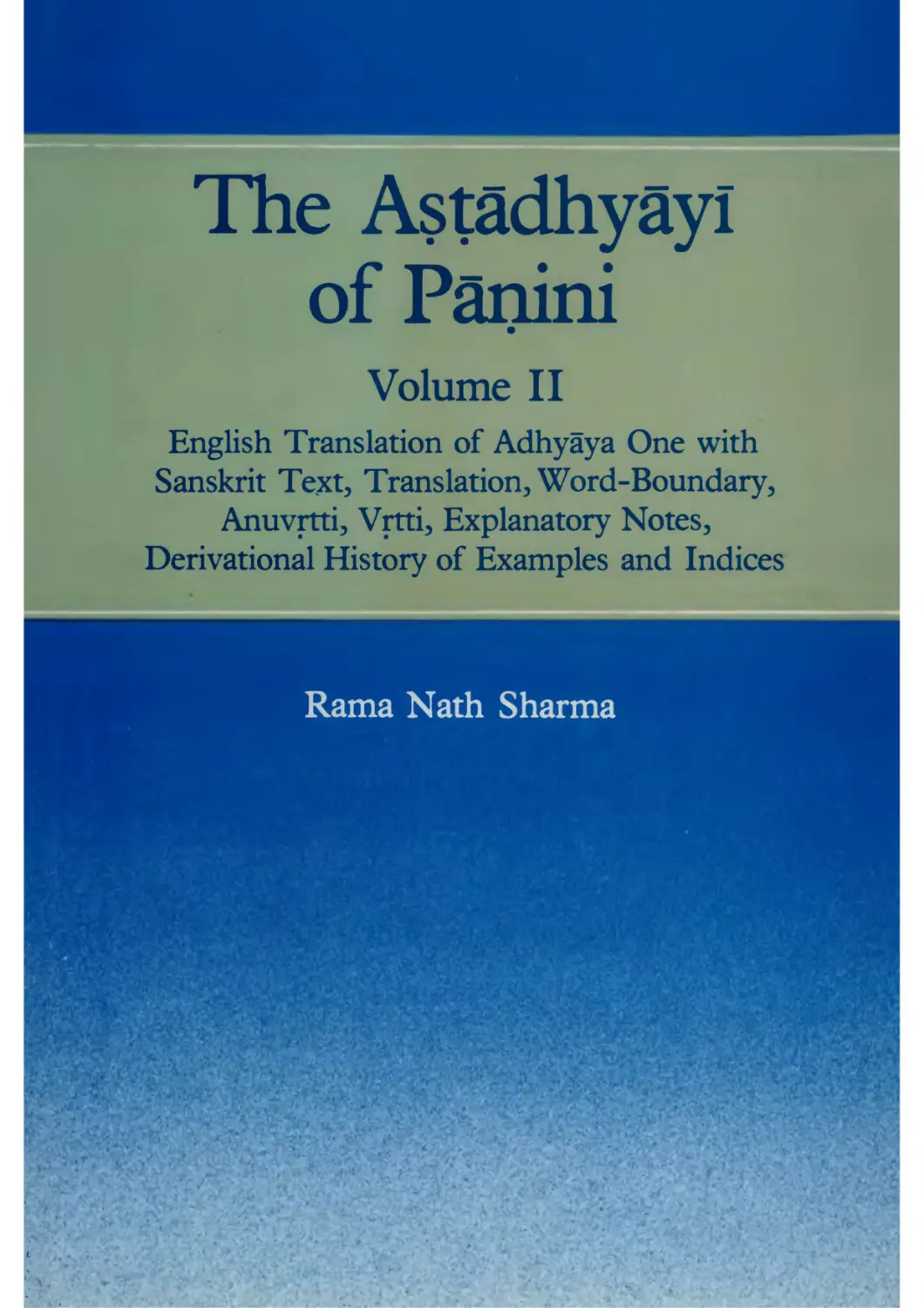
                    The Astadhyayi
of Panini
Volume II
English Translation of Adhyaya One with
Sanskrit Text, Translation, Word-Boundary,
Anuvrtti, Vrtti, Explanatory Notes,
Derivational History of Examples and Indices
Rama Nath Sharma
This volume of Astadhyayi of Panini
contains the English translation of the first
adhyaya. It includes Sanskrit text of the
sutra and their transliteratipn, word-
boundaries with marked inflectional
endings and compound-formation,
anuvrtti, vrtti, examples, detailed
explanatory notes, and complete
derivational history of example forms
cited by the Kasikavrtti. Explanatory notes
are presented to facilitate proper
understanding of the sUtra, especially in
relation to their formulation,
interpretation, application and relative
•placement. An attempt has been made to
sort out pertinent issues and explain them
with reference to major commentaries. The
appendix contains over 800 examples
along with their complete derivational
history and discussion relevent to the
Paninian grammatical system.
This volume is published as second
volume of the planned six-volume study.
The third, fourth, fifth, and sixth volumes
of this series will cover the sutras of
adhyayas two-three, four-five, six, and
seven-eight respectively.
Rama Nath Sharma is Professor of Sanskrit
at the University of Hawaii at Manoa,
Honolulu, Hawaii, U.S.A. He received his
Ph.D. (1971) in General Linguistics from
the University of Rochester where he also
taught Linguistics for five years. His
research interest includes grammatical
theory in general, and Panini and the Indian
grammatical tradition, in particular.
ISBN 81-215-0051-6 (for the set)
ISBN 81-215-0456-2 (Vol. II)
the astAdhyAyi of
panini
VOLUME II
ENGLISH TRANSLATION OF
ADHYAYA ONE WITH SANSKRIT TEXT, TRANSLITERATION,
WORD-BOUNDARY, ANUVRTTI, VRTTI, EXPLANATORY NOTES,
DERIVATIONAL HISTORY OF EXAMPLES, AND INDICES
RAMA NATH SHARMA
University of Hawaii
Munshiram Manoharlal
Publishers Pvt. Ltd.
ISBN 81-215-0051-6 (for the set)
ISBN 81-215-0456-2 (Vol. П)
This edition 2000
© 1990, Sharma, Rama Nath
All rights reserved, including those of translation into foreign languages.
No part of this book may be reproduced, stored in a retrieval system, or transmitted
in any form, or by any means, electronic, mechanical, photocopying, recording, or
otherwise, without the written permission of the publisher.
Printed and published by
Munshiram Manoharlal Publishers Pvt. Ltd.,
Post Box 5715,54 Rani Jhansi Road,
New Delhi 110055.

Contents
Preface	*x
Abbreviations	x*”
Sivasutra	1
Adhyaya One	5
Appendix
Derivational History of Examples
Introductory Remarks	317
Derivational History of Examples	323
* Bibliography	527
Index of Derivations	531
Index of Terms	539
Index of Sutras	543
Preface
The present is the second of a planned five-volume study on the Astadhyayi
of Panini. It also constitutes the first of the four translation volumes of the
Paninian sutra with text, transliteration, word-boundary, anuvrtti, vrtti,
English translation, examples, explanatory notes, derivations and appen-
dices. This volume contains only of the first adhyaya of the Astadhyayi: a
rather bulky volume for only one-eighth of the grammar. This could not
be helped, however, as practically every necessary explanation, and rule-
application in derivation, has to be supplied in detail. It is my hope that
with the facility of cross-reference, the size of subsequent volumes will not
be as large. The second, third, and fourth translation volumes will cover
the sutra of adhyaya two-three, four-five, and six-seven-eight respectively.
I have relied very heavily upon the traditional commentaries in making
this translation. The Vyakaranamahabhasya (Mbh: Gurukul Jhajjar edition)
of Pathnjali, with the Pradipa of Kaiyata and the Udyota of Nagesa; the
Kasikavrtti of Vamana-Jayaditya (Kas: Varanasi, Tara Publications edition)
with the Padamanjari (PM) of Haradatta and the Nyasa of Jinendrabuddhi;
the Vaiyakaranasiddhantakaumudi (SK) of Bhattoji Diksita (Delhi: Motilal
Banarsidass edition) with the Balamanorama of Vasudeva Diksita and the
Tattvabodhihi of Jnanendra Sarasvati; and the Paribhasendusekhara (P$) of
Nage£a (Delhi: Kendriya Sanskrit Vidyapeeth edition) have been my
constant sources of reference.
Many Hindi and English translations, as well as critical expositions of
these texts, have also proved to be very beneficial. Most notable among
these are: Hindi translation with notes of the Astadhyayi of Panini
(Brahmadatta Jijhasu with Prajna Devi); Hindi translation of the
Mahabhasya of Patanjali (Charudeva S has tri; Yudhisthira Mimamsaka);
English translation of the Vyakaranamahabhasya of Patanjali (especially of
the karakahnika) made by S.D. Joshi; Hindi translation of the Laghusid-
dhantakaumudi of Varadaraja made by Bhimasena Shastri; the Artha-
prakasika of Radharaman Pandeya; and the Vyakaranacandrodaya of
Charudeva Shastri. This by no means reduces my indebtedness to scores of
other books and papers of scholars like George Cardona, S.D. Joshi,
K.A. Subramania Iyer, and S.M. Katre. I have also consulted theLaghusab-
dendu sekhara (L$) of Nagesa, along with his Paramalaghumanjusa, though
only occasionally. I have consulted the Vakyapadiya (VP) of Bhartrhari,
especially the commentary Ambakartri of Pandita Raghunatha Sarma,
X
Preface
where there was a need for explanatory details. The Nyasa of Jinendra-
buddhi; the Rupavatara of Dharmakirti; the Prakriyakaumudi of
Ramacandra; the Prakriyasarvasva of Narayanabhatta; and, of course, the
Siddhantakaumudi (with Balamanorama and Tattvabodhini) of Bhattoji
Diksita were my primary sources for derivational details. The examples
themselves have been culled from the Kasikavrtti.
The following is the format in which I have discussed each sutra with its
translation, explanatory details, and examples:
(1)	sutra in the Devanagari.
(2)	sutra in transliteration.
(3)	/.../ Constituent words with indications of their compound forma-
tion; and nominal endings following the convention Nln, where N
can be replaced with the single value of numerals 1 through 7
denoting nominal endings, such as nominative (prathama), accusa-
tive (dvitiya), instrumental (trtiya), etc., respectively. The n will be
restricted to a numerical value of 1, 2 and 3 to denote singular
(ekavacana), dual (dvivacana), and plural (bahuvacana) numbers.
Thus, expressions such as 1/3, 5/2, and 7/1 would represent
nominative plural, ablative dual, and locative singular respectively.
Indeclinables (avyaya) have been indicated by means of the symbol
Ф. The compounds have been indicated by their abbreviatory
terms, such as dv. (dvandva), sam. dv. (samahara-dvandva), tat. (tat-
purusa), and bv. (bahuvrihi), etc., where int. refers to an internal
compound *within a compound.
(4)	(	) anuvrtti elements from preceding sutra with the last digit of
the sidra number separated by #. The first two digits need not be
cited, as the anuvrtti will be indicated generally within the limits of
Apada ‘quarter’.
(5)	vrtti from the Kasikavrtti of Vamana-Jayaditya in transliteration.
(6)	English translation.
(7)	Examples excerpted from the Kasikavrtti and presented with
English glosses.
(8)	Scope of the sutra excerpted from the Kasikavrtti where applicable.
(9)	Explanatory notes, where an effort has been made to present an
explanation of important aspects of the formulation, interpreta-
tion, function and application of the sutra under discussion. (Addi-
tional details on these aspects of a sutra can also be found in the
appendix, where I present a full derivational history of all examples.)
The tone of my discussion, as well as my sources, have remained tradi-
tional. I have thus avoided controversies which may surround the
interpretation or application of a rule. For example, I have refrained from
discussing the implications of differing interpretations of the scope of rule
1.4.2 vipratisedhe param karyam. Scholars of Panini know that the Western
Preface
xi
Paniniyas interpret the scope of this rule as strictly limited to the domain
of ekasamjnd (1.4.1 akadarad eka samjna). However, the tradition, without
any disagreement, regards this rule as universally valid throughout the
Sapadasaptadhyayi. I have felt all along that, in a work of the nature of the
present volume, the aim of the translator should be to explain as faithfully
as possible the original. Of course, the original in this case is the Astadhyayi;
but unlike many other such works the Astadhyayi must be considered as a
symbol (pratikd) for vyakhyana ‘exposition’, which embodies the vast
commentarial literature. Panini cannot be fully understood without the
help of the commentaries, most notable among which is the Mahabhasya.
It is for this reason that I have relied heavily upon the commentaries. I
have also noted, where applicable, differences of opinion within the
tradition.
I fully realize the extremely complex nature of the form and content of
the Astadhyayi. I am also aware of my own limitations, due to which I may
have made mistakes. Any blame for them must come to me and not to the
sources I have tapped. The project is an overwhelming one. I shall con-
sider my-efforts fulfilled if it could provide a better understanding of the
Astadhyayi and the Sanskrit grammatical tradition. I certainly do not claim
to have made any significant contribution through this volume, for what
it contains has been in the commentaries all along. I consider myself only
an instrument for bringing, as best I could, the contents together in one
place, in English. I shall welcome remarks from my readers, especially
those relating to errors and omissions. Since this volume sets the tone for
the entire project, readers’ comments will be helpful for subsequent
volumes.
A few words must also be said about the only available English transla-
tion of the Astadhyayi, made in 1891 by S.C. Vasu. Vasu’s translation fol-
lows the Kdsikavrtti and is trustworthy, though not free of problems, espe-
cially for modern readers. Vasu takes a great deal for granted. He not only
omits glosses, but also misses explanatory details of terms and principles.
References create still another problem. His archaic English becomes
even more obscure because, of his pedantic style. The need for a new
English translation for linguists and Sanskritists became apparent to me
during the summer of 1977, when I taught an introductory course on
Panini under the joint auspices of the Department of Linguistics at the
University of Hawaii, and the Linguistic Society of America.
I must express my deep sense of indebtedness to the authors and works
which have been my constant source of reference. My brother Narendra
and Pandit Ramaprasad Tripathi have been very generous in giving of
their time. Professor George Cardona has earlier read a draft of this trans-
lation, and as usual has made some very useful comments. The University
of Hawaii, especially its Department of Indo-Pacific Languages; the
xii
Preface
American Institute of Indian Studies; and the Smithsonian Institution
have been very generous in supporting my research endeavour with
grants. My student researchers Abigail Brown, Stanley Schab and Julie
Trott deserve special thanks for their perseverance in spending long
hours at the computers. Julie Trott must be singled out for her editorial
acumen, consistency and sharp eyes for details to perfection. This volume
owes a lot to her.
This volume also owes a lot to my wife Kamala, who has always pro-
tected me from many of the often time-consuming tasks of being a house-
holder.
Rama Nath SharmA
University of Hawaii
Honolulu, U.S.A.
28 July 1989
Abbreviations
abl ace Ait bv DP dot du dv id itardv fem GP gen inst int KS Kas	ablative accusative Aitareya-Brahmana bahuvrihi Dhatupatha dative dual dvandva ibidum itaretara-dvandva feminine Ganapdtha genitive instrumental internal Kathaka-Samhitq Kasikavrtti of Vamana-Jayaditya with Padmanjari
LS loc Mbh	(PM) of Haradatta and the Nyasa of Jinendrabuddhi. Laghusabdendusekhara of Nagesa. locative Vyakaranamahabhasya of Patanjali with the Pradipa of Kaiyata and the Udyota of Nagesa.
masc nan tat neut nom PM	masculine nan-tatpurusa neuter nominative Padamanjari of Haradatta as Kasikavrtti of Vamana- Jayaditya.
PS Pai pbh. paribh pane Pl RV SK	Paribhasendusekhara of N agesa. Paippalada-samhita paribhasa ibidum pancami plural Rgveda Vaiyakaranasiddhantezkaumiidl of Bhattoji Diksita with the Bdlamanoramd of Vasudeva Diksita, and the Tattvabodhim of Jnanendra Sarasvati.
SP sam sg	Sutrapatha samahara singular
xiv	Abbreviations
sing Si Sat iOS Tai tat tr/trt VP	ibidum SivasHtra Satapatha-brahmana sasthi Taittiriya-brahmana tatpurusa trtiya Vakyapadiya of Bhartrhari with the commentary Ambakartri of Pandita Raghunatha Sarma.
vt Vaj voc	vdrttika Vajasaneyi-samhita vocative
Sivasutra
1.
2.
з.
4.
5.
6.	*ПЦ
7.	ЗГЧ1ШЧЦ
8.	ft”3*
aiuN
rlK
eoft
aiauC
hafvaraT
PN
namanananaM
jhabhaN
ghadhadhaS
f If
khath4hatiftha<*ffV
IffY
s*sasaR
haL
10.
11.
12.
13.	F4FV
14.	Щ
The Sivasutra ($s) is a set of fourteen aphorisms enumerating the sound
segments (varnasamamnaya) of the Sanskrit language in the order most
conducive to forming the abbreviatory terms (pratyahara) used in the
grammar. An item indicated in the preceding chart by capital letters is
traditionally termed an it and is not treated as an item in the list. However,
an it may serve as the final (antya) for any initial (adi) element which, joined
together, forms an abbreviatory term (pratyahara) to represent the initial
and a' l intervening elements.1 For example, the initial a of the first Ss can
join the final C of $s four to form the abbreviatory term aC signifying all
the vowels. Similarly, aL designates the totality of vowels and consonants.
Another symbol, which is also not an item on the list, is the a used with
the consonants of Ss five through fourteen. This a facilitates the pronunci-
ation of the consonants in question. I have indicated the occurrences of
this a by raising it. The a of Ss six is treated by Kasika (Kos.)2 and Siddhan-
takaumudi (SK)3 as an it in order to form an abbreviatory term rA which
would denote r and /. I represent this A as a non-й because treating it
otherwise would be non-Paninian.
Panini’s method of forming abbreviatory terms with the help of the $s
can yield a vast number of abbreviations. However, the Astadhyayi uses
only 41 abbreviations, summarized in the following slokavarttika:*
1see 1.1.71 adir antyena saiieta.
2
(Kaf 1:53) hakakaradisv akara uccarandrthah, nanubandhah. lakare tv anunasihah
' (ЛК, i:4) ...esam antya itah. lan-siitre’ karas ca. hakdradisv akara uccarandrthah..
4see Kai. (1:59-60).
2
The Astadhyayi of Panini
ekasman nananavata dvabhyam sas tribhya eva kanamah syuhl jneyau cayau
caturbhyo rah, pancabhyah salau sadbhyahll
“one (abbreviatory term) each with TV, N, N, V, T; two each with S; three each
with K, N, M; four each with C, Y; five with R and six each with S, L. ” Thus:
1. eN,yN, aN, chaV, aT
2.	jhaS, bhaS
3.	aK, iK, uK; yaN, aN, iN, naM, aM, yaM
4.	aC, eC, aiC, iC; maY,jhaY, khaY, yaY
5.	?R,yaR,jhaR,khaR.caR
6.	jhaS,jaS, baS, aS, haS, vaS; aL, haL, saL, vaL, SLjtfL
If we treat the a of Ss six as an anunasika it, as has been advocated by
Kasika and SK, we will get an additional abbreviatory term, rA. There are
two more abbreviatory terms, caY and naM, the first of which is attested to
by varttika 3 ad 8.4.88 (cayo dvitiyah sari pauskarasadeh) and the second by
the Unddisutra (1/114) namantad doh. This brings the total to 44. The fol-
lowing chart shows these abbreviatory terms with their initial items as well
as their it.5
initial element (adi)	final element (it)
	A	К	N	C	T	N	M	N	S	s	V	Y	R	L
a		aK		aC	aT	aN	aM			aS				aL
i		iK		iC		iN
u		uK
e			eN	eC
ai				aiC
h									h’S					h’L
У						y*N	y*M	y*N				yW	fR
V														v’L
r	rA													r’L
m												m’Y
h							n’M
bh									bh’S	bh’S
jh									,iha?			jh’Y	jh’R	jh’L
b										b*S
1										j’S
ch											ch’V
kh												kh’Y	Hi’R
c													c*R
s													i’R	i’L
5 A reference to the abbreviatory terms resulting out of & 5-14 can be made either by
Sivasutra
3
The order of elements listed in the $s is as follows.
1. vowels (&, 1 -4)
(la) simple (&, 1 -2)
(lb) complex (Ss, 3-4)
2. consonants ($s, 5-14)
(2a) semivowels (&, 5-6)
(2b) nasals (&, 7)
(2c) stops (5s, 8-14)
(2c p voiced aspirates ($s, 8-9)
(2c2) voiced nonaspirates (5s, 10)
(2c3) voiceless aspirates (&, 11)
(2c4) voiceless nonaspirates (5s, 12)
(2c5) pirants (5s, 13-14)
The above order does not conform with the order of earlier listings,
such as those of the prdtisakhyas, although there is considerable similarity
of terminology and classification. Panini certainly was aware of such previ-
ous classifications. However, his 5s listing reflects his own special pur-
poses. Patanjali states that the 5s are presented in this fashion for the pur-
pose of vrtti ‘application of rules’ and samavaya ‘ordered enumeration of
elements’ (Mbh): 1:47,vdrttika 18).5 In varttika 19, the setting up of anuban-
dhas is cited as an additional purpose.6
Actually, the pratyaharas are a means for bringing the elements of the list
close to rule applications. A full and insightful discussion of this, as well as
the principles of samanya ‘general’ and visesa ‘particular’ underlying the
listing of the 5s in relation to their anubandhas is presented in Cardona
(1969).
The denotata of some abbreviatory terms may not, at first glance, be
obvious. Consider aN and iN. Should the N of these abbreviations be inter-
preted as the N of 5s 1 or 5s 6? For, aN and iN formed with 5s 1 will denote
only a, i, и and i, и respectively. If the N is interpreted as belonging to 5s 6,
respectively a, i, и, r, I, e, o, ai, au, h, y, v, r, I and i, и, r, I, eo, ai, au, h, y, v,
r, I, will be denoted. However, an abbreviatory term iN formed with the N
of 5s 1 to denote i, и counters Paninian practice. Panini never uses iN to
denote i, u; instead he uses iN to denote sounds enumerated by 5s 1
through 6. Both interpretations of aN, however, are valid. The question as
to when aN should be interpreted as formed with the N of 5s and when
with the N of 5s 6 can only be resolved by the explanations (yydkhyana) of
including or excluding the raised a. Thus, hL or haL can both be used to denote the conso-
nants of the language. I have used such abbreviatory terms in both ways; with or without the
raised o.
$ vrttisamavdyartha upadesah.
6 anubandhakaranarthas ca.
4
The Astadhyayi of Panini
the learned. For correct results, aN in 1.1.50 ur an raparah, for example,
should be treated as formed with the N of Ss 1. As opposed to this, aN in
1.1.69 anudit savarnasya... must be interpreted with the of Ss 6.
Rule 1.1.69 states that a vowel (aN), as well as an item marked with U,
denotes itself as well as sounds homogenous (savarna) with it. Thus, a
denotes a class of eighteen vowels distinguished on the basis of length:
short (hrasva) long (dirgha) or extralong (plutd)', pitch: high (uddfta ) low
(anudatta.) or circumflex (svarita)-, and nasality nasalized (anunasika) and
non-nasalized (niranundsika). Similar classes of eighteen each are rep-
resented by i, и and r. The I vowel represents a class of only twelve vowels
as it lacks a corresponding long variety. Vowels denoted by eC (e, o, ai, au)
also represent a class of 12 each. Here, unlike the case of I, a corresponding
short variety is not available. Items with V as their it represent a class of five
consonants each. Thus, kU (k) represents k, kh, g, gh, and n. Similar conso-
nant classes are represented by cU, tU, tU andpU.7
There are many problems which may be raised concerning the formula-
tion of the Ss and the use of the resultant abbreviatory terms; problems
relating to the order and selection of sound segments and its, the use of N
as an it twice, the use of h as an element twice, as well as the use of apratyahdra
with no less than three denotata. A detailed discussion of these and other
problems relating to the Ss may be found in Cardona (1969).
7 Panini provides for proper selection of items from class lists by means of metarules
1.1.50 sthane' ntaratamah and 1.3.10 yathasamkhyam anudesah. samanam. For a detailed
discussion of how 1.3.10 interacts with 1.1.50 in order to select, proper substitutes under
1.1.69, see Cardona (1980).
Adhyaya One
1.1.1
vrddhir adaic
Ivrddhih 1/1 adaic 1/1 (at ca ait ca; & 4)/
vrddhisabdah samjnatvena vidhiyate pratyekam adaicam varnandm
samanyena tadbhdvitdnam atadbhdvitdnam ca
aT (a, see 1.1.70 taparas...) and aiC (ai and au, see Ss 4) are termed
vrddhi.
EXAMPLES:
asvaldyanah ‘male descendant (grandson, and so on) ot Asvala’
aitikayanah ‘male descendant of Itika’
aupagavah ‘male descendant of Upagu’
aupamanyavah ‘male descendant of Upamanyu’
sdliyah ‘that which is located, obtains or is born in the house’
maliyah ‘that which is located, obtains or is born in a garland’
1.	The term vrddhi is introduced as a name (samjna) which applies to
each one of its name-bearers (samjniri) a, ai and au, whether they are
derived by applying a rule which expressly mentions the name vrddhi
(tadbhavita) or not (atadbhavita).
For example, bhagah ‘a part, portion’ is derived by introducing the affix
(3.1.1 pratyayah) GHaN (3.3.16 padaruj...) after (3.1.2 paras ca) the verbal,
root (3.1.91 dhatoh) bhaj ‘to share, divide’ to express the action denoted by
the root (3.3.18 bhave)', this yields bhaj + GHaN. Rule 7.2.116 ata upadhaydh
read with 7.2.114 mrjer vrddhih requires that the penultimate (upadha,
cf. 1.1.65 alo’ntydt...) vowel of the presuffixal base (6.4.1 angasya, cf. 1.4.13
yasmdt...) be replaced by vrddhi. The role of 1.1.1 is simply to explain the
term vrddhi wherever it is encountered in the grammar.
A vrddhi replacement of the type: bh(a—>a)j + GHaN is termed tadbhavita
because it is brought about by the application of a rule which expressly
mentions the name vrddhi. As opposed to this, consider sdliyah ‘that which
is located, obtains or is born in the house’, which is derived by introducing
the taddhita (4.1 .l^utsadibhyo...) affix (3.1.1 pratyayah) cha (4.2.113 vrddhdc
chah...) after (3.1.2 paras ca) the syntactically related (4.1.82 samar-
thandm...) pada (1.4.14 suptin...) said 4- Ni. Now, cha cannot be introduced
unless said is an item termed vrddha (1.1.73 vrddhir yasya..;) and an item
cannot be termed vrddha unless the first among its vowels is a vrddhi. Here
again,, we witness the explanatory role of rule 1.1.1. The vrddhi vowel a of
said which, in turn, qualified said to be called vrddha, is atadbhavita since it
is already given and not derived by application of a rule which expressly
mentions the name vrddhi.
6	The Astadhyayi of Panini	1.1.2
2.	Panini formulates this rule by using the technique of taparakarana
‘making t precede or follow’. That is, he inserts t between a and aiC .This
simply means that vowels, in the present case ai and au, cited with a pre-
ceding or a following t denote only those homogeneous (savarna) vowels
which have the same time duration (kata). It should be noted that the t in
this rule is not used for constraining a since a is not included in aN (for
details, see 1. \.69 anudit...). Instead, it is used foraiC. Here, taparakarana,
enables Panini to block the assignment of the term vrddhi to instances of
ai and au which may constitute a time duration of three or four morae. For
the details of how t does not constrain a, see Padamanjari (PM) ad Kasika
1.1.1 (1:66): akaro’nantvadeva nabhinna-koLanamgrahaka iti....’
3.	Definitional rules are given in the form x^i where x represents a
name-bearer (samjnin) to which у, a given name (samjna), is assigned. The
subscripts with both, x and у show that both of these elements are put in
the nominative.
Sutra 1.1.1 does not follow this general order. Instead, it presents the
name first. Patanjali (Mbh. 1:132) rather apologetically explains that the
acdrya (Panini) put the samjna vrddhi ‘prosperity, growth’ first for auspi-
cious reasons. A careful examination of all definitional rules in the
Astadhyayi reveals that this explanation is not satisfactory, as there are
many other rules which violate the order xp^. Consider, for example,
rules 1.2.41 aprkta ekal pratyayah, 3.1.92 tatropapaddtn saptamistham,
3.1.93 krd atin, 3.1.94 krtyah and 3.4.114 arddhadhatukam sesah.
SCOPE: 7.2.1 sici vrddhih parasmaipadesu, etc.
1.1.2	31^ ЦПГ:
aden gunah
laden 1/1 (at ca en ca; Ss 3); gunah 1/1/
gunasabdah samjnatvena vidhiyate pratyekam adefio varnanamsamanyena
tadbhavitanam atadbhavitanam ca aT (a; see 1.1.70 taparas...) an eN (e
and o, see Ss 3) are termed guna.
Examples:
tarita ‘he who floats or swims’
ceta ‘he who heaps or gathers’
stota ‘he who praises’
pace ‘I cook’
pacanti ‘they (pl.) cook’
jayanti ‘they (pl.) win’
1.	Just as the term vrddhi (1.1.1. vrddhir...), the term guna is introduced
as a name (samjna) which applies to each one of its name-bearers (samjnin)
a, e and o, whether they are derived by applying a rule which expressly
1.1.3
Adhydya One: Pada One
1
mentions the name guna (tadbhdvita), or not (atadbhavita). For example,
the nominal base netr ‘he who leads’ is derived by introducing the affix
(3.1.1 pratyayah) trC (3.1.133 nvultrcau) after (3.1.2 paras ca) the verbal
root (3.1.91 dhatoh) niN ‘to lead’. It is required by rule 7.3.84 sdrvadhdtu-
karddhadhatukayoh that i of ni be replaced by guna. Thus we get n(i -* e) + tr.
This e can be termed a derived (tadbhdvita) guna vowel because it is derived
by applying a rule expressly mentioning the name guna.
The first four examples — tarita, ceta, stota and pace — illustrate
instances of tadbhdvita guna vowels. The next two —pacanti andjayanti —
provide atadbhavita instances. Note, however, that atadbhavita instances
are given only for a and e. An example for о could be atho, aho, etc.
2.	The/aparoAarana(cf. 1.1.1) is meant here for all the items (a, e and о).
SCOPE: 7.3.82 midergunah, and so on.
1.1.3
iko gunavrddhi
Ukah 6/1 gunavrddhi 1/2/
vrddhigunau svasamjnayd sisyamanau ika eva sthane veditavyau
When vowels denoted by guna and vrddhi are ordered as substitutes
(adesa), and no substituendum (sthanin) is specified, they only come
in place of vowels denoted by iK (i, и, r, I; see Ss 1-2).
Examples:
tarati ‘he swims or floats’
nayati ‘he leads’
bhavati ‘he becomes’
akarsit ‘he did or made’
aharsit ‘he carried’
acaisit ‘he heaped or gathered’
anaisit ‘he led’
aldvit ‘he cut’
astavit ‘he praised’
1. The function of this rule is to restrict the substituendum for guna and
vrddhi substitutes in places where they are ordered with the express men-
tion of the terms guna and vrddhi but no substituendum is specified. In all
such instances, this rule becomes valid and states that items denoted by iK
alone should be treated as substituendum. This obviously results from the
fact that Panini introduces guna and vrddhi substitutes following either of
two methods:
(a) he specifies both the substituendum as well as the substitute, and
(b) he specifies only the substitute and no substituendum.
Rule 1.1.3 covers this latter’instance. For example, consider 7.2.114
8
The Astadhyayi of Panini
1.1.4
mrjer vrddhih (angasya) which orders a vrddhi substitute by the express
mention of the name vrddhi. However, mrjer (genitive singular of mrj ‘to
clean’, an anga) cannot be treated as a substituendum since that would
require replacingmrj with a vrddhi substitute, which, in turn, would make it
impossible to derive the desired form marsti. Furthermore, how shall we go
about deciding a proper vrddhi substitute for mrj? For this reason, 1.1.2
has to be read with 7.2.114 which will then order a vrddhi replacement
only in the place of the iK of mrj, the anga (1.4.13yaswid/...). As opposed to
this, rule 1.1.3 does not find its scope in the application of 7.2.116 ata
upadhayah. There, although a. vrddhi substitute is ordered with the express
mention of the name vrddhi, unlike 7.2.114 mrjer vrddhih, the substituen-
dum, that is, the penultimate a of the ahga, is also specified. Similarly, con-
sider 7.3.84 sarvadhatukardhadhatukayoh (gunah carried from 7.3.82) which
provides a guna substitute without specifying any substituendum. If we do
not take 1.1.3 into account, we will interpret 7.3.84 something like this:
A guna replaces the final aL (1.1.52 alo’ ntyasya) of an anga when a
sarvadhatuka (3.4.113 tinsit...) or an ardhadhatuka (3.4.114 ardha-
dhatukam sesah) affix follows.
Here again, besides encountering difficulty in arriving at a proper guna
substitute, we will also end up with an incorrect derivation. However, if we
read 1.1.3 together with 7.3.84, everything will be in order. That is, 7.3.84
will order a guna substitute only in place of the final iK of the ahga (1.4.13
yasmat...). For an example of a guna substitute where 1.1.3 does not apply,
consider 6.4.116 or gunah, whereby a guna vowel is substituted for the и
(long or short) of a bha (1.4.18 yoct bham). One need not invoke 1.1.3 here
since the substituendum is specified.
To sum up, rule 1.1.3 can find its scope only when both the following
conditions are met:
(a)	a rule provides a guna or vrddhi substitute by express mention of
the name guna or vrddhi, and
(b)	that rule fails to provide any definite substituendum.
Panini restricts the substituenda to sounds denoted by iK because he
wants to exclude any guna or vrddhi substitutes for a, ai, au and conso-
nants. He explicitly uses gunavrddhi in this rule, rather than implicitly
assuming it by anuvrtti, to make it clear that 1.1.3 finds its scope only when
a guna or vrddhi substitute is given by explicitly using these terms.
1.1.4 ч Bjnftngsfc
na dhatulopa ardhadhatuke
/паФ dhatulope H\ (dhator lopoyasmin; bv.) ardhadhatuke UM
(iko gunavrddhi # 3)
dhatvekadeso dhatus tasya lopo yasmin ardhadhatuke tad ardhadhatukam
dhatulopam tatraye gunavrddhi prapnute te na bhavatah
1.1.5
Adhyaya One: Pada One
9
Vowels denoted by guna and vrddhi do not come in the place of an iK
when an ardhadhatuka (3.4.114 ardhadhatukam sesah) affix condition-
ing deletion of part of the root follows.
Examples:
loluvah ‘he who cuts again and again’
popuvah ‘he who cleanses again and again’
marimrjah ‘he who wipes again and again’
1. The word dhatulopa is not a tatpurusa compound having the analyzed
form: dhator lopah ‘deletion of root’. Instead it is a bahuvrihi with an
analyzed form: dhator lopo yasmin ‘that before which deletion of a root
occurs’, or in other words, ‘that which conditions the deletion of a root’.
With a bahuvrihi interpretation, the rule will be translated as: guna and
vrddhi do not obtain in the place of an iK when that before which the dele-
tion of the root occurs, follows. This translation has a very serious flaw.
When the root has already been deleted, there will be nothing with refer-
ence to whose iK guna and vrddhi can be prohibited from obtaining. The
iK, being part of the root, would have been deleted anyway, and there
would be no need for the prohibition. Therefore, the expression ‘deletion
of a root’ is interpreted as ‘deletion of part of a root’. That is, the word
dhatu is interpreted as referring to ‘part of a root’ (dhatvaikadesa). Hence,
the proper translation should be: guna and vrddhi in the place of an iK do
not obtain when that which conditions the deletion of part of a root
follows. This rule thus, under the stated conditions, negates the provisions
made by the preceding rule. For details of how this rule is used in a deriva-
tion, see steps (g) and (A) of (22) loluvah in the appendix.
1.1.5 faHrlW
kniti ca
Iktiiti 7/1 (gas ca kas ca nas ca) ca 0/
Vowels denoted by guna and vrddhi do not come in place of an iK
when that which is marked with K, G, or 2V conditions the replacement.
Examples:
citah, ‘heaped’
citavan ‘he heaped’
stutah ‘praised’
stutavan ‘he praised’
bhinnah ‘split, broken’
bhinnavdn ‘he split’
mrstah, ‘wiped, cleaned’
mrstavan ‘he wiped’
cinutah ‘they two heap or gather’
10
The Astadhyayi of Panini
1.1.5
cinvanti ‘they heap or gather’
mrjanti ‘they wipe or clean’
jisnuh ‘desirous of winning; he whose nature is to win’
bhusnuh ‘desirous of becoming; he whose nature is to become’
1.	The purpose of 1.1.5 is to block the application of a rule which
(a)	orders guna or vrddhi replacement with express mention of the term
guna or vrddhi, where
(b)	such replacement is also conditioned by an item (affix) marked with
K,G,ovN.
In view of (a), this rule can block a guna or vrddhi replacement only
when such a replacement is to come in place of items denoted by iK.
Condition (b) is slightly more complicated than it appears to be on the
surface. That is, the decision whether an item which conditions a guna or
vrddhi replacement is really marked with K, G, or TV is not made solely on
the basis of its being overtly marked with K, G or TV. Instead, first the overt
markings K, G, and TV are considered and then rules 1.2.1 gankutadibhyo...
through 1.2.26 ralo vyupadhad... are consulted. These rules may or may
not allow an item, either obligatorily or optionally, to be treated as marked
with К or TV. For example, rule 1.2.4 sarvadhatukam apit lets any sarvadhaiuka
affix — with the exception of those marked with P — be treated as if
marked with TV. Similarly, under certain conditions, rules 1.2.19 nistha
sin..., etc., will allow affixes Ktva and KtavatU to be treated as if they were
not marked with K.
2.	The saptami (seventh triplet) in this rule is interpreted as nimittasaptami,
a. saptami which may cause or condition an operation (here guna or vrddhi
replacement) to obtain (2.3.37 yasya ca bhavena...). It is not interpreted as
parasaptami, a saptami which serves as the right context for an operation.
That is, the operation obtains on an item which immediately precedes the
item in saptami (1.1.66 tasminn iti nirdiste purvasyd). The parasaptami
interpretation will greatly reduce the effectiveness of 1.1.5. For example,
1.1.5 would be able to block the guna of an anga — final iK which is immediately
followed by an affix marked with K, G, or TV. However, it may not block the
guna which obtains in the place of the penultimate iK of an anga since this
iK will not be immediately followed by the condHoning affix. By accepting
nimittasaptami in 1.1.5, we can block any guna r vrddhi replacement of an
anga, provided, of course, all other conditior c satisfied.
3.	Abstract L—suffixes which are marked with N — that is, LI'fit, LUN,
and so on — do not come under the purview of 1.1.5.
4.	Kasika lists this rule as kniti ca, because, given the stringkkh where the
first k is a substitute of g, under the influence of the second Л; 8.4.45yaro...
optionally will apply to change the second k into n. This will yield khn. Rule
8.4.64 halo... will delete the first n, reducing the string to kh. It should be
1.1.7
Adhyaya One: Pada One
11
remembered here that if one follows this listing, one must accept the affix
Gsnu (3.2.139 glajisthas ca ksnuh) as Ksnu.
1.1.6 ЗИШЬцц
didhivevitam
/didhivevitam 6/3/
(ihogunavrddhi #3;na# 4)
didhi-vevyor itai ca ye guna—vrddhi prapnutas te na bhavatah
Vowels denoted by guna or vrddhi do not come in place of the iK of
didhiN ‘illuminate’, veviN ‘go, pervade’, and iT (the augment, see
7.2.35 arddha..., etc).
Examples:
adidhyanam ‘to be properly illuminated’
adidhyakah ‘that which illuminates properly’
avevyanam ‘to go or pervade properly’
avevyakah ‘that which goes or pervades properly’
kanita (svah) ‘he will go (tomorrow)’
ranita (svah) ‘he will go (tomorrow)’
1.	As is obvious from the translation, didhivevi refers to verbal roots
didhiN and veviN. A question is raised why didhivevi cannot be interpreted
as a word referring to four roots diTV ‘decay*, dhiN ‘disrespect’, veN ‘weave’,
and vi ‘to go’. If Panini had intended to refer to all four roots, he probably
would have formulated the rule in this manner: vivedhiditam. In this way,
he would have been able to refer to the roots without any confusion with
didhiN and veviN. However, since he did not formulate the rule as viv-
edhiditam, he only meant the two roots didhiN and veviN.
The question also arises why iT, since it is cited in association with verb
roots, is not interpreted as referring to, for example, iT ‘to go’, a verb root
rather than an augment. If Panini had meant to refer to a root by iT, he
would have put iT first, since it is a form with comparatively fewer vowels
(2.2.24 alpac taram). Since he did not, we interpret iT as referring to the
augment iT. Note that guna substitution alone obtains in case of iT. This
explains why no examples for vrddhi are offered in this connection.
1.1.7
halo’ nantarah samyogah
/halah 1/3 anantarah 1/3 samyogah 1/1/
bhinnajatiyair ajbhir avydvahitah slistoccarita halah
samyoga samjna bhavanti samudayah samjni
A sequence of hL (consonants, see Ss, 5-14) uninterrupted by an aC
(vowel; see Ss, 1-4)) is termed samyoga ‘cluster, conjunct’.
12
The Astadhyayi of Panini
1.1.8
Examples:
sv in asvah ‘horse’
ndr in indra ‘Indra’
gn in agnih ‘fire’
rn in karna ‘ear’
str in ustra ‘camel’
1. Note that the name samyoga applies to a contiguous sequence of two
or more consonants pronounced jointly without any intervening vowels.
A sequence of vowels, as in titauc. chatram, a sequence of consonants with
intervening vowels, as in pacati and panasam, or a single consonant cannot
be termed samyoga.
2. The purpose of this rule is to explain what the term samyoga means.
For an illustration of what may be the consequence of naming something
as samyoga, consider step (Л) of derivation (29) citavan. Here, given the
string citavant, 8.2.33 samyogdntasya lopah applies. According to this rule,
the last sound of a pada (1.4.14 suptinantam padam) ending in a samyoga is
deleted. Rule 1.1.7 names the sequence nt as a samyoga. Consequently, the
terminal consonant, t, is deleted.
SCOPE: 8.2.23 samyogdntasya lopah, and so on.
1.1.8
mukhanasikavacano’ nunasikah
Imukhanasikavacanah 1/1 anunasikah 1/1/
mukhasahita nasika mukhanasikd tayd ya uccaryate varnah so'
nunasikasamjno bhavati
A sound pronounced at once in the nose and the mouth is termed
anunasika ‘nasal’.
1. This rule assigns the term anunasika to those sounds which may be
pronounced in the mouth and nose simultaneously. The purpose of such
an assignment is to facilitate the application of rules such as 6.1.126 ano’
nunasikas chandasi whereby a, a particle, may be replaced by its nasalized
counterpart in the Vedic before a vowel. Similarly, there are rules such as
6.4.37 anudattopadesa... through 6.4.41 vidvanor... which require the
obligatory or optional deletion or replacement of the nasal by d. Their
application will become problematic if the term anunasika is not defined
and assigned by rule 1.1.8 mukhanasikd...
2. An interesting discussion ensues in the Mahabhdsya (I: 193-95) about
the formulation of this rule, especially in view of the formation of the
compound mukhandsikavacanah. First, it has been suggested that
mukhanasikd is a dvandva compound: mukham ca nasika ca = mukhanasikam.
This way the compound will, as shown, be a singular (2.4.2 dvandvas ca...)
neuter (2.4.17 sa napumsakam). Note that the final long a of nasika is also
1.1.9
Adhyaya One: Pada One
13
replaced by short by rule 1.2.47 hrasvo napumsake pratipadikasya. When
joined with vacana ‘articulation’, the form will be mukhanasikavacanah with
an underlying paraphrase mukhanasikam vacanam asya. But Panini uses
mukhanasikavacanah. The Mahabhasya suggests that we will have the short a
replaced by long by nipatana, or we will interpret vacana as avacana ‘slight
articulation’.
There is yet a different way of interpretation. That is, mukhanasikavacanah
will be interpreted as a bahuvrihi with an internal tatpurusa whose middle
pada (madhyamapada) has been deleted. Thus, mukhadvitiya va nasika =
mukhanasika (tatpurusa with a middle constituent deletion); mukhanasika
vacanam asya so’yam = mukhanasika... (bahuvrihi). For the reason that there is
no dvandva involved, there will not be the shortening of the a of nasika.
Further questions have been raised against the inclusion of the words
mukha ‘mouth’ or nasika ‘nose’ in the rule. It has been stated that if nasika
is excluded, the rule will read: mukhavacano’nunasikah. This being the case,
k, c, t, t, p, etc. will get the designation of anunasika. As a consequence,
given the string рас 4- Kia, the c will be deleted by 6.4.37 anudattopadesa...
This will yield a wrong form: *pata. It is therefore recommended that
nasika should also be used in the rule. But then an objection is raised
against the inclusion of mukha. The argument is made that mukha can be
understood even without its explicit use. How? In the same way in which
one understands, in accordance with the prasadavasinyaya, a reference
both to those who live in high places and those who live on the lower
grounds. For, when one is commanded to bring people who live in high
places, he complies by bringing not only such people, but also those who live
in both the places. Similarly, the use of nasika alone will refer to sounds
produced by both nasika and mukha. This is in consonance with the maxim
of prasadavasinyaya. The Mahabhasya observes that in many ways it is cor-
rect; but formulating the rule simply as nasikavacano’ nunasikah cannot
then account for sounds which may be produced only by the nose. One
such example is anusvara It is therefore suggested that both mukha and
nasika be retained in the rule.
SCOPE: 6ЛЛ26 aho’nunasikas chandasi
1.1.9	wfy
tulyasyaprayatnam savarnam
/tulyasyapratyatnam 1/1 savarnam 1/1/
tulya asye prayatno yasya varnasya yena varnena saha sa samanajatiyam
prati savarnasamjno bhavati
A sound which has the same articulation effort (prayatna) at the same
place of articulation (sthana) in the oral cavity as another sound is
called savarna ‘homogeneous’ with that sound.
14
The Astadhyayi of Panini
1.1.10
Example:
a in khatva ‘cot’ with a in agram ‘front’
1. This rule assigns the term savarna to sounds which have the same
manner of articulation at the same place in the mouth. The word asya
‘mouth’ is further explained as denoting the area beginning with the lips
(ostha) and extending up to but not including the kakala ‘adam’s apple’.
Here asya is treated as a taddhita derivative denoting ‘that which is located
in the mouth’. That is, it refers to ‘the place of articulation’. The suffix
introduced after asya isyaT (4.3.54 digadibhyo yat; 4.3.55 sariravayavac ca).
Given the string: asya + ya(T —> 0) = asya + ya, the first a will be deleted
by 6.4.148yasyeti ca. They of asy will then be deleted by 8.4.63 haloyamamyami
lopah, thereby yielding the string: as + (y —> 0) 4- ya = asya. The word asya
can also be derived by introducing the suffix NyaT after the verbal root as
‘to throw, hurl’, but that would simply mean ‘mouth’ and not
‘located in the mouth’. To achieve the latter meaning, the affix yaT is
further introduced to derive asya, a taddhita derivative. The word tulyasya-
prayatnam is a bahuvrihi compound meaning ‘that which shares the manner
of articulation at the same place in the mouth’. In this interpretation, asya
modifies prayatna, thereby giving the meaning ‘similar effort at a place’. If
asyaprayatna were interpreted as a dvandva compound meaning ‘place and
manner’, qualified by tulya ‘same’, with the entire expression being a
bahuvrihi with internal dvandva, asya could not modify prayatna.
SCOPE: 6.1.101 akah savarne dirghah, and so on.
1.1.10ЧГ^Й
najjhalau
Ina 0 ajjhalau 1/2/
(tulyasyaprayatnam savarnam # 9)
tulyasya prayatnav apy ajjhalau parasparam savarnasamjnau na bhavatah
Sounds denoted by aC (vowel) are not termed savarna with sounds
deonted by AL (consonant).
Examples:
a and h in danda ‘stick’ and hasta ‘hand’
i and s in dadhi sitam ‘cold yogurt’
vaipaso matsyah, ‘fish found in the river Vipasa’
anaduham canna ‘bull hide’
1. This rule disallows any savarnya ‘homogeneity’ relationship between
a vowel and a consonant. What necessitates the formulation of such a rule
is the danger that a vowel and a consonant may, on account of their
sharing the same place and manner of articulation in the oral cavity, be
1.1.11
Adhyaya One: Pada One
15
labelled savarna. Consider for example: danda hasta, where both the final
a of danda and the h of hasta are pronounced at the kantha with vivrta ‘open’
manner of articulation. Similarly dadhi sitam entails a situation where the
i of dadhi and the $ of sitam may be termed homogeneous since both are
pronounced at talu ‘hard-palate’ with samvrta ‘closed’ manner of articula-
tion. Once homogeneity is assigned, there would be an occasion for
savarnadirghatva ‘homogeneous long (vowel) replacement’. It is too much,
however, to say that 1.1.10 has been formulated for disallowing savarna-
dirghatva, since 6.1.101 akah savarne dirghah effectively blocks the long
replacement of a 4- h and i + s of danda 4- hasta and dadhi 4- sitam by requir-
ing an aC ‘vowel’ as the right context for the replacement. Similarly 1.1.69
anudit savarnasya... also rules out any savarnya relationship between alh or
Us. Thus, blocking long replacement could hardly be the purpose of
1.1.10. The Nyasa (1:104) summarizes the purpose of this rule as: avasyam
tavad anyartham 'najjhalau ity etat kartavyam, yasyetilopabhavartham ‘there-
fore the formulation of najjhalau is definitely for something else; (that is)
so that deletion by yasyeti ca does not apply’.
The implications of these observations are fully discussed in the appen-
dix under this rule. Note that wrong forms will result if deletion by 6.4.148
applies. See derivations for details.
1.1.11
idvdeddvivacanam pragrhyam
Hdudeddvivacanam 1/1 pragrhyam 1/1/
it ut et ity evam antam dvivacanam sabdariipam pragrhya samjnam bhavati
A dual ending which terminates in i, й, or e (see 1.1.70 taparas tat-
kalasya) is termed pragrhya.
Examples:
agni iti ‘two (kinds of) fire’
pacete iti ‘they (two) cook’
pacethe iti ‘you (two) cook’
male iti ‘two garlands’
1. This rule assigns the term pragrhya to those dual nominal endings
which terminate in i, й, or e. As an example, consider the derivation of
kavi (nom., acc. dual of kavi ‘poet’). It is derived from kavi 4- au(T) to which
6.1 AQ2praihamayohpurvasavarnah applies. As a result, we get a single long
vowel replacement in place of i 4- au. This long vowel substitute must be
homogeneous with the preceding vowel: thus, kav(i + au-*i) = kavi. Now,
given a string kavi 4- atra ‘two poets are here’, 1.1.11 must assign the term
pragrhya to i of kavi so that the replacement of i by у (6.1.77 iko yan ad)
before a can be blocked. In order for i to be termed pragrhya, i must be a
16
The Astadhyayi of Panini
1.1.12
dual ending terminating in i. There clearly is a problem here. The i of
kavi is neither a dual ending nor does it terminate in i .
This problem is resolved by invoking rules 1.1.21 adyantavad ekasmin
and 6.1.85 antadivac ca. Rule 1.1.21 states that if an operation is ordered
for an initial (adi) or a final (anta) element of an item, that operation may
also apply to an item which does not have any initial or final element. That
is, operations applicable to an initial or final element also apply to an item
which consists of a single element. Thus for purposes of pragrhya, i can be
considered as ending in i. Rule 6.1.85 states that a single replacement can
be treated as the final of the preceding item and the initial of the following
item. In case of kavi, г is a single replacement for i 4- au. By 6.1.85, it can
be treated as if it were the initial of au. But since au is a single element, au
itself can be considered as its own initial element. Thus i will be considered
as if it were au. Hence i can be accepted as a dual ending and, as I have
already stated, considered as ending in i. The way is now clear for 1.1.11
to assign the term pragrhya to i of kavi. As a result, there is no yN replace-
ment in kavi 4- atra.
SCOPE: 6AA25plutapragrhydaci...
1.1.123^41^
adasomdt.
ladasah 6/1 mat 5/1/
(idudet pragrhyam #11)
adasah sambandhi yo makaras tasmat para idudetah pragrhyasamjna
bhavanti
i, й, and e which follow the m of ados ‘that’ are termed pragrhya.
Examples:
ami atra ‘those people are here’
атй atra ‘those two people are here’
1. There are two forms — ami (nom. pl.; m.) and атй (nom. acc. dual;
m., f., n.) — which have i or й occurring after m. The й of the feminine or
neuter dual атй gets the pragrhya designation from 1.1.11 iduded.... Rule
1.1.12 is formulated only in view of the masculine dual and plural forms
of ados.
For a proper understanding of the pragrhya designations by rules
1.1.11-12, we must consider rules 8.2.1 purvatrasiddham, 8.2.80 adaso’ ser
dadu domah and 8.2.81 eta idjbahuvacane. These two rules are responsible
for the forms of ados containing m followed by й, e, or i. Thus, 8.2.80-81
are necessary for creating conditions under which 1.1.12 can assign the
termpragrhya.
Rule 8.2.1 declares that rules contained in the last three quarters of
1.1.13
Adhyaya One: Pada One
17
the Autadhyayi are to be considered as asiddha ‘suspended’ with reference to
rules contained in the preceding seven and one-quarter chapters. Thus, in
the present context, any changes introduced in a form of ados by rules
8.2.80-81 will become asiddha as far as rules 1.1.11-12 are concerned. But
rule 1.1.12 will not find any scope of application if the results of 8.2.80-81
(the use of й, e, or i with a preceding m) are suspended. It is precisely in
order to save 1.1.12 from becoming vacuous that Paniniyas do not regard
the principle of asiddhatva as applicable to 1.1.12. However, results of
8.2.80-81 will still be considered as asiddha for rule 1.1.11, which accounts
for the pragrhya designation relative to feminine-neuter forms of ados.
The form in question is атй. In the derivation of both the feminine and
neuter атй, ode is the form to which 8.2.80 adaso’ ser... applies, yielding:
a(d —> m) (e —> й) = атй, (for details see the appendix under 1.1.12). Now,
if 8.2.80 is asiddha for 1.1.11 iduded..., й of атй cannot be assigned the term
pragrhya. This is correct because 1.1.11 can only see the form ode and not
атй. Consequently, it will assign the term pragrhya to the e of ade. Thus,
given a string атй 4- atra where атй is either feminine or neuter, 1.1.11
will assign the term pragrhya and block the sandhi. The derivation of the
masculine fprmarn also involves ade which, after the application of 8.2.SO-
81, becomes a(d —* m) (e -+ i) = ami. However, 1.1.11 cannot assign the
term pragrhya to the й of masculine dual атй since the form on which
8.2.80-81 were applied to yield атй was adau. Obviously 1.1.11 cannot
apply to au. This clearly establishes the need for 1.1.12 along with the
rejection of the principle of asiddhatva for its application.
1.1.13 Л
se
Ise 1/1 (deleted)/
(pragrhyam #11)
se ity etai pragrhyasamjnam bhavati
Se is termed pragrhya.
Examples:
asme indrabrhaspati (RV, 4.49.4)
yusme iti
tve iti
me iti
Note that asme, me, and yusme, tve are the Vedic forms of asmad ‘first
personal pronoun’ and yusmad ‘second personal pronoun’ respec-
tively. Both asme and yusme are dative as well as locative plurals; me
and tve are locative singular. See the appendix for their derivational
details.
18
The Astadhyayi of Panini
1.1.14
1. Traditionally, Se is understood here as that substitute of sUP which
is provided by 7.1.39 supam.... Rule 7.1.39 gets the anuvrtti of the word
chandasi ‘in the Vedas’ from 7.1.38 ktvapi.... This clearly establishes that
1.1.13 applies only to Vedic examples.
2. The purpose of assigning the term pragrhya is again prakrtibhava,
blocking sandhi. Commentators (Mbh. I: 226) explain that the word Se
refers to a Se which is functionally-semantically meaningful. Thus, for
example, it could not refer to the se that we find in the locative singular
form of kasa ‘reed’ and kusa ‘weed’. The Se which Panini intends us to
understand in this rule is the Se which is provided as a replacement for the
sUP in the Vedic by rule 7.1.39 supam suluk... The S is termed an it by 1.3.8
lasakv aiaddhite and is subsequently deleted by 1.3.9 tasya lopah. This Se is
functionally-semantically meaningful since it is a vibhakti ‘nominal end-
ing’, via being a replacement (adesa) for one. It may be asked here why the
se of base and kuse cannot be accepted as significant. This too is a locative
nominal ending. The answer is that the nominal ending is (fi —> (D)i = i,
which after the application of rule 6.1.87 ad gunah to kasa + e and kusa + e
results in hose and kuse. Thus, se by itself is not a vibhakti. It may be accepted
as ending in a vibhakti, but it must still be considered ‘non-significant’
(anarthaka). The saptami ending -i is meaningful in its own right. This is in
full consonance with the Paribhasa (15) arthavad grahane nanarthakasya,
whereby, when a meaningful form such as Se is in focus, it cannot include
a non-meaningful form such as se of hose and kuse. It has been further dis-
cussed in the Mahabhasya that there may still be a difficulty if one accepts
the view just stated. Consider, for example, harise and babhruse, which are
locative singular forms of harisa and babhrusa. The bases themselves derive
from hari 4- fa and babhru + fa, where fa is a suffix denoting the sense of
matUP and is introduced by rule 5.2.100 lopadipamadi.... Can se of harise
and babhruse be defined as meaningful? The answer is no, for this fa results
from the application of a rule which combines the a of fa, the suffix,
and the i of the nominal ending. This se is not an explicitly stated form
(pratipadokta) such as the Se of rule 1.1.13. This is in accord with the Pari-
bhasa (114) laksanapratipadoktayoh pratipadoktasyaiva grahanam, whereby
one must accept an explicitly stated form as opposed to one which results
as a combination of elements from the application of a rule.
Note that since rule 7.1.39 supam suluk... gets the anuvrtti of chandasi
from rule 7.1.38 ktvapi..., the implications of rule 1.1.13 fa must remain
applicable only to the Vedic Sanskrit.
1.1.14 йчК
nipata ekaj anan
Inipatah 1/1 ekac 1/1 anah 1/1/
(pragrhyam #11)
1.1.15
Adhydya One: Pada One
19
ekas casav ac ca ekdc nipato ya ehaj ahvarjitah sa pragrhyasamjno bhavati
A nipdta (particle) which consists only of a single aC — except for aS/
— is termed pragrhya.
Examples:
a apehi ‘Hey, stay away’
i indram pasya ‘O, look at Indra
и uttistha ‘Hey, get up’
a evam kila tat ‘Ah, I see’
a evam nu manyase ‘Now indeed you accept this’
1. The purpose of this rule is to assign the term pragrhya to those nipatas
(1.4.56 prdg risvardn nipatah) which consist of just a single vowel and
nothing else. This, however, does not include aS/, even though it is a nipdta
and consists of a single vowel a. Its S/ is not considered as significant here
because of its being only an it. The function of the pragrhya designation is
similar to those discussed earlier. In the examples cited under this rule, a,
i, u, and a are all nipatas and, as such, will be termed pragrhya to block the
long vowel replacements ordered by 6.1.101 akah savarne dirghah. For
example, given a string i + indram + pasya, if i is not termed pragrhya,
6.1.101 will apply to yield a wrong form: (i +i —> г) ndrampasya = *indram
pasya. The same holds for all the other examples.
It should be remembered here that the particle a which occurs in the
examples a evam nu manyase and a evam kila tat is not aS/. Instead, it is a
different nipdta (see 1.4.57 cadayo’ satve). The aS/ which is excluded from
being termed г.pragrhya is used in the following four ways:
(a)	in the sense of isat ‘a little’, as in a + usnam = osnam ‘slightly hot’;
(b)	as a preverb, as in a 4- ihi = ehi ‘come here’;
(c)	in the sense of maryada ‘limit’, as in a pataliputrad vrsto devah ‘it
rained up to (but not including) the city of Pataliputra’; and,
(d)	in the sense of abhividhi ‘pervading limit’, as in a pataliputrad vrsto
devah, ‘it rained up to (and including) the city of Pataliputra’.
Clearly then, if aN is not termed pragrhya, required sandhi rules will
apply, as in (a) and (b). The a which is termed a. pragrhya and thus does not
undergo any sandhi changes is not used in any of these four ways.
1.115 31H
ot
/ot mt
(nipatah # 14; pragrhyam #11)
A nipdta which ends (1.1.70 taparas tatkalasya) in о (1.1.72 yena
vidhis..., etc.) is termed pragrhya.
20
The Astadhyayi of Panini
1.1.16
Examples:
no idanim ‘not now’
aho iti ‘emphatic interrogative particle’
utaho iti ‘emphatic interrogative particle’
uta strengthened with aho’
1. The purpose of this rule is to extend the pragrhya designation to
those nipatas which terminate in o. It should be remembered here that,
unlike 1 1.14, this rule does not require the nipatas to consist only of a
single vowel. Thispragrhya designation is intended for blocking the appli-
cation of 6.1.78 eco’ yavayavah. The particles used in the examples are
termed nipatas by 1.4.57 cadayo’ satve.
1.1.16
sambuddhau sakalyasyetavanarse
/sambuddhau 7/1 sakalyasya 6/1 itau 7/1 anarse 7/1/
(ot # 15; pragrhyam #11)
sambuddhinimitto ya okarah sa sakalyasyacaryasya matena pragrhya samjno
bhavati iti sabde’ narse avaidike paratah
According to Sakal/a, о is termed pragrhya when it is conditioned by
a sambuddhi (voc. sing.) ending and occurs before a non-Vedic iti.
Examples:
vayo iti (Sakalya) vayav iti (non-^akalya) ‘O Vayu!’
bhano iti (Sakalya) bhanav iti (non-Sakalya) ‘O Bhanu!’
1. This rule also assigns the term pragrhya to o. However, by ascribing
.this assignment to §akalya, Panini shows that this is something peculiar to
Sakalya’s own padapatha. The conditions under which о can be termed
pragrhya are quite specific. That is, о must result from applying a rule
under the conditions of sambuddhi, and о must be used before an iti which
does not represent a Vedic usage.
Let us consider the example vayo iti where iti is not a Vedic iti and vayo
is vocative singular of vayu derived from vayu + sU. We know from 2.3.47
sambodhane ca that the first triplet of nominal endings (prathama) may be
used to Самтерsambodhana ‘address’. In addition, because of 2.3.47, these
endings are also termed amantrita (2.3.48 sa’ mantritatam), and if the
selected ending is singular (ekavacana), it gets the further designation
sambuddhi (2.3.49 ekavacanam sambuddhih). The sU of vayu + sU is amantrita
and sambuddhi, while the whole term vayu + sU is amantrita. The term
amantrita is assigned for purposes of accent (see 6.1.198 amantritasyq ca,
also 8.1.19 amantritasya ca). However, sambuddhi is assigned especially for
6.1.69 eh hrasvat sdmbuddheh and 7.3.108 hrasvasya gunah.
Let us return to vayu + sU which, after the it deletion of U, becomes
Г.1.18
Adhyaya One: Pada One
21
vdyu 4- s. Rule 7.3.108 requires thAt a short vowel occurring at the end of
an ahga be replaced by guna. Thus we get vay(u —*o) + s = vdyos. The guna
replacement is not possible if the following (sU) is not a sambuddhi. It is in
this sense that we consider this о to be the result of a rule application con-
ditioned by sambuddhi. Rule 1.1.16 assigns the term pragrhya only to this
type of derived о . Rule 6.1.69 can then apply to vayo 4- 5 to delete л which
is a consonant termed sambuddhi occurring after an anga terminating in o.
Thus: vayo 4- (s —» 0) = vayo. Now, given a string vayo + iti, о can be termed
pragrhya to block the application of 6.1.78 eco' yavayavah. The form will
remain vayo + iti. However, since 1.1.16 is peculiar to Sakalya; elsewhere
vayo 4- iti may also yield vdy(o —> av) 4- iti = vdyav iti, if the term pragrhya is
not assigned by 1.1.16. In that case, 6.1.78 would not be blocked.
2. The mention of names such as Sakalya is treated by Paniniyas as
another way of expressing optionality or as a sign of mentioning for the
sake of respect.
1.1.17 35Г:
unah,
tunah 6/1/
(pragrhyam #11 sakalyasya, itau andrs # 16)
unah pragrhya-samjna bhavati itau sakalyasyacdryasya mantena
According to Sakalya, uN, occurring before a non-Vedic iti is termed
pragrhya.
Examples:
tfiti (Sakalya); viti (non-Sakalya)
1.	Again this is an optional rule. Given the example и iti, as long as и is
not assigned the termpragrhya, 6.1.77 ikoyan aci will apply to yield (u —> v)
iti -+ vut. However, if и is assigned the term pragrhya, 6.1.77 will be
blocked.
1.1.18 3
и mt
sakalyasya matena pragrhyasamjnakas ca
According to Sakalya, tdV, occurring before a non-Vedic iti, is
replaced by и (lengthened and nasalized), and и in turn is termed
pragrhya.
Example:
и iti
1.	This rule, too, is optional. It allows, first, that u/V be replaced byu,
22
The Astadhyayi of Panini
1.1.19
and then, optionally, transfers the pragrhya designation to w. Here again
the purpose is to block the application of 6.1.77.
Note that the purpose of reading sakalyasya in this rule is to make its pro-
visions optional. This will present three examples: и iti, viti andtt iti.
1.1.19
idutau ca saptamyarthe
/idutau 1/2 саФ saptamyarthe 7/1/
(pragrhyam #11)
idantam udantam ca sabdarupam saptamyarthe varttamanam pragrhya-
samjnam bhavati
Forms which end in i, й, and express the sense of saptami (seventh
sUP triplet) are termed pragrhya.
Examples:
somogauri adhi sritah ‘Soma, reclining upon the yellow sheep hide’
tanu ‘in the body (feminine)’
1. This rule extends the pragrhya designation to any item which may
end in i, й, and denote the sense of a saptami ‘locative’. Given the strings
mamaki 4- Л/г, and tanu 4- Л/г, 7.1.39 supdm suluk will apply to delete the
locative endings. Now, if mamaki and tanu are used before iti, as in, for
example, the padapatha recitation, 6.1.77 iko yan aci will apply to yield
undesired forms such as mamak (i—>y) iti = *mamakyiti. Similarly: tan(u —>
v) iti = *tanviti. If, on the other hand, г and й are termed pragrhya, 6.1.77
will be blocked from applying. A form such asgauri, which is derived from
gauri 4- Л/г, will face a similar situation if its г is not termed pragrhya. Thus,
in the absence of л pragrhya designation, a sequence gauri 4- adhi will result
in a wrong form *gauryadhi.
1.1.20
dadha ghv adap
tdadhah 1/3 ghu 1/1 adap 1/1/
darupas catvaro dhatavo dharupau ca dvau dabdaipau varjayitva
ghusamjnaka bhavanti
(Roots of the form) da and dha—except for ddP ‘to cut’ and daiP ‘to
clean’—are termed ghu.
Examples:
pranidadati (DUdaN ‘to give’) ‘he gives properly with full resolve’
pranidadhati (DUdhaN ‘to put, provide for’) ‘he gives properly with
full resolve’
pranidata (daN ‘to give’) ‘he who gives properly with full resolve’
pranidyati (do ‘to divide, split’) ‘he splits properly with full resolve’
1.1.21
Adhyaya One: Pada One
23
pranidayate (deN ‘to protect, defend, nurture’) ‘he protects with full
resolve’
pranidhayati (dheT ‘to drink, suck’) ‘sucks the milk from...
1. This rule refers to six verbal roots: DUdaN, DUdhaN, daN, do, deN,
and dheT. The phrase ‘of the form’ refers especially to two operations
whereby verbal roots yield a form in da or dha. In case of roots such as
DUdaN, daN, and DudhaN, the specific operation is it deletion. DU...N, N,
and DU...N will be deleted because they are its (markers), and the resulting
forms of the roots will be da, da, and dha. A second operation specific to
verbal roots do, deN, and dheT can be associated with the application of
6.1.45 adeca upadese’siti, whereby a root-final e, ai, o, or au will be replaced
by a. Thus, do, de(N), and dhe(T) will each yield a form in da or dha.
2. The purpose of assigning the term ghu to verbal roots which have
their forms in da or dha is to allow, in addition to operations applicable to
items termed ghu, the n of the preverb ni to be replaced by n before them.
Thus: pra-ni-da = pra-(n —>n) i-dd — pranida.
SCOPE: 6.4.66: ghumdsthdgdpdjahdtisam hali, etc.
1.1.21
adyantavad ekasmin
ladyantavad Ф ekasmin 7/1/
adav iva anta iva ekasminn api karyam bhavati
Operations specific to the initial or final element of a given unit
obtain even on a single element constituting that unit.
Example:
dbhyam ‘by those two’
1. The purpose of this rule is to make a provision whereby operations
applicable to an initial (adi) or final (anta) element of an item may be per-
formed on an item which consists only of a single element and thus does
not have any initial or final element. In view of the provisions of this rule,
a single element can be treated as its own initial or final element. In other
words, this extension rule extends operations which obtain only on items
having initial or final elements to items which consist solely of a single
element.
For example, consider (1) aupagavah where the affix a will have the
udatta ‘high pitch’ (1.2.29 uccair udattah) accent by 3.1.3 adyudattas ca. This
rule assigns an udatta accent to the initial vowel of an affix. Now, in the
absence of 1.1.21, affix a in aupagavah cannot be assigned this accent since
it does not have an initial vowel.
Consider, also, the derivation of (64) abhydm. At step (e), the string is a f
bhyam. Rule 7.3.102 supi ca must apply now to give us (a —» a) 4- bhyam — abhydm.
24
The Astadhyayi of Panini
1.1.22
This rule replaces a by a only when a is the final sound of a presuffixal base
(anga) and is followed by a sUP which begins withyTV (see Ss. 5-8); in this
example, it is bh. Now the single vowel a itself constitutes the presuffixal
base followed by bhydm. We cannot derive dbhydm unless this a is treated as
the final sound of the ahga it constitutes.
In examples like kartavyam ‘that which is to be done’ and vrksabhydm
(in st., dat., abl. dual of vrksa ‘tree’), we need not invoke 1.1.20, since the
udatta accent will be assigned to the initial a of the suffix tavyaT. Similarly,
the presuffixal base before the nominal ending bhydm will be vrksa, which
ends in a. These contrasting examples, where 1.1.20 need not be invoked,
are furnished simply for explanatory purposes.
1.1.22
taraplamapau ghah
Itaraptamapau 1/2 ghah 1/1/
tarap tamab ity etau pratyayau ghasamjhau bhavatah
Affixes taraP (5,3.57 dvwacana..., etc.) and tamaP
(5.3.55-56 atisayane..., etc.) are termedgha.
Examples:
kumaritard ‘a comparatively better girl
kumaritama ‘the best girl’
brahmanitard ‘a comparatively better Brahmana woman’
brahmanitama ‘the best Brahmana woman’
1. This rule assigns the term gha to affixes taraP and tamaP. The main
function of gha is to facilitate shortening (hrasva) by 6.3.43 gharupa.... See
the derivations for details. Additionally note thatg/ia also receives the affix
dm by 5.4.11 kimettin....
There may be a confusion about taraP being a form derived by introduc-
ing the affix aP after the verbal root tr ‘to float’ (3.3.50 rdor ap). This of
course is not acceptable because the association (sahacarya) of tamaP with
taraP will rule out the latter as being anything but an affix.
SCOPE: 6.3.43 gharupakalpa...
1.1.23
bahuganavatudati samkhya
/bahuganavatudati 1/1 samkhya 1/1/
bahuganavatudati ity ete samkhydsamjna bhavanti
Items bahu ‘many’ and gene ‘class, group’, as well as those which end
in vaiU (5.2.39yattadetebhyah...) and Doti (5.2.41 kimah...) are termed
samkhya.
Examples:
bahukrtuah, ‘many times’
1.1.23
Adhyaya One: Pada One
25
katikrtvah ‘how many times’
ganakrtvah ‘a series of times’
tavatkrtvah ‘that many times’
bahudha ‘in many ways’
katidha ‘in how many ways’
ganadha ‘in a series of ways’
tavaddha ‘that many ways’
bahukah ‘purchased for many (gold coins)’
katikah ‘purchased for how many...’
ganakah ‘purchased for a group of...’
tavatkah ‘purchased For that many...’
bahusah ‘frequently’
katisah ‘how frequent...’ .
ganasah ‘frequent in a series’
tavacchah ‘that frequent’
1. The term samkhya here refers to ‘number’; not to its etymological sense
(anvartha) of ‘that by means of which one counts (samkhyayate’ naya)'. If
samkhya here in the grammar referred to its popular sense, what would be
the sense in defining it? The Mahabhasya invokes here the famous
paribhasa: krtrimakrtrimayoh krtrimena karyasampratyatah ‘when both
krtrima (artificial) and akrtrima (non-artificial, popular) obtain, krtrima is
accepted as operating’. This being the case, eka ‘one’, and so on, could be
thrown out of the sphere of the term samkhya because in the absence of the
krtrima usage, akrtrima could not be accepted.
However the question still remains as to how eka, dvi, and so on, would
get the designation samkhya, since the present rule does not include them.
In answer one can argue that the grammar also \isesakrtrimasamjna. If that
were not so, restrictions such as atisadantayah outlined by 6.1.22 samkhyayah
atisadantayah kan would become vacuous. For, as defined by the grammar
here in 1.1.23, the word samkhya cannot refer to anything atisadanta. Forms
referred to by the restriction only obtain in the laukikasamjna ‘terms in
popular usage’.
The words bahu and gana also mean ‘multitude’ (vaipulya) and ‘group’
(samgha) respectively. Thus we get the following phrases:
(a) bahurodanah ‘too much crying’,
(b^.mahdn bhiksdnam ganah ‘a very large group of ascetics’
When bahu and gana are not used to denote number, they cannot be
assigned the term samkhya. The present rule is required not only to extend
to bahu, gana, and so on, the status of samkhya but also to exclude words
such as bhwri and prabhuti from being designated samkhya, even though
these words are similar to bahu and gana in the sense that they mean
‘much, abundant’, and so on. For details see Nyasa (1:126-27).
26
The Astadhyayi of Panini
1.1.24
SCOPE: 2.1.19 samkhya vamsyena, and so on.
1.1.24 war 4^
snanta sat
Isnanta 1/1 sat 1/1/
samkhya # 23)
sakarantd nakaranta ca yd samkhya sa satsamjna bhavati
Numerals {samkhya) which end in 5 or n are termed sat.
Examples:
sat tisthanti ‘the six are standing there’
sat paiya ‘look at those six’
рапса ‘five’
sapta ‘seven’
nava ‘nine’
dasa ‘ten’
1. The word samkhya is interpreted here as the samjnin. However, in the
preceding rule from where it is carried to this rule, samkhya is a samjna.
Panini uses snanta, a samjnin, in feminine so that it could serve as a mod-
ifier of samkhya. In the absence of accepting this as the purpose of using the
feminine form snanta, the use of feminine becomes vacuous. The very fact
that it is used in the feminine makes samkhya understood as carried. If it
had been used in the masculine, the rule would have become snantah sat,
with the meaning ‘sat is that which ends in s or n’. This'would have allowed
sat designation to any form ending is s or n.
A question is raised as to why anta ‘final’ should be used in 1.1.24. If
samkhya is carried, the sense of anta will automatically become available by
the syntactico-semantic relation (samarthya) obtaining between samkhya and
5 or n. Commentators (Nyasa, 1:127) indicate that the purpose oianta here
is to make it clear that ‘a numerical word ending in s or n’ refers to a
number word in upadesa ‘initial citation’ and not to a number which, as the
result of some operation, ends in s or n. Thus pancan ‘five’, sas ‘six’, saptan
‘seven’, astan ‘eight’, navan ‘nine’, and dasan ‘ten’ will be termed sat. How-
ever such examples as satdn and sahasran, of satan + i— fatani and sahasran
+ i = sahasra(n—* n) + i = sahasrani, where forms ending in n are not
aupadesika ‘radical’, will not be termed sat.
One of the major functions of the assignment of the term sat is to facili-
tate the deletion of the nominative and accusative plural endings by 7.1.22
sadbhyo luk.
SCOPE: 7.1.22 sadbhyo luk, and so on.
1.1.25
dati ca
1.1.26
Adhydya One: Pada One
27
Idati 1/1 ca 0/
(sal # 24; samkhya, # 23)
datyantd ca yd samkhya sa satsamjnd bhavati
Numerals which end in Dati also are termed sal.
Examples:
kati tisthanti ‘how many are sitting there’
katipatya ‘see however many you can’
1. Note that the reason Panini wants to include numbers ending in Dati
in those termed sat is to facilitate the deletion of their nominative and
accusative plural endings by 7.1.22 sadbhyo luk.
See the appendix, rules 1.1.24 and 1.1.25 for details.
1.1.26
klaktavatu nistha
fktaktavatu 1/2 nistha 1/1/
ktasca ktavatus ca ktaktavatu pratyayau nisthasamjnau bhavatah
Affixes Kta and KtavatU (3.2.102 nistha, etc.) are termed nistha.
Examples:
krtah ‘done, made’
Krtavan ‘he did, made’
bhuktah ‘eaten, consumed’
bhuktavan ‘he ate’
1. Affixes Kta and KtavatU are assigned the term nistha so that, among
other things, 3.2.102 nistha, may introduce these affixes by citing this
term. This may sound contradictory. If these affixes are to be nistha, they
must be introduced without assigning the term nistha. This is clearly an
example of interdependency (anyonydsrayatva; for a more complete dis-
cussion, see note 1 to rule 1.1.45 igyanah...). Commentators rule that the
term nistha is applied as bhavin: a term whose denotata are ‘yet to be
brought about’. One finds similar practices in everyday situations. Thus
one asks a weaver asya sHirasyd satakam vaya ‘weave a sataka of this yam’. The
designation iataka is used even though, being not yet woven, it is ‘yet to be
brought about’. Several derivations involving these affixes have already
been given under 1.1.5 kniti ca. Examples such as krtah, (DUkrN + Kta),
krtavan (DUkrR + KtavatU), bhuktah (bhuj + Kta), and bhuktavan (bhuj +
KtavatU) are similarly derived. Their complete derivations may be found
under this rule in the appendix. However, it should be noted here that the
j of bhuj + (Kta or KtavatU) + sU is changed into k by 8.2.30 coh ktih.
2. If affixes Kta and KtavatU are assigned the term nistha, items ending
in these affixes can also be termed nistha by the principle of tadantavidhi
28
The Astadhyayi of Panini
1.1.27
(see 1.1.72 yena vidhis tadantasya). To avoid this, one invokes the paribhasa
samjhavidhau... which rules that when operations are ordered with refer-
ence to a technical term, the implications of tadantavidhi do not apply; also
see 1.1.72. For details of the paribhasa, see Mbh. (II. 361): samjhavidhau
pratyayagrahane tadantavidhir na bhavati; Pbh. 27: samjhavidhau pratyaya-
grahane tadantagrahanam nasti. Also, Р&Л.23: pratyayagrahane yasmat sa
vihitas tadadis tadantasya grahanam.
1.1.27
sarvadini sarvanamani
/sarvadini 1/3 sarvanamani 1/3/
sarvasabdah, adiryesam tanimani sarvadini sarvanamasamjhani bhavanti
Items listed in the set headed by sarva ‘all, whole’ are termed sar-
vanaman.
Examples:
sarvah, ‘nom. sing, of sarva’
sarvau ‘nom. dual’
sarve ‘nom. pl.’
sarvasmai ‘dat. sing.’
sarvasmat ‘abl. sing.’
sarvasmin ‘loc. sing.’
sarvesam ‘gen. pl.’
sarvakah ‘all the people’
1. The purpose of this rule is to assign the term sarvanaman ‘pronoun,
pronominal’ to all thirty-five items enumerated in the list headed by sarva
‘all, whole’. This term assignment has the following three consequences:
(a) the nominative plural ending Jas is replaced by Si (7.1.17 jasah fi),
(b) the dative singular Ne by smai (7.1.15 hasihyoh...), and
(c) the locative singular fli by smin (7.1.15 hasihyoh...).
Similarly, am, if introduced after a pronominal and occurring after an
ahga ending in a, receives the augment sUT (7.1.52 ami sarvanamnah sut).
An additional purpose of assigning this term is to allow the affix akaC after
these bases (5.3.71 avyaya sarvanamnam akac). See the derivations for
details.
SCOPE: 7.1.14 sarvanamnah smai, and so on.
1.1.28 1ЧЧ1ЧТ
vibhasa diksamase bahuvrihau
/vibhasa 1/1 diksamase 7/1 batiuvrihau 7/1/
(sarvadini sarvanamani #27)
1.1.28
Adhyaya One: Pada One
29
disam samdso diksamdsah digupadiste samase bahuvrihau vibhasa sarva-
dini sarvanama samjnani bhauanti
Items listed in the set headed by sarva optionally are termed sarvanaman
if they occur in a bahuvrihi compound composed of constituents
denoting dis ‘direction’.
Examples:
uttarapuruasyai, or uttorapwrvayai
‘for the northeasterly direction’
daksinapdrvasyai, or daksinapurvayai
‘for the southeasterly direction’
1. Rule 1.1.29 na bahuvrihau obligatorily denies the assignment of the
termsarvanaman to bahuvrihi (2.2.23 seso bahuvrihih) compounds. The pre-
sent rule provides that a particular set of such compounds optionally may
be assigned this term. Panini identifies this set by using the expression
diksamasa (compounds derived by combining items denoting dis ‘direc-
tional names’; see 2.2.26 dihndmany antarale).
2. It is interesting to note here that Panini uses the word samosa ‘com-
pound’ along with bahuvrihi. Since a bahuvrihi can be nothing but a samosa,
as is evident from the inclusion of the rule which assigns the term bahuvrihi
(2.2.23 seso bahuvrihih) in the domain of the rule which assigns the term
samosa (2.1.3 prak kadarat samasah), samosa in 1.1.28 may appear to be
redundant. Actually, Panini uses the word samosa to insure that 1.1.28 is
applied only to those bahuvrihi compounds which were derived by applying
rules contained in the compound section (2.1.1-2.2.38). That is, he wanted
to insure that items which are not actually bahuvrihi compounds but are
treated as such for purposes ofsUP deletion (2.4.71 supo dhatupratipadikayoh),
accentuation, and masculine transformation did not fall under the scope
of 1.1.28.
For example, 8.1.9 ekam bahuvrihivat provides that ekd 4- A e + ekd + Ne,
as in ekaikasmai, can be treated as a bahuvrihi. Consequently, 2.4.71 will
delete the nominal endings: ekd + (tie —* 0) + ekd + (tie —*@)~ ekd + ekd;
6.3.34 striyah pumvadbhasita... will cause masculine transformation:
ek(d —* a) + ek(a —> a) = eka + eka, which (by 6.1.88 vrddhir eci) becomes
ek(a + e aijka = ekaika; and 6.2.1 bahuvrihau prakrtya purvapadam will
assign the accent. It is in this situation that Panini, by using samosa in
1.1.28, clears the way for such quasi-ба/гштЛг to be treated as sarvanaman.
As a result, given a string ekaika + Ne, the derived form will be ekaikasmai,
similar to (95) sarvasmai.
To sum up, 1.1.29 obligatorily denies the assignment of the term
sarvanaman to sarva, etc., when they constitute a bahuvrihi compound. Our
present rule makes this provision of 1.1.29 optional when the bahuvrihi is
a diksamasa. However, one must remember that the provisions of 1.1.28-29
30
The Astadhyayi of Panini
1.1.29
only are applicable to bahuvrihis which are actually derived by applying
rules from the compound domain. Extensional (atidesika) bahuvrihis like
ekaika neither can be obligatorily denied nor optionally allowed the assign-
ment of the term sarvanaman by 1.1.28-29. This means that they will always
be treated as pronouns. Thus ekaika 4- Ne can yield only ekaikasmai.
1.1.29^«$ЙЙ r
na bahuvrihau
Ina Ф bahuvrihau 7/1/
(sarvadini sarvanamani # 27)
bahuvrihau samase sarvadini sarvanamasamjndni na bhavanti
Items listed in the set headed by sarva are not termed sarvanaman if
they occur in a bahuvrihi compound (2.2.23 seso bahuvrihih).
Examples:
priyavisvaya ‘one to whom everyone is dear’
priyobhayaya ‘one to whom both are dear’
dvyanyaya ‘for one to whom there are two others’
tryanyaya ‘for he to whom there are three others’
tvatkapitrkah ‘he whose father you are’
matkapitrkah ‘he whose father I am’
vastrantaravasanantarah ‘those that have clothes as their cover and
those that have houses as their cover’
1. See the notes under 1.1.28 vibhasa... for details concerning this rule.
Also note that Panini explicitly mentions bahuvrihau in this rule where one
would expect him to have carried it from the preceding rule. He does this
simply to indicate that if sarva, etc., form a bahuvrihi compound, even
though such a compound is included in a non-bahuvrihi, the assignment of
the term sarvanaman is blocked. Consider vastrantaravasanantarah, a
dvandva compound formed of two constituents (vastrantara and vasanan-
tara). These constituents are bahuvrihi compounds in their own right.
Together they form a dvandva. Technically the restriction imposed by
1.1.29 should not apply to vastrantaravasanantarah since it is a dvandva
compound. By expressly mentioning bahuvrihi instead of carrying it from
ine preceding rule as anuvrtti, Panini wants us to remember that even a
ftaftuun/u'-based compound will come under the purview of the present
rule. For details on this, see my explanation of this rule in the appendix.
Also refer to Padamanjari and Nyasa adKasika 1.1.29: atrasati bahuvrihigrahane
vartamanadvandvasrayo nisedhah syat, tatas cajasi vibhasa syat. punar bahuvrihi-
grahanat tu yadanto dvandvah, so’ ntarasabdo bahuvriheh piirvam atrasid iti
bahuvrihyasrayo’ nitya eva nisedho bhavati (Padamanjari); ...punar bahuvrihi-
grahanat tu bhutapurvasyapi bahuvriher asrayanat tadasrayo nityah pratisedho
bhavati (Nyasa).
1.1.31
Adhyaya One: Pada One
31
The example discussed here optionally can be termed sarvanaman by
the following rule (1.1.32 vibhasa jasi) because it is a dvandva compound-
base after which jas is introduced.
1.1.30
trtiydsamase
Itrtiydsamase 7/1/
(ca # 29; sarvadini sarvanamani # 27)
(trtiydsamase sarvadini sarvandmasamjnani na bhavanti)
Items listed in the set headed by sarva are not termed sarvanaman if
they occur in a tatpurusa compound (2.1.31 purvasadrsa...) whose
first constituent ends in trtiya (the third sUP triad).
Examples:
mdsapurvaya ‘for one who was born a month before’
samvatsarapurvaya ‘for one who was born a year before’
dvyahapiirvdya ‘for one who was bom two days before’
tryahapurvdya ‘for one who was born three days before’
masena purvdya ‘for one who precedes by a month’
tvyakd krtam ‘it was done by you’
mayakd krtam ‘it was done by me’
1. The purpose of this rule is to block the assignment of the term
sarvanaman to sarva, etc., when they occur in an instrumental tatpurusa
compound (trtiyasamasa) formed by applying 2.3.31 purva-
sadrsasamona.... This means that instrumental tatpurusa compounds
formed by rules other than 2.3.31 do not come under the purview of this
blocking. Since compounds allowed by 2.1.31 are optional, they can be
used as alternatives to their corresponding uncompounded forms. Thus,
mdsapurvaya can be used as an alternate form of masena purvdya. The
restriction that sarva, etc., should not be termed sarvanaman when they
occur as constituents of an instrumental tatpurusa compound is equally
applicable to these items when they occur in corresponding uncompounded
forms. For example, if 1.1.30 will not allow the assignment of the term
sarvanaman to purva of an instrumental tatpurusa compound masapurva, it
also will not allow this term assignment to pHrva of the corresponding
uncompounded form masena purvah.
1.1.31
dvandveca
tdvandve 7/1 ca (DI
(па 4k 29; sarvadini sarvanamani 4k 27)
dvandve ca samase sarvadini sarvandsamjndni na bhavanti
32
The Astadhyayi of Panini
1.1.32
Items listed in the set headed by sarva also are not termed sarvanaman
if they occur in a dvandva compound (2.2.29 carthe dvandvah).
Examples:
purvaparanam ‘of those who were prior to or posterior to’
katarakatamanam ‘whose from among the two or many?’
1. The function of this rule is fully explained by the derivational details
provided for its examples in the appendix.
1.1.32
vibhasa jasi
/vibhasa 1/1 jasi 1/1/
{dvandve # 31; na # 29; sarvadini sarvanamani #27)
dvandve samase jasi vibhasa sarvadini saivandmasamjndni na
bhavanti
Items listed in the set headed by sarva optionally are not termed
sarvanaman when they occur in a dvandva compound and operations
relative to Jas (nom. pl.) are to be performed.
Examples:
katarakatame ‘who from among the two or many’ katarakatamah ‘id.’
katarakatamakdh ‘who from among the two or many’
1. The preceding rule obligatorily denies the term assignment sarvanaman to
sarva, etc., when they occur in a dvandva compound. This rule makes this
term assignment optional in so far as operations relative to Jas (nom. pl.)
are concerned. That is, sarva, and so on, optionally can be termed sarvanaman
even when they occur in a dvandva compound provided operations rela-
tive to Jas are to be performed. Thus, a dvandva compound derived from
{katara + Jas 4- katama + Jas) will be katarakatama, after which 4.1.2 svauj...
can introduce Jas. Given a string katarakatama + Jas, 1.1.32 optionally will
term katarakatama a sarvanaman. The resultant form will be katarakatame,
which is derived exactly like (94) sarve. If we do not avail ourselves of the
option of assigning the term sarvanaman to katarakatama, katarakatama + Jas
will then yield katarakatamah.
It should be remembered here that this optional assignment of the term
sarvanaman is strictly limited to operations relative to Jas and not to opera-
tions which may obtain when Jas follows. This distinction must be main-
tained since the locative in jasi of 1.1.32 is not parasaptami (see note 2
under 1.1.5 kniti ca). Accordingly, placement of akaC after katarakatama to
derive katarakatamaka, as in (99) sarvakah cannot be considered a purpose
for assigning the term sarvanaman by 1.1.32.
1.1.34
Adhyaya One: Pada One
33
1.1.33
prathamacaramatayalpardhakatipayanemds ca
lprathama...nemah 1/1 ca®
(vibhasa jasi # 32; sarvanamani # 27)
prathama-carama-taya-alpa-ardha-katipaya-nema ity ete jasi vibhasa
sarvanamasamjna bhavanti
Items prathama ‘first’, carama ‘last’, alpa ‘little, less’, ardha ‘half,
kalipaya ‘some’, пета ‘several’, as well as those which end in affix tayaP
(5.2.42 samkhyaya...) optionally are termed sarvanaman when opera-
tions relative to Jas are to be performed.
Examples:
prathame /prathamah
caramel car amah
alpelalpah
katipayelkatipayah,
nemelnemah
dvitayeldvitayah,
1. Note that the above examples constitute the optional nominative
plural forms oi prathama, ‘first’; carama, ‘best’; alpa, ‘little’; kalipaya, ‘several’;
пета, ‘half, part’; and dvitaya, ‘half, split in two’. For further details of the
implications of this rule, refer to its appendix.
1.1.34
purvaparavaradaksinottaraparadharani vyavasthayam asamjnayam
/furva...tiharani 1/3 vyavasthayam 7/1 asamjnayam 7/1/
(vibhasa jasi #32; sarvanamani #27)
pwrvadini vibhasa jasi sarvanamasamjnani bhavanti vyavasthayam
asamjnayam
Items such as purva, front, east, prior'; para, ‘subsequent, latter’;
avara, ‘lower, preceding, prior’; daksina, ‘southern, right-hand side’:
uttaia, ‘northern, upper'; apara, ‘western, posterior, others’; and
adhara, ‘lower’ optionally are termed sarvanaman:
(a)	When operations relative to Jas are to be performed, and
(b)	when what is being denoted is vyavastha ‘relative difference,
or location in time and space’, and not samjna ‘name’.
Examples:
purvelpurvdh
parelpardh
avarelavarah
daksineldakpnah
uttare/uttardh
34
The Astadhyayi of Panini
1.1.35
aparelaparah
adhareladhardh
Refer to the appendix for detailed derivations of these forms.
Glosses are given in the translation.
1. Note that the above examples constitute again the nominative plural
optional forms of рйгиа, para, avara, daksina, uttara, apara and adhara.
For properly comprehending the rule, one accepts the anuvrtti of sar-
vanamani (from 1.1.27 sarvadini...)and vibhasa jasi (from rule 1.1.32).
Accordingly, one interprets the rule as above.
1.1.35
svam ajnatidhandkhyayam
Isvam 1/1 ajnatidhandkhyayam 7/1/
(vibhasa jasi # 32; sarvanamani # 27)
svam ity etac chabdarupam jasi vibhasa sarvanamasamjnam bhavati na cej
jndtidhanayoh samjnarupena vartate
The word sva optionally is termed sarvanaman:
(a)	when operations relative to Jas are to be performed, and
(b)	sva does not expressjnd/i ‘relative’ or dhana ‘wealth, property’.
Examples:
sve putrahlsvah putrah, ‘one’s own sons’
sve gavahtsvah gavah ‘one’s own cows’
Refer to the derivations of these forms in the appendix for details.
1. Note that sva means four things: atman, ‘self; atmiya, ‘one’s own’;
jnati, ‘relative’; and dhana, ‘wealth’. The scope of this rule covers only the
first two meanings. Conversely, the term sarvanaman cannot be assigned to
sva if it means jnati and dhana.
1.1.36 ЭНЙ
antaram bahiryogopasamvyanayoh
/antaram 1/1 bahiryogopasamvyanayoh 7/2/
(vibhasa jasi # 32; sarvanamani # 27)
antaram ity etac chabdarupam vibhasa jasi sarvanamasamjnam bhavati
bahiryoga-upasamvvane gamyamane
The word antara optionally is termed sarvanaman:
(a)	when operations relative to Jas are to be performed, and
(b)	when either bahiryoga ‘connection with die exterior location’
or upasamvyana ‘clothing’ is being expressed.
Examples:
antare grhahlaniara grhah ‘houses on the outside (of the village)’
antare idpdtah/antarah fatakah ‘underclothing’
1.1.38
Adhyaya One: Pada One
35
The appendix gives detailed derivations of these forms.
1. Note that the Amarakosa gives the following meanings of the word
antara: avakasa, ‘hiatus’; avadhi, ‘relative location’; paridhana, ‘garment
antarddhi, ‘hiding place’; bheda, ‘difference’; tadarthya, ‘meant for that’
avasara, ‘occasion’; madhya, ‘middle’; antdrdtma, ‘inner soul’; chidra, ‘hole’;
dtmiya, ‘one’s own’; vina, ‘without’; and bahih, ‘outside of. It is only with
reference to the meanings of antara, bahya and paridhana, that the rule
assigns the term sarvanaman. There is nothing new derivationally.
1.1.37
svaradinipatam avyayam
Isvaradinipatam 1/1 avyayam 1/11
svaradini sabdarupani nipatai cavyayasamjnani bhavanti
Items listed in the set headed by svar ‘sun, heaven’ and items termed
nipata are called avyaya.
Examples:
svar ‘sun, heaven’
antar ‘midst’
pratar ‘in the morning, and so on’
ca ‘and’
va ‘or’
ha ‘definitely’, etc.
For further details on these forms, refer to the appendix.
1. The function of this rule is to assign the term avyaya to items enumer-
ated in the list headed by svar and also to those items which are termed
nipata (see 1.4.56 pragrisvaran nipatah through 1.4.96 adhirisvare'). Panini
assigns the term avyaya so that nominal endings (sUP) introduced after
these bases can be deleted by 2.4.82 avyayad dp supah.
For details of other functions of the assignment of the term avyaya, see
notes and appendix under the following rules, especially under 1.1.41
avyayibhavas ca.
SCOPE: 2.4.82 avyayad dp supah, and so on.
1.1.38
taddhitas casarvavibhaktih
Itaddhitah 1/1 ca Ф asarvavibhaktih 1/1/
(avyayam # 37)
taddhitantah sabdo’sarvavibhaktir avyayasamjno bhavati
Items which end in a taddhita affix (4.1.76 taddhitah) and which do not
occur before all the vibhakti (here, sUP, nominal endings) also are
termed avyaya.
36
The Astadhyayi of Panini
1.1.39
Examples:
tatra ‘there’
yatra ‘the place where’
tada ‘then’
yada ‘at the time when’	;
sadatsarvada ‘always’, etc.
Refer to the derivations of these forms in the appendix for details.
1. Note that the word asarvavibhaktih refers to a nominal base after i
which only a limited number of nominal endings can be introduced. That
is, bases such as tat and yat of tatra and yatra are constrained from being :
used before all the sUP terminations. The cause of the introduction of
only specific endings after these bases is the taddhita affixes which, after
having been introduced, make the derived forms indeclinables. Patanjali
(Mbh. 1:301-2) enumerates rules whereby these taddhita affixes are
introduced:
4.3.113 tasisca
5.1.114 tena tulyam kriya ced...
5.2.27 vinanbhyam...
5.3.7 pancamyas tasil to 5.3.47 yapye pasap
5.4.11 kimettin...
5.4.12 amu ca chandasi	1
5.4.17 samkhyayah...	j
5.4.18 dvitricaturbhyah...
5.4.20 vibhasa bahordha...
5.4.42 bahvalpartha... to 5.4.68 samasantah
1.1.39 ЗИЙМ:
krnmejantah
/krt 1/1 mejantah 1/1/
(avyayam # 37)
krd yo makarantah ejantas ca tadantam sabdarupam avyayasamjnam	j
bhavati
Items which end in those krt affixes which end in m or eC (e, o, ai, and
au; see Ss, 3-4) are termed avyaya.
Examples:
svadumkaram bhuhkte ‘he eats the food after sweetening it’
sampannamkaram bhuhkte ‘he eats the food after spicing it’
lavanamkdram bhuhkte ‘he eats the food after salting it’
vakse rayah ‘for naming the wealth’
t& vam ese rathanam ‘for obtaining chariots’
1.1.40
Adhyaya One: Pada One
37
1.	This rule assigns the term avyaya to those items which end in such krt
(3.1.93 krd atin) affixes as also end in m or eC (e, o, ai, au). The decision as
to whether or not a particular affix ends in m dr eC is made after deleting
all the its from these affixes. Thus, NamUL, KamUL, KHamUN, and tumUN
are krt affixes referenced here as ending in m.
Those krt affixes which end in eC are introduced mosdy for Vedic
usages by 3.4.9 tumarthe se..., 3.4.10 prayai rohisyai..., and 3.4.14 krtyarthe
tavaika.... For example, vakse and ese are derived from vac + se and iN + seN
where affixes se and seN are introduced in the sense of tumUN by 3.4.9
tumarthe sesena.... Given the string vac + se, 8.2.30 coh kuh will require c to
be replaced by k, and л will then be replaced by s (8.3.59 adesa...). Now one
can introduce sU after vakse, a nominal stem by 1.2.46 krttaddhita.... This
sU will be deleted by 2.4.82 avyayad...on the strength of the term avyaya
being assigned to vakse by 1.3.39. Note that given the string i(N —> 0) + se
(N-> 0) = i + se, the remaining rule applications are similar to vakse.
Similar examples for such indeclinables which end in o, ai, and au are not
difficult to find.
2.	Note that the rule which introduces NamuL (3.4.26 svadumi namul) as
a conjoined pada does not list sampannam and lavanam. This creates
difficulty in deriving sampannamkaram. To resolve this, we assume that
sampanna and lavana are synonymous with svadu. But are they? Perhaps
we may resolve this difficulty by saying that svadu is generic and lavana is
specific. As such, we can still derive lavanamkaram under the provisions
discussed under note 2 on 1.1.68 svam riipam.... But what about sampan-
namkdram? I think we have to treat all these forms as synonymous even
though there may be some doubts about it.
1.1.40 ЧНЙЦННИ*
ktvatosunkasunah
ktvatosunkasunah 1/3/
{avyayam # 37)
kiva tosun kasun ity evam antam sabdarupam avyayasamjnam bhavati
Items which end in Ktva (3.4.21 samana...), tosuN (3.4.16
bhavalaksane...), or KasUN (3.4.17 srpi...) are termed avyaya.
Examples:
krtva, ‘after making’
hrtva ‘after taking away’
pura stiryasyodetoh ‘before the rising of the sun’
pura krurasya visrpah ‘before the cruel one gets away’
purajatrubhya dtrdah ‘before the neck starts bleeding by piercing’
1. Note that the purpose of assigning the term avyaya is again to facili-
tate the deletion of $ UP by LUK. Refer to the appendix for details.
38
The Astadhyayi of Panini
1.1.41
1.1.41 зэдйчгея
avyayibhdvas ca
lavyayibhdvah ХЛсаФ!
(avyayam # 37)
avyayibhavasamaso’vyayasamjno bhavati
A compound termed avyayibhava (2.1.5 avyayi...) also is termed
avyaya.
Examples:
pratyagnim ‘in front of the fire’
updgnim ‘near the fire’
upagnimukhah ‘he whose face is close to the fire’
upapayahkarah ‘he who is near the one desirous of milk’
upapayahkamah ‘id.’
1.	Kasikd (ad 1.1.41) mentions three reasons why avyayibhava com-
pounds (2.1.5 avyayibhavah) are assigned the term avyaya:
(a)	for the deletion {LUK, see 1.1.61 pratyayasya lukslu...) of nominal
endings introduced after them (2.4.82 avyayad apsupah),
(b)	for the blocking of the assignment of the uddtta (1.2.29 uccair
udattah) accent to the final vowel of mukha (mukhasvara) when it
underlies the final constituent of a bahuvrihi (2.2.23 teso bahuvrihih)
compound that has an internal avyayibhava, and
(c)	for disallowing upacara, a technical term denoting the change of
visarga (h) into s.
We have already illustrated how nominal endings get deleted on
account of the term avyaya (see under 1.1.37). For an example of mukhasvara,
consider upagnimukhah ‘he whose face is close to the fire’, a bahuvrihi
compound (2.2.24 anekam anyapaddrthe) with upagni ‘near the fire’ as its
internal avyayibhava compound (2.1.6 avyayam vibhaktisamipa...). Rule
6.2.167 mukham svangam requires that an uddtta accent should be assigned
to the final vowel of a bahuvrihi compound when mukha is its final constituent.
However, 6.2.168 ndvyaya... will not allow the uddtta accent, because
mukha follows upagni, which is an avyaya. Instead the first constituent of
upagnimukha retains its original accentuation (6.2.1 bahuvrihau...). That is,
the last vowel of upagni is high pitched (6.1.223 samasasya).
Similarly, 8.3.46 atah krkami... states that h (visarga) preceded by a is
replaced by 5 before DUkrN ‘to do, make’, and so on, unless the visarga is
the final sound of an avyaya. Thus: ayah + karah will yield aya(h -* s)karah
= ayaskdrah ‘he who makes iron, blacksmith*. Now consider upapayah, +
karah which, parallel to ayaskdrah, should yield- *upapayaskdrah. However,
this will be a wrong form merely because upapayah is an avyayibhava
compound termed avyaya and hence 8.3.46 atah krkami... has a built-in
exception to this visarga replacement. If the visarga occurs at the end of an
1.1.43	Adhyaya One: Pada One	39
indeclinable, it should not be replaced by 5. Consequently, upapayah +
kdrah = upapayahkarah.
1.1.42 1?T
H sarvanamasthanam
t&i 1/1 sarvanamasthanam 1/1/
й ity etat saruanamasthanasamjnam bhavati
Si (a substitute for the nominative plural ending Jas and accusative
plural ending Sas after a neuter stem) is termed sarvanamasthana.
Examples:
kundani, nom. pl. of kunda ‘fire-pit, small pond’
dadhini, nom. pl. of dadhi ‘yogurt’
madhimi, nom. pl. of madhu ‘honey’
trapuni, nom. pl. of trapu ‘alloy’
jatuni, nom. pl. of jatu ‘lac’
1.	This rule assigns the term sarvanamasthana to Si, which is a replace-
ment of nominative plural Jas and accusative plural Sas. The reference is
clearly to 7 Л.20 jattasoh. si, whereby Jas or Sas, introduced after a neuter
nominal stem, is replaced by Si. Since Si is marked with S, it replaces Jas
and Sas in toto (1.1.55 anekalsit sarvasya). Si is termed sarvanamasthana
especially to accomplish the following two purposes:
(a)	so that the augment nUM can be introduced to certain neuter pre-
suffixal bases (angas) by 7.1.72 napumsakasya..., and
(b)	so that 6.4.8 saruanamasthane... can apply to change the penultimate
(upadha, see 1.1.65 alo’ ntyat...) short vowel of an ahga into the
corresponding long vowel, provided also that the ahga ends in n and
a sarvanamasthana ending other than a sambuddhi (2.3.49
ekavacanam sambuddhih) follows.
SCOPE: 6.4.8 sarvanamasthane casambuddhau, and so on.
1.1.43
sud anapumsakasya
/sut 1/1 anapumsakasya 6/1/
(sarvanamasthanam # 42)
sud iti рапса vacanani sarvanamasthdnasamjnani bhavanti napumsakad
anyatra
Items denoted by sUT (sU, au, Jas, am, auT; see 4.1.2 svauj...) are
termed sarvanamasthana when they occur after a non-neuter stem.
Examples:
raja ‘nom. sing, of rajan king’
40
The Astadhyayi of Panini
1.1.44
rajanau ‘nom. dual’
rdjanah ‘nom. pl.’
rajanam ‘acc. sg.’
rajanau ‘acc. dual’
1. This rule assigns the term sarvanamasthana to the nominal endings
denoted by the abbreviation sUT (st), au, Jas, am, and auT) when they
occur after non-neuter stems. This rule concerns three nominative and
two (singular and dual) accusative endings. Because of the sarvanamas-
thana designation, the penultimate short vowels of stems are changed into
corresponding long vowels (see note under 1.1.42).
1.1.44 чЖйягат
na veti vibhasa
Ina (DvafDiti® vibhasa 1/1/
neti pratisedho veti vikalpas tayoh pratisedhavikalpayor vibhaseti samjna
bhavati
The signification na va ‘or not’ is termed vibhasa.
Examples:
Sufava ‘he went’
sisvaya ‘id.’
suiuvatuh ‘they two went’
sitviyatuh, ‘id.’
This rule defines vibhasa as the meaning of na va ‘or not’. There are
three types of vibhasa: prapta, whereby something provided as obligatory
(nitya) is made optional; aprapta, whereby something not provided for is
provided optionally; and ubhayatra, where both prapta and aprapta provi-
sions are made optional. Rule 1.3.77 vibhasopapadena pratiyamane, for
example, optionally introduces atmanepada endings. This option is con-
strained by two factors. First, the root which qualifies for this option must
co-occur with another pada; and second, the co-occurring pada must
indicate that the fruit of the action accrues to the agent. Thus, one gets
sentences such as svam katam kurute, ‘he is making a mat for himself, where
the co-occurring/wda svam ‘one’s own* indicates that the fruit of the action,
here a mat, is intended for the agent. Thus, in karoti the use ofparasmaipada,
or in kurute the use of atmanepada, is optional.
For an example of apraptavibhasa, consider rule 1.2.3 vibhasornoh. This
rule states that an affix with initial iT optionally is treated as marked with
if it occurs after the verb root urnuN ‘to cove?. This option will yield two
forms: prornuvita andprornavita ‘he who is to cover*, both derived from the
underlying string pra + urnu + i + tr. The affix with initiaUT is trC. The
e’of pra and the и of urnu will be replaced by a single guna vowel to yield
1.1.44
Adhyaya One: Pada One
41
prornu. Given the string prornu + i + tr, the и of prornu will either be
replaced by its guna counterpart о or else by uvaN, depending on whether
or not i + tr is treated as marked with TV. This is the option which 1.2.3
provides.
Note in this context that 1.1.5 khiti ca disallows any guna or vrddhi
replacements if those replacements are conditioned by an affix marked
with K, G or N. A guna replacement optionally will be available under the
provisions of 1.2.3. Thus, what was aprapta ‘not provided for’ by 1.1.5
became prapta ‘optionally available’. If the string prornu + i + tr opts for
treating i + tr as marked with N, a replacement of и by 7.3.84 sar-
vadhatuka... will be blocked. Rule 6.4.77 aciSnudhdtu..., read with 1.1.53 hie
ca, will then apply to replace и with uvafr: prornfu —» uv) (AN —>0) + i + tr
= prornuvitr. If, on the other hand, i 4- tr is not treated as marked with
и will be replaced by о which, in turn, will be replaced by av by 6.1.78 eco’
yavayavah to yieldprorn(u ->o->av) + i—*tr = prornavitr.
The third type of vibhasa is ubhayatra or praptaprdpta. A classic example
of this type is furnished by 6.1.30 vibhasa sveh, whereby the rootsvz ‘to go,
move toward’ optionally is ordered to undergo samprasarana before affixes
LIT and yaN. Consider the derivation of Sustiva and SiSvaya, the optional
third person singular perfect forms of svi. Given the string Svi 4- a where
a is 3.NaL (3.4.81 Utah,...) replacement of tiP (3.4.78 tiptas...) which, in turn,
is a replacement for LIT, rule 6.1.30 vibhasa Sveh applies. The v of Svi will
be replaced by its samprasarana counterpart и and the resultant string S(v
—*u)i + a = Sui + a will undergo application of 6.1.108 samprastirantic ca,
whereby the sequence и 4- i will be replaced by u. This will yield Su 4- a
which will then go through doubling (6.1.8 liti dhtitor...) to yieldSu 4- Su +
a. The и of the second Su will then undergo vrddhi (7.2.115 aco' nniti) and
av replacement (6.1.78 eco'yavayavah), yieldingSu 4- S(u —>au—*dv) +a =
SuStiva.
If, however, the samprasarana option of 6.1.30 is not accepted, the result
will be SiSvaya. In this case, doubling will yield Svi 4- Svi 4- a where i of the
second Svi will undergo vrddhi. The resulting ai will then be replaced by ay:
Svi 4- Sv(u —> ai —*ay) + a = Svi + Svtiy 4- a = SviSvdya. The v of Svi will be
dropped by 7.4.60 haladi Sesah to finally yield SiSvaya. Note here that the
two previous types of vibhasa were illustrated by explaining how a provi-
sion which was available (prapta) was made optional, and how a provision
which was not available (aprapta) optionally was made available. It is there-
fore natural that I should now explain how 6.1.30 provides an option with
reference to both prtipta and aprdpta-vibhdsd.
Rule 1.1.44 defines the meaning of na ‘negation’ and va ‘option’ as vi-
bhasa. A question is raised in the Mahabhasya (1:324) whether the expressior
navti in this rule should be interpreted as one particle (nipdta) nava or two
particles, na and va. If we read it as one particle it can only give us the
42
The Astadhyayi of Panini
1.1.44
meaning of negation, as is attested by the usage gramo bhavata gantavyo
nava ‘will you go to the village or not’. If this negation then becomes the
meaning of vibhasa it can only provide options in cases of aprapta-vibhasa.
On the other hand, one may argue that the question of a negative
interpretation does not arise in aprapta cases, since it is ridiculous to negate
a provision when no such provision is available. To resolve this problem
and also to justify the function of nava in aprapta cases, one has to resort
to a prasajya view of negation. That is, the very fact that a negative provi-
sion is made implies that 2 positive provision exists. How else can one
make a negative provision without having a positive one first? Thus in the
aprapta cases, first a positive provision will be implicitly assumed and then
a negative option will be made.
However, this negative nava interpretation cannot work in instances of
prdpta-vibhasd, since a positive provision is explicitly stated, and the ques-
tion of its implicit assumption for purposes of negation cannot arise. Con-
sequently, negation will simply cancel the positive provision and the result
will be a single form. In order to clear this up, Patanjali states (Mbh. 1:326-
27) that nava should not be interpreted as one particle with a negative
meaning but as two particles, na and vd, meaning negation and option
respectively. With this interpretation, the negative na will not have any
purpose in aprapta-vibhasa; but vd will provide two optional forms. This
interpretation will also work in instances of praptaprapta-vibhasa where na
will first negate prapta, thereby bringingprapta and aprapta on a par. Thus,
vd will apply to provide the optional forms. The only condition is that na
must negate first before vd provides the options.
Let us see how 6.1.30 vibhasa sveh is interpretable in terms of the three
vibhasa. It can be interpreted as an instance ofprapta-vibhdsa if one carries,
through anuvrtti, the word kit ‘marked with K’ from 6.1.15 vacisvapi... As
a result, the obligatory samprasarana which is ruled by 6.1.15 will be made
optional by 6.1.30.
On the other hand, if kit is not brought by anuvrtti and the optional
samprasarana is interpreted as applicable to all the LIT instances, whether
they be kit or akit ‘not marked with K’ (with the additional stipulation that
the now available optional samprasarana of kit will be blocked by 6.1.15,
which will act as prior exception to 6.1.30), we find an instance ofprapta-
prdpta or ubhayatra vibhasa. Thus, an instance of LIT marked by kit will
receive obligatory samprasarana by 6.1.15 via this stipulation. Kit instances
will have samprasarana as prapta, while those of akit will have it as aprapta .
This would then mean that na will first negate the prapta samprasarana of
kit, which vd will subsequently make optional. As far as akit samprasarana
goes, na would not have any purpose. It is vd which would provide the
option.
Commentators also refer to yet another type of vibhasa commonly
1.1.44
Adhyaya One: Pada One
43
known as vyavasthita-vibhasa ‘fixed option’. This option applies onlv to
some limited forms. The generally accepted view is that vyavasthita-vibhasa
offers vidhi ‘operation’ by vd or nisedha ‘negation’ by na only with reference
to specific examples. Rule 6.1.27 Srtam poke is an instance of this type of
vibhasa. This rule provides the ad hoc (nipatana) derivation of the word
Srtam when paka ‘cooking’ is denoted. The underlying root for Srtam is Sra
‘to cook’. What 6.1.27 provides is this: root Sra optionally takes the form Sr
when affix Kta follows, whether or not sra ends in affix NiC. If we interpret
the vibhasa carried from 6.1.26 as a general option under the particular
meaning condition paka, all the occurrences of sra will be replaced by Sr
only in the context of ksira and havi. Thus we get Srtam ksiram ‘the rice pud-
ding is cooked’ and Srtam havih ‘the food for ritual oblation is cooked’.
However, if what is cooked is not ksira or havi, Sra will not be replaced by
sr. Other instances of vyavasthita-vibhasa are provided by 2.4.55 ajer
vyaghanapoh, 3.2.124 latah SatrSanacav... and 1.4.5 vami.
Panini also uses vd and anyatarasydm in the sense of vibhasa. The names
of earlier grammarians, too, are sometimes mentioned to indicate options.
Thus, rules 2.4.40 lity anyatarasydm, 2.4.50 vibhasa luidrhoh, 2.4.55 vd liti
and 8.3.19 lopah Sakalyasya all use different terms to provide for optionality.
There is considerable debate whether or not Panini intended to differen-
tiate types of options by using these various terms. One would expect that
since he uses more than one term for ‘option’, he must have some special
differentiations in mind. A recent interpreter of Panini has tried to estab-
lish some kind of variation in dialect or style based upon the use of the
various terms. However, the tradition does not accept this view. For
contemporary studies dealing with optional rules, and establishing stylistic
variations corresponding to the above terms for ‘option’, see Kiparsky
(1980) and Sharma (1983). It should be understood in this context that
optional variants should not be treated as substandard or incorrect. In
Panini’s eyes they are all equally correct. Since grammar only accounts for
correct usage, the question of standard and substandard or preferred and
incorrect variants does not arise.
Optional rules where Panini uses names of earlier grammarians need
some explanation. There are two views on this. According to one view, the
citation of a grammarian’s name in a given rule is interpreted as a refer-
ence to an authority (pramdna). As a result, the form attested by that rule
becomes an obligatory form and not an option. According to the second
view, such a citation would single out one grammarian according to whom
a given form is attested. This interpretation allows for the existence of
other forms to which other grammarians may attest. This interpretation
clearly supports the view that rules with names of grammarians are option
rules. The first view is known as karyaSabdavada, the second ndyaSabdavada.
The Paninian tradition subscribes to the second view.
44	The Astadhyayi of Panini	1.1.45
There are instances of rules where the name of a grammarian is cited
along with the use of va, one of the terms which Panini uses to denote
option. Consider 6.1.92 vd supy apisaleh. Kasika clearly states that in these
instances va will provide for option. Why then did Panini use the name of
Apisali when vd is already there to account for the option? Kasika says that
by citing Apisali along with vd, Panini intends to express respect for
Apisali (Kas. ad 6.1.92 apisaligrahanam pujartham vety ucyata eva). Rules
such as 1.2.55 trsimrsikrseh kdsyapasya, 5.4.112 gires ca senakasya, 6.1.123
avah sphotayanasya and 6.3.61 iko hrasvo’ nyor galavasya are additional
examples of this nature.
SCOPE: 6.1.30 vibhasa sveh, etc.
1.1.45 «4WRUIH
ig yanah samprasaranam
Hk 1/1 yanah 1/1 samprasaranam 1/1/
ig yo yanah sthane bhuto bhavi va tasya samprasdranam ity esa samjna
bhavati
The iK (i, и, r, I) which comes in the place of yN (y, v, r, I) is termed
samprasarana.
Examples:
yaj —istam ‘that which has gone through the normal sacrifice; desired’
vap —uptam ‘sown’
grah —grhitam ‘held on to, grasped’
1.	Panini assigns the term samprasarana to sounds denoted by iK which
are also at the same time replacements (adesa) of sounds denoted by yN
(y, v, r, I). That is, a sound denoted by iK cannot be termed samprasarana
unless it is a replacement of a sound denoted by yN. There are two ways in
which Panini uses the term samprasarana in the Astadhyayi:
(a)	where samprasarana is used for purposes of some other operations
(karyantarartha; see 6.1.108 samprasaranac ca, 6.3.139 samprasd-
ranasya...), and
(b)	where samprasarana is used for its own purpose; that is, for replacing
yN by iK (vidheya; see 6.1.13 syatiah, samprasaranam..., 6.4.131 vasoh,
samprasdranam).
Instances of (a) imply that the replacement ofyNby iK has already taken
place (bhUta). That is why this usage of the term samprasarana is called
repetition (anuvada). As opposed to this, instances of (b) clearly imply that
the replacement of yN by iK is yet to be accomplished. It is for this reason
that samprasarana of type (b) is known as bhavi ‘yet to be brought about’.
Instances of (b) create difficulty, especially in view of the assignment of the
term samprasarana.
1.1.46
Adhyaya One: Pada One
45
Normally, one would expect the nominatum (samjniri) to exist at the
time when the name (samjna) is assigned. The difficulty is this: samprasa-
rana cannot be assigned unless yN is replaced by iK, and yN cannot be
replaced unless samprasarana is assigned. Obviously we are faced here with
the difficulty known as anyonyasrayatva ‘interdependency’. This is the
reason why Kasika clearly states that samprasarana must be interpreted as
a name for both bhuta and bhavi replacements of yN by iK. It should be
noted, however, that varttika three on 1.1.45 offers another possible
interpretation. That is, the rule itself provides that both the vowels that
substitute for semi-vowels and the process of substituting vowels for semi-
vowels may be called samprasarana, as is made clear by the different
examples cited.
2.	Among the examples cited under this rule, istam is derived from
(yaj 4- Kta) + sU where у (yN) is replaced by i (iK), its corresponding
samprasarana vowel, under the condition of the following affix being
marked with К (Kta, see 6.1.15 vacisvapi...). Given the string (y —* i) aj 4-
(K—*Q)ta + sU = (iaj + ta) + sU, first, 6.1AQ8'samprasaranacca will replace
both the i and a of ia 4- j 4- ta by i, and then 8.2.36 vrascabhrasj... will replace
thej of ij + ta by s: (ia —> i) (j —> s) + ta + sU = is + ta + sU. The t of the affix
(K)ta will be replaced by t by 8.4.41 stuna stuh. The result will be ista, which
will be treated as neuter (napumsakd), and as such, sU introduced after it
will be replaced with am by 7.1.24 ato’m: ista + (sU —> am) = ista + am. Now
6.1.107 ami paruah can apply to yield ist (a + a —> a)m = istam.
The same set of rules apply in deriving uptam from (vap + Kta) +
sU and grhitam from (grah 4- Kta) + sU where v and r of vap and grah
have been replaced by their corresponding samprasarana vowels. One
should note here that in deriving grhitam, the following rules also apply.
Rule 7.2.35 ardhadhatukasya... introduces the augment i(T Ф) at the
end (1.1.46 adyantau...) of grh of grh + ta. Given the string grh + i + ta,
7.2.37 graho’ liti dirghah will cause the short i to be replaced by long
i. Thus: grh 4- (i —> i) 4- ta = grhita 4- (sU —> am) = grhit(a 4- a —» a)m
= grhitam.
For details concerning the placement of the affix Kia, see the examples
under 1.1.26 ktatavatu nistha.
SCOPE: 6.4.131 vasoh samprasaranam, and so on.
1.1.46 cPhol
adyantau takitau
ladyantau 1/2 takitau 1/2/
adis tid bhavati antah kid bhavati sasthi nirdistasya
Elements marked with T or К become the initial and final segments
respectively of items in the genitive to which they are introduced.
46
The Astadhyayi of Panini
1.1.47
EXAMPL*.:
bhisayate ‘he frightens’
1. This rule is a prior exception (purastapavadd) to 1.1.49 sasthi
sthaneyoga. We infer from 1.1.49 that:
(«) substitution rules specify a substituendum (sthani) by marking it
with genitive (sasthi), and
(b) a given substitute (adesa) replaces the substituendum.
Our present rule does not allow this. According to 1.1.46, if a substitute
is given for an item marked with genitive and this substitute is also marked
with Tor K, the substitute cannot replace the substituendum. Instead, the
substitute which is marked with T should be introduced as the initial (adi)
element of its substituendum. On the other hand, the substitute which is
marked with К should be introduced as the final (antya) element of its sub-
stituendum. Since these items marked with T or К do not replace an item
marked with genitive, they can hardly be considered as substitutes (adesa).
The tradition calls them augments (vikarand).
Consider the derivation of kanita (see appendix under rule 1.1.6 didhi...)
where, given the string kan + tas 4- a, 7.2.35 ardhadhatukasya... applies.
This rule introduces iT by marking the term ardhadhatuka with genitive.
This clearly is a reference to tas which is an ardhadhatuka affix (3.4.114
ardhadhatukam sesah). In view of 1.1.49 sasthi..., iT should be introduced in
place of tas. However, since iT is marked with T, 1.1.46 intervenes.
Accordingly, iT will be introduced as an initial element of tas. The result
willbe: kan 4- tas + a —> 1.2.^5 ardhadhatukasya..., # lA.46adyantau... =kan
4- (iT 4- tas) 4- a.
Similarly, in deriving bhisayate, 7.3.40 bhiyo hetubhaye suk applies at the
stage when the string is bhi 4- NiC. What is marked with genitive in 7.3.40
is bhi. The element to be introduced is sUK. If we followed 1.1.49, sUK
would be introduced in place of bhi. However, since sUK is marked with K,
1.1.46 will intervene, and consequently, sUK will be introduced as the final
element of bhi. That is how we get: bhi 4- NiC —» 7.3.40 bhiyo..., # 1.1.46
adyantau... = (bhi 4- sUK) 4- NiC.
This discussion establishes 1.1.46 as an exception to 1.1.49.
SCOPE: of tit—7.2.35 ardhadhatukasyed..., and so on; of kit—7.3.40 bhiyo
hetubhaye suk, and so on.
1.1.47
midaco ’ ntyat parah
hnit 1/1 acah 6/1 antyat 5/1 parah 1/1/
acam sannivistanam antvad acah paro mid bhavati
oiven an operational rule which introduces unit Y to unitX, Y should
be introduced after the last vowel of X if У is marked with M.
1.1.48
Adhyaya One: Pada One
47
Examples:
virunaddhi ‘he obstructs, blocks...
muncati ‘he releases’
payamsi ‘nom. pl. of payas ‘milk’ ’
1. This too is a prior exception to 1.1.49 sasthi sthaneyoga. The reason is
similar to the one discussed at 1.1.46. According to 1.1.47, an item marked
with M is introduced after (parah) the vowel (aC) which is the last (antya)
among the vowels of an item marked with genitive.
Consider 3.1.78 rudhadibhyah snam which introduces SnaM to roots of
the class headed by rudhIR ‘to obstruct, prevent’ under the condition that
a sarvadhaiuka (3.4.113 tinsit...) affix expressing agent follows. For example,
at step (c) of the derivation of virunaddhi, the string is virudh + ti, where
rudh is a root of the rudhadi class used with the preverb vi, and ti is a following
sarvadhatuka affix. At this stage, 3.1.78 rudhadibhyah... introduces SnaM,
an affix marked with M. If 1.1.47 did not regulate the introduction of
SnaM, we would end up with the wrong string: *virudh + SnaM + ti. That
is, affix SnaM (3.1.1 pratyayah) would be introduced after (ЗЛ.2 paras ca)
the verb root.
However, because of the present rule, SnaM will have to be introduced
after the и of virudh. Thus we get: virudh + ti —» 3.1.78 rudhadi... = viru +
SnaM + dh + ti. It should be noted here that 3.1.1 pratyayah assigns the
class name affix (pratyaya) to SnaM which, according to 3.1.2 paras ca,
should be introduced after the verb root (3.1.22 dhatoh...).
Since 1.1.47 does not allow SnaM to occur as ruled by 3.1.2, 1.1.47 can
also be treated as an exception to 3.1.2. This is what Kasika (1:164) means
by ...pratyayaparatvasyayam apavadah. Note that it is not necessary to find a
single example which illustrates the nature of 1.1.47 as an exception to
both 1.1.49 sasthi sthaneyoga and 3.1.2 paras ca. In our cited examples,
virunaddhi illustrates an exception to 3.1.2. For an illustration of an excep-
tion to 1.1.49, see the derivation of (167) payamsi.
2. The genitive in acah of this rule is used for denoting nirdharana.
Commentators have explained this word as specifying one from among a
group on the basis of jati ‘genus’, guna ‘quality’, or kriya ‘action’ (see 2.3.45
yatas ca nirdhdranam). Genitive may be introduced after that nominal with
reference to which such a specification is made: for example, manusydndm
in manusyandm ksatriyah suratamah ‘a ksatriya is bravest among men’. The
singular use of this genitive in acah may be understood as denoting a
generic singular.
SCOPE: 3.1.78 rudhadibhyah snam, etc.
1.1.48
eca ig hrasvadese
48
The Astadhyayi of Panini
1.1.48
tecah 6/1 ik 1/1 hrasvadese 7/1/
eco hrasvadese kartavya ig eva hrasvo bhavati nanyah,
If a short vowel is to replace an eC (e, o, ai, au; and a substitute is not
specified), iK (i, и, r, I) alone is to be understood as a replacement.
Examples:
atiri ‘he who has excelled riches’
atinu ‘he who has excelled boating’
upagu ‘a name; near the cow’
1. The function of this interpretation rule is to restrict the selection of
short replacements for vowels denoted by eC. Therefore, according to this
rule, whenever a short vowel replacement is ordered for e, ai, o, or au, the
replacement must be a vowel denoted by iK (i, и, r, I). Ancient phoneti-
cians (siksakaras) describe e and ai as kanthatdlavya ‘palatal-velar’ and о and
au as kanthyosthya ‘labio-velar’.
When faced with the problem of selecting a proper short replacement
for e, ai, o, and au, one would naturally try to select a substitute which is
most similar to the substituendum (see 1.1.50 sthdne’ ntaratamah). Thus, e
and о are most similar to i and w, while ai and au are most similar to a, i and
a, u. But, since this rule restricts the substitutes to iK (i, и, r, I), a must be
omitted. We are left with i, u, r, and I as possible substitutes. One can now
invoke yathasamkhya..., and accordingly resolve that e, o, ai, and<zu
should be replaced by i, u, r, and I following the order of their enumeration.
Actually, invoking 1.3.10 will be useless because 1.1.48 rules a restric-
tion (niyama) and restrictions are better viewed in the light of the instances
they are to regulate. That is, the decision whether to invoke 1.3.10 is
dependent upon instances where short substitutes for eC are ordered.
According to 1.3.10, ai and au should be replaced by r and I. However, r
and I cannot be proper substitutes for ai and au because they will not be
most similar to ai and au. What will be most similar to ai and au is a/i and
alu. We have already indicated that a is out because it is not denoted by iK.
This leaves us with i and и as proper short substitutes for ai and au. We
already know that i and и are also the proper short substitutes for e and o.
This amounts to saying that the proper short substitute for eC are i and u.
One can now rightly ask why, if Panini wanted i and и to be the short
substitutes for eC, did he use the abbreviation iK? Instead, he should have
used iN. Panini did not use iN because that could then have confused us
about the interpretation of iN. That is, we would have become confused
about whether to interpret the N of iN as the A of & 1 or of Ss 6. Panini
used iK to avoid this confusion.
2. Among our cited examples, atiri and atinu are tatpurusa compounds
specifically known as pradi compounds. According to a varttika on 2.2.18
kugatipradayah, ati + st) can be combined with a pada in accusative, provided
1.1.49
Adhyaya One: Pada One
49
ati also denotes krdnta ‘transgression’. Thus, given the strings rai + am +
ati + st) and паи 4- am + ati + st), 2.2.18 will allow the compound forma-
tion. Rule 2.2.30 upasarjanam purvam will identify ati + st) as upasarjana,
and hence the order becomes: ati + sU + rai + am and ati + st) + паи 4-
am. Rule 1.2.46 krttaddhita... will identify the strings as nominal stems, and
2.4.71 supodhatu... will delete the endings, resulting in the forms atirai and
atmau, to which 1.2.47 hrasvo napumsake... will apply to replace the long
vowels ai and au by short ones. Our present rule will assign short i for ai
and short и for au. Thus: atir(ai—> i) — atiri, and atinfau—>u) — atinu. Given
the string atiri 4- st) and atinu + st), 7.1.23 svamor napumsakat will delete
both the endings: atiri 4- (st) —> 0) = atiri, and atinu + (517 —» 0) = atinu.
Our third example, upagu, is an indeclinable compound derived from go
+ am + upa 4- st), where upa is an indeclinable denoting samipa ‘proxi-
mate’. The compound formation is similar to upagni discussed under
1.1.41 avyayibhavaf c'a. The resulting compound will be upago. Its final о
will be replaced by a short и with reference to 1.1.48. Thus: upag(o —>u) =
upagu. Since upagu will be termed as indeclinable by 1.1.41 avyayibhavas ca,
the st) introduced after it will be deleted by 2.4.82 avyayad... Thus: upagu
4- (st) —♦ 0) = upagu.
1.1.49
sa$thi sthaneyoga
/sasthi 1/1 sthaneyoga 1/1/
iha sastreyafatfhi aniyatayoga Sruyate sa sthaneyogaiva bhavati nanyayoga
sthaneyoganimittabhdte soli sa pratipattavya
A genitive ending (which is not otherwise interpretable in its context)
signifies the relation ‘in place of.
Examples:
bhauita ‘that which is to be, become’
bhavitum ‘for being, becoming’
bhavitavyam ‘ought to be, become’
vakta ‘he who speaks’
vaktum ‘for speaking’
vaktavyam ‘ought to be spoken*
I* The function of this interpretive rule is to restrict the relationship
denoted by genitive (sasthi). A genitive may denote any of several relation-
ships. For example, it may denote relationships such as svasvatni ‘owner-
owned’, anantara ‘in between’, samipa ‘proximity’, samuha ‘collection’,
vik&ra ‘modification’, avayava ‘part of a whole’, and so on. According to
1.1.49, a genitive used in this grammar must be interpreted as denoting
the relationship ‘in the place of, provided, of course, that the context
(prasahga) is such that no other interpretation is possible.
50
Fhe Astadhyayi of Panini
1.1.50
Consider 2.4.52 aster bhvh and 2.4.53 bruvoh vacih, where asti and bru are
placed in the genitive. The context is such that no other interpretation of
the genitive is possible. That is, none of the fixed relationships
(niyatayogas) are discernible here. Consequently, 1.1.49 will restrict this
genitive to denote the relationship ‘in the place of (that which is marked
with genitive). This allows us to interpret the above rules as: ‘bhu (comes as
a substitute) in the place of as...’ (2.4.52), and ‘vac (comes as a substitute)
in the place of bru’ (2.4.53). This interpretation of genitive becomes obvi-
ous when we apply 2.4.52 and 2.4.53 in deriving the examples given
under the present rule.
1.1.50	wAi-rHdM:
sthane' ntaratamah
Isthane 7/1 antaratamah 1/1/
sthane prapyamananam antaratama adeso bhavati sadrsatamah
A substitute (adesa) which is to replace a substituendum (sthaniri)
must be most similar to the substituendum.
Examples:
dandagram ‘top or front of the stick’
yupagram ‘top or front of the ritual post’
vatandyayuvatih ‘the young grand-daughter of Vatanda’
amusmai ‘dat. sg. of ados ‘that”
amubhyam ‘dat. du. of ados'
1.	This rule sets the principle for selecting a single substitute from
among several possibilities. According to 1.1.50, one is required to com-
pare all the substitutes with the substituendum, and then select the one
which is most similar to the substituendum. This comparison is carried out
in view of four factors: similarity based on place of articulation (sthanakrta),
similarity based on signification {arthakrta'), similarity based on sound
quality (gunzzArto), and similarity based on duration (pramanakrta).
For example, given the strings danda + agram &ndyupa + agram, 6.1.101
akah savarne dirghah will apply. This rule states that when sounds denoted
by aK (a, i, и, r, I) are followed by vowels homogeneous with them, a single
long vowel should replace both the preceding and the following vowels.
Thus, a + a of the above examples is replaced by a, yielding dandagram ‘top
or front of the stick’, and yupagram ‘top or front of the ritual post’. The
selection of long a to replace a + a was made on the basis of their similarity
in place of articulation (sthana); they are both kanthya ‘velar’.
Similarity can also be determined on the basis of artha ‘signification’.
Consider the derivation of (174) vatandyayuvatih, where the base is
vatandyayuvati, a karmadharaya-tatpurusa (1.2.42 tatpurusah...) compound
derived by combining vatandi + sU wifhyuvati + sU. After the compound
1.1.51
Adhyaya One: Pada One
51
formation, the endings are deleted. Rule 6.3.42 pumvat karmadharay a... then
applies to replace vatandi with its corresponding masculine form. One
would naturally think that vatanda would be the right form. However, that
does not denote apatya ‘offspring’, which vatandi does. As a result, one
must select vatandya, a masculine form which also denotes apatya, as a
replacement for vatandi.
Examples of similarity based on sound quality (gune) and duration
(pramdna) are not difficult to find. Consider 7.3.52 cajohku ghinyatoh which
under certain conditions causes the final c orj of a root to be replaced by
kU (k,kh,g,gh,n; see \A.69anudit...). We clearly see that there are two sub-
stituenda for which five substitutes are ordered. In view of 1.1.50, we
select k and g as proper replacements for c and j. We do it on the basis of
their similarity in sound quality. Thus c is replaced by k because c shares
with k sound qualities such as aghosatva ‘voicelessness’ and alpapranatva
‘nonaspiration’. Similarly, j is replaced by g because they are both voiced
and nonaspirated.
For an example of similarity based on duration, consider the derivation
of the dative singular of ados, i.e., (175) amusmai, where the string is ada +
smai. Rule 8.2.80 adaso’ser... now orders two operations:
(a)	replacement of d by m, and
(b)	replacement of the final a of ada by u.
We know from 1.1.69 anudit... that items which do not constitute an
affix, but are denoted by aN or marked with U, represent their own form
as well as the forms of sounds homogeneous with them. In view of this, и
of 8.2.80 can be construed as either short (hrasva), long (dirgha), or
extralong (plutd). However, since the substituendum is short, we will
replace it with a short u.
2.	Looking back at the wording of 1.1.50, one wonders why Panini used
sthane, when it was available by anuvrtti from 1.1.49. Kasika says that
Panini’s use of sthane again is simply to indicate that whenever there is a
possibility of similarity based on more than one factor, a similarity based
on sthana ‘place of articulation’ should be considered decisive. For exam-
ple, consider the derivation of (8) ceta and (9) stota, where given the strings
ci(N —> 0) + tr(C —> 0) = ci + tr, and stu(N Ф) + tr(C 0) = stu + tr,
7.3.84 sarvadhatukardhadhatukayoh... orders aguna replacement fort andu.
There could be two possibilities for both i and u. They are: a/e and ajo.
That is, a also qualifies because it is similar in duration. However, in addi-
tion to being similar in duration, e and о are also similar to: and и in place
of articulation; hence, they win.
1.1.51
ur an raparah
/uh 6/1 an 1/1 raparah 1/1/
52
The Astadhyayi of Panini
1.1.51
(sthane # 49)
uh sthane9 n prasajyamana eva raparo veditavyah
If aN (a, i,u) comes as a substitute in place of r, it is automatically fol-
lowed by r.
Examples:
kartta ‘he who does’
hartta ‘he who takes away’
kirati ‘he scatters around’
girati ‘he swallows’
dvaimaturah ‘he who is the son of two mothers’
traimaturah ‘he who is the son of three mothers’
1.	Nyasa (1:175-76) suggests three possible interpretations of this rule.
(a)	r —> aN followed by r
uh, sthane an raparatvan ca anenobhayam vidhiyate
‘aN as a substitute in place of r as well as the immediately following
r, both ordered by this very rule’
(b)	aN—*aNr
laksanantareiui vihitasyan uh sthane pascad anena raparatvamatram
kriyate
‘some other rule orders the replacement in aN after which the fol-
lowing r alone is ordered by this rule’
(c)	r —> aN (by some other rule), and aN —> aNr (1.1.51) uh sthane
laksanantarena vidhiyamano9 n vidhanakala eva tena laksanantarena
saha samhatya raparatvavisisto9 nena bhavyate
‘this rule joins the other rule, which orders a replacement for r in
aN, to bring about concurrently the r that is to follow aN9
Of these three interpretations the first orders both the concurrent
replacement of r as well as the following r by aN. Interpretation (b) has the
two operations being carried out consecutively by two different rules.
Interpretation (c) accepts the need for two rules; one rule which will order
the replacement while the other, the present rule, will form that rule
which brings the following r. This interpretation also makes both opera-
tions occur concurrently.
Haradatta (PM, 1:175) presents a fourth view whereby 1.1.50 is inter-
preted as restrictive (niyama) in nature. ’
(d)	uh sthane9 n eva bhavati, sa ca rapara iti
‘aN with a following r alone comes in place of r9
Scholars agree that a replacement in aN for r is ordered by a rule other
than 1.1.50; that our present rule forms the rule ordering the replacement
to introduce the following r; and that both these operations occur concur-
rently. Thus out of our four interpretations, scholars prefer (c).
2.	This rule requires that any aN (a, i, u) which replaces r must concurrently
1.1.53
Adhyaya One: Pada One
53
be followed by r. A replacement for r can be ordered either by specifying
it with the term guna or by specifying it by one of the denotata of aN. The
two specifications can be summarized by the following statements.
(a)	let guna be a substitute for X, and
(b)	let Y be the substitute of X where Y is a, i, or u.
For example, 7.3.84 sarvadhatukarddhadhatukayoh orders aguna replace-
ment for the final vowel of a presuffixal base (anga) before an affix termed
sarvadhaiuka (3.4.113 tinsit...) or arddhadhatuka (3.4.114 arddhadhatukam
sesah). Thus kartta is derived from kr + krC where the r of kr is replaced by
its guna counterpart a followed by r by force of 1.1.51. This kind of specifi-
cation for substitution conforms with (a). For examples of (b) which specify
i or и as a replacement for r, consider the derivations of kirati from kr 4- a
+ ft, and dvaimaturah from dvimatr 4- aN. In these derivations i and и
replacements have been ordered for the r by rules 7.1.100 rt id dhatoh and
4.1.115 matur ut... respectively. For details of the above derivations see the
appendix.
Note in connection with (a) that guna refers to a, e, and о (1.1.2 aden...).
When a guna is ordered as a substitute for r, the question as to which one
of the three shall be the substitute is resolved by resorting to 1.1.50 sthane’
ntaratmah, whereby a is selected as a proper guna substitute for r.
1.1.52 Sicilia
alo’ ntyasya
lalah 6/1/ antyasya 6/1/
(sasthi # 49)
sasthi nirdistasya ya ucyate adesah so’ ntyasyalah sthane veditavyah
A substitute ordered for an item in sasthi ‘genitive’ comes in place of
its final aL (‘sound segment’; see Ss, 1-14).
Refer to the notes under 1.1.55.
Examples:
pancagonih ‘purchased for a price of five goni (sacks)’
dasagonih ‘purchased for a price of ten goni’
See the derivations for details concerning this rule.
1.1.53 fest
nicca
Init 1/1 ca 0/
(alo’ntyasya # 52; sasthi # 49)
nic caya adefah so’ nekal api alo’ ntyasya bhavati
A substitute marked with N and ordered for an item in sasthi also
comes in place of its final aL ‘sound segment’.
54
The Astadhyayi of Panini
1.1.54
Examples:
mdtdpitarau parents (mother and father)’
hotapotarau ‘hotr (he who offers the ritual oblation) and potr (he who
officiates as the priest at the ritual sacrifice)’
jivatat ‘may he live long’
For details concerning this rule, see the derivations and also the notes
under 1.1.55.
1.1.54
adeh parasya
Iadeh 6/1/parasya 6/1/
(alah # 52; sasthi # 49)
parasya karyam sisyamanam ader alah pratyetavyam
A substitute ordered for a following item comes in place of its initial
aL.
Examples:
asinah ‘seated’
dvipam ‘island; that which has water on two sides’
antaripam ‘part of land stretching out into the sea’
samipam ‘near’
See also the relevant notes under 1.1.55.
1.1.55 SfrteblHldlefa
anekal sit sarvasya
Ianekal 1/1 sit 1/1 sarvasya 6/1/
(sasthi # 49)
anekal ya adesah sic ca sarvasya sasthi nirdistasya sthane bhavati
A substitute ordered for an item in sasthi comes in place of the entire
item when it (the substitute) consists of tnore than one aL or is
marked with 3.
Examples:
bhavita ‘that which is to be, become’
bhavitum ‘for being, becoming...’
bhavitavyaiti ‘ought to be, become’
kundani ‘nom. pl. neut. of kunda’
1.	Rules of this section, in some way or other, concern replacement
operations which may be characterized as X replaces Y where X is used in
the genitive.’ Clearly, then, these rules relate to 1.1.49 sasthi sthaneyoga.
Rules 1.1.50-51 regulate the selection of proper substitutes. Rules 1.1.52-55
1.1.54
Adhyaya One: Pada One
55
deal specifically with whether a replacement should replace an item in the
genitive completely or in part, and if in part, then what part.
Rule 1.1.52 alo’ntyasya states that a replacement replaces only the final
sound segment of that which is put in the genitive. Rule 1.1.53 states that
if a substitute is marked with TV as an it, it too comes in place of the final
sound segment . If it were not tor 1.1.55,1.1.53 would not be required, for
a substitute which is marked with AT and given with reference to a form in
genitive would automatically come in place of the final sound segment, as
has already been provided for by 1.1.52. The present rule states that a sub-
stitute consisting of more than one sound segment, or one which is
marked with S, replaces the item in genitive in toto.
A question arises as to what precisely constitutes the scope of 1.1.53 and
1.1.55. What rule will govern a substitute which is marked with TV and con-
sists of more than one sound segment? There will clearly be a conflict.
Rule 1.1.53 will be applicable on the basis of the N-it, while 1.1.55 would
apply because the substitute consisted of more than one sound segment.
Let us consider the derivation of jivatat, which underlies the stringji'v +
LOT —*fiv + tu —*jiv + a-(tu —> tat). The affix tataN is marked with TV and
consists of more than one sound segment; thus it comes within the scope of
both 1.1.53 and 1.1.55. This conflict is resolved by invoking 1.4.2 vipratisedhe
param karyam, whereby tataN replaces tu in toto in consonance with 1.1.55.
This provides us with clues to demarcate the scope of these rules.
(a)	1.1.52 governs a substitute which is not marked with TV (1.1.53) or
3(1.1.55) and does not consist of more than one sound segment.
(b)	1.1.53 governs a substitute which is marked with TV and does not
consist of more than one sound segment.
(c)	1.1.55 governs a substitute which is either marked with 3 or consists
of more than one sound segment.
See the appendix for further derivational details.
Rule 1.1.54 is an exception to 1.1.52, in the sense that a substitute given
with reference to an item in the genitive does not come in place of its final
sound segment, but comes in place of its initial sound segment. Of course
when such a replacement is ordered, the item in the genitive must follow
another item. That is, replacements governed by 1.1.54 require that the
item with reference to which a replacement is ordered not only be in the
genitive but also be following another item. When these conditions are
both met, the replacement comes in place of the initial sound segment of
the item specified in the genitive.
Refer to the derivation of dvipam ‘island’, which at one stage underlies
dvi +ap, where 6.3.97 dvyantarupasargebhyo ap it requires that i comes in
place oiap occurring after dvi, antar, or items termed upasarga ‘preverbs’.
Note here that apah of 6.3.97 is not only placed in the genitive but also
required as following dvi and so on. Since both of these conditions are met,
56
The Astadhyayi of Panini
1.1.56
i comes in place of the initial sound segment of ap, the a. For tui «.her
derivational details see the appendix.
Rule 1.1.54 applies when a replacement operation is given with reference
to ‘what follows’. This may become confusing since no such specification
is available with explicit use of para ‘subsequent, following’. This is the
reason why Kasika explicitly states that a replacement operation is given
with reference to ‘what follows’ by specification in the ablative (pancami).
That is, the item which will be following and will also be the focus of the
replacement operation will be put in the genitive, while the item which will
be preceding will be specified by the ablative.
This interpretation is based on rule 1.1.67 tasmad ity uttarasya. Let us con-
sider 6.3.97 dvyantarupasargebhyo ap it. which I now represent as follows:
dvyantarupasarga^ ap&n itm
Let us further replace the three stems of this rule with variables and
rewrite it as:
^5/8 ^6/1 ^1/1
Translated in accordance with the explanation given above, we can say:
Z comes in place of the initial sound segment of Y (marked by genitive)
occurring after X (marked by ablative)
SCOPE: 7.1.20 jaf fasoh sih, and so on.
1.1.56
sthanivad adeso’ nalvidhau
/sthanivat Ф adesah 1/1 analvidhau 7/1
sthanivad adeso bhavati sthany asrayesu kdryesv analasrayesu sthanyala-
srayani kdryani varjayitvd
A substitute is treated like a substituendum except when an operation
relative to an original sound (aL) is to be performed.
Examples:
dyukamah ‘he who wishes for heaven’
ka istah ‘who has been worshipped?’
dyauh ‘heaven’
mahoraskena ‘by the one who has a broad chest’
kena ‘inst. sg. of turn 'what, who
kabhyam ‘inst. du. of him’
kaih ‘inst. pl. of lam’
prakrtya ‘having made properly’
prahrtya ‘having taken away properly’
dadhikam ‘mixed with yogurt’
adyaianam ‘latest, relating to today’
vrksaya ‘dat. sg. ot vrksa ’tree
1.1.57
Adhydya One: Pada One
57
plaksaya ‘dat. sg. of plaksa ‘tree of the banyan family’ ’
akurutam ‘those two did, made’
1. The purpose of this extension rule (atidesa-sutra) is to allow a substi-
tute (adefa) to be treated as if it were a substituendum (sthaniri). This rule
is necessitated because substituenda and substitutes are two separate
entities; hence, operations characteristic of a substituendum cannot be
performed once it has been replaced by the substitute. By allowing a
substitute to be treated like its substituendum, this rule, in effect, enables
us to still perform those operations characteristic of the substituendum.
According to Katika (see 1.1.56), replacements of the following eight
forms are treated as if they were the substituenda: (1) dhatu ‘root’, (2) anga
‘presuffixal base’, (3) krt ‘primary affix’, (4) taddhita ‘secondary affix’,
(5) avyaya ‘indeclinable’, (6) sUP ‘nominal ending’, (7) tiN ‘verbal ending’,
and (8) pada ‘fully inflected word’. I have illustrated each of these types in
the appendix.
Panini uses the compound alvidhih (in analvidhau of this rule). Accord-
ing to rules of compound formation, this compound can be interpreted in
four different ways:
(a)	aid vidhih = alvidhih ‘operations which obtain because of aL’; that is,
alvidhih is interpreted as an instrumental tatpurusa compound
derived from (al 4- Ta + vidhi 4- st)) 4- st).
Example: (204) mahoraskena ‘by one who has broad chest’
(b)	alah vidhih = alvidhih ‘operations which obtain on an item occurring
after aL’; that is, alvidhih is interpreted as an ablative tatpurusa com-
pound derived from (al 4- ftas! 4- vidhi 4- st)) 4- st).
Example: (205) dyauh ‘heaven’
(c)	alah vidhih = alvidhih ‘operations which obtain in place of aL’; that
is, alvidhih is interpreted as a genitive tatpurusa compound derived
from (al 4- flas 4- vidhi 4- st)) 4- sO.
Example: (208) dyukamah ‘he who wishes for heaven’
(d)	ali vidhih = alvidhih ‘operations which obtain when aL follows’; that
is, alvidhm is interpreted as a locative taipurusa compound derived
from (al + Ni 4- vidhi 4- st)) 4- st).
Example: (209) ha itfah ‘who has'been worshipped?’
For derivations of these examples which also include illustrations con-
cerning the four-way compound formation of alvidhih, see the appendix
under this rule.
1.1.57 ЗЖ:
acah parasmin purvavidhau
Iacah 6/1 parasmin 7/1 pwrvauidhau 7/1/
(sthanwad adesah # 56)
ajadeSah paranimittakah puruavidhau hartavyt sthanivad bhavati
58
The Astadhyayi of Panini
1.1.58
A substitute for a vowel, if it is conditioned by a right context, is
treated like its substituendum with respect to an operation on a pre-
ceding element.
Examples:
patayati ‘he speaks eloquently’
avadhit ‘he killed’
bahukhatvakah ‘a place with many cots’
1.	As shown under the previous rule, 1.1.56 does not allow a substitute
to be treated as its substituendum with respect to an operation dependent on
an original sound. The present rule, 1.1.57, allows this under specific cir-
cumstances: if the substituendum is a vowel, it is replaced in a right context,
and the operation that depends on the original sound has as its operand
an element preceding that sound.
1.1.58 Ч
napadantadvirvacanavareyalopasvarasavarnanusvara-
dirghajascarvidhisu
/па Фpadanta... vidhisu 7/1/
(acahparasmin purvavidhau # 57; slhanivad adesah # 56)
pade antah, padantah (loc. tatpurusa); padantas ca dvirvacanam ca, vare
ca, ya-lopas ca, svaras ca, savarnas ca, anusvaras ca, dirghas ca,jas ca, car
ca = padantadvirvacana...carah; etesam vidhay ah, tesu = padantadvir-
vacana...vidhisu (gen. tatpurusa with internal dvandva)
puruenatiprasaktah sthanivadbhava etesu vidhisu pratisidhyate
A substitute for a vowel is not treated like its substituendum, (even
though the conditions of 1.1.57 are met), with respect to oper-
ations relative to:
(a)	final element of ъ pada (see 1.4.14suptinantam...),
(b)	reduplication,
(c)	affix varaC,
(d)	deletion (LOPA) ofy,
(e)	accent,
(f)	homogeneous sounds,
(g)	anusvara,
(h)	replacement by sounds denoted by j‘3,
(i)	replacement by sounds denoted by cR.
Examples:
kau stah ‘who are those two’
yau stah ‘the two who are...’
daddhy atra ‘there is yogurt here’
1.1.59
Adhyaya One: Pada One
59
maddhv atra ‘there is honey here’
suddhy upasyah ‘to be revered by the learned,
yayavarah ‘gypsy; one who is always wandering’
kandutih, ‘scratching, itching’
cikirsakah ‘he who is desirous of doing, making’
jihirsakah ‘he who is desirous of taking away’
sindhi ‘may you distinguish’
pindhi ‘may you grind it to powder’
simsanti ‘they are distinguishing’
pratidivna ‘inst. sg. of pratidivan ‘sun, day, gambler’
sagdhih ‘eating together’
babdham ‘may they (two) eat, shine’
jaksatuh ‘they two ate’
jaksuh ‘they ate’
1.	This is an exception to 1.1.57. As such, it will block any substitute
from being treated as if it were the substituendum with respect to the per-
formance of the following operations:
(a)	padanta-vidhi ‘operation concerning an item which occurs at the end
of apada’ (1.4.14 suptihantam padam);
(b)	dvirvacana-vidhi ‘operation concerning doubling (of a syllable)’;
(c)	vare-vidhi ‘operation concerning the affix varaC’ (3.2.175 sthe-
sabhdsa...);
(d)	ya-lopavidhi ‘operation concerning the deletion (lopa) ofy’ (6.1.66
lopo vyor vali);
(e)	svara-vidhi ‘operation concerning the assignment of accent’;
(/) savarna-vidhi ‘operation concerning homogeneous sounds’;
(g) anusvara ‘operation concerning anusvara’;
(h) jS-vidhi ‘operation concerningjS as a substitute’;
(г) cR-vidhi ‘operation concerning cR as a substitute’.
See derivations in the appendix for details.
1.1.59	Iftektisfa
dvirvacane’ci
/dvirvacane 7/1 aci 7/1/
(acah # 57; sthanivad adesah # 56)
dvirvacananimitte’ci ay adesah sthanivad bhavati dvirvacana eva karttavye
A replacement of aC (a vowel) is treated like its substituendum when
it is followed by an affix which consists of or begins with a vowel and
conditions doubling, and doubling alone is to be performed.
Examples:
papatuh ‘they (two) protected’
papuh ‘they protected’
60
The Astadhyayi of Panini
1.1.59
jaghnatuh ‘they (two) killed’
jaghnuh ‘they killed’
atitat ‘he caused to wander’
cakratuh ‘they (two) did or made’
ninaya ‘I led’
ninaya ‘I led’
lulava ‘I cut’
lulava ‘I cut’
1.	This rule technically is known as an extension (atidesd) rule. Such
rules are basically of two types: extension of form (vupatidesa), and exten-
sion of operation (karyatidesa). An extension rule either may allow opera-
tion X to be performed relative to Y, even though Y did not qualify for it,
or it may allow X to be treated as having the form of Y, even though Y was
of a totally different form. Rule 1.1.59 allows a vowel substitute to be
treated as having the form of its substituendum. Obviously, it illustrates
rupatidesa. Furthermore, commentators hasten to add that this extension
of form is allowed only for a limited period (niyatakala). In this case, a
vowel substitute can be treated as having the form of its substituendum
only when doubling is to be performed.
2.	Given the string pa + atus (see the appendix for details), 1.2.5
asamyogal lit... will allow atus to be treated as if it were marked with K. As a
consequence, 6.4.64 ato lopa... will apply to delete the a. Thus: p(a =
p + atus. Affix atus begins with a vowel and conditions doubling. However,
doubling cannot occur since the root lost its vowel (see 6.1.8 liti dhator...
read with 6.1.1 ekaco...). Rule 1.1.59 lets the zero replacement of a be
treated as if it had the form of a. That is, the string can be treated as pa +
atus, under the condition that doubling alone be performed. Once doubl-
ing is performed, the string becomes pa + pa 4- atus. But then the a must
forever be reduced to zero: pa + p + atus. Similar problems are encoun-
tered in deriving papuh from pa + us.
In deriving jaghnatuh or jaghnuh from han + atus and han + us, the penul-
timate (upadha) a of han is deleted. The resultant strings h(a-+ 0)n Aatus
and h (a —> Q))n + us cannot yield the intermediate strings ha Ahn A atus and
ha A hn A us, unless 1.1.59 allows the zero substitute of a to be treated as a.
Similarly, given the string at A 0 A a A t (see step g of (240) atitat), 6.1.2
ajader dvitiyasya cannot apply to yield aAtiAtAaAt unless, for purposes
of doubling, the zero substitute of i (NiC) is treated as i. Examples such as
ninaya, ninaya, lulava, and lulava illustrate instances where, unless 1.1.59
allows the substitutes ay, av, ay, and av to be treated as e, o, ai, and au (their
substituenda), wrong forms would result.
In view of the preceding, we can say that the purpose of 1.1.59 is to allow
four types of replacements to be treated as the items they replace:
(a)	zero which replaces a (al-lopa),
1.1.60
Adhyaya One: Pada One
61
(b)	zero which replaces a penultimate (upadha) vowel,
(c)	zero which replaces the i of NiC (ni-lopa), and,
(d)	ay, av, ay, and av which replace eC (e, o, ai, and au; ayavayavadesa).
3.	Bhattoji Diksita accepts a different interpretation of this rule in his
Siddhanta Kaumudi (SK). He carries the anuvrtti of na ‘not’ from 1.1.58 na
padanta... and treats 1.1.59 as a negation rule. According to him, a replace-
ment of aC does not take place when an affix follows which consists of or
begins with a vowel, and the affix conditions doubling, and doubling alone
is to be performed. Comparing this interpretation with the one given here
and by Kdsika, we find that Bhattoji wants to avoid the embarrassment of
applying a replacement and then treating it as something which did not
occur. Both interpretations are correct, as they lead to the same results,
and both have been discussed in theMahabhasya. Kdsika interprets this rule
as an extension rule because the Mahdbhasya prefers that interpretation.
1.1.60
adarsanam lopah
tadarsanam 1/1 lopah 1/1/
adarsanam asravanam anuccaranam anupalabdhir abhavo
varnavinasa ity anarthantaram etaih sabdairуo’ rtho’
bhidhiyate tasya lopa itiyam samjna bhavati
Non-appearance (adarsana) is termed LOPA.
Examples:
gaudherah ‘male (offspring of an) alligator’
jiradanuh ‘he who lives’
asremanam ‘he who moves; that which becomes dry’
1.	It is to be remembered here that the term LOPA should be assigned
to the meaning of the word adarsana and not to its form, the word adarsana
itself. Kdsika clearly states that the designation LOPA applies to whatever
meanings adarsana ‘non-appearance’, asravana ‘non-audibility’, anucca-
rana ‘non-articulation, anupalabdhi ‘non-availability’, abhava ‘non-exis-
tence’, and varnavinasa ‘loss or destruction of a sound segment’ may have.
Clearly then it is a term to be assigned to meaning and not mere form.
This clarification is necessary in view of 1.1.68 svam гйрат sabdasya...’
according to which an item in this grammar, except when it is a samjna
‘name’, denotes only its form. In the absence of this clarification, a replace-
ment invoked by LOPA will end up prescribing the form of this word as a
substitute. For example, given the string gaudh + ey + ra (see step (f) of
(246) gaudherah), 6.1.66 lopo vyor vali requires the deletion or zeroing of y.
If we took the form of the word LOPA and not its meaning, our string will
become gaudh + e(y —> lopa) + ra = gaudh + e + lopa + ra.
A question may arise here as to how we know that Panini wants to assign
62
The Astadhyayi of Panini
1.1.61
the term LOP A to the meaning of the word adarsana. The question is valid
because had Panini intended the meaning to be assigned to this term he
could have used the word iti ‘thus’. That is, he could have phrased the rule
as adarsanam iti lopah as he does elsewhere (see 1.1.44 na va-iti vibhasa,
1.1.66 tasminn iti...' and so on). In view of this objection commentators
claim the presence of the word iti from 1.1.44 na va-iti vibhasa by
mandukapluti ‘frog’s leap’, which, in turn, symbolizes the recurrence of a
term from an earlier rule without its recurrence in the intervening rules.
Commentators also add here that zeroing or non-appearance should be
applicable to something which existed or was brought about with refer-
ence to a rule of grammar. Thus, either the non-appearance applied toy
above was brought about by a rule, or у existed in the context prior to the
application of zeroing. If LOP A was allowed to apply to something which
did not exist to start with, wrong forms could result. For example, one may
think that because a NiC affix does not exist after dadhi ‘yogurt’ and madhu
‘honey’, since it cannot occur after a nominal, its non-appearance can be
assigned the term LOP A; and subsequently, under the provisions of 1.1.62
pratyayalope..., the i and и of dadhi and madhu could be replaced by vrddhi.
To sum up, LOP A can only be assigned to something which already exists
in the eyes of a grammatical rule.
For an extended discussion of deletion rules in Panini, see Vol. I,
Chap. 6.
SCOPE: 6.1.66 lopo vyor vali, and so on.
1.1.61
pratyayasya lukslulupah
/pratyayasya 6/1 lukslulupah 1/1 (luk ca slu ca lup ca)/
pratyayadarsanasya luk slu lup ity etah samjna bhavanti
Non-appearance of an affix is termed LUK, SLU, or LUP.
Examples:
atti ‘he eats’
juhoti ‘he offers’
varanah ‘a village located in the proximity of the varana trees’
1.	The deletion (LOPA) of an affix is hereby assigned three names: LUK.
SLU, and LUP. Panini here is creating three subdomains within the single
domain of affix deletion. How do we demarcate the individual domains? We
note instances of zeroing brought about (tadbhavita) by express use of these
names. Thus non-appearance caused by express mention of the name LUK
constitutes the domain of LUK, and the same is true for SLU and LUP.
This tadbhavita interpretation enables us to keep the three terms separate.
There is no chance of confusion or mixing (samkara) of the names.
1.1.62
Adhyaya One: Pada One
63
2.	These names also present us with a difficulty, which I have already
discussed in note 1 of 1.1.45 ig yanah..., commonly known as anyonyd-
srayatva ‘interdependency’. LUK, §LU, and LUP are names assigned to affi-
xal zeroing. But such zeroing cannot occur unless the names are already
assigned. Thus, name assignment and zeroing are dependent upon each
other. Commentators resolve this difficulty by stating that whenever these
terms are used in ordering the operation of zeroing, the assignment of
name follows zeroing. That is, assignment of a name (samjna) is treated as
‘yet to be brought about’ (bhavini).
3.	Since all three of these names contain LU, they are commonly refer-
red to as LU-man. The S, K, and P mark the individual distinction
(bhedakattva).
SCOPE: of LUK — 1.2.49 luktaddhitaluki, and so on.
of &LU — 2A.15juhotyddibhyah sluh, and so on.
of LUP — 4.2.81 janapade lup, and so on.
1.1.62
pratyayalope pratyayalaksanam
Ipratyayalope 7/1 pratyayalaksanam 1/1/
pratyayalope krte fpratyayalaksaruim pratyayahetukam
karyam bhavati
An operation conditioned by an affix applies even if the affix has
been replaced by zero.
Examples:
of nicit ‘he who heaped the fire’
somasut ‘he who pressed soma’
adhok ‘he milked’
aghniya ‘I may strike’
sangmiya ‘I may meet or join’
1.	This rule allows an operation (karyd) to be effective even though the
cause (nimittd) for such an operation has been removed. Thus, agnicit ‘he
who heaped the fire’ or somasut ‘he who pressed soma’ both are derived by
adding and subsequently deleting.sLZ, which is asUP. Rule 1.4.14 suptinan-
tampadam assigns the name/wda to those items which end either in asUP
or a ft/V. Since agnicit and somasut no longer terminate in a s UP, they cannot
be assigned the name pada. Rule 1.1.61 makes this name assignment pos-
sible. A similar situation obtains with adhok ‘he milked’, where a tifj ending
is deleted. Again, 1.1.62 allows adhok to be called a pada. For further illustra-
tion of how else 1.1.62 allows an effect to obtain even though its cause was
removed, see the full derivation of agnicit, etc.
2.	Instead of treating it as a recurrent (anuvrtti) element from 1.1.64,
64
The Astadhyayi of Panini
1.1.63
Panini specifically usespratyaya in pratyayalopa of this rule. Kdsika explains
that by doing this Panini wants us to realize that 1.1.62 applies only where
the affix is totally deleted (krtsnalopa). That is, operations characteristic of
an affix do not obtain when the affix in question is deleted only in part
(pratyayaikadesalopa). Consider the derivation of aghniya, first person sing-
ular optative of a + han, where the augment siyUT is deleted only in part
— its initial 5 is deleted. This being but a partial deletion, the removal of
the n of han cannot take place before it. The same occurs with sangmiya.
For details of these derivations, see the appendix. Also note that what
Kasika says here is discussed in the Mahabhasya.
3.	Panini uses the pratyayalaksana to specify that 1.1.62 only permits an
operation which is characteristic of, or is conditioned by, an affix, and not,
for example, by a sound segment. Commentators explain that in examples
like gohitam ‘beneficial for cows’ and raikulam ‘prosperity of the clan’, there
is a deletion of an ending. The word go loses its dative ending in combina-
tion with hita + sU. Similarly, rai loses its genitive while combining with
kula + sU. The dative and genitive Endings are (fie) and (fias) respectively.
If the compounds are not formed, go + (fi) e and rai + (fi) as would yield
go + e = gave and rai + as = raya(s h) = rayah. These forms result by
applying 6.1.78 eco’ yavayavah.
When the affixes are deleted under compound formation, 6.1.78 does
not apply. One may thus claim that operations ordered by 6.1.78 are
characteristic of the deleted affixes. Consequently, gohitam and raikulam
should be *gavhitam and *rdykulam. These are wrong especially because
6.1.78 orders the operations with reference to eC, the sound segments e, o,
ai, and au, and not with reference to an affix.
1.1.63	4
na lumatangasya
Ina Ф lumata 3/1 angasya 6/1/
lumatd sabdena lupte pratyaye yad angam tasya
pratyayalaksanam karyam na bhavati
An operation for a presuffixal base (anga) does not apply (although
it would otherwise apply by 1.1.62) if the affix in question is replaced
by zero referred to by a term which contains LU (LUK, $LU, or LUP;
see 1.1.62).
Examples:
gargah, ‘many grandsons of Garga’
mrstah ‘they two wipe’
juhutah ‘they two perform the sacrifice’
1.	The purpose of this rule is to restrict the scope of 1.1.62. Accord-
ingly, operations characteristic of an affix do not obtain on an anga
1.1.64
Adhyaya One: Pada One
65
(1.4.13 yasmat...) if the affix is deleted by using LUK, SLU, or LUP. It
should be remembered here that the assignment of the term anga, as well as
the characteristic operation of an affix, both must obtain with reference to
the same affix. In other words, 1.1.63 cannot work if the affix with reference
to which the term anga is assigned is different from the affix which condi-
tions an operation.
Consider the derivation of gargah, where affix yaN is introduced after
garga and later deleted by 2.4.64yananos ca. Given the string garga + (J)as
from which one derives gargah, 7.1.17 taddhitesv... may require the vrddhi
replacement for the first a of garga. This will be under the provisions of
1.1.62. However, since garga is an anga and the deletion of the affixyaN is
accomplished by using the term LUK (a LU-man), 1.1.63 will not allow
vrddhi.
Note also that 1.1.63 blocks operations on an ahga. This should not be
interpreted as non-application of operational rules contained in the anga
domain (6.4.1 angasya through 7.4.97 ica ganah). Rule 1.1.63 blocks all
operations which may obtain on an anga, with reference to a deleted affix,
provided only that the deletion was accomplished by using LUK, &LU, or
LUP. It does not matter whether a particular operation rule is contained
in the anga domain or not. For example, 1.1.63 blocks the application of
the vrddhi rule 7.1.17, which is contained in the anga domain, but it also
blocks the application of 6.1.197 nnityadir nityam, which is not contained in
the ahga domain. This rule obligatorily assigns high pitch (ш/a/to) to the
initial syllable of an ahga before an affix marked with N or N. It is not con-
tained in the ahga domain yet it is blocked by 1.1.63 from assigning high
pitch accent to the initial syllable of garga.
1.1.64
aco’ntyaditi
lacah 6/1/ (see note 2 of 1.1.47 midaco...); antyddi 1/1 ti 1/1/
acam sannivistanam yo ’ ntyo ’ c tadadi sabdarhpam tisamjnam bhavati
That part of an item which begins with its last vowel (aC) is termed ti.
Examples:
agnicit ‘he who heaped the sacrificial fire’
somasut ‘he who pressed the soma’
pacete ‘third person dual present indicative middle otpac ‘to cook”
pace ‘first person singular present indicative middle of рас’
1.	This rule assigns the term ti to a syllable formed by the last among the
vowels of an item. That is, ii is assigned to the last syllable of an item. The
genitive in acah denotes nirdharana ‘singling out one from among many’.
The question as to why Panini uses singular instead of the plural acam can
be answered by treating the denotatum of the singular acah Asjati ‘class’.
66
The Astadhyayi of Panini
1.1.65
Some say that since one aC is singled out from among many, an additional
aC should be used to denote the aC which is singled out. This question also
is justified by the structure of the vrtti: acam (sannivistanam) yo’ ntyo’ c... In
response it is argued that the second aC is not required because singling
out one from among many underlies items of the same kind (samanajatiya).
Thus, providing that one understands genitive as denoting nirdharana,
acah in the singular, would account for two things:
(a)	that the singular denotes class, and
(6)	that it also denotes ‘one from among many’.
2.	The wording of 1.1.64 implies that the term ti would apply only to
those items which contain more than one vowel. This is mostly because
antya ‘final’ and adi ‘initial’ are relative terms. If this argument is accepted,
a linguistic item consisting of a single syllable will be thrown outside the
scope of ti. It is to allow the assignment of ti to a part of a monosyllabic
form that rules like 1.1.21 adyantavad ekasminn are formed.
This practice is also supported by ordinary usage. For example a person
who has but one son may introduce him as both the oldest as well as the
youngest son (ayam mejyesthah, ayameva me kanisthah). This is what is com-
monly known as vyapadetivadbhava. For further information see the dis-
cussion under 1.1.21.
The function of the present rule is to facilitate the deletion of ti by such
rules as 6.4.143 teh and 7.1.88 bhasya ter lopah. This term ti is also instru-
mental in the e replacement of atmanepada terminations marked with T.
For details see the derivations under this rule in the appendix.
SCOPE: 3.4.79 tit atmanepadanam tere, and so on.
1.1.65
alo’ntyat рйгиа upadha
/alah 5/1 antyat 5/1 pwrva 1/1 upadha 1/1/
dhatvadau varnsamudaye’ ntyad alah рйгио yo varnah so’
lopadhasamjno bhavati
The sound (aL) which precedes the final sound of an item is called
upadha ‘penultimate sound’.
Examples:
in рас ‘to cook’ and bhid ‘to split, a and i are upadhd
in budh ‘to know, to awake’, and yudh ‘to fight’, и is upadha
in vrt ‘to be, to roll’ and vrdh ‘to grow’, r is upadha
1. The-above constitute examples of rupodaharana, where this
rule assigns the term upadha to a given form (тира). For functional
examples (karyodaharana), where the term is assigned to a form resulting
from rule application, refer to derivates like pdcakah, and bhedakah.
1.1.66
Adhyaya One: Pada One
67
In pacakah, rule 7.2.116 ata upadhayah orders the long replacement for the
short a of рас + aka. Similarly, given the string bhid + aka, rule 7.3.86
puganta... would order the guna replacement for the short vowel termed
upadha. Thus we will get: bh(i —> e)d + aka = bhedaka. Further function of
the assignment of the term upadha can be witnessed in the derivation of
tisfa ‘learned’, where the penultimate long a of the root sas is replaced by
short -i. It is thus clear that the function of assigning the term upadha is to
facilitate the application of rules whereby ‘atva replacement in a’, gunadesa
‘replacement in a guna’, and itva ‘replacement in -Г are ordered. You will
find many derivations involving these operations in the appendix.
SCOPE: 7.2.116 ata upadhayah
1.1.66	qeiw
tasminn iti nirdiste purvasya
/tasmin 7/1 iti Ф nirdiste 7/1 purvasya 6/1/
tasminn iti saptamyarthanirdese purvasyaiva karyam bhavati nottarasya
An element which is referred to by a locative (saptami) form is under-
stood as a right context for an operation on that which precedes it.
Examples:
daddhy udakam ‘yogurt and water’
maddhv idam ‘this is honey’
pacaty odanam ‘he cooks rice’
1.	Panini’s use of the word iti ‘thus’ does not follow the general usage.
We know that this particle is most commonly used as a marker for a direct
quotation. Thus, X-iti means the word form X. However, according to the
usages in the Astadhyayi, X-iti means ‘the meaning of the word from X’ (see
1.1.43 na va iti vibhasa, etc.).
2.	Panini makes extensive use of the pronouns yat and tat as variables.
He marks them with different endings to indicate differing values they
can be assigned for purposes of specific operations. Thus, tasmin can refer
to an X which is a locus. According to 1.1.66, such an entity, denoted by a
locative form, is to be understood as a right context for an operation on
what precedes it. Clearly, then, this use of the locative specifies the locus
of an operation by means of a right context. The use of the same variable
in the ablative, as in 1.1.67 tasmad..., does a similar thing; it specifies an
operation by means of a left context.
3.	The scope of this rule extends to rules such as 6.1.77 iko yan aci,
where ac in the locative serves as the right context for an operation charac-
terized by a replacement denoted by yN (yankarya). The present rule also
specifies thatyAT should come in the place of (1.1.49sartAf...) that iK which
immediately precedes the aC in the locative. Thus, given the strings
68
The Astadhyayi of Panini
1.1.67
dadhi ‘yogurt’ + udaka ‘water’, madhu ‘honey’ + idam ‘this’, and pacati
‘cooks’ + odanam ‘rice’ we get dadhyudakam, madhvidam, and pacatyodanam,
where the locus otyN-kavya is the vowel preceding the initial vowels of the
words udakam, idam, and odanam.
SCOPE: 6.1.77 iko yan aci..., and so on.
1.1.67
tasmad ity uttarasya
/tasmad 5/1 iti Ф uttarasya 6/1/
[nirdiste # 66)
tasmad iti pancamyarthanirdesa uttarasyaiva karyam bhavati na purvasya
An element referred to by an ablative form (not otherwise interpret-
able in a given context) is a left context for an operation on what
follows it.
1.	Kasika cites odanam pacati ‘he cooks rice’ as an example where 8.1.28
tinn atinah assigns low pitch (anudatta) to pacati with reference to 1.1.67.
This is an interpretive rule, and, as such, helps us find the object of a given
operation. The word atinah in 8.1.28 is in the ablative. As a result, 8.1.28
is interpreted as: ‘apada which terminates in a verbal ending (tiJ\r), and fol-
lows a pada which does not terminate in a verbal ending, has no high
pitched vowel’. That is, 8.1.28 can assign blanket anudatta to pacati only
when pacati occurs after a non-ftTV pada. This interpretation is available
only with reference to 1.1.67. Rule 1.1.67 read with 8.1.28 blocks assign-
ment of anudatta to pacati occurring in sentences such as pacaty odanam,
since here it does not follow a non-ftW pada.
It may be of interest to note that/юсай is assigned accents by several dif-
ferent rules. Rule 6.1.162 dhatoh assigns high pitch (udatta) to a in рас. Low
pitch is assigned to both a (of SaP) and i (of tiP) by 3.1.4 anudattau suppitau.
But in view of 8.1.28, and given the fact that/юсай occurs after л pada not
ending in a tiN, pacati can be assigned blanket anudatta.
For further implications of this rule, see the derivations of (188) asinah,
(step d), and (189) dvipam, (step c) in the appendix under 1.1.54 adeh
parasya.
1.1.68 W
svam rupam sabdasya a/abdasamjna
Isvam 1/1 rupam 1/1 sabdasya 6/1 asabdasamjnd 1/1/
sastre svam eva rupam sabdasya grahyam bodhyam pratyayyam bhavati na
bdhyo’ rthah sabdasamjnam varjayitva
A word other than one which is a technical term (samjna) of the gram-
mar denotes its form only.
The purpose of this interpretive rule is to make clear that, in this
1.1.68	Adhyaya One: Pada One	69
grammar, a cited word denotes only its form. This, however, does not
apply to technical terms.
It is generally the meaning of a particular word which comes to mind at
a given citation. That is, terms, when used, serve to have one understand
their meaning. But just as a single meaning can be expressed by more than
one form, so a cited form can also invoke its association (sahacarya) with its
synonyms. This is what the commentators call ‘practice in the real world.’
Rule 1.1.68 obviously spells out a convention for the world of grammar
which is exactly the opposite.
Kasika explains the implications of this rule by citing 4.2.33 agner dhak
and 4.2.19 udasvito’ nyatarasyam. Rule 4.2.33 introduces a taddhita (4.1.76
taddhitah) affix (3.1.1 pratyayah) dhaK after a nominative form (ЗГГ.2 paras
ca) to derive a word meaning ‘whose deity is’ (4.2.23 sasya devatah): for
example, agneya ‘dedicated to Agni'. In view of 1.1.68, affix dhaK cannot
be introduced after any one of its synonyms, such as pavaka, jvalana,
dhumaketu, and so forth, in the nominative. The same is true in case of
optional derivations such as auda.witkam ‘flavoured with butter’ and auda-
svitam, where 4.2.19 optionally introduces affix thaK after the nominal
stem (4.1.1 hyap...) udasvit ‘buttermilk’. Now, in view of 1.1.68, this affix
cannot be introduced after takra, arista, kalasepa, dandahata, or mathita,
which are synonyms of udasvit.
Panini treats the technical terms as exceptions to 1.1.68 because such
technical terms as ghu (1.1.20 dadhaghv adap) and gha (1.1.22 taraptamapau
ghah) represent only their denotatum (samjnin) and not their form
(samjnd). For details on how.a form represents only its meaning, see notes
under 1.1.60adarsanam... and \,\6&tasminn iti...
2. There are four varttikas which constitute an exception to the general
idea of 1.1.68. These varttikas refer to the following categories of generic
words: (a) sit ‘those which are marked with S', (b) pit ‘those which are
marked with P’, (c) jit ‘those which are marked with J*, and (d)jhit ‘those
which are marked with JH'. It should be remembered here that words fal-
ling under these categories are not marked with S, P,J, andJH in actuality.
Instead, they are only assumed to be marked as such. The purpose of this
assumed itkarana ‘marking some item with an it' is to distinguish one cate-
gory of these words from the others depending on what they may or may
not represent. The following is a detailed description of the individual
categories:
(a)	sit : Items marked with S represent only a particular member (tad-
visesa) within their genus. For example, vrksa may be treated as
marked with S (vrksaS), and when cited in rules such as 2.4.12 vi-
bhasa vrksa-mrga... can only represent a particular kind of tree. It
constitutes an exception to 1.1.68 because it does not represent its
own form, vrksa, nor does it represent any one of its synonyms.
70
The Astadhyayi of Panini
1.1.69
(6)	pit'. Items marked with P represent themselves (svarupa) and their
synonyms (paryaya) as well as particular members (tadvisesa) within
their genus. Thus the word sva ‘wealth’ has been cited in 3.4.40 sve
pusah. This word is treated as if it were-marked with P. As a conse-
quence, it may represent either itself or its synonyms, such as rai and
dhana, or particular members within its genus, such as asva ‘horse’
and go ‘cow’.
(c)	jit:- Items marked with J represent only their synonyms (paryaya).
Consider 2.4.23 sabharaja..., which cites the word raja ‘king’. Now,
for purposes of 2.4.23, this word represents only its synonyms, such
as ina and isvara. It does not represent itself, nor particular members
within its genus, that is, individual kings. Thus, one can have a com-
pound such as isvarasabham ‘the assembly of kings’, but not
rajasabham. Similarly, candraguptasabham ‘the assembly of King
Candragupta’ is disallowed.
(d)	jhit: Items marked JH represent only themselves (svarupa) and
particular members (tadvisesa) within their genus. Thus, 4.4.35
paksimatsya... cites words such as paksin ‘bird’ and matsya ‘fish’.
These words can refer to themselves, as is the case in paksikah ‘he
who kills birds’, but they may also refer to particular members
within their genus, as is attested to by sakunikah ‘he who kills the
Sakuni birds’. It is interesting to note that in the case of matsya ‘fish’,
one of its synonyms, namely mina, can be understood to be rep-
resented. This is shown by the word mainikah ‘he who kills fish’, as
opposed to matsyikah.
1.1.69
anuditsavarnasya capratyayah
anudit 1/1 (dv.) savarnasya 6/1 ca Capratyayah 1/1/
angrhyamana id ic ca savarnanam grahako bhavati svasya ca rupasya
pratyayam varjayitva
A sound denoted by aN (a, i, и, r, I, e, o, ai, au, h, y, v, r, I), or marked
with U, provided it is not an affix, constitutes a term, signifying not
only itself but also sounds homogeneous with it.
1.	The abbreviatory symbol aN has not been formed here with the help
of the N in Sivasutra ($s) 1. Instead, it has been formed with the subsequent
ДГ of & 6. As a result, aN not only represents all the vowels; it also repre-
sents the consonants Л, у, v, r, and I. The purpose of this rule is to establish
a convention whereby items denoted by the abbreviatory symbol aN may
denote not only themselves but also sounds homogeneous with them.
Thus, when Panini cites a, one understands all varieties of a based on
pitch (svara), nasality (anunasikatva), and duration (kala). Similarly, an item
such as kU, which is marked with U, refers to all the sounds homogeneous
1.1.71
Adhyaya One: Pada One
71
with it. Panini accordingly refers to all velar stops plus the velar nasal by
kU. References to palatal, retroflex, dental, and labial stops and their
corresponding nasals are made by cU, tU, tU, and pU respectively.
Such homogeneous representation must not be allowed in case of sound
segments which may be ordered as object of some operation. For example,
3.2.168 sand... introduces affix u. If this sound segment, which here is con-
stituting an affix, is allowed to represent its homogeneous sounds, wrong
derivations will result.
1.1.70	WMcWbltfRi
taparas tatkdlasya
ttaparah 1/1 tatkdlasya 6/1/
taparo varnas tatkalasydtmandtulyakdlasya gunantarayuktasya savarnasya
grahako bhavati svasya ca rupasya
A vowel followed by t denotes sounds of the same duration.
1.	The word taparah. may be interpreted either as a bahuvrihi compound
meaning ‘that sound segment which is followed by T or a pancami-tat-
purusa compound meaning ‘that sound segment which follows T. Panini
invokes either interpretation to suit his need. Rule 1.1.1 vrddhir adaic is an
example where a tatpurusa interpretation is intended. On the other hand,
1.1.2 adeh gunah, illustrates an instance where both interpretations are
invoked simultaneously, and 7.1.9 ato bhis ais is a rule where only a bahu-
vrihi interpretation is possible. For further explanation, see note 2 under
1.1.1 and 1.1.2.
2.	This rule may be viewed as an exception to 1.1.69 anudit..., which
allows sound segments denoted by aN to represent themselves as well as
sounds homogeneous with them..Thus, a, when not followed or preceded
by T, represents eighteen distinct varieties, depending on differences in
length, pitch, and nasalization. Similarly, e and о each represent twelve
sounds. But in case of a reference made by aT, where a is marked with T,
a can represent only short varieties of its own duration. Reference is
reduced thereby from eighteen varieties to six.
3.	The Kdsikd cites examples such as vrksaih, instrumental plural of
vrksa ‘tree*, and abjah ‘born in water’ to explain what taparakarana could
facilitate. For example, 7.1.'9 ato bhis ais orders ais as a replacement for bhis
of vrksa + bhis with reference to an ahga which ends in a(T). Similarly, rules
such as 6.1.87 ad gunah and 6.1.88 vrddhir eci apply with reference to
taparakarana. It should be clear by now that taparakarana is a device
whereby a class of items can be blocked from being represented by a
member of that class.
о
1.1.71
adir antyena sahetd
72
The Astadhyayi of Panini
1.1.72
/adir 1/1 antyena 3/1 saha 0 ita 1/3/
ddir antyenetsamjnakena saha grhyamanas tanmadhyapatitanam varnanam
grahako bhavati svasya ca riipasya
An initial item joined with a final it denotes not only itself but also all
intervening items.
Examples:
aN 'a, i, u’; see Ss 1
aK ‘a, i, u, r, l’\ see & 2
aC ‘all the vowels’; see Ss 1-4
hL ‘all the consonants’; see & 5-14
sUP ‘nominal endings’; see 4.1.2 svauj...
endings’; see 3.4.78 tiptas...
1.	The purpose of this rule is to regulate the formation of abbreviatory
symbols. Paraphrased as antyena ita saha adih, 1.1.71 states that when a
prior or initial item of a given list is joined with a final it, it forms an
abbreviatory symbol which represents itself as well as all the intervening
items. The symbol must be formed with a final it, never with a preceding
one. The T of suT, for example, represents the final T of auT, the accusative
dual, and not the initial T of Ta, the instrumental singular. Intervening its
are never represented by abbreviations. This is only logical since they are
never included in a list as real items.
1.1.72	IdftlWMW
yena vidhis tadantasya
/yena 3/1 vidhih 1/1 tad-antasya 6/1/
yena visesanena vidhir vidhiyate sa tadantasyatmantasya samudayasya
grahako bhavati svasya ca riipasya
That (qualifier) by means of which a provision is made (in a rule)
denotes an item which ends in it.
1.	The purpose of this interpretive rule is to make it clear that when a
qualifier (visesana) specifies an operation, that qualifier represents an iteir
which ends in it. For example, consider 3.3.56 er ac where i is used as a
qualifier of dhatoh. In view of 1.1.70, 3.3.56 can introduce the affix aC
either after a root which consists of i or after a root which terminates in i.
This twofold interpretation of eh dhatoh in 3.3.56 can only be possible with
reference to 1.1.70.
Incidentally, dhatoh comes from anuvrtti. A varttika on this rule states,
however, that in operations relative to compounds (samosa) and affixation
(pratyaya), a qualifier does not represent items which end in it. Thus, the
word srita in 2.1.24 dvitiya... cannot represent a form such as paramasrita
which ends in it. The reason is simple: 2.1.24 deals with compound
1.1.73
Adhyaya One: Pada One
73
formation. Similarly, one can derive ruidayanah ‘offspring of Nada’ by
introducing the affix phaK after nada + Alas. T he word nada occurs in
4.1.99 nadadibhyah phak, but since that is a rule dealing with affixation,
nada in 4.1.99 cannot represent a form ending in it. As a consequence,
affix phaK cannot be introduced after forms such as sutranada.
1.1.73
vrddhir yasya acam adis tad vrddham
tvrddhih 1/1 yasya 6/1 acam 6/3 adih 1/1 tat 1/1 vrddham 1/1/
acam madhye yasya vrddhi-samjnaka adibhutas tac chabdarupam
vrddhasamjnam bhavati
That item, the first of whose vowels is a vrddhi, is termed vrddha.
Examples:
saliyah ‘that which obtains, is bom, or is located in the house’
maliyah ‘that which obtains, is bom, or is located in a garland’
1.	The purpose of this rule is to specify the nominatum (samjnin) of the
term vrddha, and, in turn, facilitate, among other things, the introduction
of affix cha (4.2.115 vrddhac chah). Consider the derivation of (5) saliyah,
and (6) maliyah, where said + Ali and mala 4- Ni are termed vrddha on the
strength of their first vowel being a vrddhi. This enables said + Ati and
mala + Ni to receive affix cha, and yield saliya and maliya. Similar rule
applications are involved in deriving aupagaviya and kdpataviya, where au
and a, the vrddhi vowels, enable their bases to qualify as vrddha.
Our first two examples (saliyah, maliyah) have a vrddhi vowel which is
atadbhavita ‘not brought about by a rule application’ (see note 1 under
1.1.1). The next two illustrate instances of vrddhi vowels au and a which
are tadbhavita ‘brought about by a rule application.’ Thus, au results by
replacing и of upagu (see the derivation of (1) aupagavah for details. Simi-
larly a in kdpataviyah is a replacement of the first a in kapatu + Alas, which,
parallel to upagu + Nos 4- aN = aupagavah, yields kapatavah. Derivational
details of aupagaviya and kdpataviya are similar to (5) saliyah.
3. There are varttikas which present some exceptions to this rule. Thus,
proper names optionally can be treated as vrddha even though their first
vowel is not a vrddhi. This facilitates the derivation of devadattiya ‘female
student of a grandson of Devadatta’ optional to daivadatta.
Exception also is made in case of a compound which ends in a con-
stituent denotinggotra ‘grandson, etc’. In such cases, a vrddhi vowel occur-
ring as first among the vowels of the final constituent of a compound ena-
bles the entire compound to be called vrddha. Consider deriving
ghrtaraudhiyah ‘students of Ghrtaraudhi’ from ghrtaraudhi + Alas + cha,
where au in raudhi enables ghrtaraudhi to be treated as vrddlta so that cha
can be introduced. Similar arguments hold for deriving odanapaniniydh
‘students of Panini only for food’.
74
The Astadhyayi of Panini
1.1.75
1.1.74
tyadadinica
Ityadadini 1/3 ca Ф!
(vrddham # 73)
tyadadini sabdarupani vrddhisamjnani bhavanti
Items listed in the set headed by tyad also are termed vrddha.
The purpose of this rule is to extend the assignment of the term vrddha
to items such as tyad, etc. These items have been enumerated as part of a
longer list which is headed by sarva ‘all, whole’, and is assigned the term
sarvanaman ‘pronoun’ (see 1.1.27 sarvadini...). The following is the rele-
vant partial list of such items with corresponding examples cited by Kasika:
tyad ‘he, she, it’ tad‘he, that’ etat ‘this’ idam ‘this* ados ‘that’ yusmad'yo\i	tyadiyam ‘his, etc.’ tadiyam ‘his’ etadiyam ‘this one’s’ idamiyam ‘of this one’ adasiyam ‘of that one’ tvadiyam ‘yours’ tvadayanih ‘id.’
asmadT	madiyam ‘mine’ madayanih ‘id.’
bhavat ‘you (polite)’ him ‘what, who’	bhavadiyah ‘yours (polite)’ kimiyam ‘whose’
1.1.75
en pracam dese
I eh 1/1 pracam 6/3 dese 7/1/
(yasyacam adih, vrddham # 73)
eh yasyacam adis tat pracam desabhidhane vrddhasamjnam bhavati
That item, the first of whose vowels is one denoted by eN (e, o), is
termed vrddha when it names an Eastern country.
Examples:
enipacaniyah ‘a resident of Enipacana’
bhojakatiyah ‘a resident of Bhojakata’
gonardiyah ‘a resident of Gonarda’
1. The purpose of this rule is similar to that of the preceding rule. How-
ever, it differs from 1.1.74 in that Panini does not cite here particular
forms jvhich are to be assigned the term vrddha. Instead, he specifies
the first vowels of these forms in eft, and constrains the signification
of these forms to the ‘name of an Eastern country’. The vowel specification
is made by carrying the anuvrtti of yasyacamadis... tad vrddham from
1.1.73 vrddhir...
1.2.1
Adhyaya One: Pada Two
75
1.2.1
gankutadibhyo' nninnit
Igankutadibhyah 5/3 = kut adiryesam te kutadayah (bv.); gan ca kutadayas
ca = gankutadayah, tebhyah = gankutadibhyah (bv. with internal dv.);
annit 1/1 = nas ca nas ca — nnau (dv.) nnau itau yasya sa nnit (bv.); na
nnit = aNnit (naN-tat.); Ait 1/1/
gan iti inadeso grhyate...kutadayo’ pi ‘kut kautilye' ity etad arabhya yavat
‘kun sabde' iti. ebhyo gankutadibhyah pare annitah pratyaya hito bhavanti,
nidvad bhavantity arthah
An affix, not originally marked with N or N is treated as marked with
N when it occurs after gdN ‘to read, to recite’, or after the roots
headed by kuT ‘to be crooked’.
Examples:
adhyagista ‘he read’
adhyagisatam ‘they two read, recited’
adhyagisata ‘they (pl.) read, recited’
kutita ‘he who is to cheat...., to be crooked’
kutitum ‘for cheating, being crooked’
kutitavyam ‘ought to cheat, be crooked’
utputita ‘he who is to embrace, clasp’
utputitum ‘for embracing, clasping’
utputitavyam ‘ought to be embraced, clasped’
1.	Rules 1.2.1 gahkutadi... through 1.1.26 ralo vyupadhad... make a set
which is generally referred to as 'Nit-Kit' in Paninian circles. Most of these
rules are technically known as atidesa ‘extension’ rules because they may
allow certain items to be treated as something which they were not. Simi-
larly, they may forbid certain items from being treated as something which
they were. In particular, this set deals with the status of some affixes that
are treated as marked with Л/ or K. The express purpose of extending Nit-
Kit status to such affixes is to bring them within the operational scope of
1.1.5 kniti ca, whereby guna or vrddhi substitutes are blocked from replac-
ing iK if they happen to be conditioned by affixes marked with K, G, or /V.
Accordingly, then, the function of this entire set of rules is, among other
things, to block guna and vrddhi. Blocking, or allowing certain other ope-
rations relative to Nit-Kit, will be discussed in the appropriate places.
2.	The root gaN cited here should not be confused with gdN ‘to go’.
Instead, it should be understood as the substitute of iN ‘to study, learn’, as
referred to in 2.4.48 inaS ca, 2AA9gah liti, and 2.4.50 vibhasa lunlrnoh. For
details, see PM and Nyasa ad Kasika 1.2.1. Similarly, kut, and so on, should
be understood as representing a set of thirty-six verbal roots of the tudadi
(sixth) class that are enumerated beginning with kuT ‘crooked’ and ter-
minating with kuN ‘noise’.
The verbal root iN invariably is used with the preverb adhi. If iN were to
76	The Astadhyayi of Panini	1.2.2
be used with some other preverb in addition to adhi, adhi would always be
first in order. Commentators make a distinction between the signification
of path A ‘read, recite’ and iN. They state that iN is used to signify reading,
reciting, or learning something special with assured accomplishment,
though it may also mean regular learning or reciting. For details, see
Kaiyata ad Mahabhasya (II: 185) for details: tatas ca adhite ity atra visistdr-
thayuktdnam sabdanam pathanam vidhipuruakam vd karotity arthah. Also see
Udyota of Nagesa: kecii tu avagamaparyantatatvarupa utkarso'dher arthah.
1.2.2
vija it
Ivijah 5/1 it 1/1/
(nit # 1)
‘ovijl bhayacalanayoh’ asmat parah idddi pratyayo hid bhavati
An affix with initial iT is treated as if marked with N when it occurs
after Ovijl ‘to fear, to tremble with fear, to be agitated’.
Examples:
udvijita ‘he who is to be agitated’
udvijitum ‘for becoming agitated’
udvijitavyam ‘ought to be agitated’
1.	My expression ‘with iT" refers to those affixes which allow the aug-
ment iT (see 7.2.35 ardhadhatukasyed valadeh). Since iT is marked with T, it
will be introduced to the affix as its initial element (see 1.1.46 ddyantau...).
The word adi ‘initial’ is inferred. However, some commentators (see Nyasa
ad Kdsika 1.2.2: ‘vrddhir yasyacdmadih’ ityata adi grahanam anuvarttate, tena
ced visisyate) think that adi is carried from 1.1.73 vrddhir... by anuvrtti to
qualify the word iT in this sutra.
2.	Since the augment iT can only be introduced as an initial element to
an affix, the nominative singular of iT in the present rule should be read
vnthpratyayah ‘affix’. The sense required of this expression is ‘an affix with
an initial iT’.
3.	The purpose of this ftidvadbhava ‘treating something as marked with
N’ is to block the guna replacement for the penultimate short vowel
(laghUpadha, see 7.3.86 puganta...) of an anga. Thus, if iT + trC is not
treated as marked with К after udvij, there will be a chance for the guna
replacement of its penultimate i. This will yield a wrong form: *udvejita.
4.	The root vij is used with the preverb ut. However, one can also find
a form such as vigna, used in the sense of udvigna (see Raghuvamsa of
Kalidasa 14/68: cakranda vigna kurariva dina).
1.2.3	ftraiMf:
vibhasornoh
1 2.5
Adhyaya One: Pada Two
77
'vibhasa 1/1 urnoh 5/1/
(it #2; nit 1)
‘йгпип acchadane’ asmat para idadih pratyayo vibhasa hid bhavati
An affix with initial iT is optionally treated as marked with /V when it
occurs after urnuN ‘to cover’.
Example:
prornuvita I prornavita ‘he who is to cover’
1.	This rule provides that the guna application of 7.3.84 sarvadhatu-
kardhadhatukayoh becomes optional in case of urnuN. As a consequence,
two types of forms result. That is, if we take the option of blocking the
guna, die result will be urnuvita. If we do not block guna, the result will be
urnavita, where the root final и will be replaced by its guna counterpart о
which, in turn, will be replaced by av (see 6.1.78 eco’ yavayavah).
1.2.4	ЯТ4Ы1ф*>чЕ|<1
sarvadhatukam apit
Isarvadhatukam 1/1 apit 1/1/
(hit # 1)
sarvadhatukam yad apit tan hid bhavati
A sarvadhatuka affix (3.4.113 tinsit sarvadhatukam) not originally
marked with P is treated as though marked with /V.
Examples:
kurutah, ‘they (dual) are doing, making’
kurvanti ‘they (pl.) are doing, making’
cinutah ‘they (dual) are heaping, gathering’
cinvanti ‘they (pl.) are heaping, gathering’
1.	All affixes denoted by tiN (3.4.78 tiptasjhi...), along with others which
may be marked with £ are termed sarvadhatuka by 3.4.113 tinsit sar-
vadhatukam. Our present rule provides that, except for those ti/V affixes
which are marked with P, the rest can be treated as marked with A. There
are three tiN affixes — namely, third, second and first person singular tiP,
siP, and miP — which come under this exclusion. Thus, under the provi-
sion of this rule, all sarvadhatuka affixes except for tiP, siP, and miP will be
treated as marked with /V. The purpose of treating the above mentioned
ti/V members as marked with /V is to block guna. See the appendix for
details.
1.2.5
asamyogal lit kit
lasamyogal 5/1 lit 1/1 kit 1/1/
78
The Astadhyayi of Panini
1.2.6
(apit 4)
asamyogantad dhatoh paro lit pratyayo'pit kid bhavati
A LIT affix not originally marked with P is treated as marked with К
when it occurs after roots which do not terminate in a conjunct.
Examples:
bibhidatuh ‘they (dual) split it’
bibhiduh ‘they (pl.) split it’
cicchidatuh ‘they (dual) cut, divided it’
cicchiduh ‘they (pl.) cut, divided it’
ijatuh ‘they (dual) performed the ritual sacrifice’
ijuh ‘they (pl.) performed the ritual sacrifice’
1. Since LIT is an abstract suffix, and since all such abstract suffixes are
later replaced by tibl (3.4.77 lasya; 3.4.78 tiptasjhi...), LIT, in this rule, refers
to its replacements in tiN. We already know that ti/V affixes are termed sar-
vadhatuka, and as such, except for those marked with P, will be treated as
marked with fl under the provisions of 1.2.4 sarvadhatukam apit. By the
present rule, Panini wants to ensure that specific LIT replacements will be
treated as marked with fl. These are LIT replacements which, in addition
to not being marked with P, occur after roots not ending in a conjunct.
Under 1.2.4, a replacement of LIT would have become eligible for being
treated as marked with fl if it occurred after a root ending in a conjunct.
The rule now being considered excludes this possibility.
1.2.6
indhibhavatibhyam ca
/indhibhavatibhyam 5/2 = indhis ca bhavatisca = indhibhavati, tabhyam =
indhibhavatibhyam (dv.) ca Ф/
(lit kit #5)
‘indhi-bhavati’ ity etabhyam paro lit pratyayah kid bhavati
A LIT affix which occurs after verbal roots indhl ‘to kindle’ and bhii
‘to be, become’ also is treated as though marked with K.
Examples:
putra idhe atharvanah (RV, .VI. 16.14) ‘the son of Atharvan kindled
you’
sam idhe dasyvhantamam (RV, VI. 16.15) ‘you who killed the savages
kindled’
babhuva ‘he became’
babhuvitha ‘you became’
1.	In this rule, LIT again refers to its replacements. However, this time
the reference is not to the tifl replacements of LIT. Instead, this rule
1.2.7	Adhyaya One: Pada Two	79
takes into account the replacement of ftTV which replaced LIT. The fact
that such replacements of till can be considered as the replacement of LIT
only by means of tiN does not create any problem. Thus LIT is replaced by
tiff and then the individual tiN members are replaced by, for example,
NaL, atus, us, and so on (see 3.4.82 parasmaipadanam nal...).
2.	All three parasmaipada (see 1.4.99 lah parasmaipadam, and 1.4.100
tandnav atmanepadam) singular affixes tiP, siP and miP are called pit
because they are marked with P. As such, 1.2.5 will not allow them or their
replacements to be treated as marked with K. Rule 1.2.6 makes that possi-
ble, although only when they are used after the cited roots.
3.	The express purpose of treating LIT affixes after indh as marked
with К is to make the deletion of the n in the root possible by 6.4.24
aniditam hala upadhayah,. A separate mention of this verbal root was neces-
sitated because it ended in a conjunct and hence could not be covered by
the preceding rule. Similarly, a mention of bhu is required because 1.2.5
asamyogal... can extend the Kit status only to those LIT affixes which were
originally not marked with P. By the present rule, all LIT affixes can qua-
lify for Kit status. For example, 3.4.82 parasmaipadanam nal... prescribes
nine replacements for the nine tift replacements of LIT. Of these replace-
ments, those coming in place of tiP, siP, and miP can be considered Kit.
1.2.7
mrdamrdagudhaku^akhsavadavasah ktva
lmrda...vasah 5/1/ ktva 1/1/
(Лй’#5)
mrda, mrda, gudha, kusa, klisa, vada, vasa — ity etebhyah parah ktva
ptatyayah. kid bhavati
Affix Ktva (3.4.21 samdnakartrkayohpurvakale, and .so on) is treated as
though marked with К when it occurs after mrdA ‘to please, mrdA ‘to
squeeze, rub’, gudhA ‘to be angry’, kusA ‘to pull, drag’, klilA ‘to
torment’, vadA ‘to speak’, and vasA ‘to dwell, inhabit*.	(
Examples:
mrditva ‘after having pleased’
mrditva ‘after having pressed*
gudhitva ‘after having annoyed’
kusitva ‘after having pulled’
klititva ‘after having tormented’
uditva ‘after having told’
usitva ‘after having dwelt*
1.	Note here that Ktva is already marked with K. Consequently, the
question of treating it as marked with К should not arise. Actually, this rule
is a prior exception (purastapaxtada) to 1.2.18 na ktva set whereby Ktva,
80
The Astadhyayi of Panini
1.2.8
when used with iT, (7.2.35 drdhadhatukasy...), is denied the status of being
marked with K. This rule lets Ktva, used with iT, be treated as marked with
К with reference to the set of verbs cited here. Also note that 1.2.26 ralo
vyupadhad... allows Ktva, used with iT, to be treated as marked with К
(again going against 1.2.18), provided Ktva occurred after roots which:
(a)	ended in rL (see Ss 6-14),
(b)	began with hL (see Ss 6-14), and
(c)	had i or u in their upadha ‘penultimate position’ (1.1.65 alo’ ntyat
purva upadha).
However, this treatment of Ktva by 1.2.26 ralo vyupadhad... is only
optional. Rule 1.2.7 makes it obligatory (nitya). Incidentally, all seven roots
cited under this rule perfecdy match the requirements of 1.2.18, whereby
Ktva can be denied its Kit status.
1.2.8	W
rudavidamusagrahisvapipracchah sams ca
lruda...pracchah 5/1 san 1/1 ca 0/
(to #7, to #5)
ruda, vida, musa, grahi, svapi, praccha-ity etebhyah. sams ca ktva ca kitau
bhavatah
Affixes Ktva and saN are considered as though marked with К when
they occur after verbal roots rudA ‘to cry’, vidA ‘to know’, musA ‘to
steal’, grahA ‘to seize, grasp, get hold of, NIsvapA ‘to sleep’, and
pracchA ‘to ask’.
Examples:
ruditva ‘after having cried’
rurudisati ‘wishes to cry’
musitva ‘after having stolen’
mumusisati ‘wishes to steal’
viditva ‘after having known’
vividisati ‘wishes to know’
grhitva ‘after having seized’
jighrksati ‘wishes to seize’
suptva ‘after having slept’
susupsati ‘wishes to sleep’
prstva ‘after having asked’
piprcchati ‘wishes to ask’
1.	The question of assigning Kit status to Ktva after verbal roots NIsvapA
and pracchA does not arise, since these roots are nonto, and thus are not
affected by 1.2.18. Their citation should be considered as relative to saN
only. See also note 1 under 1.2.7 mrdamrda...
1.2.9
Adhyaya One: Pada Two
81
1.2.9
iko jhal
Ukah 5/1 jhal 1/1/
(san # 8, kit # 5)
igantad dhatoh paro jhaladi san kid bhavati
A saN affix is treated as if marked with К when it begins with г. jhL
(see Ss 8-14) and occurs after roots ending in iK (see $s 1-2).
Examples:
cicisati ‘wishes to heap, gather’
tustusati ‘wishes to praise’
cikirsati ‘wishes to do, make’
1.	Note that in this rule the word jhL can refer to two things:
(a)	an item ending in a. jhL and
(b)	an item beginning with a jhL.
The first interpretation is arrived at by following the principle of tadan-
tavidhi ‘the process of interpreting the citation of a form as meaning a form
ending in that’, whereas the second is the result of following the principle
of tadadividhi ‘the process of interpreting the citation of a form as meaning
a form beginning with that’.
Commentators explain that in this rule the second interpretation is
favoured because saN, in the nominative singular, is carried from the earlier
rule which in turn forms syntactic co-ordination (samanadhikaranya) with
jhL. Thus, jhL, with adi ‘initial’ of 1.1.73, becomes an adjective to saN, and
hence the tadadividhi interpretation is favoured. (See Nyasa ad Kos. 1:275:
sangrahanvm tu prathamdntam ihanuvarttate, ...jhal visisyate; tasmat tadadividhir
eva vijnayate na tadantavidhir iti.) The tadadividhi interpretation is favoured
mostly on account of jhaladi being an adjective to the affix
(pratyayavisesanalvat).
A question is raised as to why iK cannot be interpreted as referring to the
verbal root iK ‘to remember’. The answer is that because iK is used in associ-
ation (sahacarya) with jhL, which is an abbreviatory term, iK must also be
interpreted as an abbreviatory term. Besides, iK interpreted as a verbal root
would not make any sense in rules such as the following. The requirement
of an hL in that rule will not be met if iK is interpreted as a verbal root.
2.	Is the purpose of assigning Kit status to saN to block guna? Perhaps
not. Consider, for example, the derivation of cicisati ‘he wishes to heap or
gather’. Here cici ends in a NiC and is followed by 5aN. Given the string cici
+ sa, the following rules both become applicable:
6.1.16 aj-jhanagamam sani...
7.3.84 sarvadhatukardhadhatukayoh
The first rule orders a long vowel replacement for the short final -i of
cici. The second rule requires that the same short vowel be replaced by
82
The Astadhyayi of Panini
1.2.10
ivsguna counterpart -e. But since the application of guna replacement will
render the long vowel replacement vacuous (yyartha), long vowel replace-
ment blocks the application of guna. The reason long vowel replacement
will become vacuous is the fact that 6.1.16 ajfhanagamam... will find no
scope of application at all (anavakasa). Consequently, even after a long
vowel replacement has occurred, guna still cannot apply. Since guna will be
blocked by the long vowel replacement (dirgha) on the basis of
anavakasatva ‘lack of scope’, blocking guna cannot be accepted as the pur-
pose of assigning the Kit status to saN.
What then is the purpose of this assignment of Kit status to sa№ It is
stated that the purpose is to facilitate the deletion of NiC. The argument
is that if saN is not assigned the status of Kit, the long vowel replacement
(dirghatva) will be able to block the deletion of NiC (nilopa) at the strength
of its anavakasatva, as it was able to block the guna in cicisati. It is for this
reason that, in instances where both dirgha and guna obtain, and where
NiC is before saN, guna should be blocked by means of Kit status. Once
guna has been blocked dirghatva will find its scope. That is, it will no longer
be anavakasa. And as soon as it is not anavaka&a, it can be blocked by nilopa
on the basis ofparatva, ‘being subsequent’.
It is in this sense that we say that the purpose of kitva in 1.2.9 is to facili-
tate nilopa. Take, for example, jnipsati ‘he wishes to have someone know’
where, given the stringjne/n + sa, sais assigned the Kit status. Rules 6.1.16
aj-jhana... and 6.4.51 ner aniti both become applicable The first rule
orders long vowel replacement, whereas the second orders the deletion of
(N) i (C). Rule 6.1.16 is no longer anavakasa because it found its Scope in .
cicisati. It now becomes possible for the second rule to block its application
on the basis of being subsequent (para).
1.2.10
halantacca
lhalantat 5/1 ca UH
(ikojhal ik 9, san #8, kit # 5)
igantad iksamipad halah parah sanjhaladih kid bhavati
A saN affix which begins with a.jhL and occurs after a hL that is pre-
ceded by an iK is treated as if marked with K.
Examples:
bibhitsati ‘wishes to split, break’
bubhutsate ‘wishes to know’
1.	Note that the word anta in this rule does not denote part (avayava;
end of something). Instead, it is used in the sense of samipa ‘proximate’.
The word halanta is paraphrased as a karmadharaya-tatpurusa: halai casav
antai ca ‘that which is hL as well as anta ‘near’. The. postpositioning of |
1.2.11
Adhyaya One: Pada Two
83
anta, the adjective, is ad hoc (nipatana). It is in view of this that the rule is
interpreted as: iksamipad halah parah san jhaladih kid bhavati ‘a saN begin-
ning with jhL (and occurring after an hL proximate with an iK).
Observe that the word iK in the preceding rule is in the ablative (рапсатг).
The Kdsika, in the vrtti, uses the expression igantat where iK as part of the
compound iganta is interpreted as genitive (sasthi). Thus, igantat will be
paraphrased as ikah 6/1 samipa! 5/1 ‘after that which is near iK. The
change of ablative into genitive is an instance of vibhaktiviparinama ‘trans-
position of inflectional endings’.
The purpose of assigning Kit status to saN is to facilitate samprasarana
‘replacement of yN by iK (1.1.45 igyanah samprasaranam) by rule 6.1.15
vacisvapiyajadinam... That is, in the absence of Kit status, samprasarana will
be blocked and wrong forms will result. (Nyasa ad Kasika 1:281: kitvabhavat
‘vacisvapi’ ityadina samprasaranam na bhavati).
1.2.11
linsicdv atmanepadesu
/linsicau 1/2 atmanepadesu 7/3/
(halantat # 10, ikojhal # 9, kit # 5)
igantad iksamipad halah parau jhaladi linsicdv atmanepadesu paratah,
kitau bhavatah
A L//V or sic affix which begins with a jhL and occurs after a hL that
is preceded by an iK is treated as if marked with K, provided also that
it is related to atmanepada.
Examples:
bhitsista ‘may he break, split’
bhutsista ‘may he know’
abhitta ‘he split, broke’
abuddha ‘he knew’
1.	The word atmanepadesu creates some problems in interpreting this
rule. The confusion arises because of the relationship that exists between
LIN, SlC, and atmanepada. LIN is already atmanepada because it gets
replaced by atmanepada endings. Now, one cannot interpret atmanepadesu
of this rule as ‘when atmanepada follows’. In other words, atmanepada
replaces LIN and does not follow it. This interpretation can only be valid
in the context of SlC. Since SlC occurs before atmanepada, we can interpret
atmanepadesu as ‘when atmanepada follows SlC’. In the context of UN one
need not invoke atmanepada. Or else, one should interpret the use of
atmanepada in contradistinction to parasmaipada. The purpose of assigning
Kit status is therefore mostly to blockguna by 1.1.5 khiti ca. See derivations
for details.
84
The Astadhyayi of Panini
1.2.12
1.2.12	ЗЯ
us ca
/uh 1/1 ca 0/
(linsicav atmanepadesu #11 ,jhal # 9, kit # 5)
rvarnantad dhatoh paro lihsicdv atmanepadesu jhaladi kitau bhavatah
A LIN or sIC affix which begins with л jhL also is treated as if marked
with К provided that it occurs after a verbal root terminating in r and
is related to atmanepada.
Examples:
krsista ‘may he do’
hrsista ‘may he take away’
akrta ‘he made’
ahrta ‘he took away’
1.	The word uh, in this rule is interpreted as the ablative singular of r.
By bringing 1.1.72yena vidhis tadantasya to this context, we interpret uh as
referring to an item, here a verbal root, which ends in r. But there is
nothing that can stop us from interpreting uh as the ablative singular of
the root r ‘to go’. Under this interpretation, examples of only a single root,
r, could be considered. However, Panini did not intend this latter inter-
pretation. Commentators say that whenever Panini wishes to refer to a
particular root, he makes the reference by using a form of that root ending
in tiP, etc. Since he does not do so in the present case, uh must be interpreted
as ‘after a root ending in r*; uh here does not refer to the single root r ‘to go’.
1.2.13	^ТЛЧ:
vdgamah
/va 0 gamah 5/1/
(liiisicav atmanepadesu # 1 \,jhal # 9, kit # 5)
gamer dhatoh parau linsicav atmanepadesu jhaladi vd kitau bhavatah
A LIN or sIC affix optionally is treated as marked with К if it begins
with a. jhL, occurs after the root gam, and is related to atmanepada.
Examples:
samgamsista ‘may he meet properly’
samgasista ‘id’.
samagata ‘he met properly’
samagamsta ‘id.’
1.	The purpose of treating LIN and sIC replacements as if marked with
К is to facilitate the deletion of m of gam ‘to go’ by 6.4.37 anudattopadesa....
Theatmanepada replacements are ordered by \3.2Qsamogamyrcchibhyam.
Since the Kit status of LIN and sIC affixes is optional, there will be two
1.2.14
Adhyaya One: Pada Two
85
forms, one where there will be a deletion of m and another where this
deletion will not occur. Incidentally, slC is deleted by 8.2.27 hrasvadangat.
1.2.14
hanah sic
lhanah 5/1 sic 1/1/
(atmanepadesu # 11, kit # 5)
hanter dhatoh parah sic kid bhavati
AffxusIC is treated as marked with К when it occurs after Ла» ‘to kill’.
Examples:
ahata ‘he killed’
ahasatam ‘they (dual) killed’
ahasata ‘they (pi.) killed’
1.	Instead of carrying slC by anuvrtti, Panini explicitly mentions it in
this rule. This is because carrying it by anuvrtti could have given the wrong
impression about the anuvrtti of LIN, based on the previous association of
slC with LIN. Mentioning slC alone cancels that association and indicates
that LZ/V is no longer carried.
Though it does not serve any purpose in this rule, atmanepada is also
carried through anuvrtti. Commentators inform us that Panini retains the
anuvrtti of atmanepadesu for later rules. Kasika says: atmanepadagrahanam
tittarartham anuvarttate: ‘the anuvrtti of atmanepadesu is accepted here for
the following rules’. Since han obligatorily is replaced by vadh inparasmai-
pada LUN, the question of treating slC as Kit does not arise. There will not
be any n for the deletion of which slC has to be marked with K. As far as
atmanepada forms, such as the ones cited above, are concerned, they are
introduced after han preceded by aN, a preverb, and aN-han obligatorily
selects atmanepada affixes (1.3.24 aho yamahanah). Since the question of
deleting the n of han before slC only arises in atmanepada when han is used
with the preverb diV, carrying the anuvrtti of atmanepadesu for purposes of
this rule will be stating what is most obvious. That is why it is said that
atmanepadesu is carried in this rule for the interpretation via anuvrtti of the
following rules.
2.	The affix slC naturally refers to LU fl (3.2.110 lun) which conditions
the introduction of affix CU after the root. It is this CU which is then
replaced by slC (see 3.1.43 cli lutii, 3.1.44 clehsic). Thuss/C is a replacement
of CU which is introduced after a verb root when LU fl follows.
3.	The purpose of treating slC as Kit is to facilitate the deletion of the n
of han. One can argue here that this rule is unnecessary if it serves only this
purpose. Take; for example, the string a + han 4- slC + ta. Here slC is a
replacement of CU introduced before LU fl, of which the atmanepada ta is
a replacement. Therefore, ta will first be termed a sarvadhatuka by 3.4> 113
86
The Astadhyayi of Panini
1.2.15
tift-sit saruadhatukam, and later will receive the status of Mt by 1.2.4 sarua-
dhatukam apit. This will then enable 6.4.24 aniditam... to delete the n of the
anga: a-han-s. Thus, 1.2.14 assigns Kit status for a purpose which can be
served by 6.4.24.
Shall we then say that 1.2.14 is unnecessary? The answer has to be no.
Panini must have known that 6.4.24 can account for what 1.2.14 does. Yet
he still felt the need to formulate the present rule. Commentators say that
by retaining 1.2.14, Panini wishes to indicate that the deletion of the n of
a root should not be accomplished by invoking the Mt status of a sarvadhatuka
affix which is external, with reference to sIC which is internal. This, in
turn, will make 1.2.14 necessary.
See also Nyasa (Kas. 1: 288): evam tarhi siddhe nittvesatipunar iha hanah sij
iti sicah kituam vidadhati tajjndpayati—bahya saruadhatukam asritya sijantasya
aniditam ity anunasikalopo na bhavatiti; tenaramsta, amamsta, ayamsta, ayamsta
padam iti siddham bhavati; anyatha hy anunasikalope krta ayatety anistarupam syat.
1,2.15 Ч’й’ЯЙ
yamo gandhane
lyamah 5/1 gandhane 7/1
(sic # 14, atmanepadesu # 11, kit # 5)
yamo dhator gandhane vartamanat parah sic pratyayah kid bhavaty
atmanepadesu paratah
Affix sIC is treated as if marked with К when it occurs after yamA to
denote gandhana ‘to reveal a fault the other is hiding’ and is related
• to atmanepada.
Examples:
udayata ‘he himself revealed someone’s fault’
udayasatam ‘they (dual) revealed someone’s fault’
udayasata ‘they (pl.) revealed someone’s fault’
1. Kdsika glosses gandhana as sucana, and then defines sucana specifical-
ly as the act of revealing a fault that is being concealed by another
person (parena pracchadyamanasyavadyasyaviskaranam). A special meaning
such as this is required because a single root may have more than one
meaning, while a particular form may be conditioned by only one particu-
lar meaning. In the present case, gandhana is the required meaning for
forms such as udayata, so that forms like uddyamsta (kupad udakam) ‘he
fetched water from the water well’ can also be derived. HereyamA does not
mean gandhana; it means ‘to fetch’. See also note 1 under 1.3.32 gandhana-
vaksepana...
2. The atmanepada affixes which replace LUN in the above examples
are ordered by 1.3.28 aho yamahanah. The Kit status of sIC is intended to
facilitate the deletion of the m of yamA.
1.2.17
Adhyaya One: Pada Two
87
1.2.16	ЙЧРЙЧЧЧЙ
vibhasopayamane
Ivibhasa 1/1 upayamane 7/1/
(yamah # 15, sic # 14, atmanepadesu # 11, kit # 5)
yamer dhator upayamane vartamanat parah sic pratyayo vibhasa kid
bhavati, atmanepadesu paratah
Affix sIC optionally is treated as marked with К when it occurs after
yamA denoting upayamana ‘to accept in marriage’, and is followed by
atmanepada.
Examples:
upayata kanydrn ‘he accepted the girl in marriage’
upayamsta kanyam ‘id’.
upayata bharyam ‘he accepted (her) as wife’
upayamsta bharyam ‘id.’
1.	Again, a special meaning condition is imposed on the derivation of
upayata, upayamsta, and so on. Kasika glosses upayamana as svikarana,
‘accepting as one’s wife’, vivaha ‘marriage’, darakarma ‘accepting someone
as wife’, or panigrahana ‘holding hand in marriage’.
2.	The atmanepada affixes are ruled in view of 1.3.56 upad yamah
svakarane. The purpose of the Kit status of sIC is similar to that of the
earlier rules. However, since this is an optional rule, the results of the Kit
status will become optional, as is evident in the cited examples.
1.2.17
sthaghvor ic ca
tstha-ghvor 5/2 it 1/1 ca Ф/
(sic #14, atmanepadesu # 11, kit # 5)
Affix sIC is treated as marked with К when it occurs after stha ‘to
stand, stay’ or roots termed ghu (1.1.20 da-dha-ghv adap) and is
related to atmanepada. In addition, the final vowels of such roots are
replaced by iT (1.1.70 taparas tatkalasya).
Examples:
upasthita ‘he appeared’
upasthisatam ‘they (dual) appeared’
upasthisata ‘they (pl.) appeared’
adita ‘he gave’
adhita ‘he put on, placed’
1.	In this, as in quite a few preceding rules, Panini again cites special
verbs. However, he does not constrain his citation with special meaning
conditions. As in the earlier rules, he assigns Kit status to sic. However,
88
The Astadhyayi of Panini
1.2.18
here he also adds another operation to be performed simultaneously:
replacing by i the a of sthd, as well as the a of those roots which are termed
gAu (1 A.^dadhaghv adap).
2.	The very fact that Panini replaces the a of these roots by i and not by
its guna counterpart e suggests that he did not want i to be replaced by e.
For, had he wished a guna replacement, he would have replaced a directly
by e. One may now ask why he then assigned Kit status to slC. In view of
what has just been said, the purpose can hardly seem to be that of blocking
guna. Actually, the purpose of Kit status for slC is indeed just that; Panini
had to present this explicit device for blocking the guna in order to make
it dear that the i replacement for the a of these roots is not intended to
make them susceptible to guna replacement.
3.	To understand this rule correctly, one also must invoke 1.1 72уетга
vidhis.... Without doing this, we cannot interpret sthaghvor it as ‘i replaces
the final a of...’.
4.	In view of 2.2.32 dvandveghi, this rule should readghusthvoh. That is,
ghu should be preposed in this dvandva compound. Some say that Panini
was certainly aware of this, but switched the order just to indicate that rules
dealing with the preposing of items in compounds are non-obiigatory (anitya
‘non-universal’): dvandve ghi iti gheh purvanipate prapte ghusthvor ity ucitam
asit. param purvanipdiaiastrasyanityatva-jnapandya sautro' tra vyatyasa
itikecit.
5.	Note here that given the string a + (da —♦i) + (sa —> Ф) + ta = a + di
4- ta, one might like to invoke 7.3.84 sarvadhatukardh... to demand a guna
replacement for the ahga final i again. This time ta can be accepted as the
affix conditioning this replacement. Since this affix is not marked with K,
1.1.5 khiti ca cannot block the guna. This would yield a wrong form. In
order to save the situation, one invokes the principle of suspension
(asiddhatva). Thus, since the rule which deleted slC (8.2.27 hrasvad angat)
is asiddha ‘suspended’ in view of 7.3.84 sarvadhatuka..., which would
require the guna, as far as 7.3.84 is concerned, slC will still be there. As a
consequence, adi will have to be treated as adi + slC, which, in turn, will
make guna inoperative.
1.2.18
na ktva set
Ina Ф ktva 1/1 set 1/1
(kit # 5)
ktva pratyayah sen na kid bhavati
Affix Ktva (3.4.21 samanakartrkayoh purvakdle), when used with the
augment iT, is not treated as marked with K.
Examples:
krtva ‘after having made, done’
1.2.18
Adhyaya One: Pada Two
89
utva ‘after having offered the ritual oblation’
levitva ‘after having played, shone’
vartitva ‘after having behaved; conducted’
1. Note that just as an extension rule can extend a certain status to
something which it did not have, so it can also withdraw a certain status
which it may have. This happens to be the case in this rule. Ktva is already
marked with K. Its Kit status is withdrawn for a specific purpose in a
specific context. That is, this rule is withdrawing the Kit status of Ktva in
instances where it is used with the augment iT. I shall discuss the purpose
of extending the поп-/й/, or denying the Kit, status to Ktva momentarily.
First let me discuss some of the implications of iT. As is known, iT is an
augment, and as such it has to be introduced at the beginning of an item.
When introduced the iT becomes part of that item. If iT has to be part of
Ktva, then the Tit status of iT also becomes part of Ktva. If it is accepted,
then Ktva becomes marked with T. Consequently, the question of not
treating it as marked with К does not arise. It is true that the augments
become part of the items to which they are introduced; but it is equally
true that their status remains secondary (gunlbhuta). In view of this the
augments can be referred to by the items which have received them and
not otherwise. Thus, Ktva will remain marked with K, even though it has
received an augment marked with T. For details of the secondary nature
of the augments, refer to Paribhasa 12: yadagamds tadgunibhutas fadgrahanena
grhyante.
Also note in this connection that Ktva is treated as if it were not marked
with K. This understanding has its implications. For example, if Ktva is
only to be treated as if not marked with K, rules such as 1.3.8 lasakv ataddhite
and 1.3.9 tasya lopah could still apply to delete the К of Ktva. If, on the other
hand, one understands that the К of Ktva is not an it, 1.3.8 and 1.3.9 can-
not apply. This would result in all kinds of wrong forms.
Since this rule is negating the Kit status of that Ktva which is used with
the augment iT, the Ktva which does not receive that augment will still be
accepted as marked with K. Consider, for instance, the derivation of
devitva ‘after having played’ where, given the verbal root div ‘to play’, Ktva
has been introduced by 3.4.21 samanakartrkayoh purvakale. Rule 7.2.35
ardhadhatukasyed valadeh introduces the augment at the beginning of Ktva
in consonance with 1.1.46 adyantau takitau. Given the string div + (K—>(D)
tva = div + i(T —» Ф) + tva = div + i + tva, rule 7.3.84 sarvadhatukar-
dhadhatukayoh will require the guna replacement for the i of div. If Ktva is
treated as marked with K, 1.1.5 kniti ca will not allow the guna. It is therefore
the purpose of rule 1.2.18 to extend the non-K/7 status to the Ktva. This
clears the way for the application of 7.3.84 and we get: d(i —> e) + v + i +
tva — dev + i + tva = devitva.
But remember that rule 1.2.18 will extend the non-Xzt status to a Ktva
90
The Astadhyayi of Panini
1.2.19
only when it receives the augment iT. Instances of Ktva where it does not
receive the augment iT will thus not be covered by rule 1.2.18. This fact is
demonstrated by the example of the derivation of krlva ‘after having
made’, where Ktva is introduced after kr ‘to do, make’ and the introduction
of iT is blocked by 7.2.10 ekaca upadese.... Since the stringer + tva does not
have theKtva with the augment/7", rule	sarvadhatuka... will be blocked
by 1.1.5 kniti ca. As a result there will be no guna replacement for the r of
kr. If 7.3.84 had not been blocked by 1.1.5 on the strength of the Kit status
of Ktva, the resultant wrong form would have been *k(r —» ar) +tva =
*kartva or may be *karitva.
Similar implications apply to derivations such as that of suplva ‘after
having slept’, where, given the stringsvap + tva, the suffix does not receive
the augment iT, and hence is not extended the non-Кг/ status. Rule 6.1.1 b
vacisvapiyajadinam..., based on the strength of svap occurring before a
suffix marked with K, demands samprasarana (1.1.45 ig yanah...). The
result is: s(va —» u)p + tva, = suptva. If Ktva were to be denied the status of
being marked with K, wrong forms would result. That is, there would be
no samprasarana. The purpose of assigning the non-/Qf status to Ktva in
instances where it receives the augment iT is therefore to facilitate guna
and block samprasarana.
Because this rule explicitly extends the non-O status only to Ktva when
used with iT, other affixes which may be marked with К and which may be
used with iT can still be treated as Kit. The affixes Kta and KtvatU, termed
nistha, (1.1.26 ktavatu nistha) are celebrated examples. Thus, there will not
be guna in kupitah ‘angered’, which is derived from kup + Kta, for the
reason that Kta will still be marked with K.
1.2.19
nistha sinsvidimidiksvididhrsah
Inistha 1/1 sin-svidi-midi-ksvidi-dhrsah 5/1/
(na set #18, kit # 5)
sin, svidi, midi, ksvidi, dhrs ity ebhyah pare nisthdpratyayah sen na kid
bhavati
Affixes which are assigned the term nistha (1.1.26 ktaktavatu. nistha)
are not treated as marked with К when they occur after verbal roots
sift ‘to recline’, svid ‘to perspire’, mid ‘to feel affection, be fat’, ksvid ‘to
perspire, feel affection’, and dhrs ‘to dare, be bold’, and are also used
with iT.
Examples:
sayitah ‘reclined’
sayitavan ‘he reclined’
prasveditah ‘perspired’
1.2.21
Adhyaya One: Pada Two
91
prasveditavan ‘he perspired’
pramedilah ‘loved’
prameditavan ‘he felt affection for’
praksveditah ‘perspired’
praksvedilavan ‘he perspired’
pradharsitah ‘daring’
pradharsilavan ‘he dared’
1. Note that na sei is carried from the preceding rule. As such, the rule
extends the non-Kz/ status to those nistha affixes which receive the augment
iT and which occur after the verbal roots siN ‘to sleep', etc. Remember that
the preceding rule, on the strength of citingjust the affix Ktva, denied this
non-Кг/ status. However, this status is extended in the context of five verbs
exclusively. As has been stated in the notes to the foregoing rules, non-Kz7
status can facilitate a replacement in guna. This would result in the deriva-
tion of forms such as sayitah, which underlies sl(N —> Ф) + (K —> (D)ta = si +
i(T -+Ф) = si + ii + ta. In the absence of the Kit status, the guna replacement
for i cannot be blocked by 1.1.5 kniti ca. This will clear the way for s(i —» e
—> ay) + i + ta = sayita. See the appendix for derivational details. It should
be understood that nistha affixes not meeting both the conditions stated in
this rule will be accepted as marked with K.
1.2.20 iflftdldlHHIH
mrsas titiksayam
hnrsah 5/1 titiksayam UM
(nistha # 19, na set # 18, kit # 5)
mrser dhaloh titiksayam arthe nistha sen na kid bhavati
Affixes which are termed nistha are not treated as marked with К
when they occur after mrsA used in the sense of titiksa ‘forgiveness,
endurance’, and they are also used with iT
Examples:
marsitah, ‘endured, forgiven’
marsitavan ‘he endured, forgave’
1. This rule adds one more root to the list of the preceding, though with
a semantic condition. That is, a nistha suffix which has received the aug-
ment iT, and is occurring after the verbal root mrsA is treated as if not
marked with K, provided mrsA is used in the sense of titiksa ‘endurance,
forgiveness’. The consequences of extending the non-KzZ status here are
similar to those detailed in the preceding rules.
1.2.21
udupadhad bhavadikarmanor anyatarasyam
92
The Astadhyayi of Panini
1.2.22
ludupadhat 5/1 bhavadikarmanoh 7/2 anyatarasyam 7/1/
{nistha # 19, na set #18, kit # 5)
udupadhad dhatoh paro bhave adikarmani ca vartamano nisthapratyayah,
sed anyatarasyam na kid bhavati
A nistha affix which denotes bhdva ‘root sense’ or adikarman ‘onset of
action’ optionally is not treated as marked with К when it is used with
iT and occurs after a root which has и in its upadha (1.1.65 alo’ ntyat
purva upadha).
Examples:
dyutitam anena ‘he became illuminated’
dyotitam anena ‘id.’
pradyotitah ‘started to be happy’
pradyutitah ‘id.’
muditam anena ‘he became happy’
moditam anena ‘id.’
pramuditah ‘started to become happy’
pramoditah ‘id.’
1. Note that this rule provides that a nistha suffix which receives the
augment iT is treated as if not marked with К only optionally. Further-
more, this rule requires that the verbs after which these nistha suffixes
occur must have uT {u; 1.1.70 taparas tatkalasya) in their penultimate
{upadha; 1.1.65 alo' ntyat ptirva upadha) position. Finally, the signification
of these suffixes has also been outlined: they must denote adikarman ‘onset
of an action’ orbhava ‘root-sense’. The word adikarman, read in the context
of the meaning condition for the introduction of a nistha suffix, must
be interpreted as ‘onset of an action in the past’. {Nyasa ad Kos. 1:297:
adibhutakriyaksana adikarma, tasmin bhiitatvena vivaksite yah kt о bhavati sa
adikarmani bhavati.)
The rules which introduce Kta to signify bhava or adikarman are 3.3.114
napumsake bhave ktah and 3.3.71 adikarmani ktah... respectively. All the
verbs meeting the conditions, both formal and semantic, will have two
forms each. Thus, muditam and moditam are optional forms derived from
mud + Kta, where mud has и in its penultimate position and where affix
Kta, a nistha, is used to signify bhava. Notice that, in instances where non-
Kit status is optionally denied, the verb root goes through guna and we get
forms such as moditam.
1.2.22
punah ktva ca
Ipiinah 5/1 ktva 1/1 саФ/
(nistha # 19, na set 4k 18, kit 4k 5)
punah paro nistha pratyayah ktva ca sen na kid bhavati
1.2.23
Adhyaya One: Pada Two
93
Affixes nistha and Ktva are not treated as marked with К when they
are used with iT and occur after pilN ‘to cleanse, purify’.
Examples:
pavilah ‘cleansed, purified’
pavitavdn ‘he cleansed, purified’
pavitva ‘after having cleansed, purified’
1. Observe that anyatarasydm ‘optionally’ is not carried over from the
earlier rule. How is' that indicated? By the use of vd in the subsequent rule.
If anyatarasyam was intended to be carried over to this rule, Panini would
have carried it further to the subsequent rule. This, in turn, would have
made the explicit use of vd unnecessary. Note also that, without such a
justification for the dropping of anyatarasyam, the carrying of na set would
become questionable; for unless indicated otherwise, na set and anya-
tarasyam must be carried or dropped together.
Since the word anyatarasyam is not carried over from the preceding rule,
the provisions of this rule become obligatory (nitya). But the non-K/7 status
of Ktva with iT is already obligatorily provided for by rule 1.2.18 na ktva
set. This being the case, Panini should not have used Ktva in this rule.
However, as he does use it, he must have some special purpose in mind.
Commentators suggest that Ktva is given here for use in the subsequent
rules, which are optional. But why, then, did Panini not read Ktva in 1.2.23
where it was intended? The conclusion to be drawn from his decision
remains obscure. Perhaps he meant to indicate that nistha is not to be car-
ried beyond this rule.
It is interesting that the iT augment is optionally provided to affixes Ktva
and nistha by rule 7.2.51 punas ca, in-so far as the verbal root puN is con-
cerned. Also, recall that this option is traditionally known as apraptavibhasa,
an option which was not available but is made available now. The rule
which earlier made this option unavailable is 7.2.11 sryukah kiti.
1.2.23 Ч1Ч8ПЭДЧ>1М1^11
nopadhat thaphantad vd
/nopadhat 5/1 thaphantdt 5/1 vd 0/
(ktva # 22, na set # 18, kit if 5)
nakaropadhad dhatos thakdrdntdt phakdrdntdc ca parah
ktva pratyayah sed vd na kid bhavati
A Ktva affix optionally is not treated as marked with К when it is used
with iT and occurs after verbal roots which end in th or ph and have
n in their upadha ‘penultimate position’.
Examples:
grathitvd ‘having strung, fastened together’
94
The Astadhyayi of Panini
1.2.24
granthiiva ‘id.’
srathitva ‘after having unfastened’
sranthitvd ‘id.*
guphitva ‘having strung together, having composed’
gumphitva ‘id.’
1. This rule provides for a Ktva which receives the augment iT to be
only optionally treated as unmarked with K. This, of course, is the case
only when it occurs after verbal roots which have na ip their upadha and
end in th and ph. Note that 1.2.18 na ktva set denied'(he non-Xit status
obligatorily. If the option of treating Ktva as marked with К is accepted,
the above-mentioned roots will lose their n and m by rule 6.4.24 aniditam
hala.... This deletion of the nasal will not occur when the option of treating
Ktua as not marked with К is accepted.
A question is raised as to why Panini must use the word anta to indicate
‘ending in...’ when the same meaning could be available to him by means
of the implicit device of tadantavidhi (see note under 1.2.9 ikojhal). Panini
explicitly uses the word anta to indicate that tadantavidhi in this section
dealing with Kiva is not available by any other means. It is for this reason
also that the word rT in the subsequent rule is not interpreted as referring
to a root ending in r. Instead, it is interpreted as referring to the verbal
root rT ‘to reproach, condemn’.
1.2.24 айододиг
vuficiiuncyrtas ca
ivanciluncyrtah 5/1 ca Ф1
(vd * 23, ktva# 22, na set # 18, kit # 5)
vanci, lunci, rt ity etebhyah parah ktva pratyayah sed vanakid bhavati
Affix Kiva optionally is not treated as marked with К when it is used
with iT and also occurs after vancU ‘to deceive, defraud’, luncA ‘to
tear off, pull out’, or rt ‘to reproach, condemn’.
Examples:
vacitva ‘having deceived, defrauded*
vancitva ‘id.’
lucitva ‘having tom off, pulled out
luncitva ‘id.’
rtitvd ‘having reproached, condemned’
artitva ‘id.’
1. The ca in this rule is used to make clear that vd not only is to be car-
ried from the previous rule, it also has to be carried to the following rule.
In the absence of vd being Carried to the next rule, mention of Kafyapa in
1.2.25 will no longer be treated as denoting puja ‘respect’; instead it will
1.2.26
Adhyaya One: Pada Two
95
denote ‘option’. Furthermore, 1.2.24 without the vd from 1.2.23 will
become an obligatory rule, according to: dvayor vibhasayor madhyavartitvan
nityo’yam vidhih (see Nyasa ad Kds. 1.2.24). Also note that rtA is a sautra root
‘available only in the Astadhyayi': rta—iti sautro dhatuh (Nyasa ad Kds.
1.2.24).
In cases of vancU and luncU, the consequences of either accepting or
rejecting the option of treating Ktva as marked with К are similar to those
of the deletion or non-deletion of the nasal in the preceding rule. In the
case of rT, the consequence relates to the guna replacement, or its absence.
1.2.25;
trpimrsikrseh kasyapasya
Itrpimrsikrseh 5/1 kasyapasya 6/1/
trpimrsikrseh 5/1 kasyapasya 6/1/
(vd 44 23, ktva # 22, na set #18, kit 44 5)
trsi, mrsi, krsi ity etebhyah parah ktva pratyayah set kasyapasya acaryasya
mate vd na kid bhavati
Affix Ktva, in the opinion of Kasyapa, an earlier grammarian,
optionally is not treated as marked with К when it is used with iT and
occurs after verbal roots trsA ‘to be thirsty’, mrsA to endure, tolerate’,
and krsA ‘to be lean’.
Examples:
trsitva ‘after having become thirsty’
tarsitva ‘id.’
myitvd ‘after having endured, tolerated, forgiven’
marsitvd ‘id.’
krsitva ‘after having become lean or slim, or having made something
slimmer’
karsitva ‘id.’
1. Note that the name of Kasyapa, an earlier grammarian, is used here
to show respect. The meaning of‘optionality’ of the provision of this rule
is expressed by carrying vd ‘or’ from 1.2.23
1.2.26	ф1||14МЦ: W
ralo vyupadhad haladeh sams ca
Iralah 5/1 vyupadhat 5/1 haladeh 5/1 san 1/1 ca 0/
(vd # 23, kiva 44 22, na set 44 18, kit # 5)
vi (ui ca d ca) upadhe yasya sa vyupadhah ukaropadhad ikdropadhdc ca
dhato ralantad haladeh parah sams ca ktva ca setau vd kitau bhavatah
Affixes Ktva and saN optionally are treated as Kit when they are used
with »7', occur after roots which begin with a consonant (hL), end in

96	The Astadhyayi о] Tanini	1.2.27
rL (r, I, n, m, and so on; see Ss 5-14), and have i or и in their upadha ‘penul-
timate position’ (see \Af>5alo’ntyat...).
Examples:
dyutitva ‘after having become illuminated’
dyotitva ‘id.’
didyutisate ‘wishes to be illuminated’
didyotisate ‘id.’
lihhitva ‘after having written’
lekhitva ‘id.’
lilikhisati ‘wishes to write’
lilekhisati ‘id.’
1. A question arises here whether the vibhasa ‘option’ denoted by va,
which is carried to this rule from 1.2.23 napadhat..., is intended for some-
thing which is given (prapta) or something which is not given (aprapta).
Thus, optionally to treat Ktva as marked with К is an option for something
which is already given. Affix Ktva already is marked with K. On the other
hand, saN is not marked with K. In this case, the option provides for some-
thing which is not already available (aprapta). The Mahabhasya decides in
favour of the aprapta option, since saN is not marked with K. Affix Ktva is
denied treatment as though marked with К by 1.2.18. This places saN and
Ktva on a par.
The consequences of treating Ktva optionally as marked with К again
relate mostly to guna replacement or its lack.
1.2.27 ЗЯПЙ
ukalo’jj hrasvadirghaplutah
IHkalah 1/1 ac 1/1 hrasvadirghaplutah 1/1z
и, й, u^ity evamkalo’jyathdkramam hrasva, dirgha, plutadtyevamsamjno
bhavati
A vowel which has the duration of и (one mora, ‘ekamatrika’), й (two
morae, ‘dvimatrika’), or й5 (three morae, ‘trimatrika’) is termed hrasva
‘short’, dirgha ‘long’, or pluta ‘extra-long’.
Examples:
dadhi ‘yogurt’, i (ehamatnka or hrasva)
madhu ‘honey’, и (ekamatrika or hrasva)
kumari ‘girl’, i (dvimatrika or dirgha)
gauri ‘goddess Parvati; a fair-complexioned girl’
devadatta? ‘Devadatta’, a proper name, dr (tnmatnka, or bluta) as in
devadatta\ atra nvasi ‘Devadatta, are you here?’
1.2.27
Adhyaya One: Pada Two
97
1. The word ukdlah is interpreted as a three-word bahuvrihi with
internal tattnirusa, where й itself is a dvandva underlying the paraphrase:
us ca us ca м3 ca ‘и, й and u3’. After the formation of the dvandva, the string
и + й + й3 will be due to the application of similar long vowel (savarnadirgha)
sandhi, yielding й. The bahuvrihi will have the paraphrase: vdm kala iva kalo
yasya ‘that whose duration equals that of и, й, and w3’. The word kala, as I-
have indicated in the preceding gloss, means duration (matra). 'J'he words
hrasva ‘short’, dirgha ‘long’, and pluta ‘extra-long’ together form the
dvandva compound hrasvadirghaplutah. Keeping in view the bahuvrihi and
dvandva compounds just mentioned, the rule can be interpreted as: a
vowel which has a duration similar to и, u, and й3 is termed hrasva, dirgha
and pluta respectively. Note that the bahuvrihi paraphrase uses the word
kala twice. That is, the compound drops one pada, namely kala, as in com-
pounds like ustramukhah with the paraphrase: ustrasyamukham iva mukham
yasya ‘he whose mouth is similar to the mouth of a camel’. Panini uses
ukalah in the masculine, which is not in consonance with his own grammatical
rules. The compound should have-been put in the neuter as ukalam.
Commentators say that the use of the masculine indicates that the usage
is sautra ‘peculiar to the formation of sutra’.
Note that й represents и, й and йл, thereby giving three name-bearers
(samjnin) to which the three names (samjna), hrasva, dirgha, and pluta could
be applied, according to the order of enumeration (samkhyatanudesa). This
term assignment implies that the order of elements forming the dvandva
represented by й is: и, й, and w3. If this order is not accepted, hrasva, etc.,
could be assigned to й and vice versa. The Mahabhdsya (11:39) discusses 1
why u, €, and w3 should alone be considered as the correct order.
It is interesting to see that this rule attempts to measure the duration of
the pronunciation of short, long, and extra-long vowels by taking и as the
norm. The hrasva, dirgha and pluta vowels are treated as having the dura-
tion of one, two, or three morae respectively. What exactly is one mora?
The Siksa treatises discuss various aspects of this question. An attempt has
also been made to identify these units of duration with the noises of the
birds. Thus, a rooster’s (kukkuta) kukuku’ best illustrates these pronunciations.
This rule uses ac ‘vowel’ to make sure that a sequence of consonants,
vowels or the like does not get the assignment of the terms hrasva, dirgha
and pluta. Consider for example the derivation of praraksya which under-
lies pra + raks — praraks + Ktva. The root raksa is used with the preverb pra
and Ktva is replaced by LyaP, thereby yielding praraks + ya. The samosa
‘compound’ is in consonance with rule 2.2.18 kugatipradayah. Given the
string praraks + ya, the sequence of s andy, where each has a duration of
half a mora will together form a samyoga ‘cluster’, which equals the duration
of short u. If the word ac is not used in the rule to indicate that clusters such
as sy do not qualify for the assignment of the terms hrasva, etc., sy can be
98
The Astadhyayi of Panini
1.2.28
termed hrasva. This will cause the application of rules which introduce the
augment tUK (cf. 6.1.71 hrasvasya pitikiti tuk). Obviously, wrong forms
would result. Similar problems would arise if a sequence of vowels such as
a + и of titauc chatram ‘the umbrella of Titau’ is assigned the term dirgha on
the strength of jointly equalling the duration of й. That is, tUK again will
be introduced, though optionally, by rule 6.1.7 6 padant ad vd.
1.2.283RS
acasca
Iacah 6/1 ca 0/
(hrasvadirghaplutah, ac # 27)
hrasvadirghaplutah, svasamjnaya sisyamana oca eva sthane veditavyah,
A replacement which is specified by hrasva, dirgha, or pluta should
come in place of a vowel (aC).
Examples:
atiri ‘he who has transgressed wealth’
atinu ‘he who has transgressed boating’
upagu ‘he who sits near cows’
1. Commentators explain that this interpretive rule is formulated to
specify the substituendum (sthanin). This is why the rule is interpreted to
mean: where a substitute (adesa) is provided by expressly mentioning the
terms hrasva, dirgha and pluta, the substitute comes only in place of an aC
‘vowel’. If this becomes the mark (linga) of this interpretive rule, then
wherever a substitution is ordered with reference to hrasva, dirgha, and
pluta, acah will be read with the sutra. But since a substitution will be
ordered with reference to a genitive anyway, this acah becomes the ‘qualifier’
(visesana) or ‘qualified’ (visesya) to the genitive of the rule.
Thus, rule 1.2.47 hrasvo napumsake pratipadikasya orders short vowel
replacement with the express mention of the term hrasva. The word acah,
will be carried to rule 1.2.47 and, read with rule 1.1.52 alo’ ntyasya, will
qualify pratipadikasya, another word in the genitive. The interpretation of
1.2.47 will be: ...in place of the final aL (aC according to the dictates of
1.2.28, since the substitution is ordered by directly mentioning hrasva) of
a nominal stem which is....
Rule 8,2.82 vakyasya teh pluta udattah uses the word pluta and orders
substitution. When the word acah, is brought to the context of this rule, it
is used as a qualified element for the adjective teh,. Whether acah, should be
used as a qualifier or as qualified is determined by kamacara ‘conduct
according to one’s own wish’. It is this special function of acah, that requires
Panini to use the word acah, explicitly.
The implications of counter-examples such as suvdgbrahmanakulam ‘the
clan of well-educated brahmanas’, where no vowel substitute is permitted
1.2.30
Adhyaya One: Pada Two
99
in place of a consonant, is worth explaining. Panini follows a twofold prac-
tice of ordering vowel replacement. One practice is to order a vowel as a
substitute in place of a non-vowel; and the other is to order a vowel substi-
tute in place of a vowel. The express mention of words such as hrasva,
dirgha, and pluta is found in those instances of the second type, where the
substituendum is going to be an aC.
1.2.29
uccair udattah
tuccaih 0 udattah 1/1/
(ac # 27)
uccair upalabhyamano yo’ c sa uddttasamjno bhavati
That (a vowel) which is pronounced higher (with high pitch) at its
place of articulation is termed udatta, ‘high-pitched’.
Examples:
the vowels and their pitch in
ye ‘relative pronounyat in nom. pl. masc’.
te ‘third person pl. masc. personal pronoun’
ke ‘third person pl. masc. interrogative pronoun’
See the note under the following rule.
SCOPE: ЗЛ.4 adyudattas ca.
1.2.30
nicair anudattah
/nicair Ф an udattah 1 /1 /
(ac 27)
nicair upalabhyamanoyo'cso’ nudattasamjno bhavati
That (a vowel) which is pronounced lower (with low pitch) at its place
of articulation is termed anudatta, ‘low-pitched’.
Examples.-
tva ‘thou’
sama ‘some’
sima ‘each, every’
пета ‘other’
namaste rudra nilakanthd sahasraksa ‘our obeisances to you, О Rudra,
blue-throated, thousand-eyed one’
1. The words ucca and nica should not be interpreted as referring to the
loudness of the voice. Accordingly, one should not interpret rule 1.2.29
uccair udattah as: ‘that which is pronounced loudly, or is heard as loud, is
termed udatta’. Note that the notion of loudness, or non-loudness is
relative. A particular degree of loudness or lack of it may constitute
100
The Astadhyayi of Panini
1.2.31
‘unload’or even ‘more loud’ for one person, as opposed to the other. This
would create difficulty in defining the terms udatta and anudatta.
The Mahabhasya (II: 45-46) tries to identify certain features of these
pronunciations. Thus, udatta is one which is pronounced with tenseness of
limbs (dydmo gdtranam nigrahah), terseness in tone (darunyam svarasya
ruksata), and constriction of the throat (kanthasya samvrtata).
Alternatively, an anudatta should be understood as pronounced with
relaxed limbs (anvdvasargo gatranam sithilata), gentleness of tone (mar-
davam svarasya), and openness of the throat (uruta khasya, mahatta
kanthasya). These features have also been found inadequate to define the
udatta and anudatta. For instance, an udatta effort (prayatna) of pronunciation
by a weak person may be interpreted as an anudatta effort by a strong
person.
The Mahabhasya, then, abandons the idea of defining these terms in
view of relative loudness or of the features just discussed. Instead, it turns
towards prakrama, ‘the place where the sounds are pronounced’, as the
determining factor. It is because of this that rules 1.2.29 and 1.2.30 have
been interpreted as: ‘that which is pronounced higher at its place of articu-
lation is termed udatta'; and ‘that which is pronounced lower at its place of
articulation is termed anudatta'. The terms ‘higher’ and ‘lower’ are then
inferred as meaning ‘high’ and ‘low’ tones of the vowels, as consonants
cannot carry accent.
, 2. Note that the accentuation is practically lost, owing largely to the oral
nature of the transmission of the texts. The practice of marking Vedic
accentuation is also not uniform. For various textual recordings of
accents, see under this rule in the Hindi commentary on the Astadhyayi by
Dayananda Sarasvati.
SCOPE: 3.1.4 anudattau suppitau
1.2.31 ЫЧ1$Н:
samdharah svaritah
Isamaharah 1/1 svaritah 1/1/
(ac # 27) ’
udattanudattasvarasamahdro yo’ c sa svaritasamjna bhavati
A vowel which is pronounced with a combination of features of
udatta and anudatta is termed svarita.
Examples:
. sikyam ‘the hanging rope sling’
kanyd ‘girl’
samanyah ‘skilled in Sdmaveda’
kva ‘where’
1.2.32
Adhyaya One: Pada Two
101
1. Note that this rule assigns the name svarita to a vowel and not to the
combination (samahdra) of vowels. The vowel which may qualify for the
name svarita must combine in itself both the qualities of an uddtta and of
an anudatta vowel. In other words, asvarita vowel must be distinguished on
the basis of its combining in itself the features of uddtta as well as of
anudatta pronunciations.
The Mahabhasya (II: 48) illustrates this point as follows: tad yatha-
suklagunah suklah, krsnagunah krsnah, ya idanim ubhayagunah sa trtiyam
akhyam kalmasa iti vd saraiiga iti vd. evam ihapy udattaguna udattah, anu-
dattaguno' nudattah, ya idanim ubhayagunah sa trtiyam akhyam labhate svarita
iti ‘for example, the quality (known as) whiteness is termed sukla, the qua-
lity (known as) blackness is termed krsna; the one which now combines
both these qualities receives the third name kalmasa orsaranga ‘variegated;
part-white, part-black’. Similarly, here also: (a vowel) which is pronounced
with the quality of uddtta is termed uddtta; one which is pronounced with
the quality of anudatta is termed anudatta; and one which now combines
both these qualities receives the third name svarita ‘high-low’.
SCOPE: 6.1.185 tit svaritam, etc.
1.2.32 araifcd
tasyadita udattam ardhahrasvam
Itasya 6/1 aditah Ф, udattam 1/1 ardhahrasvam 1/1/
(svaritah # 31, or # 27)
tasya svaritasya adav ardhahrasvam udattam, parisistam anudattam
The first part of asvarita vowel extending to one-half of the duration
of a short vowel is uddtta, while its remaining part is anudatta.
Examples:
sikyam ‘the hanging rope sling’
kanya ‘girl’
manavaka3 ‘O! Boy!’
1. The variable tat ‘that’ has svaritah as its antecedent: The phrase tasya
aditah will then be accepted as a qualifier to arddhahrasvam. Kasika inter-
prets arddhahrasvam as referring to ardhamatra ‘haff a mora’. Thus, hrasva
does not mean ‘a short vowel’, but means the duration of the pronuncia-
tion of a vowel measurable to half a mora. It is in view of this that the
Kasika (1:313) states: hrasvagrahanam atantram ‘the word hrasva is not used
in the technical sense (tantra)'. But since there is no vowel that can be pro-
nounced with a measure of duration equal to half a mora, arddhahrasvam
is interpreted as meaning ‘half a mora’. Patanjali (Mbh. II: 48-49) is in
agreement with this interpretation; but it stipulates that arddhahrasva
entails the deletion of the suffix mdtraC. Thus, the word is arddhahrasvamatra,
102
The Astadhyayi of Panini
1.2.32
derived by introducing the affix mdtraC to denotepramdna ‘measure’ after
the word arddhahrasva (5.2.37 pramane dvayasaj...). The affix later gets
deleted to yield arddhahrasva, meaning ‘a measure of half a mora’. This
interpretation is necessary because then the first half a mora of a dirgha
‘long’, as well as apluta ‘extra-long’, vowel can be assigned the term udatta.
Patanjali (Mbh. II: 63: tad yatha, ksirodake samprkte amisribhutaivan
najnayate, 'kiyat ksiram, kiyad udakam, kasminn avakase ksiram, kasmin vodakam
iti'. evam ihapy dmisribhutatvan na jnayate, ‘kiyad udattam, kiyad anudattam,
kasminn anudattam iti) explains the necessity of this rule by the analogy of
milk mixed with water. As it is not known what amount of milk is mixed
with what amount of water, or what part of milk and water mixed together
contains milk, or what part contains water, the same idea is applicable here
also. It is not known what is udatta or what is anudatta in a combination of
udatta and anudatta, or what part of the combination is udatta and what
part is anudatta.
A suggestion has been made, also in the Mahabhasya (II: .50; vt. I:
svaritasyarddhahrasvodattad udattasvaritaparasya sannatarad urdhvam udattad
anudattasya svaritat karyam, svaritad iti sidhyartham) that the set of nine sutras
beginning with 1.2.32 tasyadita... through 1.2.40 udattasvarita...should be
read after su.tra 8.4.65 udattad anudattasya svaritah, so that operations
relative to accent, conditioned by svarita, could be performed. I shall
explain the reason for such a transfer of this set of rules by discussing the
accentuation of the string imam me gange yamune sarasvati sutudri (RV,
X.75.5).
Rules 1.2.39svaritat samhitayam anudattam ‘monotone (ekasruti) comes in
place of anudatta occurring aftersvanta in samhita ‘close proximity between
sounds’. The ime of the hymn is udatta at the end (antodatta). In view of rule
8.1.22 te mayav ekavacanasya, me will be marked as anudatta. Now, the appli-
cation of rule 8.4.65 udattad... means that the anudatta of me will be
replaced with svarita. The stringgangeyamune sarasvati has all the words in
the vocative singular. As a consequence, they will all be termed amantrita
(2.3.48 sa mantritam), and they will receive anudatta accent as required by
rule 8.1.19 amantritasya ca. The word sutudri is also in the vocative, but it
does not receive anudatta because it is occurring at the beginning of the
quarter (pada) of the metre (cf. 8.1.18 anudattam...). Note that me is
anudatta but that, because it occurs after the udatta of ime, it has to be
marked with svarita. Furthermore, all the other words will be marked with
ekasruti, since they will be occurring after the svarita of me. Of course,
sutudri will be an exception.
This accentuation, however, is problematical because of the placement
of the rules involved. That is, the rule which requires ekasruti after svarita
is 1.2.39 svaritat... and is obviously contained within the Sapadasaptadhyayi.
The rule assigningsvarita, which, in turn, conditions ekasruti is 8.4.65 udattad
1.2.33
Adhyaya One: Pada Two
103
anudattasya..., a rule contained within the Tripadi. Now, rule 8.2.1 purvatrd-
siddham orders that the rules belonging to the first seven books and a quar-
ter (Sapadasaptadhyayi) of the Astadhyayi should become suspended
(asiddha) in favour of the rules of its last three quarters (Tripadi). Accord-
ingly, rule 1.2.39 svaritat... will be suspended in view of 8.4.65 uddttad....
The question of applying ekasruti would not, therefore, arise. This creates
certain problems. It is in order to correct this situation that the Mahabhasya
makes the suggestion mentioned above; that the set of rules numbered
1.2.32 through 1.2.40 be moved to a position after 8.4.65 uddttad....
I have considered here only one aspect of that problematical situation
which prompted the proposal to move the set of rules in question. The
Mahabhasya discusses in detail different aspects relative to other rules of
the set. It also discusses problems caused by the fact that rules within the
Tripadi are themselves arranged in a peculiar way. Specifically, the
arrangement of these rules is such that a prior rule in the Tripadibecomes
suspended (asiddha) by the subsequent rule. This definitely adds complexity
to the aspects of rule-interaction obtaining between the rules of the
Sapadasaptadhyayi and the Tripadi on the one hand, and the rules within
the Tripadi on the other. I omit further detail for lack of space.
I must, however, explain that the proposal to move this set of rules sub-
sequent to 8.4.65 uddttad... has been dropped with the stipulation that, for
proper application of operations concerned, this set of rules can be treated
as occurring after 8.4-65.
1.2.33
ekasruti durdt sambuddhau
Iekasruti 1/1 durdt 5/1 sambuddhau 7/1/
traisvarye padanam prapte durdt sambuddhau aikasrutyqm vidhiyate
A sentence by which one calls someone from a distance carries ekasruti
‘monotone’.
Examples:
agaccha bho manavaka devadatta? ‘Come here, О boy, Devadatta!’
1. This rule assigns ekasruti ‘monotone’ in place of udatta, anudatta and
svarita of a string which is used to call from a distance. Thus, agaccha bho
manavaka devadatta? will receive monotone. Note that ‘monotone’ here
refers to a kind of accentuation which dilutes the identity of udatta,
anudatta and svarita into one pitch. When the same sentence is used from
near by, it will retain its accent as follows: agaccha bho manavaka devadatta.
I have not shown the ekasruti by any marking device in the earlier sentence.
Notice that the word sambuddhi is here interpreted in its general sense of
address (sambodhana). 4 hat is, it is not interpreted in the sense of the
104
The Astadhyayi of Panini
1.2.34
technical term sambuddhi as defined by rule 2.3.49 ekavacanam sambuddhih.
For if it was interpreted in this case as a technical term, ekasruti could only
be applicable to forms which are vocative singular. So, the ekasruti which
obtains to devah brahmanah ‘O! Gods! and Brahmanas!’ will be blocked
because the string is not singular (ekavacana). If, alternatively, the word.
sambuddhi is interpreted here as non-technical, everything will be in order.
A question has been raised as to what ekasruti really is. The answer is
given by the Mahabhasya (II: 53-54) based on whether or not one treats the
word tara of rules 1.2.35 uccaistaram va vasatkarah and 1.2.40 udaltasvari-
taparasya sannatarah, as tantra ‘technical, principal’. If tara is treated as
meaning prakarsa ‘higher degree of intensity’, ekasruti becomes a quality
with a higher degree of udatta or anudatta. In other words, ekasruti becomes
udatta or anudatta. A third view also becomes possible when one does not
accept that tara denotes its principal meaning. In this view, ekasruti will be
perceived as a mixture of udatta and anudatta. Note that this mixture, ekasruti,
is different fromsvanta, where the identities of udatta and anudatta are not
lost. In ekasruti, though, their identities are diluted.
Problems may be created by Kasika’s (I: 314) statement that ekasruti vakyam
bhavati ‘a sentence carries ekasruti’. The word ekasruti may, according to
this statement, be interpreted as a qualifier (visesana) to vakya ‘sentence’.
Since this rule implies that the string used to call someone from a distance
is a sentence, ekasruti as an adjective to a sentence does not cause any diffi-
culty. But if this same interpretation is accepted in the next rule, where
ekasruti is carried over, problems will arise. This is because the next rule
assigns ekasruti to many elements which are not sentences. It is for this
reason that the Mahabhasya restricts the ‘sentence modifier’ interpretation
of ekasruti to 1.2.33 alone.
1.2.34
yajnakarmany ajapanyunkhasamasu
tyajnakarmani 7/1 ajapanyunkhasamasu 7/3/
(ekasrutih #33)
traisvaryena vede mantrah pathyante, tesam yajnakriyayam api lathaiva
prayoge prapte ekasrutir vidhiyate, japanyunkhasamani varjayitva
With the exception of japa ‘inaudible chanting’, nyilnkha ‘specific
nigadas’ (recitations from the Asvalayana Grhyasutra), and recitals
from the Samaveda, yajnakarma ‘the offering of ritual oblation with
chants’ also carries ekasruti ‘monotone’.
Examples:
agnir murddha divah kakutpatih prthivya ayam (RV, VIII. 4.16) ‘this
agni (sun) is like the head and forehead because it is high up in
the sky’
1.2.36
Adhyaya One: Pada Two
105
apamretamsijinvato'm (RV, VIII.44.16) ‘you invigorate like the e.nergy
of water’
1. Note that this rule provides for ekasruti in place of iidatlanudattasvarita
‘udatta, anudatta and svarita’ of a recitation accompanying yajnakarman
‘ritual oblation’. That is, the general requirement that the three pitches
should be rendered distinctively is dropped. Of course, in the instance
cited here, ekasruti will not take place.
1.2.35
uccaistaram va vasatkarah
/uccaistaram 1/1 va Ф vasatkarah 1/1/
(yajnakarmani # 34, ekasrutih # 33)
yajnakarmani vasatkarah uccaistaram va bhavati, ekasrutir va
Monotone (ekasruti) optionally becomes udattatara ‘higher’ in yajna-
karman when vausat ‘a particular mantra with which ritual offerings
are made to gods’ is chanted.
Examples:
somasyagne vihr" vaw’sat ‘O Agni, accept the grain for лота'
somasyagne vlhi3 vau' sat ‘id’. (Ait, 35.5.6)
1. This rule assigns udattatara accent to the word vasatkara in
recitation at yajnakarman. Since this assignment is optional, ekasruti
will also be applicable should the option provided by this rule not be
accepted. Note also that the word uccaistaram is interpreted as
udattatara ‘having a higher degree of udatta’, based on the principal
meaning of tara. Commentators add that the types of accent are
seven: udatta, anudatta, svarita, udattatara, anudattatara, ekasruti and
udattanudatta. The fourth and fifth types are based on the meaning
of tara. The seventh type, udattanudatta, is different from svarita in
the sense that it clearly indicates what part of a svarita is udatta and
what part is anudatta. A svarita may just indie?.te that there is a
combination of udatta and anudatta.
1.2.36
vibhasa chandasi
/vibhasa 1/1 chandasi 7/1/
(ekasrutih #33)
chandasi visaye vibhasa ekasrutir bhavati, paksantare traisvaryam eva bhavati
Monotone (ekasruti) is optional (to udatta, anudatta, and svarita) in
Vedic.
Examples:
ise tvorje tva ‘For you, for the benefit of food and strength’
106
The Astadhyayi of Panini
1.2.37
ise tvorje tva ‘id.’ (Vaj, 1.1.1).
agna ayahi vltaye ‘O Agni, please arrive to remove darkness’
agnayahi vltaye ‘id.’ (RV, VI.16.10).
sanno devlrabhistaye fMay our drinking water be divine’
sanno devirabhlstaye ‘id.’ (RV, X.9C4).
1. It is significant that the word vibhasa ‘optionally’ is explicitly used in
this sutra, where its purpose could have been served by simply bringing va
from the earlier rule. Panini does not do this to indicate that yajnakarmani
is to be dropped from the anuvrtti.
2. Since this rule is optional, Vedic recitations will follow their general
practice of keeping the udatta, anudatta and svarita apart only optionally.
In the absence of maintaining the accentual distinctions, ekasruti will
optionally be accepted.
Note that this option of ekasruti is only applicable in the context of the
three vedas: R V, Yajus and Atharuan only. Because this rule is providing the
option which was not available, it is interpreted as praptavibhasa. The
Samaveda is excluded from getting ekasruti by rule \.23Ayajnakarmani...,
therefore it cannot be made, available here. It is in view of this that the
option made available by rule 1.2.36 vibhasa... is applicable only to the
three Vedas.
1.2.37
na subrahmanyayam svaritasya tudattah
Ina Ф subrahmanyayam 7/1 svaritasya 6/1 tu Ф udattah 1/1/
(ekasrutih #33)
subrahmanyayam ekasrutir na bhavati yas tu laksanapraptah, svariias
tasyodatta adeso bhavati
There is no monotone in subrahmanya *a particular chanting’,
although the svarita becomes udatta.
Examples:
subrahmanyo3m indragaccha hariva agaccha, medhatithermesa vrsa
nasyasya mer.e
‘O Indra, Come! O, ram of Medhatithi who owns horses, Come!
Come! О wife of Vrsanasva (speech)’;
gauravaskandinnahalyayaijara kausika-brahmana gautamabruvana svah
sutyamagaccha maghavan (Sat. 3.3.1.19)
‘O rider of the water buffalo, Come! О lover of Ahalya, Come!
The Kausika brahmana named Gautama invokes your presence,
О Indra, tomorrow at the pressing of soma'
1. This rule can be treated as an exception to the preceding, in the sense
that it blocks the provision of ekasruti in the context of nigada ‘prose hymns
1.2.39
Adhyaya One: Pada Two
107
with command or prayer’ known as Subrahmanya, (the nigada of the
Satapalha-brahmana, particularly the seventeenth through twentieth of the
first brahmana of the third section of the third canto, where Subrahmanya
offers invocations to Indra). The word subrahmanya is derived by intro-
ducing the taddhita affix yaT after subrahman. The feminine affix TaP
is later introduced after subrahmanya to derive subrahmanya. Note that
the affix yaT becomes svarita by rule 6.1.185 tit svaritam. The a of the
feminine affix TaP is anudatta. The svarita otyaT and the anudatta of TaP
are replaced by a single svarita, as reflected by sumrahmanyom. That is, o, a
single replacement of a and u, carries svarita. This svarita cannot be
replaced by ekasruti, which is the provision of rule 1.2.37 with reference to
subrahmanya.
So far, my illustrations have shown only how.svarita blocks ekasruti, and
how 1.2.37 is an exception to 1.2.36. However, the present rule goes
beyond these stipulations. It has its own provision, which demands that
the svarita thus prevented from being replaced by ekasruti should be
replaced instead by udatta.
1.2.38
devabrahmanor anudattah
/devabrahmanoh 6/2 anudattah 1/1/
(svaritasya #37)
devabrahmanoh svaritasyanudatta ddeso bhavati
The svarita of deva ‘god’ and brahman ‘creator’ is replaced by anudatta.
Examples:
deva brahmana agacchata ‘O gods and creator, Come!’
1. Note that the phrase ‘na subrahmanyayam svaritasya’ is also carried to
this rule. This means that the application of this rule will still be limited to
the context of the subrahmanya section, as stated in the previous rule. In the
absence of this rule, the udatta of the previous rule would have replaced
svarita. This rule, however, requires that svarita should be r eplaced by
anudatta, particularly in the context of deva and brahman.
1.2.39
svaritat samhitayam anudattanam
Isvaritat 5/1 samhitayam 7/1 anudattanam 6/3/
(ekasrutih # 33)
samhitayam visaye svaritat paresam anudattanam ekasrutir bhavati
Every anudatta which occurs after a svarita is replaced by ekasruti
‘monotone’ in samhitapatha ‘recitation of the Veda with phonetic
changes as effected by sandhi rules’.
108
The Astadhyayi of Panini
1.2.40
Examples:
imam me gangeyamune sarasvati sutudri ‘O Gahga, Yamuna, Sarasvati,
and Sutudri!’
manavaka! jatiladhyapaka! kva gamisyasi? ‘O boy! You whose teacher
has matted hair! Where will you go?’
1. Where the base anudatta is treated as derived from ekasesa, the word
anudattanam is genitive plural. That is, anudatta is derived from the under-
lying string anudattas ca anudattas ca anudattah by retaining only one
anudatta to refer to more .than one. It is in view of this derivation that
anudattanam in this rule is interpreted to mean ‘in place of one or more
than one anudatta’. The implication of this interpretation is as follows.
In samhita recitation, as opposed to the pada recitation where individual
vords are not recited with the application of sandhi rules, one or more
anudatta are individually replaced by ekasruti, providing, of course, that
they are occurring after a svarita. Thus, in imam me gange yamune sarasvati,
me is svarita and all the other accents after this are anudatta. When recited
in samhita, gangeyamunesarasvati would consequently receive ekasruti from
this rule. In the absence of samhita, ekasruti cannot replace anudatta.
1.2.40
udattasvaritaparasya sannatarah
ludattasvaritaparasya 6/1 sannatarah 1/1/
{anudattanam # 39)
udattaparasya svaritaparasya canudattasya sannatara adeso bhavati
An anudatta after which an udatta and svarita occur is replaced by
sannatara ‘higher in degree than anudatta'.
Examples:
deva marutahprsnimataro’pah ‘Gods, wind, whose mother is earth and
water...’
imam megangeyamune sarasvati sutudri (Glossed under previous rule.)
manavaka, jatilakadhyapaka, kva gamisyasi? (Glossed under previous
rule.)
1.	Note that the word sannatara is interpreted to mean anudattatara
‘higher in degree than anudatta'. Similarly, the word uccaistardm is inter-
preted as udattatara ‘higher in degree than udatta' of rule 1.2.35 uccaistaram...
The word udattasvaritaparasya is a bahuvrihi compound meaning ‘that
which has udatta and svarita occurring after it’. The compound thus
becomes an adjective to anudatta and yields the interpretation ‘an anudatta
after which an udatta and svarita occur is replaced by sannatara...’
In imam me gange yamune sarasvati sutudri, the i of sarasvati is anudatta
(8.1.19 amantritasya cd). The su of sutudri is uddtta because sutudri is occurring
1.2.41
Adhyaya One: Pada Two
109
at the beginning of a quarter of the hymn. The anudatta of the i of sarasvati
is thus replaced by sannatara because it precedes an udatta. In the same
way, given manavaka jatiladhyapaka kva gamisyasi ‘O Boy! You whose
teacher has matted hair! Where will you go?’, where kva is svarita, the
anudatta of the ka of adhyapaka will be replaced by sannatara.
1.2.41 ЦсЬ(е1 ЗТсФГ:
aprkta ekal pratyayah
Iaprkta 1/1 ekal 1/1 pratyayah 1/1
‘aprkta ’ itiyam samjna bhavati, ekal yah pratyayas tasya
An affix which consists of a single aL ‘sound segment’ is termed
aprkta.
Examples:
ghrlasprk ‘he who touches ghee’
atdhabhak ‘he who receives one half share’
padabhak ‘he who receives one quarter share’
1.	It may be understood by the wording of this rule that tne term aprkta
applies only to that affix which consists of a single sound segment. While
this understanding is basically correct, there are certain corollaries to it.
The it will not be taken into account in determining the status of the affixes
as consisting of a single sound segment. If an it were taken into account,
problems would result. For example, affixes KvIN and KvIP both consist
of a single sound segment, namely v. The presence of К, 1, and P is not a
determining factor in these cases. It is in view of this assignment of the
term aprkta to the v of KvIP, and so on, that 6.1.67 ver aprktasya applies
under certain circumstances to delete the affix.
Consider, however, the application of 6.1 S№halhyabbhyo..., which under
the condition of the assignment of the term aprkta accomplishes the dele-
tion of, among others, the affix si ‘second person singular active ending’.
Now, this affix consists of two sound segments. Rule 6.1.6841eletes 5 after
the i of affix si has been deleted by some other rule. This remainder of si,
i.e. s, cannot be called aprkta if one accepts a rigid interpretation of 1.2.41.
If affixes like si, which originally did not consist of a single sound segment,
can qualify through deletion for the assignment of the term aprkta after
ail, they must be distinguished from affixes such as KvIP, which originally
consisted of a single sound segment. I shall call affixes of the type KvIP,
where the single sound segment constituency is given by grammar
atadbhavita aprkta ‘an aprkta not brought about by the application of any
rule’ in contradistinction with affixes of the type si, which I shall call
tadbhavita aprkta ‘an aprkta brought about by the application of a rule’.
Functionally the present rule facilitates the application of such rules as
6.1.67 ver aprktasya and 6.1.68 halnyabbhyo....
no
The Astadhyayi of Panini
1.2.42
SCOPE: 6.1.67 ver aprktasya, and so on.
1.2.42 WHlfacROl: чпйпТО:
tatpurusah samanadhikaranah karmadharayah
/tatpurusah 1/1 samanadhikaranah 1/1 karmadharayah 1/1/
‘tatpurusa’ iti samasavisesasya samjna vaksyati, sa tatpurusah samanadhi-
karanapadah, karmadharayasamjno bhavati
A tatpurusa (2.1.22 tatpurusah) compound whose constituents refer to
the same thing (are in syntactic co-ordination) is termed karmadharaya.
Examples:
paramarajyam ‘excellent kingdom’
uttamarajyam ‘best kingdom’
pacakavrndarika ‘excellent cook (fem.)’
1.	This rule assigns the term karmadharaya to a tatpurusa (2.1.22 tat-
purusah) compound whose constituents occur in syntactic co-ordination
and refer to the same thing. In view of this interpretation, samana and
adhikarana of samanadhikarana mean ‘same (abhinna) and ‘denotatum’
(abhideya) respectively. This in how Kdsika explains it. Jinendrabuddhi
(Nyasa ad Kas. 1:330-31) elaborates as follows: samanam = abhinnam, ekam
adhikaranam = vacyam esam padanam tani samanadhikaranani padani, lany
dsrayabhdtani yasya tatpurusasya sa samanadhikaranas tatpurusah ‘samanadhi-
karana are those words which have the same referent; a tatpurusa com-
pound with such constituents is termed samanadhikarana (karmadharaya)
tatpurusa’.
Note that samanadhikarana words also share syntactic agreement. All
three words of this rule are in the nominative singular, and thus share
syntactic agreement. That is, they are occurring in syntactic co-ordination.
Of course this is a formal condition for a tatpurusa compound to be called
karmadharaya. The semantic condition is also important: that the con-
stituents of a tatpurusa compound must refer to the same thing. Note that
the condition of identical reference is imposed on the constituents of the
compound and not the compound itself. The wording of this rule appears
to be suggesting that the compound itself must be со-referential with
something outside of the compound.
2.	A question may be raised here concerning the propriety of discus-
sing the karmadharaya designation in this second quarter of the first book.
Compounds have been discussed in the second book. Naturally, tatpurusa,
of which karmadharaya are a subtype, are discussed in the second book.
Why did not Panini discuss karmadharaya designation there? Kaiyata
(Pradipa ad Mbh. 11:63) observes that karmadharaya has been discussed
here so that it cannot block the designation tatpurusa. Note that the
tatpurusa rule falls within the domain of ekasamjna, and as such, only one
1.2.43
Adhyaya One: Pada Two
111
term per nominatum can be assigned. If Panini had put karmdharaya after
tatpurusa, the karmadharaya designation would have blocked the tatpurusa
because of being subsequent (para). This is what Kaiyata means by his
explanation.
However, this is not yet satisfactory. Panini need not have discussed kar-
madharaya here to avoid samjnasamavesa ‘class inclusion’ or vipratisedha
‘conflict of equal strength’. After all, he has discussed dvigu, a type of tat-
purusa compound, in the ekasamjna section. There is no reason why he
could not discuss karmadharaya there while at the same time, as with dvigu,
avoiding samjnasamavesa and blocking by vipratisedha. For details of
samjnasamavesa and vipratisedha, see notes under rules 1.4.1 and 1.4.2.
SCOPE: 6.2.46 karmadhdraye'nistha, etc.
1.2.43 ЯЧЩЙОД 444144
prathamanirdistam samosa upasarjanam
Iprathamanirdistam 1/1 samase 7/1 upasarjanam 1/1
prathamaya vibhaktya yan nirdisyate samasasastre tad upasarjanasamjnam
bhavati
That which is referred by prathama ‘nominative’ in rules of com-
pound formation is termed upasarjana ‘secondary’.
Examples:
kastasritah ‘he who resorted to grief
sankulakhandah ‘split by an ax’
yupadaruh ‘wood for the ritual post’
vrkb bhayam ‘fear of wolf
rajapurusah ‘king’s man’
aksasaundah ‘skilled at dice’
1. It is difficult to explain why Panini chose to discuss a rule such as this
one outside the domain of compound formation. This rule is of major con-
sequence, since it determines the order of the constituents of a compound.
As such, the most appropriate place for it is in the compound section.
The word samase ‘in compound’ refers to rules which allow the forma-
tion of compounds. If this interpretation is not accepted, prathamardrdistam
read withsamase would mean: that which has been referred to byprathama
‘nominative’ in a compound. Now, a compound such as rajapurusa ‘king’s
man’ does not have anything referred to by the nominative. Thus samase
cannot mean *in a compound’. Can it refer to the nominative which may
be available in the string which underlies a compound? That is, could it be
the string pumsa + sU of rajan + fifas+ purusa 4- sU which underlies the
compound rajapurusa? The answer again has to be no, since this nomina-
tive is not the nominative which obtains when one considers combining
112
The Astadhyayi of Panini
1.2.44
purusa + sU with rajan + Nas. It existed prior to that. Furthermore, it was
added irrespective of the fact that it may be combined with rajan + Nas. It
is because of these considerations that the word samase is interpreted as
referring to the rules which order the formation of compounds.
The rule which allows the formation of the compound rajapurusa is
therefore 2.2.8 sasthi. It states that a pada ending in sasthi ‘genitive’ can be
combined with a syntactically related pada. What is ending in sasthi is rajan
+ Nas. The word sasthi in 2.2.8 is referred to by the nominative; and as
such, its referent, namely the pada which ended in genitive, *must be
termed upasarjana by the present rule. Once assigned the term upasarjana,
it can then qualify to be placed first in the compound.
Commentators (see Nyasa ad Kos. 1.2.43,1:133, for example) add that
the determination of what is upasarjana also is made on the basis of s'eman-
tic considerations. In this sense the term upasarjana is an anvarthasamjna,
a term that follows its etymological meaning. The word has been inter-
preted as gauna ‘secondary, non-principal’. A distinction such as this can
be of help in determining the upasarjana status in situations where a rule
allowing compound formation refers to more than one constituent in the
nominative.
Let us again refer tri 2.2.8 sasthi, in. view of a string of elements such as
rajan + Nas + kumari + Nas + svam + sU. We find two words ending in
sasthi. If we just took the formal condition of reference by nominative in a
rule which allows compound formation as our guide for the assignment of
the term upasarjana, they both would qualify for the term. It is for this
reason that the semantic consideration is also resorted to. In this view an
upasarjana element will be non-principal (gauna). Since the notion of sec-
ondary versus primary is a relative one, the secondary will always be refer-
red to in relation to a particular primary. This way, one sasthi will be
termedjapasarjana with reference to the other. In the above example, rajan
+ Nas will be upasarjana to kumari + Nas, which in turn will be an upasar-
jana to svam 4- sU. Accepting such a semantic consideration in determining
the status of a pada as an upasarjana may also imply that Panini based his
descriptions on semantic considerations. Such an implication may have
consequences for Paninian theory.
SCOPE: 2.2.30 upasarjanam purvam, etc.
1.2.44	«пфИМ
ekavibhakti capwrvanipate
Iekavibhakti \1\саФ apuruanipate 7/1/
(samosa upasarjanam # 43)
eka vibhaktir yasya tad idam ekavibhakti, samase vidhzyamane yan niyata-
vibhaktikam dvitiye sambandhini bahubhir vibhaktibhir yujyamdne’ py
ekayaivavibhaktya yujyate tad upasarjanamsamjnam bhavati
1.2.45
Adhyaya One: Pada Two
113
That which has a fixed vibhakti ‘nominal ending’ (in the analysed
form of a compound formation, irrespective of whether the other
constituent has varying endings), is termed upasarjana, provided the
assignment of this term does not result in purvanipata ‘preposing a
secondary element’.
Examples:
niskausambih ‘he who has gone outside of Kausambi’
nirvdranasih ‘he who has gone outside of Varanasi’
1. Note that the preceding rule assigns the term upasarjana to that con-
stituent of a compound which happens to be referred to by the nominative
in the rule which allowed the compound formation. The basic purpose of
assigning the term upasarjana is to facilitate preplacing of such a constitu-
ent in the compound. The present rule also assigns the term upasarjana.
It differs from the preceding rule, however, in that, first of all, the word
samosa here does not refer to the rule which allows the formation of a com-
pound. Instead, it simply means a compound in the process of being
formed. Second, this rule does not dwell upon ‘nominative reference’ for
the assignment of the term. Rather, it assigns the term upasarjana to that
constituent of the compound which is construed with the same ending,
even though the other constituent may be construed with different endings.
Consider, for example, the compound nirvaranasih, ‘gone outside of the
city of Varanasi,’ which can be analyzed as niskrantah varanasyah. The word
nir is a particle used in the sense of kranta ‘transgressed’; it also demands
the use of pancami ‘ablative’ after the nominal stem in connection with
whicl it is used. Thus, we get varanasi in the ablative. One can interpret
niskranta as ending in prathamd, dvitiya, trtiyd, caturthi, pancami, sasthi, or
saptami; but varanasi will remain in the ablative no matter what is the end-
ing of niskranta. This is what the word ekavibhakti ‘fixed nominal ending’
means in the rule.
Finally, the term upasarjana when applied to a word such as varanasi
does not enable it to be placed first in the compound. On the contrary, the
term upasarjana assigned by 1.2.44 does not become applicable in the con-
text of preplacement. So, as far as this rule is concerned, the assignment
of the term upasarjana and the preplacement of the constituent termed
upasarjana are mutually exclusive. This brings us to the question of what
is the function of the assigning by this rule of the term upasarjana. The
term assignment by this rule facilitates the application of such rules as
1.2.48 gostriyor upasarjanasya, whereby the final vowel of an upasarjana is
shortened. Thus, we get nirvaranas(i —»i).
1.2.45<31^MlflWM: Я1ЙЧЙФЧ
arthavad adhatur apratyayahpratipadikam
114
The Astadhyayi of Panini
1.2.45
larthavad 1/1 adhatuh 1/1 apratyayah 1/1 pratipadikam 1/1/
arthavac chabdarupam pratipadikasamjnam bhavati dhatupratyayau
varjayitva
A unit which has meaning and is neither a root nor an affix is termed
pratipadika.
Examples:
ditthah ‘wooden elephant’
kapitthah ‘a place where monkeys sit’
kundam ‘a mendicant’s bowl; ritual fire-pit’
pitham ‘a seat’
1. This rule assigns the term, pratipadika ‘nominal stem’ to a form which
is meaningful but is not a root or affix. The condition that the form must
have meaning (artha) is obviously to exclude non-meaningful forms, for
example n, or van ofvana ‘forest’, from getting the designation pratipadika.
For if they are assigned the term, nominal endings may be introduced by
4.1.2 svaujas... and subsequently n can be deleted by 8.2.7 na lopahprati-
padikantasya. It is to be remembered in this context that the introduction of
sUP as a consequence of the designation pratipadika to n or van is simply
illustrative in nature. Or, the introduction of sUP and subsequent deletion
of n is accepted to dramatize the consequences of assigning the term
pratipadika to a form without any signification (artha). In reality there are
several other factors which have to be weighed before sUP could be intro-
duced, or n could be deleted. For example, sUP cannot be introduced
unless a karaka or a non-kdraka relation, or in case of the nominative,
simply the meaning of the nominal stem, is to be expressed. If asUP is to
be introduced after a form which is defined as pratipadika, but which does
not have any meaning, the signification under which sUP could be intro-
duced becomes impossible to decide. Similarly, n could only be deleted
after the sUP has been introduced to turn the string into a. pada (1.4.14
suptinantdm padam).
Kasika explains that the word artha in arthavat means ‘signification’
(abhideya). Jinendrabuddhi (Nyasa I: 337) asserts that Kasika explains this
because artha means ‘purpose’ (prayojana), ‘cessation’ (nirvrtti), ‘wealth’
(dhana), and ‘signification’ (artha), as is obvious from the following usages:
(a)	anenarthenagatah ‘he came with this purpose’
(b)	masakartho dhwnah ‘the smoke is for getting rid of mosquitoes’
(c)	arthavan devadattah ‘Devadatta is rich’
(d)	asya vacanasya ayam arthah ‘the meaning of the word is this’
The word artha, therefore, is used here to mean signification, and sig-
nifies four basic types of things: jati, ‘class’; guna, ‘quality’; kriya, ‘action’;
and dravya, ‘concrete thing’. This typology also refers to the fourfold usage
of words. Note, too, that abhava, ‘absence’ of a thing signified by a form,
1.2.45
Adhyaya One: Pada Two
115
does not make that form meaningless. For instance, sasavisana ‘rabbit-
horn’ does not exist, but this does not mean that sasavisana, the compound
termed nominal stem, is meaningless. This shows that even in the absence
of the thing signified, signification remains. This is what Kasika means by
explaining the use of the word artha as abhideya.
The expressions adhatuh ‘non-root’ and apratyayah ‘non-affix’ are
negations. First of all, they would mean either a form which is not a root,
or is not an affix, and/or a form which ends in a root or an affix. The
use of dhatu in adhatuh to refer to something ending in dhatu is against
Paninian practice. We talk of tadantavidhi ‘ending in that...’ only in the
context of an affix. Thus apratyayah would entail tadantavidhi with refer-
ence to pratyaya. Contrary to this, adhatuh will not entail tadantavidhi. But
even in the case of apratyayah there is theparibhasa (Paribh: 28) samjnavidhau
praiyayagrahane tadantavidhir nasti ‘elsewhere, when an operation relative to
the assignment of a term is concerned, tadantavidhi remains inoperative
with reference to an affix’. Can tadantavidhi be operative in case of
apratyayah of this rule? Yes, because there is no samjnavidhi involved. What
is involved is negation (pratisedha). This brings us to a discussion of the
type of negation we have here.
The negation which we witness in adhatuh and apratyayah is of the
paryudasa type. Therefore, apratyayah and adhatuh will be interpreted as
referring to something other than pratyaya and dhatu, though similar to
them (tadbhinnatatsadrsa). Consider the command abrahmanam anaya,
‘bring someone other than a brahmana’. The person who is brought is not
a brahmana. That is, he is other than a brahmana (tad, namely brahmana,
bhinnd). He is, however, similar to him (tatsadrsd) in that, while he is a per-
son of a caste other than a brahmana, he is not an animal or an inanimate
object. He still shares human qualities with the person not supposed to
have been brought.
A question may arise here: if something other than dhatu and pratyaya is
to be assigned the term pratipadika, and if the meaning of the naN ‘not’ is
paryudasa, interpretable as tadbhinnatatsadrsa, a condition such as arthavat
‘meaningful’ should not be stated in the rule. Why? Because the paryudasa
interpretation of naN will enable us to understand a pratipadika as a form
which, though not dhatu orpratyaya, is similar (sadrsa) to them. In addition,
since dhatu and pratyaya are meaningful, an item other than a dhatu and
pratyaya would, like them, be meaningful. Jinendrabuddhi (Nyasa: 340)
says that arthavat cannot be dropped just on this basis, since there are roots
and affixes which by themselves could not have any meanings. For exam-
ple, iiV is explained as having the meaning adhyayana ‘study’; similarly, iK
is explained as meaning smarana ‘to remember’. But these meanings one
gets only when these roots are used with the preverb adhi. Thus i/V and iK
do not possess any meaning. Jinendra also brings the example of affix kaN,
116
The Astadhyayi of Panini
1.2.46
which is difficult to be ascertained as carrying any meaning if one attempts
. to find it using the technique of anvaya ‘concurrent presence’ and vyatireka
‘concurrent absence’. This means that arthavat has to be stated.
Returning to the function of the assignment of the term pratipadika, we
find several things
62) the assignment of the term enables a string to gain access to the
domain of 4.1.1 nyap-pratipadkat, where any of three options can be
pursued: the introduction of sUP by 4.1.2 svaujasmautchas...; the
introduction of an affix denoting feminine in the domain of 4.1.3
striydm; or the introduction of a taddhita affix in the domain of
4.1.76 taddhitah;
(b)	the deletion of nominal endings which become part of a nominal
stem;
(c)	the deletion of n at the end of ^pratipadika forming part of 3.pada; and
(d)	the use of 1.2.47 hrasvo napumsake pratipadikasya whereby a long
vowel at the end of a nominal stem denoting neuter is replaced by
its short counterpart.
These are the major consequences of the assignment of the term
pratipadika. Further consequences are attributable to the assignment of
this term by the next rule.
SCOPE: 1.2.4/ hrasvo napumsake...
1.2.46
krttaddhiiasamasas ca
Ikrttaddhilasamasah 1/3 ca 0/
{pratipadikam # 45)
krtas taddhitah samosas ca pratipadikasamjna bhavanti
That which ends in a krt (3.1.93 krd a tin), taddhita (4.1.76 taddhitah)
affix, or is a samosa ‘compound’ also is termed pratipadika.
Examples:
karakah ‘he who makes’
harakah ‘he who takes something away’
kartta ‘he who makes’
hartta ‘he who takes something away’
aupagavah ‘male descendant of Upagu’
kapatavah ‘male descendant of Kapatu’
rajapurusah ‘king’s servant’
brdhmanakambalah ‘brahmana’s blanket’
1. This rule deals with the assignment of the term pratipadika to derived
nominals. The earlier rule, through its negation of apratyayah, also
negated the assignment of the term to something which ended in an affix.
1.2.47
Adhyaya One: Pada Two
117
Both krt and taddhita are affixes; and thus, in view of the negation of
apratyayah., the designation of the term pratipadika to a form ending in a krt
or taddhita is a violation. However, commentators explain that since the
negation was available, and since Panini nevertheless included krt and
taddhita in this rule to indicate that only items ending in these two affixes
should be termed pratipadika, the rule therefore becomes a restrictive
(niyama) rule, in so far as krt and taddhita are concerned.
A question is also raised about samosa being included in this rule. It is
argued that samosa should not be included because arthavat of 1.2.45
would account for it already. After all, a samosa is meaningful. But the
commentators add that the restrictive nature of the present rule also
works in the case of sarnasa. That is, a form consisting of more than one
meaningful unit can be termed a pratipadika only when it is a samosa. This
way a sentence cannot qualify for the term pratipadika on grounds of being
meaningful. For details of why a combination of meaningful units other
than a sarnasa cannot be considered under this rule, see Nyasa ad Kas.
1:344-45. The tradition also raises the question of whether or not the word
arthavat should be carried from the preceding rule. This, in turn, relates
to the question of whether or not a samosa, for example, should be
explicitly qualified as being meaningful. I however believe that arthavat
does not have to be carried.
The consequences of the assignment of the term pratipadika to items
covered by this rule are in general similar to those discussed under the pre-
vious rule. The deletion of nominal endings by 2.4.71 supo dhatuprati-
padikayoh is more directly related to sarnasa. Various consequences relative
to items ending in krt and taddhita, subsequently termed pratipadika, are
specific to accent and other operations. Basically, operations such as the
introduction of sUP, feminine affixes, and the deletion of sUP forming
part of the nominal stem are the consequence of the term-assignment
under this rule.
1.2.47
hrasvo napumsake pratipadikasya
hrasvah, 171 napumsake 7/1 pratipadikasya 6/1/
(acas ca # 28)
napumsakalinge' nhe yat pratipadikam vartate tasya hrasvo bhavati adeso
to’ ntyasyacah
The final vowel of a neuter nominal stem is replaced by a short
vowel.
Examples:
atiri kulam *a clan which has excelled in wealth’
atinu kulam ’a clan which has excelled in boating’
118
The Astadhyayi of Panini
1.2.48
1. This rule orders a short substitute for a long vowel occurring at the
end of a nominal stem signifying neuter. The word napumsake has been
explained by Kasika (I: 346) as napumsakalinge’rthe' in the signification of
that whose gender is neuter*. Obviously napumsakalinga is being inter-
preted as a bahuvrihi compound in order to focus on the fact that gender
is the property of drayya ‘substance’, which could only be a nominal stem.
If this is accepted then what is the need for using the word pratipadika in
the rule? The Mahabhasya (II: 87-88) explains that the yNoxdpratipadika has
been used to exclude short vowel substitution in case of forms ending in a
sUP or a tiP. But how could they qualify to be a nominal stem? Let us take
an example: kande ‘locative singular of neuter kanda ‘sapling*. This
example is derived from kanda + i, where the final a of kanda and the i of
the locative ending M have been replaced by a single substitute e. Now by
antadivadbhava (6.1.35 antddivac cd), where the final could be treated as
part of the preceding, e becomes part of the pratipadika kanda. Con-
sequently kande becomes qualified for the term pratipadika. In order to
block this term assignment to forms like kande and subsequent shortening,
the word pratipadika has been used in 1.2.47. In addition, the term also
carries to the following rule.
1.2.48
gostriyor upasarjanasya
Igostriyoh 6/2 upasarjanasya 6/1/
(hrasvah pratipadikasya ik 47)
upasarjanagoiabddntasya upasarjanastripratyayantasya ca pratipadikasya
hrasvo bhavati
The final vowel of a nominal stem is replaced by hrasva ‘short’ when
the nominal stem ends in the word go ‘cow’ which is termed upasar-
jana, or in a word termed upasarjana which ends in a feminine affix.
Examples:
citraguh ‘he who has brindled cows’
sdbalaguh ‘id.’
niskausambih ‘he who has gone outside the city of Kausambi’
nirvardnasih ‘he who has gone outside the city of Varanasi’
atikhatvah ‘he who has overstepped the cot’
atimalah ‘he who has excelled the garland in fragrance or beauty’
1. This rule also orders a short substitute for a final vowel of a nominal
stern which ends in an upasarjana (1.2.43 praihamanirdisUim samosa...)
which is either go ‘cow’ or is a form ending in a feminine affix. Katika
(1:347-48) notes that by the word go we must understand only the form of
the word go; contrary to this, the word stri is interpreted as referring to the
feminine affixes introduced in the domain of 4.1.3 striyam. How do we
1.2.49
Adhyaya One: Pada Two
119
know this? Kdsika, based on the discussion in the Mahabhasya (II: 289),
explains thatstri here is marked with svarita ‘circumflex’ accent, and hence
is an adhikara ‘recurring element’ (1.3.11 svaritenadhikarah). This becomes
the clue that stri refers to the affixes and not to the form of the word stri
‘woman’, or its meaning, as is the case with go.
The word pratipadikasya is carried from the preceding rule along with
hrasvah. The word upasarjanasya modifies both go and stri to yield the
interpretations:
(a)	the form go ‘cow’ which is an upasarjana, and
(b)	a form which ends in a feminine affix and is an upasarjana.
Finally, tadantavidhi ‘process of interpreting something as ending in a
given form’ operates in case of the word pratipadika, thereby giving the
sense as follows: ‘short comes as a substitute for the final of a nominal stem
which terminates in an upasarjana, specifically go ‘cow’, or a form ending
in a feminine affix’. Note that this notion of tadantavidhi is important and
has been discussed in detail in the tradition (Paribh: 26-30).
I shall here take a couple of examples and briefly illustrate that if tadan-
tavidhi is not brought into focus vis-a-vis go and stri on the one hand and
pratipadika on the other, shortening of о in gokulam ‘herd of cows’ and i in
rdjakumariputrah will obtain. Jinendrabuddhi (I: 348) explains: ‘Thus
because of there being tadantavidhi of pratipadika with the upasarjana go as
well as an upasarjana ending in a feminine affix, there does not obtain the
shortening of go or kumari in gokulam or rdjakumariputrah having their
analyzed forms goh kulam or rajnah kumaryah putrah respectively’ (evam
gosabdenopasarjanena stripratyayena ca pratipadikasya tadantavidhau sati goh
kulam, rajnah kumaryah putro rajakumariputra ity atra gosabdasya kumdrisab-
dasya ca hrasvatvam na bhavati...). The word go in gokulam is an upasarjana
and ъ pratipadika. But could it be treated as ending in a pratipadika for the
purpose of the short-vowel substitution ordered by this rule? One can
invoke vyapadesivadbhava and say that go is a pratipadika ending in go.
However, the grammarians do not allow vyapadesivadbhava in case of a
nominal stem. (Mbh. 11.91: vyapadesivadbhavo’ pratipadikena). This takes
care of go in gokulam. In rdjakumariputrah, the long i of kumari cannot be
shortened because kumari itself is not an upasarjana. It is rajakumari which
is upasarjana with reference to putrah, aijd not kumari. Besides, rajakumari
of rdjakumariputrah cannot be treated as a nominal stem for purposes of
shortening, since what is a pratipadika in this context is not rajakumari but
rdjakumariputrah. This nominal stem does not end in a feminine suffix.
1.2.49
luk taddhitaluki
/luk 1/1 taddhitaluki 7/1/
(stri upasarjanasya 44 48)
120
The Astadhyayi of Panini
1.2.50
taddhitaluki sati styipratyayasya upasarjanasya lug bhavati
When there is a LUK (1.1.61 pratyayasya lukslulupah) deletion of a tad-
dhita (4.1.76 taddhitah), there is also a deletion of the feminine affix of
the upasarjana ‘secondary’.
Examples:
pancendrah ‘that (sthalipaka ritual) whose presiding deities are five
Indranis (Indra’s wives)’
desendrah ‘that whose presiding deities are ten Indranis’
pancasaskulih ‘purchased with a bunch of five deep-fried breads’
amalakam ‘the fruit of the emblic myrobalan tree’
badaram ‘the jujube fruit’
kuvalam ‘water lily’
1.	This rule, unlike the previous rules, allows for the Lf/X-deletion of
the feminine affix of an upasarjana, providing there has been a deletion by
LUK of a taddhita affix. The form under focus of this rule is thus as follows:
(a)	it is an upasarjana form,
(b)	it ends in a feminine affix, and
(c)	a taddhita affix has been introduced and subsequently deleted.
This being the case, the feminine affix is deleted. The deletion by LUK
of a taddhita affix thus forms a condition for the deletion, again by LUK, of
the feminine affix. This is the reason why the locative in luki at the end of
the rule is interpreted as satsaptami and not as parasaptami. There is not a
paurvaparya ‘one after the other’ relation between the elements. That is,
there is no chance of luki being interpreted as forming the right context so
that an operation on what precedes Can be performed. However, one may
find paurvaparya in the operation of deletion by LUK itself: first a taddhita
is deleted, then a feminine affix.
1.2.50
id gonyah
lit 1/1 gonyah 6/1/
(taddhitaluki # 49)
gonyds taddhitaluki sati ikaradeso bhavati
When there is a LUK deletion of a taddhita affix, the final vowel of
goni is replaced by i.
Examples:
pancagonih ‘bought for five goni (a sack of roughly seventy-five
kilograms’ capacity)’
dasagonih ‘bought for ten goni’
1. This rule is an exception to the preceding rule in the sense that the
1.2.51
Adhyaya One: Pada Two
121
former orders the deletion of the feminine affix, while this one orders a
replacement in i. Thus, according to this rule, there will be a short i
replacement for the long i of the feminine affix NiS of goni, given, of
course, a LLTC-deletion of a taddhita affix.
Some say that iT, a replacement in i, should not be stated. Panini simply
should have stated the rule as gonyah na ‘no deletion of the feminine affix
of goni.../ Once the deletion was blocked, 1.2.48 gostriyor upasarjanasya
would order the short replacement for the final i of goni and everything
would be in order. But actually forming the rule as a vidhi (id gonyah), or
as a negation (pratisedha: gonyah na) does not make much difference. Still
other commentators suggest that this rule should have been read with
1.2.49 luktaddhitaluki. This would then have made the rule to read as
gonyah. There would no longer be any need for iT since hrasva could be
carried from 1.2.48. See (PM ad Kas. 1:352).
1.2.51 фМфЦКмьЙ
lupi yuktavad vyaktivacane
Hupi 7/1 yuktavat 0 vyaktivacane 1/2/
lupi sati yuktavad vyaktivacane bhavatah
. When there is a deletion of a taddhita affix by LUP (1.1.61 pratyayasya
lukslulupah), the original number (samkhya) and gender (linga) of the
base remains.
Examples:
pancalah (ksatriyah) ‘place of residence of the Pancala warriors’
magadhah ‘place of residence of the Magadha warriors’
matsyah ‘place of residence of the Matsya warriors’
angah ‘place of residence of the Anga warriors’
suhmah ‘place of residence of the Suhma warriors’
pundrah ‘place of residence of the Pundra warriors’
1.	This rule allows the retention of the original number (vacana) and
gender (vyakti) of a form whose taddhita affix has been deleted by LUP.
The need for such a provision arises because the deletion of an affix
creates a situation where the original number and gender of a form may
not be retained after deletion.
As is obvious from the vat of yuktavat, ‘like that with which the affix was
joined’, this rule is an extension (atidesa). Consequently, it extends the
number (vacana) and gender (vyakti) of a given form (X]) to another
form (X2), provided that:
(a)	X2 is derived by first introducing a taddhita affix after Xb and
(b)	subsequently deleting that affix by means of LUP (1.1.61 pratyayasya
lukslulupah).
When the above conditions are both met, X2 retains the number and
122
The Astadhyayi of Panini
1.2.51
gender of X}. This rule provides for the extension of the number and
gender of Xb a possibility which would not otherwise be available. The
number and gender of X2 should normally be the number and gender of
its own denotatum. This is the standard practice.
Let us take an example. The taddhita affix THaK (4.4.22 samsrste...) is
introduced after the nominal stem lavana ‘salt’ to denote the sense of
‘mixed with’ (samsrsta). Given the string lavana + THaK, rule 4.4.24
lavandl luk deletes the affix by express mention of the term LUK. Now con-
sider the derivation of a string denoting ‘the soup mixed with salt’, where
we have two words: lavana (X2), derived by introducing and subsequently
deleting the taddhita affix THaK after lavana (Xj), and siipa. Since in the
string to be derived lavana (X2) is being used as a qualifier (visesana) to
denote supa, X2 should take the number and gender of siipa. Thus we will
get lavanah sHpah masculine singular. The number and gender of X], from
which X2 was derived, is masculine singular.
If X2 was allowed to retain the number and gender of Xb forms such as
lavana yavaguh, ‘salted barley’ and lavanam sakam ‘salted leafy vegetable’
could not be possible. Instead, the forms will be *lavanah yavaguh and
*lavanah sakam where lavana, a masculine substantive, is used as an adjec-
tive to yavagu and saka, masculine and neuter respectively. These wrong
forms are prevented because the deletion of the affix THaK in lavana, X2,
is accomplished by LUK and not by LUP. It is because of this that X2 does
not have to take the number and gender of X(
But let us consider an example when such a retention is possible. The
word sirisa, denoting ‘a nearby village’, is derived by introducing the tad-
dhita affix aN (4.2.69 adHrabhavas ca) after sirisa ‘a tree’. Given the string
sirisa + aN rule 4.2.81 varanadibhyas ca deletes the affix by express mention
of the term LUP. Now, the derived form sirisa (X2) denotes ‘a nearb’
village’, and as such it should be masculine singular. But since the deletion
of aN was accomplished by LUP, rule 1.2.51 lupi yuktavad vyaktivacane
would allow X2 to retain the number-gender of X]. As a consequence, sirisa
(X2) ‘a nearby village’, will be used as a masculine plural in accordance witl
the number and gender of sirisa (X]) ‘a tree’.
2.	The very purpose of formulating this rule has been questioned in the
Mahabhasya (II: 98-100), though Patanjali refutes it. It has been argued that
this rule is not required, as number and gender can be determined according
to the denotata and usage. For example,*if it were not for the dominance
of usage, darah ‘wife’ could not be obligatorily masculine plural.
Patanjali states that the purpose of this rule is not to specify the number-
gender of a form, but to specify the extension of the number-gender of X]
to X2. The idea of the extension of the number-gender of X] to X2 cannot
be gotten by any means other than this rule. Thus,yuktavadbhava ‘likeness
with that with which...’ is the purpose of formulating this rule.
1.2.52
Adhyaya One: Pada Two
123
1.2.52 ftytouiHi «1МЙ:
visesandnam cajateh
Ivisesanandm 6/3 cad) a (Djdteh 5/1/
(lupi, yuktavad vyaktivacane	1)
lubarthasya yani visesanani tesam api vyaktivacane bhavatah jatim var-
jayitva
An adjective, except for a word denotingjati ‘class’, also retains its
original number and gender when there is a £(7P-deletion of an
affix.
Examples:
pancalah ramanlyah, bahvannah, bahuksiraghrtah bahumdlyaphaldh ‘the
Pancala country is very beautiful, abundant in grain, milk, butter,
flowers, and fruits’
godau ramaniyau, bahvannau, bahuksiraghrtau bahumdlyaphalau ‘Goda,
the village with two ponds, is very beautiful, abundant in grain, milk,
butter, flowers, and fruits’
1.	We have noted that rule 1.2.51 lupiyuktavad vyaktivacane extends the
number and gender of the denotatum of the source base (prakrtyar-
thalidgasamkhya), or Xb to the derived base, or X2. This takes place, of
course, with the stipulation that such a base entails the introduction and
subsequent deletion of a taddhita suffix with the express mention of LUP.
Our present rule allows for the extension of the number and gender of the
source base to the adjectives of the derived base, providing those adjec-
tives do not denote jati ‘class’.
It has also been stated in our discussion of the previous rule (1.2.51) that
the number and gender of a form is determined by its denotatum. This
being the case, the number and gender of a derived base should normally
have been determined by the denotatum of that base. Rule 1.2.51 is
formulated to selectively block this general provision. That is, it extends
the number and gender of the source base to the derived base against the
general provision that the number and gender of the derived base should
be determined in accordance with its own denotatum.
Rule 1.2.52 visesandnam cajateh is another exception to the general pro-
vision that the number and gender of an adjective is determined on the
basis of the noun it modifies. Let us understand this provision in the
context of rule 1.2.51 lupi yuktavad..., which extends the number and
gender of the source base to the derived base. Thus, the general provision
validates the proposition that any adjective modifying the derived base
must follow that base’s number and gender. Rule 1.2.52 departs from this
provision only in the single exceptional instance of an adjective denoting
jati ‘class’. Such an adjective does not follow the number and gender of the
derived base.
124
The Astadhyayi of Panini
1.2.52
Let us consider the following example:
(a)	pancalah subhiksah sampannapaniyah, bahumalyaphalah bahuksiraghrtah
‘the Pancala (country) is generous in giving alms, has water in
plenty, has abundant flowers and fruits, and is rich in milk and butter’
The word pancala is a derived base (X2), where a taddhita affix denoting
‘place of residence of the Pancala warriors’ was introduced after the source
base pancala, X}. This affix was subsequently deleted by the express men-
tion of the term LUP. It is for this reason that the derived base pancala in
sentence (a) must be declined in the masculine plural. Note that in this
sentence pancala denotes a place and, as such, according to its denotatum,
it should be used in masculine singular. But since rule 1.2.51 lupi yuk-
tavad... extends the masculine plural (gender-number) of the source base,
Xit to this derived base, X^, pancala is used in the masculine plural.
The following sentence illustrates the provision of rule 1.2.52
visesananam cajateh:
(b)	pancalah janapadah subhiksah sampannapaniyah bahupalyaphalah
bahuksiraghrtah
‘the country of the Pancala warriors is generous in giving alms, has
water in plenty, has abundant flowers and fruits and is rich in milk
and butter’
Note that according to the specification of rule 1.2.51 just discussed,
pancala must be declined as masculine plural. There is syntactic co-ordina-
tion between the words pancala and janapada ‘country’, in the sense that
their locus (adhikarana) is the same (samana). That is, they denote one and
the same thing: the country of the residence of the Pancala warriors.
Therefore pancala, like janapada, should be declined in the masculine
singular. But rule 1.2.51 would not permit this. The wordjanapada cannot
be put in the masculine plural because that would be contrary to its own
denotatum, a country. As a result, we have pancala in the plural and
ianapada in the singular.
What about adjectives such as subhiksa ‘generous in giving alms’, sam-
pannapaniya ‘plentiful in water’, bahumalyaphala ‘abundant in flowers and
fruits’, and bahuksiraghrta ‘rich in milk and butter’? How should they be
declined? If one follows the general practice of assigning the number and
gender to an adjective {visesana) according to its qualificand (yisesya), one
would get a sentence such as (a) where the adjectives follow the numbei
and gender of pancala. The problem, however, is faced in sentence (b)
where both pancala and janapada are coterminus, but where they follow a
different number and gender. The question is: should one accept the
number and gender of these adjectives as similar to the number and gender
of pancala, or should one accept the number arid gender of janapada?
Rule 1.2.52 resolves this conflict by stating that when the adjectives qualify
jati they do not retain the number and gender of their qualificand, which
1.2.53
Adhyaya One: Pada Two
125
is retaining the number and gender of its source base. The pancala in
sentence (a) retains the number and gender of its original base, and the
adjectives are not qualifying jati since there is no mention of janapada
‘country’. It is in view of this that the adjectives take the number and
gender of theii denotatum pancala ‘a particular country’. In sentence (b),
however, the word janapada denoting jati is used, and the adjectives also
modify it, so they cannot retain the number and gender of pancala. Con-
sequently, they are declined in accordance with the masculine singular
gender and number of janapada denotingjdfz.
2. A question is raised in the Mahabhasya (II: 102-3) whether cajateh of
the rule should be interpreted as ca + ajateh or as ca + ajateh. The first version
will give the paraphrase visesandnam ca ajateh, which, in the context of rule
1.2.51 lupi yuktavad vyaktivacane, would mean ‘an adjective, when not quali-
fying ajati word used explicitly, retains the original number and gender....’
The Mahabhasya accepts the second version. Accordingly, the adjectives in
the second sentence, contrary to their use in the first, are all used in
masculine singular because the word janapada is explicitly used there.
1.2.53
tad asisyam samjnapramdnatvat
/tat 1/1 asisyam 1/1 samjnapramanatvat 5/1/
yuktavadbhavalaksanam samjndpramanatvan na vaktavyam
It (the retention of the original number and gender of a word) ought
not to be taught (asisya), since it is dependent upon usage.
Examples:
apah ‘water’
darah ‘wife’
grhah ‘house’
sikatah ‘sand’
varsah ‘rain’
1. This rule heads the section traditionally referred to as the asisya ‘that
which ought not to be taught’. The rule uses yad ‘that’, a variable whose
antecedent in this context yuktavad vyaktivacane ‘retention of the number
and gender of the original base...’. Some also, by inference, interpret the
antecedent as number and gender in general. Panini maintains that
yuktavadbhava ought not to be taught, since number and gender of the
words in question would be determined by the usage itself. The same
reasoning is worded in the form of samjnapramanatvat ‘because the name
(samjna) itself is the standard (pramana)’.
Let us recall the word pancalah, ‘the country of the Pancala warriors’ to
illustrate this point. At the time when this word was first used to denote
‘the country, of the Pancala warriors’, there may have been a connection
126	The Astadhyayi of Panini	1.2 54
between the country and the resident warriors named Pancala. But once
the usage became standard there was no need to associate the word with
the fact that Pancala warriors live in that place. This may be true or false.
That is, the warriors may have left the country, yet the country could have
retained the same name afterwards. This being the case, the number and
gender of pancala should not be determined on the basis of the fact that
this word is a derivative meaning janapada. Instead, its number and gen-
der should be determined by the way it is used or by what it denotes.
Panini elaborates this further by rule 1.2.55 yoga pramane ca tad abhave'
darsanam syat. It is argued that if assigning a term to an item is dependent
upon that item’s association with nivasa ‘place of residence’, the assigned
term should no longer be used when the particular association disappears.
Both of these rules are perhaps formulated to refute the idea of deriving
the word pancala by the introduction and deletion ofaN to denote ‘residence
of...’. Furthermore, they aim to reject the retention of the original number
and gender as subjects deserving to be taught. By this Panini means that,
just as the number and gender of darah. ‘masculine plural meaning wife’,
apah, ‘feminine plural meaning water’, sikatah ‘feminine plural meaning
sand’, and varsah ‘feminine plural meaning rain’ are determined by the
usage, so the number and gender of a derived base such as pancala should
be determined in the same way. Note in connection with the examples
given above that even a single entity or part thereof must be used in plural.
2. A difficulty may be raised concerning samjndpramana of this rule.
Since a name (samjna) is itself dependent upon usage, how could it serve
as the standard (pramana) for usage? The difficulty can thus be recognized
as one of ‘mutual dependency’ (anyonyasrayatvd). It is suggested in this
connection that a samjna is to be used first so that it could denote the
samjnin (name-bearer). Once the name-bearer has been denoted, the
samjna becomes part of the usage. The samjna, therefore, can still serve as
pramana. Consider an example from the real outside world. When
Devadatta (Mbh. 1:127), ‘a lump of flesh’, is born, his parents sit in the pri-
vacy of their home and name him Devadatta. This name, in turn, signifies
that particular lump of flesh, or the son of that particular couple. Later,
this name becomes part of the usage.
1.2.54
lub yogaprakhyanat
Hup 1/1 yogaprakhyanat 5/1/
(asisyam # 53)
lub apy asisyah, yo' yam' janapade lup', 'uaranadibhyas ca' iti lub ucyate,
ayam na vaktavyah yogaprakhyanat
Since there is no necessary connection between the denotation of an
affix and a particular place of residence, LUP need not be taught either.
1.2.56	Adhyaya One: Pada Two	127
1. This rule refutes the desirability of teaching the deletion jf affixes
denoting residence (nivasa), etc. by means of LUP, when the meaning is
janapada (4.2.81 janapade lup). The word yoga here means ‘association or
connection’. The implication is that since a particular country can still be
called pancala, even when the pancala warriors have left, there is no
necessary connection between the meaning of pancala ‘country of Pancala
warriors’ and the affixes such as aN meaning ‘place of residence (nivdsa).
In this case, there can be no purpose to be served in teaching the deletion
of those affixes by LUP.
The word aprakhydnat means ‘because of non-availability’. That is the
non-availability of the meaning of the affix in the meaning of the derived
word. To illustrate this a comparison is invoked. The word dandin refers to
an ascetic who carries a staff. It is a practice in the outside world to call
dandin only those ascetics who carry a staff. In this sense, then, there is a
necessary connection between the meaning of the word dandin and the
affix which was introduced to derive it. But such a connection does not
exist between the meaning of the word pancala and the affix which was
introduced to derive it. It is in this respect that instruction about the dele-
tion of this affix by LUP also becomes undesirable.
1.2.55
yogapramane ca tad abhave’ darsanam syat
/yogapramane 7/1 саФ tadabhave 7/1 adarsanam 1/1 syat (йЛ/)/
(asisyam # 53)
yadi pancaladi sabdo yogasya pramanam syat tatas tadabhave’ darsanam
syat
If assigning a term to an item is dependent upon that item’s associa-
tion with nivasa ‘place of residence’, the assigned term should no
longer be used when the particular association disappears.
1. If indeed a word has some necessary connection with what it denotes,
it should cease to denote that thing when the connection is removed. That
is, if words such as pancala denote a particular part of the country simply
because that part was inhabited by the Pancala warriors, the word pancala
should no longer be used to denote that part of the country after, for one
reason or another, the warriors cease to inhabit that area. However, the
fact is that the word pancala is used to denote the country even after
the Pancala warriors have left. This proves that there is no necessary
connection between a word and its denotatum. A word may be accepted as
being used in the sense of what it denotes only conventionally.
1.2.56
pradhanapratyayarthavacanam arthasya anyapramanatvat
/pradhanapratyayarthavacanam 1/1 arthasya 6/1 anyapramanatvat 5/1/
128
The Astadhyayi of Panini
1.2.57
(asisyam # 53)
pradhanam samase kincit padam, pratyayah tavyad-adih tabhyam arthd
vacanam anena prakarena bhavatiti purvacaryaih paribhasitam; tat pdninir
acaryah pratydcaste: asisyam etat, arthasya anyapramanatvat
pratydcaste: asisyam etat, arthasya anyapramanatvat
‘A particular constituent is the principal constituent, or a particular
meaning is the meaning of a given affix’ ought not to be taught
either, since artha ‘meaning’ is dependent upon loka ‘usage’.
1. This rule questions the desirability of teaching the meaning. For
example, of compounds (sarnasa) on the basis of the principal (pradhana) or
secondary (gauna) nature of their constituents. It also questions the desira-
bility of teaching the meaning of the base and the affixes as expressed by
bases. The reason again is given as usage, which alone can determine the
meaning.
Given the compound rajapurusah, ‘king’s man’, one understands that
purusa ‘man’ is the principal constituent and rajan is secondary. To teach
the meaning of a compound such as this by stating that the meaning of the
principal constituent is principal would be futile. When asked rajapurusam
dnaya ‘bring the king’s man’, naturally one will not bring the king or a man,
but will bring a man associated with the king. This, in turn, proves the
statement that one need not be taught the meaning of the compound on
the basis of the principal or secondary status of its constituents.
To take another example: aupagavah is derived by introducing affix aN
after upagu + Nas. The affix means ‘offspring’ and it is said that in
aupagavah both the meaning of the base upagu as well as the meaning of
affix aN is expressed by the base aupagava. If in view of this one expects
that the grammar should teach the meaning of aupagava in terms of the
meaning of the base and the affix, that again will be undesirable. Obviously,
when asked aupagavam anaya ‘bring Aupagava’, one would not bring
Upagu or any other offspring. One would, even if one did not study gram-
mar, bring only the male offspring of Upagu. This proves that the meaning
of bases, simple or complex, is based on usag^. To teach them by specify-
ing the meanings of their constituency will be undesirable.
1.2.57
kalopasarjane ca tulyam
Ikalopasarjane 1 /2 ca 0 tulyam 1/1/
(asisyam # 53)
kalopasarjane casisye arthasya anyapramanatvat
‘Concept of time’ (kala) and ‘secondary constituent of a compound’
(upasarjana) ought not to be taught for similar reasons.
1. This rule questions the desirability of teaching the notions of upasarjana
1.2.58
Adhyaya One: Pada Two
129
‘secondary’ or kola ‘aspects of time’, for reasons similar to those given in
the preceding rules. Let us consider the time span known as adyataha
‘pertaining to today’ which is variously defined. Some say that the time
between the last quarter of a night and the first quarter of the following
night should be known as adyatana. Others define it as the time between
the midnight of one night and the midnight of the following night.
Actually, it is the usage o£ adyatana which determines exactly what it means
(See Nyasa ad Kas. 1: 364: tad evam sakalo divasah purvasyas ca ratreh pascimo
у amah, agdminyds ca prathamo yama ityeso’ dyatanakala ityuktam
bhavati...krtsno divasa ubhayatas carddharatram...). As the notions of‘today’
and ‘tomorrow’ are known even to an ordinary person, so are known the
notions of upasarjana ‘secondary’ and pradhana ‘principal’. After all',
people habitually use such expressions as ‘I am secondary (upasarjana) in
the village’, ‘I am principal (pradhana) in the house’, and so on.
2. The word tulyam ‘equally, the same’ is used here to apply to the con-
text of this rule the reasoning of the previous rule: arthasya anyapramanatvat
‘because meaning is dependent on something else (usage)’. (See Nyasa ad
Kas. I: 363 tasmat tulyagrahanasamarthyat puruako hetwr atranuvartate. tena
tulyasabdo hetvanukarsanartho bhavatlti. ‘Therefore on the strength of the use
of the word tulya, the cause from the earlier rule is carried. Thus, the word
tulya then becomes used for the purpose of bringing the hetu ‘cause’.)
A question is raised as to why Panini did not include kalopasarjane of this
rule in the preceding rule. If he had done so, the present rule would not
have been needed. Nor would he have needed to say tulyam. Kasika thinks
that Panini split these rules for the purpose of explication or illustration.
(I: 364: purvasutra eva kalopasarjanagrahanam kasmdn na kriyate, kimartho
yogavibhagah? pradarsanarthah.)
1.2.58
jatyakhyayam ekasmin bahuvacanam anyatarasyam
IjO/tyakhyayam 7/1 ekasmin 7/1 bahuvacanam 1/1 anyatarasydm 7/17
jatyakhyayam ekasminn arte bahuvacanam anyatarasydm bhavati
Plural optionally can be used for singular when jatz ‘class’ is to be
expressed.
Examples:
sampanno yavah ‘rich barley’
sampanna yavdh ‘rich barley (pl.)’
sampanno vrihih ‘rich paddy’
sampanna vrihayah ‘rich paddies’
purvavayd brahmanahpratyuttheyah ‘let the brahmana older in age stand up’
piirvavayaso brahmanah pratyuttheyah ‘let the brahmana (pl.) older in
age stand up’
130
The Astadhyayi of Panini
1.2.59
1. This rule provides optional plural for the singular of words denoting
jati. The wordjaO is explained as denoting ‘a thing which is one (eka)
though it resides in many’. Consider, for example, gotva ‘cowness’, which
is jati and which has the dravya ‘concrete object’ known as ‘cow’ (go) as
its locus. As opposed to this consider devadatta, which is a name. It does
not have more than one locus, and therefore cannot have optional
plural according to the provisions of this rule. (See Nyasa ad Kas. I: 366:
anekavyktyddhara hijatih. tato пл devadatlatvam namajatir astiti na bhavaty atra
bahuvadbhavah: jati is something which resides in many individual loci.
The name Devadatta does not form ъ jati, hence there is no extension of
optional plural in place of its singular.’)
It is said thatjaft could not have number (samkhya) since by nature it has
vyakti ‘individual things’ as locus. And as such, only the individuals would
have number. Thus, the question of introducing plural (bahuvacana) does
not arise. Grammarians do not find this a problem, because in this context
they take number as referring to the number which distinguishes one
manifestation of jati from the other. (Nyasa ad Kas. I: 364: nanu cajdteh
samkhya. na vidyate? tasyah dravyadharmatvat...tathdpi ‘bhedakd gunah’ ity
asmad darsane bhedamdlra yd samkhya sa vidyata evety adosah.) Besides, this
rule does not introduce bahuvacana ‘plural’ as one would introduce it, for
instance, after brahmana to denote many such men. Instead, this rule
extends the plural status to the form which is basically singular. If the
plural were to be introduced as it would be to pluralize brahmana, let us say
by means of Jas ‘nominative plural’, then the adjective of thejaft would also
get the plural. This would result in expressions such as pancalah janapadah
subhiksah bahumdlyaphaldh bahuksiraghrtah... ‘the country of the Pancala
warriors is generous in giving alms, is abundant in fruits and flowers, is
very rich in milk and butter...’. This rule therefore йпрИёв the non-techni-
cal meaning of bahuvacana ‘to speak of many in the sense of one’. It is in
this way that the single jati can be spoken of as many. (See Nyasa ad Kas. I:
365 for details.)
Note that jati is inherently singular, and hence this singular becomes
given or available (prapta). Since this prapta is optionally extended the
status of plural, this option (vibhasa) is called prdptavibhdsd ‘option to what
is already provided for’. This transfer of plural to the meaning of a singu-
lar is called in traditional circles arthabahutvadesa. Our next rule also entails
an instance of the transfer of plural to the meaning of a singular or dual
form of asmad T.
1.2.59
asmado dvayos ca
lasmadah 6/1 dvayoh 7/2 ca Ф/
(ekasmin bahuvacanam anyatarasyam # 58)
1.2.61
Adhyaya One: Pada Two
131
asmadoyo' rthas tasyaikatve dvitve ca bahuvacanam anyatarasyam bhavati
Plural optionally can» be used for a singular or dual denotatum of
asmad T.
Examples:
ahum bravimi ‘I speak’
avam bruvah ‘we two speak’
vayam brumah ‘we speak’
i .2.60	*8^
phalguniprosthapadanam ca naksatre
Iphalguniprosthapadanam 6/3 ca Ф naksatre 7/17.
phalgunyor dvayoh prosthapadayos ca dvayor naksatrayor bahuvacanam
anyatarasyam bhavati
Plural optionally can be used for denoting the dual of the constella-
tions phalguni and prosthapada.
Examples:
kada purve phalgunyau, kada purvah, phalgunyah ‘When are the Purva and
Uttara-Phalguni constellations?’
kada purve prosthapade, kada purvah prosthapadah ‘When are the Purva
and Uttara Prosthapada constellations?’
1. The word naksatra is used in this rule to make sure that only the
constellation meaning is comprehended. Otherwise, the word phalguni
could also refer to ‘a girl born in the constellation of Phalguni’. The ca is
used in the rule to assimilate into its meaning the fact that phalguni and
prosthapada are terms each referring to two constellations: purva phalguni!
uttara phalguni and purva prosthapada I uttara prosthapada.
The Mahabhasya (II: 110) rejects this rule by saying that even without
this rule bahuvacana can be gotten. Since the words phalguni and
prosthapada refer to two constellations each, and also since these words are
used to denote the time when the moon is proximate to them, these words
could individually mean three things: two constellations and the moon,
because of her proximity to or conjunction with the constellations. When
the constellations and not the moon are to be expressed, dual can be used.
When both the constellations and the moon are meant, plural can be used.
1.2.61
chandasi punarvasvor ekavacanam
/chandasi 7/1 punarvasvoh 6/1 ekavacanam 1/1/
(anyatarasyam #58)
punarvasvos chandasi visaye ekavacanam anyatarasyam bhavati .
Singular can be used for denoting the dual of punarvasu in Vedic.
132	The Astadhyayi of Panini	1.2.62
Examples:
punarvasur naksatram adilir devoid ‘Punarvasu are constellations, Aditi
is the deity’
punarvasu naksatram aditir devata ‘Punarvasu are the constellations,
Aditi is the deity’
1.2.62
visakhayos ca
Ivisakhayoh 6/2 ca iff
(chandasi # 61, anyatarasydm # 58)
dvivacane prdpte chandasi visaye visdkhayor ekavacf/mam anyatarasydm
bhavati
In Vedic, singular optionally can be used to denote the dual of vi-
sdkha also.
Examples:
visakham naksatram indragni devata ‘Visakha are constellations, Indra
and Agni are the deities’
visdkhe naksatram indragni devata ‘Visakha are the constellations,
Indra and Agni are the deities’
.2.63	13?SR мЛЧ.
tisyapunarvasvor naksatradvandve bahuvacanasya dvivacanam nityam
Itisyapunarvasvoh 6/2 naksatradvandve 7/1 bahuvacanasya 6/1 dvivacanam
1/1 nityam 1/1
tisyapunarvasvor naksatravisaye dvandve bahuvacqnaprasange nityam
dvivacanam bhavati
In a dvandva (2.2.29 carthe dvandvah) compound of tisya and punar-
vasu which denotes naksatra, dvivacana ‘dual’ obligatorily is used for
bahuvacana ‘plural’.
Examples:
uditau tisyapunarvasu drsyete ‘the Tisya and Punarvasu constellations
are seen rising’
1. Note that tisya is one constellation but punarvasu are two. A dvandva
compound of these three would have automatically become plural. This
rule obligatorily blocks the plural in favour of a dual.
The word naksatra is used here again to indicate that the meaning of tisya
and punarvasu is not the meaning one would find in expressions such as:
punarvasu manavakau ‘the two boys bom in the constellation of Punarvasu’.
A question is further raised as to why Panini preferred to use the word
naksatra explicitly, instead of bringing it by means of anuvrtti. Kasika (I: 371)
1.2.64	Adhyaya One: Pada Two	133
states that the reason for this was to enable the synonyms of tisya and
punaruasu to be covered. It offers as an example siddhyapunarvasu, parallel
to tisyapunarvasu, where siddhya is a synonym of tisya. The Mahdbhdsya (II:
111) argues that these words could mean three things: (1) constellation;
(2) persons born at the time when the moon was in conjunction with these
constellations; and (3) the time of the moon’s conjunction with these cons-
tellations. The word naksatra in the earlier rules is intended to give the
meaning of the time of the moon’s conjunction with these constellations.
But in this rule, what is intended as the meaning is the naksatra itself. It is
to indicate this that Panini makes explicit use of the word naksatra.
The word dvandva is also important for this rule, because tisyapunarvasavah,
is used as a bahuvrihi compound with the paraphrase yas tisyas tau punar-
vasu yesam ta ime tisyapunarvasavah. The expression unmugdha tisyapunar-
vasavah refers to those people for whom the meaning of tisya, whatever it
is, is the same as the meaning of punaruasu. That is, those people are con-
fused (unmugdha) and cannot discriminate between tisya and punaruasu.
1.2.64 №№UU|lta»$4
sarupanam ekasesa ekavibhaktau
tsarupanam 6/3 ekasesah. 1/1 ekavibhaktau 7/1/
sarupanam sabdanam ekavibhaktau parata ekaseso bhavati
Only one remains from among those which have the same form and
which occur before the same vibhakti ‘nominal ending’.
Examples:
vrksas ca vrksas ca = vrksau ‘two trees’
vrksas ca vrksas ca vrksas ca = vrksah ‘trees’
1. This rule orders the retention of only one form from among many
similar ones when they occur before a similar inflectional ending. Thus,
given the string vrksa + sU 4- vrksa 4- sU, + vrksa +sU, where three similar
forms of vrksa are occurring before the same sU, only one is retained and
the rest are dropped. As a result, we get vrksa 4- Jas — vrksah. Note that the
singular ending sU will no longer be valid. It must be replaced by the
plural as the signification is ‘many’. The same process can be seen to ope-
rate in the retention of one in deriving vrksau nominative dual, from vrksa
4- sU 4- vrksa 4- sU — vrksa 4- auT = vrksau.
Commentators explain that since each unit of meaning requires a word
for its signification, no single word can express more than one unit ol
meaning. This being the case, more than one unit of meaning can only be
expressed by more than one word. It is to facilitate the expression of more
than one unit of meaning by a single word that ekasesa is employed. It is
then possible for three units of meaning of vrksa to be expressed by vrksah
134
The Astadhyayi of Panini
1.2.65
where the base is only one. (See Kds. I: 373: pratyartham sabdanivesan
naikenanekasyabhidhanam. tatranekarthabhidhane’ nekasabdatvam prdptam,
tasmad ekasesah.)
The wovdsarupa refers to similarity of form. If two or more items are not
similar in form, then ekasesa will not be allowed. It is for this reason that we
cannot retain only one of the items in plaksa + sU + nyagrodha + sU; we
must use them instead as part of a dvandva compound in dual: plaksanyag-
rodhau ‘the plaksa and the nyagrodha trees’. The word гйра also attests to the
fact that similarity of meaning is not a condition for ekasesa. Similar forms
with dissimilar meanings, on the other hand, can be allowed as part of
ekasesa. One can therefore retain just one aksa ‘dice, axle, sensory organ,
etc.’even though the many used do not mean the same thing. The word eka
‘one’ of ekasesa is used to make sure that only one form is retained. The.fe$a
is used to indicate that ekasesa is not adesa ‘replacement’ in place ofthe simi-
lar forms. This means that the genitive of sarupanam has to be interpreted
not as sthanasasthi, or genitive denoting ‘in place of (1.1.49 sasthi
sthaneyoga). It should rather be interpreted as the genitive of specification
(nirdhdrana), thereby giving the meaning ‘one from among many which
are similar in form’.
An interpretation of genitive as sthanasasthi will create all kinds of
problems, especially with reference to accentuation (see Kasika, Nyasa and
Padamanjari (I: 378-79) for details). Finally, the requirement of similar
inflectional ending (ekavibhakli) is part of the rule to block ekasesa in cases
where the forms may be similar but the endings differ. Consider, for
example, brahmanabhyam ca krtam ‘done by two brahmanas’ and
brdhmandbhydm ca dehi ‘give to the two brahmanas’, where the forms are
similar but the endings are different. The fact that the two different end-
ings result in the same form is not crucial. The first ending is instrumental
dual, as opposed to the second, which is dative dual. Since the endings are
different, ekasesa cannot be permitted.
1.2.65
vrddho yund tallaksanas ced eva visesah
tvrddhah 1/1 yund 3/1 tallaksanah 1/1 cet 0 eva 0 visesah 1/1/
(sesah, # 64)
vrddhayunoh sahavacane vrddhah sisyate tallaksanas ced eva visesah
Only that which ends in an affix denoting vrddha ‘gotra or grandsons,
and so on,’ remain^ when it is used with a word ending in an affix
denoting yuvan ‘younger descendant’ and the distinction is caused
only by the affixes.
Examples:
gargyaf ca gargyayanas ca = gargyau ‘grandson and great-grandson
1.2.66
Adhyaya One: Pada Two
135
of Garga’
vatsyas ca vatsyayanas ca = vdtsyau ‘grandson and great-grandson of
Vatsa’
1. This rule allows ekasesa in instances where a word denoting a gotra
descendant (4.1.162 apatyam pautraprabhrti gotram) is used with another
word denoting a young (yuvan) gotra descendant (4.1.163jivaft tu vamsye
yuva) provided the difference between those two is characterized by the
affixes alone. Consider gargya + sU + gargyayana + sU where gargya
denotes the offspring (gotra descendant) of Garga and gargyayana denotes
the young male gotra descendant of Garga, such that the only difference
between gargya and gargyayana is that caused by the affixes aN (in gargya)
and pha (in gargyayana). It is in this sense that we call the differences
between these forms as characterized by the affixes. A sequence such as
gargya + sU + vatsyayana + sU cannot be allowed to go through ekasesa,
since the difference between them is not only characterized by the affixes
but also by their own forms.
The word tat of tallaksana refers to vrddhoуйпа ‘a vrddha being used with
ayuvan’and laksana itself denotes nimitta ‘cause’. Read wither/ ‘if and visesa
‘difference’ this gives us the meaning: if the difference is caused by the
affixes vrddha and yuvan alone.
1.2.66
stri pumvac ca
/stri 1/1 pumvat Ф ca Ф/
(vrddho уйпа tallaksanas ced eva visesah # 65)
stri vrddha уйпа sahavacane sisyate tallaksanas ced eva viseso bhavati
Only the feminine form which ends in a gotra affix remains when it
is used with a word ending in an affix denotingyuvan, provided the
difference in them is caused only by these affixes. In addition, the
feminine form is changed into masculine.
Examples:
gargi ca gargyayanas ca = gargyau ‘grand-daughter and great-grandson
of Garga’
vatsi ca vatsyayanas ca — vdtsyau grand-daughter and great-grandson
of Vatsa’
ddksi ca daksayanas ca = daksyau ‘grand-daughter and great-grandson
of Daksa’
1. This rule carries the anuvrtti of vrddho уйпа tallaksanas ced eva visesah
(1.2.65). Consequently, stri ‘feminine’ is modified by vrddha. But what
does the word^tn mean? There could be three possibilities:
(a)	stri refers to the word-form stri ‘woman’,
J 36	The Astadhyayi of Panini	1.2.67
(b)	stri refers to the meaning of the word-form stri, and
(c)	stri refers to affixes introduced in the domain of 4.1.3 striyam.
Commentators explain that interpretations (a) and (c) are problematic.
For example, if stri refers to the word-form stri, then given the string
gargyas ca gargyayanas ca, the ekasesa will not be gargah. This is because rule
2.4.64 yannos ca will not be able to delete affix yaN, which carries the
anuvrtti of astriyam ‘when not stri' from 2.4.62 tadrajasya...
1.2.67
puman striya
Ipuman 1/1 striya 3/1/
(tallaksanas ced eva visesah # 65)
striya sahavacane puman sisyate; stri nivartate: stripumsalaksanas ced eva
viseso bhavati
Only the masculine form remains when it is used with the feminine
and the distinction is due only to masculine and feminine.
Examples:
brahmanas ca brahmani ca = brahmanau ‘the brahmana and his wife’
kukkutas ca kukkuti ca = kukkutau ‘the rooster and the hen’
1. Note that tallaksanas ced eva visesah refers to the differences caused by
gender only when like forms are being used. It is for this reason that
brahmana and brahmani of brahmanas ca brahmani ca can yield brahmanau.
As opposed to this, kukkutas ca mayuri ca cannot yield *kukkutamayu.ryau
chicken and pea-hen’ for the reason that they differ in the word-form.
1.2.68
bhratrputrau svasrduhitrbhyam
Ibhratrputrau 1/2 svasrduhitrbhyam 3/1/
(sesah # 64)
yathasamkhyam bhratrputrasabdau sisyete sahavacane svasrduhitrbhyam
Only bhratr ‘brother’ and putra ‘son’ remain when they are used with
svasr ‘sister’ and duhitr ‘daughter* respectively.
Examples:
bhrata ca svasa ca — bhratarau ‘brother and sister’
putras ca duhita ca = putrau ‘son and daughter’
1. This rule does not carry the anuvrtti of tallaksanas ced eva visesah, as
the items enumerated under this rule have formal differences. This may
even be considered as the reason for the formulation of this rule; for, in its
absence, no rule could account for the cited examples.
1.2.69
Adhyaya One: Pada Two
137
1.2.69
napumsakam anapumsakenaikavac casyanyatarasyam
/napumsakam l/l anapumsakena 3/1 ekavai ФсаФ asya 6/1 anyatarasyam 7/1/
(tallaksanas ced eva visesah # 65, sesah # 64)
napumsakan anapumsakamatrakrte visese’ napumsakena sahavacane
napumsakam sisyate, ekavac ca asya karyam bhavati anyatarasyam
That which denotes neuter remains when it is used with that which
denotes non-neuter, provided the difference is due only to these
items. In addition, the neuter is treated optionally as denoting singular.
Examples:
suklas ca kambalah sukla ca brhatika suklam ca vastram = suklam / suklani
‘the white blanket, upper garment, and garment’
1.	This rule provides for the retention of the neuter when it is used with
a non-neuter, providing that both are distinguished on the basis of neuter
and non-neuter qualities alone. Furthermore, the neuter retained is
optionally used in singular. Consider the following sentences:
(a)	alasyah sevyamanah. vivarddhate ‘laziness, if indulged, increases’
(b)	maithunam sevyamanam vivarddhate ‘sensuality, if indulged,
increases’
(c)	nidra sevyamana vivarddhate ‘sleepiness, if indulged, increases’
Note that sevyamana is used in masculine, neuter and feminine respec-
tively. When one wishes to combine these three sentences into one, the
result will be:
(d)	alasyo maithunam nidra sevyamanam vivarddhate ‘laziness, sensuality,
and sleepiness, if indulged, increase’
The word sevyamana is used here in (d) in neuter singular, although in
the individual contexts of alasya and nidra it is construed in masculine and
feminine respectively. Rule 1.2.69 makes it possible for only sevyamanam,
the neuter, to be retained. It can also be used, optionally, in singular. That
is, given this context, sevyamana could also be used in plural, i.e.,sevyamanani.
The same is true of the sukla ‘white’ of the example suklas ca kambalah,
su/da ca brhatika, suklam ca vastram’ where suklas ca sukla ca suklam ca would
yield suklam or suklani. Observe that a neuter is used here with a non-neuter
as dictated by the condition of anapumsakena, for, in its absence, suklam ca
suklam ca suklam ca could not obligatorily yield suklani.
2.	The word asya ‘of this’ is used here to make sure that ekavai ‘onelike,
singular’ is not carried any further. Without this provision, ekavai would
be carried to subsequent rules along with anyatarasyam, as required by
association (sahacaryd). Consequently, in subsequent rules, whatever is
retained would get the assignment of the singular number. It may be
argued that if Panini did not want ekavai to apply to subsequent rules, the
138
The Astadhyayi of Panini
1.2.70
lack of svarita on ekavat would have accomplished that purpose. Why,
then, did he use asya? The answer is probably that he wished to avoid
confusion.
Commentators also indicate that anyatarasydm, because of its close
proximity (anantarya), should be constructed only with ekavat and not with
ekasesa ‘retention of one’. In other words, what is made optional here is not
the process of retaining one item but the assignment of number (vacana).
(For details, see Nyasa and Kas. I: 385.)
1.2.70	fWIWl
pita matra
/pita 1/1 matra 3/1/
(anyatarasydm 69, sesah # 64)
matra sahavacane pitr-sabdah sisyate anyatarasydm
Optionally, pita ‘father’ is retained when used with mata ‘mother’.
Examples:
mata ca pita ca = pitarau / matapitarau ‘parents; mother and father’
1.2.71
svasurah svasrva
/svasurah, 1/1 svasrva 3/1/
(anyatarasydm # 69, sesah # 64)
Svasrva sahavacane svasurah sisyate anyatarasydm
Optionally, svasura ‘father-in-law’ is retained when used with svasrU
‘mother-in-law’.
Examples:
svasuras ca svasrus ca = svasurau ‘father-in-law and mother-in law’
svasrusvasurau ‘in-laws’
1.2.72
tyadadini sarvair nityam
/tyadadini 1/3 sarvaih 3/3 nityam 1/1/
(sesah # 64)
tyadadini sabdarupqni sarvaih sahavacane nityam sisyamte tyadadibhir anyais ca
Items enumerated in the list headed by tyad obligatorily are retained
when used with any other items.
Examples:
sa ca devadattas ca = tau ‘he and Devadatta; they*
yasca devadattas ca = yau Ъе and Devadatta who...; those two who...’
• I. Note that tyodadi refers to a list of items headed by tyad and contained
1.3.1
Adhyaya One: Pada Three
139
within the larger set headed by sarva (1.1.27 sarvadini sarvanamani). The
sarva ‘all’ here refers to all other items that may be in use with tyad, etc. For
example, sa ca devadattas ca = tau ‘he and Devadatta = they’. Panini antici-
pates formal differences in items undergoing ekasesa and referred to here
by tyad, etc., andsarm. This is also attested by the fact that sarupanam is not
carried in this rule from 1.2.64.
The word nityam ‘obligatorily’ is used here to drop the anuvrtti of
anyatarasyam ‘optionally’ from rule 1.2.69 napumsakam... It is also to be
noted that when an item belonging to the list headed by tyad is to be used
with another such item, the one used subsequent in order is retained in
dual Thus sa cayas ca = yau ‘he and he who = those (two) who’.
1.2.73
gramyapasusanghasv atarunesu stri
Igramyapasusahghesu 7/3 atarunesu 7/3 stri 1/1/
(sesah, # 64)
gramyanam pasunam sanghah = gramyapasusanghah; etesv atarunesu saha-
vivaksayam stri sisyate
That which denotes feminine is retained when items denoting non-
young groups of domesticated animals are used together.
Examples:
gava imah ‘these cows and bulls’
aja imah ‘these goats and she-goats’
1. Rule 1.2.67 puman striya provides for the retention of the masculine
form when both masculine and feminine are used. This rule allows a
qualified retention of the feminine.
2. The word ataruna ‘non-young’ cannot be interpreted as qualifying
the principal constituent samgha ‘group, herd’ of gramyapasusamgha, for
the idea of tarunya ‘youngness’ is incompatible with samgha. Commentators
conclude that ataruna therefore qualifies the secondary (gauna) constituent,
which \spasu ‘animal’.
1.3.1
bhuvadayo dhatavah
Ibhuvadayah, 1/3 bhus ca vasca = bhuvau (dv.); bhuvau adi yesam te =
bhuvadayah (bv. with internal dv.); dhatavah, 1/3/
'bhu ity evam adayafy sabdah kriydvacana dhdtusamjnd bhavanti
Items beginning with the class headed bybhu ‘to be, become’ are
termed dhatu ‘root’.
Examples:
bhu ‘to be, become’ as in bhavati ‘he becomes’
140
The Astadhyayi of Panini
1.3.1
edhA ‘to increase, grow, prosper’ as in edhate he prospers'
sparddhA ‘to compete, be envious’ as in sparddhate ‘he competes’
1.	Commentators generally have explained the word bhiivadayah in two
ways.
(a)	Given the compound bhu-va-adi, bhu and va first are combined to
yield a dvandva compound bhuvau which, in turn, is combined with
adi to yield a bahuvrihi compound bhiivadayah. The analyzed form
of this bahuvrihi compound with its internal dvandva would be:
bhusca vasca = bhuvau; bhuvau adiyesam te bhiivadayah. Commentators
add, however, that the word adi ‘and so on’ has to be interpreted, in
the case of bhu, as signifying vyavastha ‘a definite arrangement,
namely the arrangement of roots in classes’, and, in case of va, as
signifying prakara ‘type’. This will facilitate the interpretation of
bhiivadayah as ‘items beginning with bhu and those which are similar
to va ‘to move’, inform’. The vyavastha interpretation will rule out*
the designation of the term dhatu to bhu ‘earth’ while the prakara
interpretation of va will rule out the indeclinable va ‘or, option’
from being assigned the term dhatu. However, since the interpretation
still may confuse us, commentators use the word kriyavacana
‘signifying action’ as adjective to bhu and va
(b)	Kasika does not follow the above interpretation. Instead it states
that the rule has the following string of elements: bhii-va-adi, where
Panini has inserted va ‘auspiciousness’ for auspicious reasons (see
Kos. 1.3.1 bhiivadin...). The bahuvrihi compound with its internal
dvandva, according to this interpretation, will have the analyzed
form: bhusca vasca adisca = bhuvadi; bhuvadi adiryesam te bhiivadayah.
The above two interpretations become necessary in view of the fact that,
according to Paninian practice, the sHtra should have read only bhU-adi
and, as a consequence, should have been interpreted as a bahuvrihi com-
pound having the form bhvadi, this latter as a result of yN-sandhi. In the
absence of sandhi, bhuvadayah, must be interpreted as a bahuvrihi com-
pound with an internal dvandva. As we have seen, the first interpretation
treats the dvandva as two constituent verbs, bhu and va, whereas the second
interpretation invokes auspiciousness as the signification of va.
2.	Purusottamadeva in his Bhasavrtti (6.1.77 iko yan aci) brings forth yet
another explanation for bhuvadi. He says that grammarians Vyadi and
Galava had the tendency to insert y, v, r, and I between the sequences of
i, u, r, and I. Accordingly, in bhU-adi, the sequence of й and a was inter-
rupted by v, yielding bhU-v-adi — bhuvadi. It may be that Panini chose to
pay respect to Vyadi and Galava by following this practice. Jain gramma-
rians also refer to this practice in their vrtti (see Mimamsaka’s Hindi trans-
lation of the Mahabhasya 1.3.1 (II: 233, fns.1-4).
1.3.3
Adhyaya One: Pada Three
141
SCOPE: 3.1.91 dhatoh, and so on.
1.3.2
upadese'j anunasika it
/upadese 7/1 ac 1/1 anunasika 1/1 it 1/1/
upadese yo' nunasikah sa itsamjno bhavati
The nasalized (anunasika, see 1.1.8 mukhanasika...) aC (vowel, see Ss
1-4) of an item in upadesa ‘the time when taught first, initial citation’
is termed it.
Examples:
the A in edhA and sparddhA
1. The term upadesa literally means ‘instruction’. However it is’ used in
Paninian circles to refer to the initial teachings or citations (adyoccarana) in
grammar (sastravakya). Such citation could concern a rule, a linguistic
item, or a collection of rules or linguistic items. Thus sutrapatha (SP) ‘the
sutras of the Astadhyayi,' dhatupatha (DP) ‘listing of roots’, ganapatha (GP)
‘listing of groups of nominals,’ and other materials ancilliary to the
Astadhyayi are all treated as upadesa.
2. The authority for determining whether a particular vo wel in upadesa
is pronounced as nasalized is vested in the tradition of the Paniniyas. That
is, the grammatical tradition is what either allows or disallows the nasalization
of a particular vowel in upadesa (pratijna' nunasikya paniniyah).
SCOPE: 7.2.16 aditas ca, and so on.
1.3.3 W44
halantyam
/hal 1/1 = hasya 1 (sas tat); hal ca hal ca = hal (see 1.2.64 sarupa...);
anytam 1/1 = antye bhavam (see 4.3.54 digadibhyo yat)
(upade&e, it # 2)
dhatvadeh samudayasya yad antyam hal tad it samjnam bhavati
A final hL of an item in upadefa is termed an it.
Examples:
N, К, C of the & 1-4:
aiuN, rlK, eofiJ, and aiauC
1. Commentators observe that there is a difficulty in the formulation of
this rule. This difficulty technically is known as itaretarafraya ‘inter-
dependency’. It is stated that this siitra cannot be formulated unless the I
of hal is termed it, and I cannot be termed an it unless this siitra is formu-
lated: In order to resolve this difficulty, hal above is interpreted as a
genitive tatpurusa compound with the analyzed form, hasya I, the genitive
142
The Astadhyayi of Panini
1.3.4
expressing proximity. Given this analyzed form, the partial interpretation
ol hal will be: that I which is near h. In order to get the complete interpre-
tation of hal as ‘the I which is proximate to the h of pratyahara sutra \AhL’,
we need to further analyze the string as: hal ca hal ca = halhal, where, after
this combination, one hal will be deleted by 1.2.64 sarupa.... Given the
anuvrtti of it from 1.3.2, the I may be termed an it.
This is the view of Katyayana, which in turn has been criticized by
Nagesa. He thinks that Patanjali has used the word antya after the hal
derived by the deletion of one hal. This will necessitate the interpretation
of each hal along with antya. Thus the underlying interpretation of the
sutra will be halanlyam halantyam, the final I of the sutra hal and the final hal.
This interpretation makes the earlier hasya I interpretation of hal useless.
Bhattoji seems to accept this latter view, and as a result advocates repeti-
tion of the sutra. Thus: one halantyam provides for the it status of the I of
sutra 14 hL, whereas the second provides for the it status of the final con-
sonants of the other Siva-sutras.
There is a fine distinction between the above two views. Katyayana’s
view is based on ekasesa, namely that only one hal of halhal is retained, while
Nagesa’s view is based on tantroccarana, namely repeating hal and joining
it with antya through a special effort. Both views have recourse to ekasesa
for deletion of one hal. However it should be remembered that ekasesa
obtains only when there is sahavivaksa ‘the desire to use both concurrently’.
For example, vrksau underlies vrksas ca vrksas ca where the desire to
express both concurrently through vrksau allows ekasesa, and results in the
deletion of vrksah. In regard to the tantroccarana view of Nagesa,
sahavivaksa does not obtain. Besides if tantroccarana had been intended by
Katyayana or Patanjali, they would have clearly said 'tantroccarandt’ and
not 'ekasesanirdesdt'. The above reasoning makes the ekasesa view more
acceptable (see Mimamsaka on 1.3.3 in his Hindi translation of the
Mahabhasya).
1.3.4
na vibhaktau tusmah.
Ina Ф vibhaktau 7/1 tusmah 1/3 = ius ca sas ca mas ca (itar. dv.) I
(halantyam # 3, upadese, it # 2)
purvena praptayam itsamjnayam vibhaktau vartamananam tavarga-
sakara-makardnam pratisedha ucyate
The final -tU (t, th, d, dh, n; see 1.1.69 anudit...), s, and m of a vibhakti
‘inflectional ending’ (sUP or йА/; see 1.4.104 vibhaktis ca) in upadesa is
not termed it.
Examples:
(a)	final t of at as in
1.3.5
Adhyaya One: Pada Three
143
vrksat, ablative singular of vrksa ‘tree’
plaksat, ablative singular of plaksa tree of banyan family
(b)	s of Jas as in
brahmanah, nominative plural of brahmana
s of tas and thas as in
pacatah. ‘they two are cooking’
pacathah ‘you two are cooking’
(c) m of tam and tam as in
apacatam ‘they two cooked’
apacatam ‘you two cooked’
1.	Examples such as vrksat and plaksat involve at which is ruled by 7.1.12
tdnasifias... as a replacement for Nasi ‘ablative singular’. Nasi is termed a
vibhakti by 1.4.104 vibhaktis ca while at is assigned this term by 1.1.56
sthanivad.... Similarly, tam and tam are ruled as a replacement for tas ‘third
person dual verbal ending’ and thas ‘second person dual verbal ending’ by
3.4.101 tasthas.... Again, tas and thas are designated as vibhakti simply
because they are replacements of a vibhakti.
1.3.5
adir nitudavah
/adih 1/1 nitudavah 1/3 = nis ca tus ca dus ca (itar. dv.)l(upadese, it # 2)
ni, tu, du ity etesdm samudayanam adito vartamananam it samjna bhavati
The initial NI, TU, or DU of an item in upadesa is termed it.
Examples:
(a)	the NI of
NImidA ‘to be fat’ as in minnah
NldhrsA ‘to dare’ as in dhrstah
NIksvidA ‘to hum’ as in ksvinnah
Nlindhl ‘to kindle’ as in iddhah
(b)	the TU of
TUvepR ‘to* tremble’ as in vepathuh ‘trembling’
TUOsvi ‘to grow, increase, swell’ as in svayathuh ‘swelling’
(c)	the DU of
DUpacAS ‘to cook’ as in paktrimam
DUvap ‘to sow, scatter’ as in uptrimam
pUkrN ‘to do, make’ as in krtrimam
1. Commentators question here why this TU cannot be interpreted as
referring to t, th, d, dh, and n in accordance with 1.1.69anuditsavarnasya....
The arguments that such an interpretation will be wrong are as follows.
(a)	If Panini intended this TU to refer to t, th, d, dh, and n, he did not
have to refer to d. again in this rule by DU. This use of D would
become vacuous.
144
The Astadhyayi of Panini
1.3.6
(6)	Because of the association (sahacarya) with Ni and DU, which refer
to individual segments, TO also should refer to its own form.
(c)	Panini refers to the individual members of the retroflex series by tu
in 1.3.7 cutu. This too can serve as a clue for not interpreting TU in
1.3.5 adir... as referring to t, th, d, dh, and n. Besides, the TO of this
rule is considered nasalized which, in turn, will take it out of the
sphere of 1.1.69 anudit....
(d)	fJI, TO, and DO are intended to indicate that, for example, the past
participial suffix Kta, after roots prefixed with Ni as it, has the force
of present (3.2.187 nitah ktah); that TO prefixed with roots as it
allows such roots to take the affix athuC (3.3.89 tvito' thuc) and that
DO similarly enables roots to take the affix tri (3.3.88 dvitah). Inci-
dentally, affix tri obligatorily requires the augment maP (4.4.20 trer
mam nityam).
1.3.6 4: MdWFl
sah pratyayasya
/sah 1/1 pratyayasya 6/1/
(adih # 5, upadese, it # 2)
sakarah pratyayasyadir itsamjno bhavati
The initial 5 of an affix in upadesa is termed it.
EXAMPLES:
5 of affix SvuN (3.1 145 silpini...) as in
narttaki ‘dancer’
rajaki ‘washerman’s wife’
1.3.7 4?.
cutu
Icutu 1/2 = cus ca tus ca (itar. dv.)t
(pratyayasya # 6, adih # 5, upadese, it # 2)
cavarga-tavargau pratyayasyadi itsamjnau bhavatah
The initial cU (c, ch,j,jh, n; see 1.1.69 anudit...)
or tU (t, th, d, dh, n; see 1.1.69) of an affix in upadesa is termed it.
Examples:
(a)	the C of affix CphaN (4.1.98 gotre...) as in kaunjayanah ‘a gotra
descendant of Kunja’
the J of affix Jas (4.1.2 suaujas...) as in brahmanah, nominative
plural of brahmana
the /V of affix Nya (4.3.92 fandika...) as in sandikyah. ‘a native of
Sandika’
(b)	the T of affix Ta (3.2.16 cares tah) as in kurucari ‘she who wanders
1.3.8
Adhyaya One: Pada Three
145
in the country of Kuru’; madracari ‘she who wanders in the countrj
of Madra’
the d of affix Da (3.2.97 saptamyam...) as in upasarajah ‘he who is
born near a pond’; mandurajah ‘he who is born in a stable’
the N of affix Na (4.4.85 annannah as in annah ‘he who has
obtained food’
1.	It is interesting to note that no examples involving the initial ch,jh, th,
and dh of an affix were provided. This omission is significant since affix
initials ch,jh, th. and dh always are replaced by iy (7.1.2 ayaneyi.... j ant (7.1.3
jho’ ntah), ik (7.3.50 thasyekah), and ey (7.1.2) respectively. Thus the ques-
tion of treating each of these as an it does not arise.
2.	Commentators bring to our notice that Panini would have been bet-
ter off formulating 1.3.6 and 1.3.7 together as one rule: cutusd pratyayasya.
Panini decided to formulate 1.3.7 separately to indicate that provisions of
this rule агеапйул ‘non-obligatory’. That is, they are not always applicable.
Consider, for example, 5.2.26 tena vittas... and 5.2.31 nate... where the
initial c and t of cuncuP, canaP, and titaC are not termed it.
3.	Bhattoji Diksita (SK on 5.2.26) considers the affixes as ycuncuP,
ycanaP, and ytitaC. This way the question of assigning the term it to affix-
initial c or t does not arise. The initial у may then be deleted by 6.1.66
lopovyor valih. The very fact that this у is an imaginary insert takes it out of
the sphere of the upadesa.
1.3.8
laiakv ataddhite
Hasdku 1/1 = las ca sas ca kus ca (itar. dv.) ataddhite 7/1 = na taddhitah
(nan. tat.), tasmin/
(pratyayasya # 6, adih # 5, upadese, it # 2)
taddhitavarjitasya pratyayasyadito vartamana lakdra sakara-kavarga
itsamjna bhavanti
The initial L, S, and KU (k, kh, g, gh, й; see 1.1.69 anudit...) of a non-
taddhita (4.1.76 taddhitah) affix in upadesa is termed it,
Examples
(a)	the £ of affix LyuT (3.4.115 lyut ca) as in cayanam ‘the act of heaping,
gathering, selecting’; jayanam ‘the act of winning’
the of affix SaP (3.1.68 kartari sap) as in bhavati ‘he becomes’;
pacati, ‘he cooks’
(b)	the К of affixes Kta and KtavatU (1.1.26 ktaktavatu...) as in bhuktah
‘that which has been consumed’; bhuktavan ‘he consumed, ate’
the KH of affix KHaC (3.2.38 priyavase...) as in priyamvadah ‘he
who is pleasantly-spoken’; vasamvadah ‘id.’
146
The Astadhyayi of Panini
1.3.9
the G of affix GsnU (3.2.139 glajisthas ca gsnu) as in jisnuh ‘he
whose nature is to win’; bhusnuh. ‘he whose nature is to become’
the GH of affix GHuraC (3.2.161 bhanjabhasabhid...) as in
bhanguram ‘perishable, transient’
the A of affixes Nasi and Nas as in vrksat, ablative singular of
vrksa ‘tree’; vrksasya, genitive singular of vrksa.
1.3.9	W ЙЧ:
tasya lopah
Itasya 6/1 lopah, 1/1/
tasyetsamjnakasya lopo bhavati
There is disappearance of that which is termed it.
Examples:
all the it elements enumerated under rules 1.3.2 upadese... through
1.3.8 lasaku...
1.	Panini uses the variable tad ‘that’ in the genitive to refer to the it ele-
ments enumerated earlier. The purpose of this rule simply is to delete
them. One may question whether complex it elements such as NI, TU, and
DU should be deleted in their entirety or only in part. This doubt arises
because of 1.1.52 alo’ ntyasya, which requires that a substitute, in this case
zero, coming in place of an item specified by genitive, here tasya, must
replace only its final sound segment. Accordingly one may only delete / or
U of the above complex it elements. Panini expressly mentions the variable
genitive tasya to indicate total deletion.
2.	It is also suggested that since Panini formulates this rule as tasya lopah.
and not as itah, lopah, tasya must be treated as indicating total deletion.
1.3.10
yathasamkhyam anudesah samanam
/yathasamkhyam 0 = samkhyamanatikrantah (av.); anudesah 1/1 samanam
6/1/	'	’	’
yathakramam anudeso bhavati
Assignment of equivalents for equal numbers of elements follows
the order of enumeration.
Examples:
4.3.94 tudi-salatura-varmati-kucavarad dhakchan-dhan-yak
1. Rule 4.3.94 enumerates four bases — tudi, salatura, varmati, and
kiicavdra (all place names) — after which four affixes (DHaK, CHaN,
DHaN, and yaK) are to be introduced to denote ‘the native of. It may be
1.3.12
Adhyaya One: Pada Three
147
asked how the four affixes should be added to the four bases: in turn,
collectively, singly, and so on. The present rule specifies that whenever
there are two sets of elements enumerated one after the other and the
number of elements in each set is equal, the assignment of equivalence is
strictly in the order of enumeration. Thus in the case of 4.3.94, affix DHaK
should be introduced after trull, CHaN after salatura, DHaN after varmati,
and yaK after kucavara.
2. A question arises here as to why Panini preferred the expression
yathasamkhya over yathakrama. It is suggested that he wanted to avoid the
interpretation of this rule being affected by the other meaning of samkhya,
namely jnana ‘knowledge, perception’.
1.3.11 ufVMlftahH:
svaritenadhikarah
Isvaritena 1/3 adhikarah 1/1/
svarito nama svaraviseso varnadharmah tena cihnenadhikaro
veditavyah
An adhikara ‘heading’ is known by means of svarita ‘circumflex’
Examples:
pratyayah as in 3.1.1 pratyayah
dhatoh as in 3.1.91 dhatoh
ny-ap pratipadikat as in 4.1.1 ny-ap pratipadikat
angasya as in 6.4.1 angasya
bhasya as in 6.4.120 bhasya
padasya as in 8.1.16 padasya
1. It is obvious that the intent of this rule is to provide a device whereby
adhikara ‘governing elements’ can be easily recognized. Unfortunately the
tradition has lost these markings. That is, no one clearly knows exactly
where the svarita marks were originally intended by Panini to be placed.
Additionally no one knows exactly how far down an adhikara carries itself.
For these and other related questions, the tradition invokes the first
paribhasa: vyakhyanato visesapratipattih...(Ps: 20-24). Thus it is theinterpre-
tation and explanation of the learned, accompanied by examples and
counter-examples, which enable one to fully understand the true meaning
of a particular rule.
1.3.12
anudattanita atmanepadam
lanudattanitah 5/1 = anudattas ca has ca = anudattanau, anudattanau
itau yasya anuddttanit, tasmat (bv. with internal dv.); atmanepadam 1/1/
148	The Astadhyayi of Panini	1.3.12
anudatteto ye dhatavo nitat ca tebhya eva atmanepadam bhavati
An atmanepada (1.4.100 tanandv atmanepadam) affix occurs after a
root which is marked either with anudatta ‘low-pitch’ or with TV
EXAMPLES:
vasA ‘to cover’
asA ‘to sit’
suN ‘to give birth’
siN ‘to recline, to sleep’
1.	The term atmanepada refers to a set of nine affixes enumerated by
3.4.78 tiptasjhi.... Rule 1.4.100 tanandv... assigns the term atmanepada by
using the abbreviation taN; that is, ta, dtam,jha; thds, atham, dhvam; iT, vahi,
mahiN. In addition to these nine, affixes SanaC and KanaC, jointly referred
to by the abbreviation ana, also are termed atmanepada.
2.	It is apparent from the vrtti that Kdsika reads dhatubhyah ‘after verbal
roots’ w*ith items marked with AT anudatta. While the context of the intro-
duction. of-atmanepada affixes necessarily implies this reading, Kdsika
intends to be cautious, as there might be a situation where wrong forms
may result. Consider, for example, the derivation of adudruvat ‘it flowed’
from aT + druN 4- CaN + LUN, where CaN is introduced as a replacement
for CLI before LUN, (3.1.48 nisridrusrubhyah....(For details of introducing
LUN, CLI, and aT, see the derivations in the appendix.) Given the
interpretation of 1.3.12, where one does not take dhatubhyah, as part of the
rule, one may end up replacing the LUN of aT 4- druN 4- CaN 4- LUN by
atmanepada. This means that LUN will be replaced by atmanepada, because
it is occurring after an item ending in CaN which, in turn, is marked with
fl. The derivation of adudruvat, the correct form, will be blocked. But if
dhatubhyah is supplied in the interpretation, LUN in the above string can-
not be replaced by atmanepada, as the element ending in CaN cannot be
treated as a dhatu.
This interpretation is supported by only a few. For, the question of
replacing LA by atmanepada after a string terminating in CaN should not
arise. The replacement of LA by parasmaipada, and so on, is internal and
thus would take precedence. Refusal to accept this view will create prob-
lems with respect to the introduction of augments (vikarana) which are
externally conditioned. In other words, CaN and so on must be introduced
after LA has been replaced by the verbal endings. This renders the ques-
tion of replacing LA by atmanepada after a string terminating in N vacuous.
This also explains why the inclusion of dhatavah does not serve this
function.
3.	The purpose of the inclusion of dhatavah is clarity. The term flit in
this rule may refer to two types of items (dhatu)'. those which are marked
1.3.14
Adhyaya One: Pada Three
149
bv Л/ as an it and those which terminate in terms marked by AT as an it. This
second interpretation clearly comes from invoking 1.1 .TZyena vidhis tadan-
tasya. The referent of the variable yena in 1.1.72 is a qualifier (visesand).
The rule sets up the principle of tadantavidhi whereby a qualifier is enabled
to denote an item in which it terminates. However, tadantavidhi is not pos-
sible here in 1.3.12 unless a visesya ‘qualified’ is provided. The inclusion of
dhatavah serves this very purpose. Comentators say that dhatavah is carried
from 1.3.1 via mandUkapluti ‘frog’s leap’ and its nominative plural is
changed to an ablative singular in view of the context as well as the purpose
of 1.3.12.
4.	The present rule is a restrictive rule (niyama). Accordingly it imposes
the restriction that atmanepada terminations must be used only after those
verbs which are marked eithei* with anudatta or with /V. All other verbs will
thus be excluded.
1.3.13 ягачпМ:
bhavakarmanoh
/bhavakarmanoh 7/2 = bhdvas ca karma ca — bhdvakarmani, tayoh,
bhavakarmanoh (itar. dv.)/
(atmanepadam #12)
bhave karmani catmanepadam bhavati
Xn atmanepada affix occurs after a root when bhava ‘root sense’ or
karman ‘object’ is to be expressed.
Examples:
(a)	glayate bhavata ‘you (polite) are sad’
supyate bhavata ‘you (polite) sleep’
dsyate bhavata ‘you (polite) stand’
(b)	kriyate katah ‘the mat is being made’
hriyate bharah ‘the load is carried’
1. This too is a niyama rule. Its Restriction applies to the use of atmanepada.
That is, atmanepada endings must be used when bhava ‘root sense, action’
or karman ‘object’ is to be expressed. The reference is obviously to 3.4.68
lah karmani ca bhave cakarmakebhyah, whereby LA affixes are introduced
after a transitive verb to express kartr ‘agent’ or karman, and after an
intransitive verb to express kartr or bhava. Thus a LA affix which was intro-
duced by 3.4.68 to express an object or action must be replaced by
atmanepada termination.
1.3.14	wfoufofft
karttari karmavyatihdre
/karttari 7/1 karmavyatihdre 7/1 = karmandh vyaiiharah (sas. tat.), tasmin
= karmavyatihdre/
150
The Astadhyayi of Panini
1.3.15
(atmanepadam #12)
karmazryatihare tadvisistakriyavacanad dhator atmanepadam bhavati
An atmanepada affix occurs after a root when agent with karmavyatihara
‘reciprocity of action’ is to be expressed.
Examples:
vyatilunate ‘they cut each other’
vyatipunate ‘they wipe each other’
1.	The word karman in this rule does not refer to the technical term
barman ‘object’, but instead is used in the general sense of kriyd ‘action’.
2.	The word karmavyatihara is interpreted as ‘exchange (vinimayd) of
action’. Kdsika further explains that karmavyatihara relates to a situation
where some one performs an action characteristically performed by some-
one else, as for example, when a brahmana has exchanged his proper
action for that of a sudra ‘low caste person’. Padamanjari adds another
dimension to the use of karmavyatihara, namely parasparakaranam ‘recip-
rocating each other’s action’. Thus karmavyatihara will also obtain when
two kings are reciprocating the action of attacking each other.
3.	The use of the word karttari serves two purposes. First, it allows
3.1.15 na gati himsarthebhyah to block the use of atmanepada only when kartr
is expressed. In other words, 3.1 15 cannot block the use of atmanepada
when bhava or karman is being expressed. The second function of karttari
is foranuvrtti in rules such as 1.3.78/wat karttariparasmaipadam. Given the
fact that karttari carries fi om here to 1.3.78, it will be read there twice. The
double use of karttari will then signify that it is the pure kartr and not some-
thing such as karmakartr ‘object termed agent’ which should form the
condition for the use of parasmaipada.
A majority of commentators do not accept the view that karttari in this
rule serves any purpose other than anuvrtti. That is, 1.3.13 rules
atmanepada in bhava and karman. The very fact that Panini formulates
1.3.14 as a separate rule suggests that karmavyatihara of 1.3.14 is obviously
intended for usage where kartr is to be expressed. The question of karttari
enabling 1.3.15 to block only the kartr usage of karmavyatihara and not the
bhava-karman usage does not arise, since 1.3.15 can only block 1.3.14 and
not 1.3.13. (For details, see theparibhasa (62): anantarasya vidhihpratisedho
vd). This limits the use of karttari to anuvrtti.
1.3.15	Ч
na gatihimsarthebhyah
Ina 0 gatihimsarthebhyah 5/3 = gatis ca himsa ca = gatihimse (dv.),
gatihimse arthauyesam te = gatihimsarthah (bv. with internal dv.), tebhyah
— gatihimsarthebhyah!
(karmavyatihare #13, atmanepadam #12)
1.3.17
Adhyaya One: Pada Three
151
gatyarlhebhyo himsarthebhyas ca dhatubhyah karmavyatihare atmanepadam
na bhavati
An atmanepada affix does not occur after a root which signifies gati
‘motion’ or himsa ‘injure, kill, smite’ even though the action to be
performed is reciprocal or exchanged.
Examples:
vyatigacchanti ‘they go for each other’
vyatisarpanti ‘they crawl for each other’
vyatihimsanti ‘they injure each other’
vyatighnanti ‘they kill each other’
1.3.16
itaretaranyo ’ nyopapadac ca
Htare...padat 5/1 = itaretaras ca anyonyas ca — iiaretaranyonyau (dv.) tau upa-
padeyasya sa itare...padah (bv. with internal dv.), tasmat = itare... padal; ca Ф!
(na # 15, karmavyatihare # \ 4, atmanepadam # 12)
itaretarah anyo’ nyah ity evam upapadad dhato karmavyatihare
atmanepadam na bhavati
An atmanepada affix does not occur after a root which co-occurs with
a. pada containing itaretara ‘each other’ or anyonya ‘one another’ when
reciprocity or exchange of action is signified.
Examples:
itaretarasya vyatilunanti ‘they are cutting each other’s (crop)’
anyo’ nyasya vyatilunanti ‘id.’
1.3.17
ner visah
/neh 5/1 visah 5/11
(atmanepadam #12)
neh. parasmad visa atmanepadam bhavati
An atmanepada affix occurs after vis ‘to enter’ when it is used with the
preverb ni.
Examples:
nivisate ‘he enters’
nivisante ‘they enter’
1. I-n view of the provisions of 1.3.78 sesat karttari..., ni-vis should have
parasmaipada. This rule provides for atmanepada. But remember that vis
here is allowed atmanepada only when it is used with the preverb ni. When
vis is used with other preverbs parasmaipada will occur, as in gehe pravisati
‘enters the house’.
152
The Astadhyayi of Panini
1.3.18
1.3.18
parivyavebhyah kriyah
Iparivyavebhyah, 5/3 = pari ca vi ca ava ca = parivyavds tebhyah (itar. dv.);
kriyah 5/1/
(atmanepadam #12)
parivyavebhya utlardsmat krindter atmanepadam bhavati
An atmanepada affix occurs after kriN ‘to buy, sell, barter’ when it is
used with the preverbs pan, vi, or ava.
Examples:
parikrinite ‘he hires on stipulated wages’
vikrinite ‘he sells’
avakrinite ‘he rents’
1. Since DUkriN is marked with N, it will take atmanepada when the fruit
of the action accrues to the agent (1.3.72 svaritanitah...). However, 1.3.78
sesat karttari parasmaipadam will introduce parasmaipada when the fruit of
the action does not accrue to the agent. The present rule serves as an
exception to block this application of 1.3.78.
1.3.19 1ЧЧТПЧТ^:
viparabhyam jeh
/viparabhyam 5/2 = vi capara ca. = viparau, tabhyam = viparabhyam (itar.
dv.);jeh 5/1/
(atmanepadam #12)
vipara purvdjjayater dhator atmanepadam bhavati
An atmanepada affix occurs after ji ‘to conquer’ when it is used with
the preverbs vi and para.
Examples:
vijayate (satrun) ‘he conquers (the enemies)’
parajayate (fatrun) ‘he defeats (the enemies)’
1. Note that para is the preverb and not the feminine form of para
‘excellent’, derived by introducing the affix TaP. By association (sahacarya)
with vi, which does not end in TaP, para will also be interpreted as notend-
ing in TaP. Similarly, since para is to be interpreted as a preverb, vi, again
by association, should be interpreted as a preverb. The question arises
because vi also means ‘bird’. Thus atmanepada will not obtain in the follow-
ing examples: bahuvijayaii vanam ‘conquers a forestful of birds’, and para
jayati send ‘the excellent army wins’.
1.3.20
ano do’ nasyaviharane
1.3.21
Adhyaya One: Pada Three
153
anah 5/1 dah 5/1 anasyaviharane 7/1 = asyasya viharanam = dsyaviha-
ranam (sas. tat.),naasyaviharanam — anasyaviharanam (nan. tat.), tasmin
= anasyaviharane!
(atmanepadam # 20)
an purvad dadater anasyaviharane vartamanad atmanepadam bhavati.
An atmanepada affix occurs after DUdaN ‘to give’ when it is used with
the preverb aN and does not signify asyaviharana ‘to open the
mouth’.
Example:
vidyam adatte ‘he imparts knowledge’
1.	The restriction of anasyaviharana for blocking atmanepada relates to
‘opening one’s own mouth’. That is, if someone is opening someone else’s
mouth, atmanepada cannot be blocked. Thus atmanepada in vyadadate of
vyadadate patangasya mukham pipilikah ‘the ants are opening the mouth of
the insect’ is allowed.
2.	Commentators also indicate that asyaviharana ‘opening of the
mouth’ should be treated as though used in a wider sense; activities similar
to it also should be blocked. This would permit blocking of atmanepada in
examples such as vipadikam vyadadati ‘he is opening up the cracks of his
feet’ and nodi kulam vyadadati ‘the river is opening up’.
3.	Note that because DUdaN is marked with N, Atmanepada is available
to it via 1.3.78 svaritanitah...provided, of course, the fruit of the action
accrues to the agent. The present rule provides tor atmanepada even when
the fruit of the action does not accrue to the agent. Also note that the con-
text of this rule refers exclusively to the root DUdaN and not to other roots
which may have the same form da.
1.3.21
krido’ nusamparibhyas ca
Ikridah 5/1 anusamparibhyah 5/1 = anu ca sam ca pari ca =
anusamparayah (itar. dv.), tebhyah = anusamparibhyah; ca!
(an # 20, atmanepadam #12)
kridr vihare etasmad anu, sam, pari ity evam purvad dnpwrvac cdtmane-
padam bhavati
An atmanepada affix also occurs after krid ‘to play’ when it is used with
preverbs anu, sam, pari, or aN.
Examples:
anukridate ‘he plays in turn’
sankridate ‘he plays together with’
parikridate ‘he plays beautifully’
akridate ‘he plays’
154
The Astadhyay i oj Pan mi
1.3.22
1. It should be remembered that manavakena saha kridati ‘plays with the
boy’ has an optional construction marmvakamanu kridati. The anu of
manavakamanu is a karmapravacaniya and thus, parasmaipada usage of
manavakamanu kridati is accepted. The anu of this rule is a preverb, as we
know from its assoc iation (sdhacarya) in this context with the preverb sam.
1.3.22	W:
samavapravibhyah sthah
Isamavapravibhyah 5/3 = Sam ca ava ca pra ca vi ca = samavapravayah,
tebhyah — samavapravibhyah (itar. dv.) sthah 5/1/
(an # 20, atmanepadam # 12)
sam, ava, pra, vi ity evam purvat tisthater atmanepadam bhavati
An atmanepada affix occurs after stha ‘to stand, stay’ when it is used
with the preverbs sam, ava, pra, vi, or aN
Examples:
samtisthate ‘he sits near, comes to an end, dies’
avatisthate ‘he remains, abides, obeys’
vitisthate ‘ne stays, dwells’
pratisthate ‘he sets out for...
atisthate ‘he remains, ascends, uses’
1.3.23
prakasanastheyakhyayos ca
Iprakasanastheyakhyayoh 7/2 = prakasanan ca stheyakhya (stheyasyakhya =
stheyakhya, sas. tat.) ca = prakasanastheyakhye, tayoh = prakasanas-
theyakhyayoh (itar. dv.) ca Ф1
(stha # 22, atmanepadam #12)
An atmanepada affix also occurs after stha when prakasana ‘revelation of
one’s own intent’ and stheyakhya ‘reference to an arbiter’ is signified.
Examples:
tisthate kanya chatrebhyah ‘the girl reveals her intent to the students’
tisthate vrsali grdmaputrebhyah ‘the siidra woman reveals her intent to
the village boys’
tvayi tisthate ‘he has accepted you as arbiter’
mayi tisthate ‘he has accepted me as arbiter’
samsayya karnadisu tisthate yah ‘he who when in doubt accepts Karna
and his associates as arbiter’
1. Note that prakasana and stheya refer to ‘revealing one’s intent’ and
‘final authority in matters of dispute’ respectively. The dative (sampradana)
in the first two examples is rules by 1.4.34 sldgh-hnu....The saptami in the
remaining examples denotes domain (visayasaptami).
1.3.26
Adhyaya One: Pada Three
155
1.3.24
udo’ nurdhvakarmani
ludah 5/1 anurdhvakarmani 7/1 = na urdhva karma = anurdhvakarma,
tasmin = anurdhvakarmani (nan. tat.)I
(sthah # 22, atmanepadam #12)
utpuruat tisthater anurdhvakarmani vartamanad atmanepadam bhavati
An atmanepada affix occurs after sthd when it is used with the preverb
ut, provided urdhvakarman ‘arising’ is not signified.
Examples:
gehe uttisthate ‘he strives for the sake of the family’
kutumbe uttisthate ‘he strives for the sake of the clan’
1. Explaining the meaning conditions under which atmanepada may be
introduced after ut-stha, Kasika (under this rule) uses the phrase tadartham
yatate ‘strives for the sake of. Thus kutumbe uttisthate means ‘he strives for
the sake of the clan’. Padarnhjari (also under this rule) considers ut in
ut-stha to signify*i/id ‘exertion’.
1.3.25W*FWtft
upon mantraharane
lupat 5/1 mantrakarane 7/1 = mantrasya karanam (sas tat.), tasmin —
mantrakarane!
(sthah. 22, atmanepadam #12)
upapurvat tisthater mantrakarane ’ rthe varttamanad atmanepadam bhavati
An atmanepada affix occurs after sthd when it is used with the preverb
upa ano mantra ‘(chanting of a) Vedic hymn’ is its karana ‘instrument'.
1. The general meaning of upatisthate in this Vedic context is stuti
‘praise’. In the absence of such a meaning atmanepada will be blocked.
Compare: bhartaram upatisthati yauvanena ‘she pleases her husband by
means of her youth’.
1 3.26 atwtahd
aearmakac ca
lakarmakat 5/1 ca 0/
(upat 25, sthah 22, atmanepadam 12)
upapurvat tisthater akarmakakriyavacanad atmanepadam bhavati
An atmanepada affix occurs after sthd when it is used intransitively
with the preverb upa.
Example:
yavadbhuktam upatisthate ‘he is near by whenever there is tooa to
be eaten’
156
The Astadhyayi of Panini
1.3.27
1. The intransitive meaning of upastha here is ‘to appear, stand by’. The
word bhuktam is neuter singular, its base derived from bhuj + Kta denoting
bhava *action’ (3.4.114 napumsake bhave ktah). The word yavadbhuktam is an
indeclinable (avyayibhava) compound where its constituent yavat is an
indeclinable particle (nipata) used in the sense of yatha (2.1.8 yavad....).
This sense of yavat, or yatha, is vipsa ‘each and every’; it is also treated as
ending in saptami ‘locative’. This is why yavadbhuktam upatisthate is also
explained as bhojane bhojane (repetition to convey the sense of vipsa)
sannidhiyate ‘he stays near by when it is time to eat’.
1.3.27 W:
udvibhyam tapah
/udvibhyam 5/2 = ut ca vi ca = udvi (itar. dv.), tabhyam = udvibhyam;
tapah 5/1/
(akarmakat # 26, atmanepadam #12)
ud, vi ity evampurvat tapater akarmakakriyd vacanad atmanepadam
bhavati
An atmanepada affix occurs after tap A ‘to shine, be hot’ when it is used
intransitively with the preverbs ut or vi.
Examples:
uttapate suryah ‘the sun is shining’
vitapate suryah ‘id.’
1. Note that ut-tap can take atmanepada only when it denotes an intran-
sitive meaiyng. That is, usages where ut-tap denotes a transitive meaning
must take parasmaipada. Consider uttdpati suvarnam suvarnakarah, ‘the
goldsmith is heating up the gold’ where ut-tap denotes a transitive mean-
ing ‘to heat or warm’. However, when the object of such transitive usage
is one’s own limbs (svangakarman), atmanepada should still be used. Thus:
uttapate panim ‘warms his own hand’, but not caitro maitrasyapanim uttapati
‘Chaitra is warming Maitra’s hand’.
1.3.28
ano yamahanah
lahah 5/1 yamahanah 5/1 = yamas ca han ca = yamahan (sam. dv.), tasmat
= yamahanah!
*yama uparame, hana himsagatyoh’ iti parasmaipadinau, tabhyam akarma-
kaknydvacanabhyam anpurvabhyam atmanepadam bhavati
An atmanepada affix occurs afteryamA ‘restrain, give, go’ and han ‘hit,
injure’ when they are used intransitively with the preverb aft.
Examples:
ayacchate ‘it stretches out’
1.3.30
Adhyaya One: Pada Three
157
ayacchete ‘they (two) stretch out’
ayacchante ‘they (pl.) stretch out’
ahate ‘he gets injured’
aghnate ‘they (two) get injured’
aghnate ‘they (pl.) get injured’
1. The restrictions implied by this rule are similar to thos of the pre-
ceding rule. Thus, verbal roots a-yam and a-han are treated at ^transitive
when the sense is ‘to stretch out, expand’ and ‘to strike or get injured'
respectively. This covers examples such as ayacchate rajjuh ‘the rope
stretches, expands...’. What has been stated about svangakarman in 1.3.27
is also valid here. For example: sviyam sira ahate ‘he beats his head’ as
opposed to parasya sira ahanti ‘they are beating someone else’s head’, as
well as dyacchati kupad rajjum ‘he is pulling the rope back from the water
well’ and the earlier example ayacchate rajjuh.
1.3.29
samo gamyrcchibhyam
Isamah 5/1 gamyrcchibhyam 5/2 = gamis ca rcchis ca = gamyrcchi (itar.
dv.), tabhyam = gamyrcchibhyaml
(akarmakdt # 26, atmawpadfim #12)
sampuruebhyo garni, rcchi (pracchi, svarati, arti, sru, vidi) ity etebhyo’
karmakebhyo dhatubhya atmanepadam bhavati
An atmanepada affix occurs after the roots garni ‘to go’ and rcchi ‘to
go, to become hard’ when they are used intransitively with the
preverb sam.
Examples:
sangacchate ‘he goes along with or joins’
samrcchate ‘id.’
1. Kdsika reads thissutra as: samogamyrcchipracchi-svaratyartisruvidibhyah.
In other words, Kdsika reads five additional verbs: pracchi, svarati, arti, sru,
and vidi. I have not included them in the text of the siifra because they have
been cited in the Mahabhasya (II: 256) as part of a varttika under this rule.
Padamanjari clearly states that this sutra is simply sama gamyrcchibhyam.
Additional items, namely pracchi and so on, have been pointed out by the
varttika and read in the sutra by Kdsika to indicate that, like Panini, the
author of the varttika is also the sdstrakara ‘author of the grammar’ (PM ad
Kas. I: 432: ‘samo gamyrcchibhyam' ity etavat sutram; pracchyadayastu vartti-
kadrstah sutrarUpena pathitah,eutrakdravad vdrttikakaro’pi sdstrasya karta, na
vyakhyaieti darsayitum.)
1.3.30
nisamupavibhyo hvah
158
The Astadhyayi of Panini
1.3.31
/nisamupavibhyah 5/3 = ni ca sam ca upa ca vi ca = nisamupavayah. (itar.
dv.), tebhyah = nisamupavibhyo hvah 5/1/
(atmanepadam #12)
ni, sam, upa, vi ity evam purvad hvayater dhator atmanepadam bhavati
An atmanepada affix occurs after hveN ‘to call, challenge’ when it is
used with the preverbs ni, sam, upa, or vi.
Examples:
nihvayate ‘he calls definitely’
samhvayate ‘he calls properly’
upahvayate ‘he calls near’
vihvayate ‘he calls specifically’
1. Since hveN is marked with N, atmanepada may be introduced after it
only when the fruit of the action accrues to the agent (1.3.72 svaritan...).
That is, parasmaipada could be introduced after hveN when the fruit of the
action does not accrue to the agent. By formulating this rule, Panini makes
the introduction of atmanepada obligatory irrespective of whether or not
the fruit of the action accrues to the agent.
1.3.31 WlfaW:
spardhayam anah
/spardhayam 7/1 anah 5/1/
(hvah # 30, atmanepadam #12)
spardhayam visaye anpurvdd hvayater atmanepadam bhavati
An atmanepada affix occurs after hveN when it is used with the
preverb aN to denote spardha ‘competition, bout’.
EXAMPLES:
mallo mallam ahvayate ‘one wrestler challenges the other’
chatras chatram ahvayate ‘one student challenges the other’
1. It should be remembered here that atmanepada should be introduced
only when ‘competition’ is denoted. If hveN simply means ‘to call out’ and
not ‘to call out in challenge’ introduction of atmanepada becomes optional.
1.3.32
gandhanavaksepanasevanasahasikyapratiyatnaprakathanopayogesukrnah
/gandhana...yogesu 7/3 = gandhanam ca avaksepanam ca sevanam ca
pratiyatnas caprakathanam ca upayogasca = gandhana...yogah (itar. dv.),
tesu = gandhana...yogesu krnah 5/1/
(atmanepadam #12)
gandhanadisy arthesu vartamand karoter atmanepadam bhavati
An atmanepada affix occurs after krN ‘to do, make’ when it denotes
1.3.34
Adhyaya One: Pada Three
159
gandhana ‘find fault’, avaksepana ‘condemn, threaten’, sevana ‘serve,
obey’, sahasikya ‘dare’, pratiyatna ‘introducing new quality to some-
thing’, prakathana ‘exaggerate’, or upayoga ‘charity’.
Examples:
utkurute ‘he finds fault’
udakurute ‘id.’
syeno vartikdm udakurute ‘the hawk condemns or threatens the duck’
ganakan upakurute ‘he follows or obeys the commanders’
mahamatrdn upakurute ‘he follows or obeys the chief ministers’
paradardn prakurute ‘he dares to seduce someone else’s wife’
edhodakasyopaskurute ‘the burning wood introduces new quality to the
water’
kandamgudasyopaskurute ‘the okra plant introduces new quality to the
jaggery’
gathah prakurute ‘he exaggerates the stories’
janapavadan prakurute ‘he exaggerates the faults of people’
fatam prakurute ‘he donates a hundred to charity’
sahasram prakurute ‘he donates a thousand to charity’
1. Katika (I: 435)-explains that gandhana denotes ‘finding fault with
intent to harm’ (apakaraprayuktam himsatmakam sucanam). The explana-
tions for the other meaning conditions are as follows: avaksepana = bhartsana
‘threaten, scorn’; sevana = anuvrtti ‘follow, obey’; sahasikya = sahasikam
karma ‘daring act using force’; pratiyatna = sato gunantaradhanam ‘bringing
a new quality to an existing one’; prakathana = prakarsena kathanam
‘exaggerate’; and upayoga = dharmadi prayojano viniyogah ‘to donate or
invest in charity’.
1.3.33
adheh prasahane *
ladheh 5/1 prasahane 7/1/
(krnah # 32, atmanepadam # 12)
adhipurvat karoteh prasahane vartamanad. atmanepadam bhavati
An atmanepada affix occurs after krN ‘to do, make’ when it is used
with the preverb adhi to denote prasahana ‘tame, overcome’.
Example:
tarn adhicakre ‘he tamed him’
1.3.34 it: ¥1«фь4и|:
veh Sabdakarmanah
/veh 5/1 fabdakarmanah 5/1/
(krnah 4 32, atmanepadam # 12)
160
The Astadhyayi of Panini
1.3.35
vipwrvat karoter akartrabhipraye kriydphale sabdakarmana atmanepadam
bhavati
An atmanepada affix occurs after krN when it is used with the preverb
vi and denotes sabdakarman ‘noise as its object’.
Examples:
krosta vikurute svaran ‘this jackal (loudmouth) mispronounces’
dhvankso vikurute svaran this crow (impudent one) mispronounces’
1.	The word karman here refers to the karaka termed karman ‘object’ and
not to kriva ‘action’.
✓
1.3.35 3|ck44>M
akarmakac ca
/akarmal 5/1 ca Ф/
(yeh # 34, krnah # 32, atmanepadam #12)
vipurvat karoter akarmakakriyavacanad atmanepadam bhavati
An atmanepada affix also occurs after krN used intransitively with the
preverb vi.
Examples:
vikurvate saindhavah ‘the horses are leaping beautifully’
odanasyapurnas chairah vikurvate ‘the students filled up with rice jump idly’
1.3.36
sammdnanotsanjanacaryakaranajnanabhrtivigananavyayesu niyah
/sammanana...vyayesu 7/3 = sammananam ca, utsanjanam ca, acarya-
karanam ca,jnanam ca, bhrtis ca, vigananam ca, vyayasca = sammanana...
vyayah (itar. dv.), tesu = sammanana...vyayesu; niyah. 5/1/
(atmanepadam #12)
'nin propane’ ity etasmad dhator atmanepadam bhavati sammananadisu
visesanesu satsu
An atmanepada affix occurs after niN ‘to lead’ when it denotes
sammanana, ‘respect’; uisanjana, ‘hurling’; acaryakarana, ‘consecrating’;
jndna, ‘perception, logical understanding’; bhrti, ‘wages’; viganana,
‘paying off debts, taxes, and so on’; or vyaya, ‘spending in charity’.
Examples:
nayate carol lokayate ‘(the teacher) leads the students’ intellect toward
the logical understanding of the sastras’
manavakam udanayate ‘he hurls the child’
mdnavakam upanayate ‘he consecrates the child’
karmakaran upanayate ‘he pays the wages to the porkers and in turn
makes them favourable’
1.3.38
Adhyaya One: Pada Three
161
madrah karam vinayante ‘the Madras pay off the taxes
satam vinayate ‘he donates a hundred to charity’
sahasram vinayate ‘he donates a thousand to charity’
1. Note that utsanjana, ‘hurling’; jnana, ‘perception, logical under-
standing’; viganana, ‘paying off debts, taxes, and so on’; and vyaya, ‘spend-
ing in charity’ are generally the meanings of niN. The other meanings
such as acaryakarana are contextual.
In view of 1.3.72 svarita.., atmanepada can be introduced when the fruit
of the action accrues to the agent. The present rule allows the use of
atmanepada after niN even when the fruit of the action accrues to someone
else. Rule 1.1.72 comes into the picture because niN is a verb marked with
N (Nit).
1.3.37	ch4fol
kartrsthe casarire karmani
/kartrsthe 7/1 cad) asarlre 7/1 karmani 7/1/
(niyah. # 36, atmanepadam #12)
kartrsthe karmany asarlre sati nayater atmanepadam bhavati
An atmanepada affix also occurs after niN when a karman ‘object’
other than sarira ‘body’ is denoted with its locus in the kartr ‘agent’.
Examples:
krodham vinayate ‘he suppresses (his) anger’
manyum vinayate ‘id.’
1. Note that krodha and so on are not parts of the body per se Instead
they ai e emotions present or absent in the body. Also see note 2 on 1.3.36.
1.3.38
vrttisargatayanesu kramah
vrltisargatayanesu 7/3 = vrttis ca sargas ca tayanam ca = vrttisargatayanani
(itar. dv.), tesu = vrttisargatayanesu; kramah 5/1
(atmanepadam #12)
(sesdt karttari parasmaipade prapte) vriyadisv arthesu uramater i'mane-
padam bhavati
An atmanepada affix occurs after kramU ‘to move’ when it denotes
vrtti ‘uninterrupted movement’, sarga ‘enthusiasm’, or tayana
‘expansion, growth’.
Examples:
rksvasya kramate buddhih ‘this one’s intellect moves freely in the rk hymns’
yajusv asya kramate buddhih ‘this one’s intellect moves freely in the
yajus hymns’
162
The Astadhyayi of Panini
1.3.39
vyakaranadhyayandya kramate ‘he feels enthusiastic towards studying
grammar’
asmin sastrani kramante ‘in this prosper the sastras'
1. Note that atmanepada can be introduced after kramU only when vrtti,
sarga, or tayana is denoted. Also the root must be used without any pre-
verbs. For the atmanepada usage of kramU denoting vrtti, sarga, or tayana
when used with preverbs upa and para, see the following rule.
1.3.39 4444IW4
upaparabhyam
lupaparabhyam 5/2 = upa ca para ca = upaparau (itar. dv.), tabhyam =
upaparabhyam!
(vrttisargatayanesu # 38, atmanepadam # 12)
upaparapiirvat kramater vrttyadisv arthesu vartamanad atmanepadam
bhavati
An atmanepada affix occurs after kramU when it is used with the pre-
verbs upa and para to denote vrtti, sarga, or tayana.
Examples:
upakramate ‘he begins’
parakramate ‘he moves ahead with courage’
1.	This rule provides for atmanepada affixes after kramU only when
kramU is used with the preverbs upa or para. Of course, as in the preceding
rule, the denotatum must be vrtti, sarga, or tayana.
1.3.40 3453^14^
ana udgamane
lanah 5/1 udgamane 7/1/
(kramah # 38, atmanepadam #12)
anpurvat kramater udgamane vartamanad atmanepadam bhavati
An atmanepada affix occurs after kramU when it is used with the preverb
aN to denote udgamana ‘rise of celestial beings’.
Examples:
akramate candramah. ‘the moon is on the rise’
akramante jyotimsi ‘the stars are on the rise’
1.	Nyasa ad Kasika (I: 442) notes that the rule should be interpreted to
give the sense of: ‘only when the ascendance of celestial beings is denoted’.
1.3.41
veh padaviharane
1.3.43
Adhyaya One: Pada Three
163
Iveh 5/1 padaviharane 7/1 =padayoh viharanam (sas. tat.), tasmin —
padaviharane I
(kramah # 38, atmanepadam #12)
vipurvat kramateh padaviharane arthe vartamandd atmanepadam bhavati'
An atmanepada affix occurs after kramU when it is used with the pre-
verb vi to denote padaviharana ‘nice footwork’.
EXAMPLES:
susthu vikramate ‘(the horse) moves beautifully’
sadhu vikramate ‘(the horse) moves beautifully’
1. A question is raised as to why atmanepada could not be made available
to kramU under rule 1.3.39 upapardbhydm. The reason why it could not is
that rule 1.3.39 has the anuvrtti of vrttisargatayanesu, a semantic constraint
not applicable here.
1.3.42
propabhyam samarthabhyam
Ipropdbhyarn 5/2 = pros ca upas ca (itar. dv.), tabhyam = propabhyam;
samarthabhyam 5/2/
(kramah # 38, atmanepadam #12)
'pra upa’ ity e tabhyam upasargabhydm parasmat kramater atmanepadam
bhavati, tau cet propau samarthau tulyarthau bhavatah
An atmanepada affix occurs after kramU when it is used with the
preverbs pra or upa to denote tulyartha ‘same sense’.
Examples:
prakramate bhoktum ‘he starts eating’
upakramate bhoktum ‘id.’
1. The preverbs pra and upa used with kramU here are synonymous,
denoting adikarman ‘onset of an action’. In other words, atmanepada should
be used after kramU used with the preverb pra or upa only when the verb
denotes onset of an action.
1.3.43
anupasargad vd
lanupasargat 5/1 vd Ф!
(kramah # 38, atmanepadam #12)
upasargaviyuktat kramater atmanepadam vd bhavati
An atmanepada affix occurs optionally after kramU when it is used
without a preverb.
Examples:
kramate ‘he moves’
kramati ‘id.’
164
The Astadhyayi of Panini
1.3.44
1. Note that under the provisions of 1.3.38 vrttisarga..., atmanepada
obligatorily must be introduced after kramU when it denotes vrtti, sarga, or
tayana, and is not used with any preverb. Under the provisions of this rule,
the use of atmanepada becomes optional when kramU is not used with any
preverb and does not denote vrtti, sarga, or tayana. This is technically a rule
characterizingapraptavibhdsa ‘making something optional which was not’.
1.3.44
apahnavejnah
lapahnave Uljnah 5/1/
(atmanepadam #12)
sesat karttari parasmaipada prapte janater apahnave varttamanad atmane-
padam bhavati
An atmanepada affix occurs after jna ‘to know’ when it denotes
apahnava ‘denial, concealment’.
EXAMPLES:
satam apajanite ‘you are denying the debt of a hundred’
sahasram apajanite ‘you are denying the debt of a thousand’
1.	Note that parasmaipada would have become available to jna. from rule
1.3.78 "sesat karttari parasmaipadam. This rule provides for atmanepada
under the meaning condition of apahnava. Root jna denotes apahnava only
when it is used with the preverb, and not alone.
1.3.45
akarmakdc ca
lakarmakat 5/1 catlt
(jnati # 44, atmanepadam #12)
(akartrabhiprdyartham idam) kartrabhipraye hi anupasargad jnah iti janater
akarmakad akarmakakriyavacanad atmanepadam bhavati
An atmanepada affix also occurs afterjna when it is used intransitively.
Examples:
sarpiso janite ‘he offers the ritual oblation thinking it is ghee’
madhuno janite ‘he offers the ritual oblation thinking it is honey’
1.	Note that for the purpose of this rulejna ‘to know’ is to be interpreted
as meaning pravrtti ‘moving ahead’. There may be a doubt regarding the
intransitivity ofjna, especially in the examples given. Actually, ‘ghee’, etc.,
are used here not as the object of knowing, but as the means of performing
the ritual with the knowledge of them.
1.3.46
sampratibhyam anadhyane
1.3.47
Adhyaya One: Pada Three
165
Isampratibhyam 5/2 = sam ca prati ca = samprati (itar. dv.), tabhyam =
sampratibhyam; anadhyane 7/1 = na adhyanam = anadhyanam (nan. tat.),
tasmin — anadhyane
(jnah. # 44, atmanepadam #12)
‘sam prati’ ity evam pwrvdtjanaler anadhyane varttamanad atmanepadam
bhavati
An atmanepada affix occurs afteryna when it is used with the preverbs
sam or prati but does not denote adhydna ‘sad memories’.
Examples:
satam samjanite ‘he affirms (the loan of) one hundred’
sahasram samjanite ‘he affirms (the loan of) one thousand’
satam pratijdnite ‘he affirms (the loan of) one hundred’
sahasram pratijdnite ‘he affirms (the loan of) one thousand’
1. This rule is split in two by yogavibhaga. The first rule will be: sam-
pratibhydm ‘atmanepada occurs after jnd when it is used with sam or prati’.
1 fie second rule will be: anadhyane ‘atmanepada occurs after jnd when it is
used with sam or prati and adhyana is not being expressed’. Thus
yogavibhaga sets aside the application of 1.3.45 akarmakac ca. The condition
of anddhyana is important, as in its absence atmanepada will be blocked. For
example, mdtuh samjanati ‘remembers his mother (misses her)’. The sasthi
mdtuh, is allowed by 2.3.52 adhigartha....
1.3.47
bhdsanopasambhdsajndnayatnavimatyupamantranesU vadah
lbhasanopa...mantranesu 7/3 = bhasanan ca upasambhasa cajnanan ca
yatnan ca vimatis ca upamantranan ca — bhdsanopa...mantrandni (itar.
dv.), tesu = bhasanopa...mantranesu vadah 5/1/
(atmanepadam #12)
(sesat karttari parasmaipade prapte) bhasanadisu visesanesusatsu vadater
atmanepadam bhavati
An atmanepada affix occurs after vadA ‘to speak’ when it denotes
bhasana, ‘gleam, sparkle, glitter’; upasambhasa, ‘conciliation, consola-
tion, solace’; jnana, ‘proper understanding’; yatna, ‘effort,
enthusiasm’; vimati, ‘disputation, argument’; or upamantrana,
‘consultation, enticement’.
Examples:
vadate cdrvi lokayate ‘his intellect sparkles (illuminates) the sastras’
karmakaran upavadate ‘he consoles the workers’
ksetre vadate ‘he is enthusiastic in the field’
gehe vadate ‘he is enthusiastic in his house’
ksetre vivadante ‘they argue in the field’
166
The Astadhyayi of Panini
1.3.48
gehevivadante ‘they argue in the house’
kulabharyam upavadate ‘he entices the virtuous women’
paradaran upavadate ‘he entices someone else’s wife’
1. Note that upasambhasa and ubamantrana are the literal meanings; the
rest are contextual.
1.3.48 othWIMi
vyaktavacam samuccarane
/vyaktavacam 6/3 = vyakta vagyesam (bv.), te — vyaktavacam; samucca-
rane 7/1 (praditat.)/
(vadah # 47, atmanepadam #12)
vyaktavacam samuccaranam (sahoccaranam), tatra varttamanad vadater
atmanepadam bhavati
An atmanepada affix occurs after vadA when it denotes samuccarana
‘simultaneous recital, speaking’ of vyaktavak ‘distinct, audible
speech’.
Examples.
sampravadante brahmanah ‘the brahmanas recite together’
sampravadante ksatriyah ‘the ksatnyas recite together’
1. The expressions vyaktavak ‘distinct, audible speech’ and samuccarana
‘simultaneous speech’ are important. Humans are referred to as vyaktavak
'since their speech is ‘distinct, audible’ in the sense of having a system of
structure and meaning. As opposed to this, animal noise is considered
avyaktavak. Thus the purpose of using vyaktavak is not simply to require
audibility or clarity. The condition of samuccarana is also necessary
because, in the absence of collective speech, parasmaipada. should be used.
Observe: brahmano vadati ‘the brahmana is speakirfg’.
1.3.49
anor akarmakat
lanoh 5/1 akarmakat 5/1/
(vyaktavacam samuccarane # 48, vadah # 47, atmanepadam #12)
anupurvad vadater akarmakad vyaktavag visvaydd atmanepadam bhavati
An atmanepada affix occurs after vadA when it is used intransitively
with the preverb anu to denote samuccarana of vyaktavak (see rule
1.3.48 for details).
Examples:
anuvadate kathah kalapasya ‘the katha (a reciter of the hatha school)
imitates the chanting of the kalapa (a reciter of the kalapa school/
anuvadate maudgah, paippaladasya ‘the maudga (a reciter of the mudga
1.3.52
Adhyaya One: Pada Three
167
school) imitates the chanting of the paippalada (a reciter of the pip-
palada school)’
1. The sense of anu here is sadrsya ‘similarity’. That is why kalapasya has
got the genitive by 2.3.72 tulyarthair.... This sadrsya is restricted to recital
only, which is why the object remains unexpressed and residual (sesa) sasthi
(2.3.50 sasthisese) is used.
1.3.50 Й1М1Ч1 ЙЯёнй
vibhasa vipralape
/vibhasa 1/1 vipralape 7/1/
(vyaktavacam samuccarane # 48, vadah # 47, atmanepadam #12)
vipraldpatmake vyaktavacam samuccarane varttamanad vadater
atmanepadam bhavati
An atmanepada affix occurs optionally after vadA when it denotes
samuccarana of vyaktavak with vipralapa ‘nonsense, contradiction’.
Examples:
vipravadante samvatsarah ‘the astrologers are speaking aloud, con-
tradicting each other’
vipravadanti samvatsarah ‘id.’
vipravadante mauhUrttah ‘id.’
vipravadanti mauhwrttah ‘id.’
1.3.51
avad grah
/avad 5/1 grah 5/M
(atmanepadam #12)
avapurvad girater atmanepadam bhavati
An atmanepada affix occurs after gr ‘to swallow’ when it is used with
the preverb ava.
Examples.-
avagirate ‘he swallows’
avagirete ‘they (two) swallow’
avagirante ‘they (pl.) swallow’
1. The word grah, here refers to gr ‘to swallow’ which has been cited in
the class headed by tud ‘to torment’. It could not refer to gr ‘to make noise’
because the latter is not used with ava.
1.3.52 ЯЧ:
samah pratijnane
/samah. 5/1 pratijnane 7/1/
168
The Astadhyayi of Panini
1.3.53
(graft #51, atmanepadam #12)
sam purvad girateh pratijnane varttamanad atmanepadam bhavati
An atmanepada affix occurs after gr when it is used with the preverb
sam to denote pratijnana ‘to concur, accept, admit’.
Examples:
satam samgiraie ‘he admits (that he owes) a hundred’
nityam sabdam samgirate ‘he admits that sabda ‘word’ is nitya ‘eternal’
1. The word pratijnana has been glossed by commentators as
abhyupagama ‘to accept or admit something to be true’.
1.3.53 W*: «сЬЙсБЩ.
udas carah sakarmakat
tudah 5/1 carah 5/1 sakarmakat 5/1/
{atmanepadam #12)
{sesat karttari parasmaipade prapte) utpurvac carateh sakarmaka-
kriyavacanad atmanepadam bhavati
An atmanepada affix occurs after car ‘to move’ when it is used transi-
tively with the preverb ut.
EXAMPLES:
geham uccarate ‘he leaves defying the family’
kutumbam uccarate ‘he leaves defying the clan’
guruvacanam uccarate ‘he leaves defying the advice of the teacher’
1 Note that in the absence of this rule, 1.3.78 sesat karttari paras-
maipadam would provide for parasmaipada. Transitive usage is required to
rule out examples such as vaspam uccarati ‘the vapour is rising’. Also note
that utcara in the above transitive usage means ‘defy, disregard’.
1.3.54
samas trtiyayuktat
tsamah 5/1 trtiyayuktat 5/1 = trtiyayayuktah = trtiyayuktah (tr. tat.), tas-
mat = trtiyayuktatl
{carah # 53, atmanepadam #12)
sam рйгаас carates trtiyayuktad atmanepadam bhavati
An atmanepada affix occurs after car when it is used with the preverb
sam along with a pada in trtiya ‘third triplet of sUP’.
EXAMPLES:
asvena samcarate ‘he moves on a horse’
1. Note that trtiya refers to the third triplet of sUP. The connection of
sam-car with such a.pada is established by meaning. Thus: asvenasamcarate
1-3.56	Adhyaya One: Pada Three	169
‘he moves on (by means of) a horse’. However, for the use of atmanepada
after sam-car, one must have the relatable pada, heveasvena, in trtiya. Con-
sider, for example, rathikah samcaranti ‘the charioteers are wandering’,
where even though the semantic connection may be understood, the verb
takes parasmaipada because of the lack of a pada, in this case rathikah, in
trtiya.
1.3.55
danas ca sa cec caturthyarthe
Idanah. 5/1 ca(D sa 1/1 cet (D caturthyarthe 7/1/
(samah # 54, atmanepadam #12)
(dan dane parasmaipadi) tatah sampwrvat trtiyayuktad atmanepadam
bhavati, sa cet trtiya caturthyarthe bhavati
An atmanepada affix also occurs after daN ‘to give’ when it is used with
the preverb sam along with a. pada in trtiya provided the trtiya is used
in the sense of caturthi ‘fourth triplet of sUP’.
Examples:
dasya malam samprayacchate ‘he is giving the garland to (seduce) the
maid’
1. The nominal ending trtiya is used in the sense of caturthi when
asistavyavahara ‘unbecoming behaviour’ is denoted. It is because of this that
dasi is put in the instrumental instead of the dative. See the varttika (Mbh.
II: 259) under this rule: asistavyavahare trtiya caturthyarthe bhavati.
2. Note that samah, brought by anuvrtti from the previous rule must
here, as well as in the previous rule, be interpreted as ending in genitive.
For if interpreted as ending in ablative, 1.3.67 tasmad ity uttarasya would
not allow any intervening preverb between sam and car or sam and daN.
That is, rules 1.3.54 through 1.3.55 cannot allow atmanepada if sam and car
or sam and daN are interrupted by any preverbs. Thus an example like
rathena samudacarate will not come under the provisions of 1.3.54. If the
samah of 1.3.55 is interpreted as ablative, examples stich as samprayacchate
where sam and yam are interrupted by pra will be ruled out. This attests to
the fact that in both 1.3.54 and Г.3.55 samah should be interpreted as end-
ing in genitive. This in turn will make samah a qualifier (visesana) of car and
daN, its qualifieds (visesyd).
1.3.56 441^14:
upad yamah svakarane
lupat 5/1 yamah 5/1 svakarane 7/1/
(atmanepadam #12)
(sesat karttari parasmaipade prapte) upa purvad yamah svakarane var-
tamanad atmanepadam bhavati
170
The Astadhyayi of Panini
1.3.57
An atmanepada affix occurs after yamA ‘to give’ when it is used with
the preverb upa to denote svikarana ‘to accept in marriage, marry’.
Example:
bharyam upayacchate ‘he accepts (her) as his wife’
1. Where Kasika interprets svakarana exclusively as panigrahana ‘to
accept m marriage’, the Mahabhasya (II: 260) interprets it as ‘accepting
something as one’s own’ in general. Why did Panini not use svikarana, a
form including the taddhita affix CvH Padamanjari says that 4.1.82 samar-
thanam pralhamdd va would allow one to use Cvl optionally. That is, both
svakarana and svikarana would be correct.
There is basic disagreement about the meaning of svakarana between
the Kasika and the Mahabhasya. Kasika cites devadatto yajnadattasya bharyam
upayaccati as a counter-example, to explain that if‘Devadatta accepts Ya-
jnadatta’s wife as a maidservant’, upayam must take parasmaipada. Thus
atmanepada should be used only when svakarana means marriage. The
Mahabhasya, however, would allow the above sentence to have the verb in
atmanepada even if marriage is not the meaning.
1.3.57	ЯЧ:
jhdsriLsmrdsdm sanah
Ijnasrusmrdrsam 6/3 = jna ca sru ca smr ca drs ca =jnasrusmrdrSah (itar.
du.), tesam = jndsrusmrdrsam; sanah 5/1/
(atmanepadam #12)
jna, fru, smr, drs ity etesdm sannantdnam atmanepadam bhavati
An atmanepada affix occurs after the saN form of jna, ‘to know’; sru,
‘to hear’; smr, ‘to remember’; and drsIR, ‘to see’.
EXAMPLES:
dharmamjijnasate ‘he wishes to know about dharma’
gurum susrusate ‘he wishes to hear the teacher’
nastam susmursate ‘he wishes to remember the lost’
nrpam didrksate ‘he wishes to see the king’
1. It should be noted here that atmanepada may become available to
these roots by rules 1.3.29 same gam..., 1.3.44 apahnave jnah, 1.3.45 akar-
makdc ca, 1.3.46 sampratibhyam anadhyane, and the vdrttika: artisrudrsibhyas
ca (on 7.1.7 vetter vibhasa). The atmanepada after the saN forms of these
roots may similarly become available by 1.3.62 purvavat sanah. Why did
Panini formulate this rule if he could provide for the atmanepada
elsewhere? The answer is that the present rule provides atmanepada out-
side conditions, such as apahnava in 1.3.44, set by the above rules. Thus
this rule provides for atmanepada which was not available elsewhere.
1.3.59
Adhyaya One: Pada Three
171
1.3.58
nanorjnah
Ina 0 anoh 5/1 jnah 5/1 /
(sanah. # 57, atmanepadam #12)
anupurvaj janflAeh sannanlad atmanepadam na bhavati
An atmanepada affix does not occur after the saN form ofynd when it
is used with the preverb anu.
Example:
putram anujijnasati ‘he wishes to permit his son’
1. This rule negates the provisions of the preceding rule whereby
atmanepada is allowed after the saN form ofjnd. It should be remembered
that what is provided for by 1.3.57 is the transitive use of jnd. That same
use of jnd preceded by anu and its underlying sa/V form is disallowed by the
present rule to take atmanepada. The intransitive usage of jnd discussed
under 1.3.45 akarmakdc ca cannot be blocked by this rule because:
(a)	this rule can only block the most immediate rule (see paribhasa 62:
anantarasya vidhir vapratisedho vd), and
(b)	1.3.45 does not account for saN forms ofjnd.
In a way this rule is a prior exception to 1.3.62 pwvavat sanah, which
allows atmanepada after the saN form of those verbs which may have
dimanepada after their non-wzA forms. Note, however, that only the intransi-
tive jnd preceded by anu and underlying saN can be blocked from taking
atmanepada. Its transitive usage, such as ausadhasya anujijnasate ‘wishes to
move ahead by means of medicine’, will still require dimanepada by 1.3.62
purvavat sanah.
1.3.59 Зрт:
pralydnbhydm sruvah
Ipratyanbhyam 5/2 sruvah 5/1/
(na # 58, sanah # 57, atmanepadam #12)
'prati, an ity evam purvac chrnoteh sannanlad atmanepadam na bhavati
An atmanepada affix does not occur after the saN form of sru when it
is used with the preverbs prati or dN.
Examples:
pratisusrusati ‘he wishes to hear the response’
dsusrusati ‘he wishes to hear properly’
1. Note that because of its association (sdhacarya) with sru, a verb root,
prati, as well as aN, must be interpreted as a preverb and not as karma-
pravacaniya (1.4.83 karmapravacaniyah). Thus, sru used with the karma-
pravacaniya prati will still be allowed to take atmanepada, as in devadattam
172
The Astadhyayi of Panini
1.3.60
prati susrusate. Since prati in this example is a karmapravacaniya, and
hence can only be relatable to devadatta, the question of its blocking the
atmanepada via 1.3.59 does not arise.
1.3.60
sadeh sitah
/sadeh 5/1 sitah 6/1
(atmanepadam #12)
sadiryah sit, sidbhavi sito vd sambandhi tasmad atmanepadam bhavati
An atmanepada affix occurs after sadLR ‘to cut’ when it is to be used
with an item marked with £
EXAMPLES:
siyate ‘he cuts’
siyete ‘they (two) cut’
siyante ‘they (pl.) cut’
1. Note that sadlR is a root which should normally take parasmaipada.
This rule provides for atmanepada under the condition that an affix
marked with £ will be introduced after it. This needs some explanation. If
sadeh sitah of this rule is interpreted as, atmanepada occurs after that which
is marked with S, and occurs after sadLR, then atmanepada will have to wait
until an item marked with 3 is introduced. In the meantime, the abstract
LA suffix would have been replaced by parasmaipada, as provided for by
1.3.78 sesat karttiari parasmaipada. Once parasmaipada is introduced,
atmanepada can never be introduced. This is the difficulty in interpreting
sadeh (5/1) sitah (5/1) as sadeh paro yah sit tasmat ‘after that sit which occurs
after sad.
Since atmanepada and parasmaipada affixes are always introduced prior
to the vikarana ‘augments’, in the present context an item marked with S,
sadeh sitah must be interpreted in such a way that
(a)	atmanepada may be introduced after sadLR, and
(b)	the condition of sit is also met.
For this reason Kdsika interprets sadeh sitah as ‘atmanepada occurs after
that sadLR after which an affix marked with £ will be introduced’. That is,
sadLR will definitely require an affix marked with £ after the LA affix is
replaced; and then the LA affix must be replaced by atmanepada. In this
way, the question of introducing a sit affix before the replacement of LA by
atmanepada does not arise.
1.3.61
mriyater luniinos ca
/mriyateh 5/1 lunlinoh 1/2 — tun ca tin ca (itar. dv.), tayoh = lunlinoh; ca 0/
(sitah # 60, atmanepadam #12)
1.3.62
Adhyaya One: Pada Three
173
m.iyater lunlinoh. sitas ca atmanepadam bhavati
An atmanepada affix occurs after mrft ‘to die’when it is used in LU ft
3.2.110 lun), Lift (3.3.159 Un ca), or with an item marked with S.
Examples:
amrta ‘he died’
mrsista ‘may he die’
mriyate ‘he dies’
mriyete ‘they (two) die’
mriyante ‘they (pl.) die’
1. Note that mrft is marked with TV, and as such, 1.3.12 anudattanitah...
will automatically provide for atmanepada in general. However, Panini for-
mulates this rule as a restriction (niyama). He employs this rule to restrict
the blanket introduction of atmanepada only to those instances where
(a)	either atmanepada is to replace LUN or LIN, or
(b)	an affix marked with £ is to be introduced after mrN.
Needless to say, this sit affix will be introduced after atmanepada has
replaced an LA affix. The first two examples illustrate the replacement of
LU ft and L/TV by atmanepada. Bhattoji (SK ad 1.3.62 purvavat...) suggests
that 1.3.60 and 1.3.61 should be interpreted w&yogavibhaga. For this, he
also recommends that sanah and na be carried via anuvrtti from 1.3.57
jnasru...sanah and 1.3.58 nanor jnah. The two rules resulting from
yogavibhaga would be:
(a)	sadeh sitah mnyater lunlinos ca
‘atmanepada occurs after sadLR only when an item marked with £ is
to be introduced after it, and after mrft only when it either occurs
before LU ft or Lift, or an item marked with is to be introduced
after it’, and
(b)	sano na
‘atmanepada does not occur after the saN form of sadLR or mrft’.
The first split rule will provide for the derivation of siyate, mriyate, ma-
mara, and so on. The second rule will block atmanepada in deriving sisitsati
and mumursati, and so on.
Г.3.62
purvavat sanah
/purvavat Ф sanah 5/1 /
(atmanepadam #12)
san purvo yo dhatuh atmanepadi tadvat sannantad atmanepadam bhavati
An atmanepada affix occurs after a saN form of a root in the same
manner in which it occurs after the preceding (non- saN) form.
174
The Astadhyayi of Panini
1.3.62
Examples:
dsisisate ‘he wishes to sit’
s'isayisate ‘he wishes to recline’
nivisate ‘he enters’
niviviksate ‘he wishes to enter’
dkramate ‘he moves ahead, attacks’
dcikramsate ‘he wishes to move ahead, attack’
1. The compound purvavat must be interpreted as phrvenatulyam,
where the affix vatl has been introduced by 5.1.115 tena tulyam.... As is
obvious, the present siitra is an extension (atldesa) rule. As such it provides
for the introduction of atmanepada by means of nimitta ‘cause, reason’.
Commentators call this nimittatidesa. In view of this, the present rule pro-
vides for the introduction of atmanepada after the saN form of a root for
reasons similar to the introduction of atmanepada after the non-.voA form.
Thus the reasons which were responsible for the introduction of
atmanepada after a given root will automatically be extended to the corres-
ponding saN form by 1.1.62. Consequently, atmanepada is ruled by 1.3.12
anudattanitah... after as and siN, because as is marked with anudatta and siN
is marked with N. For the same reasons the saN forms of these roots,
namely, dsisisate and sisayisate must also take atmanepada. The same holds
for nivisate and niviviksate and for akramate and dcikramsate, where 1.3.17
ner visah and 1.3.49 dh udgamane allow the atmanepada.
One may wonder why sadLR and mrN have atmanepada forms siyate and
mriyate while their corresponding.vaA forms, such assisitsati andmumursati,
have parasmaipada. This is simply due to the absence of conditions pro-
posed by 1.3.61 mriyate.... That is, atmanepada was only allowed under the
special conditions of a subsequent introduction of sit, LUN, or LIN. These
conditions are not met by sisitsati and mumursati. The saN forms of krN
such as anuciklrsati and pardcikirsali also have parasmaipada. A question
may arise as to why these forms should take parasmaipada when under cer-
tain meaning conditions, their t\on-saN counterparts were allowed
atmanepada (see 1.3.32 gandhana...). If anuciklrsati and paracikirsati meet
those meaning conditions then they must take atmanepada in accordance
with 1.3.62. An answer to this is that the atmanepada provided forby 1.3.32
is blocked by the parasmaipada provided for by 1.3.79 anuparabhyam... If
atmanepada is blocked by parasmaipada in the поп-saN form, it should also
be blocked in the corresponding saN form.
The preceding discussion indicates that 1.3.62 allows atmanepada, based
on reasons for which atmanepada is introduced after the earlier non-.vaA
form of a root. But what if a root is always used with saN1? That is, if it does
not have a поп-saN form to which reference can be made for the introduc-
tion of atmanepada'? The answer is to look for the characteristic marks in
1.3.63	Adhyaya One: Pada Three	175
the root, and if it is marked with a sign which requires atmanepada, use
atmanepada.
There are seven roots which are never used without saN: gup, tij, kit,~
man, vadha, dan, and san. These are all marked with anudatta as it. This
allows the introduction of atmanepada by 1.3.12 anudattanitah.... One may
argue here that it is gup and so on, not gup + saN, which is marked with
anudatta. As such, how can gup 4- saN be qualified as being marked with
anudatta and hence be allowed to take atmanepada'? Kdsika (I: 459) invokes
the maxim: avayave krtam lingam samudayasya visesakam bhavati ‘a mark
made on a part of a whole qualifies the whole’. That is, anudatta marked on
gup will also qualify gup 4- saN. This resolves the difficulty in introducing
atmanepada in examples such asjugupsate and mimdmsate.
However, such a solution may create problems for the causal forms
jugupsayati and mimamsayati. If a mark made on the part (gup and so on)
qualifies the whole (gup + saN), then that mark should also qualify such
wholes as gup 4- saN 4- NiC. This would then block parasmaipada in jugup-
sayati. This difficulty necessitates a refinement of the argument based on
the marking of a part qualifying a whole. It should be restricted as follows:
a mark made on a part qualifies only that whole which is comprised of
parts never leaving the whole. Since saN never leaves gup, a mark made on
gup will qualify gup 4- saN. But NiC of gup 4- saN 4- NiC is a part which may
leave the whole. Therefore, gup 4- saN 4- NiC is a whole which cannot be
qualified by the mark made on gup. This is the reason why jugupsayati and
so on may take parasmaipada.
1.3.63
dmpratyayavat krno’ nuprayogasya
Idmpratyayavat 0 = dm pratyayo yasmat sa — ampratyayah (bv.), tasya iva
— dmpratyayavat; krnah 5/1 anuprayogasya 671/
(atmanepadam #12)
ampratyayasyaiva dhdtoh krno' nuprayogasyatmanepadam bhavati
An atmanepada affix occurs after krN in a manner similar to the root
which krN follows and after which the affix dm has been introduced.
Examples:
iksancakre ‘he saw’
ihancakre ‘he tried’
1. Note here that krnah is marked with N, which will enable it to take
atmanepada when the fruit of the action accrues to the agent (see 1.3.72
svarita...). The present rule provides for atmanepada even when the fruit of
the action does not accrue to the agent. However, this atmanepada is
conditioned by a preceding root which terminates in dm. If krN is not used
with a preceding verb ending in dm, atmanepada cannot be allowed under
176	The Astadhyayi of Panini	1.3.63
the provisions of this rule. This restriction makes the present rule a restric-
tive rule (niyama).
Furthermore, this rule also provides that the ending after krN should be
introduced in a manner corresponding to the preceding root terminating
in dm. If the preceding root allows parasmaipada, krN will therefore take
parasmaipada. If the preceding root allows both, krN may take one or the
other. This provision that krN should follow the preceding root in the
selection of atmanepada or parasmaipada makes the present rule an opera-
tional rule (yidhi) as well.
Refer to the notes under the preceding rule for further details. Deriva-
tional details may be found in the appendix under this and the preceding
rules.
In order to arrive at both the niyama and the vidhi interpretations of this
rule, commentators say that purvavat of 1.3.62 purvavat sanah is to be
carried by anuvrtti, and that the present rule should be interpreted by
yogavibhaga. There would then be two rules:
(a)	ampratyayavat krno’ nuprayogasya, and
(b)	purvavat krno’ nuprayogasya.
The first interpretation would provide vidhi status while the second would
provide niyama. However, interpreting this rule via yogavibhaga is prolix
(gaurava). The affix vatl of ampratyayavat itself can account for both
interpretations:
(a) atmanepada should occur only when krN follows a root terminating
in dm, and
(&) the ending should occur in the same manner as it does after the root
underlying dm.
Thus,purvavat should not be carried. Some argue that carryingpurvavat
from the preceding rule is still necessary for treating this rule as a niyama
‘restriction’. This is attested to by the dictum of siddhe saty drambho niyamar-
thah, ‘a provision even when one can do without is made for niyama’.
2. The word dmpratyayah should not be interpreted as a karmadharaya
compound with the paraphrase dm cdsau pratyayah = dmpratyayah, dm
which is also the affix’. Instead, it should be interpreted as ^.bahuvrihi with
the paraphrase ampratyayo yasmat sa dmpratyayah, ‘that after which affix dm
occurs’. This bahuvrihi should also be accepted ^satadgunasamvijndna, and
not as tadguiuisamvijnana. A bahuvrihi where the compound does not
qualify any of its constituent meanings ifc termed atadgunasamvijnana. In
other words, where the compound does not permit any of its constituents
to be construed with the verb, it is called atadgunasamvijnana. Conversely,
a bahuvrihi which allows a constituent to be construed with the verb is
called tadgurwsamvijnana. For example, consider the following:
yd) sukesim anaya ‘bring her who has beautiful hair’
(b) citragum anaya ‘bring him who owns brindled cows’
1.3.65
Adhyaya One: Pada Three
177
The first example is a tadgunasamvijnana bahuvrihi, as opposed to the
second, which is an atadgunasamvijnana. This distinction is based on the
understanding that if one obeys the command implied by sentence (a),
one would bring the woman who has beautiful hair. That is, the
constituent kesa ‘hair’ will be construed with the verb. In response to the
command of (b), however, go ‘cow’ will not be construed with the verb. It
is the person who owns the brindled cows who will be brought, and not the
cows. Given this distinction, the compound ampratyayah should be inter-
preted as an atadgunasamvijnana, for it refers to the root after which the
affix am occurs, and not to the affix am itself.
The word anuprayoga is derived from anu-pra-yuj + GHaN, where GHaN
is introduced to denote karman. The genitive in anuprayogasya is used in
the sense of ablative.
1.3.64 ЗЙЧПЧТ
propabhyam yujer ayajnapatresu
/propabhyam b/2yujdi 5/1 ayajnapatresu 7/3 = yajnasyapatram — yajnapatrani
(sas. tat.); nayajnapatrani = ayajnapatrani (nan. tat.); tesu = ayajnapatresu/
(atmanepadam #12)
pra, upa ity evam purvad yujer ayajnapatraprayogavisayad atmanepadam
bhavati
An atmanepada affix occurs after yujlR ‘to join, yoke’ when it is used
with the preverbs pra and upa provided there is no reference to
yajnapatra ‘ritual vessel’.
EXAMPLE:
prayunte ‘he makes use of
1. Verbal root yuj ‘join’ has been enumerated with svarita as its it.
As a consequence, atmanepada is available to it by rule 1.3.72
svaritanitah... providing, of course, that the fruit of the action does
accrue to the agent.
Also note that any reference to ritual vessels will require paras-
maipada, as in dvandvam nyanci patranrprayunakti ‘he places the ritual
vessels upside down in a set of two’.
1.3.65 W
samah ksnuvah
Isamah 5/1 ksnuvah 5/1/
(atmanepadam #12)
(‘ksnu tejane'parasmaipadi) tatah sampurvad atmanepadam bhavati
An atmanepada affix occurs after ksnu ‘to sharpen’ when it is used with
the preverb sam.
178
The Astadhyayi of Panini
1.3.66
EXAMPLES:
samksnute ‘he sharpens’
samksnavate ‘they (two) sharpen’
samksnuvate ‘they (pl.) sharpen’
1. Note that verbal root ksnu ‘sharpen, whet’ does not take atmanepada.
This rule provides for atmanepada when the root is used with the preverb
sam. The Mahabhasya (II: 275) raises the question why atmanepada was not
made available to this root under the provisions of 1.3.29 same
gamyrcchibhyam. The answer is that roots gam, etc., used with sam as their
preverb, were intended to be akarmaka ‘intransitive’. This rule implies that
ksnu used with sam is transitive (sakarmaka). 1 his therefore explains why
ksnu could not be included in the roots of 1.3.29.
1.3.66
bhujo’ navane
/bhujan 5/1 anavane 7/1/
(atmanepadam #12)
(‘bhujo palanabhyavaharayoh' iti rudhadau pathyate) tasmad anavane
(apalane) varttamanad atmanepadam bhavati
An atmanepada affix occurs after bhujA ‘to consume, eat’ when it does
not denote avana ‘protect, preserve’.
Examples:
bhuhkte ‘he eats’
bhunjate ‘they (two) eat’
1. The word bhujah ‘after the verbal root bhuj' here refers to verbal root
bhuj ‘to raise, consume’, listed in the class of roots headed by rudh
‘obstruct’. Obviously, the bhuj ‘to bend’ listed in the class of roots headed
by tud ‘torment’ is ruled out. How do we know this? We know it by the use
of the negation anavane ‘when avana “to raise” is not being denoted’. Since
avana happens to be the meaning of bhuj listed in the rudh class, and also
since the negation (by association, or sahacarya) implies that the meaning
of bhuj is ‘to consume’, the bhuj of the class of roots headed by tud must be
ruled out. It is for this reason that sentences such as
(a)	vibhujati panim ‘he bends (his) h^nd’
do not qualify for atmanepada.
The association implied by the negation anavane and its subsequent
impact, the exclusion of the bhuj of the tud class, is justified by sentences
like the following:
(b)	sakundalam harim smarati balah ‘the child remembers Hari with
ear-rings’
1.3.67
Adhyaya One: Pada Three
179
The word hari is interpreted here as meaning Krsna, and not a monkey,
because of Hari's association with kundala ‘ear-ring’. If this association can
work in the case of a positive provision, it should also work in the case of
its negative counterpart. Thus, consider
(c)	akundalam harim smarati bdlah ‘the child remembers Krsna without
ear-rings’	'
It is in this way that the negation anavane rules out the bhuj of the tud class.
1.3.67
пег anau yat karma паи cet sa karttanadhyane
/neh 5/1 anau 7/1 yat 1/1 karma 1/1 паи 7/1 cet Ф sah 1/1 kartta 1/1
anadhyane 7/1 = na adhyanam (nan. tat.); tasmin = anadhyane!
(atmanepadam #12)
nyantad atmanepadam bhavati; anau yat karma cet tad eva karma, sa eva
kartta bhavati, anadhyane (adhyanam varjayilva)
An atmanepada affix occurs after a root which terminates in Nic
(3.1.26 hetumati ca) provided its agent (kartr) is the same as the object
(karman) of its non-NiC counterpart and adhyana ‘sad memory’ is not
denoted.
Examples:
arohanti hastinam hastipakdh ‘the trainers mount the elephant’
arohayale hasli svayameva ‘the elephant allows itself to be mounted by
the trainers’
upasincanti hastinam hastipakdh ‘the trainers are bathing the elephant’
upasecayale hasli svayameva ‘the elephant bathes itself’
pasyanti bhrtya rajanam ‘the servants are looking at the king’
darsayate raja svayameva the king shows himself
1. The word neh is used here in the general sense (samanya-nirdesa) ‘of
that which ends in Ni'. However, it cannot refer to the Ni of rule 3.1.20puc-
chabhandacivaran nin because the condition of the object of a non-NiC sen-
tence becoming the agent of a NiC sentence will be impossible to meet.
The Ni of rule 3.1.30 kamer nin, though it meets the requirement of a non-
Nic object, would also be excluded from being covered by this rule, for
atmanepada will be available to it by rule 1.3.12 anudattanita... on the
strength of 7V£7V being marked with /V. Thus we get:
(a)	kamisyate yositam devadattah ‘Devadatta would desire a woman’
(b)	kamayisyate yosit svayam eva ‘the woman would allow herself to
become desired’
Note that the atmanepada of roots which end in NiC, and where the fruit
of the action accrues to the agent, is already made available by rule 1.3.27
svaritaiiitah kartrabhipraye knyaphale. Rule 1.3.67 ner anau... is therefore
180
The Astadhyayi of Panini
1.3.67
intended to cover those particular instances where the fruit of the action
does not accrue to the agent (akartrabhiprdyakriyaphala).
2. If one interprets rule 1.3.67 ner anau... according to the principle of
single sentenceness (ekavakyatd), one would get the following paraphrase:
nyantad atmanepadam bhavaty anyantavasthayam yat karma nyanldvas-
thdyam yadi sa karttd bhavati ddhyanad anyatra ‘atmanepada occurs after a
verb root ending in NiC, providing the object of its поп-NiC counter-
part becomes the agent in the NiC sentence and the usage entails some-
thing other than adhyana ‘wistful remembrance’.
This interpretation, however, does not exclude the possibility of the
involvement of an additional object (karmantara). So we get:
(c)	arohanti hastinam hastipakah tan arohayati hast! ‘the trainers are
mounting the elephant; the elephant allows them to mount’
The elephant is the object of mounting in the first part of the sentence,
which is non-causal. The same elephant becomes the agent "in the second
part, but there is an additional object denoted by tan ‘them’. This is the
reason why sentence (c) does not avail itself of atmanepada by this rule. A
sentence parallel to (c), whereatmanepada can be introduced by rule 1.3.67
ner anau... will be:
(d)	arohanti hastinam hastipakah drohayate hasti svayam eva ‘the trainers
are mounting the elephant; the elephant allows itself to be
mounted’
The paraphrase of rule 1.3.67 based on the principle of ekavakyatd thus
creates difficulty. Commentators propose recourse to vakyabheda ‘inter-
preting a rule by splitting it into sentences’. Kasika proposes three split sen-
tences. Padamanjari (Kds. I: 464) finds five sentences:
(i) ner atmanepadam bhavati 'atmanepada occurs after a root ending in
NiC
(ii) anau yat karma ‘that which was karman ‘object in the non-NiC
(Hi) паи cet ‘if in the NiC
(iv) sa karttd ‘that is the kartr ‘agent”
(v) anadhyane ‘when something other than adhyana “wistful rememb-
rance” is denoted’
Haradatta argues that since there is a necessary correlation between yat
‘that which’ and tat ‘that’, the tat clause corresponding toyaf karma of the
rule must be inferred as tat karma ‘that object’. This will make part of the
sdtra read: ner anauyat karma паи cet tat karma ‘that which is the object in the
non-NiC, the same object’. When joined with паи cet sa karttd, it. yields the
following meaning: ‘that which is the object in the поп-NiC, the same
object in NiC (that) is the agent...’.
In this way, the co-referentiality between the object of the non-NiC
sentence and the object turned agent of the NiC sentence is not impaired.
1.3.67
Adhyaya One: Pada Three
181
Furthermore, in this interpretation, the lai of tat karma and the sa of sa
karlla also become со-referential. It is this corefcrentiality which requires
rule-splitting (yogavibhaga), and rules out the possibility of any additional
karman (karmanlara).
3. I he Kdsika offers some counter-examples to explain the implications
of the wording of this rule:
(e) arohanti hastinam hastipakah tan arohayati mahamatyah ‘the trainers
are mounting the elephant; the Prime Minister has them mount’
(/) arohanti hastinam hastipakah arohayamano hasti sadhvarohati ‘the
trainers are mounting the elephant; the elephant behaves itself
beautifully while being mounted’
(g) ganayati ganam gopalakah ganayati ganam svayam eva ‘the cowherd is
counting the herd; the herd counts itself
(Л) dalrena lundti lavayali datram svayam eva ‘he is cutting with the sickle;
the sickle cuts by itself
(?) arohanti hastinam hastipakah arohayamano hasti bhitan secayati mutrena
‘the trainers are mounting the elephant; while being mounted the
elephant sprinkles the frightened ones with urine’
(j) arohanti hastinam hastipakah. arohayamano hasti sthalam arohayati
manusyan ‘the trainers mount the elephant; the elephant while
being mounted has the men land on the ground’
(k) smarati vanagulmasya kokilah smarayaty enam vanagulmah svayam eva
‘the cuckoo wistfully remembers the forest grove; the forest grove
itself has the cuckoo wistfully remember if
Sentences (/) and (g) illustrate how the conditions of neh and anau are
both important for the selection of atmanepada. Sentence (/) does not have
the object of поп-NiC as the agent in NiC. Similarly, (g) does not have the
second part as causal.
The word dalra is expressing the instrument (karand) with its trtiya in the
first part of (h). Consequently, it does not meet the condition of karman in
its поп-NiC counterpart. Hence, it does not qualify for atmanepada in its
NiC counterpart.
The word паи cel is included in the rule to specify the similarity of action
in both the NiC and поп-NiC sentences. This is the reason why secayati of
(?) does not qualify for atmanepada.
Sentence (j) illustrates how the inclusion of yat in the rule implies the
exclusion of any additional karman. Since the second sentence of (j) has an
additional karman expressed by manusyan, its verb arohayati does not
qualify for atmanepada. Note that manusya is assigned the term karman on
account of ruh being a verb signifying motion (gati; cf. 1.4.52gatibuddhi...).
The words kartr and anddhyana are also important for the application of
this rule. For this reason, (e), with a different agent (mahamatya), does not
qualify for atmanepada
182
The Astadhyayi of Panini
1.3.67
Again, it is because of the cuckoo’s remembrance of the forest grove
being ‘wistful remembrance’ that (Л) does not get the atmanepada. A ques-
tion can be asked here about the wistful remembrance of the forest grove
in the second part of sentence (A). How could something non-living like a
forest grove {vanagulma) be talked about as remembering? Commentators
explain that the conduct {dharma) of a sentient being {cetana) can be trans-
ferred to a non-sentient being {acetana). The transfer is similar to that
which would make it possible to talk about the banks of a river wishing to
fall, i.e., are feared to fall, as in:
(Z) nadikulam pipatisati ‘the bank of the river is feared to fall’
4. Let us consider some further examples covered by this rule:
{m) drohanti hastinam hastipakdh ‘the trainers are mounting the
elephant’
(n) arohayate hastisvayam eva ‘the elephant lowers itself to be mounted’
Sentence (m) is non-causal and has hastin ‘elephant’ as the object. This
same object becomes the agent in sentence (n), which is causal. Rule 1.3.67
can now assign atmanepada to (n) which meets all its conditions.
It is clear from these examples that the object of the non-causal sentence
is becoming the agent in the causal sentence. Such an object turned agent
has aptly been assigned the term karmakarttd ‘object-agent’. The activity
{kriya) of the trainers in sentence (m) is to cause the elephant to lower itself
(nyagbhavana). The activity of the elephant in (n) is to lower itself {nyag-
bhavana). The verb in sentence (m) is expressing the activity of the trainers,
the agent. Conversely, sentence (n) expresses the activity of the agent,
which is the object of (m). Let us now consider:
(o)	drohayati hastihastipakdn ‘the elephant causes the trainers to mount’
This sentence also expresses the action of the elephant. Sentence (o) can
be treated as the causal counterpart of (n), though it cannot qualify for
atmanepada. The reason why it cannot is the involvement of hastipakdn,
additional objects. A distinction must then be made between instances
where a sentence involving karmakarttd rqay qualify for atmanepada and
where it may not.
Commentators explain that instances of karmakarttd entail two actions. For
example, the verbal root ruh entails the actions of nyagbhavana and nyag-
bhavana in sentence (m). The trainers are involved there in the activity of
causing the elephant' to lower itself {nyagbhavana). The elephant, because
it allows itself to be lowered for the purpose of mounting, is supposed to
be involved in the activity of nyagbhavana ‘lowering itself. The verb in sen-
tence (m) is expressing the activity of the trainers, which has been iden-
tified as nyagbhavana. As opposed to this, the verb in sentence (n) expresses
the activity of the elephant, which has been identified as nyagbhavana.
Now, consider sentence (o), where it is the elephant which is involved in
the activity of nyagbhavana, an activity generally characterized as that of a
1.3.67
Adhyaya One: Pada Three
183
trainer. This is why sentence (o) does not get the atmanepada. The factor that
makes sentences (n) and (o) different also determines whether atmanepada
can be assigned with reference to the karmakartta. That is, a sentence which
has a karmakartta can qualify for atmanepada when the activity of the main
agent (trainers in the case of nyagbhavana) is not to be expressed.
One can argue here that sentence (o) expresses both nyagbhavana and
nyagbhavana, but still does not qualify for atmanepada. Commentators
hasten to add the provision that, though the object (elephant) has turned
agent in sentence (o), its activity is still being prompted by the main agent.
This being the case, the prompting action of the main agent (the trainers)
is still being expressed, through the medium of the elephant’s activity.
Since the elephant is therefore the agent of both the prompting as well as
the prompted (prayojya) actions, atmanepada cannot be assigned to (o).
The implication of this is that a sentence where a karmakartta is involved
qualifies for atmanepada only when the object turned agent is free from
prompting. Bhartrhari (VP, III, 7: 59-60) explains five states of the
meaning of the verbal root ruh with reference to causal and non-causal
sentences:
nyagbhavanam nyagbhavanam ruhau suddhau pratiyate, nyagbhavanam
nyagbhavanam nyante’ pi pratipadyate I avastham pancamim qhur nyantanam
karmakarttari, nivrttapresanad dhatoh prdkrte’ rthe nij ucydte I I
‘the meaning of both nyagbhavana ‘cause to bend’ and nyagbhavana ‘to
bend’ are understood by non-MC ruh; both these meanings are also
understood from ruh used with NiC; a fifth state (of the meaning of ruh)
obtains when object turned agent is used with ruh in NiC', when this causal
action does not entail any prompting it denotes its original meaning’
It is evident from this verse that, in a sentence like (n), it is the action of
the object turned agent alone which is expressed by the root. Similar states
of meaning are also understood from roots like bhid ‘to split’, where dual
actions are identified as dvidhabhavana ‘causing to split’ and dvidhabhavana
‘splitting’. Roots such as ruh and bhid are stated to be karmasthakriya ‘an
action which has its object as locus’. Thus the action of nyagbhavana
denoted by ruh, or the action of dvidhabhavana denoted by bhid, both reside
in their objects. Rule 1.3.67 ner anau... assigns atmanepada after roots simi-
lar to these, when their objects become agent, when they are used with
NiC, and when the object is free from any prompting.
Actions remain unaccomplished (sadhya) until some participant (AaroAa)
brings them to fulfilment (siddha) through its activity (kriya). The activity of
a participant while accomplishing an action may entail movement (paris-
pandana), or may not (qparispandana). Consider the sentences
(p)	ramo gramam gacchati ‘Rama is going to the village’
(q)	ramo matuh smarati ‘Rama misses his mother’
184
The Astadhyayi of Panini
1.8.67
The act of going in sentence (p) requires movement on the part ot
Rama, and is therefore to be accomplished by means of the agent’s move-
ment (saparispandanasadhya). As opposed to this, sentence (q) does not
entail any movement on the part of the agent. It is thus called an instance
of an action not requiring any movement (aparispandanasadhya). This
notion of movement or its lack is also regarded as the basis for the distinc-
tion between kriya ‘action’ and bhava ‘root-sense’. However, this distinction
is not accepted by all.
Certain roots are said to have their object (karma) as the locus of tneir
activity. They have been aptly called karmasthakriya ‘that which has object
as locus of activity’. Some verbs may have the object as the locus, not of
their activity but of their meaning directly. Such verbs have been termed
karmasthabhavaka ‘those having object as the locus of their meaning’. Let us
look at the following sentences:
(r)	devadattah kastham bhinatti ‘Devadatta is splitting the wood’
(5)	devadattah odanam. pacati ‘Devadatta is cooking the rice*
The activity in the first sentence is that of dvidhabhavana ‘splitting*. The
agent is engaged in the activity of dvidhabhavana ‘splitting something’. The
agent accomplishes dvidhabhavana, which in turn results dvidhabhavana,
the sense of the root residing in the object. Thus, bhid is a root classed as
karmasthabhavaka.
Now take the second sentence, where the activity can be realized as
viklitti ‘softening’, an activity which resides in the rice. This can be treated
as an instance of karmasthakriya. The distinction between karmasthabhavaka
and karmasthakriya is often hazy. This in turn causes the distinction between
kriya and bhava to become blurred. Sometimes, bhava is seen as the result
(phala) of the action as opposed to the activity (kriya) in the process of being
accomplished. Accordingly, the splitting of the wood can be treated as the
result of the action residing in wood, the object. Conversely, the process of
softening (viklitti) can be looked upon as residing in the rice.
Corresponding to these two types of distinction relating to the object are
two similar distinctions relating to the agent (kartr). Recall sentences (p)
and (q) where gam can be treated as a root having Rama, the agent
(kartr), as the locus of the activity. It can thus be called a kartrsthakriya root
‘which has the agent as the locus of activity’. Sentence (q), on the other
hand, has the result (bhava) of the action denoted by smr ‘to remember’
residing in the agent. Thus, smr can be called a kartrsthabhavaka.
It so happens that sometimes a speaker may wish to view the object of an
action as the agent. This object turned agent (karmakartta), based upon the
intent (vivaksa) of the speaker (vakta), may be employed as a means to
emphasize the nature of the object facilitating the activity. Take, for
example, these sentences:
(r) kastham bhidyate svayam eva ‘the wood is splitting by itself
1.3.69	Adhyaya One: Pada Three	185
(5) pacyala odanah svayam eva ‘the rice is cooking by itself
(0 devadatto ghatam pasyati ‘Devadatta looks at the jar’
(u) *ghatah drsyate svayam eva ‘the jar is looked at by itself
The first two sentences present the object as agent. The third uses the
object as object by denoting the same by means of dvitiya ‘the second triplet
of nominal ending’. The last sentence is wrong, as it puts the object of sen-
tence (0 as the agent, an arrangement which is not possible. The kdstha of
(r), or the odana of (5), can be identified as karmakarttd because they are
impacted by the action denoted by the root. The object of looking, i.e.,
gnat a, denoted by drs does not get impacted by the action. It therefore can-
not be termed karmakartr. For details of this and other observations see the
Mahabhasya (III: 162-67) on 3.1.87.
1.3.68
bhismyor hetubhaye
Ibhismyoh 6/2 bhi ca smin ca = bhismi (itar. dv.); tayoh = bhismyor
hetubhaye 7/1 = hetor bhayam = hetubhayam (pane, tat.); tasmin =
hetubhaye!
(neh # &7, atmanepadam #12)
bibheteh smayates ca nyantad atmanepadam bhavati hetubhaye
An atmanepada affix occurs after NIbhi ‘to fear’ and smiN ‘to smile’
when they terminate in NiC and hetubhaya ‘cause of fear’ is denoted.
Examples:
jatilo bhisayate ‘the one with matted hair frightens’
mundo bhisayate ‘the one with a shaven head frightens’
jatilo vismapayate ‘the one with matted hair frightens with his smile’
1. The word hetu is used in the technical sense of causal agent (see
1.4.55 hetus ca). The expression hetubhaye is a condition whereby we learn
that, if the source of fear is not the causal agent, atmanepada cannot be
introduced. Consider kuncikayainam bhayayati ‘he has him scared by means
of the broom’, where atmanepada cannot be used because the source of fear
is kuncika ‘broom’, the karana ‘instrument’. Furthermore, bhaya ‘fear’ is
used as an upalaksana ‘characteristic mark’ to indicate vismaya ‘astonishment’.
This rule is formulated for situations where the fruit of the action is
intended for someone other than the kartr {akartrabhiprdyakriyaphala).
1.3.69
grdhivancayoh pralambhane
Igrhdivancayoh 6/2 = grdhis ca vancis ca = grdhivanci (itar. dv.); tayoh
= grdhivancayoh; pralambhane 7/1/
(neh # 67, atmanepadam #12)
186	The Astadhyayi of Panini	1.3.70
‘grdhu (abhikanksayam) vancu (gatau)’ ity etayor nyantayoh pralambhane
varttamanayor atmanepadam bhavati
An atmanepada affix occurs after grdhU ‘to desire’ and vancU ‘to
move’ when they denote pralambhana ‘deception by means of false
promises’.
EXAMPLES:
manavakam gardhayate ‘he deceives the boy’
manavakam vancayate ‘id.’
1. Note that the word pralambhana means visamvada ‘speaking against
one’s promise’ and mithyaphalakhyana ‘making false promises’. The rule is
again valid where akartrabhiprayakriydphala is understood.
1.3.70 to: «RMWldUfcMilHte
liyah sammdnanasalinikaranayos ca
Hiyah 5/1 sammananasalinikaranoyoh ИЧ = sammananam ca salinika-
ranam ca = sammananasalinikaranayoh (itar. dv.)', tayoh = sam-
mdnanasaUnikaranayoh; ca 0/
(neh # 67, atmanepadam #12)
Hyo nyantat sammanane salininarane ca varttamanad atmanepadam bhavati
An atmanepada affix occurs after UN ‘to cling’ and li ‘to cling’ when
they terminate in NiC and denote sammdnana ‘respect’, salinikarana
‘to subdue’, or pralambhana.
Examples:
jatabhir alapayate ‘he gets respect because of matted hair’
syeno varttikam ullapayate ‘the hawk subdues the duck’
kas Warn ullapayate ‘who is deceiving you?’
1. The word liyah ‘after li’ may be construed as referring either to liN,
a root listed in the divadi class, or to li, a root listed in the kryadi class. Since
there is no indication as to which root is intended, we understand liyah as
referring to them both. The caOf this rule is used to bringpralambhana as
an additional meaning condition.
2. Note that rule 6.1.58 vibhasa liyateh requires the a replacement for the
г of li optionally. But the vibhasa ‘option’ of rule 6.1.58 is of the vyavasthita
type, thereby meaning that when It is used in the sense referred to in rule
1.3.70, the option must be accepted. Elsewhere, li can be replaced by Id
optionally. Observe t\\Atakartrabhiprayakriyaphala is equally intended here.
1.3.71
mithyopapadat krno’bhyase
1.3.72
Adhyaya One: Pada 1 hree
187
Imithyopapadat 5/1 = mithya sabda upapadam yasya sa (bv.); tasmat —
mithyopapadat; krnah 5/1 abydse 7/1/
(neh # 67, atmanepadam #12)
nyantat karoter mithyopapadat atmanepadam bhavati abhyase
An atmanepada affix occurs after kriN when it terminates in NiC, has
mithya ‘false’ as an upapada ‘co-occurring pada', and abhyasa ‘repeated
action’ is denoted.
Example:
padam mithya karayate ‘he repeatedly mispronounces the word’
1. The word mithyopapada, in mithyopapadat, is a bahuvrihi compound
meaning ‘that which has mithya in its vicinity’. The word upapada then is to
be understood in its literal sense of ‘that which occurs in the proximity’.
That is, it should not be interpreted in the technical sense of 3.1.92 tat-
ropapadam saptamistham, an item specified in the domain of the 3.1.91
dhatoh by the seventh (saptami) triad of sUP ‘nominal ending’. Similarly,
abhyasa is used here in the sense cApunah punah, karanam ‘doing over and
over again’. The derivates of this rule imply that the fruit of the action does
not accrue to the agent (akartrnhhiprayakriyaphald).
1.3.72	cUlWII^
svaritanitah kartrabhipraye kriyaphale
Isvaritanitah 5/1 = svaritas ca nas ca = svaritanau (dv.); tau itau yasya sa
= svaritanit (bv. with internal dv.); tasmat = svaritanitah; kartrabhipraye
7/1 = kartur abhiprayah (sas. tat.); tasmin = kartrabhipraye; kriyaphale 7/1
= kriyayah phalam kriyaphalam (sas. tat.); tasmin = kriyaphale!
(atmanepadam #12)
svariteto ye dhatavo nitas ca tebhya atmanepadam
bhavati, karttari cet kriyaphalam abhipraiti
An atmanepada affix occurs after a root marked with either svarita
‘circumflex accent’ or N, provided the fruit of the action accrues to
the agent.
Examples:
yajate ‘he performs the ritual for his own good’
pacaie ‘he cooks for himself
sunute ‘he presses soma for himself
kurute ‘he makes for himself
1. This rule provides for atmanepada after verbal roots which have
svarita, or N as their it, and the fruit of whose action is intended for the
agent. Thus, a root like yajA ‘to perform ritual sacrifice’ is marked with A
which is carrying svarita. Similarly, DUkrN ‘to do’ is marked with N as its it.
188
The Astadhyayi of Panini
1.3.73
An atmanepada must be used after these roots when the fruit of their action
is intended for their agent. For instance, we get:
(a)	bhaktakardh pacanty atra ‘the rice-cooks are cooking here’
(b)	bhaktakardh pacante’ tra ‘the rice-cooks are cooking here (for them-
selves)’
The word kriydphala may refer to two kinds of fruits: secondary (gauna)
and primary (pradhana). A secondary fruit of the action denoted by рас in
the above sentences will be wages (vrtti) for cooking the rice intended for
someone else’s consumption. A primary fruit of this action will be the con-
sumption of the rice. The people who cook rice for others and get paid in
return do not receive the primary fruit of the action.
This rule means the main fruit of the action by the wor&kriydphala. How
do we know this? We know it because Panini explicitly mentions the word
phala ‘fruit’. There was no need for this, because there is no action whose
fruit does not accrue to the agent. The use of phala, therefore, must be
specific to the main fruit. Otherwise, Panini should simply have said kar-
trabhipraye kriyayah. There is a second solution to this as well. Where both
the primary and the secondary fruits obtain one must accept the primary
fruit (cf. Paribhasa 16: gaunamukhy ay or mukhye kdryasampratyayah). This will
give us the desired atmanepada when the primary fruit of the action
accrues to the agent. In this interpretation the explicit use of phala will
then be accepted as made for the purpose of clarity.
Patanjali (Mbh. II: 289) explains the implications of the use of abhipra +
i in abhipraye. If abhipra 4- i is not used, the word kriydphala would refer only
to those fruits of actions which may soon accrue to the agent. Thus, if a
person is spoken of as performing a ritual sacrifice with the desire to go to
heaven (svarga), verbal root yaj cannot be used with atmanepada. This is
because svarga will not immediately be available to the performer of the
ritual. But if the derivate of abhipra + i = abhipraya is used, everything will
be in order, for it will then mean ‘the fruit of the action intended for, or
directed towards, the agent’. This point may be illustrated by these addi-
tional sentences:
(c)	kesasmasru vapate ‘he has the hair and the moustache shaved’
(d)	dhanyam vapate ‘he sows the rice seeds’
Sentence (c) takes atmanepada with reference to the result of the action
accruing to its agent immediately. Sentence (d) implies some delay,
though it still uses atmanepada because the fruit of the action is intended
for the agent.
1.3.73 3R1^:
apod vadah
lapat 5/1 vadah 5/1
(kartrabhipraye kriyaphale # 72, atmanepadam 4k 12)
1.3.75
Adhyaya One: Pada Three
189’
apapvrvad vadaleh kartrabhipraye kriyaphale atmanepadam bhavati
An atmanepada affix occurs after vadA ‘to speak’ when it is used with
.the preverb apa provided the fruit of the action accrues to the agent.
Example:
dhanakamo nydyam apavadate ‘greedy for money, he speaks injustice’
1.	Note that the verbal root vadA, used with the preverb apa, means ‘to
scold, to speak ill against, to spread rumour’, etc. It must be used with
atmanepada when the agent benefits from the action denoted by apavad.
Thus, in the sentence given above, the person who is greedy for money
benefits by speaking injustice.
1.3.74 faraS
nicas ca
tnicah 5/1 ca 0/
(kartrabhipraye kriyaphale #72, atmanepadam #12)
nijantad atmanepadam bhavati, kartrabhipraye kriyaphale
An atmanepada affix also occurs after roots terminating in NiC pro-
vided the fruit of the action is intended for the agent.
Examples:
katam karayate ‘he has the mat made for himself
odanam pacayate ‘he has the rice cooked for himself
1.	This rule, as is understood from its wording, provides for atmanepada
after verbal roots ending in NiC when the fruit of the action accrues to the
agent. Compare these two sentences:
(a)	katam karayate ‘he has a mat made for himself
(b)	katam karayati parasya ‘he has a mat made for someone else’
Sentence (b) must have parasmaipada because the fruit of the action is
intended for someone else.
1.3.75
samudanbhyo yamo’ granthe
tsamudanbhyah 5/3 yamah 5/1 agranthe 7/1/
(kartrabhipraye kriyaphale # 72, atmanepadam #12)
sam, ud, an ity evam purvadyameh, kartrabhipraye kriyaphale atmanepadam
bhavati, granthavisayas cet prayogo na bhavati
An atmanepada affix occurs after yamA when it is used with the pre-
verbs sam, ud, or aN provided the fruit of the action accrues to the
agent and reference to grantha ‘treatise’ is not made.
EXAMPLES:
vrihin samyacchate ‘he gathers the rice’
190
The Astadhyayi of Panini
1.3.76
bharam udyacchate ‘he lifts up the bundle’
vastram ayacchate ‘he wraps the cloth around’
1. This rule provides for atmanepada after verbal rootyawA used with
the preverbs sam, ut and aN, provided that the fruit of the action accrues
to the agent and no grantha ‘treatise’ is referenced by the derivate. This
rule is intended for the transitive (sakarmaka) usage cAyamA, as its intransi-
tive usages have already been covered by rule 1.3.28 anoyamahanah, etc. In
addition, we have the condition of kartrabhiprayakriyaphala. That is, when
the fruit of the action would not accrue to the agent, we will get paras-
maipada as in samyacchati, etc. The condition of agranthe is imposed to rule
out atmanepada in examples such as udyacchati cikitsam vaidyah ‘the doctor
is striving to comprehend the medical treatises’.
1.3.76
anupasargaj jnah,
lanupasargat 5/1 jnah 1 /1 /
(kartrabhipraye kriyaphale #72, atmanepadam #12)
anupasargaj janateh kartrabhipraye kriyaphale atmanepadam bhavati
An atmanepada affix occurs after jna when it is not used with a pre-
yerb provided the fruit of the action accrues to the agent.
EXAMPLES:
gamjanite ‘he knows his cuw
asvamjanite ‘he knows his horse’
1. This rule provides for atmanepada after verbal root jna when it is used
without a proverb. Note that a provision for atmanepada is already available
to jna by rule 1.3.45 akarmakac ca. But since that provision is made for jna
when used as an intransitive (akarmaka), usages ofjna as a transitive (sakar-
makd) with atmanepada must be covered by some other rule. Rule 1.3.76 is
intended to cover such usages. Observe that the provisions of 1.3.45 akar-
makac ca also apply to usages where the fruit of the action is not intended
for the agent. Our present rule, of course, requires that the fruit of the
action accrue to the agent.
1.3.77
vibhasopapadena pratiyamane
/vibhasa 1/1 upapadena 3/1 pratiyamane UM
(kartrabhipraya kriyaphale #12, atmanepadam #12)
upapadena pratiyamane kartrabhipraye kriya vibhasa ’ tmanepadam bhavati
An atmanepada affix optionally occurs after roots used with a co-
occurring pada which denotes that the fruit of the action accrues to
the agent.
1.3.78
Adhyaya One: Pada Three
191
Examples:
svamyajnamyajati ‘he performs his own ritual’
svam yajnam yajate ‘id.’
svam katam karoti ‘he makes his mat’
svam katam kurute ‘id.’
svamputram apavadati ‘he scolds his son’
svam putram apavadate ‘id.’
1. This rule makes the atmanepada provision of its preceding five rules
(1.3.72 svaritanitah...., 1.3.73 apad vadah, 1.3.74 nicasca, 1.3.75 samudanbhyo
yamo’ granthe, and 1.3.76 anupasargaj jnah) optional under the following
conditions:
(a)	verbal roots after which parasmaipada is to be introduced optionally
to atmanepada must be used in the proximity of a co-occurring/>ada
and
(b)	this co-occurring pada should indicate that the fruit of the action is
intended for the agent.
Since this rule makes an obligatorily available provision optional, it rep-
resents prapte-vibhasa.
The word upapada must not be interpreted here as used in its technical
sense. Rule 3.1.92 tatropapadam saptamistham states that a form referenced
in the seventh (saptami) triad of sUP, in the domain of 3.1.91 dhatoh, should
be termed upapada ‘conjoined or co-occurring word’. It is in view of this that
karmani of 3.2.1 karmany an is interpreted as ‘affix aN occurs after a verbal
root co-occurring with л pada denoting object (karman)'. Needless to say,
the word karman of rule 3.2.1 is in saptami. Since atmanepada or paras-
maipada affixes are introduced after verbal roots in the domain of 3.1.91
dhatoh, one may be tempted to interpret the word upapada here in its tech-
nical sense. But this rule is not in the domain of dhatoh; and there is no vari-
able used in the locative to suggest a technical upapada as we find in the
case of 3.2.1. karmany an. We should therefore interpret the word upapada
in its literal sense as ‘that which is used in the proximity of...’.
Since this rule offers options to its five preceding rules, examples should
be furnished with reference to them. Thus, the first four examples cited
under this rule represent options of 1.3.72 svaritanitah... The next two
illustrate the options available for 1.3.73 apad vadah. These examples
should be sufficient to demonstrate the application of the options offered
by this rule.
1.3.78
sesat karttari parasmaipadam
Isesat 5/1 karttari 7/1 parasmaipadam 1/1/
yebhyo dhatubhyo yena visesanenatmanepadam uktam tato yad anyat sa sesah,
192
The Astadhyayi of Panini
1.3.79
sesat karttari parasmaipadam bhavati
A parasmaipada affix occurs after the remainder of roots when agency
is denoted.
Examples-.
yati ‘he goes’
vati ‘he moves’
pravisati ‘he enters’	'r'
dvisati ‘he enters’
1. The use of the word sesa clearly indicates that the domain headed by
this rule is ‘residual’. That is, whatever remains as not covered by the
assignment of atmanepada forms the domain of the parasmaipada of this
rule. Since ‘remainder’ is a relative term, commentators explain that
its referent must be determined relative to the assignment of atmanepada,
marked by qualifiers such as anudattanita ‘having anudatta and /V as it’
(1.3.12 anudattanita...); svaritanita kartrabhipraye kriyaphale (1.3.72) and
neh ‘occurring after ni' of 1.3.17 ner visah, etc. In other words, 1.3.78 will
apply where such qualifications are not available.
For instance, parallel to dste, sete we get yeti, vati, where the verbal roots
used with parasmaipada do not have an anudatta or AT as an it. Similarly,
parallel to nivisate, one would get pravisati, where atmanepada cannot be
used as the verbal root vis is not used with ni. It is evident from the preced-
ing-that the domain of 1.3.78 sesat... covers that which could not be
covered by rules dealing with the assignment of atmanepada.
1.3.79
anuparabhyam krnah
lanuparabhyam 5/2 krnah 5/1/
(parasmaipadam #78)
anu, para ity evam purvat karoteh parasmaipadam bhavati
A parasmaipada affix occurs after krN when it is used with the pre-
verbs anu or para.
Examples:
anukaroti ‘he imitates’
parakaroti ‘he puts away’
1. Rule 1.3.52 gandhanavaksepanasevana... assigns atmanepada after the
verbal root DUkrN. The same atmanepada is also required by 1.3.72
svaritanitah kartrabhipraye kriyaphale. This rule not only demands the intro-
duction of parasmaipada after kr, when it is used with the preverbs anu and
pari, but also when these preverbs, used with kr, express the meaning of
gandhana ‘to speak ill against, find fault’, etc.
1.3.82
Adhyaya One: Pada Three
193
1.3.80 3lBuWHlldUI:
abhipratyayatibhyah, ksipah
Iabhipratyayatibhyah 5/3 ksipah 5/1/
(parasmaipadam #78)
abhi, prati, ati ity evam purvat ksipah parasmaipadam bhavati
Aparasmaipada affix occurs after ksipA ‘to throw, hurl’
when it is used with the preverbs abhi, prati or ati.
Examples:
abhiksipati ‘he throws around’
pratiksipati ‘he throws in return’
atiksipati ‘he throws a lot’
1.	Since the verbal root ksipA is marked with svarita, rule 1.3.72
svaritanitah kartrabhipraye kriyaphale would require the use of atmanepada.
This rule provides for parasmaipada when this root is used with the pre-
verbs abhi, prati, and ati. Kasika notes that a second kartr must also be car-
ried to this rule via anuvrtti, so that sentences such as abhiksipyate svayam eva
‘it gets hurled upwards by itself do not qualify for the use ofparasmaipada.
1.3.81 ЯЩЗ?:
prod vahah,
/prat 5/1 vahah ЫИ
(parasmaipadam #78)
prapiirvad vahateh parasmaipadam bhavati
A parasmaipada affix occurs after vahA ‘to flow’ when it is used with
the preverb pra.
Examples:
pravahati ‘(the river) flows’
pravahatah (two rivers) flow’
pravahanti ‘(rivers) flow’
1.	This rule provides for the use of parasmaipada after the verbal root
vahA ‘to flow’ used with the preverb pra. Note that because this root is
marked with a svarita vowel as its it, rule 1.3.72 svaritanitah kartrabhipraye
kriyaphale will demand atmanepada. This rule blocks that demand.
1.3.82
parer mrsah
I par eh 5/1 mrsah 5/1/
(parasmaipadam #78)
paripurvad mrsyate parasmaipadam bhavati
194
The Astadhyayi of Panini
1.3.83
A parasmaipada affix occurs after mrsA ‘to endure’ when it is used
with the preverb pari.
EXAMPLES:
parimrsyati ‘he endures it in every way’
parimrsyatah, ‘they (two) endure it in every way’
parimrsyanti ‘they (pl.) endure it in every way’
1. This rule assigns parasmaipada after the verbal root mrsA ‘to endure,
forgive’ used with the preverb pari. Remember that mrsA is a root which is
marked with a svarita vowel as its it. As such, rule 1.3.72 svaritanitah kar-
trabhipraye kriyaphale would require atmanepada rather than parasmaipada.
1 3.83	14:
vyanparibhyo ramah
Ivyanparibhyah 5/3 (itar. dv.)', ramah 5/1/
(parasmaipadam #78)
vi, dh, pari ity evam purvad parasmaipadam bhavati
A parasmaipdda affix occurs after ramU ‘to play’ when it is used with
the preverbs vi, dN, and pari.
Examples:
viramati ‘he stops’
aramati ‘he plays’
pariramati ‘he plays around’
1. The use of parasmaipada after the verbal root ramC ‘to sport’, with the
preverbs vi, dN, and pari, is provided for by this rule. The provision is
made against the atmanepada which would otherwise obtain from rule
1.3.12 anudattahita atmanepadam. Usages of the root where any other pre-
verbs are used will still have atmanepada. We therefore get examples such
as abhiramate, etc.
1.3.84* W85
upacca
lupat 5/1 ca Ф/
(parasmaipadam #78)
upapurvad ramateh parasmaipadam bhavati
JA parasmaipada affix also occurs after ramU when it is used with the
preverb upa.
Examples:
devadattam uparamati ‘he has Devadatta play’
yajnadaUam uparamati ‘he has Yajnadatta play’
1.3.86
Adhyaya One: Pada Three
195
1. The word ca is used here to bring ramU and parasmaipada from the
previous rule. This rule thus provides for parasmaipada after ramU used
with upa, which was not otherwise available. Note that the verbal root
ramU used with the preverb upa remains intransitive and means vinasa ‘to
be destroyed’, and nivrtti ‘to be overcome, disenchanted’, as in adhyayanad
uparamate ‘he gets overcome by studies’. The usage which is intended by
this rule is supposed to be sakarmaka ‘transitive’. How is the contradiction
between upa-ramU being always akarmaka, and its usage in this rule being
intended as sakarmaka, to be resolved?
Commentators inform us (Nyasa adKas. 1:485) that an intransitive root,
when used in the sense of a causal, becomes transitive. The causal mean-
ing is not added to the root by means of the affix NiC, but is imagined as
inherent in the root itself. It is in view of this that rule 1.3.84 assignsparas-
maipada after ramU used with the preverb upa, when the root has an inhe-
rency causal meaning. The examples under this rule have therefore been
translated to reflect this meaning.
1.3.85
vibhasa’ karmakat
Ivibhasa 1/1 akarmakat 5/1/
(parasmaipadam #78)
upapiirvad ramater akarmakad vibhasa parasmaipadam bhavati
A.parasmaipada affix occurs optionally after ram U used intransitively
with the preverb upa.
Examples:
yavad bhuktam uparamati ‘he refrains from eating during mealtime’
yavad bhuktam uparamate ‘id.’
1. Note that the previous rule assigns parasmaipada obligatorily after
the verbal root ramU used with the preverb upa. This rule makes that pro-
vision optional when ramU is used with upa intransitively. The intransitive
meaning of uparam is ‘to refrain from...’.
i .3.86
budhayudhanasajanenprudrusrubhyd neh
tbudka...strubhayah 5/3 (itar. dv.); neh, 5/1/
(parasmaipadam #78)
budha, yudha, nasa,jana, in, pru, dru, sru ity etebhyo nyantebhyah paras-
maipadam bhavati
Aparasmaipada affix occurs after budhA ‘to know, perceive’,yudhA ‘to
fight’, nasA ‘to disappear, perish’,janl‘to be born’, iN‘to learn, study’,
pruN ‘to spring up, to move’, dru ‘to run, move’, and sru ‘to flow,
move’ when they terminate in NiC.
196
The Astadhyayi of Panini
1.3.87
Examples:
bodhayati ‘...causes someone to know’
yodhayati ‘...causes someone to fight’
nasayati ‘...causes something to perish’
janayati ‘...causes something to come into existence’
adhyapayati ‘...causes someone to learn’
pravayati ‘...causes something to reach somewhere’
dravayati ‘...causes something to run’
sravayati ‘...causes something to steer’
1. This rule assigns parasmaipada as an exception to atmanepada for the
eight specified roots. This exception is made against the provisions of rule
1.3.72 svaritanitah kartrabhipraye kriyaphale. Note that the intransitive ver-
bal roots covered by this rule must have a non-sentient (acittavat) agent
(kartr), for examples of roots having cittavatkartr ‘sentient agent’ will be
covered by rule 1.3.88 anavakarmakac.... Similarly, roots which may have
the meaning of movement (calana) will be covered by the following rule.
If one finds roots having the significance of calana listed among the exam-
ples of this rule, one must understand that, for purposes of this rule, they
do not entail movement.
1.3.87
nigaranacalanarthebhyas ca
Inigaranacalandrthebhyah 5/3 = nigaranam ca calanam ca — niga-
ranacalanearthauyesamte — nigaranacalanarthah (bv. with internaldv.)
tebhyah = nigaranacalanarthebhyah; ca (Dt
(neh # 86, parasmaipadam #78)
nigaranarthebhyas calanarthebhyas ca dhatubhyo nyantebhyah. paras-
maipadam bhavati
A parasmaipada affix also occurs after roots which terminate in NiC
and signify nigarana ‘swallowing, consuming’, or calana ‘moving,
shaking’.
Examples:
nigarayati ‘he feeds’
asayati ‘id.’
bhojayati ‘id.’
calayati ‘it moves, shakes’
copayati ‘it moves, shakes gently’
kampayati ‘it shakes’
1. This rule assigns parasmaipada as an exception to the atmanepada
which was made available by 1.3.72 svaritanitah kartrabhipraye kriwiNiale.
1.3.88
Adhyaya One: Pada Three
197
Obviously, this rule is making the provision of parasmaipada with the stipu-
lation that the fruit of the action would not accrue to the agent. Addition-
ally, it is to be remembered that the roots covered by this rule must be
either transitive {sakarmaka) or have their agent {kartr) as non-sentient
{acittavat). Roots having the signification of nigarana are thus transitive,
whereas roots having the signification of calana are those which have non-
sentient agents. Note that examples of roots which may be intransitive
{akarmaka), or those which may have a sentient agent, will be covered by the
following rule. Also note that the question of whether a root is transitive/
intransitive, or whether it has a sentient/non-sentient agent, is primarily
determined on the basis of its non-NiC status.
A varttika on rule 1.4.52 akathitam ca {Mbh. II: 431: adikhadinwahinam
pratisedhah) blocks any pratyavasanakarya ‘operation conditioned by the
meaning of pratyavasana “to consume” for verbal root ad “to eat’”. Con-
sequently, parasmaipada made available by this rule under the meaning
condition of nigarana ‘to swallow’ will not be available to ad. An example of
ad with NiC will be as follows?
adayate devadattena ‘Devadatta has someone eat’
1.3.88
anav akarmakac cittavatkartrkat
/anau 7/1 {nan. tat.); akarmakat 5/1 cittavatkartrkat 5/1 = cittavan kartta
yasya sa cittavatkartrkah {bv.), tasmat = cittavatkartrkatl
{neh # 86, parasmaipadam #78)
anyanto yo dhatur akarmakas cittavatkartrkas ca tasmad nyantat paras-
maipadam bhavati
A.parasmaipada affix occurs after a root which terminates in NiC pro-
vided its non-№‘C counterpart is intransitive with an animate {cit-
tavat) agent {kartr).
Examples:
non-NiC:
aste devadattah ‘Devadatta sits’
NiC:
asayati devadattam ‘he has Devadatta sit’
non-NiC:
sete devadattah ‘Devadatta reclines’
NiC:
sdyayati devadattam ‘he has Devadatta recline’
1. This rule states that parasmaipada occurs after a root which ends in
NiC {neh; 1.3.86 budhayudhanasa... and 1.3.78 sesat karttari...) which, when
not ending in NiC {anau), is akarmaka ‘intransitive’ with sentient agent
198
The Astadhyayi of Panini
1.3.89
(cittavatkartr). It should be understood here that parasmaipada is negated
with reference to NiC, which is brought by anuvrtti from rule 1.3.86
budhayudhanasa.... Now, the NiC which is used in rule 1.3.86 denotes
hetumat ‘instigator’, and as such, a negation based on the same NiC must
also be made with reference to the hetumat meaning of NiC. It is for this
reason that Kasika questions the validity of cetayate ‘he has someone per-
ceive, know.... Kasika cites arohayate ‘he has X mount Y' where the
atmanepada has been introduced by rule 1.3.67 ner anauyat karma...' which
introduces atmanepada after a root which
(zj ends in NiC, and
(zz) has as its current agent the object of its non-MC counterpart.
Let us consider the following sentences:
(a)	arohanti hastinam hastipakah ‘the trainers mount the elephant’
(b)	arohayate hasti svayam eva ‘the elephant itself has the trainer mount’
Note that, according to rule 1.3.67 ner anauyat karma..., the agent of sen-
tence (b) must be the object of sentence (a). That is why the elephant alone
is regarded as having the trainers mount. Even though the NiC in (b) is
introduced to express the relation of the elephant to the trainers as
prayojaka ‘instigator’, the trainers are not understood as such. In the case
of sentences (a) and (/>), the поп-NiC root is not akarmaka ‘intransitive’,
though it has cittavatkartr ‘sentient agent’. It can thus form a proper
counter-example. See also the notes under rule 1.3.67 ner anau yat
karma....
The examples given under the present rule include these two sentences:
sele devadattah ‘Devadatta reclines’
sayayati devadattam ‘he has Devadatta recline’
It is noticeable here that the non-MC verb siN is akarmaka, and by rule
1.3.12 anudattanita atmanepadam it is required to take atmanepada. It also
has a sentient agent. The NiC counterpart is thus blocked from taking
atmanepada by the present rule. It is because of the condition of akarmaka
that sentences such as katam karayate ‘he has the mat made for himself will
not qualify for parasmaipada. Similarly, because of the condition oicittavat-
kartr, sentences such as sosayate vrihinatapah ‘the heat is drying up the rice’
will not qualify for parasmaipada.
1.3.89 4
napadamyahyamdnyasaparimuharucinrtivadavasah
Ina Фpada...vasah 5/1 = pas ca damis ca anyamasca anyasas caparimuhas
ca rucis ca nrtis ca vadas ca vas ca = pada. (sam. dv.)l
(neh # 86, parasmaipadam #78)
pa, dami, anyasa, parimuha, ruci, nrti, vada, vasa ity etebhyo nyantebhyah
parasmaipadam na bhavati
1.3.90
Adhyaya One: Pada Three
199
A. parasmaipada affix does not occur after pa ‘to drink’, daml ‘to suppress,
control’, d-yam (aN-yamA) ‘to stretch out’, a-yas (aN-yasU) ‘to exert’, pari-
muh (pari-muhA) ‘to be perplexed’, rucA ‘to be pleasing’, nrtl ‘to dance’,
vadA ‘to speak’, or vasA ‘to dwell’ when they terminate in NiC.
Examples:
payayate ‘he causes someone to drink’
damayate ‘he causes someone to be controlled’
dydmayate ‘he causes something to stretch out’
dyasayate ‘he causes someone to be afflicted’
parimohayate ‘he causes someone to be perplexed’
rocayate ‘he causes someone to be pleased’
narttayate ‘he causes someone to dance’
vadayate ‘he causes someone to speak’
vasayate ‘he causes someone to dwell’
1. This is a negation (pratisedha) rule, and as such it should negate a
positive provision made available elsewhere. Such a positive provision is
parasmaipada, made available by rules 1,3.87 nigaranacalandrthebhyas ca
and 1.3.88 anavakarmakac... as an exception to atmanepada which, in turn,
was made available by rule 1.3.72 svaritanitah kartrabhipraye... to denote
kartrabhiprayakriyaphala ‘the fruit of the action accruing to the agent’.
Thus, this rule negates parasmaipada in favour of atmanepada. In other
words, it reinstates atmanepadam to denote kartrabhiprayakriyaphala.
It is important to remember here that the sphere of negating paras-
maipada, or reinstating atmanepada, is limited to kartrabhiprayakriyaphala.
This will give us forms such as payayate. But when the sphere is not that of
kartrabhiprayakriyaphala, rule 1.3.78 sesat karttari parasmaipadam will intro-
duce parasmaipada to yield vatsan payah payayati ‘(the cow) has the calves
drink milk’. Obviously, the fruit of the action denoted by pa-i ‘to have
someone drink’ accrues to someone other than the agent. Also note that
out of the nine roots listed by this rule,/» ‘to drink’ denotes nigarana ‘swal-
lowing’, and nrtI ‘to dance’ denotes calana ‘movement’. Their parasmaipada
was therefore available from rule 1.3.87 nigarana....
1.3.90
vdkyasah
tva 9 kyasahbIXI
(parasmaipadam # 78)
kyasantad dhator va parasmaipadam bhavati
Aparasmaipada affix occurs optionally after roots which terminate in
affix kyaS (3.1.13 lohitad...).
200
The Astadhyayi of Panini
1.3.91
EXAMPLES:
lohilayati ‘that which was not red reddens’
lohitayate ‘id.’
patapatayati ‘it makes the pat-pat noise’
patapatdyatc ‘id.’
1. This rule makes parasmaipada optional after roots which end in KyaS.
Clearly, the roots covered by this rule will be deriving from rule 3.1.13
lohitadidajbhyah... which introduces KyaS after words enumerated in
the list headed by lohila ‘red’, or words ending in affix DdC. Note that
if the option of parasmaipada is not accepted, atmanepada can then be
introduced.
In many ways this rule, more than maYmg parasmaipada optionally avail-
able, makes atmanepada optionally available, for atmanepada is governed by
1.3.12 anudattanita atmanepadam. This rule does not give any indication as
to whether atmanepada will be available to roots ending in KyaS. Since
parasmaipada and atmanepada are mutually exclusive terms, the use of one
may not be inferred from the use of the other if the two are separately dis-
cussed. It is for this reason that rule 1.3.90 makes the atmanepada option-
ally available. As far as parasmaipada is concerned, it was available from
1.3.78 sesat karttari parasmaipadam.
1.3.91	gfe
dyudbhyo luni
Idyudbhyah 5/3 luni Hit
(vd # 90, parasmaipadam #78)
dyutadibhyo luni vd parasmaipadam bhavati
Кparasmaipada affix occurs optionally after dyutA ‘to shine’ and so on
when LUN follows.
Examples:
vyadyutat ‘it became illuminated’
vyadyotista ‘id.’
aluthat ‘he became agitated’
alothista ‘id.’
1.	The parasmaipada affixes are made optional by this rule, after roots
of the set headed by dyutA ‘to shine’ when they occur before LUN. The
roots referred to by the dyutA set are those beginning with dyutA and ter-
minating with krpU ‘to be capable’. We know that the last root of the set has
to be krpU, because the next set is referenced as headed by vrtU in the fol-
lowing rule. The plural in dyudbhyah, by sahacarya ‘association’, brings the
other roots. Thus, Panini manages to refer to more than one verb without
using the word adi, etc.
1.3.92
Adhyaya One: Pada Three
201
The roots listed in this rule should, under the provisions of 1.3.12
anudattanita atmanepadam, take the atmanepada endings. This rule, how-
ever, makes the atmanepada optional for these special verbs before LUN.
The option (vibhasa) of this rule is thus apraptavibhasa, an optional provi-
sion made against something which was not available. The availability of
this option facilitates the application of rule 3.1.55 pusadidyutadylditah
parasmaipadesu, whereby aN replaces CLI before LUN. Once aN is intro-
duced on the strength ofparasmaipada made available by 1.3.91 dudbhyo...,
any guna replacement will be blocked by 1.1.5 kniti ca. It is as a result of this
that we get two forms: vyadyutat, derived with parasmaipada, aN, and no
guna; and, as opposed to this, vyadyotista, derived with atmanepada, no aN,
and guna. See the appendix for derivational details.
1.3.92
vrdbhyah syasanoh
/vrdbhyah 5/3 syasanoh 7/2 (itar. dv.)/
(va # 90, parasmaipadam #78)
vrtadibhyo dhatubhyah sye sani ca parato va parasmaipadam bhavati
A parasmaipada affix occurs optionally after vrtU ‘to turn; to exist’
and so on, when affixes sya or saN follow.
EXAMPLES:
vartsyati ‘he will turn’
vartisyate ‘id.’
avartsyat ‘he turned’
avartisyat ‘id.’
vivrtsati ‘he wishes to turn’
vivartisate ‘id.’
vartsyati ‘he will grow’
varddhisyate ‘id.’
avartsyat ‘he grew up’
avarddhisyata ‘id.’
vivrtsati ‘he wishes to grow up’
vivarddhisate ‘id.’
1.	This rule makes the use of parasmaipada affixes optional after verbal
roots vrtU, etc., when they occur before sya and saN. Note that vrtU, etc.,
are contained in the set headed by dyutA, etc., of rule 1.3.91 dyudbhyo luni.
This rule identifies a set of five verbs, i.e. vrtU ‘to turn’, vrdhU ‘to grow’,
srdhU ‘to be defiant’, syandU ‘to move on’, krpU ‘to be capable’, from within
the dyutA set, and makes the option of parasmaipada available to them. This
rule becomes necessary because only the above-mentioned verbs occurring
before the two specified suffixes should have the option of parasmaipada.
202
The Astadhyayi of Panini
1.3.93
These roots could not have this option under the previous rule. Inciden-
tally, krpU is also referred to as klpl: see rule 1.3.93, below.
1.3.93
luti ca klpah
/luti 7/1 ca Ф klpah 5/1/
(syasanoh # 92, vd # 90,parasmaipadam # 78)
luti ca syasanos ca krpeh parasmaipadam bhavati
A parasmaipada affix occurs after klpl ‘to be capable’ when it is fol-
lowed by LUT, sya, or saN
Examples:
kalpta ‘he will be capable tomorrow’
kalpita ‘id.’
kalptarau ‘they (two) will be capable tomorrow’
kalptarah, ‘they (pl.) will be capable tomorrow’
kalpsyati ‘he will become capable’
kalpisyate ‘id.’
akalpsyat ‘he would have become capable’
akalpisyata ‘id.’
ciklpsati ‘he wishes to be capable’
cikalpisate ‘id.’
1.	Patanjali (Mbh.YL. 296) states that the ca of this rule does not serve
any purpose. Since Panini did not use ca in rule 1.3.91 dyudbhyo luni to
bring vibhasa ‘optionally’ via anuvrtti, the same cannot be the purpose for
using ca here. It could certainly not be used for bringing syasanoh from the
preceding rule, because that is not desired. The sya and saN derivates of kip
are already covered by the previous rule. That is, since klpl is included in
the set referred to by vrtU, etc., of the preceding rule, the sya and saN
derivatives of klpl would already be covered. Rule 1.3.93 is thus formu-
lated to cover only the derivates of kip relative to LUT. I think ca should be
accepted as functional here: it should be read with luti to give the meaning
‘and additionally when occurring before LUT...'.
1.4.1
akadarad ekd samjna
Id Qkadarа1Ъ/\ ekd 1/1 samjna 1/1
‘kadarah karmadharaye' iti vaksyati a etasmat sutravadher yad ita Urdhvam
anukramisyamah tatra ekd samjna bhavatiti vaktavyam
As far as ‘kadara’ (2.2.38 kadarah karmadharaye), only one term should
be assigned.
1.4.2
Adhyaya One: Pada Four
203
Examples:
bhettd ‘he who splits’
chettd ‘he who cuts’
siksd ‘instruction’
bhiksa ‘alms’
atataksat ‘he smoothed the wood’
araraksat ‘he protected’
1. This is one of the most important interpretive rules in the Astadhyayi.
It is also a governing rule. This means that its domain extends up to 2.2.38
kadarah karmadharaye. The purpose of this interpretive rule is to make it
clear that whenever two terms given in the domain of this rule should
become applicable to a single nominatum, only one would be cpnsidered
valid. The next rule, 1.4.2 vipratisedhe param karyam, determines which rule
should be considered valid. When more than one term is applicable to a
single nominatum and they appear in equal strength, the rules create a
situation of conflict (vipratisedha). In such instances, in accordance with
1.4.2, the conflict should be resolved by accepting the latter rule as valid.
That is, when there is a conflict between two rules of equal strength, the
one which is subsequent in order wins. It should be remembered here,
however, that not all conflicting situations merit the invoking of 1.4.2. For
details on this and other interesting problems related to this rule, see my
notes under 1.4.2 vipratisedhe....
The very fact tha’t Panini clearly states that the domain of one term per
nominatum is limited to the rules between 1.4.1 and 2.3.38, inclusive,
establishes that elsewhere more than one term may be assigned to a single
nominatum. Commentators attest to this. Outside the domain of
ekasamjnd, samjnasamavesa ‘class inclusion’ is the norm. Thus an item may
be termed sarnasa ‘compound’ as well as pratipadika ‘nominal stem’. Simi-
larly, the designations anga (1.4.13 yasmat...) and bha (1.4.18 yaci bham)
involve class inclusion. For details, see the following rule.
1.4.2 fasifoiW ЧТ
vipratisedhe param karyam
/vipratisedhe 7/1 param 1/1 karyam 1/1/
(tulyabala-virodhah = viprat.isedhah) i yatra dvau prasangdv anyarthav
ekasmin yugapat prdpnuiun sa tulyabalavirodho vipratisedhah; tasmin vi-
pratisedhe param karyam bhavati
When there is conflict caused by two rules of equal strength, apply
the one which is subsequent in order.
Examples.-
vrksdbhydm, instrumental, dative, and ablative dual of vrksa ‘t****’
204
The Astadhyayi of Panini
1.4.2
plaksabhyam, instrumental, dative, and ablative dual ofplaksa ‘a kind
of tree’
vrksesu, locative plural of vrksa
plaksesu, locative plural ofplaksa
vrksebhyah. dative and ablative plural of vrksa
plaksebhyah, dative and ablative plural of plaksa
1. The purpose of this rule is to provide a decisive ruling in matters of
conflict (vipratisedha). This rule then becomes restrictive (niyama) in
nature. The locative in vipratisedhe is interpreted as satisaptami ‘locative
absolute’. The word/want, though interpretable as meaning ista, is gener-
ally interpreted as meaning uttara. ‘subsequent’. The word karya refers to
an operation. This sutra can thus be interpreted as meaning that ‘sub-
sequent is to be performed when there is conflict’.
This rule has attracted a great deal of discussion in the literature. Kasika
explains: yatra dvau prasangav anyarthav ekasmin yugpat prapnutas sa eva
tulyabalavirodho vipratisedhah. Obviously the focus is on the term vi-
pratisedha, which is here explained as tulyabalavirodha ‘conflict of equal
strength’. That is, it concerns a conflict between two rules which are
equally powerful in regard to their applicability. How should one go about
determining tulyabalata ‘equal strength’? The answer is that two rules (pra-
sanga) with their independent scope (anyartha) of application are treated as
equal in strength when they both obtain (prapnutas) in a single context
(ekasmin) simultaneously (yugapat). To sum up, vipratisedha is a situation of
conflict where two rules with proven scope of application elsewhere simul-
taneously become applicable to a single context. This being the case (sati),
the rule which is subsequent (para) in order of enumeration should be
applied.
The phrase ‘two rules with proven scope of application elsewhere’ needs
some explanation. A rule becomes vacuous (vyartha) if it does not have
any scope of application. The conflict which is here characterized as vi-
pratisedha demands that two rules in conflict must have their scope of appli-
cation elsewhere. Let us consider some examples:
(a)	kruraya krudhyati ‘he is angry with the cruel one’
(b)	krUram abhikrudhyati ‘id.’
(c)	geham pravisati ‘he is entering the house’
(d)	gehe pravisati ‘id.’
The word krura ‘cruel’ in (a) is used with caturthi ‘fourth triplet of nom-
inal ending’ to express sampradana (2.3.13 sampradane caturthi). However,
it is used with dvitiya ‘second triplet of nominal ending’ to express karman
(2.3.2 karmani dvitiya). The term sampradana is assigned to krura in (a)
because krura denotes the person towards whom anger is directed, and the
sentence underlies an action denoted by krudh ‘to be angry’ (1.4.37
1.4.2
Adhyaya One: Pada Four
205
krudha...yam prati kopah). The same word is assigned the term karman in
sentence (b), where verbal root krudh is used with the preverb abhi (1.4.38
krudha druhor upasrstayoh karma). A situation of conflict arises here. The
reasons are:
(t) the nominal endings, dvltiya and caturthl, an- introduced on the
strength of the assignment of the terms sampiadana and karman,
(it) both of these terms, or rules which assign them, are equally appli-
cable to krdra in (6), and
(Hi) rule 1.4.1 a kadarad eka samjna forbids the assignment of two terms
to a single nominatum at once.
Note that this conflict cannot be recognised as vipratisedha because the
two rules in conflict are not of equal strength. The rule which assigns the
term karman (1.4.38) will become vacuous if it does not apply to assign the
term karman to krura of (b). After all, its specification is that the person
towards whom anger is directed should be assigned the termfczrman when
verbs having the signification of krudh, and so on, are used with the pre-
verb abhi. This alone is the right.context for the application of rule 1.4.38.
Elsewhere, it will become vacuous. This situation has been characterized
as niravakasatva ‘no scope of application’.
It has been stated that vipratisedha entails a conflict between two rules of
equal strength (tulyabala). That is, both rules must have their scope of
application elsewhere. That is termed savakasa. In the case of rules 1.4.37
and 1.4.38, the latter is niravakasa whereas the former is savakasa ‘with
scope of application elsewhere’. They cannot be taken as carrying equal
strength, since a niravakasa rule is treated as stronger than a rule which is
savakasa. Thus, rule 1.4.38 assigns the term karman. Note that rule 1.4.2
does not have anything to do with the resolution of this conflict, as the con-
flict does not entail vipratisedha. In order for it to be so called, both rules
must be savakasa. This alone can offer them equal strength.
Let us take a couple of examples where tulyabalata may be the source of
conflict. Consider the following sentences:
(e)	ramo dhanusd mrgam vidhyali ‘Rama is piercing the deer by means of
(the arrow shot by) the bow’
(f)	devadatto rathena gramad dgacchati ‘Devadatta is coming from the
village by chariot’
The first sentence has dhanus in the instrumental singular (2.3.18
kartrkaranayos trtiya) to express karana (1.4.42 sadhakatamam karanam).
Since dhanus as a participant serves as the meanspar excellence in accompli-
shing the act of piercing, it is termed karana. However, since it also serves
as a fixed (dhruva) point from whence there is movement away (apaya) of
the arrow (sard), it can also qualify for the term apadana (1.4.24 dhruvam
apaye’ padanam). This clearly creates a situation of conflict (vipratisedha).
The terms apadana and karana have their valid scope of application
206
The Astadhyayi of Panini
1.4.2
elsewhere, as is evident from sentence (/). Here, grama is termed apadana
because it serves as a fixed point from which Devadatta moves away. Simi-
larly, to accomplish the act of going Devadatta is employing ratha as the
means par excellence. On this basis, the conflict of term assignment with
reference to dhanus in sentence (e) can be identified as tulyabalata ‘equal in
strength’. Rule 1.4.2 vipratisedhe param karyam is therefore rightly invoked
here to resolve the conflict in favour of the rule which is subsequent (para)
in order. That is, dhanus is uniquely termed karana in this instance because
rule 1.4.42 sadhakatamam karanam, which assigns the term karana, is sub-
sequent in order to rule 1.4.24 dhruvam apdye’padanam, which assigns the
term apadana.
Let us now consider rdmaih, which is the instrumental plural of rama
derived from rama 4- bhis. Rule 7.1.19 ato bhis ais will require a replacement
for bhis of ais, which occurs after an anga ending in a. Note that atah is
placed in the pancami’ fifth triplet of nominal ending’ which brings rule
1.1.67 tasmad ity uttarasya close to the context of this rule. Rule 1.1.67 states
that an operation pertains to the following form if its classification is made
by лрапсатг. It is in view of this that bhis becomes the focus for the replace-
ment by ais.
Then comes rule 1.1.54 adeh parasya, which states that an operation
specified for a following item should apply to the initial sound segment of
that item. That is, ais should replace only the bh of bhis. But bhis itself is
placed in the genitive, so rule 1.1.49 sasthi sthaneyoga must apply to
demand that ais should replace bhis. Since the replacement consists of
more than one sound segment, rule 1.1.55 anekalsit sarvasya would
demand that ais should replace bhis in toto. We are surely faced with a
problem: which substitution command should win if there is a conflict?
Should we accept pancami or sasthi as the primary specifying condition?
If we accept pancami, a wrong form such as *rama + (bh —> ais)is —> rmaisi
(s —> h) =*ramaisih would result. Why? Because the focus of this replace-
ment will then be determined by rule 1.1.54 read with 1.1.67. But if
we accept sasthi, everything will be in order. How should we decide?
The tradition regards this as an instance of vipratisedha. Commentators
state that 1.1.54 adeh parasya has a valid scope of application in examples
like dvipam, ‘island’, with reference to rule 6.3.97 dvyantarupasargebhyo...
This scope of application also happens to be mutually exclusive of the
valid scope of application of rule 1.1.55 anekalsit sarvasya. Rule 1.1.55
has its valid scope of application in rules like 2.4.52 aster bhiih where bhuh
is ordered as a replacement for asti in genitive. The replacement here is
total (sarvadesa).
This, then, is another situation involving tulyabalata. When invoked,
rule 1.4.2 resolves the conflict in favour of the subsequent rule, 1.1.55
1.4.2.
Adhyaya One: Pada Four
207
anekal.... There are, incidentally, some interesting corollaries to this situa-
tion. For example, the order in which atah and bhis (items in pancami and
sasthi) of rule 7.1.9 are given is also is consonance with the resolution of
the conflict in favour of the subsequent. Secondly, the rules which intro-
duce thepancami and sasthi nominal endings in the domain of 2.3.1 anabhi-
hite also place sasthi rules subsequent to pancami rules. Lastly, needless to
say, 1.1.55 is subsequent to 1.1.53.
Now, we shall take an example of a different nature. One of the most
celebrated of traditional vipratisedha conflicts happens to involve rules
7.3.102 supi ca and 7.3.103 bahuvacane jhaly et. The first rule requires that
the short final a of an anga be replaced with a long before a nominal end-
ing beginning withy#. The second rule requires that in the case of a plural
form the ahga-final a should be replaced with e. Examples like ramaya and
ramebhyah provide for the independent scope of these two rules. Examples
like the locative plural ramesu create a situation of conflict. Given the string
rarna + suP, where suP is the locative plural ending, both the rules become
applicable. If one applies rule 7.3.102, a wrong form, *ramasu, will result.
If 7.3.103 is preferred, we will of course get the correct form ramesu.
Commentators accept that in some cases a rule which is blocked in vi-
pratisedha once must remain blocked forever (cf. Paribhasa 41: sakrd gatau
vipratisedhe yad badhitam tad badhitam eva ‘that which goes through vi-
pratisedha once and is blocked, remains blocked forever’). On the other
hand, there may be cases where a rule blocked once may find an occasion
to apply later (cf. Paribhasa 40: punah prasangavijnanad bhavati ‘application
of a blocked rule becomes possible by the knowledge of the context of its
application again’). These two positions are not paradoxical. Two types of
vipratisedha are recognized: one which is labelled as tulyabalata ‘equal
strength’, and the other as asambhava ‘impossible’. These two types also
relate to the interpretation of the expression param karyam in rule 1.4.2,
which can be interpreted in two ways:
(i) only the subsequent rule should apply, and
(ii) apply the subsequent rule.
The first interpretation makes rule 1.4.2 a restrictive (niyama) rule. The
second makes it operational (vidhi). The notion of ‘once blocked, is
blocked forever’ relates to the tulyabalata aspect of vipratisedha. The ‘appli-
cation afterwards’ notion relates to the asambhava aspect of vipratisedha.
I have already discussed several examples of vipratisedha of the
tulyabalata type. I shall now discuss the vipratisedha which constitutes the
type of asambhava. Consider rule 3.1.333 nvultrcau, which introduces
affixes NvuL and trC after verb roots. The conflict concerns whether these
two affixes should be introduced simultaneously (yugapat) or in turn
(paryaya). Since a simultaneous application is impossible, NvuL and trC
will be introduced in turn. Similarly, given the string ajara + Jas, where
208
The Astadhyayi of Panini
1.4.3
7.1.20 jassasoh, sih applies to replace Jas by Si, ajara 4- (Jas —> Si) = ajara +
i, two rules become applicable. These are 7.1.72 napumsakasyajhalacah and
7.2.101 jaraya jaras anyatarasydm.
Now the question arises whether we should apply 7.1.72 or 7.2.101. If
one prefers to apply 7.1.72, the result will be *ajara + nUM + i. Applying
7.2.101 creates a different problem. This rule requires the replacing of
jara by jaras, provided the anga is followed by an affix beginning with aC.
If one considers ajara as the anga, the n of nUM will intervene before the
i, the affix beginning with aC. Thus 7.2.101 will be blocked from applica-
tion. However, one can also argue that ajara + n should be treated as the
anga, since n happens to be part of it, or in other words because jara is part
of the anga and n is also part of the anga (avayavavayava). This reasoning
will permit the application of 7.2.101 with the problematical result: *a (jara
—> jaras) + n + i-+ ajarasn + i = *ajarasni.
The real problem with this approach, however, is that the application of
rule 6.4.10 santa mahatah samyogasya requires the lengthening of the penul-
timate vowel of the anga ending in 5 preceded by n. Given the string
*ajarasni, the combination is not ns but sn, which will not permit 6.4.10 to
apply. Wrong forms such as *ajarasni will result. Therefore, in order to
facilitate the application of 6.4.10, 7.2.101 must replace jara by jaras
before 7.1.72 introduces nUM. This is possible only when one invokes
1.4.2 vipratisedhe.... The conflict between the application of rules 7.2.101
and 7.1.72 is that of asambhava, and hence 7.1.72 may reapply.
The Paninian grammatical tradition, with virtually no dissent what-
soever, considers the applicability of rule 1.4.2 as going well beyond the
limits of the domain of ekasamjna. Paniniyas in the West, with the same
unanimity, refuse to accept the applicability of rule 1.4.2 outside the
domain of ekasamjna. That is, the Western paniniyas consider rule 1.4.2 as
local and strictly restricted to the domain of ekasamjna. This is in opposi-
tion to the tradition, which accepts it as global. Since any discussion of the
merits or demerits of either of these two positions falls outside the scope
of this work, they shall not be further explained here.
1.4.3
уй strydkhyau nodi
/уй (sUP deleted) = icauca =уй (itar. dv.);
strydkhyau 1/2 nadi\l\l
ikarantam ukarantam ca strydkhyam sabdarupam nadisamjnam bhavati
Feminine forms which end in i or й are termed nodi.
Examples:
kumari ‘girl’
gauri ‘goddess Parvati; a fair-complexioned girl’
1.4.4
Adhyaya One: Pada Four
209
laksmih ‘goddess (of wealth) Laksmi’
sarngaravi ‘goddess of wealth’
brahmabandhuh ‘a brdhmana woman who does not behave like one’
yavdgdh ‘rice gruel’
1. The purpose of assigning the term nadi is to facilitate the application
of 7.3.107 ambarthanadyor hrasvah; 7.3.112 an nadyah; and so on. In the
absence of the designation nadi, gramani ‘village leader’ and khalapu ‘he
who cleans the threshing floor; he who changes (purifies the heart of) a
wicked person’ cannot have their long final vowels replaced by short ones
in the vocative. Similarly, in view of 7.3.112, mdtr ‘mother’ and duhitr
‘daughter’ will yield forms very different from the nadi words, since, under
the provisions of 7.3.112, dative, ablative, and genitive singular endings
receive the augment aT when they occur after items termed nadi. This
augment will be blocked in the absence of the assignment of the term nadi.
2. The term nadi should only apply to those forms which, in addition to
ending in i or й, independently denote a feminine object. Thus stri
denotes a female in the sentence stri gacchati ‘a woman is going’. A word
like patvi ‘clever (/)’ in patvi stri gacchati ‘a clever woman is going’ also
denotes a female. However, it does not denote feminine entirely on its
own. Instead, it is able to denote feminine only because it modifies a
feminine word. On its own, patvi is not capable of denoting feminine and
therefore cannot be assigned the term nadi. By using the word stryakhya,
Panini intends us to understand a reference to those words which, on their
own, have an inherent capacity to denote feminine. Refer to PM ad Kasika
1.4.3: akt yagrahanasdmarthydt padantaram anapeksya yau svayameva striyam
acaksate ity asriyate.
1.4.4
neyanuvansthandvas^i
Ina Ф iyanuvansthanau 1/2 = iyan ca uvan ca = iyanuvanau (itar. dv.),
iyanuvanau sthdnam anayor = iyanuvansthanau
(bv.); astri = na stri (nan. tat.)l
(yustryakhau nadi # 3)
iyanuvanoh sthdnam anayor itiyanuvansthdnau yau уй tau nadisamjnau
na bhavatah, strisabdam varjayitva
Except for stri ‘woman’, forms which terminate in i or й and denote
feminine are not termed nadi if they have a replacement in ту AN and
uvAJN.
Examples:
hesrih ‘O, Sri!’
hebruh ‘O, Bhrii!’
210
The Astadhyayi of Panini
1.4.5
1. The function of this rule is to restrict further the scope of 1.4.3. For
example, according to 1.4.3 sri and bhru can be termed nodi, since they end
in i and й and also denote feminine. The present rule disallows the nadi
designation because both sri and bhru happen to be items which, in their
paradigms, entail a replacement of i and й by гуА/Vand uvAN respectively.
Thus, we get forms such as sriyau and sriyah and bhruvau and bhruvah, the
nominative dual and plural forms. If this rule did not disallow the nadi
designation of .vn and bhru, 7.3.107 ambarthanadyor... would have required
the shortening of their long vowels. This rule makes an exception for sin,
even though stri entails iyAN replacement, to account for forms like strih,
the vocative singular. Clearly, in the absence of nadi designation, shorten-
ing of the final long i of stri by 7.3.107 will be blocked.
1.4.5
va’ mi
Iva (Domi 7/1/
{neyanuvansthdndv astri # 4, yustryakhyau nadi # 3)
iyanuvaftsthanau уй ami parato va nadi samjnau na bhavatah
Except for stri, forms which terminate in i or й and denote feminine
optionally are not termed nadi if they have a replacement in iyAN or
uvAN and occur before dm (genitive plural).
Examples:
sriyam, genitive plural of sri ‘wealth’
srinam ‘id.’
bhruvdm, genitive plural of bhru ‘brow’
bhrHnam ‘id.’
1.	The function of this rule is to make the obligatory ruling of 1.4.4
optional in cases where a form ends in i or й, signifies feminine, and entails
iyAN or uvAN replacement, but is not stri. As is obvious from the wording
of the rule, such an option is available only when the form in question
occurs before the genitive plural ending dm. The word stri is cited again as
an exception simply because there is only one available form, strinam.
2.	The wording of this rule may lead to confusion. For example, va’ mi
may be interpreted as involving the sandhi of vd + ami where am of ami
would be identified as accusative singular. However, since operations rela-
tive to the designation of the term nadi do not obtain where accusative sin-
gular {am) is involved, vd’mi must be interpreted as consisting of vd + ami.
Even so, there may still be confusion, because the dm of ami can now be
interpreted either as genitive plural or as a replacement of locative singu-
lar Ni by 7.3.116 ner dm nadyam.... Such an interpretation of the dm of ami
as a replacement of Ni is not acceptable, since this replacement is con-
ditioned by the designation of the term nadi. That is, the term assignment
1.4.7
Adhyaya One: Pada Four
211
precedes the replacement. Genitive plural is therefore the correct
interpretation.
1.4.6
niti hrasvas ca
/niti 7/1 hrasvah 1/1 ca Ф/
(vd # 5, neyanuvansthanav astri # 4, yustrydkhyau nadi # 3)
niti parato hrasvas ca yvoh sambandhi yah stryakhyah; strydkhyau
iyafiuvansthanau cayuva nadi samjnau bhavatah
Except for stri, forms which denote feminine and which end in i, u,
i, or й, and have a replacement in iyAN or uvAN, optionally are
termed nadi if an affix marked with jV follows them.
Examples:
krtyai, dative singular of krti ‘creation’
krtdye ‘id.’
dhenvai, dative singular of dhenu ‘cow’
dhenave ‘id.’
sriyai, dative singular of sri ‘wealth’
sriye ‘id.’
bhruvai, dative singular of bhru ‘brow’
bhruve ‘id.’
1.	This rule is an exception to rules 1.4.3 and 1.4.4 because it optionally
provides for the assignment of the term nadi, a term which was obligatorily
denied them. It is an exception to 1.4.3 because it allows the designation
nadi to forms which end in short i and u. It is an exception to 1.4.4 because
it allows the assignment of the term nadi to forms which end in long i and
й but permit a replacement in iyAN and uvAft.
2.	Since this rule is optional, two forms could result. If the term nadi is
assigned, rule 7.3.112 an nadyah will introduce the augment aT. One will
then get forms such as krtyai, dhenvai, sriyai, and so on. In the absence of
the assignment of the term nadi, rule 7.3. Ill gher niti would allow guna
replacement for the stem-final vowel under the condition of the assign-
ment of the term ghi by rule 1.4.7 seso ghy asakhi. Thus one can get forms
like krtaye, dhenave, sriye, and so on.
1.4.7
Seso ghy asakhi
tiesah 1/1 ghy 1/1 asakhi 1/1 (nan. tat.)/
(hrasvah # 6)
seso’ tra ghisamjno bhavati, sakhisabdam varjayitvd
Except for sakhi ‘friend’, the remaining forms which end in i or и are
termed ghi.
212
The Astadhyayi of Panini
1.4.8
EXAMPLES:
agnaye, dative singular of agni ‘fire’
vayave, dative singular of vayu ‘wind’
krtaye, dative singular of krti ‘creation’
dhenave, dative singular of dhenu ‘cow’
1.	Th^ purpose of this rule is to define the term ghi by assigning it to the
residue (sesa) of rules 1.4.3-1.4.6. Thus, it assigns the term gfci to forms
which either end in a short i or и but do not denote feminine, or which end
in long i or u, denote feminine, but are not termed nadi.
2.	The following are some operations performed when the term ghi is
assigned:
(0	A corresponding guna vowel is ordered for the final i and и ot an
anga termed ghi when nominal endings marked with A follow
(7.3.111 gherhiti).
(ii	) The locative singular ending Ni is replaced by au when occurring
after an anga which is termed ghi and ends in i or u. Additionally,
the g/n-final i is replaced by a (7.3.119 acca gheh).
(iii	) The instrumental singular ending Ta is replaced by nd when
occurring after a non-feminine anga termed ghi (7.3.120 ano na’
striyam).
3. Note that the purpose of excluding sakhi ‘friend’ from the list of ghi
forms is to block guna (by 7.3.111), а-replacement (by 7.3.119) and na-
replacement (by 7.3.120). Consider the derivation of sakhye, ablative
singular, and sakhyuh, genitive singular, where 7.3.111 does not order
guna. Similarly, consider sakhyau, locative singular, where the final i of
sakhi is not replaced by a by rule 7.3.119. Finally, consider sakhya. instru-
mental singular, where, in the absence of the assignment of the term gtu,
rule 7.3.120 could not order the a of the ending to be replaced by nd.
1.4.8
patih sarnasa eva
Ipatih 1/1 samase 7/1 eva Ф/
(ghi '# 7)
patisabdah samosa eva ghisamjno bhavati
The word pati ‘husband, lord, master’ is termed ghi only when it
occurs in a compound.
Examples:
prajapatina, instrumental singular of prajapati ‘creator; the Brahman*
prajapataye, dative singular of prajapati
1.4.10
Adhyaya One: Pada Four
213
1. This rule restricts the scope of the assignment of the term ghi to pati.
Accordingly, pati can be assigned this term only when it occurs as the con-
stituent of a compound. Note that this rule is not meant to assign the term
ghi to pati. Instead, it is formulated to restrict the assignment of ghi with
reference to pati. How can a provision be restricted if it has not been made?
This provision is made by 1.4.7, which is then restricted by the present
rule. The use of eva means that/Mzlz can be assigned the term g/tz only when
occurring in a compound.
1.4.9	ЧТ
sasthiyuktas chandasi vd
Isaspiiyuktah 1/1 = sasthya yuktah (trt. tat.); chandasi 7/1 ca Ф/
(patih#8,ghi#7) "
sasthyantena sabdenayuktah patisabdah chandasi visaye vd ghisamjno
bhavati
In Veda, pati optionally is termed ghi when it is joined with a pada
ending in sasthi ‘sixth triad of sUP'.
Examples:
kuluncanam pataye namah ‘my obeisance to the cheat of cheats’
kuluncanam patye namah. ‘id.’
1.	Note that this rule provides, in the Vedic, for the assignment of the
term ghi to pati even when it is not a constituent of a compound. The use
of the wordywAtaA in the rule makes it clear that the word/юй is not to be
interpreted as ending in sasthi ‘genitive’. Instead, it is to be interpreted as
used with a word ending in sasthi. Had the intended sense been pati.ending
in genitive, yuktah would not have been required at all in the wording of
the rule. By rule 1.1.72 yena vidhis tadantasya, sasthi itself could have
accounted for that interpretation.
1.4.10 ^^4
hrasvam laghu
/hrasvam 1/1 laghu 1/1
hrasvam aksaram laghusamjnam bhavati
A short vowel is termed laghu.
EXAMPLES:
bhetta ‘he who splits’
chetta ‘he who cuts’
acikarat ‘he did (it)’
ajiharat ‘he took (it) away’
214
The Astadhyayi of Panini
1.4.10
SCOPE: 7.3.86puganta lughupadhasya ca
1.	The term hrasva has been defined by rule 1.2.27 ukald... as a vowel
consisting of a duration of one mora (ekamatra). This same vowel has been
termed laghu by this rule. Furthermore, the subsequent rule calls the same
vowel guru before a conjunct (samyoga). Since these two rules (1.4.10-
1.4.11) come under the domain of ekasamjna, no two terms of this domain
can be assigned concurrently to a single entity. Therefore, laghu and guru
cannot be assigned to a short vowel concurrently. However, outside the
domain of ekasamjna, class-inclusion (samjnasamavesa) is the norm. That is,
a hrasva cannot be simultaneously assigned the term laghu and guru. But,
in view of samjnasamavesa, there is nothing to stop the assignment of the
terms hrasva and laghu, or hrasva and guru, to a single entity. This is possi-
ble because hrasva is a term not included in the ekasamjna domain.
Haradatta (PM zAKas. 1.1.10,1: 511-12) states that the class-inclusion
of the term guru with hrasva is desired so that satva, change of 5 into s, can
take place by 8.3.103 yusmattattataksuh.... However, in examples like
atataksat, third person singular aorist of taks ‘to fashion’, class-inclusion of
laghu and guru (hrasva before a conjunct) cannot be permitted. Here the
term guru blocks the assignment of the term laghu so that sanvadbhava
‘operations similar to those conditioned by affix saN’ can be blocked.
Note that sanvadbhava basically refers to reduplication (abhyasa) by rule
6.1.1 sanyanoh. It is ordered for roots ending in NiC and occurring before
the augment caN in the aorist (LUN) by rule 7.4.93 sanvallaghuni canpare’
naglope. Additionally, sanvadbhava entails itva, change of'a by i of the
abhyasa by rule 7.4.79 sany atah. For details of these operations, see the
derivation of relevant examples.
2.	Note that a situation of conflict between the assignment of the terms
laghu and guru will obtain, but it will be resolved in favour of guru to meet
the requirement of the domain of ekasamjna, as dictated by rule 1.4.1 a
kadarad eka samjna. Note, however, that the conflict is not resolved on the
strength of rule 1.4.2 vipratisedhe.... Rule 1.4.2 resolves conflicts when both
the terms have their independent scope of application elsewhere
(savakasatva). In the context of a conflict involving laghu and guru, laghu
will have its scope of application elsewhere. That is, it can be assigned to
all the short vowels except those which occur before a conjunct. The term
guru can only be applicable to a short vowel when it is followed by a con-
junct. If one does not assign the term guru to a hrasva occurring before a
conjunct, guru will be left without any scope of application (niravakasa).
This will make rule 1.4.11 samyoge guru vacuous (vyartha). As far as 1.4.2 is
concerned, it will not find any scope of application in a conflict situation
obtaining between laghu and guru, for the niravakasatva of guru will dis-
qualify the conflict from being called vipratisedha.
1.4.12
Adhyaya One: Pada Four
215
1.4.11 «4Й
samyoge guru
/samyoge 7/1 guru 1/1/
(hrasvam #10)
samyoge parato hrasvam aksaram gurusamjnam bhavati
A short vowel is termed guru when it occurs before samyoga ‘a sequ-
ence of consonants.’
Examples:
kunda ‘she who causes burns; adulteress’
hunda ‘multitude; tigress’
siksa ‘instruction’
bhiksa ‘alms’
SCOPE: 3.3.103 guros ca halah
1.	As is clear from my preceding note, a class-inclusion of guru with
laghu is ruled out. That is, all occurrences of a short vowel before a follow-
ing conjunct will be uniquely termed guru. What is the purpose of assign-
ing this term? It is to permit one to derive forms such as kunda apd hunda,
where, given the roots kud and hud and the introduction of nUM by rule
7.1.58, the strings will be: ku + nUM + d and hu + nUM + d. Rule 1.4.11
can now assign the term guru to и of ku and hu since it is occurring before
the consonant cluster nd. As a result, rule 3.3.103 guros ca halah will apply
to introduce a and the resultant strings will be: ku + (n(UM —> 0)d) + a —
kunda and hu + (n(UM —>Ф) + а = hunda. These strings now qualify for the
termpratipadika (1.2.46 krttaddhitasamasas ca) which, in turn, enables them
to receive the feminine affix TaP (4.1.4 ajadyatas tap) and ultimately yields
kunda and hunda.
I have already shown the derivation of (700) siksa and (701) bhiksa where
the term guru is applicable to the short i of siks and bhiks before the follow-
ing ks. Again the express purpose of assigning this term is to introduce
affix a and subsequently affix TaP.
1.4.12
dirgham ca
/dirgham 1/1 саФ/
(guru #12)
dirgham caksaram gurusamjnam bhavati
A long vowel also is termed guru.
Examples:
ihancakre ‘he strove’
iksancakre ‘he saw’
216
The Astadhyayi of Panini
1.4.13
1. Note that this rule assigns the term guru to dirgha ‘long’ vowels in
general. Thus the word samyoge is not carried from rule 1.4.11. The term
dirgha, likeArasva, has also been defined by 1.2.27 ukdlo... A vowel, accord-
ing to this rule, is termed dirgha if it has the time duration equivalent to
two morae. A full derivation of examples cited here is presented in the
appendix under rule 1.3.63 dmpratyayavat.... Note that, given the strings
iks + LIT and iha + ИТ, 1.3.63 can apply to introduce affix dm under these
conditions: when the root begins with iC (i, и, r, I, e, o, o, ai, au) but is not
rcch; when it contains a vowel termed guru (guruman); when LIT follows;
and when the usage is not Vedic. Thus, one express purpose of assigning
the term guru is to enable roots to receive the affix dm.
1.4.1 з
yasmdt pratyayavidhis tadddi pratyaye’ ngam
lyasmat 5/1 pratyayavidhih 1/1 = pratyayasya vidhih (sas. tat.); tadddi 1/1
= tadadir adir yasya (bv.); pratyaye 7/1 angam 1/1/
yasmdt pratyayo vidhiyate (dhator vd prdtipadikad vd) tadddi sdbdardpam
pratyaye parato ’ hgasamjnam bhavati
A form beginning with that after which an affix is introduced is
termed anga when the affix follows.
EXAMPLES:
kartta ‘doer’
hartta ‘he who takes away’
karisyati ‘he will do’
harisyati ‘he will take away’
akarisyat ‘he did’
aupagavah ‘male descendant of Upagu’
kapatavah ‘male descendant of Kapatu’
1. Note that this rule is formulated by means of the variable yat ‘that
which...’ with its correlative tat ‘that’. Literally translated, it will read as fol-
lows:
yasmdtpratyayavidhih ‘that (a form) after which an affix (pratyaya) is intro-
duced (vidhiyate)'; tadddi ‘that (a form) which begins (adi) with that (a
form after which an affix is introduced)’; pratyaye' ngam is termed an
ahga when the affix follows’.
The word tadddi is a tadgunasamvijndna type of bahuvrihi, from which we
learn that the term ahga is not simply assigned to the form after which an
affix is introduced. It is assigned to the form which begins with that form
after which an affix is introduced, but may extend right up to the affix and
include constituents intervening between the initial form and the affix.
1-4-13	Adhyaya One: Pada Four	217
This assignment of the term anga occurs, of course, only when the affix
follows.
A couple of examples explaining what a tadgunasamvijnana type of
bahuvrihi is will make things clearer. Panini (2.2.24 anekam anyapadarthe)
states that a compound is termed bahuvrihi when its many constituents
(anekam) denote something other than (anyapadartha) their own meaning.
Thus, we may take this sentence:
(a) citragum anaya citravasasa saha ‘bring the man who owns brindled
cows along with the man who wears colourful clothes’
Here, both citragu ‘he who owns brindled cows’ and cilravasas ‘he who
wears colourful clothes’ are bahuvrihi since their constituents (citralcitram
‘brindled’/'colourful’, gavah ‘cows’, and vasas ‘clothes’), when combined to
form a bahuvrihi, denote something other than that which may be their
own denotatum. Both the compounds denote a man. The first compound
in sentence (a) is atadgunasamvijnana, because what is brought in com-
pliance with the command is a man and not any brindled cow. That is to
say, the meaning of individual constituents is suppressed. As opposed to
this, citravasas is a tadgunasamvijnana because, even though the con-
stituents refer to something other than their own denotatum, what is
brought in compliance with the command of sentence (a) is not just a man,
but one who wears colourful clothes. Thus, in a tadgunasamvijnana, the
constituent meanings are not suppressed. See also my notes under 1.3.63
ampratyayavat....
Now let us return to tadadi. Interpreted as a tadgunasamvijnana, it will refer
to a form which begins with a base after which an affix has been intro-
duced Thus, a form beginning with a base may be construed as a form
constituted by the base (1.1.21 adyantavad ekasmin), or a form beginning with (
a base plus something else before the affix. For an illustration of this point,
refer to my remarks on the derivation of (34) cinutah in the appendix.
Note that a form cannot be termed an anga simply because an affix has
been introduced after it. That is, the designation anga is contingent upon
the presence of the following affix. If, for example, the affix has been
deleted, the unit cannot be called an anga.
Now let us take some examples illustrating various aspects of the assign-
ment of the term anga. Thus: kartta, hartta; karisyati and harisyati. First of
all, bases after which an affix can be ruled may be identified as verbal roots
(dhatu, see 1.3.1) or nominal stems (pratipadika, see 1.2.45-46). In the
above four examples, the roots are kr and hr. Affixes introduced after
these roots are trC and sya. Similarly, in examples such as aupagavah and
kapatavah, affix aN has been introduced after the nominal stems upagu and
kapatu. Needless to say, bases kr, hr, upagu and kapatu are termed anga
before their respective affixes.
218
The Astadhyayi of Panini
1.4.14
The example karisyati is derived as: kr + LRT kr + ti (P Ф) kr +
sya 4- ti—>kr 4- iT 4- sya + tikar + i 4- sya + ti^>kar 4- i 4- sya 4- ti. In this
example, both kr itself and kr 4- sya may be termed anga. The form kr
becomes an anga before the affix sya; but kr 4- sya together may be termed
an anga because they precede tiP.
Note that the word pratyaya is used twice in this rule. The first pratyaya
is required, not only for specifying the context as that of pratyayavidhi, but
also to clarify the fact that, if a root is used with a preverb, the sequence of
preverb 4- root as a whole qualifies for the assignment of the term anga.
The word vidhi is also necessary, since what is required by the rule is not
simply a concatenation of a base and affix, but the introduction of an affix
after a base. In consequence, given the sequence stri 4- iyati, where affix
NiS is introduced after iyat and not after stri, the term anga cannot be
assigned to stri. If it were, a wrong form would result from the demand of
6.4.148 yasyeti ca that the i of stri should be deleted. Incidentally, iyati is
derived by introducing affix vatUP after idam ‘this’, and replacing va of
vatUP by gha (5.2.40 kimidammbhyam vo ghah). The fully derived form is
iyat, to which feminine affix NiS (4.1.6 ugitas ca) is introduced to derive
iyati.
The preceding also demonstrates why the second pratyaya (see pratyaye)
should be used in the rule. If the attix is deleted, the assignment of the
term anga is blocked. Take an example like stri 4- Ne 4- artha 4- sU, where
the dative singular Ne and the nominative singular sU are deleted by
2.4.71 supo dhatupratipadikayoh. The resultant string is.v/rz 4- artha, a com-
pound, which could cause the assignment or the term anga to stri ifpratyaye
were not there in the rule. Note that an operation relative to an affix can-
not be carried out when the affix in question has been deleted by means of
the terms LUK, $LU, or LUP. The Ne and sU in our examples above were
deleted by LUK (1.1.63 na lumatangas^a). Thus, Гог a form to be assigned
the term anga, the affix must follow.
SCOPE: 6.4.1 angasya
1.4 .14
suptinantam padam
/suptinantam 1/1 = sup ca tin ca = suptinau (dv.), tav ante уasya sa = sup-
tinanlam (bv. with internal dv.); padam 1/1/
subantam tinantam ca sabdarupam padasamjnam bhavati
A form which terminates in 5UP (4A.2.svaujas...; 1.1.71 adir...) ortiN
(3.4.78 tiptasjhi...; 1.1.71 adir...) is termedpada.
Example:
brahmanah pacanti ‘the brahmana are cooking’
1.4.14
Adhyaya One: Pada Four
219
1.	Note that this rule assigns the term pada to a form which ends in a
sUP ‘nominal ending’ or a tiN ‘verbal ending’ (4.1.2; 3.4.78). That is, given
ramaih, instrumental plural of rdma, which derives from rdma + bhis, the
entire string rdma + bhis is to be assigned the term pada. That is, a form can
be termed & pada if and only if it ends in a sUP or tiN in accordance with
1.4.14.
2.	Rule 1.1.12yena vidhis tadantasya states that a form by means of which
an operation is introduced denotes that form as well as the form in which
it may end. If this is acceptable, Panini should have .said on\y suptinpadam,
to account for a form ending in these affixes. Why should he add antam?
The answer is that if he did not use antam, the term pada might also
become applicable to affixes sUP and tiN. That being the case, if one were
to derive agnisu ‘locative plural of agni ‘fire’, the plural ending suP would
get the designation pada. As> a consequence, the change of s to s ordered by
rule 8.3. Ill satpadadyoh would be blocked. Panini’s use of the word antam
thus becomes indicative (jnapaka) of the fact that in an instance such as the
above rule a form cannot denote another form in which it ends.
What kind of an instance are we talking about? It is an instance where
an operation relative to a term is ordered with reference to an affix. Thus,
if the assignment of a term is made with reference to an affix, the affix can-
not denote a form in which it ends (see Paribhasa (28): samjndvidhau
pratyayagrahane tadantagrahanam nasti). The absence of antam would have
blocked the meaning ‘only the forms ending in sUP and tiN. ’If an affix was
allowed to denote a form in which it ended when a term was assigned, the
term gha (1.1.22 taraptamapau ghah) would also become applicable to
forms ending in affixes taraP and tamaP.
Given the sequence gauri + brahmanitara, the final vowel of gauri will be
replaced by its short counterpart by rule 6.3.43 ghardpa.... The reason for
this is that it is followed by brahmanitara, a gha ending in the affix taraP.
ObVjously, *gauri will be a wrong form. It should instead be gaura, the
masculine counterpart of gauri. Thus, gha cannot be assigned to a form
ending in taraP. It should only be assigned to the affix. In the case of
brahmanitara, there will be additional problems. If it is interpreted as agha,
a fortn ending in taraP, its long i (as in brahmani) cannot be replaced by a
short i, as is desired. But if the term gha is assigned to the affix taraP, every-
thing wili be in order. Thus, gaurabrahmanitard will be the correct form of
the compound.
3.	Theie is still a question about the interpretation of sUP in this rule.
Is it the abbreviatory term by which the totality of nominal endings are
referenced? Or is it the locative plural ending suP? Here, it is the sUP by
which .} totality ot nominal endings are referenced; for tiN, which is used
with sUP in this rule, denotes the totality of the verbal endings. Naturally,
because of this association (sahacarya), sUP should denote the totality of
220
The Astadhyayi of Panini
1.4.15
nominal endings. Secondly, if a locative plural interpretation were
accepted, rules such as 8.2.8 na nisambuddhyoh would become vacuous (yya-
rthd). If sUP is interpreted here to mean locative plural suP, then the ques-
tion of negating the deletion of n of л pratipadika (1.2.45 arthavad... and
1.2.46 krttaddhita...) termed pada before M and sambuddhi (2.3.49
ekavacanam sambuddhih) does not arise. This is how rule 8.2.8 na nisambud-
dhyoh would become vacuous. The P of sUP also could not be interpreted
as the P of kaP of 5.4.151 urah prabhrtibhyah kap. This would make a bahu-
vrihi compound such as priyasarpiska ‘he to whom ghee is dear’ apada. Tech-
nically, it is a nominal stem (pratipadika; 1.2.46 krttaddhitasamasas ca).
Besides, if Panini had intended the P of sUP to be interpreted as the P of
kaP, he would have been better off formulating rule 1.4.17 svadisv asar
vanamasthane as supy asarvanamasthane. With sUP denoting affixes up to
and including kaP, beginning with sUP (enumerated under 4.1.1 nyap-
pratipadikat), he did not have to phrase his rule with adi ‘etc.’
SCOPE: SA.fjpadasya
1.4.15
nah kye
/nah 1/1 kye 7/1/
(padam #14)
nantam sabdarupam kye paratah padasamjnam bhavati
A form which terminates in n is termedpada when affixes KyaC (3.1.8
supa....), KyaN (3.1.11 kartuh....) or KyaS (ЗЛЛЗ lohitadi...) follow.
Examples:
rajiyati ‘he wishes for a king for himself
rajayate ‘he acts like a king’
varmayati ‘it acts like armour’
varmayate ‘id.’
1. This rule provides for the assignment of the term pada to forms
which end in -n, when affixes KyaC, KyaN, andXyaS follow. Thus the word
Kya in this rule refers to these affixes in general. It cannot be interpreted
as referring to the KyaP of rule 3.3.99 samjnayam samaja..., as that would
not serve any purpose. The purpose here is to enable the deletion of the
final -n of stems such as rajan ‘king’ by rule 8.2.7 na lopah pratipadikantasya.
By interpreting Kya of this rule as referring to KyaP, one would block the
deletion of -n.
Note that affixes KyaC, KyaN, and KyaS are all introduced after items
which end in a sUP. This already entitles them to be called a pada by rule
1.4.14. If one argues that after the introduction of KyaC, and so on, the
sUP gets deleted, and hence this rule must provide for the assignment of
1.4.17
Adhyaya One: Pada Four
221
the term pada, the argument does not hold. For, even if the affix is deleted,
rule 1.1.62 pratyayalope pratyayalaksanam would enable us to retain the
designation pada. Commentators explain that since Panini is explicitly
providing for something which is already available, he intends to offer a
restriction (niyama). The restriction is: forms ending in n alone can be
assigned the term pada before the above-mentioned affixes. All other
forms will thus be restricted from being called pada.
1.4.16
siti ca
/siti 7/1 = sakara ityasya sa (bv.), tasmin = siti ca Ф/
siti pratyaye paratah рйгиат padasamjnam bhavati
A form is termed pada when an affix marked with 5 follows.
Examples:
bhavadlyah ‘yours (polite)’
urndyuh ‘wool’
rtviyah ‘someone familiar with rituals’
1. This rule provides for the assignment of the term pada to a form
which occurs before an affix marked with 5 as an it. Thus, bhavat of bhavat
+ chaS will be termed a pada which, in turn, will enable the final t to be
changed into d by 8.2.39 jhalam jaso... Our next example, urndyuh, is
derived by introducing affixyuS (5.2.123 йгпауа...) after йгпа. Because of
the assignment of the term pada, 6.4.148 yasyeti ca cannot apply. Con-
sequently, йгпа will be able to save its final a from deletion. An affix
marked with 5 also occurs after rtu ‘season’ to derive rtviyah in the Vedic.
Given the string rtu + ghaS (5.1.106 chandasighas), rtu will be termedpada
and 6.4.146 or gunah will thus be blocked from ordering guna.
2. Commentators explain this rule as a prior exception (purastapavada)
to rule 1.4.1 Syaci bham. Note that it cannot block its immediately following
rule, 1.4.17 svadisv...., because prior exceptions only block a provision
which is next to the one immediately following (Paribhasa, (60): puras-
tapavada anantaran vidhin badhante nottaran). It is in view of this that the
assignment of the term bha is blocked by pada of this rule. Also note that
the assignment of the term bha is blocked by pada under the provisions of
this rule with reference to the examples of note 1.
1.4.171
svadisv asarvanamasthane
/svadisu 7/3 asarvanamasthane 7/1 (nan. tat.)/
(padam # 14)
svadisu pratyayesu paratah sarvanamasthanavarjitesu рйгиат padasamjnam
bhavati
222	The Astadhyayi of Panini	1.4.17
A form is termed pada when a svadi (affixes enumerated under 4.1.2
svaujas... through 5.4.151 urah prabhrtibhyah kap) affix which is not a
sarvanamasthana (sU, au,Jas, am, auT; see 4.1.2 svaujas...) follows.
Examples:-
rajabhyam, instrumental dual of rajan ‘king’
rajabhih, instrumental plural of rajan
rajatvam, nominative singular of rajatva ‘royalty’
rajata ‘royalty’
rajatarah, nominative singular of rajatara ‘excellent king’
rajatamah, nominative singular of rajatama ‘best of kings’
1. This rule assigns the term pada to a wide variety of forms under the
condition that they occur before an affix referred to here as sU, and so on,
with the exception of affixes termed sarvanamasthana. The term s U, and so
on, refers to affixes enumerated beginning with 4.1.2 svaujas...through
5.4.151 urahprabhrtibhyah kap. Thesarvanamasthana affixes relevant to this
ule are given under 1.1.43 sud anapumsakasya, whereby we learn that
nominative (singular, dual and plural) and accusative (singular and dual)
endings, sU, au,Jas, am, auT, are termed sarvanamasthana when they occur
after a non-neuter nominal base. Additionally, rule 1.1.42 si sarvanamas-
thanam assigns this term to Si, a substitute for the nominative plural end-
ingjas and accusative plural ending Sas after a neuter stem.
It has already been stated that the sU of this rule cannot be interpreted
as referring to the saptamibahuvacana ‘plural of the seventh triad of sUP’.
Note that the term svadisu has been interpreted here as a bahuvrihi com-
pound. This makes the scope of these affixes wider. Further note that the
term padam is brought to this rule by anuvrtti, and since svadisu is in the
locative (saptami), the term pada is assigned to items occurring before the
affixes and not including them. This is in consonance with 1.1.66 tasminn
iti nirdiste purvasya, which specifics that an operation referenced with a
term in saptami (in this case, svadisu) relates to the item which precedes
(purvasya).
2. If it can be said that the lack of deletion of -n from the nominative sin-
gular and dual forms (rajanaulrajanah) of rajan ‘king’ is caused by the lack
of the assignment of the term pada to rajan occurring before an affix
termed sarvanamasthana, the -n should also not be deleted from the
nominative singular form raja. The Mahabhasya (II: 363-64) discusses the
solutions outlined below.
First, it is said that the negation (pratisedha) in asarvanamasthane should
not be interpreted as prasajyapratisedha, for this would give the meaning
‘the term pada is not assigned to an item when it occurs before a sar-
vanamasthana affix...’. Instead, the negation should be interpreted as
1.4.17
Adhyaya One: Pada Four
223
paryudasa, whereby the assignment of the term pada will be made to an item
occurring before an affix other than sarvanamasthana. The finer distinc-
tion made by the paryudasa interpretation is that the designation pada is
prescribed in a situation where an item occurs before some affix other
than a sarvanamasthana. Thus, by rule 1.4.17, the designation of the term
pada is not negated with reference to an affix termed sarvanamasthana.
That is, aparyudasa interpretation will show that the assignment (pravrtti)
or non-assignment (nivrtti) of the term pada is not functionally related to
sarvanamasthana affixes. This will now make the way clear for the assign-
ment of the term pada to an item occurring before a sarvanamasthana affix,
should such an assignment be available from a different rule. In the case
of raja, the term pada will be available to it by 1.4.14 suptinantam padam.
The problem created by the fact that the sU after rdjan is deleted will be
taken care of by 1.1.62 pratyayalope pratyayalaksanam.
The Mahabhasya further explains that the prasajya interpretation of the
negation will be unable to block the designation of pada to rdjan + sU. It is
said that anan tarasya vidhir bhavati pratisedho vd, ‘the application, or nega-
tion, applies to that which is non-immediate’. This, in turn, would not
allow the blocking of the assignment of the term pada made available by
rule 1.4.14 suptinantam padam. Besides, an operation made available by
1.4.14 may be blocked by the provision of svadisu of 1.4.17; but not when
the same is blocked by asarvanamasthane (notsahate pratisiddha salt
bddhitum). The Mahabhasya offers yet another solution, which has recourse
toyogavibhaga ‘rule-splitting’. The various split rules will be as follows:
(?) svadisu padam ‘an item occurring before affixes sU, etc., is termed
pada'
(ii) asarvanamasthane’yaci ‘an item is termed pada when it occurs before
a sarvanamasthana affix not beginning withy or a vowel (aC)’
Note that the naN of asarvanamasthane is also construed with the yaci of
yaci bham (1.4.18). Since there is no sarvanamasthana affix which begins
with y, the у in this yogavibhaga is accepted for the subsequent (uttararthd)
rule. This will now block the assignment of the term pada only when a
sarvanamasthana affix beginning with a vowel follows. Since the sUof rdjan
+ sU does not begin with a vowel, the term pada can be assigned and hence
the n cannot be deleted.
Jinendrabuddhi in Nyasa ad Kdsika (I: 521) offers an additional interest-
ing solution. He states that Panini intended that the assignment of the
term pada should not be blocked when sU follows. His reason is that, by
rule 8.2.8 na nisambudhyoh, n is not to be deleted before Ni or sambuddhi.
Now, sU itself is called sambuddhi by 2.3.49 ekavacanam sambuddhih, when it
is used in sambodhana ‘vocative’. If Panini had intended the non-applica-
tion of the term pada before sU, he need not have made the specification
sambuddhi in 8.2.8. The very denial of pada status caused by 1.4.17 should
224
The Astadhyayi of Panini
1.4.18
have accounted for the deletion of n. Thus, the inclusion of sambuddhi in
8.2.8 is further proof that Panini wanted the term pada to be assigned
when sU was introduced.
1.4.18 ЗТЙГЧЦ
yaci bham
lyaci 7/1 bham 1/1/
(svadisv asarvanamasthane #17)
yakaradav ajadau ca svadau sarvanamasthanavarjite pratyaye paratah
рйгиат bhasamjnam bhavati
A form is termed bha when asvadi affix which begins with)» or aC (a
vowel) but which is not a sarvanamasthana follows.
Examples:
gargyah ‘male descendant of Garga’
vatsyah ‘male descendant of Vatsa’
daksih ‘male descendant of Daksa’
plaksih ‘male descendant of Plaksa’
1. This rule assigns the term bha as opposed to the term pada. An item,
according to this rule, can be termed bha if it occurs before a non-sar-
vanamasthana affix included in the list referred to asst/, etc. Furthermore,
in order to qualify an item to be termed bha, the non-sarvanamasthana
affixes of the listsU, etc., must begin either withy, or with a vowel. Recall
that this is the domain of ekasamjna (1.4.1 a kadarad eka samjna) and there-
fore a single entity cannot be assigned more than one term. There is a situ-
ation of conflict which is created by the interaction of rule 1.4. 14 suptinan-
tam padam and the present rule. Rule 1.4.14 states that items ending in a
sUP or a tiN should be termed pada. Our present rule assigns the term bha
to an itepri occurring before some of the same sUP. Commentators invoke
rule 1.4.2 vipratisedhe param karyam to resolve this conflict in favour of
1.4.18 yaci bham, since it is subsequent (para) in order. They also indicate
that the assignment of the term bha, if not made in case of the items
specified by. 1.4.18, will make the rule vacuous (vyartha). Thus, rule 1.4.18
is not only subsequent (para), it is also anavakasa elsewhere. This becomes
an even stronger motivation to block the assignment of the term pada in
favour of bha.
The consequences of assigning the term should be understood in view
of its function as well as of which other term it blocks. Operations con-
ditioned with special reference to this term are outlined in the sub-domain
of 6.4.129 bhasya. Additionally, since the term bha blocks the assignment of
the term pada, operations conditioned by the term pada would not apply
to an item termed bha. For instance, a nominal stem’ termed pada goes
1.4.19
Adhyaya One: Pada Four
225
through the deletion of its final n. This, however, will no longer be applic-
able to bha. Consequences relating to accentuation, with reference to the
assignment of the term pada, will also not be applicable in case of bha.
Operations conditioned by the term bha generally relate to phonological
change in bases. Consider the following rules:
6.4.130 padah pat ‘pad is replaced by pad at the end of an anga termed
bha'
6.4.134 allopo ’ nah ‘a of the an occurring at the end of a bha is deleted’
6.4.140 ato dhatoh ‘the final a of a bha terminating in a root is deleted’
6.4.146 or gunah ‘u or й at the end of a bha is replaced with guna'
6.4.148 yasyeti ca ‘a Ma-final г or a (short or long) is deleted before a
taddhita (4.1.76 taddhitah) or a feminine affix’
6.4.150 hcdas taddhitasya ‘they of a taddhita affix which is preceded by
a consonant and occurs in the upadha (penultimate position)
of a bha is deleted before the feminine affix -Г
It is interesting to note that rules 1.4.14 suptinantam padam, 1.4.17
svadisu asarvanamasthane (read with 1.4.43 sud anapumsakasya) and 1.4.18
yaci bham cause a triple classification of nominal endings as follows:
1.	sarvanamasthana:
sU, au,Jas (nominative singular, dual and plural) and
am, auT (accusative singular and dual)
1.4.17 svadisv... (read with 1.1.43 sud. anapumsakasya)
2.	padasthana:
bhydm (instrumental, dative and ablative dual)
bhis (instrumental plural)
bhyas (ablative plural) and
suP (locative plural)
1.4.18 yaci bham
3.	bhas thana:
Sas (accusative dual)
Ta (instrumental singular)
Me (dative singular)
Masi (ablative singular)
Mas, os, am (genitive singular, dual and plural)
Mi, os (locative singular and dual)
1.4.18 yaci bham
SCOPE: 6.4.129 bhasya
1.4.19 «яйчдЯ
tasau matvarthe
Itasau 1/2 = tas ca sas ca (itar. dv.); matvarthe 7/1 = mater arthdh, (sas.
tat.), tasmin = matvarthe!
226
The Astadhyayi of Panini
1.4.19
(bham # 18)
takdrantam sakarantam sabdarupam matvarlhe pratyaye paraio
bhasamjnam bhavati
A form which terminates in t or 5 is termed bha when an affix denot-
ing the sense of matUP follows.
Examples:
udasvitvan ghosah ‘the hamlet of cowherds, rich in yogurt and butter-
milk’
vidyutvan balahakah ‘the cloud with lightning’
payasvi ‘rich in milk’
yasasvi ‘rich in fame’
1. This rule assigns the term bha to an item which ends in t or s, and
which occurs before an affix having the signification of matUP. The sense
of matUP has been outlined by rule 5.2.94 as tadasyastyasmin ‘he to whom
something belongs’ or ‘he in whom something remains’.
The form tdsau can only refer to the sound segments t and 5. As such,
tasau has to be interpreted in accordance with tadantavidhi (1.1.72 yena
vidhis tadantasya), thereby referring to an item ending in t or 5. An interpre-
tation favouring tadantavidhi is also necessary because t or 5 alone cannot
constitute the left context with reference to which an affix having the sig-
nification of matUP may occur.
The word matvarthe is interpreted as vyadhikarana, in so far as its consti-
tuency is concerned. That is, its constituents are construed as having diffe-
rent loci (adhikarana). The analysed form (vigrahavakya) of matvarthe is as
follows:
mator artho matvartha iti ‘matvartha is the sense of matUP'; matorartheyo
vdrttate pratyayah ‘the affix which denotes the sense of matUP’; tasmin
‘when that affix follows’
It is in this way that we get the interpretation ‘when an affix which has
the sense of matUP follows’. The compound is vyadhikarana because the
affix which may have the signification of matUP is not the same as the affix
matUP itself.
A question is raised whether the term bha could be assigned to an item
which occurred before the affix matUP itself. Of course, when that form
also ended in t or s. The answer has to be that it could, since we get exam-
ples such aspayasvan ‘rich in milk’ and yasasvan ‘rich in fame’. If this is the
cas£, why use matvarthe? Why not drop arthe and simply use matau? Com-
mentators reply that matau may make it possible for an item ending in t or
s, and occurring before affix matUP, to be termed bha. But it cannot facili-
tate the assignment of this term when an affix having the signification of
1.4.20
Adhyaya One: Pada Four
227
matUP follows. It will therefore rule out such examples as yasasvi and
payasvl. It is to include these examples that the word artha. must be stated
in the rule.
Further questions have been raised with reference to the use of artha in
matvarthe, and the possibility of an item meeting all other conditions being
assigned the term bha when matUP itself follows. This being the case, the
rule will be interpreted as follows:
An item which ends in t ors, and occurs before matUP having the signifi-
cation of matUP, is termed bha.
However, this interpretation would create problems. The word matUP
would then have to be qualified by matvarthe. How could matUP of mat-
varthe, a qualifier (visesana), be its own qualified (visesya)"? The Mahabhasya
(II: 366-67) argues that, in obeying the command devadattasya salayam
asina brahmana aniyantam ‘let the brahmana present in Devadatta’s house be
brought’, one can also bring Devadatta should he be a brahmana. This
example provides a precedent for treating matUP as having the significa-
tion of matUP. That is, because the word Devadatta can be treated as its
own qualifier, matUP can be similarly treated.
1.4.20
ayasmayadini cchandasi
/ayasmayadini 1/3 = ayasmayadir yesam taniimani (bv.); chandasi 7/1/
(bham #18)
ayasmayadini sabdarupani chandasi visaye sadhuni bhavanti
In Veda, ayasmaya, and so on, are treated as correctly derived.
Examples:
ayasmayam varma ‘armour made from iron’
ayasmayani pattrdni ‘pots made from iron’
sa sustubha sa 'rkvatd ganena (RV, IV.50.5) ‘he, Brhaspati, and the
Sun, beautifully praised by a multitude of rays...’
1. This rule is a nipatana ‘ad hoc’ rule, in that it allows for either bha or
pada, or both, to apply in the context of some Vedic examples. For exam-
ple, we can cite aysmayam ‘made of iron’ and rkvat ‘he who sings’. Given the
string ayas + maya (4.3.143 mayadvaitayor...), this tule would allow the
assignment of the term bha, and hence the final s would be saved from
changing into r. That is, rule 8.2.66 sasajuso ruh will be blocked. The term
pada could be assigned to derive ayomayam in non-Vedic. Thus, in one case
it is the term bha which applies, and in another it is pada. Obviously, this is
against the norm. The noi;m is to block the assignment of pada by bha.
Let us consider rkvat, deriving from rc + vat. Here, first the m of mat (UP
—> Ф) is replaced by v (8.2.10 jhayah) and subsequently, because of the
228
The Astadhyayi of Panini
1.4.21
assignment of the term pada, the c of rc is replaced by k (8.2.30 coh kuh).
The term bha is also assigned to this string to block the k or rk from being
replaced with g (8.2.39 jhalam jaso’ nte). This clearly shows how both the
terms are assigned, one after the other. Commentators explain that,
although this manipulation is contrary to the norm, correct derivation of
the forms cannot be established in its absence. Assignment of these terms
then becomes the means (updya) to establish the correctness (sadhutva) of
these forms. Note that all these discussions are merely for explanatory •
purposes. Since the derivations are given by way of nipdtana, no step-by-
step derivational detail is to be attempted.
14.21
bahusu bahuvacanam
Ibahusu US bahuvacanam 1/1
bahusu bahuvacanam bhavati
Plural (bahuvacana) occurs when plurality is denoted.
Example:
brahmanah pathanti ‘the brahmana recite’
1. Rule 1.4.102 tany ekavacanadvivacanabahuvacandny ekasah, alongwith
1.4.103 supah, assigns the terms ekavacana ‘singular’, dvivacana ‘dual’, and
bahuvacana ‘plural’ to individual members of the triads of sUP and tiN. The
affix tUP is introduced by 4.1.2 svaujas..., and h/V is introduced as a
replacement for LA by 3.4.78 tiptasjhisipthastha.... The function of the pre-
sent rule, 1.4.21 bahusu bahuvacanam, therefore could not be to assign the
term bahuvacana. It does not assign the term, nor it is a rule ordering an
operation. Instead, it is a restrictive (niyama) rule, stating that wherever a
nominal or a verbal ending termed bahuvacana is used it should be used
only to express plurality. The same restrictive meaning would be applied
to dvivacana ‘dual’ and ekavacana ‘singular’ of the following rule.
1.4.22
dvyekayor dvivacanaikavacane
tdvyekayoh 7/2 = dvau ca ekas.ca = dvyekau (itar. dv.);
dvivacanaikavacane 7/1 = dvivacanam ca ekavacanam ca —
dvivacanaikavacane (itar. dv.)!
dvitvaikatuayor arthayor dvivacanaikavacane bhavatah
Dual (dvivacana) and singular (ekavacana) occur when duality and
singularity are to be denoted.
Examples:
brahmanau pacatah ‘two brahmana are cooking'
brahmanah pacati ‘a brahmana is cooking’
1.4.23
Adhyaya One: Pada Four
229
1.4.23
karake
Ikarake 7/1/
('karake' ity adhikaro veditavyah) yad ita urdhvam anukramisyamah
‘karake’ ity evam tad veditavyam
A karaka...
Examples:
gramad agacchati ‘he is coming from the village’
parvatad avatarati ‘he is climbing down the mountain’
1. This rule has received different interpretations because (i) it is an
adhikara; (ii) Panini puts karake in the locative (saptami); and (Hi) karaka is a
technical term (samjna). There are three possible interpretations of this rule.
(i) karake is an adhikara whereby the technical term karaka is introduced,
(ii) karake states a meaning condition, and
(iii) karake serves as a qualifier (visesana) to the domain of the terms
apadana, etc.
Commentators have evaluated these interpretations in the light of the
following considerations:
1.	karaka is a technical term which, according to its etymoldgical mean-
ing, denotes a thing which brings about an action,
2.	the term karaka should denote only the six categories of apadana,
etc., and
3.	each of the six karaka categories must also be assigned the term
karaka
Of these considerations, the first (1) establishes a necessary connection
between karaka and kriya ‘action’. The second consideration (2) restricts
the number of things to which the term karaka may be assigned. The third
(3) requires that a thing which serves as apadana must also serve as a karaka.
These three points are interrelated.
Returning to the three interpretations of 1.4.23, we find that Kasika
seems to be following the second, i.e. (ii) the meaning condition, view. This
interpretation is motivated by the fact that Panini puts karaka in the loca-
tive. Kdsika seems to interpret the word karaka as kriya. However, this
Kdsika interpretation, and its vrtti on subsequent rules, is confusing. Con-
sider, for example, its vrtti on rule 1.4.24 dhruvam apdye’paddnam (Kas. I:
535: dhruvam [yad apdyayuktam] apdye sadhye [yad avadhibhdtam tat kdrakam]
apdddnasamjnam bhavaii.) If one follows the ‘meaning condition’ view, and
accordingly interprets karaka as denoting kriya, the above vrtti should be
rephrased with the exclusion of those items which I have enclosed in bra-
ckets. The rephrased vrtti will be as follows:
230
The Astadhyayi of Panini
1.4.23
dhruvam apdye sadhye apadanasamjnam bhavati ‘a thing which is dhruva
‘fixed’ is assigned the name apadana (ablative) when apaya ‘movement
away’ is to be accomplished’.
This interpretation obviously will run into problems. For instance, in
sentences such as
(a)	grdmasya samipad agacchati ‘he is coming from the vicinity of the vil-
lage’, and
(b)	vrksasya parnani patanti ‘leaves of the tree are falling’
both grama ‘village’ and vrksa ‘tree’ will qualify for the assignment of the
term apadana. To overcome these difficulties, Kasika includes the word
apayayuktam in the vrtti to imply that apaya, being a relative notion, entails
samslesa ‘conjunction’. This will rule out the assignment of the term
apadana to grama in sentence (a), as it is the vicinity of the village and not
the village itself which is in conjunction with the reference to movement
away. (See also Mbh. I: 241: ndtra gramo’ payayuktah. kim tarhi. samipam.
yada ca gramo’pdyayukto bhavati tada’padanasamjna.)
However, the difficulty mentioned in connection with the second sen-
tence (b) still remains. One may resort to vivaksa ‘intent to speak’, as has
been advocated by the Mahabhasya (na vd esa dosah kim karanam.
apayasydvivaksitatvan natrapayo vivaksitah...), and state that in sentence (b)
the speaker does not wish to speak about vrksa as apadana. This will
remove the difficulty concerning vrksa being assigned the term apadana;
yet apayayuktam is still used in the vrtti as part of a relative construction
with yad...tad. Furthermore, there is syntactic co-ordination between
karakam and apadanasamjnam which, for all practical purposes, amounts to
calling apadana a kdraka. This will run counter to the ‘meaning condition
view’ (wj and favour the ‘technical term’ (samjna) view of the first interpre-
tation.
Both the ‘technical term’ (i) and the ‘qualifier’ (Hi) views have been dis-
cussed in the Mahabhasya where, according to the first interpretation,
kdraka becomes a technical term introduced by an adhihdra. Many argu-
ments have been raised against this interpretation. Why did Panini not put
karake in the nominative, as is his practice elsewhere? If kdraka is a techni-
cal term, why did Panini not define it? There is no satisfactory explanation
for the locative of karake unless one abandons the samjna view. Patanjali,
however, is not bothered by the locative. His argument is that, since this is
the domain of ekasamjna ‘one term’, kdraka cannot be anything but a samjna
which, perhaps, Panini chose not to define because it was already a fairly
well-known term. Besides, kdraka, being a derivative with NvuL, can be
used as an anvarthasamjna, a technical term denoting its etymological
meaning. (See Mbh. I: 239-40: kim idam ‘karake’iti. samjnanirdesah... kdraka
1.1.23
Adhyaya One: Pada Four
231
iti samjnanirdesas cet samjnino' pi nirdesah kartavyah. samjnadhikaras
ceyam. tatra kim anyac chakyam vijnatum anyad atah samjnayah...; and
also 242: tatra mahatyah samjnayah karane etat prayojanam anvarthasamjna
yatha vijnayeta; karotiti karakam.)
There are yet other problems with the samjna view. For one thing, the
term karaka is introduced as a term in the domain of ekasamjna. Since an
item which is termed apadana should also be termed karaka, a situation of
samjnasamavesa ‘class-inclusion’ arises which goes directly against the
ekasamjna requirement. To remove this difficulty, rule-splitting
(yogavibhdga) is invoked, according to which individual rules will be split in
two with karake carried via anuvrtti (PM ad Kas I: 531: ucyatesamjnapakse:
apaye yad dhruvam tat karakasamjnam bhavati, apadanasamjnam cety ayam artho
bhavati, evam anyatrapi...). Thus, 1.4.24 dhruvam apaye' padanam will be
interpreted as follows:
apaye dhruvam karakasamjnam bhavati ‘a thing which is fixed when move-
ment away is denoted is termed karaka,
and
apaye dhruvam karakam apadanasamjnam bhavati ‘a karaka which is fixed
when movement away is denoted is also termed apadana'
Obviously, resorting toyogavibhaga will be prolix (gaurava). In addition,
karaka will be accepted as a term defined on the basis of its etymological
meaning. But since karaka is derived by introducing NvuL denoting kartr,
karaka will refer to a thing which is the doer. Since all the other karaka are
also participants in an action, and since they are also all termed karaka,
they will all be treated as kartr. This being the case, Panini did not have to
define the term kartr by rule 1.4.54 svatantrah kartta. The words karaka and
kartr will become synonymous. Further proposals have been made in the
Mahabhasya to resolve this difficulty. (Mbh. I: 242-43: ...pratikarakam
kriyabhedat. pacadinam hi pratikarakam kriya, bhidyate....)
An action may be viewed as a composite of several actions. For example,
the action of cooking denoted by verbal root рас underlies such actions as
arranging the fire with the firewood, putting the pot on the stove, placing
the rice in the pot, stirring the rice and finally softening (viklitti) the rice.
(See Mbh. I: 242-43: adhisrayanodakasecana tandulavapanaidhopakarsanadi-
kriyah kurvann eva devadattah pacatity ucyate. tatra tadapad vartate....)
A karaka can be viewed as svatantrakartr ‘independent agent’ with refer-
ence to its own action. It can be termed apadana, etc., with reference to the
principal action. Thus, a pot (sthall), because of its capacity to contain rice
on a stove, can be viewed as kartr. When a speaker wishes to highlight this
status of the pot, he uses it as the kartr. In this case, of course, the principal
agent such as Devadatta of
232	The Astadhyayi of Panini	1.4.23
(c)	devadattah slhalyam odanam pacati ‘Devadatta is cooking the rice in
the pot’
is not used. As a result, we get:
(d)	sthall pacati ‘the pot is cooking’
This explanation, however, also runs into difficulty, since of the six karaka
only karman, karana and adhikarana can be seen as kartr. Should we accept
vivaksa as a reason for the lack of kartr status of apadana and sampradana?
d'he answer seems to be in the affirmative.
We shall now return to the third, ‘qualifier’ view. According to this view,
karake is treated as an adhikara to restrict the application of the word karaka
only to the six categories of apadana, sampradana, karana, adhikarana, kar-
man, and kartr. The locative will then be interpreted as that of specification
(nirdharana). However, since the question of nirdharana arises only when
one has to specify a single entity from among many, the singular in karake
should be treated as denotingja/z ‘class’. Thus, karake will be equivalent to
karakesu ‘among the karaka'. (See PM ad Kas. I: 531: visesanadhikare tu:
karakesu madhye yad apaye dhruvam karakam ity artho labhyate, nirdharanasya
sajatlyavisayatvad iti....) Rule 1.4.24 will then be interpreted as follows:
karake (su madhye) yad dhruvam karakam tad apadanasamjham bhavaty apaye
sadhye ‘that karaka which among many is dhruva when movement away
is to be accomplished is termed apadana'
This interpretation still subscribes to the idea that karaka denotes its
etymological meaning, kartr. It is suggested that this difficulty can be
removed by treating an action as a composite of several actions. Most of
the interpretation problems entailed by 1.4.23 stem from the locative in
karake. The qualifier interpretation is preferable because it does not pro-
pose to interpret locative as nominative, nor does it resort to rule-splitting
(yogavibhaga).
A nirdharana interpretation, accepted with the understanding that
karaka in karake signifies cause (nimitta), would also block the assignment of
a karaka term to something which is not a karaka. This will be made possi-
ble because nirdharana only obtains where similar entities are understood.
A karaka will not be similar to a non-karaka for purposes of nirdharana.
Consider, for example, the sentence
(e)	natasya gatham srnoti ‘he is listening to the gatha of the actor’.
According to the split interpretation discussed above (p. 227), nata can
be considered as a karaka because it is a dhruva ‘fixed point’ with reference
to which apaya ‘removal, movement away’ of the gatha occurs. Later on, it
will be termed apadana. However, the sentence will then have to be natad
gatham srnoti, rather than natasya gatham srnoti. In order to derive natasya
gatham srnoti, nata must not be assigned the term karaka through the split
interpretation. If we accept the nirdharana interpretation, nata will be
1.4.23
Adhyaya One: Pada Four
233
termed apadana, and, since nirdharana obtains between similar things, nata,
when not perceived as a cause with reference to an action, will not get the
designation kdraka. This will facilitate the derivation of both natasya (non-
kdraka) as well as natat (kdraka). Furthermore, in the nirdharana inter-
pretation, kdraka will refer only to the six kdrakas and not to any non-kdraka.
Rules of the kdraka domain have been constrained by rules 1.4.1 a
kadarad eka samjna and 1.4.2 vipratisedhe param karyam. These rules state
that only one term per nominatum (samjnin) should be assigned. A conflict
between two terms is to be resolved in favour of the term introduced by the
subsequent rule. It should be noted here that resolving conflicts between
two terms is not solely the function of rule 1.4.2. Indeed, some conflicts
related to the assignment of terms from this ekasamjna domain cannot be
solved by 1.4.2. This rule resolves conflicts only between two terms which
are both savakasa ‘with scope of application’. (See Mbh I: 204: dvaupra-
sangaii yadanyarthau bhavata ekasmims cayugapat prapnutah....) Conflicts bet-
ween two terms of this domain where one term is savakasa and the other
niravakdsa without any scope of application elsewhere’ are resolved on the
basis of niravakdsatva under the requirements of 1.4.1 a kadarad....
Consider the following sentences:
(f)	krdraya krudhyati ‘he is angry with the cruel one'
(g)	kruram ahikrudhyati ‘id.’
(Л) geham pravisati ‘he is entering the house’
(г) *gehe pravisati ‘id.’
The word krura ‘cruel’ in (f) is used with caturthi ‘fourth triplet on nomi-
nal ending’ to express sampraddna (2.3.13 caturthi sampradane)', but, in (g),
it is used with dvitiya ‘second triplet of nominal ending’ to express karman
(2.3.2 karmani dvitiya). In (f), krura is assigned sampraddna since it is iden-
tified as one towards whom anger is directed (1.4.37 krudha... yam prati
kopah). It is assigned karman in (g) because there krudh ‘to be angry’ is used
with the preverb abhi (1.4.38 krudradruhor upasrstayoh karma). Now, 1.4.37
is savakasa as it may apply to sentences where krudh is used without a pre-
verb; but 1.4.38 will be redundant if it does not apply in situations where
krudh is used with a preverb. As a consequence, 1.4.38 blocks 1.4.37 and
assigns karman uniquely to krura. Remember that this conflict, because of
the niravakdsatva of 1.4.38, cannot be resolved on the basis oiparatva men-
tioned in 1.4.2.
Sentences (Л) and (г) illustrate a conflict between two terms, adhikarana
and karman, resolved on the basis of paratva and sdvakasatva. These sen-
tences use geha ‘house’ in dvitiya and saptami ‘seventh triplet of nominal
ending’ (2.3.36 saptamy adhikarane....) respectively, to express karman
(1.4.46 adhisinsthasam karma) and adhikarana (1.4.44 adharo' dhikaranam).
Sentence (i) is ungrammatical because geha cannot be termed locus
234
The Astadhyayi of Panini
1.4.24
(adhikarana), and hence saptami cannot be introduced to express it. This
does not mean that a conflict between rules 1.4.44 and 1.4.46 does not
arise. Both karman and adhikarana are terms which are savakasa elsewhere.
They are equally applicable to geha in (Л). Rule 1.4.2 is invoked to resolve
the conflict in favour of karman introduced by rule 1.4.46, which is sub-
sequent to 1.4.44.
The notion of paratva requires that the karaka rules be arranged in a
sequence most conducive to resolving conflicts. Panini enumerates the six
karaka terms in the order of apaddna, sampradana, karana, adhikarana, kar-
man, and kartr. One can assume that kartr will prevail in conflicts over the
assignment of the other karaka terms. Similarly, karman will prevail over all
the other karaka besides kartr. The relative strength of the other karaka can
also be determined. However, one should not overplay this relative
strength, as there may be conflicts entailing niravakdsatva which may also
be resolved in favour of a rule which may be subsequent.
1.4.24 адЧЧЧиЬчЦМЧ.
dhruvam apaye’padanam
tdhruvam 1/1 apaye 7/1 apadanam 1/1/
(karake # 23)
dhruvam yad apayayuktam apaye sadhye yad avadhibhutam karakam tai
karakam apadanasamjnam bhavati
A karaka which serves as a fixed point of reference when movement
away is denoted is termed apadana ‘ablative’.
Examples:
gramad agacchati ‘he is coming from the village’
parvatad avarohati ‘he is climbing down the mountain’
sarthad hinah ‘separated from the caravan’
rathdt patitah ‘fallen from the chariot’
1.	The word dhruva literally means fixed. If one sticks to this interpreta-
tion, an entity which is moving cannot be termed apaddna. Thus a sentence
such as dhavato’svat patati ‘he falls from the running horse’ where afva
‘horse’ takes pancami ‘fifth or ablative ending’ because of its being termed
apadana would not be possible. It is for this reason that dhruva is treated
here as signifying avadhi ‘limit or point of reference’. The avadhi meaning
of dhruva is justified because of its association (sdhacarya) with apaya ‘move-
ment away’. Thus, widi reference to apaya, that which, is dhruva if not
interpreted as ‘fixed’, can only be interpreted as avadhi. However, since
avadhi which, in turn, is termed apadana is determined on the basis of its
connection with apaya, that which is not avadhi can also be termed apaddna
if it is connected with apaya. Hence an entity which serves as a reference
1.4.25
Adhyaya One: Pada Four
235
point (horse) as well as that which moves away (the person who falls from
the horse) both may qualify for the term apadana. Actually the locative in
apaye will have to be interpreted as visayasaptami whereby apaya will
become sadhya ‘the objective’. As a consequence, only that entity is termed
apadana which serves as a point of reference (avadhi) when action to be
denoted is apaya.
2.	It is generally understood that movement away or separation (vislesd)
occurs with reference to an understanding of previous non-separation
(samilesa). Thus in a sentence such as vrksat parnam patati ‘the leaf falls
from the tree’, parna ‘leaf which moves away from the tree is understood
to be previously non-separated. If this is to be the condition for the assign-
ment of the term apadana, it cannot be assigned in cases where there has
been no prior non-separation or, literally speaking, there is no physical
movement away. Consider the sentence pdpaj jugupsate ‘he turns away
from sin’, where there may not have been prior contact vnthpapa ‘sin,’ and
also where there may not be physical turning away. Commentators explain
that even mental association and turning away can justify the assignment
of the term apadana (see Mbh: na hi kayasampraptipurvaka evapayo bhavati;
kHn tarhi; cittasampraptipuruako’pi bhavati). Commentators also explain that
two entities serving at the same time as a reference point in apaya can also
be termed apadana. Consider parasparan mesav apasaratah ‘two rams are
moving away from each other’. Here one ram becomes the avadhi with
reference to movement away of the other.
3.	Bhartrhari (3, II: 329) has classifiedapadana into three types:
(t) nirdistavisaya, where movement away is explicit in the action,
(ii) upattavisaya, where movement away is implicitly assumed, and
(m) apeksitakriya, where a root signifying apaya is not mentioned (cf.
verbal root a-gam ‘to come’ in (c).)
Thus we get sentences such as
(a)	gramad agacchati ‘he is coming from the village*
(6)	papaj jugupsate ‘he is turning away from sin’
(c)	kuto bhavan ‘where do you come from?’
pfyaliputrat ‘from Pataliputra’
SCOPE: 2.3.28 apadane pancami
1.4.25
bhitrarthanam bhayahetuh
/bhitrarthanam 6/3 = bhii ca trai ca — bhitrau (itar. dv.); bhitrau arthau
yesam (bv. with internal dv.); bhayahetuh 1/1 = bhayasya hetuh (sas tat.)/
(apadanam # 24, karake # 23)
bibhety artkdnam trayaty arthanam ca dhatunam prayoge bhayaheturyas tat
karakam apqdanasamjnam bhavati
236
The Astadhyayi of Panini
1.4.26
A kdraka which serves as the source of fear when verbal roots having the
signification of bhl ‘to fear’ and tra ‘to protect’ are used is termed apadana.
Examples:
caurebhyo bibheti ‘he fears thieves’
caurebhya udvijate ‘he becomes agitated by fear of thieves’
caurebhyas trayate ‘he protects from thieves’
caurebhyo raksati ‘id.’
1. Note that bhayahetuh ‘source of fear’ must be treated as a necessary
condition in order for the entity to be assigned the term apadana. In an
example such as aranye bibheti ‘fears...in the forest’, aranya may qualify for
the assignment of the term apadana if bhayahetuh is not the condition. One
may argue here that since the assignment of the term adhikarana follows
that of apadana in order, 1.4.2 vipratisedhe... will automatically block the
apadana designation of aranya and hence bhayahetuh should not be men-
tioned in the rule. Howevfer, consider aranyasya caurad vibhety aranye ‘he
fears the thief of the forest in the forest’, where the residual sasthi (2.3.50
sasthi sese) in the first aranya may be blocked. If bhayahetuh is the condition,
there will be no conflict between the locative and ablative of aranye vibheti,
and also the first aranya of aranyasya caurad aranye vibheti will receive the
sasthi.
2. Patanjali (II: 389) accepts mental turning away in this as well as other
rules. As such, he thinks that 1.4.24 dhruvam... itself will account for the
designation of the term apadana, in both the present as well as the follow-
ing rules. Consequently he considers these rules unnecessary.
1.4.26
parajer asodhah
tparajeh 6/1 asodhah 1/1 (nan. tat.)/
(apadanam # 24, karake # 23)
parapwrvasya jayateh prayoge’ sodho yo’ rthah tat karakam apadana-
samjnam bhavati
A karaka which serves as something unbearable when ji ‘to win’ is
used with the preverb para is termed apadana.
EXAMPLE:
adhyayanat parajayate ‘he is overcome by studies’
1.	Note that paraji ‘to be weary’ is intended here as intransitive. That
the transitive meaning ‘to overcome, defeat’ is not intended is clear from
the use of asodha ‘that which is unbearable’. It is because of its association
with asodha thatparaji means ‘to be weary’. Note also that since kta in asodha
has no past signification, asodha is glossed as asahya ‘unbearable’. This also
1.4.27	Adhyaya One: Pada Four
clears the way for sentences such as adhyayanat parajesyate ‘he will become
weary of studying’.
2.	The pancami ruled after adhyayana here, as well as after caura, and so
on, in the previous rule, is an exception to trtiya which may have been
ruled by 2.3.23 hetau upon the strength of adhyayana and caura heinghetu
‘reason, cause’.
3.	Note that Kasika, while justifying the use of the word asodha in the
rule, offers satrunparajayate ‘he defeats (his) enemies’ as a counter-example.
This is not a proper counter-example since the root referred to by this rule
is meant to be intransitive, while the one used in the counter-example is
transitive. The present rule implies that, in the absence of asodha, sasthi
would obtain by 2.3.50 when the root is used transitively. The counter-
example has the transitive verb and hence satru would be placed with
dvitiya anyway (see PM ad Kas. I: 540).
1.4.27
varanarthaniim ipsitah
Ivaranarthanam 6/3 =varanam artham yesam (bv.); ipsitah 1/1/
(apadanam # 24, karake # 23)
vararwrthanam dhatunam prayoge ya ipsito’ rthah tat karakam apadana-
samjnam bhavati
A karaka which serves as something desired when verbal roots having
the signification varana ‘warding off are used is termed apadana.
EXAMPLES:
yavebhyo ga varayati ‘he is warding off the cows from the barley field’
yavebhyo ga nivarttayati ‘he has the cows warded off from the barley
field’
1.	Kasika (I: 540) glosses varana a&pravrttivighata ‘obstructing someone
from advancing’. The cow in the above examples is the one perceived as
advancing towards the barley (yava) which is ipsita ‘desired’. A question
may arise here concerning ipsita; one may ask, ‘desired by whom?’ The
barley is desired by the cow. It is also desired, since it is to be protected
from the advancing cow, by the person who obstructs the cow’s advance-
ment. The cow here is the object of varana while the person who puts the
obstruction is its agent. The examples make it clear that it is the ipsita with
reference to the agent which is intended to be assigned the term apadana.
Kasika offers the counter-example yavebhyo ga varayati ksetre ‘he is ward-
ing the cows off the barley in the field’ to explain why ipsita is required in
1.4.27. Here, ksetra ‘field’ is put in the locative to denote adhikarana
because it is not ipsita. Why can cows not be termed apadana here? That
would create a conflict between the terms karman and apadana. One can
238
The Astadhyayi of Panini
1.4.28
argue against this conflict by saying that what can be termed karman
should be ‘most desired’. The cows of the counter-example may not be
that. This argument may not hold, however, since what is ‘most desired’ is
also desired, just as what is ‘most white’ is also white. The conflict does
obtain, but since the rule which assigns the term karman is subsequent,
cows are termed karman.
1.4.28
antarddhau yenadarsanam icchati
/antarddhau 7/1 yena 3/1 adarsanam 1/1 icchati (a tiN form)/
(apadanam # 24, karake # 23)
antarddhinimittam yenadarsanam atmanam icchati tat karakam apa
danasamjnam bhavati
A karaka which serves as he by whom one wishes not to be seen is
termed apadana when antarddhi ‘hiding’ is denoted.
Examples:
upadhyayad antarddhatte ‘he is hiding from the teacher’
upadhyan niliyate ‘id.’
1. The word yma, instrumental singular of yad ‘that’, and antarddhau,
locative singular of antarddhi, need some explanation. First of all, yena
should perhaps beyasya, a form of yad in the genitive, becauseyad is being
used with adarsana ‘non-appearance’, a form ending in krt. Rule 2.3.65
kartrkarmanoh krti requires genitive to be introduced after a base to denote
kartr or karman, when that base is used in construction with a form ending
in ай affix. Thus, yena adarsanam should have been yasya adarsanam.
Nyasa (ad Kas. I: 542-43) explains it differently. It does not accept that
yena should have been yasya. It argues that yena denotes the agent of is, and
is used with adarsanam, a form ending in krt, in addition to atmanah, a
form ending in genitive and denoting the object of drs ‘to see’. That is, for
purposes of the application of rule 2.3.65 kartrkarmanoh krti in the context
ofyenadarsanam, atmanah has to be treated as used along withyena. Given
this, the genitive of atmanah will be denoting the object, and will be intro-
duced not by 2.3.65 but by 2.3.66 ubhayapraptau karmani. This rule intro-
duces genitive to denote the kariflan when both the kartr and karman are
used with a form ending in a krt affix. If one accepts Nyasa's explanation,
yena will not have to be changed to its genitive counterpart yasya. Further-
more, a sentence such as
(a) upadhyayad antarddhatte ‘he is hiding from his teacher’
can be paraphrased as
(/>) upadhyayena kartta sisya atmanah karmabhuiasya adarsanam icchati ‘the
student, namely, the agent, wishes his self, that is, the object, not to be seen
by the teacher’.
1.4.28
Adhyaya One: Pada Four
239
Nagesa (Joshi, 1975: 88-89) criticizes Nyasa and says that the genitive is
used to denote karman alone when both the agent as well as the object are
used in a sentence, provided of course, that they are used in a construction
with a form ending in a krt affix. Since Panini does not explicitly use
atmanah, yena has to be treated as incorrect. But then again, since Panini
uses this instrumental in place of the genitive, he must have some reason
for it. Once this is accepted, no further justification is needed. The usage
is sautra ‘peculiar to a rule in the grammar’.
Haradatta seems to be in agreement with Jinendrabuddhi. He is not
bothered by the fact that atmanah has not been given explicitly. He argues
that given yenadarsanam icchati, if one asks kasyddarsanam icchati ‘whose
non-appearance does he wish for?’, the answer would definitely be
atmanah ‘his own’. Therefore, Haradatta does not think that угла should be
yasya (PM ad Kas. I: 541: nanv atmane iti na sruyote, ma sravi; yenadarsanam
icchatity ukte kasyety apeksayam atmana iti gamy ate...).
There is also some disagreement on the nature of saptami in antarddhi.
Kasika interprets it as being nimittasaptami ‘locative denoting cause or pur-
pose’. Haradatta (PM ad Kas. I: 541) opposes the nimitta interpretation.
He is in favour of interpreting the saptami as that of a domain (visaya), or
as a locative absolute (sati). Kasika and Nyasa understand this saptami to
have been introduced after a base denoting nimitta used in connection with
an item denoting karman (nimittat karmasamyoge). Of course, this refers to
vt. VI: nimittat karmasamyoge on 2.3.36 saptamy adhikarane ca. Haradatta
takes these sentences as illustrations:
(c) jetanena dhanyam lunati ‘he is harvesting (as a worker) the paddy
because of wages’
(d) jadyena baddhah ‘he got imprisoned on account of his foolishness’
(e) carmani dvipinam hanti ‘they kill the tiger for hide’
These sentences have nimitta ‘cause’ and prayojana ‘purpose’ as their
denotatum. Haradatta contrasts them with
(/) antarddhau yena adarsanam icchati ‘he by whom one wishes not to be
seen when hiding’
and finds that the relationship between the cause and object, and so on,
differs between (c-e) on the one hand and (f) on the other. For example,
Haradatta argues that there is a relationship between the object (dhanya)
and cause (vetana) in (c) which does not obtain between the object of is ‘to
wish’ (that is, adarsanam), and antarddhi ‘hiding’ in (/). One can, however,
find a connection between the object of adarsana, namely, atmanah, and
antarddhi in this sentence. It is the same person whose adarsana and
antarddhana is being talked about. For this, and similar reasons, Haradatta
240	The Astadhyayi oj Panini	1.4.29
concludes that thesaptami here should be interpreted as denoting domain,
or else, locative absolute.
1.4.29
akhydtopayoge
lakhyata 1/1 upayoge 7/1/
(apadana # 24, karake # 23)
upayoge sadhye ya dkhyatd tat karakam apaddnasamjnam bhavati
A karaka which serves as he who relates is termed apadana when re-
gular instruction is denoted.
Examples.
upadhyayad adhite ‘he receives instruction from the teacher’
upadhyayad agamayati ‘id.’
1. The word dkhyatd has been glossed by Kdsika as pratipadayita ‘instruc-
tor, relator, demonstrator’. Kdsika glosses upayoga as niyamapdrvakam vi-
dyadhyayanam ‘receiving regular instruction while observing rules of con-
duct’. My expression ‘rules of conduct’ refers to certain ritual, or non-
ritual, requirements which a student must fulfil if he is to regularly
receive instruction from his teacher. Thus, in the first example above,
upadhydya may be termed apadana when instruction occurs in compliance
with ritual and non-ritual requirements. A counter-example would be
(a)	natasya gatham srnoti ‘he is hearing the story from the dancer’
where nata, the relator, cannot be termed apadana because upayoga is
lacking. This, however, still does not rule out the possibility of a sentence
such as
(b)	natad gdlhdm srnoti ‘id.’
where one may argue that the term apadana should be assigned to nata
either under the condition of upayoga, if met, or of atiaya if denoted (1.4.24
dhruvam apaye' padanam).
Note that Patanjali also rejects this rule on the grounds that, when the
teacher imparts knowledge, he serves as the point from whence the move-
ment away of knowledge takes place. This therefore becomes a case of
apaya clearly falling within the range of 1.4.24 dhruvam....
1.4.30
janikarttuh prakrtih
/janikarttuh, 6/1 ^janeh kartta (sas. tat.); tasya —janikarttuh; prakrtih 1 /1 /
(apaddnam # 24, karake # 23)
janeh karttur yd prakrtih tat karakam apaddnasamjnam bhavati
A karaka which serves as the material cause from which the agent of
jan ‘to come into being’ arises is termed apadana.
1.4.31	Adhyaya One: Pada Font	241
Examples:
srngac chart) jayate ‘an arrow comes into being (is made) from horn’
gomayad vrsciko jayate ‘a scorpion comes into being (is born) from
cow-dung’
1. The words janikarttuh ‘agent of the action denoted by the verbal root
jan ‘to be born’ and prakrtih ‘(material) cause’ need some explanation,
especially as they relate to the assignment of the term apadana. The Kasika
paraphrasesjanikarltuh as janeh karttd, tasya = janikarttuh ‘the agent ofjan,
of his = namely, of the agent of jan . The agent of jan would then be the
person coming into existence (jayamana). The question is, how could this
compound formation be allowed? Rule 2.2.15 trjakabhydm karttari ca
rejects such a formation. That is. it does not permit a compound forma-
tion between a. pada ending in genitive with the denotatum of agent, and
another pada ending in a krt affix. The underlying string of elements
from whence janikarttr derives is: jani 4- Nas 4- kartr 4- sU. To remove this
difficulty, janikarttuh is interpreted as jdyamanasya karttuh ‘the agent of the
one who is being born’. In this way, compound formation will take place
with apada ending in genitive but not denoting kartr. Instead, the genitive
will be denoting а'поп-kdraka relationship. This interpretation will take
the compound out of the scope of 2.2.15. Haradatta (Kas. 1: 543) does not
accept this. He considers janikartta a compound formed fromjani 4- Nas
and kartr 4- sU, where the genitive denotes karman ‘object’. This com-
pound formation, when allowed, itself indicates that the prohibition laid
down by 2.2.15 is anitya ‘non-obligatory’.
The word prakrti has been interpreted as the karana ‘cause’ which, in
turn, is twofold: apadana andsahakafi. A cause which is stated to be present
in the effect is upadana, as mrtpinda ‘lump of clay’ in a ghata jar'. A cause
which is not stated to be present in the effect, but is associated with it, is
sahakdrl ‘associated, accompanying’ as in the second of the above exam-
ples, gomayad vrscikojayate ‘a scorpion comes into being (is born) from cow-
dung’.
Jinendrabuddhi considers prakrti to mean karana in general, and not
just the upadana ‘material cause'. He argues that karana, which has been
indicated in this rule by the use of the word prakrti, could have been indi-
cated even without using prakrti. How? Bv carrying dhruvam from 1.4.24
to indicate avadhi ‘limit.’. There is nothing but karana ‘cause’ which could
thus qualify to be the avadhi for the agent of jani ‘to be born’. After all. it
is the cause which brings about the effect. Thus, the rule should have just
been janikarttuh dhruvam apadanam, where dhruvam and apadanam would
have been carried by anuvrtti. But Panini instead usesprakrti. This, then,
indicates that the cause could be a general cause. This way, putrat pramodo
jayate ‘a son brings happiness’ could be interpreted as implying ‘happiness
242
The Astadhyayi of Panini
1.4.31
caused by a son’. As a result, putra, a cause (though not of the upadana
type), will qualify as karana.
Patanjali rejects this rule also. He suggests that 1.4.24 is able to handle
A^hat is intended by this rule.
1.4.31
bhuvah prabhavah
/bhuvah 6/1 prabhavah 1/1/
(kartuh # 30, apadanam # 24, karake # 23)
bhukartuh prabhavo yas tat karakam apaddnasamjnam bhavati
A karaka which serves as the place of origin for the agent of bhu ‘to be,
become’ is termed apadana.
EXAMPLE:
himavato ganga prabhavati ‘Gaftga appears in the Himalaya’
1. The word bhu. of bhuvah is interpreted as bhavana ‘first appearance’.
The karttuh of janikarttuh, is marked with svarita so that it could be carried
by anuvrtti. Thus, bhuvah karttuh prabhavah would mean ‘the place where
the agent of the action of appearing is sighted first’. This place is then
termed apaddna. The himavat of himavato ganga prabhavati ‘the Ganga first
appears in the Himalaya’ is in the ablative. If himdlaya was the place of
origin for the Gafiga, apaddna could have been accounted for by 1.4.30.
But the tradition does not believe in the Himalayan origin of the Gahga.
The scope of the two rules, therefore, differs. The preceding rule assigns
the term apadana to the agent coming into existence, while this rule con-
cerns the first appearance of the agent of an action already brought into
existence.
1.4.32	ti тгащгац
karmana yam abhipraiti sa sampradanam
/karmana 3/1 yam 2/1 abhipraiti (a tiN form) sah 1/1 sampradanam 1/1/
(karake # 23)
karmana karanabhutena kartta yam abhipraiti tat karakam sam-
praddnasamjnam bhavati
A karaka which serves as someone whom the agent intends as goal of
the object of his action is termed sampradana.
Examples:
upadhyayaya gam dadati ‘he gives a cow to the teacher’
mdnavakdya bhiksam dadati ‘he gives alms to the boy’
1.	The word sampradana can be interpreted as denoting its etymological
sense: samyak pradiyate asmai ‘he to whom something is properly given’.
1.4.32
Adhyaya One: Pada Four
243
That is, a participant in an action denoted by sam-pra-da, whom the agent
approaches by means of an object (gift). Thus in the first example,
upadhyayaya gam dadati ‘he gives a cow to the teacher’, the teacher is
assigned the term sampraddna because he is the one whom the agent of
samprada approaches by means of the object ‘cow’. The expression kar-
mana is interpreted as sampraddnasya karmand ‘by means of the object of
samprada’. This is made possible by interpeting the term sampraddna in its
etymological sense as stated above.
Why do we have to interpret this term as denoting its etymological
meaning? This is because of the very fact that Panini uses such a long term
(mahati samjna). It is his practice to let long terms denote their etymological
meaning (anvartha). Note that dana ‘gift’, when made properly, entails
one’s own ownership (sattva), but also the acceptance of the ownership of
the person approached. Thus, when the student approaches the teacher
by means of the object of giving, namely the cow, he is releasing his owner-
ship of the cow and accepting its ownership by the teacher. The assign-
ment of the term sampraddna, following its etymological meaning, must
follow this restriction about ownership. Otherwise, in
(a)	rajakasya vastram dadati ‘he is giving clothes to the washerman’,
rajaka ‘washerman’ may qualify for the term sampraddna. Of course, if
someone wants to give his clothes to the washerman for good, and for the
use of the washerman, the washerman can be termed sampraddna. That
would give us the sentence:
(b)	rajakaya vastram dadati.
Patanjali (II: 402), however, does not emphasize the etymological sense of
sampraddna.
In a sentence such as
(c)	rajakasya vastram dadati,
the sense of da will be adhinikarana ‘making someone subservient’. Thus,
the washerman who did not have the clothes in his charge, gets them to
keep in his charge until such time as he washes and returns them. The
sasthi ‘genitive’ will naturally be introduced when the intent is to express
this residual (sesa) relationship. Bhartrhari (VP 3, II: 313) identifies three
types of sampraddna, which I illustrate with the following sentences:
(d)	suryaya arghyam dadati ‘he is offering ritual water to the Sun’
(e)	ydcitah, vipraya gam dadati ‘when requested, he is giving a cow to the
brahmana’
(f)	upadhyayaya gam dadati ‘he is giving a cow to the teacher’
2.	The above difference in the types of sampraddna is made on the basis
of whether or not an act of approval (anumati), disapproval (nirdharana), or
instigation (prerana) is involved on the part of the person who is
approached, by the agent, and by means of the object of giving. Thus, the
Sun (surya) in (d) does not approve, disapprove, or inspire someone to
244
The Astadhyayi of Panini
1.4.33
offer the ritual water (arghya). The brahmana of sentence (e) does inspire
someone to make him a gift of a cow. By doing this, the brahmana also indi-
cates his willingness to accept the gift. As opposed to this, the teacher of (/)
is understood not only to have not inspired the student to make a gift of
the cow, but also to have not indicated his approval or disapproval of the
gift.
SCOPE: 2.3.13 caturthi sampradane
1.4.33 ЗЙФППТ:
rucyarthanam priyamanah
Irucyarthanam 6/3 = rucir artho yesam (bv.); priyamanah 1/1/
(sampradanam # 32, karake # 23)
rucyarthanam dhatunam prayoge priyamano yo’ rthas tat karakam sam-
pradanasamjnam bhavati
A karaka which serves as one who is pleased when verbal roots
having the signification of rue ‘please’ are used is termed sam-
pradana.
Examples:
devadattaya rocate modakah ‘Devadatta likes sweetballs’
yajnadattaya svadate’pupah ‘Yajnadatta likes sweetcakes’
1.	This rule assigns the term sampradana to a participant in an action
who is pleased, when the action is denoted by a verbal root having the sig-
nification of rue ‘to please’. Note that rue can have two meanings: ‘to
please’ (abhipriti)-, and ‘to shine’ (dipti). It is because of the association of
priyamanah ‘he who is being pleased’ that rue is accepted here having the
sense ‘to please’. This interpretation means that a sentence such as
(a)	vyomny adityo rocate ‘the sun shines in the sky’ does not come under
the scope of this rule.
The following two derivations are given to explain priyamanah:
(i)	It is derived from priN + SanaC, where the root is taken from the
kryadi class with the meaning of tarpana ‘to be satisfied’, and affix
SanaC (3.2.124 latah satrsanacav....) is used to denote karman ‘ob-
ject’. This gives the meaning of‘he who is being pleased...’.
(ii)	It is derived by introducing affix SanaN (3.2.128 punyajoh sanari)
after the verbal root pri ‘to please’ of the divadi class, where affix
SanaN denotes kartr. This will give the meaning of‘he who pleases’.
The first interpretation is the one most generally accepted.
For the implications of the word priyamanah, and the action denoted by
rue, consider these sentences:
(b)	devadattaya rocate modakah ‘Devadatta likes sweetballs’
(c)	devadattah priyate ‘Devadatta is being pleased’
1.4.34
Adhyaya One: Pada Four
245
(d)	modaka devadattam prinayanti ‘the sweetballs are pleasing Devadatta’
{e) devadattasya priter visayo bhavati modakah ‘the sweetball becomes the
locus of Devadatta’s pleasure’
Sentence (b) illustrates the assignment of the term sampradana to
Devadatta by rule 1.4.32. Sentence (c) shows the passive meaning of
priyamanah by putting the object in the nominative and the verb in the pas-
sive. Sentence (d) can be accepted as the active counterpart of (c), where
the object of pleasing (Devadatta) is put in the accusative. Obviously, the
agents (in this case modaka ‘sweetballs’) are performing the act of pleasing
Devadatta. Sentence (e) demonstrates how Devadatta can be viewed as the
locus (adhara) or the domain (visaya) of pleasure (priti).
There are several inferences to be drawn from the relata expressed by
these sentences. For example, the denotatum of rue underlies desire
(iccha). The agent of this desire could be modaka ‘sweetballs’. Devadatta
could be viewed as either the locus, the domain or the object of the action
denoted by rue. In this way, Devadatta could also qualify for the term
karman ‘object’ or adhikarana ‘locus’. The present rule therefore blocks the
assignment of the terms karman and adhikarana in favour of sampradana.
Remember that Devadatta’s pleasure could also be seen as entailing the
residual {sesa) relationship denoted by genitive {sasthi) introduced by 2.3.50
sasthi sese. Additionally, because of an inherent relationship {samavayasam-
bandha) between pleasing and modaka, which serves as the agent of such
pleasing, the iccha could also be relatable to Devadatta, the locus. It is with
this understanding that Kasika explains the word ruci as anyakartrko’
bhilasah ‘a desire whose agent is someone else’. In other words, devadattas-
thabhilasasya modakah kartta, ‘modaka is the agent of the desire whose locus
is Devadatta’.
1.4.34
slaghahnuhsthcdapam jnipsyamanah
Islaghahnwhsthcdapam 6/3 {itar. dv.)',jnipsyamdnah 1/1/
{sampradanam # 32, karake # 23)
flaghadmuh-stha-sapa ity etesam jnipsyamano у o’ rthas tat karakam sam-
praddnasamjnam bhavati
A karaka which serves as someone of whom one wishes to be aware
when SlaghA ‘to praise’, hnuN ‘to hide’, stha ‘to stay’, and sapA ‘to
swear’ are used is termed sampradana.
Examples:
devadattaya slaghate ‘he praises Devadatta’
devadattaya hnute ‘he hides from Devadatta’
devadattaya tisthate ‘he waits for Devadatta’
devadattaya sapate ‘he curses Devadatta’
246
The Astadhyayi of Panini
1.4.35
1. The word jnipsyamanah is generally derived by introducing affix
SanaC (3.2.124 latah satrsanacav...) after the saN (3.1.7 dhatoh. karmanah,...)
derivate of the verbal root jna ‘to know’, where SanaC denotes karman
‘object’. The meaning of the word jnipsyamanah thus becomes jnapayitum
isyamdnah/bodhayitum istah ‘he who is being wished to be informed’. This
derivation of jnipsyamanah also makes it clear how what can be viewed as
the karman of an action characterized by ‘a desire to inform’ becomes,
under the provisions of this rule, sampraddna. Note that the agent of our
example sentences above, which entail slagha ‘praise’, hnuti ‘hiding’,
prakasana ‘revelation’, and sdpana ‘cursing, swearing, scolding’ must also
wish this object turned sampraddna to know about these actions.
1.4.35
dhdrer uttamarnah
tdhdreh 5/1 uttamarnah 1/1 = rne uttamah (sap. tat.)/
(sampradanam # 32, karake # 23)
dharayateh prayoge uttamarno yo’ rthas tat kdrakam sampradanasamjnam
bhavati
A kdraka which serves as creditor when dhari ‘owe’ (causative of dhrN)
is used is termed sampraddna.
Examples:
devadattaya satam dharayati ‘he owes Devadatta a hundred’
yajnadattaya satam dharayati ‘he owes Yajnadatta a hundred’
1. This rule assigns the term sampraddna to a creditor when the action
is denoted by the causative (NiC) form of verbal root dhrN ‘to hold’. The
word uttamarna ‘creditor’ is treated as a bahuvrihi compound with the
analyzed form uttamam adhikatapraptam rndmyasya ‘he whose money when
lent on interest has increased’. As opposed to this, a person who borrows
money on loan is called adhamarna.
1.4.36 iqWw:
sprher ipsitah
/sprheh 5/1 ipsitah 1/1/
(sampradanam # 32, karake # 23)
sprher ipsito yo’ rthas tat kdrakam sampradanasamjnam bhavati
A kdraka which is ipsita ‘desired’ for the agent of an action denoted by
sprhA ‘yearn after’ is termed sampraddna.
Examples:
puspebhyah sprhayati ‘he longs for flowers’
phalebhyah sprhayati ‘he longs for fruits’
1.4.37	Adhyaya One: Pada Four	247
1. The root sprhA can give two shades of meaning:
(г) icchamdtra ‘desire in general’; and
(ii)	phalavaccinnecchd ‘a desire qualified by its being fulfilled’. That is, a
desire for a thing with a desire at the same timeto also obtain it.
The following sentences illustrate the two meanings:
(a)	puspebhyah sprhayati ‘he likes flowers’
(b)	puspani sprhayati ‘he likes flowers, and also likes to obtain them’
Sentence (a) puts the desired flowers in the dative, as the interpretation
is ‘a desire in general’. Sentence (b) puts the same flowers in the accusative
because the agent also wishes to obtain them.
The desired thing, in accordance with the second meaning, will be*
assigned the term karman ‘object’ by 1.4.49 kartur ipsitatamam karma. That
is, this rule assigns the term sampradana only to a thing desired when the
action is denoted by sprhA. When the same thing is viewed as most desired
(ipsitatama), the term karman is assigned. (SeePM adXas. I: 553: ipsitamatre
iyam samjna. prakarsavivaksaydm tuparatvdt karmasamjnaiva bhavati... yada tv
ipsitam ipsitatamam vd sesatvena vivaksyate tada sasthi bhavati. ‘This term is
assigned only in the sense of ipsita ‘desired thing’. The term karman, on
account of its being subsequent (paratvdt), is assigned uniquely when the
pre-eminence of the desired thing is wished to be denoted. When ipsita or
ipsitatama are wished to be expressed by means of a residual (sesa) relatum,
genitive (sasthi) is used’.
1.4.37
krudhadruhersyasuyarthanam yam prati kopah
Ikrudhadruhersyasuyarthanam 6/3 = krudhas ca druhas ca irsyasca asHyas
ca — krudhadruhersyasuyah (itar. dv.), tesdm arthah = krudhadru-
hersydsuyarthah, krudhadruhersyasuyarthanam iva artha yesdm(bv. with
internal dv.); yam 2/1 prati Ф kopah 1 /1 /
(sampradanam # 32, karake # 23)
krudhddyarthdnam prayoge yam prati kopas tat karakam sam-
pradanasamjnam bhavati
A karaka which serves as one towards whom anger is directed when
verbal roots having the signification of krudhA ‘to be angry’, druhA ‘to
wish harm to’, irsyA ‘not to tolerate’, and asuya ‘to invent fault’ are
used is termed sampradana.
Examples:
devadattaya krudhyati ‘he is angry at Devadatta’
devadattaya druhyati ‘he wishes to harm Devadatta’
devadattaya irsyati ‘he does not tolerate Devadatta’
devadattaydsuyati ‘he finds fault with Devadatta’
248
The Astadhyayi of Panini
1.4.38
1. The roots have been used in the following senses:
krudhA = amarsah ‘anger; to be angry’
druhA = apakarah ‘harm; to harm’
irsyA — aksama ‘intolerance; not to tolerate’
asuya = gunesu dosaviskaranam ‘inventing faults in someone’s qualities’.
A question is raised in the Mahabhasya (II: 403-4) whether the roots
enumerated in this rule are synonymous (ekarthah). If they are synonym-
ous, then their separate enumeration is not required. If they are not
synonymous, then they should not be qualified by the single condition of
yam prati kopah ‘he towards whom anger is directed’. The Mahabhasya
observes that these verbs are not synonymous. But since kopa ‘anger’ is
common to the meaning of all of them, Panini employs a common quali-
fier for their usage. For a person does not harm another, or invent faults
in another’s qualities, unless he is angry. This makes anger (kopa) a preced-
ing condition for the actions denoted by all the verbs included in this rule.
This, however, does not go well with krudh because it, too, means anger.
How could anger be considered as a preceding condition for anger? The
Mahabhasya seems to be making a distinction in the meanings of kopa and
krodha. Balamanorama (SK, I: 648) glosses krodha as prarudhakopah,
‘excessive anger’.
Note that the provision of anger underlying all verbs restricts sentences
such as bharyam irsyati from assigning the term sampradana to bharya ‘wife’.
For, though irsya is used, the man is not angry at his wife. Instead, he is
angry at someone who is looking at his wife. This allows bharya to be
assigned the term karman.
1.4.38
krudhadruhor upasrstayoh karma
Ikrudhadruhoh 6/2 (itar. dv.); upasrstayoh 6/2 karma 1/1/
(yamprati kopah # 37, sampradanam # 32, karake # 23)
krudhadruhor upasrstayor (upasargasambandhayor) yam prati kopas tat
karakam karmasamjnam bhavati
A karaka is termed karman ‘object’ when it serves as someone towards
whom anger is directed when krudhA, druhA and irsyA, are used with
a preverb.
Examples:
devadattam abhikrudhyati ‘he is angry at Devadatta’
devadattam abhidruhyati ‘he wishes to harm Devadatta’
1.	This rule is an exception to the preceding one. It offers an adjust-
ment in the assignment of the term sampradana in favour of karman when
two of the verbs enumerated in the preceding rule, namely, krudhA and
1.4.40
Adhyaya One: Pada Four
249
druhA, are used with a preverb. Thus, what was to be termed sampraddna
is termed karman if, all else being equal, the action is denoted by krudhA
and druhA used with a preverb. Incidentally, the word upasrsta is inter-
preted in the grammatical parlance as meaning sopasarga ‘with preverb’.
1.4.39	RlMVM:
radhiksyor yasya viprasnah
Iradhiksyoh 6/2 = radhis ca iksis ca — radhiksi (itar. dv.)-, viprasnah 1/1/
(sampradanam # 32, karake # 23)
radher iksas ca (prayoge) yasya viprasnah tat kdrakam sampraddnasamjnam
bhavati
A kdraka which serves as one about whom many inquiries are made
is termed sampraddna when radhA ‘to prophesy’ or iksA ‘to look,
observe’ are used.
Examples:
devadattaya radhyati ‘he (the astrologer), when asked about
Devadatta’s good or bad fortune, makes various prophecies’
devadattaya iksate ‘id ’
/
1.	Note that both the roots are cited here in the sense of su-
bhasubhaparyalocana ‘to make observations about good or bad fortune’. The
word viprasnah has been interpreted as vividhahprasnah ‘various questions’.
The variable yad in yasya has as its antecedent someone about whose good
or bad fortune various questions are asked. Clearly, then, the genitive
(sasthi) is used here to denote karman. Commentators (PM and Nyasa ad
Kas. I: 555) observe that yasya is superfluous in the formulation of the rule.
It could easily have been dropped by bringing yam prati from the preced-
ing rule via anuvrtti. That would have given the string yam prati viprasnah,
with practically no change in meaning.
1.4.40 ap: цфц W
pratydnbhyam sruvah purvasya kartta
Ipratydhbhydrh. 5/2 (itar. dv.); sruvah 6/1 purvasya 6/1 kartta 1/1/
(sampradanam # 32, karake # 23)
‘prati, an’ity evam purvasya srnoteh kdrakam sampraddnasamjnam bhavati
A kdraka that serves as the agent of a prior act of requesting is termed
sampraddna when Sru ‘to hear’ is used with the preverbs prati or dA/.
Examples:
devadattaya gam pratisrnoti ‘he promises to give a cow to Devadatta’
devadattaya gam asrnoti ‘id.’
1.	The dual ending bhyam after pratyah, a dvandva, makes it imperative
250
The Astadhyayi of Panini
1.4.41
that sru be construed with both the preverbs prati and aN individually. That
is, concurrent usage of both prati and aN with sru, whether in the form of
pratyasru or of apratisru, is not permitted. If Panini had intended the
concurrent use of prati and aN, he would have phrased the rule as pra-
tyansruvah purvasya kartta.
Note that the verbal root sru used with/waft and aN means abhyupagama,
or pratijnana ‘pledge, promise’. The following examples illustrate how
pratisru denotes abhyupagama in sentence (/?) with reference to (a):
(a)	mahyam gam dehi ‘give me a cow’
(b)	devadattaya gam pratisrnoti ‘he is making a pledge to give a cow to
Devadatta’
Devadatta, here, is the agent of sentence (a), to whom the pledge is made
upon request.
If the rule does not include purvasya kartta, and specifically require the
assignment of the term sampradana, trtiya ‘third triad of sUP’ should be
used with devadatta of sentence (b). For, Devadatta would then be assigned
the term kartr of the act of instigation (prerana). This rule thus blocks the
assignment of kartr in favour of sampradana.
1.4.41 ЗфгёПртШ
anupratigrnas ca
lanupratigrnah 6/1 = anu ca prati ca = anuprati (itar. dv.); tabhyam grna
(pane. tat. with internal dv.); ca 0/
(purvasya kartta # 40, sampradanam # 32, karake # 23)
anupurvasya pratipurvasya ca grnateh karakam purvasyah kriyayah
kartrbhutam sampradanasamjnam bhavati
A karaka which serves as the agent of a prior act of chanting is termed
sampradana when gr ‘to chant’ is used with the preverbs anu and prati.
EXAMPLES:
hotre’ nugrnati ‘he is praising the hotr’
hotre pratigrnati ‘id.’
1. The force of ca associates this rule with the preceding. As a result of
this association (sahacarya), preverbs anu and prati are interpreted with gr
in a manner similar to the way in which prati and aN were interpreted with
sru. Haradatta (PM ad Kas. I: 556-57) observes that gr used with anu or
prati in Vedic means ‘praising’ (anusamsana). In the above examples its
meaning will be the praising of the priest (hotr) by the adhvaryu, ‘initiator
of the ritual sacrifice’. Incidentally, verbal root gr is here referenced with
the vikarana ‘augment’ Sna. This, in turn, becomes a clue that gr of this
rule belongs to the kryadi class, and not to the tudadi class.
Note that the word purvasya kartta is also carried. This means that, in the
context of anugr or pratigr in the Vedic, the agent of the prior act of
1.4.42
Adhyaya One: Pada Four
251
samsana ‘praising’ should be termed sampradana. Such an agent of a prior
act is hotr, since he is the one who first recites the hymns of praise. The
adhvaryu then praises the hotr. Thus,- we get hotre’ nugrnati ‘he is praising
the hotf'or hotre pratigrndti ‘id.’. This rule, by assigning the term sam-
pradana, blocks the assignment of the term karman, which would otherwise
have become applicable to hotr.
1.4.42 'Wlblcbdfl cMUIH.
sadhakatamam karanam
/sadhakatamam 1/1 karanam 1/1/
(karake # 23)
kriyasiddhau sadhakatamam karakam karanasamjnam bhavati
Akaraka which serves as a means, more than anything else, is termed
karana.
EXAMPLES:
parasund chinatti ‘he is cutting with the axe’
ddtrena lunati ‘he cuts with a sickle’
1. This rule assigns the term karana to a participant who is most instru-
mental in accomplishing the action. The rule uses sadhakatamam, a derivate
ending in affix tamaP and denoting atisdyana ‘excellence’. Panini uses
tamaP to indicate that the participation of karana is most useful in
accomplishing the action. Bhartrhari (III, 2: 258) identifies Parana as that
karaka after the completion of whose activity the action is considered as
accomplished (karanena hi sarvesam vydparo vyavadhiyate'). Thus, we get the
first of the two examples cited above: parasund chinatti ‘he is cutting with
the axe’. The action of cutting is treated here as accomplished whenparasu
accomplishes its own particular action, namely, rising, falling, and severing
the thing to be cut. Haradatta (PM ad Kas. I: 557) summarizes by saying
that a karaka labelled as means par excellence (sadhakatama) could be
assigned the term karana based on desa ‘place’, kdla ‘time’ or avastha ‘state’.
In a sentence such as
(a)	devadattah sthalydm odanam pacati ‘Devadatta is cooking rice in the
pot’
sthali ‘pot’ is in the locative. But the same locus, sthali, can be assigned the
term karana because of its status of being conducive to cooking. The alter-
native sentence
(b)	sthdlya odanam pacati ‘he is cooking the rice by means of the pot’,
treats sthali as karana, because its shape and size facilitates the cooking.
An objection may be raised against singling out karana from among the
other kdrakas. They, too, are instrumental in accomplishing the action. It
is for this reason that Panini uses tamaP: all kdrakas are instrumental, but
252
The Astadhyayi of Panini
1.4.42
only karana is most instrumental. This excellence in serving as instrument
is the condition for the assignment of the term karana. Note, however, that
the agent (kartr) can also be viewed as instrumental along with the other
karakas. This does not mean that the activity of the karana excels the activity
of the agent. The participant termed agent (kartr) is independent, in the
sense that his activity does not have to depend on the activity of the other
participants. Actually, it is the agent who sets other participants, including
karana, in motion. This makes it imperative that the question of the excel-
lence of activity of the participants does not include the agent.
Relative to the remaining karakas, the activity of the karana is treated as
most excellent. (PM: karakantarapeksah karanasyatisayah na svakaksayam
‘The excellence of karana is relative to other karakas and not to entities in
its own sphere’.) The degree of excellence among various participants
termed karana is not an issue. That is, more than one entity can be termed
karana, irrespective of its relative excellence. Thus we can find sentences
such as:
(c)	asvena dipikaya rathena pathd samcarate ‘he is going by the chariot
drawn by horses with the lamp by the road’
2.	Commentators explain that the use of tamaP in this rule also has con-
sequences elsewhere. For example, it not only facilitates the assignment of
the term karana to the entity which is most instrumental among others; it
also facilitates the assignment of the term adhikarana to secondary (gauna)
loci (adhara). Consider the following sentences:
(d)	tilesu tailam ‘there is oil in the sesame’
(e)	gangayam ghosah ‘the dwellings of the cowherds (are there) by the
Gaftga’
The sesame in sentence (d) is the locus (adhara) of the oil, the thing located
(adheya). The relationship between the locus and the thing located is all-
encompassing. The oil is all-pervasive (vyapta) in the sesame. A locus of
this kind is termed ‘principal’ (mukhya). As opposed to this, the relationship
between the dwellings (ghosa ) and the Ganga is at best dependent upon
proximity (samipya). The locusness (adharatud} to the Gafiga is thus trans-
ferred (upacarita) on the basis of its being proximate to the dwellings. If
tamaP was not included in rule 1.4.42 sadhakatamam karanam, the term
adhikarana could be assigned only to the principal adhara, such as tila in
sentence (d). For, the principle of gaunamukhyayor mukhye karyasam-
pratyayah ‘when an operation becomes applicable to both the principal as
well as the secondary, it is applied only to the principal’ would then have
blocked the assignment of the term adhikarana to ganga. The inclusion of
tamaP in 1.4.42 thus becomes an indication (jnapaka) that the assignment
of a term relative to the principal will be applicable only in the context of
the term karana. Elsewhere, the secondary also can be assigned the term.
(Cf. Nyasa ad Kas. I: 558 tatra asati tamabgrahane ‘gaunamukhyayor mukhye
1.4.44	Adhyaya One: Pada Four	253
karyasampratyayah’ iti mukhyasyaivadhikaranasamjnd syat, netarasya; tamab-
grahanad tasyapi bhavati.)
SCOPE: 2.3.18 kavtrkaranayos trtiya
1.4.43
divah karma ca
/divah 6/1 karma 1/1 ca(D!
(sadhakatamam # 42, karake # 23)
•divah sadhakatamam yat karakam tat karmasamjnam bhavati
A karaka which serves as a means, more than anything else, also is
termed karman ‘object’ when div A ‘to play’ is used.
EXAMPLES:
aksdn divyati ‘he plays dice’
aksair divyati ‘he plays with dice’
1. The particle ca is used here in the sense of samuccaya ‘conjunction’.
This makes it possible for the means par excellence in relation to the action
of divA ‘to play’ to be additionally termed karman. Thus, we get two sen-
tences with aksa in the instrumental or accusative, depending on whether
it was assigned the term karana or karman. Note that the ca saves the situa-
tion against the demand of ekasamjna. For, in its absence, there would have
been conflict in the assignment of two terms to a single entity (aksa). The
ca facilitates the assignment of both the terms; but since they cannot be
assigned simultaneously (yugapat), they are applied in turn (рагуay a).
1.4.44
parikrayane sampradanam anyatarasydm
/parikrayane 7/1 sampradanam 1/1 anyatarasydm 7/1/
(sadhakatamam # 42, karake # 23)
parikrayane sadhakatamam karakam anyatarasydm sampradanasamjnam
bhavati
A karaka which serves as means, more than anything else, optionally
is termed sampradana when parikrayana ‘hiring on stipulated wages’ is
denoted.
EXAMPLES:
satena parikrito’ nubruhi ‘you are hired for a hundred, aren’t you?’
sahasrdyaparikrito’nubruhi ‘you are hired for a thousand, aren’t you?’
1. This rule assigns the term sampradana optionally to what could be
called a karana with reference to the action denoted by parikrayana. The
word parikrayana means hiring someone for a specified time on wages,
to recover a debt. The difference between krayana ‘purchasing’ and
254
The Astadhyayi of Panini
1.4.45
parikrayana is thus related more to the permanence or temporariness
of the services bought. A person on parikrayana would be free to go when
he has paid off the debt, by means of the wages earned to repav the debt.
1.4.45
adharo’ dhikaranarr
ladharah 1/1 adhikaranam 1/1/
(karake # 23)
dharanakriyam prati ya adharas tat karakam adhikaranasamjnam bhavati
A karaka which serves as locus of action is termed adhikarana.
Examples:
kate aste ‘he sits on the mat’
kate sete ‘he reclines on the mat’
sthalyam pacati ‘he cooks in the pot’
1. This rule assigns the term adhikarana to the locus (adhara) of an
action (kriya). In the real outside world we speak of an adhara in relation to
action, quality (guna), and thing (dravya). But in the inside world of gram-
mar we talk about adhara as a participant contributing (upakarin) towards
accomplishing an action. An action is supposed to be related directly to the
agent (kartr) or the object (karman). This is because an action is supposed
to be located in the agent (kartrsthd kriya) or object (karmastha kriya). For
example, in
(a)	devadattah sete ‘Devadatta is reclining’
the action of sleeping is located in its agent, Devadatta. Similarly, in
(b)	odanam pacati devadattah ‘Devadatta is cooking rice’
the action denoted by рас ‘to cook’ is supposed to be located in the object
odana ‘rice’. For it is the rice which, when cooking, undergoes the process
of softening (viklitti). However, in a sentence such as
(c)	sthalyam pacati odanam devadattah ‘Devadatta is cooking rice in the
pot’
it is sthali ‘pot’ which is assigned the term adhikarana, because it serves as
the locus for the action. But how could рас be accepted as denoting an
action whose locus is the object? And, at the same time, how could the
identical action be accepted as having sthali as its locus? The tradition
believes that .vt/kz/f serves as the locus of the object, tandula ‘uncooked rice’
which, in turn, serves as the locus of viklitti, the action denoted by рас.
Thus, sthali serves as the locus of the action only indirectly. In short, it is
the locus of an action mediated by the agent, or the object, that gets the
assignment of the term adhikarana.
It should also be noted in this connection that, for a grammarian, a root
means two thihgs: fruit of the auction (phald) and process of accomplishing
1.4.46
Adhyaya One: Pada Four
255
an action (vydpdra). The first is also termed siddha ‘accomplished’, as
opposed to the second, which is termedsadhya ‘to be accomplished’. In the
context of an action denoted by a transitive root (sakarmaka), the agent
(kartr), is viewed as the locus of vydpdra. As opposed to this, the object (kar-
man) is viewed as the locus ofphala. (See Vaiyakaranabhusanasara's section
dealing with the meaning of roots for details.)
Bartrhari (VP III, 2: 352-53) recognized three types of adhikarana,
based on the relationship between what serves as adhara ‘locus’ and what
is considered as the thing held (adheya). Consider the following sentences:
(d)	tilesu tailam ‘there is oil in the sesame’
(e)	bate dste ‘he sits on the mat’
(/) khe sakunayah ‘there are birds in the sky’
(g) gurau vasati ‘he lives with his teacher’
Sentence (d) illustrates the relationship between the adhara (tila) and the
adheya (taila) as samavaya ‘inhered’. That is, tila inheres taila. As opposed to
this, the relationship in (e) between the person sitting on the mat, and the
mat itself serving as locus, can be recognized as one of samyoga ‘contact’.
That is, the relationship entails contact but not inherence. Finally, the last
two sentences illustrate a relationship which can be characterized as
vaisayika ‘topical’. That is, it lacks contact, though one can assume the pre-
sence of mental contact. This threefold classification of adhikarana is obvi-
ously based on the nature of upaslesa ‘contact’ between the adhara and the
adheya.
1.4.46	*4
ad'dsinsthasam karma
ladhisihsthdsam 6/3 = sih ca sthas ca as ca = sinsthasah. (dv.); adheh
sinsthasah (pane, tat.)’, tesam karma 1/1/
(adharah # 45, karake # 23)
adhipuryandm sin, sthd, as ity e tesam adharoyas tat kdrakam karmasamjnam
bhavati
A kdraka which serves as locus is termed karman ‘object’ when siN ‘to
recline’, sthd ‘to stand’, or dsA ‘to sit’ are used with the preverb adhi.
Examples:
grdmam adhisete ‘he sleeps in the village’
gramam adhitisthati ‘he stands over (controls) the village’
parvatam adhydste ‘he sits on the top of the mountain’
1.	This rule offers an adjustment in the assignment of the term karman
with reference to verbal roots siN, sthd, and asA, when used with the pre-
verb adhi. That is, what could have been assigned the term adhikarana to
the locus of these verbs is assigned the term karman. Note that these verbs
256
The Astadhyayi of Panini
1.4.47
are basically intransitive (akarmaka). But when their locus is termed karman
they become transitive (sakarmaka).
1.4.47 avfaftfap:
abhinivisah 6/1 = abhis ca nis ca = abhini (dv.); tabhyam vis = abhinivis
(pane. tat. with internal dv.); tasya = abhinivisah ca 0/
(adharah # 45, karake # 23)
abhinipurvasya visater adharo yas tat karakam karmasamjnam bhavati
A karaka that serves as locus also is termed karman when ‘to enter’
is used with the preverb abhini.
Example:
gramam abhinivisate ‘he enters the village’
1.	This rule also orders a readjustment, though optionally. That is, the
ca of this rule attracts the term adhikarana; and hence, the assignment of
the term karman becomes optional to adhikarana. It is also noted by com-
mentators (Kas. I: 563) that the optional nature of this rule is determined
by carrying anyatarasydm from rule 1.4.44 parikrayane sampradanam anya-
tarasydm. Furthermore, this option is treated as vyavasthitavibhdsa for
reasons of its uncommon application.
The word abhini is a dvandva compound. Since ni has fewer vowels than
abhi, it should, according to 2.2.34 alpac taram, be placed first in the com-
pound. The compound base should therefore by nyabhi, and not abhini.
But the very fact that Panini uses abhini indicates that it, as a single unit
alone, should be used before vis. This will rule out any use of the verbal
root vis separately with ni and abhi for the purposes of this rule. Elsewhere,
nivis, for example, can be used.
1.4.48
upanvadhyanvasah
lupanvadhyanvasah 6/1 = upa ca anu ca adhi ca an ca — upanvadhyan
(dv.); tebhyo vas (pane. tat. with internal dv.)/
(karma # 46, adharah # 45, karake # 23)
‘upa, anu, adhi, an’ ity evam purvasya vasater adharo yas tat karakam kar-
masamjnam bhavati
A karaka which serves as locus is termed karman when vasA ‘to dwell’
is used with the preverbs upa, anu, adhi, or aft.
Examples:
gramam upavasati send ‘the army is camped near the village’
parvatam upavasati send ‘the army is camped near the mountain’
gramam anuvasati send ‘the army is camped behind the village’
1.4.49
Adhyaya One: Pada Four
257
gramam avasati send, ‘the army is camped around the village’
1. This also is an effort towards readjusting the assignment of the
term adhara. The locus of the verbal root vas used with preverbs upa, anu,
aN, and adhi is termed karman. The verbal root vas is to be interpreted here
as meaning ‘to dwell’. It is further indicated by a varttika under this rule:
vaser arthasya pratisedho vaktavyah ‘negation of the signification of the ver-
bal root vas must be stated’. The signification of the verbal root vas which
is proposed to be negated is bhojananivrtti ‘refraining from eating’. Thus,
given a sentence such as
(a) grame triratram upavasati ‘he fasts in the village for three nights’
the word grama cannot be termed karman by reason of being the locus
(adhara). Patanjali (Mbh. II: 406-7) rejects this varttika on the grounds that
grama in a sentence such as (a) would not get the designation karman by the
present rule, as it does not serve as the locus of the action denoted by
verbal root vas, used with the preverb upa (cf. na’ tropapurvasya vaser gramo'
dhikaranam). To the question ‘for what, then, is grama the locus?’ (kasya
tarhi), he answers: ‘for the root vas used without any preverb (anupasar-
gasya)'. He also cites the following paraphrase of sentence (a):
grame' sau vasams triratram upavasati ‘he fasts for three nights while living
in the village’
It is clear from this that grama is the adhara of the action denoted by vas,
and not vas used with the preverb upa.
1.4.49 адфЦцШЧ <*>4
kartur ipsitatamam karma
Ikartuh 6/1 ipsitatamam 1/1 karma 1/1/
(karake # 23)
kartuh kriyaya yad aptum istatamam tat karakam karmasamjnam bhavati
A karaka which the agent most wishes to reach through his action is
termed karman.
Examples:
katam karoti ‘he makes a mat’
gramam gacchati ‘he goes to the village
1. A question is raised as to why Panini did not bring karman from an
earlier rule via anuvrtti. Commentators explain that since the karman of the
earlier rules is associated with adhara, the present rule would be able to
assign the term karman only to an adhara which the agent most wishes to
obtain. This would be the resultant interpretation if karman is carried from
the earlier rule. Needless to say, if karman is brought, adhara, which is
258
The Astadhyayi of Panini
1.4.49
associated with it, cannot be left behind. This would render the applicabi-
lity of the term karman very narrow. It may account for sentences such as
(a), below, but would not account for a multitude of others.
The Kasika (I: 565-66) offers three counter-examples to illustrate why
kartuh, ipsitatamam and karman are used in this rule:
(a)	geham pravisati ‘he is entering the house’
(b)	masesv asvam badhnati ‘he tethers the horse in the bean-field’
(c)	payasa odanam bhunkte ‘he eats rice with milk’
The word kartuh is used in the rule to make sure that the thing which
qualifies to be termed karman, because of being most desired, is also most
desired by the agent (kartr). That is, a thing most desired by someone
other than the agent cannot qualify to be termed karman. Consider the
beans (masa) of sentence (b), which happens to be the most desired thing
for the horse (asva). As such, they could not be assigned the term karman.
Besides, sentence (b) does not have the action of the horse, i.e. bhojana
‘consuming’, as the action to be accomplished (sadhya). On the contrary, it
has the action of the agent to be accomplished. According to this action of
bandhana ‘tethering’,,the horse then becomes the most desired thing for
the agent. The horse, and not the beans, is therefore assigned the term
karman. Note that the agent may be tethering the horse to protect the
beans from being eaten. This way, the beans may also become desired by
the agent. But since they may not be most desired, they may not be
assigned the term karman.
Sentence (c) creates a situation in which payas ‘milk’ and odana ‘rice’ are
things equally desired by the agent. He is eating them both at the same
time. The rice (odana), however, is the one he most wishes to eat. The milk
(payas) thus becomes merely an accessory, a means, for making the rice
more palatable. The milk is assigned the term karana. This explains why
only the most desired (ipsitatama) thing can be termed karman. Sentence
(b), as I have already explained, justifies the explicit use of the word karman
in the rule. For, carrying karman via anuvrtti would only cover instances of
locus turned object.
The Kasika glosses ipsitatamam as upturn istatamam, perhaps to maintain
a distinction between the conventional (rudha) and derivational (prakrti-
pratyayajanya) meanings of the word ipsita. The word, as rudha, means
‘desired’, although derivationally it means ‘desired to be obtained’. This
second meaning direcdy relates an object of desire to the action to be
accomplished (sadhya). Nyasa (ad Kas. I: 564) clearly observes that na hi
rudhisabdasya kriyaya kartrsadhyaya sambandha upapadyate ‘no relationship
obtains between a word with conventional meaning, and action which
’'emains to be accomplished (sadhya)’. Note further that karaka terms are
1 -4.49	Adhyaya One: Pada Four	259
assigned to entities with reference to their status as participant in an action
to be accomplished.
2. Bhartrhari (III, 2: 161-73) presents a three-way classification of har-
man which may be most desired to be obtained by the agent:
(i) nirvartya, where a thing is presented as different from its material
cause,
(u) vikarya, where a thing is presented as a modification (vikara) of its
material cause, and
(Hi) prapya, where the action does not have any effect whatsoever upon
the thing classified as karman.
Consider, for example, the following sentences:
(d) mrda ghatam karoti ‘he makes a pot out of clay’
(e) kastham bhasma karoti ‘he reduces wood to ashes’
(/) mrdam ghatam karoti ‘he is making the clay a pot’
Sentence (/), compared with (d), focuses on the most important considera-
tion in the classification of a harman into the categories of nirvartya ‘to be
brought about’, and vikarya ‘to be modified’. It assumes that whenever the
speaker wishes to speak about an object and its material cause on the basis
of non-difference (abhedavivaksa), the object is not termed nirvartya. The
vivaksa ‘desire to speak’ based on (abhedd) ‘non-difference’ is important,
since in this consideration the wish of the speaker overrides the truth value
of the presence or absence of the difference between the object and its
material cause. Sentence (/) thus does not accept any difference between
the mrt ‘clay’ and the ghata ‘jar’, while in (d) such a difference is wished to
be expressed. Sentence (/) can thus constitute an example of nirvartya
karman. The same type of object is expressed by kastha ‘wood’ in (e). See
also my discussion of upadana and sahakari causes under rule 1.4.30
janikarttuh prakrtih.
For examples of the prapya type (twj of object consider the following:
(g) vanam gacchati ‘he goes to the forest’
(Л) gramam posyati ‘he sees the village’
Note that vana and grama are not affected either directly or indirecdy by the
action of going or seeing. They do not go through any changes caused by the
action (kriyakrtavisesa). As opposed to this, look at the sentences given below:
(i) vanam chinatti ‘someone is cutting the forest’
(/) gramam dahati ‘someone is burning the village’
It is clear by the very nature of the actions denoted by chid ‘to cut’ and doh
‘to burn’ that the objects vana and grama are here undergoing changes
introduced by the action.
260
The Astadhyayi of Panini
1.4.49
3. A slokavarttika in the Mahabhasya (II: 427-28) raises the question of
whether or not the statement of rule 1.4.49 kartur ipsitatamam karma was
really necessary:
etena karmasamjna sarva siddha bhavaty akathitena I atrepsitasya kim syat
prayojanam karmasamjnayah I I yat tu kathitam purastad ipsitayuktam ca tasya
siddhyartham I ipsitameva tuyat syat tasya bhavisyaty akathitena I I ‘if by rule
1.4.51 akathitam ca every assignment of the term karman may be made
possible, then what could be the purpose of stating rule 1.4.49 kartur
ipsitatamam karma; if it is said that 1.4.49 is stated to facilitate the assign-
ment of the term karman to that which is cited earlier, and is tathdyukta
‘related to action in a manner similar’ to ipsita ‘desired’, then that too
can be taken care of by 1.4.51 akathitam ca’.
There are four rules which form the focus of this slokavarttika:
1.4.27 varanarthanam ipsitah
1.4.49 kartur ipsitatamam karma
1.4.50 tathayuktam cdnipsitam
1.4.51 akathitam ca
Let us consider the following example:
(k)	yavebhyo gam varayati ‘he is warding the cow off the barley’
The barley (yava) gets the assignment of the term apadana by rule 1.4.27
varanarthanam ipsitah because it is desired by the cow (go) which, in turn, is
being warded off. If rule 1.4.49 had not been formulated, rule 1.4.27
would assign the term apadana to both ipsita and ipsitatama ‘most desired’.
For that which is ipsitatama must also be ipsita. Such reasoning would
produce this wrong sentence:
(I)	*yavebhyo gor varayati
The words yava and go are used here in the ablative, on account of their
being assigned the term apadana. It is to avoid the double assignment of
the term apadana (to yava and go) or to precisely demarcate the scope of
apadana of 1.4.27 and of karman that rule 1.4.49 must necessarily be stated.
If rule 1.4.49 is stated, for the purpose of assigning the term karman to
ipsitatama, then rule 1.4.50 must also be stated to assign the term karman
to something which v&anipsita. And there is yet another possibility. If rule
1.4.49 had not been stated, then ipsita could be assigned the term apadana
by 1.4.27 varanarthanam... and ipsitatama could be assigned the term kar-
man by 1.4.51 akathitam ca. This could block the assignment of the term
apadana to something ipsitatama. But, conversely, rule 1.4.51 can also
assign the term karman to ipsita of 1.4.27. This will produce a second
wrong sentence:
(m)	*yavan gam varayati
It is therefore to block the possibility of wrong sentences such as these, and
1.4.50
Adhyaya One: Pada Four
261
to clearly demarcate the domain of rules assigning the term karman, that
it is necessary to state rule 1.4.49 kartur ipsitatamam karma.
SCOPE: 2.3.2 karmani dvitiya
1.4.50
tathayuktam canipsitam
Itathayuktam 1/1 ca Ф anipsitam 1/1 {nan. tat.)l
{karma # 49, karake # 23)
yena prakarena kartur ipsitatamam kriyaya yujyate tenaiva cet prakarena
yad anipsitam yuktam bhavati tasya karmasamjna vidhiyate
A karaka which serves as something not desired by the agent is still
termed karman, providing it is related to an action in the same man-
ner as that which is most desired by the agent.
1. This rule, as is obvious from its wording, allows the assignment of the
term karman to a participant not desired by the agent. Recall that rule
1.4.49 kartur ipsitatamam karma could assign the term karman only to a
thing most desired by the agent. Of course, a thing not desired by the
agent, and coming under the scope of our present rule, has to be related
to the action in a manner similar to that of the objects covered by the pre-
ceding rule. That is, a thing ‘not desired by the agent’ must also be a par-
ticipant {karaka). Consider the following sentences:
(a) odanam bhunja.no visam bhunkte ‘while eating rice he is consuming
poison’
{b) gramam gacchan trnam sprsati ‘he idly touches the vegetation on the
way to the village’
The object visa ‘poison’ in {a) constitutes a type of object called anipsita ‘un-
desired’. The agent may be forced to eat the poisoned rice under duress,
or he simply may not know that the rice is mixed with poison. Sentence {b)
has trna, which could not be assigned the term ‘object’ by either rule 1.4.49
kartur ipsitatamam... or by the present rule. For, trna is certainly not the
most desired entity. It could not even be called an undesired {anipsita)
entity. Commentators interpret the negation of anipsita as aparyudasa, so
that entities like trna may qualify for the assignment of the term karman.
A paryudasa interpretation of anipsita will enable us to assign the term
karman to an entity other than ipsita {ipsitad any at). The trna of {b) is neutral
{udasina) to considerations of ipsita ‘desired’ and ‘anipsita ‘undesired’.
Thus, it is something other than ipsita. Some state that examples like visa
Of (a) may still create a conflict between the ‘most desired’ and ‘undesired’
aspects of karman. That is, a person may most desire visa in order to free
himself from his present miseries. That would make visa the most desired
thing to obtain. Commentators agree that when visa becomes the most
desired thing for the agent it gets the assignment of the term karman by the
262
The Astadhyayi of Panini
1.4.51
preceding rule. When, as in (a) above, it is ‘not desired’, it will be assigned
the term by the present rule. In addition, if (a) is interpreted to mean that
the agent does not know about the poison being mixed with the rice, visa
could still be termed karman by the present rule. In such an instance it will
be treated as neutral, as is trna in {b). A karman which is not desired by the
agent is called dvesya ‘disliked’. Similarly, an object which is neutral is
termed udasina. This brings the number of the types of objects discussed
thus far to five: nirvartya, vikarya, prapya (1.4.49) and dvesya and udasina
(1.4.50). Note, however, that these categories are not mutually exclusive,
for they are based on a binary consideration of‘most desired’ and ‘undesir-
ed’. Besides, the first three types are given especially in view of changes
brought about in the object by the action.
1.4.51
akathitam ca
/akathitam 1/1 {nan. tat.)’, ca Ф/
{karma # 49, karake # 23)
akathitam ca yat karakam tat karmasamjnam bhavati
A karaka which has not yet been classed is termed karman.
Examples:
panina kamsyapatryam gam dogdhipayah ‘he milks the cow by hand into
a copper vessel’
gam dogdhipayah ‘he milks the cow’s milk’
pauravam gam yacate ‘he requests a cow from the Paurava’
gam avarunaddhi vrajam ‘he pens the cow in the pen’
manavakam panthdnam prcchati ‘he asks the boy the way’
pauravam gam bhiksate ‘he begs a cow from the Paurava’
manavakam dharmam brute ‘he explains the duty to the boy’
manavakam dharmam anusasti ‘id.’
1. Haradatta {PM ad Kas. I: 569) mentions two meanings for the word*
akathita: apradhana ‘non-principal, secondary’ and akathita ‘not cited,
stated’. Accepting the first view would assign the term karman to pani
‘hand’ and kdmsyapatri ‘copper vessel’, since they are both nonprincipal
compared to go ‘cow’ and payas ‘milk’ of the first example, panina
kamsyapatryam gam dogdhi payah. This apradhana interpretation will thus
create difficulties.
The second, akathita, interpretation requires a qualifying statement:
‘not stated by what’. It is for this reason that Kasika asks: kenakathitam. The
answer is: apadanadivisesakathabhih ‘by specific statements of apadana, and
so on’. The use of apadana refers to karaka rules which assign the terms
apadana, and so on’. If one did not constrain akathita by the karaka covered
1.4.51
Adhyaya One: Pada Four
263
thus far, an item which is not even a participant in the action may get the
designation of a karman. Thus the boy {manavaka) of the sentence
(a)	manavakasya pitaram panthanam prcchati ‘he is asking the boy’s father
for directions’
would get the designation of karman. This again would create difficulties.
Bhattoji Diksita (SK, I: 604-5) accepts a slightly different interpretation.
He ties the notion of ‘not stated by apadana, and so on’ to the notion of
vivaksa ‘intention of the speaker’. After all, Paninians do believe in vivaksatah
karakdni bhavanti ‘karakas are assigned based on one’s intention in speak-
ing’. Given this, the rule in the SK interpretation would mean the
following:
‘a karaka which is not intended by the speaker to be used as classed is
termed karman.
Now consider this sentence:
(b)	gor dogdhi payah ‘he milks the milk from the cow’
Here goh is in the ablative, denoting apadana. That is, the speaker is wish-
ing to speak about the cow (go) aS the point from whence there is apaya
‘movement away’ of the milk. When this is not desired by the speaker, go
can be assigned the term karman. Note, however, that this interpretation
is also not free of problems, for it may entail over-application (ativyapti).
For example, consider the sentences below:
(c)	natad gatham srnoti ‘he is hearing the story from the dancer’
(d)	satrun hanti rane ‘they are killing enemies on the battlefield’
If one wishes to speak about the apadana of nata of (c), as well as of the
adhikarana of rana of (d) as karman, according to Jie interpretation just
provided, these wrong sentences will result:
(e)	*natam gatham srnoti
(f)	*satrun hanti ranam
It is to correct these problems that recourse is taken to enumerating all
roots whose actions may entail more than one object. That, in turn, should
delimit the exact scope of this rule. A slokavarttika in the Mahabhasya (II:
414-15) provides the enumeration as follows:
duhiyacirudhipracchibhiksicinam upayoganimittam apuruavidhau I
bruvisasigunena ca yat sacate tad akirtitam acaritam kavina //
‘An entity which effects the participation (upayoganimitta) of the karman
in the actions denoted by the following verbs, and for which there is no
prior provision made {apuruavidhau), is termed akirtita ‘unaccounted
for’ by the sage (Panini): duh ‘to milk’;yat ‘to ask’; rudh ‘to obstruct, lock
up’; bhiks ‘to beg’; ciN ‘to heap, gather’; in addition, also that which
relates to the subordinate (gauna) object of actions denoted by the
verbal roots bru ‘to speak’ and sas ‘to instruct’.
264
The Astadhyayi of Panini
1.4.51
Bhattoji Diksita (SK, I: 605), by the following karika verse, expands this
listing by including рас ‘to cook’; dand ‘to punish’; ji ‘to win’; math ‘to
churn’; mus ‘to steal’; ni ‘to lead’; hr ‘to carry’; krs ‘to drag’; and vah ‘to
carry’;
duhydcpacdandarudhipracchicibrusasujimathamusdm I
karmayuk syad akathitam tathd syan nihrkrsvaham I I
Needless to say, this enumeration restricts the assignment of the term
karman to only those entities which are wished not to be viewed by the
speaker as apadana, etc., with reference, of course, to the actions
denoted by the cited roots. Consider the following examples:
(g)	panina kamsyapatryam gam dogdhi payah ‘he milks the cow by hand
into a copper vessel’
(A) panina gor dogdhi payah kamsyapatryam ‘id.’
(i) gam avarunaddhi vrajarn ‘he pens the cow in the pen’
(j) gam avarunaddhi vraje ‘id.’
(A) manavakam dharmam brute ‘he explains the duty to the boy’
(Z) mdnavakaya dharmam brute ‘id.’
The first sentence (g) has cow (go) in the accusative expressed as karman.
The second (A) has the same cow in the ablative expressed as apadana. This
is made possible under the provisions of this rule, especially with reference
to the enumeration of the verbal root duh in the list. Thus» the speaker of
sentence (g) does not wish to speak about the cow as classed by rule 1.4.24
dhruvam apaye...as apadana. In that case, as reflected by sentence (A), karman
is assigned by this rule. The same is happening to vraja and manavaka in
sentences (i) and (A), where the speaker does not wish to speak about vraja
and manavaka as adhikarana (1.4.45 adharo’ dhikaranam) and sampraddna
(1.4.32 karmanayam ahhipraiti...) as classed. In this case, in accordance with
the provision of the present rule, both vraja and manavaka can be assigned
the term karman.
As I have indicated earlier, the actions denoted by these roots entail two
objects. One is the direct object, as per 1.4.49 kartur..., and the other is
akathita ‘unaccounted for’ as provided by this rule. This may create a prob-
lem in determining the denotatum of LA\3.4.69 lah karmani ca...) which is
introduced after a verb root and gets replaced by tiN (3.4.76 Iosya; 3.4.78
tiptasjhi). The denotatum of LA after a transitive root may be an agent or
an object. The same after an intransitive verb may be an agent or root-
sense (bhava). Consider the sentences below:
(m) ajdm gramam nayati ‘he is leading the goat to the village’
(n) aja gramam niyate ‘the goat is led to the village’
Sentence (m) is expressing the agent (kartr) with LAT (3.2.123 varttamane
lat), which is replaced by tiP. Both grama and aja are the objects denoted
by accusative. Sentence (n) has grama, the secondary object, still being
1.4.52
Adhyaya One: Pada Four
265
expressed by the accusative ending. The LAT which, in turn, has been
replaced by te of atmanepada ‘middle’ is expressing the main object aja
‘goat’. Obviously, that is why aja in the nominative is only expressing the
nominal stem notion (pratipadikartha). It is clear from the preceding that
the verbal ending, when faced with the question of denoting two objects,
is ruled in favour of the principal object. Note, however, that the main
object must be expressed as ipsitatama ‘most desired’, in so far as its expres-
sion by the verb in this context is concerned. Incidentally, ^.karman termed
akathita illustrates the sixth type of objects discussed thus far.
1.4.52
gatibuddhipratyavasdnarthasabdakarmakarmakanam ani kartta sa паи
lgati...kanam 6/3 = gatis ca buddhis ca pratyavasanam ca = gatibuddhi-
pratyavasanandni (itar. dv.); tesam artha yesam te = gatibuddhi-
pratyavasanarthah (bv.; with internal dv.); sdbdah karma yasya tat
sabdakarma (bv.); sabdakarma ca akarmakas ca = gatibuddhi...karmakah
(dv. with internal dv.); tesam = gati...kanam; ani 7/1 (deleted) kartta 1/1
sah 1/1 паи 7/1/
(karma # 49, karake # 23)
gatyarthanam buddhyarthanam pratyavasdnarthanam ca dhatunam tatha
sabdakarmakanarn akarmakanam ca anyantanam yah kartta sa nyantanam
karmasamjno bhavati
A karaka which serves as agent of a non-Nic root that either has the
signification gati ‘movement’; buddhi ‘perception’; pratyavasana ‘con-
suming’; or has sabda ‘sound’ as its object; or has no object at all, is
termed karman when the same root terminates in Nic.
Examples:
gacchati manavako gramam ‘the boy goes to the village’
gamayati manavakam gramam ‘he has the boy go the village’
yati manavako gramam ‘the boy goes to the village’
yapayati manavakam gramam ‘he has the boy go to the village’
adhite manavako vedam ‘the boy studies the Veda’
adhyapayati manavakam vedam ‘he (has the boy study) teaches the boy
the Veda’
manavaka odanam bhuhkte ‘the boy is eating rice’
bhojayati manavakam odanam ‘he feeds the boy rice’
pathati manavako vedam ‘the boy recites the Veda’
pathayati manavakam vedam ‘he has the boy recite the Veda’
aste devadattah ‘Devadatta sits’
asayati devadattam ‘he has Devadatta sit’
sete devadattah ‘Devadatta reclines’
sayayati devadattam ‘he has Devadatta recline’
266	The Astadhyayi of Panini	1.4.52
1. The selection of examples given above consists of a series of seven
non-causal sentences, each followed by its causal counterpart. For the pur-
pose of facilitating the discussion, these examples will be shown in pairs
and numbered, as follows:
1.	(a) gacchati manavako gramam ‘the boy goes to the village’
(b) gamayati manavakam gramam ‘he has the boy go the village’
2.	(a) yati manavako gramam ‘the boy goes to the village’
(b) yapayati manavakam gramam ‘he has the boy go to the village’
3.	(a) adhite manavako v^dam ‘the boy studies the Veda’
(b) adhyapayati manavakam vedam ‘he (has the boy study) teaches the
boy the Veda’
4.	(a) manavaka odanam bhunkte ‘the boy is eating rice’
(b) bhojayati manavakam odanam ‘he feeds the boy rice’
5.	(a) pathati manavako vedam ‘the boy recites the Veda’
(b) pathayati manavakam vedam ‘he has the boy recite the Veda’
6.	(a) aste devadattah ‘Devadatta sits’
(b) dsayati devadattam ‘he has Devadatta sit’
7.	(a) sete devadattah ‘Devadatta reclines’
(6)	sayayati devadattam ‘he has Devadatta recline’
The significations of the verbal roots in the causal (second) sentences of
the first four pairs are, respectively, as follows:
1.	(b) gati ‘movement’
2.	(b) gati ‘movement’
3.	(b) buddhi ‘perception’
4.	(b) pratyavasana ‘consumption’
This is in accordance with the demands of the rule. The root which
denotes the action in 5(b) is transitive, with its object as sabda ‘sound’. The
roots which denote the actions in 6(b) and 7(b) are intransitive (akarmaka).
Note that manavaka and devadatta in all the non-causal sentences (1(a) to
7(a) inclusive) are used with the nominative. For, they are the agent
(kartr), though their agency (kartrtva) is being expressed by the verbal
endings ti or te, as the case may be. The same manavaka and devadatta are
placed in the accusative in all the causal sentences (1(6) to 7(b) inclusive)
because they now are assigned the term karman by the present rule.
It is to be understood that all non-causal sentences entail only one
action, whether that constitutes gamana ‘going’; adhyayana ‘studying’;
pathana ‘reciting’; bhojana ‘consuming’; asana ‘sitting’; or say ana ‘reclining’.
However, the actions constituted by their causal counterparts are twofold.
That is, a causal action characteristically defined as prerana ‘instigation’ is
added to each one of the non-causal actions. For example, two actions
underlie sentence 1(6): the action of going, with manavaka of sentence 1(a)
as its agent; and the action of instigating (prerana), with a.variable third
person singular agent ‘he, she, or it’. The verb in all the causal (b) sentences
here is expressing the agency (kartrtva) of the agent of prerana.
1.4.53
Adhyaya One: Pada Four
267
It may be clear from the preceding discussion and examples that rule
1.4.52 gatibuddhi... assigns the term karman to the kartr of a non-causal (a)
sentence, providing the actions denoted by those non-causal actions are
covered by its specifications. This obviously is not a rule which may assign
the term karman to all the kartr of the non-causal sentences. Consider these
additional examples:
8.	(a) devadatta odanam pacati ‘Devadatta is cooking rice’
{b) yajnadatlo devadatlena odanam pacayati ‘Yajnadatta has Devadatta
cook the rice’
Devadatta, the agent of the non-causal sentence 8(a), cannot be assigned
the term karman in its causal counterpart 8(6), as the action denoted by the
verb is not covered by the specification of rule 1.4.52. There is also a
further condition to this specification. That is, the causal action in the
causative sentences must be denoted by roots derived by the introduction
of the causative affix NIC by 3.1.26 hetumati ca. This condition would block
the actions denoted by roots of the curadi class from coming under the
purview of this rule, as curadi roots are inherently causal and are not made
causal by the introduction of the causative affix NiC.
1.4.53
hrkor anyatarasyam
Ihrkoh 6/1 {itar. dv.); anyatarasyam 1/1/
(ani kartta sa паи # 52, karma # 49, karake #23)
harater karotes canyantayor yah kartta sa nyantayor anyatarasyam
karmasamjnam bhavati
A karaka which serves as the agent of hrN ‘to carry’ or DUkrN ‘to do,
make’ not used with NiC, optionally is termed karman when used
with NiC.
Examples:
harati bharam manavakah ‘the boy carries the load’
harayati bharam manavakam ‘he has the boy carry the load’
harayati bharam manavakena ‘id.’
karoti katam devadattah ‘Devadatta makes a mat’
karayati katam devadattam ‘he has a mat made by Devadatta’
karayati katam devadattena ‘id.’
1. This rule assigns the term karman optionally to the agent of the non-
causal action denoted by the verbal roots hr ‘to carry’ and kr ‘to make’,
when the same are used with NiC to denote a causal action. Given this
option, each relevant non-causal sentence will have two corresponding
causal sentences. Consider the first three examples given above:
(a)	harati bharam manavakah (non-causal)
268
The Astadhyayi of Panini
1.4.54
(b)	harayati bharam manavakam (causal)
(c)	harayati bharam manavakena (causal)
Sentence (b) opts for the assignment of the term karman to manavaka ‘boy’,
the agent of the non-causal sentence (a), as is provided for by rule 1.4.53.
Consequently, manavaka is put in the accusative. Sentence (c) does not opt
for the assignment of the term karman. Instead, it retains the term kartr.
This makes it necessary for manavaka to be placed in the instrumental
(trtiya), as is demanded by 2.3.18 kartrkaranayos trtiya.
2. The option (vibhasa) provided by this rule is treated as ubhayatra or
praptaprapta, an option which is provided for both which was, or was not,
made available. It is explained on the basis of the meanings of the roots in
question. The verbal root hr used with the preverbs abhi and ava is used in
the sense of bhaksana ‘eating’, while hr itself can be used in the sense ofgaft
‘movement’. Similarly, verbal root kr can be used intransitively. The
option of assigning the term karman to the non-causal agents of these verbs
in a corresponding causal sentence will be available from rule 1.4.52
gatibuddhi.... The option thus provided by the present rule will be prapta.
When the verbal root hr is used in the sense of ‘carrying’ or ‘stealing’ and
kr is used transitively, the option of assigning the term karman to their non-
causal agent in a causal sentence cannot be made available by rule 1.4.52
gatibuddhi.... In this instance, the option made available by the present rule
becomes aprapta.
1.4.54 chrif
svatantrah kartta
Isvatantrah 1/1 kartta 1/1
(karake # 23)
agunabhuto yah kriyasiddhau svatantryena vivaksyate tatkdrakam
kartrsamjnam bhavati
A karaka which is independent of others (svatantra) is termed kartr
‘agent’.
Examples:
devadattah pacati ‘Devadatta cooks’
yajnadattah pacati ‘Yajnadatta cooks’
1. The word tantra in svatantra is used in the sense of pradhana ‘princi-
pal’, and not in the sense of ayatta ‘expanse’. We can thus interpret
svatantra as ‘independent’, as is demonstrated in the following sentence:
(a)	svatantro’ sau brahmano grame ‘this brahmana is independent in the
village’
For the implications of this word in defining the term ‘agent’ (kartr),
consider the following sentences:
1.4.54
Adhyaya One: Pada Four
269
(b)	devadattah sthalyam pacaty odanam agnina ‘Devadatta is cooking rice in
the pot by means of fire’
(c)	sthali pacaty odanam agnina ‘the pot is cooking rice by means of fire’
(d) odanam pacati sthalyam agnih ‘the fire is cooking rice in the pot’
(e)	odanah pacaty agnina sthalyam ‘the rice is cooking in the pot by means
of fire’
Note here that an action is considered as a composite of many actions.
The action denoted by the verbal root рас ‘to cook’ is thus a composite of
actions such as the burning of the fire (jvalana), the placing of the pot on
the stove (adhisrayana), putting the rice in the water (udakasecana), and the
softening of the rice (viklitti). The end product of this composite action is
‘softening’ (viklitti). This is why viklitti is considered as the principal
(mukhya) action (kriya). The other actions (avantarakriya) are referred to as
gunibhuta ‘subservient’, so called because they are required only for bring-
ing to completion the principal action. The agent of sentence (b) is
Devadatta; and the action denoted by this sentence is viklitti ‘softening’,
the principal action. The subservient actions may also be spoken of as
having their own agents. For example, agni could be spoken of as the
agent of the subservient action denoted by jvalana ‘burning’. Similarly,
sthali could be looked upon as the agent of the action of adhisrayana. When
the speaker wishes to emphasize the activity of the agent of a subservient
action, that agent can be viewed as the agent of the principal action. This
is what is happening in sentences (c), (d) and (e) where sthali, agni and
odana are wished to be spoken of as agents of the main action. Of course,
in all these sentences the speaker has to suppress the agency of the main
agent. It is only logical, therefore, that Devadatta’s agency is suppressed in
sentences (c), (d) and (e).
Bhartrhari (III, 2: 267-70) explains in two karika verses the nature of
kartr, especially in view of the notion of svatantrya ‘independence’:
prdg anyatah saktilabhan nyagbhavapadanad api I tad adhinapravrttitvat
pravrttanam nivarttanat 11 adrstatvat pratinidheh praviveke ca darsanat I
aradapy upakaritve svatantryam kartur ucyate 11
‘An agent is called svatantra because it receives its power (sakti) of
participation from elsewhere prior to any of the other participants;
because the other participants are subordinate to it; because their
participation in an action or recall from participation is under its
control; because there is no substitute for it; and also because it must
participate when others may not, even when it is participating from a
distance.’
It may be stipulated in view of the preceding verses that Devadatta, the
agent of sentence (b), thinks about accomplishing the act of cooking. He
therefore brings into play the other participants, such as agni ‘fire’, sthali
270
The Astadhyayi of Panini
1.4.55
‘pot’, tandula ‘uncooked rice’, etc. In this context Devadatta receives his
power to participate in the action of cooking prior to and independently
of the subsequent participants. The fact that no action can be
accomplished without having an agent definitely implies the indepen-
dence of the agent. Thus, actions denoted by asti ‘he exists’ and vidyate ‘id.’
do not require any additional participants. Even so, they cannot be
accomplished without an agent. The actions subsumed under the princi-
pal action do have their own individual agents; but their actions are still
instigated by the agent of the main action. That they are subservient to the
main agent is also evident from the fact that the activity of a subordinate
participant cannot be emphasized to a greater degree than that of the
agent of the principal action.
Let us now consider the causal counterpart of sentence (b):
(f)	devadattah sthdlyam pacayaty odanam agnina yajnadattena ‘Devadatta is
having Yajnadatta cook rice in the pot by means of the fire’
In technical terms, Devadatta is the agent of the action of prompting
(presana). Yajnadatta is the agent of the action of cooking as prompted.
Yajnadatta, because he becomes a participant only when prompted by
Devadatta, is subordinate to him. This contradicts the notion of the inde-
pendence of an agent. If Yajnadatta is an agent, then he must also be inde-
pendent. If he has been prompted, then he must be dependent. How can
this contradiction be reconciled? Bhartrhari observes that the prompted
agent is equally independent, for he accomplishes his action indepen-
dently of other participants. He also manipulates other participants in
accomplishing the principal action (cf. VP, III, 2: 294-95):
sambhavanat kriyasiddhau kartrtvena samasritah I kriyayam atmasadhyayam
sddhananam prayojakah // prayogamatre nyagbhdvam svatantryad eva niscitah
/ avisisto bhavaty anyaih svatantrair muktasamsayaih 11
In fact, it is the power of independently performing the prompted action
which qualifies a participant to become a prompted agent. Thus, the
dependence of the prompted agent is based on his independence.
There are some other aspects of agency which may also be considered. For
example, the rules of the kdraka domain are ordered with a view to the resol-
ution of conflicts in favour of a subsequent rule. Our present rule is the last, in
so far as the question of possible conflict with other kdraka terms is con-
cerned. This clearly establishes that, whenever there is a conflict between
this rule and any other rule of equal strength, this rule will always win.
1.4.55	^5? ST
tatprayojako hetus ca
Itatprayojakah 1/1 = tasya prayojakah (sas. tat. by nipatanaf, hetuh 1/1 ca 0
(karake # 23)
1.4.55
Adhyaya One: Pada Four
271
svalantrasya prayojako yo'rthah tat karakam hetusamjnam bhavati,
kartrsamjnam ca
A karaka which serves asprayojaka ‘instigator’ of the agent in addition
to being a kartr, is termed hetu.
Examples:
karayati ‘he has something made’
harayati ‘he has something carried’
1.	The variable tat here refers to the prompter or instigator (prayojakd)
of the agent (kartr). Thus, Yajnadatta is the agent of the action of making
a mat in the following sentence:
(a)	yajnadattah katam karoti ‘Yajnadatta is making a mat’
Yajnadatta is still the agent of making the mat in the next sentence, even
though he is making the mat at the instigation of Devadatta:
(b)	yajnadattena devadattah katam karayati ‘Devadatta is having Yajnadatta,
make a mat’
Here, Devadatta is the prompting agent, because he has instigated the
action of Yajnadatta. According to our present rule, Devadatta is assigned
the term kartr as well as hetu ‘cause’. It is clear that the two terms kartr and
hetu are both assigned to a single participant. The use of ca in this case
facilitates the class-inclusion (samjnasamavesa) of terms. For, in its absence,
rule 1.4.1 a kadarad eka samjna would demand the assignment of only one
term. The purpose of class-inclusion is to facilitate, by the term hetu
‘cause’, the introduction of the causal affix NiC by rule 3.1.26 hetumati ca.
The hetu having been thus expressed, the agent can now be expressed by
the LA (“.4.69 lah karmani ca bhave cakarmakebhyah).
I have already talked about the independence of the prompted agent iti
my notes for the preceding rule. The word hetu is used in the Astadhyayi in
two senses: one, its regular sense of cause or reason; and the other its tech-
nical meaning as attested by this rule. The prompting {prayojakatva) could
also be classified into two types: one which is principal (mukhya)', and the
other, which is otherwise (itara). Consider, for example, the following
sentences:
(c)	devadattah katam karayati ‘Devadatta is having a mat made’
(d)	bhiksa vasayaty atra ‘begging for alms has him dwelling here’
Devadatta is the principal prompter in sentence (c), whereas in (d) the
status of prompter-agent is transferred (upacarita) to bhiksa ‘alms’, for the
reason that alms serve as the cause of the choice of dwelling.
Commentators explain that the compound-formation between tasya
and prayojakah to derive tatprayojakah is ad hoc; for rule 2.2.16 kartari ca
would not allow it.
SCOPE: 3.1.26 hetumati ca
272
The Astadhyayi of Panini
1.4.56
1.4.56 MHdhKlRwrai: _
prag risvaran nipatah
prak Ф risvarat 5/1 nipatah 1/3/
‘adhir isvare’ iti vaksyati, prag etasmad avadher yan ita urdhvam anu-
kramisydmah, nipdtasamjnas te veditavyah
What are here enumerated prior to 1.4.97 adhir isvare are termed
nipata.
EXAMPLES:
ca ‘and’
vd ‘or; option’
ha ‘definitely’
aha ‘certainly’
1. The use of the word prak ‘ prior to’ and risvarat ‘as far as risvara' needs
some explanation. First of all, why did not Panini formulate the rule as
nipatah or nipatah on the pattern of 3.1.1 pratyayah or 4.1.76 taddhitah? One
can argue here that Panini wanted to set the limit (avadhi) of the domain
of nipata, and therefore chose to formulate this rule on the pattern of sev-
eral other rules (2.1.3 prak kadarat samasah, and so on). But even if he
wanted to set the limit of the domain, he could have proceeded in the
following manner:
(i) he could have formulated the rule as nipatah or nipatah, and then,
to indicate the limit of the domain, he could have subsequently
introduced an incompatible adhikara. or
(ii) he could have formulated the rule simply as risvaran nipatah and
allowedprak to be understood on the strength otpancami of risvarat.
Both of these proposals have difficulties owing mostly to the fact that
this section of rules is governed by ekasamjna (1.4.1 a kadarad ekasamjna)
‘one term’. This would rule out the possibility of class inclusion
(samjndsamdvesa) between nipata, upasarga, and gati. For, the blocking of
nipata by upasarga and gati will obtain on the strength of their becoming
niravakasa ‘without scope of application’. If niravakasatva is somehow
ruled out, the terms nipata, gati and upasarga, may apply in turn (рагуay a),
especially on the strength of carrying via anuvrtti of nipatah to subsequent
rules. But this would still not be desired.
By using the term prak, Panini makes the desired samjndsamdvesa possible.
Formulating the rule simply as nipatah or nipatah would not have permitted
it. As far as the explicit use of prak is concerned, as opposed to its being
understood on the strength of the ablative, commentators find problems,
particularly with reference to the interpretation of 1.4.57 cadayo’sattve and
1.4.58 pradayah. Deleting prak would, they claim, place the above-men;
tioned rules outside the scope of 1.4.56 and consequently deprive them of
1.4.57
Adhyaya One: Pada Four
m
a predicate. This, in turn, would make their desired interpretation
impossible.
Haradatta (PM ad Kas. I: 587) not only defends the explicit use otprdk,
but also requires the reading of an additional prak: ‘we need two prak for
the proper interpretation of this rule; one is given, and the other will be
inferred on the strength of pancami of risvarat'. This, according to
Haradatta, will yield the following interpretation:
prdg risvarad ye vyavasthitas te prak nipatasamjnd bhavanti, nipatah santo
gatyadi samjna iti
‘those which have been enumerated prior to risvara will first be assigned
the term nipata-, by virtue of being a nipdta, they will be assigned the
term gati, and so on’
This would make the assignment of the term nipata the cause (nimitta)
for the assignment of the term gati, and so on. This would also remove any
doubts about class inclusion.
2. The word risvara of risvarat is interpreted as a compound with the
analysed form: repha sahito isvarah = ‘risvarah is isvara with r’. Panini used
risvara, as opposed to isvara or visvara, to make it clear that the limit of
1.4.56 is prior to the risvara of 1.4.97 adhirisvare, and not prior to the isvara
of 3.4.13 isvare tosunkasunau.
Note in this connection that risvara has been taken here as a pratika
Symbol’, in contradistinction to visvara of 3.4.13. But is there visvara in
3.4.13? The rule begins with isvara. Commentators assume that the
Astadhyayi was recited in the samhitapalha ‘recitation with properly apply-
ing rules of samdhi’. This being the case, when 3.4.12 sakinamulkamulau is
to be rr ’’d together with 3.4.13, isvara will turn into visvara. Thus: 3.4.12
sakinamulkamula (u —> v) isvare —...v isvare. This, in turn, is also treated as a
proof of the claim that the Astadhyayi was recited in the samhitapatha.
The purpose of assigning the term nipata is to allow the assignment of
the term avyaya by rule 1.1.37 svaradinipatam avyayam, along with the initial
udatta accent. Furthermore, what is teamed nipdta is also marked with
uddtta accent initially.
1.4.57
cqdayo’ sattve
Jfddayah 1/3 asattue 7/\ (nan. tat.)/
(nipatah # 56)
cadayo nipatasamjnd bhavanti, na cet sattve vartante
Items enumerated in the list headed by ca ‘and’ are nipdta when they
do not denote sattva ‘thing’.
Examples:
ca ‘and’
274
The Astadhyayi of Panini
1.4.58
vd ‘or, option’
ha ‘definitely’
1. Two questions arise in connection with the interpretation of this
rule. First, what does the word sattva mean? Does it signify substance
(dravya), or an action such as sadbhava ‘state of existence’. Commentators
explain that sattva denotes dravya ‘thing’, and not kriya ‘action’, or jati
‘class’; although the meaning of jati, and so on, could reside in sattva as
qualifier (visesana). Besides, in the list headed by ca there is no nipata which
denotes satta ‘existence’.
The other question that arises in connection with the interpretation
relates to the nature of the negation in asattve. Should it be interpreted as
paryudasa, or prasajya'? If paryudasa is chosen, the rule will then be inter-
preted as:
(») sattvad anyatra varttamdnas cadayo nipatasamjnakd bhavanti
‘items enumerated in the list headed by ca are termed nipata when
they denote something other than sattva'
Aprasajya interpretation would mean that
(ii) sattve varttamdnas cadayo nipatasamjnakd na bhavanti
‘items enumerated in the list headed by ca are not termed nipata
when they denote sattva'.
Commentators find difficulty with the paryudasa interpretation. They
claim that/юэд, one of the items enumerated in the list headed by ca, will
qualify for the assignment of the term nipata. It will qualify because its
denotatum sattva ‘animal’, qualified byjati. Thus, aparyudasa interpreta-
tion will always assign the term nipata to pasu. As a consequence pasu will
be termed avyaya ‘indeclinable’; and hence, no nominal ending can be
used after it.
To avoid this difficulty, 'Aprasajya interpretation is favoured. According
to such an interpretation, pasu will not qualify for the assignment of the
term nipata when it denotes sattva. It does not matter whether its
denotatum is sattva per se, or sattva qualified by jati. This would now allow
both the declined (pasuh) as well as nondeclined (pasu) usage of pasu.
*
SCOPE: 1.1.37 svaradinipatam avyayam
1.4.58 Ж
pradayah.
tpradayah 1/3/
(asattve # 57, nipatah # 56)
pradayo’ sattve nipdtasamjna bhavanti
Items enumerated in the list headed by pra are termed nipata when
they do not denote sattva ‘thing’.
1.4.59
Adhyaya One: Pada Four
275
EXAMPLES:
pra
para
apa
1. Some tend to read this and the subsequent sutra as one: pradaya
upasargah kriyayoge. But a joint reading creates difficulty. That is, pra, and
so on, can be termed nipata only when used in relation to action (kriya).
The desired interpretation is twofold:
(t) pra, and so on, are termed nipata when they do not denotesattva, and
(ii) pra, and so on, are termed upasarga when used in relation to an action.
In order to arrive at the desired interpretation, one must resort to
yogavibhaga ‘rule splitting’. That is, rules 1.4.58-59 are read as one rule.
When split, there will be two interpretations available:
(i)	pradayah asattve nipatasamjnaka bhavanti
‘pra, and so on, are termed nipata when they do not denotesattva', and
(ii)	pradayah kriyayoge upasargasamjnaka bhavanti
‘pra, and so on, are termed upasarga when used with azverb’
Note that Kasika lists pradayah and upasargah kriyayoge as two separate
rules. The split listing is also intended to keep pradayah separate from the
preceding cadayo' sattve. For, if cadi and pradi were read together in one
rule, the upasarga designation by 1.4.59 would also obtain on cadi. Thus,
Kdsika (I: 594) believes that listing pradayah as a separate rule is intended
to qualify the subsequent terms (prthagyogakaranam uttarasamjnavisesandr-
tham). In this way, a cadi word of 1.4.57 cannot be assigned the term
upasarga.
The extension of the term upasarga to pra, and so on, is of consequence
to examples such as these:
(a)	pranayakah ‘a country with no leader’
(b)	pranayakah, ‘a good leader’
The/>ra in (a) does not have any connection with the action of leading
(nayana). We therefore get the following explanation for (a):
pragato nayako ’ smad desat ‘a country from where the leader has departed’
Since pra in (a) is not termed an upasarga, the n of pranayakah cannot be
changed to n, as is the case in (b). Obviously, (b) has its pra termed upasarga
on the strength of its connection with the verb. Thus, (b) will be inter-
preted as:
yah prakarsena nayati ‘he who leads well’
1.4.59
upasargah kriyayoge
/upasargah 1/3 kriyayoge 7/1 = kriydyd yogah, (sas. tat.); tasmin =
kriyayoge!
276
The Astadhyayi of Panini
1.4.60
(pradayah # 58)
pradayah kriydyoge upasargasamjnd bhavanti
Items enumerated in the list headed by pra are termed upasarga
when they are used with a kriya ‘verb’.
Examples:
pranayati ‘he makes, constructs’
parinayati ‘he marries’
prandyakah ‘he who leads’
parinayakah. ‘he who marries’
1. Some say that, since items termed upasarga are used regularly
(avyabhicdritvdt) with roots denoting action, kriyayoga ‘with action’ should
not be explicitly stated. But since Panini makes an explicit mention it must
have some special purpose. The purpose is to emphasize that such items
are termed upasarga only with reference to specific roots. For example,
(a) pragato nayako’ srnad desat ‘a country from where the leader has
departed’
has a parallel string, pranayako desah, where pra is not termed upasarga
because it is not related to the action of leading (nayana). Instead, it is
related to the action of departing (gamand). Thus, pra could only be
termed upasarga in connection with the action of ‘going’ and not with
‘leading’. Consequently, the n of prandyakah cannot be replaced with n, as
has been shown in my notes for the preceding rule. Contrary to this, the
n of prandyakah ‘a good leader’ has been replaced by n because its pra has
been termed upasarga, specific to the verbal root denoting the action of
nay ana.
SCOPE: 3.3.92 upasarge ghoh kih
1.4.60 ’llrTFSI
gatis ca
Igatih 1/1 ca 0/
(kriydyoge # 58, pradayah # 57)
gatisamjndkas ca pradayo bhavanti kriydyoge
Items enumerated in the list headed by pra are also termed gati when
they are used with a kriya ‘verb’.
Examples:
prakrtya ‘after properly having made’
prakrtam ‘properly made’
yatprakaroti ‘that which he starts’
1. The technical term gati is not the same as the non-technical gati
‘movement’, for it is used in the grammar as masculine, as attested by
1.4.60
Adhyaya One: Pada Four
277
6.2.49 gatir anantarah. Furthermore, it is derived by introducing affixKtiC
after gam by rule 3.3.174 kticktau ca samjnayam. Note, however, that the
application of rule 6.4.39 na ktici dirghasya is blocked by nipatana ‘ad hoc’.
If it were not for this, the m of gam could not have been deleted. Addition-
ally, in the absence of the‘deletion of m, the a of gam would have been
replaced with a by rule 6.4.15 anundsikasya kvijhaloh khiti.
The ca of this rule is used to facilitate samjndsamaveSa of upasarga and
gati. Items listed as pradi are thus termed upasarga by the preceding rule,
when they are used in connection with a verb. They are also termed gati by
the present rule. In the absence oi samjndsamaveSa, rule 1.4.1 ahadaradeka
samjna would not allow the assignment of two terms to a single
nominatum. Rules 1.4.59 and 1.4.60 could not be formulated as a single
rule, for the next rule, 1.4.61, requires the anuvrtti of gati only. If both gati
and upasarga terms are given by a single rule replacing 1.4.60, 1.4.61
would then have to get the anuvrtti of both the terms. This is because items
assigned concurrently should also be applied, or dropped, concurrently.
(See Paribhasa 18: ekayoganirdistanam saha vapravrttih saha va nivrttih.)
Recall that pra, etc., in addition to being assigned the terms upasarga and
gati, are also assigned the term nipata. Consider pranitam, which derives
from pra + ni + Kta, for an understanding of the function of the concur-
rent assignment of the terms upasarga and gati to pra. The n of nita will first
get replaced with n by rule 8.4.14 upasargad asamdse’pinopadesasya. Thepra
would then, on the strength of being termed л gati, be assigned the udatta
accent by rule 6.2.49 gatir anantarah. It has been stated that rules 1.4.59
and 1.4.60 are not formulated as one so that rule 1.4.61 will not have the
term upasarga carried to it. Thus, in the absence of the assignment of the
term upasarga to uri in uri syat, the s of as ‘to be’ in syat could not be replaced
with s by rule 8.3.87 upasargapradurbhyam.... Also note that, if rules 1.4.59
and 1.4.60 are formulated as one, to readpradaya upasargahkriydyoge, their
denotata can be termed' nipata only when used in connection with kriya
‘action’.
The purposes of assigning the term gati are as follows:
(i) The assignment of the term gati facilitates the formation of a com-
pound. Thus, given the string pra + sU 4- krta, rule 2.2.18 kugati-
pradayah would allow the formation of the compound prakrta which,
after the introduction of sU, will yield prakrtam ‘well-done’.
(ii) The term gati is also assigned, for example, to pra of prakrtam to
facilitate the initial udatta (adyudatta; 1.2.29 uccair udattah) accent of
pra by rule 6.2.49 gatir anantarah read with 6.2.45 kte ca.
(Hi) Given the string yat prakaroti, where karoti ends in a tifi (3.4.78
tiptasjhi...) and occurs after a non-tiiV pra termed gati, rule 8.1.28
tinatidah would demand sarvanighata ‘total anudatta' of karoti. But
rule 8.1.66 yadvrttan nityam would block that demand. This, then,
278
The Astadhyayi of Panini
1.4.61
enables karoti to retain its accent. That is, tiP remained anudatta
because of being marked with P, as per rule 3.1.4 anudattau suppilau.
The augment и turned о by way of guna retains its udatta because
of being an affix per rule 3.1.3 adyuddttas ca, read with 3.1.1
pratyayah.
(iv) There is still more, however, to the accentuation of prakaroti. The
assignment of the term gati blocks the udatta accent of pra made
available by the Phitsutra (81): upasargas cdbhivarjam. Instead,pra is
assigned the anudatta accent by rule 8.1.71 tihi codattavati, on the
strength of its occurrence before an item which ended in tiN and
contained an udatta. Obviously, pra is occurring before karoti,
which ends in tiN and has the udatta accent of the augment и
turned о via guna.
SCOPE: 2.2.18 kugatipradayah
1.4.61
uryadicvidacas ca
luryadicvidacah 1/3 = uri adiryesam te (bv.); uryadayas ca cvis ca dac ca
= uryadicvidacah (dv. with internal bv.); ca Ф!
(gatih # 60, kriyayoge # 59, nipatah # 56)
uryadayas sabdah cyvanta dajantas ca kriyayoge gatisamjna bhavanti
Items enumerated in the list headed by uri ‘to assent’ as well as those
which end in the affix Cvl (5.4.50 abhutatadbhave...) or DaC (5.4.57
avyaktanukaranad...) are termed gati when they are used with a kriya
‘verb’.
Examples:
urikrtya ‘after having accepted’
urikrtam ‘accepted’
yad urikaroti ‘that which he accepts’
urarikrtya ‘after having promised’
urarikrtam ‘promised’
yad urarikaroti ‘that which he promises’
suklikrtya ‘after having made something white’
suklikrtam ‘made white’
yac chuklikaroti ‘that which he makes white’
patapatakrtya ‘after having made thepata-pata noise’
patapatakrtam ‘the pata-pata noise’
yat patapatakaroti ‘the pata-pata noise which he makes’
e
1. Note that affixes Cvl and DaC are introduced only in connection with
the verbal roots kr ‘to do’, bhu ‘to be, become’, and as ‘to be’. Since items
1.4.63
Adhyaya One: Pada Four
279
enumerated in the list headed by uri are assigned the term gati in associa-
tion (sahacarya) with items ending in Cvl and DaC, uri, etc., must also be
assigned the term gati in association with kr, bhu, and os. Note that affix Cvl
is introduced to denote abhutatadbhava (5.4.50 abhutatad...) ‘the state of
becoming something which it was not’. Thus, suklikrtya would mean that
‘something was made white which it was not’. Similarly, DaC is introduced
by rule 5.4.57 avyaktanukaranad....
2. The purpose of assigning the term gati to items such as uri, sukli and
patapata, of urikrtya, suklikrtya, and patapatakrtya, is to facilitate the forma-
tion of compounds by rule 2.2.18 kugatipradayah. Furthermore, for the
reason that uri, sukli and patapata have been assigned the term gati, the
Ktva of urikr + Ktva, suklikr + Ktva, and patapatakr + Ktva will be replaced
by LyaP as per rule 7.1.37 samase’ananapurve lyap. This would then give the
right derivates, such as urikrtya, suklikrtya, and patapatakrtya.. Note in this
connection that tUK is ruled with reference to kr by rule 6.1.71 hrasvasya
... tuk, and in accordance with rule 1.1.46 adyantau takitau is introduced at
the end of kr. Thus, suklikr + Ktva —* suklikr 4- (Ktva —> LyaP) —> suklikr +
tUK +LyaP —» suklikr + t + ya = suklikrtya.
1.4.62	ЗЦсЫМ
anukaranam canitiparam
/anukaranam 1/1 ca 0 anitiparam 1/1 = iti paro yasmat tat (bv.); na iti
param — anitiparam (nan. tat. with internal bv.)/
(gatih # 60, kriyayoge # 59, nipatah # 56)
anukaranam anitiparam kriyayoge gatisamjnam bhavati
A word denoting the imitation of a particular noise also is termed gati
when it is used with a verb and is not followed by iti ‘thus’.
EXAMPLES:
khatkrtya ‘after having imitated the noise khat’
khatkrtam ‘the noise khat’
yat khatkaroti ‘the noise khat, which he makes’
1.	The function of the assignment of the term gati is again to facilitate
the formation of compounds by rule 2.2.18 kugatipradayah.
1.4.63
adaranadarayoh sadasati
/adaranadarayoh 1/2 (itar. dv.); sad-asati 1/2 (itar. dv.)/
(gatih # 60, kriyayoge # 59, nipatah # 56)
adaranadarayor yathakramam sadasac chabdau gatisamjnau bhavatah
The two nipata, sat andasat, are termed gati when they are used with
280
The Astadhyayi of Panini
1.4.64
a kriya ‘verb’ and respectively denote adara ‘respect’ and anadara
‘disrespect, indifference’.
EXAMPLES:
satkrtya ‘after having respected’
satkrtam ‘respected’
yatsatkaroti ‘the respect which he...’
asatkrtya ‘after having insulted’
asatkrtam ‘insulted’
yad asatkaroti ‘the insult which he...’
1.4.64
bhusane’ lam
/bhusane 7/1 alam Ф/
(gatih # 60, kriyayoge # 59, nipatah # 56)
bhusane у o’ lam sabdah sa gatisamjno bhavati
The word alam, a nipata, is termed gati when it is used with a kriya
‘verb’ and denotes bhusana ‘ornamentation’.
Examples:
alamkrtya ‘after having ornamented’
alamkrtam ‘ornamented’
yad alamkaroti ‘the thing which he is ornamenting...’
1. The word alam is an indeclinable (avyaya), and is used in the sense of
pratisedha ‘negation, prohibition’, samarthya ‘capability’, paryapti ‘enough’,
and bhusana ‘ornamentation’. This rule permits the assignment of the
term gati to alam only when it is used in the sense of bhusana. Thus, we get
the compound expression alamkrtya ‘after having ornamented’. When
alam is to be used in a sense other than bhusana, the compound formation
by rule 2.2.18 kugatipradayah is not permitted. We therefore get examples
such as
(a) alam bhuktva odanam gatah ‘after having eaten enough rice he left’
where alam is used in the sense of paryapti. In this case, a compound such
as *alambhuktva would not be permitted.
1.4.65
antar aparigrahe
/antah 1/1 aparigrahe 7/1 (nan. tat.)l
(gatih # 60, kriyayoge # 59, nipatah # 56)
antah sabdo parigrahe’ rthe gatisamjno bhavati
The word antah is termed gati when it is used with a kriya ‘verb’ and
denotes aparigraha ‘rejection, decline’.
1.4.67
Adhyaya One: Pada Four
281
Examples:
antarhatya ‘after having rejected’
anlarhatam ‘rejected’
yadantarhanti ‘the thing which they reject...
1. The word antah is used in the sense of locus (adhikarana), charac-
terized as madhya ‘inside’ or ‘in between’. It is also used in the sense of pari-
graha ‘to accept something as one’s own’ (svikarana). This rule assigns the
term gati to antah, when it is not used in the sense of parigraha. The assign-
ment of gati can facilitate the formation of a compound such as antarhatya,
where LyaP and tUK have also been introduced, as in urikrtya of 1.4.61
uryadicvi.... The n of han is deleted by 6.4.38 va lyapi. Note also that in the
absence of the assignment of the term gati, operations conditioned by the
term upasarga may obtain. Thus, we may get examples such as antarnayati,
where the n of nayati is replaced with n on the strength of the term
upasarga, even though antarnayati does not entail compound formation.
1.4.66
kanemanasi sraddhapratighate
Ikanemanasi 1/2 = kane ca manas ca (itar. dv); sraddhayah pratighatah
(sas. tat.); tasmin!
(gatih # 60, kriyayoge # 59, nipatah# 56)
kane sabdo manas sabdas ca sraddhapratighate gatisamjnau bhavatah
The words kane and manas are termed gati when they are used with
kriya and denote sraddhapratighata ‘cessation of desire’.
EXAMPLES:
kanehatya payah pibati ‘he drinks milk to his heart’s content’
manohatya payah pibati ‘id.’
1. Note that kane, a nipata, is similar (pratirupaka) to a locative form, and
is used here in the sense of the excellence of desire (abhilasatisaya). This is
the only way it can imply the pratighata ‘cessation’ of sraddha ‘desire’. The
word manah, because of its association (sahacarya) with kane, should be
similarly understood.
1.4.67
pur o' vyayam
/purah (D avyayam 1/1/
(gatih, # 60, kriyayoge # 59, nipatah # 56)
asipratyayantah purah sabdo’ vyayam sa gatisamjnam bhavati
The indeclinable, purah, is termed gati when it is used with a kriya
‘verb’.
282	The Astadhyayi of Panini	1.4.68
Examples:
puraskrtya ‘after having rewarded’
puraskrtam ‘rewarded’
yat puraskaroti ‘the reward which he...
1. The word puras is derived by introducing the affix asl after the word
puna ‘prior, east’, by rule 5.3.39 purvadharavara..., where/hzrva also gets
replaced by pura. It receives the term avyaya by rule 1.1.38 taddhitas casar-
vavibhaktih. The purpose oi assigning the term gati is, as usual, to facilitate
the formation of compounds and the assignment of proper accent.
1.4.68
astam ca
/as tam ф ca Ф/
(avyayam # 67, gatih, # 60, kriyayoge # 59, nipatah, # 56)
astamsabdo makdranto’ vyayam anupalabdhau vartate, sa gatisamjno
bhavati
The indeclinable, astam, is termed gati when it is used with a kriya
‘verb’.
EXAMPLES:
astamgatya savita punar udeti ‘the sun rises again after setting’
astamgatani dhanani ‘gone are the riches’
yad astam gacchati ‘that which goes down’
1. The ca in this rule is used to carry the word avyayam from the preced-
ing rule. This, in turn, facilitates the proper interpretation of astam. In the
absence of the qualifier avyayam, astam could also be interpreted, for exam-
ple, as the past passive participial derivative astam ‘hurled’, of as ‘to hurl’.
The function of the gati and nipdta terms are similar to those described in
earlier notes.
1.4.69
accha gatyarthavadesu
laccha 0 gatyarthavadesu 7/1 = gatir artho yesdm te gatyarthah; gatyarthas
ca vadas ca = gatyarthavadah (dv. with internal bv.); tesu/
(avyayam # 67, gatih # 60, kriydyoge # 59, nipatah # 56)
accha sabdo ’yam avyayam abhisabdasyarthe varttate, sa gatyarthesu dhatusu
vadatau ca gatisamjno bhavati
The indeclinable accha ‘up front, in front of, is termed gati when it
is used with vadA ‘to speak’ or with roots which denote gati ‘movement’.
Examples:
acchagatya ‘after having gone in front of
1.4.71
Adhyaya One: Pada Four
283
acchagatam ‘gone in front’
yad acchagacchati ‘that which goes in front of
acchodya ‘after having said in front of
acchoditam ‘said in front of
yad acchavadati ‘that which he speaks in front of
1.	This rule assigns the terms gati and nipata to accha, again an indeclin-
able. The context of this term assignment is limited only to its usage with
a root having the signification of gati ‘movement’ or vad ‘to speak’. The
purpose of the assignment of these terms is again in relation to compound
formation and accent.
1.4.70
ado'nupadese
/adah 1/1 anupadese 7/1 {nan. tat.)/
{gatih # 60, kriyayoge # 59, nipatah # 56)
adah sabdas tyadadisu pathyate, so’ nupadese gatisamjno bhavati
The word adah ‘that’ is termed gati when it is used with kriya ‘verb’ and
denotes anupadesa ‘independent thinking’.
Examples:
adahkrtya ‘after having thought’
adahkrtam ‘having thought’
yad adahkaroti ‘that which he thinks’
1.	The word anupadesa refers to the meaning of adah. If a person does
something in consultation with, or on the advice of, another person, the
said consultation or advice may be termed upadesa. When a person does
something based entirely on his own thinking, however, his action can be
called anupadista ‘not having been inspired by someone else’. Thus,
adahkrtya would literally mean ‘after having thought independently’.
1.4.71
tiro' ntarddhau
Itirah Ф antarddhau 7/1/
{gatih # 60, kriyayoge # 59, nipatah # 56)
antarddhau tirah sabdo gatisamjno bhavati
The word tirah is termed gati when it is used with a kriya ‘verb’ and
denotes antarddhi ‘hiding’.
Examples:
tirobhuya ‘after having disappeared’
tirobhutam ‘disappeared’
yat tirobhavati ‘that which disappears’
284
The Astadhyayi of Panini
1.4.72
1. The word tirah is assigned the terms nipata and gati when it is used
with a verb and denotes antarddhi ‘hiding’. Again, the purpose of the
assignment of these terms is to facilitate compound formation and deter-
mine proper accent. Kasika cites tiro bhutva sthitah ‘he stayed after having
moved to one side’, and glosses this tirah, as parsvam ‘side’.
1.4.72
vibhasa krni
/vibhasa 1/1 krni 7/1/
(antarddhau #71, gatih # 60, kriyayoge # 59, nipatah # 56)
tirah sabdah karotau parato vibhasa gatisamjno bhavati
The word tirah optionally is termed gati when it is used with DUkrN
‘to do, make’ and denotes antarddhi ‘hiding’.
Examples:
tirahkrtya ‘after having hidden’
tiraskrtya ‘id.’
tiras krtam ‘hidden’
yat tiras karoti ‘that which he hides’
tirah krtva ‘after having hidden’
tiras krtva ‘id.’
1. This rule is an instance of praptavibhasa whereby a provision already
made becomes optional. It is, again, an option provided in the context of
the meaning of antarddhi. We will thus get two forms:
(a)	tirahkrtya ‘after having hidden’
(b)	tirah krtva ‘id.’
The second example is derived under the option of not assigning the term
gati to tirah. Note also that these two examples will each have an additional
optional form depending on whether or not the option of replacing
visarga with s is accepted. Thus, tirah krtya/tiras krtya (gati); tirah krtva/tiras
krtva (non-gati). It is to be understood here that what is provided as
optional is the assignment of the term gati only. That is, the assignment of
the term nipata is not made optional by this rule.
1.4.73
updje’ nvaje
(vibhasa krni # 14, gatih # 60, kriyayoge # 59, nipatah # 56)
upaje’ nvaje sabdau (vibhaktipratirupakau nipatau durbalasya samar-
thyadhane vartete) krni vibhasa gatisamjnau bhavatah
The words updje and anvaje optionally are termed gati when they are
used with DUkrN.
Examples:
upajekrtya ‘having helped the weak’
1.4.74
Adhyaya One: Pada Four
285
upaje krtva ‘id.’
| anvajekrtya ‘id.’
anvaje krtva ‘id.’
1. The words upaje and anvaje are used here in the sense of supporting
someone weak (durbalasya samarthyadhane). The assignment of the term
gati enables the formation of compounds as well as the introduction of
LyaP in place of Ktva, as is also the case in the preceding rule. Of course in
the absence of the term gati a compound-formation along with LyaP will
be blocked.
1.4.74
saksatprabhrtini ca
/saksatprabhrtini 1/3 = saksat prabhrti yesam (bv.y, tani; ca 0/
(vibhasa krni # 72, gatih # 60, kriyayoge # 59, nipatah # 56)
saksatprabhrtini sabdarupani krni vibhasa gatisamjnani bhavanti
Items enumerated in the list headed by saksat ‘manifestly’ are option-
ally termed gati when they are used with DUkrN ‘to do, make’.
Examples:
saksatkrtya ‘having visualized something’
saksatkrtva ‘id.’
mithyakrtya ‘having mispronounced something’
mithya krtva ‘id.’
1. The ca of this rule is used to bring vibhasa krni from the preceding
rule. The list headed by saksat ‘manifestly’ consists of nearly two dozen
items. A varttika (Mbh.W. 452) on this rule claims that the assignment of
the term gati to items enumerated in the list headed by saksat should be
made only when they are used in the sense of the affix Cvl (5.4.50
abhutatad...). The sense of Cvl is ‘the state of becoming something which it
was not’. Thus, an example such as saksatkrtya would mean ‘having made
something manifest which it was not’. This implies that, when something
which was manifest earlier is made manifest again, it will not be assigned
the term gati. The term will not apply even though, in the process of being
made manifest again, the thing may have acquired some new attribute.
The Nyasa ad Kasika (I: 606) captures the distinction as follows:
asahsadbhutam yada saksat kriyate tada gatisamjna yatha syat
‘when that which was not manifest is made manifest the term gati, as
provided for by this rule, applies’
kim tu saksadbhutasya pratyaksabhavam upagatasyaiva sato yo’ nyo visesah
kascit kriyate tada ma bhud iti
‘but the term is not assigned when the thing which is already made
286	The Astadhyayi of Panini	1.4.75
manifest goes through this process again and gains some other
qualities’
This same observation applies to mithya ‘false’, etc., also. Nyasa observes,
additionally, that this meaning could be gotten by carrying cvi, from rule
1.4.61 uryadicvidacas ca, and artha from 1.4.69 accha gatyarthavadesu. The
anuvrtti of these elements will, of course, be that of mavdukapluti ‘frog’s
leaping’. Otherwise, the option provided for by this rule will have to be
constrained to the meaning of Cvl- by treating the rule as vyavas-
thitavibhasa, an option obtaining in a highly restricted context. In this way,
obligatory assignment of gati will be made by rule 1.4.61 uryadicvidacas ca.
The same will be made optional by this rule if items did not end in affix
Cvl, but were used in the sense of Cvl.
1.4.75 ЗН-Д1ЦМ ЗТШчШ
anatyadhana urasimanasi
/anatyadhane 7/1 (nan. tat.); urasimanasi 1/2 (itar. dv.)/
(vibhasa krni # 72, gatih. # 60, kriyayoge # 59, nipatah # 56)
anatyadhane urasimanasi sabdau vibhasa krni gatisamjnau bhavatah
The words urasi and manasi optionally are termed gati when they are
used with DUkrN and atyddhdna ‘to place close to, embrace’ is not
denoted.
Examples:
urasi krtya ‘having completely comprehended’
urasi krtva ‘id.’
manasikrtya ‘having firmly resolved’
manasi krtva ‘id.’
1. The words urasi and manasi are nipata. They are termed gati when
used in the sense of anatyadhana. The Kasika explains atyadhana. as
upaslesana ‘embracing, clinging close to’. The lack of atyadhana denoted by
urasi and manasi is explained by Nyasa as ‘to closely adhere to, to firmly
resolve (niscitya), to fully comprehend (abhyupagamya)’. It is because of
denoting atyadhana that
(a) urasi krtva panim sete ‘he is sleeping with his hand on his chest’
is treated as a counter-example. The purpose of optionally assigning the
term gati is to facilitate the formation of compounds and the introduction
of LyaP in place of Kiva.
1.4.76 яй
madhye pade nivacane ca
/madhye pade nivacane 1/1 (deleted) ca Л/
/(anatyadhane # 75, vibhasa krni # 72, gatih # 60, kriyayoge # 59,
1.4.77
Adhyaya One: Pada Four
287
nipatah # 56)
‘madhye, pade, nivacane’ ity ete sabdo, anatyadhane vibhasa krni
gatisamjna bhavanti
The words madhye, pade, and nivacane optionally are termed gati
when they are used with DukrN and atyadhana is not denoted.
Examples:
madhyekrtya ‘having placed in the middle’
madhye krtva ‘id.
padekrtya ‘having counted the words’
pade krtva ‘id.’
nivacanekrtya ‘having restrained his speech’
nivacane krtva ‘id.’
1. The use of ca in this rule facilitates the carrying over of the meaning
condition of anatyadhana from the preceding rule. The anuvrtti of vibhasa
krni further restricts the usage to the context of an action denoted by
DUkrN. Thus, madhye, pade and nivacane, when not meaning atyadhana,
are optionally termed gati, provided they are also used in connection with
an action denoted by DUkrN.
The words madhye, pade and nivacane have been cited here as ending in
e by nipatana. They should not be confused with their locative counter-
parts. Haradatta (PM ad Kas. I: 609) clearly states that this is not locative
(tatra nipatanad ekarantatvam na punar esa saptami). However, when these
are allowed to form a compound on the strength of the term gati, they are
treated as ending in the locative. In addition, the endings are not deleted
by LUK (2.4.71 supo dhatupratipadikayoh) after the formation of the com-
pound. This, as Nyasa ad Kasika (1: 609) observes, is mainly because Panini
cites the forms in the rule as madhye, pade and nivacane (uccdranasamarthyat
saptamyah samase’ py alug bhavati). The word nivacana is combined to form
an avyayibhava compound to denote constraint (niyamana).
1.4.77 К’Й 41 411^444^
nityam haste panav upayamane
/nityam tD haste 7/1 panau 7/1 upayamane 7/1/
(krni # 72, gatih, 4k 60, kriyayoge # 59, nipatah, # 56)
‘haste, panau ity etau sabdau krni nityam gatisamjnau bhavatah, upayamane
The words haste and panau obligatorily are termed gati when they are
used with DUkrN to denote upayamana ‘to accept in marriage, to marry’.
Examples:
hastekrtya ‘after having married her’
panau kriya ‘id.’
288
The Astadhyayi of Panini
1.4.78
1. Except for the obligatory assignment of the term gati, this siitra is not
any different from the preceding one. The word upayamana is generally
accepted as meaning bharyakarana or darakarman ‘to accept someone as
wife’. Others say that upayamana simply means ‘to accept’ (svikarana). The
meaning of darakarman then has to be inferred.
1.4.78 ЯГЩЗРЙ
pradhvam bandhane
/pradhvam 0 bandhane 7/1/
(nityam # 77, krni # 72, gatih # 60, kriyayoge # 59, nipatah # 56)
pradhvam sabdah krni nityam gatisamjno bhavati
The word pradhvam obligatorily is termed gati when it is used with
DUkrN to denote bandhana ‘tying’.
Example:
pradhvamkrtya ‘after having tied’
1.	The word pradhvam is treated as an indeclinable endirtg in m
(makaranta), because it is listed in the group headed by ca (cadi). Its mean-
ing is generally explained as anukulya ‘conduciveness’. The word bandhana
is used as a meaning condition where its saptami (‘locative’) is interpreted
as denoting cause (nimitta). It is for this reason that bandhana has to be
accepted as a conducive cause.
1.4.79 ^1^414441^4*21
jivikopanisadav aupamye
/jivikopanisadau 1/2 (itar. dv.)’, aupamye 7/1/
(nityam # 77, krni # 72, gatih # 60, kriyayoge # 59, nipatah # 56)
jivika, upanisad’ ity etau sabdau aupamye visaye krni gatisamjnau
bhavatah
The wordsjivika and upanisad obligatorily are termed gati when they
are used with DUkrN and aupamya ‘comparison’ is denoted.
Examples.
jivikakrtya ‘after having treated something as a livelihood’
upanisatkrtya ‘after having treated something as a mystery’
1.	This rule assigns the term gati to jivika ‘livelihood’ and upanisad
‘Upanisad’, when they are used in connection with DUkrN and serve as a
standard of comparison (upama). Thus, jivikakrtya would mean ‘after
having treated something as a livelihood’. Similarly, upanisatkrtya would
mean ‘after having treated something as a mystery’. The word upanisad
then would have to mean ‘a mystical, esoteric (rahasya) cause (hetu)’.
1.4.82
Adhyaya One: Pada Four
289
1.4.80 йятаЙ:
te prag dhatoh
he 1/3 prak Ф dhatoh 5/1/
te gatyupasargasamjnakah dhatoh prak prayoktavayah
Items termed gati and upasarga are preplaced to a verbal root.
1.	A question is raised about the use of the word te ‘they’. It is argued
that, in the absence of te, prior placement would apply only to items
termed gati as they are discussed in the context which immediately pre-
cedes (anantara) them. Since items termed upasarga are not so discussed,
they could be left out. Their preplacement is also desired. It is to facilitate
the preplacement of upasarga that te must be used in the rule. Many exam-
ples discussed in the preceding rules also illustrate the application of the
present rule.
1.4.81 чЫч
chandasi pare' pi
/chandasi 7/1 pare 7/1 api 0
(te dhatoh # 80)
chandasi visaye gatyupasargasamjnakah pare’pi purve'piprayoktavyah
Items termed gati and upasarga may be preposed or postposed to a
verbal root in the Veda.
Examples:
yati ni hastina ‘he overpowers by means of his elephant’
niyati hastina ‘id.’
ha. ‘i ni mustina ‘he subdues by felling with his fists’
nihanti mustina ‘id.’
1.	The use of ni before or after yati or hanti in these examples is self-
explanatory.
1.4.82 «RWS
vyavahitas ca
/vyavahitah 1/3 ca 0/
vyavahitas ca gatyupasargasamjnakah chandasi drsyante
Items termed guft and upasarga are also seen interrupted in the Veda.
EXAMPLES:
ayahi ‘come’
a mandrairindra haribhiryahi mayuraromabhih ‘O Indra, come by fast
horses which have the colour of the peacock feather’
1. Our first example, ayahi, illustrates the way in which aN, an upasarga,
is preplaced to the root ya ‘to go’. In the second example, however, the
290	The Astadhyayi of Panini	1.4.83
same dN is used with yahi, which is interrupted (yyavahita) by mandrairindra
haribhir.
Note that the word chandasi is carried in this rule. This implies that the
interrupted use of items termed gati and upasarga is characteristic of the
Vedic usage only. More directly, they are not to be found in the classical
language (bhasd). If this is acceptable, then how can one account for
expressions such as samuddhara ‘say it together’, where sam, ut, and dN are
used before Лг? That is, sam or ut is used before the verb root with inter-
ruption. Commentators explain that interruption by elements of similar
class (tulyajatiyaka) should not be considered as interruption. In other
words, upasarga can be interrupted by gati when used before a verbal root.
By interruption (vyavadhana) the commentators therefore mean a
vyavadhana by something not belonging to the same class of elements
(vijatiyaka). In support of this explanation, a parallel situation may be
found in the outside world. Consider the following sentence as an answer
to the question ‘Are these the houses of brahmana?’
ndnantare; vrsalakulam anayor madhye ‘not uninterruptedly; the house of
a vrsala is between them’
This example clearly establishes that it is interruption by elements belong-
ing to a different class which are in focus here.
1.4.83
karmapravacaniyah
Ikarmapravacaniyah 1/3/
yan ita urdhvam anukramisydmah karmapravacaniyasamjnds te veditavyah
What follows are termed karmapravacaniya.
1. The Mahabhasya (II: 456-57) presents an interesting discussion about
items termed karmapravacaniya, which I reproduce as follows:
kirnartham mahati samjna kriyate ‘For what purpose is this long term used?’
anvarthasamjna yatha vijnayeta ‘So that it is comprehended as denoting
its etymological sense.’
karmaproktavantah karmapravacaniya iti ‘Thus: those which denoted an
action are termed karmapravacaniya. ’
ke punah karma proktavantah ‘What, then, are those which denoted an
action?’
yesamprati, kriyam nahuh ‘Those which are not denoting any action now.’
ke ca samprati kriyam nahuh ‘What are those which are not denoting any
action now?’
ye' prayujyamanasya kriyam ahus te karmapravacaniyah ‘Those which
denote the action of that which is not used are termed karma-
pravacaniya'.
1.4.83
Adhyaya One: Pada Four
291
The word karmapravacaniya is derived by introducing affix aniyaR to
denote agent (kartr) by rule 3.1.96 tavyattavyaniyarah. Since aniyaR is a
поп-tiN affix, it will be termed krt. It will also be termed krtya, as rule 3.1.96
is contained within the domain of 3.1.95 krtyah. It is because of the assign-
ment of the term krtya that aniyaR is construed with past (bhuta; cf. 3.2.84
bhUte), although rule 3.3.113 krtyalyuto bahulam also attests to some diverse
interpretations. The word karman is used here in the sense of action. It is
for this reason that karmapravacaniya is interpreted as having the sense
‘that which denoted action in the past’. By inference, it is also understood
that a karmapravacaniya does not denote any action at the current time.
What, then, is the denotatum of a karmapravacaniya? Bhartrhari (VP, II,
204: 322-23) presents the denotatum of a karmapravacaniya as follows:
kriyaya dyotako nayam na sambandhasya vdcakahl
napi kriyapadaksepi sambandhasya tu bhedakah I I
‘A karmapravacaniya does not denote any action (kriya)’, nor does it
denote any relatum (sambandha)’, it does not even mark another action
to be construed with the present; it simply distinguishes (bhedaka) a
particular relationship.’	z
Note that a distinction is being maintained between the words dyotakal
vacaka ‘that which expresses or denotes’ and bhedaka ‘distinguisher’. A kar-
mapravacaniya distinguishes an action by serving as a characteristic mark
(laksana) for something special about that action. It is in this sense that
Punyaraja (VP, II, 199: 317) defines karmapravacaniya as a cause (hetu)
which distinguishes a particular relatum (sambandhavisesa) additionally
brought (upajanita) to a particular action (kriyavisesa). One of the most
celebrated sentences illustrating the function of a karmapravacaniya is
(a)	sakalyasya samhitam anu pravarsat ‘it rained right after the chanting
of the Samhita of Sakalya’
The anu of this sentence is a karmapravacaniya because it does not denote
any particular action. Compare it with the anu of
(b)	anubhuyate kambalah ‘the blanket is felt for its softness’
The anu of (b) is denoting the action of ‘feeling’ (anubhu). The anu of (a)
does not denote any action because of the lack of л pada denoting an action
(kriyapadabhavat). That is, it is not used in (a) with something like bhu of (b).
It does not even denote any relatum, such as one denoted by sasthi of
sakalyasya. For, samhitam is required to be put in the dvitiya ‘accusative’ which,
in turn, does that. The anu of (a) does not even mark the construing of any
other action as, for example, the vi, which is not akarmapravacaniya, does in
(c)	prddesam viparilikhati ‘he measures and marks off lengths of one-
half forearm’
Here, the vi is actually indicating that one should construe the verbal root
ma to properly interpret (c) as
292
The Astadhyayi of Panini
1.4.84
(d)	pradesam vimayaparilikhati ‘he marks off lengths of one-half forearm
after having measured (them)’
The anu is not even marking the relationship in (a) between the samhita
and pravarsana ‘rain’, for that residual relation (sesasambandha) is being
expressed by the dvitiya of samhita. It is therefore clear that a special
relationship (sambandhavisesa) is being distinguished by anu of (a). This
special relationship is recognized as hetuhetumadbhava ‘the relationship
between the cause and the causal agent’. It is brought as a special addition
to the relationship which obtains between samhita and pravarsana. The
means for bringing this specialty is the action of nisamana, here the com-
pletion of the action of chanting. A karmapravacaniya such as anu thus dis-
tinguishes a special relationship. The basic purpose of assigning the term
karmapravacaniya is to facilitate the introduction of dvitiya after an item
used in connection with it (2.3.8 karmapravacaniyayukte dvitiya). Sentence
(a) therefore has dvitiya introduced after samhita used in connection with
anu The introduction of the term karmapravacaniya, by rule 1.4.83, as an
adhikara, also serves an additional function. That is, it facilitates the drop-
ping of the terms gati and upasarga from anuvrtti. The terms nipata and
karmapravacaniya will now share the samjnasamavesa by themselves.
SCOPE: 2.3.8 karmapravacaniyayukte dvitiya.
1.4.84
anur laksane
lanuh 1/1 laksane 7/1/
(karmapravacaniyah # 83, nipatah # 56)
anusabdo laksane dyotye karmapravacaniyasamjno bhavati
The term karmapravacaniya is assigned to anu when laksana ‘charac-
teristic mark’ is denoted.
Example:
sakalyasya samhitam anu pravarsat ‘it rained right after the chanting of
the Samhita of Sakalya’
1. The word anu is assigned the term karmapravacaniya by this rule
under the condition of the denotatum of laksana ‘characteristic mark,
symbol’. This is also included as one of the conditions for the assignment
of the term karmapravacaniya again to anu by rule 1.4.90 laksanet-
tambhutakhyana... This being the case, either this rule should not be stated,
or the word laksana should be excluded from rule 1.4.90. Kasika (I: 616)
explains that this rule assigns the term karmapravacaniya to anu only when
hetu ‘cause, means’ is denoted (hetvartham tu vacanam...). Haradatta (PM ad
Kas. I: 616) explains hetu as karana ‘cause, means’ and adds that a cause,
because it serves as hetu for indicating a particular thing (karya), can also be
1.4.85
Adhyaya One: Pada Four
293
viewed as laksana (hetuh karanam...laksyate’ aena tai laksanam = cihnam
jnapakam, karanam api niyatam karyavisesavagatihetuvad laksanam bhavaty
eva). It is dear from the preceding that the laksana used in this rule is
hetulaksana, ‘a mark which serves as a cause’. The laksana used in rule
1.4.90 laksanetthambhutakhyana... is what commentators call jnapakalaksana
'indicatory mark’. Let us consider the following sentences:
(a)	sdkalyasya sukrtam samhitam anunisamya devo prdvarsat ‘the god
(cloud, Indra) caused the rain after having heard the well-per-
formed recitation of the Samhita of Sakalya’
(b)	sdkalyasya samhitam anu prdvarsat ‘id.’
(c)	vrksam anu vidyotate vidyut ‘the lightning emanates from the tree’ •
Note that the recitation of the Samhita of Sakalya is the hetu ‘cause’ for the
effect (hetumat) which has been identified as rain. The anu of sentence (a)
is not a karmapravacaniya; it is an upasarga denoting the action of nisamana
‘perceiving, hearing’. The anu of sentence (b) is a karmapravacaniya,
because it denoted the action in the past (cf. sentence (a)) but is not doing
so now. Instead, it is marking something special which is identified here as
hetuhetumadbhava ‘the relationship between the cause and effect’. The anu
of sentence (c) is also a karmapravacaniya, but what it marks is not the
hetuhetumadbhava but laksyalaksanabhava ‘the relationship between the
mark and what it marks off in general. Thus anu in (c) implies that vrksa
‘tree’ is a mark (laksana) to indicate the place where lightning has struck. It
is made possible because the tree also serves as the locus (adhikarana) for
the information (jnana) that the lightning has struck. It is in this sense that
we say that ‘lightning marked by the tree strikes’. How is lightning marked
by the tree? First, the lightning strikes. The tree, as a consequence,
becomes lit up in the dark. After having been lit up in the dark, the tree
becomes a symbol indicating the place or direction where lightning has
struck. Thus, vrksa acts as the jnapakalaksana ‘indicatory mark’ of vidyotana
‘lightning’.
You may also recall here my comments about anu of sentence (b) denot-
ing hetuhetumadbhava as a karmapravacaniya. The recitation of the samhita
is hetu ‘cause’. If this rule did not assign the term karmapravacaniya to anu,
rule 2.3.23 hetau would assign trtiya ‘third triplet of sUP’ after samhita. It is
to block the application of rule 2.3.23 in favour of introducing dvitiya
after samhita by rule 2,3.8 karmapravacaniyayukte dvitiya that this rule is
necessary.
1.4.85
trtiyartne
/trtiyarthe 7/1 = trtiydyah arthah (sas. tat.); tasmin!
(anuh # 84, karmapravacaniyah 4k 83, nipatah 4k 56)
anufabdas trtiyarthe dyotye karmapravacaniyasamjno bhavati
294
The Astadhyayi of Panini
1.4.86
The term karmapravacaniya is assigned to anu when the sense of
trtiya ‘third triplet of sUP’ is denoted.
EXAMPLES:
nadim anvavasita send ‘the army is camping along the river’
parvatam anvavasita send ‘the army is camping by the mountain’
1. The denotatum (artfta) of trtiya implied by this rule is called sahartha
‘the meaning otsaha (with)’, as is attested by rule 2.3. X^sahayukle pradhane.
Given the first example,
nadim anvavasita send ‘the army is camping along the river’
anu is assigned the term karmapravacaniya, as what is denoted here is
sahitya togetherness’.
1.4.86
hine ca
thine 7/1 ca 0/
{anuh # 84, karmapravacaniydh # 83, nipatah, # 56)
hine dyotye’yam anuh karmapravacaniyasamjno bhavati
The term karmapravacaniya is also assigned to anu when hina ‘less,
inferior’ is denoted.
Examples:
anusakatayanam vaiyakaranah ‘all the grammarians are inferior to
Sakatayana’
anvarjunam yoddharah ‘all the warriors are inferior to Arjuna’
1. The word hina is explained here as ‘inferior, less’, relative to utkrsta
‘superior’. It is therefore implied that the term karmapravacaniya is
assigned in the context of denoting ‘inferior’ relative to ‘superior’. It also
follows from this that anu will be termed karmapravacaniya only when used
in connection with an item denoting ‘superior’. Thus, in the sentence
anvarjunam yoddharah ‘all the warriors are inferior to Aijuna’, anu is
assigned the term karmapravacaniya on account of being used with Arjuna,
who is superior to all the other warriors.
1.4.87
upo’ dhikeca
/ upah 1/1 adhike 7/1 саФ /
{hine # 86, karmapravacaniydh # 83, nipatah # 56)
upasabdah adhike hine ca dyotye karmapravacaniyasamjno bhavati
The term karmapravacaniya is also assigned to upa when adhika ‘more’
or hina ‘less, inferior’ is denoted.
1.4.88
Adhyaya One: Pada Four
295
Examples:
upakharyam dronah ‘a khari is bigger than a drona’
upaniske karsapanam ‘a niska is bigger than a karsapana’
upasakatayanam vaiydkarandh ‘all grammarians are inferior to
Sakatayana’
1.	The ca is used in this rule to bring hine from the preceding rule.
Thus, the term karmapravacaniya is assigned to upa when it is used, either
with something ‘superior’ to denote ‘inferior’, or with something ‘more’ to
denote something ‘less’. Consider the following sentences:
(a)	upasakatayanam vaiyakaranah ‘all grammarians are inferior to
§aka tayana’
(b)	upakharyam dronah, ‘a khari is bigger than a drona'
Sentence (a) uses upa in connection with Sakatayana, a ‘superior’ gramma-
rian relative to others whose inferiority is being denoted. Similarly, upa is
used in (b) in connection with khari ‘a measure of weight’, whose larger
capacity is denoted relative to the smaller capacity of a drona. The saptami
‘seventh triplet of sUP' is introduced after khari to denote ‘more’ (adhika)
by rule 23.9 yasmad adhikam yasya.... Of course, 2.3.8 will introduce dvitiya,
as it does after sakatayana, when the denotatum is ‘inferior’ (hina).
l.*4.88 Э1ЧЧЛ еый
apapari varjane
/apapari 1/2 (itar. dv.); varjane 7/1/
(karmapravacaniyah 4k 83, nipatah 4k 56)
‘apapari sabdau varjane dyotye karmapravacaniyasamjnau bhavatah
The term karmapravacaniya is assigned to apa and pari when varjana
‘exclusion’ is denoted.
Examples:
apa trigarttebhyo vrsto devah ‘the god rained around but not in
Trigartta’
pari pari trigarttebhyo vrsto devah ‘id.’
1. This rule assigns the term karmapravacaniya to apa and pari when
varjana ‘exclusion’ is denoted. Kasika explains varjana asprakrtena samban-
dhina kasyacid anabhisambandhah ‘non-relation of something with that
which is being set forth by a sentence’. Consider, for example, the second
sentence given above:
pari pari trigarttebhyo vrsto devah
where pari is termed karmapravacaniya because exclusion is denoted. That
is, it rained all around Trigartta, but not in Trigartta itself. Also note in
this connection that rule 2.3.10 pancamy apahparibhih introduces pancami
296
The Astadhyayi of Panini
1.4.89
‘fifth triplet of sUP’, as opposed to dvitiya, after trigartta. The reduplication
of pari is ordered by rule 8.1.5 parer varjane under the condition of exclu-
sion (varjana).
1.4.89
an maryadavacane
Ian 1/1 maryadavacane 7/1/
(karmapravacaniydh # 83; nipatan # 56)
an ity esa sabdo maryadavacane karmapravacaniyasamjno bhavati
The term karmapravacaniya is assigned to aN when maryada ‘extent,
spatial limit’ is denoted.
Examples:
a pataliputrad vrsto devah ‘the god rained up to and including
Pataliputra’
a kumaram yasah panineh ‘the fame of Panini extends even to the
young’
a samkasyat ‘up to and including Samkasya’
a mathuraydh ‘up to and including Mathura’
1. This rule sets the condition of maryadavacana ‘denotation of limit’ for
aN to be termed karmapravacaniya. Commentators state that maryada here
also includes abhividhi ‘inclusive limit’, as opposed to exclusive. This meaning
is obtained by interpreting the compound maryadavacana as a bahuvrihi,
with the paraphrase maryada iti etad vacanam yatra sutre ‘the sutra in which
the word maryada is stated’. This will refer to rule 2.1.13 an
maryadabhividhyoh, where abhividhi is included. Consequently, rule 1.4.89
could also be interpreted as including abhividhi. Others say that maryada is
a general term, included within whose meaning is the additional meaning
of abhividhi. The very use of vacana in this rule makes this known. A sentence
such as the first of the above examples
a pataliputrad vrsto devah
can thus be interpreted as meaning ‘the god rained up to and including
Pataliputra’. Thepancami here is also introduced by	pancamy....
1.4.90	SliwfcR:
laksanetthambhUtakhyanabhdgavipsasu pratiparyanavah
I laksanettha...vipsasu 7/3 = laksanam ca itthambhutakhyanam ca bhagas
ca vipsa ca = laksanettha...vipsah (itar. dv.), tasu; pratiparyanavah 1/3
(itar. dv.)
(karmapravacaniydh # 83, nipatah # 56)
laksane, itthambhdtakhyane, bhage, vipsayam ca visayabhutayam ‘prati,
pari, anu' ity ete karmapravacaniyasqmjna bhavanti
1.4.90
Adhyaya One: Pada Four
297
The term karmapravacaniya is assigned to prati, pari and anu when
laksana ‘characteristic mark, symbol’, itthambhutakhyana ‘characteriz-
ing x asy’, bhaga ‘share’, or vipsa ‘pervasion’ is denoted.
EXAMPLES:
vrksam prati vidyotate vidyut ‘lightning flashes on the tree’
vrksam pari vidyotate vidyut ‘id.’
vrksam anu vidyotate vidyut ‘id.’
sadhur devadatto mdtaram prati ‘Devadatta is nice to his mother’
sadhur devadatta mdtarampari ‘id.’
sadhur devadatto mdtaram anu ‘id.’
yad atra mam prati syat ‘whatever be my share in this’
yad atra mam pari syat ‘id.’
yad atra mam anu syat ‘id.’
vrksam vrksam prati sincati ‘he waters every tree’
vrksam vrksam pari sincati ‘id.’
vrksam vrksam anu sincati ‘id.’
1. This rule assigns the term karmapravacaniya to prati, pari, and anu
when laksana ‘mark’; itthambhutakhyana ‘stating about something thus
qualified where the antecedent of ‘thus’ is determined by the context’;
bhaga ‘one’s rightful share’; or vipsa ‘desire to pervade, entirety’ is the
intended denotatum. Note that to say that anu, and so on, denote these
meanings may become problematic, since prati, for example, does not
denote vipsa. Instead, the sense of vipsa is inferred from the reduplicated
use of vrksa, and so on, in sentences such as:
(a)	vrksam vrksam prati vidyotate vidyut ‘lightning emanates from each
and every tree’
Refer to my discussion under rule 1.4.84 anur laksane, where I also illus-
trate with examples a distinction between the word laksana, meaning
hetulaksana and jnapakalaksana. The latter meaning of the term as
jnapakalaksana is acceptable in this rule.
The term itthambhutakhyana is glossed as ‘characterizing x asy’, or alter-
natively ‘stating about something thus qualified’. The word ittham has
been glossed as prakdra, which refers to a qualifier (visesana). Thus,
itthambhutah, with bhutah meaning prdptah ‘attained, reached’, is inter-
preted as ‘thus qualified’, where ‘thus’ is a variable with its antecedent to be
determined by context. Consider, for example, the following sentence:
(b)	sadhur devadatto mdtaram prati ‘Devadatta is nice to his mother’
Recollect my remarks in connection with the tree (vrksa) being a mark
(laksana) for the lightning (vidyut). The tree is able to serve as laksana
because the relationship between the tree and the lightning is
laksyalaksana. This is made possible by the lightning, in the sense that it
first lit up the tree, and the tree consequently became the ‘mark’ for
298
The Astadhyayi of Panini
1.4.91
lightning. Commentators describe this relationship as praptikriyajanita
‘originating as a result of the laksya reaching the laksana'. In sentence (6),
the relationship between Devadatta and his mother, characterized as
sadhutva ‘niceness’, is called visayavisayisambandha ‘subject and goal relation-
ship’. This relationship is also viewed as praptikriyajanita, for Devadatta
becomes sadhuman ‘qualified as nice’ only after having reached his mother.
The karmapravacaniya word prati denotes this very relationship.
The underlying relationships in the examples given for bhaga ‘share’
and vipsa ‘pervasion, entirety’ are characterized as svasvamisambandha
‘owner-owned’, and sadhyasadhanabhava ‘means and goal’, respectively.
Consider these sentences:
(c)	yad atra mam prati sydt ‘whatever be my share in this’
(d)	vrksam vrksam prati sincati ‘he waters every tree’
The ‘owner-owned’ (svasvamisambandha) relationship is perceived in (c) as
resulting, first out of the act of splitting something into shares, and then
out of recognizing or accepting individual shares (svikarana). Similarly,
the ‘means-goal’ (sadhyasadhanabhava) relationship in (d) results from the
act of ‘watering’ (sekakriya), which is to be accomplished (sadhya). The
karmapravacaniya prati in both of these sentences denotes this relationship.
Note, however, that vipsa per se is not denoted by prati, as that happens to
be inferred from the reduplicated use of vrksa.
The purpose of assigning the term karmapravacaniya in examples like (d)
is not to facilitate the introduction of the accusative nominal ending
(dvitiya). For, vrksa will be the object of watering, and will therefore get the
accusative introduced by rule 2.3.2 karmani dvitiya. The purpose of assign-
ing the term karmapravacaniya here is to block the application of rule
8.3.65 upasargat sunotisuvati... This rule requires a replacement by s of any
5 occurring after the i or и of a preverb used in connection with a select list
of verbs.
Take the sentence below as an example:
(e)	odanam parisincati ‘he is soaking the rice in water’
The 5 of the verbal root sine here occurs after the i of the preverb pari, and
consequently gets replaced by s. A karmapravacaniya designation of prati
would not facilitate the s-replacement in prati sincati of (d).
1.4.91
abhir abhage
tabhih 1/1 abhage 7/1 (nan. tat.)l
(laksanetthambhutakhydnabhagavipsasu # 90, karmapravacaniyah # 83,
nipatah # 56)
laksanddisv eva bhagvarjitesv abhih karmapravacaniya samjno bhavati
The term karmapravacaniya is assigned to abhi when laksana,
itthambhutdkhyana, or vipsa, but not bhaga, is denoted.
1.4.92
Aanyaya One: Pada Four
299
Examples:
vrksam abhi vidyotate vidyut ‘the lightning flashes on the tree’
sadhur devadatto mdtaram abhi Devadatta is nice to his mother’
vrksam abhi sincati ‘he waters the whole tree’
1. This rule assigns the term karmapravacaniya la abhi under the seman-
tic conditions of laksana, itthambhutakhyana, or vipsa, with the sole excep-
tion of bhaga. This means that when the denotatum is bhaga, abhi must still
be termed an upasarga. The consequence of the term upasarga, in contexts
where the denotatum is bhaga, is highlighted by the following sentence:
(a) yad atra mamdhhisyat tad diyatam ‘let me have what is my share in this’
What is in focus here is the verbal form abhisyat, which underlies the root
as ‘to be’ used with the preverb abhi. The root loses its a as a result of the
application of rule 6.4.111 snasor allo pah. Furthermore, since abhi, in the
absence of the assignment of the term karmapravacaniya, is still termed an
upsarga, rule 8.3.87 upasargapradurbhyam astir yac parah becomes applica-
ble. This rule requires the replacement of 5 of as by s, if s occurs after the
i, or и of an upasarga and is followed by a vowel ory.
Haradatta raises another interesting point in this connection. He ques-
tions why Panini did not formulate this set of rules as follows:
(?) laksanetlhambhutakhyanabhagavipsasv abhih
(ii) pratipari bhage ca
(Hi) anur laksanatrtiyarthas ca
(iv) hine
(v) upo’dhikeca
By this formulation, there would be no need to repeat anu; nor would it
require adding the condition of abhage. The use of ca twice would also have
put the formulation of these rules on a par. Thus Panini did not, perhaps,
respect brevity (aksaralaghava).
1.4.92 ЯЙ:
pratih pratinidhipratidanayoh
/pratih 1/1 pratinidhipratidanayoh 7/2 = pratinidhis ca pratidanam ca
(itar. dv.)-, tayohl
(karmapravacaniyah # 83, nipatah # 56)
pratinidhivisaye pratidanavisaye ca pratih karmapravacaniyasamjno
bhavati
The term karmapravacaniya is assigned to prati when pratinidhi ‘rep-
resentative, proxy’ or pratidana ‘exchange’ are denoted.
Examples:
mdsdn asmai tilebhyah prati yacchati ‘he is giving him mungo beans in
exchange for sesame’
300	The Astadhyayi of Panini	1.4.93
abhimanyur arjunatah. prati ‘Abhimanyu is proxy for Arjuna’
1. The words pratinidhi and pratiddna are explained as follows:
pratinidhih = mukhyasadrsah ‘he who is treated as the principal; a
substitute’
Haradatta (PM ad Kas. II: 623) observes that 'Apratinidhi ‘substitute’ is one
who is delegated to carry out the functions of a principal in the latter’s
absence: (yas tu tadabhave tatkaryakaranaya pratinidhiyate upadisyate sa
pratinidhih}. The function of the substitute thus becomes the imitation
(anukarana) of what the principal may have done. Accordingly, prati
denotes this special relationship, characterized as anukaryanukarana.
The word pratidana is explained ASpratiniryatanam ‘giving something in
return for something received’. Thus:
(a) tilan grhitva masan dadati ‘he accepts sesame and gives mungo beans
in return’
According to Nyasa, prati denotes here a relationship originating in the act
of giving .and receiving by a creditor and a debtor (uttamamadhamarrui-
bhava}.
1.4.93 srfwrff
adhipari anarthakau
ladhipari 1/2 (itar. dv.), anarthakau 1/2 (nan. tat)/
(karmapravacaniyah. # 83, nipatah # 56)
adhipari sabdau anarthakau (anarthantaravacinau) karmapravaca
niyasamjnau bhavatah
The term karmapravacaniya is assigned to adhi And pari when they are
synonymous.
Examples.
kuto’ dhy agacchati ‘where is he coming from?’
kutopary agacchati ‘id.’
1. A proper understanding of the word anarthaka is crucial for the cor-
rect interpretation of this rule. This word could be superficially inter-
preted as ‘devoid of any meaning’ (avidyamanartha). Commentators say
that adhi and pari do have meanings of their own. Consider for example
the following sentence:
(a)	adhigacchati vyakaranam ‘he understands grammar’
The adhi used here with gam would have become devoid of any meaning
if adhigam meant ‘to go’. But since adhigam means ‘to understand’, adhi is
not devoid of meaning. The word anarthaka in this rule is therefore glos-
sed as anarthantaravacin ‘that which denotes no meaning other than the
meaning of the verb’. Now consider this example:
(b)	kuto' dhy agacchati ‘where is he coming from?’
1.4.95
Adhyaya One: Pada Four
301
The meaning of the expression adhy agacchati is no different from that
already denoted by agacchati alone. It is in this sense that adhi and pari
could be treated as anarthaka. Note that adhi and pari do not denote
anything special when they are used as karmapravacaniya. They must,
however, contribute to the meaning of the verbal form when used as an
upasarga, as in the case of sentence (a).
The term karmapravacaniya also blocks the assignment of the term gati.
This would result in the blocking of the application or rule 8.1.70 gatir
gatau which orders anudatta. Note also that the assignment of the term
karmapravacaniya does not facilitate the introduction of dvitiya by ''ZAAkarma-
pravacaniyayukte... Instead, in view of upadavibhakteh karakavibhaktir
baliyasi ‘a nominal ending conditioned by a co-occurring word is more
powerful than the one introduced to denote a karaka’, the pancami ‘ablative’
is inferred on the strength of rule 5.3.7 paiicamyas tasil.
1.4.94
suh pujayam
tsuh 1/1 pujayam 7/1/
(karmapravacaniyah # 83, nipatah # 56)
susabdah, pujayam arthe karmapravacaniyasamjno bhavati
The term karmapravacaniya is assigned to su when puja ‘respect,
praise' is denoted.
Examples:
susiktam bhavata ‘O, Sir, how well you have watered’
sustutam bhavata ‘O, Sir, what a prayer’
1. Note that in the absence of the assignment of the term karma-
pravacaniya to su of su siktam bhavata, two things will happen:
(i) the term upasarga will be assigned to su which, in turn, would cause
the replacement of the 5 of siktam by 5 (8.3.65 upasargat...) and
(it) the meaning ot susiktam would then involve contempt (ksepa).
Thus, susiktam bhavata would mean ‘O, Sir, how badly you have watered’.
Note, too, that the praise for the action of watering in the context of the
assignment of the term karmapravacaniya is intended as praise for the
agent of watering.
1.4.95
atir atikramane ca
/atih 1/1 atikramane 7/1 ca 0/
(karmapravacaniyah # 83, nipatah # 56)
atisabdah atikramane pujayam ca karmapravacaniyasamjno bhavati
The term karmapravacaniya is assigned to ati when atiAramana-excel-
ling’ or puja ‘praise’ is denoted.
302
The Astadhyayi of Panini
1.4.96
Examples:
ati siktam bhavata ‘O, Sir, how excellently you have watered’
ati stutam bhavata ‘O, Sir, what excellent praise’
1. The ca of this rule brings forth ptija ‘praise’. As a result, ati can be called
a karmapravacaniya when praise, as well as atikramana ‘excellence’ are
both expressed. Consider the following example:
(a) ati siktam bhavata ‘O, Sir, how excellently you have watered
The same sentence can also be interpreted as denoting praise for the
agent, via the excellence of the action of watering.
1.4.96
apihpadarthasambhavandnvavasargagarhasamuccayesu
tapih 1/1 padartha...samuccayesul71 (itar.dv.)!
(karmapravacaniyah # 83, nipatah # 56)
padarthe sambhavane, anvavasarge, gar hay am, samuccaye ca varttamanah
apih karmapravacaniyasamjno bhavati
The term karmapravacaniya is assigned to api when it denotes
padartha, sambhavana, anvavasarga, garha, and samuccaya.
Examples:
sarpiso’pi syat ‘there should be some ghee too’
mahduno’pi syat ‘there should be some honey too’
api sincen mulakasahasram ‘he may be able to water even a thousand
radish plants’
api stuyad rajanam ‘he may praise even a king’
api sinca, api stuhi ‘water or praise as you please’
dhigjalmam devadattam api sincet palandum, api stuyad vrsalam ‘shame
on Devadatta, who waters onions and praises a vrsala’
1. The four semantic conditions of this rule have been explained by
commentators as follows:
(?) padartha = padantarasyaprayujyamanasydrthah ‘the meaning of a
word not explicitly used but implicitly assumed’
(ii) sambhavana = adhikarthavacanena sakterapratighataviskaranam
‘indicating someone’s competence in something by means of
exaggeration’
(Hi) anvavasarga = kdmacdrdbhyanujndnam ‘permitting someone to do
things as he wishes’
(iv) garha = ninda ‘censure’
The word padartha should not be interpreted as meaning ‘a given
word’s own meaning’. This would be superfluous, because of the in-
separability of a word and its meaning (avyabhicaritvat). This, in
1.4.97
Adhyaya One: Pada Four
303
turn, requires the interpretation of padartha in a different manner. This
special interpretation must be based neither upon the meaning of a word,
nor upon the meaning of any other related word. (cf. Nyasa a&Kds. 1:627:
svapadarthagrahane svasambandhipadarthagrahane va padarthagrahanam
anarthakam syat.) As a result, the word padartha is interpreted as meaning
‘the sense of a word implied’. In the first of the above examples, (sarpiso'pi
syat), the worda/n is used to denote the scarcity oi sarpis ‘ghee, clarified but
ter’. It is for this reason thata/и is interpreted here as meaning bindu ‘drop’.
Additionally, this happens to be the reason for introducing sasthi after
sarpis. A dvitiya ending cannot be introduced after sarpis, since it cannot be
relatable to api. What, then, is relatable to api"? It is the drop (bindu) or mea-
sure (matra) of sarpis that is relatable. Why can matra not be explicitly used
with dvitiya? Because the assignment of the term karmapravacaniya will not
then be possible. It is assigned when the sense of a word is not made
explicit.
The second example (api sincen mulakasahasram) is an exaggeration of a
person’s ability to water numerous radish plants. It becomes an indication
of his general ability to water.
The notion of ‘permitting someone to do as he pleases’ is made clear in
the third example, api sinca, api stuhi ‘water or praise as you please’.
Lastly, the sense of ninda is similarly implied by Devadatta’s watering of
the palandu ‘onions’ or praising the vrscda, ‘a very low-caste sudra’.
The ‘either-or’ relation, given as option in connection with anvavasarga,
can be understood as ‘and’ (ca) in connection with samuccaya ‘collection’.
1.4.97
adhir isvare
ladhih 1/1 isvare 7/1/
(karmapravacaniyah # 83, nipatah # 56)
isvarah svami, su ca svam apeksate tad ayam svasvamisambandhe karma-
pravacaniyasamjno bhavati
The term karmapravacaniya is assigned to adhi when it denotes isvara
‘lord, master’.
Examples:
adhi brahmadattepancalah ‘the Pancala country is under Brahmadatta’
adhi pancalesu brahmadattah ‘Brahmadatta is the ruler of the Pancala
country’
1. Since the word isvara means svamin ‘lord’, the karmapravacaniya
designation of adhi must be conditioned by svasvamisambandha ‘owner-
owned relationship’. Since such a relationship involves two (dvistha), the
saptami ‘seventh triplet of sUP’ ordered by 2.3.9 yasmad adhikam yasya-
cewaravacanam... is introduced, sometimes after the word denoting ‘owned’
304
The Astadhyayi of Panini
1.4.98
(svam) and at other times after the word denoting ‘owner’ (svamin). Note
that it is the action of‘protecting, preserving’ etc. (paripalanddi) on the part
of the agent identified as isvara which brings about the svasvamisambandha.
1.4.98
vibhasa krni
/vibhasa 1/1 krni 7/1/
(adhih # 97, karmapravacaniyah # 83, nipatah # 56)
adhih karotau vibhasa karmapravacaniyasamjno bhavati
The term karmapravacaniya is optionally assigned to adhi when it is
used with DUkrN.
Example:
yad atra mam adhi karisyati ‘if he wins over me here...’
1.	This rule makes the assignment of the term karmapravacaniya
optional in the case of adhi when it is used with DUkrN, ‘to do, make’. Note
that when the option of assigning the term karmapravacaniya is not
accepted, adhi will be assigned the term gati. That, as a result, would
require anudatta accent by rule 8.1.71 tini codattavati. The assignment of
the term karmapravacaniya thus blocks the anudatta accent ordered by rule
8.1.71.
1.4.99	cT:
lah parasmaipadam
Hah 6/1 parasmaipadam 1/1/
ladesah parasmaipadasamjna bhavanti
A replacement of LA is termed parasmaipada.
EXAMPLES: See subsequent rules.
1.	The term LA refers to a set of ten items which all contain L and are
collectively referred to as lakara. They are enumerated as follows:
1.	LAT ‘present’ (3.2.123 varttamane lat)
2.	LUN ‘immediate past’ (3.2.110 lun)
3.	LIT ‘perfect’ (3.2.115 parokse lit)
4.	LAN ‘imperfect’ (3.2. Ill anadyatane lan)
5.	LUT‘first future’ (3.3.15 anadyatane lut)
6.	LRT ‘general future’ (3.3.12 abhijnavacane Irt)
1.	LOT ‘imperative’ (3.3.162 lot ca)
8.	LRN ‘conditional’ (3.3.139 linnimitte Irnkriyatipattau)
9.	LIN ‘optative’ (3.3.161 vidhinimantranamantranadhista...)
10.	LET‘Vedic subjunctive’ (3.4.7 linarthe let)
1.4.100
Adhyaya One: Pada Four
305
Note that these lakara are abstract suffixes. They are introduced after
a transitive (sakarmaka) root to denote an agent (kartr) or object (karman).
They are introduced after an intransitive (akarmaka) root to denote either
an agent or bhava (‘root-sense’; 3.4.69 lah karmani ca bhdve cakarmakebhyah).
The following two rules are also important in this connection:
3.4.77 lasya ‘in place of LA’
3.4.78 tiptasjhisipthastha... ‘tiP, las, jhi, siP, thus, tha... come as replace-
ments'
These rules clearly prove the abstract nature of affixes termed LA. They
are replaced by items enumerated under rule 3.4.78 tiptasjhisipthastha...
Commentators generally refer to these replacements of LA with the
abbreviatory term tiN (1.4.101 linos trini Irini...).
The word lah is interpreted as ending in sasthi ‘genitive’ denoting sthana
‘place’ (1.1.49 sasthisthaneyoga). That is, lah is not interpreted as ending in
the nominative (prathamd). A nominative interpretation would assign the
term parasmaipada to the lakara themselves. This is certainly not desired
(isla). A genitive interpretation would make it possible for us to infer adesa
‘replacement’ from ‘in place of LA'. This accords with rules 3.4.77 lasya
and 3.4.78 tiptasjhisipthastha....
With this rule, Panini assigns the term parasmaipada to all replacements
of LA. This, in turn, becomes a general (samanya) rule to which the follow-
ing is an exception. It is also logical in view of rule 1.4.1 a kadarad eka
samjna, which would not permit the class-inclusion (samjnasamavesa) of the
termsparasmaipada and atmanepada.
The purpose of assigning the term parasmaipada to the replacements of
LA is, among other things, to condition changes in presuffixal bases (anga)
by ru‘? 7.2.1 sici vrddhih parasmaipadesu, etc.
SCOPE: 7.2.1 sici vrddhih parasmaipadesu
1.4.100 «НМИЙЦЦ
tananav atmanepadam
Itananau 1/2 (itar. dv.), atmanepadam 1/1/
(lah # 99)
tandnayor atmanepadasamjnd vidhiyate
Replacements of LA denoted by taN (ta, dtam,jha, etc.; cf. 3.4.78 tip-
tasjhisipthastha...) and also those denoted by ana (SdnaC and KanaC;
cf. 3.2.124 latah satrsanacav aprathamdsamanadhikarane', 3.2.106 Utah
kanaj vd) are termed atmanepada.
1.	The term ana in this rule is referenced without any it (niranubandha).
This, in view of the Paribhasa (82: niranubandhakagrahane sanubandhakasya
‘a reference made by an item without an it also includes reference to
ail such items with it), will enable ana to refer to SdnaC and KanaC. A
reference to affixes SanaN (3.2.128 punyajoh sanari) and CanaS (3.2.129
306
The Astadhyayi of Panini
1.4.101
tacchilyavayovacana...) must be ruled out, as these affixes are not intro-
duced as replacements for LA. Also note in this connection that affix Satr,
because it is not a part of a reference by ana, remains as parasmaipada.
Commentators explain that parasmaipada and atmanepada are long
terms, accepted by Panini because they were used by his predecessors (PM
ad Kas. I: 630). One of the purposes of assigning the term atmanepadam is
to facilitate the selection of proper affixes as replacements for LA.
SCOPE: 1.3.12 anudattanita atmanepadam
1.4.101	5|g|R4WWhWI:
tinas trini trini prathamadhyamottamah
Itinah 6/1 trini 1/3 trini 1/3 prathamamadhyamottamah 1/3 = prathamas
ca madhyamas ca uttamas ca (itar. dv.)/
parasmaipadesu trayastrikah yathakramam prathamamadhyamottama-
samjna bhavanti, atmanepadesv api trayastrikah prathamamadhyamottama-
samjna bhavanti
The triplets of tiN (3.4.78 tiptasjhisipthastha...) in both parasmaipada
and atmanepada are termed respectively prathama ‘third person’,
madhyama ‘second person’, and uttama ‘first person’.
Examples:
parasmaipada
prathama	tip	tas	jhi
madhyama	siP	thas	tha
uttama	miP	vas	mas
atmanepada
prathama	ta	atom	jha
madhyama	thas	athas	dhvam
uttama	iT	vahi	mahiN
1.	We have seen how the last two rules classify the set of eighteen affixes
denoted by tiN, dividing it into the two sets of parasmaipada and atmanepada.
This rule further classifies the two sets, of nine affixes, into three subsets
of three affixes each. That is, the first nineparasmaipada affixes will be clas-
sified in three subsets of three elements each. The next nine affixes, which
are denoted by the abbreviatory term taN and called atmanepada, will be
similarly classified in three subsets. Each subset of three, within the larger
nine-affix set, will be termed by this rule prathama (‘third person’);
madhyama (‘second person’); and uttama (‘first person’); respectively. This
arrangement is shown in the columns above.
The classification of these affixes into the three sets of prathama,
madhyama, and uttama obviously refers to thepurusa ‘person’. The assign-
ment of the third, second and first persons (prathama, etc.) to the affixes
1.4.103
Adhyaya One: Pada Four
307
grouped under parasmaipada and atmanepada makes class-inclusion
(samjnasamavesa) possible. Thus, where parasmaipada will be blocked by
atmanepada on the one hand, prathama, madhyama and uttama will not be
able to block either the parasmaipada or the atmanepada on the other.
SCOPE: \ AA№ sese prathamah
1.4.102
tdny ekavacanadvivacanabahuvacanany ekasah
Itani 1/3 eka...vacanani 1/3 (itar. dv.)', ekasah 1/1
(tinas trini trini #101)
tany ekavacanadvivacanabahuvacanasamjnany ekaso bhavanti
The individual members of each triplet are termed respectively
ekavacana ‘singular’, dvivacana ‘dual’, and bahuvacana ‘plural’.
Examples:
tiP ‘third person singular’
tas ‘third person dual’
jhi ‘third person plural’, and so on
1.	This rule assigns the terms ekavacana (eka), dvivacana (dvi), and
bahuvacana (bahu), respectively, to each one of the three elements in the
third, second and first personal sets. The following listing shows the full
classification of eighteen tiN affixes in accordance with the three preced-
ing rules.
	parasmaipada ‘active’		atmanepada ‘middle’
	eka	dvi	bahu	eka	dvi	bahu
prathama	(HI) tip	tas jhi	ta	atom	jha
madhyama	(II) siP	thas tha	thas	atham	dhvam
uttama	(I) miP	vas	mas	iT	vahi	mahiN
SCOPE:	1.4.21 bahusu bahuvacanam
1.4.103
supah,
Isupah. 1/1/
(ekavacana...ekasah # \Q2, trini trini # 101)
supas ca trini trini padani ekasa ekavacanadvivacanabahuvacanasamjnani
bhavanti
Individual members of each triplet of sUP (4.1.2 svaujas...) also are
termed ekavacana, dvivacana, and bahuvacana respectively.
Examples:
sO ‘singular’
308
The Astadhyayi of Panini
1.4.104
au ‘dual’
jas ‘plural’, and so on
1. The earlier rule assigned the terms ekavacana, dvivacana, and
bahuvacana to individual members of each triad of tiN in their order of
enumeration. The same terms are now assigned by this rule to individual
members of each triad of sUP, again in their order of enumeration (4.1.2
svaujasmautchastabhyam...). The abbreviatory term 5UP is formed by taking
the first nominal ending sU and joining it to P, an it, of the last nominal
ending, which is suP.
1.4.104
vibhaktis ca
tvibhaktih 1/1 caQI
(supah #103, ekasah 102, tinas trini trini 101)
trini trini vibhaktisamjnds ca bhavanti, supas tinctf ca
Each triplet of sUP and tiN is also termed vibhakti.
1. The ca of this rule attracts both tiN and sUP from the preceding rule,
so that both of them can be termed vibhakti. Furthermore, it also facilitates
the samjnasamavesa of prathama, etc. The term vibhakti is assigned to facili-
tate, among other things, operations conditioned by the nominal endings.
For example, a nominal ending can condition the replacement of the final
n or aftan ‘eight*, optionally with a, as is attested by rule 7.2.84 astan a
vibhaktau.
SCOPE: 7.2.84 atfan a vibhekttiM
1.4.105 'фЧедЧЧ^	Ч«ПТ:
yusmady upapade samanadhikarane sthaniny dpi madhyamah
lyusmadi 7/1 upapade 7/1 samanadhikarane 7/1 sthanini 7/1 api 0
madhyamah 1/1/
yusmady upapade sati vyavahite cavyavahite sati samanadhikarane
(samanabhidheye tulyak&rake) sthanini prayujyamane’ prayujyamane’ pi
madhyamapuruso bhavati
A madhyama ‘second personal active or middle verbal ending’ is used
when yusmad, whether explicitly used or implicitly assumed, co-
occurs in coreferential relation with it.
Examples:
tvam pacasi ‘you are cooking’
pacasi ‘id.’
yuvam pacathah ‘you (dual) are cooking’
pacathah ‘id.’
1.4.105
Adhyaya One: Pada Four
309
yuyampacatha ‘you (pl.) are cooking’
pacatha ‘id.’
1. This is a restrictive (niyama) rule specifying the use of madhyama. It
outlines the use of madhyama under the conditions of usmady upapade
‘when yusmad ‘you’ is the co-occurring word’ and samanadhikarane ‘when
yusmad is со-referential (samanadhikarana) with the denotatum of LA’.
Consider the following sentences:
(a)	Warn pacasi ‘you are cooking’
(b)	pacasi‘id.’
The first sentence has employed siP, a replacement of LAT, to denote kartr
‘agent’. The pronominal form tvam is the nominative singular of the
second personal pronounyusmd. It has employed the nominative singular
ending sU to denote pratipadikartha ‘nominal stem notion’. This was made
necessary because siP, the verbal ending, has already been employed to
denote the agent. This is also in consonance with the purpose of our
present rule. That is, the denotatum of yusmad, and LAT replaced by siP,
are со-referential. It is because of their co-referentiality that yusmad is put
in the nominative. It is for the same reason that a sentence such as (b) could
still have the same meaning as (a), even though the word tvam is not
explicitly used. This is what is intended by the corollary sthaniny api
‘whether explicitly used or implicitly assumed’, in relation to the two
conditions just discussed.
( Jinendrabuddhi (Nyasa ad KaL I: 636) explains, as do others also, that
sthana in the word sthanin means prasanga ‘context’. This being the case, a
sthanin will be that which may have a place in the context of a given
sentence where madhyama may be co-occurring with yusmad, sharing the
со-referential relationship with the denotatum of LA. The force of api in
sthaniny api is to indicate the ‘implicit assumption of yusmad in contradis-
tinction with its explicit use’.
Note that a co-referentiality with LA may entail the denotatum of agent
(kartr), object (karman), or root-sense (bhava). However, for purposes of
this rule, the co-referentiality between yusmad and a verbal form ending in
a replacement of LA must be restricted to agent or object only. Haradatta
(PM ad Kas. I: 636) explains as follows:
trividham cabhidheyam lakaranam bhavah karma kartta ca; tatra
dravyavacinor yusmadasmador bhavavacina lantena samanadhikaranyasam-
bhavat kartrkarmanor eva grahanam
‘The denotatum of lakara is threefold; root-sense, object and agent. But
because of the impossibility of a со-referential relationyusmad!asmad,
which denote substance, with a form ending in LA and denoting root-
sense, only agent and object should be accepted here.’
310
The Astadhyayi of Panini
1.4.106
1.4.106 чнйч^ч^ыч цсьте
prahase ca manyopapade manyater uttama ekavac ca
Iprahase 7/1 ca 0 manyopapade 7/1 = manyatir upapadam yasya (bv.), tas-
min', manyateh 5/1 uttamah 1/1 ekavat 0 ca 0/
(madhyamah # 105)
prahase gamyamane manyopapade dhator madhyamapuruso bhavati man-
yates ca uttamah sa caikavad bhavati
A madhyama is also used after a verbal root when prahasa ‘teasing,
joke’ is denoted with reference to its action and manya ‘to think’ used
with the first personal (uttama) singular (ekavat) active or middle end-
ing co-occurs with it.
Examples:
ehi manye odanam bhoksyase iti bhuktah. so’tithibhih ‘you think you will eat
rice, the guests have already eaten it’
ehi manye rathena yasyasi ydtas tena te pita ‘you think you will go by the
chariot, your father has already gone with it’
1. This rule, for the purpose of denoting ‘teasing’, allows the use of
uttama along with madhyama in place of what should have been madhyama
and uttama respectively. Kasika (I: 638) observes this (cf. madhyamottamayoh
praptayoh uttamamadhyamau vidhiyete) with the following counter-example:
(a)	ehi manyase odanam bhoksye ‘you think “I will eat rice” ’
Note that manyase is ending in madhyama and bhoksye is ending in uttama.
The sentence as a consequence is not denoting ‘teasing’. But consider now
the second example above:
(b)	ehi manye rathena yasyasiydtas tena te pita ‘you think you will go by the
chariot, your father has already gone with it’
The verbal form yasyasi, with reference to whose action ‘teasing’ is
denoted, is placed in the madhyama. This, in turn, is co-occurring with
manye, which ends in the first personal singular ending. A parallel sen-
tence not denoting ‘teasing’ may put (b) in perspective:
(c)	ehi manyase rathenayasyamiydtas tena tepitd ‘you think “I will go by the
chariot”, your father has already gone with it’
1.4.107
asmady uttamah
lasmadi 1t\ uttamah 1/1/
(upapade samanadhikarane sthdniny api # 105)
asmady upapade samanabhidheye prayujyamdne’ py aprayujyamdne’ pi
uttamapuruso bhavati '
An uttama ‘first personal active or middle verbal ending’ is used when
asmad ‘first personal pronoun’, whether explicitly used or implicitly
assumed, co-occurs in со-referential relation to it.
1.4.108
Adhyaya One: Pada Four
311
Examples:
aham pacdmi ‘I am cooking’
pacdmi ‘id.’
avam pacavah ‘we (dual) are cooking’
pacavah ‘id.’
vayampacamah ‘we (pl.) are cooking’
pacamah ‘id.’
1. This again is a restrictive (niyama) rule, specifying the use of the first
personal verbal endings(u/tamzz) under the co-occurrence condition of
asmad ‘first personal pronoun’. As in the case of madhyama (specified by
rule \AA№yusmady upapade...), asmad too can be either explicitly used or
implicitly assumed. Thus, aham pacdmi ‘I am cooking’ could simply be
sta’ted as pacdmi ‘id.’ Note further that asmad must also be co-referential
with the denotatum of LA, which uttama replaces.
An interesting question about the interpretation of this rule has been
raised in connection with the following examples:
(a)	pacasi pacdmi ca ‘you and I are cooking’
(b)	tvam ca aham ca pacavah ‘you and I are both cooking’
(c)	avam pacavah ‘we (you and I) are cooking’
The question is summed up by Nyasa as: yada yusmadasmadi dve apy ete
upapade stah tada katham bhavitavyam ‘what should be the case when both
yusmad and asmad are co-occurring words?’ Sentence (a) illustrates the
separate use of the verbal forms as the answer. Sentence (b), by means of
an inference from the varttika (ad 1.2.72 tyadadini sarvair nityam: cf. Mbh.
II: 170) tyadadinam samanyarthatvat retains the dual pacavah. This is done
at the expense of dropping asmad, because it is subsequent (para) in the
order in which it is used in the sentence. Sentence (c) uses avam, which is
со-referential with the denotatum of vas in pacavah, with the understand-
ing that avam there also includes the meaning of yusmad. Otherwise, the
dual ending could not be introduced.
1.4.108
sese prathamah
/sese 7/1 prathamah 1/1/
yatra yusmadasmadi samanadhikarane upapade na stah, tatra sese
prathamapuruso bhavati
Theprathama ‘third triplet ofparasmaipada and atmanepada’occurs in
the remaining cases.
Examples:
pacati ‘he cooks’
pacatah ‘they (dual) cook’
pacanti ‘they (pl.) cook’
312
1'he Astadhyayi of Panini
1.4.109
1. The word sesa ‘residual’ has been generally interpreted as uktad anyah
‘something other than that which has already been stated’. Since usage of
madhyama and uttama has already been stated with reference to the co-
occurring yusmad and asmad, which must also share со-referential relation-
ship with the denotatum of LA, prathama should cover instances where
there is no co-referentiality with yusmad and asmad. This may cover a wide
variety of usages. For example, it can cover instances such as:
(a)	bhavan atra vasati ‘you (polite) live here’
(6)	sa tatra vasati ‘he lives there’
(c)	tau tatra vasatah, ‘they (two) live there’
(d)	te tatra vasanti ‘they live there’
1.4.109 Ж:
parah samnikarsah samhita
tparah 1/1 samnikarsah 1/1 samhita 1/1/
paro yah samnikarsah sa samhitasamjno bhavati
Maximum proximity between sounds is termed samhita.
EXAMPLES:
dadhy atra ‘there is yogurt here’
madhv atra ‘there is honey here’
1. The word para is used here in the sense of atisaya ‘extremity’. Com-
mentators interpret samhita as pratyasatti and gloss the latter as
avyabhicarisamnikarsah ‘uninterrupted proximity’. The hiatus (vyavadhana)
between two sound segments (varna), constituting the context of samhita,
is regarded as equal to the duration (kola) of one half mora (ardhamatra).
The purpose of assigning the term samhita, is to facilitate operations con-
ditioned by rules such as 6.1.72 samhitayam. Consider the string dadhi +
atra, which entails a hiatus of half a mora between i and a and thus qualifies
to constitute the context of samhita. Rule 6.1.77 ikoyan aci could then apply
to order the i changed intoy to yield dadhy atra ‘there is yogurt here’.
SCOPE: Q A.12 samhitayam
1.4.1 io йшчЬодня
viramo’ vasanam
tvirdmo 1/1 avasanam 1/1/
virdwio’ vasanasamjno bhavati
A cessation of speech (viramd) is termed avasana.
Examples:
dadhi ‘yogurt’
madhu ‘honey’
1.4.110
Adhyaya One: Pada Four
313
urksah ‘tree’
plaksah ‘a plaksa tree’
1. The word virama, as commentators point out, can be derived in three
different ways:
(i) viratih = viramah ‘cessation of speech is termed virama'
(Й) viramyate' nena — viramah ‘that by means of which cessation of
speech is accomplished’
(Hi) viramyate' smin — viramah ‘that in (the vicinity of) which the cessa-
tion of speech takes place’
All of the three interpretations entail the derivation of virama by intro-
ducing affix GHaN after the verbal root ramU, used with the preverb vi.
The first two interpretations are given by the Kasika (I: 642). The last
comes from the Balamanorama (ad SK, 1: 39) of Vasudeva Diksita. The first
interpretation treats the denotatum of GHaN as bhava ‘root-sense’, as
Opposed to the second which treats it as karana ‘instrument, means’. The
last interpretation accepts the denotatum of GHaN to be locus of vicinity
(samipadhikarana)..
These interpretations have their consequences. For example, the first
would assign the term avasana to the ‘cessation’ that occurs after the articu-
lation of the last sound. The second and third interpretations would assign
the term to the last sound segment itself. Let us derive ramah from rama +
r to understand the implications of these interpretations. Rule 8.3.15
kharavasanayor visarjaniyah requires that r be replaced with h, either before
a consonant denoted by the abbreviatory term khaR (Ss, 11-13), or before
avasana. The first interpretation, since it does not assign the term avasana
to the last sound segment before the cessation of speech, will have no
problem replacing r with h. For, absence of articulation, or a sound
denoted by khaR, would then form the right context for replacement. The
second and third interpretations must be phrased in such a way that r
could be replaced with visarga, while at the same time serving as avasana.
This is made possible by interpreting the replacement condition of rule
8.3.15 kharavasanayor visarjaniyah as ‘r is replaced with h when it constitutes
avasana, or a consonant denoted by the abbreviatory term khaR follows’.
The Kasika, in its vrtti, follows the first interpretation as far as rule
8.3.15 kharavasanayor visarjaniyah is concerned. However, in the case of
rules such as 8.4.56 vavasane and 8.4.57 anopragrhyasyanunasikah, it seems
to be following the second interpretation, for it glosses avasane as avasane
vartamane, which I translate as ‘constituting avasana’.
SCOPE: 8.3.15 kharavasanayor visarjaniyah
APPENDIX
Derivational History of Examples
INTRODUCTORY REMARKS
The derivational history of the examples presented here is based on tra-
ditional sources: mostly the Rupavatara of Dharmakirti; Padamanjari of
Haradatta; Nyasa of Jinendrabuddhi; Prakriyakaumudi of Ramacandra;
Prakriyasarvasva of Narayanabhatta; Paribhasendusekhara of Nagesa-
bhatta; Siddhantakaumudi of Bhattoji Diksita; and the Tattvabodhini
of Jnanendra Sarasvati. Of course, the examples themselves come from
the Kasikavrtti of Vamana and Jayaditya.
The derivations are deliberately presented as arranged, in steps.
Thereby the derivative mechanisms are made easier to comprehend. The
steps also show the recurring patterns in the derivational schemes. The
rule applications in the derivational processes follow the traditional
descriptions, though at places I have taken slight liberties simply for the
sake of clarity.
The following is the key to the various symbols used:
-» means ‘becomes’, or ‘becomes input for the application of a rule’
4- marks concatenated elements of a string in derivation
= marks the output of a rule application
# marks the process of reference
Certain operations occur with great frequency. To avoid repetition and
save space, I have discussed these operations in full only upon their first
occurrences. Thereafter they have usually been referenced with
abbreviatory terms, which I shall explain in detail as follows:
(1)	й-deletion
This abbreviation symbolizes the process of assigning the term it to a
sound segment, or combination of segments, which occur at the beginning
or the end of a grammatical element such as a root, stem, affix, inflectional
ending, augment, or class marker (vikarand). These attachments do not
form any real part of the items to which they are affixed; they are termed
it ‘destined to go away’; and they are subsequently deleted at a single stroke
by 1.3.9 tasya lopah. However, they are employed to perform certain very
important functions. For example, an it can be employed to block certain
operations: G or ЛГ in an affix block the application of guna (see 1.1.5 khiti
cd). An it can be manipulated to facilitate the introduction of a grammati-
cal element: N is added to facilitate the introduction of both the
atmanepada andparasmaipada endings (1.3.72 svaritanitah kartrabhi...).
An it such as 2V also may facilitate the introduction of atmanepada end-
ings alone (1.3.12 anudattahita atmanepadam). An it can facilitate, block, or
318
The Astadhyayi of Panini
specify the accentuation of a grammatical element. Consider, for exam-
ple, 3.1.4 anudattau suppitau, 6.1.185 tit svaritam, and 6.1.197 nnityadir
nityam, where P, T, N, and N have been manipulated for accentuation.
Panini also manipulates certain it elements to specify the place for intro-
ducing a grammatical element. For example, an item marked with T as an
it is introduced at the beginning of an element, while one marked with К
is introduced at the end (1.1.64 adyantau takitau). These are merely a few
of the many recurring functions performed by it assignment. Suffice it to
say that an it is introduced in order to serve a specific purpose, subsequent
to which it is deleted.
My last phrase ‘subsequent to which’ raises an interesting question
about the timing of the deletion of items termed it, in view of the fact that
traditional descriptions of derivations delete those elements almost
immediately upon their introduction. I have followed the same procedure
here. The question arises: why can the deletion of an it not be postponed
until the it has performed its function? If an it is deleted immediately upon
introduction, ho indicators remain to facilitate the recoverability of dele-
tion, and non-recoverability is an important problem for the theory of
deletion in general. The traditional grammarians have not indicated any
preference as to whether to delete an it right away or delay deletion. Inci-
dentally, the deletion of an it constitutes the single type of deletion from
which there is no recoverability. In other cases, recoverability is allowed or
ways are mentioned by which to achieve it.
1‘have used the term й-deletion to refer to the process by which an item
is termed it and subsequently deleted. The following set of rules forms the
context for the assignment and deletion of items termed it.
1.3.2 upadese’j anunasika it
‘a nasalized vowel of an item in upadesa is termed it'
1.3.3 halantyam
‘a final consonant of an item in upadesa is termed it'
1.3.4 na vibhaktau tusmah
‘a tu, s, or m at the end of a vibhakti is not termed an it'
1.3.5 adirnitvdavah
‘an initial NI, TU, and DU of an item in upadesa is termed it’
1.3.6 sah. pratyayasya
‘the initial S of an affix in upadesa is termed it
1.3.7 cutu
‘the initial cU (palatal stops and nasal) or tU (retroflex stops and nasal)
of an affix in upadesa is termed it’
1.3.8 lasakv ataddhite
‘the initial L, S, and kU (velar stops and nasal) of a non-taddhita affix in
upadesa is termed it’
1.3.9 tasya lopah
‘there is disappearance of that which is termed it’
Derivational History of Examples
319
(2)	5t/P-selection
Panini formulates 1.4.14 suptinantam padam whereby a fully derived
word is defined as one which ends in either a sUP or tiN. Note that sUP is
an abbreviatory term denoting a class of twenty-one nominal endings
listed by 1.4.2 svaujas....
	ekavacana (sing)	dvivacana (dual)	bahuvacana (plur)
pratnama (nominative)	sU	au	Jas
dvitiya (accusative)	am	auT	Sas
trtiya (instrumental)	Ta	bhyam	bhis
caturthi (dative)	Ne	bhyam	bhyas
pancami (ablative)	Nasi	bhyam	bhyas
sasthi (genitive)	Nas	os	dm
saptami (locative)	Ni	os	sUP
Rule 4.1.2 merely enumerates these twenty-one elements. In order to
select any particular one, other rules must be brought to the context of
4.1.2. The following is a controlled listing of the relevant rules:
4.1.1 nyap-pratipadikat
4.1.2 svaujas... #
1.2.45 arthavad adhdtur...
1.4.103 supah
1.4.104 vibhaktis ca
1.4.22 dvyekayor...
2.3.1 anabhihite
2.3.2 karmani dvitiya #
1.4.49 kartur Ipsitatamam karma
These rules help select an accusative ending, namely the singular am, after
the nominal stem odana ‘rice’ in devadatta odanam pacati ‘Devadatta is cook-
ing rice.’ It is from these rules that we know that sUP is an abbreviatory
term denoting twenty-one nominal endings termed vibhakti. We also know
that these endings can be grouped in seven triads where each triad has
three members denoting singular, dual, and plural.
Furthermore, the introduction of these endings is constrained by
whether or not their denotatum has already been expressed elsewhere.
This brings us to the question of their denotatum. It could be either a
grammatical (karaka) or notional relation. For example, the second triad
(dvitiya) is used to denote the object (karman), when that object has not
been expressed elsewhere by some other means. The selection of a
nominal ending is thus also dependent upon the rules of the karaka sec-
tion. A similar dependency relationship between 4.1.2 svaujas... and die
320
The Astadhyayi of Panini
karaka-vibhakti section on the one hand, and the rules of the 1.4 section
such as 1.4.3 on the other, can be seen at work in the selection of sUP.
In volume I of this study I have discussed the mechanisms used in the
Astadhyayi to bring relevant information from a different section closer to
the context of the rule under consideration. Suffice it to say here that each
time a selection of sUP is made, all such rules have to be brought close to
4.1.2 to facilitate the selection. In the actual derivations I have shown
several times in detail the selection of sUP with reference to retrieved
rules. Because of lack of space and to avoid repetition, I later omit the
details. Instead I use the term 5(7P-selection to refer to this process.
(3)	sUP-deletion
This term refers to the process for deleting any sUP, whereby one must
refer to rules and their related exceptions, such as those in the following
sequence.
2.4.71 supodhatupratipadikayoh
*a sUP of a dhatu (verb root) or pratipadika (nominal stem) is replaced
with LUK (deletion)’
2.4.82 avyayad dp supah
‘a sUP, or an dP (feminine affix), occurring after an avyaya (indeclina-
ble) is replaced with LUK’
2.4.83 navyayibhavad ato’pancamyah
‘a sUT occurring after an avyayibhava (indeclinable compound) is not
replaced with LUK when the compound ends in a; instead it is replaced
by am, though not when it is pancami (fifth triad of sUP)’
I shall use the term st/P-deletion to refer to these and similar rule patterns
whereby a sUP will be deleted by express mention of the term LUK.
(4)	ftTV-selection
The process of selecting tiN ‘verbal endings’ is in many ways similar to
the selection of sUP. The abbreviatory term tiN denotes eighteen elements
termed vibhakti (1.4.104 vibhaktis ca) which are introduced after verbal
roots (3.1.91 dhatoh) as replacements for LA (ЪА.Т! lasya). The selection of
a tiN also entails retrieving relevant rules, such as the following, from
elsewhere in the grammar.
1.4.99 lah parasmaipadam
‘a replacement of LA is termed parasmaipada (active)’
1.4.100 tananav atmanepadam
‘a replacement of LA denoted by taN or ana (3.2.124 lotah fatrsdnacav...)
is termed atmanepada (middle)’
1.4.101 tiimstrindrimprathamamadhyamottamdh
‘each triad of tiN, in each set of parasmaipada and atmanepada, is termed
prathama (third person), madhyama (second person), and uttama (first
person) respectively’
Derivational History of Examples
321
1.4.102 tany ekavacanadvivacanabahuvacanany ekasah
‘elements of individual tiN triads are each termed ekavacana (singular),
dvivacana (dual), and bahuvacana (plural) respectively’
1.4.104 vibhaktis ca
‘individual elements in tiN triads are each termed vibhakti'
The classification of the tiN replacements of LA is thus as follows:
	ekavacana	dvivacana	bahuvacana
parasmaipada
prathama	tiP	tas	jhi
madhyama	siP	thas	tha
uttama	miP	vas	mas
atmanepada
prathama	la	dtdm	jha
madhyama	thas	atham	dhvam
uttama	iT	vahi	mahiN
This classification itself suggests that all kinds of rules have to be retrieved
to form the total context of tiN selection. Additional terms and rules will
also be applicable. For example, 3.4.113 tinsit sarvadhatukam states that a
tiN affix is termed stttvadhatuka. This and similar rules have consequences
for tiN selection. In the first derivations I have shown the selection of tiN
affixes in detail. Subsequently I have used the abbreviation 02V-selection
for this process.
(5)	slr-visarga
The fc’lowing two rules also occur frequently in the derivations:
8.2.66 sasajuso ruh
‘the pada-final 5 as well as the у of sajus is replaced with rU’
8.3.15 kharavasdnayor visarjaniyah,
*r is replaced With visarga (h) before a consonant denoted by khR (&, 11-13),
or before avasana (pause)’
Clearly 1.4.110 virdmo’ vasdnam, which defines avasana, will be brought
close to the context of these applications. I have indicated this very com-
mon change by the term s-visarga, though I also use r-visarga for the
change of r to Ip
(6)	dvitva ‘doubling’
Certain roots go through doubling, under the requirements of rules
such as the following:
6.1.8 liti dhator anabhyasasya
‘a root not already doubled is doubled when LIT (perfect; 3.2.1 bparokse
lit) follows’
bASsanyanoh
‘a root which ends insoV (3.1.7 dhdtoh samanakartrkad...) or yaN (3.1.22
322
The Astadhyayi of Panini
dhdtor ekaco...) and is not already doubled is doubled’
6.1.10 slau
‘a root not already doubled is doubled when SLU (2.4.75 juhotya-
dibhyah...) follows’
6.1.11 cani
‘a root not already doubled is doubled when CaN (3.1.48 nisridrubhyah
kartari can) follows’
What is doubled in all these cases is the part of the root constituted by the
first vowel (ekac; 6.1.1 ekaco dve prathamasya). If a root is not monosyllabic
and begins with a vowel, the second unit constituted by a vowel is doubled
(6.1.2 ajader dvitiyasyd).rT\ve first of the two reduplicated units is called
abhyasa (6.1.4 рйгио' bhyasah), while both are termed abhyasta (6.1.5 ubhe
abhyastam). The purpose of assigning the term abhyasa is to facilitate the
application of rules such as 7.4.58 atra lopo’ bhydsasya and 6.1.60 haladi
sesah, whereby deletion (LOPA), shortening (hrasva), or retention of the
unit constituted by the first consonant can be ordered. I have used dvitva
to indicate doubling, the assignment of the terms abhyasa and abhyasta, and
operations conditioned by the term abhyasa.
(7)	Variable reference (VR)
Panini uses variables such asyat ‘that which’ and tat ‘that’. They are given
as part of a context such that a reconstruction of actual strings with their
referents can easily be made. Consider, for example, the following rules:
4.1.82 samarthanam prathamad vd
‘a taddhita affix is introduced after the first among syntactically related
words’
4.1.92 tasyapatyam
‘the descendant of X’
Note that the second rule introduces the affix aN after the first among
syntactically related words. This rule also contains the variable tat, given in
the genitive. The antecedent of this variable can be reconstructed as
ending in genitive and denoting a person in relation to whom apatya
‘offspring’ is named. Let us say that the antecedent of tat is upagu. This
would enable us to reconstruct the string, in view of 4.1.82 and 4.1.92, as
upagor apatyam ‘the offspring of Upagu’. More importantly, one would be
able to reconstruct the posited string for the derivation of aupagavah as
upagu + Nas + apatya 4- sU.
Let us also examine the following two rules.
3.1.92 tatropapadam saptamistham
‘that which is specified with saptami (seventh triad of sUP) in the rules of
the domain of 3.1.91 dhatoh is termed an upapada (co-occurring word)’
3.2.1 karmany an
‘affix aN is introduced after a verbal root when a word denoting karman
co-occurs’
Derivational History of Examples
323
Note that the word karmani is put in the locative, in consequence of which
it will be regarded as a co-occurring word denoting karman. For the appli-
cation of 3.2.1, we have to have a string of at least two elements, where the
first has to be apada (1.4.14 suptinantam padam) denoting the object. The
second element has to be a verbal root. The completed string could be, for
example: kumbha + dm + kr, where the genitive dm denotes object. A string
such as kumbha 4- am 4- kr + a (N —» Ф) will ultimately yield kumbhakara,
para-phrased as kumbhanam kartta ‘the maker of pots’. Incidentally, affix
aN, since it is a поп-tiN, is termed krt (3.1.93 krd atin) and being a krt,
denotes kartr (3.4.67 kartari krt). I shall not show a detailed reconstruction
of the variable references in the actual derivations. Instead I shall use the
expression ‘Variable reference’ (VR) to indicate the process.
Examples have been numbered in the order of their occurrence in the
text. An alphabetical index of examples with page references to the text
and appendix is provided to facilitate quick reference. No attempt has
been made, however, to separately list those derivational examples which
are given under rules as part of larger expressions. The derivational details
given between steps of rule applications should be regarded as com-
plementary to the explanatory notes given under the rules in question.
DERIVATIONAL HISTORY OF EXAMPLES
1.1.1 vrddhir adaic
The purpose of this sutra is to explain what the term vrddhi means when
it is encountered in the grammar. The derivational history of the follow-
ing examples is presented in a slightly different order from Kdsika for the
sake of clarity.
(1) aupagavah
(a) upagu
1.2.45 arthavad...
4.1.1 nyap-pratipadikat
4.1.2 svauj... (3.1.1-2) # 1.4.103 supah, 1.4.104
vibhaktis ca
1.4.22 dvekayor...
2.3.50 sasthi Sese
= upagu + Nas
Similarly, one can also derive apatya 4- sU, where sU is introduced by
2.3.46 pratipadikartha.... Now we have a string of pada (see 1.4.14 suptinan-
tam padam)-. upagu + Nas 4- apatya 4- sU. This string can yield upagor
apatyam and aupagavah depending on what operational steps are followed.
Both forms can be used as alternants without any difference in meaning.
Our example (1) aupagavah is derived by introducing the affix aN after
upagu 4- Nas where aN expresses apatya ‘offspring’.
324
The Astadhyayi of Panini
Note here that this affix aN is introduced after upagu + Nas in order to
denote apatya ‘offspring’. Any attempt to show two syntactically related
pada, with one being constituted by apatya + stJ, is done purely for
pedagogical purposes. Actually apatya 4- sU is inferred on the strength of
rules such as 4.1.92 tasyapatyam. This observation also holds for some sub-
sequent derivations, such as (5) saliyah where an attempt has been made to
show the derivation of bhava 4- st).
(b)	upagu + Nas
4.1.82 samarthanam prathamad va (3.1.1-1, 4.1.76
taddhitah)
4.1.92 tasyapatyam (4.1.83 prdg divyato’ n) # VR
= upagu 4- Nas 4- aN
(c)	upagu 4- Nas 4- aN
1.3.3 halantyam
1.3.9 tasya lopah
= upagu 4- Nas 4- a
Note that 1.3.8 lasakv ataddhite can also apply to define the N of Nas as
an it. Consequently N should also get deleted by 1.3.9. However I have not
shown this because, shortly, 2.4.71 will delete the total affix Nas anyway.
This practice also applies to other instances where total deletion of an
ending is anticipated. I realize that I am blocking the deletion of N solely
for reasons of economy; the application of a rule (sastrapravrtti) should not
ordinarily be blocked in this way.
(d)	upagu 4- Nas 4- a
1.2.46 krttaddhitasamasas ca (1.2.45 arthavad...)
2.4.71 supodhatupratipadikayoh (2.4.58 nyaksatriya... lug...)
— upagu 4- (Nas -+Ф) + a
= upagu 4- a
All instances of the deletion of a nominal ending will be referred to by
the termstZP-deletion. For details of rules involved, see 2.4.71 supodhatu...
and so on.
(e)	upagu 4- a
1.4.13 yasmat...
6.4.1 ahgasya
7.2.117 taddhitesvacam adeh (7.2.114 mrjer vrddhih) 4
1.1.1 vrddhir adaic, 1.1.50 sthane’ ntaratamah
= (u —» au)pagu 4- a
= aupagu 4- a
Rules 1.3.3 through 1.3.8 assign the term it to a given segment which
1.3.9 subsequently deletes. Since* this pattern is quite frequent in derivations,
I shall not indicate detailed rule applications in subsequent occurrences.
Instead I shall just indicate the assignment and deletion of the term it by
‘d-deletion’, for which see introductory remarks to the appendix.
(j) aupagu 4- a
Derivational History of Examples
325
L4.18 yaci bham
6.4.129 bhasya
6.4.146 or gunah. # 1.1.2 aden gunah, 1.1.50 sthane’
ntaratamah
= aupag (u-*o)+a
= aupago + a
(g)	aupago 4- a
1.4.109 parah samnikarsah samhita
6.1.72 samhitayam
6.1.78 eco’yava yavah #1.1.50 sthane’ ntaratamah
= aupag (o —» av) + a
= aupagava
(h)	aupagava
4.1.1 nyap pratipadikat
4.1.2	svaujas... (sUP) (3.1.1-2 pratyayah, paras ca) #
1.4.103 supah, 1.4.104 vibhaktis ca, 1.4.22
dvekayor dvivacanaikavacane, 2.3.46 prati-
padikdrthalingaparimdna-vacanamdtre prathama
= aupagava + sU
(i)	aupagava + sU
^-deletion
= aupagava 4- 5
(j)	aupagava 4- 5
1.4.13 yasmdt...angam
6.4.1 angasya
= aupagava 4- 5
Note that no obvious purpose is served in defining the string as an ahga
and sending it to the anga domain. Nevertheless, this step cannot be
ignored, since other strings may qualify for rule application.
(Л) aupagava 4- 5
1.4.14 suptinantam padam
8.2.16 padasya
8.2.66 sasajuso ruh
= aupagava 4- rtj
(I) aupagava 4- rU
ir-deletion
= aupagava 4- r
(m) aupagava 4- r
8.3.15 kharavasanayor visarjaniyah # Г.4.110 virdmo’
vasdnam
aupagava + (r—> h)
= aupagavah
The change of 5 —> rO —> h is also very frequent, I shall henceforth indi-
cate this by s-visarga.
326	The Astadhyayi of Panini
One can similarly derive (2) aupamanyavah from (upamanyu 4- Nas 4- aN
+ sU.
(3)	asvalayanah
(a)	asvala
follow step (a) of (1) aupagavah
(b)	asvala 4- Nas
same as (1) aupagavah except for the affix aN not being
introduced after asvala 4- Nas; instead its exception
phaK is introduced by 4.1.99 nadadibhyo phak.
= asvala 4- Nas + phak # VR
(c-d) asvala 4- Л/as 4- phaK
as in (1) aupagavah
= asvala 4- pha
(e)	asvala + pha
1.4.13 yasmdt...
6.4.1 angasya
7.1.2 dyaneyiniyiyah phadhakha...
= asvala
(pha—* ayana) # \.2>AQyathasamkhya...
(f)	asvala + ayana
1.4.18 yaci bham
6.4.129 bhasya
6.4.148 yasyetica
— asval(a —>&) + ayana
= asval 4- ayana
(g)	asval 4- ayana
7.2.118 kiti ca # 7.2.117 taddhitesvacam...
7.2.114 mrjer... # 1.1.1 vrddhir adaic
1.1.50 sthane...
= (a —> a) sval 4- ayana
= dsvalayana
(h) dsvalayana
Follow steps (h) through (m) of (1) to derive dsvaldyanah.
One can also follow this derivational pattern to derive
(4) aitikdyanah, from (itika 4- Nas 4- phak) + sU.
(5) sdliyah
(a) said
1.2.45 arthavad...
4.1.1 nyap-pratipadikat
4.1.2 svaujas... # 1.4.103 supah, 1.4.104
vibhaktis ca, 1.4.22 dvekayor...
1.4.45 adharo ’ dhikaranam
2.3.36 saptamy adhikarane ca
= said 4- Ni
Derivational History of Examples
327
Similarly one may derive bhava + sU, where sU is introduced by 2.3.46
pratipadikartha.... Now we have a string of pada (see 1.4.14 suptinantam
padam): said + Hi + bhava + sU. This string can yield saldyam bhavah or
saliyah depending on what operations are followed. Both forms can be
used as alternants without any difference in meaning. Our example (5)
saliyah is derived by introducing the affix cha after said + Hi, where cha
expresses ‘that which obtains or is located there’.
(b)	said + Hi
4.1.82 samartha... (3.1.1-2,4.1.76 taddhitah)
4.1.92 tasyapatyam
4.3.53 tatra bhavah # VR
4.2.113 vrddhacchah# 1.1.73
vrddhir yasya..., 1.1.1 vrddhir adaic
= said + Hi + cha
(c)	said + Hi + cha
sf/P-deletion
= said + cha
(d)	said + cha
//-deletion
= said + a
(e)	said + a
1.4.13 yasmat...
6.4.1 angasya
7.1.2 ayaneyiniyiyah... # l.SAOyathasamkhya...
= said + iy + a
(f) said + iy + a
1.4.18 yaci bham
6.4.129 bhasya
6.4.148 yasyetica# 1.1.60adarsanam...
= sal (а—>Ф) + iy + a
= saliya
(g) saliya
saliyah
follow steps (h) through (m) of (1)
The initial vrddhi vowel (a) of said is considered atadbhavita ‘nonderived’.
One can follow the same steps to derive (6) mdliyah from {mala + Has + cha)
+ sU.
1.1.2 aden gunah.
The purpose of this sutra is to explain what the term guna means when
it is encountered in the grammar.
(7) taritd
(a) tr
328
The Astadhyayi of Panini
1.3.1	bhuvadayo dhatavah
3.1.91 dhatoh
3.1.93 krdatih
3.1.95 krtyah
3.1.114 ardhadhatukam sesah
3.1.133 nvultrcau
= tr + trC
(b) tr 4- trC
й-deletion.
= tr + tr
(c) tr + tr
1.4.13 yasmat...
6.4.1 angasya
7.2.35 ardhadhatukasyed valadeh
1.1.46 adyantau takitau
— tr + iT + tr
(d) tr + iT + tr
й-deletion
= tr + i + tr
(e) tr + i + tr
7.3.84 saruadhatukardhadhatukayoh (7.3.82 mider gunah)
# 1.1.2 aden gunah, 1.1.3 iho guna..., 1.1.51 uran
raparah
= t(r-+ ar) + i 4- tr
= tar + i + tr
(/) tar 4- i 4- tr
as in steps (h, i) of (1)
= taritr 4- st)
(g) taritr + st)
1.4.13 yasmat
6.4.1 ahgasya
7.1.94 rdusanaspu... (7.1.93 anansau) # 1.1.53 nic ca
= taritfr —> anAN) 4- st)
= taritan 4- 5
(Л) taritan 4- 5
1.1.43 sud anapumsakasya (1.1.42 ^i sarvanamasthanam)
6.4.8 sarvanamasthane... # 1.1.65 alo' ntyat, 1.2.27
ukalo’j hrasva...
= tarit(a —> d)n 4- s
= taritan 4- s
(i) taritan 4- s
1.2.41 aprkia...
6.1.68 halnydbbhyo dirghat...
Derivational History of Examples	329
= taritan + (s-*0)
= taritan
(j) taritan
1.4.14 suptiiiantampadam # 1.1.02 pratyayalope...
8.1.16 padasya
8.2.27 nalopah pratipadikantasya
= tarita(n —>0)
= tarita
One can also derive (8) ceta from cl Al + trC, to which steps (c) and (d) of
(7) do not apply, mostly because 7.2.10 ekac... does not permit iT-place-
ment. The other steps are the same. Similarly (9) stota can be derived from
(stuN + trc = stotr) + sU.
(10)	pacanti
(a)	DUpacAS
^-deletion
= рас
(b)	рас
3.1.91 dhatoh .
3.2.123 varttamane lat
3.4.69 lah karmani ca...($.4.00 kartari)
= рас + LAT
Note here that I am not showing the i7-deletion in LAT as it will soon be
replaced.
(с)	рас + LAT
3.4.77 lasya
3.4.78 tiptasjhi... # 1.4.99 lah parasmaipadam, 1.4.101
tinastrini..., 1.4.102 tany ekavacana..., 1.4.104
vibhaktis ca, 1.4.23 bahusu... # slTP-selection
= рас + (LAT —*jhi)
= рас +jhi
(d)	рас + jhi
3.4.113 tinsit sarvadhatukam
3.1.68 kartari sap
= рас + SaP + jhi
(e)	рас + SaP + jhi
it-deletion
= рас + a +jhi
(f)	рас + a + jhi
1.4.13 yasmat...
6.4.1 angasya
7.1.3 jho’ntah,
= рас + a + (jh—>ant) i
= рас + a + anti
330
The Astadhyayi of Panini
(g)	рас + a + anti
1.4.109 parah samnikarsah samhita
6.1.97 ato gune (6.1.96 usyapadantat', note that
6.4.101 akah, savarne dlrghah cannot apply) #
1.1.2 aden gunah,
= рас 4- (a + a—>a)nti
= pacanti
(h) pacanti
1.4.14 suptinantam padam
= pacanti
(11) jayanti
To derive jayanti, follow steps (a) through (g) of (10); this will yield: ji 4-
a 4- anti.
(h) ji + a + anti
7.3.84 sarvadhatukarddhadhatukayoh (7.3.82 mider
gunah) # 1.1.2 aden gunah, 1.1.50 sthane’...
= j(i —> e) 4- a 4- anti
=je + a + anti
(i)	je + a + anti
1.4.109 parah samnikarsah samhita
6.1.72 samhitayam
6.1.78 eco’yavayavah # LSAQyathasamkhya...
= j(e —* ay) 4- a 4- anti
= jay 4- a 4- anti
(j)	jay + a + лпй'
6.1.97 ato gune, and so on as in (g) of (10)
= jay (a + a—> a)nti
= jay 4- anti
(k)	jay 4- anti
jayanti (1.4.14 suptinantam padam)
= jayanti
(12) pace
(a-b) DUpacAS
follow (a) and (b) of (10)
= рас 4- LAT
(с)	рас 4- LAT
3.4.77 lasya
3.4.78 tiptasjhi... # 1.4.99 lah parasmaipadam, 1.4.100
tananav atmanepadam # 1.3.72 svaritanitah...,
1.4.101 tinas..., 1.4.102 tany ekavacana...,
1.4.104 vibhaktis ca, 1.4.108 sese prathamah,
1.4.22 dvekayor... # й’ЛГ-selection
= рас 4- iT
(d)	рас 4- iT
Derivational History of Examples
331
^/-deletion
= рас 4- i
(e)	рас + i
follow steps (d-e) of (10)
= рас + a + i
(/) рас 4- a 4- i
3.4.79 tit atmanepadanam tere #1.1.64 aco’ ntyadi ti
= рас + a + (i + e —> e)
= рас 4- a 4- e
,g) рас 4- a 4- e
follow steps (g-A) of (10)
= рас + (a + e^>e)
— pace
1.1.3 iko gunavrddhi
(13) tarati
(«) tr
same as (b) of (10)
= tr 4- LAT
(b)	tr + LAT Г
same as (c) of (10) except that 1.4.21 bahusu bahuvacanam
does not apply here; instead 1.4.22 dvyekayor-dvivacanai-
kavacane applies, and hence LAT is replaced by tiP.
= tr + (LAT —* tiP)
= tr + tiP # ZiTV-selection
(c)	tr 4- tiP
it-deletion
= tr 4- ti
(d)	tr 4- ti
same as (d-e) of (10)
(e)	tr + a + ti
1.4.13 yasmat
6.4.1 angasya
7.3.84 sarvadhaiukardhadhatukayoh (7.3.82midergunah)
# 1.1.2 aden gunah, 1.1.3 iko gunavrddhi
1.1.50sthane..., 1.1.51 uran raparah
= t(r —> ar) + a + ti
= tar 4- a 4- ti
(f) tar 4- a + ti
1.4.14 suptinantam padam
= tarati
The derivation of (14) nayati and (15) bhavati is very similar. The root in
nayati is nlN, to which, after the deletion of N (1.3.3 halantyam, 1.3.9 tasya
lopah), 6.1.65 no nah applies. As a consequence the initial n of the root is
332
The Astadhyayi of Panini
replaced byn: (n —>n)i = ni. Bothnfof(14) and bhu of (15) follow steps (a)
through (e) of tarati to yield:
(14) n(i e) + a + ti = ne + a + ti.
(15) bh(u -*o) + a + ti = bho + a + ti.
In addition, 6.1.78 eco'yavayavah causes the e and о of (14) and (15) to be
replaced by ay and av.
(14)	n(e —♦ ay) + a + ti
= n + ay + a + ti
= nayati',
(15)	bh(o —» av) + a + ti
= bhav + a + ti
= bhavati
(16)	akarsit
(a)	DUkrft
it-deletion
= kr
3.1.91 dhatoh (3.1.1-2 pratyayah, paras ca)
3.2.84 bhute
3.2.110 LUft
3.4.69 lah karmani...
= kr + LUft '
(b)	kr + LUft
3.1.43 cli lufii
= kr + CLI + LUN
3.1.44 cleh sic
= kr + (CLI -> sIC) + LUft
= kr + sic + LUft
(c)	kr + sIC + LU ft
//-deletion
= kr + s + LUft
(d)	kr + s + LUft
3.4.77 lasya
tiptasjhi... # 1.4.99 lah parasmaipadam, and so
on, which facilitate tift selection
= kr + s + (LUN—>tiP)
= й-deletion
= kr 4- 5 + ti
(e)	kr + s + ti
3.4.100 itasca
= kr + s + t(i —> Ф)
= kr + s + t
3.4.113 tihsit sarvadha... 3.4.114 ardhadhatukam...
(f) kr + s + t
1.4.13 yasmat...
Derivational History of Examples
333
6.4.1 angasya
6.4.71 lufilaft... # 1.1.46 adyantau...
= aT + kr + s + t
= it-deletion
= a 4- Ar 4- 5 4-1
(g) a + kr + s + t
7.2.1 sici vrddhih... # 1.1.1 vrddhir adaic, 1.1.3 iko
gunavrddhi, 1.1.50 sthane..., 1.1.51 ur an raparah
= a + kar + 5 4- t
(A) a + kar 4- 5 + t
Note here that 7.2.35 arddhatuka... cannot apply to assign the augment iT
to5 since krN is marked with anudatta, and hence, 7.2AQ ekacupadese... will
not permit it.
1.2.41 aprkta...
7.3.96 astisico’ prkte... # 1.1.46 adyantau takitau
= a + kar + s + iT + t
= й-deletion
= a + kar + s + i + t
1.4.14 suptiftantam padam
8.1.16 padasya
8.3.59 adesapratyayoh
= a + kar + (s—*s) + i + t
= a + kar 4- 5 4- i 4- t
— akarsit
One can similarly derive:
(17)	aharsit, from aT + hrN 4- slC + iT 4- tiP,
(18)	acaisit, from aT 4- ciN 4- slC 4- iT 4- tiP, and
(19)	anaisit, from aT 4- niN 4- siC 4- iT 4- tiP
where the initial n of the root is replaced by n by 6.1.65 nonah, as in (14)
nayati.
Examples (20) alavit, and (21) astavit are slightly different.
(20)	alavit
(a-g) luN
same as steps (a) through (g) of (16)
= a 4- lau 4- 5 4-1
(A) a 4- lau 4- л 4-1
7.2.35 ardhadhatukasya... # 1.1.46 adyantau takitau
a 4- lau + iT + s + t
^-deletion
= a 4- lau 4- i 4- 5 4-1
(t) a 4- lau 4- i 4- 5 4-1
same as the application of 7<3.96astisico... at step (Л) of
(16) akarsit
= a 4- lau 4- i 4- 5 4- i(T —> Ф) 4-1
334
The Astadhyayi of Panini
(j) a + lau 4- i + 5 + i + t
1.4.14 suptinantam padam
8.2.16 padasya
8.2.18 it iti
= a + lau + i + (s —» Ф) + i + t
{k) a + lau 4- i + i 4- t
6.1.72 samhitayam # 1.4.109parah samnikarsah...
6.1.78 eco’yavayavah #1.1.50 sthane...
= a + l(au —* av) 4- i 4- i 4-1
= a 4- lav 4- i 4- i 4-1
(I) a 4- lav 4- ii 4- i 4-1
6.1.101 akah savarne dirghah
= a 4- lav + (i + i-+i) + t
= a + lav 4- i 4-1
= alavit
Note that 6.1.101 applied here only because 8.2.28 it iti, deleted the inter-
vocalic 5 from the string at step (i). According to 8.2.1 puruatrasiddham, appli-
cation of 8.2.28 will be considered as suspended {asiddha) with regard to
6.1.101. That is,asfaras6.1.101is concerned, the deletion of the intervocalic
5 by 8.2.28 never took place. However since this interpretation would not
allow 6.1.101 to apply, and consequently a wrong form *alauisit would result,
8.2.28 is not considered as suspended in this context. For details concern-
ing this, refer to the varttika on this rule: sijlopa ekade&e siddho vdcyah ‘the
deletion of sIC is to be stated as siddha when ekadesa is to'be performed’.
Example (21) astavit derives from aT 4- stuN 4- iT 4- sIC + iT + tiP
according to the same steps as (20) alavit.
1.1.4 na dhatulopa ardhadhatuke
(22) loluvah
(a) luN
it-deletion
= lu
{b) lu
3.1.22 dhator ekaco...yan (3.1.1 pratyayah, 3.1.2para£ ca)
= 1й + у aft
//-deletion
— lu + ya
(с) lu 4- ya
6.1.1 ekaco due prathamasya
6.1.4	purvo ’bhyasah
= luy 4- luy 4- a # dvitva
(d) luy + luy + a
1.4.13 yasmat...
Derivational History of Examples	385
6.1.4	angasya
7.4.60 haladi sesah (7.4.58 atra lopo’ bhyasasya)
= lu(y —> (D) + luy 4- a
= lu + luy 4- a
(e)	lu + luy + a
7.4.82 guno yanlukoh # 1.1.2 aden gunah, 1.1.3 iko...,
1.1.50 sthane...
= 1(й —*o) + luy + a
= lo + luy + a
— loluya
(f)	loluya
3.1.32 sanadyanta dhatavah
3.1.91 dhatoh
3.1.93 krd atin
3.1.134 nandigrahi... lyuninyacah
= loluya + aC
3.4.114 ardhadhatukam sesah
«/-deletion
= loluya 4- a
(g) loluya 4- a
2.4.74 yano’ cica# 1.1.61 pratyayasya...
= lolu(ya —> Ф) + a
= lolu 4- a
Note here that loluya was termed a root by 3.1.32 sanadyanta dhatavah.
Rule 2.4.74 yano' ci ca has just deleted ya (a part of this root) under the
conditions of the following ardhadhatuka (3.1.114 ardhadhatukam...) affix aC.
(h) lol Ur 4- a
1.4.13 yasmat...
6.4.1 angasya
7.3.84 sarvadhatukardh^	(7.3.82 mider gunah)
Note here that 7.3.84 requires that the й of lolu (an anga) be replaced by
guna because the ardhadhatuka affix aC follows. Rule 1.1.4 na dhatulopa...
will not permit this guna replacement because the ardhadhatuka affix (aC)
which conditions it is the same affix which also caused the deletion of ya of
the root loluya. In short, 7.3.84 will be blocked by 1.1.4.
(г) lolu 4- a
6.4.77 aci snudhatu... #1.1.53 nic ca
= 1о1(й —> uvAN) 4- a
«/-deletion
= lol 4- uv 4- a
= loluva
(j) loluva
s-visarga
= loluvah
336	The Astadhyayi of Panini
To derive (23) popuvah from puN, follow the same pattern as in (22)
loluvah.
(24)	marimrjah
(a)	mrj US
same as steps (a) through (d) of (22) loluvah
= mr + mrj + ya
(b)	mr 4- mrj 4- ya
7.4.66 urat # 1.1.51 uran raparah
= m(r —> ar) + mrj + ya
= mar + mrj + ya
(c)	mar + mrj + ya
7.4.60 haladi sesah
= map —♦ Ф) 4- mrj + ya# dvitva
7.4.90 rigrdupadhasya ca# 1.1.46 adyantau takitau
= ma + riK 4- mrj + ya
ii-deletion
= ma + ri 4- mrj 4- ya
= marimrjya
(d) marimrjya
same as steps (f) through (g) of (22) loluvah
= marimrjya + a(C —» Ф)
= marimrj(ya —*Ф) + а
Here again the ya of the root is deleted under the conditions of the
following ardhadhatuka affix.
= marimrj + a
(e) marimrj 4- a
1.4.13 yasmat...
6.4.1 angasya
7.2.114 mrjer vrddhih # 1.1.1 vrddhir adaic, 1.1.3 iko
gunavrddhi, 1.1.4 na dhatulopa...
Rule 7.2.114 requires that r(ik) of marimrj (an ahga) be replaced by
vrddhi. Rule 1.1.4 will not permit this because a(C) is the same
ardhadhatuka affix which conditioned the deletion of part of marimrjya (the
root).
= marimrj 4- a
= marimrja
s-visarga
= marimrjah
The derivation of (25) sarisrpah is almost identical. It differs from (24)
in that, in marimrjah, 1.1.4 blocked the vrddhi replacement, while in
sarisrpah, 1.1.4 blocks guna replacement ordered by 7.3.86puganta....
1.1.5 knitica
(26) citah
Derivational History of Examples
337
(a)	ciiQ
й-deletion
— ci
(6)	ci
3.1.91 dhatoh
3.1.93 krdatih
3.2.84 bhtite
3.2.102 nistha #1.1.25 ktaktavatu nistha
= ci + Kia
й-deletion
= ci 4- ta
(c) ci + ta
1.4.13 yasmat...
6.4.1 ahgasya
Note that 7.2.35 ardhadhatukasya... cannot apply since ciN is anudatta and
thusiT will be blocked by 7.2. ЮеЛвс...; also see step (Л) of (16) aAdrsit Simi-
larly 7.3.84 sarvadhaiukardhadhatukayoh, would require a guna replacement
for the iK of ci; this however will be blocked by 1.1.5, since affix Kta which
conditions this replacement is marked by K.
= cita
(d) ata 4- sG
s-visarga
= citah
Similar steps can be followed to derive:
(27)	stutah, from (stuN 4- Kta) + sG;
(28)	bHnnah, from (bhidlR 4- Kia) 4- sG, and
(29)	mrstah, from (mrjUS 4- Kta) 4- sG.
In (27), the root-initial s is changed to s by 6.1.64 dhatvadeh sah, sah. This
in turn causes the following; to be replaced by t. Note that the root-initial
s of stuN caused the following t to become t. When this 5 is changed to s, the
change of t into t, which the s conditioned, must also be undone (see the
Paribhasa 56: nimittapaye naimittikasyapyapayah). Similarly in (28), both the
d and t of bhid 4- ta are changed tonby 8.2.42 radabhy am nisthatona purvasya
ca doh. Thus (bhi(d —> n) 4- (t —♦ n) 4- a) 4- sU = bhinna 4- sU = bhinnah.
Unlike (26), where guna is blocked before an affix marked with K, (29)
mrstah illustrates the blocking of a vrddhi replacement ordered by 7.2.114
mrjer vrddhih. In addition thej of mrj 4- ta is changed to s by 8.2.36 vrasca-
bhrasj...: mr(j —> s) +ta. Later the tofmrs 4- ta is changed to/by 8.4.4 Istuna
stub, yielding: mrs 4- (t—» t) 4- a = mrsta. Finally mrsta 4- sG will yield mrstah.
(30)	citavan
(a) ciN
same as in (26) citah,
338
The Astadhyayi of Panini
(b)	ci	same as in (26) citah, except for the affix which is
KtavatU instead of Kta
= ci 4- KtavatU
//-deletion
= ci 4- tavat
(c)	ci 4- tavat
1.4.13 yasmat...
6.4.1 angasya
Here again the guna replacement of i in ci is blocked because KtavatU is
marked with K.
= ci 4- tavat
= citavat
(d)	citavat
1.2.46 krttadhitasamasas ca
4.1.1 nyappratipadikat
4.1.2 svaujas...
= citavat 4- sU
//-deletion
= citavat 4- 5
(e)	citavat 4- .s
1.1.42 sud anapumsakasya
1.4.13 yasmat...
6.4.1 angasya
6.4.14 atvasantasya... # 1.1.64 alo’ antyat
= citav(a -^a)t+s
= citavat 4- 5
(/) citavat 4- 5
7.1.70 ugidacam... # \AAftmidaco’ntyat parah
= citava 4- nUM 4-1 4- 5
//-deletion
= citavan 4-1 4- 5
(gj citavan 4- / 4- 5
1.2.41 aprkta...
6.1.68 habiiyabbhyo...
= citavan 4- / 4- (s —» 0)
— citavan 4- /
= citavant
(h) citavant
1.4.14 suptinantam padam
8.1.16 padasya
8.2.23 samyogantasya lopah # 1.1.7 halo’ nantara
samyogah
= citavan(t —* 0)
= citavan
Derivational History of Examples
339
The same derivational pattern can be followed to derive:
(31)	stutavan, from (stuN + KtavatU) + sU;
(32)	bhinnavan from (bhidlll + KtavatU) 4- sU; and
(33)	mrstavan, from (mrjUS 4- KtavatU) + sU.
For certain phonological changes in these examples, see the derivation
of (27) stutah, (28) bhinnah, and (29) mrstah at the end of (26) citah.
(34)	cinutah
(a)	ciN
//-deletion
= ci
(b)	ci
same as steps (b), (c), and (d) of (\0) pacanti; however in
this case 3.4.78 tiptasjhi... will yield tas (see 1.4.22
dvekayor...), and at step (d), 3.1.73 svadibhyah snuh, will
assign Snu instead of Sap. Thus:
3.1.73 svadibhyah snuh
— ci 4- tas
3.1.73 svadibhyah snuh,
= ci 4- Snu + tas
zt-deletion
= ci + nu + tas
(c) ci + nu + tas
1.4.13 yasmat
6.4.1 angasya
7.3.84 sarvadhatukardhadhatukayoh # 1.1.5 kniti ca
1.2.4 sarvadhatukam apit
= ci + nu + tas
— cinutas
(d) ci + nu + tas
s-visarga
— cinutah
It is interesting to note here that 1.4.13 yasmatpratyayavidhis tadddi... will
assign the term ahga to both ci, and ci + nu. That is, ci will be named an
ahga with reference to the sarvadhatuka affix (3.4.114 tinsit sarvadhatukam)
nu, while ci + nu will be named an ahga with reference to tas, another such
affix. As a consequence, 7.3.84sarvadhatukardhadhatukayoh will require the
guna substitute for the iK (here i and u) of both these ahga.
The objection could be raised here that the term ahga can apply to ci -with
reference to tas, but not to ci + nu, because nu was a later addition to ci + tas.
Moreover tas was not added with reference to ci 4- nu. It is to resolve this that
1.4.13 yasmat pratyayavidhis tadddi... includes the word tadddi ‘beginning
with that’, where tad ‘that’ refers to the item after which an affix is introduced.
At this stage, step (d) of (34), 1.1.5 kniti ca is invoked to block the guna
substitutions ordered by 7.3.84. One can argue here that since the affixes
340
The Astadhyayi of Panini
Snu and tas which condition these substitutions are not marked with K, G,
or N, 1.1.5 is not qualified to block the application of 7.3.84. However this
argument does not hold since 1.2.4 saruadhatukam apit states that any
saruadhatuka affix not marked with P is treated as if it were marked with AT.
This latter rule clearly applies to Snu and tas since they are both saruadhatuka
affixes not marked with P. The way is now clear for 1.1.5 td block theguna
substitution ordered by 7.3.84.
Note alsd that examples (26) through (34) illustrate instances where
1.1.5 blocks guna or vrddhi substitution independently. In (35) and (36),
1.1.5 accomplishes this blocking with the help of 1.2.4.
(35)	cinvanti
(a)	ciN
it-deletion
= ci
(b)	ci
same as steps (b) and (c) of (10)pacanti
— ci + (LAT —*jhi)
— ci +jhi
(c)	ci + jhi
similar to step (d) of (34) cinutah
= ci + nu 4- jhi
(d)	ci 4- nu + jhi
similar to step (f) of (10)pacanti
= ci + nu + (jh —> ant) i
— ci + nu + anti
(e)	ci + nu + anti
6.4.87 husnuvoh saruadhatuke (6.4.81 ino yan)
= ci 4- n(u —> v) 4- anti
= cinv 4- anti
(f)	cinv 4- anti
1.4.14 suptinantam padam
= cinvanti
Example (36) mrjanti is similarly derived. The placement of LAT, its
replacement by jhi, and the subsequent replacement of jh by ant, is the
same. However mrj receives the augment SaP, which is deleted by 2.4.72
adiprabhrtibhyo...: mrj + (SaP —> 0) 4- anti — mrjanti. Note here that 1.1.5,
read with 1.2.4, will block the vrddhi of r ordered by 7.2.114 mrjer vrddhih.
(37) jisnuh
(a) ji
1.3.1 bhuvadayo...
3.1.91 dhatoh
3.1.93 krdatin
3.2.139 glajisthasca ginuh
Derivational History of Examples	341
= ji + Gsnu
//-deletion
= ji + snu
3.4.114 ardhadhatukam sesah
(b)	ji 4- snu
1.4.13 yasmat...
6.4.1 angasya
7.2.35 ardhadhatukasya... (blocked here by 7.2.110
ekac...)
7.3.84 sarvadhatukardhadhatukayoh # 1.1.5 kniti ca
= ji + snu
= jisnu
(c)	jisnu
st7P-selection (sU)
//-deletion
= jisnu 4- 5
(d)	jisnu 4- 5
s-visarga
= jisnuh
(e)	jisnuh
1.4.14 suptinantam padam
8.1.16 padasya
8.3.59 adesapratyayoh
= ji(s—*s)nuh
= jisnuh
8.4.41 stuna stuh
= jis{n—*n)uh
= jisnuh
A similar pattern is followed in deriving (38) bhusnuh from (bhu 4- Gsnu)
4- st). The augment iT, however, is blocked by 7.2.11 sruyakah kiti.
1.1.6 didhivevitam
(39)	adidhyanam
(a)	aN-didhiN
same as step (a) of (26) citah
//-deletion
a-didhi
= adidhi
(b)	adidhi
3.1.91 dhatoh
3.1.93 krdatin
3.3.115 lyutca (3.3.114 napumsake bhave...)
3.4.114 ardhadhatukam sesah,
= adidhi 4- LyuT
342
The Astadhyayi of Panini
it-deletion
i nr
= adidhi + yu
(c)	adidhi + yu
1.4.13 yasmdt...
6.4.1 angasya
7.1.1 yuvor anakau # 1.3Л yathasamkhyam...
= adidhi + (yu—> ana)
Rule 7.3.84 sarvadhatukardha... uemands aguna substitute for the i oidhi
which will be blocked by 1.1.6 didhi....
adidhi + ana
(d)	adidhi + ana
6.4.77 aci snudhdtu... (cannot apply because of 6.4.82)
= adidh (i —* y) ana
= adidhyana
(e)	adidhyana
sLP-selection (sU)
it-deletion (
= adidhyana + .v
(f)	adidhyana + s
7.1.24 ato’m
= adidhyana + (s —> am)
= adidhyana + am
(g)	adidhyana 4- am
6.1.7 samhitdyam # 1.4.109parah samnikarsah...
6.1.104 amipuruah
= adidhyana + (a —>0)m
= adidhyanam
(A) adidhyanam
1.4.14 suptinantam padam
= adidhyanam
One can similarly derive (40) avevyanam from (aN-vevlN + LyuT) + st).
(41)	adidhyakah
(a)	aSl-didhiN
same as step (a) of (26) citah
= adidhi
(b)	adidhi
3.1.91 dhatoh
3.1.133 nvultrcau
= adidhi + NvuL
it-deletion
= adidhi + vu
(c)	adidhi + vu
1.4.13 yasmat...
Derivational History of Examples
343
6.4.1 angasya
7.1.1 yuvor anakau # 1.3.10 yathasamkhyam...
= adidhi + {vu aka)
= adidhi + aka
(d) adidhi + aka
7.2.115 aco' nniti orders vrddhi for the i in didhi, but
1.1.6 blocks it
— adidhi + aka
(e) adidhi + aka
same as step (d) of (39) adidhyanam
= adidh {i —> y) aka
= adidhyaka
(f) adidhyaka
.sf/P-selection {sU)
//-deletion
s-visarga
= adidhyakah,
The derivation of (42) avevyakah is not different from (41).
//-deletion
(43) kanita
{a) kanA
(b) kan
3.1.91 dhatoh
3.4.69 lah karmani ca...
3.3.15 anadyatane lut
= kan + LUT
3.1.33 syatasi Irlutoh, # 1.3.10yathasamkhya...
= kan + tas + LUT
{c) kan + tas + LUT
same as steps {b) and (c) of (13) tarati
= kan + tas + {LUT —> tiP)
//-deletion
= kan + tas + ti
{d) kan + tas + ti
2.4.85 lutah prathamasya daraurasah # 1.3.10 yatha-
samkhya...
— kan + ids + {ti —> Da)
//-deletion
= kan + tas + a
{e) kan + tas + a
1.4.13 yasmat...
6.4.1 ahgasya
7.2.35 ardhadhatukasya... # 1.1.46 adyantau...
344
The Astadhyayi of Panini
i/-deletion
— kan + i + tas + a
(/) kan + i + tas + a
6.4.143 teh # 1.1.64 aco' ntyaditi
= kan + i + t(as —> Ф) + a
At this stage, 7.3.86 pugantalaghupadha... would require that the penul-
timate short vowel i of the anga (kanit) be replaced by a guna vowel. Rule
1.1.6 blocks this guna substitution.
Also note that 6.4.143 teh comes under the subdomain of 6.4.127 bhasya,
whereby we learn that the input on which 6.4.143 applies must be termed bha
by 1.3.18 yaci bham, and so on. Another condition on the applicability of
6.4.143 is that the input must be followed by an affix marked with D. Our
present input cannot be termed a bha, although it is followed by affix (D)d.
That is, it only meets one condition. Consequent upon this, one can argue
that 6.4.143 should not apply to delete the ti (1.1.64 aco’ ntyadi ti) part of an
input which is not a bha. Commentators explain that if this deletion is
blocked, the condition that 6.4.143 should apply before an affix marked with
D becomes meaningless (vyartha). It is for this reason that Kasika remarks:
dity abhasyapy anubandhasamarthyat tilopo bhavati
‘deletion of ti, under the condition of a following affix marked with D,
is carried on the strength of the it; that is, D, even though the input
happens to be a non-bha’.
= kan + i + t + a
= kanita.
Similar steps can be followed to derive (44) ranita from ranA + LUT.
1.1.10 najjhalau
The purpose of this rule is to block the homogeneity relationship bet-
ween a vowel (aC) and a consonant (hL). Thus, even though they meet the
conditions required by 1.1.9 tulydsya..., a vowel and a consonant should not
be treated as homogeneous.
(45)	dandahastah
Given a string danda + hasta, rule 1.1.9 can allow the final a of danda to
be termed homogeneous with the initial h of hasta. Their point of articula-
tion {sthana) is kantha, and their manner of articulation (prayatna) is vivrta.
If rule 1.1.10 does not block this savarna assignment, rule 6.1.101 akah
savarne dirghah would have to replace both a and h by a long vowel: dand{a
+ Л —> a)sta = *dandasta. a wrong form.
(46)	vaipdso matsyah
(a)	vipas
similar to steps (a) through (d) of (5) Saliyah, except for
the affix which, in this case is aN
it-deletion
= vipas + a
Derivational History of Examples
345
(b)	vipas 4- a
7.2.117 taddhitesvacam ddeh. # 1.1.1 vrddhir adaic,
1.1.50 sthane...
= v(i —> ai) pas 4- a
= vaipds 4- a
(c)	vaipds 4- a
1.4.18 yaci bham
6.4.1 angasya
6.4.129 bhasya
6.4.128 yasyeti ca
Rule 1.1.10 blocks the deletion of the s of vaipds, which would otherwise
have been ordered by 6.4.148yasyc/z ca. This latter rule requires, among other
things, the deletion of i before the taddhita affix a. But, in our example,
there is a s before a. May we still say that 6.4.148 applies here? The answer
is yes, if 5 can be considered homoge.neous with i. If a rule requires the
deletion of a short i, we understand it as also requiring the deletion of long
and extra-long i. This is because the three are savarna. Now, s is also similar
in point and manner of articulation with i. They are both palatal (talavya)
and closed (samurta). As a result, 6.4.148 can not only include a reference to
short, and thereby long and extra-long i, it can also refer to s and all other
sounds homogeneous with i. In this way 6.4.148 may delete the/of
However, since 1.1.10 ndjjhalau blocks a savarna relationship between a
consonant and a vowel, s cannot be understood as homogeneous with i,
and therefore 6.4.148 will not apply, and there will be no deletion.
— vaipds + a
= vaipdsa
(d) vaipdsa
sCTP-selection (sU)
й-deletion
s-visarga
= vaipasah
(47)	anaduham carma
(a)	anaduh
same as steps (a) through (d) of (5) sdliyah, except for
the affix, which in this case is aN, ruled by 4.3.154
pranirajatadibhyo’ n
й-deletion
anaduh 4- a
(b)	anaduh 4- a
same as in (46) vaipasah; however, this time 6.4.148
would require the deletion of h, which in the absence
of 1.1.10, would be considered as homogeneous
with a; also see (45) dandahastah
— anaduha
346
The Astadhyayi of Panini
(c)	anaduha
s UP-selection (sU)
//-deletion
= anaduha 4- 5
(d)	anaduha 4- s
same as steps (/) through (h) of (39)
adidhyanam
= anaduham
1.1.11 iddded dvivacanam pragrhyam
The purpose of this rule is to explain the term pragrhya. Panini uses this
term to block several types of vowel sandhi.
(48)	agni iti
(a)	agni
1.2.45 arthavad...
4.1.1 nyappratipadikat
4.1.2 svaujas... # 1.4. \№> supah, 1.4Л04 vibhaktis ca,
1.4.22 dvekayor...
2.3.46 pratipadikartha...
= agni 4- au
(b)	agni 4- au
6.1.72 samhitayam
6.1.102 prathamayoh purvasavarnah
= agn (i 4- au-+ i)
= agni
(c)	agni
1.4.14 suptinantam padam
— agni
Given the string agni 4- iti, 6.1.101 akah savarne dirghah may apply to
order a single long-vowel replacement in place of the i of agni and i of iti.
However 6.1.125 plutapragrhya aci nityam will block this long-vowel
replacement on the grounds that the i of agni is a pragrhya vowel.
= agni 4- iti
= agni iti
(49)	pacete iti
(a)	DUpacAS
same as steps (a) and (b) of (10) pacanti
— рас 4- LAT
(b)	рас 4- LAT
3.4.77 lasya
3.4.78 tiptasjhi... # 1.4.99 lah parasmaipadam, 1.4.100
tanandvatmane-padam # 1.3.72 svaritanitah
kartrabhipraye...
1.4.22 dvekayor...
Derivational History of Examples	347
1.4.101 tinastrlni...
1.4.102 tanyekavacana... # 1.4.104 vibhaktis ca
= рас + (LAT —> atam)
= рас + atam
(с)	рас 4- atam
same as step (d) of (10) pacanti
= рас + (S —> Ф) a (P —> Ф) + atam
= рас + a + atam (after deletion)
(d)	рас 4- a 4- atam
1.4.13 yasmat...
6.4.1 angasya
7.2.81 ato nitah # 1.2.4 sdruadhatukam apit
= рас + a + (a—»iy) tam
= рас + a + iy + tam
(e)	рас + a + iy + tam
6.1.66 lopo vyor vali
= рас 4- a + i(y —» Ф) 4- tam
= рас + a + i + tam
(f)	рас 4- a 4- i + tam
1.1.64 aco ’ ntyadi ti
3.4.79 tit atmanepadanam...
= рас 4- a 4- г + t(dm —> e)
= рас 4- a 4- i 4- te
(g)	рас 4- a 4- i 4- te
6.1.72 samhitayam
6.1.87 adgunah #11.2 aden gunah, 1.1.50 sthane...
= рас + (a + i—> e) + te
= pacete
(h)	pacete
1.4.14 suptinantam padam
= pacete
Given the stringpacete 4- iti, 6.1.78 eco’yavayavah might apply to replace
the final e of pacete by ay. However, as in the previous example, 6.1.125
plutapragrhya... blocks it.
Example (50) pacethe iti follows the same derivational history, except
that it is derived from рас 4- SaP 4- atham, where LAT is replaced by the
second person dual ending atham.
(51) male iti
(a)	mala
same as step (a) of (48) agni iti
= mala 4- au
(b)	mala 4- au
1.4.13 yasmat...
6.4.1 angasya
348
The Astadhyayi of Panini
7.1.18 aun apah #1.1.55 anekalsit sarvasya
= mala 4- (au Si)
= mala + Si
(c)	mala 4- Si
//-deletion
— mala + f
(d)	mala 4- i
QA.IT. samhitayam
6.1.87 ad gunah # 1.1.2 aden gunah
= mal(a 4- i —> e)
= male
(e)	male
1.4.14 suptinantam padam
— male
Given the string male + iti, 6.1.78 eco’ yavayavah becomes applicable. If
6.1.125 plutapragrhya... does not block the application of 6.1.78 on the
grounds that the e in male is ^.pragrhya, a wrong form *mal(e~* ay)i = *malayi
would result.
= male + iti
= male iti
1.1.12 adaso mat
The purpose of this rule is to extend the designation pragrhya to i and
й when they occur after the m of ados. In all the examples cited under this
rule, yN replacement (see 6.1.77 iko yan aci) of these vowels is blocked by
6.1.125 plutapragrhya....
(52)	amiatra
(a)	ados
1.2.45 arthavad...
4.1.1 nyappratipadikat
4.1.2 svaujas... # 1.4.103 supah, 1.4 A05 vibhaktis ca,
1.4.21 bahusu bahuvacanam, 2.3.46 pratipadi-
kartha...
= adas + Jas
(b)	ados + Jas
//-deletion
= adas 4- as
(c)	adas + as
1.4.13 yasmat...
6.4.1 angasya
7.2.102 tyadadinamah #1.1.52 alo’ ntyasya
= ada(s —> a) + as —>6.4.94 ato gune
= ada (a + a a) + as — ada 4- as
(d) ada 4- as
7.1.17 jasah si # 1.1.55 anekal...
Derivational History of Examples	349
= ada 4- (as —> Si)
= ada + Si
//-deletion
= ada + i
(e) ada 4- i
6.1.72 samhitayam
6.1.87 ad gunah # 1.1.2 aden gunah,
= ad(a + i—> e)
= ade
(f) ade
1.4.14 suptinantam padam
8.2.80 adaso’ ser dadudomah
= a(d —> m)e
= ame
8.2.81 eta id bahuvacane
= am(e —* i)
= ami
Given the string ami 4- atra, 6.1.77 iko yan aci may apply to yield a wrong
form: am(i y) 4- atra = *amyatra. However, if the i of ami is termed
pragrhya by 1.1.12,6.1.125 pluta... will block the application of 6.1.77. The
string will then remain: ami 4- atra. In all the examples cited under this
rule, the purpose of pragrhya designation is to block theyTV substitution by
6.1.77. Thus in the absence of this designation wrong forms such as
*amyasate, *amvatra, and *amvasate would result.
(53)	атй atra
(a)	ados
same as step (a) of (52) amiatra; however in this case we
select the nominative dual au, in consonance with
1.4.22 dvyekayor...
= ados 4- au
(b)	ados 4- au
same as steps (b) and (c) of (52) ami
= ada(s —> a) 4- au
= ada + a + au, as in step (c) of ami
= ad(a 4- a —> a) 4- au
= ada 4- au
(c)	ada 4- au
6.1.88 vrddhir eci # 1.1.1 vrddhir adaic
= ad(a + au-+ au)
= adau
Note here that 6.1.102 prathamayoh purvasavarnah was blocked by
6.1.104 nadici.
= adau
(d) adau
350
The Astadhyayi of Panini
same as steps (g) of ami
— a(d—>m)au
= am(au —>й)# 1.1.50 sthane...
= атй
Given the string атй 4- atra, 1.1.12 adaso mat would assign the term
pragrhya to й, and consequently the application of 6.1.77 ikoyan aci will be
blocked by 6.1.125 pluta pragrhya aci nityam.
1.1.13 se
(54)	asme indrdbrhaspati
(a)	asmad
1.2.45 arthavad...
4.1.1 nyappratipadikat
4.1.2 svaujas...
vf/P-selection (bhyas)
= asmad + bhyas
(b)	asmad + bhyas
1.4.13 yasmat...
6.4.1 angasya
7.1.30 bhyaso ’ bhyam
= asmad + (bhyas —> abhyam)
= asmad + abhyam
(c)	asmad + abhyam
7.2.90 sese lopah
— asm(ad —» Ф) + abhyam
= asm + abhyam
(d)	asm + abhyam
7.1.39 supam suluk pwrvasavarna... # 1.1.55 anekalsit
sarvasya
= asm + (abhyam —> Se)
//-deletion
= asm + e
(e)	asme
1.4.14 suptinantam padam
Given the string asme + indrabrhaspati, the e of asme will be termed
pragrhya, and consequently replacement of e by ay (6.1.78 eco'yavayavah)
will be blocked. The application of 6.1.78 will be similarly blocked in
examples (55)yusw iti, (56) tve iti, and (57) me iti. Following are the deriva-
tions otyusme, tve and me.
(55)	yusme
(a) yusmad
1.2.45 arthavad...
4.1.1 nyappratipadikat
4.1.2 svaujas...
Derivational History of Examples
351
sf/P-selection
1.4.23 bahusu bahuvacanam
2.3.50 sasthi sese
= yusmad 4- dm
(b)	yusmad 4- am
same as step (c) of asme
= yusm(ad —>0) + am
= yusm + am
(c)	yusm + am
same as steps (d), (e), and (/) of asme
= yusm + (dm —* Se)
it-deletion
= yusm + e
— yusme
Note that, as in (54) if any word beginning with a vowel followed yusme,
1.1.13 se would assign the term pragrhya, and 6.1.125 pluta pragrhya...
would block sandhi.
(56) tve
(a)	yusmad
As in earlier derivations; what is different here is the sUP-selection of the
ablative singular HasI; one could also select Ne, though the resultant form
would still be tve
= yusmad + Nasi
(b)	yusmad 4- HasI
1.4.13 yasmdt...
6.4.1	angasya
7.2.97 tvamavekavacane (7.2.91 maparyantasya)
= (yusm —> tva) 4- ad 4- Nasi
7.2.90 sese lopah
= tva 4- (ad —> (D) 4- Nasi
= tva 4- Nasi
(c)	tva 4- Nasi
7.1.39 supam...
= tva 4- (Nasi —* Se)
it-deletion
= tva 4- e
(d)	tva 4- e
6.1.97 ato gune
= tv(a + e—*e)
= /tip
(e)	tve
1.4.14 suptinantam padam
= tve
352
The Astadhyayi of Panini
One can similarly derive (57) me from asmad + Nasi where asm will be
replaced by ma (7.2.97 tvamavekavacane) and ad will be deleted (7.1.39
supam...). The Se replacement for Nasi and subsequent derivation of me
from ma 4- Nasi is the same as in (56) tve.
1.1.20 dadhaghvadap
(58)	pranidadati
(a)	DUdaN
//-deletion
= da
(b)	da
same as steps (a) through (d) of (13) tarati
— da 4- a 4- ti
(c)	da 4- a + ti
2.4.75 juhotyadibhyah sluh # 1.1.61 pratyayasya...
= da 4- (a —> 0) 4- ti
= da 4- ti
(d) da 4- ti
6.1.10 slau (6.1.1 ekdco dve prathamasya)
= da + da + ti
6.1.4 purvo’bhyasah
= dd 4- dd 4- ti
(e) dd 4- da 4- ti
1.4.13 yasmat...
6.4.1 ahgasya
7.4.59 hrasvah
—	d(a a) + da + ti
—	da 4- dd 4- ti
(f) da + dd + ti
1.4.14 suptinantam padam
= dadati
If the preverbs (1.4.58 pradayah.) pra and ni are used before dd, the form
will he pra 4- ni 4- dadati. At this stage, 1.1.20 will assign the term ghu to
dadati, and consequently 8.4.17 nergadanada...ca will apply to change the n
of ni into n. The form will thus become: pra 4- (n —> n)i 4- dadati —
pranidadati.
The same derivational steps can be followed in deriving (59)
pranidadhati from DUdhaN used with the preverbspra 4- ni. However there
is an additional rule application. Given the form dha 4- dha 4- ti at step (/),
8.4.54 abhyase car ca will apply to yield: (dha da) 4- dha 4- ti = dadhaii.
(60) pranidata
(a)	DUdaN
same as step (a) of (Ь9>) pranidadati
= da
Derivational History of Examples
353
(b)	da
Same as steps (a) through (c), and (e) through (/) of (7) taritd; step (d) of
taritd is not applicable here
= data
= pra + ni + data
8.4.17 nergadanada...
= pra + (n—> n)i + data
= pranidata
(61)	pranidyati
(a)	do
same as steps (a) through (d) of (13) tarati
= do + SaP + ti
(b)	do + SaP + ti
3.1.69 divadibhyah. syan
= do + (SaP —♦ SyaN) + ti
= do + SyaN + ti
//-deletion
= do + ya + ti
[c) do + ya + ti
Г.4.13 yasmat...
6/4.1 angasya
73.71 otah,syani #1.1.52 alo’ntyasya
= d(p —> 0) + ya + ti
= dyati
(d) pra + ni + dyati
1.1.20 dadha...
8.4.17 nergada...
= pra + (n —> n)i + dyati
— pranidyati
(62) pranidayate
. (a) deft
e «/-deletion
de
(b)	de
Similar to steps (b) and (c) of (49) pacete; however in this case 1.3.12
anuddttahitah... introduces atmanepada endings obligatorily; in addition, by
tiN-selection we select the ending ta
= de + SaP + ta.
iZ-deletion
= de + a + ta
(c)	de + a + ta
same as step (/) of (49) pacete
= de + a + t(a —> e)
354
The Astadhyayi of Panini
= de 4- a + te
(d)	de 4- a + te
6.1.78 eco’yavayavah.
1.3.10 yathdsamkhya...
— d(e -+ay) + a + te
= dayate
(e) pra 4- ni 4- dayate
8.4.17 nergada...
= pra 4- (n —> n)i 4- dayate
= pranidayate
In order to derive (totypranidhayati from dheT used with the preverbspra
4- ni, follow steps (a) through (e) of (13) tarati. This will yield: dhe 4- a 4- ti,
to which 6.1.68 eco'yavayavah will apply. Thus: dh(e —> ay) + a + ti= pra 4-
ni 4- dhayati. By 8.4.17 nergadanada..., pra 4- ni 4- dhayati = pranidhayati.
1.1.21 adyantavad ekasmin
(64) abhyam
(a) idam
1.2.45 arthavad...
4.1.1 nyappratipadikat...
4.1.2 svaujas...
5 LT-selection
Since abhyam may be either an instrumental, dative or ablative form,
there will be three possible paths to follow at step (a). One should select
only one rule from the upper set of three. The selection of a certain rule
from the upper set determines the selection of a corresponding rule in the
lower set.
1.4.24 dhruvam...
1.4.32 karmana...
1.4.42 sadhakatamam
2.3.28 apadane...
2.3.13 caturthi...
2.3.18 kartrkaranayos...
= idam 4- bhydm
(b)	idam 4- bhydm
1.4.13 yasmdt...
6.4.1 angasya
7.2.102 tyadadinamah
= ida(m —> a) 4- bhydm
= ida 4- a 4- bhydm
(c)	ida + a + bhydm
6.1.97 ato gune # 1.1.2 aden gunah
— id(a 4- a—>a) 4- bhydm
= ida 4- bhydm
Derivational History of Examples
355
(d)	ida + bhyam
7.2.113 hali lopah,
= (id —> Ф)а 4- bhyam
= a + bhyam
(e)	a 4- bhyam
7.3.102 supica
= (a —> a) 4- bhyam
= abhyam
(f)	abhyam
1.4.14 suptinantam padam
= abhyam
1.1.22 taraptamapau ghah.
(65) kumaritara
(a) kumari
1.2.45 arthavad...
4.1.1 nyappratipadikat
4.1.76 taddhitah
5.3.57 dvivacanavibhajyo...
— kumari 4- taraP
(b) kumari 4- taraP
^/-deletion
= kumari 4- tara(P —» (D)
= kumari 4- tara
— kumaritara
(c) kumaritara
1.2.46 krttaddhita...
4.1.1 nyappratipadikat
4.1.3 striyam
4.1.4 ajadyatas tap
= kumaritara 4- TaP
= deletion
= kumaritara 4- a
(d) kumaritara 4- a
6.1.101 akah savarne dirghah,
= kumaritar (a + a—>a)
= kumaritara
(e) kumaritara
6.3.43 gharupakalpa...# 1.1.22 taraptamau ghah
= kumar (i i) tara
= kumaritara
Examples such as (66) brahmanitara, <(67) kumdritama (from kumari 4-
tamaP + TaP) and (68) brahmanitama follow the same pattern of derivation.
556
Tm Astadhyayi of Panini
The last two are examples of tamaP ruled by 5.3.55 atisayane tamabisthanau.
It should be remembered here that these examples are cited in the
nominative singular. For placement of sU after these feminine forms
ending in TaP, follow 5 UP-selection and if-deletion. Rule 6.1.68
halnyabhyo... will then apply to delete the 5. Thus, for example, kumdritard
+ s, by 6.1.68 becomes kumdritard + (s —* 0) = kumdritard. Rule 1.4.14
suptinantam padam will assign the term pada.
1.1.23 bahuganavatudati samkhya
(69) bahukrtvah
(a) bahu + Jas
4.1.76 taddhilah
5.4.17 samkhydyah... # 1.2.23 bahugana...
— bahu + Jas 4- krtvasUC
Note that Paniniyas generally accept that taddhita affixes are introduced
after a pada (subantat taddhitotpattih). It is for this reason that Jas ‘nomina-
tive plural’ is introduced after bahu.
(b)	bahu + Jas + krtvasUC
^/-deletion
= bahu + Jas + krtvas
2.4.71 supo dhatu...
bahu + (Jas —» 0) + krtvas
= bahukrtvas
(c)	bahukrtvas
sf/P-selection (sU)
^-deletion
= bahukrtvas + 5
(d)	bahukrtvas + s
1.1.38 laddhitas...
2.4.82 avyayad...
= bahukrtvas + (s —> 0)
= bahukrtvas
(e) bahukrtvas
s-visarga
= bahukrtvah
(70) katikrtvah
(a)	kim + sU
4.1.76 taddhitah
5.2:41 kimah samkhya...
= kim + sU + Dati
(b)	kim + sU + Dati
^/-deletion
= kim + sU + ati
Derivational History of Examples
357
(c)	kim 4- sO 4- ati
same as (6) of (69) bahukrtvah
= kim 4- (sU —> 0) 4- ati
= kim 4- ati
(d)	kim 4- ati
6.4.143teA
= k(im —»Ф) 4- ati
= kati
(e)	kati
same as in (69) bahukrtvah
— katikrtvah
Similar steps are to be followed in deriving (71) ganakrtvah from (gana
4- krtvasOC) 4- sU. Example (72) tavatkrtvah is slightly more complex since
it entails first deriving tavat from tad + sO + vatUP, and then deriving
tavatkrtvah from tavat 4- krtvasUC 4- sU.
(72)	tavatkrtvah
(a)	tad
1.2.45 arthavad... (5UP-selection and it-deletion)
— tad 4- 5
(6)	tad 4- 5
4.1.76 taddhitah
5.2.39 yattadetebhyah parimane vatup
= tad 4-5 4- vatUP
it-deletion
= tad 4-5 4- vat
(c) tad 4-5 4- vat
1.1.27 sarvadini sarvanamani
6.3.91 a sarvanamnah # 1.1.52 alo’ ntyasya
— ta (d-^> a) 4- 5 4- vat
= ta 4- a 4- 5 4- vat
(d) ta 4- a 4- 5 4- vat
6.1.72 samhitayam
6.1.101 akah savarne... # 1.1.9 tulyasya...
= t(a 4- a—»a) 4- 5 4- vat
= ta 4- 5 4- vat
(e) ta 4- 5 4- vat
1.2.46 krttaddhita...
2.4.71 supo dhatu...
— ta + (s—*Q) + vat
= ta + vat
= tavat
Once tavat is derived, the remaining steps are as in (69) bahukrtvah.
(73) bahudha
358
The Astadhyayi of Panini
(a) bahu
1.2.45 arthavad...
1.1.23 bahugana...
4.1.1 nyap-pratipadikat
4.1.76 taddhitah.
5.3.42 samkhyaya...
— bahu 4- dha
(b) bahu 4- dha
same as in steps (c) and (d) of (69) bahukrtuah
= bahudha
Similar steps should be followed to derive (74) ganadha, (75) katidha
(from kim 4- Doti —» kati; kati 4- dha) and (76) tavaddha (from tad 4-5 4- vat
—> tavat, tavat 4- dha). Given the string tavat 4- dha 4- sU, rule 8.4.53 jhalam
jas jhasi applies to change tdva (t —► d) 4- dha = tavaddha.. The sU after all
these items are selected and deleted according to the usual patterns.
(77) bahukah
(a)	bahu
As in (a) of (73) bahudha except that 5.3.42 is blocked in
favour of 5.1.22 samkhyaya atisa...kan:
= bahu 4- ka(N —* 0)
= bahu 4- ka
(b)	bahuka
5 t/P-selection (sU)
rt-deletion
= bahuka 4- 5
r-visarga
= bahukah
Similar steps can be followed to derive (78) ganakah from (gana 4- kaN)
4- sU; (79) tavatkah from tad 4- vat — tavat, (tavat 4- kaN) + sO; and (80)
katikah from kim 4- Dali = kati, (kati 4- kaN) 4- sU.
(81)	bahusah
(a)	bahu
As in previous rules, with the addition of 5.4.43
samkhyaikavacandc ca vipsayam:
= bahu 4- sas
(b)	bahu 4- sas
same as steps (c) and (d) of (69) bahukrtuah
= bahu 4- sas 4- (sU —♦ 0)
= bahu 4- sas
(c)	bahusas
s-visarga
= bahufah
Derivational History of Examples
359
Similar steps can be followed to derive (82) ganasah, from (gana 4- sas) 4-
sU; and (83) tavacchah from tad + vat = tavat, (tavat + sas) 4- sU. Two addi-
tional rules apply to tavat 4- sas. Rule 8.4.40 sto scuna scuh causes the final
t of tavat to become c and 8.4.63 sascho’ti changes the s of sas into ch. Thus
tava(t —» c) 4- (s —> ch)as = tavacchas.
1.1.24 snantasat
(84) sattisthanti
(a)
1.2.45 arthavad... #
1.1.24 snanta sat
4.1.1 nyap-pratipadikat
4.1.2 svauj... # l.4Л03 supah
1.4.104 vibhaktisca
1.4.21 bahusu bahuvacanam
2.3.46 pratipadikartha...
= sas 4- Jas
(b) sas 4- Jas
st/P-deletion
= sas
(c) sas
1.4.14 suptinantampadam # 1.1.62pratyayalope...
8.2.39 jhalamjaso’nte
= sa(s—*d)
8.4.56 va’vasane
sa(d —»t)
—
The derivation of sat in (85) sat pasya is largely the same. However, the
ending which is introduced after sat and then subsequently deleted is
accusative plural Sas. Rule 1.4.49 harturipsitatamam karma assigns the term
karman ‘object’, which is then expressed by dvitiya (accusative) introduced
by 2.3.2 karmani dvitiya.
The derivation of the nominative or accusative plural (86) рапса, (87)
sapta, (88) nava, and (89) data is straightforward. The endings Jas (nomina-
tive plural) and Sas (accusative plural) are introduced and deleted as illus-
trated in (84). The terminal n of the base is then deleted by 8.2.7 na lopah
pratipadikantasya. For example, pancan, by 2.3.46 becomes pancan 4- Jas;
7.1.22 deletes the Jas, yielding pancan, which by 8.2.7 becomes panca(n —>
tb) = рапса.
1.1.25 datica
For the derivation of kati in (90) kati tisthanti and (91) kati pasyanti, see
(70), (75), and (80) under 1.1.23.
1.1.27 sarvadini sarvanamani
360
The Astadhyayi of Panini
The purpose of this rule is to assign the term sarvanaman to all thirty-five
items catalogued under the list headed by sarva. As a consequence of this
term-assignment:
(г) the nominative plural ending/ал is replaced by si (7.1. \1 jasah si);
(ii) the dative singular Ne is replaced by smai (7.1.14 sarvanamnah
smai);
(Hi) the ablative singular Nasi is replaced by smat (7.1.15 nasinyoh
smatsminau); and
(iv) the locative singuia'TV? is replaced by smin (7.1.15 nasinyoh...).
Similarly am, if introduced after a pronominal and occurring after an
anga ending in a, receives the augment sUT (7.1.52 ami sarvanamnah sut).
An additional purpose of assigning the term sarvanaman is to allow the
introduction of the affix akaC after such bases (5.3.71 avyayasarvanamnam
akac).
(92)	sarvah
(a) sarva
1.2.45 arthavad... # sUP- selection
(/-deletion; s-visarga
— sarvah
(93)	sarvau
(a)	sarva
1.2.45 arthavad...
4.1.1 nyappratipadikat
4.1.2	svauj... (sUP-selection)
= sarva 4- au(T —> (D)
(b)	sarva + au
1.1.27 sarvadini sarvanamani
6.1.88 vrddhireci # 1.1.1 vrddhir...
= sarv(a 4 au—* au)
= sarvau
Note that given the sequence a 4- au of sarv(a 4- au), 6.1.102 prathamayoh
purvasavarnah would become applicable. It would demand that a single
long vowel homogeneous with a, namely a, should replace the sequence a
4- au. This application, however, will be blockqd by 6.1.104 nadici. Now the
way is clear for 6.1.88 to apply. Note here that there is no obvious purpose
served by the assignment of the term sarvanaman in the above derivations.
However, consider (94) sarve.
(94)	sarve
(a)	sarva
same as step (a) of ( 4) sat
= sarva 4- Jas
(b)	sarva 4- Jas
1.1.27 sarvadini...
Derivational History of Examples
361
1.4 13 yasmat...
6.4.1 ahgasya
7.1.17 jasah, si # 1.1.55 anekalsit saruasya
= sarva 4- (Jas --* Si)
— sama + Si
(c)	sarva 4- Si
it- deletion
— sarva 4- i
(d)	sarva + i
6.1.72 samhitayam
6.1.87 adgunah # 1.1.2 aden gunah
= sarv(a 4- i —> e)
= same
(95)	samasmai
(a)	sarva
1.1.27 sarvadini sarvanamani
1.2.45 arthavad...
4.1.1 nyappratipadikat
4.1.2 svauj... (sUP-selection)
2.3.13 caturthi sampradane
= sarva 4- file
(b)	sarva + file
1.4.13 yasmat...
6.4.1 ahgasya
7.1.14 sarvanamnah smai # 1.1.55 anekalsit saruasya
= sarva + (fife —» smai)
—	sarva 4- smai
—	samasmai
(96) sarvasmat
(a) sarva
1.1.27 sarvadini...
1.2.45 arthavad...
4.1.1 svauj... (.st/P-selection)
2.3.28 apadane pancami
= sarva + fifasl
(b) sarva + fifasl
1.4.13 yasmat...
6.4.1 ahgasya
7.1.15 hasihyoh smatsminau
= sarva 4- (fifasi —> smat)
sarva + smat
= sarvasmat
362
The Astadhyayi of Panini
in deriving (97) sarvasmin, 1.4.45 adharo’ dhikaranam applies to assign
the term adhikarana, which in turn is expressed by introducing the locative
singular ending Ni by 2.3.36 saptamy dhikarane ca. Thus at (a) the string will
be sarva +• Ni. Steps (b) and (c) are similar to those of (96) sarvasmat. How-
ever since the ending is Ni and not Nasi, 7.1.15 will replace it with smin.
This will yield sarva + (Ni—> smin) = sarvasmin. Note here that the assign-
ment of karakas and their realization by vibhaktis can also be accomplished
by other rules, depending on the nature of the actions and participants,
and so on. For details, sec the kdraka (1.4.23 through 1.4.55) and vibhakti
(2.3.1 through 2.3.73) sections.
(98) sarvesam
(a) sarva
1.1.27 sarvadini...
1.2.45 arthavad...
4.1.1 nyappratipadikat
4.1.2 svauj... (st/P-selection)
2.3.50 sasthi sese
= sarva + dm
(b)	sarva + dm
1.4.13 yasmat...
6.4.1 angasya
7.1.52 ami sarvanamnah sut # 1.1.46 adyantau takitau
= sarva 4- sUT + dm
(c)	sarva + sUT + dm
й-deletion
= sarva + s + dm
(d)	sarva + J + dm
7.3.103 bahuvacane... # 1.1.52 alo’ntyasya
= sarv(a —* eT) + 5 + dm
= sarv + e + s + dm
= sarve + sam
(e)	sarve + sam
1.4.14- suptihantam padam
8.3.59 adesa pratyayoh
= sarve + (s—*s) dm
= sarvesam
(99)	sarvakah
(a)	sarva
1.1.27 sarvadini...
1.2.45 arthavad...
4.1.1 hydpprdiipadikdt
4.1.76 taddhitah
5.3.71 avyayasarvandmnam akac prak teh # 1.1.64 aco’
ntyaditi
Derivational History of Examples
363
= sarv 4- akaC + a
d-deletion
= sarva + aka 4- a
(b)	sarv + aka + a
6.1.72 samhitayam
6.1.97 ato gune
= sarv + ak(a 4- a—» a)
= sarvaka
(c)	sarvaka
sUP-selection (sU) and s-visarga
— sarvaka + sU
= sarvakah
Forms of (100) visva follows the derivational patterns of sarva.
1.1.28 vibhasa diksamase bahuvrihau
The purpose of this rule is to provide for the optional assignment of the
term sarvanaman to bahuvrihi compounds which are derived by combining
constituents denoting dis ‘direction’. Rule 1.1.29 na bahuvrihau obligatorily
denies this term assignment. This means that bahuvrihi compounds with
constituents denoting dis will have two forms: one where the option of
term assignment sarvanaman is taken and the other where the obligatory
prohibition is accepted from 1.1.29. Thus either (101) uttarapurvasyai or
(102) uttarpwrvayai, and either (103) daksinapurvasyai or (104) daksinapur-
vayai are possible.
(101)	uttarapurvasyai
(a)	uttara
same as (a) of (1) aupagavah
= uttara + Has; similarly, pwrva + TVds
(b)	uttara + Mzs 4- pwrva 4- Has
2.1.1 samarthah padavidhih
2.2.23 seso bahuvrihih,
2.2.24 anekam anyapadarthe
2.2.26 dinnamany antarale
= uttara + Has + pwrva 4- Has
(c)	uttara + Has 4- pwrva 4- Has
stTP-deletion
= uttara 4- purva
(d)	uttarapurva
1.1.29 vibhasa diksamase...
= uttarapurva
(e)	uttarapurva
vt. sarvanamno vrttimatre pumvadbhavah
(masculine transformation, namely, shortening, of the
initial constituent)
.364
The Astadhyayi of Panini
= uttar(d —> a)pwrva
= uttarapurva
(f)	uttarapurva
4.1.1 nyap-pratipadikat, and so on, as in (a) of (95)
sarvasmai
— uttarapurva + Ne
//-deletion
= uttarapurva + e
(g)	uttarapurva 4- e
1.4.13 yasmat...
6.4.1 ahgasya
7.3.114 sarvanamnah syad hrasvas ca# 1.1.46 adyantau
takitau
= uttarapiirv(a —» a) 4- syaT + e
= uttarapurva 4- sydT +e
//-deletion
= uttarapurva + sya + e
(h)	uttarapurva 4- sya 4- e
6.1.72 samhitayam
6.1.88 vrddhireci # 1.1.1 vrddhir...
— uttarapurva 4- sy(a 4- e —> ai)
= uttarapurva 4- syai
= uttarapurvasyai
(i) uttarapurvasyai
1.4.14 suptinantam padam
= uttarapurvasyai
(102)	uttarapurvayai
(a)	uttara
follow (a-b), (d), and (/) of (101) uttarapurvasyai, (c) is
not pertinent here because we have decided not to
assign the term sarvanaman
(b)	uttarapurva 4- e
1.4.13 yasmat...
6.4.1 ahgasya
7.3.113 yadapah
= uttarapurva 4- yaT 4- e
(c)	uttarapurva 4- yaT 4- e
same as steps (A) through (j) of (101) uttarapurvasyai
= uttarapurva + ya + e
= uttarapurva 4- y(a 4- e —»• ai)
— uttarapurva 4- yai
= uttarapurvayai
Derivational History of Examples
365
Similar patter ns have to be followed for (103) daksinapurvasyai and (104)
daksinapurvayai. In view of the preceding derivations, assignment of the
term entails:
(t) augment syaT, and
(й) shortening of the nnga-final vowel.
1.1.29 na bahuvrihau
(105) priyavisvaya
(a)	priya, visva
selection and placement of nominative plural Jas after
both priya and visva follows (a) of (84) sat
= priya + Jas + visva + Jas
same as (b) of (101) uttarapurvasyai with the exception
of 2.2.26 dinnamany...
sf/P-deletion
= priyavisva
(b)	priyavisva
same as step (f) of (101) uttarapurvasyai
= priyavisva + Ne
(c)	priyavisva + fife
1.4.13 yasmdt...
6.4.1 ahgasya
Note that since priyavisva cannot be assigned the
term sarvanaman, 7.1.14 sarvanamnah smai cannot
replace ffe by smai; instead 7.1.33 her yah, applies.
= priyavisva + (Л/г —>ya)
priyavisva + ya
(d) priyavisva + ya
7.3.102 supica
= priyavisv{a ->d) + ya
= priyavisvaya
(e) priyavisvaya
1.4.14 suptinantam padam
= priyavisvaya
Similarly, priya + au + ubha + au^> priya + ubha; priya + ubha (6.1.87
^dgunah) =priy(a + w—>o)bha;priyobha + Ne = (10&)priyobhayaya. Also dm
+au + anya + au—* dvi + anya;dvi + anyo, (6.1.77ikoyanaci) = dv(i—>y) +
anya; dvyanya + Ne = (107) dvyanyaya. Rule 6.1.77 also applies in deriving
(108) tryanyaya from tri + Jas + anya •+• fas. These examples show how Tta
cannot be replaced by smai without assigning the term sarvanaman.
Examples such as (109) tvatkapitrkah, and (110) matkapitrkah are given to
show how affix akaC (see (99) sarvakah) cannot be introduced after items
not termed sarvanaman.
366
The Astadhyayi of Panini
Our final example (111) vastrdntaravasandntarah is advandva compound
with internal bahuvrihi compounds vastrantara and vasanantara. This
example is provided to show how Panini, by repeating bahuvrihi again in
1.1.29, also wants to deny the designation sarvanaman to a bahuvrihi
forming part of a non-bahuvrihi.
It should be »emembered here that we face a conflict in deciding the
order of elements in dvyanyaya and tryanyaya. Since anya is termed sarvana-
man, it qualifies for first placement in the compound in accordance with
vdrttika 1 of 2.2.35 saptami.... However dvi or tri can also qualify for initial
placement because they are also included in the same vdrttika. The conflict
is resolved by invoking 1.4.2 vipratisedhe param karyam. The word sarvana-
man is placed first in the vdrttika, with samkhya subsequent. Accordingly
sam wins prior placement in the compound. That this conflict, technically
known as sabdam param vipratisedhe, may be resolved by 1.4.2 indicates that
vipratisedhe param karyam does not apply merely to a conflict between rules,
but also governs two words within the same rule.
1.1.30 trtiydsamase
(112)	mdsapdrvaya
(a)	mdsa, purva
selection and placement of instrumental singular Ta
after mdsa and nominative singular sU after purva by
sUP- selection
= mdsa + Td + purva 4- sU
(b)	mdsa + Td + purva 4- sU
2.1.1 samarthah
2.1.3 prakkaddrat...
2.1.22 tatpurusah
2.1.31 purvasadrsa...
2.2.30 upasarjanam рйгиат # 1.2.43 prathama...
= mdsa + Ta + purva 4- sU
(c)	mdsa + Td + purva 4- sU
sf/P-deletion
= mdsa 4- purva
(d)	masapurva
same as (c) through (f) of (105) priyavisvdya
= masapurva 4- Ne
= mdsapwrvaya
(113)	samvatsarapdrvaya follows the same pattern
The derivation of (114) dvyahapurvaya and (115) tryahapurvdya is more
complicated, since it involves three derivational levels:
(?) deriving dvyaha and tryaha by compounding (dvi +au + ahan 4- au)
and (tri 4- Jas 4- ahan 4- Jas)',
(ii)	deriving dvyahapdrva and tryahapurva by compounding (dvyaha 4-
Ta 4- purva 4- sU) and (tryaha 4- Td 4- purva 4- sU); and,
Derivational History of Examples	367
(Hi) deriving dvyahapurvaya and tryahapurvdya from (dvyahapurva + fie)
and (tryahapurva + fie).
(114)	dvyahapurvaya
(a)	dvi, ahan
4.1.1 nyap-pratipadikat
4.1.2	svauj... (s UP- selection)
= dvi + au + ahan + au
(b)	dvi + au + ahan 4- au
2.1.1	through 2.1.22 as in (112) mdsapurvaya
2.1.51 taddhitarthottara...
= dvi + au + ahan 4- au
vt/P-deletion
= dvi 4- ahan
(c)	dvi 4- ahan
4.1.1	nyap-pratipadikat...
4.1.76 taddhitah
5.4.91 rajahah sakhibhyas tac
= dvi 4- ahan 4- TaC
(d)	dvi 4- ahan 4- TaC
iZ-deletion
= dvi 4- ahan 4- a
(e)	dvi 4- ahan 4- a
5.4.88 ahno’ hna etebhyan,
5.4.89 na samkhyadeh...
= dvi 4- ahan 4- a
(f)	dvi 4- ahan 4- a
1.4.13 yasmat...
6.4.1 angasya
6.4.145 ahnastakhoreva # 1.1.64 aco’ ntyadi ti
— dvi 4- ah(an—> 0) 4- a
= dvi 4- ah 4- a
(g)	dvi + ah + a
6.1.72 samhitayam
6.1.77 ikoyan aci # 1.3.10yatha...
= dv(i —*y) + ah + a
— dvy + ah + a
= dvyaha
(h)	dvyaha, purva
same as (a) through (d) of (112) mdsapurvaya
—	dvyaha 4- Ta, purva 4- sU
=	dvyaha 4- purva
dvyahapurva
=	dvyahapurva 4- fie
—	dvyahapurvdya
368
The Astadhyayi of Panini
(115) tryahapdrvdya is similarly derived.
(116) mdsena pwrvaya is offered as an example to show that the term
sarvanaman cannot be assigned to pwrva, since that is part of the analyzed
form of an instrumental tatpurusa compound. Similarly (117) tvyaka krtam
and (118) mayaka krtam are cited as analyzed forms corresponding to their
instrumental tatpurusa compounds. However, 1.1.30 cannot restrict the
assignment of the term sarvanaman here because these compounds are not
formed by applying 2.1.31.
1.1.31 dvandve ca
This rule, also, denies the designation sarvanaman to sarva and so on
when they occur in a dvandva(2.2.29 cdrthe dvandvah.) compound.
(119; purvaparanam
(a)	purva,para
same as (a) of (51) ami
= pwrva 4- Jas, para + Jas
(b)	pwrva + Jas, para + Jas
same as (b) and (c) of (101) uttarapurvasyai, excluding
2.2.26 dinnama...
= pwrvapara
(c)	pwrvapara
same as (a) of (98) sarvesam;
Note here that purvapara cannot be assigned the term sarvanaman, as it is
a dvandva compound. As a consequence, rules of step (c) of (98) sarvesam
cannot apply.
1.4.13 yasmat...
6.4.1 angasya
7.1.54 hrasvanadyapo nut #1.1.46 adyantau takitau
— purvapara + nUT + dm
(d)	purvapara + nUT + dm
it-deletion
= purvapara 4- tn + dm
(e)	purvapara + n + dm
6.4.3 ndnti
= pwrvapar(a —* a) + n + dm
= purvapara + n + dm
= pwrvaparan + dm
(f)	purvapardn + dm
1.4.14 suptihantam padam
SAAbpadasya
8.4.2 at kupvan numvyavaye’pi
= purvapara (n —> n) + dm
= pwruapardnam
Derivational History of Examples
369
Similarly, one can also derive (120) katarakatamdnam from (katara + Jas
+ katama + Jas) + dm. Rule 8.4.2 at kupvan... cannot apply here.
1.1.32 vibhasa jasi
(121)	katarakatame can be derived like (94) sarve as follows.
(a)	(katara + Jas + katama + Jas)
— katarakatama, as in (119) purvaparanam
(b)	katarakatama + Jas
same as (a) through (e) of (94) sarve (that is, if
katarakatama is assigned the term sarvanaman by
1.3.32)
(122)	katarakatamah
(a) katarakatama + (/ —* Ф\ as
= katarakatama + as
6.1.72 samhitayam
6.1.102 prathamayoh purvasavarnah
= katarakatam (a + a a)s
= katarakatamas
(c) katarakatamas
r-visarga
= katarakatamah
As I have already noted under 1.1.27 sarvadini..., the assignment of the
term sarvanaman will cause Jas to be replaced by Si (7.1.17iasah si). In the
absence of this term assignment, Jas cannot be replaced by Si and forms like
katarakatamah will result. For (123) katarakatamakdh, see (1) under the
translation of this rule.
1.1.33 prathama-carama-taya-alpa-ardha-katipaya-nemas ca
All of the examples cited under this rule can be derived like (94) sarve,
provided the option of assigning the term sarvanaman is taken. Thus one
would derive prathame, and so on, from prathama + (Jas —» Si), etc. If, on
the other hand, prathama, and so on, are optionally not termed sarvana-
man, they would yield forms MYeprathamah, etc., as has already been shown
in (122) katarakatamah. Forms such as dvitayeldvitayah, trtayeltrtayah (122 a-d)
derive from dvitaya + Jas and trtaya + Jas where nominal stems dvitaya and
trtaya are complex. They are derived by introducing the taddhita (4.1.76
taddhitah) affix (3.1.1 pratyayah) -tayaP (5.2.42 samkhyaya avayave tayap)
after (3.1.2 paras ca) dvi and tri. Thus: dvi -* taya (P-+@),tr + taya (Р-*Ф)
— dvitaya, trtaya. Now one can introduce Jas to derive dvitayeldvitayah,
trtayeltrtayah from dvitaya + Jas, trtiya + Jas.
1.1.34 purvapardvaradaksirwttardparddharani vyavasthayam asamjhdyam
1.1.35 svam ajnatidhanakhyayam
1.1.36 antaram bahiryogopasamvyanayoh
370	The Astadhyayi of Panini
Examples cited under these rules follow the derivational patterns of the
preceding two rules.
1.1.38 taddhitas casarvavibhaktih
This rule extends the assignment of the term avyaya to include in
addition those items which end in a taddhita (4.1.76 taddhitah), affix and
after which not all vibhakti can be introduced.
(124)	tatah
(a)	tad
same as (a) of (96) sarvasmat
= tad + Nasi
(b)	tad + Nasi
4.1.76 taddhitah
5.3.7 pancamyas tasil (5.3.1 pragdiso vibhaktih)
= tad 4- Nasi + tasIL
й-deletion
= tad + Nasi + tas
(c)	tad + Nasi + tas
st/P-deletion
= tad + tas
(d)	tad + tas
1.4.13 yasmat...
7.2.102 tyadadinamah # lA.ttalo* ntyat...
= ta(d—*a) + tas
= ta+ a + tas
(e)	ta + a + tas
6.1.72 samhitayam
6.1.97 ato gune # 1.1.2 aden gunah
= t (a + a —» a) + tas
= tatas
r-visarga
= tatah
Follow similar steps to derive (125)yatah from (yat + Nasi + tasIL) + st).
(126) tatra
(a)	tad
same as (97) sarvasmin
= tad + Ni
(b)	tad + Ni
4.1.76 taddhitah
5.3.10 saptamyas tral (5.3.1 pragdiso vibhaktih)
= tad + Ni + traL
й-deletion
= tad + Ni + tra
Derivational History of Examples	371
(r) tad 4- M + Ira
same as (c-d) of (124) tatah,
= ta (d —>ID) 4- (Л/г —* Ф) 4- tra
= ta 4- tra
= tatra
(d) tatra
same as (g) of (124) tatah, plus 1.4.14 suptinantam padam
= tatra 4- (sU —> Ф)
— tatra
(127)	yatra will follow the same pattern.
(\2X)lada
(a)	tad
same as (126) tatra
= lad 4- Hi
(b)	tad 4- Hi
4.1.76 taddhitah
5.3.15 sarvaikanya... (5.3.1 pragdiso vibhaktih)
— tad + Hi + da
(c) tad 4- Hi 4- da
same as (c), (d), and (g) of (124) tatah, plus 1.4.14
suptinantam padam
= ta(d —>Ф) + (Hi —*(D) + da
= tada 4- (st) —> Ф)
— tada
The derivation of (129)y«</« from (yad 4- Hi 4- da) 4- st) is similar to tada;
(130) sada and (131) sarvada are not different either.
1.1.39 krnmejantah
' 132) vakserayah
(a) vac
3.1.91 dhatoh
3.1.93 krdatin
3.4.9 tumarthe sesenase...
= vac 4- se
(b)	vac 4- se
1.2.46 krttadhita...
4.1.1 nyap...
4.1.2 svauj...(sUP- selection)
= vac 4- se 4- st)
(c)	vac 4- se 4- sU (s UP-deletion)
= vac 4- se
(d)	vac 4- se
1.4.14 suptihantam padam
8.2.30 coh kuh # i. 1.50 sthane...
372
The Astadhyayi of Panini
— va(c —> k) + se
-= vakse
(e) vakse
8.3.59 adesapratyayoh
— vak(s—>s)e
= vakse
The word rayah in vakse rayah is derived by introducing the accusative
plural affix (3.1.1 pratyayah) sas (4.1.2 svauj...) after (3.1.2 paras ca) the
nominal stem (1.2.45 arthavad..., 4.1.1 nyap...)rai. Thus: rai 4-(3—>0)as =
rai 4- as. Rule 6.1.78 eco’yavayavah will then replace ai by ay: r(ai —> ay) +
as = rayas. The replacement raya(s —> r[j —> h) occurs by s-visarga. Note,
however, that rayah does not contribute anything to the scope of 1.1.39. It
has simply been quoted along with vakse. Similar to vakse are ese, jivase, and
drse of the other examples. They are derived as follows, by applying 3.4.9
tumarthe... and introducing krt affixes ending in eC.
(133)	ta vam ese rathnam
(a)	iti
3.1.91 dhatoh
3.4.9 i tumarthe...
= fi(ti-^> Ф) 4- se(ti—> Ф)
= i 4- se
(b)	i + se
1.4.13 yasmat...
6.4.1 angasya
7.3.84 sarvadhatuk... # 1.1.2 adeh gunah
= (i —> e) 4- se
= ese
(c)	ese
same as (c) and (e) of (132) vakse rayah
= e(s—*s)e
= ese
In derivingjivase, affix ase is introduced after the verbal root jiv. Thus:
jiv 4- ase = (134) jivase. Similarly,drs(IR—+ (D) 4- KeN = (135)drse. The pur-
pose of 1.1.39 in all these examples is to assign the term avyaya and thereby
facilitate the deletion of the nominal endings introduced after them
(2.4.82 avyayad...).
(136) svadumkaram bhuhkte
This is an upapadasamasa, a compound which is derived by combining
two svadum and Kara 4- am, where one is in construction with the
other. Furthermore kara + am is derived by introducing affix (3.1.1
pratyayah) NamUL, a krt (3.1.93 krd atift) affix ending in m, after (3.1.2
paras ca) the verbal root (3.1.91 dhatoh) DUkrti (3.4.25 karmany akrose
Derivational History of Examples
373
krnah...). Note that the following three conditions must be met before
NamUL can be introduced:
(i) DUkrN must have an upapada, specifically svadum, in construction
with it (3.4.26 svadumi namul; svadum is known as an upapada
by its locative ending, as stated by 3.1.92 tatropapadam sapta-
mistham);
(ii) DUkrN must denote prior action (3.4.21 samanakartrkayoh
purvakale) in relation to a subsequent action; and
(m) DUkrN must have an agent similar to the agent of the subsequent
action.
In (136), svadum is an upapada because it serves as the object of DUkrN
with which it is in construction. This sentence also involves two actions,
where one, denoted by DUkrN, is prior to the other one denoted by bhuj
‘to consume’. Finally they have the same third personal singular agent.
The derivation of svadumkaram is as follows.
(a)	svadum + (DU —» 0) kr(N —> 0)
= svadum + kr
(b)	svadum 4- kr
3.1.91 dhatoh
3.1.92 tatropapadam...
3.1.93 krdatiii
3.4.26 svadumi namul (3.4.21 samdna...,
3.4.25 karmany...)
= svadum 4- kr + NamUL
it-deletion
= svadum + kr + am
(c)	svadum + kr + am
1.4.13 yasmat...
6.4.1 angasya
7.2.115 aco’ nniti # 1.1.51 ur an raparah
= svadum 4- k(r —> dr) 4- am
= svadum 4- kar 4- am
= svadum 4- karam
(d)	svadum 4- karam
2.2.19 upapadam atin
2.2.20 amaivavyayena #1.1.39 krn...
= svadum 4- karam
Note that this compound is obligatory. That is, kara 4- am must be
combined with svadum to yield the compound svadumkaram.
(e)	svadumkaram
4.1.1 nyap...
4.1.2 svauj... (s(7P-selection)
374
The Astadhyayi of Panini
= svadumkaram + sU
(f)	svadumkaram + sU
5{7P-deletion
= svadumkaram
(g)	svadumkaram
1.4.14 suptinantam padam
1.1.62 pratyalope...
8.1.5	padasya
8.3.24 na scapadantasyajhali (8.3.24 mo' nusvarah)
— svadu(m-+m) karam
= svadumkaram
Similar steps are to be followed in deriving (137) sampannamkaram...
from sampannam + DUkrN 4- NamUL, and (138) lavanamkaram... from
lavanam + DukrN 4- NamUL. Note here that the affix NamUL is still intro-
duced by 3.4.26 svadumi... even though upapada such as sampanna and
lavana are not mentioned in this rule. This is possible only because we con-
sider svadu of 3.4.26 as representing its synonyms sampanna and lavana
also. Since Panini lists the base svadu as svadum, sampanna and lavana will
also have to be treated as sampannam and (138) lavanam.
There are three more krt affixes which end in m: KamUL (3.4.12
saki namulkamulau), KHamUN (3.4.25 karmany akrose krnah khamun\),
and tumUN (3.4.65 saka...tumun). Their examples will be discussed under
later rules.
1.1.40 ktvatosunkasunah
This rule assigns the term avyaya to items which end in krt affixes
Ktva (3.4.21 samanakartrkayoh purvakale), tosUN (3.4.16 bhavalaksane
sthen...tosun), and KasUN (3.4.17 srpipadoh. kasuri).
(139) krtva
(a) DUkrN
it-deletion
= kr
1.3.1 bhuvadayo...
3.1.91 dhatoh
3.1.91 krdatin
3.4.21 samanakartrkayoh purvakale
3.4.114 ardhadhatukam sesah
= kr + Ktva
it-deletion
= krtva
(b) krtva.
1.2.46 krttaddhita...
st/P-selection
Derivational History of Examples
375
= krtva + sU
st7P-deletion
= krtva
1.4.14 suptinantam padam
— krtva
Similarly (140) hrtva may be derived from (hrN + Ktva) + sU. Also
note that the affix Ktva is ardhadhatuka by 3.4.114 ardhadhatukam sesah.
As a consequence, 7.2.35 ardhadhatukasyed valadeh may order the augment
iT. This, however, will be blocked by 7.2.10 ekac.... In the same way,
7.3.84 sarvadhatukardha... may require a guna substitute in the place of the
r of kr or hr. This again will be blocked by 1.1.5 kniti ca, since Ktva is
marked with K.
(141) udetoh
as in pura suryasyodetor adheyah
(a) ut i(N —»Ф) = uti
1.4.58 pradayah...
3.1.91 dhatoh
3.1.93 krdatin
3.4.16 bhavalaksane...
3.4.114 ardhadhatukam sesah
= ut + i + tos(UN —» Ф)
= ut + г + tos
(b)	ut + i + itos
1.4.13 yasmat...
6.4.1 ahgasya
7.3.84 sarvadhatukardha... # 1.1.2 adeh gunah
= ut + (i—> e) + tos
= ut + e + tos
= utetos
(c)	utetos
same as (b) of (139) krtva, plus
8.1.16 padasya
8.2.39 jhalam jaso’nte # 1.1.50 sthane...
= ut + e = tos
= u(t —> d) + e + tos
= udetos
(d)	udetos
s-visarga
— udetoh
Given the string suryasya + udetoh, 6.1.87 dd gunah. (read with 6.1.72
samhitayam and 1.1.2 adeh gunah) will apply. Thus: suryasy(a + u-+o)detoh
— suryasyodetoh. Furthermore, since suryasyodetoh occurs before adheyah.
376
The Astadhyayi of Panini
(as in рйга suryasyodetoh adheyah), the visarga (h) of suryasyadetoh will have to
be replaced by r. Thus: swryasyodeto (h—*r) adheyah = sHryasyodeior adheyah.
(142) visrpo
as in рйга krurasya visrpo virapsin
(a)	vi-srp(LR —* Ф)
= vi + srp
Same as in (141) udetoh, except that the affix is KasUN,
ruled by 3.4.17 srpitrdoh, kasun.
= «/-deletion
= vi + srp 4- as
= visrpas
(b)	visrpas
same as step (Z>) of (139) krtva
visrpas + (sU —г Ф)
= visrpas
(c)	visrpas
8.1.16 padasya
8.2.66 sasajuso ruh
= visrpa(s —» r(U —> Ф))
= visrpar
(d) visrpar
8.3.15 kharavasanayor...
= r-visarga
— visrpah
Note here that the r of visrpar changes into h only when it is preceded
by a and followed by nothing. However, given the string visrpas + virapsin
(as is the case in the present example), the final 5 of visrpas will change
into r but not into visarga (h) since it is followed by v of virapsin. As a
result, 6.1.114 hasi ca will apply to yield: visrp (a —> u) + virapsin. Rule
6.1.87 ad gunah will then change the и into o:visrp (u—*o) + virapsin = visrpo
virapsin.
Similarly, one can derive atrdah of (143) рйга jartrbhya atrdah from (a +
trdlR + KasUN) + sU where atrdas will yield atrda (s —> r —> h) = atrdah.
1.1.41 avyayibhavas ca
44) pra ty agni
as in pratyagnim salabhah patanti
(145) upagni
as in upagnim salabhah patanti
The analyzed forms for deriving these compounds are:
(144) agni + am + prati + sU
(145) agni + Nas + upa + sU
where sO is introduced after prati and upa for heuristic purposes.
Derivational History of Examples	377
Rule 2.1.6 avyayam vibhakti... allows the compounding of the indeclinable
upa with a syntactically related (2.1.1 samarthah...)pada (1.4.14suptinantam
padam} when it (upa) denotes samipa ‘proximate’. Similarly prati, when
denoting abhimukhya ‘facing’, is combined with a syntactically related pada
denoting laksana ‘mark, characteristic’. The combination yields agni 4- Nas
+ upa 4- sU. Rule 2.2.30 upasarjanam purvam requires that an upasarjana
‘secondary’ constituent of a compound must be placed at the beginning of
the compound. But what is an upasarjana constituent? Rule 1.2.43
prathama nirdistam... tells us that a constituent which is referenced with the
nominative ending in rules dealing with compound formation is termed
upasarjana. In our examples, both upa 4- sU and prati 4- sU are upasarjanas
since they have been referred to by the nominative singular form avyayam
of 2.1.6 avyayam.... Thus the correct order of words should be upa 4- sU 4-
agni 4- Nas and prati + sU + agni 4- am.
Rule 1.2.46 will term these strings a pratipadika ‘nominal stem’ and
2.4.71 supo dhatu... will delete all the endings. This will yield upa 4- agni
which by the application of 6.1.101 akah savarne dirghah, will become up(a
—> a)gni = upagni. Similarly 6.1.77 ikoyan aci will apply to prati 4- agni to
yield prat(i —> y)agni = pratyagni. Given nominal stems such as upagni and
pralyagni, nominal endings can be introduced after them by 4.1.2 svauj...,
and so on. Because the compounds will also be termed avyaya by 1.1.41
avyayibhavas ca, the nominal endings will eventually be deleted by 2.4.82
ary ay ad apsupah.
For further examples, consider (146) upagnimukhah, (147) pratyag-
nimukhah, (148) upapayahkarah, and (149) upapayahkamah.', also see my
comments under 1.1.41.
1.1.42 si sarvanamasthanam
(150)	kundani
(a)	kunda
same as (a-b) of (52) ami atra
= kunda 4- as
(b)	kunda 4- as
1.4.13 yasmat...
6.4.1 angasya
7.1.20 jassasoh si# 1.1.55 anekalsil sarvasya
= kunda 4- (as —> Si)
//-deletion
= kunda 4- i
(c)	kunda 4- i
7.1.72 napumsakasya jhal acah, # 1.1.47 midaco’ ntyat
parah
= kunda 4- n(UM —> Ф) 4- i
= kunda + n + i
378
The Astadhyayi of Panini
(d)	kunda + n + i
6.4.8 sarvanamaslhane casambuddhau
= kund(a ->d) 4- n + i
= kundani
(e)	kundani
1.4.14 suptinantam padam
— kundani
Similar steps are to be followed in deriving (151) dadhini, (152) madhuni,
(153) trapuni, and jatuni. The n of trapuni will be changed into n at
step (e) by 8.4.2 atkupvan num.... This will yield: trapU (n + n)i = trapUni.
1.1.43 sud anapumsakasya
(155)	raja
(a)	rdjan
1.2.45 arthavad... # sUP selection
= rajan + 5
(b)	rajan + 5
1.4.13 yasmat...
6.4.1 angasya, plus (h-jj of (7) tarita
= raj(a —> d)n + 5
= rajan 4- (s —> 0)
= raja(n —♦ 0)
= raja
(156)	rajanau
(a)	rdjan
same as (a) of (93) sarvau
— rajan 4- au
(b)	rdjan 4- au
same as (Л) of (7) tarita
= raj(a —» ajn 4- au
= rajanau
(157)	rajanah
(a)	rdjan
same as (a) of (84) sat
= rdjan 4- as
(b)	rdjan 4- as
same as (Л) of (7) tarita
= raj(a —> d)n 4- as
= rajanas
s-visarga
= rajanah
(158) rajanam
(a) rdjan
Derivational History of Examples
379
same as (a) of (48) agni iti, except that the selected
ending is am and there is no if-deletion
= rajan 4- am
(b) rajan 4- am
same as (h) of (7) tarita
= raj(a —» a)n 4- am
= rajanam
(159)	rajanau
(a)	rajan
same as (a) of (48) agni iti
= rajan 4- au
(b)	rajan 4- au
same as (b-c) of (156) rajanau
= rajanau
LI.44 na veti vibhasa
(160)	susava
(a)	TUOsvi
//-deletion
= svi
(b)	svi
1.3.1 bhuvadayo dhatavah
3.1.91 dhatoh
3.2.84 bhute
3.2.111 anadyatane...
3.2.115 parokselit
3.4.69 lah karmani ca... kartari...)
= svi 4- LIT
(c) svi 4- LIT
same as (b-c) of (13) tarati
= svi 4- (LIT —> tiP)
= svi 4- ti
(d) svi 4- ti
1.4.99 lah parasmaipadam
3.4.82 parasmaipadanam... (3.4.81 Utah...) # 1.3.10
yatha...
= svi 4- (ti—* NaL)
= svi 4- a
(e)	svi 4- a
6.1.30 vibhasa sveh, #1.1.44 na veti vibhasa, 1.1.45 ig
yanah...
1.3.10 yathasamkhya... Note here that the term
vibhasa makes the application of 6.1.30
optional; also refer to the derivations under
1.1.28 vibhasa diksamase...
380
The Astadhyayi of Panini
= s(v ~^u)i + a
= su 4- i 4- a
(f)	su + i + a
6.1.108 samprasaranac ca
= s(u + i—>u) + a
= su + a
(g)	su 4- a
6.1.1 ekaco due...
6.1.8 liti dhator anabhyasasya # 1.1.59 dvirvacane’ ci
= su + su + a
(h) su + su + a
1.4.13 yasmat...
6.4.1 angasya
7.2.115 aco’nniti# 1.1.1 vrddhir... \A.3iko gunavrddhi,
1.1.50 sthane’ ntaratamah
= su 4- s(u —♦ au) 4- a
= su 4- sau 4- a
(i) su 4- sau 4- a
6.1.72 samhitayam
6.1.78 eco’yavayavah # 1.3.10 yathasamkhya....
= su 4- s (au —♦ av) 4- a
= su 4- sav 4- a
= susava
(j) susava
1.4.14 suptinantam padam
= susava
(161) sisvaya
(a-i) svi
Similar to (а-d) and (g-i) of (160) susava; note that (e-J)
do not apply here as they are related to the option
offered by 6.1.30.
(a-c)	=	svi 4-	(LIT —> ti(P 0))
(d)	=	svi 4-	(ti —> (N —» 0) a(L —> 0))
(g)	=	svi 4-	svi 4- a
(Л)	=	svi 4-	sv (i ai) + a
(i)	=	svi 4-	sv (ai —♦ ay) 4- a
= svisvaya
(j)	svisvaya
7.4.60 haladi sesah; (note that this rule can also be
applied to the result of (Л))
= s(v —> 0) isvaya
= sisvaya
Derivational History of Examples
381
(k)	sisvaya
1.4.14 suptinantam padam
= sisvaya
(162) suSuvatuh
(a) TUOivi
Similar to (a-b) of (160) susava
= svi 4- LIT
0) wi + UT
Same as (c) of (160) susava, except that here we select
the third person dual ending tas.
= svi 4- tas
(c)	svi + tas
Similar to (d) of (160) susava, but since we have the dual
ending tas, the replacement will be atus.
= svi + (tas —> atus)
= svi + atus
(d)	svi 4- atus
Same as steps (e-f) of (160) susava
— s(v —> u) 4-i 4- atus (step e)
= su 4- i 4- atus
= s(u + i—>u) + atus (stepf)
= su + atus
Note here that atus (the replacement for UT) is consi-
dered as if it were marked with К (1.2.5 asamyogal lit
kit). As a consequence, 1.1.5 kniti ca will block the guna
which would otherwise obtain by 7.3.84 sarva...
(e)	su 4- atus
same as (g) of (160) susava
su 4- su 4- atus
(f)	su 4- su 4- atus
1.4.13 yasmat...
6.4.1 angasya
6.4.77 acisnudhatubhruvam... #1.1.53 nic ca
= su + s(u —> uvAN) 4- atus
= susuv 4- atus
= susuvatus
(g) susuvatus
s-visarga
fufuvatuh
(163)	iiiviyatuh
This is an alternate form of susuvatuh, which results when the option
offered by 6.1.30 vibhasa sveh is not accepted.
382
The Astadhyayi of Panini
Given the string svi + atus, similar to the result of (a-c) of (162) susuvatuh,
(d) will be ignored and (e) will yield svi + svi + atus, to which one should
apply rules similar to (/) of (161) sisvaya. The result will be: s(v —* 0) isvi
+ atus = sisvi + atus. Furthermore, similar to (j) of (162) susuvatuh, the final
i of sisvi 4- atus will get the replacement iyAN. Thus: sisv(i —> iyAN) + atus
= sisviy + atus. Now the 5 of sisviyatus can be changed into h via s-visarga.
1.1.46 adyantau takitau
(164)	bhisayate
as in mundo bhisayate
(a)	Nibhi
it-deletion
= bhi
(b)	bhi
1.3.1 bhuvadayo...
3.1.22 dhator...
3.1.25 satyapa...nic
3.1.26 hetumati ca
= bhi + (N -+ (D)i(c0)
— bhi + i
1.4.13 yasmat...
6.4.1 angasya
7.3.40 hetubhaye suk # 1.1.46 adyantau takitau. Note
here that 1.1.49 sasthi sthaneyoga cannot
make sUK replace bhi; instead, sUK must be
introduced as the final element of bhi since
sUK is marked with K.
= (bhi + s(UK^>(D)) + i
= bhis + i
— bhis + i
(c> bhisi
3.1.32 sanadyanta dhatavah
3.1.91 dhatoh, and so on, as in (a-b) of (49) pacete.
Note, however, that atmanepada (1.4.100
tanandv...) affix ta (third person singular) is
introduced by 1.3.68 bhismyor hetubhaye and
not by 1.3.72 svaritanitah...
= bhisi + (LAT-* ta)
= bhisi + ta
(d) bhisi + ta
same as (d) of (10) pacanti
3.4.113 tinsit sarvadhatukam
3.4.114 ardhadhatukam sesah
Derivational History of Examples	383
— bhisi 4- (3 —» 0) a-(P —> 0) 4- ta
= bhisi + a + ta
(e) bhisi + a + ta
ЧАЛУ tit atmanepadanam tere #1.1.64 aco ’ntyddi ti
= bhisi + a + t(a—*e)
= bhisi + a + te
(/) bhisi + a + te
1.4.13 yasmat...
6.4.1 angasya
7.3.84 sarvadhatukardhadhatukayoh # 1.1.2 aden
gunah, 1.1.3 iko gunavrddhi
= bhis(i —> e) + a 4- te
= bhise + a + te
(g) bhise 4- a 4- te
6.1.72 samhitayam
6.1.78 eco’yavayavah # 1.3Л0 yathasamkhya...
= bhis(e —* ay) + a + te
= bhisay + a + te
= bhisaya 4- te
1.4.14 suptinantam padam
= bhisayate
1.1.47 midaco’ ntyat parah
165) virunaddhi
(a)	vi-rudh
— virudh
(b)	virudh
same as (а-d) of (13) tarati
= virudh 4- (LAT —* tiP)
= virudh 4- ti(P 0)
= virudh 4- ti
(c)	virudh 4- ti
3.1.78 rudhadibhyah, snam # 1.1.47 midaco ’ntyatparah,
1.1.21 adyantavad ekasmin
= viru 4- SnaM + dh + ti
^-deletion
= virunadh 4- ti
(d)	virunadh 4- ti
1.4.14 suptihantam padam
8.1.16 padasya
8.4.2 atkupvan...
= viru(n —> n)adh 4- ti
(e)	virunadh 4- ti
8.2.40 jhasastatho...
384
The Astadhyayi of Panini
= virunadh + (t—> dh) i
= virunadh + dh + i
(f)	virunadh + dh + i
8.4.53 jhalamjasjhasi
— viruna(dh —> d) + dh + i
= virunaddhi
(166)	muncati
(a)	muc(LR 0) = muc
(b)	muc
same as (а-d) of (13) tarati
= muc 4- (LAT —> ti(P —> 0))
= muc + ti
(c)	muc 4- ti
3.1.77 tudadibhyah sah
= muc + Sa + ti
й-deletion
= muc + a + ti
(d)	muc 4- a + ti
1.4.13 yasmat...
6.4.1 angasya
1.1.59 se mucadinam #1.1.47 midaco’ ntyat parah
=	+ nUM + c + a 4- ti
й-deletion
= типе + a + ti
(e)	типе 4- a 4- ti
1.4.14 suptinantam padam
8.1.16 padasya
8.3.24 nascapadantasyajhali
= mu(n —> m)c 4- a 4- ti
= mumc 4- a 4- ti
(f)	mumc + a + ti
8.4.58 anusvdrasya yayi parasavamah
= mu(m —>n)c+a + ti
= типе + a + ti
= muncati
(167)	payamsi
(a) payas
similar to (a-c) of (150) kundani
= paya 4-nUM + s + i# 1.1.47midaco...
й-deletion
paya + n + 5 4- i
(b)paya + n 4- 5 4- i
1.4.13 yasmat...
Derivational History of Examples
385
b.4.1 angasya
6.4.10 santamahatah...
= pay(a —>a) + n+ s + i
= paya + n + s + i
(c) paya in+s+i
1.4.14 suptinantam padam
8.3.24 nascapadantasya...
= paya + (n^>m) + s + i
= payamsi
1.1.49 sasthi sthaneyoga
(168)	bhavita
(a)	as
same as (a-b) of (7) tarita
— as + tr
(b)	as + tr
2.4.52 aster bhuh #1.1.55 anekalsit sarvasya
= (as—* bhu) 4- tr
= bhu + tr
(c)	bhu + tr
same as («) of (7) tarita
(d)	bhu 4- i + tr
7.3.84 sarvadhatukardha...# 1.1.50 sthane...
1.1.3 iko gunavrddhi
= bh(u —to) + i + tr
— bho+ i 4- tr
(e) ho + i + tr
6.1.78 eco’yavayavah # l.SAOyathasamkhya...
= bh(p —> av) + i + tr
= bhav + i + tr
= bhavitr
(f) bhavitr
same as (f-j) of (7) tarita
bhavitr 4- sU
bhavita
(169) vakta
This example is similarly derived from (vac 4- tr) 4- sU where vac is a
replacement of bruN ‘to speak’. Note here that, unlike (c) of (7) tarita,
7.2.35 does not apply to introduce iT. The string remains vactr. Given the
string vactr 4- sU, (f-j) of (7) tarita will yield vacta, to which 8.2.30 coh kuh
will црр!у. The result will be va(c —* k)ta = vakta.
(170) bhavitum and (171) vaktum are both derived by introducing the
affix (3.1.1 pratyayah) tumUN (3.3.158 samanakartrkesu tumun) after verbal
386
The Astadhyayi of Panini
roots as and bruN. The roots will be replaced by bhu and vac. Given the
string bhu. •+ tum(UN —* 0), rule application similar to (c-e) if (168) bhavita
will occur. Thus: bhu + turn —> bhu + i(T —> 0) 4- turn; bhu 4- i 4- turn ~^bh(u
—>o) + i + turn; bh(o —> av) + i + turn = bhavilum.
Unlike bhavitum, vaktum does not involve iT. Given the string vac 4- turn
4- st), the c will be changed into k by 8.2.30: va(c ~^k) + turn = vaktum. We
have already noted that nominal endings introduced after indeclinables
are deleted by 2.4.82 avyayad... Items ending in tumUN are termed indec-
linable by 1.1.39 krn mejantah.
In deriving (172) bhavitavyam and (173) vaktavyam, we introduce the
affix tavyaT by 3.1.96 tavyattavyaniyarah. Given the strings as 4- tavya^T
0) and bru 4- tavya(T —» 0), the roots will be replaced by bhu and vac. The
resultant strings from bhu 4- tavya and vac 4- tavya will be bh(u -*o^> av) +
i 4- tavya = bhavitavya and vactavya. They will be termed nominal stems by
1.2.46 krttaddhitasamasas ca and sU can then be introduced after them by
4.1.2 svauj.... Rule 7.1.24 ato’m will then replace the sU by am. This will
yield bhavitavya 4- am and vactavya 4- am, where the c of vactavya 4- am will
be replaced by k by 8.2.30 coh kuh. Rule 6.1.97 ato gune will then apply to
both strings to yield: bhavitavy(a 4- a—>a)m = bhavitavyam, and vaktavy(a 4-
a —>• a)m = vaktavyam.
1.1.50 sthane' ntaratamah
(174)	vatandyayuvatih
(a)	vatanda
same as (a-b) of (1) aupagavah, plus 4.1.108
vatandac ca
= vatanda 4- Nas 4- yaN
(b)	vatanda 4- Nas 4- yaN
same as (c-d) of (1) aupagavah, plus
4.1.3 striyam
4.1.109 luk striyam
= vatanda 4- (Nas —> 0) 4- yaN
= vatanda + (yaN—* 0)
= vatanda
(c) vatanda
4.1.73 savngaravadyanor...
= vatanda 4- NiN
= it-deletion
— vatanda 4- г
(d) vatanda 4- i
1.4.18 yaci bham
6.4.129 bhasya
6.4.148 yasyetica
Derivational History of Examples	387
= vatand(a —* 0) 4- i
= vatandi
Given the strings vatandi + sU +yuvati 4- sU, 2A.65potayuvatistoka... will
allow the compound formation. After the assignment of the terms sarnasa
‘compound’ and pratipadika (1.2.46 krttaddhita...), 2.4.71 supo dhatu will
delete the endings. The result will be vatandiyuvati, to which 6.3.42
pumvat... applies. This rule requires a feminine form which occurs in a
karmadharaya-tatpuriisa (1.2.42 latpurusah) compound and does not end in
и to be replaced by a corresponding masculine form in usage. Thus
vatandi has to be replaced by its corresponding masculine form. Since it
cannot be replaced by vatanda as the latter does not signify apatya ‘off-
spring’, one would select vatandya. This form is approved by 1.1.50 sthane...
because it is similar to vatandi in signification. The final form of the com-
pound will thus become: (vatandi ~* vatandya) yuvati = vatandyayuvati,
which by st/P-selection, it-deletion, and s-visarga yields vatandyayuvatih.
(175) amusmai
(a)	ados
same as (a-b) of (95) sarvasmai
— ados 4- tie
= ados 4- (Ne —» jmai)
= ados + smai
(b)	’ ados + smai
same as (c) of (52) ami
— ada(s —* a) + smai
—• ada + a + smai
(c)	ada 4- a 4- smai
same as (c) of (64) abhyam
= ad(a 4- a—>a) 4- smai
= ada 4- smai
(d)	ada 4- smai
same as 8.2.20 adaso... at (g) of (52) ami
= a(d —*m)(a—>u) + smai
= amu 4- smai
(e)	amu 4- smai
8.3.59 adesapratyayoh
= amu 4- (v —> s)mai
= amu 4-’smai
= amusmai
(176) amubhyam
The steps outlined below are followed to derive amubhyam from ados +
bhyam.
(a) steps (a)r (c), and (e) of (64) abhyam
388
The Astadhyayi of Panini
(a) adas
= adas 4- bhydm
(c) adas 4- bhydm
ada(s —> a) 4- bhydm
= ad(a + a —> a) 4- bhydm
= ada 4- bhydm
(e) ada 4- bhydm
ad(a —> a) 4- bhydm
= add 4- bhydm
(b) step (g) of (52) ami, as indicated in (d) of (175) amusmai
= a(d —>m)d + bhydm
= am(a —» u) 4- bhydm
= amubhyam
Note here that 8.2.80 adaso... orders и as a substitute. As и is denoted by
aN (1.1.69 anudit...), it can also represent its long or extra-long counter-
parts. In (175) amusmai, we selected a short и because the substituendum
was short a; that is, we decided on the basis of similarity in duration. In
amubhyam, again we selected й because of the similarity in duration.
1.1.51 ur an raparah
For deriving (177) kartta from (DUkrN 4- trC) 4- sU, and (178) hartta
from (krN 4- trC) 4- sU, follow, first (a-b), and then (e-j) of (7) tarita. These
steps will yield karta and harta, to which 8.4.46 aco rahabhyam dve must
apply. Thus: kar (t —> tt)a = kartta, and har(t —>tt)a = hartta.
(179) kirati and (180) girati are derived from kr 4- Sa +(LAT —> tiP) and
gr 4- Sa + (LAT —> tiP) according to (b-d) of (166) muncati. Given the strings
kr 4- a 4- ti and gr +a 4- ti, 7.1.100 rt id dhatoh will order/ as a substitute for
r. Since г is a substitute denoted by aN, 1.1.51 will cause it to be followed
by r. Thus: k (r —> ir) 4- a 4- ti = kirati, andg (r —♦ ir) 4- a 4- ti = girati.
(181) dvaimaturah
Given a string of two syntactically related words, dvi 4- os and matr 4- os,
where os is genitive dual, 2.1.51 taddhitarthottara...vfi\\ allow compound
formation.
(a) dvi 4- 05 4- matr 4- os
2.1.51 taddhitartha...
= dvi 4- 05 4- matr 4- os
1.2.46 krttaddhiia...
2.4.71 supo dhatu...
— dvi (os —*(D) + matr (os —* 0)
= dvimatr
(b) dvimatr
4.1.1 hyap...
4.1.92 tasydpatyam
Derivational History of Examples
389
4.1.115 mdturut...
= dvimatr + a (N—>Q) # 1.1.52 alo’ntyasya
= dvimat 4- (r—*u) + a # 1.1.51 ur an raparahr
= dvimatur + a
Note that in addition to introducing affix aN, 4.1.115 also introduces и
as a substitute for matr. However и can only replace the final sound (aL) of
matr, because it is a substitute consisting of a single sound (see 1.1.55
anekal...), and thus, this replacement operation will be regulated by 1.1.52
alo’ ntyasya. Since the substituendum is r, and also since the substitute is a
sound denoted by aN, 1.1.51 ur an raparah applies. The result is: dvimat (r
—» ur) — dvimatur.
(c) dvimatur 4- a
same as (e) of (1) aupagavah
— dv (i —> ai) matur + a
= dvaimatura
Follow (h-m) of (1) aupagavah to derive dvaimaturah from dvaimatura 4- st).
Similar rule applications on (tri + dm + matr 4- dm) 4- st) will produce (182)
traimaturah.
1.1.52 alo’ntyasya
(183) pancagonih
This example is derived from ((pancan 4- bhis 4- goni 4- bhis) 4- ThaK)) +
st), where pancan 4- bhis 4- goni 4- bhis are combined by rules similar to
(181) dvaimaturah. Affix THaK is introduced afterpancagoni by 5.1.37 tena
kritam and 5.1.19 arhadago..., the n of pancangoni having been deleted by
8.2.7 na lopah, pratipadikantasya. Affix THaK itself gets deleted by 5.1.28
adhyarddhapurua...(# 2.1.52 samkhyapurvo dviguh). However at the same
time, 1.2.49 luktaddhitaluki requires the deletion of i, the feminine affix, in
pancagoni. This is blocked by 1.2.50 id gonyah, which orders i as a substi-
tute. Similar to the replacement of r by и in (181) dvaimaturah, i can only
replace the final sound of goni. Consequently we get: pancagon(i —* i) =
pancagoni. The nominative singular form pancagonih derives from panca-
goni 4- sO by s-visarga. The same set of rules apply in deriving (184) dasa-
gonih
1.1.53 nic ca
(185) hotapotdrau
This is advandva (2.2.29 carthe dvandvah) compound derived by combin-
ing hotr 4- sU and potr + st). After the assignment of the term pratipadika
by 1.2.46 krttaddhita..., 2.4.71 supo dhatu...will delete the endings: hotr 4-
(st)-+Ф+ potr 4- (st)-^Ф) — hotr potr. Rule 6.3.23 rto vidyayoni...vhA now apply
to introduce anAN to hotr. It is obvious that anAN is anekal ‘consisting of
more than one al), and hence 1.1.54 anekalsit saruasya may demand that
anAN replace hotr. However, since anAN is marked with N, it can only
390
The Astadhyayi of Panini
replace the final sound (r) of hotr. Thus: hot (r an (AN —> 0) potr
becomes hotanpotr. The n of hotanpotr will be deleted by 8.2.7 na
lopah....Given the string hotapotr + au, 1.1.43 sud, anapumsakasya will assign
the term sarvanamasthana. Consequendy, in the anga section (6.4.1 angasya),
7.3.110 rto nisarvanamasthanayoh will require a guna substitute of the anga
ending in r. With reference to 1.1.2 aden gunah and 1.1.51 ur ah raparah,
we will get hotdpot (r —* ar) + au = hotapotarau. The a of hotapotar is
lengthened by 6.4.11 aptrntrc.... The result is: hotapot (a —> a)r + au =
hotapotarau. Similarly, (matr + sU + pitr + sU) + au will yield (186)
matapitarau.
Note here that (187) jivatat, in both jivatad bhavan and jivatat tvam. is
derived from jiv 4- LOT, where LOT is replaced by ti (P —> Ф), and SaP
is introduced afterjiv. Given the stringjiw + a + ti, 3.4.86 eruh applies to
yield: jiv + a + t (i—*u) = jivatu. Rule 7.1.35 tuhyostatan now introduces
t&tAN as a substitute for tu. Since tatAN is marked with N, it should replace
the и of tu (see 1.1.53 nic ca). However that is not the case. Instead tat(AN
—> Ф) replaces tu in toto in view of 1.1.55 anekalsit sarvasya. The resultant
form w.jiva(tu —>tat) = jivatat.
There is clearly a conflict between the application of 1.1.53 and 1.1.55
here. They both seem valid. Commentators (see Nyasa ad Kas. 1.1.53)
conclude that since both 1.1.53 and 1.1.55 find their scope simultane-
ously, 1.4.2 vipratisedhe....should be invoked. That declares that when two
rules of equal strength become applicable in a given situation, the one
which is subsequent in order wins. It is thus 1.1.55 which regulates this
replacement here.
One can compare the conflicting situation here with that of the one
encountered in (185) hotapotarau where anAN is marked with N and con-
sists of more than one aL, yet does not replace the full form hotr, as should
be the case in view of 1.4.2. Actually 1.4.2 also requires that two rules
which create conflict must be backed by their independent domains. That
is, they should also be savakasa ‘with scope of application’. In case of
hotapotarau, anAN is marked with # in order to block guna or vrddhi (see
1.1.5 khiti ca)', instead, it is marked with N so that it may replace the Whole
form on the strength of its being anekal ‘consisting of more than one aL’.
Thus the blocking of total replacement (sarvadesa) is the scope of N in
anAN. It will make 1.1.53 anavakasa ‘without any scope’ if we did not allow
it to block the sarvadesa. As far as jivatat is concerned, tatAN independently
has scope for blocking guna and vrddhi. It is able to create conflict with
1.1.55 anekal...because 1.1.55 also has independent scope of application
\set 2.4.52 aster bhuh, and so on). Thus the conflict is such that no rule will
become without scope if one is preferred over the other. Rule 1.4.2 must
be invoked here.
Derivational History of Examples
391
1.1.54 adehparasya
The scope of this rule is related to 1.1.67 tasmad..., which states that
operations specified by an item in pancami ‘ablative’ obtain on the item
which follows. We know for sure that it is the following item which is the
focus of a given operation. What we do not know is whether that operation
obtains on the entire following item or on some part of it. Rule 1.1.54
answers that such operations obtain only on the initial aL of the following
item.
(\№>}asinah
(a)	ds
1.3.1 bhuvadayo...
3.1.91 dhatoh
3.2.123 varttamane lat
3.4.69 lah. karmani...
= as + LAT
(b)	as + LAT
1.3.12 anudattanitah atmanepadam
1.4.100 tanandv atmanepadam
3.4.124 latah satr-sanacav... # 1.1.55 anekal...
= ds + (LAT —» SanaC)
iZ-deletion
as + ana
(c) ds + ana
3.4.113 tinsit sarvadhatukam
3.1.68 karttan sap
= as + SaP + ana
2.4.72 adiprabhrtibhyah sapah,
= as + (SaP —* 0) + ana
= as + ana
(d) as + ana
1.4.13 yasmdt...
6.4.1	ahgasya
7.2.83 id asah. #1.1.67 tasmad ity uttarasya
1.1.54 adeh parasya
Note here that 7.2.83 orders the substitute i with reference to ds in the
ablative. In view of 1.1.67, this substitute will be construed as applicable to
an of as + an. However, taking 1.1.54 into consideration, we resolve that i
is ruled as a substitute for a only. Thus: as +(a —* f) na dsina.
(e) dsina
ifZP-selection; s-visargo;
— dsinah
(189) dvipam
(a) dvi + au + ap + Jas
2.1.1 samarthah...
392
The Astadhyayi of Panini
2.1.3	prak kadarat...
2.1.4 sahasupa
2.2.23 seso bahuvrihih
2.2.24 anekam anyapadarthe
— dvi + au + ap + Jas
1.2.46 krttaddhita..
2.4.71 supo dhatu...
= dvi(au Ф) + ap + (Jas —> Ф)
= dvi + ap
(b)	dvi 4- ap
4.1.1 nyap...
4.1.76 taddhitah
5.4.68 samasantdh
5.4.74 rkpurabdhuh...
= dviap 4- a
(c)	dviap 4- a
6.3.97 dvyantarupasarge...
= dvi(a -+i)p + a
Here again i is introduced as a substitute with reference to dvi in pan-
cami. In view of 1.1.67 tasmad ity..., ap of dviap becomes the focus of this
operation. Rule 1.1.54'resolves that i should replace the a of ap.
= dvi(a —*i)p + a
= dviip 4- a
= dviip
(d)	dviipa
6.1.72 samhitayam
6.1.101 akah savarne dirghah
= dv(i 4- i —> i)pa
= dvipa
(e)	dvipa
follow (e-h) of (39) adidhyanam
—	dvipa 4- (sU —* am)
= dvip(a 4- a —> a)m
—	dvipam
Similar rules apply in deriving (190) antaripam from (antar + s0 + ap+ Jas
4- a) 4- sO, and (191) samipam from (sam 4- sU + ap + Jas 4- a) 4- sO.
1.1.55 anekalsit saruasya
The derivations of (168) bhavita, (170) bhavitum, and (172) bhavitavyam
have already been given under 1.1.49 sasthi sthaneyoga. The purpose of
1.1.55 is simply to state that a substitute consisting of more than one aL
replaces the entire substituendum. In the above examples, the verbal root
as was thus totally replaced by bhu. Similarly, refer to the derivation of
Derivational History of Examples
393
(150) kundani under 1.1.42 si sarvanamsthanam. Given the string kunda +
Jas, 7 Л.20 jassasoh. sih will rule the substitute Si for Jas. Since Si is marked
with £,1.1.55 will enable it to replace Jas in toto.
1.1.56 sthanivad adeso’ nalvidhau
1.	The replacement of a root (dhatu) is treated like a root; see the deriva-
tions of (168) bhavita, (169) vakta, and so on under \Л AO sasthi sthaneyoga.
In these examples, 2.4.52 aster bhuh and 2.4.53 bruvoh vacih, cause
replacement of the verbal roots as by bhu and bru by vac. When it comes to
introducing affixes trC and tavyaT by 3.1.133 nvultrcau and 3.1.96 tavyai-
tavyaniyarah, we encounter a problem. These rules are contained in the
domain of 3.1.91 dhatoh, and as a result, affixes trC and tavyaT can only be
introduced after items termed dhatu ‘verb root’. Now, bhu and vac are not
roots. They are only replacements of roots. Rule 1.1.56 resolves this prob-
lem by stating that replacements of a root can be treated like a root.
2.	Replacement of an ahga ‘presuffixal base’ is treated like an ahga.
(192) kena
(a)	kim
same as (a) of (64) abhyam where the selected sUP is
instrumental singular Ta
= kim +(T —> 0) a (ii-deletion)
= kim + a
(b)	kim + a
1.4.13 yasmat...
6.4.1 ahgasya
7.2.103 kimahkah.
— (kim —» ka) + a
= ka+a
(c) ka + a
7.1.12 tahasihasa... # 1.1.56 sthanivad..., 1.1.55
anekal...
= ka +(a—*ina)
= ka + ina
Note here that at (b), kim, an anga, was replaced by ka.
Unless ka is treated like kim by 1.1.56, a cannot be
replaced by ina.
(d) ka + ina
6.1.72 samhitayam
6.1.87 ad gunah # 1.+2 adcn gunah
= k(a + i-+e) +na
— he + na
= kena
(193) kabhyam is derived from kim 4- bhydm, where kim is replaced by ka.
Also see the derivation of (6-1) abhyam. The same replacement occurs in
394
The Astadhyayi of Panini
deriving (194) kaih from kim 4- bhis. Given the string (kim ha) + bhis = ka
+ bhis, 7.1.9 ato bhis ais applies to replace bhis by ais. Here again, if ka, a
replacement of an anga, is not treated like kim, bhis cannot be replaced by
ais. Given the string ka 4- (bhis —* ais) = ka + ais, 6.1.88 vrddhir eci will rule
ai as a single vrddhi replacement for both a 4- ai. Thus: k(a 4- ai —» ai)s =
kais. The terminal 5 undergoes s-visarga, yielding kaih.
3.	The replacement of a krt (3.1.93 krd atin) is treated like a krt.
(195) prakrtya
Given the string pra + krtva, where krtva is derived from DUkrN 4- Ktva
(see (139 krtva)), 2.2.18 kugatipradayah allows pra to be combined with ktva.
The result is: prakrtva. Rule 7.1.37 samase’ nanpurve... introduces LyaP as
a substitute for ktva. The string becomes: prakr (tva (L —> 0) ya (P —>0)
= prakr 4- ya. Rule 6.1.71 hrasvasyapiti krti tuk now introduces the augment
tUK. As a result we get prakr 4- t(UK -+Ф) + ya = prakrtya. However,
remember that 6.1.71 cannot introduce tUK unless the following affix is a
krt. In our example, LyaP cannot be called a krt, especially because krt
affixes are introduced in the domain of 3.1.91 dhatoh. Rule 1.1.56 clears
the way for LyaP to be treated as Ktva. Furthermore it is because of 1.1.56
that prakrtya is assigned the term pratipadika ‘nominal stem’ by 1.2.46
krttaddhitasamasas ca.
4.	The replacement of an avyaya ‘indeclinable’ is treated like an avyaya.
Given the string prakrtya 4- 517, 2.4.82 avyayad dp supah. applies and
deletes sU, mainly for the reason that sU is ruled after an indeclinable.
Rule 1.1.40 ktvatosunkasunah assigns the term avyaya ‘indeclinable’ to items
which end in Ktva, tosUN, and kasUN. Now, prakrtya cannot be treated as
an avyaya because it does not end in Ktva. Furthermore, since prakrtya is
not an indeclinable, sU cannot be deleted. At this stage, 1.1.56 comes to
our rescue. First we treat LyaP as if it were Ktva', then we treat prakrtya as
if it were an indeclinable. Now the way is clear for 2.4.82 to delete sU.
Follow similar steps to derive (196) prahrtya from (pra 4- (hrN 4- (Ktva
-* LyaP)) 4- sU.
5.	The replacement of a taddhita (4.1.76 taddhitah) affix is treated like a
taddhita.
(197) dadhikam
(a)	dadhi
same as (a) of (5) saliyah
= dadhi 4- Ni
(b)	dadhi 4- Ni
4.1.76 taddhitah
4.1.82 samarthandm...
4.2.16 samskrtam bhaksdh
4.2.18 dadhnasthak
= dadhi 4- Ni 4- THaK
Derivational History of Examples	395
(c)	dadhi 4- Ni 4- ThaK
same as (c) of (5) saliyah
= dadhi 4- (Ki -+0) + THaK
= dadhi 4- THaK
(d)	dadhi 4- THaK
7.2.118 kitica# 1.1.56sthanivad...
1.1.1 vrddhir adaic
= d(a a)dhi 4- THaK
= dadhi 4- THaK
(e)	dadhi 4- THaK
1.4.13 yasmat...
6.4.1 angasya
7.3.50 thasyekah
= dadhi 4- fl HaK-+ika)
= dadhi 4- ika
If) dadhi 4- ika
same as (f) of (5) saliyah
— dadh(i —*0) + ika
= dadhika
(g) dadhika
same а&(е-Л) of (39) adidhyanam
= dadhika 4- (sU —> am)
= dadhik(a 4- a —» a)m
= dadhikam
Note here that 1.1.56 must be invoked in order to insure that a substitute,
ika, is treated like its substituendum, THaK. Our derivate dadhika cannot
be termed a pratipadika by 1.2.46 krttaddhitasamasas ca unless it ends in a
taddhita affix. But ika is only the substitute of such an affix. Since 1.1.56
allows us to treat the substitute like the substituendum, however, the
pratipadika may still be assigned.
(198)	adyatannTn
(a)	adya
1.2.45 arthavad...
4.1.1 hyap...
4.1.76 taddhitah
4.3.23 sayanciram...
= adya 4- tUT 4- Tyu
й-deletion
= adya 4-1 4- yu
Note here that 4.3.23 introduces the affix Tyu along
with its augment tUT as part of concurrent operations.
(b)	adya + t+ yu
1.4.13 yasmat...
6.4.12 ahgasya
396
The Astadhyayi of Panini
7.1.1	yuvor anakau # 1.3.10yatha...
= adya + t + (yu —» ana)
= adya + t + ana
= adyatana
(c)	adyatana
same as (e-h) of (39) adidhyanam
= adyatana 4- (sU —* am)
= adyatan(a —> Ф) + am
= adyatanam
Note here that adyatana ends in ana, which in turn is a replacement of the
taddhita affix (ТУуи. Rule 1.2.46 krttaddhita... cannot assign the term
pratipadika to adyatana unless 1.1.56 allows the ana of adyatana to be treated
as a taddhita affix.
6.	The replacement of a sUP is treated like a sUP.
(199)	vrksaya
(200)	plaksaya
Follow (c-f) of (104) priyavisvaya. Note, however, that unless the substi-
tute ya is treated like Ne (a sUP), 7.3.102 supi ca cannot allow the short a of
vrksa to be changed into long a.
7.	The replacement of a tiN is treated like a tiN.
(201)	akurutam
(a)	(DU -> Ф) kr (N Ф)
kr	1.3.1
3.1.91
3.2.84
3.2.111
3.4.69
= kr + LAN
(b)	kr + LAN
3.4.77 Iosya
3.4.78 tiptasjhi... # ZzW-selectiob
= kr(LAN —> tas)
kr + tas
3.4.113 tinsit sarvadhatukam
(c) kr + tas
bhiivadayo...
dhatoh
bhiite
anadyatane
lah, karmani...
same as (d) of (10) pacanti, plus 3.1.79 tanadikrn...
= kr + и + tas
(d)	kr + и + tas
3.4.101 tasthasthamipdm... # 1.3.10yathasamkhya...
= kr + и (tas —»tarn)
= kr + u + tarn
Derivational History of Examples
397
(e)	kr 4- и + tam
same as (f-g) of (16) anarsit
— a(T —> 0) + kr + и + tam
= a + kr + и + tam
(/) a 4- kr + и т tam
7.3.84 sarvadhatvkardha... # 1.1.2
aden gunah, 1.1.51 ur an raparah
= a 4- k(r —> ar) 4- и 4- tam
= a 4- kar 4- и 4- tam
(g) a 4- kar 4- и 4- tam
6.4.110 at ut sarvadhatuke
= a + k(a —» u)r 4- и 4- tam
Note here that this replacement of a by и must meet three conditions:
(a)	a should be part of an anga constituted by kr,
(b)	this anga should also terminate in the affix u, and
(c)	the anga as a whole should be followed by a sarvadhatuka affix.
We clearly see that our ahga, a 4- kar 4- u, meets conditions (a) and (b).
It does not, however, meet condition (c), as the following affix tam is
neither a tiN nor an affix marked with S (see 3.4.113 tihsit sarvadhatukam).
But, as tam is a replacement of a tiH affix tas, which in turn is a sarvadhatuka,
we can say that, in view of 1.1.56, tam is л sarvadhatuka. Now replacement
condition (c) can be met and a can be replaced by u.
~ a 4- k(a —r u)r 4- и 4- tam
= akurutam
8.	The replacement of a pada (1.4.14 suptinantam padam) is treated like
гpada.
(202) vas as in gramo vah svam
This entire sentence is derived from the string: grama 4- sU 4- yusmad 4-
am 4- sva 4- sU, where yusmad 4- am yields yusmakam, which in turn is
replaced by vas (8.1.21 bahuvacanasya vasnasau). Given the string: grama
4- (sU—»A) 4- vas 4- sva 4- (sU-ram) = gram (ah-ro) 4- vas 4- sv(a 4- a—rd)
m = gramo vas svam, 8.2.66 sasajuso ruh is applied. According to this
rule, the s of a. pada is replaced by rG. In our stringyusmakam is л pada, vas
is not. By invoking Г. 1.56, vas can be treated as a pada to yield va(s —*
rO —r h) = vah.
Similarly, in (203) gramo nah svam, nah is a replacement of asmakam
‘genitive plural of asmad’.
(a)	ala vidhih ‘operation which obtains because of aL’
Our example (204) mahoraskena is derived from (mahat + sU + uras + sU)
4- Ta, where mahat + sC + uras + sU form a bahuvrihi compound (see (208)
dyukamah). Given the compound mahat 4- uras, 6.3.46 anmahatah... (4k
1.1.52 alo’ ntyasya) will replace t of mahat by a and s of uras will be changed
into h via s-visarga. This will give us maha 4- a 4- urah, after which 5.4.151
398
The Astadhyayi of Panini
urah prabhrtibhyah... would introduce the samasanta (5.4.68 samasantah)
affix ka(P —>0) = ka. The instrumental singular Ta will then be introduced
after maha + a + urah + ka. Rule 6.1.101 akah savarne... and 6.1.87 ad
gunah will alternately apply on maha + a 4- urah ka 4- Ta. The result will be:
mah(a 4- a —♦ a) 4- urah 4- ka 4- Ta = maha 4- urah +ka + Ta and mah(a 4- и
—> о) rah 4- ka 4- Ta — mahorah + ka + Ta. The ending Ta will be replaced
by ina by 7.1.12 tanasi.... Also 8.3.38 so’padadau will replace the visarga of
urah by s. Thus mahorah 4- ka 4- (Ta —> ina) — mahorah 4- ka 4- ina and
mahora(h ~^>s) 4- ka 4- ina — mahoraska 4- ina. Rule 6.1.87 will then replace
a 4- i by e. Thus: mahorask(a 4- i —♦ e)na = mahoraskena. Now, if s (the
replacement of h ruled by 8.3.38 so’padadau) is treated as if it were h, then
8.4.2 atkuppvan... will cause the n of ina to be replaced by n. This would
result in the derivation of an unacceptable form *mahoraskena. But since
1.1.56 does not find any scope here, everything is in order.
(b)	alah vidhih ‘operation obtaining on an item occurring after aL’
(205) dyaiih
Given the string div 4- s(U —> 0), the v of div will be replaced by au by 7.1.84
div out (# 1.1.52 alo’ ntyasya). If au is treated as if it were v, the s, occurring
after di(v —> au) + s — diau 4- s, would have to be deleted. This would result
in an undesired form. Looking at the ablative in 6.1.88 halnyabbhyuh..., we can
say that the operation of deletings is occurring after aL. As a result, we cannot
invoke 1Л.56 sthanivai.... Once au is not treated as v, di 4- au 4-swill first yield
d(i —>y) 4- au 4- s = dyau 4- s (6.1.77 ikoyan aci), and then by s-visarga, dyauh.
A similar interpretation and resultant blocking of 6.1.88 is involved in
deriving (206) panthah from pathin 4- sU and (207) sah from tad 4- sU.
(206) panthah
(a) pathin
4.1.2 svauj... (sLTP-selection)
= pathin 4- sO
й-deletion
= pathin 4- s
(b) pathin 4- s
1.4.13 yasmat...
6.4.1 angasya
7.1.85 pathimathy...
= pathi (n—*a) + s
Note that treating a as if it were n would give an occasion for the applica-
tion of 6.1.68 halnyabbhyah... The operation to be performed in that case
would be the deletion of s.
(c)	pathi + a 4- s
1.1.43 sud anapumsakasya
7.1.76 ito’t...
7.1.87 thonthah
— path(i —♦ a) 4- a 4- s
Derivational History of Examples	399
= pa(th —> nth) 4- a 4- a + 5
= panth 4- a 4- a 4- 5
(d)	panth 4- a 4- a 4- 5
6.1.101 akah savarne dirghah
= panth 4- (a 4- a —> a) 4- s
= panth 4- a 4- s
= pantha 4- 5
(e)	pantha 4- s
s-visarga
= panthah
(207)	sah
(a)	tad 4- sU
7.2.102 tyadadinamah # 1.1.52 alo'ntyasya
— ta(d —>a)+s
= ta 4- a 4- s
(b)	ta 4- a 4- s
7.2.106 tadohsah...
= (ta —♦ sa) 4- a 4- s
= sa 4- a 4- 5
Refer here to my note concerning the application of
6.1.68 halnyabbhyah... in (b) of (206) panthah.
(c)	sa + a + s
6.1.97 ato gune
s(a + a—* a) + s
= sa + s
= sas
(d)	sas
s-visarga
= sah
(c) alah vidhih ‘operation obtaining in place of aL'
(208)	dyukamah
Given a string of two syntactically related pada, div 4- Hi and Kama + sU
the following rules apply.
(a)	div 4- Hi 4- kdma 4- sO
2.1.1 samarthah...
2.1.3 prak...
2.1.4 sahasupa
2.2.24 anekam...
— div 4- Hi 4- Kama 4- sO
(b)	dw 4- Hi 4- kama 4- sU
1.2.46 krttaddhita...
2.4.71 supo dhatu...
= div 4- (Hi —> 0) 4- kdma 4- (sO —» 0)
400
The Astadhyayi of Panini
= div + kama
— divkama
(c) divkama
4.1.2 svauj... (st/P-selection)
//-deletion
= divkama + s(t) 0)
(d) divkama 4- $
6.1.131 div ut # 1.1.52 alo’ntyasya
= di(v —> u) kama 4- 5
= diukama 4- 5
(e) diukama 4- 5
6.1.72 samhitayam
6.1.77 ikoyanaci
= d(i —> y) ukdma 4- 5
= dyukama 4- s
Note here that the и of dyukama + 5 is a replacemei it for v. If this и is treated
as if it were v, 6.1.66 lopo vyor vali would apply to delete the u. The result
would be a wrong form *dy(u —> 0) kama + s — *dykama 4- s. However, since
this deletion of и is not only an operation pertaining to aL but also an ope-
ration obtaining in place of one, 1.1.56 sthanivat... cannot be invoked. That
this operation obtains ‘in place of aL’ is clear from the genitive in 6.1.66
lopo vyor vali (see lopah 1/1, vyor 6/1, vali 7/1).
(f) dyukama 4- .s' —» same as (j-m) of (1) aupagavah
= s-visarga
= dyukamah
(g) ali vidhih ‘operation obtaining when aL follows’
(209) ka istah
Given the string kim + st) ista + st), where i of ista is a replacement of у (see
note 2 under 1.1.45 ig yanah...), first, 7.2.103 kimah kah will replace kim by
ka. Rule 8.2.66 sasajuso ruh will then replace st) by rU. If the i replacement
of у in ista is treated as if it were i, our resultant string Ла 4- r 4- ista 4- st) will
be subject to the application of 6.1.114 hasi ca, which would replace r by u,
yielding an unacceptable form *ka 4- (r —> u) 4- istah. However since the
substitute (/) is a sound denoted by aL and the operation obtains with
reference to this substitute constituting the followingaL, 1.1.56sthanivat...
cannot be invoked. The locative in 6.1.114 hasi ca attests to the fact that an
J,-vidhi is obtaining with reference to a following aL denoted by hS. The
r is replaced by у by 8.3.17 bhobhago..., which is deleted later by 8.3.19
1 lopah.... Thus: Ла 4- (r —> y) 4- istah = kay 4- istah = Ла(у —♦ 0) 4- istah = ka
istah. Note that ista 4- sU will yield istah.
1.1.57 acah parasmin purvavidhau
(210)	patayati
Given the stringpatu 4- NiC, where the causative affix NiC is introduced
after a pratipadika (1.2.46 arthavad...) by the strength of the vaittika (vt.)
Derivational History of Examples
401
tatkaroti tadacaste (ad 3.1.25 satyapa...), the и of patu + (# —» 0)i(C —> 0) =
patu + i is deleted at the strength of another vt. navisthavat pratipadikasya
(ad 6.4.115 teh). This yields pat(u —> Ф) + i = pat + i. Rule 7.2.116 ata
upadhayah, may now become applicable here. This rule would require a
vrddhi replacement for the penultimate vowel (a) of our ahgapat. However
1.1.57 intervenes. It states that the a of pat cannot be termed upadha
(1.1.65 alo' ntyat purva...) because the zero replacement of и of patu will
have to be treated as it it were u. There are two reasons for this:
(a)	the zero replacement of и was conditioned by a following item
(№C), and
(b)	the vrddhi replacement obtains for a preceding item.
Thus, for all practical purposes, the zero replacement of и will be consi-
dered as if it were u. This will make t the upadha ofpai. Obviously t cannot
be replaced by vrddhi, since t is not denoted by iK (1.1.3 iko...). The vrddhi
is blocked.
There is another reason why 1.1.57 must be formulated. As I have
already pointed out under (c) of 1.1.56 sthanivat..., a genitive interpreta-
tion of al-vidhi is possible. According ю this, wnen an operation obtains ‘in
place of aL,’ a substitute cannot be treated like the substituendum. Given
this, the zero replacement of и in patu cannot be treated like u, and hence,
a cannot be denied the assignment of the term upadha. This will clear the
way tor vrdaht ot a which, in turn, will eventually lead to a wrong form
*patayati. But 1.1.57 preventsit.
Turning back to the derivation of patayati, we end up with a causal form
pat 4- i = pati, which is termed a dhatu ‘root’ by 3.1.32 sanadyanta.... For
deriving Patayati from pati, follow steps similar to (14) nayati and (15)
bhavati.
(211)	avadhit.
This example is derived from aT + han + slC + IT + tiP, where the ver-
bal root han is replaced by vadha by 2.3.43 luhi ca. For other details, refer
to the derivation of (16) akarsit, and so on. Given the string a + vadha + 5
+ i + t, 6.4.48 ato lopah, will delete the a of vadha under the condition of
s(/C), an arddhadhatuka affix. Now the a of vadh in the new string a + vadh
+ 5 + i + t may become an object of vrddhi replacement by 7.2.7 ato
halader.... However, for purposes of this replacement, the ahga (in this
case, a-vadh), must terminate in a consonant. Under the provisions of
1.1.57 acah, parasmin..., a-vadh can still be treated as if it ended in a. This is
possible because the a of vadh was deleted under the condition of the
following slC, and this vrddhi replacement is obtaining on a preceding
item. The vrddhi is again blocked. The resultant form will be avadhit.
(212) bahukhatvakah
This example, is derived from bahukhatvaka + sU, where the base is a
bahuvrihi compound termed a nominal stem. The compound results by
402
The Astadhyayi of Panini
combining bahvi + Jas + khatva + Jas according to 2.2.24 anekam anya-
padarthe. The nominative plural endings are deleted after the compound
formation. The resultant form bahvikhatva is further subjected to mas-
culine transformation (see (102) uttarapurvasyai; also (174) vatan-
dyayuvatih) by 6.3.34 striyah pumvad.... The result is bahukhatva, after
which 5.4.154 sesad vibhasa introduces the samasanta affix kaP. Given the
string bahukhatva 4- ka, 7.4.15 apo...‘nyatarasyam causes the anga-final a to
be replaced by short a. The form now becomes bahukhatv(a —* a) + ka =
bahukhatvaka. Rule 6.2.175 bahor nanvat... states that when bahu signifies
the plurality of the following constituent of a bahuvrihi compound, the
accent of such a following constituent should be assigned according to
rules stated for constituents which follow naN. In other words, because
bahu is signifying the plurality of khatva, the accent of khatva, particularly
the a of khatva, should be determined on the basis of 6.2.174 hrasvante....
This rule assigns accent to forms which follow naN.. It states that the vowel
which is prior to the final vowel of an item is assigned udatta ‘high’ accent,
if that item both follows naN and also terminates in a short vowel.
If we follow 6.2.174 hrasvante... in assigning an accent to the non-final a
of khatva (in bahukhatva), a will be udatta. However 1.1.56 will cause the
final short vowel of khatva to be treated as long. This will block the udatta
accent of the a of kha on the grounds that khatva no longer terminates in a
short vowel. This brings into play 6.2.173 kapipurvam, according to which
the udatta accent should be assigned to the final a of bahukhatva. But this
assignment is not trouble free either. It will come into conflict with the
locative interpretation of al-vidhi.
Since the operation of assigning udatta occurs with reference to the
following kaP, the final short a of khatva cannot be considered like a long
a. This will bring back 6.2.174 hrasvante again. The problem is finally
resolved by 1.1.57 acah. parasmin..., which states that since the short
replacement was caused by the following kaP, and the operation obtains
on that which precedes the substitute, the substitute can be considered as
the substituendum. Consequently 6.2.173 kapipurvam assigns the udatta
accent to the final a of bahukhatva.
The other accents of bahukhatvaka are as follows: a, u, a as in bahukha are
anudatta ‘low’ (see 6.1.158 anudattam padam ekavarjam); and the a of ka is
svarita ‘circumflex’ (see 8.4.66 udattanudattasya...). Thus: bahukhatvaka.
1.1.58 na padantadvirvacana...
(a)	padanta-vidhi
(213) kau stah
The word kau is derived from kim 4- au, where kim is replaced by ka (see
(Z>) of (2) under 1.1.57). For deriving kau from (kim —*ka)+au = ka + au,
follow (b-c) of (93) sarvau.
Derivational History of Examples	403
The word stah is derived from as + LAT, where LAT is replaced by the
third-person dual ending tas, and the augment SaP is introduced after the
root. This yields as + SaP + tas. Rule 2.4.72 adiprabhrtibhyah... causes the
deletion of SaP. Given the string as + tas, 6.4. Ill snasor al lopah applies to
delete the a of as. The final 5 of stas becomes h by s-visarga. It should be
remembered here that the deletion of the a in as was caused by the
sarvadhatuka (3 4.113 tinsit...) affix tas, treated as if it were marked with N
(see 1.2.4 sarvadhatukam apit).
If we have the string kau 4- stah, and if we treat the zero replacement of
a as if it were a, then 6.1.78 eco'yavayavah will find its scope. This will yield
an unacceptable form *At(ou —» av) 4- stah = *kavstah. The ali-vidhi interpre-
tation of 1.1.56sthanivad... will stop us from treating the zero replacement
of a as a. However 1.1.57 acah parasmin... will again allow zero replacement
to be treated as «(see (210) patayati for details). The result would still be
*kavstah. In order to block this, we must block treating the zero replace-
ment of a as a. Rule 1.1.57 na padanla... accomplishes exactly this. How-
ever, as is clear from the rule, and also from our present example, there
are constraints on this blocking. For example, the preceding illustrates
that such blocking was possible only because a particular operation con-
cerned a/joda-final element (the au in kau).
The application of 6.1.78 eco’yavayavah is similarly blocked in (214) yau
stah. The santi in (215) yani santi and (216) kani santi also involves the dele-
tion of the root-initial a of as. If this deletion was treated as a, 6.1.77 ikoyan
aci will apply. The result will be incorrect forms such as *ydnysanti and
*kanysanti.
(b)	dvirvacana-vidhi
(217) daddhyatra
Given the string dadhi 4- atra, 6.1.77 ikoyan aci will apply. The result will
bedadh(i—*y) + atra — dadhy atra. Rule 8.4.47 anacica can now require the
doubling of dh because dh is followed by a non-aC, namely y. But if this у is
treated as if it were the i which it replaces, then doubling cannot take place
Decause, since i is an aC, dh then will not have a following non -aC. The ali-
vidhi interpretation will again block the treatment of у as i. Consequently
doubling will obtain. However the problem is not yet resolved. Rule 1.1.57
acah parasmin... cannot permit doubling. The final decision that у should
not be treated as i is made by 1.1.58 na padanta.... This decision is made
possible because of the operation which concerns doubling. The final
form of dadhi 4- atra will be dadhdhyatra, which after the application of
8.4.53 jhalam jas jhasi, becomes da(dh —» d)dhyatra = daddhyalra. Similar
problems are encountered in deriving (218) maddhvatra and (219) sud-
dhyupasyah from madhu 4- atra and sudhi 4- upasyah.
(c)	vare-vidhi
(220) yayavarah
404
The Astadhyayi of Panini
(a)	ya
1.3.1 bhuvadayo...
3.1.22 dhator ekdco...
= yd + ya(N) —> 0) # dvitva
= ya + ya
(b)	yd + ya
6.1.1	ekdco dve...
6.1.4	purvo ’ bhyasah
6.1.9 sany anoh
= yd + yd T- ya
(c)	yd + yd + ya
1.4.13 yasmdt...
6.4.1 angasya
7.4.59 hrasvah
= y(a —> a) + yd + ya
— ya + yd + ya
= yaydya
(d) yaydya
7.4.83 dirgho’ kitah
= y(a—*d)yaya
= yaydya
(e) yaydya
3.1.32 sanadyanta...
3.1.91 dhatoh
3.2.17 yasca yah
3.4.114 ardhadhatukam sesah
—	yaydya + vara (C—+0)
—	yaydya + vara
(f) yaydya + vara
1.4.13 yasmdt...
6.4.1 angasya
6.4.46 ardhadhatuke
6.4.48 ato lopah
= yaydy {a —> 0)+ vara
= у ay ay +vara
(g) у ay ay +vara
6.1.64 lopo vyor vali
= yayaly —> 0)+vara
= yayd + vara
Given the stringyaya + vara, the following takes place:
(a)	If the zero replacement of the a of yaN is treated as a, this string will
be viewed as уaya 4- a + vara. Now, 6.4.64 ato lopa iti ca can apply to
delete the a of yd. The result will be *yay(a —» 0) + vara = *yayvara.
(b)	the ali vidhi interpretation will block treatment, of zero as a. This in
turn blocks the above mentioned deletion of a.
Derivational History of Examples
405
(c)	Rule 1.1.57 acah, parasmin... allows the treatment of zero as a. The
deletion is revived again.
(d)	Finally, according to 1.1.58 na paadnta..., the treatment of zero as a is
blocked, and hence, deletion of л does not take place. The ultimate form
isydya + vara =yayavara, which aftersU and s-visarga yieldsyayavarah
(d) ya-lopavidhi
(221)	kandutih
(a)	kandu(N -+ 0)
1.3.1 bhuvadayo...
3.1.22 dhator...
3.1.27 kanvadibhyo...
= kandu+ ya(k —> 0)
= kandu + ya
3.1.32	sanadyanta...
= kanduya
(b)	kanduya
3.1.91 dhatoh
3.3.174 kticklau ca...
= kanduya + (К—+Ф') ti(C —» 0)
= kanduya +ti
(c) kanduya + ti
3.4.114 ardhadhatukam...
1.4.13 yasmat...
6.4.1 ahgasya
6.4.46 ardhadhatuke
6.4.48 ato lopah
= kanduy (a—> 0) + ti
= kanduy + ti
(d) kanduy +ti
6.1.66 lopo vyor vali
= kanduly—* 0) +ti
= kanduti
Note here that
(1)	If zero replacement of a is treated as a, 6.1.66 lopo vyor vali cannot
apply to delete y.
(2)	If the ali-vidhi interpretation of 1.1.56 sthanivad...negates treating
zero as a, deletion of у can be accomplished. However 1.1.57 acah
parasmin...wi\\ again block it.
(3)	The problem is resolved by 1.1.58 na padanta...which allows the
zero not to be treated as a. This in turn makes it possible for 6.1.66
lopovyor vali to delete y.
The final form of the example derived from kanduti + sU = kandutih via
s-visarga.
Also note that the explanation given here under (1 )-(3) is also applicable
to the deletion of v in (220) yayavarah.
406
The Astadhyayi of Panini
(e) svara-vidhi
(222) cikirsakah
(a) (DU 0) kr (N 0)
kr	1.3.1	bhwuadayo...
3.1.7 dhatoh
— kr + sa(N —> 0)
= kr 4- sa
(b) kr + sa
3.4.114 ardhadhatukam...
1.4.13 yasmat...
6.4.1 angasya
7.2.35 ardhadhatukasyed..., blocked because of 7.2.10 ekac...
7.3.84 saruadhatukardha... blocked because 1.2.9 ihojhal
will allow theyAL-initial saN to be treated as marked
with K, and thus 1.1.5 kniti ca will intervene.
= kr + sa
(c) kr + sa
7.1.100 rta id dhatoh # 1.1.51 uran...
— k(r ir) 4- sa
= kir 4- sa
(d)	kir 4- sa
6.1.9 sany anoh (6.1.1 ekaco due...
6.1.4 purvo’ bhyasah) # dvitva
= kir + kir + sa
(e)	kir 4- kir + sa
7.4.62 kuhos cuh, # 1.1.50 sthane...
= (k—> c)i 4- kir 4- sa
= ci 4- kir 4- sa
(f)	ci 4- kir 4- sa
8.2.77 hali ca
= ci 4- k( i —> i)r 4- sa
= ci 4- kir 4- sa
8.1.59 adesa pratyayoh
= ci + kir 4- (s—*s)a
= ci 4- kir 4- sa
= cikirsa
(g)	cikirsa
3.1.32 sanadyanta...
3.1.91 dhatoh
3.1.133 nvultrcau
= cikirsa 4- (N —> 0) vu (L —* 0)
= cikirsa 4- vu
3.4.114 ardhadhatukam...
(h) cikirsa 4- vu
1.4.13 yasmat...
6.4.1 angasya
Derivational History of Examples
407
6.4.46 ardhadhatuke
6.4.48 ato lopah
= cikirs(a —> 0) + vu
= cikirs + vu
7.1.1 yuvoranakau # 1.3.10 yatha...
— cikirs + (vu —> aka)
= cikirs + aka
Given the string cikirs + aka, the following explains how the problem of
assigning accent will finally be resolved by 1.1.58.
(1)	Rule 6.1.193 liti will assign an udatta accent to i of cikirsa under the
condition that the following affix was marked with L (aka can be
considered as marked with L because it is a replacement of NvuL).
(2)	But if the zero replacement of a is treated like a, the udatta accent
will then obtain on the a of sa.
(3)	However since 6.1.193 liti is in the locative, an ali-vidhi interpreta-
tion of 1.1.56 sthanivat... will block the udatta on a.
(4)	Rule 1.1.57 acahparasmin... will now intervene to allow zero replace-
ment of a to be treated as a again. Consequently it is a of sa which will
qualify for udatta.
(5)	Rule 1.1.58 na padanta... will make the final decision now' by dis-
allowing treatment of zero replacement as a on the grounds that the
present operation concerns assignment of accent. This will clear the
way for assigning the udatta accent to i of cikirsaka.
Similar explanations can be given in assigning the udatta accent to i of
(22?>) jihirsakah, which is derived from hrN + saN + NvuL.
(f) savarna-vidhi/(g) anusvara-vidhi
(224)	tindhi
(a)	sis(LR 0)
1.3.1 bhuvadayo...
sis	3.1.91 dhatoh
3.3.162 lotca
= sis + LOT
(b)	sis + LOT
3.4.77 lasya # ftTV-selection
= sis + (LOT—> siP)
//-deletion
= sis + si
(c)	sis + si
3.1.78 rudhadibhyah... # 1.1.47 midaco’ ntyat parah
= si + (^ —* 0)na(M —*0) + s + si
= si + na + s + si
(d)	ti + na + s + si
3.4.87 ser hy apic ca
= s'i + na + s + (si hi)
408
The Astadhyayi of Panini
= si + na + s + hi
Note here tha, even though hi is a replacement of an affix
marked with P, it is not allowed to be treated as such.
(e)	si 4- na 4- s + hi
1.4.13 yasmat...
6.4.1 angasya
6.4. Ill snasor al lopah # 1.2.4 saruadhatukam apit
= si 4- n(a —*Q)+s + hi
= si + n + s + hi
(/) si + n 4- s 4- hi
6.4.101 hujhalbhyo her dhih
= si + n + s + (hi —> dhi)
= si + n + s + dhi
(g)	si + n + s + dhi
1.4.14 suptinantam padam
8.4.41 stunastuh
= si 4- n 4- 5 4- (dh dh) i
= si + n + s + dhi
(h)	si + n + s + dhi
8.4.53 jhalam jas jhasi # 1.1.50tfAane...
= si + n + (s—>d) 4- dhi
=	4- n + + dhi
(i)	si + n + d + dhi
8.4.65 jharo jhari savarne
= si + n + (d—+ Ф) + dhi
= si + n 4" Ф 4- dhi
(j)	si + n + (D 4- dhi
8.3.24 nascapadantasya
= si + (n m) + J) + dhi
Note here that the a of (S)na(M) was deleted at (e). If the zero replace-
ment of a is treated as a, then at (j) of this string, n cannot be replaced by
m (obviously because n will no longer be followed by a. jhL). As usual, an ali-
vidhi interpretation of 1.1.56 sthanivad... will block the treatment of zero as
a. Rule 1.1.57 acah parasmin... will restore it merely until 1.1.58 na
padanta... finally negates it, because of the nature of the operation on
hand. The preceding serves as an illustration of the application of 1.1.58
to anusvara-vidhi. Continuing on with this derivation we find an illustra-
tion of savarna-vidhi.
(k)	si 4- m 4- dhi
8.4.58 anusvarasya yayi parasavarnah
= si 4- (m —> n) 4- dhi
This homogeneous replacement is possible only whenyF follows. Again if
the zero replacement of a (of SnaM) is treated as a, then there will not
be any following yY. As discussed earlier, an ali-vidhi interpretation of
Derivational History of Examples
409
1.1.56 sthanivad... and L1.57 acah parasmin... will first allow and then
disallow the change. Rule 1.1.58 na padanta... will intervene to make the
final decision. Since the operation on hand concerns homogeneous sounds,
zero replacement cannot be treated as a. This will clear the way for deriving
sindhi.
(225) pindhi
A similar example is pindhi, derived from pisLR + LOT. There is yet
another example, (226) sisanti, which is derived from sisLR 4- (LAT
As in (10) pacanti, jh gets replaced by ant. With the introduction of SnaM
and the subsequent deletion of its a, the string will become si 4- n + 5 4- anti.
Again, the n will be changed into anusvara. The form would become simsanti.
The function of 1.1.58 is to make this final decision of not allowing the zero
replacement of a to be treated as a, because of the anusvara operation. This
traditional example simsanti is provided to make it clear that anusvara and
savarna operations can be considered independently in applying 1.1.58.
(g) dirgha-vidhi
(227) pratidivna
(a)	pratidivan
1.2.45 arthavad...
4.1.1 nyap...
4.1.2 svauj... # sf/P-selection
= pratidivan 4- Ta
^-deletion
= pratidivan 4- a
(b)	pratidivan a
1.4.13 yasmat...
1.4.18 yaci bham
6.4.1 angasya
6.4.129 bhasya
6.4.134 aUopo’nah # 1.1.65 alo’ntyat...
= pratidiv(a ~^Ф)п + a
= pratidiv + Ф + n + a
(c) pratidiv + Ф + n + a
1.4.14 suptinantam padam
8.2.77 hali ca
1.1.58 na padanta...
= pratid(i —*i)v + 0 + n + a
= pratidivna
Note that long-vowel replacement is conditioned by a following hL (in
this case n). If the zero replacement is treated as a, there will not be any
following hL. Accordingly long-vowel replacement will be blocked. It will
be revived by an ali-vidhi interpretation, only to be blocked again by 1.1.57
acah parasmin. Rule 1.1.58 will finally allow it on grounds of the nature of
the operation at hand, namely dirgha-vidhi.
410
The Astadhyayi of Panini
Similar problems will have to be overcome in deriving (228) pratidivne
frompratidivan + Ne.
(h) jS-vidhi
(229)	sagdhih
(a)	ad
1.3.1 bhuvadayo...
2.4.39 bahulam...
= \ad —> ghas(LR —> 0))
= ghas
(6)	ghas
3.1.91 dhatoh #1.1.56sthanivad...
3.3.94 striyam ktin
= ghas + (AT—» 0) ti 0)
= ghas + ti
(c)	ghas + ti
1.4.13 yasmat...
6.4.1 angasya
6.4.100 ghasibhasor hali #1.1.65 alo'ntyat...
=	gh(a -+0)s + ti
=	gh + 0 + s + ti
(d) gh + 0 + s + ti
1.4.14 suptinantam padam
8.1.16 padasya
8.2.26 jhalojhali
= gh + 0 + (s —> 0) + ti
= gh +0 + 0 + ti
(e) gh + 0 + 0 + ti
8.2.40 jhasastathor dho’ dhah
— gh + 0 + 0 + (t —> dh)i
= gh + 0 + 0 + dhi
(/) gh + 0 + 0 + dhi
8.4.53 jhalam jas jhasi
— (gh —> g) + 0 + 0 + dhi
Remember here that gh (ajhL) cannot be replaced by g (a/$) unless dh
(ajhS) follows. Unless the zero replacement of the a of gha is disallowed
from being treated as a, this desired replacement cannot take place. Rules
1.1.56,1.1.57, and 1.1.58 apply in turn as has already been discussed. The
final decision is made by 1.1.58 on the basis of the nature of the present
operation (jS-vidhi). The form remains g + 0 + 0 + dhi = gdhi, which, after
placement of sl7, becomes gdhi 4- sU.
Given a string of two pada, gdhi + sU and samana + sU, 2.1.58 purvapara...
will combine them to yield a karmadhdraya tatpurusa compound samana +
sO + gdhi + st). The endings of this string will be deleted (2.4.71 supo
dhatu...) after the compound is named apratipadika (1.2.46 krttaddhita...).
Derivational History of Examples	411
In addition, 6.3.42 pumvatkarmadharaya... would require a masculine
transformation of the samana of samanagdhi. Rule 6.3.84 chandasya... will
then replace samana by sa. The resultant form will be sagdhi, after which sU
can be introduced to derive sagdhih.
(230)	babdham
(a)	bhas
steps similar to {a-b) of (224) sindhi
= bhas + {LOT —» tas)
= bhas + tas
(b)	bhas +tas
3.4.85 loto lanvat
3.4.101 tasthastha..., see (d) of (201) akurutam
= bhas + {tas —»tarn)
= bhas + tarn
{c) bhas + tarn
same as {d) of {\G)pacanti, plus
2.4.74 juhotyadibhyah sluh # 1.1.61 pratyayasya...
bhas + SaP + tarn
bhas + {SaP —» 0) + tarn
bhas + 0 + tarn
(d) bhas + 0 + tarn
6.1.10 slau (6.1.1 ekaco dve...) # dvitva
= bhas + bhas + 0 + tarn
6.1.4 рйтио'bhyasah
{e) bhas +bhas + 0 + tam
1.4.13 yasmat..
6.4.1	angasya
7.4.60 haladi sesah
=	bha {s —* 0 + bhas + 0 + tam
=	bha + 0 + bhas + 0 + tam
(f) bha 4- 0 + bhas + 0 + tam
1.4.14 suptinantam padam
8.1.16 padasya
8.4.54 abhyase carca
= {bh —* b) a + 0 +bhas + 0 + tam
= ba + 0 + bhas + 0 + tam
(g) ba + 0 + bhas + 0 + tam
6.4.100 ghasibhasor... # 1.2.4
sdrvadhdtukam apit
— ba + 0 + bh{a 0)s + 0 + tam
- ba + 0 + bh + 0 + s + 0 + tam
(h)	ba + bh + 0 +s + tam
8.2.26 jhalojhali
= ba + bh + 0 {s0) + tam
412
The Astadhyayi of Panini
= ba 4- bh 4- Ф 4- tam
(i)	ba 4- bh + 0 4- tam
8.2.40 jhasastatho...
ba + bh + Ф + (t—> dh)am
= ba 4- bh 4- 0 4- dham,
(j)	ba 4- bh 4 0 4- dham
8.4.53 jhalam jas jhasi
= ba +(bh —> b) 4- 0 4- dham
= babdham
For details of how rules 1.1.56 and 1.1.57 create problems which 1.1.58
resolves, see the explanation at the end of (229) sagdhih.
(i) cR-vidhi
(231)	jaksatuh
(a)	ad	same as (a) of (162) susuvatuh
= ad + LIT
(b)	ad 4- LIT
3.4.115 litca
2.4.35 ardhadhatuke
2.4.40 lity anyatarasyam
= (ad —> ghasLR) 4- LIT
^/-deletion
= ghas 4- LIT
(c)	ghas 4- LIT
same as (a-b) of (162) susuvatuh
= ghas +(LIT —* tas)
= ghas 4- (tas —» atus)
= ghas 4- atus
(d)	ghas + atus
1.2.5 zsamyogal...
1.4.23 yasmat...
6.4.1	angasya
6.4.100 ghasibhasor...
= gh(a —> (D)s 4- atus
— gh 4- 0 4- 5 4- atus
(e) gh 4- 0 4-5 4- atus
6.1.8	liti dhator...(6.1.1 ekaco dve...) #1.1.59
dviruacane’ ci
= ghas + gh + Ф + s + atus
(f)	ghas + gh + Ф + s + atus
6.1.4 purvo’ bhyasah
7.4.60 haladi sesah
= gha(s —*(D)+gh + (D + s + atus
7.4.62 kuhos cuh
= iha + gh + Ф + s + atus
Derivational History of Examples
413
(g)	jha + gh + (D + s + atus
1.4.14 suptinantam padam
8.1.16 padasya
8.4.54 abhyase carca
— (jh —+j)a + gh + Ф + s + atus
(h)	ja + gh + Ф + s + atus
8.4.55 khari ca
= ja + (gh —> k) + (D 4- 5 4- atus
Remember here that the cR (k) replacement of gh is possible only when
khR (s) follows. If the zero replacement of a (see (d) is treated as a, there will
not be any following khR. The result will again be achieved by going
through provisions of 1.1.56 and 1.1.57. Finally 1.1.58 will disallow the
treatment of zero as a and k can replace gh.
(i)	ja + k + (D + s + atus
8.3.60 sasivasighas...
ja + k + Ф 4- (л —» a) 4- atus
= jaksatus
(j)	jaksatus
s-visarga
= jaksatuh
Similar problems occur in deriving (232) jaksuh according to the same
pattern.
(233) ahsan
(a)	ad
same as (a) of (16) akarsit
= ad 4- LUN
(b)	ad 4- LU ft
same as (b) of (231) jaksatuh
= (ad-+ghasLR) + LUft
= ghas 4- LUN
(c)	ghas 4- LU ft
same as (c-f) of (Itypacanti
ghas 4- CLI 4- LU ft
(d)	ghas 4- CU 4- LU ft
same as (c-f) of (10) pacanti
= ghas +CU + (LUft -+jhi)
= ghas 4- CLI 4- (jh—+ ant) i
= ghas 4- CU 4- anti
(e)	ghas 4- CLI 4- anti
3.4.100 itasca
= ghas 4- CU 4- ant(i —* 0)
= ghas 4- CU 4- ant
414
1 tie Astadhyayi о/ Panim
(f)	ghas +CLI4- ant
2.4.80 mantre....
ghas 4- (CLI Ф) 4- ant
ghas 4- ant
(g)	ghas 4- ant
same as (/) of (16) akarsit
= a(T —> 0) 4- ghas 4- ant
(h)	a 4- ghas 4- ant
1.4.13 yasmat...
6.4.100 ghasibhasor...# 1.2.4 sarvadhatukam...
= a 4- gh(a —* 0)5 4- ant
= a 4- gh 4- 5 4- ant
(i)	a 4- gh 4- 5 4- ant
1.4.14 suptinantam padam
8.1.16 padasya
8.2.23 samyogantasya...
— a 4- gh 4- 5 4- an(t —♦ 0)
= a 4- gh 4- 5 4- an
(j)	a + gh + s + an
8.4.54 abhyase carca
= a +(gh —> A) 4- 5 4- an
= a + k + s + an
Note here that if the deletion of a of ghas is treated as a, gh cannot be
replaced by k. This problem is resolved by 1.1.58 in the manner already
familiar.
(k)	a + k + s + an
8.3.60 sasivasighasi...
= a 4- k 4- (5 —* 5) 4- an
— a + k + s + an
= aksan
1.1.59 dvirvacane’ ci
Examples such as (234)/ (235) papatuh/papuh, (236)/ (237) jaghnatuhl
jaghnuh, and (238)/ (239) cakrafuh/cakruh are derived by introducing LIT
(3.4.115 lit ca) after/», han and kr, and replacing it first by tas/jhi (3.4.78
tiptas...), and then by atus/us (3.4.82parasmaipadanam...). Replacement and
doubling involving 1.1.59 will apply as follows.
(a)	pa 4- atus/pa 4- us
6.1.1 ekacodve...
6.1.8 liti dhator...# dvitva
= pa 4- pa 4- atus/pa 4- pd 4- us
# 1.1.59 dvirvacane...
(b)	pd 4- pa 4- atus/pa + pd + us
6.4.64 ato lopa.,.
Derivational History of Examples
415
# 1.2.5 asamyogal...
= pa + p(a —* 0) 4- atus
pa +p(a 0) +us
Given the strings pa + p + 0 + atus/pa + p + 0 + us, pa will be termed
abhyasa by 6.1.4 purvo’ bhyasah to clear the way for its a to be shortened by
7.4.59 hrasvah. For deriving (234)papatu/p(2?>b)papuh [vorapapatus/papus,
apply s-visarga.
(236)	jaghnatuh/(ft 3 7)jaghnuh
(a)	han 4- atusthan 4- us
# dvitva
— ha 4- h 4- n 4- atus/
ha 4- h 4- n 4- us
(b)	ha + h + n + atus/ha + h + n + us
6.4.1 angasya
6.4.98 gamahana...# 1.1.65 alo’ ntyat...
= h(a -+0) + h + n + atus/
h(a —*0) + h + n + us
7.3.55 abhyasac ca # 6.1.4 purvo’ bhyasah.
= ha +(h —> gh) + 0 + n + atus/
ha + (h —» gh) 4- 0 4- n 4- us
8.4.54 abyase carca
(h -+j) a 4- gh 4- n 4- atus/
(h —*j) a 4- gh 4- n 4- us
= ja 4- gh 4- n 4- atus/ja + gh + n + us
— jaghnatus/jaghnus
s-visarga
= jaghnatuh/jaghnuh
(238) cakratuh/(2.^) cakruh
These involveyN replacement. Thus, given the strings Лг 4- atus/kr 4- us,
6.1.77 iko yan aci will apply. The results will be k(r —♦ r) 4- atusIk (r —♦ r) 4-
us = kr 4- atus/kr + us. Note here that doubling cannot take effect unless
1.1.59 dvirvacane...allows r (the replacement of the vowel r) to be treated
as having the form r. As a result, kr 4- atus/kr 4- us will be treated as if it were
kr 4- atus/kr 4- us. The strings will become kr 4- kr + atus/kr + kr 4- us after
doubling. The rest of the rule application are as follows.
kr 4- kr 4- atus/kr 4- kr 4- us
6.4.1 angasya
7.4.66 urat#6.1.4purvo’bhyasah, l.l.SOuranraparah
= k(r —> ar) + kr + atus/
k(r —> ar) 4- kr 4- us
7.4.60 haladi sesah
= ka(r —*0) + kr+ atus/
ka(r—+ 0) 4- kr 4-us
416
The Astadhyayi of Panini
7.4.62 kuhos cuh
— (k —> c) a 4- kr т atus1
(k—> c'i a 4- kr 4- us
= cakratuslcakrus
s-visarga
= cakratuhJcakruh
(240) atitat
(a) ai	1.3.1 bhuvadayo...
3.1.91 dhatoh
3.1.26 hetumat*
= at 4- (N -> 0)i(C -+ 0)
= at + i
(b)	at 4- i
6.4.1 angasya # 1.4.13yasmat...
7.2.116 ata upadhayah # 1.1.1 vrddhir adaic, 1.1.65 alo’
ntyat
— (a —> a) t + i
= at 4- i
= ati
(c)	ati
3.1.32 sanadyanta...
3.1.91 dhatoh
3.2.110 lun (3.2.84 bhute)
= ati 4- LUN
3.4.77 lasya
3.4.78 tip tas.. # tiN-selection
= ati + ti
(d)	ati 4- ti
3.1.48 nisridru...
ati +(C —> 0)a(N —> 0) 4- ti
ati 4- a 4- ti
(e)	ati + a + ti
3.4.100 itasca
= ati 4- a 4- t(i —* 0,
— ati + a + t
(f) ati + a + t
6.4.1 arigasya
6.4.51 neraniti
= at (i —> 0) 4- a 4-1
— at 4- 0 4- a ~r i
(g) at 4- 0 4- a 4-1
7.4.1 nducah...
— (a —» a) ( + 0 + a + /
= at 4- 0 4- a 4-1
Derivational History of Examples
417
(A) at + Ф + a + t
6.1.1 ekaco...
6.1.2 ajader...
6.1.11 cani
Note here that if the root begins with a vowel, 6.1.2 requires the doubl-
ing of the unit constituted by second vowel. However in this case, the
second i is deleted. Rule 1.1.59 restores it temporarily and we get:
= л+й+(+л+/
(i) a + t + ti' + a + t
6.4.72 adajadinam #1.1.45 ddyantau takitau
— a(T —> 0) + a + tii + t + a + t
= fl + e + ii + t + a + t
(/) a + a + ti; + t + a + t
6.1.72 samhitayam...
6.1.90 atas ca
(a a —> a) + ti + t + a + t
= atiial
(241)	ninayallfZA?.) nindya
(a)	nlN
placement of LIT and its replacement first by miP and
then by NaL
= ni(N -> 0) + (N-> (D)a(L -> 0)
- ni + a
6.1.63 «о nah
= (n—> ri)i + a
= ni + a
(6)	пг -г a
1.4.13 yasmat...
6.4.1 angasya
7.1.91 naluttamo va
7.3.84 sarvadhatukarddha...
= n(i e) + a
— ne + a
Note here that 7.1.91 is an optional rule. That is, it allows the affix NaL
to be treated as if marked with N only optionally. Our string ne + a results
by applying guna replacement. This is only possible when we do not treat
NaL as marked with N. As opposed to this, and also under the option of
7.1.91, if we did treat NaL as marked with N, 7.3.84 sarva... will not apply
on ni + a. Instead 7.2.115 aco’ nniti will apply. The result will be a vrddhi
replacement for i. Thus: n(i —» ai) + a = nai 4- a.
Turning back to deriving ninaya/ninaya from ne + a/nai + a, we face the
problem of applying the doubling rules 6.1.1 ekaco..., and so on. Employing
1.1.59 dvirvacane... to restore our strings to ni + a resolves the difficulty.
418
The Astadhyayi of Panini
This yields: ni + ne + alni + nai + a, to which 6.1.75 eco’yavayavah can then
apply. The result will be: ni 4- n(e —* ay) + alni + n(ai ay) + a — ninayal
ninaya. Rule 7.4.59 hrasvah changes the ni of root to ni.
For deriving (243) Zw/awa/(244) lulava from lu + LIT, follow the same
pattern.
(245)	paceran
(a)	(DU)pac(AS)
1.3.1 bhuvadayo...
3.1.91 dhatoh
3.3.161 vidhinimantrana... # 3.4.69 lah karmani...
рас + LIN
(b)	рас + UN
similar to (c-e) of (10) pacanti except that here the
selected ending is third person plural atmanepada jha
= рас 4- (UN —> jha)
— рас + SaP + jha
it-deletion
= рас + a +jha
(с)	рас + a + jha
3.4.102 Unah... # 1.1.46 adyantau..
— рас + a 4- siy(UT —> 0) +jha
= рас + a + siy +jha
(d) рас + a + siy +jha
3.4.105 jhasyaran
рас + a + siy + (jha —> ran)
рас + a + siy + ran
(e) рас + a + siy + ran
1.4.13 yasmdt...
6.4.1 afigasya
7.2.79 linah salopo...
= рас + a + (5 —» 0)iy + ran # 1.1.60 adarsanam...
= рас 4- a 4- iy + ran
(f) рас 4- a 4- iy 4- ran
6.1.55 lopo vyor vali #1.1.60 adarsanam...
— рас + a + i(y—>0) + ran
рас 4- a 4- i 4- ran
(g) рас 4- a 4- i 4- ran
6.1.87 ad gunah # 1.1.2 aden gunah
= рас 4- (a 4- i —> e) 4- ran
= рас 4- e 4- ran
= paceran
1.1.60 adarsanam lopah
(246) gaudherah
Derivational History of Examples
419
(a) godha 4- Nasi
same as (a-b) of (1) aupagavah, plus 4.1.129 godhaya
dhrak
= godha 4- Nasi + dhrak
(p) goana 4- Nasi 4- dhrak
same as (c-d) of (1) aupagavah
godha 4- dlvra
(c)	godha 4- dhra
1.4.13 yasmat...
6.4.1	angasya
7.1.2 ayaneyi...
— godha -r (dh—*eypra
= godha -r ey 4- ra
(d)	goaha 4- ey -t- ra
7.2.118 kiti ca # 1.1.1 vrddhir adaic
= g(o —> au)dha 4- ey 4- ra
= gaudha 4- ey 4- ra
(e)	gaudha 4- ey 4- ra
6.4.148 yasyeti ca # 1.1.60 adarsanam...
—	gaudh(a —* Ф) + ey + ra
—	gaudh 4- ey 4- ra
(f)	gaudh 4- ey 4- ra
6.1.66 lopo vyor vali # 1.1.60 adarsanam...
= gaudh + е(у—*Ф) + ra
= gaudhera
(g)	gaudhera
sfTP-selection
iZ-deletion
s-visarga
= gaudherah
(24l)firaadnuh
This example is derived by introducing the affix radanuK (see Un-adi
affix 2/23 fiver adanuk) after the verb root fiv. Thus: fiv 4- raddnu(K —* 0)
=fiv 4- radanu. The v offiv is deleted by 6.1.66 lopo vyor vali, of course with
reference to 1.1.60 adarsanam... :fi(v —> 0) 4- radanu = firadanu. The appli-
cation of sl/P-selection, it-deletion, and s-visarga then yields jiradanuh.
*248) asremanam
This example is also derived by introducing an Un-adi affix after the
verb root«w{7 used with the preverb aN:
a(N + sriv(U ->ID) = asriv
asriv 4- Un-adi affix man(IN —* 01 = asriv 4- man.
Given the string asriv 4- man, 7.3.86 pugantalaghupadhasya (# 1.4.13
yasmat..., 6.4.1 ahgasya) will order a guna replacement for i: asr(i —> e'.
420
The Astadhyayi of Panini
v + man = asrev + man. Rule 6.1.66 lopo vyor vali will delete the v. The
resultant base asre(y —> 0) 4- man — dsre 4- man will be termed a nominal
stem (pratipadika) by 1.2.46 krttaddhita.... Finally, todsreman will be intro-
duced the accusative singular ending am (4.1.1-4.1.2 nydp..., svauj..., and
so on). The following two rules then apply to dsreman 4- am:
(a)	6.4.8sarvanamasthane... (# 1.4.V&yasmat..., 6.4.1 angasya, \.\A2sud
anapumsakasya) where we get asrem(a —> a)n 4- am
(b)	8.4.27 at kup... (# \ АЛА suptinantam padam) which changes dental n
into retroflex n. Thus: asrema(n ->n) + am = asremanam.
1.1.61 pratyayasya lukslulupah
(УАЗ) atti
The word atti is derived from ad 4- SaP 4- tiP with SaP having been
deleted by 2.4.72 adiprabhrtibhyah. Thus: ad 4- (SaP Ф) 4- ti(P —> Ф) = ad
4- ti. The d is changed into t by 8.4.55 khari ca. As a consequence, a(d —> t)
+ ti = atti. Note here that the deletion of SaP was accomplished by using
the term LUK.
(250)juhoti
The wordjuhoti is derived from hu 4- SaP 4- tiP, where SaP is deleted by
using the term $LU. Given the string hu 4- ti, the following rules apply.
(a)	hu 4- ti
6.1.10 slau (6.1.1 ekaco...)
# dvitva
= hu 4- hu 4- ti
(b)	hu 4- hu 4- ti
6.1.4 purvo ’ bhydsah
7.4.62 kuhos cuh (1.4.13yasmat..., 6.4.1 angasya)
= (hu -^jhu) + hu + ti
= jhu 4- hu 4- ti
(c)	jhu + hu + ti
8.4.54 abhyase carca
(jh -+j)u + hu + ti
ju + hu + ti
(d)	ju + hu + ti
7.3.84 sarvadhatu... # 1.1.2 adeh gunah)
= ju 4- h(u o) + ti
= juhoti
(251)	varanah.
(a)	varana
placement of genitive plural ending am with reference
to 4.1.1 hyap..., and so on
= varana 4- am
(b)	varana 4- am
4.1.82 samarthanam... (VR)
Derivational History of Examples	421
4.1.83 pragdivyato’ n
4.2.70 adurabhavas ca
— varana 4- am 4- aN
(c)	varana + dm 4- aN
1.2.46 krttaddhita...
2.4.71 supo...
= varana 4- (dm —> Ф) +a
= varana 4- aN
(d) varana 4- aN
4.3.82 varanadibhyas ca
= varana 4- (aN—> Ф)
= varana
(e) varana
4.1.1 hyap...
4.1.2 svauj...# sIZP-selection
= varana 4- Jas
Note here that Jas (the plural) alone should be considered the proper
ending after varana in order to denote the sense implied by the taddhita
affix aN. The syntactically related pada, varana 4- dm had a plural sense.
Hence in view of 1.2.51 lupiyuktavad vyaktivacane, the number and gender
of the original, of varana 4- dm, must be restored when the taddhita affix is
deleted by involving LUP. Also note that since the deletion has been
accomplished by means of LUP, operations such as vrddhi replacement
conditioned by the affix and obtaining on the ahga do not apply.
(/) varana +{J—> Q)as
6.1.104 prathamayoh...
= varan (a 4- a -+ a) s
— s-visarga
= varandh
1.1.62 pratyayalope pratyayalaksanam
(252) agnicit
(a) ciN
1.3.1	bhuvadayo...
3.1.91 dhatoh
3.1.92 tatropapadam...{$.2..%4 bhute, 3.2.86 harmani...,
3.2.87 ...kuip) (VR)
3.2.91 agnauceh
Rule 3.2.91 agnau ceh is contained in the domain of 3.2.84 bhute; there-
fore by 3.2.91, KvIP will be introduced when bhiita is being denoted.
A question may be raised here concerning 3.2.76 kvip ca, which in general
introduces KvIP after a root co-occurring with any conjoinedpada. In view
of this, why cannot KvIP be introduced by 3.2.76? In other words, what is
the need and function of 3.2.91? Actually 3.2.91 is a restrictive rule;
422
The Astadhyayi of Panini
it restricts the introduction of KvIP when agni 4- am is co-occurring with
ciN. Here is how the restriction works.
(a) This KvIP is introduced only when bhuta is introduced. If present or
future are being denoted, it cannot be introduced.
(£) This KvIP can only be introduced after ci co-occurring with agni +
am. That is, if the root is not ci, KvIP cannot be introduced. Thus,
agnim bhrtavan = agnibharah, has to be derived from agni 4- am bhr
+ aN, and not KvIP.
(c) Also when the upapada is different, KvIP cannot be introduced.
Thus istikas citavan — *istikacit has to be derived with aN. The form
*istikacit is wrong. The correct aN derivation would be istikdcdyah.
(d) Since KvIP after ci with co-occurring agni + am is introduced by
3.2.91, no other affix can be introduced after ci with the co-occur-
ring agni 4- am when bhuta is being denoted.
Since agni 4- am is required for the placement otKvIP after cifl we could
start die derivation of agnicit with the string agni + am + ciN. However this
process is less revealing. Instead, I prefer to start with ciN and when faced
with the application of 3.2.91, reconstruct the string agni 4- am with refer-
ence to the anuvrtti elements in 3.2.91. The reason of introducing agni + am
to the string at the time of the application of 3.2.91 is simple. The domain
of 3.2.91 is 3.1.91 dhatoh. A string such as agni + am + ciN will not qualify
for access to this domain. Furthermore we have no means of knowing
whether agni 4- am will be introduced as a co-occurring jbada for ciNbefore
we reach 3.2.91. Starting with agni 4- am 4- ciN means taking a lot for granted.
(b) agni 4- am 4- ci (N—> 0) 4-(K —> 0)viP —* 0)
— agni 4- am 4- ci 4- v
2.2.19 upapadam atin (2.2.17 nityam..., 2.1.22
tatpurusah, 2.1.4 saha supa, 2.1.3 prak...) (VR)
= agni 4- am + ci + v
1.2.46 krttaddhita...
2.4.71 supo...
= agni 4- (am —> Ф) 4- ci 4- v
= agni + ci + v
(c) agni + ci + v
1.2.41 aprkta...
6.1.67 ver aprktasya
= agni 4- ci +(v —> 0)
= agni 4- ci
= agnici
(d) agnici
6.1.71 hrasvasyapiti...# 1.1.62 pratyayalope..., 1.1.45
adyantau
Derivational History of Examples
423
— agnici + t (UK Ф)
= agnicit
Note here that the introduction of tUK is conditioned by the presence of
a following krt affix marked with P. Affix KvIP is marked with P but it no
longer follows. That is, it has been deleted. Consequently the introduction
of tUK (the effect) cannot take place since KvIP (the cause) is removed. But
1.1.62 allows the effect (introduction of tUK) to occur even though KvIP
(the cause) is removed.
(e) agnicit
1.2.46 krttaddhita...
4.1.1 hyap...
4.1.2	svauj...# 5(7P-selection
= agnicit + s (U —* 0) # it-deletion
— agnicit + s
(f) agnicit + s
1.2.41 aprkta
6.. 1.68 halnyabbhyo
= agnicit + (s —> Ф)
= agnicit
(g) agnicit
1.4.14 suptihantam padam
# 1.1.62 pratyayalope...
= agnicit
(253) somasut
Similar steps are to be followed in deriving somasut from SuN + KvIP,
where 3.2.90some sunah helps reconstruct the co-occurring/xzda soma + am
and the root initial $ is replaced by 5 by 6.1.64 dhatvadeh.
1.1.64 aco’ntyaditi
Examples such as agnicit and somasut are cited to illustrate that they have
more than one aC and the items which begin with the final vowel of these
forms, namely it and ut, can be termed ti. These examples are formal
(rupodaharana), as opposed to pacete and pacethe which are functional
(karyodahardna). A functional example requires the assignment of the term ti
to result in some operation to be performed. A formal example is simply
illustrative and does not involve any operation caused by the term assignment.
(254) pacete/(255) pacethe
See the appendix under 1.1.11 idiidet... for derivational details. It is
important to remember here that given the strings рас + a + atam and рас
+ a + atham, am of both the endings is termed ti and consequently
replaced by e.
1.1.65 alo’ntyat рйтиа upadha
All the examples cited under this rule are given in the root form. As
formal examples they illustrate that a (in рас, path)-, i (in bhid, chid), и (in
424
The Astadhyayi of Panini
budh, rudh) and r (in vrt, vrddh) are penultimate (upadha). As functional
examples, they indicate that stems like pacaka, pdthaka, bhedaka, chedaka,
varttaka, varddhaka, and so on, are derived by introducing affixes after
them where, consequent upon the assignment of the term upadha to i, u,
and r, replacement operations such as vrddhi (m pacaka, pdthaka) by
(7.2.116 ata upadhayah) and guna (in the rest of the examples by, 7.3.86
pugantalaghupadhasya), have taken place.
1.1.72 yena vidhis tadantasya
(256)	cayah
(257)	jayah.
(258)	ayah
These examples are derived by introducing affix aC after verbal roots
ciN ’to select, pick, arrange’, ji ‘to conquer’, and iN ‘to go’. Rule 3.3.56 erac
introduces this affix by referring to these roots with i. In view of 1.1.72
yena vidhis..., this i not only refers to roots like i (N) which it solely constitutes
but also to roots lixe ci (N) and ji which end in it. Given the strings ci 4- a,
ji 4- a, and i + a, affix a will be termed an ardhadhatuka by 3.4.114
ardhadhatukam sesah. Similarly ci,ji, and i will be termed anga by 1.4.13yas-
mat.... Rule 7.3.84 saruadhatuka... will introduce guna in the place of i of all
three anga. This will yield c(i —* e) 4- a = ce + a;j(i e) + a =je + a; and
(i —te) + a =e + a, which after the application of 6.1.78 eco’yavayavah will
result in c(e —tay) + a = caya;j(e —> ay) 4- a =jaya; and (e—t ay) + a = aya.
These forms are termed nominal stems by 1.2.46 krttaddhita... and the
introduction of sU by 4.1.1 nyap... will ultimately yield: cayah, jayah, and
ayah.
It should be remembered here that strings ci + a, ji 4- a, and i +a also meet
the conditions for applying 6.1.77 ikoyan aci which, if applied, would yield
c(i —ty) + a = *cya;j(i—ty) 4- a =*jya, and (i—ty) 4- a = *ya. This rule appli-
cation will definitely produce undesirable results. Commentators say that
the application of 6.1.77 is blocked in favour of 7.3.84 by the paribhasa:
varnad angam baliyah ‘an operation relative to an anga is more powerful
than one relative to a varna (sound)’.
1.1.74 tyadadini ca
Most of the examples cited under this rule are easy to derive. For exam-
ple (259) tyadiyam is the nominative singular neuter form of tyadiya, where
the base is complex. It is derived by first introducing affix Nas to tyad (as
in (a) of(\) aupagavah). The resultant string tyad 4- Nas is termed vrddha to
enable it to receive affix CHa (4.2.115 vrddhacchah). For rules required for
deriving tyadiya from tyad 4- Nas 4- CHa, see the relevant steps of (5) saliyah.
For rules required for deriving tyadiam from tyadiya, see (e-h) of (39) adidhyanam.
Similar rules apply in deriving all the other examples except for (260) madiyam
(261) madayanih, and (262) tvadayanih, where asm and yusm of asmad and
Derivational History of Examples
425
yusmad are replaced by ma and tva as provided by 7.2.98 pratyayot-
tarapadayos ca. Given the string (asm —* ma) ad + Nas + Cha, rule applica-
tion similar to (5) saliyah will give us: ma + ad + iya. Rule 6.1.97 ato gune will
then apply to yield: m(a + a —>a) + d + iya. Affix PHiN rather than CHa is
introduced after both yusmad + Nas and asmad + Nas (see 4.1.157 udicam
vrddhad agotrat) to derive tvadayanih and madayanih where, in addition to
the replacement of yusm and asm by tva and ma, and the application of
6.1.97 ato gune, 7.1.2 dyaneyi... must also apply. This rule replaces the PH
part of PHiN by ayan. This result of all the rule applications is_as follows:
(yusm —> tva)ad + Nas —* tva + ad + Nas (7.2.98 pratyayo...) = tv(a +
a—> a) d +Nas —> tvad + Nas (6.1.97 ato...) = tvad + (Nas Ф) +
PHiN —> tvad + PHiN (2.4.71 supo...) — tvad + (PH —» ayan) +i
(N —» 0) —» tvad + dyan + i (7.1.2 ayan...) = tv (a—* a)d + dyan + r=
tvadayani; tvadayani + sU = tvadayanih
Except for a replacement of asm by ma of asmad, madayanih follows
the same pattern.
1.1.75 en pracam dese
(263) enipacaniyah, (264) bhojakatiyah, (265) gonardiyah
Examples such as enipavacaniyah, bhojakatiyah, and gonardiyah are
lerived exactly like (5) saliyah. The only significant difference which exists
in the derivation of these forms as compared with that of (5) saliyah is the
way in which these bases are termed vrddha. In (5) saliyah, vrddha is
assigned at the strength of the vrddhi vowel a. In these examples it has to
be assigned by the present rule on the strength of their vowels being
denoted by eN. Of course they must also meet the semantic condition of
denoting an Eastern country.
1.2.1 gankutadibhyo ’ nninnit
(266)	adhyagista
(267)	adhyagisatam
(268)	adhyagisata.
The above examples are derived by introducing the abstract suffix LUN
after the verbal root iN used with the preverb adhi.
(a)	adhi + iN
same as (a) of (16) akarsit
= adhi + iN + LUN
(b)	adhi + iN + LUN
2.4.50 vibhasa Irhlunoh
= adhi + (iN gaN) + LUN
^-deletion
= adhi + ga + LUN
(c)	adhi + ga + LUN
same as (b-c) of (16) akarsit
426
The Astadhyayi of Panini
(step b) = adhi + ga 4- CLI + LUN
(step c) = adhi 4- ga 4- (CLI dC) + LUN
(d)	adhi 4- ga -r slC + LU fl
3.4.77 lasya;?>A.7%tiptas...#
1.3.12 anudatanitah, atmanepadam
1.4.99 lah parasmaipadam
1.1.100 tanandv atmanepadam
= adhi 4- ga 4- s(IC —» 0) 4- (LUN ta)
= adhi &a + s + ta
(e)	adhi + ga + s+ ta
1.4.13 yasmdt...
6.4.1 angasya
6.4.66 ghumasthagd... # 1.2.1
gankutadi..., 1.1.51 alo' ntasya
= adhi 4- g(a —> t) 4- 5 4- ta
— adhi 4- gi 4- s 4- ta
Note here that 6.4.66 ghumasthagd... allows a of ga to be replaced by i
under the conditions that: (a) ga was followed by an affix marked with N;
and (b) that this affix also began with a consonant. Our affix slC can meet
(b) but not (a). Rule 1.2.1 gankutadi... lets slC be treated as marked with N.
This, in turn, enables slC to meet condition (a) and facilitate the applica-
tion of 6.4.66 ghumasthagd....
(f)	adhi + gi + s + ta
6.4.71 lunlan... #1.1.46 adyantau takitau
= adhi + a(T—*(D)+gi + s + ta
— adhi + a + gi + s + ta
(g)	adhi + a+ gi + s + ta
fiA.Tl ikoyanaci
= adh(i —*y) + a+gi + s + ta
— adhya + gi + s + ta
(h)	adhya + gi + s + ta
1.4.14 suptihantam padam
8.3.59 adesa pratyayoh
= adhya 4- gi 4- (5 —> 5) 4- ta
8.4.41 stunastuh
= adhya 4- gi 4- s (t-+t)a
= adhya + gi + s + ta
= adhyagista
The remaining two examples (267) adhyagisatam and (268) adhyagisata
are very similar to (266) adhyagista. They differ as follows:
(a)	At step (d) LU fl will be replaced by atam in adhyagisatam and by jha
in adhyagisata;
Derivational History of Examples
427
(b)	Given the string adhi + ga + s 4- jha, 7.1.5 atmanepade... will replace
jh by at: adhi + ga + s + (jh —> at)a = adhi + ga + s+ ata. Note that
the rest of the rule applications are similar except for 8.4.41 which
does not apply in (267) and (268).
(c)	Affix sIC cannot be deleted in these examples, mostly because of the
absence of a followingJAL.
(269) kutita, (270) kutitum, and (271) kutitavyam are derived like (168)
bhavita, (170) bhauitum, and (172) bhavitavyam. The same is true for (272)
utputita, (273) utputitum, and (274) utputitavyam. However, in the deriva-
tion of these examples, affixes trC, tumUN, and tavyaT are treated as
marked with N. As a consequence, 7.3.86 puganta...cannot introduce a
guna replacement for the penultimate и of the anga kut + tr, utput + tr, and
so on. The guna replacement in (168) bhavita, and so on, was not blocked
by 1.1.5 kniti ca because trC, tumUN, and tavyaT were not treated there as
marked with K.
1.2.2 vijait
(275) udvijita
(276) udvijitum
(277) udvijitavyam
These forms are derived by introducing affixes trC, tumUN, and tavyaT
after the verbal root Oviji used with the preverb ut. Refer to the preceding
gioup of derivations for details of rule applications.
1.2.3 vtbhasornoh
(278)	prornuvita
(279)	prornavitd
These optional forms are both derived from (pra + urnu + i + tr) +sU.
As is obvious, pra -I- urnu yields prornu, where the a of pra and initial и of
urnu are replaced by a single guna vowel о (see 6.1.97 ato gune). Given the
string prornu + i + tr, the и of prornu will either be replaced by its guna
counterpart о or else be replaced by uvAN, depending on whether or not
i + tr is treated as marked with N. This is the option which 1.2.3 provides.
When i + tr is not treated as marked with N, 7.3.84 sarvadhatukar-
dhadhatukayoh applies. This yields prorn(u —+o) + i + tr = prorn(p —> av) + i
т tr = prornavitr, as in (168) bhavita. If i + tr is treated as marked with N,
1.1.5 kfiiti ca will block the guna and therefore also the av replacement.
This will cause the и of prornu to be replaced by uvAN with reference to
6.4.77 acisnudha... read with 1.1.53 nic ca. Thus: prorn (u—*uv AN) + i + ir —
prornuvitr.
Follow steps similar to bhavitr + sO of (168) bhavita to derive prornuvita
andprornavitd from prornuvitr + sU and prornavitr + sU.
1.2.4 sarvadhatukam apit
(280)	kurutah
428
The Astadhyayi of Panini
(a)	DUkrN
//-deletion
= kr
same as in (34) cinutah
(b)	kr + tas
3.1.79 tanadi...
= kr + и + tas
(c)	kr + и + tas
1.4.13 yasmat...
6.4.1 angasya
7.3.84 sarvadhatukardha... # 1.1.51 uran raparah
= k(r —> ar) + и + tas
= kar + и + tas
(d) kar + и 4- tas
6.4.110 ata ut sarvadhatuke
= k(a —> u)r + и + tas
= kurutas
s-visarga
= kurutah,
Note here that 7.3.84 sarvadhatuka...cannot apply to replace и or kar 4-
и 4- tas by its corresponding guna vowel o. This is because the affix tas is a
sarvadhatuka not marked with P. As such it can be treated as marked with
and guna will be blocked by 1.1.5 kniti ca.
(281) kurvanti is derived from kr 4- Sap + jhi. It differs from (280) only
in its selection of tifl, namely the third person plural. Given the string kur
4- и + jhi, jh will be replaced by ant, as in (\Q) pacanti. The result, kur 4- и
4- anti, will be subject to the application of 6.1.77 iko yan aci, which will
produce kur 4- (w —> v) 4- anti = kurvanti.
1.2.5 asamyogal lit kit
(282)	bibhidatuh
(283)	bibhiduh,
(284)	cicchidatuh
(285)	cicchiduh
(286)	ijatuh
(287)	ijuh '
These sets are derived like (23A)papatuh and (235) papuh. Thus, given a
string such as bhid + LIT, LIT will be replaced by atus or us. These being
sarvadhatuka (3.4.113 tinsit saruadhatukam) affixes, 7.3.84 would require a
guna replacement for the i of bhid or chid. Rule 1.1.5 kniti ca will block this
guna replacement at the strength of 1.2.5 asamyogal...allowing atus and us
to be treated as marked with K. Reduplication (dvitva) will yield bhid 4- bhid
4- atus and bhid 4- bhid 4- us, which after the application of 7.4.60 haladi
sesah, will produce bhi 4- bhid + atus and bhi 4- bhid 4- us. Rule 8.4.54 abhyase
carca will change the first bh into b, thereby producing bibhidaius/bibhidus.
Derivational History of Examples
429
In the derivation of cicchidatuh and cicchiduh, there is an additional rule
application. That is, given the siring ci 4- chid + atus and ci 4- chid + us,
6.1.73 che ca introduces the augment tUK, which after the application of
8.4.34 stos сипа... becomes c. This produces ci(t —> c) 4- chid + atus and
ci(t —> c) + chid 4- us = cicchidatus/cicchidus. Deriving ijatuk and ijuh involves
samprasarana (see 1.1.45 igyanah samprasaranam). Given the strings yaj 4-
atus and yaj 4- us, 6.1.15 vacisvapi... replaces у by its samprasarana counter-
part i. This produces (y —* i) aj + atus and (y —» i) aj‘ + us = iaj 4- atus and
iaj 4- us. Rule 6.1.108 samprasaranac ca now applies to replace the sequence
i 4- a with a single replacement i. Given the strings ij + atus and ij 4- us, the
desired forms can be derived through reduplication, However, remember
that 6.1.101 akah savarne... will apply to the result of the application of
7.4.60haladisesah. Thus: ij 4- atus/ij + us—*ij + ij + atus/ij + ij 4- us (dvitva);
ij 4- ij 4- atus/ij + ij + us—*i + ij 4- atus/i 4- ij 4- us (by 7.4.60); andi 4- ij 4-
atus/i + ij 4- us—» ijatus/ijus (by 6.1.101).
1.2.6 indibhavatibhyam ca
(288)	idhe/samidhe, as in putra idhe atharvanah and samidhe dasyuhantamam
The root here is (N—> 0) indh (I —* 0) = indh, used in the second example
with the preverb sam. Given the string indh 4- LIT, LIT is replaced by ta (see
(d) of (2fiS) adhyagista). Theta in turn is replaced bye^ by 3.4.81 litastajha...
Rule 1.2.6 allows us to treat eS as marked with K. As a result, 6.4.24
aniditam... deletes the n of the root. After reduplication (dvitva) and sub-
sequent deletion of the first dh, the string becomes i(dh —*0) + e = i + idh
+ e. Rule 6.1.101 akah savarne... now applies to yield (i 4- i = i) dh 4- e = idhe.
Similar rule applications yield samidhe from sam 4- indh 4- e.
(289)	babhuva
(a)	bhu
Same as (a) of the many LIT examples already derived
= bhu 4- LIT
(b)	bhu 4- UT
LIT replaced by NaL (by 3.4.82 parasmaipadanam...;
also see (234) papatus, and so on)
= bhu 4- (LIT —> tiP; tiP —> NaL)
it-deletion
= bhu 4- a
(c)	bhu 4- a 1.4.13 yasmat...
6.4.1 angasya
6.4.88 bhuvo...
1.1.46 adyanuiu takitau
= bhu. 4- vUK 4- a
it-deletion
= bhu 4- v 4- a
430
The Astadhyayi of Panini
(d)	bhu + v + a
dvitva as in (282) bibhidatuh
= bhu 4- bhu + v + a
(e)	bhu 4- bhu + v + a
7.4.59 hrasvah
=	-* u) + bhu + v + a
= bhu + bhu 4- v + a
7.4.73 bhavater ah
= bh(u —» a) + bhu + v + a
= bha 4- bhu+ v + a
(f)	bha 4- bhu + v + a
1.4.14 suptinantam padam
8.1.16 padasya
8.4.53 abhyase carca
= (bh —*b)a + bhu + v + a
= ba + bhu 4- v 4- a
= babhuva
Deriving (290) babhuvitha from bhu 4- LIT is not difficult. The abstract
affix LIT is first replaced withriP, which in turn is replaced by thaL Given
the string bhu 4- tha, 7.2.35 ardhadhatukasya... will introduce iT. This will
yield bhu 4- i 4- tha, which after the application of rules as in (d-f) of (289)
babhuva, will produce (290) babhuvitha.
The purpose of treating a replacement of LIT as marked with К is to
block a guna or vrddhi replacement ordered by rules such as 7.3.84
saruadhatuka...or 7.2.115 aco’ nniti.
1.2.7 mrdmrd...
(291)	mrditva
(292)	mrditva
(293)	guhitva
(294) kusitva
(295) klisitva
(296) uditva
(297) usitva
These examples are all derived by introducing the affix Ktva (3.4.21
samana kartrkayoh) after their respective roots. Since Ktva is neither
marked with nor denoted by tiN, it will be assigned the term ardhadhatuka
(3.4.113 tinsit saruadhatukam; 3.4.114 ardhadhatukam sesah). This will result
in the introduction of augment iT, as shown in (290) babhuvitha. Thus a
string such as mrd, 4- Ktva will yield mid 4- iT 4- Ktva = mrditva. Other
examples can be similarly derived. However, note that the last two exam-
ples, (296) uditva and (297) usitva, have vad and vas as their respective
roots, which will be subject io samprasarana. Thus vad and vas will yield
Derivational History of Examples
431
(v —> u) ad and (v —> u)as. In addition, their и 4- a sequence will also be
replaced by u; see the derivational details of (285) ijatuh and (286) ijuh.
The final example requires an additional rule application. Given the
string us 4- i + tva, 8.3.60 sasivasighas... will replace the 5 by s. Thus: usitva
—> usitva.
It is interesting to note that 1.2.18 na ktva set does not permit a Ktva
used with iT to be treated as marked with K. As a result, guna replace-
ments ordered by, for example, 7.3.86 pugantalaghupadha..., cannot
be blocked by 1.1.5 kniti ca. The present rule 1.2.7 provides for the
blocking of such guna replacements under specific conditions. Also
note in this connection that 1.2.26 ralo vyupa... allows ktva to be treated
as marked with К only optionally, provided, of course, that it occurs
after verbal roots gudh, kus, or klis. Rule 1.2.7 treats Ktva as marked with К
obligatorily.
All the derived bases, mrditva, mrditva, and so on, will be termed avyaya
‘indeclinable’ by 1.4.40 ktvatosun... This will cause the deletion of sU
introduced after them (see 2.4.82 avyayad...).
1.2.8 rudavidamus...
(298)	ruditva
(299)	viditva
(300)	musitva
These can be derived similarly to (291) mrditva, and so on. The deriva-
tion of (301) grhiiva, (302) suptva, and (303) prstva entails some additional
rule applications. Thus: given the string grah 4- iT + Ktva, 6.1.16 grahijy...
will order samprasarana (1.1.45 igyanah...). The result will be: g(r-+ r) ah
+ iT 4- Ktva = grah + i+ tva, which after the replacement of its sequence
r 4- a by r, as in (285) ijatuh, yields grh 4- i 4- tva. The final form grhitva is
derived after the application of 7.2.37 graho’ liti, whereby the short i is
replaced by long i. This long i replacement is not relevant for suptva and
prstva, as these do not involve the augment iT (see 7.2.10 ekac...). Further-
more, in derivingprstva, 8.2.36 vras ca... replaces the ch ofprch 4- tva by s
Rule 8.4.41 stuna stuh later replaces the t by t to yield pr{ch —* 5) 4- (t^t)
va = prstva.
(304)	rurudisati
(a)	nid(IR—>@)
й-deletion
rud
1.3.1 bhuvadayo...
3.1.7	dhatoh... (3.1.1-3.1.2 pratyayah-paras ca)
= rud 4- saN
й-deletion
= rud 4- sa
432
The Astadhyayi of Panini
(b)	rud + sa
3.4.114 ardhadhatukam sesah
1.4.13 yasmat...
6.4.1 angasya
7.2.35 ardhadhatukasy... # AS adyantau...
= rud A iT + sa
//-deletion
= rud + i + sa
Note that 7.3.86 puganta... cannot apply here to introduce a guna
replacement for the penultimate и of rud mainly because 1.2.8 rudvid...
will enable saN to be treated as marked with K. Obviously 1.1.5 kniti ca will
block the guna.
(c)	rud A i A sa
6.1.9 sanyanoh (6.1.1 ekdco due...)
= rud + rud A iA sa # dvitua
(d)	rud + rud + isa
6.1.4 рйтио’ bhyasah
7.4.60 haladi sesah,
= ru (d —> Ф) + rud + i + su
= rurudisa
(e)	rurudisa
3.1.32 sanady..., plus relevant rules concerning
placement of LAT, tiP, and SaP, as in (1 l) jaya/z
= rurudisaati
(f)	rurudisaati
6.1.97 ato gune
= rurudis (a + a—>a) + ti
— rurudisati
(g)	rurudisati
1.4.14 suptihantam padam
8.3.59 adesa pratyayoh
— rurudi (s —» s) ati
= rurudisati
One can similarly derive (305) vividisati and (306) mumusisati from vid +
saN and mus + saN. The derivational histories of (307) jighrksati, (308)
susupsati, and ($W)piprcchisati are slightly more complex since, in addition
to dvitua, they also involve samprasarana. Unlike the purpose of blocking
guna or vrddhi replacement, as in (304) rurudisati, and so on, the reason
saN is treated as marked with К here is to allow samprasarana and dvitua. In
addition, saN becomes instrumental in blocking the introduction of iT
(7.2.12 sani grahaguhos ca).
(307)	jighrksati
Derivational History of Examples
433
(a)	grah
same as in (304) rurudisati
— grah 4- sa
(b)	grah 4- sa
6.1.16 grahijya... # 1.2.8 rudavida..
= g(r —> r) ah 4- sa
— grah 4- sa
6.1.108 sampiasarandc ca
= gT(a~*	+ sa
= grh + sa
(c)	grh 4- sa
# dvitva
= grh 4- grh + sa
(d)	grh 4- grh 4- sa
7.4.66 urat # 1.1.51 uran raparah
= g"(? -* ar)^ + grh 4- sa
= garh + grh + sa
(e)	garh + grh 4- sa
7.4.62 kuhoscuh.
7.4.60 haladi sesah
= (g —*j) arh 4- grh 4- sa (7.4.62)
= ja(rh —> 0) 4- grh 4- sa (7.4.60)
= ja 4- grh 4- sa
(/) ja 4- grh 4- sa
7.4.79 sanyatah
= j(a —> i) 4- grh + sa
= ji 4- grh 4- sa
(g)	ft + gft1 + sa
8.2.31 hodhah
=ji + gr(h —> dh) + sa
= jigrdh + sa
(h)	jigrdh + sa
8.2.37 ekaco baso...
~ ft(g +sa
= jighrdh + sa
(i)	jighrdh + sa
8.2.51 sadhoh kah si
= jighr(dh —» k) 4- sa
= jighrk 4- sa
(j)	jighrk 4- sa
8.3.59 adesapratyayoh
= jighrk 4- (5 —> s)a
= jighrksa
434
The Astadhyayi of Panini
(A) jighrksa
3.1.32 sanadyanta dhatavah, plus rules relating to
LAT, tiP, and SaP
— jighrksati
Similar rules apply in deriving (308) susupsati and (309) piprcchisati.
I shall now show some important rule applications in their derivational
history.
(308)	susupsati
(a)	svap
affix saN and samprasarana (6.1.15 vacisvapi...)
= 5 (v —> u)ap 4- sa
(b)	suap 4- sa
6.1.108 samprasdranac ca
= su(a —> Ф)р + sa
= sup + sa
(c)	sup 4- sa
dvitva followed by 7.4.40
haladi sesah
= sup 4- sup + sa
= su(p —* 0) + sup 4- sa
= su 4- sup 4- sa
= susupsa
(d)	susupsa
same as (t g) of (303) rurudisati
- susupsati
If one followed similar rule applications to derive (309)piprcchisati from
prach 4- sa, (b) would yield prch 4 sa which, after reduplication, becomes
brch 4- prch 4- sa. One must follow (d-f) of (307) jighrksati to get: prch +
brch 4- sa, which will then be changed as follows:
prch 4- prch 4- sa—* p(r —» ar) ch 4- prch + sa = parch 4- prch 4- sa; pa(rch
—*(D) + prch 4- sa = pa 4- prch 4- sa.
Note here that 7.4.62 kuhos cuh of (e) of (307) jighrksati is not pertinent
to this derivation: pa 4- prch 4- sa—*p(a —* i) 4- prch 4- sa = pi 4- prch 4-
sa. Two augments will now be introduced topi 4- prch 4- sa
(a)	pi 4- prch 4- sa
7.2.75 kiras ca... # 1.1.46 adyantau...
= pi 4- prch 4- iT 4- sa
//-deletion
— pi + prch 4-/4- sa
(b)	pi 4- prch 4- i 4- sa
7.1.13 che ca
= pi 4- pr 4- tUK + ch + i + sa
Derivational History of Examples
435
^-deletion
= piprtchisa
The outcome of (b) will be termed a root by 3.1.32 sanadyanta....which,
after the placement of LAT, tiP, and SaP will yieldpiprtchisati. Rule 8.5.39
adesa pratyayoh will replace 5 by s. An additional application of 8.4.40 stos
cuna...vf\\\ further replace t by c. Thus we will get:
piprtchisati —» piprtchi(s	s)ati = piprtchisati;
pipr(t —> c) chisati — piprcchisati
1.2.9 ikojhal
(310) cicisati
This example is derived from ciN 4- sa where 7.2.10 ekac...blocks the
introduction of iT. Rule 7.3.84 sarvadhatukardha....\s also blocked from
introducing the guna replacement for i mainly by 1.1.5 kniti ca on the
strength of 1.2.9 ikojhal. The i in ci 4- sa is lengthened by 6.1.16 ajjhan....
This yields ci 4- sa which, after reduplication, becomes ci + ci + sa. Rule
6.1.4 purvo' bhyasah assigns the term abhyasa to the first ci, which con-
sequently gets its long i replaced by a short i (7.4.59 hrasvah). The remain-
ing rule applications on cicisa for deriving cicisati offer nothing new.
(311) tustusati
Parallel to ci + ci + sa, stu 4- sa will yield stu 4- sth + sa. At this stage an i
exception to 7.4.60 haladi sesah, namely 7.4.61 sar purvah..., applies to
delete the initial 5. The string becomes tv, 4- stu 4- sa, which after the shor-
tening of the first H, yields the root tustiisa. Given the string tustiisa + a +
ti, arrived at by placing LAT, tiP, and SaP, the following rules apply:
8.3.59 adesa pratyayoh
= tustii(s s)a + a + ti
= tustiisa 4- a 4- ti
8.3.61 stauti...
= tu(s —> s)tUsa 4- a 4- ti
= tustiisa + a + ti-
8.4.41 stunastuh
= tus(t —> t)vsa 4- a 4- ti
= tustiisa 4- a 4- ti
6.1.97 ato gune
= tustHslfl + a ^>d) + ti
— tustusati
For deriving (312) cikirsati, first derive the root cikirsa as in (222)
cikirsakah, and then introduce LAT, tiP, and SaP.
1.2.10 halantac ca
(313)	bibhitsati
Given the string bhid 4- bhid 4- sa (after the placement of saN and dvitva),
the first d is deleted by 7.4.60 haladi sesah'. bhi(d —> 0) 4- bhid 4- sa = bhi 4-
436
The Astadhyayi of Panini
bhid + sa. The first bh will then be replaced by b under the provision of
8.4.53 abhyase carca. This is followed by the application of 8.4.55 khari ca,
whereby the d of bhid is replaced by t. The resultant string bibhitsa will be
termed a root after which LAT, tiP, and SaP can be introduced to derive
bibhitsati.
(314)	bubhutsate
This example entails deriving bubhutsa as a root from budh + saN. After
dvitva followed by 7.4.60 halddi sesah, budh + sa becomes bu + budh + sa.
Two rules, 8.2.37 ekaco... and 8.4.55 khari ca, now apply to produce bu +
(b -+ bh)u(dh -*t) + sa = bubhutsa. The abstract affix LAT is replaced by the
third person singular middle (atmanepada) ending ta, and bubhutsa + ta
eventually yields bubhutsate (see (AQ)pacete for details).
1.2.11 linsicav...
(315)	bhitsista
(a) bhid
1.3.1 bhUvadayo...
3.1.91 dhatoh
3.3.173 asisi linlotau
- bhid + LIN
(b)	bind + LIN
3.4.102 linahsiyut# 1.1.46adyantau...
= bhid + siy(UT Ф) + L1N
= bhid 4- sly + LIN
(c)	bhid + sly + L/7V
3.4.77 lasya
tiptsasjhi # 1.4.99 lah..., and so on; # 1.3.72
svaritanitah...
= bhid + sly + (LiN ta)
— bhid + siy + ta
(d)	bhid + siy + ta
3.4.107 suttithoh# 1.4.46 adyantau...
— bhid + siy + s(UT—> Ф) + ta
= bhid + siy + s + ta
(e)	bhid + siy + s + ta
3.4.116 linasisi
6.1.66 lopo vyor vali
= bhid + si(y —> Ф) + 5 + ta
= bhid + si + s + ta
(f)	bhid + si + s + ta
8.3.59 adesa pratyayoh.
— bhid + si + (ss) + ta
= bhid + si + s + ta
Derivational History of Examples	437
(g)	bhid + si 4- a + la
«S.-4.55 khari ca
= bhi(fl I) + si + a 4- ta
— bhil + si 4- a 4- la
(Л) blul + si + л + ta
8.4.41 stuna stuh
= bhit + si + s + (t—> t)a
= bhi Is ista
Deriving (316) bhutsisla from budh + sty + ta involves, in addition to the
appropriate rule applications from (315) bhitsista, 8.2.37 ekaco..., which
replaces the b of budh by bh.
(317)	abhilta
(a)	bhid
same as (а-d) of (265) adhyagisla
= a + bhid + a 4- la
(b)	a 4- bhid 4- a 4- ta
8.2.26 jhalo jludi
= a + bhid 4- (л —> (D) + la
= a + bhid 4- ta
(c)	a 4- bhid + la
8.4.55 khari ca
= a 4- bhi (d-^t) 4- ta
= abhilta
One can similarly derive (318) abuddha where, given the string л 4- budh
4- (a—> 0) 4- ta, 8.2.40 jhasalathor... will replace t by dh. Thus: a 4- budh 4- (I
-+dh)a = a 4- budh 4- dha. Rule 8.4.53 jhalamjas... introduces an additional
change: a 4- bu(dh —» d) 4- dha = abuddha.
1.2.12 usca
(319) krsista
(320) hrsista
These examples are derived from kr 4- si\CTT 4- sIC 4- LIN and hr 4-
siyUT 4- sIC 4- LIN, where LIN in both cases is replaced by the third person
singular atmanepada suffix la. The a of both siyUT and sIC is changed to a
by 8.3.59 adesapratyayoh. The t of ta is also replaced by t by 8.4.41 stuna stuh.
For other details of these derivations see (315) bhitsista, and so on.
(321) akrta
(322) ahrta
These forms are derived from aT 4- kr 4- slC 4- ta and aT 4- hr 4- sIC +
ta, where slC is a replacement of CLI (3.1.44 cleh sic) and ta is third person
singular atmanepada suffix replacing LUN. Rule 8.2.27 hrasvad angat
causes the deletion of slC. See (317) abhitta, (266) adhyagista, and so on for
other derivational details.
438
The Astadhyayi of Panini
1.2.13 vagamah
(323) samgamsista
(324) samgasista
Both these examples are derived from sam 4- gam + siyUT + sUT 4- ta
(see (31 b)bhitsista for further details). The atmanepada affix, here ta, has
been introduced to replace /./A with reference to samogamyrcch.....
Since 1.2.13 vd gamah. assigns the Kit status to sIC only optionally, and also
since the purpose of assigning such a status is to facilitate the deletion of
the m of gam, there naturally will be two forms:
(a)	samgasista, where the m of gam will be deleted by 6.4.37 anudat-
topadesa... mainly becauses/C will be treated as marked with K, and
(b)	samgamsista, where no such deletion will occur.
The m of the preverb sam in both (a) and (6), in addition to the m of gam
in (6), where absence of Kit status to sIC would not permit its deletion, will
be replaced by anusvara (m) by 8.3.24 nas capadantasyajhali.
The third person singular atmanepada forms of sam 4- gam in LUft are
optionally (325) samagata and (326) samagamsta. Both are derived from sam
4- aT + gam + sIC 4- ta (see (317) abhitta, and so on, for other details). The
Kit status of sIC will cause the deletion of m of gam in samagata: its absence
will save this m from being deleted in (326) samagamsta. In tnis latter case,
m will be replaced by anusvara. Also note that in (325) samagata, the dele-
tion of m will be followed by the deletion of 5/C. Thus given the string sam
+ aT -I- gam + sIC 4- ta, 6.4.37 anudatto... will first delete the m of gam.
The resultant string, sam + a + ga + s + ta, will undergo the deletion of
affix s(IC) simply because the affix will now be occurring after an anga,
namely sam 4- a 4- ga, terminating in a short vowel (see 8.2.27 hrasvdd
angat). The same sIC is retained in (326) samagamsta, where the anga does
not end in a short vowel.
1.2.14 hanahsic
(327)	ahata
(328)	ahasatam
(329)	ahasata
These third person singular, dual, and plural LU ft forms of han are
derived from aft 4- aT 4- han 4- sIC 4- LU ft where the verbal root han is
used with the preverb aft, and LU ft, as a result, must be replaced by
appropriate atmanepada terminations (see 1.3.28 ahoyamahanah). Augment
sIC is deleted by 8.2.27 hrasvad angat as in (321) akrta. However, sIC
cannot be deleted in (328) ahasatam and (329) ahasata, because given the
strings a + a + ha + s + atam and a + a + ha + a+ ata, sIC will no longer be
followed by jhL, which is one of the conditions for such a deletion (see also
(267) adhyagisatam and (268) adhyagisata). The initial sequence a 4- a in both
examples will be replaced by a in view of 6.1.101 akah savarne dirghah.
Derivational History of Examples
439
1.2.15 yamo gandhane
1 2.16 vibhasopayamane
(330) udayata
(331) udayasatam
(332) udayasata
The derivational.history of these forms is very similar to that of the
preceding examples. They derive from ut + aN 4- aT 4- yam + slC 4- LUN,
where LUN gets replaced by third person atmanepada endings: ta, atam,
2nd jha. For details also see (327) ahata, and so on. Similar rules apply in
deriving (333) updyata, (334) updyamsta, and so on (see 1.2.16 vibhaso-
payamane). However, since slC in upa + a + yam + slC 4- (LUN —» ta) is
treated as marked with К only optionally, updyata will have an alternant
form updyamsta. For derivational details, see (325) samagata and (326)
samagamsta. The Kit status of slC in updyata will cause the deletion of the m
of yam. Furthermore slC will also be deleted (see (327) ahata). In case of
updyamsta, both m and slC will be retained. In addition, m will be further
replaced by anusvara (m) (see 8.3.24 nas capadantasyajhali). The atmanepada
endings which replace LUN in the above examples are ordered by 1.3.56
upadyamah svakarane.
1.2.17 sthdghvor ic ca
(335)	upasthita
(336)	updsthisdtdm
(337)	upasthisata
These forms derive from upa + aN + aT + stha 4- slC + LUN where
LUN, of course, is replaced by third person atmanepada terminations.
These derivations differ slightly from other LUN examples in the following
manner:
(a)	the root final a of said is replaced by short i under the direction of
the present rule, and
(b)	the 5 of slC in the second and third examples is replaced by s by
8.3.59 adesa pratyayoh.
Note that unless a is changed into i, s of slC cannot be replaced by 5. Thus,
for example, upa + aN 4- aT 4- stha 4- slC 4- ta becomes up(a + a-+a) + a
4- sth(a —* i) 4- (slC Ф) + ta = upa 4- a + sthi 4- ta. This will finally yield
up(a + a—»a) 4- sthi + ta — upasthita.
(338)	adita
(339)	adhita
These forms are derived from the strings aT 4- da + LUN and а Г 4- dha
4- LUN. They also illustrate the ghu aspect of 1.2.17 sthdghvor.... That is,
because dd and dha are termed ghu by 1.1.20 dadhaghv adap, the a of these
roots is replaced by i by 1.2.17. Thus: a 4- d(a —+ i) 4- (slC —> 0) 4- ta = adita,
and so on. Note that dd and dha here also refer to the set of roots refer-
enced by 1.1.20 dadhaghv....
440
The Astadhyayi of Panini
1.2.18 na ktva set
(340)	devitva
(341)	vartititva
These forms are derived by introducing affix (3.1.1 pratyayah) Ktva
(3.4.21 samanakartrkayoh purvakale) after (3.1.2 paras ca) the verbal roots
div ‘to play’ and vrt ‘to turn, behave’ (3.1.91 dhatoh). It should be remem-
bered here that Ktva is a Kit affix and if, in view of this rule, its Kit status is
not blocked, 1.1.5 kniti ca would not allow the guna replacement for the
penultimate root vowels i ?nd r. This would yield a set of wrong forms:
*dvivitva and *vrtitva. However, if a Ktva affix, which receives the augment
iT, is allowed to be treated as not marked with K, 1.1.5 kniti ca cannot block
the guna. Thus the purpose of treating a Ktva used with iT as not marked
with К is to allow the guna (7.3.84 sarva...), as is illustrated by div + iT +
Ktva = d(i -*e)v + i + tva — devitva, and so on. For the relevant derivational
details of such examples, see under 1.2.7 mrdmrd....
1.2.19 nistha sinsvidimidi...
(342)	sayitah
(343)	prasveditah
(344) prameditah
(345) praksveditah
(346) pradharsitah
These forms are derived by introducing the nistha affix (1.1.26 ktaktavatu
nistha) Kta after the cited roots. Except for the verbal root s'lN ‘to sleep,
recline’, all the other roots are used with preverbpra. Thus, given the root
si, 3.4.72 gatyarthdkarmaka... can introduce affix Kta. The result will
be: si + (K —» 0) ta = si 4- ta. Affix ta will be termed ardhadhatuka by
3.4.114 ardhadhatukam sesah. This will invoke the application of 7.3.84
sarvadhatukardha... which, in turn, will demand aguna replacement for the
i of si, the anga. Rule 1.1.5 kniti ca will try to block this guna replacement
on grounds that Kta is marked with K. But since Kta is termed nistha
(see 1.1.26 ktaktavatu nistha), and is occurring after si, 1.2.19 will treat Kta
as an affix not marked with K. This will then rule out the possibility of 1.1.5
kniti ca blocking the guna. The result will be: 5(1—♦ e) + ta. Affix ta can now
receive the augment iT at its beginning (1.1.46 adyantau takitau) as required
by 7.2.35 ardhadhatukasyed..... The resultant string, se + i(T —> 0) + ta = se
+ i + ta, will yield the nominal stem (1.2.46krttaddhita....)sayita after 6 A.7 8
eco’yavayavah applies. By s-visarga, sayita +sU yieldssayitah. Note that in all
the other examples, Kta has been introduced by 3.4.71 adikarmani... to
denote the agent. The preverb pra here denotes the onset of the action
denoted by the respective roots. For further details of deriving forms
ending in Kta, see (26) citah. under 1.1.5 kniti ca.
Examples such as (347) sayitavan, (348) prasveditavan, (349) prameditavan,
(350) praksveditavan, and (8Ы) pradharsitavan are derived by introducing
Derivational History of Examples
441
another nisina affix KlavatU. For details of the placement and subsequent
operations concerning this affix, see (30) citavan. Remember, however,
chat because of Kta and KtavatU being nistha, and also because they cannot
oe treated as marked with K, any guna replacement for the penultimate
vowel of an anga in the above examples cannot be blocked by 1.1.5 khiti ca
(also see (c) of (30) citavan). Except for (347) sayitavan, where the guna
substitute is ordered bv 7.3.84 sarva/lhatiikardhadhatukayoh, 7.3.86 puganta...
orders guna tor the remaining examples.
1.2.20 mrsas titiksayam
(352) marsitah
(353) marsitavan
These examples follow derivational patterns similar to those discussed
in the preceding rule.
1.2.21 udupadhad...
(3h4) dyutitam I (355) dyotitam
(356) pradyutitah I (357) pradyotitah
(358) muditam I (359) moditam
(360) pramuditah. I (361) pramoditah,
Forms in the above sets are optional. They illustrate an instance where
affix Kta which, although marked with K, is treated as such only optionally.
This gives rise to forms like (354) dyutitam where, given the string dyut +
(K -+ &)ta = dyut + ta, one treats Kta as marked with K. As a consequence,
the penultimate и of the anga dyut does not get replaced by its guna coun-
terpart. That is, 7.3.86 puganta... is blocked by 1.1.5 khiti ca. On the other
hand, if one does not treat Kta as marked with K, 1.1.5 khiti ca cannot block
7.3.86puganta.... The result will bedy(w—> o) t + ta = dyot + ta. This expla-
nation also holds for the other examples of this rule. Given the strings: ауш
+ taldyot + ta, 7.2.35 ardhadhatukasyed... will introduce augment iT to the
initial position (1.1.46 adyantau takitau) of the ardhadhatuka (3.4.114
ardhadhatukam sesah.) affix ta. The result will be a nominal stem (1.2.46
krt-taddhitasamasas ca) : dyutita/dyotita after whicn one can add sU to derive
(354) dyutitam I (355) dyotitam (see (e-j) of (39) adidhyanam for this procedure).
The derivation of the other examples does not differ except that their
roots are used with the preverbpra.
1.2.22 punah ktva ca
(362)	pavitah
(363)	pavitavan
(364)	pavitva
The first two examples are derived similarly to (342) sayitan and (347)
sayitavan. The guna in these examples comes in place of ti. Our last exam-
ple (364) pavitva derives from puN + Ktva where three operations become
applicable:
442
The Astadhyayi of Panini
(a)	guna replacement for the й of the anga;
(b)	introduction of the augment iT to Ktva ; and
(c)	the av replacement for the о of po + i + tvaby6.1.78^co’ yavayavah.
For details of the placement of the affix Ktva, refer to the derivations
under 1.2.7 mrdmrd.... For particular details of the preceding operations,
see (342) sayitan.
1.2.23 nopadhat...
(365) .grathitua I (366) granthitva
(367) srathitva I (368) sranthitva
(369) guphitva! (370) gumphitva
The derivation of the above sets of examples is similar to many Ktva
derivations already discussed. Our present examples illustrate Jie
optional treatment of Ktva as marked with К with reference to a set of
special verbs. The consequence of this optional Kit status is the deletion or
retention of the penultimate n of the ahga. In the absence of this status, n
will not be*deleted, as is illustrated by examples like (366) granthitva. Place-
ment of Kiva and introduction of iT is accomplished by following the rules
as already discussed in previous examples.
1.2.24 vancilnncy rtas ca
(371)	vancitva
(372)	vacitva
(373)	luncitva
(374)	lucitva
(375)	rtitva
(376)	artitva
The purpose of optionally denying Kit status to Ktva in the first two sets
of examples is to allow the deletion of the n of vancIHuncI. In case of rt, the
purpose of denying Kit status is to allow the guna replacement for i. These
derivations are similar to those cited under the previous rule. However,
note that, in case of vancitva!vacitva and luncitva/lucitva, the augment iT is
introduced by 7.2.56 udito va.
1.2.25 trsimrsikrseh...
(377) trsitva I (378) tarsitva
(379) mrsitva I (380) marsitva
(381) krsitva I (382) karsitva
The purpose of denying Kit status here is to allow the guna replacement for
the penultimate vowel of the anga. Thus the guna in, for example, (378'
tarsitva is not blocked by 1.1.5 kniti ca. On the other hand, (377) trsitva, and
so on, illustrate instances where nondenial of Kit status blocks guna.
1.2.26 ralo vyupadhad...
(383) dyutitva / (384) dyotitva
Derivational History oj Examples
443
(385) likhitva/ (386) lekhitva
(387)	didyutisate I (388) didyotisate
(389) hlikhisati I (390) lilekhisati
The first two sets of examples illustrate how, depending on whether or
not Ktva is treated as Kit, guna of и or i is allowed or blocked. The next two
sets illustrate instances of the affix saN being allowed or denied the Kit
status. Accordingly, where saN is denied Kit status, guna replacement for
the penultimate vowel of the anga — in the present cases, didyut and lilikh
— cannot be blocked by 1.1.5 kniti ca. In the event that saN is treated as Kit,
there will be no guna. For example given the string dy + dyut + sa, 7.3.86
puganta... would require the replacement of и by о. This can be blocked if,
under the provisions of the present rule, sa is treated as Kit. The result will
be dydyu + 5a. However, if 5a is not treated as Kit, 1.1.5 kniti ca cannot block
7.3.86 puganta... and the result will be dydyo + 5a.
Details of deriving (383) dyuh‘tva/(384) dyotitva have already been
discussed under previous rules. For deriving the examples which involve
saN, refer to the derivation of (304) rurudisati under 1.2.8 rudvid.... The
optional application of 7.3.86 puganta... which is not pertinent there is
explained prior to step (c). With regard to (387) didyutisate/(388)
didyotisate, also remember the following:
(a)	given the strings dy + dyut + i + sa and dy + dyot + i + sa, parallel to
(d) of (304) rurudisati, 7.4.67 dyutisvapyoh... will replace the first у of
the strings by the corresponding samprasarana vowel i, and
(b)	the LAT after the derived roots didyutisa / didyotisa will be replaced by
the third person singular atmanepada ending.
1.2.27 ukcdo’jjhrasvadirghaplutah
(391)	dadhi
(392)	madhu
Both i and и in these examples have the duration of one mora (matrd).
Given the strings dadhi + chatram and madhu + chatram, 6.1.71 che ca will
introduce the augment tUK at the end (1.1.46 adyantau...) of the short
(hrasva) i and u. This will yield:
dadhi + t(UK —> 0) + chatram = dadhi + t + chatram, and
madhu + t(UK -+(&) + chatram = madhu + t + chatram.
Rule 8.4.40 stoh scuna scuh will later replace the t by c to yield:
dadhi + (t-+c) + chatram — dadhicchatram, and
madhu + (t—>c) + chatram = madhucchatram.
(393)	kumari
(394)	gauri
Given the strings kumari + sU and eauri«+ sU, 1.2.27 will assign the term
^rgha to the long i, which will then cause the deletion of sU by 6.1.66
halnyabhyo.... The result will be:
444
The Astadhyayi of Panini
kumari + (sU —> 0) = kumari, and
guuri + (sU —* 0) = gauri.
(395)	devadatta atra nvasi
Given the string devadatta + sU, where sU is introduced to denote sambo-
dhana ‘address’ (2.3.47 sambodhane ca), 8.2.105 anantyasyapi prasnakhyanayoh
requires that the final a of devadatta become svarita ‘circumflex’ and/>Zuta
‘extra-lo»ig’. Thus; devadatta + sU —> devadatta + sU. The st) will be replaced
by rO (8.2.66 sasajuso ruh), which in turn will be replaced by r (8.3.17
bhobhago...). Finally r will be deleted by 8.3.19 lopah sdkalyasya to yield:
devadatta + (st) —> rO -+r—*0) = devadatta.
The purpose of the present rule here is to explain and assign the terms
hrasva, dirgha, and pluta.
1.2.28 acas ca
(396)	atiri
(397)	atinu
(398)	upagu
The final vowel in the above examples is a short replacement for ai, au,
and o. For details, see note two under 1.1.48; also see (f) in the derivation
of (Z) aupagavah. The purpose of this rule is to explain that short, long, and
extra-long substitutes only replace vowels.
1.2.29 uccair udattah,
(399)	ye
(a)	yad
1.2.45 arthavad...
4.1.1 nydp...
4.1.2 svaujas... # st/P-selection
it-deletion
= yad + (J —> 0)as
= yad + as
(b)	yad + as
1.4.13 yasmat...
6.4.1 angasya...
7.2.102 tyad... # 1.1.52 alo'ntyasya
= ya(d —> a) + as
= ya + a + as
(c)	ya + a + as
6.4.97 ato gune
= y(a + a —> a) + as
— ya + as
(d)	ya + as
7.1.17 jasah si # 1.1.55 anekal...
= ya + (as —> Si)
Derivational History of Examples
445
«/-deletion
= ya 4- i
(e)	ya + i
6.1.87 ad gunah
= y(a 4-i —> e)
— ye
This derivational history does not account for accentuation. According
to Phitsutra 1 phiso’ ntodattah, the final vowel of a stem is treated as udatta.
Rule 1.2.29 explains what udatta is. Rule 3.1.4 anudattau suppitau makes
the a of Jas an anudatta, a term which is defined by 1.2.30. Thus, given the
string yad 4- as, the a of yad will be udatta as opposed to the anudatta a of Jas.
When as is replaced by Si, the accent of as, namely anudatta, is automati-
cally transferred to Si on the strength of 1.1.56 sthanivad.... Similarly,
given the string ya 4- i, where a + I gets replaced by e, 8.2.5 ekadesa... will
assign the udatta status to e. Remember that e is a single replacement for a
4- i where a is udatta and i is anudatta.
The same rules apply in deriving (400) te from tad 4- Jas and (401) ke
from kim 4- Jas, where in the latter example, kim is replaced by ka (see (207)
sah for other details).
1.2.30 nicair anudattah
(402)	tva, sam, sima, and пета are all anudatta by Phitsutra 78 tvasaniasimanemety
anuccani
Thus: tva, sama, sima, and пета.
(403)	namaste rudra nilakantha sahasraksa
The te of namaste is a replacement for tubhyam ordered by 8.1.22 te
maya.... It is also anudatta by 8.	anudattam.... All the otherpada, namely
rudra nilakantha sahasraksa, are in the vocative (sambodhana), an address
form. Consequently they will be termed amantrita by 2.3.48 samantritam.
Rule 8.1.18 amantritasya ca will then order а ЫапкеГ anudatta. Thus:
namaste rudra nilakantha sahasraksa.
The dative singular tubhyam of which te is a replacement is derived from
yusmad 4- He, where (H)e is the singular member of the fourth triplet of
sUP. Rule 7.2.95 tubhya... will order tubhya as a replacement for that part
of the ahga (1.4.13 yasmdt...) which extends up to and includes m. That is,
yusm of yusmad 4- He will be replaced by tubhya, yielding tubhya + ad + He.
Rule 7.2.90 sese lopah will delete ad, and 7.1.28 he prathamayor amadesah will
replace He by am. Given the string tubhya 4- (ad —> 0) 4- (He —> am) = tubhya
4- am, 6.1.107 amipurvah will apply to yield: tubhy(a + a —*a)m = tubhyam.
1.2.31 samdhdrah svaritah
(404)	sikyam
(405)	kanyd
446
The Astadhyayi of Panini
Both of these words end in svarita by phitsutra 76 tilyasikya.... The
remaining accentuations will follow 6.1.158 anudattam... whereby the i of
sikyam and a of kanyd will be marked anudatta.
(406)	samanyah
This word underlies saman + sU, where the affixyaT is introduced after
saman by 4.4.98 tatra sadhuh. Given the stringsaman + Mi + ya(T—> 0) + sU
— samanya + sU, we can easily derive samanyah. As for accentuation, yaT
will be assigned svarita because it is marked with T (6.1.185) til svaritam).
The others will be assigned anudatta by 6.1.158 anudattam....
(407)	kva
This example is derived from kim + /V/, where /V/ is locative singular
(saptami ekavacana) introduced by 4.1.2 svauj.... Rule 5.3.12 kimo't intro-
duces the affix aT. Given the string kim + (/V —» (D)i + a (T Ф) = kim + i
+ a, 2.4.71 supodhdtu... will delete/. Rule 1 .‘iA&krtladdhita... will recognize
kim + fl as a pratipadika after which sV can be introduced by 4.1.2 svauj....
Given the string kima + sU, first 7.2.105 kvati will replace kim by kva, and
then 6.4.148 yasyeti ca will delete the a of kva. This will yield (kim —» kva) +
a + sU — kva + a + sU, and kv(a —» 0) + a + sU = kva + sU. The sU itself
will be deleted by 2.4.82 avyayad... because kva will be treated as a taddhita
derivate termed indeclinable (see 1.1.38 taddhitas...).
Coming back to the accentuation of kva, we find that the a of affix aT
(see kim + aT) will be svarita by 6.1.185 tit svaritam. The a of kva + a will be
udatta because kva is a replacement for kim whose i was udatta byphitsutra 1.
Finally the a of kva will retain its svarita accent. Thus: kva.
' 1.2.41 aprkta ekal pratyayah
(408)	ghrtasprk
(a)	ghrta
1.2.45 arthavad...
4.1.1 nyap
4.1.2svauj... #5t7P-selection
//-deletion
2.3.2 karmani... # 1.4.49 kartur...
= ghrta + am
(b)	ghrta + am + sprs
(bl) sprs 1.3.1 bhuvadayo...
3.1.91 dhatoh
3.1.92 tatropapadam...
3.2.58 sprso...
= sprs + (K —* (D)v(IN —> 0) # //-deletion
= sprs + V
(c)	ghrta + am + sprs + v
1.4.41 aprkta...
6.1.65 ver aprktasya
Derivational History of Examples
447
= ghrta 4- am 4- sprs 4- (v —> 0)
= ghrta + am 4- sprs
{d) ghrta 4- am + sprs
1.2.46 krttaddhita...
2.4.71 supo...
= ghrta + {am —> Ф) + sprs
= ghrtasprs
{e) ghrtasprs
4.1.1 nydp...
4.1.2 svauj... # 5UP-selection
^-deletion
= ghrtasprs + s {U —+Ф)
= ghrtasprs 4- 5
(f) ghrtasprs 4- 5
8.2.62 kuinpratya... # 1.1.50 sthane...
= ghrtaspr {s —>k) + 5
= ghrtasprk + .s
(g) ghrtasprk +5
1.2.41 aprkta...
6.1.66 halnya...
— ghrtasprk 4- (v—> 0)
= ghrtasprk
(409) arddhabhak
(410) padabhak
These examples derive from arddha 4- am 4- bhaj 4- Nvl and pada 4- am
4- bhaj 4- ? /'I, where the affix Nvl has been introduced by 3.2.62 bhajo...
after bhajA, which has the two pada, arddha 4- am and pada 4- am in cons-
truction with it. The penultimate vowel of the anga, namely the a of bhaj
inarddha iam + bhaj 4- v undergoes vrddhi (1.1.1 vrddhir...) by 7.2.116 ata
upadhayah. This yields arddha + am + bhaj 4- v. The v of Nvl is deleted by
6.1.66 halnya... on the strength of the term aprkta. Given the string arddha
4- am 4- bhaj, 2.2.19 upapadam... will assign obligatory compounding, and
1.2.46 krttaddhita... will term arddha 4- am 4- bhaj as a nominal stem.
Deletion of am by 2.4.71 supo... will naturally follow. Now one will intro-
duce sU after arddhabhaj and subsequently delete it, as in (408) ghrtasprk.
They of arddhabhaj will be replaced by g by 8.-2.30 cohkuh. Finally 8.4.55
vavasane, with reference to 1.4.110 viramo’ vasanam, will replace the resul-
tant g of arddhabhag by k. Similar rules apply in deriving padabhak.
1.2.42 tatpurusah...
(411) paramarajyam
(412) uttamarajyam
(413) pacakavrndarika
448
The Astadhyayi of Panini
Rule 1.2.42 tatpurusah ... assigns the term karmadharaya to a tatpurusa
compound which has its constituents in syntactic coordination with rajya +
st). The same can be said of the relation between pacika 4- st) and
vrndarika + st). The purpose of 1.2.42 is to explain what a karmadharaya
tatpurusa is. Thus, given a syntactically related string of two coordinate
pada, parama + sU + rajya + st), 2.1.57 visesanam... will allow a tatpurusa
(2.1.22 tatpurusah) compound (2.1.4 samasah). Rule 1.2.46 krttaddhita...
will assign the term pratipadika a^»d ronseauently 2.4.71 supo... will delete
the two st). The result will be parama + (st) —» 0) + rajya + (st) —> 0) =
paramardjya, a karmadharaya tatpurusa compound termed nominal stem.
It should be noted that the term visesanam ‘qualifier’ in 2.1.57 which
allowed this compound is in the nominative, and hence a constituent
which serves as a qualifier, here parama, will be termed upasarjana (1.2.43
prathama...). Rule 2.2.30 upasarjanam purvam will now require a pada
termed upasarjana to be placed first in a compound. Given the nominal
stem paramardjya, one can derive paramarajyam by introducing st) and
following (/) of (39) adidhyanam. The terms karmadharaya and samosa
assigned to the stem will play a decisive role in determining accent. Thus,
because of being part of a karmadharaya compound, rajya will nothave its
initial vowel ^sudatta (see 6.2Л30 akarmadharaye...). Its final a will be zwiitto
on the strength of being the final vowel of a compound (6.1.223
samasasya). Similar rules apply on uttamarajyam.
(413)	pdcakuvrndarika
The derivational history of this compound is slightly diiterent. The underly-
ing string of syntactically coordinatepada is pacika + st) + vrndarika + st). This
tatpurusa compound is allowed by 2.1.62 vrndaraka..., while 1.2.42 assigns
the term karmadharaya. Given the compound pacikavrnddrikd, 6.3.42
pumvat... would require masculine transformation of pacika. The form
now becomes pacakavrndarika. The nominative singular st) introduced
after this stem will be deleted as in (409) arddhabhak.
1.2.43 prathama...
(414)	kastasritah
(415)	sankulakhandah
(416)	yupadaru
(417)	vrkabhayam
(418)	rajapurusah
(419)	aksasaundah
The above examples derive from the following strings.
(414)	(kasta + am + srita + st)) + st)
(415)	(sankula + Ta + khanda + st)) + sU
(416)	(уйра + Ne + daru + st)) + st)
(417)	(vrka + Nasi + bhaya + st)) + st)
Derivational History oj Examples
449
(418)	(rajan 4- Nas 4- purusa + sU) 4- sV
(419)	(aksa + Ni + saunda + sU) + sU
These are all tatpurusa compounds where the first constituent pada ends
in the second (dvitiya), third (trtiya), fourth (caturthi), fifth (pancami), sixth
(sasthi), or seventh (saptami) singular triplet of sUP respectively. The pre-
sent rule defines upasarjana as a compound constituent which is referred
to \yyprathama (first triplet of sUP) in a rule which allows such compounds.
Because of their designation as upasarjana, these constituents are placed
first in a compound (2.3.36 upasarjanam...)
The above compounds are allowed by the following rules respectively.
(414) 2.1.23 dvitiya...
(415)	2Л.29 trtiya...
(416)	2.1.35 caturthi
(417)	2.1.36 pancami
(418)	2.2.8 sasthi
(419)	2Л.39 saplami
Since the constituents in question end in dvitiya, and so on, and also
since they have been referred to by the terms dvitiya, and so on inprathama
(nominative) in rules which allow the compound formation, these
constituents will be termed upasarjana and will be placed first in the
compound. This is the reason why we have the arrangement of cons-
tituents of the above compounds as kastasrita, and so on, and not, for
example, as *sritakasta.
The eridings within parentheses will be deleted by 2.4.7 ! supo... once the
compound strings are termed pratipadika ‘nominal stem’ by 1.2.46
krttadhiti.... One can now introduce sU after these nominal stems and
derive kastasritah, sankulahandah, rajapurusah, and aksasaundah by s-visarga.
The n of rajanpurusa 4- sU is deleted by 8.2.7 na lopah,....
Our other two examples, (416) yUpadaru and (417) vrkabhayam are simi-
larly derived. However vrkabhaya + sU yields the form vrkabhayam as in (f)
of (39) adidhyanam, while the sU of yupadaru 4- sO is deleted by 7.1.23
svamor anapumsakat.
1.2.44 ekavibhakti...
(420)	niskausambih
(421)	nirvdrdnasih
This rule assigns the term ubasarjana to that constituent of a compound
which has a fixed nominal ending. However, 1.2.44 also adds that such a
term assignment is not for the purpose of placing upasarjana first in a
compound. Thus the compound niskausambih may be analysed as niskran-
tah kausambya, niskrantam kausambya, niskrantena kausambya, and so on,
where kausambi will always be in the ablative. On the other hand, niskranta
could be used with diverse endings. According to this, kausambi will be
termed upasarjana but cannot be placed first.
450
The Astadhyayi of Panini
The underlying string for the compound is nir + sU + kausambi + Nasi,
which after compound formation ruled by the varttika niradayah... (see
2.2.18 kugati...), yields nirkausambi. Although 1.2.44 blocks kausambi from
being placed first in the compound, it enables it to undergo the shortening
of its final vowel by 1.2.A&gostriyor.... This can be regarded as the function
of the term upsarjana as far as kausambi is concerned. Given the string
nirkausambi, sU may be introduced. This should give the form nirkausam-
bih. However, in this process there are two additional rule applications.
Rule 8.3.15 khara... replaces the r of nir by visarga (Л), and 8.3.42 idupadh....
replaces this visarga by s. Thus: ni(r —> h)kausambih —» ni(h-^> s) kausambih
= niskausambih. Note that these last two rules do not apply to the nir of
(421) nirvaranasih.
1.2.45 arthavad...
(422)	ditthah
(423)	kapitthah
(424)	kundam
(425)	pitham
These examples are derived by introducing sU after the nominal stems
dittha, kapittha, kunda, and pitha. For deriving dittahah and kapitthah from dittha
+ sU and kapittha + sU, follow (h-m) of (1) aupagavah; for deriving kundam and
pitham from kunda + sU and pitha + sU, follow (f) of (39) adihyanam.
1.2.46 krttaddhita...
(426)	karakah
(427)	harakah
kartta see (177) under 1.1.51 uran...
hartta see (178) under 1.1.51 uran...
aupagavah see (1) under 1.1.1 vrddhir...
(428)	kapatavah see (1) aupagavah for deriving it from kapatu + Nas +
apatya + sU
(419) rajapurusah see (419) under 1.2.43 prathama...
(429)	brahmanakambalah see (419) rajapurusah for deriving it from
brahmana + Nas + kambala + sU
Example (426) karakah is derived from DUkrN + NvuL, which will yield
kr 4- vu aftei й-deletioi. This krt (3.1.93 krd atin) affix (3.1.1 pratyayah)
NvuL is introduced after (3.1.2.paras ca) the root (3.1.91 dhatoh) by 3.1.133
nvultrcau to denote agent (3.4.67 karttari krt). Given the string kr + vu, vu
will be replaced by aka because of being part of an affix following the anga
kr (see 7.1.1 yuvoranakau; also, \.3A0ydtha...). The resultant stringkr(vu
—» aka) — kr + aka will be subject to the application of 7.2.115 aco' nniti
whereby, with reference to 1.1.51 uran..., r will be replaced by vrddhi.
Thus we get k(r —* ar) 4- aka = karaka. The word karakah is derived from
karaka + sU by s-visarga. Similar rules apply in deriving (427) harakah from
(hrN + NvuL) +sU.
Derivational History of Examples
451
1.2.47 hrasvo...
(430)	atiri kulam
(431)	atinu kulam
See notes one and two under 1.1.48 ec igh.... For deriving kulam from
kula + sU, see (J) of (39) adihyanam.
1.:2.48 gostriyor...
(432)	citraguh
(433)	sabalaguh
These examples are derived from (citra + Jas + go + Jas) + sU and
(sabala + Jas + go + Jas) 4- sU, where 2.2.24 anekam anyapadarthe allows a
bahuvrihi (2.2.23 seso bahuvrihih) compound. After the assignment of the
term pratipadika (1.2.46 krttaddhita...) and deletion of Jas, the strings
become citrago and sabalago. The feminine forms sabala and citra are
subject to masculine transformation by 6.2.34 striyah. At the same time,
1.2.48 requires that a short vowel should replace the о of go. What should
be a proper short substitute for о is decided by 1.1.48 ec igh... in conjunc-
tion with 1.3. XQyathasamkhya.... Thus we get: citr(a —♦ a)g(o —♦ u) = citragu
and sabal(d-*a)g(o—*u) = sabalagu. NowsUcan be added to these stems
to derive citraguh and sabalaguh.
(434)	niskausambih see under 1.2.44 ekavibhakti...
(435)	nirvaranasih, see under 1.2.44 ekavibhakti...
(436)	atikhatvah
(437)	atimalah
These examples are derived similarly to the preceding two. Given the
strings ati + sU + mala + am and ati + sU + khatva + am, the nominal stems
will be atimala and atikhatva. The final vowels of these stems will be shor-
tened by 1.2.48.
1.2.49 luk taddhitaluki
(438)	pancendrah
(439)	dasendrah
(440)	pancasaskulih
(441)	pancasaskulam
(442)	amalakam
(443)	badaram
(444)	kuvalam
Example (438) pancendrah is derived by combining pancan + Jas +
indrani + Jas by 2.1.50 taddhitartha... under the condition of further tad-
dhita affixation. Given the stringpancan + Jas + indrani 4- Jas, the resultant
dvigu (2.1.52 samkhya...) compound, after deletion of the two nominative
plurals Jas, will be: pancanindrani. Rule 1.2.46 krttaddhita... will assign the
term pratipadika and 8.2.7 na lopah...will delete then ofpancan. In addition,
6.1.87 ad'gunah will order a guna (1.1.2 adeh...) replacement for the
452
The Astadhyayi of Panini
sequence e + : of pancaindrani. The result will be pancendrani. What
follows next is the taddhita affixation which conditions the dvigu com-
pound. In order to fully understand the impact of LUK—deletion in this
example, however, one must understand the derivational details of
indrani, the final constituent of the dvigu.
indrani
(a)	indra
1.2.45 arthavad...
4.1.1 nyap...
4.1.3 striyam
4.1.49 indra...anuk #1.1.46 adyantau...
= indra + (ЛГ—» 0) i (S —> 0) # ii-deletion
= indra + i
= indra + an(UK —> Ф) + i # //-deletion
= indra + an + i
(b)	indra + an + i
8.4.2 atkup...
— indra + a(n —* n) 4- i
= indra + an + i
(c)	indra + an + i
6.1.101 akahsavarne...
= indr(a + a—> a)n + i
— indrani
Going back to the derivation of pancendra from pancendrani, we intro-
duce the taddhita (4.1.76 taddhitah) affix aN topancendrani (see 4.2.24sasya
devata). This affix subsequently gets deleted by 4.1.88 dvigor.... However,
the resultant form at this step is notpancendrani + (aN—> 0) = pancendrani
as one might expect; instead the form is pancendra.
Since aN is a taddhita affix whose deletion is accomplished by LUK,
1.2.49 makes the deletion of the feminine affix (N) i (S) obligatory.
This should yield *pancendran rather than pancendra. Paniniyas here
invoke paribhasa 86: sanniyogasistanam anyatarapaye ubhayor apy -'bavah, by
which we learn that when two things are introduced simultaneously, once
one is removed the other also must be removed. The introduction of
augment an (UK) took place at the same time as the feminine affix (iV)t(S).
If (N)i(S) is removed, an(UK) must also be removed. Thus the original
base which received (N)i(S) and an (UK), namely indra, is restored. This is
how we get pancendra, the stem which yields pancendrah after the introduc-
tion of sU.
Similar rules apply m deriving (439) dasendrah.
(440) pancasaskulih I (441) pancasaskulam
The compound pancasaskuli is derived from pancan + bhis 4- saskuli 4-
bhis similarly to the derivation of pancendrani. However the taddhita affix
Derivational History of Examples	453
introduced afterpancasaskuli is THaK, denoting ‘purchased by’ (see 5.1.37
tena kritam). Given the stringpancasaskuli + THaK, 5.1.28 adhyardha... will
delete THaK by LUK, sincepancasaskuli is a dvigu (2.1.52 samkhya...) denot-
ing a samjna ‘name’. As in pancendrani, once the taddhita affix is removed
by LUK, the feminine affix NiS which was introduced after saskula by
4.1.41 sidgauradibhyah must also be removed. This will yield pancasaskula,
after which sU can be added to derive pancasaskulam as in (/) of (39)
adidhyanam.
(442)	amalakam
This example is derived from amalaka + sU where amalaka, the stem, is
derived by first introducing the feminine affix NiS to amalaka (4.1.41
sidgaura...) and then introducing the taddhita affix mayaT (4.3.144 nityam,
# 1.1.73 vrddhir..., 1.1.1 vrddhir...) after amalaki + Nas. Since mayaT gets
deleted by 4.3.1 &>phale luk, 1.2.49 also requires the deletion of NiS. Thus:
amalaka + NiS = amalaki, with the final a of amalaka being deleted by
6.4.148 yasyeti ca; amalaki + Nas + mayaT = amalaki + (Nas —> Ф; see 2.4.71
supo...) + (mayaT —»0) = amalaka; amalaka + sU = amalakam.
(443)	badaram
(444)	kuvalam
The affix mayaT is introduced to denote vikara ‘modification, product’.
Affix aN is similarly introduced by 4.3.140 anudattad... after badari and
kuvali, both ending in NiS. The remaining rule applications are similar to
amalakam.
1.2.50 id gonyah
(183)	pancagonih, see under 1.1.52 alo’ ntyasya
(184)	dasagonih. see under 1.1.52 alo’ ntyasya
1.2.51 lupi yuktavad...
(445)	pancalah
(446)	magadhah
(447)	matsyah
(448)	angah
(449)	suhmah
(450)	pundrdh
The word pancalah refers to the country of residence of the pancala
warriors. Two taddhita affixes are entailed in the derivation of the base
pancala. First pancala + Nas is to be derived, and then the affix aN is to be
introduced after it to denote offspring (see (1) aupagavah). Given the
stringpancala + Nas + aN, 4AA74te tadrajah will assign the term tadraja
to aN. Consequently, 2.4.62 tadrajasya will delete it by LUK. Nas will also be
deleted by 2.4.71 supo...
1 ne second affix which is introduced to pancala, the new base, is aN, which
,s used to denote ‘the residence of those’ where the variable ‘those’ refers to
454
The Astadhyayi of Panini
the many offspring of pancala warriors (4.2.68 tasya nivasah). Note thataJV
is added after pancala + am, a genitive plural. Given the stringpancala +
am + aN, dm will be deleted by 2.4.71 supo... and aN will be deleted by
4.2.80 janapade lup. This yieldspancala, apratipadika (1.2.46 krttaddhita...)
after which Jas (nominative plural) is introduced to derive pancalah as
follows.
(a)	pancala + (J —> Ф) as # //-deletion
= pancala 4- as
(b)	pancala + as
6.1.100 prathamayoh...
= pancal (a 4- a —»a)s
= pancalds
(c)	pancalds
s-visarga
= pancalah
It should be noted here that pancala must denote masculine plural as the
taddhita affix aN was deleted by LUP. Rule 1.2.51 thus allows the retention
of the original number and gender.
All the other examples under this rule are similarly derived. However,
in their derivation the first taddhita affix is aN, introduced by 4.1.170
dvyn... to denote ‘many offspring’. The remaining rule applications are
identical to pancalah.
1.2.52 visesananam cajateh
(451) goddu
The word godau refers to a village, possibly with two ponds. The word
itself is dual, meaning ponds. Given an analysed form such as godayor
adurabhavo gramah ‘a village near two ponds’, one may introduce the affix
aN after goda 4- os to denote ‘located not far from’ (4.2.70 adUra...). .
Incidentally, os is the genitive dual introduced after goda ‘pond’. Affix aN is
deleted by 4.2.82 varanadi... and os- by 2.4.71 supo.... Thus: goda + 05+ aN
—* goda —» os 4- (aN —* Ф) = goda 4- (os -^0)= goda. When one wants to add
another sUP after goda, what would be its number? One would naturally
think that since goda refers to a village it should be singular, but 1.2.51
does not allow this. Instead goda must remain dual since the original
number of the base should be retained. That is why the deletion of aN was
accomplished by LUP.
Given the string goda 4- au where au is nominative dual, 6.1.102
prathamayoh... would require that the sequence a 4- au be replaced by a.
Rule 6.1.104 nad id blocks this on the grounds that a was followed by a
vowel denoted by iC ($s, 1 -4). Rule 6.1.88 vrddhir eci will now order a single
vrddhi replacement au for a 4- au. Thus: god(a + au—* au) = godau.
1.2.53 tadasisyam...
(452) apah
Derivational History of Examples
455
(a) ap
1.2.45 arthavad...
4.1.1 nyap...
4.1.2 svauj... # st/P-selection and so on
2.3.46 pratipadikartha...
1.4.21 bahusu bahuvacanam
= ap + (J —> 0) as # //-deletion
= ap + as
(b) ap + as
6.4.111 aptrn...
= (a —» a)p 4- as
= ap + as
(c) ap 4- as
s-visarga
= apah
(453) darah
This form is derived from dara + (J—*0) as = dara 4- as where the sequence
a + a is replaced by a by 6.1.98 akah savarne... The resultant form, dar(a 4-
a —* a)s = daras will undergo s-visarga to yield darah. Similar rules apply in
deriving (454) sikatah and (455) varsah from sikata 4- las and varsa 4- Jas.
(456) grhah,
This example derives from grha 4- (J 0) as = grha + as where the
sequence a 4- a is replaced by a single long vowel homogeneous with the
preceding one (6.1.102 prathamayoh...). The application of s-visarga on
grhas yields grhah.
1.2.59 asmado...
(457) aham bravimi
(458) avam bruvah
(458) vayambrumah
(460) aham
(a) asmad
1.2.45 arthavad...
4.1.1 nyap...
4.1.2 svauj... # sCT-selection
//-deletion
= asmad 4- s(U —> 0)
= asmad 4- 5
(b)	asmad 4- 5
1.4.13 yasmat...
6.4.1 angasya
7.1.128 he prathamayor am
= asmad (s am)
= asmad 4- am
456
The Astadhyayi of Panini
(c)	asmad 4- am
7.2.91 ma paryantasya
= (asm —> aha) ad 4- am
= aha + ad + am
(d)	aha + ad + am
7.2.90 sese lopah
= aha 4- a(d —> Ф) + am
= aha + a 4- am
(e)	aha + a + am
6.1.97 ato gune # 1.1.2 adeh gunah
= ah(a 4- a—> a) + am
= aha + am
(f)	aha 4- am
6.1.107 ami puruah
= ah(a + a —> a) m
= aham
(458) avam
This example is derived from asmad 4- au where the rules of (b) of aham
will produce asmad 4- am. As in (c) of aham, asm will be replaced by ava
(7.2.92yuvavau...). This will yield: ava + ad + am. The d will be deleted and
ava 4- a 4- am will be subject to the applications of (e) of aham. Finally ava
4- am will produce avam by the following rule applications.
(a) ava 4- am
7.2.88 prathama...
— av(a —> a) 4- am
= ava 4- am
(b) ava 4- am
6.1.107 ami purvah
= dv 4- (a 4- a —* a) m
= avam
(459)	vayam
This example is derived from usmad 4- Jas where asm is replaced by vaya
with reference to 7.2.93 yuyavayaujasi. The remaining steps are similar to
aham.
(457) bravimi
This example underlies bruN ‘to speak’ and is derived from bru(N—> 0)
+ SaP 4- mi where mi is a replacement for LAT. Since the root is listed in
the ad class, SaP is deleted by 2.4.72 adi.... Given the string bru 4- mi, 7.3.93
bruva it introduces augment i(T) at the end of bru (1.1.46 adyantau...). The
resultant string bru 4- i 4- mi is subject to guna and av replacement of о as
in (15) bhavati and (e) of (13) tarati.
(460)	brUvah
(461)	brumah
apply to term the final t of at an it. This may eventually lead to the deletion
as in (a) of (462) vrksat, plus 2.3.46 pratipadikartha...
Derivational History of Examples	457
These examples are derived from brUN 4- SaP 4- LAT where LAT is
replaced by vas in bruvah and mas in brumah.. These derivations are
straightforward. After the deletion of SaP, all that remains is s-visarga to
change bruvas and brumas into bruvah and brumah.
The derivation of examples relative to rules 1.2.60-1.3.3 have been
excluded. This is because they may be easily comprehended by reference
to the notes under the relevant rules, or because similar derivations are to
be found elsewhere in the appendix.
1.3.4 na vibhaktau tusmah
(462) vrksat
(a) vrksa
1.2.45 arthavad...
1.4.24 dhruvam
= vrksa
(b)	vrksa
4.1.1 nyap...
4.1.2	svauj... iksf/P-selection
= vrksa 4- Nasi
(c)	vrksa 4- Nasi
1.4.13 yasmdt
6.4.1 angasya
7.1.12 tdnasinas... # X.iAQyathd...
= vrksa 4- (Nasi —> at)
= vrksa 4- at
Rule 7.1.12 requires that the instrumental, ablative, and genitive singu-
lar endings Td, Nasi, and NaS be replaced by in, at, and sya when they occur
after an anga ending in a. Given the string vrksa 4- at, 1.3.3 halantyam may
apply to term the final t of an at it. This may eventually lead to the deletion
of t by 1.3.9 tasya lopah. However, since Nasi is termed ^.vibhakti by 1.4.103-
4 supah-vibhaktis ca, and also since 1.1.56 sthanivad... extends this designa-
tion to at, 1.3.4 blocks the it designation of t of at.
(d)	vrksa 4- at
6.1.70 samhitayam
6.1.102 akah savarne dirghah
= vrks(a 4- a-+ a)t
= vrksat
Similar rules apply in deriving (4&У) plaksat from plaksa 4- Nasi.
(464) brahmanah
(a)	brahmana
as in (a) of (462) vrksat, plus 2.3.46 pratipadikartha...
= brahmana 4- Jas
(b)	brahmana 4- Jas
458
The Astadhyayi of Panini
//-deletion
= brahmana 4- as
See the explanation in (c) of (462) vrksat for the reason why the s of as
cannot be termed an it and hence is deleted.
(c)	brahmana + as
6.1.70 samhitayam
6.1.102 prathamayoh purvasavarnah
= brahman(a + a—>a)s
= brahm^.a 4- s
(d) brahmana 4- 5
s-visarga
= brahmanah
(465) pacatah,
This example follows the same pattern given in (a-c) of (10) pacanti,
except that 1.4.22 bahusu... is not appropriate in this derivation. Instead,
1.4.23 dvekayor... facilitates the selection of the third person dual ending
tas. Given the string рас + tas, SaP can be introduced to yield рас 4- a 4- tas
pacatah by s-visarga.
One may similarly derive (466) pacathah from рас 4- a 4- thas, where thas,
the second person dual parasmaipada ending, replaces LAT.
(467)	apacatam
(a)	DUpacAS
as in (a) of (10) pacanti, plus the non-г/ rules of (a) of (16)
akarsit
= рас 4- LAN
(b)	рас 4- LAN
as in (d) of (16) akarsit
= рас 4- (LAN—> tas)
# 1.4.22 dvyekayor...
— рас 4- tas
(с)	рас 4- tas
3.4.101 tasthasthamipam...
1.3.10 yathasamkhya...
= рас 4- (tas —> tam)
= рас 4- tam
(d)	рас 4- tam
as in (d) of (10) pacanti, but tarn may be treated as a tiN
only by \ ,2.5b sthanwad...
= рас 4- SaP 4- tam
= рас 4- а 4- tam
(e)	рас 4- а 4- tam
as in (f) of (16) akarsiit
= aT 4- рас 4- а 4- tam *
//-deletion
Derivational History of Examples
459
= a + рас + a + tam
(f)	a + рас 4- a 4- tam
1.4.14 suptinantam padam
= apacatam
1.3.5 adir nitudavah
(468)	minnah
(469)	dhrstah
(470)	ksvinnah
(471)	iddhah ’
These examples are derived from:
(468)	NImidA + Kta+sU
(469)	NIdhrsA + Kta + sU
(470)	NIksvidA + Kta + st)
(471)	NIindhI + Kta 4- sU
All these examples involve NI as a root-initial it which is deleted by 1.3.9
tasya lopah. The final A and / are also deleted. For placement of Kta, see (b)
of (26) citah. However, note that 3.2.187 nitah ktah introduced the affix to
denote the present tense. Also note that, as in (c) of (26) citah, the augment
iT, as well as guna, will be blocked by 7.2.16 aditas ca and 1.1.5 kniti ca.
Given the string mid + ta, 8.2.42 radabhyam... will replace both d and t by
n: mi(dn) + (t—> n)a = minna. Similar phonological operations relevant to the
other examples are as follows.
(469) dhrs + ta
8.4.41 stuna stuh
= dhrs + (t-+t) a
= dhrsta
(470)	ksvid + ta
8.2.42 radabhyam...
= ksvi(d —>ri) + (t—> ri)a
= ksvin 4- na
8.4.2 atkupvaii...
= ksvi (n-+n) + (n—> n)a
= ksvinna
(471)	indh + ta
6.4.24 aniditam...
= i(n 0) dh 4- ta
= idh 4- ta
8.2.40 jhasasta...
= idh +(t-*dh)a
= idh 4- dha
8.4.53 jhalam...
= i(dh d) 4- dha
= iddha
460
The Astadhyayi of Panini
To derive (468) minnah, and the others, from minna 4- sU, and so on,
follow (d) of (26) citah.
(472)	vepathuh
(473)	svayathuh
The above examples are derived from (TUvepR + athuC) + sU and (TUOsvi
+ athuC) + sU, where TU and the nasalized vowels are termed it by 1.3.5
adir...and 1.3.2 upadest... and deleted by 1.3.9 tasya lopah. The affix athuC
is introduced after these roots (1.3.1 bhuvadayo..., 3.1.91 dhatoh) to denote
bhava ‘root sense’ by 3.3.89 tvito’ thuc. The final C of athuC is deleted by
1.3.9 tasya lopah for being an it (1.3.3 haiuniyam). This yields vep 4- athu =
vepathu, which is a pratipadika (1.2.46 krttaddhita...) since it ends in a
krt (3.1.93 krd atin). Since athuC is termed an arddhadhatuka (3.4.114
arddhadhaiukam...), not being a tiN nor being marked with £ (3.4.113
tihsit....), 7.3.84 sarvadhatuka... applies in the anga domain (1.4.13 yasmat....,
6.4.1 angasya). However, onlysvt 4- athu qualifies for guna application:
svi 4- athu 7.3.84 sarvadhatuka... # 1.1.12 aden gunah
— sv(i —> e) 4- athu
= sve 4- athu
Given the stringsve 4- athu, 6.1.78 eco’yavayavah applies to yield: sv(e —» ay)
4- athu = svayathu. The placement of sU after both vepathu and svayathu
yields vepathuh ^nd svayathuh by s-visarga.
(474)	paktrimam
(475)	uptrimam
(476)	krtrimam
These examples involve roots such as DUpacAS ‘to cook’, DUvapA ‘to
sow’, and DUkrN ‘to do, make’ which all have initial DU as an it. As the
initial TU in the preceding examples allowed the introduction of athuC,
DU allows the introduction of Ktri.
(a)	DUpacAS
i/-deletion
= рас
(b)	рас
1.3.1 bhuvadayoh...
3.1.91 dhatoh
3.3.88 ivitahktrih
=	рас 4- Ktri
U-deletion
=	рас 4- tri
(с) рас 4- tri
8.2.30 coh kuh
1.1.50 sthane...
Derivational History of Examples
461
(d) paktri
1.2.46 krttaddhita...
4.1.1 nyap...
4.4.20 kter mam nityam
— paktri 4- maP
«/-deletion
= paktri 4- ma
= paktrima
(e) paktrima
as in (e-f) of (39) adidhyanam
= paktrimam
Similar rules apply in deriving krtrimam and uptrimam. Note, however,
that given the form vaptrima, 6.1.15 vacisvapi... requires the samprasarana
(1.1.45 igyanah) of the initial v. Thus: (v —> u) aptrima = uaptrima. Rule
6.1.108 samprasaranac ca then orders a single replacement of и for the
initial ua: (ua —* u)ptrima = uptrima.
1.3.6 sah pratyayasya
(477) narttaki
(a)	nrtl
1.3.1 bhuvadayo...
1.3.2 upadese...
1.3.9 tasya lopah
— nrt
(b)	nrt
3.1.91 dhatoh
3.1.145 silpinisvun
= nrt 4- SvuN
(c)	nrt 4- SvuN
«/-deletion
= nrt 4- vu
(d)	nrt 4- vu
1.4.13 yasmat...
6.4.1 angasya
7.1.1 yuvor andkau # 1.3.10 yatha...
= nrt 4- (vu —> aka)
= nrt 4- aka
(e)	nrt 4- aka
7.3.86 puganta # 1.1.2 adefi gunah, 1.1.51 uran...
= n(r —> ar)t 4- aka
= nartaka
(f)	nartaka
1.2.46 krttaddhita...
4.1.1 ftyap...
462
The Astadhyayi of Panini
4.1.41 sidgauradibhyah.
— nartaka 4- A7S
(g) nartaka + NiS
й-deletion
nartaka + i
(h) nartaka + i
1.4.18 yaci bham
6.4.148 yasyetica
= nartak (a—* 0) + i
= nartaki
(г) nartaki
8.4.46 aco rahabhyam...
1.4.17 svadisv...
8.1.16 padasya
= nar{t —> tt) aki
= narttaki
Similar rules apply in deriving (478) rajaki from ranjA 4- SvuN + NiS.
Note, however, that the nasal of ranjA is deleted by a varttika on 6.4.24
aniditam... (cf. rajakarajana...).
1.3.7 cutu
(479)	kaunjayanyah
This example is derived from kunja + Nas + phaK in a manner similar
to (3) dsvalayanah. However, before an operation similar to (Л) of (3)
asvalayanah may be carried out, 5.3.113 vratacphanor... applies.
kaunjayan 5.3.113 vratacphanor...
= kaunjayan 4- Nya
й-deletion
= kaunjayanya
brahmanah
See (464) under 1.3.4 na vibhaktau....
(480)	sandikyah
This example is derived similarly to many of the taddhita derivations already
given. The underlying string is sandika + sU, after which the taddhita affix
Nya (4.3.92 sandikddibkyah...) is added to denote abhijana ‘country’ 4.3.90
abhijanas ca). Given the string sandika, 4- sU 4- Nya, deletion of U, N, and
the final a of sandika, together with the vrddhi replacement of the first a,
can be accomplished as in the previous examples.
(481)	kurucari
(a)	kuru
st/P-selection
= kuru 4- sUP
(b)	car
1.3.1 bhUvadayo...
Derivational History of Examples
463
3.1.91 dhatoh
3.1.92 tatropapadam...
3.2.16 cares tah
= car + Ta
Note here that Ta cannot be introduced after car unless kuru 4- sU, a
pada,is referred to by saptami ‘seventh triplet of sUP’, which here is adhika-
rana of 3.2.15 adhikarane...
(c)	kuru + sUP + car 4- Ta
it-deletion
= kuru + sUP + car 4- a
(d)	kuru + sUP + car + a
2.1.22 tatpurusah
2.2.19 upapadam atin
= kuru + sUP 4- cara
(e)	kuru + sUP + cara
1.2.45 krttaddhita...
2.4.71 supo...
= kuru(sUP —» 0) cara
= kurucara
(f)	kurucara
4.1.1 nyap...
4.1.15 tiddha...
= kurucara 4- HiP
= kurucara 4- i
Note here that the initial it of the Ta in which kurucara terminates facili-
tates the introduction of HiP.
(g)	kurucara 4- i as in (h) of (477) narttaki
= kurucar(a —» 0) 4- i
= kurucari
The same rules apply in deriving (482) madracari.
(483)	upasarajah
(484)	mandurajah
The base upasara is an avyayibhdva (2.1.5 avyayibhavah) compound (samosa
# 2.1.3 prak...) ruled by 2.1.6 avyayam...The affix Da is introduced after
janl ‘to be born’, come into existence’ by 3.2.97 saptamyam janer dah under
conditions similar to (481) kurucari. Thus we get upasara 4- Hi +jan 4- Da,
where Hi is introduced after upasara according to the pattern of (5) sdliyah.
(a)	upasara 4- Hi 4- jan 4- Da
1.4.13 yasmdt...
1.4 1 angasya
6.4.143 teh
= upasara 4- Hi + j(an —* 0) 4- Da
= upasara 4- Hi 4- j 4- Da
464
The Astadhyayi of Panini
Note that an was deleted mostly on the strength of Da being marked
with D.
(b)	upasara + Ni +j + a
as in (c-e) of (481) kurucari
s-visarga
= upasarajah
One may similarly derive (484) mandurajah from mandura 4- Ni 4- jan
4- Da) 4- st). However, before applying rules as in (b) of (483) upasarajah,
one must apply 6.3.61 nyapo... to replace the long vowel of mandura by
short a. This application also implies that the base mandura is derived from
mandura + aP where aP is a feminine suffix.
(485)	annah
This example is derived by introducing the taddhita (4.1.76 taddhitah)
affix Na (4.4.85 annannah.) after a syntactically related pada ending in
dvitiya ‘second triplet of sUP’ and underlying the stem anna ‘food’. The
dvitiya after anna is introduced by 2.3.2 karmani dvitiya to denote karman
‘object’ (1.4.49 kartur ipsita...). Given the string anna + am + Na, 1.3.7 cutu
and 1.3.9 tasya lopah cause //-deletion. The initial a of anna, an anga (1.4.13
yasmat..., 6.4.1 angasya), is replaced by vrddhi (1.1.1 vrddhir...) by 7.2.117
taddhitesv.... Thus we get (a —> a)nna + am 4- (N —* Ф) a = anna + am + a.
This full string is termed a pratipadika (1.2.46 krttaddhita...) and 2.4.71
supo... deletes its am. The new string, anna + a, is subject to the application
of 6.4.148 yasyeti ca as in (h) of (477) narttaki: ann(a —* Ф) + a = anna. The
final form annah is derived from anna + sU by s-visarga.
1.3.8 lasakv ataddhite
(486)	cayanam
(a)	ciN
as in (a) of (26) citah
= ci
(b)	ci
1.3.1 bhuvadayo...
3.1.91 dhatoh
3.1.95 krtyah
3.3.115 lyutca
= ci + LyuT
(c)	ci 4- LyuT
as in (g) of (477) narttaki
= ci + yu
(d)	ci + yu
as in (d) of (477) narttaki
= ci 4- (yu —> ana)
= ci 4- ana
Derivational History of Examples
465
(e)	ci 4- ana
as in (h-i) of (11) jayanti
= c(i —> e) + ana
= c(e ay) + ana
= cayana
(f)	cayana
as in (e-f) of (39) adidhyanam
= cayana 4- (sU —> am)
= cayan(a 4- a —> a)m
— cayanam
Similar rules apply in deriving (487) jayanam fromj'i 4- LyuT.
(15) bhavati
See under 1.1.3.
(488)	pacati
See (13) tarati. Note, however, that (e) is not applicable here.
(489)	bhuktah
(490)	bhuktavan
See my notes under 1.1.26 ktavatu.
(491)	priyamvadah
(a) priya
1.2.45 arthavad...
4.1.1 hyap...
4.1.2 svaujas... # 1.4.102 tany... and so on...
2.3.2 karmani...
= priya 4- am
(b) vcdA
//-deletion
= vad
(c) vad
1.3.1 bhuvadayo...
3.1.91 dhatoh
3.1.92 tatropapadam...
3.1.93 krdatin
3.2.38 priyavase
— vad + KHaC
Note here that KHaC cannot be introduced after vad unless there is a
co-occurring pada denoting object and underlying priya or vasa.
(d)	priya + am + vad 4- KHaC
d-deletion
= priya + am + vad 4- a
(e)	priya 4- am 4- vad 4- a
same as (d-e) of (481) kurucari
i	= priyavada
466
The Astadhyayi of Panini
(f)	priya'vada
1.4.13 yasmat...
6.4.1 angasya
6.3.65 arurdvisad... # 1.1.46 midaco...
— priya(mUM)vada
= priyamvada
(g) priyamvada
s-visarga, except that here 8.2.34 nascapadantasya jhali
replaces the m with anusvara (m)
= priya(m —> m) vada + (sU —> A)
= priyamvadah
Similar rules apply in deriving (492) vasamvadah from (vasa + am
+ vadA + KHaC) + sU
(37) jisnuh
(38) bhiisnuh
See derivations (37) and (38).
(493)	bhanguram
This example is derived by introducing the affix (3.1.1 pratyayah)
GHuraC (3.2.161 bhanjabhasa...) after (3.1.2parasca) the verbal root (1.3.1
bhuvadayo..., 3.1.91 dhatoh) bhanjA to denote the action denoted by these
verbs as the nature (sila) of their agent. Given the string bhanjA + GHuraC,
it-deletion will yield bhanj + ura, which will be subject to rule application
in the anga (1.4.13 yasmat..., 6.4.1 angasya) domain. There, with reference
to 1.1.50 sthane..., 7.3:52 cajoh ku ghinyatoh. will apply to replace thej by g:
bhantj —> g) + ura = bhangura. Once bhangura is termed a pratipadika
(1.2.46 krttaddhita...) and sO is introduced (4.1.1 hyap..., 4.1.2 svauj...),
7.1.24 ato’m will replace sU by am. The nasal of bhangura + am will be
replaced first by anusvara (m) by 8.3.24 nas capadantasya..., and then by h by
$.4.57 anusvarasya.... Thus, wegetAAa (n—*m)gura + am—* bha(m—> n)gura
= bhangura + am. Finally, 6.1.107 ami purvah will apply to yield bhangur(a
+ aa)m = bhanguram.
(462) vrksat
See under 1.3.4 na vibhaktu...
(494)	vrksasya
This example is derived by introducing the genitive singular Alas after
the nominal stem vrksa by 2.3.50 sasthi sese. Other rules relating to the
selection of Alas present no problem. As in (462) vrksat, 7.1.12 tanasi...
replaces as by sya to yield vrksa + (Alas -* sya) — vrksasya.
(495)	glayate
(a)	glai
as in (a-b) of (10) pacanti
= glai + LAT
Derivational History of Examples	467
Note that LAT is introduced after glai to denote bhava ‘root sense’
(3.4.69 lah karmai...).
(b)	glai + LAT
3.4.77 lasya
3.4.78 tiptasjhi # 1.4.99 lah parasmaipadam, 1.4.100
tananav atmanepadam, 1.4.101 tinas... # tiff-
selection
= glai 4- (LAT—> ta)
= glai + tr
(c)	glai + ta
3.4.79 titatmanepadanam... if lЛ .64 aco’ntyadi ti
= glai + t(a —> e)
= glai + te
(d)	glai + te
3.4.113 tihsit saruadhatukam
3.1.67 sarvadhatuke yak
= glai + yaK + te
ii-deletion
= glai + ya + te
(e)	glai + ya + te
6.1.45 adec upadese...
= gl(ai —*a)+ya+te
= glayate
Similar rules apply in deriving (496) supyate and (497) asyate. Note,
however, that rules at (e) of (495) glayate are not applicable. In addition,
given the string5va/> + ya + te, where the root is NIsvap, the following rules
apply.
(e) svap + ya + te
6.1.15 vacisvapi... # 1.1.45 ig yanah...
= s(v —> u)ap + ya A- te
= suap + ya + te
(f) suap A ya 4- te
6.1.108 samprasaranac ca
= s(u + a—>u)p+ya + te
= supyate
Examples (498) kriyate and (499) hriyate are similarly derived from
DUkrN + yaK + ta and hrN + yaK + ta. However, in both these deriva-
tions, the anga (1.4.13 yasmat..., 6.4.1 angasya) final r is replaced by riff by
7.4.28 rin saya....
Thus:	k(r —>ri) (ft —> 0) + ya(K —> &) + t(a—*e)
—	kri + ya + te
= kriyate
h(r —> ri) (fi	(D) + ya(K —> Ф) + t(a —» e)
468
The Astadhyayi of Panini
—	hri + ya + te
= hriyate
1.3.14 karttari karmavyatihdre
(500) vyatilunate
(501) vyatipunate
Both luN and puN are used here with the preverbs vi and ati. Given
the string vi 4- ati 4- lu, placement of LAT and its replacement by tiN is
similar to (a-b) of (495) glayate. However, at (b) there are two different rule
applications.
(1) plural is introduced by 1.2.21 bahusu...
(2) atmanepada is introduced by 1.3.14 karttari...
Thus: vi 4- ati + lu + (LAT —*jhd) = vi + ati 4- lu +jha
(d)	vi 4- ati 4- lu +jha
3.4.113 tinsit...
3,1.67 kartari sap
3.1.81 kryadibhyah snd
= vi 4- ati 4- lu 4- Sna +jha
if-deletion
= vi 4- ati 4- lu 4- nd 4- jha
(e)	vi 4- ati 4- lu 4- nd 4- jha
1.4.13 yasmat...
6.4.1 angasya
7.1.5 atmanepadesv...
= vi 4- ati 4- lu 4- nd 4- (jh —» at)a
= vi 4- ati 4- lu 4- nd 4- at 4- a
(f)	vi + ati + Id + nd + at + a
7.3.80 pvadindm...
= vi 4- ati 4- l(u —> u) 4- nd 4- at 4- a
= vi 4- ati 4- lu 4- nd 4- at 4- a
(g)	vi 4- ati 4- lu 4- nd 4- at 4- a
6.4.112 snabhyas...
= vi 4- ati 4- lu 4- n(a —*(D) + at + a
= vi 4- ati 4- lun 4- at 4- a
(h)	vi 4- ati 4- lun + at + a
as in (c) of (495) glayate
= vi 4- ati 4- lun + at + e
(i)	vi 4- ati 4- lun + at + e
6.1.77 iko yan aci # 1.3.10 yathd...
= v(i —> y) 4- ati 4- lun + at + e
= vy 4- ati 4- lun + at + e
= vyatilunate
The same rules apply in deriving (502) vyatipunate.
Derivational History of Examples
469
(503) vyatigacchanti
This example is derived from vi + ati + gam + SaP +jhi where the root
gamL is used with the preverbs vi and ati; see (10) pacanti for details. Given
the string vi + ati + gam + a + jhi, the root final m is replaced by ch (see
7.3.77 isugami... # 1.1.51 alo’ ntyasya). The resulting vi + ati + gach + a
+jhi receives the augment tUK by 6.1.73 che ca:
vi + ati + ga + t + ch + a + jhi
6.1.77 ikoyanaci
= v(i —* y)ati + ga + t + ch + a +jhi
After the replacement of thejA of jhi by ant as in (10) pacanti. 8.4.40 stos
сипа scuh will apply: vyati + ga + (t —> c) + ch + a + ant + i = vyatigaccha
+ anti. The final a of vyatigaccha and the initial a of anti will be replaced by
a single a: vyatigacchja + a —* a)nti = vyatigacchanti.
Example (504) vyatisarpanti is derived from vi + ati + srpL + SaP + jhi
= vyati + srp + anti, where the r undergoes guna (1.1.2 adeh gunah) by
7.3.36puganta.... Thus: vyati + s(r—>ar)p + anti = vyatisarpanti.
Example (505) vyatihimsanti is similarly derived from vi + ati + hisl
+ (LAT —> jhi). Since the root belongs to the rudh class, SnaM will be
introduced by 3.1.78 rudhadi... read with 1.1.47 midaco... Thus: vi + ati
+ hi + na + л +jhi. In addition, the augment nUM will have to be introduced
by 7.1.58 idito..., again with reference to 1.1.47 midaco..., since the root is
marked with I and the augment is marked with M: vi + ati + hi + na + n
+ s + jhi. This n is later deleted by 6.4.23 snannallopah. Similarly 6.4.111
snasor... deletes theaofna.Thus we get v? + ati + hi + na + (п—*Ф) +5 + ihi
—> vi + ati + hi + n(a —* 0) + 5 + jhi = vi + ati + hi + n + s + jhi. We have
already explained how vi + ati yields vyati, and how jhi yields anti. Given
the string vyati + hins + anti, 8.3.24 mo' nusvarah will replace the n by
anusvara (m): vyati + hi(n —* m)s + anti — vyatihimsanti.
Example (506) vyatighnanti is derived from vi + ati + han + SaP +
jhi, where SaP is introduced by 3.1.68 karttari sap. Since han belongs
to the ad class, SaP must be deleted by 2.4.72 adiprabhrti... Given the
string vi + ati + han + jhi, 6.4.98 gamahana... requires the a of han to
be deleted: vi + ati + h(a —* (D)n + jhi. Furthermore 7.3.54 ho hante...
makes it necessary that the A of An be replaced by gh (see l Л.50 sthane...).
This will give us vi + ati + (A —> gh)n + jhi = vi + ati + ghn + jhi, which
after the replacement of jh by ant and the change of vi to vy, yields
vyatighnanti.
1.3.16 itaretaranyonyopapadac ca
(507) vyatilunanti
This example is derived in the same way as (500) vyatilunate, except that
here LAT is replaced by the parasmaipada endingjAt which yields anti. The
«70	The Astadhyayi of Panini
other rules pertinent to deriving vyatilun from vi 4- ati 4- 1й 4- sna are the
same.
1.3.17 ner visah
(508)	nivisate
(509)	nivisante
Example (508) nivisate is derived from nivis 4- LAT where LAT is
replaced by the third person singular atmanepada ending ta as in (b-c) of
(495) glayate. The tudadi root vis here is used with the preverb ni. Given the
string nivis 4- ta, 3.1.77 tudadibhyah... will introduce Sa. For deriving
। nivisate from nivis 4- Sa 4- ta, apply rules similar to (a) of (491) glayate.
Thus: nivis + a + t(a—> e) = nivisate.
Example (509) nivisante is similarly derived from nivis 4- Sa 4- jha where
jha is a third person plural atmanepada replacement for LAT. ThisjAa will
yield ante by first replacing the a of jha by e as in (e) of (495) glayate, and
then replacing the^’A by ant as in (f) of (10) pacanti.
1.3.18 parivyavebhyah kriyah
(510)	parikrinite
(511)	vikrinite
(512)	avakrinite
Example (510) parikrinite is derived from parikri 4- LAT where DUkriN is
used with the preverb pari. The LAT is replaced by the third person singular
atmanepada ending ta. Given the string parikri 4- ta, 3.1.80 kryddibhyah...
introduces Snd as in (d) of (500) vyatilunate. The resulting string parikri 4-
Sna 4- ta becomes parikri 4- nd 4- ta by й-deletion, and the following steps
apply.
(a)	parikri 4- nd 4- ta
as in (c) of (495) glayate
= parikri 4- nd 4- t(a—* e)
= parikri 4- nd 4- te
(b)	parikri 4- nd 4- te
1.4.13 yasmdt...
6.4.1 angasya
6.4.113 i haly aghoh #1.1.52 alo' ntyasya
= parikri 4- n(d —> f) 4- te
= parikri 4- ni 4- te
(c) parikrinite
1.4.14 suptin...
8.4.2 atkupvan...
= parikri(n —> n)ite
= parikrinite
Derivational History of Examples .
471
The same rules apply in deriving (511) viknnite and (512) avakrinite
where the root is used with the preverbs vi and ava.
1.3.19 viparabhyamjeh
(513) vijayate
(514) parajayate
These examples are derived from viji + LATandparaji + LAT, where vi
and para are preverbs. In both cases, LAT is replaced by the third person
singular atmanepada ending ta which eventually yields te as in (b-d) of (495)
glayate. The two bases before te will finally become vijayate and parajayate
exactly in the same manner as jaya before anti in (11) jayanti.
1.3.20 ano do’ nasyaviharane
(515) adatte
This form is derived from add + LAT, where DUdaN is used with the
preverb aN. Given the string ada + LAT, the third person singular
atmanepada ending ta will replace LATand will, as usual, be replaced by te.
The following steps then apply.
(a)	add + te
as in (c-d) of (230) babdham
= ada + (SaP —> Ф) + te
= add + te (step c)
= ada A da A te (step d)
(b)	add A da A te
1.4.13 yasmat...
6.4.1 angasya
6.4.112 snabhyas...
—	add + d(a -+Ф) A te
—	add A d A te
(c) ada A d A te
7.4.59 hrasvah
= ad(a a) A d A te
= ada A d A te
(d) ada A d A te
1.4.1^ suptin...
8.4.55 khari ca
= ada A (d—*t) A te
— adatte
1.3.21 krido’ nusamparibhyas ca
(516)	anukridate
(517)	sahkridate
(518)	parikridate
(519)	akridate
The Astadhyayi of Panini
472
The atmanepada endings are introduced by this rule when kridR is used
with the preverbs anu, sam, pari, or dN. Given the preverb-root sequences
anukrid, samkrid, parikrid, and akrid, LAT will be introduced. After 1ЛТ is
replaced by the third person singular atmanepada ending (ta —» te), SaP is
introduced. This yields anukrid + a + te = anukridate, parikridate, and
akridale. With samkridate, two further rules apply. Rule 8.3.24 nas capadan-
tasya... replaces the m of sam with anusvara (m), and 8.4.57 anusvdrasya...
replaces the anusvara (m) with n. Thus: samkrid + a + te = samkridate —»
sankridate.
Note also in this connection that 8.4.59 va padantasya will make the
application of 8.4.57 optional. But the m of sam must occur at the end of a
pada. This condition is met by sam 4- sU, wheresam, an upasarga, is assigned
the terms nipata and avyaya. The sU can now be dropped and thereby m of
sam becomes padanta ‘occurring at the end of a pada'. Thus, we may get
forms such as follows: sahkridatetsamkridate. The same process applies to
(52X)) santisthate (see the following rule).
1.3.22 samavapravibhyah sthah
(520)	santisthate
(521)	avatisthate
(522)	vitisthate
(523)	dtisthate
The derivation of these examples is similar to those cited under the
preceding rule. However, note that in the present examples, stha is
replaced by tistha by 7.3.78 pagrha.... Thus: sam(stha —> tistha) 4- SaP 4- te
samtistha + a + te. Given this latter string, the sequence a + a will be
replaced by a single a by 6.1.97 ato gune. The resulting string, samtistha 4- te,
will be subject to the application of two anusvara rules as in (a-b) of (517)
sankridate. Thus: sa(m —>m-+ n)tistha 4- te = santisthate. The other examples
follow the same pattern.
1.3.23 prakdsanastheydkhyayos ca
(524)	tisthate
This example is derived in the same manner as the examples under
1.3.22. The root is used alone here, without preverb.
1.3.24 udo’ nurdhvakarmani
(525)	uttisthate
Here stha is used with the preverb ut. For the details of derivation, see
the examples under 1.3.22.
1.3.25 upanmantrakarane
(526)	upatisthate
The root stha is used with the preverb upa\ the derivation follows the
pattern shown under 1.3.22.
Derivational History of Examples
473
1.3.27 udvibhyam tapah
(527)	uttapate
(528)	vitapate
These examples are derived from uttap 4- SaP 4- (ta —»te) and vitap 4- SaP
4- (ta —> te). where tapA ‘to be hot’ is used with the preverbs ut and vi.
1.3.28 anc yamahanah
(529)	ayacchate
(530)	ayacchete
(531)	dyacchante
(532)	abate
(533)	aghnate
(534)	aghnate
Example (529) ayacchate is derived from ayam 4- SaP 4- (ta —> te), where
yamA ‘to give’ is used with the preverb aN, and yam yields the form yacch as
in (503) vyatigacchanti. Thus: aya(m —> ch) 4- a 4- te = aya(ch —> cch) 4- a 4- te
= ayacchate.
(530) ayacchete
(a)	ayam + LAT
LAT is replaced by the third person dual atmanepada
ending atam
= ayam 4- atam
(b)	ayam 4- atam
introduction of SaP; Zf/V-selection
zZ-deletion
= ayam 4- a 4- atam
(c)	ayam 4- a 4- atam
ЪА."№ tit atmanepadandm... # 1.1.64 aco’ ntyadi ti
= ayam 4- a 4- dt(am —> e)
= ayam 4- a 4- ate
(rf) ayam 4- a 4- ate
1.4.13 yasmat...
6.4.1 angasya
7.2.81 atonitah
= ayam 4- a 4- (a —> iy)te
= ayam 4- a 4- iyte
(f)	ayam 4- a 4- iyte
1.Ч.	Т1 isugami... # 1.1.54 alo’...
= aya(m —* ch) 4- a 4- iyte
— ayach 4- a 4- iyte
(g)	ayach 4- a 4- iyte
6.1.64 lopo vyor...
= ayach + a + i(y—> (D)te
= ayach 4- a 4- ite
474
The Astadhyayi of Panini
(Л) ayach + a + ite
6.1.87 dd gunah; 6.1.73 che ca
= ayach + (a + ? —» e)te
= aya + t + ch + ete
(?) ayatch + ete
1.4.14 suptin...
8.4.40 stoscunascuh
— aya(t —> c)ch + ete
= ayacchete
(531)	dyacchante
This example is derived from ayam + LAT, where LAT is replaced by the
third person plural atmanepada endingj/ie, which finally yields ante as in (c)
of (495) glayate and (/) of (10) pacanti. Given the string dyam + a + ante,
follow (e-g) of (529) dyacchate. This will yield ayatch + a + ante. An applica-
tion of rules from (g) of (10) pacanti will yield ayatch + (a + a —> a)nte =
ayatch + ante. Now follow (?) of dyacchate to arrive at dyacchante.
(532)	ahate
Given the string «ЛГ + han + LAT, where aft is a preverb, LAT will be
replaced by the third person singular atmanepada ending ta. The resulting
dhan + ta, will receive SaP, which will be deleted by 2.4.72 adi-
prabhrtibhyah... : dhan + ($aP-+ 0) + ta = dhan + ta. The ta will yield te as
usual, and the n of han will be deleted by 6.4.37 anudatttopadesa.... This will
yield: dha(n —> 0) + t(a e) = dha + te = ahate.
(533)	dghnate
Given the string dhan + LAT, LAT will be replaced by the third person
dual atmanepada ending atam, and SaP will be introduced and then
deleted. Follow (d) of (530) ayacchete to arrive at dhan + ate. To derive
dghnate from dhan + ate, apply 6.4.98 gamahana... and 7.3.54 ho hante as in
(506) vyatighnanti. This will yield: ah(a —> 0)n + ate — a(h —* gh)n + ate =
dghnate.
(534)	dghnate
This example involves replacing the LAT of dhan + LAT by the third
person plural atmanepada endingjAa. After SaP has been introduced and
deleted, apply rules as in (e) and (A) of (500) vyatilunate. This will yield dhan
+ (jh —♦ at}a —> dhan + at(a —> e) = dhan + ate. The deletion of the penulti-
mate a of han and the replacement of h by gh follows the same rule applica-
tions as in (533) dghnate. Thus: ah(a —> 0)n + ate —> a(h gh)n + ate —
dghnate.
1.3.29 samo gamyrcchibhyam
(535)	sahgacchate
(536)	samrcchate
The first example is derived from samgam + LAT, where gamL is used
with the preverb sam. As in other examples, LAT will be replaced by the
Derivational History of Examples
415
third person singular atmanepada ending ta, the a of which will be replaced
by e. Given the string samgam 4- te, SaP will be introduced, and operations
specific to gam will be carried out. For these operations, see (e), (g), and (i)
of (529) ayacchate. These rule applications will yield samgacch + a + te.
A further rule application similar to (a-6) of (517) sankridate will change the
m of sam to n. The result will be sa(m —*m—+ n)gacch + a + te = sangacchate.
The underlying string for (536) samrcchate is sam 4- rcch 4- 4- to, where
sam is a preverb and ta is the replacement for LAT. Since the root belongs
to the tud class, Sa is introduced before ta (3.1.77 tudadi...). Deriving
samrcchate from sam 4- rcch 4- a + ta only entails the replacement of the a
of ta by e (see 3.4.79 tit atmanepadanam...).
1.3.30 nisamupavibhyo hvah
(537)	nihvayate
(538)	samhvayate
(539)	upahvayate
(540)	vihvayate
All these examples are derived from hveN + LAT used with the preverbs
ni, sam, upa, or vi. The third person singular atmanepada ending ta replaces
LAT in all cases. Given the string ni + hve 4- ta, SaP will be introduced prior
to operations specific to the change of ta to te. Finally rules similar to (i) of
(11) jayanti will apply to nihve + a + te to yield nihv(e ay) 4- a 4- te =
nihvayate. The same thing happens in the other examples. However, note
that in the case of sam 4- hv(e —> ay) + a 4- te, additional rule applications
similar to (a-b) of (517) sankridate are also required.
1.3.31 sparddhaydm dnah
(541)	dhvayate
See (537) nihvayate for deriving this example from aN 4- hveN 4- LAT
1.3.32 gandhanavaksepanasevanasahasikyapratiyatnaprakathanopayogesu
krnah
(542)	utkurute
(543)	udakurute
(544)	upakurute
(545)	prakurute
(546)	upaskurute
These examples are all derived by introducing the affix LAT after
DUkrN used with the preverb ut, ut + aN, upa, отpra. LAT is replaced by
the atmanepada third person singular ending ta under conditions outlined
under 1.3.32. Given the string ut 4- kr 4-(to —> te) — ut 4- kr 4- te, и will be
introduced in place of SaP because the root belongs to the tanadi class (see
3.1.79 tanadikrn...). The resulting string will undergo operations similar to
(c-d) of (279) kurutah. Similar rules apply to (544) upakurute and (545)
prakurute. (543) udakurute and (546) upaskurute, however, are slightly
476	The Astadhyayi of Panini
different. Given the string ul + «Л' + kr + LAT, the I of ul will be replaced
by d by 8.2.39 jhalam Jaso... Now uda + kr + LAT will yield udakurute.
Given the string upa + kurute, to derive upaskurute, 8.1.139 upat
pratiyatna... will apply to introduce the augment sUT. Thus: upa + s(UT —>
Ф) + kurute — upaskurute. Also note that the genitive Nas ofudakasya and
gudasya is introduced to denote the object (see 2.3.53 krnah praliyatne).
1.3.33 adheh prasahane
(547) adhicakre
(a)	adhi + DUkrN
//deletion
= adhikr
(b)	adhikr
1.3.1 bhuvadayo...
3.1.91 dhatoh
3.2.115 parokse lit
= adhikr + LIT
(c) adhikr + LT
as in (b) of (4ty3) glayate, except that atmanepada is intrc
duced by 1.3.33 adheh
= adhikr + [LIT —> ta)
= adhikr + ta
(d) adhikr + ta
3.4.81 litastajhayor... # 1.1.55 anekal...
= adhikr +(ta^> eS)
//-deletion
= adhikr + e
(e)	adhikr + e
6.1.8	liti.dhator... # 1.5.59 dvirvacane...
= adhikr + kr + e
(f)	adhikr + kr + e
= 6.Г.77 ikoyanaci
= adhikr + k{r —> r)) + e
= adhikr + kr + e
(g)	adhikr + kr + e
1.4.13 yasmat
6.4.1 angasya
7.4.66 urat # 1.5.51 uran...
— adhikfr ar) + kr + e
= adhikar + kre
(h) adhikar + kre
7.4.60 haladi...
adhika(r —> 0) + kre
= adhika + kre
Derivational History oj Examples
477
(?) adhika + kre
7.4.62 kuhos cuh
= adhi(k —* c)a + kre
= adhicakre
Note here that 3.1.79 tanadibhyab...ciuuun introduce the vikarana u, as
the tiN replacement of LIT, namely la. will be deprived of the designation
sarvadhatuka by 3.4.1 15 lit ca.
1.3.34 veil sabdakarmanah
(548) vikurute
This example derives from vi + DUkrN + LAT, where vi is a preverb.
The present rule orders LAT to be replaced by the atmanepada ending ta.
Given the string vi + kr + ta apply rules as in (b) of (280) kurutah and (c) of
(495) glayate. This will yield: vi + kr + la —> vi + kr + и + ta —> vi + kr + и
+ te. You may now apply rules similar to (c-d) of (280) kurutah to derive
vikurute.
1.1.35 akarmakac ca
(549) vikurvate
This is a plural form corresponding to (548) vikurute. It is derived by
replacing LAT of vi + kr + LAT by the third person plural atmanepada
ending jha. Given the string гп + kr + jha, и will be introduced as hi (548)
vikurute. After the application of rules as in (c) of (495) glayate and (e) of
(501) vyatipunate, the string will be: vi + kr + и + jha —> + гп + kr + и + jh(a
-+e)—> vi + kr + и +(jh —> at)e. One may now apply the rules as in (c-d) of
(280) kurutah to derive vi + A (r —* ar) + и + ate = гп + k(a u)r + и + ate
= vi + kur -i- и + ate. Rule 6.1.77 iko yan aci now applies to yield vi + kur
+(u—> v) + ate — vikurvate.
1.3.36 sammananolsanjanacaryakaranajnanablirtivigananai'yayesu niyah
(550) nayate
(551)	upanayate
(552)	vinayate
All of these examples derive from niN + LAT, where in upanayate and
vinayate the root is used with a preverb. As usual LAT will be replaced, here
by the third person singular atmanepada ending ta which will then yield te. For
deriving nayate, upanayate, and vinayate from ni + te, upa + ni + te, and vi +
nt + te, follow (d) of (10) pacanti and (h-i) of (11) jayanti. Also see the expla-
nation under (14) nayati concerning the replacement of the root initial n by n.
1.3.38 vrttisargatayanesu kramah
(553)	kramate
(554)	kramante
The underlying strings for these examples are kramU + SaP + ta and
kramO + SaP + jha, where ta and jha are replacements for LAT. Many
478
The Astadhyayi oj Panini
examples have already been given of how ta andjha yield ta and te. With
kramante, jh will be replaced by ant. Furthermore the sequence a + a of
krarn + a + ante will be replaced by a single a. See the derivation of (10)
pacanti for details.
1.3.39 и pa pa rd bhyd m
(555)	upakramate
(556)	parakramate
These derivations are similar to (553) kramate, except that kramU is used
here with the preverbs upa and para.
1.3.40 an udgamane
(557)	dkramate
(558)	dkramante
The root kramU is used here with the preverb	The rest of the deriva-
tion is similar to (553) kramate or (554) kramante.
1.3.41 i >eh padaviha ra ne
(559)	vikramate
The underlying string is vi + kramU + LAT, where vi is a preverb.
Except that atmanepada is introduced by 1.3.41, this derivation does not
offer anything new.
1.3:42	propabhyam samarthdbhyam
(560)	prakramate
(561)	upakramate
Note that the root is used with preverbs pra and upa, and rule 1.3.42
introduces atmanepada.
1.3.43 anupasargdd vd
(562) kramati
This example derives from kramU + SaP + tiP under the option offered
by 1.3.43.
1.3.44 apahnave jnah
(563) apajdnite
The underlying string is apa + jnd + LAT, where apa is a preverb and
1.3.44Jntroduces the atmanepada ending ta as a replacement for LAT. The
remaining rule applications are as follows.
(a)	apa + jnd + ta
3.1.81 kryadibhyah...
= apa +jna + Sna + ta
it deletion
= apa + jna + nd + ta
(b)	apa + jnd + nd + ta
3.4.79 tit atmanepadanam...
Derruationa! History о/ Examples
479
= apa 4- jna 4- nd 4-I (a —» e>
= apa 4- jna 4- nd 4- te
(c) apa + jna 4- nd 4- te
1.4.13 yasmat...
6.4.1 angasya
7.3.79 jnajanor...
= apa +(jna ~^>jd) 4- nd 4- te
= apa 4- ja 4- nd 4- te
(d) apa 4- ja 4- nd 4- te
6.4.113 I haly...# 1.2.4 sarvadha...
= apa 4- ja 4- n(a —> i) + te
= apajdnlte
1.3.45 akarmakdc ca
(564)	jdnlte
This example is included in (563) apajdnlte.
1.3.46 sampratibhyam anddhydne under 1.3.44 apahnave jnah.
(565)	sanjanite
(566)	pratijdnite
Except that atmanepada is ruled by 1.3.46 afterjna used with the preverb
sam oxprati, derivingjamte should not pose any problem. Note that sam 4-
jdnite requires rule applications as in (a-b) of (517) sankridate to yield sanjanite.
1.3.47 bhdsanopasambhasdjndnayatnavimatyupamantranesu vadah
(567)	vadate
(568)	upavadate
(569)	vivadante
These forms are derived similarly to (553) kramate, (556) upakramate,
and (554) kramante.
1.3.48 iryaktavacam samucarane
(570) sampravadante
This example is derived in the same way as (554) kramante. Also see (a-b)
of (517) sankridate.
1.3.49 anorakarmakat
(571) anuvadate
This example is derived according to the same pattern as (553) kramate.
1.3.50 vibhasa vipralape
(572)	vipravadante
(573)	vipravadanti
Note that vadA is used here with the preverbs iv and pta. and that
atmanepada is optional. Follow the pattern of (554) kramante and (10)
pacanti.
480
The Astadhyayi of Panini
1.3.51 avad grah
(574)	avagirate
(575)	avagirete
(576)	avagirante
These examples are derived by introducing LAT after gr used with the
preverb ava. The replacements for LAT are ta, atam, ^nd jha respectively.
Given the strings ava + gr + ta, and so on, 3.1.77 tudadibhyah,sah will intro-
duce the augment Sa. The sequence avagr in all the examples yields the
form avagir as in (180) girati. To derive avagirate and avagirante from
avagir + a + ta and avagir + a + jha, follow the patterns for (553) kramatq
and (554) kramante. For deriving avagirete from avagir + a + atom, follow
the appropriate steps outlined under (530) ayacchete.
1.3.52 samah pratijnane
(577)	sangirate
This example is derived similarly to (574) avagirate, except that it also
entails applications of rules given under {a-b) of (517) sankridate.
1.3.53 adascarah sakarmakat
(578)	uccarate
Except for the application of 8.4.40 stos сипа scuh, which replaces the t of
the preverb ut with c, deriving uccarate from ut + car + SaP +{LAT —>ta—>
te) presents no difficulty.
1.3.54 samas trtiyayuktat
(579)	sancarate
Apply {a-b) of (517) sankridate to the m of sam + car + a + te.
1.3.55 danasca sa cec caturthyarthe
(580)	samprayacchate
The root yamA is used here with a sequence of two preverbs, sam and pra.
Follow the steps given for (529) dyacchate and (530) ayacchete. For opera-
tions relative to the m of sam, see {a-b) of (517) sahkridate.
1.3.56 upadyamah svakarane
(581)	upayacchate
Apply the pattern for (529) dyacchate to upa + yamA + LAT
1.3.5 7 jndsrusmrdrsam sanah.
(582)	jijnasate
(583)	susrdsate
(584)	susmursate
(585)	didrksate
(582) jijnasate
(a)	jna
as in (c) of (304) rurudisati
Derivational History of Examples	481
= jna +jna + sa# dvitva
(b)	jna + jna + sa
7.4.59 hrasvah
= jn(a —» a) + jna 4- sa
= jna + jna + sa
(c)	jna +jna + sa
7.4.60 haladi sesah
= j(n —> (D)a 4- jna + sa
= ja +jna 4- sa
(d)	ja +jna + sa
7.4.79 sanyatah
= j(a —> i) + jna + sa
= jijnasa
(e)	jijnasa
3.1.32 sanadyanta..., plus the relevant rules for
deriving jijnasa 4- LAT, which will yield jijnasa + SaP
4- ta where ta is third person singular atmanepada
The remaining operations are similar to (553) kramate.
Example (583) susrusate is derived in a similar manner, except that (d) is
not applicable here. Note further that the 5 of the affix saN in susrusate will
be replaced by s by 8.3.59 adesa pratyayoh. Incidentally, given the string.fnz
+ sa, two operations should obtain: the introduction of augment iT by
7.2.35 ardhadhatukasya..., and guna by 7.3.84 sarvadhatuka.... However,
these operations are blocked by 7.2.11 sryukah...and 1.2.9 iko jhal
respectively.
(584) susmursate
(a) smr
as in (a) of (303) rurudisati
— smr 4- sa
(b)	smr 4-sa
1.4.13 yasmat...
6.4.1 angasya
7.1.101 ud osthyapwrvasya # 1.1.51 uran raparah
= smar + sa
(c)	smar + sa
8.2.77 halica
= sm(a —> u)r 4- sa
= smUr + sa
(d)	smUr + sa
as in (c) of (304) rurudisati and (b) of (586) jijnasate
= smUr + smwr 4- sa
= sm(u —> u)r 4- smur 4- sa
= smur 4- smur 4- sa
>
482
The Astadhyayi of Panini
(e)	smur + smur 4- sa
7.4.61 sar purvah...
--- s(m —* 0)u(r —> Ф) + smur + sa
= susmursa
(f) susmursa
as in (e) of (586) jijnasate, also note that the 5 of sa is
replaced by $ by 8.3.59 adesa...
= susmursate
(585) didrksate
(a)	drsIR
«/-deletion
as in (a) of (304) rurudisati
= drs 4- sa
Note that the guna application of 7.3.84 &irve...wili be
blocked by 1.1.5 kniti ca.
(b)	drs 4- sa
as in (a) of (586) jijnasate
= drs +drs + sa
(c)	drs + drs + sa
7.4.66 urat # 1.1.51 uran raparah
= d(r —* ar)s 4- drs + sa
= dars 4- drs 4- sa
(d)	dars + drs + sa
as in (c) of (582) jijnasate
= da(rs —> 0) + drs 4- sa
= da + drs 4- sa
(e)	da + drs + sa
as in (d) of jijnasate
— d(a—+i) + drs + sa
= di 4- drs 4- sa
(f)	di 4- drs 4- sa
8.2.39 vrasjabhras...
= di 4- dr (s —> s) 4- sa
= di 4- drs 4- sa
(g)	di 4- drs 4- sa
8.2.41 sadhoh...
= di 4- dr(s —> A) 4- sa
= di 4- drk 4- sa
(h)	di 4- drk 4- sa
8.3.59 adesa pratyayoh
= di 4- drk 4-(.s‘ —> ,y)a
= didrksa
(i) didrksa
3.1.32 sanadyanta..., phis rules for LAT, ta, SaP, and
Henvational History of Examples
483
so on,
= didrksate
1.3.58 nanorjnah
(586)	anujijndsati
This example derives like (582) jijnasate, except that the present rule
does not allow atmanepada. Consequently LAT is replaced by tiP. The root
is used here with the preverb anu.
1.3.59 pratydnhhydm sruvah
(587)	pratisusrusati
(588)	asusrusati
The root is used with preverbs prati and aft. Except for LAT being
replaced by tiP, all the other operations are similar to (586) susrdsate.
1.3.60 sadehsitah
(589)	siyate
(590)	siyete
(591)	siyante
These examples are derived from sadL by introducing LAT and replac-
ing it by the third person atmanepada suffixes ta, atam, and jha. Since the
root is tudadi, Sa will be introduced by 3.1.77 tudadibhyah... An addition the
root itself will be replaced by sty (see 7.3.38 pdghrddhmd....). Given the
strings sty + a + ta, and so on, follow the patterns of (529) dyacchate, (530)
ayacchete, and (531) ayacchante respectively for further operations.
1.3.61 mriyater lunlinos ca
(592)	amrta
(593)	mrsista
(594)	mriyate
(595)	mriyete
(596)	mriyante
To derive (592) amrta, follow the directions given for (321) akrta.
To derive (593) msista, follow the directions given for (319) krsista.
Examples (594) mriyate, (595) mriyete, and (596) mriyante are derived
from mrN + LAT, where LAT is replaced by the third person atmanepada
endings ta, atam, and jha respectively. Given the string mr + ta, Sa will be
introduced by 3.1.77 tudadibhyah..... Following the application of 3.4.79 tit
atmanepadandm..., whereby ta yields te, our string mr + a + (ta —* te) under-
goes the following operations.
(a)	mr + a + te
7.4.28 rinsaya...
= m(r—*ri(N —> (D)) + a + te
= mri + a + te
(b)	mri + a + te
484
The Astadhyayi of Panini
6A.77 acisnu... # 1.1.51 alo'...
= mr(i —* iya) + a + te
= mriya + a + te
(c)	mriya + a + te
6.1.97 ato gune
= mriy(a + a—> a) + te
= mriyate
For deriving (595) mriyete and (596) mriyante from mr + LAT, where mr
will yield mriya and LAT will be replaced by atam and jha, see (530) ayacchete
and (531) ayacchante for additional rule applications.
1.3.62 purvavat...
(597) asisisate
(598) sisayisate
These examples are derived from as 4- saN and si 4- saN respectively.
After the augment iT is introduced (7.2.35 ardha...), dvitva takes place.
Given the string as + iT + saN, 6.1.2 ajader... will require the doubling of
is. This will yield as + is 4- i 4- as = asisisa, a root defined by 3.1.32
sanadyanta.... The third person singular atmanepada form asisisate can then
be derived from asisisa + LAT following the pattern of (584) susmursate.
The other example is similarly derived from siN 4- saN, where after the
augment iT is introduced, the root is doubled. Thus: si + i + sa = si + si
+ i1 + sa. The first i is shortened (7.4.79 hrasvah), and the second i goes
through guna and ay replacement as in (342) sayitah. This produces s(i —»
i) + s(i -* e —> ay) + i 4- sa = sisayisa. One can now derive sisayisate from
sisayisa 4- LAT, where the y of saN has been replaced by $ by 8.3.59 adesa....
The remaining rule applications are similar to the previous examples.
(599) nivisate
(600) niviviksate
The first example is derived from nivis + LAT, where the root is used
with the preverb ni, and LAT is replaced by ta.
The next example is derived from nivis + saN. Doubling produces nivis
4- vis + sa, where the first s will be deleted by 7.4.60 haladi.... Given the
string nivi(s —» 0) 4- vis + sa, rules similar to steps f-i) of (585) didrksate will
apply to yield niviviksate.
(601) acikramsate
This example is derived by introducing the affix saN to akram, where
kramU is used with the preverbo/V. Given the string akram 4- sa, dvitva will
produce akra 4- kram 4- sa, which after the application of 7.4.60 haladi...
and 7.4.79 sany atah will produce: ak(r —>0)a + kram 4- sa—* ak(a —»i) +
kram + sa = aki 4- kram 4- sa, as in (c-<Z) of (582) jijnasate. The k of aki will
be replaced by c by 7.4.62 kuhos cuh. The m of the resultant a(k —* c)i 4- kram
4- sa = acikram 4- sa will be replaced by anusvara by 8.3.24 nas capadantasya.
Derivational History of Examples	485
The new root acikramsa will take LAT, which will then be replaced by ta to
yield acikramsate.
1.3.63 ampratyayavat...
(602)	iksancakre
(603)	ihdncakre
(a)	iks
as in (b) of (160) susava
= iks + LIT
(b)	iks + LIT
3.1.36 ijadesca... # 1.4.11 samyoge...
= iks + dm + LIT
(c)	iks + dm A LIT
2.4.81 amah
= iks + dm + (LIT —> 0)
= iks + dm
(d)	iks + dm
1.2.45 arthavad...
4.1.1 nyap...
4.1.2 svauj... # 5(/P-selection (.sU)
= iks + dm + sO
(e) iks + dm + sU
1.1.39 krn mejantah
2.4.82 avyayad... # st/P-deletion
= iks + dm + (sO —* 0)
= iks + dm
(/) iks 4- dm
3.1.40 krnca...
= iksam + kr
(g) iksam + kr
as in (b) of (160) susava
= iksam + kr + LIT
(Л) iksam + kr + LIT
3.4.77 lasya
3.4.78 tiptas...
1.3.63 dmpratyaya... # 1.1.61 pratyayasya
= iksam + kr + (LIT —> ta)
(i)	iksam + kr + ta
3.4.81 litastajha... # # 1.1.55 anekal...
= iksam + kr + (ta—* es)
= iksam + kr + e(s —» 0)
= iksam + kr + e
(j)	iksam + kr + e
6.1.77 iko... # \AAQyatha...
486
The Astadhyayi of Panini
= iksam 4- A (r —> r) 4- e
= iksam + kr + e
(k)	iksam + kr + e
6.1.8 liti... # 1.1.59 dvirvacane...
= iksam + kr + kr + e
(I)	iksam + kr + kr + e
6.1.4 purvo’ bhyasah,
7.4.66 urat # 1.1.51 uran raparah
= iksam + kar + kr + e
(m) iksam + kar + kr + e
7.4.60 haladi sesah
= iksam + ka(r 0) 4- kr + e
= iksam + ka + kr + e
(n) iksam + ka + kr + e
7.4.62 kuhos cuh
= iksam (k—*c)a 4- kr + e
= iksam + ca + kr + e
(o) iksam + ca + kr + e
8.3.23 mo’nusvarah
= iksafrn —> m) + cakre
8.4.58 anusvarasya...
= iksafm —> n) + cakre
= iksancakre
(603) ihancakre
Follow the same derivational pattern to derive this example from
iha + LIT. However, note that the term guru, at (c), is assigned by 1.4.12
dirgham ca.
1.3.64 propabhyam...
(604) prayunkte
(a)	pra + yujIR
^-deletion
= prayuj
(b)	prayuj
3A.T7 tasya
3.4.78 tiptas... # 1.4.101 tinas... and so on
1.3.64 propabhyam...
= prayuj 4 ta
(c) prayuj + ta
3.1.78 rudhadi... #1.1.47 midaco...
= prayu + (.$—> 0)na(M —^0) +j + ta# it deletion
= prayu 4- na +j 4- ta
(d) prayu 4- na 4- j 4- ta
1.4.13 yasmat...
Derivational History of Examples	487
6.4.1 angasya
6.4.111 snasor...
— prayu + n(a	Ф) + j + ta
= prayu + n +j + ta
(e)	prayu + n + j + ta
8.2.30 coh kuh #1.1.50 sthane...
= prayun + (j —> g) + ta
= prayun + g + ta
(f)	prayun + g + ta
8.4.55 khari ca
= prayun + (g—> k) + ta
= prayun + k + ta
(g)	prayun + k + ta
8.3.24 nas capadantasya...
= prayuin —>m) + k + ta
= prayu + m + k + ta
(h)	prayu + m + k + ta
8.4.58 anusvarasya...
= prayu + (m—> n) + k + ta
= prayunkta
Consequently the atmanepada ta will yield te as has been shown in many
previous examples. Thus: prayunkta prayunkte.
1.3.65 samah ksnuvah
(605) samksnute
This example derives from sam + ksu + LAT, where CAT is replaced by
atmanepada third person singular ta. The augment SaP will be deleted by
2.4.72 adiprabhrtibhyah. There is nothing new in deriving samksnute from
sam + ksnu + ta. The m will be replaced by m by 8.3.24 nas capadantasya.
(606) samksnuvate
This example also derives from samksnu + LAT. However, LAT is
replaced by atmanepada third person dual atam which yields ate as in (c) of
(529) ayacchete. Given the string samksnu + ate, SaP will be introduced and
deleted. Rule 6.4.77 aci sna... will then apply to yield samksnfu —> uv)ate =
samksnuvate. Again, m will be replaced by m.
(607)* samksnuvate
This example is derived from samksnu + LAT, where LAT is replaced by
third person plural atmanepada jha. After the deletion of SaP,jh ofjha will
be replaced by at by 7.1.5 atmanepadesv.... Given the string samksnu + (jh—>
at) a = samksnu + ata, fiA.Tl acisnu... will replace theu of the root by uvAN.
This will produce samksn(u —> uva) + ata = samksnuv + ata, which yields
samksnuvate by the familiar procedure.
1.3.66 bhujo'navane
(608)	MtuAkte
488
The Astadhyayi of Panini
This example is derived like (604) prayunkte.
(609)	bhunjate
This example is derived from bhuj + LAT, where LAT gets replaced
by atam. As in the earlier example, SnaM will be added. Given the string
bhu + SnaM + atam = bhunaj + atam, follow (</) of (604) prayunkte to get
bhunjate.
1.3.67 neranau...
(610)	arohayate
(aj aN + ruh
«/-deletion
= aruh
(b) aruh
3.1.26 hetumati ca
= aruh + NiC
«/-deletion
= aruh + i
(c) aruh + i
3.1.32 sanadyanta..
3.1.91 dhatoh
3.2.123 vartamanelat
= aruh + г + LAT
(d) aruh + i + LAT
= aruh +1 + (LAT —* ta)
1.3.67 ner...
— aruh + г + SaP + ta
«/-deletion
= aruh + i + a + (ta-+te)
as in many previous examples
(e) aruh + i + a + te
1.3.13 yasmdt...
6.4.1 angasya
7.3.84 sarvadhatuka... 4k 1.1.2 adeft gunah
= aruh + (i—*e) + a + te
= aruh + e + a + te
(j) aruh + e + a + te
7.3.86 puganta...
= ar(u —> o)h + e + a + te
= droh + e + a + te
(g) droh + e + a + te
6.1.78 eco 'yavayavah
= droh + (e —* ay) + a + te
= arohayate
Derivational History of Examples
489
(611)	upasincati
This example is derived from upa + sicA + LAT, where upa is a preverb.
The initials of the root is replaced by 5 by 6.1.64 dhatvadeh. Given the string
upasic + LAT, LAT is replaced by jhi, with Sa added as the augment since
the root is tudadi. The result is upasic + a + jhi. The next rule applications
are similar to (e-f) of (166) muncati and (f-h.) of (10) pacanti.
(612)	upasecayate
This example is derived from upa + sic + NiC where s is replaced by ,v.
Given the derived root upasic + i, applications similar to (610) arohayate will
produce upas(i —» e)c + (i —> e —* ay) + a + te = upasecayate.
(613)	pasyanti
This example is derived like (10) pacanti. The drs of drsIR is replaced by
pasya by 7.3.78paghra....
(614)	darsayate
This example derives (drs + NiC) + LAT, where the guna of r will be ar
in consonance with 1.1.51 ur an raparah. The remaining operations are
similar to (610) arohayate.
1.3.68 bhismyor...
bhisayate
See derivation (164).
(615) vismapayate
(a)	vi + smiN
^-deletion
= vismi
(b)	vismi
vismi + NiC as in (b) of (610) arohayate
= vismi + i
(c)	vismi + i
6.1.57 nityam smayateh
= vism(i —> a) + i
= visma + i
(d)	visma + i
7.3.36 artihri...
= visma + pUK + i
^-deletion
= vismapi
(e)	vismapi
vismapi + LAT and the relevant rules as in (610)
arohayate
= vismapayate
1.3.69 grdhivancyoh...
(616) gardhayate
490
The Astadhyayi of Panini
This example derives from (grdhl + NiC) + LAT —* grdh -*• г + to as in
(614) darsayate. Similar rules apply in deriving (617) vancayate from (vancU
+ NiC) + LAT.
1.3.70 liyah sammanana...
(618)	alapayate
(619)	ullapayate
These examples derive from (aN + liN + NiC) + LAT and (ut + llN +
NiC) + LAT, where llN is used with the preverbs aN and ut. The derivations
are similar to (615) vismapayaie, except that, in ullapayate, the t of ut +
lapayate is replaced by I by 8.4.60 tor ll, and the i of li is replaced by a by
6.1.51 vibhasa....
1.3.71 mithyopapadat...
(620)	karayate
This example is derived from (DUkrN + NiC) + LAT +-kr + i + LAT,
where kr + i will produce kar + i in consonance with 7.2.115 aco’nniti read
with 1.1.1 vrddhir... and 1.1.51 uran raparah. To derive karayate from Adri
+ LAT, follow the derivation pattern of the earlier examples.
1.3.72 svaritanitah...
(621)	yajate
(622)	pacate
(623)	sunute
(624)	kurute
The first two examples derive from yaj + LAT and рас + LAT, where
L.AT is replaced by atmanepada ta. Derivingyajate and pacate from yaj + ta
and рас 4- ta offers no difficulties. The last example is derived similarly to
kurute of (542) utkurute. Our third example, sunute, is derived from suN +
LAT, where the root initial s is replaced by 5 (6.1.62 dhatvadeh...). The
remaining rule applications are similar to (34) cinutah, except that LATin
the present example is replaced by ta. Thus: su + nu + (LAT -*ta)—*su +
'nu + ta—* sunute.
1.3.74 nicasca
karayate
See (620) under 1.3.71 mithyopapadat....
1.3.75 samud...
(625)	samyacchate
(626)	udyacchate
See the derivations of (529) ayacchate, and so on, under 1.3.28.
1.3.77 vibhasopapadena...
(627)	karoti
Derivational History of Examples	491
This example derives from DUkrN + LAT, where LAT is replaced by tiP
by 3.4.78 tiptas... and и is introduced after Ar by 3.1.79 tanadi.... Given the
string kr 4- и 4- ti, r will be replaced by its guna counterpart ar (7.3.84)
saruadhatuka, read with 1.1.51 uran...) because и is an ardhadhatuka
(3.4.114 ardhadhatuka...). Given the resultant string kar 4- и + ti, и will
undergo the same guna application. Thus: kar + (u —<>) 4- ti = karoti.
However, this time the conditioning suffix is ti, a saruadhatuka (3.4.113
tinsit...).
1.3.78 sesat...
(628)	yati
(629)	vati
(630)	pravisati
(631)	avisati
Examples (628) yati and (629) vati are derived from ya 4- LAT and vd
+ LAT where LAT is replaced by tiP. Since ya and vd are adadi, 2АЛ2
adiprabhrti... deletes SaP.
The other two examples use the preverbs pra and «TV before the root.
Since the root belongs to the tudadi class, Sa will be introduced by 3.1.77
tudadibhyah... Thus: pravis + (LAT —> tiP) —> pravis (S —> Ф) a 4- (P —» Ф) + ti
= pravisati.
1.3.79 anupardbhyam...
(632)	anukaroti
(633)	parakaroti
The root DUkrN is used here with the preverbs anu and para. See (627)
karoti for other details.
1.3.80 abhipraty...
(634)	abhiksipati
(635)	pratiksipati
(636)	atiksipati
The root ksipA is used with preverbs abhi, prati, and ati. The derivational
details are similar to (630) pravisati.
1.3.81 prod vahah,
(637)	pravahati
(638)	pravahatah
(639)	pravahanti
The root vahA is used with the preverb pra. The remaining operations
are similar to (10) pacati, and so on.
1.3.82 parer mrsah
(640)	parimrsyati
(641)	parimrsyatah
(642)	parimrsyanti
492
The Astadhyayi of Panini
The root mrsU ‘to endure’ is used with the preverb pari. The derivations
are similar to (10) pacati, and so on.
1.3.83 vyanparibhyo...
(643)	viramati
(644)	aramati
(645)	pariramati
The root ramU is used with preverbs vi, aN, and pari. All these examples
derive from viram + SaP + (LAT —> tiP), and so on.
1.3.84 upac ca
(646)	uparamati
This example is derived from uparam + SaP + (LAT —> tiP), where ramU
is used with the preverb upa.
1.3.85 vibhasa...
(647)	uparamate
This example is derived similarly to (646) uparamati, except that option-
ally LAT is replaced by ta. Thus: uparam + SaP + (LAT —> ta —» te) =
uparamate.
1.3.86 budhayudha...
(648)	bodhayati
(649)	yodhayati
(650)	nasayati
(651)	janayati
(652)	adhydpayati
(653)	pravayati
(654)	dravayati
(655)	sravayati
The first two examples derive from budh 4- NiC + LAT, and yudh + NiC
LAT as in (610) arohayate. However, there is a marked difference here.
Affix LAT is not replaced by atmanepada ta, as should be the case in conso-
nance with 1.3.74 nicas ca. In all these examples, 1.3.86 allowsparasmaipada
ti to replace LAT.
The third example derives from (nas + NiC) + LAT, where the initial n
of the root is replaced by n by 6.1.65 no nah. The initial a of nas + i under-
goes vrddhi as in (620) karayate. The root nasaya is produced by following
the pattern of (610) arohayate. The present rule will assign a parasmaipada
ti replacement for LAT. The next example (651) janayati is similarly
derived, with the vrddhi of a in jan + NiC being blocked by 7.3.35
janivadhyos ca.
(652)	adhyapayati
(a)	adhi + zJV
^-deletion
Derivational History of Examples	493
= adhi + i
(b)	adhi + i
adhi 4- i 4- NiC, as in the previous examples
//-deletion
= adhi + i + i
(c)	adhi + i + i
7.2.115 aco’nniti# 1.1.1 vrddhir...
= adhi 4- (z —> ai) + i
= adhi 4- ai 4- i
(d)	adhi + ai + i
6.1.48 krinjinam...
— adhi 4- (ai a) + i
= adhi 4- a 4- i
(e)	adhi + a + i
6.1.77 iko...
— adh(i —>y) 4- a 4- i
= adhya 4- i
(f) adhya 4- i
7.3.36 artihrl...
— adhya 4- pUK 4- i
//-deletion
= adhya 4- p 4- i
= adhyapi
To derive adhyapayati from adhyapi 4- LAT, select tiP as a replacement of
LA and then apply the relevant rules as in (648) bodhayati.
(653) pravayati
This example derives from (pru 4- NiC) 4- LAT, where given the string
pru 4- i, и is replaced by vrddhi au (7.1.115 aco...) and au is replaced by av
(6.1.78 eco...). This yields pr(u —*au—> av) + i = pravi, to which LAT may
be introduced. The remaining rule applications are similar to the earlier
examples.
Examples (654) dravayati and (655) sravayati are similarly derived from
(dru 4- NiC) + LAT and (sru 4- NiC) 4- LAT.
1.3.87 nigarana...
(656)	nigarayati
This example follows (620) karayate, except that LATis replaced here by
parasmaipada ti.
(657)	asayati
This example is derived fromasA 4- NiC as + i~*as + i + LAT —♦ as
4- i 4- tiP, according to the familiar pattern.
(658)	bhojayati
494
The Astadhyayi of Panini
This example is derived from bhuj + NiC —> bhuj 4- г —> bhoj 4-1 —> bhoj +
i + LAT —> bhoj + i + tiP, and so on.
(659)	calayati
This example is derived from call + NiC —* cal 4- i —» cal 4- i —> cal 4- i —*
cal + i + LAT —> cal + i 4- tiP, and so on. Note that given the string cal 4-
i, a result of the vrddhi of a of cal + i, a is replaced by a by 6.4.92 mitam
hrasvah.
(660)	copayati
This example is derived similarly to (658) bhojayati from (cupA + NiC)
4- LAT.
(661)	kampayati
This example is derived similarly to (659) calayati.
1.3.88 anav...
(662)	aste
This example is derived from asA 4- LAT where LAT is replaced by
atmanepada ta. Given the string as 4- ta, SaP will be added and subsequently
deleted by 2.4.72 adiprabhrti.... Finally ds + ta will yield aste.
(663)	asayati;
This example is derived from (as A 4- NiC) 4- LAT where LATys replaced
by tiP.
(664)	sete
This example is derived fromszTV 4- LATsimilarly toaste. Note, however,
that I of si will be replaced by e, its guna, by 7.3.84 sarvadhatukardha....
(665) sayayati
This example is derived similarly to (653) pravayati, except that given
the strings! 4- i, the vrddhi replacement of the root final I will be ai, which
in turn will be replaced by ay. The causative root will thus besdyi. The rules
are the same as in (653) pravayati.
1.3.89 napad...
(666) payayate
This example derives from pd 4- NiC where the augment yUK (7.3.37
sdccha...) is introducedat the end (1.1.46adyantau...)ofpd. Given the string
pd 4- yUK 4- i — payi, LAT is introduced. The present rule will not allow
parasmaipada replacement for LAT. Consequently LAT will be replaced by
atmanepada ta. Follow the usual pattern to derivepayayate frompayi 4- SaP 4- ta.
(667) damayate
This example derives from damU 4- NiC —* dami +(LAT —>ta)= dami +
ta. The vrddhi of the a of dam will occur; however, the resultant a will be
shortened by 6.4.92 mitamhrasvah. Thus: dami + ta—*dami + ta—*dami +
ta. The remaining rule applications are similar to the many examples
already given.
(668) ayamayate
Derivational History of Examples
495
This example derives from (аЛГ + yamA + NiC) + LAT, where aft is a
pre verb and given the string ayam + i, a of yam is replaced by vrddhi d.
There is nothing new in deriving aydmayate from ayami + (LAT —> ta).
(669) aydsayate
This example derives from (aft + yasU + NiC) + LAT as in the previous
case.
(670) parimohayate
This example is derived like (658) bhojayate, except that the root muhA is
used here with the preverb pan.
(671) rocayate
This example is derived similarly to (658) bhojayate though with LAT —> te.
(672) narttayate
This example is derived from (nrtl + NiC) + LAT, where r undergoes
guna. See (614) darsayate for other details. For the doubling of the t, see
(475) narttaki.
(673)	vadayate
This example is derived from vadA + NiC, where a undergoes vrddhi by
7.2.116 ata upadhayah. Thus: vad + i —> vad + i — vadi. Deriving vadayate
from vadi + (LAT —> ta) offers nothing new.
(674)	vasayate
This example is derived from (vasA + NiC) + LATaccording to the pat-
tern of the previous example.
1.3.90 vdkyasah
(675)	lohitayati
(676)	lohitayate
(677)	patapatayati
(678)	patapatdyate
The first two examples are derived from lohitdya + LAT, where lohitdya
is a derived root (3.1.32 sanady...) ending in KyaS, a sanadi affix. KyaS
has been introduced after lohita + sU by 3.1.13 lohitad.... Thus: lohita + sU
+ KyaS —> lohita + sU + ya. Rule 3.1.32 assigns the term dhatu and con-
sequently 2.4.71 supo... deletes the st). This yields lohita + (sO —> Ф) + ya =
lohitaya. Given the string lohitaya + SaP 4- (LAT —> tiP) = lohitaya + a + ti,
7.4.25 akrt... replaces the first a of lohitaya + a with a. Finally 6.1.97 ato
guna applies to yield lohitay(a + a—* a) + ti = lohitayati. In (676) lohitayate,
LAT is replaced by atmanepada ta.
The second pair of examples derives for patapataya + LAT, where
patapataya again is a derived root. It is derived as follows.
(a) patat
1.2.45 arthavad...
4.1.1 nyap...
5.4.57 avyaktdnu... #8.1.12prakare...
496
The Astadhyayi of Panini
= patat + DaC # dvitiva
= patat + patat + DaC
it-deletion
= patat + patat + a
The doubling of patat is ordered in relation to DaC by the varttika daci dve
bhavatah on RA.Viprakare....
(b)	patat + patat + a
8.1.2 tasya...
The second patat is termed amredita, and so, in view of a varttika on
6.1.100 nityam amredite, we get pata(t —> 0) + patat + a.
(c)	pata + patat + a
1.4.18 yaci bham
6.4.145 teh
= pata + pat(at —> 0) + a
= patapata
(d)	patapata
follow the pattern of lohilayati to derive patapata +
KyaS —* patapatayate patapataya + LAT patapatayati
and patapatayate
1.3.91 dyudbhyo...
(679)	vyadyutat
(680)	vyadyotista
The first example derives from vidyutA + LUN, where dyutA ‘to be
illuminated’ is used with the preverb vi. Given the string vidyut + CLI +
LUN, as in (16) akarsit, LUN will be replaced by tiP. Furthermore instead
of SlC replacing CU, 3.1.55 pusadi... will require that CU be replaced by aN.
Since aN is marked with N, there will be no guna for the и of vidyut. Thus:
vidyut + (CLI —» a(N —> 0)) + ti(P 0) — vidyut + a + ti. As in (/) of (266)
adhyagista, aT may now be introduced. This will produce vi + aT + dyut +
a + ti. Rule 3.4.100 itas ca will now delete the i of ti as in (e) of (16) akarsit,
and 6.1.77 iko yan aci will replace the i of vi withy. Thus: vi + a + dyut + a
+ t(i—» 0) — vi + a + dyut + a + t—> v(i—>y) 4- a + dyut + a +1 = vyadyutat.
The second example also is derived from vidyut + LUN. However, given
the string vidyut + CLI + LUN, CLI is replaced by SIC and LUN by ta as in
(c-d) of (266) adhyagista. After the introduction of aT, the string will by vi
+ a + dyut + s + ta. Rule 7.2.35 ardhadhatukasya... will introduceiTas in (A)
of (20) alavit and 6.1.77 ikoyan aci will replace the i of vi byy, yielding vy +
a + dyut + i + s + ta. Rule 7.3.86 puganta... applies to this. The result will
be vy + a + dy(u —*o)t + i + s + ta = vy+a + dyot + i + s + ta. One may
now follow (A) of (266) adhyagista to derive vyadyotista.
(681)	aluthat
(682)	alothista
These examples are derived similarly to the preceding ones.
Derivational History of Examples
497
1.3.92 vrdbhyah syasanoh.
(683)	vartsyati
(684)	avartsyat
(685)	vivrtsati
(686)	vartisyate
(687)	avartisyata
(688)	vivartisate
(689)	vartsyati
(690)	avartsyata
(691)	vivrtsati
(692)	varddhisyata
(693)	vivarddhisate
Example (683) vartsyati derives from vrtU 4- LRT, where 3.3.13 Irt sese ca
introduces LRT which is replaced by tiP. Rule 3.1.33 syatasi... will require
that affix sya be introduced before LRT. This will produce vrt 4- sya 4- ti.
Rule 7.2.35 will require iT, but that will be blocked by 7.2.59 na vrdbhya....
Rule 7.3.86 puganta... will order guna of the penultimate r of vrt. Thus: v(r
—> ar)t 4- sya 4- ti = vartsyati. One can similarly derive the alternate (689)
vartsyati from vrdhU 4- LRT, where dh of the root gets replaced by t.
(684) avartsyat
This example derives from vrtU 4- LRN, where LRN is introduced by
3.3.139 linnimitte.... After LRN is replaced by tiP and Аул is introduced, the
result will be vrt + sya + ti. One may now introduce aT, apply guna, and
delete the i of ti as in (16) akarsit and many other examples. Thus: aT + v(r
—> ar)t + sya 4- t(i —> 0) = avartsyat. Similar rules apply in deriving (691)
avartsyata from vrdhU 4- LRN.
(685) vi <rtsati
This example derives from (vrt 4- saN) + LAT, where by following (a-f)
of (584) didrksate, vivrt 4- sa will be produced. Deriving vivrtsati from
vivrtsa + LAToffers nothing new. Note here that 1.2.10 halantac ca will be
instrumental in blocking guna of r. Similar rules apply in deriving (691)
vivrtsati from (vrdhU 4- saN) 4- LAT
(686) vartisyate
This example derives from vrtU 4- LRT, where LRT gets replaced by
atmanepada ta. Given the string vrt 4- ta, sya and iT will be introduced as in
vartsyati and vyadyotista. The result will be vrt 4- sya + ta-+ vrt 4- iT 4- sya
4- ta = vrt 4- i 4- sya 4- ta. After the guna of r and the changing of ta to te,
the s of sya will be replaced by $. Thus: v(r —> ar)t 4- i 4- (5 —> s)ya 4- (ta—* te)
= vartisyate. Note here that iT cannot be blocked as in (683) vartsyati. One
may similarly derive vardhisyate from vrdhU 4- LRT.
(687) avartisyata
This example is derived from vrtU 4- LRN similarly to (684) avartsyat.
Affix LRN here optionally is replaced by ta. The remaining operations
(sya, iT, aT, guna of r, and 5 —> s) offer nothing new.
498
The Astadhyayi of Panini
(688) vivartisate
This example derives from (vrt + saN) + LAT as in vivrtsati. However,
in this example LAT optionally gets replaced by atmanepada te. Also iT,
guna of r, and change of 5 —» 5 occur. For details, see the preceding
examples.
The examples derived from vrdhU are quite similar.
1.3.93 luti ca klrpah
(694)	kalpta
(695)	kalptarau
(696)	kalptarah
These three examples are derived from krpU + LUT as follows.
(a)	krpU
iZ-deleiion
= krp
(b)	krp
1.3.1 bhuvadayo...
3.1.91 dhatoh
3.3.15 anadyatane lut
= krp + LUT
(c)	krp + LUT
3.4.77 Iosya
3.4.78 tiptas...
2.4.85 lutah...
= krp + (LUT Da)
it-deletion
= krp = d
(d)	krp + a
3.1.33 syatasi...
= krp + tas + a
(e)	krp + tas + a
1.4.13 yasmat...
6.4.1 angasya
6.4.143 teh # 1.1.64 aco' ntyadi...
= krp + t(as —» Ф) + a
= krp + td
(f)	krp + td
7.3.84 saruadhatuka...
= k(r —* ar)p + td
= harp + td
(g)	harp + td
8.2.18 krporolah
= ka(r —>l)p + ta
= kalpta
Derivational History of Examples
499
Examples (695) kalptarau and (696) kalptarah are derived by replacing
LUT by rau and ms respectively in (c). At (e) only the л of tas is deleted, since
the affixes rau and ras begin with r (see 7.4.51 ri ca). This will yield krp +
ta 4- rau and krp + ta + ras. The remaining rule applications are similar.
Note, however, that iT will be blocked by 7.2.10 ekdca..., and the final ,s of
kalptaras will yield h by s-visarga.
The other examples follow the derivational pattern of those under
1.3.92 vrdbhyah... and many previous rules.
1.4.1 a kadarad eka samjnd
(697)	bhettd
(698)	chetta
This example is derived from bhidlR + trC. Its derivation is similar to
that of (8) ceta (1.1.2 aden gunah), where trC is introduced by 3.1.133 nvul
trcau. Given the string bhid (IR —> //-deletion) 4- tr, rule 1.4.10 hrasvam
laghu assigns the term laghu to the short / of bhid. This, in turn, necessitates
the guna (1.1.2) replacement for the penultimate (upadha cf. 1.1.65 alo’
ntyat purva upadha) laghu vowel / of the anga (1.4.13 yasmdt...) bhid. This
yields bh(i —* e)d 4- tr. The rest of the steps to derive bhettd are similar to (8)
cetd, except that the d of bhed 4- tr is changed into t by 8.4.55 khari ca. Simi-
lar rule applications on chid 4- trC will yield (698) chetta. Note that these
examples illustrate the scope of the term laghu, and operations obtaining
as a result of this term assignment.
(699)	siksa
(700)	bhiksa
These examples illustrate the scope of the technical term guru (1.4.11
samyoge guru), whereby a hrasva ‘short’ vowel is termed guru before a
conjunct (samyoga). Thus, for the reason that the short i of both siks and
bhiks is followed by the conjunct ks, i will be assigned the term guru. These
examples are derived from siksa + sU and bhiksa 4- sU, where siksa and
bhiksa are feminine forms ending in TdP. Given the roots siks and bhiks, i
will be termed guru. Consequently, rule 3.3.103 guros ca halah will intro-
duce affix (3.1.1 pratyayah) a after (3.1.2. paras ca) a verb root (3.1.91 dhatoh)
which terminates in a consonant (hL cf. Ss, 5-14) and contains a guru vowel
(gurumdn). This is, of course, provided that the derivate is to signify
ferginine, or bhava ‘root-sense’, or a karaka other than kartr.
Needless to say, siks and bhiks meet these requirements. The resultant
forms siks + a = siksa and bhiks + a — bhiksa are assigned the term
pratipadika (1.2.46 krttaddhitasmasas ca), since they end in an affix termed
krt (3.1.9 krd atin). Rule 4.1.4 ajadyatas tap then introduces affix Tap after
a nominal stem (4.1.1 nyap-pratipadikat) belonging to the list headed by aja
‘goat’, or ending in a. Note that affix Tap is introduced to denote feminine
(4.1.3 striyam). This yields siksa 4- a which, after the application of 6.1.101
akah, savarne dirghah, yields siksa 4- a = siksa.
500
The Astadhyayi о/ Panini
1.4.2 vipralisedhe param nary am
(701)	vrksabhyam
(702)	plaksdbhyam
(703)	vrksesu
(704)	plaksesu
(705)	vrksebhyah
(706)	plaksebhyah
()ur first example (701) vrksabhyam is derived by introducing the fourth
{caturthi) or fifth (pancami) dual (dvivacana) nominal ending (vibhakti)
bhyam (4.1.2 svaujas...) after the nominal stem (pratipadika) vrksa, to denote
either the dative (sampradana.', 1.4.32 karmand yam abhipraiiisa sampradanam)
or ablative (apadana', 1.4.24 dhruvam apaye' paddnam). Given the string
vrksa 4- bhyam, rule 7.3.102 supica, read with 7.3.101 atodirghoyani, would
require the lengthening of the final a of the anga (l-4.13yo.smdt...; 6.4.1
angasya)', i.e., vrksa. Thus we get: vrks(a —> a) 4- bhyam = vrksa + bhyam =
vrksabhyam. Our next example (702) plaksdbhyam is similarly derived from
plaksa + bhyam.
I'he next example, (703) vrksesu which is the locative plural of vrksa, is
derived by introducing the seventh (saplami) plural (bahuvacana) ending
sL'P alter vrksa to denote ‘locus’ (adhikarana). Given the string vrksa 4- su,
rule 7.3.103 bahuvacane jhaby et would require that the anga- final a be
replaced with e. Thus, we get vrks(a —> e) 4- su = vrkse + su. The.s of.su will
subsequently be replaced with s, and we will then have vrkse 4- (.s' —> s)u =
vrksesu. Similar rules apply to derive plaksesu from plaksa 4- su.
The last two, (705) vrksebhyah and (706) plaksebhyah, are the dative or
ablative plural forms of vrksa and plaksa. Given the string vrksa 4- bhyas,
rules 7.3.102 supi ca and 7.3.103 bhahuvacane jhaly et will both become
equally applicable. The result could be either vrks(a —> a) 4- bhyas =
*vrksabhyas, or vrks ((a—*e) 4- bhyas = vrksebhyas. Obviously, *vrksdbhyas is
wrong.
Rule 1.4.2 requires a situation of conflict (vipratisedha) between two
rules of equal strength (tulyabala). A major requirement for proving that
two rules are equal in strength is that the rules must have their valid scope
of application elsewhere (anyatra). Note here that (701) vrksabhyam and
(702) plaksdbhyam illustrate instances where 7.3.102 supi ca finds its scope,
independently of the situation of conflict with 7.3.103 bahuvacane jhaly et.
Similarly, 7.3.103 finds its valid scope independently of the situation of con-
flict with 7.3.102supica in (705) vrksebhyah and (707)plaksebhyah. Given the
fact that these two rules have their independent scope of application
elsewhere, one must invoke rule 1.4.2 vipratisedhe... to resolve the conflict in
deriving (705) vrksebhyah and (706) plaksebhyah. Accordingly, rule 7.3.103
bahuvacane jhaly et will block the application of 7.3.102 supi ca, as 7.2.103
is subsequent to 7.2.102. Thus, vrksa 4- bhyas andplaksa 4- bhyas could only
Derivational History of Examples
501
yield vrkse + bhyas and plakse + bhyas. The 5 of bhyas will go through
r-visarga and we will get: vrkse + bhya(s —* h) = vrksebhyah. Similarly, one
can derive (706) plaksebhyah.
1.4.3 уй stryakhyau nadi
(707)	kumari
(708)	gauri
(709)	laksmih
(71 O'» sarngarai'i
(711) brahmabandhiih
(712) yavagfih
The first set of four examples have their derived feminine bases, i.e.,
kumari; gauri; laksmih; and sarngaravi, ending in i. The second set of two
examples, i.e., brahmabandhuh and yavaguh, have bases ending in й. The
first two exam pies, (kumari; gauri) are derived by introducing the feminine
(4.1.3 striyam) affixes (3.1.1 pratyayah) NiP and NiS (4.1.20 vayasi prthame;
4.1.41 sid gaura... after (3.1.2 paras ca) the nominal stems (pratipadika cf.
1.2.45 arthavad...; 4.1.1 nyap-pratipadikat) kumara and gaura. Given the
strings kumara + NiP = kumara + i and gaura + NiS = gaura + i; rule
6.4.148 yasyeti ca would delete the a of kumara and gaura (anga (1.4.13
yasmat....) and bha (1A AS yaci bham)). In addition, these forms are occur-
ring before the feminine affixes constituted by i. This will yield the forms
kumari and gauri, after which sU, the nominative singular ending, can be
introduced by rule 4.1.2 svaujas..., read with 4.1.1 nyap-pratipadikat.
Of course, other rules relating to the selection of sUP will be brought
into focus. Given the strings kumari + s(t) -+Ф) = kumari + s, andgauri +
s(U —* 0) = gauri + s, the 5 is termed aprkta (1.2.47 aprkta ekal pratyayah)
and is deleted by 6.1.68 halnyabkyo....The two words kumari and. gauri still
qualify to be called a pada (1.4.14 suptinantam padam), even though their
affix has been deleted (1.1.62 pratyayalope pratyayalaksanam). Note that
these examples have been cited in connection with the assignment of the
term nadi. They have not been mentioned in the derivation, nor has the
purpose of assigning them been shown. Commentators class such exam-
ples as rupodaharana ‘examples illustrating a form refered to by a term’ and
contrast them with, for example, karyodaharana, which illustrates the func-
tion of the term assignment. Obviously, kumari and gauri are examples
illustrating the form to which the term nadi may be applicable.
Our example (709) laksmih is also an instance of rupodaharana. Thus,
laksmih is derived from laksmi + st), where laksmi, the base, is derived by
introducing the Unadi affix i (Unadi 448 lakser mut ca) after the verbal root
laks ‘appearance, mark’. Note that the Unadi affix is introduced along with
the augment mUT. That is, laks + (mUT -+m) + i = laks + m + i = laksmi.
Rule 1.2.45 krttaddhitasamasas ca assigns the term pratipadika, as laksmi is
502
The Astadhyayi of Panini
derived by introducing a krt affix after a verbal root. Given the string
laksmi + sU = laksmi + ,v, rule 6.1.68 halnyabhyo... cannot delete s, as laksmi
does not end in a feminine affix marked with N or P. This clears the way
for s-visarga: laksmi + (s = h) = laksmih.
Our next example (710) sarngaravi is derived by introducing the
feminine affix NiN after the nominal stem sarhgarava (4.1.73 sarhgaravad
yano nin). Given the string sarhgarava + (N —» (D)i(N ->()) = sarhgarava +
i, follow the .derivational pattern of kumari.
The last two examples, (711) brahmabandhuh and (712) yavaguh, illus-
trate forms ending in й. Given the string brahmabandhu + mN, where uN is
a feminine affix introduced after brahmabandhu, a complex nominal stem
denoting ‘humans’ (manusyajati; 4.1.66 Unutah), rule 6.1.101 akah savarne
dirgah, will apply. Thus, brahmabandhu + й(АГ —> 0) = brahmabandhu + й =
brahmabandhu,. Affix aguC is introduced after the verbal rootyu ‘to mix’ by
the Unadi rule 3.81 sryuvacibhyo' nyujagujaknucah,. Given the string уй +
agu (C —> 0), й ofyM, ananga (1.4.18 yasmat...) termedbha (1.4.18yacibham),
will be replaced by its guna (1.1.2 adeh gunah) counterpart о (6.4.146 or
gunah). Now ’ule 6.1.78 eco’yavayah applies toy(u —» o) + agu = yo + agu
to yield y(o —> av) + agu = yav + agu = yavaguh. Deriving brahmabandhuh
from brahmabandhu. + sU, and yavaguh from yavagu 4- sU is not problema-
tic. For, in the absence of the deletion of 5, one would apply s-visarga.
These examples, as I have indicated earlier, illustrate only the forms to
which the term nadi could be applicable. For a functional illustration
(karyodaharana) of the assignment of ? he term nadi, consider the dative
singular forms of the preceding examples, such as kumaryai, the dative
singular form of (707) kumari. We begin with the string kumari + (ЛГ—> '"te
= kumari + e, where Ne is the fourth triplet (caturthi) singular (ekavacana)
nominal ending introduced after kumari, a form ending in the feminine
affix NiP (4.1.1 nyap-pratipadikat). The nominal ending (vibhakti) Ne is
introduced by 4.1.2 svaujas..., though its selection is made on the basis of
its function to denote sampradana (2.3.13 caturthi sampradane). Now let us
return to kumari + e, where rule 1.4.3 yustryakhyau nadi assigns the term
nadi to kumari because it ends in i and denotes feminine. Rule 7.3.112 an
nadyah, in the anga (1.4.13 yasmat...) domain (6.4.1 ahgasya), will then
introduce the augment (agama) aT. This will give us: kumari + a(T —♦ 0) +
e = kumari + a + e. Note that since aT is marked with T, rule 1.1.46 adyan-
tau takitau will regulate the introduction ofaT before e. Subsequent to this,
but still with reference to aT conditioned by the term nadi, rule 6.1.87 atas
ca will order a single (eka) vrddhi (1.1.1 vrddhir adaic) replacement (adesa)
in place of both the a of aT and the e of the nominal ending. The result will
be: kumari(a + e —> ai) = kumari + ai. Rule 6.1.77 ikoyan aci will now apply
to yield: kumar(i —>y) + ai = kumary + ai = kumaryai. Note that operations
relative to aT are the results of the assignment of the term nadi.
Derivational History of Examples
503
1.4.4 neyanuvansthanav astn
(713) hesrih
(714) he bhrilh
These examples are in the vocative (sambodhana), where he is an indec-
linable (avyaya). They are derived from sri + sU and bhru, + sU, similar to
laksmih, and brahmabandhuh, which are derived from laksmi + sU and
brahmabandhu 4- sLJ respectively. Both sri and bhru. are forms for which a
replacement (adesa) in iyAN and uvAN is respectively ordered by rule
6.4.77 acisnudhatubhruvam.... It is in this sense that sri and bhru and forms
similar to them are termed the substituenda (sthanin) of iyAN and uvAN.
fhe application of rule 6.4.77 results in the derivation of forms such as
snyau ‘nominative dual’, sriyah ‘nominative plural’, and, in the case of bhru,,
bhruvau ‘nominative dual’, and bhruvah, ‘nominative plural’, etc. If the
assignment of the term nadi is not blocked in the case of sri and bhru., or in
the case of a similar form covered by this rule, wrong forms will result.
That is, rule 7.3.107 ambarthanadyor hrasvah would order a short replace-
ment for the long i and й of sri and bhru.
1.4.5 vd’mi
(715) sriydm
(716) srinam
(717) bhruvam
(718) bhrunam
The above two sets of examples illustrate the optional genitive plural
forms of sri and bhru, derived respectively from sri + dm and bhru + dm. In
these derivations, the option of either assigning or not assigning the term
nadi results in two forms in each set. Given the string sri + dm, where dm
(genitive plural) is introduced after sri (st7P-selection), rule 7.1.54 hra-
svanadyapo nut orders the augment nUT on the strength of the assignment
of the term nadi. Note that augment nUTis being introduced with reference
to the genitive plural ending dm. As a consequence, and in accordance
with the specification of rule 1.1.46 adyantau takitau, n(UT —> Ф) is intro-
duced at the beginning of dm, thereby yielding sri + (n + dm) = sri + nam.
The n of ndm is replaced by n by rule 8.4.1 rasabhyam no nah, samanapade.
The same rule application will result in the derivation of (718) bhrunam.
Clearly, the introduction of the augment nUT and the subsequent
replacement of n by n takes place as a result of accepting the option of
assigning the term nadi to sri and bhru. If on the other hand, this option of
assigning the term nadi is not accepted, the genitive plural forms of sri and
bhru will be sriydm and bhruvam. That is, the i and м of sri and bhru will be
replaced by iy and uv respectively. The result will be: sr(i —* iy) + dm and
bhr(u —> uv) + dm = sriydm and bhruvam. This will be accomplished by rule
6.4.77 acisnudhatu...
504
The Astadhyayi of Panini
1.4.6 niti hrasvas ca
(719)	krtyai
(720)	krtaye
(721)	dhenvai
(722)	dhenave
(723)	sriyai
(724)	sriye
(725)	bhruvai
(726)	bhruve
Note that in each of the above four sets, both forms are alternate dative
singulars. That is, krti 4- Ne, dhenu + Ne, sri 4- Ne and bhru 4- have each
yielded two forms, depending on whether or not the option of assigning
the term nadi was accepted. Of course, Ne is the dative singular ending
(refer to the derivation of kumaryai under rule 1.4.3, above).
If the option of assigning the term nadi is accepted, the first of the above
examples in each set will be derived. Given the stringkrti 4- (N—> Ф)е = krti
4- e, and the fact that the term nadi is assigned, rule 7.3.112 will introduce
aT. Thus: krti + a(T —> 0) 4- e. The a and e will then be replaced by a single
vrddhi vowel, ai. This will give: krti 4- (a + e -♦ ai) = krti 4- ai. Finally, the
i of krti will be replaced byy.
For details of these derivational steps and relevant rules, see the deriva-
tion of kumaryai. Practically the same rule applications will give forms such
as (721) dhenvai. Note that accepting the option of assigning the term nadi
will result in the introduction of aT, single vrddhi replacement and the
substitution of Hu by y/v. This takes care of the derivation of the first
example in each set.
The second examples are those where the option of assigning the term
nadi has not been taken. This would cause the application of rule 1.4.7
seso ghy asakhi, whereby the term ghi will be assigned. Given the string krti
+ e, where krti is assigned the term ghi, rule 7.3.111 gher niti will assign
guna, thereby yielding: krt (i-+e) + e = krte 4- e. Forms like dheu + e which
end in и would yield: dhen(u —» o) +e = dhen(u —* o) + e. Subsequent to this,
the e of krte and the о of dheno will be replaced by ay and av as demanded
by rule 6.1.78 eco’yavayavah. Thus: krt(e —> ay) 4- e and dhen(p —> av) 4- e =
krtay 4- e = krtaye and dhenav 4- e = dhenave. This shows that refusing the
option of assigning the term nadi results in the assignment of the terms ghi
and guna along with a replacement in aylav. But this only happens in the
case of forms which end in short Hu. For, the term ghi cannot be assigned
to a form ending in a long Пй.
This brings us to the question of possible results in the case of the exam-
ples of this rule where the option of assigning the term nadi is not
accepted, and where long Пй are involved. Those examples are (723) sriyai
and (725) bhruvai. Given the string sri +e and bhru 4- e, where the term nadi
Derivational History of Examples
505
is not assigned, the I and й will be replaced by iyAH and uvAH. That is: sr(i
—* iy(AH —> 0) 4- e = sriy + e = sriye; and bhr(u —> uv (AH -^(D) + e = bhruv
+ e = bhruve. The rule that orders the iyAN dnduvAN replacement is again
6.4.77 acisnudhatu
1.4.7 seso ghy asakhi
(727)	agnaye
(728)	sakhye
(729)	vayave
(730)	sakhyuh
(731)	sakhya
(732)	sakhyau
The first two examples can be derived like (720) krtaye and (722) dhenave
of the preceding rule.
Our next four examples are taken to illustrate why sakhi must be
excluded from being assigned the term ghi. The first example is the instru-
mental singularsakhya derived fromsaA/u 4- Ta. Given the stringsaWw + (T
—> 0) a = sakhi + a, rule 6.1.77 iko yan aci will replace the i withy, thus
yielding sakh (i-*y) + a = sakhya. Note that had sakhi been allowed to be
termed ghi, rule 7.3.120 ano nastriyam would have required the instrumental
singular ending (T)d to be replaced by nd. This would have resulted in the
wrong form *sakhina. Also note that one of the functions of assigning
the termg/м is to facilitate the application of rule 7.3.120, whereby under
certain conditions the instrumental singular ending (T)a could be
replaced by nd.
The next example (728) sakhye is the dative singular, derived similarly to
(720; krtaye. This illustrates that, in the absence of therassignment of the
termgAi to sakhi, rule 7.3.111 gher niti cannot order the replacement of the
i of sakhi 4- (2V —> 0)e by the corresponding guna vowel e. Thus, assigning
the term ghi serves the purpose of facilitating the application of 7.3. Ill
gher niti.
The following example, (730) sakhyuh, may be interpreted as either the
ablative or the genitive singular form. In both instances, the derivation will
start with sakhi 4- as, with the understanding that as may be that of Nasi,
ablative singular, or Has, genitive singular. The i of sakhi will be replaced
by у by rule 6.1.77 iko yan aci. Rule 6.1.112 khydi parasya would further
require that the a of as be replaced by u. This would yield: sakh(i —>y) 4- (a
—> u)s = sakhy 4- us. Finally, s-visarga will yieldsakhyu(s —>r—>h) = sakhyuh.
Note that, if ghi had been assigned to sakhi, 7.3.111 gher niti would also
have required guna.
Our last example (732) sakhyau is a locative singular form underlying
sakhi 4- Hi. The i of (H —> 0)i is replaced by au. Rule 6.1.77 iko yan aci can
now replace the i of sakhi to produce sakh(i —> y) 4- au = sakhyau. Note that
506
The Astadhyayi of Panini
the replacement of the locative singular M" by au is made possible by
denying sakhi the assignment of the terms nadi or ghi.
1.4.8 patih samosa eva
(733)	prajapatina
(734)	prajapatayc
(735)	patya
(736)	patye
The word prajapatina L the instrumental singular of prajapati. It is a
compound (samasa) termed nominal stem (pratipadika) underlying
prajapati 4- Ta. Given prajapati 4- (T —» 0)a = prajapati 4- a, as in sakhi + a
of (731) sakhya, rule 1.4.8 will assign the term ghi; and as a consequence
rule 7.3.120 ano na’striyam will require that a be replaced by nd. The result
will be prajapati + (a—> nd) = prajapati + nd = prajapatina. Recall that if
sakhi were not disallowed from being termed ghi. its instrumental singular
would have been *sakhind and not (731) sakhya. This is the purpose of
assigning the term ghi.
The compound base prajapati is derived from prajd + Nas 4- pati 4- sU,
whereprajd 4- Nas—which is лpada (\.4.\4 suptinantam padam)—ends in the
genitive (sasthi; 2.3.50 sasthi sese). It is syntactically related (samartha; 2.1.1
samarthah padavidhih) to pati + sU, anotherpada ending in the nominative.
The compound (2.1 .?>prak kadaratsamdsah) is a tatpurusa (2.1.22 tatpurusah)
ordered by 2.2.8 sasthi, whereby a nominalpada ending in the genitive can
be combined with a syntactically related nominal pada (2.1.4 saha supa).
The wordsatfAt, in rule 2.2.8 sasthi which allows the compound formation,
is used in the nominative (prathama). Consequently, in view of rule 1.2.43
prathama nirdista samosa upasarjanam, an item specified by the nominative
in a rule which allows compound formation is termed upasarjana ‘secon-
dary’. Such an item \s prajd 4- Atas, as the sasthi of 2.2.8 specifies a pada
which is in the genitive. This being the case, 2.2.30 upasarjanam puroam will
order that the item which is termed upasarjana be placed first in the
compound. The result is: prajd 4- Nas + pati 4- sU.
Since it is now a samasa ‘compound’, this item can be termed a nominal
stem (pratipadika). Rule 2.4.71 supo dhatupratipadikayoh will therefore
delete the sUP, (in this case Nas and sU) which forms part of the nominal
stem. Now we have: prajd + (Nas —> Ф) 4- pati 4- (sU —>(D)= prajd 4- pati =
prajapati.
Note that 4.1.2 read with 4.1.1 can here introduce the nominal ending,
such as Ta, to derive prajapatina. This compound is optional (vd). That is,
if the option of combining the pada is not accepted, the result will be a fully
derived pada; prajdyah patih. Remember, too, that a compound base such
as prajapati will be masculine, in accordance with the second member pati
(2.4.26 par aval lingam dvandvatatpurusayoh).
Derivational History of Examples	507
Example (734) prajapataye is derived like (720) krtaye, from prajapati +
(N-+0)e.
The last two, (735) patya and (736) patye, are given as counter-examples
to show what happens when the word pati is not assigned the term g/гг. In
that case, we will get (735) patya and (736) patye, instrumental and
dative singular forms. That is, given the stringpaft -r (i —> 0)d, a cannot be
replaced by nd. This is because pati cannot be called ghi. Instead, rule
6.1.77 ikoyan aci will apply to yield: pat(i —>y) + a = paty + d= patya. The
derivation of (736)patye from pati + (TV—» 0)e involves the same rule appli-
cation. Thus we get: pat(i -^y) + e — paty + e = patye.
1.4.9 sasthiyuktas chandasi vd
(737)	pataye
patye (see (736) under rule 1.4.8)
This rule allows an optional assignment of the term ghi to the word pati
in Vedic, provided the word occurs in conjunction with a genitive (sasthi).
Thus we have (737) pataye and (f$f>) patye, derived from рай' + (7V)«, under
the condition that these occur together with words such as kuluncanam, a
genitive derived from kulunca + dm. Of course, the genitive nominal
ending dm, a plural, js introduced after kulunca, by 4.1.2 svaujas..., taking
into consideration also rules such as: 2.3.50 sasthi sese; 1.4.21 bahusu
bahuvacanam, etc. Augment nUT is introduced to dm occurring after an
anga (1.4.13 yasmat...), in this case kulunca, which ends in a short (hrasva)
vowel. The rule which introduces this nUT is 7.1.54 hrasva nadyapo nut,
which is contained in the domain of 6.4.1 aiigasya, and also takes the
anuvrtti of 7.1.52 ami sarvanamnah. sut. In view of rule 1.1.46 adyantau
takitau, this will give: kulunca + n(UT —* 0) + dm = kulunca + n + dm —
kulunca + nam. Rule 6.4.3 nami can now introduce a long replacement for
the short final vowel of an anga occurring before nam. Thus, kulunc(a —> a)
+ nam = kulunca + nam — kuluncanam.
Note that рай is assigned the term ghi in the Vedic under the circum-
stances discussed as above only optionally, and this is why we get the two
forms (737) pataye and patye.
1.4.10 hrasvam laghu
bhetta
chetta (already derived as (697) and (698) under rule 1.4.1.
(738)	acikarat
(739)	ajiharat
(738) acikarat
(a) DUkrN
After й-deletion follow steps similar to (a) of (240)
atitat. This will give kr + i.
508
The Astadhyayi of Panini
(b)kr + i
Follow rules similar to step (f) of (201) akurulam. The
result will be k(r —> ar) + i = kar + i
(c) kar + i
Follow step (A) through (g) of (240) atitat
— k(a —* d)r + i = kar + i
= kar + i
= kar + a + t
(d) kar + a +1
6.1.1 ekaco...
6.1.11 cafn
1.1.59 dvir vacane’ ci (also refer to Mbh. I: ad 1.1.58
паи krtam...
= kr + kar + a + t
(e) kr + kar + a + t
6.1.4	purvo’ bhyasah
7.4.66 urat #
#	1.4.13 yasmat...
#	1.1.50 uran raparah
—	k(r—*ar) + kar + a + t
= kar + kar + a+t
(f) kar + kar + a + t
7.4.60 haladi sesah,
— Ha (r—> 0) + kar + a + t
= ka + kar + a +1
(g) ka + kar + a + t
7.4.62 kuhos cuh # 1.4.50 sthane...
- (h-*c)a F kar + a + t
= ca + kar + a + t
(h)	ca -i- kaf + a + t
ЬА.11 luhlah... #1.1.46 adyantau...
= a(T —♦ 0) + ca + kar + a + t
= a + ca + kar + a + t
= a + ca + kar + a + t
(i)	a + ca + kar + a + t
7.4.93 sanval laghu...
7.4.79 sany atah
= a + c(a —» i) + kar + a + t
= a + ci + kar + a + t
(j)	a + ci + kar + a + t
7.4.94 dirgho laghoh
= a + c(i —> i) + kar 4- a+ t
= a + ci + kar + a + t
= acikarat
Derivational History of Examples	509
Similar rules will apply in deriving (739) ajiharat from hrN 4- NiC. Note,
however, that given the string ha 4- har + a +1, parallel to the results at step
(f) of acikarat, rule 7.4.62 kuhos cuh will change the first h to jh thus
yielding: jha 4- har 4- a 4-t. Subsequently, thej’A will be replaced withja by
rule 8.4.53 abhyase carca. Other rule applications are similar to (738)
acikarat.
1.4.11 samyoge guru
(740) kunda
(741) hunda
siksa
bhiksa Derived under 1.4.1 as (699) and (700)
Our first example (740) kunda is derived from the verbal root kudl as
follows:
(a)	kudl
1.3.1 bhuvadayo dhatabah
1.3.2	upadese'j anusnasika it
1.3.9 tasya lopah.
= kud(I^>0)
— kud
(b)	kud
7.1.58 idito num dhatoh
1.1.47 mid aco ’ ntyat parah
= ku 4- nUM 4- d (й-deletion)
— ku 4- n(UM —» 0) 4- d
= ku 4- n 4- d
= kund
(c) kund
1.1.7 halo'anantara samyogah
1.4.11 samyoge guru
3.1.93 dhatoh
3.3.103 gurosca halah
— kund 4- a
= kunda
(d)	kunda
1.2.46 krttaddhita...
4.1.1 nyap-pratipadikat
4.1.3 striyam
4.1.4 ajady-atas tap
kunda 4- Tap —» й-deletion
kunda 4- (T —> ф)а (P —> 0)
= kunda 4- a
(e)	kunda 4- a
6.1.101 akah savarne dirghah
510
The Astadhyayi of Panini
= kund (a + a—*a)
= kunaa
(f)	kunda
4.1.1 nyap-pratipadikat
4.1.2	svaujas..., # s(7P-placement
= kunda + sU
(g)	kunda + sU
6.1.68 halnyabbhyo...
= kunda 4- (sU —> 0)
= kunda
(Л) kunda
1.4.14 suptinantam padam
8.1.16 padasya
8.3.24 nas capadantasyajhali
= ku (n—*m) da
= kumda
(i) kumda
8.4.58 anusvarasya yayi parasavarnah
= ku (m —» n) da
= kunda
Note that the basic function of the assignment of the term guru in case
of the и of kund, (see steps (b) and (c) above) is to enable kund to receive the
suffix a. The fact that a short vowel (hrasva), in the present case u, is occur-
ring before a samyoga (1.1.7 halo’ nantarah...) and is assigned the term guru
is relevant to the assignment of the term. Similar rule applications would
yield (741) hunda, from hudl.
1.4.12 dirgham ca
iksancakre
ihancakre
These derivations are given under (602) and (603) with reference to rule
1.3.63 ampratyayavat.... Note that the assignment of the term dirgha to a short
vowel occurring before a samyoga ‘conjunct’ allows samjnasamavesa ‘class-
inclusion’, which otherwise would not have been possible in this domain of
ekasamjna. Furthermore, this class-inclusion facilitates certain operations
which would not have been available to certain strings. For details see the
relevant steps in the derivations of the examples cited under this rule.
1.4.13 yasmat pratyayavidhis...
kartta
kartta (Derived under 1.1.51 as (177) and (178)).
(742)	karisyati
(743)	harisyati
(744)	akarisyat
Derivational History of Examples
511
aupagavah (Derived under 1.1.1 as (1)).
kapatavah (Derived as (428) under 1.2.46).
(742) karisyati
(a)	DUkrN
/^-deletion
= kr
Follow the derivational steps of (683) vartsyati
(b)	kr 4- sya 4- ti
7.2.10 ekac upadese
7.2.35 arddhadhatukasyed valadeh
7.2.70 rddhanohsye
# 1.1.46 adyantau...
= kr 4- iT 4- sya 4- ti
= kr + i(T —» 0) 4- sya 4- ti
(c) kr 4- isya + ti
7.3.84 sarvadhatukarddhadhaiukayoh
= k (r—>ar) + isya 4- ti
= kar 4- isya 4- ti
(d) kar 4- isya 4- ti
8.3.59 adesapratyayoh
= kar + i(s —» s (ya)) 4- ti
— kar 4- isya 4- ti
= karisyati
One can similarly derive (743) harisyati. Note that the immediate effect
of the assignment of the term ahga, in the above examples, to kr and hr is
to allow the guna by rule 7.3.84 sarvadhatukarddha.... Additionally, the
term ahga is instrumental in the introduction of the augment iT by 7.2.70
rddhanoh...
(744)	akarisyat
(a)	(DU H)) kr(N -> 0)
= kr 1.3.1 bhuvadayo...
3.1.1 -2 pratyayah-paras ca
3.1.91 dhatoh
3.3.139 lihnimitte Irh kriyatipattau
3.3.156 hetuhetumator lih
3.3.140 bhute ca
= kr + LRN
(b)	kr 4- LRN
3.1.33 syatdsi Irlutoh
= kr 4- sya 4- LRfiJ
(c)	kr 4- sya 4- LRfiJ
1.4.13 yasmdt...
6.4.1 ahgasya
512	The Astadhyayi of Panini
6.4.71 lunlan...
= a (T 0) 4- kr + sya 4- LRN
= a + kr + sya 4- LR.N
(d)	a + kr + sya + LRN
3.4.77 lasya
3.4.78 tiptasjhi... # ftTV-selection
= a 4- kr 4- sya +(LRN —> ti(P —> 0)
— a + kr + sya 4- ti
(e)	a + kr + sya 4- ti
3.4.100 itasca
= a + kr + sya + t(i —> 0)
= a + kr + sya 4- t
(f)	a+kr+ sya 4- t
Follow steps (b), (c), and (d) of (742)
karisyati
= a 4- kr 4- iT 4- sya 4- t
= a + kar + г + sya 4- t
= a + kar + i +(s s)ya + t
= akarisyat
Note that the function of the assignment of the term anga is again as out-
lined earlier in connection with (742) karisyati. The function of the assign-
ment of this term could also be a replacement in vrddhi, as will be clear
from the derivational history of (1) aupagavah and (428) kapatavah. Inci-
dentally, (428) kapatavah will derive exactly as aupagavah, except for the
fact that it will start with kapatu 4- Nas 4- aN and that when the vrddhi rule
(see step (e) of (1) aupagavah) applies, the a of kapatu will be replaced with
a to yield: kapatu + a.
1.4.14 suptinantam padam
(745) brahmanah
pacanti (See under rule 1.1.2, number (10)).
The above examples illustrate two types of pada, where the first is a
nominal and the second a verbal. That is, the first ends in a sUP and the
second in a tiN. The derivation of (10) pacanti has already been provided.
(a)	brahmana
s UP- placemen t
= brahmana +(J —» 0)as
= brahmana 4- as
(b)	brahmana 4- as
6.1.102 prathmayoh purvasavarnah
= brahman (a 4- a—»a)s
= brahmands
Note here that rules 6.1.97 ato gune and 6.1.101 akah. savarne dirghah both
become applicable to the context of this derivation at step (b). Rule 6.1.97
Derivational History of Examples
513
ato gune is a prior exception (purastapavada) of both 6.1.101 and 6.1.102.
Since an exception (apavadcD blocks (badhate) its general (utsarga) counter-
part obligatorily (nityam), one would expect 6.1.97 ato gune to block not
only 6.1.101 akah 5av«n/c...but also 6.1.102 prathamayoh... It is true that
6.1.97 here blocks 6.1.101. Why does it not block 6.1.102? A prior excep-
tion can block only the most immediately available rule and not any rule
subsequent to that. (Refer to the Paribhasa (60) purastapavada anantardn
vidhin badhante nottarari).
(c)	brahmanas
s-visarga
= brahmana (s —» r(U —»• Ф) —* Л)
= brahmanah
1.4.15 nahkye
(746)	rajiyati
(747)	rajayate
(748)	vannayati
(749)	vannayate
(746) rajiyati
(a)	rajan
.«UP-selection (2.3.1 karmani dvitiya)
= rajan 4- am
(b)	rajan 4- am
3.1.1 pratyayah, 3.1.2 paras ca
3.1.8 supa atmanah kyac
= rajan 4- am + (K —» (D)ya(C —* 0)
— rajan 4- am 4- ya
(c)	rajen 4- am 4- ya
3.1.32 sanadyanta, dhatavah
2.4.71 supo dhatupratipadikayoh
= rajan +(am—* LI7K-deletion) + ya
= rajan 4- ya
(d)	rajan 4- ya
1.4.15 nah kye
8.2.7 na lopah pratipadikantasya
= raja(n —> LOPA-deletion) 4- ya
4- raja 4- ya
(e) raja 4- ya
6.4.1 angasya
7.4.33 kyaci ca
= rdj(a —*i) + ya
= rdjiya
(/) rajiya
LA-placement, ft'AT-selection
514
The Astadhyayi of Panini
= rajiya 4- LA
— rajiya + ti(P —> 0)
= rajiya + ti
(g) rajiya 4- ti
3.4.113 tinsit sarvadhatukam
3.1.68 karttari sap
= rajiya 4-(^ —» (D)a(P —> 0) 4- ti
(Л) rajiya + a + ti
6.1.97 ato gune
= rajiyta 4- a —♦ a) 4- ti
— rajiyati
Note that the purpose of assigning the term pada by rule 1.4.15 nah kye is,
among other things, to facilitate the deletion of n.
Our next example, (747) rajayate is derived by introducing affix Kyaft by
rule 3.1.11 karttuh kyan sales ca after rajan + sU. Given the string rajan 4- ya,
(after «(-deletion and st7-deletion), two steps will follow. These are, as in
the preceding example, assignment of the term pada and the deletion of n.
Rule 7.4.25 akrt sarvadhatukam in the domain of 6.4.1 angasya will then
apply to raja 4- ya in order to replace the final short vowel by long a. This
is under the condition that ya is a поп-krt, non-sarvadhatuka affix beginning
with y: raj(a -* a) 4- ya = rajaya. Operations similar to step (d) of (746)
rajiyati will apply, though the selected tift will be an atmanepada, for details
of which see steps (a) through (d) of (495) glayate. Note, however, that the
atmanepada-seiection at step (b) entails the application of rule 1.3.12
anudattanitah... Thea 4- a of rajaya 4- a 4- ta will again be replaced by a, as
in step (Л) of (746) rajiyati.
Our last two examples (748) varmdyati and (749) varmayate are optional
forms derived from varman + sU + KyaS, where KyaS is introduced by
rule 3.1.13 lohitadi.... The rest of the rule applications are similar to the
preceding derivations, except that rule 1.3.90 vd kyasah makes the intro-
duction of parasmaipada ending optional. It is for this reason that we get
two examples.
1.4.16 sitica
(750)	bhavadiyah,
(751)	urnayuh
(752)	rtviyah
(750) bhav 'iyah
(a)	bhavat
# st/P-selection; 2.sasthi sese
= bhavat 4- Nas
(b)	bhavat 4- NaS
# 4.1.82 samarthdnam prathamad vd
4.2.114 bhavatas thakchasau #
Derivational History of Examples	515
1.1.73 tyadadini ca
— bhavat + Nas 4- cha(S —* 0)
= bhavat 4- Nas + cha
(c)	bhavat 4- Nas + cha
.vf/P-deletion
(2.4.71 supo dhatu...)
# 1.2.46 krttaddhita...
= bhavat 4- (Nas —> 0) 4- cha
= bhavat 4- cha
(d)	bhavat 4- cha
1.4.13 yasmat...
6.4.1 angasya
7.1.2	ayaneyiniyiyah...
— bhavat 4- (cha—* iya) # 1.3.10 yathasamkhyam...
— bhavat 4- iya
Note here that bhavat can also be qualified for the assignment of the term
bha by 1.4.18 yaci bham; but since chaS is a sit ‘that which is marked with an
S as its it’ bhavat is assigned the term pada. A question may arise here as to
why there may not be found a conflict between the assignment of the
terms bha and pada in reference to bhavat 4- cha. For this is the domain of
ekasamjna and only one term will apply. It would appear that the conflict
should be resolved by rule 1.4.2 vipratisedhe param karyam, whereby rule
1.4.18 yaci bham, which assigns the term bha, would take precedence as it
happens to be subsequent in order. However, the term bha does not block
the assignment of the term pada in view of rule 1.4.2 vipratisedhe... This is
because the nature of this conflict is such that it does not qualify to be
called hilyabalata ‘equal in strength’. Instead, it is a conflict which entails a
rule which is nitya ‘obligatory’. That is, if the term pada is not assigned to
bhavat 4- cha and similar examples, rule 1.4.16 siti ca would become
vacuous (vyartha). It is for this reason that a conflict entailing a nitya rule
such as this is not accepted as involving tulyabalata. Hence, that conflict
falls outside the sphere of 1.4.2 vipratisedhe....
(e) bhavat 4- iya
1.4.16 sitica
8.1.16 padasya
8.2.39 jhalamjaso’ nte
= bhava (t—*d) 4- iya
— bhavadiya
(f) bhavadiya
1.2.46 krttaddhita...
4.1.1 hyap-pratipadikat
4.1.2	svaujas...; s UP- selection
516
The Astadhyayi of Panini
= bhavadiya 4- sU
й-deletion; s-visarga
= bhavadiya + s(U—>@)
— bhavadiya +(s^»h)
= bhavadaiyah
Note that the purpose of the assignment of the term/wde by this rule is to
oiock the assignment of the term bha, which may have resulted in the deriva-
tion of a wrong form. Additionally, it also facilitates the replacement of the
final t of bhavat by d. For, in its absence, a wrong form *bhavatiya may have
been produced.
(751) urndyuh
t his example is derived from йгпа + sU + yuS, where yuS is a suffix
introduced in the sense of matUP (5.2.94 tad asyasty asminn iti matup) after
йгпа + sU. Subsequent to it-deletion of the S ofyuS, and the st/P-deletion
similar to (750) bhavadiyah, the form will be: йгпа +• yu = йгпауи. The
application of rules as in step (/) of (750) bhavadiyah will yield urndyuh.
Note m this connection that because the assignmen r of the term bha was
blocked by pada of 1.4.16 siti ca, rule 6.4.14» yasyeti ca could not delete the
a of йгпа + уй.
(752) rtviyah
(a) rtu
5 UP- selection
2.3.50 sasthi sese
= rtu + ft as
(b) rtu + ftas
4.1.82 samarthanam...
5.1.105 rtoran
5.1.106 chandasighas
— rtu + ftas + ghas
(c) rtw + ftas + gha'
Follow steps (c), (d), and (/) of (750) bhavadiyah with the understanding
that at step (d), gha will be replaced by iya. This will yield: rtu + iya which,
after the application of 6.1.77 ikoyan aci will yield:
= rt (w —> v) + iya
= rtviya
One can now apply step (/) of (750) bhavadiyah to derive rtviyah. Note
that because the assignment of the term bha was blocked by pada, rule
6.4.146 or gunah does not become applicable. That is, there is no occasion
tor the guna replacement of the и of rtu. This could result in the derivation
of a wrong form: rt(u —> о —» av) + iya = *rtaviya.
1.4.17 svadisv asarvanamashane
(753)	rajabhyam
(754)	rajabhih
Derivational History of Examples
517
(755)	rajatvam
(756)	rajata
(757)	rajatarah
(758)	rajatamah
(759)	rajanau
(760)	rajanah
"Hie purpose for assigning the term pada by rule 1.4.17, especially in the
co, .ext of the above examples, is to facilitate the deletion of the n of the
nominal stem rajan. Thus, given the strings rajan + bhyam and rajan 4- bhis,
(where bhyam and bhis are the sUP, introduced after rajan through the
process of st/P-selection), the n will be deleted, as in (746) rajiyati. The .s of
bhis will go through s-visarga before one gets rajabhih.
Both (755) rajatvam and (756) rajata are derived by introducing affixes
tva and taL by rule 5.1.118 tasya bhavas tualau after rajan 4- Nas. Given the
strings rajan 4- Nas 4- tva and rajan + Nas 4- taL, the Nas and n will be
deleted, as has been shown earlier. Given the string raja 4- tva = rajatva,
sU can be introduced according to the process of 5UP-selection. Rule
7.1.24 ato’ am will then apply to yield: rajatva, 4- (s —» am) = rajatvd + am.
The final a of rajatva and the initial a of am will then be replaced by a single
a, by rule 6.1.97atogune. Thus we get: rajatv (a 4- a—> a)m = rajatvam.
Note that (756) rajata is a feminine derivative ending in the affix TaP.
Given the string raja 4- ta, after Nas,. n and the L of the taL have been
deleted; rajata is defined as a nominal stem by 1.2.46 krttaddhitasamasas ca.
Affix TaP can now be introduced to derive rajata from rajata + (T—> 0)a(P
0) = rajata + a. Given the string rajata 4- a, 6.1.101 akah savarne...
apply to yield: rajat (a 4- a —* a) = rajata. Now one can apply the sUP-selec-
tion to introduce sU after rajata. Given the string rajata 4- s, rule 6.1.66
halnyab... will delete the 5, thereby yielding: rajata +(s —> 0) = rajata.
Our examples (757) rajatarah and (758) rajatamah are respectively
ccrived from (rajan 4- taraP) + sU and (rajan 4- tamaP) 4- sU, where taraP
and tamaP are comparative and superlative suffixes introduced after rajan
by rules 5.3.57 dvivacanavibhajyopapade... and 5.3.55 atisayane tamab...
Given the strings rajan 4- taraP and rajan 4- tamaP, iZ-deletion and «-dele-
tion will apply to yield: rajatara and rajatama. Now a .vT introduced after
them can yield rajatarah and rajatamah through the process of s-visarga.
The last two examples (759) rajanau and (760) rajanah are given as
counter -examples. They represent a form where the n is not deleted. The
reason for this is that rule 1.4.17 covers only those instances where a
nominal ending termed sarvanamasthana, i.e. the first five sUP endings, is
not involved. Therefore, in deriving rajanau and rajanah, from rajan +
aU(T —> 0) and rajan 4- as, n is not deleted. The short a of rajan in both the
examples is * eplaced by long a by rule 6.4.8 sarvanamasthane... under the
condition of sarvanamasthana.
518
The Astadhyayi of Panini
1.4.18 yaci bham
(761)	gargyah
(762)	vatsyah,
(763)	daksih
(764)	plaksih
(765)	gargayah
(761) gargyah
(«) garga
slTP-selection
= garga 4- Nas
4.1.76 taddhitah
4.1.82 samarthanam
4.1.92 tasyapatyam
4.1.93 eko gotre
4.1.98 gotre kunjadibhyas...
4.1.105 gargadibhyo yan
= garga + TVas 4- yaN
— garga 4- Nas 4- ya(N —> Ф)
= garg 4- Nas 4- ya
(b) garga 4- Nas 4- ya
sLT-selection as in step (c) of (750)
bhavadiyah
= garga +(Nas Ф) + ya
= garga 4- ya
(c) garga 4- ya
1.4.13 yasmat
1.4.18 yaci bham
6.4.148 yasyetica
= garg{a —> Ф) + ya
= gaig-t-ya
(d) garg + ya
7.1.118 kitica# 1ЛЛ vrddhir...
— g(a -*a)rg 4- ya
= garg + ya
= gargya
(e) gargya
1.2.46 krttaddhita...
4.1.1 nyap-pratipadikat
4.1.2	svaujas... (st/P-selection)
= gargya + sU (^-deletion)
= gargya 4- 5 —> s-visarga
= gargya 4-(5->A)
= gargyah
Derivational History of Examples
519
The rest of the examples are similarly derived by adding Nas and the
appropriate taddhita affix after vatsa. daksa and plaksa. Note, however, that
(762) vatsyah will exactly follow the derivational history of gargyah. The
other two examples will receive their taddhita affix iN from rule 4.1.95 ata
in to denote a young (yuvan, 4.1.1 G&jivali tu vamsyeyuva) male descendant.
The rest of the rule applications will be similar to (761) gargyah. The pur-
pose of the assignment of the term bha with reference to rule 1.4.18 yaci
bham and these examples is to facilitate the deletion of the anga-final a.
1.4.19 tasau matvarthe
(766)	udasvitvan ghosah
(767)	vidyutvan balahakah
(768)	payasvi
(769)	yasasvi
(766) udasvitvan
(a)	udasvit
1.2.45 arthavat...; 4.1.1 nyap-pratipadikat
4.1.2	svaujas...; 5 UP- selection
= udasvit + sU
(b)	udasvit + sU
4.1.76 taddhitah
5.2.94 tadasyasty asminn iti matup
— udasvit + sU + matUP
zZ-deletion
sl/P-deletion (2.4.71 supodhatu...)
= udasvit + sU + mat(UP @)
= udasvit + (sU —> 0) + mat
— udasvit + mat
(c) udasvit + mat
8.2.10 jahayah
= udasvit + (m —» v)at
— udasvit + vat
= udasvitvat
(d) udasvitvat
Follow steps (d) through (h) of (30;
citavan
= udasvitvan
Note that the assignment of the term pada, which was available from
rule 1.4.17 svadisv asarvanamasthane, was blocked by rule 1.4.19 tasau... in
favour of the assignment of the term bha. The purpose of this is to facili-
tate the blocking of the replacement of t of udasvitvan by d vide rule 8.2.39
jhaldmjaso’ nte. Our next example (767) vidyutvan is derived from vidyut +
sU + mat following the same derivational history.
520	The Astadhyayi of Panini
(768) payasvi
(a)	payas
same as (a) of (766) udasvitvan
= payas 4- sU
(b)	payas + sU
same as (766) udasvitvan (step except that affix vinl is
introduced to denote the sense of matUP by rule
5.2.121 asmayamedhasrajo...
= payas 4- sC + vinl
^-deletion; лир-deletion
= payas 4- sU + vin(I —» 0)
= payas 4- (sU —> 0) 4- vin
— payas 4- vin
= payasvin
(c)	payasvin
1.2.46 krttaddhita...
4.1.1 hyap-pratipadikat
4.1.2 svaujas... (sUP-selection)
= payasvin 4- sU
й-deletion
= payasvin + л
(d)	payasvin 4- s
1.4.13 yasmat...
6.4.1	angasya
6.4.13 sauca
= payasv(i —> i)n
= payasvin + 5
(e)	payasvin + л
6.1.66 halnyabbhyo...
= payasvin 4- (s —> 0)
= payasvin
(f)	payasvin
1.4.14 suptihantam...
8.1.16 padasya
8.2.7 na lopah...
= payasvi(n —> 0)
= payasvi
Note here that given the string payas 4- л 4- vinl, rule 1.4.19 blocks the
assignment of the term pada in favour of the term bha. This being the case,
the process of s-visarga does not become applicable. Our last example
(769)yosavf is similarly derived from (yasas + sU + vinl) 4- st/.
1.4.20 ayasmayadini chandasi
(770)	ayasmayam varma
Derivational History of Examples
521
(771)	ayasmayani patrani
(772)	sa sustubha sa rkvata ganena
Note that for the application for rule 1.4.20 ayasmayani..., ayasmayam,
ayasmayani and rkvata are the only relevant words in the above examples.
(770) ayasmayam
(a)	ayas
5 C/P-selection; 2.3.50 sasthi sese
= ayas + Nas
(b)	ayas 4- Nas
4.1.76 taddhitah
4.1.82 samarthanam prathamad vd
4.3.134 tasya vikarah
4.3.150 dvyacas chandasi
= ayas + Nas + mayaT ((/-deletion)
= ayas + Mas 4- maya(T Ф) (.s[7P-deletion)
= ayas + (Nas —> 0) 4- maya
= ayas 4- maya
= ayasmaya
(c) ayasmaya
sUP- selection
= ayasmaya + sU
(d) ayasmaya + sU
Follow rule applications similar to those of rajatva
+ sU of (755) rajatvam to arrive at ayasmayam.
Note that the purpose of assigning the term bha at the expense of blocking
bada is again to block the s-visarga.
(771) ayasmayani
(a)	ayasmaya derived similarly to the preceding example.
(b)	ayasmaya same as the preceding example, though with the sUP-
selection yielding:
= ayasrrlaya 4- Jas
(c)	ayasmaya 4- Jas
1.4.13 yasmat...
6.4.1	angasya
7.1.20 jassasoh si
= ayasmaya 4- (Jas -+ Si)
= ayasmaya 4- Si —»(/-deletion
= ayasmaya 4- (S —> 0)(
(d)	ayasmaya 4- (
1.1.42 si sarvanamasthdnam
7.1.72 napumsakasyajal acah
# 1.1.47 mid aco’ntydt parah
= ayasmaya + nUM 4- (((/-deletion)
522
The Astadhyayi of Panini
= ayasmaya 4- n(UM —> 0) 4- г
+ ayasmaya 4- ni
(e) ayasmaya 4- ni
6.4.8 sarvandmasthane casambuddhau
= ayasmay (a —♦ a) + ni
= ayasmaydni
(772) rkvata
(a) rc
same as oteps (a) through (d) of (766) udasvitvan
= rc + vat
= rcvat
(Z>) rcvat
s UP- selection
= rcvat + Ta (tZ-deletion)
= rcvat + a
(c) rcvat 4- a
1.4.20 ayasmayadini...
8.1.16 padasya
8.2.30 coh kuh
= r(c —* k)vat 4- a
= rkvat 4- a
= rkvata
Note that (772) rkvata is assigned both the termspada and bha. This goes
against the general practice, since it is contrary to the requirement of
ekasamjna. Jinendrabuddi (Nyasa ad Kas. 1:525) states as follows:
sadhutvavidhane tu esa doso na bhavati, tadd hi kesancid bhasamjna vidhiyate
padasdmjnakanam; kesancid ubhayasamjnakanam; tasmat sadhutvam
evayuktam
‘The question (of ekasamjna) does not interfere when one is to show
the correct derivation. It is therefore that an item assigned the term
pada is assigned the term bha; sometimes both the terms are assigned.
Consequently, what is appropriate is the correct derivation (sabdasadhuiva).'
Looking at the example on hand, we find that the term bha is also
assigned. It is because of the assignment of this term that it becomes
possible to block rule $.230 jhalam jaso’ nte. Thus, assigning bha prevents
the derivation of a wrong form: r (k —tjjyuata = *rjvata. It is for this reason
that class-inclusion (samjna-samavesa) otpada and bha is allowed here.
1.4.21 bahusu bahuvacanam
(773)	brahmanah pathanti
These derivations are both simple. The first word has already been
derived as example (745). For the second word, follow the derivation of
()0) pacanti (beginning, of course, with the verbal root pa th A).
Derivational History of Examples
523
1.4.22 dvekayor dvivacanaikavacane
(774)	brahmanau pacatah
(775)	brahmanah pacati
We have already shown many examples of how singular or dual
nominative forms of a masculine noun ending in a are derived. Similarly,
we have also explained the derivation of a dual or singular present indicative
active form of a verb like рас. The rule itself simply explains where dual
or singular should be used.
1.4.23 karake
Examples cited under this rule have been derived under the following
rule. Note also that unless otherwise required, words illustrating the
application of a given rule alone will be derived. That is, if an example is
given as a part of a sentence, not all items of that sentence will be derived.
1.4.24 dhruvam apaye'padanam
(776)	gramad agacchati
(777)	parvatad avarohati
(778)	sarthadhinah,
(779)	rathat patitah
The function of rule 1.4.24 dhruvam apaye’padanam is to assign the term
apadana to items such as grama, parvata, sartha, and ratha, which denote
something dhruva ‘fixed’ with reference to an action (kriya) entailing apaya
‘movement away’. Once the term is assigned, the fifth triad (pancami) of
sUP ‘nominal ending’ can be introduced after the nominal stem by rule
2.3.28 apadane pancami. For the derivation of the ablative forms, follow
steps similar to (462) vrksat.
1.4.25 bhi-trarthanam bhayahetuh
(780)	caurebhyo bibheti
(781)	caurebhyas trayate
This rule assigns the term apadana to the source of fear (bhayahetu) when
roots having the signification of bhi and tra are in use. To derive (782)
caurebhyah from caura + bhyas, follow the derivational history of (705)
vrksebhyah.
1.4.32 karmana yam abhipraiti sa sampradanam
'783) manavakaya bhiksam dadati
(784)	upadhyayaya gam dadati
The function of this rule is to assign the term sampradana to a participant
in an action who is approached by the agent of that action by means of an
object. Once the term sampradana is assigned, rule 2.3.13 caturthisampradane
will allow the use of caturthi ‘the fourth 5 t/P-triad’. For example, upadhyaya
is termed sampradana and upadhyayaya is tne dative singular form derived
from upadhyaya + Ne. Rule 7.2.18 iter yah will replace the Ne with ya, and
524
The Astadhyayi oj Panini
rule 7.3.102 supi ca will replace the short a of the anga by a long. This will
finally produce: upadhyaya 4- (Ne —» ya) = upddhya>i(a —» a) 4- ya =
upadhyayaya.
Note that from here on up to the end of the karaka section (1.4.55
tatprayojako...) no attempt will be made to explain the derivation of nominal
forms which express a karaka relation and are given as part of a sentence
after a rule in the Kasika. These examples do not offer anything new in
terms of derivation, and relate more to the assignment of the karaka terms.
I have tried to explain the implications of the karaka names in appropriate
explanatory notes. Derivational details of nominative, accusative, etc. are
also available elsewhere. A somewhat fuller account of some derivational
aspects of nominal forms will be available in the 2.3 section.
1.4.59 upasargah kriyayoge
(785)	pranayati
(786)	parinayati
(787)	pranayakah
(788)	parinayakah
The first two examples are derived from pra + ni + LAT and pari 4- ni
4- LAT where LAT replaced by tiP and &aP is introduced. The rtest of the
rule applications will be similar to steps (h) and (i) of (1 \) jayanti. Note,
however, that because pra and pari are used in connection with an action,
they will be termed upasarga. Once the term upasarga is assigned, rule
8.4.14 upasargad... orders the n of the root ni to be replaced with n. The
same n replacement is also taking place in the following examples, which
are derived from pra 4- ni 4- vu and pari 4- ni 4- vu similar to (426) karakah.
Note, however, that these involve an additional rule-application. That is,
at the step similar to (426) karakan where rule 7.2..115 aco' nniti applies,
these strings will yield: pra 4- (ni- • ai) 4- aka = pra 4- nai 4- aka andpari +
nai 4- aka. Given this, rule 6.1.7» э’yavayavah will apply to yield: pra 4-
n(ai —> ay) 4- aka = pra 4- nay 4- aka = pranayaka. Similarly one will arrive
at pari 4- nay 4- aka = parindyaka. Given the strings pranayaka 4- sU and
parinayaka + sU, it is easy to derive pranayakah and parinayakah with the
understanding that because of the assignment of the term upasarga to pra
and pari the n will again be replaced with n by rule 8.4.14 upasargad....
Note in connection with the function of this rule that, in examples like
pranayako desah, the n cannot be replaced by n as the pra of pranayakah is not
associated with the action denoted by ni ‘to lead’. Instead, it is relatable to
gam ‘to go' as the paraphrase of pranayako desah (pragato ndyako’smaddesat)
suggests. That is, for items like pra to be assigned the term upasarga there
has to be a direct connection with the verb.
1.4.60 gatisca
prakrtya (see (195) under rule 1.1.56).
Derivational History of Examples	525
(789)	prakrtam
(790)	yatprakaroti
Note that in (195) and elsewhere the assignment of the termgaft facilitates
the formation of compounds by rule 2.2.18 kugatipradayah
(789)	prakrtam
This example is derived from/yra + sU + krta + sU where krta is derived
similar to cita of (26) citah. Rule 2.2.18 kugati... allows the formation of the
compound on the strength of pra being gati. Rule 2.4.71 supo dhatu...
deletes the endings to yield prakrta, after which sU is introduced by 4.1.2
svaujas... Given the string prakrta + sU, rules 7.1.24 ato’m and 6.1.97 ato
gune will apply similar to (755) rajatvam. This will yield: prakrta + (sU —>
am) = prakrt(a + a—*a)m = prakrtam. Note here that the assignment of the
term gati also has implications for the placement of accent. For example,
the pra of prakrtam will be initially high-piiched (ady-udatta) by rule 6.2.49
gatir anantarah read with 6.2.45 kte ca.
(790)	yatprakaroti
Note that prakaroti is derived from pra + (DU —> Ф) kr) N —> (D) = pra +
kr + LAT where LAT is replaced by ti(P —* 0) and и is introduced after kr
by rule 3.1.79 tanadikrnhhya uh. Given the string/>ra + kr + и + ti, kr goes
through guna under the condition of и by rule 7.3.84 sarvadhatudar
dhadhatukayoh. This gives us: pra + k(r —» ar) + и + ti. Now the same rule
orders the guna for the и under the condition of ti. This gives us: pra + kar
+ (u —* 0) + ti = pra + kar + о + ti = prakaroti.
Note that the assignment of the termgah also has its function in relation
to prakaroti. The word/we had initial high pitch (ady-udatta) available to it
by Phitsutra 81: upasargas cabhivarjam. But because of the assignment of
the termgati, rule 8.1.71 tini codattavati assigned low pitch (anudatta) topra,
especially since it was occurring before a form ending in ZiW and contain-
ing an udatta. That is, it was occurring before karoti which had high pitch
in the middle (madhyodatta). The remaining accentuation will follow rules
6.1.152 anudattam... and 8.4.66 udattad anudattasya svaritah.
1.4.61 uryadicvidacas ca
(791)	urikrtya
(792)	urikrtam
(793)	yadurikaroti
(794)	urarikrtya
(795)	urarikrtam
(796)	yad urarikaroti
(797)	suklikrtya
(798)	suklikrtam
(799)	patapatakrtya
(800)	patapatakrtam
(801)	yat patapatakaroti
526
The Astadhyayi of Panini
These examples follow the derivation patterns of (195) prakrtya, (789)
prakrtam and (790) yat prakaroti, with the difference that, in place crtpra,
these examples use uri and urari. The consequences of assigning the term
gati are similar to the preceding examples.
(797) suklikrtya
(a)	sukla 4- kr
4.1.1 hyap-pratipadikat
4.1.76 taddhitah
5.4.50 abhutatad...
= sukla 4- Cvl + kr = it-deletion
= sukla 4- v 4- kr
(b)	sukla 4- v 4- kr
1.4.13 yasmat...
6.4.1 angasya
7.4.37 asya cvau
— sukl(a —> i) 4- v 4- kr
= sukli 4- v 4- kr
(c)	sukli 4- v 4- kr
1.2.41 aprkta ekalpratyayah
6.1.65 ver aprktasya
= sukli + (v—> Ф) + kr
= sukli 4- kr
It should not now be difficult to derive suklikrtya according to the
pattern of (195) prakrtya. Note, however, that sukli gets the designation of
gati by the present rule because it ends in Cvl. The fact that the sukli is
preplaced to the root Ar of krtya is fully in consonance with the requirements
of rule 1.4.80 te prag dhatoh. The implications of the assignment of the
term gati are similar to earlier examples.
(799)	patapatakrtya
(800)	patapatakrtam
(801)	yat patapatakaroti
There is nothing new. in these examples except that one has first to
derive patapata similar to the patapata of (&7 8) patapatayate. The rest is easy
with reference to (195) prakrtya, etc.
The derivation of examples relative to remaining rules of the fourth
quarter can be understood from similar examples already derived. One
may also refer to relevant explanatory notes for further details
Bibliography
Abhyankar, Kashinath Vasudev
1960 (Ed.) The Paribhasendusekhara of Nagesa, edited and explained by
F. Keilhorn. II. (new edition, with preface by K.V. Abhyankar).
Poona: Bhandarkar Oriental Research Institute.
1977 A Dictionary of Sanskrit Grammar. (2nd edn. revised by J.M. Shukla).
Baroda: Oriental Institute.
Agrawal, Vasudeva Sharan
1963 India as Known to Panini (2nd edn.) Varanasi: Prithvi Prakashan.
Ayachit, S.M.
1961 ‘Ganapatha: A Critical Study’, Indian Linguistics, 22: 1-63.
Bhattacharya, Bishnupada
1974 Siddhdntakaumudi of Bhattoji Diksita {Kdrakaprakaranam). Calcutta:
Sanskrit Pustak Bhandar.
Bhattacharya, Ram Shankar
1966 Paniniya Vyakarana ka Anusilana. In Hindi. Varanasi: Indological
Book House.
Bhimasen Shastri.
1949 Laghu-siddhanta-kaumudi of Sri Varadarajacarya. I. In Hindi. Delhi:
Self.
1969 Vatyakaranabhusanasdrah, Bhaimi vyakhyopetah. In Hindi. Delhi: Self.
1971 iMghu-siddhanta-kaumudi of Sri Varadarajacarya. II. In Hindi. Delhi:
Self.
1979 Nyasaparyalocanam, a Critical Study of the Nyasa of Jinendrabuddhi. In
Hindi. Delhi, Bhaimi Prakashan.
Laghu-siddhanta-kaumudi of Sri Varadarajacarya. III. In Hindi. Delhi:
Bhaimi Prakashan.
Bohtlingk, Otto
1964 Panini’s Grammatik, reprint. Hildesheim: Olms.
Brahmadatta Jijnasu (with Prajna Devi)
1964-68 Astadhydyibhasya, prathamavrtti. 3 vols. In Hindi. Sonepat: Ramlal
Kapur Trust.
Cardona, George
1968 ‘Panini’s Definition, Description and Use of Svarita’, Festschrift for
F.B.J Kuiper, 448-61.
1969 Studies in Indian Grammarians, I: The Method of Description Reflected in
the Sivasutras. Philadelphia: American Philosophical Society.
528
Bibliography
1976a Panini, A Survey of Research. The Hague: Mouton, (reprint 1980.
Delhi: Motilal Banarsidass).
1976b ‘Some Features of Paninian Derivations’, History of Linguistic
Thought and Contemporary Linguistics. (Ed. H. Parret). Berlin: de
Gruyter.
1976c ‘Subject in Sanskrit’, The Notion of Subject in South Asian Languages.
(Ed. Manindra K. Verma). 1-38. Madison: University of Wisconsin.
1980a ‘On the Domain of Panini’s Metarule 1.3.10: yathasamkhyam
anudesah samanam’, Adyar Library Bulletin 44-45: 358-409.
1980b ‘On the paribhasa upapadavibhakteh karakavibhaktir ballyasf,
Studien zur Indologie und Iranistik, 5/6: 27-48. Reinbek.
Unpublished (a) ‘Karaka Definition Rules’, chapter six of Panini: An
Introduction to the Grammar (vol.II) 1975.
Charudev Shastri
1963 (Ed., tr.) Bhagavatpatanjali-viracita Vyakarana-Mahabhasya (prathama
navahnika). In Hindi. Delhi: Motilal Banarsidass.
1969-73 Vyakarana-candrodaya. 5 vols. In Hindi. Delhi: Motilal Banarsidass.
Devasthali, G.V.
1967 (Ed., tr.) The PhitsHtras of Santanava. Poona: University of Poona.
1968 (Ed., tr.) Sarasiddhantakaumudi of Varadaraja. Poona: University of
Poona.
Dwarikadas Shastri
1964 (Ed.) Mddhaviyadhatuvrtti of Sayanacarya. Varanasi: Pracya Bharati.
1971 (Ed.) Bhasavrtti of Purusottamadeva. Varanasi: T . a Publications.
Dwarikadas Shastri and Kalika Prasad Shukla
1965-67 (Eds.) Kasikavrtti with Nyasa of jinendrabuddhi and Padamanjari of
Haradatta. 6 vols. Varanasi: Tara Publications.
Ghildiyal, Shridharananda
1962 ^rimadbhattoji-diksita-viracita Vaiyakarana-siddhantakaumudi (vibhak-
tyartha (karaka) prakaranam). In Hindi. Delhi: Motilal Banarsidass.
Giridhara Sarma Caturveda and Paramesvarananda Sarnia Bhaskara
1958-61 (Eds.) Vaiyakarana-siddhantakaumudi of Bhattoji Diksita with
Balamanorama of Vasudeva Diksita and Tattvabodhini of Jnanendra
Sarasvati. 4 vols. Varanasi: Motilal Banarsidass.
Guha, Dinesh Chandra
1970 Vaiyakarana-siddhantakaumudi (karakadivibhaktyartha-prakaranam). In
Hindi. Varanasi: Bharatiya Vidya Prakashan.
Iyer, K.A. Subramaniya
1969 Bhartrhari, A Study of the Vakyapadiya in the Light of Ancient Commen-
taries. Poona: Deccan College.
Joshi, S.D.
1975 (Ed., tr., withJ.A.F. Roodbergen) Patanjali's Vyakarana-mahdbhasya:
Bibliography
529
Karakahnika. Poona: University of Poona.
Kapil Deva Shastri
1975 Vaiyakararm-siddhanta-paramalaghurnanjusa of Nagesa. In Hindi.
Kurukshetra: Kurukshetra University.
Katre, S.M.
1968-69 Paninian Studies II-IV: Dictionary of Panini. Poona: Deccan Col-
lege.
1981 A Glossary of Grammatical Elements and Operations in the Astadhyayi.
Mysore: Central Institute of Indian Languages.
Kiparsky, Paul
1979 Panini as a Variationist. Poona: University of Poona, Cambridge: The
M.I.T. Press.
Mishra, Chavinath
1978 Nyayoktikosah. In Sanskrit. Delhi: Ajanta Publications.
Mishra, Harsh Nath
1987 (Ed., tr.) Nagesabhattakrtah Paribhasendusekharah with Sanskrit and
Hindi commentaries. Delhi: Kendriya Sanskrit Vidyapeeth.
Misra, Adya Prasada
1966 Prakriyakaumudivimarsah. In Sanskrit. Varanasi: Varanaseya
Sanskrit Vishvavidyalaya.
N arayanabhatta.
1973-74 Prakriyasarvasvam, reprint. Tiruvanantapuram: University of
Kerala.
Pandeya, Gopal Datta
1979 Vaiyakarana-Siddhantakaumiidi of Bhattoji Diksita. I (Karakanta). In
Hindi. Varanasi: Chaukhambha Surabharati Prakashan.
Pandcy, Radharaman
1966 Siddhantakaumudiarthaprakasika. In Hindi. Delhi: Motilal Banarsidass.
Raghunatha Sarma
1979, 1981 Vakyapadiyam of Bhartrhari with the Commentary Ambakartri.
• vols. II/III. 1-2. Varanasi: Sampumananda Sanskrit Vishvavidyalaya.
Rangachary, M.
1916, 1927 (Ed.) Rupavatara of Dharmakirti. 2 vols. Madras: G.A. Natesan
and Company.
Sharma, Rama Nath
1982 ‘Review of Kiparsky’ Language in Society (197'9). 12: 349-61.
1987 The Astadhyayi of Panini (vol. I: Introduction to the Astadhyayi as a
Grammatical Device). Delhi: Munshiram Manoharial.
SitaramaSastri
1974 (Ed.) Praudhamanorama of Bhattoji Diksita with the Commentaries Brhat
and Laghufabdaraina of Hari Diksita. vol.I. Varanasi: Chowkhambha.
Srinarayana Mi£ra
1969, 1971 Ka&ka with Commentdry ‘Prakafa’ In Hindi. 2 vols. Varanasi:
Chowkhambha.
530
Bibliography
Tnvedi, Kamalashankar Pranashankai
1925, 1931 (Ed.) The Praknydkanmudi oj Ramacandra with the commentary
'Prasada ofVitthala’. 2 vols. Bombay: Sanskrit and Prakrit Series.
Vasu, S.C.
1962 (Ed., tr.) The Astadhyayi of Panini. 2 vols., reprint. Delhi: Motilal
Banarsidass.
1962 (Ed., tr.) The Si/idhdntnkaumudi oj Bhattoji Diksita. 2 vols., reprint.,
Delhi: Motilal Banarsidass.
Veda Vrata
1962-63 (Ed.) Vyakararw-mahabhasyam, prafLipa-udyotavimarsaih samal-
amkrtam. 5 vols. Rohiak: Gurukul Jhajjar.
Yudhisthira Mimamsaka.
1971 (Ed., tr.) Patanjatimuniviracuam Mahdbhdsyam, hindivyakhyasahitam.
part 2. In Hindi. Delhi: Pyarelal Drakshadevi Trust.
Index of Derivations
(in text and appendix*)
akatisyai (744) 509-11
akarsit (16) 332-33
akurutam (201) 396-97
akrt (321) 437-38
aksan (233) 413-14
aksasaundah (419) 448-49
agnicit (252) 421 -23
agni iti (48) 346
agnaye (727) 504
angdh (448)453
acikarat (738) 506-507
acaisit (18) 333
ajlharat (739) 506-507
atikhatvah (436) 451
atimalah (437) 451
atinu (397) 443
atini kulam (430) 451
atiri (396) 443
atiri kulam (431)451
atti (249) 420
adita (338) 439
adyatanam (198) 395-96
adhicakre (547) 475-76
adhita (339) 439
adhyagisata (268) 425-27
adhyagisatam (267) 425-27
adhyagista (266) 425-27
adhyapayati (652) 491 -92
anaduham (47) 345-46
anukridate (516) 471
anuvadate (571) 479
«паш/(19) 333
antaripam (190) 392
apacatam (467) 458-59
apajanite (563) 478
abuddha (318) 437-38
abhitta($l 7) 437-38
ami atra (52) 348-49
amusmai (175) 387
атй atra (53) 349-50
amubhyam (176) 387-88
ayah (258) 424
ayasmaya m varma (770) 519-20
ayasmayani pat rani (771) 520-21
artitva (374) 442
ardhabhak (409) 447
alavit (20) 333-34
aluthat (681) 495
alotistha (682) 495
avakrinite (512) 469-70
avatisthate (521) 470
avadhlt (211) 401
avartisyata (690) 496
avartsyat (684) 496
avartsyata (687) 496
astavit (21) 333-34
asme (54) 350
aham bravimi (457) 455-56
aham (457) 455-56
aharsit (17) 333
ahrta (322) 437-38
(ikramate (557) 477
akramante (558) 477
akridate (519) 471
dghnate (534) 472-74
dghnate (533) 472-74
atitat (240)416-17
atisthate (523) 471
adatte (515) 470
adidhyakah (41) 342-43
adidhyanam (39) 341-42
annah (485)464
dpah (452)454-55
abhyam (64) 354-55
amalakam (442) 451-53
dyacchate (529) 472-73
dyacchante (531) 472-73
ayacchete (530) 472-73
dyamayate (668) 493-94
aydsayate (669) 494
ardmati (644) 491
bruvah (458) 455-56
* Numbers in parantheses refer to serial number of examples and numbers outside are
pages where derivations are presented.
532
Index of Derivations
avam (458) 455-56	upayamsta (334) 439
avevyakah (42) 343	upayata (333) 439
•avevyanam (40) 342	uptrimam (474) 460-61
asayati (657) 492	urarikrtam (795) 524
asvalayanah (3) 322	urarlkrtya (794) 524
лшмЛ(1Ч8)391	usitva (297) 430-31
aste (662) 493	iirikrtam (792) 524
asyate (4j97) 467	iirikrtya (791) 524
asremanam (248) 419-20	urnayuh (751) 513-15
ahata (327) 438	rkvata (772) 520-21
ahate (532) 472-73	rtviyah (752) 513-15
ahasata (329) 438	enipacaniyah (263) 425
ahasatam (328) 438	aitikayanah (4) 326
ahvayate (541) 475-76	aupagavah (1) 323-25
iddhah, (471) 459	aupamanyavah (2) 326
ijatuh (286) 428-29	ka istah (209) 400
ijuh (287) 428-29	kanita (43) 343-44
idhe (288) 429	kandutih (221) 405
utkurute (542) 475	katarakatamakah (123) 369
uttapate (527) 472	katarakatamah (122) 369
uttamarajyam (412) 447-48	katarakatamanam (120) 369
uttarapurvasyai (101) 363-64	kalarakatame (121) 369
utlarapurvdyai (101) 364	katikah (80) 358
uttisthate (525) 472	katikrtvah (70) 356-57
udasvitvan ghosah (766) 518	kati tisthanti (90) 359
udakurute (543) 475	katidha (75) 358
udayata (330) 439	kati pasyanti (91) 359
udayasata (332) 439	kanya (405) 445
udayasatam (331) 439	kapitthah (423) 450
uditva (296) 430-3]	kampayati (661) 493
udetoh (141) 375-76	karisyati (742) 509-510
udvijitavyam (277) 427	(177) 388
udvijita (275) 427	karsitva (381) 442
udvijitiim (276) 427	kalpta (694) 497-98
upakurute (544) 475	kalptarah (696) 497-98
upakramate (555) 477	kalptdrau (695) 497-98
upakramate bhoktum (561) 477	kastasntah (414) 448-49
upagu (398)443	kani santi (216) 403
upatisjhate (526) 472	kapatavah (428) 450
ypanayate (551) 477	(193) 393
upapayahkamah (149) 377	karakah (426) 450
upapayahkarah (148) 377	kirati( 179) 388
uparamati (646) 491	kundam (424) 450
uparamate (647) 491	kunda (740) 508-509
upavadale (568) 478	kundani (150) 377-78
upasarajah (483) 463-64	kumaritama (67) 355-56
upaskurute (546) 475	kumaritara (65) 355-56
upahvayate (539) 474	kumari (393) 443-44; (707) 500-501
u/wgnz(145) 376-77	kurucari (481) 462-63
upagnim salabhah patanti (145) 376-77	kurutah (280) 427-28
upagnimukhah (146) 377	kurvanti (281) 429
upadhyayaya gam dadati (784) 522-23	kuvatam (444) 451-53
Index of Derivations
533
kusitva (294) 430-31
krtaye (720) 503
kvtyai(719) 503
krtrimam (475) 460-61
krtva (139) 374-75
krsitva (382) 442
krsista (339) 437-38
ke (401)445
^(192)393
kaih (194) 394
kaunjayanah (479) 462
kau stah (213) 401
ksvinnah (470) 459
kramati'(562) 477-78
krmate (553) 477
kramante (554) 477
kriyale (498) 467
klisitva (295) 430-31
kva (407) 446
ganakah (78) 358
^anakrtvah (71) 357
ran ad ha (74) 358
ganasah (82) 359
gargyah (761) 517
girati (180) 388
guphitva (369) 442
gumphitva (370) 442
guhitva (293) 430-31
grhah (456) 455
grhitva (301) 431
godau (451) 454
gonardiyah (265) 425
gaudherah (246) 418-19
gauri (394) 443-44; (708) 500-501
grathitvd (365) 442
granthitva (366) 442
gramad agacchati (776) 522
gramo nah svam (203) 397
gramo vah svam (202) 397
glayate (459) 466-67
ghrtasprk (408) 446-47
cakratuh (238) 414-16
cakruh (239)414-16
cayah (256) 424
cayanam (486) 464
calayati (659) 493
cikirsakah (222) 406-407
nAfnaZz(312)432
dri$ati(310) 435
cicchidatuh (284) 428-29
cicchiduh (285) 428-29
citah (26) 336-37
citavan (30) 337-38
citraguh (432) 451
cinutah (34) 339-40
cinvanti (35) 340
ceta (8) 329
copayati (660) 493
caurebhyas trayate (781) 522
caurebhyo bibheti (780) 522
chetta (698) 498
jaksatuh (231)412-13
jaksuh (232) 413
jaghnatuh (236) 414-15
jaghnuh (237) 414-15
jatiini (154) 378
janayati (651) 491
jayah (257) 424
jayanam (487) 464
jayanti (11) 330
janite (564) 478
jighrksati (307) 432-34
jisnuh(37) 340-41
jihirsakah (223) 407
jiradanuh (247) 419
jivatat (187) 390
jivase (134) 372
juhoti (250) 420
ditthah (422) 450
tataA(124) 370
tatra (126) 370-71
/add (128) 371
tarati(13) 331
tarita (7) 327-29
tarsitva (378) 442
tavatkah (79) 358
tavacchah (83) 359
tavatkrtvah (72) 357
tavaddha (76) 356
ta vam ese rathanam (133) 372
itsthate (524) 472
tuMsaii (311)435
trsitva (377) 442
te (400) 445 ,
tyadiyam (259) 424-25
trapdni (153) 378
traimaturah (182) 389
tryanyaya (108) 365
tryahapurvdya (115) 366-78
tva, sama, sima, пета (402) 445
tvatkapitrkah (109) 365
tvadayanih (262) 424-25
tvyaka krtam (117) 368
tve (56) 351
534
Index oj Derivations
daksinapUmatyai (103) 364-65
daksinapfuvayai (104) 364-65
dandcihustah (45) 344
dadhi(391)443
dadhini (151) 378
daddhy ati a (217) 403
damayate (667) 493
dasa (89) 359
dasagonih (184) 389
dasendrah (439) 451-53
daksih (763) 517-18
dadhikam (197) 394-95
darah (453) 455
didyutisate (387) 443
didyotisate (388) 443
(135) 372
devadatta atra nvasi (395) 443
devitva (383) 442
dyukamah (208) 399
dyutitam (354) 441
dyutitva (383) 442
dyotitam (355) 441
dyotitva (384) 442
dyauh (205) 398
dravayati (654) 491
dvipam (189) 391-92
dvaimaturah (181) 388-89
dvyanyaya (107) 365
dvyahapurvaya (114) 366-67
dhrstah (469) 459
dhenave (722) 503
dhenvai (721) 503
nah (203) 397
namaste rudra nilakantha... (403) 445
nayati’(14) 331-32
nayate (550) 476
narttaki (477) 46K62
narttayate (672) 494
nava(88) 359
natayati (650) 491
nigarayati (656) 492
ninaya (241) 417-18
ninaya (242) 417-18
nirvaranasih (420) 449
nivisate (508) 469
niskausambih (421) 449
niviiante (509) 469
nihvayate (537) 474
paktrimam (474) 460-61
pacatah (465) 458
pacati (488) 465
pacathah (466) 458
pacanti (10) 329-30
/«^(12)330
pacete iti (49) 346-47
pacethe iti (50) 347
paceran (245) 418
рапса (86) 359
pancagonih (183) 389
pancasaskulam (441)451 -53
pancasaskulih (440) 451-53
pancalah (445) 453-54
pancendrah (438) 451
patapatakrtam (800) 525
patapatakrtya (799) 525
patayati (210) 400-401
pataye (737) 506
patya (735) 505-506
patye (736) 505-506
panthah (206) 398-99
papatuh (234) 414-15
papuh (235)414-15
payasvi (768) 518-19
payamsi (167) 384-85
paramarajyam (411) 447-48
parakramate (556) 477
parajayate (514) 470
parikridate (518) 471
parinayati (786) 523
parinayakah (788) 523
paruatad avarohati (J7*77) 522
pavitah (363) 441
pavitavan (363) 441
pavitva (364) 441
pacakavrndarikd (413) 447-48
pddabhak (410) 447
pindhi (225) 409
piprcchisati (309) 432-35
pitham (425) 450
pundrah (450) 453
putra idhe atharuanah (288) 429
purajartrbhya atrdah (143) 376
pura suryasyodetor adheyah (141) 375-76
purvaparanam (119) 368-69
prstva (303) 431
popuvah (23) 336
prakurute (545) 475
prakrtam (789) 524
prakrtya (195) 394
praksveditah (354) 440
praksveditavan (350) 440
prakramate (560) 477
prajapataye (734) 505
Index of Derivations
535
prajapatina (733) 505	brahmanah pacati (775) 522
pranayati (785) 523	brahmanah (464) 457-58
pranayakah (787) 523	brahmanah pacanti (745) 511
pranidadati (58) 352	brahmanah pathanti (773) 521
pranidadhati (59) 352	brahmanitama (68) 355-56
pranidayate (62) 353-54	brahmanitara (67) 355-56
praniddta (60) 352-53	brdhmanau pacatah (774) 522
pranidyati (61) 353	brumah (461) 455-57
pranidhayati (63) 354	bruvah (460) 455-58
pratijdnite (566) 478	bhanguram (493) 465-66
pratidivna (227) 409	bhavati 331-32
pratidwne (228) 409	bhavadiyam (750) 513-15
pratyagni (144) 376-76	bhavitavyam (172) 386
pratyagnim salabhdh patanti (144) 376-77	bhavita (168) 385
pratygnimukhah (147) 377	bhavitum (170) 385-86
pradyutitah (356) 441	bhiksa (700) 498
pradyotitah (357) 441	bhitsista (315) 436-37
pradharsitah (346) 440	bhinnah (28) 337
pradharsitavan (351) 440	bhinnavan (32) 339
pramuditah (360) 441	ftAi>^(164) 382-84
prameditah (344) 440	bhuktah (489) 465
prameditavan (349) 440	bhuktavan (490) 465
pramoditah (361)441	bhutsista (316) 437
prasveditah (343) 440	bhdsnuh (38) 341
prasveditavan (348) 440	bhetta (697) 497
prahrtya (196) 394	bhojakatlyah (264) 425
priyamvadah (491) 465	bhruvam (717) 502
priyavisvaya (105) 365	bhruve (726) 503-504
pnyobhayaya (106) 3b5	bhxuvai (725) 503
prornavitd (279) 427	bhrundm (7502
prornuvita (278) 427	magadhah (446) 453
plaksat (463) 457	mathapitrkah (110) 365
plaksabhydm (702) 499	matsydh (447) 453
plaksaya (200) 396	madiyam (260) 424-25
plaksebhyah (706) 499	madracari (482) 463
plaksesu (704) 499	madhu(392)443
plaksih (764) 517-18	madhuni (152) 378
badaram (443)451-53	maddhv atra (218) 403
babdham (230) 411-12	mandurajah (484) 463-64
babhuva (289) 429-30	mayaka krtam (118) 368
babhuvitha (290) 430	marimrjah (24) 336
bahukah (77) 358	marsitah (352) 441
bahukrtvah (69) 356	marsitavdn (353) 441
bahukhatvah (212) 401 -402	marsitva (380) 442
bahudha (73) 357-58	mahoraskena (204) 397-98
bahusah (81) 358	manavakaya bhiksdm dadati (783) 522
bibhitsaii^XS) 435-36	matapitarau (186) 390
bibhidatuh (282) 428	madayanih (261) 424-25
bibhiduh (283) 428	maliyah (6) 327
bibhutsate (314-) 436	male iti(51) 347-48
bravimi (457) 455-56	mdsapurvaya (112) 366
brahmabandhuh (711) 500-501	masena purvaya (166) 368
536
Index of Derivations
minnah(468)459
muncati (166) 384
muditam (358) 441
mumusisati (306) 432
musitva (300) 431
mrjanti (36) 340
mrditva (291) 430-31
mrditva (292)430-31
mrsitva (379) 442
mrsista (593) 483
mrstah (29) 337
mrstavan (33) 339
me (57)352
moditam (359) 441
mriyate (594) 483
mriyante (596) 483
mriyete (595) 483
yajate (621) 489
yatah (125) 370
yat patapatakaroti (801) 525
yat prakaroti (790) 524-25
yatra (127) 371
joda (129) 371
yad urarikaroti (796) 524
yad urikaroti (790) 524
yavaguh (7\2) 500-501
yasasvi (769) 518-19
yati (628) 490
yani santi (215) 403
yayavarah (220) 403-405
yusme (55) 346-47
yupadaruh (416) 448-49
ye (399) 444-45
yodhayati (649) 491
yaustah (214) 403
rajaki (478) 462
ranila (44) 344
rathat patitah (779) 522
rajatamah (758) 516
rajatarah (757) 516
rajata (756) 516
rajatvam (755) 516
rajapurusah (418) 448-49
rajabhih (754)515-16
rajabhyam (753) 515-16
raja (155) 378
rajanah (157) 378; (760) 516
rajanam (158) 378-79
rajanau (159) 379; (759) 516
rajayate (747) 512-13
rajiyati (746) 512-13
ruditva (298) 431
rurudisati (304) 431-32
rocayate (671) 494
laksmih (709) 500-501
lavanamkaram bhuhkte (138) 374
likhitva (385) 443
lilikhisati(389) 443
ttfeM«afc(390) 443
/u/ava(243) 418
lulava (244) 418
lekhitvd (386) 443
loluvah (22) 334-36
lohitdyati (677) 494
lohitayate (676) 495-96
vakse rayah (132) 371-72
vaktavyam (173) 386
uafca(169)385
vaktum (171) 385-86
vancayate (617) 489
vadate (567) 478
vayam brumah (459) 455-56
vayam (459) 455-56
varanah (251) 420-21
vartisyate (686) 496
vartsyati (683) 496
vardhisyata (692) 496
varmayati (748) 512-13
varmayate (749) 512-13
varsah (455) 455
vasamvadah (492) 465
vas (202) 397
vastrantaravasanantarah (111) 366
vatandyayuvatih (174) 386-87
jati (629) 490
vatsyah (762)517-18
vadayate (673) 494
vayave (729) 504
vasayati (674) 494
vikurute (548) 476
vikurvate (549) 476
vikramate (559) 477
vikrinite (511) 469-70
vijayate (513) 470
vitapate (528) 472
vitisthate (522) 471
vafctoa(299) 431
vidyutvan balahakah (767) 518
vinayate (552) 477
vipvavadanti (573) 479
vipravadante (572) 479
viramati (643) 491
virunaddhi (165) 383-84
vivadante (569) 478
Index of Derivations
537
vwartisale (688) 496-97
vivarddhisate (690) 496
vividisati (305) 432
vivrtsati (691) 496
visvah (100) 363
visrpah (142) 376
visrpo virapsin (142) 376
vismapayate (615) 488
vihvayate (540) 474
vrkabhayam (417) 488-49
vrksasya (494) 466
vrksat (462) 457
vrksabhyam (701) 499
vrksaya (199) 396
vrksebhyah (705) 499
vrksesu (703) 499
vepathuh (^T2) 459-60
vaipasah (46) 344-45
vyatigacchanti (503) 468
vyatipunate (501) 467-68
vyatilunate (500) 467-68
vyatilunanti (507) 469
vyatisarpanti (504) 468
vyatihimsanti (505) 468-69
vyadyutat (679) 495
vyadyotista (680) 495
sankulakharidah (415) 448-49
sabalaguh. (433) 451
sayitah (342) 440
sayitavan (347) 440
sandikyah (480) 462
sdyayati (665) 493
sdrhgaravi (710) 500-501
saliyah (5) 326-27
siksa (699) 498
sikyam (404) 445
sindhi (224) 407-409
sisvaya (161) 380-81
tisviyatuh (163) 381 -82
sisayisate (598) 483
siyate (589) 482
siyante (591) 482
siyete (590) 482
suklikrtam (798) 525
suklikrtya (797) 524-25
susava (160) 379-80
susuvatuh (162) 381
susrusate (583) 480
s'ete (664) 493
srathitva (367) 442
sranthitvd (368) 442
sriydm (715) 502
m>(724) 503-504
sriyai (723) 503
srinam (716) 502
svayathuh (473) 459-60
so/ tisthanti (84) 359
sat pasya (85) 359
5oA(207) 399
samksnute (605) 486
samksnuvate (607) 486
samksnuvate (606) 487-88
samkridate (517) 471
samgamsista (323) 438
samgamsta (326) 438
samgacchate (535) 474
samgasista (324) 438
sampravadante (570) 479
samyacchate (625) 489
samuatsarapurvdya (113) 366
samhvayate (538) 474
sakhyd (731) 504
sakhyuh (730) 504
sakhye (728) 504
sakhyau (732) 504
sogd/иЛ (229) 410
sangirate (577) 479
sancarate (579) 479
sanjanite (565) 478
50^(130)371
santisthate (520) 471-72
sapta(81) 359
samagata (325) 438
samidhe (288) 429
samidhe dasyuhantamam (288) 429
samipam (191) 392
samrcchate (536) 474
sampannamkaram bhunkte (137) 374
samprayacchate (580) 479-80
sarisrpah (25) 336
sarvah (92) 360
sarvakah (99) 362
sarvadd (131) 371
saruasmat (96) 361
sarvasmin (97) 362
sarvasmai (95) 361
sarve (94) 360-61
sarvesam (98) 362
sarvau (93) 360
sa sustubha sa rkvata ganena (772) 520-21
samanyah (406) 451
sikatdh (454) 455
suddhyupasyah (219) 403
sunute (623) 489
538
Index of Derivations
suptva (312) 431
supyaie (496) 467
susupsati (308) 432-34
susmursate (584) 480-81
suhmah (449) 453
sirmasut (252) 423
stutah (27) 337 *
stutavan (31) 339
stota (9) 329
sravayati (655) 491-92
svadumkaram bhunte (136) 372-74
harisyati (743) 509-10
fom/a (178) 388
harakah (427) 450
hunda (741) 508-509
hrtva (140) 375
hrsista (320) 437-38
hebhruh (714) 502
hesrih (713) 502
hotapotarau (185) 389-90
hriyate (499) 467
Index of Terms
(in text and notes)
akathita-karman 262, 264
akartarabhiprdyakriyaphala 186-87
akarmaka 178, 188-90, 195, 197-98, 256,
265, 305
akrtrimasamjfia 25
aksaralaghava 299
anga 8, 10, 21, 28, 39, 57, 64-65, 71, 203,
207, 208, 212, 216-18, 225, 230
aghosatva 51
atadgunasamvijnana 176-77, 217
aiadbhavita 5, 7, 73
aZwfe&57,60, 75, 174
ativyapti 263
adhikarana 124, 147, 226, 232-34, 237, 245,
252, 254-56, 278, 293
adhikara 229-30, 272, 292
anarthantaravacin 300
anavakasa 82, 224
anavakasatva 82
anitya 8, 145, 241
anipsita-karman 261
anukarana 300
anukarydnukarana 300
(mudatta 4, 68, 99-109, 148-49, 175, 192,
27/,278, 301, 304
anudattatara 105, 108
anunasika 2, 4, 12-13
anunasikatva 70
anubandha 3
anuvada 44
anuvrtti 8, 18, 30, 34, 42, 51, 61, 63, 72, 74,
76, 85, 106, 132, 135-36, 139, 142,
150, 169, 173, 176, 193, 198, 202,
231, 242, 249, 257-58, 272, 277, 286-
87, 292
anusvara 13, 58-59
anta 23, 26
antadivadbhava 118
antodatta 102
antya 1, 16,46-47,66, 142
anyonyasrayatva 45, 63, 126
anvaya 116, 274
anvartha 25, 229, 243
anvarthasamjna 113, 230
aparispandanasadhanasadhya 184
apadana 205-206, 229-31, 233-3b, 240-42,
260, 262-64
apuruavidhi 263
aprkta 109
apeksitakriya 235
apraptavibhasa 40-43, 93, 96, 164, 201, 268
abhutatadbhava 278
abhedavivaksa 259
abhyasa 214
ayavayavadesa 61
arthakrta 50
arthabahutvadesa 130
alpapranatva 51
avayavavayaya 208
avasana 312-13
avantarakriya 269
avidyamanartha 300
avyabhicarisannikarsa 312
avyaya 35-38, 57, 2*80-82
avyayibhava 38, 156, 287
asambhava-vipratisedha 207-208
asiddha 17,88, 103
asiddhatva 17, 88
atidesika 30
atmanepada 40, 66, 83, 85, 86-87, 148-201
265, 305-307,311
adii 1-2, 16, 23, 46, 65,216
adikarman 92, 163
adesa 7, 18,44, 46, 50, 57, 98, 134
adhara 252, 254-55. 257
adheya 252, 255
anantarya 138
amantrita 20, 102
ardhadhatuka 8-10, 46, 53
al-lopa 60
*7 2-3, 72, 146, 192
itaretarasraya 141
itkutuna 69
itthambhutakhyana 297-99
itva 214
ipsitakarman 257-60
uttama 306-307,310-11
udatta 4,23-24,38,65,98,100-109,273,278
udattatara 105, 108
udattanudatta 105
540
Index of Terms
udasina-karman 261-62
upacarita 2^1
upacara 38
upadesa 26, 141, 144-45, 283
upadha 60-61,66-67, 80, 92-94, 96, 225
upapada 187, 191
upayoganimitta 263
upaslesa 255
upasarjana 49, 111-13, 118-20, 128-29
upattavisaya 235
upadana 241-42, 259
ubhayatravibhasa 40
ekamatrika 96
ekavacana 20, 104, 228, 307-308
ekavakyata 180
ekasesa 133-36, 138-39, 142
ekasruti 102, 108
ekasamjna 203, 208, 214, 224, 230-31, 233,
253,273
aupadesika 26
kanthatalavya 48
kanthya 50
kanthyosthya 48
karana 81, 185, 205-206, 232-34, 251-53,
258,313
kartr 53, 149-50, 167, 179-80, 184-85, 193,
196-97, 231-34, 238, 241, 250, 252
53, 255, 258, 264, 266-68, 271, 291,
305, 309
kartrtva 266
kartrsthakriya 184, 254
kartrsthabhavaka 185
kartrabhiprdyakriyaphala 187-89, 199
karmakartr 150, 182-83, 185
karmadharaya 82, 110-11, 176
karman 149-50, 160-61, 177, 179-81, 184,
191, 204-205, 232-34, 238-39, 241,
242-49, 251, 254-68, 291, 305, 309
karmapravacaniya 154, 171-72,290-304
karmasthakriya 184, 254
karmasthabhavaka 184
karaka 114, 160, 183, 229-72, 301
karya63
karyaiabdavada 43
karyatidesa 60
karyodaharana 66
kola 6, 70,97, 129,312
krtya 291
kriya 47, 114, 150, 160, 182-83, 229, 254,
275-80, 282-83
kriyakrtavisesa 259
kriydyoga 276
gati 272, 276-89,292
guna 6-11, 21, 41, 53, 67, 75-77, 81-83, 88-
92,95-96, 201,211-12, 225, 278-79
gunakrta 50
gunadesa 67
gunibhuta 89, 269
guru 213-15
guruman 216
gauna 113, 128, 139, 188,252, 263
gaurava 176, 231
gha 24, 69,219
ghi>211-13
ghu 69, 88
nidvadbhava 76
cR-vidhi 59
caturthi 113, 169, 204-205, 233
cittavatkartr 197-98
)S-vidhi 59
>ari47,65, 123-25, 129-30, 274
jnapaka 219
jnapakalaksana 293, 297
ti 66
ni-lopa 61, 82
tatpurusah, 13,31,48,57,71, 110-11, 141
tadantavidhi 27-28,81,94,115,119,149,226
tadadividhi 81
tadgunasamvijnana 176-77, 2 lb-17
taddhita 14,36,57,116-17,120-24,14э, 170,
225
tadbhavita 5, 7, 35,62,69, 73
taparakarana 6-7, 71
tulyajatiyaka 290
tulyabalata 205-207
tulyabalavirodha 204
trtiya 31, 113, 168-69, 237, 250,268,294
trimatrika 96
diksamasa 29
dirgha 4,51, 82,96-99, 102,216
dyotaka 291
dvandva 12, 14, 30-32, 88, 97, 132-33, 249,
256
dvigu 111
dvitiya 113, 185, 204-205, 233, 237, 291-93,
295-96,298, 303
dvimatrika 96
duiruacanavidhi 59
dvivacana 228, 307-308
dvesya-karman 262
dhatu 9,57,115,139-40,148,217
dhatulopa9
dhatvaikadeia 9
nadi 208-12
Index of Terms
541
napumsaka 45
nitya 80, 93, 139
nityasabdavada 43
nipata 19-20, 35, 41, 156, 272-75, 277-79,
281-84,286, 292
nipatana 13, 43, 83, 227-28, 287
nimitta 63, 135, 174, 232, 239, 273, 288
nimittasaptami 10, 239
nimittatidesa 174
niyalayoga 50
niyama 48, 52, 149, 173, 176, 204, 207, 221,
309,311
niranunasika 4
niravakasa 205, 214, 233, 272
nirdistavisaya 235
nirvartya-karman 259, 262
nisedha 43, 204
nistha 27, 90-93
pancami 56, 83, 113,206-207, 234,237,272-
73,295-96, 301,311
pancami-tatpurusa 71
pada 12, 37, 40*57-58, 63, 68, 97, 102, 112,
114, 116, 169, 170, 187, 190-91,213
218-25,227-28, 241,291
padasthana 225
padantavidhi 59
para 56, 82,311
paratva 82, 233
parasaptami 10, 32, 120
parasmaipada 40, 79, 85, 148, 150-52, 156
158, 160, 164, 166, 168-70, 172, 174
189-202, 304-307,310-11
paryaya 70, 207, 253, 272
paryudasa 115, 223, 261, 274
purastapavada 46, 79, 221
paurvaparya 120
prakrtipratyayajanya 258
prakrtibhava 18
pragrhya 15-122
pratisedha 115, 121, 199, 222-23
pratyaya 5, 47, 64, 72, 115, 216, 218
pratyayalopa 64
pratyayavidhi 218
pratyayaikadesalopa 64
pratyahara 1, 3-4
pratydhara-sutra 142
prathama 306-308, 312
prathama 20, 111, 113, 305,310-12
pramanakrta 50
prayatna 13-14, 100
prayojaka-kartr 271
prasajya-pratisedha 222-23, 274
pratipadika 18, 114-19, 220
pratipadikartha 265, 309
prapta-vibhasa 40-42, 130, 191, 268, 284
praptaprapla-vibhdsa 41-42, 96
prapya-karman 259, 262
prerana 269-70
prerana 269-270
pluta 4, 51, 96-99, 101
phala 254-55
bahuvacana 130-31, 307-308
bahuvrihi 9, 13-14, 29-30, 38, 71, 97, 118,
133, 140, 176-77, 187, 216-17, 220,
222, 246, 296
bha 8, 203, 221,224-28
bhasthana 225
bhava 92, 149-50, 156, 184, 309, 313
bhavin 21, 44-45, 63
bhuta 44-45,291
bhedaka 291
bhedakatva 63
madhyama 306-12
mandukapluti 62, 149, 286
yathasamkhya 147
yalopa-vidhi 59
yuktavadbhava 122, 125
yugapad 204, 207, 253
yuvan 134-35
yogavibhaga 165, 173, 176, 181, 223, 231-33,
275
rupatidesa 60
rupodaharana 66
laksyalaksana-bhdva 293, 297
Zag/ш 213-15
laghupadha 76
lu-man 63, 65
lopa 59, 61-62
laukikasamjna 25
vacana 121, 138
vare-vidhi 59
varna 312
varnasamamnaya 1
vakya 104
vakyabheda 180
vacaka 291
vikarana 46, 172, 250
vikarya-karman 259, 262
vigrahavakya 226
vijatiyaka 290
vidhi 121, 176, 207,214,218
vipratisedha 203-207, 214
vibhakti 18, 35, 133, 143-44, 308
vibhaktiviparinama 83
542
Index of Terms
vibhasa 41-43, 96, 106, 108, 201-202, 285,
287
vivaksa 184, 230, 259, 263
vivrta 15
visesa 3
visesana 72, 98, 104,122, 124,169,229, 274,
297
visesya 98, 124, 169, 227
visaya-saptami 154, 234, 239
visayavisayi-sambandha 298
visarga 38, 313
vrddha 5, 73-74, 134-35
vrddhi 5-6, 8-11,41,62, 65, 73, 75
vaisayika 255
vyakti 121, 130
vyatireka 116
vyadhikarana 226
vyapadesivadbhava 66, 119
vyavadhana 290, 312
vyavasthita-vibhasa 43, 186, 256, 286
vyakhyana 3
vyapdra 255
sabdakarman 160
sesasambandha 292
50/26-27
sasthi 46, 49, 53-54, 83, 113, 206-207, 313,
237,245,247,249,291,303
samkhya 25-26, 121, 130, 147
samjna 5-6, 25-26,33,61,63,68-69,97, 125-
26> 214, 229-34, 277
samjndpramd'ua 125-26
samjnavidhi 115
samjnasamavesa 111, 203, 214, 229-31, 271-
72, 277, 292, 305, 307-308
samjnin 5-6, 26, 45, 69, 73, 97, 233-34
samyoga 11-12,97,214-15
samyogasambandha 255
samvrta 15
samhita 102, 108, 273, 292, З14
sakarmaka 178, 189-90, 195, 197, 256, 305
satsaptami 120, 203, 239
sandhi 17-19, 97, 107, 140, 21G
sannatara 102, 108
sanvadbhava 214
saparispandanasadhanasadhya 184
saptami 10, 18, 22, 67, 113, 156, 187, 191,
222, 233-34, 239, 288, 289, 295, 303
samavdya 3
samavaya-sambandha 255
samanajdtiya 66
samanadhikarana 309
samlpadhikarana 313
samasa 29, 72,111-13, 116-17, 128, 203
samuccaya 253, 302
sampradana 204, 232-34, 242-51,253
samprasdrana 41-45, 83, 90-91
sambuddhi 20-21, 39, 103-104, 220, 223-24
sambodhana 20, 103, 223
sarvanaman 28-35, 74
sarvanamasthana 39-40, 212, 223-25
sarvadesa 206
savarna 4, 6, 13-15
savarnadirgha 97
savarnadirghatva 15
savarnavidhi 59
sahakarikarana 241, 259
sadhyasadhanabhava 298
samarthya 26
samanadhikaranya 81, 110
sarvadhatuka 8^ 10, 47, 53, 77-78, 85-86
savakasa 205,233-34
sdvakasatva 205
savarnya 14
sahacarya 24,69,81,137, 144,152, 154,171,
177, 200,219,250, 279,281
sthdna 13,50-51,309
sthdnakrta 50
sthanasasthi 134
sthanin 7, 46, 50, 57, 98, 309
sv ar a 70
svaranighata 277
svaravidhi 59
svaritat 100-109, 147-48, 187, 193-94, 242
svasvamisambandha 298, 304
svatantrya 269
halanta 82
hetu 129, 185, 271,288, 291-92
hetumat 198, 293
hetulaksana 293, 297
hetusambandha 292
hetuhetumadbhava:292-93
hrasva 4, 24, 51, 96-99, 121, 214, 216
Index of Sutras
(translated and explained)
akathitam ca (1A .51) 262-65
akarmakac ca (1.3.26) 155-56
akarmakdc ca (1.3.35) 160, 476
akarmakdc ca (1.3.45) 164,478
acah parasmin purvavidhau (1.1.57) 57-58,
toU-402
ocas ca (1.2.28) 98-99, 444-4r5
aco9 ntyddi ti (1.1.64) 65-66,423
acchagatyarthavadesu (1.4.69) 282-83
andv akarmakdc... (1.3.88) 197-98,493
anuditsavarnasya... (1.1.69) 70-71
atir atikramane ca (1.4.95) 301-302
adarsanam lopah (1.1.60) 61-62,418-20
(1.1.12) 16-17, 346-50
oden gunah (1.1.2) 6-7, 327-31
ado9 nupadese (1.4.70) 283
adhipari anarthakau (1.4.93) 300-301
adhirisvare (1.4.97) 303-304
adhisinstha... (1.4.46) 255-56
adheh pt asahane (1.3.33) 159, 475-76
anatyadhana urasimanasi (1.4.75) 286
anukaranam canitiparam (1.4.62) 279
anudattanita amanepadam (1.3.12) 147-48
anuparabhydm... (1.3.79) 192, 490
anupasargaj jnah (1.3.76) 190
anupasargadva (1.3.43) 163-64, 477-78
anupratigrnas ca (1.4.41) 250-51
anur laksane (1.4.84) 292-93
anekalsit sarvasya (1.1.55) 54-56, 592-93
anor akarmakat (1.3.49) 166-67,479
antarambahiryogopa... (1.1.36) 34-35, 369
antaraparigyahe (1.4.65) 280-81
antarddhauyenadartanam... (1.4.28) 238-39
apapari varjane (1.4.88) 295-96
apahnavejnah (1.3.44) 164,478
apod vadah (1.3.73) 188-89
apipadarthasambhavana... (1.4.96) 302-303
aprkta ekal pratyayah (1.2.41) 109-10, 446-47
abhmivisas ca (1.4.47) 256
abhipratyatibhyah... (1.3.80) 193,490
abir abhage (1.4.91) 298-299
ayasmayadini cchandasi (1.4.20) 227-28, 519-21
arthavad adhatur... (1.2.45) 113-16,450
alo9ntyasya (1.1.52) 53, 389
alo9 ntydt purva... (1.1.65) 66-67,423-24
avadgrah (1.3.51) 167,479
avyayibhavas ca (1.1.41) 38-39, 376-77
asamyogdl lit... (1.2.5) 77-78, 428-29
astam ca (1.4.68) 282
asmado dvayos ca (1.2.59) 130-31, 455-57
asmady uttamah (1.4.107) 310-11
akadarad... (1.4.1) 202-203,423-24
akhyatopayoge (1.4.29) 240
dh udgamane (1.3.40) 162, 477
an maryada... (1.4.89) 296
ano do9 nasya... (1.3.20) 152-52, 470-71
anoyamahanah (1.3.28) 156-57, 472-73
adaranadarayoh fl.4.63) 279
adir antyena saheta (1.1.71) 71-73
adirnitu... (1.3.5) 143-44,459-61
adekparasya (1.1.54) 54, 391-93
adyantavad ekasmin (1.1.21) 23-24, 354-56
adyantau takitau (1.1.46) 45-46, 382-83
adharo9 dhikaranam (1.4.45) 254-55
dmpratyayavat... (1.3.63) 175-77,484-86
iko gunavrddhi (1.1.3) 7-8, 331-34
ikojhal (1.2.9) 81-82, 435
igyanah samprasaranam (1.1.45) 44-45
itaretardnyo9 nyopa... (1.3.16) 151,469
idgonyah (1.2.50) 120-21, 453-54
indhibhavatibhyam ca (1.2.6) 78-79, 429-30
idutau ca saptamyarthe (1.1.19) 22
iduded dvivacanam... (1.1.11) 15-16, 346-48
uccair udattah (1.2.29) 99
uccaisiaramva... (1.2.35) 105
unah (1.1.17) 21
udas carah sakarmakdt (1.3.53) 168, 479
uddttasvaritaparasya (1.2.40) 108-109
udupadhad bhavadi... (1.2.21)91-92
udo9 nurdhvakarmani (1.3.24) 155,472
udvibhyam tapah (1.3.27) 156, 472
upadese’ j anunasika й(1.3.2) 141
upaparabhydm (1.3.39) 162, 477
upasargah kriyayoge (1.4.59) 275-76, 425
updc ca (1.3.84) 194, 491
upaje9 nvaje (1.4.73) 284-85
544
Index of Sutras
upadyamah svakarane (1.3.56) 169-70, 480
upan mantrakarane (1.3.25) 155, 472
upanvadhydn... (1.4.48) 256-57
upo'dhike ca (1.4.87) 294-95
uran raparah (1.1.51) 51-53, 388-89
usca (1.2.12) 84,437
и (1.1.8) 21-22
ukalo’ j jhrasva... (1.2.27) 96-98, 443-44
uryadicvi... (1.4.61) 278-79, 524-25
ekavibhakti capurva... (1.2.44) 112-13,449-50
ekasrutidurdt... (1.2.33) 103-104
enpracam... (1.1.75) 74, 425
ec ig ghrasvadese (1.1.48)4 7-49
o*(L1.15) 19-20
kanemanasl... (1.4.66) 281
kartari karmavyatihdre (1.3.14) 149-50, 461-69
karturlpsitatamam karma (1.4.49) 257-61
kartrsthe cdsa... (1.3.37) 161
karmanayamabhipraiti... (1.4.32) 242-44, 522-23
karmapravacaniyah (1.4.83) 290-92
karake (1.4.23) 229-34, 522
kalopasarjane ca (1.2.57) 128-29
krttaddhitasamasas ca (1.2.46) 116-17, 450
krn mejantah (1.1.39) 36-37, 371-74
kniti ca (1.1.5) 9-11,336-41
ktaklavatu nistha (1.1.26) 27-28
ktatosunkasunah, (1.1.40) 37, 374-77
krido’ nusamparibhyas ca (1.3.21) 153-54, 471
krudhadruhersya... (1.4.37) 247-48
krudhadruhor upasrsta... (1.4.38) 248-49
gatibuddhipratyavasanartha... (1.4.52) 265-67
gatisca (1.4.60) 276-78, 475
gandhanavaksepana... (1.3.32) 158-59, 475
gankutadibhyo... (1.2.21) 75-76, 425-27
grdhrvancyoh... (1.3.69) 185-86, 488-89
gostriyor upasarjanasya (1.2.48) 118-19,451
gramyapasusamghesv... (1.2.73) 139
nic ca (1.1.53) 53-54, 389-90
niti hrasvas ca (1.4.6) 211, 503-504
cadayo’sattve (1.4.57) 273-74
cutd (1.3.7) 144,462-63
chandasi pare’pi i (1.4.81) 289
chandasipunarvasvoh (1.2.61) 131-32
janikarttuh prakrtih (1.4.30) 240-42
jatyakhyayam... (1.2.58) 129-30
jivikopanisadav... (1.4.79) 288-89
jnasrusmrdr... (1.3.57) 170, 480-82
dati ca(\A.25) 26-27,359
nicasca (1.3.74) 189,489
ner anauyat karma... (1.3.67) 179-85,487-88
tananav atmanepadam (1.4.100) 305-306
tatpurusah samana... (1.2.42) 110-11,447-48
latprayojako hetus ca (1.4.55) 270-71
tathayuktam cdnipsitam (1.4.50) 261-62
tadasisyam... (1.2.53) 125-26,454-55
taddhitas casarva... (1.1.38) 35-36, 370-71
taparas tatkalasya (1.1.70) 71
taraptamapau ghah (1.1.22) 24
tasau matvarthe (1.4.19) 225-27, 518-19
tasmad ity uttarasya (1.1.67) 68
tasminn iti nirdiste... (1.1.66) 67-68
tasya lopah (1.3.9) 146
tasyddita uddtta... (1.2.32) 101-103
tany ekavacana... (1.4.102) 307
tinas trini... (1.4.101)306-307
tiro9 ntarddhau (1.4.71) 283-84
tisyapunarvasvor... (1.2.63) 132-33
tulydsyaprayatnam... (1.1.9) 13-14
trtiydrthe (1.4.85) 293-94
trtiyasamdse (1.1.30) 31
trsimrs... (1.2.25)95,442
te prag dhatoh (1.4.80) 289
tyadddinica (1.1.74) 74, 424-25
tyadddini sarvair... (1.2.72) 138
danascasa... (1.3.55) 169,479-80
dadhaghv adap (1.1.20) 22-23, 352-54
divah karma ca (1.4.43) 253
didhlvevitam (1.1.6) 11
dirgham ca (1.4.12)215-16, 509
devabrahmanor anudattah (1.2.38) 107
dyudbhyo luni (1.3.91) 200-201
dvandve ca (1.1.31) 31-32, 368-69
dvirvacane’ci (1.1.59) 59-61,414-18
dvyekayor dvivacanaika... (1.4.22) 228, 522
dharer uttamarnah (1.4.35) 246
dhruvam apaye’padanam (1.4.24) 235, 522
nah kye (1.4.15) 220-21,512-13
na ktva set (1.2. f8) 88-89, 440
na gatihimsarthebyah (1.3.15) 150-51
na dhatulopa ardha... (1.1.4) 8-9, 334-36
napadantadvirvacana... (1.1.58) 58-59, 402-14
napadamydnyama... (1.3.89) 198-99,493
napumsakam anapumsake... (1.2.69) 137-38
na bahuvrihau (1.1.29) 30-31,365-68
na lumatangasya (1.1.63) 64-65
na vibhaktau tusmah (1.3.4) 142-143, 457-59
na veti vibhasa (1.1.44) 40-44, 379-82
na subrahmanyayam... (1.2.87) 106-107
najjhalau (1.1.10) 14-15, 344-46
nanorjnah (1.3.58) 171,482
nigaranacalanarthebhyas ca (1.3.87) 196-97,492
nityam haste... (1.4.77) 287-88
nipdta ekajandn (1.1.14) 18-19
nidha... (1.2.19) 90-91,440-41
Index of Sutras
545
nisamupavibhyo... (1.3.30) 157-58,474
nicair anudattah (1.2.30) 99-100, 445
neyanuvanav... (1.4.4) 209-10, 502
nervisah (1.3.17) 151,469
nopadhat thaphantad... (1.2.23) 93-94, 442
patih samasa eva (1.4.8) 212-13, 505-506
parah sannikarsah... (1.4.109) 312
pardjer asodhah (1.4.26) 236-37
parikrayane sampradanam... (1.4.44) 253-54
parivyavebhyah kriyah (1.3.18) 152, 469-70
parer mrsah (1.3.82) 193-94, 490
pita matra (1.2.70) 138
pumanstriya (1.2.67) 136
puro'vyayam (1.4.67) 281-82
punah ktva ca (1.2.22) 92-93, 441-42
pdrvaparavaradaksino... (1.1.34) 33-34
puruavat sanah (1.3.62) 173-175, 488
prakasanastheydkhya... (1.3.23) 154, 472
pratih pratinidhipratidane (1.4.92) 299-300
pratyayalope pratyaya... (1.1.62) 63-64, 421-23
pratyayasya lukslulupah (1.1.61) 62-63, 420-21
pratyanbhyam... (1.3.59) 171-172
prathamacaramatayalpardha... (1.1.33) 33, 369
brathamanirdista... (1.2.43) 111-112, 448-49
pradhanapratyayartha... (1.2.56) 127-28
prahase camanyopapade... (1.4.106)310
pragrisvaran... (1.4.56) 272-73
prddayah (1.4.58) 274-75
prod vahah (1.3.81) 193,490
pradhvam bandhane (1.4.78) 288
propabhyamyujer... (1.3.64) 177
propabhyam samartha... (1.3.42) 163,477
phalguni prosthapadd... (1.2.60) 131
bahugannvatudati... (1.1.23) 24-26, 356-59
bahusu bahuvacanam (1.4.21) 228, 521
budhayudhanasa... (1.3.86) 195-96,491-92
bhavakarmanoh (1.3.13) 149
bhdsanopasambhasa... (1.3.47) 165-66,478
bhitrartha... (1.4.25) 235-36, 522
bhismyor hetubhaye (1.3.68) 185, 488
bhujo'navane (1.3.66) 178-79, 487
bhuvah prabhavah (1.4.31) 242
bhuvadayo dhatavah (1.3.1)! 39-40
bhusane' lam (1.4.64) 280
bhratrputrausvasr... (1.2.68) 136
madhyepade nivacan* ca (1.4.76) 286-87
mithyopapaddt krno... (1.3.71) 186-87,489
mid aco’ ntyat parah (1.1.47) 46-47, 383-85
mukhanasikavacano... (1.1.8) 12-13
mrdmrdagudha... (1.2.7) 79-80, 430-31
mrsas titiksa... (1.2.20)91,441
mriyaterlun... (1.3.69) 172-73,482-83
yaci bham (1.4.18) 224-25, 517-18
yajnakarmany... (1.2.34) 104-105
yathdsamkhyam. ..(1.3.10) 146-47
yamo gandhane (1.2.15) 86, 439
yasmat pratyayavidhis... (1.4.13) 216-18, 509-10
yusmady upapade... (1.4.104) 308-309
yustrydkhyau nadi (1.4.3) 208-209, 500-501
yena vidhis tadantasya (1.1.72) 424
yogapramdne ca... (1.2.55) 127
ralo vyupadhad... (1.2.26) 95-96, 442-43
radhiksyor’yasya... (1.4.39) 249
rucyarthanam... (1.4.33) 244-45
rudavidamusagrahi... (1.2.8) 80, 431-35
lah parasmaipadam (1.4.99) 304-305
laksanetthambhdtd... (1.4.90) 296-98
lasakv ataddhite (1.3.8) 145-46, 464-66
linsicdv... (1.2.11) 83, 436-37
liyahsammdnana... (1.3.70) 186,489
luk taddhitaluki (1.2.49) 119-20, 451 -53
luti ca klrpah (1.3.93) 202, 497-98
lupi yuktavad vyaktivacane (1.2.51) 121 -22
lubyogaprakhyanat (1.2.54) 126-27
vanciluncyrtas ca (1.2.24) 94-95, 442
vd kyasah (1.3.90) 100-200, 494-95
vd gamah (1.2.13) 84-85, 438
vamis (1.4.5) 210-11,502
varanarthanam... (1.4.27) 237-38
vijait ( 1.2.2) 76, 427
viparabhyamjeh (1.3.19) 152, 470
vipratisedhe param karyam (1.4.2) 203-208, 499-5C
vibhaktis ca (1.4.104) 308
vibhasa' karmakdt (1.3.85) 195, 491
vibhasa krni (1.4.72) 284
vibhasa chandasi (1.2.36) 105-106
vibhasa jasi (1.3.32) 32, 369
vibhasa dik... (1.1.28) 28-30, 363-65
vibhasa vipraldpe (1.3.50) 167, 479
vibhdsopapadena... (1.3.77) 190-91,489
vibhasopayamane (1.2.16) 87, 439
vibhdsornoh (1.2.3) 76-77, 427
viramo’ vasanam (1.4.110) 312-13
visakhayosca (1.2.62) 132
visesananam... (1.2.52) 123-25,454
vrttisargatdyanesu... (1.3.38) 161-62,477
vrddhir adaic (1’1.1) 5-6, 323-27
vrddhir yasydcam... (1.1.73) 73
vrddhoуйпа... (1.2.65) 134-35
vrdbhyah syasyanoh (1.3.92) 201-202, 496-97
veh padaviharane (1.3.41) 162-63,477
veh sabdakarmanah (1.3.34) 1^9-60, 476
vyaktavacam samuccarane (1.3.48) 166,479
vvavahitas ca (1.4.82) 289-90
546
Index of Sutras
vyanparibhyo ramah (1.3.83) 194, 491
sade sitah (1.3.60) 172, 482
si sarvanamasthanam (1.1.42) 39, 377-78
& (1.1.13) 17-18, 350-52
sesat kartari... (1.3.78) 191-92, 490
sese prathamah (1.4.108) 311-12
seso ghy asakhi (1.4.7) 211 -12, 504-505
slaghahnun... (1.4.34) 245-46
svasurah svaswa (1.2.71) 138
sah pratyayasya (1.3.6) 144, 461 -62
sasthiyuktas... (1.4.9) 213, 506
sasthi stha... (1.1.49) 49-50, 385-86
snantah... (1.1.24) 26, 359
samyoge guru (1.4.11)215, 508-509
samah ksnuvah (1.3.65) 177-78, 486-87
samahpratijnane (i.3.52) 167-68,479
samavapravibhyah sthah (1.3.22) 154, 471 -72
samas trtiyayuktat (1.3.54) 168-69, 479
samahdrah svaritah (1.2.31) 100-101, 445-46
samudanbhyo... (1.3.75) 189-90, 489
samo gamrcchibhyam (1.3.29) 157, 474
sampratibhyam...(\.3A6) 164-65,478
sambuddhau sakalyasya... (1.1.16) 20-21
sammananotsanjana... (1.3.46) 160-61,476-77
sarupanam eka... (1.2.64) 133-34
sarvadini sarvanamani (1.1.27) 28, 359-63
saksatprabhrtini... (1.4.74) 285-86
sadhakatamam karatfam (1.4.42) 251 -53
sarvadhatukam apit (1.2.1) 77, 427-28
silica (1.4.16) 221,513-515
\nh piqayam (1.4.94) 301
\ud anapumsakasya (1.1.43) 39-40, 378-79
supah (1.4.103) 307-308
suptihantam padam (1.4.14) 218-20, 511-12
stri pumvac ca (1.2.66) 135-36
sthdghvor ic ca (1.2.17) 87-88, 439
sthanivadadeso... (1.1.56) 56-57, 393-400
sthane' ntaratamah (1.1.50) 50-51,386-88
\pardhayam... (1.1.31) 158, 474-75
sprher ipsitah (1.4.36) 246-47
svam rupam sabdasya... (1.1.68) 68-70
svatantrah kartta (1.4.54) 268-70
svam ajndti... (1.1.35) 34, 370
svaradi mpatam... (1. i .37) 35
svaritanitah kartrabhipraye... (1.3.72) 187-88,.489
svaritat samhitayam (1.2.39) 107-108
svaritenadhikarah (1.3.11) 197
svadisv asarvanama... (1.4.17) 221-24, 515-16
hanah sic (1.2.14) 85-86, 438
halantac ca (1.2.10) 82-83, 435-36
halantyam (1.3.3) 141-42
halo' nantara samyogah (1.1.7) 11-12
hine( 1.4.86) 294
hrkror anyatarasydm (1.4.53) 267-68
hrasvam laghu (1.4.10) 213-214, 506-50R
hrasvo napumsake... (1.3.47) 117-18, 451