/
















Текст
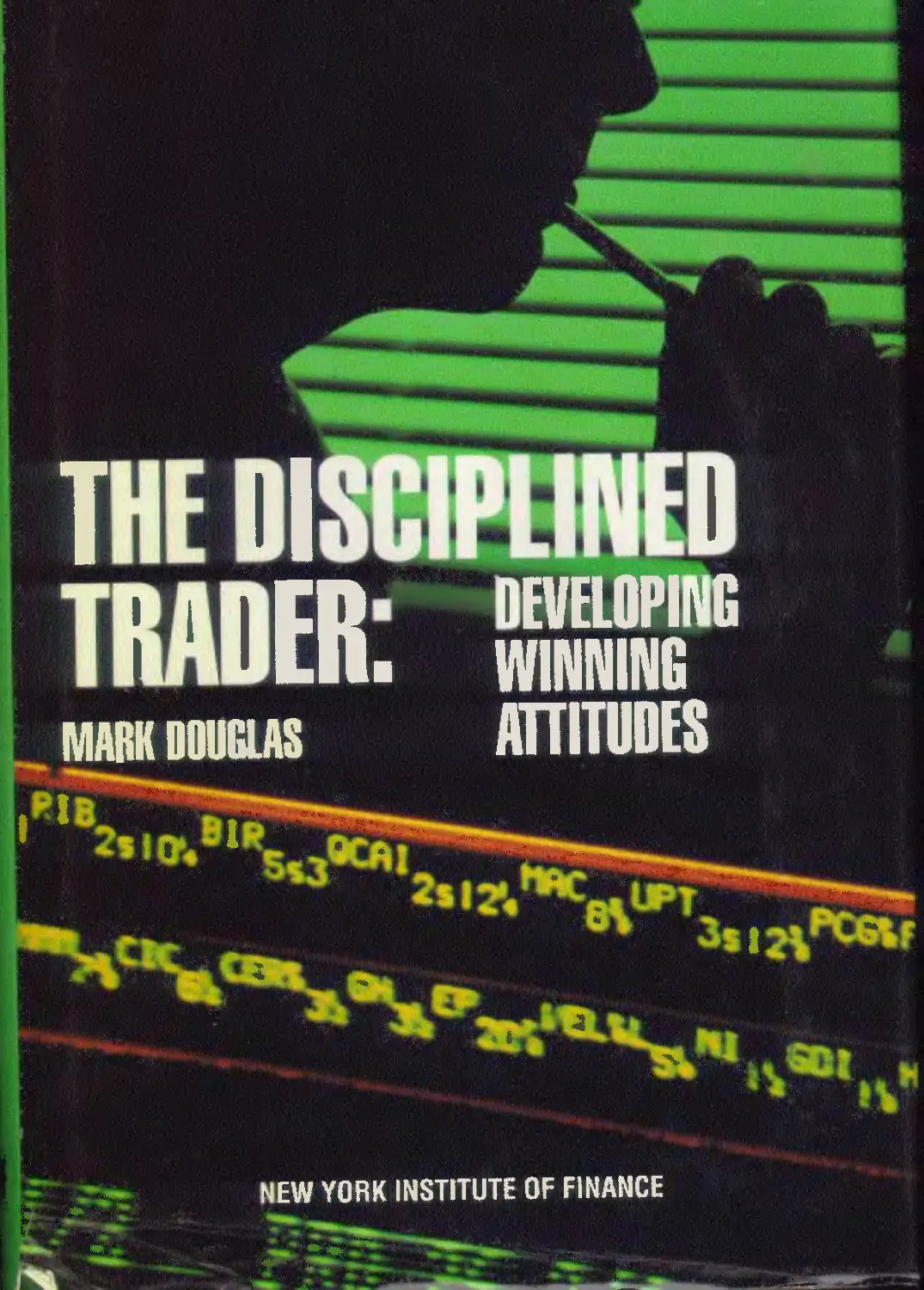
THE DISCIPLINED
TRARFR" DEVELOPING
I ПлиЕП.	WINNING
MARK DOUGLAS	ATTITUDES
W^a’S>e4
1

NEW YORK INSTITUTE OF FINANCE
The Disciplined Trader:
Developing Winning Attitudes
MARK DOUGLAS
“Emotion kills successful trading. ”
In The Disciplined Trader, Mark Douglas, an expert
on the dynamics of trading, shows why most traders
are unprepared for the different — often alien—
strategies required for success in the trading
environment.
With rare insight based on his first-hand commodity
trading experience, the author demonstrates why the
beliefs learned to function effectively in society are
often formidable psychological barriers in trading. After
examining the causes for the development of losing
attitudes, the book prepares the reader for a thorough
"mental house cleaning” of deeply rooted concepts and
traditional thought processes And then it shows the
reader how to develop and apply attitudes and
behaviors that transcend psychological obstacles and
lead to success.
The Disciplined Trader helps you join the elite few
who have learned how to control their trading behavior
(the few traders who consistently take the greatest
percentage of profits out of the market) by developing a
systematic, step-by-step approach for winning week
after week, month after month.
The Disciplined Trader is divided into four parts:
*	An overview of the psychological requirements of
the trading environment
•	A definition of the problems and challenges of
becoming a successful trader
•	Basic insights into what behavior may need to be
changed, and how to build a framework for
accomplishing this goal
•	How to develop specific trading skills based on a
clear, objective perspective on market action
(continued on back flap)
PHOTO' COMSTOCK, 1МСЛ0М GRILL
(continued from front flap)
In a comprehensive and logical manner. Mark
Douglas shows you how to examine and limit your
trading behavior—how to develop the mental discipline
possessed by the small minor ty of winners who make
money consistently (weekly, monthly, and yearly).
Some of the skills focused on in The Disciplined
Trader Muds', learning the positive dynamics of
achieving goals... recognizing skills needed to prog-
ress as a trader (and how to stay aware of them instead
of just the by-product—the money acquired). .
adapting yourself to respond to fundamental market
changes. . identifying your “risk comfort level” and
learning how to expand it... acting immediately on op-
portunities. . .letting the market tell you how much is
enough. . controlling your perspective of market
movement.. .and much more.
About the Author
Mark Douglas is president of
Trading Behavior Dynamics,
Inc.,a Chicago-based training
organization. Formerly a
successful commodities broker
himself, Douglas has drawn on
his own own experience—
including costly mistakes—as
well as observations of others to identify and develop
methods for overcoming counterproductive trading be-
haviors. Over these past several years he has conducted
numerous seminars and workshops for leading com-
modities and brokers’ organizations on the techniques
explained in The Disciplined Trader.
For more information about our other products and
information services, please call or write:
NIK
New York Institute of Finance
Publishing and Professional
Information Services
2 Broadway
New York, N.Y. 10004
212/344-2900
Simon & Schuster, tnc.
A Paramount Communications Company
Printed in the U.S.A.

The
Disciplined Trader
Developing Winning Attitudes
Mark Douglas
NEW YORK INSTITUTE OF FINANCE
Library of Congress Cataloging-in-Fublication Data
Douglas, Mark.
The disciplined trader : developing winning attitudes / by Mark
Douglas.
p. cm.
ISBN 0-13-215757-8
1. Stockbrokers—Attitudes. 2. Stock-exchange. I. Title.
HG4621.D68 1990
332.64—dc20	90-30237
CIP
This publication is designed to provide accurate and authoritative information
in regard to the subject matter covered. It is sold with the understanding that
the publisher is not engaged i'. -ndering legal, accounting, or other
professional service. If legal advice or other expert assistance is required, the
services of a competent professional person should be sought
From a Declaration of Principles Jointly Adopted by
a Committee of the American Bar Association and a
Committee of Publishers and Associations
© 1990 by Mark Douglas
All rights reserved No part of this book may
be reproduced in any form or by any means without
permission in writing from the publisher.
Printed in the United States of America
10 9 В
New York Institute of Finance
A division of Simon Sc Schuster, Inc
2 Broadway
New York. NY 10004-2207
To Paula Webb for her love, understanding and being
there throughout the process of writing this book.

Contents
Foreword	ix
Preface	xi
Acknowledgments	xvii
Part I	Introduction	1
1	Why I Wrote This Book	3
2	Why a New Thinking Methodology?	15
Part 11	The Nature of the Trading Environment
from a Psychological Perspective	31
3	The Market Is Always Right	35
4	There Is Unlimited Potential for Profit
and Loss	39
5	Prices Are in Perpetual Motion with No
Defined Beginning or Ending	41
6	The Market Is an Unstructured Environment	49
7	In the Market Environment, Reasons
Are Irrelevant	59
8	The Three Stages to Becoming a Successful
Trader	65
Part 111 Building a Framework for
Understanding Ourselves	79
9	Understanding the Nature of the Mental
Environment	85
vii
viii
10	How Memories, Associations, and Beliefs
Manage Environmental Information	99
11	Why We Need to Learn How to Adapt	121
12	The Dynamics of Goal Achievement	139
13	Managing Mental Energy	155
14	Techniques for Effecting Change	167
Part IV How to Become a
Disciplined Trader	181
15	The Psychology of Price Movement	183
16	The Steps to Success	201
17	A Final Note	223
Index
225
Foreword
My unique position in the financial community has allowed me the
rare opportunity to talk to and question thousands of traders, bro-
kers, and trading advisors since 1979.1 am not a broker or a letter
writer. I am the chief executive officer of CompuTrac, a company
that supplies technical analysis to stock and futures traders. I per
ceive my position as being neutral, one that allows people to open
up and talk to me freely. I started trading for my own account in
1960 and very quickly became aware of the underlying psychological
blocks to good trading and money management. This realization has
been confirmed by all who have counseled with me.
As a result, I sincerely feel that success in trading is 80 percent
psychological and 20 percent one’s methodology, be it fundamental
or technical. For example, you can have a mediocre knowledge of
fundamental and technical information, and if you are in psycho-
logical control, you can make money. Conversely, you may have a
great system, one that you have tested and has performed well for a
long period of time, yet if the psychological control is not there,
you will be the loser.
A good trader knows from experience that over a period of time
X
Foreword
he may engage in more losing trades than winning ones. But money
management, and a careful assay of the risks protected by realistic
stops, will keep the trader out of trouble and ensure that on the
“big" moves, he will profit. Money management is composed of two
essential elements: psychological management and risk manage-
ment- Risk management stems from the psychological factors being
truly understood by the trader and "in place” before risk is even
considered.
I would especially caution new traders and market participants
that reading and passively analyzing your motivations are certainly a
necessity, but the acid test comes with active trading under pressure.
Start slowly. Question every trade What motivated it? How was the
trade managed? Was it successful? Why? Did you lose? Why? Write
down your assessment and refer to your comments before making
your next trade.
At all major CompuTrac seminars I try to have a workshop leader
address the attendees on the psychological aspects of trading The
grim reaper who kills off “your equity” and disappears with your
profits is not the mysterious and ubiquitous “they” but a simple
misguided “you.” Medea said just before she murdered her children,
“I know what evil I’m about to do, but my irrational self is stronger
than my resolution ” If this sentiment reflects your mind set when
you trade, then The Disciplined Trader is definitely the type of book
you should be reading.
What a pleasure to read this book. My own education cost me a
lot “the hard way.” I can read myself into the pages—that’s me,
that's me! Mark has carefully fashioned his book into a comprehen-
sive logical dialogue. It reads as if you are at his side and he is
explaining it as a friend, which I know you will enjoy. You are
fortunate because you are taking the time now, before you have
made a serious mistake, I hope, to learn about yourself and to study
your craft. The traders who take the time to reflect and practice will
survive and possibly prosper.
Timothy Slater
President
CompuTrac Software, Inc.
Preface
The Disciplined Trader is a comprehensive guide to understanding
the psychology of self-discipline and personal transformation needed
to become a successful stock or futures trader. This book will serve as
a step-by-step guide to adapting successfully to the unusual psycho-
logical characteristics of the trading world.
I say “adapting” because most people venturing into the trading
environment don’t recognize it as being vastly different from the
cultural environment m which they were brought up Not recogniz-
ing these differences, they would have no way of knowing that many
of the beliefs they acquired to enable them to function effectively in
society will act as psychological barriers in the trading environment,
making their success as traders extremely difficult to achieve. Reach-
ing the level of success they desire as traders will require them to
make at least some, if not many, changes in the ways they perceive
market action.
Unlike other social environments, the trading arena has many char-
acteristics requiring a very high degree of self-control and self-trust
from the trader who intends to function successfully within it. How
ever, many of us lack this self-control because as children we learned
xi
Preface
xii
to function in a structured environment where our behavior was con-
trolled by someone more powerful than ourselves, whose purpose was
to manipulate our behavior to conform to society’s expectations.
Thus, we were forced by external forces to behave in certain ways
through a system of rewards and punishments. As a reward, we would
be given the freedom to express ourselves in some desired manner As
a punishment, we would either be prevented from getting what we
wanted, causing emotional pain, or we were inflicted with various
forms of corporal punishment, causing physical pain. As a result, the
only form of behavior control that we typically learned for ourselves
was based on the threat of pain—either emotional or physical—from
someone or something we perceived as having more power than
ourselves. And since we were forced to relinquish our personal power
to other people, we naturally developed many of our traditional re-
sources for success (the particular ways in which we learned to get
what we want) from the same mental framework. Accordingly, we
learned that acquiring power to manipulate and force changes upon
things outside of us was the only way to get what we wanted
One thing you will learn as a trader is that the mental resources
you use to get what you want in your everyday life will not work in
the trading environment. The power and control that are necessary
to manipulate the markets (make them do what you want them to
do) are beyond all but a handful of individuals. And the external
constraints that exist in society to control your behavior don’t exist
in the market environment. The markets have absolutely no power
or control over you, no expectation of your behavior, and no regard
for your welfare.
If, in fact, you can’t control or manipulate the markets and the
markets have absolutely no power or control over you, then the
responsibility for what you perceive and for your resulting behavior
resides only in you. The one thing you can control is yourself As a
trader, you have the power either to give yourself money or to give
your money to other traders. And the ways in which you choose to
do this will be determined by a number of psychological factors that
have little or nothing to do with the markets. And this will be so
until you acquire some new skills and also learn how to adapt your-
self to suit conditions as they exist in the market environment
To operate successfully in this environment you will need to learn
how to control yourself in ways that may be completely alien to you.
Preface	xiii
You will also have to learn how to grant yourself the mental freedom
to shift your perspective to notice alternative possibilities to getting
what you want in the trading arena, regardless of your expectations
of how you are going to get it. There are only a few traders who have
come to the realization that they alone are completely responsible
for the outcome of their actions. Even fewer are those who have
accepted the psychological implications of that realization and know
what to do about it.
Rarely do any of us grow up learning how to operate in an arena
that allows for complete freedom of creative expression, with no
external structure to restrict it in any way. In the trading environ-
ment, you will have to make up your own rules and then have the
discipline to abide by them. The problem is, price movement is
fluid, always in motion, quite unlike the highly structured events
that most of us are accustomed to. In the market environment, the
decisions that confront you are as endless as the price movements
you intend to take advantage of. You don't just have to decide to
participate, you also have to decide when to enter, how long to stay
in, and under what conditions to get out. There is no beginning,
middle, or end—only what you create in your own mind.
In addition to the negative psychological implications that accom-
pany these decisions, you must be aware that even if you make the
minimum financial commitment of one contract per trade (as in the
futures market), there is an unlimited potential for profit as well as
an unlimited potential for loss. From a psvchological perspective,
this means that each trade has the possibility of fulfilling your
wildest dreams of financial independence, and simultaneously pre-
sents you with the risk of losing everything you own. The con-
stantly changing price movement makes it extremely easy for you to
ignore the risk and tempt yourself into believing you don’t have to
follow your own rules, this time.
Here is an environment that offers complete freedom of expres-
sion combined with unlimited possibilities and unlimited risk. If you
place in it a participant who is oblivious to these psychological
conditions (one who operates from a mental framework oriented
toward external structure, constraints, and expectations), then what
you have is a formula for emotional and financial disaster.
This grim scenario certainly explains why so few people ever
make money as traders. Actually, almost all of those who make an
Preface
xw
attempt at trading completely underestimate the difficulty and con-
sequently overestimate their ability to fulfill their inflated expecta-
tions. Therefore, most, if not all, people who trade inflict some
degree of psychological damage upon themselves. I am defining
“psychological damage” as any mental framework that has potential
for generating fear.
Fear results from any belief about environmental conditions that
has the potential to cause either physical or emotional pain such as
stress, anxiety, confusion, disappointment, or betrayal. Painful emo-
tional conditions are basically the result of unfulfilled expectations.
Unfulfilled expectations create a conflict between a person’s beliefs
about the way things should be and the actual environmental condi-
tions that don’t match those beliefs. This conflict is expressed
through our emotions in the form of pain that we generally label as
stress, anxiety, confusion, and so on.
People seem to avoid pain instinctively by building up mental
defenses against the intrusion of environmental information that
would confirm the existence of any conflict. These defenses consist
of denials, rationalizations and justifications—all of which will result in
perceptual distortion.
“Perceptual distortion” occurs when our mental system automati-
cally distorts environmental information by shaping and selectively
excluding certain information to compensate for the conflict be-
tween what we expect and what the environment is offering us. This
will be done in such a way that we will believe a shared reality exists
between ourselves and the outside environment, thus avoiding any
pain. I am defining a “shared reality” as a correspondence between
one's beliefs about the environment and the actual environmental
conditions that exist.
If you are distorting market information, you are not sharing a
reality with the markets, and you are also indulging yourself in an
illusion, to the extent that you hide from the possibility of disap-
pointment. At this point, you would be setting yourself up for what
could be called a “forced awareness.” Obviously, if the markets are
doing something other than what you are allowing yourself to per-
ceive (because some, if not most, of the information the markets
have to offer won’t validate what you want or hope), then something
has to give. These distortions will continue until there is such a
disparity between your acquired mindset and the conflicting market
Preface
xv
information that the mental defenses (illusions) will break down.
This usually creates a state of shock, where you may wonder how
things could get so bad so quickly.
In such a situation, the market forces you to confront your illu-
sions of a shared reality, creating a painful forced awareness. At some
point in your trading career you will need to understand how all of
us, because of our common upbringing, try to control market events
through our perception of what we think will happen next and then
rigidly hold on to these expectations. This is where you need to learn
how to gain the kind of mental flexibility that allows you to shift your
perspective to be aware of other alternatives and possibilities. You
may not be able to control the markets, but you can control your
perception of them in order to achieve a higher degree of objectivity,
resulting in a higher degree of shared reality with the markets.
As painful as these forced awarenesses may be, they are not likely
to deter you from being attrai ted to the opportunities the markets
have to offer. However, the cumulative psychological effect on you
will be very negative. If you have suffered through several forced
awarenesses, your perception of market activity will eventually be-
come heavily weighted towards avoiding pain instead of seeking
opportunity. Your fear of losing money, being wrong, or missing an
opportunity will become your primary motivation to act or not act.
Now, there are several major problems that result when fear be-
comes a motivation to do or not do something. First, it will limit your
ange of perceived opportunities by narrowing your focus of atten-
tion, keeping it on the object of your fear. This means that out of all
available market information, you will only perceive information that
will, in effect, validate what you fear the most. Your fear will systemat-
ically exclude from your awareness market information that would
indicate the existence of other alternatives and opportunities.
As you begin to understand the negative relationship between fear
and perception, you might be surprised to learn that in your attempts
to avoid losses, you actually create them. Fear will also limit your
range of responses to any given situation. Many traders suffer consid-
erably when they know exactly what they want to do but, when the
moment to execute arrives, find themselves completely immobilized.
Before anyone can be ome successful in an environment with
the unstructured character of the trading environment, one needs
to develop a supreme sense of self confidence and self-trust. I am
Preface
xvi
defining self-confidence as an absence of fear and self-trust; know-
ing what to do at the moment it needs to be done, and then doing it
without hesitation. Any hesitation will only create self-doubt and
fear. To whatever degree self-doubt exists as a state of mind, to that
same degree you will feel fear, anxiety, and confusion
The negative experiences that result from trading in a state of fear,
anxiety, and confusion, will create or add to an already existing belief
of inadequacy and powerlessness. Regardless of how hard any of us
may try to hide from others what is going on, we obviously can’t
hide our results from ourselves If the market’s behavior seems mys-
terious to you, it’s because your own behavior is mysterious and
unmanageable. You can’t really determine what the market is likely
to do next when you don’t even know what you will do next,
regardless of what you may perceive or want.
The few successful traders who have, in some way, transcended
these psychological obstacles have been generous with their one-line
gems of trading wisdom: “Learn to take a loss,” “Go with the flow,”
“The trend is your friend,” “Cut your losses and let your profits
run,” “To know the markets you need to know yourself," and on
and on. The Disciplined Trader fully explores, breaks down, and
then organizes the psychological components of this advice into a
step-by-step learning process, a process that takes you through the
various stages necessary to orient yourself successfully to the trading
environment. This book will explain to you what skills are neces-
sary, why you need to understand them, and most important, how
to go about learning them.
This book is organized in four sections. The first consists of the
first two chapters and serves as an introduction. The second consists
of Chapters 3 through 8 and defines the problems or challenges of
becoming a successful trader. The third section consists of six chap-
ters that will give you the basic insight you will need to identify what
has to be changed in your mental environment and what you can do
to change it. The fourth section consists of Chapters 15 and 16
which put everything together into a unified framework to develop
specific trading skills. You will learn how to observe market action
from an objective perspective, determine where you need to limit
yourself, and establish the steps you will need to take to expand
those limitations in a productive and psychologically healthy way.
Acknowledgments
Most people are probably well aware that writing a book is a very
difficult task, one that often requires the help and support of a
number of people in the author’s life. There are a number of people
I want to acknowledge as being instrumental in helping me make
this book a reality including my parents, John and Helen Yosin; my
brothers and sister—Craig, Dean, and Sandy Yosin—for all their
love and support; Brad Johnson, my partner in Trading Behavior
Dynamics for all of his patience and kindness; Jim Sutton, Bonnie
Marlowe, Jake Bernstein, Elizabeth McKinsey, Michael Headley,
Steve Sukenik, and Jack Carl for helping me get started; all of the
traders that I have worked w th over the last six years, especially Jim
Griswold, Jerry Stahlnecker, Jack Brassuel, Steve Bianucci, Mike Gam'
ble, and Chuck Pettet for their friendship and support; Tim Slater for
giving me the opportunity to express myself as a speaker and a writer;
Rich Miller for his support and being a good friend; Lori and Nikki
Marlowe for the happiness they brought into my life; and most of all, my
friend and fellow author Kurt Leland for everything he has taught me and
for showing me the way.
xvii
PART I
Introduction

CHAPTER 1
Why I Wrote This Book
Since I started working on this book—in the summer of 1982—
nearly every dimension of futures trading has exploded in growth.
There are brand new exchanges, new contracts, more advisory and
news services, an increasing variety of books and publications, and
ever more sophisticated technical trading systems, most all of them
with computer applications to make it easy to track the markets.
However, even with this tremendous growth in services related to
trading, one inescapable fact remains: there is still a very small group
of sophisticated traders who take the greatest percentage of profits
out of the markets, making well over 90 percent of all the other
traders net losers year-in and year-out.
In futures trading for every dollar of profit gained by one trader,
there has to be an equivalent dollar lost by another trader. If a few
traders are consistently making money on a grand scale, then their
profits have to be coming directly out of the pockets of the thou
sands of other traders who very faithfully contribute to their daily
winnings. Some of these very successful traders are public figures,
but most are only known in the Chicago or New York areas. Need-
less to say, everyone wants to know what they do and how they do it.
3
4
Introduction
There must be a difference between these two groups of traders—
the small minority of winners and the vast majority of losers who
want to know what the winners know. The difference is that the
traders who can make money consistently on a weekly, monthly, and
yearly basis approach trading from the perspective of a mental disci-
pline. When asked for their secrets of success, they categorically state
that they didn’t achieve any measure of consistency in accumulating
wealth from trading until they learned self-discipline, emotional con-
trol, and the ability to change their minds to flow with the markets.
First, 1 want to point out that self-discipline, emotional control,
and learning to change one’s mind after making a commitment are
all psychological issues that have nothing to do with news services,
advisory services, new exchanges, or technical or fundamental trad-
ing systems—computerized or not.
Second, from my trading experiences, observations, and research,
I have discovered that all traders—both winners and losers—seem
to share some very common experiences. Either in the beginning or
at some point early in their trading career, all traders experience
confusion, frustration, anxiety, and the pain of failure. The few
traders who pass through this phase to accumulate wealth are those
who eventually confront and work through some very difficult psy-
chological issues about what it means to be a trader, and this process
of realization and change normally takes several years, even for the
best of them.
If self-discipline and emotional control are the keys to success,
they are also not necessarily traits any of us are born with. On the
contrary, they are characteristics we acquire by learning certain men-
tal skills. Acquiring these mental skills is often the result of a trial-
and-error learning process that can be very costly financially and
usually filled with emotional pain and suffering. The biggest prob-
lem with a trial and error approach in trading is that most people
lose all their money before they get through the process. And other
traders who have enough money to keep on trading never fully
recover from the effects of the psychological trauma they have in-
flicted on themselves to ever learn how to trade successfully on a
consistent basis. This leaves only a relatively small number of people
who make it
All the great traders, both past and present, have found it very
difficult to explain what it is they do, how they do it, and more
Why I Wrote This Book
5
important, the progression of steps they took to get where they got.
Many would gladly share with others what they know about the
market and its behavior but not necessarily about their behavior as
individuals. They would, however, often caution those who sought
their wisdom to understand that all the market knowledge in the
world won’t do them any good until they learned what can be called
self-discipline and emotional control, without necessarily being able
to explain what they were.
For instance, “Cut your losses short” is great advice that is often
given as an axiom of trading wisdom. But how do you explain to
someone the steps needed to learn how to do that? Especially when
he is interacting with an environment that is in perpetual motion
and will always offer him the possibility that the market can come
back and make him whole, if he is in a losing trade. If you take into
consideration that his money and self-esteem are at stake and the
market coming back is always a viable possibility, regardless of how
remote it may be, then you can see how’ difficult it is to explain why
he needs to “cut his losses.” It is even more difficult to explain how
he can do it in a way that suits his unique psychological makeup.
The easiest way to explain how to apply this type of wisdom,
without actually explaining it at all, is to say, “Well, if you want to be
a successful trader, you need to learn self-discipline and emotional
control.” I don’t believe this type of vague advice was intentional,
however, for principally two reasons. First, self-discipline and emo-
tional control are abstract concepts that are not easily explained or
understood. We all hear or read the words a lot, but ask anyone you
know to define either of these concepts, and you’ll probably get a
blank stare.
Second, today’s successful traders started out their journey with-
out maps, signposts, or guidelines or the benefit of knowing exactly
where they had to end up, from a psychological perspective, to
accumulate their fortune. They had to explore the trading world
through a means of self-reflection and readjustment that was very
demanding and time consuming. One could say they more or less
stumbled through it learning from each mistake, many small and
others that were devastating both financially and emotionally.
At some point, they probably realized that something about them-
selves had changed because the normal kind of market activity that
once had a very negative emotional impact on them, like anger,
6
Introduction
stress, anxiety, and fear, just didn’t have that same effect any longer.
They must have gained some measure of confidence in themselves
to respond appropriately to all possible market conditions because
there is a direct correlation between a person’s level of confidence
and the negative emotions mentioned. Confidence and fear are
states of mind that are similar in nature, only separated by degree As
a person’s level of confidence increases, his or her degree of confu-
sion, anxiety, and fear dissipates proportionately.
This confidence would naturally develop as people learned to
trust themselves to do whatever needed to be done, without hesita
tion. As a result of this kind of self-trust, they would no longer need
to fear the seemingly unpredictable and erratic behavior of the mar-
kets. However, the main point 1 am making here is that the process
of change that took place was in the mental environment and psy-
chological makeup of each individual trader; the markets didn’t
change, the tools that were used didn’t change, the trader did.
Now, when traders go through a transition in their personal de-
velopment and learn a new skill on a trial-and-error basis, it is
unlikely that they would keep a detailed record of the steps to that
learning process, especially if that process was characterized by pain,
anxiety, and frustration Obviously, if someone doesn’t know exactly
how they acquired the skills they now have, then, naturally, it would
be extremely difficult for them to explain to someone else how they
got them.
Besides, when it comes to trading, once someone is making the
kind of money he had always dreamed of, there isn’t much incentive
to spend the time and energy necessary to break down these abstract
skills into an effective learning process from which others can derive
some benefit. Developing educational programs to explain how to
become a successful trader requires a completely different set of
skills from the skills necessary to be a trader. As will be explained in
a moment, the learning process and the kind of personal transforma-
tion that was necessary to enable me to write this book was dis
tinctly different from the kind of learning process I experienced as a
trader to realize why a book like this needed to be written. One
learning process was chosen and the other was forced
What I mean by forced is, I had to lose my house, my car, and
practically everything else I owned to learn some of the ways in
which I needed to change my perspective to operate in the trading
Why I Wrote This Book
7
environment effectively. Losing all my possessions was a complete
life-altering experience, an experience that taught me a lot about the
nature of fear and the debilitating effects it has on a person’s ability
to trade effectively.
The kind of insight I gained as a result of this experience is the
type of learning process I call a forced awareness This is where the
nature and characteristics of the environment I was operating in
were much different from what I believed they were, first out of
ignorance, and because I put up mental defenses to block my per-
ception of certain information. Eventually I was forced by the mar-
kets to acknowledge many things about myself that I otherwise
wouldn’t consider. When all the external symbols that represented a
major part of my identity were gone, I didn’t have any other choice
and was forced to perceive myself in new and different ways.
These events occurred in March 1982. At the time, I was an
account executive with Merrill Lynch Commodities at its Chicago
Board of Trade office. Less than a year before, in June 1981,1 moved
from the suburbs of Detroit where I was enjoying, at least financially,
a very successful career in commercial property and casualty in-
surance. I left Michigan and success to move to Chicago and be a
trader. I went to work for Merrill Lynch because I didn’t have
enough money to buy a seat at the Board of Trade or the Chicago
Mercantile Exchange and didn’t know that you could lease seats at
that time.
I had an expensive apartment on the gold coast of Chicago and a
Porsche; I was maintaining a house in an affluent suburb of Detroit
that my girlfriend and her two daughters were living in; and I was
driving or flying back and forth between the two cities almost every
weekend to visit them. I was under extreme financial pressure to
succeed because my life-style expenditures were far and away in
excess of what I could afford. Unless I made it big as a trader, it
would be very hard to reconcile some of the decisions 1 made to put
myself in that kind of a situation.
By the time I moved to Chicago I had already been trading for
over two years. Twice, before moving, I lost all my trading capital Of
course, I would quickly save up and start again. My brief periods of
success and few winning trades were enough to justify that I con-
tinue trying. Once I was very close to making over a quarter of a
million dollars on a trade, but I pulled out of it just before the big
8
Introduction
move. This devastated me, but I also became completely hooked on
trading and even more determined to be successful. From that expe-
rience I decided to buy all the books 1 could get and attend all the
seminars I could afford.
Something stated in virtually all the books I read was that it is
very difficult to learn how to trade or sustain any success if one is
under a great deal of financial pressure— meaning don’t expect to
become a successful trader if you have limited trading capital or if
you are trading with money you can’t afford to lose. I was obviously
violating both these rules because I had very little trading capital
relative to my life-style that I absolutely could not afford to lose.
Also I had a lot of other evidence that the odds were not exactly in
my favor.
I came to Chicago because I believed that if I could get close to the
action and meet people who knew how to trade, I could then learn
from them. I was in for a very rude awakening. I was at Merrill
Lynch Commodities, its second largest commodity office, with 38
account executives. At first I was shocked to find out only one of
the account executives had any experience trading his own money.
Then I was further shocked to learn that none of these account
executives had any customers who were making any money. In fact,
the typical customer lost his original stake within an average of four
months.
My next major disappointment came when I began to meet and
make friends with as many floor traders as possible, believing that if
the guys up in the offices don’t know how to make money, the floor
traders certainly must. Again, 1 found the same conditions that
existed up in the offices. Other than a handful of floor traders who
had a reputation and a mystique that everyone seemed to be in awe
of, I couldn't find one person who was making money consistently,
who wasn't confused or knew what he wanted to do and then did it,
without first having to ask everyone around him for confirmation
that he was doing the right thing. 1 am not implying that I didn’t
meet traders who at some point in the day hadn’t made money. They
just couldn’t keep it. I knew many traders who could make $2,000
or $3,000 the first couple of hours of trading. But they would always
lose it back, plus more, a short time afterward.
Everybody seemed to be suffering from the same kinds of prob-
lems and mistakes that nobody really recognized as problems. Obvi-
ously, the nature of the markets made it easy not to have to confront
Why 1 Wrote This Book
9
anything that otherwise might be perceived as a problem because the
next trade always had the possibility of making everything else in
one s life seem irrelevant. Why deal with anything if the next trade
can make you rich? All the traders I knew, including myself, were
affe ted by this type of “big-trade" mentality. In fact, my big trade
mentality was so pervasive that I would refuse to take profits of $500
or $750 in many trades even when I knew that’s all there was to be
made. This may sound absurd, but I wouldn’t take profits of such
small amounts, because at that time, it felt as if the market was
insulting me by offering such paltry sums compared to what I
needed or expected.
As my financial problems grew, so did my desperation. And I
certainly wasn’t comforted by anything I saw going on around me.
But I still held on to the belief that I could trade out of these
difficulties. That is until March 1982; by then it was all over. A mere
eight months after moving to Chicago to pursue my dreams of
financial independence, I had nothing left except my job, apartment,
lothes, a television, and a bed.
Practically overnight, almost all the symbols that validated my
identity were gone. What I mean is, a big part of my self-concept was
made up of my possessions like my house, my car, and especially my
credit. Maintaining flawless credit was something I had always been
proud of. Now I found myself without any of these things. As I’ve
already pointed out, it's not as if there hadn’t been plenty of evi-
dence to suggest the possibility of this happening, because there had
been. But there was a part of me that wouldn’t allow a direct con-
frontation with this evidence or the implications. It was just too easy
to make excuses for all the things going on around me that didn't
add up.
Refusing to confront or consider the implications of all the con-
flicting information created a great deal of stress. And to compound
the situation, I had this intense fear that I would lose everything.
But again I did everything possible to hide this fear and put it
somewhere in my mind where I couldn’t feel it. Yet, there must have
been a part of me that sensed my impending fall. Why else would I
have been so consumed with fear? But how could I face any of this
when I had no way of reconciling the imbalance that losing all of
these things would create? What I mean is the imbalance between
what I believed about myself and the things that validated these
beliefs. Who would I be after all these things were gone?
10
Introduction
Well it didn’t take me very long to find out. As my financial
condition deteriorated to critical levels, my mental defenses also
began to break down. I eventually accepted the inevitability of doing
what I believed was the ultimate act of failure and filed for
bankruptcy.
There were a lot of things that changed inside of me as a result of
this experience. And like any one else forced to deal with major
changes in his or her life, I learned a lot about myself. The first thing
that happened, which was quite surprising, was that the stress dissi-
pated. Actually I was overcome with a great sense of relief with
nothing to anticipate, dread, or try so desperately to defend against. 1
was living through my worst fear and found there really wasn’t
anything about the situation that I couldn’t deal with. It wasn’t
nearly as bad in reality as I imagined it would be. I was still alive and
healthy, I was able to think and function, and I started to appreciate
my ability to think as my greatest asset.
This sense of appreciation began to grow into a deeper level of
understanding about the basic nature of my identity. For the most
part, I grew up believing that who I was consisted of the things that
I owned. The more possessions I owned, the more of a person it
made me. What I began to realize is that 1 was more than the things
I had accumulated. When the facade was stripped away, it allowed
me to sense this deeper dimension that, up to this point, I had only
the slightest inkling of. These new awarenesses, in turn, helped me
understand how being wrong and losing something didn’t in any
way diminish me as a person. I was beginning to learn that there was
a certain freedom in granting myself permission to be wrong and
maybe there was no such thing as a failure, unless something posi-
tive and useful isn’t learned from the experience.
However, I didn’t relate these personal experiences because I
thought they were particularly unusual, except for one. Everyone
knows there are many traders who lose everything they own, and
even though some of them will come to the same kind of aware-
nesses about themselves, they wouldn’t necessarily be able to do it
as a trader, considering the financial requirements. I, too, was not in
a financial position to keep on trading, except that I still had my job
at Merrill Lynch. In fact, for me it was business as usual, as if
nothing at all had happ ned I certainly wasn’t about to announce
to my customers or anyone in the office that I had just filed for
Why I Wrote This Book
II
bankruptcy. My job as an account executive was one of the few
things I had left, and as far as I was concerned, it depended on me
being a good trader.
This is the one key difference for me that ultimately lead to the
creation of this book. I was fortunate enough to be able to keep on
trading (although not with my own money) while these major psy-
chological changes were taking place, putting me in a unique posi-
tion to examine and study the various ways in which the condition
of my inner psychological environment affected what I experienced
in the outer physical environment.
This relationship between inner and outer isn’t always that appar-
ent but in this situation it was inescapable. I learned that the markets
offer the trader an opportunity to profit from price movement, and
these opportunities are basically in perpetual motion. It is an envi-
ronment where the individual has the freedom to create his own
results, unimpeded by many of the constraints that exist in everyday
social life. These never ending opportunities make the market a
perfect mirror of the trader’s attitude. What the trader sees in that
movement and what he can do about it the markets have no control
over. All the choices and all the power to turn these choices into
experience reside in the mind of each trader.
For example, if I perceived the market as a threat, afraid of what it
might take away from me, it wasn’t because the outside conditions
were actually threatening me in some way. It became very apparent
to me that my fear was a result of my inability to anticipate events or
act in a way that most appropriately served my best interests. It was
only the lack of trust I had in myself to do what needed to be done
that I was really afraid of.
Furthermore, I discovered that my mental framework was struc-
tured to avoid losses at all costs and in my desperate attempts to do
so, I actually created them You can think of it this way: none of us
has the mental capacity to be aware of everything going on in the
environment at once. The environmental information we focus our
attention on, out of all that exists, will be the information that has
the most importance to us. As we allocate more and more of our
attention to certain kinds of information, because of its importance,
we are at the same time systematically excluding other types of
information from our awareness. I created my losses instead of
avoiding them simply because I was trying to avoid them.
12
Introduction
Instead of being positively focused on market information that
would indicate the potential for opportunity, I was more concerned
with information that validated what I feared the most. As a result, a
great deal of market information pertaining to other possibilities and
opportunities that existed in any given moment completely escaped
my attention, passing me by. The only way I could have perceived
these opportunities (other than after the fact) would have been to let
go of whatever was causing me to divert my attention away from
what was happening in the market “now.”
I had no way of knowing what I was missing out on until my
beliefs about the significance of losses and being wrong started
changing Once this shift in perspective occurred, I started to notice
behavior characteristics of the market and relationships between
those characteristics that I was otherwise totally oblivious to.
At some point, I realized that because I had already lost every-
thing, I really didn’t have anything to fear, and, as a result, I inadver-
tently learned one of the most important lessons to becoming a
successful trader: how to “accept” a loss without any negative conse-
quences. No guilt, anger, shame, or self-punishment.
As my fear of losing dissipated, I was seeing and experiencing a
different market because I was different. It was as if someone had
removed blinders, which I didn’t know existed, from my eyes. Up
till then, my trading had always been affected by my fears I didn’t
have the slightest notion of what it would be like to trade without
fear or that doing it was even a possibility and least of all, that it was,
in fact, necessary to be successful.
What also became very apparent to me was the extent to which
all of my fears had effectively blocked me from understanding wrhy
it was so absolutely necessary to have some clearly defined trading
and money management rules that must be followed. It was all
starting to make sense. The more I followed my rules the more I
trusted myself The more 1 trusted myself the more I could focus
my attention on subtle relationships in the market’s behavior to
learn new things about the market helping me become a better
trader. Eventually I could gauge the positive effects these new atti-
tudes had on my ability to shift my perspective and flow with the
markets. The less I cared about whether or not I was wrong, the
clearer things became, making it much easier to move in and out of
Why I Wrote This Book
13
positions, cutting my losses short to make myself mentally available
to take the next opportunity.
By June 1982 I was starting to make consistent money for my
customers who relied on me for their trades. Not a lot of money by
most trader’s standards, but steady. I was having winning days that
were turning into winning weeks and months. Then sometime in
August 1982 I thought of writing a book or at the very least develop-
ing a seminar to explain to other traders what I had discovered for
myself.
In the area of education there was a definite void in the market.
There really wasn’t any material that addressed trading psychology
at a deep enough level of insight to effectively help someone under-
stand why success was so elusive. I wrote this book to address what I
believe is a critical need for people who want to trade the futures of
stock markets to have an organized, systematic, step-by-step ap-
proach to learn the mental skills necessary to accumulate wealth as a
trader The secret to this approach is learning a new thinking
methodology.

CHAPTER 2
Why a New Thinking
Methodology?
It is my intention in this chapter to demonstrate clearly how a
typical social upbringing that instills in the individual certain values
and beliefs that make up a thought methodology used for being
successful is not practical or functional and is inconsistent with the
methods necessary to be successful in the trading environment.
Someone attempting to operate in the trading environment in all
the familiar ways that would assure getting what they want will likely
find themselves in a constant state of frustration, anxiety, and fear,
wondering what is wrong or thinking something must be wrong
with them.
The irony is, of course, that, on the surface, trading looks so
simple, when in fact most people will find it to be the most difficult
endeavor they ever undertake Success will always seem so close,
and yet always so elusive. And this frustration will continue until the
trader adapts to the conditions that exist in the trading environment
by learning a new thinking methodology, one that works most effec-
tively in that environment and not what he thinks will work based
on his cultural and social upbringing.
15
16
Introduction
Perhaps many of you reading this book have heard about a seminar
being offered where you can learn how to walk barefoot over a 20-foot
bed of red-hot coals. The people who developed the method to make
it possible did so on the assumption that the achievements of people
who do things very well and excel beyond what other members of the
same culture of society would consider possible do so as the result of a
specific way they think—a methodology in which their beliefs are in
some way different from everyone else’s. This methodology can be
broken down into a system that can be learned and subsequently
taught to others. The only difference between those who excel and
those of mediocre achievement is that one group has learned a think-
ing methodology that has not occurred to the other.
With this hypothesis, it is my understanding that the people who
developed the program went to the South Pacific and sought out
those who demonstrated an ability to walk over hot coals with their
bare feet—without any physical damage whatsoever. Upon finding a
few of these South Pacific “fire-walkers,” the program developers
proceeded to analyze their beliefs and attitudes so as to arrive at a
thinking methodology they could teach in the United States.
I’m sure I don’t have to point out the physical and emotional
implications of attempting to walk over a red-hot bed of coals with
your bare feet. The fear generated over just the thought of doing it
would normally be overwhelming. The potential physical damage to
your feet—with the possibility of being crippled for the rest of your
life—is quite real And yet, as presented by several news organtza
tions, both television and print, people from all walks of life in-
volved in the seminar accomplished what we would universally
agree to be a tremendous feat. They overcame their fear and walked
20 feet over a bed of hot coals.
Now; I’m not going to have you fire-walking the futures pit, but
habits of thought die hard. And to make way for the new thinking
methodology I offer as a means of excelling as a trader, you will have
to question some of your beliefs and probe deeply rooted concepts
of what is possible. Sometimes only a thorough mental "house
cleaning” can help you throw away failure to make room for suc-
cess. And exposing yourself to information that may cause you to
ask yourself "what if it were true” is the first step to any mental
cleansing process.
For many reasons, which will be explored in greater depth in Part
II, it rarely, if ever, occurs to the beginning trader that the markets
Why a New Thinking Methodology?
11
confront him with an environment that is categorically different
from anything he is accustomed to or trained to deal with effectively
by society. For example, the markets can be looked at as a never-
ending event, always changing, virtually without structure, in per-
petual motion, with an unlimited potential for profit as well as loss
in every trade.
The psychological impact on the individual interacting with such
an environment is formidable—especially when you consider the
many ways in which all of us typically go about structuring our lives
with highly defined boundaries, limits, and rules, so things stay
basically the same. For most people, a static environment is a funda-
mental component of their sense of security and well-being
Not only can the markets destroy a person’s sense of security by
forcing the trader to confront, on a moment-to-moment basis, his
lack of acceptance of change, but they also produce an emotional
environment of considerable competitiveness and stress. There’s the
compulsive need to win millions, with the simultaneous fear of
financial devastation. The markets tease a trader with the very real
possibility of fulfilling his grandest dreams of financial independ-
ence and at the same time stand ready and willing to take away
everything he owns—and more.
Furthermore, the principles of time, effort, and reward associated
with most job situations simply do not apply with the markets. For
example, many jobs offer an unchanging reward, regardless of effort,
because of hourly wages or yearly salaries. For a trader, effort can be
irrelevant, and there is virtually no relationship between time and
reward. A trader can be stunned with a windfall profit in a matter of
seconds for making one simple decision and the only energy ex-
pended was mental.
Initially, you may think what could be wrong with making a lot of
money in minutes or seconds A lot! Whether you’re aware of it or
not, most if not all of us grow up with highly structured belief
systems about the conditions under which we deserve to receive
money. In fact, many people because of their childhood condition-
ing and religious training believe they don’t deserve any money they
didn’t work for.
Certainly, making a lot of money in a very short period of time with
no effort expended does not fall within the definition most people
have about working for their money. So how does someone reconcile
windfall profits against these structured work beliefs, especially when
18
Introduction
they’re probably not even aware of them or would not take them into
consideration if they were? This kind of mental conflict usually gets
reconciled by the trader finding some clever, ingenious, or mundane
way of giving his money back to the markets.
Not adjusting to the differences between the cultural and trading
environments or just being unaware that differences exist can cer-
tainly account for many of the trading errors committed by the
majority of traders. Yet, a thinking methodology can not only rede-
fine the market’s behavior in understandable terms to avert such
mistakes, it can also manage most, if not all, typical undisciplined,
emotional reactions to that behavior.
CULTURALLY LEARNED BEHAVIOR
THAT RESULTS IN AN UNSUCCESSFUL
TRADING EXPERIENCE
In an emotionally charged situation that requires split-second deci-
sion making (which could lead to failure of some kind), there’s little
time to compare the present event with previous market experi-
ences. You probably wouldn’t even notice if you had behaved simi-
larly in the past and suffered the same disastrous consequences.
Because the present situation is so immediate, you may have no
concept of how typical and even thoughtless your behavior may be.
In fact, it may be news to you that there are only a limited number
of such typical reactions leading to failure. Being able to recognize
them can prevent you from repeating past mistakes without losing
any of that time so necessary for split-second decisions.
The following typical trading errors have a specific cause rooted
in a thinking methodology that can be changed.
1.	Refusing to define a loss.
2.	Not liquidating a losing trade, even after you have acknowl-
edged the trade’s potential is greatly diminished.
3.	Getting locked into a specific opinion or belief about market
direction. From a psychological perspective this is equivalent
to trying to control the market with your expectation of
what it will do: “I’m right, the market is wrong."
Why a New Thinking Methodology?
19
4.	Focusing on price and the monetary value of a trade, instead
of the potential for the market to move based on its behavior
and structure.
5.	Revenge-trading as if you were trying get back at the market
for what it took away from you.
6.	Not reversing your position even when you clearly sense a
change in market direction.
7	Not following the rules of the trading system
8.	Planning for a move or feeling one building, but then find-
ing yourself immobilized to hit the bid or offer, and there-
fore denying yourself the opportunity to profit.
9.	Not acting on your instincts or intuition.
10.	Establishing a consistent pattern of trading success over a
period of time, and then giving your winnings back to the
market in one or two trades and starting the cycle over again.
SKILLS TO BE ACQUIRED
To excel in any activity—whether it is mental, such as trading, or
physical, such as swimming—we need to learn specialized skills.
These skills give us the necessary requirements to look at, think
about, and behave toward events in a manner different from what
we may be used to or what we may have been taught.
However, beyond the sheer mechanics of the activity—which just
about anyone can master—lies a particular thinking methodology or
strategy that leads to excellence. Although few people have it, such a
thinking methodology can nevertheless be learned
Any thinking methodology requires a series of approaches to
goals and problems. These approaches might be better described as
mental techniques, even skills of thought application. For example,
one such skill might be the ability to identify those conditions that
are conducive to making a common trading error before it actually
happens. Other techniques or skills include:
1	Learning the dynamics of goal achievement so you can stay
positively focused on what you want—not what you fear.
20
Introduction
2.	Learning how to recognize the skills you need to progress as a
trader and then stay focused on the development of those
skills, instead of the money, which is merely a by-product of
your skills.
3.	Learning how to adapt yourself to respond to fundamental
changes in market conditions more readily.
4.	Identifying the amount of risk you are comfortable w'ith—
your “risk comfort level”—and then learn how to expand it
in a way that is consistent with your ability to maintain an
objective perspective of market activity.
5.	Learning howT to execute your trades immediately upon your
perception of an opportunity.
6.	Learning how to let the market tell you how much is enough,
instead of assessing the potential from your personal value
system of how much is enough.
7.	Learning how to structure your beliefs to control your per-
ception of market movement.
8.	Learning how to achieve and maintain a state of objectivity.
9.	Learning how to recognize "true" intuitive information and
then learning how to act on it consistently.
HOW IS THIS DIFFERENT FROM
A TRADING SYSTEM?
Trading systems give us a way to define, quantify, and categorize
market behavior. Since the markets offer traders a seemingly infinite
combination of behaviors, all with their corresponding opportuni-
ties and risks, it is easy to understand how our minds can become
overwhelmed. Trading systems limit the scope of market behavior,
and therefore make this activity a little easier for our minds to
manage. They also give us direction and suggestions about what to
do in a given market situation. Without them traders could easily
feel as if they are floating aimlessly in an endless sea of possibilities
and opportunities with no land in sight.
Since trading systems define opportunity and offer suggestions,
following these suggestions can lead to the development of skills,
Why a New Thinking Methodology?
21
even though as suggestions they merely point the way for your
awareness to be directed. A true skill not only points the way, but
almost automatically begins to direct awareness as well. And a think-
ing methodology controls the selection of which skills should be
used and when.
I do not offer a trading system in this book. It’s more a means of
interfacing a trading system with the mind’s psychological structure.
If a trading system provides awareness of market signals, and sug-
gests behaviors appropriate for any given market situation, then the
thinking methodology I will share with you teaches skills and pro-
cesses of skill application.
Having the skills necessary to consciously manipulate one’s psy-
chological environment is essential for the trader who recognizes
how ineffectual a trading system can suddenly become whenever a
tense situation demands a split-second decision.
Most everyone reading a book of this nature would consider
himself as successful to one degree or another, either through trial
and error, or the rigorous application of some proven formula,
through w'hich each has learned—intentionally or not—skills or
methodologies of thought to achieve this success.
In any case, we all have a natural tendency not only to want to
achieve success in something, but also to apply the principles of
success that work very well in one situation to practically everything
else. It often doesn't occur to us that some environments may re-
quire very different psychological resources to achieve success.
Suppose, for example, that you arbitrarily tried to apply a certain
thought system of success to trading futures or stocks without first
investigating the usefulness or validity of that system in relationship
to the actual conditions as they exist in the markets. More than
likely, you would be doomed to failure before you even started.
Obviously people don’t consciously start trading with the belief
that they don’t have the right resources or that they're going to fail.
In fact, it is just the opposite. Because most traders come from or still
enjoy very successful careers outside of trading, they have a great
deal of confidence in their ability to extend this success in the
trading environment. This unfounded confidence, coupled with the
way the markets distort a person’s concept of rew’ard in relationship
to time and effort expended, will cause the trader to form some very
unrealistic expectations about the kind of results he should achieve.
22
Introduction
Believing that trading is easy is the reason for the unrealistic expecta-
tions. And they are probably the single biggest reason why most
traders never make it beyond the initial levels of development before
they lose all their money.
Starting out believing that trading is easy is a psychological trap
that entices almost all traders. But it isn’t too difficult to understand
why, when you examine the dynamics of the process of how we set
up a standard of performance for ourselves by which to gauge our
progress. There are four basic components that make up a person’s
standard of performance or expectations for results
First is our basic concept of time; most people believe that it is
limited, passing nonstop and will eventually run out. Second is our
concept of effort—our supply of personal energy is not inexhaustible;
it runs out, we tire, and we may even become ill if we don’t rest
properly. The third is our concept of expertise—the number of skills
we have learned and our degree of proficiency in using these skills; it
usually takes a great deal of time and energy to acquire expertise.
Now one of the primary ways we learn to value ourselves is based
on our belief about how much work we do and the amount of time
it takes to do it. Which brings us to the fourth component in the
equation; reward. To determine the amount of reward we should
receive, we will make an assessment about how hard or easy a job is
by determining how much effort (personal energy) we will need to
expend and to assess how long the job will take (using up our limited
time), so we can then determine how much we should be compen-
sated. It is like our own personal supply and demand formula for our
time and energy
Now I am going to put all this together to demonstrate how
trading distorts all these components in a way that allows someone
to believe that trading is easy. First, to function in the market envi-
ronment requires very little if any physical effort, especially for the
off-the-floor trader. Second, time is not a relevant factor because a
trader can be stunned with thousands of dollars in profits in a
matter of moments. Conceivably, you could put on a trade, never
have the market go against your position, and be rewarded at levels
far beyond your expectations of what is possible. A person can’t help
but make the association between the speed at which something like
this could happen and how easy it must be because there was no
physical effort required
Why a New Thinking Methodology?	23
Most people don’t have to experience this personally to make the
erroneous assumption that trading is easy. They will just naturally do
it the first time they experience market action. They will assume that
they would have been a buyer at some low point and held on to
liquidate the trade for a profit. Even if it’s just for a couple of ticks,
invariably they will multiply those ticks by several contracts to come
up with these mental windfall profits for themselves. These profits
could represent an exotic trip, a dream car, or thoughts of financial
independence. Then they will compare how long and how hard they
normally have to work to get the same amount of money, and what
will result is a completely erroneous conclusion that trading is easy.
The problem is that it is almost impossible for the beginning
trader to make a reasonable assessment of the level of expertise that
is required to function in the trading environment, like learning to
limit oneself in an unlimited environment, when possibly for the
first time in the trader’s life he has the freedom to express himself
creatively without any social constraints, or the amount of the time
it takes to acquire this expertise, especially when it looks as if the
profits should just roll in so easily and so fast. These kinds of aS'
sumptions will blind the trader to the true nature of the endeavor.
Time is certainly a factor in learning to perceive opportunity or
learning how to execute one’s trades flawlessly. Both these skills
could take a great deal of time to learn However, neither time nor
effort is a factor in relationship to the potential for reward.
So what happens when we don’t live up to our own expecta-
tions?—especially, when most everyone starts their trading career
thinking it’s a piece of cake and that they’re only moments away
from fulfilling their financial dreams? Regardless of how long it may
take any individual to admit that he’s not making it, the experience
is painful and invariably generates feelings of inadequacy, guilt, and
even shame. When one fails, especially when the expectations for
success are so high, it will create three major psychological obstacles
that have to be overcome before any measure of success will be
realized.
First, you will need to learn how to release yourself from any
feelings of inadequacy, guilt, or shame. Second, you will need to
learn how to identify and repair the residual psychological damage
caused by the emotionally painful experiences because painful expe
riences have the potential to generate fear Finally, you will need to
24	Introduction
undo any inappropriate trading habits and learn the appropriate
skills that will help you eventually to accumulate the wealth you
desire from trading.
For many, what I have outlined may seem like an overwhelming
task, and I’m not going to downplay it in the slightest. Even if you
haven’t as yet subjected yourself to any emotional trauma, just learn-
ing the appropriate skills will be no easy task. However, you should
keep in mind that the rewards can be astronomical. Would any other
endeavor having the unlimited potential of trading in futures or
stocks be easy?
As you proceed through this book, it is very important to keep in
mind that neither I nor anyone else can deny what you consider to
be the structure of reality—even though what I hold to be true and
what you hold to be true may differ by a wide margin. Force, vio-
lence, or even torture will not cause you or anyone else to give up
your beliefs if you don’t want to. However, if what I offer will
produce a result you desire, then you may be quite willing to sus-
pend, at least temporarily, what you hold to be true and see if what
works for me will also work for you.
The fire-walkers I mentioned earlier demonstrated how a think-
ing methodology could suspend their belief that walking on a bed of
hot coals would severely damage their feet—even though they had
learned early in their lives the dangers and pain of intense heat
Perhaps you too can suspend some of your beliefs about what makes
trading successful. You could find out how your own early train-
ing—before you ever considered becoming a trader—may have pro-
duced contradictory attitudes and beliefs that cancel all good
intentions and optimistic trading, and thus lead to failure.
Understandably, before you even consider the possibility of
changing some of your innermost beliefs, you will certainly want to
know not only how the process of altering beliefs works but also
what benefits it will have for you as a trader.
Like all traders, you have probably read repeatedly what it takes to
be successful at trading: “Trade with the trend,” “Cut your losses
and let your profits run,” “Money management is the key,” and so
on. As true as these adages are, they are too vague to give you a clear
understandable connection between the application of these princi-
ples and their benefits: a positive and successful trading experience.
If you will recall, I listed resistance to accepting a loss among the
Why a New Thinking Methodology?	25
most common trading errors. If you have ever experienced such re-
sistance, you have probably also encountered the following thought:
“How do I accept small losses when what I want to do is make money,
and I feel like a failure every time I lose.”
Your helplessness in such a situation and the disastrous conse-
quences for your finan es are at the essence of this discussion. If, for
example, you can change what losses mean to you and how you
represent them mentally, then to whatever degree you can accom-
plish this, you will be releasing yourself from the stress and anxiety
experienced when you have to acknowledge any given trade is a
loser and take the appropriate action.
The few individuals who have achieved astronomical success in
trading at some point learned to stop trying to conquer the markets
or make them conform to their expectations or mental limitations.
At some point in their trading careers, they understood the psycho-
logical implications of an event that is never ending, that begins only
when one decides to participate, that ends only when one has had
enough, and behaves without the slightest regard for individual sur-
vival. Eventually they adapted to these unusual and demanding psy-
chological conditions by changing their perspective, although, as I
have already pointed out from my experiences, the process of change
usually isn’t the result of making a conscious choice to take a step-
by-step approach, as this book is designed to give you.
In our everyday lives it is much easier to control the external
environment to satisfy our desires. What I mean is, if something has
to change to get what we want, we will find it much easier to change
the external conditions to suit our needs before we attempt to
change our mental perspective. Changing ourselves would seem like
the absolute last resort as a solution to any problem. So, why would
you consciously go about the task of learning how to change your-
self from the inside? I have three reasons for you.
First because you decide to learn new skills or ways of expressing
yourself. Second, because you may have any number of beliefs acting
as resistance in the acquisition of the new skills you are attempting
to learn. The third I will get to in a moment.
Right now I want to give you an example to illustrate these first
two points. A client of mine lost an uncle that he was very close to
while he was still a child. His uncle was very much of a father figure
to him, where his own father was not. The uncle died of a heart
26
Introduction
attack at a young age while doing some very strenuous exercise.
Because of this experience my client grew up believing he would also
die of a heart attack, if he exercised too strenuously.
What would have been just normal heart pounding, to anyone
else, after working up a sweat, he would perceive as the beginning of
a heart attack. He would start to hyperventilate and stop doing
whatever he was doing. Obviously, his belief about dying was very
limiting. As a result, he never participated in any sports as a child or
well into his adult life.
Well, by the time he was in his late thirties, he decided that he was
not going to die prematurely of a heart attack like his uncle. Actually
he didn't make this decision until after he passed the age in which
his uncle had died. (His uncle’s age at the time of his death was the
age at which my client thought that he would also die.) When it
didn’t happen, he gave up the whole notion. Deciding to build up
his stamina, he asked me for some tips on how to become a runner,
since he knew I had been running for years. In a sense running was
a new skill for him and definitely a new way of expressing himself.
So we went running together. Of course, what he found out was
that he couldn’t run. Not that he couldn’t take the steps in the
fashion of a runner; it is just that every time his heart rate started to
climb, he would stop dead in his tracks, even though his intent was
to keep on going. His beliefs about dying from exercise still had a
great deal of power in his mental environment. This belief acted as
resistance, working against his conscious intent to run. Consciously,
he was giving his body instructions to keep on going; his conflicting
belief, however, was saying. “No way, pal; you’re staying right here
until your heart rate goes down ” In this situation it was very easy to
determine what component of his mental system had more power
over his behavior.
The third reason why you would want to learn to change from the
inside instead of forcing the environment to conform to your psy-
chological makeup relates strictly to trading. The markets are just
too big for one person or even a group of individuals to prevail for
long. That is, if you don’t have the financial power to move prices in
your direction, then you are going to have to learn how to flow’ with
and constantly adapt to the outer conditions.
The choice is you can either adapt or continue to experience
some very painful lessons. A quick hint: the intensity of your emo-
tional discomfort and pain you experience as a trader is an excellent
Why a New Thinking Methodology?
27
indication of how much you will have to change to trade without
fear and be consistently successful.
You might ask, "Why consider the market from a psychological
perspective at all? Doesn’t the market behave as it does regardless of
what a single individual thinks or feels about it?”
My answer is this: “The market behaves as it does because of the
interactions of hundreds of thousands of people. And since all these
individuals are members of the human race, regardless of national
origin, religious conviction, or what have you, they will all have one
thing in common—the psychological structure of the human mind.”
This psychological structure behaves in certain highly predictable
ways whenever it encounters stress or split-second decisions In the
market, the fear of losing one’s fortune is every bit as intense as the
fear of losing one’s life from an attack by a wild animal
However, even though we all participate collectively, the market is
not the same for all of us. Every move the market makes has a
different meaning and impact on each of us as individuals And
ever}' trader’s experience of this movement is the result of his indi-
vidual mental process of inputting environmental information (per-
ception) and all the unique internal psychological factors that affect
his behavior. So, even though two or more traders can agree on
what the current price is, they will not be sharing the same experi-
ence of how that price is impacting them personally
The meaning you place on any particular price change is the
result of your beliefs. As a trader you constantly have to define what
is high and w’hat is low relative to your beliefs about the future. That
is the only way you can make money: buy low and sell it back at a
higher price (in the future) or sell high and buy it back at a lower
price (in the future). As long as prices continue to move, that move
ment will create opportunities to buy low and sell high or sell high
and buy low, and these opportunities are available for all traders. You
create the game in your own mind based on your beliefs, intents,
perceptions, and rules. It is your own unique perspective and no one
else’s and the secret is, you can and do choose how you perceive
events Even if you are not aware of exactly how to control and
change your perception to make other choices available to yourself,
you are still choosing, even if it is out of ignorance-
Until you learn the appropriate skills, your success as a trader will
be determined by a number of psychological factors that often have
little or nothing to do with the markets.
28
Introduction
UNSUCCESSFUL TRADERS
There are many reasons why traders are not successful. These rea-
sons can be broken down into three broad categories.
Lack of Skills
The trader is generally not aware that the trading environment is
different from all other environments. Trading has the appearance
of something that should be easy to do coupled with the possibility
of making vast amounts of money in a relatively short period of
time.
The trader will thus create some inflated expectations of success.
Adherence to these inflated expectations without the appropriate
skills equals disappointment which equals pain which equals psy-
chological damage which equals fear Fear diminishes the trader’s
ability to be objective, execute his trades, or learn about the funda-
mental nature of the markets.
Of course, it is possible to make money without the appropriate
skills. However, without these skills the trader will invariably lose
what he made back to the markets plus more. The result is disap-
pointment, pain, psychological damage, and fear.
People generally don’t know how to repair psychological damage
and as a result don’t know how to release themselves from their fear
To compensate, we learn some very sophisticated ways of covering
our fear up. In society we can get by and even be successful with a
facade of confidence because people will generally support each
other’s illusions about themselves. The market, however, has no
vested interest in supporting anyone’s illusions about himself If a
trader is feeling fearful, he can try to cover it up all he wants but his
trading results will readily reflect his true feelings.
Limiting Beliefs
Most people have a whole assortment of beliefs that argue against
their success as a trader Some of these beliefs you may be con-
sciously aware of, most of them you may not be aware of. In any case,
you cannot negate their significance in how they will determine and
affect your behavior as a trader.
Why a New Thinking Methodology?
29
Many traders will try to circumvent confronting these limiting
beliefs by becoming an expert market analyst. It doesn’t matter how
good a market analyst you become; if you don’t release yourself from
the effects of these beliefs, you won’t be successful to the extent
these limiting beliefs have power in your mental system. There are
many market gurus who can predict market moves with uncanny
accuracy but can’t make money as a trader. Either they don’t know
the nature of beliefs and how they affect and determine behavior, or
they don’t want to confront the issues surrounding these beliefs.
You have to want to do it or nothing will happen And if you choose
not to, you will be subjecting yourself to the same recurring cycles of
negative experiences again and again until you either decide to work
through whatever issues are necessary or lose all your money and
have to give it up.
Lack of Self-Discipline
If the type of environmental conditions exist that are beyond your
skill level to respond to appropriately (without doing harm to your-
self), then you will need to institute some rules and limitations to
guide your behavior until you learn how to act in your best inter-
ests. When you were a child your parents didn’t let you cross the
street by yourself because the consequences of your inability to
cross safely might have precluded your getting a second chance.
When you were able to make the appropriate distinctions about
the nature of traffic, your parents trusted you enough to cross the
street on your own.
Until they trusted you, they always feared the possibility of your
getting hit by a car. As a result of their fear, they restricted your
freedom of movement, regardless of the opportunities that may have
existed for you across the street Your interaction with the trading
environment works the same way. The difference is that no one is
stopping you from standing in the middle of the street (metaphori-
cally) to get hit by a truck You are the only one who can stop
yourself. After you have been hit once or twice, it might not be so
easy to cross the street, regardless of how good the opportunities
look on the other side.
What makes it even more difficult (continuing with the traffic
metaphor) to step out into the street is when you further realize that
30
Introduction
the cars and trucks can come at you in a seemingly random fashion. All of
a sudden you’re lying on the street not even knowing what hit you
because you thought you were being careful.
PART II
The Nature of the
Trading Environment
from a Psychological
Perspective

In Chapters 1 and 2 the material presented outlined some of the
difficulties of trading. In the next six chapters, I will get much more
specific by explaining the characteristics of the market environment
from the psychological perspective of the individual trader. From
this perspective it will become clear to you how the market environ-
ment is much different from the cultural environment you learned
to function within. This will confront you with some very unusual
psychological challenges.
My primary objective is for you to understand clearly why any
degree of success as a trader is so elusive, attained by so few, and why
you may need to change some deeply ingrained cultural attitudes
and beliefs to function successfully in the trading environment.
33

CHAPTER 3
The Market
Is Always Right
If all trading stopped at any particular price, what would this last
posted price represent? At the most fundamental level, this last price
(or any current price) would represent the consensus belief about
value, relative to the future, of all the traders who are in the market
in that moment. The current price is a direct reflection of the beliefs
of all the traders who choose to act as a force on prices by putting on
a trade. So, when there are two traders, one wanting to buy and one
wanting to sell at a price and do so, they have made a trade, and they
have also made a market.
All that is needed to make the market right are two traders willing
to trade at a price. Regardless of the criteria they used to determine
value, how rational, irrational, meaningful, or meaningless by your
or anyone else’s belief system, if two traders are willing to express
their belief in future value by making a trade, they have made a
market. Unless the trade can be undone, it has to be right by virtue
of the fact that it was made.
What you wanted, thought, believed, or expected is of no conse-
quence in the overall scheme of things unless you can trade with
35
36
The Nature of the Trading Environment
enough volume to control the market and move prices in the direc-
tion you deem to be correct. To do this, you would personally have
to represent a buying or selling force strong enough to absorb all the
counteracting buying or selling represented by the traders who
didn't happen to agree with you, at any given moment, with enough
financial power left over to bid or offer the price where you want it
to be
For an observer of market behavior, each trade that is made and
the type of movement it creates in prices can tell you something
about the consistency of the market and potential for movement in a
direction—if you can discern the meaning and put that meaning
within some framework defining opportunity. Price movement cre-
ates opportunities to buy low and sell high, or vice versa, if you can
perceive what is likely to be high and low relative to some point in
the future. Movement in any given direction is equivalent to the
amount of force that is being applied to create that movement.
For example, if prices penetrated all-time lows, the fact that you
may have believed that they would not do it is meaningless, unless
you can personally trade with enough volume to move the price
back above the old low. You have to consider that for prices to have
penetrated all-time lows, there must have been more traders who
believed that the current price was above what they considered to be
of value, at least enough to where they believed the all-time low was
a selling opportunity or they would not have sold. For prices to
follow through and continue to go lower would indicate that there
are more traders willing to act on their belief that prices are high and
as a result sell than there are traders who are willing to buy at those
prices (all-time lows).
What you believed about value and your reasons for believing it
may be of highest quality, but if the market doesn't share your belief,
it doesn’t really matter how “right" you are based on your superior
reasoning process or what you believe to be the quality of your
information, because prices are going to go in the direction of the
greatest force.
The point here is that right and wrong as you may traditionally
think of them don’t exist in the market environment. Academic
credentials, degrees, reputations, even a high I Q. don’t make you
right in this environment as they would in society. Traders, acting on
their belief in the future by putting on a trade, are the only force that
The Market Is Always Right
37
can act on prices to make them move. Movement creates opportu
nity to make money, and making money is what trading is all about.
This is also true for the hedger trading to protect the value of his
assets.
Each individual trader will define what market condition repre
sents enough of an opportunity to put on a trade for whatever
reason suits him Regardless of how wrong you think he may be, if
the net result of the collective actions of all the traders participating
is moving prices against your position, then they’re right and you’re
the one who is losing money.
The market is never wrong in what it does; it just is. Therefore,
you as an individual trader interacting with the market—first as an
observer to perceive opportunity, then as a participant executing a
trade, contributing to the overall market behavior—have to con-
front an environment where only you can be wrong, and it’s never
the other way around. As a trader, you have to decide what is more
important—being right or making money—because the two are not
always compatible or consistent with one another.

CHAPTER 4
There Is
Unlimited Potential for
Profit and Loss
The most effective manner to illustrate the “unlimitedness” of the
market environment is to compare it to gambling. With any gam-
bling game you will always know exactly how much you can w'in or
lose each time you play. You decide exactly how much you want to
wager, you know exactly how much you can win as well as lose, and
you may even know the mathematical odds of either possibility.
This is not the case in market environment In any particular
trade you never really know how far prices wall travel from any given
point. If you never really know where the market may stop, it is very
easy to believe there are no limits to how much you can make on any
given trade.
From a psychological perspective this characteristic will allow you
to indulge yourself in the illusion that each trade has the potential of
fulfilling your wildest dream of financial independence. Based on
the consistency of market participants (ratio between buyers and
sellers) and their potential to act as a force great enough to move
prices in your direction, the possibility of having your dreams ful-
filled may not even remotely exist. However, if you believe it does,
39
40
The Nature of the Trading Environment
then you will have the tendency to gather only the kind of market
information that will confirm and reinforce your belief, all the while
denying vital information that may be telling you the best opportu-
nity is in the opposite direction.
If you are in a losing trade, the market could be moving farther
and farther away from your entry point, increasing your potential
loss by the moment. While this is happening, however, you may
only be able to imagine it coming back in your favor, instead of
confronting the possibility of the market continuing against your
position. This type of thought process will continue until the sheer
magnitude of the loss overwhelms you, and the possibility of the loss
increasing is suddenly more pertinent than the possibility of the
market coming back. You finally exit the trade never intending or
ever imagining you could have allowed yourself to take such a large
loss.
From a psychological perspective, the possibility for unlimited
profits, happiness, power, and so on, whatever it means to you when
you imagine making all the money you ever wanted to make, can be
extremely dangerous. The possibility may in fact exist, but how
realistic it is in any given trade is another matter.
There are several psychological factors that go into being able to
assess accurately the market’s potential for movement in any given
direction. One of them is releasing yourself from the notion that
each trade has the potential to fulfill all your dreams. At the very
least this illusion will be a major obstacle keeping you from learning
how to perceive market action from an objective perspective. Other-
wise, if you continually filter market information in such a way as to
confirm this belief, learning to be objective won’t be a concern
because you probably won’t have any money left to trade with.
CHAPTER 5
Prices Are in Perpetual
Motion with No Defined
Beginning or Ending
The markets are always in motion; they never stop, only pause. As
long as there are traders who, for whatever reasons, are willing to
buy higher than the last price and, as a result, hid the price up, or
traders willing to sell for less than the last price and offer the market
lower, prices will remain in perpetual motion. Even when the mar-
kets are closed, prices are theoretically in motion. For example, what
price traders may be willing to buy or sell at on the opening the next
day does not have to be at the price level the market closed at the
previous day.
What are usually thought of as three simple decisions of enter,
hold, or liquidate a trade become a perpetual process of deciding
how much is enough from both a profit and a loss perspective. If you
are in a profitable trade, is there ever enough? Greed stems from a
belief that there is never enough or there won’t be enough. In an
unlimited environment that is in perpetual motion, isn’t there al-
ways the possibility of getting more? The appetite of true greed can
never be satisfied; it wall always leave the greedy ones with a feeling
of lacking regardless of how much they have acquired. If you are in a
41
42
The Nature of the Trading Environment
losing trade, you won't want it to exist because it represents failure,
so you can just act as if it doesn’t, by convincing yourself that you are
in a winning trade that hasn’t gone in your favor yet.
The "how much is enough” question can be answered in an in-
finite number of ways relative to your beliefs on the value of money,
what you need it for, how important it is, can you really risk it, how
secure do you feel, and what is enough today may not be enough
tomorrow because of other factors in your life—all relative ques-
tions that have no definitive answers and change with the changing
environmental conditions. Having to confront these personal issues
as a trader will only contaminate your observations of market move-
ment because they have nothing to do with market direction and the
potential or lack of potential of any particular market move. This is
why successful traders have always stated emphatically, “Only trade
with money you can afford to lose,” meaning money that has little or
no value in your life. The less meaning the money has, the less
potential there is for your personal “how much is enough” issues to
contaminate your perception of market movement.
Thus, if you allow it, the market can always tempt you into think-
ing there may be more to be had in a winning trade and always give
you something to hang on to in order to justify your hope that it will
come back and make you whole, if you are in a losing trade. Suc-
cumbing to either one of these temptations subjects you to the
possibility of some very negative and painful consequences.
The market environment is also unstructured in such a way that,
from a psychological perspective, there is no beginning and there is
no ending. What I mean by this statement (before you think that it’s
not true, the market opens and closes at a specified time every day) is
that from the perspective of the individual trader, the game only
begins when you decide to enter and ends only when you decide to
exit irrespective of market openings and closings.
You have the freedom to structure the game inside your mind in
any particular way you please. You can get in whenever you want for
whatever reasons are good enough to justify your actions. You can
get out whenever you want. In fact the game only ends when you
have decided that you’ve had enough and take the appropriate ac-
tion to end it. The psychological implications to the individual con-
fronting these conditions are staggering.
Entering a trade will involve all your beliefs about opportunity in
relationship to risk, missing our, needing a sure thing, and not being
Prices Are in Perpetual Motion
43
wrong. Exiting a trade will involve all your beliefs about loss, greed,
failure, and control
Considering the unlimited potential for profit, entering the mar-
ket will be much easier for most traders than will be getting out.
This is because exiting the trade will require that you confront your
beliefs about greed, loss, and failure in relationship to the constant
temptation of the possibility for unlimited profits.
These individual psychological issues are completely independent
of objective market action. And even more significant, as I will
explain in Part III, your beliefs about loss, being wrong, failure, and
control will operate independently of your conscious intent. For
example, think of the last time you perceived an opportunity to
profit and the fear of being wrong, or losing, and so on, immobilized
you, keeping you from putting on the trade.
To the extent that these issues exist as a component of your mental
environment, they will determine the effect they have on your per-
ception of market activity, the decisions you make, and your ability to
act on what you decide.
However, one of the most significant and potentially damaging
factors related to this no beginning and no ending characteristic of
the market environment is that it allows you to be a passive loser.
The best way to illustrate this concept is to compare the markets
with any form of gambling games. For example, with blackjack,
horse racing, or craps the player has to make a conscious choice to
play and decide before the event exactly how much he will wager.
The event begins and ends according to the rules of the game, and
the risk of loss is limited to the size of the wager.
Each new event is a fresh start, where the odds of winning may be
determined by mathematical probabilities and the rules of the game
automatically take the player out after each event. When the game
ends, the player knows exactly what the outcome is and then must
make a conscious decision to participate again. Therefore, the struc-
ture of the game forces the player to be an active loser. To subject
himself to the possibility of losing any more money than he has
already lost requires that he place a wager for a specified amount. He
has to actively participate to lose and do nothing to stop losing.
Obviously, if the player does nothing, he will not be subjecting his
assets to the possibility of loss.
If the player is losing consistently, he will need to confront his
beliefs about loss and failure to quit playing altogether. This could
44
The Nature of the Trading Environment
be difficult because he can always rationalize that, based on the odds,
he is bound to win eventually and that he can always quit after the
next game. But he does not need his own mental structure to end
any particular game because it’s automatic.
This is very much different from the market environment where
you can be a passive loser. Once you put on a trade, you have to
actively participate to end your losses. You don’t need to do any-
thing to continue to lose, and the market could go against your
position indefinitely. If for any reason you choose not to act or can’t
act, you could lose everything you own and more. Depending on the
size of your position and the volatility of the market, this could
happen very quickly. The only way out is to confront your personal
issues about greed, loss, and failure. What specific issues or combi-
nation of them come into play in each trade wall depend on whether
you are in a winning or losing position.
Since, all of us seem instinctively to avoid confronting any issue
that could cause pain, such as getting out of a winning trade too
soon or having to admit we were wrong to get out of a loser, the
easiest way out of a situation like this is to convince ourselves (in-
dulge ourselves in the illusion) we are in a winning trade that will
never end or gather all the evidence possible to suggest that we really
aren’t in a losing trade. Therefore, in either case we will have no
reason to confront the forces inside of us that keep us from objec-
tively perceiving what the market is telling us about the possibilities
and potential for profit in any given moment.
The markets make it extremely easy for you not to have to con-
front these very tough psychological issues. For example, if you
focus your attention on price movement at the tick-by-tick level, the
market can graphically display billions of combinations of behavior
characteristics and price patterns to get from one point to the next.
It is very easy to use this type of information to support any belief,
rationalization, justification, distortion, or illusion you need to want
to have about where it is going in the future.
Most traders will attempt to simplify price movement by thinking
the price can only do three things. Go up, go down, or stay basically
the same. Some traders may even carry this distorted logic to the
point where they believe there is a 50/50 probability for success in
any give trade. This of course couldn’t be further from the truth.
For example, let’s say that prices stayed within a 10-tick trading
Prices Are in Perpetual Motion
45
range for an entire trading session, if you take into account each
tick, how many price patterns is it possible for the market to display
going from the top to bottom of the range and then back again? I’m
not a statistician, but I’m sure it’s at least millions. To illustrate this a
little further, if point A is the bottom of the range, prices could have
changed up one tick, down two, up one, down three, up two, down
one, up one, down two, up three, down one, up two, down one, up
one, down one, up two, down one, up three, down one, up two,
down one, up three, down one, up one, down one, up two, down
one, up three to point B, ten ticks up from point A. This is obvi-
ously a very shortened version of the wray prices usually move, but it
does represent one pattern out of millions of possible pattern combi'
nations, and each pattern you identify can repeat itself at some point
in the future.
If you are a buyer at point A, what are the odds the price will stay
above your entry point? What are the odds that the price will be
above or significantly above your entry point tomorrow or the next
day without having gone below' your entry point first, by two ticks,
five ticks, or ten ticks, before it goes back up again above your entry
point? Once prices go below your entry point, what are the odds
they never go above your entry point? What are the odds they never
go below? To answer these questions, you would have to know a
great deal about the consistency of the market and its potential to
behave in certain ways. In any case, relative to most traders’ emo-
tional disposition to deal with this kind of movement and within the
context that most people think of as 50/50 odds, it definitely doesn’t
apply in the markets.
To illustrate another point, if you got short halfway between
points A and B, which ticks would you have the tendency to place
greater weight on in terms of market information? The down ticks
naturally. They confirm what you believe and the up ticks don’t Yet
each in relationship to one another can tell you something about the
consistency of the market and its potential to move in any given
direction. How can you begin to assess that potential accurately if
you place a greater significance specifically on the information that
confirms what you want or believe? In effect, you would be using the
information to suit your hopes, dreams, wishes, and desires instead
of perceiving it in a manner to assess the market’s actual potential to
do any of the foregoing.
46	The 'Nature of the Trading Environment
Thus, what you have in the market environment is a deadly com-
bination of the market forcing you to confront difficult personal
issues to survive, an event that produces information in a wide
variety of forms that can be used to support any illusion, distortion,
or expectation, therefore, making it easy to avoid confronting these
potentially painful issues. Furthermore the event continues on until
you come to terms with whatever is inside of you to end it. Unless
your brokerage firm liquidates your position, you are the only one
who can make it stop.
Among many other factors, to become a consistently successful
trader your objective has to be to learn how to let the market tell you
what it may do next and how much is enough. This is extremely
difficult when you consider there is absolutely no relationship be-
tween what the market may do next and your personal belief system
on what it means to lose, what it means to be wrong, greed (fear
founded in a belief there will never be enough), and revenge.
I can anticipate a lot of readers saying to themselves “I can under-
stand the loss, being wrong, and greed issues, but where does re-
venge come into this?” This can best be illustrated by going back to
the gambling game example In a gambling game you can only lose
what you decide to risk. You bet the money and it’s difficult not to
accept the responsibility for any losses. As a trader, however, you
could easily lose far more than you intended to risk, based on your
inability to perceive the possible or your inability to execute a trade
to get out of your position, or a combination of both.
You may have been willing to take responsibility for what you
originally intended to risk on a trade (although most traders are not
willing to take this responsibility, which I will demonstrate further
on); however, it might not be so easy to take responsibility for losing
more than what you intended to risk This is where the revenge
factor comes into play. If you don’t take responsibility for what you
lost, then who or what can you blame—the markets, of course. The
markets took your money. If the markets took from you more than
you originally intended to risk, then you wdll likely feel compelled to
get it back.
For example, is a 10-tick profit enough in the trade you are
currently in if you lost 20 in the last trade? The market may be
giving the objective observer a very clear indication that where
the price is now is all that is left in the move and the highest
Prices Are in Perpetual Motion
47
probability for success is to take profits now. If you lost 20 ticks in
the last trade and you only intended to risk 5 and the market is now
offering you 10, are you going to take it. If you believe in “getting
back,” 10 won’t be enough regardless of what the market is doing
or telling you. You will need at least 15 and preferably 20 to make
you whole.
Your last trade obviously has nothing to do with the potential
that exists in the market at any given moment. When you feel
compelled to get back, it puts you in an adversary relationship with
the market. The market becomes your opponent, it is you against it,
instead of being in harmony with it. The market can’t take anything
away from you that you don’t allow; if you lost money or lost more
than you intended to risk, you gave your money to other traders.
Ultimately, however, revenge creates an adversary relationship with
yourself. If you’re the one who gives your money to the market, you
are also the one who gives yourself money out of the market. If you
are angry with yourself for letting the last trade get so out of hand,
whatever the market is offering you “now” in terms of an opportu-
nity won’t be enough. From a psychological perspective, you won't
take the opportunity for a profit or otherwise because you haven’t
accepted the last trade as being all right. In effect, you will be
denying yourself the current or next opportunity to punish your-
self for the past mistake. In reality you can't get back at the market,
and a belief in revenge only allows you to get back at yourself.
There is a direct correlation between your ability to let the market
tell you what it is likely to do next and the degree to which you have
released yourself from the negative effects of any beliefs about los-
ing, being wrong, and revenge on the markets. Not being aware of
this relationship, most traders will continue to observe the market
from a contaminated perspective until they either make the associa-
tion through trial and error or become aware of this relationship
through a book such as this. In any case, by the time those who
figure it out do so, they have usually subjected themselves to so
much psychological damage that it adds a much more difficult di-
mension to the process of becoming successful.
This is the principal reason why this book had to address the areas
of personal transformation in such depth: you need to know if there
is any damage, how to identify it, and most important, how to
release yourself from it.

CHAPTER 6
The Market
Is an Unstructured
Environment
Unlike structured social activities that have defined beginnings and
endings and rigid rules to guide your behavior, the market environ-
ment is more like a river constantly flowing, with no beginning or
ending with almost no structure. Once you jump in the river, it can
change directions at any moment. It may have been flowing north
when you jumped in; however, without any notice, it can start
flowing south. It's unstructured to the point where you make up all
your own rules to play by, with a great deal of latitude to do so.
You will have to decide if and when you’re going to jump in and
with how much force If you are already in, you have the option of
increasing the force you apply at any time or of decreasing it. There
are no rules preventing you from jumping out at any moment to
change your intended direction to flow’ with the market, or you can
jump out and stay out, and the market just keeps on flowing
In an unstructured and unlimited environment, it is essential that
you establish rules to guide your behavior. You will need to create
definition and give yourself direction. Otherwise, you will feel over-
whelmed with too many possibilities. Without these rules one of the
49
50
The Nature of the Trading Environment
most likely possibilities is that you will create devastating losses for
yourself. The big psychological problem here is, if you make up and
have to play by your own rules, you also have to take total and
complete responsibility for your actions as well as the outcome of
your actions. The degree to which you do assume responsibility is
the same degree to which you can’t shift it to the market and be its
victim.
The typical trader will do most anything to avoid creating defini-
tion and rules because he does not want to take responsibility for
the results of his trading. If he knows exactly what he is going to do
and under what conditions, then he would have something by
which to measure his performance, thus making himself account-
able to himself This is exactly what most traders don’t want to do,
preferring instead to keep their relationship with the market some-
what mysterious.
This creates a real psychological paradox for traders, because the
only way to learn how to trade effectively is to make oneself ac-
countable by creating structure; but, with accountability comes re-
sponsibility. The typical trader desperately wants to make money,
but he has to do it in a way where there is no direct connection
between what he does and the outcome that it produces, thereby
avoiding responsibility if things don’t turn out satisfactorily.
To develop a plan, you have to anticipate events to some extent
relative to the depth of your plan. When you plan your trades in
advance, you are putting your vision of the future and creative abilities
on the line, so to speak, and making yourself accountable to yourself.
Your plan either works or it doesn’t; you either have the ability to
execute your plan or you don't. In any case, it is your plan and your
ability to follow it and, therefore, it is difficult to shift responsibility
and lay the blame somewhere else if things don’t work out.
Now, when a trader doesn’t understand market behavior well
enough to know what he is going to do and under what market
conditions he is going to do it—but if at the same time, he is very
attracted to the action and the opportunities he knows exist and if
he is also impatient with the learning process—his impatience and
attraction will make him feel compelled to do something, even if he
doesn’t know what he should do. How do you think the typical
trader will resolve this dilemma? He will play follow the leader,
rationalizing that everybody else is doing something and, further-
more, all these people waving their hands and screaming can’t be as
The Market is an Unstructured Environment
51
afraid and unknowing as himself, so they must know what they are
doing or at least they know more than him. If he does what they do,
or better yet, identifies the most successful trader and does what that
trader does, then he too can make money.
This type of rationale creates a herd mentality (extremely preva-
lent on the floor of the exchanges), where most everyone is looking
for direction, assuming everyone else must know something they
don't, otherwise why would they be doing anything. In a group, this
collective mentality is very volatile, where one key trader can start
an endless series of chain reactions where everyone mirrors every-
one else, all assuming that the other guy must have some rational
reason for doing what he is doing.
In fact, I wouldn’t even describe what goes on down on the
trading floor as follow the leader. It is actually better described as
“follow the follower,” because most traders don’t know what the
leader is doing or who the leader may be at any given moment.
Therefore, the group’s behavior is like these endless waves of back
and forth movement, where the traders closest to the leaders (the
leaders being those who know exactly what they want to do and why
they want to do it) will have the first opportunity to get on the
bandwagon at the best price and those next closest have diminished
opportunities and so on down the line until you get to the least
skilled trader, who doesn’t have much of a chance at all. When there
is no leadership in the market, the prices usually drift back and forth
in a small range until someone who knows what he is doing comes
into the market.
If the prices have made any significant move during or at the end
of the trading day, all the crowd followers get together to find any
reason or rationale that might explain their (the market’s) behavior
and put it into some understandable context. Basically, what they
come up with is a consensus reason for the market’s behavior that
day. However, the leaders (those traders who take responsibility for
their trades and know exactly why they did what they did) do not
feel compelled to talk to anyone and usually don’t. The typical
crowd follower feels compelled to find reasons outside of himself
because these reasons don’t exist inside of himself and he doesn’t
want to think he is irrational and acts randomly.
For the crowd follower, trading this way serves many functions. It
keeps his relationship with the market mysterious. If he makes
money, he must have done something right If he loses money, he
52
The Nature of the Trading Environment
can blame the market, which is obviously very acceptable behavior
among traders, since so many of them do it. The rational or logical
explanation for the individual’s part in the collective behavior will
be decided on later (after the fact) by the consensus opinion of the
group. This way he can maintain an illusion of being rational and
responsible and whatever happened to him also happened to a lot of
other traders, so at least he knows he is not alone, which then
creates a sense of comradeship among competitors.
Outside of the world of trading, most people think that traders
are rugged individualists, associating them with the characteristics of
the entrepreneurial types, like being decisive and persevering. Most
outside people would be shocked to learn that except for a small
minority of successful traders, the rest fall into a group that, at any
given moment, have no idea about what they are going to do next or
know why they are even doing what they are doing. If you asked
them to tell you specifically how they make money or lose money,
they couldn’t tell you. In addition, as a group, traders (except for the
leaders) are indecisive and impatient to an extreme. It isn’t too diffi-
cult to determine why, if you consider that under normal condi-
tions, the frame of mind of the average trader is one notch away
from unrestrained terror. Getting organized and creating structure is
one obvious solution to the many psychological problems the typical
trader heaps on himself. But that would also force him to cross that
psychological boundary line into the realm of accountability and
responsibility.
Besides the outright refusal to plan trades, most traders go to great
lengths to put as much psychological distance as possible between
what they do and the outcome of their actions. I know many traders
who can do extremely good market analysis on their own but still
seek opinions of other traders on what to do and then take those
trades instead of their own, simply because they don’t want to take
responsibility if the trade doesn’t work out And, more often than
not, sticking with their own analysis would have produced far better
results.
There are many floor traders who trade hundreds of contracts a
day, and although they have to record each trade on a trading card,
they will not keep an accurate account of their net trading position,
claiming they get too busy or that they added wrong. At the end of
the day, they count their cards with intense anxiety, hoping or
The Market Is nn UnstTwctured Environment
53
praying to whatever unseen forces that they are flat (not carrying a
net long or short position).
Obviously, if they were that concerned, the simple solution to
their problem would be to trade only at a volume level where they
can always keep track of where they are at and if they lose track to
stop trading until they get a correct count. But they wouldn’t want
to do that because, if they kept track of their position, then they
would have to take the responsibility for what they end up with.
What if they inadvertently end up with a net long position at the
end of the day and the market opens several ticks higher the next
morning? The unseen market forces have thus blessed these traders
with a winning position, or conversely if the market opens lower,
they can always find someone or something to blame for their bad
fortune. Maybe their lucky tie was sent to the dry cleaners by mis-
take or they hit three red lights in a row on the way to the exchange.
Any reason or excuse to shift responsibility will do. These reasons
can range from the most eloquent academic jargon to the most
superstitious beliefs, but in essence, they all focus blame outside of
oneself for unsatisfactory results.
In an unlimited environment, the less structure you create for
yourself, the less accountable you are, the more easily you will be
swept along by the force of events, and the less control you seem to
have over your life. However, having less structure has the benefit of
shifting the responsibility for the events in your life to other uniden-
tified forces. This is precisely why so many traders have such a
strong belief in superstitions. If a person refuses to make any con-
nection between his thoughts, intents, skills, and results, then it is
very easy to associate one’s success or failure to something like the
tie one had on that day or inadvertently making some gesture and
then finding oneself in a losing trade and associating the gesture
with the loss.
I have a personal story to illustrate a typical superstitious belief
that traders have. One morning I went into the men’s bathroom at
the Chicago Mercantile Exchange, and as I approached the only
urinal not in use, a floor trader using the urinal next to the one I was
about to use turned his head, looked at me, and said in a very
cautious tone, “Don’t use that one, you can wait for mine, I’ll be
done in a second." I gave him a puzzled look, and he then pointed to
a penny that was at the bottom of the urinal. I gave him another
54
The Nature of the Trading Environment
puzzled look because I didn’t have the slightest idea about what he
was trying to communicate to me. As I proceeded to use the urinal
with the penny in it, he turned with a nervous expression on his face
and strode away from me as quickly as he could.
Later on that day, I told one of my floor trader clients about this
experience and asked if he knew what was going on. He said cer-
tainly, that it was very common knowledge that money at the bot-
tom of a urinal is a bad omen and certainly something to be avoided.
After I thought about it for a moment, I wondered what would
happen if I went through the entire exchange and put pennies in all
the urinals.
This story illustrates how the typical trader is caught in a psycho-
logical trap of refusing to plan and create structure for his trading
activity, so that he can avoid taking responsibility for his results.
And by doing so, he is subjecting himself to being tossed around by
the whims of the crowd, at the mercy of his own unrestrained
impulses, finding himself in winning and losing positions, not
knowing why or what to do next. This trap is extremely negative
because it creates a potentially damaging psychological condition I
call random winning and random losing. If you can’t define your
own behavior and that of the markets, you can’t learn how to repeat
your wins or prevent your losses.
When you win it is so pleasurable, it creates a need to repeat it
and compels you to try again. When you follow the crowd (instead
of anticipating the crowd, which would take planning) or trade off
news items, tips, or isolated signals from technical systems, the antic-
ipation of the next attempt to win automatically produces fear and
anxiety.
Why? Because, you can’t define the market conditions or the
decision-making process that produced the last win, and so you can’t
assure yourself of the next.
If you don’t know what you did to win the last time, you obvi-
ously don’t know what to do to keep from losing this time. The end
result is intense anxiety, frustration, confusion, and fear. You feel
out of control, experiencing a sense of powerlessness as you are
swept along by the ensuing events and wondering what is the mar-
ket going to do to you today.
Consider that the markets can’t do anything to any trader who
completely trusts himself to act appropriately, in his best interests,
under all market conditions. And before people can trust themselves
The Market Is an Unstructured Environment
55
in this manner, they would first have to define all those conditions
and be able to recognize them.
Understandably, taking responsibility is something that is ex-
tremely difficult to do. We don't live in a society that has a highly
evolved concept of the growth process, and as a result, we learn to
become very intolerant of “mistakes,” I say this because we are basi
cally taught as children and, therefore, in turn teach our children
through our ridicule of them that mistakes are something that dimin-
ish one as a person. Ridicule does not enhance a child’s willingness to
accept responsibility, and if he doesn’t, the typical parent will then
criticize the child for being irresponsible.
Taking responsibility is a function of self-acceptance. You can
measure this degree of self-acceptance by how positively or nega-
tively you think of yourself when you make what you perceive as a
mistake. The more negatively you think of yourself, the greater your
tendency to avoid taking responsibility, so you can avoid the pain of
your harsh thoughts, thus generating a fear of making mistakes.
However, the greater the degree of self-acceptance you have for
yourself, the more positive your thoughts will be and the greater the
degree of insight you will be able to extract from an experience,
instead of generating fear. The more self-accepting you are, the
easier it is to learn because you are not trying to avoid certain
information.
I don’t know of any national prerogative to teach children how to
accept themselves in spite of their “shortcomings” as perceived by
the adults in their lives. If people had a more accepting attitude
about the outcome of their actions, they wouldn’t have a need to
avoid taking responsibility.
To be successful, the market forces you, as a trader, to be responsi-
ble in completely new ways. For example, you can’t put on a trade
and then release your responsibility to the market to do something
for you, like give you money. The market is a fluid, ever-changing
event, where at any moment some other trader may decide to jump
in with enough force to change the expectations of other traders
participating to the point where they reverse their positions and as a
result completely negate the potential you believed existed a mo-
ment ago, when you put on your trade.
In our everyday lives, objects are very stable, and day-to day events
do not change at anywhere near the rate and frequency that condi-
tions change in the market environment. Relative to the nature of the
56
The Nature of the Trading Environment
market environment, all of us take it completely for granted that the
buildings, trees, traffic lights, and streets we all know are completely
stationary and will be there from one moment to the next. You didn’t
walk out of your front door this morning to discover the street you
live on doesn't look just as it did the previous evening when you
walked inside your home. If getting to the office or your place of
employment represents an opportunity to make money, you would
take it completely for granted that it would be possible to get there in
familiar ways.
However, as a potential opportunity to make money comparable
to that afforded in the markets, what if the location changed on a
momennto-moment basis, what if the streets also changed their
location in relationship to each other, and, furthermore, what if no
one cared if you ever found your way there, making you and you
alone completely responsible for where you end up?
It just makes sense that to function in the market environment
effectively you will need to make yourself accountable. Otherwise,
how could you ever learn how to trade, if you allow yourself to be
swept into or out of something by forces outside of you and inside of
you that you can’t identify and don’t want to? The market’s behavior
will seem mysterious because your own behavior is mysterious. You
will be in a constant state of confusion, anxiety, and fear because you
don’t know what to do next—the kind of state of mind that breeds
superstition.
Understanding yourself is synonymous with understanding the
markets because as a trader you are part of the collective force that
moves prices. How could you begin to understand the dynamics of
group behavior well enough to extract money from the group, as a
result of their behavior, if you don’t understand the inner forces
that affect your own? When you do understand the inner forces that
affect your behavior and take responsibility for what you do and
don’t do, and what you can or can’t do, you will begin to perceive
how and why other traders comprising the group behave the way
they do.
When you attain some degree of control over yourself, you can
then see how other traders are not in control of what happens to
them, like blades of grass, all bending to the force of the prevailing
wind and constantly being stepped on. You won’t be able to see this
until you are no longer a blade of grass yourself by evolving beyond
The Market Is an Unstructured Environment	57
the group mentality. Then it becomes much easier to understand the
group’s behavior, anticipate what they will likely do next, and take
advantage of it to the best of your ability. You will understand the
group, certainly, to no greater degree than you understand yourself
Creating definition and rules to make yourself accountable is but
a first step on the road to lasting success. You could acknowledge
their necessity and establish them, but then find to your dismay, it is
extremely difficult to abide by them. In Part III we will examine the
interacting mental forces that make it difficult to follow your own
rules.

CHAPTER 7
In the Market
Environment,
Reasons Are Irrelevant
I have titled this chapter “In the Market Environment Reasons Are
Irrelevant” in recognition of the traders who believe that if they can
ascertain the reasons why the market did what it did, these reasons
will help them to determine what the market will do next To be
lieve this assumes that traders know why they behaved as they did
and that the reasons they give for their actions will aid in determin-
ing their future behavior
The reasons traders would give for their actions are irrelevant.
Most traders don’t know why they did what they did because most
traders don’t plan their trades, thus eliminating any connection
between themselves and the results of their trades. Most traders act
spontaneously and impulsively and then ascribe the rationale for
their behavior after the fact. Most of these after-the fact reasons are
either justifications for what traders did or excuses for what traders
didn’t do.
Fundamentally people trade to make money. And to make money,
traders have to take positions, hold their positions for some length
of time, and then exit their positions. When traders enter and exit
59
60
The Nature of the Trading Environment
positions, they act as a force on prices, making them move. When
they are observing the market, waiting to enter or holding a posi-
tion, traders are a potential force that can act on prices at any given
moment. If traders planned what they were going to do before they
did it, then the reasons they would give for why they act as they do
could definitely help other traders to anticipate how prices will be
affected by their actions. This, of course, assumes that they will
reveal their plans and that they will be telling the truth. There are
only a few traders who make money on a consistent basis, and rarely
will they reveal their reasons unless it suits their purposes.
In fact, traders who are confident in their ability and know they
can have a significant impact on price movement go to great lengths
to keep information about their plans away from other traders be-
cause that would diminish the possibility of executing these plans.
However, this is not to say that after they have taken their positions
they won’t purposely reveal what they have done to then draw other
traders into the same position, forcing them to compete among each
other to create price movement in their direction. On the other
hand, traders who are not confident about what they want to do will
gladly share their trading ideas with anyone who will listen, hoping to
get some sort of confirmation that what they are about to do will
work. So the after-the-fact reasons they offer for why they acted as
they did usually just serve the purpose of easing the pain of what they
perceive as their mistakes, which isn't particularly useful information.
What is useful is understanding that traders typically act as a
group, very similar to a school of fish or herd of cattle. Individual
traders fall into specific groups that tend to perceive the same kind
of market conditions as opportunities or disappointments. As a re-
sult, they will act in unison to upset the balance of the market,
causing the prices to move in predominately one direction. The
various groups take positions because they believe they can make
money, and they get out because they are either losing money or
perceive the possibility of making any more money as diminished in
relationship to the perceived risk of losing money. For example, the
locals on the floor of the exchanges have the least amount of pa-
tience, are the most impulsive, are the most easily disappointed, and
consequently have the smallest price objectives and shortest time
frame perspectives. As a result, they are the most active and will all
be trying to do the same thing at the same time.
In the Market Environment Reasons Are Irrelevant
61
Commercials and off-the-fioor retail traders are two other groups
that have different price objectives and time frame perspectives from
each other. Individuals within these groups will also tend to act in
unison, upsetting the balance in the market by their degree of par-
ticipation or lack of participation at any given moment. You can
determine what market conditions in which they are most likely to
participate, what conditions will confirm their beliefs about the
future, and what will disappoint them. Once you learn their unique
characteristics, you can anticipate how one or more groups are likely
to act and determine how their activity will affect the balance of the
market and the potential for price movement.
WHY DO WE TRADE?
Every moment we exist we are interacting with the environment,
expressing ourselves in our own unique way, and thus creating our
lives by the way we live it. Everything we do in every moment is
some form of the way we express ourselves. We express ourselves to
fulfill our needs, wants, desires, and goals. Today most individuals
can channel their energies to fulfill needs beyond the requirements
of food and shelter, but to do so requires money
Money allows for a system of exchange where we can trade the
goods and services created from individuals expressing themselves
in highly specialized ways. Money has evolved to become the object
of our needs because it represents the means or path by which we
can express ourselves as individuals. All behavior is a form of self-
expression, and almost any way in which an individual wants to
express himself in our society requires money. So at the most funda-
mental level of cultural existence, money represents freedom of
expression.
Individuals expressing themselves in specialized ways create a
highly complex system of interdependency To exchange goods and
services, individuals have to agree on the value of those goods and
services to make an exchange. I am defining “value” as the relative
degree of importance or potential something has in fulfilling a need.
The actual price at which goods and services are then exchanged will
be determined by the fundamental economic law of supply and
demand. In psychological terms, the law of supply and demand is
62
The Nature of the Trading Environment
founded in human fear and greed. Both fear and greed will compel
people to act or not act depending on their needs in relation to the
perceived external conditions. The price for goods and services will
be determined by the individual’s needs in relationship to their
belief in their ability to fulfill those needs. Implied within that belief
is their perception of the availability of the goods and services they
need.
Greed is founded in a belief in scarcity and insecurity. Both beliefs
generate fear. I am defining “greed” as a belief that there will never
be enough available to fulfill oneself in combination with a belief
that one always needs more to feel secure or satisfied. The percep-
tion that these conditions exist either internally or externally will
generate a fear that will compel one to act or not act, depending on
who controls the supply. The behavior someone displays will be
consistent with what they believe they must do to satisfy the deficit.
If two or more people have the same fears, they will typically com-
pete among one another for the existing supply.
If the supply of something is limited in relationship to the need,
those that are in need will compete for the available supply. They
will compete by their willingness to exchange more resources (pay
more money) than will someone else who may also be in need. If,
however, the supply is great in relationship to the need (demand),
there will be no fear of scarcity; consequently, people will conserve
their resources (money) by diverting them to other needs or just
waiting for the possibility that the price may come down.
Any system of interaction founded in individual fears of lack or
scarcity will cause the price of goods and services to fluctuate in
relationship to the relative degree of security or insecurity that is
being experienced by the collective masses at any given moment.
These fluctuating prices create economic risk for all those depend-
ent on others to fulfill a need that they cannot fill themselves. What
is risk? Risk is the possibility of a net loss of personal resources
(energy, money etc.) in the exchange or pursuit of fulfilling a need.
Fluctuating prices also create opportunities for those who are will-
ing to assume the risk created by price movement. As long as there is
disagreement bet ween individuals about the value of goods and serv-
ices, prices will fluctuate, thereby creating opportunities for traders
to make money if they will assume the risks.
In the Market Environment Reasons Are Irrelevant
63
DEFINITION OF TRADING
I define trading as two parties exchanging something of value to
fulfill some need or goal. In the context of the stock or futures
markets, participants trade for the sole purpose of accumulating
wealth or protecting physical assets from deteriorating in value. In
essence, all traders in these markets, whether they are labeled specu-
lators or hedgers, trade to accumulate wealth; it is only a matter of
perspective. For the hedger the motivation to protect the value of an
asset from economic risk is still to accumulate wealth.
Hedgers will trade for a higher degree of economic certainty by
transferring the risk created by changing prices to another willing
trader. Typically, it will be the speculator on the other side of the
trade willing to assume the risk of changing prices for the opportu-
nity to accumulate wealth from those changes. For example, stock
owners will sell their stock because they believe the possibilities for
the future appreciation of the stock are either nonexistent or mini-
mal in relationship to their assessment of the risk to keeping it. They
may also sell even with expectations of future appreciation if there is
a need to liquidate to satisfy other needs. The buyers (the other side
of the trade) believe that the stock will appreciate in value. We can
assume that the buyer believes this because people trade to accumu-
late wealth.
Since the goal of a trader is to satisfy a need to accumulate wealth,
we can assume that people will not consciously enter into a trade
believing they will lose or fail at satisfying their needs. Because all
traders have basically the same goals (to win), we can then state that
no two traders enter into a trade unless they have opposing beliefs
about the future value of whatever is being traded Keep in mind
that the current price of anything is always a reflection of what
someone is willing to pay and what someone is willing to sell for in
that moment. So, although there must be agreement between two
parties for a trade to exist at a price, inherent within the transaction
is complete disagreement between buyer and seller on the future
value of what they are trading. For example, would I be incorrect in
stating that any stock owner will not sell his stock if he believed it
had potential for future appreciation. When he sells he has basically
given up on the possibilities of future appreciation. Why did the
The Nature of the Trading Environment
64
buyer buy? To lose money? To be wrong? No, of course not. The
buyer’s belief in the future value of the stock is opposite that of the
seller’s. This disparity is illustrated even more clearly with futures
trading.
Of real interest is the academic community’s belief that the mar-
kets are efficient, which assumes that traders have rational reasons
for their behavior, knowing what they are doing and having a good
reason for doing it. Academicians also believe that the markets are
basically random, which seems to be a complete contradiction to a
market that is supposed to be efficient. In fact, however, the mar-
ket’s behavior is mostly irrational, if you define rational as any action
that is the result of a specific methodology or is planned in advance
and definitely not random because irrational behavior is very pre-
dictable. If you want to learn to predict price movement, you don’t
need to pay attention to reasons. What you need to do is determine
how the majority of traders perceive the external conditions in rela-
tionship to either their fear of scarcity, or their fear of missing out,
or both.
CHAPTER 8
The Three Stages
to Becoming a
Successful Trader
Before we cover the three stages to becoming a successful trader, it
would be a good idea to review some of the material already covered.
In the market environment you have to make the rules to the game
and then have the discipline to abide by these rules, even though the
market moves in ways that will constantly tempt you into believing
you don’t need to follow your rules this time. This movement allows
you to indulge in any illusion or distortion that suits you in any
given moment. Certainly you wouldn’t choose to feel pain (con-
fronting your illusions about the market) if there is any reasonable
information that would support the possibility of your expectation
being fulfilled.
In an unlimited environment, if you can’t confront the reality of a
loss, then the possibility exists for you to lose everything, in each and
every trade. If you believe trading is like gambling, it isn’t. In any
gambling game you have to actively participate to lose and do nothing
to stop losing. In the market environment, you have to actively par-
ticipate to get into a trade and actively participate to end your losses.
If you do nothing, the potential exists to lose everything you own.
65
66
The Nature of the Trading Environment
When you participate in gambling games, you know exactly what
your risk is and the event always ends. With the markets you don’t
ultimately know what your risk is, even if you are disciplined
enough to use stops, because the market could gap through your
stops. Also because the event never ends and is in constant motion,
there is always the possibility of getting back what you are losing in
any trade. You won't need to actively participate to get back what
you are losing; you just have to stay in your trade and let the market
give it to you. As a result, there is the constant temptation not to cut
your losses which is very difficult to resist. Why choose pain over
the possibility of being made whole, when all you need do is ignore
the risk.
YOU CREATE YOUR EXPERIENCE
OF THE MARKET
Each equilibrium (the current price) presents every trader with an
opportunity to either buy low or sell high relative to the next
change. Except for the time it takes to execute a trade, it is basically
the same market for all of us. You are either able to perceive any
given equilibrium as opportunity to execute a trade, or you can
agonize over what you believe is a missed opportunity from the last
price change, or you can refrain from taking the trade at the current
price—even though you perceive it as an opportunity—because
you fear the market might make you wrong. The market does not
create the ways in which you perceive it; it merely reflects what is
going on inside of you in any given moment.
Whether you perceived the current market condition as an op-
portunity and didn’t act on your perception, or didn’t realize it was
an opportunity until after the move occurred is, again, a direct
reflection of your unique psychological makeup. You attach the
meaning to any particular move.
From an objective perspective the next tick up can be described as
the price just moved one tick up from the previous price. That is a
reality about that one-tick price change we all share. However, to
one trader that one up tick could be the final defeat in a short
position he had been carrying. To another trader, it could mean a
perfect selling opportunity because the market just can’t go higher.
The Three Stages to Becoming a Successful Trader
67
To a third trader it could mean a buying opportunity because the
market broke out of a resistance area, based on the way he defines
resistance.
The market neither chooses nor has any way of choosing the
meaning you attach to any particular price change or market condi-
tion. For example, you could perceive an opportunity to sell high
and act on that perception by entering the market with a short
position. From the point you entered, let’s say the market went in
your favor and then violently reversed itself. In doing so, it very
quickly went through your entry point and kept on going up with
only a few rest periods and minor little retracements.
Each rest or retracement could have been an opportunity to get
out of your short position and reverse yourself. What would stop
you? The answer is inside of you. If you breathed a sigh of relief each
time the market paused or retraced a bit, choosing to believe it was
finally all over, then I ask you, What is all over? Is it possibly the feet
that you won’t have to confront yourself and say I’m wrong. That
again is inside of you. You choose (based on the makeup of your
mental environment) to believe the pauses were stopping points,
relief from confrontation, instead of a possibility to take advantage
of an opportunity to eliminate your risk and a high probability to
accumulate a profit by reversing yourself.
The way the market seemed to you was actually the way you
created it in your oun mind. Out of all the available choices and
alternate ways of considering the possibilities, you choose one par-
ticular way. Your own mental framework (controlling what and the
ways in which you perceive information) locked you into that losing
trade. The unique way you define a loss (your beliefs about it) and
what it means to you is a component part of your psychological
makeup. Your beliefs will interact with your perception of environ-
mental information to form the particular way you pick and choose
whatever information you happen to focus your attention on. The
market has nothing to do with this process, even though that is
where the information is coming from.
In the trading environment the outcome of your decisions is
immediate, and you are powerless to change anything except your
mind. The power you have to create more fulfilling outcomes from
your trading resides in your degree of mental flexibility. You have to
learn how to flow with the markets; you are either in harmony with
68
The Nature of the Trading Environment
them or you are not. The less acceptance you have for different
types of market behavior, the more the market seems to turn on you
like Dr. Jekyll and Mr. Hyde. In one moment it is satisfying all your
needs; in the next it is like a greedy monster taking everything away.
This Dr. Jekyll/Mr. Hyde characteristic of the markets only repre-
sents your own mental inflexibility to flow with the changes and
your lack of understanding—that you give yourself to the best of
your ability what you end up with, out of what is available. And by
the same token, what you lost, you gave away.
You can’t change what the market is doing. You can only change
yourself in a way that allows you to perceive what it may do next
with increased clarity and objectivity. As a trader you want to know
what is going to happen next, yet, how can you begin to know what
could happen next, if you refuse to open yourself up mentally in
ways that allow you to perceive the most likely possibilities? It is a
complete contradiction in thought to want to know what is going to
happen next in an event over which you have no control and at the
same time to maintain a rigid mental structure that allows for only a
very limited number of possibilities.
This contradiction in thought is the result of not understanding
the nature of beliefs and how they limit a person’s perception of
environmental information. When you put on the trade, you had to
have some belief about the future. What you need to do is learn how
to release yourself from the demand your expectations be fulfilled
exactly the way you expect them to be. Releasing yourself from the
demand will allow you to shift your perspective to perceive whatever
opportunities exist in the market now, as if you didn't have a trade
on at all.
All of us are in a position of having to pick and choose environ-
mental information because we can’t be aware of everything at once.
If you pick and choose market information on the basis of having to
justify your beliefs you are putting yourself at an extreme disadvan-
tage. You will be excluding from your awareness information that
may be more indicative of the consistency of the market and its
potential to move in any given direction. And it will be extremely
difficult to learn how to develop a perspective for the ‘‘big picture,”
by expanding your time frame perspective.
So even though you can't actually control the market’s move-
ment, you can learn how to control your perception of the market’s
The Three Stages to Becoming a Successful Trader
69
movement in a way that allows you the maximum objectivity.
Learning to perceive objectively will increase your ability to let
the market tell you when to get in and when to get out. You can
learn how to trade where you won’t be using information to justify
your beliefs but rather to perceive the most likely possibilities in
any given moment. As you build a solid foundation of insight and
understanding into the workings of your mental environment
(which I will present in Chapters 9 through 14), you will learn
how to change yourself in ways that will allow you to perceive
the markets from an objective perspective and eventually trade
intuitively.
What I will be offering you in the remainder of the book is a
step-by-step process of how to adapt yourself to function more effec-
tively in the trading environment. Essentially it is a process that will
enable you to identify and manipulate your beliefs to be more con-
sistent with your goals.
There are two dominant themes that form the foundation for this
approach. The first we have already briefly covered, that you create
the market that you experience in your own mind based on your
beliefs, perceptions, intents, and rules. And, second, your trading
results will be a function of the degree of skills you develop in three
primary areas: perception, or your ability to perceive opportunity;
execution, or your ability to execute a trade; and accumulation, or
your ability to allow your account balance to grow over a period of
time or series of trades.
PERCEIVING OPPORTUNITY
Your perception of opportunity is a function of the depth of insight
into the market’s behavior. The depth of your insight into the mar-
ket’s behavior is equivalent to the number of distinctions you can
make and the quality of these distinctions. Perception of opportu-
nity is synonymous with your expectation of what the market will
do next. To be effective, you will need to learn how to make kinds of
distinctions that will provide you with an indication of a high-proba-
bility opportunity from an objective perspective, what I call making
an uncommitted assessment of the probabilities.
70
The Nature of the Trading Environment
To be able to make some kind of quality distinctions that will
eventually develop into a “vision” of the broader perspective, you
will need to learn how to expand your time frame perspective of
market activity. There are several components to this process, but
the two most important are (1) instituting a completely disciplined
trading approach and (2) learning how to release yourself from the
negative emotional energy stored in the memories of any past trad-
ing experiences.
The disciplined approach will naturally help you develop the de-
gree of self-trust essential to function effectively in an environment
that does not provide any external constraints to limit or control
your behavior, as society does. Without the discipline, you will be at
the mercy of your own unrestrained impulses and basically out of
control. Consequently, without the self-trust that develops from the
self-discipline, you will fear the unpredictability of your own behav-
ior. At the same time, you will likely project this fear into the
markets as being erratic and seemingly unpredictable, when it is
your own behavior you fear the most.
It would be ludicrous to think that you could understand the
market’s behavior to any degree greater than you understand your
own behavior first. To grasp the fundamental nature of your own
behavior, you will need to understand thoroughly all the effects fear
has on your perception of environmental information.
At the most fundamental level, fear will limit your awareness of
market information that could clearly indicate those possibilities that
are in your favor and those that are not. How could any deep level of
insight into the market’s behavior ever develop if you are constantly
worried about what the market may do to you and cannot stay fo-
cused on the consistency and structure of the market itself. The
market can’t do anything to you if you trust yourself to act appropri-
ately under any market condition. Learning this is the key to gaining
the level of confidence every trader needs to be successful.
In the larger perspective, fear will reduce the likelihood of you
ever developing to the point of making the kinds of distinctions in
market behavior where you acquire a “vision” of the big picture.
When you understand how fear operates in your trading and have
conquered it, you will be able to see how fear operates in the market
as a whole and then be able to anticipate the group’s reaction to
certain kinds of information.
The Three Stages to Becoming a Successful Trader
71
If you did not start your trading career with the proper mental
perspective or with a disciplined approach, then it is likely you have
suffered some degree of psychological damage. I define psychological
damage as any mental condition that has the potential of generating
fear. The negative energy stored in these experiences (that create
and support a belief about the threatening nature of the environ-
ment) will generate fear to the same extent as the degree of energy
stored in the memory.
By learning to release yourself from the pain, you will be reducing
the fear and automatically opening yourself up to new awarenesses
about the nature of the markets. You will be opening yourself up
because fear will not be causing you to narrow your focus of atten-
tion. Instead of being focused on pain avoidance, you can be fo-
cused on what the markets are telling you. Learning how to release
yourself from fear will also free you up to think of creative ways in
which you can respond to the new relationships you are perceiving
in the market’s behavior. As a result, you will be increasing your
confidence in your ability to respond appropriately to any given
market situation.
EXECUTING YOUR TRADES
Your ability to execute your trades is a function of the amount of
fear you generate or the lack of it. Fear is always the result of your
beliefs about the threatening nature of the environment. What
could be threatening about the market? Nothing, if you had the
confidence and completely trusted yourself to act appropriately un-
der any given set of market conditions. Essentially, what you fear is
not the markets but rather your inability to do what you need to do,
when you need to do it, without hesitation.
In your relationship with the markets you had to learn what to
fear. What you learned to fear was a result of whatever you did that
caused pain. Your pain was the result of your not knowing what to
do next that resulted in an outcome you neither expected nor in-
tended. In the market environment you are free to act or not to act
the markets cannot do anything to you that you don’t allow, even if
it is out of ignorance or a complete sense of powerlessness.
72
The Nature of the Trading Environment
The effects of fear on one’s behavior are obvious, limiting one to
the point of complete immobility. If you can’t execute your trades
properly, even when you perceive the most perfect opportunity, it is
because you have not released yourself from the pain contained in
the memories of past trading experiences and because you still don’t
trust yourself to act appropriately in any given set of conditions. If
you did, there would be no fear or immobility.
ACCUMULATING PROFITS
Your ability to accumulate profits either in a single trade or cumula-
tively with several trades over a period of time is a function of your
degree of self-valuation. This sense of self-valuation is, in fact, the
most important psychological component of success and will over-
ride all others in determining your results.
Your degree of self-valuation will regulate how much money you
will give yourself (the market doesn’t give you the money, you give it
to yourself based on your ability to perceive opportunity and exe-
cute a trade) out of the maximum potential available or perceivable at
any given moment or time frame perspective. Regardless of the
depth of understanding you have of market behavior or what you
consciously intend, you will only “give” yourself the amount of
money that corresponds to your level of self-valuation.
This concept can be explained with a simple illustration If you
perceive an opportunity, based on your definition or what market
conditions constitute an opportunity, and do not follow through by
executing a trade, what stopped you? In my mind, there can be only
two possible reasons. You were either immobilized by the fear of
failure or you are struggling with a belief (value) system that says you
don’t deserve the money. Otherwise, you would have acted on your
perception
SELF-ACCEPTANCE
The second theme that provides a foundation for the belief system I
am offering is that personal transformation, growth, and learning
new skills are a function of self-acceptance. Your intent of learning a
The Three Stages to Becoming a Successful Trader
73
new skill or way of expressing yourself is in essence an attempt to
create a new dimension of yourself. It is a goal you have projected
out into the future that you will then attempt to fulfill by growing
into it.
The market will quite naturally make you face what is inside of
you on a moment-to-moment basis. What is inside of you could be
confidence or fear, a perception of opportunity or loss, restraint or
uncontrollable greed, objectivity or illusion. The market just reflects
these mental conditions, it does not create them.
Therefore, to grow into a new expression of yourself (fulfil! your
goal of being a more successful trader), you will need to learn how to
accept the existence of any of these negative mental conditions and
the psychological components that create them. Cultivating a belief
in accepting whatever you find inside of yourself will give you the
base you need to work from to change these conditions.
To illustrate this concept of self-acceptance, I will relate to you an
example of a floor trader who came to me for assistance because he
wanted to change his trading style When he first went down to the
floor he got caught up in scalping because it seemed like the easiest
way to make money. However, he soon found that trying to scalp for
one or two ticks in the bond pit was just too physically exhausting
because he had to compete with so many traders. So he decided that
he needed to learn how to hang on to his trades for more than one
or two ticks.
The first thing we did was to preplan his trades We used some
fairly simple techniques to identify intraday support and resistance
points within a 7- to 10-tick range. The plan was for him to stand in
the pit and wait for the price to hit his target (buy support or sell
resistance), execute the trade, wait for the market to hit his objective,
and then exit the trade. If the market traded through his entry point
in the opposite direction by more than two or three ticks, he was
supposed to execute the loss without hesitation. Based on our as-
sessment of the reliability of the support and resistance numbers, we
believed he didn’t need to risk more than two or three ticks to know
if the trade was going to work or not.
The first day that he tried to execute his plan, he did very well
waiting for the market to hit his entry point. However, when it came
time to execute the trade, he couldn’t do it. He was supposed to buy
at a support level, and he didn’t do it because he thought it was
going to keep on going lower. When the market didn’t keep on
74
The Nature of the Trading Environment
going lower and bounced two and three ticks higher than what was
his original entry point, he went ahead and bought one contract.
From there he was supposed to wait until the market rotated back
up to test the resistance which was 10 ticks higher than his originally
intended entry point, but now it was only seven ticks away.
Instead of waiting for the market to rotate to his objective, he got
out of the trade as soon as he had a two-tick profit. A short time
later when the market rotated up to the resistance area, he did the
same thing that he did in the first trade. He didn’t get in at his price
because he thought the market was going to keep on going; it didn't,
and he sold three ticks lower than he originally intended and then
got out for a one-tick profit, not waiting for a full rotation.
When we talked about what he did later on that day, he was ex-
tremely displeased with himself. He made himself accountable, but he
did not do what he was supposed to. He didn’t get in at the price
he intended or out where he intended, “leaving several ticks on the
table,” so to speak. This is a very wealthy man who only had to risk
two or three ticks at the most to find out if the trade was going to
work and couldn’t do it. By the same token, he was so desperate for a
win that he couldn't wait for his profit objective, stating that he
couldn't hang on because he has been burned too many times.
Obviously his backlog of negative experiences had nothing to do
with the market’s behavior or the probability of any particular strat-
egy working or not. What was even more important, however, was
his lack of acceptance for his current level of skill development. His
intense anger over his performance clearly indicated that he could
not accept where he was at or the results it produced. That first day
was not a positive experience for him, even though he had his first
winning day in a long time. His lack of self-acceptance certainly won’t
help him hang on to winning trades in the future; in fact, he will be
digging himself into a deeper hole that he will eventually have to
work his way out of if he wants to achieve the success he desires.
As time went by, he became increasingly more confident with his
ability to define an opportunity with a high probability of success.
Almost every trade he put on would immediately go in his favor, so
he would rarely find himself in a losing trade. But each day was also
becoming ever more exasperating because he was still only holding
on for a one- or two-tick profit and leaving several ticks on the table
as the market rotated to test the next level of support or resistance.
The Three Stages to Becoming a Successful Trader
75
What was even more difficult for him to deal with was that many
times he had bought the low or sold the high of the day. Of course,
he didn’t know at the time it was going to be the high or low of the
day, but looking back, he just couldn’t deal with the fact that he only
got one or two ticks out of it.
I knew the pressure was building inside of him because each day
he had more excuses related to the market for why he wasn’t doing
what he was supposed to and had less and less tolerance to listen to
anything I had to say about the situation. All these excuses were just
an indication that he would not accept who he was in relationship to
who he desperately wanted to believe that he already was. He was
obviously indulging himself in illusion. To be the person he wanted
to believe he already was would require that be learn how to be
patient, acknowledge who he now was so he could concentrate on
what he needs to learn and forgive himself for what he believed to
be his past mistakes and inadequacies.
However, this would be very difficult because being impatient
with other people had always got him what he wanted as long as he
was dealing with people who perceived themselves as weaker than
he. So why should he have to learn how to be patient now? Besides
if he was patient with himself, it would make it difficult to justify his
impatient, intolerant stance toward others who didn’t “learn" fast
enough or made “mistakes.”
I didn’t hear from him for a while and I just assumed that he
wasn’t doing anything different. Then one day after the close he
called to tell me that he was going to start trading a 20-contract
position. Otherwise nothing else about what he was doing had
changed, except that he had several winning days in a row consisting
of one- and two-tick winners.
I knew he was setting himself up for a big losing day, although I
didn’t indicate this to him in our conversation. In his mental system
he was reasoning that by trading a larger contract size he would
make enough money to prove to himself and everyone else that he
had finally arrived, that he was a successful trader and that he was
not a person subject to deep-rooted fears. Not being one to stand in
the way of “progress,” all I said was that I didn’t think it was very
prudent for him to be trading a 20-contract position, since he hadn’t
developed the psychological or mechanical skills to handle a posi-
tion of that size. He grunted and hung up the phone.
76
The Nature of the Trading Environment
The next day he lost almost $3,000.00 trading 20-contract posi-
tions. He gave back to the markets all his profits, plus more, from all
his successful efforts over the last two and a half weeks of trading.
At that point he was ready to listen to a plan on how he could learn
how to be more accepting of himself and how to hang on to his
winning trades
The following is another example of a trader who has learned
self-acceptance. This trader works for a local brokerage firm, man-
ages hedge positions for financial institutions, and also trades for his
own account. I started working with him on a fairly regular basis
about three years before the experience I am about to relate.
He called me one day to tell me how proud he was of reversing his
position on his last trade of the day. He said he cut his losses without
hesitation and reversed his position from being short to going long.
He was delighted that he felt no conflict, resistance, or mental
anguish. He recognized what needed to be done and he did it.
However, shortly after he did his reversal, one of the floor traders,
who worked for the same firm filling customer orders, called him
from the floor with some friendly advice that he should get out of
his long position.
Now, my client had resolved long ago that he would not place any
significance on another trader's perception of the market. He had
excellent knowledge of the markets and believed he could trust his
ability completely to define opportunity and make assessments of
the potential for the market to move. At least he thought he be-
lieved he trusted himself. After he got the phone call, he knowingly
allowed himself to be influenced by what this floor trader had to say
and exited his position. Within 10 minutes of doing so the market
(bond) rallied 15 ticks, just about what my client originally thought it
had the potential to do when he put the position on.
He left 15 ticks on the table because he let another trader influ-
ence his perception of the market. However, he did not view this
experience as a missed opportunity. He viewed it as an example of
how he hadn’t, as of yet, completely released himself from other
people’s opinions of the market. He didn’t miss an opportunity
because given the environmental conditions he was working under
(someone calling him was an environmental condition he had no
control over other than not to place any significance on the informa-
tion); he simply was not psychologically prepared to take advantage
The Three Stages to Becoming a Successful Trader
77
of the opportunity. If he had been psychologically prepared, he
would have stayed with his original plan, realizing that someone
else’s perception of the market isn’t going to be any more objective
than his. Furthermore, considering the skills he had already devel-
oped, their objectivity would usually be a lot less.
As you cultivate a stronger belief in self-acceptance, you will then
realize how the market reflects back to you your level of skill devel-
opment along with the information that will indicate what you need
to work on to become ever more successful. Each moment will then
become a perfect indication of your skills and your degree of self-
valuation, giving you a solid base from which to improve and learn.
You will eventually understand at a very practical level how you
are always doing the best you can because your outcomes will be the
result of your depth of insight into the nature of the market envi-
ronment and your ability to act on whatever you perceive.
There won’t be any reason not to accept these results as you
increase your understanding of how to adapt yourself to suit any
particular set of environmental conditions and realize the power
inherent within this understanding. If you were to deny this perfec-
tion of the moment (a lack of self-acceptance), you would, in effect,
be denying yourself the kind of information you need to grow into
the skills you are attempting to learn. You can’t grow or expand if
you are denying the existence of environmental information that
would clearly indicate your level of development. Nor can you ac-
quire effective skills when you try to build from a base of illusion
about the nature of the environment and yourself. If you won’t
acknowledge your true starting point, you cannot take the next
most appropriate step in the development of any skill you intend to
learn.
The most essential component in the process of transformation is
learning how to recognize and then clear out beliefs that argue for
the status quo, beliefs that defend against the intrusion of environ-
mental information you refuse to consider, and learning how to read
the environment in a way that will clearly point to the most appro-
priate path to fulfilling yourself

PART III
Building a Framework
for Understanding
Ourselves

At the start of this book, I said it would be a step-by-step guide in
the process of adapting yourself to the trading environment The
first step in this process of adaptation is recognizing the need to
adapt. If you can’t manipulate or force the markets to change in a
way that suits your needs, then you will need to leam how to change
yourself to suit the conditions The market places no limits or con-
straints on the ways in which you choose to express yourself, in that
respect; unlike in the cultural environment, you have all the power.
The primary purpose of Part II, The Nature of the Trading Environ-
ment from a Psychological Perspective, was to point out some of the
vast differences between the trading environment and the social
environment we were taught to function in and to demonstrate
clearly a need for a new perspective.
The next two steps in this process are to leam how to (1) identify
exactly what changes you need to make to function successfully in
the trading environment and (2) how to effect any mental changes
that are necessary. Manipulating the physical environment is as easy
as moving a chair from one place to another because that’s where you
want or need to sit. However, to consciously change yourself to func-
tion more effectively in a market environment that will not respond
to your attempts to manipulate it will require a thorough understand-
ing of the nature and functioning of your mental environment.
The types of changes you will need to make will fall into two broad
categories. First, you will need to learn some sophisticated mental
skills to adapt yourself more readily to the constant changes with
which the market confronts you—which will require neutralizing
some commonly held cultural beliefs about success. (These are the
beliefs that have the potential to distort market information.) Second,
you will likely need to undo any psychological injury you may have
sustained from your previous trading activity. Any psychological in-
jury diminishes your capacity to execute your trades properly.
There are obviously a multitude of substeps to leam how to iden-
tify what you need to learn, what you need to change, and how to
make those changes The six chapters in this part are organized to
take you through this process of adaptation by providing you with the
insight you will need to understand what you have to do and why.
81
82
Building a Framework for Understanding Ourselves
The first thing you will need is a structural framework to make
the things that go on in your mental environment more tangible and
concrete. To give you this framework, I will describe, define, and
organize the component parts of the mental environment into a
manageable context to where you can (1) understand your behavior,
(2) learn the various techniques for manipulating your mental envi-
ronment at your conscious direction to be more consistent with the
environmental conditions and your goals, and (3) learn how to moni-
tor your relationship with the exterior environment.
It is essential that you learn how to monitor your relationship
between the interior and exterior environment because our goals,
intents, expectations, needs, and wants are all component parts of
our mental environment that we project out into the physical envi-
ronment for fulfillment in some future moment. In other words,
they are all components of the mental environment that either hap-
pen or don’t happen in the outside physical world. You need to be
able to recognize immediately (especially as a trader) when you have
the potential to distort the outside information to be consistent with
the inner components. These distortions will inevitably result in
pain and psychological injury.
What I intend to demonstrate in the following chapters is even
though you cannot turn your eyes inward to actually see these
mental component parts of the mental environment, it doesn’t make
them any less real. Besides, it isn’t necessary to turn our eyes inward
because we can just as easily learn to define what is inside of our
mental environment by what we see and experience in the outside
physical environment. By making the connection between what we
believe and what we experience, it will be a lot easier to change what
we experience by learning how to manipulate our beliefs.
We will examine the nature of beliefs and how they act as environ-
mental information management systems. I will demonstrate how
our individual beliefs about the nature of the market, and our expec-
tations of what it will do next, manage and control the type and
quality of information we perceive about it. By breaking down the
dynamics of perception, you will be able to identify the various ways
in which all of us place mental limitations on the market’s behavior
and how these limitations cause us to distort market information.
We will thoroughly explore the nature of fear and how it compels
all of us to act without a perception of choice. The predominate
Building a Framework for Understanding Ourselves
83
underlying force behind most traders’ actions causing prices to
move is fear—the fear of missing out {competing for the supply) and
the fear of loss If you really want to understand the market’s behav-
ior to anticipate what it will do next, then you will first have to learn
about and understand the underlying forces beneath your own be-
havior and how you process and manage information.
When you understand how any number of typical market-related
fears operate in your life and learn to release yourself from them,
you will, in effect, be separating yourself from the “crowd.” When
you separate yourself from the “crowd” and expand what you know
about the forces affecting your behavior to encompass the group, it
will be much easier to anticipate what the group will do because they
will merely represent a larger (collective) version of the way you used
to be. In other words, you w ill know how other traders will behave
before they do because you will be able to observe them from a
detached perspective—due to your having evolved beyond the
choiceless state of operating out of fear.
As you gain in your understanding of how beliefs interact with
environmental information to control your perception and form
your experience, along with learning how to distinguish between
wishful thinking and what the market is indicating about itself, you
will eventually be able to learn how to control your perception of
the market activity in a way that allows you the greatest amount of
mental flexibility, where you will be able to shift your perspective to
flow with the markets and execute your trades without hesitation. If
you can’t change or control what the market is doing, then the only
option you have left is to control yourself in a way that allows you to
perceive w'hat the market may do next with increased clarity and
objectivity, requiring a thorough working knowledge of the nature
of your inner environment in relationship to the outer physical
environment.

CHAPTER 9
Understanding the
Nature of the
Mental Environment
Understanding yourself and learning how to function inside your
mental environment is not as difficult as you may think it is. It does,
however, require that you gain a thorough understanding of the
general characteristics of the mental environment, its component
parts, and how they work, which is exactly what this part of the
book is designed to give you.
The only reason why any of this would seem so difficult is because
we aren’t taught how to do it when we are young. In fact, we are
usually taught exactly the opposite—that the mental environment is
a mysterious place that can’t be understood. As a result, we end up
defining mental components in a haphazard fashion without ever
really understanding the relationship between the components, or
the relationship these components have with the outside physical
environment in the ways that determine how we experience our lives.
So, if you are going to consciously transform or adapt yourself to
function more effectively as a trader, you will need a very fundamen-
tal and practical understanding of the nature of these mental compo-
nents and how they operate. As will be explained in a moment, there
85
86
Building a Framework for Understanding Ourselves
are vast differences in the characteristics of the mental environment
(inner) and physical environment (outer) in which our bodies oc-
cupy space. Understanding these differences is a key ingredient in
the process of changing yourself.
As a simple example, the book you are reading exists on the
outside of you, whereas the label of book (i.e., your mind’s percep-
tion of the book) or any other thoughts or sensations you would
experience as a result of that label and the meaning you attach is all
occurring on the inside of you. Anything that goes on or that hap-
pens on the inside of you would constitute your mental environ-
ment; all your experiences and memories of those experiences, all
your beliefs, all the emotional energy attached to those beliefs, all
your feelings, needs, wants, expectations, and goals, and all your
thoughts, regardless of whether or not you have expressed these
thoughts into the environment, make up your mental landscape.
However, before we explore the differences between the inner
and outer environments, I want to point out one characteristic com-
mon to the two. They are both constructed of many independently
functioning parts (“regions” would be a better word to describe the
inner environment) that cooperate to make up the whole. Most
people are very familiar with their body parts, even the ones en-
closed within the body cavity. These parts are made up of cells that
have distinct functions They operate independently and cooperate
with the other body parts. The sum total of these cooperating parts
is our body. A simple illustration would be that eyes are not ears or
lungs, they are distinct parts having unique functions within the
whole.
By the same token, the mental environment is composed of a
number of cooperative but independently functioning regions that
make-up the whole of who we are. For example, a belief is not a
dream, nor is a thought an emotion. Beliefs, dreams, thoughts, and
emotions are all separate parts of the mental environment that inter-
act in the same manner (at least conceptually) that your hands will
interact with your eyes or your finger with your nose or your lungs
with your heart I am pointing this out because most people do not
think of their mental environments in such specific ways with
highly refined distinctions among the various regions and the ways
the components within those regions function.
Understanding the Nature of the Mental Environment	87
The following list provides some of the categories into which I
have divided the mental environment and the components associated
with each category that will be explained in the next five chapters.
Positively Charged Emotions: Love, happiness, joy, confidence,
peace, acceptance
Negatively Charged Emotions: Fear, anger, hatred, jealousy, disap-
pointment, confusion, impatience, stress, anxiety, betrayal
Illusions: Denials, rationalizations, intellectualizations, distortions
Beliefs
Intents: Goals, aspirations
Expectations: Wants, desires, demands
Needs
Dreams: Sleeping dreams, daydreams
Thoughts
Attractions
Memories
Creativity
Intuition
This is not intended to represent a complete list of components
and categories of the mental environment. However, it is comprehen-
sive enough to serve the objectives of this book, which is to give you
enough of a working knowledge of how' they operate and interact to
effect any changes you determine are necessary to trade successfully.
WHAT EXACTLY IS THE MENTAL (INNER)
ENVIRONMENT?
I am defining the mental environment as a place where all the sensory
information from the physical environment (sensory information be-
ing the way in which the physical environment acts as a force on our
88
Building а Framework for Understanding Ourselves
eyes, ears, nose, taste, and touch) gets sorted, categorized, labeled,
organized, associated with, and stored. Beliefs are formed and mean-
ings get attached. The mental environment is where our experiences
of the outside world form into a complex belief structure about the
nature of the physical environment and our relationship with it.
There are two things that I want you to note about this definition.
First, it is limited, because it doesn’t take into account mental activi-
ties that generate from within, exclusive of outside sensory informa-
tion. This is something I will expand on later. Second, I am not
including the brain as part of the mental environment, even though
the activity of the mental environment takes place inside of the
brain. (Why I am not including it will become clear in a moment.)
One of the first characteristics you may notice about the mental
components listed is that they are all intangible. You can’t see, hear,
touch, taste, or smell them, at least not as they exist in the mental
environment. For example, no surgeon operating on living brain
tissue has ever encountered his patient’s beliefs, thoughts, dreams,
or memories, even though he knew they were in there somewhere.
Biochemists have discovered DNA (deoxyribonucleic acid) while
working at the molecular level of tissue make-up and as of yet have
not encountered one of the mental components listed earlier. Yet we
know they exist because we can experience the results of someone’s
beliefs or thoughts as they are expressed outwardly in the physical
environment through their behavior.
Now, for those of you who are asking yourself how do these
mental components exist if they aren’t tangible and no one has ever
directly experienced them? The answer is, they exist as a form of
energy (and energy doesn’t have mass). For example, light will pass
through physical objects or reflect off them, but light will not dis-
place anything, and electricity will pass through objects, not displace
them. Entities made up of atoms and molecules will displace one
another as they move into each other’s space.
For a long time the scientific community believed that the atom
was the smallest, most fundamental building block of existence, only
to discover later that within an atom is energy. What scientists
haven’t figured out yet is how does something that exists without
mass (the energy within the atom) become something that does have
mass—the atom. In other words, how does energy go from being
nonphysical to physical. Albert Einstein was once asked to give his
Understanding the Nature of the Mental Environment
89
definition of matter and he said “Matter is merely energy in a form
that we can perceive by our senses.” Even at the atomic level the
book you are now reading and the chair you are sitting on to read it
appear to your senses as if they are solid. However, that is not the
case at all. Our senses cannot perceive things as they exist at the
atomic level where everything is spinning and there is space between
the atoms. However, the point I am making is that all matter exists as
energy at the very deepest level of existence (within the atom), but
not all energy exists as matter, as with light and electricity.
In very general terms, mental energy, as it exists in its various,
intangible forms as beliefs, feelings, emotions, and so on has the po-
tential to act as a force on our behavior and consequently as a force on
the outside physical environment corresponding to the way in which
this energy is expressed. For example, mental energy in the form of
a belief or memory of an experience can motivate a person to walk
across a room to change the channel on his television set because he
believes a program on another channel is more worthwhile or plea-
surable, bid the price of a stock higher than the last price because he
believes it serves his best interests, or motivate masses of people to go
to war to defend or promote whatever they believe needs to be de-
fended or promoted. These actions and their effects on the environ-
ment are the result of this mental energy expressed outwardly.
WHAT IS EXPERIENCE?
We experience the world with our five physical senses. This is com-
mon knowledge. But, when you get down to the very basics, what
actually happens to our experiences of the environment as they go
from the outer (physical) to the inner (mental) environment? What
we see, hear, touch, taste, and smell at a physical level is transformed
into electrical impulses of energy and is sent to the brain via the
nervous system. That is, at the most basic level, tangible experience
of the outside world is transformed into intangible electrical energy,
meaning that the tangible medium where we experience our lives
(the physical environment) does not have the same characteristics
and properties of the medium that represents and stores these expe-
riences on the inside of us (the mental environment). We will exam-
ine these differences on a more practical level in a moment
90
Building a Framework for Understanding Ourselves
If, at first, it seems preposterous to think that our experiences
(environmental information) are transformed into electrical energy,
then consider that we have been using an analogous form of tech-
nology mechanically for years in the form of telephones and com-
puters. Computers store information, sounds, and images in a
number of different energy media. Telephones transport sounds and
images in the form of electricity, light, or microwaves. As common-
place as all this is, there is still something fascinating about a living
process that transforms sensory information (tangible experience)
into electricity and stores it that way. Everything that we have
learned (as individuals) about the nature of our existence is stored in
our mental environment at an intangible level, in a nonphysical
reality (energy is real, yet it is nonphysical because it doesn’t consist
of atoms and molecules, thus it can be said that energy exists in a
nonphysical reality).
Earlier, I did not include the brain as part of the mental environ-
ment because it exists at the tangible level of atoms and molecules
(physical reality), whereas the mental environment (energy in the
form of beliefs, memories, emotions, and so on, about the nature of
physical environment resulting from our experiences) does not exist
at this tangible level. To help you understand this distinction be-
tween the brain and the mental environment, consider that the
brain exclusive of the mental environment is no different from a
computer that is not plugged into some electrical power source. In
this analogy, the mental environment would correspond to the elec-
trical energy that makes the computer run as well as store and carry
the various forms of information the computer is designed to handle
and the computer hardware (physical, mechanical, atoms, and
molecules) would correspond to the brain.
This is the reason why I stated in the beginning of the chapter
that there are vast differences between the mental and physical
environments. All the mental components 1 listed exist at the intan-
gible level of energy and, more important, function with the same
properties and characteristics of energy. To understand the nature
of the mental environment, you need to understand the character-
istics of energy. Thus, what I intend to do next is examine the
properties and characteristics of typical energy forms like light and
electricity and then compare them to the characteristics of the men-
tal environment to establish a correspondence between the two.
Understanding the Nature of the Mental Environment
91
Finally, in the next five chapters I will tie all this material together to
give you some very practical techniques to improve your ability to
trade effectively.
HOW DOES THE MENTAL ENVIRONMENT
CORRESPOND TO THE CHARACTERISTICS
AND PROPERTIES OF ENERGY?
Energy Is Nondimensional
As we already know, energy doesn't take up space in the physical
environment because it doesn’t displace anything that does take up
space. This “no space” characteristic of energy gives it a nondimen-
sional quality. In other words, anything that doesn’t take up space
also won’t have any tangible dimensions of height, length, width, or
circumference, at least not in the ways in which we would normally
think of these properties This nondimensional quality is probably
the hardest concept to grasp about the nature of energy, because
even though energy is nondimensional, it can take some form that is
visible to our eyes. And anything that is visible should have dimen-
sions that we can measure. It may seem like an obvious contradiction
to say that energy can take a visible form and yet still not have
dimension, but it is not
The best example to illustrate this is with holograms or holo-
graphic photography. With a holographic process you can create a
three-dimensional image in light projected into space that can be
seen with the eyes, and it will appear to have length, width, and
circumference. You could even measure the length or width of the
image; however, your hands would pass right through the image if
you tried, because there really isn’t anything there, at least not in a
physical sense. Images in light have no physical substance, so from a
physical perspective, they also don’t have any dimension. (Relative
to physical objects, energy doesn’t have dimension.)
Memories or mental images (anything that we can see with our
inner eye, like visualizations, daydreams, or night dreams) could
operate very much like a hologram of laser light—an image of light
that has no physical substance—where space as it relates to distance
or dimension is not a consideration. The total area available inside of
92
Building a Framework for Understanding Ourselves
our skulls is quite small, especially in relationship to what will fit
from a mental perspective. We can create mental images of any size
or proportion, with none of the dimensional limitations that exist in
the physical environment because these images, as an energy form,
have no physical substance and thus exist in a state of form without
dimension, taking up “no space.”
You can easily demonstrate this concept with a simple mental
exercise. Close your eyes and picture the last place where you went
on a vacation. Where did you stay? What side trips did you take?
When you imagined where you went, did you get up and move
from your present location in the physical environment. Did you
imagine yourself getting up out of your chair to make all the prepa-
rations that would be necessary for such a trip? Did you get in your
car and mentally drive each mile to your destination, as you would
if you were actually going? Probably not; the image of your last
vacation most likely just popped into your consciousness. It is as if
you were instantaneously transported to these locations, without
regard to the space or distance that you would need to travel to get
there in the physical environment. There was “no space” between
your present location and the image of the vacation spot you hold
in your memories.
The nature of our dreams also illustrates this nondimensional
characteristic. First, there is no known limit to the type of dream
landscape we could find ourselves in. Dreams can be as varied and
diverse, if not more so, as the physical environment and all much
larger than the space available inside of our skull cavity Further-
more, in our dreams we can instantaneously change locations with-
out actually traveling any distance. For example, you could dream
that you are in the basement of your house and then in the next
instant be in your living room, without actually having walked up
your basement stairs or through other rooms to get to there.
Speed
The second characteristic the mental environment shares with en-
ergy is speed. Energy travels at an incredibly high rate of speed.
Light, for example, travels at a rate of 186,000 miles per second,
fast enough to travel around the Earth approximately eight times in
1 second. This is so fast that to our physical senses, it appears
Understanding the Nature of the Mental Environment	93
instantaneous or simultaneous. What I mean is, it moves so fast
that our physical senses cannot detect the motion. Obviously, we
can see the light, but we cannot actually see it moving from any
given source to some distant point. For example, when you turn on
a light in a dark room, does the room become illuminated in stages
as the light travels from its source to the walls? No, to our eyes
the room fills with light instantaneously, seeming to be everywhere
at once, in a flash. Our eyes are not constructed in a manner where
we can make any distinctions in movement, so it seems as if it
doesn’t move at all.
This instantaneous characteristic of light relates quite well to the
mental environment. As I pointed out earlier, dream travel can be
and usually is instantaneous. While you’re having a dream, in one
instant you could be in a house and the next you could be on the
other side of the world. There really isn’t any travel time between
these dream locations. Whatever, mental mechanism prompts the
change, it creates a simultaneous transfer, probably taking as much
physical (clock) time as it does for light to fill up a dark room.
However, there is another mental characteristic (actually more of
a phenomenon) that best illustrates the speed at which the mental
environment operates. This is something that is not experienced by
very many people, but nevertheless reported by enough people in
completely separate, unrelated incidents to confirm its validity.
What I am referring to is the phenomenon of having one’s life flash
before one’s consciousness in the form of a continuous mental im-
age, from birth to the present. Something like this usually only
happens in extreme life-threatening situations where the person
believes that he is only moments from death. In those few moments
before the expected death, the sights, sounds, tastes, smells, feelings,
and emotions of one’s entire life are reexperienced.
Personally whenever I’ve read of or heard someone’s recounting of
such an experience, it baffled me. I didn’t understand how a person’s
whole life could scroll before his consciousness in a matter of mo-
ments, when it took years to experience. However, after a great deal
of contemplation, it occurred to me that the energy in which our
experiences are stored moves at speeds that are so incredibly fast that
it would make our lives seem quite short in comparison, thus making
it possible for all our experiences to scroll by in moments, regardless
of how long it took actually to have the experiences.
94
Building a Framework for Understanding Ourselves
All this might be a little easier to understand if you imagine, as I
did, experiences stored in a stream of light very much like what you
would see when you look ar a distant star. There is a very good
correlation here. For example, scientists tell us that many of the
closest stars to the Earth, other than our sun, are so far away, that
even at the incredible speed of 186,000 miles per second, it still takes
the light emanating from these stars hundreds of years to reach the
Earth. This distance between the stars and Earth is so vast that it
creates a steady beam of light, billions of trillions of miles long. So,
when we look at any star other than our sun, what we are actually
seeing is the light that left it hundreds or even thousands of years
ago, thus what we are seeing is light from the star’s distant past. Now,
if we could travel along this beam of light back to its source, what we
would be seeing is light from the star’s more recent past (or future
from the perspective of traveling toward the star) the closer that we
got to it, until we arrived at the star’s present. Light from the past,
future (depending on one’s perspective), and present would exist
simultaneously within that beam.
Now, imagine the sights, sounds, tastes, smells, feelings, and emo-
tions of our experiences stored in energy as a stream of memories
that we can travel along very much like this beam of light, where we
can use our consciousness to roam between the distant past to the
more recent past up to the present moment or project these memo-
ries out into the future. If the energy in which our experiences are
stored can move at speeds that are equal to or approach the speed of
light then it would offer a credible explanation as to how it is
possible for one’s whole life to scroll before one’s consciousness in a
matter of moments. To illustrate this for yourself further, imagine all
your experiences stretched out like a beam of light that you could
travel along at the speed of light. At that speed, at even a couple of
seconds of travel time, you could get through a great deal of informa-
tion. For example, if we just arbitrarily decided that it took 10,000
miles of mental energy stretched out to hold 1 year’s worth of
experience, then, at the speed of light, you could get through almost
19 years of memories in 1 second.
Recognition of this phenomenon helps us to grasp one of the
most difficult concepts about the nature of the mental environ-
ment—that it exists outside of time, as we know it. That is, our
physical senses lock us into perceiving an environment bounded by
Understanding the Nature of the Mental Environment
95
the limitations of time and three-dimensional space. We have to
experience each moment in a linear sequence. We can’t go backward
and experience the past as it existed in the physical environment;
once it passes, it’s gone forever. Nor can we move ahead into the
future. The past doesn’t exist anymore, and the future doesn’t exist
yet. What does exist are these seemingly endless sequences of “now
moments” in which we experience our lives. However, the mental
energy our inner components consist of operates outside of our
normal concept of time and space as it is expenenc ed in the physical
environment. In the mental environment there are no spatial
boundaries or time constraints; we can think in any direction we
please: past, present, or future. And, theoretically, there would be no
limits or boundaries as to how much information could be stored.
Simply stated time is a function of our perception of movement
over distance or three-dimensional space. In other words, to per-
ceive time, you need two key components: space that has dimen-
sions, and movement. Both these properties obviously exist in the
physical environment. It has characteristics of three-dimensional
space consisting of length, height, width or thickness, and circum-
ference. Also the physical environment is in constant motion. The
sun, other stars, the planets, and their moons are all in motion. And
even though we can’t directly perceive it, everything physical is in
motion at the atomic and molecular level. Everything is spinning
around something larger from the tiniest atoms and molecules to the
largest stars and solar systems, including the atoms and molecules in
our own bodies.
This spinning motion of the Earth and its orbit around the sun
acts as a force on the environment, changing day to night and night
to day, creating the weather and the seasons as well as an endless
number of other environmental cycles. All these cycles of environ-
mental changes (including our own bodily cycles of growth, age
respiration, digestion, and so on, resulting from the movement of
the atoms and molecules of our cells) act as a force on our physical
senses, causing us to experience a constantly changing environment,
one cycle after another, in straight linear fashion, thus giving us our
perception of time that is always moving forward. If we couldn’t
perceive motion or some sort of movement over three-dimensional
space to act as reference points to measure this movement, then we
wouldn’t be able to perceive the passing of time. For example, if we
96
Building a Framework for Understanding Ourselves
were conscious but somehow fixed in a state of suspended animation
where we had no sensory input, no perception of movement of any
kind, not even a heartbeat, it would be impossible to tell the differ-
ence between a few seconds or a few days. To measure tune, you
need a point to start from and a point to get to; these points can be
measured off in distance or time, but you need three-dimensional
space to get your points.
We think in an environment that is more like a stream where our
consciousness can roam freely between the past, present, and future
without regard to time or space. Furthermore, the actual sequences
of moments that exist in the physical environment have no effect on
the energy our memories are stored in. Sequences of time only have
an effect on the mental environment relative to the impact the
environment is having on our senses in energy terms. You can easily
demonstrate this to yourself by trying to reconstruct from your
memory the last 24 hours, moment for moment. Difficult, isn’t it.
Now try to do it for a week ago today. The only things we remember
are the significant events, the experiences that had the most impact
on our senses, the ones with the most energy connected with them.
That’s because experiences are not recorded in our memories as
moments of time; they are stored as charges of energy. And as such
they have no relationship to the passing of physical clock time
Remember, energy doesn't exist as atoms and molecules and
therefore relative to our perception of the passing of time, it is not
subjected to this nonstop spinning of everything that is physical.
Energy can remain static or be active For example, someone or
something could remind you of an experience that happened 20
years ago, an experience that you haven’t thought of since it hap-
pened. When you tao into the energy of those memories, you will
reexperience the sights, sounds, tastes, smells, and most important,
the emotions of that time, as if nothing had changed. In your mind
nothing has changed. The energy remained dormant for 20 years. It
becomes active either when we choose to think or reflect about
what is inside of us or when we are inadvertently reminded of what
is inside of us
Significantly positive (pleasurable; happy, joyful, etc.) or negative
(painful: terrorizing, angry, hateful) experiences are easily recalled
because of the amount or intensity of the energy involved with the
Understanding the Nature of the Mental Environment
97
event. These types of experiences will pop into our conscious recol-
lection, at will. But, try to remember every time in your life that you
brushed your teeth, took a drink of water, opened your refrigerator
door, or put your shoes and socks on and it’s not so easy. These
events are difficult to recall because there is very little energy con-
nected with each of these types of experiences.
Our memories are like pockets of energy that we may organize
chronologically by date and time, as in the stream-of-light example.
However, all the uneventful moments between the eventful mo-
ments seem to disappear without a trace or get compressed as if they
never happened, even though we know that they did. We must have
put on our shoes and socks a month ago today because we probably
would remember walking around without them; that might be sig-
nificant enough to remember.
What we read, as an example, is usually quickly forgotten because
there is very little impact the environment is having on our senses.
Printed words on a page have very little visual impact in relationship
to activities of a more experiential nature. For example, actually
participating in a biology experiment will have a much greater im-
pact from an energy perspective than will reading about one. The
energy required to remember something that we read has to be
generated from within in the form of concentration.
So, the way in which we experience clock time is in relationship
to what we are feeling (either physical or emotional impact) in any
given moment. If, for example, you were experiencing terror, each
second of clock time could easily seem like an hour or day. Each
moment of a terrorizing experience seems to last forever because the
environment is assaulting our senses. The impact is so painful that
we can’t wait for the experience to end to be out of that situation.
We would therefore focus our attention on how long the event is
lasting, while we were waiting for it to end, thus slowing down our
sense of time.
Pleasurable experiences seem to fly by (we have no concept of
time passing) because we are in a state of joy and happiness, and
nothing takes us out of these moments to feel something less than
the joy. We come out of that state of mind when the experience
starts to diminish in its degree of happiness causing us to focus more
on the unpleasantness of what we are experiencing (some degree less
98
Building a Framework for Understanding Ourselves
than joy, even if it is boredom) compared to the happiness we were
feeling. When our focus shifts from joy (no concept of time passing)
to “I can’t wait for this to end,” our sense of time slows down in
proportion to the unpleasantness of the experience.
In the physical environment, experiences take place in moments
of time that pass one after another, in linear fashion. What we
experience in moments of time (through our physical senses) is
transformed into electrical energy and stored as a memory relative
to the degree of impact of the experience. Memories don’t have any
restrictions imposed on them by time because energy isn’t physical.
Time is one directional, whereas in our mental environment we are
free to think about our memories at will or by just wanting to. We
can experience them as a mental image, mental sounds, mental
tastes, and so on. Each of our memories makes up a part of our
identity, and because they exist as an energy form, they have the
potential to act as a force on our behavior. Regardless of whether we
are conscious of these specific forces or not they cause us to move
through the environment in certain ways corresponding to what we
have already experienced to create more experiences and more
memories.
Essentially, what I am stating is that our existence straddles two
very different dimensions simultaneously. We live in and perceive
three-dimensional space, and, as a result, our physical senses are
subject to the limitations of time, where one moment passes after
another in straight linear fashion, whereas we think in a dimension
where time and space as it is perceived in the physical environment
doesn't exist. Now, there are some very important psychological
implications within the concept that time and space don’t exist in
the mental environment, implications that have to do with our abil-
ity to experience happiness, fulfill our needs, and achieve our goals,
which are all basically synonymous. However, before we address
these implications, you will need to understand how experiences are
stored in varying degrees of positively or negatively charged energy
what I call the “quality of energy” our memories are stored in.
CHAPTER 10
How Memories,
Associations, and Beliefs
Manage Environmental
Information
From the moment we are bom into this world, our existence acts as
a force on the physical environment We take up space that cannot
be occupied by anyone or anything else. And, in turn, the physical
environment acts as a force on our physical senses, creating a cause-
and-effect relationship between ourselves and the environment. It is
important for you to note now and for the rest of the book that I am
defining the physical environment in the broadest sense possible, as
everything outside of ourselves, including other people. Now, at the
most basic level, we create experience for ourselves by the mere fact
that we exist. To exist implies that our senses are alive and that we
are interacting (acting as a force) with the environment, altering its
makeup and consistency as we move through it. For example, our
movement and behavior set off an endless series of chain reactions
that alter the landscape in some way, shape, or form. And even when
we aren’t actively changing or manipulating the environment in
some way, we are still taking up space and thus subjecting ourselves
to atmospheric forces, as well as causing changes in the makeup of
the atmosphere from our breathing.
99
100	Building a Framework for Understanding Ourselves
MEMORIES ARE STORED AS
CHARGED ENERGY
The experiences that result from this constant interaction with the
environment will be transformed into electrical impulses of energy.
As electrical impulses of energy, the experiences will carry an electri-
cal charge. The charge will be either positive or negative, depending
on the kind of impact the environment had on our senses For
example, a crying baby is acting as a force on the environment. More
specifically, the baby is creating a sound that is acting as a force on
the eardrums of everyone in his vicinity. How the environment
responds to this force will create experience for the child and deter-
mine the electrical charge or quality of energy that is recorded in the
baby’s memory.
“Quality of energy” is the relative degree of positively or nega-
tively charged energy in which the experience is recorded. For exam-
ple, if the environment responds to the child with a soothing caress,
expressing love and a sense that his needs will be taken care of, then
the experience will be recorded in the child’s memory with some
degree of positively charged emotional energy. The degree of posi-
tiveness will depend on the intensity of the experience, that is, the
degree of impact the environment had on the child’s senses. Pleas-
ant, happy, joyful, and loving experiences will result in the storage of
positively charged energy. If, however, the environment responds
harshly, in such a way as to have a violent impact on the child’s
senses, by screaming (assaulting his eardrums) or slapping him to
produce physical pain, then the experience will be recorded in the
child’s memory with negatively charged emotional energy to the
same degree as the intensity of the experience.
There are two basic components that make up the quality of
energy in which our memories are stored. The first is the polarity of
the charge, which could be positive, neutral, or negative. The sec-
ond component is the intensity of the charge ranging from extreme
positive, which would be an experience of maximum intensity creat-
ing a feeling of elation, to extreme negative, which would be an
experience of unbridled terror. Quality of energy is an important
concept for you to understand because it affects the type of beliets
we form about the nature of the environment, which in turn affects
how we perceive information and interact with the environment.
Memories, Associations, and Beliefs
101
The Characteristics of Positively Charged Energy
Positive energy is expansive It promotes mental growth or learning by
creating a sense of confidence, which in turn results in an openness to
explore and discover the unknown. I am defining the unknown as
anything that exists as a possibility in the physical environment that
does not yet reside in some form in one’s mental environment. Posi-
tive energy perpetuates our natural, childlike sense of curiosity and
wonderment toward the environment that we are all bom with.
By following the interests of our natural sense of curiosity, we
interact with the environment to create experience and learn some-
thing previously unknown to ourselves, thus generating a sense of
excitement about life, as well as increasing our ability to operate in
the environment more effectively because wre are continuing to learn
more about the way things exist. There is a direct relationship be-
tween how much we have allowed ourselves to learn about the
nature of the environment and the degree of negatively charged
energy in our mental environment. I am stating it this way with the
emphasis on the negative because learning will take place quite natu-
rally if there isn’t anything in the inner environment to stop it. In
other words, an absence of fear (negatively charged energy) is a
critical factor in determining whether or not we will make ourselves
available to learn anything new and continue to grow mentally.
For example, playfully throw a child up in the air and catch him
and he will beg you to do it over and over again. This is his way of
interacting with the environment to perpetuate the feelings of a
positively charged experience. Positive energy is expansive, com-
pelling us to interact with the environment to create more experi-
ence for ourselves The more we experience the more we learn
about the nature of the environment. The more we learn about the
nature of the environment, the better able we are to interact with it
more effectively to fulfill our needs and achieve our goals Positively
charged memories give us that sense of confidence that allows to
step out to try something new resulting in mental growth.
The Characteristics of Negatively Cha-ged Energy
Now, throw the same child up in the air for the first time, as in the
earlier example, but instead of catching him, accidentally drop him,
102
Building a Framework for Understanding Ourselves
and not only will he not ask you to do again, he will cower in terror at
the very suggestion. The difference in his behavior, of course, is the
result of the differences between the two experiences. In the first
example, the experience was pleasurable, resulting in the storage of
positively charged energy. In the second example, the experience was
painful, resulting in the storage of negatively charged energy.
Regardless of whether we were acting as a force on the environ-
ment (behavior motivated by our sense of curiosity) and got an
unexpected or unintended painful reaction, or the environment,
uninitiated by ourselves (other than the fact that we exist), acted as a
force on us in a way that resulted in pain, the experience will result
in the formation of a negatively charged memory. Painful memories
will generate fear, causing us to perceive the environment as threat-
ening in its ability to cause more pain in some future moment. The
way we will perceive it as threatening will correspond to our memo-
ries of the experiences that resulted in pain in similar circumstances
or conditions (the things we fear in the environment are those
things we have learned to recognize as threatening)
In contrast to the feelings of confidence and well-being that result
from positively charged experiences, fear acts as a limiting or inhibit-
ing force on both our behavior and our perception of environmental
information. I am sure that everyone reading this book at some
point has experienced the effects that fear can have on one’s behav-
ior. It can cause us to run from an obviously dangerous situation or
completely immobilize us to the point where our body will not
respond to any conscious command. Fear drastically limits our
choices. It causes us to interact with the environment in ways that
are limited to the structure of our memories, regardless of what the
environment may be offering in the way of a new experience, or it
causes us to avoid an experience completely. Interacting with the
environment results in experience, and experience results in learn-
ing. If we experience the environmental present based on our indi-
vidual past, or completely avoid experience altogether, we aren’t
learning what is being offered or available to be learned about the
natu’; of the environment.
The net result of a painful experience is that it creates a negatively
charged memory, which in turn creates and perpetuates a cycle of
fear. Cycles of fear then create cycles of discontent and dissatisfac-
tion because we avoid experience. When we avoid experience, we
Memories, Associations, and Beliefs
103
cut ourselves off from the joy we feel when we are learning. Just as
positive cycles are expansive, negative cycles are degenerative. Our
painful memories keep us from learning how to interact with the
environment in effective and satisfying ways that would result in
happier and more fulfilling lives because we aren’t learning what we
need to know to experience something different.
Fear limits both our range of behavior and our perception of
environmental information. The ways in which it limits our behav-
ior are obvious. However, there are many ways in which fear acts on
our perception that aren’t so obvious; in fact some of the ways can
be very subtle and difficult to recognize, until one learns what to
look for. As traders, it is essential that you be able to observe the
market’s behavior from an objective perspective. To observe objec-
tively you will need to learn how to recognize a variety of subtle
fears that will destroy your ability to be objective without really
knowing it. This is a subject I will cover in much greater depth a
little further on. However, before I can do so you need to under-
stand the nature of associations and how perception creates an
energy loop between the inside mental environment and the out-
side physical environment.
ASSOCIATIONS
Associations seem to be a natural characteristic of the way in which
we think. That is, our brains are wired in such a way as to link
similar forms of environmental information together automatically
We do this in basically two ways. First, there is a natural propensity
to label people and objects based on some prominent characteristic
and then categorize them into associative groups. After we categorize
the groups by sex, hair color, skin color, profession, economic
status, educational background, and so on, we then associate what-
ever experience or knowledge we have about the group with every-
one and everything that has those same characteristics. For example,
if we have a painful experience with a person who has a skin color
different from that of our own, we will automatically associate every-
one with tbat skin color with the qualities of that one experience.
The second way we associate is by linking extraneous sensory
information with some event. We will automatically associate what
104
Building a Framework for Understanding Ourselves
we are smelling, tasting, hearing, or seeing along with the quality of
energy of the primary experience. For example, a child getting
spanked will associate all the other environmental information that
his senses are inadvertently picking up with the pain he is feeling
from the spanking. What he hears, smells, tastes, and sees will all be
connected with the intensity of the force being applied to his body.
So if there was some song playing on the radio or a distinctive odor
in the air at the same time that he was experiencing pain, he will
associate the song or the odor with the pain.
Now, both these environmental distinctions (a certain song and a
certain smell) will be connected with negative energy in his mental
environment. When the child was getting his spanking he may not
have even noticed either the song or the smell because his attention
was obviously focused in other directions. However, in the future
whenever he hears that song or smells that particular odor, they will
automatically cause him to experience the negative energy con-
nected with the spanking. Even if it is years later, and he is enjoying
himself with the last thing on his mind being the memory of that
spanking, if he hears that particular song or smells that particular
odor, it will carry him back to that time as if it were the present
moment, changing his experience from happiness to anger, sadness,
or guilt.
Of course, this same principle also works for positive experiences.
A perfect example is many couples have “a song” that they associate
with some intense sexual or loving experience When they hear
“their song,” it will mentally put them into the feelings of the experi-
ence the song is associated with. In fact, the song can eventually
come to symbolize the quality of the entire relationship where all the
memories and emotions connected to those memories will run
though their consciousness upon hearing the song.
Associations are an automatic function of the way in which
information gets organized in our mental systems. Most of these
associations are inadvertent, meaning we have positively or nega-
tively charged energy connected to various elements of the envi-
ronment, and we aren’t consciously aware of it. We can see, hear,
taste, or smell certain things that, in turn, cause us to feel emotions
and not know why because we don’t consciously remember con-
necting the extraneous sensory information with the primary
event.
Memories, Associations, and Beliefs
105
THE ENERGY LOOP BETWEEN THE
PHYSICAL AND MENTAL ENVIRONMENTS
None of us has access to “ail” the environmental information that
exists in any given moment. Our senses aren’t constructed to allow
us to pick up (see, hear, touch, taste, or smell) everything at once. If
we can’t be aware of it all, then we must have some mechanism by
which we pick and choose what we do become aware of and give our
attention and consideration to. What we learn creates an energy
loop between the inner and outer environment. We can call this
energy loop perception. “Perception” is recognizing—with our eyes,
ears, nose, taste, and touch—in the physical environment what we
have already learned about it. Mental energy works in conjunction
with our physical senses to separate, categorize, and organize envi-
ronmental information based on the distinctions we have learned to
make. We recognize what we have learned in the environment be-
cause it is already inside of us. There has to be a mental framework
to accept the information; otherwise, it gets rejected, labeled as
meaningless, or not perceived at all, unless of course we are willing
to construct a framework for it—being open to leam
Distinctions
Distinctions make separations in environmental information where
no previous separation existed A child won’t make a distinction be-
tween a spoon and pencil until someone teaches him the difference.
Otherwise, he will instinctively put both in his mouth, until the infor-
mation stored in his mental environment acts as a force on his percep-
tion to distinguish between the two. Environmental objects give off
information about themselves, but the information that is perceived
already exists inside of each individual, unless it is a first-time experi-
ence. The spoon and the information about what it is create an energy
loop between the inside and the outside, where before the distinction
was learned the spoon and he pencil would fall into the same cate-
gory as something to put into the mouth. Anything we don’t know,
but exists in the environment as a possibility, is a distinction that we
haven’t learned to make yet If we haven’t learned to make the distinc-
tion, we won’t perceive the various types of information the environ-
ment is giving off about itself.
106
Building a Framework for Understanding Ourselves
For example, if I were to open up my computer, what I would
perceive would be very different from that of a skilled computer
repair technician. All the various parts giving off information about
themselves would mean almost nothing to me because there is no
meaning inside of me. All the parts my eyes would be seeing would
fall into that one large category because 1 haven’t learned to make
any distinctions between the various parts, whereas the technician
would perceive the parts in a very different way because he under-
stands the functioning of the parts and the relationship that they
have with one another. That understanding is the mental frame-
work that structures the particular way in which he perceives the
parts. The parts would be giving off information about themselves
that I couldn’t perceive because I don’t have the mental structure to
perceive it.
Learning how to read the markets to recognize an opportunity is
another example to illustrate this energy loop between the inside and
outside that we call perception. Traders act as a force on the market
to move prices. Since most traders don’t plan their trades or want to
take responsibility for their outcomes they are highly susceptible to
acting out of any number of fears. Traders who are motivated to act
out of fear generally aren’t aware that their fear drastically reduces the
choices they perceive as available, making their behavior very pre-
dictable to an objective observer (someone not caught in the same
cycles of fear). So under certain market conditions large groups of
traders will all be trying to do the same thing—because of what they
fear will or won’t happen—upsetting the equilibrium, forcing prices
to move in one direction. If you haven’t yet learned to identify these
conditions, you naturally won’t perceive them when they exist be-
cause there has to be an energy loop between the inner and outer
environments for perception to occur.
I am sure everyone has had the experience of reading unfamiliar
material a second, third, or fourth time and perceiving something
new’ with each subsequent reading. What is happening here? With
each reading you are building a mental framework that enables you
to recognize what was available but unperceivable to you when it was
read previously. That is, all the new insight that you gamer with
each reading was available from the book the moment you picked it
up the first time. However, you weren’t able to perceive wrhat it had
to offer in the way of insights or understandings until you created an
Memories, Associations, and Beliefs
107
energy loop that enabled you to perceive it; otherwise, the words get
read but the insight goes by completely unnoticed even though you
are looking right at it.
In any given moment there is a vast difference between what each
of us perceives and what is actually available in the way of possible
distinctions from the environment’s perspective. Take, for example,
a salesperson who has learned to recognize the exact, most appropri-
ate moment to ask for the order and close a sale. Or an auto me-
chanic who knows exactly what is wrong with a car by the kind of
sounds that it makes. To the inexperienced salesperson or auto
mechanic, these abilities will seem like magic because they will as-
sume that they are hearing or seeing the same things as their experi-
enced counterparts. However, that is not the case. They are not
hearing or seeing the same information even though they are in the
same sales interview or listening to the same car at the exact same
moment They are actually perceiving different environmental infor-
mation because of the differences in the structure of their respective
mental environments. The information that indicates the exact mo-
ment to ask for the order to close the sale is indistinguishable from
everything else to the inexperienced salesperson. The same is true
for the inexperienced auto mechanic Consequently, neither one
will perceive the existence of this information until they learn to
make the appropriate distinctions. If someone wasn’t there to teach
them how to make these more refined distinctions that indicate the
most appropriate moment to ask, they may never know about the
existence of such information. By learning to make more distinc-
tions, we increase the depth of our level of understanding of the
cause-and-effect relationship between everything that exists.
How Our Perceptions Shape Our Experiences
We experience the environment through our senses At the most
fundamental level the world gets transformed into electrical im-
pulses of energy; energy that carries information, as well as feelings
and emotions ranging from extreme happiness to rage, elation to
despair, love to hate, and all the degrees of feelings and emotions in
between. Each first-time encounter with the environment creates a
memory, distinction, or association that didn’t exist previously. A
first-time encounter is any experience that is completely unique,
108
Building a Framework for Understanding Ourselves
lilce learning the meaning of a word that we have never heard
before, and there is nothing in our mental environment to relate it
to. These new memories, distinctions, and associations build into a
mental framework that constitute what we have learned about the
nature of the outside environment.
Once we learn something, mental energy will then act as a force
on our senses to recognize in the environment what we have learned
about it. So there is a two-way flow of energy; first, we learn some-
thing through some unique experience; then, we perceive what we
have learned in the environment. Fear is a perfect example for illus-
trating this concept. We feel fear when we recognize in the environ-
ment anything that we have learned can cause us pain. We will feel
this fear and consequently have a fearful experience because the
negatively charged energy in our memories, distinctions, and associ-
ations will act as a force on our eyes, ears, nose, and sense of touch to
recognize in the environment anything that is similar to what we
have already learned can cause pain.
So when we perceive something (recognizing what we have al-
ready learned) in the environment, mental energy is acting as a force
on our senses, instead of the environment acting as a force on our
senses. In other words, the conditions are similar or identical to
what we already know, and we can therefore attach some meaning to
the information. The environment isn’t creating the meaning as in a
first-time encounter; the meaning is already inside of us, and in
essence we create the experience by the way in which we perceive it,
through our memories, distinctions, and associations.
This is why a group of people can all be in the same location, be
exposed to the same environmental information, and then after-
ward describe the event in a different way. The event was different
for each individual because everyone experienced it differently.
Their experience was a function of the structure of their mental
environment. Each individual will make different associations with
the same information and then experience the varying degrees of
positive or negative energy connected with those associations. Each
individual will make different distinctions with the same informa-
tion, in effect placing a different meaning on it Each meaning will
be composed of varying degrees of positive or negative energy;
thereby creating a different experience relative to everyone else’s.
Each person will experience the amount of time the event took
Memories Associations, and Beliefs
109
differently, depending on whether they are perceiving the experi-
ence with predominately positively charged energy (time speeds up)
or negatively charged energy (time slows down). Without taking all
these mental variables into consideration, it is little wonder why
people get so frustrated with one another when they can’t agree
on what happened. Everybody’s version of what happened was
unique, because the way each of us experience the outside environ-
ment is determined by how we perceive it, and how we perceive
it is a function of what is already inside of us unless we are in the
process learning something new.
The implications are that much of what we experience of the out-
side environment is shaped from the inside, not from the outside
as most people would assume. In other words, our first-time experi-
ences shape the meaning, as well as determine the quality of energy
connected with that meaning, and then once the meaning exists in-
side of us, it shapes our experience of the outside by the way we pick
and choose information and how we feel about that information.
This is a very important concept, so I will give you another exam-
ple to illustrate how our perceptions shape the way we experience
the environment. Let’s say that I am approaching a statue of a man.
At first, I look at the statue face to face, and I experience indiffer-
ence; that is, what I am seeing does not evoke any particular emo-
tion. Then, I walk around the statue, and change my viewing angle
until I look at it in profile. As I look at the profile, the face reminds
me of a someone (an association) whom I like very much and whom
I haven’t seen for years. From this new perspective the statue would
take on a new meaning changing my experience from emotionally
neutral to some strong feelings of nostalgia as I think about how
much I miss this person.
The energy for how I experienced that statue and that particular
moment in the environment was inside of me before I even looked
at it. The energy that changed the feelings I was experiencing did
not come from the statue or really have anything to do with that
statue. My unique mental structure caused me to experience that
statue the way in which I did. It took on a new meaning as I changed
my perspective because of the way the energy that was already inside
of me acted on my perception. If I hadn’t had the positive experi-
ences with the person the statue reminded me of, then I would have
continued to experience indifference as I looked at it.
110	Building a Framework for Understanding Ourselves
THE RELATIONSHIP BETWEEN
PERCEPTIONS AND EMOTIONS
The energy that determines how we feel (love/hate, happiness/
anger, confidence/fear, etc.) in many circumstances and situations
does not come from the environment. These feelings and emotions
are already part of us, and we will automatically feel them when
there is a matchup (perception) between what is outside in the now
moment with what is already inside of us as a result of our past
experiences. For example, imagine a father holding his five-year-old
son with one hand, screaming “you stupid idiot” while spanking him
with the other hand. And let’s assume that this is the first time the
child has heard the words stupid or idiot. Now he may not know
what the words mean in an adult context, but he will most certainly
connect the words with pain he is feeling through both his body as
well as his ears. From that point forward these words will have a
strong negative charge attached to them in his mental environment.
Now, when he encounters these words in the environment again in
some future moment he will be able to recognize them because he has
experienced these words—they exist as a distinction in his mental
environment. As a result of the way in which he learned the meaning
of these words, how7 will his perception of them affect his experience
of them? Whenever he hears the words “stupid” or “idiot” he will feel
the negatively charged energy connected to these words in his mental
environment and consequently experience the physical environment
in a painful way. Does the environment need to physically assault
him, as in the first experience, for him to feel this pain? No. All he has
to do is hear the words and he will experience pain. After his first
encounter with these words, the pain doesn’t have to come directly
from the environment because it is already inside of him Would it
make any difference if from the environment’s perspective that the
words were spoken with absolutely no intent to cause him any pain
or without any awareness that they could, in fact, cause him to feel
pain. Again, no. He would not be able to perceive the intent of the
environment as anything but wanting to cause him pain because that
is exactly what he experiences when he hears those words. How
could he know that other alternative meanings exist for these words
or that they can also be used within a context of good-natured fun?
He couldn’t, because he has never experienced those words in any
Memories, Associations, and Beliefs
Ill
kind of fun context, he hasn’t learned to make that distinction yet.
From the perspective of his mental environment, there are no other
alternative possibilities for the meaning of these words. Furthermore,
he may never learn to make any alternative distinctions, because ev-
ery time he hears the words “stupid” or “idiot,” he will perceive them
in a painful way, thereby creating an experience of pain, which will in
turn reinforce the negative energy already connected to the meaning
for those words. From the first experience forward into the future, he
will be locked into only one version of the way he can experience
those words.
In any given moment, there are a whole range of experiences
available from the environment. What we experience as individuals
will be a function of what we perceive, unless we are in a learning
mode. In other words, what we are experiencing in any given mo-
ment is being shaped by what is already inside of us (memories,
distinctions, associations, and beliefs), and what is already inside of
us may not be remotely close to what the environment is offering in
the way of experience. When we are in a learning mode we open
ourselves up to learn new distinctions and alternative meanings to
expand what we know about the nature of the environment.
Our experiences shape our meanings and then the meanings
shape our experiences of the future. Let me illustrate this concept
for you. I was watching a local television program in spring 1987
called “Gotcha Chicago.” It was about some local celebrities who
played practical jokes on other Chicago notables. In one segment of
the program the TV station hired a man to stand on the sidewalk
along Michigan Avenue holding a sign that read “FREE MONEY—
TODAY ONLY.” {For those of you who are not familiar with
Chicago, Michigan Avenue is home to many of the most expensive
and fashionable department stores and boutiques in the city.) The
man’s pockets were stuffed with cash, and he had been instructed to
give money to anyone who asked for it- Considering that Michigan
Avenue is one of the busiest areas of the city, how many people do
you think took him up on his offer and asked for some money?
Out of all the people who walked by and read the sign, only one
person stopped and said, " Great! May I have a quarter to buy a bus
transfer?” Otherwise, no one would even go near him. Eventually he
grew frustrated and started crying out, “Do you want any money?
Please take my money. I can’t give it away fast enough.” Everybody
112
Building a Framework for Understanding Ourselves
just walked around him as though he didn’t exist. He approached
one businessman asking, “Would you like some money?” And the
man responded, “Not today.” The "plant” said, “How many days
does this happen?" as he tried to give him a handful of cash, while
continuing to say “Would you please take this?” The businessman
responded with a terse “no" and walked on.
Now here is a situation where the environment was expressing
itself in a way that only one person had the mental structure to
perceive. For the rest of the people, there was no meaning inside of
them that they could directly correlate with the actual environ'
mental conditions. Other than the one person who asked for a
quarter, nobody looked at the sign and said to themselves “Great!
Somebody is giving away free money, I wonder how much he will
give me.”
People’s responses to the conditions shouldn’t be too surprising
because we generally don’t believe that money is ever free And we
can know what people believed about the situation by just observing
their behavior. If they thought that it was possible to get free money,
we can assume that they would not have walked by, ignoring the
opportunity to get some. So the meaning they attached and what
they experienced corresponded to their belief that “free money”
isn’t possible or nobody gives away money on the street—no strings
attached. In fact, most people probably thought he was crazy, which
would explain why people went out of their way to walk around him
to avoid contact.
However, the environment was expressing itself in exactly the
way in which it was representing itself. The sign reading “free
money” was the truth, but the information “free money” did not
connect with anything in anyone’s mental environment so that it
could be perceived as the truth. There was a direct one-to-one
relationship between what any given individual believed, what he
perceived, and what he experienced Except for one man, everyone
else obviously did not believe in the possibility of free money; they
probably perceived a crazy man and thus had an erroneous experi-
ence relative to the conditions. Now, the environment did not
choose the meaning any of these people placed on the information it
was offering And if the environment did not choose, then each
individual created his own experience out of the situation that was
Memories, Associations, and Beliefs	113
presented to him. There were a number of alternate experiences
available and each alternate experience would correspond to the
type of belief someone would have about the possibilities.
BELIEFS
Beliefs create definitions, make distinctions, and shape our percep-
tion of environmental information by programming our senses to
hear, see, and select information that corresponds with what we
believe. Our experience of the environment will correspond to the
choices we make, and these choices will correspond to the informa-
tion that is perceivable. What is perceivable to each individual, how-
ever, may not have much of a relationship to what is available or
possible from the environment's perspective. Each person in the
illustration of free money would claim that what he experienced
was, in fact, the true reality of the situation. What would cause them
to believe anything different? People think of their beliefs and subse-
quent experiences as a fact of reality instead of a belief about reality
This is natural because beliefs create a relationship with the environ-
ment that is best described as circular or a closed loop.
What I mean by a closed loop is that every component part in the
process of how we experience the environment supports every
other component, making everything seem self-evident or beyond
question. These closed-loop systems that beliefs create are extremely
difficult to open up. The belief controls the information coming
into the mental system, the information that is actually perceived
will be consistent with the belief, the course of action taken will be
consistent with the information perceived, and the subsequent ex-
perience will support and reinforce the validity of the belief. This is
a closed system that will not allow for the possibility of other alter-
natives because the experiences keep on reinforcing the beliefs,
making the beliefs seem increasingly more self-evident and beyond
question. Unless we are open or even know how to be open to new
information that could lead to new experiences, we will experience
the closed-loop nature of our beliefs every moment, assuming the
whole time that what we experienced in each situation was the only
possibility available.
114
Building a Framework for Understanding Ourselves
The people who walked by the man giving away free money didn’t
know they were completely oblivious to the possibility of the envi-
ronment expressing itself in such a manner, even though the sign
said “Free Money.” And if confronted with the same set of environ-
mental conditions again, they would behave the same way as the first
time, not knowing that other distinctions are possible, even if they
are remote. The perception and the experience have to match up
because we can t experience something that we don't know about
yet, unless we are open to the possibility that what we believe might
be very limiting in relationship to what the environment is offering.
Remember the man who refused to take the money even when it
was being handed to him? He was being offered an experience that
would have increased the number of distinctions he could make
about the nature of the environment (free money does exist), and he
would have grown mentally as a result. Being given free money was
obviously a distinction he didn’t know about yet. And even though
it would seem that free money would be a powerful incentive to
question one’s belief that it doesn’t exist, it wasn’t enough for this
man. His beliefs obviously did not allow him to even remotely con-
sider the possibility, again creating this closed loop, leading him to
believe that what he ended up with or experienced out of this
situation was the true nature of his existence, when all it really was
was a reflection of the true nature of his beliefs and how they
manage environmental information.
Beliefs define the parameters in which we perceive environmental
information. All definitions by definition create boundaries. Beliefs
will manage information in various ways to maintain a balance be-
tween the inner and outer environment. Any perceived imbalance
will result in some degree of either stress or illusion. In maintaining
a balance, many of our responses to environmental conditions are
automatic because our beliefs make the response seem self-evident,
when, in feet, under any given set of environmental conditions
alternate experiences exist along side of the experiences our beliefs
locked us into.
By inhibiting the flow of information into the mental system, be-
liefs do exactly what they are supposed to do. They limit our aware-
ness of data so that we can learn in stages. If we believe that things
exist in only one particular way, then our beliefs will act as a natural
mechanism to block the acceptance of any conflicting information.
Memories, Associations, and Beliefs
115
Considering or accepting any new or conflicting information would
open up choices that we ordinarily would not have to consider. Too
many choices too soon can cause confusion and mental overload. If it
were not for the limiting nature of beliefs, what would happen to our
minds would probably be similar to what it would be like if a televi-
sion set picked up all the information being broadcast from all the
TV stations and projected that information on to the screen simulta-
neously on the same channel. Beliefs allow us to tune into one chan-
nel of environmental information at a time so that we can learn about
the nature of the environment through that one channel. Then we
can expand our awareness to pick up another channel as we learn
how to deal with the additional choices we are confronted with as we
become aware of the additional possibilities.
HOW OUR FEARS FUNCTION TO
CREATE THE EXPERIENCE
WE ARE TRYING TO AVOID
What we perceive is a function of the distinctions that we have
learned to make. What we focus our attention on—out of all the
distinctions we have learned to perceive—is a function of the inten-
sity of the energy in the perception loop. We only have so much of
our conscious attention to give to whatever information happens to
be available in any given moment. Fear (high degree of negatively
charged energy) has a profoundly limiting effect on the range of
information that we can pay attention to. It causes us to narrow our
range of perception to focus our attention on to the object of our
fears. How else could we avoid what we perceive as threatening?
Learning to drive is an excellent example that illustrates how fear
narrows our focus of attention. The dangers of driving are obvious
even to someone who has never driven before. It isn’t too difficult
to imagine the harmful effects of a head-on collision. Without hav-
ing developed the necessary skills to control the car, the new driver
would lack the confidence to know that he can respond appropri-
ately to any given situation. That is, he doesn’t trust himself. As a
result, he will feel some degree of uncomfortableness or fear when
he drives. The fear will, in turn, cause him to focus his attention on
the oncoming traffic or concentrate on the eye/hand coordination
116
Building a Framework for Understanding Ourselves
necessary to keep the car in the appropriate lane. Because he is so
focused on what he can’t do and what may happen as a result, he has
little if any of his attention available to do anything else, like carry on
a conversation with a passenger, notice the scenery in his peripheral
vision, or even read road signs. All this other environmental infor-
mation is available and perceivable, but in his case it is either blocked
or unnoticed because he has to devote so much of his attention to
the object of his fear {the lack of control he has over the car). At the
point where he becomes comfortable with his ability to drive safely,
his field of awareness will open up allowing him to perceive all this
other information.
The purpose of fear is to help us avoid those things in the envi-
ronment we have learned to perceive as threatening. However,
when we couple our painful memories with our natural propensity
to associate and group environmental components together—
instead of avoiding the object of our fears—we will actually create
the very experiences we are trying to avoid. For example, a child
severely bitten by a dog will quite naturally associate all dogs with
the threat of pain and consequently generate an intense fear or even
terror whenever he encounters any dog in the future. The child’s
fear of all other dogs other than the one that bit him is real. He has
no way of making a distinction between a friendly and a dangerous
dog because his personal experience has taught him that all dogs are
dangerous. Because of this natural propensity to associate, all we
need is one first-time experience to believe that all dogs are danger-
ous. That is his truth about the nature of the environment. How-
ever, his truth is not all the environment has to offer in the way of
experiences in relationship to dogs. Not every dog that exists is
dangerous. Quhe the contrary, very few would be considered threat-
ening; most see a child and want to play.
Now, in every chance encounter the child has with a dog in the
future he will create an experience of terror, regardless of the dispo-
sition of any particular dog he happens to run into. If a dog makes
any movement toward the child, the child will perceive that move-
ment as an actual attack when all the dog wanted to do was play or
be petted. In fact, the child could become so afraid of being attacked
that he will devote most if not all of his attention to scanning the
surrounding environment for dogs. Eventually his senses will be-
come attuned to picking up their sights and sounds. And every time
Memories, Associations, and Beliefs
117
he sees or hears one, he will create another terrifying experience
that just reinforces his fears. His focus of attention will attract to his
attention the object of his fears so that he can avoid what he has
learned is threatening. The problem is that what he has learned is
erroneous in relationship to the conditions, that not all dogs are
dangerous. Not knowing that, he will naturally believe that his ter-
ror is coming from outside him instead of inside him. In effect his
fears are acting on his perception to create the very experiences he is
trying to avoid by causing him to hone in on all the dogs in the
environment.
What we focus our attention on in the environment is what we
will usually get. The dog-biting example is a graphic illustration of
this. However, there are other ways that our fears act as a cause to
create what we are trying to avoid that aren’t so obvious. Remember
that all fears act on our perception as a warning mechanism to help
us avoid what we believe to be threatening. One way to avoid the
object of our fears is simply to refuse to acknowledge the existence
of threatening information. Another more subtle way that will cre-
ate some real blind spots in our perception is to focus all our atten-
tion on alternative—nonthreatening—information to the exclusion
of everything else. These blind spots will exclude whole categories
of perceivable information from our awareness, which can result in
some disastrous consequences, especially in the trading environ-
ment.
For example, let’s say that the market is offering us what we
believe to be a good opportunity to make some money, so we go
ahead and put on a trade, but at the same time we are also operating
out of a fear of being wrong. We will fear being wrong because, if we
are, it will force us to feel whatever negative energy has accumulated
inside of us as a result of being wrong in the past. Now, if the market
offers us a choice between information that would indicate we are
right or information that would indicate that we are wrong, what
information will we naturally focus our attention on? The informa-
tion that will make us right, without acknowledging or considering
the implications of the information that would indicate otherwise.
Again, those implications could be disastrous.
Let’s look at another example of a trader who is afraid of losing A
fear of losing presents an obvious conflict because it would be diffi-
cult to put on a trade in the first place. However, for the sake of this
118	Building a Framework for Understanding Ourselves
example, let’s say this trader was so attracted to a specific opportu-
nity that he managed to operate outside of his fear long enough to
put on a trade Now, the kind of information he focuses his atten-
tion on will depend on what the market does. If the market goes
against him, he will be afraid to confront the possibility of another
loss, so he will focus his attention on any other nonthreatening
information If the market happens to come back to his entry point,
he will exit the trade in a sigh of relief, regardless of what the
potential is for any further movement in his direction But, if the
market continues to go against him, his mental defenses will begin to
break down as the threatening information becomes just too over-
whelming for him to be able to block from his awareness any longer.
At that point he could easily become paralyzed and not be able to do
anything on his behalf. Eventually his stress and anxiety will become
so acute that the only way he can relieve it is by getting out of the
trade.
On the other hand, if he finds himself in a winning trade he will
focus on completely different information. His fear of losing will
cause him to focus his attention on what the market can take away
from him. In a winning trade he will exclude from his awareness any
information that would indicate what the potential is for the market
to continue to move in his direction, which is the only information
he focused on in a losing trade, and instead focus exclusively on
information that will confirm his fears of the market, retracing back
to his entry point or beyond- In effect, his fear of losing causes him
to exit the trade early for a small profit regardless of whatever the
possible profit potential was in that trade. Once he is out, if the
market continues to move in his original direction, he will agonize
over the profits he left on the table and wonder why he just couldn’t
hang in there just a little longer, not realizing that his fear of losing
actually caused him to lose all those additional profits.
What you have just been given is an example of why the vast
majority of traders cut their profits short and let their losses run. In
a winning trade, the fear of losing will cause us to focus our atten-
tion on information that the market is going to take our profits away,
compelling us to get out early. In a losing trade we will focus our
attention on just the opposite information—anything other than
that which would indicate the trade is a loser. Fear causes us to act
without a perception of choice. When we are afraid to confront
Memories, Associations, and Beliefs
119
certain categories of market information, it drastically limits the
choices that we perceive as available. Cutting a loss isn’t a choice if
we systematically block from our awareness any information that
would indicate that we are in a losing trade. Staying in a winner isn’t
a choice if we are consumed with the fear that the market is going to
take away our money.
To prevent these blind spots in our perception, we have to learn
to trade without fear. And to trade without fear we need to com-
pletely trust ourselves to confront and accept whatever information
the market is offering about itself, and we need to be able to trust
ourselves to know that we will always act in our best interests with-
out hesitation, regardless of the conditions. Any endeavor will re-
quire some degree of trust. We would find it difficult to cross the
street it we didn’t trust ourselves to be able to get out of the way of
the oncoming traffic. From a psychological perspective, the market
environment can wreak just as much havoc in our lives as getting hit
by a car. To be successful as traders, we need to believe that we can
win with an absence of fear so we can make better assessments of the
conditions and perceive more choices. What this means is that we
have to do the necessary mental work to release ourselves from
anything within us that would cause us to narrow our focus of
attention or specifically block certain categories of information from
our awareness.

CHAPTER 11
Why We Need to Learn
How to Adapt
There is a direct relationship between our ability to adapt to changing
environmental conditions and the level of satisfaction we feel about
our lives. To adapt to the changes occurring in the outside environ-
ment implies that we are changing ourselves as we learn more and
more of what the environment has to offer in terms of distinctions
about its nature. The more distinctions we can make between the
various components of the environment and how they act as a force
on one another, the more information becomes available to us
through our perception. As we expand our perception of informa-
tion available, we will gain a deeper level of understanding and insight
into the cause-and-effect relationship that we have with the outside
environment, that is, how the environment has the potential to act as
a force on us and how the environment will react to the force of our
behavior.
The deeper the level of our understanding and insight, the more
effectively we can interact with the environment to fulfill our needs
and achieve our goals. Fulfilling our needs and achieving our goals
create within us a feeling of well-being, confidence, and satisfaction
121
122
Building a Framework for Understanding Ourselves
about our lives that would otherwise be characterized by feelings of
dissatisfaction, disappointment, and deterioration when we can’t ful-
fill ourselves. Success, confidence, and satisfaction are all synony-
mous. They breed from one another to create and perpetuate a
positive cycle of expansion and mental growth. And, by the same
token, disappointment, dissatisfaction, and deterioration also feed
on one another to create negative cycles of emotional pain, anxiety,
and depression.
To fulfill our needs and achieve our goals, there has to be some
level of correspondence or balance between the inner mental envi-
ronment and the outer physical envi onment. What 1 mean by
“correspondence” is some level of understanding of how the outer
environment works. Our needs, intents, goals, and desires—all—
exist first in the mental environment. Then one of three things can
happen in some future moment in the physical environment; they
are either 100 percent fulfilled, partially fulfilled, or not fulfilled at
all, resulting in feelings of satisfaction or dissatisfaction equivalent to
the degree of fulfillment.
To fulfill ourselves, we need to interact with the outside environ-
mental forces. The extent to which we fulfill ourselves is a function
of knowing the most appropriate set of steps to take in relationship
to the outer conditions and to what extent we can act on what we
know. Knowing the most appropriate set of steps to take in relation-
ship to the prevailing conditions is a function of how much or little
we have learned in relationship to what is available to be learned.
Example: Draw a large circle with a diameter of approximately 6 feet.
This circle will represent everything that is available to be learned
about the nature of the universe, not limited by what we know of it,
but as it exists in every way as yet to be discovered. Now, draw a
smaller circle within the larger one, with a diameter of approximately
2 feet. This smaller circle will represent all the accumulated knowl-
edge of humankind since the dawn of our existence, in other words,
what we have learned in relationship to what we have yet to discover
about the interacting forces of our environment and ourselves. Now,
place a dot within the smaller circle. This dot would probably be a fair
representation of what each of us as individuals has accumulated in
knowledge, insight, and understanding, in relationship to what has
Why We Need to Learn How to Adapt
123
already been discovered and learned by others (both in the past and
present), in relationship to everything else that is still waiting to be
dis overed.
The empty space between the inside boundaries of the larger circle
and the smaller circle is basically everything we don’t know or haven't
learned about yet, either individually or collectively. There are many
things in the environment available to be experienced. However, until
we learn about them, we won't experience them, just ae people
couldn’t experience atomic energy until it was discovered. Yet it ex-
isted in the environment waiting to be experienced and learned about
for hundreds of thousands of years before we actually discovered it.
These were hidden components that had to be actively uncovered by
someone. Otherwise, if the environment acts as a force on us in ways
that we haven’t learned to understand yet, we will either dismiss the
experience as not real or form some superstition or think of it as some
unknown or random force, until we investigate and understand the
phenomena. When we investigate, we leam to make enough distinc-
tions to recognize all rhe interacting components acting as a force on
one another to create the effect that we also believed was random,
until we learned about the experience. For years, many people in the
academic community believed that the markets were random; this is a
perfect example of their general lack of understanding of human
nature. People act as a force on prices in perfectly logical ways, when
you understand the logic of their fears.
The small circle represents what has been discovered and experi-
enced by somebody at sometime in human history. All the discoveries
throughout human history have expanded the small circle to include
more and more of the larger one. For example, the small circle would
probably have been a tenth of its present size during the Middle Ages.
Each discovery since then changed the environment that we could
experience because it added something to the mental environment
that didn’t previously exist in it. In other words, as we learned, we
changed the way we perceived the world around us, resulting in the
evolution of the thinking of humankind overall.
There is no question that the accumulated knowledge of hu-
mankind has increased to levels that would be completely inconceiv-
able to or boggle the mind of even the broadest, most progressive
thinking person alive just 100 years ago. Everything that exists now
that didn’t exist then (cars, planes, phones, computers, etc.) is the
result of what someone learned and shared with others, and conse-
quently it changed the consistency and makeup of the environment
124
Building а Бтатетотк for Understanding Ourselves
we live in. And yet all of what we have now existed as possibilities
since the beginning of humankind. The possibility for manned space
flight existed from the first moment that a person looked up into a
star-lit sky and wondered what it would be like to be on the moon. Of
course, we didn’t even attempt to do it until our knowledge evolved
to a point where mere wishing could be turned into a reality. But what
if we could go back to 1889 and tell the typical 40-year-old person
about the world their great, great, great-grandchildren will grow up
in? There is no way he would believe how different things will be. He
wouldn’t believe it because he wouldn’t have the mental framework
to believe it, just like we would have a very difficult time believing
what we will have evolved into 100 years from now.
The dot simply represents the world we experience as individuals
in relationship to what would be possible to experience if we had
inside of our mental environment all the accumulated knowledge of
humankind. Everything you and I know’ as individuals in relationship
to everything we haven't learned yet would represent the current set
of limitations that we operate from. That is, all our individual accu-
mulated knowledge—every memory, belief, distinction, association,
insight, or understanding—about the nature of the physical environ-
ment would all represent our personal limitations compared to what
is available in the environment to experience, believe, and under-
stand. That is, there will always be more information available in the
environment than what our personal limitations will allow us to
perceive or experience.
Just contemplate the immensity of what we don’t know yet; con-
sider that every person who exists acts as a force on the environment
to change it in some way that can affect us as individuals in some
gratifying or unsatisfying way. The way in which each individual acts
as a cause to change the environment, which in turn, affects every-
one else, will correspond to the makeup of his mental environment.
So, until you or I understand every facet of everyone else’s behavior
and the ways in which they can express themselves to act as a force
on the environment (meaning the rest of us), then every other per-
son that exists would represent an unknown outside force to the
extent that we haven’t learned about hi man nature or understand it.
We could start filling in the small circle with dots to represent the
knowledge of each individual that exists on the planet, until the circle
was almost filled. The blank space left in the small circle would repre-
sent knowledge that exists in some form that is not inside the mind of
some person alive today. We could also organize the dots into clusters,
where each dot would overlap a bit to represent the shared knowledge
Why We Need to Learn How to Adapt
125
and beliefs of different cultures, although they couldn’t overlap too
much because we all know something different because of our indi-
vidual differences in experiences. The dots would also have to be
different sizes to represent the increased or decreased levels of under-
standing and insight that we operate out of in relationship to one
another. For example, the dot of a child would be much smaller than
the dot of a typical adult.
The physical environment was here before we were bom—and
we certainly weren’t bom with the insight that we need to interact
with it in such a way that we can assure ourselves of experiencing
high levels of satisfaction. For example, if there was a 100 percent
correspondence between our mental and physical environment,
then everything there is to know about the nature of the physical
environment we would have already learned, and this knowledge
would be a component part of the mental environment. Implied
within this perfect correspondence would be a complete under-
standing of all the forces that operate in the physical environment,
coupled with a complete understanding of their cause-and-effect
relationship. We would know exactly how the environment would
act as a force on us to create experience and how the environment
would respond as a counteracting force to the force we apply to it
through our behavior. And, therefore, with this perfect under-
standing we vou11 know the most appropriate set of steps to take
to fulfill our needs, intents, goals, and desireresulting in a com-
plete state of satisfaction. I am defining behavior as the outward
physical expression of mental energy acting as a force on the out-
side environment.
Obviously, none of us possesses this kind of perfect correspond-
ence with the environment, and, as a result, it is probably safe to say
that none of us lives our lives in a complete state of satisfaction.
However, the more we understand and know about the interacting
forces behind our own behavior and the interacting environmental
forces outside of us, the easier it is to fulfill our needs and achieve
our goals, resulting in greater levels of satisfaction that we will expe-
rience in our lives. Conversely, if we don’t understand our own
behavior, we certainly can’t begin to understand or anticipate any-
one else’s, and the less we understand and know about the rest of
126
Building a Framework for Understanding Ourselves
the environmental omponents that have a potential to act as a force
on us, then it would stand to reason that the less potential we have
to fulfil our needs and achieve our goals, resulting in feelings of
disappointment, stress, anxiety, unhappiness, and fear.
LEARNING AND
THE QUALITY OF OUR EXPERIENCES
As I have mentioned, we aren’t born with the knowledge that we
need to operate effectively in the physical environment to fulfill
ourselves. However, we are born with the need to know. This need
to know operates as a driving force in our lives coming from the
innermost depths of who we are. Our natural sense of curiosity
compels us to explore and learn. For example, once we have learned
the nature of something or accomplished some task, we quickly
become bored and go on to something different. Boredom acts as an
inner force compelling us to look for something new to discover and
learn about.
Attractions also act as an inner force, compelling us to move
through the environment to discover and create experience. Take
the object of a child’s curiosity (something he is attracted to) away
from him and what will happen? He will usually start crying or even
throw a fit His crying is an indication that his inner needs are not
being fulfilled. Crying is a form of grieving to compensate for the
lack of balance between the inner and outer environments. When
we have explored the object of our attraction to our satisfaction, it
means the inside has been filled with what the outside has to offer in
terms of experience. When that happens we simply lose interest,
become bored, and start to scan the environment for something else
that might attract our attention.
There is another characteristic of our nature that supports our
need to leam. Whenever we learn a skill, the steps involved in the
operation of that skill drop down to an unconscious level of opera-
tion, so we are then free to leam something new. To leam a skill, we
usually have to break the skill down into a series of small steps and
concentrate on each individual step until we can put all the steps
together into a series of effective movements. By concentrating on
each small step, we narrow our focus of attention to the point where
Why We Need to Leam How co Adapt	127
we are oblivious to anything else going on in the environment. For
example, think of a time in your life when you were tying to learn a
new skill, say, in some sport, and while you were trying to put all the
movements together, someone was attempting to get your attention
on some completely unrelated matter. In such a situation we would
find it extremely difficult, if not impossible, to stay focused on one
without destroying our concentration on the other. However, after
we have successfully made the skill a learned resource, we could
easily perform the movements while focusing our attention else-
where.
Without this characteristic of our nature, where our skills drop to
an unconsciousness level of operation, we would find it nearly im-
possible to move beyond the performance level of a typical infant.
Just think what it would be like if we had to concentrate on all the
movements necessary just to pick something up the way a typical
infant does. We didn’t always have the eye/hand coordination that
we take completely for granted. We had to learn it. We learned it
because we were attracted to things in the environment we wanted
to experience with our sense of touch. As we leam each skill, we can
automatically access the series of movements to execute the skill so
we don’t have to concentrate on any of the individual steps, which
then frees our attention to explore and continually expand what we
can become aware of.
Learning is a function of oi.r existence. It will occur quite natu-
rally through our powerful sense of curiosity and what we find
ourselves attracted to in the environment that we just need to know
everything about. At the most fundamental level, learning will hap-
pen just because we are alive and have to interact with the environ-
ment to stay alive. So we will leam something. However, that
doesn’t necessarily mean that what we have learned is very useful
with respect to how we might go about fulfilling ourselves in some
satisfactory way. We have very little control in our early years over
what we learn about the nature of the outside world and how it
works. I will discuss this in more detail in a moment.
As we expand our personal dot (as in the example) to leam more
and more of what the environment has to offer in the way of insight
about itself, we increase our level of correspondence with it When
we leam, we change the makeup and consistency of our inner envi-
ronment. Each change we make on the inside simultaneously
128
Building a Framework for Understanding Ourselves
changes our perspective and perception of the outside. The outside
environment is different because we are operating out of new in-
sights and understandings as a result of what has been added to or
changed on the inside. Each new insight makes available to us new
and different choices on how to interact more appropriately with
the environment to change the quality of our experiences.
This may seem like an obvious correlation between what we have
learned and how much satisfaction we experience in our lives, but I
assure you it is not If it was so obvious, then most people wouldn’t
have such a difficult time making the connection between the dete-
riorating conditions, lack of happiness or satisfaction in their lives
and their lack of insight, coupled with a refusal to acknowledge
there is something they don’t know and need to leam.
There are always greater levels of satisfaction available in every
experience until we reach the point where we know everything
there is to know. If we did know everything there is to know, we
could expect outcomes from the outside that would correspond
exactly with the inside mental environment. This kind of perfect
correspondence between inner and outer would be the result of our
perfect understanding of ourselves—the inner forces that act on our
behavior—in relationship to the outer environmental forces that act
on us. Since none of us is at the level of perfect knowledge, we can
assume that within every experience we have with the physical envi-
ronment there are other probable experiences resulting from other
choices that were available but unknown to us at the time, the point
being that what we end up with in any given situation will corre-
spond exactly with our level of understanding, insight, and ability to
act on what we know.
The more we allow ourselves to learn, the better able we are at
making assessments about the possibilities that exist in some future
moment. However, implied within the foregoing statement is that
we are, first, willing to acknowledge that other possible futures exist,
not just the one future that our expectations and beliefs about what
we have already learned lock us into. Keep in mind that everything
we know in relationship to everything we haven’t learned yet would
represent the current set of limitations that we operate out of. Con-
ceptually, these individual limitations are no different from the
choices people in the Middle Ages were blinded to by believing that
the Earth was flat.
Why We Need to Learn How to Adapt
129
If we aren’t willing to acknowledge that in any given situation
more information and choices exist than what our beliefs allow us to
perceive, then we will never learn to recognize or anticipate the
existence of these other more satisfying possibilities. By acknowledg-
ing the possibility that a more appropriate set of steps exists, we
open ourselves up to perceive and then leam the steps that can lead
to greater levels of satisfaction. Refusing to acknowledge the exis-
tence of these possibilities would be the same as claiming that elec-
tricity didn’t exist before it was discovered. When we continually
argue for the status quo by defending what we already believe we
know, the environment will seem to be constantly assaulting us,
resulting in feelings of stress and anxiety. The outer environment
becomes assaulting because it is offering us more to learn about the
nature of the ways in which things exist and we are simply refusing
to learn.
In fact, we can easily determine if we need to learn something to
operate in the environment more effectively by just monitoring the
way we feel. If there were never an imbalance or lack of correspond-
ence between the mental and the physical environments, then theo-
retically we wouldn’t ever have a reason to feel disappointment,
frustration, confusion, stress, or anxiety. It is only because there is an
imbalance, a lack of harmony or correspondence, between the men-
tal and physical that we ever experience any of these unpleasant,
negative emotions. Because when there is a balance between the
inside and outside, we experience the opposite feelings of joy, happi-
ness, and satisfaction. So it would stand to reason that any time we
feel these negative emotions, it is because we either didn’t know the
most appropriate set of steps, resulting in frustration and disappoint-
ment, or we don’t know what to do next, resulting in stress, anxiety,
and confusion. In any case, out feelings will always tell us about the
state of out relationship with the environment and point the way to
what we need to learn to experience greater degrees of satisfaction.
For example, if we aren’t experiencing satisfaction in our personal
relationships, would it be too simple to assume that the reason is
because we haven’t developed the appropriate interpersonal skills? Is
it possible that there are certain communication skills available
that—once learned and used—can result in much more satisfying
personal relationships and deeper levels of intimacy? The problem is
that it is just as easy to assume that the appropriate skills leading to
130
Building а Framework for Understanding Ourselves
greater levels of satisfaction don’t exist or that we already know what
we need to know and if we aren’t experiencing satisfaction now, it
must therefore not be possible to experience it at all. When we
operate out of the last assumption, even if the environment presents
us with evidence that deeper levels of satisfaction are possible (ob-
serving another couple who are experiencing satisfaction), we would
probably assume that they are acting as if they were happy for ap-
pearance’s sake. That way, we won’t have to take responsibility for
learning something they might know.
The first assumption would result in investigation, learning, and
expansion, leading to greater levels of effectiveness and satisfaction.
The last two assumptions would obviously lead to more dissatisfac-
tion. The names and places may change, but we will experience the
same kind of painful conditions over and over again. These cycles of
dissatisfaction will continue until we acknowledge there is some-
thing we need to leam and go about the task of learning it.
WHAT WE ALREADY KNOW WILL BLOCK
WHAT WE HAVEN’T LEARNED YET
Obviously, acknowledging there is something that we need to leam
is not as easy as it sounds. In fact, acknowledging that we don’t
know something or that what we do know isn’t very useful or
effective presents us with one of the major paradoxes of life. The
dilemma we are confronted with is how can we know what we
don’t know when what we have already learned will block our
perception of what we haven’t learned yet. For example, once we
leam that trading is easy (the first few quick winning trades will
establish that belief), it will block our perception of information to
the contrary, that trading is probably one of the hardest endeavors
one could choose to undertake. Each of these beliefs—that trading
is easy or trading is hard—would result in the perception of com-
pletely different choices as being available from the environment,
resulting in very different outcomes based on the choices perceived
and acted on.
We don't question the usefulness or effectiveness of something we
have already learned, simply because what each of us has learned
we experienced in some way. That is, we won t question what we have
experienced just because we experienced it, meaning the reality of the
Why We Need to Learn How to Adapt
131
experience is based in our five senses: what is inside of us we either,
felt, saw, heard, smelled, or tasted That's real enough Once an expe-
rience becomes a component part of our mental environment in the
form of a memory, belief, or association, it becomes a part of what is
commonly believed to be our identity and beyond question.
However, we are open to leam practically anything the environ-
ment has to offer, if we haven’t been previously exposed in some
way. We will soak up first-time information like a sponge, regardless
of what it is However, once it is inside of us, we will either defend it
or defend against it (hide from information in the environment that
we don’t want to acknowledge as a part of our mental environment),
instead of making ourselves available to learn more of what the
environment has to offer in the way of insight about itself or ourself
as the case may be.
To defend against the intrusion of information requires energy.
This investment in energy is commonly referred to as stress. The
simplest definition that I can th nk of for stress is that it is what we
feel when we are actively blocking information from the environ-
ment. In physical terms stress is really no different from walking
against the wind. Symbolically, the wind would represent various
categories of environmental information we don’t want to confront;
our bodies walking against the wind would represent w’hat we have
already learned—what is already inside of us that blocks what is
outside of us The two forces clash and we feel stress.
One of the biggest ironies of life is that everyone wants to be
right. In other words, everyone assumes what they have experienced
and learned about the nature of the way things exist to be the true
and correct version. The irony is everyone’s version is correct by
virtue of the fact that what is inside all of us was experienced by our
physical senses—if we saw it, if we read it, if we heard it, if we felt it,
if we tasted it, if we smelled it, or any combination thereof, we
experienced it- However, not everybody’s version (of what the envi-
ronment has to offer in the way of experiences) is particularly useful
or effective as a resource for interacting with the environment in a
way that would lead to satisfactory outcomes. Just because some-
thing gets input into our mental environment doesn t mean that it’s
of any real value in helping us to fulfill ourselves.
A child has no way of conceptualizing how his experiences are
forming beliefs about the nature of reality, concepts that would, in
fact, be much different under different environmental conditions.
132
Building a Framework for Understanding Ourselves
He unquestioningly takes an experience as a fact of reality because
the beliefs he is forming are founded in feelings and emotions. He
does not reflect on his experiences to assess the quality of the beliefs
he is forming. He has no way of determining how these beliefs will
either act as resources or obstacles to self-expression in the future.
The child doesn’t understand that any belief that he forms will
define reality in a way that excludes other possibilities or that he will
make associations with experiences, lumping components of the
environment together in ways that are very limiting and not practi-
cal. Many of these beliefs will just naturally be decharged as his
attractions cause him to interact with the environment in new ways.
Alt of us will just naturally grow into a new set of limitations as we
expand our awarenesses by learning, which in turn releases us from
things we used to believe. However, if the quality of the energy in
many of our beliefs is negatively charged, then our fear will act as an
obstacle to self-expression, limiting what we can perceive from the
environment as possibilities.
For example, someone who grew up constantly being belittled or
criticized by his parents knows exactly how that feels The beliefs he
forms about himself and his relationship witl the environment, as a
result, were .ormed in a reality of pain. Certainly he wouldn’t know,
while growing up, that he was forming a belief about his relative
unworthiness as a person. Unworthiness is a concept that he may not
learn about well into his adult years, and he may never learn how to
release himself from the damaging effects But in the meantime, his
fear of being ridiculed and belittled will drastically limit the possibili-
ties he perceives in the environment for self-expression. Many possi-
bilities that seem self-exadent to someone without this fear would be
totally out of the realm of possibility for him.
An even bigger irony is that the more we acknowledge the possibil-
ity that our version of the way things exist isn’t as effective of a
resource as it could be, the more we make ourselves available to learn
from the environment. By expanding our personal dot to include
more of what is outside of us inside of us, the more it increases our
level of correspondence with the outside, leaving less and less of what
is out there that we don’t know about, thereby increasing our ability
to be right
The more we allow' ourselves to learn, the better able we are at
making assessments about the probabilities that exist in some future
Why We 'Need to Learn Hou/ to Adapt
133
moment How could we not be better off by learning something
when you consider that the environment can act as a force on us in
an almost infinite variety of ways, some of which we know about,
many others we couldn’t begin to anticipate unless we keep on
learning in spite of what we already know? The more we believe we
know, the more we make the environment prove to us that what we
know isn’t particularly useful or effective. The problem is that proof
could be right in front of our noses and we wouldn’t have the
mental framework to recognize it, unless we willingly allowed
ourselves to confront it and consider it. Otherwise, if we all knew so
much, we wouldn’t ever experience emotional pain, because it is a
perfect indication that we don’t know how to interact with the
environment to our satisfaction—because if we did, we would
AU this should be somewhat apparent because it is not a typical
human characteristic to actively gather and consider information
that conflicts with what we already know and believe to be true.
However, consider that hidden within the environmental informa-
tion that we haven’t learned to perceive yet, either because we
haven’t learned to make the appropriate distinctions or because the
information is being blocked by our current set of beliefs, are a more
appropriate set of ceps to fulfilling ourselves What we haven’t
learned yet is outside of each one of us waiting to become a part of
our personal dot. What we don’t know' represents all the informa-
tion that could result in choices that have much more satisfying
outcomes. However, since we can’t know what we haven’t learned
yet and what we do know blocks the perception of other alternatives
that exist for satisfaction, we easily get caught in these terribly unsat-
isfying life cycles, believing that is all the world has to offer, when
our predicament is merely the result of our inability to adapt
ourselves- When we do allow ourselves to adapt, we learn that there
are always more choices available than our beliefs will allow us to
perceive What I mean by adapt is to identify’ and actively change
something that is already inside of us so there is a higher degree of
correspondence between the inside and outside.
Each first-time experience with the physical environment creates
a distinction in the mental environment about its nature. All infor-
mation or possibilities that exist in the same category as that first
experience will then be filtered perceptually through what we
learned from that experience. Again I will use the example of a child
134	Building a Framework for Understanding Ourselves
whose first experience with a dog is a painful one, meaning that the
first dog the child attempted to play with, out of his natural sense of
curiosity, bit him. As a result of this one experience the child will
“naturally associate” all dogs with the one that bit him. What he
learned will then act as a mental barrier to anything else the environ-
ment may have to offer with respect to all other dogs.
I have used the words “naturally associate” to point out that
the child will not have to actively think about the limiting way
in which dogs will be characterized in his mental environment The
associations will occur automatically, as a natural function of the
way our minds are wired. So he will not have to see “the” dog that
bit him; any dog will cause him to remember the pain of his previ-
ous experience. As a result of his first experience with a dog being
painful, he will automatically associate any future encounters with
dogs with his one painful experience. Regardless of how erroneous
his association is or how the environment may try to prove to him
that most dogs are friendly and wall not cause him pain, he won’t
believe it, because what he has already learned about dogs (not one
dog, but all dogs) will cause him to block the acceptance of this new
information into his mental system.
However, if the child’s first experience with a dog is positive, he
will obviously have no reservations to play with any dog until he has
a painful experience. In this case, however, if he is bitten, he will not
automatically associate all other dogs with the one that bit him
because he has already learned that the environment has more to
offer than this one painful experience. What he will learn, that is
new for him, is that not all dogs are friendly and that he must use
some caution when interacting with them until he can determine
their disposition.
The child whose first experience was painful doesn’t know that
he can experience happiness and joy with dogs. He doesn’t know it
because he hasn’t experienced it; it isn’t something he has learned
yet, regardless of the evidence the environment may be presenting
him. Nor will he likely leam it until he is willing to step through his
fear. All other information being offered to him about the nature of
dogs will be blocked or rejected by the energy of what he has already
learned
You can teach a child anything you please, regardless of how
erroneous or dysfunctional it is relative to the environmental condi-
tions. The child will believe what you teach him because what he
Why We Need to Learn Hou- to Adapt
135
experiences becomes a part of his identity. Anything we experience
will become a functioning part of our identity. When I say
“functioning,” I mean that once something is inside of us, regardless
of what it is, it then has the potential to act as a force on our
behavior. All these functioning parts that we call memories of expe-
riences, beliefs, and associations, in turn then act as an internal force
to shape our perception of the environment we experience out of
what is available to experience.
As you already know, what each one of us fears as individuals is
something that we have at some point in our lives learned to fear, as
a result of our experiences. When we feel fear, it is because we have
learned to perceive the environmental conditions as threatening in
some way, whereas someone who hasn’t had a painful experience
associated with those same environmental conditions has learned to
perceive the environment conditions in a completely different way, a
way that corresponds with his previous experience. One person can
perceive the conditions as a threat, the other as an opportunity, in
the same moment, based on what is already inside of them. In other
words, what they have already taken into their mental environment
as experience will determine how they perceive the environmental
conditions, whether as an opportunity to experience joy or as a
threat to experience pain and all the degrees in between. What is
really interesting is that neither one would be able to convince the
other of the validity of his perception, because what they are experi-
encing at the moment is directly related to what they have already
learned.
We will usually only question the value of something that is inside
of us, if we are forced to, as an absolute last resort. What would be
the ultimate proof that we need to finally make us acknowledge that
there is something we need to leam? Pain’ We will acknowledge the
need to leam when we are experiencing the emotional pain of a
great disappointment or stress and anxiety because we don’t know
what to do next, and we are finding it increasingly difficult to shift
the responsibility for what we are ending up with.
If we go back to the “believing that trading is easy” example, why
would we consider that trading is difficult when we already know
that it is easy? What would cause us to question the usefulness of
such a belief? The emotional pain of disappointment as a result of
not being able to achieve our goals? Once we question the useful-
ness, what happens? A whole world of information opens up to us
136
Building a Framework for Understanding Ourselves
on how we can learn to interact with the trading environment more
effectively by increasing our level of correspondence. However, ev-
erything we would find in the environment to increase our under-
standing already existed, unless we think of something completely
new on our own. The only thing that stopped us from finding it
before was the energy of what we already knew, blocking what we
haven’t learned yet. The problem is that if learning something new
means that we have to change what we have already learned, we
instinctively seem to refuse to do it, regardless of how inappropriate
what we have learned may be relative to what we would need to
know to experience satisfaction. Once we have learned something, it
will act as a force to block other information that would result in the
perception of other choices. Even children will resist the acceptance
of information that is contrary to what they have already learned,
regardless of how dysfunctional their knowledge may be.
All learning is synonymous with change, whether we are changing
something we already know or learning something completely new.
If we refuse to change (adapt) the inside—adding to what we know
to create more distinctions and change our perspective—then we
are not learning what we need to know to experience something
different in the outer environment. If there is no change on the
inside, there will be no perceived change in the outside, thereby
locking us into recurring cycles of pain and dissatisfaction. What’s
more, we will continue to suffer until the pain becomes so great that
we are left with no choice other than to reassess how we go about
managing our lives, that is, reassessing the usefulness of our beliefs.
WHAT WE DO KNOW BECOMES OBSOLETE
Besides the cycles of dissatisfaction that our current set of limita-
tions locks us into (what we know blocks what we haven’t learned
yet), there is an even more practical reason for learning how to
adapt. All of us are forced to interact with a constantly changing
physical environment to fulfill our needs and achieve our goals. The
way we interact with the environment, what choices we perceive in
relationship to what is actually available from the environment’s
perspective, and what we do in relationship to what we perceive are
all a function of what we have learned. Now, if you will recall,
Whj We Need to Leam How to Adapt
137
everything that constitutes the physical environment is in constant
motion. Anything that is in motion (which includes everything
made of atoms and molecules) is also changing over time. So change
is an automatic function of the physical environment.
However, the mental environment is composed of positively or
negatively charged energy that carries information about our experi-
ences, what we have learned that forms into organizational patterns
that we call beliefs and concepts about the nature of the physical
environment. Energy is not made of atoms and molecules and there-
fore does not change over time. In fact, energy exists in a nonphysi-
cal dimension outside of time as we perceive it with our senses.
Electrical energy or chemically produced electrical energy can be
stored just the same as in a battery and the information it carries is
stored with it. That is, time has no effect on the quality of this
energy (the degree of the positive or negative charge) and the ways in
which it affects our perception of environmental information and
how it acts as a force on our behavior.
Changing our mental environment to correspond with the con-
stant external changes going on in the physical environment is not
automatic. The information stored in our mental environment
about the nature of the physical environment can remain unchanged
for years or a lifetime, for that matter, regardless of how outdated,
useless, or even harmful it may be. And furthermore this outdated
knowledge will continue to act as a force on our behavior, causing us
to interact with the environment in completely inappropriate ways
relative to the conditions. So even if we are experiencing satisfaction
in certain areas of our lives, we cannot take it for granted that the
conditions that we have learned to interact with will stay as we know
them to exist. The outside conditions are in constant motion, pre-
senting us with different forces to leam about and adapt to. In the
market environment, for example, the changes in conditions are
highly visible and usually moment to moment, whereas in other
types of environments that we typically operate in, the forces of
change work a little slower and are less visible, but they are changing
nevertheless. The problem is that the conditions will change and we
won’t necessarily recognize these changes even if we start to experi-
ence some degree of dissatisfaction, unless we are constantly vigilant
that even though we have learned something that works, it can still
become obsolete.

CHAPTER 12
The Dynamics of
Goal Achievement
The extent to which we fulfill our needs and achieve our goals with
any degree of satisfaction is, first, a function of our being able to
recognize our needs and formulate our goals. This is not as simple as
it sounds. Our natural sense of curiosity and our attractions are very
powerful inner forces that create a state of need or put us in a state
of imbalance with the physical environment until the needs are
satisfied When we feel these attractions to certain activities, people,
or objects in the environment, it is often difficult to visualize the
possibilities or formulate any plans because of other inner forces in
the form of beliefs, associations, or memories that act as barriers. We
need to understand the relationship and possible conflicts between
what we need or feel very attracted to and these other inner forces
that in a sense say no.
The extent to which we fulfill our needs and achieve our goals
with any degree of satisfaction is, second, a function of the degree to
which we understand the nature of the external environmental
forces we have to interact with to fulfill our needs and achieve our
goals. (The depth of our understanding will correlate directly with
139
140
Building a Framework for Understanding Ourselves
the way in which we express ourselves in the environment to create
the effect that we want.) Third, it is a function of the repertoire of
skills that we have developed to interact with the environment and,
fourth, a function of our ability to execute those skills.
Any differences between what we wanted, expected, desired, or
needed and what we got is simply an indication of the degree to
which we haven’t learned what we needed to know or evidence that
we don’t have the appropriate skills to do what needed to be done.
Included as a factor in the first category—where we haven’t learned
what we needed to know—is our ability or lack thereof to objec-
tively (without illusion) assess the availability of what we wanted or
needed from the environment’s perspective. In other words, what
we wanted may have not been available to begin with or available in
the quantity we wanted or in the time frame we wanted or needed,
and we didn’t have the mental framework to make the kinds of
distinctions to indicate the actual availability beforehand.
We also have to consider that what we wanted may have actually
been available but unperceivable, as a result of not having learned to
make the appropnate distinctions, which would, in turn, give us the
kind of perspective where we could notice its availability. Tn these
kinds of situations we usually end up saying to ourselves, “I wish,”
or “If only I had known that then,” when we find out afterward
what we didn’t know at the time would have made a difference on
how we “saw” things. Often, however, we never find out that what
we wanted and didn’t get was only one minor shift in perspective.
Not knowing, of course, that the reason why we didn’t get it was
because we just didn’t know there was something more we needed
to learn. If we had the mental framework to make the appropriate
distinctions, we can assume that we would have, unless something
was blocking our perception.
I might add here that when we interact with other people, if we
use force and manipulation to get what otherwise would be unavail-
able, what we are doing is forcing them to behave outside of their
beliefs. If their beliefs were consistent with what we wanted from
them, then we wouldn’t need to use force or manipulation because a
state of harmony would exist. We don't need to use force or manipu-
lation on someone to do something that they already believe in.
Whenever we do, it creates a state of imbalance in them that they
would normally rectify by some means of revenge that we would just
The Dynamics of Goal Achievement
141
have to deal with at some point in the future. As a genera! observa-
tion of the human condition that goes along with this, most of us
spend our lives trying to change what is in front of us to suit the
makeup of our inner environment, when all we need to do is change
the way we think about what is in front of us and we will change the
quality of our experience of it.
In the second category—where we don’t have the appropriate
skills to do what needed to be done—we may recognize the most
appropriate set of steps to take and also objectively assess the
availability of what we want, but that doesn’t mean that we have the
skills to execute those steps. It is possible to underestimate the skills
required in relation to the conditions to accomplish what we want
(i.e., we don’t know any better) or we could overestimate our abili-
ties in relation to the conditions. Furthermore, even if we have
learned the appropriate skills, there may be any number of beliefs or
fears that act as barriers or limiting forces that will prevent us from
properly executing the steps leading to what we want to accomplish.
These beliefs or fears can be something that we have a conscious
awareness of, or they can be completely subconscious. I am defining
subconscious as any experience that we don’t have immediate ac-
cess to with our conscious thought process. For example, someone
could be afraid of going into the water, be conscious of the fear
itself, but not have the slightest recollection of a painful experience
associated with water to know why he can't express himself in
that way.
There is a very important distinction here that you need to make
between recollection and memories. What we experience in the
environment becomes a memory Our ability to bring that memory
into our conscious thought process is recollection. Some memories
are easy to recall because the pathways to wherever the memory is
stored are used a lot. In other words, we remember how to remem-
ber certain memories. However, there are many other experiences
that become subconscious. These are memories that we have either
forgotten how to remember because we don’t use the pathways or
we were never really fully aware of what was being perceived by our
senses in the first place. However, the point here is that none of
what goes in to the mental environment disappears or no longer
exists just because we don't remember it. Our ability to recall con-
sciously any particular belief that we are taught as a child or our
142	Building a Framework /от Understanding Ourselves
ability to recall any particular experience is not a factor in the dy-
namics of how any of these mental components act as a force on our
behavior Neither is physical clock time for that matter. Our con-
scious recollection of experiences may fade with time, but time has
no impact on the electrical charge (quality of energy) or the amount
of emotional force behind the charge. For example, the old adage
that time heals all wounds is not applicable to the mental environ-
ment Time will heal wounds to the body because the body is a part
of a physical reality where everything is in motion and changing
over time However, time has no impact on the memories stored in
our mental environment because the mental environment is not
composed of physical matter. It is composed of stored energy that
does not change with the passing of time.
Emotional wounds (negatively charged mental energy) will never
go away unless we leam how to release ourselves from them or
change them. People think time heals emotional wounds, because
after years of experiences they either inadvertently let go of the pain
or build a system of beliefs as a defense to shield themselves from it.
In fact, our seemingly infinite capacity to resist acknowledging the
injury and hiding the effects of emotional wounds makes them very
elusive. We almost always know when we have injured our bodies in
some way. If you break your leg, you know it because you won’t be
able to walk. If it doesn’t heal properly, you will know that too
because you won’t be able to walk the same as before or it may still
hurt to walk Yet, emotional wounds are not always so self-evident,
because we can always structure our beliefs to make it seem as if we
are not responsible for the cycles of dissatisfaction and emotional
pain we experience in our lives, thus insulating ourselves from the
effects of our own negatively charged energy.
This is being pointed out because I have found that most people
have a great deal of difficulty believing that something that hap-
pened to them in their childhood can still affect how they perceive
their environment and how they express themselves now. Although,
when you think about it, how could it be any other way? Everything
that we experience becomes a component part of our mental envi-
ronment. All the parts then act as an inner cause, affecting how we
experience the outside environment. Again, we don’t have to be able
to remember why we learned to be afraid of something to feel the
fear. We don’t even have to consciously acknowledge to ourselves
The Dynamics of Goal Achievement
143
that the fear exists because we can always rationalize that it is some-
thing else or use drugs or alcohol to block our awareness of it.
However, regardless of how hard we try to stop ourselves from
feeling what is inside of us, the feelings are still there; otherwise our
efforts to block them wouldn’t be necessary in the first place. The
fear will exist because the energy, somewhere in our memory of
some previous experience, will cause us to feel it, regardless of
whether or not we allow ourselves to have a recollection of the
source.
Memories, beliefs, and associations do not go away with time,
substance abuse, or trying to put them somewhere in the subcon-
scious that makes it more difficult to gain a conscious awareness
They will continue to act as a source of energy for the way in which
we pick and choose information from the environment and how we
express ourselves, for as long as we live, unless we leam how to
manage them. Did you ever wonder why it was so difficult to break
an unwanted habit or why it can be so difficult to execute some
well-thought-out plan you were really committed to? It is difficult
because of what is already inside of us that acts as resistance to our
intent. An intent to do something is not necessarily a belief. In other
words, out of everything we intend to do, some of those intentions
will be supported by our beliefs, memories, and associations, and
some will not. When there is support, our efforts will seem effort-
less, because there is no conflict between any beliefs, memories, and
associations and what we intend to do. However, if our intents are
not in harmony with our beliefs, memories, or associations, doing
becomes a struggle, where we can’t stay focused, become easily dis-
tracted, or make what most people would characterize as “stupid
mistakes. ’’
Take, for example, someone who smokes, decides it’s a bad habit,
and as a result, commits himself to quitting. Thus his intent is to
express himself as a nonsmoker. However, after he has smoked his
last cigarette, his beliefs in being a smoker will immediately start
drawing his attention to cigarettes until it builds to the point where
he craves a cigarette and then has one. What we have here is a classic
conflict between an intent that is not only in conflict with other
beliefs but the intent itself has no real structural support. That is,
there isn’t a corollary belief that say's, “I am a nonsmoker.” The
energy for his behavior not to smoke will have to come from his
144	Building a Framework for Understanding Ourselves
conscious willingness to be a different person in this area of his life.
However, his willingness doesn’t instantly negate all the energy in
the beliefs he has built up over the years in being a smoker. These
beliefs will have a great deal of energy to act on his conscious atten-
tion (noticing cigarettes in the environment and thinking about
cigarettes) and his behavior (to pick one up and smoke it).
We could even have inner support (beliefs, memories, and associa-
tions) for what we intend to do and still have difficulties following
through with our plans because of other conflicting beliefs. Behavior
that would fall into the “stupid mistake” category is most often the
result of subconscious or forgotten beliefs that are in direct conflict
with our intents. Trading is a perfect example to illustrate this. Many
people devote a great deal of their time, energy, and financial re-
sources to expressing themselves as traders. They leam a lot about
trading—they are even highly regarded by their peers for what they
know about the market—but still can’t execute their trades properly
or the way they planned. There are traders who can consistently
make money day after day until they get to certain threshold levels
and then promptly give all their profits back to the market in one or
two trades. The way they give their money back is completely incon-
sistent with their trading style while they were making money. After
they have lost a sufficient amount of money, they go back to the way
they normally trade and start the process all over again. This kind of
behavior is no accident. It happens for a reason.
In each of these situations these traders certainly had developed
effective, workable strategies to be successful—they definitely had
some highly structured beliefs to support their expression as a
trader. However, what they haven’t done is identify and decharge a
whole host of other beliefs (both conscious and subconscious) that
are in direct conflict with the endeavor of trading or making money
as a trader. For example, there are many beliefs related to one’s
religious upbringing that are in direct conflict with the whole con-
cept of speculating. And what is trading but taking money away
from other traders with no services rendered? This kind of activity
isn’t consistent with most religious teachings. Another typical exam-
ple is most people grow up with very powerful beliefs related to the
work ethic. They have very rigid definitions about what constitutes
work and how one earns one’s money. Trading doesn’t exactly fit
into most of these definitions either.
The Dynamics of Goal Achievement
145
So regardless of how highly developed one’s trading strategies
become, the act of trading will still violate the integrity of any belief
that is in conflict with the act of trading or making money from
trading. Eventually the unexpressed energy accumulating in these
conflicting beliefs wilt build to the point where the trader will find
himself behaving in a manner completely inconsistent with his trad-
ing rules or intent to make money. Often, he wilt even be aware that
he is about to make a trading error, watch himself do it, and at the
same time either feel powerless to stop himself or won't stop himself
until he has lost enough money to compensate for the imbalance in
his mental environment
Now when these kinds of things happen, if we don’t understand
what is going on, it could cause us to feel inadequate in some way, if
we judge ourselves harshly. Or we could be overcome by a sense of
powerlessness and fear because we seemingly have no control over
these unidentified internal forces that can exert so much control
over our behavior. Without any awareness of the problem or effec-
tive tools for dealing with it, most people will attempt to build
mental barriers to try and block these forces from manifesting in
their behavior. Obviously, they don’t work, which makes the whole
situation even scarier. This is where the substance abuse comes into
play. For example, a person who is an alcoholic knows he is a heavy
drinker. At the most fundamental level a person drinks obsessively
to separate his intellect from these inner forces he believes he has no
control over. The more he blocks, the more the forces build and the
more he has to drink to block. The more he drinks, the more
everything deteriorates in his outer environment as a reflection of
his inner environment Eventually, the physical environment, his
body, or both deteriorate so badly that he can no longer block the
true state of his condition. He then acknowledges that “Yes, I am an
alcoholic, and I need to change,” meaning that “Yes, 1 need to
address the issues in my life that caused me to start drinking in the
first place.”
The point of all this is: learning how to forget our painful memo-
ries or ignoring the existence of beliefs that don’t support our in-
tents does not in anyway reduce their potential to cause us to behave
in certain ways. If we want to change unwanted behavior, we have to
change the internal source of that behavior. Releasing ourselves
from the limitations of our fears by healing our emotional wounds,
146
Building a Framework for Understanding Ourselves
changing the polarity of a belief, or decharging it altogether is some-
thing that we have to learn how to do by learning how to manage
mental energy. If people knew of some way of managing their beliefs,
memories, and associations, then the kind of painful cycles of forced
awareness described earlier would never get started in the first place.
Thus far I have identified three forces in constant operation in
our lives. First are all the external environmental forces that have
the potential to act as a cause, where we, as individuals, experience
an effect. Some of these outside environmental forces we will have
some degree of understanding of and others we will not. Our degree
of understanding and insight along with the extent to which we can
act on what we know is directly proportional to the degree of satis-
faction we will experience as we interact with the environment to
fulfill our needs and achieve our goals. Implied within all the exter-
nal forces—whether we understand them or not—are all the forces
of change that automatically alter everything made of atoms and
molecules consequently making what we do know—in terms of
usefulness—obsolete at some point in time. For example, the chair
you are sitting in to read this book is deteriorating over time. At
some point it will no longer be able to support any weight, making
your belief in its stability obsolete.
Second are the deep inner forces of curiosity and attraction that
compel us to explore, learn about, and interact with the environ-
ment in seemingly predetermined ways. For example, there are
things that we are naturally interested in learning about or learning
how to do in relationship to all the other things that are available to
learn about in the environment, but we have no natural interest—
like someone who always wanted to be a musician, fire-fighter, actor,
or doctor and pursues these vocations resulting in feelings of deep
satisfaction about their lives. However, if the environment forces us
into areas where there is no natural interest, we will experience an
emptiness that can be very difficult to identify, only that it feels like
something is missing in our lives. What each of us as individuals is
naturally curious about and attracted to in the environment come
from the deepest levels of our existence. They act as very powerful
forces of self-expression, compelling us to create in the physical
environment the object of our imagination or to pursue in the
physical environment the object of our interests, often in direct
The Dynamics of Goal Achievement
И7
conflict with outside environmental forces as well as inner mental
forces in the form of what we have been taught to believe.
Third are the mental forces represented by our beliefs, memories,
and associations. Even though beliefs, memories, and associations
are mental forces, they are not the same as the forces of curiosity and
attraction. Beliefs, memories, and associations exist exclusively as a
result of the kinds of experiences we have with the physical environ-
ment. This is in contrast to the forces of curiosity and attraction that
are in us before we are born and would seem to be either predeter-
mined in a spiritual sense or genetically encoded. Some of our be-
liefs, memories, and associations will act as positive resources for
interacting with the physical environment effectively and with some
degree of satisfaction. Others, however, will have just the opposite
effect. Many of our beliefs, memories, and associations are resources
for failure, pain, and dissatisfaction because they lock us into only
perceiving what we already know as well as cutting us off from our
natural sense of curiosity. In other words, they specifically act as
forces to prevent any further mental growth.
Now, since we have to interact with the physical environment to
fulfill our needs and achieve our goals, the key to doing it to assure
ourselves of experiencing greater levels of satisfaction is to acquire
deeper levels of insight and understanding into the nature of these
forces. That is, we need to stay in a constant state of learning. The
only thing that really stops us from continuing to learn about the
nature of these outside forces is the mental forces in the form of
beliefs, memories, and associations that build up and as a result
block our natural sense of curiosity, sometimes to the point of shut-
ting down the learning process altogether.
There is some element of truth to the saying that you can’t teach
an old dog new tricks, except that it should really read “An old dog
won’t learn new tricks.” It's not that it is impossible for someone
regardless of their age to learn something new; the issue isn’t ability.
It is more a matter of resistance and refusal. That refusal comes
from the sum total of everything we already believe, in essence
saying, “Forget it—I already know everything I need to know.” Of
course, the consequences to such a stance toward the environment
can be and often are devastating And it invariably always takes
some truly devastating event or a series of them before someone
148	Building a Framework for Understanding Ourselves
who has this kind of attitude will acknowledge that the reason for
their plight is that they just refuse to allow any changes in their
mental environment. Of course, this know-it-all attitude is very
easy to recognize in someone else; the trick is learning how to
recognize it ourselves, because it exists in all of us as a natural
function of the ways in which beliefs, memories, and associations
manage information.
To stay in a constant state of learning we need to learn how to
adapt. To adapt we need to leam some specific mental techniques
on how to consciously apply our thoughts to upgrade, modify; re-
place, or change the polarity (electrical charge; of various compo-
nents in our mental environment that act as limiting or inhibiting
forces on our perception and behavior, preventing us from gaining
greater levels of correspondence with the physical environment. By
consciously adapting, we are making ourselves available to leam
how to fulfill our needs and achieve our goals in increasingly more
satisfying ways Note; Implied within fulfilling our needs and achiev-
ing our goals is the need to explore the object of our curiosities and
attractions, which also get blocked by our beliefs, associations,
and memories.
To adapt, we need to choose not to resist learning and change.
This requires a willingness on our part to think outside of the
limitations established by our beliefs, associations, and memories
and a willingness to leam how to manage mental energy so we can
release ourselves from the negative effects of our painful memories.
When we leam how to change the polarity of a painful memory, it
isn’t painful any longer. When the memory is decharged or drained
of the negatively charged energy, it will no longer have the poten-
tial to generate fear. Fear always limits the number of choices we
perceive as available from the environment by the way it causes us
to focus our attention on the object of our fear The net effect is we
end up creating for ourselves exactly what we are trying to avoid.
It is important for you to note that, when we change the polarity
of a memory, it doesn’t actually change the structure of the mem-
ory. In other words, we don’t forget the experience, so we can
still use it as a part of our repertoire of what we know about the
nature of the physical environment. When we change the quality
of energy of a memory from negative to positive, we negate the
The Dynamics of Goal Achievement
149
memory’s potential to generate fear, thereby allowing us to per-
ceive all the other choices for experience available from the envi-
ronment in the same moment.
Preferably this willingness to change will come from somewhere
other than out of desperation. The idea is to leam how to recognize
what we need to know long before the conditions deteriorate to the
levels of desperation To do this requires that we incorporate into
our mental system three very fundamental assumptions that will
help us to maintain a healthy relationship with the environment and
generate the energy behind the willingness that we will need to start
such a process, after which experiencing the benefits will act as the
driving force behind our willingness.
The first assumption is that we haven’t learned everything there is
to know. And, as a result, there are always going to be unknown
forces acting upon us until our understanding of everything outside
of us evolves to the point where we have simultaneous awareness of
everything going on in the environment. The implications here are
that we need to be in a constant state of learning from the moment
we are bom to the moment we die because our intellect has not yet
evolved to the point of simultaneous perception of all information
that is available in any given moment. Until then, we are forced to
pick and choose the information we experience based on what we
have learned to believe.
The second assumption is that what we have learned to believe
either by force—unwillingly thrust upon us, as an expression of the
outside environment—or by choice—as an expression of inner
forces that operate within us like our curiosity and attractions—may
not be very useful with respect to fulfilling ourselves in some satisfy-
ing manner.
The third assumption is that what we have learned that is useful
and works to our satisfaction is still subject to change because of the
changing environmental conditions. In other words, what we may
need to know to experience more satisfaction and happiness in our
lives will often have to replace partially or invalidate completely
what we have already learned. Refusing to change what we have
already learned is virtually the same as saying that we already know
everything there is to know and don’t need to team anything fur-
ther. Of course, we could easily know if we didn’t need to adapt
150
Building a Framework for Understanding Ourselves
because we would be in a perpetual state of satisfaction. Anything
less than a feeling of satisfaction from our interaction with the envi-
ronment is an indication that we need to leam something.
THE PERFECTION OF THE MOMENT
If you operate out of the foregoing assumptions, you will begin to
recognize how every moment becomes a perfect indication of your
state of development and what you need to do to improve yourself.
For example, let’s look at a hypothetical trader whose goal is to make
money from his trading. He perceives what he believes to be an
opportunity to do so and puts on a t’ de. However, he is operating
out of a fear of being wrong. As a result, his fear will act on his
perception of information to block from his awareness any evidence
that would indicate that he is wrong. Remember that fear is a natural
mechanism to warn us of threatening conditions so that we can
avoid them. Now what is threatening about being wrong? In this
case, as in most all cases, it is all the accumulated pain and humilia-
tion inside of him from his past experiences. If the market—or
anyone else for that matter—presents him with any information
that conflicts with what he wants, his fear will cause him to distort it
perceptually or he will angrily scream at the person who offered
such information “Don’t tell me that” so that he can avoid feeling
the pain already inside of him from his past. In effect, his fears will
create for him the very experience that he is trying to avoid because
he is avoiding information that would indicate what the markets
have to offer in relationship to what he wants or expects. If the
market does move against him, he probably won’t confront the
evidence until the pain of doing so is less than the pain of not
confronting it, meaning that his losses accumulate to the point
where it is easier to admit he is wrong than to suffer any more losses.
The results of our efforts will be reflected in the environment as
the sum total of who we are in any given moment, as it was for our
trader in the foregoing example. A goal is an intent that we have
projected out into the environment. It is a need to be fulfilled in
some future moment. The need arises out of a recognition of some
lack. Recognizing the need automatically focuses our attention to
scan the environment for ways (paths) to fulfill that need. The
The Dynamics of Goal Achievement
151
environmental information we perceive (quality and depth of in-
sight) will be a function of the number of distinctions we can make
minus any information that gets blocked by any fears we are operat-
ing out of. How we express ourselves to fulfill the need will be
function of (1) our perceptions, (2) the steps that we choose as a
result of those perceptions, and (3) the skills we have developed
minus any conflicting beliefs, memories, and associations, making
each moment that we interact with the environment a perfect in-
dication of what we know and how well we can act on what we
know.
When we refuse to acknowledge or accept the perfection of each
moment in our lives, we deny ourselves access to the information
that we need to expand ourselves. Any skill that we need to leam to
express ourselves more effectively has a true starting point. To find
that true starting point requires our acceptance of each outcome as a
reflection of the sum total of who we are so that we can first identify
what skill needs to be learned and how we might go about the task of
learning it. Without this true starting point, we will operate from a
base of illusion.
Illusions result from beliefs that we know more than we do and
can do more than we can. We erroneously assume the environment
shares our perception of it or of ourselves and then we actively block
any information to the contrary. Illusions are the difference between
accepting each moment as a perfect indication of who we are so that
we can identify what we need to learn to move forward and believ-
ing we are already perfect the way we are, in which case we need
leam nothing. Certainly if any of us were in a perfect state of knowl-
edge and abilities, then we would never need to complain about
anything or make excuses, rationalizations, or justifications for why
things didn’t turn out as we planned.
Every “should have,” “could have,” “would have,” or “if only” is
an indication of the degree of illusion in which we are indulging
ourselves. If we could have, we would have, meaning that at each
moment we are doing the best we can when taking into account all
the components—both conscious and subconscious—that affect
what we perceive and do Acknowledging and accepting this perfec-
tion will always give us our true starting point to indicate what we
need to leam so that we can perceive the conditions differently or
what resources we need to develop to respond differently.
152
Building а Framework for Understanding Ourselves
If our hypothetical trader wants to develop into an effective
and consistently successful trader, he will need to engage in some
self-improvement. He will need to understand that the market is
always right and that he can profit from that rightness if he doesn’t
impose a rigid mental structure on its behavior. He needs to release
himself from his fear of being wrong so that he can observe the
market’s behavior from an objective perspective. Otherwise, his
fear of being wrong will have the effect of making him wrong. He
will also need to establish some definite trading rules to guide his
own behavior and leam how to adhere to those rules. If he had
been operating out of a definite set of trading rules he would have
never let the loss accumulate sufficiently that his pain would take
him out of the trade. If, however, he refuses to acknowledge and
accept his current state of development by blaming the market for
his losses or trying to convince himself that somehow he wasn’t
responsible for what he ended up with, then he would be indulging
himself in illusion He would be denying who he is and, in effect,
cutting himself off from the information he needs to become who
he wants to be.
We have to be willing to confront the truth about ourselves so
that we can confront the truth outside of ourselves. The less illusion
we indulge ourselves in, the more our perceptions of the outside
environment will reflect the actual conditions, because we won’t be
blocking so much available information. By available information I
mean information we are capable of perceiving. The less we block,
the more we leam. The more we leam, the easier it is to anticipate
how the outside environment will react or respond under any given
set of conditions Otherwise, we will not allow ourselves to perceive
in the environment what we refuse to know about ourselves.
None of us likes to acknowledge what we perceive to be our weak-
nesses. Yet it is exactly what we need to do to grow beyond them.
Otherwise, we keep building our lives on this base of illusion that
requires so much energy, alcohol, or drugs to maintain that it eventu-
ally has to crumble, leading to these very painful forced awarenesses.
Confronting the truth in the environment or the truth about
ourselves is no more painful than are the forced awarenesses that
result from these illusions It’s just more immediate However, when
we do confront what is inside of us, it is the first step in the process of
breaking a cycle of dissatisfaction to turn it into an expansive cycle of
The Dynamics of Goal Achievement
153
success. What better form of goal achievement could there be than to
confront conditions as they exist, identify what we need to leam to
operate most effectively, and then go about the task of learning it,
making our adjustments along the way?
ALL TRADERS GIVE THEMSELVES EXACTLY
WHAT THEY DESERVE
Traders put on trades and then take them off when they choose.
That decision-making process is the result of the sum total of all the
mental components interacting with one another. If we were to
inventory all these components, measure the energy they hold, and
then balance the components that contribute to a positive sense of
self-valuation against the components that contribute to a negative
sense of self-valuation, what would be left is a net amount that we
value ourselves. This net amount will correspond directly with how
much money we give ourselves out of what is available in any given
trade, in any day, month, or year, or by the same token how much of
our money we give away.
I know that this can be a very difficult concept to accept. How-
ever, other than taking into account what we haven’t learned yet in
terms of insights and skills, how could it be any other way7 We make
up all our own rules when we trade. No one forces us in or out of
the markets, unless a position is liquidated by a brokerage firm for
lack of margin. In any given trade, there are a number of possibilities
to take profits or cut losses. What we decide to do in each instance
with respect to each possibility will be the result of our perceptions
and all the internal components affecting those perceptions What
we actually end up doing will be the result of what we decide and
our ability to execute our decisions, which again will be determined
by a number of mental factors, all of which contribute to our sense
of self-valuation.
Trading is an exercise in accumulating money. Once we have
learned how to trade (perceive opportunity and execute our trades),
who else or what else could be responsible for what we end up with?
In fact, if traders were to chart their equity, it would reflect their
internal conflicts and what they think of themselves on a day-to-day,
month-to-month, or year-to-year basis. These charts would look
154
Building а Framework /от Understanding Ourselves
very much like the typical bar or point and figure charts of the
markets themselves, with support and resistance levels, consolida-
tion zones, rallies, selloffs, and retracements. All these patterns
would reflect the trader’s state of mind, just as the markets them-
selves reflect the collective state of mind of all its participants
Charts like these also can have the same predictive value as in the
markets, if one learns what to look for. Some of the more sophisti-
cated brokerage firms that manage large funds keep these kinds of
charts on the CTAs that they employ to trade their money under
management. They will switch the amount of equity available for
each СТА to manage based on each individual's chart formations. In
other words, once you build up some history it isn’t too difficult to
determine when someone is about to take a big hit because of the
psychological forces building inside of him, just as the collective
forces of the market build before a big move.
As individual traders if we want to give ourselves more and more
money out of the markets, we have to learn how to value ourselves
more and more so that we believe we deserve what we want or
deserve what we get. Trading can result in the fast accumulation of
windfall profits. To keep those profits, we have to have inner sup-
port. Most of the time, that support doesn’t exist, and that accounts
for all the rags to riches to rags stories that can be told in the trading
world. Of course the first step in the process of valuing ourselves
more is to accept our true starting point; that is, we have to take
complete responsibility for what we end up with as being a reflec-
tion of what we need learn about the markets, about ourselves, or
both. Ultimately, everything that we do contributes to or detracts
from our sense of self-valuation. That is why it can fluctuate from
day to day or moment to moment. The best way that I know of to
add to our sense of valuation is to commit ourselves to the process of
growth.
CHAPTER 13
Managing
Mental Energy
What do I mean by “managing mental energy,” you ask? There are
many ways that we already manage mental energy but probably
wouldn't think of it in such a way. For example, isn’t it possible to
take what starts out to be a slight emotional wound (like some minor
insult) and intensify the emotional energy behind that wound to the
point where we could end up in a state of emotional frenzy? How do
we accomplish this? By our willingness to think about whatever
caused us to feel insulted. Our thoughts can add energy to or detract
energy from the wound, depending on what kind of thoughts we
choose to think. If we think destructive thoughts, we will be adding
negatively charged energy to intensify the wound And it goes with'
out saying that we can carry this to whatever extreme we choose
and, furthermore, stop whenever we choose or whenever we are
willing to. However, stopping does become more difficult in direct
proportion to the amount of energy involved. Aren’t we, in effect,
managing or manipulating mental energy when we purposefully
make ourselves more angry than when we started out by channeling
negative thoughts through an experience?
155
156
Building a Framework for Understanding Oursekes
By the same token, if we think positive thoughts, we will detract
emotional energy from the wound. I am sure anyone reading this
book has noticed that when a person wants to stay angry, he will
refuse to listen to anything that might defuse his anger. When we
refuse to listen to “the voice of reason” so to speak, we are making a
choice not to manage mental energy. The only reason why an angry
person has to shut out ‘ the voice of reason” is because he knows the
information has the potential to change the way he feels. He knows
that if he changes his perspective—which will, in turn, change the
way he feels—he will experience a different environment on the
outside. If he isn’t “willing” to change—regardless of what the bene
fits may be—he will refuse to use his thoughts in a way that would
allow him to experience those benefits. These examples are just a
few of the many ways in which we already manipulate our mental
environment to suit our purposes based on our willingness to do so.
Certainly, if it is possible to manage mental energy for destructive
purposes, it must also be possible to manage it for constructive
purposes. The key concepts here are willingness and purpose. The
willingness is to consciously direct our thoughts toward a specific
intent to change something on the inside that isn't useful.
Thoughts are a very powerful tool to effect changes in the men-
tal environment. We can use them to shift, rearrange, add to, de-
tract from, or change the polarity of various mental components.
Thoughts are a form of energy, probably no different from electric-
ity or light. They can act as a cause to produce some effect in the
physical environment, as when we speak our thoughts, for exam-
ple, as well as act as a cause to produce an effect in the mental
environment When we use our thoughts directed inward, we are
basically using one form of energy as a tool to change the consis-
tency and makeup of another form of energy, like using our
thoughts to change a belief or release the negative energy out of a
painful memory.
It is precisely because of the inherent power within thoughts that
people are so protective of themselves with the kinds of information
(others people's thoughts expressed physically) they will expose
themselves to. Everyone instinctively knows that if we allow
ourselves to think about something, the thoughts have the power to
change the way things exist inside of us. And once things change on
the inside, we know we will perceive and experience a different
Managing Mental Energy
157
outside. If we don't want to disturb the current relationship be-
tween inner and outer, we will consciously do whatever is necessary
to make sure that we don’t expose ourselves to anything that might
threaten that relationship or think about anything in a way that
would change the relationship. Change is the result of, first, a will-
ingness to think.
Personally, I believe that if we weren’t meant to keep on growing
mentally (adding to who we are by transcending what we have al-
ready learned) and furthermore if we weren’t meant to direct that
growth at a conscious level, then we would not have been given the
ability to think, reason, and create. Implied within our ability to
think, reason, and create is the inherent capability to leam our way
out of the painful situations and dissatisfying life cycles in which we
find ourselves. Painful life cycles begin with and are perpetuated by
painful memories. So in essence what I am stating is that inherent
within our ability to think and reason is the capability to heal our
emotional wounds so that we can perceive what is available from the
environment beyond our fears. Healing emotional wounds is some-
thing that we have to learn how to do by learning how to manage
mental energy. Learning how to forget our painful memories by
making them subconscious does not in any way reduce their signifi-
cance on our perception of environmental information, or their
potential to cause us to behave in certain ways.
This is the gift of creativity that we were all bom with. It is the
capability to think beyond what our current beliefs memories, and
association would dictate as being true about the environment. The
capability to reason beyond our current set of limitations (beliefs, pain-
ful memories, and erroneous associations) or use our imaginations
creatively is the one compensating force that allows us to grow, improve,
and evolve beyond the painful and destructive life cycles that we get
caught in, both as individuals and as a culture. However, there is
something here that you may need to be mindful of: a capability to
do something is not necessarily an ability to do something. Before a
capability becomes an ability, it has to be cultivated into a skill. For
example, we can use our imaginations to visualize and then project
into the environment the fulfillment of some need or goal in some
future moment. But that doesn’t mean we are using our imagina-
tions creatively. We may just be using our imaginations to project
what is already in our memories or what we already believe. The
158
Building a Framework for Understanding Ourselves
same is true for our thoughts. Most of the time, they will originate
out of our current set of beliefs and memories, so that what we will
be thinking will correspond with the status quo. To create a more
satisfying future for ourselves, we need to be able to imagine this
future and project it out into the environment as some future mo-
ment. There is a direct correlation between what we project and
what is already inside of us, unless of course, we are imagining
something beyond what we already know
The only real limitations that exist with respect to thought are
those rules that were either taught to us or the ones we made up for
ourselves. We are not in any way restricted to just thinking about what
we already believe is true or what we have already experienced. We
are free to roam anywhere in our thoughts to explore any number of
possibilities and choose to act on one of them, regardless of whether
it is inside or outside of the current set of rules from which we operate,
even to the point of using our thoughts to change any rules that
we may have that says we can’t. If we weren’t meant to direct our own
changes by thinking about how we might learn how to lead happier
and more satisfying lives, then thinking, reasoning, and creativity
wouldn’t exist.
To experience the same kind of painful conditions over and over
again, in an environment that is in constant motion, implies that we
don’t perceive any other choices as being available that would result
in more satisfying outcomes. What we perceive is directly connected
to what we already know. To perceive other choices, other than the
ones our beliefs, memories, and associations lock us into, we have to
know something we haven’t learned yet. So, learning our way out of a
situation that is perpetually dissatisfying requires that we be open to
thinking beyond what we already know The environment will always
offer us an opportunity for some degree of love, harmony, happiness,
and success or some degree of despair, disappointment, anger, hate,
and betrayal. What we end up with from each of these moments has
to be a reflection of what is inside of us because the environment
does not interpret the information it has to offer in any given mo-
ment That process happens exclusively in each one of us. Remember
the free money example in Chapter 10? The reality of pleasure existed
right along with the reality of indifference or fear. The man was there
to give money to anyone who wanted How each person interpreted
the data determined what reality they experienced.
Managing Mental Energy
159
Creativity is synonymous with growth and change. Doesn’t the
word “create” imply bringing into existence something that did not
previously exist? If it already existed then it would have already been
created. To use our imaginations creatively, we must to be willing to
think outside of what we already know to be true or possible. For
those of you who are not that familiar with various forms of creative
thinking, you would be surprised how just the willingness to ques-
tion the usefulness of something inside of us will bring forth an
avalanche of inspiring alternatives. Otherwise, our memories and
beliefs will cause us to think of the future in ways that directly
correspond with our past, thus having the effect of locking us into
the same recurring experiences. The names and places may change
but the situations and circumstances and conditions always remain
the same because we aren’t changing our mental framework to per-
ceive anything different.
“Necessity is the mother of invention!” In other words, the need
to create some new machine, device, or process to save time, save
money, or make money isn’t any different from the need to “create a
new you” to experience success and a more satisfying life. The need
will act as a force behind our thoughts to think beyond our current
barriers so that we can expand. The barriers that act as a resisting
force preventing us from expanding consist of many of our beliefs
and all our painful memories. So we need a force to counteract and
penetrate those barriers. That force is our thoughts and our willing-
ness to use them in creative ways.
All our lives would become a lot easier to live and potentially
more satisfying if we operated out of the belief that we are in a state
of imperfect knowledge, evolving toward something that we haven’t
become yet. Everything is evolving into something that it isn’t yet. It
may not seem like it at times, but each moment of each day, we
change into someone who was not the person we were a moment
ago. At the physical level new cells are born and old cells die. At the
mental level each moment that passes we experience something.
Each experience adds to the inner environment in the form of a
memory or belief Each memory and belief builds a self-concept that
acts as a force on how we interact with the environment Then as we
interact with the environment, we change it in some way, creating a
new environment for us to discover and experience. Everything that
exists is evolving, because everything that exists is in motion, and
160
Building a Framework for Understanding Ourselves
motion creates change. Even the grandest mountain will eventually
wear away into small rocks, which will themselves turn into sand
and then dust.
However, the main point here is that implied within this concept
of evolution (where we are in a state of imperfect knowledge) is the
view that mistakes don’t exist. Mistakes just point the way to some-
thing that we haven’t learned yet and obviously need to know. What
exactly is a mistake anyway? We certainly weren’t born with a con-
cept or definition of what a mistake is. If left alone, ail children will
naturally keep on interacting with the environment to satisfy their
own inner needs to learn and grow until they start to learn that what
they are doing isn’t quite up to the standards set by the people who
are watching them. And all children just loved to be watched.
The criteria that we use for how we define a mistake is something
that we had to learn from someone. In other words, our parents and
teachers passed their definitions on to us. These definitions would
represent the mental framework for their unresolved painful experi-
ences and what they themselves haven’t learned about as being
available from the environment beyond their pain. In other words,
we pass on our ignorance, as well as our wisdom, without knowing
at the time the difference between the two. And what was passed on
that was dysfunctional will be regarded as the truth just the same as
the wisdom.
When we as adults instill in our children our rigid definitions of
what constitutes a mistake (thinking that what we are going to do is
save them), all we are really doing is perpetuating our pain in the
next generation. A mistake isn’t resolved until we evolve in our
understanding to the point where we can gamer the insight that is
available from the experience. When that point is reached, what we
experienced is no longer a mistake or painful because of what we
have learned. However, until that point is reached, if ever, we will
feel compelled to save others from the painful lessons of our mis-
takes, even to the point of beating it into them—for their own good,
of course. By using pain, either emotional or physical as a means to
save others from our mistakes, in effect what we are really doing is
creating a cycle of fear. We ensure that our limited level of under-
standing and insight will be maintained in them because fear is a
contracting force that stifles the learning process. In a very real way,
we inflict the pain of our unresolved mistakes on our children just
Managing Mental Energy
161
as ourparents inflicted the pain of their unresolved mistakes on us. And it
goes on generation after generation until someone decides to use their
creative powers to break the cycle.
To operate out of this belief in evolution so that we can naturally
learn from the choices that we make, we have to first change our
definitions of what constitutes a mistake. It is precisely these kinds
of beliefs that act as mental blocks to perceive a more satisfying way
of living. Mistakes are virtually synonymous with pain. We can find
any number of ways to avoid acknowledging a mistake so we don’t
have to confront the pain, and in the process we cut ourselves off
from what we need to know to grow, expand, and improve our lives.
Even when we make a mistake where we supposedly knew better, if
we really knew better, then we wouldn’t have made the choices that
we did that resulted in an outcome we define as a mistake. So we can
assume that there is something inside of us that conflicts with our
“better judgment” that has more power to influence our behavior.
It isn’t any less possible to change our definition of what consti-
tutes a mistake than it is to intensify the emotional energy behind an
insult as in the example. To change these definitions requires learn-
ing some techniques in mental energy management to de-energize or
draw the negatively charged energy out of them. By doing so we will
allow ourselves to leam from all our experiences instead of hiding
from them, feeling pain, or punishing ourselves in some way. With-
out the effects of these self-defeating definitions of mistakes, it is
much easier to objectively monitor our progress toward the fulfill-
ment of some goal. If we find our behavior inconsistent with the
steps to achieving our goals it would tell us that our beliefs are not in
harmony with those steps or the goal itself or that we don’t have the
appropriate resources. In any case, it is much easier to identify what
we need to learn to accomplish our objective.
THE BENEFITS OF LEARNING
HOW TO MANAGE MENTAL ENERGY
Increased Sense of Security and Confidence
You will develop a sense of security and confidence knowing that
you can confront conditions as they exist, identify what you need to
162
Building a Framework for Understanding Ourselves
leam to operate most effectively, and learn it What better way to
develop a sense of security than by learning how to develop the
ability to adapt to the prevailing conditions to fulfill your needs
satisfactorily.
In the mental environment the memories of our experiences
don’t change over time, but the physical environment where our
goals are fulfilled does. It is constantly moving forward, offering us
new conditions, which, in turn, offer us different possibilities and
opportunities, if we are open to being able to perceive them. What
better form of goal achievement than to be able to change our
mental perspective “at will" to be able to perceive these new condi-
tions and use our imaginations creatively to determine the most
appropriate set of steps to fulfill our needs or achieve our goals, even
if we have never actually taken those steps before?
For a truly successful trader, this form of thinking is essential.
The possibilities of the type of movement the markets can display
are almost endless because of the diverse number of forces affecting
it. All of us have this tendency to mentally lock ourselves into only a
very limited number of those ways. And when the market doesn’t
conform to our preconceived mental image, we make up the differ-
ence with distortions and illusions and suffer the consequences
later. Trading doesn’t have to be painful and devoid of fun. We make
it that way for ourselves because of our mental inflexibility and
inability to adapt.
Increased Levels of Satisfaction
As long as we are alive, we will have needs, and as long as we have
needs, we are not whole the way we are. Our needs compel us to
interact with the environment to achieve this state of wholeness.
Growing into this state of wholeness requires that we keep on learn-
ing. To keep on learning we need to adapt. Learning is a primary
function of our existence When we fulfill this function, we are
rewarded with feelings of happiness, well-being and satisfaction, all
of which are by-products of the quality of our experiences with the
outer environment and a function of how much we have learned.
The antithesis of learning is resistance. When we resist what is
being offered by the environment in the way of lessons, learning,
and change we experience stress. Stress is the opposite of the sense
Managing Mental Energy
163
of well-being, happiness, and excitement that we feel when we are
learning. If we refuse to adapt, we shut down the learning process.
The quality of our experiences deteriorates because our relationship
with the outer environment deteriorates. The outer environment
keeps on changing, while we remain unchanged, resulting in less of a
correspondence between what is out there and what we know. Ulti-
mately, we end up punishing ourselves for our resistance to adapt
because what we experience is pain, disappointment, stress, anxiety,
and dissatisfaction, which are all by-products of our lack of insight,
understanding, and what we won’t allow ourselves to do because of
fear.
Increased Intuition
As you gain in your confidence to change the inside to experience a
different outside, you will also increase your ability to confront
difficult issues that all of us would have a tendency to avoid. Instead
of confronting, we learn a number of avoidance techniques like
alcohol, drugs, distortions, rationalizations, or even wishing and
hoping, all of which can result in painful forced awarenesses. We
eventually have to confront these issues anyway because they rarely
if ever (just) go away. The longer we wait, the worse the conditions
usually get, making it increasingly more difficult to resolve.
However, there is another less obvious problem with avoidance,
especially with respect to wishing and hoping. A true intuitive im-
pulse—a deeper level of knowledge and wisdom that will indicate
the next most appropriate step to take—that will always be in our
best interests feels very much like wishing and hoping. In other
words, it is very difficult to distinguish between the two, making it
very easy to mix them up, which is one of the reasons why we find it
so difficult to trust our intuition. The way you can know for sure
that you are getting a true intuitive impulse is to clear out of your
mental environment anything that would cause you to wish and
hope that something will happen instead of confronting the issue
head on to find out what needs to be done. You can wish and hope
that the market will come back, or you can cut your loss and make
yourself ready to take the next opportunity. To be able to cut your
loss and be ready to take the next opportunity requires that you
change anything in your mental environment that would cause
164
Building a Framework for Understanding Ourselves
you to avoid confrontation and consequently wish and hope. The
less cause you have for wishing and hoping that something will
happen, the more you will know that when you get that certain
feeling, it is a true intuitive impulse, and the more confidence you
will have to follow it. Intuition will always guide you in the most
appropriate way to fulfill your needs
Just so there is no misunderstanding here, 1 am not stating that
there is anything inherently wrong with wishing and hoping. There
are some ways in which wishing and hoping can be very useful. As
traders, however, we cannot afford the luxury of wishing and hop-
ing because it puts us in a passive relationship with the markets.
When we wish and hope, we are shifting responsibility on to the
markets for making something happen instead of confronting the
conditions and doing something about it ourselves. If we find
ourselves wishing and hoping, it is an excellent indication that we
don’t know what is going on and as a result need to get out of the
markets until we do.
Wisdom
When we step through our fears to break some cycle of frustration
and dissatisfaction or change the polarity of a painful memory to
break a cycle of pain, we gain in wisdom because we leam all sides of
an issue. Wisdom is not afraid, angry, intolerant, or prejudiced be-
cause there is a deep level of understanding, confidence, and trust,
all coming from having experienced the full range of possibilities
from extreme negative to increasingly greater degrees of positive If
we have experienced only the negative side of a certain type of
experience, we feel fear. If we have experienced only the positive
(never having had a painful experience in certain area), we won’t
have that particular fear, but we do develop an intolerance or even a
disdain for anyone who has had a negative experience.
This intolerance stems from our own underlying fear of vulnera-
bility. For instance, it is clear that the negative exists in the environ-
ment as a possibility, but since it has never happened to us, we
either don’t understand “their fear” or don't want to confront any
information that would indicate the same possibilities for a painful
experience also exist for us. Anyone who has truly transcended a
fear doesn’t look down upon those who haven’t because they don’t
Managing Mental Energy
165
have anything to fear When we step through some fear to experi-
ence other possibilities, not only do we give ourselves more choices,
we also gain in wisdom Wisdom is the by-product that results when
we retain a distinction about the nature of the environment without
the negative energy or fear associated with that distinction. Wisdom
is ultimately the silver lining in every dark cloud.
However, to gain this wisdom we have to actively change our nega
tives into positives, because if we are offered a positive experience in
an area where we have only experienced the negative, we wouldn’t
believe it Actually we couldn’t believe it, because we wouldn't have
the mental framework to accept it for what it is. The environment
will be as we perceive it, and the way we perceive information and
events is controlled by the energy already inside of us, unless it is a
first-time experience. When we don’t actively work at turning our
negatives into positives, we just stay angry and afraid. It’s our choice.
We were all given the gift of creativity and the free will to think any
way in which we choose, and we can use our thoughts to change the
quality of our lives, if we want to.

CHAPTER 14
Techniques for
Effecting Change
This chapter offers various techniques for effecting change. Also
included are various exercises to implement these changes.
DIRECTING A CONSCIOUS SHIFT IN
BELIEF SYSTEMS
The conscious mind (that part of us that is aware of the our sur-
roundings and what we are thinking at any given moment) can
generate thoughts outside of the framework of our beliefs or belief
systems. In other words, we can ask questions about the validity or
usefulness of any belief and purposefully direct our attention to any
area where we might discover something more useful or better
suited to the conditions. Any new knowledge comes from those
who question the status quo and have a willingness to go beyond
and a willingness to accept the next answer.
I know this is probably going to sound overly simplistic to most
readers, and it is also something everybody already knows but not
167
168
Building a Framework for Understanding Ourselves
everybody knows it within the context of changing beliefs: The want-
ing to is the how. To identify or change anything in the mental envi-
ronment requires that you want to, because to want something you
have to think about it, and when we think about something, we are
generating thought energy. This is the same energy that our beliefs,
memories, and associations are composed of, and, as such, thoughts
have the power to change, reorganize, add to, detract from, or change
the polarity of anything in the mental environment. In essence you
can use our thoughts to create a new identity because we want to.
Each choice we make on a conscious level, even just to choose to
redirect our thoughts from an inappropriate belief (relative to our
needs now), will start to make a neurological change in the electrical
circuitry of our brain. If you go as far as to make a choice that is
inconsistent with a belief you want to decharge and then act out of
that belief, it will eventually lose its power and consequently lose its
potential to affect our behavior.
It is important for you to understand that beliefs cannot be de-
stroyed; once we have formed one, it will be with us for the rest of
our lives. However, we can draw all the energy out of them. For
example, a pile of wood set on fire will release the energy of the
wood into the atmosphere as heat. The wood will be transformed
into ashes. The ashes do not have the potential to produce any heat
and, thus, will have little if any effect on the environment. Yet the
ashes still exist. De-energized beliefs work the same way. They will
always exist but no longer have any effect on our perception of
information or our behavior. Many of us once believed in the tooth
fairy and the bogeyman in the closet. Eventually these beliefs just
naturally collapsed as we learned more about the nature of the
environment. Up to that point, however, they definitely had an
effect on our perception of information and behavior. Now, we can
say I remember when I used to believe that. To remember that we
used to believe something means that the belief still exists; it just no
longer has any power in our mental system.
Each belief you identify will form a comfort zone. The boundaries
of this comfort zone are set by the limitations inherent within any
belief that make up the zone. All definitions set boundary lines
and make distinctions. Each belief is our truth about reality. Beliefs
define not only our environment, but also who we are in relation to
that environment. These definitions establish the amount of toler-
ance for awareness that we have for what exists in both the internal
Techniques for Effecting Change
169
and external environment. For example, do you have a belief that
would allow for the possibility of the market doing anything at any
given moment? If not, what do you believe can’t happen? If what you
believe can’t happen did happen, how long would it take you to be
able to recognize it, if at all? Notice the boundary lines in awareness
created by the structure of the belief.
There is one thing you should keep in mind as you leam to
change your beliefs to be more reflective of your intents and goals.
With all change there is struggle. Volcanos, childbirth, social revo-
lution, wind, rain, and waves are all examples of the violent nature of
the forces of change. That is why so many people find it difficult to
be creative. We are attracted and compelled toward creativity, on the
one hand, because it is an inherent part of our nature. However, on
the other hand, we don’t want to confront the conflict and ensuing
struggle between the old and the new. It is essentially the same when
you change a belief. There will be some conflict or some degree of
uncomfortableness as you move from one set of beliefs to another.
However, the uncomfortableness does pass, and just like anything
else, the more you do it, the easier it gets, until it becomes a learned
skill that you can use just like any other that is a part of who you are.
EXERCISE TO IDENTIFY
CONFLICTING BELIEFS
Set a timer for 10 minutes.
Write a series of statements that begin with “I am ”
Write as fast as you can and let every thought come to your
conscious attention. It is extremely important that you do not
censor any statements, especially the contradictory ones.
At the end of the 10 minutes, look at the list and cross out
everything that is a fact. For example, you would cross out state-
ments such as I am a man/woman, I am blue-eyed, I am brown-
haired.
All the statements that remain are the beliefs you are looking for.
The beliefs that contradict each other are of particular importance.
Contradictory beliefs cancel your energy because you have a built-in
170
Building a Framework for Undemanding Ourselves
mental conflict between the validity of one belief expressing itself
only at the direct expense of another belief.
What are some examples of conflicting or contradictory beliefs?
I have to win./I may be undeserving.
I am a winner./I am a loser.
I am successful./I’ve missed my chance to be successful.
I deserve more./I am guilty.
I am a perfectionist./I believe humans are inherently imperfect.
I am trusting./I am untrustworthy or people are generally un-
trustworthy.
1 believe there is no middle ground of satisfaction between win-
ning and failure./I am pleased with myself and my progress.
1 am honest./I am dishonest or people are generally dishonest.
I believe working is the honest way of making money./I believe
trading is easy money, not work.
Asking Yourself Questions
Here are some questions you can ask yourself that will help you to
identify some beliefs that may argue against your giving yourself
more money.
What do you believe about guilt?
How do you know when to feel guilty?
Under what conditions would you not feel guilty, even if some-
one else wanted you to?
Is it possible to transfer those same standards to areas where
you would feel guilty?
What would stop you?
Who or what out of your past says it is wrong and you can’t
do that?
Techniques for Effecting Change
171
Is their assessment of reality any more valid than yours? If so,
why?
Do you find these beliefs useful? If so, in what ways?
Do you find them limiting If so, in what ways?
If you could identify and change the experience that created
the belief, how would you change it?
What would stop you from changing it?
For the following questions you can substitute the words “is true”
for the words "do you believe.”
What do you believe about competition?
What do you believe about taking money from other people as
a result of your superior trading skills?
What do you believe about losses?
What do you believe about other people’s opinions?
When are they valid? When aren’t they valid?
What do you believe about being wrong?
By answering these questions, you will begin to gain a sense of your
own particular behavior and the range of choices you allow for
yourself, or do not allow for yourself, as a result of your beliefs.
Sometimes it is easier to identify a belief by trying to notice what
you specifically believe is not true. You could also look at your
beliefs as if they belonged to someone else. If they did belong to
someone else, think of an experience in which this other person
responded to certain life situations in very typical ways (because of
your beliefs). Then think of ways he or she could respond if he or
she had different beliefs
When you discover some beliefs that aren’t particularly useful or
are inconsistent with your goals, then use an affirmation or collaps-
ing technique to decharge the energy out of it.
172
Building a Framework for Undemanding Ourselves
WRITING AS A TECHNIQUE TO
EFFECT CHANGE
Every movement we make alters the physical landscape in some way.
The more dramatic or expressive our movements, the greater the
alterations. By the same token, every thought alters the mental land-
scape in some way The more expressive our thoughts, in other
words, the more energy we generate in our willingness to think, the
greater the potential to effect some change. The change comes from
what we are willing to think. Wanting to direct your conscious
thought process toward a specific intent is what effects this change. I
have found writing is one of the most powerful tools available to
focus my thinking and effect some change I desire.
When we write it is a physicalized version of what is going on
inside of our mental environment. Your willingness to write about
certain issues directs your attention and gives the rest of the parts of
your mental environment instructions. What flows up or out of
your consciousness is what is there. Once you find out what is there,
you can then direct any changes by writing back instructions into
the mental environment. This can be a very powerful technique,
depending on how much power you put into 1L
If I were to do a schematic of the process it would look something
like this:
Consciousness-----* to----* Mental environment (instructions
for certain information).
The information flows to consciousness (maybe not right away).
Consciousness physicalizes the information by writing it; this makes
it real and tangible. Consciousness becomes aware of the informa-
tion (self-discovery). Consciousness makes the connections between
the nature of the information and the life conditions one has been
experiencing. Consciousness assesses the current structure of the
mental environment for its usefulness. Consciousness wants to cre-
ate new conditions. Consciousness asks, “What beliefs do 1 need as
resources to be more effective or create the conditions I desire?”
This is the beauty and essence of the creative process—to ask your-
self a question and wait for the answer to pop into your conscious-
ness or allow yourself to be directed to the answer. Consciousness
Techniques for Effecting Change
173
will know when it has found the most appropriate answer because it
will ring true in your mind or you will feel the truth of it in your
body Consciousness then formulates these new awarenesses into
instructions for change. Then consciousness writes these changes
back into the mental environment, giving yourself instructions to
accept these new awarenesses as truth. The act of writing forces us
to focus our thoughts in a manner that is consistent with what we
want to create, and those thoughts alter the mental landscape.
AN EXERCISE TO DEVELOP
SELF-DISCIPLINE
Self-discipline is a word used to describe a process of learning how
to take conscious control of your actions. It is not a personality trait
or something you are bom with. It is a specific thought methodol-
ogy, a mental resource, that allows you to change a belief or belief
system when it is in conflict with some goal or objective. Self-
discipline is a more direct method of effecting some change because
you would be purposefully acting in a manner that is in direct
conflict with whatever you want to change
So I would define self-discipline as willfully behaving outside of the
boundaries of some belief (dealing with the emotional discomfort
your actions will produce) to accomplish a certain goal or task that is
inconsistent with that belief. If you work outside of that belief long
enough, it will eventually de-energize. The rate at which the under-
lying belief will de-energize is really not a function of time but rather
intensity In other words, the greater the intensity of our willingness
and resolve, the faster the conflicting belief will lose its power.
For example, let’s say you want to quit smoking or lose weight.
These are conscious goals. Your beliefs (at least some of them) will be
in conflict with these goals. The belief system supporting the
smoker definition will probably have a great deal of power in your
mental system. You can gauge the power of these beliefs or any
beliefs by paying attention to how much discomfort and resistance
you feel when you attempt to act (a conscious decision) in a way that
is inconsistent with them. It is very difficult thing to do. It’s as if
beliefs take on a life of their own and demand expression both in our
thoughts and behavior.
174
Building a Framework for Understanding Ourselves
You can change these or any other definitions of yourself. How-
ever, you must first identify them and then determine how useful
they are in helping you get what you want. You could ask yourself,
“Is this belief a resource or obstacle to the successful fulfillment of
my goal?” One way you can change these definitions is to build a
mental resource for the sole purpose of changing beliefs that are not
useful. I am going to call this mental resource “self-discipline.”
Here is an exercise that will help you learn specifically how to
develop and use self-discipline in your life. The purpose of this
exercise is to help you learn how to use your mind in different ways.
You’ll be training your mind to stay positively focused on what you
consciously want. You will also leam how to gauge internal resist-
ance from belief systems, and how to build mental resources for
taking conscious control of your life.
1.	Make a list of several things you dislike doing, feel you can’t
do, or would like to stop doing or some things you have never
done before and think you might enjoy. You could start a
jogging or exercise program or take out the garbage on a
regular basis, for example.
2.	Once you have your list, look it over and pick a task that has a
very low priority in your life or one of the least important
items.
3.	Next, tell yourself in the most positive way that doing this new
task you have consciously decided upon is something you now
want in your life. Don’t say you are going to try and do it. A
commitment to try to fulfill a goal is not strong enough.
4.	Set up a rigid schedule for yourself to accomplish this new
goal
5.	With each attempt to adhere to your schedule, keep track of
your thought process or stream of thoughts by writing them
down. At this point you might be saying to yourself, “How do
I keep track of my thought process?”
In the physical environment we are constantly being bombarded
with all sorts of information competing for our attention. We are
aware of many things going on around us simultaneously. In effect
our consciousness is split in many different directions at the same
Techniques for Effecting Change	175
moment. Use a part of your consciousness to pay attention to what
is going on inside of your head. You will be using a part of yourself
to monitor your stream of thoughts as if they didn’t belong to you. If
you can temporarily act as if you were monitoring someone else’s
stream of thoughts, it may be much easier to gather the information
you need to make this exercise meaningful.
6.	As you attempt to adhere to your schedule, do you find your-
self experiencing resistance, excuses, or rationalizations? If so,
notice how these thoughts divert your conscious attention
away from your goal. This is a classic example of a conflict
between the conscious goal you have set for yourself and your
belief system that doesn’t have a belief or definition that cor-
responds with what you consciously want to do.
7.	At this point you need to redirect your attention to the task
you have chosen for yourself. What is most important is that
you understand the necessity of directing as much energy
toward the fulfillment of your goal as possible. You will have
to generate more power toward keeping your attention fo-
cused on your goal than the amount of energy being directed
through the beliefs that distract your attention away from
your goal.
However, there is one aspect to this exercise I must caution you
about. Redirecting your attention away from wrhat distracts you to
what you consciously want, does not mean that you suppress or
deny what may be distracting you. Acceptance and acknowledgment
of what exists within you will allow you to work with it. Suppression
and denial require a lot of energy; this has the effect of supporting
the beliefs you are trying to suppress. Be gentle with yourself.
Each time you set out to accomplish your task, and do so, you
create a resource that helps you do it again. Each success will draw
some energy away from the beliefs that acted as obstacles. With each
success you will also be allocating energy to the new definition of
yourself. This new definition allows you to start the task each time
with greater and greater ease until the definition becomes a funda-
mental part of your mental system. When that happens, your ac-
tions concerning this task will seem automatic.
176	Building a Framework for Understanding Ourselves
The most important aspect of this exercise is the experience you
gain in understanding the process of changing beliefs. Each time you
set out to change a belief or set of beliefs, you’ll gain a resource that
enables you to do it again. Each success you experience will help
develop another set of beliefs that allow you to change more beliefs
if and when it suits your purposes. You will establish a new defini-
tion of yourself that says: “I believe I can identify and change any
belief about myself that may be in conflict with my conscious goals.”
For this exercise to be effective, you must keep a few rules in mind.
First, start the exercise with a task or goal that is truly insignifi-
cant and has little meaning in your life. The objective of the exercise
is learning how to manipulate your inner environment consciously
and direct your conscious focus of attention. The goal you decide
upon as the object of the exercise should not have a lot of value
attached to the outcome. If it does, that would be an indication you
may be taking on some very powerful and entrenched belief systems.
This is something you definitely want to avoid until you have devel-
oped the necessary skills and resources.
Then, recognize that from the moment we are bom, we are taught
how to manipulate the outer physical environment; however, you
may not have the resources to be even minimally effective at manip-
ulating the mental environment. As a result, it is extremely impor-
tant that you do not judge your ability to execute the schedule you
set up according to the standards of performance you expect of
yourself in the physical environment. If you expect too much and
judge your ability harshly, it will only negate your efforts and set up
a fear and inadequacy cycle. The less you expect of yourself, the
faster you will progress. An expectation can easily become a demand
that it be fulfilled. Demands usually generate a certain amount of
fear that the demands will not be met. When you are working in the
inner environment, fear will always negate your positive efforts un-
less your intent is to identify the source of your fear.
Finally, not having any expectations from your efforts to carry
out your plan will also have the secondary benefit of helping you to
leam to accept whatever you accomplish as being all right. Any step,
no matter how small, is a step. Just deciding you want to do this
exercise is significant, even if you don’t follow through with it right
away. You may come back to it some day when you have more of а
“sense” of the power you will acquire from the ability to manipulate
Techniques /от Effecting Change	177
your inner environment consciously to be consistent with your
goals. So, to keep yourself from having any expectation about
how well you should do at this or any other exercise I offer you, I
suggest you consider yourself an infant in a brand new environ-
ment. You will have to learn how to stand up before you can begin
to walk or run.
SELF-HYPNOSIS
Self-hypnosis is a relaxation technique that allows one to bypass the
reasoning process of the conscious mind to make it easier to accept
some message. So it is an excellent technique for establishing new
beliefs or collapsing old beliefs. For those of you who are interested,
I have a seif-hypnosis tape specifically designed to make it easier to
leam how to cut your losses, reverse yourself, trust your intuition,
and value yourself more. For more information, you can contact me
at Trading Behavior Dynamics, Inc., in Chicago or through the
publisher.
POSITIVE AFFIRMATIONS
When you are in a trade and start to experience anxiety about what
is happening in the market, you will likely take those anxious
thoughts and start running them through a negative loop—like
thinking about money instead of the structure of the market or
what the market is doing to you. Eventually you will run enough
thought energy through your consciousness that it will cause you to
act in a way that is not in your best interests. A positive affirmation
will work the same way. Formulate a positive affirmation of some
trait or characteristic of the way in which you want to be. For
example, you may want to become a more patient person and wait
for the market to give the signals to act. With an affirmation like “I
am becoming a more patient person every day,” you will eventually
become that person In other words we will behave in a manner that
is consistent with the affirmation, if we run enough thought energy
through that affirmation. Eventually, the affirmation becomes a be-
lief with enough energy to affect our behavior
178
Building a Framework for Understanding Ourselves
The following аге affirmations that, once turned into beliefs, will
be very effective resources in helping you to work in your inner
environment.
1.	All beliefs are about reality, and are not necessarily predomi-
nate characteristics of reality. I will examine and question my
beliefs in relationship to their usefulness in achieving my
goals.
2.	I believe in the power of my conscious mind to make avail-
able to me all the information 1 need to know.
3.	I have the power to change any belief in a way that would
make it more useful in achieving my goals of happiness,
harmony, financial wealth, and being more productive.
4.	I believe I am free to change the way I feel about any past
experience.
5.	I believe I have the ability to examine the contents of my
mind.
6.	1 trust that all my beliefs about the way 1 trade will become
known to me.
7	I place no particular importance on these beliefs about trad-
ing other than the fact that they exist.
8.	I have chosen these beliefs at certain points in my life and
accepted them as true at the time. As I examine them, I
realize that they may not be particularly useful or true for me
now. I accept this and I feel free to change all those beliefs
that are inconsistent with my current goals
9.	My first and immediate goal is to identify all my beliefs that
may be in conflict with my long-term objectives of
10.	I trust myself to become consciously aware of these beliefs in
many different ways. Once I become aware of these beliefs, I
can just as easily let them go to make space for new beliefs
that are more consistent with my current goals.
11.	I believe that changing and expanding my awareness and
comfort zones are a necessary aspect of my growth and
Techniques /от Effecting Change
179
survival, and I welcome these opportunities to identify old
beliefs and consequently grow and expand.
12.	I feel an intense desire to succeed and achieve my goal of
-------------------Consequently I have an intense desire to
clear my inner path of any resistance or obstructions that
stand in the way of the fulfillment of my goal.

PART IV
How to Become a
Disciplined Trader

CHAPTER 15
The Psychology of
Price Movement
My objective for this chapter is to break down and analyze the
dynamics and psychology of price movement, first, at its most funda-
mental level, that of the individual trader; then I will broaden the
explanation by examining the behavior of traders collectively as a
group. I w ant to demonstrate that, if you understand the psychologi-
cal forces inherent within traders’ actions, you can easily determine
what they believe about the future by just observing what they do
Once you know’ what traders believe about the future, it’s not that
difficult to anticipate what they are likely to do next, under certain
circumstances and conditions.
What is really important about this insight is that it will help you
to understand the distinctions between wishful thinking and the
actual potential that exists for the market to move in any given
direction. You will be learning to let the market tell you what to do
by understanding the forces behind its behavior and then learning
to differentiate between pure, uncontaminated market information
and how that information is distorted once it starts doing something
to you.
183
184
How to Become a Disciplined Trader
The most fundamental component of the markets is traders. Keep
in mind that traders are the only force that can act on prices to make
them move. Everything else is secondary. What makes a market?
Two traders willing to trade, one wanting to buy and one wanting to
sell, who agree on a price and then make a trade.
What does the last posted price represent? The last posted price is
what someone was willing to pay and what someone was willing to sell
for at the moment the two traders agreed on the trade. It reflects an
agreement in present value between those traders acting at that price.
What is the bid? A trader announcing the price at which he is
willing to buy. What is the offer? A trader announcing the price at
which he is willing to sell. How do traders make money? There are
only two ways to play this game to make money. To buy at a price
you believe is low relative to where you can sell it back at some
future point in time. Or to sell at a price you believe is high relative
to where you can buy it back at some future point in time.
Now, let’s take a look inside the pit to see what has to happen for
prices to move off equilibrium and how this will tell us what traders
believe.
98'18 The offer, sellers attempting to sell high.
98-17 Equilibrium, the last price.
98-16 The bid, buyers attempting to buy low.
Since the only object to trading is to make money we can assume
that a trader will not knowingly enter into a trade believing he is
going to lose. And for a trade to exist requires two traders who agree
on a price. However, from the moment two traders agree to the
trade, they are both subjecting themselves to market risk. In other
words, the next tick is going to make one of them a winner and the
other a loser. Since we know that both traders want to win and
neither trader wants to lose, we can assume that both traders have
completely opposite beliefs about the future value of the contract.
So for two traders to agree on a price and make a trade, they have to
have diametrically opposing beliefs about the future. The buyer
believes he is buying low relative to where he can sell back at some
point in the future, and the seller believes he is selling high relative
to where he can buy back at some point in the future.
Hie Psychology of Price Movement
185
If the next tick is going to make one of them a winner and one a
loser, we can assume that neither one of them believes he is going to
be that loser. If the seller believed the next tick was going to be up,
why wouldn’t he have waited to sell it higher? The same is true for
the buyer That is the object of the game and the only way to make
money. Basically what we have is a situation where two opposing
forces are clashing; both believe they are right about the future, and
only one side can profit at the direct expense of the other.
If the last price of a bond future was 99-14, what has to happen for
the price to move to 99-15? Very simply, some trader has to be
willing to bid and pay higher than the last price. This means that
relative to the last posted price, he has to be willing to do the
opposite of buying low. Any trader or group of traders willing to buy
high or sell low relative to the last posted price is very significant for
several reasons.
First, a trader willing to buy high or sell low instead of buy low or
sell high has to have a stronger conviction in his belief in the future
value, even if his conviction is out of panic. Second, he is making the
last price a bottom. Third, he is aggressively taking the initiative and
is making losers out of everyone who sold at the last price and
deepened the losses of those who sold lower. Fourth, he is creating
price movement that can possibly gather momentum if other traders
perceive the new price as low relative to the future. This will also be
true for the trader who is paying up to liquidate a position. On the
other hand, the seller on the other side of his trade is being lured
into the market by the attractiveness of the high price at which he
can sell. He believes he is getting the edge. He is in fact selling high,
but he is not creating movement or much of a possibility for mo-
mentum in his direction. He is picking a top and waiting for some-
thing to happen, hoping it won’t go any higher.
Now, what do the actions of the two traders represent about the
market in its collective form? First, this trade tells us that nobody
had a strong enough belief in the future value to risk selling it to him
at the last price or lower. Second, nobody was aggressive enough to
want to enter the market short or liquidate an existing long position
by offering to sell it at the last price or lower. A consummated trade
at the next higher level creates a new equilibrium. This new equi-
librium makes winners out of all the buyers at the last level and
losers of all the sellers at the last level.
186
How to Become a Disciplined Trader
All of the losers at the last price level or lower would have to
maintain a belief in the future value to stay in their position or
demonstrate a conviction in this future value by adding on to their
positions- This is because each new level the price is bid up makes it
that much more attractive to them. If they believed it was high at
lower levels, at each higher level, it’s even a better trade. However, at
the same time, each move the market makes against their position
invalidates the sellers’ expectation of future value. Each move clearly
demonstrates that the sellers are passive, that the buyers are the
aggressors, and that the buyers have a greater potential to move the
market in their direction.
The fact that buyers are aggressively bidding up the price and
paying more and more again tells the observer something. It tells
him there aren’t enough sellers to meet the buyers’ demand for a
trade at each new price level. If there is a limited supply of sellers,
those traders wanting to buy will have to compete among one an-
other for the limited number of sellers available willing to take the
other side of the trade.
Just observing this price action tells you that at the present mo-
ment, the momentum is in favor of the buyers. Prices would not be
bid up unless there were fewer sellers in relation to the buyers. If
traders continue to pay more and more, the price gets further away
from old sellers. Eventually their belief in future value will erode,
and one by one the sellers will join the existing pool of buyers
competing against one another for the fewer and fewer traders will-
ing to sell. As long as the ratio between buyers and sellers remains as
I have just described, there is very little potential for downward
price momentum to be established.
Now what will start to tip the balance to cause the market to fall
back? For one thing, old buyers will eventually take profits. When
they do, they will be joining the existing pool of sellers, thereby
increasing the number of traders available to sell. If a move gathers
enough steam, it can become similar to a frenzied shark feeding.
Eventually, prices will be driven way out of line with some economic
factors other traders perceive as relevant compelling them to enter
the market in the opposite direction. If these new traders enter with
enough force, it will likely cause old buyers to panic adding to the
downward momentum.
The Psychology of Price Movement
187
Maybe you can visualize this back and forth action. When there
are more sellers than there are buyers to take the other side of the
trade, the balance will be tipped. Sellers will then aggressively offer
to sell lower than the last price, responding to what they perceive as
a limited number of buyers to take the other side of the trade
AU price movement is a function of group behavior. The market
prices flow back and forth like a tug of war between those who
believe and expect the market to go up—and consequently buy—
and those that believe the market will go lower—and consequently
sell.
If there is no balance between the two forces, one side will gain
dominance over the other. As prices move farther and farther away
from the weak group, the emotional pain of admitting they are wrong
will be in direct conflict with their need to avoid losses. Eventually,
one by one they will lose faith in their position and liquidate their
trade, adding to the momentum of the dominant force.
The prevailing force will continue to dominate until there is a
general perception that prices have gone too far and are out of line
with other related factors. The members of the dominant force will
have to switch sides to liquidate their positions, creating momentum
in the opposite direction.
As individuals, if we do not have the strength actually to move
prices in the direction we would most benefit from, then the next
best thing is to leam to identify and align ourselves with the side
that has established dominance until the balance shifts and again
align ourselves with the side establishing the strength
As prices move back and forth in this tug of war, it creates an ebb
and flow that is easily identifiable in price charts or point and figure
charts. These charts will show us in graphic terms how the forces
interact and counteract. They are a visual representation of traders’
beliefs in the future and the intensity in which they have been
willing to act on those beliefs.
If, for example, a market has been making consistently higher
highs and higher lows, to determine what is likely to happen next,
ask yourself the following questions:
1. What kind of price action will sustain the buyers' beliefs that
they can make more money?
188
How to Become a Disciplined Trader
1. When are sellers likely to come into the market in force?
3. Where are old buyers likely to take profits? Where are old
sellers likely to lose faith in their positions and bail out?
4. What would have to happen for buyers to lose faith? Whar
would have to happen to draw new buyers into the market?
You can answer all these questions by identifying certain signifi-
cant reference points where buyers’ and or sellers' expectations are
likely to be raised and where they are likely to be disappointed if
they don’t get their way.
Actually, all this works quite nicely in the typical market behavior
patterns and price formations with which we are all familiar. So, we
are going to look at the psychological makeup of some of these
typical patterns. However, before we do, I want to cover a few more
definitions.
MARKET BEHAVIOR
The market’s behavior can be defined as the collective action of
individuals acting in their own self-interest to profit from future
price movement while simultaneously creating that movement as an
expression of their beliefs about the future.
Behavior patterns result from the collective actions of individual
traders doing one of three things: initiating positions, holding posi-
tions, and liquidating positions.
What will cause a trader to enter the market? A belief that he can
make money and that the current state of the market offers an
opportunity to enter into a trade at a price level that is higher or
lower than the price at which it can be liquidated.
What will cause a trader to hold a position? A sustained belief that
there is still potential for profit in the trade.
What will cause a trader to liquidate a trade? A belief that the
market no longer provides an opportunity to make money. This
would mean in a winning trade that the market no longer has the
potential to move in a direction that will allow the trader to accumu-
late additional profits or that the risk of staying in the trade is too
great in relation to the potential for additional profit. In a losing
The Psjchologj of Price Movement
189
trade, the trader believes that the market no longer has the potential
to move in a direction that will allow him to recover his losses or the
trade was a calculated risk in which a predetermined loss level was
set in advance.
If you look at any price chart, you notice that over a period of
time, prices will form patterns in a very symmetrical fashion. These
kinds of symmetrical-looking price patterns are not an accident.
They are a visual representation of the struggle between two oppos-
ing forces—traders squaring off, so to speak, taking sides and then
having to switch sides to liquidate their trades.
Significant Reference Points
Now, what you would be looking for in these charts are significant
market reference points. These are defined as anything that causes
traders' expectations to be raised about the possibility of something
happening. They are points where a large numbers of traders have
taken opposing positions. Based on those expectations, they will
continue to hold a position m the belief that the expectation will be
fulfilled, and most important, they will likely liquidate a position as a
result of the expectation being unfulfilled
Significant reference points are places where the opposing forces
(traders with opposite beliefs about the future) have taken a stand,
where they have, in their minds, prescribed for the market very
limited ways for it to behave, an either/or situation.
The more significant the reference point, the greater the effect
traders will have on prices, as the balance of power will shift dramat-
ically between the two opposing forces at these points.
These expectations about what the market will do, projected into
price levels, are especially significant because both sides, buyers and
sellers, have decided in advance their degree of importance, where
one trader is taking one position, betting the market can’t or won’t
do something, and the trader taking the opposite side of the trade is
betting that it will.
So, reference points are price levels where many traders on one
side of the market are very likely to give up their beliefs about the
future, whereas the other side will have their beliefs about the future
reinforced. It is where each side expects the market to confirm what
190
How to Become a Disciplined Trader
they believe to be true. You could say it is a place where the traders’
expectations about the future and the future actually meet.
This means for one side, in their minds, that “the market” will
make them winners; their beliefs will be validated All the traders on
the other side, however, will be made losers; they will feel the
market took something away from them and will naturally be disap-
pointed. I want to point out here that the “objective observer"
doesn’t care one way or the other; she would just be looking for
signs and opportunities.
The greater the expectation traders have about something hap-
pening, the less tolerance they have for disappointment. On a col-
lective basis, if you have a w'hoie group of traders who expect
something to happen and it doesn’t, they will have to trade from
the opposite direction of their original trade to get out of their
position.
On the other hand, the winners had their beliefs validated, conse-
quently leaving fewer and fewer traders available to let the losers out
of their trades. The losers will have to compete among one another
for the limited supply of traders willing to take the other side of the
trade, the side they originally believed w'ould be successful. For
example, if buyers are the losers, they will need other traders to buy
from them to get out of their positions. All this activity will result in
a great deal of movement in one direction.
Balance Areas
J Peter Steidlmayer and Kevin Koy in their book Markets and Mar-
ket Logic (Chicago: Porcupine Press, 1987) refer to a “value area,”
where they discovered that the majority of trading activity on any
given day takes place in a normal bell curve distribution pattern.
This is very easy to see day after day when you organize trading
activity so that you can see how price corresponds with time.
I don’t want to get into a lengthy discussion of their methods of
organizing market data, which I recommend you learn, other than to
distinguish between what they call a “value area” and what I call a
“balance area.” Steidlmayer and Koy say that most of the trading
volume takes place within a specific price range because that range is
what the market has established as a fair price representing the value
of w hatever is being traded.
The Psychology of Price Movement
191
The distinction I want to make is that the majority of traders
don’t specifically relate to a fair price or value; they relate to com-
fort. What gives them comfort is doing what everyone else is doing
In a balance area, traders are basically absorbing each other’s orders
or energy (their beliefs about the future expressed in the form of
energy). When I say that traders relate to comfort, I mean some
degree less of the fear they normally feel. Most of the trades take
place in a value or balance area because it is where most of the
traders feel the least fear, somewhere in the middle of the trading
range between an established high or low This is precisely why
there are fewer trades outside the value or balance area and why, as
Steidlmayer and Koy say, these trades represent the best opportuni-
ties to make money, “to buy or sell away from value." And that is
why these are the scariest trades to make because the trader who can
make them is all alone; there is no safety in numbers.
There are traders who relate to value by making comparisons
between various interrelated contracts and the cash markets. There
are the professional commercial or institutional arbitrage traders
who will put on or take off positions based on sophisticated mathe-
matical formulas that determine the present value of something as it
relates to something else. Otherwise, the majority of traders don’t
have the slightest concept of value. The more time the market
spends at a certain price or in a price range, the more balance,
agreement, or comfort there is in the market. Traders are absorbing
each other’s orders, and nobody is willing to bid the price higher or
offer the price lower.
Eventually someone will enter the market who doesn’t agree with
everyone else and believes there is a possibility for the prices to
move much higher or lower This person or group of traders will
basically upset the balance with their buying or selling activity. If
their activity is forceful enough, it will set off a series of chain
reactions as it causes other traders, who are either holding positions
or watching the market for opportunities, to confront these new
conditions.
If the balance is tipped in favor of the buyers, for example, it may
attract new buyers into the market, creating more buying force and,
hence, more disequilibrium. This may cause the traders who are
holding short positions to liquidate. To do that they will need to be
buyers, leaving fewer and fewer sellers willing to take the other side
192
How to Become a Disciplined Trader
of the trades the buyers want to get into and the old sellers want to get out
of. These traders will compete among one another for the dwindling
supply of sellers, bidding the price higher and higher to make it more
attractive for someone to sell.
While these traders are in their own little bidding war, they usually
lose sight of the fact that the rest of the world is watching what is
going on. There could be a trader who is looking to put on a massive
hedge to protect the value of an investment portfolio or crop. He is
bserving this price action from a completely different perspective
than the traders on the floor. The floor traders are just concerned
with getting their share and not missing out on the opportunity these
rapidly rising or falling prices represent. The hedger, on the other
hand, is looking at the price rise as an unexpected gift. The rally
could have provided much higher prices than he anticipated for lock-
ing in the value of something he already owns.
So the commercial trader decides to put on a hedge. And you can
assume if one commercial thinks the price is good, others will too.
Anyway, if the hedger has an order he perceives to be big enough to
stop the rally, he will give instructions to the floor brokers handling
his order to do scale in selling, the purpose being to get as much of
the order sold as possible without ruining the rally.
However, it won’t take long for the other floor traders to figure
out what is going on. They are very aware of which floor brokers fill
orders for big commercial and institutional customers. Once they
find out someone “big” is in the market selling into the rally, few if
any of the floor traders will go against them by continuing to buy.
No one wants to get caught at the top. So as each group of traders
finds out who is selling, they will all try to reverse their positions by
selling, and the cycle starts all over again.
Watching this happen from the outside of the pit, it would seem
that the reversal is instantaneous, but it isn’t. It occurs in waves, as
the information about who is selling spreads from the source out-
ward, very much like the waves that result from throwing a stone in
a pond.
This leads me to the observation that few traders have any concept
of value. They know that price movement creates an opportunity to
make money, and it can just as easily take the money away if they
don’t know what they are doing. If the price trades within a certain
range for a period of time, traders will become comfortable with that
The Psychology of Price Movement
193
balance area, making it easier for the trader to trade As prices move
out of the balance area, fewer traders will participate because of what
they perceive as more risk than they are comfortable with.
Highs and Lows
Probably the most prominent of these significant reference points
are previous highs and lows If prices are moving steadily higher,
buyers will begin to anticipate whether or not prices can penetrate
the last high, and sellers will be looking for another top.
In the mind of the seller, that last top, or other tops in the distant
past, was a place where the market met enough resistance to stop the
rally. In other words enough traders thought the price was expen-
sive the last time it was there, and they will begin to anticipate
whether the same will happen again.
Both buyers and sellers will have raised expectations about the
likelihood of the market doing one of two possible things—making
new highs or failing to make new highs. As the market approaches
this high, if some of them are willing to bid the price past it to some
significant level, it could make believers out of other traders who
were on the sidelines, If these new traders come into the market as
buyers, it will add to the upward momentum, possibly causing old
sellers to bail out of their positions. This will also add to the upward
momentum of price movement.
Support and Resistance
In a falling market, support is a price level where buyers entered
the market or old sellers liquidated their shorts with enough force
to keep prices from going any lower. In a rising market, resistance is
a price level where sellers entered the market or old buyers liqui-
dated their longs with enough force to keep prices from going any
higher
Support and resistance levels are significant reference points be-
cause many traders recognize support and resistance on charts and
believe in their significance.
That statement may seem redundant to some people, but it really
illustrates a very mportant point about the nature of the markets
(traders acting on their belief in future value). All beliefs eventually
194
How to Become a Disciplined Trader
become self-fulfilling prophecies. If enough traders believe in the
significance of support and resistance, and demonstrate their belief
by making trades at those levels, they are in effect fulfilling their
own beliefs about the future.
As observers, if we know that each side (in the perpetual tug of
war between buyers and sellers) expects one thing to happen, then
we will know who will be the winner, who will be the loser, what
they will likely do in each case, and how it will affect the balance
between the two forces.
For example, if buyers are bidding up a market, causing prices to
rise, and all of a sudden many traders are willing to sell for less than
the last price (or one trader comes into the market with a big order
to sell), causing an immediate price reversal, the price level at which
the market stopped is resistance.
Now, it really doesn’t matter why the balance of forces shifted
from buyers to sellers. Everybody will have his own reasons for
what caused prices to reverse. All of them will usually be way
beyond the simplest and most obvious reason—that enough traders
were displaying a strong enough conviction in their belief in future
value to stop the upward price momentum and create downward
price momentum.
What is really important about this, however, is that many traders
will remember the market reversed at that price level. As a result,
that price will then have a degree of significance in the minds of
those traders who experienced the reversal.
This first reversal is a top. What we don’t know is whether it will
remain a top, how long it will take before it is hallenged again, or
whether it will ever be challenged again.
If the buyers are dominant enough to bid the market back up to
the previous high, they will consider this second attempt a test and
begin to anticipate whether or not prices can exceed the previous
high. The only way that can happen is if these higher prices actually
attract additional traders into the market on the buy side because
they believe it is an opportunity to buy low relative to the future.
Floor traders are especially aware of whether or not new traders are
being attracted into the market from off the floor and act on this
information.
For the sake of this example, if the market reversed very strongly
the last time prices approached this level, there will be many traders
The Psychology of Price Movement
195
who will think it will probably reverse again. As a result, they may
act on their belief about the low probability of prices trading beyond
the last high and thereby prevent it from happening. If more traders
are willing to act on the belief that it won’t in relation to those who
act on the belief that it will, then prices will stop again.
Technically, once the market tests a previous high or low and fails
to penetrate, you then have a defined support and resistance area.
Support and resistance are most easily identified in point-and-figure
charts because they graphically represent price movement in rever-
sals. Once support and resistance are established and identified, it
can be very easy to trade by putting your orders on either side of the
support or resistance line.
For example, if over the last two weeks, every time the bonds
rallied to 95-25, then fell back significantly to some support level,
like 94-10, what I have just described is a support and resistance
zone, commonly referred to as a trading range. The significance of
either end of the zone would be determined by how many times
prices rallied to 95-25 and failed to penetrate, and how many
times prices fell to 94-10 and failed to penetrate. Obviously, the
more attempts and failures, the more weight these points will have
in the minds of the traders who experience these tests and subse-
quent failures.
For an objective observer with no bias toward any particular di-
rection, trading ranges can be very easy ways to make money. As the
market approaches 95-25, put in an order to sell somewhere around
95-21. Since we know the markets are not precise, you don’t want to
put your order exactly at the upper end of the range, because each
time the market makes an attempt to penetrate there will be many
traders who will be anticipating a failure. As a result, they will start
selling early and the price may never get to 95-25 for you to ger
filled, if you had placed your order there.
Also, put an order in the market to stop and reverse (buy two)
possibly around 95-31. Each circumstance will be different. In this
example, the 6 ticks that I have given the market to define itself may
not be enough. The object would be to put your orders in a place
where the highest probability is that it will continue in the direction
of your trade. If the market trades to 95-31, it still may not be
enough for old sellers to become disappointed and bail out of their
positions en masse, causing prices to rise even further.
196
How to Become a Disciplined Trader
This trade will work if the resistance level has a high degree of
significance in the minds of enough traders for them to act and sell
against it in relation to those who are willing buy. Each time the
market approaches this area, traders will expect either one of two
possible things to happen. The market will penetrate, or it will fail
again. In any case the price move that results will be significant
because one side of the market will be disappointed. And if we know
what will validate and disappoint each group, then we can determine
how they will likely behave and thereby affect the balance of the
market.
Since the market can display billions of combinations of behaviors
from one point to the next, significant reference points like support
and resistance narrow those behaviors down to two likely possibili-
ties. By putting your order on both sides, you can take advantage of
the situation, regardless of what happens.
Support Becomes Resistance and
Resistance Becomes Support
Many traders have read or heard that old support becomes resist-
ance and old resistance becomes support. This bit of market insight
is valid for some very sound psychological reasons.
If resistance has been established at 95-25, it is because there were
enough traders who sold at that price to make it resistance. In fact, it
would probably be the same group of traders who sold at 95-25 each
time the market approached that price. So, every time the market
rallied up to 95-25 and sold off, it made winners out of all those
traders who chose to sell at or near that price. As a result, 95-25 will
take on a great deal of significance in the minds of the traders who
were successful. Each subsequent time they are successful will only
strengthen their belief and faith in that price level.
Now, the prices rally up to 95-25 again, maybe for the fourth or
fifth time, and like the last time, you will have a group of traders
who believe in that resistance level and will sell against it. Only this
time the buyers are very strong on the way up and continue to buy
right on through the resistance level.
All the traders who choose to sell at 95-25 are now faced with
having to deal with a losing trade. Some will get out with a small loss,
others will hang on hoping the market will come back. In any case,
The Psychology of Price Movement
197
the market invalidated their beliefs about the future, and they are
suffering considerably. They had faith in 95-25, and in their minds
the market betrayed them.
If the market happens to come back to 95-25 after rallying for
several days, how do you think the group of traders who sold at 95-25
the last time—the ones who believe they were betrayed—are going
to behave? First, the traders who were hanging on in hopes of the
market coming back will bail out as soon as they are close to being
made whole. They are so grateful for getting their money back, there
is no way they will stay in that trade regardless of what the possibili-
ties are for additional profits. They will have to be buyers to liquidate
their shorts and will be all too happy to end their suffering.
The traders who originally cut their losses when the market blew
through 95-25 won’t consider selling at that price again because of
the emotional pain of being wrong the last time they sold at that
price. I am not saying they will in turn be buyers at that level, but
they are very likely not to sell. The overall effect this will have on
the balance of the market is to take away from the existing pool of
available sellers at 95-25 (old resistance , thereby causing the balance
to be tipped in favor of the buyers. Hence, old resistance becomes
support, and old support becomes resistance for the same reasons.
Trends and Trendlines
Trends, a series of higher highs and higher lows, or lower highs and
lower lows over a period of time, work because there aren’t enough
sellers to absorb the number of buyers competing with each other to
get into the market during that period of time. Adding to this
buying force will be old sellers at lower levels who finally lose faith
and bail out of their positions. They will do this in significant num-
bers when the prices penetrate what they believe to be significant
reference points.
Keep in mind that trends are a function of time. The next tick up
could be defined as a one-tick trend. How long will the imbalance
between buyers and sellers last?
In an upward-trending market, prices will retrace because buyers
are taking profits. This will create some counteracting pressure, but
if the trend continues after a normal retracement, it just tells you
there still aren’t enough sellers around to absorb all the buyers, with
198
How to Become a Disciplined Trader
enough left over to create downward momentum. You will know
when that has happened when the trending market breaks its nor-
mal ebb and flow pattern. That is why markets that break trendlines
have a tendency to keep on going in the direction of the break,
because it signals a significant shift in the balance of forces.
After a certain period of time, you can notice how trending mar-
kets will develop a certain rhythm and flow, making the price move-
ment look very symmetrical on a bar chart. You really don’t have to
know why this is so, you just have to notice that it exists. When this
flow is broken (the market trading above or below a significant trend
line), it is a good indication the balance of the market forces has
shifted. Then ask yourself, what is the likelihood the shift will gain
hold and continue trending in the direction of the break?
You don’t even have to know the answer to that question. Put in
an order at a spot that would confirm the highest probability of a
change in the balance. Then wait for the market to define itself. If
your order is filled, put a stop where the market shouldn’t be to
confirm that your trade is still valid. “What is a valid trade?” you ask.
One where the highest probabilities for price movement are in the
direction of the prevailing force.
High------* Retrace-----* Rally to a Lower High
I will give you an example. No matter how simple a trade this is, it
has very sound psychological reasons for working. In this example,
the market made new highs and sold off. The sell-off could be the
result of new sellers coming into the market in force, or old buyers
selling to take their profits, or a combination of both. Prices will
continue to drop until enough traders believe the price is cheap and
are willing to take the initiative and bid the price back up. As the
price approaches the last previous high, buyers will begin to antici-
pate whether or not prices can penetrate, and sellers will be looking
for another top.
In either case expectations by both will be raised. If some buyers are
willing to bid the price past the previous highs to some significant
level, it will make believers out of others who were on the sidelines. If
they do come in, it will add to the momentum.
Some old sellers will admit to being wrong and will have to buy to
get out of their trades, thus adding to the upward momentum.
The Psychology of Price Movement
199
However, what if the market approaches the highs the second
time, and sellers come back into the market again with enough force
to keep the price from exceeding or equaling the previous high?
Buyers will start to become disappointed. Where will they really be
disappointed?—if enough buyers don’t come into the market to sup-
port the price at the previous low. If prices penetrate that low, watch
for buyers to bail out en masse. For them to get out of their position,
who is going to buy it from them? If everybody is trying to sell and no
one is available to buy, what are prices going to do? Fall like a rock.
The reason why a bull market is ready to turn into a bear market
when the general public gets involved is because the general public
has the least tolerance for risk and consequently needs the most
reassurance and confirmation that what they are doing is a sure
thing. As a result, they will be the last to be convinced that the rising
market represents an opportunity. If a bull market has lasted for any
length of time, the general public will feel compelled to jump on the
bandwagon so to speak, because of their perception that everyone
else is doing it and making money. They will pick up on any reason
that sounds the most rational to justify their participation, when in
reality, they will know very little about what they are doing, but
since everyone else is doing it, how can they go wrong.
A continuing bull market requires the continual infusion of new
traders who are willing to pay higher and higher prices. The longer a
bull market lasts, the greater the number of people who are already
participating as buyers, leaving fewer and fewer traders who haven’t
already bought and fewer and fewer traders who are willing to bid
the price up. These older buyers obviously want to see the market
keep on going up, but they also don’t want to get caught holding the
bag, if the market stops going up. As their profits accumulate from
the higher prices, they start to get nervous about taking their profits.
By the time the general public starts buying en masse, the profes-
sional traders knows the end is near. How does the professional
know this? Because the professional knows that there is a practical
limit to the number of people who will participate to bid the price
up. There will come a point where everyone who is likely to be a
buyer will have already bought, quite literally leaving no one else to
buy. The professional trader would like the market to continue to go
up indefinitely just like ail the other buyers. However, he also un-
derstands the impracticality of that happening, so he starts taking
200
How to Become a Disciplined Trader
his profits while there are still some buyers available to sell to. When
the last buyer has bought, the market has no place to go but down.
The public gets stuck because they weren't willing to take the risk
when there was still potential for the market to move. For the
market to sustain itself, it needs to attract more and more people. As
big as this country is or the world for that matter, there are only so
many people who will buy. Eventually the supply of buyers runs out,
and when it does the market falls like a rock.
The professionals have been selling out their positions before this
happens, but once the supply of buyers runs out, the professionals
start to compete among one another for the available supply of
buyers which is dwindling fast, so they offer lower and lower prices
to attract someone into the market so they can get out. At some
point, instead of the lower prices being attractive to people, it panics
them. The public didn’t anticipate losing. Their expectations are
very high with very little toleration for disappointment. The only
reason they got in was because it was a sure thing. When the public
starts to sell, it starts a stampede.
Again, people will ascribe their actions to some rational reason
because nobody wants to be thought of as irrational and panic-
stricken. The real reason why people panicked and the prices fell is
simply because prices didn’t keep on going up.
CHAPTER 16
The Steps to Success
Self-discipline is simply a mental technique to stay focused on what
you need to leam, or do, to accomplish your goals. There will be
times when you won’t have the resources to function effectively rela-
tive to the external conditions. Other times the resources you do
have will be in conflict with both the conditions and your goals. So to
accomplish your goals, you will need to adapt. In other words, you
will need to change the way you interact with the environment. To
change your behavior and how you experience the environment
feeling and emotions), you will have to change your perspective. To
change your perspective, you will have to change the mental compo-
nents that effect your perception of environmental information.
Keep in mind that you can’t physically control what the markets do;
you can only leam to control your perception of the markets to share
the highest degree of reality (the least amount of distortion) with
everyone else who is participating or has the potential to participate.
The more sophisticated you become as a trader, the more you will
realize that trading is completely mental. It isn’t you against the
markets, it’s just you. All the other traders participating to make the
market provide you with an opportunity to make money from their
201
202
How to Become a Disciplined Trader
divergent beliefs about the future If people didn’t disagree about the
future value of any particular commodity or stock, then there would
be nothing to compel them to either bid a price higher or offer it
lower, and the opportunity to profit from these changes would cease
to exist. So the markets just offer the individual trader opportunity.
They don’t choose the data on which you focus your attention, and
they certainly don’t interpret the data you perceive. Nor are the
markets responsible for what you can't perceive because of the dis-
tinctions you haven’t learned to make yet. They also don’t choose
when you put on a trade, how long you stay in, when you get out, or
how many contracts you buy or sell.
Each individual trader creates his own experience of the markets
based on this picking and choosing process and the decisions that
result. If you accept this concept as valid, then the implications are
that you will never have a valid reason to blame the markets for your
unsatisfying results. The markets don’t owe you anything (regardless
of how hard you work to be successful) because every other trader
participating is doing so to take your money awTay You and you alone
are completely responsible for whatever you end up with. The
sooner you accept that responsibility (if you haven’t already), the
easier it will be to identify what skills you need to learn to interact
with the markets more successfully. Even if you can’t identify the
mental components responsible for what you ended up with, at least
by assuming that you are responsible, you will be opening yourself
up to find out
To be a successful trader you need to trade without fear. As you
have already learned when you use fear as a resource to limit your-
self, you will create the very conditions you are trying to avoid. Or
to say this another way, you will experience your fears. You also can’t
learn anything new because fear will force you to perceive the envi-
ronmental “now'” from your individual past You will experience
that past regardless of the opportunities the environment may have
to offer in that same moment. Your individual history will repeat
itself until you change your history, which will then allow' you to
learn and experience something new. Evolving beyond your fears is
also the best way to learn how to predict market behavior The more
fearful traders are, the fewer the choices they perceive as available to
themselves and the easier it is to predict their behavior. You will be
able to recognize this clearly in others when you recognize it yourself
and work your way out of the condition where you trade with fear.
The Steps to Success
203
However, you will need some resource to limit yourself so that
you don’t get reckless. Getting reckless is exactly what people have a
tendency to do if they don’t feel any fear, especially if there is a
potential for thrilling results, as there is in trading. The resource you
need to limit yourself is self-trust. You will gain that self-trust when
you establish a set of rules and guidelines to trade by and know that
you will always follow those rules without hesitation, regardless of
the temptations to do otherwise.
Once you trust yourself to always do what needs to be done, there
will be nothing to fear because the markets won’t be able to do
anything to you, as a result of your inability to respond appropri-
ately. Consequently, with nothing to fear, you are then free to ob-
serve the markets free of distortions. There won’t be any need to
avoid certain categories of information because of how that informa-
tion will make you feel. The less reason you have to avoid or distort
information, the more you make yourself available to learn about the
nature of the markets. The more you learn, the easier it will be to
anticipate what the market will do next. If you can accurately antici-
pate what will happen next, the easier it will be to give yourself more
and more money (notwithstanding any mental components that
would argue against giving yourself more money).
It is very important for you to understand that these new insights
about the market’s behavior will come in stages as you learn to trust
yourself more and more. There is no "get rich quick” scheme being
offered here. There are enough rags to riches to rags stories to attest
to the fact that get rich quick doesn’t work anyway. Getting rich
quick can only lead to a great deal of anxiety and frustration if you
don’t have the skills to keep it There isn’t much point to making a
lot of money if you are a susceptible to making that one trading error
that can give it all back plus more Once you have made a fortune
and lost it, the psychological work that you will need to do to get it
back is enormous compared to work that is necessary to keep your-
self from losing it in the first place. As a trader it is more important to
know that you will always follow your rules than it is to make money,
because whatever money you make, you will inevitably lose back to the
market if you can’t follow your rules.
You also need to understand that your rules will change as your
understanding and insights evolve. Many people don’t like to estab
lish trading rules because they believe that once made, they can’t be
changed. Any exercise that I offer you or rule that you select to
204
How to Become a Disciplined Trader
guide your trading behavior is only transitory. They are methods and
techniques to get you beyond certain fundamental stages of develop-
ment so that you can recognize for yourself their value and what you
need to do next to be more successful. In fact, a good rule of thumb
to use to determine your readiness to move beyond a certain rule or
exercise and to the next challenge is the recognition that you can do
what you set out to leam so well that it becomes second nature.
Otherwise, keep working at it until you don’t have to think about it
any longer.
STEP ONE: STAYING FOCUSED ON
WHAT YOU NEED TO LEARN
First and foremost, you may need to change your perspective or the
focus of your trading. Until now your focus may have been to make
money If this is so, you will need to change your perspective to
“What do I need to leam or how will I have to adapt myself to
interact more successfully?” You need to stay focused on mastering
the steps to achieving your goal and not the end result, knowing that
the end result, money, will be a by-product of what you know and
how well you can act on what you know.
There is a tremendous difference between focusing on money and
focusing on using your trading as an exercise to identify what you
need to learn. The first will cause you to focus on what the markets
are giving you or are taking away from you. The second perspective
causes you to focus your attention on your ability to to give yourself
money. With the first perspective, you are placing some of the re-
sponsibility onto the markets to do something for you. With the
second perspective, you assume all the responsibility.
Always keep in mind that each moment is a perfect reflection of
your level of development. If you look at each moment that things
don’t turn out as you want or expect as a mistake, then you will
usually cut yourself off from the insight about yourself contained
within each moment. The reason why we will cut ourselves off from
this information is because we typically associate mistakes with pain.
We will instinctively avoid pain and in doing so also avoid what we
need to know about ourselves to interact more effectively in similar
circumstances in the future.
The Steps to Success
205
To evolve beyond pain and our fear of mistakes, our mistakes have
to be resolved. This could be a big task and you may not want to
tackle it at this time. So what you will need to do is build a corollary
framework to place all of your trading experiences This framework
needs to be defined in such a way that all experiences are valid and
have meaning, and, as such, mistakes don’t exist—they just point
the way.
As part of this framework you may also need to change your
definition of a missed opportunity. Except for the inability to accept
a loss, there isn’t anything that has the potential to cause more
psychological damage than a belief in missed opportunities. Missed
opportunities are trades that would have always turned out perfectly
because they only occurred in our minds, where we can make any-
thing be as we want it to be. Of course, we would have responded
exactly as the conditions warranted without flaw. The problem is we
didn’t do it, and the resulting sense of loss we feel is difficult to
reconcile. Therefore, these missed opportunity trades have the po-
tential to cause more anxiety and stress than the trades we actually
do take that turn out to be losers.
Nothing’s worse than missing a “perfect” opportunity. However,
if you could have, you would have; it’s that simple. The sooner you
accept this, the sooner you will be able to take advantage of these
missed opportunities instead of beating yourself up over them. Be-
sides there really isn’t anything to miss because the markets are in
perpetual motion and will continue to be until everyone agrees on
value. As long as the price keeps changing, there will always be
another opportunity.
When you start trading from rhe perspective that mistakes don’t
exist, you will be amazed at the sense of freedom you will feel to
grow by accepting your results as a reflection of who you are in that
moment, which then allows you to determine what you need to
leam to do better. When you release the energy- out of the belief
that it is possible to miss anything, you will no longer feel compelled
to do something, like getting into trades too early or too late. In
other words, you will be giving yourself additional choices (not
doing something is often the most appropriate choice) where only
one choice existed
You need to constantly keep in mind that the professional traders
from whom you are trying to extract money already know and are
206
How to Become a Disciplined Trader
using many of the principles put forth in this book. They under-
stand the concept of objectivity, have learned how to trade without
fear, and know how to execute their trades properly. Before you can
begin to take money out of the markets consistently instead of the
markets taking yours, you will also have to leam these skills.
So, I would suggest that you set aside a certain amount of trading
capital as tuition for your education. How much you set aside will be
a function of how many skills you need to leam. What is most
important is that you make a firm commitment to your education as
a trader Even if you have been trading for years and you are success-
ful, but not as successful as you would like to be, setting aside money
that you will trade with as an exercise to leam some needed skill is a
very powerful symbol of your commitment to learning that skill.
The stronger your commitment, the fester you will learn.
STEP TWO: DEALING WITH LOSSES
Trading Rule 1
Predefine what a loss is in every potential trade. By “predefine,” I
mean determine what the market has to look like or do, to tell you
that the trade no longer represents an opportunity, at least not an
opportunity in the time frame in which you trade.
When your beliefs about losses are restructured, the possibility of
a losing trade will not create any threat of pain. Most successful
traders restructured their beliefs about losses after they lost one or
more fortunes. They experienced their worst fears about losing and
then came to the realization that they didn’t have anything to fear if
they just did what needs to be done. What needs to be done? Con-
front the possibility of being wrong and consequently not avoid the
inevitability of taking a loss. So confronting and accepting the in-
evitability of a loss is a trading skill, certainly a skill learned the hard
way for most, but nevertheless an essential component at the foun-
dation of virtually everything you need to learn to become a success-
ful trader
The relatively few successful traders in the market today did it the
hard way. You, on the other hand, have the opportunity to do it
much more easily. There will be two mental components at work to
The Steps to Success
207
help you acquire this skill. First is your understanding of why it is so
essential to confront the possibility of a loss. If you don’t, you will
generate fear and end up creating the very experience that you are
trying to avoid. When you really understand this concept, it will
become unacceptable to you to trade from the old perspective of loss
avoidance.
The second is your willingness to change your definitions of what
it means to lose. By using some of the mental exercises in Chapter 14
you can change these definitions by using your thoughts instead of
having to lose everything or practically everything you own to get to
the same place. That place is “losses do not diminish me (you) as a
person.” The sooner you believe it, the easier it will be to identify
and execute a losing trade. By making the execution of a losing trade
an automatic function of your trading strategy, you make yourself
psychologically available to take advantage of the next opportunity,
even if that opportunity is in the same direction of the losing trade
you just got out of.
Trading Rule 2
Execute your losing trades immediately upon perception that they
exist. When losses are predefined and executed without hesitation,
there is nothing to consider, weigh, or judge and consequently noth-
ing to tempt yourself with. There will be no threat of allowing
yourself the possibility of ultimate disaster. If you find yourself con-
sidering, weighing, or judging, then you are either not predefining
what a loss is or you are not executing them immediately upon
perception, in which case, if you don’t and it turns out to be prof-
itable, you are reinforcing an inappropriate behavior that will in-
evitably lead to disaster. Or if you don’t and the loss worsens, you
will create a negative cycle of pain, that once started will be difficult
to stop. The next error after letting a loss get out of hand is usually
not taking the next opportunity, which invariably is always a win-
ning trade. After which, we get so angry at ourselves for passing up
that opportunity that we make ourselves susceptible to any number
of other trading errors, like taking a trade that was a tip from an-
other trader, which invariably is always a loser.
It is important for you to note that once you completely trust
yourself to cut your losses, you will eventually get to the point where
208
How co Become a Disciplined Trader
you may not have to predefine what a loss is. There are traders who
have reached such a high degree of objectivity and trust that they
can get into a trade and know when it is a loser without having to
predefine it for themselves. They let the market define it for them
based on their comprehensive knowledge of the various participants
involved and their knowledge of the various relationships between
price movement and time. However, the reason why they were able
to learn what they know about the nature of the markets is because
their focus of attention widened to include more undistorted infor-
mation leading to greater insights, once they learned, first, however,
to trust themselves. Keep in mind, that fear is really the only thing
that keeps us from learning anything new. You can't leam anything
new about the nature of the market’s behavior if you are afraid of
what you may do or can’t do that is not in your best interests. By
predefining and cutting your losses short, you are making yourself
available to leam the best possible way to let your profits grow
STEP THREE: BECOMING AN EXPERT AT
JUST ONE MARKET BEHAVIOR
Generally, most of us grow up believing that when we have to make
a decision, the more relevant information we can gather, the better
our decisions will be This isn’t necessarily true with trading, espe-
cially in the beginning stages of one’s career. In most market situa-
tions, there is an even number of traders who have a propensity to
buy and those who have a propensity to sell or those who need
to buy and want someone to take the other side of the transaction
and vice versa. Everyone will have his reasons and rationalizations
for all this trading activity, creating about as much conflicting infor-
mation as there are participants Because there is so much informa-
tion and because so much of that information is conflicting, the
beginning trader will need specifically to limit his awareness of the
market information to which he allows himself to be exposed. More
is not better; it just creates confusion and overload that will ulti-
mately lead to losses.
You need to start as small as possible and then gradually allow
yourself to grow into greater and greater amounts of market infor-
mation. What you want to do is become an expert at just one
The Steps to Success
209
particular type of behavior pattern that repeats itself with some
degree of frequency. To become an expert, choose one simple trad-
ing system that identifies a pattern, preferably one that is mechani-
cal, instead of mathematical, so that you will be working with a
visual representation of market behavior. Your objective is to under-
stand completely every aspect of the system—all the relationships
between the components—and its potential to produce profitable
trades. In the meantime, it is important to avoid all other possibili-
ties and information.
Out of all the combinations of behavior possible, you are going to
limit your focus of attention to just one combination. Consequently,
you will be letting all the other opportunities go by. Starting small
and gradually working into other combinations is a real exercise in dis-
cipline that has a couple of important psychological benefits. First,
you will be building a base of confidence as you leam that you can,
in fact, accurately assess what will most likely happen next It is
much easier to gain this confidence if you don’t overwhelm yourself
with the market’s seemingly infinite possibilities. Second, by passing
up other opportunities that you are not an expert at yet, you will be
releasing yourself from any compelling desire to trade. Any com-
pelling behavior is usually the result of some fear. That fear, in turn,
will cause you to behave in many inappropriate ways.
If the idea of letting go of opportunities that don’t fit into your
framework is troubling to you, then ask yourself, what is the rush? If
you are confident in your ability to transform yourself mto a suc-
cessful trader, what difference could it make that you let go of some
opportunities now for educational purposes? Once you leam to
become the trader you want to be, you can then give yourself as
much money as you desire. However, to get to that point, your
objective should be to plan your development in such a way that you
do the least amount of damage to yourself, both financially and
psychologically. Then after you have developed the appropriate
skills, taking money out of the markets can be as easy as almost
everyone believes it is before he started trading.
If, on the other hand, you end up doing a lot of damage to
yourself, you will have to undo that damage before you can accumu-
late wealth as a trader. After the damage is done, it won’t make any
difference how much you leam about the nature of the markets or
how well you leam to perceive an opportunity. There are many
210
How to Become a Disciplined Trader
traders who end up becoming expert market analysts but can’t make
a dime as traders because of all the damage they did to themselves in
the early part of their trading careers. What happens in these situa-
tions is a trader’s “past” will generate so much fear that he won’t be
able execute his trades properly or not at all, regardless of how well
he learned to predict what the market will do next. Nothing is more
frustrating than to know what is going to happen next and not be
able to do anything about it.
You need to understand that the ability to perceive an opportu-
nity, based on the quality of distinctions that you can make and your
ability to execute a trade, are not automatic functions of one another.
Perception and execution are separate skills- They can and do work
in tandem, if there are no mental components blocking execution.
Otherwise, the '"intent” to take advantage of what you perceive as an
opportunity may not have any inner support or the kind of inner
support that is necessary to execute your intent properly. If there are
mental obstacles preventing the proper execution of a trade, then
learning how to perceive better opportunities is not going to solve
the problem
So the object of this exercise is to help you learn how become an
expert and stay healthy while you are doing it. And when you do
become one there will be much less standing in the way of your
taking maximum advantage of your perceptive skills If you are al-
ready looking at or trading several markets and you are not success-
ful or not as successful as you desire, then I would suggest that you
scale back to just one market or two at the most. Don’t expand until
you thoroughly understand the markets’ characteristics.
STEP FOUR: LEARNING HOW TO
EXECUTE A TRADING SYSTEM FLAWLESSLY
The proper execution of your trades is one of the most fundamental
components of becoming a successful trader and probably the most
difficult to learn. It is certainly much easier to identify something in
the market that represents an opportunity than it is to act upon it
However, there are some good reasons why it is so difficult to act on a
trading signal other than what has already been identified as mental
The Steps to Success
211
obstacles. To understand these reasons, you need to understand the
nature of trading systems (defined as any methodology that consist-
ently identifies an opportunity to buy or sell with a potential profit in
some future moment), and how they interact with the markets and
ourselves
Most good trading systems, technical or otherwise, will take con-
sistent money out of the markets over the long run. Many of these
good systems have been available to the public for years, and yet,
there is still a huge gap between what is possible and what almost
everyone ends up with. The problem with trading systems is they
define market behavior in limited ways when the market can behave
in an infinite combination of ways. Systems mathematically or me-
chanically reduce relationships in human behavior characteristics to
percentage odds of what could happen next. They can only capture
a very limited number of these behavior characteristics compared to
the billions that are possible. Any identified pattern may or may not
be repeating itself with respect to the way the pattern or relationship
progressed when it was observed in the past. Therefore, we never
really know if it is valid or not until it has actually completed itself.
The big psychological problem here is that people have difficulty
acting on opportunities with probable outcomes.
Most people like to think of themselves as risk takers, but what
they really want is a guaranteed outcome with some momentary
suspense to make them feel as if the outcome had been in doubt.
The momentary suspense adds the thrill factor necessary to keep
our lives from getting too boring. When it comes right down to it,
no one trades to lose, no one puts on a trade believing it is going to
be a loser, and all systems will definitely have some percentage of
losing trades. So it’s difficult not to be tempted into trying to guess
which ones are going to be the losers and not participate.
As most of you reading this book already know, trying to outguess
your trading system is an exercise in extreme frustration. Sometimes
the system will give you signals to trade tn ways that are completely
contrary to your logic and reasoning. Sometimes the system will defy
your reasoning and be right, and sometimes you will agree with the
system and it will be wrong. You need to understand that technical
trading systems are not designed to be outguessed What I mean is,
they aren’t designed to give you isolated signals of an opportunity to
212
How to Become a Disciplined Trader
be taken when it seems right. What they do is mathematically define,
quantify, and categorize past relationships in collective human behav-
ior to give you a statistically probable outcome of the future.
As a comparison to trading, it is much easier to take risks and
participate in a gambling event with a purely random outcome based
on statistical probabilities, simply because it is random What I mean
is, if you risk your money on a gambling event that you know has a
random outcome, then there’s no rational way you could have pre-
dicted what that outcome would be. Therefore, you don’t have to
take responsibility for the outcome if it isn’t positive.
Whereas, with trading, the future is not random, price move-
ment, opportunity, and outcomes are created by traders acting on
their beliefs and expectations of the future. Every trader contributes
to the outcome of the future by putting on and taking off trades in
accordance with their beliefs. Because traders actually create the
future by collectively acting on their beliefs about the future, the
outcome of their actions is not exactly random. Why else would
traders try to outguess their systems, unless they had some concept
of the future and how that future will affect the markets?
This adds an element of responsibility to trading that doesn’t exist
with a purely random event and that is difficult to avoid. This higher
degree of responsibility means that more of your self-esteem is at
stake, making it much more difficult to participate. Trading gives
you all kinds of ways to beat yourself up for all of the things you
should have or could have considered that would have resulted in a
more satisfying outcome
Furthermore, you don’t trade in an information vacuum. You
form your expectations about the future with information technical
systems don’t take into consideration. Consequently, this sets up a
conflict between what your intellect says should be happening and
the purely mathematical means of predicting human behavior af-
forded by your technical system. This is precisely why technical
systems are so difficult to relate to and execute. People aren’t taught
to think in terms of probabilities—and we certainly don’t grow up
constructing a conceptual framework that correlates a prediction of
mass human behavior in statistical odds by means of a mathematical
formula
To be able to execute your trading systems properly, you will need
to incorporate two concepts into your mental framework—thinking
The Steps to Success
213
in terms of probabilities and correlating the numbers or the mechan-
ics of your system to the behavior. Unfortunately, the only way you
can really leam these things is actually to experience them by execut-
ing your system. The problem is that rarely will the typical trader stay
with his system beyond two or three losses in a row, and taking two
or three losses in a row is a very common occurrence for most trading
systems This creates something of a paradox or Catch 22 How do
you do it if you don’t believe it, and you won’t leam to believe it
unless you do it long enough for it to become a part of your mental
framework? This is where you employ mental discipline to make
flawless execution a habit.
Exercise
Take some of the trading capital that you set aside for your education
to buy and trade a simple trading system with well-defined entry and
exit points. Make a commitment to trade this system exactly accord-
ing to the rules. You need to make a very strong commitment here
and not play any games with yourself. The object of this exercise is to
work through any resistance you may have to following your rules
This system does not have to be expensive. You can get one out of
many of the books on technical analysis available today. I think it is
important to buy one instead of devising one of your own because it
might be a little easier to stay focused on the objectives of this
exercise. With any system you devise, you are naturally going to
want to make money. Save it for later, after you have learned how to
execute properly.
You also need to find a system that suits your unique tolerance
for taking a loss. The amount of money you risk per trade should
be an amount that you are completely comfortable with, at least at
first If you don’t stay within this tolerance level, you will be, at the
very least, uncomfortable, in which case to whatever degree you are
uncomfortable, you shut down the learning process. When you are
feeling pain, instead of being focused on what the market is teach-
ing you about itself and yourself, you will be focused on informa-
tion that will ease your pain. Which usually results in a painful
lesson.
Your objectives are to (1) leam the skill of flawless execution by
learning that you can follow the rules you set forth for yourself (I am
How to Become a Disciplined Trader
214
defining “flawless execution” as executing a trade immediately
upon perception of an opportunity; inclusive within opportunity
is the opportunity to exit a losing trade.) and (2) to incorporate
a belief into your mental system about the nature of probable
outcomes so that you believe that you can make money in the long
run with your trading system, if, of course, you can execute it
properly.
You will likely encounter many beliefs arguing against flawless
execution. Here are few suggestions to help you work through this
resistance:
First, understand that this exercise (at least for most people) is not
going to be easy, so be easy on yourself. The more accepting you are
of your mistakes, the easier it will be to make the next attempt. If
your child were learning how to ride a bike, I’m sure you wouldn’t
scold him for falling off and tell him not to try again. You would
encourage him and eventually he’d learn Give yourself the same
kind of understanding and consideration.
Second, taking all the signals generated by your system is the
only way you can get the firsthand experience you need to establish
a belief in probable outcomes, and relating the mathematics or the
mechanics to the behavior. You have to do it in spite of your
resistance, and you have to do it long enough for the system to
become a part of your mental framework. When that happens, you
will have the force of habit working for you, and the struggle will
cease. Just do the best you can and look for ways to improve your
performance. Constantly keep in mind that what you are doing is
more of an exercise in learning trading discipline and the skill of
flawless execution, which in the long run is far more important
than your immediate desire to make money So keep your contract
size light You can always increase it later, when you have learned to
trust yourself completely to always do what needs to be done with'
out hesitation
Stay with the exercise until it becomes second nature or a part of
who you are. As you gain in your confidence, you will learn more
and consequently learn how to make money as a trader As you
make money you will gain in your confidence. This positive cycle
will expand your ability to be successful just as easily as a negative
cycle will feed on itself to end in despair.
The Steps to Success
215
STEP FIVE: LEARNING TO THINK
IN PROBABILITIES
After you have mastered the more fundamental skills, in other
words, once you have acquired the discipline necessary to interact
with the trading environment effectively, you can start to use your
reasoning skills and intuitive powers to determine what the market
is likely to do next This will entail learning to think in probabilities.
What I mean by this is, if you can’t personally move the market,
then you will want to be able to identify the group that is demon-
strating the greatest possibility of moving the market and you will
want to trade with that group. Or you will want to determine the
prevalent beliefs being expressed in the market and how those be-
liefs will affect price movement. That identification process requires
a detached objective perspective, where you are watching and listen-
ing to what the market is telling you, instead of being focused on
what the market is doing to you personally.
Remember, two traders willing to trade at a price make a market.
Whatever the extreme ends of human expression are is what the
market is capable of doing. For example, have you ever said, “The
market can’t break contract lows, it’s never been there before”? If
you bought those lows based on your belief of its impossibility, then
consider that all it takes is one trader who is willing to sell lower to
make you wrong. The fact that the market did it makes it right. You
could have been a seller at the all-time lows and been a one-tick
winner when the next trader broke those lows, if you could have
perceived selling as an opportunity.
If prices were to penetrate those lows with any kind of fol-
lowthrough, it would indicate that there are plenty of traders who
believe tt wasn’t going higher. These sellers obviously acted on their
beliefs with enough force to outnumber the buyers available to take
the other side of the trade. Regardless of the criteria the sellers used
to justify their actions, how rational or irrational by anyone else’s
standards, nothing will alter the fact the market traded lower. The
fact that you believed it couldn’t do it is of no consequence, unless
you can trade big enough numbers to reverse it. Otherwise, you can
either be with it or against it
To help you learn how to be with the flow of the market, I pose a
216
How to Become a Disciplined Trader
series of questions that are designed to keep you focused in the
“now moment” to determine what is true about the market.
1.	What is the market telling me at this moment?
2.	Who is paying up to get in or get out?
3.	How much strength is there?
4.	Is momentum building?
5.	Can it be measured relative to something?
6.	What would have to happen to indicate the momentum is
changing?
7.	Is the trend weakening or is this a normal retracement?
8.	What would show that? If the market has displayed a fairly
symmetrical type of pattern and that pattern has been dis-
turbed, then it is a good indication the balance of forces has
shifted.
9.	Are there any places where one side will definitely gain
dominance over the other? If that point is reached, it still
may take sometime for the other side to be convinced they
are losers. How long are you willing to give them to stam-
pede out of their positions?
10.	If they don’t stampede out of their positions, what will that
tell you?
11.	What did traders have to believe to form the current pattern
relative to the past? Remember that people’s beliefs don’t
change easily unless they are extremely disappointed. People
are disappointed when their expectations aren’t fulfilled.
12.	What will disappoint the predominate force?
13.	What is the likelihood of that happening?
14.	What is the risk of finding out in a trade?
15.	Is there enough potential for movement to make the trade
worth the risk?
We may never know what traders will in fact do But we can
determine what they will likely do if certain things happen first. For
example, if traders push the price lower than the previous low, what
will likely occur? Is this new low significant enough to cause traders
The Steps to Success
217
holding long positions to bail out? Will it cause new shorts to enter
the market or attract existing shorts to add to their positions? New
shorts may be attracted to the market, and old shorts will add to
their position. This price slide will stop when enough traders believe
the price is cheap relative to something. That reference point will
likely be some other previous old high or low.
If you can’t determine the significance of any particular high or low
or any other significant reference point for that matter, then you have
to ask yourself if it is worth the risk of finding out. How much room
will you have to give the market to define itself before it is evident
that the flow of the market is not in the direction of that trade?
Ask yourself this question; For this trade to be valid or continue
to be valid, the market shouldn't trade to what point? If it trades
within that point, then the trade still has potential for working.
Beyond that point, it is no longer valid in the direction that I started.
Keep in mind that the amount of price movement that you deter-
mine is necessary for the market to define itself has to correspond
with your emotional tolerance to accept the dollar value of a loss
that size. Otherwise, don’t take the trade regardless of how much
potential you think it might have, unless you can realistically change
the foregoing parameters to fit your capacity for a potential loss.
Let the market define itself and then apply whatever criteria you
use to define an opportunity Identify your significant reference
points and place your orders on either side of the point; then wait
for the market to do whatever it is going to do. Try putting your
orders in the market in advance of whatever you perceive as having a
high probability of occurring based on the existing market condi-
tions By putting your orders in advance of some anticipated move,
you will be learning how to let the market work for you Placing
your orders in advance will also help to keep you from having an
opinion, and you won’t be subjecting yourself to the moment-to-
moment conflict inherent within all price movement.
Keep in mind that since the market is in perpetual motion, it puts
you in a position of having to make never-ending assessments of
the current risk in relationship to the current possibilities for re-
ward. To do this effectively, you will have to leam to observe the
market as if you were not in a position. This perspective will free you
to take whatever action is appropriate for the situation instead of
hesitating, hoping, and wishing that the market will make you right.
218
Hou1 to Become a Disciplined Trader
The market doesn't make you right, you make yourself right.
Your inability to execute or the degree to which you hesitate after
you perceive an opportunity to get in or out of a trade or reverse
your position will be an excellent gauge as to how locked in you are
mentally. Making note of these occurrences of hesitation or immo-
bility will give you an indication of the exact state of your mental
resources to execute. You need this information to use as a reference
point to build from.
When you are about to enter into a position, ask yourself, by
imagining, what the next five minutes or tomorrow (depending on
your time frame) would have to look like to validate your trade, to
confirm that the trend is still intact. What would the next five
minutes or tomorrow have to look like to indicate the opposite.
Then, again, place your orders at the appropriate price in advance of
the market’s getting there
All these questions wall keep reminding you that anything can
happen, and you will be preparing yourself in advance for those
possibilities. Also, if anything can happen, then of course, you will
have to consider that there will always be something you haven’t
taken into consideration, had absolutely no awareness of or could
have no prior knowledge of, for example, such as how many traders
may enter the market for the first time with enough force to reverse
its direction.
Keep in mind that prices move in the direction of the greatest
force (traders fulfilling their beliefs about the future). Or said in its
converse form, prices will move in the direction of the least resist-
ance to the prevailing force. Significant reference points give you the
opportunity to make high probability assessments of the degree of
balance or imbalance between the two forces, the point at which it is
likely to shift, and in whose favor.
By learning to identify significant reference points, you can deter-
mine what each group will do based on what they already believe
about future value. If you can determine on a collective basis what
wall validate or invalidate those beliefs, then you will know how each
group is likely to behave
I want to remind you that this approach is to help you stay de-
tached and understand that price movement is a function of traders
acting individually and collectively as a force expressing their beliefs
in future value. The greatest number with the strongest belief will
The Steps to Success
219
always be right. The easiest way to make money is to go with the
flow. To identify the flow, you need to stand apart from the crowd
and suspend what you believe about relative value so that you can
determine who is likely to do what and with how much force, how is
everyone else likely to react, and if it doesn t happen, what will
traders do then?
By asking yourself these questions you are automatically keeping
your focus of attention on the market and what the possibilities are.
Any limitations you place on the market’s behavior will cause you to
focus on the impossibility instead of the possibility of something
happening. Your belief that the market has to behave in certain ways
proscribed by your mental structure will cause you to focus your
attention on what the market is doing to you, and if what it is doing
is causing pain, then the potential exists for you to avoid or distort
information, usually resulting in a painful forced awareness.
STEP SIX: LEARNING TO BE OBJECTIVE
To achieve a state of objectivity you need to operate out of beliefs
that allow for anything to happen, as opposed to beliefs that allow
only for the market to express itself in a limited fashion. If you
operate out of a belief that anything can happen, then whatever
does happen won’t be threatening to you in any way, thereby caus-
ing you to avoid or distort certain categories of market information.
Any limits you place on the market's behavior will be a compensat-
ing factor for your lack of trust and confidence to act appropriately
in any given situation. This will be evidenced by the fear, stress,
and anxiety that you will feel when the market expresses itself
beyond your mental limits and you can’t do anything to control the
situation.
However, you do have to have some belief or expectation about
the future or you wouldn’t ever put on a trade in the first place. To
be objective, you will need to release yourself from “demand-backed
expectations" and make what I call “uncommitted assessments of the
probabilities.” Unlike the markets, in our everyday social lives we
can and do exert control over the environment to assure ourselves
of the outcomes that we desire The rules we learn to abide by in
order to interact with one another are our expectations about the
220
How to Become a Disciplined Trader
future. Once we leam these rules, especially if we have learned them
in a painful way, we can demand certain outcomes from the environ-
ment. Hence, our expectations of the future are actually demands
that the environment conform to our expectations of it. Without
really thinking about it, we will carry these same kinds of demands
with us into the trading environment because of our natural resist-
ance to letting go of our expectations. That is, staying committed to
any limited belief about the possibilities that exist in the markets is
virtually the same as making a demand.
If you have any doubts about this, consider that if we weren’t
demanding that the market conform to our expectations, then we
wouldn’t ever have a reason to get angry when it doesn’t. Have you
ever gotten angry at the market? Anger is a natural defense mecha-
nism. When we feel anger, it is an indication that the environment is
assaulting us in some way, creating an imbalance between the mental
and outer environments. The outer environment is either showing
us something about itself or ourselves that we don’t want to accept.
We protect ourselves with our anger to ward off this assault. In our
everyday lives our anger can be an effective tool to get what we want
(change what the outer environment is showing us about itself that
we can’t accept) or to ward off what the environment is showing us
about ourselves that we can’t accept
However, if we interact with the market with demand-backed or
committed expectations of its behavior, we will cut ourselves off
from the information that we need to make accurate assessments of
its potential to move in any given direction. If we don’t have the
power to control the markets in such a way as to make them do what
we expect them to do and at the same time we aren’t willing to give
up our expectations and accept the way things are, then it would
create what would otherwise be an irreconcilable dilemma if it
weren’t for our ability to distort, alter, or exclude information from
our awareness. Perceptual distortion is the one compensating factor
that will, at least temporarily, correct the imbalance between what
we expect and what the market is offering, when there is a difference
between the two.
Our committed expectations about the future will act as a force
on our perception of market information to control its flow into our
mental system m such a way as to avoid a confrontation with any-
thing that doesn’t conform with what we already believe is possible.
The Steps to Success
221
Which, of course, is always going to be less than what is possible
from the market’s perspective. If we are perceiving much less than
what is available, then we are out of touch with what is possible from
the market’s perspective and setting ourselves up for a painful
forced awareness. To be objective you have to make “uncommitted
assessments of the probabilities.” Which simply means that you have
no commitment to any particular outcome. You just observe what is
happening in each moment as an indication of what will probably
happen next.
Here is what objectivity feels like, so that you can recognize when
you have achieved it.
You feel no pressure to do anything
You have no feeling of fear
You feel no sense of rejection
There is no right or wrong
You recognize that this is what the market is telling me, this is
what I do
You can observe the market from the perspective as if you were
not in a position, even when you are
You are not focused on money but on the structure of the market
To stay objective anticipate as many possibilities as you can and
how probable each of these possibilities are. Then decide in advance
what you are going to do in each situation. If none of your scenarios
is working out as you anticipated, then get out. Release yourself
from the need to be right The more uncommitted your assessments
are the less potential for distortion and experiencing a painful forced
awareness.
STEP SEVEN: LEARNING TO
MONITOR YOURSELF
As outlined in the exercise to develop self-discipline in Chapter 14,
you need to start paying attention to what you are thinking about
and what market information you are focused on.
222	How to Become a Disciplined Trader
Trading Rules
When you are in a trade constantly ask yourself if anything “has to
happen.” Obviously, you want the market to go in your direction;
however, what I want you to do is monitor how you feel, your Level of
commitment to what has to happen. Remember there is a big difference
in perspective between “what is happening” and something that “has to
happen.” If you find that your commitment levels are rising, keep on
telling youself that it is all right for anything to happen because you are
confident in your ability to respond appropriately to whatever does
happen.
Ask yourself what can’t happen? What can’t the market do?
When you find yourself rationalizing the market’s behavior to sup-
port your position, you are operating in the realm of illusion and
setting yourself up for a painful forced awareness. Remember the
market can do anything, even take your profits away if you allow it.
Always take something out of the markets when you find yourself in
a winning trade.
A question to ask yourself is if you are prepared to give yourself
money today. If the answer doesn’t come back a resounding yes,
then find out why before you trade. If you can’t reconcile the issue
or set it aside, then you would be better off not trading, until you do.
If you are determined to trade anyway, at the very least make a
substantial reduction in the number of contracts you normally trade.
When you find yourself focused on the monetary value of a trade
instead of the structure of the market (i.e., what the trade is worth to
you in dollar terms, dreams, goals, and so forth instead of what the
market is telling you about its potential to move in any given direc-
tion) then assume you are distorting or avoiding certain information
and either don't put the trade on or take what you have off until you
become more objective.
CHAPTER 17
Final Note
Even after you have learned all of the skills set forth in this book, at
some point in time it will probably occur to you that your trading is
simply a feedback mechanism to tell you how much you like yourself
in any given moment. After you have learned to trust yourself to
always act in your best interests, the only thing that will hold you
back is your degree of self-valuation. That is, you will give yourself
an amount of money that directly corresponds with what you be-
lieve you deserve based on some value system you acquired at some
point in your life. The more positive you feel about yourself, the
more abundance that will naturally flow your way as a by-product of
these positive feelings. So, in essence, to give yourself more money
as a trader you need to identify, change or decharge anything in your
mental environment that doesn’t contribute to the highest degree of
self-valuation that is possible. What’s possible? Stay focused on what
you need to learn, do the work that is necessary, and your belief in
what is possible will naturally expand as a function of your willing-
ness to adapt
223

Index
A
Accountability, 50
Accumulation of profits, 72
Active loser concept, 43-44
loss cutting and, 65 66
Adaptation;
acknowledgement of need to leam,
130-31
constant state of learning, 148
current knowledge as block to new
knowledge, 130-36
to environmental conditions,
121-37
learning and quality of experiences,
126-37
and level of satisfaction, 121-22
of mental environment to known
physical world, 125-26
mental techniques, 148
obsolescence of old knowledge,
136-37
Affirmations and trading, 177
Anger
defusion of, 156
and demand for market
conformation, 220
in mental environment, 87
Associations, 103-09
categorization, 103
energy loop and, 105-09
extraneous sensory information,
103-04
individuality of, 108
natural, 133-34
positive and negative experiences,
104
Attention:
directed, by writing, 172-73
energy intensity and, 115
limiting to single market behavior,
208-10
Attractions, and learning, 126-27
В
Balance area, 190-93
versus “value area,” 190-91
Bear market requirements, price
dynamics, 199*200
225
226
Index
Behavior, cultural, see Cultural
behavior; Market behavior
Being wrong, 46
change of beliefs, 12
and market sense, 47
and personal belief system, 46
Belief alteration techniques, 167-79
affirmations, 177-79
desire for change, 167-68
indentification of conflicting
beliefs, 169-71
self-discipline development, 173-77
self-hypnosis, 177
writing for attention direction,
172-73
Beliefs, 113-15
about deserving money, 17
change about being wrong, 12
child’s definition of reality, 131-32
as closed-loop system, 113-14
comfort zone and, 168
in conflict with goals, 173
cultural, detriment to trading,
15-16
de-energized, 168
distortion of, 22-23
as emotional energy, 87
as environmental information
management systems,
113-15
erroneous, locked into, 18
and fire walkers, 16
formed from experiences, 131-32
indestructibility of, 168
and information inhibition,
114-15
limiting, 28-29, 68-69
limiting ability to gather
information, 39-40
manipulation techniques, 82
parameter definition, 114
in probable outcome, 214
resistance implied in, 25-27
as self-fulfilling prophecies, 194
significance of losses, 12
“trading is easy,” 22-23
versus conscious goals, 173
versus intents, 145
see also Personal belief systems
Bid, defined, 184
Bull market requirements. 199-200
Buyer and seller ratio, 39
Buying force, creation of, 191-92
C
Change, mental environment and,
136-37
Charged energy:
fear and, 102-03
intensity of, 100-03
memories, 100-03
polarity of, 100
“quality of energy,” 100
see also Negatively charged energy;
Positively charged energy
Childhood conditioning, and money,
17
Collective behavior of traders, 51-52
price dynamics, 187
price movement and, 60-61
Comfort zone of beliefs, 168
Competition and price movement, 60
Competitive environment, 17
Confidence.
increased sense of, 161-62
wisdom and, 164
Conflicting beliefs, identification of,
169-71
Confusion, in mental environment, 87
Conscious goals versus beliefs, 173
Creation of market experience,
66-69, 202
Creativity, 157-59
destructive life cycles and, 157 58
in mental environment, 87
mental growth and, 157
self-limiting rules and, 158
self-recreation and, 159
Crowd anticipation, and trading
choices, 54
Cultural behavior:
errors of, versus trading skills, 18-20
and trading environment, 16-18
see also Cultural thought
methodology
Cultural thought methodology:
childhood conditioning, 17
Index
227
cultural environment versus trading
environment, 18
distortion of beliefs, 22-23
effort concept, 17, 22
expertise concept, 22
fear of financial ruin, 17
feelings of failure, 23
focus on price, 19
money concepts, 17
need to win, 17
psychological impact of market
environment, 17
reward concept, 17, 22
self-confrontation, 17
structured work beliefs, 17-18
time concept, 17, 22
trading errors versus trading skills,
18-20
“trading is easy" belief, 22-23
versus thought methodology of
trading, 15-30
see also Trading methodology
Current knowledge, as block to new
knowledge, 130-36
Current price;
defined, 35
market perception and, 66-67
Current set of limitations, 130-36
and learning, 136-37
Cycles:
environmental, 95
of fear, 102-03
of market reversal, 194-95
and price movement, 192
D
“Demand-backed expectations,” 219
Developing trading skills, 201-22
banishment of fear, 202
capital as tuition, 206
change of focus, 204
concentration on single market
behavior, 208-10
executing losing trades, 207-08
execution of trading system, 210-13
focus on learning, 204-06
identification of guidelines, 203
learning objectivity, 219-21
losses, dealing with, 206-08
need for self-trust, 203
outguessing system, 211-13
predefining losses, 206-07
redefining missed opportunities,
205
redefining “mistakes,” 204-05
self-examination, 216
self-monitoring, 221
skill identification, 202
thinking in probabilities, 215-19
trading experience framework, 205
trading system problems, 211
see also Trading skills
Disciplined trader, see Successful
trader
Disciplined trading approach, 70
Discomfort from inconsistent actions,
173
Disequilibrium, creation of, 191-92
Distinctions:
environmental, 104, 108
perceptual, 105-07
Distortion:
of beliefs, 22-23
of information, freedom from, 203
of perception, 22
Dreams:
and market’s power over, 17
in mental environment, 87, 91-94
nondimensionality of, 91-92
speed of, 92-94
E
Economic law of supply and demand,
61-62
and price movement, 62
Effort concept, 17, 22
Emotional control, needed for trading
skills, 4
Emotional energy, see Mental energy
Emotional wounds, 142-43
Emotions, 87
anger, 156, 220
categories of, 87
fear, see Fear
228
Index
Emotions (Continued)
greed, 46
positively and negatively charged
87, 10103
relationship with perceptions,
110-13
revenge, 46 47
stress, see Stress
Energy loop:
associations and, 105-09
perceptual distinctions, 105 07
Environmental cycles, 95
Environmental distinctions, 104
individuality of, 108
Environmental information:
perceptual distinctions, 105-08
processed as experience, 89-91
Environmental information
management systems, 99-119
associations, 103-09
beliefs, 113-15
energy loop between physical and
mental environments,
105-09
fear as negative situation enhancer,
115-19
memory storage, 99 103
relationship between perceptions
and emotions, 110-13
Environments:
cultural versus trading, 16-18
mental, see Mental environment
unstrucmred, of market, 49-57
Equilibrium of market, 184
Equity charting, as state of mind,
153-54
Ex hange system, money as, 61
Execution of trades, as trading skill,
71-72
Expectations:
“demand-backed," 219
in mental environment, 87
public versus professional, 200
Experience:
defined, 89
environmental information
processed as, 89 91
internal impetus for shaping of, 109
quality of, and learning, 126-37
Expertise concept, 22
F
Failure, feelings of, 23
Fear, 115-19
affecting market judgement, 117-19
as attention limiter, 115
charged energy and, 102-03
choice limitations in trading,
118-19
creating more fear, 116-17
and cultural thought methodology,
16-17
cycles of, 102-03
evolution beyond, 202
of financial devastation, 17
and force of pain recognition, 108
immobilization by, 19
limiting force, 102-03
losing trade and, 118
from opposition of intents and
beliefs, 145
and perception of choice, 82-83
price movement and, 82
purpose of, 116
release of, 70-71
supply and demand and, 61-62
winning trade and, 118
Fear generation:
and ability to execute trade, 71-72
author’s, 9
from psychological damage, 71
Feelings:
categories of, in mental
environment, 87
and time perception, 97-98
Fire walkers, 16
Framework for trading experiences,
205
Future value
defined, 63
as trading rationale, 63-64
G
Gambling-
and active loser concept, 43-44
versus trading, 43, 212
Index
229
Goa! achievement dynamics 139 54
constant state of learning 149
fundamental assumptions, 149 50
with insufficient skills, 141
interaction skill level, 140 41
need for learning, 19
need recognition and, 139
perfection of moment, 150-53
recognition of need to learn.
149-50
rewards at self-valuation levels,
153-54
Goals:
changing opportunities for
fulfillment, 162
in conflict with beliefs 173
conscious, versus beliefs, 173
formulation of, 139
interaction with externa!
environment, 139
in mental environment, 87
see also Goal achievement
dynamics
Greed
defined, 46
in mental environment 87
origin of, 41-42
and personal belief system, 46
supply and demand and, 61-62
Guilt, feelings of, 23
H
Hedging.
effect on market, 192
and value protection, 192
Herd mentality of traders, 51 52
Hesitation, and opportunity
perception, 218
Highs
market testing, 195
price movement, 193
Holograms, as example of
nondimensionality of energy,
91
Hoping
value of, 164
versus intuition, 163
I
Identity, valid symbols of, 9
Illusions, 151-52
defined, 151
in mental environment. 87
Inadequacy, feelings of, 23
Inconsistent actions, discomfort and
resistance from 173
Individual traders:
experiences and market perception,
66-67
and price dynamics, 187
Insults, escalation of, 155
Intensity of energy 100-03
Intent versus beliefs 143-44
in trading, 144-45
Interdependency of trade system,
61-62
Intuition:
ignoring of, 19
in mental environment, 87
increase of, 163-64
versus wishing or hoping, 163
К
Knowledge
evolution, 159-60
impossibility of perfection, 128
non-existence of mistakes, 160
L
Last posted price defined, 184
Learning:
assessment of probabilities, 132-33
experience quality and, 126-37
as function of human existence,
127 28
necessity for constant state, 147-48
need to know 126
need to leam, 126-27
see also Adaptation
versus resistance, 162-63
230
Index
Limiting beliefs, 28-29, 68-69
Losing:
and cultural assumptions, 39-40
and market sense, 47
passive loser versus active loser
concepts, 43-44
personal belief system, 46
random, 54
Losing trade:
execution of, 207-08
and market temptation, 42
refusal to liquidate, 18
Loss cutting, active loser concept,
65-66
Losses:
acceptance of, 25
consequences of avoidance, 11
from culturally learned behavior,
18-19
dealing with, 206-08
predefining, 206-07
refusing definition of, 18
Lows:
market testing, 195
price movement, 193
M
Market:
defined, 35
efficiency of. 64
as gamble, 39-40
offering of opportunity, 202
perpetual motion of, 217
psychological perspective, 27
randomness of, 64
rightness of, 35-37
temptations of, 42
testing of, 195
as unstructured environment,
49 57
Market behavior, 27, 188-89
and beliefs, 36-37
concentration on single, 208-10
defined, 188
patterns, 188-89
price patterns and formations,
190-93
Market data organization, 190
Market environment, 17
psychological impact of, 17
“unlimitedness," 39-40
unstructured, 49-57
Market experience, creation of,
66-69
Market interaction and traders, 37
Market movement, perception of
opportunity and, 68-69
see also Price movement
Market movement assessment:
limit on information gathered, by
erroneous, 39-40
psychological factors, 40
Market participant consistency,
defined, 39
Market perception, individual
experiences and, 66-67
Market position, see Positions of
traders
Market potential, focus on, 19
Market temptations on winning and
losing trades, 42
Market value, determination of, 35
Memories:
as behavioral force, 98
as charged energy, 100-03
compression of, 97
as environmental information
systems, 100-03
fear generating, 102-03
in mental environment, 91-94
nondimensionality of, 91-92
painful, 102-03
significant, 96-97
speed of, 92-94
versus recollection, 141-42
Mental energy:
defined, 88 89
expression of, 87
management of, see Mental energy
management
negatively charged, 101-03, 155
positively charged, 101
Mental energy management, 155-65
anger diffusion, 156
benefits, 161-65
constructive thoughts, 156
destructive thoughts, 155
increased levels of satisfaction,
162-63
Index
231
increased sense of security, 161-62
insults, 155
negatively charged energy, 155
and escalation of emotions 155-56
tools for change, 156-57
Mental environment 85 98
balance with outer physical
environment, 122
brain and, 90
categories in, 87
changes for effective functioning,
136-37
correspondence to energy, 91-98
definition, 87-88
dreams, 92
framework of mental environment,
87
memories, 91-94
nature of, 85-87
nondimensionality, 91-92
speed of, 92-98
thoughts, 156-57
time and, 94-96
Mental growth at conscious level,
157
“Mistakes":
non-existence of, 160-61
redefinition of, 204-05
Moment perfection, 150-53
Money:
childhood conditioning about
“deserving," 17
defined, 61
how traders make, 184
as system of exchange 61
windfall profits versus structured
work beliefs, 17-18
N
Natural association, 133-34
see also Associations
Needs;
in mental environment, 87
recognition of, 139
Need to leam:
determination of, 129-30
difficulty of acknowledgement
of, 130
Negatively charged energy
anger, 156
categories of, 87
characteristics 101-03
fear, see Fear
greed, see Greed
revenge, 46-47
stress, see Stress
Non-physical versus physical reality,
90
О
Objectivity, 219-22
developing trading skills, 219-21
recognition of, 221
and trading rules, 222
and “uncommitted assessments of
probabilities”, 219-21
Offer, defined, 184
Opportunity:
identification of, 202
and inability to execute trade, 218
missed, redefining, 205
Opportunity perception, 69-71
execution failure and, 72
and market movement, 68-69
as trading skill, 69-71
P
Passive loser concept, 43-47
Passive losers, and price movement,
44-47
Perceptions:
alternate experiences and, 111-13
blocking by current belief, 133
changing and trading, 135-36
experience shaping and, 107-09
of opportunity, see Opportunity
perception
relationship with emotion,
110-13
total environmental distinctions
and, 107
of traders, and price movement,
64
232
Index
Perceptual distinctions:
and energy loops, 105 07
environmental information,
105-07
market opportunities, 106
Perceptual diversity of individuals,
135
Perpetual motion:
of market, 217
of market, and passive Loser
concept, 43 47
of prices, 41 47
Personal belief systems, 46-47
being wrong 46
choice range 171
conflicting belief identification,
169 71
directing conscious shift, 167-69
greed, 46
losing, 46
revenge, 46-47
techniques for change, see Belief
alteration techniques
Physical versus non-physical reality,
90
Point and figure charts, 187
Polarity of energy, 100-03
Positions of traders:
and determination to keep, 19
price movement and, 59
Positively charged energy'
characteristics, 101
in mental environment, 87
Present value agreement, 184
Price charts, 187
significant market reference points
189 90
symmetrical patterns, 189
Price dynamics, 184-88
bear market requirements,
199-200
bull market requirements,
199-200
collective behavior of traders, 187
highs and lows, 193
individual traders and, 187
market behavior, 188 89
price patterns and formations
190-93
public versus professional
expectations, 200
reversal of support and resistance
levels, 196 97
shift of balance of force, 187, 194
significant market reference points,
189-90
support and resistance, 193 97
trends and trendlines, 197-200
Price movement:
collective behavior of traders and,
60-61
competition and, 60
direction, 218
effect of personal belief, 36
function of group behavior, 187
highs and lows, 193
market behavior patterns, 188-89
meanings of, 27
opportunity creation, 36
passive losers and, 44-47
perpetual, 41
price patterns and formanons,
190-93
probability and, 44-45
profit opportunity from, 11
psychology of, 183-200
risks and, 62
supply and demand and 62
support and resistance value levels,
193-97
traders’ perceptions and, 64
traders’ positions and, 59
trading rules and, 8, 206-08
Price patterns and formations,
190-93
balance area, 190- 93
“value area” versus balance area,
190-91
Probabilities:
and price movement, 44-45
thinking in, 215-19
Probability assessment-
of learning, 132-33
uncommitted, 69-70
Profit accumulation, 72
Profit and loss potential, 39-40
Psychological damage defined, 71
Psychological factors
market movement assessment, 40
of trading success, 27-30
Psychological impact of market
interaction on individual, 17
Index
233
Q
Quality of energy," 100
R
Random winning and losing, 54
Rationale of author, 3-13
Reasoning ability, mental growth and,
157
Reasons
ir relevan e of, in market
environment, 59-64
for trading, 61-62
Recollection versus memories, 141-42
Reference points, see Significant
market reference points
Release of fear, 70-71
Resistance:
formed from inconsistent actions,
173
versus learning, 162-63
Resistance price level, 193-97
becoming support price level,
196-97
defined, 193
identified, 195
Responsibility:
avoidance of, through lack of
structure, 52-53
avoidance of, through superstition,
53-54
and self-acceptance 55
taking of, 46
taking of, in unstructured
environment, 49-57
Revenge:
and market sense, 47
and personal belief system, 46-47
Reward concept, 17, 22
Rightness of market, 35-37
Risks:
defined, 62
gambling versus trading, 212
and price movement, 62
Rule establishment in unstructured
environment, 49-50
Rules for trading, see Trading rules
S
Satisfaction, increased levels of,
162-63
Security, increased sense of, 161-62
Self-acceptance, 55, Tl-Tl
example of failure, 73-76
responsibility and, 55
results of cultivation, 77
Self-discipline:
belief alteration techniques
173-77
defined, 201
exercises, 174-77
lack of, 29-30
need of, for trading skills, 4
and trading, 201
Self-hypnosis and new belief
establishment, 177
Self-improvement, need of traders,
151-53
Self-knowledge 10
Self-monitoring, and developing
trading skills, 221-22
Self trust, in developing trading skills,
203
Self-valuation:
profit accumulation and, 72
and trading, 223
as trading skill, 72
Set of limitations current, 128-29
Shame, feelings of, 23
Significant market reference points,
189-90
defined, 189
determination of, 216-17
establishment, 194
highs and lows, 193
price charts, 189
support and resistance, 193-97
Social thought methodology, see
Cultural thought
methodology
Static environment and sense of
well-being, 17
Stress:
defined, 131
as learning device, 135
in mental environment, 87
in trading environment, 17
234
Index
Structured work beliefs versus
windfall profits, 17-18
Successful trader 65-77
change of mental perspective, 162
creation of market experience,
66 69
disciplined trading approach, 70
evolution beyond fear, 202
internal changes, necessity of, 5-6
perception of opportunities, 69-71
profit accumulation, 72
release of fear, 70-71
seif-acceptance 72-77
technique explanation, difficulty
of, 4-6
trade execution, 71-72
winning trade, and fear, 202
Superstition as trading factor, 53-54
Supply and demand, 61-62
Support and resistance zone, defined,
195
Support price level, 193-97
becoming resistance price level,
196 97
defined, 193
identified, 195
T
Thinking ability
as greatest asset, 10
mental growth and, 157
Thought methodology of trading, see
Trading methodology
Thought methodology, social and
cultural, 15-30
Thoughts.
constructive, 156
destructive, 155
in mental environment, 87
as tools for change, 156-57
Time:
concept, 17, 22
defined, 95
experiences of, and feelings, 97-98
individuality of perception of,
108-09
mental environment and, 95
and reward principles, 17
and space, 95
subjective measurement of, 95-96
Traders:
cultural beliefs versus trading
success, 18 19
disciplined, see Successful trader
equity charting as state of mind,
153-54
and interaction with market, 37
irrelevance of reasons, 59 64
as market components, 184
relating to value, 191
self-improvement needs, 151-53
self-valuation, 154
successful, see Successful trader
unsuccessful, see Unsuccessful
trader
Trades-.
as indicators of self-evaluation,
153-54
execution of, 71-72
and market consistency, 36
and potential for market
movement, 36
Trading:
creating of market experience, 202
decision possibilities. 41-42
defined, 63
goal of, 63-64
interdependency of, 61-62
learning flawless execution of,
213-14
as mental activity, 201-02
psychological factors of success,
27-30
reasons for, 61-62
and self-discipline, 201
and self-valuation, 223
structural lack and responsibility
avoidance, 52-53
trial and error approach to, 4-5
see also Trading environment;
Trading skills
Trading environment
collective behavior, 51-52, 60-61
immediacy of outcome and, 67-68
psychological issues for individual
trader, 42
nature of, 35-77
Index
235
perpetual motion of prices, 41-47
profit and loss potential, 39-40
nghtness of market, 35-37
and stress, 17
unlimitedness of, 39-40
unstructured environment, 49-57
versus cultural environment, 16-18
Trading methodology, 15-30
effort concept, 17, 22
reasons for adopting, 25-27
release of feelings of failure, 23
reward concept, 17, 22
skill acquisition, 19-20
and system validity, 21
time concept, 17, 22
and trading errors, 18-19
and trading systems, 20-21
in unlimited environment, 23
see also Cultural thought
methodology
Trading pattern, result of consistency
of, 19
Trading range:
defined, 195
and money-making technique,
195-96
Trading rules, 12, 206-08
establishment in unstructured
environment, 49 50
exact implementation, 214
following, as trading skill, 203-04
money management, 12
Trading skills, 19-20,69-72
accumulation of profits, 72
belief alteration and, 23-27
creation of market experience,
66-69, 202
emotional control, 4
establishing trading rules, 203
execution of trades. 71-72
flawless execution of trading
system, 210-13
focus on “now moment,” 216
following trading rules, 203-04
freedom from information
distortion, 203
identification of, 202
lack of. 28
perception of opportunity, 69-71,
202
psychological beliefs and, 21-23
self-discipline, 4, 201
self-trust, 203
self-valuation, 72
thinking in probabilities, 215-19
trading without fear, 202
versus cultural behavior, 18-19
versus trading systems, 20-21
see also Developing trading skills
Trading systems:
adherence to, 214
defined, 211
establishment of, 213-14
ignoring rules of, 19
and loss tolerance, 213
and market behavior, 20
objectives, 213-14
outguessing, 211-13
problems with, 211
versus trading methodology,
20-21
Training exercise:
belief in probable outcome 214
objectives of. 213
Trends-
defined, 197
as function of time, 197-98
Trial and error approach to trading,
4-5
Trust and wisdom, 164
U
“Uncommitted assessments of
probabilities," 219-20
necessary for effective trading,
69-70
Understanding and wisdom, 164
Unstructured environment, 49 57
rule establishment in, 49 50
taking of responsibility in, 49-57
Unsuccessful traders:
and belief alteration, 23-27
childhood conditioning about
deserving money, 17
and culturally-learned behavior,
18-19
forced awareness of failure, 6-7
236
Index
Unsuccessful traders (Continued)
impact of cultural environment,
16-18
inability to adapt, 162
lack of self-discipline, 29-30
lack of skills, 28
limiting beliefs, 25-26, 28-29
mental inflexibility, 162
winning trade, and fear, 202
see also Successful trader
Unsuccessful trading, 28-30
V
Validation symbols, and trader’s
“identity," 9
“Value area” versus balance area,
190-91
Value, monetary, focus on, 19
W
Windfall profits versus structured
work beliefs, 17-18
Winning, random, 54
Winning trade:
and fear, 202
and market temptation, 42
Wisdom:
as benefit of mental energy
management, 164-65
change of polarity and, 164-65
Wishing;
value of, 164
versus intuition, 163
Writing, to direct attention, for belief
alteration, 172-73