/
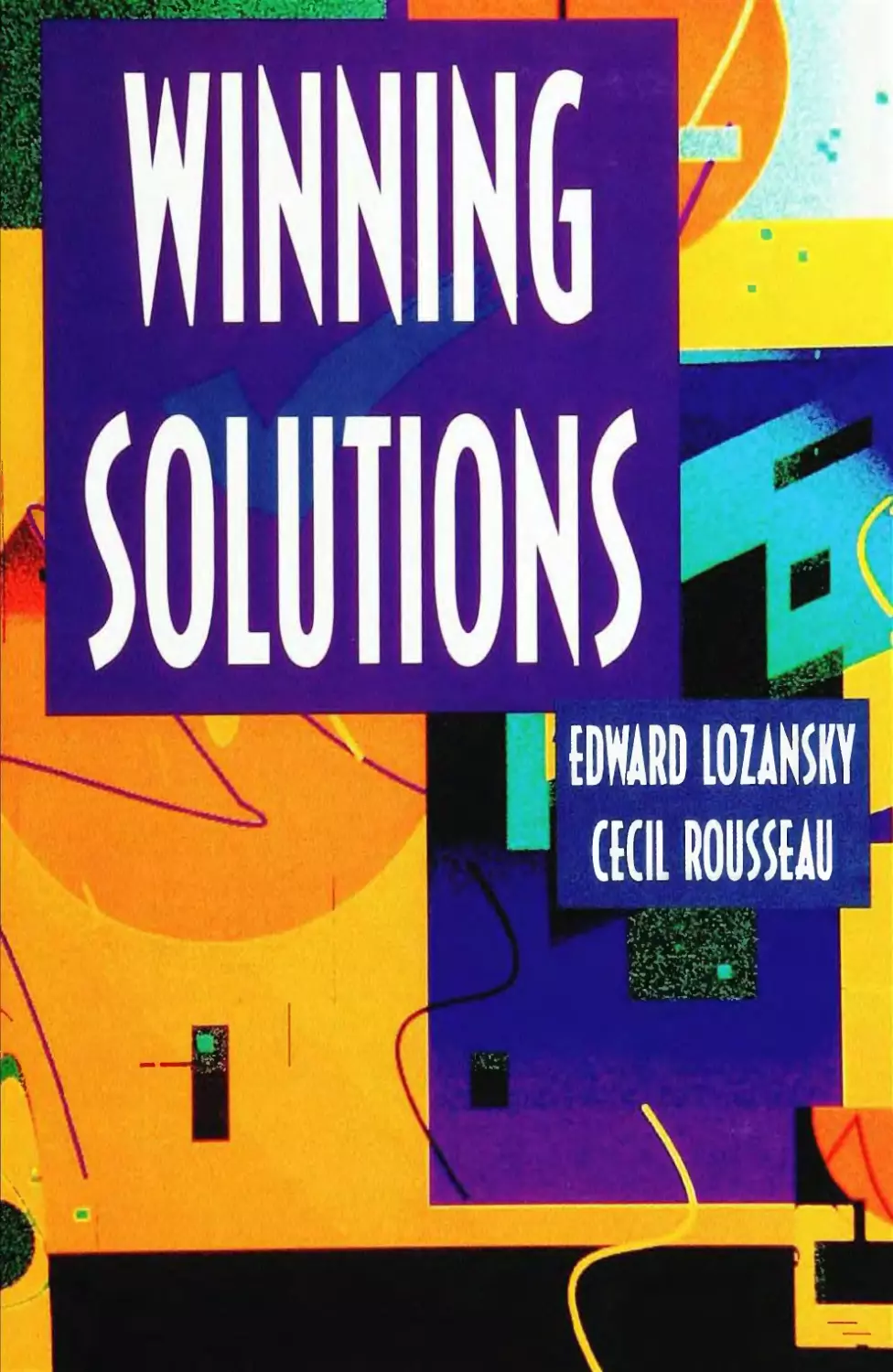


Автор: Lozansky E. Rousseau C.
Теги: mathematics probability theory probability theory problems mathematics problems
ISBN: 0-387-94743-4
Год: 1996

Текст
                    (Kll ROUSSEAU

Problem Books in Mathematics
Edited by P.R. Halmos
Springer
New York
Berlin
Heidelberg
Barcelona
Budapest
Hong Kong
London
Milan
Paris
Santa Clara
Singapore
Tokyo

Problem Books in Mathematics
Series Editor: P.R. Halmos
Polynomials
by Edward J. Barbeau
Problems in Geometry
by Marcel Berger, Pierre Pansu, Jean-Pic Berry, and Xavier Saint-
Raymond
Problem Book for First Year Calculus
by George W. Bluman
Exercises in Probability
by T. Cacoullos
An Introduction to Hilbert Space and Quantum Logic
by David W. Cohen
Unsolved Problems in Geometry
by Hallard T. Croft, Kenneth J. Falconer, and Richard K. Guy
Problems in Analysis
by Bernard R. Gelbaum
Problems in Real and Complex Analysis
by Bernard R. Gelbaum
Theorems and Counterexamples in Mathematics
by Bernard R. Gelbaum and John M.H. Olmsted
Exercises in Integration
by Claude George
Algebraic Logic
by S.G Gindikin
(continued after index)

Edward Lozansky Cecil Rousseau
Winning Solutions
Springer

Edward Lozansky Cecil Rousseau
National Science Teacher's Association The University of Memphis
Washington, DC 20009 Memphis, TN 38152
USA USA
Series Editor:
Paul R. Halmos
Department of Mathematics
Santa Clara University
Santa Clara, CA 95053
USA
Mathematics Subject Classification (1991): HAxx 05Axx
Library of Congress Cataloging-in-Publication Data
Lozansky, Edward
Winning Solutions / Edward Lozansky, Cecil Rousseau.
p. cm - (Problem books in mathematics)
Includes bibliographical references (p. -) and index.
ISBN 0-387-94743-4 (softcvr : alk. paper)
1. Mathematics - Problems, exercises, etc. I. Rousseau, Cecil. II. Title. III. Series
QA43.L793 1996
510'.76-dc20 96-13584
Printed on acid-free paper.
© 1996 Springer-Verlag New York, Inc.
All rights reserved. This work may not be translated or copied in whole or in part without the
written permission of the publisher (Springer-Verlag New York, Inc., 175 Fifth Avenue, New York,
NY 10010, USA), except for brief excerpts in connection with reviews or scholarly analysis. Use in
connection with any form of information storage and retrieval, electronic adaptation, computer
software, or by similar or dissimilar methodology now known or hereafter developed is forbidden.
The use of general descriptive names, trade names, trademarks, etc., in this publication, even if
the former are not especially identified, is not to be taken as a sign that such names, as understood
by the Trade Marks and Merchandise Marks Act, may accordingly be used freely by anyone.
Production managed by Robert Wexler; manufacturing supervised by Joe Quatela.
Photocomposed copy prepared using the author's WjrX files and Springer's utm macro.
Printed and bound by R.R Donnelley & Sons, Harrisonburg, Virginia.
Printed in the United States of America.
987654321
ISBN 0-387-94743-4 Springer-Verlag New York Berlin Heidelberg SPIN 10016809

Preface
Problem-solving competitions for mathematically talented
secondary school students have burgeoned in recent years. The number
of countries taking part in the International Mathematical Olympiad
(IMO) has increased dramatically. In the United States, potential
IMO team members are identified through the USA Mathematical
Olympiad (USAMO), and most other participating countries use a
similar selection procedure. Thus the number of such competitions
has grown, and this growth has been accompanied by increased
public interest in the accomplishments of mathematically talented
young people.
There is a significant gap between what most high school
mathematics programs teach and what is expected of an IMO participant.
This book is part of an effort to bridge that gap. It is written for
students who have shown talent in mathematics but lack the
background and experience necessary to solve olympiad-level problems.
We try to provide some of that background and experience by
pointing out useful theorems and techniques and by providing a suitable
collection of examples and exercises.
This book covers only a fraction of the topics normally
represented in competitions such as the USAMO and IMO. Another
volume would be necessary to cover geometry, and there are other
V

yj Preface
special topics that need to be studied as part of preparation for
olympiad-level competitions. At the end of the book we provide a
list of resources for further study.
A word of explanation is due the reader who is not already
familiar with olympiads and the topics normally dealt with in such
competitions. Until now, calculus has not been accepted as one of
those topics. Problems on olympiad exams regularly call for use of
Ceva's theorem, Chebyshev's inequality, the Chinese remainder
theorem, and convex sets, but not calculus. The authors are the first to
acknowledge that this book deals with an ecclectic list of topics.
However, we have tried to choose these topics with the olympiad
tradition and the needs of mathematically talented young persons
in mind.
Many people have made valuable suggestions to us during the
writing of this book. We are especially grateful to Basil Gordon
(UCLA), Ian McGee (University of Waterloo), and Ron Scoins
(University of Waterloo) for suggestions made concerning the first two
chapters, and to David Dwiggins (University of Memphis) for his
careful reading of the final manuscript.
The first two chapters of this book were written while one of
the authors [CR] was on sabbatical at the University of Waterloo.
This author wishes to thank Ron Dunkley for the invitation to visit
Waterloo and to express his appreciation to all the members of the
faculty and staff who helped make this visit a productive one.
For one of the authors [CR], the opportunity to write this book is
an outgrowth of the good fortune of having been associated with
both the USAMO and the IMO for many years. The opportunity
for this author to play such a role was initially provided by Murray
Klamkin, and has been supported and enlarged by many others,
including Dick Gibbs, Samuel Greitzer, Walter Mientka, Ian Richards,
Leo Schneider, many fine colleagues of the Mathematical Olympiad
Summer Program (Titu Andreescu, Anne Hudson, Gregg Patruno,
Gail Ratcliff, Daniel Ullman, Elizabeth Wilmer), and the many
wonderfully talented students who have participated in the USAMO,
IMO, and the Mathematical Olympiad Summer Program.
Finally, we are very grateful to the American Mathematical
Competitions for permission to use problems from the AIME (American

Preface y\\
Invitational Mathematics Examination) and the USAMO as examples
and exercises in this book.
January, 1996
Edward Lozansky
Washington, D.C.
Cecil Rousseau
Memphis, TN

Preface y\\
Invitational Mathematics Examination) and the USAMO as examples
and exercises in this book.
January, 1996
Edward Lozansky
Washington, D.C.
Cecil Rousseau
Memphis, TN

Contents
Preface v
1 Numbers 1
1.1 The Natural Numbers 1
1.2 Mathematical Induction 11
1.3 Congruence 18
1.4 Rational and Irrational Numbers 29
1.5 Complex Numbers 35
1.6 Progressions and Sums 46
1.7 Diophantine Equations 56
1.8 Quadratic Reciprocity 65
2 Algebra 73
2.1 Basic Theorems and Tfechniques 73
2.2 Polynomial Equations 92
2.3 Algebraic Equations and Inequalities 106
2.4 The Classical Inequalities 113
3 Combinatorics 141
3.1 What is Combinatorics? 141
3.2 Basics of Counting 142

Numbers
1.1 The Natural Numbers
Normally, we first learn about mathematics through counting,
so the first set of numbers encountered is the set of counting
numbers or natural numbers {1, 2,3,...}. Later, our knowledge is
extended to integers, rational numbers, real numbers and
complex numbers. A formal definition of even the natural number
system requires careful thought, and one was given only in 1889
by the Italian mathematician Giuseppe Peano. Our approach is
informal. It is assumed that the reader is familiar with various number
systems. The following definitions ensure a common language with
which to present problems and their solutions.
We use Z to denote the set of integers {..., -2, -1,0,1,2,...} and
Z+ to signify the set of positive integers {1,2,3,...}. We shall use the
term natural number to mean a positive integer (Mathematicians
do not always agree on matters of terminology and notation. Some
use the term natural number to mean a nonnegative integer.) If a
and b are integers, we say that a divides b, in symbols a\b, if there
is an integer c such that b = ac. Then a is a divisor, or factor, of b
A natural number p > 1 is said to be prime if 1 and p are its only
positive divisors. A natural number n > 1 that is not prime is said to
1
l
CHAPTER

1. Numbers
be composite. The list of prime numbers begins 2,3,5,7,11,13,...
and has no end. The fact the list of primes is endless is proved in
Euclid's Elements, and the proof given by Euclid is a model of the
mathematician's art.
Theorem 1.1 (Euclid) There are infinitely many primes.
Euclid's argument is by contradiction. Ifpi,p2, • • • ,Pn is a complete
list of primes, then M = (p\p2 • • *Pn) + 1 is a number that is not
divisible by any prime yet is larger than the largest prime, and
this is impossible. In the first exercise at the end of this section,
you have an opportunity to use the idea of Euclid's proof to show-
that the arithmetic progression 3,7,11,15,19,... contains infinitely
many primes.
If a and b are integers that are not both zero, their greatest
common divisor, denoted by (a, b), is the largest natural number d such
that d\a and d\b. If (a, b) = 1, then a and b are said to be relatively
prime. The following little fact is the cornerstone of a great theory.
Lemma 1.1 Let a and b be two integers, not both zero. Then [xa +
yb | x, y € Z) is the set of all integral multiples of {a, b). In particular,
(a, b) is the smallest positive number in this set.
To prove this, let M be the set of all numbers of the form xa + yb
where x, y € Z and note that if k is in M then any multiple of k is also
in M, and if k and I axe in M then k — lis also in M. It is easy to see
that M contains some positive integers, so M contains a least positive
integer (see §1.2). Call this number d. Then M is just the set of all
integral multiples of d. Otherwise, we could find a number m g M
that when divided by d gives m/d = q + r/d where 0 < r < d, and
this is impossible since r = m - qd € M and d is the least positive
integer in M. Since a,b € Mwe have d\a and d\b. On the other hand,
since d = x0a + y0b for some x0,y0 € Z, any number that divides
both a and b also divides d. This clearly implies that d = [a, b).
Using Lemma 1.1, we easily prove the following basic result.
Lemma 1.2 (Euclid's Lemma) If a\bc where a and b are relatively
prime, then a\c.
Since a and b are relatively prime, there are integers x0 and yQ such
that 1 = x0a + y0b and thus c = x0ac + y0bc. Given that a\bc, we
then have ale.

1.1. The Natural Numbers 3
Once we know that Euclid's Lemma is true, it is easy to use
mathematical induction (§1.2) to prove the following important
result.
Theorem 1.2 (Fundamental Theorem of Arithmetic) Every natural
number exceeding 1 is either prime or can be written uniquely (except for
the order of factors) as the product of two or more primes.
In symbols, the prime factorization result can be expressed as
n = ]\ee^n\ n>\,
p
where \\ denotes the product over primes and ep(n) is the
exponent ofp in the prime factorization of n. The important part of the
theorem is the uniqueness of prime factorization. It is easy to see that
every integer greater than 1 can be written as a product of primes.
The part that isn't so obvious is that this can be done in only one
way. But it is true, and the fact that prime factorization is unique
provides a powerful method for solving many problems.
In view of their obvious importance, primes have been the
object of many studies from the time of Euclid to the present, by
both professional and amateur mathematicians. There are many
unsolved problems concerning primes, problems that may look
innocent enough but are (apparently) extremely difficult. For
example, in a letter to Leonhard Euler written in 1742, Christian Goldbach
conjectured that every even number greater than 2 is the sum of two
primes. Goldbach's conjecture has never been proved or disproved.
Of course we won't be trying to solve such problems. We limit our
attention to problems that have easy solutions if one keeps the basic
definitions and theorems in mind and views the question from the
right perspective.
As an example of how the Fundamental Theorem can be applied,
consider the following simple problem.
Example 1.1 Find all primes p such that 17p + I is a perfect square.
Solution.Suppose \lp + 1 = rc2.Thenl7p = n2-\ = (n-l)(n + l).
The left-hand side expresses a certain number as the product of two
primes. The right-hand side expresses the same number as the
product of two factors. If either n — 1 or n + 1 were composite, then
(n — l)(n + 1) would further factor and the final result would be the

1. Numbers
product of three or more primes. In view of the Fundamental
Theorem, this can't be true. In fact, the uniqueness of prime factorization
allows us to conclude that either 17 = n + 1 andp = n - 1 or else
17 = n - 1 andp = n + 1. The first alternative yields p = 15 and so
doesn't work. The second gives n = 18 andp = 19. This does work,
so p = 19 is the only prime for which \lp + 1 is a perfect square.
□
On occasion we will need to compute a greatest common divisor.
An efficient way of doing this was found long ago by Euclid.
Theorem 1.3 (Euclidean Algorithm) Ifa>b> 0 and a/b yields the
quotient q and remainder r, in other words
t = q + t, 0 < r <b,
b b
then (a, b) = (b, r).
lb see why this statement is true, write the equation relating
a, b, q, and r as a = qb + r, and note that any number that divides a
and b also divides r and any number that divides b and r also divides
a. Thus the set of common divisors of a and b is the same as the set
of common divisors of b and r. In particular, the greatest common
divisors are the same.
lb calculate (a, b) using this theorem, we simply continue the
process until the remainder is zero; thus we find the chain of
equalities (a, b) = (b,r) = ... = {d, 0) = d. We must finally get a
remainder that is zero since each remainder is nonnegative and the
sequence of remainders is decreasing.
As an example, let us compute the greatest common divisor of
5999 and 994. The first division gives 5999/994 = 6 + 35/994, the
second gives 994/35 = 28 + 14/35, the third gives 35/14 = 2 +
7/14, and the last gives 14/7 = 2 with remainder 0. We thus find
(5999,994) = (994,35) = (35,14) = (14,7) = (7,0) = 7.
Example 1.2 Prove that if a and b are any two natural numbers, then
(2a-l, 2fc-l) = 2(a'fc)-l.
Solution. Notice that with a = qb + r (0 < r < b), the following is
an algebraic identity:
x° - 1 = (xb - l)(xfl-fc + x°-2b + ■ ■ • + xa~bq) + xr - 1.

1.1. The Natural Numbers 5
In particular, setting x = 2 yields
2fl-l = (2fc-l)Q + 2r-l,
where Q = 2a~b + 2a~2b + • • • + 2a_^. Hence
(2a-l, 2fc-l) = (2fc-l, 2r-l).
Now, we realize that the chain of equalities in Euclid's algorithm
(a, b) = (b, r) = • • • = (d, 0) = d is exactly matched by the chain
(2a-l, 2fc-l) = (2fc-l, 2r-l) = ••- = (2d-l, 0) = 2d-l.Thus,
we have shown that (2fl - 1, 2fc - 1) = 2^ - 1. D
The following problem is quite simple, but it allows us to combine
some of the things discussed so far.
Example 1.3 Find a six-digit number that is increased by a factor of 6
if one exchanges (as a block) the first three digits of its decimal expansion
with the last three.
Solution. Write the desired number as N = 1000A + B, where A and
B are three-digit numbers. Then exchanging (as blocks) the first three
digits and the last three gives the number lOOOE + A. We are given
that 1000E + A = 6(1000A + B) and it follows that 5999A = 994B.
Using (5999,994) = 7, we find 857A = 142B and (857,142) = 1.
Now Euclid's Lemma tells us that 857|B. But we also know that 0 <
B < 103. Hence B = 857, A = 142, and N = 142857.
Recall that n factorial is defined by
n\ = n-(n- 1)---2-1
for integers n > 0, and 0! = 1. In the solution of various
problems, it is helpful to know the prime factorization of n\. On the
face of it, this seems like a hopelessly difficult task for all but the
smallest values of n. For example, one might expect that a computer
is required to find the prime factorization of a number as large as
20! = 2,432,902,008,176,640,000. However, Adrien-Marie Legen-
dre found a neat formula for the prime factorization of n\, and this
result is helpful in solving many problems. lb express Legendre's
formula, we make use of the "floor," or "greatest integer," function.
Specifically, |xj denotes the greatest integer < x.

Q 1. Numbers
Theorem 1.4 (Legendre) The exponent ofp in the prime factorization
ofn\ is
n
LPrJ
r>\
This formula is fairly obvious once one thinks about it. Where do the
factors ofp come from in the factorization of 1 • 2 • • • n? First of all,
between 1 and n there are \n/p\ numbers that are multiples ofp,
namely p, 2p,..., [n/p]p. These each contribute one factor ofp. But
of those, there are \n/p2\ multiples ofp2 and they each contribute
one more factor ofp. Now the \n/p3\ multiples ofp3 contribute one
more factor still, and so it goes, until eventually [n/pr\ = 0.
Historical Note. The formula
„1 = Ylpln/p\ + ln/p2} + ~
p<n
is commonly called Legendre's formula, although it may have been
discovered independently by various persons. It is in the second
edition of Legendre's Essai sur la theorie des nombres (1808).
Using Legendre's formula, let us find the exponent of 5 in the
prime factorization of 1000!. We get
1000
5
I I 1000 I I 1000 I I 1000
J+ hH+ bn+ br
= 200 + 40 + 8 + 1 = 249.
This gives us an immediate solution to the following problem.
Example 1.4 Find the number of terminal zeros in the decimal
representation of 1000!.
Solution. The answer is 249. The exponent of two in the prime
factorization of 1000! is much larger than 249. (If you want to know
what it is exactly, just use Legendre's formula.) Thus the highest
power often that divides 1000! is the exponent of five in the prime
factorization, namely 249. □
Example 1.5 Show that ifm and n are positive integers, then
(2m)!(2n)!
m\n\[m + n)\
is an integer.

1.1. The Natural Numbers 7
Solution. In view of Legendre's formula, it suffices to prove
2m
pk
+
2n
pk
>
m
pk
+
n
pk
+
m + n
pk
for arbitrary p and k. More generally,
|_2aJ + [2b 1 > LaJ + |fcj + [a + b\,
holds for arbitrary real numbers a, b. lb see this, observe that for
any real number x we can write x = \x\ + M where \x\ denotes
the fractional part of x and satisfies 0 < [x] < 1. Making this
substitution for both a and b above, the inequality reduces to [2x\ +
L2#J > I* + y\ where x = [a] and y = [b). Since x + y < 2, this
inequality clearly holds if x > \/2oxy > 1/2. Ifx < 1/2 and y < 1/2
both sides vanish, so the result holds in this case as well. □
The following problem, which was proposed for a recent
International Mathematical Olympiad, gives us another good opportunity
to use Legendre's formula. As background, recall that the least
common multiple (LCM) of a collection of nonzero integers
(fli,fl2r- • -,ak} is the smallest natural number that is divisible by
each a,. The binomial coefficient (£) (read "n choose Jc") is denned
by
k\(n-k)\'
(For reference, (£) is the number of ways to choose k elements from
a set of size n, and it is the coefficient of xn~kyk in the expansion of
(* + yf-)
Example 1.6 Prove that (2£) divides LCM(1,2,..., 2n).
Solution. Let L denote the LCM of {1,2,..., 2n) and let M = (2n").
lb prove that M\L, it suffices to show that ep{M) < ep{L) for each
prime p. Since L is the smallest natural number that is divisible by
each of 1, 2,..., 2n, it follows that ep{V) is the largest integer m such
thatpm < 2n, namely m = l_log(2n)/logpJ. By Legendre's formula,
m ( 9 l
eP(M) = ep((2")0 - 2eP("0 = E 77 ~2 S •
r=l I LP J LP J J
(Since pr > 2n for all r > m,we have included all of the nonvanish-
ing terms in Legendre's formula.) Note that |_2x| - 2|xJ is either 0

g 1. Numbers
or 1 (depending on whether or not x — \_x\ is less than 1/2). In view
of this fact, each of the terms in the above sum is either 0 or 1, and
thus ep{M) <m = ep[L). D
The above result can be used in an elementary proof of a famous
result of Chebyshev concerning primes. Let n(x) denote the number
of primes < x. By elementary arguments, Chebyshev proved that
there are positive constants A and B such that
log* log*
(Here log* denotes the natural logarithm of x.) Later, Hadamard
and de la Vallee Poussin independently proved that 7r(x) log(x)/x
approaches 1 as* increases withoutbound. This is the famous Prime
Number Theorem.
Example 1.7 Let vp{n) denote the sum of the digits in the basep
representation of n. Show that the exponent ofp in the prime factorization
ofn\is related to vp(n) through
n — vJri)
*m = -^-
Solution. Suppose n = do + d\p + • • • + drpr where 0 < dt < p. Then
- = dt + d2p + ■•• + drpr~\
— = d2 + d3p + • ■ • + drpr~2,
so by Legendre's formula
ep(n\) = d\ + d2(p +1) + d3(p2 +^ + 1) + ---+ dr(pr'1 +--- + 1)
and
(p-l)ep(n\) = dx{p-\) + d2{j)2-l) + ---+dr{pr-\) = n-vp(n). D
In what follows, let a(n) = e2(n\) and let b(n) denote the number
of ones in the binary (base 2) expansion of n.

1.1. The Natural Numbers g
Example 1.8 Let B[m) denote the set of integers r for which 2r is a term
in the binary expansion ofm. For example, B(100) = {2,5,6}. Prove that
(I) is odd if and only ifB(k) c B(n).
Solution. The case p = 2 in the last problem yields a(m) + b{m) = m
for every nonnegative integer m. It follows that the exponent of two
in the prime factorization of (£) is
62 (L))= a^ ~a^ ~ a(n" ^)= bw+ b(n ~ ^) - bw-
Notice that b(k) + b(n — k) — b(n) = 0 if and only if there are no
carries when k and n — k axe, added in binary. It follows that b(k) +
b(b — k) — b(n) = 0 if and only if B(k) c B(n). From the relation
given above, if b(k) + b(n — k) — b{n) = 0 then (£) is odd; otherwise,
b(k) + b(n — k) — b(n) > 1 and (£) is even. We shall give a different
proof of this result in §1.3. □
Our final example involving prime factorization introduces an
important function in number theory.
Example 1.9 Ifn = pr where p is prime, find the number of integers
k where 1 < k < n and (nt k) = 1.
Solution. Let us consider the numbers between 1 and n = pr that are
not relatively prime to n. The only such numbers are the multiples
of pt namely p, 2pt 3pt... tpr, and there are pr~l such numbers. By
deleting these numbers, we have left the numbers we want to count.
Thus the number of integers k where 1 < k < pr and (pr, k) = 1 is
f-p"1 -p"(i-£).
What about the case where n is not of the form j/? For n > 1 let
us define <f>{n) to be the number of integers k where 1 < k < n and
{n, k) = 1. It turns out that 0 has a very nice property that allows us to
compute its value in general by using the result of the last problem.
It can be shown that if (a, b) = lthen0(afr) = 0(a)0(fc). (A function
f with the property f{ab) = f{a)f{b) whenever (a, b) = 1 is called
multiplicative. Multiplicative functions play an important role in
number theory.) It follows that if
n =P\--Prn

1. Numbers
is the prim • factori tion th n
V Pi/ \ Pm)
This un loni known as Eiiler* <£-funotion an it com sup g in
in §1.3. D
£ erc's s r S tion 1 1
1 v h t th • arithmeti progr ssi n 7,11 15,... c nt ins
inhnit 1 m ny p im s Hint: Sup s that i 2,... n >
compl t list of rimes in this pro re sion and consid rth num-
b rA - 4pip 'Ph l.Ofcours , M is not divisible by no 1
ltdivi ibl by any of the prim sp\,...,ps- Is it possible that
prime divisor of M b longs to the progr s ion 5 9 1 1 , 1... .
2. Find all n tur 1 numb rs n for which n4 + is prim .
Find all natural numbers such th t 8 + l ♦ is a p rf c
square.
. Find 11 four- igit numb rs of th orm adbb that ar p rf ct
squares.
5. Ir v th t ( n + 4 n + 3 = 1 for *ve int er n.
6. Pov th t th» sum of th squar 0 fiv ns cutiv int g rs
nnot b pr • tsquar .
. Prov • that th pr du t fthr ns cutiv n tu i\ numbers is
nvr prctpwr that is p r t squar p rfe t ub ,
high r power). Hint: Writ the product in qu stion (n —
lii I .
8 Supp s that i is our-di it perf ct squ r ho d cim 1 digits
ar ach 1 ss than , nd th t incr a ing h digit by 3 i Id
another p *rf ct squar \ D termme N.
9 numb r N is th sum of two squ s if th r xist integ rs
nd such thi 1 b , Prove that if N s the sum 0 tw
squ r s th n so i N n r 1" this r suit by pr vin that i
A nd re *ach th sum oft 0 squ r th n so is N.

Ma t" nut' U
10 In n i nt Byzantium, a am simil to sk tb 11 w s pi e
th tg v oints or field o landi? ointsforafre throw.Sur
vivmgm nus r'ptsdonotre ordth v lu sofa n .H r
it is known that in this am * 'actl ' 14 natural numb rs w
'mp s lbl int t 1 nd th t on o th im ossibl s r \ s
.D t rmineth number of points ivnf fi Id goals ndfr
throws "n ntin b sk tb 11 ssum that a > . i t: First
p ov the followin en ral r suit. I a and b are r 1 tiv 1 prim
n tural numb r , th r r 1 -(-1 n tur 1 num-
b rs th t n tb pr ss d in th ormxa + b wh r v and t
r-* nonn gativ int g s
1 . Prov th t th pr duct o an i cons utive int er is divisibl •
b !.
12. Find all su h that 2^1^1.
I . ind th numb rot min 1 ro in th decimal epres n tion
o 1 • • • 1000.
14. ind the prim factorization o 20!.
1 . Prov that o n > th nth harmonic numb r
1 1 1
1 + - + -
is not an int g .
IV a hema ica nductio
On o t n wishes to prov that a rtain s t of natural numb rs is,
in f t th s t of // natural numb *rs. his m b don hrough n
pp 11 th followin im rtant principl .
Prinripl 1.1 (Prin *ipl * 1 th m ti 1 Indu tion
o i Inu b s that satis es th ollowmg w conditions: i 1 €
(it t i is \ I m nt o th n n + is s n e it T. T i
Th rin ipl o Mathematical Induction xpresses a fun im n 1
prop *rt of ht natural numb rs. I P no's theo f the n tural

J 2 1. Numbers
numbers, it is one of the axioms. A logically equivalent statement is
the Well-Ordering Principle.
Principle 1.2 (Well-Ordering Principle) Every nonempty subset of
Z+ has a smallest element.
In most applications of mathematical induction, we are given a
sequence of statements Si,S2f S3t..., and T is taken to the set of all
natural numbers n for which Sn is true. Tb prove that Sn is true for
every natural number n, in other words T = Z +, we can appeal to the
Principle of Mathematical Induction provided we can verify
conditions (i) and (ii). Thus to prove that every statement in the sequence
is true, we need to show (i) Si is true and (ii) Sn+i is true whenever
its immediate predecessor Sn is true.
Tb prove the same thing using the Well-Ordering Principle, let F
be the set of all natural numbers n for which Sn is false. Tb prove
that F is empty, assume the contrary and consider its least element
(which exists by the Well-Ordering Principle). The aim is then to
show that this assumption leads to a contradiction.
As an illustration, let us use the Well-Ordering Principle to prove
the Principle of Mathematical Induction. Thus we are given a set T
that satisfies (i) and (ii) and we want to prove that T = Z+. Assume
the contrary, namely assume that F (the complement of T in Z+)
is nonempty, and let m be its smallest element. By (i) we know
that 1 e T, so m > 1 and m — 1 is also a natural number. Since
m is the smallest element of F, we conclude that m — 1 e T. Thus
our assumption that F is nonempty has forced us to conclude that
there is a natural number m such that m — 1 e T and m & T. This
contradicts (ii) so the assumption must be false. Hence T = Z+.
In Principle 1.1, (ii) may be replaced by the following: (ii)* if
1,2,..., n are elements of T, then n + 1 is also an element of T. We
shall refer to this version as strong induction. Example 1.13 shows
the use of induction in this form. Occasionally, it is appropriate to
start the induction with n = no > 1 rather than n = 1. Condition
(i) in Principle 1.1 is then replaced by (i) T contains n0, and the
conclusion is that T is the set of all integers n > n0. Example 1.14
uses this modification of the induction technique.
Many interesting problems can be solved by means of the
Principle of Mathematical Induction. We begin by considering sums The

1.2. Mathematical Induction J 3
problem is to prove that the summation formula
n
holds for every natural number n. Let T denote the set of natural
numbers for which the formula is true. Then T satisfies condition
(i) in the Principle of Mathematical Induction if /(1) = F(l) and
T satisfies condition (ii) if for every natural number n, the relation
/(1) + /(2) + ■ • • + f{n) = F(n) implies/(1) + /(2) + ■ ■ • + /(n + 1) =
F(n + 1). A moment's thought reveals that condition (ii) follows if
F(ri) + f(n + 1) = F(rc + 1). In other words, to prove by
mathematical induction that our summation formula is true for every natural
number n, we simply have to check that
(a) /(1) = F(l)f
(b) F{n + 1)- F(n) = f(n + 1),
with the latter condition holding for arbitrary n. A simple illustration
is in order.
Example 1.10 Prove that for every natural number n,
nfn + lYn + 2)
1 - 2 + 2 - 3 + • • • + n(n + 1) = — -.
K J 3
Solution. Set/(n) = tt(tt + l)andF(n) = m(m+ 1)(^ + 2)/3. Now (a) is
true since/(1) = F(l) = 2. lb check (b), we evaluate F{n + \)-F{n).
(n + \)(n + 2)(m + 3) n(n + l)(n + 2)
F(n + l)-F(n) = i A 3 A - f L
= (n + 1)(m + 2)
= f(n + 1).
Thus (b) is true as well. □
There is a useful generalization of this result. Let m be a
nonnegative integer. Then
En(M + 1)---(n + m + lj
k(k + !)...(* + m) = ^ i—i- 1 (1.1)
m + 2
for every natural number n. For n = 1, both sides are equal to (m + 1)!
so (a) holds. lb check (b), we evaluate F(n + 1) — F(n), where F{n) is

24 1. Numbers
the expression on the right side of (1.1). Simplifying the expression
(n + l)(n + 2) • • • (rc + ra + 2) h(h + 1)-•-(w + m + 1)
m + 2 m + 2
we find
F(n + 1)- F(m) = {n + l)(n + 2) ■ ■ • (n + m + 1) = f(n + 1).
Thus the formula holds in all cases. Using this formula, we can derive
other sums. For example, since
Jc3 = k(k + l)(Jc + 2)- 3k(k + 1) + /c,
the sum of the first n cubes is given by
n(n + l)(n + 2)(n + 3) n(n + l)(n + 2) n(n + 1)
4 3 2
Simplifying this expression, we obtain
p ■ m"
Example 1.11 Prove that n{n - l)(n + l)(3n + 2) is divisible by 24
for every natural number n.
Solution. If n = 1 then n(n - \)(n + l)(3n + 2) = 0, which is
divisible by 24. Thus (i) of Principle 1.1 holds. lb prove that (ii)
holds, take n > 1 and assume that 24|n(n - l)(n + l)(3n + 2). Then
24|(m + l)n(n + 2)(3n + 5) since
{n + \)n{n + 2)(3n + 5) = n{n - l)(n + 2)(3n + 2) + 12n(n + l)2,
and n{n + 1)2 is always even. Thus our induction proof is complete.
D
Problems involving recurrence relations are ideally suited for
appoaches using mathematical induction. Here is a simple example.
Example 1.12 Suppose that ax = 3 and an + l = an[an + 2) for all
n>\. Find a general formula for the terms of this sequence.
Solution. Computing the first three terms, we find ax = 3 = 22 -
\,a2 = 15 = 24 - l,fl3 = 255 = 28 - 1, and it is certainly tempting
to conjecture that
an = 2r - 1

1.2. Mathematical Induction
for every natural number n. We have already verified that this is true
for n = 1. Now take n > 1 and assume that the formula is true for
the (n — l)s( term of the sequence. Then
an = On-i(an-i + 2) = (22""1 - 1)(22""' + 1) = 2r - 1,
so our conjectured formula is correct. □
Example 1.13 Suppose that a\,a2,... is a sequence of natural
numbers that satisfies
Jt= 1 \#c= 1 I
for every natural number n. Is it necessarily true that a* = k for each k?
Solution. The answer is "yes." First of all, for n = 1 the given
condition yields a\ = a\. Since a\ £ 0, we have a\ = 1. Now assume that
ajt = k for k = 1,2,..., n (strong induction) and ask whether or not
an + \ = n + \. From what we are given,
13 + • ■ - + n3 + a3 + 1 = (1 + • • • + n + an + 1)2,
and it follows that
[n(n + 1)12 , [nfn + 1)12 N -
I 2 I + n + l = 1 2 I +* + 1)fl»+1+W
Simplifying, we get
(an + i - (n + l))(an + i + n) = 0,
and (since an + i is positive) it follows that an + i = n + 1. Thus a* = Jc
for every natural number /c follows by induction. □
Our final example of a proof using mathematical induction is
actually a special case of a famous theorem proved by Paul TUran in
1941. The problem as stated was given on the 1956 William Lowell
Putnam Competition.
Example 1.14 (1956 Putnam) Consider a set of2n points in space,
n > 1. Suppose they are joined by at least n2 + 1 segments. Show that
at least one triangle is formed. Show that for each n it is possible to have
2n points joined by n2 segments without a triangle being formed.
Solution. Consider first the case n = 2. Between four points there
are in all six possible segments. Hence, if the four points are joined

Jg 1. Numbers
by five segments, only one segment is missing. If AB is the missing
segment, then any three of the points not including both A and B
form a triangle. Thus the statement is true for n = 2.
Now we use mathematical induction. Take n > 2 and assume
that if 2{n - 1) points are joined by at least {n - 1)2 + 1 segments,
then at least one triangle is formed. We are now given 2n points
joined by at least n2 + 1 segments and we want to prove that there
is a triangle. Consider two points that are joined by a segment. Call
these points P and Q and note that if any of the remaining 2[n - 1)
points are joined to both P and Q, a triangle is formed.
If this is not the case, then the number of segments between
{P, Q) and the remaining 2{n - 1) points is at most 2(n - 1) since
each of the remaining points may be joined to either For Q. but
not both. Delete P, Q, and all incident segments. We are left with
2(n -1) points joined by at least (n2 + 1)- 2(n -1)-1 = (n-1)2 4-1
segments. Thus a triangle is formed.
If the 2n points are divided into two disjoint sets of n points apiece
and only the n2 segments joining points in one set with points in the
other are used, then no triangle is formed. □
Exercises for Section 1.2
1. For each of the following, prove that the given statement is true
for every natural number n.
(a) 12 + 32 +---+(271-1)2 = !&£=£.
(b) 1 • 1! + 2 ■ 2! + ■ ■ ■ + n • n\ = [n + 1)! - 1.
(c)(M)(i-!)"0-o£?)-&$-
(d) 6\n(n2 + 5).
2. Show that
f^ k(k + l)(7c 4-2) 2 [2 (n + l)(n + 2)J
using mathematical induction.
3. Suppose that *i = 2, x2 = 3, andxn + 2 = 3xn +1 - 2xn for all n > 1.
By looking at the first few terms, guess a general formula for xn.
Prove that the formula holds for every natural number n using
mathematical induction.

Exercises 1.2
4. Observe that
12 = 1 -2-3/6,
12 + 32 = 3-4-5/6,
12 + 32 + 52 = 5 • 6 • 7/6.
Based on these examples, guess a general formula. Prove it using
mathematical induction.
5. Derive a formula for the sum 14 + 24 + - • • + n4.
6. Prove that for every real number x > — 1 and every natural
number n,
(1 + xf > 1 + nx.
This is Bernoulli's inequality.
7. If x andy are any two real numbers, then \x+y\ < \x\ + \y\. Using
this fact, prove that if #i, x2,..., xn are any n real numbers, then
|*! + X2 + '"Xn\ < \Xi\ + \X2\ + •■• + |*n|.
8. Suppose that 0 < x* < 1 for i = 1,2,..., n. Prove that
2^(1 + xxx2 • • -xn) > (1 + xOP + x2) ■ ■ • (1 + x„),
with equality if and only if n — 1 of the x/s are equal to 1.
9. The sequence of integers F\, F2, F3,... defined by Fi = 1, F2 =
1, and Fn = Fn_i + Fn_2 for n > 3 is called the Fibonacci
sequence. Prove that for every natural number n, the Fibonacci
numbers Fn and Fn +1 are relatively prime.
10. Prove that for every natural number n,
an-bn
where a = ^ and b = ^.
11. Prove that
F2 +F2 + ••• +F2 =FnFn+1.
12. Prove that for every natural number n,

Jg 1. Numbers
is divisible by 3. [Power Question, 1978 New York State
Mathematics League] Hint: For n = 1, 2, 3,... let
/7 + V37\" (l-yfin
Use mathematical induction to prove that an+i = 7an + \ — 3an
and that an -1 is divisible by 3 for every natural number n. Prove
that
7 + V37' n
an-\ =
13. The vertices of a convex polygon with 2n + 1 sides are colored so
that no two consecutive vertices have the same color. Prove that
the polygon can be divided into triangles using only noninter-
secting diagonals having endpoints of different color. (A convex
region has the property that any segment joining two of its
points lies entirely within the region.) [1978 Joseph Kurschak
Competition]
14. Given a (2m + 1) x (2m + 1) checkerboard where the four corner
squares are black, show that if one removes any one red and
two black squares, the remaining board can be covered with
dominoes (1x2 rectangles).
15. Suppose that natural numbers *i, x2,..., xn are such that xx \{xn +
*2), *2l(*i + *j), • ■ ■ ,*nl(*n-i + *i). (Think of the n numbers as
being on a circle, so xn+k = xk. Then each number divides the
sum of its two neighbors.) Prove that
Xn + X2 *i + X3 *„_! + XX
+ + •■■ + < 3n- 1.
1.3 Congruence
Sometimes it takes a great mind to think of a simple idea. An example
is the invention of the simple but powerful idea of congruence by
the great German mathematician Carl Friedrich Gauss. Let a and b

1.3. Congruence ]Q
be integers and let m be a natural number. Following Gauss, let us
write
a = b (mod m) if m\(a - b).
The statement a = b (mod m) is read a is congruent to £ modulo
m; the number m is called the modulus of the congruence.
Congruence modulo m divides the set of all integers into m subsets called
residue classes. (Example: for m = 2, the two classes are the even
integers and the odd integers.) Integers a and b are in the same class
if a = b (mod m) and they are in different classes if a ^ b (mod m).
Statements involving congruence are easily manipulated using the
following basic properties. Each of these properties is easily proved
from the definition of congruence.
Property 1.1 The congruence a = a (mod m) holds for every integer
a; congruence is reflexive.
Property 1.2 If a = b (mod m) then b = a (mod m); congruence is
symmetric.
Property 1.3 If a = b (mod m) and b = c (mod m), then a ==
c (mod m); congruence is transitive.
Property 1.4 If a = b (mod m) and c = d (mod m), then a + c =
b + d (mod m); congruences may be added.
Property 1.5 If a = b (mod m) and c = d (mod m), then ac =
bd (mod m); congruences may be multiplied.
Property 1.6 If ab = ac (mod m) and (a,m) = 1, then b =
c (mod m); in other words, we may divide both sides of a congruence by
a number that is relatively prime to m.
For practice using the concept of congruence, let's prove Property
1.6. We are given that ab = ac (mod m). Thus we know that m\a(b —
c). But we are also given (a, m) = 1. It follows from Euclid's Lemma
that m\(b — c), in other words, b = c (mod m).
Let p be a prime and let TLV denote the set {0,1,2,... ,p — 1).
Define addition ( + ) and multiplication (•) on Zp using congruence
modulo p. Thus a + b = c for a, b, c e Zp if the ordinary sum of a
and b is congruent to c modulo p. Likewise, a-b = c if the ordinary
product of a and b is conguent to c modulo p. Using the properties of
congruence, it is easy to verify that the system (Zp, +, •) enjoys the

20 1. Numbers
customary features of arithmetic. Addition and multiplication are
commutative and associative, the distributive law holds, there is an
identity element for addition (0), and there is an identity element
for multiplication (1). For each a € %v there is an element —a such
that (-a) + a = 0. Finally, for each nonzero element a € Zp there
is an element a-1 € Zp such that a~l -a = 1. This follows by using
Euclid's Lemma and the fact that p is prime. The system (Zp, +, ■) is
an example of a finite field.
The way in which congruence arithmetic can effectively
simplify problems involving divisibility is illustrated by the following
example.
Example 1.15 Prove that 3636 + 4141 is divisible by 77.
Solution. Since 36 = 1 (mod 7) and
365 = 35 = 1 (mod 11),
we find that
365 = 1 (mod 77).
This lets us cut the problem down to size. Since 41 = —36 (mod 77),
we have
(36)36 + 4141 = (36)36 + (-36)41
s (36)36 [l - (36)5]
= 0 (mod 77). D
As this problem illustrates, a calculation modulo m involving a
power ak where k is large may be simplified considerably if we can
find an exponent r such that ar = 1 (mod m). For the case of a prime
modulus p, the following theorem of Fermat shows that p -1 is such
an exponent.
Theorem 1.5 (Fermat's Little Theorem) Ifp is prime and a is not
divisible by p, then
av~x = 1 {modp).
Fermat's Theorem was generalized by Euler to the case when the
modulus isn't necessarily prime. Recall from §1.1 that the Euler

1.3. Congruence 21
function is given by
4>{m) = m If (1 | .
Theorem 1.6 (Euler'sTheorem) If(a,m) = 1, then
a0(m) = 1 (mod m),
where <j> is the Euler function.
Here is a nice proof of Euler's Theorem due to James Ivory. Set
k = <j>(m) and let rlf r2,..., rfc be a listing of the positive integers
r < m such that (r,m) = 1. Consider the sequence rxa,r2a,...,rka.
We claim that modulo m the numbers in this sequence form a
permutation of rlf r2, ...,»>. Indeed, since (na, m) = 1, the residue class
containing ^a must be represented by some r;- and r^a = r> (mod m)
implies r* = r> (mod m) by Property 1.6. Thus
{r\d) ■ (r2a) • • • (rkd) = rY-r2---rk (mod m),
from which we obtain a* = 1 (mod m) by applying Property 1.6.
Example 1.16 Find the last three digits of 79999.
Solution. Since 0(1000) = 1000(|)(|) = 400, we know from Euler's
Theorem that
7ioooo = (7400)25 s l (mod 100Q)
At this point, it is useful to note that 7-143 = 1001 so 7 • 143 =
1 (mod 1000). Using basic properties of congruence, we find
79999 = 143 • 7 • 79999 = 143 • 710000 = 143 (mod 1000).
Thus the decimal representation of 79999 ends with 143. □
The following two problems are more challenging. The solutions
show the power of combining some of the problem-solving methods
that we have discussed so far.
Example 1.17 (1991 USAMO) Show that for any fixed integer n>l
the sequence
2, 22, 22\ 22' ,... (modn)
is eventually constant.

22 1. Numbers
Solution. Our proof is by induction on n. The case n = 1 is clear.
Now take n > 1 and suppose that the result is true for all positive
integers less than n. We distinguish two cases.
Case 1: nis even. Write n = 2kq where k > 1 and q is odd. By
induction, the sequence alf a2, a3,... is eventually constant modulo
q. Clearly a, == 0 (mod 2k) for all sufficiently large i. Since 2k and q
are relatively prime, 2k\(ai + i -a*) and<?|(ai + i -at) imply n\{ai + \ -at).
Thus the sequence ax,a2, a3l... is eventually constant modulo n.
Case 2: n is odd. In this case, there exists a positive integer r < n
such that
2r = l(modn). (1.2)
Indeed, Euler's Theorem yields (1.2) with r = 0(rc). By induction,
the sequence a\,a2,a$,... is eventually constant modulo r. But in
view of (1.2), at = c (mod r) implies
ai + l = 2fl' = 2m'r+c = (2r)m' 2C = 2C (mod n).
Thus ai, a2, a^,... is eventually constant modulo n. □
Example 1.18 (1972 Putnam) Prove that there is no integer n > 1 for
which n\(2n -1).
Solution. We use the Well-Ordering Principle. Suppose that the set
S= [n\n > 1, n|(2"-l)}
is nonempty and let m be its smallest element. Clearly m must be
odd; thus m|(20^-l)by Euler's Theorem. Let d = (m, 0(m)). Since
m\(2m - 1) and m|(20W - 1), it follows from the result in Example
1.2 that m|(2d -1). Since m > 1 and m\(2d -1), we know that d > 1.
Also d\(2d -1) because d\m and m\(2d - 1). Since d < <f>{m) < m we
have reached a contradiction by producing an element that belongs
to S and is smaller than m. This contradiction shows that our original
assumption is false and S is empty. □
Since a - b divides itself and
ak - bk = (a - bXa*-1 + a*~2fc + • ■ ■ + &*"1)
for k > 2, we see that ak - bk is divisible by a - b for all k € Z+. This
observation leads to the following useful fact.

1.3. Congruence 23
Theorem 1.7 Let Pbea polynomial with integral coefficients, and let
a and b be arbitrary integers. Then P(a) - P(b) is divisible bya-b. In
other words, P(a) = P(b) {mod a — b).
The following well-known fact comes about in exactly the same way.
Theorem 1.8 Let s(n) denote the sum of the digits in the decimal
representation ofn. Then n = s(n) (mod 9).
Example 1.19 (1974 USAMO) Let a, b, and c denote three distinct
integers, and let P denote a polynomial having all integral coefficients.
Show that it is impossible that P(a) = b, P(b) = c, and P(c) = a.
Solution. Suppose P(a) = b, P(b) = c, and P(c) = a for distinct
a,b,c € Z. Then a - b divides P(a) - P(b) = b - c. In like manner,
b — c divides c — a and c — a divides a — b. Thus our assumption leads
to \a — b\ = \b — c\ = \c — a\, which is impossible for distinct integers
a, b, c. □
Now we look at simultaneous congruences and the Chinese
Remainder Theorem. First let us point out the following simple
fact.
Lemma 1.3 Suppose that (a, b) = 1. Then there exists an integer x
such that ax = l (mod b).
Indeed, according to Lemma 1 there are integers x and y such that
xa + yb = (a, b) = 1, and this yields the desired x. We use this result
in our proof of the following important theorem.
Theorem 1.9 (Chinese Remainder Theorem) Suppose that mlf m2,
..., mjt are pairwise relatively prime and a\,ai,...,ak are arbitrary
integers. Then there exist solutions of the simultaneous congruences
x = at (mod m{), i = 1,2,...,k. (1.3)
Any two solutions are congruent modulo M, where
M = m.\m2" -m*.
lb see why this is true, let us first note that the problem of solving the
given system can be reduced to that of solving a special sequence of
congruences. Suppose that for each i, we can find a number X[ such
that
1 (mod mf), j = i,
Xi = •
0 (mod mj), j £ i.

24 1. Numbers
Then x = axx\ + a2x2 + ■•■+ akxk gives the desired solution, To obtain
the required xit we proceed as follows, To ensure that x{ = 0 (mod mj)
for; ^ i, setxt = (M/m^. Then to satisfy x* = 1 (mod m*), we need
to find zt such that {M/m()Zi = 1 (mod mt). Since (mitM/mi) = 1,
the existence of Zj follows from our lemma.
Let x and y be any two solutions of (1.3). Then x - y is divisible
by mi for i = 1,2,..., k and so x -# is divisible by M. In other words,
any two solutions are congruent modulo M.
Here is a simple application of the Chinese Remainder Theorem.
A square-free integer has no repeated prime factor; for example,
15 = 3 • 5 is square-free and 12 = 22 • 3 is not.
Example 1.20 Prove that for every n there is a sequence ofn consecutive
natural numbers, none of which is square-free.
Solution. Letpi,p2, ...,pn denote the first n primes. By the Chinese
Remainder Theorem, we can find x such that
x = —i (mod pf), i = 1, 2,..., n.
Now each number in the sequence x + I, x + 2, ..., x + n has a
repeated prime factor. In fact, x + i is divisible by pf. Thus we have
found n consecutive integers, none of which is square-free. □
Example 1.21 (1986 USAMO) (a) Do there exist 14 consecutive positive
integers each of which is divisible by one or more primes p from the
interval 2 < p < 11 ? (b) Do there exist 21 consecutive positive integers
each of which is divisible by one or more primes p from the interval
2<p< 13?
Solution (a) No. Suppose such integers exist. On the list of 14
consecutive integers, the 7 that are even certainly satisfy the condition.
Thus we can focus on the odd integers. Let these be a, a + 2, a +
4, a + 6, a + 8, a + 10, a + 12. At most three of these numbers are
divisible by 3, at most two are divisible by 5, at most one is divisible
by 7, and at most one is divisible by 11. If each of these is divisible by
one of the primes 3, 5, 7, 11, there is no room to spare; three of the
numbers are divisible by 3, two are divisible by 5, one is divisible by
7, one is divisible by 11, and none is divisible by more than one of the
primes 3, 5, 7, 11. The numbers divisible by 3 must be a, a + 6 and
a + 12, and two of the remaining numbers a + 2, a + 4, a + 8, a + 10
must be divisible by 5. This is clearly impossible.

1.3. Congruence 25
(b) Yes. If n is divisible by 210 = 2-3-5-7 then with the possible
exception of n - 1 and n + 1, every term in the sequence of 21
consecutive integers n - 10, n - 9,..., n + 9, n + 10 is divisible by one of
the primes 2, 3, 5, 7. Thus we have the desired sequence of positive
integers if n — 1 is divisible by 11 and n + 1 is divisible by 13, or vice
versa. Altogether, our needs are met if n satisfies
n = 0 (mod 210)
n = 1 (mod 11)
n = — 1 (mod 13).
For completeness, we determine the solution of this system. Note
that n = 210 satisfies the first two congruences, and thus so does
n = 2310Jc + 210 for any k. lb satisfy the last congruence, we choose k
so that 2310Jc = -211 (mod 13). This simplifies to 9k = -3 (mod 13)
and is clearly satisfied by k = 4. Thus n = 4 • 2310 + 210 = 9450 is
a solution (in fact, the smallest positive solution) and n = 9450 +
30030m is the general solution. □
Example 1.22 Prove that there is a positive integer k such that k - 2" + 1
is composite for every nonnegative integer n.
Solution. Consider the numbers in the table below.
I11
at 1 0
hi 2
#3
2
0
3
7
3
1
4
5
3
3
8
17
5
7
12
13
6
23
24
241 1
It is easily checked that these numbers satisfy the following
conditions.
• P\,p2,---,p6 are distinct primes,
• 0 < at < hi and#|(2fcl - 1) for 1 < i < 6,
• Each nonnegative integer n satisfies n = at (mod hi) for at least
one i < 6. [It suffices to check that this is the case for n =
0,1,2,...,23.]

26 1. Numbers __
By the Chinese Remainder Theorem, we can choose k so that
fc == -2b>-a> (mod p^, i = l,2,...,6.
Specifically, Jc = 1624097 satisfies all six congruences. Then for
every nonnegative integer n, there are integers q and ; such that
n = bjq + cij. Since k = -2b~a> (mod pj) and 2h> == 1 (mod pj) we
have
fc-2" + ls -2*>-«>2qh>+a> + 1 == 0 (mod #■).
Since Jc is greater than each of the primes 3, 5, 7, 13, 17, 241, it is
clear that k • 2" + 1 is composite for each rc > 0. □
Now we present the alternative proof of the result in Example
1.8, as promised earlier. Write P(x) == Q(x) (mod 2) to mean that
corresponding coefficients of polynomials P and Q are congruent
modulo 2. Then
(1 + xf = 1 + 2x + x2 = 1 + x2 (mod 2),
and more generally
(1 + xfn = [(1 + xff = (1 + x2)" (mod 2).
Thus by induction
(1 + xf = 1 + xT (mod 2), r > 0. (1.4)
lb work out the binomial expansion of (1 + x)n (mod 2),we can use
the binary expansion of n together with (1.4). Thus, for example,
(1 + x)10 = (1 + x)8(l + xf -(1+ x8)(l + x2) = (1 + x2 + x8 +
x10) (mod 2), from which it follows that Q (^), Q, and Q are odd
and the remaining binomial coefficients in the expasion of (1 + x)10
are even. Now to the general case. As before, let
B(m) = [r\ 2r is a term in the binary expansion of m}.
Then
= n a+xf
r£B(n)

Exercises 1.3
= ]~| (1 +x2') (mod 2)
r€B(n)
= £ x* (mod2)>
B(fc)CB(n)
and it follows that (£) is odd if and only if B(k) c B(ri).
Exercises for Section 1.3
1. There are several nice proofs of Fermat's Theorem. Fill in the
details of the following proof that if p is a prime, then ap =
a (mod p) for every natural number a. This statement is clearly
true for a = 1. The inductive step makes use of the following
fact about binomial coefficients: if p is a prime, then
rj = 0(modp), k= 1,2,..., p-\.
Thus if a? = a (mod p),then
= ap + 1
= a + 1 (mod p).
2. Prove that 2015 - 1 is divisible by 11-31-61.
3. Prove that
(a) 1919 + 6969 is divisible by 44,
(b) 270 + 370 is divisible by 13.
4. Find the last three digits of 13398.
5. By Fermat's Theorem, we know that n5 = n (mod 5). (a) Prove
that n5 = n (mod 30). (b) Prove that if n is odd, then n5 =
n (mod 240).
6. Prove that {p - 1)! = -1 (mod p) for every prime p [Wilson's
Theorem]. Hint: The statement is clearly true forp = 2 andp =
3. Assume thatp > 3 and consider the set Mp = {1,2,... ,p - 1}.
Prove that for every a € Mp there is a unique corresponding
element d € Mp such that ao! = 1 (mod p). Also prove that
a! = a only for a = 1 and a = p — 1. Thus excluding a = 1

28 1. Numbers
and a = p - 1, the remaining p - 3 integers can be grouped into
{p - 3)/2 pairs such that the product of each pair is congruent
to 1 (modp). It follows that (p - 1)! = -1 (modp).
7. Prove that there is no integer n such that n2 + 3n + 4 is divisible
by 49. Hint: If there were such an integer, then it would satisfy
(2m + 3f + 7 = 0 (mod 49) and so (2m + 3)2 = 0 (mod 7).
8. Prove that 7\{a2 + b2) only when l\a and 7\b.
9. What powers of 2 give a remainder of 15 when divided by 17?
10. Determine (n3 + 1, n2 + 2) for all n.
11. (a) Find all n for which 2" — 1 is divisible by 7.
(b) Prove that there is no natural number n for which 2n + 1 is
divisible by 7. [1964 IMO]
12. Set a(l) = 1 and a(ri) = na^n~^ for n > 2. Find the last three
digits of a(9). Hint: Use the heuristic of working backwards. What
information concerning a(Q) is sufficient in order to determine
the last three digits of a(9)? What information about a(7) would
tell you what you need to know about a(Q)? Find the point at
which you have the needed information and then work from
that point forward to find the last three digits of a(9).
13. What is the smallest natural number that leaves remainders
12 3
9 when divided by 2,3,4,..., 10, respectively? Find all such
natural numbers.
14. Solve the congruence x3 = 53 (mod 120). Hint: Equivalently,
find x such that
x3 = 2 (mod 3),
x3 = 3 (mod 5),
x3 = 5 (mod 8).
Solve each of the above congruences, and then use the Chinese
Remainder Theorem to put things together.
15. Let n be an arbitrary natural number. Prove that there is a pair
of natural numbers a, b such that (a + r, b + s) > 1 for all r, s =
1,2,..., n. Hint: Introduce an n x n array of distinct primes
P = \Prs], r,s = 1,2,..., n,

1.4. Rational and Irrational Numbers 7Q
and show that there exists a pair a, b such that prs divides both
a + r and b + s for all r, s = \,2,...,n. Use the Chinese Remainder
Theorem.
1.4 Rational and Irrational Numbers
The discovery of irrational numbers came as a big shock. The
discovery was made by one of the Pythagoreans, and it is believed these
followers of Pythagoras were so disturbed by the existence of such
numbers that they threatened death to any member of the
brotherhood who revealed the secret. Nowadays we are more casual about
irrational numbers. Nevertheless, the distinction between rational
and irrational numbers is the starting point for some rather deep
mathematics, and many challenging and interesting problems have
come from the Pythagorean discovery.
A rational number is one that can be expressed in the form
a/b, where a and b are integers and b ^ 0. lb represent a given
nonzero rational number, we can choose a/b such that a is an
integer, b is a natural number, and [a, b) = 1. We shall then say that the
representative fraction is in lowest terms. An easy consequence
of the definition is that any rational number has a periodic decimal
expansion. This follows from the fact that when we divide by b the
possible remainders are 0,1,..., b — 1. Eventually the whole
process repeats. Real numbers with nonrepeating decimal expansions
cannot be expressed in the form a/b and such numbers are called
irrational.
lb put the definition another way, a rational number is one that
satisfies an equation of the form c0x + C\ = 0 where c0 and c} are
integers and c0 ^ 0. More generally, a number that satisfies an
equation of the form
Co*" + C\Xn~l + ■ ■ • + Cn-\X + cn = 0,
where c0,..., cn are integers and c0 ^ 0 is called algebraic. A
number that is not algebraic is called transcendental. It is known

30 1. Numbers
that
jt = 3.14159265358979323846...
and
e = 2.71828182845904523536...
are transcendental numbers.
A well-known and easily proved fact is that if k > 2 and n are
natural numbers, then J/n is irrational unless n is a perfect Jcth power.
For assume that
where n is not a perfect Jcth power. Then ak = m^, and some prime
divisor of n has an exponent that is not a multiple of k. Let p be
such a prime and note that the exponent of p in ak is a multiple of
k, but the exponent ofp in bkn is not a multiple of k. This violates
the Fundamental Theorem of Arithmetic, so our assumption that n
is not a perfect Jcth power and ^fn is rational must be false.
One of the most useful facts to know for proving that certain
numbers are irrational is the following basic theorem.
Theorem 1.10 (Rational Root Theorem) Ifco, C\,... ,cnare integers,
a/b is in lowest terms and x = a/b is a root of the equation
C0Xn + C\Xn~l + • ■ • + Cn-\X + cn = 0,
then a\cn andtyco.
Indeed, if x = a/b is a root of this equation, then
c0an + c^an~xb + • • • + cn-\dbn~l + cnbn = 0.
Since a divides each of the other terms, it must divide cnbn. Since
(a, b) = 1, Euclid's Lemma shows that a\cn. In the same way we see
that b\c0.
Example 1.23 Prove that «/2 + y/3 is irrational
Solution. Set x = ^fl + V3. Squaring, we find x2 = 5 + 2>/6 and
(x2 — 5)2 = 24. Thus x is a root of the equation x4 — \0x2 + 1 = 0.
However, according to the Rational Root Theorem, the only possible
rational roots of this equation are x = ±1. Neither 1 nor —1 satisfies

1.4. Rational and Irrational Numbers
31
the equation, so all its roots are irrational. In particular, \fl + ^/3 is
irrational, which is what we wanted to prove. D
Example 1.24 (1974 Putnam) Prove that if a is a real number such
that cos(a7r) - 1/3 then a is irrational.
Solution. In order to make a connection with the Rational Root
Theorem, we first note some facts from trigonometry. From the addition
formula for the cosine function, we have
cos(n + 1)0 + cos(n - 1)0 = 2cos0cosm0.
Thus if we set x = 2 cos0 and Pn(x) = 2 cos nO, then
P„ + i(x) = xPn(x) - P„_i(x)f
with P0(x) = 2 and P^x) = x. Thus P2(x) = x2 - 2, P3(x) = x3 -
3x, and so on. It follows by induction that for n > 1, Pn(x) is a
polynomial of degree n with integral coefficients and leading term
x". (Polynomials whose highest power of x has coefficient 1 are called
monic.) Suppose cos(m7r/rc) = a/b where a, b, m, n are integers.
Then
Pn(2a/b) = 2cos(rrm) = 2(-l)m,
so x = 2a/b is a root of the equation
Xn + C]X"_1 + • • • + Cn-\X + Cn = 0,
where C\,..., cn are integers. By the Rational Root Theorem, 2a/b =
2cos(mjr/n) must be an integer, and since | cos0| < 1 for all 0, the
only possibilities are 2a/b = 0, ±1, ±2. Thus 0, ±1/2, ±1 are the only
possible rational values for cos(a7r) if a is rational. In particular, if
cos(a7r) = 1/3 then a is irrational. □
There are many interesting questions having to do with
approximation of irrationals by rationals.
Example 1.25 (1949 Putnam) Let a/b (in lowest terms) represent a
rational number that lies in the open interval (0,1). Prove that
1
4b2'
a y[2
b~~2

32 1. Numbers
Solution. Since V2 is irrational, we know that 2a2 - b2 £ 0. But
la2 - b2 is an integer, so in fact \2a2 - b2\ > 1. It follows that
\2a2 - b2\ J_
2b2 " 2b2'
But a/fr and V2/2 are each in (0,1), so
a V2
- + — < 2.
fc 2
Consequently,
a _ \/2
fc~~2~
4fc2'
D
Our final example is again concerned with rational roots of a
polynomial equation. Its solution involves more than just an application
of the Rational Root Theorem. In particular, the Factor Theorem and
other basic facts concerning polynomial equations are used and the
reader may find it advantageous to refer to §2.1 and §2.2, where
these matters are dealt with in detail.
Example 1.26 (1981 British Olympiad) Prove that if c is a rational
number, the equation
x3 - 3cx2 - 3x + c = 0
has at most one rational root.
Solution. It is worth noting that for certain values of c the equation
has no rational root. As an example, if c = 2 the possible rational
roots are limited to ±1, ±2 and it is easy to check that none of these
satisfies the equation. On the other hand, for every rational number r
there is some value of c so that r is a root of the equation. Specifically,
if r is any rational number and we set
c =
r(3 - r2)
1 - 3r2 '
then r is a root of the equation x3 - 3cx2 - 3x + c = 0. In this case, we
must prove that there are no other rational roots. Let the remaining
roots of the equation be s and t. Then
x3 - 3cx2 - 3x + c = {x - r)(x - s)(x - 0»

Exercises 1.4
and by comparing coefficients, we have
r + s + t = 3c,
rs + rt + st = -3
rst = —c.
Since s + t = 3c - r is rational, we know that either s and t are both
rational or else they are both irrational. lb prove that s and t are both
irrational, note that from
r + s + t r + s + t
rst r[3 + r(s + t)]
and st = —3 — r(s + t) we get
8r , r2 - 3
s + t = and st =
1 - 3r2 1 - 3r2
It follows that
12(r2 + 1)2
(1 - 3r2)2
= 3
(s - ty = (s + tf - 4st =
Since this equation is equivalent to
(l-3r2)(s-Q]
2(r2 + 1) J
and V3 is irrational, it cannot be that s and t are rational. Thus
we have proved that if c is a rational number, there is at most one
rational root of the equation x3 — 3cx2 — 3x + c = 0. □
Exercises for Section 1.4
1. In the process of expanding the rational number a/b, where 0 <
b < 100, a student obtained the block of digits 143 somewhere
beyond the decimal point. Prove that he made a mistake.
2. Prove that each of the following numbers is irrational.
(a) V2 + $3
(b) log10 2
(C) 7T + yfl
Hint: lb prove (c), show that if x + V2 is rational, then x is
algebraic. Since it is known that n is transcendental, one may
conclude that n + y/2 is irrational.

54 1. Numbers
3. Show that x = 2 cos(7r/7) satisfies the equation
x3 + x2 - 2x - 1 = 0.
Using this fact, show that cos(7r/7) is irrational.
4. Prove that there are no rational numbers a, b such that 1 + V3 =
{a + by/3)2. What if 1 + V3 is replaced by 37 + 20\/3?
5. Suppose that x = 0.did2d3... where for n > 2 the digit dn is the
units digit of dn-2 + dn-\. For example, if dn-2 = 7 and dn-\ = 8,
then dn = 5. Prove that x is rational.
6. Prove that if a, b, c and yfa + *fb + Jc are positive rational
numbers, then yfa, Vb, and *Jc are rational.
7. Prove that there is no set of integers m, n, p except 0, 0, 0 for
which m + riy/2 + pV3 = 0. [1955 Putnam]
8. Suppose that u, v, and uv are roots of the cubic equation
x3 + ax2 + bx + c = 0,
where a, b, and c are rational. Prove that if uv is irrational then
a = 1.
9. Show that if r is a nonnegative rational approximation to y/2,
then (r + 2)/(r + 1) is a better approximation.
10. Prove that if a and p are positive irrational numbers satisfying
1/a + \/p = 1, then the sequences
laj, L2aJ LteJ,...
and
Ifil. L20J,..., |fcflf...
together include every natural number exactly once. (This result
is known as Beatty's Theorem.) Hint: Let [x] = x- |xj denote the
fractional part of x. Show that if r is a real number greater than
1 and n is a natural number, then n is a term in the sequence
Lr J i L2r J, • • • if and only if
[n/r] > 1 - -.

34 !• Numbers
3. Show that x = 2 cos(7r/7) satisfies the equation
x3 + x2 - 2x - 1 = 0.
Using this fact, show that cos(7r/7) is irrational.
4. Prove that there are no rational numbers a, b such that 1 + V3 =
(a + b>/3)2. What if 1 + >/3 is replaced by 37 + 20>/3?
5. Suppose that x = 0.^^½ ... where for n > 2 the digit dn is the
units digit of dn-2 + dn-\ • For example, if dn-2 = 7 and dn-\ = 8,
then dn = 5. Prove that x is rational.
6. Prove that if a, b, c and <Ja + Vb + *Jc are positive rational
numbers, then Ja, Vb, and <Jc are rational.
7. Prove that there is no set of integers m, n, p except 0, 0, 0 for
which m + n-Jl + p>/3 = 0. [1955 Putnam]
8. Suppose that u, v, and uv are roots of the cubic equation
x3 + ax2 + bx + c = 0,
where a, b, and c are rational. Prove that if uv is irrational then
a = 1.
9. Show that if r is a nonnegative rational approximation to y/2,
then (r + 2)/(r + 1) is a better approximation.
10. Prove that if a and /8 are positive irrational numbers satisfying
1/a + \/f$ = 1, then the sequences
laJ, L2aJ,..., [ka\,...
and
m, L2/*j l^j,...
together include every natural number exactly once. (This result
is known as Beatty's Theorem.) Hint: Let {*} = x- [x\ denote the
fractional part of x. Show that if r is a real number greater than
1 and n is a natural number, then n is a term in the sequence
Lr J, L2r J i • • • if and only if
[n/r] > 1 - -.

1.5. Complex Numbers
Show that if a and /J are positive irrational numbers satisfying
I/a + \/p = 1 then for every natural number n,
In/a) + [n/p] = 1,
and exactly one of the two inequalities
ln/a) > 1 - -, {n/fi > 1 - -
a ft
holds.
1.5 Complex Numbers
The proclamation
Mathematicians: We're Number — &m
may not apply to oil mathematicians, but it certainly applies to the
person who gave us the symbol i for V—f, introduced e to
represent 2.7182818..., standardized the symbol n, and discovered the
amazing formula
eie = cos0 + i sin 0,
of which
is a special case. Leonhard Euler was the most prolific
mathematician of all time. It was said of Euler that he "calculated without
apparent effort, as men breathe, or eagles sustain themselves in the
air." Along with Johann Bernoulli, Abraham De Moivre and other
leading mathematicians of the time, Euler made heroic calculations
with complex numbers, demonstrating the undeniable usefulness of
the numbers Descartes had called "imaginary."
Complex numbers extend the reals in a natural and useful way.
The numbers in question are of the form x + iy, where x and y are
real numbers, and their addition and multiplication are defined by
(*i + «/0 + (*2 + iyi) = fa + *2) + Kyi + yi)

36 1. Numbers
and
(*i + i#i)(*2 + iyi) = (*i*2 -y\yi) + i(*i#2 + x^yi),
respectively. Every complex number other than 0 has a
multiplicative inverse
_i * y
(x + iy) = — ~ - 1-5 j.
K J x2 + y2 x2 + y2
We shall use C to denote the set of all complex numbers. With the
operations of addition and multiplication as defined, C is a field. If
z = x + iy, we say that x is the real part of z and write
x = Rez.
Similarly, y is the imaginary part of z, written
y = lmz.
The complex conjugate of z = x + iy is the complex number z =
x — iy. The modulus of z is the nonnegative real number
\z\ = Vti = y/x2 + y2.
The complex number z = x + iy can be associated with the point
{x,y) in the Cartesian plane. Then \z\ is the distance from z to the
origin, and more generally, \z — w\ is the distance from z to w. By
introducing polar coordinates (r, &), we can write
x + iy - r(cosO + isin#) = rew,
where r = Jx2 + y2 and 0 is chosen so that x = r cos 0 and y =
rsin#. (This determines 0 up to a multiple of 2tt.) Then r is the
modulus of z, and for z nonzero, 0 is an argument of z. The polar
form is particularly convenient for multiplication. If Zi = r^cos^ +
isin^) andz2 = r2(cos02 + isin02), then
z\z2 = nr^cos^ + 02) + isin(0! + 02)].
(Multiply the moduli and add the arguments.) Specializing the above
formula to the case r^ = r2 = 1 and using mathematical induction
on n, one can easily prove the following important result.
Theorem 1.11 (De Moivre) For every natural number n,
(cos0 + isin0)" = cosn0 + i sin n9.

1.5. Complex Numbers 37
The formula of De Moivre immediately extends to all integers n
since
(cos 0 + i sin 0)-1 = cos 6 - i sin 0
= cos(-0) + isin(-0).
Historical Note. The formulas of Euler and De Moivre were known
by 1750, and at that time Euler had visualized complex numbers
as points in the Cartesian plane. However, it was not until the early
nineteenth century with the work of Argand and Gauss that the idea
of the complex plane was firmly established and the arithmetic of
complex numbers was described geometrically.
Using De Moivre's Theorem, we can develop an understanding
of roots of complex numbers, starting with roots of unity. To say
that z = r(cos# + isin#) is an nth root of unity means that zn = 1,
and this requires
rn(cos nO + i sin nG) = 1.
To satisfy this requirement, we need r = 1 and cos nO = 1. The latter
is satisfied if and only if 0 = 2kn/n, where k is an integer. It follows
that every nth root of unity is of the form €k where
€ = cos(2tt/h) + isin(27r/M) = e2ni/n.
A complete set of distinct roots is then
{er\r = 0,1,. ..,n-l}.
These numbers are certainly distinct. To see that they constitute a
complete set of roots, just note that for every integer k there exist
integers q and r with 0 < r < n -1 such that k = nq + r. Then ek = 6r
where 0 < r < n — 1, so every nth root of unity is included in the
above set. The set of nth roots of unity has a beautiful description
as a set of points in the complex plane. The roots are the vertices
of a regular polygon with n sides inscribed in the circle \z\ = 1.
As an example, the cube roots of unity are 1, w and co2 = co, where
1 y/3
co = cos(2tt/3) + isin(27r/3) = --+ l~ ■
In the complex plane, the three roots 1, co, To are the vertices of an
equilateral triangle.

38 1. Numbers
Example 1.27 Find all fifth roots of unity.
Solution. To express the roots of z5 = 1 in polar form, we just apply
the preceeding discussion to obtain the complete set of roots:
cos
V~5~) V~5~J 0flf2f3f4|
On the other hand, let us find the roots directly by factoring the
equation
z5 - 1 = 0.
First of all, z5 - 1 = (z - l)(z4 + z3 + z2 + z + 1). Secondly,
:4 + z3 + z2 + z + 1 = I z2 + -z + 1 1 - -z2
= (z2 + -z + 1 ) --
V 2 J 4
z2 + —z + 1 ) I zz + —z + 1 ) = 0.
Hence the complex fifth roots of unity satisfy
2 ){ 2
Thus we find the complete set of roots of z5 — 1 = 0 to be
-(1 + V5) ± iv/lO - 2>/5 -(1 - V$) ± iv/lO + 2>/5
lf f , .
4 4
By comparing the two forms of the solution, we deduce
\/5-l
COS(27T/5) =
and related special values of sine and cosine. D
Note. The preceeding solution leads directly to a mathematical
problem of great historical importance. For which n is it possible to
express all of the nth roots of unity in terms of a finite number of
rational operations and the extraction of real square roots? It turns
out that this question has the same answer as one that was raised by
the Greeks: for which n is it possible to construct a regular polygon
with n sides using only ruler and compass? Using the equivalence of
these two questions, the preceding example shows that a ruler and
compass construction exists for the regular pentagon. The Greeks
already knew this and a good bit more. For example, Euclid knew that

1.5. Complex Numbers
a ruler and compass construction exists in the case n = 15. However,
it was not until Gauss that the complete story was told. Just before
his nineteenth birthday, Gauss made the first advance since the time
of Euclid by proving that a regular 17-gon was constructible. But he
did much more. He proved that a regular rc-gon was constructible if
and only if the odd prime factors of n are all of the form 2m + 1 and
none is repeated. (It is easy to prove that 2m + 1 can be prime only
if m is a power of two. The only primes of this form that are known
are 3, 5, 17, 257, 65537.) The example set by Gauss in solving a
2000 year old problem while still a teenager serves as a model for
gifted young mathematicians.
Having found the nth roots of unity using De Moivre's formula,
it is only a small step to find the nth roots of an arbitrary complex
number. Suppose that c is a nonzero complex number, and we want
to find all solutions of the equation
z" = c.
Write z = r(cos 0 + i sin 0) and c = p(cos a + i sin a) and use De
Moivre's formula. Thus zn = c is true if and only if
r" = p, cos(rc0) = cos(a), sin(rc0) = sin(a).
It follows as before that the solution set of zn = c is
T fa + 2jrk\ /a + 2nk\
^ [cos (-^ ]+'*"(——)
fc = 0,...,71-1
Of course, if c = 0 then z = 0 is the only solution. Thus we know
that for every complex number c, there exists a complex number z
that satisfies zn - c = 0. This result naturally leads to the following
question: is it true that in the complex number system every
polynomial equation of degree at least one has a solution? Euler was
convinced that the answer is "yes" but he couldn't prove it. In fact,
false proofs were given by some fairly famous mathematicians. The
first correct proof was given by Gauss. He gave four proofs, the first
being in his doctoral dissertation.
Theorem 1.12 (Fundamental Theorem of Algebra) Ifn > 1 and c0,
Ci,...,cnare complex numbers with c0 ^ 0, there is a complex number
z that satisfies the equation
c0zn + cizn~l + ■ • • + cn = 0.

40 1. Numbers
There is no strictly algebraic proof of the Fundamental Theorem of
Algebra. Known proofs use the methods of analysis, in particular
theorems involving the concept of continuity.
Some special polynomial equations can be solved easily using
our knowledge concerning the nth roots of unity.
Example 1.28 Find all solutions of the equation (z - 1)" = zn.
Solution. For z £ 0, the given equation is equivalent to
ffl-
1.
It follows that if z satisfies the equation, then (z - l)/z is an nth root
of unity. Since (z — l)/z ^ 1, the possibilities are
=€2*, k= l,2,...,n-l,
z
where
€ = cos(7t/m) + isin(7r/tt).
Solving for z, we find
-1
z =
€2*-l
1 J €* + €"*
" 2 r " €* - €"*
©)•
= i 1 + icot( — )}, k= 1,2,..., n-1. D
Some real fun with complex numbers starts with the realization
that many familiar formulas hold for complex numbers just as well
as for reals. In the next section, we apply this observation to
progressions. Here let us reap the benefit from knowing that the Binomial
Theorem holds for complex numbers.
Theorem 1.13 (Binomial Theorem) Ifnis any natural number and
a and b are arbitrary real or complex numbers, then
(a + b)
'■Wr*-

1.5. Complex Numbers 41
Example 1.29 Prove the trigonometric identity
cosn° = Y* E ¢)cos^ - 2kW-
Solution. Before showing how this identity follows from Euler's
formula and the Binomial Theorem, let us pause for a moment to look
at some special cases. Writing out the identity for n = 2,3, and 4
and using the fact that cos(-x) = cos(x) to simplify the resulting
expression, we find
cos20 = (1 + cos 20)/2,
cos30 = (3cos0 + cos 30)/4,
cos40 = (3 + 4 cos 20 + cos 40)/8.
These formulas have many useful applications. Now to the proof:
i-k 1 _,fl\fc
COS
= h £ ¢)cos,(n -2m
In the last step, we have again used Euler's formula along with the
realization that only the real part of each term contributes since
the sum is real. (The fact that the imaginary parts all cancel out is
obvious since (£) = (nZk) and sin(-x) = -sin(x).) D
Two immediate consequences of the Binomial Theorem are
£Q-(l+l)"-2", £Q)(-1)* -(1-1)--0 (n>0)
Adding these two equations and dividing by 2, we obtain
e ¢)--.
fc=o(mod2)

42 *• Numbers
and thus
ksi (mod 2)
for n > 0. This example begs to be generalized. Thus we seek a
general formula by which to compute
£ (3-
fcsr(modm)
This provides a job for complex numbers. We begin with a special
case.
Example 1.30 Show that
fc==o(moa3) '
Solution. Let o> = ~1+'^- Then we claim that
1 + cok + co2k = <
3 ifJc = 0(mod3),
0 otherwise.
To see this, simply note that since o>3 = 1,
(1 - cok)(l + <yfc + a)2*) = 1 - co3k = 0.
If Jc = 0 (mod 3), then 1 + cok + co2k = 3. Otherwise, cok £ 1 and
the above equation shows that \ + cok + co2k = 0. Using co2 = aj and
1 + a) = cos(7r/3) + i sin(7r/3), we find
ormod^W J*-o W
+ 0)^+ ft)'')
jtso (mod 3)
= i [2n 4- (1 + < 4- (1 4- to)"]
-H*
♦Mt)]-D
With the idea of this example in mind, it is not difficult to find
the extension that allows us to sum the terms belonging to a given
residue class. We can build a "residue class selector" (mod m) using

1.5. Complex Numbers 43
the complex mth root of unity e = e2nUm. The desired formula is
m-l
m
1 m—1
s = 0
1 if Jc = r (mod m),
0 otherwise.
From this we obtain the following useful result.
Theorem 1.14 (Multisection Formula) Iff{x) = J^kakxk, then
1 m—1
E ^--E'-'wo.
Jcsr(modm) s = 0
where € = e2ni/m.
Note. We have been intentionally vague concerning the summation
range in the definition of f. In fact, this formula holds whenever
the sum defining f{x) converges. Thus it certainly holds if f is a
polynomial, but it may also hold when the sum defining f is an
infinite series.
Using the multisection formula together with that of De Moivre,
we can offer the following solution of the problem posed earlier:
fer(modm) s~°
Our final example uses a veritable "kitchen sink" of mathematical
ideas (congruence, the binomial expansion, complex numbers) to
solve a divisibility problem.
Example 1.31 (1974 IMO) Prove that the number
y^ (2n + 1\
23*
is not divisible by 5 for any integer n>0.
Solution. Since 23 = -2 (mod 5), an equivalent problem is to prove
that
-££::>-*

44 1. Numbers _
is not divisible by 5. We expand (1 + i>/2)2n+1 using the Binomial
Theorem and separate the even and odd terms to get
(1 +iV2)2"+1 =Rn + iV2Sn, (1.5)
where
Multiplying each side of (1.5) by its conjugate, we obtain
32n+l = R2 + 2S2
Since 32 == — 1 (mod 5), the last equation leads to
±3 = .R2 + 2S2 (mod 5),
and this tells the story. For Sn = 0 (mod 5) implies that K2 ==
±3 (mod 5), a contradiction since any square is congruent to 0,
1, or 4 (mod 5). Thus Sn = 0 (mod 5) is impossible. □
Exercises for Section 1.5
1. If z and w are nonzero complex numbers, the points 0, z, w, z +
w are the vertices of a parallelogram in the complex plane. Show
that
\z + w\2 + \z-w\2 = 2{|z|2 + M2}.
Give a geometrical interpretation of this result.
2. Find the three cube roots of —i.
3. Solve each of the following equations:
(a) \z\ + z = 2 + i,
(b) z2 — z + iz = 0.
4. Find all z that satisfy Re z = Imz and
\z\ + \z + 14| = 28.
5. Show that the roots of the equation
z3 + CiZ2 + c2z + c3 = 0
are the vertices of an equilateral triangle (possibly degenerating
to a point) if and only if 3c2 = c2.

Exercises 1.5
6. Show that if a, b, c are complex numbers satisfying \a\ = \b\ =
\c\ = r where r > 0, then
db + be + ca
= r.
a + b + c
7. Let z be any complex number with modulus 1 other than z = -1
Show that there is a real number t such that
1 + if
z =
1 -it
8. Evaluate
E 0
and
fcsi (mod 3)
?.,(:)
fcs2 (mod 3)
9. Show that
E 0cosW = (2 cos 9 cos (y) •
10. Find all solutions of the equation (z2 — 1)3 = 1.
11. Show that all of the roots of the equation
(z - 1)5 = 32(z + 1)5
lie on the circle of radius 4/3 centered at (-5/3, 0).
12. Find all solutions of the equation (1 + z)2n + (1- z)2" = 0.
13. Verify that the solution set of
z5 + z4 - 4z3 - 3z2 + 3z + 1 = 0
is
2 cos
(?)
k = 1,2,3,4,5
Hint: Set z = w + w"1 and show that z satisfies the above
equation if and only if w £ 1 is a complex 11th root of unity.
14. Fix one vertex of a regular n-gon inscribed in the unit circle and
consider the n - 1 diagonals that join this vertex to each of the
remaining n-l vertices of the n-gon. Prove that the product of
the lengths of these diagonals is n. Hint: We can take the vertices

4g 1. Numbers
of the regular rc-gon to be the nth roots of unity and the fixed
vertex to be (1,0). Thus we want to compute
|1-^1-11-^1---11-^1,
where
€ = cos(27r/n) + isin(27r/rc).
Show that this is simply |P(l)|,where P{z) = z""1 + zn~2 + • • • +
z + 1.
15. Show that
/2tt\ /4tt\ /8tt\ yfi
shl{Y) + sm{Y) + sm[j) = T-
Hint: Leta = cos (y) + i sin (y), p = or + a2 + or4, and <? = a3 +
a5 + a6. Then the desired quantity is Im p. Show that j? + q = -1
and pq = 2.
1.6 Progressions and Sums
It was known in antiquity that if 0.1,0.2,...,an are in arithmetic
progression, then
(Ox + an\
0\ + a2 + • • • + on = n I J
However, it is one thing for a formula to be known by practicing
mathematicians and quite another for it to be deduced in an
instant by a ten-year-old boy. This is exactly what Gauss did when
his arithmetic teacher, Herr Biittner, gave Gauss and his classmates
a problem specifically designed to keep them hard at work for an
hour. The problem chosen to create tedium and frustration was that
of summing an arithmetic progression. Immediately Gauss wrote a
number on his slate, turned it in and announced, "There it is." At the
end of the hour, the number written by Gauss was the only correct
answer to come from the class. What Gauss immediately recognized
was that in an arithmetic progression 0\, a2,..., on,
0\ + an = a2 + an-i = a3 + an_2 = • • ■,

1.6. Progressions and Sums 47
so the sum is the same as if every one of the n terms had the "average"
value {a\ + an)/2.
An arithmetic progression is a sequence a\, a2, a3... (finite or
infinite) with the property that a2 - a\ = a3 - a2 = • • • = d; the
parameter d is then called the common difference. Alternatively,
the characteristic property is that each interior term of the sequence
is the average of its predecessor and successor:
flfc-i + ajt+i
ft .
An infinite arithmetic progression is characterized by its first term
and common difference. (In the case of a finite arithmetic
progression, characterization requires the number of terms as well.) For an
arithmetic progression with initial term a\ and common difference
d, the Jcth term is
dk = #i + (k — l)d.
Finding the sum of a finite arithmetic progression is child's play once
the relevant parameters are identified.
Example 1.32 Let the sequence of natural numbers be partitioned into
groups as follows:
1, (2,3), (4,5,6), (7,8,9,10), (11,12,13,14,15),...
Find the sum of the integers in the nth group.
Solution. The number of terms in the first k groups is 1 + 2 + • • • + k =
k(k + 1)/2. Therefore the first of the n terms in the nth group is
(n - \)n/2 + 1 and the last is n(n + 1)/2. The average value of a term
in the nth group is therefore
1 /n2 -n n2 + n\ n2 + 1
and the desired sum is
The next example provides an opportunity to use what we know
about arithmetic progressions in the context of a divisibility problem.

4g 1. Numbers
Example 1.33 Prove that thepowers of two are the only positive integers
that cannot be written as the sum of two or more consecutive positive
integers.
Solution. Suppose n = m + (m + 1) + • • • + (m + Jc) for some
positive integers m and k. Then n = (7c + l)(2m + k)/2. Ifk is odd
then (2m + k)\n, and if 7c is even then (7c + l)|rc; in either case, n
has an odd divisor greater than 1. Thus n is not a power of two.
Conversely, suppose n is not a power of two. Then n = 2a(2b + 1)
where b > 1. If b < 2a, then n is the sum of 2b + 1 positive terms
with average value 2a:
n = (2fl - b) + (2fl - b + 1) + • • ■ + (2fl + &).
If b > 2a, then rc is the sum of 2a+1 positive terms with average value
(2b + 1)/2:
n = (b - 2a + 1) + (b - 2a + 2) + ■ ■ • + (b + 2a).
In either case, n can be written as the sum of two or more consecutive
positive integers. □
Example 1.34 (1979 Putnam) Let Xi,*2,*3f- be a sequence of
nonzero real numbers satisfying
*n = "
ZX„_2 — *n_i
for n = 3,4,5,... Establish a necessary and sufficient condition on x\
and x2 for xn to be an integer for infinitely many values of n.
Solution. The recurrence formula may be written
J_ - JL 1
*n Xn—1 *-n—2
Substituting rn = \/xn, we find that
rn-2 + rn
rn-i = ,
and it follows that the sequence rlf r2,... is an arithmetic
progression. The initial term of this progression is r\ = l/*i and the
common difference is
d = — - — = Xl ~*2
x2 xx xxx2

1.6. Progressions and Sums
Using rn = r\ + (n — Y)d, we obtain
1 XXX2
xn = — = .
rn x2 + (n- 1)(^ - x2)
If *\ fi *2, then \xn\ < 1 for all sufficiently large values of n, so in
this case the sequence takes integral values only a finite number of
times. The only way for xn to be an integer for infinitely many n
is for x\ and x2 to be equal. In this case, the sequence is constant
(xn = x\ for all n) so we must require that *i be an integer. □
The sequence a = ai,a2, a3,... is a geometric progression if
there is a number r such that for k = 1,2,3,...,
ajt+i = rak.
The parameter r is called the common ratio and the nth term in
the sequence is given by
an =arn~\
The sum of a finite geometric progression is easily obtained. If
Sn = a + ar + ar2 + • • • + arn~\
then
rSn = ar + ar2 + ar3 + • • • + arn,
so
(1 -r)Sn = a-arn.
If r ^ 1 we can divide by r - 1 and solve for Sn. But if r = 1 the
problem is trivial since every term is a and the sum is na. Thus we
have
f a(l - rn)
-± if r f 1,
an if r = 1.
Example 1.35 Suppose^ = 2andak+l = 3ak + lforallk> 1. Fmrf
a general formula for a\ + a2 + ••• + an.
Solution. Although the sequence (a*) is not a geometric progression,
it is simply related to one. Write the formula connecting a* and afc+1

Cj0 1. Numbers
as
**i + J-3(«* + 0
Then the sequence (bn) defined by b* = ak + \isa geometric
progression and we can apply the above formula to find the sum of the
first n terms. We find bk = (5/2)3^-1 for the general term and
hl + h2 + ... + bn = \ (3" - 1)
4
for the sum. It follows that
5 . „ . n
a\ + a2 + • • • + an = - (3n - 1) - -. □
4 2
Example 1.36 Show that
sin
o+H^)+--+H^rL)=cot(<^y
Solution. We use De Moivre's Theorem and the fact that the
imaginary part of a sum is the sum of the imaginary parts. Let z =
cos(7r/2n) + i sin(7r/2rc). Then sm(kn/ri) = Im z2k and z2n = — 1.
By summing the appropriate geometric progression, we obtain
|>(£)-Imgz*
fc=l V J k=l
= Im
z2 - z2n
1 -z2
= Im d
z2 + 1
1 -z2
z + z"1
= Im
z 1 — z
2 cosf7r/2n)
= Im ^ J
—2i sin(7r/2n)
= cot(7r/2n). D
The summation formulas for arithmetic and geometric
progressions are solutions in special cases of the following general problem:

1.6. Progressions and Sums 5 J
given a sequence al,a2,..., find a general formula for
n
Examples of this problem were solved in §1.2. On many occasions,
it is helpful to have a formula by which to compute
n
sr(") = X>
The following special cases are worth remembering:
Si(m) = n(n + 1)/2,
S2O2) = m(m + \)(2n + 1)/6,
S3(m) = (n(n + 1)/2)2.
Note. The general result is
Br + 1(n + l)-Br+1(0)
«rW = ^
where £m(#) is the Bernoulli polynomial of degree m. These
polynomials were introduced by Jakob (James) Bernoulli. The mth
Bernoulli polynomial satisfies the relation Bm(x + 1)- Bm{x) =
mxm~l, and this fact yields the above summation formula.
Example 1.37 Evaluate
n 1
y .—■—
£■? (k + l)Vfc + kjk + 1
Solution. Note that
1
(k + l)Jk + kJk + \ y/k(k + 1)( Vfc + 1 + V*)
_ y/k + 1 - Jk
' Jkfk + 1)
1 1
Vfc Jk + 1
Written out, the sum is

52 1. Numbers
and this collapses to give the result:
n l 1
y t—.— -1-—-—- d
fzi (fc + i^/fc + JcVfc + i Vm + i
Sums like this (where almost everything cancels out) are called
telescoping. Looking back at §1.2, you will see that the sum
formulas we proved using the Principle of Mathematical Induction
were precisely those for which we assumed a telescoping form
f(k) = F(k) - F(k - 1).
Certain sums which are closely related to those of geometric
progressions can be evaluated by similar methods.
Example 1.38 Find a formula for the sum 1 + 2r + 3r2 + • • • + nrn~l.
Solution. For r = 1 the sum is
1 + 2 + • • • + n = n{n + 1)/2.
Now assume that r ^ 1. If
Sn = 1 + 2r + ••• + nrn~l,
then
rSn = r + 2r2 + • • • + {n - Y)rn'1 + nrn,
and
(1 - r)Sn -l + (r + r2 + - + r""1) - nrn
- 1 - nrn + .
1 -r
Thus for r £ 1,
1 — nrn r — rn
Sn = + D
1 - r (1 - r)2
Our final example involving arithmetic progressions provides a
change of pace. In this problem we want to prove the absence of an
arithmetic progression.
Example 1.39 (1972 Putnam) Show that there are no four consecutive
binomial coefficients
[k)' U+l} Vc + 2/' \* + 3/

1.6. Progressions and Sums
(n, k positive integers and < k + 3 < n) which are in arithmetic
progression.
Solution. The binomial coefficients fill a triangular array known
as Pascal's Triangle, in which their computation is easily
accomplished using the relation
Vs 4- \) = \s) + \S + \)'
Suppose
\k)' \k + lj' [k + 2)' \k 4- 3)
are in arithmetic progression and consider the following portion of
Pascal's triangle:
\k) [k + l) [k + 2) [k + 3/
(n 4- 1\ (n 4- 1\ (n 4- l\
\k 4-1/ \k + 2) \n 4- 3/
(n 4- 2\ (n 4- 2\
\k 4-2/ \k + 3/
Following our assumption, the entries can be filled in to produce the
following array:
a a + d a + 2d a + 3d
2a + d 2a + 3d 2a + 5d
4a 4- 4d 4a 4- 8d
Thus
in + 2\ in + 2\
\k + 2J _ U + 3/ = 4
(jc + l) U + 2/
Suppose the equality on the left holds. Then
1 1
(7c 4- 2)0 - k) ' (k 4- 3)(m - k - 1)'

54 1. Numbers
which yields n = 2k + 3. But then the equality on the right doesn't
hold:
(*+25) 2(2fc + 5) 2
(2*++3) Jc + 3 fc + 3 r
Thus our assumption that
UJ' U +1/' U + 2/' U + 3J
are in arithmetic progression has produced a contradiction. □
Exercises for Section 1.6
1. Find a general formula for the sum
1+11+111+-- + 11...1,
where the last term has n digits.
2. Find the sum of all the digits used in writing down the numbers
from 1 to 1 billion (109).
3. Show that if a, b, c are positive numbers such that a2, b2, c2 are
in arithmetic progression, then
1 1 1
b + c c + a a + b
are in arithmetic progression.
4. For each n, find the sum of the integers between 1 and 10m that
are not divisible by either 2 or 5.
5. Given that a\,a2,...,an are positive numbers in arithmetic
progression, show that
11 1 n-l
+ + --- +
axa2 a2a3 an^an a\an
and
1 1 n-l
6. Let a.\, a2, a3, ... be an arithmetic progression. Show that if ap =
q and aq = p for some p £ q, then ap+q = 0.

Exercises 1.6
7. Suppose that a\, a2,..., an are in arithmetic progression. Find a
formula for a2 + a\ + • • • + a2 in terms of n, aXl and an.
8. Let k > 1 and n be natural numbers. Show that there exist n
consecutive odd integers whose sum is nk.
9. Show that
1 -n(ap)
- + cos0 + cos 20 + ••■ + cosnO = —r^-^--
2 2sin(f)
Hint: Let z = e^/2 and note that the sum in question can be
written in terms of z as \{z~2n + z~^2n~2^ 4--- + z2"). Summing
the geometric progression, we obtain
i y—2n _ „2n + 2
-(Z'2n 4- Z-V"-V 4---4- Z2n) = -j-
2K J 2(1 -z2)
z2n + \ _z-(2n + l)
2(z-z-!)
10. Evaluate the sum
1 2 Fn+i
4- 4-
1-2 T 1-3 T"" " Fn.Fn+2'
where Fjc denotes the kth Fibonacci number (see Exercise 9,
§1-2).
11. Evaluate the sum
fc = 0
Hint: By induction,
Fk^Fm - FkFm^ = (-l)*Fm_jtf fc = 1, 2,..., m,
with the understanding that F0 = 0. Setting m = 2/cwe find
Fjt^Fat-FfcFa-i = (-1)¾
so
(-1)* = Ffc-i Fa-i
F2fc ~ Ffc Fa '
Thus the sum XjLoO^O"1 telescopes.

gg 1. Numbers
12. Evaluate
{-> kA + k2 + r
13. Evaluate
for 0 < r < n.
14. Suppose that ai = 1 and ajt+i = 2a* + k for all /c > 1. Find an
explicit formula for an.
15. Find a general formula for
1.7 Diophantine Equations
We do not know very much about the personal life of Diophantus
of Alexandria, but some information about him is suggested in the
following problem, which is found in the Greek Anthology (assembled
around A.D. 500 by Metrodorus).
"His boyhood lasted one sixth of his life; his beard grew after
one twelfth more; he married after one seventh more; his
son was born five years later; the son lived to half his father's
age, and the father died four years after his son. How old was
Diophantus when he died?"
One of the contributions of Diophantus was a famous book, the Arith-
metica. In this book, Diophantus discusses the type of problem to
which his name is now attached. The problem is to find all
integral (or rational) solutions of an equation in two or more variables.
Fourteen centuries later, Fermat was studying the Arithmetica when
he produced the most famous problem involving such Diophantine
equations, namely to show that for n > 2 the equation
xn + yn = zn

1.7. Diophantine Equations 57
has no solution where x, y, and z are natural numbers. Fermat wrote
that he had found a truly remarkable proof, but that the margin (of
the Arithmetica) was to small to contain it. Very recently, Andrew
Wiles found a proof of Fermat's assertion.
Fortunately, not all Diophantine equations are as difficult as that
of Fermat. Some are quite easy when looked at from an appropriate
angle. However, there is no general and effective algorithm for
dealing with Diophantine equations. Each one may be a new challenge
to the problem solver's skill. It is desirable to have experience with
several different strategies for dealing with Diophantine equations.
Some of the simplest techniques are listed below.
1. Factoring
2. Congruence
3. Use of the Discriminant for Quadratic Equations
4. Fermat's Method of Infinite Descent
5. Special Forms
The following examples illustrate these methods. The first one uses
a simple divisibility argument.
Example 1.40 Find all pairs (x, y) of integers that satisfy the equation
x(y + 1)2 = 243i/.
Solution. Since (y + \,y) = 1, it follows from Euclid's Lemma that
Q/ + 1)2|243. But since 243 = 35, the only square divisors of 243
are 1, 9 and 81. Thus the possible values of y are 0, -2, 2, -4,8, -10.
Computing x = 243#/(# + 1)2 in each case, we find all pairs (x, y)
that satisfy the given equation:
(0, 0), (-486, -2), (54, 2), (-108, -4), (24,8), (-30, -10). D.
Often the fact that a Diophantine equation has no solution
follows easily by a congruence argument.
Example 1.41 Prove that the equation x2 = 3y2 + 8 has no solution
in integers x, y.
Solution. If there are integers x and y satisfying this equation then
x2 = 2 (mod 3), but this is impossible. (If x = 0 (mod 3) then
x2 = 0 (mod 3); otherwise, x2 = 1 (mod 3).) □
Here is another example where a congruence argument is key.

gg 1. Numbers
Example 1.42 (1976 USAMO) Find all solutions of the equation a2 +
b2 + c2 = a2b2 in natural numbers a, b, c.
Solution. Suppose that natural numbers a, b, c satisfy the equation.
Write the equation as
c2 = (a2 -l)(b2 -1)-1,
and consider this equality modulo 4. If either a or b is odd, then the
equation requires that c2 = -1 (mod 4), which is impossible. Hence
a and b are even, and so is c. Let r > 1 be the largest natural number
such that 2r divides each of a, bt c and write a = 2rx, b = 2ry, and
c = 2rz. Then at least one of the numbers x,y, z is odd and
x2 + y2 + z2 = 22rx2y2.
Thus we come to x2 + y2 + z2 = 0 (mod 4), where at least one of x, y, z
is odd, and this is clearly impossible. Hence there are no solutions
of the equation a2 + b2 + c2 = a2b2 in natural numbers. D
Useful information concerning an equation that is quadratic in
one of the variables can be obtained by using the fact that an integral
solution is possible only if the discriminant is a perfect square.
Example 1.43 Find all solutions of the equation x2 — xy + y = 3 in
integers x, y.
Solution. This is a quadratic equation for x, so an integral solution
implies that the discriminant, y2 — 4(y — 3) = (y — 2)2 + 8, is a
perfect square, say z2. Now z2 — (y — 2)2 = (z — y + 2)(z + y —
2) = 8 is a factorization of 8 into two factors whose sum is 2z. It
follows that the factorization is either 8 = 4 ■ 2 or 8 = (-4)-(-2),
so z = ±3. Thus y — 2 = ±1, so y = 1 and y = 3 are the only
possible values. Substituting these values of y into the equation, we
obtain x2 - x — 2 = 0 and x2 — 3x = 0, respectively. Each yields two
solutions, and thus we obtain all solutions of the original equation:
(2,1),(-1,1),(0,3),(3,3). D
The following problem involving divisibility is one of the
hardest to have appeared on an IMO. The solution involves a quadratic
Diophantine equation.
Example 1.44 (1988 IMO) Let a and b be positive integers such that
(1 + ab)\(a2 + b2). Show that the integer (a2 + b2)/{\ + ab) must be a
perfect square.

1.7. Diophantine Equations 5Q
Solution. Suppose the proposition is false, so there are pairs of
positive integers a, b such that (a2 4- b2)/(l + ab) is a positive
integer but not a square. From the set of counterexamples, pick
one where max(a, b) is as small as possible. For this example, let
k = (a2 + b2)/{\ + ab). Clearly, a £ b since a = b gives k < 2 and
thus k = 1 (a square) as the only possibility. By symmetry, we may
assume a > b. Observe that
a2 + b2- fc(l + ab) = a2 - kba + (b2 - k) = 0
is a quadratic equation in a whose roots have sum kb and product
b2 - k. Thus, given the pair (a, b) satisfying (a2 + b2)/(l + ab) = k,
there is another such pair (a!, b) where a + a' = kb and aa' = b2 — k.
Since (a7)2 + b2 = Jc(a'fr + 1) where k and fc are positive integers, it
is clear that d > 0. Indeed, a! > 0 in view of the assumption that /c
is not a perfect square, in particular k ^ b2. Finally,
fc2-Jc fc2-Jc ,
a = < —-— < b
a b
so max(a', b) = b < a = max(a, b) and this violates our choice of
(a, b) as a pair where (a2 + b2)/{\ + ab) is a positive integer but not
a square and where max(a, b) is as small as possible. □
There are several famous Diophantine equations whose
solutions are known. Probably the most famous of these is the
Pythagorean equation
x2 + y2 = z2.
A primitive solution of this equation is one where x, y, and z have
no common prime factor. In particular, in a primitive solution x or
y must be odd. But x and y are not both odd since this would imply
that z2 = 2 (mod 4), which is impossible. Therefore we may assume
that x is odd and y is even, so z is odd. With this understanding, we
have the following famous result.
Theorem 1.15 All positive primitive solutions of the equation x2+y2 =
z2 where y is even are given by x = a2-b2, y = 2ab, z = a2 + b , where
a and b are of opposite parity (one is even, the other odd), [a, b) - 1 and
a > b > 0.

g0 1. Numbers
lb see this, we begin by writing the equation as
(z + x){z-x) = i/2.
In view of the parity requirements on x, y, and z, we see that y, z — x,
and z + x are even. Thus we write
z + x z — x /y\2
~~2 2~~ ~ \2/
Since (z, x) = 1 it follows that (z + x)/2 and (z-x)/2 have no common
prime factors, and the fact that their product is a perfect square yields
Z 4" X 9 , Z X 9
= a1 and = bL,
2 2
where a > b > 0 and (a, b) = 1. From these equations, it follows
that x = a2 — b2, y = lab, and z = a2 + b2. Finally, since z is odd,
a and b have opposite parity. □
Note. There is some evidence that the Babylonians knew these
formulas for generating Pythagorean triples by 1600 B.C. In a
Babylonian mathematical tablet known as Plimpton 322, there is a list of
pairs of odd numbers
{x, z) = (119,169), (3367, 4825), (4601, 6649),...
These pairs correspond to the primitive Pythagorean triples
generated by
(a,b) = (12,5), (64,27), (75,32),...
A homogeneous Diophantine equation like x2 + y2 = z2 (x, y, z
integers) can be phrased in terms of rational points on a curve.
Example 1.45 Find all rational points (x, y) on the circle
x2 +y2 = 1.
Solution. Pick a rational point on the curve, for example x = -l,y =
0. If (x,y) is another rational point on the curve, then the slope of
the line through (-1,0) and (x,i/) is rational. On the other hand,
let t be an arbitrary rational number and consider the straight line
y = t(x + 1) that passes through (-1,0) and has slope t. This line
intersects the circle at (-1,0) and again at the point (x,y) where
x2 + t2{x + 1)2 = 1.

1.7. Diophantine Equations gl
Solving this equation for x and then computing y, we find
- l~t2 _ 2t
* 1 + t2' y~ TT^'
so that the point of intersection is rational. Thus we conclude that
together with (-1, 0), all rational points {x, y) that satisfy x2 + y2 = 1
are generated by the two equations above by letting t run through
all possible rational values. □
Fermat's method of infinite descent is illustrated by the
following celebrated result. This provided the first proved case of Fermat's
Last Theorem.
Example 1.46 Prove that the equation
4 4 2
x + y = z
has no solution in positive integers.
Solution. Suppose that there are solutions of this equation in
positive integers. If so, then there is a solution {x, y, z) where z takes the
least possible value. Our goal is to obtain another solution (r, s, t)
where t < z and thus reach a contradiction. Our assumption that
z is as small as possible clearly implies that {x, y) = 1 in the given
solution, so {x2, y2, z) is a primitive Pythagorean triple. Hence we
can write
x2 = a2 - b2, y2 = lab, z = a2 + b2,
where a and b have opposite parity, (a, b) = 1, and a > b > 0.
Note further that a must be odd, since if a is even and b is odd then
x2 = a2 — b2 = — 1 (mod 4), which is impossible. Thus a is odd, b is
even and (x, b, a) is another primitive Pythagorean triple, so we can
write
x = u2 - v2, b = 2uv, a = u2 + v2,
where u and v have opposite parity, (u, v) = 1, and u > v > 0. Note
that
y2 = 2ab = 4uv(u2 + v2),
and O, v) = (u, u2 + v2) = (v, u2 + v2) = 1. It follows that u, v, and
u2 + v2 are perfect squares:
u = r , i/ = r, u + vL = t .

g2 1. Numbers
But this yields
r4 + s4 = t\
where t < t2 - u2 + v2 = a < a2 + b2 = z, so we have reached our
goal. This proves that the equation x4 + y4 = z2 has no solution in
positive integers and clearly takes care of the n = 4 case of Fermat's
Last Theorem. D
If, instead of picking the smallest possible value for z in the first
place, we had simply started with some assumed solution, the above
argument would imply that there is an infinite sequence of solutions
with descending values for "z," a clear impossibility. This way of
thinking about it gives Fermat's method its name. Looking back at
Example 1.42, we see that this kind of technique can be applied.
Here the argument generates an infinite sequence of equations,
namely x2 + y2 + z2 = 22rx2y2, (r = 0,1,2,...) with a
corresponding infinite sequence of positive solutions (a, b, c), (a/2, b/2t c/2),
(a/4, fr/4, c/4),..., and this is clearly impossible.
Our final example of a famous Diophantine equation is one that
is misnamed. It is referred to as Pell's equation, although Pell had
practically nothing to do with it. The equation in question is
x2 - Dy2 = N,
where N and D are given integers and D > 0 is not a perfect square
(so Vd is irrational).
In the special case N = 1 there is a quite satisfactory theory.
The fundamental solution of the equation is the pair (xY, yY) which
yields, out of all solutions {x, y), the smallest value exceeding 1 for
the quantity x + yVB. It is known that a solution of x2 - Dy2 = 1
always exists, so there is always such a fundamental solution. The
equation then has an infinite sequence of solutions {xn, yn) given by
the formula
xn + ynyfb = (xi + y\y/D)n.
It is easy to see that this formula yields solutions of the equation.
Multiplication of this formula and its conjugate
xn-ynJb = [xi-yxyfDf,

gives
4 ~ DV2n = (*n -ynVD)(Xn + yny/B) = (xjf - Dy]f = 1.
But it is also true that the above formula yields all solutions in natural
numbers. A proof of this fact can be found in almost any text on
number theory.
The more general equation
x2 -Dy2 = N
doesn't necessarily have a solution. However, if there is one solution
of this equation, there are infinitely many of them.
Example 1.47 Prove that n2 + (n + 1)2 is aperfect square for infinitely
many natural numbers n.
Solution. We begin by writing the equation n2 + (n + 1)2 = m2 as
(2n + l)2-2m2 = -1.
Thus values of n for which n2 + (n +1)2 is a perfect square correspond
to solutions of the Pell equation x2 — 2y2 = -1 where x is odd. One
solution is x = y = 1. Let xk and yk be given by
xk + ykV2 = (1 + V2)2fc+1, fc > 0.
Then
x2 - 2y\ = [(1 - 72)(1 + Vz)f+1 = -1,
and by the binomial expansion xk = 1 + (2\+1)2 + (2\+1)22 + ■•• is
odd. The first five values obtained this way are n = 3, n = 20, n =
119, n = 696, and n = 4059. D
In many cases of the equation x2 — Dy2 = 1, it is possible to spot
the fundamental solution by inspection. For example, it is easy to
see that (2,1) is the fundamental solution of
x2- 3y2 = 1,
so all solutions in natural numbers are given by xn + ynV3 = (2 +
\/3)", n > 1. Thus the first few solutions are
(2,1), (7,4), (26,15), (97,56),...
The sequence of solutions can be described effectively by means
of a recurrence relation. Specifically, it is easy to show that xn =

1. Numbers
4x„_i - xn_2 and yn = 4yn-\ - yn-i for n > 3. In the general case,
the fundamental solution can be found from the continued fraction
expansion of Vd. If D is fairly large, the required computation can
be formidable. There is a famous problem called the cattle
problem, which is attributed to Archimedes. It is not quite clear what
Archimedes had in mind, but by one interpretation the problem
comes down to the equation
x2 -4729494 2/2 = 1.
The fundamental solution of this equation is
xi = 109931986732829734979866232821433543901088049,
i/i = 50549485234315033074477819735540408986340.
Exercises for Section 1.7
1. Solve the Diophantine epigram and find how long Diophantus
lived.
2. Show that for every integer z there are integers x and y satisfying
x2-y2 = z3. [1954 Putnam]
3. Find all solutions of 1 + x + x2 + x3 = 2y in integers x, y.
4. Find all solutions of*2 + xy + y2 = x2y2 in integers x,y.
5. Show that the Diophantine equation 5m2 — 6mn + 7n2 = 1988
has no solution.
6. Show that there are no integers a, b, c for which a2 + b2 — 8c = 6.
7. Determine all solutions in nonzero integers a and b of the
equation (a2 + b){a + b2) = (a - bf. [1987 USAMO]
8. Determine all solutions in nonnegative integers, if any, of the
Diophantine equation
n\ + n\ + ••• + n4u = 1,599.
(TWo solutions in which wlt..., n14 differ only by a permutation
are considered to be the same.) [1979 USAMO]
9. Find all solutions of 1! + 2! + • • • + x\ = y2 in integers x, y.
10. Find all solutions in nonnegative integers a, b, c of the equation
3a + 1 = 5b + T.

1.8. Quadratic Reciprocity gq
11. Let n be an integer. Prove that if 2 + 2y/28n2 + 1 is an integer,
then it is a perfect square. [1969 Jozsef Kurschak Competition]
12. Let p > 5 be prime. Prove that the equation x4 + 4* = p has no
integer solution. [1977 Jozsef Kurschak Competition]
13. Find all integer solutions of the equation x4 + (x + 1)4 = y2 +
(y + 1)2. [Arany Daniel Competition]
14. Find all rational numbers x such that six2 + x + 1 is also
rational. Hint: Use the technique employed in Example 1.45.
15. Find all solutions in natural numbers m, n of the equation
m2 = 1 + 2 + • • • + n.
1.8 Quadratic Reciprocity
We say that an integer a satisfying (a, m) = 1 is a quadratic residue
modulo m if there is a solution of the congruence x2 ~ a (mod m).
Otherwise, a is a quadratic nonresidue modulo m. Facts about
quadratic residues can be used to solve many interesting problems,
and there is a very beautiful theorem, stated by Legendre but first
proved by Gauss, that is extremely useful in dealing with these
problems. Gauss had conjectured the result on his own when he was 18;
after some months of effort, he proved it. The theorem is called the
Law of Quadratic Reciprocity. This was a favorite result of Gauss,
and he returned to it several times over his career. In all, he found
eight different proofs.
lb state the law of quadratic reciprocity, we use a notation
invented by Legendre. Let p be an odd prime. The Legendre symbol
(-} is defined as follows:
1 if a is a quadratic residue modulo p,
-1 if a is a quadratic nonresidue modulo p,
0 ]fp\a.
6)-

66
1. Numbers
Theorem 1.16 (Law of Quadratic Reciprocity) Letp and q be distinct
odd primes. Then
(¾ ■ <-
1)
(0-1)/2)((4-1)/2)
Here is a brief sketch of a proof. The full details can be found in
almost any text on number theory. First, using the fact that for every
prime p there is a primitive root, that is to say an integer g such
that the numbers l,g,g2,... ,gp~2 are pairwise incongruent modulo
p, one can prove that
(-\ =«0-1X2 (mod pi
The second step is the following lemma of Gauss: for any odd prime
p and integer a satisfying (a,p) = 1, in the list of least positive
residues of the integers at 2a,3a,...,(p — l)a/2, there are n residues
exceedingp/2t then (^) = (-l)n- Using this fact, one can show that
(a, 2p) = 1 implies
(?)=<-*•
where r
0-1)/2
■ E
;-i
ja
LP
Finally, by dividing the lattice points (x, y) satisfying 1 < x < (p —
1)/2 and 1 < y < (q — 1)/2 into two sets Si and S2 according to
whether qx > py or qx < py, and counting the number of elements
in each of the sets S\ and S2, it can be established that
0-1)/2
E
n
ip J
(9-1)/2
- E
L<2 J
p-lg-1
and this gives the law of quadratic reciprocity.
Another way to state the result is as follows: If either p or q is
congruent to 1 modulo 4, then (^ J = (* J; otherwise (e>) = - ^V
The following facts about the Legendre symbol are important.
Theorem 1.17 Let p be an odd prime. Then
(i) a = b (mod p)
e)=e>

1.8. Quadratic Reciprocity QJ
(ii) ( — J = 1, a^0(modp),
(v) g) = (-1)^-«V«
lb illustrate how these results are used, let us determine whether
38 is a quadratic residue or quadratic nonresidue modulo 43. By
repeated application of quadratic reciprocity and the results in
Theorem 1.17, we have
(1)- (!)(S)-c-> (-(¾)
■ © ■ (?) ■ (t) ■ ■■
(Our purpose is not to show the quickest way to find (||) but
to demonstrate quadratic reciprocity and the various results in
Theorem 1.17.) For a quick proof, observe that 38 = 92 (mod 43).
Example 1.48 (1954 Putnam) Prove that there are no integers x and
y for which
x2 + 3xy-2y2 = 122.
Solution. Multiplying by 4 and completing the square, we obtain
(2x + 3y)2 - \ly2 = 488.
Since 488 = 12 (mod 17), it is enough to show that 12 is a quadratic
nonresidue modulo 17. By the law of quadratic reciprocity,
(H)-(S)te)-(S)-(V0-(1)---°
Example 1.49 (i) Prove that there are infinitely many primes of the
form 3k - 1. (ii) Prove that there are infinitely many primes of the form
3k + 1.
Solution, (i) lb prove the first result, we follow the the lines of
Euclid's proof that there are infinitely many primes. Suppose to the

gg 1. Numbers
contrary that there are only finitely many primes congruent to —1
modulo 3 and let Pi,p2, ■ • ■ ,Pn be a complete list of such primes.
Consider the number M = 30^2 ■ ■ -Pn) - 1 and let q be one of its
prime divisors. Then q £ 3 and q £ pi,p2, • ■ ■ ,Pn- This means that
q = 1 (mod 3). But M = -1 (mod 3) and it is clearly impossible for
each of its prime divisors to be congruent to 1 modulo 3. Thus we
have a contradiction, meaning that our assumption that there are
finitely many primes = — 1 (mod 3) is false.
(ii) The second result requires a new trick, and this is where
quadratic reciprocity comes in. Assume thatp\,pi,... ,pn is a list of
all primes congruent to 1 modulo 3, and set M = 4(p\Pi ■ • -Pn)2 + 3.
If q is a prime divisor of M then q £ 2,3,pi,p2,... ,Pn- This means
that q is odd and g = -1 (mod 3). Since q divides 4(p\Pi • ■ -Pn)2 + 3,
there is the additional requirement that —3 is a quadratic residue
modulo q. But since
we have
(t)-(t)G)-$-(!)-•
and thus the desired contradiction. □
Example 1.50 Show that there are no integers a, b for which 2b2 + 3
divides a2 — 2.
Solution. Observe that 2b2 + 3 = 3 (mod 8) if b is even and 2b2 +
3 = 5 (mod 8) if b is odd. Thus 2b2 + 3 must have a prime divisor
p = ±3 (mod 8) since every prime factor of 2b2 + 3 is congruent
to ±1, and this is clearly impossible. But p = ±3 (mod 8) yields
(2/p) = (-1)°7 "1)/8 = -1, so the given prime p does not divide
a2 -2. Hence 2b2 + 3 does not divide a2 - 2. □
Example 1.51 Prove that ifm>\ and n > 0 have the same parity,
then 3n - 1 is not divisible by 2m - 1.
Solution. If m is even, then 2m = 4m/2 = 1 (mod 3) so 2m - 1 is
divisibleby3. Hence 2m-l does not divide 3"-1 forrc > 0, regardless
of the parity of n. Suppose m and n are both odd, m > 1, and 2m — 1
divides 3" -1. Since m > 1 is odd, it follows that 2m -1 = 7 (mod 12).
= (-1)(«->V2,

1.8. Quadratic Reciprocity go
(Note that 3|(2m-2-2) so 12|(2m -8).) Thus 2m-1 has a prime divisor
/? such that/? = 5 (mod 12) or/? = 7 (mod 12). (An integer congruent
to 7 modulo 12 is not divisible by 3, and it cannot be that each of its
prime divisors is congruent to ±1 modulo 12.) Since p divides 3" -1
we have 3" + 1 = 3 (mod /?), and since n + 1 is even, this means that
3 is a quadratic residue modulo p. lb obtain a contradiction and so
complete the proof, we show that 3 is a quadratic nonresidue modulo
p for/? = 5 (mod 12) and/? = 7 (mod 12). By quadratic reciprocity,
(?) (?) ■ i-1'"-""
Thus
and
p. 5 (mod 12) => (|) - (|) - -1
„-7 (mod 12) =>g)- -(I) --1.
Note that the condition of equal parity is essential. For example,
36 - 1 = 728 is divisible by 23 - 1 = 7. □
By using properties of the Legendre symbol, we can prove some
striking facts about quadratic residues. These results have important
applications in combinatorics. First let us note that for an odd prime
/?, there are (/? — 1)/2 quadratic residues modulo /? and (p — 1)/2
quadratic nonresidues. Perhaps the most elementary way to see this
is to note first that we can generate the quadratic residues by
squaring the numbers 1, 2,...,/? - 1 in turn. Then since r2 = a2 (mod p)
implies that r = a (mod /?) or r = -a (mod /?) and since r #
-r (mod /?) for r ^ 0 (mod /?), it follows by squaring 1,2,...,/?- 1
in turn, that every quadratic residue occurs exactly two times. Thus
there are (p - 1)/2 quadratic residues modulo /?. In terms of the
Legendre symbol, this fact says
p~l / \
0. (1.6)
m-
Let r represent a nonzero residue class. Then by Euclid's Lemma
there are integers x and y such that rx+py = 1. Thus rx = 1 (mod /?)

70
1. Numbers
and in this case we write x = r"1. In the following solution, we shall
use the fact that for each such r there is a corresponding inverse.
We shall also use the fact that for a ^ 0 (mod p), as r runs through
the residue classes represented by 1, 2,... ,p — 1, the corresponding
number r~la does so as well, just in a different order.
Example 1.52 For an odd prime p and a satisfying 0 < a < p, let
N(a,p) denote the number of residues r satisfying
(?) - Cr)"
+ 1,
Find a formula for N(a, p).
Solution. First we evaluate the sum
P-\
«-iS('*G))('*Pr))
Multiplying out the summand and using (1.6) and other properties
of the Legendre symbol, we obtain
1
S « -
4
'♦granhg^)
p-\
where the last step uses the fact that 1 + r~la goes through
every nonzero value except 1 as r goes from 1 to p - 1. Consider the
contribution of the rth term to S. If both r and r + a are quadratic
residues modulo/? then the contribution is 1, and if either r orr + a
is a quadratic nonresidue the contribution is 0. This is almost what
we want. But there are two exceptional terms, namely r = 0 and
r = p — a. Subtracting these two terms, we obtain
•™-;[»-"-(■ ♦©)-(■-(f))]
-H'-'-GHf)]-

Olympiad Problems yi
Specializing this formula, we have for/? = 1 (mod 4),
p-5
N(afp) =
4
p-\
G)-
l
and for/? = 3 (mod 4),
»-3
4
Olympiad Problems for Chapter 1
1. Prove that there are infinitely many natural numbers a with the
following property: the number z = n4 + a is not prime for any
natural number n. [1969 IMO]
2. Determine all three-digit numbers N having the property that
N is divisible by 11, and N/11 is equal to the sum of the squares
of the digits of N. [1960 IMO]
3. Let p and q be natural numbers such that
»11 11
£1 = 1-- +
q 2 3 1318 1319
Prove thatp is divisible by 1979. [1979 IMO]
4. Let [an] and {bn} be two sequences of integers defined as follows:
a\ = a2 = 1, an + l = an + 2an_i (n > 1),
h = 1, b2 = 7, bn + l = 2b„ + 3b„_if (n > 1).
Prove that there is no integer > 1 that occurs in both sequences.
[1973USAMO]
5. Prove that the set of integers of the form 2k - 3 (k = 2,3,...)
contains an infinite subset in which every two members are
relatively prime. [1971 IMO]
6. Show that the cube roots of three distinct prime numbers cannot
be three terms (not necessarily consecutive) of an arithmetic
progression. [1973 USAMO]

72 *• Numbers
7. Let s(ri) denote the sum of the digits of n when n is written in
decimal. Evaluate
s(s(s(44444444))).
[1975 IMO]
8. Show that there is no natural number d that makes each of the
numbers 2d - 1, 5d -1, and 13d - 1 a perfect square. [1986 IMO]
9. Prove that for every integer m > 2 there exists an irrational
number r = r(m) such that [rk] = -1 (mod m) for every
natural number k. [Proposed for the 1987 IMO]
10. Prove that
7T 2tt 37T 1
cos cos — + cos — = -.
7 7 7 2
[1963 IMO]

Algebra
2.1 Basic Theorems and Techniques
The word algebra comes from the title Hisdb al jabr w' al muqua-
balah which the ninth century Arab mathematician al-Khowarizmi
gave to his book on the solution of equations. (The mathematician's
name is the etymological root of the word "algorithm.") The title
of al-Khowarizmi's book translates to "science of reunion and
opposition" and refers to the familiar processes of transposition and
cancellation used in solving algebraic equations. Nowadays,
"algebra" includes classical (mostly related to equations and inequalities
involving polynomials), linear (vector space treatment of various
problems, especially systems of linear equations) and modern or
abstract (groups, rings, fields, and other basic algebraic structures).
The emergence of modern algebra has come largely as a result of
attempts to understand more clearly certain classical problems.
Our story begins with certain basic facts concerning polynomials.
A polynomial in x over C (the field of complex numbers) is a formal
expression
P{X) = CoXn + C\Xn~l + • ■ + Cn-\X + Cn,
2
CHAPTER
73

74 2. Algebra
where Co,Ci,...,cn are complex numbers called the coefficients of
the polynomial. With the understanding that the coefficient Cq is
nonzero, the degree of the polynomial, denoted by degP, is n. If
all of the coefficients are zero, the polynomial is called the zero
polynomial and its degree is not defined. The result obtained by
substituting a € C for the indeterminant x in P{x) is denoted by
P(o). Polynomials in m variables take the form
P(*i,*2, ■.■,*».)- Y. c(^ • • •'M *i' *22 ■ ■ -*m>
where k\, k2,..., km are nonnegative integers. Among the
polynomials in more than one variable, the symmetric polynomials are
of particular importance. A polynomial is symmetric if its value
is unchanged whenever the variables are arbitrarily permuted. For
example, the following is a symmetric polynomial in three variables:
P{a, b, c) = a(b + c)2 + b{c + a)2 + c[a + b)2.
We shall have more to say concerning symmetric polynomials in the
next section.
One very important fact concerning polynomials is the
Fundamental Theorem of Algebra, which was discussed in §1.5. In
addition to the Fundamental Theorem, the next three theorems are
basic.
Theorem 2.1 (Uniqueness Theorem) If P(x) and Q(x) are
polynomials, each of degree at most n, and P(x,) = Q(x{) for i = 1, 2,..., m
where x\,x2,. ..,xm are distinct complex numbers and m > n, then P
and Q are identical.
Theorem 2.2 (Division Algorithm) IfF{x) and G{x) are polynomials
and G[x) is not the zero polynomial, there exist unique polynomials Q(x)
and R(x) such that
F(x) = Q(x)G(x) + K(x),
where either (i) R(x) is the zero polynomial or (ii) deg R < deg G.
Theorem 2.3 (Remainder and Factor Theorems) Let F(x) be a
polynomial. When F(x) is divided by x — a, the remainder is F[a). Thus
x = aisa root of the equation F(x) = 0 if and only ifx-aisa factor
ofF[x).

2.1. Basic Theorems and Techniques 75
The Remainder and Factor Theorems are easy consequences of the
Division Algorithm. By setting G{x) = x - a and applying the
Division Algorithm, we see that R{x) is constant regardless of whether
(i) or (ii) holds. Substituting x = a into F[x) = Q(x)(x - a) + R(x),
we see that the constant value of R is F(a). It follows that if F{a) = 0
then x - a is a factor of F{x). Conversely, if x - a is a factor of F{x)
then F{a) = 0.
Given
P(X) = Co*" + C\Xn~l + • • • + Cn-iX + cn,
it is easy to find Q(x) and R = P(a) that satisfy P{x) = Q(x)(x-a)+R.
Write
Q(x) = do*"-1 + dix"'2 + • • • + dn_2x + ^_]
and compare coefficients in the equation
P(x) = Q(x)(x - a) + R.
Thus Co = do, C\ = d\ — ado, • • ■, cn = R — adn-\. Transposing, we
get the system
do = Co,
d\ = C\ + ado,
dn-\ = Cn-\ + adn-2,
R = cn + adn-\.
The process of using this system to compute recursively the
coefficients of Q. and the remainder R is known as synthetic division.
Synthetic division is conveniently carried out in a "multiply and add"
process performed in the tabular format shown below.
Co C\ C2 ' ' ' Cn-\ cn
ado ad\ • • • adn-2 adn-\
do d\ d2 '•■ dn-\ R
It is worth pausing here to note that the above equations clearly
show that if P is a a polynomial with integral coefficients and a is an
integer, then Q. is also a polynomial with integral coefficients.
The following problems illustrate the Division Algorithm.

7g 2. Algebra
Example 2.1 Find the remainder when x81 + x49 + x25 + x9 + x is
divided by x3 — x.
Solution. One short solution is obtained by noting that the given
polynomial can be written as
x(x80 -1)+ x(x48 -1)+ x(x24 -1) + x(x8 -1) + 5x,
and that x3 - x = x(x2 — 1) divides each of the first four terms on the
right-hand side. Thus the remainder is 5x. For the sake of variety,
here is another solution. We are looking for the polynomial R(x) of
degree at most two that satisfies
x81 + x49 + x25 + x9 + x = Q(x) • (x3 - x) + R(x)
for all x. Substituting x = 0, x = 1 and x = — 1 in turn, we see that
R(0) = 0, R(l) = 5 and K(-l) = -5. It is not hard to come up with
a polynomial of degree at most two that satisfies these conditions;
R(x) = 5x clearly does the job. But the Uniqueness Theorem tells
us that there is just one such polynomial. Hence the remainder is
R(x) = 5x. D
Example 2.2 Find the remainder when xn is divided by x2 — x — 1.
Solution. We are looking for the unique polynomial R of degree at
most one that satisfies
xn = Q(x)(x2 - x - 1) + R(x).
Let a and b be the roots of the equation x2 — x — 1 = 0, namely
a = (1 + %/5)/2 and b = (1 - ^)/2. Substitution of x = a and x = b
in xn = Q.(x)(x2 - x - 1) + K(x) yields R(a) = an and R(b) = bn, and
the fact that R(x) has degree at most one leads to
R(a) - R(b)
R(x) = R(a) + -^—-^(x - a)
a — b
_ {an -bn)x- ab{an-1 -bn~l)
a — b
Using the relations a — b = %/5, ab = —1 and the formula
a"-fc'

2.1. Basic Theorems and Techniques 77
(Problem 10, §1.2), we recognize that the result can be expressed
neatly in terms of Fibonacci numbers:
R(x) = FnX + Fn^.
It is worth noting that
Q(x) = F, xn~2 + F2xn-2 + • • • + Fn-L
In the set of exercises at the end of this section, there is a problem
taken from the 1988 AIME which provides a good opportunity to use
the result obtained in this example. □
Example 2.3 (Winter Competition, Romania, 1995) Find all noncon-
stant polynomials P with real coefficients such that
P(x2) = P(x) • P(x - 1)
for all x.
Solution. Suppose (x — a) is a factor of P(x). Then P(a2) = P{a) ■
P(a — 1) = 0. Continuing this way, we have
0 = P{a) = P[a2) = P(a4)
But P is nonconstant, so not identically zero, and thus P(x) = 0 has a
finite number of roots. It follows that two of the numbers a, a2, a4,...
coincide and thus a is a root of unity. Consequently, \a\ = 1. The
equation P(x2) = P(x) • P(x - 1) also shows that
0 = P{{a + 1)2) = P({a + 1)4) = P((a + 1)8)
Thus, by the same argument as before, \a + 11 = 1. Combining these
facts, we have
(a + l)(a + 1) = (a + l)(l/a + 1) = 1,
and this yields a2 + a + 1 = 0 and thus a = (-1 ± iJ?>)/2. Since P
has real coefficients, the fact that {x - a) is a factor of P{x) means
that x - a is a factor as well; thus {x - a){x -a) = x2 + x + 1
is a factor. No other nonconstant real factors are possible. Finally,
P(l) ^ 0 implies P(0) = 1. Thus possible solutions are of the form
P(x) = {x2 + x + 1)" where n is a positive integer. It is easily checked
that P(x) = (x2 + x + 1)" does indeed satisfy P(x2) = P(x) ■ P(x - 1),
so we have found all solutions. □

7g 2. Algebra
As we noted in the first chapter, if P is a polynomial with integral
coefficients and a and b are artibrary integers, then a — b divides
P[a) — P{b\ This also follows immediately from Theorem 2.3. If P
has integral coefficients and a is an integer, then
P(x) = (x - d)d(x) + P(a),
where Q has integral coefficients. Substituting x = b, we draw the
desired conclusion. The following problem uses a slight extension
of this observation.
Example 2.4 (1974 IMO) Let P be a nonconstant polynomial with
integral coefficients. Ifn{P) is the number of distinct integers k such that
(P(Jc))2 = 1, prove that rc(P) - deg(P) < 2, where deg(P) denotes the
degree of the polyomial P.
Solution. Let R+ denote the set of integers k such that P(k) = 1.
Similarly, let R- = [k € Z| P(k) = -1). We want to prove that
R = R+ UR- satisfies \R\ < deg(P) + 2. This conclusion is immediate
if either R+ or R- is empty. In that case \R\ < deg(P) since for a
nonconstant polynomial P the equation P(x) = 1 (or P(x) = —1)
has at most deg(P) distinct roots.
Now consider the case in which both R+ and R- are nonempty.
We shall prove that in this case \R\ < 4. This shows that |-R| <
deg(P) + 2 whenever deg(P) > 2. For deg(P) = 1, it is enough
to use \R\ < 2deg(P) < deg(P) + 2. lb prove that \R\ < 4, we
first claim that if a € R+, then either R- c [a — 2, a — 1, a + 1}
or R- c {a — I, a + I, a + 2}. lb see this, suppose that a e R+
and that bY, b2,..., bk € R-. The Factor Theorem yields P(x) + 1 =
(x—bi)--- (x-fcjt)Q(x), where Q is a polynomial with integral
coefficients. Substituting P{a) = 1, we obtain (a - b\) • • • (a - fcjt)Q(a) = 2.
Thus each of the factors (a - bi),..., (a - bk) must be ±1 or ±2, and
+ 2 and —2 cannot both occur. This justifies our claim. In exactly
the same way, if b e K_ then either R+ c {b - 2, b - \,b + 1}
or R+ c {b - 1, b + 1, b + 2). Suppose R = [ci, c2,..., cm} where
a = C\ < c2 < -" < cm and m > 5. Without loss of
generality, we may assume a e R+. Then K_ c {a + 1, a + 2} so
{c4f...,cm} C R+. Since R_ is nonempty, we must assume either
c2 € #- orc3 € £_. Butsinceb € K_ implies.R+ c (b-2, b—l,b + 1}

2.1. Basic Theorems and Techniques 7Q
or R+ c {b - 1, b + 1, b + 2}, it is clear that both c2 e K_ and c3 e K_
are impossible. This contradiction shows that \R\ = m < 4. □
The Factor Theorem points to the interplay between factoring
and solving polynomial equations. The following examples illustrate
this connection.
Example 2.5 Factor (a + b + cf - [a3 + b3 + c3).
Solution. Denote the expression to be factored as P{a, b, c) and
observe that P(a, -a, c) = c3 - c3 = 0. By the Factor Theorem, a + b
is a factor of P. Similarly, b + c and c + a are factors. It follows that
there is a constant K such that
P[a, b, c) = K{a + b)(b + c)[c + a)
for all a, b, c. lb evaluate K, put a = b = c = 1. This yields 33 - 3 =
SK and hence K = 3. Thus
(a + b + cf - (a3 + b3 + c3) = 3(a + fr)(b + CXC + a)- D
Example 2.6 Factor completely
a3 + b3 + c3 - 3abc.
Solution. If a + b + c = 0, then
a3 + b3 + c3 - 3abc = -(b + c)3 + b3 + c3 + 3(b + c)bc = 0.
Thus a + b + c is a factor. Now note that the value of a3 + b3 +c3 —3abc
is unchanged if b is replaced by cob and c is replaced by co2c, where
co = (-1 + i\/3)/2, sow3 = 1 and co2 = To. Thus a + cob + co2c is also
a factor of a3 + b3 + c3 — 3abc. By the same argument, a + co2b + coc
is a factor and thus the complete factorization is
a3 + b3 + c3 - 3abc = (a + b + c){a + cob + wc)(a + cob + coc). □
Example 2.7 (1976 USAMO) If P(x), Q(x), R(x), and S(x) are
polynomials such that
P(x5) + xQ(x5) + x2R(x5) = (x4 + x3 + x2 + x + l)S(x),
prove that x — 1 is a factor ofP{x).
Solution. We observe that the right-hand side vanishes if x is any one
of the complex fifth roots of unity. Let a = e2ld/5. Then substituting

80 2. Algebra
x = a, a2, a3, a4 in turn and using the fact that a5 = 1, we have
P(l) + aQ(l) + a2R(l) = 0,
P(l) + a2Q(l) + a4R(l) = 0,
P(l) + a3Q(l) + aR(l) = 0,
P(l) + a4Q(l) + a3P(l) = 0.
Adding these equations and using 1 + a + a2 + a3 + a4 = 0, we
obtain 4P(1) - Q(l) - R(l) = 0. Multiplying the above equations by
a, a2, a3, a4, respectively, and then adding we find that — P(l) —
Q(l) -K(l) = 0. Thus 4P(1) = Q(l) + K(l) P(l), so P(l) = 0
and x — 1 is a factor of P(x). □
According to the Uniqueness Theorem, given n + 1 distinct
complex numbers ao,a\,...,an and n + 1 arbitrary complex numbers
bo,b\,... ,bn, there is at most one polynomial P of degree n or less
that satisfies P(a{) = bi for i = 0,1,..., n. Such a polynomial
exists; the process of constructing it is called interpolation. We shall
discuss several interpolation problems, starting with some special
examples and then presenting the general case.
Example 2.8 Find the unique polynomial P of degree three that satisfies
P(0) = 0 andP(l) = P(2) = P(3) = 1.
Solution. According to the Factor Theorem, P(x) — 1 has factors
x — 1, x — 2, and x — 3. It follows that there is a constant C such that
P(x) = 1 + C{x - 1)0 - 2)(x - 3).
lb evaluate C, we use the fact that P(0) = 0. Thus
P(0) = 1 + C(-l)(-2)(-3) = 0,
from which we find C = 1/6. Thus the desired polynomial is
P(x)= 1 + i(*- l)(x -2)(^-3). □
b
For the case where x is a real or complex number and k is a
nonnegative integer, we define (£) by
0
x\ _ x(x- 1)---(x-fc + 1)
k) k\

2.1. Basic Theorems and Techniques fl]
Then (£) is a polynomial in x of degree k. If x is a nonnegative integer,
the above definition yields the familiar binomial coefficient, namely
the coefficient of aklf~k in the expansion of (a + b)x.
Example 2.9 Let r £ 0 be given. Find the polynomial P of degree n or
less that satisfies
P(j) = rj, ) = 0,1,..., n.
Solution. We claim that
pw = E ¢)(-- -])*
is the desired polynomial. Clearly, P is a polynomial of degree at
most n. Also, since the binomial coefficient (j) vanishes for k > j,
the Binomial Theorem yields
pCD - E(£V-^ = ^ /-0,1,...,11.
But there is just one polynomial of degree at most n that satisfies
P(j) = r; for; = 0,1,..., n. Thus our claim is justified. □
For future reference, note that
^n + 1>-E(n*0(r"1)k
= r"+1-(r-lf+1. (2.1)
Example 2.10 (1984 USAMO) Suppose that P is apolynomial of degree
3m such that
P(0) = p(3) = ... = P(3n) = 2,
P(l) = P(4) = ••• = P(3h-2) = 1,
P(2) = P(5) = ••• = P(3h-1) = 0.
IfP(3n + 1) = 730, determine n.
Solution. The fact that P has period three in the given range suggests
that here is yet another problem where a complex cube root of unity
could play a useful role. Indeed, note that
2
P(j) - 1 = — Im em/3J, j = 0,1,..., 3n,

82 2. Algebra
where co = e2m/3. We claim
2 3"
ptx)-1 + ^E(3Imen/>-1)'
Just check; P is a polynomial of degree 3m and for 0 < ; < 3m,
pw=i+^imem/j£(0(a,_i)
2
= 1 + -= Ime^V.
V3
In view of (2.1),
P(3n + 1) - 1 + -?= Im <Tn [o3n + 1 -(co- l)3n + 1]
2 Im^V-l)3"*1.
Since <y — 1 = ix/^e7"'3, an application of De Moivre's theorem yields
P(3n + 1) = 1 +
^sin^^i*).
We are given that P(3n + 1) = 730 = 1 + 36, and it is clear that this
requires n = 4. □
Note: With a little more work, one can come up with a more
efficient formula for computing P(3n + 1). Let \x\ denote the least
integer > x. Then P(3n + 1) = 1 + (-l)*3m, where k = n(n - 1)/2
and m = \3n/2\.
Our trick with the binomial expansion has worked very nicely
in finding the polynomial that satisfies P(j) = r; for; = 0,1,..., n,
but this situation is very special. We would like to have a general
procedure for solving interpolation problems. Thus we seek an all-
purpose formula for the unique polynomial P of degree n or less that
satisfies
Kai) = h ; = 0,1,..., h.
(It is understood that a$,a\,...,an are distinct numbers.) Suppose
that we can find polynomials L0, Llf..., Ln, each of degree n or less,

2.1. Basic Theorems and Techniques gj
such that
1 iffc=;,
0 ifktj.
Then our problem is solved, since
Lh{aj) =
pM = £b*L*M
fc = 0
interpolates as desired. The construction of Lk(x) follows the lines of
our first example. If Lk{aj) = 0 for all;' £ k, we know by the Factor
Theorem that there is a constant C such that
I*(x) = C(x - a0) ■ ■ ■ (x - a*-iX* - fl*+0 ■ ■ ■ (x - a*)-
lb evaluate C, substitute x = ak and use the condition Lk(ak) = 1.
Thus
1 = C(ak - a0) • • • (afc - ak-{){ak - afc+1) • • ■ (ak - an).
We can write the final result in compact form by using product
symbol \\. Thus
The formula
l*m = n ( t-t) •
P(x) = £> !*(*),
fc=o
in which Lfc is given by the preceding equation, is due to Lagrange.
Another method for finding the interpolation polynomial, due to
Newton, goes as follows. Write
P(x) = c0 + Ci(x - a0) + c2(x - a0)(x - a{) + • • •
+ cn{x - a0)(x - ai) ■ • • {x - a„_i),
where c0, C\,..., cn are constants to be determined. The form of
Newton's polynomial allows one to determine the constants one at a time;
thus
c0 = b0

g4 2. Algebra
fb2-b0 bl-b0\.r .
c2 = /(a2 - «i),
etc. The expressions on the right are called divided differences.
The problem of solving linear systems of equations is basic to the
subject of linear algebra. In this problem, we are given an m x n
array (matrix)
an a\2 ' ' ' a\n
#21 #22 ' • ■ a2n
A = . .,
(Xm\ (Xm2 ' ■ • &mn
an m x 1 array (vector)
' &i "
b2
and asked to find all solutions, if any, of the system
#11*1 + #12*2 + ■•• + CLinXn = bi
#21*1 + #22*2 + ■'• + CllnXn = b2
ami xi + am2x2 + •■• + CLmnXn = bm.
Here we briefly summarize the possibilities. By permuting
equations and re-indexing the variables if necessary, we may assume that
an £ 0. We now divide the first equation by an and then in turn
subtract an appropriate multiple of the first equation from each of the
subsequent equations to eliminate x\ from all but the first equation.
The systematic continuation of this procedure is known as
Gaussian elimination. At each stage of the procedure we might need
to permute rows and re-index variables. The procedure stops only
when it has been applied to all rows, or else every equation below
a certain row has a vanishing left side. Thus the end result is an
equivalent system (one with exactly the same solution set) of the

2.1. Basic Theorems and Techniques gcj
form
*i + c12x2 + ••• + ■•■ + CinXn
*2 + • • * + ' ' ' + C2n Xn
Xr + • - • + Cm Xn
0
0
This system is easy to analyze. First of all, if any one of the numbers
dr+i,...,dm is not0, then there is no solution. Ifdr+\ = • • • = dm =
0, then what happens depends on whether r < n or r = n. If r < n,
then xr+1,..., xn may be assigned arbitrary values. In this case, the
system has infinitely many solutions. If r = n, then the system has
a unique solution. A very significant fact is that the number r is a
characteristic of the matrix A. Although there are choices to be made
in the Gaussian elimination procedure that influence the particulars
of the final system, the number of equations whose left side does
not vanish, r, is independent of such choices. This number is called
the rank of A.
From the preceding discussion, it is clear that the process of
solving linear systems of equations is basically straightforward.
Although possibly time-consuming, Gaussian elimination is sure-fire.
However, before plunging in to a routine exercise in Gaussian
elimination or turning the whole thing over to a computer, sometimes
it pays to think. In each of the following examples of linear systems
there is an observation that basically unlocks the problem and makes
it unnecessary to wade through the Gaussian elimination procedure.
We begin with a particularly easy example.
= 4
= d2
= dr

86 2. Algebra
*4
*4
*4
2x4
x4
+
+
+
+
+
*5
*5
*5
*5
2*5
=
=
=
=
=
6
12
24
48
96
Example 2.11 (1986 AIME) Determine the value of3x4 + 2x5, gifen
that x\, x2, #3, *4, x5 satisfy the system of equations given below:
2*i + *2 + *3 +
*i + 2x2 +x3 +
*i + x2 + 2x3 +
*i + x2 + x3 +
Xi + X2 + *3 +
Solution. Adding all five equations, we find
6(*i + x2 + *3 + x4 + x5) = 6(1 + 2 + 4 + 8 + 16),
so x\ + x2 + X3 + x4 + xs = 31. Subtraction of this equation from each
of the given equations in turn yields
xk = 6-2*"1 -31, k = 1,2,...,5.
Thus 3x4 + 2x5 = 3 • 17 + 2 ■ 65 = 181. □
Example 2.12 Solve the system
ax\ + a2x2 + a3 X3 + a4x4 = 1
bx\ + b2x2 + b3X3 + b4x4 = 1
CX\ + c2x2 + c3^ + c4x4 = 1
dxi + d2x2 + a"3** + d4x4 = 1,
inhere a, b, c, d are distinct nonzero numbers.
Solution. This is really an interpolation problem. If we let
P(t) = Xi t + x212 + x3 t3 + x414,
then the given system states that the polynomial P satisfies P{a) =
P(b) = P{c) = P{d) = 1. It is easy to construct P:
pfn = ! _ (( ~ a)(.t - b){t - c)(t - d)
1J abed
Check: Pisa, polynomial of degree four with vanishing constant term
(P(0) = 0) and P{o) = P(b) = P(c) = P{d) = 1. By the
Uniqueness Theorem, there is just one such polynomial. Now we can just

2.1. Basic Theorems and Techniques gy
multiply out and read off the coefficients:
*i = (abc + abd + acd + bed)/(abed),
x2 = -(ab + ac + ad + bc + bd + cd)/(abcd),
x3 = (a + b + c + d)/(abcd),
xA = -\/(abcd). □
In the solution to example 2.13 below, we will have occasion
to use the method of partial fractions. Suppose that we given a
rational function
P(x)
R(x) = -^-,
where P and Q are polynomials,
d(x) = (x - a^)(x -a2)---(x- an),
and degP < n. (For simplicity, we assume that ai,a2, ...,a„ are
distinct complex numbers and that P(Ok) £ 0 for k = 1,2,..., n.)
The problem is to find ri,r2,...,rn such that
for all x ■£ a.\, a2,..., an. For such x it is legitimate to multiply both
sides of the above equation by Q and then cancel common factors.
Then we get the equation
n
in which both sides are polynomials. By the Uniqueness Theorem,
the two polynomials are actually identical. (For identity, we just
need the two polynomials to agree for n + 1 different values of x.
Here we know much more; they agree for every x other than perhaps
a\,..., an.) In view of the identity of the two polynomials, we may
substitute any value we like. In particular, substituting x = a* allows
us to solve for ry.
_ P(ak)

gg 2. Algebra
Example 2.13 Solve the linear system (2.2) for the case where m = n,
1
dij = : :—~, 1 < h) < n,
i + j — 1
bi = b2 = ••• = 2?n-i = 0, andbn = 1.
Solution. This is another case where interpolation provides a good
weapon. Consider the rational function
n
Then R(t) = P(t)/Q(t) where P is a polynomial of degree n — 1 or
less and
The given system of equations yields
P(0) = P(l) = • • • = R(n - 2) = 0 and R(n - 1) = 1.
In other words, P(0) = • • • = P(n - 2) = 0 and P(rc -1) = Q(n - 1).
Since P is of degree at most n — 1, we know from the Uniqueness
Theorem that P is determined by these conditions. Thus
P(r) = Ct(t- 1)--. (t-n + 2)
where C is determined by P(rc — 1) = C(rc — 1)! = Q.(rc — 1) =
n(n + 1) • • • (2n - 1). It follows that
(2n-l)(2n-2)---0
(n-1)!
and thus
(2n-2\ t(t-\)---(t-n + 2)
R(t) = (2n - 1)( )-^ J- ^ }-.
KJ K J\n-\ ){t + l)(r + 2)- -(r + n)
Now we just need to determine x\, x2t... ,xn such that
*i *2 *n „ /2n-2\ r(r-l)---(r-n + 2)
+ + ••• + = (2n—1)1 |—- - - —
t + 1 t + 2 t + n J\n-lJ(t + l)(r + 2)-- (r + n)
This is the promised application of partial fractions. Using (2.3), we
obtain
1 v-i;<:-fc +1)-(-1)(1)- -en-*)
n) /2n - 2\

2.1. Basic Theorems and Techniques gQ
.,-,,^-,(-)(-^^)(:::).0
A handy device for dealing with certain problems involving
linear systems of equations is that of a determinant. Given a square
matrix
•■• CL\n
'" CL2n
the corresponding determinant is
n
det A = ^€(jr)f|£ijfW(0f
7T 1=1
where the sum is taken over all permutations n of {1,2,..., n) and
the signature €(n) is +1 if 7r can be obtained by starting with the
identity permutations [\,2,... ,n] and performing an even number
of transpositions; otherwise €(n) = -1. There are many wonderful
facts about determinants. We highlight two of them in the following
theorem.
Theorem 2.4 (i) If two rows (or columns) of A are proportional then
det A = 0. (ii) Let Ay be (— l)l+; times the determinant of the matrix
obtained by striking out row i and column j from A. For any i,
n
det A = yajjAjj.
;=i
(Also det A = Yl*i=iavAijforariyJ)
For a detailed proof, see almost any book on linear algebra. The
number Ay is called the cofactor ofay, and the result in (ii) is called
the cofactor expansion or Laplace expansion. Suppose det A ^ 0
and we want to solve for X{ in the system (2.2) with m = n. We claim
that
K=>1
an al2
#21 «22
&n\ #n2

gO 2. Algebra
Just check:
l n n l n n
; = 1 Jc=»l Jc=l ; = 1
since for i = k we have £"=1 fly A ^- = det A by the cofactor
expansion, and £"= j OjjAjq = 0 for i ^ k since then the sum is (again by
the cofactor expansion) the determinant of a matrix in which rows i
and k are identical. The result just obtained in known as Cramer's
rule.
Example 2.14 Find the determinant of the nxn Hilbert matrix Hn
whose (i,j) element is \/(i + j — 1).
Solution. This might be hard except for the result obtained in
Example 2.13. Substituting k = n in the final formula, we see that the
value of xn in the solution of the given nxn system is
2
/2n-2Y
But by applying Cramer's rule to the same system, we find that xn =
detHn-i/detHn. It follows that
detH2 detH„
detHn = detH!
det Hi detHn-i
1
{l!2!---(n-l)!j2
D
l!2!-.-(2n-l)!
Exercises for Section 2.1
1. Find the remainder when x60 - 1 is divided by x3 - 2.
2. Find all integers c such that x2 - x + c is a factor of x13 + x - 90.
[1963 Putnam]
3. Find all n such that xn +1 - xn + 1 is divisible by x2 - x + 1.
4. If P(a) = a, P(b) = b, and P(c) = c where a, b, and c are
distinct numbers, what is the remainder when the polynomial
P is divided by (x — a)(x — b~){x - c)?

Exercises 2.1
5. Determine k such that
x5 + y5 + z5 + k{x2 + y2 + z2)(x3 + y3 + z3)
has x + y + z as a factor.
6. Find a if a and b are integers such that x2 — x — 1 is a factor of
a*17 + bx16 + l.[1988AIME]
7. Determine all pairs of positive integers (m, ri) such that 1 + xn +
x2n + ■■■+ xmn is divisible by 1 + x + x2 + ■■■ + xm. [1977 USAMO]
8. Factor a(b - c)3 + b(c - a)3 + c(a - bf.
9. Factor (a + b)7 -a7 -b7.
10. Factor 8(a + 2? + c)3 - (a + fr)3 - (b + c)3 - (c + a)3.
11. Find the unique polynomial P of degree n that satisfies
P(j) = -—7, j = 0,1,...,n.
) + 1
Hint: Consider [x + 1)P(X) - 1.
12. If P is the polynomial of degree n or less that satisfies P(k) =
smfkn/n) for Jc = 0,1,..., n, what is P(n + 1)?
13. A polynomial P of degree 990 satisfies P(k) = Fkfork = 992,993,
..., 1982, where F*. denotes the Jcth Fibonacci number. Prove that
P(1983) = F1983 - 1. [Proposed for the 1983 IMO]
14. Find all triples of nonnegative real numbers (x, y, z) satisfying
^x-^fy-^z = 16
Ifx- yy-Zfz = 8
f/x-yy-yz = 4.
15. IfXi,*2, ...,xn satisfy
> 7-h-- 7. i = I,2,...,n,
^i+) 2i + 1
determine

g2 2. Algebra
Hint: Let
and note that the desired sum is simply ^K(^). Solve the
interpolation problem that yields R(t).
Note: This problem appeared in the American
Mathematical Monthly several years ago. It was posed by the famous
mathematical physicist Freeman Dyson. The problem arose in
an investigation of the diffraction of light by another famous
physicist, Julian Schwinger. (Along with Richard Feynman and
Sinichiro Tbmonaga, Schwinger won the 1965 Nobel Prize in
Physics for his work on quantum electrodynamics.)
2.2 Polynomial Equations
2.2.1 Solving Polynomial Equations
Polynomial equations have played an important role in the
development of mathematics. By 2000 B.C., Babylonian mathematicians had
developed the method of solving quadratic equations by completing
the square. However, a general method for solving cubic andquar-
tic equations was not discovered until the sixteenth century. Then
Scipione del Ferro and Niccolo Fontana of Brescia (Tartaglia) found
the general solution of the cubic and Lodovico Ferrari developed
a method of solving an arbitrary quartic equation. Finally, in the
early nineteenth century, Niels Henrik Abel proved that there is
no general method for solving polynomial equations of degree five
(or higher) using rational operations and extraction of radicals, and
Evariste Galois found a complete theory of solvability. The theory of
Galois involves deep connections between groups and fields and is
one of the most impressive abstract theories in all of mathematics.
We begin with the basic problem: find all roots of the polynomial
equation
P(x) = c0xn + C\xn~l + • • ■ + cn = 0.

2.2. Polynomial Equations g^
In general, Co,C\,...,cn are complex numbers, and we know from
the Fundamental Theorem of Algebra that there are complex
numbers x that satisfy the equation. A root of the equation P(x) = 0 is
also referred to as a zero of the polymomial P. The roots can be
approximated in various ways, and there are efficient computer
algorithms for constructing such approximations. However, to solve
the equation means something quite specific. It means to specify all
of the roots of the equation exactly by a finite number of standard
operations ( +, -, x, -^, y) applied to the coefficients. Everyone is
familiar with how this works for the quadratic equation
ax
2 + bx + c = 0.
By the Babylonian technique of completing the square, one finds the
complete solution set,
S =
-b± *Jb2 — 4ac
2a
As we shall see, such formulas also exist for cubic and quartic
equations. But, as Abel first proved, arbitrary equations of degree five and
higher cannot be solved in such a way.
Since polynomial equations cannot be solved in general, we may
view a solvable equation as an example of divine providence. It is our
job to take advantage of this good fortune and to obtain the solution
in an intelligent fashion. The following plan of attack is suggested:
• Rational roots?
• Special form?
• If all else fails...
Recall the Rational Root Theorem: If c0l C\,..., cn are integers and
x = a/b is a rational root of the equation, then a\cn and b\cQ. This is
a very powerful fact, and it should be used at the outset whenever
it applies.
Example 2.15 Solve the equation 3x3 — 7x2 + \lx — 5 = 0.
Solution. We first look for rational solutions. From the Rational Root
Theorem, if x = a/b is a root then a|5 and fr|3. Trying the possible
combinations, we find that x = 1/3 is in fact a root. Now we can

g4 2. Algebra
factor:
(3x - l)(x2 - 2x + 5) = 0.
Thus the solution set is S = {1/3, 1 ± 2i}. D
One kind of special form involves symmetry of the coefficients.
Example 2.16 Solve the quartic equation
x4 + 2ax3 + bx2 + lax + 1 = 0.
Solution. Noting that (x2 + ax + 1)2 = x4 + 2ax3 + (a2 + 2)x2 + lax +1,
we see that the equation can be written as
(x2 + ax + 1)2 - (a2 + 2 - b)x2 = 0.
The left-hand side is a difference of squares, so we can factor and
thus obtain
{x2 + (a + y/a2 + 2 - by + 1)02 + (a - y/a2 + 2 - b)x + 1) = 0.
Now the problem is reduced to solving two quadratic equations. We
leave the details to the reader. D
The equation x4 + 2ax3 + bx2 + 2ax + 1 = 0 is a special case of
a reciprocal equation. An equation of even degree
C0X2n + Ci*2"-1 + • • • + C2n = 0
is reciprocal if Cjt = C2n-k for all k; in other words, the sequence of
coefficients reads the same from right to left as it does from left to
right. For such an equation, the transformation
z = x + x~l
reduces the problem to that of solving a polynomial equation of
degree n (half the original degree). Applying this technique to our
quartic equation in Example 2.16, we first divide by x2 to obtain
x2 + 2ax + b + 2ax~l + x~~2 = 0,
and then make the substitution z = x + x~l and use the fact that
x2 + x~2 = z2 — 2 to obtain
z2 + 2az + (b - 2) = 0.
Thus z = -a±yja2 + 2-b, and the solution is completed as before.

2.2. Polynomial Equations g5
There are many other cases where the equation is special and
can be solved easily if one makes the right observation.
Example 2.17 Solve x4 + 2x3 + 7x2 + 6x + 8 = 0.
Solution. Observe that the equation can be written as
(x2 + xf + 6(x2 + x) + 8 = 0.
Thus
(x2 + x + 4)(x2 + x + 2) = 0,
and the complete solution set is
-l±iVl5 -l±iV7
S =
D
Special polynomial equations include those whose roots are
special values of trigonometric functions. The Chebyshev
polynomial of degree n is Tn(x) = cos(ncos_1 x). The polynomials
T0(x)fTi(x)fT2(*)f... satisfy
Tn + i(x) = 2xTn{x) - Tn_i(x), T0(*) = 1, Ti(x) = x.
In view of the denning expression for Tn(x), the roots of the equation
Tn(x) = 0 are given by
x = cos ( ^—— ), k = 1, 2 n.
(^.y
Example 2.18 (Proposed for the 1991 IMO) Show that the zeros of
xs - 92x6 + 134x4 - 28x2 + 1 are
x = tan(nr/15)f 1 < r < 15 and GCD(r, 15) = 1.
Solution. It suffices to check that the unique monic polynomial
whose zeros are the eight numbers specified is xB — 92x6 + 134x4 —
28x2 + 1. Note that if 0 = rn/15 for some 1 < r < 15 satisfying
GCD(r, 15) = 1, then
tan2(50) = 3 and tan20 ^ 3. (2.4)
Moreover, the values tan(r^/15) for r = 1,2, 4, 7,8,11,13,14 include
all distinct values of tan 6 satisfying (2.4). Thus it suffices to find the

96 2. Algebra
equation whose roots are x = tan0 where (2.4) holds. If x = tan0
then
Im(l + ix)5 xfx4- 10x2 + 5)
tan(50) = —^ J- = -^- - -,
^ J Re(l + ix)5 5x4-10x2 + 1
so tan2(50) = 3 becomes
x2(x4 - 10x2 + 5)2 _
(5x4 - 10x2 + 1)2 =
This reduces to
x2(x8-20x6 + 110x4-100x2 + 25) = 3(25x8-100x6 + 110x4-20x2 + 1),
and so
x10 - 95x8 + 410x6 - 430x4 + 85x2 - 3 = 0.
Using synthetic division to divide by x2 — 3, we obtain
1 -95 410 -430 85 -3
3 -276 402 -84 3
1 -92 134 -28 1
so
x8-92x6 + 134x4-28x2 + 1
is the desired polynomial. □
Finally we turn to the last alternative ("if all else fails"). If the
equation is of degree at most four and is not otherwise special, we
can apply the methods of Tkrtaglia and Ferrari to find the solution.
The general cubic equation,
c0x3 + cix2 + c2x + c3 = 0,
can be transformed (by dividing by c0 and letting z = x + £-} to an
equation of the form zs + pz + q = 0. Thus, we may assume this
form at the outset and take the given equation to be
x3 + px + q = 0.
lb solve this equation, we substitute x = u + v to obtain
u3 + v3 + {u + v)(3uv + p) + q = 0,

2.2. Polynomial Equations gy
and note that we are free to require uv = —p/3. Then u3 and v3 are
the roots of the equation z2 + qz-p3/27 = 0. Solving this equation,
we obtain
u3, v3 = --±x/K,
2
where
*-©■♦©'■
Now we may choose cube roots so that
A = ^-f + VR and B = j-\->fc
give AB = —p/3. Then u * A, i/ = B satisfy our requirements, and
thus a: = A + B is one solution of the equation. Let co = (—1 + i>/3)/2
anda> = co2 = (—1 —iy/3)/2 denote the complex cube roots of unity.
The remaining solutions are obtained by letting u = coA or u = coA
and choosing v so that uv = —p/3. Thus
S = {A + B, coA + coB, coA + coB)
is the complete solution set of the equation.
Example 2.19 Solve x3 - 3x + 1 = 0.
Solution. Setting x = u + v where uv = 1, we find that
u6 + u3 + 1 = 0.
Thus u3 = (-1 ± iy/3)/2 = e±2ni/3, and it follows that u = A, v = B
yields a solution, where
A = cos(27r/9) + isin(27r/9) and B = cos(27r/9) - isin(27r/9).
Thus* = A+B = 2 cos(27r/9) is one root of the equation x3 -3x+l =
0. Putting the other two roots {coA + coB, coA + coB) in trigonometric
form, we find that the complete solution set of x3 — 3x + 1 = 0 is
S = {2cos(27r/9), 2cos(47r/9), 2cos(87r/9)}. □
The general quartic equation can be solved in several different
ways. In each method of solution, the problem is reduced to solving
a cubic equation called the resolvent. In Ferrari's method, one takes

g3 2. Algebra
the quartic equation to be
x4 + lax3 + bx2 + lex + d = 0.
Transposing to obtain
x4 + lax3 = — b*2 - lex — d
and then adding 2rx2 + (a* + r)2 to both sides makes the left-hand
side equal to (x2 + ax + r)2. If r can be chosen to make the right-
hand side a perfect square, then the way is clear to a solution. The
right-hand side is
(2r + a2 - b)x2 + 2(ar - c)x + (r2 - d),
and in order to make this a perfect square, we require the
discriminant to be zero. Thus we require
{or - cf - (Ir + a2 - b)(r2 - d) = 0,
or
2r3 - br2 + 2(ac - d)r + (bd - a2d - c2) = 0.
This is the cubic resolvent. Assuming a, b, c, d to be real, there is
always a real number r that satisfies the resolvent equation.
Example 2.20 Solve x4 - 26x2 + llx - 11 = 0.
Solution. In this example, a = 0, b = -26, c = 36, and d = —11.
The cubic resolvent,
(-36)2 - (Ir + 26)(r2 + 11) = 0,
is clearly satisfied by r = 5. Adding 10x2 + 25 to each side of the
equation
x4 = 26x2-72x + 11,
we obtain
(*2 + 5)2 = (6* - 6)2.
Thus the quartic equation factors as
{x2 - 6x + ll)(x2 + 6x - 1) = 0,
and the complete solution set is S = {3 ± iy/2, —3± %/To}. □

2.2. Polynomial Equations QQ
Occasionally we need to solve a polynomial equation
containing one or more parameters. The roots of the equation are then
functions of these parameters. Even in the simplest of cases, these
functions can be fairly complicated. In the following examples, we
shall take the parameter (denoted by a) to be real.
Example 2.21 Solve the equation (2a — \)x2 — ax + 1 — a = 0.
Solution. Factoring, we obtain
(x-l){(2a-l)x + a-l} - 0.
Hence x = 1 is a solution, and if a ^ \, then x = (1 — a)/(2a — 1) is
also a solution. (If a = \, then x = 1 is the only solution.) □
Example 2.22 Solve the equation zA — 2z3 + z2 — a = 0 and find values
of a for which all roots are real.
Solution. Note that we can write the equation as [z(z — 1)}2 = a.
For a > 0, we have z(z -1) = ±y/a and thus find the solution set to
be
f 1 ± y/\ ± Ay/a
S = •.
I 2
It is apparent that all roots are real if and only if 0 < a < 1/16.
For completeness, let us indicate what happens in the other cases.
Let z = x + iy. For a < 0, the roots are two complex conjugate
pairs. (It is not hard to show that in this case all four roots lie on the
hyperbola (x - \)2 -y2 = £.) For a > 1/16, two of the roots are real
and the other two satisfy x = 1/2, y ^ 0. It is instructive to sketch
the trajectories of the roots in the complex plane as a varies. □
Problems involving complex roots of polynomial equations with
real parameters are important in applied mathematics. In the study
of stability of physical systems, it is important to know the values of
the parameter(s) for which all roots have negative real part.
2.2.2 Symmetric Functions
Now we come to a surprising and beautiful fact. Although there is
no general formula that takes us from the coefficients co,c\,...,cn

100 2. Algebra
of the polynomial equation
C0Xn + C\Xn~l + • • • + Cn = 0
to its roots x\,x2,...,xn, there are formulas that take us from
Co,Ci,...,cn to a large and important class of functions of the
roots. These are the symmetric functions. A symmetric function of
*i f *2, • • • f *n is one whose value is unchanged if x\, x2, • • •, xn are
permuted arbitrarily. For example, each of the following is a symmetric
function of three variables:
P(Xi,X2,Xi) = *1*2 + *2*3 + *3*1,
Q(*l,*2,*3) = *i + *2 +4»
*2 + *3 *3 + Xi Xi + X2
R(Xi,X2,X3) + + .
*1 x2 x3
Certain symmetric functions serve as building blocks for all the rest.
Let
a* = £*M*fe "■***'
where the sum is taken over all (£) choices of the indices U, h, • • •, ijt
from {1, 2,..., n). Then a* is called the fcth elementary symmetric
function of X\, x2,..., xn.
Theorem 2.5 (Symmetric Function Theorem) Every symmetric
polynomial function of X\,x2,... ,xn is a polynomial function of
o\,o2,...,on- The same conclusion holds if "polynomial" is replaced by
"rational function"
As an illustration, for n = 3 the elementary symmetric functions
are
<*\ = x\ + x2 + x3,
<*2 = XiX2 + X2*3 + #3*1,
<73 = XiX2*3,
and it is easy to check that the examples given earlier can be
expressed in terms of these as follows:
Xl*2 + X2*3 + #3*1 = <*2,
x\ + xl + xl = o\ - 3oio2 + 3<r3,

2.2. Polynomial Equations 101
*2 + *3 *1 + *3 *2 + *1 V\02 - 3CT3
+ + = .
*1 *2 *3 <*3
The Symmetric Function Theorem provides us with a very
important piece of knowledge. Another important fact involves the
relationship between the coefficients of a polynomial and the
elementary symmetric functions of its zeros.
Theorem 2.6 Let x\, X2, • •., *n be the roots of the polynomial equation
xn + Cj*""1 + ••■ + cn = 0,
and let o> be the kth elementary symmetric function of the X{. Then
ak = (-1)%, k = 1,2,..., n.
This result is transparent. On the left-hand side of the equation
Xn + C\Xn~l + • • • + Cn = (X - Xi)(x - X2) • • • (* - *n)
the coefficient of xn~k is cy, on the right-hand side, the coefficient of
xn~k is (— l)k times the sum of all (£) products of k of the xt. Thus
cjt = (-1)¾. The last two theorems have many applications.
Example 2.23 Find all solutions of the system of equations
x + y + z = 0,
x2 + y2 + z2 = Gab,
X* + ^3 + z3 = 3(a3 + h3y
Solution. The key is that the left side of each equation is a
symmetric function of x, y, z. This suggests that we can use the information
given to construct a polynomial equation whose roots are x, y, z. Let
P(t) = {t - x){t -y)(t - z) = t3 + cit2 + c2t + c3.
Then C\ = —{x + y + z) = 0 and
{x + y + z)2 - {x2 + y2 + z2)
C2 = xy + yz + zx = = —oax>.
Finally, P(x) = PQ/) = P{z) = 0 yields
(x3 + y3 + z3) + ci(x2 +y2 + z2) + c2(x + y + z) + 3c3 = 0,
from which we find
x3 + y3 + z3 3 3
c3 = ^ = -(a3 + b3).

102 2. Algebra
Thus x, y, z are the roots of the cubic equation
t3 - 3abt - (a3 + fc3) = 0.
Observe that t = a + b is one of the roots. Now we can factor to
obtain
{t - (a + b))[t2 + (a + b)t + (a2 - ab + b2)),
and so find the complete solution set:
S = [a + b, aco + bed, cud + bco). □
(As before, a) and To = a)2 are the two complex cube roots of unity.)
An important class of symmetric functions are the power sums
where p is a nonnegative integer. The power sums are easily
computed in terms of the numbers cjt = (-1)^, k = 1,2,..., n using a
beautiful system of equations discovered by Newton.
Theorem 2.7 (Newton's Formulas for Power Sums) Let
where x\, x2,..., xn are the roots of
xn + c\xn~l + • • • + cn = 0.
Then
Si + d = 0,
S2 + ciSi + 2c2 = 0,
S3 + CiS2 + c2S\ + 3c3 = 0,
Sn + CiS,,-! + ••• + Cn_iSi + nc„ = 0,
and
Sp + C\Sp-\ + • • • + cnSp-n = 0
/brp > n.
The standard proof of the first n — 1 formulas in this system uses
techniques of calculus. The interested reader can find the proof in

2.2. Polynomial Equations 103
most any text on the theory of equations. The formulas for p > n
are immediate. They follow by summing the n equations
xf + cixf"1 + ■ • • + cnxf~n = 0, i = 1,2,...,n.
Here is a simple example of the use of Newton's formulas.
Example 2.24 If
x + y + z = 1,
*2 + y2 + z2 = 2,
x3 + #3 + z3 = 3,
determine the value ofx4 + y4 + z4.
Solution. Let
P(t) = (t - x)(t - y){t - z) = r3 + Clt2 + c2r + c3.
The relevant formulas are
Si + c\ = 0,
S2 + CiSi + 2c2 = 0,
53 + CiS2 + c2Si + 3c3 = 0,
54 + CiS3 + c2S2 + C3S1 = 0.
Substituting Si = 1, S2, = 2, S3 = 3 and solving for Ci,c2, c3l using
the first three equations, we find C\ = —1, c2 = -1/2, c3 = —1/6.
Thus x, y, z are the roots of
r -t2—t— = 0.
2 6
We don't have to solve this equation in order to find S4. Simply note
that the fourth equation now reads S4 — 3-1 — | =0. Thus
x4 + y4 + z4 = —. □
3 6
Looking back at Newton's formulas, we note that all power sums
of the roots of the equation
f" + cit""1 + ••• + cn = 0

204 2. Algebra
are real if all of the coefficients C\,c2,... ,cn are real. This trivial
observation is used to advantage in the final example of this section.
Example 2.25 (1980 USAMO) Let
Gn = a" sin(nA) + bn sin(nB) + cn sin(nC),
where a, b,c,A,B,C are real numbers and A + B + Cisa multiple ofn.
Prove that ifG\ = G2 = 0, then Gn = 0 for every natural number n.
Solution. Let zi = a(cosA + isinA), z2 = fr(cosB + isinB), and
z3 = c(cos C + i sin C). Using De Moivre's formula, we see that since
G\ = G2 = 0 and A + B + C is a multiple of n,
Im(zi + Z2 + Z3) = Im(z2 + z\ + z2) = Im(ziZ2Z3) = 0.
Thus G\ and 07, are real. Since S\ = Z\ + z2 + Z3 and S2 = z\+ z\ + z\
are real, so is
Sj-S2
G2 = ZXZ2 + Z2Z3 + Z3Z1 = .
Thus o\,o2,oz are real and
P[z) = (z - z{)[z - zi){z - z3)
is a polynomial with real coefficients. Hence
—Yi n n
h — Zj + Zj + Zo
is real for all n > 0. This gives us the desired conclusion since G„ =
ImS„. □
Exercises for Section 2.2
1. Solve
(a) x4 - 2x3 + 3x2 - 2x - 3 = 0,
(b) x4 - 5x2 - 6x - 5 = 0,
(c) (x2 - 4x)2 + (x - 2)2 = 10.
2. Solve
(a) (x2 - 3x)(x - l)(x - 2) = 3,
(b) 8x3 + 12x-7 = 0.
3. The equation x5 — 209x + 56 = 0 has two roots whose product
is 1. Find them.

Exercises 2.2 105
4. One of the solutions of the equation x4 + ax3 + x2 + bx — 2 = 0
is equal to 1 — \/2. Find the other solutions if both a and b are
rational numbers.
5. Find all values of the parameter a such that all roots of the
equation
x6 + 3x5 + (6- a)x4 + (7- 2a)x3 + (6- a)x2 + 3x + 1 = 0
are real. [1985 Bulgariam Olympiad]
6. Solve xs - 3x4 + x3 + x2 - 3x + 1 = 0.
7. Solve x4 + 10x2 + 12x + 40 = 0.
8. lfx,y,z satisfy
x + y + z = 3,
x2 + z/2 + z2 = 5,
x3 + z/3 + z3 = 12,
determine x4 + z/4 + z4.
9. If x2 + z/2 = 9 and x3 + y3 = 27, determine all possible values
(real or complex) of x4 + y4.
10. Let a, b, c be real numbers such that a + b + c = 0. Show that
fl5 + £5 + c5 ^ /a2 + b2 + c2\ /a3 + fr3 + c3\
11. Find a cubic equation whose roots are the cubes of those of x3 +
ax2 + bx + c = 0.
12. If the equation x3 + ax2 + fcx + c = 0 has three real roots that are
the lengths of the sides of a triangle, find a formula (in terms of
a, b, c) for the area of the triangle. (The area of a triangle with
sides xi, x2, x3 is Js{s - x{){s - x2)(s - *3) where s = (xi + x2 +
*3)/2.)
13. Show that one of the roots of the equation x3 + ax2 + bx + c = 0
is the average of the other two if and only if 2a3 - 9ab + 27c = 0.
14. A student awoke at the end of an algebra class just in time to hear
the teacher say, "...and I will give you a hint that the roots form
an arithmetic progression." Looking at the board, he discovered
a fifth degree equation to be solved for homework, which he
hastily tried to copy down. He succeeded in getting only
y5 ^ cv4 - t:v3 + .. ■
A- ^/- — O^iV -f- • ■ ■

106 2. Algebra
before the teacher erased the blackboard. He was able to find all
of the roots anyway. What are they?
15. Determine the power sums Si, S2,..., Sn for the roots of the
equation
xn-\ xn-2 j
xn + + + • ■ • + 0.
1 2! n!
2.3 Algebraic Equations and
Inequalities
2.3.1 Solving Algebraic Equations
In his classic book How to Solve It, George Polya gives what he calls a
Short Dictionary of Heuristic. This is an alphabetical list of important
strategies of mathematical problem solving. Polya's list includes the
following:
Analogy
Cases
Contradiction
Extreme Conditions
Generalization
Patterns
Specialization
Symmetry
Variations
Working Backwards
One of the most basic strategies is that of reducing a new problem
to one that we already know how to solve. Uses of this idea occur
throughout mathematics. The particular example that concerns us
here is the reduction of a non-polynomial algebraic equation to the
solution of one or more polynomial equations.
The problem of solving a rational equation is just one small step
away from that of solving a polynomial equation. The problem in
question is to solve P(x)/Q.(x) = 0, where P and Q. are polynomials.
The solution set is simply S = {x|P(x) = 0, Q.(x) ^ 0}.

2.3. Algebraic Equations and Inequalities 107
Example 2.26 Find all solutions of
9 4x2
x + = 12.
(* " 2)2
Solution. This equation is equivalent to
x2(x - 2)2 + Ax2 = 12(x - 2)2, x £ 2.
Since is it clear that x = 2 is not one of its roots, we simply have to
solve the above fourth degree equation. Note that the equation can
be written as
(x2)2 - 4x2(x - 2) - 12(x - 2)2 = 0,
and this factors by inspection to yield
(x2 + 2(x - 2)) (x2 - 6(x - 2)) = 0.
The desired solution set is thus S = {-1 ± y/E, 3 ± iy/3). □
Example 2.27 Solve the rational equation
2x(a + 2) 1 2a + 3
3(a — 2x) a a[a — 2x)
Solution. The given equation is equivalent to
2a(a + 2)x + 3(a - 2x) - 3(2a + 3) = 0, a ^ 0, a - 2x £ 0.
Factoring, we obtain
(a + 3)(2(a - l)x - 3) = 0, a ^ 0, a - 2x £ 0.
If a = 1, there is no solution. Suppose that a £ 0,1, —3. Then
3
2{a - 1)
is the unique solution except when this value of x leads to a — 2x = 0.
The special values of a for which this is the case are the roots of
a2 — a — 3 = 0, namely
1 ±a/13
a = .
2
Thus there are four values of a for which the solution set is empty:
a = 0, 1, (1 ± Vl3)/2. There is one other special value of a, namely

108 2. Algebra
a = -3. For a = -3, every x £ -3/2 is a solution. In summary, the
solution set &(a) of the given rational equation is
0 if a = 0, 1, ^S,
5(a)-
3
{x\x £ --} if a = -3, a
2
—1
otherwise.
120
Equations with radicals provide some new complications, but
our basic strategy is still in effect. Given an equation of the form
f(x) = 0 where f is an algebraic function involving radicals, we try
to reduce the problem to one or more polynomial equations. We
shall confine our attention to real solutions. In order to go from an
algebraic equation involving radicals to a polynomial equation, we
use two basic techniques:
• Raise both sides of the equation to the same power.
• Substitute for expressions involving radicals.
The first method has the disadvantage that the new equation might
be satisfied by numbers that are not roots of the original. However,
this is often the only available approach. If it is applicable, the second
method may offer a more attractive solution. Sometimes it is helpful
to combine the two methods.
Example 2.28 Solve 2{x - 3) = >/x2 - 2x - 3.
Solution. This is completely straightforward; just square both sides
and solve. An x satisfying the given equation also satisfies the
polynomial equation
4(x - 3)2 - {x - 3)(x + 1) = 0.
Factoring, we obtain
(x-3)(3x-13) = 0.
Thus the possible solutions are x = 3 and x = 13/3. (In squaring
both sides, we might have introduced extra roots.) It is easy to check
that both of these solutions are legitimate. Thus the solution set is
S = {3, 13/3}. □

2.3. Algebraic Equations and Inequalities 109
Example 2.29 Find all real solutions ofx = a + yja + yfx, where a is
a real parameter.
Solution. Suppose that x satisfies the given equation, and set u =
y/x. Then x > 0, u > 0, u2 > a and
O2 - a)2 = a + u.
Thus u satisfies the fourth degree equation
uA - 2au2 - u + a[a - 1) = 0.
Good fortune is with us; we can factor this equation by inspection
to get
(u2 - u - a) (u2 + u-{a- 1)) = 0.
Since u2 > a and u > 0, the second factor does not vanish. Hence
u2—u—a = 0, so x satisfies x = a + *Jx. Conversely, an x that satisfies
x = a + yfx also satisfies the original equation. But x satisfies x =
a + yfx if and only if u = *Jx is a nonnegative root of u2 — u — a = 0.
Thus the solution set of the given equation is
5(a)-
0
1 ± Vl + 4a
1 + Vl + 4a
if a < -J,
if-i<a<0f
if a > 0.
□
The next example illustrates the substitution method.
Example 2.30 Find all real solutions of$x - 1 + J/5 -x = 2.
Solution. Let s = y/x-\ and t = J/5-x. Then s and t are
nonnegative real numbers satisfying
s4 + t4
= 2,
= 4.
lb find s and t, set s = 1 + z, t = 1 - z, and substitute into the
second equation to get
z4 + 6zz - 1 = 0.

HO 2. Algebra
The real solutions of this equation are
z = ±y VlO - 3.
Using the fact that z4 + 6z2 = 1, we find that x is related to z by
x = (1 + z)4 + 1 = 3 + 4z(l + z2). Thus the solution set is
S =
3 ± 4(x/l0 - 2)V\/lO - 31. □
The absolute value of x is defined by
[ x ifx > 0,
|x| = Vx2 =
I -x ifx < 0.
Equations involving absolute value usually require some case
analysis, but this presents no serious difficulty. We are satisfied if each
case reduces to a solvable equation.
Example 2.31 Solve \x2 - 3x\ = x - 1.
Solution. Using the definition of absolute value, we have
x2 -3x if* < Oorx > 3,
3x-x2 if0<x<3.
\x2 - 3x\ =
From \x2—3x\ = x— 1 we obtain two quadratic equations: x2—4x +1 =
0 and x2 — 2x — 1 = 0. Since only solutions with x > 1 can possibly
satisfy \x2 — 3x\ = x — 1, it is easy to sort out the contenders and thus
find the solution set S = [2 + >/3, 1 + -v/2}. □
Example 2.32 (1959 IMO) For what real values ofx is
\JX + y/lX- 1 + yjX - y]2x- 1 = A,
given (a) A = 42, (b) A = 1, (c) A = 2, where only nonnegative real
numbers are admitted for square roots?
Solution. The domain of the function on the left is {x\ x > 1/2}. lb
see this, note that x > 1/2 is necessary because of the occurrence of
s/2x- 1. But x - y]2x- 1 > 0 for all x > 1/2, so the domain of the
left hand side is [x\ x > 1/2}. Squaring both sides of the equation, we
obtain
2x + 2^/x2-(2x-l) = A2,

2.3. Algebraic Equations and Inequalities 111
which can be written as
x + \x-l\ = A2/2.
(Since A is positive and it is understood that x > 1/2, no extraneous
roots are introduced by squaring both sides.) Now
x + |x-l| =
and we are ready to look at cases. For each value of A, there are
two alternatives: (i) 2x - 1 = A2/2 and x > 1, (ii) 1 = A2/2 and
1/2 < x < 1. Now it is easy to determine the solution set S in each
case:
{x|l/2 <x< 1} if A = x/2,
S =
0 if A = 1, D
{3/2} if A = 2.
2.3.2 Conditional Inequalities in One
Variable
In this section, we describe some techniques for solving conditional
inequalities in one variable. An inequality of the form f(x) > 0
where f is a polynomial or other algebraic function can be dealt with
using basic facts about continuity. A theorem of Bolzano states that
if f(x) is continuous for a < x < b and f(a) is opposite in sign from
f(p) then there is a point c between a and b such that f(c) = 0. It
follows that continuous real-valued functions have constant sign
between consecutive real zeros. The assumption of continuity is not as
restrictive as it might appear. Polynomials are everywhere
continuous and rational functions are continous at all points where they are
defined. (Specifically, the rational function P(x)/Q(x) is continuous
at every point where Q.(x) £ 0.)
Example 2.33 Solve x3 - 3x + 1 > 0.
Solution. In the last section, we found that the roots of x3 — 3x + 1 =
0 are x\ = 2 cos(87r/9), x2 = 2 cos(47r/9), and x3 = 2 cos(27r/9).

112 2. Algebra
From elementary facts about the cosine function, these numbers
are ordered as follows: — 2 < x\ < 0 < xi < 1 < #3 < 2. Now it is
a simple matter to test each interval to find the sign of x3 — 3x + 1.
Thus we find that the inequality is satisfied if 2 cos(87r/9) < x <
2 cos(47r/9) or x > 2 cos(27r/9). □
Sometimes we are fortunate enough to find a more direct
approach to the solution of an inequality.
Example 2.34 (1960 IMO) For what values of the variable x does the
following inequality hold:
Ax2
. < 2x + 9?
(1 - Vl + 2xf
Solution. The left-hand side is denned if x > —1/2 and x / 0. If
these conditions are satisfied, the left-hand side can be written in
a far simpler form. Just multiply numerator and denominator by
(1 + Vl + 2xf and simplify. We thus get the following equivalent
problem:
2\/2x + 1 < 7, x > -1/2, x £ 0.
This inequality is satisfied if x £ 0 and 0 < 2x + 1 < 49/4. Thus the
solution set is S = {*| - 1/2 < x < 45/8, x £ 0}. □
Exercises for Section 2.3
For each equation or inequality that appears without further
comment, find all real solutions.
1. Find all solutions of
{x + a)(x + b) (x + b){x + c) {x + c)(x + a)
{x - a)(x -b) {x- b){x - c) {x - c)(x - a) " '
where a, b, c are real parameters.
2. v*TT - 1 = ./5=1.
3. x3 - 4x2 +3x + 2{x - \)y/x = 0.
4. x + 3flc = 1.
5. Find all real solutions of y/x + 1 - y/x = a, where a is a real
parameter.

2.4. The Classical Inequalities H3
7. tfx + J/x-\6 = ^/p^~8.
8. J/x-2 + J/3^x = 1.
9. |2x2-x-l| = x.
10. y/x2 - 2\x\ + 1 = x2-4\x-\\ + 1.
11. Find all real solutions of \2x - a\ = \x + 1| - x + 4, where a is a
real parameter.
12. Find all real numbers c such that the quadratic polynomial
P(x) = x2 + ex + c(c + 6) satisfies P{x) < 0 for 1 < x < 2.
13. y/yfx + 8 - yfx > 2.
14. |x-2||x-4| < 8x2 -x + 3.
15. Solve the inequality y/x2 + a2 > x + a — 1, where a is a real
parameter.
2.4 The Classical Inequalities
Sometimes a very simple observation in mathematics leads to an
explosion of new ideas and useful results. An observation that
provides the genesis of many important inequalities is simply that the
square of any real number is nonnegative. If a and b are nonnegative
numbers and we apply this observation to y/a — y/b, we find
(yfa - Vbf = a + b- 2y/ab > 0,
or
a + b /—
> Vab. (2.5)
2 ~
Starting with
(*-3/)2 + Q/-z)2 + (z-*)2>0f
we find
x2 + y2 + z2 - {xy + yz + zx) > 0.
Thus
(x + y + z) [{x2 + y2 + z2) - {xy + yz + zx)] > 0

114 2. Algebra
for all x, y, z > 0. Multiplying out the left-hand side, we discover that
this inequality is just
x3 + y3 + z3 > 3xyz, x,y,z > 0.
Letting x = Jfa, y = $b, z = tfz, we obtain
a + b + c 3/——
> Jabc. (2.6)
Inequalties (2.5) and (2.6) are two special cases of the famous
arithmetic mean - geometric mean inequality: for any n nonnegative
real numbers a\, a2,..., an,
ci\ + a2 + • — + an .
> </aia2-'-ant
n
with equality only when all of the numbers are equal. We shall
henceforth refer to this result as the AM-GM inequality. The left
side is the arithmetic mean (A) and the right-side is the
geometric mean (G). These are two kinds of "averages" of the numbers
ai,ci2,. ■., an. There are others; if all ox are positive, the harmonic
mean is defined by
n
H =
-1 + ^ 4--.. + -1-
<2l «2 <2-7
in other words, H is the reciprocal of the arithmetic mean of the
reciprocals. Using AM-GM, it is not hard to show that the harmonic
mean is always less than or equal to the geometric mean, so H <
G < A. This and much more is contained in the following general
result.
Theorem 2.8 (Power Mean Inequality) Let a\,o2,...,on be positive
real numbers, and let a be real. Let
Ma(alt
and
^ (a* + aa2 + ••. +aan\l/a
"*) = [- — " J (<* * 0)
M0(alfa2,...,an) = yaia2---an.
Then Ma is an increasing function of a unless a\ = a2 = • • • = an (in
which case Ma is constant).

2.4. The Classical Inequalities JJg
By denning M0 as the geometric mean, we ensure that Ma is a
continuous function of a. Special power means are M _! = H (harmonic
mean), M0 = G (geometric mean), and Mi = A (arithmetic mean).
AM-GM and other cases of the power mean inequality are extremely
useful. Another mainstay is Cauchy's inequality.
Note. In different books, you may see this called the Cauchy-
Schwarz or even the Cauchy-Schwarz-Buniakowsky inequality.
However, Schwarz and Buniakowsky produced generalizations of
Cauchy's inequality. In the form in which we shall state it, the
inequality is due to Cauchy.
Theorem 2.9 (Cauchy's Inequality) For arbitrary real numbers
...,anandbx,b2,...,bn,
{a{bi + ■ • ■ + anbnf < {a\ + • ■ • + a2n)(b2 + • • • + b2n).
Furthermore, equality holds only when there are numbers k, /z, not both
zero, such that kat = /zfrj for all i. (We say in this case that the n-tuples
{a\ ,a2,..., an) and (b\ ,b2,..., bn) are proportional.)
An application of Cauchy's inequality gives the following basic
result, known as the triangle inequality. To set the stage, let Rn
denote the set of all n-tuples x = {x\, x2,..., xn) where xx,x2, ...,xn
are real numbers. The elements of W are called vectors. In W1
vectors are added by the rule
{XX,X2, ..., Xn) + {y\,y2,...,yn) = (*1 + #1,*2 + #2, ••■,** + #*)•
Assign to each vector x a length, or norm, ||x|| given by
||x|| -(x?+j4 + ---+*2)1/2.
Theorem 2.10 (Triangle Inequality) For any two vectors x, y in W1,
II* + y\\ < 11*11 + \\yl
Equality holds if and only if (*i,x2, ...,xn) and (y\,y2, ...,#*) a™
proportional.
Do prove this, just write out the square of the left-hand side and apply
Cauchy's inequality:
II* + y\\2 = (*i + y^f + (x2 + y2f + ... + (*„ + ynf

116 2. Algebra
+ 2(Xxyi + • • • + Xnljn)
< (x] + ■•■ + ^) + ^ + .-. + ^)
+ 2^/¾ + .-.+ xlyjyl + -■■ +y2n
= (11*11 + \\y\\)2-
This is easily generalized by mathematical induction to yield
||Ui + U2 + •■ + Uk\\ < II Mi || + || U21| + ■ • ■ + ||Ufc||
for arbitrary vectors uY, u2,..., uk in Rn. Note that for the case of real
numbers (n = 1), the norm is just the absolute value.
Many interesting results can be proved easily by using AM-GM
or Cauchy's inequality.
Example 2.35 Show that if a, b, c are nonnegative real numbers, then
(a + b)(b + c)(c + a) > Sabc.
Solution. We know that a + b > 2*Jab, b + c > 2y/bc, and c + a>
2yfca. Thus
(a + b)(b + c)(c + a) > 8Vab\^cVca = 8abc.
Equality holds if and only if a = b = c. □
Example 2.36 (1975 Putnam Competition) Let
1 1
Hn = 1 + - + ... + -.
2 n
Show that
n{n + l)1/n < n + Hn
for every n > 1.
Solution. This is another job for the AM-GM inequality. Rewriting
the inequality to be proved as
> (n + n1/nf
n
we get a good clue. Let ^ = 1 + £ for k = 1,2,..., n and apply the
AM-GM inequality to the numbers ax, a2,..., an. We have
A (1 + 1) + (1+^) + - + (1 + ¾) _ " + H„
n n

2.4. The Classical Inequalities Jjy
and
\/n
°-K)~(^))
= (n + l)1/n.
Since n > 1 the terms ai,..., an are unequal, and thus the inequality-
is strict. □
Example 2.37 Prove that for positive real numbers a, b, c, d,
abed
> 2.
b + c c + d d + a a + b
Solution. Let S = a + b + c + d. By AM-GM, we have
a c a[d + a) + c(b + c) a{d + a) + c(b + c)
T
b + c
and
b
c + d
Thus
d + a
d
a + b
a
b + c
(b + c){d + a)
b(a + b) + d{c + d)
{a + b){c + d)
b c
+ + +
c + d d + a
~~
>b(a
d
a + b
(S/2)2
+ b) + d(c
(S/2)2
4P
> —
- S2'
+ <*)
where
P = ad + a2 + be + c2 + ab + b2 + cd + d2.
Notice that in the expression defining P, the square terms a2,b2,c2,
and d2 each occur and that the "missing" cross terms are ac and be.
This motivates the observation that
2
It follows that 4P > 2S2, so
P= l-[S2 + (a-c? + (b-d)2].
a b c d
+ > 2.
b + c c + d d + a a + b
as claimed. A brief check of the steps shows that equality holds if
and only if a = c and b = d. □
Often a specific inequality can be deduced in various ways
using one or more of the classical inequalities. A case in point is the

228 2. Algebra
inequality
( 1 1 1 \ 2
(aj + a2 + • ■ • + an) — + — + . • ■ + — > n , (2.7)
\ai a2 anJ
which is valid for positive ai,...,a„. On the one hand, this
inequality follows that between the arithmetic and harmonic means,
M_i < Mi. On the other hand, the same inequality comes from
applying Cauchy's inequality to the sequences (Joi, yfai,..., ^/a^)
Note that the AJM-GM inequality can be written as
(CL\ + U2 + • ■ • + an\n
d\a2 ■ • ■ an < I I .
In other words, the product of n nonnegative numbers does not
exceed the nth power of their arithmetic mean. This statement has
a useful interpretation as a constrained maximum problem. If the
sum of n nonnegative numbers is S, then the maximum possible
value for the product of these numbers is (S/ri)n. One of the
standard applications of calculus has to do with finding the maximum
(or minimum) value of a given function. In cases where the problem
comes down to finding the maximum value of a product of
nonnegative expressions whose sum is fixed, calculus is often unnecessary.
The desired result may be obtained through a simple application of
the AM-GM inequality.
Example 2.38 Find the maximum possible value ofx{\ — x3) forO<
x< 1.
Solution. The idea is to write the expression to be maximized as a
product of expressions whose sum is a constant. Let y = x(l - x3).
Then
y3 = x3(l - x3)3.
Multiplying by 3, we obtain
3y3 = (3x3)(l - x3)(l - x3)(l - x3),
in which the right-hand side is the product of four expressions whose
sum is constant. Since 0 < x < 1, each factor is nonnegative. The

2.4. The Classical Inequalities H9
AM-GM
Thus
inequality
now
yields
3#3
y<
<-(
3
16
:?)'
^16,
and equality holds only in case 3x3 = 1 - x3. Thus the maximum
value of x(l - x3) for 0 < x < 1 occurs at x = v^l/4. □
Many inequality problems can be solved very elegantly by using
facts concerning convex functions. Suppose that f is a continuous
real-valued function that is defined on an interval, and that/ has the
following property: for any two points x, y in the interval,
'(^)<-
2/- 2
Then f is convex. Geometrically, this means that the mid-point of
every chord lies on or above the corresponding point on the graph
of the function. Note. By requiring for all X between 0 and 1 that
f[kx + (1- X)y] < Xf{x) + (1- X)f(y), one can omit the
requirement that/ is continuous; it is automatically satisfied. However, the
above definition suits our purposes. As readers who have studied
calculus may already know, f is convex on an interval in which /"
is nonnegative.
Example 2.39 Show that if
/M = —■
x + r
where C > 0 and r are constants, then f is convex forx > —r.
Solution. Two applications of the AM-GM inequality give
1 I" C C "1 C C
2 \_x + r y + r\~ y/(x + r)(y + r) ~ ^ + r'
and this shows that f is convex. □
Convex functions have some very useful properties.
Property 2.1 Ifw\,w2,..., wn are positive numbers satisfying W\ +
w2 + • • • + wn = 1, and xx, x2,..., xn are any n points in an interval

120 2. Algebra
where f is continuous and convex, then
f(WiXi + • • • + wnxn) < Wif(*i) + • • • + Wnf(Xn).
Property 2.2 Iff is continuous and convex on [a, b], then the maximum
value off is taken at an end-point, in other words ifM = max(/(a), f(b)}
then
f{x) < M
for all x in [a, b\
Property 2.1 is called Jensen's inequality. A simple geometrical
feature of convex functions lies at the heart of Jensen's inequality.
The feature in question is that at every point {a, f{a)) on the graph
of a convex function, there is at least one supporting line, that is
to say a line of the form y = f{a) + m{x — a) such that
f(x) > /(«) + m(x — a)
for all x. (More precisely, iff is convex in the interval I then the above
inequality holds for every x in I.) Set a = W\Xi + • • • + wnxn. Then a
belongs to the interval of convexity. Using the support line inequality
and the fact that ]T"= lwi = 1, we have Jensen's inequality:
n n In
^2 wif(x0 ^ ^2 Wiifla) + m{Xi - a)} = f(a) =/(^ m*
To see the power of Jensen's inequality, note that by taking the
logarithm of both sides of
x + y
—^—>y/xy, x,y>0,
we establish that f{x) = - log(x) is convex for x > 0. (It is a good idea
to sketch the graph of - log(x) to gain an intuitive understanding of
the last statement.) Setting W\ = w2 = ■ • ■ = wn = - and using
Property 2.1, we obtain
/Xi + X2 + •■• + Xn\ log*! 4- log*2 + --4- l0gXn
\ n / ~ n
and so
Xi + x2 + • • • + xn
> yxix2--'xn,
n

2.4. The Classical Inequalities 121
the AM-GM inequality. More generally, we have the following
extension of AM-GM.
Theorem 2.11 (Weighted AM-GM Inequality) Ifxi,x2,..., xn are
nonnegative real numbers and W\,w2,... ,wn are positive numbers
satisfying W\ + w2 + • • • + wn = 1, then
i=l i-1
Equality holds if and only ifxi=x2 = -- = xn.
Example 2.40 (1992 Chinese Mathematical Olympiad) For every
positive integer n > 2 find the smallest positive number X. = X(rc) such
that if
0<ai,a2,...,an<- and bltb2,... ,bn > 0
satisfy a\ + a2 + • • • + an = b\ + b2 + • • • + bn = 1 then
b\b2-bn< X(aibi + a2b2 + ■ • ■ + anbn).
Solution. Let
b\b2--bn
m = . * > o.
Then/ is convex on its domain (0, oo) (see Example 2.39), and since
the at are nonnegative and satisfy ]T"=1 at = 1, Jensen's inequality
shows that
fli&i + ■■■ + anbn \f^ J f-f
We may assume that the bt have been indexed so that b\ <b2 <
■ • ■ < b„. Then/(fci) > f(pi) > > /(bn) and
M2'A < fll/(b,) + a2f(b2) 4--.-4- ^(fc,)
«!»! 4----4- anbn
< aif(pi) + (a2 + -■■ + an)f(b2)
= alf(bl) + (l-al)f(b2)
= f(b2) + aiCf(bO - f(b2))
< f(p2) + \ffli) - f(p2))

122 2. Algebra
where the last step uses the AM-GM inequality. A brief check shows
that equality holds if
a\ = ^2 = 1/2, a$ = ■ • • = an = 0
and
2(n — 1) n — l
Thus
is the smallest X such that
&1&2 • ■ • bn < ^(flifci + a2b2 + • ♦ • + anbn). □
Property 2.2 is used in the solution of the following problem.
Example 2.41 (1980 USAMO) Show that ifO <a,b,c<\, then
a b c
+ + + (fl - l)(b - i)(c - 1) < 1.
b + c + 1 c + a + \ a + b + 1 ^ JV JV
Solution. This is the kind of problem that may lead to grief if
attacked by random manipulation. We must have an insightful
approach if we are not to get lost in unending algebra. Denote the left
side of the inequality by f(a, b, c). The crucial observation is that f
is continuous and also convex in each variable separately, in other
words, if two of the three numbers a, b, c are fixed, then/ is a convex
function of the third quantity. Once this is established, the problem
is solved since we only need to consider the case where a, b, c take
extreme values to find the maximum value of f, and we find that
for each of the eight points {(0,0,0), (1,0,0),..., (1,1,1)} the value
of/ is 1. Clearly/ is continuous for 0 < a, b, c < 1. lb show that/ is
convex, we use the easily proved fact that any finite sum of convex
functions is itself convex and note that of the four terms, two are
linear in the chosen variable and the other two are of the form that

2.4. The Classical Inequalities 123
was shown to be convex in Example 2.39. Thus f is convex in each
variable, and now it follows that f{a, b,c) < 1 for 0 <a,b,c < 1. □
Theorem 2.12 If a and b are nonnegative numbers andp,q > 1
satisfy l/p + l/q = 1 then
aP V*
— + — > ab,
V q
with equality if and only if aP = bq.
This is an immediate consequence of the weighted AM-GM
inequality. Let n = 2 and set xY = ap, x2 = bq and u>\ = l/p, w2 = l/q.
Then
yields
i=l i=l
a*7 b9
— + - > (ap)l/p(bq)l/q = ab.
Example 2.42 Let n be an integer. Prove that if
sin2n + 2A cos2n+2A
n + n = 1
sinz" B cos2" B
holds for some n ^ 0,-1, then it holds for all n g Z.
Solution. Since the left-hand side is unchanged in value if we
replace n by — {n + 1) and simultaneously interchange A and B, we
may assume that n > 1. In this case, p = n + I and g = {n + 1)/n
are positive and satisfy l/p + l/q = I. Set
sin2 A
a =
(sin2 E)1^
Then Theorem 2.12 yields
lsin2n+2A 1
and b = (sin2E)1/<?.
>2 D ^ „,• 2
/? sin2"B
In exactly the same way,
+ -sinz£> sinzA. (2.8)
lcos2n+2A 1
p coszn B
+ -cos2B> cos2 A. (2.9)

124 2. Algebra
Since the sum of (2.8) and (2.9) yields
sin2"+2A cos2"+2
sin2" B cos2" B ~
and we are given that
sin2"+2A cos2"+2A
= 1
sin2" B cos2" B
equality must hold in both (2.8) and (2.9). But the condition for
equality (a? = ^implies that sin2"+2 A = sin2"+2£andsosin2A =
sin2 B. Thus
sin2k+2A cos2k+2A 1 1
=r— + —— = sin A + cos'A = 1
sin B cos2* B
for every integer k. □
Theorem 2.12 can be used to prove the following classical
inequality, due to Holder.
Theorem2.13(Holder'sInequality) Ifx\,x2,...,xnandyi,y2,---,yn
are nonnegative numbers andp,q > 1 satisfy \/p + 1/q = 1 then
n in \l/p / n \l/1
Equality holds if and only if (rf,^, ■■■,*£) and {y\y\, ...,yt) are
proportional.
Let u = (£?.i x*)1/p and v = GCJLi I/?)1'9- BY Theorem 2.12,
p \u/ q
Summing on i and then multiplying by uv, we obtain Holder's
inequality.
Note thatp = q = 1/2 in this result gives us Cauchy's inequality.
Using Holder's inequality, we can prove the following inequality of
Minkowski generalizing the triangle inequality.
Theorem 2.14 (Minkowski's Inequality) Ifxltx2,...,xn andy\,yi,
... ,yn are nonnegative numbers andp > 1, then
\Up I " \1/p / " \l/p
ssulpvMpv ,.li2 n.
u v p \u/ a \v J

2.4. The Classical Inequalities 125
Equality holds if and only if fa, x2,.. ■,xn) and Q/j,1/2,...,yn) are
proportional.
Write
n n ri
i = l i=l i = l
and apply Holder's inequality to both sums on the right. Note that
\/p + \/q = 1 yields (p — l)q = p.
Theorem 2.15 (Bernoulli's inequality) Ifx > -1 and n is a positive
integer, then
(1 + xf > 1 + n*.
For real exponents, the following version holds: ifx > -1 and x ^ 0
then (1 + xf > 1 + rxifr > 1 or r < 0, and (1 + xf < 1 + rx if
0 < r < 1.
The 1991 USAMO provided an opportunity to use Bernoulli's
inequality.
Example 2.43 (1991 USAMO) Let
a = (mm+1 + nn + 1)/(mm + nn)
where m and n are positive intgers. Prove that am + an > mm + nn.
Solution. We apply Bernoulli's inequality to each of the expressions
( a-m\m ( a-n\n
to obtain
a + a - m
(a - m\m „ ( a- n\n
> mm(l + (a - m)) + nn(\ + (a - n))
= m™ + nn + a(mm + nn) - (mm+1 + n" + 1)
= mm + nn. D
As we have seen, some of the most important inequalities
involve symmetric functions. Occasionally, the symmetry is
somewhat hidden, and it is necessary to do some algebraic calculations
to uncover it.

126 2. Algebra
Example 2.44 (1992 Canadian Mathematical Olympiad) For x,y,
z > 0, establish the inequality
x{x - zf +y(y- zf >{x- z){y - z){x + y - z),
and determine when equality holds.
Solution. Write the inequality to be proved as
x{x - zf + y(y - zf -{x- z)(y - z)(x + y-z)>0.
Grouping terms, the left-hand side can be written
x{x - z)[{x -z)-(y- z)] + y(y - z)[{y -z)-(x- z)] + z[x - z)(y - z)
= x{x - y){x - z) + y(y - x)(y - z) + z{z - x){z - y),
which is manifestly symmetric in x,y, z. In view of symmetry, it
suffices to prove the original inequality for x > z > y > 0. The
inequality is obviously true in this case since
x(x - zf + y(y -zf>0>(x- z){y - z)(x + y - z). □
Let X = [Xy] be an m x n matrix of nonnegative real numbers,
and assume that no column of X consists entirely of zeros. By the
weighted AM-GM inequality,
n(Jf-<|>e)' '■» -■
where
Uj = xij + x2j + • • • + xmj, j = 1,2,...,n.
Summing on i we obtain the following generalization of Theorem
2.13.
Theorem 2.16 (Holder) LetX = [Xy] beanmxn matrix of
nonnegative real numbers and letW\,w2,... ,wn be positive numbers satisfying
W\ + w2 + • • • + wn = 1. Then
m n n / m \w>
with equality if and only if every two columns ofX are proportional or
one column consists entirely of zeros.

2.4. The Classical Inequalities 127
This result is used to prove a mixed arithmetic mean-geometric
mean inequality in the following example.
Example 2.45 Prove that for a, b,c > 0,
a + y/ab + y/abc
<Ja
a + b a + b + c
X =
Solution. Let
a a a
a y/ab b
a b c
and set wi = w2 = w$ = 1/3. From Theorem 2.16, we have
1/3
1 3 3 1 3 / 3 \
t = l ; = 1 ; = 1 \t = l /
and this gives
a + Jab + Jabc 1 3f~~ " r— ~ "
< -y 3a(a + b + vab)(a + b + c).
3 ~ 3
Using Jab < (a + b)/2, we have
,— /a + b\ I a + b + c\
3a(a + b + \fab){a + b + c) < 27a I —— 1 I 1,
so
a + y/db + Jabc
yla
a + b a + b + c
3 ~ V 2 3
Equality holds if and only if a = b = c. □
Note. This is a special case of the following mixed arithmetic
mean-geometric mean inequality, proved by Kiran Kedlaya.
Theorem 2.17 (Kedlaya) Let a\,a2,...,an be positive real numbers.
The arithmetic mean of the numbers
d\, \fa\CLi, Ja\a2a3. ..., Jaia2"-an
does not exceed the geometric mean of the numbers
a\ + a2 a\ + a2 + a3
a\,
a\ + a2 + ■ • • + an
n

128 2. Algebra
There is equality if and only ifa\ = a2 = • • • = an.
The proof is obtained by the ingenious construction of a system
of weights €k(i,j) such that by applying the generalized Holder
inequality in the case of the geometric means
and setting W\ = w2 = • • • = wn = \/n, one obtains
lAA l/n _ a\ + y/aici2 + -• + ya\ai "-an
At the same time,
\/n
Jfjfe-) <-H^)-i
a\ + a2 + • • • + an
n
through an application of the weighted AM-GM inequality.
Theorem 2.18 (Rearrangement Inequality) Let a\, a2,..., an andb\,
b2,...,bn be two sequences of real numbers, and suppose a\ < a2 <
••• <an. For each permutation tt of{1,2,..., n] let
n
EW = __afcfc<fc)-
Then E is largest when b„^ < bn^) < • • ■ < bn^n) and smallest when
hn(i) > bn(2) >'•-> bKn).
This is easily proved. If; < k and b„^ > bn^ then by switching the
values of 7r(/) and 7t(k), the change in E is
Ojbn(k) + akbnU) - (ajbnft + akbn0c)) = (a* - ^)(^(/) - &»(*)) > 0.
It follows that E is maximum when bn^, bn{2),..., b„^n) are in non-
decreasing order. In the same way, E is mimimum when bn^ >
For the special case where 0 < a\ < a2 < ■ • • < an and by = \/ak
for k = 1,2,...,n, we have
ci\ a2 an ax a2 an
n = — + — +••• + — < + +...+
al a2 CLn a^(i) a,r(2) «7r(n)

2.4. The Classical Inequalities 129
for any permutation tt. As an application of this result, let us give
another proof of the AM-GM inequality. Suppose 0 < x\ < x2 <
"• <xn and let
G = yx\x2---xn.
Set
Ok ■-£ , fc - 1,2,..., n.
Then an = 1 and
a\ a2 an xi x2
n < 4- — 4----4- = -4--4-..
an a\ an-\ G G
Thus we have proved the AM-GM inequality
Xi + x-? ■+■ • • • + x„
yJX\X2 • —Xn < --
Xn
■ + —.
G
n
one more time.
The next problem was on the 1981 USAMO. The elegant proof
given here had appeared earlier in the literature, and is due to
Professor Andrew Gleason.
Example 2.46 (1981 USAMO) Ifx is a positive real number and n is
a positive integer, prove that
Jt-1 K
where [t\ denotes the greatest integer less than or equal to t.
Solution. First note that for any integer q, we have \n{<q 4- x)\ =
nq + \nx\ and
E—J ^ + E— ■
jt-i K k-i K
so it suffices to prove the given equality for 0 < x < 1. Secondly,
the left-hand side of the inequality has "jumps" at rational points
x = a/b where 1 < a < b < n and is constant in between, so it
suffices to prove that
J2 -^^- < Lwa/&J, 1 < a < b < n, (a, b) = 1.

130 2. Algebra
By the Division Algorithm, for k = 1,2,..., n there are integers qk, rk
such that
ka = qkb + rk, 0 < rk < b, k = 1,2,..., n.
Substituting \ka/b\ = qk = ka - rk (k = 1, 2,..., n), the inequality
to be proved becomes
Since rk > 0 for every Jc and r„ < b, it suffices to prove that
b-\
Et^-1-
We claim that (n, r2,..., r^{) is a permutation of (1,2,..., b - 1).
lb verify this claim, first note that it is impossible that rk = 0 for
some 1 < k < b since this gives a/b = qk/k, whereas a/b is
irreducible. Also Yj = rk for some 1 < ; < k < b is impossible since
this gives a/b = (<fc - qj)/(k — j), again contradicting the fact that
a/b is irreducible. It follows that (r\, r2,..., rj,_i) is a permutation of
(1,2,..., b — 1) as claimed, and thus
n r2 rfc_! 1 2 b - 1
— + — + ••• + >- + - + ••• + = b — 1
12 fc-1 ~ 1 2 fc-1
by the rearrangement inequality. D
Theorem 2.19 (Chebyshev's inequality) Suppose x\ <x2<--<xn
andyi <y2<---<yn,orxi >x2>--->xn andyi >y2>-">yn
(in short, the x's and y's are similarly ordered). If\\ ,\2,...,\n > 0 and
£"=1Xi = 1 then
>i / v-i / t=i
Since the x's and i/s are similarly ordered, we have (xt -xf)(yi -yj) > 0
for all i,j. Thus
n
J2 *-M*t - *})& - yi) > o.

.4.
Multiplied out, this gives Chebyshev's inequality. Note that as a
special case, we have
or
Example 2.47 (Proposed for the 1990 IMO) Let a,b,c,d be non-
negative real numbers such that ab + be + cd + da = 1. Show
that
a3 b3 c3 d3 1
+ + + > _#
b + c + d a + c + d a + b + d a + b + c 3
Solution. Let A, B, C, D denote b + c + d, a + c + d, a + b + d, a + b + c,
respectively. From (a - b)2 + (b - c)2 + (c - d)2 + (d - a)2 > 0 we
have
a2 + b2 + c2 + d2 > ab + be + cd + da = 1.
By symmetry, we may assume that a>b>c>d. Then a3, b3, c3, d3
and ^t jt c» d are sim^ar^y ordered, so by Chebyshev's inequality,
a3 fc3 c3 d3 1 , ,, , „, /1 1 1 1\
—+—+—+—> -fa6 + b6 + cs+ds)\ — + - + — + — ).
A B C D ~ <T J \A B C D)
Also by Chebyshev's inequality,
a3 + b3 + c3 + d3 > -{a2 + b2 + c2 + d2){a + b + c + d).
Since a2 + b2 + c2 + d2 > 1 and 3(a + b + c + d) = A+B + C + D,
we have
a3 b3 c3 d3 1 /1 1 1 1\
— + — + — + — > —(A + B + C + D) (- + - + - + -.
Finally, by (2.7)
a3 fc3 c3 d3 1
— + — + — + —>-.
A B C D ~ 3
Equality holds if and only if a = b = c = d. □

132 2. Algebra
Proving inequalities is not simply a matter of knowing a
collection of theorems. Intuition must guide the choice of facts used
in the proof. The last six examples are illustrations of olympiad-
level inequality problems. The classical inequalities used in solving
them are very basic, but some insight is needed to choose the right
approach.
Example 2.48 (Proposed for the 1992 IMO) Prove that ifx,y, z > 1
and - + - + - = 2 then
x y z
y/x + y + z > six — 1 + y/y — 1 + \lz—\.
Solution. Set x = 1 + u2, y = 1 + v2, z = 1 + w2 where u,v,w > 0.
Then it is enough to prove
(3 + u2 + v2 + w2) > {u + v + w)2,
where
1 1 1
r + r + = 2.
1 + Ul 1 + V2 1 + W2
Simplifying, we find that the problem reduces to proving
3
uv + uw + vw < - where u2v2 + u2w2 + v2w2 + 2u2v2w2 = 1.
~ 2
Set p = uv + uu;, q = uv - uw, and r = iw. The inequality to be
proved is
3 P2 + q2 ? (P2 ~ q2)r
p + r < - where — + r + ^- ^- = 1.
2 2 2
Clearly r < 1, so we have
(1 + r)p2 = 2(1 - r2) -(1- r)g2 < 2(1 - r2),
and thusp < ^/2(1 - r). Hence
Looking back at the steps of the argument, it is clear that equality
holds if and only if p = 1, q = 0, and r = 1/2. This translates to
uv = uw = vw = 1/2, so u2 = v2 = w2 = 1/2 and thus x = y =
x = 3/2. D

2.4. The Classical Inequalities 133
Example 2.49 (1984 IMO) Prove that
0 < xy + yz + zx — 2xyz < 7/27
where x, y, and z are nonnegative real numbers for which x +y + z = 1.
Solution. By symmetry, we may assume that x < y < z. Thus
x < 1/3, and using x + y + z = lfwe obtain the lower bound
xy + yz + zx — 2xyz = x(l — x) + yz{\ — 2x) > 0.
lb prove the upper bound, note that the AM-GM inequality yields
yz < (1 — x)2/4, so the desired inequality follows if we can show
/l-x\2 7
<!-*) + ( — ) (l-2x)<—, 0<*<l/3.
Simplifying this inequality at bit, we find that it can be written
7 1
x\\ -2x) < —, 0<x< 1/3.
^ ' ~ 27 ~ ~
With another application of AM-GM, the solution is complete:
7 (x + x + (1 -2x)\3 1
Equality holds if and only if x = y = z = 1/3. □
Example 2.50 (1987 Yugoslav Math Olympiad) Prove that for all
nonnegative numbers a, b,
-(a + b)2 + -(a + b) > a-Jb + b<Ja.
Solution. Since the left side of the inequality depends only on the
sum a + b, it seems natural to begin by finding the greatest value of
the right side for a fixed value of a + b. A reasonable guess is that
the maximum is attained when a = b = (a + b)/2. Thus we want to
prove that
aVb + b<Ja < (a + b)yj{a + b)/2
for all nonnegative a, b. By the AM-GM inequality, we have Vab <
(a + by2. Also, using the same inequality or simply noting (Vfl +
y/bf + (Va - y/b)2 = 2[a + b), we have *Ja + \/i5 < v/2(a + fr).

134 2. Algebra
Hence
a-Jb + byfa = Vab(Va + y/b) < y/l(a + b)
as required, with equality when a = b. Let c = a + b. Now the
solution follows if we show that
c2 + c/2 /——
> Vc3/2
2
for nonnegative c. Again, AM-GM does the trick, and further shows
that equality holds if and only if c = 0 or c = 1/2. Thus we have
-{a + b)2 + -{a + b) > a\tb + by/a,
with equality if and only if a = b = 0 or a = b = 1/4. D
Example 2.51 (Proposed for the 1987 IMO) Prove that ifx,y,z are
real numbers such that x2 + y2 + z2 = 2 tfien
x + i/ + z<2 + x^/z.
Solution. From (x — y)2 + z2 > 0 and x2 + y2 + z2 = 2 we have
xy < 1. In like manner, xz < 1 and yz < 1. Hence
2(1 - xi/X1 ~ *z)0 ~ #z) + (^z)2 > °^
which gives
2(x,j/ + xz + yz) — 2{x + y + z)xi/z + {xyz)2 < 2.
Using this result together with x2 + y2 + z2 = 2, we obtain
0<(x + i/ + z- xi/z)2 =
(x2 + y2 + z2) + 2{xy + xz + yz) — 2{x + y + z)xi/z + (xyz)2 < 4,
and thus
-2<x + y + z- xyz < 2.
Equality holds in the original inequality (x + y + z<2+ xyz) for
(x,y,z) = (1,1,0),(1,0,1),(0,1,1). D
Example 2.52 (Proposed for the 1993 IMO) Prove that
a b c d 2
> -
b + 2c + 3d c + 2d + 3a d + 2a + 3b a + 2b + 3c ~ 3

2.4. The Classical Inequalities 135
for all positive numbers a, b, c, d.
Solution. By Cauchy's inequality, if x\, x2,..., xn and y\,y2,...,yn
are positive numbers, then
Apply this in the case of x\ = a, y\ = b + 3c + 2d, and so on, and
note that a(b + 2c + d) + b(c + 2d + 3a) + c[d + 2a + 3b) + d(a +
2b + 3c) = 4(ab + ac + ad + be + bd + cd) < |(a + b + c + d)2,
where the last inequality follows from 8(ab + ac + ad + be + bd) =
3(a + b + c + d)2-[fa-b)2 + (a-c)2 + (a-d)2 + (b-c)2 + (b-d)2].
Thus we obtain
a b c d 2
> -.
b + 2c + 3d c + 2d + 3a d + 2a + 3b a + 2b + 3c ~ 3
Equality holds if and only if a = fr = c = d. D
Example 2.53 (1995 IMO) Let a, b,c be positive real numbers such
that abc = 1. Prove that
1 1 13
> -
a3(b + c) b3(c + a) c[a + Id) 2
Solution. Let* = 1/a, y = \/b, and z = 1/c. Then
2 2 2
AT yr ZL
+ — +
a3(b + c) b3(c + a) c[a + b) y + z x + z x + y
and xyz = 1. Let
(x y z \
y/y + z Jx + z y/x + y/
and
(^1,^2,^3) = Uy + z,Jx + z, y/x + y).
By means of Cauchy's inequality and AM-GM, we obtain
% y 222
+ + = U7 + Un + Ut
y + z x + z x + y
(U1V1 + 1*2^2 + ^3)2
v\ + v\ + "3

136 2. Algebra
x + y + z
" 2
3 .
_ 3
" 2'
Equality holds if and only ifa = fc = c=l. □
Exercises for Section 2.4
1. Show that a6 - a5 + a4 + a2 - a + 1 > 0 for every real number a.
2. Show that if a, b, c, are positive real numbers, then
a2 b2 c2 b c a
— + — + — >— + - + —.
b2 c2 a2 a b c
3. Show that if a, b > 0 and a + fc = 1, then
2 / -, \ 2
K -HK-
4. Let a, fr, c be positive real numbers. Prove that
1 1 1 a8 + bB + c8
+ - + - <
a b c a3fc3c3
5. Let a, b, c be real numbers between 0 and 1. Prove that not all of
the numbers a{\ —b),b(\ — c), c(l — a) can be greater than J.
6. Let d\t ci2, ■.., dn be positive real numbers and set S = a\ + a-i +
■ • • + an. Prove that
S S S n2
+ + ... + >
S-ai S- a2 S- an n-\
7. Show that if a, b, c are positive real numbers, then
a b c 3
> -
b + c a + c a + b 2
8. The area of a triangle with sides of length a, b, c is
A = y/s(s - «)(s - fc)(s - c),
where s = (a + fr + c)/2 is the semiperimeter. Using this formula
and the AM-GM inequality, show that the area of a triangle with
semiperimeter s is at most V3s2/9.

Exercises 2.4 137
9. Using the AM-GM inequality, find the largest possible volume
of a right circular cylinder that is inscribed in a sphere of radius
R. Hint: Maximize V = 7rr2h subject to r2 + (ft/2)2 = R2.
10. Let a, b, c be any three real numbers. Show that the simultaneous
equations
a2 + b2 + c2 + 3(x2 + y2 + z2) = 6,
ax + by + cz = 4,
have no real solutions.
11. Prove that if a, b, c are arbitrary real numbers, then
a4(l + bA) + fc4(l + c4) + c4(l + a4) > 6a2fc2c2.
When is there equality?
12. Prove the AM-GM inequality by carrying out the following
program, (i) Given that the theorem is true for n = 2, in other words,
{a\ + a2)/2 > y/aia2 for arbitrary nonnegative numbers a\ and
a2, use mathematical induction to prove that the theorem is true
whenever n is a power of two. (ii) Prove that if the theorem is
true for n it is also true for all m < n. Hint: Given a\, a2,. ■., am,
apply AM-GM to the n numbers a\,..., am, a,..., a, where the
last n — m terms are
_ a\ + a2 + • • • + am
a = ,
m
and note that the arithmetic mean of these n numbers is also a.
Thus
ala2--aman'm <an,
and we may cancel an to get
/aj + a2 + ••• + am\m
axa2 • • • am < I 1 .
\ m /
This trick of going from the truth of statements to that of m < n
is sometimes called "backward induction." This ingenious
strategy is due to Cauchy. The same method can be used to prove
Jensen's inequality.

138 2. Algebra
13. Prove Cauchy's inequality. Hint: First note that the inequality is
clearly true if all bt are 0. Now assume that
b\ + • • • + b\ > 0
and consider the quadratic polynomial
P(x) = (ai - M)2 + («2 - b2*)2 + • • • + {an - bnxf.
Note that P(x) > 0 for all real x. In particular, P{x) > 0 for
_ axbx 4---- + anbn
X~ b2 + --- + b2 '
and this gives the desired conclusion.
14. Given n positive numbers 0.1,0.2,...,on, let crfc denote the
corresponding Jcth elementary symmetric function and define
symmetric means Elf T,2, ■ ■ ■, En by
E* =
0
-1
0*
The symmetric mean inequality states that
Si >S2>---> En.
For the case of three variables, the symmetric means are
a + b + c lab + be + co 3/-7-
Ei - , E2 = ^ - , E3 = slobc.
Prove the symmetric mean inequality for the case n = 3.
15. Prove that if 0\,02,.. .,an are positive real numbers whose
product is 1, then (1 + ai)(l + a2) • • • (1 + on) > 2".
Olympiad Problems for Chapter 2
1. If a and b are two roots of x4 + x3 - 1 = 0, prove that ab is a root
of x6 + x4 + x3 - x2 - 1 = 0. [1977 USAMO]
2. The product of two of the four roots of the quartic equation
x4 - 18x3 + kx2 + 200x - 1984 = 0
is -32. Determine the value of k. [1984 USAMO]

_ 139
3. Let x\,x2,x3 be the roots of x3 — 6x2 + ax + a = 0. Determine all
real numbers a such that
(*! - 1)3 + (x2 - 2)3 + (x3 - 3)3 = 0.
Also, for each such a, determine the corresponding values of
xi,X2f*3. [1983 Austrian Olympiad]
4. IfP(x) denotes a polynomial of degrees such that P(k) = k/(k +
1) for k = 0,1, 2,..., n, determine P(n + 1). [1975 USAMO]
5. Find all real roots of the equation y/x2 — p + 2y/x2 — 1 = x, where
p is a real parameter. [1963 IMO]
6. Determine all real numbers x that satisfy the inequality
V3 — x — -s/^+1 > -.
2
[1962 IMO]
7. Prove that the roots of
xs + ax4 + bx3 + ex2 + dx + e = 0
cannot all be real if 2a2 < 5b. [1983 USAMO]
8. Let a and fc be real numbers for which the equation
x4 + ax3 + bx2 + ax + 1 = 0
has at least one real solution. For all such pairs (a, b), find the
minimum value of a2 + b2. [1973 IMO]
9. If a, b, c, d, e are positive numbers bounded by p and q,
specifically, if 0 < p <a,b,c,d,e < q, prove that
/1111 1\
(a+ b + c + d + e) [- + - + - + - + -)
\a b c d ej
does not exceed 25 + 6(^7^ - yfq/p)2 and determine when
there is equality. [1977 USAMO]
10. Prove that the inequality
r r
*-*{ ^-J m + n ~
holds for any real numbers alfa2,.. .,ar- Find conditions for
equality. [1991-92 Polish Olympiad]

Combinatorics
3.1 What is Combinatorics?
In 1666 Gottfried Wilhelm Leibnitz, then only twenty years old,
wrote Ars Combinatoria, in which he used the word "combinatorial"
to describe an area of mathematics for which he could forsee many
wonderful uses, from fundamentals of logic to such practical matters
as the construction of locks. Leibnitz was young and inexperienced
at the time, so much of the mathematics in Ars Combinatoria wasn't
new. Nevertheless, the scope of his approach is impressive. He saw
"applications to the whole sphere of sciences" and listed military
science, grammar, law, and medicine as areas where combinatorics
might be applied. In recent years, the vision of Leibnitz has become
a reality, and combinatorics is now a foundational subject for
computer science and is used in many creative ways in science and
technology.
Combinatorics is concerned with configurations involving finite
sets. Its basic questions involve existence, construction,
enumeration (counting), and extremal properties. Among the
common objects of concern in combinatorics are permutations, 0-1
sequences, partitions, matrices, graphs, and set systems (hy-
pergraphs). Problems in combinatorics are often both attractive
3
CHAPTER
141

3. Combinatorics
and difficult. Techniques used to solve problems in
combinatorics include bijections, recurrence relations, generating functions,
the inclusion-exclusion principle, the pigeonhole principle, and
mathematical induction.
3.2 Basics of Counting
We shall denote the number of elements of a finite set S by \S\. Our
basic problem is easy to state. Given a set S of interest, what is \S\?
There are two basic rules that are useful in dealing with this problem.
Using these two rules, we can break down a complicated counting
problem into simple subproblems.
Rule 3.1 (Sum) IfADB = 0 then \AUB\ = |A| + \B\.
The second rule is expressed in terms of the Cartesian product A x
B = [(a,b)\a€A,b€B).
Rule 3.2 (Product) |A x B\ = |A| • \B\.
The Sum Rule generalizes to n sets: if A\, A2,..., An are pairwise
disjoint sets, then
lAjUAzU-.-UAnl = |^il + \A2\ + .-- + |An|.
The Product Rule generalizes to
|Ai xA2x-xA„| = \Al\-\A2\^-\An\.
More generally still, if a collection of rc-tuples {ax,a2,.. .,an) is
formed by a sequence of choices such that for any possible choice
of (ai, a2,..., ajt-i), the number of available choices for afc is Nfc,
independent of the choices made thus far, then the total number of
n-tuples that can be formed is the product NiN2--Nn.
Our standard example of an n-element set is {1, 2,..., n], which
we shall denote by [n]. By the Product Rule, the number of
permutations of [n] is n ■ (n - 1) • • • 2 • 1 = n!. By the same argument,
there are n(n - 1)---(n - k + 1) Jc-tuples of elements from [n].
lb count unordered selections (subsets), we divide by k\ and get
the familiar result that the number of Jc-element subsets of [n] is
n(n - 1) • • • (n - k + 1)/Jc! = (¾. The Product Rule is often used

3.2. Basics of Counting ^43
in this way. On purpose, we first count a larger class of
configurations, and then compensate for the overcount by dividing by the
appropriate factor.
Example 3.1 How many ways are there to distribute the elements of
[n] among k unlabeled boxes ifax of the boxes contain just one element,
a2 contain two elements, and so on, and no box is empty?
Solution. Such an arrangement is called a partition of [n] into k
blocks; the rc-tuple (ax,a2, ...ra„) specifies the type of the
partition. Note that the nonnegative integers a\, a2,..., an must satisfy
a\ + 2a2 + 3a3 + • • • + nan = n and a\ + a2 + a3 + • • • +an = k. In order
to count the number of partitions of [n] of type (a\,a2,..., a„),
imagine first a different situation in which the boxes are labeled, and that
a box containing; elements has; separate compartments where
individual elements can be placed. In this case, there are n distinguished
positions for the elements of [n] and thus n\ possible arrangements.
Now we must compensate for the fact that the boxes are not labeled
and do not have such compartments. For each;, any permutation of
the a; labeled boxes containing; elements gives the same partition;
hence we need to divide the previous count by a\ \a2\ • ■ ■ an\. Also, we
need to divide by (l!)a'(2!)a2 • ■ • (n\)a* because permutations of
elements within a box give the same partition. Hence we arrive at the
desired formula for the number of partitions of type (a.\,a2,..., an),
namely
The most natural and attractive way to solve a new counting
problem is to show it can be reduced to one we have already solved.
Principle 3.1 (Bijection) Suppose there exists a function f : A -> B
such that (i) f(a{) = f(a2) implies ax = a2 and (ii) for each beB there
is some a € A such that f (a) = b. Then \A\ = \B\.
A function that that satisfies (i) and (ii) is called a bijection (or
a one-to-one correspondence), and an argument that shows that
|A| = \B\ by exhibiting such a function is called a bijective or
combinatorial proof. In practice, the proof that a given mapping f is
a bijection is usually carried out by exhibiting a function g = f'1

3. Combinatorics
satisfying g(f{af) = a for all a € A and f(g(b)) = b for all b € B.
Several examples follow.
Example 3.2 Show that the number of subsets of [In] having the same
number of even elements as odd elements is ( n").
Solution. Given X c [2n] with k even elements and k odd elements,
replace the k odd elements of X by the n-k odd elements not in X
to obtain f(X) c [2rc] with Jc even elements and n — k odd elements.
Thus/ maps the given collection of subsets of [2n] to the collection
of all M-element subsets of [2m]. It is easy to see that/ is a bijection,
with f~~l(Y) given by exchanging the odd elements of Y for the odd
elements of [2n] not in Y. □
Example 3.3 Find the number ofk-tuples (Si, S2,..., Sfc) satisfying
S\ C S2 C • • • C S,t C [n].
Solution. The desired number is (k + 1)". To see this, we construct
a bijection that associates with each set sequence (Si,S2, ...,Sjt)
satisfying
Si c S2 c • • • c Sk c [n]
a corresponding "codeword" (a.\, a2,..., an) in which each a; assumes
one of k + 1 possible values. To construct the codeword that goes with
a given nested sequence of sets, we proceed as follows. For each ;
between 1 and n, if; € S* let a; be the index of the first set in the
chain Si, S2,..., Sjt that contains ;. If; £ S*, set a;- = fc + 1. lb see
that this mapping is a bijection, note that the chain S\, S2,..., S* is
uniquely constructed from its codeword by setting
St = 01 a;<i), i= 1,2,..., Jc.
Thus there are just as many chains as there are codewords, namely
(7c + 1)". D
A 0-1 string of length n is an n-tuple (^, a2,..., an) in which
each element is either 0 or 1.
Example 3.4 Show that the number of 0-1 strings of length n with
exactly m zeros that are followed immediately by ones is (2^j++^)-
Solution. Given a 0-1 string (ai, a2,..., an), enlarge it to a string
of length n + 2 by adding a0 = 1 and an+l = 0. Then associate
with the enlarged string a corresponding one (b\, b2,..., bn + i) by

3.2.
setting h = 0 if a{ = at_! and b{ = 1 if a* £ at_i. It is easy to
check that the mapping just defined is abijection from the set of 0-
1 strings (a\, a2,..., an) that have exactly m zeros that are followed
immediately by ones to the set of 0-1 strings (frlf b2,..., bn+{) that
have 2m + 1 ones. There are (^Y) strings in the latter set, so the
proof is complete. □
Example 3.5 How many k-element subset of [n] contain no two
consecutive integers?
Solution. For {ai,a2, .-.,^} C [n] where ax < a2 < • • • < afc and
no two of the ofs are consecutive, let [b\, b2,..., brf be the subset of
[n-k + 1] given by setting b{ = at -i + 1, i = 1,2,...,k.Tb construct
[ai,a2,... ,ak) from {h,b2,... ,bk) set a{ = b{ + i-l, i = 1,2,..., fc.
Thus we have abijection from the ?c-element subsets of [n] containing
no two consecutive integers to the Jc-element subsets of [n — k + 1].
It follows that the number of Jc-element subsets of [n] containing no
two consecutive integers is (""£+1). D
Example 3.6 (Ballot Problem) How many A-B sequences consisting
ofn A's and n B's have the property that, when read from left to right, the
number of A's never lags behind the number of B's? (Think of an election
in which the votes are counted one at a time; at the end there is a tie, but
candidate A never trails candidate B as the votes are counted.)
Solution. We shall refer to the fact that A never trails B as the votes
are counted as the ballot condition. Without the ballot condition,
there are (2n) possible sequences. Of these sequences, certain ones
are "bad" (A trails B at some point). In a bad sequence, there is a
first time where the number of B's exceeds the number of A's. At
this point, there is one more B than A, and reversing all symbols up
to that point gives a sequence with n + 1 A's and n - 1 B's. This
"reflection" (exchanging A's and B's) provides a bijection from the
set of bad sequences onto the set of all sequences with n + 1 A's and
n-\ B's. This shows the number of bad sequences is (^), so there
are
\n) \n + l) L n + lJ\n/ n + \\n J
acceptable ones. □

146 ^' Combinatorics
The number
c- = -4(2n)
n + 1 \ n )
is called the nth Catalan number. The first six Catalan numbers are
C0 = 1, Ci = 1, C2 = 2, C3 = 5, C4 = 14, C5 = 42.
Note. The above argument is due to Antoine Desire Andre; its
essential idea is called the reflection principle. The following slight
generalization is solved by the same technique. Suppose that A gets
k > ra/2 out of m votes and never trails as the votes are counted.
Then A leads by 2k- m votes at the end, and out of a total of (™) voting
sequences, (^) violate the ballot condition. Thus the number of
acceptable sequences is
(m\ ( m \ 2k — m + \ /ra\
k)~[k + l) k~7~\ \k)'
This result can be interpreted in terms of random walks. The
number of random walks on Z, starting at the origin and ending at x = a
after n = a + 2r steps, never having visited a point to the left of the
origin, is given by
2(a + r) - (a + 2r) + 1 /a + 2r\ a + \ /n\
a + r + l \a + r ) a + r + l\r)'
As we shall see, Catalan numbers show up in many important
combinatorial problems. Two examples follow.
Example 3.7 Find the number of nondecreasing functions f : [n] -> [n]
that satisfy f(k) <k fork = 1,2,..., n.
Solution. Let us call such a function admissible. It is convenient
to represent the function by an n-tuple (f(}),f(2),... ,f(nj). For
n = 1,2,3, and 4, the admissible functions are thus represented

3.2.
as follows:
n=l: (1)
n = 2: (1,1) (1,2)
n = 3: (1,1,1) (1,1,2) (1,1,3) (1,2,2)
(1,2,3)
n = 4: (1,1,1,1) (1,1,1,2) (1,1,1,3) (1,1,1,4)
(1.1.2.2) (1,1,2,3) (1,1,2,4) (1,1,3,3)
(1,1,3,4) (1,2,2,2) (1,2,2,3) (1,2,2,4)
(1.2.3.3) (1,2,3,4).
There are 1, 2, 5, and 14 admissible functions for n = 1, 2,3 and 4
respectively, so we suspect the solution of our problem will involve
Catalan numbers. lb prove that there are
;- = -hi2")
n + l\n/
admissible functions from [n] into [n], we look for a bijection from
the set of all sequences satisfying the ballot condition (see Example
3.6) onto the set of admissible functions. We shall hereafter refer
to sequences satisfying the ballot condition as ballot sequences.
Given a ballot sequence, for k = 1, 2,..., n let p(k) signify the
position of the kth A in the sequence and let m(k) be the margin by
which A leads B just before the Jcth A appears. Set/(Jc) = k - m(k).
Note that f(k) - 1 is the number of B's in positions 1 through p(k),
so f is nondecreasing. The fact that A never lags behind B implies
m(k) > 0, so f(k) < k. Thus f is admissible. Note that given any
admissible function f, we can construct the associated ballot sequence
by making the first term an A, placing f(k) - f(k - 1) B's between
the (k - l)stA and the Jcth A for k = 2,3,..., n, and finishing the
sequence with a suitable string of B's. It follows that the mapping
from ballot sequences to admissible functions is a bijection. O
Example 3.8 Show that the number of permutations n of[n] with no
triple i < j < k such that n(i) > 7t(k) > tt(J) is Cn, the nth Catalan
number.

148 3. Combinatorics
Solution. The following argument uses a concept from computer
science. A stack is a device that operates on a "last in, first out"
principle. All storage locations are initially empty. Two operations,
PUSH and POP, describe the subsequent history of the stack. An
item of data is added to the top of the stack by PUSH. This pushes
previously stored items further down in the stack. Only the topmost
item on the stack is accessible, and it is recalled and removed from
the stack by POP.
Suppose the sequence 1,2,..., n is run through a stack. Let U
and O represent PUSH and POP, respectively. For n = 3 the stack
sequences and corresponding permutations are
(y,0,U,0,U,0) (1,2,3)
([/,0, [/, [/,0,0) (1,3,2)
([/, [/,0,0, [/,0) (2,1,3)
([/, [/, O, [/,0,0) (2,3,1)
([/,[/,[/,0,0,0) (3,2,1).
The defining property of a stack sequence is that there is no point
at which POP has been executed more times than PUSH. Since each
operation occurs a total of n times, the number of possible stack
sequences is Cn. The stack operations cannot produce a permutation
satisfying i < j < k and n(i) > 7r(k) > tt(j). Tb see this, note that
for any three numbers, if the largest comes off the stack first, then
at that point the second largest must be on the stack and the third
largest beneath it on the stack. However, 7r(i) > 7t(k) > 7t(j) with
i < j < k is the only forbidden feature of a stack permutation,
so the construction given provides a bijection between the class of
restricted permutations of [n] and the ballot sequences of length 2n.
D

3.3. Recurrence Relations
149
3.3 Recurrence Relations
A recurrence relation (or, simply, a recurrence) for the sequence
(an) is a relation of the form
«n = f{an-\, an-2, . • •, an-p).
Note that the index p might depend on n. The recurrence is either
linear or non-linear according to the form of the function f. The
simplest examples are those that are linear and where p is indepe-
dent of n. A further simplification occurs if the coefficients in the
linear function are independent of n. In this case, the recurrence
relation is
a„ = cifl„_i + c2an_2 + • • • + cpan-p,
where p and the coefficients Ci,c2, ...,cp are constants. To
completely specify the sequence, the initial values a0,0\, • • •, ap_i must
be given. The first step is to find a class of special solutions.
Substituting the trial solution an = kn, we see that a solution is obtained
if A. satisfies the polynomial equation
kn = CiA""1 + c2kn'2 + • • • + cpXn-p,
or, since we may assume k £ 0,
kp - dkp~l - c2kp'2 cp = 0. (3.1)
This is called the characteristic equation of the recurrence. In
the simplest case, the roots of this equation are distinct numbers
A.if k2,..., kp. In this case, there exist corresponding numbers r\, r2,
...,rp such that
p
"n = J2rkkZ n- 0,1,2,... (3.2)
satisfies the recurrence and assumes the given initial values a0, a\,
...,ap_i. (lb see this last fact, note that by substituting n =
0,1,...,p - 1 into (3.2) we find that (rlf r2,..., rp) gives the
solution of a system of p linear equations. The determinant of this
system is the Vandermonde determinant, which has the value
[I>;■(*» - ■*•;)• Since we have assumed the k's are distinct, the
determinant is nonzero. Thus the system has a unique solution.) In case

150 ^* Combinatorics
(3.1) has multiple roots, the solution has to be modified. We shall
not go into the details.
Example 3.9 Let
[n/2j
Show that forx £ -1 /4,
n + l / , \ n + l-i
1
Vl + Ax
1 + Vl + 4x\ / 1 - y/\ + Ax
Solution. Note thata0 = d\ = 1. Since (nk) = 0 for k > |n/2J, we
can write
fc>0
Using
-z("-*y
/n-k\ /n-k-l\ /n-k-l\
we obtain
= a„_i + xan-2-
The characteristic equation is A2 -a -x = 0, which has distinct roots
1 + Vl + 4x 1 - Vl + 4x
2 ' 2 2
The initial conditions yield ^ + r2 = 1 and r^ + r2A2 = 1, from
which we obtain
Tt —
1 1 / i
Vl + 4x
a„ = riA? + r-
A2
r2 /
Vl + 4x
id 1 z
lA-i = =—=—
Thus
- « - « Al ~ A2
y (3.3)
y/1 + AX K J

3.3. Recurrence Relations 151
is the desired result for x £ -1/4. It is easy to check that for x =
-1/4 the solution is an = (n + 1)2~". D
Note. For x = 1 the recurrence relation is the one for Fibonacci
numbers, so we find
*••■-£/
n + \
n+H
(3.4)
(3.5)
The result
F =
1
7s
r
1 + V5'
1 -75^
which appears in an induction exercise in Chapter 1, is known as
Binet's formula. Note that (3.3) holds for the case where k\ and k2
are complex. For example, with x = — 1 the roots are ki = ein/3 and
X2 = e-™'3, and (3.3) yields
a„ =
2sin((n + l)7r/3)
71
1 n = 0,1 (mod 6)
0 n = 2, 5 (mod 6)
-1 n = 3,4 (mod 6).
Example 3.10 (Terquem's Problem) Find the number of subsets of[n]
having the property that, when the elements are put in increasing order,
the smallest one is odd, the next smallest is even, and so on. (Sets with
this property are said to be alternating. By convention, the empty set
is alternating.)
Solution. Let an denote the number of alternating subsets of [ri\.
The first few values are ao = 1, «i = 2, a2 = 3, a3 = 5, a4 = 8.
Comparison with the Fibonacci sequence leads to the conjecture that
an = Fn + 2. Clearly an_i alternating subsets of [n] do not contain the
element n. We claim that an_2 alternating subsets of [n] do contain n.
lb see this, consider the mapping from the alternating subsets of [n]
containing n to the alternating subsets of [n - 2] obtained by simply
deleting n and deleting n - 1 as well if it is an element of the given
set. In the other direction, given an alternating subset of [n - 2], add

3. Combinatorics
n if the largest element of the given subset has parity opposite to that
of n and add both n - 1 and n if the parity of the largest element is
the same as n. It is easy to see that the given mapping is a bijection,
so the number of alternating subsets of [n] containing n is a„-2- Thus
(a„) satisfies the recurrence
since a0 = 1 and a\ = 2, the desired solution is an = Fn + 2- D
Let n be a permutation of [ri\. Since 7r a bijection, at some point
the sequence of iterates 7r(l), 7r(7r(l))f 7r(7r(7r( 1))),... returns to 1
and completes a cycle. If we pick an element not on this cycle
(provided there is one) and do the same thing, the iterates generate a
second disjoint cycle. Continuing in this way, we find that a given
permutation is thus composed of disjoint cycles. A cycle with k
elements will be called a Jc-cycle. A 1-cycle is called a fixed point.
There are many interesting combinatorial problems concerning
cycles in permutations. One of the most famous has to do with counting
permutations with no fixed points.
Example 3.11 (Derangements) Let Dn denote the number of
permutations of[n] with no fixed points. Show that
k = 0 *'
Solution. The first few values are DY = 0, D2 = 1, D3 = 2, D4 = 9.
We claim that
Dn + 1 = n{Dn +D„_i), n> 2.
lb see this, first note that if tt is a permutation of [n + 1] with no fixed
points then 7t(n + 1) has one of n possible values. Suppose 7r(n + 1) =
i. Then there are two cases: (i) tz(i) = n + 1 so that n + 1 is on a
2-cycle, (ii) n + 1 is on a Jc-cycle where k > 2. In the first case, there
are clearly Dn_2 corresponding permutations. In the second case,
there is some; ^ i such that n(j) = n + 1. We obtain a corresponding
permutation of [n] by modifying the given permutation to read jc(j) =
i. The resulting correspondence is a bijection from the set of all
permutations of [n + 1] with no fixed points and satisfying 7t(n + 1) =
i £ n + 1 onto the set of permutations of [n] with no fixed points.

3.3.
Since there are n choices for i, the recurrence is established. From
this recurrence, we find
Dn + l - (n + l)Dn = -(Dn - nD»-i),
with D2 - 2Di = 1, so by induction Dn - nDn^ = (-1)". Dividing
both sides by n\ and summing, we obtain
D
Here is an example of a linear recurrence with nonconstant
coefficients.
Example 3.12 Let an denote the number of permutations tt of[n] such
that 7r(7r(i)) = i fori = 1,2,..., n. Find a recurrence for (a„).
Solution. A permutation satisfying 7r(7r(i)) = i for all i is called an
involution. Suppose that tt : [n] —► [n] is an involution. If n(ri) = n
then the restriction of tt to [n — 1] is also an involution; there are a„_i
such permutations. If 7r(rc) = i £ n then tt(i) = rc and the restriction
of7r to {1, 2,..., i — 1, i + 1,..., n — 1} is an involution. Since there are
n — 1 choices for i, there are (n — l)a„_2 permutations tt of [rc] that
are involutions satisfying 7i{n) fi n. Thus the desired recurrence is
an = an_i + (n - l)a„_2. □
Using the method of generating functions (§3.4) and a little bit
of calculus, one can use this recurrence to show that
00
E—Xn tf< + x2/2
n*
Also, we can find an explicit formula for an. In an involution, each
cycle is either a fixed point or a 2-cycle. If there are k 2-cycles, there
are (2nfc) ways to choose the points on the 2-cycles and (2k)\/(k\2k)
ways to pair them up. (Here we use the overcounting technique
illustrated in Example 3.1.) It follows that
[n/2\ 1
an = n\ ^2
fa 2*fc!(n - 2fc)!
An important example of a nonlinear recurrence is that
satisfied by the Catalan sequence. We illustrate the derivation of this

3. Combinatorics
recurrence with a problem involving the triangularization of convex
polygons. A set K in the plane is convex if for any two points x,y € K
the entire line segment joining x to y is also in K. The boundary of
a convex rc-gon consists of n straight line segments, called the sides
of the polygon that meet at vertices of the polygon. A diagonal is a
line segment joining two nonconsecutive vertices.
Example 3.13 Find the number of ways to divide a convex (n + 2)-
gon into triangles by diagonals that do not intersect in the interior of the
polygon.
Solution. Let an denote the number of ways to divide a convex
(n + 2)-gon into triangles as specified. By convention, we take
a0 = a\ = 1. The next few values are a2 = 2, a3 = 5, a4 = 14.
We thus suspect that the numbers in question are the Catalan
numbers. Given a convex (n + 2)-gon, number its vertices 0,1,..., n + 1
consecutively. Consider the side joining vertices n and n + 1. If
the triangle containing this side has vertex k as its remaining point,
then the diagonals joining vertices n and n + 1 to vertex k define,
in addition to the given triangle, a convex (k + 2)-gon and convex
(n + 1 — Jc)-gon. There are thus afcan_i_fc ways to finish the division
of the original {n + 2)-gon into triangles. Summing on k, we have
n-l
fc-0
The solution of this recurrence is
1 /2n\
«n = T = Cn.
n + \\n J
We shall prove this using generating functions in §3.4. □
The following solution uses several techniques, including
recurrence and the multisection formula.
Example 3.14 (Proposed for the 1992 IMO) For k > 1 let ak be the
greatest divisor of k that is not a multiple of 3. Set S0 = 0 and S* =
a\ + a2 + •■- + a* for k > 1. Let An denote the number of integers
0 < k < 3n such that Sjt is divisible by 3. Show that
3n + 2 • 3n/2 cos(rar/6)

3.3. Recurrence Relations 155
Solution. Note that a^k = &k whereas a3jt+i = 3Jc + 1 and a^k+2 =
3k + 2. Also Si == 1 (mod 3) and S2 = 0 (mod 3). We claim that for
each k > 0,
S$k = Sk, S3jt+i = Sjt + 1, S3K+2 = Sk (mod 3).
This is true for k = 0, and for k > 1 mathematical induction yields
S3* = S3*-i + aZk = Sjt-i + ak = Sk (mod 3),
S3*+i = S3k + a3,t+i = Sk + 1 (mod 3),
S3*+2 = S3fc+i + a3k+2 = (Sfc + 1) + 2 = Sk (mod 3).
Let Tk denote the number of ones in the ternary (base 3)
representation of k. Then T0 = 0, Ti = 1, and T2 = 0. Also, a moment's
thought shows that
T& = Tk, T3fc+i = Tk + 1, Tw+2 = Tk.
It follows that Sk = Tk (mod 3), so An is the number of integers
0 < k < 3" that have a ternary representation in which the number
of ones is a multiple of 3. There are (")2"~; nonnegative integers less
than 3n that have ; ones in their ternary representation since there
are (n) ways to choose the positions for the ones and then 2n~> ways
to choose the digits (zeros or twos) to fill the remaining places. It
follows that
;s0(mod3)
lb evaluate An we use the multisection formula (§1.5). Let
;=o V/
and co = (-1 + iV3)/2. The multisection formula yields
£ C>--'
;=o (mod 3
_ /(1) + /(") + /(5¾
3
3" + (V^6)" + (V&r*'6)"

156 ^* Combinatorics
3" + 2 • 3n/2 cos(rm/6)
- l% a
3
3.4 Generating Functions
3.4.1 Generating Functions from Recurrence
Relations
Let Oq, alf a.2, ... be a sequence of interest. We write
00
and call this series the ordinary generating function for the given
sequence. The accepted theoretical framework for the use of
generating functions is that of formal power series. In this view,
the method involves algebraic relations satisfied by the sequence
(a0, a\, a2,...) and not analytic properties of the generating function,
so convergence is not an issue.
To symbolize that an is the coefficient of xn in the given
generating function, we write
an = [xn]G(x).
For example, the generating function for the Fibonacci sequence is
00
GM -£>,*"- * (3.6)
lb prove this, we use the recurrence relation for Fibonacci numbers
to find
00
G{x) = x + x2 + £(F„-! + Fn_2)xn
n = 3
= X 4- X2 4- *(G(X) - X) 4- X2G(X).
Solving for G(x) we get (3.6). By partial fractions,

3.4. Generating Functions 157
where
Thus we have
1 + Vs
a = . b =
x
1 —x — xl
1 -
an
-Vs
2
-bn
V5
(Binet's formula) as before.
As this example suggests, generating functions provide another
general method for solving recurrence relations.
Example 3.15 (Proposed for the 1992 IMO) Let an be the number of
words of length n consisting of symbols 0 and 1 such that neither 101 nor
111 occur as 3-digit blocks. Express an in terms of Fibonacci numbers.
Solution. By convention, we take a0 = 1. The next few terms are
a\ = 2, a2 = 4, a3 = 6, a4 = 9. If a word of length n begins with
0, the remaining word of length n — 1 can be any one fulfilling our
condition; thus there are an_i such words. If the word begins with
10, the next symbol must be 0 and the remaining word of length
n — 3 can be any one of the a„_3 allowed words. If the word begins
with 11, the next two symbols must be 0 and the remaining word of
length n — 4 can be any one of an_4 possibilities. Thus we obtain the
recurrence relation
an = an-\ + an_3 + a„_4, n > 4.
It follows that the generating function G(x) = ££°=0anx" satisfies
00
G(x) = 1 + 2x + 4x2 + 6x3 + ^(an_! + a„_3 + a„_4)x"
n = 4
= 1 + 2x + 4x2 + 6x3 + x(G(x) - 1 - 2x - 4x2)
+ x3(G(x) -1)+ x4G(x),
and from this we obtain
1 + x + 2x2 + x3 1 + x + 2x2 + x3
GW = i _ x _ *3 _ *4 = (i-x-x2)(l +x2)'
By partial fractions,

J 58 3. Combinatorics
Now we can just read off the answer. We have
7 + Ax
[*"]
= 7Fn + l + 4Fn = Fn + 5 + Fn+3
1 — x — X2
(by repeated use of the Fibonacci recurrence) and
kn/2
[*"]
2 + x
1 +x2
2(-1)1
(_1)(n-l)/2f
SO
Fn+5 + Fn+3-2(-1)
h/2
«k = '
F„+5 + Fn+3-(-1)^-1^2
rc even,
rc odd,
if n is even,
if n is odd.
Note. There are various equivalent ways to write this result.
Specifically, the solution can be expressed by the formulas a2k =
F^+2 and a2k~\ = Fk+iFk+2. It is possible to conjecture these
formulas on the basis of small cases and then complete the proof by
showing that they satisfy the recurrence. Thus
«2fc = a2*-i + a2jt-3 + a2lt-4 = Fk+lFk+2 + FkFk+l + F2
= Fjt+iFfc+2 + FkFk+2 = Fk + 2,
and
a»-i = «2fc-2 + aik-4 + a2k-5 = Ffc2+1 + Ffc2 + F^-iF*
= Fk+1 + Ffc^V+i = Fjt+iFjt+2.
The advantage of the generating function method is its
straightforwardness. No conjectures are required; just calculate the generating
function from the recurrence and then extract its coefficients by
partial fractions.
The process of obtaining generating functions from recurrence
relations is illustrated by the study of various combinatorial
numbers. The number of partitions of [n] into k nonempty blocks is the
Stirling number of the second kind
n
First of all we need a
recurrence relation, namely
n- 1
fc-1
+ k
n-\
(3.7)

3.4. Generating Functions 159
lb see this, consider the placement of the element n in a partition of
[n] into k blocks. The first term on the right counts those partitions
where n is in a block by itself, so the remaining n — 1 elements are
in k — 1 blocks. The second term counts the partitions in which n is
in a block along with at least one other element; for each partition
of [n — 1] into k blocks, we can choose one of the k blocks into which
n is inserted. This recurrence relation holds for all n > 1 if we take
= 1,
0
= 0 for k> 1.
Let
00 f 1
n = 0 I >
Then Go(x) = 1, and multiplying both sides of (3.7) by xn and
summing, we find
Gfc(x) = G*-i(x) + kxGk(x).
Thus (1 - kx)Gk(x) = Gfc-i(x), and it follows by induction that
1
G*W = (l-x)(l -2x)--(l -kx)'
The number of permutations of [n] with k cycles is the (unsigned)
Stirling number of the first kind , . Here the appropriate
recurrence is
[i]-fci] *<-»[""] (38)
lb see this, consider the status of the element n in a permutation of
[n] with k cycles. The first term on the right counts those
permutations where n is in a cycle by itself. The second term counts those
permutations where n belongs to a cycle with other elements. Given
such a permutation, by deleting n and closing up the cycle we get
a permutation of [n - 1] with k cycles. In the other direction, there
are n - 1 choices for where n might be inserted. Let
fc = l L J

J g0 3. Combinatorics
Then Hi(x) = x, and mutliplying both sides of (3.8) by xk and
summing, we obtain
Hn{x) = {x^n-\)Hn^{x).
Thus by induction
£[j"k = H"W = *(* + !)•"(* + n- 1). (3.9)
The right hand side is called a rising factorial and is denoted by xn.
Example 3.16 Find the value of the sum
where 7r(S) denotes the product of the elements ofS and the sum is over
all k-element subsets of[n\ By convention 7r(0) = 1.
Solution. Consider the polynomial
p^ .(i + £)(i +;)...(i+ £).
A typical term in the product is
ala2---ak
where {alf a2l..., a*} c [n]. It follows that
[xk]pn(x) = —\xk+l]Hn+l(x) = —
Stirling numbers of the first kind provide the answer to another
interesting problem about permutations. Let tt be a permutation of
[n]. A left-to-right maximum of tt occurs whenever jcff) < 7r(i) for
all; < i.
Example 3.17 Prove that the number of permutations of[n] with k
left-to-right maxima is
Solution. We give two proofs, the first of which uses the concept
of an inversion table. Given a permutation 7r, an inversion in n
is a pair (i,;*) such that i < j and tt(i) > 71(f). For k = 1,2,..., n
::.'
a
;

3.4. Generating Functions 161
let a* be the number of inversions (i,j) where tt(j) = k. Then the
elements in the inversion table satisfy 0 < a* < n - k. There is a
simple bijection between the n\ permutations of [n] and the n\
possible inversion tables. Tb see this, we have to see how to recover
n uniquely from its inversion table. Just insert the the integers
n, n — 1,...,1 in their proper order according to the inversion
table. For example, if n = 6 and (3, 4,3, 2,1,0) is the inversion table,
we can build up the permutation one step at a time as follows:
(6), (6, 5), (6, 5, 4), (6, 5, 4, 3), (6, 5, 4, 3, 2), (6, 5, 4,1, 3, 2). Note that
the number of left-to-right maxima in n is the same as the number
of zeros in the corresponding inversion table.
Let x be a positive integer and let Bx denote the set of all (x +
l)(x + 2) • • • (x + n) sequences (b\, 1)2,..., bn) satisfying
0 < bk < n + x - k, k = 1,2,...,n.
Consider the mapping that associates with each element of Bx a
corresponding sequence {a\,a.2,..., an) given by
ak = max(0, by — x), k = 1,2,...,n.
Note that (ai,a2, ...,an) satisfies 0 < a* < n - k, 1 < k < n, and
thus it is the inversion table of some corresponding permutation n.
If a* = 0 then by can be any one of the values 0,1,... ,x and if a* > 0
then by is determined by by = ak + x. It follows that if an inversion
table has exactly L zeros then its inverse image in the given mapping
contains {x + 1)L elements of Bx. Since the number of zeros in the
inversion table is the same as the number of left-to-right maxima in
the corresponding permutation, we have
J2(* + 1)L(7° = (* + 1)(* + 2) • • • (x + n).
Both sides are polynomials of degree n in x and thus (replacing x + 1
by*)
£V(") = X(x + 1) • • • {x + n - 1)
n
is an identity. Comparing this with (3.9) we obtain the desired result.
D
Every permutation can be written as the product of disjoint
cycles, lb standardize the representation, begin each cycle with its

largest element and put these largest elements in increasing order.
Thus, for example, the permutation
/123456\
^"(3 5 4 16 2/
has cycles (1,3,4) and (2,5,6). The standard form is (4,1, 3)(6, 2,5).
Erasing the parentheses, we obtain 413625, and thus the
corresponding permutation
„=/l23456\
^"(4 13 6 2 5/
having two left-to-right maxima.
This procedure works in general. Given a permutation, (i) write
the cycle representation with the largest element of each cycle first
and these largest elements in increasing order, (ii) remove the
parentheses. The resulting mapping is abijection that associates with each
permutation having k cycles another permutation with k left-to-right
maxima. This completes the second proof. □
3.4.2 Direct Calculation of Generating
Functions
Instead of going through the step of setting up a recurrence relation,
it is sometimes possible to make a direct connection between the
generating function and the set of combinatorial objects it describes.
Let S be a set and let u;be a function from S to the set of nonnegative
integers. We shall refer to w(a) as the weight of c € S. The generating
function for S with respect to w is defined by
GsOO = £>(a).
aeS
For example, if S is the set of permutations of {1, 2,3} and w{o) is the
number of fixed points of a, then the elements and their weights are
as shown in the following table.

3.4. Generating Functions 163
Element
0,2,3)
(1,3,2)
(2,1,3)
(2,3,1)
(3,1,2)
(3,2,1)
Weight
3
1
1
0
0
1
Thus the generating function is
Gs(x) = x3+x + x + \ + \+x = x3+3x + 2.
The basic Sum and Product Rules have counterparts in the land of
generating functions.
Rule 3.3 (Sum) IfS = A U B where ADB = 0 then
Gs(x) = GA{x) + GB{x).
Rule 3.4 (Product) IfS = A x B and if for all a e S the weight of
c = (a, b) is w(a) + w(b) then
Gs(x) = GA(x)GB{x).
The Product Rule is based on the following algebraic fact: if
00 00
G(x) = ^2anxn and H(x) = £bn*n,
n=0 «=0
then
n
[xn]G{x)H{x) = £fljtbn-fc.
fc = 0
As before, these generalize to S = A\ U A2 U • • • U Ak and S =
Ai x A2 x • • • A*, respectively. In preparation for the next example,
we record a very important series expansion, namely the general
binomial expansion
^ (n + a
n = 0 x
|x| < 1.

254 3. Combinatorics
Historical Note. This result was discovered by Isaac Newton in the
winter of 1664 and communicated to Henry Oldenberg, the secretary
of the Royal Society, in 1677. A general proof was given by Neils
Henrik Abel 150 years later.
Example 3.18 Let S be the set of all k-tuples {a.\, a2,..., a*) where the
at's are positive integers and the weight of the element a = [a\, a2, •.., Ok)
in S is X^i"=i at- Find tne generating function.
Solution. Let A = Z+. If k = 1, the generating function is clearly
^ J \-x
For arbitrary k eZ+ we have S = AxAx--xA with k factors, so
by the product rule
Since the Jc-tuple {a\, a2,..., a^) has weight £]*„ x a„ the coefficient of
xn in Gs{x) is the number of ways to write n as the sum of k positive
integers (where the order of the summands counts). A
representation of this sort is called a composition. Now we can use Newton's
series to find the number of compositions of n into positive integers,
namely
[«"jgsw = [*"](nb;)* = [*"-*ki -*r* = (J I J)-
If the Jc-tuple consists of nonnegative integers, the number of
compositions is
Example 3.19 (Proposed for the 1986 IMO) Let S(r, n, k) denote the
number of k-tuples of nonnegative integers (xi,x2l..., xjt) satisfying X\ +
*2 + ■' ■ + *fc = n and Xi <r, i = 1, 2,..., k. Show that
where m = min(Jc, \n/(r + 1)J).

3.4. Generating Functions 165
Solution. By the same considerations as in the last example, the
generating function is
.r + l\ *
(1 _yr + l\ i
—J
It is only necessary to evaluate [x"]Gs(x). Tb this end, we expand
; = 0 V/
and
(.-,--£(-:;>.
and so obtain
*.^)-M(E(-.yC)»"-")(EC;!;>'
+
(For each;, a contribution is made to the coefficient of xn when s
(r + 1)/ = rc.) Note that; < k and (r + 1)/ < rc; thus; < min(Jc, [n/(r +
A partition of a positive integer n is a nonincreasing sequence
of positive integers whose sum is n. Thus the partition
A. = (A-i, A.2|..., AM)
satisfies n = A.! + A2 + • • • + AM where the Vs are positive integers
and Ai > A.2 > • ■ ■ > AM. The number of partitions of n is denoted by
p(n). It is convenient to define p(0) = 1. Then the first few values are
p(0) = 1, Kl) = 1, K2) = 2, /7(3) = 3, p(4) = 5, p(5) = 7, p(6) =
11. The function p(n) grows rather rapidly. Godfrey H. Hardy and
Srinivasa Ramanujan proved the asymptotic formula
p{n) enypL^ (n -+ oo).
4nv3
lb obtain the generating function for partitions, let us first consider
partitions where each summand, or part, is at most k. The partition

Jgg 3. Combinatorics
is then described by a Jc-tuple {a\,a2, ...,Ok) where a\ is the number
of ones in the partition, a2 is the number of twos, and so on. Thus the
aj's are nonnegative integers satisfying a\ + 2a2 + ••■ + kak = n. Let
L(A) denote the largest part (A.!) of the partition k and letp(n;L < k)
denote the number of partitions of n such that each part is at most k.
By the Sum and Product Rules, the generating function for partitions
where each part is at most k is
00 / oo
Y^P(.n;L<k)X" = (JV
n = 0 Vi=0
(1 -x)(l -X2) ---(1 -X*)'
If k > n, thenp(n;L < k) = p(n). Thus the generating function for
partitions is
00 j
n = 0
(1 - x)(l ~ *2)(1 ~ x3)
This result was found by Leonhard Euler, who founded the
generating function approach to partition problems. Euler used the
generating function method to solve various partition problems in
his book Introductio in Anatysin Infinitorum (1748).
Now that we have worked through the process of finding the
generating function for all partitions, it is easy to write down generating
functions for various restricted classes of partitions. For example,
the generating function for partitions into odd parts is
Pc?M = (1 - *)(1 - *3)(1 - x5) • • •'
and the generating function for partitions into distinct parts is
Pv(x) = (1 + x)(i + x2)(l + x3) - - -
Writing the latter as
1 - x2 1 - x4 1 - x6
and canceling common factors, we get -Pp(x) = Po{*), and thus find
as Euler did that the number of partitions of n into odd parts equals
the number of partitions of n into distinct parts.

3.4. Generating Functions
James Sylvester found a combinatorial proof that there are just
as many partitions of n into odd parts as there are partitions of n
into distinct parts.
Example 3.20 (Sylvester) Give a bijective proof that the number of
partitions ofn into odd parts equals the number of partitions ofn into
distinct parts.
Solution. A partition in which every part is odd is described by
the sequence a\,a$,as,... where a2k+i is the number of parts
equal to 2k + 1. Given such a partition, expand each of the
numbers a\, a3, a5,... in binary and constuct a corresponding partition
in which (2p + \)2q is a part whenever 2q is a term in the binary
expansion of a2p+\. Since (2p + 1)2^ = (2r + 1)2S impliesp = r and
q = s, this construction gives a partition of n into distinct parts. In
the other direction, given a partition of n into distinct parts, write
each part as the product of an odd integer and a power of two, and let
the result (2p + 1)2^ signify that 2q is a term in the binary expansion
ofa2p+i. □
Besides the method of generating functions, there is another
widely applicable technique for proving results about partitions.
This approach involves a graphical representation of partitions due
to Norman Macleod Ferrers. To represent the partition n = k\ +
k2 + ■ - - + kM where k\ > k2 > • • • > kM, construct a diagram in
which there are k\ dots in the first row, k2 dots in the second row,
and so on, with the diagram left-justified. For example, the partition
25 = 7 + 7 + 54-34-24-1 is represented by the Ferrers diagram
shown below.
Interchanging rows and columns in the Ferrers diagram of a given
partition yields the Ferrers diagram of a second partition, which is
said to be conjugate to the first one. For example, interchanging
rows and columns in the Ferrer diagram above gives the one shown

Jgg 3. Combinatorics
below, corresponding to the partition 25 = 6 + 5 + 44-3 + 34-2 + 2.
• •••••
• • • • •
• • • •
Denote the conjugate of A. = (Ai, A2,..., Ap) by A' = (A'lf A'2,..., \.'q).
A partition A that satisfies A. = A.' is said to be self-conjugate.
Conjugation maps a partition whose largest part is at most k to one with
at most k parts. Thus we have the appropriate bijection to show that
these two classes of partitions are equinumerous. Let M(X) denote
the number of parts of the partition A and let p(n; M < k) denote
the the number of partitions of n into at most k parts. From the
previously obtained generating function, we have
00 j
The generating function for partitions into exactly k parts then
follows by subtracting the generating function for at most k-\ parts
from the one for at most k parts:
Some very elegant results can be obtained by combining the
generating function and graphical techniques.
Example 3.21 Find the generating function for self-conjugate
partitions.

3.4. Generating Functions 169
Solution. As an example of a self-conjugate partition, consider 17 =
6 + 44-3 + 2 + 1 + 1, whose Ferrers diagram is shown below.
The 3x3 square of dots in the upper left corner is called the Durfee
square of this partition. In general, the Durfee square of the partition
(A-i, k2,..., A.p) is the k x k square in the upper left corner of the
Ferrers diagram where k = max{i| kt > i}. The deletion of the
Durfee square leaves the Ferrers diagrams of two partitions, one
into at most k parts and the other with largest part at most k. If the
original partition is self-conjugate, these two are conjugate partitions
of (n — k2)/2. (In the example above, the deletion of the Durfee
square leaves the Ferrers diagrams of 4 = 3 + 1 and 4 = 2 + 1 + 1.)
Thus the Ferrers diagram of a self-conjugate partition is completely
specified by giving the size of the Durfee square (k) and the identity
of a partition (/x) of (n — k2)/2 into at most k parts. It follows that the
number of self-conjugate partitions of n for which the Durfee square
has size k is p((rc — k2)/2; M <k). With this in mind, we are ready to
write down the generating function for self-conjugate partitions:
oo x#
Note that to count all partitions (not just the self-conjugate ones)
using this same Durfee square idea, we can use the fact that
2
V(i-*)(i -*V-0 -**))
is the generating function for ordered pairs of partitions, each with
at most k parts. Thus we obtain the interesting identity
1 ^> ^
= 1 + ?
(l -*)(i -*2)(i -*3)• • • ^(0-*)(i-*2)•••(!-**))

170 3. Combinatorics
The method described in this section provides an efficient
method for solving problems involving 0-1 strings, lb see how
this works, let's first introduce some notation. Let e denote the
empty string. If a and b sue 0-1 strings, then ab is the string
obtained by concatenating a and b. For example, if a = 101 and
b = 1011 then ab = 1011011. If A and B are sets of strings, then
AB = [db\ a € A, b € £}. We shall let A* denote the set of all strings
obtainted by concatenating any number of strings from A:
A* = eUAUAAUAAAU---
Consider generating functions for sets of 0-1 strings where the
weight of a string is its length. If GA{x) and GB{x) are two such
generating functions, then it is not true in general that GAB{x) =
GA{x)GB{x). However, if each element of AB has a unique
representation of the form ab, where a e A and b e B, then AB can be
identified with A x B, and thus we have
GAB{x) = GA{x)GB{x).
For example, if A = {0,00,000,...} and B = {1, 111, 11111,...} then
x x
GA{x) = - -, GB{x) = - -,
1 — X 1 — xl
and
GAB(x) = GA{x)GB{x) =
x2
(1 - *)(1 ~ *2)
It is easily checked that this generating function correctly
enumerates 0-1 strings consisting of a nonempty block of zeros followed by
a block consisting of an odd number of ones. Also, for certain A's,
the set A* is uniquely generated, so
GA.(x) = 1 4- GA{x) + {GA{x)f 4-.-.= I
1 - GA{x)
For example, if A = 11*00* then GA{x) = (x/(l - x))2 and GA*{x) =
l/(l-GA(x)) = (l-x)2/(l-2x). Since any 0-1 string can be thought
of as consisting of alternating blocks of zeros and ones, we can
construct generating functions for various classes of such strings by
using the Sum Rule and this version of the Product Rule. Let's apply
this idea to the set of all 0-1 strings. We may assume that the string

3.4. Generating Functions 171
begins with a possibly empty block of zeros (0*) and that it ends with
a possibly empty block of ones (1*). What happens in between? Well,
maybe nothing (e). Otherwise, we have some alternating nonempty
blocks of ones and zeros. Thus the set of all 0-1 strings is symbolized
by
0*[€ U 11*00* U 11*00* U • •. ]1* = 0*[11*00*]*1*.
On the basis of this representation, we can use the Sum Rule and
Product Rule to write down the corresponding generating function:
= _1_ I" 1 1 _1 \_
W " 1 - x |_1 - (x/(l - x))2J 1 - x " 1 -2x
At this point the reader is no doubt asking how the above procedure
could be described as "efficient." After all, it is completely obvious
that there are 2n 0-1 strings of length n, so the generating function
has to be £~ 0 2nxn = 1/(1- 2x). The answer to this objection is that
now that the groundwork has been laid, we have an efficient method
for finding the generating functions to count restricted 0-1 strings.
We can use the symbolism developed to describe the appropriate
class of 0-1 strings and then write down the generating function by
inspection.
Example 3.22 Find the generating function for the set of all 0-1 strings
with no two consecutive zeros.
Solution. The set of strings in question is represented by (€ U
0)[11*0]*1*, and thus the generating function is
T 1 "11 1 +x
GW = (1 + x)[i-(^/(i-,))Jr^ = v^x~x-r
It follows that the number of strings of length n is [xn] G(x) = Fn+\ +
Fn = Fn+2. □
Now we give a second solution of the problem considered in
Example 3.4.
Example 3.23 Find the number of 0-1 strings of length n with exactly
m zeros that are followed immediately by ones.

172 3. Combinatorics
Solution. This set of strings is represented by r[00*ll*]m0*, so the
generating function is
1 (____\m ___ _ *2m
1 -x V(l -xf) 1 -x ~ (1 -xfm+2'
Thus the number of such strings of length n is
Using this approach, let's reconsider the problem solved in
Example 3.15.
Example 3.24 Find the generating function for the set of 0-1 strings
where neither the patterns 101 nor 111 occur.
Solution. The desired representation is
0* U 0*(1 U 11)[000*(1 U 11)]*0*,
from which we obtain the generating function
1 x + x2 T x2(x + x2)!'1 1
G(x) = + 1 ^ J-
K J l-x 1-4 1 -x J 1 -x
1 + x + 2x2 + x3
= \-x-x3-x* '
as before. □
The usefulness of generating functions is not limited to counting
problems. In the following problem, AAB denotes the symmetric
difference of sets A and B defined by AAB = (A U B) - [A O B).
Example 3.25 Let A\, A2,... and B\t B2,... be sets of integers defined
as follows: Ai = 0, B\ = {0} and
An + l = [k+ l\k€Bn],
Bn + i = AnABn,
forn> 1. Find all n such that Bn = {0}.
Solution. We shall prove that Bn = {0} if and only if n is a power of
two. Introduce the generating functions
F«O0 = X! **' G"M - ]C**' n - L
keAn k£B„

3.4. Generating Functions
The recursive definitions of the sequences (A„) and (E„)
translate into simple recurrence formulas for the generating functions
(mod 2):
F„ + i(*) = xG„(x)f Gn + i(x) = Fn(x) + Gn(x) (mod 2).
Thus Gi(x) = G2(x) = 1 and
Gn + 2 = G„+i(x) + xG„(x) (mod 2)
for m > 1. Using
it is easy to show by induction that
^W'Ef'J"1)^ (mod 2),
so
B„ = jfc f k J si (mod 2)
Thus it suffices to prove that (""J"1) is even for every Jc > 0 if and
only if n is a power of two. At this point we could use the theorem
about parity of binomial coefficients proved in §1.1 (and again in
§1.3). Here is an alternative proof. We use Newton's expansion
a ♦*)- -gCT1)^1**'
and the fact that (1 + xf = 1 + x2' (mod 2). If n is a power of two
and 0 < k < n/2 then
L J(l + x)*+1
= (/)(1 +x)""(,c+1)
-CD
= 0 (mod 2).

1 7/J 3. Combinatorics
The last step follows from (¾ = (2^1) + (2^1) = 2(2^1). Of course
if k > n/2 then ("~£-1) = 0. Thus Bn = {0} if n is a power of two. If
n is not a power of two, we can write n = 2r + s where 0 < s < 2r.
Then
("TV
](!+*)
2r-l
-[*•]
I + X
2r
1 + X
-1
= 1 (mod 2),
sos €Bn and£„ ^ (0}. a
Finally, to fulfill a promise made in Example 3.13, we use
generating functions to show that if ao = 1 and
n-\
an = 22akCLn-i-k, n>\,
(3.10)
k-0
then
n + 1 \ n )
Let G{x) = En-oa"*"- We multiply both sides of (3.10) by xn and
sum:
00
G(*) = l+* y.
n = l
n-1
}akan-i-k
fc-0
= 1 + xG\x).
There are two roots of this equation, but it is perfectly clear which
one we want:
G(x) =
1 - y/\-AX
2x
(3.11)
To obtain an = [x"]G(x), we first note that ("+„1/2)4" = (2") so
Newton's expansion for (1 — 4x)~1/2 can be written as
(1 - 4x)
-•-so-

3.4. Generating Functions
Thus from (3.11) we have
=H<2;)-(2;;2)]
-h^K2;)
- —pi
There are many occasions where the generating function method
can be teamed with the multisection formula to good advantage. A
good example is provided by a problem on the 1995 IMO.
Example 3.26 (1995 IMO) Let p be an odd prime number. Find the
number of subsets A of the set {1,2,3,..., 2p] such that (i) A has exactly
p elements, and (ii) the sum of all the elements in A is divisible by p.
Solution. We shall give two solutions of a modest generalization of
the problem. Let a(A) denote the sum of all the elements in A. In
the generalized problem we ask for the number of subsets A of [mp]
such that \A\ = p and a(A) = 0 (modp). Let
Cm = [A C [mp]\ \A\ = p, a(A) s 0 (modp)}.
Using the multisection formula, we shall show that
Consider the polynomial
F{x,y) = (1 + xy){\ + xy2) ---(1+ xrf"*).
Each contribution to xky° in the product corresponds to a subset
(possibly empty) A = [ii, i2,..., ik) ^ [mp] with \A\ = k and a(A) =
a. It follows that
\cm\ = J2 iwwfryy
aso (mod p)

27g 3. Combinatorics __
The rest is algebra. By the multisection formula,
1 p~l
P ; = 0
where co = e2m/p. Thus
1 p~l
1 P_1
= [X?]- £ {(1 4- X)(l 4- xri) ---(1+ X^-^)}m ,
P ; = 0
where the last step uses the fact that afi = a)^k+p^. For; = 0 the
summand is (1 + x)mp, and for each of the remaining p — 1 values of;
the summand is (1 + xp)m. To see this, note that (l.cj.co2*,..., o)^~^)
is a permutation of (1, co, o2,..., coP'1) and
(1 + x)(l + wx)(l + co2x) ---(1 + wP~lx) = 1 + xp.
Hence
Iftnl = Kl- {(1 + *TP + (P~ 1)(1 + *T}
-K(7)+m(p-1})-
Setting m = 2, we obtain the answer to the original question:
iC2|=K(p)+^-^)-D
Note. One USA student, Jacob Lurie, used the multisection
formula to find a formula that holds when the prime p is replaced by
an arbitrary positive integer n. This formula involves the Euler phi
function.
The second solution uses more conventional combinatorial
methods. Let p be an odd prime and for 0 < k < p and 0 < r < p — 1
let
?k,r = [A£ \P\\ \A\ = K a(A) = r (mod/?)}.

First we prove that for 1 < k < p — 1,
1-ft.ol = l^.il = ••■ = I^p-iI = -(j\
Since X^Io |^i,r| = (J), it suffices to show that for 0 < r, s < p - 1
there is a bijection $ : T^>r -> Tyi&. For A € T^r let
0(A) = {x + k~\s-r)\xe A]
where the calculation of x + Jc_1(s - r) is performed in Zp. Clearly
a(A) = r (mod p) gives <r(0(A)) = s (mod p) so ¢ : Ty<r -> T*tS,
and it is easy to check that 0 is a bijection. The inverse mapping is
(f>'\B) = iy + k-l(r-s)\yeB}.
Let
Cm = {A C [mp]| |A| = p, o(A) = 0 (modp)}
as before. We shall find a formula for \Cm\ by establishing a recurrence
relation. Assumem > l.ForA eCmletX = AO[p]andY = A-X.We
divide the contributions to \Cm\ into three cases, (i) In the first case,
X = A = \p\. This contributes 1 to the count of all sets A belonging
to Cm. (ii) In the second case, X = 0. Then A c. {p + l,p + 2,..., mp]
and it is easy to see that the number of choices for A in this case is
|Cm_i|. (iii) Finally, if |X| = k where 1 <k<p-\ there are ((r^)p)
choices for Y, and whatever choice is made, the residue class of a(X)
modulo p is then determined by the fact that
<t(A) = a(X) + o(Y) = 0 (modp).
By the previous result there are (£)/p choices for X. Putting these
observations together, we have
lb evaluate the sum, we use Vandermonde's identity
ti\k)\n-k) = ( n )

178 3- Combinatorics
The proof of this result is given as Exercise 1(a), §3.2-3.5. We thus
obtain
£((;:*)©=(T)-((m;llp)-'
Consequently,
^-^1-,1 ((7)-(0, ;")♦»-")•
Trivially, \C\\ = 1, so the above relation holds for m = 1 if we take
Co = 0. Thus by telescoping sums,
lG","K(7)+m0'"l))
Substitution of m = 2 yields the solution of the original problem.
□
3.5 The Inclusion-Exclusion Principle
Suppose Pi,P2,.. .,Pn are subsets of S and we would like to know
how many elements of S belong to precisely r of these subsets. (The
subsets Pi, P2,..., Pn may be identified with corresponding
properties of the elements of S; thus Pt consists of those elements having
property Pi.) Often it is easy to count the number of elements in
arbitrary intersections of the Pi's. This information can be used to
answer the above question. Specifically, for I c [n], let
Mk = ]T M(2 I) where M(2 I) =
|/|-fc
O
ie/
Then the number of elments of S that belong to precisely r of the
Pi's is given by
;-=P-'^'O
£'=>(-irr Afc. (3.12)

3.5. The Inclusion-Exclusion Principle 179
This is the inclusion-exclusion formula, lb prove it we first note
that
Mk
■U>-
since an element belonging to exactly r of the Pi's contributes Q
times to the sum defining Mk. We introduce the polynomials
n n
M(x) = ^Mkxk and E(x) = ^Erxr.
fc«0 r=0
Then
•t^tty
r=0 fc = 0 W
n
r = 0
= E{X + 1).
It follows that
E{x) = M(x-l)
n
fc=o
it
fc=0 r=0 V/
-E'EhHJK
r = 0 k = r v/
from which we obtain (3.12).
One of the standard applications of the inclusion-exclusion
formula yields the result for derangement numbers found in §3.3.
There are (£) choices for I c [n] with \I\ = k, and for each one there
are (n - k)\ permutations of [n] such that n(i) = i for all i e J. Thus
Mjt = (£)(rc — k)\ = n\/k\ and we obtain for the nth derangement

180 ^* Combinatorics
number
fc = 0 fc = 0
as before. More generally, the number of permutations of [n] having
exactly r fixed points is given by
This result can be obtained directly by observing that for a
permutation of [n] with exactly r fixed points there are (") choices for the fixed
points and then Dn-r choices for the (fixed-point free) permutation
of the remaining n — r points.
Example 3.27 Show that the number of permutations tt of[n] such
that 7r(/ + 1) £ 7r(/) + 1 for] = \,2,...,n-\isDn + D„_i.
Solution. For i = 1,2,..., n-\ say that tt has property P* if jc(j) = i
and 7r(/ + 1) = i + 1 for some;'. For any choice of k of these
properties, the number of permutations of [n] that have these k properties
(and possibly more) is (n — k)\. lb see this, think of the blocks of
consecutive integers required by the k properties as glued together
and permuted as a unit. Thus, for example, permutations of [10]
that have properties Pi, P2, P5,Pe, P& are obtained by permuting the
five elements (1,2,3), 4, (5,6,7), (8,9), 10. It follows by the inclusion-
exclusion formula that the number of permutations of [n] that have
none of the properties Plf P2,..., Pn_i is
£(-l)f^ > - *)! = (n - 1)! £(n - *)^
fc-0 \ K / fc„0
= Dn + Dn_!. □
Another application of the inclusion-exclusion formula gives the
following expression for Stirling numbers of the second kind.

3.5. The Inclusion-Exclusion Principle
Example 3.28 Prove that
Solution. We first use the inclusion-exclusion formula to count the
number of arrangements of the elements of [n] into k labeled boxes so
that no box is empty. Consider the set of all arrangements, whether
or not any box is empty, and for 1 < i < k let P* be the subset where
box i is empty. If |J| = ;', there are 0) choices for I c [k], and for
any such choice the number of arrangements where box i is empty
for all i e I is (k — j)n since each element of [n] then occupies one
ofk—j boxes. Dividing by k\ accounts for the fact that the boxes are
unlabeled, and thus we have (3.13). □
There are other ways to obtain this result. One is by inverting the
following relation satisfied by Stirling numbers of the second kind:
x" = £ \l\ <* - *X* - 2) ■■■(*-* + 1). (314)
The product x(x — l)(x — 2) • • • (x — k + 1) is called a falling factorial
and is denoted by x-. lb prove (3.14), let n and r be positive integers
and consider the set of all rn functions from [n] into [r]. Given f :
[n] -+ [r], let
ft(0 = iy G Ml y = f (*)for some * G M)
denote its range. Each function f with range of size k corresponds
to an arrangement of the elements of [n] into k labeled boxes. There
areJc!
belonging to 11(f). There are thus
G)
such arrangements and I I ways to choose the elements
;} O ■ It
rk-
functions/ : [n] -*■ [r] with \U(f~)\ = k. Summing over k, we have
r» = £\l\rk (3.15)
(By including k = 0 in this sum, the result holds true for all n > 0.
For n > 1 this term makes no contribution.) This formula holds for

Jg2 3. Combinatorics
arbitrary positive integers r, and each side is a polynomial of degree
n. Thus
'-e|;|'-?|;1C5
Jc!
holds for arbitrary x € C. lb give a second proof of (3.13), we first
note the binomial coefficient identity
D->"t)(0-<-»'t)tC:.V'
' l. * = i.
. o, k ^ L
Thus
B-rOr-gc-^OsCJC).
NO
= fc!
"lfr-n/nW
-e»-;em)
J 7-1
n\
which again yields (3.13). Note that (3.9) gives
Comparing this formula with (3.14) and using the linear
independence of the polynomials x-, k = 0,1,..., n, we find
&-""1*](
k
m
1, m = n,
0, m £ n.
Thus these two kinds of combinatorial numbers are related by more
than the fact that they both are named after James Stirling.
Example 3.29 How many mxn 0-1 matrices have no row or column
in which every element is 0?

3.5. The Inclusion-Exclusion Principle
Solution. Consider mxn matrices in which no row consists entirely
of zeros. There are 2" — 1 possibilities for each row, so there are
altogether (2" - l)m such matrices. For any k columns, the number
of m x n 0-1 matrices in which those columns (and possibly more)
consist entirely of zeros is (2n~k - l)m. It follows that
Mk=Cc)(2"~*~1)m
and
* = Ec-tfQc2"* - 1)m-
Note that by expanding (2n~k — l)m the result can be written as
£» = E D-tf*'(j) (7)^-*"-". (3.16)
This is the form obtained by applying inclusion-exclusion to the set
of all m x n 0-1 matrices. For |/| = ;' and |JC| = k the number
of matrices where all rows with indices in / and all columns with
indices in K consist entirely of zeros is M(D {J, Kj) = 2^m"^"~^.The
basic inclusion-exclusion formula then yields the double sum (3.16).
D
The proof of the inclusion-exclusion formula was based on the
the relation E(x) = M{x — 1), where
n n
E(x) = ^Erxr and M(x) = J^M***.
r=0 k=0
At the time, the polynomials E(x) and M(x) were just means to an
end. However, note that if a € S is given the weight w{&) = \[i\ a €
Pi}\ then
E(x) = Y,*Ha)
is the generating function for S with respect to w. Thus there is a
natural connection between generating functions and the inclusion-
exclusion formula. As an example, let's reconsider the problem at
the beginning of §3.4.2.

Jg4 3. Combinatorics
Example 3.30 Find the generating function
aes„
where Sn denotes the set of all permutations of[n] and w(a) is the number
of fixed points of a.
Solution. Using
(n\ n\
we have
fc-0
The following problem from the 1994 USAMO provides a good
opportunity to use the inclusion-exclusion formula.
Example 3.31 (1994 USAMO) Let \U\, a{U), and tz{IT) denote the
number of elements, the sum, and the product, respectively, of a finite set
of positive integers. (IfU is the empty set, \U\ = 0, a{U) = 0, tz(U) =
I.) Let Sbea finite set of positive integers. Prove that
D-./tro-rc
UC.S
for all integers m > o(S).
Solution. Let S = {alf a2l..., an}. For 0-1 sequences of length m >
a(S)f let the first a\ positions in the sequence be block 1, the next
a2 positions be block 2, and so on. How many 0-1 sequences have
n ones and m — n zeros with each of the n blocks accounting for a
single 1? There are clearly a\ai ■ ■ -an = 7r(S) such sequences. Now
let's count the same set of sequences using the inclusion-exclusion
formula. For I c [n] set a[I) = Y*i&ai and U(J) = (ai|i e /}. The
number of 0-1 sequences of length m where there are n ones and,
for each i € I, block i consists entirely of zeros, is
^"=r;m)-(%r)

3.5. The Inclusion-Exclusion Principle 185
since the n ones can be chosen to be in any of m — a(I) positions. It
follows from the inclusion-exclusion formula that
£(-l)m(m " ^) = Wi -"n = t(S). O (3.17)
Note. With the interpretation
'x\ x{x — 1) • • • (x — n + 1)
0-
n\
(3.17) is an algebraic identity and holds not only for the case where
ai,a2,
...,an and m are positive integers with m > a\ + a2 + • • • + an
but also for arbitrary real or complex values of these parameters.
Here is a generating function solution of the same problem. Let
n = \S\. By the Binomial Theorem,
Ec-W""^)= i^Ec-1)1^1 ^)-^-
uc.s V 1^1 ' t/cs
Thus we have reduced the problem to working out the
coefficient of [*"] in the given generating function. Since the product
Ylaes K1 + *)* ~ 1} expands to yield 7r(S)x" plus higher order terms,
we have
nrx \ l"l / t/CS
=[x"Ki+xrn
fl€S
1 -
(1 + x)fl J
aeS
= [x"](i +x)m-a^Y\(.ax + '"^
aeS
= [xn](l + x)m-a& (tt(S)x" + ..-)
--(5)- 2

Jgg 3. Combinatorics
Exercises for Sections 3.2-3.5
1. Prove the following facts involving binomial coefficients.
The first result is known as Vandermonde's identity.
2. (a) How many ballot sequences with n A's and n B's are there
where A and B are never tied until the last vote? (b) How many
such sequences are there where A and B are tied at exactly one
point before the last vote?
3. A random walk on Z x Z starts at (0,0) and reaches (a, b) after
n = a + b + 2c steps, never having left the first quadrant (x, y >
0). Show that the number of walks is
W(ah\= nKa + m + 1} (n + 2]
"L ' J (a + c + l)\(b + c + 1)\\ c )'
Hint: First show that the number of acceptable walks with h =
a + 2r horizontal steps and v = b + 2s vertical steps is
(n\ a + 1 /h\ b + 1 /iA
\h/ a + r + 1 \r/b + s + 1 \s/
which simplifies to
n\{a + \)(b + 1)
CTOCT1)-
(a + c + \y.(b + c + 1)!
Now use Vandermonde's identity.
4. How many strings of length n can be formed with the alphabet
{0,1,2,3,4} if neighboring digits differ by 1 (in absolute value)?
[Proposed for the 1987 IMO]
5. For each n > 1, find the sum of the products FklFk2 ■ ■ ■ Fkr where
the sum is over all 2"_1 compositions n = ki +k2 + ■■ • +kr. (For
example, for n = 3 the desired sum is F3 + F\ ■ F2 + F2- Fx + Fi-
Fi-F! = 5.)
6. Find the number of 0-1 strings of length n containing no block
consisting of an odd number of zeros between two nonempty
blocks of ones.

Exercises 3.2-3.5 Jg7
7. Call a finite set of positive integers S fat if every element of S is
at least \S\. By convention, the empty set is fat. Since a fc-element
fat subset of [n] must be chosen from [k, k + 1,..., n], by (3.4)
the total number of fat subsets of [n] is
£ ( * )■'■*
There are also Fn+2 alternating subsets of [n] (see Example 3.10).
How many subsets of [n] are both alternating and fat?
8. Given k > 1, let an be the number of 0-1 strings of length n that
do not have k consecutive zeros, and let bn be the number of
0-1 strings that have neither k + 1 consecutive zeros nor k + 1
consecutive ones. Prove that bn + \ = 2an.
9. Show that the number of subsets of [n] containing exactly one
pair of consecutive integers is
E"-1 2nFn+1 -{n + \)Fn
FkFn.k = .
10. Find the sequence (an) if ao = 1 and
n
^akan-k = 1, n> 1.
fc = 0
11. Prove that the number of partitions of n into parts not divisible
by d is the same as the number of partitions of n in which no
part occurs d or more times. [Glaisher]
12. Prove that the number of partitions of n in which all the even
parts are distinct is the same as the number of partitions of n in
which each part is repeated at most three times. [Andrews]
13. Prove that the number of partitions of n into distinct parts all of
which are odd is the same as the number of partitions of n that
are self-conjugate. [Sylvester]
14. Find the number of permutations of [n] that have no r-cycle.
15. Using the inclusion-exclusion formula or otherwise, prove

188 *** Combinatorics
3.6 The Pigeonhole Principle
The Pigeonhole Principle is sometimes called Dirichlet's Principle
since Lejeune Dirichlet is credited with first realizing that this simple
principle could be used to establish nontrivial results.
Principle 3.2 (Pigeonhole Principle) If n objects are placed in k
different boxes, then at least one of the boxes contains \n/k] or more
objects.
We begin by discussing a problem to which Dirichlet applied
this principle with notable success. This takes us away from
combinatorics for a moment, but it is a worthwhile digression.
Theorem 3.1 (Dirichlet) Let a be an irrational number. Then there
are infinitely many integer pairs (h, k) where k > 0 such that
h
a~k
1
(3.18)
Proof. Let Q. be an arbitrary positive integer. We claim that there
exist integers h and k, with 1 < k < Q, such that
h
a
k
1
kQ
(3.19)
This implies that the desired infinite collection of rational numbers
exists. Otherwise, there would be a positive number e such that \a -
h/k\ > e for all (h,k) satisfying (3.18). But then, by choosing Q. > 1/e,
(3.19) yields
h
a~k
^^-n(Il)<min(I,),
a contradiction. Now we need to prove the claim, and here is where
the Pigeonhole Principle is used. The "boxes" are the intervals
Bk =
k-\ k
<x < —
Q " QJ
k= 1,2,...,0,
and the "objects" are the numbers [qa] (q = 0,1, 2,..., Q.), where
{x} = x - |xj denotes the fractional part of x. Since there are Q
boxes and Q + 1 objects, some box must contain at least two objects.
This implies 1(^a) - {q2a}\ < 1/Q for some 0 < qx < q2 < Q.. Set

3.6. The Pigeonhole Principle Jgg
h = m2-ml and k = q2 - q\ where mY = [qia\, m2 = L^aJ- This
gives
h
a~k
1
< kQ
with 1 < k < Q.. □
There are many beautiful applications of the Pigeonhole
Principle. Here is one of the nicest.
Example 3.32 (Erdos and Szekeres) Prove that every sequence of(m—
\)(n -1) + 1 distinct real numbers has either an increasing subsequence
with m terms or a decreasing subsequence with n terms.
Solution. Place an element of the sequence in a box labeled r if the
longest increasing subsequence beginning with that element has r
terms. If there is no increasing subsequence with m terms, we need
only m — 1 boxes. By the Pigeonhole Principle, the placement of
(m — l)(rc -1) + 1 elements in these boxes yields a box with at least n
elements. These n terms form a decreasing subsequence since any
two terms forming an increasing subsequence belong to different
boxes.
To see that this result is best possible, let [a, b] denote the
sequence (a, a + 1,..., b) and consider
h,h,. • •, In-i where Jfc - [(n - 1 - k)(m - 1) + 1, (n - k)(m - 1)].
This sequence consists of (m — \)(n — 1) distinct integers and has
neither an increasing subsequence with m terms nor a decreasing
subsequence with n terms. Example: for m = 5, n = 4 the sequence
is
9,10,11,12,5,6,7,8,1,2,3,4. □
Example 3.33 Prove that every array of distinct real numbers with m
rows and N = (n — l)2™ + 1 columns has an m x n subarray where
each row is either an increasing or a decreasing sequence.
Solution. The case of m = 1 is a consequence of the result of Erdos
and Szekeres. The remainder of the proof uses induction on m. Sup-
pose we are given an array with m > 1 rows and N = (n — \) +1
columns. Note that N = (k-1)2""1 + 1 where k = (n-1)2 + 1. By the
induction hypothesis, the array made up of the first m - 1 rows has

290 3. Combinatorics
an (m — 1) x k subarray in which every row is either increasing or
decreasing. Consider the corrsponding k = (n — 1)2 + 1 positions in
the last row. By the Erdos-Szekeres result, this sequence has either
an increasing or a decreasing subsequence with n terms, and this
completes the induction.
This result is best possible. We have already seen that this is the
case for m = 1. We now argue by induction on m. Take m > 1 and
suppose there is an array with m—1 rows andp = (n—l)2'" columns
that has no (m — 1) x n subarray where each row is monotone. Let
the columns of this array be U\, u2,..., up and form a new array with
m — 1 rows and p2 columns cu\ + u\,cu\ + 1*2, • • •, cu\ + up, cu2 +
Mi, • ■ •, cu2 + Up,---, cup + Up, where c is a suitably large constant.
Add one more row, namely I\,I2,...,Ip where h is the interval \p{p—
k) + l,p(p — k + 1)]. The verification that this array has no m x n
subarray where each row is monotone is left to the reader. D
There are many nice problems in which the Pigeonhole Principle
is used to prove that under appropriate conditions a sequence of
integers has a block of consecutive terms with special properties.
We present two examples.
Example 3.34 Given integers 1 < a\,ci2,...,am < n and 1 <
h,b2,...,bn
< m, show there are integers p, q, r,sfor which ap + ap+i + • • • + aq =
br + br+i + •■• + bs.
Solution. Supposea\ + ■ • • + am > bx + • • • + bn. For k = 1, 2 ..., n, let
;' = j(k) be the smallest index for which aY + • • • + a} > b\ + • • • + b*,
and set
cfc = (fli + • • • + am) - (¾ + ... + bk).
Since none of the a/s exceed n and since (a\ + • • • + a^-\) — (b\ +
■ • • + bk) < 0, we have 0 < cfc < n for 1 < k < n. If c* = 0
for some k we have the desired result. Otherwise, the n numbers
c\,c2,...,cn assume only n - 1 different values, so the Pigeonhole
Principle implies cr_i = cs for some r < s. Then wiihp = j(r — 1) + 1
and q = ;'(s) we have
a? + flp+] + --• + aq = br + br + i + • • • + bs.

3.6. The Pigeonhole Principle \Q\
The proof works the same way under the assumption a\ +■■• +am <
b\ + ■ ■ • + bn. In this case, we use the fact that none of the fy's exceeds
m. □
Example 3.35 One of Santa's helpers makes at least one toy every day,
but not more than 730 toys in a year (including leap years). Prove that
for any given positive integer n, the elf makes exactly n toys over some
string of consecutive days.
Note: Leap years play an essential role in this problem. Otherwise,
the elf could make two toys every day and the claimed result would
be false for n odd.
Solution. Consider a period consisting of k consecutive years, r of
which are leap years. Then the elf works p = 365k + r days to turn
out at most 730k toys. Let as denote the number of toys made over
the period from day 1 to day s. Consider the 2p numbers
a} a2 a3 • ■ • ap
a\ + n a2 + n a3 + n ■ ■ • ap + n.
Since the elf makes at least one toy every day, we have a\ < «2 <
■ • ■ < ap, so no two numbers in the top row are equal; likewise, no
two numbers in the bottom row are equal. There are 2p = 730k + 2r
numbers in the array, and each number is between 1 and 730k + n.
Thus, if 2r > n the Pigeonhole Principle guarantees that two of
the numbers must be equal. We then have a; = ax + n for some
1 < i < ;' < p so over days i + 1 through ; the elf makes exactly n
toys. Except for multiples of 100 that are not multiples of 400, every
year divisible by 4 is a leap year. Thus, over a long enough period
of time, there will be more than n/2 leap years, so there will be a
string of consecutive days where the elf makes exactly n toys. □
Example 3.36 (1985 USAMO) There are n people at a party. Prove
that there are two people such that of the remaining n - 2 people, there
are at least [n/2\ — 1 of them each of whom knows either both or neither
of the two. Assume that "knowing" is a symmetric relation.
Solution. If someone at the party knows k others, then there are
k(n — 1 — k) pairs where this person knows one member but not
the other. There are thus (n~}) - k(n - k) pairs where he or she

192 3. Combinatorics
knows either both members or neither one. Note that by the AM-GM
inequality,
(";')-*<— (VH^r-
(„_1)(„_3)
Introduce (2) boxes, one for each pair of persons at the party. For
each threesome [a, b, c] at the party, place c in box {a, b] if c knows
both a and b or else neither one. Thus we have at least n{n — Y){n —
3)/4 objects distributed among n{n—1)/2 boxes, so by the Pigeonhole
Principle, one box has at least
n(n-l)(n-3)/4
1 ■ LfJ
n-3
-1
n{n - 1)/2
objects. This gives the required conclusion. □
Note. It is appropriate to ask whether or not this result is best
possible. For certain values of n (infinitely many of them, in fact) the
answer is "yes." Let p be a prime congruent to 1 modulo 4, and
suppose that the guests at the party are P0, P\,..., Pp-\. Further suppose
that Pi knows P; if and only if 1 -; is a quadratic residue (mod p). By
the formula proved in §1.8, for each pair [i,j] where i-j is a quadratic
residue, the number of k's for which both k — i and k -j are quadratic
residues is (p — 5)/4 and the number of k's for which both k - i and
k-j are quadratic nonresidues is (p-1)/4. Adding these values gives
(p - 3)/2 = [p/2J - 1. If i -;' is a quadratic nonresidue, these counts
simply reverse roles; there are {p - 1)/4 k's where both k - i and
k-j are quadratic residues, and (p - 5)/4 where both are quadratic
nonresidues. Thus, for each pair at this party, the number of third
persons who know either both or neither of the persons in the pair is
[p/2\ -1. By the appropriate generalization, this construction works
for the case n = pa = 1 (mod 4) where p is prime and a > 1.
The following three examples do not use the Pigeonhole
Principle. Nevertheless, they are very close in spirit to the other examples
in this section. In each case, the existence of an interesting
combinatorial structure is proved by means of a quantitative argument
involving inequalities.
Example 3.37 In a circular arrangement of zeros and ones, with n
terms altogether, prove that if the number of ones exceeds (k - \)n/k,
there must be a string ofk consecutive ones.

3.6. The Pigeonhole Principle 193
Solution. Let a\,a2,... ,an be the terms. Suppose r of the terms are
ones and there are no k consecutive ones in the circular arrangement
of these terms. Then
a\ + a2 + • • • + a* < k — 1
fl2 + fl3 + ••• + flfc+i < k— 1
an + a\ + ••■ + ak-i < k—\.
Adding these inequalities, we get kr < n(k — 1). Hence if r > (k —
l)n/k there must be k consecutive ones. □
Example 3.38 A given mx n matrix A of real numbers satisfies a^ <
o-n < • • • < ciin fori = 1,2,..., m. The elements in each column are now
rearranged to obtain a new matrix B satisfying b\j <b2j < • • • < bmj for
j = 1,2,...,n. Prove that bn < bi2 < • • • < bin fori = 1,2,...,m.
Note. An alternative version of the problem maybe helpful. Soldiers
are in a rectangular formation of m rows and n columns, with the
soldiers in each row arranged in order of increasing height from left
to right. The commanding officer decides to rearrange the soldiers,
one column at at time, so that each column is in order of increasing
height from front to back. Show that the rows are still arranged by
increasing height.
Solution. For 1 < ; < n, let
Nj(x) = IW fry - *)!' ~°° < x < °°-
Thus Nj(x) counts the number of elements of the ;'th column of B
that equal or exceed x. Since the numbers in any given column of
B are the same as those in the corresponding column of A, only in
a different order, and ay < aij + i for i = 1,2,..., m, we see that for
any real number x,
N;(x)<N) + 1(x)f ; = 1,2,..., n-1.
Suppose the desired property of B fails. Then brc > fcrc + i for some
pair (r, c). Let x = brc- Then brc < br+\iC < • • • < bmc implies Nc(x) >
m - r + 1 and bhc+i < b2iC + i < br,c+\ < brc implies Nc+Y(x) <m-r.
Since Nc(x) > Nc + 1(x) is impossible, the desired property of B holds.
D

3. Combinatorics
Example 3.39 Suppose that the squares ofannxn chessboard are
labeled arbitrarily with the numbers 1 through n2. Prove that there are
two adjacent squares whose labels differ (in absolute value) by at least n.
Solution. With each pair of adjacent squares, associate a label
(min, max) where min (max) is the minimum (maximum) of the
labels of the squares involved. Suppose there exist integers A, B with
A < B and n non-overlapping pairs of adjacent squares whose labels
(ait bi) satisfy
max{ai,fl2, --,^} <A, B < mm[bi,b2,...,bn}.
Then
^ ( n-\\
Yj>i >B + (B + 1) + •■• + (B + n- 1) « (B + \n
and
^ ( n-\\
2_^a{ < A + (A - 1) + ••• + [A -n + 1) = I A )n,
so ^CJLiC&i — at) > n2, from which we have bj — a^>n for some;.
lb see that there exist integers A, B and n pairs of adjacent squares
as desired, let k be the smallest integer such that the set of labels for
some row or column of the chessboard is a subset of [k]. (The label
set for every row (column) is a subset of [n2] so such a minimum
value exists.) We may assume that the square in row r and column c
of the chessboard is labeled k and the labels of the other squares in
this row r are all from [k — 1]. By the minimality of k, every column
except possibly column c contains a square with label > k + 1. Thus
in every column except possibly column c there are two adjacent
squares, one with label < k — 1 and the other with label > k + 1. If
some element of column c has label > k + 1, then column c contains
two adjacent squares, one with label < k and the other with label
> k + 1. In this case, we have the desired result with A = k and
B = k + 1. Otherwise, the label set for column c is a subset of [k] and
we have the desired situation with A = k — 1 and B = k.
This result is clearly best possible since the squares of the
chessboard can be labeled 1, 2,..., n2 with the square in row i and column
;' receiving the label n(i—1) +;", which results in every pair of adjacent
squares having labels that differ by either lorn. □

3.7. Combinatorial Averaging 195
3.7 Combinatorial Averaging
It is sometimes helpful to apply the techniques of probability to
combinatorial problems. We shall limit ourselves to the simplest
probability model. Let S be a finite set and let A c. S. The
probability of A is Prob(A) = | A \/\S\. In particular, Prob({a}) = 1/|S| for
each a g S. Let X : S -> R be a specified function. In the present
context, X is called a random variable. The average or expected
value of X is given by
1 v^
Perhaps the most useful property of the expected value
linparitv: FXr.T\ = r.FXX\ and
linearity: E{cX) = cE{X) and
E(XX + X2 + ... + Xn) = £(¾) + £(¾) + ■•• + J5(X„).
The Jcth moment of X is defined as /½ = £(^*), and the Jcth factorial
moment is given by £jt(X) = E(X-). In many important applications
X = X\ + • • • + Xn, where each Xt is the characteristic function of
some Pi c S, namely Xt satisfies Xi(c) = 1 if a e P,- and X;(cr) = 0
if a ¢ P,. Then £(X,) = Prob(P,). The Jcth factorial moment of X is
given by
= il E E^^^w • • •*<*(*). c3-21)
161 (if *es
where in (3.21) the outer sum is taken over all Jc-tuples of elements
of [n]. lb see that (3.20) and (3.21) yield the same value, simply
note that any a g S belonging to exactly r of the sets PltP2,...,Pn
contributes Q to each sum.
lb illustrate the usefulness of these ideas in combinatorics, we
begin with some easy examples.

196 3* Combinatorics
Example 3.40 (1987 IMO) Letpn(k) be the number of permutations
of[n] that have exactly k fixed points. Prove that
n
^2k-pn(k) = n\.
Solution. Let Sn denote the set of all permutations iz of [n] and let
Xi be the characteristic function for the set [7t\ 7t(i) = i}. Then
n n n
E * ■ p&) = E E*w - E E *(*) -«■(«-!)! ="!-
Jc = 0 7reSn 1 = 1 1 = 1 7T€S„
In probability language, E(X) = 1 where X(jt) is the number of
fixed points of 7r; the expected number of fixed points in a random
permutation is 1. □
Example 3.41 (Proposed for the 1985 IMO) Find the average of the
quantity
(o\ ~ aif + (o2 - «3)2 + • • • + (an-i - anf
taken over all permutations (0.1,0.2,..., an) of[n\
Solution. Consider the expected value of one term. We have
BCfc - aMf) = ^^ £ f> - s)2 = —?— g(n - *)*2,
by realizing that for k £ 0, the summand k2 occurs 2(n — k) times in
the double sum £"=1 £"=1(r - s)2. Thus
1 ^
22((* - ai+1)2) = ^-^ £[(n - k)k2 + fc(n - Jc)2]
j n-l
= r Y](n - k)k
1 /n + \\
where the last result follows from the fact that there are (n-k)k three-
element subsets of [n + 1] where the middle term (in size) is k + 1.
(Alternatively, one can simply work out the sum from well-known

3.7. Combinatorial Averaging 197
formulas.) Hence, by the linearity of expectation,
E((ai - a2f + (a2 - a3)2 + ■ • • + {an-i - an)2) =^ J. □
Example 3.40 was exceptionally easy (for an IMO problem). The
following extension is more challenging and leads to an interesting
formula.
Example 3.42 LetX{jt) be the number of fixed points ofn€Sn. Find
the moments E(Xfc), (k = 1, 2,3,...).
Solution. Consider the factorial moments. Note that
[nr *es„ v /
so by (3.21) we have
Er(X) =
1, r < n
0, r > n.
In view of
*-E{*}*.
we have
E(X*)
min(n,Jc)
k>\. □
Note. Since there are (n)D„_; permutations of [n] that have exactly
; fixed points, this result can be written as
min(n,fc)
SO^-TPI-
This curious combinatorial identity deserves another proof, and here
is one. Let us count pairs (n,f) in which n is a permutation of [n]
and/ : [k] -> F(7r), where F(tt) denotes the set of fixed points of tt.
lb obtain the left-hand side, note that if |F(7r)| = ;' there are (")£>*->
choices for tt, and for each one there are ;* choices for f. lb obtain

>:|:|
i-'r:

198 3. Combinatorics
the right-hand side, note that if 171(f) | = r there are
n\
(n - r)!
r
choices for f, and for each one there are (n — r)! choices for n.
In preparation for the next example, let us first recall some facts
about determinants. The determinant of the n x n matrix A = [ay]
is given by
n
detA = J^OOn^CQ'
n t = l
where the sum is taken over all permutations tt of [n], and €(tt) is
+1 or —1 depending on whether tt contains an even or odd number
of inversions. The product of two permutations is given by
composition: (or)(i) = <r(r(i)). The inverse of a permutation is defined
in the obvious way: a"1 a = aa~l = e, where e is the identity
permutation given by e(i) = i, i = 1, 2,..., n. The signature ¢(-)
satisfies €(ot) = €(a)€(r). Determinants are fairly complicated objects,
so it is an especially nice fact that some results involving random
determinants turn out to be simple.
Example 3.43 Find the expected value of (detA)2 for a random nxn
0-1 matrix A.
Solution. In this case, S is the set of all n x n 0-1 matrices and
\S\ = 2" . From the definition of the determinant,
(detA)2 = f X^n^o) (E<T)fla^0))
n
ax i = l
With a fixed, set tt = a"1 r and replace the sum over all permutations
r by the sum over jr. Note that
€(er>(r) = €(¢7-1)^) = <7T).
Thus we can write
n
(detA)2 = ££>(*) n
,on(i)'
an i-]
At this point, it looks as though the calculation of E((det A)2) might
be formidable, but it turns out to be amazingly simple. Let f{jz) =

3.7. Combinatorial Averaging 199
\{i\ 7r(i) = i}\ be the number of fixed points of n. Then, for each
permuation a,
( " \ 2^)
lb see this, note that the product has 2n - [(tt) distinct factors, and
there are 2" ~2n+fW matrices in S in which all of these factors are
equal to 1. Thus, by the linearity of expectation,
E((detA)2) = 5^002^.
Now we observe a lovely fact: £* €(X) 2^(7r) is itself a determinant,
namely the determinant of the n x n matrix C = [qj], where cl} = 2
if i = ;' and c*, = 1 otherwise. This determinant is easily evaluated.
Replace the first row by the sum of all the rows, and then take out a
factor of n + 1. Now subtract the first row from each of the other rows
in turn and apply the Laplace expansion. The result is det C = n + 1;
thus we get
E((detA)2) = ^r-. □
Many times the process of calculating a combinatorial average
can be put in terms of counting l's in a 0-1 matrix.
Example 3.44 (1981 IMO) Let 1 < r < n and consider all subsets of
r elements of the set [n]. Each of these subsets has a smallest member.
LetF(n, r) denote the arithmetic mean of these smallest numbers; prove
that
n + 1
F{n>r) = r-
r + 1
Solution. With M = (nrl\) and N = ("), let {XltX2t... ,XM] be
the collection of (r + l)-element subsets of {0,1,...,^} and let
{Ylf Y2,..., YN) be the collection of r-element subsets of [ri\.
Consider the M x N 0-1 matrix in which there is a 1 in position (i,f) if
the deletion of the smallest element of X* yields Y; and otherwise
there is a 0. Each row contains a single 1, and the number of l's in
column ;' is the smallest element in Xj. It follows that the sum over
all r-element subsets of [n] of the subset's smallest element is ("*j).

200 3. Combinatorics
The arithmetic mean of the smallest elements is thus
(n + 1\ I (n\ n + 1
r + J/U-77T- D
Example 3.45 Let X(A) denote the number of different part sizes in a
given partition k. Show that for a random partition of[n\
1 "
EfX) = Y^p(n - k\
Solution. Consider the 0-1 matrix with p(n) rows and n columns
where the element in the row corresponding to k and column k is
1 if A.,- = k for some i and 0 otherwise. Then the number of 1 's in
the row corresponding to k is the number of different part sizes in
k. At the same time, the number of l's in column k is p(n — k).
Thus the total number of 1 's is ££= i V{n — k), and the result follows.
Unfortunately, there is no known simple formula for J^jJ_ j p{n — k).
D
Note. Let Y(k) denote the number of l's in the partition k. For
k = 1,2,..., n, there are p(n - k) partitions of n that have at least k
1 's. It follows that
1 n
E(Y) = —— Y^ptn - k).
The fact that for a random partition of n the expected number of
different part sizes equals the expected number of 1 's was first noted
by Richard Stanley.
The next example is a famous result obtained by combinatorial
averaging. It is an elegant proof, given by David Lubell in 1966, of a
theorem of Emanuel Sperner (1928).
Example 3.46 (Sperner's Theorem) Suppose that T is a family of
subsets of [n] such that no subset in the family contains another one.
Prove
* * U>
Solution. First note that this result is best possible; this is shown
by taking T to be the family of all \n/2\-element subsets of [ri\. A
family of subsets of [n] such that no subset in the family contains

3.7. Combinatorial Averaging 201
another one will be called a Spemer family. For each permutation
n of [n], let C(7t) denote the chain of subsets
0 C «1)} C {7T(l)f 7T(2)} C {7T(l)f 7T(2)f tt(3)} C • ■ ■ C [n].
Given a Sperner family J7, construct a 0-1 matrix with n\ rows and
|J"| columns as follows. With the rows identified with the
permutations of [n] and the columns identified with the members of T, the
element in the row n and column A is 1 if A belongs to the chain C(n)
and 0 otherwise. Note that A e T belongs to \A\\(n - \A\)\ chains,
since if \A\ = m and C(n) contains A, there are m choices for 7r(l),
m — 1 choices for 7r(2), and so on, while there are n — m choices for
n(rn + 1), n — m— 1 choices for n(m + 2), and so on. It follows that
the number of l's in the matrix is YIazF l^l'O1 ~~ \A I)- Since T is a
Sperner family, no chain contains two or more members of T, so
there are no more than n\ l's in the matrix. Hence
£|A|!(n-|A|)<n!f
which may be written as
Et^SL (3.22)
AeF \\A\t
Since (¾ < (Ln"2J) for k = 0,1, 2,..., n, we have
( n \ - 2^, (n\ - l>
V|n/2J/ AeF \\A\J
*> l^l s (ln"2J).
lb see that this really is a case of combinatorial averaging, let S
be the set of all permutations of [n] and let X(tt) = |.Fn C(7r)|. Then
what our calculation has shown is
AtT \\A\)
On the other hand, the fact that T is a Sperner family implies X{ti) <
1 for each permutation tt, so E(X) < 1, and thus we have (3.22). □
Averaging arguments maybe used to give nonconstructive proofs
that certain combinatorial configurations exist.

202 "*' Combinatorics
Example 3.47 Prove that ifn < j(k- 1)2* then the set of integers [n]
can be colored with two colors so that no k-term arithmetic progression
is monochromatic.
Solution. The Jc-term arithmetic progression a, a + d, a + 2d, ..., a +
(k - \)d is a subset of [n] if and only if a > 1 and a + (k - \)d < n.
Thus, for each a > 1, there are [(n - a)/(k - 1)J arithmetic
progressions in [n] beginning with a. The total number of Jc-term arithmetic
progressions contained in [n] is therefore
that
n-(k-l)
"- E
a=l
n — a
-*-l-
1 n-l
N < V
n2
"* 2()<;
-1)
Given a two-coloring of [n] let X = Xi + X2 + ■ • ■ + XN where X* = 1
if the ith Jc-term arithmetic progression in [n] is monochromatic and
Xt = 0 otherwise. There are 2 • 2n~k colorings where X, = 1, so
E(Xi) = 2-^-1). Thus
n2
E(X) = N2~(-k~l) < < 1.
^ J (k-l)2k
Since X takes on only nonnegative integer values, it follows that
X = 0 for some coloring. This means that there is a coloring with
no monochromatic Jc-term arithmetic progression. D
Variations of this problem have been proposed for the IMO on
different occasions.
3.8 Some Extremal Problems
Many important problems in combinatorics involve finding extreme
(maximum or minimum) values. We have seen several problems
of this type already, and the techniques that have been used to
solve them include mathematical induction, counting, and use of
the Pigeonhole Principle. In this section, we point out one more

3.8. Some Extremal Problems 203
technique. This involves choosing an appropriate function whose
extreme values identify desired configurations.
For what is to follow, we need to use some terminology from
graph theory. A graph G consists of a finite nonempty set of
vertices 7(G) and a set E(G) of pairs of distinct vertices, called edges.
Thus £(G) c {[u,v}\ u,v e V(G)}. For convenience, we denote the
edge {u, v] simply as uv. If u and v are vertices and uv is an edge,
we say that u and v are neighbors or that they are adjacent, and
that the vertex u (or v) and the edge uv are incident. We shall also
say that the edge uv joins u to v. The number of edges incident with
v is called the degree of v and is denoted by deg(f). There is an
important relation connecting the set of degrees {deg(i/)| v e 7(G)}
with |£(G)|:
£ deg(v) = 2\E\.
veV(G)
Since the edges are pairs of distinct vertices, a graph with n vertices
has at most (!J) edges. Graphs in which every vertex pair is an edge
are called complete. The complete graph with n vertices is denoted
by Kn. A graph G is bipartite if there is a partition of 7(G) into two
blocks X!, X2 such that no two vertices in the same block are adjacent.
More generally, the graph is Jc-partite if there is a partition into k
blocks Xi,X2,... ,¾ such that no two vertices in the same block
are adjacent. If, in addition, any two vertices in different blocks are
adjacent, the graph is called a complete multipartite graph. Many
important questions have to do with subgraphs. If 7(H) c V(^G) and
E(H) C £(G) we say that H is a subgraph of G or that G contains H.
Example 3.48 Prove that the vertices of any graph can be colored using
colors red and blue so that at least half of the neighbors of any red vertex
are blue and at least half of the neighbors of any blue vertex are red.
Solution. Given a coloring C, let 0(C) denote the number of edges
of the graph joining vertices of the same color. Let C0 be a coloring
for which <£> is as small as possible. We claim that for C0 at least
half of the neighbors of any red vertex are blue and at least half the
neighbors of any blue vertex are red. If not, we could find a vertex
with more than half of its neighbors of the same color, and change
the color of this vertex to get a smaller value of ¢. □

7()4 3. Combinatorics
The following problem was proposed for the 1992 IMO. It has
been reworded to conform with our graph theoretic terminology.
Example 3.49 (Proposed for the 1992 IMO) The edges of a bipartite
graph G are to be colored with n > 2 colors. For such a coloring, let
degi(f) denote the degree of vertex v in the subgraph whose edges are all
those with color i. Prove that there exists a coloring such that | degt(z/) —
deg;(i/)| < 1 for every v e V(G) and for every pair of colors [i,j].
Solution. We begin with an arithmetical fact.
Lemma. Let
(t>{d\,d2, ...,dn) = ^T \dt - dj\,
UJ)
where d\,d2i. ..,dn are integers and the sum is over all Q) pairs. Let
A0 denote the change in 0 if the di's are changed in a specified way. If
dr < ds then replacing dr and ds bydr + l and ds — l, respectively, yields
A0 < 0. If ds — dr > 2, the same transformation gives A0 < — 2.
Proof. By a simple calculation, A0 = 0 if ds — dr = 1 and A0 =
—2(k + 1) if ds — dr > 1, where k is the number of terms d\ such that
dr < dx < ds.
Let V = (X, Y) be a partition of ^(G). Given a coloring of the edges
of G, let
<t> = £]0(i/) where <f>{y) = J] | degt(i/) - deg;(i/)|.
vev {ij)
Suppose the given coloring does not have the desired property. Then
| degr(u) - degs(w)| > 2 for some vertex u e V(G) and some pair of
colors {r, s}. Without loss of generality, we may assume that u = X\ €
X and degs(u) - degr(u) > 2. Choose a chain of edges
*1#1, #1*2, *2#2, ...
that alternates with respect to the two colors, with the first edge
having color s, the second edge color r, and so on. This process stops
at some point, yielding an alternating color chain starting at u € X
and ending at some z e V. (The chain may use vertices repeatedly,
but edges occurring in the chain must be distinct.)

3.8. Some Extremal Problems 205
Suppose z e X. Then degr(z) > degs(z) since of the edges
incident with z the chain has used one more edge with color r than it
has with color s, and there are no more edges with color s that are
incident with z since the chain cannot be extended. Exchange colors
r and s along the chain. By the lemma, this transformation leads to
A0(u) < -2 and A0(z) < 0 with A0(i/) = 0 for v ^ u,z. Hence
A<D < -2.
The analysis where z e Y is similar. In this case dr(z) < ds{z),
and exchange of colors along the chain again yields A<£> < —2.
Consider a coloring that yields the minimum possible value of
<t>. In view of the procedure just described, this coloring has the
property that | degi(f) — deg;(V)| < 1 for each vertex v and each pair
of colors {i,;}. □
If a graph with n vertices does not contain Kp as a subgraph, how
many edges can it have? An upper bound for the special case p = 3
was found by W. Mantel in 1907 by an ingenious argument. Mantel's
argument extends to the general case.
Example 3.50 Prove that if G is a graph with n vertices that does not
contain Kp as a subgraph, then
fp - 2)n2
\E(G)\ < ^- J—.
^J 2Q7-1)
Solution. Suppose that G has n vertices and contains no Kp. Assign
to each vertex v € F(G) a nonnegative number w(y) called its weight
so that £y€Ev(G) w(v) = 1. Let
S = Y^ w(V)u;(i/).
uveE(G)
Suppose that the w's have been chosen so as to maximize S. Then
for uv ¢ E(G) we may assume that either w(u) = 0 or w{v) = 0. Tb
see this, first note that without loss of generality,
xueE(G) zveE(G)
If w(u) and w{v) were both positive, we could increase w{u) by some
amount, decrease u){y) by the same amount, and S would not
decrease. This means that the maximum value of S is attained in some
case where all the positive weight vertices belong to some complete

206 3. Combinatorics
subgraph and the weights assigned to these vertices are equal (see
Problem 14, §2.4). Since the largest possible complete subgraph has
p — 1 vertices, we find that
2
"('.X^t)
for all choices of the w 's. On the other hand, by assigning w(y) = 1 /n
to each v g V(G) we get S = \E{G)\/n2. It follows that
O - 2)n2
\E(G)\ < — —. □
LJ 20-1)
Another ingenious proof of this result has been given by Noga
Alon and Joel Spencer. This proof uses combinatorial averaging. Let
(o{G) denote the order of the largest complete subgraph of G. The
argument of Alon and Spencer proves that for any graph G with n
vertices,
El
-, • (3.23)
_,_ n - dee(V) ^ J
ueV(G)
It is easy to show that this implies the upper bound on |E| for a graph
G with n vertices satisfying co{G) < p — 1. If G does not contain Kp,
-i>r ! >
..777?^ n - deefi/)
2 2
Jvfa n ~ de§0) T,vev(G)(.n ~ deg(")) ri2 -2\E\'
where the second step uses the inequality
(ai + a2 + ■ ■ • + a„) — + — + • • • + — > rr
\d\ a2 anJ
from Chapter 2. Thus (p - l)(n2 - 2|E|) < n2, and
(p - 2)n2
|E| < — —.
20-1)
lb show that (3.23) holds, consider a random ordering tt of the
vertices of G. Think of the vertices as placed on a line in some random
order from left to right. For each vertex v e V(G), letXy(7r) = 1 iff is
adjacent to each vertex lying to its left and let X(jt) = £yGV(G) Xv(n).
Including v itself, there are n — deg(f) vertices not adjacent to v, so if

3.8. Some Extremal Problems 207
Xv = 1 then v is the leftmost of these n -deg(f) vertices. The
probability that this happens, and thus the expected value of Xv, is clearly
\/{n - deg(f)). Since X(n) = k implies that for the given ordering
there are k vertices each adjacent to every vertex to its left, we have
X{n) < (d{G). Thus E{X) < &>(G), so by the linearity of expectation,
ueV(G) vev(G) n ucs\.u)
Let us prove that the bound \E\ <{p- 2)n2/(2(p -1)) is best
possible. Suppose that n is a multiple of p — 1 and consider the complete
multipartite graph with p - 1 parts and n/{jp - 1) vertices in each
part. By the Pigeonhole Principle, any set of p vertices contains two
vertices in the same part, which must then be nonadjacent. Thus
this graph contains no Kp. Moreover, it has n vertices and
/p-l\ / n \2 {jp - 2)n2
\ 2 )\p-\) 2Cp-l)
edges.
The following problem from the 1995 USAMO provides yet
another proof that in a graph with n vertices that contains no triangle
(JC3) the number of edges is at most n2/4.
Example 3.51 Suppose that in a certain society each pair of persons
can be classified as either amicable or hostile. We shall say that each
member of an amicable pair is a friend of the other and each member of
a hostile pair is a foe of the other Suppose that the society has n persons
and q amicable pairs, and that at least one pair out of every set of three
persons is hostile. Prove that there is at least one member of the society
whose foes include q(l — 4q/n2) or fewer amicable pairs.
Solution. In graph theoretic terms, the problem is to prove that in
a triangle-free graph G with n vertices and q edges there is at least
one vertex v0 such that the number of edges joining pairs of vertices
distinct from and not adjacent to v0 is at most g(l - 4q/n2). For future
reference, note that the relation
^2 deg(u/) = 2q
wev

208 3. Combinatorics
together with Cauchy's inequality implies
n£(deg(u;))2>(£deg(u;)) = 4q2. (3.24)
wev \wev )
For v € V(G) let f{v) = £^/^ deg(u/). since G is triangle-free,
the number of edges joining pairs of vertices distinct from and not
adjacent to v is q - f(v). Thus the problem reduces to proving that
there is a vertex v0 such that f(y0) > (2q/ri)2. Using (3.24), we find
that the average value off satisfies
" vev
■:EE dG&M
vev weN(v)
= i£deg(n,) £ !
wev veN(w)
nwtv
> 4q2/n2.
Thus such a vertex exists. □
Since the quantity of concern in this problem cannot be negative,
we have q < n2/4 for any triangle-free graph with n vertices and q
edges.
We have seen that |E(G)| < (p-2)n2/(2(p-l) for any graph with
n vertices that does not contain Kp as a subgraph, and that this result
is best possible when n is a multiple ofp — 1. This leaves open the
case in which n is not a multiple of p — 1. What is the best possible
result in this case? The solution to this problem was found by Paul
Turan in 1941. First let us see what the answer should be. Based on
our previous experience, we suspect that the critical example should
be a multipartite graph with p - 1 parts. Tb maximize the number
of edges, we want the parts to be as nearly equal in size as possible.
Write n = k(p - 1) + r where 0 < r < p - 1, and consider the
multipartite graph with p - 1 - r parts of size k and the remaining

3.8. Some Extremal Problems 209
r parts of size k + 1. This graph has
O — 2)n2 r(p - 1 - r)
M{n,p) =
2Q7-1) 2Q7-1)
edges. This form is instructive, since it shows the "correction" to the
upper bound in Example 3.50.
Example 3.52 (Turan) Prove that ifG has n vertices and contains no
Kp then
(p — 2)n2 r(p — 1 — r)
1 Ji~ 20-1) 20-1)
Furthermore, equality holds if and only ifG is the TUrdn graph, namely
the complete multipartite graph with p — 1 — r parts of size k = (n —
r)/(p — 1) and r parts of size k + 1.
Solution. The proof is by induction on k = [n/(p — 1)J. The case
k = 0 corresponds ton = r <p— 1, and in this case it is obvious that
the maximum number of edges is Q), with equality holding when
the graph is complete. Now assume k > 1 and let G be a graph with
n = k(p — 1) + r vertices containing no Kp and having the maximum
possible number of edges subject to this condition.
Note that G must contain Kp-i as a subgraph; otherwise we could
add an edge, and the resulting graph would still not contain Kp. Pick
such a complete subgraph with p — 1 vertices, let X be its vertex set,
and let Y = 7(G) - X. Let GY denote the subgraph of G induced
by Y; this is the graph whose vertex set is Y and whose edges are all
the edges of G joining pairs of vertices in Y. Now Gy has n — p + 1 =
(k-\)(p - \) + r vertices, and by induction, the number of edges
in Gy satisfies
|£(Gy)| <M(n-p+ 1,/7)
O - 2) 2 rfp - 1 - r)
20-1) 20-1)
= MOfjp)-0-2)0-p + l)-^~^

3. Combinatorics
edges. Since G contains no Kp, no vertex in Y is adjacent to all the
vertices of X. It follows that the total number of edges in G satisfies
|E(G)| < |E(GY)| + {p - 2)0 -/7-1) +
<M(n,p),
completing the proof by induction.
lb obtain equality, (i) Gy must have M(n -p + 1,/?) edges and (ii)
each vertex in Y must be joined top — 2 vertices of X. An inductive
argument then shows that the only graph with n vertices and M(n,p)
edges not having Kp as a subgraph is the Turan graph. □
We have now come full circle. The last proof demonstrates again
the power of mathematical induction, one of the first techniques
discussed in this book. This is a good place to end.
Exercises for Sections 3.6-3.8
1. Prove that for any set of n + 1 integers chosen from [2n], one
element of the set divides another one.
2. Prove that for any nine lattice points in three-dimensional space
there is a segment joining two of the points that contains another
lattice point.
3. Show that for any collection of n integers (not necessarily
distinct) there is a nonempty subcollection whose sum is divisible
by n. Note. A collection in which elements may be repeated is
called a multiset. Various important combinatorial problems
can be naturally expressed in terms of this concept.
4. Let A = [a\, a2,..., an) be a set of distinct positive integers,
and let c\, c2, -.., Cn be a sequence of length N whose terms are
elements of A. Prove that if N > 2" there must be a block of
consecutive terms of the sequence whose product is a perfect
square. Also prove that this is not necessarily the case when
N<2"-1.
5. Given a multiset of n + 1 positive integers with sum 2n, prove
that the multiset can be split into two parts, each with sum n.
6. Suppose that 22 points are chosen from the 7x7 grid G =
10',;)I 1 < hi < 7). Prove that four of the chosen points are
the vertices of a rectangle (with horizontal and vertical sides).
er

Exercises 3.6-3.8 211
Also, show that this is not necessarily the case if 21 points are
chosen.
7. Prove that the expected number of blocks in a random partition
of [n] is (Bn + 1 - Bn)/Bn, where
k
is the total number of partitions of [m]. This is the mth Bell
number.
8. For any nonempty set S of numbers, let a(S) and 7r(S) denote
the sum and product, respectively, of the elements of S. Prove
that
Ecr(S) , ( 1 1 1\
-^-1 = (n2 + In) - 1 + - + - + • • • + - ) fn + \),
tt(S) ^ J V 2 3 n)y h
where £ denotes the sum over all nonempty subsets S of [ri\.
(1991 USAMO)
9. Given a 0-1 matrix with m>2 rows, no two identical, having at
least m columns, prove there is a column whose deletion yields
a matrix with no two identical rows.
10. An nxn chessboard has some of its squares colored red and the
other squares colored black. If a black square has at least two of
its four sides in common with red squares, you are permitted to
change the color from black to red. Suppose that by repeating
this operation as long as it is allowed, all of the squares of the
chessboard are eventually colored red. Prove that there were at
least n red squares in the original chessboard.
11. You are given two partitions of [n], the first with k blocks and the
second with k + m blocks. Prove that there are at least m + 1
elements of [n] that are in smaller blocks in the second partition
than in the first.
12. Show that the edges of any graph with n vertices can be covered
using |_rc2/4j or fewer edges (K2's) and triangles (iC3's). Note. In
a covering, each edge of the given graph occurs in at least one
of the covering graphs. In this case, a stronger result is true.
The edges of any graph with n vertices can be partitioned using
m
k

212 3. Combinatorics
|_n2/4j or fewer edges and triangles. Thus each edge occurs in
exactly one of the partitioning graphs. The reader is encouraged
to try to prove the stronger result.
13. Denote by \\Z{ — z;|| the usual Euclidean distance between two
points Z{ = (Xi,yi) and z; = (Xj,yj) in the plane:
11¾ ~ 3II = fa ~ X)Y + Q/i - yj)2.
Let z\, z2,..., Z2P be points in the plane such that ||Zj — z;|| < 1
for all i,j. Prove that at most 3p2 of the distances are greater than
-n/2/2.
14. Prove that for n > 5, every graph with n vertices and |_rc2/4j + 2
edges contains two triangles with exactly one vertex in common
(abowtie). [Proposed (with different wording) for the 1988IMO]
15. A chain is a sequence of edges in a graph so that consecutive
edges have a vertex in common. Given a graph with n vertices
and q edges numbered 1, 2,..., q, show that there exists a chain
of at least \2q/n\ edges that is monotonic with respect to the
edge numbering. [Proposed for the 1986 IMO]
Olympiad Problems for Chapter 3
1. Prove that
1¾ (-1)* /1991-fc\ _ _L_
£ol991-fcV k ) " 1991"
[Proposed for the 1991 IMO]
2. A positive integer is called evil if the number of digits 1 in its
binary expansion is even. For example 18 = (10010)2 is evil. Find
the sum of the first 1985 evil numbers. [1985 British Olympiad,
Further International Selection Test]
3. Seventeen people correspond by mail with one another - each
one with all the rest. In their letters only three different topics
are discussed. Each pair of correspondents deals with only one
of these topics. Prove that there are at least three people who
write to each other about the same topic. [1964 IMO]
4. For any permutation tt of [n] let d(7r) denote the sum
|tt(1) - 11 + |tt(2) -21 + .-- + \ji[n) - n\,

Olympiad Problems 213
and let i(n) denote the number of inversions of tt. In other words,
i(7r) counts the pairs 1 < i < j < n such that 7r(i) > n{J). Prove
that i(7r) < d(/t). [1991 Czechoslovak Mathematical Olympiad]
5. Nine mathematicians at an international conference discover
that among any three of them, at least two speak a
common language. If each of the mathematicians can speak at
most three languages, prove that there are at least three of
the mathematicians who can speak the same language. [1978
USAMO]
6. A certain organization has n members, and it has n + 1
three-member committees, no two of which have identical
membership. Prove that there are two committees that share exactly
one member. [1979 USAMO]
7. A difficult mathematical competition consisted of a Part I and
a Part II with a combined total of 28 problems. Each contestant
solved 7 problems altogether. For each pair of problems, there
were exactly two contestants who solved both of them. Prove that
there was a contestant who, in Part I, solved either no problems
or else at least four problems. [1984 USAMO]
8. A function f (S) assigns to each nine-element subset S of the set
{1,2,..., 20} a whole number from 1 to 20. Prove that regardless
of how the function f is chosen, there will be a ten-element
subset T c {1,2,..., 20} such that f(T - [k}) £ k for all k e T.
[1988 USAMO]
9. Let S = {1,2,3,...,280}. Find the smallest integer n such
that each rc-element subset of S contains five numbers that are
pairwise relatively prime. [1991 IMO]
10. On an infinite chessboard, a game is played as follows. At the
start, n2 pieces are arranged on the chessboard inannxnblock of
adjoining squares, one piece in each square. A move in the game
is a jump in a horizontal or vertical direction over an adjacent
occupied square to an unoccupied square immediately beyond.
The piece that has been jumped over is then removed. Find the
values of n for which the game can end with only one piece
remaining on the board. [1993 IMO]

Hints and Answers for
Selected Exercises
Section 1.1
1. No, it is not possible. The product of any two members of the
progression 5,9,13,17, 21, • • • also belongs to this sequence, while
M belongs to the progression 3, 7,11,15,19, • • •
2. Note that n4 + 4 = {n2 + 2n + 2)(n2 - 2n + 2). n = 1.
3. Note that 28 + 211 = 2832 = 482. Thus if 28 + 211 + 2" = k2, then
2" = (7c — 48)(fc + 48) and there are nonnegative integers a and
b such that k - 48 = 2a and k + 48 = 2b. n = 12.
4. 7744 = 882.
5. Note that 3(2n + 3)- 2(3n + 4) = 1.
6. Suppose that (n - 2)2 + [n - 1)2 + n2 + {n + 1)2 + {n + 2)2 = m2.
Then 5n2 + 10 = m2, and it follows that m is divisible by 5 and
thus n2 + 2 is divisible by 5. Write n = Sq + r where 0 < r < 4.
Since n2 +2 is divisible by 5, soisr2 + 2. Butr2 + 2 = 2,3,6,11,18
for r = 0,1, 2,3,4, respectively.
7. If {n— l)n(n + 1) = n(n2 — 1) is a perfect kth power where k > 2,
then n2 and n2 — 1 must be fcth powers, and this is impossible.
8. N = 1156.
215

2J g Hints and Answers
9. Note that 2(a2 + b2) = (a + b)2 + (a-bf and [a2 + fc2)(c2 + d2) =
(ac — bd)2 + (ad + be)2.
10. Say that n is a score if it can be expressed as xa + yb where x and
y are nonnegative integers. Since (a, b) = 1, there are integers
x,y such that xa + yb = 1, and it follows that for every n g Z
there are unique corresponding integers x, # such that 0 < x < b
and n = xa + yb. It follows that the largest number that is not a
score is M = (b — \)a + (—l)b. Consider the set of (a — \)(b — 1)
numbers S = {0,1,2,..., M}. Show that m g S is a score if and
only if M — m is not a score. Thus, exactly (a — l)(b —1)/2 natural
numbers are not scores, a = 8, b = 5.
11. Show that [x + y\ > |xJ + li/J ar*d use this fact together with
Legendre's formula to show that ap(m + n) > ap(rn) + ap(n).
Thus (m + l)(m + 2) • • • (m + ri) is divisible by n\.
12. Write n = 2* + r where 0 < r < 2*. Then a2(>0 < n/2 + n/4 +
■ • • + n/2k = (1 — 2~fc)n < n — 1 with equality if and only if r = 0.
n = 2k, k = 0,1,2,...
13. In the sequence 1,4,7,..., 1000, there are (i) 67 terms divisible
by 5, (ii) 14 terms divisible by 52, (iii) 3 terms divisible by 53,
and (iv) 1 term divisible by 54. The exponent of 5 in the prime
factorization of 1 • 4• 7 • • • 1000 is thus 67+ 14 + 3 + 1 = 85. This is
also the number of terminal zeros in the decimal representation.
14. 20! = 218 • 38 • 54 • 72 • 11 • 13 • 17 • 19.
15. Let r = |tog n/log2J. Then 2r < n < 2r+1 and e2(k) < r - 1 for
all 1 < k < n except k = 21'. Multiply both sides of the equation
1 1 1
Hn = 1 + - + - + --- + -
2 3 n
by 2r-1LCM(lf 3,..., 2[(n- 1)/2J + 1). Then every term on the
right-hand side is an integer except one.
Section 1.2
3. xn = 2""1 + 1.
4. 12 + 32 + - • • + (2n - 1)2 = (2n - l)(2n)(2n + 1)/6.
5. 14 + 24 + • • • + n4 = n(n + l)(2n + 1)(3^2 + 3n - 1)/30.

Hints and Answers 217
6. Inductive step: (1 + x)"+1 = (1 + x)(l + x)n > (1 + x)(l + nx) =
1 + (n + l)x + nx2 > 1 + {n + l)x.
7. Inductive step: |(*i + x2 + ■ ■ • + xn) + xn+1| > \x\ + • • ■ + xn\ +
8. For w = 2 the inequality is equivalent to (1 - #i)(l - x2) > 0.
This holds for 0 < x\,x2 < 1 with equality if and only if either
*i = 1 or x2 = 1. lb make the inductive step, use the result for
n = 2 as well as the one for n — 1. Thus
(1 +Xi)---(1 +*n+l) ^2^(1 +*i*2---3,0(1 +*n+l)
< 2"(1 +XiX2---Xn+0-
9. By the Euclidean Algorithm, (Fn+1,Fn) = (Fn,Fn_!).
10. Note that a + 1 = a2 and fr + 1 = fr2. Inductive step:
Fn+i = Fn + F„_i
= -L[(a" - bn) + (a""1 - bn_0]
= -y=[(a + l)a"_1 - (b + l)bn'1]
= -^=[an + l -bn+l].
v 5
11. Inductive step: Fj2 + F22 + • ■ ■ + F2 + F2+1 = FnFn+i + F2+1 =
-fn + i(Fn + F„ + 0 = Fn + iFn + 2-
12. Let r = (7 + >/37)/2 and s = (7 - >/37)/2. These are the roots
of x2 - 7x + 3 = 0. Then
an+2 = rn+2 + sn+2 = r"(7r -3) + sn(7s - 3) = 7an + 1 - 3an.
Tb prove that a„ — 1 is divisible by 3 for every n, write an + 2 — 1 =
7(an+i — 1) — 3(a„ — 2) and use induction. Since 0 < s < 1 and
an = rn — sn is an integer, it follows that an = rn + sn = [rnJ + 1.
13. The n = 1 case is trivial. Label the vertices Pi,P2,... ,P2n + i in
clockwise order. Claim: there are two nonintersecting diagonals
of the form P,P,+2 whose endpoints have different colors. lb see
this, first consider the colors of Pi,P3,... ,P2n+i. Since Pi and
P2n + \ have different colors, we have at least one such diagonal.
If there are two, we are done, so assume there is just one, say

218 Hints and Answers
P2k-\Pzk+i- Then Pi,Pa, and P2n + \ have different colors.
Consider the colors of Pi, P2n, Pin-i, --, Pi- If we find two diagonals
as desired, there is nothing more to prove; if not, P2 has the
same color as P2jt, and the diagonals P^-iPik+i and P2n+\P2
fulfill our requirement. Delete the appropriate triangles of the form
PiPi+\Pi+2 and apply induction.
14. The case of a 3 x 3 checkerboard may be dealt with by
exhaustion, using symmetry to limit the number of cases. If one of
the dimensions of the checkerboard (C) is at least five, there
are two non-overlapping strips of width two on opposite sides of
the board. If one of these strips (S) contains none of the three
deleted squares, then the induction is immediate. Otherwise we
may assume that S contains exactly one of the deleted squares
and C — S contains the other two. If we choose any associated
square C — S that has the same color as the deleted square in S,
then we can argue by induction that with the associated square
deleted, C — S can be covered with dominoes. By making an
appropriate choice of the associated square, extend the covering to
C.
15. By symmetry, we may assume that xn is the largest term among
xi,...,xn. Then (xn-\ + X\)/xn is either 1 or 2. Note that (xn-\ +
xi)/*n = 2 can be satisfied only in case x\ = x2 = ••• = xn.
In case (xn-\ + x\)/xn = 1, delete xn from the circle and apply
induction. Equality holds in case a* = k, k = 1,2,..., n.
Section 1.3
2. Three applications of Fermat's little thorem yield
2015 = 915 = 2710 = 1 (mod 11),
2015 = 14415 = 1230 = 1 (mod 31),
2015 = 8115 = 360 = 1 (mod 61).
3. (a) Since 0(44) = 20 and 19 == -25 (mod 44), Euler's theorem
yields 1910 = 520 = 1 (mod 44). Also 69 = -19 (mod 44).
(b) Note that 26 = -1 (mod 13) and that 33 = 1 (mod 13).
4. 929.
5. (a) n5 -n = (n- l)n(n + l)(n2 + 1) is divisible by 6.

Hints and Answers
(b) (2k + 1)5 - (2k + 1) = 8(2fc + i)fc(fc + l)(2/c2 + 2k + 1) is
divisible by 16.
8. The square of any integer is congruent to 0,1,2, or 4 (mod 7).
9. 2k, where fc = 5 (mod 8).
10.
'9, n = 5 (mod 9),
(n3 + 1, n2 + 2) =
3, n = 2 or 8 (mod 9),
1, otherwise.
11. (a) n = 3k, k = 0,1,2,...
(b) Show that 2" + 1 is congruent to 2, 3, 5 (mod 7) for n
congruent to 0, 1, 2 (mod 3), respectively.
12. 721.
13. 2519; 2520k - 1, k = 1,2,3,...
14. x = 77 (mod 120).
Section 1.4
1. First consider the case in which 143 immediately follows the
decimal point. Show that the assumption a/b = .143..., where
a and b are integers and 0 < b < 100, leads to the absurd
conclusion that 7a — b is an integer between 0 and 1. Show that the
general case can be reduced to the one in which 143 immediately
follows the decimal.
2. (a) Show that x = <J2 + -^3 satisfies x6 + c^5 + ■ • ■ + c5x + 1 = 0,
where C\,..., c5 are integers.
(b) Iflog102 = a/b then 10fl = 2b.
3. Using
cos30 = 4 cos30 - 3 cos0
cos 40 = 8 cos4 0 - 8 cos2 9 + 1
together with cos(47r/7) + cos(37r/7) = 0 leads to the quartic
equation x4 + x3 — 4x2 - 3x + 2 = 0, satisfied by x = cos(7r/7).
Note that x = —2 is a root. Reduction leads to the cubic equation
x3 — x2 — 2x + 1 = 0. Another approach is to start from the fact
that z = cos(7r/7) + i sin(7r/7) satisfies z7 + 1 = 0. The fact that

220 Hints and Answers
cos(7r/7) is irrational is now an easy consequence of the Rational
Root Theorem.
4. If 1 + 73 = (a + fr73)2, where a and b are rational, then a2 +
3b2 = 1 and 2ab = 1. But then a2 + 3b2 = 2ab, which yields
(a — b)2 + 4b2 = 0, and this is satisfied by real a, b if and only if
a = b = 0. (5 + 27¾2 = 37 + 2075.
5. Note that if dsds+\ = drdr+\ for some s > r, then the decimal
expansion of x is periodic and hence x is rational. Such a
repetition is inevitable since there are only 100 possibilities for a pair
of consecutive digits.
r- 8as2 + (s2 — a — b — c)2 — 4(ab + be + ca)
6. y/a = —— J— J-, where s =
4s{sl + a — b — c)
*Ja + -Jb + s/c.
7. If np £ 0 then -v/6 = (m2 - 2n2 - 3p2)/(2np). If n £ 0, p = 0
then y/l = —m/n, and if n = 0, p ^ 0 then \/3 = —m/p.
8. Comparing coefficients in
(x — u)(x — v)(x — uv) = x3 + ax2 + bx + c,
we have —a = u + v + uv, b = uv(l + u + v), c = —u2v2. Thus
(1 - a)uv = b — c, and if a ^ 1 then uv = (b — c)/(l - a).
r + 2 ^
{yf2-Y)\r-yf2\
r + 1
r + 1
Section 1.5
1. \z + w\2 + \z-w\2 = (z + w)(z + w) + (z-w)(z-w) = 2{|z|2 +
\w\2}. The sum of squares of the lengths of the diagonals of a
parallelogram equals the sum of squares of the four sides.
2. {i, (-V3-i)/2f (73-0/2}.
3. (a) z = 3/4 + i.
(b) z = 0, 1 - i.
4. z = (-3 ± 672)(1 + i).
5. If 3c2 = c2 then the equation can be written in the form
2 //-, \ 3
hi)-©-*

Hints and Answers 221
Thus if a is a cube root of c\/27 — C3, the roots of the equation
are given by
C\ 2
z + — = a, aco, cud ,
and it follows that the corresponding points in the complex plane
are vertices of an equilateral triangle. The above steps can be
reversed to prove the converse. Note that 3c2 = c{ is equivalent
to
z\ + z\ + z\ = ZiZ2 + Z2Z3 + Z3Z1.
6. Note that abc(a + b + c) = r2(bc + ac + ab). Thus
db + be + ca
a + b + c
\abc\
= r.
7. t = i(l - z)/(l + z).
8. Forr = 0,1,2,
e eHH-w]
k=r (mod 3)
9. Evaluate the real part of both sides:
£(>•>"-
(1 + ew)n.
10. [±y/2, (V3±i)/2, -(V3±i)/2}.
11. Note that z is a root of the given equation if and only if
1 + 2w
l-2u/
where w is a fifth root of unity. Thus
5| 4 | 2-w
" + 31 ~ 3 11 - 2w
4
~ 3
2w-\
1 -2w
12. z = itan(^—-^), k = 1,...f2n.
Section 1.6
1. (10n+1 -9n
-10)/81.
4
3

222 Hints and Answers
2. 36200000001.
3. Since b2 = (a2 + c2)/2, it follows that (b + c){a + b) = (a + c){a +
2b + c)/2.
4. 20n2.
5. To prove the first identity, note that the sum may be written in
telescoping form
i[(±-±) + ... + (J—1)1.
d |_Vai a2/ \an-\ anJ]
The second identity is similar; the sum may be written in
telescoping form
2 [(V«2 - V^\) + -" + (v^ ~ Va"-i)] •
6. If a + (p — Y)d = q and a + (q — \)d = j? where p £ q, then
a = V + Q ~ 1 anc* ^ = —1. It follows that ap+q = 0.
T 2n -1 71
[ 6(n-l)^ J J
8. Set
^2a1+(n-1)2^,
Then a! = ^(rc* 2 — 1) + 1 is an odd integer. The progression
nk~l— n + \, nk~l—n + 3, ..., nfc_1+rc— 1 fulfills the requirement.
10.
v^ ^+i _ \^ 11 1 \
i i
■fn+l -fn + 2
= 2- F"+3 .
■Fn + l-Fn + 2
11
Y^ J_ = -L -L \h(F#-l-l F2k-\\
^ F2* F, + F2 + ^ V F2- F* )
= 3-^1

Hints and Answers 223
12. Note that
k 1
.(fc-l)fc+l k(k
k4 + k2 + 1 2
so the sum telescopes. n(n + l)/(2(rc2 + n + 1))
13. Using the relation
+ i) + ij'
G)-(;::Mr>
write the sum in telescoping form. (-l)r (""*).
14. an = 3-2""1 -n-l.
15. The sum is the real part of
n-l
£(fc + l)(e2Ki/n)}
Use
v-i , k l-nzn z-zn
)(k + \)zk = + -, z £ 1
Section 1.7
1. 84 years.
2. x = z(z + 1)/2, i/ = z(z - 1)/2.
3. Write the equation as {x + 1)(^2 + 1) = 2y and so deduce that
x + 1 = 2r and x2 + 1 = 2s, where r and s are nonnegative
integers. Show that x2 + 1 = 2s has a solution only for s = 0 and
s= 1. (*,!/) = (0,0),(1,2).
4. Write the equation as a quadratic in x: the discriminant must be
a perfect square. (x,y) = (0,0), (1, -1), (-1,1).
5. Multiply the equation by 5 and complete the square to obtain
(5m - 3ri)2 + 26n2 = 9940. Thus if (m, ri) is a solution then
(5m - 3n)2 = 8 (mod 3).
6. Consider the equation (mod 8).
7. Since b £ 0, we have 2b2 + (a2 - 3)b + 3a2 + a = 0. Using
the discriminant condition, show that a(a — 8) must be a perfect
square, (a, b) = (-1, -1), (8, -10), (9, -6), (9, -21).

224 Hints and Answers
8. Consider the equation (mod 16). There are no solutions.
9. For x > 4, the equation
y2 = 1 + 2 + 6 + 24 + • • • + x\
requires that y2 = 3 (mod 5), which is impossible. (x, y) =
0,1),(3,3).
10. Consider the equation (mod 3). (a, b, c) = (0,0,0).
11. If 2 + 2y/28n2 + 1 is an integer, then 28n2 + 1 = (2m + 1)2 for
some nonnegative integer m. This leads to 7n2 = m(m + 1).
Since (m, m + 1) = 1, the only possibilities are (i) m = a2, m +
1 = lb2 and (ii) m = 7c2, m + 1 = d2. However 7b2 — a2 =
1, which requires that a2 = — 1 (mod 7), is impossible. Thus
2 + 2x/28n2 + 1 = 4(m + 1) = Ad2.
12. If x is even, then x4 + 4* is even and x4 + 4* ^ p. If x = 2fc — 1,
then
x4 + 4* = (x2 + 2*)2-(x2*)2
= (x2 + x2* + 2*)(x2 -x2* + 2*).
13. Note that the equation reduces to y{y + 1) = z(z + 2), where
z = x(x + 1). (x,#) = (0,0), (0,-1), (-1,0), (-1,-1).
14. x = (2r —1)/(1 — r2), where r is a rational number in the interval
(-1,1)-
15. Show that the equation can be written in the form
(2n + l)2-8m2 = 1.
Use the standard method to solve this Pell equation.
(2n + 1) + mV8 = (3 + 78)*, /c = 1,2,3,...
Section 2.1
1. 2^-1.
2. c = 2.
3. n = 1 (mod 6).
4. K(x) = x.
5. k = 5/6.
6. a = Fi6 = 987.

Hints and Answers 225
7. ((m, n) | n = 1 (mod m + 1)}.
8. (a - b)(fc - c){c - cC){a + b + c).
9. lab[a + K){a2 + ab + b2f.
10. Letting x = a + b, y = b + c, z = c + a, the expression to be
factored becomes
(x + y + zf -x3 -y3-z3,
and this expression vanishes if x + y = 0, y + z = 0, or z + x = 0.
We have
{x + y + zf - x3 - y3 - z3 = 3(x + y){y + z)(z + x).
Thus the given expression factors as follows:
3(2a + b + c)(a + 2b + c)(a + b + 2c).
1 + (-\)nx(x - 1) ■ • ■ (x - n)/(n + 1)!
11. P(x) -—I—i J—± J-± Lm
v x + 1
12.
P(n + 1) = Im {(e^y1*1 - (e^'" - 1)"+1}
7i v ( 7r \"+1 I sin 7^» n = 2k,
In
cos 7-, rc = 2k + 1
13. Use the fact that if P(k) = rk for k = 0,1,..., n, where P is a
polynomial of degree at most n, then
P(n + 1) = r" + 1-(r-l)" + 1.
By a simple extension of this result, if P(k) = rk for k = m, m +
1,...,m + n, then
P(m+ „ + !) = rm{r"+1-(r-l)"+1}.
Suppose that P(k) = Ffc = (a*-&*)A/5forfc = m,m + 1,..., m +
n, where m > n + 2. Use the preceding result together with
a - 1 = 1/a and b — 1 = 1/fc to conclude that
P(m + n + 1) = Fm+n+i -Fm_n_i.
In particular, for m = 992 and n = 990, we have
P(1983) = Fi983 - Fi = Fi983 - 1.

226 Hints and Answers
14. Show that the first and third equations imply that 4^/y + 4^/z +
*fyz = 0. Thus (x, y, z) = (212,0,0) is the only solution.
15 7 —-— = 1 .
' 4^ 2; + 1 {In + 1)2
Section 2.2
1. (a) {(1 ± 75)/2, (1 ± iVTT)/2}.
(b) {(1 ± 721)/2, (1 ± i73)/2}.
(c) {1, 3, 2 ±76}.
2. (a) {(3 ± 713)/2, (3 ± i73)/2}.
(b) {1/2, (-1± i373)/4}.
3. 2 ±73.
4. 1 + 72, ±i72.
5. a > 27/4.
6. {-1, (3 ± 75)/2, (l±i73)/2}.
7. {-1 ±i'73, 1 ±3i}.
8. x4 + yA + z4 = 29.
9. x4 + y4 = 81, -567/2.
10. Let a, b, c be the roots of the equation
x3 + px2 + qx + r = 0.
Newton's formulas yield S\ = — p = 0, S2 = -2g, S3 =
-3r, S5 = 5qr. Thus 6S5 = 5S2S3, which is equivalent to the
stated identity.
11. Let
P(x) = x3 + ax2 + bx + c = (x - Xi)(x - x2)(x - x3)
and let Q(x) denote the desired polynomial. Then
Q(*3) = (*3 -*i)(*3 -^2)(^3 ~4) = P{x)P(tox)P(co2x).
Using the identity
(r + s + t)(r + cos + a>2t)(r ->- o2s + <ot) = r3 + s3 + t3 - 3rst

Hints and Answers 227
and setting r = x3 + c, s = ax2, t = bx, we obtain
Q(*3) = (*3 + cf + a3*6 + fcV - 3(x3 + c)abx3.
Thus
Q(x) = x3 + (a3 - 3ab + 3c)x2 + (b3 - 3abc + 3c2)x + c3.
12. A2 = s(s3 + as2 + bs + c), where s = -a/2. Thus
A = -y/a{4ab-a2 -8c).
13. Express the condition
(--afs)(--:4i)(«-a75)-
in termsofa, fr, c.
14. {-5, -2, lf 4f 7}.
15. Si 1; S2 = S3 = ••• = Sn = 0.
Section 2.3
1. If (x — a)(x — b)(x — c) ¥ Of the equation is equivalent to
(a + b + c)x2 — (ab + be + ca)x = 0.
Thus x = 0 is a solution since abc ¥ 0- Since a + b + c ¥ 0,
ab + be + ca
* = £
fl + O + C
is also a solution if
(be - a2)(ca - b2)(ab - c2) ¥ 0.
If (fee—a2)(ca-b2)(ab—c2) = 0, then x = 0 is the only solution.
2. x = (1 + 75)/2.
3. {0, 1}.
4. x = 1 - 3 U(l + ^5)/2 + ^(1 - y/S)/2 J.
5. In view of the identity
Vx + 1 - 4x = / -p,
yJX + 1 + y/X

228 Hints and Answers
it is clear that the equation has a real solution only if 0 < a < 1
The solution is then given by
*=HH
6. x = 1/81.
12V21 12V2l|
8, 8 + , 8 }.
7 7 J
8. [2, 3}.
9. {(1 + 73)/2, 72/2}.
10. {2, 3, (-5 + 741)/2, (-5-733)/2}.
11. LetK(x) = |x + 1|—x + 4be the right side of the equation. The left
side is L+(x) = 2x - a, x> a/2 and L_(x) = -2x + a, x < a/2.
The equation L+(x) = R(x) has the unique solution x = (a+ 5)/2
if a > —7 and the unique solution x = (a + 3)/4 if a < —7. The
equation L-(x) = R(x) has the unique solution x = (a — 5)/2 if
a > 3, the solution set [x\ x < — 1} if a = 3, and no solution if
a < 3.
12. 4 - 712 <c<(-7 + -^45)/2.
13. 0 <x < 1.
14. The inequality is satisfied if x < (-5 - 7165)/14 or x > (-5 +
7165)/14.
15. If a < 1 then the inequality is satisfied by every real number x.
If a > 1, the solution set is
2a-1 1
x <
2(a - 1)
Section 2.4
1. The expression on the left is
(-0

Hints and Answers 229
3. Set *i = a + \/a, x2 = b + \/b, andz/! = y2 = 1. Then Cauchy's
inequality gives
and we are practically finished.
4. The inequality can be written
a2b2c2{ab + be + col) < a8 + b8 + c8.
Use ab + bc + ca <a2 + b2 + c2 and the power mean inequality.
5. Since x(l - x) < 1/4 for 0 < x < 1,
a(l-fc)-fc(l-c)c(l-a) = a(l-a)-fc(l-fc)c(l-c)< 1/64,
so at least one of the three factors is < 1/4.
6. Set a* = (S — a^ys for k = 1, 2,..., n and use the inequality
( _ + ... + _ j (^ + ... + Xn) > n2
\*i xn/
7. Let *i = (a + b + c)/(b + c), x2 = (a + b + c)/(a + c), x$ =
(a + b + c)/[a + b) and apply the above inequality.
8. If A is the area of the triangle, then
A2/s = (s - a)(s - fc)(s - c) < (s/3)3
by AM-GM.
9. 47iy/3R3/9.
10. If a, b, c, x, y, z are real numbers that satisfy ax + by + cz = 2,
then
(a2 + b2 + c2)(x2 + y2 + z2) > 4
by Cauchy's inequality. Let s = a2 + b2 + c2. Then s > 0, and
by a simple application of AM-GM, we find that
12
a2 + b2 + c2 + 3(x2 + n2 + z2) > s + — > 2Vl2.
s
Since 2vT2 > 6, the given system has no real solution.
11. By the AM-GM inequality, we get 1 + a4 > 2a2, and so on. Also
(a4fc2 + b4c2 + c4a2) > 3a2fc2c2.

230 Hints and Answers
15. It follows from the AM-GM inequality that a* > (£), where a*
denotes the fcth elementary symmetric function of a\,..., an.
Sections 3.2-3.5
1. (a) Count (two different ways) the number of r-member
committees that can be selected from the members of an
organization with m men and n women.
(b) Let A and B be two disjoint sets with \A\ = m and \B\ =
n. Count (two different ways) the number of ordered pairs
(X, Y) whereX C A, Y CBUX, and |Y| = m.
2. (a) Deleting the first term (A) and the last term (B) from such
a sequence defines a bijection onto the set of all ballot
sequences with n — \ A's and n — \ B's. Thus there are Cn-\
sequences where a tie is attained only at the end.
(b) CoCn-2 + C\Cn-2 + •• • + C„_2Q) = Cn-\.
4. Let an denote the total number of allowed strings of length n,
and let bn,cn, dn denote the number of allowed strings starting
with 0, 1, 2, respectively. There are then bn strings starting with
4 and cn strings starting with 3. Show that an = 2bn + 2cn +
dn, bn = cn-\, cn = bn-\ +dn-i, dn = 2c„_i, and thus show that
cn = 3cn-2, with C\ = 1 and c2 = 2. Thus, a\ = 1, and
a*, =8-3^, a2n + i = 14-3""1, n>\.
5. Let an denote the value of the sum. The generating function for
(an) is
G(x) = F(x) + F2(x) + F3(x) + • • • = FW ,
where F(x) = x/{\ —x-x2) is the Fibonacci generating function.
Thus G(x) = x/(\ - 2x - x2), and by partial fractions, an =
V2((l + yflf -(1- V2)")/4.
6. Counting the empty string as satisfying the condition, the
generating function is
^ J (1 -x)(l -x-x2)
There are Fn+3 — 1 such strings.

Hints and Answers
7. The mapping ty = a, + i - 1 associates with each Jc-element
alternating set {au a2,..., ak] c [k, k + 1,..., n) a corresponding
set [bi, b2,...,h}c.{ktk+l,..., n + k-\} in which each element
is odd. The number of alternating fat subsets of [n] is
i(9-
2n/2
fc>0
if n is even, and it is
tiUkJ f^\2k + lj \ 3.2(»-V*, n>\
if n is odd. This problem also has a nice solution by generating
functions.
8. Map (*i,x2, • • •, Xn) to (0,yh ...,#„) by setting# = yl-1 if x, = 0
andyx £ yt-\ if *j = 1. This mapping is abijection from the set
of all 0-1 strings of length n with no k consecutive zeros onto the
set of all 0-1 strings (0, y\,yi,... ,yn) with no k + 1 consecutive
zeros and no k + 1 consecutive ones. Thus there are an of these
strings. There are another an strings (l,#i,#2, • • ,yn), and the
result follows.
9. This formula can be proved by induction. Another way is to
note that the sum in question equals [x"]F2(x), where F(x) is
the generating function for Fibonacci numbers. Calculus can be
used to advantage here. Apply term-by-term differentiation to
oo , oo 2
E*"i*" = 1^7-^ and Ef«*n" = 1-^-
n = 0 1 X X n=1 1 X X
10. The generating function for (a„) is G(x) = (1 - x)~1/2, and thus
11. Use generating functions:
oo
n(i ♦**♦■•
oo -, Vd
, xMd-l)\ FT i *
' +X ) ~ 1 1 1 _ vfc

232 Hints and Answers
12. Use generating functions:
nr^-ni^-ric1*********)-
13. There is a simple combinatorial proof. Given a self-conjugate
partition with Durfee square of size d, view its Ferrers diagram
as consisting of d L-shaped pieces, the Jcth one consisting of /z* =
2r> + 1 dots, where r> is the number of parts greater than k. The
corresponding partition (/Xi, /x2,..., /x<*) has d distinct parts, each
one being odd.
14. n! V V~r-
r^ far*
15. Use the inclusion-exclusion formula to count the number of 0-1
strings of length n that have exactly r zeros followed immediately
by ones.
Sections 3.2-3.5
1. Place an integer from the given set in box B* if its largest odd
divisor is 2k — 1 (k = 1, 2,..., ri). By the Pigeonhole Principle,
at least one box has two or more occupants.
2. There must be two points, say {a.\,a2,a$) and (pi,b2t frj), such
that a{ = hi (mod 2), i = 1,2,3.
3. Let {ai, a2,..., an] be the multiset of integers, and consider the
sums a\, a\ + a2,..., a\ + a2 + • • • + an. If one of these is divisible
by n we have the desired result. If not, only n — \ residue classes
are represented, so by the Pigeonhole Principle, two of the sums
are congruent modulo n.
4. Construct a 0-1 matrix with N rows and n columns in which the
element in row i and column; is 0 or 1 if the number of times a;
occurs in the sequence C\, c2,..., Q is even or odd, respectively.
If a row of this matrix consists entirely of zeros, we have the
desired result. If not, there are at least 2" rows, but only 2" — 1
distinct possibilities for these rows.
5. It is convenient to prove a stronger result, namely, if M is any
multiset of positive integers with \M\ = n + 1 and o{M) = 2n,
then for each positive integer k < 2n there exists a submultiset

Hints and Answers 233
K of M such that a(K) = Jc. Let M be a multiset as specified and
let v{a) denote the multiplicity of a in M. Then we claim that if
m > 1 is the largest element of M then v(\) >m.Tb see this, note
that since n + 1 — v(l) elements of M exceed 1 and one element
equals m, we have 2n = a{M) >v(\) + (n- v(l))2 + m. Delete
m l's from M to obtain M', and consider the set of numbers
obtained by evaluating o{K) for each submultiset K of M'. The
resulting numbers are between 1 and 2n — m. In general there
will be gaps; in other words, the values of o{K) as K ranges over
M' do not yield all of the numbers l,2,...,2n — m. However,
since no element of M' is greater than m, no gap will be greater
than m. By using the m l's, we can fill in all of the gaps.
For i = 1,2,..., 7, let a,- denote the number of points chosen
from row i. Then
tftMTK)
by Jensen's inequality. (The function
0, x < 1,
I x(x - 1)/2, x > 1
is convex.) The following set shows that 21 points do not suffice:
(1,1) (1,2) (1,3) (2,3) (2,4) (2,5) (3,1)
(3,5) (3,6) (4,1) (4,4) (4,7) (5,2) (5,5)
(5,7) (6,3) (6,6) (6,7) (7,2) (7,4) (7,6).
7. Using the recurrence formula for Stirling numbers of the second
kind, we obtain
8. Set cr(0) = Oand7r(0) = 1. Then J] cr(S)/7r(S) can be extended
over all subsets of [n] without changing the result. Note that

234 Hints and Answers
Let Ak = ^sqjci^CSy^C5)- Then using the above result, we
obtain
E<t(S) + fc 1
Write the recurrence formula as
Ak Ak-i = k
k + 1 Jc Jc + 1
This holds for all k > 1 with A0 = 0. Summing from k = 1 to
Jc = n, we obtain
n + l £fV fc + 1/
and thus A„ = (rc2 + 2ri) - (n + l)Hn, where Hn = 1 + 1/2 +
••• + \/n.
9. We use induction on m. The result holds for m = 2 since for
a 0-1 matrix with two rows and at least two columns, there is
a column in which the two rows differ, and the deletion of any
other column gives the desired result. Now suppose m > 2 and
let A be the given matrix. Delete the first column to obtain A'.
If A' has no two identical rows, there is nothing more to prove.
Otherwise, the identical rows in A' come in pairs that are
distinguished in A by their entries in the first column; one has a 0 and
the other has a 1 in this position. Let A" be the matrix whose
rows are the distinct rows of A'. Then A" has k < m rows, at least
k columns, and no two of its rows are identical. By induction,
there is a column that can be deleted from A" to yield a matrix
with no two identical rows. The deletion of this column from A
yields the desired result.
10. Given a colored chessboard C, let M(C) denote the total
perimeter of the red portion of the board; thus M(C) is the number of
edges belonging to exactly one red square. If all of the squares
in the nxn chessboard are red, then M counts the edges on the
boundary of the board, so its value is An. Note that each time
the operation is performed, M either decreases or remains the
same. Thus the initial board Co satisfies M(Cq) > 4n, and this
implies that initially there are at least n red squares.

Hints and Answers 235
11. For i = 1, 2,..., n, suppose i is in a block of size a* in the first
partition and in a block of size b,- in the second partition. Then
7 — = k and Y^ — = k + mt so Y| ) =
m.
Each term in the last sum belongs to the open interval (-1,1),
so at least m + 1 of its terms are positive.
12. This is obviously true for n = 2 and n = 3. Use induction,
where the inductive step goes from n to n + 2. Note that [(n +
2)2/4j - [n2/4\ = n + 1. Given a graph G with n + 2 vertices,
let uv be an edge. (If there is no edge, there is nothing to prove.)
By induction, the graph obtained by deleting u and v can be
covered with [rc2/4j or fewer edges and triangles. For each of
the n vertices w ^ u,v, if there are edges joining w to u and/or
v, these can be covered with either one edge or one triangle. One
edge maybe necessary to cover uv. Thus at most |_rc2/4j + n +1 =
L(n + 2)2J edges and triangles are needed to cover the edges of
G.
13. Construct a graph in which the vertices represent the 3p points,
and vertex i is adjacent to vertex; if ||z; — z; || > V2/2. This graph
does not contain a K4.
14. Say that a graph with n vertices and q edges is a (n, q) graph.
Letf(n) = |_rc2/4j + 2. It is easy to check that every (5,8) graph
has a bowtie. We use induction to prove that for n > 5 every
(n,f(ri)) graph has a bowtie. Given a (n,f(n)) graph with n > 5,
the deletion of a vertex of smallest degree yields a (n — l,f(n—l))
graph, except for the case n = 7, and then only if the graph in
question is one in which every vertex has degree 4.
15. For each vertex v in the graph, let L(y) denote the length of the
longest chain beginning with v that is decreasing with respect
to the edge numbering, lb prove that L(y) > 2n/q for some
vertex v, it suffices to show that J2vL(y) > 2q. This is done by
induction on q (with the vertex set of the graph being fixed). The
claim is obviously true for q = 1 since if V\V2 is the single edge,
L(fi) = L(y2) = 1. Assume that the claim is true for graphs
with ¢-1 edges and let G be a graph with the specified vertex
set and q edges numbered 1, 2,3,..., q. Remove the edge, say

236 Hints and Answers
V\V2, numbered q. Let G' denote the resulting graph, and let I/
play the role for G' that L plays for G. Then clearly L(y\) >
L'(fi) + 1, L{v2) > L'0>2) + 1, and L(y) = L'{v) for v £ Vi,v2.
Thus, by induction,
£L(i/) = 2 + £l'(i/) > 2 + 2¾ - 1) - 2g.
V V

General References
1. G. Andrews, Number Theory, W B. Saunders, Philadelphia, 1971.
2. G. Andrews, The Theory of Partitions, Addison-Wesley, Reading,
Massachusetts, 1976.
3. E. J. Barbeau, Polynomials, Springer-Verlag, New York, 1989.
4. B. Bollobas, Graph Theory, An Introductory Course, Springer-
Verlag, New York, 1979.
5. D. Cohen, Basic Techniques of Combinatorial Theory, John Wiley
& Sons, New York, 1978.
6. L. Comptet, Advanced Combinatorics, Riedel, Dordrecht, 1974.
7. R. L. Graham, N. Patashnik, and D. Knuth, Concrete Mathematics,
Addison-Wesley, Reading, Massachusetts, 1989.
8. S. L. Greitzer, International Mathematical Olympiads 1959-1977,
Mathematical Association of America, Washington, D.C., 1978.
9. H. S. Hall and S. R. Knight, Higher Algebra, Macmillan, London,
1932.
10. G. H. Hardy, J. E. Littlewood, and G. Polya, Inequalities, 2nd ed.,
Cambridge University Press, Cambridge, 1952.
237

238 General References
11. G. H. Hardy and E. M. Wright, An Introduction to the Theory of
Numbers, 5th ed., Oxford University Press, Oxford, 1979.
12. M. S. Klamkin, International Mathematical Olympiads 1979-1985,
Mathematical Association of America, Washington, D.C., 1986.
13. M. S. Klamkin, USA Mathematical Olympiads 1972-1986,
Mathematical Association of America, Washington, D.C., 1988.
14. L. Larson, Problem Solving Through Problems, Springer-Verlag,
New York, 1983.
15. C. L. Liu, Introduction to Combinatorial Mathematics, McGraw-
Hall, New York 1968.
16. L. Lovasz, Combinatorial Problems and Exercises, North-Holland,
Amsterdam, 1979.
17. Z. A. Melzak, Companion to Concrete Mathematics, John Wiley &
Sons, New York, 1973.
18. D. S. Mitrinovic, Analytic Inequalities, Springer-Verlag,
Heidelberg, 1970.
19. I. Niven, H. S. Zuckerman, and H. L. Montgomery, An
Introduction to the Theory of Numbers, 5th ed., John Wiley & Sons, New
York, 1991.
20. G. Polya, How to Solve It, Doubleday, New York, 1957.
21. H. E. Rose, A Course in Number Theory, Oxford University Press,
Oxford, 1994.
22. W. Sierpinski, 250 Problems in Elementary Number Theory,
American Elsivier, New York, 1970.
23. I. Tbmescu, Problems in Combinatorics and Graph Theory, John
Wiley & Sons, New York, 1985.
24. A. Tucker, Applied Combinatorics, John Wiley & Sons, New York,
1980.
25. J. Uspensky, Theory of Equations, McGraw-Hill, New York, 1948.
26. H. S. Wilf, Generatingfunctionology, Academic Press, San Diego,
1990.

List of Symbols
z
1p
R
W1
C
0
aeS
AOB
AUB
ADB
|5|
AxB
=>
set of integers
integers modulo p
set of real numbers
n-dimensional Euclidean space
set of complex numbers
empty set
a is an element of the set S
A is a subset of B
union of sets
intersection of sets
number of elements of the set S
Cartesian product of sets
implies

240 List of Symbols
a\b
(«.&)
L*J
M
M
a = b (mod w)
*(«)
z
w
Rez
Imz
**
7?
G)
e)
[;]
13
a divides b
greatest common divisor of a and b
floor, greatest integer < x
ceiling, least integer > x
fractional part of x\ [x] = x — |xj
a congruent to b modulo m
Euler's totient function
complex conjugate of z
modulus of z; |z|2 = zz
real part of z
imaginary part of z
falling factorial, x(x — 1) • • • (x — n +
rising factorial, x(x + 1) • • • (x + n —
binomial coefficient
Legendre symbol
Stirling number of the first kind
Stirling number of the second kind

Index
A
Abel, Niels Henrik, 92, 164
Algebraic equations, 106-11
Al-Khowarizmi, 73
Alon, Noga, 206
Andre, Antoine Desire, 146
Archimedes, 64
Argand, Jean Robert, 37
Arithmetic progression, 47
B
Ballot problem, 145
Basics of counting, 142-148
Beatty's theorem, 34
Bell numbers, 211
Bernoulli, Jakob
inequality, 17, 125
polynomial, 51
Bernoulli, Johann, 35
Binet's formula, 151
Binomial theorem, 40-41
C
Catalan numbers, 146
Chebyshev, Pafnuty L.
inequality, 130-131
polynomials, 95
theorem, 8
Chinese remainder theorem,
23-24
Classical inequalities, 113-136
Combinatorial
averaging, 195-202
proof, 143-144
Complex numbers, 35-44
Compositions, 164
Conditional inequalities,
111-112
Congruence, 18-27
241

242
Index
Convex functions, 119-120
Convex sets, 154
Cramer's rule, 90
D
De Moivre, Abraham, 35
theorem, 36-37
Derangements, 152
Descartes, Rene, 35
Determinant, 89
Laplace expansion for, 89
of a random matrix,
198-199
Diophantine equations, 56-64
Diophantus, 56
Dirichlet, P. G. Lejeune, 188
Division algorithm, 74
Durfee square, 169
Dyson, Freeman, 92
E
Euclid, 2
algorithm, 4
lemma, 2-3
Euler, Leonhard, 35
phi function, 10
theorem, 21
Extremal problems, 202-210
F
Factor theorem, 74-75
Factorial
falling, 181
rising, 160
Fermat, Pierre de
last theorem, 56-57, 61
little theorem, 20
Ferrari, Ludovico, 92
method, 96-97
Ferrers diagram, 167
Ferro, Scipione del, 92
Feynman, Richard, 92
Fibonacci sequence, 17
Fundamental theorem
algebra, 39-40
arithmetic, 3
symmetric functions,
100-101
G
Galois, Evariste, 92
Gauss, Carl Friedrich
complex plane, 37
congruence, 18-19
elimination method, 84-85
fundamental theorem of
algebra, 39-40
quadratic reciprocity, 65
17-gon construction, 39
as a student, 46
Generating functions,
156-178
Geometric progression, 49
Gleason, Andrew, 129
Goldbach, Christian, 3
Graph, 203
bipartite, 203
complete, 203
Greatest common divisor, 2

Index
243
H
Hadamard, Jacques, 8
Hardy, Godfrey Harold, 165
Harmonic number, 11
Hilbert matrix, 90
I
Inclusion-exclusion, 178-186
Inequalities
AM-GM, 114
Bernoulli, 125
Cauchy, 115
Chebyshev, 130-131
Holder, 124, 126
Jensen, 120
Minkowski, 124-125
power mean, 114
rearrangement, 128
triangle, 115
weighted AM-GM, 121
Infinite descent, 61
Interpolation, 80-84
Lagrange's formula, 83
Newton's method, 83-84
Irrational numbers, 29-33
Ivory, James, 21
K
Kedlaya, Kiran, 127-128
L
Legendre, Adrien Marie,
formula, 6
symbol, 65
Leibnitz, Gottfried Wilhelm,
141
Lubell, David, 200
Lurie, Jacob, 176
M
Mantel, W., 205
Mathematical induction,
11-18
Matrix, 84
Multiplicative function, 9
Multisection formula, 43
N
Newton, Sir Isaac
binomial expansion,
163-164
divided differences, 84
sum formulas, 102-103
Numbers
complex, 35
irrational, 29
natural, 1
transcendental, 29-30
O
Oldenberg, Henry, 164
P
Partial fractions, 87
Partitions
of an integer, 165
of a set, 143
Pascal's triangle, 53

244
Index
Peano, Giuseppe, 1
Pell's equation, 62
Permutations
cycles in, 152
fixed points, 152
inversions, 160-161
left-to-right maxima, 160
Pigeonhole principle, 188-194
Plimpton 322, 60
Polya, George, 106
Polynomials
Bernoulli, 51
Chebyshev, 95
degree of, 74
division algorithm for, 74
factor theorem for, 74-75
uniqueness theorem for, 74
Prime number theorem, 8
Principle
inclusion-exclusion, 178
mathematical induction,
11-12
pigeonhole, 188
well-ordering, 12
Product rule, 142, 163
Progressions and sums, 46-54
Q
Quadratic reciprocity, 65-71
R
Ramanujan, Srinivasa, 165
Rational root theorem, 30
Recurrence relations, 149-156
Remainder theorem, 74-75
S
Schwinger, Julian, 92
Spencer, Joel, 206
Sperner, Emanuel, 200
theorem, 200-201
Stanley, Richard, 200
Stirling numbers
first kind, 159
second kind, 158
Sum rule, 142, 163
Sylvester, James, 167
Symmetric functions, 99-104
Synthetic division, 75
T
Tartaglia, 92
method, 96
Telescoping sums, 52
Terquem's problem, 151
Tbmonaga, Sinichiro, 92
Turan, Paul, 15
theorem, 209
V
Vallee Poussin, C. J. de la, 8
Vandermonde, Alexandre
determinant, 149
identity, 177
W
Wiles, Andrew, 57

Problem Books in Mathematics (continued)
Unsolved Problems in Number Theory (2nd ed.)
by Richard K. Guy
An Outline of Set Theory
by James M. Henle
Demography Through Problems
by Nathan Keyfitz and John A. Beekman
Theorems and Problems in Functional Analysis
by A.A. Kirillov andA.D. Gvishiani
Exercises in Classical Ring Theory
by TY Lam
Problem-Solving Through Problems
by Loren C. Larson
A Problem Seminar
by Donald J. Newman
Exercises in Number Theory
by D.P. Parent
Contests in Higher Mathematics:
Miklos Schweitzer Competitions 1962-1991
by Gdbor J. Szekely (editor)
Winning Solutions
by Edward Lozansky and Cecil Rosseau

Problem Books in Mathematics
Problem-solving competitions, such as the USA Mathematical Olympiad and the International
Mathematical Olympiad, have experienced dramatic growth in recent years. This book is a
must for students in training for high-level mathematical competitions or for anyone who
wants to improve his or her problem solving skills.
Winning Solutions
• Develops knowledge of basic theorems and useful mathematical
techniques
• Provides valuable experience in solving high-level problems
• Contains useful background information in number theory,
algebra, combinatorics
• Presents a substantial collection of instructive examples and
exercises
• Includes actual problems taken from various olympiads