/




Текст
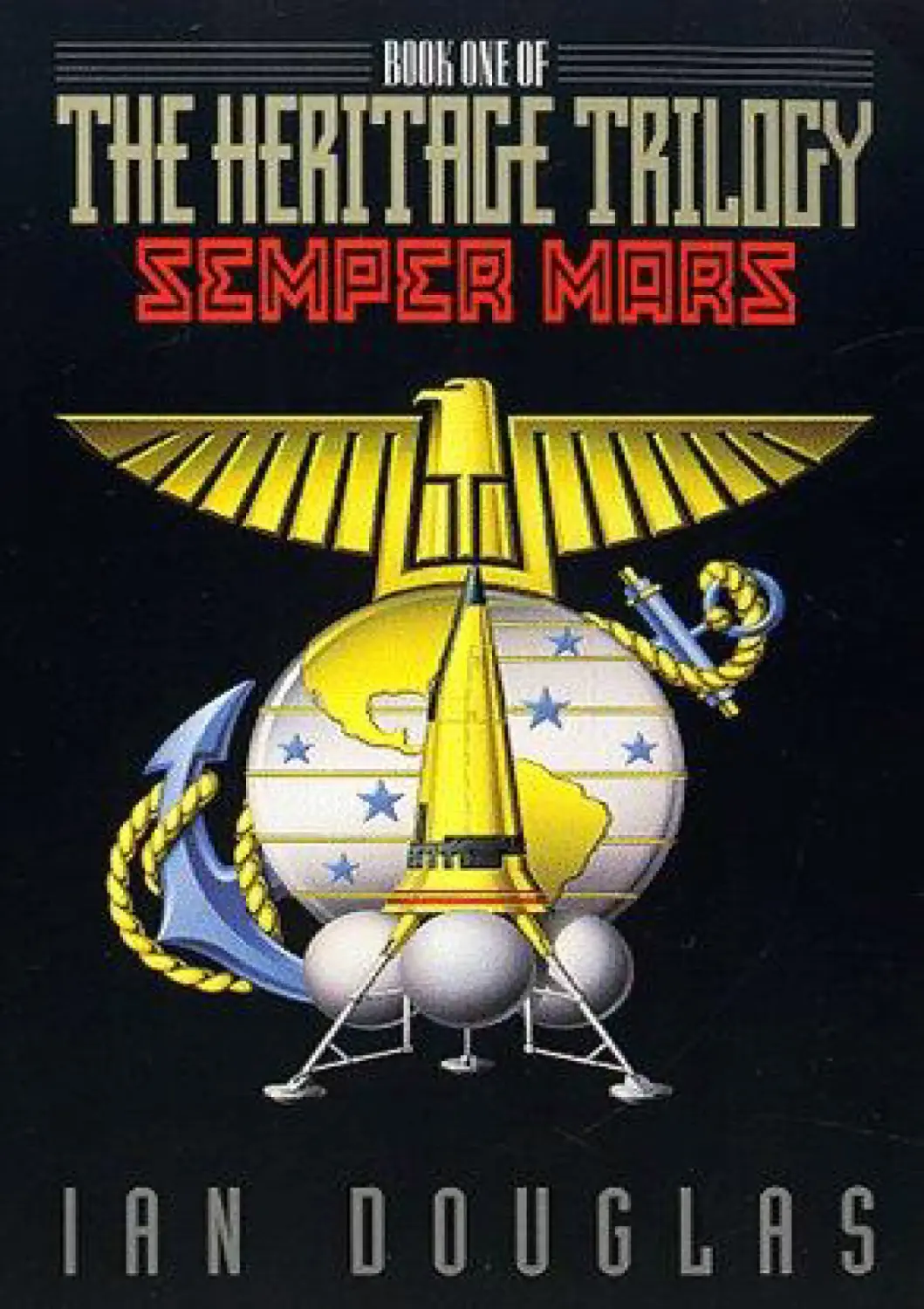
                    Semper Mars
The Heritage 01

Ian Douglas

Semper Mars:
Book One of
the Heritage Trilogy

Ian Douglas

Contents
Map
Prologue
“Christ, CJ! You can’t let them do this to us!”
One
This wasn’t the first time the Marines had ventured into…
Two
“How’s it working now?” Garroway asked, slipping into the
seat…
Three
Kaitlin Garroway took the second-floor door out of Herb
Simon…
Four
Sergeant Gary Bledsoe, USMC, stood at his sandbag-encircled
post on…
Five
“Snakebite, this is Basket. Excalibur. I say again, Excalibur.”
Six
“All right, people!” Colonel Lloyd bellowed. “Listen up! We
got…
Seven
Kaitlin Garroway peered out the cabin window at a sky…
Eight
“I never thought I’d see the day,” Garroway said, “when…
Nine
The last pale glow of the sunset had long since…
Ten

It was just past midnight, the time of the day…
Eleven
Most of the Marines in the barracks area were asleep.
Twelve
“I talked to Doc Casey,” Garroway told the others at…
Thirteen
“So, you got your lines down?” Garroway asked. It was…
Fourteen
It had been eight days since Kaitlin had seen Yukio,…
Fifteen
According to the data displayed on the seatback screen, the…
Sixteen
It was, Garroway thought, one of the oddest-looking marches
in…
Seventeen
Mark Garroway watched his daughter’s face on the Mars
cat’s…
Eighteen
The president looked a lot older now than he had…
Nineteen
The Star Eagle Michael E. Thornton, a single-stage-to-orbit
SCRAMjet transport,…
Twenty
“So,” Mark Garroway said in what he’d intended to be…
Twenty-One
“Cheyenne Mountain, Shepard,” Colonel Dahlgren said,
peering into the telescopic…
Twenty-Two
They’d broken out of the narrow canyon that stretched
across…

Twenty-Three
Thirty hours after the MMEF’s triumphant return to Mars
Prime,…
Twenty-Four
“Down!” Caswell cried, throwing herself facedown into the
sand. “We’re…
Twenty-Five
Kaitlin was on the floor in the den playing chess…
Epilogue
Marine Lieutenant Kaitlin Garroway walked through the
automatic doors of…
Other Books by Ian Douglas
Copyright
About the Publisher

Map

PROLOGUE

MONDAY,

6 JUNE

Office of the Chairman of the
Joint Chiefs of Staff (CJCS)
The Pentagon, Washington, DC
0950 hours EDT
“Christ, CJ! You can’t let them do this to us!”
General Montgomery Warhurst teetered between radically
opposing strategies, storming and pleading. The five-star
admiral seated behind the broad and brightly polished oak
desk before him was not only his commanding officer, but his
friend. He and Admiral Charles Jordan Gray went way back.
They’d been middies together at the Naval Academy, Warhurst
in the Class of ’08, Gray in the Class of ’07. Since their
postings to the five-sided squirrel cage, they’d attended one
another’s social affairs, had barbecues in each other’s
backyards, and shared the same wry disdain for Beltway
politics. For them, the old Marine-Navy rivalry was a seal on
their friendship, banter and laughing bluster over a couple of
beers.
But, by God, Warhurst wasn’t going to let them kill the
Corps, wasn’t going to let C. J. Gray kill the Corps, not if he
had one thin, ragged breath.
Gray gave him a sad smile. “What’s the matter, Monty?
Trying to save your job?”
“That’s not funny. I may be commandant of the United
States Marine Corps, but every Marine is a rifleman first. I’d
resign in an instant if it would change this. You know that. I’d
give my life for the Corps, CJ. I goddamn would.”
The smile vanished. “Jesus, Monty, I know how you feel,
but—”
“Do you?” Warhurst gestured at the four-meter flatscreen
dominating the wall behind Gray’s desk. The display repeated

in hand-high letters the document called up by the admiral’s
wrist-top. The words “HR378637: The Unified Military Act”
showed at the top of the neatly formatted document in punchto-the-stomach bold. “The BBs’ve been whittling away at us
for years now, cutting our appropriations until we’re damn
near running on empty. Now it’s…this.”
Warhurst stopped himself. He was breathing hard, and he
could feel the rising flush in his face, feel the blood
hammering at his temples. His meds monitor would be kicking
in any second now if he kept this up, but, damn it, the BBs—
Pentagon slang for “Beltway Bastards”—never failed to raise
his blood pressure.
And now they were trying to kill the Corps. His Corps!…
“There’s not a damned thing I can do about it,” the admiral
said, shaking his head. His gaze flicked to the left, to the large,
3-D image of a grinning civilian on the wall to his right.
“Archy’s backing this thing, and that means it’ll have the
president’s approval.”
“Severin is a political hack. He’s also an Internationalist—”
“May I remind you that Archibald Severin is secretary of
defense, which makes him our political hack. That means you,
me, and the rest of the Joint Chiefs answer to him…and after
him the NSC and the president. They pass the word, and we
snap to attention, say ‘Yes, sir,’ and politics never rears its
ugly face.”
“Everything in Washington is politics, CJ, and that includes
the Pentagon and everyone in it. You know that as well as I
do.”
“Maybe. But the final word comes from a document you
may have heard of: the Constitution, remember? It says we
work for the politicians. Not the other way around.”
“I never suggested any different. But this Unified Military
Act is political. You know it. I know it. And there’s a political
way to fight back.”
“And what might that be?”
“Public opinion.”

The admiral groaned, shifting in his chair. “Jesus, Monty
—”
“It’s worked before. Truman? A century ago?” President
Harry S Truman, a former artillery officer in the Navy, had
come that close to shutting down the Marine Corps in the
years immediately after World War II, declaring it to be
unnecessary. Public opinion, however—the opinion of
Americans who remembered names like Wake, Tarawa, and
Iwo Jima—had secured a place for the Corps, by law, in the
National Security Act of 1947. And that wasn’t the first time
Washington politicians had tried to kill or dismember the
Corps. Congress alone had tried it on no fewer than five
separate occasions between 1829 and the 1940s.
And each time, public opinion, in one way or another, had
played a part in rescuing the Corps from the budget cutters’
hatchets.
“I know that look,” the admiral said. “You’ve got
something in mind, or you wouldn’t be in here waving your
arms at me.”
Warhurst bent over, picked up the briefcase he’d set on the
thick-carpeted floor when he’d entered the CJCS’s office ten
minutes before, and set it on Gray’s desk. Touching the lock
points, he opened it wide and extracted his PAD, which he slid
across the desk, screen up.
Gray picked the thin panel up, his touch awakening the
screen. He frowned as he read the document displayed there.
“Mars? You want the Marines to go to…Mars?”
“To safeguard American interests there, CJ. The same way
the Marines have safeguarded American interests all over this
world.”
Gray touched the turn-page corner of the PAD. “How big
an operation is this?”
“The logistics are laid out on page five,” Warhurst said.
“I’m suggesting one platoon, twenty-three men. Plus an HQ
element. Thirty men in all.”

The admiral paged through several more screens. “Very
complete.” He looked up at Warhurst, one white eyebrow
askance. “And it’s certainly topical. But you can’t be serious.”
Warhurst reached across the desk and tapped a touch-point
on the Personal Access Device. There was a moment while the
PAD searched for the office’s network channels, and then the
flatscreen behind the admiral’s desk flashed to a new set of
uploading images. Gray swiveled in his chair to watch the
display, which tinted the room with its ruddy glow.
Red sand and ocher stones littered an uneven, rolling
ground as far as the eye could see, beneath a sky gone eerily
pink and wan. An American flag hung from a mast in front of
a cluster of pressurized domehuts, a tiny symbol of national
defiance stirring listlessly in the thin wind. On the horizon,
miles away but looming large enough to seem much closer,
was the mountain. It reminded Warhurst sharply of Ayers
Rock in the Australian outback, monolithic, vast, and red in
the distance-chilled sunlight. The surface was sand-polished
and smooth, its original angles, planes, and swellings worn
down by the wind erosion of five hundred millennia, but the
features were still discernible.
Or so some said. There were still voices—and powerful
ones, at that—insisting that the so-called Cydonian Face, the
Face on Mars, was a natural feature, a kind of cosmic prank
elicited by shadows, coincidence, and the irrepressible human
will to believe.
This despite the latest reports from Cydonia Base.
“In five more months,” Warhurst said, “Columbus will
cycle past Mars and deliver her payload. They used a sealed
hab payload, as was their right by the International Space
Commerce Treaty…but Intelligence tells us the passengers
include fifty soldiers of the Second Demibrigade, Legion
Étranger—French Foreign Legion—in the service of the
United Nations. That’s more soldiers than we have scientists
on Mars, right now…and they’ll be armed, where our people
are not.”

Admiral Gray turned away from the flatscreen, scowling. “I
needn’t remind you, surely, that the administration is fighting
for its life, right now. And trying like the devil to keep a low
profile where the UN is concerned.”
“I’m well aware of our current…foreign policy,” he replied.
The way he said it added the words lack of in front of the word
foreign.
“And how is sending thirty US Marines to Mars supposed
to defuse a situation that is just a step or two short of outright
war?”
“Maybe it doesn’t,” Warhurst said. “But maybe the
president would like an option that doesn’t have us ducking
for cover every time some two-bit dictator in South America
or Asia sneezes and blames us. Maybe stationing troops on
Mars to safeguard our interests—and we’re still allowed to do
that, I remind you, under the charter—maybe that would
convince Geneva to back off and cut us some slack.”
Gray tapped several touchpoints on the PAD. The image of
America’s xenoarcheological station on the bitterly cold and
windswept Cydonian plain remained on the wall flatscreen,
but Warhurst’s proposal came up on the PAD display. “Hmm.
And, just incidentally, it ingratiates the Marines with the
American public, eh?”
“Maybe the American public is tired of getting kicked
around by those two-bit dictators, too, CJ.”
“Maybe. And maybe Congress won’t want to shut down the
Marine Corps while thirty Marines are on their way to protect
our people on Mars.” Suddenly, he grinned, a cold and
lopsided showing of teeth. “My God. SECDEF and State are
going to shit their pants when they see this.” He paused and
shook his head. “Damn it, Monty, why the stick up your ass?
Maybe Archy and the rest are right, and it’s time to let the
Corps retire, with dignity. With honor. Warfare has changed in
the last century, you know…or haven’t you been paying
attention? Marine amphib ops like Inchon and Tavrichanka are
things of the past. We’ll never see a major amphibious landing
again, not when satellites and space stations make secrecy

impossible in any deployment. Do you want the Corps to end
up as nothing more than the Navy’s police force?”
“There are still a few things us Marines do that the other
services don’t,” Warhurst replied. He looked down at the desk
top for a long moment. “I’ll tell you, though, CJ. The reason,
the real reason, doesn’t have that much fact or experience or
science behind it. You know I have a son in the Marines. Ted’s
planning on making it his career. And his son, my grandson,
Jeff. Eleven years old. He commed me just the other day to tell
me he was going to be a Marine. Like his daddy. Like me.
What the hell am I supposed to tell him, CJ, if they kill the
Corps? The tradition? It would be like killing part of who we
are.”
Gray sighed. “There aren’t any easy answers, Monty. You
know that. The UN is pushing, pushing hard, to reduce all
national militaries to a minimum.”
“I’ll let the politicians worry about disarmament,” Warhurst
said. “What I don’t want to see is my son’s face…or Jeffie’s,
when I have to tell them that the Marines are being shut down,
that their country doesn’t need them anymore.”
“A hell of a note,” Gray said, “proving we need them by
sending them to Mars.”
“The Marines,” Warhurst replied, “always go where they’re
needed.”

ONE

WEDNESDAY,

9 MAY

Cycler Spacecraft Polyakov,
three days from Mars Transfer
1517 hours GMT (shipboard
time)
This wasn’t the first time the Marines had ventured into space,
not by a long shot. On February 20, 1962, Colonel John Glenn,
United States Marine Corps, had become the first American in
orbit, thundering into space atop a primitive Atlas-D booster.
Of course, Navy astronauts were quick to point out that Alan
Shepard, a former US Navy aviator and test pilot, had been the
first American in space nine months earlier, even if his
suborbital flight—with a full five minutes in zero G—had also
been the shortest spaceflight in history.
Major Mark Alan Garroway did not think of himself as an
astronaut, even though he’d been in space for seven months,
was drawing astronaut’s flight pay, and was watching now as
Mars drifted past the command center’s main viewport. He
was a passenger—in effect, he was extremely expensive cargo
—aboard the Polyakov, one of four cycler spacecraft set to
shuttling between Earth and Mars in the past decade. He was a
Marine, and as far as he was concerned, sharing bridge
watches with the ship’s three officers—two Russians and an
American—did not make him an astronaut. That distinction
was reserved for the glory boys and girls of NASA’s Astronaut
Corps and the Russkii Kosmonaht Voiska. Marines liked to
boast that every Marine was a riflemen first, and that any other
job description—whether that of AV-32 pilot or combat
engineer, of electronics and computer specialists like
Garroway or the goddamn commandant of the whole
goddamned Corps—was at best a minor elaboration.
Garroway was still less than enthusiastic about this
mission, even after seven months in space. The routine had
swiftly become tedious, especially after the magnificence of

the blue and cloud-smeared Earth faded to nothing more than a
brilliant, blue-white star. It was the sameness of life aboard
ship, day in and day out, that ground away at his nerves,
convincing him that this time, finally, once and for all, when
the mission was done and he got back home, he was going to
retire from the Corps at last. That tour-boat concession in the
Bahamas was looking better and better with each passing
watch. Kaitlin, his daughter, had been accusing him of going
soft, lately, in her frequent v-mails. Well, maybe she was right.
It was hard to stay gung ho for twenty-five years in a Corps
dying of slow starvation…and with nothing much to show for
it but a ticket to Mars and a hell of a long tour away from
home.
Mark Garroway was the second-highest-ranking officer in
the Marine Mars Expeditionary Force, a thirty-man unit
comprised of a single, specially assembled weapons platoon
on special deployment…very special deployment. General
Warhurst himself had put this op together, a last-ditch attempt
at saving the US Marines from the Washington compromiser
corps. Tradition might dictate that Garroway was a rifleman
first, but he rarely thought of himself as such these days. He
was forty-four years old and had been in the Corps for almost
twenty-five years. A mustang, he’d started out as an enlisted
man, an aviation electronics specialist. When he’d re-upped
after his first hitch, however, the Marines had paid for him to
finish his interrupted tour at college, including stints first at
MIT, and later at Carnegie Mellon University in Pittsburgh,
and his area of expertise shifted from straight avionics to the
obtuse, complex, and frequently highly classified electronics
found in military communications, robotics, and AI computer
systems. By then, of course, he’d received his commission,
and he spent most of the next ten years working on classified
programs at half a dozen research labs, from Aberdeen,
Maryland, to Sandia, New Mexico, to Osaka, Japan.
His communications electronics expertise was the reason
he was a part of the MMEF. Technically, he’d volunteered as a
CE Tech for the Marine Mars Expeditionary Force, but no less
a Corps luminary than General Montgomery Warhurst had
personally requested that he accompany the expedition, and so

far as Garroway was concerned, a request by the commandant
of the US Marine Corps was a direct order—a politely
disguised one, perhaps, but a direct order all the same.
Garroway’s primary responsibility on the mission was to
oversee the maintenance of the Marines’ computers and
electronic gear—especially the microcomp circuits that
controlled their battle armor, commo gear, and assault rifles.
Vital work, certainly, but considerably less than a full-time
job. If it hadn’t been for the fact that he was also Colonel
Lloyd’s executive officer, his second-in-command, Garroway
thought he would have gone mad from the boredom by now.
His eyes followed the stately drift of Mars past the control
deck’s windows. He still hadn’t accustomed himself to the
strangeness, the alienness of the world. At the moment, it
looked like a small and seriously diseased orange, its overall
yellow-ocher coloration interrupted by patches, streaks, and
smears of dark browns and grays. The north polar ice cap was
a slender glimmer of sun-dazzled white. That band of black
and dark red along the equator was almost certainly the Valles
Marineris…the Valley of the Mariner Spacecraft. Despite over
a year of study, he could recognize little else in the way of
surface features save the polar cap and the three dark smudges
of the Tharsis volcanoes.
And then the Polyakov’s slow rotation carried the planet
past the edge of the window, and he was looking at stars and
emptiness once more.
To his left, Commander Joshua Reiner reached up and
tapped one of the monitor displays on the console above his
workstation in that annoying way people have of trying to
chivvy delicate electronics into proper operation. “Hey,
Garroway?”
“Yeah?”
“We got a fault in camera sixty-two. No picture.” Reiner
tried upping the gain on a volume control. “No sound, either.”
“Is the thing on?”

“Yup. Readouts say it is, anyway. Must be a loose
connection.”
Garroway snorted. Trouble with electronic systems was
always dismissed as “a loose connection,” even when the
whole system was solid-state, with no wires to come loose in
the first place. Pivoting his seat, he took a look over Josh’s
shoulder, verifying that the system was on, but without sound
or picture.
“Huh. I see what you mean.” The control-deck console was
receiving a visual feed, but the screen was black. The sound,
though, appeared to have been switched off.
“Storm cellar,” Reiner said, identifying the location of the
dead camera. “It’s done this a few times before. Probably
nothing major, but we have to log the failure for maintenance,
y’know?”
“I’d let it go,” Garroway replied, leaning back in his seat.
He was pretty sure he knew what the problem was “See if it
fixes itself.”
“Um. Trouble is, old L&M’s on his way up there.”
“Eh? Why? When?”
“He’s logged for…let’s see.” With a few taps on his
keyboard, Reiner called up a schedule on one of his monitors.
“Here it is. Platoon weapons assembly drill, RSHF, 1530
hours.”
“Oh, shit,” Garroway said, glancing at the digital time
readout on a nearby bulkhead. He’d prepared that schedule last
week but forgotten that a drill was on for today.
“Yeah. And you never know if he’s gonna want a vid
record of the drill.”
“Yeah, roger that.” He pushed back from his console. “I’d
better get up there before he does. Cover for me here?”
“You bet.”
Garroway walked across the control deck, ducked low, and
stepped through the open hatch into the transport-pod
accessway. He moved carefully; spin gravity at the control-

deck level was currently only about two-tenths of a G, and a
careless move could send him slamming into the overhead.
“L&M” stood for “Lloyd and Master,” the wry sobriquet of
Colonel James Andrew Lloyd, the MMEF’s commanding
officer. The name was strictly unofficial, of course, used only
behind his back by those who had to work with him. Lloyd
was a stickler both for regulations and for proper form. His
weapons drills aboard the cycler spacecraft had made him
notorious; what, the ship’s astronaut crew frequently asked one
another in Garroway’s hearing, could possibly be
accomplished by drilling Marines in disassembling and
reassembling their weapons in zero G? It wasn’t as if they
would need to accomplish the feat on Mars, where one-third
gravity kept the inner workings of their M-29s conveniently
anchored.
Technically, Lloyd held no more authority aboard the
cycler than any of the other Marines—or the civilian scientists,
for that matter. The ship’s commanding officer was Polkovnik
Natalia Filatinova, and she was the one who set the standards
by which the men and women in her charge behaved.
Nevertheless, old L&M wouldn’t like it if the storm shelter
was used for…unofficial activities.
Garroway touched the transport-pod call key mounted on
the bulkhead between two lockways. Several moments
dragged past, and then he heard the chunk-hiss of a connection
being made, and the sealed airtight door swung ponderously
open.
A man clambered out, tall and dark-skinned, mustached,
clad in a NASA-blue coverall. Two mission patches adorned
his left shoulder: the light blue flag of the United Nations, and
the circular sword-on-Mars emblem with the letters OEU:AE.
Organisation des Nations unies: Armée de l’Espace. The
United Nations’ Space Force.
“Monsieur Colonel Bergerac,” Garroway said, stepping
aside to clear a way for him.
“Hello, Major.” The man’s English was perfect, his eyes
cold. “Going down? Or up?”

“Up, monsieur.”
“Ah?” He questioned with eyebrows and a cocking of the
head.
“An electronic fault. Nothing serious.” Grateful that the
French colonel seemed uninterested in pushing the question
further, Garroway ducked through the lockway and into the
transport pod beyond. A touch of a keypad sealed the lock
behind him, and then, he was climbing up one of Polyakov’s
three two-hundred-meter arms.
He didn’t like Bergerac. The man was a cold fish, and he
clearly didn’t like Americans, a dislike made sharper by the
current state of cold-war standoff between the United States
and the United Nations. Intelligence had reported the suspicion
that Bergerac and the three officers traveling with him to Mars
were carrying sealed orders of some kind for the UN troops
already there, and Garroway was inclined to believe it. The
man acted as though he was brooding over some dark and
enjoyable secret.
He felt a mild giddiness as the transport pod continued
rising up the strutwork tower. There were no windows, so he
couldn’t gauge his progress visually, but he could feel the spin
gravity dwindling away to almost nothing. Polyakov was
designed like a three-bladed propeller on a slender shaft. The
strutwork blades supported the hab modules, control deck, and
labs some two hundred meters out from the central spine,
where one revolution in forty-five seconds mimicked the 0.38G surface gravity of their destination. On the inward leg of the
cycle, the ship’s rotation would gradually be increased to two
revolutions per minute, working the Earth-bound passengers
up to nine-tenth’s of a G by easy steps.
At the hub of the cycler were the supply modules, fuel, air,
and water tanks, the docking bays for cycler shuttles, and, at
the end of a long boom extending five hundred meters clear
from the rest of the ship, Polyakov’s GE pressurized-water 50
MWe fission reactor.
And, because of the sheer mass of its shielding, Polyakov’s
storm cellar was also mounted on the spine, just down the hub

from the multiple docking collars, core transport-pod
accessway, and main airlock. Only rarely was the big module
referred to by its official name, the Radiation Shielded Hab
Facility, or RSHF. Usually, it was called simply the “storm
cellar,” and with good reason…even if the cycler’s out-isdown spin gravity dictated that Polyakov’s crew had to go up
to reach it. Solar flares were infrequent hazards of flight, but
when a small patch of the sun’s surface suddenly brightened
by a factor of five or ten times, spewing high-energy particles
out in a deadly cloud, there was no way that a spaceship en
route between worlds—locked by fuel requirements and the
laws of physics into its slow-arcing orbit—could turn around
and return to port…or even take evasive action, for that matter.
The storm cellar was the one compartment aboard ship large
enough and heavily shielded enough to give the cycler’s crew
and passengers a chance of surviving if they were caught by a
bad flare.
It was also, by reason of its relatively remote location, one
of the very few places on board a cycler where someone could
leave the crowded hab modules and find a little precious
privacy….
“Storm Cellar”
Cycler Spacecraft Polyakov
1524 hours GMT
Sex in zero G, David Alexander thought, was wonderful…
though it could be even more exhausting than its tamer,
gravity-leaded incarnation. The novelty of no up or down, no
on top or underneath, as the coupling pair twisted in a thin,
hovering mist of drifting sweat droplets, brought an exotic
newness to this most ancient of recreations.
Carefully, he leaned back a little, so he could focus on the
dozing face of his lovely partner, framed in a golden splash of
hair adrift in zero gravity, and as he did, he felt—again—that
tiny, nagging pang of guilt. Alexander was married, but not to
this woman. It had taken a lot of loneliness—and the rather
heavy-handed rationalization that his marriage to Liana was all
but over anyway—to get him to the point where he’d
surrendered to the very considerable temptation. Mireille

Joubert was a beautiful woman and an intelligent one; she
clung avidly to the European notion of cosmopolitan maturity
that saw nothing wrong with two adults enjoying recreational
sex, whether either of them was married or not.
Mireille Joubert. Her first name was difficult…and a
delight. She’d had to coach him on the pronunciation, which
came out something like mere-ray. He turned his gaze to a
drifting wad of clothing a few meters away, remembering
fondly how frantically the French woman had shucked off her
jumpsuit. Two emblems adorned her suit’s sleeve—a blue UN
flag, and a round patch displaying the Cydonian Face. He
could just make out the words embroidered around the patch’s
rim: Expédition Xenoarchéologique de l’Organisation des
Nations unies.
He frowned. There were some who would say that their
lovemaking was treason. Well, screw that. Mireille Joubert
was his colleague, on her way to Mars to assume her new
position as director of the UN archeological oversight team
there, a small group of men and women assigned by Geneva to
monitor US discoveries and excavations at Cydonia.
He didn’t really give a damn about the political situation,
and his only interest in the reports of UN troops on Mars—or
of the Marines, for that matter—was to marvel at the stupidity
of sending soldiers to the red planet instead of more scientists.
He, for one, intended to work closely with his UN colleagues,
and the hell with international tensions. Technically, the UN
team had no real authority on Mars, though their reports and
recommendations could bring political pressure to bear back in
the United States on the agencies and foundations sponsoring
the Mars digs. Aerologist Dr. Jason Graves, already on Mars
with the thirty-some US and Russian scientists on the planet,
was the head of the Planetary Science Team. Alexander had
worked with the man before and doubted that there would be a
problem with his liaison with Joubert. She certainly didn’t
seem to think there was a problem with their fraternization.
Alexander started to ease his way from the woman’s
sleeping embrace, but the movement set them slowly
tumbling, and she opened her eyes. “Mmm. You are wanting

to do it again?” Her long, naked legs, clasped about his hips,
tightened. He’d thought he was sated, but he could feel the
stirrings of renewed interest as she moved against him.
“Do we have time?”
“Quelle heure est-il?”
He knew a little French. She had been teaching him. He
glanced at the time display on his wrist-top. “Uh…almost
fifteen-thirty.” Shipboard time followed military and European
usage, with a twenty-four-hour clock.
“Ah, well…I must go over the site plans with LaSalle at
sixteen….”
He sighed. “Perhaps we’d best undock, then.” Zero-G sex,
for obvious reasons, had picked up a lot of spacecraft
maneuvering terminology. “Docking,” “probe insertion,” and
“docking-collar contact” were favorites.
She pulled him closer, nuzzling his ear and enveloping his
head in a sweet-smelling, drifting blur of golden hair. Her hips
moved in interesting ways. “Oh, but we have much time
yet….”
He groaned—happily—then surrendered to warmth and
growing hunger. He still felt clumsy with Joubert, even after…
what was it? Five times. Or six. He wasn’t sure. Their first
time in the storm cellar, they’d used a Velcro strap to keep
themselves tied together at their waists; any movement in zero
G could have unforeseeable action-reaction repercussions, and
when both partners were moving enthusiastically it was
difficult to stay docked.
Joubert, though, was an expert at this sort of thing. Either
she’d done it before, lots, he thought, or she was a damned fast
learner. Superbly acrobatic, she used her legs to keep them
tightly joined, flexing knees and thighs like an equestrian to
give the necessary friction.
The motion started them turning again, a slow tumble
through the mist of their lovemaking. Lazily, he reached out
with one arm and caught a stowage-bin handle, checking their
spin. Space was precious aboard a cycler. Much of the

hexagonal chamber’s interior space was taken up by supply
bins anchored by bungee cord and Velcro to the room’s inner
surfaces. Fifty or sixty people could have squeezed into the
shelter at once if necessary—hab compartments in
microgravity acquire a third dimension that makes them far
roomier than the same volume of space on Earth—but it would
have been a ghastly exercise in claustrophobic conditioning.
There were no windows, of course. Ports would have
compromised the shelter’s armor. He’d often wished that he
could look out into space during one of these sessions….
A metallic thump sounded somewhere close by.
Alexander reared back from Joubert, startled, his heart
pounding harder now. The cycler was always noisy, especially
here at the hub, where the rotors that kept the hab modules
turning provided a constant background hum, and the effects
of uneven solar heating on the stationary spine made a sound
like far-off thunder. The sounds were muffled, though. Air
pressure aboard the cycler was kept deliberately low, which
meant that sounds didn’t carry well. This had been close…and
very loud.
There was only one thing it could have been—a transport
pod docking with the hub spin-connector module.
Shit!…
“Mireille, someone’s coming!” he hissed, disentangling
himself. “Quickly! Get dressed!”
Too late. The storm cellar’s hatch leading to the connector
mod was already swinging inward. Alexander recognized the
lanky, backlit form of Major Garroway crouched in the
opening, holding the hatch open but keeping his head primly
turned away.
“If there’s anyone in here pulling inventory,” Garroway
called loudly, “they’ve got about two minutes before Colonel
Lloyd, Lieutenant King, and twenty-six Marines come barging
in for weapons drill!”
“Right!” Alexander yelled back. “Almost done!”

Garroway pulled the hatch closed with a muffled clank, and
the two of them were alone again…at least for a couple more
minutes. They began grabbing for floating items of clothing.
His T-shirt was carefully wrapped around the lens of camera
sixty-two, mounted on a corner of the bulkhead. He decided to
leave it in place until they both were more fully dressed.
With a rattling snort, he forced a sharp intake of air past
blocked nasal passages. “What do you think?” he asked the
woman. “Is the smell in here too bad?”
Polyakov was the newest of the fleet of four Earth—Mars
cyclers, assembled in 2037, but she’d still acquired a zoo of
ripe aromas from the tiny, claustrophobic communities that
had accompanied her on two circuits from Earth to Mars and
back. Fortunately, seven months of living aboard had dulled
Alexander to the stench enough that he scarcely noticed
anything now…and when he’d entered the microgravity hub
of the assembly, nasal congestion settled in and pretty much
killed whatever olfactory senses he might have had left.
Despite that, he could detect the heavy muskiness hanging
in the hot air, mingled odors of sweat and passion.
“Ohh, David,” the woman said with coy amusement. “How
romantic….”
“We don’t want them to know, do we?”
Joubert gave a delicate shrug, then folded her knees to her
bare breasts and slipped both legs at once into her red panties.
“And if they know,” she said, “it is that they will simply be
jealous, yes?”
“I’d kind of like to avoid that if we can,” he said, reaching
for white briefs adrift in the air.
She smiled, playful. “Ah. You are afraid your wife finds
out?”
“It’s not that.” Well, not entirely. At the moment, he was
more afraid of the teasing he was likely to get from the other
Americans aboard Polyakov. Four Team scientists, plus thirty
US Marines, and the one Navy guy, Reiner, who was with the
ship’s regular crew. That was a hell of an audience.

The compartment tumbled lazily about his head. He had his
underpants on at last, but he was having trouble imitating the
woman’s casual flexibility with the coveralls, and he kept
getting both feet tangled in the same leg hole. Damn it all.
You’d think that after seven months he’d have managed to
learn how to dress himself….
Well, to be fair, he’d not had to dress in microgravity
except for the few times he’d come up here with Joubert, one
of the distinct advantages of having spin-gravity hab modules.
How was it that she could be so graceful with no more practice
than he’d had? Already dressed, she anchored herself from a
handhold on the bulkhead, then grabbed his shoulder to brace
him as he finally slid into the garment and zipped it up.
Moving to the bulkhead, he untangled his T-shirt from the
camera lens and switched the unit’s sound back on. Swiftly,
then, he used the T-shirt as a towel, trying to soak up some of
the swirling mist of various bodily excretions in the air.
A second clang sounded from the next compartment. A
moment later, the hatchway banged open and a file of Marines
in Class-Three armor began crowding boisterously through
into the long, hexagonal chamber.
“Fall in! Fall in!” one Marine was shouting. He wore a
gunnery sergeant’s chevrons on his sleeve.
“Whee-oo!” another shouted as he squeezed through the
hatch. “I do believe I smell fresh puss—”
“As you were, Donatelli!” the gunny sergeant, catching
sight of Joubert and Alexander before the others did. “There’s
a lady present!”
“Surely ya don’t mean me, Gunny,” a hard-muscled woman
Marine growled as she pushed into the compartment.
“He said ‘lady,’ Caswell. Not hormone-junky.”
“Screw you, Marchewka.”
“Silence! Fall in at attention!”
The crowd fell uncomfortably silent after that, each Marine
grabbing on to a handhold to anchor himself more or less in
line with the others. Alexander eyed them with distaste…ten

or fifteen men and women who were suddenly making the
storm cellar as confining as the inside of a walk-in safe. They
carried rifles and wore partial armor—breastplates and open
helmets, worn over dark green BDUs. The breastplate shells
were made of an artificial laminate that took on the color of its
surroundings, but that hadn’t stopped most of the Marines
from customizing the things with some artistic touches of their
own. Mange la merde was scrawled in red on one Marine’s
armor. Dirty UNdies read another. Alexander scowled. No
wonder America’s relations were so bad with the rest of the
world, if these were her ambassadors.
Alexander decided that he and Joubert had better clear out
before the way was completely blocked. He took a last,
surreptitious look around to make sure there wasn’t any
clothing adrift, then started moving toward the hatch. Joubert
followed.
“Gangway, people!” the sergeant snapped. “At ease and
make a hole! Civilians comin’ through!” The line of Marines
hauled themselves back out of the way, giving the two of them
just enough room to squeeze past. Released from attention,
several Marines whispered among themselves, and someone
giggled.
“Uh…excuse me,” one called out, “but did one of you lose
something?”
Alexander paused at the hatch, turning in time to see a lacy,
bright red bra drifting past the faces of grinning men and
women. Joubert, with far more aplomb than Alexander was
feeling at the moment, snagged the garment, and darted ahead
through the hatch. Alexander followed, clumsily, as laughter
exploded behind him.
In the connector module outside, Alexander came face-toface with Major Garroway, who was clinging to a bulkhead
beside the transport-pod hatch. The module, which was locked
to the rotating hub collar, was turning slowly with a heavy,
grinding sound, though here at the very center of rotation, the
spin gravity at the walls was still practically nonexistent.
According to the lights on the control panel, a second pod was
on the way, carrying, no doubt, the rest of the MMEF section.

The pods, which worked in tandem like Swiss Alpine elevated
cars to preserve the cycler’s spin, could carry only about
fifteen people at a time. The second car would be here any
moment, and then things would really get crowded.
With a loud clunk and the hiss of matching pressures, the
second pod arrived, and the hatch opened up. Another line of
lightly armored men and women spilled out, moving rapidly
across the module toward the storm-cellar hatch. Last out was
a tall, ebony-skinned Marine in fatigues, wearing the silver
eagles of a full colonel at his collar. “What are you doing
here?” he demanded, glaring at the two civilians.
“Uh…inventory, Colonel Lloyd,” Alexander replied.
“Just…uh…checking the stuff the arky teams’ll need at
Cydonia.”
Lloyd gave them a single brief, penetrating, and disdainful
look, then followed the rest of his men into the cellar.
Alexander let the major and Joubert clamber into the
waiting pod ahead of him. From the still-open door of the
storm cellar, he heard Lloyd’s familiar bellow. “All right,
people. Enough skylarking!”
The cellar door boomed shut, cutting off the voice.
Alexander clambered through the pod hatch and grabbed a
handhold next to the major.
“Thanks,” Alexander told him. “For the warning, I mean.”
“Yeah.” Garroway’s voice was hard and cold. His eyes
were on Joubert…or perhaps it was the UN flag on her sleeve
he was staring at.
If he doesn’t like it, Alexander thought viciously, then screw
him!
Alexander hated the very idea of US Marines on Mars,
hated the politics, hated the twisted, jingoist, nationalistic
interests that pretended that such things were necessary. They
had come to Mars to do science, vitally important science,
with the discovery of the Cydonian ruins, and troops were only
going to get in the way.

Well, maybe they’d be able to ignore them. After all, it
wasn’t like there was a war on.

TWO

V IDIMAGE —J ANICE L ANGE AT N ET N EWS N ETWORK ANCHOR
DESK .
LANGE: “In Geneva, today, President Markham concluded his
fifth straight day of talks with UN Director General
Villanueva, announcing that, although much work remains
before the outstanding differences between the United States
and the United Nations can be fully resolved, he is confident
that real progress is being made.”
V IDIMAGE—THE PRESIDENT ADDRESSING A CROWD OF REPORTERS
AND NETHAWKS .
PRESIDENT MARKHAM: “The United States of America is not
now, nor has it ever been, engaged in any plot or cover-up
involving the Martian artifacts. The joint US-Russian
expedition to Mars is carrying out its research and
investigations for the benefit of all humankind. We welcome
the presence of UN observers and scientists at Cydonia. We
welcome their assistance. The discoveries made there so far
are…are astonishing in their implications for humanity, for
everyone on this planet, and there’s enough work there that
needs doing for us to be very happy when anyone offers to
lend a hand.”
V IDIMAGE—DEMONSTRATORS OUTSIDE THE UN H EADQUARTERS
SHOUTING, WAVING FISTS, AND DISPLAYING SIGNS READING “US M
ILITARY OUT OF SPACE!” AND “A LL POWER TO THE UN!” L ONG SHOT
OF P RESIDENT M ARKHAM LEAVING BALCONY AS SOME
DEMONSTRATORS THROW STONES AND UN POLICE STRUGGLE TO
MAINTAIN A PERIMETER .
LANGE: “Large numbers of demonstrators protested the
president’s Geneva visit outside UN Headquarters.”
V IDIMAGE: A PROTESTER, A WOMAN WITH A SIGN READING “US S TAY
H OME. ”

PROTESTER (in translation): “America’s been grabbing the
world’s resources for years! Now they’re trying to rape the
other planets like they’ve raped the Earth! Well, we’re here
today to tell them that we’re not gonna stand for it anymore!”
V IDIMAGE —J ANICE L ANGE AT T RIPLE -N ANCHOR DESK.
LANGE: “In other news today, Secretary of State John Matloff
rejected as ‘absurd’ renewed calls for a UN-mandated
plebiscite to determine the political future of the American
Southwest. Representatives of the Hispanic America Alliance
told reporters today that there would be no peace for America
until the formal creation and recognition of the nation of
Aztlan.”
V IDIMAGE—RIOTERS IN DOWNTOWN L OS A NGELES OVERTURNING A
POLICE CAR AND THROWING STONES, AS TROOPS MOVE IN BEHIND
CLOUDS OF TEAR GAS .

LANGE: “HAA members seek the creation of the new state
from territories in Northern Mexico and from the states of
California, New Mexico, Arizona, and Texas. Armed
confrontations in the region between HAA protesters and
military and police authorities have so far resulted in at least
two hundred deaths….”
WEDNESDAY,

9 MAY

Cycler Spacecraft Polyakov
1546 hours GMT
“How’s it working now?” Garroway asked, slipping into the
seat on the control deck next to Reiner. He didn’t like
microgravity and was glad to get back to a place where up was
up and down was a place you could sit.
The Navy astronaut looked up at the monitor. “Seems to be
fine, now. Vid and sound.” He cocked an eyebrow at the
Marine. “Underpants?”
“T-shirt.”
“Man, nice work if you can get it. Who was it?”
“Doesn’t matter,” Garroway lied.

It was an open secret with the cycler’s crew that passengers
frequently used the storm cellar as a place for some precious,
hard-to-get privacy. Different commanding officers handled
the problem in different ways. Many continued to adhere to
the old policy, born of NASA’s long-standing dread of bad
publicity, of forbidding sexual liaisons during extended space
missions; others reasoned that liaisons were going to happen
no matter what the rule books said, and so long as they didn’t
create problems for the crew or mission as a whole, they were
probably best ignored.
Normally, Garroway wouldn’t have been interested in how
the other cycler passengers passed their too-plentiful free time,
but he was still angry at the realization that the storm cellar’s
occupants this time had been Alexander and the Joubert
woman. Damn it all, the political situation was confused
enough right now, without those two attempting their own
brand of détente.
Reiner was obviously still interested in the identities of the
two up in the cellar, and Garroway decided he wanted to avoid
the issue. He moved his chair so that he could peer across
Reiner’s shoulder at the screen. “Let’s have a look.”
Colonel Lloyd was floating at the far end of the crowded
compartment, while the enlisted Marines were gathered into
two lines running the chamber’s length. Their torso armor had
almost perfectly blended with the white bulkheads, with
random, dark olive streaks where the active camouflage was
picking up arms and legs from nearby Marines. Each Marine
had his or her assault rifle hanging in the air in front of him,
together with a small cloud of metallic pieces, rods, springs,
and oil-glistening parts.
Reiner turned up the gain on the volume. “…faster,
people,” Lloyd was saying, his voice a drill-field growl.
“Faster! The enemy is not gonna wait for you. Pick it up, pick
it up!”
Hands flew as the Marines snatched pieces out of the air,
each movement precise, smooth, and almost machinelike in its
control. They appeared to be reassembling their rifles, and the
number of floating stray parts steadily dwindled.

One Marine, Staff Sergeant Ostrowsky, completed the drill
and brought her assembled rifle to port arms with a sharp slap
as her hand smacked the plastic stock. Two more finished up
—slap-slap!—an instant later, and then all of the Marines
were bringing their rifles up to signal completion in a ragged
chorus of skin on plastic. It was a remarkable demonstration,
Garroway thought. In microgravity, even the slightest
movement tended to give you a push in the opposite direction,
and many rapid movements could accumulate a lot of drift or
spin if you weren’t careful. The Marines of the MMEF
appeared to have mastered the art of balancing move with
move to keep their bodies more or less motionless.
Lloyd waited until the last Marine snapped home the bolt
and brought the weapon to port arms, then touched a button on
his wrist-top. “Not good enough, people,” he growled. “Not
good enough by thirty seconds!”
“Damned robots,” Reiner said. When Garroway looked at
him, he shrugged. “Sorry, Major, but it seems like such a
waste. Like close-order drill, you know? Great back when
armies lined up in nice neat rows and had to go through
loading and firing by the numbers, like two or three hundred
years ago, but pretty useless in a modern war.”
“I’d say it’s a pretty good exercise of self-control and
discipline, wouldn’t you?”
Reiner chuckled. “Well, the next time I need a rifle stripped
down and put back together in zero G, I’ll sure as hell know
who to go to. Shit, why’s he making them wear armor in
there? O1’ Poly’s been around her circuit two and a half times,
now, and she hasn’t been attacked by space pirates once!”
On the screen, Lloyd was grinning at the Marines with
what could only be described as sadistic anticipation. “All
right, people. Since you keep falling asleep at this evolution,
we’ll try to make it a little bit more challenging. We’ll do it
again!” Suddenly, the screen went black. “In the dark!
Ready…begin!”
The sound of clicking and snapping clattered from the
speaker, until Reiner dialed down the gain once more.

Garroway thought about replying to the astronaut’s jibe,
something about discipline under pressure, or even about
needing to learn how to work in the cumbersome armor
without letting it turn you clumsy…but decided at last that it
wasn’t worth it. Reiner was Navy, and there were some things
a squid just couldn’t understand.
The fact was that Reiner had hit pretty close to the mark,
talking about drills evolved from combat necessities centuries
old. There’d been a lot of talk lately about the US Marines
becoming obsolete, and scuttlebutt aplenty about the reason
for this deployment. Garroway was pretty sure the MMEF was
a political chip in some unseen, high-stakes game, a means,
possibly, of keeping the Corps alive when a number of very
powerful people and organizations wanted to kill it. And it was
true that President Markham was beating the drum pretty
loudly during his reelection campaign this year—“our brave
young men and women, serving America’s interests far from
this blue Earth….” The United States was increasingly isolated
in a hostile world, and her citizens were clinging tightly to
symbols of American might, tradition, and security.
None of which addressed the real question. Was the Corps
obsolete? Didn’t the Marines simply duplicate functions now
handled by the Army?
Well, maybe they did. What of it? Garroway was mildly
surprised to find that he didn’t really care, one way or the
other, what became of the Corps.
It wasn’t that he disliked the Marines. Quite the opposite, in
fact. The Marines had introduced him to advanced electronics,
paid for an outstanding college education, and let him work on
some absolutely fascinating projects, from communications
software to advanced AI. The trouble was that he’d pretty
much reached the end of the opportunities that the Corps could
provide. How, he often joked with his daughter, could the
Corps possibly top a trip to Mars? In fact, he’d been passed
over for promotion twice now, a sure sign that he was never
gonna make it to light colonel. He was at the top of his field
inside the Corps, but there was no place else to go. To realize
his true potential, he’d have to reenter the world of civilians.

His background would land him a position at Pittsburgh’s
Moravec Institute easily—he’d worked there for a time on a
government-sponsored AI project, five years ago, and he knew
some people who could pull some strings—but right now he
was less interested in continuing with AI communications
software than he was in the Bahamas…specifically in opening
a charter hydrofoil and submarine tour boat service for rich
vacationers. That was the extent of his ambition at the
moment, a dream that had very little to do with the Corps.
More than one of the people he’d worked with over the past
few years, people including Colonel Lloyd, had accused him
of going ROAD—Retired On Active Duty—marking time, in
other words, until he was a civilian once more.
Well, maybe that was true, in a way. It was a bit ironic,
actually, that he should find himself a member of the MMEF,
occupying a billet that a few thousand other Marines would
have given their teeth for, and he didn’t really want to be here.
Two more years—a planned fifteen-month deployment on
Mars, followed by a seven-month transit home aboard the
cycler Columbus—and he’d be out of the Corps. With all the
military cutbacks lately, he shouldn’t have any trouble
resigning his commission, and a month or two after that he’d
be on the beach at Nassau, alternately soaking up the sun and
soaking the rich tourists.
“Well,” he said at last, after a long silence had passed, “all
the routine traffic is up-to-date. I guess I’ll head back to the
hab.” He stretched. “I still have five minutes’ shower credit
left over from last month, and I think I’m gonna luxuriate.”
“Enjoy,” Reiner replied. “And thanks for your help. I don’t
know what we’ll do if the cameras go out in the shelter again
on the Earth-bound leg.”
“Oh, you’ll manage, I’m sure.” He jerked a thumb at the
monitor. “You won’t have so many passengers on board.
Maybe the romantic ones can use their cubicles, like normal
folks.”
“Nah,” Reiner said, shaking his head. “Zero G is too much
fun.”

“Oh? How would you know?”
“Classified information, Major. I’ll never tell.”
Garroway caught a transport pod and took it down to the
hab-mod level, where the spin gravity now measured .38 Gs,
the same as on the surface of Mars. There were two hab
modules attached to the outermost rack of the cycler’s A-arm.
His quarters were in Hab One, which was reserved for officers,
female Marines, and civilian passengers. The twenty-two
enlisted male Marines were quartered together in Hab Two’s
tiny open dorm. Crowding was bad in both habs—worse in
Two than in One. At least the Marine officers were quartered
two to a compartment. He shared his semiprivate, closet-sized
quarters with the MMEF’s supply officer, Captain Gregory
Barnes.
As he stepped through the lock module into Hab One’s
small rec lounge, he nearly collided with Mireille Joubert.
“Major! Hallo. I wanted to thank you for your, ah, timely
warning.”
“It was nothing.” He’d not meant for his voice to sound
cold, but it did anyway.
“It would have been most embarrassing….”
“Excuse me, Miss Joubert—”
“It is Doctor Joubert, but I wish you would call me
Mireille.” She cocked her head to the left. “We have made this
voyage all the way from Earth, seven months, now, and we
have not had much opportunity to get to know one another.
Perhaps it is time we did so.”
Garroway raised an eyebrow. “I don’t think that would be
such a good idea, ma’am,” he said, a little stiffly.
“Why? Because I work for the UN?”
“Isn’t that enough?”
“I am not one of Colonel Bergerac’s thugs,” she said, lifting
her chin. “I am a scientist, an archeologist. Whatever
differences your nation might have with the UN, they should
not affect you and me.”

“Mmm. To tell you the truth, Dr. Joubert, I feel more
kinship with Bergerac’s ‘thugs,’ as you call them, than I do
with you and your UN observers. In my opinion, it’s
misguided UN policy and the demands being made by your
bureau that have created this crisis. Not my government. And
not the MMEF.”
“Did I say that it was?”
“The opinion the UN has about Marines on this expedition
is well enough known, I think. As are the UN’s opinions about
American sovereignty.” He gave her a wintry smile. “Funny. I
always thought you French would fight to the death to keep
your national sovereignty.”
“And who says we do not, monsieur?” she flared back.
“France is still free. Still sovereign…within very broad and
liberal boundaries.”
“If that’s your story, you stick to it. Now, if you’ll excuse
me, they warned us back at Vandenberg that we shouldn’t
discuss politics with you people.”
Pushing past her, he entered his cubicle and pulled the
accordion-pleated door shut.
What he didn’t need right now was to be reminded about
politics. The political situation on Earth seemed to be
worsening almost week by week, with the increasing pressure
to cave in to UN demands. Russia and the United States of
America were the last two major powers on the planet that had
not signed the UN Reorganization Charter of 2025. That
document called for the establishment of a United Nations
government that would have jurisdiction over the national
governments of the world, the gradual abolition of all national
militaries, and new international laws and regulations
governing the exploitation, shipment, and sale of the world’s
resources.
The reasons for the growing concern—no, the growing
world panic—were easy enough to see. The problems had
been around for a long time, growing steadily, growing as
quickly, in fact, as the world’s population, which currently
stood at something just over nine billion people. Global

warming, the subject of speculation as far back as the 1980s,
had proved to be not speculation but hard fact for forty years
or more. Sea levels had risen by half a meter the world over,
and they were expected to rise by another meter or so before
the century’s end. Rising sea levels—and disastrous storms—
had killed millions, and driven tens of millions more into
refugee status. Precious agricultural land in Bangladesh and
coastal China and the US Gulf Coast had been swallowed up
by the advancing tides. As nations like the United States and
Russia finally ended their dependencies on fossil fuels and
polluting industries, the poorer nations of the world had finally
reached the point where they could become rich…but only by
embracing the air-, land-, and sea-destroying industries that the
US and others were now abandoning. Acid rain generated by
China was destroying forests in western Canada, and the
Amazon rain forest was all but gone now, replaced by ranches
and acid-pissing factories. The last of the oil was swiftly
vanishing; other raw materials vital to civilization—copper,
silver, titanium, cobalt, uranium, a dozen others—were nearly
gone as well. Things were bad enough that the Geneva Report
of 2030 had declared unequivocally that all of the world’s
nations had to be under direct UN control by 2060 if certain
key controls on population and industry were to be
successfully put into place.
No wonder the whole world was casting the US and Russia
as villains, holdouts selfishly clinging to outmoded
sovereignty simply because they feared a little thing like
dictatorship….
Garroway wasn’t sure what the answer was, wasn’t even
sure if there was an answer. The US, though, had been arguing
for years that two new factors were about to break the deadly
cycle of poverty and scarcity on Earth once and for all, if the
industrialized nations of the planet would just cooperate long
enough to make use of them.
The first was the wholesale industrialization of space,
where power from the sun could be collected on a neverbefore-imagined scale and applied to industries that should not
be allowed to pollute or endanger the planet. In another few
years, perhaps, orbital industries could start making a real

difference in the mess on Earth. The question was whether or
not they would be in time….
The second factor, of course, was the discovery of artifacts
on Mars, artifacts representing a technology that was old five
hundred thousand years before humans had domesticated
animals, developed an alphabet, or dreamed of riding ships
into space. The Martian artifacts, the discoveries at Cydonia,
in particular, in the shadow of that huge and enigmatic Face,
were the reason humankind had at last ventured to the red
planet in person.
They were also, unfortunately, the reason the Marines had
been sent to Mars.
“Storm Cellar”
Cycler Spacecraft Polyakov
1602 hours GMT
“All right, people,” Colonel Lloyd bawled. “I’m gonna have
mercy on you poor slimeballs. Report back to the barracks hab
and get squared away. You have one hour before I pull
personal inspection. Then chow. Right? Gunnery Sergeant,
take over this detail.”
“Aye, aye, sir!”
“Dismissed!”
Lance Corporal Frank Kaminski looked at his buddy,
Corporal Jack Slidell, and grinned. Slider grinned back, then
reached above his head to one of the white storage modules
strapped to the storm-cellar bulkhead and gave it a loving pat.
The readout on the module said BATTERIES, GERMANIUMARSENIDE. “Hey, Ski!” Slidell called out. “Wanna quick
charge?”
“Shit, Slider!” Kaminski said. He glanced toward the hatch,
where Gunnery Sergeant Knox and Staff Sergeant Ostrowsky
were ushering Second Section through to the transport pod.
“Ice it, huh?”
Slider just laughed. “Yeah, I’ll ice it. I could use a nice cold
one.” He rotated in the air, catching Ben Fulbert by eye. “How
about it, Full-up? Ready to party?”

Kaminski glanced at the other Marines still in the storm
cellar. Sometimes, Slider could be just a bit too brash for his
own good…and if he screwed things for them now, just a few
days out from Mars…
“Hey, Slider!” Ellen Caswell said, floating up next to them
and catching herself with one hand on the bulkhead. “You and
Ski got extra duty tonight, capische?”
“Aw, fuck,” Slider snapped back. “Again? Fuck this
shit….”
“Fuck it yourself, Slider. You two can clean out the head
cubicle before taps.” She reached out and thumped his
breastplate, right above the garishly scrawled Mange la merde.
“The Man didn’t like your graffiti. Especially with a French
national present.”
Slidell grinned at her around the wad of gum in his mouth.
“Yeah? And what was that Frenchie civilian doin’ up here,
anyway? Diggin’ for buried treasure?”
“The head, shithead. Make it shine. And scrape that shit off
your shell.”
He tossed her a jaunty mock salute. “Aye, aye, sergeant, sir,
ma’am!”
Kaminski sighed. After seven months, he was getting to
know the tiny lavatory facility in the enlisted barracks very
well. Slidell was his fire-team partner, and Corps discipline
held both men responsible for infractions that reflected on the
fire team as a whole. Hell, Fulbert and Marchewka were
probably giving silent thanks that the shit detail hadn’t hit the
entire squad. Slidell had a peculiar talent for drawing fire.
“Ice it down, Slider,” Kaminski said. “We’re in enough
trouble already.”
“Shee-it,” Slidell drawled as Caswell flexed her knees and
launched herself across the compartment toward the hatchway.
“What’re they gonna do, send us to fuckin’ Mars?”
Hang on a little longer, he told himself. Things’ll be better
when you hit dirt. Space was short, and tempers frayed in a
situation where, paradoxically, there were too many people for

the available space and too much work for the available
people. The current TO&E for a Marine weapons platoon
called for five-man squads—a pair of two-man fire teams and
a squad leader—organized two squads to the section, two
sections to the platoon. Kaminski was in First Squad, First
Section; Slider, Sergeant Marchewka, and Lance Corporal Ben
Fulbert were his squadmates, while Sergeant Ellen Caswell
was both First Squad leader and First Assistant Section leader.
Gunny Knox also wore two hats, as First Section leader and as
Lieutenant King’s assistant platoon leader.
With so small a force—a weapons platoon of twenty-three
men and women, reinforced by a headquarters element of
seven more—there was lots of double-hatting going on, and
the Marines, rather than being mere passengers on the cycler
transport, were expected to do their share of maintenance,
cleaning, and general scutwork. The real problem, though, was
the fact that the MMEF platoon was so damned top-heavy in
the ranks. The lowest rank aboard was E-3—lance corporal—
and there were lots of corporals and sergeants, more than was
usual for a typical weapons platoon. And when shit flows
downhill in the military, it lands on the low man on the pole.
Part of the deal, in fact, was that all personnel in the
MMEF would keep their current ranks until the end of the
mission, which was expected to last the better part of two
years, a measure designed by some desk-flying bureaucrat
Earthside to keep the platoon from getting even more topheavy than it was already from sheer time-in-grade attrition.
Where they were going, there were no replacement depots or
work pools to replace the lucky SOB who made E-4. That
wasn’t really as bad as it sounded. All of them were getting
flight pay, hazardous-duty pay, and hardship pay enough to
more than make up for the financial shortcomings of the
arrangement. When they got back to Earth, most of the guys
on their first hitch, Kaminski among them, would have their
four in and have the choice of accepting a double promotion—
Kaminski would have a shot at sergeant—or returning to
civilian life with one hell of a nice separation pay packet.
Kaminski knew what he was gonna do. Four years for him
was a great plenty. He would put in his hitch, and in another

745 days he would be out of here, out of the Corps and back to
being a carefree civilian.
With lots of money waiting for him, too. Surreptitiously, he
reached up beneath his breastplate, tugging at his BDU blouse
to make sure the flag was still wrapped around his waist.
Slidell saw the gesture and laughed. “Still there?”
Kaminski nodded. “Good thing, with all these damned
PIs.”
“You just keep it there, Ski, out of sight. Ha! Man, we’re
gonna clean up when we get back, right?”
“Aw, fer…” Kaminski shook his head. “Why don’t you tell
everyone, Slider?”
“Tell us what?” Sergeant Witek, one of the HQ element
people, asked.
“Nothin’,” Kaminski said, a little nervous. There wasn’t
anything wrong with what he was doing. But the other guys
probably wouldn’t understand….
As far back as the Mercury program in the early 1960s,
astronauts had carried small and easily transported items with
them into space—toy space capsules, coins, even stamped
envelopes that could be postmarked in space…items that
would be worth a hell of a lot to collectors upon their return.
This was a joint venture. It had been Slidell’s idea to take
something that might serve as a souvenir…and Kaminski’s
idea that the souvenir should be a flag, an American flag. He
wore it day and night wrapped around his waist beneath his Tshirt, because if Knox or one of the other senior NCOs found it
in his gear locker during an inspection, he’d be cleaning that
lavatory cube all the way back to Earth, and likely they’d
confiscate the flag, which would be worse. The idea was to
have everyone sign it after the mission was over; Slidell
claimed he knew a guy in San Diego who could put an artifact
like that up for auction. God, a flag signed by fifteen or twenty
of the Marines who’d actually been to Mars ought to fetch
thousands….
“All right, First Section!” Knox called out. “Hit the hatch!”

Making sure his M-29 ATAR assault rifle was securely
strapped to his back, Kaminski joined the other Marines as
they single-filed through the hatch and out to the transport
pod. “Hey, Slider? What the hell do they want with US
Marines on Mars, anyway?”
“Shit, why does the brass ever do anything?” Slidell
replied. “To dump on the enlisted guy.”
Which seemed as good an answer to Kaminski as any he’d
heard so far.

THREE

WEDNESDAY,

9 MAY: 1705 HOURS GMT

Carnegie Mellon University
Pittsburgh, Pennsylvania
1305 hours EDT
Kaitlin Garroway took the second-floor door out of Herb
Simon Hall onto the elwalk and headed for Schenley Park.
Two exams down, three to go, plus her final project, and then
she was off to Japan. She needed to work some more on her
project this afternoon, but first she needed to clear her mind.
After being closed up all morning, she was eager for the sight
of trees and grass and blue sky.
The weather was something she really liked about
Pittsburgh, the variety of the seasons, the spectacular
explosion of fall colors, the sharp joy of spring after an icy
winter. The dull sameness of the weather at Camp Pendleton in
Southern California, where her dad had been stationed before
his junket to Mars and where she’d lived before she entered
college three years ago, had sometimes made her ready to
scream. She laughed. Yukio thought she was nuts, but then his
part of Japan was a lot like Southern California. Small wonder
he hated the winters here.
Resting her hand lightly on the railing, she ran down the
steps from the elwalk to ground level and walked down the hill
into the park. What exactly did she feel for Yukio? She’d liked
him from the moment they’d met last fall, in the Japanese
Room of the International Center, and for the past few months,
they’d been spending more and more of their free time
together. Kaitlin wasn’t scared of the words, “I love you,” and
had certainly used them with Yukio, but did those words
necessarily imply a lifetime commitment? Was she ready for a
lifetime commitment?
Maybe she didn’t need to know. Maybe it was enough to
know that she loved him, that she enjoyed being with him and

talking with him about everything. Well, everything except
politics, but then who does like to talk about politics? Her
parents had never agreed on politics—that’s what her dad said,
at any rate; her mother had died before Kaitlin was politically
aware—and they got along beautifully. She and Yukio had just
recently started talking about the possibility of a long-term
relationship, and now with their upcoming trip to Japan, she
found herself thinking about it a lot.
Yukio wanted to introduce her to his family, and she knew
enough about Japanese protocol to know what that meant. She
and Yukio both considered themselves to be Internationalists,
not in the sense of wanting the UN to take over everything, but
in the sense of being citizens of the world. Would Yukio still
feel that way if it came to a choice between her…and his
family? If his family wouldn’t accept her, would he be willing
to live in the States permanently? Come to think of it, suppose
they did accept her. Would she be willing to leave her country
behind, to make a permanent home in Japan?
She shook her head. Too much serious thinking with
nothing in your stomach is a no-good way to make decisions.
She really wished she could talk to her dad about this, but
somehow she hadn’t been able to tell him about Yukio, and
she wasn’t entirely sure why. She hadn’t even told him about
the trip to Japan. Not that she needed to, of course. She was of
age, she had her own passport, and she was paying for the trip
out of money she’d earned. But it had been a long time since
she’d kept a secret from her father. She grinned. Usually the
two of them kept secrets from others.
She reached her favorite tree, a sprawling black walnut, and
sat down, first unhooking her PAD case from her hip belt.
Taking her PAD out of its case, she carefully unfolded it and
propped it up on her knees, keying it to download her v-mail.
The usual departmental garbage—she’d have to check through
it later to make sure she wasn’t missing anything important.
She still hadn’t been able to write a filter good enough to catch
everything she needed to see. She’d once accused Namir, the
department head, of deliberately writing department memos so
obscurely that a programmed filter wouldn’t be able to extract
the substance. “Well, if your filter isn’t good enough, Kaitlin,”

he’d said with an irritating twinkle, “perhaps you’d better
write one that is.” Naturally, she’d risen to the challenge, but
just as naturally, Namir had increased the obfuscatory nature
of his memos. She grinned. She’d learned more about selfenhancing systems writing and rewriting those damned filters
than she had in three years of classes. Namir’s method was
brutal, but it worked.
Hmm, what else? A few vids from friends, nothing critical.
Nothing from Yukio, but that wasn’t surprising. They’d
planned to meet here after his exam, so the only reason for him
to comm her would be to tell her that he couldn’t make it.
Notice of the Zugswang meeting tonight. She keyed in a reply,
saying that she was planning on being there. A few games of
chess would be the best preparation she could think of for her
physics exam the next day. More study at this point would
only fry her brain.
Ooh, great, a message from Dad. Kaitlin checked her wristtop for the current time and then tapped a key to give her
GMT, the Greenwich Mean Time that all spaceships and all
space expeditions ran on. Only four hours difference now that
Daylight Savings had kicked in, so it was late afternoon on the
Polyakov. He mostly wrote her at night. When he wrote at
other times, it was usually because he had something special to
say, something beyond the trivia of day-to-day life aboard a
cycler bound for Mars. She snorted. As if he didn’t know full
well that anything that happened on board the Polyakov was
fascinating to her. She’d been space-happy since…since she
didn’t know how long. At least since she saw her first
Vandenberg launch, but the genesis of her space fever was a
lot earlier than that.
She remembered her mother reading to her a lot when she
was little. Her dad had told her that a lot of the books her
mother read to her were stories about spaceships and other
planets and alien beings, books she later devoured for herself.
Books by Heinlein and Asimov, Longyear and Brin, Zettel and
Ecklar. It was infuriating. Here her dad was going off on a trip
she’d give her eyeteeth for, not to mention certain other less
mentionable parts, and he didn’t care! He’d rather be on a
beach in the Bahamas than on the sands of Mars! She was

gonna have to comm that man a lecture. If he didn’t learn to
enjoy walking where no human had walked before…well, she
wasn’t sure what she’d do to him, but it wouldn’t be pleasant,
she could assure him of that.
She tapped on the vid icon on her PAD. It swelled and
morphed into a waist-up view of a Marine major, with the
stark gray wall of his hab behind him.
“The top o’ the morning to you, Chicako,” he said with a
grin, “or whatever time it is when you see this.” She grinned in
return. The pet name her dad had given her when she was six
and in love with everything Japanese meant “near and dear,”
and only he and Yukio were allowed to use it. “Well, it’s been
another exciting day in the old Poly, dodging asteroids and
space pirates again. To keep from dying of boredom, I’ve
actually resorted to some of those science-fiction books you
gave me. The problem is, of course, that the realistic ones are
boring and the unrealistic ones keep reminding me of how
boring the real planet is likely to be. Take this one I’ve been
reading lately, for instance.” He held his PAD up in front of
him. “Red Planet by that buddy of yours, Robert Heinlein.”
Buddy of mine! Come on, Dad. He’s been dead for fifty
years.
“What I’m thinking is, if there were any aliens down there
where we’re going, like there are in that book, well, then this
trip just might be worth something. But you know, Chicako, I
just can’t see that investigating rocks is worth the investment
of thirty Marines. I can’t help but feel that we’re being used
somehow.” He shook his head and chuckled. “What am I
talking about; of course, we’re being used. We’re supposed to
be used. I guess what I mean is that we’re not being used
properly. We’re not being used as a tool, we’re being used as a
pawn in some vast political game that I don’t understand. But I
can tell you, I don’t like it.”
He looked away for a long moment. “Something else I
don’t like,” he said finally, turning back to face her. “This…
uneasy dance we’re doing with the UN. I know we have to let
them use our cyclers by treaty, but why we’re letting them

horn in on our explorations on Mars is beyond me. Do they
really think we’d hog all the goodies? I don’t know.”
“There’s something that happened today I want to tell you
about. It…it disturbed me, and I’m not entirely sure why.
Maybe you can help me make some sense out of it. So long,
Chicako. When next you see me, I’ll be on the beach.” His
mouth twisted in a wry grin. “No ocean, unfortunately, but it’ll
be nice to have ground underfoot again. Till then.” His face
stayed on the screen for a full second and then dissolved into a
string of numbers—the rest of his message was in code.
They’d started writing in code right after her mother died.
A big, grown-up seven-year-old girl didn’t really want to put
down in writing that she was scared, that she missed her
mommy, that she wished her daddy could be home with her
instead of being stationed overseas. So her dad had taught her
a simple substitution code so she could say all those things
without anyone else knowing what she was saying.
Over the years their codes became more and more
sophisticated, until now they were using a Beale code,
guaranteed unbreakable without the book the code is based on.
And that was the beauty of it. It could be any book; it was
simply necessary that the two parties agree on the book and,
specifically, on the edition of that book. For the Mars trip, the
Garroways had agreed on a 2038 reprinting of Shogun, a
twentieth-century novel about sixteenth-century Japan. Kaitlin
had downloaded both the book and her own Beale code
translation program to her dad’s wrist-top before he’d left for
Vandenberg.
Since then he’d used the Beale code routine for a part of
just about every letter he’d sent her, but in the seven months
that he’d been gone on the Polyakov, he’d only used it once or
twice for more than a one- or two-liner. She paged down and
estimated that, decoded, the message would probably run four
or five paragraphs.
Kaitlin selected the text and ran her Beale code routine,
wishing she could talk to him. V-mail was great, but there
were still limitations. On the other hand, if he were here in
person, he probably wouldn’t talk about what was bothering

him. He was a very private person. Maybe writing about
whatever it was that had happened was the only way he could
let it out.
As she began to read the translated text, she found herself
growing cold. “Consorting with the enemy,” he called it. Just
because the woman was working for the UN? What is this? It’s
not as though we’re at war or anything. She wondered what
her father would think of her relationship with Yukio and was
suddenly very glad she hadn’t told him about her proposed trip
to Japan.
A shadow fell over her PAD, and she looked up, startled.
The backlit figure looming above her raised his hands in mock
horror. “I didn’t do it! Honest! Whatever it was, it wasn’t me!”
She quickly tapped on the screen, hiding the message in the
background. “Oh, it’s just Dad,” she said, as Yukio coiled
down beside her.
“Ah.”
Kaitlin folded up her PAD and tucked it back into its case.
“And just what does ‘ah’ mean?” she asked.
He smiled. “It means that occasionally experiencing a lack
of harmony with one’s paternal ancestor appears not to be an
exclusively Japanese trait.”
“Ah.”
“Exactly.” He began twining his fingers through her hair.
“Have I mentioned lately that I love you, Chicako?”
She grinned. “Not since we got out of bed this morning,
Snow Boy,” she replied, using a rough translation of his name.
She put her arms around his neck to greet him properly.
“You’re good for me, did you know that?”
“Mmm,” he murmured as he responded warmly to her kiss.
“You’ve said something about that a time or two before, I
believe.”
After a long moment, she pulled back. “You know, I’m
kind of glad I stopped by the Japanese Room that day.”

He nodded. “Me too. But we would have met eventually. It
was fated.”
Kaitlin looked quizzically at him. “Do you believe that? Do
you really believe everything will work out for us?”
He turned very serious eyes toward her. “Those are two
distinct questions, Kaitlin. Ones that do not necessarily have
the same answer.”
There was no response to make to that, so she made none.
She knew what he meant; there was no point in going over it
again. Instead she opened her belt pouch and pulled out the
two quick-pak lunches she’d picked up earlier at the campus
store.
“The landing is only a few days away now, isn’t it?” Yukio
asked as he produced two cold-bottles out of a hip pouch. He
thumbed them open and handed one to her.
Kaitlin took a sip and then another. “Mmm, kiwi, that’s
good.” She pressed a button on her wrist-top to check the
calendar. “Yes. Three days. They should rendezvous with the
landers Saturday morning.”
“It is not a Japanese sentiment, but I…I envy them.” He
tore off the lunch pack’s lid and started to eat it.
Her mouth quirked in a wry grin. “It’s funny, isn’t it. Here
the two of us are, dying to go into space. And there’s my dad
on his way to Mars, and he doesn’t even want to be there! He
keeps complaining about being bored!” She picked a
processed seabar out of her lunch and started chewing on it.
“Is that what was…bothering you?”
She swallowed and took a deep breath. Might as well talk
about it. “No. It was politics again. Damn, I hate politics!”
Yukio shrugged. “Politics is nothing more than two people
trying to decide if they can share a bowl of rice, or if one of
them will use his sword to ensure that all the rice is his. It is as
much a part of being human as breathing.”
“Well, then maybe being human ain’t all it’s cracked up to
be. Why can’t people just work together without all this stupid

squabbling? Why can’t we take care of each other instead of
fighting over who gets the scraps?”
“It is not in our heritage to be kind to others when we
haven’t enough for ourselves. Altruism is not a survival trait,
Kaitling.”
She grinned at his deliberate mispronunciation of her name.
Yukio was proud of his English, justifiably so, and this past
year had delighted in adding English puns to his repertoire.
“Well, I’m not entirely sure what the bowl of rice is, in this
case, but the guys with swords seem to be two of the
archeologists. Actually, the problem seems to be that they’re
not using their swords but Dad thinks they should. I don’t
know. I think this metaphor is getting bent all out of shape.”
She finished up the seabar and started in on the edible
packaging.
“There are lots more where that one came from.”
She laughed. “Maybe I should just try to tell the story
straight. Dad feels strongly that Americans should not be…
intimate with UN personnel. In fact, he went so far as to call it
‘consorting with the enemy.’ Can you believe that?”
Yukio was silent for so long that she wondered if he’d
heard her. “Yukio?”
He started. “I am sorry. I think my father would find your
father’s sentiment…not difficult to understand. There is
considerable tension now concerning the possibilities of what
may be discovered on Mars. I believe…I fear that it could lead
to war.”
“But that’s absurd! Whatever we find there, it’s gonna take
years to figure out even what it is, much less how we can use
it! Why would we go to war over something like that?”
“Because people aren’t always sensible, my love. Because
a perceived advantage can be as strong a reason to fight as a
real advantage.”
“What would Japan do? What does your father say?”

“If the UN and the US were at war?” Yukio shook his head.
“It is hard to say. We have treaty obligations to the United
Nations, it is true…but my country is always loyal to itself
first. I believe we will try to stay out of the fighting, if we can.
I do not know what my father believes.”
“Well, maybe we can ask him in person next week.”
Yukio made no reply. Kaitlin let the silence drag on for a
while, looking closely at him. Something was bugging him,
but she knew better than to try to get anything out of him
before he was ready to talk. He was a lot like her father in that
respect. But she could sometimes get away with badgering her
father when he was trying to keep things from her. If she did
that with Yukio, he would just clam up even more.
“Kaitlin,” he said finally. “I need to talk to you about our…
proposed trip.”
Proposed? She’d thought it was settled. She clamped down
on the questions she wanted to ask, giving Yukio the space to
say things in his own way.
“I have received orders from the Space Defense Force. I
must report to Tanegashima in twelve days.”
She was stunned. She’d known, of course, that Yukio was
technically in the military—he was here in the US, after all, to
study the advanced electronics he needed as a space-aviation
specialist—but he was supposed to be on a two-year study
leave, or whatever they called it. They weren’t supposed to
suddenly call him back, not now when—
She stopped herself. You’re a grown woman, Kaitlin, she
told herself. Start acting like one.
“What’s the reason for the sudden recall?” she asked in
what she was delighted to hear was a calm voice. “Did they
give any explanation?”
“My orders say merely that I am assigned to Tanegashima
Space Base for a possible upgrade in my flight status. They
don’t even say how long I am expected to be there. But I
received a vidmessage from my father. Because of his position
with the government he frequently has access to information

that is withheld from ordinary mortals. The impression I
receive from his words is that this is a temporary assignment
only, that I will be permitted to return here next fall to
continue my studies. He implies that we are simply putting on
a good face for our allies.”
“Did you know that something like this might happen? I
mean, I thought the deal was that you would complete your
studies before going back into the service.”
Yukio had finished his lunch, box and all. He picked up a
small stone and began carving into the dirt at the base of the
tree. “You say, ‘going back into the service.’ But, Kaitlin, I
have never left. I am a chu-i in the Space Defense Force—you
would say a ‘lieutenant’—and I have always been under
orders. I must follow those orders and fulfill my duty.”
“Funny,” she said, brandishing a dessert roll at him. “I
always thought of you as chocolate creme, not chu-i.”
Either he did not catch her pun, or he ignored it. He took a
deep breath and looked straight at her. “We will have to cancel
our trip, or at least postpone it. Perhaps you can come out
later, when I know—”
“Why?”
Yukio looked startled, and then his face went cold and
expressionless, and Kaitlin bit her lip. He seemed so
Westernized, so…American, most of the time that she often
forgot that he was still obedient to shikata, the way of doing
things that is so distinctly Japanese. Interrupting a speaker
when the two are equals was more than rude, it was disruptive
of the wa, or harmony, that all Nihonjin strive for.
“Sumimasen, Toshiyuki-san.” She bowed her head,
instinctively turning to Nihongo for her apology. The two of
them spoke a mixture of English and Japanese with each other,
but some things just didn’t come out right in English. “O-jama
shimashita.”
“Daijobu, Chicako.” He reached out and stroked her cheek.
“I try to be open to Western ways, but sometimes I still just…
react. After living here for a year I see much that is good in

your openness, in your willingness to try new things, to
change, but I find sometimes that I am still tied to the old
ways. And the old ways must change if we are to take
advantage of all the future has to offer.”
“But there is good in the old ways, Yukio.”
He nodded. “Yes. We must find a way to continue the
growth of the past one hundred years without losing that
which makes us what we are. It is…difficult.
“When we planned this trip, it was with the understanding
that we would be traveling together, that I would introduce
you to my family, yes, but also that I would show you around
the country. This I can no longer do. I will probably be free
from duty most evenings, but Tanegashima is six hundred
kilometers from Kyoto. Even traveling by hydrofoil and
maglev, it would be impossible for me to come home for
anything less than a weekend.”
“But couldn’t I meet you there?” Kaitlin countered. She
polished off the last of her package and washed it down with a
slug of kiwi drink. “You’re right, it’s a long way from Kyoto,
but your home’s not the only possibility. If I couldn’t actually
go to the base, maybe I could meet you at Kagoshima or
Miyazaki. There are probably youth hostels there, same as
there are in Kyoto.”
“But still I would be working, and I do not even know if I
will have evenings or weekends off.”
“When do you have to report? What day?”
“A week from Monday.”
“Well, then we’d still have three days together, I’d get to
meet your parents, your family, and after that…You seem to
have forgotten that I have my own reasons for wanting to go to
Japan.”
Yukio picked up his stone again and continued his scraping.
“You truly wouldn’t object to being on your own in my
country?”
She raised one eyebrow. “Is my Nihongo that bad?”

He grinned and tossed the stone at her. “You speak it
fluently, and you know it.”
“Precisely. So we leave next Thursday as planned. Right?”
“One final question. These are…dangerous times. Do you
really think it will be safe for you to travel to a country allied
with the UN?”
“The idea of war over Mars is ridiculous, Yukio. Mexico,
I’ll grant you, is a problem, with the Aztlan question and
everything, but even if that flares up, I can’t see Geneva
putting Japanese troops on American soil to deal with it. Look,
I know our countries are technically on different sides, but
Japan has resisted the UN-sanctioned embargoes. We’re still
trade partners. I just can’t see that there would be a problem.
It’s not as though we’re talking about going to Colombia or
France!”
Yukio shook his head. “I did not want to prevent you from
going to Japan, but I wanted to make sure that you knew what
the situation was.”
Kaitlin grinned. “Yukio, my love, you couldn’t have kept
me from going to Japan if you’d tried, and that’s not my
Western individualism talking. That’s money talking. Maybe
rich kids like you can contemplate with equanimity losing a
couple thousand bucks on a canceled SCRAMjet fare, but I
can’t. I’ve been saving up for a trip to Japan ever since I was
old enough to rake leaves, and I’m gonna be on that Star Raker
next Thursday, whether you’re there or not.”

FOUR

FRIDAY,

11 MAY

United States Embassy
Mexico City, República de
México
1453 hours local time
Sergeant Gary Bledsoe, USMC, stood at his sandbag-encircled
post on the portico outside the Embassy Residence, watching
uneasily as the crowds gathered in the plaza beyond the front
gate. Many carried signs, some in Spanish, most—displayed
for the reporters and vidcams—in English. YANQUIS HANDS OFF
MARS! one read. ALIEN TREASURES ARE FOR ALL! read another.
Some of the demonstrators evidently were voicing their
support for Aztlan, an Hispanic homeland to be carved out of
Mexico’s northernmost states—and the US Southwest.
Tensions with Mexico had been at the boiling point since
2038, ever since the UN declared a plebiscite to be held in
August of this year; the United States had already announced
that it was not signatory to the agreement that had called for a
vote on independence within its own territorial boundaries.
Occasionally, a rock or bit of garbage sailed over the high
stone wall that fenced off the embassy compound. Someone,
Bledsoe could hear, was haranguing the crowd in Spanish over
a shrill and feedback-prone PA. He couldn’t tell what was
being said, but the crowd evidently approved, judging from the
full-throated roar that followed each emphatic statement.
“Man, what’s bitin’ them?” Corporal Frank Larabee,
standing at Bledsoe’s side, said nervously.
“What’s the matter? Don’t you download the netnews?”
Bledsoe said, his tone bantering. “They’re afraid we’re out to
loot the Ancients’ ruins on Mars and get all the good stuff for
ourselves.”
“Yeah? So what’s that got to do with us?”

“The Ugly American, guy. Haven’t you heard? We’re
getting uglier every day.”
“Ugly?” Larabee patted his M-29 assault rifle. “I’ll show
’em ugly.”
“Easy there, Bee,” Gary said. “I haven’t heard a weaponsfree, yet. You just be damn certain your toy’s clean.”
Both Marines were wearing their Class-Threes, low-tech,
camouflaged helmets and kinevlar torso armor. Normally, of
course, they’d have been in their Class-As, the full-dress blues
with red-and-white trim that had been the uniform of Marines
on embassy guard duty for well over a century now, but as the
Mexican crisis had exploded into this ongoing riot, the orders
had come down to go to battle dress.
The orders had also allowed them to carry loaded weapons,
though they still had to wait for a release order to lock and
load or open fire, even if they were fired on first. For a while
there, a couple of weeks ago, the embassy Marines had been
going around with unloaded rifles. The joke going the rounds
at the time had been that the boxy, plastic M-29s weren’t
properly shaped to serve as decent clubs, so if a Marine was
attacked, his best bet was to give his rifle to his attacker, then
kick the bastard in the kneecap while he was still trying to
figure out how the adtech weapon worked.
The M-29 ATAR, or advanced-technology assault rifle, was
a direct-line descendent of the German-made G-11s of the last
century, firing a 4.5mm ablative sabot caseless round with a
muzzle velocity of over a kilometer and a half per second.
With each bullet embedded in a solid, rectangular block of
propellant, there was no spent brass with each shot, and no
open ejection port to foul with dirt, sand, or mud. The weapon
was loaded by snapping a plastic box containing one hundred
rounds into the loading port in the butt, a “bullpup” design that
resulted in a rifle only seventy centimeters long and weighing
just four kilos. The ’29 looked like a blocky, squared-off
plastic toy with a cheap telescope affixed to the top and a
pistol grip on the bottom…which was why the men and
women who carried them referred to the weapons as their toys.

The caseless ammo was both the M-29’s greatest strength
and its biggest weakness. The lack of shell casings to feed
through an ejection port gave the rifle an incredibly high
cyclic rate of twenty-five hundred rounds per minute, so fast
that a three- or five-round burst could have the bullets on their
way and dead on-target before the recoil had affected the
shooter’s aim. On the downside, though, the firing chamber
was easily fouled by chemical residues from the propellant
blocks. The weapon used a clean-burning propellant, but there
was always some gunk left over when it burned, and without
an ejection port or shell casings, that gunk built up fast…fast
enough to degrade the rifle’s performance after only a couple
of mags.
The Corps, which lived by the rule that the rifle was the
whole reason there was a Marine in the first place, met this
weakness with typical directness. Every Marine took a
perfectionist’s care of his weapon, learning to field-strip and
clean it under the most extreme and dangerous of conditions,
to do it fast, and to do it right. “Aw, he’s got shit up his
chamber” was by now well-established Marine slang for
someone who didn’t know what was what, who hadn’t gotten
the word, or who didn’t know what the hell he was doing.
“She’s clean, Sarge,” Larabee said, replying to Bledsoe’s
warning. “Clean enough to eat off of. Uh-oh. Heads up.”
Bledsoe turned to check the direction in which Larabee was
looking. Captain Theodore Warhurst was emerging from the
Residence. “Atten…hut!”
“As you were, men,” Warhurst snapped. Like Bledsoe and
Larabee, he wore fatigues, vest armor, and an old-style coalscuttle helmet with a cloth camouflage cover. A service issue
M-2020 pistol was secured to his combat vest in a shoulderholster rig. “What’s the word?”
“Natives are gettin’ restless, Captain,” Bledsoe said. He
gestured toward the embassy’s front gate, less than twenty
meters away. “I don’t hablo the Español, much, but it sounds
to me like that guy with the microphone is getting them pretty
riled up.”

“Intel IDed that guy as a local SUD preacher. He could be
trouble.”
“Man,” Larabee said. “That’s all we need.”
The Solamente Uno Dios was one of the noisier and more
bitter factions competing for attention in the Federal District
these days. Formed as part of the backlash against the myriad
new religions and groups devoted to worshiping the Ancients
as gods, the SUD was a startlingly unlikely coalition of
Baptists, Pentacostals, and a few Catholics who found
common cause in their belief that God, not aliens, had created
Mankind and that the alien artifacts discovered on Mars should
be left strictly alone. There were some things, SUD
spokespersons declared every time a television or netnews
camera was pointed in their direction, that Man simply was not
meant to know, and other things that were explained so clearly
in the Bible, thank you, that no further explanation was
needed. There’d been several bloody clashes during the past
few days between the SUD and some of the pro-Ancients
groups, the International Ancient Astronaut Network and Las
Alienistas, in particular.
Now, it seemed, the local SUDs were getting ready to take
on the US Embassy.
“Just wanted to let you guys know,” Warhurst said, keeping
his eyes on the crowd beyond the high wall. “We’re
evacuating. Closing up shop and pulling out.”
“Evacuating!” Bledsoe said, startled.
“That’s what they tell me. We’re passing the word in
person, though, so our friends out there can’t listen in on our
platoon freaks. We’ve got Perries inbound now from the
Reagan.”
“All right,” Larabee said. “About time we got clear of this
shithole.”
“What’s it mean, Captain?” Bledsoe asked. “War?”
“Shit. You’ll know when I know, Sergeant.”
“Yeah, but Peregrines. I mean, are they fighting their way
through Mexican airspace, or what?”

“I guess we’ll find out when they get here, won’t we?”
“If they get here,” Larabee put in.
Warhurst chuckled. “We’re talking TR-5s, Sergeant.
Probably with Valkyries on CAP. They’ll get here. I don’t
think the whole Mexican Air Force has anything more modern
than a couple dozen old F/A-22s.
“In any case, Major Bainbridge wants you men to be on
your toes. Those Peregrines’ ETA is in another twenty minutes
or so…and when they set down, the crowd could get a bit…
eager.”
“We’ll be ready, sir.” Bledsoe slapped the side of his ATAR
for emphasis, a sharp crack of palm on plastic.
“I know you will. Carry on, Marines.” He turned and
disappeared into the Residence.
“Hey, Bled. Is it true what they say about that guy?”
“About him bein’ the commandant’s son? Sure is. I got the
straight shit from Dolchik in Personnel.”
“I’ll be damned. He’s not a bad sort, for the son of God.”
“Well, I’ll tell you. I’d rather have him at my back in a
firefight than some of these new-Corps pukes.”
“Roger that.” They listened for several minutes more to the
speech barking from the speakers outside the embassy walls.
A final pronouncement sent the crowd wild, cheering and
screaming and swearing and shouting, until Bledsoe thought
they must be planning to knock down the walls by sheer
volume alone. Another volley of garbage hurtled over the
fence, bouncing and scattering across the lawn beneath one of
the compound’s spreading cypress trees but coming nowhere
near the two Marines and their sandbag-barricaded post.
Bledsoe slung his rifle—with the crisis on, they were not
required to remain rigidly at attention, soldiers on parade, as
they would have been otherwise—and pulled his PAD out of
the thigh pocket in his fatigue pants. When he touched the
wake-up key, a keyboard and a display screen winked on, and
he began tapping at the unyielding flat surface.

“Whatcha doin’?” Larabee asked.
“Linking in to the security net,” Bledsoe replied. Several
perimeter camera views were available over the general
embassy net. “Ah. Here we go.”
His PAD’s display screen flickered from the logo of the
embassy’s local server to a low-res, real-time image shot from
one of the small security cameras perched atop the compound
wall. The scene looked out across the Paseo de la Reforma,
Mexico City’s Great White Way, a broad and skyscraper-lined
boulevard that was now smothered in a seething, shifting mass
of humanity. A short distance up the road, El Angel stood
gracefully on her pedestal, a towering monument to Mexican
independence; a dozen men had swarmed up her base to a
vantage point well above the heads of the crowd. Beyond, the
elegant but aging facade of the Maria Isabel Sheraton was
nearly lost behind the surging mob.
Several rocks clattered off the embassy gate.
“Get a load of this,” Bledsoe said, handing the PAD to
Larabee. He pointed to the display. The security camera had
clearly picked up a number of Mexican soldiers—in full battle
gear—gathered in a small group in front of the Sheraton Hotel.
“Are they watching the mob?” Larabee wanted to know.
“Or getting ready to join in?”
“Damfino,” Bledsoe replied. “Maybe they don’t know
either. They might be there just to make sure the rocks don’t
get thrown at Mexican property.”
“Yeah, but if a few gringos get dinged up, no big deal,
right?”
Bledsoe set the PAD on top of the sandbag barricade and
unslung his assault rifle. He didn’t like the looks of that crowd
—too many tough-looking and angry young men, and no
women or children visible at all. If this was really a
spontaneous demonstration, like the local sources had been
saying, he would have expected to see a more broadly
distributed mix representing the local demographics.

Not something that looked more like an army than a mob of
demonstrators….
United States Embassy
Mexico City, República de
México
1512 hours local time
“Come in.”
Captain Theodore Warhurst opened the door and entered
the large room—all deep carpets and oak paneling and framed
photographs and oils—that was the office of Franklin R.
Tibbs, the United States ambassador to Mexico. The scene
inside was one of quiet, almost deliberate confusion, as aides
transferred stacks of papers from gaping filing cabinets into
boxes and piled them up. As Warhurst approached the desk,
three more undersecretaries came into the room, hurried past
him, and collected several of the boxes; the shredding
machines down the hall were working continuously now,
reducing American diplomatic secrets to unrecoverable
confetti.
It was a curious statement about the culture, Warhurst
thought, that government bureaucracies still depended on vast
quantities of hard copy to keep their records and pass their
orders, despite the omnipresence of computer systems that
made such wholesale deforestation unnecessary.
Ambassador Tibbs, a heavy, florid man in a neatly tailored
gray suit, was packing jewel boxes into his attaché case. Each
small, flat box securely held a neatly ordered array of twelve
CMC microdrives. The size of a pencil eraser, each colorcoded computer memory clip looked, in fact, like a small
jewel and was far more precious; a single CMC carried half a
gig of storage.
“Hello, Captain,” Tibbs said, looking up. His normally
jovial features were sagging, his face creased and heavy. “You
talk to your people?”
“Sir!” Warhurst said, coming to attention before the desk.
“Yes, sir!”

“Aw, knock off the kay-det crap, Ted. Whatcha got for
me?’
Warhurst allowed his rigid posture to relax, but only a little.
He’d been gung ho, been raised gung ho, all of his life, and
the ingrained training of a lifetime could not be easily
discarded.
“The transport will be here in another few minutes, Mr.
Ambassador,” he said. “It’ll touch down on the roof heliport.
I’d like you to be on the first aircraft out.”
Tibbs winced. “I wish we…we didn’t have to do this. But
my orders…”
“I don’t see that we have any choice, sir.”
Warhurst could tell that Tibbs was hurting, that he literally
didn’t know what to do next. A friend and confidant of three
American presidents, the man had been assistant secretary of
labor during Kerrey’s second term, and secretary of state under
Wood until his retirement in ’35. Markham had appointed him
ambassador to Mexico as a reward for years of service and
generous campaign contributions.
He didn’t look like he felt very rewarded at the moment. “I
just…don’t know how it came to this,” he said, his voice so
soft that no one in the room could have heard him but
Warhurst.
“I’m sure there wasn’t anything anyone could have done,”
Warhurst replied. “God knows, you’ve been in there pitching.
Sir.”
“I’m beginning to think those fanatics out there are right.
We should leave that stuff on Mars where we found it. Of
course it makes other countries nervous when it looks like we
might try to grab it all for ourselves.”
“That’s not my department, sir,” Warhurst replied carefully.
He thought that Tibbs wanted to talk, that he was trying to
relieve himself of some hard-to-discuss burden, but Warhurst
had never been a particularly social man and didn’t know how
best to respond. “But it seems to me pretty senseless just to

pretend there’s nothing there. And if we can develop aldetech,
well, everybody’s gonna benefit.”
Aldetech. Alien-derived technology. The word had been
coined nearly a decade before to describe the expected
commercial and industrial spin-offs from the fragments of lost
technology discovered at Cydonia.
“You’re right, of course,” Tibbs said, nodding. “And if it
wasn’t us, it would be somebody else. The Japanese, maybe.
Or the EU. They both have pretty aggressive space programs
and could get to Mars by themselves in another few years, if
they wanted to.” He waved toward the office’s windowless
wall, in the general direction of the crowds outside. “It just
seems to be such a fuss over, over nothing, really. It’s not like
we’re threatening them, is it?”
“Well, it’s always something, isn’t it, sir? If it wasn’t the
UN afraid we were gonna grab the aldetech for ourselves, it
would be Aztlan and the plebiscite.” He made a face. “Or our
refusal to disarm and become nice, docile members of the
global family.”
Tibbs sagged, the hopelessness of his situation, the failure
clear in his eyes. Warhurst felt sorry for the man. He’d never
liked Tibbs personally, and he certainly didn’t share the man’s
politics, which leaned toward globalism and the new
Internationalism more than he cared for. When President
Markham had decided to take a tough, anti-Internationalist
stance last year, defying the UN and their plebiscite and
sending a Marine section to Mars to protect American interests
there, he’d left many of the globalist and pro-UN people in the
government dangling, especially in State, where the
Internationalist influence had always been strongest.
As a member of the United States Armed Forces, as a
Marine, Warhurst could have his own opinions about politics
but couldn’t take sides…not publicly, not officially. If Tibbs
was looking for forgiveness, understanding, or even simply a
sympathetic ear, he wasn’t gonna find it in the Embassy Guard
detail. Still, Warhurst could sympathize with the man’s
impossible position, believing one thing, forced to carry out

orders derived from an entirely different philosophy, and then
being caught in the resultant back-blast.
“Anyway,” Warhurst added, “you did all you could do. All
anyone could expect.”
Tibbs nodded, though Warhurst wasn’t sure how much he’d
heard. Don’t fold on me now, Ambassador, he thought. We’re
not out of this yet. Not by a long shot!
“Do you need any more help here, sir? I can send up a
couple of men.”
“No, Captain,” Tibbs said, straightening. “No. We’re
almost done.”
Warhurst heard a sound, a distant, hollow thud, followed by
something that might have been the popping of firecrackers
muffled by walls and distance. “Okay,” he said. “I’ll send for
you when we have the transports in sight. Meanwhile, sir, stay
away from the windows. Stay away from any of the outer
walls.”
He turned and hurried from the room.
United States Embassy
Mexico City, Repúublica de
México
1518 hours local time
“Shit!” Larabee said. “Here they come!”
Bledsoe didn’t need the warning. He was already on one
knee, his M-29 braced atop the sandbag barricade as he
covered the embassy compound’s wall. A number of
Mexicans, mostly young men, teenagers, in fact, were
swarming up the wall and clambering across the top.
Some of them had guns.
“Outfield, this is Homeplate” crackled from Bledsoe’s inear speaker. He keyed the transceiver attached to his combat
rig. “Homeplate, Outfield. Go!” he replied.
“Weapons free. Repeat, weapons free!”

“Uh…copy ‘weapons free.’ Damn it, some of these guys
are just kids!”
One of the attackers, straddling the wall, raised an old
Armalite rifle to his shoulder and fired, the round shrieking off
the bricks of the Residence a few feet behind Bledsoe’s head.
He shifted aim slightly and squeezed the trigger on his M-29, a
light touch only that loosed a quick, three-round burst,
exploding the gunman’s chest before the recoil had time to
kick the weapon up and back in his hands. The man
pinwheeled back off the wall in a spray of scarlet. More
gunshots, from the upper floors of buildings across the street,
probed the Residence.
“Kids my ass!” Larabee growled. He fired his ATAR in
short, precisely controlled bursts, knocking several more
attackers off the wall. The yells and imprecations and shrieks
from the crowd outside—shrieks of pain and of white-hot fury
—grew louder and more shrill. He sprayed a long burst across
the top of the wall, the sound like the riffling of a deck of
plastic cards, but far louder. The high-velocity stream of
rounds sent fragments of stone and bullet into the arms and
faces of the attackers still clinging to the top.
Then they heard the growling of heavy armor, the rumble
and clank of tanks moving down the street toward the
embassy.

FIVE

FRIDAY,

11 MAY

Rattlesnake One
TR-5 Peregrine transport/gunship
Inbound, east of Mexico City,
República de México
1519 hours local time
“Snakebite, this is Basket. Excalibur. I say again, Excalibur.”
Lieutenant Carmen Fuentes, US Marine Corps, pressed her
hand against her Mark III helmet, pressing its left speaker
harder against her ear, trying to hear above the shrill whine of
the TR-5 Peregrine’s jets. “Basket, Snakebite,” she replied
over her helmet com. “Authenticate force release.”
“Snakebite, Basket,” the voice in her ear said again.
“Authenticate Bravo-delta-delta-one-seven. Excalibur. I say
again, Excalibur.”
The release code and the word “Excalibur” were also
glowing in green letters, winking on and off against the
message display in the lower right corner of her helmet’s
HUD, the confirmation she’d been waiting for. Things had just
turned nasty in Mexico City, and First Platoon, Alfa Company,
was headed for a hot LZ.
Fuentes turned in her seat and caught the eyes of the rest of
her platoon. They were all suited up in Class-Two armor,
which made them look a bit like astronauts in EVA
hardsuits…except that these suits used an active camo surface
layer that mimicked the colors and shadows and light sources
around them in an eerie shifting of ill-shaped reflections. The
only thing Class-One had that Class-Two didn’t, in fact, was
the bulky full-support backpack that turned it into a space suit
in fact as well as in appearance. She couldn’t read the faces
behind the dark helmet visors on either side of the Peregrine’s

troops compartment, but she knew every man and woman in
the section was watching her intently.
“It’s a go, Marines,” she told them over her helmet’s com
system. “Mexican forces have opened fire on our people at the
embassy. Basket has just relayed the codeword Excalibur. We
go in, and we go in hot.”
She’d been pretty sure that they would get the go-ahead
this time. Fifteen minutes earlier, the Peregrine’s pilot had
alerted her that Mexican Air Force F/A-22s had tried to
intercept them over the coast, and only the Marine AV-32s
flying CAP on Operation Rattlesnake had stopped them from
pulling an intercept. Maybe those F/A-22s had been ordered to
simply escort the intruders out of Mexican airspace…but
Fuentes didn’t think so. The Mexicans had been getting cocky
of late, certain that the entire United Nations was behind them
in their dispute with the US, and they must have known that
the only way to stop the relief flight was to shoot it down.
But that shooting would take some doing. Rattlesnake
Flight consisted of four Peregrines and an escort of four
Marine AV-32s, superb VSTOL fighters derived from the
Harrier jump jets of the last century. All of the aircraft had
stealth technology, and all had sophisticated antimissile
defenses. There was a good chance that they would be into the
Mexican capital and out again before the Mexican air-defense
net could even get them pinpointed.
“So what do you think, Lieutenant?” Corporal Steve
Bellamy asked over the section’s chat channel. “Is it gonna be
war?”
“That,” Fuentes replied with a singular lack of interest, “is
up to the politicians.”
Fuentes herself was about as apolitical as it was possible to
be…but she hated the fact that some people had questioned
her allegiance, and for no better reason than the ethnic origins
of her name. She happened to be the daughter of legal
Mexican immigrants, born in San Diego, California, and as far
as she was concerned—at least until and unless the UN Aztlan
plebiscite went through—that made her an American.

Hell, if the Southwestern US was suddenly torn away to
become a new country, she wasn’t gonna go with it. She’d
already made up her mind to stay in the Corps and resettle
wherever they sent her. She didn’t like thinking about the
rumor—an ugly possibility—that all Hispanics would be
forced out of the US Armed Forces if that happened, or that
they might even lose their citizenship. She was pretty sure that
the other Hispanics in her platoon—Garcia, Ortega, and Carle
—all felt the same.
In a way, she welcomed this current crisis with Mexico. It
gave her an opportunity to show everyone just where her
loyalties truly lay. She’d found it interesting as she thought
about the problem over these past few days, however, that her
primary loyalties weren’t to the United States of America,
though she considered herself a patriot and was willing to put
her life on the line for her country.
Her main loyalties were to her brother and sister Marines.
She used the utility wrist-top jacked into her armor’s
dataport to open a window on her HUD’s data display.
Channel four showed a computer-generated map of the region
northeast of the Mexico DF. The aerial relief flotilla had
already cleared the Sierra Madre Oriental, flying nap-of-theEarth up the Nautla Valley, then hurtling low across the plains
of Tlaxcala. They were over Texcoco Lake now, hurtling
toward downtown Mexico City at better than four hundred
knots. Eighteen kilometers to go—at this speed, less than two
minutes more.
“Everybody check your gear!” she called. “Ninety
seconds!” She wished the Peregrine had a window so that she
could see out…but, of course, every square centimeter
possible of the aircraft’s hull was coated in radar-absorbing
polymers. She watched as each Marine in the platoon checked
the armor and ordnance of the Marine at his or her left, then
repeated the inspection to the right. Gunnery Sergeant
Christopher Walsh checked her over, making certain that
external armor snaps were locked, that grenades were secure,
that she didn’t have any “Irish pennants”—loose straps or

cords dangling where they could hang up and trap her. Then
she returned the favor.
“Nervous, Lieutenant?” Walsh asked her on the private
channel.
“Hell, yes,” she replied. It was her first time in combat, and
Walsh knew that.
“Good,” he replied, and she could just make out his grin
through his dark helmet visor. “If you were sure of yourself,
I’d request a transfer out of this outfit, effective yesterday.
Don’t worry, L-T. You’ll show ’em!”
She was grateful that he hadn’t patronized her with a
“you’ll do fine,” and more grateful still that he recognized the
spot she was in. Hell, in another couple of minutes, she might
find herself shooting at her relatives.
But that was because they were shooting at her family….
United States Embassy
Mexico City, República de
México
1520 hours local time
The Mexican civilians had stopped coming over the wall now;
in fact, as far as Bledsoe could tell, all of the civilians had
scattered and fled after those first few volleys. Bledsoe was
still on his knees next to Larabee, bracing his ATAR on the
sandbag wall, drawing a bead on a scrawny guy wearing
officer’s epaulets who seemed to be waving the attackers on
from the far side of the barred front gate. He squeezed off
another burst and watched the man tumble backward onto
bloody pavement.
The initial rush had been beaten back, but the attack was
far from over. Something large was growling unseen on the
street beyond the gate, ominous and implacable. Moments
later, an old Bradley AFV lumbered around the corner, striking
the closed gate in a piercing clash and rattle of metal bars. A
second M-2 Bradley followed the first…and a third.
“Christ!” Larabee yelled above the din. “They’re sending in
the whole frigging Mex army!”

A rotary cannon on the lead Bradley howled, its muzzle
flash a flickering beacon on the turret. Both Marines hit the
deck as brick and sandbag alike were pulverized by the stream
of heavy metal. To the right of the main gate, a portion of the
wall burst inward in a crashing shower of brick. The squat,
hulking shape grinding through the breach was no Bradley,
however, but an M1A2, one of the old Abrams tanks sold to
the Mexicans twenty years before.
Abrams and Bradleys might be laughably obsolete by
modern standards, but they were still deadly. Neither of the
Marines was packing weapons that could challenge that kind
of armor.
Reaching up, Bledsoe touched the transmit key on the
Motorola strapped to his vest. “Homeplate, this is Outfield!”
he called. “We’ve got heavy armor here, and they’re knockin’
on the goddamn front door!”
“Copy that, Outfield,” a calm voice replied. It sounded like
Captain Warhurst. “We see them. You can’t do anything more
out there. Come on inside.”
“Rog—”
The world exploded. The Abrams had just fired its main
gun, and the round had crashed into the front of the Residence
and detonated somewhere inside, behind the front door.
Bledsoe and Larabee, both already flat on the front porch,
were lifted several feet and slammed against their crumbling
sandbag barricade.
Groping through the swirling smoke, Bledsoe looked
around for Larabee. The sandbags had been scattered as
though kicked by a playful giant; Larabee lay on his back
where the blast had flung him, off the porch, down the steps,
and several yards out into the Residence front lawn. The front
of the Residence itself, never designed to take such
punishment, had partially collapsed, a jagged tangle of brick
and beam and splintered wood, licked about with flame. The
upper stories and the rear of the large mansion were intact, but
a few more direct hits by that tank and the whole structure was
gonna come tumbling down.

Mexican troops were spilling from the three Bradleys now,
troops better equipped than the civilians in the first wave had
been, with modern assault rifles and kinevlar vests similar to
what Bledsoe and Larabee were wearing. Gunfire popped and
chattered; Bledsoe groped for his ATAR, dropped when the
Abrams had fired, and knocked down three or four running
figures. The smoke was getting thicker now, and it was
difficult to acquire and hold a target. The full-auto fire from
the wrecked front of the building seemed to be making the
attackers cautious.
But they would be charging across the lawn and up the
steps of the Residence any second now.
Bledsoe knew he didn’t have much time.
Rattlesnake One
TR-5 Peregrine transport/gunship
Mexico City, República de
México
1521 hours local time
“Landing alert, Lieutenant!” sounded in Fuentes’s headset.
“Thirty seconds!” She could feel the transport’s nose coming
up, could feel the change in pitch of the engines as they rotated
to their straight-up, hover position.
“Roger that,” she replied.
“We can see the embassy now,” the Peregrine’s pilot added.
“Looks like there’s a lot of shooting going on down there.”
Her pulse raced. Had war broken out officially, or was this
just another “incident,” the kind that left widows and cripples
in its wake? Had the Mexicans really been stupid enough to try
a toe-to-toe slugfest with the United States?
Maybe they thought that with UN backing, they could win.
She punched in a combination on her wrist-top, then
studied the low-res vid-feed from the TR-5’s nose camera as it
flickered in pale black and white on her helmet display. The
embassy’s broad, rooftop helipad was visible at the center of
the picture; one of the AV-32s swept past her view from right
to left, circling low, dropping smoke canisters that erupted in a

dense, boiling gray-white fog around the embassy perimeter.
There might be snipers nearby packing firepower heavy
enough to bring down a Peregrine, and the smoke would
hamper them when they tried to find a target. It would also
screw up the enemy’s laser range finders. There was already a
hell of a lot of smoke in the area; it looked like the front of the
Residence might be on fire.
Two of the Peregrines, moving according to plan, were
making for the helipad, where they would start taking off the
embassy’s civilian staff. While a third circled the compound
providing gunship support, the one carrying Fuentes’s platoon
would deposit them in the compound between the Residence
and the front gate. They would hold the embassy until all of
the civilians were away, then hightail it back for their
transports and haul-tail for the Gulf of Campeche.
“Snakebite, Basket. Be advised that we have hostile MBTs
and AFVs in the AO.” A side window opened on the display,
showing a freeze-frame image from a military satellite,
looking down onto the embassy compound. Several vehicles
were highlighted by winking red dots.
“Roger that.” Tanks and troop carriers. Things were a bit
more complicated than they’d expected. Just frigging great!
But then, she thought, main battle tanks were why God had
invented Marine air close-ground support.
United States Embassy
Mexico City, República de
México
1521 hours local time
Bledsoe looked up as jet engines howled low out of the sky.
The sheer relief, the release when he saw two Valkyrie AV-32
hoverjets sweeping low across the rooftops, sunlight glinting
from their canopies, was enough to leave him weak and
shaking. “Yeah!” he screamed at the sky. “Go! Go!”
The turrets of the Bradleys were pivoting to meet this new
threat, but they were having trouble connecting with the
targets. Vals were hard to see, even in broad daylight. Their
active-camo hull coatings mimicked the surrounding colors of

the sky almost as well as they absorbed radar, and with no
vertical stabilizers on the flat upper surface, there was very
little to catch the eye. When they dropped down low and
started a head-on pass, they all but vanished, even if you knew
exactly where to look.
The attack had at least distracted the Mexican troops for a
few, precious moments. Bledsoe snatched at the chance, rising
from his hiding place, sprinting across the scattering of
sandbags, and throwing himself down across Larabee’s still
form.
Larabee was still alive and breathing, though he had a nasty
gash down the side of his head, and blood was pumping from a
neat, round hole in his thigh, just above his left knee. Bledsoe
grabbed an Ml first-aid kit and fumbled it open, extracting a
sterile gauze pad and stuffing it onto the wound, trying to stop
the bleeding.
Then the Bradley AFVs opened fire with their rotary
cannons, hosing the sky with streams of red tracers, trying to
drag down the oncoming Vals. Bledsoe never even saw the
Valkyries return fire; the armored fighting vehicles simply
began exploding in a quick one-two-three succession, flame
and jagged black chunks of metal whirling into the air.
Another blast rocked the Mexican tank. The concussions were
deafening; Bledsoe covered Larabee with his own body,
sheltering him as the explosions thundered and the Marine
Valkyries streaked overhead.
He looked up, blinking into swirling smoke. Two more Vals
were circling in the distance, as a quartet of TR-5 Peregrines
angled in toward the Residence.
Time to get the hell out of Dodge. Rolling off his buddy, he
gathered the unconscious Larabee into a fireman’s carry and
started crawling back toward the embassy’s shattered front
porch.
Rattlesnake Flight
TR-5 Peregrine transport/gunship
Mexico City, República de

México
1521 hours local time
In a swirling blast of deflected exhaust, two of the Peregrine
gunships brought their noses up, tilt-jets howling as they
swung to the upright, hover position, the aircraft barely
moving as they drifted above the city streets in front of the
embassy. A shoulder-launched rocket streaked skyward from
the roof of the Sheraton; the aircraft’s active antimissile
defense system, reacting with a computer’s superhuman speed,
replied before the missile had traveled half the distance to the
target, snapping back with a burst of radar-guided rotary
cannon fire that detonated the SAM in an orange-black
blossom of flame and smoke. The gunship’s main battery cut
loose then, its Zeus high-speed cannon buzz-sawing into the
roof of the structure with a cyclic rate of six thousand rounds
per minute. Under that firestorm of depleted uranium
penetrators mingled with 6.2mm high-explosive rounds and
green tracers in a 7:2:1 ratio, the roof of the hotel literally
disintegrated in a black cloud of whirling chips and fragments.
Windows exploded, walls buckled, and much of the upper two
stories of the structure crumbled into an avalanche of shattered
masonry, glass, and stucco. The line of green tracers, so thick
and solid-seeming it appeared to be a bright streak of dazzling
green light, played briefly across the target zone, then winked
out.
The tilt-jet Peregrines pivoted slowly, like hovering,
airborne dragons searching for prey. Most of the mob had
dispersed by now, though a number of bodies sprawled
motionless in the streets or crawled slowly for imagined places
of safety. Three AFVs and a heavy tank were burning in front
of the embassy. A second aging M1A2 grumbled from a side
street, seeking shelter from the air attacks, perhaps, but the
green bolt of solid-looking flame flared once more, touching
the Abrams’s turret at the engine cover. The fireball as the fuel
tanks detonated roiled into the crystalline blue mountain air
above the city like a black death’s-head.
The Peregrines continued to take small-arms fire from the
surrounding buildings. It looked as though most of the
buildings had, in fact, been occupied by Mexican troops,

though the Peregrine gunners were under orders not to initiate
a slaughter of Mexico City’s general population. They
responded to the most serious threats, blocking incoming
missiles and sending bursts of high-velocity cannon fire back
at the shooters.
Enemy fire slacked off noticeably as the Mexican troops
decided to stop calling attention to themselves.
Rattlesnake One
Mexico City, República de
México
1521 hours local time
Aboard the Peregrine, a red light winked on overhead. “On
target,” the pilot’s voice said in Fuentes’s headset. “Opening
up!” With a growling whine, the Peregrine’s aft ramp cracked
open, then lowered, admitting a blaze of blue-white light from
the outside.
There wasn’t room to land a Peregrine on the Residence’s
front lawn. Instead, as the rear door eased open, the aircraft’s
crew tossed four nylon ropes out the back; almost
immediately, the first four armored Marines were fast-roping
down the lines, hitting the ground hard and moving fast,
clearing the area before the next man down the line hit the
same spot. Fuentes followed Private Peterson, stepping off the
ramp and sliding down the rope with practiced ease. The ride
down was dizzying, with the Peregrine hanging like a vast,
black whale just above their heads, the tilt-jets shrieking to left
and right like demented banshees.
Fuentes landed with pile-driver force, nearly sinking to her
knees, but then she was diving ahead, getting clear before
Gunny Walsh landed on her shoulders. She didn’t remember
slapping the release on her M-29, but her rifle was in her
gloved hands and the liquid-crystal readout on the stock
showed a full load of one hundred rounds, ready to rock and
roll. She didn’t see any immediate targets; a Mex tank was
burning cheerfully in a smashed-out gap in the compound wall
to her right; the smoking, flame-blackened shells of a trio of
Bradley AFVs were scattered along the embassy’s front drive
farther on.

Near the front door of the embassy, she saw one Marine
crawling with another man slung across his back. “Bellamy!
Kelly! Sanderson!” she snapped off. “Deploy right! Hold the
wall! Gunny! Take the others! Form a perimeter covering the
main drive and the front of the building!” Fuentes doubletimed it across the lawn, reaching down to help the Marine
with his wounded buddy. Both men were hurt, one
unconscious with head and leg wounds, the other with blood
smearing his face and the dazed look of someone caught too
near an exploding round.
Another Marine appeared beside her, tall, lean-faced, with a
captain’s bars in dull black metal showing on his fatigue collar.
WARHURST, T. was stenciled on his black combat vest. He
helped her lift the wounded men and drag them toward the
Residence. “Good to see you, Lieutenant,” he said.
“Sir, Lieutenant Fuentes reporting,” she told him. “First
Platoon, Alfa Company. What’s your situation?”
“We’re okay now,” he said, as more embassy Marines
spilled out of the building and took charge of the two wounded
Marines. He turned then to face her. “Now that you and some
Marine air are here. They came over the wall three or four
minutes ago…civilians, at first, or at least men in civilian
clothing.”
“A setup, you think?”
Warhurst nodded. “Definitely.” He held up his hand as
though spreading out a newspaper headline. “‘US Marines
Slaughter Helpless Civilians at Demonstration outside
Embassy.’ It’ll look great on Triple-N. Especially in Geneva.”
She gestured toward a burned-out Bradley with her ATAR.
“Civilians don’t usually attack embassies with tanks or
AFVs.”
“Mmm, no…but they’ll say they sent in the army to restore
order. I doubt that anyone will question why the army just
happened to have an armored division parked across the street
when the trouble started.”

Fuentes felt herself go ice-cold inside. She’d been
responding to a provocation, following orders, even fighting
the first battle of a war…but she’d not thought her actions
could have possibly been construed as starting that war.
Gunfire continued to pop and crackle in the distance, but
the area around the embassy was eerily calm at the moment.
God knows what they’re shooting at, she thought. Or why.
Alien cultists, possibly, exchanging pleasantries with anti-alien
religious fanatics. The whole world had been coming unglued
lately. Maybe all that had been needed to smash it apart was
this one, last, tiny nudge.
A roar from the roof of the embassy signaled the first of the
TR-5 transports lifting clear, hovering a moment, then dipping
its nose and banking toward the east. An AV-32 followed,
flying shotgun.
Warhurst touched the radio plug in his right ear, listening.
“Okay,” he said. “Roger that.” He looked at Fuentes. “The
ambassador and his family are away. Most of the civilians, too,
and our wounded. Now we just have to get ourselves the hell
out of here.”
The evacuation proceeded smoothly, with a choreographed
precision that seemed to have been carefully rehearsed. The
remaining civilians, the embassy’s CIA staff, and the rest of
the embassy Marines made it off in the second TR-5. Warhurst
helped get them all on the tilt-jet before it lifted off and
followed the first toward the east and safety, but he remained
behind on the roof to see to the evacuation of the First Platoon
Marines.
At Fuentes’s signal, the last of her Marines outside the
Residence fell back from the walls, filing inside the shattered
building and making their way up the steps. Fuentes found
Warhurst standing on the embassy roof. “Come on, sir!” she
yelled. “Last plane out of this burg!”
Something had caught his attention on the grounds below,
and he unslung his M-29. “Get the rest of your people on
board,” he said. “We have company.”

She joined him at the parapet, staring down into the front of
the compound. Under cover of the dense smoke, more vehicles
had moved close to the embassy walls, and dark-uniformed
troops were scrambling out and spilling into the embassy
grounds through a dozen different breaches.
“Now I know how Davy Crockett felt at the Alamo,” he
told her.
“Let’s get out of here, sir!”
“You go. I’ll—”
“Come on, Captain! Now!”
He nodded. “Okay! Go! Go!”
First Platoon’s Peregrine was loading on the embassy roof
now, with Sergeant Walsh hurrying the last few men across the
helipad pavement to the waiting tilt-jet. Together, Fuentes and
Warhurst sprinted for the aircraft. The engine whine was
spooling up, the air above the pavement dancing and
shimmering in the jetwash.
Fuentes had reached the TR-5, pounding up the lowered
rear ramp before she realized that she was alone. “Where is
he?”
Walsh looked about, then pointed. Twenty meters across
the helipad, a small shed rose from the embassy roof, a shelter
for the stairwell leading down into the building. Warhurst had
positioned himself next to the open door and was leaning over
the stairwell, firing his M-29 down the steps at unseen
attackers.
Fuentes saw what must have happened. While the last of
the Marines had been loading onto the transport, Mexican
troops had raced into the embassy and come swarming up the
stairs. Warhurst had known they were there already, or guessed
it. He stood now on the landing, exchanging fire with the
Mexican troops, keeping them from emerging onto the
helipad.
“Captain!” Fuentes yelled. Her voice was lost in the roar of
the engines. Biting off a curse, she touched her Motorola’s

transmit switch, choosing the command channel. “Captain!”
she yelled again. “Come on! We’ll cover you!”
“Roger that!”
Loosing a final long burst of gunfire down the stairwell,
Warhurst turned and started running toward the Peregrine.
He’d only come about three steps, however, when an
explosion ripped the red metal door from the stairwell shed
and knocked the Marine captain flat.
Fuentes started back down the ramp. Warhurst saw her and
waved her back. “Get away!” She heard his voice over her
transceiver. “Get the hell away!”
A machine gun opened fire from the roof of one of the
neighboring buildings, striking sparks from the pavement
between Fuentes and the downed Marine, smacking into the
Peregrine with a chilling, metallic thunk-thunk-thunk.
Instinctively, she dropped, searching for a target. The machine
gun kept firing, aiming for the transport.
“We’re taking hits!” the Peregrine’s pilot called over her
earpiece. “We’re taking hits! We’ve got to go!”
“Go! Go!” Warhurst shouted. “That’s a goddamn order!”
Mexican troops burst from the smoking stairwell shed,
firing wildly. She saw Warhurst rolling over, saw him fire into
the charge, saw him go under. Sergeant Walsh dragged her up
the ramp as the pavement dropped away beneath her. The TR5 was airborne, boosting itself into the sky as gunfire probed
and chattered after it.
“You couldn’t have gotten to him,” Walsh told her.
“Damn them!” she yelled, battle lust and horror and
frustration and rage all boiling from her in a nightmare of raw
emotion. “Damn them!…”
One hundred feet above the embassy, the Peregrine’s pilot
banked the aircraft slightly, giving the Zeus gunner a clear
field of fire. For three or four seconds, a solid line of tracers,
like straight, hard, green lightning, licked at the embassy roof,
smashing into and through the structure in a cataclysm of
detonating HE rounds and depleted uranium penetrators.

Fuentes, still watching from the half-opened ramp of the
aircraft, saw dozens of troops trapped in that deadly beam,
transfixed, then torn apart and scattered by that searing
whirlwind of death and utter destruction.
The embassy roof, what was left of it, collapsed in flame
and boiling smoke.
We never leave our own behind….
But she had. Damn it, she had….

SIX

SATURDAY,

12 MAY

Earth-Mars Cycler Polyakov
1417 hours GMT
“All right, people!” Colonel Lloyd bellowed. “Listen up! We
got us a major change of plans, here.”
Lloyd waited as the buzz of speculation and grumbling died
away. Most of the MMEF’s Marines had been gathered in
Polyakov’s storm cellar, in full Class-One armor, with
weapons and HUD helmets. Those not mustered in were
watching through the unwinking eye of the television camera
mounted on the bulkhead.
“What kind of change, Colonel?” Sergeant Ken Jacob
called out.
“Yeah,” Corporal John Donatelli added. “We gonna get to
go kick ugly space-alien butt or not?”
The others chuckled, and several gave one another gloved
high-fives.
“No, but I’m gonna kick some ugly Marine butt if you
assholes don’t simmer down.”
James Andrew Lloyd knew he had a reputation for being
hard on the men and women under his command. In fact, he
gloried in that rep, cultivating the image of a hard-as-nails
badass the way other men cultivated wealth or success. It had
been that way for as long as he could remember. The United
States, nearly a century after the Civil Rights Act of 1964,
guaranteed equality for all…but there was still that unspoken
assumption, strongest in the black, middle-class families like
the one James—never “Jim”—had grown up in, that blacks
and women had to work extra hard, had to go that extra
kilometer, just to prove that they really had what it took.

James Lloyd had been taking that extra kilometer for a long
time, now. Hard work and a no-nonsense attitude had led to his
graduation cum laude from the University of Michigan,
followed by both OCS and Marine Aviation Flight School.
He’d flown a Harrier IV in Cuba in ’24, led a platoon by
airdrop into Colombia in ’27, and seen combat since in
Panama, Greece, and Andhra Pradesh.
While the fact that he was black had helped define his
career, he rarely thought about it now. The Marine DI who’d
run his OCS class had been black; an oft-quoted motivational
expression of his was an old Corps theme: “There are no black
Marines. There are no white Marines. There are only
amphibious green Marines…and right now I want to see
nothing but amphibious green blurs!…”
Colonel Lloyd thought of himself as amphibious green.
“Our original mission profile,” he told them as the noise
died away, “called for off-loading to a Mars Shuttle-Lander,
followed by a descent to the primary base at Candor Chasma.
Those of you who’ve read your mission profiles—maybe I
should say those of you who can read—know that Candor
Chasma is on the Martian equator…about five thousand
kilometers from Cydonia, which is where we’re ultimately
supposed to be deployed.
“A new set of orders has come through from Earth,
however. The MSL pilot has been ordered to take us directly
to Cydonia. The bulk of our supplies and matériel will be sent
to Candor Base, as originally planned. We will take with us
what we can ferry along in the one MSL.”
“Aw, shit, Colonel!”
Lloyd turned a hard gaze on the Marine who’d spoken.
“You have a problem with that, Corporal Slidell?”
“Sorry, sir…but damn it, what about all our supplies and
shit?”
“There is no effective difference in the new deployment,”
Lloyd said patiently, “at least insofar as our equipment is
concerned. We would have had to off-load our gear at Candor,

then repack what we needed to carry along aboard another
MSL and redeploy by suborbital hop to Cydonia. As we
needed spares or whatever, they would have been sent to us on
the regular supply runs. We’re just cutting out one extra hop
for us.” He studied Slidell’s stricken face, wondering what was
going through the man’s head. “Be happy, Slider. The lot of
you would’ve spent a day or two unloading shipping
containers at Candor. Instead, you all get to sit on your fat,
happy asses, guarding sand dunes at Cydonia.”
“Yeah, but it ain’t fair, jerkin’ us around like that,” Slidell
said.
“Easy, man,” Lance Corporal Ben Fulbert told Slidell. “Ice
down.”
“The Corps never promised you fair, Slider.” Lloyd
decided that he would have to keep an eye on the man. He
seemed just a little too upset by the change in plans.
“Why the change, Colonel?” Staff Sergeant Ostrowsky
wanted to know. “I thought everything had to channel through
Mars Prime.”
“When they tell me, Ostrowsky, I’ll tell you. In the
meantime, we follow orders.” He hesitated before adding,
“Let’s just say that HQ is concerned about the friendliness of
our reception. So we go in sharp, and we go in with ClassOnes. Questions?”
There were plenty of questions—there had to be with this
crowd—but no one spoke up. Hell, he had questions, and none
of them could be answered yet.
The change had come through only a few hours before,
coded, and marked Secret and Eyes Only. INTEL BELIEVES
UNFMC TROOPS SHIFTED TO MARS PRIME REGION LAST 72 HOURS,
the report had stated. The United Nations Force, Mars
Contingent, numbered fifty men, almost twice the number in
Lloyd’s Marine platoon. If they’d shifted south from Cydonia
to the Mars Prime base at Candor Chasma, it could be because
they planned to confront the Marines when they landed.

Or possibly not. Bergerac, the UNF’s new CO, was aboard
the Polyakov. Maybe they were just getting ready to throw him
a welcome-to-Mars party.
But Lloyd firmly believed that a little healthy paranoia was
good for a man…and especially for Marines who planned to
die in bed. That was why he’d ordered the platoon to assemble
here in full armor, complete with weapons, HUD helmets, and
full field gear. It made the storm cellar a bit crowded, and the
deorbit was gonna be hell, but at least they would be ready, no
matter what was waiting for them on the ground.
“Okay, people,” he said at last. “We got thirty mikes before
the shuttle docks. Time for weapons drill.” He looked at his
wrist-top, which had been attached to the outer sleeve of his
gauntlet. “Ready…begin!”
Half an hour later, on schedule as dictated by the dead hand
of Sir Isaac Newton, the first of a small fleet of approaching
Mars Shuttle-Landers docked with Polyakov’s nonrotating
hub. Though there were no windows in the storm cellar, there
was a small television monitor with a feed from the control
deck, and Lloyd was able to open a channel from one of
Polyakov’s docking-bay approach cameras.
Harper’s Bizarre—painted in grit-scoured red letters on the
stubby craft’s bare-metal prow—was the unofficial name of
the first of the MSLs that slowly eased in to a capture and hard
dock. The upper half of the forty-meter craft was a biconic
hull, an off-center cone designed for atmospheric reentries,
while the lower half consisted of two, stacked doughnutclusters of spherical methane tanks and the close-folded
complexity of a trio of spidery landing legs. The Bizarre, like
the other MSLs on Mars, was a nuke, using a WestinghouseLockheed NTR, a Nuclear Thermal Rocket similar to the old
Nerva designs, to heat the tanked reaction mass. The
propellant of choice was methane, a liquid produced in
quantity on Mars from atmospheric CO2 and permafrostmelted water; the concept was known as NIMF, an unlikely
acronym standing for Nuclear rocket using Indigenous Martian
Fuel.

Once the green light showed for docking lock one,
pressures were equalized and the MSL opened to Polyakov’s
interior. As befitted one of the burgeoning Martian colony’s
workhorses, the Bizarre had a large and utilitarian cargo
section, which for this trip had been fitted with a plug-in deckchair module. Nothing fancy, but it had padding and straps
enough to get human cargo from the cycler’s orbit to the
Martian surface in, if not comfort, then at least relative safety.
Lloyd’s path through the docking collar and forward
pressure lock brought him to a point where he passed beneath
the feet of the MSL’s pilot. “Marine Mars Expeditionary
Force,” he rasped out. “Request permission to come aboard.”
“Granted, Colonel,” the pilot called back. She was a
slender redhead in a trim, lightweight pressure suit. “Find
yourselves seats and get strapped in.”
The rest of the Marines were already clambering in after
him, muttering curses or sharp imprecations as their clumsy
Class-Ones scraped or bumped against equipment, bulkheads,
or the armor of other Marines. Class-One armor was almost as
bulky as a full-fledged space suit, and with good reason. It was
self-contained, pressurized, and—with a full-charged lifesupport pack and rebreather assembly—could keep a man
alive in hard vacuum almost indefinitely…or at least until his
food ran out.
All of the MMEF’s armor had active chameleonic surfaces
—coatings of a specially formulated plastic that
“remembered” incident light and was able to adapt its color
and texture within minutes to match the surroundings. The
only parts of the suits that did not sport this constantly shifting
surface were the helmet visors—normally dark to block
ultraviolet radiation—and the traditionally camouflaged
helmet covers. Those last were something of an old Marine
tradition, a holdover from the second half of the twentieth
century. Marine aviators, though they’d worn flight suits and
standard helmets when they’d gone aloft in their old Harrier
IIs or F/A-18s or, later, in their F/A-22s and AV-32s—always
wore the US Marines’ standard tan, brown, and green fabric
helmet cover…not for camouflage, but to show solidarity with

their fellow Marines on the ground. It was a tradition that went
back at least as far as Vietnam, and probably farther; Marines
took extraordinary pride in the close relationship between
Marines in the mud and the Marine aviators flying close
support.
Lloyd found a convenient stanchion and hung on, floating
in an out-of-the-way attitude as the rest of the Marines filed in.
Overall, the evolution was an orderly one…but he noticed one
bit of confusion toward the rear of the column.
Pushing off from his anchor point, he maneuvered to the
scene of the problem. An unarmored civilian had infiltrated
the column and had gotten tangled with the armored troops.
It was one of the archeologists, Dr. David Alexander.
“Can I help you, sir?”
“Uh…I thought I would tag along on this shuttle,”
Alexander replied. “I understand you’re going straight to
Cydonia, instead of to Mars Prime.”
The only thing faster than light is the damned shipboard
scuttlebutt, Lloyd thought. “I’m not sure that’s such a good
idea,” he replied. “This is liable to be a rough ride, with a hot
reception at the end of it.”
“Well, Captain Elliott said there was room.”
“Captain Elliott?”
“Harper Elliott. Bizarre’s skipper. Turns out she used to be
a Navy aviator. Served on the Reagan, same ship as my dad.”
“I see.” That put Lloyd in an uncomfortable position. He
didn’t want to have civilians kicking around on his assault
boat, especially if things turned nasty when they hit ground.
On the other hand, it wasn’t his assault boat, not in the formal
sense. Elliott was ship’s captain, and he didn’t want to end up
second-guessing the Bizarre’s CO.
Alexander seemed to sense Lloyd’s dilemma and gave him
a lopsided grin. “I’ll promise to be good.”
He sighed. “Very well, Dr. Alexander,” Lloyd told the man.
There ought to be room enough. “Find yourself a seat. But…if

things are hot when we touch down, you get the hell out of the
way, understand?”
“You expect things to be, uh, ‘hot,’ as you put it?”
“I don’t expect anything, sir. But it’s best to be prepared.”
“Don’t worry,” Alexander said. “If anybody starts shooting,
I’ll be sure to keep my head down.” The man spoke with a
sardonic edge to his voice that told Lloyd he was being
humored.
Colonel Lloyd did not like being humored, and he did not
like the archaeologist’s attitude, at once bantering and
condescending. He almost—almost—wished that something
would happen when they landed, just to teach the arrogant
civilian some manners.
Not, he realized, a professional response at all.
1556 GMT
Mars Shuttle-Lander Harper’s
Bizarre
Sol 5621: 1210 hours MMT
David Alexander had fought to get himself a window seat.
Not that there was terribly much to see through the narrow,
thick-cut piece of grit-scoured transplas set in the circular port,
but he felt he deserved a chance to see the Cydonian site from
the air. The Marines, after all, didn’t need to see the area
they’d be guarding. It was just another deployment to them.
And besides, he wanted to see the Face.
He chuckled to himself. If Hoist or that bureaucratic idiot
Bahir at the Egyptian Ministry of Antiquities could just see
him now….
For a time, all he’d seen through the tiny port was the
slowly revolving arms of the cycler as Marines continued to
load their gear aboard Harper’s Bizarre. Finally, though, with
a short, hard shock, the MSL had cut free from the cycler,
falling tail first away from the far larger spacecraft-station
until Alexander, by pressing his face hard against the transplas
and shielding it from the interior light with his hands, could

see the cycler in its entirety. Two more MSLs were in the
process of docking with the cycler as the Bizarre cleared the
sweep of Polyakov’s arms. Then, with a gut-wrenching burst
of acceleration, Bizarre spun to a new attitude that swept the
other spacecraft from view.
Acceleration pressed him back against his thinly padded
couch…building and building far beyond the meager threetenths G he’d gotten used to over the past few weeks. He
wasn’t sure how long they were under boost; he’d forgotten to
check his wrist-top when the Bizarre’s nukes cut in. He only
knew that the weight pressing down on his body, on his chest
and lungs, was unendurable…and that it went on and on and
on, forcing him to endure, whatever he thought about the
matter.
Eventually, they were in free fall again, but by that time he
felt too tired to note the time…or even to look out the window.
After a while, acceleration resumed, and the sky beyond his
tiny porthole began to glow.
The point of cycler spacecraft like Polyakov was that they
occupied solar orbits that touched Earth’s orbit on their inward
swing and Mars’s orbit on their outer. With some judicious use
of gravity wells during each planetary swing-by and
occasional kicks from their ion-electric drives, they could
arrange to meet the planetary orbits when the planets
themselves were there. It was necessary, however, to ferry the
personnel and equipment brought out from Earth down to the
Martian surface…and that meant a hefty delta-v burn,
followed by aerobraking in the Martian atmosphere. The ride
down was long, rough, and excruciatingly uncomfortable.
Alexander spent much of reentry trying hard not to be sick.
“Hey, uh…sir?” the Marine seated next to him said after a
long time. “You see anything out there?”
Vaguely, Alexander realized that the man talking to him
was the Marine he’d shouldered aside earlier in order to get
the spot by the window. The name FULBERT was stenciled in
black on the gray-and-white mottling of his chest armor. “Not
a lot,” he said.

Several more jolts slammed him in the back as Bizarre’s
nuclear engines came up to full thrust. The shuttle was
balancing down on its tail now. “Down” was aft, toward the
rear of the ship, and Alexander was lying flat on his back with
his knees braced above his chest.
“You’re the new head archeologist gonna see the Face,
right?” Fulbert said.
Alexander shook his head. He’d not associated much with
the Marines for the past months, understandably enough, and
his official mission had not been widely advertised, but it was
impossible to live that long inside a couple of large, sealed tin
cans without everyone learning something about everyone
else.
“I’m just going with some new sonic imaging gear,” he
said, correcting the Marine. “Dr. Graves is head of the
American team, and he’s already at Cydonia. Dr. Joubert is
going as head of the UN team, though.”
Fulbert’s face split into a broad and knowing grin inside the
confines of his open helmet. “Man, there’s a high-voltage
outlet! I guess you two don’t let the international shit get in the
way of your workin’ together, huh?”
Clearly, Fulbert was more interested in the salacious details
of his relationship with Joubert than in the international
situation. “She’s a good archeologist,” he replied, keeping his
voice noncommittal. “She did some fine fieldwork in the
Yucatán.”
“Ha! I wouldn’t mind doin’ some fieldwork with her. Is
that where you met her? Down in Yucatán?”
Alexander shook his head. “My specialty is…my specialty
was Egypt.” He found that the unfairness still hurt, even after
three years. “In a way, I guess, we’re enemies.” He gave a wan
smile. “Some folks with the UN don’t care much for me or my
ideas.”
The Marine’s eyes widened. “Egypt? You mean like, the
pyramids and the Sphinx and all that?”
“That’s right.”

“So…you think there’s some kind of connection? Between
the Sphinx and the Face? Is that why you’re on the UN’s shit
list?”
Alexander grimaced. The question always came up with the
uninitiated. “The Sphinx at Giza and the Face at Cydonia have
nothing, nothing whatsoever to do with one another.” He’d
long since lost count of how many times he’d gone through
this. “The Face, as near as we can tell, is something like five
hundred thousand years old. That’s half a million years, okay?
The Sphinx, I am convinced, is much, much older than the
date traditionally assigned to it, but it is nowhere near that old.
The idea that the same culture who made the Face also made
the pyramids and the Sphinx is garbage…worse than trying to
link the pyramids of Egypt with the pyramids of Mexico.
Can’t be done.”
“Yeah? But I read that the UN was havin’ to call out troops
to break up demonstrations…and lots of those demonstrations
were over the idea of aliens colonizing the Earth thousands of
years ago. Things like the Sphinx are supposed to be proof the
aliens were here, but the UN government doesn’t like that.”
Alexander sighed. As was often the case, the layman’s view
mingled a little fact with a great deal of fancy. “There were
definitely aliens in the solar system half a million years ago,”
he explained. “They left traces at Cydonia…though you might
be surprised to hear that there are still quite a few scientists
who argue that the Face and the so-called pyramids on Mars
are natural features.”
“No shit?”
“Most of us think the Face, at least, was carved by
someone…something, and the Fortress-Ship complex is
obviously artificial, though after half a million years of dust
storms and weathering, there’s not much left of it. But there is
room for debate. That’s what science is all about, after all,
testing hypotheses.”
“How come some scientists still think that Face-thing is
natural? I’ve seen three-vids of that thing, and it gives me the
crawlies.”

“Well, we still can’t find a decent reason for a sculpture of
an essentially human face to be carved into a mesa on Mars at
a time when Homo sapiens was just appearing on Earth. The
aliens, whoever or whatever they were, were not human. I
guess it’s easier to believe that the Face is a wind-carved freak
of nature than it is to believe it could be a deliberately sculpted
likeness of us.”
“Well, that’s what all the nutcase new religions and shit are
all about, ain’t it? That the aliens tinkered with apes and turned
’em into people? Like in that old movie that everybody’s
talkin’ about now, 2000.”
“2001: A Space Odyssey,” he said, correcting the Marine
again. “And it wouldn’t have been apes, not unless you count
humans as a kind of ape. Homo erectus was the dominant
hominid line on Earth half a million years ago.”
“Sure, whatever. But, like I was sayin’, everybody on
Earth, it seems like, either thinks the aliens were gods or
thinks that we’re tryin’ to slip one over on ’em to take away
their religion, or whatever, and the UN johnnies all seem dead
sure that all the stuff about aliens visiting Earth back then is
crap. Like it couldn’t possibly happen, y’know?”
Alexander smiled. “I know.” He’d been in the eye of that
particular storm for a long time. In fact, he had his own
opinions about some of the more improbable sites on Earth…
not that aliens had built them, necessarily, but the possibility
of alien inspiration and technical help was not unthinkable.
Still, it was dangerous territory to tread upon. The
discoveries of the past few decades had transformed traditional
science…but they’d also caused an explosion in the
pseudosciences. The old “ancient astronaut” theories had come
back with a vengeance, spawning volume upon volume of
crackpot ramblings, pop-science gibberish, and even a horde
of new religions.
Hoping to end the conversation, he deliberately checked his
wrist-top, calling up the time. Before the MSL rendezvous,
everyone’s personal computers had been updated to Mars time.
The planet’s rotation was slightly longer than Earth’s and,

therefore, could not be brought into synch with the GMT used
aboard all spacecraft. A Martian day was called a sol; it was
divided into traditional hours and minutes, as on Earth, but had
an extra thirty-seven-minute catch-up period, called soltime,
added after local midnight. The young Mars colony counted
sols instead of days, beginning with the official establishment
of the first permanently manned settlement—the base at
Candor Chasma, now known as Mars Prime. Sol 1 was July
20, 2024, fifty-five years to the day after Armstrong had set
foot on the moon. The current sol was 5621.
All of which meant that Mars Mean Time, or MMT, had
nothing whatsoever in common with GMT. It was now, he
saw, 1740 hours at Cydonia—late afternoon—and 2126 hours
in Greenwich. Of course, for the next fifteen months or so, his
only interest in what time…or day…it was on Earth would be
when he had to calculate the arrival or departure time of
another report.
“So,” Fulbert said, still clinging to the conversation thread,
“you don’t think aliens did stuff on Earth? You know, the
pyramids? Easter Island? All that shit?”
He decided not to mention his own reservations about the
Giza pyramids, at least. “Easter Island? Certainly not! We
know how the local population built and raised those great
stone heads, because they showed us. No mystery there at all.”
Turning away in another attempt to end the conversation,
he pressed his face against the tiny port. He could see sky
above—still a dark, purplish color at the horizon turning to jetblack overhead. Below, the Martian surface spread out beneath
a curved horizon, a dusty, dusky ocher color tinted with
streaks of rust and gray-brown. They were still too high up for
the smaller details of the surface to be visible, but he could see
scattered, shadow-edged shapes that must be mountains or the
jumble of chaotic terrain. He tried to orient himself. If it was
late afternoon here, then north would be that way…but he
didn’t know if they were even descending in an attitude that
would let him see the Face or the attendant structures. It was
frustratingly like trying to recognize buildings or landmarks

from the air while approaching a city’s airport on Earth. For all
he knew, the Cydonian ruins were on the other side of the—
He saw it.
My God! It’s just like they all said…but so…so
unexpected….
It was smaller than he’d thought it would be, which was
why he’d overlooked it at first. Bizarre must still be twenty or
thirty kilometers up. He looked down on the Cydonian Face,
and it returned his wondering stare with the same enigmatic
and Sphinx-like skyward gaze it had worn for half a million
years.
First captured by chance on two frames shot by the Viking
1 orbiter spacecraft in 1976, the Face hadn’t even been noticed
until the early 1980s…and then the image had been dismissed
as a trick of the light and of the remarkable persistence of the
human mind in imposing order and facial features on random
shapes, be they ink-blots on a paper, or a mile-long landform
in the desert. By the turn of the century, space probes had
returned better images, and NASA had—with some reluctance
—acknowledged at last that there might be something there
worth investigating after all. That revelation, that intelligence
had carved a mile-long face into a mesa in the Cydonian
region of Mars, was the last in a rapid-fire barrage of
discoveries that had completed at last the long-fought
Copernican Revolution. Since the 1990s, it had been known
that planet-bearing stars were common, and evidence of
fossilized bacteria had been discovered on a meteorite gouged
from the Martian surface eons before.
Humankind was not alone in the universe.
Those discoveries had spurred a long-awaited renaissance
in space exploration. The first manned landing on Mars, a joint
US-Russian venture, had taken place in 2019 at Candor
Chasma; it wasn’t until the second landing five years later that
Geoffrey Cox, Anatol Kryukov, and Roberta Anders had stood
at last in the shadow of that alien-carved enigma and
wondered….

Bizarre was lower now and starting to swing slightly in a
clockwise turn. The Face drifted off toward the left; the “City”
and the pyramids came into view to the right.
Alexander’s heart was beating faster. There were mysteries
enough here to keep ten thousand archeologists busy for
millennia, mysteries still unopened, untapped, unknown. The
beings who’d built this place were known variously as the
Ancients or the Builders…but who they’d been, where they’d
come from, what they’d looked like, all was still a frustrating
puzzle. All that could be said with certainty was that they’d
wielded powers that seemed like magic to the humans who’d
investigated the ruins…and that they’d not been human.
When the Face was being built, humankind was in the
process of evolving from Homo erectus into a primitive form
of Homo sapiens. The knowledge of any power source more
potent than fire was still half a million years in the future.
The “City”—its true purpose was yet unknown—consisted
of four pyramids each the size of the Great Pyramid of Giza
arranged in a perfect diamond pattern, surrounded by five
titanic, mile-wide pyramids apparently carved from basaltic
mountains. Six miles to the southeast, another pyramid, known
as the D&M Pyramid after the initials of its twentieth-century
discoverers, rose a full mile into the sky, almost two miles
across, five-sided, buttressed…and apparently shattered on its
eastern face by what might have been a meteorite impact…but
which many now thought had been hostile action.
He glanced at Fulbert, squeezed into the seat to his left, and
smiled. Hostile action? Human Marines would be no match for
whatever had smashed a mile-high pyramid carved from solid
rock. Their assault rifles seemed pathetically toylike in the
face of a weapon like that.
Of course, the Marines weren’t here to fight aliens….
“All right, Marines!” Lloyd’s voice snapped. “Stand by for
grounding! Helmet visors down and locked! Weapons ready!”
A clatter of snaps and clicks sounded through the passenger
compartment, as the Marines locked their visors down and
worked the actions on their rifles. If someone started shooting

from the surface, the shuttle’s hull might be breached and
pressure lost, but the Marines might still survive the landing.
Briefly, Alexander wondered what might be happening at the
Cydonia base. Would the UN be stupid enough to try shooting
them down? It seemed ridiculous.
Even so, he was glad he was wearing a pressure suit, just in
case. Involuntarily, he glanced up at the overhead
compartment where his emergency helmet was stored.
They continued their descent. Alexander could see nothing
of the Ancients’ complex now. Nearby mountaintops and
mesas were rising swiftly, and the ground below was taking on
a rocky, pocked-looking texture. His seat kicked him hard
from below as the Bizarre’s main engines switched on. For
several minutes more, he was aware only of the pounding of
those nuclear thermal rockets as the MSL lowered itself
toward the Martian surface. Dust, brick red except where the
touch of low-slanting sunlight kissed it golden, swirled up past
the window. There was the slightest of jars…
…and then the engine thunder was dwindling away.
“Okay, jarheads,” Captain Elliott, the MSL’s skipper,
announced happily, “welcome to Mars!”
Throughout the compartment, armored Marines unbuckled
harnesses and struggled to their feet. A ladder set into what on
an airliner would have been the floor was now a series of steps
going down the wall to the cargo lock below, and the Marines
were swinging out of their seats and clambering down the
ladder in surprisingly good order. Alexander stayed where he
was, safely out of the way. He imagined that Lloyd must be
shouting orders at them or counting them off by the numbers,
but the Marines were all sealed up and their conversations
restricted to their suit radios.
In seconds, the last of them had vanished down the ladder
into the cargo hold and the hatch sealed shut with a bang.
Alexander turned to try to see out the port, but little was
visible except for dust, sand, and rock beneath an eerie pink
sky. He could hear the throb of compressors as the cargo
hold’s atmosphere was tanked for later use and the

compartment brought down to the near vacuum of the Martian
surface. If somebody wanted to attack them, this would be a
hell of a good time….
“Looks like they have the welcome mat out for us, Dr.
Alexander,” Captain Elliott called down. “The natives are
friendly. A little bent out of shape, maybe, but friendly.”
Alexander hadn’t realized how nervous he’d been. With a
sigh of relief he began unbuckling, eager to get outside and see
this place for himself, a place he’d been dreaming of for years.
Outside, as it had for millennia, the Face stared skyward
with quiet and enigmatic aplomb.

SEVEN

THURSDAY,

17 MAY: 0315 HOURS GMT

United Orient Flight 372
95,000 feet above the Pacific
Ocean
1215 hours Tokyo time
Kaitlin Garroway peered out the cabin window at a sky so blue
it was almost black. A smattering of stars was visible above a
curved horizon. Each time she traveled on an HST she felt the
same sense of mingled awe and longing. Hypersonic transports
didn’t reach into space, but it looked as though they were on
the edge. “Have you ever flown at this altitude?” she asked her
companion.
Yukio leaned over her shoulder to share the view. “Yes, and
a little higher. But still not into space. The Inaduma fighter can
reach orbit only with a very large booster. So far I have only
flown above thirty-five thousand meters in a simulator. Now if
we’d taken the suborbital as I’d suggested…”
“My internal clock is gonna be no less scrambled from this
flight than from a forty-five-minute hop, thank you very much,
so what’s the advantage? Besides, you know I couldn’t afford
it. Those suborbs are for businessmen on expense accounts,
not for college students.”
“And you wouldn’t let me pay your way.”
“Certainly not. It’s my vacation, and I’m going to enjoy
knowing that my money paid for it.”
“Independent-minded gaijin.”
She turned quickly to see if he was serious. Gaijin was the
word used to refer to a foreigner, but the connotation was more
that of barbarian. Nihonjin, more than any other people she
knew of, divided the world into two categories: people…and
outsiders. Yukio’s face was somber, but his eyes were

twinkling, so she knew he was teasing her again. Still she
wondered…
“Is it going to be a problem, Yukio?” she asked. “That I am
my own person, that I have my own ideas and express them?”
“In other words, that you are not…a proper Japanese
woman?”
She nodded.
Yukio leaned back in his seat and stared at the overhead
light. “We have spoken of this before, and you know how I
feel. We are part of a new generation, you and I, citizens of
Earth.”
“And yet there is gimu.” The word meant duty, obligation.
“Yes. I have obligations, to my family, to my country. My
military duty is just one part of this. I…I am having difficulty
reconciling these duties with our vision of the world, of what
the world is becoming, what it must become if the human race
is to survive.”
Kaitlin was silent for a while, considering her own duties.
She had grown up assuming that she would enter the Marine
Corps after college. After all, what better way to emulate her
adored father? But during the last few years, and especially
since she’d come to CMU, she’d begun seeing things in a
different light. Exposed for the first time to the ideas of the
Internationalist Party, she’d started to see her country as an
obstacle to world peace and nationalism as an outmoded
concept, notions that, understandably, horrified her father. It
hurt her to realize that she was hurting him, but she couldn’t
not-think just to please his old-fashioned patriotism.
Things got further complicated when she realized that her
father no longer had the same devotion to duty and to the
Corps that he’d had when she was young. It worried her that
he seemed to be just marking time until he could retire. She’d
prefer a good, loud argument to the apathy she saw in him
now. Occasionally things still ticked him off, like that incident
with the two archaeologists last week, but most of the time he

seemed content simply to put in his time. She wondered what
he thought of the Mexico business.
That news had shaken her, not so much because of what
happened as because of her reaction to it. She wasn’t naive
enough to believe everything she saw on Triple-N, so it hadn’t
surprised her when she found that the military newsgroups had
a very different slant on the embassy takeover, claiming that
the Mexicans were the aggressors and that what was
supposedly a spontaneous demonstration had really been
orchestrated by the Mexican Army. What had surprised her
was her reaction to the Internationalist newsgroups. All of a
sudden the talk of American imperialist aggressors sounded
raucous and hollow to her, and she found herself vigorously
defending the Marines…and getting flamed for it.
Not that getting flamed was unusual for her—she seldom
held back on expressing her own opinions, regardless of how
unpopular they might be—but that the attacks seemed so
unreasoned bothered her. She’d thought of the Internationalists
as a group of rational intellectuals; now she was seeing just as
much unthinking prejudice in them as in, say, those who
claimed the Martian Ancients were demons.
The Ancients.
“Yukio, who do you think the Ancients really were?”
“The Ancients?” He laughed. “How can I even take a
guess? We know so little about them. What does your father
say? Have they turned up anything new?”
Kaitlin shrugged. “They’ve only been there five days. He
seems to be getting friendly with one of the archeologists, a
guy named Alexander, and he’s been filling him in on what the
previous team had uncovered and where they’re starting from
now, but I don’t think there’s anything new and startling.”
The thought of her latest vid from her father made her
grimace. She had a job lined up for later in the summer, and
she’d told him all about it without specifically saying that it
didn’t start until the middle of July, so he assumed she was
staying in Pittsburgh for the whole summer. If he knew she
was going to Japan, he would have gotten all fatherly and

protective, assuming that she couldn’t take care of herself, and
she just didn’t want to have to deal with that. She always used
her global.net account whenever she was outside of Pittsburgh,
so he would be able to tell from her v-mail only that she was
not at CMU.
“Anyway,” she continued, “from all I’ve read on
archeology, it’s a long, involved, painstaking process.
Alexander told Dad it might be years before they even knew
the right questions to ask.”
“So why do you think I might be able to answer those
questions, when we don’t even know what they are?”
“Well, of course we can’t know. But we can guess, can’t
we? We can speculate. The idea of other intelligent beings, a
whole other civilization, inhabiting this solar system long
before modern humans even evolved…it’s mind-boggling. I
want to know who they were, why they came here, where they
went.”
Yukio grinned. “Then why aren’t you studying exopaleoarchaeology instead of AI systems design?”
Kaitlin shook her head. “I don’t have the patience for
archaeology. I want to go out there and find them, wherever
they are. Even if that particular species is extinct, just the fact
that they were there proves we’re not alone. There must be
others, thousands of other races throughout the galaxy. And I
don’t think we’re going to find them by sitting here waiting for
them to come to us. We’ve got to go to them.”
Yukio gazed out into the deep blue of not-quite-space.
“We’re just on the edge of exploring the solar system. It will
be quite some time before we are able to reach the stars.”
“I don’t know. If we can work the bugs out of antimatter
propulsion, we could be sending a ship to Alpha Centauri in,
oh, twenty years or so.
“And I want to be on that ship.”
0507 HOURS GMT
Kansai International Airport
Osaka Bay, Japan

1407 hours Tokyo time
Yukio held his hands casually in his lap to keep from gripping
the handrests as the Star Raker came into its approach to the
huge man-made island that was Kansai International Airport.
He always felt a little nervous flying when he didn’t have any
electronic displays in front of him to follow course and speed
and range. He didn’t know the man in the cockpit, didn’t know
with certainty his competence and experience, the way he did
with Taii Iijima, the Space Defense Force captain he usually
flew with. For a veteran of thousands of hours of flight time,
such nervousness seemed embarrassing, so he always tried to
hide it. Usually he was successful.
A slight sound coming from his right made him turn his
head to see Kaitlin looking at him as though she was trying
hard not to laugh.
“Okay, now I really know you’re a flight officer!”
“Oh? And why is that?”
“Dad says all flyers are like that, though the actual pilots
are usually worse than side-seaters like you. Can’t stand to
have someone else in control.”
Yukio grinned ruefully. “You found me out. And I thought I
was hiding it pretty well.”
She nodded. “You were. But don’t worry, I won’t let on I
know your dreadful secret. It’s just nice to know that you have
at least one flaw.”
The Star Raker came in for a textbook landing, and Yukio
resumed his normal breathing pattern. The slidewalk in the
International Terminal was bordered with gift shops, eating
parlors, and communications stations; signs in French,
English, and Nihongo welcomed visitors, and holoboard
advertisements bombarded them with sights and sounds as
they made their way toward the baggage area. Travelers from
all over the world came through Kansai, but there was a
predominance of Asian faces. As he got off the end of the
slidewalk, Yukio almost gave a skip. It was good to be home.

They took the Jet Foil across Osaka Wan to the mainland
and then traveled by maglev to Kyoto. One flaw, she said.
How little she knows me, if she thinks I have only one. He stole
a glance at the woman on the seat next to him, seeing her as
though with new eyes. By American standards she was
beautiful, with long auburn hair curving around a thin greeneyed face. By international standards she was stylishly and
appropriately dressed for travel, in a sleeveless one-piece
jumpsuit with hip belt. By Japanese standards, she was neither
appropriately dressed nor beautiful.
He thought about his name. Yukio was a shortened form of
Toshiyuki; the nickname meant Snow Boy and implied one
who goes his own way. When, Yukio wondered, had he ever
gone his own way? He’d entered the Space Defense Force to
please his father. He’d enrolled at Carnegie Mellon University
because he was ordered to by the SDF. He’d agreed to this trip
because Kaitlin wanted it, and he’d been almost relieved when
he’d thought his new orders would make it impossible. Then
he’d allowed himself to be persuaded again.
Yukio considered himself quite cosmopolitan, not
Westernized to the extent of rejecting his heritage, of course,
but enough of an Internationalist to be open-minded about
Western ideas, Western culture…even Western women. In
Pittsburgh Kaitlin had seemed perfect, exotic in the way that
all Western women were, and yet familiar because of her love
of Japan and Japan’s culture. Now she seemed jarring, out of
place…or was he the one who was out of place?
They took the subway from the maglev station and then
walked the few blocks to the youth hostel where Kaitlin would
be staying. She made a good impression on the clerk at the
desk, bowing and addressing him in fluent and respectful
Nihongo. Yukio had never stayed at a place like this, but he
would guess that few Americans came here who would be able
to converse with their host in the host’s language…or who
would wish to.
“I’m going up to change,” she said. “I shouldn’t be more
than a few minutes. Unless you’d like to come wash up also?”
“No. I am fine. Thank you.”

She gave him a strange look, then turned and walked up the
stairs to her room. He mentally kicked himself. Ever since
they’d landed at Kansai, he’d become more and more formal
with Kaitlin. He knew that she felt it and was puzzled by it.
The thing was, he was puzzled, too. He was well aware of the
differences between American and Japanese customs. He was
well aware that behavior that would be considered
reprehensible in Kyoto was perfectly acceptable in Pittsburgh.
But he’d thought of himself as a new Japanese, able to
transcend his upbringing, to be a citizen of the world. He was
finding that he was more tightly bound to tradition than he’d
imagined possible.
He walked over to the comm station against one wall of the
lobby. It was an old-fashioned one—audio only, no video, no
net access—but sufficient for his purposes. He called home
and arranged with Isoru Nabuko, his father’s secretary, for a
car to be sent to pick them up. “Is my father at home, Hishosan?” he asked.
“Oh, yes, Ishiwara-san,” the man replied. “Daijin Ishiwara
returned from Tokyo two hours ago. He is eagerly awaiting
your arrival and that of your honored guest.” Nabuko
chuckled. “I’ve not seen him so excited since you received
your well-deserved promotion to the rank of chu-i.”
Yukio asked that Nabuko convey his respects to his father,
and then he hung up, wondering if the secretary knew that the
honored guest in question was in fact a gaijin. He had not
hidden the fact from his parents, but he didn’t know whether
the information had been passed on. Perhaps it had. Perhaps he
was worrying unnecessarily. Perhaps he was the only one who
—
“Is there a problem?” It was Kaitlin.
“Oh. No, certainly not. I was just thinking.”
“Ah.”
She was conservatively dressed, he was relieved to see, and
holding a large, oblong box in her hands. “Did you call
home?” she asked.

He nodded. “A car will be here in…” He glanced at his
wrist-top. “…about a half an hour. Perhaps we can find a place
nearby to sit down and have a drink.”
“I need to get this wrapped first,” she said, gesturing with
the box. “The clerk here said there was a gift shop around the
corner. All of those shops at the airport seemed geared for
tourists, and I want to make sure this is wrapped properly.”
Her thoughtfulness stung. Both the giving and the wrapping
of gifts in Japan were high arts and were as cloaked in ritual as
the tea ceremony. Kaitlin had a Western face, but her heart was
Nihonjin.
Now if only his father were able to see her in the same
light…
0850 HOURS GMT
Ishiwara household
Outskirts of Kyoto
1750 hours Tokyo time
The limousine pulled up to the gate in front of Yukio’s house,
where a uniformed guard looked inside the car, then opened
the gate, waving them through. Kaitlin glanced back to see
him pick up a phone in the guard shack, presumably to
announce them. The security measures—necessary, Kaitlin
supposed, for the household of the minister of International
Trade and Industry—were so impressive, she was surprised to
find that the actual house was not large and appeared quite
traditional. Yukio had told her that his father was conservative
in matters of custom, although he was something of a
freethinker in the field of politics.
As they walked up to the front door, Kaitlin thought about
the upcoming meeting. Back in Pittsburgh the idea of meeting
Yukio’s parents and younger brother had excited her. When
her father had been stationed in Osaka in the early twenties,
she’d come to love this country and its people. As soon as
they’d arrived in Japan, her mother, a natural linguist and
determined not to be perceived as a typical American, had
arranged for language and culture lessons. Kaitlin herself

picked up the language, not through formal study but from
playing with the children of her mother’s teacher.
Then her mother died, shortly after the end of her father’s
stint in Japan. For Kaitlin, studying Japanese became a way of
remembering and honoring her mother.
And now she was being invited into a Japanese home for
the first time in almost fifteen years…and she felt totally
unprepared. Speaking the language wasn’t enough—even
knowing the customs wasn’t enough. She was different, and
she would always be different. Yukio’s behavior proved that.
At first she’d been hurt, watching him seal himself behind a
wall of formality, but then she realized that it was simply that
he was now home and acting accordingly. The misgivings
she’d felt earlier reared up again. Was it possible for love to
create a bridge between two cultures as different as theirs?
And if it was possible, was her love for Yukio strong
enough?
Yukio slid the door open, and the two of them walked
through into the genkan, the vestibule. “Toshi-chan!” a voice
boomed down from the main level of the house. Three people
were standing there, a young boy wearing a jean-suit and a Tshirt and an older couple in traditional garb.
“O-to-chan!” Yukio replied joyfully, confirming that the
middle-aged man wearing Yukio’s face was the senior
Ishiwara. The suffix chan was used only among close family
members; o-to-san was the more formal way to address one’s
father.
Yukio bowed to his father and slipped off his shoes,
stepping easily onto the main level of the house and into the
slippers that were waiting for him. Kaitlin followed suit, glad
she’d remembered to change into slip-ons at the youth hostel.
It was bad form to sit down to take off your shoes.
“Father, I have the honor to introduce Ms. Kaitlin
Garroway.”
Kaitlin bowed low. “Konbanwa, Daijin-sama,” she said,
using the title for a government minister. “I am honored by

your invitation.”
Ishiwara returned the bow. “O-kyaku-sama, you are
welcome to our house.”
Honored guest.
“Mother, Ms. Kaitlin Garroway.”
Bows and greetings were exchanged again, and the process
was repeated with Yukio’s brother, Shigeru. Mrs. Ishiwara
complimented Kaitlin’s command of Nihongo, and Kaitlin
politely disagreed. She knew her Japanese was flawless, but it
would be rude to acknowledge such praise directly.
Kaitlin then bowed again to Yukio’s parents and held out
the package she had brought, resulting in still more bows and
polite words. They would not open it in her presence, of
course, so she would not be able to see their response, but with
the Japanese simply the fact of a beautifully wrapped gift was
more important than the gift itself. She wondered nervously
whether she should have stayed with the gift she had originally
bought for the Ishiwaras. Two weeks before, she had
purchased a framed vidclip of a view of Pittsburgh from
Mount Washington. During the course of the ten-second loop,
the fountain at the Point sprayed into the air, birds flew past,
and a tourist boat emerged from under the Fort Pitt Bridge.
She and Yukio had taken a trip once on just such a boat. She
knew that a gift from a foreigner that was representative of the
foreigner’s hometown was usually acceptable, and this had the
added benefit of depicting the city where their son had been
living for the past ten months.
But as she was walking through the Kansai Terminal, she’d
noticed a shop selling models, beautifully detailed miniatures
of various ships, aircraft, and spaceships. While Yukio was
getting their bags, she slipped back, under the pretext of
visiting the O’tearai, the honorable hand-washing place, to
take a closer look. As she’d hoped, the shop sold completed
models as well as model kits, and one of the models on display
was a beautifully painted Inaduma fighter, complete with
booster—the very spacecraft that Yukio flew in. She’d bought
it on the spot, and that was the gift she’d had specially

wrapped that afternoon, while the framed vidclip languished in
her room at the youth hostel.
What was causing her misgivings now was the fact that the
twelve-inch model was very expensive.
It wasn’t that she couldn’t afford it. For all she’d teased
Yukio about his being a rich kid, she was not poor herself, and
she had enough money in her savings to handle a few special
purchases. No, the difficulty was that giving an expensive gift
created an obligation to reciprocate equally. She felt that the
gift was well matched by the honor of being invited to the
Ishiwara home. The question was, would the Ishiwaras feel
that way? She might never know.
The four of them walked down the hall to a room with a
tatami-covered floor, so everyone removed their slippers
before stepping onto the reed mats. Three times she was
offered the seat of honor near the beauty alcove, the toko-noma, and three times she declined. The fourth time she knelt on
the tatami. After a similar process of offers, polite refusals,
and renewed offers, she shifted to a floor cushion, a za-buton.
As they’d walked down the hall, Kaitlin had noticed a room
with a carpet and Western-style furniture, indicating that the
Ishiwaras were used to entertaining foreign visitors. The fact
that they were treating her as a Japanese guest instead—taking
her to the Japanese living room rather than the Western-style
one, continuing to speak Nihongo rather than switching to
English—was an honor…and a test. So far she’d been doing
all right. The evening was young, though. She rarely got
examination jitters, but she’d never had an exam on which so
much depended.
Glancing at Yukio, she wondered what he thought of her
performance. He had certainly come to life since arriving at
his home. He was smiling, laughing, teasing Shigeru. This, she
realized, was his world; this was where he belonged. As he
glanced around, his eyes met hers and his smile faded. So. He
too was wondering if she could ever belong here. Being an
honored guest was one thing.

Being accepted as a member of the family was something
completely different.
Slowly the evening wore on. After about an hour, they all
moved to another room, which seemed identical to the first,
with the addition of a low table in the middle of the tatamicovered floor. Here several hours of dinner were served by
servants who were constantly refilling her bowls. The food
was magnificently prepared, a feast for the eye as well as for
the palate. Gradually she relaxed, telling herself to simply
enjoy the experience.
“O-kyaku-sama,” Shigeru said during a pause in the eating.
“Toshi has told us that your honored father was going to
Mars.”
Kaitlin looked at the youngster and smiled at the eagerness
in his voice. Yukio—Toshi, as his family seemed to call him—
had told her that Shigeru was sixteen and just as space-happy
as his brother.
“Hai, Shigeru-san,” she said. “The cycler arrived in Mars
orbit last week, and the shuttle lander ferried them down to
Cydonia. I’m afraid my father is not as thrilled at being on the
surface of the red planet as you or I would be. He prefers his
sand with an ocean nearby. One that’s not half a million years
old.”
“Both my sons feel strongly,” Ishiwara said, “that our
future is in space.”
“And you feel differently, Daijin-sama?” she asked.
Ishiwara put his chopsticks down carefully on the hashi-oki
and took a sip of o-cha before replying. “I would be more
interested, Honored Guest, in your opinion. Both because you
are an American and because of your connection with Mars.”
“I do not know that my opinion would be worth anything,
Respected Minister, but I must agree with your sons. And for
two reasons. However long it takes to uncover what is buried
under the sands of Cydonia, it could change…everything.
Whether it is new technology that we are able to make use of,

or simply the knowledge that we are not alone in the universe,
it will transform life on this planet.”
“You are…most persuasive. And what is the second
reason?”
“A corollary of the first. The fact that the Ancients were
there means that we are not alone. It means that there are
others out there. If we stay put, nice and safe here within our
solar system, well, then they might find us. The encounter
might be…quite a shock. But if we are the explorers, if we go
out and seek them, then…Well, I can’t say we’ll necessarily be
ready for whatever we’ll find, but surely it is better to be the
seeker than the sought. In history it is the exploring nations
that have grown, have developed, whether that exploration has
been physical or intellectual. There are no more physical
frontiers on this planet. For that…we have to reach out into
space.”
“Japan has tried isolation before, Father,” Yukio said.
“After the battle of Sekigahara we tried to wall ourselves off
from the rest of the world, believing that if we continued to
ignore them, they would politely continue to ignore us.”
“It didn’t work, did it, Father?” Shigeru asked.
“You are correct, Shi-chan, it did not. The world will not
leave us alone, much as we may wish it. Many of my
countrymen proclaim that everything that Japan needs can be
found within Japan. That has not been true for a very long
time, and it is becoming less true every day.”
“We need to expand into space,” Shigeru said. “And I plan
to be a part of it. Wait and see. Ten years from now I’ll be on
Mars.”
Yukio laughed. “And I’ll be there to welcome you!”
At the end of the meal, Ishiwara called for the limousine to
take Kaitlin back to the youth hostel. Yukio accompanied her,
but even with the glass up between them and the driver, his
speech was polite and formal. He made a point of not sitting
right next to her, which frustrated her even more. She was well
aware that custom frowned on public displays of affection, but

she hadn’t quite realized that Yukio would be unwilling even
to hold hands with her.
He did bring up the subject of where they might go during
the next few days. Perhaps things would be better once they
got away from Kyoto and the shadow of his father. At least she
hoped so.
Because otherwise, it was going to be a very long and lessthan-relaxing vacation.
FRIDAY,

18 MAY: 1810 HOURS GMT

Arlington National Cemetery
Arlington, Virginia
1410 hours EDT
Tombstones stood in rank upon gleaming rank on the eastern
face of the hill, a seemingly endless forest of grave markers
spreading in precisely ordered formation across the treeshaded slopes of Arlington National Cemetery. At the top of
the hill, half-hidden behind ancient, spreading oaks, the whitepillared expanse of the Custis-Lee Mansion brooded over the
tableau on the hill below as it had since the American Civil
War. It was said that the US government had originally buried
Union dead practically on the doorstep of the mansion in order
to discourage the Lees from ever returning to this place.
Whatever the original reason, the nearly two centuries of
fallen American heroes interred here had hallowed this
ground.
Opposite, across the gray waters of the Potomac, the city of
Washington, DC, shimmered beneath the early-afternoon sun.
In the distance, lonely thunder rolled…a SCRAMjet liner on
final approach to Washington National, a few miles to the
south.
General Montgomery Warhurst stood at attention at the
front of a small crowd of mourners, which included as many
Marines as it did civilians. Janet, Ted’s widow, stood on his
left, with twelve-year-old Jeff at her side. Stephanie, the
general’s wife, was on his right. Neither woman was crying,
though their eyes were red. Jeff looked solemn; Warhurst
wondered if he’d connected yet with what had happened.

Hell, he thought bitterly. Have you? Before him, a few feet
away, the casket of his son rested above the open grave.
Chaplain Connell had completed his remarks and
invocation.
“Comp’ny…ten-hut!” Warhurst and the other military
personnel not in formation raised their hands in salute. A short
distance up the hill, seven Marines in Class-As snapped to
present arms, then in a single, smoothly oiled motion, brought
rifles to shoulders, aiming out over the city.
“Ready…fire!” Volleyed gunfire barked, the noise sharp in
the still spring air.
In ancient times, Warhurst thought, volleys were fired to
scare off evil spirits emerging from the hearts of the dead. But
there was no evil here, not in Ted’s heart, not in the dead he
was resting with. There was only sorrow, and a kind of
bittersweet clutching for meaning amid words that threatened
to lose all meaning.
Honor. Glory. Duty….
“Ready…fire!”
A second volley exploded. Birds, startled, rose from nearby
trees.
“Ready…fire!”
Warhurst’s eyes were burning.
As the echoes of the third volley died away, a lone Marine
raised a bugle to his lips and began playing the mournful dirge
of taps. Two more Marines—Sergeant Gary Bledsoe and
Lieutenant Carmen Fuentes, both part of the honor detachment
—lifted the American flag from the casket and began folding
it between them, corner over corner, fly to hoist, reducing it to
a thick, white-starred, blue triangle with no red showing.
Taps wavered to its lump-throated conclusion.
Warhurst dropped his salute, the sound joining the sharp
crack of other arms snapping to sides. Holding the folded flag
before her, Fuentes pivoted ninety degrees, took two steps,
pivoted again, the double right angle bringing her squarely in

front of Colonel Brad Mackley, Ted’s commanding officer.
Crisp and correct, Mackley accepted the flag, did a sharp
about-face, then paced off the four steps that brought him up
to the crowd, directly in front of Janet.
“On behalf of a grateful nation and a proud Marine Corps,”
Mackley said quietly, “I present this flag to you in recognition
of your husband’s years of honorable and faithful service, and
his sacrifice for this nation.”
Mackley handed Janet the flag, then saluted her. “Port…
harms!” a voice rasped out. “Order…harms! Detail…dismissed!”
The crowd began breaking up, some of them wandering
back toward the shady curve of Halsey Drive, others standing
in small groups, talking. Several came up, saluted him, and
said…something. He never heard the words. He wanted to say
something himself to Janet and Jeff…but when he turned, he
saw that Stephanie had led them away, her arm around Janet’s
shoulders. He felt…alone. And empty.
Warhurst closed his stinging eyes. You bring a son into the
world, raise him, educate him, love him, grieve with him,
rejoice with him. You watch him choose your own branch of
the service, graduate from Annapolis, go on to his first
command, be chosen for the honor of embassy duty. You see
him get married, see him begin a family of his own.
And at the end, there was nothing to show for it all but a
folded flag.
And the memories.
Warhurst drew a ragged breath. For a moment, he could
have hated the tradition, the parade-ground finery, the solemn
grandeur and the emotion-wringing symbolism. Ted had died
in a fucking incident in a country that Warhurst didn’t give a
damn for, an incident, not even a real war. According to the
latest netnews downloads, Mexico was charging that
American Marines had fired on civilians, precipitating the
regrettable attack by Army forces on the American embassy.
Pundits, politicians, and bureaucrats would be arguing over the
blame for months to come, but nothing had been settled.

What was it all for? What was the use? Damn it, his son
was dead….
The Marine Corps. The term “marine,” of course, had its
roots in seafaring tradition…a soldier who fought at sea. Since
the founding of the Corps in November of 1775, though, the
term had become synonymous with a very special elite, a
force-in-readiness, a unit ready and able to fight anywhere at
short notice.
Everywhere. On distant coral atolls. In disease-festering
swamps. Now, possibly, thanks to him, even the surface of
another world.
Or the roof of an embattled embassy in Mexico City, in an
incident….
He drew another breath…and another, willing the tears to
recede. He would not give in to self-pity. There was too much
at stake.
Ritual. Tradition. His son had died in the best traditions of
the service.
The Marine Corps would continue.
He would continue.
Somehow….

EIGHT

Mars Prime/Cydonia Prime : The two principal human
settlements on Mars during the first, exploratory phase of the
colonization effort. Mars Prime was established July 20, 2024,
at Candor Chasma (5° S, 75° W), near the Martian equator,
its location dictated by the interesting local geology and ease
of access from orbit. Cydonia Prime was established
November 1, 2028, at Cydonia (40.9° N, 9.5° W), in order to
study in place the alien artifacts and monuments discovered
there.
By 2038, each base complex could support eighty to one
hundred personnel. Dedicated structures included subsurface
living, recreation, and storage buildings, labs, C3 facilities,
wells for tapping permafrost for water, and automated
cracking and storage plants for the manufacture of methane
fuel from water and atmospheric CO2.
—Download from Networld Encyclopedia
vrtp://earthnet.public.dataccess
SATURDAY,

26 MAY: 0357 HOURS GMT

Pad One
Cydonia Base, Mars
Sol 5634: 1610 hours MMT
“I never thought I’d see the day,” Garroway said, “when a
couple of enlisted men would actually volunteer. Especially
Slidell.”
Gunnery Sergeant Knox shook his head, the motion just
visible inside his helmet. “Man, if I’ve learned anything in
twenty years in the Corps, it’s never trust a Marine who
volunteers for shit details.”
“Slider isn’t exactly the kind of Marine who volunteers for
anything,” Colonel Lloyd said. “I’ve been wondering about

that guy. He’s been looking for ways to get to Candor ever
since we switched landing sites.”
“So why’ve he and Fulbert been so damned anxious to get
down there?” Knox wanted to know. “I heard scuttlebutt that
they managed to smuggle some drugs out from Earth.”
“That doesn’t seem likely, does it?” Garroway said. “Not
with the weekly medcheck.” Once a week every person on
Mars donated a drop of blood and a specimen of urine to the
med-lab analyzers. The general medical monitoring of the
expedition members’ health was not aimed specifically at
spotting drug use, but it would certainly detect it if it
happened.
“Ah, who knows what goes through their minds?” Lloyd
growled. “I’ve already e-mailed Barnes at Candor to let him
know to keep an eye on those two.”
They were standing outside the main hab at Cydonia,
watching the preparations for a lobber launch. The two
enlisted Marines in question, Corporals Jack Slidell and Ben
Fulbert, had just climbed the ladder and boarded the ship, and
in a few more minutes they would be on their way to Mars
Prime, the big base at Candor Chasma on the Martian equator
five thousand kilometers southwest of Cydonia.
It had been two weeks since they’d landed at Cydonia, two
busy weeks as the MMEF Marines had worked to get settled in
and check out the gear they’d brought with them. Most of their
stuff had gone on to Mars Prime at Candor Chasma, and
they’d had to manage with a lot of make-do.
The political situation was tense and growing worse.
Colonel Bergerac, the new UN force commander, had
vigorously protested the unannounced and unscheduled
redeployment of the Marines to Cydonia. Only this morning
had the last of the 2nd Demibrigade Foreign Legion troops
assigned to the UN observers’ force finally shuttled north
again to Cydonia Prime, after their redeployment to Candor. It
had made things uncomfortably crowded at Cydonia. With
nearly thirty Marines, over fifty Foreign Legion troops, and

over fifty civilians, the base’s life-support systems were being
severely strained.
For that reason, lobber shuttle flights between the main
supply dump at Mars Prime down at Candor Chasma and
Cydonia Prime had been increased.
Garroway looked up at the lobber resting on the charred
strip of regocrete that served as launchpad and landing pad and
wreathed in slow-curling clouds of steam. It was Harper’s
Bizarre, the dinged and battered-looking shuttle that had
aerobraked them in from cycler orbit, but the crews at Candor
had replaced her fuel stack and taken her down to her lobber
configuration.
For trips to orbit and back, the shuttle rode atop a twentymeter, double-ring stack of fuel tanks holding the methane
reaction mass needed for high delta-v maneuvers, plus the
broad, lopsided blister of the heat shield used in aerobraking.
Now, however, the blunt-nosed biconic nose section housing
cockpit, passenger compartment, and main cargo bay had been
remounted on a suborbital boost platform. This was a single
ring of smaller methane tanks nestled inside a wirework
basket, swaddled in thermal blankets, and resting on four
widely splayed legs. In this configuration, the shuttle was
called a lobber and was used for point-to-point transport of
personnel and cargo on the Martian surface.
“All personnel,” a voice sounded over their helmet
headsets. “Lobber Three is now ready for launch. Please clear
the launch area.”
“That’s us, gents,” Lloyd said. “Let’s get inside.”
“Roger that,” Garroway said. There was little radiation
hazard from the NIMF—the NTR engine was well shielded—
but the plasma that seared out of the aft venturi was hot, nearly
five thousand degrees, and deadly at close quarters.
“How’re you settling in, Major?” Lloyd asked as they
walked back toward the main hab.
Garroway grimaced, his gaze shifting to the bleak, brick
red horizon with its oddly shaped mesas and black, pyramid-

mountains. “Look at it, sir. The biggest beach in the solar
system,” he said. “But no ocean. No palm trees. No nude, sunworshiper tourists.”
“Hell,” Knox said. “No air.”
“I really do hate this place,” Garroway said. “Sand with no
ocean in front of it sucks.”
“Vacuum sucks, sir,” Knox pointed out reasonably as he
opened the outer airlock door. “A physical fact.”
“Shit, what’re you two griping about?” Lloyd asked.
“There’s no vacuum here.” He waved an armored hand. “Lots
of air! You just can’t breathe it!”
Garroway chuckled. He’d said much the same to Kaitlin in
his last vidmessage, and he was expecting to be thoroughly
roasted for it. She wanted to get into space so badly she could
taste it; all he wanted was to get back to Earth…and start
looking at Bahamian beachfront property.
He wondered what she was doing now.
0411 HOURS GMT
Site 12
Cydonia Base, Mars
1625 hours MMT
“There she goes,” Dr. Craig Kettering said.
David Alexander turned, looking toward the south. A
dazzling flare of light emerged from behind the low, Quonsethut shapes of the base habs, rising rapidly into the afternoon
sky. Seconds passed, and then faint and far off, he heard the
high-pitched crackle of the rocket’s launch-thunder.
“About damned time,” he said.
“There’s the jolt,” Dr. Devora Druzhininova said as she
watched the main seismic readout panel. “Force two, this
time.”
“Just tell me when it’s over,” Alexander said.
Alexander, Kettering, and Druzhininova were standing next
to the portable SIT console that they’d set up outside their

Mars cat about two miles northwest of the Cydonian base, to
the west of the enigmatic structures known as the Ship and the
Fortress.
It was a place of titans. The popular press and some of the
less responsible of the netnews services had christened the
Cydonian Complex the Golden Plain of the Gods, and, at
times, Alexander could almost sympathize. The Face, the
mile-long Mt. Rushmore of Mars, as one account had called it,
was not the only gigantic structure on this stretch of what
once, long ago, had been a beach on a short-lived ocean. West
lay the so-called City, four pyramids each easily the size of the
Great Pyramid at Giza on Earth, centered on a still-buried
gridwork of buildings, tunnels, and ruins. Those pyramids, in
turn, were dwarfed by an encircling pentagon of much larger
structures, natural mountains smoothed into pyramid shapes,
each a mile across at the base.
To the east lay the Fortress, a structure believed to be the
foundation of another mile-wide pyramid but with the upper
two-thirds missing. The Ship, more enigmatic still, appeared to
be a mile-long double-spiral tower that, millennia ago, had
toppled across the Fortress and now lay half-embedded in the
rubble. No one was certain what, exactly, the thing had been;
the best guess was that it had been an enormous spacecraft,
though either it was of extremely unusual design, or all that
was left was a part of the twisted inner skeleton. So far, after
sixteen years of digging and poking about the thing, nothing
like engines, power plants, or living quarters had been found.
It was like trying to guess the shape, color, and purpose of a
long-buried automobile when all that you had to examine was
a piece of rusted chassis.
That, of course, was what archeology was all about.
Xenoarcheology, as it was developing on Mars, at any rate,
had the singular advantage of uncovering ruins that had never
been scattered, reused, or built upon by succeeding
generations of inhabitants. In a way, that advantage was a
disadvantage as well; excavations thus far at Cydonia had
uncovered artifacts enough to fill storehouse after storehouse,
far more than could possibly be shipped back to Earth, but
scientists so far had been able to identify—guess at, actually,

was the better phrase—perhaps one percent of everything
catalogued so far.
And the real excavations hadn’t even begun, yet. Since the
first visit by humans to the site in 2024, archeological teams
numbering from four to twelve had managed only to survey
perhaps two percent of the entire complex. It was, Alexander
thought, a task similar to sending a dozen people into
Manhattan with instructions to visit, map, catalogue,
photograph, and explore every street, building, alley, vehicle,
ship, aircraft, and park on the entire island. The survey alone
could take a century or more…and only then would the actual
large-scale digging begin.
And the damned military had to keep sending troops
instead of more archeologists!
There were now just twenty-five scientists at Cydonia, if
you didn’t count Dr. Joubert and the ten UN observers under
her direction. Eighteen more were Russian or American
support personnel. Now, at last count, there were more than
eighty soldiers “protecting scientific and civilian interests,” as
they put it, and that, so far as Alexander was concerned, was
an obscenity, a colossal fraud and waste. Twenty-five scientists
couldn’t begin to scratch the surface…and the UN people
seemed more interested in the political ramifications of the
research than in the actual fieldwork.
Hell, thirty more archeologists, geologists, and planetary
scientists would have been infinitely more useful than thirty
US Marines. As far as he could tell, the greatest danger on
Mars at the moment was the possibility that the Marines and
the Foreign Legion UN troops were going to start shooting at
one another and catch the scientists in the cross fire.
It was idiocy, stark, blatant, and simple. He hated it…and
the military mind set that thought in terms of balanced forces,
countered threats, and military expediencies.
It hadn’t always been that way. David Alexander had been
a Navy brat, the son of a Navy aviator. By the time he was
fifteen, he’d lived in three different countries and seven
different homes, and since he’d never known any other life,

he’d thought himself privileged. Then, in 2016, his father had
died when the laser landing system on the flight deck of the
USS Reagan failed during a night trap. His teenager’s dream
of being a naval aviator like his father had died in the same
fiery crash.
It wasn’t exactly the military itself that Alexander hated
now. That would have been far too simplistic a response to a
tragedy that he’d come to grips with a long time ago. He did
dislike the whole idea of an organization that kept families
apart and devoured resources better spent on things more
needful. Usually, he maintained a rather wry attitude about the
military…unless, of course, it interfered with his work.
Like now.
“Okay,” Druzhininova said at last, looking up. “It’s dying
away.”
“It’s about damned time,” Alexander grumbled. “Let’s get
this shot done, before something else happens.”
“No more lobbers are scheduled for arrival today, anyway,”
Craig Kettering said. “We should be cool there.”
Each time a shuttle landed or took off from Cydonia, the
shock caused enough of a seismic tremor in the ground to
thoroughly screw any seismic readings being taken in the area
for kilometers around. The Sonic Imaging Tomography
display could pick up people walking within fifty meters, and
when a lobber-configured shuttle lifted off, even two
kilometers away, the ground could be ringing for minutes
afterward. With all of the shuttling back and forth between
Candor and Cydonia lately, especially with all of the UN
troops coming north, it had been difficult to get solid periods
of quiet for the multiple readings they needed.
“Devora?” Alexander asked. “You have a green on all
charges?”
“Affirmative.”
“Field team,” he said. “Check in.”
“All set, Dr. Alexander,” Ed Pohl said.

“Clear,” Louis Vandemeer added.
“Ready,” Kettering said.
“And ready,” Druzhininova said. “The console is armed
and ready to fire.”
Alexander gave a last visual check of the area. All four of
the others were well clear of the blast site, a two-hundredmeter-wide region abutting the west side of the Fortress, just
below the alien sprawl of the age-corroded Ship.
“Okay. C-Prime, C-Prime, this is Field One, ready to punch
it.”
“Field One, Cydonia Prime,” replied the voice of Dr. Jason
Graves. “We have you on-line, charge twenty-nine, site
twelve. You may proceed.”
Alexander took a final look to left, right, and behind,
making certain that the work area was clear. “Okay,” he said,
turning to Druzhininova. “Let ’er rip!”
The Russian archeologist touched a winking green light on
the field data display. There was a sharp, metallic clack, and
the red-ocher ground in three distinct areas below the Fortress
wall heaved upward, creating brief, miniature geysers of
swirling red sand.
Alexander shook his head inside his helmet, grinning
ruefully. Even after two weeks of this, he still wasn’t used to a
bang that was nothing at all like a proper bang. The three
explosive charges they’d just detonated would have made an
unholy racket had they set them off on Earth. On Mars,
however, with an atmosphere something like one sixthousandth as thick as the air on Earth, sound traveled poorly,
and only the deeper tones were preserved. The triple explosion
had sounded like a clatter of garbage-can lids.
Still, it wasn’t how the sound carried in air that mattered,
but how it was transmitted through the cold, dense-packed
Martian regolith and the permafrost beneath. “Let’s have a
look,” he told Kettering.
“Nothing yet,” Druzhininova said, looking at the screen.

Alexander checked the time function on his suit’s HUD. He
was tired. Maybe one more run, God and incoming lobbers
willing, and then he’d be ready to call it a day…no, a sol, he
reminded himself. It was 1635 hours, MMT, and sunset at
Cydonia this time of year came at about 2000 hours.
Craig Kettering looked up from the SIT panel. “So, David,”
he said over the helmet radio. “What is it with you and that
Joubert bi—”
Alexander made a slashing motion with his gloved hand.
Although Kettering was using a suit-to-suit comm channel,
Cydonia Prime’s microwave mast was visible from here, and
only about a mile away. It was more than possible that people
at Cydonia Prime were listening in—or that the conversations
of people in the field were being recorded for later analysis
and discussion.
“…uh…babe,” Kettering said, recovering. “She is a babe,
you know….”
“We have a good, professional working relationship,”
Alexander replied, carefully neutral.
To his credit, Kettering didn’t laugh out loud, or, if he did,
he’d cut his helmet mike in time. It was no secret that he and
Joubert hadn’t been speaking to one another since their arrival
on Mars, just as it apparently was no secret that they’d been
romantically involved aboard the Polyakov.
At first, Alexander had thought she’d been upset by the
sudden arrival of the Marines in Polyakov’s storm cellar, but
since they’d reached Mars, he’d become convinced that it was
something more.
She’d been angry, of course, when Alexander and the
Marines had landed directly at Cydonia. She’d come to
Cydonia on the next scheduled lobber flight, along with the
first contingent of UN troops returning from their brief
redeployment to the equator. When she arrived, she’d come in
like a whirlwind, quoting regulations, demanding daily
reports, and even suggesting that her position as senior UN
field director on this expedition meant that the US and Russian

scientists had to answer to her. Her attitude could change with
lightning suddenness, from sweet to imperiously demanding.
He was beginning to suspect that their liaison during the
long trip out had been one of two things. Either she’d been
bored and found him distracting, or, worse, she was trying to
use their sexual relationship to get concessions from him.
When he refused to grant those concessions, their personal
relationship had dwindled away as though it had never been.
He wondered if he’d ever really known her.
Alexander’s own directives were clear: treat the UN people
with courtesy…but remember that this was an American
operation, with UN people along as observers. Kenneth
Morrow, the SECTECH himself, had talked to Alexander at
length before he’d departed for Florida and the shuttle ride to
orbit. Although the First Martian Archeological Survey was a
civilian operation, it was funded completely by the
government and came under the direct management and
oversight of both the US Congress and the new Department of
Technology. In other words, the UN scientists hitching a ride
on the US-Russian cyclers could watch and they could conduct
operations of their own—they’d purchased their seats, in
effect, from NASA—but they didn’t set policy and they didn’t
give the orders. Alexander was the senior archaeologist on the
American team and as such answered only to Dr. Jason
Graves, mission chief at Cydonia, and to Mission Control,
back on Earth.
None of this had prevented Mireille Joubert from becoming
a colossal pain in the ass, however. For over a week, now as
Alexander had continued his survey, she’d demanded daily
reports, demanded access to the survey team’s notes, planning
meetings, and communications, even listened in on their
conversations.
Politics….
David Alexander liked politics less than he liked the
military…especially when it collided with archeology. Every
time you tried crossing science with politics, you got trouble.
As an archeologist, Alexander was preoccupied with facts.

Unfortunately, facts tended to be inconvenient to politicians,
and the two didn’t play well together.
He still couldn’t think about his last assignment in Egypt
without a shudder.
Egyptology, once the most carefully reasoned and
meticulously researched of sciences, was currently a mess, had
been a mess since the turn of the century. For well over a
hundred years, archeologists and historians had been confident
about the order and the dating of Egyptian history…and in
particular the identification of the Giza Complex—three large
pyramids, six small ones, the Sphinx, and a number of
associated ramps, roadways, temples, and tombs—with the
Fourth Dynasty. In particular, the Great Pyramid, largest of the
main three, had been known to have been built by the Pharaoh
Khufu, who’d ruled Egypt from 2590 to 2567 B.C., while the
Sphinx was believed to have been carved by Khafre, his
brother, successor, and builder of the second tallest of the main
pyramids.
All of that had been overturned during the past forty years
or so. The Great Pyramid’s association with Khufu depended
on the writings of Herodotus—who had been known to be
wrong before—and some quarry markings that were almost
certainly recent fabrications, an attempt by their nineteenthcentury soldier-of-fortune discoverer to have something of
substance to show his investors. The Sphinx, it had been
discovered as far back as 1990, showed geological evidence of
dating to a time long before Khafre; the carving showed the
unmistakable scalloping of rainwater erosion…and it had not
rained that much on the Giza Plateau since eight thousand
years before Khafre’s day.
David Alexander’s principal expertise wasn’t Egyptology,
but what he was expert at—Sonic Imaging Tomography—had
a direct bearing on that highly specialized and bureaucratic
subset of archeology.
The basic technique had been around for well over half a
century. You set off an explosion underground, captured the
sound waves scattered by buried structures, and used a
computer to paint a kind of sonar picture of what lay hidden

beneath sand, mud, soil, or water. Alexander’s equipment
differed from older models principally in the sophistication of
the AI software that did the actual imaging. From three
separate but simultaneous blasts, the Honeywell Talus 8000
computer at Cydonia Prime could create a three-dimensional
hologram in the same way that separate light sources could be
used to compose a 3-D holopic. Anything less dense than solid
rock became transparent on the SIT display screen, revealing
buried rooms, walls, even individual skeletons and artifacts, all
in astonishing detail.
Alexander had been part of an expedition to Egypt in 2037,
sponsored by the American Museum and the Smithsonian.
After three weeks of work on the Giza Plateau, he’d
announced the discovery of an astonishing and heretofore
unknown labyrinth of underground passageways and
chambers, including what appeared to be a long-vanished
waterway, fed by the Nile, which extended from nearly thirty
meters beneath the Sphinx all the way to a gallery of chambers
far beneath the Great Pyramid itself. The structure was so
elaborate, the complex so vast, that he’d confidently asserted
this was proof positive, at last, that the Giza complex predated
the Fourth Dynasty.
Alexander could still remember the face of Dr. Salim Bahir,
Egypt’s minister of antiquities, when he’d given the man his
preliminary report. “Unacceptable!” the man had said, his fat
lips pouting. “Totally and completely unacceptable!”
“I didn’t make this up,” Alexander had replied. “And it’s
easily testable. Some of those subterranean structures show
evidence of being made of wood.” That alone suggested that
they’d been built long before this part of the world had turned
dry! Trees had been in short supply in Egypt for at least nine
thousand years. “Wood can be carbon-dated. And then we’ll
know! Just as soon as we open up the way into—”
“Excuse me,” Bahir had replied, his manner stiff. “There
will be no opening.”
“What? But these underground—”

“I repeat, no opening. The Great Pyramids, the Sphinx,
these date from our Fourth Dynasty. That is established
scientific fact.”
“So was the notion that the sun goes around the Earth. I
think I’ve refuted the conventional dating.”
The flat of Bahir’s hand came down on his desk top with a
sharp crack. “You have refuted nothing! You are a
disseminator of vicious and anti-Egyptian propaganda! The
Pyramids, the Sphinx, these, these antiquities are the very
heart and soul of Egypt, of our culture, of who and what we
are. You seek to tear these things from us, to give them to…to
someone else. Someone you would claim occupied the Nile
Valley long before the Egyptian people rose from savagery.
This, Dr. Alexander, I will never allow. Not so long as I am
head of this office.”
He’d found himself under arrest a few hours later…and by
the end of the week he’d been deported “for attacking the host
nation’s cultural institutions,” as the complaint lodged against
him with the World Archeological Congress had asserted.
It had been a blow to his career, though the increasing
tensions between the United States and the UN had actually
served to make him something of a popular hero at home.
Politics, again. When the decision was made to send a
tomographic imager to Mars, he’d been the obvious choice.
Cydonia presented tomographic scanners with a special
problem: much of the complex was at least partly buried in the
permafrost layer, which lay some two to three meters beneath
the surface in this area. Permafrost is essentially frozen mud;
at Martian temperatures, ice is an extremely hard material.
Indeed, there were plans to begin constructing buildings made
from permafrost bricks. The stuff was so hard it was difficult
to distinguish between it and the materials the long-vanished
Builders at Cydonia had used—mostly native bedrock, at a
time when Mars had enjoyed an ocean of liquid water—the
Boreal Sea.
“Hey! I think we’ve got something here,” Kettering said.
He pointed at the screen. “Is that an open space?”

“Too soon to tell yet,” Alexander replied, studying the
screen. “Wait it out….” The features Kettering had pointed out
were still little more than fuzzy gray shadows that suggested
structures made of denser material than sand or ice, but they
could be buried walls or buildings, or they might be sandcovered boulders. They did suggest an unusually orderly
arrangement…a geometry of right angles, circles, and straight
lines, and Alexander could feel his pulse quickening with
excitement. It certainly looked artificial….
“Look here,” Kettering said, pointing at the SIT screen.
“That’s got to be a passageway, a tunnel or something, right up
against the wall of the Fortress. And with an airlock at the
surface.”
“Or a ventilation duct,” Alexander replied, “with airconditioning or pressurization equipment at the top.” He knew
more than most the problems inherent in leaping to
conclusions at the first encounter with new data.
Druzhininova was already using the display’s keyboard to
take a set of bearings. The Martian magnetic field was weak,
about two-one-thousandths as strong as Earth’s, making
traditional compass navigation difficult to impossible, but
navigation satellites in areosynchronous orbit let them pinpoint
themselves, or visible landmarks, to within a few centimeters.
All of the shapes and structures visible on the sonic display
were now located on the computer’s master navigational grid.
“There,” she said, pointing. “Airlock or air conditioner,
that’s where it is.”
Alexander looked at the spot where she was pointing—an
otherwise unremarkable swelling in the ground where sand
had piled up against the Fortress’s western wall. There was
something there.
In the sixteen years since humans had first stood at this site,
literally hundreds of artificial structures had been found, and
most seemed to suggest that there was a truly vast and
labyrinthine complex of tunnels and interconnected chambers
beneath the Martian surface. That was why they’d brought him
here, after all.

“Whaddya say, Dave?” Kettering said. Alexander could
hear the grin in his voice as he reached for one of the shovels
resting in an equipment rack on the Mars cat. “What could it
hurt? At least we can have a look.”
Proper procedure called for flagging all new surface
discoveries and bringing them up for review in the group
research meeting held each morning. But as Kettering said…
what could it hurt?
He hesitated a moment longer, then grabbed another shovel
for himself. “Let’s go check it out.”
“Field Team, this is C-Prime,” a woman’s voice said in his
helmet phones. “David? What are you doing?” It sounded like
Mireille.
“Just checking something, C-Prime,” he said. “Wait one.”
“May I remind you that you are not to begin excavations
until the site has been properly surveyed and mapped.”
“Yes, you may. We just want to check something here.”
Cydonia Prime was two kilometers distant. There was
absolutely nothing they could do to stop the team from an act
of what was certainly a breach of proper procedure…an act
that Alexander knew he simply could not resist.
The hummock was perhaps a meter tall and four or five
meters on a side, a mound of crusty soil against the Fortress
wall that looked perfectly natural. Only the subsurface
sonogram proved that a passageway ended right…here.
Gently, he scraped at the dirt with the blade of his shovel.
The surface resisted at first, then crumbled away in great,
frozen clots of earth, revealing…
…a hole. A hole leading down into blackness beneath the
Fortress.
“Christ!” Pohl said, standing just behind Kettering and
Druzhininova. “It’s open!”
“Field Team, this is CP! What’s open? What’s happening?
Answer!”

Gently, Alexander touched his gloved finger to his visor,
indicating silence, then tapped the side of his helmet. Keep
down the chatter. They’re listening. He didn’t want to debate
each move with the UN archeologists.
It took only a few moments to clear away the opening.
Steps were visible. Apparently, some gray-colored, extremely
hard material had been used to construct the walls of the
structure, and the floor had been cast with steps. The tunnel
was circular and about two meters across.
A burning curiosity drove Alexander onward. He’d
expected a door, a sealed entrance, an airlock hatch.
Apparently, the tunnel mouth had been open once, covered
over with…with mud, perhaps? Yes, almost certainly. The
mud had frozen, then dried, forming a crusty, easily broken
covering of regolith and packed sand.
“Field Team One! Field Team One! Respond, please!”
Alexander reached up and switched on his helmet light, the
white beam showing plainly in the dust still floating in the thin
air of the descending tunnel. Carefully, testing each step, he
started down the stairs.
According to the sonogram, this descending tunnel should
only extend down for about seven or eight meters, before
entering a larger chamber of some sort. From there the main
passageway ran east five meters beneath the surface.
The stairs were barely visible. The mud or whatever it was
that had covered over the surface structure evidently had
spilled down the stairway without blocking it completely. He
had to bend nearly double, though, to get through to the
bottom. Kettering and the others followed closely behind.
Carter must have felt this way at the opening of
Tutankhamen’s tomb. For the first time in how many
millennia, a living being stood in this vault beneath the surface
of Mars. He stood at the foot of the stairs, turning slowly,
playing his helmet lamp across walls caked with the dust of
uncounted ages. There was nothing distinctive about the
architecture, no wall carvings, no decorations. The place was

stark and utilitarian. He smiled. It might have been the interior
of a military base, painted a bland conformist gray.
And then he saw the bodies.
There were four of them, and they all were huddled against
a door to what Alexander knew was the southern passageway,
the one leading to the nearby pyramid. The startling thing
about them was that they looked human…a totally unexpected
development.
“My God,” Kettering said, awed. “Humans!…”
“They can’t be,” Vandemeer said. “Everything we’ve found
indicates that the Ancients were nonhuman.”
Alexander knelt carefully beside one of the bodies. It was
still a body and not a skeleton, as he might have expected. The
face was iron gray and hardened, the lips pulled back from
clenched teeth in a death’s-head rictus. The hair, long and
braided, was the same color, matted with dust. He was wearing
something that might have been a uniform, or worker’s garb…
without a proper context there was no way to tell. The device
on one shoulder appeared to be a mission patch of some sort,
though the colors were so faded it was impossible to make out
what it might have represented.
Most disturbing, though, was the position the four had been
in when they’d died. They were huddled together, some with
arms still locked around their comrades. Two were reaching up
with clawed, skeletal hands, resting against the sealed door, as
though their last moments had been spent pounding or
scratching at that barrier for admittance. One was partly
turned, his blind face staring back toward the steps leading to
the surface, as though watching for the arrival of whatever fate
had overtaken them.
Careful not to touch any of the bodies—Alexander had the
feeling that a touch, a whisper of breeze, even, would cause
them to crumble—he searched for further clues. These people
were technological, certainly. Each wore a metallic device of
some sort on his right shoulder…a communicator, possibly.
The more he looked, the more convinced he was that they
were…not human, exactly, but very close. Their chins were

less prominent than a human’s, the jaw muscles more
pronounced, the ridges above the vacantly staring eye sockets
thicker, the eyebrows bushier. The eyes, unfortunately, were
gone, freeze-dried into dust by millennia of near vacuum. He
wished he could have seen the eyes. He had a feeling they
would have been disturbingly like his own.
The problem with the Face, of course, had always been that
it was so human-looking, even though, clearly, no human
could possibly have carved it.
It might, in fact, have been a portrait of one of these dead
men.
It would take more and careful study to be certain, but
Alexander was virtually certain that he was looking at four
members of genus Homo, species erectus…the hominids from
which modern humans had evolved.
And the question, of course, was what the hell had they
been doing on Mars?
He realized the increasingly frantic calls from Cydonia
Prime had been cut off when he’d descended the stairs. These
walls, evidently, blocked radio. “Pohl?” he said. “Go back up
to the surface. Raise the base. Tell them…tell them they’d
better get some people over here, that we’ve found something
that’s going to stand their hair on end.”
It was, Alexander was convinced, a discovery in the same
class as those made by Copernicus and Darwin, a find to
revolutionize humankind’s understanding of itself.

NINE

Human evolution/Brain size : The evolutionary tree of genus
Homo is now well understood. Homo habilis gave rise,
roughly 1.7 million years ago, to Homo erectus , who in turn
gave rise to archaic populations of Homo sapiens 400,000 to
500,000 years ago. Besides the ongoing increase in average
cranial capacity, principal changes included a general
enlargement of the spinal cord, permitting better manual
coordination. Tool manufacture began with H. habilis at least
two million years ago, but tools remained primitive and
coarse, little more than a few flakes struck from a pebble to
create a sharp edge, until the greatly increased dexterity of H.
sapiens permitted refinement and creative development.
Speech was also a relatively late development.
It should be remembered that late H. erectus shared most of
the traits of primitive or “archaic” H. sapiens, including brain
size. Still, the transition appears to have been abrupt and is still
poorly understood. Further study of the Martian data may…
—Download from Networld Encyclopedia vrtp://earthnet.public.dataccess
SATURDAY,

26 MAY: 0831 HOURS GMT

Cydonia Base, Mars
Sol 5634: 2045 hours MMT
The last pale glow of the sunset had long since faded from the
sky outside, surrendering the desert below to the star-dusted
black of the Martian night. Inside the common room, where
Mark Garroway was sitting at the table along with Colonel
Lloyd, David Alexander, and a dozen or so of the expedition’s
senior people, the harsh and unrelenting glare of fluorescents
gave scant warmth to air swiftly turning chilly and damp. It
was always like this in these large habs, once the sun had set.
Cydonia Prime’s environmental systems were being stretched
to their operational limits with the demands being made on
them just now. During the two weeks after Harper’s Bizarre

had touched down, all fifty-four of the UN troops had ferried
back from Candor Chasma, along with the new members of
the UN science team, bringing the complement on-station at
Cydonia Prime to 138.
Both Colonel Bergerac and the UN archeological team
leader, Mireille Joubert, were present in the room now. Joubert
had called the emergency meeting, in fact, apparently for the
purpose of reading the riot act to Alexander.
“What do you mean,” Alexander was saying slowly, “we
can’t tell anyone on Earth yet? This…this is the most
incredible discovery in the history of—”
“Please, David, I know the importance, the possible
significance of this discovery. And that’s precisely why we
shouldn’t release it until we know more.”
Dr. Graves laughed. “Until we know more? My God!
We’ve found four naturally mummified humans on Mars! Isn’t
that worth at least the cost of an e-mail to Earth?”
Garroway looked away as the argument continued,
distractedly studying the vaulting, strut-lined interior of the
building. Most of the habitats on Mars looked like the interior
of a Shuttle II’s main fuel tank…probably because most of
them were Shuttle II fuel tanks, hauled out to Mars orbit by
one or another of the cyclers, fitted with small, methane-fueled
deorbit boosters, and lowered the last few kilometers to the
Martian surface by parachute…a process far cheaper than
hauling the building materials all the way out to Mars and then
assembling them in place. This habitat possessed an upper and
a lower deck—the lower given over to stores and a reserve of
liquid water, the upper divided between living quarters, a rec
facility, and the common room. Pressurized tunnels led to
other habs nearby, including Ops, the big, pressurized ex-fuel
tank next door that housed the communications center, the
Central Operational Node or CON—essentially the facility’s
main AI computer—and the control center. The main tanksturned-habitats were far more spacious than were needed yet
within the growing colony, but they still lacked a few of the
basic amenities…such as windows.

Not that Garroway was that interested in watching the sere
and barren Martian landscape; he’d seen quite enough of it
already during the past two weeks, as the Marines had gotten
themselves settled in. But the interiors of the habitats were all
the same, and, roomy or not, they forced your attention
inward, to your own thoughts and to the people you were with.
The idea of another year or more locked up in close quarters
with Mireille Joubert was not exactly a solid inducement to
emigrate to Mars. She might be nice to look at, but she’d
become strident and overbearing since they’d landed. Worse,
she was wielding the opinion that she was in charge of the
expedition’s science team like a weapon. Garroway generally
tried to arrange things so that he could be where she wasn’t.
Sometimes though, like during these department-head
meetings, that just wasn’t possible. Garroway had already
decided his first day on the beach that the only way to keep his
sanity over the next few months was to keep his head down
and to say as little as possible. He allowed himself a private
smile. The never-volunteer philosophy was generally the
prerogative of enlisted men, rather than officers.
This was the worst such meeting he’d run into yet. He
hadn’t heard the whole story, but he gathered that Alexander
had done something to put Joubert really out of sorts. The
discovery—four beings that looked human or damned close to
it—would seem to have been worth whatever risk or shortcut
the man had taken, but Joubert had been raking him over the
coals for it.
The funny part was, he didn’t think she even had the
authority to do so.
“A discovery of such potential,” Joubert said, “demands
extraordinary care in just how the announcement is made to
the general public.”
“We’re not suggesting a release to the public,” Alexander
pointed out. “We’re talking about transmitting text and images
of what we found to Mission Control. They can decide what to
say, if anything.”

She rolled her eyes toward the chamber’s ceiling. “Please,
David, don’t assume that I am stupid! I know how your press
works…and your politicians. Transmitting this data to Earth is
the same as plastering it all over every netnews download on
the Web.”
“I don’t understand,” Graves said. “What do you want…for
us to just sit on this find? To run more tests?”
“Yes, just what more would you suggest, Doctor?”
Alexander asked reasonably. “We don’t have the equipment to
run sophisticated tests, and I’m afraid that just touching those
bodies will make them crumble away into dust.”
“For one thing, we should try to establish scientifically
what all of you seem to be taking for granted…that the bodies
are human and that they are associated with the Builders.”
“They’re inside that room,” Kettering said. He was leaning
back in his chair, his arms folded across his chest. “The four of
them looked like they were trying to claw their way right
through that door. That looks pretty damned associated to me.”
“And you can’t seriously be suggesting that those bodies
are not human,” Dr. Patricia Colt said. She was Cydonia
Prime’s Life Sciences Department head, a rather broad job
description that included the study of Martian parabiological
soil chemistry, cataloguing microfossils, and running the base
med lab.
“And why not?” Joubert replied.
“Everything we think we understand about xenobiology,”
Colt said, “suggests that when we meet extraterrestrials, they
will look nothing like us.”
“Hell, the big mystery that drew us here in the first place,”
Alexander added, “was the Face…and the question of what the
representation of a human face was doing here. The fact that
we found humans in that room suggests some extraordinary
possibilities. If nothing else, it suggests that humans were here
when this place was built. And that was…when, Dr. Graves?”
“It depends on the dating method you use. Somewhere
between four and five hundred thousand years, though, is a

close guess.”
“The recordings shot by Dr. Alexander and his people,”
Colt added, “suggest that these…these people are not fully
modern humans. Their facial features, the brow ridges, the
receding chins, they show some characteristics that I would
associate with archaic Homo sapiens…or even with late Homo
erectus.”
“In other words, people from half a million years ago,”
Alexander put in. “To find them…here…. That suggests to me
that extraterrestrials took an interest in humans—or in what
one day would become humans. They visited Earth in the mid
to late Pleistocene, picked up some specimens of our
ancestors, and brought them here.” He laughed. “My God! We
have here proof that there was direct interaction between the
Ancients and the dominant hominid species on Earth half a
million years ago. More than interaction! Those bodies are
wearing uniforms and carrying devices that might be
communicators or even small computers of some kind. There’s
at least a possibility that our own ancestors had a hand in
building some of what we’re seeing here, and it certainly casts
an intriguing new light on the existence of the Face. We need
to bring the rest of our colleagues back on Earth in on this as
quickly as we can.”
“But that’s just where you are jumping to conclusions!
Don’t you see? There are so many other possibilities!”
“Such as?…” Graves asked.
“Those bodies might not be human at all. They could be
aliens.”
“Hardly likely, Doctor,” Colt said. “The chances of a
separate evolution producing a species nearly identical—”
“Let me finish! They could be humans, certainly, members
of some ancient, lost civilization, one that developed space
flight long ago in our remote prehistory.”
Alexander snorted. “A global, highly technical civilization
that leaves no trace of itself?”

“Our rise from the Stone Age spans, what?” Joubert said.
“Six thousand years? Seven? The blink of an eye compared to
half a million years.”
“Maybe. But in that ‘blink of an eye,’ as you call it, we’ve
managed to pretty much tap out all of the easily accessible
copper, tin, silver, gold, chromium…most of the elements
necessary to produce a high-tech civilization. Not to mention
draining most of the world’s oil fields, polluting and fishing
out the seas, creating vast garbage dumps, heating up the
atmosphere enough to start the polar caps melting and paving
over whole forests. Even after half a million years there’d be
signs left of that kind of activity.”
“It still seems at least as viable an explanation as what you
seem to be suggesting, that we were…were tampered with by
aliens. That is what you’re suggesting, is it not?” She made a
face. “That smacks too much of the old ancient astronaut
nonsense.”
Alexander folded his arms. “I’m no von Danikenist, if
that’s what you mean. But Occam’s Razor seems to apply
here. We have people, beings, if you will, who—”
“We don’t even know that those bodies have been here as
long as the structures!” she said quickly, interrupting. “Those
poor men could have been brought here in recent times, by
members of an alien expedition.”
Alexander turned to the others, as several in the room
groaned or chuckled. “In other words, ancient astronaut
theories aren’t even worth considering, but we can begin
seriously investigating UFO abductions!”
“My point, gentlemen, and Dr. Colt, is that there are far too
many possibilities for us to make any snap judgments! We
should not recklessly broadcast this information to Earth. We
should investigate further, gathering data, assessing further
finds, and proceeding in a thorough, professional manner.
Not,” she added sharply, looking at Alexander, “conducting
half-baked excavations on a whim. And not jumping to
premature conclusions!”

“Which itself would be a violation of our mission
directives,” Alexander shot back, his face reddening. “I don’t
know how you people do things with the UN, Dr. Joubert, but
we have been directed to keep our bosses Earthside apprised
of all developments. As they happen! For one thing, that
means if we all die tonight of a reactor malfunction, they’ll
still get something for their investment back on Earth. Besides,
they have better brains and lots more of ’em back there. If
anyone is qualified to draw conclusions from raw data, it’s
people like Dr. Soulter, Langley, Tom Hoskins at U of C, Dr.
Samuels in Boston. Top people. Not dirt-beneath-the-nails
diggers like us.”
“The fact remains, Dr. Joubert,” Dr. Jason Graves added, as
Alexander’s outburst subsided, “that you are not in command
of the science team here. It happens that I am, and while I will
be delighted to have you voice your concerns, the decision as
to what may and may not be released to Earth, surely, is
something to be determined by the American team.”
“And I submit to you, Dr. Graves, that you are a geologist,
an areologist, I should say, and not empowered to make
political determinations about data recovered by this
expedition.”
“Politics!” Alexander spoke the word as though ridding his
mouth of a foul taste.
“Yes, David. Politics! And I have been commissioned by
the UN to serve as political officer for the UN contingent. In
that capacity, I must insist that you at least listen to what I
have to say.”
Garroway exchanged a wry glance with Colonel Lloyd at
that. He’d not realized the UN had a commissar on the team.
“And what is so political about what we’ve found?”
Alexander wanted to know.
“Tell me, David,” she said after a moment’s pause. “Have
you been listening to the news from Earth? It is bad, no?”
“I’m not sure I see how what’s going on back there affects
this decision,” Alexander said.

“No? Then I suggest you review the netnews downloads of
the fighting in Mexico City, the other day. An American
Marine was killed there, I hear. Or the riots in Cairo, in New
Delhi, in Tehran, Baghdad. Even in your United States, there
are religious or quasireligious sects and factions that would be,
shall we say, inflamed by news of what you have found here
today. The careless dissemination of information such as this
could cause a political and social explosion unlike anything
seen before.”
“Oh, come now, Dr. Joubert—” Graves began.
“We already have something like a quarter of the Earth’s
population convinced that what we are dealing with here on
Mars is somehow demonic, that we are challenging proper
beliefs in God, that we are overthrowing the established order,
promulgating heretical doctrines, even intentionally corrupting
all decent and God-fearing humans. We have another faction,
smaller, perhaps, but even more vocal, convinced that the
Ancients were gods of some sort who raised us up out of
savagery, who gene-engineered our intelligence, who created
us, in short. Some want to worship these, these outer-space
gods! I tell you, the news that protohumans have been found
here, amid the Ancients’ ruins, could lead to a total collapse of
civilization.”
“I think you’re overstating things somewhat, Doctor,”
Graves said reasonably. “We humans have had our pet theories
and prejudices overturned before. We’re adaptable, after all.”
“We may be, yes. But our cultures are not. Civilization is
not. Civilization can be remarkably fragile, as anyone who has
seen a food riot or cannibalism in a famine-stricken region can
tell you. The United Nations World Cultural Bureau is
extremely concerned about the threat of worldwide violence,
violence precipitated by the irresponsible release of untested
data such as this!”
Alexander was shaking his head, a grin on his face.
“What’s so funny, David?” Joubert demanded.
“Ah…excuse me. I was just thinking that the Vatican must
have thought something similar when Galileo wanted to

publish his observations of the moons of Jupiter. Or when
Copernicus published De Revolutionibus. I really thought that
humankind had moved beyond such blinkered narrowmindedness.”
“Not narrow-mindedness, David,” Joubert replied coldly.
“Responsibility. There is more here at stake than publishing
credits in a science journal…or in making up for past
professional mistakes.”
Alexander rose from his seat, and Garroway thought for a
moment that he was going to strike the woman. He reached
out with one hand and laid it on Alexander’s elbow. “Easy,
there, son….”
The archeologist shook the hand off, then slowly, angrily
resumed his seat. “That was uncalled for!” he said.
“I think not,” Joubert replied. “You, David, of all people,
would want to be careful about the information you present to
a waiting world.” She spread her hands. “And…I’m not
suggesting anything like a permanent suppression of the data.
Simply do me the favor of not making an announcement for,
shall we say, forty-eight hours? Let me consult with my
superiors in Geneva, and we can talk again after I’ve heard
back from them. Two days more to gather further data and
evaluate the site. Isn’t that fair? Especially given the
importance of this find.”
Graves looked across the table at Alexander. “What do you
think, David? We could let her have that much, couldn’t we?
We’ll need the time just to write up the reports and to check all
of the digital scans.”
“I suppose so.” He didn’t sound happy. Garroway thought
that Joubert’s comment about his professional mistakes had
touched a very raw nerve.
“Everybody?” Graves asked, addressing the table. “It’s late,
and we’re all tired. Is there a problem with waiting two days
before announcing this discovery?”
There were murmurs from the others, mostly in the
negative. Colonel Lloyd raised his hand.

“Colonel?” Graves said.
“I just wanted to say that…this isn’t a scientific comment,
but I do find the fact that the members of an American
expedition are deferring to UN personnel with no
jurisdiction…disturbing. It sets an unfortunate precedent.”
“In the first place, Colonel,” Joubert replied, “I’m not
asking for you to defer to me. I just want a little time to
consult with my superiors. Most likely, they will agree with
Dr. Alexander, but if there is a problem, they should be
allowed to share with us their views, no? As for precedent, I
will only remind you that there is every possibility that future
expeditions to Mars will be internationalized and, therefore,
will come under direct UN jurisdiction and supervision. Your
cooperation with my superiors could indeed set a precedent. A
good one.”
The meeting broke up shortly afterward. After Joubert and
the other UN people had left, Garroway turned to Alexander.
“I thought you had something going with Joubert?”
“Not anymore,” the archeologist replied. “That woman is
bad, bad news.”
“Looked like you were about to slug her there, for a
second.”
“No. I wish…but, no.”
“What was that crack about mistakes? You don’t have to
tell me if you don’t—”
Alexander looked up at the doorway through which Joubert
had just left. “Oh, there’s nothing secret about it, but nothing
really important, either. Let’s just say I’ve crossed swords with
some highly placed people before over discoveries that they’d
rather didn’t see the light of day. I guess she’s done her
research and found out whose toes I’ve been stepping on. I
think she’s looking for leverage, some way she can manipulate
me.”
Garroway chuckled. “I’ve heard it said that archeologists
dig up other people’s garbage. I didn’t know that included
skeletons in closets.”

“Quite true. Very old garbage, usually, and you never know
where the skeletons are going to turn up. Archeologists are
diggers, Major. But sometimes, the things they dig up are
inconvenient. Or culturally embarrassing.”
“I’m still not sure I understand why she’s so bent out of
shape about this.”
“Mmm. Hard to say, really. She’s right that there are people
back home who won’t like what we’ve found here. And others
who’ll seize on it as proof that God was an astronaut.”
“Yeah, I was wondering about that. What was that thing
about ancient astronauts?”
“Oh, various writers, late twentieth, early twenty-first
century, developed the notion that a lot of the strange artifacts
and buildings and monuments on Earth couldn’t have been
built by primitive peoples…or at least, not by primitives
working by themselves. They must have had extraterrestrials
helping with antigravity or whatever.”
Garroway laughed. “Seriously?”
“Oh, yes. Quite a few writers jumped on that particular
wagon. Erich von Daniken was one of the noisiest. His
willingness to attribute every cultural oddity or mystery to
aliens pretty well soured the scientific community on the
whole idea. Unfortunately, well, the discovery that the Face
was an artificial structure of some kind gave an extra boost to
his theories, gave them greater credibility. Probably spawned
half a dozen star-child religions.”
“You believe this stuff?”
“Mostly, no. Most reputable scientists don’t. The idea was
popularized in a number of books, but the information was
never scientifically presented, much of it was hearsay, and a
lot of the facts were just plain wrong. Hell, back in the
seventies, von Daniken’s stuff gave the whole subject such a
bad taste that most real archeologists stayed clear of the whole
subject for fifty years.”
“No science, all air, huh?”

“Well, the trouble with most of those books was that they
usually ignored the simple answer, even ignored the people
right there on the spot who could still demonstrate how their
ancestors built the whatever-it-was. The Easter Islanders are a
great example.”
“I’ve heard about them. Big, stone heads on the beach. I
didn’t think aliens were supposed to have anything to do with
them. They’re big, yeah, but not so big you need antigravity to
explain them. I thought the biggest mystery there was why the
things were raised in the first place.”
“With the ancient-astronauts crowd, nothing is ever that
simple.” Alexander chuckled. “Sometimes the ancientastronaut guys really got carried away. One saw aircraft
landing strips where the natives had cleared away dark surface
pebbles to expose light-colored stones underneath. The Nazca
lines, in Peru. They are incredible—huge drawings of animals
and figures and geometric lines that can only be appreciated
from the air.” He chuckled. “But don’t ever try to land your
airliner there.”
“Don’t worry. I won’t.”
“What I always hated about those theories was the way
they could so casually dismiss the natural inventiveness, the
creativity, the cleverness of us humans. We’ve done some
quite spectacular things on this planet, you know, without a
scrap of help from aliens with antigravity beams. Most of the
evidence offered to support those theories is ambiguous at
best.”
“Yeah, but you said ‘mostly, no,’ when I asked if you
believed. What part do you believe?”
“Well, you know, sometimes I wonder if we didn’t go too
far in chucking everything those writers suggested. There are a
few landmarks on Earth that probably weren’t built by the
people we’ve always assumed built them, and there’s no
decent explanation. The Temple of the Sun at Titicaca is one.
The foundation at Baalbek in Lebanon is another. The
complex at Giza, the Great Pyramids and the Sphinx, is a
third. If aliens didn’t build the things, it’s at least possible they

were inspired by, shall we say, visitors from someplace else. If
I had to point to specific structures on Earth that I thought
gave evidence that we’d been visited in the remote past, I’d
point to those three.” Alexander grinned suddenly. “Of course,
don’t tell my colleagues that. I’d be black-balled from the
Loyal Fraternity of Diggers and Pot-Shard Hunters if they
knew. Stripped of my official shovel and whisk broom and
drummed out of the corps.”
“My lips are sealed. But tell me, off the record. Is there
really any chance that aliens built those places?”
Alexander sighed. “I wish I could tell you. I wish I knew. If
I’d been doing archeology in the last century, I’d have to say
that the chances were, oh, I don’t know. Five percent. Once we
demonstrated that the Face on Mars was no accident of light
and shadow, the way they thought when they first
photographed it from orbit, well, the chances went up quite a
bit, you know? Fifty-fifty, maybe. Or better.”
Garroway blinked. “Why so much?”
“Because now we know that, once upon a time, there were
aliens in the neighborhood. We know we’re not alone in the
universe, and that one piece of information has already started
to change everything about the way we look at ourselves, the
way we think about our past and who we are and where we’re
going.”
“Oh, I don’t know about that,” Garroway replied. “I think
it’s interesting, sure…but you don’t see me joining any alienscreated-Man cults. I think most people will just, I don’t know,
accept it and get on with their lives.”
“Maybe.” He didn’t sound convinced. “With me, though, I
can’t help it, when I look at the stars now, thinking that there’s
some sort of a connection. Between us and the stars.
Something more than just the fact that we’re here.”
“Some of those groups back on Earth are claiming that
humans are descended from a lost colony of aliens who got
stranded here hundreds of thousands of years ago. Maybe what
you found out there today supports that notion.”

Alexander laughed. “God, I hope not! That’s one of the
sillier ideas being bandied about right now. Man’s place in
Earth’s evolutionary tree is very firmly established. Did you
know that human DNA differs from chimpanzee DNA by
something less than two percent?”
“No, I didn’t know that.”
“It’s true. Doesn’t mean we’re descended from chimps, of
course. Just that they’re relatives, with the same great-greatgranddad as us. Not only that, but we’re just too well adapted
to the local ecology…from what we eat to the symbiotic
relationship we have with bacteria in our guts. If early humans
had come from another world, well, chances are they wouldn’t
even have been able to eat the local food. Even if their body
chemistries were based on sugars and amino acids, there’d be
just a one-in-four chance at best that they’d be able to digest
the stuff they found growing here. Isomers.”
“Isomers?” Garroway made a whizzing motion with his
hand above his head. “You lost me.”
Alexander was warming to the topic, growing enthusiastic.
Garroway guessed that he was working off frustration
accumulated in the meeting. “Some molecules have mirrorimage versions of themselves. Same molecule, made of the
same atoms, but structurally reversed. Biochemists talk about
left- or right-handed molecules. Sugar, for example—we use
right-handed sugar. That’s where we get the name dextrose, in
fact. We can’t digest levo-sugars. They pass right through
without doing a thing, because we’ve evolved to use the righthanded form. At the same time, we use levo-amino acids and
can’t digest the right-handed ones. And, so far as we can tell,
whether a given planetary ecology evolves with right-handed
or left-handed isomers of all the various organic molecules is
purely a matter of chance. Toss a coin.”
Garroway nodded. “Which is why you say we have a onein-four chance of finding dextro-sugars and levo-amino acids
on a new planet.”
“Right. And that’s just for starters. There’s also the problem
of long-chain proteins that—”

“Whoa!” Garroway said, holding up both hands. “I never
got beyond high-school chemistry. Organics leave me
whimpering and sucking my thumb. But I get the idea.
Humans may have picked up some hints and tips from aliens,
but we ain’t the aliens.”
“Eloquently stated, Major. I just wish we could find what
the true extraterrestrial connection was.”
“Maybe we’re about to find out,” Garroway said.
“I know we are, Major. We’ve just scratched the surface.”
He pointed at the floor. “The answers are here, under our feet.
And I’m going to find them.”
Garroway was impressed by the man’s determination, the
sheer will in his voice. “Yes, Dr. Alexander. I think you are.”
“And Mireille Joubert and her World Cultural Bureau and
the whole damned UN can go to hell.”
They left the rec area together.
1039 HOURS GMT
Communications Center
Cydonia Base, Mars
2253 hours MMT
Cydonia Prime’s communications room was located in a
partitioned-off portion of the command center. There wasn’t
much to see there—the computers used to maintain
communications between people on surface EVA or in the
Mars cats, the main workstation with a direct uplink to the
areosynchronous comsat, and another unit that maintained a
constant open channel with Mars Prime, again through the
comsat. During the day, when teams were working out on the
surface, the comm center was a busy, even a crowded place,
but no one ventured out onto the surface during the night,
when the outside temperature plunged to minus one hundred
twenty Celsius or lower. A communications watch was
maintained through the night, of course, with personnel
rotating down the watch list from both the NASA crew and the
US Marines.

A Marine was on watch this night, but that didn’t bother
Dr. Joubert. She smiled as the young man handed her a
hardcopy printout. “Here ya go, ma’am.”
“Thank you, Corporal.” Turning, she walked through the
partition door into the main command center. There were three
or four people there, either on duty or chatting. Colonel
Bergerac was waiting for her by the door.
“Colonel?” Joubert handed him the hardcopy. “It seems we
have our reply.”
Bergerac’s bushy eyebrows raised as he accepted the sheet
and glanced at it. ALPHA APPROVED IMMEDIATE was all it said.
“That was fast,” he said. “Scarcely time for the light lag.”
Earth and Mars were currently five light-minutes apart. The
query, coded and inserted in the normal outbound comm
traffic, had uploaded at 2136 hours. It would have reached
Earth at 2141. Valle and the others must have been waiting
right there at the Geneva command center to have made their
decision and relayed it back in less than an hour.
“Soltime tomorrow,” she said. “That will give our people at
Candor time to get ready.”
Bergerac nodded. “It will be good to have these American
Marines out from underfoot,” he said.

TEN

Mars Expedition/Communications : Reliable communications
are vital for the safety, efficiency and productivity of the
mission, and Spacenet has been adapted to the purpose.
Established in 2024 as an extension of the existing Internet ,
Spacenet provides both broad- and narrow-band data
transmission, including graphical and video interfacing
through the World Wide Web . Primary Earthside nodes
include the AI systems at Kennedy and Vandenberg
Spaceports, as well as the Marshal , Johnson , and Greenbelt
Space Centers. Spaceside nodes include the AI systems of
each of the manned space stations, with the primary node in
the ISS , as well as the Fra Mauro Node on Luna. All Mars
communications are currently relayed through a PV-10K
communications satellite in areosynchronous orbit. A
secondary relay is located in the old MSC-1 system on the
inner Martian moon, Phobos—currently inoperative.
—Download from Networld Encyclopedia vrtp://earthnet.public.dataccess
SUNDAY,

27 MAY: 1159 HOURS GMT

Cydonia Base, Mars
Sol 5636: soltime +13 minutes
MMT
It was just past midnight, the time of the day reserved for the
so-called soltime, the extra forty-one minutes and some odd
seconds that brought the human reckoning of time by hours,
minutes, and seconds into line with Mars’s longer rotational
period. Garroway had been planning on hitting his rack early,
but he was on edge and sleep eluded him. It had been a long
day—most of it spent in a long series of diagnostics with the
EVA suits used by Alexander, Kettering, Pohl, Druzhininova,
and Vandemeer when they’d made their discovery at the
Fortress the day before. All five suits had flagged red in preEVA checkout. With the chance—admittedly remote—that

something about the site had somehow affected the suits, no
one was being allowed to return to the site until it could be
checked out remotely, and that was going to take time. There’d
been nothing wrong with the suits that he could determine.
Alexander had been furious, convinced that Joubert or one
of the UN people had sabotaged the readouts to keep them
from going back to the Fortress site.
The possibility that the expedition could be torn apart by
internal dissension or even UN sabotage was a serious one;
building psychological pressures within any small group of
mismatched people cooped up together far from other humans
had more than once led to disaster.
Unable to sleep, Garroway walked over to the comm
center, where he commed a long vidmessage to Kaitlin. After
uploading it onto Spacenet, he went back to the command
center, poured himself a cup of coffee at the mess, and sat
down at a spare console seat with Dr. Graves and Corporal
Phil Hayes, who had the communications mid-watch. Hayes
stood as Garroway came closer.
“At ease, at ease,” he said. “What’s the good word?”
“Hello, Major,” Graves said. “The corporal was just telling
me about the problems you Marines are having on Mars.”
“You having problems, Corporal?” Garroway asked.
“No, sir!” the Marine snapped back, resuming his seat but
managing to remain at attention.
“It’s okay, son,” he said. “I’m not your CO, and I don’t
bite. What’s the trouble?”
“Well, sir…the sand is hell on the rifles. It’s more like a
real fine dust or windblown grit, y’know? Gets into
everything. Coats everything, worse’n mud.”
“Which is why all of the weapons-cleaning drills on the
way out, right?”
“Roger that, sir. Then, on top of that, some REMF back on
Earth recalibrated all of ATARs, so we couldn’t hit shit when
we started range practice last week. We had ’em set for Mars

gravity, y’know? Then when we started workin’ with ’em
here, we kept hitting above the bull’s-eye. I thought old Lloyd
and Master—uh, I mean—”
“That’s okay. Go ahead, Marine.”
“Uh, I thought the colonel was gonna shit, sir. We were all
selected for this mission, y’know, on the strength of our quals
Earthside, and it was looking like we were the worst damned
shots in the Corps.”
“You get that straightened out?”
“Oh, sure. It was pretty obvious what had happened. You
know, no one in the Marines, no one in the ranks, anyway,
likes these new electronic rifles. Too much gadgetry screws
things up, y’know? Give me a rifle you could sight in with a
sandbag and a screwdriver, like in the old days.”
Garroway chuckled. Hayes looked too young to reminisce
about “the old days.”
“I was telling him,” Graves added, “that it sounded like
someone on Earth got his sums wrong.”
“Exactly what I was thinking,” Garroway said. The M-29
ATAR was designed to accept PAD entries feeding it data such
as air pressure, altitude, cartridge size, and gravity in order to
precisely sight the rifle—supposedly a big improvement over
the old-fashioned chore of taking it out to the range and
sighting it in manually. “The gravitational acceleration on
Earth is 980 centimeters per second squared. On Mars it’s,
what?”
“Three seventy-one and a bit,” Graves said. “About a
third.”
“I can see how that would throw your aim off. Some supply
officer probably looked at that 371 centimeters per second
squared, said, ‘Hey! This can’t be right!’ and changed it.”
“Every rifleman ought to be responsible for sighting in his
own weapon,” Hayes said in the matter-of-fact way that
professionals have when they discuss their tools. “Leave it to
some supply officer back on Earth, and, see what happens? If
there’s a way to fuck it up, you know they’ll find a way to do

it.” He didn’t specify who they might be, but Garroway
understood the feelings every soldier of every time and
nationality had for the bureaucrats and bean counters behind
the lines.
“You know,” Graves added, “I’m reminded of something I
read about the early space-station designs. The US Skylab, put
up way back in the 1970s…apparently the crews had some
real problems because the engineers back on Earth kept
forgetting that there was no up or down in space. And these
people were designing a space station, for chrissakes!”
“It’s hard to shake our Earthbound prejudices,” Garroway
agreed.
“Tell me about it, sir!” Hayes said, laughing. “Didja hear
about the boots?”
“Nooo….”
“Some idiot, probably the same ROAD-SOB who fucked
up the rifles, must’ve seen we were headed for a desert
environment, ’cause he also saw to it we had thirty pairs of
Boots, Mark I Desert, Marine Issue, Standard.”
Garroway’s eyes widened. “Desert boots? On Mars?”
“Swear to God! Like we could wear ’em with our ClassOne armor! The colonel was fit to be tied when he heard.
Anyway, I guess that’s why Slider and Fulbert volunteered to
go to Candor Chasma and give Captain Barnes a hand
straightening the mess out.”
“I’m sure Captain Barnes appreciates their help,” Garroway
said, grinning. “In fact, I—”
He broke off the sentence as the hatchway from the base
common area clanked open. The first person in was one of the
UN troops, wearing full combat armor and carrying a
Sturmgewehr SG-32 assault rifle. The bullpup magazine was
locked in place behind the pistol grip—in direct violation of
standing station operational orders.
“What the hell—” Garroway started, but the UN trooper
swung the muzzle of the stubby, deadly-looking weapon to
cover him.

“Please to remain seated,” the figure said, the voice harsh
through the sealed helmet’s external speaker. The accent
sounded German; most of the Foreign Legion troops serving
as UN security, Garroway knew, were German, serving under
French officers, Bergerac, La Salle, and Dutetre.
Bergerac, in fact, was the next man through the hatch,
though he was recognizable only by the name stenciled on his
sand-scuffed armor. He held a SIG-Sauer P-940 in his gloved
hand. “If you would please stand up and move back slowly
from the console,” he said, gesturing with his pistol. “And
keep your hands where I can see them.”
Two more soldiers entered, taking up positions flanking the
door while the first man kept the two Marines and Dr. Graves
covered at the center of the room.
“Please, no one make any sudden movements,” Bergerac
announced. He nodded, and one of the UN troops slung his
weapon, moved past him, and began checking each American
for weapons.
“C’est libre,” the man said when he was done.
“What is the meaning of this?” Graves demanded.
“Be quiet, Doctor. None of you is in any danger, unless my
orders are disobeyed.”
Another person in UN blues stepped through the hatch
from the rec area. Mireille Joubert.
Garroway was not surprised. “You…”
“I am sorry, Major. But David’s stubbornness has made this
necessary.” She was holding a small jewel case, which she
handed to Bergerac. The tall French colonel opened the case,
extracted a ten-gig RAM cartridge, and plugged it into a slot in
the CON console. Then he began tapping out commands on a
keyboard.
“Just a minute, now!” Graves said. He stepped forward and
was immediately blocked by a burly young UN trooper, who
stopped him with the blunt muzzle of his weapon shoved
against the geologist’s stomach. “But he can’t do that!” Graves
protested, backing off.

“On the contrary, Doctor,” Joubert told him. “We can. And
we have. At this moment, every American and Russian on this
base is being taken prisoner.”
Garroway’s eyes narrowed. She could be right; the
Marines’ mission was to provide security for the US science
team…but that was pretty vague. It was the middle of the
night, and there was no reason for a heightened alert. Most of
the Marines would be asleep in the barracks hab. The only
exceptions would be the various people on watch—such as
Hayes, here in the comm center—and the fire and security
watches. That amounted to…what was it? Eight people out of
thirty? No, out of twenty-seven, with three Marines at Candor
Chasma. And all but two of them inside during the bitter
Martian night.
Maybe the guys outside would notice something was
wrong. Garroway had helped draw up the watch-standing bill
for the week. Who had the duty outside tonight? Kaminski and
Groller, he was pretty sure. He looked at the radio console. If
someone could just get a message off on the working
frequency…
“Forget about putting out a warning,” Bergerac said,
following his glance. “I’ve just uploaded new communications
codes. That will keep your people from talking to one
another…or you with Earth, for that matter.”
“You must be damned worried about those political
repercussions you were talking about,” Garroway told Joubert.
As he spoke, he casually put his hands behind his back.
Bergerac had demanded that they keep their hands out in the
open, but he said nothing now as Garroway kept talking.
“What are you trying to do? Bury David’s discovery
completely? Or just grab the credit for yourself?”
“You Americans concern yourselves far too much with the
individual, or his accomplishments,” she replied, “and not
enough with the good of the community. In this case, the
world community. We cannot allow this information to be
released to the general public. Not until they’ve been properly
prepared to receive it.”

“I think there’s something else you’re worried about,”
Garroway told her. He kept his hands shielded from the UN
people, his right hand cupped over his wrist-top. “You see a
chance here to get sole access to the alien technology.”
“That is a factor,” she said. “Mostly, we cannot allow you
Americans, or the Russians, to gain all of the benefits of what
you learn here for yourselves.”
“And you’re not grabbing it for yourselves?” He pressed
the strap release on his wrist-top and let the device drop into
the palm of his right hand. Carefully, betraying nothing with
facial expression or movements of his arms, he tucked it into
the waistband of his greens at the small of his back. He had a
feeling these people were going to be nervous about their
captives having access to computers…and maybe this way he
could keep his.
It was the only plan going at the moment, the only thing he
could think of.
“What we do,” Bergerac said, “we do for all of Humanity.
Not just for selfish and corrupt Americans.”
The man sounded angry, and Garroway decided not to push
the issue. The UN propaganda machine had been working
overtime lately on the “greedy and corrupt Americans” idea,
while mobilizing the rest of the world against them. The
thought worried him. Once you reduce a person to a label
—“greedy and corrupt” was as good as any—you’re liable to
have fewer qualms about arranging for that person’s
disappearance. If the UN troops were moving against all
Americans on Mars…hell, what were they going to do with
them? There were too many to guard easily.
At the moment, things did not look good….
1211 HOURS GMT
Post 1, outside the hab
facilities
Cydonia Base, Mars
Soltime +25 minutes MMT

Lance Corporal Frank Kaminski’s feet were getting cold, and
he knew it was time to move on. Of all the duties assigned to
the Marines at Cydonia, this was the worst. Why, he thought
miserably, am I freezing my ass off up here while Ben and
Slider are taking it easy down at Candor? The answer came
immediately. Because you were a pussy and didn’t volunteer to
go. The truth was, he’d been afraid that Slider was going to do
something stupid and get them all caught. Man, I don’t think
I’m ever going to speak to either of those assholes again.
After months cooped up inside the cycler, he’d thought
he’d be glad to set foot on a planet again, with a real sky and
the room to get out and move around some. Unfortunately, it
hadn’t worked out quite the way he’d expected. The habs at
Cydonia were roomier than the cycler, of course, but they were
all the same drab, stark, utilitarian design, obviously worked
up by an architect who thought people liked living inside fuel
tanks.
And outside was worse. You couldn’t go out without
wearing Class-One armor—the full rig, complete with fiftykilo backpack and power unit. Even if that rig only weighed
something like fifteen kilos on Mars, it still moved like fifty…
and once you were walking, you had to be ready to dig in your
heels to stop, or that backpack would keep on going and take
you with it. He was used to wearing Class-Ones, of course,
after long hours of practice, but it wasn’t like really being
outside. The information downloading over the HUD
projected across his visor was comforting, but it still felt like
he was playing video games inside a tin can.
At night it was really bad. The sky was so dark. Kaminski
had grown up in a suburb of Chicago, and the nights there—
between the city sprawl and the monster ultraplex at
Woodfield—pretty much washed everything out of the sky
except the Moon. Here, the blacknesses below and above the
horizon were the same; you could tell the difference only by
knowing that the horizon was where the dusting of diamondhard, blue-white stars stopped. He’d never even seen the
Milky Way before, but it arched across the sky like a long,
fuzzy cloud. It made him feel…lonely.

Worse though, was the cold. Marine Class-One armor was
designed to serve as a space suit, but it wasn’t as well
insulated as an EVA or Marsuit; it couldn’t be, not and stay as
relatively light and manageable as it was. The arsenicgallenide batteries and the micro fuel cells provided power
enough to keep him warm in the day—as well as processing
the air he breathed and the water he drank—but at night, when
the temperature plunged to 150 below, the ground got so cold
it seemed to suck the heat right out through the soles of the
boots. All of the Marines wore thermal socks inside their suits,
but it wasn’t enough, not on a long, four-hour watch in the icy
darkness. Marines on outside watch kept warm by moving…
and by spelling one another every twenty minutes or so inside
the main hab’s airlock.
His watch requirements were to patrol the general area
around the main hab and the C3 facility, with at least one stop
per hour at the automated methane-cracking plant east of the
base perimeter, the makeshift shuttle pad, and the well and
freshwater storage tank to the south. It wasn’t, he thought
ruefully, as though Martians were going to attack…though the
black hill they called the Fortress and the empty shell of the
Ship, bulking huge against the stars to the north of the base,
were eerie enough to have you believing in anything after
more than ten minutes or so.
He’d just completed this hour’s rounds, walking out to the
fuel farm first, then swinging past the shuttle pad. Now he was
trudging north through the sand, with the external lights of the
base a welcome sight indeed. In their glare, he saw Groller,
moving out from the shelter of the main lock. He waved, and
Groller waved back.
He touched a control in the arm of his suit, switching on his
armor’s comm system. You were supposed to leave it on all
the time, but on low-alert status, most of the Marines kept
theirs switched off when they weren’t using them to save the
batteries.
As soon as he switched on, though, a blast of static crashed
from his helmet speakers. Hastily, he tapped on the key that

lowered the volume; the channel was completely blocked. He
tried the backup…with the same result.
Damn. He saw Groller tapping the side of his helmet and
knew that he was having trouble, too. That meant it wasn’t a
fault in the suit, then—for which Kaminski was grateful—but
a screwup with the comm center. No matter. One of them
could go inside and report it.
As he walked closer, he noticed another armored figure
standing in the main lock. That was strange. No one else was
supposed to be—
The figure in the lock was aiming an assault rifle at Groller.
It took Kaminski a frozen instant to realize that the guy was
firing the rifle; he could see the rapid flicker of the muzzle
flash, could see him struggle with the weapon’s climb as he
loosed a burst at Groller’s back on full auto.
Kaminski broke into a clumsy run, unslinging his ATAR as
he surged forward through loose sand. In the cold, the upper
layers of the sand tended to freeze, the grains sticking together
in a brittle crust, and each step was an unsteady stride-lurch as
the crust broke beneath his boots.
Amazingly, the gunman appeared to have missed his target;
Kaminski didn’t know where that stream of rapid-fire lead had
gone, but it had apparently sailed past the unsuspecting Groller
without coming near enough to hit him. He remembered the
problems the Marines had had on the firing range; maybe the
gunman was having difficulty with the local gravity as well.
Kaminski came to a clumsy halt, raised his ATAR, and sighted
in on the gunman.
Directly aiming a rifle in a space suit is next to impossible,
if for no other reason than that you can’t get your eye close to
the rear sight. The M-29, however, used a video low-light scan
system that picked up the target picture through a camera lens
mounted on the rifle’s back and fed the magnified image to the
rifleman’s helmet electronics. In the green glow of his HUD’s
image feed, he could see only that the target was wearing UN
armor and seemed to be trying to brace himself against the
open airlock’s seal for another shot. The laser rangefinder gave

him a range of 243.6 meters. He dragged the crosshairs over
the target…then cursed as the man ducked back out of sight.
Groller had seen him aim and obviously wondered what
was going on. The Marine turned to look back at the main hab,
saw nothing, turned again, his hands spreading in a what-thehell-are-you-playing at? gesture.
Kaminski tried the comm channel again. Still blocked, and
now he knew that somebody was jamming him. He started
running again, signaling to Groller to get down, cursing wildly
inside the ringing confines of his helmet.
The figure appeared at the airlock again…no, two figures,
and one of them was cradling something long and vicious and
deadly-looking, a rifle at least twice as long as an ATAR, and
obviously much heavier and more clumsy. There was a green
flash…
…and an answering flash against Groller’s backpack. A
puff of white silently burst from the PLSS unit, propelling
Groller forward and down.
Kaminski reached Groller an instant later. The other Marine
was down on his hands and knees, wildly trying to reach
behind him. It looked like his Number Two O2, reserve tank
had been breached; oxygen was spilling into the thin, cold
atmosphere, the moisture in the tank freezing as it emerged in
an icy fog.
Damn! He could exchange fire with the unknown attackers,
or he could try to save Jim Groller. That was no choice at all.
Dropping his rifle, he skidded in on his knees, one hand
steadying his friend while the other groped for the emergency
cutoff valve that would close the system before it bled Jim’s
precious air into near vacuum. Shit! The suit was breached
too…the active camo surface was scorched away beside the
burst O2 tank, and frost was forming rapidly around a hole a
little narrower than the width of a pencil.
“Damn it, Jim, hold still! Hold still!” The man was
thrashing about so hard that Kaminski had to drive his
shoulder into the man’s side and knock him down, pinning him
against the cold sand while he jammed the thumb of his glove

against the breach. The armor was solid, if a bit slick with ice,
and the pressure inside the suit was less than eight psi; he was
able to stop the leak. One-handed, then, he began fumbling in
his repair kit pouch for a self-seal patch.
When he looked up, several minutes later, he saw the two
gunmen standing a few meters away, covering him with their
weapons. The man with the assault rifle came forward and
picked up the Marines’ ATARs; the other kept them covered
with his bulky weapon—which Kaminski now recognized as
an H&K Laserkarabiner LK-36, a deadly and powerful manportable laser weapon powered off of a backpack power unit.
Lasers were unaffected by gravity…which meant they
usually hit what they were aimed at. Carefully, bitterly,
Kaminski raised his hands, but only after he checked to make
certain that the patch he’d just slapped over the puncture in
Groller’s armor was going to hold. The two UN troops closed
in, then, urging both men to their feet.
It occurred to Kaminski as they were led back toward the
habs that he and Groller had just become POWs.
And he’d not even known that they were at war.

ELEVEN

SUNDAY,

27 MAY: 1220 HOURS GMT

Marine Barracks
Cydonia Base, Mars
Sol 5636: soltime +34 minutes
MMT
Most of the Marines in the barracks area were asleep. The sole
exception was Sergeant Randolph Gardner, First Squad,
Second Section, who had the ten-to-two fire and security
watch that night. He heard footsteps in the passageway, heard
the hiss and thump of the pressure door opening, and centered
himself on the hatch to give the challenge. He assumed, of
course, that it would be Staff Sergeant Ostrowsky making the
late rounds…or even Colonel Lloyd, checking to make certain
that all of the watch standers were on their toes. He was not
prepared for what he saw when the hatch swung open—the
business end of an H&K pointed straight at his face.
“Do not give the alarm,” the man at the far end of the rifle
told him in thick, German-accented English. “Do not speak.
Give me your weapon.”
Gardner complied. His ATAR wouldn’t have done him any
good in any case; it was unloaded, as specified by regulations.
The platoon’s alert status was still green, which meant full
weapons-safety protocols were in effect. He wasn’t even
wearing armor, save for the kinevlar vest he had on over his
greens.
“Down on the floor!” the man said, speaking quietly but
with a deadly will behind the words. “Hands behind your
head!”
Gardner hit the deck, fingers interlaced behind his head as
one of the intruders stood above him, well clear of any
attempted heroics, a leg-sweep or a scissors. Other UN troops
filed quietly into the barracks, moving almost silently, with

only the occasional click of plastic on armor to warn of their
coming. They fanned out through the barracks, taking key
positions. Then, when all were in position, the man who’d first
addressed him hit the light control panel.
The barracks lights came on, harsh and uncompromising.
“Hey, what is this?” a male voice called.
“What the freakin’—”
A tall, severe-looking man in UN blues entered the
barracks. “Fall in!” the man snapped. “All of you! At
attention!”
Habit dragged a half dozen Marines out of their racks and
up to the red tape line marked out on the deck…but others,
realizing that what was happening was way outside of standard
procedures, protested. “Who the fuck are you?” Sergeant
Jacob demanded, standing in green T-shirt and white boxer
shorts, hands on his hips. “And what the fuck are you doing in
here?”
“Shut up and move!” the German barked. One of the UN
soldiers rammed the muzzle of his short-barreled bullpup rifle
against Jacob’s side, propelling him toward Gardner’s
position. More soldiers emerged from the hab section
partitioned off for the women Marines, grinning as they led
them to join the other Marines. Ostrowsky, barefoot and
wearing only a T-shirt and panties, was furious. “What the
fucking hell is this all about?”
“I am Sergeant Ernst Stenke, of the Second Demibrigade,
First Regiment of the Legion Étranger,” he announced,
“currently in the service of the United Nations Enforcement
Arm. And for the moment, at least, you are all my prisoners.”
A crash sounded from the far end of the barracks. It was
taking three UN soldiers to subdue Colonel Lloyd, who’d been
sleeping in the partitioned cubicle reserved for the Marine
officers. No, four. Lloyd had left another one on the deck,
clutching his left knee in what Gardner sincerely hoped was
excruciating pain. Two of the UN troops had just slammed
Lloyd facedown against a garbage can—the cause of all of the

racket—while the third came up behind him, rifle raised above
his head.
Gardner winced as the rifle descended sharply, butt down,
connecting with a sickening crack against the back of Lloyd’s
skull.
“Anyone who resists,” the sergeant continued, as they
dragged Lloyd up the center aisle of the barracks, “or who
does not carry out my orders precisely, will be subdued, then
dragged. We do not wish to harm any of you, but you will do
as we say!”
Gardner was finally allowed to sit up as the Marines were
carefully counted and checked for weapons. There were
twenty-three Marines in the barracks in all, counting Gardner
and the unconscious Lloyd. Swiftly, efficiently, they were
allowed to dress in twos or threes, with a guard standing by to
check their greens and boots for hidden weapons, and then
herded through the airtight hatches to the recreation area.
There, they were deposited in the middle of the floor, seated
with their hands up and their fingers locked behind their heads,
all save Doc Casey, who was allowed to look after Lloyd.
Within a few minutes more, Bergerac, the UN commanding
officer, led three more men into the room from the comm
shack—Hayes and the major, along with one of the scientists
who’d been at Cydonia when the Marines had arrived. During
the next ten minutes, more UN troops brought in the rest of the
American and Russian personnel from the station, most
looking groggy and sleep-disheveled as they continued to pull
on their clothing. There was confusion enough in their noisy
entrance that several of the Marines took the chance to talk
among themselves in quiet murmurs.
“What’dya think, Randy?” Corporal Theodore Miller, a
young kid from Ohio in Gardner’s squad sitting to his left,
whispered. “Looks like some kinda military coup.”
“Shut your trap,” Sergeant Ostrowsky growled, her voice
just loud enough to reach the two Marines. She was sitting to
Gardner’s right, and she was still furious. “We’ve got a war on
our hands, here.”

“Shit, Sarge. What makes you say that?”
“Stands to reason, doesn’t it? You don’t think they’d pull a
dumb-ass stunt like this unless they had the full backing of the
UN, do you? Oh, shit! They got Kaminski.”
A pair of armored Foreign Legion troops were bringing
Frank Kaminski into the room at gunpoint. That wasn’t good.
If the guys on duty outside had escaped the UN net, maybe
they could’ve helped somehow. Groller’s absence was
worrying and a little hopeful. Was the other EVA security
watch dead, or had he managed to get away?
And if he’d escaped, what could he do?
“Be quiet, all of you, if you please,” Bergerac said,
addressing the entire room. “By order of the United Nations
Military Command and the UN World Cultural Bureau, I am
assuming direct military control of this facility—”
There was an explosion of noise from the Marines, and
from the scientists as well, people shouting, people starting to
rise to their feet despite the threatening guards stationed close
by.
“Quiet! Quiet!” He turned and rasped something to the
troops near him, and a dozen rifle muzzles raised in unison,
pointed at the Marines. For a panic-ragged moment, Gardner
thought that one or another of the other troops was going to
fire warning shots into the overhead…not a good idea with the
next best thing to hard vacuum outside.
“You UNdies don’t have any jurisdiction here!” Donatelli
shouted above the commotion, using the popular Corps slang
for UN troops or bureaucrats.
“I beg to differ. Now, all of you, sit down, and I will
explain your position!”
“I’ll show you some positions,” Sergeant Jacob growled
nearby, but, slowly, order was restored in the room.
“Now then,” Bergerac continued, speaking as though
nothing had happened, and despite the UN troops who still
held their rifles aimed at the Marines like a firing squad. “As I
said, we are assuming military control of this facility. The

politics of this decision do not really concern any of you…
except insofar as this obviously changes the nature of your
mission here. We do not have enough personnel to watch over
you all the time, and so we are taking you to another…place,
where—”
He had to stop again as shouts, curses, and questions broke
once more from the Americans before him.
“We will take you to a place where it will be easier to guard
you. You will be our guests at this place for another three
months, when the cycler Champlain arrives to take you all
back to Earth.”
Gardner let out the breath he’d been holding then. For a
moment, he’d thought the Americans were all to be killed.
Then he decided that it was premature to relax. The SS guards
had told their prisoners in the death camps that they were
being taken to the showers.
“We sincerely regret the necessity of this action, but be
assured that we will carry out our program here, and you will
not be allowed to stand in our way.
“You will be led in groups of three back to the common
room,” Bergerac continued, “where you will find your EVA
armor already laid out. I assure you, all suits will have been
carefully checked for weapons or other contraband. You will
find your suits and you will put them on. There will be no
talking. Any attempt at escape will be dealt with severely. Am
I understood?”
This time, there were no protests, and Bergerac seemed to
accept this as assent. “Very good,” he said. He pointed. “You
three! Let’s go!”
Soldiers led Donatelli, Marchewka, and Hauser from the
room, and at that moment, Gardner wondered if he would ever
see any of them again.
1828 HOURS GMT
Mars Transport Shuttle
Cydonia Base, Mars
0605 hours MMT

The flight out of Cydonia was brutal, but mercifully short. The
transport was so crowded with Marines—all of them
encumbered in their Class-One armor—that there was no room
to move or even shift to get into a more comfortable position.
“Y’know,” somebody said over the general comm channel, “if
they wanted to get rid of all of us in a convenient accident—”
“Ruhe!” another voice barked. “Be quiet, all of you! No
talking!”
The pilot—Garroway didn’t know if it was one of the UN
troops or a NASA pilot working at gunpoint—piled on the Gs
for the liftoff from Cydonia…and the acceleration continued
for a long time, long enough to convince Garroway that they
were making a high-speed run to someplace rather than the
usual slower, fuel-conserving suborbital hop.
He was sitting close enough to one of the shuttle’s small
observation ports that he could see a blur of ocher landscape
below as they hurtled past. It had taken most of the rest of the
night to secure the American prisoners, get them suited up,
and to lead them three at a time out to the shuttle on its
launchpad. The sun was just coming up, the light casting long
fingers of black shadow from each rock or boulder or irregular
fold of the chaotic terrain, but they were moving too quickly,
and at too low an altitude, for him to tell where they were. At a
guess, judging from the direction the shadows were pointing,
they were heading more or less southwest, which made a
certain amount of sense. There were only two major bases on
Mars, Cydonia and Candor Chasma at the equator; they must
be heading back for Candor Station.
The question, of course, was what was going to happen to
them when they arrived.
He felt a growing discomfort in the small of his back,
where the wrist-top he’d hidden there was trapped, pinched
between him and the inside of his armor. They’d searched him
again before he’d suited up, but he’d palmed the
microcomputer when they frisked him, hiding it under hands
clasped behind his head as they patted him down. By
pretending to adjust his trousers before climbing into his
armor, he’d managed to hide it again in his waistband. He

wondered just how much stress the device could take, though,
as several Gs slammed him back into the thinly padded seat.
Acceleration cut off, and for a long time after that they
were in free fall, save for occasional violent thumps and kicks
when the pilot fired steering jets to maintain attitude or to
adjust their course. Their captors had made certain that all of
the Marines were strapped down, and two of them sat now at
the forward end of the compartment, as uncomfortable as any
of the Americans as they kept an eye on their prisoners.
Garroway was wedged in between two Marines, with a
third sitting half on top of him and half on the Marine to his
right. In their armor, they were anonymous…but he could still
recognize voices occasionally over the comm channel…
mingled occasionally with the harsh, retching sounds of people
being sick in their helmets.
The shuttle’s cargo hold was designed to hold thirty
passengers in something like relative comfort, and it could
manage another ten, perhaps, with some crowding. That,
however, assumed that the passengers weren’t wearing bulky
Class-Ones…or EVA suits. Most of the scientists, Garroway
noticed, had been kept at Cydonia, but five had been packed
into Mars surface suits and loaded aboard the shuttle with the
Marines…the ones who’d discovered those Homo erectus
corpses two days before. They’d nearly had to drag Alexander
physically from the hab and chuck him into the lobber.
There were twenty-five Marines on board—Colonel Lloyd
and Private Groller, both wounded, had been left at Cydonia
under the care of Dr. Penkov, the Russian doctor at the base.
That put a total of thirty prisoners aboard the shuttle, and the
crowding was nightmarish with them all wearing armor or
surface EVA suits.
After a small eternity of free fall, they were jarred by a
sharp, dizzying swoop as the shuttle flipped end for end, and
then acceleration hammered at them again when the main
drive fired. The world tilted sickeningly, and then was
obscured by swirling ocher dust as the craft settled in for a
cushioned landing on its four hydraulic jacks.

They were down.
“Gentlemen, and ladies, we have arrived at your new
home,” Bergerac told them, climbing down the narrow ladder
from the pilot’s compartment. Had he flown the ship himself,
Garroway wondered? No, he could see a NASA pilot behind
him, seated at the console. The UN colonel must have been
riding strapped to the bridge jumpseat.
With two UN guards urging them to move, the Marines and
scientists clambered awkwardly down the center passageway
ladder and into the shuttle’s airlock bay. Since everyone had
been suited up for the flight, the shuttle was already open to
the Martian atmosphere. The loading ramp was down; in
moments, Garroway stood with the others on the cold, still,
and nearly airless desert.
This was not Candor Chasma.
That fact was beginning to register with the others as well.
He heard several low-murmured comments, and several
Marines exchanged words by touching their helmets together
for a quick, sound-inducted comment or two.
Garroway had not been to Mars Prime, of course, but he’d
read about the place often enough during the cycler flight out,
and he’d seen plenty of video transmissions downloaded off
the Spacenet. Mars Prime, the first permanent settlement on
the red planet, lay close to the site of the first manned landing
on the floor of Candor Chasma, one of the larger canyons in
the vast and labyrinthine complex of canyons known as Valles
Marineris, the Valley of the Mariner Spacecraft. It consisted of
some fifteen hab modules, a large, permanent landing strip,
and water-drilling, fuel-production, and storage facilities even
larger and more extensive than those at Cydonia. Compared to
Mars Prime, the base at Cydonia was a small and somewhat
primitive frontier outpost.
This base was smaller still. Located on a valley floor—
Garroway could see the distant red cliffs, mostly still lost in
shadow but capped by gleaming gold, the reflected light of the
rising sun—it was a small outstation of some kind, consisting
of a single hab partly covered over by sand and piles of

bulldozed regolith. A Mars cat was parked nearby, but
Garroway could see no drilling or fuel-production facilities, no
storage structures, nothing, in fact, other than the hab, the cat,
and the grounded shuttle.
Lieutenant Russel King, standing nearby, turned to him.
“So what do we do now, Major?”
Garroway blinked at the platoon leader, unable for a
moment to reply. Until that moment, he’d not thought about
the command structure at all. But with Colonel Lloyd
wounded and left at Cydonia, he was the senior officer of a
section of twenty-four US Marines, plus five scientists.
It was not a responsibility that Garroway had ever imagined
having to assume.
The other Marines were talking among themselves, and
with growing agitation. “What the fuck?” one man said over
the talk channel. “The bastards are just leaving us here?”
Bergerac stood at the top of the ramp. “We are not
monsters,” he told them, “or barbarians. We must have full
control of the Cydonian base, however, and for that we need
all of you out of the way. I’m sure you all realize that we could
have killed you…but instead we are leaving you here, with
plenty of food, water, and a portable drilling unit for more
water.”
“I think we need some things clarified, Bergerac,”
Garroway said. “Are we prisoners of war?”
“Technically, of course, no state of war exists between your
country and the United Nations, at least for the moment. Let us
simply say that we are temporarily reassigning you to this
outpost.”
“Yeah, but for how long?” a woman’s voice—Garroway
thought it was Ostrowsky—called out. “You can’t just
abandon us here!”
“Silence in the ranks, Marine,” Garroway rasped out. If he
was in command, he would have to maintain order, starting
now.

“How long,” Bergerac said, “depends entirely on how long
it takes to, eh, assess Dr. Alexander’s finds at Cydonia.”
“To hide them, you mean,” Alexander called out, “or
destroy them.”
“Please, Dr. Alexander,” Garroway said. He could see
Alexander about twenty feet away, out of place among the
armored Marines in his blue EVA suit. “Let’s hear what he has
to say.”
“We are not vandals, Doctor,” Bergerac added. “But we do
intend to secure what technological assets we can from the
Cydonia site. For the benefit of all Mankind.”
“What the hell are you babbling about, Bergerac?”
Alexander snapped back. “We haven’t been holding out on
anybody!”
“Yes, we could tell,” Bergerac replied dryly. “So many
papers published on the alien Ship. On the surveys. On the
Builders’ technology you’ve uncovered so far. What have we
learned from you since you began studying these ruins?
Nothing! Some of us believe that you are deceiving the rest of
the world.”
“The rest of the world, Colonel,” Garroway said quietly,
hoping to forestall another riposte from Alexander, “is
deceiving itself. We’ve gone out of our way to accommodate
you people here.”
“Damn straight,” Alexander added. “And if you wanted
better access, you could build your own Mars cyclers.”
“That is coming, Dr. Alexander, believe me. It is dangerous
to leave you Americans, and your Russian friends, in sole
possession of such a find, such a treasure trove as Cydonia. We
will administer these treasures for the good of all, in
accordance with the provisions of the RMT.”
The Revised Moon Treaty had been voted on and ratified
by the UN in 2025, the same year that the Geneva UN Charter
had been published, and five years after the United States had
formally withdrawn from the UN. Like its predecessor, the
Moon Treaty of 1979, the RMT discouraged private enterprise

in space by forbidding private ownership or exploitation of
any world or other body in space. Individual governments
were forbidden to stake out claims—even of the fastdwindling available satellite slots in geosynchronous orbit.
The issue was one of many that had led to the American
withdrawal from the UN, and the organization’s relocation to
Geneva.
The United States had never been signatory to the RMT,
but it looked as though the UN was determined to enforce the
treaty anyway.
“As for how long you will be kept here,” Bergerac went on,
“that depends on several factors outside my control. At worst,
we will be forced to leave you until the next cycler flyby,
which is scheduled for three months from now. With luck,
however, we will have the situation…clarified sooner than
that. At that time, we will arrange for your transport to Mars
Prime, where you will remain until the cycler arrives.”
“He can’t do that!” someone said over the open channel.
“My God, what are we gonna do?…” That sounded like
one of the scientists.
“Shoot the fuckers….” That sounded like Ostrowsky.
Garroway was painfully aware that the discipline holding
the men and women of his section was dangerously close to
cracking; if they lost it, they would be at the mercy of their
captors…and of the utter inhospitality of the Martian desert.
“You should find the outpost hab adequate,” Bergerac
continued, “if not exactly comfortable. The still is inside, and
you have fuel cells enough to provide you with what power
you’ll need.” He pointed. “That Mars cat has several of my
men on board, never mind how many. It arrived here several
hours ago to prepare the station for you, and to make certain
there were no communications equipment or computers here.
We cannot permit you to communicate at all with Earth, or
even with other bases on the planet.
“They’re here to keep an eye on you, at least for the time
being. They will stay long enough to be certain that you are

settled in and need nothing. If you do find you are lacking in
anything, you may ask them, and they will communicate with
me. I warn you, however, to approach the Mars cat one at a
time only, and with a white cloth in your hand. You will not be
permitted to approach the cat closer than about twenty
meters…for reasons that should be obvious to you.
“And now, I must say adieu. We will see one another again,
quite soon. Be assured of that.”
Bergerac turned then and strode back into the shuttle,
followed by the two guards, who backed up the ramp, their
rifles still trained on the Marines.
“We can take ’em…” one voice said.
“Belay that, Marine,” Garroway growled. If those UN
troops started shooting now, half of his people would be dead
or swiftly dying in the cold Martian air in the space of a
second or two.
Then the moment was past, the hatch slowly closing.
“Come on, people,” Garroway said. “There’ll be another time.
Move back before they light that torch!”
The Marines and civilians turned and jogged toward the
hab, putting as much distance between themselves and the
shuttle as they could. A moment later, the landscape turned
brighter, and Garroway’s external mikes picked up a highpitched, metallic shriek as the shuttle’s main drive kicked in.
He turned in time to see the shuttle climbing into the black,
early-morning sky on a wavering pillar of superheated
methane.
And the Marines were left alone in the desert.

TWELVE

SUNDAY,

27 MAY: 2038 HOURS GMT

Heinlein Station, Mars
Sol 5636: 0815 hours MMT
“I talked to Doc Casey,” Garroway told the others at the table.
“He didn’t have all that much time to check them over, but he
said he thought both the colonel and Groller were going to
make it. The colonel probably has a concussion. Groller’s
worse. Depressurization injuries and third-degree burns in his
side, but he should be okay, too.”
“Thank God,” Lieutenant King said. “What we have to do
now is decide what we’re going to do. Any ideas?”
“Don’t know about you boys,” Ostrowsky said with lazy
indifference, “but I’m kinda partial to skinning the fuckers
alive.”
It was chilly inside the hab, cold enough that moisture was
condensing on the inside walls and partitions. Most of the
Marines had elected to keep their armor on for the time being,
removing only their helmets, gloves, and backpacks, while his
team still wore their EVA suits. Their breath showed as puffs
of white when they spoke. The fuel cells were charged,
however, and the heater units had been switched on. Sergeant
Jacob, who’d checked the circuitry, had announced that the
place should approach something like room temperature by
midday.
It was also noisy. Most of the Marines in the room were on
their feet, scuffing back and forth, talking loudly, even
shouting, making as much of a racket as they could. It was
possible that there were microphones hidden, and Garroway
needed to discuss some things with his senior people that he
didn’t want to share with their UN guards.
Despite the cold, it hadn’t taken the Marines long to get
settled in. Like the habs at Cydonia, this one was little more

than a large shell from a Shuttle II fuel tank, fitted out with an
airlock, a floor, a few lightweight partitions, and a minimum
of creature comforts. Perhaps half of the hab’s volume was
taken up with supplies—mostly packaged readymeals, enough
for thirty people for 150 days.
If ever there was a splendid reason to escape a prison,
Garroway thought wryly, that was it. Five months of
readymeals, together with their edible packaging, was going to
be a gastronomic nightmare.
Garroway looked at each of the people sitting about the
small, plastic table in turn, feeling mingled fear and…pride.
This was not exactly the sort of situation the Corps had taught
him how to handle, but these were good people. Good
Marines. The best….
“So where are we, anyway?” King asked the others at the
table. “Not Candor Chasma.”
“No,” Garroway agreed. “Not Candor Chasma. It has to be
one of the outposts.”
“Yeah,” Lieutenant King said. “But which one?”
Garroway glanced up, his gaze sweeping across the large
and mostly empty compartment—empty, of course, save for
the Marines shuffling around and talking as loudly as they
could. They couldn’t possibly have found all of the listening
devices hidden in the hab.
It had been a foregone conclusion that, since UN troops had
stocked the place for them, they’d also left a remote mike or
two and were listening in from the warm comfort of their Mars
cat outside. Hell, what else could they do out there, except
maybe play endless hands of cards?
And if hidden microphones were a possibility, of course,
so, too, were hidden cameras. The AVT-400 series used in
Marine recon UAVs, for instance, were smaller than the tip of
a man’s little finger, were powered by ambient light, and could
transmit images on IR or UHF frequencies for a distance of
half a kilometer. Without special electronic bug-hunting gear,
the Marines might never find them all.

And so, as soon as they’d filed in through the airlock and
started pulling off their helmets, Garroway had organized the
Marines into bug-hunt teams, sending them throughout the hab
in search of anything that might conceivably be a listening
device or camera. Within twenty minutes, they’d turned up
three cylinders the size of a wrist-top’s power-up key, each
less than half a centimeter long, one in each of the two living
areas, and a third in the tiny ’fresher and shower cubicle.
As he’d sat at the table and mashed each cylinder in turn
beneath his thumb, Ostrowsky had commented wryly that
maybe the UN guys had just wanted to do some private
peeping at the girls in the shower. Garroway had agreed with a
laugh, but the spycams had him worried. There weren’t many
places in the empty hab to hide even cameras as small as these,
but there could well be listening devices scattered all over the
place; there were remote mikes as small as the head of a pin
that would be impossible to discover without going over every
square centimeter of all three rooms, walls, ceilings, and
floors, with a magnifying glass.
After the bug sweep, Garroway had ordered an inventory
taken of everything that might be of use in the hab…including
anything that the Marines had managed to sneak in with them
from Cydonia. He’d used hand signs, though, to indicate that
only routine items like food or clothing were to be announced
out loud. Everyone in the hab was aware that there were
probably uninvited listeners.
Then he’d called the meeting of his senior staff, gathering
them close around the plastic table where the secret inventory
could be laid out and discussed. He was pretty sure there were
no hidden cameras close enough to the center of the big room
that hidden watchers would be able to see anything significant;
there could be microphones in the deck under their feet, of
course, but if they spoke indirectly, and in low-voiced
whispers, where necessary, they could avoid giving too much
away. Just to be on the safe side, he’d ordered the other
Marines to walk around the inside of the hab, circling the
seven at the table set up in the middle, talking loudly,
swearing, laughing, or just plain scuffing their feet, making

noise enough to drown out the whispers completely over a
range of more than a meter or two.
Eighteen Marines could make one hell of a sonic scrambler
when they put their minds to it.
The staff meeting included Dr. Alexander, the senior
civilian scientist present. Besides Lieutenant King, the only
other officer in the little band, he’d brought in his senior
NCOs, Gunnery Sergeant Harold Knox and Sergeant Ellen
Caswell, from First Section, and Staff Sergeant Kathryn
Ostrowsky and Sergeant Ken Jacob from Second Section.
He’d learned a long, long time ago that the real strength of the
Corps was its noncoms…the experienced men and women
who knew what needed to be done and how best to do it.
“Hell,” Garroway said, his voice low. The others leaned
close to catch his words against the noisy background. “I don’t
even know how many stations there are. Narrowing the choice
down could be a bitch.”
“There are twelve,” Alexander told him. “Bradbury. Bova.
Burroughs. Bear. Lots of ‘Bs.’ Clarke. Heinlein. Asimov. I
don’t remember the others. They’re unmanned most of the
time.”
“How do you know all of that?” Ostrowsky wanted to
know.
Alexander shrugged. “We had to familiarize ourselves with
the remote hab facilities. They were originally set up to allow
small teams of geologists, paleontologists, and archeologists to
work in the field for extended periods of time.”
“I’m beginning to think the MMEF should have had a
similar briefing,” Garroway said. “The question, then, is which
one we’re at now.”
“We’re close to the equator,” Alexander put in. “That ought
to narrow our selection down a bit, too.”
“At the equator, huh?” King said. “Can you be sure about
that?”
“I happened to look up,” Alexander replied. “One of the
moons—Deimos, the one like a bright star—was almost

directly overhead.”
“Good point,” Garroway said. “That tallies with how long
our flight took, and the fact that I’m pretty sure we were going
southwest. And those cliffs we saw outside suggest the Valles
Marineris, too. That runs right along the equator. We could be
inside the canyon chain, somewhere.”
“Hell, Valles Marineris is, what?” Caswell said. “Three
thousand miles long? That’s only as long as the United States
is wide! We could be as far from Mars Prime as San Diego is
from Washington!”
“No, we’re close enough to Candor Chasma that the Mars
cat could drive out here inside of a couple of days,” Ostrowsky
pointed out. “They couldn’t have had more warning than that.
That rules out the distant stations, like the one at Noctis
Labyrinthus.”
“That one’s Bradbury Station,” Alexander put in. “You
know, I’d need a survey map to be certain, but I’d be willing to
bet we’re at Heinlein Station.”
“Yeah?” Knox asked. “So where’s that?”
“Damn, I don’t have my wrist-top or PAD,” Alexander
said. “I really need something to draw on.”
“Will this do?” Ostrowsky asked. She slid a pad of paper
and a pen across the tabletop. “Found ’em in the stores.”
“Good enough.” Alexander began sketching quickly.
“Okay, here’s the widest part of the whole Valles Marineris.
We’ve got three big, oval-shaped, east-west canyons stacked
north to south, small to large, like this. Ophir Chasma up here.
Candor in the middle. Melas to the south.
“To the west, we have two long, skinny canyons running in
straight, east-west lines, like this. Ius Chasma comes into
Melas Chasma, here. And Tithonium Chasma comes into
Candor Chasma, so. Mars Prime is located on the Candor
Mensa—a mensa is a kind of a plateau, flat-topped—smack in
the middle of Candor Chasma, about here.
“Now, we’ve got several stations and outposts scattered
around here, but the fact that we’re on a canyon floor, and the

canyon isn’t all that wide—less than fifty kilometers is my
guess—makes me think we’re in Tithonium.” He marked a
spot in the northern of the two slender canyons west of Candor
on the map. “Heinlein Station. I don’t know much about it,
except that it’s supposed to be a single hab, and it was used by
an areological team five years ago when they were surveying
this part of the Valles. It’s about 650 kilometers west of
Candor Chasma.”
King gave a low whistle. “That’s almost four hundred
miles. We can’t do that on foot, that’s for sure.”
“No,” Garroway agreed. “We’re going to have to borrow
that UN cat out there.”
“You know, if we’re that close,” Knox said, “then we can
probably figure our friends outside aren’t going to stay there
for the next three months, y’know? They wouldn’t have
enough supplies in that cat to last ’em that long.”
“Shit,” Ostrowsky put in. “Can you imagine sitting in a cat
for that long, just watching POWs? Talk about the cat
watching the mousehole. Not my idea of soft duty!”
“Right,” Garroway said. “Their orders are probably to stay
put and keep an eye on us until they know we’re not going to
cause any trouble. If we haven’t tried anything in, oh, a week
or so, they’ll likely pull out and make tracks for Mars Prime.”
“They might pop back in every once in a while to check up
on us,” Knox added. “Or maybe Bergerac has arranged to have
another cat come out here every few days or so and change the
guard.”
“That would make sense. If it wasn’t tying up too many of
their assets.”
“So what are we gonna do about it, Major?” Ostrowsky
asked. “Sit here like good little POWs until they decide to let
us go?”
Garroway had already given the problem considerable
thought. “Our mission orders don’t quite cover this situation,”
he said slowly. “But I do know that we still answer to the
people who cut our orders Earthside…and we’re not fulfilling

our part of the bargain by sitting here on our duffs doing what
the UN tells us to do.” He looked at each of the others at the
table in turn, measuring them. “We’re supposed to be
safeguarding American interests here. Well, it seems to me
those interests are under attack, and it’s our duty to fight
back.”
“Fight back,” Alexander said. He shook his head. “Damn,
Major, I don’t see how you can even think about that. We have
no idea where we are, we have no weapons, and we can’t call
for help. Sounds impossible.”
“No,” Garroway said. “It sounds like a challenge.”
He still wasn’t sure what they should do, what they could
do, when it came to that. He was just beginning to recognize
the fact that he’d had it pretty easy in the Corps for a long
time. He’d been comfortable, enough so that maybe what
they’d been saying about him back on Earth was true…that
he’d gone ROAD.
Well, the hell with that noise. He wasn’t going to just sit by
and watch people who were looking to him for leadership get
slammed aside by ambitious UN glory-grabbing sons of
bitches. Reaching down, he opened a plastic kit bag and began
removing several small items from its depths, careful to keep
them shielded beneath his hands as he laid them out on the
table. Their bodies should hide the stuff well enough from any
remaining spycams. They would still have to be careful about
what they said.
“It’s fine to talk about fighting back,” Caswell said. She
shivered and folded her arms across the armor of her cuirass.
“But what can we do with…this?”
She nodded at the pitiful collection of artifacts on the table
in front of them.
The inventory was actually a lot more impressive than
Garroway had dared hope. The US Marines, it turned out,
were an inventive bunch. Garroway first produced the wristtop he’d smuggled out of Cydonia Prime. He didn’t have a
PAD, so he couldn’t be sure it was still working after the rough
handling it had taken in the shuttle, but when he strapped it on

his wrist and touched the wake key, a winking point of green
light showed that it was drawing power from his body heat and
was ready to link. All he needed now was a display screen of
some sort.
A surprising number of other Marines had smuggled
various small objects out of their barracks. Sergeant Jacob had
also managed to bring a wrist-top, though it was only an old,
one-gig model, while Marchewka, Lazenby, Foster, and
Donatelli all had pocketknives smuggled out in their shoes or
hidden in unlikely parts of their clothing or anatomy. Doc
Casey had walked right past the UN soldiers and climbed into
his suit with a Mark I first-aid kit in his hand. Besides the
usual pain meds, bandages, and other medical paraphernalia,
Casey had squeezed a Marine combat knife inside. Lance
Corporal Nolan contributed a length of number 4 steel wire,
useful if they needed a garrote. Sergeant Radley had slipped
some needle-nosed pliers into his shoe, while Corporal Hayes
had palmed a five-gig memclip from the comm console.
Kaminski’s contribution was less practical but perfectly in
keeping with Corps tradition. He’d somehow managed to wrap
an American flag tightly around his body beneath his T-shirt.
The real prize, however, was contributed by Staff Sergeant
Ostrowsky. When the UN troops had broken into the women’s
quarters, she’d managed to slip a Ruger-K Defender, a 2mm
fléchette pistol, up inside her T-shirt. The Ruger was a tiny
weapon—the sort of personal defense holdout weapon known
as a pocket pistol—and could be concealed in a woman’s
hand; throughout the ordeal at Cydonia, even when she’d been
forced to keep her hands behind her head, she’d managed to
hold her elbows in such a way that she’d kept the weapon held
snugly in place between her rather generous breasts.
The Ruger wasn’t much of a weapon. Each of the five
caseless sabot rounds in its magazine housed three 2mm
fléchettes, deadly enough against an unprotected human if
fired into throat or face at point-blank range, but useless
against armor or even the protection afforded by a leather
jacket, and next to useless at a range of more than a few
meters. But it was something, at least. A beginning.

“Okay,” Garroway said, dropping his voice to a whisper
barely audible above the racket. “We have one ranged weapon,
and that’s close-up only. We’ve got to figure out a plan. How
can we get in close enough to use it?”
“Make them come in here?” Jacob asked.
“Ah, they’d be stupid to do that,” Knox replied. “At least,
all at once. And we’re gonna have to surprise all of ’em quick,
so they can’t radio for help.”
“We’re gonna need to sneak up on the sons of bitches,”
Ostrowsky pointed out quietly. “That could be tough. They’ll
have heat sensors in the cat.”
“Yeah,” Knox said, nodding. “Especially since we’ll have
to make our move at night. Our Class-Ones are pretty good at
scattering heat plumes, but we’re still gonna show up like
torches if we go out there in the middle of the night, when the
ambient temp’s down to something like 150 below.”
“Why do you say we’ll have to move at night, Gunny?”
Garroway said, thoughtful.
“Well, we sure as hell can’t walk out there in broad
daylight….”
“I’m wondering about that.” Garroway reached out and
flicked his forefinger against Knox’s torso armor, eliciting a
hollow thump.
“You’re thinking it’ll be easier to mask our heat signatures
out there at high noon,” Ostrowsky whispered.
Garroway nodded. “Affirmative. We’re close to the
equator. Midday temperatures here can get up to a few degrees
below freezing…or even higher. Thermal sensors work by
comparing the contrast between the background temperature
and what’s being scanned.”
“These tin suits still give off a hell of a lot of heat,”
Lieutenant King pointed out. “It’s their main weakness.
Besides, even their active camouflage won’t provide a perfect
blend with the environment, especially if we’re moving.”

“Well, there may be a way around that,” Garroway said.
“What we need to work out is a way to take down that Mars
cat…and to do it before the bad guys can radio an alarm back
to Bergerac….”
2158 HOURS GMT
Heinlein Station, Mars
0935 hours MMT
“There’s no more time for discussion,” Alexander said quietly.
“We’re going to do it.”
It was quieter now in the hab, though there was still an
echoing murmur of people talking. Alexander had gathered the
other archeologists about the plastic table at the center of the
big room for a quiet, hurried discussion.
Significantly, it was the same group that had been with him
yesterday when he’d discovered the vault and the mummified
bodies—Dr. Craig Kettering, of Penn State; Dr. Devora
Druzhininova, from the Russian Academy of Science; Edward
Pohl, on extended loan from the Field Historical Research
Foundation in Chicago; and Louis Vandemeer, from the
Smithsonian. Everyone who’d actually seen the find had been
packed off to this out-of-the-way outpost…probably on the
assumption that if Graves and the rest of the US and Russian
scientists could be kept out of the site, no one would be able to
file a detailed report with Earth. Possibly they planned on
manipulating those still at Cydonia, in order to suppress the
find.
Suppress the find. His find. The knowledge that they were
covering up his discovery, and the resultant frustration and
anger, burned in his stomach and in his throat. It was
happening again, damn it. He’d found a tiny crack in the wall
that hid the past, just enough to let one slender shaft of light
pass through and illuminate a piece of the Truth…and they
were troweling the crack shut just as quickly as they could
manage.
“We can’t, Dave,” Kettering said, “Don’t you see? This
could cause a war, a shooting war, right here on Mars!
Remember what happened to the Sphinx? Napoléon?” The

French invasion of Egypt at the end of the eighteenth century
had been both a boon and a curse to archeologists. It had
uncovered the Rosetta Stone and introduced Europe to the
glories of Egypt’s lost civilization.
At the same time, soldiers had shot off the nose of the
Sphinx with a cannon, apparently just for fun.
“I can’t lend my support to this,” Vandemeer added,
shaking his head. “It’s just damned irresponsible!”
“‘Call me…irresponsible…’” Druzhininova sang lightly, as
though trying to ease the black tension hanging above the
table. She had a thing for Western music, they all knew. Then
she grew serious. “David is right, guys. By the time these
people get done, we may never be able to figure out what the
story is at Cydonia.”
“But…what would be the point?” Vandemeer wanted to
know. “They just want to make sure other countries have
access to the technology we find. And, as for the, uh,
discovery yesterday, it sounds to me like they’re just
concerned that, uh, sensitive information might be released too
quick, maybe give fanatics the wrong idea. All they want is a
responsible approach….”
“Responsible my ass!” Alexander snapped. “I understand
their concern, but so far we haven’t found a hell of a lot we
can use. Learning anything at all is going to take all of the
resources of Earth for, for, I don’t know, centuries, maybe,
before we can make much out of it. And as for the discovery, it
seems to me that they’re not giving ordinary people credit for
even a little common sense.”
“The fanatics’ll make what they want out of things,” Pohl
said, “whether we provide the fuel or not.”
“That’s right,” Alexander said. “Don’t you see, Van? What
we found out there says some profound things about who we
are, where we came from. Things we’ve got to know! These
bastards could scramble things so badly we may never get at
the truth!”

“I’d like to know where these people get off setting
themselves up as the arbiters of the dissemination of
information,” Druzhininova said.
“It’s worse than what happened to me in Cairo,” Alexander
said. All of them were familiar with his expulsion from Egypt
in ’37, and the reasons behind it. “If we let them get away with
this—”
“Are you sure,” Vandemeer interrupted quietly, “that you’re
not just worried about your chances for publication?”
Alexander lunged to his feet, overturning his lightweight,
plastic chair and nearly knocking the table aside. “You take
that back!”
Druzhininova put her hand on Alexander’s shoulder. “Easy,
Dave.”
Pohl stepped between him and Vandemeer. “Yeah, Dave.
We’re all in this together, right?”
“I’m not so sure about that,” he said, his eyes still locked
with Vandemeer’s. He shook himself as the others released
him. “I’ll try to forget you said that, Vandemeer. But you hear
me, and hear me good. You too, Craig.”
“David…” Druzhininova began.
“It’s okay, Devora.” He kept his voice low and level. “If
you two guys want to sit here and rot for the next three
months, you’re free to do so. But our military friends here are
working out a way to block the UN bastards, and I’m going to
help them every damned way that I can. If that means giving
me a gun and charging that Mars cat out there, that’s what I’m
going to do. I’m sick of being shoved around, told what I can’t
dig, or told what I can’t say, and I’m not going to sit still for it
any longer, understand me?”
The odd part about it all was, Alexander still wasn’t sure
what he thought of this whole idea. He still hated the
military…the regimentation, the spit and polish, the
regulations, the dehumanization, all the aspects of military life
that had grated on him when he was growing up as a Navy brat
in Charleston, Pensacola, Portsmouth, Roosey Roads, and all

of those other bases and stations scattered up and down the
East Coast of America where he’d lived until his father had
been killed. The thought that he was now voluntarily helping a
bunch of US Marines was as startling personally as the find
beneath the sands of Cydonia the day before…something that
couldn’t be, but was.
But he was going to follow through with the one, if that
was what it took to uncover the truth about the other.
“I think you’re making a mistake,” Vandemeer said, “but
it’s nothing worth fighting over.”
“That’s where you’re wrong, Louis,” Alexander told him.
“The truth is always worth fighting for.”

THIRTEEN

SUNDAY,

27 MAY: 2308 HOURS GMT

Heinlein Station, Mars
Sol 5636: 1045 hours MMT
“So, you got your lines down?” Garroway asked. It was
crowded in the hab’s single, small airlock, with seven Marines
and several bundles of equipment. “It’s show time!”
“I’ll have ’em eating out of my hand, Major,” Staff
Sergeant Ostrowsky replied.
“Just so you keep them drooling long enough for us to pull
this off,” he replied.
“Hey, not a problem,” she replied, laughing.
He couldn’t share her exuberant, almost cocky enthusiasm.
There was too much at stake here, and far too many things
could go wrong.
Ostrowsky was wearing one of the civilian archeologist’s
space suits. The name on the chest read DRUZHININOVA. It had
been her idea, actually, and Devora Druzhininova had gone
along with it. The Marines’ helmet visors were nearly opaque
with the HUD displays up. The civilian suits were lighter, and
they sported goldfish bowl helmets that were transparent save
for a slight blue tint to screen out the ultraviolet.
It meant that the UN troops inside the Mars cat would be
able to see that Ostrowsky was a woman. An attractive
woman, buzz cut and all.
Sex, as Ostrowsky had reminded him, always sells.
The airlock’s pressure matched the air pressure outside, and
a red light winked on overhead. “Okay, radio silence,
everyone,” Garroway said. The hab walls would block the
relatively weak UHF transmissions of their suits, but once they
were outside the enemy would be listening to them. Turning,

he touched the outer-hatch control. The door popped open, and
they stepped out into the crisp, red-gold clarity of the Martian
surface.
The scene was breathtakingly beautiful, gold sand beneath
a cloudless sky that was pink on the horizon, but shaded to a
deep and empty ultramarine overhead. All seven Marines—
Garroway and Ostrowsky, Caswell, Donatelli, Foster, Jacob,
and Kaminski—made their way in single file out of the airlock
and around to the side of the hab that partly blocked the line of
sight to the Mars cat, some fifty meters away.
They’d made several trips out through the airlock already,
lugging along the pieces of the big Westinghouse portable drill
unit…and some other things, carefully hidden with the bundles
of tubing, condensers, heating coils, and batteries. The drill
was portable in name only, a device weighing half a ton that
could be assembled in an hour or so and had power enough to
drill through tens of meters of hard-packed sand to reach the
icy permafrost layer below. Once a hole had been opened, drill
tubing with a heated head was lowered to the bottom and the
permafrost melted to a thick slurry of mud and water. Most of
the water vaporized as it melted into near vacuum; collectors
at the drill head captured the vapor and condensed it into
liquid, which was pumped into storage tanks for later use.
Such drills were responsible for opening Mars to largescale human operations like the bases at Candor and Cydonia;
besides drinking water, they provided both oxygen and the
hydrogen for converting atmospheric CO2 into the methane
used by the shuttles. A wellhead had already been set up a few
tens of meters to the north of the hab, but the Marines would
be expected to start a new well right away; since all water on
Mars was frozen, no one well site lasted more than a few days
—a week at the most, depending on how many people were
based at a given hab—and new wells had to be constantly sited
and drilled.
The point was that the watchers would not find their work
particularly suspicious. After a few moments, Ostrowsky left
them, walking toward the cat with her arms out from the sides
of her body, a white cloth in her right hand. “Hello!” she

called. “You in the cat! Can we talk?” At least one person in
the UN detail must speak English.
“Remain twenty meters from the vehicle,” a heavily
accented voice replied over the general talk channel. “What do
you want?”
“A ride out of here,” Ostrowsky replied. “For the women. I
was wondering if we could strike a deal with you guys.”
“What kind of a deal?”
“No deal,” a second voice added. “We have our orders.”
“Oh. Come on,” Ostrowsky said. “You think us girls want
to be locked up with these guys for the next three months?”
“You’re Marines,” the second voice replied. “Didn’t you
just spend months cooped up with them on the cycler?”
“At least we had some privacy! We had our own head!
Look, there’s gotta be something we can work out. If you
could take us back to Mars Prime, maybe we could, I don’t
know, make it worth your while, y’know?”
“Well, you’re going to have to be more explicit than that.
Exactly what did you have in mind?”
“Well, gee, I don’t know.” Garroway could hear the slink in
her voice, could imagine her shifting her hips in that
lightweight EVA suit. “We could maybe work something out.
But I gotta see you guys face-to-face if we’re going to
negotiate. I don’t want…I mean, we’ve got people listening in,
y’know?”
The other Marines continued their work, setting up the
drilling rig’s legs and connecting the fuel-cell array to the
motor. As the banter continued, Garroway nodded to the
others. Caswell, Donatelli, and Foster continued assembling
the drill, while Garroway, Jacob, and Kaminski moved to a
point where they were screened by the rig and found the armor
sections that were waiting for them.
Marine Class-One armor could be broken down into
eighteen separate parts. One was the front half of the cuirass, a
single curved piece of kinevlar that covered the chest and

torso. Earlier, several Marines had brought the portable
drilling unit out and set it up around at the back of the hab,
opposite the structure from the watching Mars cat. They’d
brought out three cuirass front halves with the rest of the
drilling and collection equipment, and left them piled with
other equipment on the cold, hard ground.
Momentarily out of sight of the cat and its crew, Garroway,
Kaminski, and Jacob dropped flat to the sand, each of them
taking one of the torso armor sections. With the armor propped
up in front of them then, they began crawling clumsily across
the sand.
Active camouflage was an effect created by the layer of
memory plastic coating the metal, requiring only sunlight or a
trickle of body heat to work. Lying flat on his stomach,
Garroway kept the cuirass out in front of him, bracing it by
wedging the bottom edge into the sand, and holding it upright
with straps wound tightly about his gloved hands.
In a sense, it was a high-tech version of a very old device…
the shield. By keeping the half of an armor torso shell out
away from his body, he was blocking the heat signature of his
own suit. A careful scan from the Mars cat would almost
certainly pick up the heat plume rising above his body in the
cold, thin air, but with Ostrowsky out there talking to them, he
didn’t think they would be paying that much attention. The
active camo on the outer surface, meanwhile, would blend in
with the surrounding landscape. So long as he and the others
moved slowly, without sudden jerks or movements, they stood
a good chance of making it up close to the crawler
unobserved.
“How many women are there?” another man’s voice said,
as the radio conversation continued. The exchange would help
the Marines keep track of what was going on inside the cat.
“Five,” Ostrowsky replied. “Four Marines and a civilian.”
“I don’t know,” the voice came back. “That’d make it
mighty crowded in here.”
“Aw c’mon! You guys could think of something!…”

There were just two problems with this plan, one foreseen,
the other a difficulty that Garroway hadn’t even thought of
until he was on his belly and slowly inching toward the
objective. The foreseen plan was the trouble he and the other
three would have seeing their objective. They’d allowed for
that by working out their choreography with Ostrowsky. She
was to walk to a point twenty meters away from the crawler’s
door; by keeping her in view and the crawler blocked by their
shields, the strike team could close on the target even when
they couldn’t see it.
The unforeseen problem was worse. Garroway had
forgotten how fiendishly cold the surface of the Martian desert
was. The air temperature stood now, according to the readout
on his helmet HUD, at minus fourteen Celsius, but the ground,
hard-packed sand and loose gravel, was still a literal deep
freeze. His armor’s best insulation was on the soles of his
boots, and the frigid ground seemed to leach the heat out
through the front armor of his Class-Ones like a sponge
soaking up a spill. He hadn’t been on his stomach for more
than ten minutes before he started shivering inside his armor.
He’d already taken the precaution of disabling the thermostat
of the suits—there was no sense in giving the UN heat sensors
an easy target—and within a very few minutes more, all three
of the slowly advancing Marines would be in danger of
frostbite, or worse.
What the hell am I doing here? he asked himself. There’d
been plenty of volunteers for this assault…and the more he
thought about it, the more he knew that the role he’d assumed
should have been given to someone younger, tougher, and
possessing faster reflexes. He was feeling old…and the feeling
grew worse the closer he crawled toward the objective.
“We might be able to work something out at that,” a voice
from the Mars cat said. “We’re supposed to pull out of here in
a day or two. We might be able to find some room for you
women at that. Maybe….”
“Well, okay,” Ostrowsky said. “Let me go in and talk to the
other girls, okay?”

Ostrowsky had promised to keep the soldiers in the cat
talking until the Marines in the assault team had crawled to
within twenty meters of their objective. Now she was walking
slowly back toward the hab.
Garroway was shivering hard now, as he angled around
toward the rear of the Mars cat. The cat’s engine was in the
rear, along with the radiators and waste-heat spills. From there,
he and the others should be able to sprint the last few tens of
meters to the vehicle without being picked up by its sensors…
if they could rise from the icy sand and move now. Judging his
position from the angle of the hab, he carefully lowered the
shield, just enough to steal a glimpse of the Mars cat past its
edge.
Right on target. He was looking straight on at the rear of
the vehicle, from a distance of about fifteen meters.
There was still no indication that they’d been seen.
Garroway looked about, checking the positions of the others.
Ostrowsky was clear. If they had anything on the ball, the
UN troops would be searching the area for anything amiss…
but with luck their IR scan wouldn’t pick up the three Marines
in the heat shadow of their own power plant. Garroway
waited…waited…watching for some overt reaction, and when
there was none, he dropped the armor segment, scrambled to
his feet, and sprinted forward.
His body was so cold it was more of a lumber than a sprint,
but he covered those last few meters and sagged against the
Mars cat’s starboard track. He spared a single glance for the
hab, knowing that Lieutenant King was watching, was
signaling the others to start the next phase of the plan.
Working on the assumption that there were undiscovered
listening devices still scattered about the hab’s interior, several
of the Marines should now be starting to discuss what they
were going to do to get rescued. They wouldn’t actually
discuss anything; the idea wasn’t to have the UN guards radio
for help, but to gather around their radio, trying to make out
what the prisoners were saying.

And in the meantime, Garroway, Jacob, and Kaminski had
reached the cat’s door.
Jacob was an electronics expert, like Garroway had been
when he was an enlisted man. He held up his weapons—
Radley’s pliers and one of the smuggled pocketknives—and
nodded his readiness. Garroway held Ostrowsky’s fléchette
gun…and hoped once again that he’d be able to work the thing
if he had to. Even with the trigger guard removed, he was
having trouble feeling anything at all through the fabric of his
glove, and he wasn’t sure he’d be able to manipulate the
trigger.
With his other hand, he did a quick, three-fingered
countdown, two…one…
Garroway hit the emergency airlock entry switch, which
slid the outer door open immediately. Kaminski set one booted
foot on the rung of the ladder going up the vehicle’s side, then
scrambled up to the roof, where the small sat dish hung on its
yoke, aimed almost directly straight up. A couple of quick
turns on the locking release, and the satellite dish swung easily
in its mounting, aiming uselessly at the horizon.
Jacob was the first into the airlock. Both he and Garroway
had worked on Mars cats before, during their mission training
on Earth and in simulation during the cycler passage. There
was a maintenance access panel in the tiny compartment to the
left, and in seconds Jacob had popped the cover and was wristdeep in the wiring on the other side. Garroway braced himself
in the airlock’s outer hatchway, Ostrowsky’s fléchette pistol
aimed head high at the inner hatch, just in case somebody tried
coming through. Overriding the airlock’s safeties, which
prevented both hatches from being open to vacuum at once,
was a relatively simple matter of cutting, stripping, and
crossing four sets of wires, but the process took an eternity of
seconds…and the UN troops on board would have known”
something was going down as soon as the outer hatch cracked
open.
“C’mon!” Garroway said, keeping his eyes on the inner
hatch. It was the first thing spoken since they’d left the shelter
of the hab. “Damn it, c’mon!”

“Almost…got it…shit! Can’t feel…a thing…through
these…damned gloves…”
Kaminski dropped to the sand outside the airlock, Doc
Casey’s knife at the ready.
“Here she goes!” Jacob yelled, and then the inner hatch was
sliding away as a swiftly strengthening wind blasted out into
the airlock. A swirl of loose paper and garbage followed—a
couple of readymeal packets, some plastic wrapping, an empty
memclip case—and then the hurricane was past and an
armored figure with a light blue helmet was swinging into
view, framed in the open hatch.
Garroway had been gambling that however many men
there were aboard the Mars cat, most would not have their
armor on. The stuff was bulky and uncomfortable and made
such essential details as urination a tedious chore—or forced
the wearer to wire himself up with uncomfortable plastic
plumbing. Someone, at least, would be in armor at all times in
case of an emergency…but the whole plan would go seriously
wrong if several of them happened to have been wearing their
suits.
The EVA-suited man in the hatch, staggering a bit still from
the shock of the abrupt decompression of the cat’s cabin, was
raising a French FA-29 assault rifle to his shoulder. Garroway
was already in position, the Ruger pointed straight at the UN
trooper’s helmet visor. He squeezed his hand almost
convulsively; he felt nothing through the glove, heard nothing
in the thin air but a sharp snap, but a white star appeared
squarely in the center of the dark visor, and the soldier
dropped his rifle, staggering back, groping at his face.
Garroway leaped into the cabin, colliding with the downed
man as he thrashed on the deck and nearly falling. Regaining
his balance, he swung left, checking the cabin’s rear, then
right, toward the control deck. He saw three other men, all
down, all unarmored, all clutching faces or throats as they
desperately tried to breathe.
“I’m in,” he yelled over the tactical channel. “Four down!
Jacob! Seal the hatch!”

“Working on it, Major.”
The inner hatch slid shut a moment later, but it was too
slow…too slow. The three unsuited men were still now, or
nearly so. The suited man continued to claw at his visor.
Garroway knelt beside him, trying to keep his hands away
from the starred plastic. Several of the high-velocity fléchettes
had penetrated the visor, their finned tails sticking out of the
tough plastic like tiny arrows, but air was seeping through
myriad tiny cracks. As the gas expanded, it grew cold, and a
layer of frost was forming around the impact point. Water was
condensing on the inside of the visor, and bubbling wildly
through one of the larger cracks. The life-support indicator set
into a pop-open recess in the man’s chest armor showed his
suit’s pressure at a quarter bar and falling, his heart and
respiration dangerously high and shallow.
Garroway fumbled at his armor’s utility kit. If he could get
a patch in place, he might save the man’s life…but to do that
he would have to pull the fléchettes out, and the suit would
decompress completely in those few seconds, even if he
managed not to shatter the plastic.
The man’s eyes, just visible through frost and dark plastic,
were panic-wide and bleeding. He clutched at Garroway’s
wrist as the Marine tried to tamp down a pressure seal around
the cluster of fléchettes…but before he could complete the
task, the man’s life-support indicators flatlined.
“I think the poor bastard’s had it,” Kaminski said.
Garroway started. He’d not realized the other Marine had
entered the cat.
With the short, sharp fight over, Garroway felt numb,
barely alive himself. He’d not been in a firefight for a good
many years, and he’d managed to forget how terrifying the
experience was…and how much he disliked it. He hadn’t even
been shot at, but his senses had been keyed to such a high
pitch that now, as the adrenaline rush receded, he could hardly
stand.
Kaminski was checking the other bodies. All showed the
bruised faces, the blood at nose, mouth, eyes, and ears

characteristic of explosive decompression.
Not a pleasant way to die at all….
Garroway forced himself to keep moving, keep working, as
he checked through the cat to make sure they’d caught all of
the UN troops. The interior of the Mars cat was about the same
size and shape as the inside of a large recreational trailer.
There were four bunks aft, and a doorway leading to the
supply lockers and fuel-cell storage. Forward was a tiny
galley, a sitting area, and the forward command suite, which
included the driver’s seat and a small communications console
on the cab’s right side.
Sergeant Jacob was already sliding into the chair at the
communications console. One of the dead men lay sprawled at
his feet. “Hey, Major? Today’s our lucky day!”
“What’s that?”
“Doesn’t look like they got a message off.”
Garroway leaned over the Marine’s shoulder, studying the
main screen. The unit was set for satcom relay, and the screen
showed the cryptic legend SATLINK ACQUISITION and the
winking word SEARCHING. One of four smaller display
monitors above the console showed an image—the inside of
the hab module, as viewed from one corner of the room, high
up near the ceiling. The fuzzy image showed Lieutenant King
talking to three other Marines. They had missed a bug, then…
though it fortunately had been positioned far enough away
from the table that the UN troops wouldn’t have been able to
overhear their planning sessions.
“Let’s see if we can get an uplink,” Garroway told Jacob.
The younger Marine’s fingers flicked across the touch screen
on the console, tapping in a chain of commands. A moment
later, the SATLINK ACQUISITION line was updated with a
CONNECT: MARSCOMSAT4 and a passcode entry blank.
Garroway stared at the screen for an unpleasant moment.
All nonmilitary communications on Mars had used a
programmed passcode; the human operators didn’t need to
enter a tiling. If the computer was demanding a code entry

now, it was because someone had added it. He’d seen Bergerac
insert a computer memory clip in the com console back at
Cydonia. “Try the standard passcode,” he told Jacob.
Jacob complied, and a new line appeared on-screen.
PASSCODE INCORRECT; ENTER PASSCODE:——

He’d been right. The UN had changed the access codes for
all communications links on Mars, and not just the military
ones, either. It only made sense. The key to any successful
coup was communications; Bergerac and the Joubert woman
obviously wanted to keep the takeover on Mars a secret, at
least for now, and the only way to do that was to lock up the
Marines and take over all communications on the planet. By
changing and then controlling the access codes, they could do
just that.
“What do you think, Sarge?” he asked. “Can you hack it?”
Jacob shook his head. “I could try, sure…but you know
what kind of wall we’re up against here, sir. Without a
trapdoor or the code key back at Cydonia or Candor, I could
sit here for a century or two typing in random alphanumerics
and never get anywhere.”
“Okay. See what you can do, anyway. Maybe you’ll get
lucky.”
“Yeah, and maybe we can fly this thing back to Earth,”
Jacob replied, but he immediately began tapping away at the
touchscreen.
Kaminski had finished checking the bodies. “I’ve got their
IDs and stuff, sir,” he said, holding out a handful of tags.
Garroway accepted them without comment, slipping them
into a thigh pocket in his suit. They would be returned to
Bergerac or some other senior UN representative when this
was all over.
He was troubled on several counts, not the least of which
was the blunt and bloody fact that if a war started now, he
couldn’t be entirely certain whether the UN had started it by
imprisoning the Marine section…or whether he had by killing
four UN soldiers. His orders—to “protect American scientific

and research interests on the planet Mars”—were
unsatisfyingly vague when it came to reactions against hostile
or potentially hostile UN moves.
He’d also just committed his tiny command to combat, and
while he knew his next move would have to be to reach
Candor Chasma, he wasn’t quite certain yet just how he was
going to accomplish that.
His first duty, though, would be to inform his superiors at
the Pentagon about what was going on. He was alone and cut
off as no military officer had ever been cut off before, tens of
millions of miles away from reinforcements or relief. He knew
well that he could expect no help from Earth, that his decisions
on Mars would be dictated by what he had on hand and could
hope to achieve with just twenty-five Marines.
But he was also painfully aware that his decisions here
would affect American policy back home…and UN policy as
well. If there was any way to keep US policymakers informed,
he had to find it.
“Major?” Jacob said. “I’m not getting anywhere with this.
We’re locked out, and unless we find that code…”
“Understood.” He thought for a moment. “Okay. You and
Kaminski start going through the cabin. See if they left
anything written down that might help us.”
“They’d be pretty damned stupid if they did, sir.”
“Agreed, it’s unlikely, but we have to cover all the bases.
Let me sit there.”
“Aye, aye, sir.”
He slid into the seat as Jacob vacated it and stared for a
moment at the screen. Mars possessed no ionosphere—not in
the sense that Earth did—and that meant that all radio
communications were restricted to line of sight. There were
microwave relays like the ones at Cydonia scattered about
those regions where travel and exploration were common, but
most parts of the planet relied on the handful of
communications satellites in Martian orbit—the Ares
Constellation of five low-orbit comsats, plus one in

areosynchronous orbit, permanently stationed seventeen
thousand kilometers above Candor Chasma.
Access to any of those satellites, however, required certain
comm prefixes, codes, in other words, all of which would have
been changed by now precisely to stop unauthorized personnel
—like Garroway—-from doing what he was about to attempt.
There might be, however, an alternative. When the first
Mars Expedition had arrived in Mars orbit in 2019, a
communications relay had been positioned on Phobos, the
planet’s inner moon. When Colonel Johnston and Polkovnik
Reztsov had set foot on the sandy regolith of Candor Chasma
and unfurled their respective nations’ flags, the televised
images and historic first words had been transmitted to a
waiting Earth via that relay. It could only be employed when
Phobos was above the horizon, but the minor worldlet made an
easy visual target for a satcom dish.
That relay was still there. He knew it was and, better yet, he
knew the activation codes. His original assignment on Mars,
after all, had been to service and run computers and commo
gear used by both the Marines and the civilians. Usually,
messages to Earth were routed through one or another of the
regular comsats, but during periods of heavy traffic to and
from Earth it was always good to have a backup, just in case
the available bandwidth was cut to unacceptable levels. The
Phobos relay station provided an alternate means for reaching
Spacenet.
His first step was to link his wrist-top into the Mars cat’s
display and call up his Beale code routine. It worked, and that
was one less worry. Swiftly, then, he began typing at the
keyboard, calling up a com request routine and checking to see
that the crawler’s satellite dish was still on-line after the rough
handling it had received. So far, so good. He had the com
routine up and running, and the tracking system indicated a
lock on Phobos, now just fifteen degrees above the eastern
horizon—which meant it was on the way down. With its
seven-hour-plus period, Phobos was one of the handful of
satellites in the solar system that rose in the west and set in the
east. It also moved so quickly across the sky—a half a degree

in about a minute—that you could actually see its drift with
the naked eye. He had about thirty minutes before the moon
set.
He touched a colored rectangle on his plastic console and
pinged the relay. He had it! And now to compose the
message….
A message from Heinlein Station directly to Earth was out
of the question. The UN would have people on Earth listening
for any unauthorized transmissions inbound from Mars…and
if they picked one up, they could almost certainly block it
simply by jamming that frequency. They would have people at
both Cydonia and Candor, too, who would come down hard on
the Marines if they picked up his broadcast.
What Garroway was trying to do was a little more
underhanded than phoning home without permission. He
needed to tap into Spacenet, the electronic web linking all
operations in space with one another and, through the primary
node at the International Space Station, with Earthnet. He
couldn’t do it overtly, but he could squeeze a short message
into a tiny packet of data that could be layered with routine,
outgoing transmissions—the “housekeeping” talk between the
computers on Mars and Earth that basically kept tabs on one
another and ensured from moment to moment that all
communications channels were open and functional. He
couldn’t send an open message; there might be watchdog
routines running at Mars Prime or Cydonia specifically
watching for anything tagged for Pentagon HQCOM,
Washington or any other government or military installation
on or near Earth. Hell, Bergerac probably had routines running
right now listening for words like “Marine,” “Lloyd,” or
“UN.”
But he had one hidden ace…the Beale code link with
Kaitlin. If he could slip the code—a long string of numbers—
into the housekeeping traffic going back to Earth, he could
address it in such a way that it would automatically be routed
to Spacenet’s e-mail service. The next time Kaitlin
downloaded her mail, his message would be waiting.

He hated dragging her into this, but it was the only chance
he saw. She should be safe enough, after all, in Pittsburgh.

FOURTEEN

MONDAY,

28 MAY: 0030 HOURS GMT

Kinkakuji Temple garden
0930 hours Tokyo time
It had been eight days since Kaitlin had seen Yukio, since he’d
left for his base way to the south on Tanega Island, and now
her v-mail was being flagged as undeliverable. She’d placed a
long-distance call to the base, but all she got was a recorded
vidloop, saying that no calls were being accepted at this time.
She wished she knew whether the Japanese military routinely
closed their bases to outsiders during a drill…or if this was an
indication that something serious was brewing. There’d been
nothing in the papers or on netnews to help her make sense of
the situation. It was very puzzling…and a little disturbing.
She’d come to the temple this morning looking for a quiet
restful place in which to think. To think about herself and
Yukio, about their future…if they had one. They’d had a few
days to travel around Japan before Yukio had to report to his
base, and as she had feared, he’d become only slightly less
formal away from Kyoto than he had been in his father’s
house. It wasn’t just the absence of sex—she’d experienced
dry spells before, and she could live with that. It wasn’t even
the lack of those public displays of intimacy that she’d become
accustomed to back home, holding hands, walking arm in arm,
calling each other pet names. Being in Japan and speaking
Japanese constantly made her almost feel Japanese. The day
after they arrived, in fact, they’d seen a young couple holding
hands on the maglev to Tokyo, and she’d been shocked…as
well as amused at her own reaction. No, the problem went
deeper than that.
She feared that Yukio was seeing her now as hen na gaijin,
as someone who would never fit in, no matter how well she
spoke the language or understood the customs. She
remembered times before, back in the States, when they had

discussed the difficulties that a mixed couple would face. He’d
been the practical one, pointing out the problems foreigners
still had in Japan, and the provincialism of large parts of the
United States. She’d always countered with her belief that
anything was possible…if they’d loved each other enough.
And that was probably it. Yukio must have realized that his
love for her wasn’t strong enough.
A high bamboo fence bordered the path to the temple. She
ran her fingers gently along the bamboo as she walked along,
head down. Abruptly the fence came to an end as the path ran
along the edge of the lake. She saw it first in its reflection and
caught her breath, as she suddenly knew why it was called the
Golden Pavilion. Three stories high and covered with gold
leaf, the temple gleamed with a dazzling brilliance both above
and below the water. She found a spot next to the water and sat
down, thinking how strange everything was. Her love for
Yukio was stronger than ever…just when it seemed that his
love for her was fading.
She unclipped her PAD to check the netnews again.
Nothing. More rumblings with Mexico. Anti-American and
aldetech riots in Quebec and Paris. A new messiah in Rome
who promised the aliens would soon return for the faithful.
Nothing, though, to indicate why Japanese military bases
might be going on alert. Well, time to check her v-mail.
Something from CMU, her grades. Hey, all right! She grinned.
Too bad Yukio wasn’t here. They’d always had a friendly
rivalry going with their grades, even though he was taking
graduate-level courses. Of course he always tried to claim that
a B for a grad course was equivalent to an A for an undergrad,
but she never bought that line. Not that he often got anything
less than an A anyway.
What else? Hmm, something from her dad. Funny. She’d
just gotten a long vid from him yesterday, and he usually
didn’t comm her more than once or twice a week. Strange, too,
it was text only…and the whole thing was in code. What
the…? As she opened her Beale routine to decode the
message, she found herself hoping it wasn’t something stupidlike that silly mix-up with the two archeologists.

It wasn’t.
Kaitlin:
This is urgent, Chicako. Pass the following message on to
Uncle Walt. You’ll know how. The cat’s probably watching the
mousehole right now, so you’d better come to Japan for the
return trip. Thanks!
Love!—Dad
Walt, you sorry-assed son of a bitch, listen up and listen
good. The blue boys pulled a Pearl Harbor 1207 GMT 27
May. The boss is down, but okay. Forcibly relocated to Red
Planet. Have capped guards and secured cat. Am marching on
Derna, with complete openness.
Semper fi.—Mark
She had to read the message through three times before she
grasped it. Her mouth was hanging open as she worked her
way through her father’s circumlocutions. “Blue boys” would
be the UN. Pearl Harbor…a sneak attack? Forcibly
relocated…as in imprisoned?
But the Marines obviously didn’t believe in staying where
they had been put. A strange and unfamiliar feeling welled up
inside her as she read about their escape. It took her a moment
to recognize it as pride, both in the Marines…and in her father.
Something had happened to her father. The man who’d
written this was not the same man who’d been planning to
arrange an out after the Mars mission, the man who’d been
just marking time doing his job…but not really caring. The
man who’d written this was a man who was taking charge. She
wondered what had happened to Colonel Lloyd; the message
sounded as though Major Mark Garroway was the one in
command.
She grinned as she figured out his cryptic reference to
Heinlein Station. So, Dad, she thought, I guess all that science
fiction I gave you did some good after all.

So now, what to do about this message? Obviously she
needed to pass it on as soon as possible. But how?
Uncle Walt, of course, was Colonel Walter Fox. He and her
dad had been buddies since before she was born, and she’d
grown up thinking of him and his wife as uncle and aunt. In
fact, it was Walter and Melanie Fox who’d taken care of her
after her mother died, whenever her father was stationed
overseas. The question was, could she risk sending this
message in the clear? She had several other encryption
programs, including one of her own design, but she didn’t
know what Uncle Walt had.
She took another look at the second part of the message,
translating to Tokyo time. The UN forces had taken over at
2107 Sunday…yesterday. Her last message from Yukio was
dated Saturday, and yesterday her messages started getting
bounced. That was too much to believe of coincidence. The
Japanese government must have closed the base in response to
word from the UN. No, she didn’t dare put this message on the
net from inside Japan. She would have to go back to the
States…and fast.
She thought about splurging on a taxi to get back to the
youth hostel but then decided that the subway would be
quicker. It didn’t take her long to pack her bag and check out,
and then another subway ride got her to the maglev station,
where she got on the first direct car to Kansai. She
immediately shut herself in one of two enclosed comm stations
to check out flight times. Damn! By the time the maglev got to
Kansai, she’d have less than ten minutes to make the next Star
Raker for the States, and the first one after that wasn’t for
another four hours…all of that assuming she could get a seat.
The Star Raker coming over had been pretty full; she hadn’t
seen any empty places.
So. What other options did she have? It probably wasn’t all
that urgent to get this message through quickly. After all, what
could they do…send a message back saying, “Reinforcements
on the way, ETA six months”? Still it would be important for
them—she wasn’t exactly sure who she meant by “them”—to
know what the UN had done.

Besides, ever since she’d put the timing of the attack
together with the closing of Yukio’s base, she’d had an
increasing feeling that it wouldn’t be healthy for her to stick
around here much longer. The words “enemy alien” came to
mind, and she shivered.
So was there anything sooner than that second Star Raker?
Ah, that would do it. It was only going as far as Los Angeles,
but maybe she would stay with Aunt Melanie and Uncle Walt
down at Camp Pendleton for a few days before heading back
East. She checked the price and whistled. Well, what’s the
point in having an American Express account if you can’t use
the thing when you really need it? She connected to
Reservations and pressed a button on her wrist-top to send her
AmEx code through. Now she was all set…except for one
more little chore.
She’d decided to wait and do this on the maglev rather than
in the train station because she’d wanted an enclosed comm
station where she could take her time recording the message…
messages, actually. The first one was no problem; expressing
thanks for hospitality received and sorrow for an unexpected
but necessary departure was easy to do in Japanese. The
second one, though, that was another matter. There was no
established custom for what she had to say to Yukio. She
wanted to tell him how much she loved him, but she also
wanted to set him free. Between his feelings of obligation and
loyalty to his family and his country and whatever of love he
still felt for her, he was being pulled to pieces. She wanted…
she needed to release him.
Several times she broke down in tears and had to erase the
message and start over, but finally it was done. She played it
back one last time, nodding in satisfaction. Yes, she had
walked the tightrope successfully. Making sure her smile was
in place before she pressed RECORD, she added, “Look me up
when you get back to the States. We can have a cup of cha and
talk about old times. Sayonara, Toshiyuki-san.” STOP
The messages complete, she took a deep breath, opened her
address book, and selected the Ishiwara household. The
minister would certainly not be in at this time of day; probably

his private secretary—what had Yukio said his name was?
Nabuko?—would answer. Just as well. She wasn’t sure she
could face Yukio’s father right now.
The screen in front of her dissolved into an image of a
young man sitting cross-legged on a tatami behind a low table
with a PAD. She thought she’d seen him the night she had
dinner there, and he obviously recognized her. Of course, it
would be a large part of his business to remember names and
faces. After the initial pleasantries, she made her request.
“I find I must leave this beautiful country and return to my
home. I have recorded a message of farewell for the Honored
Minister. May I transmit it now?”
Nabuko bowed in assent, and she selected SEND. She had
embedded the message to Yukio inside the one to his father,
asking the senior Ishiwara to pass the message along when it
became possible to do so. As a government minister, he might
even be able to get around the difficulty of the base being
closed.
“I hope your journey will be a pleasant one, Garroway
Kaitlin-san.”
She bowed and ended the connection, then slumped back in
the seat. Done. It was done.
0143 HOURS GMT
Heinlein Station, Mars
Sol 5636: 1320 hours MMT
He didn’t want to see the Corps die.
Garroway had been a Marine for twenty-three years, now.
He’d seen the Corps during the frenzied build-up during
America’s involvement in the Colombian Civil War, in ’27,
and again during the disastrous intervention in Andhra Pradesh
six years later. He’d seen the BCs—the slang pejorative
variously meant budget cutters, bean counters, or things less
savory—come that close to strangling the Corps, particularly
in the years since the fighting in southeastern India. The
argument ran to the effect that amphibious operations were a
thing of the past; indeed, the last large-scale combat amphib

deployment had been at Tavrichanka in 2012, when the First
Marine Division had waded ashore to save Vladivostok from
the invading Chinese. The other major Marine interventions in
recent years had been by helicopter or Valkyrie. The Army
Special Forces routinely deployed the same way, and they had
better and more modern equipment.
So who needed the Marines?
And that, Garroway was increasingly convinced, was what
had been responsible for his ROAD-like behavior, his
determination to put in his time and get the hell out. He could
do a lot better on the Outside; hell, he had a standing job offer
from Vince Mayhew at Moravec. He didn’t need this shit.
Only now he was finding that he did…and that his
dedication to the Corps had less to do with his oath to the
country or the reason the Marines existed than it did with the
people who were depending on him for leadership right here,
right now.
Maybe the country didn’t need the US Marines, but he did.
The entire group was gathered once again in the main room
of the Heinlein Station hab, the Marines in rows seated on the
bare floor, the five scientists by themselves off to the left.
Garroway had started, an hour earlier, to try to put together
some sort of inspirational speech, but nothing he’d written
down had worked. He would just have to ad-lib this one.
“People,” he said. “In the absence of specific orders from
the military command authority, we have to assume that, as of
this morning, we are at war.”
He had their full attention now. There was not a sound in
the hab, and every eye in the room met his.
“Our orders were to safeguard American interests on Mars
and, specifically, to protect the civilian research outpost at
Cydonia, which, as I’m sure you all know, was somewhat,
ah…controversial in certain quarters. That outpost has now
been taken over by the UN. Two of our people were hurt. In
the absence of specific orders from Earth, I must assume that
that action was a hostile one. By capturing the Mars cat this

morning, we have made our first strike back against the
enemy. We now have the means to leave our prison and to
carry the battle to the UN forces occupying our facilities.
“I’ve discussed my intentions with a number of you this
morning, so you know what I have in mind. It is my intention
to take the Mars cat and march on Candor Chasma, 650
kilometers east of here. I intend to leave this afternoon, within
the next hour, if possible.”
A babble of voices rose from the Marines and from the
scientists as well. Garroway raised both hands, motioning the
room to silence. “The march,” he continued, “will be
difficult…and dangerous. Nothing like this has ever been
attempted before, and we have only a very spotty knowledge
of the terrain between here and there. Our biggest problem is
going to be water, because, as I understand it, permafrost tends
to be kind of patchy along the Valles Marineris, and we can’t
count on finding drill sites that will come up wet. We’ll carry
as much water as we can manage, but I’m afraid we’re going
to be on short rations for most of the trip.”
“Now just a damned minute!” The protest came not from
one of the Marines, but from Dr. Kettering, standing off to the
side with the other scientists. “You can’t seriously be thinking
of dragging us all across four hundred miles of Martian
desert!”
“You are welcome to stay, Doctor,” Garroway replied. He
turned to face the Marines. “In fact, this is strictly a volunteeronly mission. Any of you who want to stay behind may do so.
There’s plenty of food, and we’ll leave the drilling
equipment.”
That brought a startled reaction from some of the Marines.
“Sir!” Ostrowsky said, raising her hand. “You mean we’re
crossing the desert without water?”
Garroway exchanged glances with Devora Druzhininova,
who silently nodded. “I’ve discussed the plan with Dr.
Druzhininova,” he said. “Maybe I should let her tell us about
that.”

Druzhininova didn’t leave the group of scientists. She
simply folded her arms and began addressing the entire group.
“You all know that most of Mars’s water—a whole ocean of it,
in fact—exists beneath the planet’s surface as permafrost…
essentially frozen mud buried beneath anywhere from two to
twenty meters of regolith.
“The permafrost layer is not uniform over the entire planet,
however. It’s much thicker in the north polar regions,
especially north of about forty degrees north latitude, where
the Boreal Sea existed once. Cydonia Prime depends on the
permafrost left when that sea froze, billions of years ago. It’s
almost nonexistent around the equator, though. Here in the
Mariner Valley, most of the ice was melted a billion years ago
by the raising of the Tharsis Bulge to the west.”
“We’ve got water wells here,” Lance Corporal Julia
Higgins called out. “What do you think that drill out back is
for?”
“Subsurface fossil water. There are deep pools kept liquid
by volcanism, even yet. Heinlein Station and Mars Prime are
both positioned over fairly large water traps, but we can’t
expect to find more between here and there. I’m afraid we’ll
be limited to what we can carry…and what our suits and the
life-support gear on the Mars cat can recycle.” She looked at
Garroway. “I wish I had happier news.”
“That’s okay, Doctor,” he replied. “Lieutenant King and I
have gone over the numbers. We’ll be able to carry enough
with us to last, if we’re careful.”
He paused a moment, taking the time to study the
expressions on the faces of the men and women before him.
Some looked afraid or worried, some determined. Most simply
looked attentive, as though this were simply another briefing
at the start of a rugged but routine training exercise.
He suddenly felt incredibly, inexpressibly proud of these
people.
“I need to know,” he told them, “how many of you are
coming along.”

Almost as one, people began standing up…Ostrowsky and
Jacob making it to their feet first, but the rest within a second
or two. They stood before him at attention, as though on the
parade ground, and Garroway felt his pride swelling even
more.
David Alexander and Dr. Druzhininova both crossed the
floor and joined the Marines, followed a reluctant moment
later by Edward Pohl; Craig Kettering and Louis Vandemeer
remained where they were, arms folded, expressions shuttered.
Well, he hadn’t expected the civilians to embrace this
madness. He needed either Alexander or Druzhininova—he’d
discussed the matter with them an hour ago—and was pleased
that both of them, and Pohl, would be coming along. The other
two should be safe enough here until someone came by to pick
them up.
He did know that he wanted no one along who wasn’t
committed to the mission’s success.
“Thank you, everyone,” he said. “I knew I could count on
you all. Be seated.”
“What we’re about to do,” he told them as they resumed
their places on the floor, “is going to be difficult. It’s never
been done. But it’s also not without precedent. How many of
you remember Presley O’Bannon?”
Perhaps a dozen hands went up—mostly those of the older
Marines, the NCOs and senior people. Some of the younger
ones looked uncertain. Others wore blank expressions that
suggested they’d read about the incident in their Corps
manuals and promptly forgotten it. The O’Bannon saga was
required reading for every Marine.
“Lieutenant Presley Neville O’Bannon was a twenty-yearold Marine from the Blue Ridge Mountains of Kentucky who,
in 1805, commanded a detachment of seven US Marines on a
march from Alexandria, Egypt, to Derna, in what is now the
People’s Glorious Jihad of Islamic Revolution. The march was
led by Thomas Eaton, the US consul to Tunis and, besides the
Marines, included about five hundred Arab revolutionaries and
Greek mercenaries.

“That was during our war against what were then called the
Barbary States…Tripoli, in particular, the worst of the lot.
Eaton had hatched a plan to help an Arab exile named Hamet
overthrow his brother, who was pasha of Tripoli at the time,
and install a government friendly to the United States, ending
once and for all Tripoli’s habit of capturing American seamen
and holding them for ransom.
“O’Bannon and his Marines helped Eaton achieve the
impossible. They prevented an Arab mutiny along the way by
seizing the expedition’s food stores. When they reached
Derna, they led a charge that carried the defenses of the city,
which happened to be Tripoli’s most important territorial
holding. Two Marines died in the attack, and two more,
including O’Bannon, were wounded. O’Bannon himself raised
the Stars and Stripes over Derna’s fortress, the first time the
American colors were raised in battle in the Eastern
Hemisphere. The action won for the US Marines both the line
in the Marine Corps Hymn referring to ‘the shores of Tripoli’
and the Mameluke design of the Corps officer’s curved dress
sword.” He grinned. “And you Marines who didn’t know all
that have some studying to do!”
He paused as the men and women laughed, then went on,
more seriously. “O’Bannon and his men accomplished an
impossible march, six hundred miles across the Sahara Desert
in something just over six weeks. We’ve only got four hundred
miles to cross, and we have a Mars cat to do it with instead of
O’Bannon’s camels. I think we’ll be able to do a bit better than
he did!”
“So how long is it going to take us, Major?” Corporal
Hayes asked.
Garroway took a deep breath. He’d had two answers ready,
a short one based on the assumption that everyone would be
able to travel inside the captured Mars cat, and a longer one
calculated on the need for some to ride—or walk—outside. If
only six or eight had volunteered, it would have been possible
to make the trip to Mars Prime in less than two days.
But that, of course, would have raised rather serious
additional difficulties; taking on the UN contingent that was

probably stationed at Candor Chasma with eight Marines
would have been chancy at best.
“If we’re lucky,” he told them, “we’ll be able to complete
the trip in about a week. Since we’ll be facing extreme
conditions, however, and uncertain terrain, I’m planning on
the march taking at least two weeks, and quite possibly more.”
“Major, you can’t seriously be considering this,”
Vandemeer said.
“You two will be safe enough here,” he told them. “The UN
soldiers in the cat were supposed to report in every so often.
When they don’t report in tonight, someone will be on the way
to check up on the place. When they get here, you’ll be able to
tell them, quite truthfully, that you wanted nothing to do with
this scheme.”
“We’ll tell them where you’re going!”
“Go ahead. They’ll know as soon as they find out we’re
gone.” He grinned. “Even with us following the Mars cat’s
tracks all the way to Mars Prime…well, it’s a damn big
desert!”
“Damn it, Major!” Kettering said. “You could be starting a
war!”
“Those people have already started it, Doctor,” Garroway
said, nodding toward the airlock and the bodies of the UN
troops now lying on the cold Martian sand. “All we’re going
to do is finish it.”

FIFTEEN

MONDAY,

28 MAY: 0705 HOURS GMT

PRA Flight 81
60,000 feet above the Pacific
Ocean
1605 hours Tokyo time
According to the data displayed on the seatback screen, the
Pacific Rim Airlines Amagiri transport was nearly at its
maximum altitude of sixty thousand feet. The countdown
readout in the corner showed 30…29…28…
Kaitlin double-checked her seat restraints, then gripped the
handrests firmly, not from terror but from excitement. She’d
never flown a suborbital before, and this one—one of the
Lockheed Ballistic 2020s, better known to the businessmen
who flew them as Yankee Bullets—was just about to drop
from the Amagiri and boost for space.
Space. She was excited by the idea, more excited than
she’d thought she would be. Star Rakers employed on
intercontinental runs typically cruised at 100,000 to 150,000
feet, but suborbitals actually grazed the arbitrary boundary of
space—264,000 feet, or fifty miles. People who’d crossed that
boundary were entitled to wear astronaut wings; PRA handed
out gold-plated wings as souvenirs, she knew, as a promotion,
to everyone who’d ridden one of their sub-Os. They could
afford to, of course. She shuddered to think what her AmEx
bill would look like next month, but it was worth it!
The countdown reached zero, and, for a few precious
seconds, Kaitlin felt the elevator-descent sensation of free fall
as the delta-winged sub-0 fell from beneath the broad, twinfuselaged wing of the Amagiri transport.
The rocket boost, when it came, surprised her by being so
gentle. The acceleration built steadily, though, until she was
pressed deep into her seat. What a ride! She remembered her

father’s v-mail description of the exhilaration he’d felt during
his boost into orbit last year. “Like a real kick in the pants,”
he’d told her.
I know what you mean now, Dad.
The boost dragged on until she almost wondered if the pilot
had made a mistake and was going to take them into orbit after
all, but then she began to feel lighter and lighter and then…
nothing. The engines cut out, and she was weightless. The
screen readout on the seatback in front of her showed altitude
in both miles and kilometers. They were passing forty miles,
now, and still rising higher with every passing moment.
Though it might have been fun, she thought, to float about
the cabin, she was glad for the seat restraints. She was also
suddenly very glad for the tridemerin patch on her left arm as
she heard the unmistakable sounds of someone across the aisle
being sick. Pacific Rim attendants had offered the
antispacesickness patches to all the passengers, requiring all
who refused the medicine to thumbprint a waiver; apparently
at least one of her fellow passengers had availed himself of the
waiver option…and was now availing himself of his
complimentary comfort bag.
Fifty miles…fifty-one! She was in space! There were no
windows in the sub-O’s passenger section, but a repeater
screen at the front of the cabin showed a nose-camera view of
the sky ahead, black above and black below, separated by a
curved band of glorious blue radiance. The Bullet was passing
the terminator now, plunging into night. She grinned suddenly.
She’d actually made it past the magic fifty-mile barrier before
Yukio! He’d be so jealous if he knew. It’d be good for him!
Now for Uncle Walt. She’d not wanted to transmit on one
of the Japanese e-nets, not and run the risk of having her call
intercepted. The suborbital, though, had a direct feed to a
comsat, and the channel ought to be secure. Checking her
wrist-top, she did a quick conversion in her head. With the
eight-hour time difference, it would be about twelve-twenty at
night at Camp Pendleton. She didn’t want to wake him…but
she didn’t feel like hanging on to this message by herself for
another eight or nine hours either. Tuning her wrist-top to the

seatback screen in front of her, she pinged his home account.
All right! He was in and hooked up. She transmitted a
connection request…and in a few seconds was looking at the
worry lines and prematurely receding hairline of one of her
oldest friends.
Colonel Walter Fox broke into a huge grin when he saw
her. “Kaitlin! So good to see you! How’re you doing? What’re
you doing? Where are you?”
“That last is the easiest to answer, Uncle Walt,” she said
with a mirror grin. “I’m at, oh, about fifty-five miles up over
the Pacific right now.”
He whistled. “Flying high in more ways than one, aren’t
you, Chicklet?” he said, using his own mangled version of her
Japanese nickname. “Those suborbs don’t come cheap.”
“Well, it…seemed important to get back to port right away.
Listen, Uncle Walt,” she said quickly, before he started asking
questions. “I got a message from, ah, a mutual friend. I’d like
to transmit it to you now.”
He nodded and said nothing while the message was being
transferred from Kaitlin’s wrist-top to the suborb’s
communications relay to a communications satellite in
geosynchronous orbit and then to a downlink station at Camp
Pendleton and finally to Fox’s wrist-top. He stared at his
display, raised his left eyebrow, then studied the screen some
more.
“Did our…mutual friend transmit this to you in the clear?”
he asked.
She shook her head. “No.” Walter Fox knew all about the
Garroways’ penchant for codes. There was no need for her to
be more specific, especially over a channel whose security she
wasn’t able to verify. Maybe she was being paranoid—there’d
been no indication that she had been followed or was being
watched while she was in Japan—but, hey, just because you’re
paranoid doesn’t mean they’re not out to get you.
“Good. Okay, what flight are you on?”

“PRA 81 inbound for LAX. Uncle Walt? Do you suppose I
could stay with you and Aunt Melanie for a few days?” She
laughed, a mirthless chuckle. “My vacation sort of got
interrupted, and I’m somewhat at loose ends right now.”
“Mmm,” he grunted, deep in thought. “Kaitlin, do you
know how to get a message back to…our friend?”
“Yes. The, ah, normal channels seem to be down, but we
have a back door.”
“Excellent. Okay, this won’t wait. Look…I’ll talk to you
later.”
And Kaitlin was left staring, dumbfounded, at a blank
screen. Uncle Walt wasn’t usually so abrupt. He probably
wanted to let the base commander know about the message
before it got any later. She was stunned, though, and a little
hurt, that he hadn’t even responded to her inviting herself over.
Well, she could always spend the night at an airport hotel and
then call Aunt Melanie in the morning.
Then she realized that his abruptness was a confirmation.
She’d been right. Getting her dad’s message through was
important. She was now very, very glad she’d followed her
hunch and taken the suborbital. If what had happened on Mars
was a prelude to war, and if she’d stayed on in Japan, she
might have found herself unable to leave. And she would have
been the only one on the planet to know what had gone down
…and she wouldn’t have been able to do a damn thing about
it.
In a surprisingly short time the descent warning sounded,
followed by a period of gradually increasing weight and a
growing shudder. The nose-camera view was beginning to
show a pearly opalescence, deep red, tinted pink on the edges,
as the Bullet plowed back into thicker atmosphere, killing
velocity with a series of vast, computer-controlled S-sweeps
across the northeastern Pacific.
She thought about what her father had always said, about
the Marine Corps being like a family. She wondered what
other members of that family would do when they found out
about the takeover at Cydonia. Uncle Walt cared because he

knew her dad, but what would his superiors think…and feel?
Would they care…or was what happened to a few Marines a
hundred million miles away not worth the risk of going to
war?
She saw little of the actual landing—a sudden blur of city
lights as the suborbital swept in over the coastline somewhere
near San Jose, followed by a rapid descent and a final burst of
power from the craft’s traditional ramjets as it maneuvered
into the LAX landing pattern. By the time the suborbital
touched down with a bump and a squeal she had worked
herself into a real state. Kaitlin knew just how precarious the
survival of the Marine Corps was right now. Damn it, nobody
cared. Her father’s message would probably be ignored…or
dismissed as a fake. It was a peculiarly helpless feeling,
knowing that Dad was in trouble on another planet, and there
wasn’t a thing she could do to help him.
As the aircraft came to a halt at the terminal, a warning
sounded and display screens flashed in several languages,
instructing all passengers to stay in their seats.
“Miss Garroway?”
She looked up at the flight attendant who’d just
materialized by her seat. “Uh, yeah?”
He smiled politely. “Would you get your things and follow
me, please?”
What? As she followed the attendant out the main door of
the craft and into the transport tunnel, she heard rustlings
behind her as the other passengers were at last allowed to
move. Since when did she rate VIP treatment?
Then she wondered if her message to Uncle Walt had been
intercepted by the Japanese government after all…but she was
on American soil now. Surely, they couldn’t detain her here,
no matter what the current UN situation might be.
Two Marines in khaki uniforms, a gunnery sergeant and a
staff sergeant, were waiting for her in the terminal, and she felt
a hot rush of relief. Marines she could handle.

“Miss Garroway?” the gunnery sergeant asked, and she
nodded. “Please come with us, ma’am.”
As she sat down in the waiting transfer cart, she turned to
the gunnery sergeant. “Colonel Fox sent you, didn’t he?” she
asked.
“No, ma’am,” was the uninformative reply.
“He didn’t? Well, who did? Where are you taking me?
What’s going on here?” She was getting more than a little
annoyed.
“Our orders come directly from Commandant Warhurst,
ma’am. We’re taking you to Terminal E for transfer to a
military Star Eagle transport.”
“The commandant! But why? What’s going on? Where am
I going?”
The man finally turned and looked at her. She had the
feeling that he was as puzzled about his orders as she was.
“Ma’am,” he said apologetically, “we don’t exactly know
what’s going on ourselves. But our orders are to take you by
fastest available military transport to Andrews Aerospace
Force Base and from there to the Pentagon. The commandant
himself will be waiting for you.”
Suddenly he grinned. “Don’t know what you’ve done,
ma’am, but I tell you, I haven’t seen the brass this worked up
since the Colombian War…and believe you me, that takes
some doing!”
TUESDAY,

29 MAY: 1830 HOURS GMT

National Security Council Conference Room,
Executive Building Basement,
Washington, DC
1430 hours EDT
I never thought an electronics specialist would be the one to
start a damned war, General Warhurst thought, as he showed
his special pass and ID to a grim-faced Army guard at yet
another checkpoint. He followed Admiral Gray through the xray scanner and into the bustling subterranean labyrinth that
was the Executive Building’s deepest basement levels. Still,

given the high-tech nature of warfare these days, an
electronics specialist and computer programmer was as likely
to push the war initiate sequence button as anyone else, and
maybe more so.
He thought about his son. He’d been thinking about Ted a
lot, lately. It had been eighteen days since his death in Mexico,
and eleven since the funeral at Arlington. Life, these past
weeks, had become a vast and yawning emptiness…one that
Montgomery Warhurst had been trying to fill with work.
He felt guilty about that. Stephanie seemed to be covering
up her grief pretty well, but Janet was in a bad way; she and
Jeff, Ted’s son, were staying at the house in Warrenton for a
while, until things could settle out. At least he had work,
something to occupy his mind.
The nights were rough, though. He hadn’t been sleeping
much….
This new crisis on Mars was almost welcome. Any
distraction was welcome now.
Admiral Gray led him down a long and gleaming
passageway, guided him left into a comfortably appointed
lobby, then ushered him between two more sentries and
through an inner door that would have done a bank vault
proud.
The room was lavish enough, with its rich oak paneling,
thick carpet, and executive-style leather chairs, but it somehow
didn’t match the mental image Warhurst had formed of the
place when CJ had asked him to attend this morning’s
meeting. He’d expected something larger and grander, frankly,
a corner room, perhaps, with a splendid view of the White
House grounds next door and the Capitol Building beyond.
The room was large, with a low ceiling lit by fluorescents
concealed behind plastic panels. One wall, the one opposite
the room’s only door, was taken up by a floor-to-ceiling
display screen which currently showed the NSC seal and was
flanked by the American flag and a flag bearing the
presidential seal.

There were no windows and, in fact, the entire room was a
kind of vault more secure than any bank’s. It was easier to
maintain security here, of course, four floors down from street
level in the warren of tunnels, passageways, and rooms that
honeycombed this part of the nation’s capital. For a good
many years, now, the joke circulating through official
Washington was that the city was like an iceberg; nine-tenths
of the place was below ground, hidden where you couldn’t see
it.
And beyond the reach of laser eavesdropping devices or
cruise missiles or remote-piloted microdrone assassins. Even
the president, these days, spent more of his time in the
hardened bunkers of the old Situation Room Complex beneath
the White House than he did upstairs in the exposed Oval
Office. Especially these days, with a dozen terrorist groups
sworn to strike at Satan America, with the threat of war
looming so large and desperately close.
“Have a seat, Monty,” Gray said, gesturing. Other men
were already filtering in and taking their places at the table.
Admiral Gray had met Warhurst personally in the basement
lobby and walked him through the security gates. Now, for the
first time, he found himself inside the National Security
Council’s main conference room, a place he’d heard of often
enough but never seen.
Since 1989, the National Security Council had been
organized into three subgroups; the NSC Principals Committee
was the senior of these, tasked with coordinating and
monitoring all national-security policy. Currently, it was
chaired by Louis Carlton Harrel, the president’s national
security advisor. Its regular members included John Matloff,
secretary of state; Archibald Severin, secretary of defense;
Arthur J. Kinsley, director of central intelligence; Charles
Dockery, the president’s chief of staff; and Admiral Gray,
chairman of the Joint Chiefs. Other people might attend at the
president’s invitation, and that was the case for Warhurst,
who’d received a scrambled call from Harrel himself only two
hours ago.

Harrel was the last to arrive, hurrying through the vault
door with a wave to the guards to seal it off behind him.
Warhurst didn’t know the man personally. He was a tall,
kindly faced black man in his late fifties who had the
reputation for being one of the sharper and more aggressive of
President Markham’s personal advisors.
“General Warhurst,” Harrel said, taking his seat at the head
of the table. “Allow me to express, for all of us, our sincere
regrets about your son. We know how you must feel, and we
appreciate your being with us this morning, despite your loss.”
Memories burned, but Warhurst held them in check.
“Thank you, sir. My son gave his life for his country and for
his fellow Marines, and I’m proud of him for that.”
“We’ve asked you to come here,” Harrel went on, “because
of this remarkable message we understand reached us through
the daughter of one of the Marines with the MMEF.”
“Yes, sir. That would be Kaitlin Garroway.”
“You’ve seen the message?” Matloff demanded. He was a
lean, white-haired, hawk of a man in his sixties. He touched a
key on his wrist-top, and the display screen on the wall lit up
with the Garroway message.
“Yes, sir.”
“Well, what do you make of it?”
“I’d say it’s legitimate, Mr. Secretary. My people have
already checked it out, and I’ve spoken at length both with
Colonel Fox and with Garroway’s daughter. Both are
convinced that this is a genuine message.”
“Now, Colonel Fox is Garroway’s commanding officer, is
he not?” Matloff said. “This, this first sentence of the message
isn’t exactly the sort of thing a military officer writes to his
superior, is it?”
“Major Garroway and Colonel Walter Fox are old friends,
Mr. Secretary. They were both mustangs, and they were
stationed together several times, in Japan, and at Camp
Pendleton. According to Fox, they maintained a good-natured
rivalry, especially after Fox passed Garroway up on the

promotions list. The, ah, language of that first line was
intended to convince Fox that it was, indeed, Garroway who
was writing it.”
“Why all the damned cryptic gobbledygook, General?”
Severin demanded. “It was my understanding that this
message was transmitted in some kind of secret code.”
“A Beale code, Mr. Secretary,” Arthur Kinsley said with a
smile. “I gather that Garroway used it to keep parts of his email correspondence with his daughter private.”
“So why use indirect language? I don’t understand some of
this stuff at all. Red Planet? We know he’s on Mars….”
“Beale codes,” Kinsley pointed out, “are among the most
secure codes there are, since, to crack one, you have to know
which book is being used to provide page, line, and character
numbers for the correspondents. Even so, any code can be
broken with enough information. Major Garroway might have
been afraid that the wrong people would intercept this.”
“It’s my feeling, Mr. Secretary,” Warhurst added, “that the
major was playing it safe. He’s a careful man with a high
security clearance for the electronics and communications
work he does, and he’s well aware of what codes can and
cannot guarantee. The cryptic references are probably there
just in case one of the UN security agencies had already
cracked his code. He’d been using it throughout the cycler
flight to Mars, after all, and it’s possible that someone had
picked up on it. His use of circumlocutions is designed to
sidestep any automated search program set up at Mars,
something set to flag any transmissions of the words ‘Heinlein
Station’ or ‘UN’ or ‘Candor Chasma.’ His use of ‘Red Planet’
doesn’t mean Mars, Mr. Secretary. That’s the title of a book
written almost a century ago by a writer named Robert
Heinlein. Heinlein Station. ‘Blue boys’ means the UN.
‘Complete openness’ is ‘candor,’ as in ‘Candor Chasma.’ He’s
telling us exactly where he is going.”
“Can you tell us, General,” Harrel said, “what the devil
‘Derna’ might refer to? We’ve had our staff looking it up, and

all they can find is the obvious geographical reference to the
city in North Africa.”
“The shores of Tripoli, sir.” Warhurst managed a smile.
“Any Marine would pick up on that right away.” He proceeded
to tell them briefly about Presley O’Bannon and his 1805
march through the desert.
“Your conclusion, then,” Harrel said when Warhurst had
finished the tale, “is that Garroway is marching from Heinlein
Station across some…how far is it?”
“Almost four hundred miles,” Kinsley replied.
“He’s crossing four hundred miles of Martian desert to
Mars Prime?”
“That is the way I would read it, sir,” Warhurst replied.
“The real question then,” Matloff said, “is what Garroway
intends to do once he reaches Mars Prime. He doesn’t make
any cryptic references to his plans in this message, does he,
General?”
“I think that’s clear enough from the context, Mr.
Secretary,” Warhurst replied. “He says he ‘capped’ the guards
at Heinlein Station. That’s old-time infantry slang for ‘shot’ or
‘killed.’ The Derna reference suggests he plans on taking Mars
Prime, the way O’Bannon took Derna.”
“Damn it, General!” Matloff exploded. “What kind of mad
dog is this Garroway? We’re not at war!”
“It would appear that Major Garroway believes differently,
John,” Harrel said gently. “What do you think, General?”
“He obviously couldn’t say much,” Warhurst replied. “But
Garroway is not the sort of man who would run off halfcocked. The Pearl Harbor reference seems clear enough. The
UN launched some sort of a coup and took over the base. I, ah,
must point out that the MMEF was sent to Mars expressly to
counter such a move on the UN’s part.”
“It seems they didn’t do the job they were sent to do, then,”
the DCI suggested.

“It looks that way, sir. But I’d rather wait and hear what
Major Garroway has to say about it. The Marines were
probably not on full alert, and they were operating in a
situation where their precise responsibilities and operational
parameters were not clear. They were there in the hope that
their mere presence would discourage any hostile activity by
the UN military forces stationed there. And there is always the
danger of mischance in war. You can’t prepare for every—”
“I repeat,” Matloff interrupted, “we are not at war! My
people are negotiating with the UN right this moment at
Geneva, trying to prevent this kind of mass insanity!”
“What have we heard officially from Mars?” Harrel wanted
to know. “Last I heard there was some sort of communications
problem.”
“Since Sunday morning,” Kinsley said, “there’s been
nothing from either Mars Prime or Cydonia Prime but a
COMMUNICATIONS DIFFICULTIES, PLEASE STAND BY message. This
sort of thing happens sometimes, nothing unusual about it, but
it does tend to corroborate Garroway’s message. If UN forces
took over our facilities on Mars, they might drop a commo
blackout for a time, while they get things organized. Maybe
they’re preparing some sort of cover story.”
“Or preparing a parallel operation of some sort here on
Earth,” Severin suggested.
“But why?” Matloff said. “Why would the United Nations
want to do such a thing? Their people are on Mars purely as
observers—”
“Including those fifty Foreign Legion troops?” Severin
said, interrupting the SECSTATE. “It sounds to me like
they’ve started doing a damned sight more than observing.”
“I must insist,” Matloff said, a bit stiffly, “that the peace
process here be allowed to continue, that it be given a chance.
We have the opportunity here to guarantee a lasting peace with
the rest of the world!”
“For a moment there, John,” Harrel said, “I thought you
were going to tell us that we were guaranteeing peace in our

time.”
“I do not find that funny,” Matloff replied. “Perhaps you
are not aware of just how serious our position is, vis-à-vis the
United Nations. Their trade embargo against us has all but
crippled our economy. Our only allies are Russia and Great
Britain, and both of them are even worse off economically just
now than we are. We are a nation of some five hundred million
people, gentlemen, against a world of nearly eight billion. We
cannot play games here. If we are to preserve any shred of our
sovereignty as an independent nation, we must cooperate
completely. We must work and we must compromise in order
to establish a firm basis of mutual trust with the other nations
of the world. If we fail, if we allow ourselves to be goaded into
an ill-considered war, we cannot hope to survive.”
“I thought you said that there was no proof the United
Nations was acting in a hostile manner,” Severin said.
“They have acted in a completely reasonable fashion so far.
If these rogue Marines on Mars drag us into a war, however, I
don’t see how we can hope to survive as a nation. Do you all
remember what happened to Brazil?”
Brazil had been the first of the world’s nations to feel the
full brunt of the United Nations after the new UN charter had
been adopted. Accused of continuing to cut down vast tracts of
fast-dwindling rain forest in direct violation of several world
treaties, Brazil had been invaded by UN forces in September
of 2026. The rain forest, what was left of it, had been declared
a “special world protectorate” and was now administered by a
UN bureau operating out of Brasilia, in accordance with the
terms of the Treaty of Rio.
The US had formally severed its long-unraveling ties with
the UN in 2020 and was not involved in the takeover. Polls
taken at the time had suggested that a large majority of
Americans had disapproved of and mistrusted the UN’s highhanded—some said dictatorial—approach to curbing various
global problems. Many though, in particular the
Internationalists, were more concerned with the fact that
something had to be done about global warming and the

biosphere die-off, even if that something violated national
sovereignty.
“The president is concerned,” Harrel said quietly, “with the
demands the UN is making of us. Geneva has ordered us to
hold a plebiscite within our Southwestern states on the Aztlan
question, a plebiscite which, if held, might well result in the
loss of a major portion of the American Southwest. They have
threatened us over our space stations in orbit and our bases on
Mars. They’ve threatened us over the whole question of
technology gleaned from the Mars excavations. The president
compromised on that one to the extent of allowing UN
observers to travel to Mars. Their ‘observers’ turned out to be
a few legitimate scientists and fifty armed men, a deliberate
challenge to our control of the Martian excavations and our
own facilities on the planet.
“Now, how long are we supposed to keep giving in and
compromising and backpedaling before we find ourselves with
our proverbial backs against the proverbial wall? I can tell you
right now, Mr. Secretary, that the president is not going to
yield on the Aztlan thing. He has already promised to share
any alien technology that we find on Mars, and I can’t see
what further concessions he could make there, either. And if
it’s true that those UN thugs have just moved in and taken over
our bases on Mars, lock, stock, and barrel, well, I can’t see any
room there for compromise either, can you?”
“Well then, perhaps it’s time we started looking a little
harder for compromise,” Matloff said, “for some means of
surmounting the difficulties that have separated us from the
member states of the United Nations for so long. We need a
unified world, gentlemen, for the survival of mankind, and I,
for one, will not stand still for loose-cannon opportunists who
are risking everything we have built!”
“Mr. Secretary, there’s really very little we can do about
Major Garroway at the moment,” Admiral Gray pointed out.
“He’s something like a hundred million miles away, right now,
and we don’t even have a secure communications link with the
man.”

“I think we should concentrate our efforts on what we
should be doing on this end,” Severin said. “Garroway’s
actions could significantly impact the situation here.”
Warhurst looked sharply at Severin. The SECDEF might be
the next step up the ladder from the Joint Chiefs, but he was
not himself a military man. He was a civilian, a politician
who’d started off with one of the big defense contractors, a
man whose lobbying efforts and financial contributions had
been rewarded by a succession of cabinet posts. It was,
Warhurst mused, the way Washington worked, but it left him
uneasy to think that the lives of people, his people, depended
on decisions made by men who cared more about covering
their asses than they did about the lives of men and women
farther down the chain of command.
“General?” Harrel said, turning to him. “Just what are the
chances of Garroway and his people getting our facilities on
Mars back?”
Warhurst spread his hands. “I wish I could answer that, sir,
but I can’t. The message seems to indicate that Colonel Lloyd
is wounded or otherwise incapacitated, and we can’t know
how many more Marines might have been killed or wounded
at this point. We don’t know Garroway’s logistical situation—
food, water, ammo…though chances are they have either no
weapons at all or damned few. And, more to the point,
perhaps, we don’t know what he’s up against. If the UN troops
are split between Cydonia and Candor, he might, might have a
chance of taking down one group before the other is alerted,
but it seems like a damned slender chance to me. His best shot
may be to grab something the UN needs at Candor and hold it
hostage.”
“What?” Severin wanted to know.
“I don’t know. The food stores, maybe. O’Bannon’s
Marines seized their expedition’s food supplies to put down a
mutiny among the Arab rebels in the party. Maybe that’s his
plan.”
“That might make sense,” Kinsley said. “Mars isn’t like
Earth, where you can live off the land. They’ve got major,

centralized stockpiles of the stuff they need. Food. Water. Air.
That makes them vulnerable.”
“Where are the food supplies kept?” Severin wanted to
know.
“There are stockpiles at both of the major bases, sir,”
Warhurst replied. “Candor and Cydonia. But the main stores
are at the big base at Candor. I gather shuttles fly supplies out
to all of the active bases every week or so.”
“So does he have a chance?” Harrel asked. “I’ll tell you,
General, I’ve got to walk over and talk to the Man next door
when this meeting is over. What do I tell him? Can a handful
of US Marines take back our bases on Mars? Or at least get us
something to bargain with?”
“They are United States Marines, sir,” Warhurst replied
evenly. “If anybody can do the job, they can.”
“There have already been casualties,” Admiral Gray
pointed out. “Certainly UN casualties. Apparently Marines as
well…at least Colonel Lloyd. We may already be over the
brink on this thing.”
“You’re saying we can’t micromanage things on Mars from
here,” the DCI said with a grin. “Kind of galling for us behindthe-lines types, isn’t it?”
“I believe,” Warhurst said, “that we can trust Garroway’s
assessment of the situation. He’s experienced. He’s well
trained. He will take whatever action he feels is justified,
given his understanding of the tactical and political situation
on Mars. I don’t think we should try second-guessing him on
that. And if there’s any way to support him, we should—”
“My suggestion, my strong suggestion,” Matloff said,
interrupting, “is to disavow Garroway’s people. Immediately.
If necessary, explain to the UN that some of our Marines may
have, ah, misunderstood their orders…ah, may have
interpreted them too strongly, in fact, and that UN forces on
Mars should take measures to beef up security around the
Candor site….”
Warhurst was on his feet. “You can’t do that!”

“Sit down, General,” Admiral Gray said.
“Sir! With respect! We can’t just—”
“We understand your concern, General,” Harrel said. “I
think, however, that it would be best if you would wait
outside. Please.”
“The Marine Corps has a tradition, gentlemen,” Warhurst
said. “A very old one. We never leave our people behind.
Never.”
“That’s quite enough, General,” Harrel said.
Gray took Warhurst by the arm. “Come on, Monty,” he
said. “Wait outside until this is over.”
“That…that bastard is about to throw away the lives of our
people!”
He turned to glare at Matloff, but the man refused to meet
his eyes…probably out of an instinctive sense of selfpreservation.
Fists clenched, not trusting himself to speak further,
Warhurst shook off Gray’s hand and slowly walked for the
door.
Beyond the conference-room door was an outer office and
waiting area manned by a couple of Army Special Forces
security guards standing at rigid and unresponsive attention.
Furious, Warhurst paced the blue-and-white carpet for several
moments, trying to organize his thoughts. When he’d told the
tale of O’Bannon and his Marines at Derna, he’d neglected to
tell them the ending. The very day that O’Bannon’s men
stormed the fortress, an agent of the US State Department had
signed a humiliating treaty that granted a $60,000 ransom to
Tripoli in exchange for the freedom of captured American
seamen and an end to hostilities, though news of the treaty
didn’t reach Derna for another week. Eaton and the Marines
were forced to abandon their Arab allies by slipping quietly
out of the harbor on an American ship.
There would be a fine comparison with history, Warhurst
thought…to have the diplomats resolve this whole business on

Earth while Garroway’s Marines were embroiled in a small
war!
He cooled his heels in the outer office for another fifteen
minutes before the members of the NSC Principals Committee
began filing out of the vault door. Except for Admiral Gray,
none stopped to speak or even look his way, and Warhurst had
a sinking feeling in the pit of his stomach. They couldn’t
follow Matloff’s advice. They couldn’t….
But then, he knew Washington well enough to know that
that was exactly what they would do, if they felt they had to.
Gray clapped a hand on Warhurst’s shoulder. “That’s got to
be a first, Monty. I don’t think I’ve ever seen a guest at one of
these meetings go for a cabinet member’s throat before.”
“I apologize for my behavior, Admiral.” The words came
woodenly, without feeling. It was impossible to really mean
them.
“I think everyone knew how you felt, Monty. And, well,
they know about Ted.”
“Sir, I—”
“Matloff can be a thoroughgoing bastard. If a war starts
after all of the negotiating he’s been doing here and in Geneva,
he’s going to look very bad. It could ruin his whole career.”
“Oh, I’m so sorry for the man!” Warhurst managed to pack
the words with acid. “So they’re going to turn our people over
to the enemy to save his career. Is that it?”
Gray didn’t meet his eyes, and the sinking feeling got
worse. “They’re not turning them over to the UN, no. But
Harrel’s going to tell the president that we should adopt a waitand-see attitude. Matloff, I’m afraid, is going to see the
president later today and pass on his own recommendations.
Which is his right, of course. He is the cabinet member tasked
with maintaining peaceful relations with the rest of the
world…however unreasonable they seem, sometimes.”
“So? What do you think the president is going to do?”

“If I knew that, Monty, I’d be president.” He shrugged.
“Hell, Markham’s pro-military, which is a point in our favor,
and I have the feeling he’d grab at just about any chance,
however slim, to get us out of this bind with our honor intact
as well as our territory. But I also know that Matloff is right
about the odds we’re facing. Our best hope, the country’s best
hope, is for a settlement with the UN that gives them most of
what they want…and lets us maintain our sovereignty a little
bit longer.”
“Admiral, you can’t agree with that…man.” He stifled the
urge to use a stronger word, and it nearly choked him.
“The trouble is, Matloff is right. Sooner or later, that oneworld state we’ve been hearing so much about is going to
happen, just to make sure food and resources get properly
distributed all over the globe, if nothing else. When it does, the
United States is going to lose an awful lot of its power, its
prestige, and maybe its territory as well. If it comes down to a
choice between giving up on what we’ve built on Mars, and
having the UN occupy the US the way they did Brazil, well, I
know what I would have to choose.”
“So…our people are on their own.” He thought of Ted,
alone on the embassy rooftop as the transport lifted off without
him. He felt sick.
Gray hesitated for a brief moment, then dropped his eyes.
“Yes.”
“I’d like to work out a way of getting a message back to
Garroway, sir. I know we can’t send e-mail back the same way
we got it, not without risking tipping the bad guys off, but
Garroway’s daughter may have a back door for us.”
“That’s a negative.”
“But—”
“I said negative. Harrel was specific on that point, and he
made sure to tell me to pass it on to you, loud and clear. If the
president needs negotiating room on this, he can’t have us
undercutting his position by sending messages to Garroway.”
“What?”

“If the UN intercepts our messages to Garroway, they could
claim that Markham was negotiating with one hand and
managing some kind of guerrilla operation on Mars with the
other. We can’t take that chance, Monty. We can’t even
acknowledge that we got his message in the first place. The
fact that we know the UN pulled an offensive move against us
up there when they don’t know that we know what they did,
well, that might provide us with some leverage in Geneva. As
far as you and I and everybody else on Earth is concerned, we
have no idea where Garroway is or what he is up to.”
“You’re abandoning him, then.” The words were hard and
bitter.
“Call it plausible deniability. Anyway, it’s not as though we
could do anything to help. The next cycler’s due for Earth
return next week, but we don’t have time to put together a
reinforcement mission. Even if we did, it’d be another eight
months before they could reach him.”
“Just knowing that you’ve got people pulling for you can
help sometimes, Admiral. Right now, I’d guess that Garroway
and his people are about as lonely as any US military
detachment has ever been in history.”
“Well, God help them,” Gray said. “Because we can’t.” He
stopped and held Warhurst with his gaze. “I mean that, Monty.
That’s a direct order. No communications with Garroway until
this matter is resolved.”
“Aye, aye, sir.”
In thirty-six years of military service, Montgomery
Warhurst had never disobeyed an order…but damn, he was
tempted to now.

SIXTEEN

TUESDAY,

29 MAY: 0230 HOURS GMT

Tithonium Chasma, Mars
Sol 5637: 1330 hours MMT
It was, Garroway thought, one of the oddest-looking marches
in the annals of military history…the Mars cat, a bug-faced,
tracked monstrosity piled high with stores and armored
Marines, grinding along at the pace of a man’s walk and
dragging behind it in a swirling cloud of dust a flat sled
similarly loaded down with men and supplies.
The sled was the brainchild of Gunnery Sergeant Knox and
Staff Sergeant Ostrowsky, who’d suggested the idea as a way
of beating some unpleasant facts of life. The Mars cat was
designed to carry six to eight people comfortably, but
experiment demonstrated that sixteen could be jammed in with
considerable crowding, a crowding made worse by the fact
that none of the people aboard would remove their armor
during the trek. Six or eight more at a time could ride on top of
the crawler, clinging to plastic straps rigged from cargohandling grips.
That left at least four more who would have to walk…and
anyone moving on foot would drastically slow the cat from its
usual fifteen to thirty kilometers per hour down to the two to
three kph that could be expected of a human in full armor
trudging along through the sand. At one point, during the
planning before they’d left Heinlein Station, Garroway had
been convinced that he was going to have to leave at least four
of the Marines behind, simply because they couldn’t afford to
crawl all the way to Candor at the speed a man could walk.
His two senior NCOs had suggested an alternative,
however. A number of carbaluminum pipes—sections for the
microwave relay mast that was to have been built at Heinlein
Station in the near future—were stored outside the hab. The
interior walls of the hab were made of foamboard, a

lightweight composite-material used extensively in the cyclers
and other MST-derived habs and spacecraft for interior
fittings. By wiring sheets of foamboard cut from the hab
partitions to an X-framed rectangle of carbaluminum piping, a
team of Marines had managed to jury-rig a sled four meters
long and three wide and attach it to the Mars cat by its rear
tow cable.
“Now, in the old Marine Corps,” Knox had wisecracked,
“we could go weeks at a time without food. Just thinking
about those old MREs was enough to keep us going on spit
and cusswords. But a tow-sled’ll let us carry enough food and
water to see us through a couple of weeks, anyway, and it
means the people outside can ride instead of walk.” The sled
would also carry some of their bulkier equipment—fuel-cellpowered heaters, a rolled-up plastic pressure tent, and spare
tanks of liquid oxygen and nitrogen.
The whole assembly looked bizarrely improbable once it
was loaded and yoked to the cat’s winch. It was a compromise
and, like all such, was not perfect. The drag sled slowed the
cat considerably. Both because of the strain put on the Mars
cat’s electric drive and for safety reasons, the cat would not be
able to make much better than eight kilometers per hour, at the
very best…and in rough terrain, the Marines outside would
have to actually carry the sled like a huge canoe, portaging
their way across the steepest or roughest stretches.
Nor could they travel a full twenty-four and a half hours a
day. The period of the Martian night between midnight and
dawn was far too cold for Marines to remain outside for more
than two or three hours at a time, nor could the cat’s engines
take the sustained punishment of round-the-clock travel with
that kind of load. They were going to have to stop and camp
for at least six hours each night while the cat’s fuel-cells
recharged, and the people riding outside would all have to be
cycled through the cat’s interior every couple of hours in order
to get warm and to recharge their suits’ batteries.
They’d made only fifteen kilometers that first day, traveling
southeast to pick up the opening in the encircling chasma
walls that would give entrance to an extremely narrow and

steep-sided canyon. According to maps found aboard the Mars
cat, this was where the wider portion of Tithonium was
squeezed down to a slender rille—actually a chain of deep
fault-collapse craters puncturing the surface in a straight line
all the way to the broad expanses of Candor Chasma, some
450 kilometers to the east.
They’d not set off, however, until a scant two hours before
sunset, and moving at a slow and painful crawl, they’d
managed about ten kilometers before the sun set. The Martian
night swept down the valley with astonishing swiftness, the
sky fading from pink to orange to deepest, star-strewn black
within the space of a couple of minutes. The outside
temperature began plummeting as well, from minus five
centigrade to minus forty-five in the first three hours after
sunset.
With nightfall, they kept going…but their speed was
reduced even further. Garroway didn’t want the cat to show
lights, not with the very real possibility of a UN air search by
lobber, and the two tiny moons shed almost no illumination on
the dark desert floor. Marines took turns walking ahead of the
Mars cat, scouting out obstacles like craters or boulders and
slowly guiding the vehicle through the night practically step
by step.
And they were still on the flat and sandy floor of the
chasma; their progress would be slower still once they entered
the rougher terrain of the canyon proper.
At some point around local midnight, Garroway had called
a halt, set the watches, and let the party hunker down for a
restless night. At the very best, at this rate of travel, Garroway
estimated that they could make the passage from Heinlein
Station to Mars Prime in four to five days…if they could
average ninety miles per day—almost 150 kilometers—across
almost four hundred miles.
He knew better than to expect that kind of average,
however. Given the fact that they faced unpredictably rough
terrain and the likelihood of things breaking down or simply
taking longer than expected, he figured they would be lucky if
they managed something on the order of ten to twelve days

instead, and a much longer time was distinctly possible. Water
was going to be a headache, with food and air nearly as bad.
They were carrying as much extra water as could be held in a
pair of large, pressurized drums, plus enough readymeal
packets to last twenty-eight people for twenty days. The air recirculators both in the cat’s cabin and in their suit PLSS
backpacks would extend their breathing time, but they would
need occasional recharges of liquid oxygen and nitrogen to
make up for the unavoidable loss each time an airlock was
opened or a helmet was removed. Garroway’s best back-ofthe-envelope calculation said…twenty to twenty-five days,
depending on their exertion. If they didn’t make it in that
time…well, he could always call for help. That meant
surrender, however, an option he was not willing to consider.
Not yet.
During the drive out from Heinlein Station, Garroway,
King, and Knox had worked out a rotation schedule for the
twelve people outside. Each night after they stopped, every
person in the party would spend a two-hour security watch
outside, the ones outside exchanging with the ones inside. It
looked like no one was going to be getting much sleep on this
trek, not with everyone taking a turn freezing in the desert
each night.
Garroway had insisted that both he and King take their
turns outside with the rest, and he volunteered for the first
watch. Alexander had volunteered himself and the other two
scientists too, but Garroway had turned him down. Marine
Corps armor was designed to stand up to the horrors of the
NBC battlefield and, with adequate power, could handle life
support for literally days on end. The three scientists were
wearing lightweight EVA suits with much weaker heaters and
power units, and he didn’t want to risk losing the civilians in
his charge.
The Marine armor should be able to take the cold, though
he had plenty of reason to question that the first night, as he
stomped around outside, trying to stay warm in the pitch-black
of the frigid Martian night. Class-One armor was rated at sixty
below for four hours, but as far as he knew, no one had tested

it yet at lower temperatures. He would have his people stick
with two-hour watches, at least for now.
Garroway had a lot of time to think, he found, walking
around on the desert with the other outside Marines, trying to
keep his feet warm as his suit’s heaters battled the frigid cold.
No one spoke. They were officially on radio silence, though
everyone had cables and jacks that would let them hard-wire
into one another’s intercoms if they wanted to chat. There
didn’t seem to be much to talk about, however.
When his watch had ended at last, he’d limped inside,
found a place to wedge in between two other Marines, and
fallen into an exhausted and fitful sleep. All too soon, King
had used the suit intercom to wake him, alerting him to the
fact that it was an estimated one hour before daybreak and
time to get moving once again.
Soon they’d gotten under way, seeking to put as much
distance between themselves and Heinlein Station as they
could. Garroway was certain that the UN guards must have
some sort of call-in routine, and that call-in was long overdue
by now.
The first rays of a golden sunrise were just beginning to
touch the floor of Tithonium Chasma as the Mars cat started to
climb up a sandy ridge, snaking its way higher and higher up
the eastern escarpment of the chasma. During the night,
Kaminski had attached his flag to the cat’s whip antenna, and
it made a brave sight as it fluttered in the thin wind above the
vehicle’s cab. Progress was slow, however, and at times the
Marines riding outside had to dismount and carry the sled over
rough spots, while the Mars cat ground forward with painful
deliberation along the steepening, narrowing path.
By 0900, Mars time, they’d crested a saddle between the
two cliff walls. The path cut sharply left and on up to the top
of the cliff, where it emerged on flat and open terrain. That,
Garroway knew, was the regular crawler route; radar beacons
had been set along the path to mark it, and he could see the
tracks the cat had left when it’d come this way a few days
before. Directly ahead, though, the terrain turned ominous,
plunging into a broken and tortured landscape of cliffs, craters,

and boulders. According to the maps on board, that was the
continuation of the Tithonium Chasma, a narrow and roughbottomed canyon that ran arrow straight toward Candor.
Garroway tapped the shoulder of the crawler driver—it was
Sergeant Caswell this watch—and pointed ahead. She nodded
inside her helmet and, without hesitation, gunned the vehicle’s
electric motors with the foot pedal and sent them lurching
forward.
Bergerac would expect them to take the fast and easy route
to Mars Prime, the one over smooth terrain that would get
them there in a day or two. By staying in the chaotic badlands
of the canyon, Garroway was taking a fearful risk of
breakdown or outright catastrophe if the cat slid off a cliff or
got mired in soft sand. But the canyon also gave them their
best chance of evading the patrols—both on land and in the air
—that Bergerac was certain to employ. Marines always
avoided the regular paths and trails when they could.
Garroway thought it worth the risk, especially since his
comments to Kettering and Vandemeer about staying on the
main track might well reach Bergerac’s ears.
He just hoped he’d guessed right, because they were less
than a full sol into the march, and it was already beginning to
take on some of the overtones of hell.
SATURDAY,

2 JUNE

International Space Station
344 kilometers over the North
Pacific Ocean
0915 hours GMT
It was called the International Space Station, and the fiction of
global cooperation had been maintained over the years, despite
the realities of world politics. The design once planned as
Space Station Freedom, and later as the International
Friendship Station, had eventually become Earth’s lone orbital
spaceport, a spindly, Tinkertoy collection of struts, modules,
solar panels, and trusses circling the globe in low Earth orbit.

When construction had begun during the last couple of
years of the previous century, the facility had been planned
with a twenty-year life expectancy. By 2041, the station was
definitely showing its age; it had always been easiest and
cheapest simply to add new components to one end of the
aging structure, rather than starting fresh with something new.
The original station main module, called the Alfa Complex—
leaking now through a dozen badly deteriorated pressure seals
and valves—was relegated to storage of non-vacuum-sensitive
supplies, while the docking facility was located at the far end,
eighty meters distant. To either side, four sets of solar panels
stretched like vast and glisteningly black damselfly wings
spread from the slim and segmented white body.
Despite its age, the ISS remained the premier human
facility in orbit, and a true spaceport. When the joint US-UN
Return to the Moon mission was launched in 2012, the landers
had departed from the ISS. Mars One was assembled there in
sections by NASA workers berthed in a temporary hab
adjoining the station, and Columbus, the first cycler, was also
assembled and launched from the ISS.
There were other stations in LEO as well, Japan and the
ESA both had small, independent facilities in the same orbit,
some fifty kilometers ahead of the ISS, while the United States
maintained a half dozen free-flying stations either in LEO or
in higher, polar orbits. The International Space Station,
however, was by far the largest, eighty meters long, with solar
panels spanning over two hundred meters, with a permanent
crew of fifteen to twenty people, and room for as many as
fifteen short-term visitors.
In keeping with its designation as a spaceport, its facilities
included twelve Shuttle II fuel tanks now filled with water and
cryogenic oxygen and hydrogen, fuel for the cyclers, the UN
moonships, and the small fleet of tugs that serviced the other
space stations in the vicinity and even made weekly treks out
to the L-5 facilities. Most of the other LEO stations, in fact,
were positioned within a few tens of kilometers of the
spaceport, partly for convenience, partly for safety. The fleet
of Mark IV space tugs stationed at the ISS were valuable both

for routine repair and maintenance of all the orbital structures
and for evacuations, if such became necessary.
What no one seemed to have considered so far, though, was
what would happen if something went wrong with the ISS.
Colonel Paul Gresham was not particularly worried about
structure failure at the moment…though the ISS carried an
uncomfortably long list of things on its maintenance log that
needed to be checked, replaced, or repaired. He was
concerned, however, about the human components under his
command. The political situation was getting damned dicey.
Gresham carried the rank of colonel in the US Aerospace
Force, but he was currently assigned to NASA, had been, in
fact, ever since he’d been accepted for the astronaut program
eight years before. He was the commander of the ISS, a
position that, by international agreement, was rotated among
the senior members of the current station staff on a monthly
basis. It was a cumbersome system, and one that never worked
entirely to perfection. Last month, the CO had been LeClerc,
with the ESA contingent. Next month, the position was due to
rotate to Zhang Shu, of Manchuria…unless the scuttlebutt he’d
heard was accurate and Zhang got recalled early. If that
happened, chances were that his Russian counterpart, Kulagin,
would get the job.
It was annoying having necessary work, tight schedules,
convenience, and even safety all twisted out of shape by
politics, but that seemed to be the price for running a truly
international space station in the uncertain political situation of
the day. The irony was that most of the people on ISS duty
couldn’t care less about politics. There was something about
being able to float over to a nearby port and see the entire
expanse of the glorious, blue-white Earth that tended to bring
the people inside this little string of pressurized tin cans closer
together, in a way that just wasn’t possible on the ground.
Sometimes, he thought, it would be nice to just sever all
ties with Earth. “Come talk to us when you have your
problems worked out….”
“ISS, I did not copy that.”

Gresham blinked. Damn, he’d been up too long—almost
three months now on this tour. He was starting to talk to
himself and not even realize it.
“Ah…Hermes One-zero-one, you are clear for final
approach and docking, over.”
He was floating in the ISS command center, a somewhat
larger than normal tin can mounted behind the station’s
primary docking module. With his feet slipped into the deck
restraints, his head was positioned behind the two main
windows that looked out across the DM and beyond, to the
Hermes shuttle silhouetted against the spectacular, cloudbrushed turquoise glory of Earth.
Hermes was a European design, a smaller version of the old
US shuttle orbiter. Launched from any of several spaceports,
from Guiana to Zanzibar to the South Pacific on an EnergiyaIII booster—the Russians still made the biggest, most
powerful, and most reliable heavy-lift boosters anywhere—the
Hermes was the workhorse of the European space program,
shuttling personnel and cargo to and from LEO with near
clockwork regularity.
“Copy, ISS,” the voice in his headset told him. “On final
approach. Range four-five meters, approach one mps.”
Gresham checked his own readouts. They matched those of
the Hermes pilot.
“Roger, I copy that four-five meters at one mps.”
In fact, rather more Hermes flights were made to the ISS
each month than were American Shuttle II or Star Raker
flights. For a time, US involvement in space had been on the
decline.
Of course, the discoveries on Mars had changed all that.
Hell, in another few years, if things kept going the way they
were now and the international situation didn’t turn into a war,
the ISS would be a true city in space, and Gresham would be
thinking about retiring to the Moon or Mars.
Hermes 101 was slated to bring up a load of fresh water,
half a ton of other consumables—food, mostly—and a set of

replacement solar panels for main arrays worn out by the
constant sandblasting that years of circling the Earth brought
it.
There were also four people on board, replacements for
four of the six ESA scientists currently on the station. The ISS
complement currently numbered six Europeans, two Japanese,
two Manchurians, three Russians, and five Americans.
“ISS, Hermes One-zero-one. Range two-one meters,
closing at point four mps.”
“Copy, Hermes. Two-one meters at point four mps. Suggest
you yaw one degree starboard and slow to point two mps.”
“Roger, ISS. I comply. Yaw, one degree starboard. Range
now one-seven meters, closing at point two mps.”
Slowly, the blunt face of the Hermes grew larger in the
window, its gently sloped hull white above and black below, a
white acquisition strobe pulsing brilliantly above and behind
its cockpit. Beyond, the blue Pacific was growing masked by
clouds…the ocean vanishing beneath the vast,
counterclockwise spiral of Hurricane Julio.
“Ten meters. Point two mps in approach.”
“You’re looking very good, Hermes. Bring her on in.”
The shuttle’s nose vanished behind the blunt projection of
the station’s docking module. The shuttle’s airlock and
docking tunnel were mounted vertically behind the cabin, in
the cargo bay. Gresham now directed his full attention to one
of the television monitors on his console, the one showing a
camera angle looking straight down the docking collar, a view
already blocked by the immense bulk of the Hermes orbiter.
Slowly, slowly, the shuttle’s docking collar slid into view,
slowed…steadied…then grew larger as the Hermes began
snuggling up closer to the far larger ISS. Gresham gave the
final countdown. “Three meters…two…one point five…one
meter. Point five meter…contact light! I have contact. I have
five green lights on the capture latches. Hermes One-zero-one,
you are hard-docked. Welcome to the International Space
Station!”

“Merci beaucoup, ISS. It is very good to be here.”
“I’m reading equalized pressures on both sides of the lock.
You may come aboard when ready.”
“We come.”
Gresham shut down the console, removed his headset, and
prepared to go and greet the newcomers. Visitors were always
a high point at the station. “Hey, Colonel? Smitty.” It was
Wesley Smith, one of the NASA engineers on board, calling
over his coverall’s electronics. “I’m at the docking module. I,
ah, think you’d—”
The transmission cut off. Puzzled, Gresham began pulling
himself hand over hand across the control center. Nakamura
and Taylor, the other two on duty in the control center, looked
up.
“Probably a com failure. I’ll be right back.” Head-first, he
dove through the deck hatch and entered the spine
passageway, the main highway that extended from one end of
the station to the other. Twisting left, he pulled himself with
three months’ practice toward the docking module….
…grabbed a handhold and yanked himself to an abrupt and
bobbing halt. Four men in black armor with light blue helmets
spilled into the corridor in front of him, moving clumsily in
microgravity and with the burden of the assault rifles they
carried strapped to their sides. A fifth armored man appeared,
propelling Smitty—who looked terribly vulnerable and
scrawny in his NASA blue coveralls—ahead of him.
“Colonel Gresham?” a voice said, slightly distorted through
a suit’s external speaker.
“I’m Gresham. What is the meaning of this?” Later he
would realize how terribly trite that sounded, but at the time he
could think of nothing more inventive.
“I am Colonel Cuvier, of the European Space Command.
This facility is now under my control, and you and your
people are my prisoners.”
“What the fuck do you think—”

“Please, Colonel,” the figure said, gesturing with an assault
rifle. “It is war, and we have just…how is it you American
military people put it? We have just taken the high ground.”
More UN troops were clambering through the hatch from
the Hermes shuttle now, and Gresham’s mind leaped to the
absurd image of boarders in a ship-to-ship action in the days of
sail.
And there was not a damned thing he could do about it. No
one on the ISS was armed, except for these armored troopers
pouring through from what was supposed to have been a
routine supply shuttle.
“Playing pirate, Cuvier?”
“No, Colonel. We are winning a war before it starts.”
The way he said it sent a chill down Gresham’s spine.
TUESDAY,

5 JUNE: 1615 HOURS GMT

The Pentagon
1215 hours EDT
Kaitlin Garroway was beginning at last to recover from her jet
lag. It had been a week since she’d returned to the US to be
greeted by a whirlwind of meetings and conferences, first with
Commandant Warhurst himself, then with various military
officers and civilians who’d debriefed her on what she’d seen
in Japan, whom she’d talked to, and what the more cryptic
portions of her father’s message might mean. She’d been as
helpful as she could…and thank God that she hadn’t seen
much in the way of military preparations. She didn’t want to
be in the position of an American spy when the information
she provided might be used against Yukio.
Fortunately, all she could tell them was that the base at
Tanegashima had been closed to all outside communications,
which they would have been able to verify other ways…and
that the mood of the people, in particular, the people of the
Ishiwara household, had not been notably belligerent or antiAmerican. She still found it hard to believe that Japan would
join the UN crusade against the United States.

For the past week, she’d been staying at the Warhurst house
out in Warrenton, Virginia, a twenty-five-minute maglev
commute from the Pentagon. She’d protested that he didn’t
need to do that, that she could take a hotel or even return to
Pittsburgh, but Warhurst had insisted.
She liked the Warhursts. She had the feeling that they were
struggling to pull their lives together after the tragedy that had
just overwhelmed them. Stephanie, Warhurst’s wife, went out
of her way to make Kaitlin feel at home. Over the course of
the week, she found herself growing closer both to Stephanie
and to Janet, their daughter-in-law, who was also staying in
Warrenton, and even young Jeff was glad to have found a new
chess partner. The Warhursts’ sincere welcome warmed her,
all the more once she became aware of the grief they all
suffered. She’d known that an American had been killed
during the embassy takeover in Mexico City…but not that
he’d been the son of the commandant of the Marine Corps.
Montgomery Warhurst seemed to be carrying the loss well,
though he did wear an air of quiet sorrow. Maybe that was
why she’d finally agreed to stay in Warrenton for a while; she
found it hard to refuse anyone who was hurting so. In any
case, the commandant seemed to feel that she could yet be
useful in communicating with her father, and if there was any
chance at all of finding out what was going on on Mars, she
was determined to grab it.
After a week, though, she’d begun wondering when she
could get back to Pittsburgh. Not that it was urgent—her job
didn’t start for another month—but she was beginning to feel
like a fifth wheel at the Warrenton place. She was surprised,
then, when Warhurst called her early one morning and asked
her to meet him at the Pentagon…for lunch.
All of her security clearances had been handled the week
before. An Army lieutenant met her at the maglev station in
the basement of the “five-sided squirrel cage,” as her father
liked to call the place, and escorted her to the office of the
commandant. A Marine major received them in Warhurst’s
outer office.

“Kaitlin Garroway for the commandant,” the lieutenant
said, saluting.
“Very good, Lieutenant,” the major replied—not saluting
because Marines did not salute uncovered indoors. “Good
afternoon, Ms. Garroway. Please be seated for a moment. The
commandant is anxious to see you.”
She ignored the hard seats he indicated and remained
standing, while he touched a PAD screen on his desk. In less
than twenty seconds, a door opened and General Warhurst
strode out. Automatically, she stood at attention, sternly
suppressing an urge to salute this man who commanded
respect not because of what he did, but just because of who he
was.
“Kaitlin,” he said warmly, grasping her hand. “I’m glad you
managed to slip past those bastards downstairs this time.”
He was referring to the Intel people who’d grilled her last
week. His irreverence drew a reluctant grin from her. “It hasn’t
been too bad, sir,” she admitted.
“Good, good.” He led her into his office before saying any
more. “Well, the worst of it should be over now,” he said as he
waved her toward one of two comfortable-looking chairs in
front of his desk. “I just heard from Brentlow. Intel’s finally
decided that you’re not a spy for the Japanese after all.”
She took a deep breath and expelled it forcibly. “I was
wondering, sir. Some of them were getting, well, pretty
intense.”
“Hmm.” He sounded distracted.
“Is something the matter, sir?”
“Well, it’s not good. You know about the ISS, of course.”
She nodded. Even if she hadn’t been a newshound, she
couldn’t have avoided learning about the UN’s takeover of the
ISS. Jeff had been talking about little else since Saturday, that
and what was happening on Mars.
“In a way, the UN action was good,” he said. “It verified
that what your dad told us was true, which might get some of

the fence-sitters around here off their asses and off to work.
Anyway, at 0225 hours this morning, our time, there was a
launch from Guiana Space Center. Thirty-one minutes later,
there was a SCRAMjet launch from San Marco Equatorial.
Both of them rendezvoused with the ISS a few hours later.”
“Two SCRAMjets? What…oh!” Her eyes widened.
“They’re getting ready to meet the next incoming cycler!”
“No.” He shook his head. “We thought so too, at first. But
now we believe that the first launch was a Mars Direct.”
Kaitlin knew a little about Mars Direct flights. The first
three manned Mars missions had used the technique, in the
years before the first cycler had been deployed.
“We’re fairly certain that the new ship is a modified
Faucon 1B, with a Proton booster second stage. It appears to
be refueling at the ISS now. When fueling is complete, it will
be able to launch for Mars on a trajectory that will get it there
in about five months.”
“And the SCRAMjet was carrying more troops?”
He nodded. “Almost certainly. Intelligence guesses another
thirty UN troops, probably Foreign Legion from the Second
Demibrigade. The same unit that already has a detachment on
Mars.”
“Shit!” She looked up, then blushed at her unguarded
expletive. “Ah…excuse me, sir.”
“S’all right. I feel the same way. And, of course, with the
ISS in UN hands, even if your dad’s people win through on
Mars, we’re not going to be able to bring them back.”
The realization struck Kaitlin like a punch to the stomach.
She’d forgotten. All outbound interplanetary insertions used
the fuel stored at the ISS spaceport to top off tanks drained dry
by their struggle up the side of the planet’s fearsome gravity
well. That must have been the reason the UN had captured the
space station in the first place…so that they could be sure of
launching their Faucon. For the same reason, the ISS
maintained the fleet of tugs and high-delta-v transports that

could rendezvous with incoming cyclers and transfer their
passengers to a shuttle bound for Earth.
If the ISS was controlled by the UN, any cycler returning
from Mars would depend on the UN’s good graces to
rendezvous with them and effect the transfer to Earth orbit.
A cold anger blazed in Kaitlin. “So we’re just…abandoning
them? Sir?”
The hint of a smile touched the corners of Warhurst’s
mouth. “Allow me to rephrase that. As long as the UN forces
retain control of the ISS, we won’t be able to bring our boys
home from Mars.”
“Ah.” She wondered what unit would have the honor of
recapturing the station. It was almost enough to make her want
to be a Marine herself. She sat up a little straighter in her chair.
Warhurst appeared to be thinking something over. His brow
was furrowed, and there was a hard set to his mouth. “We have
a Marine unit going into training tomorrow at Vandenberg, for
a possible strike against the ISS.” He gave her a sharp look.
“That is classified, you know. In fact, I shouldn’t have told
you.”
“Uh…sure.” She was confused. So why had he told her?
She knew that Warhurst had an iron control when it came to
revealing or concealing anything. His self-control in regard to
his dead son was proof enough of that. She could not believe
that it had just been a slip….
“In any case,” he continued, as though nothing out of the
ordinary had occurred, “I’m afraid that there’s not a damned
thing we can do to help your dad on Mars. Especially with the
space station in UN hands. But there may be something we
can do here. To make sure he can get back. And, possibly even
more important, to make sure he knows the score.”
“Have you been able to establish contact with him yet?”
Kaitlin asked. She’d been requested—ordered might have
been the better word—not to use her backdoor
communications route until the political situation was clearer.
She didn’t like it; her question was a polite way of reminding

Warhurst that she wanted to talk to her father…while at the
same time she wanted to be careful not to get in the Pentagon’s
way.
He shook his head. “No. And that brings me, going around
Robin Hood’s barn, to what I really wanted to see you about.
You told me that your father was assuming that regular e-mail
would not be a secure method of reaching him, and I’m
inclined to agree with his assumption. The bad guys would be
stupid not to safeguard those channels. But you also told me
that the two of you had an alternate means of communication
to fall back on.”
“Yes, through a newsgroup that we both like a lot. I can
post a message there, and Dad could just search for messages
from me. They can’t shut down Usenet, and they wouldn’t be
able to check all the postings.”
“From your study at CMU, Kaitlin, I assume you would
know about these things. Is there any way they could search
for your user name in the Usenet postings?”
She grinned. “Even if they knew which of something like
eighty thousand newsgroups to search, they wouldn’t find me.
I’d use my global-dot-net account, not my CMU one. That
user ID is ‘chicako,’ not ‘garroway.’”
Warhurst didn’t look as pleased to hear that there was a
secure way to communicate with the Marines on Mars as she’d
expected. Instead he frowned, tapping his fingers rhythmically
on a lone sheet of paper on the top of his desk. “I would like to
be able to use that channel, Kaitlin. I would like to tell your
father that we’re pulling for him, even if we can’t do anything
substantial right now. I even have the letter written.” He
stopped his drumming and laid his index finger on the paper.
“Right here.”
“No problem, sir. I can—”
“I’m afraid there is a problem. I’ve been forbidden to
communicate with your father.”
That statement hit Kaitlin even harder than the earlier one
about the ISS, but she remained calm. By now she knew that

Warhurst said nothing without a purpose…and that sometimes
he intended to convey something different from the literal
meaning of his words. “May I ask why, sir?”
The general sighed. “The feeling is that the president may
need negotiating room. How the hell we’re supposed to
negotiate with the bastards, I don’t know, but that’s the idea.
And the upshot of it is I can’t use that channel of yours to
communicate with your father. Even though I’ve got the
message all written, ready and waiting to go.”
He stood up and started to walk around his desk. “Well, I
guess that’s it then. So. How about lunch?” Without waiting
for an answer, he added, “I’ll tell Major Garth to make
reservations for us at the Szechuan Garden.” And with that he
walked out of the office, closing the door behind him.
Kaitlin grinned. He didn’t need to talk to the major in
person to tell him to comm a restaurant. He just wanted to
leave the room for a minute. To leave her alone…with the
letter.
As she reached over to the desk and picked up the letter,
she felt a peculiar twinge, as though she were cheating on an
exam back in grade school. She almost laughed out loud.
This time the teacher was ordering her to cheat…because
the Marines take care of their own.

SEVENTEEN

WEDNESDAY,

6 JUNE: 2026 HOURS GMT

Tithonium Chasma
Sol 5646: 0155 hours MMT
Mark Garroway watched his daughter’s face on the Mars cat’s
computer display with a sense of homesickness and longing
sharper than anything he’d felt in his life. In that moment, he
felt every one of the hundred million-plus miles between
himself and his daughter and wondered if he would ever see
her again.
He hated Mars. He hated the Marines.
No…not that. He couldn’t hate the Corps, not really, even
though the Corps was what had separated him from Kaitlin.
Outside the cat was the blackness of the Martian night, with
a dazzle of stars directly overhead but cut off on all sides by
the sheer cliffs rising above the crawler. A thin, hard wind was
blowing down the chasm; the outside temperature was down to
ninety-five below and dropping. His watch outside was
coming up in another hour, and he could barely stand the
thought of having to go stomp around in the bitterly frigid
sands again, constantly moving to avoid freezing to death.
Ten sols had passed since they’d left Heinlein Station…and
it felt as though their journey had scarcely begun. The terrain
they’d been following through the narrow chasm was
impossibly rugged, a tortured badlands of sand pits and
boulders, an endless succession of craters drilled rim to rim
into the crumbling regolith. Scouting teams now walked ahead
of the crawler searching for safe paths; as often as not,
Marines on foot ended up carrying the sled, hauling it by brute
force up and down the crater rims. More than once they’d had
to use the cat’s winch and tow cable to drag the whole vehicle
up a slippery, yielding slope that the sturdy machine could not
otherwise have traversed.

This rift in the planet’s surface, Garroway kept reminding
himself, was one of the little ones, and yet Arizona’s Grand
Canyon could have comfortably fit inside. Its only advantage
was that it lay on a nearly straight line with the Candor
Chasma base, as straight as one of the mythical canals of preViking, pre-Mariner Mars.
He shook away thoughts of the bleak, cold night
surrounding the Mars cat and tried to concentrate on his
daughter’s face. He’d been using the cat’s electronics to tap
into Mars Prime’s Spacenet server every few Phobos orbits,
looking in on the Usenet postings that were regularly mirrored
from Earth.
Usenet had grown enormously since its beginnings in the
old Internet of the late twentieth century. Some newsgroups
were still little more than written postings on static electronic
bulletin boards, but most had benefited from new
communications hardware and protocols and expanded to
allow vidpostings, downloaded segments where you could
actually see the person who was talking, along with maps,
graphics, vidclips, or whatever else might help the
presentation. He and Kaitlin both were partial to
rec.humanities.culture.japan, a newsgroup for Japanophiles
from all over the world. That was why he’d suggested that
newsgroup as a posting place for any return messages in reply
to his first message to Earth.
If the Pentagon wanted to reply, he couldn’t expect them to
drop an e-mail in his box in Candor’s server. If the UN forces
on Mars were serious about cutting off all communication
between Mars and Earth, they would certainly cut off the email conduit; at the very least, they would set a watch program
over the mailboxes set to retrieve and delete any message from
Earth for any of the Marines.
He doubted that they would cut off the Usenet postings,
though. There would be no particular reason to do so; at the
same time, they wouldn’t be able to watch every one of the
newsgroups posted onto the Spacenet. And, so far, he’d seen
no indication that they were even aware of the unauthorized
waking of the Phobos com relay.

Kaitlin’s posting was there, as he’d hoped, as he’d almost
feared, her image frozen with a familiar, wrinkle-browed
expression that mingled worry with excitement. The date,
time, and post lines at the bottom left of the screen indicated
that the message had been uploaded about twenty-six hours
ago.
He touched the hotspot on the console that brought life to
the vidimage.
“Ah…okay. This is to the guy that said he’d meet me in
Japan,” she said. She seemed a bit nervous, as though she was
being extra careful of what she was saying.
“I hope you’re keeping up with the Cu-Ja postings, ’cause
it looks like this is the only way I’ll get to talk to you. There
are a lot of folks here who want to get together with you, only
there’s, ah, no way they can see their way clear to do it right
now. The situation is pretty confused, as you can imagine.
There’s talk about the Japanese joining the UN against the
United States, and, well, the last I saw, it looked like that was
going to happen. I know personally that some military bases
there are on full alert. Like the one at Tanegashima.”
Tanegashima? That’s Japan’s main launch center, on a tiny
island fifty miles south of the southern tip of Kyushu. An alert
there meant the Japanese may be preparing to do something
with their Space Defense Force, and that was not good, not
good at all.
“I’ve got a picture for you here. Translate it the usual way.
And, well, until we can get together again, in Japan or, or
wherever…you take care of yourself, okay?” There were tears
glistening in her eyes. She said the final words so quickly he
almost missed them. “I love you.”
Kaitlin’s face vanished, replaced by columns of numbers.
Anyone casually glancing at the page would assume it was an
encoded picture or illustration of some kind, one using a
private algorithm to keep the content private. In a sense, that
was exactly what it was. Those columns of three were almost
certainly a Beale code sequence. Garroway checked to make
sure the memory clip containing Shogun was plugged in on his

wrist-top, then touched a key, feeding a copy through the
Beale encoder/decoder program, and sending it back to the
screen as text. It took only a few seconds for the whole
message to appear.
Date: 5 June 2040
Mark:
Your daughter got your message through. Smart thinking.
She’s a sharp kid and obviously has a lot in common with her
dad.
I wish to hell I had better news. The official word is, no
communication with you at all, just in case the president needs
some maneuvering room with the UN. Though we still have
some optimists in Washington, we are almost certainly going
to be at war with the UN within a very few days. UN armies
are reported massing in both Quebec and Mexico. We’re
tracking a number of French, German, and Manchurian
arsenal ships off our coasts.
Mark, I also have to tell you that three days ago—2 June—
UN forces seized the International Space Station. Just this
morning, a UN spacecraft lifted from Kourou. We think that
it’s a Mars Direct flight and that it’s carrying at least thirty
more UN troops. Could be you’ll be getting company in
another five months. Whatever you do, you’ll have to do it
before those reinforcements reach Mars.
In any case, don’t worry about Kaitlin. I’ve asked her to
stay at my place in VA. She’ll be safe there, if anywhere.
What you do on Mars is, I’m afraid, up to you and what
you think you can get away with. At this point, anything you
could do to put a wrench in the UN’s plans would be desirable.
Future communications can be via the same method you used
with Kaitlin. We need to know why the UN is so interested in
Mars.
Consider this a personal weapons-free order. By the time
you get to where you’re going, we very likely are going to be
at war. Sorry to leave you on your own, but, then, anything
more than one platoon of US Marines against the UN forces

now on Mars simply wouldn’t be fair. Good luck! We’re all
pulling for you.
Semper fi.
—Warhurst, Gen. USMC
Garroway blinked at the signature line. Warhurst? He’d
sent his original message to Colonel Fox; he’d had no idea that
it would get bumped clear up to the commandant of the Corps!
“Hey, Major?” Sergeant Ostrowsky called as she squeezed
into the Marine-crowded lounge area of the cat. “You wanted
me to let you know. Your watch outside.”
“Thank you, Sergeant,” he said. Carefully, he made sure the
decoded message was saved on his wrist-top, then began
shutting down the com center.
Warhurst was right. The news wasn’t good…especially the
bit about UN reinforcements. It was funny, though, that just
hearing from someone back on Earth helped. He found he
could face going out into the bitter cold and loneliness once
again.
Or was that the result of getting to hear his daughter’s voice
again? He wasn’t sure. It didn’t really matter.
He reached for his gloves and helmet and began the
laborious process of sealing up his armor.
FRIDAY,

8 JUNE: 2230 HOURS GMT

Net News Network
1830 hours EDT
VOICE-OVER, WITH SPECIAL LOGO: This is a Net News Special
Presentation…Collision Course, the UN Crisis. And now,
from the Net News Center in Washington, DC, special reporter
Carlotta Braun….
CARLOTTA BRAUN: Good evening. President Markham
today responded forcefully to what he called ‘a blunt
ultimatum’ by the UN General Assembly, denouncing that

body for its ‘unwarranted intrusion into the internal affairs of
the United States’ and its ‘high-handed and hostile actions
against American assets in space.’
VIDIMAGE—PRESIDENT MARKHAM SPEAKING FROM THE WHITE
HOUSE BASEMENT OFFICE:
“At 10:45 Eastern Daylight Time this morning, I asked the
Congress of these United States to recognize that a state of war
now exists between the United States of America and the
governing body of the United Nations.
“I wish to stress that we have no quarrel with any member
nation of that body. This war was forced upon us by the hostile
and unreasonable demands made by the UN, by their
violations of American sovereignty, and by their takeover of
the International Space Station. We call upon men of courage,
vision, bravery, and goodwill in all nations to help us now as
we face together this corrupt tyranny that claims to be a world
government but so far has proven only that it is a world
disgrace….”
VIDIMAGE—A CITY SCENE SHOWING SEVERAL BUILDINGS IN RUINS,
THEIR FACADES BLASTED AWAY, A GAPING CRATER IN THE STREET, AN
OVERTURNED GROUND CAR. CIVILIANS AND NATIONAL GUARD
TROOPS ARE DIGGING THROUGH THE RUBBLE, SEARCHING FOR
SURVIVORS. THE SUBTITLE READS “ATLANTA.”

CARLOTTA BRAUN: “The UN response was immediate and
dramatic. By 11:30 Eastern Time, UN cruise missiles launched
from Quebec, Cuba, and Mexico were striking deep into the
American heartland. An estimated two hundred missiles were
fired from various launch points, and while fighters from
Aerospace Force, Navy, and Marine units succeeded in
downing many of them, an as yet unknown number managed
to get through.”
VIDIMAGE—SEVERAL MORE CITY SHOTS IN RAPID SUCCESSION SHOW
THE RESULTS OF MISSILE STRIKES IN OTHER CITIES, CROWDS OF
CIVILIANS FLEEING IN THE STREETS, A PALL OF DENSE, BLACK SMOKE
ABOVE DOWNTOWN CHICAGO, AND ONE QUICK VIEW OF A WINGED
CRUISE MISSILE SWEEPING LOW ABOVE A CITY PARK, CAPTURED IN
SHAKY FOOTAGE BY AN AMATEUR VIDCORDER OPERATOR.

CARLOTTA BRAUN: “Twenty-two major population centers
have been hit so far, including Dallas, Chicago, Washington,
Boston, Atlanta, and New York City. In addition, there are
reports of heavy fighting at the US border, both along the Rio
Grande River, in Texas, and north of Plattsburgh, New York,
where elements of the Armored Armée québecois are reported
to have crossed into the United States in a quick thrust south
from Montreal. There are no official reports as yet, but
casualties are said to be heavy.
“Government authorities stress that civilians should remain
inside and off the streets. The bombardment thus far has been
limited to high-explosive warheads, and authorities insist that,
despite rumors to the contrary, there have been no nuclear,
chemical, or biological strikes by UN forces. Damage, though
widespread, is not considered serious, and there has been no
reported disruption of critical services. Civilians are requested
—”
NET NEWS IS EXPERIENCING TECHNICAL DIFFICULTIES.
PLEASE STAND BY.
SATURDAY,

9 JUNE

Shepard Military Orbital
Platform (MOP)
1417 hours GMT
Colonel Peter Dahlgren had been a member of the US
Astronaut Corps for nearly fourteen years. Before that, he’d
been Aerospace Force, starting off driving F-22s and ending
up as an ace test pilot working on some of the most advanced
and highly secret flight development programs in the US
government’s arsenal. Most of his work in the last five years
had been more or less routine—if that word could ever be
successfully applied to working in space. He’d served on the
ISS three times, once as station commander, and he’d been
slated for a US lunar mission until budgetary and political
problems had canceled that program.

Six months earlier, his high security clearance had gotten
him a shot at another orbital mission—a tour aboard Shepard
MOP, one of the handful of independent US LEO facilities.
The tour had lasted six weeks, and upon his return to
Vandenberg, he’d thought he was grounded for good.
Then war clouds had begun gathering, and he found
himself assigned once again to Shepard…running the station’s
highly classified military payload.
Shepard Station was little more than a Shuttle II external
tank fitted out with living quarters, a lab, and a docking
module. It also possessed a 500 KW nuclear reactor, though
this was a closely guarded secret. The real secret of Shepard,
though, was the Hecate laser that filled most of the main lab
compartment.
Hecate—named for the Greek deity who, among other
things, was goddess of the night—was a new weapons system
with a software AI developed within the past few years at the
Moravec Institute in Pittsburgh. Dahlgren had needed his
astronomical security classification just to learn about the new
device, a High-Energy Laser, or HEL, which had been put into
orbit the previous year. The idea was to deploy a laser
powerful enough to knock down missiles or aircraft from
orbit, and so far it had worked well in tests against both static
and moving targets in the Nevada desert.
Now, however, the Hecate HEL was about to be used for
the first time in combat. According to the coded message
beamed to Shepard that morning, cruise missiles were still
striking targets across most of the continental US and causing
heavy damage. It would be impossible to use one laser in a
single fast-moving station in LEO to knock down more than a
scant handful of the incoming cruise missiles, but the attempt
would demonstrate once and for all the system’s practicality…
and the value of an idea that had been argued vehemently over
for the past fifty-five years. As Shepard Station drifted
southeast across the Gulf of Mexico west of Florida, Dahlgren
was floating in the lab, his face pressed against the rubberhooded repeater screen for the station’s Earth-watch telescope
system. The telescope, slaved to Shepard’s powerful look-

down radar, was being operated by his companion aboard the
station, Major Fred Lance, USAF.
“I’ve got a target, Colonel,” Lance reported. “Matanzas
launch, two minutes, twelve seconds ago. Heading three-fiveeight, altitude approximately five meters.”
“Lock us on, Fred,” Dahlgren replied. The lighted display
showed a dizzying sweep of water and cloud as the telescope,
a relatively small device mounted on the station’s outer hull,
pivoted slightly. Green crosshairs centered a moment later on a
white sliver in the center of the display. He pressed a touch
screen point, and the image enlarged, giving him a detailed
look at the target, which the telescope was now following
automatically. The craft was apparently unmarked and painted
off-white, a cigar shape with squared-off ends, a tail section
like a miniature jet aircraft, and short, skinny wings amidships.
“You should be centered, Colonel.”
“I’ve got him. Do we have a shot?”
“Looks clear to me. On your command….”
“Fire.”
A point on the cruise missile, hurtling along at just below
the speed of sound two hundred miles below, grew suddenly
and intolerably brilliant, a dazzling star so bright that Dahlgren
blinked and looked away. When he looked back, the dazzle
was still there, but dimmer as the telescope-camera CCD
adjusted for the intensity of the light.
Lance was counting off the seconds. “Two…three…”
And then the cruise missile was gone, replaced in a literal
flash by a tumbling cloud of broken debris that streaked ahead
for several seconds more before impacting the surface of the
water in a ragged burst of white spray.
“I have lost target, Colonel,” Lance said. “Hecate at power
off.”
“Target destroyed,” Dahlgren replied. He looked up and
met Lance’s eyes across the lab. “Nice shooting!”

Lance shrugged. “Hell, Colonel. Hecate did it. All I did
was push the damned button….”
And that, of course, was the beauty of the thing. Dahlgren
looked up at the porthole in the hull a few meters away, at the
drifting glory of sea and cloud. What Hecate had just done was
truly remarkable. With little direction from the two human
operators aboard Shepard, the sophisticated AI software had
run a down-looking radar and, from an altitude of 320
kilometers, separated a speeding cruise missile three meters
long and with a wingspan of less than a meter from the return
of the water less than five meters below it. It had slaved an
optical CCD telescope to the radar image for use as a visual
target system and kept the target locked on despite both the
target’s flight north at five hundred miles per hour and the
space station’s drift southeast at its orbital velocity of nearly
18,000 mph.
And finally and perhaps most remarkably, it had fired the
station’s laser and held the beam dead on its tiny target for the
seconds necessary to burn through the missile’s hull and
destroy it. Hecate was only a half-megawatt laser, and much of
that energy was lost in the turbulence of the Earth’s
atmosphere below; the Hecate AI had used backscatter from
the laser beam on the target to continually correct the beam’s
output and aim, keeping it locked on until the target was
destroyed.
“Looks like we’ve got a winner, Fred,” he said. “Find me
another target before we complete this pass.”
“You got it, sir. I’ve got another launch, same site, at one
minute five seconds ago, bearing three-five-two…”
Dahlgren peered again into the hooded screen, watching as
the AI software lined up the next shot. Like shooting fish in a
goddamn barrel.
“Shepard, Shepard, this is Cheyenne Mountain,” a voice
called over his jumpsuit’s com speaker.
“This is Shepard, Colorado,” he replied. “Go.”

“Shepard, we have an orbit change for you, execution in…
seven minutes. Drop what you’re doing and get set for a burn.”
“Ah…Colorado,” Dahlgren said. “We have a target ready
for lock-on—”
“We copy that, Shepard, but this can’t wait. Secure your
gear and stand by to copy the burn parameters. Over.”
“Roger that.” Damn! What could be so all-fired important?
That cruise missile streaking north out of Cuba was going to
come down someplace, and people were going to die. Shepard
couldn’t intercept all of the missiles, but it could stop a bunch,
each time it passed overhead. The idea was to force the bad
guys to stagger their launches to times when Shepard was
below the horizon, and give the air-defense boys time to
regroup.
But evidently, Cheyenne Mountain had other things in
mind.
Shepard MOP was not exactly a spaceship. It had all of the
maneuverability of an elephant in free fall. Still, a rack of
strap-on B-30 maneuvering thrusters attached to the external
tank’s framework gave them the ability to change orbit within
certain fairly narrow parameters, enough to pass over a
particular target on the ground at a specified time. If Colorado
wanted them to engage in a burn within the next few minutes,
it was because they had a particular destination in mind, one
with a fairly narrow access window. That argued that they
were trying to manage an orbital rendezvous.
Seven minutes wasn’t much time. The Hecate laser was a
delicate piece of equipment, and parts had to be strapped down
before any delta-v maneuver.
“Let’s hump it, Fred,” Dahlgren called. Together, they
began securing the laser. Two hundred miles below them, the
cruise missile continued streaking north, just a few feet above
the Gulf of Mexico.

EIGHTEEN

SATURDAY,

9 JUNE: 1929 HOURS GMT

Office of the President
White House Basement,
Washington DC
1529 hours EDT
The president looked a lot older now than he had the last time
Admiral Gray had seen him, less than twenty-four hours
before. The familiar, easy, politician’s grin, the engaging and
confident manner, both were gone. Markham was slumped
into the big executive’s chair behind the desk, head supported
on one hand, eyes bleak as he stared at the muted images
flickering across the wall screen to his right. Net News had
gotten back on the air again this morning, despite the cruise
missile strike that had taken out its broadcast antenna in Silver
Springs.
“So?” Markham’s voice was muffled by his hand. “How
are we holding, CJ?”
“We’re doing better than we expected, Mr. President.” Gray
laid a folder on the president’s desk. “Our air-defense forces,
air national guard, naval air groups, and other assets, we
estimate, have accounted for approximately four hundred
cruise missiles, or roughly sixty-five percent of what they’ve
thrown at us so far.”
“You’re saying over two hundred missiles have gotten
through.”
Louis Harrel, standing at Gray’s side, nodded. “Two
hundred fourteen, as of the latest count, Mr. President.”
On the big wall screen, Carlotta Braun’s dark features
stared down at the three men, her too-red lips moving
soundlessly. Abruptly, the scene shifted to an aerial view of
Washington. The Mall was visible, a long green rectangle
reaching toward the familiar, white-domed majesty of the

Capitol Building. Something—a tiny, white something like a
child’s glider—was streaking along the Mall, chasing its own
shadow on the ground. In a heartbeat, it streaked past the Air
and Space Museum, passed Fourth and Third Streets and the
Capital Reflecting Pool, and arrowed squarely into the
Capitol’s west side, detonating inside the Rotunda.
The explosion blew out windows, pieces of stone wall, and
several Greek columns. The Capitol steps, mercifully, were
empty of people, but the blast flipped several hydrogen-fueled
cars parked on the drive below and lashed nearby cherry trees
with hurricane winds. For an agonizing several seconds,
nothing more happened. Then the huge dome seemed to settle
slightly, cracked, then collapsed inward as chunks of white
stone crashed down in a billowing avalanche into the gutted
center of the building.
Braun’s face reappeared, lips moving.
“They’ve been showing that same damned news clip for
three hours now,” President Markham said bitterly. “Can’t they
find some other piece of death and mayhem to bombard the
public with?”
“This must be playing holy hell with national morale,”
Harrel said.
“It is,” the president agreed. “And the answer is, what?
Invoke government censorship?”
“This is war, Mr. President,” Harrel said.
“Those days are long over,” the president said. “Even if we
could censor the netnews—and I’m not sure we could—the
people would just get their news from outside the country, and
you know the spin they’re putting on things.” He gestured at
the screen. “At least they know they’re getting an honest
account here, and we’ll need that when the tide turns.” He
looked at Gray.
“We can expect a turning, can’t we, Admiral? Please tell me
there’s a bright side to all of this.”
“We expect a break in the attack soon, Mr. President,” Gray
said. “Our estimates of the number of missiles in their stores

suggest they can’t keep up this level of bombardment for
much longer. They’ll need time to rearm and reequip. The
likeliest scenario has them announcing a dramatic cessation to
the bombardment after today or possibly tomorrow, and giving
us a chance to think things over. Their ultimatum still stands.
They’ll want some kind of a reply to that.”
“And if we don’t?”
Gray shrugged. “They’ll continue the bombardment, I
suppose, until we comply.”
“There is a chance, Mr. President,” the national security
advisor added, “that they will escalate in the next phase.”
“Nukes?”
“It’s a possibility. The DCI says they might try using one or
a very few tactical nukes as a demonstration against military
bases, or possibly our launch facilities at Canaveral and
Vandenberg. It is not likely, at this juncture, that they will
resort to chemical or biological weapons.”
The president grimaced. “‘Not likely.’ But it’ll happen
sooner or later, if I don’t back down.”
Gray found himself holding his breath. The UN ultimatum
had been blunt and to the point. The United States was to
disarm completely. Its military forces were to stand down, its
aircraft to remain grounded, its bases open to UN inspection
teams and occupation forces. A United Nations Special
Governing Committee was to take charge of the Washington
bureaucracy; elected officials would remain in power, but
subject to UN directives. It was nothing less than a blueprint
for complete and unconditional surrender.
And Admiral Gray was afraid that Markham was going to
agree to it.
“What kind of a chance can you give us, Admiral?”
Markham wanted to know. “Tell me you have a secret weapon
or two squirreled away that I don’t know about.”
“Well, sir, we don’t have anything like that, but we can buy
us some time. Operation Freedom is on track. Launch is
scheduled for 0700 Pacific Time Tuesday. We’re in the process

of nudging Shepard into a better orbit, so they can provide
backup and fire support.”
“Operation Freedom. That’s the ISS mission?”
“Yes, sir.”
“And how is that going to help us?”
Gray drew a deep breath. “It’s a symbol, Mr. President.” He
nodded toward the screen, where the destruction of the US
Capitol Building was being played out again. “Most of their
strikes, so far, have been against high-visibility, newsworthy
targets. Public buildings. State capitols. Things with
propaganda value, that demonstrate that we can’t protect
ourselves from this kind of attack.”
The White House had been badly damaged several hours
ago. A near miss had damaged the Washington Monument,
too, though it was still standing.
“Go on.”
“The International Space Station is also a symbol, Mr.
President. A station that passes over our heads every ninety
minutes or so and proves that we can’t protect our interests in
space…an area where America historically held a strong lead
over everyone else.”
“Hell, we were giving up on space,” Harrel pointed out.
“At least until we found that alien shit on Mars.”
“That ‘alien shit,’ as Mr. Harrel calls it, may well be the
key to this whole war,” Gray said. “It’s Ken Morrow’s
contention that Mars is the main reason the UN jumped us.
Not Aztlan. And not US unwillingness to go along with the
UN’s agenda.”
“I know,” the president replied. “He’s been telling me that
every day now for the past week.” He shook his head. “Tell
me, gentlemen. Is anything we find on Mars worth that?” He
gestured at Braun’s oversize face on the wall screen.
“We won’t know that, Mr. President, until our people have
a chance to excavate the site a bit farther,” Harrel said. “But it

does appear that the UN forces on Mars launched this
adventure because they wanted to shut us down there.”
“Shut us down?” Gray said, thoughtful. “They could have
done that as soon as their troops reached Mars, seven months
ago. I think our people might have found something specific,
something the UN didn’t want broadcast. Otherwise, why wait
until now?”
“They might’ve just been waiting until they were ready,”
Harrel suggested.
“Maybe, but the attack seemed rushed. As though it was
being hurried along by events elsewhere. Mr. President, I think
we have to assume that our most important battle right now is
the one on Mars.”
Markham gave a wan smile. “The one we can’t do anything
about.”
“Well, sir, we can start by getting the ISS back. If the
Marines win on Mars, we need a working spaceport on this
end to pick them up when they return. The ISS is also the
center of Spacenet, which handles all communications off of
Earth. We’ll need to secure that if we’re to have a hope of
finding out what’s going on up there.”
“Hence, Operation Freedom,” the president mused. “The
problem is, gentlemen, that even if we get the space station
back, it’ll be months before our people on Mars can return on
the cycler, right? In the meantime, what am I supposed to tell
the American people? That we’re sitting through this
bombardment so our people on Mars can dig up rusty alien
spaceships?”
“That’s why we’re emphasizing the propaganda value of
the ISS op, sir,” Gray said. “You could think of it like the
Doolittle bombing raid against Japan, a century ago. It won’t
hurt the enemy materially that much, but it sure as hell will
hurt his pride.”
“Mmm. That sort of gesture can only sustain us so far.
We’ve got to hit the bastards back here on Earth, hit ’em hard,

or else throw a big enough scare into them that they back off
and leave us alone.”
“The Tenth Infantry Division has deployed from Fort
Drum,” Gray pointed out, “and has been engaging the
Quebeckers outside Plattsburgh Aerospace Force Base. We
stand a good chance of winning that one, especially since the
380th Bomb Wing out of Plattsburgh has started hammering
Montreal. We’re also holding the Mexicans and the
Colombians at San Diego. Our reserves and the National
Guard are almost at full mobilization. Once the enemy attacks
run out of steam, we should be able to go over to the offensive,
both in Quebec and in northern Mexico. We’ll also be able to
start coordinating things with our allies. The Russians seem to
be doing okay against the Manchurians. England is taking
heavy cruise missile attacks from across the Channel, but
they’re holding. We actually stand a very good chance of
holding them at our borders, and once—”
“That’s just the problem, Admiral,” Markham interrupted.
“We’ve got to do more than just hold them. We’ve got to hit
back. Hard. Before they decide to escalate to something
nastier.”
“It’s possible, Mr. President,” Harrel said softly, “that our
hitting back harder would precipitate an escalation.”
“I know. So the secretary of state told me.” The president
paused. “John Matloff offered me his resignation this morning.
Did you know?”
“No, sir,” Gray and Harrel said, almost in unison. Gray was
surprised. Matloff hadn’t struck him as the sort to make
dramatic gestures, especially where his career was concerned.
“I refused it,” Markham said. “Told him I wasn’t going to
let him start a stampede. The government has to be together on
this. Present a united front. For the people. And for the rest of
the world. Am I right?”
“Yes, Mr. President.” Again, they spoke almost as one.
“I’ve authorized Operation Freedom, Admiral Gray. I’m
not sure how much help it’s going to be to us in the short term,

but it’s a good long-term gamble, and you’re right about it
being a symbol. We win a victory up there, in orbit, and we’re
letting the world know we still have the high-tech know-how
to command space. But…” He stopped suddenly, one finger
raised for emphasis. “But. If Operation Freedom doesn’t come
off as advertised, we are going to be in an extraordinarily
vulnerable position. The people will see us throwing away
lives and equipment in space when enemy forces are marching
through our backyards and giving us one god awful
shellacking. They might not sit still for that. I may be forced to
sue for peace, while I still have the option. So I want you
gentlemen to make this thing work. Clear?”
“Yes, sir.”
“Keep working at ways of intercepting those missiles. The
people won’t support a government that can’t protect them.”
“Overall popular response has been good, Mr. President,”
Harrel said. “Surprisingly good, under the circumstances. The
bombardment seems to have united most of them.”
“I would remind the president,” Gray said, “that an outside
attack like this usually doesn’t have the effect on the morale of
the target population that the attackers hope. The Germans
learned that when they tried to bomb England during the Blitz.
We learned the same thing in Vietnam a generation later.”
“Agreed. But it’s been a long time since Americans have
been involved directly in a war like this, gentlemen. Unless
you count a few shells from U-boats and Japanese subs in
World War II, we’ve never suffered a bombardment…and the
last time enemy troops were on our soil was the War of 1812.
These attacks on our government buildings and institutions are
designed for three things, as I see it. They want to demonstrate
they can hit us, and keep hitting us as long as they need to.
They want to break our morale. And they want to drive a
wedge into our people, between the Nationalists and the
Internationalists. The Internationalist Party, you know, has
already come out in favor of a negotiated truce and immediate
incorporation into the UN World Government. They could
gain a lot of converts if this bombardment goes on. If we can’t

show the people a damned positive turn in the battle, and fast,
well…” He didn’t finish the sentence.
“Operation Freedom is the way to go, sir,” Gray said
quietly. “Once we have control of Earth orbit, we’ve got the
high ground, as it were. The Hecate laser aboard Shepard
Station proved its effectiveness this morning. We’ll be able to
turn it against enemy launch sites…maybe hit those European
arsenal ships that have been tossing cruise missiles at us from
the North Atlantic. We might even consider laser attacks
against their capitals…or against the UN building in Geneva.”
“Who’s on the Freedom op?”
“The Marine commandant himself is running the show, Mr.
President. He’s already left for Cheyenne Mountain. The unit
tagged for the mission is First Platoon, Alfa Company, First
Marine Strike Battalion.”
“They’re good?”
“The best. They’re the unit that brought our people out of
Mexico City. They’re at Vandenberg, where they’ve been
training for orbital combat operations.”
“Who’s in command?”
“A Lieutenant Fuentes, sir. CO of the rescue team at the
embassy.”
“Well, I hope to hell he can pull it off.”
“Fuentes will do it if anyone can, Mr. President.” Gray
decided not to tell Markham that Carmen Fuentes was a
woman. Sex had stopped being an issue in the American
military decades ago, but even now there was the unspoken
but very evident assumption in government and in the chain of
command that a man was needed for a man’s work. So far as
Gray was concerned, Fuentes had proved herself and then
some at the US Embassy in Mexico City. Warhurst trusted
her…and, more to the point, the men and women in her
platoon trusted her. He wasn’t going to risk interfering with
that.
He just hoped she had what it took to pull off her mission.
Right now, it looked as though the very existence of the

United States of America was hanging by a thread.

NINETEEN

TUESDAY,

12 JUNE: 1412 HOURS GMT

Star Eagle transport Michael
E. Thornton
LEO
0712 hours PDT
The Star Eagle Michael E. Thornton, a single-stage-to-orbit
SCRAMjet transport, had cleared the lower reaches of Earth’s
atmosphere and was accelerating now on her rockets,
thundering through the fast-thinning traces of air toward the
sunrise. Lieutenant Carmen Fuentes, encased in ClassOne/Special armor and riding in what by now was effectively
vacuum, couldn’t hear the rockets so much as feel them. The
passenger module was a quick design that Marines jokingly
referred to as “economy class,” with thin padding over hard
steel skeletons of chairs.
It was not the most comfortable way to ride to orbit.
The last whispering rumble of the rocket engines died
away, leaving Lieutenant Carmen Fuentes and the twenty-two
men and women with her in the Star Eagle’s passenger
compartment in the free-falling light-headedness of
microgravity. The green light at the head of the compartment
winked on, indicating that it was safe to move about. Fuentes
unsnapped her harness, grabbed a handhold on the overhead,
and pulled herself around to face her people.
“Listen up, everyone,” she said over the platoon channel. “I
want all of you to stay strapped in. There’s nothing to see in
this tin can, so you might as well stay buckled. You’ve all got
your TD-patches, so you shouldn’t be spacesick. Any of you
do feel sick, use your barf bags. Just remember, it’ll be a long
time yet before we can unsuit.”
The passenger compartment for this flight of the Thornton
was deliberately unpressurized, which meant the Marines had

to stay sealed in their armor all the way up.
“I got the word a few minutes ago,” she continued, using
the general talk frequency. “The McCutcheon’s lifted off from
Florida and is on her way. We’ll have our backup at the
target.”
She could almost sense the relief among the armored forms
facing her. The Keith B. McCutcheon was another Star Eagle,
identical to the Thornton, but she was coming to orbit with
only a few Marines and technicians on board, riding in a
pressurized passenger compartment. There would be doctors
on board, and a small, microgravity surgery; most important, it
would provide the Marine assault team with a place to go,
shuck their suits, and stand down for a while. The op at the
ISS was expected to take a long time, longer than their suits
could carry them.
Fuentes resumed her seat. There were no windows, no
display screens, and nothing to see but the cargo bay interior.
From time to time, Thornton’s captain called back from the
Star Eagle’s cockpit, updating her on their status.
“Lieutenant?” the ship’s captain said eventually. He was a
Navy commander named Bryan Mason. “We’re coming up on
the target. I’m cracking your overhead now. Make sure
everybody’s tied down back there, and watch the light.”
“That’s a roger. We’re all secure here.”
“Copy. Opening up.”
Like the old shuttles, the Star Eagle possessed long, twin
doors above the cargo area, and those were slowly opening
now, the movement completely silent in the vacuum, though
Fuentes could feel the vibration through the hull when she
touched it with her glove. She looked up and watched the dark
gray hatch panels sliding apart, revealing the inexpressibly
lovely, deep blue of the Earth hanging above their heads. She
glanced back down at her platoon, watching for the signs she’d
been warned about…thrashing about, shaking, any of the
possible physical reactions indicating that someone might be
going into panic.

There were none. The platoon had been well briefed and
well trained.
As the doors swung aside now, sunlight blasted into the
interior, darkening the polarized visors of every Marine in the
bay. Earth was impossibly blue, impossibly brilliant, a swirl of
azure ocean, white dapplings and currents and sweeps of
clouds, and a tawny patch of desert. Fuentes had thought she
knew her geography well, but she found she couldn’t
recognize any part of the planet suspended above her head.
“Range to target,” Commander Mason’s voice said in her
headphones, “one hundred meters. We have hostiles in sight.”
“Roger that. Thanks for the ride.”
“Any time, Lieutenant. Fly Navy.”
“My Ass Rides In Navy Equipment, Sir,” she replied
jauntily, using the old MARINES acronym. She switched to
the platoon frequency. “Platoon! Unhook and disembark! By
the numbers! First rank…go! Second rank…go! Third rank…”
Line by line, the Marines floated out of their seats, leaving
belts and gleaming belt buckles magically adrift in zero G.
Fuentes reached across with her right hand, touched the thrust
control on her left arm, and felt the slight, upward nudge of
her MMU’s high-pressure nitrogen jets.
Class-One/Special armor, as the designation suggested, was
a special adaptation of standard full armor. The suit part was
basically unchanged, hard-shelled and coated in active
camouflage surfacing, with helmets made insectlike by the
lenses of cameras and headlights arrayed just above the darktinted visors. The principal change was in the life-support
backpack that each Marine wore like half of a mattress
strapped to the armor’s back. Derived from the Manned
Maneuvering Units of the early days of the Space Shuttle,
these MMUs served as miniature, one-man spacecraft,
providing power, life support, and maneuverability for up to
twelve hours at a time.
As Fuentes cleared the passenger module, she touched
another thrust control, canceling her upward momentum. She

was hanging now twenty feet above the gaping cargo bay of
the Star Eagle. Above and around her were the other twentytwo men and women of her platoon. Directly ahead was the
International Space Station, a glittering structure of
interconnected cylinders, cans, and spheres, stretched along
spidery struts between the gorgeous black-purple spread of its
winglike solar panel arrays.
Mason was right. She could see armored figures, dwarfed
to near insignificance by the size of the ISS structure, moving
along the struts. It looked like the UN troops—some of them,
at any rate—had come out to play.
She saw a twinkling of tiny lights in the shadowed side of
the ISS and realized with a curious detachment born of her
eerie surroundings that they were firing at her.
“Space Strike One, this is Eagle,” Mason’s voice said. “We
are taking projectile fire from the target. Be advised that
Hellfire is in position to deliver covering fire.”
“Platoon!” she rasped out. “Watch your vision! Okay,
Eagle. Let’s have that cover fire!”
Hellfire was Shepard Station, nudged from its lower, faster
orbit to a position in the same orbit as the ISS, trailing it by
about twenty kilometers. A moment later, a portion of the
space station’s hull grew briefly, intolerably bright.
The ISS battle represented an odd balancing of forces and
tactics. The station itself was unarmed, so the only way the
defenders could hold off the Marines was to send armored
troops outside and engage the attackers one-on-one. The
Marines, in turn, were hampered by the fact that they couldn’t
just find an airlock and smash their way in. It took time to
cycle through a lock, and by the time a handful of Marines
could squeeze into an airlock and match pressures with the
station interior, they would find a large number of UN troops
on the other side, waiting for them to crack in the inner hatch
and start moving through one at a time.
Neither could the Marines simply find a spot on the side of
the station, blow a hole through, and storm inside. There were
at least eight hostages aboard, including five Americans.

Fuentes’s orders stated bluntly that her first priority was to
secure the station, but indiscriminately slaughtering hostages
and enemy troops alike was not going to help the US cause
much, any more than it would advance her own career.
The plan that they’d arrived at was a compromise at best,
but one that offered a fair chance of success if they could clear
the ISS framework of enemy troops. Unlike Shepard Station,
the International Space Station was not powered by a nuclear
reactor. All power came from the solar array, which converted
sunlight directly to electricity and channeled it through a series
of heavily shielded cables to the battery compartment at the
station’s midships area. Fully charged, those batteries could
keep the ISS powered for an estimated forty-eight hours, a
time period that could be extended somewhat by shutting
down nonessential systems.
The Marine plan depended on being able to clear the
enemy from the station’s struts and rigging in order to gain
unrestricted access to the power conduits from the solar
panels. Cut those cables, and the station would be helpless,
forced to draw on battery power for temperature control,
communications, oxygen recycling, and scrubbing excess CO2
from the air. The problem, then, would be waiting them out.
The UN troops could afford to sit tight knowing the Marines
couldn’t storm inside and root them out; if the UN could get
reinforcements to the station, the Marines would have to
withdraw and the siege could be lifted.
And that, of course, was where Shepard and its laser came
into the picture. Without reinforcements, sooner or later the
ISS would have to surrender. And no reinforcements could
approach the ISS so long as Shepard remained intact, with the
Hecate HEL. In addition, Shepard could give the Marines a
much-appreciated hand by sweeping snipers from the station’s
struts and rigging. By timing the HEL pulses to a fraction of a
second, the laser wouldn’t damage the station, but any enemy
troops who happened to be looking in Shepard’s direction
would be blinded.
“Forward, Marines!” Fuentes cried, touching her forward
thrust control and holding it, letting her velocity build. There

was no sensation of motion save for the slow growth of the
ISS in her field of vision, and the steadily dwindling green
numbers flickering on her visor HUD at the edge of her field
of vision, counting down the meters as measured by her
helmet’s laser ranger. Carefully, she unstrapped her ATAR,
moving slowly to avoid going into a spin, and planted the
rifle’s butt plate squarely in the slot built into the armor just
about over her navel. She touched a button on the rifle’s side; a
yellow crosshair appeared on the inside of her visor, together
with a tiny, inset video image on her HUD’s lower left field.
What she was about to do ought to work, but it had never
been tried before…at least, not outside of the microgravity
combat training simulators at Vandenberg. She selected a
target, a blue-helmeted soldier clinging to an antenna guy, and
moved her rifle until the crosshair was centered on his chest.
Lightly, almost delicately, she squeezed the trigger.
Every action has an opposite but equal reaction, and a rifle
firing in zero G acts precisely like a small rocket, hurling mass
in one direction and kicking the shooter in the other. Each
bullet’s mass was tiny compared to Fuentes and her hundred
kilos-plus of armor and MMU, but moving very quickly,
enough to give a noticeable recoil, enough to slow her forward
velocity somewhat…but not enough to stop her or knock her
off course. Most important, the center-of-mass-firing
technique pioneered in the simulators at Vandenberg worked.
If the rifle was badly positioned, the recoil could set her
spinning. Careful firing from the center of mass, however,
simply slowed her in her headlong charge. All of the Marines
in the strike force had practiced firing from free-pivoting
microgravity simulators, gangling contraptions made of struts
and wires from which an armored Marine could dangle in a
frictionless approximation of zero G.
She just hoped the rest of her Marines remembered their
training. If one of them went spinning off into the void now,
there’d be no way to recover him.
She’d been so concerned about not sending herself into a
spin that she hadn’t noticed what had happened to her target.
The man was tumbling away from the space station now, arms

and legs cartwheeling, a fine white mist of freezing air trailing
like a tiny contrail. A second blue-top appeared to her left, but
she couldn’t fire at him without turning in place, a maneuver
she wasn’t about to try now. She concentrated instead on the
part of the ISS she was going to hit, a smooth, curved, surface
that was growing from a piece of a Tinkertoy construct to a
vast white wall dead ahead. She triggered reverse thrust, then
fired off a burst from her ATAR for good measure, reducing
her forward velocity to a slow drift.
She hit with a clang that resounded through her helmet,
rebounded, and went into a slow, almost graceful spin. For a
moment, panic struggled with training; there was no up or
down, no easy means of orienting herself. Then as she’d been
taught, she put out her left arm to counter the rotation; that
slowed her down enough that she could grab a handhold,
coming to a bouncing halt.
She’d made it. “Fuentes on target!” she called over the
general com circuit. The idea was to keep everyone apprised
of where everyone else was, but she could already tell that the
sheer confusion of the situation was going to overwhelm any
attempts at organization or battle management.
Turning herself about, she tried to reacquire the UN trooper
she’d glimpsed on the way in, but she was confused. Not that
way…damn! He could be behind her for all she knew. She
turned again. The sky was filled with incoming Marines; a few
blue-tops clung to station rigging or used handheld jets of
some kind to propel themselves along the station’s length
toward one of the airlocks. Earth was enormous, a blue-white
arc across half the sky. Over her headset, she could hear the
crackling calls of her Marines.
“Wheeoo! Comin’ in!”
“Watch it, Sandy! Bad guy on your four o’clock!”
“I got him!”
“I’m down! Ortega on target!”
“Help me! This is Kelly! I’ve got a malfunction! Someone
help me!”

She looked around for Private Kelly but couldn’t see him.
The battle was a tangle of confusion, with unfamiliar shapes
and movement in unexpected directions. She had an excellent
vantage point, midway along the length of the ISS, somewhere
in the vicinity, she thought, of the computer module. The
station’s keel—a massive structure of zigzagging struts and
long, aluminum beams supporting the modules—was just over
that way…and she could see the great, black wings of the
solar panels when they eclipsed the glare of the sun.
That gave Fuentes her bearings, and she started moving
toward the station keel.
Other Marines around her were doing the same, their active
camo armor showing odd, almost abstract designs of black and
white. The camo, she thought, worked well in space; it was
hard to recognize anything human in those shapes, though the
MMUs, which were not camouflaged, provided anchor points
for the eye that helped her pick out individual features like
helmets, gloves, or ATARs.
Several Marines, she saw, had reached the station dead,
their armor torn open, a frosting of frozen water or atmosphere
forming around gaping entry or exit holes. Others had missed
the station and were receding into the black void beyond. She
called up a visual on her platoon life-support readouts. It
looked like five dead out of twenty-two…not good, but not as
bad as it could have been, and there was always the tiny but
defiant hope that some of those listed as dead were alive, but
with damaged transmitters.
“Eagle, this is Marine One,” she called. “We’re down to
eighteen effectives, but we’re on the station. Can you clarify
the tacsit, over?”
“Ah, copy that, One. Sorry, it looks like a real furball from
here. Can’t see much of anything.”
“Rog.” It was up to the Marines, then. Up to her.
As she rounded the curve of the station module, she spotted
a blue-helmet clinging to the rigging in the distance. It was
impossible, she found, to estimate ranges. Things seemed
closer in vacuum, without the slight haze of an atmosphere to

give subconscious clues to distance. No matter. She didn’t
even need to check the range on her HUD. Combat here was
strictly point and shoot.
A patch of the station hull a few meters away suddenly and
silently acquired a bright silver smudge; a bullet had just
grazed the structure’s outer skin. She dragged her ATAR
around until the crosshairs were centered on the enemy, then
squeezed the trigger. Recoil bumped her back, setting her
adrift from the station as the UN soldier flung his arms out and
lost his rifle as he drifted clear of the station rigging.
She used her MMU to stop her backward drift, then
accelerate forward again. She skimmed past the station hull,
her boots centimeters above the white-painted surface. She
saw several more UN bodies, some drifting equipment, but no
more active targets.
“Marine One, this is Eagle,” crackled in her headset. “It
looks like you’ve got ’em on the run. We can see five…no, six
blue-tops making for an airlock at the Alfa end. Looks like
you’ve got ’em bottled up.”
“Copy that, Eagle.”
She was panting, breathing hard, though whether from
exertion or excitement she wasn’t sure. She used her suit
controls to adjust her air mix, upping the O2 content a bit, then
set to work rallying her people. At her command, four Marines
jetted over to the connector joints, where the solar panel arrays
were mounted to the station’s keel by large, rotating joints, and
began placing their cutting charges at key points.
The first stage of the battle, at least, was over. Now the
game became one of cat-at-the-mousehole, and they would
have to see who broke first.

TWENTY

TUESDAY,

12 JUNE: 1606 HOURS GMT

Candor Chasma
Sol 5651: 1830 hours MMT
“So,” Mark Garroway said in what he’d intended to be a
conversational way, but which came out more like a grunt.
“What’s so damned important about this shit you found at
Cydonia?”
He was sitting in the Mars cat’s lounge, tightly wedged in
between Sergeant Knox on his left and Lieutenant King on his
right, with David Alexander squeezed in with Pohl and
Druzhininova on the other side of the vehicle.
His lips were dry and cracked, making conversation
difficult. The entire force had gone on short rations of water
four days ago, when two of the cat’s fuel-cell recycler
condensers had gone bad. Water was more important for
power now than even for drinking. Without power, the cat
would die, their armor life support would fail a few hours
later, and they would be stranded, dead unless a UN patrol
happened to find them.
“That’s rather a difficult question to answer, Major,”
Alexander said. His voice cracked. “Obviously, it has a
bearing on what Man is, where he came from, how he evolved.
I’d say the question touches on just about every aspect of
human history, physiology, psychology, and evolution.”
“Isn’t that what science is all about?” Druzhininova said.
She shrugged inside her suit. “To find out who we are, where
we are going, and why.”
“Not necessarily why,” Pohl said. “I’ve always thought that
was a question for the theologians and the philosophers.”
“There is no question that can be excluded by science,”
Alexander replied. “Not if there is hard evidence that allows us

to look at the question in the first place.”
The walls of the Mars cat shuddered, and all of them
looked up. A full-blown dust storm was howling outside.
Technically, it was daytime, but the black pall of dust thrown
up by the winds screeching across the Martian surface had
blotted out the sun as effectively as nightfall, forcing them—
yet again—to halt their journey. The Marines on watch outside
were all gathered, at Garroway’s orders, in the narrow space
beneath the Mars cat, taking advantage of a new technique
they’d developed almost a week ago. By digging into the sand
beneath the vehicle, the Marines forced to stay outside could
huddle together in a narrow space that quickly warmed with
the heat radiated from their armor and from the bottom of the
crawler. It still wasn’t comfortable, exactly, but they wouldn’t
freeze.
And in a howling Martian dust storm, it meant the others
would know where to dig when the thing was over.
Dr. Druzhininova had pointed out that some Martian dust
storms during the early summer could cover the whole
northern hemisphere of the planet and last for months. If that
happened, the MMEF and their civilian charges would die
here, and their mummified bodies would remain for some farfuture archeologist to wonder at.
Garroway reached up and scratched the bristle at his chin.
The last tube of nobeard had given out five days ago, and all
of the men were showing the effects now. There wasn’t water
to spare for shaving, and the male members of the MMEF
were beginning to take on a distinctly piratical air as their
beards started growing out.
Alexander’s beard was fuller, almost neat-looking. He and
Dr. Pohl had stopped using facial depilatories from the start
and now looked like something halfway approaching
distinguished.
Garroway was thoughtful for a time. “How long would it
take you, Doctor,” he said finally, “to write up a paper on the
subject? Something you could transmit over the Spacenet?”

Alexander’s face worked for a moment behind his sandy
beard. “You mean…publish? It’s what I’ve been dreaming of.
You know that. But, well, I don’t have much to say, yet. It’d be
premature.”
“You discovered those bodies back at Cydonia. That seems
to be what the UN scientists want to keep under wraps. Can’t
you just publish that?”
“Well, yes. Certainly. But, well, we don’t know anything
about who those…those people were, or why they’re on Mars.
How they got here. I’d want to do a lot of excavating first, just
to see if we could come up with any preliminary hypothesis.”
“We find dead humans, or…what did you call them?”
“Archaic Homo sapiens,” Druzhininova said. “Or possibly
very modern Homo erectus.”
“That’s part of what we need to do more research on,”
Alexander added, “to nail down just what it is we’re dealing
with here.”
“It strikes me, Doctor,” Garroway said carefully, “that just
the fact that ancestors of ours were brought here to Mars, that
they seem to have been living here when the climate was, hell,
a shirt-sleeve environment…wouldn’t that warrant some kind
of initial wake-up call? ‘Hey, Earth! Mankind’s prehistory is a
lot different than you thought it was!’”
The others chuckled.
“You could write it up there,” he said, nodding at the cat’s
comm center. “I can encode it, slip it in with some
housekeeping traffic using the Phobos relay, and drop it in my
daughter’s e-mail box back on Earth. If you include
instructions for where you’d like to see it published, she can
take care of that.”
“It might work,” Alexander said, nodding. “Lots of
scientific papers are published over the net these days. Most of
’em, in fact. Used to be you needed to present it in a scholarly
journal for peer review.”
“That’s what I was thinking,” Garroway said. “Us shaggyheaded electronics types publish on the net all the time.”

“So, what’s your take on this, Major?” Alexander wanted to
know. “Why are you in such a hurry to see us publish?”
Garroway pursed his lips. “I don’t know. The fact that the
UN wanted to suppress your discovery, for whatever reason,
seems good enough reason to me to see it shouted from the
housetops. Don’t you think?”
Alexander nodded slowly. “You know, I think you’re
right.”
2130 HOURS GMT
Tanegashima Space Center,
Osaki Launch Site
0630 hours Tokyo time
“…roku…go…yon…san…ni…ichi…ima!”
Acceleration crushed down on Yukio’s chest, pressing him
hard against his couch as the powerful Ikaduti booster ignited,
hauling the sleek Inaduma space fighter aloft from Pad Nine.
His heart was pounding, and only partly from the building Gs
of lift off. He was on his way to space. On his way to space at
last…
Ikaduti and Inaduma. Thunder and lightning. Booster and
spaceplane were well matched, the pinnacle of a long line of
Japanese successes in spacecraft design and engineering. The
thunder built steadily, though the actual sound seemed to be
dropping away behind as the spacecraft climbed into the clear
azure sky.
The Inaduma space fighter could carry a crew of four,
though on this run there were only three aboard. Sho-sa
Kurosawa was mission commander, Tai-i Iijima was pilot, and
Chu-i Yukio Ishiwara was aboard as computer technician and
radar operator, a position roughly analogous to the Radar
Intercept Officers used aboard some American dual-seat
military aircraft. Conditions in the Inaduma’s cockpit were
cramped; Yukio’s acceleration couch was jammed in
immediately behind and slightly below the tandem couches of
commander and pilot, while the fourth seat had been removed

to accommodate an additional bank of electronic sensory
equipment.
The roar of the main engines continued to fade, but the
crushing sensation of weight on his chest and stomach actually
increased. As the mighty Ikaduti booster burned up more and
more of its fuel, the rocket’s mass dwindled, increasing
acceleration.
Yukio studied the radar intercept console beside his couch,
struggling to focus on the main screen. Yes…the second
fighter was there, rising from Pad Twelve thirty seconds
behind them. Taka Flight—the word was Nihongo for Hawk—
consisted of two spaceplanes, Yukio’s Taka One, and Sho-sa
Ozawa’s Taka Two.
The Inaduma was small as manned spacecraft went, barely
twelve meters long and shaped like a blunt, round-nosed
arrowhead. The tips of the delta wings were set in a gentle
curve, like a smile when seen from head-on, and the cockpit
clung to the ship’s back like a dark, glassy droplet of oil.
Launched vertically, strapped to the side of the Thunder
booster, it could easily reach LEO in a single-stage-to-orbit
launch, carry out a variety of missions, and reenter like the old
shuttle orbiters, bellying down on a meteoric blaze of
incandescent reentry gases.
The sky ahead, just visible from Yukio’s aft position
between the heads of the commander and pilot, was swiftly
deepening from cloudless, early-morning blue to deepest
ultramarine. The spaceplane was angling over now, hurtling
downrange across the Pacific into the sunrise, speed still
building as it hurtled toward the tiny window of opportunity
that would give them one shot, and one only, at the target.
Major Kurosawa was giving the countdown to booster
separation now, his voice straining a bit beneath the pressure
of almost five Gs of acceleration. “Go…yon…san…ni…
ichi…ima!”
With a savage thump, the Ikaduti booster separated,
dropping away from the Inaduma’s belly like an oversize
bomb. For a blissful moment, all was silence and falling, and

then the spaceplane’s twin Mitsubishi engines cut in,
hammering the stubby craft into space.
Yukio found himself unexpectedly amused by one aspect of
the countdown. Japan took an exceptional pride in her space
program, adopting all of the trappings of the Russian and
Western programs with relish…right down to the countdown
which, as he understood it, had first been added for dramatic
impact to a 1929 German science-fiction film, Die Frau im
Mond. Japan’s national love affair with space stemmed at least
partially from her justifiable pride in her technological
accomplishments. Rising from the utter devastation at the end
of the War almost a century ago to a spacefaring Great Power,
this was Japan’s destiny and her heritage, and she’d been
pursuing it relentlessly into the twenty-first century, through
her participation in the ISS, through her first manned shuttle in
2010, to her position now as one of the two major spacefaring
powers in the United Nations.
The Western part of Yukio’s mind, however, couldn’t help
but notice Kurosawa’s routine substitution during the
countdown of the word yon for shi, the numeral four. As a
language, Japanese lent itself well to puns, for there were
numerous words and syllables that sounded exactly alike and
yet meant vastly different things. Shi not only meant “four.” It
was also the Japanese word for death, and in a lingering swirl
of ancient superstition no hospital room or ward in Japan was
numbered four, one never purchased gift sets with four items,
the numeral itself was thought to be unlucky, and the safe
word yon was almost always substituted for shi…especially in
something as critical and as auspicious as the countdown for
the launch of a spacecraft!
Well, superstition was a part of being human and was
scarcely restricted to the Japanese. The Americans hadn’t
numbered a spacecraft “13” since the explosion aboard the
Apollo 13 spacecraft in 1970—launched at 1313 hours
Houston time, on April 11, 1970…an interesting date in itself
since the individual numerals in 4/11/70 added up to 13, while
the actual explosion occurred on Monday, April 13….

Yukio laughed, partly at the superstition, partly at the sheer,
heady joy of being in space at last, leaving his mind in a
racing, leapfrogging whirl.
“You said something, Radar Officer?” Kurosawa asked
over his headset phone.
“Ah, no, sir. Excuse me, please. I laughed….”
Iijima chuckled. “His first time.”
“I don’t mind if you enjoy the flight, Chu-i-san,” Kurosawa
said. “But perhaps you should also see about acquiring the
target, neh?”
Yukio glanced again at the panel beside him. Except for
Taka Two, the sky around them was clear. “They are not yet in
range, Commander,” he replied.
It was harder to speak now, as acceleration continued to
increase. The Ikaduti booster was patterned on the monster
Energiyas of the Russians and was fully capable of hurling the
spaceplane into orbit on a single stage. Taka Flight was
gambling on the extra velocity to put them into a short, direct,
interception course with the target, one that would take them
past the target in minimum time, then swing wide into a long,
highly elliptical orbit.
And then, the last of the thunder and the bone-rattling
vibration was gone. “Orbital velocity,” Kurosawa announced.
“We have attained orbit.”
Yukio almost laughed aloud again at the slightly queasy,
swift-dropping sensation of weightlessness, a delightful
sensation that he knew he would come to enjoy quickly, if he
had the chance. He just wished the fighter had a roomier
cockpit, with space enough to unbuckle his harness and float
around. Experimentally, he plucked a pen from his flight-suit
pocket and let it hang, gleaming and silver, in midair before
his face.
He had to snatch it back again, as Captain Iijima made
some adjustments to his controls and the fighter gracefully
rolled to port, bringing the vast and awe-inspiring blue majesty
of the Earth “above” the spaceplane’s cockpit. Yukio’s view of

the planet, stretched like a blue and cloud-mottled sky
overhead, was partly blocked by the opaque hood over the
afterpart of the fighter’s cockpit, but he could see enough that
it caught the breath in his throat and transfixed him with its
impossible beauty.
The launch from Tanegashima had hurled the Inaduma far
out over the Pacific, and he could see no land at all…nothing
save the spirals of the great, cloud-folded weather patterns.
Yukio was surprised to see how three-dimensional the clouds
appeared, even from this height. He’d thought they would look
flatter, like white brushstrokes against a blue backdrop.
Instead, he could easily see their three-dimensional character,
could make out the ripples in their upper surfaces, like
wavelets in a pond, and see the shadows cast by the highest of
the cloud tops, like shadows thrown by mountains in the earlymorning sun.
If only Kaitlin could see….
As though a switch had been thrown, his joy evaporated. It
wasn’t just the thought of Kaitlin. The view of Earth, that
magnificent blue Earth, seemed so completely antithetical to
their mission. The thought that they were here to try to kill
people…
Don’t think about that! You have your duty. Concentrate on
your duty….
But there was no way to deny the thoughts, rising unbidden
and furious. Yukio had had trouble believing his orders when
he’d first seen them. Taka Flight is directed to launch at the
earliest possible time in order to intercept American forces
now attempting to capture the ISS, currently controlled by our
UN allies. Your primary target is the American military space
station Shepard and its high-energy laser, which is being used
in support of American operations at the station. After the
primary target has been neutralized, you will maneuver close
to the ISS and render direct military support to UN forces
aboard.
“Direct military support.” That meant, of course, attacking
the American troops now outside the ISS.

Yukio had no wish to kill Americans. He felt trapped,
trapped between his orders and that Western part of his soul
that loved the United States and Western clothes and the
freedoms of speech and thought that Americans took for
granted…and Kaitlin.
Kaitlin, forgive me….
But for the smallest of cosmic accidents, her father might
have been among the troops attacking the ISS, and one of his
targets. In a way, he was attacking her father, since the ISS
was Earth’s only orbital spaceport, the only way for him to
come home when he returned from distant Mars.
For a time, he stared at the blue curve of the Earth ahead,
agleam beneath the sun. For Nihonjin there was but one way
to resolve the irresolvable, and that was by clinging to duty, to
honor, and to family.
Gimu. Duty.
Shikata. It is the way things are done.
Shikata ga nai. There is no other way. The concept of
shikata was a peculiarly Japanese sentiment. For Nihonjin, it
was attitude first, then effort, and finally result. “It’s not
whether you win or lose, but how you play the game” might
easily have been an aphorism first voiced by a Japanese sage.
With a decisive movement, he rotated the console at his
side and locked it in place in front of him. He was picking up
targets now on the screen, a cluster of objects of some size
nearly five hundred kilometers ahead and one hundred
kilometers above them.
“I have the cluster on screen, Commander.” His gloved
fingers tapped across his touch pad. “Working on best firing
solution.”
“Very well.”
The cluster was the main group of manned space stations in
low Earth orbit. That big one near the center was the ISS, and
the smaller mass near it was an American Star Eagle transport.
They were still too distant to pick up the American troops
reported to be moving around outside of the station.

Other, smaller targets in the area were free-flying satellite
facilities, research platforms, independent space stations
owned by the ESA and Japan, sharing an orbit for mutual
safety and comfort.
That blip, though, trailing the others by twenty kilometers,
was the one Taka Flight was interested in. When he touched it
with his cursor and clicked the query spot, the Romanji
characters scrolling down the screen told the story: US
INDEPENDENT RESEARCH SPACE STATION SHEPARD.
Though her engines were shut down, the fighter continued
climbing, hurtling along the outward leg of her elliptical orbit.
The launch had been timed perfectly; with only a few gentle
course corrections, Iijima had put Taka One into a path that
would neatly intercept Shepard in another…twenty-one
minutes.
The only difficulty, of course, was that the Americans by
this time knew that they were coming.

TWENTY-ONE

TUESDAY, 12 JUNE
Shepard MOP
2223 hours GMT
“Cheyenne Mountain, Shepard,” Colonel Dahlgren said,
peering into the telescopic display. “We definitely have
visitors…at least two Inaduma-class fighters on intercept.
Over.”
“Roger that, Shepard. We concur. We are tracking two
birds, launched fifty-three minutes ago from Tanegashima.
Intelligence sources report they are definitely hostile…repeat,
hostile.” There was a long pause, filled by the hiss of static.
“Shepard, you are cleared for defensive operations.”
Dahlgren drew a deep breath. “Copy, Cheyenne. Initiating
defensive operations.”
Defensive operations. It sounded so…sterile. Like “force
package” or “direct action.” Like a problem in air-combat
maneuvers back at the Aerospace Force Academy, a few
million years ago….
He looked at Fred Lance, who was listening in on his own
headset. Fred shrugged, then looked away. They’d been
speculating for hours now on what Japan was going to do. It
looked like they had their answer.
So far, Japan had not been an entirely eager participant in
the UN campaign to bring the United States to its knees. The
Japanese remained one of America’s most active trading
partners, despite the various UN-declared embargoes, and
they’d argued forcefully in the General Assembly against
military action.
Still, the Charter of 2025 required member nations to
participate in “military police exercises” at the behest of the
UN World Security Council. While Japan maintained the

fiction of its so-called Self Defense Force, which it sent abroad
only in very special and very carefully controlled situations,
the fact remained that Japan’s military space force was as good
as or better than that of the ESA. There’d been some question
as to whether Japan would honor its treaty commitments to the
Charter.
That question, evidently, had just been answered.
“Fire up the program, Fred,” he said. “Let’s see how this
sucker works on antiaircraft mode.”
“We’re tracking ’em. Hecate Program running. HEL
powering up. Full charge in thirty seconds.”
Dahlgren peered into the display. Even at full
magnification, the approaching fighters were hard to see, for
they were several hundred kilometers astern of Shepard. But
they were also at a lower altitude and, therefore, silhouetted
against the vast, sky-blue expanse of the Pacific Ocean. He set
the telescope’s crosshairs on the lead fighter and touched the
keypad panel, locking in.
“We have full power, Colonel.”
“Fire.”
The bulk of the large and delicate Hecate High-Energy
Laser was inside the lab compartment. The beam was
channeled through a special port in the station’s hull and out
into space, where it struck a mirror on the end of a twentymeter strut. That mirror, controlled by the Hecate AI Program,
could be precisely adjusted to give the laser a full field of fire
across nearly the entire sky. The beam itself was invisible in
the empty vacuum of space, but for an instant, backscatter
from the mirror illuminated half of the space platform like the
rising of a second sun….
Taka One
2225 hours GMT
“Kuso!” Kurosawa snapped. “What was that?”
There’d been no sound, no shock, but abruptly a patch of
violent, intolerably bright incandescence had flared on the
craft’s nose, a few meters below the cockpit. Iijima hit the

craft’s roll jets and added some yaw, nudging the craft clear of
that deadly beam before it could more than blacken Taka
One’s coat of reflective white paint.
“Laser, Commander,” Yukio replied, checking his
instruments. “I read it in the half-megawatt range. We are
being fired on.”
A moment later, the beam struck again, this time on the
wing, clawing at the hull long enough to explode a puff of
vapor into space, the jet kicking them sharply to the right.
Iijima responded by rolling back, clearing the beam, and
accelerating.
“Taka Two reports they are taking fire as well,” Kurosawa
said after a moment. “The bastards are shifting between us.
First us. Then Ozawa. They’re trying to cripple us before we
can get into missile range.”
A decent tactic, Yukio thought. It could work.
For five more minutes, they played this deadly and
uncomfortable game. The laser would play briefly against the
Inaduma’s hull, the beam itself invisible but the effects
startlingly clear. As light flared, as flecks of hull material
snapped away or vanished in puffs of glowing white vapor, the
pilot would fire the ship’s maneuvering jets, tossing them left
or right, up or down, seeking to evade that deadly, clawing
beam. For a time, they would be in the clear.
And then the beam would find them once more.
“Range to target,” Yukio said calmly. “Three-two-three
kilometers, and closing.” He consulted his main display, where
an intercept program was running with a rapidly shifting
interplay of numbers representing relative velocities, delta-v,
acceleration, time, and distance. “Time to best firing solution
on this vector…three minutes, twelve seconds.”
The Inaduma carried two Hayabusa missiles mounted in
internal bays, one fitted inside each thick wing. The name was
a poetical form of the word for the peregrine falcon, a swift
bird of prey and a deadly hunter. In aerial combat they had a
range of well over 150 kilometers; in space, technically, their

range was unlimited, though a firing solution involved higher
or lower orbits and the complexities of orbital intercepts.
The real problem was gauging the best range at which to
fire. Obviously, the Defense Intelligence report that Shepard
Station was testing a powerful new space-based laser was all
too accurate. Launch from too great a distance, and that laser
might burn the missiles out of orbit; try to get too close, and
the laser would burn the space fighter out of orbit. The
program running on Yukio’s console was designed to pick the
best of several bad options.
The fighter lurched again, and for a moment, the huge blue
Earth seemed to tumble around the ship, alternately flooding
the cockpit with turquoise light and plunging them into
darkness.
“Unko!” Major Kurosawa snapped. “Stabilize us, pilot-san!
Thrusters five and seven! Do it!”
Slowly, the hard roll to port slowed, then stopped. Yukio
chanced a quick look forward, past the seats of pilot and
commander at the blackness of space beyond. He still couldn’t
actually see the American space station, not with the naked
eye. It was a strange kind of warfare….
“Taka One, this is Tanegashima Control.”
The voice sounded in Yukio’s headset, but Kurosawa
answered it. “Tanegashima, Taka One. Go ahead!”
“Taka One…Taka Two is no longer in communication. It
appears to be tumbling on free trajectory. We must assume it
has been destroyed.”
Yukio felt cold. Just like that. A ship and three men,
killed….
“Tanegashima, Taka One,” Kurosawa said. “We copy. We
are proceeding with the attack.”
There was no alternative, of course. They were committed
now. Even if they’d wanted to break off and return to Earth,
the deorbit maneuver would simply drop them into a lower
and faster vector. The enemy would assume they were still
attacking.

Besides, honor was involved, and the workings of wa and
bushido. To flee now, even if they could, was unthinkable.
Laser fire clawed at the spaceplane’s nose again, the glare
off vaporizing hull metal dazzling through the cockpit
window. Captain Iijima jinked the spacecraft hard to the right,
the sudden acceleration slamming Yukio against his seat. The
laser found them again with unerring accuracy.
“Chikusho!” Kurosawa shouted. “Chu-i-san! Give me a
solution!”
Yukio was struggling to plug new numbers into the
equations, taking into account the last violent change of lateral
vector. Whatever drift to left or right the fighter had, the
missiles would possess as well. He bit off a curse. They were
still a long way from the American station…but it would take
too long to try to work closer. “Firing solution!” he
announced, fingers stroking the touch panel on the console as
he programmed both missiles. “Missiles programmed and
ready to fire!”
“Missile release!” Kurosawa announced. Yukio felt the
slight hum and thump as the underside of Inaduma’s wings
opened wide, and the sleek, three-meter white arrows drifted
free.
“Missiles clear, Commander,” Yukio announced. “You may
trigger ignition.”
“Banzai!” Kurosawa shouted, and the others in the cockpit
joined him to complete the traditional chorus of three.
“Banzai! Banzai!”
Yukio glanced forward again in time to see two brilliant
suns whip out from under the Inaduma’s nose and dwindle
rapidly into the blackness ahead.
“Tanegashima, this is Taka One,” he said. “Missiles
away….”
The three men waited breathlessly as the missiles continued
their run. At least the enemy laser fire had ceased. Shepard’s
radar would have announced the launch of the two missiles,
and the Americans would have shifted targets. After nearly a

minute, Yukio read the telltale flicker of numbers on his screen
and shook his head. “Missile one has been destroyed.
Objective is shifting the attack to missile two.”
It wasn’t going to work. With four missiles, Shepard’s
defenses might have been overwhelmed…but Taka Two had
been knocked out of action before they could get their
Hayabusas into the game. If the Americans destroyed both of
Taka One’s missiles, they would have to attempt to close and
engage the enemy with the gatling cannon in the spaceplane’s
nose, an attempt that would almost certainly be fatal.
“Stand by to detonate the warhead, Chu-i-san,” Kurosawa
said.
“Hai!” Yukio had already flipped open the second of two
large, yellow-and-black-striped protective covers on his
console, exposing a large, red button. His thumb hovered
above it, waiting…waiting…
“Range to target, two-five kilometers,” he announced.
“Target has acquired the missile.”
“Trigger the warhead,” Kurosawa said. “Now!”
Yukio pressed the button and, hundreds of kilometers
ahead, the Hayabusa’s warhead detonated.
The warhead was a special type designed for antisatellite
warfare, with explosives packed behind a cluster of heavy,
steel ball bearings. The explosion hurled the bearings forward
in a large and deadly cloud, like the blast from a titanic
shotgun. By detonating the warhead far short of the optimum
range, Major Kurosawa was taking a chance, gambling that
enough of the ball bearings would still hit the target to do
critical damage. Like an actual shotgun blast, the shot began
spreading as soon as it was fired; where detonation at a range
of several hundred meters would have fired nearly one
hundred steel balls into the target with a velocity difference
great enough to shred the Shepard Station’s hull, detonation at
a range of almost twenty-five kilometers meant that Taka One
would be lucky if they hit with ten. Or five. Or even one….

It also meant that the software AI running the enemy laser
was momentarily confused. One large and deadly target on an
intercept course had just been replaced by a hundred tiny
targets, each one relatively harmless by itself. For nearly one
second, the program analyzed courses and drift, arriving at the
conclusion that not more than eight of the oncoming spheres
would collide with the station proper.
It therefore gave the projectiles a lower threat rating and
shifted aim back to the original target…the Inaduma
spaceplane still approaching on an intercept vector.
Aboard Taka One, Yukio was just about to report that the
missile had detonated successfully when the cockpit abruptly
filled with a heavenly, glorious light, a blinding, blue-white
radiance unlike anything Yukio had ever seen before. He had
no time to scream, no time even to feel pain as his helmet
visor cracked and his eyes melted and most of his skull burned
away.
Then, a tenth of a second later, uneven heating of the
cockpit surface shattered the tough plastic, the spaceplane
tumbled forward, and the half-megawatt beam ate through to a
large tank of liquid oxygen—part of the craft’s fuel-cell
reserves—just below and aft of the crew compartment.
2228 hours GMT
The explosion was clearly visible to the men aboard the
American military station, even without the telescope, a silent
flare of white light against the peaceful blue backdrop of
Earth. “Got the bastard!” Dahlgren cried.
Moments later, six projectiles the size of ball bearings
smashed through Shepard’s thin hull like bullets fired through
cardboard.
Marine Orbital Strike Force
International Space Station
2235 hours GMT
Fuentes was not outside when the Japanese Lightnings were
destroyed. The SCRAMjet transport McCutcheon had arrived
on schedule, and half of the Marines standing watch over the

ISS had gone aboard. A rotation schedule had been set up,
allowing the Marines of the MOSF to spend six hours at a
stretch inside a pressurized environment where they could take
off their armor and enjoy some downtime. Fuentes had stayed
outside for as long as her life support could take it, then gone
inside with the last rotation.
The initial battle had been savage but mercifully brief, a
necessary result of the sheer deadliness of combat in vacuum.
Five Marines had been killed. Three more had missed the
station in their headlong charge across space or been knocked
away by careless bursts from their ATARs, but all of them
either had managed to reverse course and make it back to the
ISS or, in the case of Private Bagley, had been picked up by
the Thornton on Search and Rescue and brought back to the
McCutcheon.
The exact number of UN combatants at the ISS was
unknown. Three bodies had been recovered, but it was
believed that at least two others had been killed as well. The
fighting, Fuentes thought, had been eerily like something out
of eighteenth-century naval warfare and the very beginnings of
the Marine Corps’s history, with troops clinging to the rigging
and spars of the station to blaze away at one another,
sometimes at almost point-blank range.
With the enemy withdrawn inside the station, the battle had
reverted to something out of an even earlier time, the siege of
a medieval castle. The attackers couldn’t get in without
destroying what they wanted to capture; the defenders couldn’t
get out without risking being overwhelmed. Intelligence
reports relayed to the Marines from Cheyenne Mountain
indicated that a European SCRAMjet orbital transport was
apparently being readied at their primary CSG launch site at
Kourou in French Guiana.
That transport would have reinforcements—probably too
many for the MOSF to handle. Only the presence of the HighEnergy Laser aboard Shepard Station was discouraging them
from launching. Cheyenne thought that the Japanese fighter
attack had been intended to knock Shepard and its laser out,
clearing the way for the arrival of UN reinforcements.

And there was one piece of extremely disturbing news.
While the rest of the Marines aboard McCutcheon were still
cheering the news of the destruction of the Japanese fighters,
Captain Fitzgerald, McCutcheon’s commander, had taken her
aside and quietly told her that Shepard Station’s radio was off
the air—knocked out, apparently, by the impact of several
projectiles fired by one of the Japanese space fighters during
the attack. That could mean simply that their communications
had been knocked off-line. It could also mean, however, that
Colonel Dahlgren and Major Lance were dead, the station’s
HEL smashed, and the Marine Orbital Strike Force’s one ace
in the hole permanently out of the game. There was no way to
tell just by looking at the station; it continued to trail the ISS
by about twenty kilometers.
But all radio messages from Dahlgren had ceased abruptly
at the moment projectiles from the detonated Japanese
warhead had swept past the station.
The biggest danger now was that the UN would pick up on
the fact that Shepard had fallen silent. According to Fitzgerald,
even moving the Thornton over to the Shepard’s vicinity to
check out the damage might call unwanted attention to the fact
that the laser seemed to be off-line. If the UN decided that it
was safe to proceed with the SCRAMjet launch from Kourou,
it would only be another hour or so before local space was
swarming with enemy troops…or possibly some more fighters
similar to those downed by Shepard. The Marines would have
no alternative then but to pack up and head back to Earth.
Fuentes had all of this in mind as she suited up once more
and passed through the McCutcheon’s airlock into space.
Seven Marines were on station outside the ISS at all times
now, and care was taken to change the guard at staggered
intervals, to avoid providing an attractive target for the UN
troops penned up inside.
“Okay, Carlotto,” she said, jetting gently across the
intervening emptiness toward the station. “Time for you to go
take a load off.”
“Yessir,” Private Carlotto replied. “Man, it stinks inside this
armor, y’know?”

“It’s getting about that bad on the McCutcheon,” she said.
“Just think about hot showers when we get back to Earth.”
“What’re you tryin’ to do, L-T?” Gunnery Sergeant Walsh
told her. “Ruin morale? I’ve been doing nothing for the past
three hours but float here thinking of hot showers.”
“That’s what we’re fighting for, Gunny,” she replied. “Hot
showers and all the soap we want.”
Walsh rose on silent pulses of his MMU jets, his armor
changing swiftly from ink black to mottled silver and blue as
he cleared the station’s shadow and began picking up some of
the light reflecting off the Earth and the lit portions of the
station. With Walsh at her side, Fuentes let herself drift slowly
along the length of the ISS, her boots less than two meters
from the uneven white surface. The central part of the ISS was
a jumble of lab modules, some showing various flags of
participating countries, including Japan, France, and Russia.
The largest structures were converted Shuttle II external tanks,
most of which were currently being used for storage of either
consumables or rocket fuel or water hauled up from Earth. The
end facing Earth included the ISS bridge, a turretlike structure
with several windows set just above the main docking collar,
where a European Hermes remained docked to the station. The
lights inside had been shut down, and there was little to be
seen through the windows.
Fuentes continued drifting along the station’s length, past
the vast, black expanse of the solar panels, where Marines had
successfully cut the power cables and robbed the ISS of its
main source of energy. The far end of the ISS, away from the
Earth, was the original Alfa module. There were five separate
airlocks on the station besides the one currently occupied by
the European shuttle, each of them guarded by at least one
Marine. Three of those five locks were located on the Alfa
complex, however, and if UN troops were going to attempt a
sortie, that was a good spot to try it from. The big trouble in
attacking either into or out of the ISS was the bottlenecks
imposed by the airlocks. If only a couple of troops at a time
could pass through them, it would be simple for the other side
to pick them off one at a time.

She was floating above the Alfa complex when something
struck the side of her armor.
At first, she couldn’t see what was happening. Then she
realized with a start that part of the Alfa assembly was drifting
away from the rest.
No, it wasn’t a part of Alfa, not quite. A lifeboat, one of the
original winged pods intended as escape capsules in case of
orbital disaster, had been nestled against the last module in
line. Now, however, the lifeboat was drifting clear; the
fragment that had struck Fuentes’s armor was a bit of metal or
paint thrown clear by the silent detonation of a small explosive
charge of some kind. And in the next instant, she knew what
was happening.
“Heads up, Marines!” she called over the general
frequency. “The bad guys are coming out, Alfa-end!”
“Minsky! Ortega!” Walsh added. “Everybody! Get your
asses down here! They’ve blown the lifeboat clear and are
using the whole damned Alfa complex as a giant lock!”
As he spoke, the first blue-helmeted troopers drifted into
view, rising out of the widening gap between Alfa and the
escape pod. Hell, they must have depressurized half of Alfa,
crowded as many troops inside as they could, then blown
emergency release charges on the lifeboat to open up. There
could be a lot of soldiers coming out in one big mob.
Fuentes braced her ATAR, acquired a target, and fired. She
missed, and a slight imprecision in her aim set her tumbling to
the left. Reaching out, she managed to snag a guy wire bracing
part of the keel structure, arrest her tumble, and anchor herself
against a keel strut. With her legs gripping the strut, she was
able to raise the ATAR in both hands without worrying about
balance, drag the crosshairs on her HUD’s video inset across
an oncoming armored figure, and squeeze the trigger.
The effect was satisfactorily gory, with the UN trooper’s
helmet torn open and a pink haze of freezing blood and air
spilling into nearby space, as the man’s body spun in the
opposite direction. A second UN soldier came in behind the
first, firing as he moved and doing a pretty good job of

keeping the weapon’s butt plate squarely on his center of mass.
Fuentes felt the shock as bullets struck the strut she was
clinging to, but she acquired target and returned fire without
flinching; there was no place to duck in this alien battleground,
no foxholes, no protective cover.
Walsh floated in and anchored himself nearby. “Think
they’ll add a verse to the Marine Corps Hymn?” he asked,
squeezing off a short burst.
“Hell, they’d better,” Fuentes replied, adding her fire to his.
“I don’t like the unsung hero bit.”
“Me neither.” He fired again. “Everyone who can make it is
on the way. If we can hold ’em—”
But there were blue helmets everywhere she looked, and
they were closing in. There were only three or four Marines on
this end of the ISS, counting the two of them, and they were
badly outnumbered.
Which, of course, would have been the UN commander’s
plan. Storm out all at once, overwhelm the few Marines you
find around your exit point, then disperse and gun down the
rest as they approach. A simple, almost elegant solution to
what must have seemed like an insoluble tactical problem.
But Fuentes was determined to screw up their plan
somehow.
With the strut as an anchoring point, she could be a lot freer
with her gunfire, while the approaching blue-tops had to be
careful with their bursts lest they set themselves spinning or
tumbling out of control. Several of them were already out of
the fight, at least for the moment, because of an incautious
burst from their rifles. Fuentes ignored them, concentrating on
the armored figures who seemed to be handling themselves
well in microgravity. One emerged from beyond the end of
Alfa carrying what could only have been a bulky, backpackpowered laser rifle; she drew careful aim on that one before he
could bring the weapon into play, sending a long, savage burst
ripping through his torso armor and helmet and nearly tearing
him in half.

Then the rest of the Marines were arriving, drifting in on
high-pressure nitrogen jets as fast as tiny fighter planes, giving
no thought to slowing, to hiding, to anything except breaking
that enemy formation. Two more UN blue-helmets tumbled
out of the battle like string-cut puppets…followed by a third.
Several more were taking cover amid the struts and
crossbeams of the ISS keel, trying to anchor themselves to
return fire on the advancing Marines, but enough of them had
been hit or panicked that their fire was scattered and
inaccurate.
When she turned, Fuentes saw the McCutcheon bearing
down on them, a huge black-and-white, flattened dart casting a
black shadow across half of the ISS as it edged forward,
spilling additional Marines from its airlock as it came.
Fitzgerald had recognized the danger, and the Marines on
board were suiting up as fast as they could, entering the battle
as Fitzgerald brought them closer despite the wild gunfire
from the UN defenders.
Gunny Walsh turned to face Fuentes. She could see his grin
through his dark helmet visor. “Well, Lieutenant,” he said. “I
think we—”
His helmet visor starred, a white, frosted slash appearing
across the dark plastic like a shocking splash of paint; a UN
round had passed between them, just grazing his visor.
Somehow, miraculously, the thin, tinted plastic didn’t crack…
yet. But tiny flakes were spilling from the frosted surface, and
she could see Walsh’s eyes wide with shock and fear beyond.
“My helmet!” he screamed in her headset. “Christ, my
helmet! It’s going to—”
“Quiet, Marine!” she shouted back. “Don’t panic! Don’t
move!” Almost without thinking, she grabbed him by the arm,
pivoting them both in space until he was in front of her, then
triggering her MMU jets and setting them both in motion. A
round hit her suit—she felt a violent blow above her left hip
that kicked her to one side, but she still had air and she ignored
it, steering the two of them toward the open end of the ISS.

It was, she reasoned, the closest airlock, and the most
accessible. There might be another twenty UN troops inside,
waiting for some Marine to pull just such a dumb stunt as this,
but she wasn’t going to float helplessly by and watch Gunny
Walsh’s helmet explode.
She didn’t decelerate. Holding tight to Walsh’s MMU, she
stretched out with both feet and snagged the lip of the Alfa
module with her boots, pivoting sharply, swinging heads over
until they were facing the gaping, cave-like entryway that had
been occupied moments before by the lifeboat.
Her toehold broke free and the two of them drifted past the
end of the station, falling into a gentle tumble. Somehow, she
managed to jockey her MMU jets until the tumble was
arrested and they were moving forward once more, this time
into the deeply shadowed interior of Alfa.
Both doors of the docking module lock were open, and
Alfa’s interior was open to space. The first compartment,
eerily empty, dark, and still, was unoccupied; a closed hatch at
the far end beckoned, just visible beneath a small, orange
emergency light.
“It’s no good, Lieutenant.” Walsh’s voice was harsh, close
to cracking. “I’m losing pressure. The inside of my helmet is
frosting over. You’d better leave me.”
“Fuck, no!” she shouted, her voice sounding loud and
hollow inside the confines of her helmet. She still remembered
Captain Warhurst on the embassy roof, still had nightmares
about him going down as her Peregrine lifted into the sky.
She wasn’t about to leave one of her people.
That frost inside his visor was a bad sign, though. As air
expanded, it cooled. The air in Walsh’s helmet must be
expanding fast as it leaked through the myriad crazes and
cracks in his visor and into space. He had only seconds now….
She didn’t know if anyone was waiting for them on the
other side of that hatch, and at the moment, she didn’t care.
The hatch opened the old-fashioned way, with a locking
wheel. She released Walsh long enough to throw herself

against the wheel, bracing her feet on a deck grating for
leverage. If there was pressure on the other side…
There wasn’t. The hatch swung open gently. Grabbing
Walsh, who by this time was completely blinded by frost and
might be close to blacking out, she shoved him through the
open hatch and dove through after him.
The next chamber was a small airlock with four hatches, a
kind of joiner module that connected three other modules to a
fourth. With the hatch dogged down behind her, she turned
about desperately, looking for a pressurization control, unable
to find one—
She turned Walsh, intending to move him aside in the
cramped quarters, and saw with horror that a piece of his visor
the size of her hand had shattered, the pieces of tinted plastic
and ice scattering in a glittering, tumbling cloud. His eyes
stared at her, bugging from his face in terror, his mouth wideopen, the lips bright blue as he tried to draw breath. Too late!
Too late!…
And then she realized that there was something strange. He
was breathing. With difficulty, yes, but he was breathing, his
mouth gasping like a fish on land as he gulped down lungfuls
of air. Only then did her armor’s external mikes pick up the
faint but growing hiss of air pouring in through a duct close by
their heads. She hadn’t found the control; someone inside must
have seen them coming in and triggered it for her.
Her suit’s visor advised her moments later that there was
breathable atmosphere outside, standard temperature and
pressure. With a creak and a bang, the hatchway opposite the
one they’d come through swung open.
Fuentes still had her ATAR, attached to her suit by its
lanyard, but she hesitated in bringing it up. She didn’t know at
the moment whether it would be better to storm through firing
or go ahead and surrender; the whole purpose of this exercise,
after all, had been to get Gunny Walsh into atmosphere, and
this she had done. It grated, though, to simply turn over her
weapon and give up….

A young, tanned, blond, male face peered through the open
hatch at her, just visible by the wan light of an emergency
lantern. “Come on aboard, Marine,” the man said. “We’ve
been expecting you.”
She wiggled through the narrow hatch. There were three
men on the other side, one holding an automatic pistol. A
fourth man floated in a corner, blood smeared across his face.
“I’m Colonel Gresham,” the man with the pistol said. “US
Aerospace Force.”
“Colonel Gresham?”
“Commander of this station,” he said. “Welcome aboard…
and I mean that, very sincerely!”
She unfastened her helmet. It was steamy hot inside the
station, a testimony to the effectiveness of the Marine siege
and the cutting of power. There were no lights on at all save
for small emergency lights at key points. “What’s the tacsit?”
“Nearly all of them went out that way a few minutes ago,”
Gresham replied. “There are only two or three UNers left
aboard, I think.” He jerked a thumb at the body in the corner.
“He was on guard here and was going to leave you in the lock,
but we persuaded him otherwise.”
“Thanks,” she said. She was floating next to Walsh,
checking his breathing. The gunnery sergeant was conscious,
still breathing hard but able to nod at her when she touched his
face. “For both of us.”
“It sounded like their attack was a last effort,” Gresham
said. “I think they knew they weren’t going to get any help
from Earth, and decided on a last do-or-die charge.”
“It almost worked,” she said. She pointed at a radio on the
bulkhead. “You have power enough for that?”
“Sure do.”
“Okay. Use Channel 15. Talk to the Marines outside, and
have them start coming in through here.”
“While you?…”

“Have a chat with the people at the other end of this thing.”
Gresham hefted the pistol he’d taken from the UN soldier.
“I’ll come with you.”
“Right.” She put her helmet back on, switching on the
headlamps to cast a harsh, yellow glow in the direction in
which she was looking. They left Walsh with one of the
Americans, while the other took Walsh’s ATAR. Close
together, in single file, the three made their way through the
silent, stifling space station, getting all the way to the other
end before they encountered anyone. Fuentes saw a movement
against a lighted window and called out, “Hold it! US
Marines!”
She heard a Gallic sigh in the darkness. “I suppose it had to
be. Very well, US Marines. We surrender.”
There were just two UN troops left, Colonel Cuvier and his
aide, a Captain Laveau, not counting the members of the
regular station crew.
It seemed like anticlimax. Fuentes’s heart was still
hammering beneath her breastbone, and she was keyed up
with a battle lust unlike anything she’d ever felt before in her
life. As Gresham held the prisoners at gunpoint, she made her
way to the control-deck radio. “Cheyenne Mountain,
Cheyenne Mountain,” she called. “This is the American Space
Station Freedom. The Marines have landed and have the
situation well in hand.”
She’d always wanted to say that….

TWENTY-TWO

SUNDAY,

17 JUNE: 0919 HOURS GMT

Garroway
Candor Chasma
Sol 5656: 0838 hours MMT
They’d broken out of the narrow canyon that stretched across
the Martian desert from Tithonium eighteen days after leaving
Heinlein Station, and then, at last, the MMEF had started to
move. On the desert flats beyond the canyon, they’d raced
along at a relatively high speed, their drag sled raising a
whirling cloud of dust behind them as they ground across
endless sand flats and dunes beneath the towering expanses of
red-and-tan-banded cliffs four kilometers high.
After three weeks, to say they all were tired, dirty, hungry,
or thirsty would have been grievous understatement. Some of
them could barely stand, so bad were the blisters and contact
sores at various places on their bodies, where the armor had
been rubbing almost constantly. Their destination, however,
was nearly in sight.
Early in the predawn hours of the twenty-first sol of the
march, they deployed from the Mars cat. Four of the Marines
—Lazenby, Hayes, Petrucci, and Follet—no longer had
working armor. For a time, they’d tried trading off with other
Marines, but space was so cramped it was easier to simply
take them off the watch list and let them enjoy the relative
luxury of living in their fatigues again. Two more, Kennemore
and Witek, had such bad sores on their legs and backs that Doc
Casey had recommended both men be taken off duty and out
of their suits.
Those six, then, plus the three civilians, all remained with
the Mars cat, with Corporal Hayes at the controls, while the
rest of the Marines clambered out through the airlock for one
last time and trudged their footsore way across the sand,
leaving the crawler behind.

Garroway and King had carefully checked the terrain ahead
using the maps left aboard the crawler. Mars Prime was
located two hundred kilometers from the point where the
narrow, straight-line fault canyon opened into the far vaster
and emptier basin known as Candor Chasma. They’d already
traversed about 180 of those kilometers in just the past two
days, making a brisk eight to ten kilometers per hour. They
now estimated that the base was less than twenty kilometers
ahead.
Twenty kilometers. About twelve miles. They could walk
that far if they had to.
Once the Marines were moving ahead on foot, Hayes
started up the Mars cat again and followed, but slowly,
meandering along at a stately three kilometers per hour, a
speed so slow that even with blisters the Marines outside could
easily outpace the cat. The sled, empty of people now but still
weighted down with crates and canisters, raised its signature
cloud of dust as it dragged along in the crawler’s tracks. It
wasn’t too long, then, before Sergeant Jacob, on point, spotted
an answering cloud of dust to the east. He signaled the rest of
the Marine column, which swung to the south and took cover
behind a low, sandy ridge. Twenty minutes later, as the Mars
cat trundled slowly past the ridge, two more Mars cats
appeared out of their dust clouds, racing along at 20 kph from
the direction of Mars Prime.
The Marine crawler halted, dust still hanging in a redgray
pall above and behind the gently purring vehicle. The two new
crawlers halted as well thirty meters away. A few moments
later, airlocks opened, and blue-helmeted troopers began filing
out.
0946 HOURS GMT
Kaminski
Candor Chasma
0905 hours MMT
Lance Corporal Kaminski lay on his stomach at the top of the
ridge, watching through his rifle’s sighting camera with a vidfeed to his helmet’s HUD as the UNdies exited their tractors. It

looked like there was a total of about fifteen UN troops, all
armed. That put the Marines at a serious disadvantage; of the
twenty-one Marines on the ridge, only four had ATARs, rifles
taken from their former guards so long ago at Heinlein Station.
Surprise, however, counted for a very great deal. Kaminski
turned his helmet so that he could see the major, crouched
behind the ridgetop a few meters away.
By this time, Kaminski didn’t know a single man or woman
in the platoon who wouldn’t have died for the old man on the
spot if he’d given them the word. Something about the shared
hardships of the past three weeks had welded the platoon
together in a way unimaginable before, even after the seven
months of sardine-can duty aboard the cycler. If anyone
blamed the major for the pain and danger of the march, he
wasn’t saying a word, and a good thing, too. The platoon was
definitely gung ho—a Corps term from duty in China over a
century before that, very roughly, translated as “all together.”
The MMEF platoon was definitely gung ho in that sense and
wouldn’t have tolerated anyone knocking their new CO.
Kaminski returned his full attention to the rifle. Garroway
had run trials out in the desert a week ago, ascertaining that the
four best shots under Martian conditions were Ostrowsky,
Knox, Caswell…and him. The discovery filled him with a
galloping pride. The others were all seasoned vets and senior
NCOs; you’d expect them to be crack shots. The fact that he’d
beaten out everyone else definitely gave him bragging rights.
He liked it. After he’d turned over his carefully hidden flag,
back at Heinlein Station, in fact, some of the other Marines
had started talking about him like he was some sort of super
Marine, a real lifer. That was nonsense, of course. He was still
getting out as soon as he hit Earth again. But it was a real kick
to get to do the John Wayne bit. He and the three NCOs had
been given the platoon’s four ATARs and spaced evenly along
the ridge so that their fire would hit the UN troops from front
and rear as well as from their left. Now they were just waiting
for the—
“Now!” Garroway’s voice said in his headset, breaking the
carefully preserved radio silence.

Kaminski already had the green crosshairs on his HUD
centered over one of the UN troops. His glove clamped down
on the rifle’s trigger, and he felt rather than heard the silky hiss
of five rounds snapping from his muzzle. The man in his HUD
display staggered, then flopped forward. Kaminski was aware
now of the sound of gunfire, a harsh snapping in the thin
Martian air. Two more of the UN troops fell…then a third. The
others stared around wildly, trying to find where this sudden
storm of death was coming from, and a fourth spun, threw up
his hands, and crumpled onto the sand.
The rest dropped to the ground, still trying to find targets at
which they could return the fire. Several opened fire at the
Mars cat, but Hayes already had the vehicle in motion,
gunning it forward at high speed, treads whirling, flag
fluttering from the whip antenna, sand and dust boiling into
the sky like an impenetrable smoke screen.
Hayes steered the cat in a wild, slewing arc that took it
between the hidden Marines and the UN troops; as soon as the
dust cloud blocked all view of the enemy, Garroway stood up
and waved. “Come on! After me!”
Kaminski rose, aiming from the hip and squeezing off
another five-round burst. All along the sandy ridge, weary men
and women in armor showing the red-ocher hues of the
Martian landscape staggered to their feet and started jogging
down the north slope of the ridge. Everyone in the platoon had
volunteered to make the charge; even unarmed, they might be
able to draw fire from the Marines with rifles…and if a
rifleman fell, there would be someone to pick up his weapon
and carry on.
With jolting, sand-slipping bounds, Kaminski rushed
toward the lead tractor. A figure materialized out of the dust
ahead, little more than a shadow, then stumbled and collapsed
as Ostrowsky sprayed it with a burst of caseless rounds.
Kaminski slowed as they entered the dust cloud, watching
each step…and careful now to identify targets before shooting
randomly.
“Ooh-rah!” Kaminski bellowed over the tac channel, an
ancient Marine battle cry. “Marines!”

0950 HOURS GMT
Garroway
Candor Chasma
0909 hours MMT
Garroway reached the UN Mars cat, putting out one hand to
touch it. A SIG-Sauer P-940 pistol with the trigger guard
removed lay on the sand and he scooped it up. The fight,
though, was all but over. Other Marines were finding ATARs
and lasers on the ground next to dead or dying UN troopers;
the four armed Marines became six, then ten. A brief, savage
exchange of gunfire in the smoky darkness of the dust cloud
killed two more UN soldiers and sent a round through
Sergeant Steve Abrell’s right arm. Air was shrieking through
the bloody holes punched in his armor, but Casey reached him
in time with a roll of vacuum-seal duct tape, winding the
heavy gray plastic around and around the damaged area until
the air stopped leaking. Abrell was unconscious, but his armor
readout showed he was stabilizing as Casey fed him more O2
from his life-support pack. He would be okay, if they could get
him into a pressurized environment soon.
“Nicht schiessen! Nicht schiessen!”
“Don’t shoot! I surrender!”
The dust was settling out of the air now, the cloud thinning.
The few blue-tops still standing were surrendering, dropping
their weapons and raising their hands high. Ostrowsky and
Knox, both according to plan, each entered a different UN cat
and took the drivers prisoner. In seconds, then, the skirmish
was over, the surviving UN troops disarmed and sitting on the
ground.
Twenty-one US Marines, with a little help from the decoy
Mars cat, had killed nine UN-service Foreign Legion troops
and captured eight, at a cost of one man wounded.
It was, Garroway thought, a fitting end to an epic march
that ought to be remembered right there alongside the Corps’s
saga of O’Bannon and the Marines at Derna.

The recapture of Mars Prime was a relatively simple and
straightforward affair. Questioning the prisoners separately,
Garroway learned that there were only five UN troops left at
Candor, while all of the rest—a total of some thirty troops plus
the European scientists working for the UN—were at Cydonia.
It was a foregone conclusion that one or both of the UN cat
drivers had gotten a warning off to Mars Prime, and by now,
Cydonia would be alerted as well. The Marines would have to
move fast.
They were able to drive right into the Candor base, steering
all three cats to the vehicle bay where they parked them.
Garroway had half expected a fight at the vehicle bay airlock,
but when the Marines rushed through, weapons at the ready,
they encountered only a curious crowd of scientists, NASA
workers, and Russian technicians. As the Marines staggered
into the base proper and began pulling off their helmets, the
crowd burst into spontaneous applause, an applause that
swelled rapidly to cheers and shouts until the large base entry
foyer started taking on an almost carnival atmosphere. Several
of the Marines got kissed by female techs and scientists,
despite their clumsy armor and the inescapable stink of
twenty-one days without washing or even shedding their
armor. Some of the techs had managed to hand-letter crude
signs on cardboard: WELCOME US MARINES! and USA! were
the most prevalent.
The lounge area was a kind of solarium, with translucent
ceiling panels that flooded the converted external tank with
warm, morning light; it was equipped with foam-molded
chairs and tables that gave the place an almost homey feeling.
The Marines were met at the table by a smiling Captain
Gregory Barnes, the MMEF’s supply officer, plus the two
Marines who’d volunteered to hop back to Candor to assist
him, Corporal Jack “Slider” Slidell and Lance Corporal Ben
Fulbert.
“Hello, Greg,” Garroway said, extending a hand. He was
still wearing his torso armor, but he’d left arm and leg pieces
in the cat, along with his helmet. He was already beginning to

harbor fantasies about never having to wear that hated ClassOne armor again. “Haven’t seen you in an age or two.”
“My God, Major!” Barnes replied. “It’s good to see you!
You were reported lost and presumed dead, you know.”
“No, I didn’t.”
“As you can imagine, sir,” Ostrowsky added, “we’ve been
kind of cut off from the news.”
“The UN people running the show, well, they didn’t admit
you people had left the base where they’d marooned you, at
first…but they brought those two scientists, Vandemeer and
Kettering, back here, and after a while the word was out that
you people had pulled a vanishing trick right into the desert.”
“Glad to hear those two made it back, anyway. I was
worried about them.”
“Oh, they’re fine. Holed up with their UN buddies now, I
imagine, up in the commo shack. Anyway, everybody knew
you were out there, though the UN brass wasn’t saying a word.
Then a couple of weeks ago there was a big dust storm…”
“Yeah. It nearly buried us for good.”
“Well, there’d been a lot of activity out of here, Mars cats
on patrol and shuttles going out and back. I think they were
hunting for you pretty thoroughly. Then they made the
announcement, usual rigmarole, that they regretted to inform
us that Major Garroway and twenty-four Marines and three
civilian scientists had all been lost in the storm after leaving a
shelter without authorization or proper equipment. That was
the last any of us heard…at least until all the excitement this
morning.”
“Well, we rode out the storm all right,” Garroway said.
“Maybe they really thought we were dead. Or they just didn’t
want any of you going out and looking for us.”
“That could be. We haven’t been prisoners, exactly….”
“But?”
“Yeah. But. They took over Control and the commo shack.
They claimed there were communications problems with

Earth, but everyone knew that was a lie. They put us Marines
in a separate cubicle where they could keep an eye on us. Told
us we could communicate with Earth ‘when the political
situation there is clarified.’ Yeah. Right.”
“What is the political situation, sir?” Lieutenant King
wanted to know.
“Damfino. They haven’t told us shit.”
Suddenly Garroway was possessed by an overwhelming
feeling of utter exhaustion. He wiped his face and felt the
grime caked there. “We’d better take care of those UN
holdouts,” Garroway said. “And after that, I think we need to
arrange for showers, some serious rack time, and some new
uniforms. Oh, and we’ll all need med checks. Most of us are
carrying some pretty nasty bed sores, from wearing that armor
for so long.”
Barnes nodded. “I think we can fix you up on all counts.
I’ve already notified Dr. Rybinov.” He hesitated, his nose
wrinkling. “I hope you’ll pardon me saying so, sir, but, God,
you stink!”
“I think my nose stopped working about three weeks ago,
Greg. All I really want right now is a shower, a drink, and a
real bed…and not necessarily in that order.”
“Begging the major’s pardon, sir,” Corporal Slidell said,
stepping forward, “but, ah, maybe this would help?” He held
out a can wet with condensation.
“Slidell—” Barnes said, an edge to his voice. “I warned
you….”
Garroway eyed the can suspiciously. “Is that what I think it
is, or am I hallucinating?”
“Genuine article, sir,” Slidell said proudly. He turned the
can so that Garroway could read the label. It was a beer. An
honest to God Stony Brook beer.
Gently, Garroway reached out and accepted it, as though
afraid it was about to disappear. “So, tell me, Slider,” he said,
his voice soft. “How is it we seem to have stumbled across the
only beer in a hundred million miles?”

Slidell managed to look both embarrassed and smug. “Well,
ah, it’s sorta like this, sir—”
“These sons of bitches managed to stash a quantity of beer
on board the cycler, Major,” Barnes said matter-of-factly.
“Smugglers, huh?”
“Aw, shit, sir!” Slidell said. “We just thought, I mean, Ben
and me, well, we thought you would like a cold one, comin’ in
off the desert!”
“You, ah, better have enough of these for everyone who
wants one, Corporal.”
Slidell’s face fell, then brightened again. “Well, sure, sir. I
think I could swing that.”
“Let’s see ’em.”
“Yessir! C’mon, Ben. Gimme a hand.”
As the two corporals hurried off, Garroway asked the
question of Barnes with his eyes.
“It’s, ah, kind of a long story, Major.”
“I can imagine.” He looked at the beer can, turning it over
in his hands. “This only violates about twenty or twenty-five
Marine and NASA regulations that I can think of offhand.” He
held the can up close, reading the fine print. “‘Packaged in
USA.’ I’ve always known about the penchant Marines have
for putting together stills in out-of-the-way locales so they can
brew their own. This is the first time I’ve run into their
importing the stuff. How much did they have?”
“About five hundred cans, sir.”
“What?”
“Yes, sir. Five hundred cans. In sealed, refrigerated,
pressure-sealed cases marked ‘BATTERIES, GERMANIUMARSENIDE, SERIAL NUMBER 8373635, USMC, DO NOT OPEN.’”
“And, ah, what vital components were left behind to make
room for these batteries, germanium-arsenide?”

“As far as I can tell, sir, none. The listing appears in the
regular manifest and was factored in with all the rest. Total
mass, two hundred kilos, plus another fifty kilos for the
packaging. All I can think is that one or more of these guys
had access to the supply depot back at Vandenberg.”
Slidell and Fulbert returned a moment later, dragging a
large chest filled with cold beer. Garroway knew that he was
adding a few violations of his own to the list already
accumulated, but right now he didn’t give a damn. “Okay,
ladies and gentlemen,” he said. “Help yourselves, one to a
customer.”
Only when the beers were being handed out, accompanied
by delighted shouts, cheers, and outright laughter, did
Garroway pop the top on his and allow himself a cautious sip.
Normally, he disliked beer. He’d tried it a time or two when he
was younger, more to fit in with his buddies than anything
else, but somehow he’d never managed to acquire the taste for
the stuff.
This one tasted like pure, sweet, cold nectar. After several
small swallows, he studied the can carefully. He was thinking
of Lloyd’s words back at Cydonia. “Never trust a Marine who
volunteers for shit details.”
“So, Captain Barnes. Why do you think this man did it?”
“Well, sir, I gather the idea was, if they were going to be
stuck on Mars for a year or so, they’d have enough beer
squirreled away to let ’em have a cold one every so often.
Either that, or they could buy a hell of a lot of favors from the
other Marines.”
“Hell, sir, it wasn’t nothin’ like that!” Slidell insisted. “It
was just, you know, to kinda remind us of home, and
everything.” He sounded hurt. “It wasn’t like we was
smuggling drugs or hustling our buddies or anything.”
Garroway stared at the man. “You were aware, weren’t you,
son, that every kilo brought to Mars is precious? I’d guess you
have several tens of thousands of dollars of beer here, if you
go by the cost of boosting it up from Earth and then hauling it
all the way out here on the cycler.”

“We’ve been over this already, sir,” Barnes said. “I found
him and Fulbert here sneaking a couple of beers a week ago
and got the story out of them then. Maybe I should’ve put ’em
both under arrest, but, well, I couldn’t see turning them over to
the UN, and, well—”
“You did right, Captain,” Garroway said. “Marines take
care of their own.”
The way he said the words had a chilling effect on Slidell.
“Uh, really, Major, we didn’t mean—”
“Stow it, Marine. For now, consider yourself, both of you,
on report. Who else was in this with you?”
“I was, sir,” Kaminski called out. He looked miserable, his
eyes very white within the grime and dirt smearing his face.
The only other clean part of his face was the skin around his
lips, where a long swallow of beer had washed it off. “It was
the three of us. Nobody else.”
He stared at the man for a long moment. “I’m disappointed
in you, Ski,” he said. “You show real potential as a Marine.”
Kaminski’s face fell, but Garroway pressed on. Discipline
—and even-handedness—were all-important. “Very well.
You’re on report, too.” He allowed himself another sip. God, it
did taste good….
He drained the last of the beer. He’d been drinking bottled
and recycled water for so long that he’d forgotten that
anything liquid could have any taste at all. He felt light-headed
and wondered if the alcohol of a single can could affect him.
Well, maybe it could. He was probably pretty dehydrated, and
his stomach was empty. But he was feeling okay.
“All right,” he said, setting the empty can back on the table.
“You said the rest of the UN people are in the commo shack?”
“Yessir,” Barnes replied. “I think someone in one of those
crawlers they sent out to bring you in must have called in that
things weren’t going so well for ’em. The word went out over
the PA for all UN personnel to report to the comm room, and
that’s the last we’ve seen of any of them.”

“Well, I’d say it’s about time we paid them a visit, don’t
you?”
“Sounds like a plan to me, sir.”
The UN troops and personnel in the commo shack
surrendered without a shot being fired or anything, in fact,
stronger than a threat to blow the door in. As they were being
led out, Garroway walked in and checked the consoles. It
wouldn’t take long, he thought, to plug in a new set of
encryption keys and get full communications working once
again with Earth.
“You might as well surrender now, Major Garroway.”
Garroway looked up, surprised. Colonel Bergerac’s clean
and clean-shaven features stared down at him from the comm
center’s main screen. He was suddenly aware of just how dirty,
disheveled, and out-and-out seedy he must look. “Hello,
Colonel,” he said. “How do you figure I should surrender to
you?”
“Obviously, you were able to ambush my men in the desert
this morning, but you cannot think you could do that again,
with me. I have thirty men here, and we will know when you
are coming.” He smiled. “Unless, of course, you’d care to try
the overland route once more. I don’t think, somehow, you
would find five thousand kilometers as easy to cross as 650.
You certainly don’t look as though you would survive!”
“Don’t bet on it, Bergerac,” Garroway growled. “We have
the main base now. You’re cut off. Surrender now.”
“You don’t understand, my friend. We have plenty of food
here, and extensive permafrost to provide us with all the water
and fuel we need. We have more troops on the way, and they’ll
be here in five months.” He gave a Gallic shrug. “In the
meantime, we have the ruins here, the whole reason for Man’s
presence on this planet, under our control. And, not to put too
fine a point on it, we have two Marines here, including your
commanding officer, as well as a number of American
civilians. I suggest that everyone would be spared a great deal
of pain and trouble if you would submit to United Nations
authority on this.”

“And let you dump us back in the desert? Not damned
likely!”
“Perhaps that was a mistake, monsieur. We can work out
another arrangement.”
Garroway was too tired for subtlety. “The hell with it. I’m
coming after you, Bergerac, you and that Joubert bitch, and
when I catch you I’m going to kick both your asses.” He raised
a finger, in warning. “And if any of our people are harmed, I,
as acting military governor of this base, will declare you and
all of your people to be in violation of the UN Act to Condemn
International Terrorism. You will be tried as terrorists and
summarily executed. My recommendation will be that you just
be tossed out the nearest airlock. Have you seen people die of
asphyxiation on the Martian surface? I have, and it’s not
pleasant. I’d really hate to see that happen to you….”
“Empty threats, Major. You have done well, but you can do
no more. If you elect to wait until our reinforcements arrive,
you will find yourself in a box, with no way out.”
“I’ll see you at Cydonia, Colonel.” But the channel was
already closed.
Garroway stared at the blank display screen for several
long seconds, lost in thought. Lieutenant King appeared at his
side. “You think the bastard meant it, sir?” he asked. “Would
they hurt the colonel?”
“I doubt it, Lieutenant. But the fact remains, Marines don’t
leave their people to the enemy. I want Cydonia.”
“But if they know we’re coming, sir….”
“Yeah, that is a problem.” He was silent for another several
moments. “Okay. Pass the word for me, King. I want all our
senior people up here for a planning session. And…ask Dr.
Alexander to come, too.”
“Shouldn’t…shouldn’t we let our people get some rest,
sir?”
“We’ll get our rest. But I want to talk to them first. See if
you can scare up a map of Cydonia for me.”

“Aye, aye, sir.”
He wanted another beer. He wanted it very badly. A plan
was forming, and he didn’t know if it was rising from his
exhaustion or from the unpredictable effects of alcohol on his
dehydrated system. He was betting that it was the alcohol,
though, and another beer might jog the thing to fullness.
At least, he was going to give it a damned good try.

TWENTY-THREE

MONDAY,

18 JUNE: 1658 HOURS GMT

Kaminski
Mars Prime
Candor Chasma
Sol 5657: 1530 hours MMT
Thirty hours after the MMEF’s triumphant return to Mars
Prime, all of the Marines on base, with the exception of those
on radar or comm watch or outside on perimeter sentry duty,
drew up in formation in the lounge area near the main lock.
Kaminski, clean and depilated now, stood at parade rest in his
freshly laundered BDUs between Slidell and Fulbert. In front
of them, behind a plastic table, Major Garroway sat with his
PAD and an unopened can of beer in front of him. Kaminski
tried not to look at Garroway but kept his eyes carefully fixed
on an imaginary point somewhere above and behind the
major’s head.
In addition to the three Marines, the proceedings this
afternoon had drawn quite a large crowd of civilians. The
novelty of having US Marines at the base, evidently, hadn’t
worn off yet.
“Very well,” Garroway said, studying the three.
“Corporal Slidell, Lance Corporal Fulbert, Lance Corporal
Kaminski. You three have a choice. You can voluntarily accept
nonjudicial punishment, right here, right now, before me. Or, if
you prefer, your cases will be held over for further
investigation at such time as we return to Earth. At that time,
depending on the findings of the Judge Advocate General’s
office, you may be remanded for court-martial. What’s it going
to be?”
What he was offering them was a choice between accepting
whatever punishment he chose to give them, and going the

whole trial route, complete with lawyers and the possibility of
a much heavier punishment at the end.
“Uh, we’ll go along with the NJP, sir,” Slidell said.
“Fulbert? Kaminski? You both agree to this?”
“Yes, sir!” Kaminski replied, chorusing his answer with
Fulbert.
“Very good. I think we can sort this thing out pretty simply.
You’ve all three been charged with a variety of crimes,
including negligence, reckless endangerment, possession of a
controlled substance, unauthorized access to company records,
fraud, dereliction of duty…” He stopped, pausing to read
something on his PAD, probably their service records.
Kaminski was sweating, despite the cool temperature in the
compartment. “Under the circumstances,” Garroway
continued, “I have decided to drop all charges except one, and
that is conduct prejudicial to good order and discipline.”
Kaminski’s knees sagged, and his heart gave a surprised
leap. If Garroway had wanted to, he could have hit them very
hard indeed on the smuggling and reckless-endangerment
charges. Conduct prejudicial was the age-old catchall charge,
the one that could be stretched or chopped to fit just about
anything the commanding officer wanted.
“Now,” Garroway said. “Where did the beer come from in
the first place?”
“Uh, we bought it, sir,” Slidell said. “We all chipped in and
bought it before we left Earth.”
“Do any of the three of you have anything to say in your
own defense?”
“No, sir,” Slidell said.
“We did it, sir,” Fulbert said.
“No excuse, sir,” Kaminski added. He was relieved that
Slidell was behaving himself. The guy had a sea lawyer’s
attitude that could have gotten them all in real trouble. A
couple of hours ago, though, Fulbert and Kaminski together
had gone to Slider and told him in no uncertain terms that they

weren’t going to go along with his nonsense, not this time.
They would take their lumps and not try to wiggle out.
Somehow, he didn’t think they could put much of anything
over on Major Garroway. The guy was sharp.
“Anybody else have anything to say, one way or the
other?”
“Uh, Major,” Captain Barnes said. “I’ll just say that these
three are good men and hard workers. Neither Slidell nor
Fulbert gave me any trouble while they were assigned here.”
“I’ve taken their records into account, Captain.” He looked
at the three, then reached out, picked up the unopened can of
beer, and brought it down sharply on the tabletop. “I find you
three guilty as charged under the Uniform Code of Military
Justice. All three of you are reduced in rank one grade, and
restricted to base, save for necessary military duties, for
fourteen days. You are also assigned extra duty for the next
fourteen days, at your commanding officer’s discretion. The,
ah, contraband, of course, is forfeit.”
Slidell’s face fell at that, but at this point, Kaminski didn’t
give a damn about the beer. The major had all but let them off
with a slap on the wrist.
“Do any of the three of you have anything to add?” They
didn’t.
“Your first assigned extra duty will be to load the
contraband—all of it—on board Harper’s Bizarre. Captain
Barnes will tell you what needs to be done. Dismissed!”
Fourteen days restriction, when there wasn’t a damned
place to go on this planet anyway? A one-grade reduction
when enlisted rank was all but meaningless anyway? They’d
gotten off scot-free!
Then he realized that he and Fulbert were now the only
PFCs in a platoon heavy with corporals and sergeants, a
private’s natural enemies.
And two weeks of cleaning out the heads. Maybe they
hadn’t gotten off completely free….
1705 HOURS GMT

Garroway
Mars Prime
Candor Chasma
1537 hours MMT
As the three turned and walked away, Alexander unfolded his
arms. “You went pretty easy on them, didn’t you, Major?”
“I’ll say he did,” Sergeant Ostrowsky said, laughing.
“Being restricted to base on Mars doesn’t mean a damned
thing when there’s no place else to go anyway!”
“There’s no real point,” Garroway said. “Technically, I
suppose what they did constituted reckless endangerment, but
we had a big enough safety margin in what we brought along
and in our assigned mass allotment that no harm was done.”
Captain Barnes nodded. “They also didn’t go and get blind
drunk, which some in their situation might have done. In fact,
about the only thing I see they did that was really
reprehensible was the two of them volunteering to come down
here and give me a hand.”
“Yes,” Garroway said, grinning, “and in so doing, missing
out on getting captured and going for a long walk in the
Martian desert.” He shook his head. “I may never forgive them
that one.”
“So why the nice-guy routine, Major?” Gunny Knox
wanted to know. He rubbed his newly beardless chin. “Hell,
back in the old Marines, those three’d’ve been skinned alive
and hung out to dry.”
“The way I see it, Gunny, those three have contributed
significantly to our effort here. In fact, they may have provided
us with exactly what we need to beat Bergerac and his
people.”
“What, sir?” Ostrowsky said, puzzled. “We’re going to give
the UNers beer in exchange for the colonel?”
“Not quite, Sergeant. But we now have something we need
very badly.”
“What’s that, Major?” Alexander asked.

“What every Marine prays for.” Garroway grinned. “Close
air support.”
1833 HOURS GMT
Mars Prime
Candor Chasma
1625 hours MMT
David Alexander was on his way to the base communications
center when someone called to him from behind. “Hey!
David! Wait up!”
He stopped and turned. It was Craig Kettering.
“Hello, Craig.”
“I’ve been looking for a chance to talk to you! Welcome
back to civilization!”
“It’s good to be back.” He closed his eyes for a moment,
shaking off memories of thirst, crowding, and discomfort.
Most of all, there’d been the never-ending, grinding fear that
something else was going to go wrong, that they weren’t going
to make it. He opened them again. “How long have you been
here?”
“Oh, they came by and picked us up a couple of days after
you left. The grunts really had them ticked, too. They had all
of the shuttles fitted out as lobbers, taking short, suborbital
hops back and forth looking for you. Anyway, we’re glad you
made it.”
“So am I.” He turned away.
“Hey, hey! Wait! Where you going!”
“Comm shack. I’ve got something to send to Earth.”
Kettering’s face darkened. “Not…ah…”
“I’m sending a report on what we found at Cydonia.”
The other man looked thunderstruck. “David! You can’t—”
“I’ve already published, Craig. Last week, on Usenet.”
“Damn you!” Kettering exploded. “How could you?”

Alexander folded his arms. “The UN is trying to suppress
the find, Craig. I’m letting the world know about it.”
“How irresponsible can you be? You’ve ruined it for all of
us!”
Alexander was fascinated by Kettering’s anger. Obviously,
the man had a personal stake in this. “You’ve been talking to
Joubert, haven’t you?”
“Mireille is a professional, a responsible scientist,”
Kettering replied. “You should have listened to her.”
“They’re trying, she’s trying, to stop us from publishing the
truth!”
Kettering reached out, placing one hand on Alexander’s
arm. “David, look. I know you were upset. I know you thought
the UN Scientific Authority was trying to usurp your work. I
think you have a legitimate complaint, something to take up
with them when we get back. But, damn it, David, don’t you
see that they have a point? A good point? This information
should be classified, should be kept classified, so that it can be
studied by responsible experts.”
“You keep using the word ‘responsible,’ Craig, and I’m
getting a little sick of it. It’s irresponsible of these so-called
experts to withhold the truth from people. What happened here
half a million years ago is important! It may have shaped us,
who we are, how we think!”
“And what is the truth? Sorry. I sound like Pilate, I know,
but what have we got? Some bits and pieces, some fragments.
You know as well as I do that archeology is like trying to
assemble a thousand-piece jigsaw puzzle, when all we can find
in the box is a couple of hundred random pieces. The picture
we come up with is subject to interpretation, to judgment. We
see a little bit here, a flash there—”
“So what’s your point?”
“My point, David, is that the people you keep calling on
don’t know what to do with the information we uncover. All
you have to do is look at the record! Archeology gave to
modern civilization the story of the Incas, of the Mayas, of

Angkor Wat, of Sumer, of Xian’s buried warriors. And what
do the people believe in? Von Daniken’s chariot-spaceships.
Pyramidiots with their numerological interpretations of Giza.
Little men from Mars who raised the heads on Easter Island,
built the Great Pyramid, and shot John F. Kennedy for good
measure. They believe in astrology, for God’s sake. In the
Biblical Flood. In crop circles, flying saucers, and gods from
outer space! Can’t you understand that what we’ve found here
is just going to fuel all that nonsense? Every nation on Earth is
being torn apart right now by conflicting cults, churches, and
crackpot theories, and they’ve all been started or made crazier
by the discovery of that damned Face. Hell, half the people on
Earth think the Cydonia complex was built by gods who also
created humans. The rest think they were demons, out to
destroy God’s Word.”
“What does all of that have to do with how we do our job?
There are always crackpots and fringe elements, Craig. You
know that. Our job is to learn about Man’s past, to dig up the
dinner leavings and the garbage and the art that’ll let future
generations of archeologists put together a few more of those
jigsaw pieces. It’s not to worry about how what we learn is
misused.”
“I disagree,” Kettering said. “Mireille disagrees.”
“How long have you two—”
“That’s none of your damned business!”
“Sorry. But I understand. She can be…persuasive in her
arguments.” He shrugged. “Excuse me, Craig. As I said, I’ve
already published on Usenet. I’ve been asked to follow up
with a piece for Archeology International.”
“And are you willing to accept the deaths the premature
release of this information will most certainly cause?”
Alexander raised his eyebrows. “Deaths?”
“The bloodiest wars of history, the most savage butcheries
and massacres, the worst bloodshed have always been
wrapped up with religious differences, one way or another. We
are looking at a century or more of religious warfare, Dr.

Alexander. Religious warfare that will make the Hundred
Years’ War and Ireland and the Jewish pogroms all look like
Sunday teas. And you are contributing to the bloodshed by
giving these fanatics and crackpots the ammunition they need.
It’ll all be on your head!”
“The bloodiest wars,” Alexander replied quietly, “are the
ones brought on by ignorance, Dr. Kettering. That is the
enemy we should be fighting. And I’m damned if I’m going to
be guilty of aiding and abetting that enemy.”
Angry, he turned and strode off toward the comm shack.
TUESDAY,

19 JUNE: 1500 HOURS GMT

Cydonia One aboard MSL
Rocky Road
South of Cydonia Prime
Sol 5658: 1215 hours MMT
Garroway caught hold of an overhead grabstrap and leaned
across the seated, armored forms of Sergeants Jacob and
Caswell so that he could see out the tiny porthole in the ship’s
bulkhead. The shuttle Rocky Road, piloted by a former NASA
astronaut named Susan Christie, had been put into its lobber
configuration the night before, then launched in a hightrajectory suborbital jump that was bringing the bulk of the
MMEF down on the Cydonian plain just a few miles south of
the archeological base there. They’d been in free fall for nearly
ten minutes, and only a few moments ago Christie had cut in
the main engines to gentle them in toward their landing site.
There was very little sound, nothing much at all save a far-off
whisper from the engines. They were making the suborbital
hop “hollow,” meaning depressurized. It was easier to have
everyone suited up and ready to bounce from the moment they
touched down. Besides, if the bad guys were waiting for them
with a surface-to-air missile, or even a decent heavy machine
gun…
They were descending fast and passing now, he saw, their
primary navigational checkpoint, the imposing bulk of the
D&M Pyramid.

From this vantage point, the thing was enormous…a titanic
structure that dwarfed the tiny lobber to an in-significant mote.
It was a mountain, just over three kilometers across from north
to south, two from east to west, and reaching nearly a
kilometer into the sky. It wasn’t a classical pyramid in shape,
of course, since it was five-sided instead of four. The term
pyramid had stuck, however, because of the markedly smooth
and regular sides. Even though it had almost certainly started
out as a mountain, the thing had an uncannily artificial feel to
it, a precision of orientation and regularity that suggested it
had been reshaped by intelligence, just as the far more famous
Face twelve kilometers to the northeast had started off as a
mesa but been reshaped by means now unknown. Desert
winds can carve natural pyramids, called vents, but those
tended to have three sides only, with the sharpest angle facing
into the wind; the D&M Pyramid had five sides, with gigantic
buttresses at each corner. The surface was eroded so far that it
was impossible to tell what it had looked like originally, but
the unmistakable hand of intelligence still showed in the
design and in its looming, brooding presence.
Most telling of all, though, from Garroway’s point of view,
were the signs that the D&M Pyramid had been deliberately
destroyed. Almost directly below the shuttle, a few hundred
meters from the pyramid’s eastern face, a tunnel plunged into
the depths of the Martian surface, a crater…but not a natural
one. Something had struck the surface there millennia ago,
tunneling deeper into the ground than a typical meteor, then
detonating far below the surface. Part of the eastern face of the
pyramid had bulged slightly, and a great deal of debris had
cascaded down those unnaturally smooth sides.
Garroway looked up and spotted Alexander in his civilian
EVA suit, pressed up against another porthole nearby. The
archeologist had volunteered to serve as guide in unfamiliar
terrain, and Garroway was happy to have the man along. He’d
talked some with the scientist about the evidence indicating
that the Monument Builders had been attacked. Archeological
teams had made initial surveys of the D&M area, but outside
of confirming that the structure appeared to have been
destroyed by an interior explosion—and that the tunnel-crater

was now blocked with fused debris—little was known either
of the structure’s original purpose or of who destroyed it, and
why.
Alexander, Garroway thought, was a man with a crusade,
determined to seek out and publish the truth, no matter what
the cost to himself…or to others. That was fine with
Garroway, who’d always stood by the principle that the truth
was better than a lie. I wonder, though, he thought, what we’ve
unleashed back on Earth. The UN was damned sure they
wanted Alexander’s discoveries buried, and they must have
their reasons.
The hell with it. If this is a fight between suppressing free
speech and free scientific inquiry, and shouting the truth to the
world, I know which side I’m on.
With a savage jolt, Rocky Road’s pilot increased thrust on
the lobber’s engine, slowing their rapid descent toward the
desert. Garroway had to straighten up away from the porthole
to keep his balance. Outside, red dust exploded upward past
the window, sharply cutting the golden sunlight streaming in
from the west.
Then there was a bump, and they were down.
“All right, Marines!” Lieutenant King called out. “Hit the
beach!”
“Let’s go, let’s go, let’s go!” Sergeant Jacob added. “Haul
ass, Marines!”
They swung out into the central corridor, awkwardly
grabbing the ladder rungs and clambering down toward the
cargo deck. Garroway allowed himself to be caught up in the
rush, descending rapidly, threading his way through the cargo
bay, then down the ramp and onto the Martian surface.
Garroway trotted onto the sand, his ATAR—freshly drawn
from the recaptured stores at Candor—at port arms, and took a
wondering look around. He’d thought his weeks in the Valles
Marineris had cured him of any awe over something so
commonplace as scenery. The Cydonian landscape was, in a
way, the opposite of the canyons and rilles on the equator,

however. There, you felt hemmed in by four-kilometer vertical
walls of red rock; here, the horizon was flat and far, but the
various mesas, mountains, and, above all, the black-gray bulk
of the D&M Pyramid thrust up into the pink-red sky like
giant’s teeth, monuments to human insignificance.
The Marines spread out into a broad, defensive perimeter
as soon as they hit the beach. After a moment’s careful check
with various sensors, both in their suits and aboard the Rocky
Road, Lieutenant King trotted up to Garroway. “The area
looks clear, sir. Maybe we caught ’em napping.”
Garroway grinned behind his visor. “Well, if they were,
they’re awake now. C-Prime has a pretty decent traffic-control
radar system, as I recall. They’ll’ve seen us coming and know
exactly where we touched down. Let’s get our people
moving.”
“Aye, aye, sir!”
“Sergeant Jacob!”
“Sir!”
“Set the beacon.”
“Aye, aye, sir!”
They’d touched down about a kilometer north of the D&M
Pyramid. Cydonia Prime was seven kilometers to the north,
though Garroway fully expected to be stopped long before
they got that far.
That, after all, was a part of the plan. He checked his suit’s
clock. 1229 hours.
He hoped Harper’s Bizarre was on sched. If she wasn’t,
Bergerac’s prediction about the outcome of this little outing
was going to become entirely too accurate.
1657 HOURS GMT
Cydonia Two aboard MSL
Harper’s Bizarre
Over the Face
1412 hours MMT

“You two tucked in okay, back there?” Elliott’s voice said over
Knox’s headset.
“Yeah,” Knox replied wryly. He turned and checked the
armor-suited form of Staff Sergeant Ostrowsky, lying in the
acceleration couch next to his. She grinned and gave him a
thumbs-up. “Tucked in is one word for it, I guess. I never
figured I’d end up as bombardier on an air strike, though.”
Captain Harper Elliott laughed. “And I never thought I’d be
flying close support for a bunch of jarheads. Hang on. This
could be a bit bumpy.”
With a shrill roar, the Mars shuttle’s nuclear engines fired,
converting methane to white-hot plasma and kicking the
ungainly transport into the sky. Knox felt the familiar,
smothering weight of high acceleration, a weight that faded
away seconds later as Harper’s Bizarre entered her suborbital
trajectory. Now they were skimming across the Martian desert
at an altitude of about a thousand meters.
They’d left Candor Chasma just behind the Rocky Road,
but they’d followed a different flight path, landing thirty
minutes later inside a crater in Deuteronilus, some one
hundred kilometers east of the Cydonian Complex. There,
Captain Elliott had spent the last hour refueling the main
reaction mass tanks from strap-on spares, which were
discarded once they were empty. This gave Harper’s Bizarre a
full fuel load for the final leg of the mission.
They were going to need it. Instead of making a second
high-trajectory lob, they were staying closer to the Martian
surface, barely clearing some of the higher mountains, and
using the shuttle’s main engines to kick them a bit higher from
minute to minute, to keep them airborne in a nearly flat
trajectory. It took more fuel that way, but it also reduced the
chances that Cydonia Prime’s radar would pick them up on the
way in.
Time passed. Knox tried not to think about it. Everything
was riding on Harper’s Bizarre and her mission. Eventually,
though, Elliott called down again from the cockpit. “Okay,

guys, we’re coming up on the final leg here. I’ve got the
beacon.”
“Outstanding!” Ostrowsky said. “The op’s a go, then!”
“Looks that way,” Knox said. The beacon meant that
Garroway and his people were down and now walking toward
Cydonia Prime. If there’d been no signal, they would have
aborted and landed in the desert.
“I can promise you another few minutes without too many
bumps,” Elliott said, “so you’d better get set up and ready
now.”
“Roger that,” Knox replied. “Let’s go, Ostie.”
“I’m with you, Gunny.”
Carefully, he clambered down the ladder and into the
lobber’s cargo bay. The main cargo doors had been removed,
and he could look out through unobstructed emptiness to the
desert and mountains drifting along below.
“Five minutes, Gunny,” Elliott called down to him from the
cockpit. “You ought to be able to see ’em now.”
Clutching his safety line, which held him secure to a
bulkhead support, Knox leaned out of the open hatch just
enough to look ahead and down. They were traveling west,
toward the sun; southwest, the impossible, smooth-sided
shapes of the Cydonian pyramids rose black and mysterious
from the crater-pocked sands. He looked straight down and
suppressed a start. The Face, in all its astonishing, scale-ofgiants weirdness, lay less than three hundred meters below.
Eyes, each with the surface area of a football stadium, stared
sightlessly up at the tiny NIMF lobber as it traveled overhead.
The mouth, lips slightly parted, showed irregular plates that
might have been intended to represent teeth, each the size of a
city block.
The sight shook Knox. This close, the countless
imperfections and irregularities in the rock conspired to make
the mountain-sized artifact look more natural, less like
something deliberately carved from a mesa by alien engineers.

It was almost possible to imagine that the people who still
insisted that the Face was of natural origin were right.
Gunnery Sergeant Knox was not a particularly imaginative
person, and he didn’t tend to see faces in clouds or rocks or
chance combinations of smudges on Rorschach tests or the
grime on a linoleum tile floor. It still looked like a face to him,
though, in a heavy-browed, blunt-muzzled way, and its stare
from this range was distinctly unsettling, making him feel like
a dandelion seed slowly drifting over a reclining human’s
head.
Nonsense!. Hell, the damned thing probably was a freak of
nature. It was strange, yeah, but he’d seen strange things on
Earth, too. Not as big, maybe.
What was it about that thing that had made the UN willing,
even eager, to go to war? It didn’t make sense….
Knox tore his eyes from the compelling, Sphinx-like
skyward gaze of the Cydonian Face, staring instead along the
shuttle’s line of flight. Eight miles ahead, he could see the
oddly rectilinear walls of the Fortress and the enigmatic, DNA
spiral of the fallen Ship. There was no denying the alien origin
of that thing, though half a million years had reduced it to little
more than a twisted, spiral-staircase skeleton half-buried in
sand and rubble.
Elliott was guiding the shuttle along now with the main
engines throttled way back, the lobber canted over at very
nearly a forty-five-degree angle both to give it forward
momentum and to keep it airborne. With the cargo-hold door
open, Knox could step out onto what the NASA people called
its “front porch,” a term that had come down from a similar
platform built out from the hatch in the front of the lunar
landing modules of seventy years ago. Carefully, he began
clipping a set of web-belt harnesses to his armor, anchoring
himself to the structure just outside of the hatch. The west
escarpment of the Face fell away abruptly as he worked,
giving him an uninhibited view straight down to the desert
floor, seven hundred meters below.

“Okay, Captain,” he said. “I’m in position and ready for the
run.”
“Roger that. Three minutes now.”
They were closer to the enigmatic spiral-shape of the Ship,
now, where it lay half-buried in the ruin of the incomplete or
blast-damaged pyramid that the scientists called the Fortress.
Cydonia Prime, their objective, rested on a clear sweep of
desert half a mile south of the Fortress. It looked out of place
amid so many titanic monuments made ancient and smooth by
windblown sand and the passing millennia, and nearly lost by
the sheer, vast size of its surroundings.
“You ready for me out there?” Ostrowsky called over the
intercom channel. “Or are you sight-seeing?”
“All set, Staff Sergeant,” he replied. “Watch your step,
though. It’s a long way down.”
A moment later, Ostrowsky’s bulkily armored form
appeared in the open cargo hatch. Knox braced himself across
the opening as she carefully attached her own harness
restraints. “Well, Gunny?” she asked. “Ready to party?”
“Yup. Let’s rock and roll. Hand me your ATAR.”
She unhooked her rifle from her suit and handed it to him.
He switched on the imaging system and raised it to his
shoulder. The inset TV picture on his HUD showed a
magnified image of the base, half-buried external tanks,
microwave mast, scattered Mars cats and wellheads, fuel farm
and landing pad, assembly crane and storehouses and all the
rest of the clutter attending Man’s first large-scale exploration
and exploitation of another world.
He touched a control, increasing magnification. He could
just make out the UN troops now, tiny, red-brown figures
emerging in groups of five from the Cydonian base’s main hab
and scattering across the desert.
Knox shifted aim, looking south toward the black loom of
the D&M Pyramid, seven miles or so south of the Fortress. He
couldn’t see the other lobber, which should have touched
down a couple of miles north of the pyramid over two hours

ago. He scanned the desert between Pyramid and Fortress,
looking for some sign of the major and the rest of the MMEF,
but couldn’t spot them. Well, no surprise there. Their active
camo armor would let them blend into the desert damned near
as well as the sand and rocks themselves. It was pretty clear
that the UN troops knew they were coming, though. He could
see them deploying behind a low ridge a mile south of the
base. In fact, they appeared to be using entrenching tools to
dig in.
He switched off the rifle and studied the area without the
electronic enhancement. “Incredible,” he said. “Almost
halfway into the twenty-first century, and the UN is resorting
to trench warfare.”
Ostrowsky chuckled. “The major sure as damn-all called it
right, huh?”
“I guess he damn well did.” It seemed obvious now, but
when they’d been planning this operation, Knox had wondered
how Garroway could so confidently expect the Foreign Legion
troops to do exactly what they were doing. In Knox’s
experience, the enemy never did what you thought they were
going to do.
This time, though, Bergerac and his UN troops really had
no choice. If they’d tried to mount a long-range assault against
the Marines at Mars Prime, they would have found themselves
attacking a prepared enemy. Far better to wait and let the
enemy come to you. The only real option open to them was to
wait until the Marines landed nearby, then rush out and form a
defensive line, blocking the Marines’ advance. If the Marines
landed smack in the middle of things, the Foreign Legion
troops would emerge from the habs and attack them as they
climbed out of the lobber. If the MMEF landed farther away to
protect the lander, the UN forces would create a defensive
line…exactly what they were doing now. To Knox’s eye, it
looked like about half of the blue-helmeted troops were
climbing into several Mars cats parked near the habs. Those
would be Bergerac’s mobile forces. Once the Marines were
pinned, those cats could swing wide around Garroway’s
flanks, drop off their troops, and either surround the Marines

or pull an end run and go capture the lobber, the MMEF’s only
tie to Mars Prime. There was no activity that he could see
around the two lobbers parked at the landing pad, and that fit
with the major’s expectations as well. Bergerac wasn’t likely
to risk his shuttle-landers in battle.
At least, not the way Garroway was risking his.
“Hang on out there!” The engine kicked them with a hard
burst, and Knox grabbed a stanchion to keep from being flung
against his harness. Elliott was bringing the lobber down now,
balancing against the steady thrust of the NIMF’s nuclear
plasma engine. Ostrowsky, working just inside the cargo bay,
picked up one of the large, plastic parts-transport containers—
about the size and shape of a picnic ice chest, complete with
handles and hinged lid—and dragged it over to a spot on the
deck just inside the hatch. They waited, then, watching
Elliott’s final approach with something more than a merely
academic interest.
“I’m getting waveoffs and warnings from the base
command center,” Elliott’s voice said over the intercom. “I
told ’em we’re a scientific explorer team returning from
Utopia Planitia, but I don’t think they believe me.”
The story about a science team had been concocted as a
means of buying time. Bergerac couldn’t be sure he had up-todate information on all of the research teams on Mars, and it
was at least plausible that one, overlooked, had been camping
out on the other side of the planet since before the UN troops
had even arrived.
Before long, though, he would either use the base computer
logs to verify that no such research team existed…or he would
decide he couldn’t take the chance and order his people to
open fire.
It wouldn’t be much longer now, one way or the other.

TWENTY-FOUR

TUESDAY,

19 JUNE: 1706 HOURS GMT

Garroway
Cydonia One ground position
One kilometer south of Cydonia
Prime
Sol 5658: 1421 hours MMT
“Down!” Caswell cried, throwing herself facedown into the
sand. “We’re taking fire!”
Garroway ducked instinctively, then rushed ahead,
dropping to his belly behind the low ridge of hard-packed sand
a few meters to Caswell’s right. He couldn’t hear shots, not in
this thin air, but he could see dark shapes scurrying along
another ridgeline a couple of hundred meters to the north.
Beyond, just visible on the horizon, he could see the tops of
several habs, the microwave tower, and the obelisk of the
shuttle Ramblin’ Wreck standing on its apron. A blue UN flag
hung listlessly from a pole.
Sand splashed from the crest of the ridge less than a meter
away, and he slid farther back behind the dune’s protective
rise. Several of the other Marines returned fire, but Jacob and
the other noncoms yelled at them to drop.
Lieutenant King dropped to the ground next to him. “Here
we go,” he said.
“Yeah,” Garroway replied. “Now we start praying for air
support.”
1709 HOURS GMT
Cydonia Two aboard MSL
Harper’s Bizarre
30 meters above UN Positions
South of Cydonia Prime
1424 hours MMT

Knox took another look out the cargo hatch. They were less
than one hundred feet up now, close enough to see individual
blue-helmeted troops scurrying about on the ground or
ducking for shelter behind the three Mars cats parked near the
base’s main hab. He saw a flash as someone took a shot at
them and something jarred the lobber’s hull…then again.
Fortunately, the lobber’s appearance had rattled the base
defenders, and their fire was less than accurate. Some of the
blue-helmets ran for cover. Others stood in the open, rifles
dangling at their sides, as they stared up at the huge, fourlegged apparition that was bearing down on them from this
unexpected direction. The jet of plasma from the lobber’s
engine was invisible, but the heat waves shimmering beneath
warned of high temperatures and a possible radiation hazard.
Some of the defending troops hesitated before firing, fearful
perhaps that they would bring the thing down on top of them.
“Okay, Captain Elliott,” Knox said, leaning out from the
cargo bay as far as he could so that he could see. “Let’s take
that near Mars cat, the one with hull number 357.” There were
five blue-helmeted troops huddled together in the shadow of
the crawler.
“That’s number 357, rog,” Elliott replied. With a thump, the
lobber changed course slightly, drifting toward the target.
Knox reached down and picked up his end of the ice chest, and
Ostrowsky, opposite, did the same. Carefully as the lobber
bounced and jolted, he unsealed the pressure-tight lid with a
sharp hiss and opened it. A simple latch arrangement kept the
lid locked open, back and out of the way.
Inside, set in loosely packed array, were thirty cans of
Stony Brook beer.
They were fifty feet above the Mars cat now and perhaps
fifty feet to the side, drifting along, Knox estimated, at a man’s
walking pace. “Ready?” he asked.
“Ready, Gunny,” Ostrowsky replied.
“And…three, and…two, and…one…”

With each number, they swung the chest out, then back,
working up the rhythm and the momentum.
“…and…now!”
“Bombs away!” Ostrowsky yelled. They released the ice
chest on the up-and-out swing, tossing it clear of the drifting
lobber. Its lid latched open, it sailed through the air, turning
end over end and scattering a cloud of small, metallic
cylinders that glittered and flashed in the afternoon sun.
The cans fell, spinning, and long before the first one
reached the ground, some of them had already exploded in a
glorious, golden spray that sparkled as it fell….
1709 HOURS GMT
UN Positions
South of Cydonia Prime
1424 hours MMT
Lieutenant Jean-Michel Dutetre was aiming his FA-29 rifle at
the splay-legged apparition backlit against the sky overhead
when the case sailed out into the air, spilling its contents
across the UN position. His first thought was that it was some
kind of cluster bomb, a projectile designed to scatter a cloud of
smaller bomblets, even though UN intelligence had reported
that the US Marines on Mars possessed no such specialized
munitions.
His thought was confirmed an instant later when some of
the falling cylinders struck one another or simply exploded; a
rain of gold liquid splattered down across the sand, the Mars
cat, and the men crouched behind it. Each drop that touched
the ground seemed to explode in a puff of white gas and ocher
dust. At the same time, whole cylinders were hitting the
ground with distinct, hollow-sounding pops, exploding and
hurling streamers of liquid and white gas in every direction.
The empty case struck the top of the Mars cat’s cab,
bounced off, and landed on the sand a few meters away.
Several UN troops went to their knees, scrabbling desperately
at the liquid that clung to their helmet visors like hot-smoking
glue.

One can struck Private Benz squarely on his blue helmet;
the liquid splattered across his armor and Dutetre’s armor as
well, and when it hit, it clung and smoked, steaming furiously
like some kind of unimaginably powerful acid….
Dutetre dropped his rifle and began trying to brush the
liquid off. It was boiling and freezing at the same time, the
liquid bubbling furiously and giving off clouds of white smoke
even as it congealed to a thick, icy frost that clung to whatever
it touched. He couldn’t imagine what the stuff might be…but
he was terrified that whatever it was must be eating its way
through his armor.
“Chemical attack!” Dutetre screamed over the general
command frequency. “Chemical attack!”
“It’s acid!” someone else yelled. “It’s eating my suit!”
“Help me! It’s all over my visor! I can’t see! I can’t see!”
1711 HOURS GMT
Cydonia Two aboard MSL
Harper’s Bizarre
30 meters above UN Positions
South of Cydonia Prime
1426 hours (MMT)
“…and two, and…one, and…now!”
Together, Knox and Ostrowsky hurled another case of
Stony Brook from the shuttle’s cargo bay, nailing the third and
final Mars cat, engulfing the vehicle in swirling steam.
They’d tested the idea back at Mars Prime before loading
the beer aboard the lobbers for the voyage north. The beer
cans were actually fairly stable in the Martian near vacuum,
though they were under high pressure. The pressure increased
rapidly as the beer cooled enough for the water content to start
to freeze, expanding against the confines of the thin aluminum
walls of the can.
All of this meant that any sharp, hard shock—such as
striking another can in flight, or smashing into the ground or
the cab of a Mars cat or the top of a blue-painted space helmet
—guaranteed an explosive release of pent-up pressure, and the

moment beer hit the Martian atmosphere, several things
happened all at once. The carbon dioxide in suspension in the
liquid came out of suspension very quickly, as foaming
bubbles, and as gas that turned as visible and as white as
smoke as it chilled. The liquid froze almost as soon as it
touched the cold outer layers of armor or vehicle windscreen;
everything it touched was swiftly coated by a thin scum of
water ice and sublimating carbon dioxide.
And where the liquid touched the Martian ground, the
effect was even more spectacular. Most of the surface regolith
was so dry it made the sands of the Sahara Desert seem like
wetlands in comparison. When liquid water hit it, as the
Viking landers had demonstrated decades before, it released a
large amount of oxygen…enough to create a sharp fizz and
enough of a pop to fling a cloud of fine, dry dust into the air.
Enough liquid hitting the ground all at once created the
impression, if not the fact, of an explosion….
Garroway had first considered tossing the beer cans
individually, like hand grenades, but he’d rapidly discarded
that idea. One can exploded by itself made a small mess but
simply wasn’t that spectacular. Besides, Marine armor was not
designed for throwing hand grenades—a serious deficiency, so
far as Knox was concerned. A large number of cans, however,
spilled all at once from a hovering lobber across a large area,
created a truly spectacular effect.
The devastating and totally unexpected nature of the attack
had thrown the defenders into complete panic. In an instant,
the discipline of the UN troops had vanished, as case after case
of chemical bombs was flung from the hovering cargo shuttle,
scattering their contents across broad footprints of desert.
Some troops stood their ground, continuing to fire up at the
lander; most fled, many of them dropping their weapons as
they either scattered into the desert or ran in an ungainly mob
back toward Cydonia Prime.
“What’ll it be, folks?” Elliott called down to the two
bombardiers. “The trench or the UN’s HQ?”
“The trench, Captain,” Knox replied. “We want to open a
hole for the major.”

“Hang on to your beer,” Elliott replied. “Coming around to
the south now.”
The lander’s engine flared, jolting Knox and Ostrowsky as
they clung to the cargo bay’s framework.
The trench was about a half kilometer or so away.
1711 HOURS GMT
Cydonia One ground position
One kilometer south of Cydonia
Prime
1426 hours MMT
More high-velocity bullets slashed into the sand dune, hurling
up meter-high gouts of dust as the Marines tried to bury
themselves just a little deeper in its welcome shadow.
Garroway held his rifle up above his head, using its optics to
transmit a magnified image of the enemy line to his helmet
HUD display. He could just make out the line of the next dune
on the horizon, 185.4 meters distant according to his rifle’s
laser ranger, and occasional black spots that might be the
heads of the enemy.
“Pretty damned hot, Major,” Lieutenant King said,
crouching in the sand next to him.
“They’re dug in and they’re waiting for us,” Garroway
replied. He brought the rifle—and his arms—back down under
cover. Every Marine there was well aware that what might be
a light wound on Earth would, here, almost certainly mean
death as the armor’s air poured out through a bullet hole. “We
can’t take them frontally.”
“Hey, you think the beer-bombing idea’s gonna work,
Major, sir?” Corporal Slidell asked. He was lying on the
ground on the other side of Lieutenant King.
“It damned well better, Slider,” Garroway replied. “If it
doesn’t, we’re in a hell of a fix…and we’ll have thrown away
the only beer within a hundred million miles.”
“You can say that again,” Slidell said. “Sir.”

King held his own rifle above the embankment for a look.
“Hey, Major!” he said. “Have a peek!”
Garroway raised his rifle again, careful not to lift it far
above the dune. This time, he could see a lobber drifting
through the sky just beyond the enemy lines. As he watched, a
tiny object flipped out of the lobber’s side, spilling dozens of
smaller objects as it fell. The reaction in the UN lines when the
objects hit was immediate and spectacular. Men were leaping
out from behind the low ridge, some slapping at themselves,
others firing at the lobber overhead, and the rest running as
fast as their cumbersome armored suits would allow.
“You know,” King said, “I think we’ve just added a new
secret weapon to the Corps’s inventory. Beer bombs!”
“Yeah,” Slidell added. “My beer!…”
“Sacrificed in a good cause, Slider,” Garroway said. “We
were not issued ordnance sufficient to the needs of this
mission. We therefore improvise, adapt, and overcome!”
“Yeah, I guess. Look at them blue-tops run!”
A ragged volley of gunfire snapped out from the Marine
lines, tearing into the UN troops who were shooting at the
lobber. Several toppled over backward, falling back into the
trench. Others dropped their weapons and started to run.
“Let’s go, Marines!” Garroway shouted. Rising, he
struggled up through yielding sand to the top of the dune, then
lurched over the top. A bullet struck his armor with a sharp
spang; he pivoted, targeting the UN soldier who’d fired, and
sent back an answering burst. The man tumbled back out of
sight, dead or simply knocked down, there was no way to tell.
Not all of the UN troops had run, and those still in place
opened up with a devastating volley. Their line was broken,
however, by the sudden attack by the lobber, and as the
Marines charged, those in the trench wavered, then began
falling back.
One Marine to his left—Marchewka, he thought—flung up
his arms and pitched back down the face of the ridge. An
instant later, Corporal Hayes’s helmet exploded in fragments

and pink-tinted white vapor. For seconds, the charge
wavered…and then the Marines were surging forward, firing
from their hips as they jogged across the sand.
Ahead, another case was flung from the lobber, scattering
cans of beer in a terrifying bombardment of steam and ice and
sticky, golden liquid.
Broken, panicking now, the UN troops were running….
1714 HOURS GMT
Cydonia Two aboard MSL
Harper’s Bizarre
50 meters above UN Positions
South of Cydonia Prime
1429 hours MMT
“We’ve got about five more minutes of fuel at this rate, guys!”
Elliott called over the intercom. “You’d better think about
where we’re gonna set down!”
Knox looked at the remaining cases of beer in the cargo
bay. There were three left, and he hated to break off with
bombs still on the racks. “Bring us around to the base,
Captain,” he replied. “One more pass, and we can touch down
by the Fortress.”
“Roger that. Hold on. I have to grab some altitude.”
The lobber’s thrust increased briefly, boosting them higher.
Below, he could see at least a dozen UN soldiers, fleeing their
trench line and jogging north as fast as they could, leaving
several bodies and a large number of weapons lying in the
sand.
The Marines were swarming over the former enemy works
now. Some of them were stopping to pick up discarded
weapons; there’d not been enough to go around, of course, and
some of the Marines had charged the UN works unarmed.
They all had weapons now, however, as they continued to
pursue the Foreign Legion troops toward Cydonia Prime.
As the lobber began descending again, Knox saw a small
mob clustered around the outside of the main hab’s airlock.

Most of them, he thought, were UN troops caught in the earlier
attack against the parked vehicles, trying to get back inside.
The mob was an easy target; a case of chemical bombs
flung high over the cluster of running, armored men spilled its
contents across them all. Explosions of bone-dry dust suddenly
reacting to liquid water and alcohol, the sticky splash of
rapidly gelling beer, the stark confusion of running men and
panicked radio calls served to dissolve the last remnants of any
unit cohesion the UN troops might have had.
1715 HOURS GMT
UN Positions
Cydonia Prime
1430 hours MMT
Somebody collided with Dutetre from behind, knocking him
down. Growling a harsh, Gallic curse, he rolled over and
started to rise. Something caught his eye.
He was only just beginning to realize that the projectiles
launched from the cargo shuttle were not doing that much
damage when they struck. The explosions were spectacular,
certainly, but the shrapnel traveled so slowly it bounced off
combat armor without effect. The liquid inside, for all its
steaming and bubbling, didn’t seem to be doing anything
except make a mess of the men’s suits…and blind the ones
who got the stuff on their helmet visors. A few meters away,
he saw one of the cans lying empty on the sand.
He picked it up. The top had blown off, but the rest of the
can was nearly intact. Dutetre’s English was poor, but he could
puzzle out the words, scraping at the thin metal with his glove
to rub the ice off.
Stony.
Brook.
Beer.
Mon Dieu! Bière?
Angrily, Dutetre looked up suddenly at the cargo shuttle
hovering above the base. Bastards! They’ve been dropping

cans of beer!
Reaching down, he snatched up an FA rifle dropped on the
sand, took aim at the hovering lander, and squeezed the
trigger. Set on full automatic, the weapon sent a long stream of
high-velocity penetrators snapping toward the target.
1716 HOURS GMT
Cydonia Two aboard MSL
Harper’s Bizarre
20 meters above UN Positions
South of Cydonia Prime
1431 hours MMT
Knox felt the heavy thuds of rounds striking the lobber, and
twice something struck sparks from the support struts to either
side of the Bizarre’s front porch. He ducked back, throwing
out one arm to shove Ostrowsky back as well. Until now, only
occasional rounds had come their way, either because the UN
troops didn’t want the lobber to crash on top of them, or
because they’d been too demoralized by the beer run to even
think of shooting back.
They were shooting back now, though. Several of the
troops down there were holding their ground and blazing
away. They looked mad, Knox thought, as though they’d just
learned the nature of the joke played on them by the Marines.
The lobber’s fuel tanks were heavily wrapped in foil
insulation, and more padding—plastic sheeting, blankets, even
mattresses—had been tied over the lower tankage assembly to
provide some added protection from bullets, but judging from
the hollow thunk of some of those impacts, and the way a
thick white mist was starting to spill from behind the padding,
at least a few rounds were drilling clean through.
“We got problems, people!” Elliott called. “I’m losing fuel
damned fast!”
“We’re taking rounds in the storage tanks, Captain,” Knox
called back. “You’d better get us clear!”
“Hell, I’m going to be lucky if we set down in one piece!”

The shuttle was faltering now, its plasma jet already giving
out. “One more?” Knox asked Ostrowsky.
“Hell, yeah!” Together, they picked up one of the two
remaining ice chests, opened and latched the top, and tipped it
off the front porch in a glorious, spinning avalanche of brews.
The lobber was falling quickly now, rotating clockwise as it
fell. Elliott was apparently trying to guide them past the main
hab and the other pressurized base facilities, but Bizarre had
suddenly developed all of the aerodynamic proficiency of a
very large rock.
“If you can, people,” Elliott told them, “try to jump clear
before we hit!”
Together, Knox and Ostrowsky started unbuckling their
safety harnesses. Elliott’s warning was a good one. If they
jumped, they might hit soft sand and manage a roll. Stay
aboard, and they could be caught between the deck as it
slammed up at their feet, and the upper part of the shuttle as it
slammed down from above.
He didn’t need to ask about Elliott. She was obviously still
trying to coax a bit more thrust from the dying engine and
wasn’t going to abandon her charge. “Ready?” he asked
Ostrowsky, and he saw her answering nod. He made sure the
ATAR was securely fastened to his armor, took Ostrowsky’s
gloved hand, and waited a couple of seconds as they spun
closer to the ground.
They were still four or five meters up when they jumped.
1716 HOURS GMT
Garroway
Cydonia Prime
1431 hours MMT
Garroway was running toward the main hab when Caswell
shouted, “Hey! The bastards nailed the lobber!”
He stopped, looking up and toward the right, where the
squat shape of the shuttle was dropping rapidly toward some
storage habs close to the main structure.

“First Section!” he yelled. “With me! The rest of you, hit
that main hab!” He started running toward the falling shuttle
as fast as he could manage, loose sand flying with every step.
Most of the UN troops, he noted, had stopped fighting. Some
were standing about with hands raised. Others were simply
standing. More and more of the MMEF Marines were having
to stop and take charge of prisoners.
But some were still very much in the fight, and Garroway
wanted to get to the shuttle before they did.
1717 HOURS GMT
Knox
Cydonia Prime
1432 hours MMT
They jumped. For a dizzying moment, Knox and Ostrowsky,
still holding hands, fell with the fairy-tale slowness of falling
bodies in one-third G. When they hit a moment later, they
struck sand, hitting hard but rolling apart as their legs gave
way beneath them. Knox ended up on his back, staring at the
huge, spidery shape of Harper’s Bizarre, which seemed poised
to come down on top of his head.
Then it passed him by, one landing leg colliding with a
nearby ET module, which knocked the vehicle askew and sent
it toppling onto its side. He half expected to see the ship burst
into flame, but without oxygen it simply crumpled, its
lightweight framework giving way beneath the impact. He
tried to rise and his left leg shrieked pain…broken or sprained,
he couldn’t tell. Dropping again, he turned to look toward the
south, where a number of angry-looking blue-helmets were
rapidly closing on his position.
“Oh, shit.” He grabbed his ATAR and took aim, squeezing
off a short burst…and another…and another, shifting aim each
time to a different target. Two of them dropped. The others
wavered as he continued his one-man stand, some of them
trading fire with him, until, as though by common consent,
they scattered and broke for cover.
“Ostie!” he yelled over the general comm channel. “Ostie!
Can you hear me?”

No answer. He saw her lying a few meters away,
unmoving. “Captain Elliott! Do you copy?” No answer there,
either.
A round careened off the side of his helmet, a glancing
ricochet. He turned his attention to the front again, returning
fire with deadly precision and grim will. Another running
blue-top spun wildly, collapsed, and lay still.
1717 HOURS GMT
Kaminski
Cydonia Prime
1432 hours MMT
PFC Kaminski froze in place just outside the main hab. A UN
soldier had just stepped through the airlock and was hurrying
toward the fighting…but he’d not seen the Marine standing
rock-still just ten meters away. Let’s hear it for chameleon
armor, Kaminski thought, as he pivoted his ATAR into line
with the man and squeezed the trigger.
The UN soldier spun, collided with the slender flagpole in
front of the hab, and collapsed. The battle was sputtering out
now, with many of the surviving UN troops raising their
hands. Kaminski looked up at the blue UN flag hanging from
the pole and shook his head. That would never do….
“Hey, Slider!” he called. “Fulbert! Gimme a hand!”
Together, they grabbed the flagpole and hauled it up and
out of the hole dug in the frozen ground to receive it. Ellen
Caswell and Doc Casey trotted over to help, and in seconds,
the pole came down, dragging the blue flag aflutter behind it.
Kaminski was prepared. He’d recovered the grit-scoured
US flag that had flown from the Mars cat for the past three
weeks and packed it in his armor’s thigh pouch. With a couple
of lengths of vacuum tape supplied by Doc, he began to fasten
the flag onto the pole, while Caswell yanked off the UN
banner.
More gunshots sounded close by, and a round slapped into
the sand by their feet, but they kept working….
1719 HOURS GMT

Knox
Cydonia Prime
1434 hours MMT
Knox ducked and rolled as a stream of rounds slammed into
the side of the Mars hab close by. He came to his knees, taking
aim once more, when a blur of motion from his left caught the
ATAR and ripped it out of his hand. He rolled to the side,
looking up; an armored figure in a blue helmet loomed above
him, a French rifle aimed at his head. “Do not move,
American,” the man said, his accented voice sounding over the
Marine frequency. Knox remembered the voice, as he
remembered the name stenciled on the armor: Bergerac. A
second man trotted up behind the first, and Knox heard a
torrent of French.
“Pas de problèm, Lieutenant Dutetre,” Bergerac said. “We
will use them as hostages for—”
A silvery something struck Bergerac in the side of his
helmet, bursting in a golden spray. Knox rolled to the side,
snatching at his ATAR, bringing it up just as Dutetre took aim
at another figure standing in front of the crumpled wreckage of
the ship. Elliott! She’d dragged herself clear of the wreckage
and thrown a can of beer at Bergerac, and now Dutetre was
about to shoot her down.
He squeezed the trigger, not even aiming, but simply
pointing the ATAR’s muzzle and loosing a long burst into the
French lieutenant’s chest, knocking him back. Bergerac spun
toward him then, firing despite the smear of ice and steaming
liquid clinging to his visor, the rounds stitching through the
sand toward Knox’s head.
A clatter of thin, high-pitched gunshots slammed Bergerac
forward, lifting him onto his toes and pitching him down and
across Knox’s legs. Knox screamed as the weight smashed his
injury.
“Gunny! You okay?”
It was Major Garroway, trotting toward him with his ATAR
at the ready. “Shit, Major, am I glad to see you!” He turned so
that he could see Elliott, limping heavily as she made her way

to the scene of that last desperate fight in the sand. “You pitch
a mean beer, lady,” he said admiringly. “Can’t land a spaceship
worth shit….”
“Hey, any landing you can walk away from, jar-head.”
He tried to sit up. “Gotta check on Ostie. She’s down.”
“M’okay,” Ostrowsky said. She sounded dazed, a bit
shaken. “Had the wind knocked out of me, is all.”
“How are you, Gunny?” Garroway asked. Stooping, he
rolled the French colonel’s body clear.
“Dinged m’leg in the landing. Major, we gotta do
something about these Navy drivers!”
Knox looked past Garroway at the plain south of the base.
The fighting, it appeared, was almost over. Gunfire continued
to snap across the plain or kick up geysers of sand, but most of
the UN troops were dropping their weapons now and
surrendering.
“Hey, guys!” Elliott called, pointing. “Look at that!”
They all turned to see what she was pointing at. Five of the
MMEF Marines had knocked down the UN flag above the
base and now were raising the five-meter length of pipe once
more. Kaminski’s American flag was fastened to the top, while
Alexander stood nearby with an EVA camera, taking pictures.
Despite the obvious and deliberate parallelism to another
Marine flag-raising, that one on a speck of volcanic rock in the
Pacific nearly one hundred years before—Knox’s eyes filled
with tears at the sight…an inconvenience in full armor, when
you couldn’t wipe your face. Unwilling to let others hear his
throat-rasping emotion, he dropped his voice to a growl. “So,
is that it?” he said. “Did we win?”
“We won,” Garroway said. Without ceremony, he raised his
right arm, touching his glove to his helmet in salute, dropping
his hand as the flagpole reached the vertical and was anchored
in place at the base.
“Ooh-rah,” Knox said. “What’d we win?”
“That, I’m afraid, has yet to be determined.”

“Oh, I don’t know,” Elliott said. Knox could hear the grin
in her voice. “These two missed a case when they were
chucking the beer overboard. At least we have that!”
Garroway laughed. “It’ll do for now, people. It’ll do for
now.”
Behind him, the American flag flew from its makeshift
pole in the golden light of the Martian afternoon.

TWENTY-FIVE

FRIDAY,

22 JUNE: 1340 HOURS GMT

Warrenton, Virginia
0940 hours EDT
Kaitlin was on the floor in the den playing chess with twelveyear-old Jeff Warhurst when the call came through. “Kaitlin?”
Stephanie Warhurst started speaking before she was fully in
the room. She sounded concerned. “It’s a vidcall from Monty,
at the Pentagon, and he says it’s on a special line. I don’t really
know why he’s calling you….”
“It’s okay, Mrs. Warhurst. Can I take it in the E-room?”
“Of course, dear. I’ll transfer the call there.”
“Hey, Kaitlin?” Jeff said, looking up from the board.
“Yeah?”
“Are you gonna be a Marine someday, like my grandpa…
and my dad?”
The question, coming out of nowhere, shook her. She’d
thought about it a lot, of course…and she’d been thinking
about it again ever since her return from Japan. But…
“I don’t know, Jeff,” she said. “Why?”
“I dunno. Just wondering, I guess. I’m gonna be a Marine,
you wait! And the UNers better watch out!”
There seemed to be no proper answer to such an assertive
statement. She rose and started to follow Mrs. Warhurst.
“Oh, and Kaitlin,” Jeff added.
“Yes?”
“Just thought I’d warn you. Your queen’s a goner.”
She grinned. “Take another look, sport. If you take my
queen, I’ve got mate in five.”

“Huh?” Jeff looked incredulous.
“Sometimes sacrificing a piece can give you a significant
advantage. See if you can figure it out by the time I get back.”
The Warhursts’ entertainment room was large and
comfortably furnished, with a circular sofa in the sunken floor,
and a Hitachi wallscreen that literally covered an entire, eightmeter wall from ceiling to floor. She sat down behind the low,
central table and slid open the polished top, exposing the
keyboard, touchscreen, and gaming controls. She touched the
accept key.
The screen came on, and Montgomery Warhurst’s craggy
face looked down at her, huge and imposing. “Hello, Kaitlin,”
he said.
She touched a control that stepped the screen’s active area
down a bit, so she didn’t feel like she was standing in front of
the Face on Mars. “Good morning, General,” she said. “What
can I do for you?”
“Kaitlin, I’ve just had the damnedest call. Came through
from an old friend of mine…who also used to be our
ambassador to Japan. It seems a Japanese friend of his has
been trying to get in touch with you, and, well, with the war
and everything, he had to resort to some pretty sneaky back
channels to carry it off.”
Kaitlin’s heart leaped. A Japanese friend? But, no…it
couldn’t be Yukio. Yukio’s father might know the American
ambassador as a friend, but not Yukio.
And in that moment, she knew who the call was from, and
what it was about.
“Anyway, we’ve set up a special comm channel for him.
It’s, ah, it’s the Japanese minister of International Trade and
Industry, and he wants to talk to you. In private. Will you take
the call?”
Kaitlin felt very cold…and detached. It was as though she
were listening to someone else, a stranger, say, “I’ll take it.”
“Okay.” He turned his head, looking at another screen. “I’m
putting you through, sir.”

The face that appeared on screen a moment later was not
Ishiwara’s, but a younger man sitting cross-legged on a tatami
behind a low table with a PAD. It was Hisho Nabuko, the man
she’d spoken with the day she left Japan.
He bowed formally. “Good morning, Miss Garroway,” he
said in only slightly accented English.
She stood, then bowed in reply. “Konichiwa, hajimemashte, o-hisho-san.”
“I am well, thank you. The minister would like a moment
of your time, if you would be so kind.”
“Of course. I would be delighted to talk to him.”
Her stomach was twisting, her eyes blurring through the
tears. Slowly, she slumped back to the sofa, then let herself
slide to the floor, kneeling next to the table. Oh, God, no! Not
Yukio! Not Yukio!…
Ishiwara appeared, wearing a silk robe and seated on the
floor behind a low table and PAD identical to his secretary’s.
He was seated in one of the almost bare rooms of his home,
and she wondered what he must think of the lush, cluttered,
and very Western decor at her back. Well, he was used to
dealing with Western gaijin. More surprising was the very fact
of speaking face-to-face with a member of the Japanese
government…when the United States was at war with Japan.
What, she wondered, would her father think?
With a small, jarring shock of recognition, she saw that a
small niche in one wall was occupied now by her house
present, the sleek and elegant little model of the Inaduma
fighter, a black-and-white, dart-shaped minnow clinging to the
back of the whalelike Ikaduti booster.
“Konichiwa, Kaitlin-san,” Ishiwara said. “Genki des ka?”
He was addressing her as a younger friend, asking her how
she was.
“Genki des, domo, o-Daijin-sama,” she replied, giving the
traditional za-rei, or seated bow, three large fingers of each

hand on the floor, thumbs touching little fingers in circles.
“Konichiwa, o-genki des ka?”
“I am…in good health, Kaitlin-san,” he said, switching to
English. “I fear, however, that I have very bad news. Nine
days ago, Toshiyuki-san…he failed to return from his
mission.”
Somehow, somehow, she kept her face as impassive as his.
“I am very sorry to hear that, Ishiwara-sama. The loss of your
son…of Yukio….” She couldn’t stop the tears streaming down
her face. She reached up and brushed them away. “I am very
sorry for you, for your loss.”
Ishiwara smiled, the expression jolting Kaitlin for an
instant, until she remembered that in Japan, a smile, a pleasant
face, was expected to cover any emotion. When she looked
into his eyes, however, she saw there the truth.
“First, Kaitlin-chan, let me tell you that Yukio loved you
very deeply. We talked often about it, about you. I know this to
be true.”
Kaitlin was still recovering from the shock of hearing
Ishiwara use the honorific chan instead of san, an affectionate
diminutive usually reserved for family members or intimate
friends. She could say nothing…do nothing but try to match
Ishiwara’s smile.
“I must tell you frankly,” Ishiwara continued, “that I was
against your relationship. Not your friendship, perhaps, but
there could be no thought of the two of you marrying. I was,
frankly, most relieved when I received your message that you
had to return to your country. The two of you were from
worlds vastly more alien than Earth is from Mars. One or the
other of you would have had to deny himself, to deny his very
soul in such a union.”
Kaitlin wondered why Ishiwara was telling her this. He
doesn’t need to justify himself, she thought. Not now, not to a
gaijin.
“We had many long talks, my son and I,” he continued, still
smiling. “He told me much about you, about your thoughts. He

told me, just before he left for Tanegashima for the last time,
that he felt the war between our countries, yours and mine,
was a serious mistake, that we were fighting the wrong people
at the wrong time for the wrong reasons. I suspect that your
feelings were at least partly responsible for his belief.”
“I am…sorry if I gave offense, Ishiwara-sama.”
“Offense must be accepted as well as given. You expressed
your heart, as did he. In any case, Toshi-chan’s convictions
have been…weighing heavily, these past few days. Soon, I
must address my government and tell them what I feel about
this war. I wished to tell you, Kaitlin-chan, that a part of you,
and a part of Toshi-chan, will be there with me when I address
the prime minister.”
He hesitated then, and Kaitlin wondered if he was waiting
for a response. She had none to give. She could say nothing.
She still didn’t know why Ishiwara was telling her these
things. Her grief at knowing that Yukio was dead left her
numb to thoughts of governments, prime ministers, and
cabinet meetings. Oh God oh Christ I hate this war, she
thought, and her fists clenched until her nails bit the palms of
her hands. I hate this damned, stupid war!…
“There is something else,” Ishiwara continued.
“Something…something deeply and personally embarrassing
to me. I must apologize deeply, Kaitlin-san. In your farewell
message, you enclosed a message for me to give to Toshiyukichan. I am very sorry to tell you that I never gave it to him.
The fault is mine. I thought…I thought it best not to give it to
him, since I feared encouraging you to continue your
relationship. I feared that it might affect the performance of his
mission. It was wrong of me, and I apologize.” He bowed,
deeply.
“Please don’t be sorry,” she said. Pain churned within her.
He never got it. He never knew. “You were right. You were
right, after all. It couldn’t have worked out with us. I know
that now.” It’ll never work so long as people keep acting so
damned stupid, she thought fiercely. It’ll never have a chance
of working until we can start all over, someplace else, away
from this damned black hole of old cultures and old customs

and old notions of what’s proper and what’s acceptable and
what’s right. Damn, damn, damn this war!…
“I’m not so sure that I was right, Kaitlin-chan.” He sighed.
“In any case, I apologize for keeping back the letter. And this,
you see, brings me to another subject. After…Toshiyuki’s final
mission, the base commander sent me a memclip. It had been
found among his things, along with instructions to transmit it
to me, if…if he failed to return. One of the items on that
memclip was a vidmessage for you. I have not seen it…but I
have arranged to have it transmitted over this channel, if you
wish to see.”
“I would. Domo arigato gozaimasu.”
“I will leave you then. I’m very sorry for any sadness I
have given you.”
“And I am sorry, Ishiwara-sama, that you have lost your
son.”
“Perhaps there is yet good to come of it. Sayonara, Kaitichan.”
The word sayonara, in Japanese, was abrupt for the
language, a word tinged with sadness that the two who were
parting might never see one another again. Kaitlin bowed
deeply and chose a more informal closing. “Domo arigato
gozaimasu, Ishiwara-sama,” she said. “Dewa mata.”
Her good-bye meant something more like “Well, see you
again sometime.”
For the briefest of instants, she thought she detected a
flicker of surprise behind those dark eyes, and the rigidly
controlled emotions dwelling there. He bowed, and the screen
went blank.
And a moment later she was looking up at Yukio. He was
wearing a black Space Defense Force uniform with the
chrysanthemum pips of a chu-i on his collar. He appeared to
be in a booth of some sort; at his back, blurred and out of
focus, was some sort of recreation hall. She could hear
laughter in the background, see the shadowy shapes of other

young men gathered around a table, standing and talking,
playing Ping-Pong. The enemy….
He smiled at her. “Hello, Chicako. Look, I’m not very good
at this, and I don’t want to seem overly dramatic or anything,
but, well, if you’re seeing this, I guess that means I’m dead.”
His smile stayed in place, but the eyes were dark and terribly
serious.
“When we were together here,” he went on, “I felt…
strange. Divided. I guess I was having some trouble
reconciling the Western part of me with the Nihonjin. And,
maybe I was wrong, but I thought I was sensing the same sort
of struggle going on in you. When my father told me that you
had returned to America, I figured you had probably decided it
had all been a terrible mistake.”
He didn’t know. He never got my message.
“You know, Chicako, it wouldn’t have been easy. I couldn’t
have just turned my back on my family. And, well, you must
feel the same way about your father. And your country. I don’t
know how we were going to work it out.
“I just wanted you to know that we would have worked it
out. You taught me that, Chicako. Anything’s possible, with
enough love.
“By now, you’ll know that the UN has ordered us to join
the fight against the United States. I hate that order, with every
fiber of my being, but because I am who and what I am, I must
obey. It’s, well…my heritage, I guess you would call it.
Samurai. I will do what I have to do. And die doing it. But I
want you to know that I love you with all my heart, that I’ll be
thinking of you out there…and that I know we would have
found a way, if fate had been just a little kinder.
“Remember me, Chicako.”
“Ah, Toshi-san!” someone called out from close by. “Ishoni konai?”
Yukio turned his head. “Ima iku!” he called. He turned back
to the screen. “I’ve got to go now. I just wanted you to know…
I love you. Always. Sayonara, Chicako.”

Much later, Jeff Warhurst came to the E-room to find
Kaitlin. After figuring out her queen gambit, he’d spent the
next hour looking for an alternate plan that didn’t involve
capturing her queen but would still give him a fighting chance.
He’d thought he’d found one, and he was eager to check it out,
but when he looked in the room, he saw Kaitlin, still on the
floor, head down on her arms on the tabletop, sobbing quietly.
He hesitated, wondering if he should go in, then changed his
mind and quietly closed the door, giving Kaitlin some time
alone with her grief.
After his dad had died, he’d learned about grief himself. He
knew about being alone.
WEDNESDAY,

4 JULY: 0343 HOURS GMT

Cydonia Prime
Cydonia Mars
Sol 5672: 1510 hours MMT
Major Mark Garroway emerged from the main hab at Cydonia
Prime. It was midafternoon, and the Cydonian Plain stood
golden in that astonishing clarity of the thin Martian air.
It was, he was forced to admit, beautiful…in a stark and
oceanless way….
Strange. Garroway was beginning to like Mars…like its
solitude, its stark beauty, its magnificent vistas of sand, rock,
and color. It couldn’t compare to the ocean, of course, and he
was still looking forward to that marina in the Bahamas…but
he thought he was going to enjoy the rest of his deployment
here. Kaitlin, he thought, would be pleased.
He hoped she was all right. As soon as full communications
with Earth had been restored after the battle, they’d started
exchanging e-mail frequently. But then, a few days after the
battle, she’d stopped answering him, and Garroway had been
increasingly frantic. General Warhurst, finally, had mentioned
a mysterious vidcall from the Japanese minister of
International Trade and Industry—a private call for Kaitlin.
Although the NSA had probably decoded and recorded the
conversation as a matter of course, Warhurst didn’t know what

had been said, and Kaitlin had mentioned nothing about it,
either to him or to Garroway.
“Damned if I know what it was all about,” Warhurst had
told him. “I do know that she was in Japan in May, just before
the war started…and I also know that four days after the ITI
Minister called, we got the first overtures from Tokyo that they
might be willing to come over to our side if we guaranteed
them a piece of what we find at Cydonia. You’ve got one hell
of a special girl there, Mark.”
A special girl? Yeah, she was all of that. He still wanted to
talk to her, though, about what the hell she’d been doing in
Japan of all places. Why was it that fathers were always the
last to know?…
Thirteen more months on Mars…and seven more after that
for the cycler ride home. He missed Kaitlin so badly he could
taste it. Twenty more months before he could be with his little
girl…who’d somehow and disconcertingly been transformed
into a not-so-little young woman.
He thought he could wait that long.
The fighting on Mars was over, and for that, Garroway was
grateful. While civilians might bemoan the idiocy of war, only
someone in the military, someone who’d actually faced that
vilest of the Four Horsemen, could truly appreciate war’s
ugliness, its terror, its sheer, blind stupidity, its colossal waste.
The war, he knew from Triple-N and regular comm reports,
was continuing on Earth…but with the abrupt defection of
Japan from the UN, it appeared that the balance of power had
subtly shifted in favor of the US-Russian Alliance. The cruise
missile assault had dropped to nearly nothing with the sinking
of three UN arsenal ships—two of them by the Shepard
Station HEL, newly repaired and recrewed. Fierce fighting
continued in the northern Mexican desert, and Monterey had
fallen to troops of the 2nd Armored Division on the twentyfifth. In the north, Army forces had entered Longneuil, just
across the St. Lawrence from the québecois capital of
Montreal, and there were fairly substantial rumors that secret
negotiations were under way that would result in Quebec’s

withdrawal from the UN and the war. With Japan out of the
war, US forces had been able to transit the La Perouse Strait,
cross the Sea of Japan, and land reinforcements for the
beleaguered Russians near Vladivostok. Only hours ago,
according to the last Triple-N download, US Marines of the
2nd Marine Division had landed at Matanzas, Cuba.
After that grim initial period of the UN bombardment, it
was turning out to be one hell of a glorious Fourth.
The war showed no signs of ending yet, but the tide had
definitely turned. That, at least, was the assessment of the
Marines at Cydonia. They appeared confident and had greeted
the word that French troops were on the way aboard the
Faucon spacecraft with wry and optimistic good humor. The
Marines now controlled every Mars shuttle on the planet;
when the Faucon swept past the orbit of Mars a few months
from now, how were the UN troops supposed to disembark?
They would do so on the Marines’ terms…or not at all.
Even so, Garroway was making preparations, just in case
the UN had allowed for that contingency by including a shuttle
in the Faucon’s payload—unlikely, given the high fuel-tomass ratio of a Mars Direct flight.
A century before, when Japanese forces had invaded tiny
Wake Island shortly after the attack on Pearl Harbor, the story
had circulated that the Marine commander on the doomed
island had been asked if he needed anything else. “You can
send us more Japs” was his apocryphal rejoinder. The incident
almost certainly had never happened, but the Marines at
Cydonia had dusted it off and begun circulating it among
themselves. “The major e-mailed the Pentagon for recreational
supplies,” the current story ran. “They’re sending us more
French.”
Outside the main hab, between the living facilities and the
landing pad, the American flag still flew from a length of
microwave tower support tubing driven deep into the sand. As
on the Moon, a piece of wire kept the flag extended, though
often there was wind enough here to unfurl the lightweight
fabric.

As it turned out, the photograph David Alexander had
taken of the flag’s raising during the closing moments of the
battle at Cydonia Prime had been uploaded to Spacenet. The
shot of five Marines in their Class-One armor erecting the
five-meter pole in the Martian sand had been so spectacularly
reminiscent of the flag-raising on Iwo Jima that, at last report,
the Marine Public Affairs Office back home was being
swamped with requests for the picture, even though it was
freely available on the net.
Garroway grinned. Not long ago, the very continued
existence of the US Marines, perceived as an anachronism in
this modern age of spacecraft, orbital lasers, and electronic
warfare, was in serious doubt. He, himself, had been
questioning his own contented service in a military arm with
little real future.
When the flag had been raised on Mount Suribachi, on the
embattled island of Iwo Jima in 1945, then-Secretary of the
Navy James Forrestal had been watching from the deck of an
amphibious command ship offshore. He was reported to have
turned to Marine Major General Holland “Howlin Mad” Smith
and said, “Holland, the raising of that flag on Suribachi means
a Marine Corps for the next five hundred years.”
It had only been ninety-six years since Suribachi. Maybe
they needed a flag-raising like this one every century or so,
just so that people would remember….
0343 HOURS GMT
The Face
Cydonia, Mars
1510 hours MMT
David Alexander stood at last on the top of the mesa, the
broad, red and brown expanse of the Cydonian plain spreading
out beneath his feet like a map. West lay the pyramids of the
City, the Fortress, the enigmatic strangeness of the Ship, and
the tiny cluster of life and light that was Cydonia Prime.
Southwest, the D&M Pyramid bulked huge against the pink
sky, as protective of its mysteries as ever.

He was standing atop the Face, symbol of all that was still
unknown about Mars, about the beings who’d lived here half a
million years ago, about Man himself, and how he’d come to
be….
It seemed odd, but the features of the Face, so obviously
artificial, so obviously artistic, so obviously the product of
conscious and intelligent design when seen from high
overhead, flattened into an expanse of ordinary sand-smoothed
rock from this vantage point, from the surface of the Face
itself. After an hour’s climb, he’d reached this highest part of
the mesa, the center of the chin just south of the enormous
crevasse that formed the image’s mouth.
Below, at his feet, were the quadrangular plates that so
resembled teeth; farther off, just visible half a mile to the
north, were the vast, bare, flattened mounds of windswept rock
that, from the sky, at any rate, looked like eyes.
From where he stood now, it didn’t look as though the
landform could possibly be artificial. Only from the air did the
overall cumulative effect of thousands of separate aspects, the
convex smoothness of the eyeballs, the planes of cheeks and
jaw and ridged brow, even the striations in the carving’s
headdress or helmet that gave it such an eerie resemblance to
the nemes of some pharaoh out of ancient Egypt, all come
together, directly challenging any assertion that this was the
mindless accidental product of eons of wind, ice, and water.
Fifty-one sols on Mars, and he still felt no closer to the
answers he was looking for than he’d been back on Earth. It
was going to take years…no, decades, just to learn where to
begin. The archeological teams continued to uncover
mountains of weather-eroded equipment, enigmatic artifacts,
and the ungraspable products of alien design philosophies. It
was already clear that human manufacturing and materialsprocessing techniques were about to be revolutionized, and the
teams hadn’t yet gotten properly started. No one was willing to
even guess what new surprises might still be in store.
And with all of this, the biggest questions were still stark
and unyielding mysteries. Who’d built the Cydonian
monuments, and why? Who were the humans whose remains

were now being found everywhere throughout the region?
What was their relationship with their cousins left back on
Earth at the very dawn of the human spirit?
He sat down on a smooth-sculpted ridge, feeling the thin
wind rattle against his lightweight EVA suit.
He liked it here on Mars, liked the freedom to pursue his
studies without hindrance, liked the fact that the government,
even though it was sponsoring his work, was far, far away.
He’d come to terms with the Marine presence here; Garroway
and his MMEF were what was making all of this possible, and
he was grateful for that, as well.
Alexander was being hailed as a hero of the scientific
community, the scientist who’d refused to acquiesce to the UN
World Cultural Bureau’s attempts at censorship. Well, he
couldn’t have managed that without the Marines. This war, he
thought, more and more, was a struggle between those who
would disseminate the truth, and those who would try to
control it.
Control was the key, so far as the governments of Earth
were concerned. No wonder, he thought, the UN had been so
desperate to hide the secrets uncovered beneath the Cydonian
plain. In the past weeks, according to the Net News vidcasts,
dozens of new religions, new alien cults, new cosmic
awareness groups had blossomed around the news that
mummified humans half a million years old had been
discovered on Mars. There were rumors that widespread riots
in France, Germany, and Mexico were threatening to
undermine those nations’ war efforts. If their governments fell
in the chaos of religious rioting and fanaticism, the war might
well sputter to an end.
Alexander’s published papers, both on the net and in
Archeology International, were being hailed in the States as
one man’s bid for academic freedom, an end to scientific
censorship, and a victory for truth.
Maybe. He’d gotten credit for the discovery, at any rate.
And most of Mireille Joubert’s team was working for him
now, part of a genuinely international research project that had

as its goal the discovery of the truth about the Martian ruins.
Joubert herself was still sulking, but he thought she would
come around.
He looked around at the bleak and rocky landscape of the
Face and laughed. This Martian Sphinx was good at keeping
its secrets…better, perhaps, than its far smaller cousin on
Earth. The ancient humans discovered here remained the
biggest mystery of all.
His original guess that the bodies he’d found were
representatives of Homo erectus had been mistaken, it turned
out. Several papers had already emerged in various journals
and net professional posts discussing the images of the bodies
uncovered so far, pointing out that their facial features almost
certainly placed them in the group generally referred to as
“archaic Homo sapiens.” These were essentially modern
humans with hang-on traits of their Homo erectus ancestors,
like brow ridges and heavy musculature. Their brains were as
large and as complex as those of fully modern humans;
perhaps even more telling, the structure and placement of their
larynxes were the same as modern humans, riding lower in
their throats, and with larger pharyngeal cavities than the
earlier erectus.
These people could talk. They could dream. They could
imagine. They could create.
As with all good science, each new Cydonian discovery
only increased the number of questions until it seemed there
would never be an end to them. Who were these people? Who
or what had brought them to Mars, and why? Had that agency,
as some scientists were now suggesting, been responsible for
creating Homo sapiens by genetically manipulating
populations of Homo erectus…and if so, why? The humans—
had they carved their own image into the titanic monument
known as the Face? Or was the agency that had brought them
to Mars the artist and, again, why?
And the dark question that more and more people on Earth
were asking lately—who or what had destroyed the young
colony on the Cydonian plain? Everywhere across this part of
Mars, now, excavations were turning up more and more

artifacts, shattered remnants of a vast city that had covered an
ancient, once-subtropical coastline on the Boreal Sea, a city
that had flourished for decades at least, and possibly for
centuries, until some devastating force had struck from the sky
and destroyed it all, probably within the space of hours. The
D&M Pyramid was now believed to have been some sort of
titanic apparatus for creating a warm and breathable
atmosphere over a large portion of the northern hemisphere; its
destruction had resulted in the rapid and inevitable bleed-off of
the artificial atmosphere into space, the freezing of the ocean,
the suffocation, freezing, and mummification of humans
suddenly faced with Armageddon.
Who had attacked the Martian colony? Were they still out
there, somewhere among the stars…and were they a threat to
Earth and Humankind now?
Interesting. During the past weeks, more and more of the
net’s resources had been focused here, on Cydonia, instead of
on the war. Was that, he wondered, the way to end war? Could
it be as simple as that…providing the world with new
frontiers, new horizons…and new sources of wonder?
Of course not. It was not, he realized now, the military that
divided peoples and created wars, but governments,
governments that lived only to serve themselves, no matter
how democratic they might seem outwardly, governments that
for survival needed to control the populations from which
they’d emerged.
For Alexander, that was an astonishing revelation, as
significant, perhaps, as the mummified bodies beneath the
sands of Cydonia. So much human misery could be laid at the
doorstep of human government and greed and monkey-band
fear and the appalling ignorance that separated humans into
mutually suspicious tribes.
Earth, Alexander suspected, was in the long run a lost
cause. If there was a future for humanity, it was out here.
Man’s heritage, it seemed, lay somewhere among the stars.
He was going to have to go there to find out who he was,
and why he’d come to be that way.

The sun had nearly reached the western horizon, and it
grew dark swiftly on Mars. It was time for him to start back. A
kind of rock-carved ramp ran down the left side of the Face,
providing relatively easy access if you didn’t mind the threehundred-meter climb. Fortunately, it was all downhill from
here. He could see the others waiting for him by the Mars cat
below, almost lost in the east-reaching shadow of the Face.
On the way down, some moments later, the ground shifted
slightly beneath his feet. Alexander put his gloved hand out to
steady himself…and never realized how close he’d come to
actually touching the cunningly concealed rock doorway
leading to the Face’s interior.
The Cydonian Face had clung to its secrets for half a
million years, now. It could wait a little longer…

EPILOGUE

THURSDAY, APRIL

3

Washington, DC
1230 hours EST
Marine Lieutenant Kaitlin Garroway walked through the
automatic doors of the Golden Samurai, one of Washington’s
most distinguished and exclusive restaurants. Formerly known
as Le Maison d’Or, the place had been widely known for its
exquisite French cuisine.
Now, with Japan’s formal entry into the war on the side of
Russia and the United States, it was a Japanese restaurant.
Kaitlin shook her head at the inaccurate faux-Buddhist wood
carvings and decor above the ornamental koi pool in the dimly
lit lobby. During World War I, she’d heard, it was treason in
most parts of the United States to own a dachshund, and
sauerkraut had been renamed victory cabbage. In World War
II, thousands of Nisei, Japanese only by accident of descent
and as loyal as any typical, native-born Americans, had been
declared threats to national security and herded into
concentration camps.
This time around, French, German, and Mexican
restaurants were going out of fashion, even out of business,
while Japanese and Russian restaurants flourished. Tacos were
known now as “Martian sandwiches,” and two weeks ago the
town of Paris, Texas, had formally voted to change its name to
Garroway.
It was, she reflected, one hell of a crazy world.
The restaurant’s sound system was playing the “Stars and
Stripes Forever.” That was another sign of the changing times.
Patriotism was fashionable in America again, and patriotic
music, especially Sousa marches and military anthems, could
be heard in the unlikeliest of venues.

Kaitlin removed her hat and tucked it under her arm, then
paused to tug the jacket hem of her blue dress uniform
straight. She’d been a Marine for almost a year now; she’d
joined two days after getting her degree at CMU and been on
her way to ten weeks of OCS at Quantico ten days after that.
People with her quals in computer science, she’d learned, were
worth their mass in antimatter to the Corps…and the fact that
she happened to be the daughter of “Sands of Mars”
Garroway, hero of Garroway’s epic march, had guaranteed her
any ticket in the US Marines that she cared to write.
She’d considered changing her name. She wasn’t going to
go to the stars on her father’s long and famous coattails.
“Lieutenant Garroway?” the maître d’ asked, bowing
slightly. He did not look in the least Japanese. Likely he’d
been working here when the place had still been French.
“Yes?”
“This way, if you please!”
She followed him, bemused. She still didn’t understand the
point of this summons. “Meet me at the Golden Samurai for
lunch,” her father had told her the night before. “I’ll have a
surprise for you.”
The problem was, no matter whether it was called the
Golden Samurai or the Maison d’Or, this place was way above
and beyond her budget. Hell, she wouldn’t start collecting her
space pay until she launched, two weeks from now. These
places charged a hundred dollars for lunch and probably at
least that much just for the privilege of looking at the dinner
menu.
Well, if Dad was paying. He could afford it, certainly, now
that he was back from Mars and an official, bona fide hero.
“Your table, Lieutenant….”
She stopped cold, thunderstruck. Her father was there,
resplendent in full-dress Marine blues, his chest splashed with
colored ribbons, representing everything from the red-gold
Martian Campaign Medal to the Navy Cross. The silver leaves

of a lieutenant colonel winked on his epaulets. His face came
alight when he saw her, and he rose to his feet.
But Kaitlin was staring wide-eyed at the man next to him.
Tetsuo Ishiwara dropped his napkin and stood. “Konichiwa,
Chu-i-san,” he said, bowing deeply. “O-genki des ka?”
“K-konichiwa, Ishiwara-sama!” she stammered back,
bowing in return. “Okagesama de, genki des.”
“I am very glad to hear it,” Ishiwara said, shifting to
English. “Please, won’t you join us?”
“What?…What?…” She turned and stared at her father as
he held her chair for her, feeling as though the ground had just
been yanked from beneath her feet.
On the sound system, Sousa had ended, and a different
piece was playing now. A detached part of her mind
recognized a currently popular Japanese patriotic song: “Washi
Muttsu.” The name translated as “Six Eagles”; the reference
was to the six Japanese aviators who’d died in the brief war
with the United States.
Kaitlin’s eyes were burning. She couldn’t speak.
“We’re talking business, Chicako,” the elder Garroway
said, gallantly stepping in to her rescue. “Ishiwara-san is the
Japanese ambassador to the United States now, did you know?
I learned you two were old friends, and I thought you’d like to
see him again.”
“I particularly wanted to extend my congratulations,”
Ishiwara said, beaming, “on the honor of your promotion to
chu-i.”
“Th-thank you!” She laughed. “Good God, sir, it’s good to
see you!”
“The pleasure is entirely mine, Kaiti-chan. I have been
talking to your father about his new assignment. Have you
heard about it yet?”
She looked at her father, cocking her head to the side.
“New assignment?” His current duty station, his assignment

ever since his return from Mars, in fact, was the new Space
Combat Training Facility down at Quantico.
“I just found out about it yesterday, Mr. Ambassador,” he
said. “I didn’t want to tell her until after you and I’d had our
little chat this morning.”
“What new assignment?”
“I’m being transferred to Kyoto,” Garroway told her. “I’ll
be working with both the Ministry of Science and Technology
and the Ministry of International Trade and Industry. Some
really great new stuff is coming out of the Cydonian site. We’ll
be working together to start learning how to adapt it to our
use.”
“There is astounding potential here,” Ishiwara said,
thoughtful. “New types of materials and materials processing,
lighter and stronger than anything we can manufacture now.
Something that looks suspiciously like temperatureindependent superconductivity. A new way of focusing
magnetic resonance, that could allow guide-less levitation.”
He shook his head. “The list goes on and on. No one ever
dreamed that archeology could be such a technologically
productive, or such a lucrative science.”
“It sounds like the war is good for business,” she said…and
immediately wished she could retract the words. She was still
bitter about the war, and Yukio’s death still dragged at her
sometimes, even now. But that didn’t give her the right to be
rude to Yukio’s father. “Sumimasen,” she said. Literally
referring to an obligation that never ends, the word was one of
the more common terms that meant, “I’m sorry.”
“Kaitlin—” Garroway said.
Ishiwara raised his hand. “War,” he said, “is a terrible thing.
It destroys families. It destroys peoples. In the circumstances,
a minor shitsurei is of no consequence.”
Shitsurei was a minor breach of etiquette, the equivalent of
bumping into someone on a crowded maglev platform.
“Domo arigato gozaimasu,” she said, bowing.

“I asked your father to invite you here today,” Ishiwara
went on, as though nothing embarrassing had happened.
“Partly, of course, I wanted to see you again. But I also wanted
to extend to you an invitation. I understand that you are
something of an expert in computers.”
“I wouldn’t say I was an expert, exactly,” she said,
uncomfortable.
“Of course you wouldn’t say it,” Ishiwara said, eyes
twinkling. “You are too much the Nihonjin for that. But others
would and do. I would like to offer you the chance to come to
Japan, to Kyoto, to work on this new Alliance project with
your father. It is supremely important work, and we are
looking for the very best people in the field. Some of what we
are developing…well, it is astonishing. One of the things your
people at Cydonia have uncovered recently suggests a possible
new approach to computer memory storage, using quantum
gates and atomic matrices.” He tapped the expensive Sony
wrist-top on his arm. “It could make these as clumsy and as
inefficient as the vacuum-tube ENIAC of a century ago. You
could be part of the development team on that project.”
She blinked. The offer was tempting. God, it was tempting!
To be back in Japan, and with Dad…
“Thank you, Taishi-sama,” she said. “Thank you more than
I can say. But it’s not possible. I’ve already got my orders.”
“I can swing it with the Pentagon, if you like,” her father
said. “Just give the word. You know that ten thousand Marines
would give their right arms and a month’s pay for a shot at
your new assignment.”
She smiled. “Which is one reason not to give it up, right?”
She looked at Ishiwara. “I’ve been assigned to the First Marine
Space Assault Group,” she said proudly. “Under the command
of Captain Carmen Fuentes. And it’s no secret where we’re
bound.”
“I’ve heard,” Ishiwara said. “The Moon….”
The UN base at Fra Mauro was the specific target. It would
be a way of telling the UN that the United States now had

absolute space supremacy in the war, and they were going to
keep it.
“I appreciate your offer, sir,” she added. “It’s a great honor.
But I’m a Marine, and I go where I’m ordered. I’d rather not
get a free ride.”
“Told you,” Garroway said. “That’s twenty you owe me,
Mr. Ambassador.”
“I understand, Kaiti-chan,” Ishiwara said, bowing. “You
must, of course, be true to yourself, as a Marine.”
Kaitlin turned to her father. “You know, we just had a new
replacement arrive today,” she said. “Bob Haskins broke an
ankle in training, so they brought this new guy in. I was
interviewing him, and it turns out he was on the Candor March
with you.”
“Really?” Garroway said. “Who is it?”
“Sergeant Kaminski. He just signed his papers for six more
years. A real lifer.”
“He’s a good man,” Garroway said.
The music playing on the sound system had changed again,
Kaitlin realized. The yearningly sentimental “Washi Muttsu”
had ended, and—possibly because of the two Marines among
the clientele—the management was playing a rather artsy
vocal rendition of the Marine Corps Hymn.
They’d reached the new verse, the one added just since the
return of Garroway and the MMEF from Mars.
From the blue-white vistas over Earth, to the ocher sands of
Mars,
We are in the vanguard of Man’s rise, from the earth out to the
stars.
As humanity spreads to other worlds and learns what our
heritage means,
We will proudly bear the banner of the United States Marines!
She reached out and took her father’s hand. She was crying
—partly for Yukio, mostly, though, for happiness and pride.

Like him, she’d made a march of her own.
Like him, she was a United States Marine.

Eos Books by
Ian Douglas
SEMPER MARS: BOOK ONE OF THE HERITAGE TRILOGY
LUNA MARINE: BOOK TWO OF THE HERITAGE TRILOGY
EUROPA STRIKE: BOOK THREE OF THE HERITAGE TRILOGY

STAR CORPS: BOOK ONE OF THE LECAGY TRILOGY

Copyright
This book is a work of fiction. The characters, incidents, and dialogue are drawn
from the author’s imagination and are not to be construed as real. Any resemblance
to actual events or persons, living or dead, is entirely coincidental.
SEMPER MARS. Copyright © 1998 by William H. Keith, Jr. All rights reserved
under International and Pan-American Copyright Conventions. By payment of the
required fees, you have been granted the non-exclusive, non-transferable right to
access and read the text of this e-book on-screen. No part of this text may be
reproduced, transmitted, down-loaded, decompiled, reverse engineered, or stored in
or introduced into any information storage and retrieval system, in any form or by
any means, whether electronic or mechanical, now known or hereinafter invented,
without the express written permission of HarperCollins e-books.
Microsoft Reader December 2007 ISBN 978-0-06-157277-7
10 9 8 7 6 5 4 3 2 1

About the Publisher
Australia
HarperCollins Publishers (Australia) Pty. Ltd.
25 Ryde Road (PO Box 321)
Pymble, NSW 2073, Australia
http://www.harpercollinsebooks.com.au

Canada
HarperCollins Publishers Ltd.
55 Avenue Road, Suite 2900
Toronto, ON, M5R, 3L2, Canada
http://www.harpercollinsebooks.ca

New Zealand
HarperCollinsPublishers (New Zealand) Limited
P.O. Box 1
Auckland, New Zealand
http://www.harpercollinsebooks.co.nz

United Kingdom
HarperCollins Publishers Ltd.
77-85 Fulham Palace Road
London, W6 8JB, UK
http://www.uk.harpercollinsebooks.com

United States
HarperCollins Publishers Inc.
10 East 53rd Street
New York, NY 10022
http://www.harpercollinsebooks.com