/





Текст
                    . MOCOBHUE:=
ONS НАУЧНЫХ
РАБОТНИКОВ
ПО РАЗВИТИЮ
НАВЫКОВ—

W
o
Б
у
В
у
т
Е
р
е
д
fon, Y 080807-
en
ro)
TN
я
i
Low 4
LLFr#7дЕ}
ir бой
АКАДЕМИЯ AYR CGCGP
КАФЕДРА ИНОСТРАННЫХ языков
Н4
ia
а
„ей"У, a&#у: бу
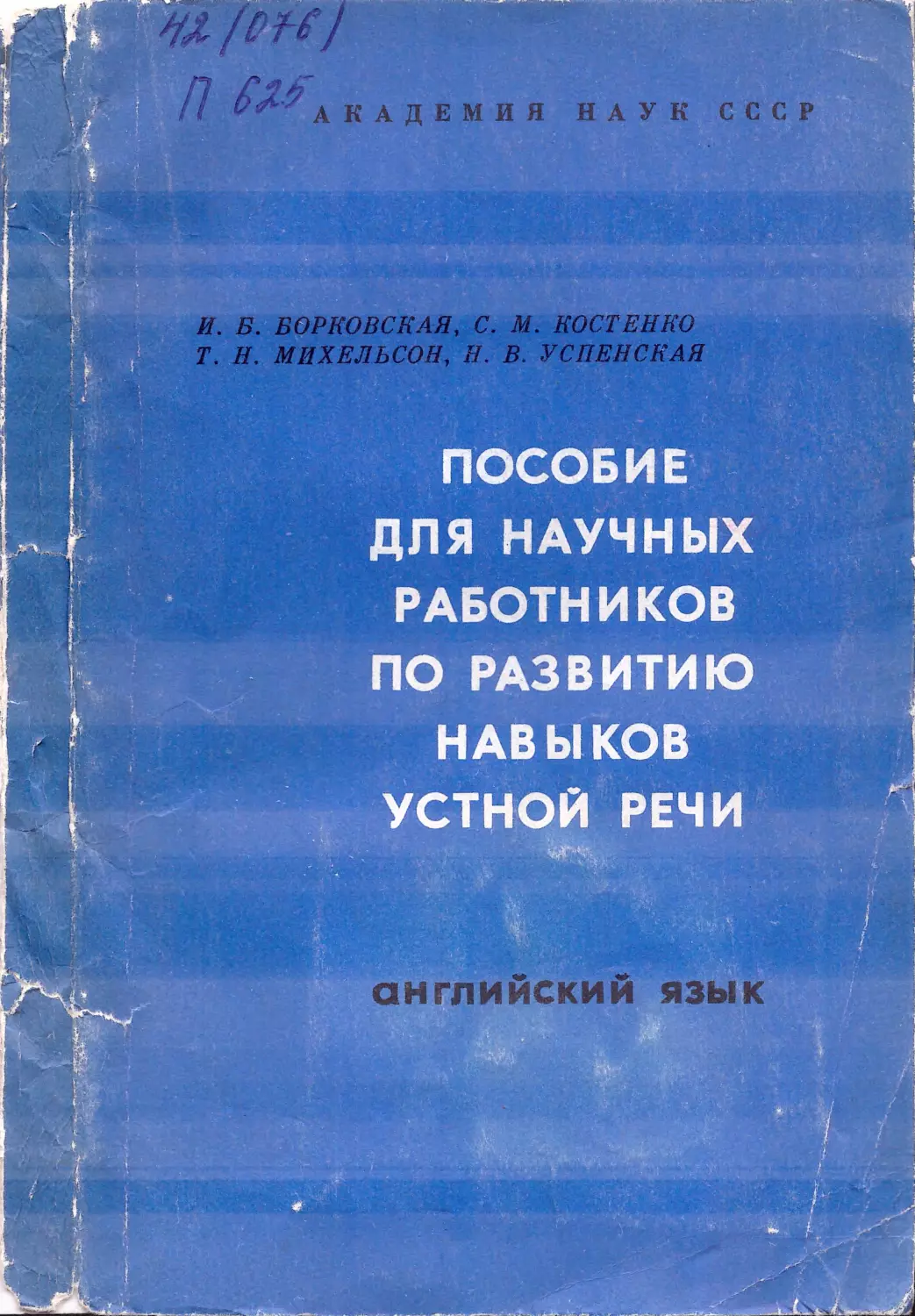
И. Б. БОРКОВСКАЯ, С. М. КОСТЕНКО,
Т. Н. МИХЕЛЬСОН, Н. В. УСПЕНСКАЯ
ПОСОБИЕ
ДЛЯ НАУЧНЫХ
РАБОТНИКОВ
ПО РАЗВИТИЮ.
НАВЫКОВ
УСТНОЙ РЕЧИ
английский язык
Н
едет
М elevМути ти уРД
ane m4
fi
8>
|me
| Киевского
Hors *!
tl
8 евода
fi
a
ИЗДАТЕЛЬСТВО «НАУКА»
ЛЕНИНГРАДСКОЕ ОТДЕЛЕНИЕ,
ЛЕНИНГРАД - 1970
:
81-10 |

Предлагаемое учебное пособие предназначено для развития
навыков устной речи в группах аспирантов и научных сотрудни-
ков, готовящихся к сдаче кандидатского экзамена по английскому
языку, и при работе в студенческих группах.
Пособие представляет собой сборник текстов и упражнений
кним и состоит из четырех разделов: «Биография ученого» (соста-
витель Т. Н. Михельсон); «Институт и лаборатория» (составитель
Н. В. Успенская); «Научная конференция» (составитель С. М. Ко-
стенко); «Научная рецензия» (составитель И. Б. Борковская).
Каждый раздел включает несколько оригинальных (неадап-
тированных), но сокращенных текстов на данную тему. При mx
отборе авторы стремились к тому, чтобы каждый текст носил
общенаучный характер, достаточно легко пересказывался и был
насыщен лексикой, связанной с изучаемой темой.
Цель упражнений, предлагаемых после каждого текста,
— за-
крепить лексический материал текста и дополнительные лекси-
ческие единицы, относящиеся к данной теме, вне зависимости от
узкой специализации. Авторы рекомендуют проходить тексты п
упражнения каждого раздела в той последовательности, в кото-
рой они даны, поскольку в текстах предусмотрена определенная
повторяемость лексики, а каждое последующее упражнение пред-
полагает знание предшествующего материала.
Тексты пособия заимствованы из следующих источников: био-
графии ученых
— из английских и американских энциклопедий;
тексты раздела «Институт и лаборатория» — из американского пу-
теводителя, журнала «Civil Engineering», а текст «Imperial Col-
lege»
— рассказ английского физика о своем колледже, записан-
ный на магнитофон; тексты раздела «Научная конференция»
взяты из журнала «Nature»; рецензии
— из журнала «Endeavour».
Ответственный редактор
С. М. КОСТЕНКО
Ия Борисовна Борковская, Софья Михайловна Костенко,
Татьяна Николаевна Михельсон, Наталья Всеволодовна Успенская
ПОСОБИЕ ПО РАЗВИТИЮ НАВЫКОВ УСТНОЙ РЕЧИ ПО ТЕМАМ,
СВЯЗАННЫМ С НАУЧНОЙ РАБОТОЙ
Утверждено x печати Кафедрой иностранных языков Академии наук CCCP
Редактор издательства Б. Р. Флакс
Технический редактор Р. А. Кондратьева. Корректор Ф. Я. Петрова
Сдано в набор 9/VI 1969 г. Подписано к печати 28/1 1970 г. РИСО AH
CCCP No 88-166 В. Формат бумаги 84 X 108/,„. Бум. л. 28), Печ. л. 5’,=
= 9.86 усл. печ, л, Уч.-изд. a. 10.25. Изд. No 3945. Тип. sax, Me 302. M-31539,
Тираж 24 000. Бумага No 2. Цена 62 коп.
Ленинградское отделение издательства «Наука»
Ленинград, В-164, Менделеевская лин., д. 1.
7-1-4
1-я тип. издательства «Наука». Ленинград, B-34,
234—69 (1 пол.)
9 линия, д. 12

PART I
BIOGRAPHY OF A SCIENTIST
Text 1
NIELS BOHR
Bohr is a Danish physicist, one of the most ingenious
interpreters of his generation of the problems of modern
theoretical physics. Born at Copenhagen on October 7,
1885, he did physics at the University of Copenhagen, ob-
taining his doctor's degree in 1911 and proceeded immedia-
tely to Cavendish Laboratory at Cambridge for further
study under Sir J. J. Thomson. In 1912 he moved to Man-
chester University, where he was associated with Ernest
Rutherford in the latter’s atomic research. In 1914, follo-
wing a year as lecturer at the University of Copenhagen
Bohr returned to Manchester, remaining there until 1916,
when he was made professor of Theoretical Physics at the
University of Copenhagen.
In 1920, largely due to Bohr's efforts, the Institute
of Theoretical Physics was established at Copenhagen.
He became its first head and under him the Institute has
become an important centre for the development of theore-
tical and experimental physics. Prior to World War II
Bohr's Institute had become the world center for atomic
physics.
Just before World War II, Bohr advanced the idea that
the compound nucleus was fundamental to the phenomena
of nuclear disintegration, a concept that proved fruitful
in later work. In collaboration with John Archibald
Wheeler he proposed a theory of nuclear fission that led
to atomic research which produced the atomic bomb.
1%
3

In 1943, after the Nazis had occupied Denmark, Bohr
escaped to England in a small boat. Making the way to the
United States, he took a leading part in the atomic bomb
project, working mainly at the laboratory established in
early 1943 at Los Angeles in New Mexico. In 1944—
1945 Bohr served as adviser to the Scientific Staff of the
Manhatten Project. In 1945 Bohr returned to Copenhagen
to resume his duties as director of the Institute of Theore-
tical Physics.
в
Bohr’s great achievement was recognized internationally
by the Nobel prize award to him in 1922 for his study of
atomic structure and radiation. In 1957 he was the first
recipient of the Atoms for Peace award. That same year at
the Massachusetts Institute of Technology, he delivered his
lecture on the Philosophical Lessons of Atomic Progress.
Exercises
1. Give an adequate translation of the sentences below paying
special attention to the parts in italics.
:
1. Bohr is one of the most ingenious interpreters of his
generation of the problems of modern theoretical phy-
sics.
2. He did physics at the University of Copenhagen.
3. He proceeded immediately to Cambridge for further
studies under Sir J. J. Thomson.
In 1912 he moved to Manchester University where
he was associated with Ernest Rutherford in the lat-
ter’s atomic research.
Ba
In 1914, following a year as lecturer at the University
of Copenhagen, Bohr returned to Manchester.
In 1920, largely due to Bohr's efforts, the Institute of
Theoretical Physics was established.
Bohr became its first head and under him the Institute
has become a world famous centre of research.
Bohr took a leading part in the atomic bomb project,
Norsmg mainly at the laboratory established in early
9. In 1944—1945 Bohr served as adviser to the scientific
staff of the Manhatten project.
10. In 1945 Bohr returned to Copenhagen 10 resume his
duties as director of the Institute.
>
A
D
i
a
t
=

Ek
12.
13.
C
U
R
W
D
D
=
10.
11.
12.
13.
14.
©
©
м
н
е
Bohr's great achievement was recognized internatio-
nally by the Nobel prize award to him.
In 1957 he was the first recipient of the Atoms for
Peace award.
That same year he delivered his lecture on the Philo-
- sophical lessons of Atomic Progress.
2. Insert words and expressions from the text.
. Bohr was ... at Copenhagen in 1885.
. Bohr... his doctor's degree in 1911.
After graduation he went to Cavendish Laboratory
Тов... study. 7
. In 1912 Войт... to Manchester University.
. At Manchester University Bohr was ... with E. Ruther-
ford.
Due to Bohr's ... the Institute of Theoretical Physics
became the ... center for atomic physics.
Bohr became the first ... of the newly created Insti-
tute.
. Just before World War II Bohr ... an idea that
proved ... in later work.
In collaboration with Wheeler Bohr ... a theory of
nuclear fission.
In the United States Bohr ... ... in the atomic bomb
project.
Bohr served ав... to the Scientific ... of the Manhat-
ten project.
In 1945 Bohr returned to Copenhagen to ... his duties.
Bohr's great ... was recognized internationally.
In 1957 Bohr ... a lecture on the Philosophical Les-
sons of Atomic progress.
3. Paraphrase the sentences below substituting words and ex-
pressions from the text for those in italics.
4.
2.
3.
н
е
с
е
с
Bohr studied physics at the University of Copenhagen.
He graduated (from, at) the University in 1911.
In 1912 he went to Manchester where he worked
in collaboration with E. Rutherford.
Prior to Word War II Bohr put forward an idea that
proved useful.
Working together with Wheeler Bohr advanced a
theory of nuclear fission.
He participated in atomic research.

In 1945 Bohr came back to Copenhagen.
Bohr's great contributions won him international re-
cognition.
He was the first to receive the Atoms for Peace award.
That same year he gave his lecture on the Philosephi-
cal Lessons of Atomic Progress.
о
о
P
=
4. Answer the questions using the indefinite article before
nouns denoting profession. Here is a list of nouns and adjectives
for you to choose: scientist, engineer, composer, playwright,
poet, physicist, chemist, teacher, writer, worker, and the
like; famous, world-famous, distinguished, eminent, well-
known, world-known.
Example: Who is Newton?
Newton is a famous English scientist.
1. Who is Dalton?
9. Who is Darwin?"
2. Who is Byron?
10. Who are you?
3. Who is Tolstoy?
11. Who am I?
4. Who is Bach?
12. Who is your father?
5. Who is Faraday?
13. Who is your mother?
6. Who is Mendeleyev?
14. Who is your scienti-
7. Who is Bohr?
fic adviser?
8. Who is Bernard Shaw?
5. Change the questions given in exercise 4 according to the
example and answer them.
Example: Can you (will you) tell me (us) what
Newton is?
Yes, of course (of course, I can).
Your question is easy to answer. Newton
is a famous English scientist.
6. Change the sentences below using the following nouns:
lecturer, experimenter, theoretical physicist, painter,
post-graduate, student, first (second, ete.) year stu-
dent, scientist. Mind that the indefinite article is used before
nouns denoting a profession.
Example: As far as I know, Mr. Brown is in his third
year at the University.
As far as I know, Mr. Brown is a third year
student of the University.
1.I thought your friend was in his second year at the
University.

‚ I learned that Miss Black was good at painting.
I've been told that Mr. Smith does postgraduate research
at your Institute.
To my mind, Dr. M. did distinguished research.
As far as I know, Dr. N. made his fundamental contri-
bution when at the University.
I know for certain that Borodin did many experiments.
If I am not mistaken, Dr. No is distinguished for his
scientific research in theoretical physics.
For all I know, Dr. No gives lectures at the University.
i
E
R
S
i
Г
с
о
7. Change the sentences given in exercise 6.
Example: As far as I know, Mr. Brown is in his third
year at the University.
Right you are (you are quite right; it's right).
He is a third year student.
8. Answer the following questions.
Example: Who runs your laboratory?
Professor N. does. He is head of our labora-
° tory. He was appointed (elected, made)
head some ‘years ago.
1. Who manages the affairs of your laboratory?
2. Who is in charge of your department?
3. Who is responsible for your team?
4. Who is at the head of your committee?
9. Insert the definite or the indefinite article.
1. Milton was ... famous English poet. He was ... author
of “Paradise Lost”.
2. My supervisor is ... distinguished scientist.
3. He is ... author of a great number of papers and mo-
nographs.
4. Who is ... manager of your department? Dr. No. is.
5. M-me Curi was ... world-famous physicist.
6. Do you happen to know who was ... founder of mo-
dern quantum mechanics?
7. Newton is known as ... discoverer of the Laws of Mo-
tion.
8. Morgan is ... author of many books.
9. Cooper was ... great discoverer.
10. Columbus is ... discoverer of America.

11. Popov is ... inventor of radio.
12. Edison is well-known ав... inventor.
10. Paraphrase the sentences below using the expressions to
be famous for, to be distinguished for, to be known for.
Examples: 1) Bohr made a distinguished contribution to
science.
Bohr is distinguished for his contribu-
tion to science. °
2) Columbus discovered America.
Columbus is famous for his disco-
very of America.
1. Feyman gave a well-known course of lectures.
2. Mendeleyev discovered the Law of Periodicity.
3. Dickens wrote many world-famous novels.
4. Rutherford did distinguished research.
5. Copernikus developed his famous hypothesis.
11. Paraphrase the sentences below using the expressions to
be famous for (as), to be distinguished for (as), to be
known for (as).
:
Examples: 1) Guttenberg was the inventor of printing.
Guttenberg is famous as the inventor of
printing.
2) Guttenberg is famous because he inven-
ted printing.
Guttenberg is famous for having in-
vented printing.
. Stratford-on-Avon is Shakespeare's birthplace.
. Shalapin was a well-known singer.
Why is your town famous? (Begin your question with
«Whaty).
i
The town 18 well-known because it is a scientific
centre.
Columbus was the man who discovered America.
Novosibirsk is a well-known scientific centre.
. Shroedinger is the creator of wave-mechanics.
. Pavlov is world-famous because he introduced the laws
of physiology.
:
о
н
е
В
е
ю
:
12. Translate into English.
1. Мария Кюри известна тем, что открыла радий.

2. Фарадей знаменит тем, что сформулировал (formu-
late) закон электромагнитной индукции — (е1есёто-
magnetic induction).
3. Эддисон известен как изобретатель электрической
лампы.
4. Чем известен (знаменит) ваш город?
5. Гагарин прославился как первый космонавт.
13. Translate inte English using the expressions to work
(to study, ete.) under somebody.
:
Examples: 1) Он работает под руководством профес-
сора А.
He works under Professor A.
2) Лаборатория под руководством профес-
сора А. (которой руководит про-
фессор А.) стала крупным науч-
ным центром.
The laboratory under Professor A. be-
came an important scientific centre.
1. Я занимаюсь физикой под руководством профессора В.
2. Под руководством профессора Д. сотрудники (associa-
tes) нашего института разработали (to develop) новые
методы.
3. Группа (team), которой руководит доктор А., сделала
важное открытие (to make a discovery).
:
4. Под. чьим руководством вы проводите исследования
(to do research)?
14. Paraphrase the sentences below.
Example: To my mind, the text is very interesting.
I find the text very interesting.
To my mind, the experiment is very important.
. To my mind, your advice is very helpful.
To my mind, the idea is rather simple (complicated).
. To my mind, the book is too difficult.
;
. To my mind, the data are accurate.
. To my mind, your experiment is easy.
O
U
T
W
O
р
о
=
15. Answer the following questions.
A
1. What is the title of the text?
2. What is the text about? (What is it concerned with?
What does it deal with?)

Do you find the text interesting (difficult, easy)?
. Did you find it easy (difficult, interesting) to read (to
translate, to understand) the text?
B
. Who was Bohr?
. What is he famous for?
. Where was he educated?
. When did he obtain his doctor's degree?
. Where did he go for further studies?
10. Under whom did he study at Cambridge?
17.
18.
19.
20.
24.
22.
23.
25.
5
6
7
8
9
10
BE
12
13
14
15
Where did he move in 1912?
. Where did he give lectures?
. What did Bohr do in Manchester?
. What ideas did Bohr advance?
. Did Bohr stay in Denmark after the Nazis had occupied
the country?
What activities of Bohr won him international recog-
nition?
:
What award did he receive in 1957?
С
Where were you educated?
Did you do further study after graduation?
Under whom did you work after graduation?
Did you move anywhere after graduation?
Have you ever given lectures?
Who, do you think, has advanced the most fundamen-
tal ideas of modern physics (biology, physiology, astro-
поту, chemistry, etc.)?
What part do you take in research carriéd on at your
laboratory?
Who is head of your Institute?
16. Use words and expressions in italics in sentences of your
OWI.
Example: Bohr proceeded to Cavendish laboratory for
i
2,
10
further study under Sir J. J. Thomson.
I did further study under Professor N.
Bohr was born at Copenhagen.
He obtained his degree at the University of Copenha-
gen.

F
E
N
N
'
н
е
©
|
н
о
е
g
i
s
. In 1912 he moved to Manchester University.
. Bohr was associated with Е. Rutherford.
I the Institute of Theoretical Physics was estab-
lished.
In collaboration with Wheeler Bohr proposed a theory
of great importance.
Bohr advanced the idea that the compound nucleus was
fundamental to nuclear disintegration.
Bohr’s great achievement was recognized by the Nobel
prize.
. Bohr worked in collaboration with many outstanding
scientists.
. He took a leading part in atomic research.
. Bohr resumed his duties as director of the Institute of
Theoretical Physics.
17. React to the following statements and questions using the
verbs $0 obtain or to receive. Mind: to obtain means to get
something by making efforts (to obtain data, evidence, informa-
tion, knowledge, a result, a degree; to receive a degree is also
possible); to receive means to get what is offered, given, sent
(to receive a letter, news, a telegram, education, training, an
award, a prize).
Example: You obtained valuableinformation, didn’t you?
4.
=
©
©
0
0
N
o
»
o
r
N
o
r
e
Yes, I'm glad to tell you, I succeeded in ob-
taining important information.
I hear you obtained some convincing experimental
evidence to prove your hypothesis.
. When did you obtain your degree?
. I hear you received a letter to-day.
I've been told you succeeded in obtaining some
data of interest.
:
. As far as I understood, you received your education at
the University. Is it really so?
Did your scientific adviser receive the Lenin prize?
. I suppose you obtained a lot of experience through
your work. :
I wish you told us whether you obtained the in-
formation you needed.
. I hope the results obtained by you will help you to pro-
ceed with your work.
Will you tell me what award your manager received?
11

18. Translate the following sentences using the verbs to get,
obtain, to receive.
=
©
. Он не получил образования.
. Вы получили известия (news) о нем?
. Он получит премию.
. Она получила ценные данные.
. Я думаю, она получит степень доктора.
Полученные им сведения достоверны (reliable).
Он получил большой (deep) опыт и знания.
. Когда вы получили эти данные?
. Полученные им результаты надежны.
. Я боюсь, я не получу письма сегодня.
н
ы
19. Change the following sentences using the expressions given
in brackets.
3
Example: One of my colleagues is a Lenin prize win-
ner. (important contribution to the study
of the outer space).
One of my colleagues has been awarded the
Lenin prize for his important contribu-
tion to the study of the outer space.
One of my colleagues has received the Lenin
prize for his important contribution to the
study of the outer space.
Important contribution to the study of the
outer space has won him the Lenin
prize.
1. Many scientists of our Institute are Lenin prize winners.
(outstanding achievements in the field of organic che-
mistry).
;
‚2. One of the workers of their laboratory is a Lenin prize
winner. (excellent contribution to science).
3. A friend of mine is a Lenin prize winner. (far-reaching
research in nuclear physics).
20. Translate the following sentences using the verbs in italics.
to move
1. Машины двигались медленно.
2. Он собирается (to be going to) переехать в Гатчину.
3. Она перешла в другой (another) университет.
4. Пододвиньте стул к окну.
о12

9
9
:
1
2
2
с
л
14.
12.
13.
14.
15.
16.
#7.
so; I am of the same opinion; I think so; I believe so.
to recognize
. Я не узнал вашего руководителя.
. Осознал ли он свою ошибку?
Все (everybody) признали его заслуги.
Ero заслуги общепризнаны.
to establish
Наша лаборатория организована 10 лет назад.
‚Кто установил этот закон?
to deliver
Он будет читать курс лекций mo (in) физике.
Кто произнес речь на (at) собрании?
to produce
Они скоро выпустят новый фильм.
Открытие произвело сенсацию.
Покажите (предъявите) свой пропуск (pass).
Ero выступление (talk) произвело на меня глубокое
(deep) впечатление.
Этот завод выпускает новую аппаратуру.
21. Agree to the statements below using some of the follo-
wing introductory phrases: I quite (fully) agree with you;
you are right; that’s right; yes, indeed; exactly so; quite
Examples: 1) As far as I know, Bohr was a Danish
physicist.
You are right. He was an outstanding
physicist, one of the most ingenious
interpreters of the problems of mo-
dern physics.
2) As far as I remember, Bohr was born in
Copenhagen.
That's right and he was educated at the
University of Copenhagen.
3) If I am not mistaken, Bohr obtained his
doctor’s degree in 1911.
Exactly so. After that he proceeded to
Cambridge.
1. If Тат not mistaken, Bohr left Cambridge for Manche-
ster.
13

2. As far as I could gather from the text, Bohr tock an
active part in establishing the Institute of Theoretical
Physics.
3. I believe Bohr advanced a lot of concepts of far-reach-
ing consequence.
As far as I could understand from what I've read, Bohr
did not stay in Denmark after the Nazis occupied the
country.
5. I have heard Bohr’s great achievement was generally re-
cognized, wasn't it?
:
6. According to what I know, Bohr was a distinguished
physicist.
7. I hear Bohr was not only a distinguished physicist, he
was an outstanding philosopher as well.
8. As far as I remember, Bohr gave lectures at the Univer-
sity of Copenhagen.
9. Am I to understand that Bohr worked not only in Den-
mark but in America as well?
>
22. Answer the following questions using the words in bra-
ckets and some of the introductory phrases: as far as I know;
as far as I remember; to my mind; certainly; it’s hard
to tell; probably; to tell the truth; if I am not mistaken;
of course; I hope so.
Example: Do you work hard? (to be associated with).
Of course I do. I am associated with a team
of workers and all of us work rather hard.
1. Does your friend still stay in Leningrad? (to move
somewhere).
2. Why was Fermi awarded the Nobel prize? (to recog- .
nize).
:
3. What is Newton's main contribution to science? (to es-
tablish).
4. Are you going to take part in the research carried on in
your laboratory? (to resume, to obtain new data).
What activities is your supervisor engaged in? (to be
at the head of, to give lectures).
What is Mendeleyev famous for? (to advance, to pro-
pose).
. Are you good at sport? (to win a prize).
. Do you work alone at your problem? (in collaboration
with).
o
N
>
o
n
14

10.
B
S
с
о
D
N
>
~
N
o
o
t
. What is the main problem you work at? (to work un-
der somebody).
Are you very busy? (further studies).
23. Translate into English.
. Родиться.
. Он родился в 1933 году.
. Когда вы родились?
Так как он родился в Англии, он знал английский
ЯВЫК.
. Получать образование.
. Где вы получили образование?
Получив образование в Кэамбридже, он знал (to be
familiar with) систему образования (educational
system) в Англии.
. Получать степень.
. Где он получил степень доктора?
. Занимался ли Бор под руководством Томсона?
. Собирается ли она ваниматься дальше (to take up:
further study)?
. Когда ваша семья переехала в Москву?
. Бор работал с Резерфордом.
. Когда она работала с вами?
Работали ли вы когда-либо с ними? (Use Present Per-
fect).
. Где вы работали с ними?
. Проработав год с таким видным ученым, я получил
много (a large amount of) знаний.
. Благодаря усилиям Бора.
. Благодаря знаниям физики (in physics).
. Наш опыт был закончен благодаря совместным (joint)
усилиям многих сотрудников (workers).
. Кто был первым директором вашего института?
. Кто организовал вашу лабораторию?
. Выдвигать мысль (idea).
я:
. Мысль, выдвинутая Бором, оказалась плодотворной.
. Предлагать теорию.
. Что вы предлагаете?
. Предложенный им метод (approach) оказался полез-
ным (helpful).
Вернувшись в Копенгаген, Бор вновь начал зани-
маться исследовательской работой.
15

29. Когда вы снова начнете свою работу? (Use “to be
going to”).
:
30. Бор работал консультантом в научном отделе Ман-
хэттенского проекта.
31. Великие заслуги Бора получили признание.
32. В том же году Бор прочитал свою знаменитую лек-
цию в Массачусетском университете.
33. Лекции, которые читают (Use Participle II) в уни-
верситете, дают студентам много (a large amount of,
a great amount of) знаний.
Text 2
CHARLES ROBERT DARWIN
Charles Robert Darwin, English naturalist and author,
was born at Shrewsbury, February 12, 1809. His father, Ro-
bert Warning Darwin was a distinguished physician at
Shrewsbury.
Charles Darwin studied at Shrewsbury School under
Dr. S. Butler. After attending school Darwin spent two
years at Edinburg University in the study of medicine.
In 1817 he enrolled at Cambridge University. He early
devoted himself to the study of natural history. In 1825 he
was appointed naturalist to a naval vessel, then about
to sail on an extended surveying expedition. Darwin came
home with rich stores of knowledge. He had been much
impressed by the manner in which closely allied animals
replace one another in proceeding southwards in South
America.
In 1837 Darmin had started a notebook in which he
entered facts concerning natural selection. He saw that se-
lection was the key-stone of man’s success. Various ideas
as to the causes of evolution had to be abandoned.
In 1842, he wrote out his first outline on the origin of
species. He corresponded with Asa Gray, the United States
naturalist, and sent Gray a letter explaining his views in
1857. This letter became afterwards classical.
Charles Lyell, author of the widely discussed ‘“Princip-
les of Geology’, urged Darwin to prepare a more extensive
16

° ireatise. The revision was only half finished when Darwin
received a letter and manuscript from A. R. Wallace. Wal-
lace asked Darwin to read the manuscript and to forward
it to Lyell. Darwin was much startled to find in the essay
a complete abstract of his own theory of natural selection.
It was an unusual situation: two naturalists, working in-
dependently of each other had simultaneously developed
theories that were identical. Both had been influenced by
Th. R. Maltus’ work on population, both were familiar with
Lyell’s views on geology, each had observed widely varying
species.
Darwin sent Wallace's manuscript, together with the
second draft of his own treatise, to Lyell, who consulted
Josef О. Hooker, English botanist. Оп their recommenda- —————
tion both Wallace's and Darwin’s essays were read as а`
joint paper before the Linnae Society at London. In 1859
Darwin published “The Origin of Species by Natural Selec-
tion.
Although Darwin and Wallace differed in some opinions
they remained friends. Darwin was, with Wallace, the first
to attempt to work out a logical explanation of the varia-
- tions of species, and to collect and arrange facts upon
which the theory of evolution could be based.
Because of the emphasis placed upon “The Origin of
Species” and “The Descent of Man” Darwin's numerous
other important contributions are frequently overlooked.
Darwin received many honours from learned societies in
Great Britain and on the continent. He died at Down, Kent,
England, April 19, 1882.
Bxercises
1. Insert words and expressions from the text.
. Darwin's father was а... physician.
After . .. school Darwin entered the University.
. He was ... naturalist to a naval vessel.
. Darwin went on an extended ... expedition.
He had been much ... by the manner in which animals
replace one another.
:
;
. In 1842, he wrote his first ... on the origin of species.
. Darwin and Wallace ... identical theories.
. They both were ... by Maltus’ work .on population.
1 0868.7
£2
~
я
ваведа
i
©
т
у
с
о
C
F
E
0
0
3
©
>
tp
i
bie

9. Both of them were ... with Lyell’'s views on geology.
10. Darwin and Wallace remained friends although they
differed in some...
11. Darwin ... a logical explanation of the variations of
species.
12. He collected and ... facts.
13. Не... many honours from ... societies in Great Bri-
tain.
2. Answer the following questions. Mind: по article fis used
before nouns denoting some branch of science like mathematics,
hotany, physiology, chemistry, philosophy, mechanics and the like.
Example: What examinations have you already passed?
I have passed my exams in history, literature,
general linguistics and in phonetics.
. What examinations are you going to take next spring?
. What subjects did you like best while at school?
tute (University)?
What course of lectures did you attend while an under-
graduate?
In what line do you work?
3. Explain the use of the definite article before nouns denoting
some branch of science and translate the sentences below.
1. I wish to know which of you is interested in physics.
2. Will you tell me whether you know the physics of pro-
teins.
From what you've said I can see that you are fond of
chemistry.
From what he said we learned that he was familiar with
the chemistry of solutions.
Do you attend lectures in the history of philosophy?
Am I to understand that history wasn’t taught at school
at that time?
1
2
3. What subjects were you interested in while at the Insti-
4.
5.
T
S
d
e
i
e
o
4. Insert the definite article where necessary.
Examples: 1) He gives lectures in physics.
2) He gives lectures in the physics of pro-
teins.
1. Do you take interest in ... science?
2. I am fond of ... music.
3. ... music of Chopin is beautiful.
18

15.
16.
I know that ... botany is a branch of ... knowledge.
I'm sure ... knowledge of English will help you
greatly.
Are you familiar with ... nature of ... radioactivity?
He had to take into account ... radioactivity of this
element.
Man is engaged in constant struggle with ... nature.
Dr. B. has ... accurate knowledge of ... proteins.
. What is ... real knowledge?
. Dr. No studied ... law.
. Mendeleyev discovered ... Law of ... Periodicity.
. Dr. N. is famous for his important contribution to ...
science.
. Rutherford established ... nature of ... electrical struc-
ture of ... matter.
:
Botany 18... science of ... plants.
Pavlov studied ... science at the University.
5. Insert articles where necessary. Mind: no article is used
before school.
Examples: 1) He works at a plant.
1.
Э
т
о
в
2) Не works at the Lomonosov plant.
I am going to read my paper at ... Department of Theo-
retical Physics.
:
Dr. George gave excellent lectures at ... University.
Are you going to take post-graduate studies at ... Insti-
tute of Botany?
. My younger sister studied аб... school.
. My friend works аб... plant.
Did you receive the position of a secretary at ... office
or at ... plant?
6. Give a full answer to the following questions. Mind that
after the verbs to answer, to attend, to consult, to enjoy,
to.
ded
enter, to join, to watch, to leave no prepesition is nee-
Example: Can you answer all my questions?
Sorry, I can’t. ГП try to answer one question,
if you please.
1. Were you able to answer all the questions put to you?
2. Have you answered the letter?
3. Do you regularly attend lectures in philosophy (Eng-
lish classes)?
2*
19

. Did your friend attend the last seminar?
Are you going to attend our meeting to-night?
. Which school did you (your wife, husband) attend?
When are you going to consult your supervisor (scien-
tific adviser)?
. Has your wife consulted the doctor?
. Do you consult the head (manager) of your laboratory
on problems concerned with your work?
. When do you consult the dictionary?
. Did you enjoy your stay in London?
. Did you enjoy your holiday?
. At what age did you enter the Institute?
. When did your fellow-worker enter the University?
. What Institute did your wife enter?
. Who entered that room?
. Did you join any scientific circle while at the Univer-
sity?
;
. When did you join the laboratory?
. Have you joined the party?
. Are you fond of watching football?
. Do you watch the T. V.?
. When did you leave school?
. When did your friend leave Leningrad?
. When did you leave the University?
7. Answer the following questions using the verbs in italics.
Example: What mark did your teacher give you in li-
20
terature? (fo answer).
He gave me a five. I answered all his ques-
tions.
to attend
. What do you do to learil philosophy?
What did you do yesterday? I called on you but was
told you were away.
. How often are seminars held at your Institute?
to consult
. What do you do if you feel unwell?
. What do you do if you come across an unfamiliar word
in your text?
. What do you do if you encounter difficulties when solv-
ing some problem?

to enjoy
7. Did you like the film you saw yesterday?
8. Did you go to Kiev on holiday?
to enter
9. How old is your sister?
10. Ts that room empty? Is there anyboby in that room?
11. What Institute did your husband (wife) graduate (from)?
to join
12. Are you a member of the party?
13. Do you attend the gatherings of the Learned Geogra-
phical Society?
14. Haw long have you been working at this laboratory?
to leave
15. What Institute did you enter?
16. Where did you live before coming to Leningrad?
8. Translate the following sentences using the verbs to ans-
wer, to attend, to consult, to enjoy, to enter, to follow,
to join, to leave, to watch. Mind: no preposition is used after
these verbs.
‚ Преподаватель вошел в класс.
. Он уехал из Ленинграда.
. Кто может ответить на мой вопрос?
. Идите вперед (You go first), a я пойду за вами.
. Только 10 студентов было (присутствовало) на лек-
ции.
. Когда вы вступили в клуб?
Получили ли вы удовольствие от поездки?
. Следили ли вы за игрой?
. Он не хотел вступать в научное общество.
10. Советовались ли вы со своим руководителем?
11. Следили ли вы 3a падением (the drop) температуры?
12. Я поступил в университет в 1966 году.
13. Когда вы закончили (leave) школу (институт)?
с
о
0
0
=
3
с
о
U
T
E
S
с
о
р
о
>
9. Paraphrase the following sentences using the verb to at-
tend.
Examples: 1) He goes to school.
He attends school.
2) I was present at the last lecture.
Т attended the last lecture.
21

r
o
m
=
S
i
s
sit.
How many people were present at the lecture on poly-
mers?
Does your son go to school?
Are you going to be present at the next seminar on
Shakespeare?
Did you go to English classes?
You studied at the University, didn’t you?
10. Paraphrase the following sentences using the verb to wi-
Examples: 1) I went to England last year.
S
U
T
W
O
D
O
=
O
0
0
N
I
D
U
T
I
©
2
I
O
=
I visited England last year.
2) The scientist was in this country.
He visited this country.
. I went to see my friend yesterday.
. He came to Leningrad the other day.
Have you called upon your colleague in the hospital?
. Have you seen the new exhibition?
. Have you been to the Hermitage?
On his trip to Moscow he saw many places of interest.
‚ 11. Insert the verbs to attend or to visit.
. All children over seven must ... school.
. Did you ... the new exhibition?
. Who ... the last meeting?
Will you . .. your friend to-morrow?
. Many foreign tourists ... our country.
While in Moscow I ... the Gallery of Russian art.
Who's going to ... the next lecture in mathematics?
. When are you going to ... our city?
During my stay in Prague I ... many places of interest.
12. Translate the following sentences using the verbs Zo at-
tend or to visit.
H
U
T
N
W
N
=
. Он не ходит на лекции.
. Посещаете ли вы семинары?
. Вы были на выставке в Эрмитаже?
. Правильно ли я вас понял (Am I to understand), что
вы собираетесь посетить наш город?
Сколько людей посещает лекции в Университете?
. Они никогда не ходят на наши семинары.

13. Insert the verbs to advise or to consult. Mind: you
consult your manager (teacher); your manager advises something
to you,
1. Did you ... your supervisor (scientific adviser) on this
point?
2. What did Бе... you to do?
3. Who ... you to use this method?
4. He had to ... the reference book.
5. I... my doctor. Не... me to go to the South.
14. Translate the following sentences using the verbs in italics.
to consult
1. Я должен посоветоваться со своим руководителем
(scientific adviser).
2. Вы должны посоветоваться с заведующим (manager)
лаборатории.
3. Они не советовались со мной.
to advise
4. Кто посоветовал вам использовать этот метод?
5. Мой руководитель (supervisor, scientific adviser) сове-
товал мне использовать другой метод (another
approach).
6. Я советую вам проверить (to check) свои данные еще
раз.
15. Give a short answer to the following questions and then
add some details using the verbs fo consult or to advise.
Example: Did you consult your teacher on the subject
of your work?
Yes, of course. I always consult him when
I encounter some difficulties. He advised
me to use another approach.
Do you often consult reference books?
Did your supervisor advise you to read your paper at
the conference?
. When do you consult the dictionary?
Did the doctor advise you to take your leave now?
Are you going to consult your scientific adviser on how
to do the calculation?
D
N
>
с
л
No
5
{
9
23

16. Translate the following sentences paying special attention
to the partsin italies.
1, As far as I know, Dr No. went to Moscow on business.
2. Am 1 to understand that your scientific adviser is on
leave now.
3. From what he said IT learned that he was going on an
excursion. to Novgorod.
4. According to what he said, he visited many places of
interest while on his trip to the Crimea.
5. For all I know he is on an expedition in the North.
17. Answer the following questions using the expressions $0
be (to go) on business, to be on leave, to be (to go)
on an expedition (to, at, in), to be on a trip (to), etc.
Example: Where is Dr. No? (business).
He is away on business.
. Where is the secretary? (leave).
. Where is your scientific adviser? (expedition to the
North).
. Where is the manager of your laboratory? (trip to Eng-
land).
. Where are your laboratory assistants? (business).
к
C
A
I
N
p
i
e
18. Translate into English.
1. Он в отпуске.
2. Она поехала в экспедицию.
3. Правильно ли я вас понял (Am I to understand), что
вы собираетесь в командировку в Англию?
4. Я не поеду завтра на экскурсию.
5. Ездили ли вы в экспедицию в прошлом году?
6. Вы отдыхали (to be on holiday) в Крыму (in the Cri-
mea) или были в командировке?
7. Во время моей поездки в Англию я познакомился (to
get acquainted with) с работой их лаборатории.
19. Change the following sentences from Active into Passive.
Example: The story impressed me greatly.
I was greatly impressed by the story.
1. The sights of Leningrad impressed me deeply.
2. The novel impressed my wife greatly.
3. The book did not impress me at all.
24

4.
5.
‘The high standard of work at that plant impressed the
visitors.
Did the news impress you?
20. Translate into English using the expression $0 be im-
pressed (by).
8
1. На меня оказало большое впечатление то, что я услы-
шал из вашего доклада.
2. На нас оказало большое впечатление то, как (the way)
он провел опыт.
3. На слушателей (the audience) оказало большое впе-
чатление то, что сообщил докладчик.
4. На меня произвело большое впечатление то, что я
узнал (learn) во время моей поездки.
5. На него произвело большое впечатление то, что он уви-
дел в нашей лаборатории.
21. Translate the following sentences paying attention to the
link-verb.
1. Are you familiar with modern views on atomic structure?
2. I got familiar with Darwin’s theory while at school.
3. Am I to understand that he is interested in dynamics?
4. He got interested in dynamics when a boy of 14.
5. He wasn’t acquainted with my work when he wrote his
thesis.
6. He got acquainted with our work after he had read our
paper.
22. Translate into English.
1. Знакомы ли вы с современными гипотезами о проис-
хождении планет?
2. Когда вы познакомились с теорией происхождения
видов?
3. Почему вы заинтересовались нашей работой?
4. Он очень (greatly) интересуется нашими результатами.
5. Правильно ли я вас понял, что вы не знаете наших
работ.
23. Answer. the following questions using the words in italics.
Example: Are you acquainted with Dr. N.?
+
Sorry, I'm not. But I'm acquainted with his
theory.
I suppose you are familiar with modern views on the
origin of the Universe, aren't you?
25

К
©
p
o
in
. Am I to understand that you devote much time to expe-
rimental work?
I wish to know whether you are of the opinion that
my results agree fairly well with the theory.
Will you tell me when you got acquainted with the main
laws of thermodynamics?
. Do you base your conclusions on theory?
What is your opinion on the new approach we used?
Does your approach differ from that used in Minsk? In
what respect does it differ?
24, Paraphrase the following sentenses using the expressions
one’s opinion, to be of the opinion that..., to be of
the same (of a different) opinion on some point, to differ
in opinion on some point.
Example: I think (that) the theory works well.
O
T
S
с
о
D
N
>
t
n
©
C
0
10.
26
н
е
м
p
w
n
I am of the opinion that the theory works
well.
In my opinion it works well.
I quite agree with you on what you say.
To my mind, your approach will give reliable results.
They don’t agree with each other.
Their opinions on the origin of life were quite different.
I'm afraid we must use some other approach.
25. Insert prepositions where necessary.
A
. Charles Darwin devoted much time ... the study of na-
tural history.
. He went ... a geological expedition.
He was much impressed ... what he learned.
He was familiar ... modern views ... the origin of Ga-
laxy.
He consulted ... an English botanist ... this point.
. They differ ... opinion ... this subject.
. He based history ... reliable facts.
B
. I was greatly impressed ... the sights ... the city.
. My fellow-worker and I are going ... a scientific expe-
dition. . . the South.
—
We devote much efforts ... experimental work.
. I got familiar ... the theory ... the descent ... man
while ... school.

12.
. He is ... the opinion that the facts are reliable.
14.
—
о
с
о
с
е
л
I
N
O
|
н
ы
>
C
O
I
N
>
[
=
„
>
15.
16.
17.
18.
19.
20.
. What impressed you most when you joined your labo-
22.
23.
24.
25.
Is Dr. Brown here? No, he is away ... business.
... ту opinion their approach is wrong.
26. Answer the following questions.
A
. What was Charles Darwin?_
. Can you tell me where he was born?
. Do you happen to know who his father was?
. Will you tell me under whom Darwin studied at
Shrewsbury school?
. How long did he attend school?
. What did he do after attending school?
. He was interested in the study of natural history,
wasn't he?
. On what expedition did he go?
. Darwin corresponded with many scientists, didn’t he?
. Why is his correspondence with Asa Grey of great in-
terest to us?
. Whom did Lyell consult?
. What did Lyell and Hook recommend Darwin?
. Were Darwin and Wallace of the same opinion on all
the problems concerning the theory of evolution?
. What is your opinion on Darwin's main contributions
to science.
B
When were you born?
Tell us who your father is.
You attended school in Leningrad, didn’t you?
Have you ever attended English classes?
Under whom did you study at the University (Institute)?
You often go on business trips, don’t you?
ratory?
Are you familiar with Darwin's views on the descent
of man?
When did you get familiar with Mendeleyev’s views on
the periodicity of elements?
Have you already collected and arranged necessary
data (facts, observations)?
When do you consult your supervisor (scientific ad-
viser)?
27

W
w
[
A
S
I
E
N
O
W
0
0
J
O
с
л
11.
27. Retell the text using some of the expressions given below.
. The title of the text is...
. As you can see (as can be seen) from the title, it is
about (it is concerned with, it is devoted to, it deals
with)...
. I found the text rather interesting (difficult) because
I learned a great deal about...
. The author starts by telling the reader (by acquainting
the readers with)...
. According to the text...
. According to what the author says (writes)...
. According to what I knew before...
. As far as I could gather (understand) from the text...
. As far as I could learn from what the author says...
. From what the author says it becomes clear that
(I could see that, I could understand that, I learned
that)...
The author finishes by telling the readers (finishes his
paper by informing the readers)...
28. Construct sentences using the following words and expres-
sions.
To study (to work, to do research) under somebody.
To consult somebody on some point.
To attend lectures (school, a conference, classes).
To be appointed (head, director).
To go on an expedition (on a trip, on business).
To be impressed by something (by what one sees, etc.).
To develop a theory (a method, a procedure).
To be familiar with somebody (something).
. A joint paper (prize winner).
. To differ in opinion on some point.
. To work out an explanation (a theory, an approach).
. To collect and arrange facts (data, observations).
. Learned society (secretary).
29. Construct sentences of your own using the following an-
tonyms.
11
2.
28
To consult somebody on some point— to advise some-
body (to give consultation to somebody on some point).
To learn — to teach,

S
E
S
G
o
i
V
c
»
To differ in opinion with somebody on some point (to
be of a different opinion) — to be of the same opinion
on some point.
. To appear — to disappear.
To abandon (to reject) a theory (a hypothesis, an
approach) — to accept a theory (a hypothesis, a method)
.Tobeafailure—tobeasuccess.
To start work (studies, experiment) — to complete work
(studies, research).
To attend lectures (lessons, classes) — to miss (to stay
away from) lectures (lessons, sittings).
30. Translate the following sentences using the words in ita-
lies.
N
o
U
t
a
12.
13.
14.
to
to devote (to)
. Кому посвящена эта рукопись?
Он посвятил все свое время исследованиям.
Они отдали все свои силы (efforts) естественным
наукам.
learned (adj.)
. Кто ученый секретарь в вашем институте?
Он выступал в научном географическом обществе.
. Это научный кружок (society)?
Он очень (highly) образованный (знающий) человек.
to start
. Когда отправляется поезд?
. Они сразу начали свою работу.
. Он завел блокнот.
. Он начал свой доклад с (by) короткого вступления
(исторического введения).
10 enter something (without any preposition)
Он He входил в комнату.
Моя дочь уже поступила в университет.
Я поступил в институт в 1967 году.
consult somebody (something) (without any preposition)
15. Вы должны посоветоваться с врачом.
16.
17.
Вы смотрели словарь? (Вы обращались к словарю?)
Когда вы поговорите со своим руководителем?
29

18.
22.
23.
24.
25.
с
ю
=
O
U
I
W
w
N
o
e
10.
11
13.
14.
15.
16.
17.
30
10 aitend (something) (without any preposition)
Он не посещает английских занятий (classes).
. Вы были на прошлой лекции?
3
. На нашем семинаре присутствовало 44 человека.
Моя дочь ходит в школу.
to develop
Он разработал новый метод.
Они выдвинули смелую (bold) гипотезу.
Мой сын проявляет большой (great) интерес к (in)
математике.
Проявили вы свои фотопленки (films)?
31. Translate into English.
Под чьим руководством занимался Дарвин?
Под руководством профессора No. наш институт стал
крупным (important) научным центром.
Группа (team) профессора Н. проводит интересные
исследования.
Когда П. был выбран (назначен) профессором?
. Кто назначен директором вашего института?
На Дарвина произвело большое впечатление то, что
он видел в Южной Америке.
Картины Рембрандта всегда производят на меня глу-
бокое впечатление.
Что вам больше всего понравилось (произвело на вас
самое большое впечатление) во время — вашей
поездки?
.
. Его доклад широко обсуждался.
Имя Павлова широко известно за пределами нашей
страны (outside this country).
Кто разработал эту теорию?
Теория, разработанная Дарвином, не была общепри-
знана.
На Дарвина оказала большое влияние работа Маль-
туса.
Советовались ли вы со своим руководителем?
Что посоветовал вам ваш руководитель?
Кто посоветовал вам вступить в (10 join) клуб?
Советовал ли вам ваш преподаватель прочитать эту
статью?

18. Посоветуйтесь co своими товарищами по работе (fel-
low-workers).
19. Я написал совместную с Н. статью mo теме (subject)
моей работы.
20. Когда вышла эта книга?
21. Он уже собрал и привел в систему необходимые дан-
ные.
22. Они основывали свою теорию на собранных и приве-
денных в систему фактах.
23. Она потратила много денег на поездку.
24. Он провел три года за собиранием рукописей.
25. По моему мнению, он знаком с этой теорией.
Техё 3
THOMAS HUNT MORGAN
Thomas Hunt Morgan is one of the chief founders of
modern genetics. An authority on embriology, evolution,
genetics and heredity, his theory of the gene is generally
accepted.
:
His interest in biology declared itself while an under-
graduate at the Kentucky College of Agriculture and Me-
chanical Arts (now the University of Kentucky), from
which he graduated in 1886. It matured at the Hopkins
University, where he studied embriology under
W. K. Brooks.
In 1904 he was appointed professor of experimental
zoology at Columbia University. There he carried on expe-
rimental studies in the laws and mechanism of heredity.
His work in genetics came to centre on problems of the
physical basis of heredity in the venegar fly Drosophila.
Soon a group of graduate students and assistants was at
work in what became famous as the *‘fly-room” in the
Department of Zoology, in which the processes of inheri-
tance in this small, rapidly breeding insect were so tho-
roughly analyzed that by 1945 the main outlines of the chro-
mosome theory of heredity had been laid. His observations
formed a basis for a complete theory of paired elements,
“factors” or ‘‘genes”, within the chromosome which are
31

responsible for the transmition of heredity. The nature of
these genes, constituted the chief subjects of his research.
This general theory of transmission mechanism of heredity
was clearly the most important step in the development of the
science of genetics since Mendel’s publication in 1866. Mor-
gan’s masterly summary of this published in 1826 as the
theory of the gene listed the new principles added to gene-
tics by the discoveries of his school.
All subsequent work in transmission genetics has been
based upon reasoning and the evidence provided by Mor-
gan’s school.
After his departure from Columbia University, where
this groundwork had been laid, Morgan's interests returned
to problems of embriology, while his former students and
associates continued to develop his fundamental work in
genetics.
Morgan was awarded the 1933 Nobel prize in physio-
logy and medicine for his outstanding discoveries concern-
ing the laws and mechanism of heredity. In 1939 he won
the Copley Medal of the Royal Society for his development
of the study of genetics. He was the author of a great many
books, monographs and papers.
Exercises
1. Give an adequate translation of the sentences below paying
special attention to the parts in italics.
1. Morgan is an authority on embriology.
2. His interest in biology declared itself while an under-
graduate at the Kentucky College.
. He studied embriology under W. K. Brooks.
His work in genetics came 10 centre on problems of the
physical basis of heredity.
A group of graduate students was at work in the Depart-
ment of Zoology.
6. His former students and associates continued fo develop
his fundamental work in genetics.
Q
O
е
л
2. Translate the sentences below, then find the logical object
to the verb in italics and give the general formula verb object.
Example: This work was done in our laboratory.
To do work.
1. Morgan's theory of the gene is generally accepted.
32

2.
a[VA
[
=
2
]
o
t
B
S
C
O
D
N
=
>
©
Q
O
=
~
10.
11.
12.
. In 1935 he ... the Copley medal for his ... of the
The processes of inheritance were so thoroughly ana-
lysed that by 1915 the main outlines of the chromosome
theory of heredity Лай been laid.
All subsequent work in transmission genetics has been
based upon reasoning and the evidence provided by
Morgan's school.
3. Insert words and expressions from the text.
. Morgan is one of the ... of modern genetics.
. He is an ... on embriology.
. His theory of the gene is... accepted.
. He got interested in biology while ап... at the Ken-
tucky College.
. In 1904 he was ... professor of experimental zoology.
At the University he ... experimental studies in the
laws of heredity.
. His observations formed the basis for a ... theory of
genes.
. The processes were . .. analysed.
. The nature of these genes ... the chief subject of his
research.
All ... work in transmission genetics has been based
upon reasoning and the evidence ... by Morgan's
theory.
After his ... from Columbia University he continued
studying problems of embriology.
His former students and ... continued to ... his fun-
damental work in genetics.
Morgan was . .. the Nobel prize.
study of genetics.
4. Paraphrase the sentences below substituting words and ex-
pressions from the text for those in italics.
1.
o
n
w
r
e
His interest in biology showed itself while he studied
at the Kentucky College.
. He took his degree in 1886.
In 1904 he was made professor at Columbia Univer-
sity.
. He did experimental research in (into) the laws of ge-
netics.
. His work in genetics concentrated on problems of great
importance.
3 ©. B. Борковская и др.
33

©
9
N
g
10.
>
>
=
41.
13.
14.
15.
34
P
O
м
о
е
о
к
о
. Morgan's summary was issued in 1926.
After he left Columbia University he resumed his work
on problems of embriology.
His former pupils and co-workers proceeded to develop
his fundamental work in genetics.
. Morgan won the 1933 Nobel prize in physiology and
medicine.
He won the Copley medal for his important contribu-
tions to the study of genetics.
5. Insert prepositions.
A
Morgan was an authority ... embriology and related
branches . .. science.
. His interest . .. pure science was striking.
. He early got interested . .. applied science.
Morgan did embriology ... W. K. Brooks.
He carried ... extensive studies ... (the field ...) ge-
netics.
His work ... botany came to centre ... general prob-
lems ... species.
A group ... graduate students and postgraduates is ...
work . .. this problem.
His observations formed a basis ... a complete theory.
All subsequent work ... genetics has been based ...
reasoning and the evidence provided ... Morgan's
school.
. Morgan was awarded a Nobel prize ... physiology ...
his outstanding discoveries ... the laws of heredity.
B
My manager is an authority ... genetics (theoretical
physics, chemistry, etc.).
As to me, I am interested ... biology (statistics, me-
chanics, mathematics, etc.).
My brother showed interest ... geology (zoology, ar-
cheology, art, etc.) while an undergraduate.
Now his interest is centered ... problems ... bioche-
mical processes. -
I do my postgraduate work ... the Institute ... Zoo-
logy ... Leningrad. I did my undergraduate work ...
the University ... professor Black.
R
a
i
s
e
.

16.
17.
18.
19.
20.
to
>
©
AИх
13.
14.
©
O
U
T
D
O
One of my associates was awarded the Lenin prize ...
botany ... his important contribution.
The theoretical staff ... our department are ... work
summarizing the results ... their calculations.
I am expected to base my investigation ... experimen-
tal evidence and theoretical reasoning.
His studies ... Dr. Brown formed a basis ... further
investigation ... (the field ...) botany.
He returned ... his work ... 1967.
6. Answer the following questions. Pay attention to the verb
take.
. Where have you taken your degree?
. When are you going to take your holiday?
. Who took the first prize in the last game?
. Do you take interest in art?
. Does your friend take great interest in science?
. How long did it take you 10 translate the paper?
. Do your experiments take much time?
How long will it take you to get through with your
experiment?
. Did it take you long to get ready for your exam in
German?
When are you going to take your examination in Eng-
lish?
. When did your friend take post-graduate studies?
42 ‘When did you decide to take up biology (chemistry,
physics, botany, embriology) as your field?
Do you take an active part in the seminars which are
held in your laboratory?
Where do you take your postgraduate course?
7. Answer the following questions. Use the verb to fake in
every answer. See for reference exercise 6.
Example: What were you doing yesterday?
©
›
T
U
N
с
о
D
o
>
I was reading for my examination in physics.
I am going to take it in a month.
. Do you work hard at your English?
. Who are you?
. What University did you graduate (from)?
. Why did you stay away from classes the last two weeks?
Why do you look so tired? Do you work very late?
. Did you attend the last seminar?
3%
35

7.
8.
Did you find it difficult or easy to translate the article
from the newspaper?
Do you find it worthwhile reading this book? There are
so many words which are unfamiliar to you.
8. Translate the following sentences using the verb to take.
1. Она очень интересуется исследовательской работой.
2. Мой опыт занял три часа.
3. Сколько нужно времени, чтобы закончить (10 com-
plete) опыт?
4. Сколько вам потребовалось времени, чтобы доехать до
(to get to) Новосибирска?
5. Кто снял показания (the readings)?
6. Она еще не сдавала экзамена по (in) физике (химии
и т. д.).
7. Когда он поступил в аспирантуру?
8. Она решила поступить в аспирантуру.
9. Когда он занялся физиологией (географией, медици-
ной, наукой)?
10. Я пойду в отпуск в июле.
11. Он не принимал участия в обсуждении этого вопроса.
12. Проверка данных берет у меня много времени.
13. Ему потребовалось два месяца для того, чтобы собрать
(to mount) установку (device, apparatus, assembly).
9. Translate the following sentences using the verbs given in
brackets.
`
А
1. Кончили ли вы свой опыт? (to finish).
2. Какой университет вы окончили? (to graduate).
3. Он кончил школу 7 лет назад. (to leave).
4. Они кончили читать. (to finish + gerund).
5. Оратор (the speaker) закончил, выразив благодар-
ность (to express gratitude to) аудитории (the
audience). (to finish 4 by + gerund).
6. Заседание кончается в 5 часов. (to be over).
B
7. Он проводит много времени за чтением. (to spend ...
т).
8. Я провожу исследования в лаборатории. (to carry оп,
36
research, to do research).

13.
14.
15.
16.
17.
18.
19.
20.
О)
р
23.
24.
25.
26.
27.
28.
29.
30.
. Заведующий (the manager) провел меня в свой ка-
10.
44
42.
бинет. (to show somebody to).
Секретарь провел меня по всем лабораториям. (to
take somebody round, to show somebody round).
Мы проводим много опытов. (10 perform, to do, $0.
make, to carry on).
Я уезжаю (to leave) очень рано. He приходите про-
вожать меня. (10 see somebody off).
:
С
Моя дочь занимается в музыкальной школе. (10
study).
;
Занимается ли он английским? (10 study).
Профессор Х. занимается проблемами твердого тела.
(to be engaged in, to investigate, to study).
Мой друг будет заниматься физикой в институте. (10
take пр, to do, to study).
Занимается ли он в аспирантуре? (to take a post-
graduate course, to do a postgraduate course, to do
postgraduate studies).
Что делает сейчас Bam лаборант (laboratory assis-
tant)? Он занимается подготовкой к опыту. (to be
busy + gerund).
Ученый занимается научной работой. (to be engaged
in, to do research).
Наша лаборатория занимается интересными исследо-
ваниями. (to be engaged in, to do research).
‚ Занимается ли Bam брат спортом? (to go in for).
22. Он занимается химией в университете. (to study, to do).
D
Он читает лекции в университете. (to give, to deliver).
Много ли вы читаете? (to read).
Он прочитал доклад. (to read a paper).
E
Он сделал интересный доклад. (to read).
Он сделал грубую (bad) ошибку. (to make).
Когда он сделает свое сообщение? (to give а talk).
Он не сделал упражнения. (to do).
Е
Моя дочь поступила в английскую школу в прошлом
году. (to go).
<
а
]

. Я поступил в университет. (to enter).
. Он поступил в научный кружок. (to join).
. Они поступили на работу в наш институт. (10 come
to work, to begin to work).
. Когда вы поступили в аспирантуру? (to take up the
postgraduate course).
. Я не знаю, как поступить. (what to do).
10. Use the following phrases in sentences of your own.
Example: While on the excursion 10...
E
N
>
I visited many places of interest while on the
excursion to London.
While an undergraduate. . .
. While a student. . .
While a postgraduate. . .
While a schoolboy (schoolgirl)...
While at school...
While at the University (at the Institute)...
. While in Moscow...
. While on the trip to...
. While on the expedition to. . .
11. Complete the following sentences and say them fluently.
Example: My scientific adviser was awarded. . .
e
y
2
1
0
5
с
л
у
ч
(
0
р
Е
My scientific adviser was awarded the Lenin
prize for his outstanding contribution
to Plasma physics.
Му wife graduated (from, at)...
My interests centre on...
The chief subject of...
I base my experiments оп...
My supervisor is the author of...
. He is an authority on...
We accepted the theory of...
. Our team makes a thorough analysis of...
. I carry оп...
:
12. Construct sentences of your own using words and expres-
sions in italics.
Example: He carried on experimental studies in the
38
laws of heredity.
I carry on theoretical research.

=
й
=
i
n
[
4
5
]
—
14.
15.
16.
17.
18.
His work in genetics came to centre on problems of
heredity.
A group of undergraduate students is at work in our
laboratory.
. The process was thoroughly analysed.
. The main outlines of Morgan's theory became known
in 1915.
His observations formed the basis for a complete theory
of paired elements.
All subsequent work in genetics has been based upon
reasoning provided by Morgan's school.
In 1904 he was appointed professor of experimental
zoology.
13. Answer the following questions.
A
. What is Morgan distinguished for?
Which is the generally accepted theory of genetics?
. Under whom did Morgan study embriology?
In what field did he carry out experimental studies?
What insect did he choose in order to do research into
the physical basis of heredity?
. When did he give the main outline of his theory?
. What did his observations enable him to do?
. What was the chief subject of his research?
Did he develop a special or general theory of heredity?
What did his former students and associates do after
he left Columbia University?
. What prize was Morgan awarded?
12, What won him the Copley Medal?
Do you know whether Morgan wrote any books or mo-
nographs?
B
Who is the chief authority on evolution and genetics
(nuclear physics, organic chemistry) in this country?
Do you happen to know whether Morgan's theory is
accepted at your Institute?
When did you graduate (from) the University?
Will you remind me who was appointed director of
your Institute?
Will you remind me what studies you carry on?
39
re —————

19. Will you tell us what your interests are centred on?
20. Can you tell me what your associates are interested in?
14. Agree or disagree to the following statements.
Example: IT know (that) your Institute trains post-
graduate students.
Yes, you are right. Besides, our Institute does
research.
No, I see you are missinformed. Our Institute
does not train postgraduate students.
It trains only undergraduates.
1. I learned (that) the evolution theory is generally ac-
cepted in this country.
I found that almost all teachers combine activities in
research with experimental work.
I believe you base your experiments on theoretical con-
siderations.
Am TI to understand that the manager of your laboratory
is an authority on mathematics (physics, philosophy,
ete.)?
5. According to what I've been told, every postgraduate of
your laboratory is working at the same problem.
15. Insert one of the words given in brackets.
Example: I find the subject of your work very... I got
. in the subject of your work. (inte-
resting, interested).
I find the subject of your work very inte-
resting. I got interested in the subject of
your work.
1. Mathematics is very... I am greatly ... in it. (inte-
resting, interested).
. The sight of the mountain was very... I got much ...
by it. (impressive, impressed).
. The book is really... I got quite ... by it. (boring,
bored).
. I got deeply ... in chemistry. I find it very... (inte-
resting, interested).
The number of people was... Everybody was ... by
the speech. (impressive, impressed).
с
е
о

4.
O
3
3
©
)
с
л
O
D
N
=
0
N
o
u
t
с
о
р
о
>
I am really deeply ... in the results of your experi-
ments. They are very... (interesting, interested).
16. Insert interest, interesting, interested.
. He takes great ... in the experiment.
. Did he show any ... in your suggestion?
. Is this problem of particular. ..?
What is your opinion on our work? Do you find our
research. ..? :
. His suggestion is of...
What about you, are you ... in their achievements?
. His ... in the subject is striking.
. I am particularly ... in the technique of your expe-
riment.
17. Translate into English.
. Эта статья весьма (rather) интересна.
. Меня интересует его мнение.
. Меня утомил его доклад.
Я нашел его доклад утомительным (скучным).
. Цифра была очень внушительна.
На меня оказало большое впечатление его сообщение.
. Его не интересует проблема, о которой идет речь
(in question).
Я нахожу, что проблема, о которой идет речь, очень
интересна.
18. Insert the adjective or the adverb given in brackets.
My colleagues were ... interested in what you had said.
(great, greatly).
The visitors showed ... interest in our research. (great,
greatly).
Professor D. and his people contributed ... to science.
(large, largely).
Do your results agree ... with the accepted theory?
(good, well).
. His results showed ... agreement with your theory.
(good, well).
19. Give a full affirmative answer to the following questions
using the adverb or the adjective given in brackets.
Examples: 1) Are you ... interested in biology? (great,
greatly).
44

I
Yes, I am greatly interested in it.
2) Do you take any interest in experimen-
tal physiology? (great, greatly).
Yes, I take great interest in it.
1. Did you study the phenomena involved in metabolism?
(thorough, thoroughly).
. Do you make a study of these processes? (thorough,
thoroughly).
Have you made any mention of our work? (brief, briefly).
. Did Pavlov's work influence experimental physiology?
(profound, profoundly).
. Do your results show agreement with the theory?
(good, well).
N
W
p
o
o
t
6. Did Morgan contribute to natural science? (large, lar-
gely).
7. Does your son take any interest in physics? (great,
greatly).
8. Has the speaker mentioned my experiments? (brief,
briefly).
9. Do you check your data? (thorough, thoroughly).
10. Did Morgan make any contribution to our knowledge
of heredity? (large, largely).
11. Does your hypothesis agree with the theory? (good, well).
12. Are you interested in research? (deep, deeply).
20. Translate the following sentences using the gerund.
Examples: 1) Менделеев внес большой вклад в науку
тем, что показал (показав) закон
периодичности.
Mendeleyev made his fundamental
contribution to science by showing
the Law of Periodicity.
2) Преподаватель начал свой урок с объ-
яснения нового правила.
The teacher began his lesson by explain-
ing a new rule.
1. Я хочу начать (to start) с демонстрации нескольких
таблиц.
2. Он кончил свое сообщение тем, что поблагодарил
своих. сотрудников.
3. Позвольте мне начать с сообщения (to acquaint some-
body with) о нашей методике (technique).
42

3
W
e
n
e
n
t
к
Председатель открыл заседание, поздравив всех участ-
ников.
. Нам удалось провести свой опыт благодаря тому, что
мы изменили (to modify) аппаратуру.
. Многие ученые делают большой вклад в науку тем,
что проводят лабораторные эксперименты.
. Мне хотелось бы закончить, показав вам несколько
диапозитивов (slides).
O
0
0
=
O
S
С
л
Ц
L
O
N
D
>
25.
26.
21. Translate into English.
. Он автор многих книг и статей.
. Кто основатель современной физики?
Он директор нашего института.
Он специалист по этому вопросу.
. Согласились (to accept) ли вы с его точкой зрения?
Он не принял моего предложения.
. Признана (to accept) ли эта теория?
. Его заслуги общепризнаны (to recognize).
. Чья теория теперь общепризнана?
. Законы Ньютона общеизвестны.
. Он провел тщательный анализ.
От тщательно проанализировал результаты изме-
рений.
. Он выработал законченную теорию.
. Когда вы закончите свою диссертацию (thesis)?
. Когда вы закончили университет?
. Мой опыты далеко не (far from) закончены.
. Проводите ли вы экспериментальные исследования?
. Проведенные мною опыты дали (to provide with) мне
необходимые данные.
. Я основываю свой рассуждения на заключениях, ко-
торые дает (to provide) общая теория.
. Я занимаюсь под руководством профессора IH.
.‚ У него большой интерес к биологии.
. Его интерес к физике проявился, когда он учился
в школе.
. Они интересуются физикой. Физика очень интерес-
ный предмет.
‚ Я заинтересовался его опытом. Он проводит очень
интересные опыты.
Моего руководителя назначили директором нашего
института.
Его назначение очень важно для нашего института.
43

27. Он известен как хороший певец.
28. Он известен как крупный специалист по (в области)
общей химии.
29. Они знамениты своими работами по некоторым спе-
циальным вопросам теории жидкостей.
30. Эта обсерватория знаменита своим телескопом.
Text 4
FREDERIC HOPKINS
Hopkins, a famous English biochemist, was born in 1861
at Eastbourne, East Sussex, in England. He was educated
at private schools and took his first training in the Labo-
ratory of Consulting Chemist. In 1888 he began his me-
‚ Ф1са] studies at Guy's hospital. He combined activities
in research with clinical work and after taking his degree
at the University of London became a member of the staff
of the medical school of Guy's hospital. In 1899 he was
called by Sir Michel Foster to Cambridge where he joined
the illustrious school of physiology which Foster was found-
ing. In 1913 he became the first professor of the newly
created department of Physical Chemistry at Cambridge.
He early realized that one of the urgent needs of bio-
chemistry then entering its modern phase under Felix
Hoppe-Seyler and Franz Hofmeister was accurate know-
ledge of the proteins.
He became known internationally for his important
researches and discoveries in the fields of biochemistry and
dietetics. His experiments with rats were the first of their
kind that were scientifically planned and based on sound
theoretical considerations. He succeeded (in association
with S. W. Cole) in isolating from proteins the amino-acid
triptophane.
In 1906, while a reader in chemical physiology, he an-
nounced the importance of vitamins as essential consti-
tuents of the health diet. In 1912 he published a report
clearing up a few of the mysteries of nutrition. He did not
himself isolate any of the vitamins of which he studied
44

the effects — chiefly A and B — but he is rightly regarded
as the father of vitamin chemistry.
In collaboration with the late Sir W. Fletcher he did
important research into chemical changes that accompany
muscle contraction. He was a pioneer in the physiological
study of muscular activity and carbohydrate metabolism.
He laid the foundation of our knowledge of the chemistry
of muscular contraction by his research into lactic acid
production in muscle.
In 1921 Hopkins made his most fundamental contribu-
tion by isolating from living tissues the sulphur-containing
depeptide glutation and by showing its importance for the
oxidations in living cells.
In 1929 he was joint winner of the Nobel prize in phy-
siology for his contribution on growth-promoting vitamins.
He held many honorary degrees and memberships in nume-
rous societies and academies.
Exercises
1. Give an adequate translation of the sentences below paying
special attention to the parts in italics.
. Hopkins was educated at a private school.
. He took his first training in the Laboratory of Consul-
ting Chemist.
. He combined activities in research with clinical work.
. After taking his degree at the University of London
he became a member of the staff of the medical school.
. He joined the illustrious school of physiology which
Foster was founding.
. He early realized the urgent needs of biochemistry.
. Biochemistry was then entering its modern phase,
under F. Hoppe-Seyler and F. Hofmeister.
. In 1906 while a reader in chemical physiology he an-
nounced the importance of vitamins.
. In collaboration with the late Sir W. Fletcher he did
research into the chemical changes that accompany
muscle contraction.
10. In 1929 he was joint winner of the Nobel prize in phy-
siology for his contribution on growth-promoting vita-
mins.
11. He held many honorary degrees.
©
c
o
g
e
r
с
л
H
R
Q
O
D
N
=
>
45

е
е
о
н
е
w
o
e
р
о
о
м
о
е
N
e
2. Insert words and expressions from the text.
. Hopkins, ... English biologist, was ... in 1861.
. Hopkins ... his first training in the Laboratory
of Chemistry.
Не... activities in research with clinical work.
Не... his degree at the University of London.
. Foster ... an illustrous school of physiology.
. Hopkins was made the first professor of the newly ...
department of Physical Chemistry.
He ...realized that one of the ... needs of bioche-
mistry was ... knowledge of the proteins.
His experiments were based on sound theoretical. ..
. He ... in isolating a new substance.
. His report of 1912 ... a few of the mysteries of nutri-
tion.
. He ... important research into the chemical changes.
He ... the foundation of our knowledge of the che-
mistry of muscular contraction.
. In 1929 he was ... winner of the Nobel prize in phy-
14.
siology.
Не... many honorary degrees.
3. Paraphirase the sentences below substituting words and ех-
pressions from the text for those in italics.
е
в
о
о
н
о
п
о
с
и
<
о
р
м
о
л
ь
W
h
e
Hopkins was a distinguished biochemist.
He received education at private schools.
He did his first studies in the laboratory of Consulting
Chemist.
. In 1888 he took up his medical studies.
. He not only did research but carried out clinical work.
. He graduated (from, at) the University of London.
He came to work at the medical school of Guy's
hospital.
He was invited by Sir M. Foster.
He became a member of the illustrous school of phy-
siology.
He held the position of professor at the department
that had been created not long before.
. He understood the most important needs of bioche-
mistry.
. He became world-famous for his researches and disco-
veries.

13. Working together with Sir Fletcher he investigated
some chemical changes.
14. His contribution on growth-promoting vitamins won
him the joint Nobel prize in physiology.
4, Paraphrase the sentences below substituting one of the fol-
lowing verbs: to explain, to realize, to graduate, to join,
to come to work (at), to invite for those in italics.
. He took his degree at Oxford.
Two years ago he became a member of the staff of our
department.
He was called to Oxford to give a course of lectures.
. He understood the importance and urgency of the work.
Would you like to become a member of our club?
Your letter cleared up some facts which I did not know.
S
U
N
G
ю
н
5. Insert prepositions where necessary.
A
. Hopkins was educated . . . private schools.
His activities ... research were generally recognized.
... 1899 he joined ... the illustrious school ... phy-
siology.
Biochemistry was then entering ... its modern phase.
Hopkins became world-known ... important researches
and discoveries . .. the field ... biochemistry.
He based his experiments ... sound theoretical consi-
derations.
He succeeded . .. isolating a new substance.
He was a reader ... chemical physiology.
He did important research ... the chemical changes
that accompany muscle contraction.
. He was joint winner ... the Nobel prize ... physiology
... his contributions ... growth-promoting vitamins.
ю
н
о
п
к
о
о
н
—
=
В
11. I learned... a school ... Leningrad.
12. My supervisor's activities ... experimental work are
well-known.
13. Dr. N. combines deep theoretical knowledge ... great
experimental skill.
14. My wife joined ... the laboratory two years ago.
15. While a student I joined ... a learned society.
47

16.
17.
18.
19.
к
н
ь
=
>
=
>
=
>
=
>
с
т
а
е
о
о
16.
17.
18.
19.
20.
24.
22.
23.
48
P
O
X
N
O
U
T
R
W
h
o
My supervisor became known ... his paper issued ...
1960.
:
... what field do you do research?
Do you base your work ... evidence provided ... expe-
riment?
Last year I succeeded ... passing my entrance exami-
nation and was admitted to the Institute.
. Who is your reader ... philosophy?
6. Answer the following questions.
A
Where did Hopkins receive his primary education?
Where did he take his first training? (Where did he
do his first studies?)
Was he engaged in any activities outside his research?
. Where did he take his degree?
. What hospital did he come to work at?
. What did Sir Michel Foster propose to him?
What was the urgent need of biochemistry at that
time?
. What was Hopkins famous for?
. In what field of science did he work?
. What experiments did he make with rats?
Why, do you think, the author of this article regards
Hopkins as the father of vitamin chemistry?
What research did he do in collaboration with Fletcher?
What fundamental contribution did he make in 1921?
. What won him the Nobel prize?
. What degrees did he hold?
B
Where did you receive education?
Did you join any scientific society while at school
(while at the Institute)?
Where did you take your first training?
Where did you take your degree?
What Institute did you come to work at after gra-
duation?
What activities are you engaged in?
In what field of science do you carry on research?
What do you base your experiments (calculations,
considerations) on (upon)?

24. Do you combine activities in research with experimen-
tal work?
25. How do you plan your experiments?
26. Do you work alone or in collaboration with your fel-
low-workers (colleagues)?
27. Can you tell me what the urgent needs of biochemistry
(physics, physiology, geology, botany, astronomy) are
nowadays?
7. Give a talk on Hopkins life and work. Use the expressions
given below.
. I wish to aquaint you with. ..
. I suppose you know (that)...
I hope you'll find it of interest to learn (that)...
I wish to remind you (that)...
I would like to start by describing (by telling you,
by informing you)...
‚ According to what I know...
It should be mentioned (that)...
I would like to emphasize (that)...
. I'll turn now to the discussion of...
As to me, I am of the opinion (that)...
I wish to finish by emphasizing (that)...
п
о
ю
о
н
о
п
о
ю
—
8. React to the wrong statements below using some of the
following introductory phrases: you are mot quite right, you
are mistaken, you are wrong, it is not quite so, it would
be wrong to say so, I can’t agree with you, just the те-
verse.
Example: If I am not mistaken, Hopkins was a well-
known chemist.
No, it’s not quite so. As far as I know (as a
matter of fact) Hopkins wasn’t a chemist.
He was engaged in biochemistry and was
a famous biochemist.
1. Can you clear up one point to me? Is it really so that
Hopkins came to work at the medical school of Guy's
hospital before graduation?
2. I believe that Hopkins was fully engaged in theoretical
work. Is it really so?
3. I thought it was Hopkins who invited Forster to Cam-
bridge.
4 И. B. Борковская и др.
49

4. Г was of the opinion, that biochemistry enters its mo-
dern phase nowadays.
5. To my mind, Hopkins’ experiments with rats (on rats)
are of no interest to us.
6. As far as I've heard, Hopkins is regarded as the father
of vitamin chemistry. This gave me the idea that Hop-
kins must have isolated some of the vitamins.
9. Give an extensive answer {o the following questions making
use of the werdsin brackets.
Rrample Is the Institute you work at engaged only
in research? (to train postgraduate stu-
dents; to combine; to take training).
No, it is not quite so. It combines activities
in research with experimental work. Be-
sides it trains postgraduate students.
As to me, I took my first training under
professor N. who is a member of the
staff of this Institute.
1. What employment did your friend take after he gra-
duated (from, at) the University? (to call; to become
a member of the staff; to combine research with educa-
tional work; in the field of).
2. Why have you decided to take up biology (physics,
chemistry, astronomy, physiology, botany) as your pro-
fession? (you see, while at school; to join; to give
the matter a thorough consideration).
3. How is your work progressing? (not bad; to succeed;
to base; to work in collaboration; a joint paper).
4. Is your supervisor (scientific adviser) a prominent
scientist? (yes, rather; to hold honorary degrees; to make
contribution to; to do research into; to create).
5. Have you got much work to do? (yes, rather; urgent;
to take postgraduate studies; to combine one’s studies
with experimental work).
:
6. How did your coworker learn English? (by studying
hard; after graduating; to join; the newly created; to
work under; to realize the importance).
10. Use the following synonymous groups in sentences of your
OWL.
:
1. To be educated at — to receive education.
2. To graduate (from, at) — to obtain one’s degree at (from).
50

To be associated with — to collaborate with — to work
in collaboration with.
To win a prize — to be awarded a prize.
To deliver a lecture — to give a lecture.
To be recognized — to win recognition.
C
B
F
н
е
е
е
11. Use the following groups of words in sentences of your
ОУ.
1. То make an approach.
2. To make calculations, to make a conclusion.
3. To make a contribution (to).
4. To make a discovery.
5. To make an experiment («to do an experiment» is
also used).
6. To make an impression.
7. To make an investigation.
8. To make a list.
9. To make measurements.
10. To make a mistake.
11. To make observations.
12. To make a study.
43. To make a suggestion.
14. To make a summary.
15. To make use (of).
12. Paraphrase the following sentences using: the verb Zo
make.
Examples: 1) He won't use this substance.
He won't make use of this substance.
2) His talk impressed me deeply.
His talk made a deep impression on me.
He contributed largely fo science.
He discovered a new phenomenon.
They thoroughly investigated these substances.
He studied this phenomenon extensively (thoroughly,
accurately).
Did you use this substance widely?
He answered quickly.
S
u
t
|
В
е
о
В
о
13. Translate the following sentences using the verb to
make.
1. Он проводит исследование (investigation).
2. Составьте список участников конференции.
4*
51

. Я поставил ряд опытов.
. Позвольте мне подвести итог (summary).
. Она сделала две ошибки.
. Он сделал важное открытие.
. Когда вы будете делать измерение?
. Бора назначили профессором теоретической физики.
. Астрономы ведут наблюдения.
10. Вам надо было сделать вычисления сначала (first).
11. Бор много сделал для науки.
12. Какое предложение (suggestion) вы хотите сделать?
=
с
о
©
0
0
-
3
с
о
с
л
14. Answer the following questions using the verb го make.
Example: Why did you stay away from the lesson?
I'm awfully sorry. I was making my experi-
ment.
:
1. Did you take any part in the last seminar?
2. Why has the teacher given you a three for your test-
paper?
3. How are things getting on?
4. Why was doctor X. awarded a Lenin prize in chemistry
(physics, botany, zoology, etc.)?
5. Have you ever heard of your friend (fellow-worker)
taking an employment at the University?
6. Do you hope to succeed in your work?
7. Do you carry on experimental work?
8. What is Roentgen's most fundamental (important)
contribution to science?
9. How do you plan your experimental work?
10. What do astronomers do?
15.7Answer the following questions using the verb to do.
. Have you got much work to do?
. Have you done your exercises?
. I wish to know what research you do.
You do postgraduate studies under Dr. Brown, don’t
you?
. Where did you do mathematics?
. What kind of experiments do you do? («to make experi-
ments» is also possible).
16. Translate the following sentences using the verb Zo do.
. Он изучает физику (ботанику и пр.).
. Он делает уроки.
52
D
D
=
>

с
о
с
и
н
ь
с
о
=
>
=
>
(
S
u
t
o
i
9
0
0
S
U
S
Ч
Е
с
ю
Р
о
м
Я занимаюсь в аспирантуре.
Мне надо сделать много (а lot of) работы.
Ей надо сделать много упражнений.
Они проводят исследования (research).
17. Insert the Verb to do or to make.
I've got a lot of work...
He's got a lot of measurements. . .
I've a suggestion. ..
She's got many exercises. . .
I've got a lot of calculations. . .
I have to ... another approach.
May I... a suggestion?
He is interested in ... research.
They are tired of ... this work.
Did Ве... physics under Dr. B.?
Are you fond of ... experiments?
18. Translate the following sentences using the verbs 10 do
or to make. See for reference exercises 11 and 15.
Examples: 1) Делать наблюдения — to make obser-
vations.
2) Сделанные нами наблюдения
— obser-
vations made by us.
3) Делать, проводить работу — to do work.
4) Сделанная им работа — the work done
by him.
Он сделал большую часть (a large piece of) работы.
Я заинтересовался проведенной вами работой.
Проводить (делать, ставить) опыт.
Я провел мало опытов.
. Поставленные (сделанные) нами опыты показали...
Делать замечания.
Он сделал кое-какие замечания (оп) по моей работе,
Делать заключение.
Он сделал заключение, что...
Сделанное вами заключение неверно.
. Делать ошибки.
. Он не сделал ошибок в своем вычислении.
. Сделанная вами ошибка привела к неверным резуль-
татам.
. Вы не заметили сделанной вами ошибки.
53

15. Делать открытие.
16.
17.
18.
‚ Он сделал большое открытие.
Он получил Ленинскую премию за сделанное им OT-
крытие.
Делать упражнение.
19. Он сделал много упражнений.
20. Сделанные им упражнения помогли ему понять пра-
вила.
19. Translate the following sentences making use of the words
in italics.
to call
1. Как называется этот элемент?
w
н
о
G
U
11.
12.
B
W
D
N
54
. Их пригласили в Лондонский университет читать
лекции.
. Позовите секретаря.
joint (adj.)
. Они написали совместную статью.
В результате объединенных усилий (efforts) ученые
решили (to solve) эту задачу.
. Они сделали совместный доклад.
Профессор А. и профессор В. оба являются лауреа-
тами Ленинской премии. Они получили премию ва
общую работу.
to hold
. Он держит термометр в руке.
. Он имеет несколько ученых званий.
10. У него было много почетных званий.
Собрание проходило в Москве. (Give а passive con-
struktion).
Этот закон справедлив (имеет силу) только для
идеальных газов.
20. Translate into English.
. Я начал изучать химию в институте.
. Моя жена начала заниматься филологией под руко-
водством профессора Б.
. Они начали работать в клинике (в лаборатории) два
года тому назад.
. Он совмещал исследовательскую работу с работой
в клинике,

5.
6.
т.
8.
9.
10.
ВЕ
12.
13.
14.
15.
16.
17.
18.
19.
20.
21.
22.
23.
Совмешает ли он научную деятельность с педагоги-
ческой (educational work)?
Инертные газы не соединяются с кислородом.
Его пригласили в Кембридж читать лекции по био-
логии (химии, физике).
По окончании университета он стал преподавателем.
Окончив университет, он поступил (to join) в нашу
лабораторию.
Окончив (to leave) школу, мы поступили (to enter)
в институт.
Кто вошел в ту комнату?
Поступила ли она на физический факультет?
Это была одна ив важных (неотложных) проблем
биохимии.
Он испытывал (to feel) нужду в (of) деньгах.
Он понимал необходимость в таких приборах.
У меня срочная работа. (Я должен сделать срочную
работу).
Это сообщение (message) срочно?
Вам надо иметь точные сведения.
Он тщательно проводит свой измерения.
Он всегда точен в своих опытах.
Он стал известен открытием в области биохимии.
Ньютон знаменит тем, что он открыл законы дви-
жения.
Гюйгенс известен тем, что разработал волновую тео-
рию (wave theory) света.
. Он основывал свой опыты HA теоретических предпо-
сылках.
. Ha чем основываете вы свое мнение (заключение)?
‚ Ему удалось выделить новое вещество.
. Мне не удалось получить новых данных.
. Удается ли вам совмещать общественную работу (so-
cial activity) с научной?
. Его доклад разъяснил мне некоторые неясные BO-
просы.
Им удалось разъяснить некоторые явления.
. Читая лекции по биологии, он разъяснял (to make
clear) значение витаминов.
. Будучи студентом (когда я был студентом), я зани-
мался (to do) физикой.
. Будучи преподавателем, он организовал новую лабо-
раторию.
55

34. Сотрудничая со своим другом, OH провел важные ис-
следования химических реакций протеина.
35. Он исследовал причину (to cause) этих изменений.
36. Он внес большой вклад в науку, показав значение
витаминов для человека.
37. Он закончил тем, что поблагодарил всех присут-
ствующих.
38. Позвольте мне начать с объяснения основных задач
современной химии.
39. Он получил Нобелевскую премию совместно с извест-
ным физиком Н.
40. Я написал статью совместно с Н.
41. Они совместно выступали на сессии (joint speakers).
21. Speak about the manager of your laboratory, about yourself
and about a business trip (see the Supplement).
SUPPLEMENT
Specialities
Astronomy [es'tronemi] — astronomer [os'tronemse]
Biochemistry ['baiou’ke- — biochemist ['barou’kemist]
mistri]
Biology [bar'oledz1] — biologist [Бат'о1ей 15%]
Biophysics ['batou/frziks] — biophysicist ['baroufizisist]
Botany ['boteni]
— botanist ['botenist]
Chemistry ['kemistri] = — chemist ['kemist]
Cytology [sar'toledsz1] — cytologist [sar'tolodzist]
Economy [1:’konemi] — economist [ikonemist]
Electrical engineering — electrical engineer [endzinie]
[Лек гтК(е)1 endzrnro-
rip]
Geography [dzi'ogrefi] — geographer [dzrogrefe]
Geology [dzt'olod31] — geologist [dz1'oledz1st]
History ['hist(e)r1]
— historian [his'to: rien], specialist
:
in history
Linguistics [lig/gwistiks] — linguist [lipgwist]
Literature [/lit(e)ritfo] — specialist in literature
Mathematics [mee©1'mae- — mathematician [таееОтте-
tiks]
't1f(e)n]
Mechanics [mir'keeniks] — specialist in mechanics
Medicine ['medsin] — medical worker, physician [f1-
'211(9)п]
Philosophy [осей] — phylosopher [fr'losefs]
56

Phylology [fr'loledz1] — phylologist [#11919 155]
Physics ['f1ziks]
— physicist ['f1zisist]
Physiology [fizioledz1] — physiologist [fi1zi'oledzist]
Psychology [sar'’koledzr] — psychologist [sar’koledzist]
List of Words and Expressions
(to speak about the manager of a laboratory, an Institute)
1. To be a well-known (distinguished, prominent, famous)
scientist.
2. To be known (distinguished, prominent, famous) for...
3. To be engaged in different (all kind of) activities.
4. To be appointed (elected, made) director (head, ma-
nager, professor).
:
5. To hold a position of head (director, professor).
6. То Бе at the head of (to head, to run, to manage, to
be in charge of) the Institute (laboratory, group, team).
7. To run seminars.
8. To give lectures in (a course of lectures in, a talk
ony...
9. To go on business (expeditions).
10. To take part in (to participate in)...
11. To contribute to (to make an important, outstanding
contribution to)...
Е
12. To do joint (important, outstanding, excellent, far-
reaching) research into (in, on)...
13. To make a thorough (accurate, complete) study (in-
vestigation).
;
14. To advance (to propose, to develop, to put forward, to
suggest) an idea (a hypothesis, an approach, a theory).
15. To develop a hypothesis (a method, a theory, an ap-
proach).
16. To work out an approach (explanation).
17. To seach for (to find, to use, to adopt) a new (another,
better) approach (technique).
18. To obtain a lot of experience (data, information, know-
ledge) through one’s work (research, study, experi-
ments).
19. To he generally recognized.
20. To recognize one's achievements (contribution).
21. To win general (due) recognition.
57

22
=
>
=
>
>
=
O
Y
с
л
>
>
=
>
>
>
No
6
0
Г
О
>
©
с
о
0
0
=
I
©
)
U
T
h
e
G
O
D
I
©
©
0
=
3
с
р
с
л
No
W
o
В
>
To win (to be awarded, to be given, to receive) a prize
(an award) for some work in some field.
B
(to speak about a business-trip)
. To work at some Institute.
. To be interested (in).
To go on business (to).
To stay somewhere for some time.
To visit.
To attend.
To be shown round the laboratories.
To get acquainted (with).
To learn.
. High standard of work (research).
. To work in collaboration (to do joint work).
. To exchange opinions.
. To be of the opinion.
. To be of the same (of a different) opinion as to which
(what, who, when, where)...
. To be impressed (by).
. To read a paper.
. To enjoy.
С
(to speak about oneself)
. To be born.
To go to school.
To leave school.
. To get interested in something.
. While at school...
. To take entrance examinations.
. To read much (hard) for the examinations.
To be admitted to some Institute.
. While in the first (second, etc.) year...
. To join some scientific circle.
. To do physics (chemistry, ейс.).
. To read a paper.
. To be a success.
. To attend lectures (in).
. To study (to do mathematics, etc.) under Professor N.
. To graduate (from, at) the Institute (University).
. To begin working (at).

29.
30.
2!29fds
33.
34.
35.
36.
37.
38.
39.
40.
41.
42.
43.
44.
45.
46.
47.
48.
49.
50.
51.
. То get ап appointment as (a position of) a teacher (en-
gineer, junior research-worker, laboratory assistant, etc.).
. To join some lahoratory.
. To read for one’s thesis.
. To collect and arrange the data.
. To check the result.
. To do (carry on) experiments.
. To do theoretical work.
. To consult one’s supervisor (on).
. To do research.
. To make calculations.
. As a result of my studies (experiments, work, calcula-
tions) I came to the conclusion (I arrived at the
conclusion) that...
The results of my studies (experiments, work, calcula-
tion) enabled me to come to the conclusion that..
My experimental data agree fairly well with the theory.
. 1 started by collecting data (material, facts).
Now I am through with the experimental part of my
work.
I succeeded in obtaining reliable results (data).
My experiments (research) justified the hypothesis...
According to my assumption. .
I find it interesting (important, useful, necessary) to
investigate. . .
After a series of experiments оп...
;
I work jointly with some of my colleagues.
Т was led to believe that...
My experiments led me to believe that. . .
My experiments led me to the simple conclusion that. ..
I encounter many difficulties in my work.
I overcame this difficulty by using another approach.
On the basis of my calculation I was able to...
I was led to this hypothesis through a series of expe-
riments.
Through a series of laboratory studies I managed to
show that. . .
My interests centre on the problem of. ..
The subject of my main interest 15...
I am particularly (especially) interested in...
I don’t take any interest in... °
Problems of ... are outside the scope of my work (in-
terest).

PART II
SCIENTIFIC INSTITUTION
Text 1
CARNEGIE INSTITUTION! OF WASHINGTON
A little over sixty years ago, on January 28, 1902 And-
rew Carnegie founded what was to become a new kind of
institution for America: the first to be devoted wholly to
fundamental research over wide fronts of science, in the
most completely basic aspect.
The Carnegie Institution of Washington was established
specifically to encourage, in the broadest and most liberal
manner, investigation, research, and discovery and the
application of knowledge to the improvements of mankind.
The scientists in the Departments of the Institution
have no commitment except to carry on research; they are
not required to teach; they choose their own fields of in-
vestigation.
Carnegie Institution scientists in the last sixty years
have made far-ranging major contributions to knowledge
in almost every field of science. They have been pioneers
in opening new areas.
At present, Carnegie Institution's interests are mainly
in three broad fields: 1) the form, contents and dynamics
of the universe; 2) the structure and evolution of the
earth; and 3) the frontiers of biology. Work in these pio-
neering areas is being carried on in six research centres
operated by the Institution and Бу individual scientists and
research teams.
The six research centres are:
! Фонд Карнеги.
60

The Mount Wilson and Palomar Observa-
tories which are operated jointly by Carnegie Institu-
tion and California Institute of Technology.
These observatories have two of the world’s largest te-
lescopes, and are currently engaged in programs on the
physical nature and evolution of celestial bodies, and on the
structure and dimensions of the Universe.
The Geophysical Laboratory which conducts
broad physiochemical studies on the structure, formation
and evolution of the Earth's crust to learn more about the
physical and biological history, composition and internal
make up of our planet.
:
The Department of Terrestrial Magne-
tism. Research at this Department covers a wide range
of subjects, including the magnetic and electrical fields of
the earth, radio astronomy, geophysics of the earth’s crust
and mantle, isotope geology, nuclear physics and biosynthe-
sis, touching also on basic genetics.
The Department of Embriology. There are
investigated the processes by means of which egg cells de-
velop into individual.
The Department of Biology at Standford,
California. This Department studies photosynthesis, by
which plants manufacture organic matter.
The Genetic Research Unit at Cold Spring
Harbor, New York. Studies undertaken by this Unit consi-
der the mechanisms by which life processes are directed
in the living cell.
;
In addition to its own full-time staff, Carnegie Institu-
tion annually invites selected scientists of international re-
putation to spend time at its research centres, making use of
the specialized instruments and facilities of the Institution.
The results of the Institution’s research are freely and
promptly presented to the world through scientific journals
and scientific meetings, lectures and symposia. In all, the
Institution has published more than 800 titles, some con-
sisting of several volumes.
Exercises
{. Give an adequate translation of the sentences below paying
special attention to the parts in italics.
1. On January 28, 1902 Andrew Carnegie founded what
was to become a new kind of institution for America.
61

е
о
р
о
С
б
с
л
о
г
к
м
6
0
10.
11.
62
с
о
е
с
л
е
о
с
ь
. Carnegie Institution was the first to Бе devoted wholly
to fundamental research over wide fronts of science
in the most completely basic aspect.
. Carnegie Institution was established specifically to en-
courage investigation, research and discovery.
. The only commitment of the scientists of this Institu-
tion is to carry on research.
. They choose their own fields of investigation.
. The scientists in the last sixty years have made far-
ranging major contributions to knowledge.
. Work in the pioneering areas is being carried on in six
research centres.
. The research centres are operated by the Institution
and by individual scientists and research teams.
. The observatory is currently engaged in programs on
the physical nature and evolution of celestial bo-
dies.
The Geophysical Laboratory Conlin broad studies on
the structure, formation and evolution of the earth’s
crust.
Research at this Department covers a wide range of
subjects.
2. Insert articles where necessary.
A
. This Institute was established ... little over sixty
years ago.
. It is one of ... first institutions of ... new kind. It was
devoted wholly to ... fundamental research.
.. researchers of ... Institution have made ... tremen-
dous progress in ... last twenty years.
. This laboratory carries on ... broad studies on ...
structure of . .. universe.
. At ... present everybody must learn more about ...
physical history of our planet.
.. research of this laboratory covers ... wide range
of subjects.
. One of ... teams works in ... field of ... nuclear
physics.
. Another laboratory investigates ... process of ... ma-
nufacturing . .. organic matter.

B
9. Our Institute was established ... little over twenty
years ago.
10. It was devoted to ... theoretical research.
11. Our laboratory conducts ... broad studies in ... va-
rious aspects of . .. inorganic chemistry.
12. What subjects does ... research carried on at your la-
boratory cover?
13. Are you familiar with ... structure of ... chemical
compounds?
14. Have you ever read any books on ... genetics?
3. Translate into Russian paying attention to different uses
of the preposition in.
1. He works in the field of atomic physics.
2. This branch of science was developed in the last twenty
years.
3. People of different specialities work in the Depart-
ments of this Institute.
4. The interests of our team are in this particular field
of science.
5. This laboratory was established to encourage in the
broadest manner the research in organic chemistry.
6. Such investigations are carried on in several research
centres.
я
7. Many scientists work in the pioneering areas of natu-
ral science.
8. A fundamental research is carried on in the most
completely basic aspect.
9. At present we are engaged in programs on the physical
nature of the Universe.
:
10. It is highly important to investigate the processes ta-
king place in living cells.
4. Give an affirmative or negative answer to the following
questions adding some details.
Example: Do you work in the field of physics?
Yes, I do. I work in the field of molecular
physics.
No, I don’t. I work in the field of organic
chemistry.
1. Does she investigate the processes taking place in cells?
2. Are you going to work in the laboratory of embriology?
63

с
©
h
w
. Will you be engaged in this program?
Is it possible to find unsolved problems in every field
of science?
Were these investigations carried on in several research
centres?
. Do you think a great progress has been made in science
in the last fifty years?
5. Translate into English using the preposition én.
Наша группа проводит исследования в области ядер-
ной физики.
2. Такие работы обычно ведутся в вычислительных цен-
трах.
3. В любой области медицины есть нерешенные вопросы.
4. За последние годы он опубликовал ряд интересных
работ.
5. Эта группа занимается исследованием процессов, про-
исходящих в организме человека.
6. Наша лаборатория создана для проведения исследо-
ваний в новой области биологии.
6. Insert prepositions where necessary.
A
1. The only commitment ... the scientists ... the Depart-
ments ... Carnegie Institution is to carry on research.
2. Fundamental research is carried on ... wide fronts ...
science.
3. The knowledge obtained must be applied ... the im-
provements . .. mankind.
4. The interests ... Carnegie Institution are mainly .
three broad fields.
5. All the research centres are operated ... the Institu-
tion and... individual scientists.
6. The Mount Wilson and Palomar Observatories are
currently engaged... programs ... the physical nature
. the Universe.
т. This laboratory conducts broad studies ... the evolu-
tion ... the earth’s crust.
8. At present elecronics has developed ... a wide
. branch ... science.
9. Selected scientists work ... the research centres ...
64
Carnegie Institutions.

10. The results ... the research work are promptly pre-
sented ... the world ... scientific publications.
B
11. My adviser devotes much time ... studying ... the
papers . . . other scientists.
12. Can you apply your knowledge ... English ... your
work?
13. Our scientists carry ... research ... wide fronts of
science.
14. ... present our interests are mainly ... two broad
fields.
15. Our research team is engaged ... organizing experi-
ments.
16. Science ... this country has made a tremendous suc-
cess ... the last fifty years.
17. Usually the field stations are operated ... the research
centres.
5
18. The laboratory I work ... conducts broad studies ...
the structure of atomic nuclei.
19. Our laboratory has recently developed ... a separate
Institute.
20. ...the moment a new fundamental work ... our team
is being presented ... the world.
7. Complete the following sentences and say them fluently.
Example: We are currently engaged. . .
We are currently engaged in nuclear research.
. Our Institute was founded. . .
. It was established to encourage. ..
. The scientists choose. . .
. In the last fifty years our science has made...
. The research is carried on by...
This laboratory conducts. . .
. Is your research team engaged. ..?
. Are you making use of. ..?
Our scientists have made far-ranging contributions
0...
. At present our ГавЫбибе’с interests are mainly in...
C
U
R
O
D
N
=
>
L
N
(
o
h
<
}
5 Ii. B. Борковская и др.
65

8. Give an extensive answer to the following questions. Mind
the meaning of the verb.
1
. Are you comfortably established in the new building
N
o
п
к
w
p
e
When was your laboratory established?
of your Institute?
2
3. Who established the law of gravity?
4.
5
6
Do you know how many new states were established
in Africa in the last few years?
. Is it difficult to alter customs established for centu-
ries?
5. Does your Institute encourage investigation, research
and discovery?
. Did your supervisor encourage you to read a paper at
the conference?
. Do you feel encouraged by your progress in experi-
ments?
. Who encouraged him to take postgraduate studies?
. Are these laboratories engaged in the same program?
. Is it possible to engage a seat in the theatre in ad-
vance?
. What work were you engaged in when I called you up?
Why is your line (telephone number) always engaged?
9. Insert words and expressions from the text.
. Our Institute ... fifty years ago.
. The Institute carries оп...
The Carnegie Institution was established in order
to ... investigations, research and discovery.
The scientists ... their own field of investigations.
At present, Carnegie Institution's interests are
in three broad fields.
The work is being carried on in six research centres
. by the Institution.
The task of the Geophysical Laboratory is ... more
about the physical and biological history of our
planet.
. The observatories are currently ... in programs on the
structure and dimensions of the Universe.
The research at this Institution ... a wide range of
subjects.
The ... of this Institute consists of 300 persons.

[
N
o
N
e
o
J
11.
12.
13.
10. Insert the words given in brackets.
. This work was a great ... to science. (contribution).
Such sessions ... much 10 our knowledge. (to contribute).
. Only several days ago we ... this news. (to learn).
. It is necessary . .. this rule. (to learn).
The experiment ... on empirical data. (to found).
. It is one of the oldest Universities in this country;
Ц... several centuries ago. (to found).
. Almost every laboratory has several research... (team).
. Our... works under Professor N. (team).
. The best football ... took part in competition. (team).
11. Translate the following sentences using the words in italics.
to contribute (to)
. Современные ученые внесли большой вклад в науку.
. Это открытие способствовало нашему пониманию за-.
конов природы.
. На последнем заседании (session) было внесено не-
сколько новых интересных предложений (sugge-
stions).
. Преподаватели должны всячески содействовать раз-
витию знаний учащихся.
to found
. Этот институт был основан академиком Павловым.
. Ленинград был заложен в 1703 году.
. Это открытие основано HA большом — количестве
данных.
to learn
. Мой сын научился плавать в бассейне (swimming-
pool).
. Сколько времени вы учите английский язык?
. Мы узнали эту новость два дня тому назад.
team
Футбольная команда «Спартак» выиграла дважды
(to win twice).
Эта лаборатория состоит из нескольких исследова-
тельских групп.
Кто возглавляет вашу группу?
5%
67

Why was it a new Kind of institution?
hat kind of research was it devoted to?
7. Are the‘scientists of the Insiitutionчо,а teac
8‘Do they choose their ownfi
What won themint Tent reputation?
hat are the interests of the Institution at р
What are these Se centres? й
‘What kind of workdo the Prinh
Syn are famous |for,
{ ‘What is the work of{Geographical 1
т
23
нс, :
в=
‚ Tell us aftwords of the Department.of Terre
Magnetism. :
ute is iat oh
fk do you know of ie salt ‹ofCarnegieInstit
2
я.
Отек
ВВД
What Tei аyouork at? =
Whereis it situated?
=
Whenwas it founded? £ Ba
ho was the founder of your Institute? =
я.
What kind of research does your Institute‘carry
Does your Institute consist of laboratories or d ра:
ents?
:
ne
What field of Spons haveyou chosen? =
30). Who п

Rei oe your Твен: За
your Institute encourage‘research?
:
your supervisor впсомтасе. you to read |a p
у econference?—
Do you apply your knowledge of the theory to
perimental work?
x
What methods do Joя poly вinyour research?
your Saicover ax wide‘rangeof
:
i problems are J going to “touch on in
hesis? я
3
у=
13. Agree to the statements Belowusing some of thetlle
ng introductory phrases: so it is; of course, it is;it is,
ou are guite right; 1 quite agree with you. Xa
a In ple: As far as I know, Carnegie Tosti
18 a pioneering Institution.
So it is. Carnegie Institution is a р mer
‘ring Sustituiien
As Sor as I can лаве, the Camegio. Institution :
es
is said that Ss Bellis Veditution's
ts are mainlyin three broad fields.
й
Е as 1 know, there are неустой dopartmonts

10.
11.
It seems to me that your Institute is one of the oldest
in this country.
It is widely recognized that the publication of scienti-
fic papers is necessary.
14. Construct sentences of your own using the following verb
noun combinations.
4.
2.
Г
on
To apply one’s knowledge (method, technique, theory)
to..
To choose one’s speciality (topic, field, method, tech-
nique).
To conduct studies (research, investigation, experi-
ments).
15. Construct sentences of your own using some of the follo-
wing combinations of attribute and attributive.
4.
No
с
о
10.
70
Fundamental research (study, discovery, investigation,
knowledge).
Basic (main, chief) problem (aspect, method, contribu-
tion).
Pioneering area (work, research, science).
Scientific journal (meeting, lecture, council).
16. Translate into English.
A
. Когда был основан Фонд Карнеги?
. Кто был основателем этого учреждения?
. Какой работой ванимается это учреждение?
. С какой целью оно было учреждено?
Чем занимаются научные работники этого учре-
ждения?
Какой вклад сделали они в развитие науки 3a по-
следние 60 лет?
Какие три области знаний интересуют Фонд Карнеги
в настоящее время?
. Кто руководие исследовательскими центрами?
Каких проблем касаются сейчас исследовательские
центры Фонда Карнеги?
B
Институт цитологии Академии наук СССР был
создан в 1957 году профессором Насоновым,

#4.
12.
13.
14.
15.
16.
17.
18.
19.
В настоящее время вся работа этого института про-
водится десятью лабораториями.
Исследования ведут как отдельные ученые, так и
научно-исследовательские группы.
Наша группа сейчас работает по программе (изуче-
ния) физики твердых тел.
Каждый ученый стремится узнать как можно больше
из области своих исследований.
Вам следует рассмотреть эту проблему и изучить ее
особенности (peculiarities).
Штат нашего института не очень велик.
Все лаборатории могут пользоваться оборудованием,
которое принадлежит (to belong) институту.
Результаты исследований института представляются
в научных журналах, на научных конференциях,
лекциях и докладах.
Недавно была опубликована работа профессора п.
17. Give а talk about your Institute using the following list
of expressions as a plan.
1.
2.
3.
The Institute of Physics (Chemistry, High Molecular
Compounds, Mathematics, Biology, etc.).
The Institute is named after. . .
The Institute is situated in ... street (in ... lane (al-
ley), on (in) ... avenue, on the ... square, on ... em-
bankment).
The Institute occupies a large (small, new, old, multi-
storied) building (house), several buildings.
The Institute was established (founded, built, erected)
by... In (date).
‚ The Institute is headed (run) by..
The staff of the Institute consists of OR o10, (re-
search workers: senior research workers, junior research
workers) and laboratory assistants.
The Scientific Council of the Institute consists of the
chairman of the Scientific Council, the learned secretary
and several members.
. A scientist (researcher) may be characterized as promi-
nent (well-known, famous, outstanding, hard-working,
clever, diligent, industrious, etc.).

TextiTM2
LABORATORY FOR THE HUMAN ENVIRONMENT
(JOHN В. PIERCE FOUNDATION)
The three-story red-brick building on Congress Avenue
in New Haven, Connecticut, is next to the Yale University
Medical School.
;
:
The legend on the column-supported architrave reads:
“John B. Pierce Foundation Laboratory”. The bronze sta-
tue standing on the triangular patch of lawn to the right
of the building is of John B. Pierce himself, the American
Standard Radiator Company president who gave his estate
to start the foundation which hears his name.
“Bio-engineering” is the key word in the activities and
interests of the Pierce Laboratory denoting its basic orien-
tation towards the fields of physiology, biophysics, bioche-
mistry and engineering research.
In 1962 a grant from the National Institute of Health
made possible an expansion of the original two-story
structure in New Haven, completed in 1933, and a опе-
story annex, added in 1937, to a three-story building.
The original building contained two test houses de-
signed for the simultaneous study of building construction
and physiological comfort.
These facilities still exist with considerable moderni-
zation. The present facilities contain laboratories for
biophysics, environmental physiology, bioclimatology
and psychology as well as computer and data reduction
centre.
Under the guidance of Dr. Н. T. Hammel, head of the
Physiology Laboratory, experiments have been under way
to determine the effect of heating and cooling upon the
brain. These experiments have been performed at the La-
horatory upon monkeys, rats and dogs.
In the Bio-engineering Laboratory, directly headed by
Dr. Gadge, work is going forward under the direction of
Dr. Arend Bouhuys on the effects of dust on guinea-pig
lungs.
Closely allied in its work with the Yale University Me-
dical School (many of the Pierce Laboratory staff hold
faculty appointments and participate in the Yale teaching
and research programs) much of the Laboratory's effort
72

has direct educational results, especially in its concepts of
bio-engineering.
Many technical papers and reports result from the re-
search accomplished at the Laboratory and a notable num-
ber of papers have appeared in publications, having been
presented at national meetings of the Society.
BExercises
1. Give an adequate translation of the sentences below paying
special attention to the parts in italics.
1.
о
G
i
W
w
i
h
s
e
John B. Pierce started the foundation which bears his
name.
“Bio-engineering” is the key word in the activities and
interests of the laboratory.
. The basic orientation of the Laboratory is towards phy-.
siology.
. The original building contained two test houses.
These facilities still exist with considerable moderniza-
tion.
. Under the guidance of Dr. H. I. Hammel, head of the
Physiology Laboratory, experiments have been under
way.
Many of the Pierce Laboratory Staff hold faculty ap-
pointments and participate in the Yale teaching and re-
search programs.
Many technical papers result from the research accom-
plished at the Laboratory.
. A notable number of papers have appeared in publica-
tions having been presented at national meetings of the
Society.
2. Insert words and expressions from the text.
. This Institute is а... building.
The legend above the entrance door ...: “Institute of
Technology”.
Recently the Laboratory was ... and occupies two buil-
dings at the moment.
. The rebuilding of the Laboratory was ... in 1966.
. study of building construction and physiological
comfort iis carried on at the Laboratory.
The present ... contain several new laboratories.
. This laboratory is ... by Dr. Gadge.

10.
r
o
2
с
о
я
C
E
R
E
The work of Bioclimatology Laboratory is closely ...
with that of the Laboratory of Physiology.
Much of the Laboratory’s ... has direct educational
results.
Many technical ... and reports result from the re-
search ... at the Laboratory.
3. Insert articles where necessary.
A
... three-story building is next to ... Yale University
Medical School.
...statue of John Pierce is standing to ... right of ...
building.
John B. Pierce started ... foundation of ... Institution.
...grant from ... National Institution of Health made
possible . .. expansion of ... original two-story building.
...present facilities contain many different lahorato-
ries.
These facilities still exist with ... considerable moder-
nization.
B
Our Institute occupies ... five-story building.
Оп... left of ... building of ... Admiralty there is ...
bronze statue of Peter I.
What can you say about ... activities of your labora-
tory?
. ...expansion of this Institute is ... problem of ...
nearest future.
. Who is... head of your Institute?
. Dr. N. works on ... effects of X-ray on ... human
beings.
4. Complete the sentences using the nouns in brackets with
prepositions on, in, to, under and repeat them fluently.
. Our Institute is situated... (Gorky Avenue).
There are many research centres... (Leningrad).
. There is a notice board... (the wall).
. This building was built... (the embankment).
This important work is carried on... (our laboratory).
. Our laboratories are allied. .. (their work).
We work ... of Academician P. (the guidance).

8. The whole staff of the laboratory is participating ...
(this program).
9. Their paper is... of radiation. (the effect).
5. Answer the following questions adding some introductory
phrases.
:
Example: Shall T turn to the right to get to the mu-
seum?
Oh no, you are mistaken (you are wrong),
you must turn to the left.
Is the monument situated to the left of this building?
. Shall we go to the right to get to the theatre?
Does one fly to the west from Moscow to get to Vladi-
vostok?
If we go by train to the North of Leningrad can we
reach the Black Sea?
Is the Winter Palace on the right bank of the Neva?
. Is comrade B. sitting on your left?
. Is there a table in the corner of the room?
е
о
w
o
~
1
©
:
е
л
6. Translate the following sentences paying special attention to
the prepositions.
. Это вдание расположено в красивом парке.
. Многие ленинградцы живут на Московском проспекте.
. Эти два института тесно связаны по своей работе,
В сегодняшнем номере газеты опубликована интерес-
ная статья о проблемах обучения.
Все сотрудники отдела участвуют в выполнении про-
граммы этого года.
. Идите направо и вы увидите мост через реку.
. Посередине площади стоит высокая колонна.
. Очень интересно работать под руководством этого
ученого.
. На этой улице всегда очень людно.
. Обратите внимание на объявление на стене у входа.
Чтобы попасть к вокзалу, нужно повернуть налево.
. Выборг находится к северу от Ленинграда.
=
—
О
о
O
N
D
с
в
о
р
f
r
e
D
o
7. Insert prepositions where necessary.
A
1. Laboratory for the Human Environment is a three-story
building ... Congress Avenue.
75

ie
e right . the building.
Bio-_engineering is the main “Branch: . the act
~ ... the Laboratory.—
. The basic orientation А this Whitt {8 ето
fields of physiology, biochemistry and allied scien
. Two test houses are designed ... the simultan
Spay. . building construction and physiological с
ort.
~~.
: iaare... way .. . the guidance of Dr.Ha
~ mel.
7. The aim . the experiments is to determine the ef-
fe . heating and cooling... the brain.
They Si ‘the effects. Xerays -... monkeys.
. The Laboratory staff“participate .... the Yale Tesear
~ program.
=
-
0. The laboratory iscloselyallied, . its work
Yale University MedicalSchool.
А
1. The technical papers which resulted . .. the 2 ат
. publications.
pe
B
nN
. Our laboratory is ... the third floor ... the right
“the library. a ah vw am
:i
3. He works ... Professor P. who is the head ... this
:Sa,
. way ...ourа
.. present. an experiment ... the effect of Xray
у аist, Но,
16. A great amount . . work is carried on fe ‘the field .
biochemistry. =
=
. This chamber is designed ... ‘nuclei analysis.
. Our Institute is situated. . Nevsky Avenue.
. The work ... our laboratory is allied.
chemical laboratory.
8. Substitute the words in italics м опе of the follo
rds: to perform, guidance, in addition to, activity
art, to appoint, modern, to be educated, to contain
. The foundation of the town was begun as early as
XV century.
2. They work under the еснор of a prominent phy

. The experiments were carried on successfully.
. The date of the congress was settled several months
ago.
. He was well taught.
. We studied physics as well as chemistry.
. Our laboratory has got some new equipment as well as
a sound-proof chamber.
. The equipment appeared to be quite up-to-date.
. He was a great peace-fighter and his deeds are well
known.
10. There are many useful data in this paper.
©
C
0
S
o
o
t
H
S
©
9. Complete the following sentences and say them fluently.
Example: Our Institute occupies. . .
Our Institute occupies a three-story building.
. Peter I started. ..
. The basic orientation of this Institute is...
. This chamber is designed...
. Our team works under. . .
. The experiments are under. . .
. Physiologists perform their experiments on...
. The present facilities contain. . :
. It is instructive to work under the direction...
. There are several laboratories allied. ..
. The staff of this laboratory participate. . .
©
с
©
С
О
=
©
С
2
U
L
I
C
O
N
D
=
=
10. Translate the following combinations of words.
. Нуждаться в расширении.
. Основное направление (ориентация).
. Выполненное исследование.
. Представленная работа.
. Существуют следующие возможности (средства).
. Идут опыты.
. Под руководством.
. Сотрудники института.
. Давать возможность проводить исследования.
. Участвовать в опытах.
©
©
©
0
0
=
С
о
С
л
Ц
W
D
>
=
11.. Construct sentences using the following verb -- noun or
verb+ gerund combinations.
1. To start work (the foundation (of), experiments, one’s
journey, the business).
77

To start working (experimenting, investigating).
° То start by informing (by answering, by discussing).
To complete work (studies, experiments, research, in-
vestigations).
To complete the construction (of).
To contain information (data, facilities, laboratories,
chambers, etc.).
. To perform work (an experiment, a task).
. To accomplish work (research, a task, an experi-
ment).
To present a paper (a report, an explanation).
12. Construct sentences of your own using the words and ex-
pressions in italics.
Example: These papers have been presented at the con-
—
с
э
О
б
E
E
78
S
o
w
h
w
ference.
His thesis has been presented at the session.
Many technical papers and reports result from the re-
search accomplished at the Laboratory.
. This Institute needs an expansion.
The Bio-engineering Laboratory is headed by Dr. В.
A lot of different experiments are performed at the La-
boratory.
Under the guidance of Dr. H. the experiments are under
way.
In the laboratory work is going forward on the effects
of dust on guinea-pig-lung.
In 1962 a grant made possible an expansion of the In-
stitute.
13. Insert words given in brackets.
. His work must be ... as soon as possible. (to com-
plete).
. The data obtained are not ... because the experiment
is not... (complete, to complete).
Our laboratory has large ... for research. (facilities).
Modern ... permit to extend the scope of investigation.
. (facilities).
. We ... in our work. (to be allied). °
They carry on their research in the ... fields of science.
(allied).

W
B
N
С
Э
о
=
1
о
о
с
е
л
. There ... to be a great difference between these two
problems. (to appear).
Somebody . .. in the doorway. (to appear).
Ба
14. Translate the following sentences using the words in italies.
to complete, complete
. Этот опыт еще не закончен.
‚ Нужно дополнить эти данные.
. Мы должны завершить работу к концу месяца.
. Можно ли купить полное собрание сочинений (edi-
tion) Шекспира?
facilities
. Какими возможностями располагает этот институт для
проведения таких опытов?
. В крупных городах обычно много средств передви-
жения.
. Университет обладает большими возможностями для
проведения занятий.
Современные — средства — исследовательской — работы
весьма разнообразны.
to ally, allied
Общая тема связывает эти две лаборатории.
. Биология и биохимия — смежные науки.
Работа кажлого исследователя тесно связана с экспе-
риментом.
у
to appear
. Когда эта работа появилась в печати?
Мне кажется, что вы ошибаетесь.
. Результаты эксперимента, по-видимому, надежны (to
be reliable).
‚Он всегда опаздывает и появляется в институте после
девяти.
15. Answer the following questions.
A
How does the Laboratory for the Human Environment
look?
79

с
о
0
9
=
5
U
I
o
I
13.
14.
15.
16.
. What kind of building does your Institute occupy?
18.
19.
20.
)
43 How many laboratories does your Institute contain?
25.
26.
27.
80
. What is the address of the Laboratory?
‘What does the legend on the architrave read?
Where does the statue of John B. Pierce stand?
Who was John B. Pierce?
Whose name does the Laboratory bear?
. When was the Laboratory expanded?
What was added to a three-story building in 1938?
. What were the test houses designed for?
10. Was the modernization of the old facilities consider-
able?
. Who is the head of the Physiology Laboratory?
12, Under whose guidance have the experiments been un-
der way at this laboratory?
What was the purpose of these experiments?
What were the results of the research accomplished at
the Laboratory?
What was presented at national meetings of the So-
ciety?
Where is your Institute?
What does the legend on the building of your Institute
read?
Whose name does your Institute bear?
What is the main orientation of the Laboratory you
work at?
Was your Institute reconstructed or rebuilt recently?
Who is the head of your Laboratory?
What kind of experiments do they perform at your La-
boratory?
What laboratory is closely allied with yours in its
work?
Does the staff of your Laboratory participate in the
research program of the Institute?
How many scientific papers resulted from the research
accomplished at your Laboratory?

16. React to the wrong siatements below using some of the
following introductory phrases: that’s wrong; you are not
(quite) right; I can’t agree with you (to that); you are
mistaken.
Example: This book is not worth reading.
I am afraid you are wrong. It is a very in-
teresting book.
1. The Laboratory for the Human Environment does not
bear the name of John B. Pierce.
. To my mind, the basic orientation of this Laboratory
is towards the field of mathematics.
. No new buildings were added to the Laboratory in 1938.
. The present facilities of the Laboratory do not contain
computer and data reduction centre.
. As far as IT know, Dr. Gadge is the head of the Physio-
logy Laboratory.
. I hear that the staff of the Laboratory has nothing to
do with the Yale University Medical School.
. As far as I can judge, your Institute was founded quite
recently.
. I think English spelling is very simple.
. It seems to me you are not interested in your work.
10. As far as I know, you have neither meetings nor semi-
nars at your Institute.
11. I hear you work under Professor N.
12. They say your friend is participating in this work.
B
o
U
S
[
о
р
д
|
O
e
=
©
17. Translate into English.
A
1. Лаборатория по изучению окружающей человека
среды (условий) была основана Джоном Пирсом.
‚2. Эта лаборатория находится в Нью-Хавен, штат Кон-
нектикут, и занимает трехэтажное кирпичное вдание
на Конгресс-авеню.
. Лаборатория занимается исследованиями в области
психологии, биофизики, биохимии и техники.
В 1938 году помещение лаборатории было вначи-
тельно расширено.
. Современное помещение содержит несколько различ-
ных лабораторий.
. В физиологической лаборатории работа ведется под
руководством доктора Хаммеля.
с
с
л
о
к
е
о
с
о
6 И. B. Борковская и др.
ый
81

=
. В этой лаборатории проводятся эксперименты на
обезьянах, собаках и крысах.
8. Во главе биотехнической лаборатории стоит доктор
Гейдж.
9. Штат лаборатории Пирса тесно связан по своей ра-
боте с Медицинским колледжем Университета.
10. Сотрудники лаборатории выполняют работы Ha фа-
культете и ведут там преподавательскую и исследова-
тельскую работу.
11. В результате работы, которую выполняет лаборато-
рия, появляются многочисленные статьи и доклады.
12. Научные доклады (сообщения) обычно делаются на
заседаниях Общества.
В
13. Где расположен институт, в котором вы работаете?
14. Наш институт занимает многоэтажное здание
в центре
города.
15. Основателем нашей лаборатории был академик П.
16. Лаборатория названа его именем.
17. Основное направление в работе нашей лаборатории —
изучение строения клетки.
16. Несколько лет тому назад наш институт был расши-
рен и к нему было пристроено двухэтажное здание.
19. Лаборатория проводит одновременное изучение не-
скольких физических явлений.
20. Недавно в этой лаборатории проводились опыты по
изучению влияния охлаждения на работу мышц.
21. Кто руководит лабораторией Ne 4?
22. Штат нашей лаборатории не очень большой.
23. Ежегодно сотрудники нашего института публикуют
большое количество работ в химических журналах.
24. Недавно было сделано два интересных сообщения на
конференции.
18. Give а talk on your laboratory. Use words and expressions
given below.
1. The Institute is divided into (consists of) laboratories,
departments, research groups (teams).
2. The laboratory is situated in a ... building, on the ...
floor.
3. At the same laboratory with you are working your co-
workers (collaborators, associates).
82

4. They work tinder the head (the chief) of the laboratory.
5. The head of the laboratory is Academician (Corres-
ponding Member, Doctor of Science (D. Sc.), Master
of Science (М. Sc.), Professor)...
. The laboratory is equipped with installations, equipment,
instruments, apparatus, chambers, etc.
The equipment is modern, up-to-date, out-of-date, good,
bad, ete.
8. The equipment is operated (dealt with, handled).
<
>
=
Техё 3
IMPERIAL COLLEGE, LONDON
(TALKED BY SEAN DUNNE, A PHYSICIST
FROM THIS COLLEGE)
The Imperial College of Science and Technology is one
of the oldest and most important scientific institutes in
England. It now forms part of the University of London,
and fulfils the dual purposes of teaching students and
fostering research in science and technology.
Imperial College began as the Royal College of Science
in the middle of the nineteenth century, when it was re-
alized that teaching and pursuing science and its applica-
tions was necessary to fully carry out the industrial revolu-
tion and keep Britain in the forepost of technological
advance. Many famous scientists were associated with the
early days of the College, for example Huxley and Wells.
Prince Albert, the royal patron, also closely followed scien-
tific work at the College. With the addition of the City and
Guilds Institute and the Royal School of Mines, Imperial
College acquired large engineering facilities in addition to
those for pure scientific research.
Today the main departments are: Physics, of which Pro-
fessor Blockett is well known; Civil Engineering; Mechanical
Engineering; Electrical Engineering; Aeronautics; Mining
Technology; Chemistry; and Mathematics. A large new de-
partment is the Biochemical Department, headed by Pro-
fessor Chain.
}
Imperial College is fortunate in having several new
buildings with many excellent laboratories, and more are
6*
83

A
————_.
being built. A Computer Section develops the facilities of
the College's two computers for the use of all departments.
The College also has facilities outside London in a biplo-
gical field station and a mining research station.
At the present time about 2000 students are studying
at Imperial College for their first degree. There are also
about 1000 research students, working for higher degrees
and participating in the research work of the College.
A large proportion of them are overseas students from many
different countries. There is much excellent research work
undertaken at Imperial College, in a wide range of subjects.
New research groups include one working on traffic prob-
lems, an operational research group, and a history of
science department.
Imperial College is still growing in size and numbers,
and as an almost independent institution it rivals many
other colleges of London University put together. It is pos-
sible that it will be associated with other institutes nearby,
the Royal Schools of Art and Music, to develop into a sepa-
rate University. In this way it is hoped to continue to train
specialized scientists and engineers in a more varied cultu-
ral atmosphere than a university is supposed to embody.
Exercises
1. Give an adequate translation of the sentences below paying
special attention to the parts in italics.
1. The Imperial College of Science and Technology forms
part of the University of London.
2. It fulfils the dual purposes of teaching students and
fostering research in science and technology.
®
3. It was necessary fo fully carry out the industrial revo-
lution and keep Britain in the forepost of technological
advance.
4. Imperial College acquired large engineering facili-
ties in addition to those for pure scientific research.
5. A Computer Section develops the facilities of the Col-
lege’s two computers for the use of all departments.
6. There are about 1000 research students, working for
higher degrees and participating in the research work
of the college.
Much excellent research work is undertaken at Imperial
College in а wide range of subjects.
=
84

8. Imperial College is still growing in size and numbers.
9. Imperial College rivals many other colleges of London
University put together.
10. In this way it is hoped to continue 10 {rain specialized
scientists and engineers.
2. Answer the questions using the words in brackets.
Example: What kind of research was he awarded for?
(biology, cancer).
He was awarded for his research in biology.
He was awarded for his research into cancer.
1. What kind of research was he engaged in? (physics).
2. What research does your team carry on? (the evolution
of cell).
What kind of research did you carry out last year? (che-
mical properties of uranium).
4. What research do they carry on in a field station? (bio-
logy).
5. What kind of research have you carried out using this
technique? (muscle tissue).
6. What research do they carry on under Professor Chain?
(biochemistry).
=
3. Give both short and full answers to the following questions.
Mind the prepositions.
Example: Are you going to read for your examinations?
Yes, I am. I am going to read for my exami-
nations.
Do you work for your thesis?
Is it important to read for the paper you are going to
read at the seminar?
Were you asked to participate in the foregoing discus-
sion?
Is it true that you are working on traffic problem?
Do you have to read much for your lectures?
. Was your work associated with experimenting?
Will you be engaged in the solution of this particular
problem?
. Do your coworkers work for higher degrees?
D
O
>
е
о
=
1
0
2
o
u
i
°
с
о
85

4. Translate the following sentences. Mind prepositions in,
into, for, on, with.
1
~
©
0
0
F
e
e
a
l
L
E
к
е
о
86
с
)
П
О
Р
о
о
В настоящее время проводятся исследования атомных
столкновений (atomic collisions).
. Ему приходится много готовиться к экзамену по фило-
софии.
. Наша группа работала в прошлом году по вопросам
2
3
4.
5
6
состава крови.
Его научная работа тесно связана с преподаватель-
ской деятельностью.
. Наша маленькая лаборатория теперь превратилась
в большой и важный институт.
. Нужно очень много работать, чтобы получить степень
доктора наук.
. Большая часть сотрудников занята эксперименталь-
ной работой.
Меня пригласили участвовать в конференции.
. Многие страны сейчас занимаются исследованиями
космоса.
. Этот институт занимается исследованиями не только
в области науки, но и техники.
5. Insert prepositions.
A
. Imperial College is fostering research ... science
and technology.
It was founded as the Royal College ... the middle ...
the nineteenth century.
The aim ... its foundation was to keep Britain ... the
forepost . .. technological advance.
:
Many famous scientists were associated ... the College.
There are large engineering facilities ... addition
these ... pure scientific research.
. One ... the departments is headed ... Professor Chain.
The College is fortunate ... having several new buil-
dings ... many laboratories.
The College has facilities ... London ... a biological
field station.
...the present time many research students are wor-
king ... higher degree ... Imperial College.
Much research work is undertaken ... Imperial College
... a wide range ... subjects.

‚+. your Ind
4. This Institute is fostering State. а ae
The Institute of Semiconductors was° founded |
the middle ne dhe twentieth century... -, Aenfenited
Joffe.
2
ы
6. Our Institute is ... the forepost . . physical scienc:
. The Laboratory. ‚ Biochemistry is Tele . Pro
sor N.
=
8. The post graduates . „> ОЧ Institute |are Now studyin;
—
.
.
.
higher degree. >
В
9. т“do much reading ... my вхалозлаМот in English.
We hope to train specialized scientists ... many wa
—
6. Construct sentences with the prepesition |in addition Oi
хататЯ е: He studies English. (French).
к He’ studies English in addition to French.
In addition to French he studies English.
ost of the profonsans of the University carry on
search work. (teaching).
я
‘This laboratory acquired engineering facilities.
scientific research).
:
his author has pbligind a book |onthis subject (sev
ral Baten):
day ones).
. The Institute has goodfacilitos.а. field station).
p Insert the following aibe to apply (10), ¢to fu
5:ойwork was. .. in the itis of May.
The ‘method is toDe. .. in this way.

N
E
S
е
е
с
о
с
о
г
C
O
N
S
с
л
11.
12.
13.
14.
15.
88
. The problem ... a wide range of subjects.
This most important experiment will be ... by a report.
An interesting research has been ... in this field of
science.
One must know Бом... this theory.
He is not much of a talker and it is difficult ... him.
8. Translate the following sentences using the verbs in italics.
to apply (to)
Необходимо уметь применять теорию на практике.
Это правило не всегда используется.
Они обратились к секретарю.
. То, что я говорю, к вам не относится.
to fulfil
. Эта лаборатория ведет важную работу.
. Сейчас здесь проводятся испытания.
Каждый должен выполнить свой долг (duty).
. Работа была закончена к концу месяца.
to follow
. Идите вперед, a я последую за вами.
. Они преследовали врага несколько дней.
Он говорит так быстро, что очень трудно следить ва
его речью.
Вы должны последовать его совету.
to undertake
В этой области были начаты обширные исследова-
ния.
Было сделано несколько попыток добраться до Север-
ного полюса.
Я не могу поручиться, что вы добьетесь успеха, пред-
приняв этот опыт.
9. Insert words and expressions from the text.
. Imperial College ... the dual purpose of teaching
students and ... research in science.
At that time it was realized that teaching and
science was necessary fo ... the industrial revolu-
tion.

—
=
>
Е
Е
Н
Е
H
N
с
о
5
е
о
Ю
о
н
п
и
W
Many famous scientists were ... with the early days of
the college.
Imperial College . .. large engineering facilities.
The Biochemical Department is ... by Professor Chain.
A Computer Section ... the facilities of the College's
two computors for the ... of all departments.
. About 2000 students are studying for their. ..
. The College has facilities . .. London.
More than 1000 research students ... in research pro-
gram of the College.
. There are many ... students from different countries.
. Much excellent research work is ... at Imperial Col-
lege.
. The research work is undertaken in a ... of subjects.
. It is possible that Imperial College will be ... with
other institutes nearby.
. It is hoped to continue to train ... scientists and engi-
neers at Imperial College.
10. Paraphrase the sentences below substituting words and ex-
pressions from the text for those in italics.
he
В
5
5
10.
©
©
м
е
т
Imperial College is a part of the University of Lon-
don.
. It serves two purposes: that of teaching and that of
carrying on research.
. The Imperial College was staried as the Royal College
of Science.
. In the nineteenth century it was understood that science
was necessary 10 complete the industrial revolu-
tion.
. Many prominent scientists were associated with the
College.
Imperial College obiained large possibilities to carry
on research.
The work at the Biochemical department is performed
under Professor Chain.
There are about 1000 research students who take part
in the research work of the College.
Much excellent research work is underway at Imperial
College.
The College is far ahead of many other Colleges put
together.
89

am ple: A university is supposed to embody.. .
:
A university is supposed to ey a
varied cultural men
ь
*
5 This.Solem: is the oldest and..
2. The purpose of theCollege is.
Pursuing science and its application. .
4. Many famous scientists are.
‚5. Our Institute Jp
6. Students acquired. .
. Professor N.is.
:
ей
. This laboratory has two computers for...
‘9. Many students are studying orn
). The research work is undertaken ina...
|1. The research studentsare working for. ..
. The laboratory is still growing. . .
=
же 12, Answer the following questions. #
ы
. What kind of institution is the Нареной Coleg
Science and Technology?
. What are the purposes of the College? N
In what field does it foster research? :
i. When did the College begin asthe Royal Coleg
“Selene. =
5. Why was teaching and pursuingscience 50 neces
at that time?
3
6. What helped tokeep Britain in the forepast of tec
logical advance?
. Who was associated with the ily days of the Coll
. What facilities did the College acquire?
. What are the main departments of Imperial | С
lege?
=
Are there any new buildings being built for the
lege? ——
Ts the Dalits relatedto the University of Lond

12.
13.
14.
15.
16.
17.
18.
. Has it any facilities outside the town?
20.
21.
22.
What was realized in the middle of the nineteenth cen-
tury?
What historical events of great importance took place
in the middle of the nineteenth century?
What department is run by Professor Chain?
B
What can you tell us about your Institute?
What is your opinion of the research carried on at your
Institute?
:
What do you think is the main. purpose of this re-
search?
What facilities did your Institute acquire?
How many research students are there at your labora-
tory?
Is your Institute growing in size and numbers?
Are there any new groups at your Institute and what
are they working at?
. Do you carry on any scientific research?
Were there many well-known scientists associated with
your Institute?
13. Give a full affirmative answer to the following questions
making use of an adverb or an adjective.
Kxamples: 1) Are you doing theoretical or experimen-
tal work? (most, mostly).
I am doing experimental work
mostly.
2) 18 Imperial College an important scien-
tific institution? (most, mostly).
Yes, it is the most important scientific
institution.
. Do you live near your Institute? (close to, closely).
How does your adviser follow your work? (close 10,
closely).
. What are the facilities of your laboratory? (large, lar-
gely).
. Are computors used now to help science? (large, lar-
gely).
How is your laboratory equipped? (good, well).
9!

/
U
e
10.
a
. What kind of equipment have you in your laboratory?
(good, well).
What laboratory was the last to Бе founded at your
Institute? (new, newly).
Where has this Institute been moved? (new, newly).
Have you obtained all the necessary data? (near,
nearly).
Where is the bus stop? (near, nearly).
14. Agree or disagree with the following statements. Use
such introductory phrases as: you are quite right; it is really;
so it is; of course, it is; I quite agree with you or that is
wrong; you are (absolutely) wrong; I am afraid you are
wrong; on the contrary...; I can’t agree with you; you
are mistaken.
Examples: 1) Imperial College is the oldest insti-
=
S
T
o
h
п
е
с
о
A
P
Y
e
l
i
e
92
tution in England.
You are quite right. It is the oldest in-
stitution of England.
2) This College does not carry on research
in science.
But it does. It carries on research in
science.
There are no laboratories at your Institute.
To my mind, the facilities of your Institute are quite
up-to-date.
I hear the staff of your Institute is very small.
As far as I know, you carry on research into many
problems of vital importance.
Your group does not undertake much research work
in a wide range of subjects.
As far as one can judge, a great number of research
students are working for their degree.
There are no research groups working on traffic pro-
blems at your Institute.
This laboratory is not growing in size and numbers
at the moment.
Research students are not supposed to take their exa-
minations in languages.
"
In the Soviet Union there are many institutes hav-
ing several new buildings with many excellent labora-
tories.

©
о
с
е
л
C
i
о
с
I
N
D
—
—
e
e
r
15. Translate into English.
A
. Империал-колледж— один из старейших и наиболее
важных научных заведений Англии.
. Колледж представляет собой часть Лондонского уни-
верситета.
. Колледж служит двум целям: обучению студентов и
проведению большой технической работы.
Империал-колледж возник в середине Х1Х столетия.
. Очень скоро этот колледж оказался самым передовым
учебным заведением.
. С первыми годами деятельности колледжа связаны
имена многих известных ученых.
. В настоящее время создано несколько больших новых
отделений.
. Во главе одного из таких отделений стоит профес-
cop II.
. Кроме того, колледж имеет несколько филиалов за
пределами Лондона.
:
. В колледже сейчас ведутся многочисленные исследо-
вательские работы в широком масштабе.
. Размеры колледжа и штат преподавателей и сотруд-
ников продолжают расти с каждым годом.
В
. Этот институт был основан в начале ХХ века.
. Сейчас он является ведущим институтом в нашей
стране.
. Исследовательские работы вдесь проводятся в широ-
ком масштабе и затрагивают многие области физики.
. Институт имеет большие возможности для развития
научной работы.
‚ В институте много аспирантов, которые работают под
руководством крупных спепиалистов.
Основными отделами института в настоящее время яв-
ляются отделы физики и электротехники.
. В настоящее время разрабатывается ряд новых ис-
следовательских тем.
. Предполагается выделить из института физическую
лабораторию и развить её в самостоятельный инсти-
тут.
93

: a investigations, ‘a method, technique.
The problemI solve is important (of importance.
‘resting, essential, main, chief, thekey problem, е
I work in a team (do individual research work).
I experiment on.
;
make experiments.
treat hen Ts osthedata, the results.
I take the readings.
I make conclusions (arrive at some Gorn
—
ва
ДР,
”
SUPPLEMENT
A
a
Who areyou?
. Wheredid you study?
. What did you graduate?
When did you graduate the Institute? : aan
How long have you been studying at the Institute (
versity)?
Where doyou work?
7. How long have you been working |there?
Whatis your speciality?
What Не,do iy“work ак,

Institute
Co
1s iescope of teresearch le
у
oes the Institute make a tho ough study of£ the prob

=
>
с
л
=
—
>
S
o
w
[
=
]
F
e
-
>
=
>
=
>
Have you any senior and junior research workers at
the laboratory?
. How is your laboratory equipped?
Have you any big installations in your laboratory and
what are they?
. Are there any special chambers?
. Where do you keep the equipment (apparatus, instru-
ments) at your laboratory?
. Is it a modern (up-to-date) equipment?
. Do the collaborators know how to handle (to operate)
the installations and apparatus?
What kind of research does your laboratory carry on?
. What does it experiment on?
. How long does one experiment last?
. How do the associates of your laboratory treat the re-
sults of the experiments?
. Is it possible to check the data of the experiments and
by what means?
D
. In what field do you do your research?
Are you a theoretician or an experimentator?
. What do you investigate?
Do you explore the new area of physics (chemistry,
astronomy, etc.)?
Do you work in a team or have you an individual
topic?
. Under whom do you work?
. What substances do you work with?
. What methods do you use (employ) in your work?
Do you develop (work out) various methods?
What do you usually do when the experiment is over?
. How do you collect the data?
. What do you do with the data obtained?
. Is it difficult to analyse the results?
Do the data obtained enable you to come to important
conclusions?
. Can you claim (maintain) that the problem you stu-
died is solved?
. Are you a postgraduate (a research student)?
. When did you take your postgraduate course?

N
18. In what year are you?
Sa EER
19. Have you passed all your examinations already?
20. When are you going to take your examination in Eng-
lish?
;
21. Who is your adviser?
22. Do you work at your thesis?
23. When are you supposed to read your thesis?
24. What part of your dissertation have you already com-
pleted?
25. Is the experimental part of your work completed?
26. Have you already any published papers?
‚ 27. Have you read your paper?
28. When are you going to publish your abstracts?
29. What scientific degree will you get?
Additional Texts
(to retell using words and expressions
trained in this section)
The Indian Institute of Science
The Indian Institute of Science was started with the Depart-
ments of Electrical Technology and Pure and Applied Chemistry.
The Department of Biochemistry was formed in 1921. In 1935, when
Sir C. V. Raman became the Director of the Institute, the Depart-
ment of Physics was started. During the Second World War, the
Department of Aeronautical Engineering was established. After the
War, a scheme of expansion was planned. This included improve-
ment in and expansion of the existing departments.
The Institute has heen a pioneer in advanced instruction and
research in Science and Engineering in India, and had contributed
substantially to the scientific and industrial development of the
country. A number of industries has been established as a result
of the research carried out in the laboratories of the Institute. The
facilities available in these laboratories are made use of both by
private and Government-owned industries.
National Research Council
The largest and most diversified program of civil research in
Canada is carried out by the National Research Council (NRC). Its
laboratories are engaged in many investigations of interest to Ca-
nadian Industry. Some are undertaken on the initiative of the
council itself in order to develop promising ideas of its own scien-
tists; some are taken up on recommendations of the Council's asso-
ciate committees, which include representatives from industry who
7 HT. B. Борковская и др.
97

ate interested in particular problems; and others are undertaken
in co-operation with individual companies. Routine test work is
avoided except when the Council is asked to certify performance
of equipment as an independent body.
Each problem presented to the Council is considered on its
merits and dealt with in what seems the most practical way: those
of national interest may be undertaken at the expense of the
Council; the expense of company problems of less than national
scope may be shared by the company and NRC; when facilities are
not available elsewhere, specific industrial research may be under-
taken by NRC, the results of which become the property of the
company.
#
The Massachusetts Institute of Technology
The Massachusetts Institute of Technology has been an edu-
cational pioneer since its founding. It virtually created the modern
profession of chemical engineering and was the first technological
institution to recognize and provide for economics as an important
element in the education of the engineer. The Institute was the
first to establish courses in aeronautical engineering, architectural
engineering, chemical engineering, food technology, industrial bio-
logy, marine engineering, and naval architecture.
The Institute is at present taking the leadership in upgrading
and medernizing the education of engineers. Its Electrical Enginee-
ring Department has led the way by a drastic overhaul of its
curriculum which embodies a more fundamental approach to elec-
trical engineering. This spirit is now {finding rapid acceptance
through the School of Engineering.
Я
At present the Massachusetts Institute of Technology has the
most comprehensive and varied research programme in the physi-
‘cal sciences and technology to be found in any one place in the
world. It has at present under way 900 separate research projects.
There is scarcely any aspect of American science and technology
that is not touched
— and advanced
— by its creative activity.
Пулковская обсерватория
Располоежнная на Пулковских высотах по линии Пулков-
ского меридиана, Главная обсерватория Академии наук СССР
пользуется всемирной известностью. Ве называют «астрономиче-
ской столицей мира». Обсерватория была построена в 1830-х го-
дах по проекту архитектора А. П. Брюллова. Со времени своего
открытия в 1839 году обсерватория играла руководящую роль
в русских геодезических работах, труды ее сотрудников по звезд-
ной астрономии получили международное признание. В годы
войны фашисты варварски разрушили Пулково. Теперь обсерва-
тория восстановлена, капитально реконструирована и снабжена
новейшими приборами и оборудованием. В последнее время на-
учные сотрудники многое сделали для изучения космоса с по-
мощью наблюдений за советскими искусственными спутниками
Земли.
98

Университеты Англии
Британские старейшие и знаменитые университеты Оксфорд
и Кембридж были основаны в XII веке. Эти великие центры 00-
разования и науки во многих отношениях придерживаются тра-
диций прошлого, но они снабжены прекрасно оборудованными
лабораториями и огромными библиотеками, насчитывающими ты-
сячи томов. Основные предметы (дисциплины), которые препо-
даются в Оксфорде и Кембридже, включают: древние языки, фи-
лософию, историю, право, медицину, естественные науки и
математику. Оксфорд уже с XIII века стал одним из важнейших
университетов Европы. Что касается Кембриджа, то в конце
XVII века, когда Ньютон был назначен в нем профессором ма-
тематики, он стал знаменит своей обширной программой по этому
предмету. А в 1871 году Максвеллом там была основана экспе-
риментальная физическая лаборатория.
В настоящее время оба университета продолжают оставаться
важнейшими центрами культуры и науки Англии.
7%

PART IIT
SCIENTIFIC GATHERING
Text 1
TWELFTH INTERNATIONAL ASTRONAUTICAL CONGRESS
The International Astronautical Congress is an annual
meeting of the interplanatory societies of the world. The
recent meeting, during October 1—7, 1961, in Washington,
was the first occasion that the meeting had been held on
the American continent. Of the 750 people registered, some
300 came from countries outside the United States. The
president of the Astronautical Congress this year was Aca-
demician L. I. Sedov, of the USSR.
The opening ceremony was followed by a reception at
the Boiling Air Base.
|
The technical sessions started at 9 a. m. on October 3.
Undoubtedly, the most noteworthy paper of the morning
was by А. С. Clarke, under the title “The Social Impact of
Communication Satellites”. This was presented during the
Space Law Colloquium and attracted widespread attention.
The Space Law Colloquim continued in the afternoon
and there was a session on energy conversion and yet ano-
ther simultaneous session on astrodynamics. This last sub-
ject was treated as a round-table topic where a number of
contributors made both prepared and unprepared comments.
On October 4 the round-table concept was continued
with a discussion on the exploration of the solar system
by radar and radio astronomy.
On October 5 the now traditional conference boat-trip
was made down the River Potomac. This informal occasion
probably gives more opportunity for relaxed discussions
between groups of experts than is possible in the more for-
mal atmosphere of the conference hall. The congress ban-
quet was held in the evening and was addressed by Aca-
demician Sedov.
100

Exercises
1. Give an adequate translation of the sentences below paying
special attention to the parts in italics,
1. The International Astronautical congress is an annual
meeting.
2. The recent meeting was held in Washington.
3. Some 300 delegates came from countries outside the
United States.
4. The president of the 12th Astronautical Congress was
Academician Sedov.
5. The opening ceremony was followed by a reception.
6. The most noteworthy paper was presented by C.
7. This paper attracted widespread attention at the Boiling
Air Base.
8. There was a session on energy conversion and yet ano-
ther simultaneous session on astrodynamics.
9. This last subject was treated as a round-table topic
where a number of contributors made both prepared
and unprepared comments.
10. The round-table concept was continued with a discus-
sion on the exploration of the solar system by radar.
11. An informal occasion probably gives more opportunity
for relaxed discussions between groups of experts than
is possible in the more formal atmosphere of the con-
ference hall.
2. Substitute the words given in brackets changing the pre-
positions where necessary. Mind: at 9 o’clock (а% this moment,
at this time), on Monday (on the 3d of May, on that day), in
May (én spring, én 1960), én the morning (én the afternoon, én
‚ the evening), during Мау 10—14 (during the colloquium, du-
ring the holidays); but no preposition before: this morning (this
week, this month), last night (last week, last Friday), next week
(next month, next year).
Example: The session started at 5 o'clock. (this morn-
ing).
The session started this morning. (the 3d of
October).
The session started on the За of October. (was
held).
The session was held оп the 3d of October. -
(the afternoon, the discussion, last night, 4 o'clock, the 10th
of November, continued, is going to be held, the congress,
101

February 10—14, the symposium, winter, began, the trip,
the 10th of January, was made, January 10—15).
3. Answer the following questions making use of the words in
brackets and supplying the preposition if necessary.
Example: When was the congress held? (October).
The congress was held in October.
. When did the session start? (9 o’clock).
When was the conference held? (October 1—7).
. When was the banquet held? (the afternoon).
. When did the discussion begin? (last night).
. When did the symposium close? (the 1st of July).
. When was Mr. Clarke's paper presented? (the collo-
quium).
. When do classes usually begin? (autumn).
. When will the lecture begin? (11 o'clock).
. When did you tell her the news? (this morning).
. When do you have your English lessons? (the morn-
ng).
. When are you going to present your paper? (May).
. When did she make a trip to Armenia? (her holidays).
>
©
с
о
с
о
=
O
d
U
T
N
E
>
>
D
O
>
4. Translate into English paying attention to the prepositions
of time.
Мы занимаемся английским языком по утрам.
1. Конференция состоялась (was held) в прошлом году.
2. Экзамен состоится (is going to be held) в июне.
3. Банкет состоится 20 мая.
4. Дискуссия началась в 2 часа.
5. Коллоквиум продолжался (continued) во второй поло-
‘вине дня.
6. Я представлю свой доклад (present my paper) в буду-
щем месяце.
7. Доклад будет прочитан во время коллоквиума.
8. Симпозиум проходил с 1 по 6 ноября.
9.
5. Translate into Russian paying attention to different uses of
the preposition by.
1. The most noteworthy paper was presented by
A. C. Clarke.
2. The banquet was addressed by Academician Sedov,
102

3. The opening ceremony was followed by a reception.
4. There was a discussion on the exploration of the solar
system by radar.
5. I want you to complete this work by the end of the
month.
:
6. Не came by the morning train.
7. “Cybernetics” by Wiener was translated into many lan-
guages.
6. Translate into English using the preposition Бу.
1. Наши дома освещаются (are lighted) электричеством
(electricity).
2. Некоторые делегаты приехали поездом.
3. Этот доклад представлен моим товарищем.
4. Мы закончим эту работу к январю.
5. Вы читали эту статью Ландау?
6. Кем написана эта статья?
7. Put questions to the words in italics. Mind the place of the
preposition in the interrogative sentence.
Examples: 1) The banquet was addressed by Acade-
mician Sedov.
Who was the banquet addressed by?
2) The delegates came from different coun-
tries of the world.
Where did the delegates come from?
1. The opening ceremony was followed by a reception.
2. The morning session was on energy conversion.
3. The most noteworthy paper was presented by
A. С. Clarke.
4. They waited for the end of the discussion.
5. The delegates were listening to Academician Sedov.
8. Insert prepositions or adverbs where necessary.
A
1. The 12th International Astronautical Congress was
held. . . October 1—7, 1961 ... Washington.
2. The president ... the congress ... that year was.
L. I. Sedov.
3. The opening ceremony was followed ... a reception.
4. The technical sessions started ... 9 o'clock ... Octo-
ber 3,
103
aoa]

5
2
g
o
l
o
l
O
F
10.
11
12.
13.
14.
15.
16.
17.
18.
19.
The most noteworthy paper ... the first morning was
presented ... А. С. Clarke.
This paper was presented. .. the Space Law Colloquium.
The colloquium began ... the morning and conti-
nued ... the afternoon.
Astrodynamics was treated ... a round-table concept.
The exploration ... the solar system ... radar was dis-
cussed ... October 4.
The traditional boat-trip made... Sunday gave good
opportunities ... relaxed discussions ... groups ... ex-
perts.
$
The congress banquet held ... the evening was addres-
sed ... Academician Sedov.
B
The recent meeting... the Geographical Learned So-
ciety was held ... last month.
It gave good opportunities ... discussions ... scien-
tists ... different parts ... our country.
:
The exploration ... the Far East was discussed ... a
special colloquium held ... the second day.
A very interesting paper was presented ... this collo-
quium ... a young researcher ... the Siberian research
centre.
The colloquium was followed ... a lively discussion.
The final session was addressed ... the President of the
Geographical Society.
в
She worked ... a teacher ... 1956—1965.
I shall be very busy... this morning, so let us meet ...
the afternoon.
9. Insert words and expressions from the text so as to form
antonymic pairs with these in italics.
4
104
The concert was preceded by a lecture. The lecture
was ... by a concert.
A number of contributors made both prepared and ...
comments.
A formal meeting often gives less opportunities for re-
laxed discussions than such an ... occasion as an excur-
sion or a trip to the country.
I don’t want to read the same book all over again. Would
you mind giving те... one?
;

5. The reception was given in the morning of the first day
while the banquet was held in the ... of the ... day.
10. Paraphrase the sentences below substituting the words and
expressions from the text for those in italics.
1.
_
=
>
>
©
0
3
10.
11.
©
©
0
0
2
1
©
)
с
л
В
6
0
о
о
т
о
в
о
м
ю
Have you been present at the yearly meeting of our
Learned Society?
The morning session began at 10 o'clock.
The most remarkable paper was by Dr. C.
Don’t miss this chance to speak to him.
Academician Sedov spoke at the banquet.
There was a reception after the opening ceremony.
The meeting took place on Monday.
. Certainly, you are quite right.
. May be, he will leave tomorrow.
The report submitted during the colloquium attracted
general attention.
. What was the theme of your report?
11. Insert words and expressions from the text.
A
The International Astronautical Congress is an
meeting.
The 12th Astronautical congress was the first occasion
that the meeting was ... in the USA.
. Academician Sedov was the ... of this congress.
The opening ceremony... on October 1 was ... by a re-
ception.
:
The technical ... started on October 3.
The paper by A. C. Clarke ... during the Space Law
Colloquium. .. widespread attention.
There were several ... sessions held on October 3.
Astrodynamics was treated as a round-table topic where
a number of ... made both prepared and unprepared ...
. There was also a discussion on the ... of the solar sy-
stem.
On October 5 the delegates ... a boat-trip down the
River Potomac.
:
The congress banquet ... in the evening was ... by
Academician Sedov,
105

B
12. The recent ... of the students’ learned society was held
last night.
:
13. Meetings ... regularly once a year are called .
14. Two sessions ... at the same time are called ...
15. After the final ... the delegates usually make a ... to
some beautiful country-place.
16. Not all the papers ... by the delegates are discussed in
detail.
17. Mathematics was my favourite ... at school.
18. The article which ... such widespread attention was
published under the ... “The Problems of Modern Ge-
netics”.
19. The paper on the ... of the natural resources of Siberia
attracted widespread...
12. Answer the following questions.
. How often are International Astronautical Congresses
held?
. When was the International Astronautical Congress
heldin America for the first time?
. What was the number of delegates from abroad?
. Who was the president of the 12th Astronautical Con-
gress?
. What was the opening ceremony followed by?
Were there any simultaneous sessions held during this
congress?
. What paper attracted widespread attention in the first
morning session?
. Name the subject treated as a round-table topic.
. When was the traditional boat-trip made?
What opportunities did it give to the delegates of the
congress?
. When was the congress banquet held and who was it
addressed by?
“7” 13, React to the wrong statements below using some
introductory phrases: you are mot (quite) right, you
are mistaken, you seem to be (quite) wrong, I can’t agree
with you.
Example: As farasI've heard, Astronautical Congresses
are national scientific gatherings held
in the USA every three years.
>
S
w
=
о
л
о
н
е
в
‚
о
>
106

1.
You seem to be quite wrong. Astronautical con-
gresses are annual meetings. These meet-
ings are held in different countries and
they are international, for the delegates
come from different countries of the
world. It was only the twelfth Astronauti-
cal Congress that was held in the USA,
all the previous ones had been held in
other countries.
I believe the president of the 12th Astronautical con-
- gress was an American.
2. If 1 am not mistaken, the opening ceremony was
followed by a banquet addressed by the French dele-
gate.
. The paper presented by A. C. Clarke was not a very re-
markable one, was it?
If T am not mistaken, the congress closed on Octo-
ber 3.
. T believe all the delegates left as soon as the technical
sessions were over for there weren't any entertainments
provided for them.
. To my mind, the atmosphere of the conference hall gives
very good opportunities for relaxed discussions be-
tween groups of experts.
. As far as I could gather from the text, there weren't any
simultaneous sessions held during this congress, so that
all the delegates could attend every session.
14. Construct sentences of your own making use of the words
and expressions in italics.
Example: The 12th Astronautical congress was held in
D
e
i
r
o
w
1961.
Many scientific conferences are held in our
country every year.
The opening ceremony was followed by a banquet.
The paper by A. C. Clarke was presented during the
Space Law Colloquium.
This paper attracted Se etdattention.
Academician Sedov addressed the congress banquet.
107

15. Use the following verb+noun combinations given in italics
in translating the sentences below.
to give a lecture (a reception, a talk, a translation)
Д-р II. прочел две лекции по генетике (on genetics).
. Мне понравились лекции, прочитанные д-ром II.
. Председательствующий устроил прием для делегатов
конгресса.
Прием был дан в гостинице «Москва» (the hotel
‘“МозКуа”).
. Профессор Н. выступил на открытии конгресса (in
the opening session).
:
. Речь, произнесенная профессором H., привлекла все-
общее внимание.
7. Дайте перевод этого предложения (sentence).
. Вы дали очень хороший перевод этой статьи.
. Сделанный им перевод не совсем точен (not quite
exact).
6
©
0
0
10 hold a banquet (a conference, a discussion,
an examination, a meeting)
10. Конференция была проведена в июне.
14. Когда состоится собрание?
12. Дискуссия, проведенная на утреннем васедании (in
(at) the morning session) привлекла всеобщее внима-
ние.
13. Экзамен будет проведен 5 января.
14. Председательствующий выступил на банкете, устроен-
ном в Доме ученых (the House of Scientists).
to make a comment (a contribution, a discovery,
an experiment)
15. Это открытие было сделано в 1933 г.
16. Сделанное им открытие привлекло всеобщее внима-
ние.
17. Морган внес большой вклад в генетику (into gene-
tics).
18. Я не собираюсь (I am not going to) выступать с Ka-
кими-либо замечаниями.
Сделанные профессором Д. замечания очень полезны
(useful).
19
108

©
W
W
м
S
u
t
B
D
с
о
ю
10.
i.
12.
13.
14.
15.
16.
17
18.
. Проделанные нами опыты будут обсуждаться на сё-
минаре, который состоится в понедельник (Monday).
16. Translate into English.
A
Международные конгрессы по астронавтике являются
ежегодными научными собраниями.
Конгресс 1961 года был проведен в Вашингтоне.
Это был первый случай, когда такое собрание было
проведено в Америке.
Председателем этого конгресса был академик Седов
из СССР.
:
После открытия конгресса состоялся прием.
Секционные (here: technical) заседания начались
в 9 часов утра 3 сентября.
Доклад Кларка, сделанный во время коллоквиума,
привлек к себе широкое внимание.
Во второй половине дня было проведено несколько
параллельных заседаний.
4 октября была проведена дискуссия об исследовании
солнечной системы с помощью радара и радиоастро-
номий.
5 октября делегаты совершили поездку на пароходе
по реке Потомак.
На банкете, который состоялся вечером, с речью вы-
ступил академик Седов.
B
Симпозиум по исследованию Луны и планет (the
Moon and the planets) был проведен в октябре.
Этот симпозиум привлек к себе широкое внимание.
Во время симпозиума состоялось специальное заседа-
ние, посвященное исследованию Луны с помощью ра-
кет (rockets).
Заседание началось в 10 часов утра и продолжалось
во второй половине дня.
:
Профессор II. представил доклад под названием
«Важность исследования Луны для будущего чело-
вечества (the future of mankind)».
После доклада состоялась дискуссия.
Я должен представить свою диссертацию (thesis)
в июне.
109

19. Тема моей диссертации... -
20. Название моей диссертации...
17. Answer the following questions in detail so that these ans-
wers would make up a comprehensive account of your participation
in the work of some scientific gathering.
1. Have you ever had an opportunity to be present at a
large scientific meeting?
Was it a national or an international congress (confe-
rence, symposium)?
. When and where was it held?
. Who was its president?
What was the most noteworthy paper presented at this
scientific meeting?
How long did this congress (conference, symposium)
last?
:
How many simultaneous sessions were usually held on
the same day?
. Was there any banquet held after the final session?
. Who spoke on that occasion?
Did you or any of your colleagues present papers at
this congress (conference, symposium)?
11. Was your paper a success?
12. Was it discussed in detail?
13. Were there any discussions of general interest held
during this congress (conference, etc.)?
14. What is your general impression of this congress (con-
ference, etc.)?
>
с
о
ю
м
е
T
a
w
W
N
Техё 2
CHEMICAL WARFARE ON PLANT PESTS AND DISEASES
The first British Insecticide and Fungicide Conference
was held at Brighton during November 7—9, 1961 under
the presidency of Dr. H. С. Sanders, chief scientific advi-
ser to the Ministry of Agriculture, Fisheries and Food.
It was truly an international gathering, for of 470 delegates
attending from official research stations, Government de-
partments and manufacturing firms, nearly one-quarter
came from fourteen countries overseas.
:
The conference consisted of ten successive sessions de-
voted to important present-day problems in plant pathology
110

and their possible solutions by chemical means. During the
first two days each session began with one or more intro-
ductory paper by authorities on the subject under discus-
sion, and these were followed by brief reports of research
in progress at various centres. The morning of the third day
was given over to research reports on new insecticides and
fungicides, and on novel formulations as well as new me-
thods of application. In the final session attention was di-
rected to the problems involved in translating research into
practice and in introducing insecticides and fungicides into
agricultural practice both in Britain and overseas. In all,
more than fifty papers or reports were presented from the
research departments of official agricultural institutes and
industrial firms, including a number from Holland, Ger-
many and Italy.
Exercises
1. Give an adequate translation of the sentences below paying
special attention to the parts in italics.
1. The first British Insecticide and Fungicide Conference
was held at Brighton under the presidency of Dr. San-
ders, chief scientific adviser to the Ministry of Agricul-
ture, Fisheries and Food.
2. It was truly an international gathering, for of 470 dele-
gates nearly one-quarter came from fourteen countries
overseas.
:
3. The conference consisted of ten successive sessions de-
voted to important present-day problems in plant patho-
logy and their possible solution by chemical means.
Each session began with an introductory paper by an
authority on the subject under discussion.
. These were followed by brief reports of research in pro-
gress at various centres.
. The morning of the third day was given over to research
reports on new insecticides and on novel formulations.
In the final session attention was directed to the prob-
lems involved in translating research into practice and
in introducing insecticides into agricultural practice.
8. In all, more than fifty papers or reports were presented
from the research departments of official agricultural
institutes and industrial firms, including a number from
Holland, Germany and Italy.
N
o
e
o
A
114

2. Paraphrase the senteuces below making use of the ргеро-
sition от. Mind: an authority (a book, a discussion, a lecture,
a paper, a session) on some subject.
;
Examples: 1) The subject of the lecture was polymer
chemistry.
The lecture was on polymer chemistry.
2) He knows modern literature very well.
He is an authority on modern literature.
1. The book deals with ancient history.
:
2. The morning session was devoted to energy conversion.
3. The subject of the discussion was space research.
4. The first lecture was concerned with proteins.
5. Her paper treated conditioned reflexes.
3. Paraphrase the sentences below making use of the prepo-
sition én. Mind: a class (a course of lectures, an examination,
a lesson, a specialist) én some subject; to specialize én some
subject.
Example: She missed her French classes.
She missed her classes in French.
1. They have their English lessons in the morning.
2. John passed his French examination last month.
3. Do you attend history classes?
4. His speciality is genetics.
5. I attend a course of lectures devoted to mathematics.
4. Insert the prepositions én or on.
. Professor L. specializes ... French literature.
. He is an outstanding authority ... Voltaire.
%
Last year we attended a course of lectures ... history.
The lecture ... Napoleon and his time attracted wi-
despread attention.
. He has got an interesting book ... computers.
The session ... radio astronomy was held in the confe-
rence hall.
We are going to take our examination ... mathematics
next month.
. She has presented a paper ... superfluidity.
Are you going to take part in the discussion ... the
exploration of the Far East?
10. The boy has four lessons ... arithmetic every week.
#
5
с
о
е
©
ю
м
е
н
112

5. Translate the following sentences using prepositions én
or on.
. Я посещаю курс лекций по истории.
. Вы были на лекции о Шекспире (Shakespeare)?
Он сдал (passed) экзамен по физике два дня TOMY
назад.
Профессор В. является крупным специалистом (1еа-
ding authority) по химии полимеров (polymer che-
mistry).
. Урок химии начнется в 3 часа.
я
Они представили доклад об исследовании Луны (the
exploration of the Moon).
Наш профессор написал книгу о полупроводниках
(semiconductors).
8. Заседание, посвященное проблемам радиосвязи (the
problems of radiocommunication), началось в 9 часов
утра.
о
т
~
1
6. Paraphrase the sentences below making use of the expres-
sions under the name, under the presidency, under the
title,
Examples: 1) The president of the conference was
Dr. Sanders.
The conference was held under the pre-
sidency of Dr. Sanders.
Examples: 2) The title of the article was «Organic
polymers».
The article was published under the
title «Organic polymers».
. The president of the twelfth Astronautical Congress
was Academician Sedov.
. The title of the book was «Birds».
. William Porter became known as О’Непгу.
Professor N. presided at the cancer conference.
>
I
N
I
)
7. Translate the following sentences using the expressions
under the name, under the presidency, under the title.
1. Собрание состоялось под председательством профес-
copa С.
2. Его доклад под названием «Основные проблемы со-
временной физики» привлек к себе широкое вни-
мание.
8 И. B. Борковская и др.
Зев
113

3. Анри Бейль писал под псевдонимом (pefi-naine)
Стендаль.
4. Под каким заглавием опубликована эта книга?
5. Он жил в разных странах под разными фамилиями.
8. Translate the following sentences and then give them in
the interrogative form.
. The subject under discussion is of considerable interest.
. He made a report of research in progress at his labo-
ratory.
. The book in question was published two years ago.
The problem under consideration is of great importance.
. Special attention must be directed to the subject under
study.
The paper under discussion was presented from the Re-
search Department of our Institute.
. The theory in question was first advanced by Profes-
sor L.
D
S
=
>
O
o
r
w
=
-9. Substitute attributive clauses by attributes of the kind:
under consideration (investigation, study)s in progress,
in question.
Example: The book I am talking about was published
a year ago.
The book in question was published a year
ago.
:
a
k
The problem which was being discussed attracted wi-
despread attention.
. Where is the book we were talking about?
. We are going to make a report of research which is
being carried on at our laboratory.
The methods which are being considered are applied
at our Institute.
This professor is an outstanding authority on the subject
which is being discussed.
The paper I am referring to was presented by my
friend.
. The subject which is being studied is of considerable
interest.
There were some 10 reports of work which was being
done at various research centres.
C
O
D
N
®
м
о
е
o
a
114

10. Translate into English using such expressionsas under
consideration (discussion, investigation, study), in prog-
ress, in question.
1. Рассматриваемая проблема имеет большое значение
для ядерной физики (nuclear physics).
. Расскажите нам 00 исследованиях, которые ведутся
в вашем институте.
. Доктор II. — один из крупнейших специалистов по 00-
2
3
4.
5
6
7
суждаемому вопросу.
Доклад, о котором идет речь, был представлен научно-
исследовательским отделом нашего института.
. Данная книга была опубликована в прошлом году.
. Я хочу знать об исследовательской работе, проводимой
в этой лаборатории.
. Изучаемый вопрос представляет большой интерес для
физиков.
11. Insert prepositions where necessary.
A
. The conference was held ... Brighton ... Novem-
ber 7—9, 1961 ... the presidency ... Dr. Sanders, chief
scientific adviser ... the Ministry ... Agriculture.
. Nearly one-quarter ... the delegates attending ... the
conference came ... abroad.
. The conference consisted ... ten sessions devoted ...
present-day problems ... plant biology and their solu-
tion ... chemical means.
. ...the first two days each session began ... an intro-
ductory paper ... an authority ... the subject ...
discussion.
. These introductory papers were followed ... reports
devoted ... research ... progress ... various centres.
. ...the final session attention was directed ... the
problems involved ... translating research ... practice.
. Insecticides are being introduced ... agricultural prac-
tice both ... Britain and abroad.
B
It is very important to introduce these new chemicals
... every-day practice.
Are you sure problems involved ... translating re-
search ... practice can be solved ... these means?
8%
115

10. Their reports were devoted ... research ... progress
... various research centres.
11. The opening session began ... a discussion ... reports
presented ... outstanding authorities ... this subject.
12. The discussion began ... introductory remarks ... the
president ... the congress.
13. All our attention must be directed ... the problem ...
consideration.
14.
15.
The book ... discussion consists ... ten chapters de-
voted ... important present-day problems ... nuclear
research.
Last year I attended ... a symposium ... nuclear re-
search held ... the presidency ... Academician K.
12. Paraphrase the sentences below substituting words and ex-
pressions from the text for those in italics.
u
t
I
N
S
C
O
D
=
>
L
N
»
10.
. The conference was truly an international meeting.
. Almost one-quarter of the delegates came frem abroad.
. The sessions were concerned with important present-
day problems.
. Every session started with an introductory paper by an
authority on the subject which was being discussed.
. These introductory papers were followed by short re-
ports of research which was being carried on at various
centres.
. Over fifty papers and reports were submitted..
This formulation was an absolutely new one.
. Water is composed of oxygen and hydrogen.
. The symposium contained five sessions following one
another.
Almost 100 people were present at the meeting.
13. Insert words and expressions from the text so as to form
antonymic pairs with those in italics.
1.
116
The conference consisted of a number of simultaneous
and ... sessions.
Numerous national and ... conferences are held in Mos-
COW every year.
Don’t make your report too long. It must be quite...
This method is of great value both to the theory and
to the... of agriculture.
Both in the opening and in the ... session attention was
directed to problems of general interest.

6.
fe
4.
о
л
—
1
13.
14.
15.
16.
17.
I
nb
To exclude all possibility of doubt it would be better
to ... into your report all the data obtained by your re-
search team.
In Great Britain there exist both private and ... re-
search stations and research institutes.
14. Insert words and expressions from the text,
A
The conference ... at Brighton under the ... of
Dr. Sanders was an international ... for it was ... by
‘many foreign scientists.
The conference ... of ten successive sessions ... to
important problems in plant pathology.
Each session began with an ... paper by an ... on the
subject under discussion.
These papers were ... by reports of research ... at va-
rious centres.
Мех... of application were also discussed.
In the final session attention was ... to introducing
insecticides into agricultural...
. In ‘all, more than fifty papers and reports were .
from ... departments of ... agricultural institutes.
B
. This book ... of ten chapters ... to important problems
in genetics.
. Is there a solution of this problem by chemical. ..?
10.
11.
12.
Thoughts are expressed by ... of words.
Scientific sessions following one another are called...
He is going to make a report of work ... at his labo-
ratory.
`
Chemicals were ... into agricultural practice in the
twentieth century.
Special ... must be directed to difficulties ... in trans-
lating technical texts from English into Russian.
I am sure this method will find wide ... in biological
research.
Dr. L. is my scientific... He is an outstanding ... on
semiconductors.
What was the main subject ... at the conference you
attended?
117
EE al

18.
19.
d
i
C
o
h
o
с
о
н
о
т
wy
Scientific ... of this kind are nearly always ... at col-
leges or at various ... centres.
Most of the colleges have special research...
15. Answer the following questions.
A
. When, where and under whose presidency was the
First British Insecticide and Fungicide conference
held?
:
. Why can it be considered an international gathering?
. How many sessions did the conference consist of?
. Were there any simultaneous sessions held during this
conference?
. What problems were the sessions devoted to?
. Describe the order of each session during the first two
days.
What was the order of the third morning session?
. To what problems was attention directed in the final
session?
. How many papers and reports were presented in all?
. Did all of them come from Great Britain?
B
. What does your laboratory seminar usually consist of?
. Name the average number of the participants.
. What problem was the recent seminar devoted to?
. Did it attract many people?
. Who gave the introductory talk?
. In what respect are such seminars especially useful?
16. React to the wrong statements below using some of the
following introductory phrases: you are mot (quite) right, you
are mistaken, you seem to be wrong, I can’t agree with you.
Example: The First British Insecticide and Fungicide
118
Conference was held under the presi-
dency of Dr. Brown, head of the Agri-
cultural Research Station at Brighton,
wasn't it?
:
I'm afraid you are mistaken. This conference
was held under the presidency of Dr. San-
ders who was at the time chief scientific
adviser to the British Ministry of Agri-
culture.

If I am not mistaken, the First British Insecticide Con-
ference was a purely national scientific gathering.
I believe that both simultaneous and successive sessions
were devoted to the problem of plant growth.
As far as I could gather from the text, each session be-
gan with a general discussion.
To my mind, in the final session attention was directed
to problems of theoretical interest.
As far as I know, all the papers read at this conference
were presented from private firms.
L
E
A
17. Construct sentences of your own making use of the words
and expressions in italics.
Example: The session was devoted to a very important
problem.
My paper is devoted to protein chemistry.
1. Dr. S. is an authority on polymer chemistry.
2. The subject under discussion didn’t interest me very
much.
3. They presented a report of research in progress at their
Institute.
4. The morning session was held under the presidency
of Dr. K.
Special attention is directed nowadays to language tea-
ching.
6. The book consists of seven chapters.
с
л
18. Construct sentences of your own using seme of the following
combinations of adjectives and nouns.
1. International conference (congress, gathering, relations).
2. Research department (paper, station, work, worker).
19. Translate into English.
A
1. Первая Британская конференция по инсектицидам
состоялась в Брайтоне в 1961 году.
2. Конференция была проведена под председательством
доктора Сандерса.
3 Конференция состояла из 10 последовательных 3ace-
даний.
е
119

10.
11
12.
13.
14.
16.
17.
18.
19.
20.
120
Я Заседания были посвящены важным современным
проблемам патологии растений и решению их хи-
мическим путем.
. В течение первых двух дней каждое заседание начи-
налось с вводного доклада специалиста по данному
вопросу.
. За вводным докладом следовали краткие сообщения
об исследованиях, которые ведутся в различных
научно-исследовательских центрах.
. На последнем заседании особое внимание было обра-
тено на вопросы, связанные с внедрением в прак-
тику результатов научных исследований.
. Всего научно-исследовательскими “отделами тосудар-
ственных институтов и промышленных фирм было
представлено более 50 докладов.
B
. Моя диссертация посвящена важным современным
проблемам теоретической физики.
Она состоит из трех глав (chapters).
Первая глава является вводной.
В этой главе я обсуждаю теории, выдвинутые (ай-
vanced) ведущими специалистами по данному BO-
просу.
Во второй главе описываются результаты исследова-
ния, которое я провел в прошлом году.
В этой главе я упоминаю (mention) также и иссле-
дования, которые проводятся в других институтах.
. Последняя глава посвящена вопросам, связанным
с практическим применением результатов моего ис-
следования.
Профессор Н. является крупнейшим специалистом по
болезням растений (plant pathology).
В прошлом году я присутствовал на международном
симпозиуме по физике.
Он был проведен под председательством академика Н.
Научные собрания такого рода очень важны.
Они обычно проводятся в крупных научно-исследова-
тельских центрах или колледжах.

Text 3
FIFTH INTERNATIONAL CONGRESS OF BIOCHEMISTRY
The Fifth International Congress of Biochemistry was
held during August 10—16, 1961 under the presidency of
Academician A. I. Oparin. The number of registered parti-
cipants, about 4500 together with an additional 1000 or so
guests of the Organizing Committee, was larger than at
any previous congress, and it seems that each congress,
from the first, which was held in Cambridge in 1949, to the
present one in Moscow, attracts more and more workers
who are interested in one or many aspects of the broad
subject of biochemistry.
The congress held its opening ceremony in the impres-
sive Palace of Sports and the session closed with a masterly
lecture by Professor G. E. Green. The plenary session was
followed by a most enjoyable concert given by the Moscow
Symphony Orchestra.
The scientific programme which followed included a se-
ries of symposia, and between two and three thousand ori-
ginal contributions. The main congress symposia were held
in the large assembly hall of the University or in auditoria
of ample seating capacity and were well attended. The main
speakers in these sessions were allowed up to 40 minutes
to develop their subject and the subsequent speakers
15 minutes, a half to three-quarters of an hour being set
aside at the end of the session for discussion. The time
proved to be adequate, and the discussions were usually
lively. The wurrangements for simultaneous translations
in these meetings were excellent. Pre-prints of the main
congress lectures and of the contributions to the symposia
were available to participants before the meeting.
Probably the largest part of the scientific programme
was associated with the activities of the 28 sections. Each
section had its own interpreter, and language difficulties
were thereby reduced to a minimum. Abstracts of the short
communications were available in the form of a separate
book and where the text was submitted in Russian, an Eng-
lish translation was also provided.
There was a useful display of scientific apparatus ori-
ginating from 14 countries, and an attractive exhibition
121

of modern books dealing with all aspects of biochemistry
and published in many different countries.
Most of those attending the congress were accommodated
in the student quarters of the University or in two of the
largest hotels in Moscow, Hotel “Ukraine” and Hotel
“Moskva”. Transport between the University and hotels
was well maintained throughout by excellent bus service.
Academician Oparin gave a series of receptions to the
participants of the congress. There was a series of inte-
resting tours arranged by Intourist.
The fifth International Congress of Biochemistry was _——
the largest congress yet held in the USSR. The closing
plenary session was especially noteworthy for the outstan-
ding and informative lecture on ‘Proteins, their Function
and Structure” given by Professor F. Sorm. This was follo-
wed by a number of short addresses of appreciation by
delegates from several countries, after which the president
closed the proceedings and formally announced that the
next congress would be held in New York in July 1964.
Exercises
1. Give an adequate translation of the sentences below paying
special attention to the parts in italics.
1. The number of registered participants was about 4500.
2. The lecture by Professor F. Sorm was followed by
a number of short addresses of appreciation by dele-
gates from different countries.
3. The opening plenary session was followed by a most
enjoyable concert.
4. The scientific programme which followed included a se-
ries of symposia, and between two and three thousand
original contributions.
:
. Each congress of this kind attracts more and more
workers who are interested in one or many aspects of
the broad subject of biochemistry.
6. The congress held its opening ceremony in the impres-
sive Palace of Sports.
7. The main speakers were allowed up to 40 minutes to
develop their subject and the subsequent speakers
` 15 minutes.
. The time proved to be adequate and the discussions
were lively.
с
л
Q
o
122

9. The arrangements for simultaneous translations were
excellent.
:
10. Pre-prints of the main congress lectures were available
to the participants before the meetings.
11. Abstracts of communications were available in the
form of a separate book.
12. There was an attractive exhibition of modern books
dealing with all aspects of biochemistry.
13. Most of those attending the congress were accommo-
dated in the student quarters of the University.
14. The president closed the proceedings and formally an-
nounced that the next congress would be held in 1964.
15. It was the largest congress yet held in the USSR.
2. Translate the sentences below, then find the logical object
to the verb in italics and give the general formula: verb4-chject.
Example: The opening session was held in the
:
assembly-hall of the University.
To hold a session.
The symposia were very well attended.
Where the text was submilied in Russian, an English
translation was also provided.
The proceedings were closed on the 16th of August.
There was a series of interesting tours arranged by In-
tourist.
`
The closing plenary session was especially noteworthy
for the outstanding lecture given by Professor Sorm.
There was a series of receptions given to the participants
by Academician Oparin.
©
3. Translate into Russian paying attention бо different uses
of the word most.
1. A most attractive exhibition was organized at the Public
library.
It was the most attractive exhibition of the kind that
had ever been arranged at the Public library.
. This exhibition of books was most attractive.
Most scientific conferences attract scientists from all
over the world.
-
The most important communication at the congress was
given by Dr. L.
. It was a most interesting communication.
To my mind, this communication was most interesting.
123
N
e
=

EEHR meCg i|
4. Paraphrase the sentences below substituting most for the
words in italics. Mind the articles.
Example: He has been ill the greatest part of the term.
He has been ill most of the term.
. This is a very profound book.
. The majority of the participants were accommodated
in Hotel “Moskva”.
. The discussions were exceedingly lively.
The greatest part of the material has been verified expe-
rimentally.
Я
с
о
в
о
>
5. Translate into English using the word most. Mind the
articles.
. Эта статья весьма интересна.
Это очень интересная статья.
Это самая интересная статья первого номера (number)
журнала.
Большая часть статей написана известными учеными.
Большинство людей думают таким Ke — образом
(think so).
6. Translate into Russian paying, special attention to the
eaning of the word number.
1. T don’t know the number of English books available at
this library.
2. There was a large number of English books available
at this library.
:
There is a number of books on biochemistry available
at this library.
Would you mind going to room number six.
What is the number of his car?
3, 5, 7, etc. are odd numbers.
Show me the current number of this magazine.
C
I
A
w
o
e
©
)
S
l
o
t
s
7. Paraphrase the sentences below using the word number.
Mind the articles.
The conference was attended by very many delegates.
Several delegates came long before the sessions began.
I don’t know the amount of books on genetics available
at this library.
We have our English lessons in room 5.
His article is published in the current issue of the jour-
nal “Cytology”.
124

8. Translate into English using the_word number. Mind the
articles.
i
Он написал ряд статей mo кибернетике (cybernetics).
У меня есть несколько книг современных английских
писателей.
Автор ограничил (limited) число примеров (examples).
. Автор дает ряд интересных примеров.
. Она живет в комнате номер 9.
Вы читали последний номер журнала «Генетика»?
Два, четыре, шесть, восемь
— четные (even) числа.
о
=
=
N
o
o
p
w
9. Insert articles where necessary.
...conference I attended ... month ago was organized
by ... Academy о... Sciences of ... USSR. ... number
of registered participants was larger than at ... previous
conference of this kind which was held ... last year.
... conference attracted ... large number of ... outstan-
ding scientists. ...number of people came from abroad.
...opening ceremony was held in ... assembly hall of ...
Moscow University. At ... end of each session ... hour
was set aside for discussion. ... most significant communi-
cation at ... conference was given by ... Professor L.
There was ... most interesting exhibition of ... books
arranged in ... room number 3 of ... main building of ...
University. ...series of ... interesting tours followed ...
scientific programme. ...most of ... participants were
accommodated т... students’ quarters of ... Moscow Uni-
versity. Abstracts of ... most important contributions were
published in ... current number of ... journal »Cytology".
10. Paraphrase the sentences below using the expression fo
be interested (im),
Example: Does mathematics interest you?
Are you interested in mathematics?
. I take great interest in modern literature.
. Do you take any interest in cybernetics?
. Do these experiments interest you?
To my mind, bionics is a very interesting branch of
science.
. These problems are of great interest for me.
What problems interest you especially?
H
S
©
2
B
N
D
>
o
o
t
125

11. Translate into English making use of the expression to
be interested (in).
Он не интересуется естественными науками (natural
sciences).
Он очень интересуется этой проблемой.
Какими аспектами биохимии вы интересуетесь?
. Этот случай (case) интересует всех HAC.
. Нас интересуют ваши планы на будущее.
с
в
о
ю
+
12. Translate into Russian paying special attention to the
expression to deal (with).
It is very unpleasant to deal with such people.
This man is difficult to deal with.
This book deals with semiconductors.
What problems does he deal with in his book?
What problems are dealt with in his book?
What is the best way to deal with this difficulty?
. Entomology deals with all kinds of insects.
N
o
U
T
w
o
13. Paraphrase the sentences below substituting the expres-
sion $0 deal (with) for thewords in italics. Mind the forms: to
deal — dealt — dealt.
Example: 1) The first lecture is or proteins.
The first lecture deals with proteins.
2) Her paper was devoted to antiparticles.
Her paper dealt with antiparticles.
. This book is about the Far East.
Arithmetic has 10 do with numbers and how to work
with them.
. I don’t like to have to do with such people.
. The first session was concerned with subcellular
particles.
:
. How shall we seitle this matter?
What aspects of nuclear physics does this paper con-
S
u
r
R
w
N
e
sider?
-
14, Translate into English using the expression fo deal
(with).
1. Эта статья касается очень важной проблемы.
2. Астрономия изучает небесные тела (celestial bodies).
3. Он умеет (knows how to) обращаться с животными
(animals).
Е
126
remem?

4. Какими вопросами вы занимаетесь в настоящее
время?
5. Вечернее заседание было посвящено спутникам связи
(communication satellites).
6. Я me люблю иметь дело с такими людьми.
15. Put questions to the words in italics. Mind the place of
the preposition in the interrogative sentence.
Example: The lecture by Professor Sorm dealt with
‘proteins.
What did the lecture by Professor Sorm deal
with?
1. The session closed with a masterly lecture by Prof.
Green.
:
. The opening plenary session was followed by а most
enjoyable concert.
. The largest part of the scientific programme was asso-
ciated with the activities of the 28 sections.
The book deals with many aspects of biochemistry.
. They are interested in bionics.
:
The closing plenary session was especially noteworthy
for the lecture on proteins.
. She specializes in cybernetics.
u
N
o
o
W
w
16. Answer the following questions using the words given in
brackets.
Example: What subject does she specializein? (polymer
chemistry).
She specializes in polymer chemistry.
1. Who was the conference attended by? (specialists
in biochemistry; leading authorities on the bioche-
mistry of the cell; all those interested in nuclear re-
search).
2. What was the opening plenary session followed by?
(a reception, a concert).
3. What did the congress close with? (a lecture by Profes-
sor N.; an address by the president of the congress; a re-
ception given to all its participants).
4. What was the symposium you have recently attended
especially noteworthy for? (the contribution presented
by Dr. L.; the masterly lecture given by Professor F.;
127
Ss]
Sakis

the general spirit of friendly cooperation in scientific
research).
5. What does the book under discussion deal with?
(nuclear research; solid state physics; semiconductors).
6. What fields of chemistry are you especially interested
in? (inorganic compounds, polymer chemistry, the che-
mistry of rare-earth elements).
17. Substitute the words given in brackets changing the pre-
positions where necessary.
Example: I am going to present my paper in March._
(the conference).
I am going to present my paper at the
conference. (10 give).
I am going to give my paper at the confe-
rence.
(Monday, the colloquium, English, to submit, next week,
May, the 15% of October, a scientific journal, 1969).
18. Insert prepositions where necessary.
A
5
1. The number ... those attending ... the fifth Biochemi-
cal Congress was about 5500.
2. The opening ceremony closed ... a lecture followed ...
a concert given ... the Moscow Symphony Orchestra.
3. The lecture ... the structure ... subcellular particles
was given ... Professor Green. It attracted ... the
attention ... all those interested ... different aspects
... biochemistry.
4. ...the end ... each session an hour was set aside ...
discussion.
5. Language difficulties were reduced ... a minimum as
the arrangements ... simultaneous translations were
excellent. The majority ... foreign participants could
hear speeches and lectures ... their native languages
ог... the language they knew better.
6. A number ... interesting tours was organized ... In-
tourist.
7. There was arranged an exhibition ... books dealing ...
different aspects ... biochemistry.
8. The congress closed ... a series ... receptions given ...
the participants ... Academician A. I. Oparin.

9. I attended ... a very interesting conference held ...
the presidency ... an outstanding scientist.
10. Are you interested ... the problem we are discussing?
11. This book deals ... many aspects ... the broad sub-
ject . .. spectroscopy.
12. The first chapter ... my thesis closes ... a short
summary ... the work done ... this field.
13. The summary will be given both ... Russian and ...
English.
14. Can you speak ... English fluently or are you only
able to read special literature ... this language?
19. Translate into Russian paying special attention to the
expression to be available,
1. Is this article available in Russian?
2. The book I am interested in is not available at our
library.
3. Tickets for the concert were available to all the parti-
cipants of the congress.
3
4. These papers will soon be available in the form of a
separate book.
20. Answer the following questions using the words given in
brackets.
>
Example: Where is this book available? (the Public
Library).
This book is available at the Public Library.
1. When and where were the pre-prints available? (the
library, the reading-hall, the opening session, the collo-
quium).
2. Who were they available to? (the participants of the
congress, those interested in this particular field of re-
search, all those dealing with different aspects of bioche-
mistry).
3. In what language were they available? (Russian,
English, all major European languages, many different
languages of the world).
21. Substitute the words given in brackets changing the pre-
positions where necessary.
Example: These data were not available last year.
(1966).
9 И. B. Борковская и др.
129

These data were not available in 1966. (our
researchers),
These data- were not available 10 our re-
searchers.
(these papers, the conference, were presented, the form of
a separate book, January, will be submitted, pre-prints,
next week, Russian, are available, all the participants,our
library, English books).
-22. Translate into English using the expression $0 be awvai-
lable.
Эта статья есть на русском языке.
. Оттиски имеются в форме отдельной книги.
Краткие резюме были у всех участников конгресса.
. Где имеются эти данные?
Книги, которой вы интересуетесь, в нашей библиотеке
нет.
U
t
i
O
D
>
23. Translate into Russian paying special attention to the
meaning of the verb to prove.
1. The symposium I attended last month proved very useful.
2. The book she was interested in proved to be available
at the Public Library.
3. The time set aside for the discussions proved quite ade-
quate.
:
4. My colleagues proved to be familiar with the problem
under discussion.
24. Give an affirmative answer to the following questions
adding some details.
Example: Did the lecture you attended yesterday prove
interesting?
i
Yes, it did. It proved very interesting, for it
was given by an outstanding authority
on the problem under discussion.
1. Did the time set aside for the discussions prove ade-
quate?
. Did the book you were looking for prove available any-
where?
Did the paper by Professor P. prove of any special in-
terest to you?
Did the conference held at Brighton prove an interna-
tional gathering?
130
6
2
°
в
о
~
~

25. Translate into English using the verb to prove.
. Этот метод оказался очень полезным.
Времени для дискуссии оказалось достаточно.
Доклад оказался весьма интересным.
Он оказался одним из ведущих специалистов по 0об-
суждаемому вопросу.
26. Change the following sentences from Active into Passive.
Example: We shall hold this meeting to-morrow.
This meeting will be held to-morrow.
. I shall submit my paper in Russian.
They reserved half an hour for answering questions.
. The president addressed the congress.
. 5500 researchers attended the 5th Congress of Bioche-
mistry.
. An enjoyable concert followed the opening plenary
session.
. On the last day the president held a banquet for all the
participants of the congress.
Interpreters provided simultaneous translations of all
the major contributions.
27. Substitute the words given in brackets providing the pas-
sive form of the verb and changing the preposition where necessary.
=
с
е
л
B
y
с
о
Р
Э
>
Example: This paper was presented by my colleague.
(to submit).
This paper was submitted by my colleague.
(October).
This paper was submitted гп. October.
(last month, scientific journal, to send, to appear, the
translation, 1965, England, to provide, my collaborator, to
give, the paper, to write, his stay in England).
28. Paraphrase the sentences below substituting words and
expressions from the text for those in italics.
Professor N. gave a number of lectures.
His lecture on semiconductors was particularly re-
markable.
Who organized this exhibition? я
When are you going to present your paper?
I hope that a Russian translation of this article will
also be given.
л
е
е
ю
г
9*
131

>
S
w
e
[
e
r
ii
12.
13.
14.
15.
=
10.
11.
12.
132
. About 1000 delegates were present at the closing cere-
mony.
. Very many people were present at the lecture.
. Are you going 10 have a meting to-night?
. The discussion is 10 take place to-morrow.
. How much time will be reserved for answering
questions?
The delegates were giver rooms in a very good hotel.
The conference ended with a lecture by a well-known
French biochemist Dr. K.
What English books can be obiained at our library?
This sum of money is not enough for a journey from
England to America.
Name the principal towns of this state.
29. Insert words and expressions from the text.
A
The Fifth Congress of Biochemistry was ... in 1961.
The sections ... their meetings in the building of the
Moscow University.
. The number of ... was about 5500.
. The congress was attended by a number of outstanding
scientists ... in different aspects of biochemistry.
The ... speakers were allowed up to 40 minutes to ...
their subject and the ... speakers about 15 minutes.
Language difficulties were ... to a minimum as each
section had its own ... and the arrangements for ...
translations in the plenary sessions were excellent.
. An exhibition of books ... with all aspects of bio-
chemistry was ... in the foyer.
. After the lecture on proteins ... by Professor Sorm the
president closed the...
B
. Many scientific conferences are ... in Moscow every
year.
Yesterday I attended a very interesting lecture on lan-
guage ... by an outstanding English linguist.
The lecture was very well ... and was ... by a lively
discussion.
If you are going to ... your paper in Russian you
must ... an English translation of the summary.

13. Were the ... for simultaneous translations available to
all the ... of the conference which you ... last month?
14. Tickets for this concert are still ... at the booking-
office.
4
15. About an hour is ... for discussion at our laboratory
seminars and this time usually proves...
16. What ... of biology are you especially . .. in?
17. This article ... with some very important... of nuclear
- physics.
;
30. Insert adjectives derived from the same root as the words
in italies. You will find all of them in the text.
1. The two methods differ greatly. The methods are
quite. . .
:
2. They enjoyed the concert. The concert was really...
3. Dr. S. gave a lot of information in his paper. The pa-
per by Dr. S. was very...
4. The congress closed with a session held under the pre-
sidency of Academician M. Academician M. presided
at the ... plenary session.
. You should avail yourself of the books in our library.
These books are ... in our library.
. I was impressed by his speech. His speech was very...
The lecture by Dr. Г. interested everybody. It was
really. . .
Serov was a great master of portrait. We admire his
... portraits.
The exhibition attracted a lot of people. It was a very
... exhibition.
10. This picture seems full of life. The colours are bright
and...
11. We often use this method. The method is really...
12. “Nature” is a weekly journal of science. It is a ...
journal.
N
o
o
n
0
,
o
f
31. Find in the text the combinations of nouns with adjectives
and attributive nouns equal in neaning to the Russian ones given
below.
1. Приятный концерт.
5. Достаточное время.
2. Мастерская лекция.
6. Оживленная — дискус-
3. Основной докладчик.
сия.
4. Содокладчик.
7. Имеющиеся оттиски.
133

8. Синхронный перевод.
15. Выдающийся доклад.
9. Прекрасные — приспо- 16. Краткое сообщение.
собления (устройства).
17. Следующий съезд.
10. Научная программа.
18. Полезная — демонстра-
11. Различные страны.
ция (показ).
12. Автобусное сообщение. 19. Привлекательная BEHI-
13. Интересная поездка.
ставка.
14. Примечательное 3ace- 20. Величественный — дво-
дание.
рец.
32. Paraphrase the sentences below.
Example: Academician Oparin presided at the fifth
Biochemical congress.
Academician Oparin was the president of the
fifth Biochemical Congress.
The fifth Biochemical Congress was held un-
der the presidency of Academician
Oparin.
1. Dr. Sanders presided at the first British Insecticide and
Fungicide Conference.
The twelfth Astronautical Congress was held under the
presidency of Academician L. I. Sedov.
Who was the president of the First Biochemical Con-
gress?
Under whose presidency was the recent all-union cancer
conference held?
. Who presided at the session on proteins?
33. Answer the following questions.
1. When and where was the fifth International Congress
of Biochemistry held?
2. Who presided at this congress?
:
3. What was the number of the participants and that of
the guests of the organizing committee?
4, Who gave a lecture in the opening plenary session?
5. What was the number of sections at work?"
6. How much time were the main speakers allowed to
develop their subject?
7. What helped the foreign participants to take an active
part in the work of the congress?
8. What was the closing plenary session especially note-
worthy for?
134

9. Where were most of the participants accommodated?
10. Name the entertainments offered to the delegates of
the congress.
34, Give an extensive answer to the questions below making
use of the words in brackets. Introduce your answers with one
of the following phrases: certainly, of course, if I am not
mistaken, as far as I know, to my mind.
Example: Were the participants of the Fifth Congress
of Biochemistry offered any entertain-
ments? (session, to be followed by, con-
cert, enjoyable, to arrange, a tour, a re-
ception).
Of course, very many entertainments were
provided for the participants of the con-
gress. The opening plenary session was
followed by a most enjoyable concert.
Besides, Intourist arranged a series of
interesting tours and the president of the
congress gave a number of receptions
to its participants.
-
1. Was the fifth Congress of Biochemistry well attended?
(the largest congress of this kind yet held, to attract
workers, to be interested (in), the number of partici-
pants).
;
2. The discussions were usually lively, weren't they? (pre-
prints, available, to submit papers, language difficulties,
arrangements for simultaneous translations, excellent,
to set aside time, to prove adequate). —
3. What else contributed to the success of the congress?
(display, exhibition, scientific apparatus, books dealing
with, to arrange tours, excursions, to give receptions).
4. Were the participants able to attend all the sessions they
were especially interested in? (to accommodate, stu-
dents’ quarters, not far (from), to maintain transport,
excellent bus service).
35. React to the wrong statements below using some of the
following introductory phrases: you are not (quite) right, you
are mistaken, you seem to be (absolutely) wrong, I can’t
agree with you.
A
Example: If I am not mistaken, the first International
Congress of Biochemistry was held in
Moscow in 1961.
135

No, you are not right. The first Congress
: of Biochemistry was held in Cambridge
in 1949. It was the fifth Biochemical
Congress which was held in Moscow
in 1961.
1. Т am.of the opinion that the fifth Congress of Bioche-
mistry was not a very large one.
2. As far as I have heard, the congress held its opening
ceremony in the main building of the Moscow Uni-
versity.
3. To my mind, the time set aside for discussion was not
quite adequate. Besides, language difficulties and the
absence of pre-prints prevented them from being lively.
As far as I could gather from the text, all the papers
had to be submitted in Russian.
The accommodations were rather poor, weren't they?
It was Professor Green who closed the proceedings.
If Тат not mistaken, the participants were not informed
about the supposed date of the next Biochemical Con-
gress.
8. 1 believe, there were not any special entertainments pro-
vided for those who took part in the work of this con-
gress.
36. Construct sentences of your own making use of the words
and expressions in italics.
Example: After Professor Sorm’s lecture on proteins
the president closed the proceedings.
After the proceedings were closed some of
the delegates went on a trip to the
country.
1. The congress attracted workers interested in one or
many aspects of the broad subject of biochemistry.
The opening ceremony was followed by an enjoyable
concert.
;
Pre-prints were available to the participants before the
meeting.
There was an attractive exhibition of books dealing with
all aspects of biochemistry.
Where the text was submitted in Russian, an English
translation was also provided.
n
e

6. The number of participants was larger than at any pre-
vious congress.
7. The main congress symposia were very well attended.
37. Find in the text verb + noun combinations equal in mea-
ning to the Russian ones given below and use some of them in
translating the following sentences.
А.
Провести дискуссию (заседание, конференцию, экза-
мен), присутствовать на заседании (на уроке, на лек-
ции), представить доклад (диссертацию), интересоваться
вопросом (проблемой и т. д.), рассматривать вопрос, за-
крыть заседание, дать перевод, устроить прием, дать кон-
церт, организовать экскурсию (выставку).
10.
11 . Сколько вопросов было рассмотрено на утреннем 3a-
с
л
а
[
S
U
N
5
>
1
2
3
4
5.
6
7
8
9
B
. Когда была проведена дискуссия по биохимии?
. Вы присутствовали на заседании, которое было про-
ведено под председательством д-ра B.?
. Сколько человек присутствовало на этом заседании?
. Заседание, на котором я присутствовал, было прове-
дено в концертном зале Университета.
Я должен представить этот доклад в январе.
. Доклады, представленные делегатами, обсуждались
на утреннем заседании.
. После того как все вопросы были рассмотрены, пред-
седательствующий закрыл заседание.
. Кто организовал эту экскурсию?
. Экскурсия, организованная Интуристом, была очень
интересной.
Дайте перевод этой статьи.
седании?
38. Translate into English using the following prepositions.
at
. Заседание началось в 9 часов.
. Дискуссия была проведена в конце заседания.
. На этом заседании председательствовал (presided)
профессор Р. (Mind the order of words).
. Он работает в научно-исследовательском институте.
. Эти книги имеются (are available) в нашей биб-
‚пиотеке.
137

14.
16.
17.
18.
19,0
74]
24.
22.
24.
25.
26.
27
28.
29.
138
by;
Я присутствовал на лекции профессора Грина.
Я присутствовал на лекции, прочитанной (given)
профессором Грином.
. На симпозиуме присутствовало 100 делегатов. (Give:
a passive construction).
. После пленарного заседания состоялся концерт. (Give
a passive construction).
Ряд интересных поездок был организован Интуристом.
(Give a passive construction).
-
. Эти данные были получены при помощи радара
(radar).
. Большинство делегатов приехало поездом (train).
. Статья будет закончена к июню.
for
Он занимается английским три года.
. Заседание продолжалось четыре часа.
Около (about) часа было отведено (set aside) на
дискуссию. -
Приспособления (arrangements) для синхронного пе-
ревода (simultaneous translations) были очень хо-
рошими.
Интурист организовал ряд интересных поездок для
участников конгресса.
т
Симпозиум состоялся в 1960 году.
. Конференция была проведена в Ленинграде в июне.
Профессор Л. выступил на открытии конгресса (оре-
ning session).
:
Д-р Г. прочтет курс лекций по истории.
. Он будет читать эти лекции утром в аудитории 5.
Они сдали экзамен по физике в сентябре.
Когда будет первое занятие по биологии?
Мой друг — специалист по восточным языкам (orien-
tal languages).
Она специализируется по биохимии.
Мы очень интересуемся исследованиями, проводи-
мыми в Англии.
Статья, о которой идет речь, была опубликована
в 1962 году.

30.
31.
32.
33.
34.
35.
36.
37.
38.
39
40.
41.
42.
43.
44.
46.
47.
48.
49.
50.
Текст доклада был представлен на русском языке.
Напишите по-английски краткое резюме (summary)
вашей статьи.
on
Лекция по математике состоится в понедельник
(Monday).
Симпозиум по генетике начался в среду (Wednesday).
Заседание, посвященное космическим — излучениям
(cosmic radiation), состоится 20 января.
Он является одним из крупнейших авторитетов по
астронавтике (astronautics).
Профессор С. написал ряд интересных статей по
сверхтекучести (superfluidity).
-
Они получили ценные данные по спектрам эмиссии
(emission spectra).
Hama лаборатория расположена на третьем этаже
(floor).
under
Конференция была проведена под председательством
д-ра С.
Профессор E. представил доклад под заглавием...
Обсуждаемые проблемы очень важны.
Исследуемые вопросы чрезвычайно важны.
Он работает под руководством доктора Б.
Это правило выполняется (This rule holds) при сле-
дующих условиях.
with
. Заседание началось с доклада академика Н. и кончи-
лось общей (general) дискуссией.
Эта статья кончается кратким резюме (summary).
Он занимается условными рефлексами (conditioned
reflexes).
Книга касается очень интересных проблем.
Вы знакомы (Are you familiar) с этими теориями?
Он работает вместе с моей сестрой.
39. Translate into English.
A
. Пятый Международный биохимический конгресс был
проведен в Москве в 1961 году под председательством
академика Опарина,
139

N
o
м
о
м
j
o
e
12.
13.
14.
15.
16.
17.
° либо (mo этого) проводился в CCCP.
18.
10.
21.
140
Открытие конгресса состоялось во Дворце спорта.
После пленарного заседания состоялея очень хоро-
ший концерт московского симфонического оркестра.
Программа конгресса включала ряд симпозиумов.
. На всех заседаниях присутствовало очень много на-
рода.
. Основным докладчикам давалось 40 минут для изло-
жения вопроса, содокладчикам — 15 минут.
. В конце каждого заседания полчаса отводилось для
обсуждения, и затем председательствующий закры-
вал заседание.
:
Дискуссии бывали обычно весьма оживленными, так
как оттиски основных докладов имелись у делегатов
до заседаний.
. В работе секций принимали участие переводчики, ко-
торые давали перевод самых важных докладов.
Резюме всех докладов на английском языке имелись
в виде отдельной КНИЖКИ.
. Был также организован покав научной аппаратуры
и выставка книг по самым интересным аспектам био-
химии.
Большинство участников конгресса было размещено
в гостиницах и студенческих общежитиях Универ-
ситета.
Сообщение между гостиницами и Университетом осу-
ществлялось автобусами.
Президент конгресса дал несколько приемов для его
участников.
Интурист организовал ряд весьма интересных эк-
скурсий и поездок.
Конгресс привлек много выдающихся ученых, инте-
ресующихся различными аспектами биохимии.
Это был самый крупный конгресс, который когда-
В
`Экзамен состоится в понедельник.
Дискуссия была проведена в актовом зале Универ-
ситета.
Симпозиум по генетике был проведен под председа-
тельством д-ра Г.
Ряд докладов касался различных сторон проблемы
наследственности (heredity).

22.
23.
24.
Докладчикам давалось полчаса для изложения во-
проса.
:
Все доклады обычно сопровождались оживленной
дискуссией.
Для иностранных (foreign) участников симпозиума
давался перевод всех докладов на английский язык.
(Mind the order of words).
. Участники симпозиума были размещены в несколь-
ких крупных гостиницах.
. Президент Академии наук дал прием для участников
симпозиума.
. Какие вопросы рассматриваются в вашей диссерта-
ции (thesis)?
. Вы интересуетесь физикой твердого тела (solid state
physics) ?
. Есть целый ряд проблем, которыми я особенно инте-
ресуюсь в настоящее время (at present).
‚ Какие английские книги имеются в библиотеке Ba-
шего института?
. В нашей библиотеке имеются книги по важнейшим
разделам физики.
. Вчера я был на очень интересной лекции по химии
белков (proteins), которую прочел профессор Б.
. В своей лекции профессор Б. коснулся наиболее важ-
ных сторон этой интереснейшей области биохимии.
40. Speak about a scientific gathering you attended (see the
list of questions in the Supplement).
B
e
3
O
u
t
C
O
D
O
SUPPLEMENT
List of Questions
. Have you ever attended a scientific congress (confe-
rence, symposium)?
. What problem was it devoted to?
. When and where was it held?
Who was its president? (Under whose presidency was
it held?)
. What was the approximate number of the participants?
. Were there any foreign delegates invited and if so,
in what way were language difficulties dealt with?
. Where was the opening ceremony held?
141

8. Who lectured in the opening plenary session and what
was the subject under discussion?
9. What was the number of sections at work and how
many sessions were usually held simultaneously?
10. Were the abstracts of the main communications avai-
lable to the delegates before the meetings?
11. Which of the problems touched upon attracted general
attention and why?
12. Who was the most significant communication at this
conference given by?
13. What problems did it deal with?
14. Have you given a contribution at this congress (confe-
rence, symposium)?
15. How much time were you allowed to develop your
subject?
16. How much time was set aside for discussions? Did this
time prove adequate? Were the discussions usually
lively?
17. Did you take part in any of these discussions?
18. When were the proceedings closed?
19. What was this congress (conference, symposium) espe-
cially noteworthy for?
20. Were there any interesting tours or excursions arran-
— ged for its participants?
21. How were the delegates accommodated?
22. Was there any banquet given to the participants and
guests of this congress (conference, ейс.)?
23. Who addressed the banquet?
24. Are you going to attend any other scientific gathering
; of this kind in the nearest future?
25. When and where is it going to be held?
Additional Texts
(to retell using words and expressions
trained in this section)
Tropical Ecology in India
A symposium on «Ecological Problems in the Tropics» was held
in Allahabad during February 3—5, 1961. The meetings were atten-
ded by more than one hundred scientists from all parts of the
country. Dr. Randhawa, vice-president of the Indian Council of
Agricultural research, in his opening address specifically stressed
142

the importance of ecological research in various development
projects that the Government of India has now taken in hand.
Dr, С. S. Puri, director of the Central Botanical Laboratory, Allaha-
bad, who had organized the symposium, pointed out the progress
so far made in Indian ecology, and the need for a coordinated
research programme in ecological studies in the tropics. He empha-
sized that the vegetation and animal life in the tropics raised
problems peculiar to these climatic conditions.
Forty-five papers were contributed to the symposium.
A committee to implement and expand the results of the sym-
posium and to raise the necessary funds needed for supporting the
project in cooperation with the International Society for Tropical
Ecology was formed.
Prague Conference on the Physiology
of Postnatal Ontogenesis
An International Conference on the physiology of postnatal
ontogenesis in mammals and man was held by the Czechoslovak
Academy of Sciences in 1956. Physiologists from England, the Ger-
man Democratic Republic, ‘Rumania, the Soviet Union, U. S. A,
Czechoslovakia and Yugoslavia took part in the conference.
The agenda comprised three subjects: the development of con-
trol mechanisms, the development of the nervous system and the
development of adaptations.
The conference opened with a paper by J. Krecek, on «The
consumption of water and ions in young rats». A number of papers
dealt with questions of heat regulation at different periods of
growth. Discussion of the second subject on the agenda was con-
cluded with P. К. Anokhin’s (Moscow) Dope on «System genesis
as a general pattern of the maturation of functions in the prenatal
period». In the «miscellaneous» section some interesting information
was given on certain important methodological problems relating
К the conduct of experiments on animals in the early stages of
life.
The presence at the Conference of the leading Czechoslovakian
paediatrists indicates the great interest taken by the paediatric
profession in the elucidation of fundamentals in the physiology and
pathology of the child in the early stages of its development. This
first International Conference on ontogenetic physiology, which
took place in an atmosphere of great friendship between scientists
of different countries, has played an enormous part in consolidating
forces and stimulating the further intensive development of this
new and important field of knowledge.
The Eighth International Cancer Congress
68 flags, signifying participants from as many countries, flew
at the main entrance of the imposing Moscow State University dur-
ing the Eighth International Cancer Congress held in Moscow
during July 22—27, 1962. Estimates of the number of persons atten-
ding the six-day meeting varied from five to nine thousand. The
international congresses sponsored by the International Union
143

Against Cancer, are held every four years to give scientists from
all countries an opportunity to discuss developments and exchange
ideas on every aspect of the cancer problem. Nine hundred or more
papers, as well as a number of scientific exhibits and films, were
presented at the 1962 meeting.
:
The scientific sessions, some 78 in number, were held in six
halls of the massive new buildings of the Moscow State University
on Lenin Hills. The opening and closing ceremonies, however, were
held in the Palace of Congresses in the Kremlin.
At the opening ceremony on July 22, Professor N. N. Blokhin,
President of the Eighth International Cancer Congress, was instal-
led by Professor V. R. Khanolkar, President of the International
Union against Cancer. Welcoming speeches were also given by the
Soviet Minister of Public Health, S.. У. Kurashov and the President
of the Russian Academy of Sciences, M. V. Keldish.
For many delegates this was a first visit to Moscow and there
was considerable curiosity about accommodations, facilities, surroun-
dings, and attitudes to be encountered. But both the hospitality
and organization were certainly praiseworthy. Transportation— an
obvious problem because of language difficulties and the six-mile
distance to the University from the hotels in which most visitors
stayed
— was remarkably easy; accommodations were good, and the
two formal entertainments of the Congress were excellent. As a
whole, the Congress proved to those who attended an enjoyable and
stimulating experience. In affording this opportunity to exchange
scientific ideas on a world-wide basis, the Eighth International
Cancer Congress achieved its purpose.
Space Science
The First International Space Science Symposium held during
the second week of January, 1960, at Nice was attended by nearly
200 delegates from all over the world. In the foyer was arranged
an exhibition of instruments for space research with a display of
some experimental results.
The meeting at Nice was the first opportunity for a compre-
hensive presentation of the work being done in various parts of
the world, and it provided time for the discussion. Much of the
work had been carried out during the International Geophysical
Year, but important results obtained since were also presented.
The hundred papers read at the conference were classified un-
der seven headings.
In the opening session, on the Earth's atmosphere, Wexler dis-
cussed some of the doubts which have been current concerning
the value of meteorological pictures made from satellites. A com-
prehensive paper by Poloskov presented the Russian results on
the neutral gas and the ionization.
The great importance of the discovery of Van Allen belts of
charged particles was reflected in the session on cosmic radiation
and interplanatory gas. 18 papers were read with important con-
tributions from Van Allen, Vernov, Dolginov, Kursanova and their
collaborators. The Russian data agreed fairly well with Van Allen's.
144

The study of solar radiation is one of the most important bran-
ches of space science. The extensive and systematic work of the
team at the Naval Research Laboratory, Washington, was reported
at the symposium. The session on the Moon and the planets con-
tained a number of papers, reflecting the stimulation of interests
in these fields by the rapid development of space technology. Of
special note is the serious consideration now being given 10 space
biology. The only results reported in this session concerned the
well-known Lunik III photography of the reverse side of the Moon.
17-й Международный астронавтический конгресс
В 1964 году в Мадриде состоялся 17-й Международный астро-
навтический конгресс. Для участия в конгрессе в столицу Испа-
нии съехалось около тысячи делегатов почти из 40 стран мира.
Только одна советская делегация насчитывала 35 специалистов.
Ректор Ленинградского университета, профессор К. Я. Кондратьев
выступил на конгрессе с докладом «Метеорологические исследо-
вания на пилотируемых космических кораблях». Речь в нем шла
о возможных средствах для осуществления широкой программы
метеорологических исследований. На заседаниях других секций
конгресса широко обсуждались инженерные и технические про-
блемы полетов во вселенной.
Следующий конгресс решено было созвать в 1967 году в Бел-
граде.
Симпозиум реаниматологов
Большой интерес у ученых равных стран вызвал симпозиум,
проведенный в сентябре 1966 года в Москве Лабораторией экспе-
риментальной физиологии по оживлению организма, которой ру-
ководит профессор В. А. Неговский. В симпозиуме приняли уча-
стие деятели медицины из Франции, ГДР, Польши, Венгрии, Бол-
тарии, Югославии и других стран.
В ходе свободной дискуссии зарубежные ученые смогли по-
знакомиться с работами своих советских коллег. Они присутство-
вали на опыте оживления после двухчасовой клинической смерти
в лаборатории, руководимой профессором Неговским, посетили
‘центр по оживлению, научно-исследовательские институты.
Среди гостей советских ученых был крупный французский
исследователь профессор Анри Лабори. Его работы хорошо из-
вестны. При посещении Института хирургии имени В. А. Виш-
невского АМН СССР действительный член АМН А. А. Вишнев-
ский вручил ему памятную медаль.
Всесоюзный биохимический съезд и проблемы
современной биологии
Первый Всесоюзный биохимический съезд, проходивший
в Ленинграде с 25 по 31 января 1964 года, явился значительным
событием в научной жизни нашей страны. На съезд из всех рес-
публик Советского Союза съехалось свыше 200 участников. Пред-
ставленные на съезде доклады всесторонне отразили важнейшие
10 И. B. Борковская и др.
145

направления и успехи отечественной биохимии как в теоретиче-
ской, так и в прикладных областях. Рефераты докладов съезда
составили три тома.
В соответствии с целями съезда была составлена программа
работы и установлена тематика пятнадцати симпозиумов и сек-
ционных васеданий при них. Большая группа симпозиумов была
посвящена важнейшим теоретическим" вопросам современной био-
химии. Не меньшее место заняли симпозиумы, посвященные
проблемам прикладной биохимии. На целом ряде заседаний сим-
позиумов, и в особенности на секционных заседаниях, было уде-
лено большое внимание методическим вопросам.
На первом пленарном заседании съевда главным ученым
секретарем АН СССР академиком Н. М. Сисакяном была прочи-
тана лекция, в которой докладчик осветил основные задачи, стоя-
тщцие перед отечественной биохимией. В дальнейшем вся научная
работа съезда развернулась на 142 симпозиальных и секционных
заседаниях.
Несомненно, центральной проблемой современной биохимии
является проблема белка и нуклеиновых кислот. Эти вопросы 3a-
трагивались в том или ином аспекте, помимо специального сим-
позиума, также почти на всех других заседаниях съезда.
Обзор работы Первого Всесоюзного биохимического съезда
позволяет сделать заключение, что съезд прошел успешно и ока-
зал существенную помощь развитию советской — биохимии.
Во время работы съезда укрепились научные связи наших уче-
ных с биохимиками социалистических стран, присутствовавших:
в качестве гостей на съезде.
Шестой Международный биохимический конгресс
В конце лета 1964 года в Нью-Йорке проходил УТ Междуна-
родный биохимический конгресс (МБК). 6000 ученых почти из
всех стран мира, 2500 представленных работ, 400 зачитанных до-
кладов (из них 20 — советских), 10 симпозиумов
— таковы циф-
ровые характеристики VI Международного биохимического кон-
тресса.
Советская биохимическая наука была представлена на кон-
rpecce академиками В. Энтельгардтом и А. Опариным, членами-
корреспондентами АН СССР С. Севериным, Е. Крепсом и В. Кре-
товичем, действительными членами АМН СССР С. Мардашевым,
В. Ореховичем и др.
3
Честь прочитать первую пленарную лекцию была предостав-
лена члену-корреспонденту АН СССР С. Е. Северину. Тема его
лекции, традиционная для русской биохимической школы,
— био-
химические особенности мышечной активности.
Большой интерес вызвал доклад молодого советского биохи-
мика В. Скулачева. Крупнейший американский биохимик лауреат
Нобелевской премии Бриттен Чанс так отозвался об ‚этом вы-
ступлении: «Володин доклад
— сенсация». «Одним из самых ярких
докладов на конгрессе» назвал президент конгресса Джон Эдсолл
доклад молодых докторов наук биохимика Спирина и кристалло-
графа Киселева. Большой интерес и оживленные дискуссии вы-
звали и остальные доклады молодых советских ученых. Вообще.
146

Как отмечалось всеми, участие многих молодых ученых
— харак-
терная черта VI MBH.
Здесь нельзя не сказать о ставшем теперь знаменитым моло-
дом американском биохимике Маршале Ниренберге. Интересно,
что известность пришла к нему в Москве в 1961 году на V МБК,
тде он сообщил о начале расшифровки кода наследственности.
Ha VI МБК Ниренберг сообщил о новой своей блестящей ра-
боте — расшифровке триплетов генетического кода.
Накануне закрытия конгресса состоялась пресс-конференция
советской делегации. Члены делегации рассказали журналистам
о своих работах и ответили на многие вопросы.
‚ Генеральная. ассамблея Международного биохимического
союза избрала в свой новый состав советских ученых А. Опа-
рина и С. Мардашева.
10*

PART IV
SCIENTIFIC REVIEW
Text 1
MODERN SCIENCE AND TECHNOLOGY
BY ROBERT COLBORN, CHIEF EDITOR AND THE EDITORSOF INTER-
NATIONAL SCIENCE AND TECHNOLOGY. PP. XIV 4746. D. VAN NO-
STRAND CO. INC., PRINCETON; No. Y., TORONTO, NEW YORK AND LON-
DON. 1965. $ 22.50
This book, written mainly for professional scientists
and engineers but comprehensible to the interested layman,
aims to acquaint them with the latest discoveries and the
state of the art in fields of science and technology other
than their own. It consists of articles which originally
appeared in the magazine «International Science and Tech-
nology». Although almost all the authors work in the Uni-
ted States, reference is made to workers in other countries.
The subject matter relates only to the understanding
or controlling of the physical world and appears under six
headings: physics and electronics; technology; chemistry;
rocketry; space and astronomy; earth science and oceano-
graphy; mathematics and computers. Thus biology and
medical or social sciences are excluded. Subjects have been
chosen for their potential usefulness or development, rather
than for the fact that they are well understood or widely
used at present, and each article contains a summary and
a section recommending further reading. In general, the
style is refreshingly different from that in learned jour-
nals, yet it remains lucid. The book is profusely illustrated
with diagrams, photographs and marginal sketches, as well
as some colour plates.
The editor is to be congratulated on producing this
excellent collection of articles on such diverse subjects.
148

ATI TRAIAN
The book is stimulating to read, and deserves a place in
any library used by those with an interest in science.
(Endeavour,vol. XXV, No. 94, January 1966, p. 51).
Hxercises
1. Give an adequate translation of the sentences below paying
special attention to the parts in italics.
. This book is written mainly for professional scientists.
. The book aims to acquaint the reader with the latest
discoveries in fields of science and technology.
This article originally appeared in the magazine ‘‘Inter-
national Science and Technology".
. Reference is made to workers in other countries.
The subject matter appears under six headings.
Subjects have been chosen for their potential usefulness
or development.
In general the style is refreshingly different from that
in learned journals.
The editor is to be congratulated on producing this
excellent collection of articles on such diverse subjects.
The book deserves a place in any library used by those
with ап. interest in science.
S
U
S
©
p
o
e
—
1
©
©
0
2. Substitute the words given in brackets changing the article
where necessary.
A
Mind: no article before nouns expressing speciality and the
like used in the plural and the definite article before those in the
singular.
Example: The book is written for professional scien-
tists. (professional scientist).
The book is written for the professional
scientist.
(engineers, engineer, interested layman, interested laymen,
teachers, research worker, senior university student, se-
nior undergraduates, postgraduate).
B
Mind: no article before the names of the countries, but the de-
finite article if these include such nouns as states, union, kingdom,
republic, ete.
Example: All the authors work in America. (United
States).
149

All the authors work in the United States.
(Great Britain, United Kingdom, England, Soviet Union,
Japan, Germany).
С
Mind: the definite article before the nouns /оптпа! and maga-
рее when the name of the journal or magazine follows or precedes
the noun.
Example: This article originally appeared in a scienti-
fic journal. (magazine “International
Science and Technology”’).
This article originally appeared in the maga-
zine, ‘International Science and Techno-
logy”.
(review journal, “‘Geological Magazine’’, journal “Physical
Review’’, technical journal, “Economic Journal’, learned
journal, magazine ‘Encounter’, weekly newsmagazine
“Time”’, magazine “Books and Bookmen”’).
D
Mind: no article before the noun in the plural and the inde-
finite article before that in the singular after such verbs as con-
tain and consist of.
Example: Each article contains a summary. (large
amounts of useful information).
Each article contains large amounts of useful
information.
(section for further reading, set of references, the book, de-
tailed methods of preparation, consists of, separate articles,
18 chapters, contains, up-to-date data).
3. Give the plural of the following sentences. Mind: no article
after such before the noun in the plural.
Example: Such a system is called ultra-stable.
Such systems are called ultra-stable.
1. Such a field of science has been neglected.
2. I never said such a thing.
3. Chapters 10—18 give consideration to such a mechanism.
4. The editor is to be congratulated оп such an excellent
collection of articles.
150

4, Give the singular of the following sentences. Mind: the inde-
finite article after such. -
Example: Such subjects were not included.
Such a subject was not included.
1. Such articles contain a great deal of useful information.
2. Such summaries give a careful account of the results
obtained.
3. Such sections recommend further reading.
4. Such books are addressed to undergraduate students. .
5. Insert articles where necessary.
. book under review presents ... collection of ... ar-
ticles on ... diverse subjects. Almost all ... authors of ...
articles work in ... United States of ... America. They
are ... specialists in ... different fields of ... science and
.. technology. ... book is addressed both to ... professional
scientists and ... interested layman. ... subject matter of
book consists of ... two parts devoted to ... physics
and. . . electronics. Such. ..subjects as...biophysics and...
space medicine have been excluded. The book will be noted
with interest by those taking ... interest in ... science.
6. Substitute the words given in brackets.
A
Mind the preposition with after the verb to acquaint. Remern-
ber the word-combinations with this verb.
Example: The book acquaints us with the latest disco-
:
veries in the field of physiology. (the
journal).
The journal acquaints us with the latest dis-
coveries in the field of physiology.
(the lecture, the paper, the article, the reader, the latest
developments, the recent achievements, the aims and achie-
vements of space science).
B
Mind the preposition of after the verb to consist in the follow-
ing word-combinations.
Example: The book consists of 14 chapters. (articles).
The book consists of 14 articles.
(те,volume, contributions, the journal, essays, 2 parts, sec-
tion
14

NN.
С
Mind the preposition to in the word-combinations to таке re-
ference to or reference is made to. 2
Example: Reference is made to workers in other coun-
tries. (researchers).
Reference is made to researches in other coun-
tries.
(dictionaries, sources of more detailed treatment, workers
in other fields of science, articles in various journals, auth-
ors in many fields, review journals).
D
Mind the prepositions after the verb 10 work: in+some place,
some country; field of science; at-+some subject, training institution.
Example: Dr. Ashbey is working in the United States.
(a new invention).
Dr. Ashbey is working at a new invention.
(the field of biology, the University, Latin and Greek, Ame-
rica, school, Great Britain, an office, the wide field of phy-
siology, his thesis).
E
Mind the prepositions or + subject and by + writer, author, etc.
in the following word-combinations.
Example: There are critical reviews on two new areas
of research (В. Dickens).
There are critical reviews by F. Dickens.
(some 30 contributors, the structure of enzymes, chapters,
20 experts, articles, diverse subjects, lectures, different wor-
kers, computer design, research)..
F
Mind the preposition in in fo take inierest in and to be inte-
rested in.
Example: Dr. Brown takes a great interest in politics.
(science).
;
Dr. Brown takes a great interest in science.
(the topic of ageing, physics, is interested, senior undergra-
duates, results, methods, junior researchers, take interest).
152

G
Mind. the preposition on in to congratulate on.
Example: I congratulate you on passing the examina-
tion. (writing this article).
I congratulate you on writing this article.
(the publication of your book, defending the thesis, the
success of your lecture, obtaining these data, producing this
excellent collection of articles, the completion of your
work).
H
‘
Mind the prepositions with + something or by + somebody in
the following sentences.
Example: The work is illustrated with diagrams. (ex-
perts).
The work is illustrated by experts.
(schemes, colour plates, photos, experts, done, micro-elec-
trodes, specialists, written, carried on, new methods, post-
graduates, used, senior university students).
7. Put questions to the words in italics minding the place of
the prepositions.
Example: The book consists of 10 chapters.
How many chapters does the book consist of?
. The book acquaints us with the latest developments.
. The volume consists of 6 essays.
. Dr. Priestley is working at a new invention.
Reference is made fo researchers in other countries.
Dr. Brown takes a great interest in chemistry.
Students are interested in results.
My friends congratulated me on obtaining these data.
. The book is written by Dr. Smith.
. The article is written for professional scientists.
. The work is carried on by neurophysiologists.
. The work is carried on with microelectrodes.
N
o
o
u
s
w
r
=
=
>
=
>
©
W
w
w
8. Insert prepositions where necessary.
The article I am going to- speak. about originally ap-
peared . .. the “Proceedings of Leningrad University”. It has
been written ... a leading authority ... this field ...
science. The article consists ... 4 sections. The purpose ...
the article is to acquaint the reader ... the work carried on
153

ET AA
oA NS Os A. eee.-
and the data obtained ... one of the physical laboratories
... the University. Reference is made ... workers both ...
this and other countries. As the article is ... the subject
I am greatly interested ... I read it with pleasure. It will
prove extremely interesting ... my colleagues who take in-
terest ... experiments ... this kind. It is profusely illustra-
ted ... diagrams, colour plates and tables. The author is
to be congratulated ... the success of this excellent piece
work.
;
9. Answer the following questions using the words given in
brackets.
Example: What does the book begin with? (a short in-
troductory chapter).
The book begins with a short introductory
chapter.
1. What does your article begin with? (an introductory
part, a few general remarks, a short introduction).
2. What is each subsection preceded by? (a brief theoreti-
cal introduction, some introductory notes, an introduc-
tory discussion).
3. What does the book introduce us to? (the work done in
the Soviet Union, the new data in the field of quantum
mechanics, the up-to-date procedure).
What does the book acquaint us with? (recent discove-
ries in science and technology, applications of new me-
thods, experimental technique, the work done in the Uni-
ted States).
К
а
10. Insert the right word.
to introduce (to), to acquaint (with)
1. May I... my friend to you, Professor?
2. I got ... with these facts several years ago.
3. The aim of my paper is to ... the reader with some
new methods of investigation.
4. I have often heard of Professor A., but I am not ...
with him.
5. It seems a mistake to ... the reader first to the out-of-
date procedures.
6. Thus for the first time this new method was...

10.
11.
in
introduction, acquaintance
. I have some ... with German but I do not speak the
language well enough.
. In his... Professor Slater follows a historical approach.
. Each subsection of my thesis is preceded by a brief
theoretical. . .
When did you make his. . .?
The book is an excellent ... to the Soviet work in the
field of theoretical physics.
11. Paraphrase the following sentences. Instead of the word
italics use to acquaint or to introduce or both if possible.
Example: The article makes the reader familiar with
r
o
H
S
C
O
D
=
>
some new data.
The article acquaints the reader with some
new data.
. The paper draws the reader's attenion to the behaviour :
of the particles.
I am going fo give a preliminary account of the work
done in our laboratory.
. Тат not familiar with these facts.
12. Answer the following questions.
. Is there an introductory part in your thesis (article, the
book you are reading)?
. What subjects are dealt with in the introduction of your
thesis (article, book, the book we are speaking about)?
What problems does the book acquaint us with?
. When and how were you first introduced to this subject?
13. Translate into English.
. Вы знакомы с этой темой?
. Я не знаком с д-ром Б. Познакомьте меня с ним.
. Во вводной главе диссертации мы знакомимся с исто-
рией вопроса.
В следующих главах мы знакомимся с методом иссле-
дования, полученными данными и выводами, к кото-
рым пришел автор.
14. Paraphrase the following sentences, substituting last or
latest for the words in italics.
1.
2.
We use the most recent methods of investigation.
The final pages are devoted to the references.
155

3. The up-to-date developments are also taken into account.
4. Mr. B. came after all others.
5. The final section is devoted to important present-day
problems in plant pathology.
15. Use the word-combinations given below in sentences of
your own.
Example: Have you heard the latest news?
G
T
A
©
2
I
N
D
=
>
>
е
ю
No
o
r
(
а
)
Н
е
С
ю
D
D
i
m
e
э
т
о
ю
=
o
n
That was the last news we ever heard of him.
. The latest news, the last news.
The latest book, the last book.
The latest data, the last data.
The latest letter, the last letter.
The latest journal, the last journal.
16. Insert the right word: Zast or latest.
My aim is to acquaint the reader with the ... discoveries
in our field of research.
The ... chapter of my thesis is devoted to the experi-
mental technique.
The introductory discussion is concerned with the ...
types of polymer forming reactions.
The summary is given at the ... two pages.
The second chapter deals with the ... models of the ap-
paratus.
This is the ... model received Бу our laboratory.
17. Translate into English.
Моя последняя статья.
Последняя глава книги.
Последние методы исследования.
Последняя страница.
18. Translate into Russian.
A list of references.
Key references.
A complete set of references.
To make reference to somebody (or something).
A reference book (work).
A work of reference.

ckets.
19. Answer the following questions using the words in bra-
Example: What does the book provide the reader with?
2
w
r
e
с
о
O
T
Q
O
D
D
>
с
л
(a list of references).
The book provides the reader with a list of
references.
. What does the volume provide the reader with? (key re-
ferences, a complete set of references).
. Who is reference made to? (workers in other countries,
authors from the USA, scientists working in other
fields).
. What will the book prove to be? (a reference book for
senior undergraduates, a most reliable work of refe-
rence).
. What can you say about the references of this book?
(most extensive, complete, generous, adequate, inade-
quate, numerous).
20. Answer the following questions.
. Did you (the author) provide your (his, her) paper
with a list of references?
. Who did you (the author) make reference to?
Is your (the author’s) list of references complete (exten-
sive, generous, adequate, inadequate, numerous)?
. What kind of book do you consult if you need a piece
of information?
. What reference work do you usually consult?
. Who is the author or the editor of this work of refe-
rence?
21. Complete the following sentences.
. The title of the book I am reading 18...
. The heading of the chapter I am interested in is...
. The headline of the newspaper article we discussed last
time 15...
. The title of my friend's thesis is...
. The title of my professor's work for Doctor's Degree
15...
22. Insert the right word: #étle, heading or headline.
. The ... of my latest paper is “Computers and How to
Use them”.
157

The subject matter of the book appears under three...
. What is the ... of the book you are going to review?
. What is the ... of the section you are reading?
. How will you translate the ... of this newspaper article?
. This ... does not describe the book at all.
с
о
U
t
W
o
I
N
23. Substitute the words in brackets using title, heading or
headline.
Example: The title of the book is “Brain”. (chapter).
The heading of the chapter is “Brain”.
(“Children and Their Future’, the newspaper article,
the book, ‘‘Scientific Centers in England”, the part of the
book, the magazine article, ‘“‘England’’, the magazine).
24. Answer the following questions.
1. What is the title of your paper (the book you have re-
cently read)?
Under what headings does the subject matter
appear?
What is the heading of the last section?
Does the title describe the subject?
What is the headline of the newspaper article you are
going to tell us about?
25. Answer the following questions using the words given in
brackets.
Example: What is the object of this book? (to acquaint
the reader with the latest discoveries in
technology).
The object of this book is to acquaint the
reader with the latest discoveries in tech-
nology.
1. What is the object of this article? (to provide students -
with information about recent advances in biology, to
give the reader some idea of the work done at our Insti-
tute).
2. What are the subjects of this book? (biology and medi-
cine, electron emission and plasma physics, molecular
compounds).
3. What is the book devoted to? (diverse aspects of phy-
sics, the understanding of physical world, the applica-
tion of the theory to experimental work).
158

26. Use subject or object instead of their synonyms in the
following sentences.
1.
D
e
H
E
This is an excellent collection of articles on diverse
topics.
. The aim of my paper is to present the basic ideas of the
theory in question.
. The author treats a great variety of themes.
Other topics dealt with in this book are regularly re-
viewed in scientific journals.
. The purpose of this volume is to analyse the character
of the brain activity.
The volume is already out-of-date in many of the
themes it deals with.
27. Insert’ the right word: subject, object or subjeci mat-
ter.
1. The... of the bookis of major importance.
2. Many articles of the volume deal with recent advances
in the..
Золе <. of my thesis is arranged in the following way.
4. The... of the paper is to give some idea about analogue
computers.
5. The ... of the text-book falls into two sections.
6. The ... of my work is to investigate this particular pro-
blem.
7. I am engaged in one of the aspects of the broad ... of
biochemistry.
28. Translate into English.
1. Тема моей диссертации.
2. Тема рецензируемой книги.
3. Излагаемый материал доклада.
4. Содержание книги.
5. Цель сообщения.
6. Я касаюсь (touch upon) различных аспектов темы.
7. Содержание статьи делится на две части.
8. Цель моего сообщения — рассказать о полученных
нами результатах.
9. Предмет исследования.
29. Answer the following questions.
What subjects are dealt with in your thesis (paper, ar-
ticle, the book you are reading)?
159

. What is the subject of your research?
What is the object of your investigation?
The subject of your investigation is of great importance,
isn’t it?
How is the subject matter of your thesis (paper, the book
you are reading) arranged?
S
E
N
30. Answer the following questions using the words given in
brackets.
Example: What does the volume consist of? (several
articles by different authors).
The volume consists of several articles by
different authors.
1. What does the book consist of? (various essays about
famous writers, some articles on diverse subjects, eight
papers by outstanding scientists).
2. What does the book contain? (a careful account of work
done in our country, several articles by the late Profes-
sor B., 14 chapters by 20 experts, papers given at a sym-
posium at Oxford University, some minor errors).
‚81. Put questions to the numerals in the following’ sentences.
Example: The book consists of 2 parts.
How many parts does the book consist of?
The book contains 32 electron micrographs.
The volume consists of 18 separate articles.
The journal contains 11 review articles.
Volumes I and II together contain 20 articles.
32. Use to consist (of) instead of fo contain where pos-
sible.
=
. The volume contains 18 articles.
. The text contains a number of minor errors.
. My article contains four parts.
The book contains a careful account of work done in the
United States in this field of science.
The paper my professor is going to read contains a de-
scription of work carried on in eur laboratory.
The last part of my thesis contains references to other
workers in this special branch of physics.
е
г
о
в
о
160

в
о
S
F
E
I
N
=
1
С
о
с
л
д
C
O
No
>
©
е
о
0
0
11.
12.
13.
14.
15.
16.
33. Answer the following questions.
How many chapters does the book you are reading con-
sist of?
Do the chapters contain any summary?
Does the book contain any original data?
Does it contain any errors?
34. Translate into English.
Моя диссертация состоит из двух частей.
В первой части содержится (первая часть содержит)
подробное описание метода исследования.
Рецензируемый журнал состоит из трех разделов.
В каждой статье содержится (каждая статья содер-
жит) много оригинальных данных.
35. Answer the following questions.
. What is the title of the book under review?
. Who edited the book?
. Is the editor’s name familiar to you? Is he a well-
known editor?
. Where and when was the book published?
. Who is the book written for?
. What is the purpose of the book?
. Ав far as we can judge from the review, the book ac-
quaints us with the latest discoveries in science and
technology. But according to the date of its publication
some of the discoveries are no longer up-to-date, are
they?
. Does the book contain any introductory part?
. What subjects have been excluded?
. The reviewer ennumerates the subjects dealt with in the
book. What are the last two included?
Which of these subjects are you well acquainted
with?
What subjects would you be introduced to, if you read
the book?
Where did the articles originally appear?
Are you acquainted with the magazine?
In what country do almost all the contributors live
and work?
Can you tell us how many articles the book consists of?
J, 41 И. B. Барковская и др.
161

17. What can you say about the references made in the
book? Are they complete, numerous, adequate or what?
18. Who is reference made to?
19. Under how many headings does the subject matter ap-
pear?
20. It is praiseworthy that each article contains a summary
and a section recommending further reading, isn’t it?
21. How is the book illustrated?
22. The reviewer congratulates the editor on producing
this excellent collection of articles. Would you like to
join the reviewer?
23. Would you like to read this book?
24. Do you think it'll prove interesting and useful to you?
36. Translate into English.
Рецензируемый сборник «Якутия в XVII веке» по-
явился в 1953 году в издательстве АН СССР под редак-
цией С. В. Бахрушина и С. А. Токарева. Цель книги —
познакомить читателя с историей Якутии. Книга напи-
сана для специалистов-историков и для неспециалистов,
интересующихся этим вопросом. Авторами статей сбор-
ника являются выдающийся специалист по истории Си-
бири, ныне покойный, член-корреспондент АН СССР
С. В. Бахрушин, доктор исторических наук С. А. Токарев,
профессор Н. Н. Степанов и молодые специалисты
Р. Г. Сафронов и И. С. Гурвич. Все авторы из Советского
Союза. В книге содержатся ссылки на работы других
ученых.
Сборник состоит из шести глав.
Первая глава под заголовком «История открытия Яку-
тии русскими в XVII веке» написана С. В. Бахрушиным.
Во второй главе содержится подробное описание обще-
ственного строя (social system) якутов и их культуры.
Автор главы С. А. Токарев. Последний параграф об об-
щественном строе тунгусов написан Н. Н. Степановым.
Тема третьей главы — управление (the government)
Якутии.
Глава четвертая знакомит нас с вопросами борьбы KO-
ренного населения (the natives) Якутии с царизмом. Она
написана И. С. Гурвичем.
В пятой главе содержатся очерки (essays) о различ-
ных категориях русского населения Сибири в XVII веке.
Последняя, шестая глава, авторами которой являются
162

С. В. Бахрушин и С. A. Токарев, посвящена теме влия-
ния русской нации на развитие якутского народа.
Книга написана с хорошим знанием материала, ясным
стилем.
Авторов можно поздравить с успехом их сборника.
Text 2
A HISTORY OF THE MODERN BRITISH
CHEMICAL INDUSTRY
BY D. W. HARDIE AND J. DAVIDSON PRATT. PP. XI + 380. PERGAMON
PRESS, OXFORD. 1966. 21S. NET
This book is timely and will be useful to students and
those working in the chemical industry. However, it suffers
irom some defects which detract from its value. The first,
for which the authors are not to blame, is careless proof-
reading, so that far too many names have been misspelt
which is unfortunate in a book of this kind. In the second
place, there are some minor mistakes of fact: for example,
the Bergius process was not worked in Germany during the
Great War but was developed during the mid 1920s; Bosch,
not Haber, developed the ammonia synthesis in the works
of Badische Anilin between 1909 and 1913. More serious
is the omission of fertilizer manufacture, which represents
one of the largest branches of the chemical industry; the
brief reference to its nineteenth-century background is also
inadequate. The review of man-made fibres (especially ny-
lon) is much too short, and in no way reflects their role
in the British textile industry.
In general, however, the detailed account of the modern
chemical industry in Chapter III is useful, and the sum-
marized particulars of almost 200 companies are an interest-
ing and valuable source of ready information.
L. F. Haber
(Endeavour, vol. XXVI, No. 97, January 1967).
1/, 41 И. Б. Борковская и др.
163

I.
Exercises
1. Give an adequate translation of the sentences below paying
° special attention to the parts in italies.
;
10.
к
р
)
This book will be useful to those working in the che-
mical industry.
The book suffers from some defects which detract from
its value.
The first, for which the authors are not to blame, is
careless proofreading.
Far too many names have been misspelt which is un-
fortunate in a book of this kind.
In the second place, there are some minor mistakes of
fact.
Bosch developed the ammonia synthesis in the works
of Badische Anilin.
The brief reference to the nineteenth-century back-
ground is also inadequate.
The review of man-made fibres is much too short, and
in no way reflects their role in the British textile in-
dustry.
In general, however, the detailed account of the modern
chemical industry is useful.
The summarized particulars of almost 200 companies
are an interesting and valuable source of ready infor-
mation.
2. Paraphrase the slowing sentences. Mind: no article before
the noun followed by a numera
Example: The first chapter discusses the thermodyna-
S
I
S
E
P
E
N
164
mic principles.
Chapter one discusses the thermodynamic
principles.
. The second chapter deals with the methods.
Such factors are incorporated in the third chapter.
The detailed account of the modern chemical industry
in the fifth chapter is useful.
. The seventh article of the volume is concerned with the
basic problems of adaptive behaviour.
The eighth paragraph gives consideration to the refine-
ments of such a mechanism.

6. In the ninth chapter the author gives an accurate de-
scription of co-enzymes.
7. The tenth paper is unfortunately a very short one.
3. Substitute the words given in brackets.
A
Mind: no article with information in the following sentences.
Example: These particulars are an interesting and va-
luable source of ready information. (the
book).
The book is an interesting and valuable source
of ready information.
(contains, an extremely large amount, useful information,
the chapter, provides, specialized information, detailed).
B
Mind the definite article with information in the following sen-
fences.
Example: The information is thoroughly up to date.
(extremely useful).
:
The information is extremely useful.
(detailed, specialized, out-of-date, not important, valuable).
4. Paraphrase the following sentences. Mind the articles with
information.
Example: The information given by the author is vast
and useful.
The author provides a large amount of useful
information.
The information given in the book is vast and detailed.
The information given in the handbook is vast and spe-
cialized.
:
The information given in the article is vast and interest:
ing.
4. The information given in the text is vast and thoroughly
up-to-date.
5. The information given by the author is vast and va-
Тина Ве.
142
165

5. Insert the definite article where necessary.
1. ...information is thoroughly up-to-date.
2. Other chapters provide a wealth of ... specialized infor-
mation.
3. The hook aims to provide students with ... information
about the fine structure of various cells.
4. The handbook succeeds in compressing a vast amount
of . .. information.
5. The book contains an extremely large amount of ... use-
ful information.
6. The summarized particulars of almost 200 companies are
an interesting and valuable source of ... ready infor-
mation.
7. ...information given by the author is extremely useful.
6. Change the following sentences. Mind the definite article
with early
+ year, late
+ year, mid
+ year.
Example: The hook appeared in 1960. (mid 1960s)
The book appeared in the mid 1960s.
1. The process was developed during 1920. (mid 1920s).
2. This contribution was made in 1940. (late 1940s).
3. Over 80 per cent of the references date from before 1950.
(early 1950s).
4. This phenomenon was discovered in 1930. (mid 1930s).
7. Paraphrase the following sentences naming the date ap-
proximately.
Example: The book was published in 1955 (1951, 1958).
The book was published in the mid 1950s (in
the early 1950s, in the late 1950s).
The first edition appeared in 1927.
The article was edited in 1933.
The author wrote his first book in 1945.
The process was worked out in 1957.
The law was discovered in 1961.
8. Answer the following questions. Use the words in bra-
ckets in combination with ome of. попе of, many of, much
of, few of, some of minding the definite article after them.
Example: What subjects are dealt with in the book?
(important conditions).
Some of the important conditions are dealt
with in the book.
166

к
,
What has been incorporated in better form? (material).
What has been solved? (problems).
What is no longer of vital interest? (details).
What does the author discuss? (fundamental theoretical
issues).
)
What has been omitted in the paper? (types of reac-
tions).
9. Change the following sentences. Mind the definite article
after one of, some of, ete.
Example: This is one central feature of the hook.
E
N
N
This is one of the central features of the book.
Most articles are authoritative.
Some problems have been solved.
Many papers describe the work done in this field.
One article has previously appeared in English.
Some introductions to the topics are rather brief.
Much material in this book has already been published.
The volume is already out-of-date in many subjects with
which it deals.
10. Respond to the following statements. Use one of, some
of, many of, etc. in your sentences.
Example: The book has many features which deserve
с
х
favourable comment.
One of the features is especially pleasing.
. There are many research workers in our laboratory. (to
be engaged in experimental work).
Three handbooks on ageing individuals have recently
appeared. (to deal with the psychological and biological
problems of the ageing individual).
The volume deals with many subjects. (to be already
out-of-date).
The volume contains eight articles. (to have already
been published in journals).
The author provides instructions to the topics. (to be
brief).
11. Insert articles where necessary.
This book is one of ... “Frontiers in Physics” series.
There are a few errors in it, ... most serious one is ... de-
scription of the Berigius process, which was worked in ...
Germany in ... mid 1920s. ... chapter М gives ... detailed
167

account of ... modern chemical industry. This and
some ... particulars about almost 200 companies are ...
interesting source of ... ready information.
12. Substitute the words given in brackets minding the pre-
position Zo in to be useful, important, interesting, valu-
able to somebody.
Example: This book is useful to students. (those work-
ing in the chemical industry).
This book is useful to those working in the
chemical industry.
(professional scientists, will prove, those working in the
wide field of biology, interesting, is, the general scientist
reader, important, research workers, those approaching the
problema forthe first time, professional physicist, valuable,
those studying the subject, those familiar with the subject,
researchers).
13. Put questions to the words in italics.
Example: This book is useful 10 students.
Who is the book useful to?
Much of the material could be very useful fo the senior
university student.
This book will be useful to most polymer chemists.
This article will be valuable fo advanced students of bio-
chemistry.
The volume will be of considerable value to research
workers concerned with nitrogen chemistry in general.
The paper is of first hand interest fo geroniologists.
The chapters on these subjects will be of particular in-
terest fo those who are responsible for the management
of large colonies of monkeys.
к
о
ю
ю
к
o
o
t
14. Paraphrase the following sentences.
Example: Those not working in this field may find the
book interesting.
~The book may prove interesting to those not
working in this field.
1. Most polymer chemists will find the book useful.
2. Those who are looking for the appraisal of the present
status of enzymology will find the volume extremely
useful.
168

3. The young specialist may find other material useful.
4. The senior university student may find much of the ma-
terial very useful.
5. Most biologists will find the discussion extremely interes-
ting.
6. Most physicists may find the section on masers valu-
able.
15. Substitute the words given in brackets. Mind the prepo-
sition for in somebody és to blame for something.
Example: The author is to blame for these minor errors.
(the editor).
The editor is to blame for these minor errors.
(the publisher, not, these mistakes, the authors, are to
blame, careless proofreading, not, the printers).
\ 16. Answer the following questions using the words given in
brackets.
:
“2
Example: Who is to blame for these defects? (the au-
thors).
The authors are to blame for these defects.
1. Who is to blame for the minor errors? (the editor, the
publishers, the printers).
2. What is the author to blame for? (the inadequate refe-
rences, the rather brief review of some facts, the out-of-
date information).
3. What is the corrector to blame for? (careless proofread-
ing, a large amount of misprints).
17. Answer the following questions.
. Who is to blame for careless proofreading?
. Who is to blame for mistakes of facts?
Who is to blame for erroneous information in the book?
Who is to blame for a large amount of misprints in the
text?
. What defects in the book is the author to blame for?
. What defects in the book are the proofreaders to blame
for?
7. What defects in the book is the editor to blame for?
<
с
л
H
B
C
O
D
Y
>
169

18. Substitute the words given in brackets. Mind the prepo-
sition from in to suffer from.
Example: The book suffers from some defects. (the
text-book).
The text-book suffers from some defects.
(careless proofreading, misspelling, the volume, some mi-
nor mistakes of fact, your thesis, the inadequate references,
the omission of some facts).
19. Paraphrase the following sentences.
Example: One of the drawbacks of the book is careless
proofreading.
The book suffers from careless proofreading.
1. One of the drawbacks of the article is the misspelling
of some names.
One of the shortcomings of the thesis are the inadequate
references.
The limitations of the volume are some mistakes of facts.
The disadvantage of the paper is the brief review of
man-made fibres.
Another disadvantage of the handbook is the omission
of some factual material.
20. Insert prepositions.
The book ... review will prove useful ... most ... the
workers ... the chemical industry. However, it suffers ..
a number ... defects. One ... them is careless proofreading,
but the authors are not to blame ... this. ... general, how-
ever, the book provides a wealth ... detailed information...
the particulars ... almost 200 companies ... the modern
chemical industry.
21. Translate into Russian.
A branch of science.
A branch of industry.
A branch of the subject.
A field of science.
A field of research.
In the field of art (politics, literature, physics, biology,
etc.).
‘An area of research.
. A branch department.
170
С
С
Е
Н
О
B
o
0
0

22. ‘Translate the following sentences and substitute field by
area where possible,
1. The book is an excellent introduction to the entire field.
2. The field to be covered is very extensive indeed.
3. The book consists of 18 separate articles by different
authors in the field of electrophysiology.
4. The purpose of the volume is to provide research wor-
kers in different fields of science with information about
recent developments.
5. The importance of lipids is now recognized in many bio-
logical fields.
6. This is outside his field of research.
23. Insert the right word: field or branch.
1. Botany is а... of knowledge.
2. Those not working in the analogue ... may find the
book interesting.
3. The appearance of a laboratory handbook will be noted
with interest by workers in all ... of this subject.
4. For specialists in other ... some of the introductions to
the topics are rather brief.
5. The importance of this subject is now recognized in
many biological. . .
6. English is a ... of the Germanic family of languages.
7. This manufacture represents one of the largest ... of
the chemical industry.
8. Useful information is given by a number of leading
authorities in the wide ... of sazymalogy.
24. Substitute the words given in‘аскет paying attention бо
word-combinations with branch, field and area.
A
Example: The book is an excellent introduction to the
entire field. (survey).
The survey is an excellent introduction to the
entire field.
(neighbouring, analogue, the volume, specific, borderline,
the wide field of enzymology, certain branches of science,
the areas needing more research).
171

B
Exam pl e: That is outside my field. (botany).
Botany is outside my field.
(electrophysiology, this method, this research, within,
this problem. these data, plasma physics, outside, com-
puters).
С
Example: The field to be covered is very extensive.
(area).
The area to be covered is very extensive.
(broad, wide, field, interesting, useful, important, quite
new).
D
Example: It is a slight disappointment that neighbour-
ing fields such as cytology and genetics
have been somewhat neglected. (atomic
and electronic collisions).
It is a slight disappointment that neighbour-
ing fields such as atomic and electronic
collisions have been somewhat neglected.
(plasma and solid physics, psychology and psychiatry, natu-
‚ ral radiation and space medicine, alkene and polymer che-
mistry, nuclear and surface physics, enzymology and bio-
chemistry).
25. Paraphrase the following sentences.
Example: The importance of this subject is now recog-
nized in the biological field.
The importance of this subject is now recog-
nized in the field of biology.
The author is working in the physiological field.
The method will be useful for researchers working in
the electrophysiological field.
Dr. Smith is knowledgeable in the mathematical field.
Useful information is given by a number of leading
authoritiesin the enzymological field.
Specialists in the electronical field will find the book
interesting.
172
L
e
S
I
E

26. Answer the following questions using the words in brackets.
Example: What branch of knowledge is the book de-
C
U
O
D
O
=
>
10.
11.
C
O
0
0
=
~
1
©
)
U
T
L
O
D
=
voted to? (botany). `
Botany is the branch of knowledge the book
is devoted to.
What branch of knowledge is the volume devoted to?
(physiology, mathematics, biology).
Where does the author work? (a branch department,
a branch research institute, a branch computing centre).
. Who will find the book useful? (workers in the field of
biology, workers in different branches of science, wor-
kers in the field of electrophysiology).
What is the critical review on? (two new areas of re-
search, areas needing more research, the broad area of
lipid research).
. In what fields has the progress been recently made?
(many biological, other, neighbouring, borderline, differ-
ent, specific).
:
;
27. Answer the following questions.
. What branch of science are you interested in?
. In what field of science do you work?
. What area of research is your friend engaged in?
. What are the neighbouring fields of your research?
. What borderline fields of science do you have to study?
28. Translate into English.
A
. Отрасль науки.
. Область исследования.
. В области физики.
В различных областях науки.
. Отрасль промышленности.
. Филиал почтового отделения.
. Филиал кафедры иностранных языков.
Филиал научно-исследовательского института.
. Филиал вычислительного центра.
В
Химия — отрасль знания.
Это — одна ив крупнейших отраслей = промышлен-
ности.
:
12 И. Б. Борковская и др.
173

12. Мы сделали огромные шаги в отдельных отраслях
науки.
13. Появление этой книги будет встречено с интересом
работниками во всех отраслях химической промыш-
ленности.
14.
15.
ного центра.
Испанский язык — ветвь романской семьи языков.
Я работаю в Ленинградском филиале вычислитель-
29. Give all possible variants and translate them into Russian.
A
The author | gives
a | detailed
account of...
The book presents
concise
description of. . .
provides
careful
contains
comprehensive
avoids
authoritative
introductory
basic
accurate
scientific
B
The account of
the | topic
is | useful
The description of
research work
elegant
experimental
important
procedure
experimental
praiseworthy
results
one of the
central features
of the book
174

30. Substitute the words given in brackets. Pay attention:to
the word-combinations with e¢ccount and description.
Example: The detailed account of the modern chemical
industry in Chapter III is useful. (de-
scription).
The detailed description of the modern che-
mical industry in Chapter ITI is useful.
(is praiseworthy, account, the last chapter, the experimen-
tal procedure, is very good, the critical experimental re-
sults, description, accurate, is important, concise, careful,
authoritative, introductory, computer, techniques, much of
the work, basic).
31. Paraphrase the following sentences making use of the
expression an account is given (presented, provided).
Example: Basic physical principles are explained.
An account is given of basic physical prin-
ciples.
. All the constructions are clearly explained.
The method is described.
The author describes and discusses the recent deve-
lopments in physics.
The author describes the achievements and aims of space
science.
:
The article describes the nature of conditions such as
cardiovascular and dental diseases.
C
U
R
e
n
o
r
32. Answer the following questions using the words given in
brackets.
Example: What is given a detailed account of? (the
author’s work).
A detailed account is given of the author's
work.
1. What subject is given a careful account of? (computer
logic, the preparation of this substance, much of this
work).
2. Where is a concise account of the theory presented? (the
last chapter, the paper by Dr. Brown, the text-book).
3. What kind of description is this? (useful, praiseworthy,
important, accurate, careful).
12*
175

33. Answer the following questions.
. What problems are given a detailed account of in your
thesis (your paper, the book you are reading)?
. Which part of your thesis. (paper, the book you
are reading) contains an introductory account of the
theory?
. Which section of your thesis (article, the book you are
reading) presents a detailed account of the experimental
results?
. In whose work can you find a comprehensive and autho-
ritative account of the problem you are interested
in?
. Are there any topics in your work you avoid giv-
ing a basic scientific account of? What are they,
if any?
34. Translate into English.
Example: В книге дается подробное описание метода
исследования.
The book presents (gives, provides) a detailed
account of the method of the investiga-
tion.
1. В третьей главе дается тщательное описание экспери-
мента.
2. В первой главе содержится вводное описание вопросов
теории.
3. В последней главе приводится краткое описание экспе-
риментальных результатов.
4. В разделе «Обсуждение» дается всестороннее описа-
ние основных путей работы.
5. В статье содержится авторитетное описание истории
исследования.
6. В докладе не приводится подробного описания отдель-
ных отраслей современной химической — промыш-
ленности.
35. Translate into Russian paying attention to the words in
italics.
:
$
1. The second part of the article covers the subject in de-
tail.
2. Practical details are mentioned.
176

3. The detailed study of this subject is useful.
4. This part is too detailed for most readers.
36. Substitute the words given in brackets paying attention
to the word-combinations with detail.
A
Exam ple: The subject is dealt with in detail. (covered).
The subject is covered in detail.
(discussed, data, given, calculations, performed, procedure,
considered).
BN
Example: Practical details are mentioned. (given).
Practical details are given.
(collected, mechanical, provided, component, obtained, pre-
sented, illustrative).
:
C
Example: The detailed study of the subject is useful.
(theoretical treatment).
The detailed theoretical treatment of the sub-
ject is useful.
(is necessary, information, account of the modern chemical
industry, description of the experimental results, important,
methods of preparation.
в Translate info Russian paying attention to the words in
italies.
1. This book will be valuable to advanced students.
2. This book will be invaluable to advanced students.
3. This book will be of value to advanced students.
38. Substitute the words given in brackets paying attention
to the word-combinations with value, valuable, invaluable.
A
Example: The book is a valuable contribution to phylo-
logical literature. (on these important
aspects of research work).
177

The book is a valuable contribution on these
important aspects of research work.
(makes, to genetical literature, the author, the article, addi-
tion to the libraries of plant physiologists).
B
Example: The book will be invaluable to advanced stu-
dents of biochemistry. (research workers
concerned with nitrogen chemistry).
The book will be invaluable to research wor-
kers concerned with nitrogen chemistry.
(those working in the plant sciences, the article, the vo-
lume, of value, theoretical physicists, all workers in the
field of physiology, for those approaching the subject for
the first time).
39. Construct sentences of your own using the word-combina-
tions in italies.
Examples: 1) The book will be of particular value for
physicists.
Of particular value is the method develo-
ped by Dr. P.
2) The results of the experiments are of
practical value. :
This method seems to be of little prac-
tical value.
. The author's contribution is of permanent value.
. The article will be of considerable value.
. The analysis is of practical value.
. The information is of particular value.
C
0
D
N
=
>
40. Translate into Russian paying attention to the word back-
ground.
1. The book is addressed to the general scientific reader
with engineering and mathematical background.
2. The references provide an excellent background for un-
derstanding this phenomenon.
3. The section contains background material on the basic
theory.
178

4. The reader needs a good background knowledge of the
topic.
:
5. The brief references to the nineteenth-century back-
ground of the chemical industry is inadequate.
41. Translate into Russian.
. To give (to provide) a critical review of the subject.
. To review the subject.
. An inclusive review of the problem.
. A review journal.
. The reviewed article.
. The book under review.
. A review chapter.
. The reviewer.
=
1
С
5
U
U
M
S
D
N
)
=
>
o
o
42. Paraphrase the following sentences.
A
Example: The book provides an excellent review of per-
formance and accomplishment.
Performance and accomplishment are excel-
lently reviewed in the book.
1. There are critical reviews on two new areas of research.
2. The volume gives a critical review of the subject.
3. The articles provide a short review of advances made in
the field.
4. The hook gives an excellent review of the topic.
5. The journal provides an excessive review of the subject.
B
Example: The reviewed book is an interesting and va-
luable source of ready information.
The book under review is an interesting and
valuable source of ready information.
6. The reviewed book is timely and will be useful to stu-
dents and those workingin the chemical industry.
7. The reviewed book suffers from some defects.
8. The reviewed article is authoritative and of a very high
standard.
9. The reviewed article contains a summary and a section
recommending further reading.
179

невесте
10. The reviewed article originally appeared in the maga-
zine “Endeavour”.
11. The reviewed articles represent papers given at the
Agricultural University.
ET
12. The reviewed articles cover the theory of electronic an
quantummechanical aspects of protein.
43. Substitute the words given in brackets paying attention
to the word-combinations with review.
Example: The review of man-made fibres is short.
(inadequate).
The review of man-made fibres is inadequate.
(of the subject, excellent, useful, valuable, of solid state
physics and biology, complete, of particular aspects of the
topic, of the regulation of enzymic reactions, of two new
areas of research, inclusive).
44. Answer the following questions.
. Who is the reviewer of the above article?
. What is the work the reviewer does?
. Have you ever acted as a reviewer?
. What sort of journals are called “review journals”?
. What review journals do you know?
. What sort of chapters (articles) are called “‘review
chapters (articles)”?
Have you got to write a review chapter for your
thesis?
5. What adjectives can be used with the noun “review”?
г
:
O
U
T
R
O
о
45. Explain the meaning of represent and present.
Examples: 1) Phonetic signs represent sounds.
Phonetic signs symbolize (correspond,
stand for) sounds.
2) The essay presents the author’s ideas.
The essay brings forward (shows, exhi-
bits, reveals) the author's ideas.
1. The articles represent work done in Japan.
2. The book is well presented, with useful bibliography to
each chapter.
180
Sana

3. The articles represent the papers given in Oxford Uni-
versity.
4. These articles present reliable data.
5. Fertilizer manufacture represents one of the largest
branches of the chemical industry.
46. Use present or represent instead of the words in ita-
lies.
1. The author emphasizes the advantages afforded by en-
zymes.
. The second chapter deals with methods of explaining
the chemical composition of various systems.
. The work gives very valuable results.
The volume contains articles which describe work done
in this field.
S
O
R
N
Y
47. Translate into English.
5 Эта статья представляет интересные данные.
. Эта статья представляет собой интересную трактовку
данной проблемы.
Эта книга представляет интересный обзор данной
темы.
:
. Эта книга представляет собой ценный вклад в науку.
. Этот журнал представляет ряд статей на данную
тему.
. Этот том представляет собой сборник статей Ha дан-
ную тему.
<
>
с
л
w
D
O
—
>
48. Substitute the words given in brackets paying attention
to the word-combinations with 28 is unfortunate.
Example: It is unfortunate that far too many names
have been misspelt. (there are some mi-
nor mistakes of fact).
It is unfortunate that there are some minor
mistakes of fact.
(the brief references are also inadequate, the review of
manmade fibres is much too short, proofreading was done
without due care, some important facts were ommitted, the
volume is already out of date, the method of the investiga-
tion is not presented, this lecture is a short one).
181

49. Add introductory phrases 2$ és fortunate, fortunately,
it is praiseworthy or it is unfortunate, unfortunately to
the sentences below according to their meaning.
Examples: 1) Much of the material is already out of
date.
It is unfortunate that much of the mate-
rial is already out of date.
2) It has not taken too long for the publica-
tion of the papers presented.
Fortunately, it has not taken too long for
the publication of the papers pre-
sented.
. Much of the material presented is extremely up-to-date.
. There are some mistakes of fact.
. Reference has been made up to this year.
roofreading has been done without due care.
Much attention is given to describing the methods of
the investigation.
The reader is introduced to the old-time procedure.
. The introductory part is much 100 short.
. Some names are misspelt.
The author succeeded in providing a large amount of
useful information.
. The illustrations are well chosen and excellently repro-
duced.
P
o
u
:
U
p
o
n
—
<
50. Substitute the words given in brackets. Practise introduc-
tory phrases with the meaning of concession: in general, how-
ever; in spite of these defects (drawbacks, shortcomings);
despite these defects, etc.
Example: In general, however, the book will prove use-
ful to students. (despite these draw-
backs).
Despite these drawbacks the book will prove
useful to students.
(to those working in the chemical industry, teachers and pro-
fessional scientists, it is a useful book, in spite of these
drawbacks, shortcomings, defects, the book provides a large
amount of useful information, in general however, the book
is timely and useful to students).
182

51. Disagree to the statements below using some of the int-
roductory phrases: I am afraid you are wrong, I am afraid
you are mistaken, just the reverses on the contrary.
Example: As far as I could gather from the text, the
=
>
©
c
o
J
©
?
O
U
R
S
с
5
=
>
=
>
=
>
>
=
>
W
N
=
©
о
=
>
[
I
N
N
book has no defects.
I am afraid you are wrong, the book suffers
from a number of defects.
I am afraid you are mistaken, there are a lot
of drawbacks in the book.
Just the reverse, there are many shortcomings
in the book.
. As far as I could gather from the review, proofreading
was done with due care.
Judging by the review, there are no mistakes of fact.
As far as the review goes, the numerous references are
always adequate.
According to the reviewer, there is a detailed informa-
tion about nylon.
. As far as I could get from the review, the book is not
timely.
52. Answer the following questions.
. What is the title of the reviewed book?
. Who are the authors of the book under review?
. What is the name of the reviewer?
. When and where was the book published?
. How much does it cost?
. In what volume and number of what journal was the
review published?
. Who will the book prove useful to, according to the re-
viewer?
. What defects does it suffer from?
. Are the authors to blame for careless proofreading?
Who are to blame for this?
. What has been the result of careless proofreading?
. Give some examples of minor mistakes of fact.
. What mistakes can be considered as more serious ones?
. Which chapter is to be considered especially useful?
What is its subject?
. Why else is the book to be considered an interesting
and valuable source of ready information.?
53. Review a book (an article) you have recently read (see the
list of questions and the plan of a review in the Supplement).
183

—
©
с
о
0
0
=
I
©
)
с
л
у
у
L
O
D
>
—
=
>
L
O
D
N
=
>
C
o
o
N
N
U
T
R
=
=
>
=
>
>
=
>
I
N
S
L
E
Y
©
184
SUPPLEMENT
List of Questions
A
. What book have you recently read?
. Who is the author of the book?
. Who edited the hook?
. Where and when was it published?
. Is it its first edition? What edition is it?
. What does the subject of investigation include?
What do different chapters (or articles) deal with?
. How many chapters (articles) does the book consist of?
. What is given much (little) attention to?
Are there any drawbacks in the book? What are they,
if there are any?
. How is the material illustrated?
. What can you say about the style of the book?
. Who is the book addressed to?
. What is of particular interest in it?
. What does the book begin (end) with?
. What is the purpose of the book?
. Who do you think this book will prove useful for?
. Who is the reviewer?
B
. What is the subject of your thesis?
. Have you already published any articles?
. Where and when did you publish them?
What are the titles of your published papers?
. What problems do you deal with in those papers?
. What are you going to prove in the course of your re-
search?
. Is there much or little material published on the sub-
ject of your investigation?
. Who are your published papers addressed to?
. What do you give much (little) attention to in your
published papers?
. What is of particular interest in your papers?
. What have you succeeded in showing?
. What did you fail to show?
:
. How many parts does your paper consist of?
. Are there any shortcomings in your paper?

15.
16.
17.
18.
10.
11.
How did you begin (finish) your paper?
What is the purpose of your paper?
What do you treat in your introductory part?
What do you say in conclusion?
Plan of a Scientific Review
(to be used in discussing research work or reviewing
any scientific publication)
. The book (volume, handbook, text-book, article, essay)
under review is....
The reviewed book (volume, ete.) is...
. The articles represent papers (reports) given at the
conference.
. The author (editor, publisher) of the book is...
The contributor of the journal (magazine) is...
. The book was published (edited) in 1966.
The article originally appeared in Russia (in Russian;
in a journal).
The author is a well-known (distinguished, outstan-
ding) scientist in the field of...
The author is a Nobel prize winner.
. The title (name) of the book is...
The heading of the chapter (section, part) is...
The headline (title, name, heading) of the newspaper
article 15...
. The book consists of 10 chapters (sections, parts,
articles, contributions).
The book contains (includes, falls into) 3 parts.
. The book contains a summary (a treatment of. .., a list
of references, a large amount of useful information).
The book is addressed to scientific workers (professio-
nal scientists, interested laymen, undergaduates, post-
graduates, those working in the field of. .., those study-
ing the problems of..., those familiar with the field
of. . ., those approaching the problem of. ..).
The book is written for researchers.
Reference is made to workers (works).
The subject of the book is... (includes. .., is reviewed,
is covered).
The topic (theme) of the book is...
The topic of the research (investigation, thesis) is...
185
=a

12.
13.
14.
15.
16.
17.
18.
19.
20.
21.
22.
The subject matter of the book relates to (includes,
is devoted 10)...
The subject matter of the book falls into two
parts.
The book (the author) discusses (deals with, is con-
cerned with, covers, considers, gives considera-
tion to, describes, gives an accurate description of,
outlines, emphasizes, places emphasis on) the problem
of...
The book provides the reader with some data on...
(some material on... some information on. .., an intro-
duction to..., a discussion of..., a treatment of...,
a study of..., a summary of... some details on...,
a useful bibliography, a list (set) of references, key
references).
A careful account is given of
A detailed description is given of
A thorough description is given of
Much attention is given to
Little attention is given to
Of particular (special, great, little) interest is the me-
thod of...
Of particular interest is the theory (discussion, treat-
ment) of...
Of great (little) importance is the method of...
1t is notable (noteworthy, praiseworthy, fortunate, un-
fortunate, a mistake, a slight disappointment) to the
author's credit that...
The author has succeeded in showing (providing, pre-
senting) the results of...
:
The author failed to show (to exhibit, to provide, to
present, to give an account of, to direct our attention
10)...
The author (editor, publisher, proofreader, corrector)
is to blame for the drawbacks in the book.
The book suffers from the mistakes (the errors, the li-
mitations, the shortcomings, careless proofread-
ing).
:
Despite (in spite of) these drawbacks the book is
a useful reference work (a valuable source of ready in-
formation).
Despite these drawbacks the book proved useful to
(helpful to)...
the theory (problem,
method) of...

24.
25.
26.
27.
28.
29.
The book begins with a discussion of (chapter оп,
introduction to, introductory discussion of)...
The book begins with introductory notes (remarks,
part).
The book ends with a discussion of...
In conclusion (in summary, summarizing) the author...
The purpose (aim, object) of the book is to provide...
The book aims to provide (acquaint, present, show)...
The book is profusely (poorly) illustrated with dia-
grams (tables, colour plates, photographs, sketches).
The author (editor) is to be congratulated on the suc-
cess of the book (the timeliness of the book, producing
this book).

CONTENTS
Part I. Biography of a Scientist
Text 1. Niels Bohr
Exercises . .
<
Text 2. Charles Robert Darwin .
Exercises . .
Ея
Text 3. Thomas Hunt Morgan
Exercises . .
я ини,
Text 4. Frederic Hopkins PE лдоктя
Exercises .
EE ат
Supplement.
Part II Scientific Institution
Text 41. Carnegie Institution of Washington .
Exercises .
:
Text 2. Laboratory for the Human Environment .
“ [Exercises .
ST
Тех! 3 Imperial Collegs, London .
Exercises .
в
Supplement.
Part III Scientific Gathering
Text 1. Twelfth International Astronautical Congress .
Exercises . .
:
Text 2. Chemical Warfare on Plant Pests and Diseases ;
Exercises . .
Text 3. Fifth International| Congress of Biochemistry
Exercises .
is,
Supplement.
Part IV. Scientific Review
Text 1. Modern Science and Technology.
Exercises . .
Text 2. A History of the Modern British Chemical Industry
Exercises . =
Supplement.
Page
16
17
32
44
45
56
60
61
72
73
83
94
100
101
110
111
121
122
141
148
149
163
164
184

Исправления и опечатки
Ci
Строка
Напечатано
Должно быть
54 |11—12 снизу| construktion construction
56
1»
phylosopher philosopher
98
14 » Располоежнная | Расположенная
124
20»
eaning
meaning
Пособие для научных работников